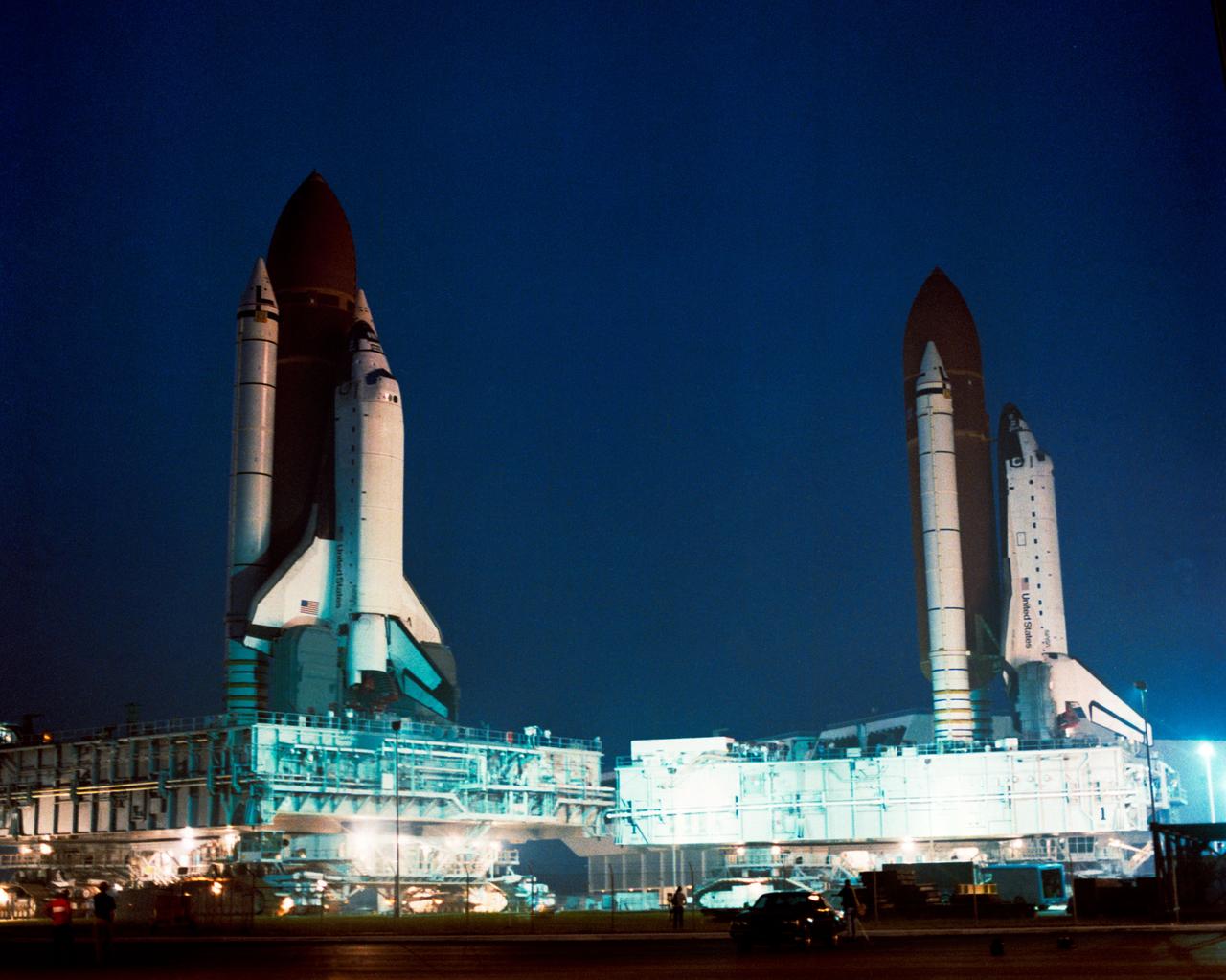
Columbia, Orbiter Vehicle (OV) 102, slated for mission STS-35, left, rolls past Atlantis, OV-104, on its way to Kennedy Space Center (KSC) launch pad 39A. OV-104, being readied for STS-38, is parked in front of the Vehicle Assembly Building (VAB) following its rollback from the pad for liquid hydrogen (LH2) line repairs. View provided by KSC with alternate number KSC-90PC-1152.
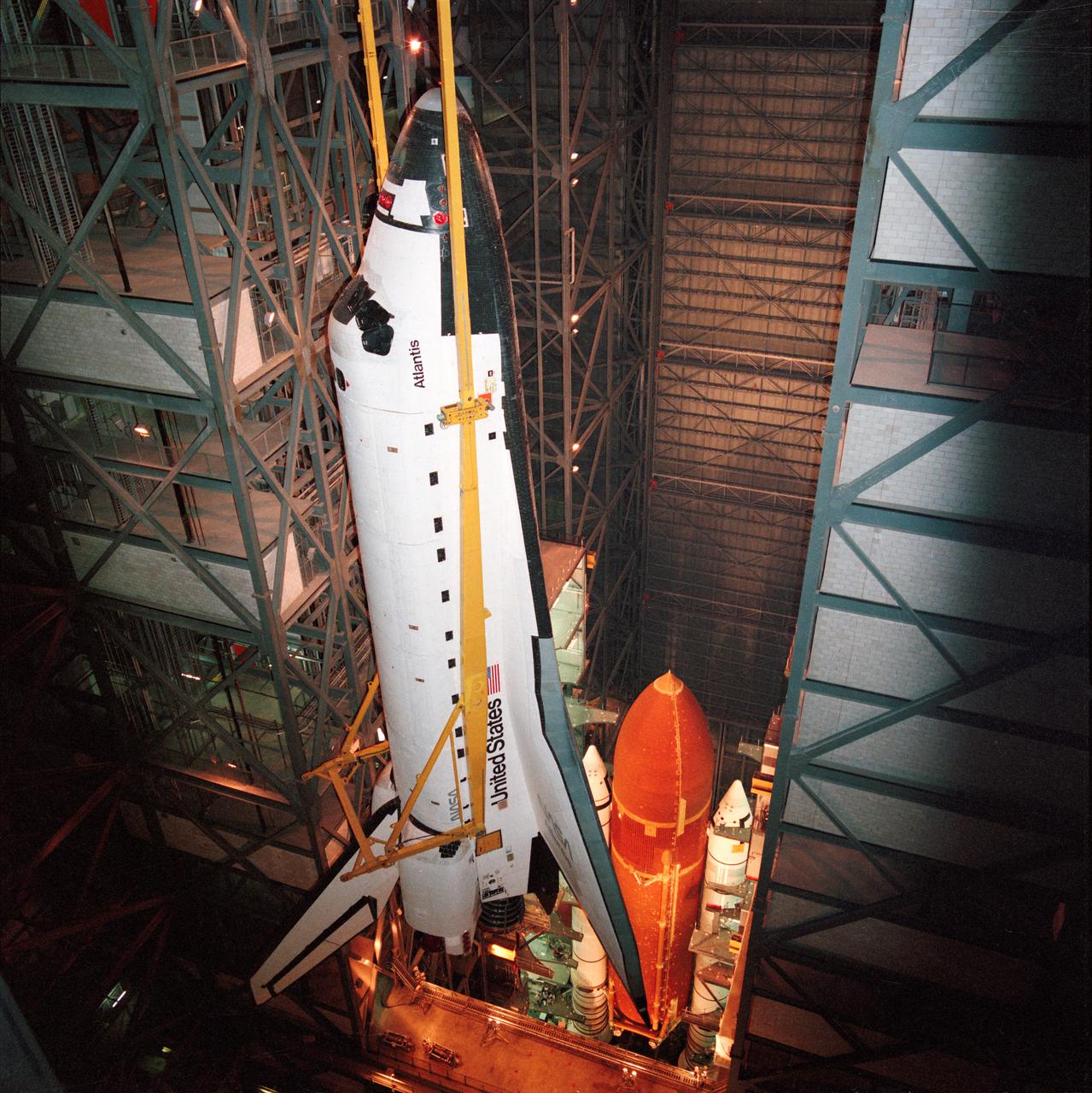
STS-27 Atlantis, Orbiter Vehicle (OV) 104, is suspended via overhead crane, attached at four points, in the Kennedy Space Center (KSC) Vehicle Assembly Building (VAB). Below OV-104 on the mobile launcher platform are the external tank (ET) and solid rocket boosters (SRBs). During ET/SRB mating operations, OV-104 will be mounted atop the ET.
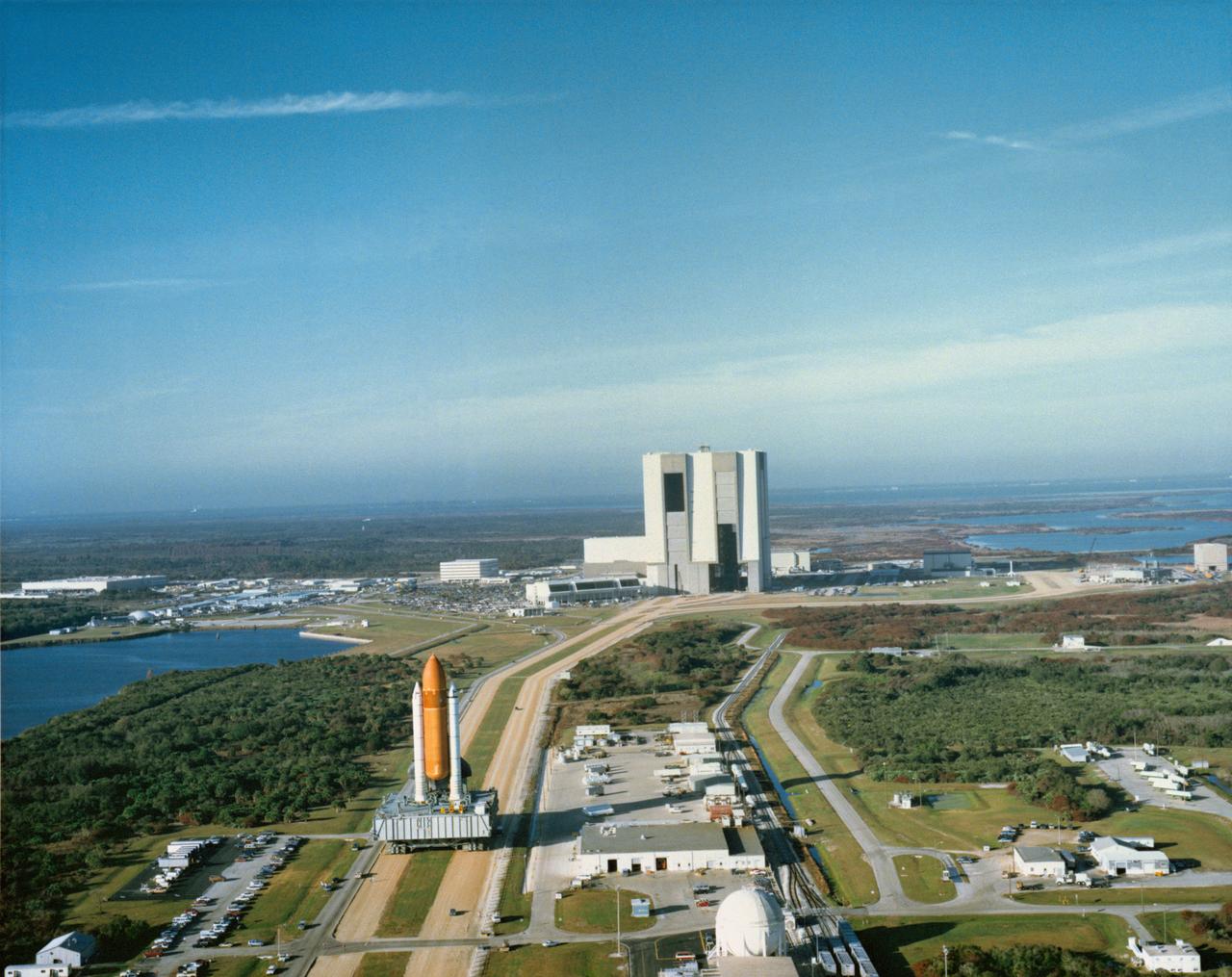
Atlantis, Orbiter Vehicle (OV) 104, is blocked by its large orange external tank (ET) as it leaves Vehicle Assembly Building (VAB) during its rollout to Kennedy Space Center (KSC) Launch Complex (LC) Pad 39A. The crawler transporter heads along the specially designed roadway with OV-104, the ET, and two solid rocket boosters mounted on top of a mobile launcher platform. KSC facilities including the VAB and Launch Control Center (LCC) are visible in the background. OV-104 heads to LC Pad 39A after the shortest stay in the VAB since return-to-flight. OV-104 is being prepared for launch on STS-36, a Department of Defense (DOD) dedicated mission. View provided by KSC with alternate KSC number KSC-90PC-134.
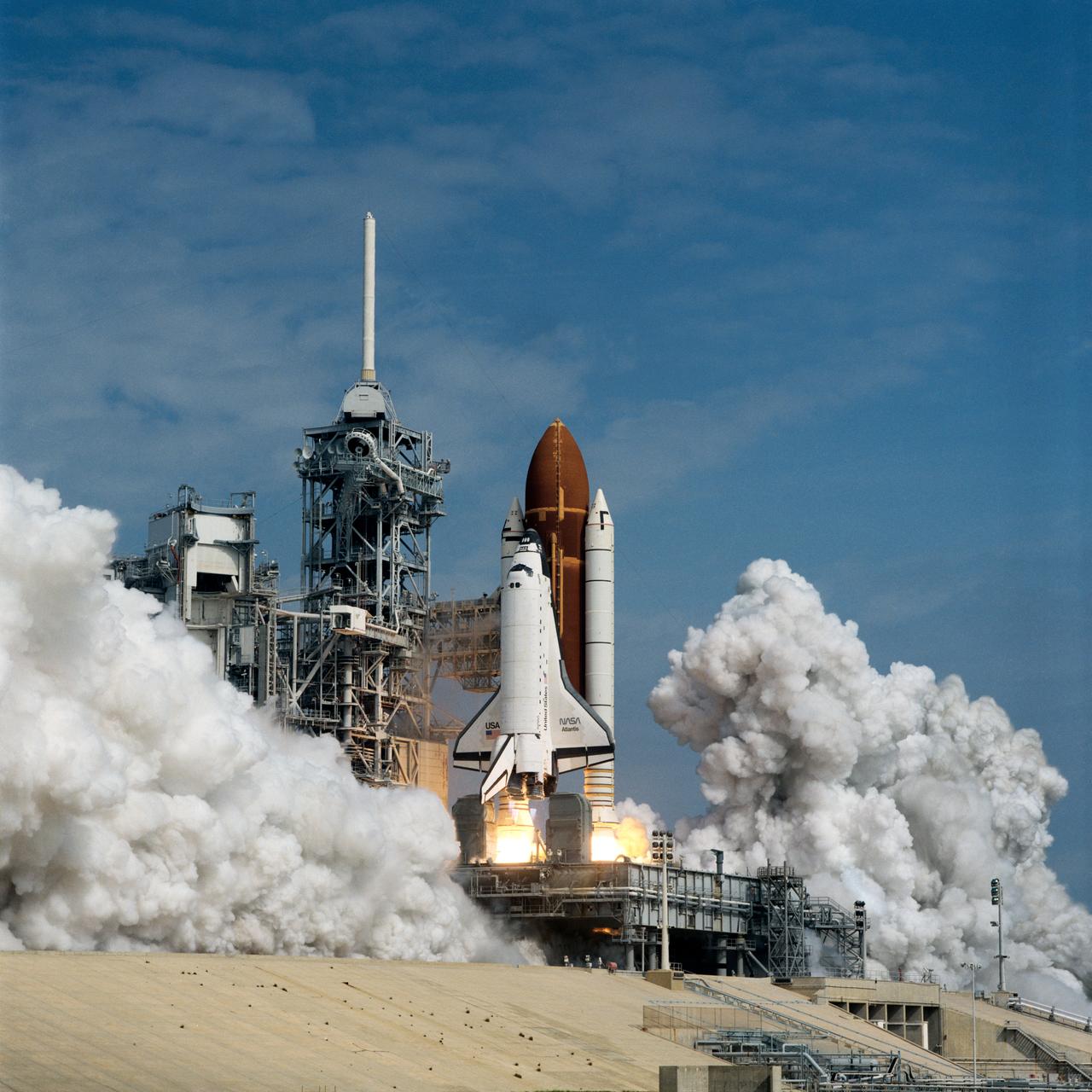
STS-37 Atlantis, Orbiter Vehicle (OV) 104, lifts off from Kennedy Space Center (KSC) Launch Complex (LC) Pad at 9:22:45:0439 (Eastern Standard Time (EST)). OV-104, atop its external tank (ET) and flanked by its two solid rocket boosters (SRBs), is captured just after space shuttle main engine (SSME) firing and as it rises above the mobile launcher platform. The fixed service structure (FSS) and retracted rotating service structure (RSS) appear along side OV-104. Clouds of exhaust smoke begin to fill the launch pad area.

Technicians complete foaming around the area of Atlantis, Orbiter Vehicle (OV) 104, 17 inch diameter external tank (ET) feed line in preparation for the second liquid hydrogen tanking test at the Kennedy Space Center (KSC). An elaborate network of sensors, leak detectors, and baggies were set up on OV-104 by technicians. Engineers hope this extra instrumentation will help pinpoint the exact location of the leak. OV-104 is scheduled to be launched for the STS-38 mission, a classified Department of Defense (DOD) flight. View provided by KSC with alternate number KSC-90PC-988.
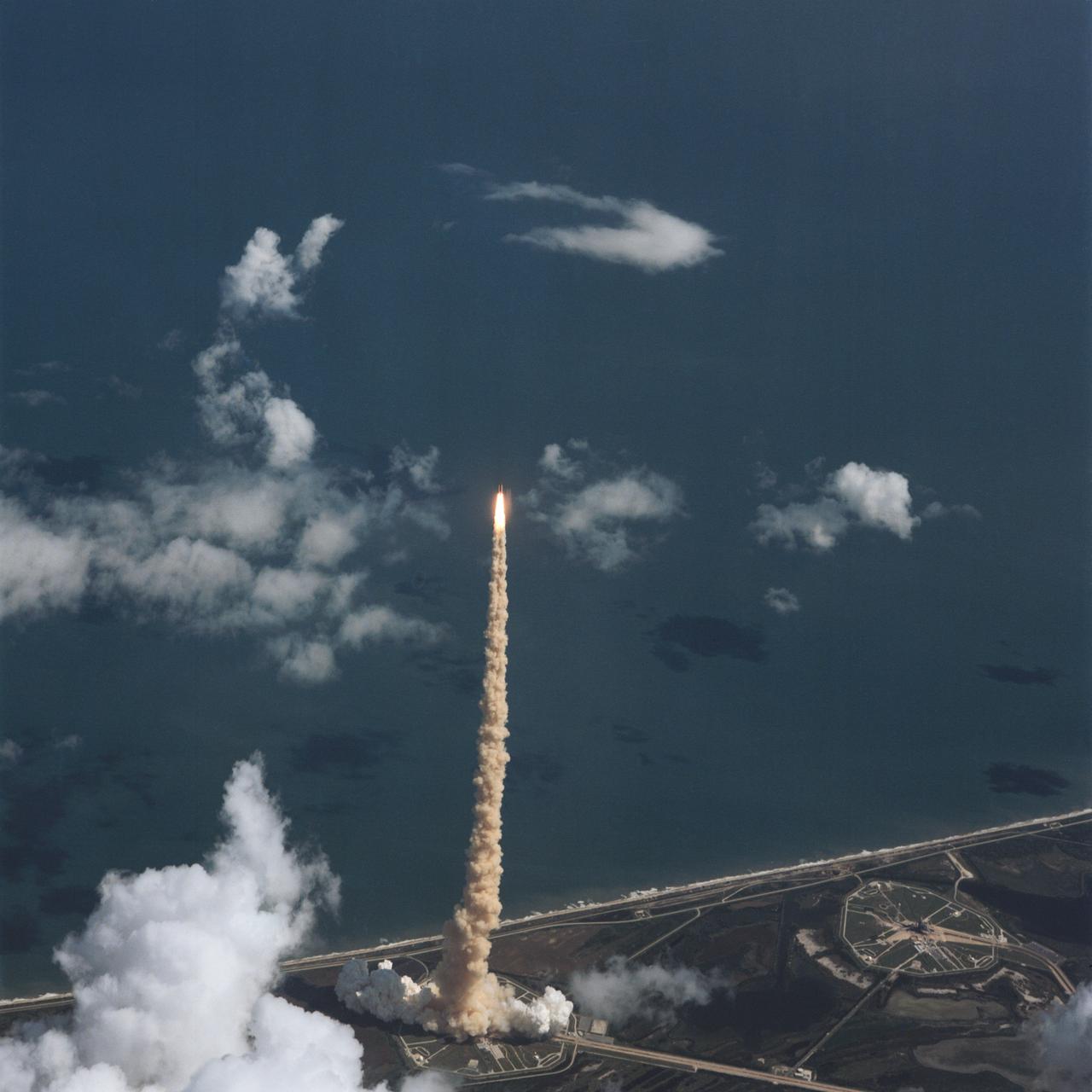
STS-34 Atlantis, Orbiter Vehicle (OV) 104, lifts off from Kennedy Space Center (KSC) Launch Complex (LC) Pad 39B at 12:53:39:983 pm Eastern Daylight Time (EDT). This aerial view shows OV-104, its external tank (ET), and two solid rocket boosters (SRBs) rising high above LC Pad 39B atop a plume of exhaust smoke. Atlantic Ocean is visible in the background. The liftoff marks the beginning of a five-day mission in space.
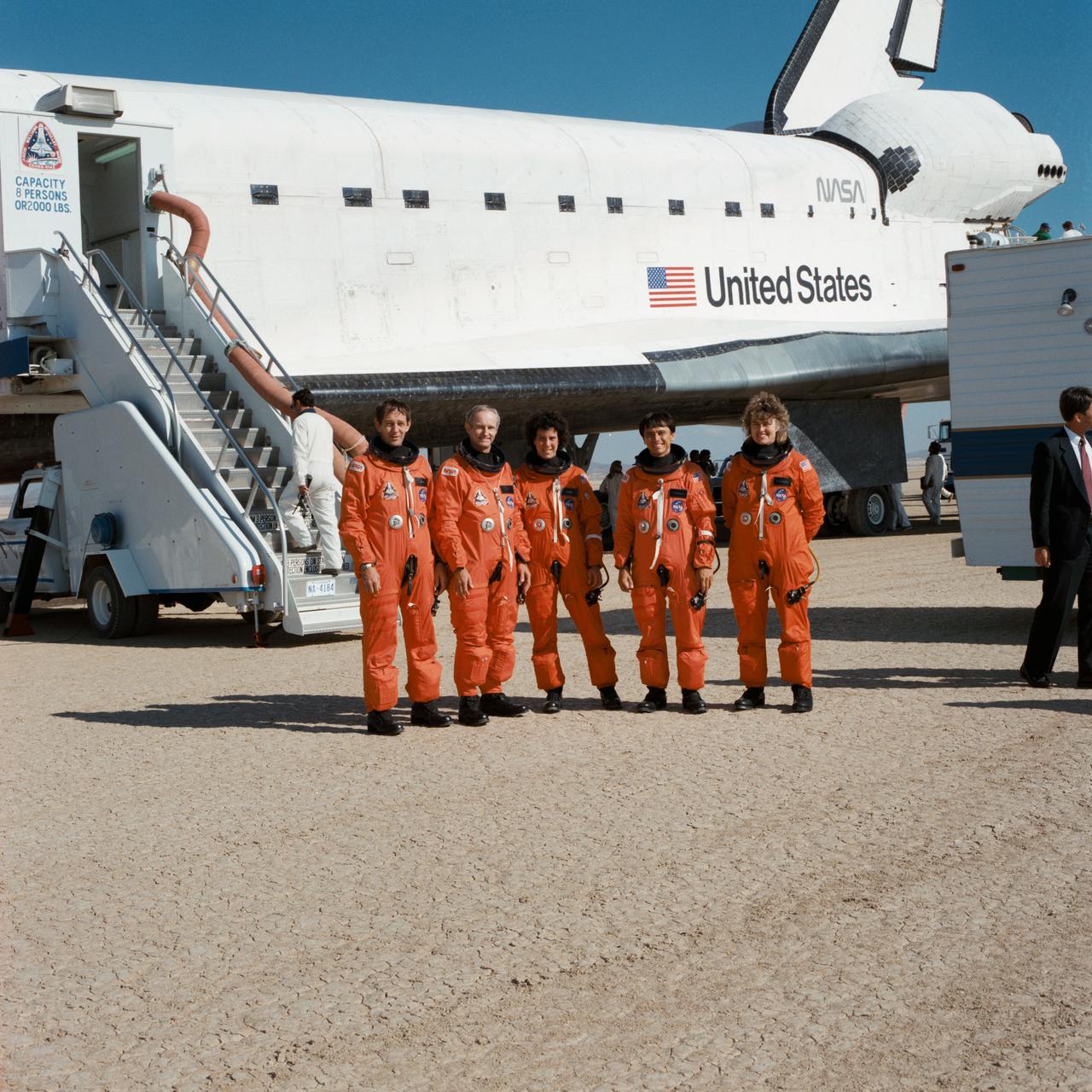
STS-34 crewmembers, wearing launch and entry suits (LESs), stand in front of Atlantis, Orbiter Vehicle (OV) 104, on Runway 23 dry lake bed at Edwards Air Force Base (EAFB), California. Left to right are Pilot Michael J. McCulley, Commander Donald E. Williams, Mission Specialist (MS) Ellen S. Baker, MS Franklin R. Chang-Diaz, and MS Shannon W. Lucid. Ground crews service OV-104 in the background.
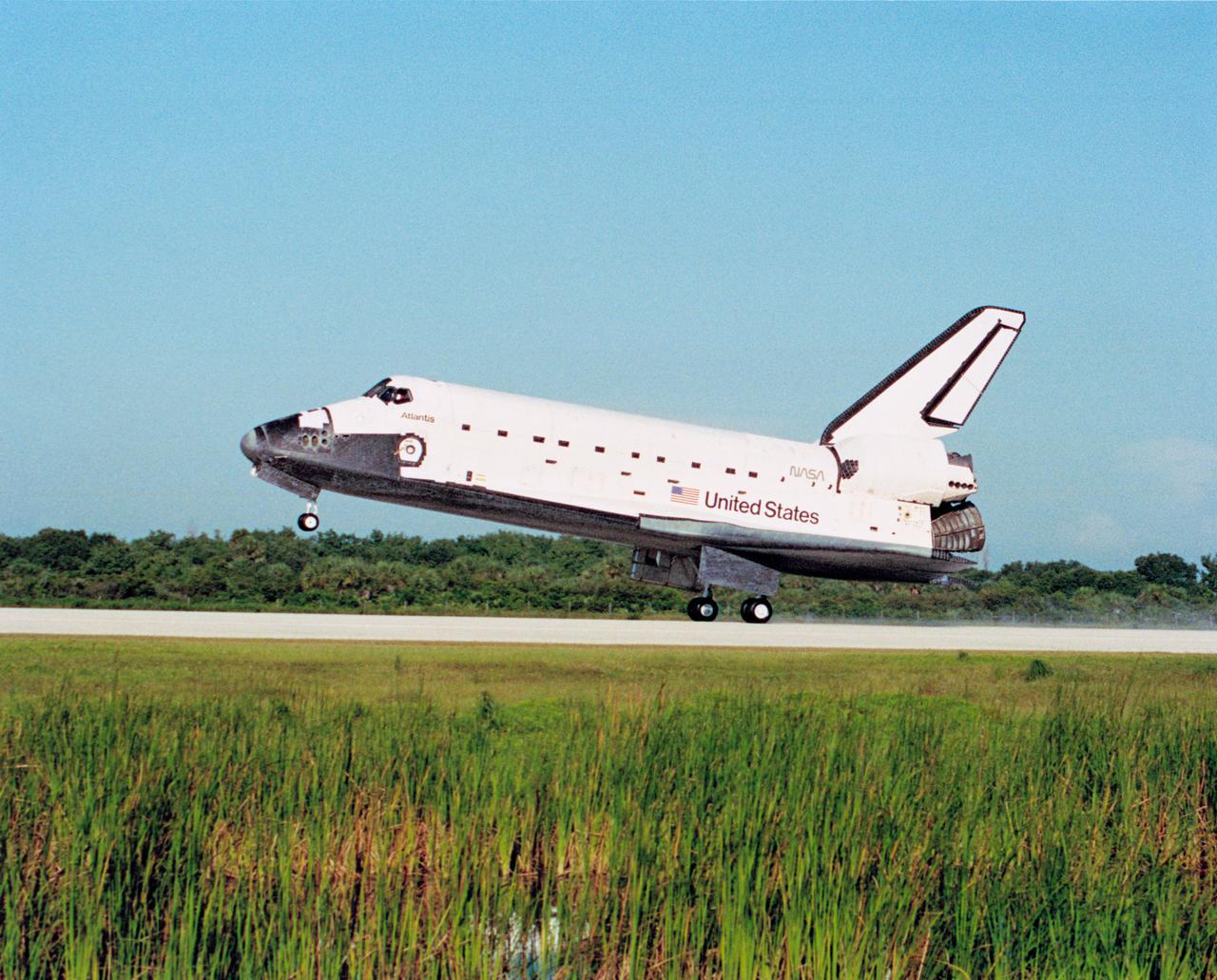
STS-43 Atlantis, Orbiter Vehicle (OV) 104, lands on runway 15 at the Kennedy Space Center's (KSC's) Shuttle Landing Facility (SLF). The main landing gear (MLG) touched down at 8:23:25 am (Eastern Daylight Time (EDT)). OV-104 glides toward wheel stop as the nose landing gear (NLG) rides above the runway.
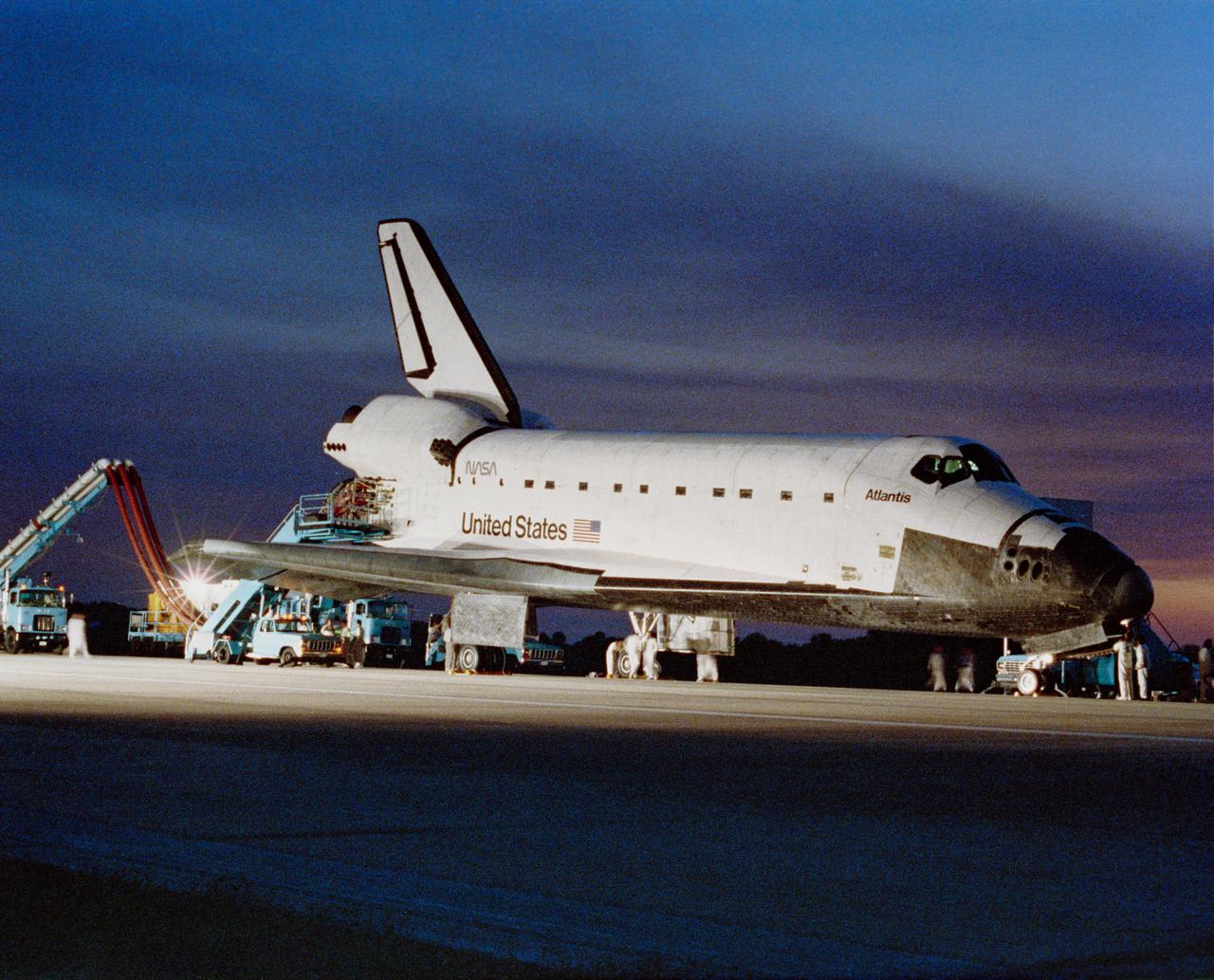
Spotlights illuminate Atlantis, Orbiter Vehicle (OV) 104, during safing operations at the Kennedy Space Center's (KSC's) Shuttle Landing Facility (SLF). OV-104 parked on runway 33 is serviced by KSC ground crews. STS-38, a Department of Defense (DOD)-devoted mission, came to an end (with complete wheel stop) at 4:43:37 pm (Eastern Standard Time (EST)).
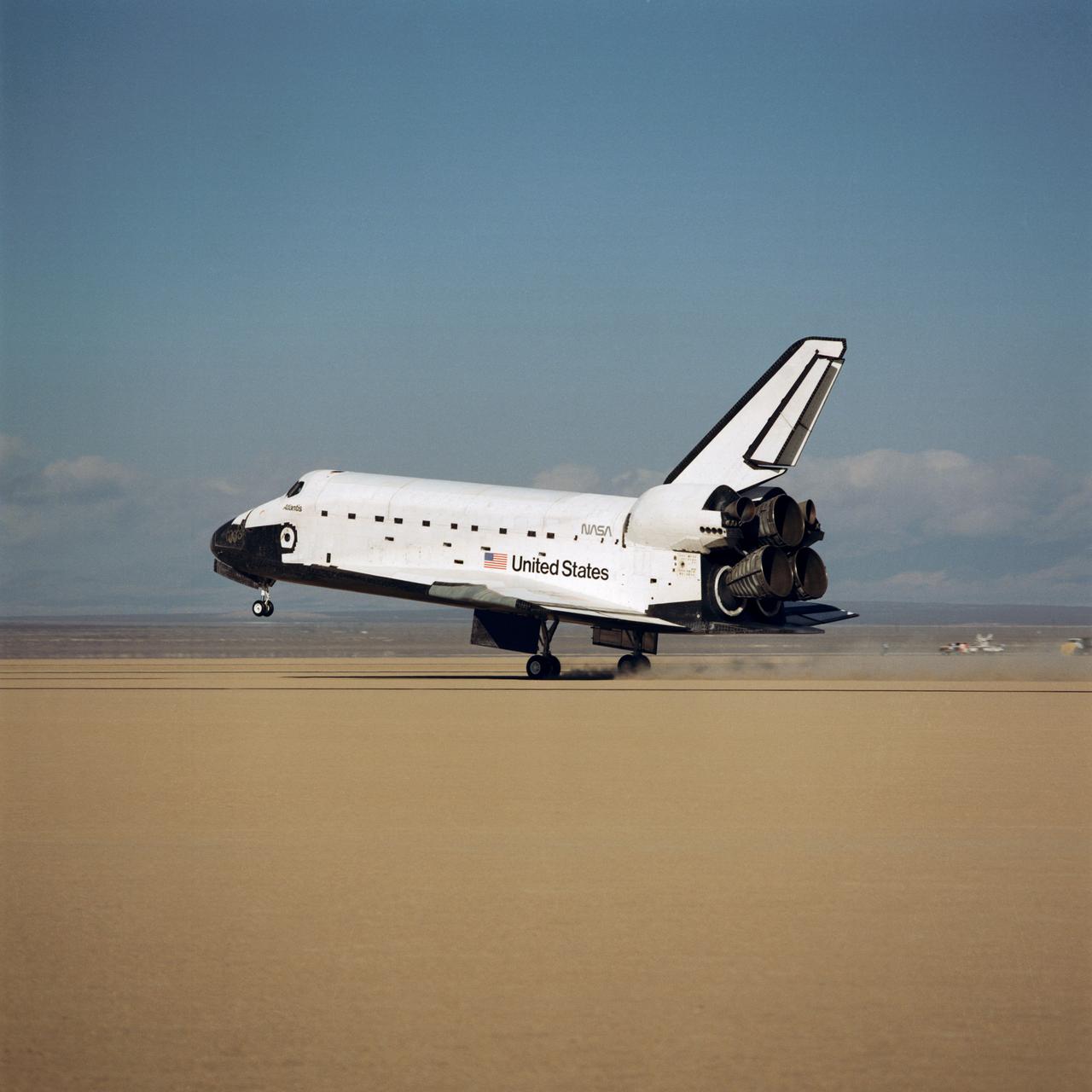
STS-34 Atlantis, Orbiter Vehicle (OV) 104, main landing gear (MLG) touches down on Runway 23 dry lake bed at Edwards Air Force Base (EAFB), California. The nose landing gear rides above runway before touchdown as the MLG wheels produce a cloud of dust. OV-104's port side profile is captured as it glides by at a speed of approximately 195 knots (224 miles per hour). The tail section with deployed speedbrake/rudder and space shuttle main engines (SSMEs) are visible.
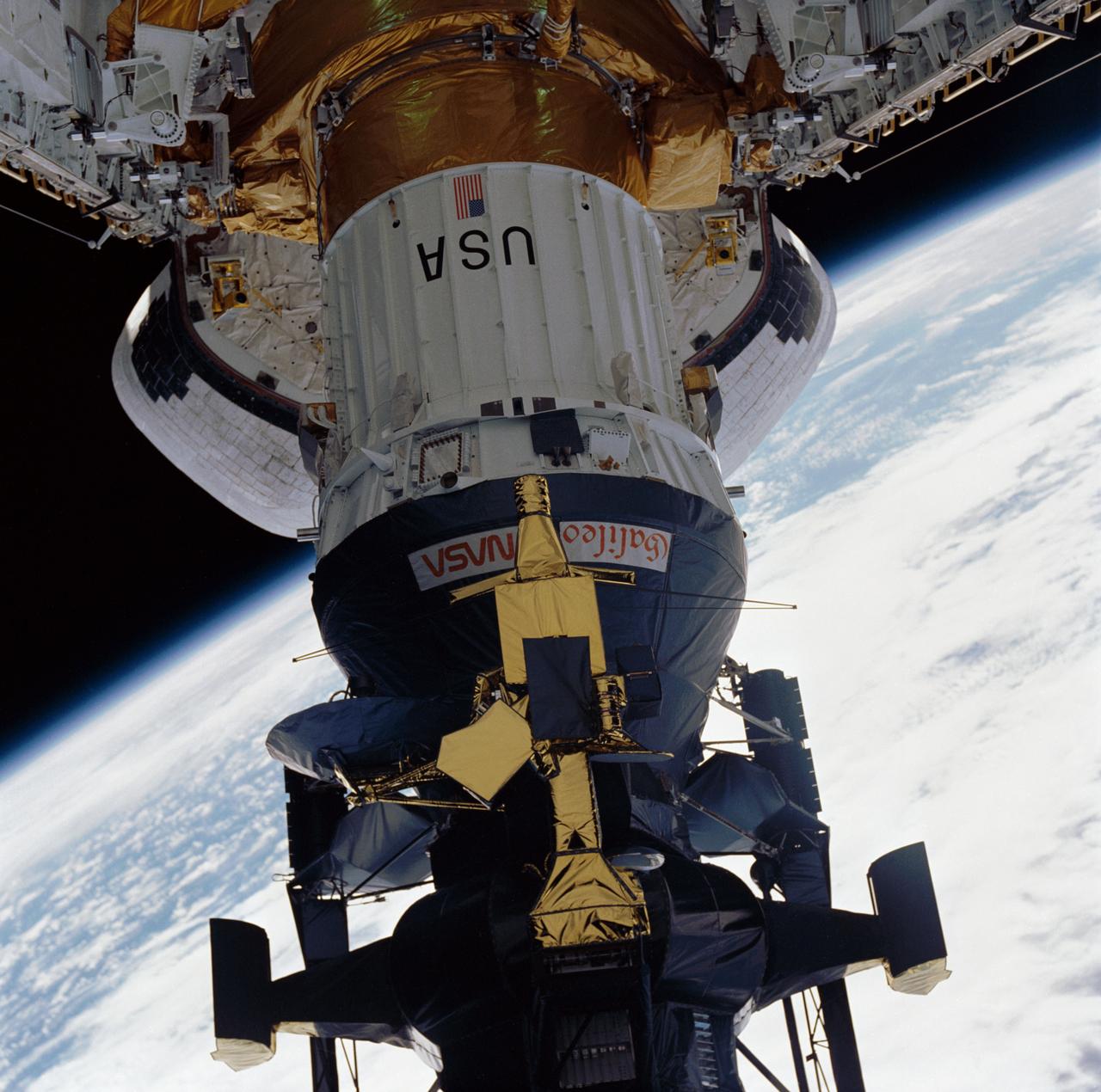
During STS-34 mission, the Galileo spacecraft mounted atop the inertial upper stage (IUS) is tilted to a 58-degree deployment position by the airborne support equipment (ASE) aft frame tilt actuator (AFTA) table in Atlantis', Orbiter Vehicle (OV) 104's, payload bay (PLB). Visible in the foreground is the ASE forward cradle and the umbilical boom which has fallen away from the IUS. OV-104's orbital maneuvering system (OMS) pods and the Earth's limb appear in the background.
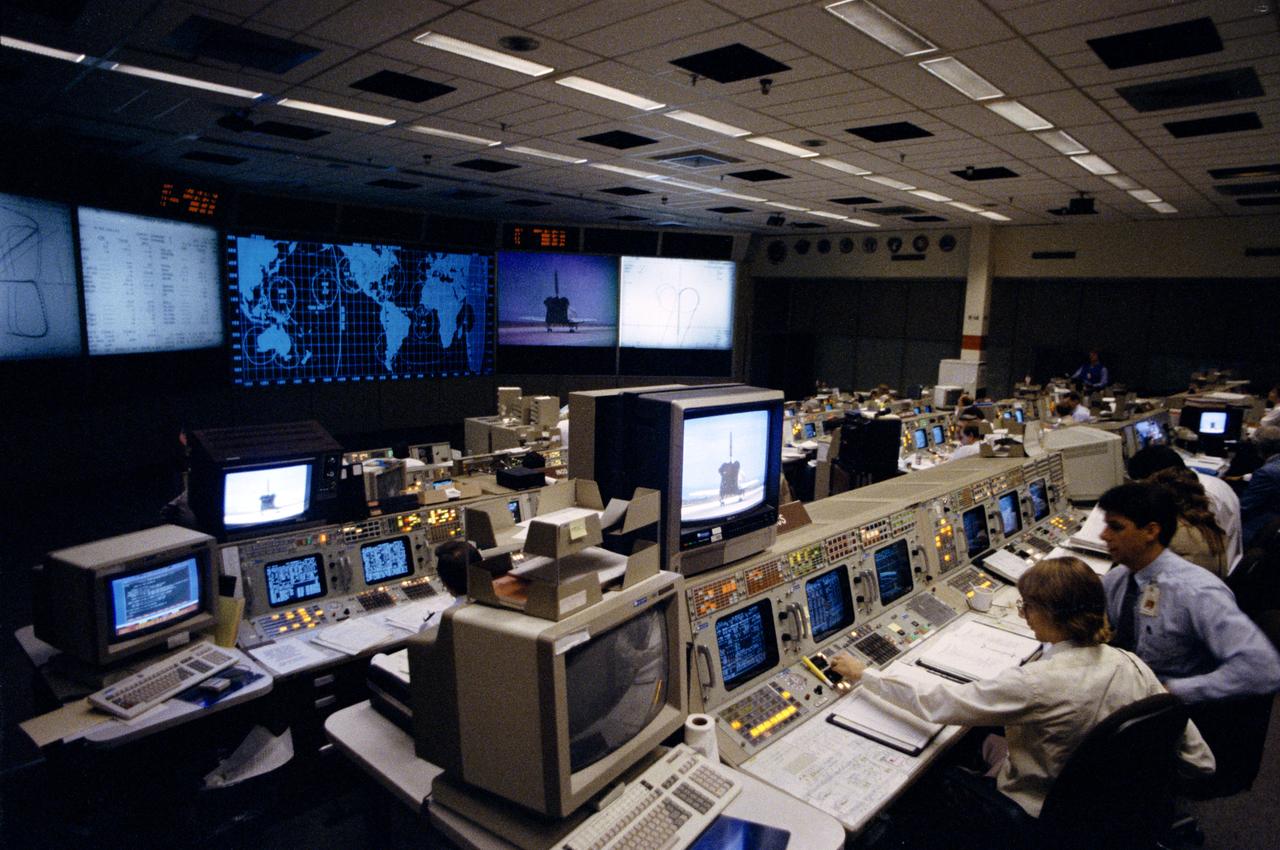
As STS-30 ends its mission with the landing of Atlantis, Orbiter Vehicle (OV) 104, at Edwards Air Force Base (EAFB), California, flight controllers monitor screens at their consoles in JSC Mission Control Center (MCC) Bldg 30. In the foreground is the Maintenance, Mechanical Arm, and Crew Systems Engineer (MMACS) console with R. Kevin McCluney studying data readouts. On the front visual displays are the tracking map and a tail view of OV-104 as it comes to a stop on EAFB concrete runway 22.
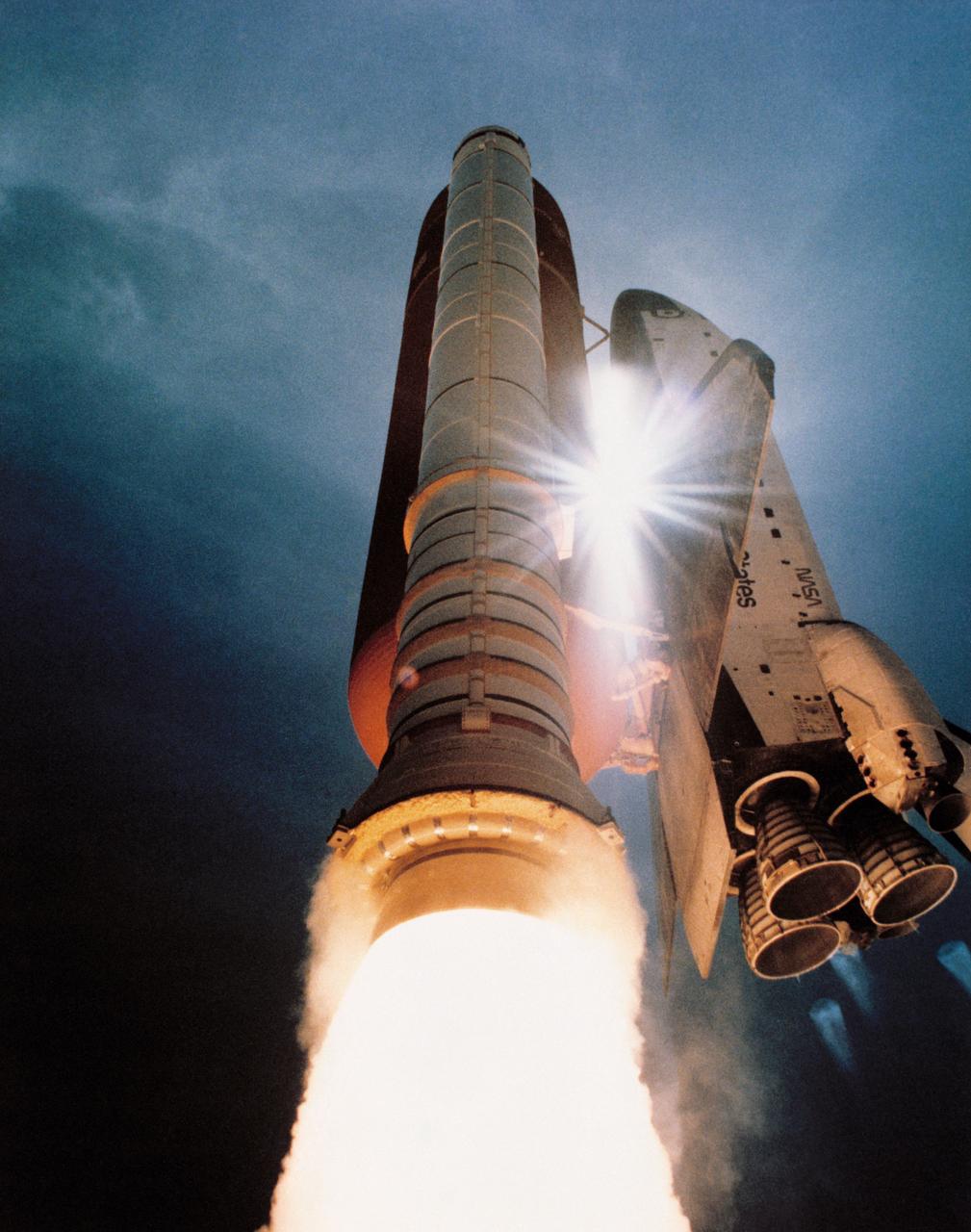
STS-43 Atlantis, Orbiter Vehicle (OV) 104, soars toward space after liftoff from Kennedy Space Center (KSC) Launch Complex (LC) Pad 39A at 11:02: 00 am (Eastern Daylight Time (EDT)). This low angle view captures OV-104 as it begins its roll maneuver. A burst of sunlight shines through the mated hardware elements supporting the Space Shuttle Atlantis for the STS-43 mission's launch phase. Exhaust plumes billow from the solid rocket booster (SRB) skirts. All three space shuttle main engines (SSMEs) glow as they power OV-104 into orbit. The bottom of external tank (ET) is highlighted by the SRB/SSME firings. This image was selected by the Public Affairs Office (PAO) for public release.
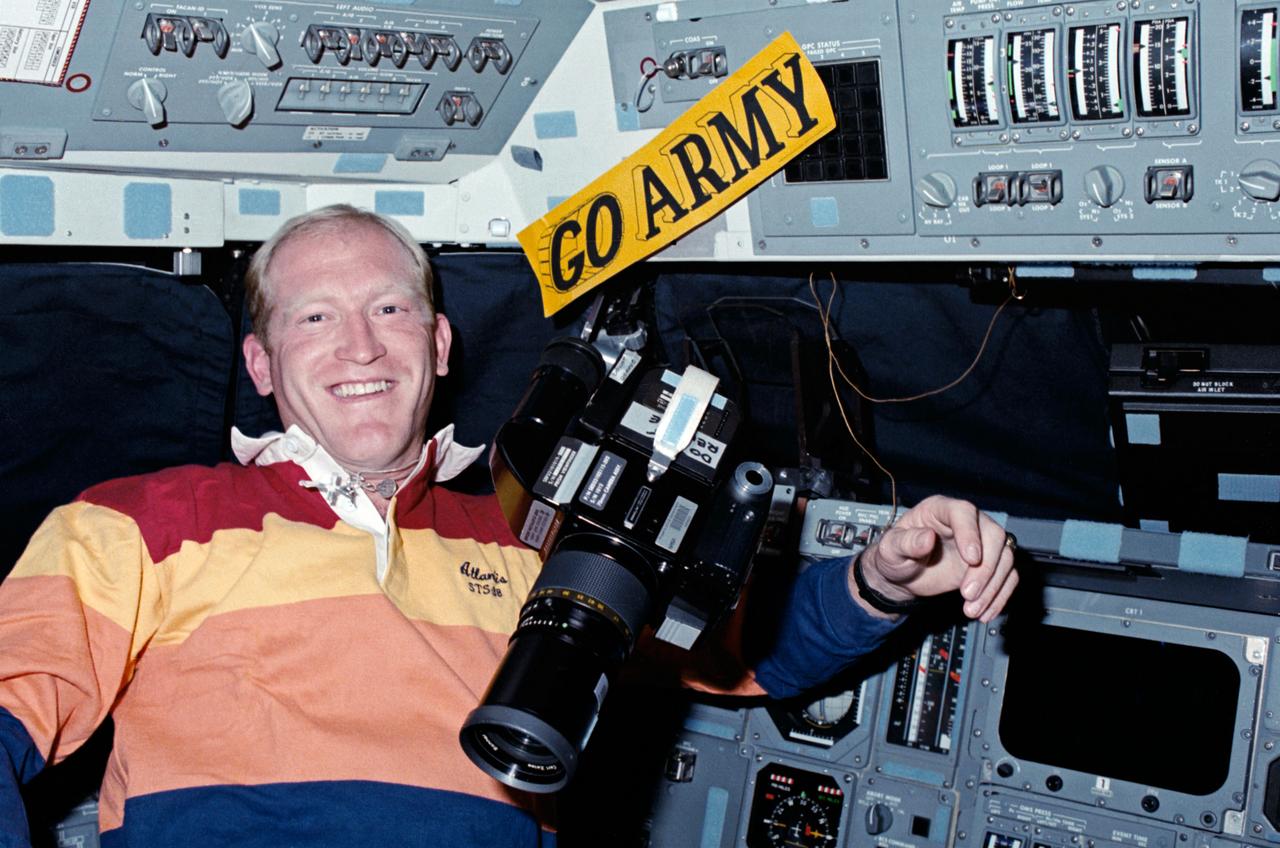
STS-38 Mission Specialist (MS) Charles D. Gemar freefloats in front of commanders station on the forward flight deck of Atlantis, Orbiter Vehicle (OV) 104, along with HASSELBLAD camera and "GO ARMY" decal.
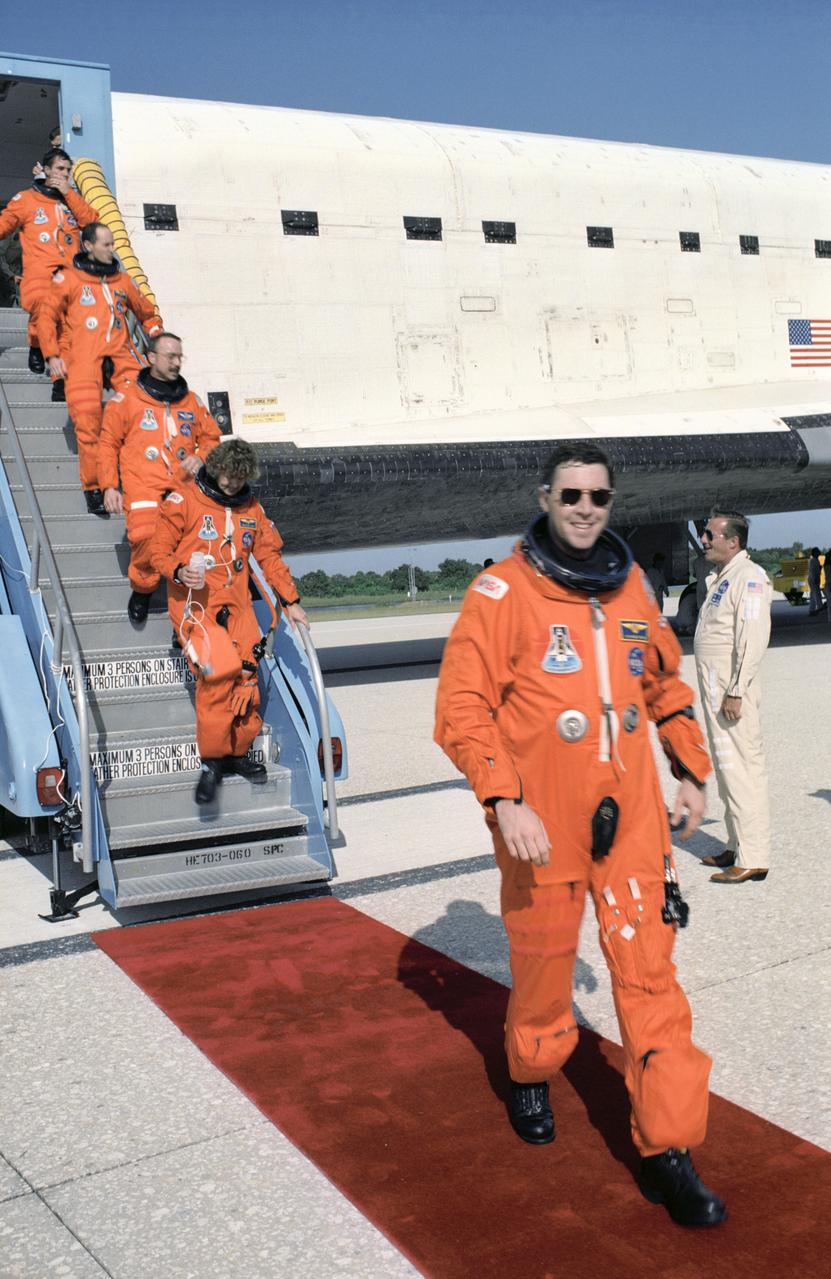
STS043-S-145 (11 Aug 1991) --- STS-43 crewmembers, wearing launch and entry suits (LESs), egress Atlantis, Orbiter Vehicle (OV) 104, via mobile stairway after landing on runway 15 at the Kennedy Space Center (KSC) Shuttle Landing Facility (SLF). Leading the crew and the first to step onto the red carpet is Pilot Michael A. Baker. He is followed by Mission Specialist (MS) Shannon W. Lucid, MS James C. Adamson, MS G. David Low, and Commander John E. Blaha. OV-104's fuselage is visible in the background.
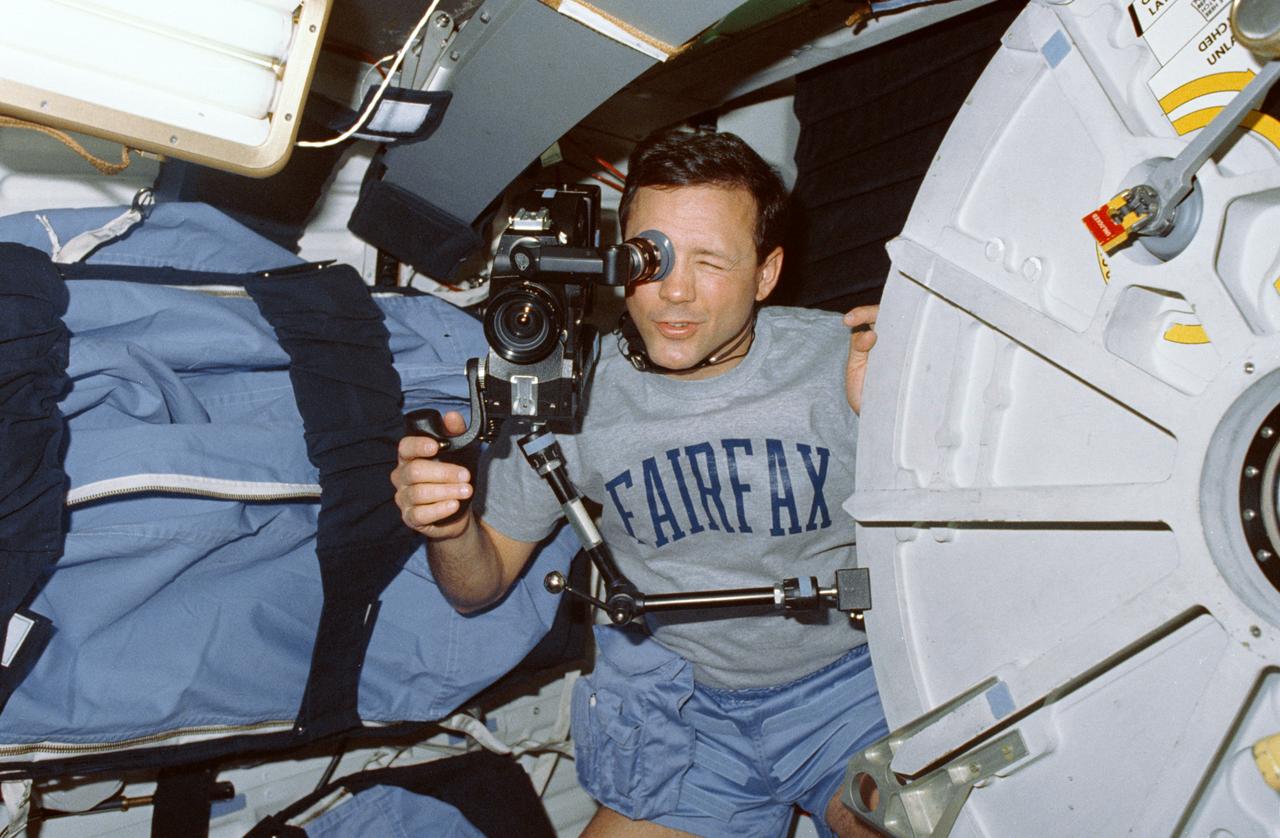
STS-36 Mission Specialist (MS) Pierre J. Thuot operates 16mm ARRIFLEX motion picture camera mounted on the open airlock hatch via a bracket. Thuot uses the camera to record activity of his fellow STS-36 crewmembers on the middeck of Atlantis, Orbiter Vehicle (OV) 104. Positioned between the airlock hatch and the starboard wall-mounted sleep restraints, Thuot, wearing a FAIRFAX t-shirt, squints into the cameras eye piece. Thuot and four other astronauts spent four days, 10 hours and 19 minutes aboard OV-104 for the Department of Defense (DOD) devoted mission.
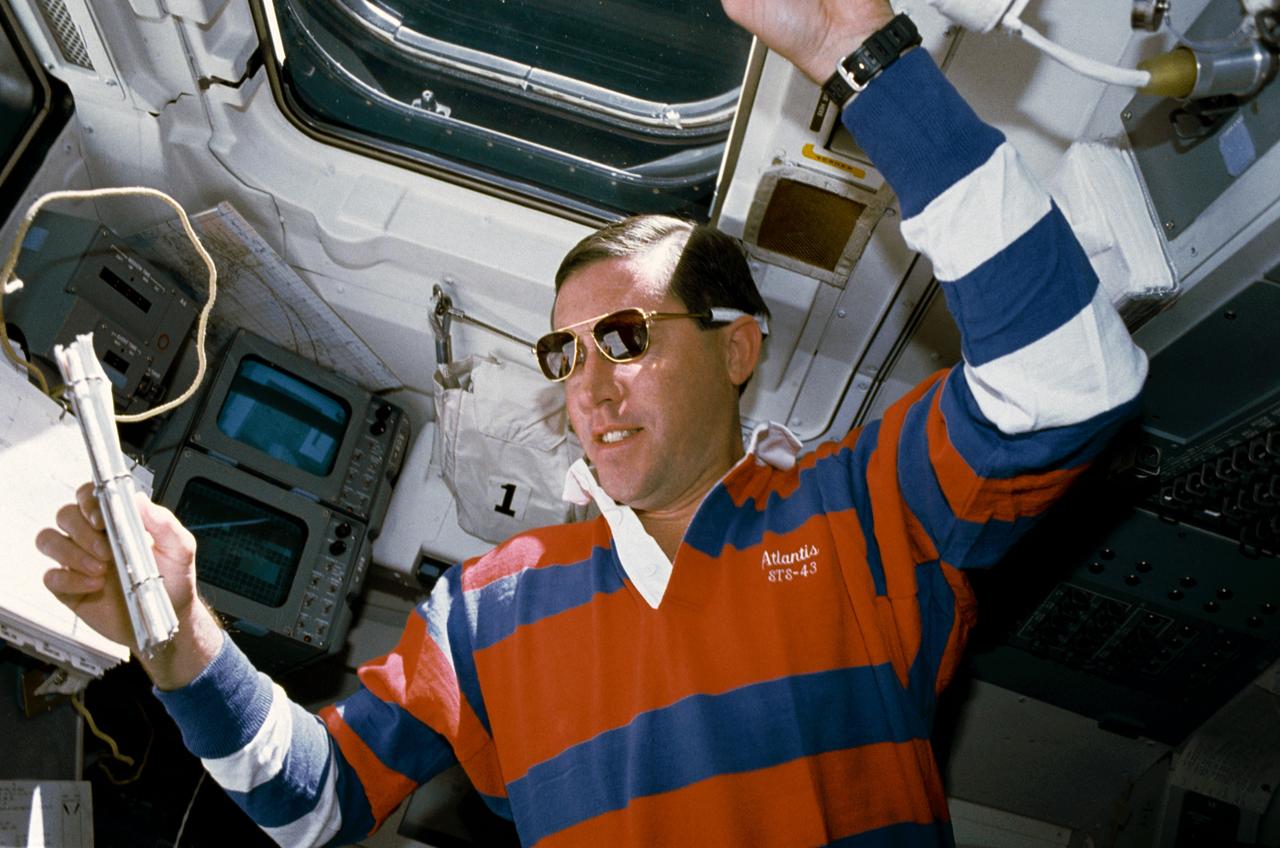
STS043-04-032 (11 Aug 1991) --- STS-43 Pilot Michael A. Baker, wearing sunglasses, reviews a checklist on the aft flight deck of Atlantis, Orbiter Vehicle (OV) 104. He is monitoring data associated with the Space Station Heat Pipe Advanced Radiator Element II (SHARE-II) located in OV-104's payload bay (PLB) from his position in front of the aft flight deck viewing windows. Behind Baker are the closed circuit television (CCTV) monitors and above his head is overhead window W8.
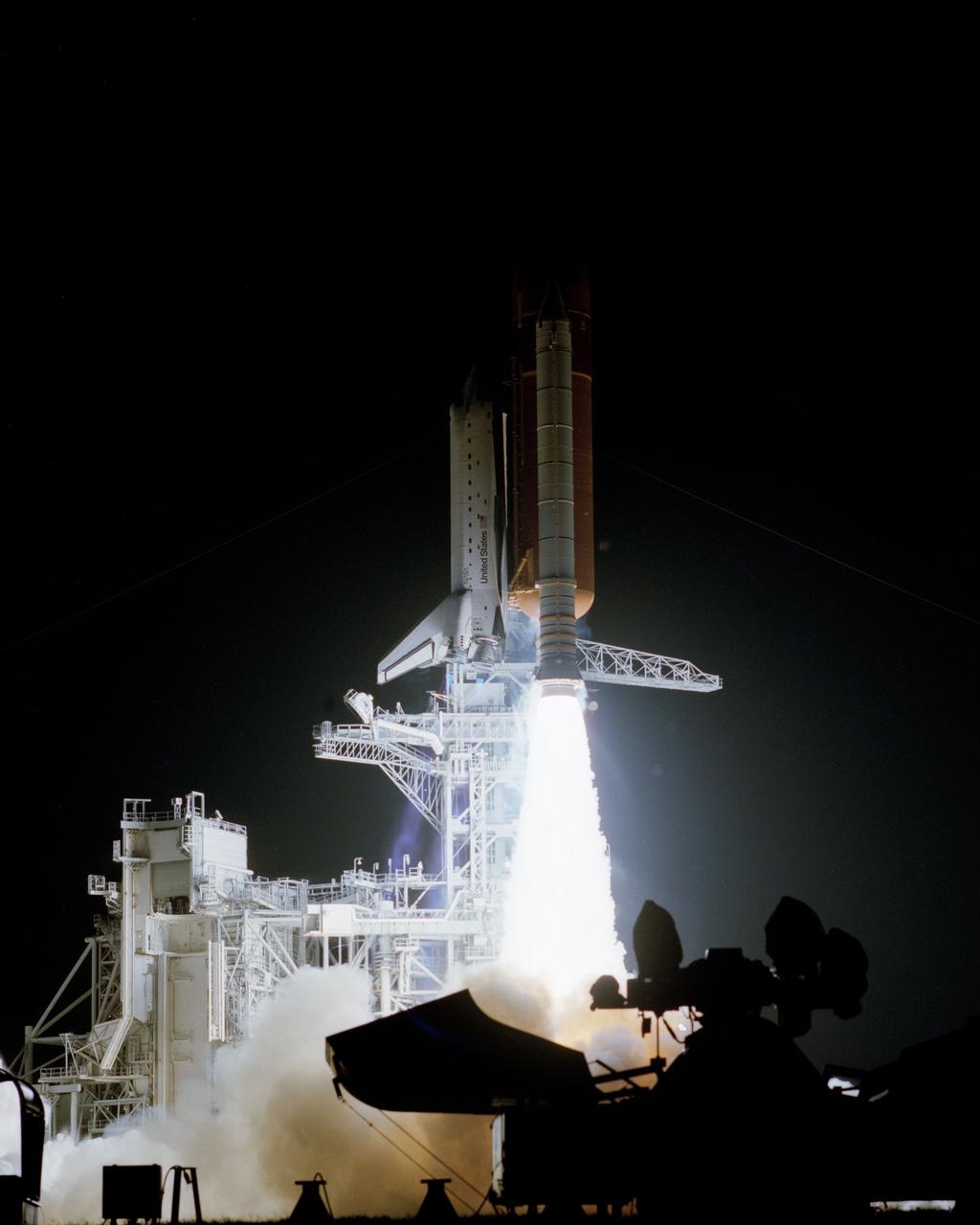
STS-38 Atlantis, Orbiter Vehicle (OV) 104, lifts off from Kennedy Space Center (KSC) Launch Complex (LC) Pad at 6:48:15:0639 pm (Eastern Standard Time (EST)) for Department of Defense (DOD)-devoted mission. OV-104, atop the external tank (ET) and flanked by solid rocket boosters (SRBs), is almost clear of the launch tower which is lit up by the SRB and space shuttle main engine (SSME) firings. Spotlight equipment is silhouetted against the SRB/SSME glow in the foreground. The retracted rotating service structure (RSS) is highlighted against the evening darkness by the launch fireworks.
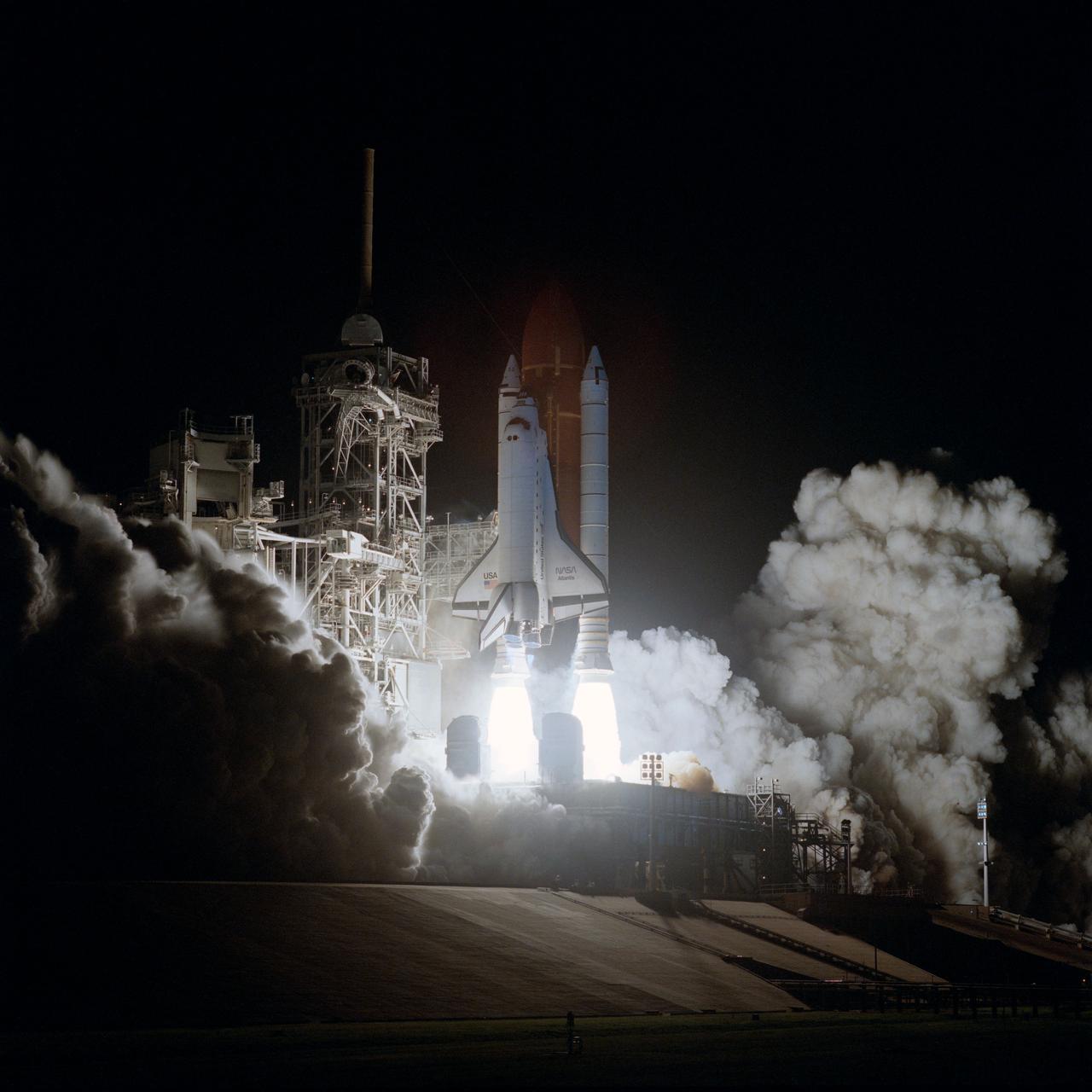
STS-38 Atlantis, Orbiter Vehicle (OV) 104, lifts off from Kennedy Space Center (KSC) Launch Complex Pad at 6:46:15:0639 pm (Eastern Standard Time (EST)). As OV-104, atop the external tank (ET) and flanked by two solid rocket boosters (SRBs), rises above the mobile launcher platform, exhaust smoke fills the area surrounding the launch pad. SRB and space shuttle main engine (SSME) firings glow against the night darkness and light up the fixed service structure (FSS) and retracted rotating service structure (RSS). STS-38 is a Department of Defense (DOD) devoted mission.

STS036-21-032 (3 March 1990) --- The five astronaut crewmembers for STS-36 pose for an inflight group portrait on the forward flight deck of Atlantis, Orbiter Vehicle (OV) 104. They are (left to right) Commander John O. Creighton, Mission Specialist (MS) David C. Hilmers, MS Richard M. Mullane, MS Pierre J. Thuot, and Pilot John H. Casper. Creighton is positioned in the commanders seat and Casper in the pilot?s seat. Overhead control panels appear above the astronauts. The astronauts spent four days, 10 hours and 19 minutes aboard OV-104 for the Department of Defense (DOD) dedicated mission.
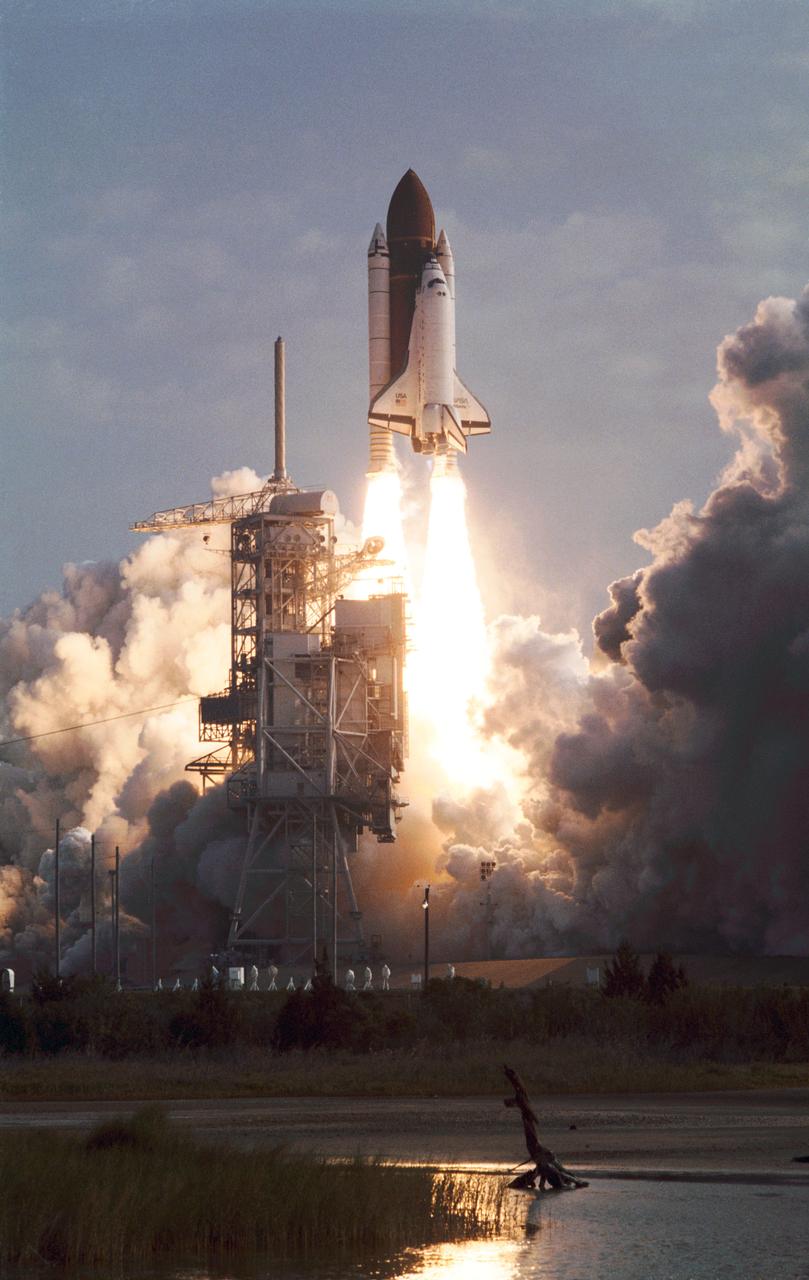
STS-45 Atlantis, Orbiter Vehicle (OV) 104, lifts off from a Kennedy Space Center (KSC) Launch Complex (LC) Pad at 8:13:40:048 am (Eastern Standard Time (EST)). Exhaust billows out the solid rocket boosters (SRBs) as OV-104 atop its external tank (ET) soars above the mobile launcher platform and is nearly clear of the fixed service structure (FSS) tower. The diamond shock effect produced by the space shuttle main engines (SSMEs) is visible. The glow of the SRB/SSME firings is reflected in a nearby waterway. An exhaust cloud covers the launch pad area.

The European Retrievable Carrier 1L (EURECA-1L) spacecraft, with solar array panels extended, drifts above the Earth after deployment from the payload bay of Atlantis, Orbiter Vehicle (OV) 104, during STS-46. EURECA's onboard propulsion unit will boost it to an operational altitude of 270 nautical miles.
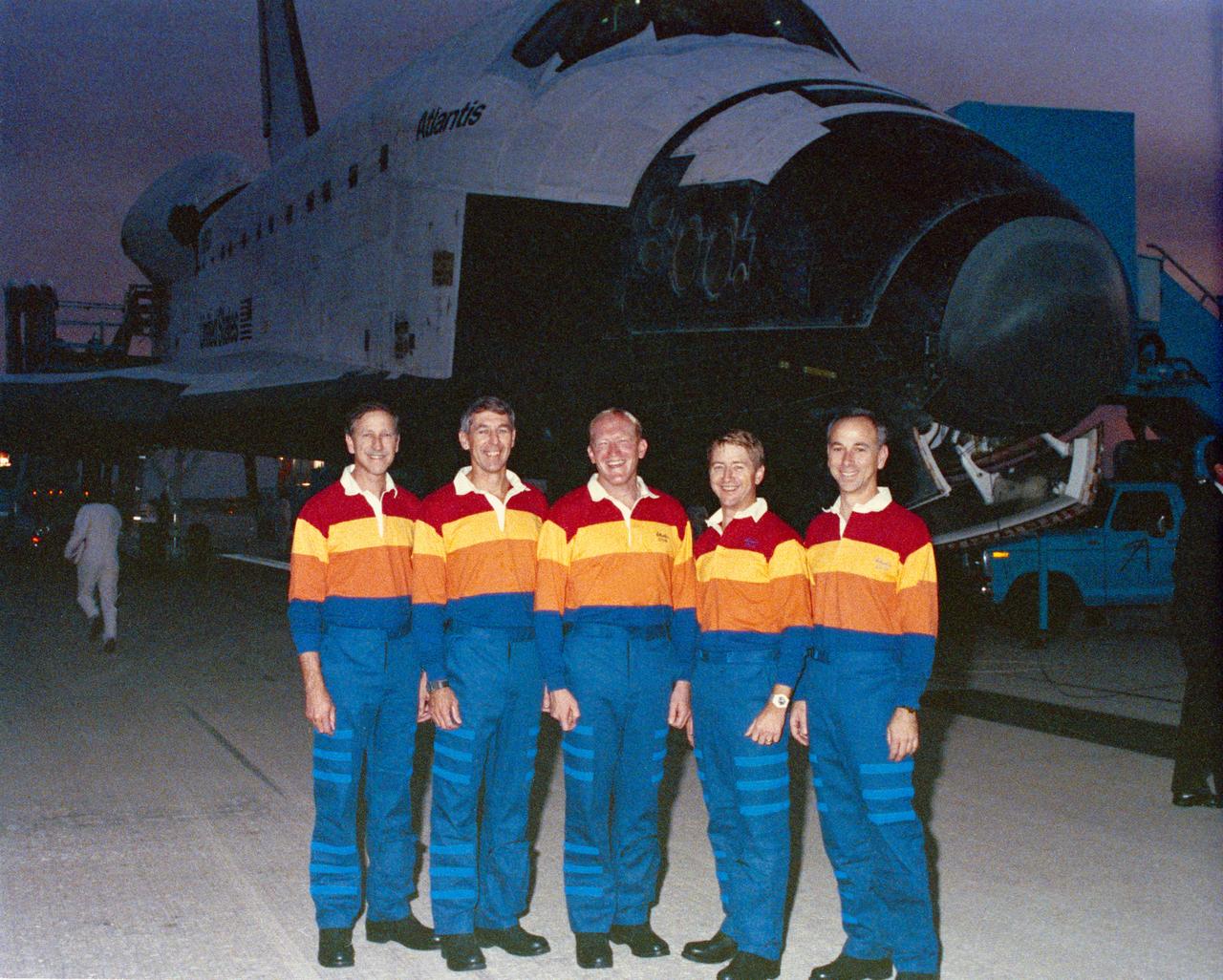
STS038-S-040 (20 Nov 1990) --- STS-38 crewmembers, wearing red, yellow, and orange polo shirts, pose in front of Atlantis, Orbiter Vehicle (OV) 104, parked on runway 33 at Kennedy Space Center's (KSC) Shuttle Landing Facility (SLF) during post flight activities. Left to right are Commander Richard O. Covey, Mission Specialist (MS) Robert C. Springer, MS Charles D. Gemar, Pilot Frank L. Culbertson, and MS Carl J. Meade.

STS038-S-041 (20 Nov 1990) --- STS-38 Atlantis, Orbiter Vehicle (OV) 104, lands on runway 33 at Kennedy Space Center (KSC) Shuttle Landing Facility (SLF). The main landing gear (MLG) has just touched down on the runway surface as the nose landing gear (NLG) glides above it. The Department of Defense (DOD)-devoted mission came to an end (with complete wheel stop) at 4:43:37 pm (Eastern Standard Time (EST)).
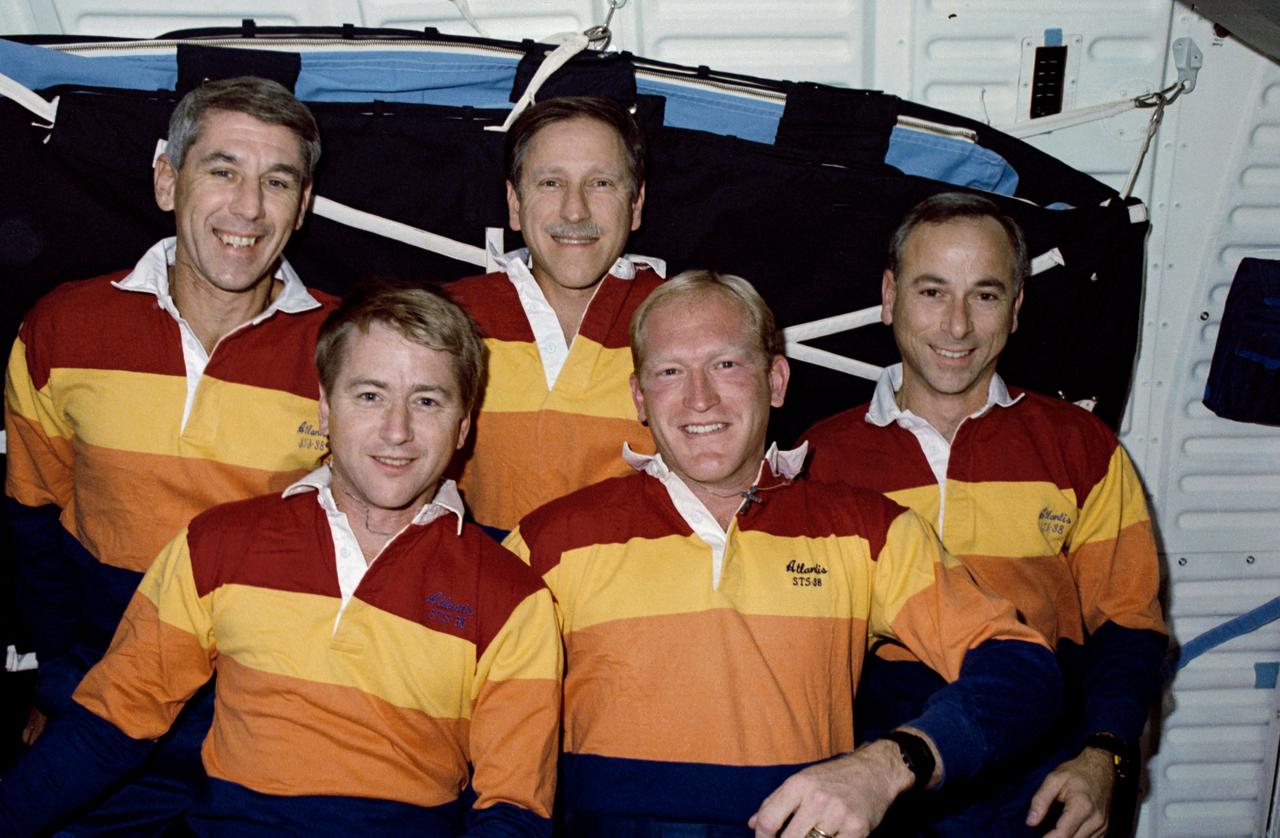
STS038-28-016 (20 Nov 1990) --- STS-38 crewmembers pose on Atlantis', Orbiter Vehicle (OV) 104's, middeck for traditional onboard (in-space) portrait. Wearing red, yellow, and orange crew polo shirts are (right to left) Mission Specialist (MS) Robert C. Springer, Pilot Frank L. Culbertson, Commander Richard O. Covey, MS Charles D. Gemar, and MS Carl J. Meade.

STS-36 Commander John O. Creighton, smiling and wearing a headset, listens to music as the tape recorder freefloats in front of him. During this lighter moment of the mission, Creighton is positioned at the commanders station on the forward flight deck of Atlantis, Orbiter Vehicle (OV) 104. Forward flight deck windows W1 and W2 appear on his left. Creighton and four other astronauts spent four days, 10 hours and 19 minutes aboard the spacecraft for the Department of Defense (DOD) devoted mission.
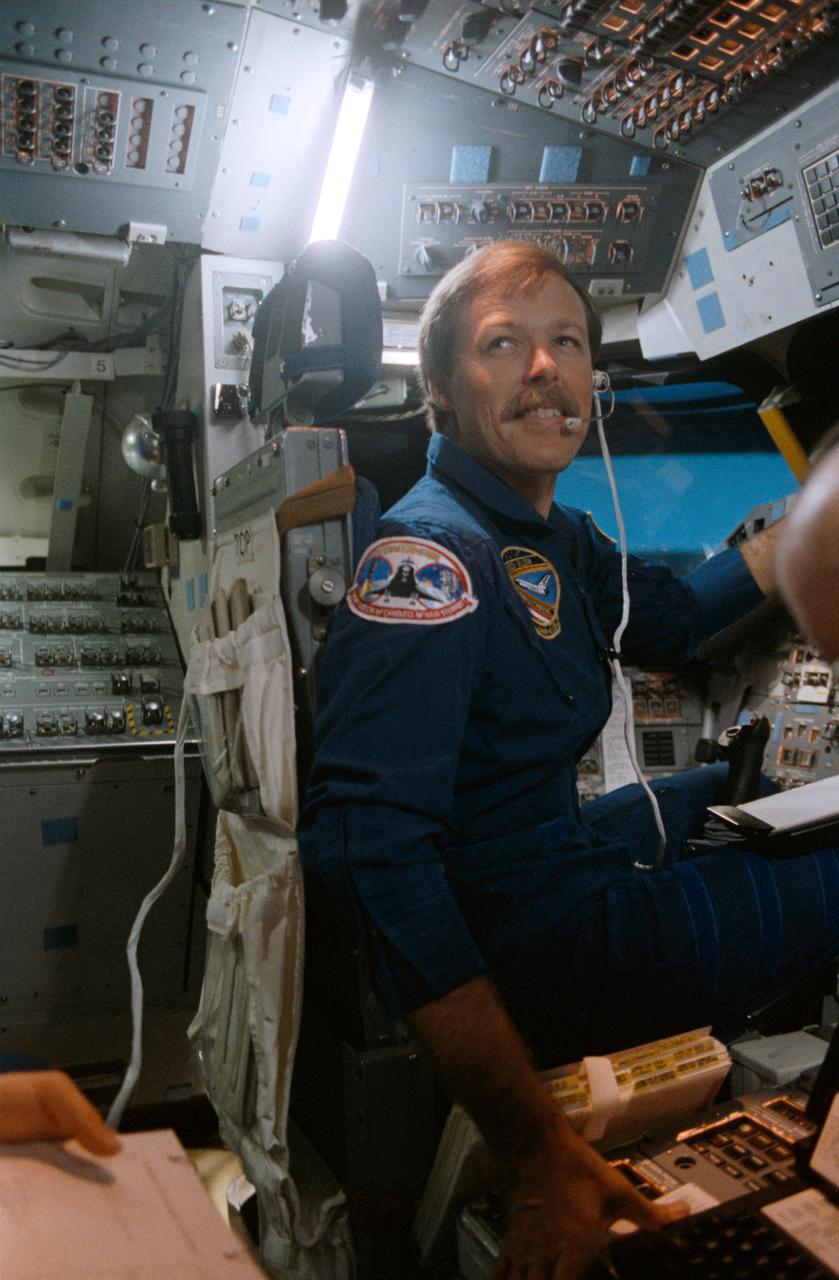
STS-27 Atlantis, Orbiter Vehicle (OV) 104, Commander Robert L. Gibson, wearing flight coveralls and communications kit assembly, sits at commanders station controls on JSC shuttle mission simulator (SMS) forward flight deck during training session. Gibson looks at crewmember on aft flight deck. SMS is located in the Mission Simulation and Training Facility Bldg 5.
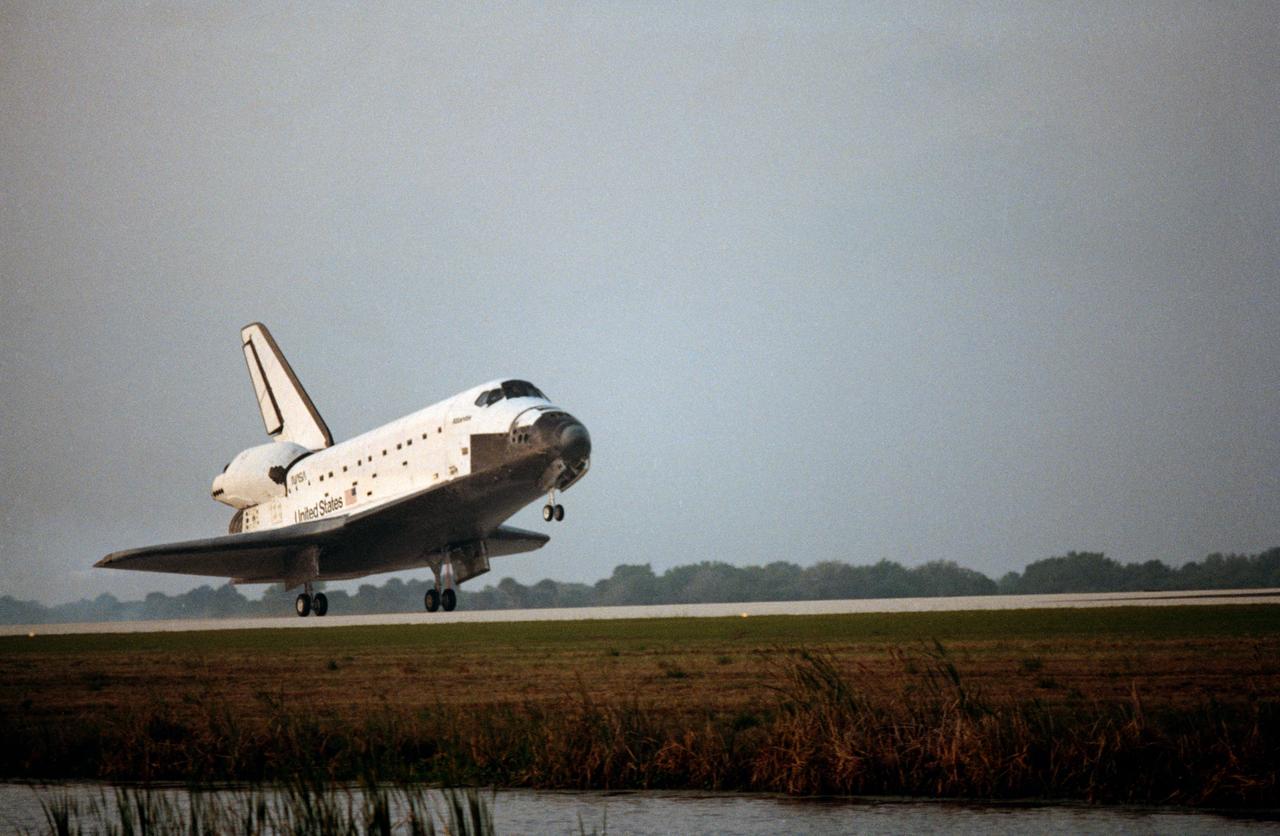
STS-45 Atlantis, Orbiter Vehicle (OV) 104, lands on concrete runway 33 at the Kennedy Space Center's (KSC's) Shuttle Landing Facility (SLF). The main landing gear (MLG) touched down at 6:23:06 am (Eastern Standard Time (EST)) in the early morning Florida fog as seen in these views. The deployed nose landing gear (NLG) rides above the runway before wheel stop.
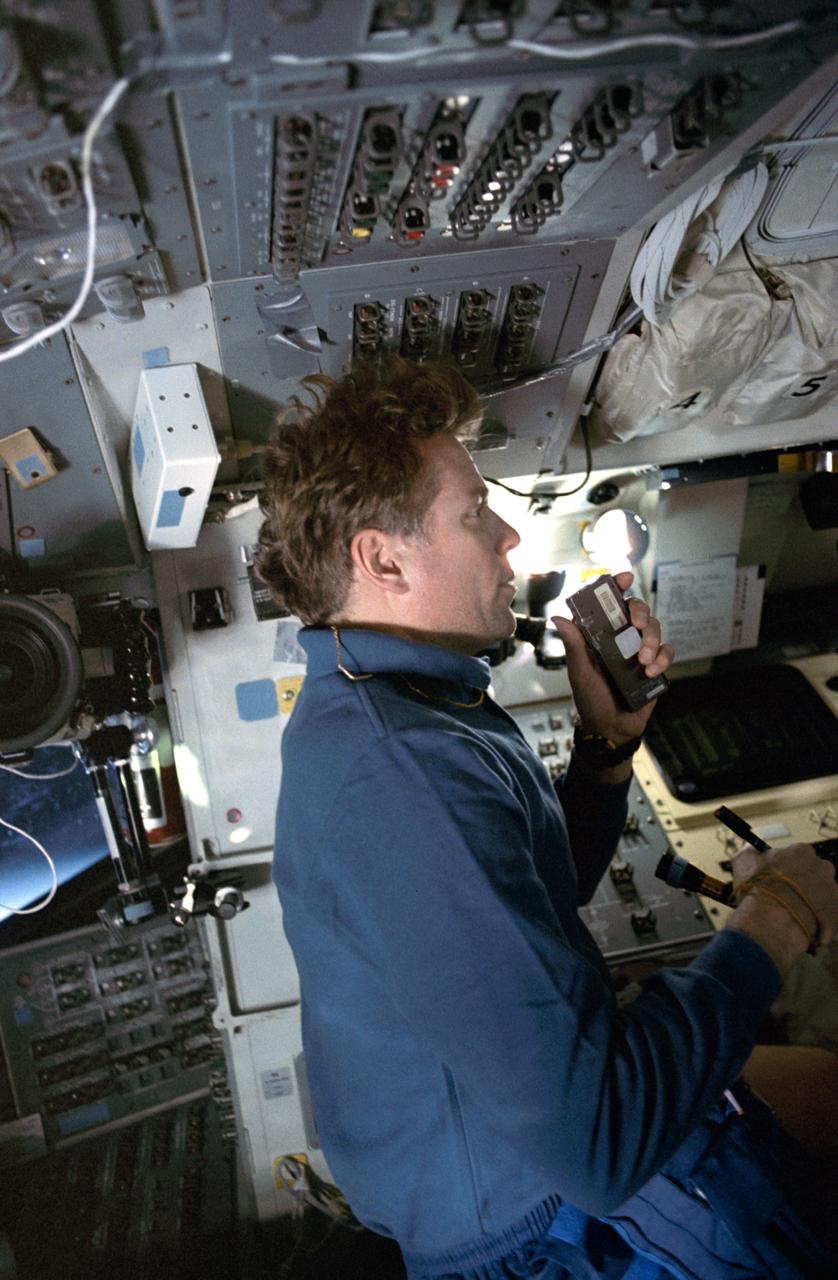
STS045-20-018 (2 April 1992) --- STS-45 Payload Specialist Byron K. Lichtenberg talks into a cassette tape recorder to note observations following a science run of the Atmospheric Emissions Photometric Imaging (AEPI) experiment. Lichtenberg is on the aft flight deck of Atlantis, Orbiter Vehicle (OV) 104. At Lichtenberg's left is the mission station, the forward flight deck and window W6 appear behind him, and overhead control panels appear above his head.
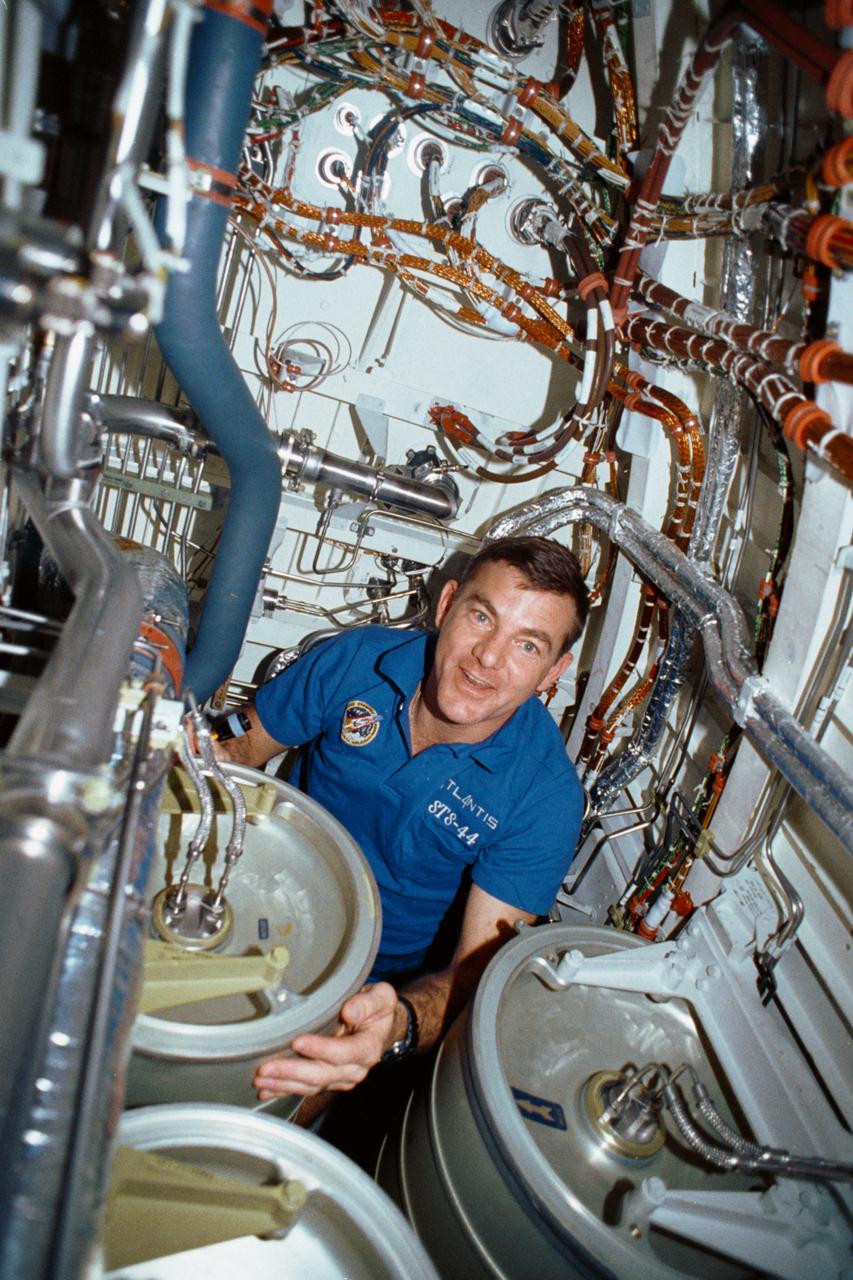
STS-44 Mission Specialist (MS) James S. Voss works under the middeck subfloor of Atlantis, Orbiter Vehicle (OV) 104, to repair humidity separator leakage problems. Voss is surrounded by several water tanks and a maze of shuttle wiring and plumbing. Voss earned the nickname of "Bilge Man" because of his time spent on the lower deck tending to the leakage problem. This is the first photo released of a crewmember in this area of the shuttle.
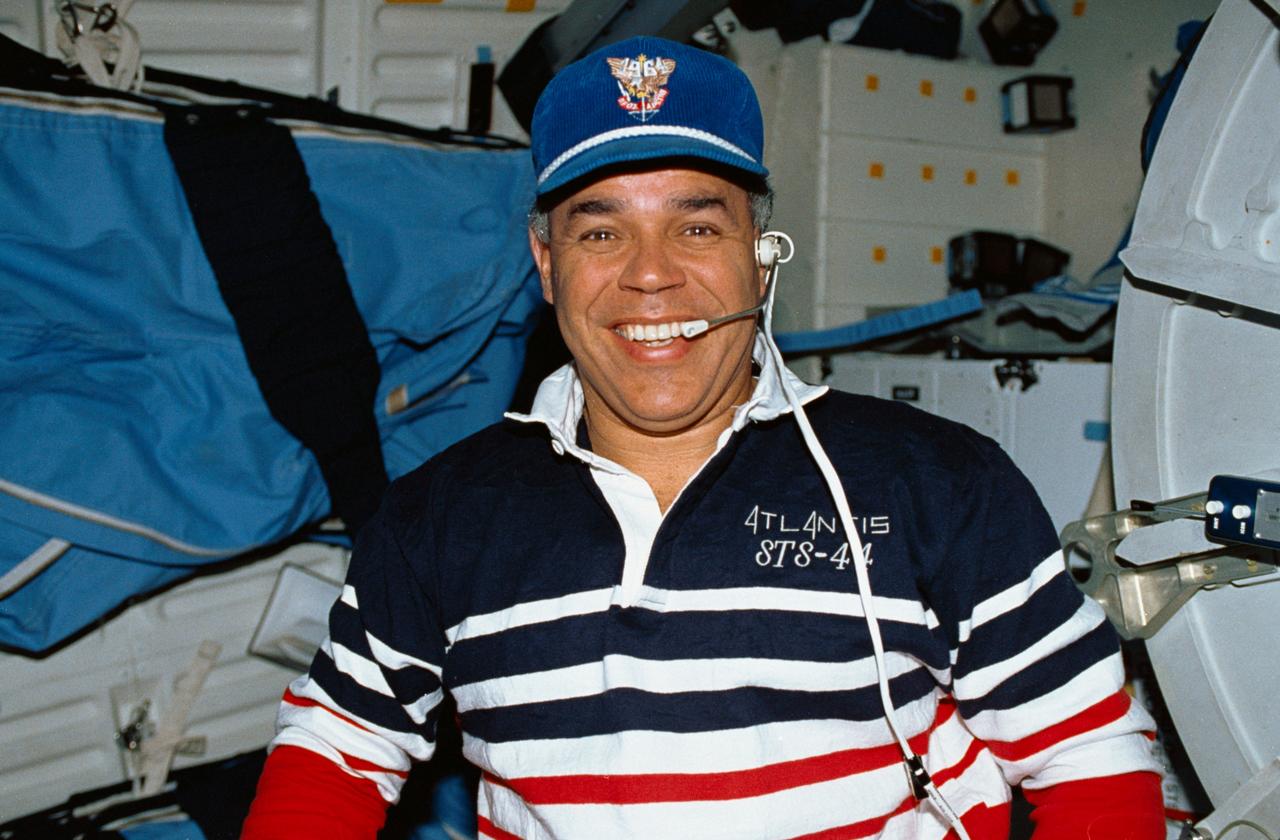
STS044-32-030 (24 Nov-1 Dec 1991) --- STS-44 Commander Frederick D. Gregory wears a cap honoring his alma mater, the United States Air Force (USAF) Academy, on the middeck of Atlantis, Orbiter Vehicle (OV) 104. Gregory, who also has his lightweight headset on, was photographed while talking to ground controllers.
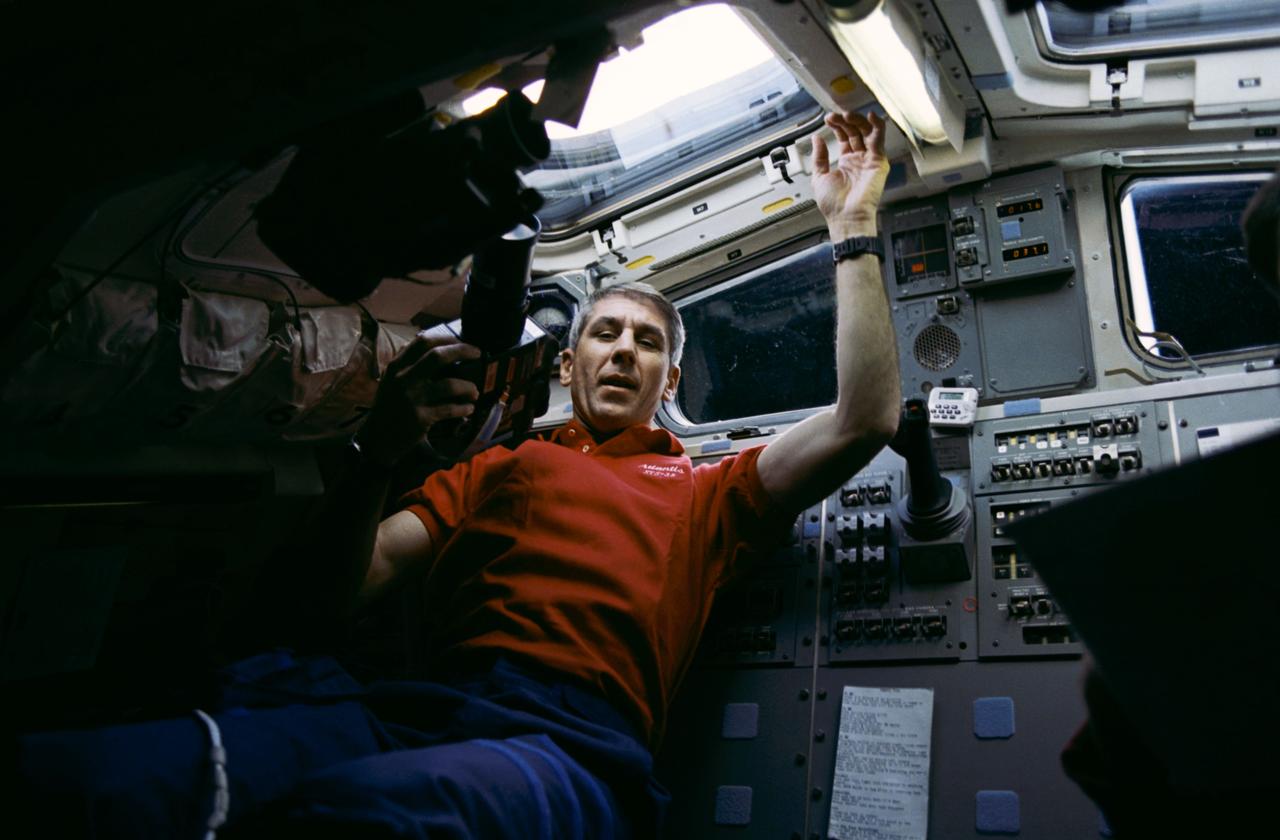
STS038-25-005 (20 Nov 1990) --- STS-38 Mission Specialist (MS) Robert C. Springer, holding HASSELBLAD camera, positions himself under aft flight deck overhead window W7 before recording the Earth's surface below. Behind Springer are Atlantis', Orbiter Vehicle (OV) 104's, on orbit station and aft flight deck viewing windows.
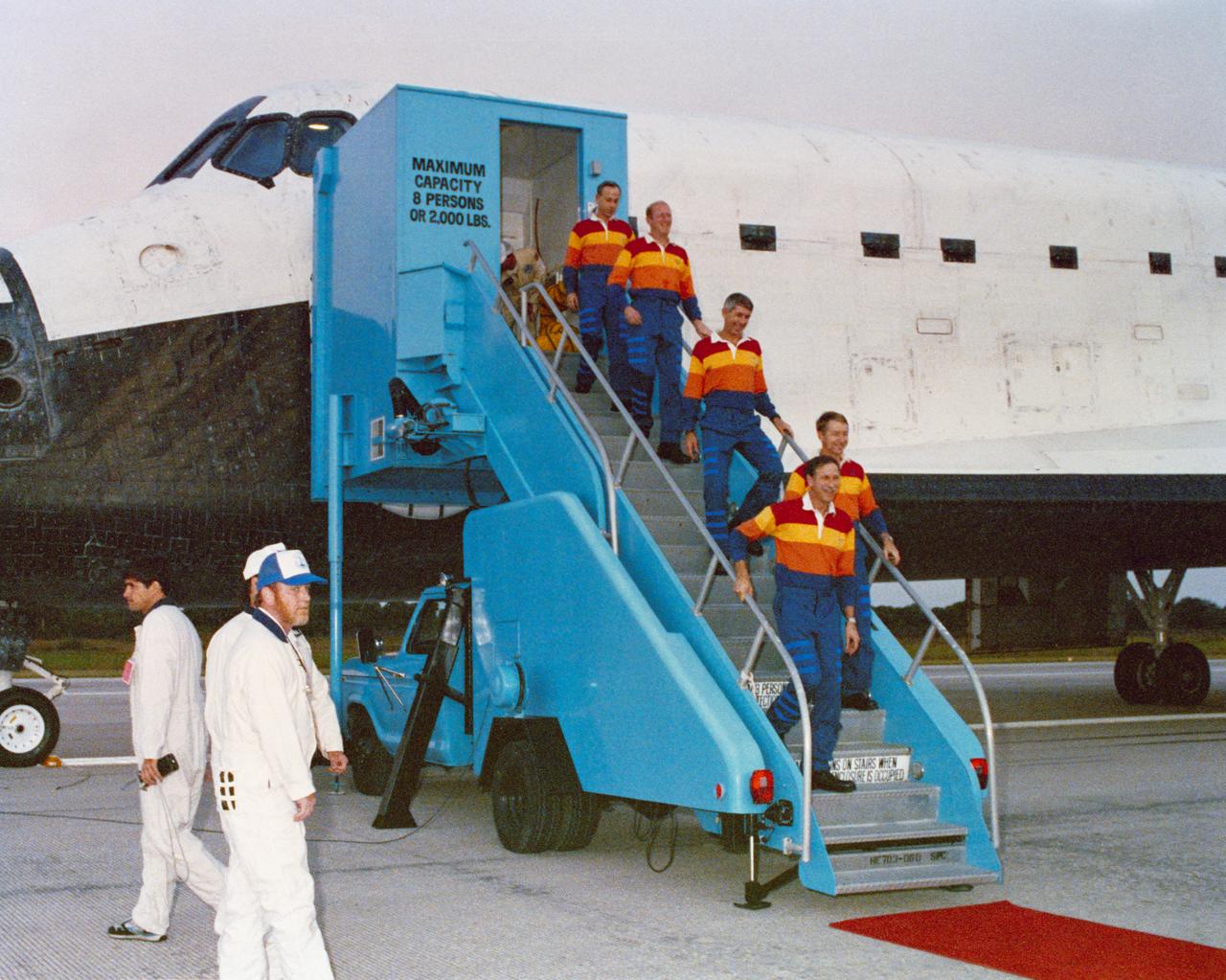
STS-38 crewmembers, wearing red, yellow, and orange polo shirts, egress Atlantis, Orbiter Vehicle (OV) 104, via a mobile stairway at the Kennedy Space Center's (KSC's) Shuttle Landing Facility (SLF). Commander Richard O. Covey, nearing the bottom of the stairway, is followed by Pilot Frank L. Culbertson, Mission Specialist (MS) Robert C. Springer, MS Charles D. Gemar, and MS Carl J. Meade. Ground servicing personnel look on in the foreground.

Space shuttle Atlantis, (OV-104), is seen as it begins its trip to its new home at the Kennedy Space Center Visitor Complex, early Friday, Nov. 2, 2012, in Cape Canaveral, Fla. The spacecraft traveled 125,935,769 miles during 33 spaceflights, including 12 missions to the International Space Station. Its final flight, STS-135, closed out the Space Shuttle Program era with a landing on July 21, 2011. Photo Credit: (NASA/Bill Ingalls)

Space shuttle Atlantis, (OV-104), is seen as it begins its trip to its new home at the Kennedy Space Center Visitor Complex, early Friday, Nov. 2, 2012, in Cape Canaveral, Fla. The spacecraft traveled 125,935,769 miles during 33 spaceflights, including 12 missions to the International Space Station. Its final flight, STS-135, closed out the Space Shuttle Program era with a landing on July 21, 2011. Photo Credit: (NASA/Bill Ingalls)
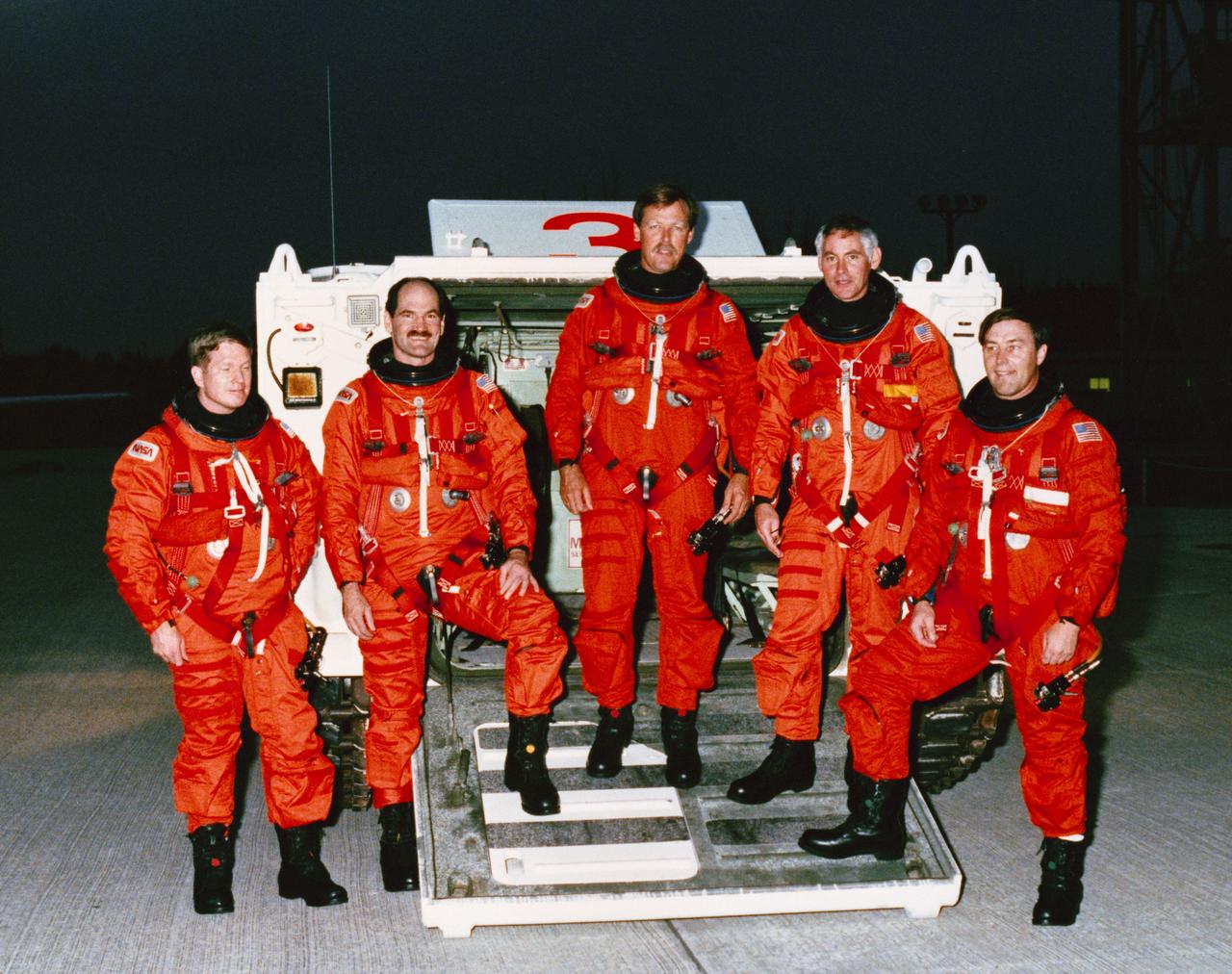
S88-53086 (17 Nov 1988) --- STS-27 Atlantis, Orbiter Vehicle (OV) 104, crewmembers participate in the terminal countdown demonstration test (TCDT) at the Kennedy Space Center (KSC). Standing in front of the M113 tracked rescue vehicle (armored personnel carrier (APC)) are left to right Mission Specialist (MS) William M. Shepherd, Pilot Guy S. Gardner, Commander Robert L. Gibson, MS Richard M. Mullane, and MS Jerry L. Ross. Crewmembers are wearing orange partial pressure or launch and entry suits (LES).
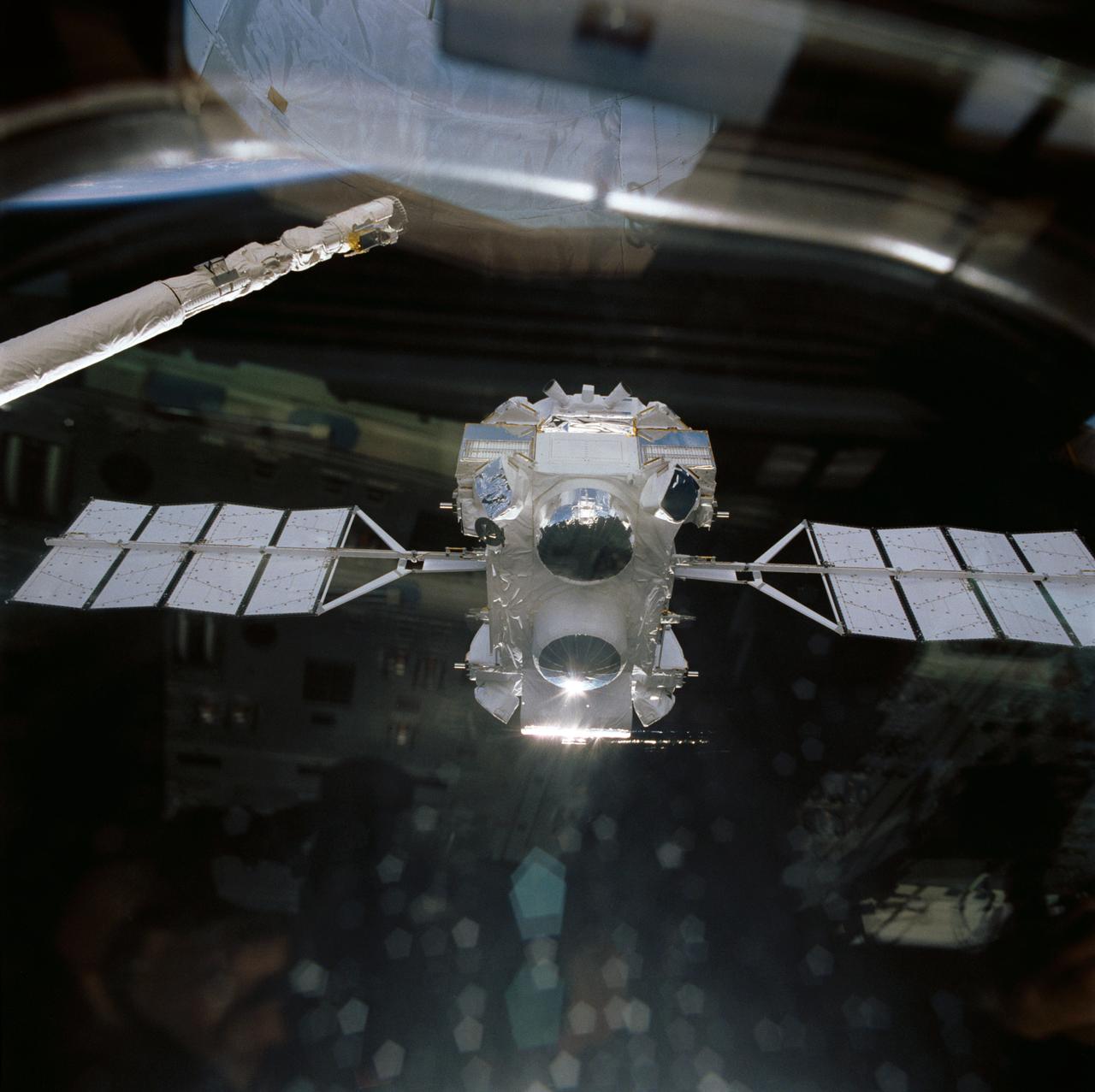
Atlantis', Orbiter Vehicle (OV) 104's, remote manipulator system (RMS) releases Gamma Ray Observatory (GRO) during STS-37 deployment. Visible on the GRO as it drifts away from the RMS end effector are the four complement instruments: the Energetic Gamma Ray Experiment (bottom); Imaging Compton Telescope (COMPTEL) (center); Oriented Scintillation Spectrometer Experiment (OSSE) (top); and Burst and Transient Source Experiment (BATSE) (at four corners). GRO's solar array (SA) panels are extended and are in orbit configuration. View was taken through aft flight deck window which reflects some of the crew compartment interior.
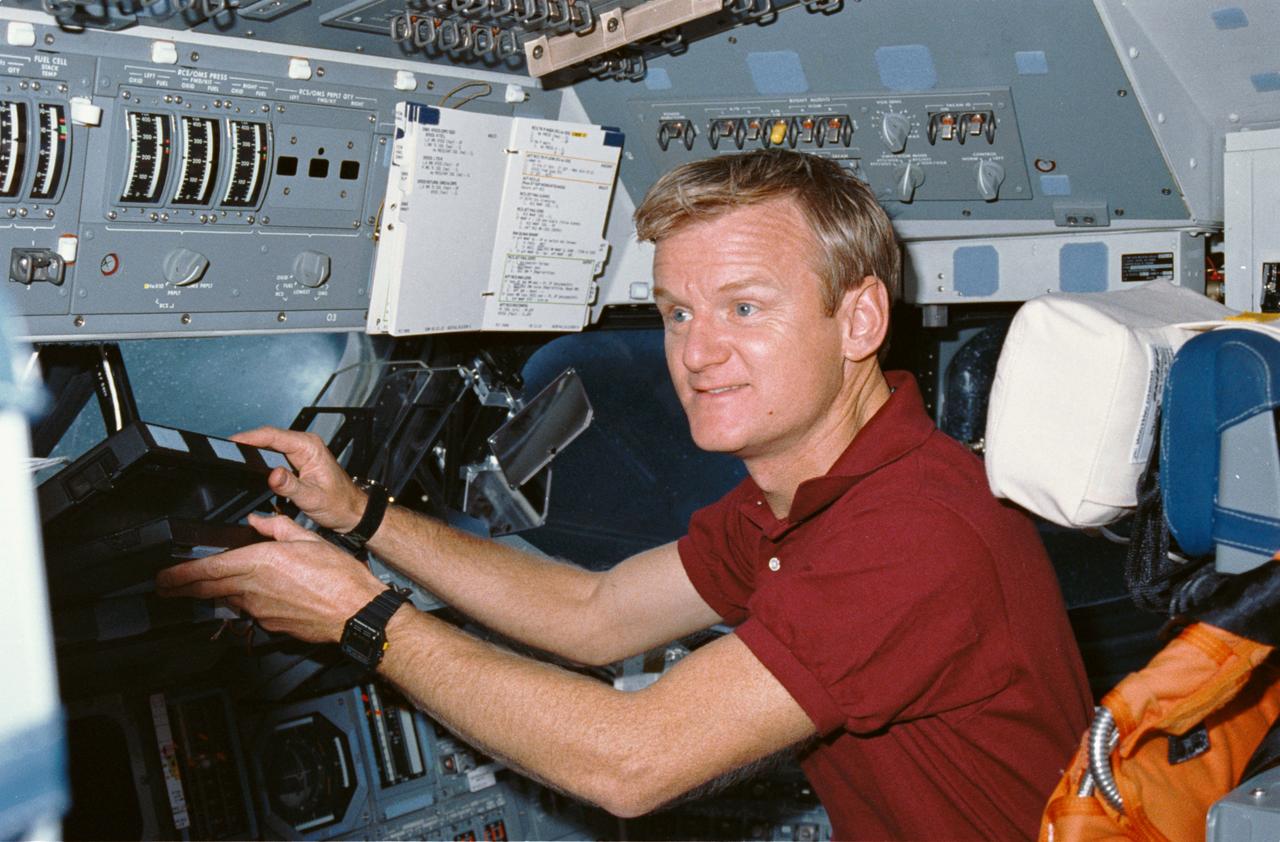
STS036-03-027 (3 March 1990) --- STS-36 Pilot John H. Casper reaches for the shuttle portable onboard computer (SPOC), a laptop computer, while at the pilots station on the forward flight deck of Atlantis, Orbiter Vehicle (OV) 104. Casper, seated in the pilot’s seat, lifts the SPOC from the forward window ledge. Appearing around him are forward crew compartment windows, the head up display (HUD), the flight mirror assembly, and a checklist attached to control panel O3. Casper and four other astronauts spent four days, 10 hours and 19 minutes aboard the spacecraft for a Department of Defense (DOD) devoted mission.
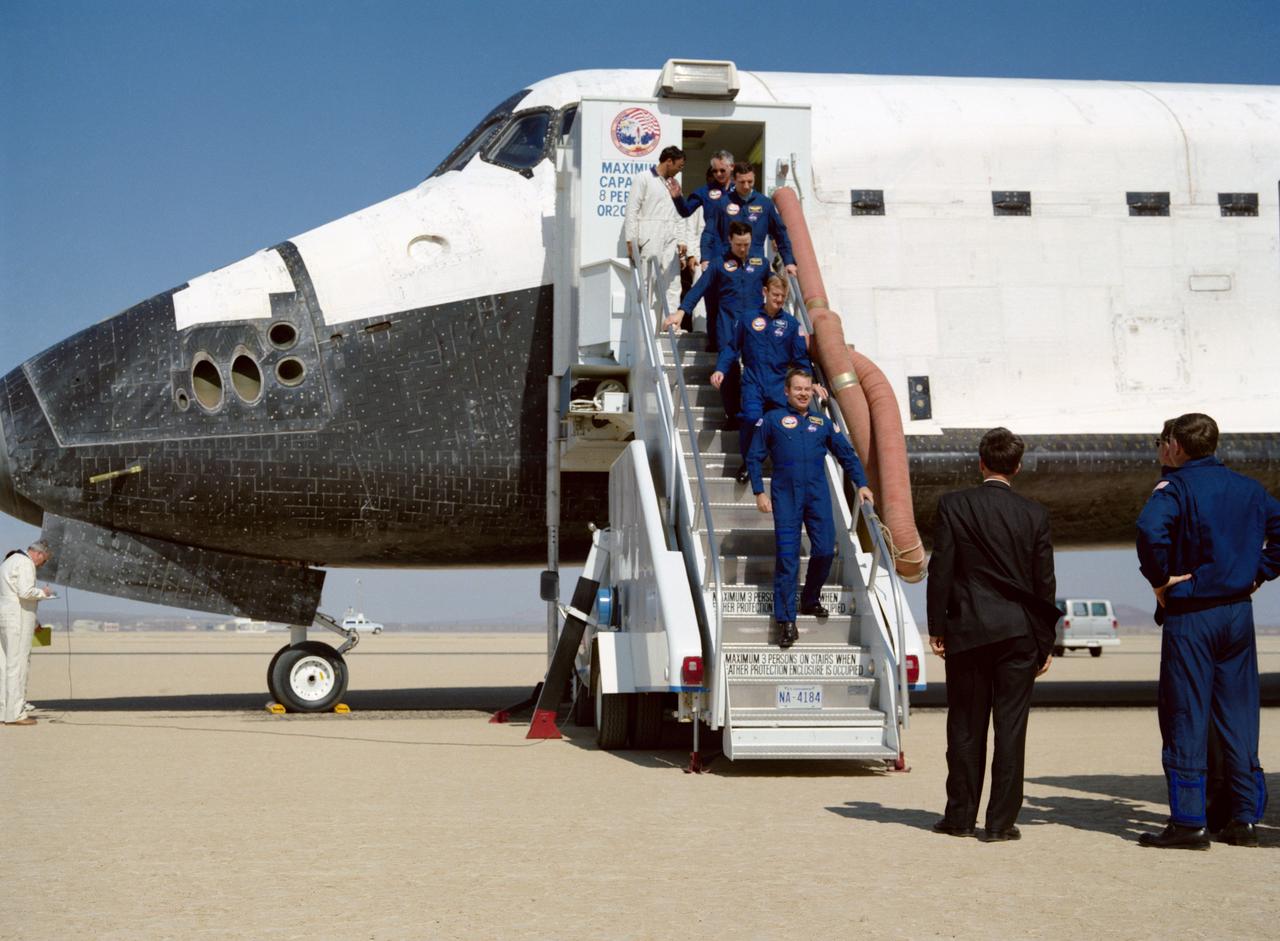
STS-36 crewmembers egress Atlantis, Orbiter Vehicle (OV) 104, via mobile stairway following touchdown on Runway 23 drylake bed at Edwards Air Force Base (EAFB), California. Commander John O. Creighton, leading crewmembers down the stairway, is followed by Pilot John H. Casper, Mission Specialist (MS) Pierre J. Thuot, MS David C. Hilmers, and MS Richard M. Mullane. On the runway, Acting NASA Associate Administrator for Space Flight Dr. William B. Lenoir, JSC Flight Crew Operations Directorate Director Donald R. Puddy, and JSC Astronaut Office Acting Chief Michael L. Coats wait to greet crewmembers.
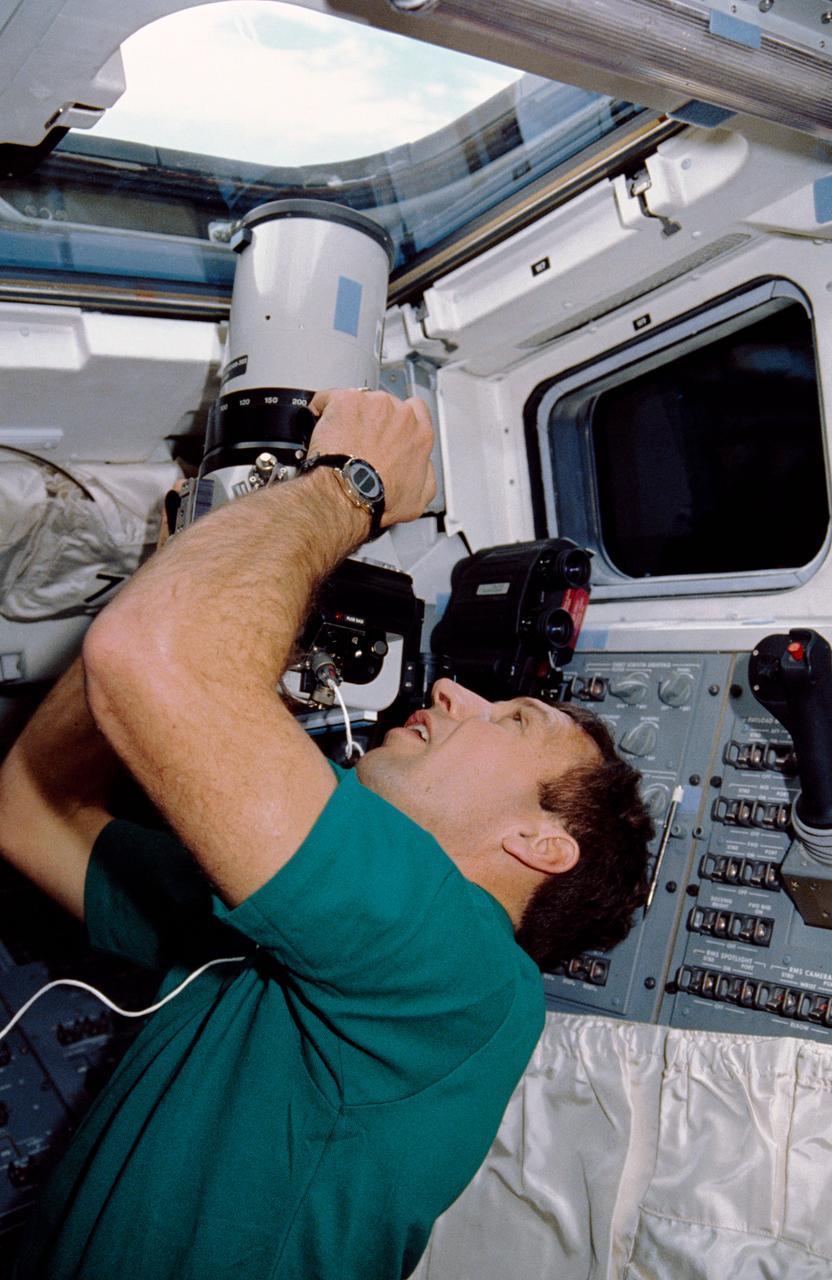
STS-36 Mission Specialist (MS) David C. Hilmers points the large-format AEROLINHOF camera out overhead window W7 on the aft flight deck of Atlantis, Orbiter Vehicle (OV) 104. Hilmers records Earth imagery using the camera. Hilmers and four other astronauts spent four days, 10 hours and 19 minutes aboard OV-104 for the Department of Defense (DOD) devoted mission.
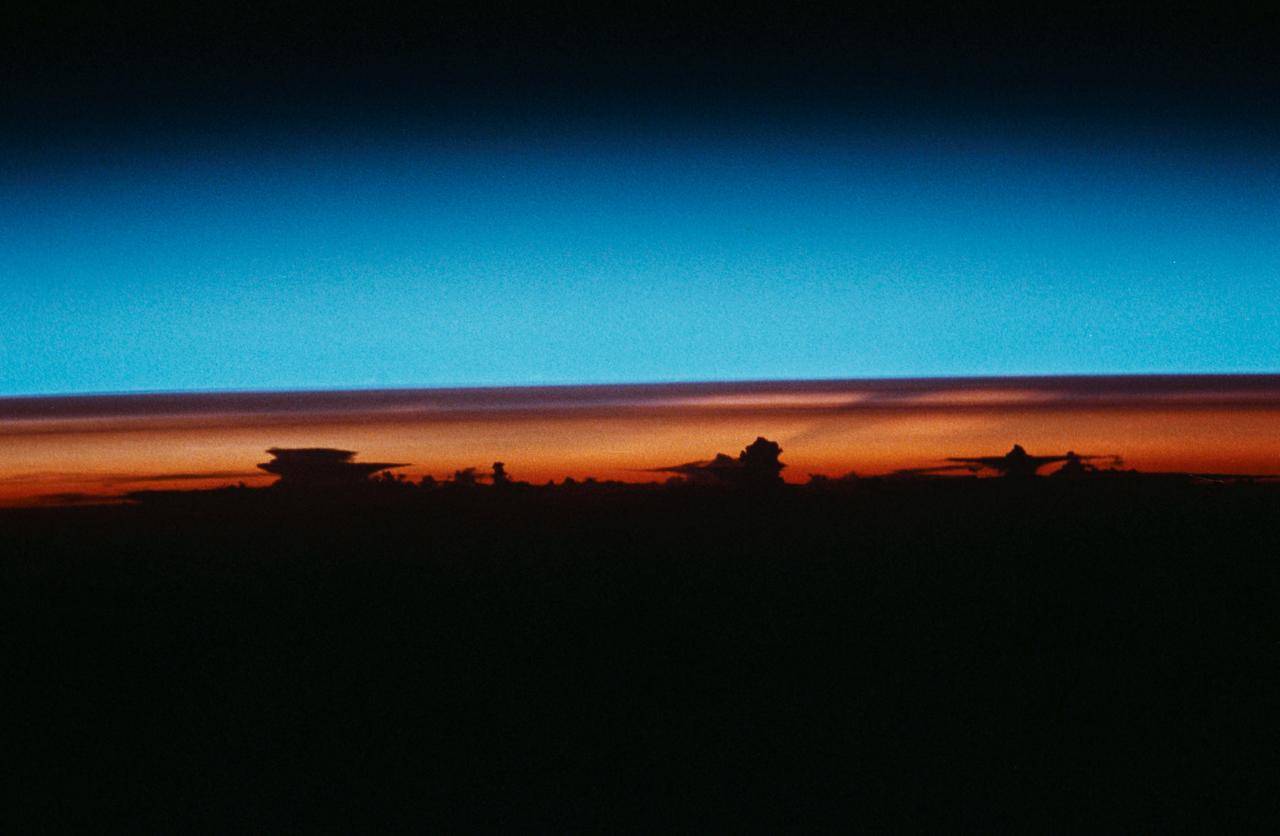
STS-43 Earth observation taken aboard Atlantis, Orbiter Vehicle (OV) 104, captures the Earth's limb at sunrise with unusual cloud patterns silhouetted by the sunlight and rising into the terminator lines.
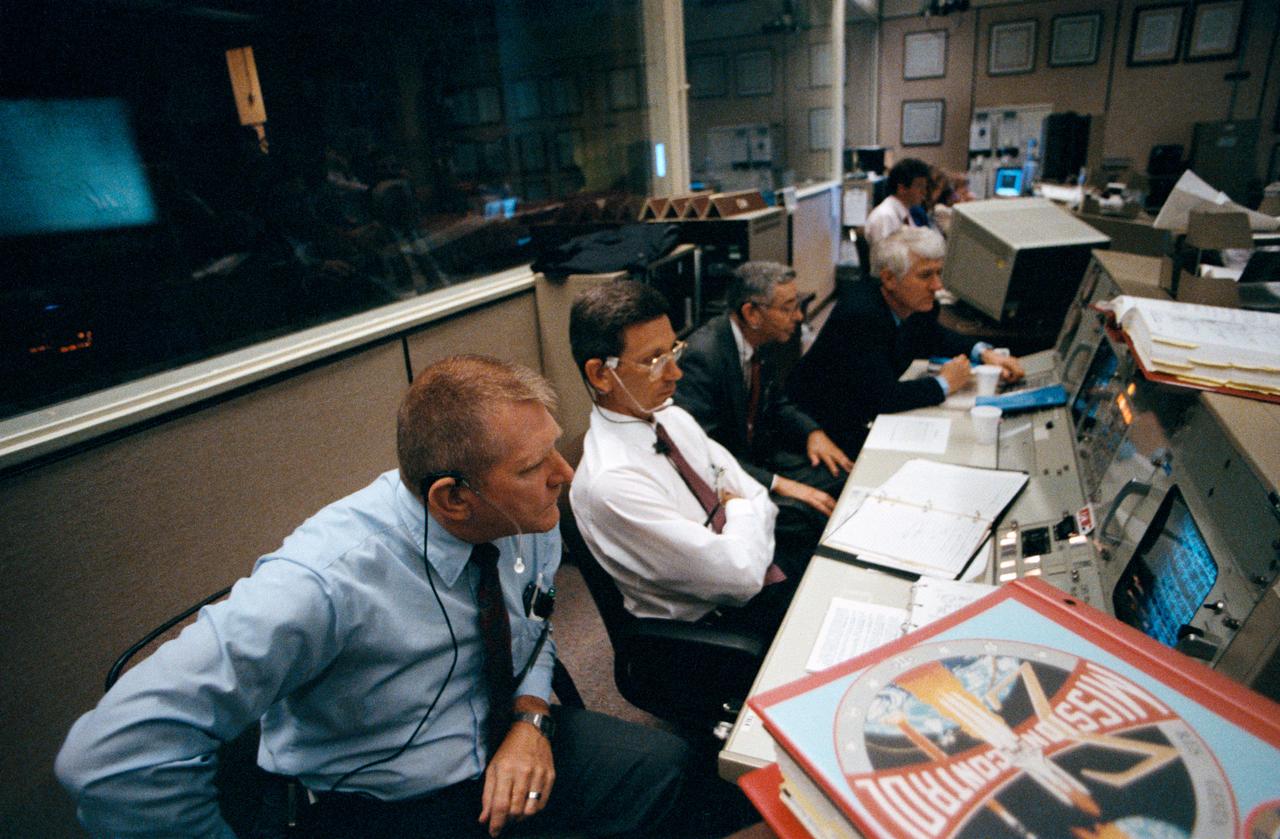
STS030-S-004 (8 May 1989) --- JSC Officials monitor early moments of NASA's STS-30 Atlantis, Orbiter Vehicle (OV) 104, flight in the Flight Control Room (FCR) of JSC's Mission Control Center (MCC) Bldg 30. At the Mission Operations Directorate (MOD) console, MOD Director Eugene F. Kranz (foreground), studiously reviews data on a nearby monitor. Others in the photo are (left to right) Flight Directors Office Deputy Chief Lawrence S. Bourgeois, JSC Director Aaron Cohen, and Flight Crew Operations Deputy Director Henry W. Hartsfield, Jr. Kranz'z replete loose-leaf notebook, bearing the insignia of the flight control team members (MOD insignia), is in the foreground.

STS-34 Atlantis, Orbiter Vehicle (OV) 104, Pilot Michael J. McCulley reflects on a question during the thirty days before launch (T-30) press briefing in the JSC Auditorium and Public Affairs Facility Bldg 2 briefing room.
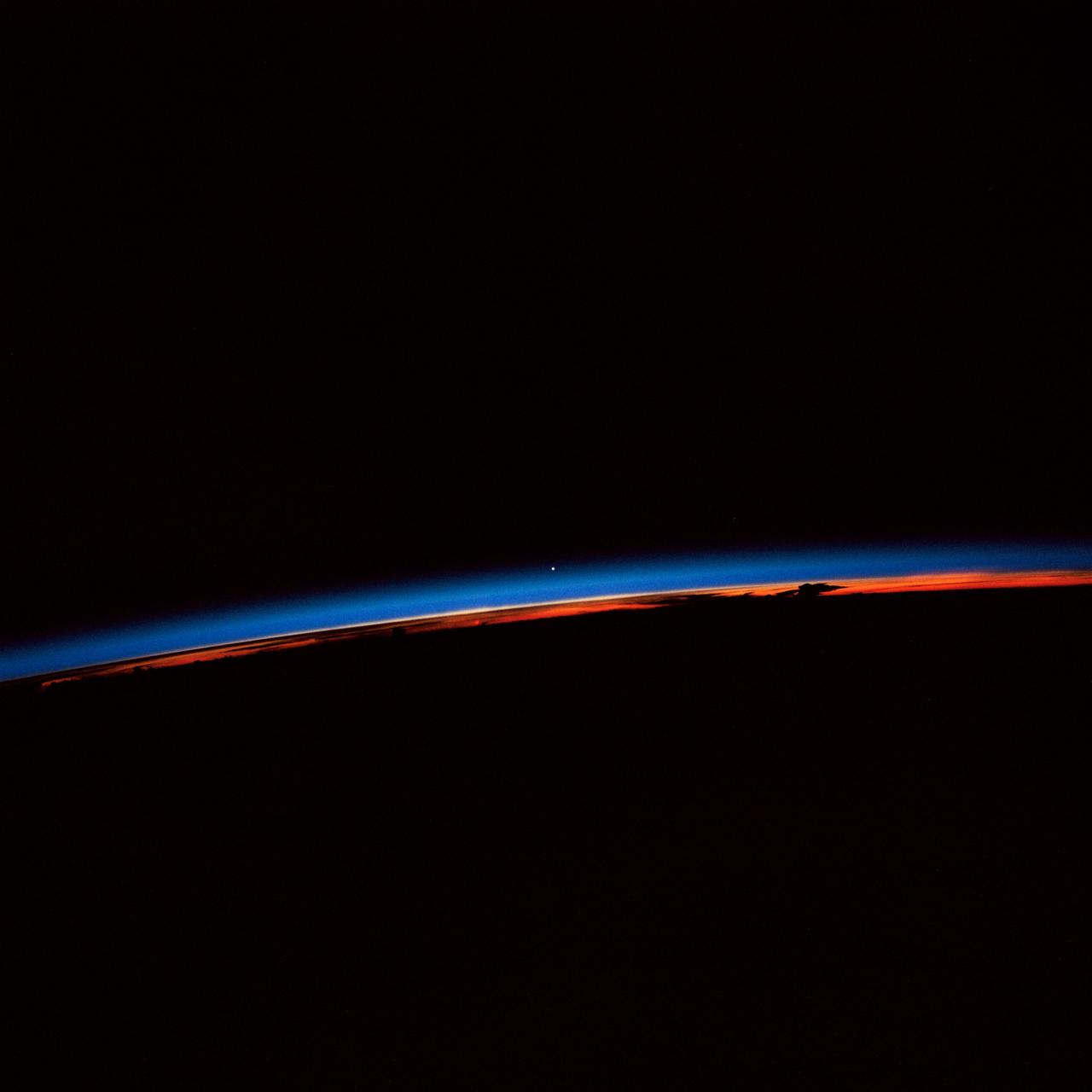
STS-30 Earth observation captured by crewmembers onboard Atlantis, Orbiter Vehicle (OV) 104, shows the sunset over the Earth as well as the planet Venus near the center of the frame. Jutting clouds are seen on the horizon, just beneath the blue strip of airglow.
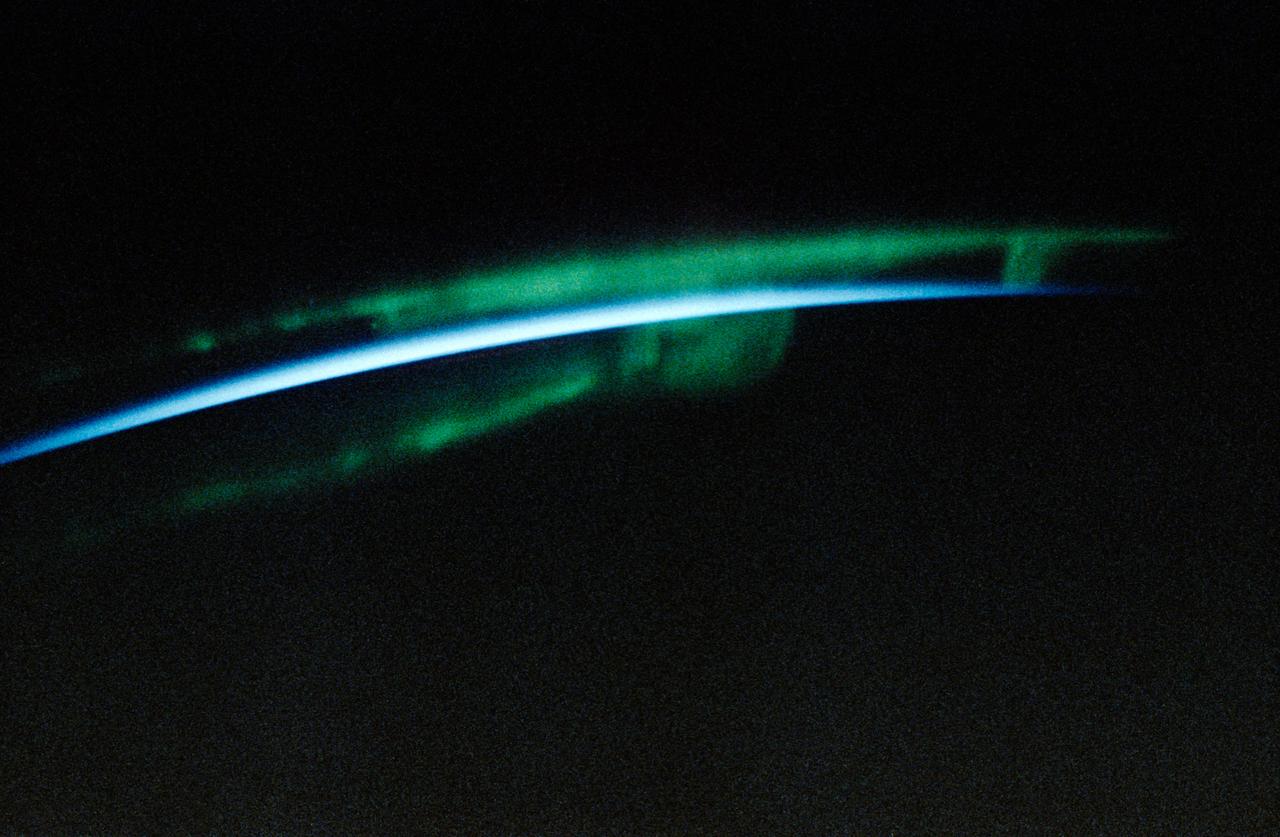
STS-45 Earth observation taken onboard Atlantis, Orbiter Vehicle (OV) 104, is of the Aurora Australis or Southern Lights. The green appearing auroral activity engulfs the thin blue line on the Earth's limb. Aurorae were observed and photographed throughout the STS-45 nine-day mission.

STS-34 Atlantis, Orbiter Vehicle (OV) 104, Pilot Michael J. McCulley squints while looking through ARRIFLEX camera eye piece during camera briefing at JSC. McCulley rests part of the camera on his shoulder as he operates it.
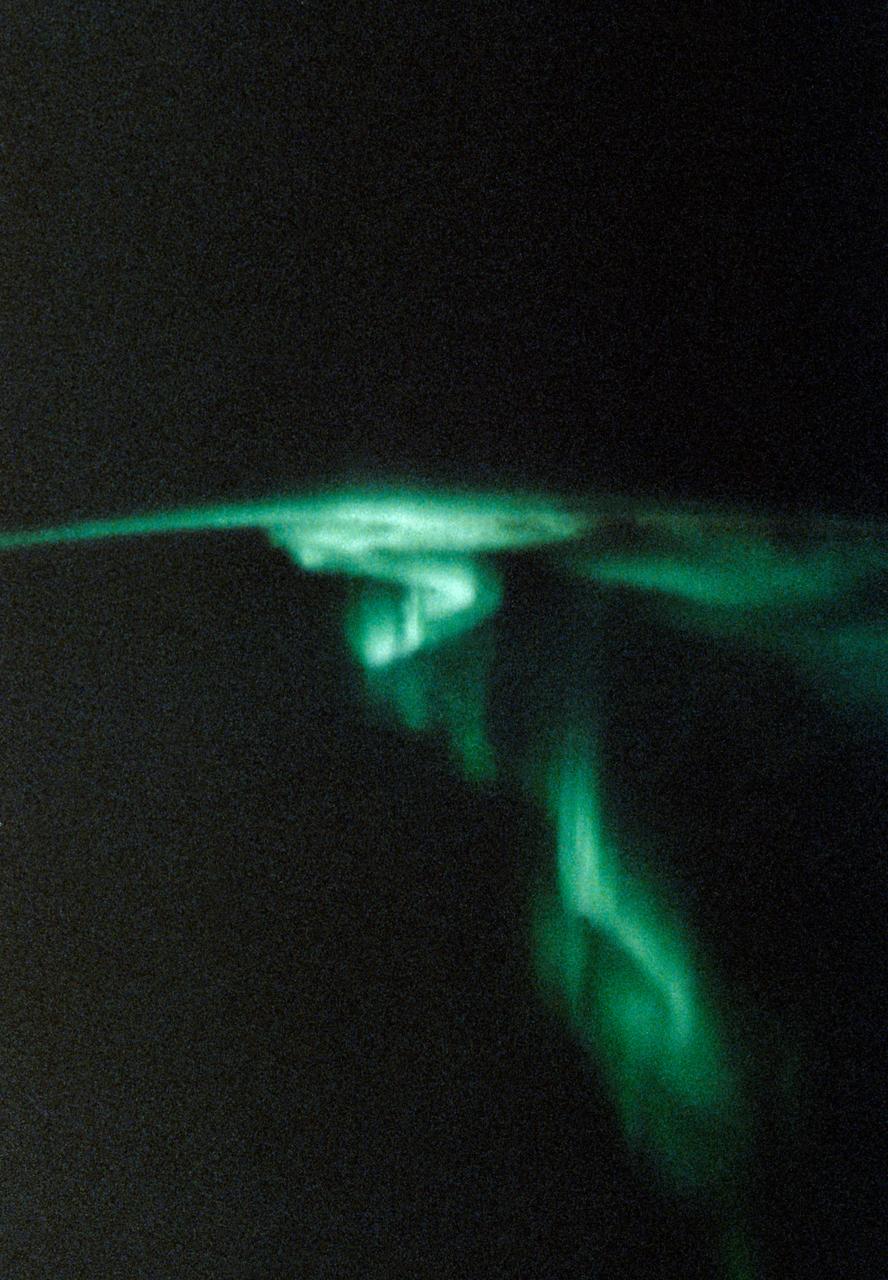
STS-45 Earth observation taken onboard Atlantis, Orbiter Vehicle (OV) 104, is of the Aurora Australis or Southern Lights. The STS-45 crewmembers note the interesting spiralling or corkscrew appearance of this particular sighting. Aurorae were observed and photographed throughout the STS-45 nine-day mission.
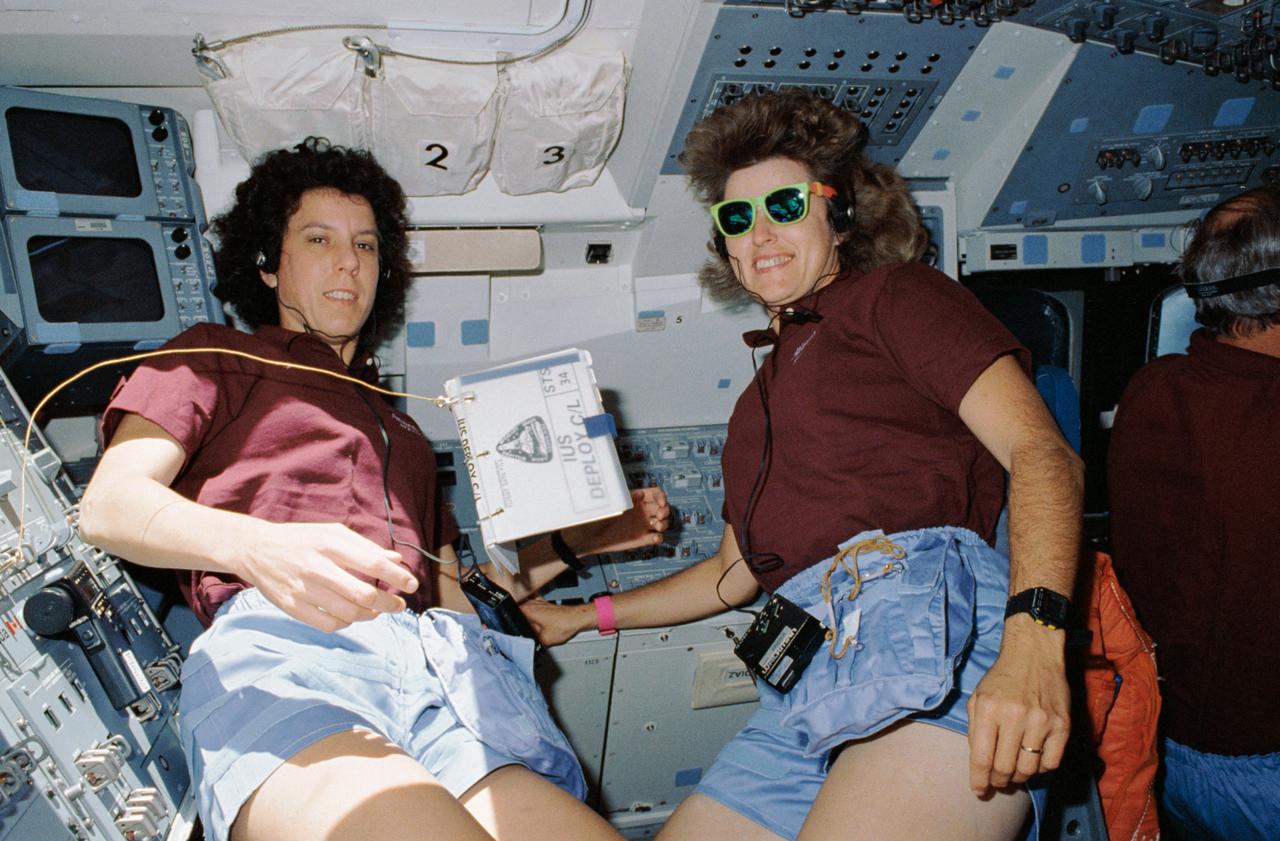
STS034-09-007 (23 Oct. 1989) --- Having been in space only a few hours, three of the STS-34 astronaut crew prepare for pre-deployment exercises involving one of the most prominent "passengers" of the flight -- the Galileo payload which was lying in Atlantis', Orbiter Vehicle (OV) 104's, payload bay (PLB). Pictured, left to right, are astronauts Ellen S. Baker and Shannon W. Lucid, both mission specialists; along with Donald E. Williams, commander, who guided OV-104's course during the exercise. Baker and Lucid communicated with ground controllers while juggling other Galileo-related chores. Both Baker and Lucid are equipped with SONY Walkmans and are wearing headsets. Lucid wears a pair of sunglasses with brightly colored frames. A tethered inertial upper stage (IUS) deploy checklist (C/L) floats between the two and a spotmeter is Velcroed to an on orbit station control panel.
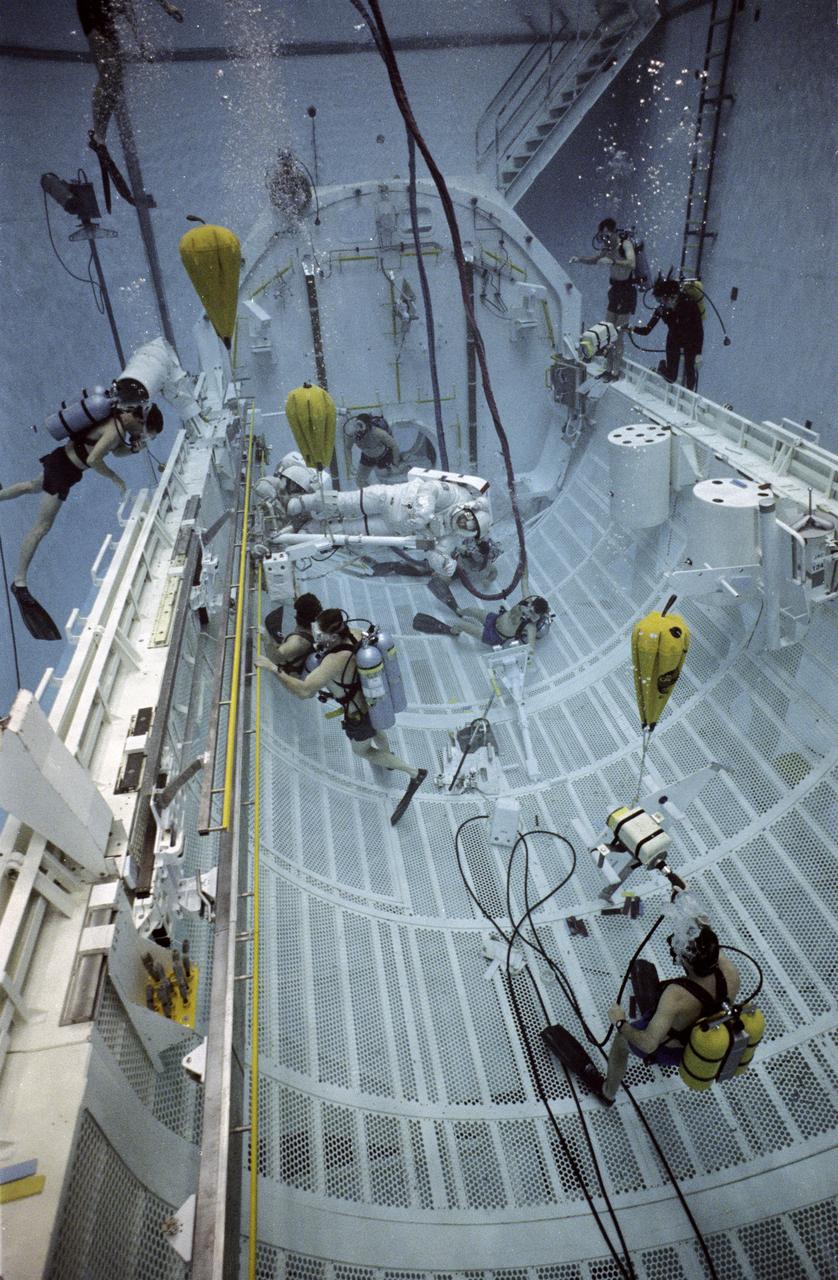
STS-37 Atlantis, Orbiter Vehicle (OV) 104, Mission Specialist (MS) Jerry L. Ross generates electrical power using hand pedals to move crew and equipment translation aid (CETA) cart along a rail during underwater session in JSC's Weightless Environment Training Facility (WETF) Bldg 29. Wearing an extravehicular mobility unit (EMU), Ross operates CETA electrical cart as MS Jerome Apt holds onto the back of the cart. The two crewmembers are practicing a extravehicular activity (EVA) spacewalk they will perform in OV-104's payload bay during STS-37. CETA is a type of railroad hand cart planned as a spacewalker's transportation system along the truss of Space Station Freedom (SSF). SCUBA divers monitor astronauts' underwater activity.
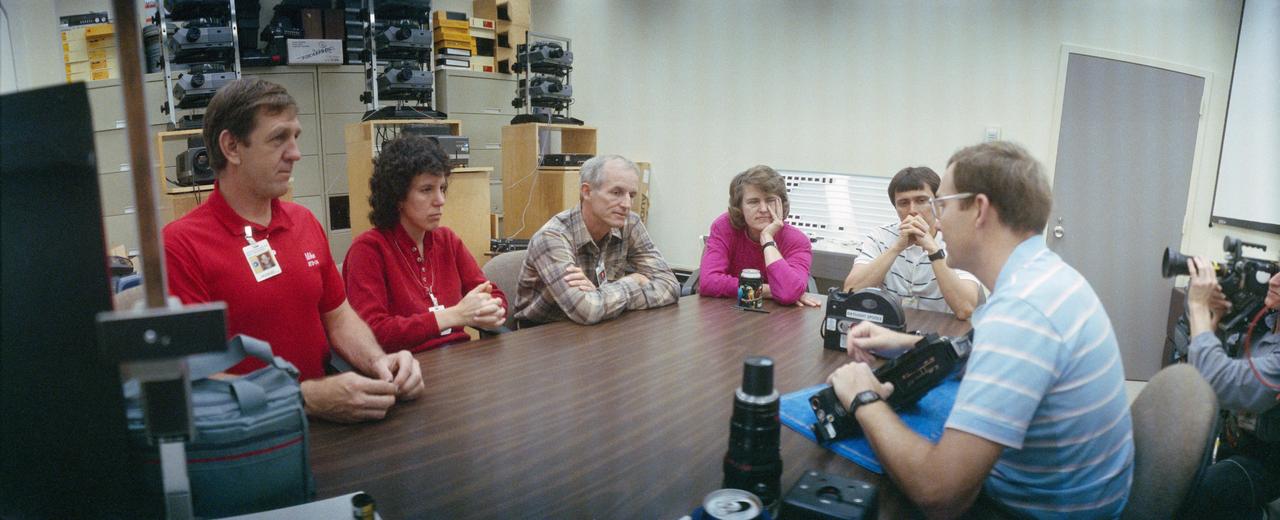
STS-34 Atlantis, Orbiter Vehicle (OV) 104, crewmembers listen to trainer Bill Bowers explain ARRIFLEX camera equipment during briefing at JSC. Across the table from Bowers are (left to right) Pilot Michael J. McCulley, Mission Specialist (MS) Ellen S. Baker, Commander Donald E. Williams, MS Shannon W. Lucid, and MS Franklin R. Chang-Diaz.
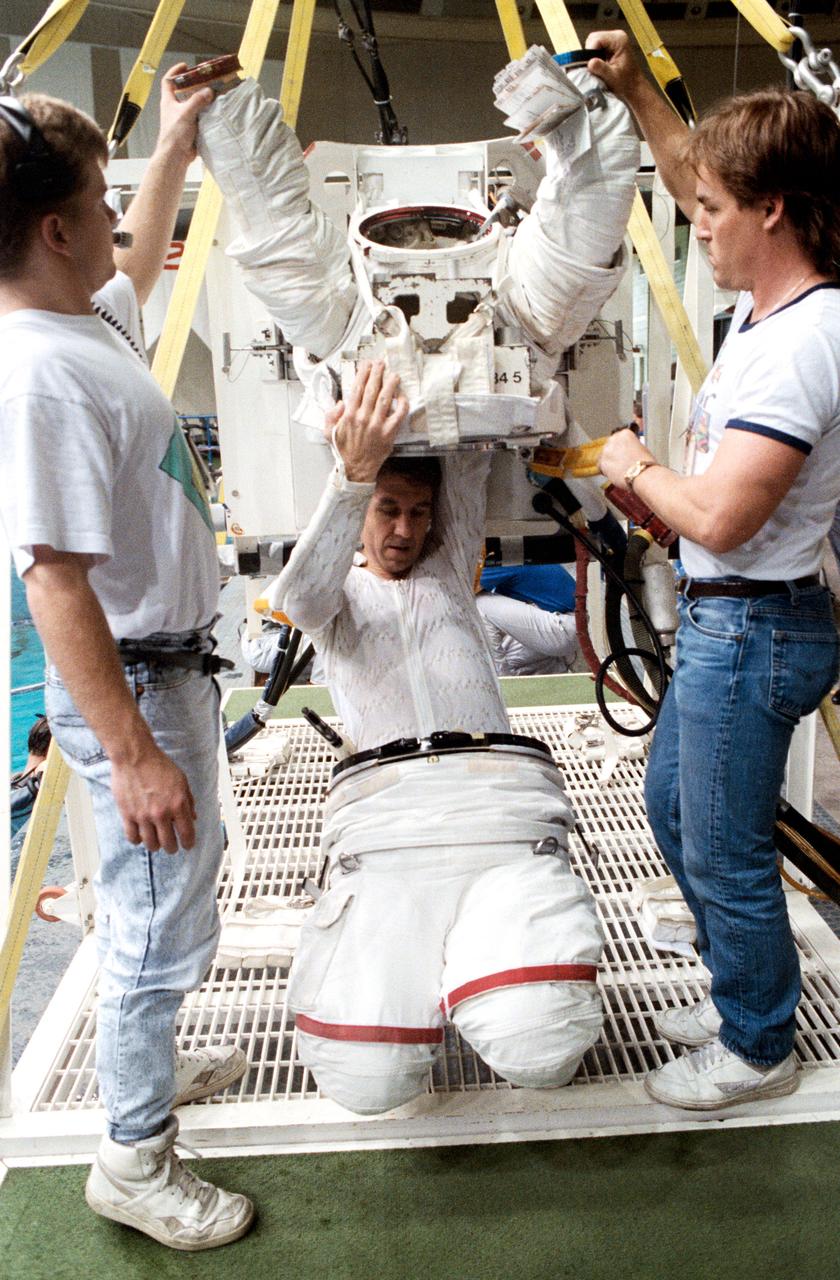
STS-38 Mission Specialist (MS) Robert C. Springer dons extravehicular mobility unit (EMU) upper torso with technicians' assistance in JSC's Weightless Environment Training Facility (WETF) Bldg 29. Positioned on the WETF platform at pool side, Springer is preparing for an underwater extravehicular activity (EVA) simulation. During the training session, Springer will rehearse contingency EVA procedures for the STS-38 mission aboard Atlantis, Orbiter Vehicle (OV) 104.
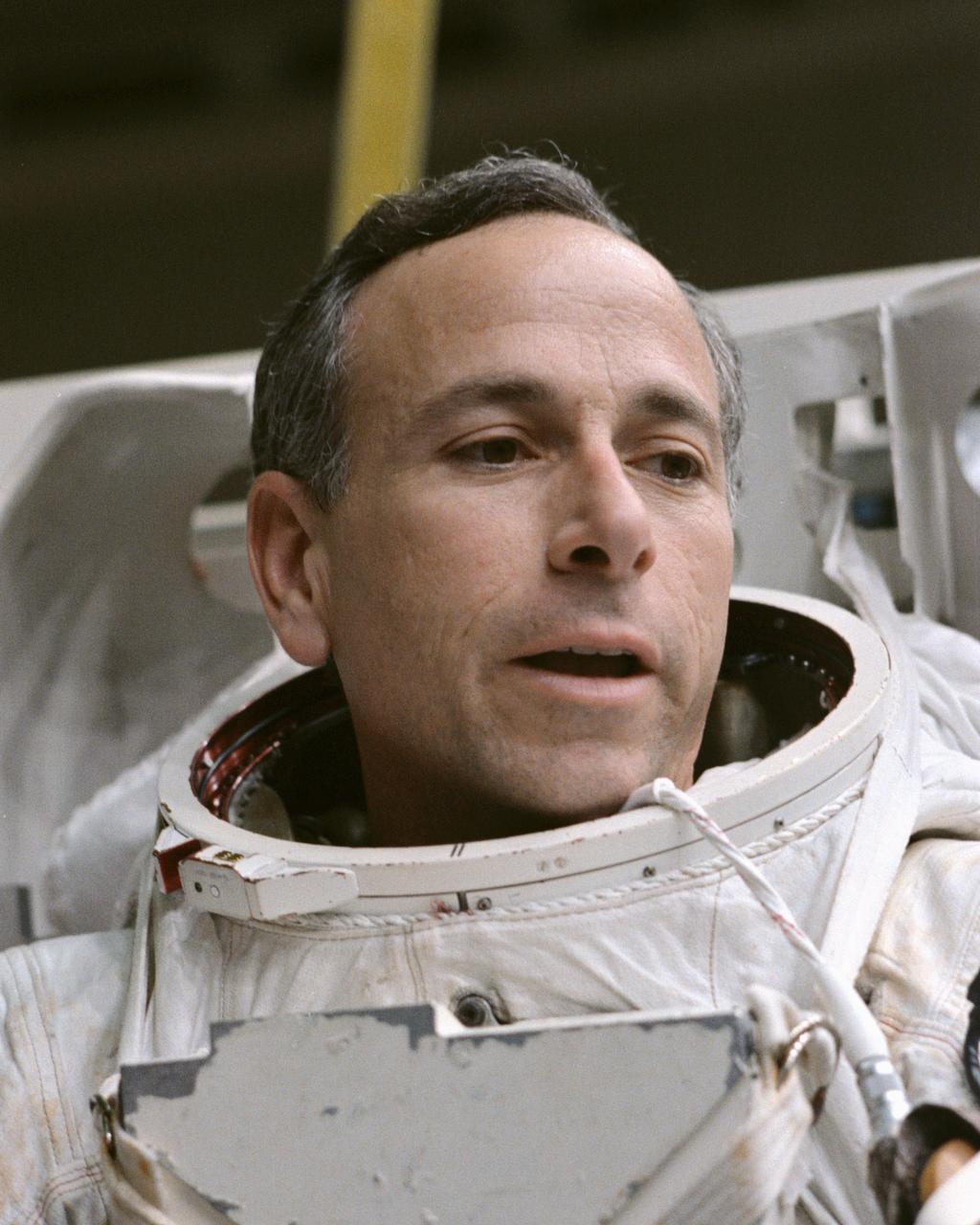
STS-38 Mission Specialist (MS) Carl J. Meade, wearing extravehicular mobility unit (EMU) upper torso, takes a breather from suit donning activities in JSC's Weightless Environment Training Facility (WETF) Bldg 29. Meade is preparing for an underwater extravehicular activity (EVA) simulation. During the training exercise, Meade will rehearse contingency EVA procedures for the STS-38 mission aboard Atlantis, Orbiter Vehicle (OV) 104.
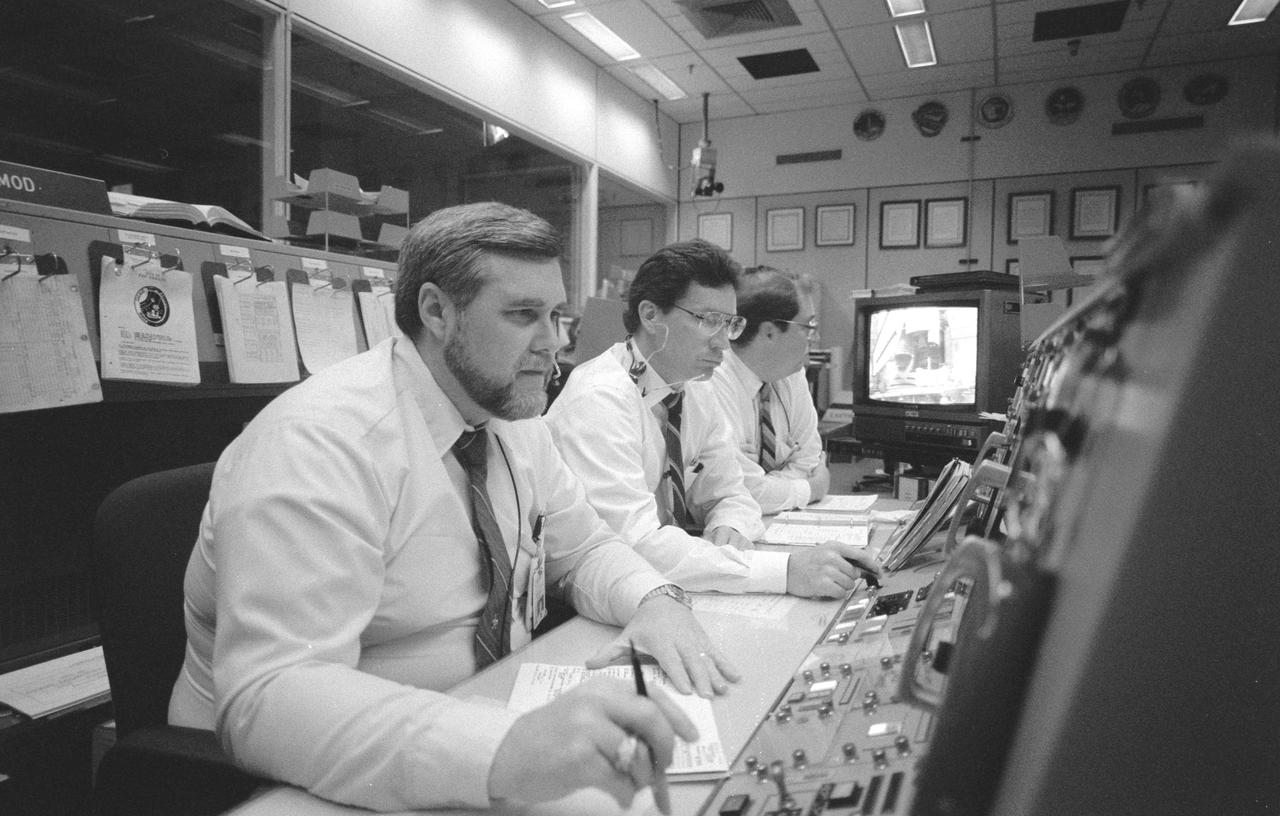
Only moments away from ignition, Atlantis, Orbiter Vehicle (OV) 104, and its five member crew are the subjects of concern drawing serious countenance in this scene in the Flight Control Room (FCR) of JSC's Mission Control Center (MCC) Bldg 30. Ascent Flight Director Alan L. Briscoe, monitors the Kennedy Space Center pre-launch activity from the flight director (FD) console, along with Ronald D. Dittemore (center) and N. Wayne Hale, Jr.
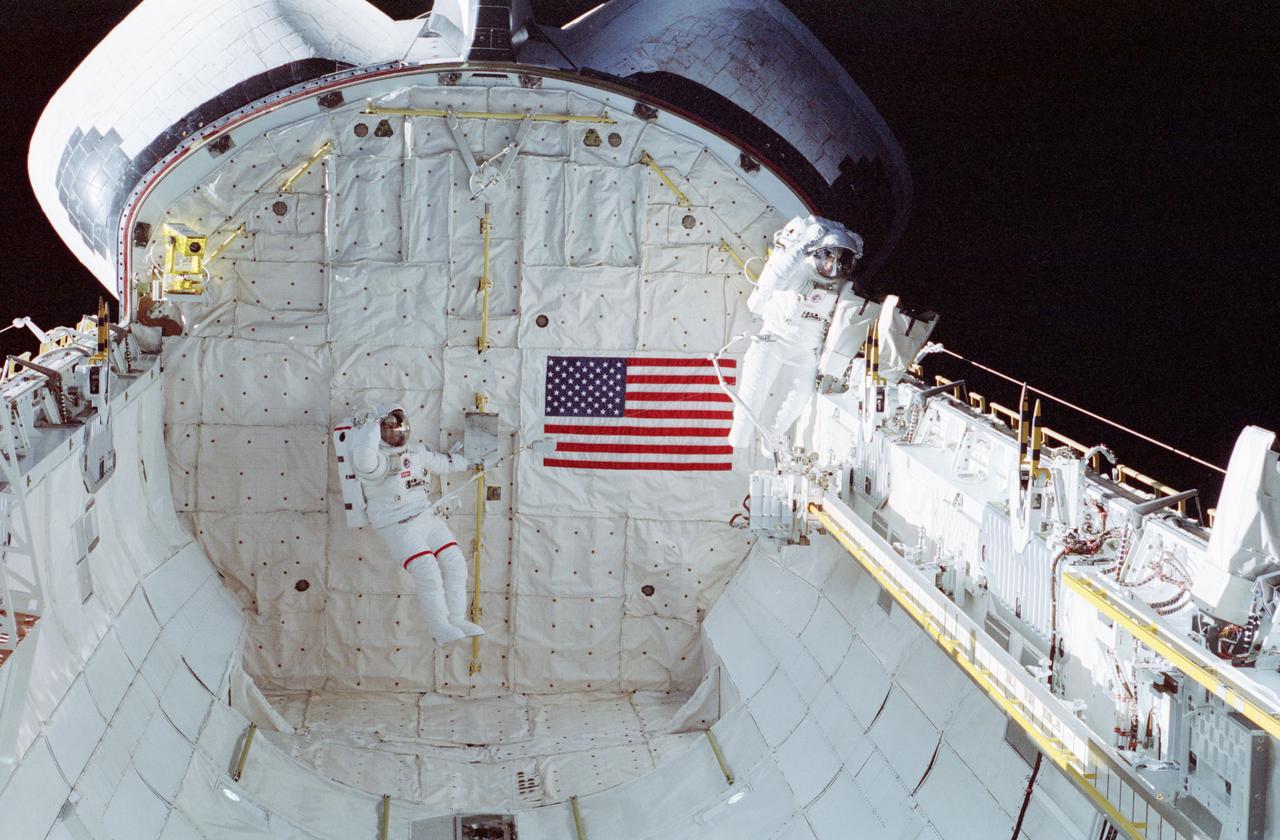
During their STS-37 extravehicular activity (EVA), Mission Specialist (MS) Jerry L. Ross (left) and MS Jerome Apt, in the aft section of Atlantis', Orbiter Vehicle (OV) 104's, payload bay (PLB), turn and wave to their fellow crewmembers who are overseeing the activity from inside the crew compartment. Ross is tethered to the guidewire running along the PLB port side. Apt has reached the end of the Crew and Equipment Translation Aid (CETA) deployable track via the manual hand over hand cart.
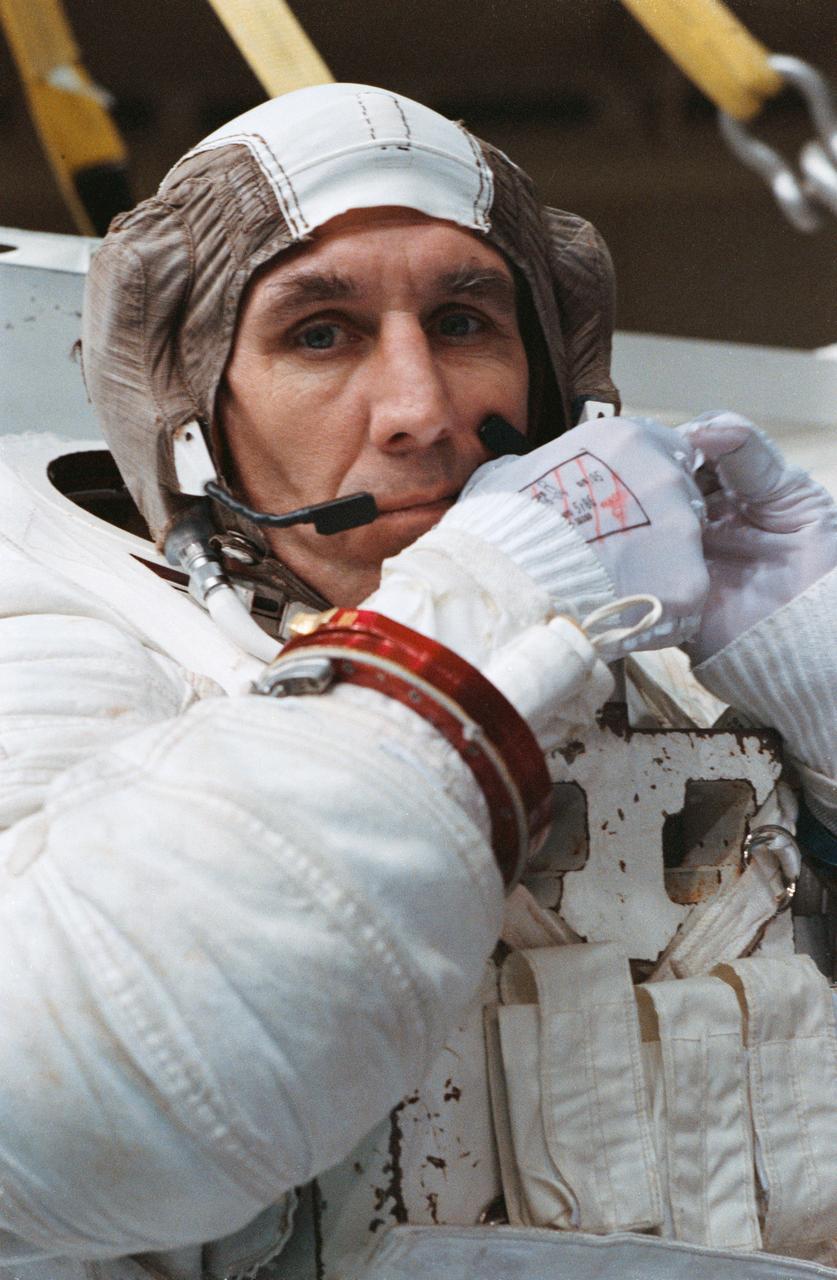
STS-38 Mission Specialist (MS) Robert C. Springer, wearing extravehicular mobility unit (EMU), fastens the strap on his communications carrier assembly (CCA) cap during suit donning in JSC's Weightless Environment Training Facility (WETF) Bldg 29. Positioned on the WETF platform at pool side, Springer is preparing for an underwater extravehicular activity (EVA) simulation. During the training exercise, Springer will rehearse contingency EVA procedures for the STS-38 mission aboard Atlantis, Orbiter Vehicle (OV) 104.
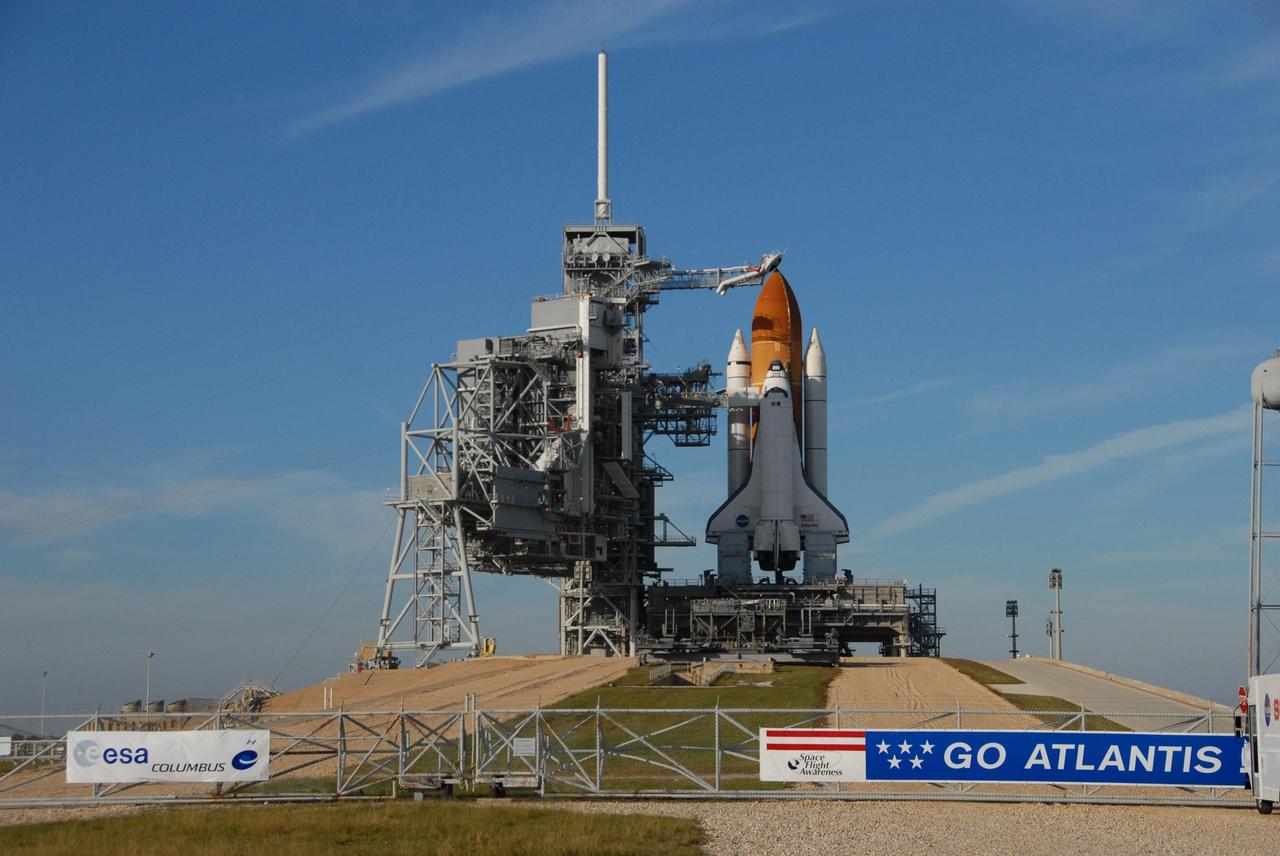
KENNEDY SPACE CENTER, FLA. -- Shadows spill across space shuttle Atlantis, still poised on the pad after its launch on mission STS-122 was postponed Thursday. It sits atop the mobile launcher platform. Shuttle program managers decided at 9:56 a.m. to postpone the launch because of an issue with a fuel cut-off sensor system inside the external fuel tank. This is one of several systems that protect the shuttle's main engines by triggering their shut down if fuel runs unexpectedly low. During countdown activities this morning, two sensors failed a routine prelaunch check. There are four engine cut-off, or ECO, sensors inside the liquid hydrogen section of the tank, and Launch Commit Criteria require three of the four sensor systems to be functioning properly. The tank's liquid oxygen and liquid hydrogen was drained from the tank, and preparations will begin for a possible launch attempt Friday. NASA's launch rules have a preplanned procedure that states in the case of ECO sensor system failure, engineers need to drain the tank and verify all the sensors are working as they go dry. Atlantis carries the Columbus Laboratory, the European Space Agency's largest contribution to the construction of the space station. When permanently attached to Node 2, the laboratory will carry out experiments in materials science, fluid physics and biosciences, as well as perform a number of technological applications, in a microgravity environment. Photo credit: NASA/George Shelton
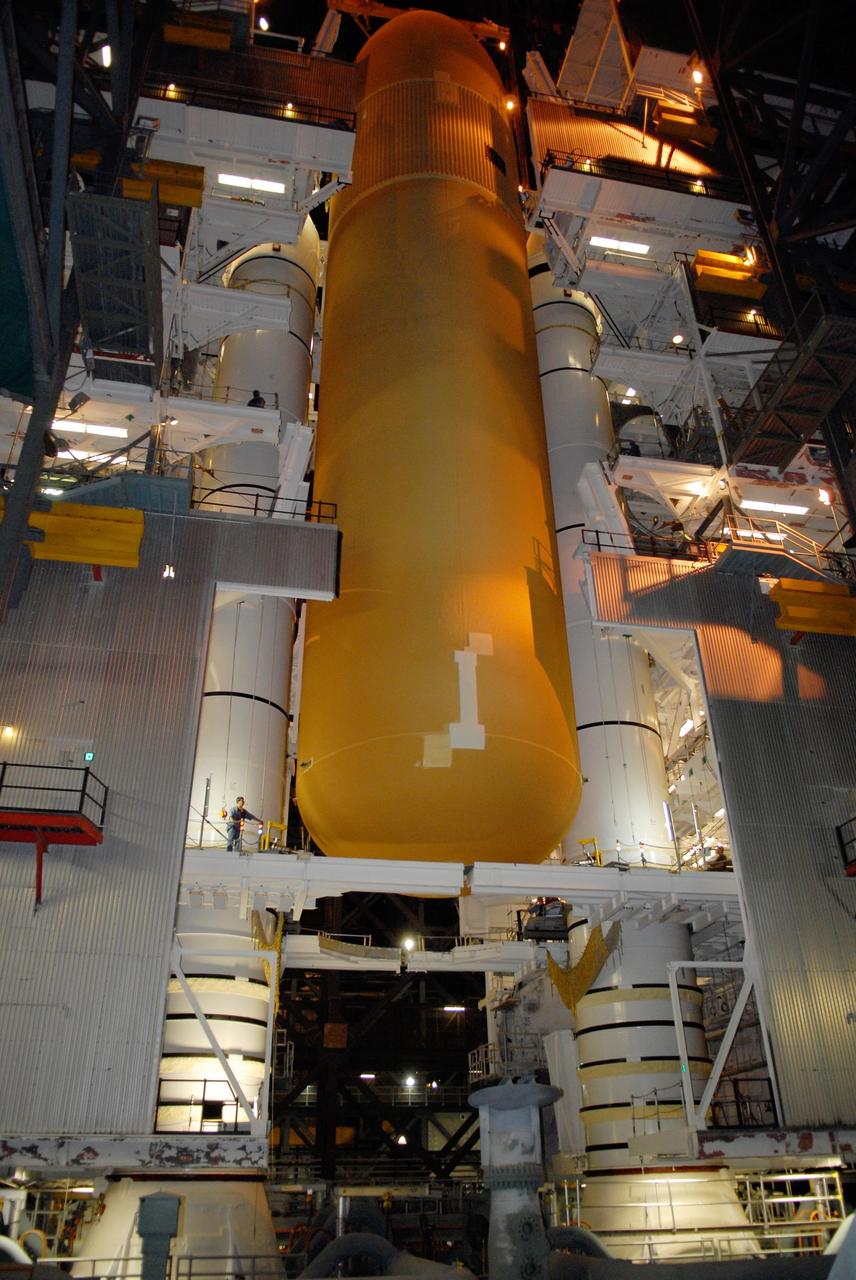
KENNEDY SPACE CENTER, FLA. -- In the Vehicle Assembly Building at NASA's Kennedy Space Center, the external tank is lowered between the solid rocket boosters on the mobile launcher platform below. After mating, the boosters-tank configuration will be used on space shuttle Atlantis for mission STS-122, which is targeted for launch on Dec. 6. Photo credit: Kim Shiflett
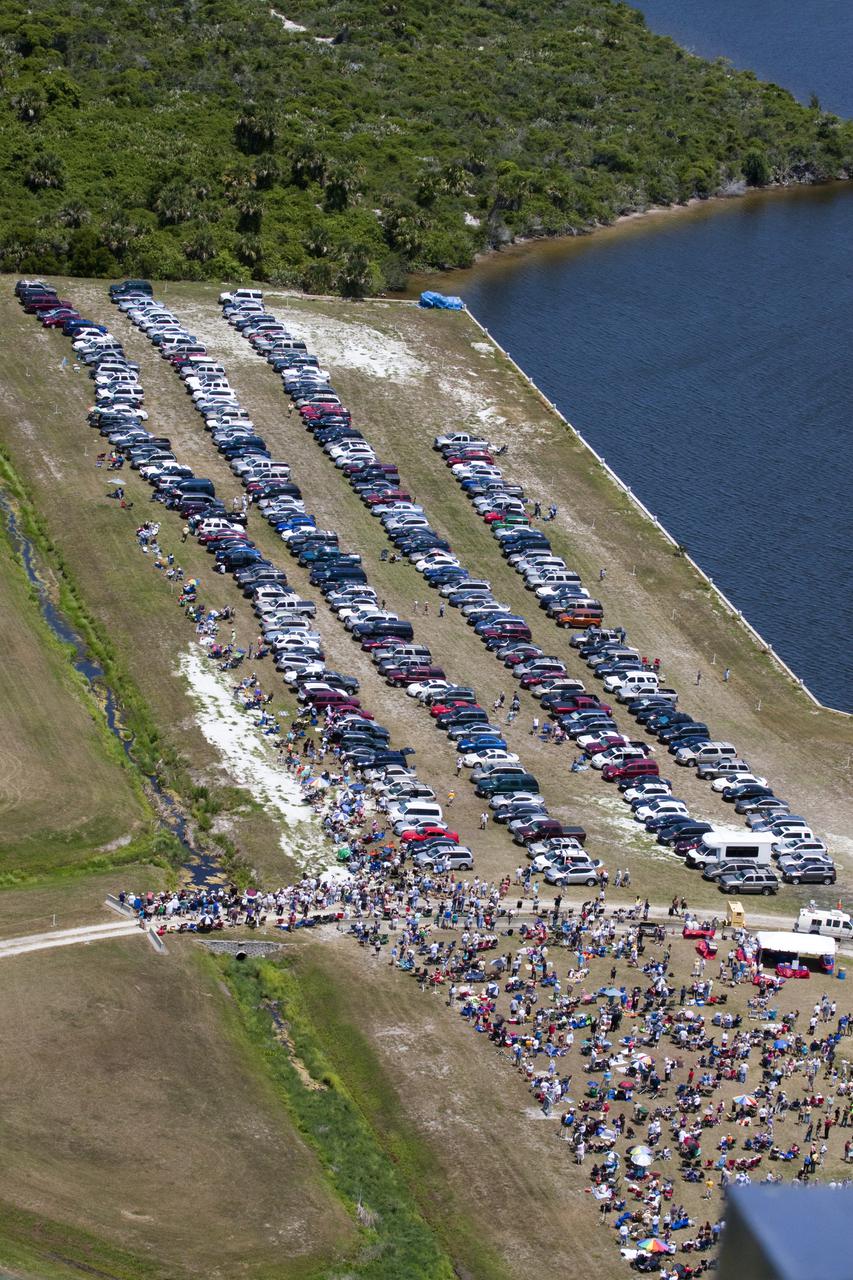
CAPE CANAVERAL, Fla. - Employees and their families gather at the Turn Basin at NASA's Kennedy Space Center in Florida to watch space shuttle Atlantis lift off from Launch Pad 39A. Launch of the STS-132 mission to the International Space Station occurred right on time at 2:20 p.m. on May 14. The Russian-built Mini Research Module-1 known as Rassvet, or 'dawn,' is inside the shuttle's cargo bay. It will provide additional storage space and a new docking port for Russian Soyuz and Progress spacecraft. The laboratory will be attached to the bottom port of the station's Zarya module. The mission's three spacewalks will focus on storing spare components outside the station, including six batteries, a communications antenna and parts for the Canadian Dextre robotic arm. STS-132 is the 132nd shuttle flight, the 32nd for Atlantis and the 34th shuttle mission dedicated to station assembly and maintenance. For more information on the STS-132 mission objectives, payload and crew, visit www.nasa.gov_mission_pages_shuttle_shuttlemissions_sts132_index.html. Photo Credit: NASA_Jack Pfaller
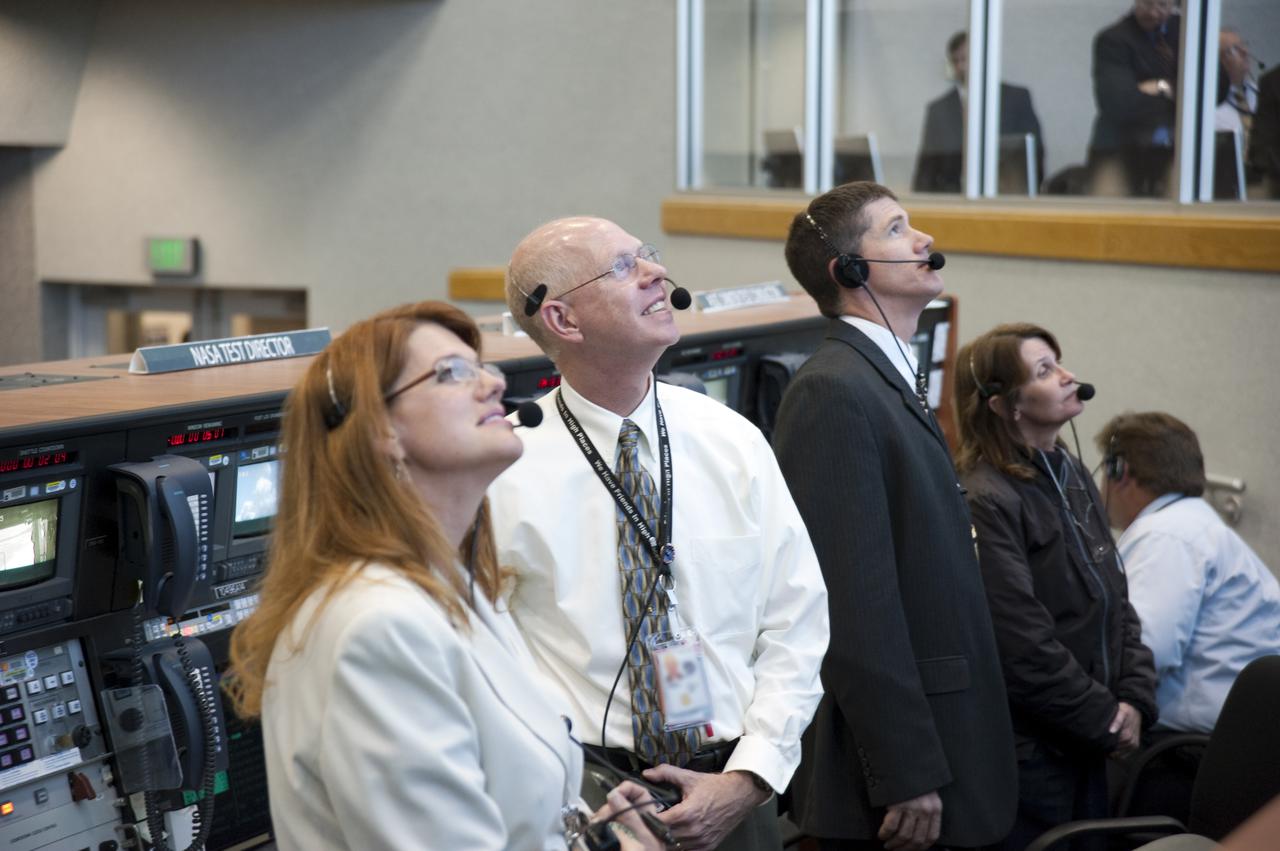
CAPE CANAVERAL, Fla. -- NASA test directors, from left, Charlie Blackwell-Thompson, Steve Payne and Jeremy Graeber, and Orbiter Test Conductor Teresa Annulis, watch space shuttle Atlantis lift off on its STS-132 mission to the International Space Station through the windows of Firing Room 4 of the Launch Control Center at NASA's Kennedy Space Center in Florida. Launch was on time at 2:20 p.m. EDT. STS-132 is the 132nd shuttle flight, the 32nd for Atlantis and the 34th shuttle mission dedicated to station assembly and maintenance. For more information on the STS-132 mission objectives, payload and crew, visit www.nasa.gov_mission_pages_shuttle_shuttlemissions_sts132_index.html. Photo credit: NASA_Kim Shiflett

CAPE CANAVERAL, Fla. - In Orbiter Processing Facility 1 at NASA's Kennedy Space Center in Florida, a United Space Alliance technician, lying on a work platform, does his part in the removal of window #8 from the top of the crew module of space shuttle Atlantis. Inspection and maintenance of the crew module windows is standard procedure between shuttle missions. Atlantis is next slated to deliver an Integrated Cargo Carrier and Russian-built Mini Research Module to the International Space Station on the STS-132 mission. The second in a series of new pressurized components for Russia, the module will be permanently attached to the Zarya module. Three spacewalks are planned to store spare components outside the station, including six spare batteries, a boom assembly for the Ku-band antenna and spares for the Canadian Dextre robotic arm extension. A radiator, airlock and European robotic arm for the Russian Multi-purpose Laboratory Module also are payloads on the flight. Launch is targeted for May 14. Photo credit: NASA/Glenn Benson

KENNEDY SPACE CENTER, FLA. -- In the Orbiter Processing Facility, STS-117 Mission Specialists (left) Patrick Forrester, Steven Swanson and (right) James Reilly take a close look at the wheel well on orbiter Atlantis, their vehicle for the mission. They and other crew members are at KSC to take part in a Crew Equipment Interface Test that allows them opportunities to become familiar with equipment and hardware for their mission. STS-117 will deliver the S3/S4 and another pair of solar arrays to the space station. The 21st shuttle mission to the International Space Station, STS-117 is scheduled to launch no earlier than March 16. Photo credit: NASA/Kim Shiflett

KENNEDY SPACE CENTER, FLA. - In the payload changeout room on Launch Pad 39B, one of the doors of the payload canister is open, revealing its cargo, the Port 3/4 truss segment for mission STS-115. The payload will be removed from the canister and later installed in Space Shuttle Atlantis' payload bay. Atlantis' launch window begins Aug. 28. During its 11-day mission to the International Space Station, the STS-115 crew of six astronauts will install the truss, a 17-ton segment of the space station's truss backbone. Photo credit: NASA/Jack Pfaller

CAPE CANAVERAL, Fla. - Space shuttle Atlantis' twin solid rocket boosters ignite to propel the spacecraft off NASA Kennedy Space Center's Launch Pad 39A and into orbit at 2:20 p.m. EDT on May 14. On board Atlantis, for its last planned flight, are six veteran NASA astronauts. Atlantis' primary payload for the STS-132 mission is the Russian-built Mini Research Module-1, which will provide additional storage space and a new docking port for Russian Soyuz and Progress spacecraft aboard the International Space Station. STS-132 is the 132nd shuttle flight, the 32nd for Atlantis and the 34th shuttle mission dedicated to station assembly and maintenance. For more information on the STS-132 mission objectives, payload and crew, visit www.nasa.gov_mission_pages_shuttle_shuttlemissions_sts132_index.html. Photo credit: NASA_Sandra Joseph and Kevin O'Connell
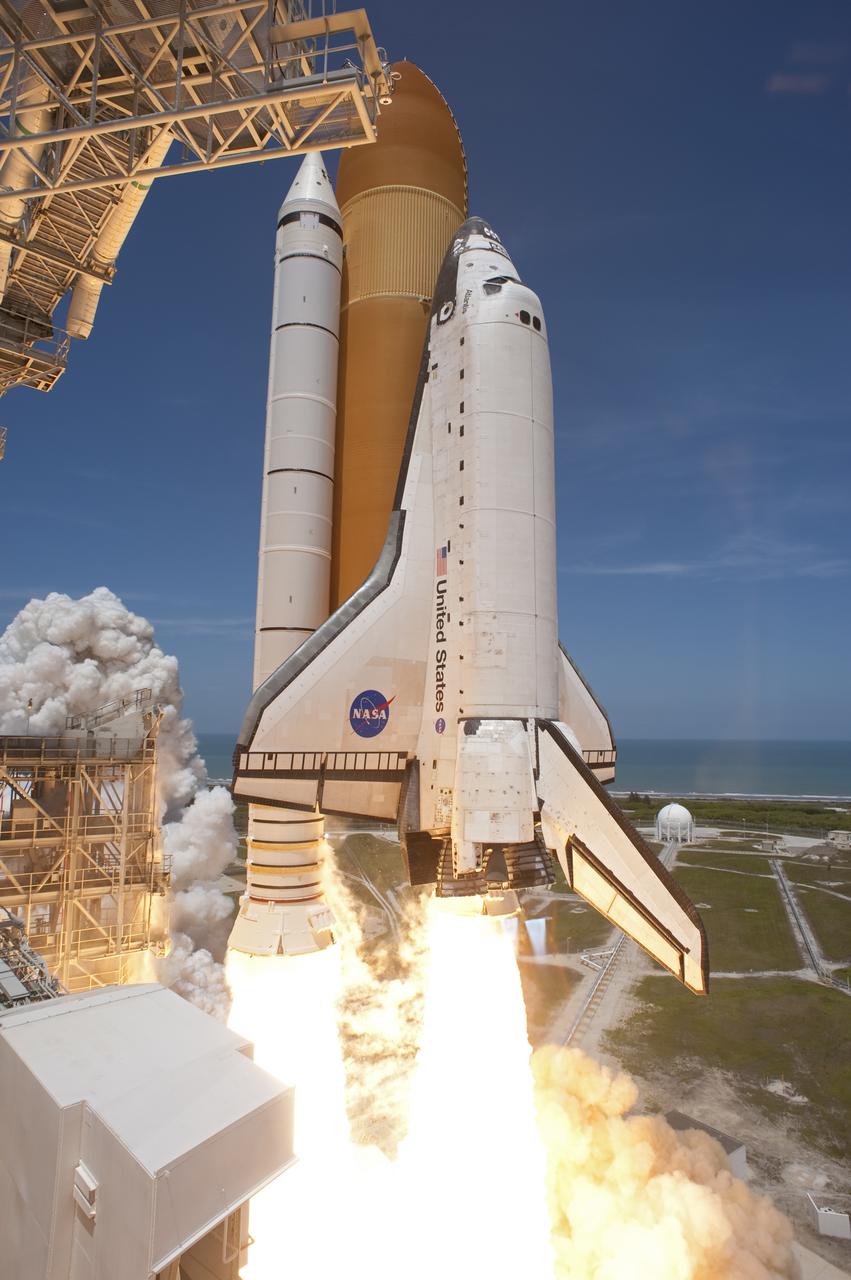
CAPE CANAVERAL, Fla. - Space shuttle Atlantis and its six STS-132 astronauts lift off its seaside launch pad at NASA's Kennedy Space Center in Florida at 2:20 p.m. EDT on May 14. Atlantis' primary payload for the STS-132 mission is the Russian-built Mini Research Module-1, which will provide additional storage space and a new docking port for Russian Soyuz and Progress spacecraft aboard the International Space Station. STS-132 is the 132nd shuttle flight, the 32nd for Atlantis and the 34th shuttle mission dedicated to station assembly and maintenance. For more information on the STS-132 mission objectives, payload and crew, visit www.nasa.gov_mission_pages_shuttle_shuttlemissions_sts132_index.html. Photo credit: NASA_Sandra Joseph and Kevin O'Connell

CAPE CANAVERAL, Fla. – Viewed across the turn basin near the Vehicle Assembly Building at NASA's Kennedy Space Center, space shuttle Atlantis crawls toward Launch Pad 39A. The shuttle stack, with solid rocket boosters and external fuel tank attached to Atlantis, rest on the mobile launcher platform. Movement is provided by the crawler-transporter underneath. First motion occurred at 9:19 a.m. EDT. The Sept. 2 rollout date was postponed due to Tropical Storm Hanna’s shift to a northern track. Atlantis is scheduled to launch on the STS-125 mission to service NASA’s Hubble Space Telescope. Launch is targeted for Oct. 8. Photo credit: NASA/Kim Shiflett

KENNEDY SPACE CENTER, FLA. -- In the Orbiter Processing Facility, STS-117 crew members look at one of the wings on the orbiter Atlantis, their vehicle for the mission. At left is Mission Specialist Steven Swanson; the others kneeling are Pilot Lee Archambault and Mission Specialists John (Danny) Olivas and James Reilly. They and other crew members are at KSC to take part in a Crew Equipment Interface Test that allows them opportunities to become familiar with equipment and hardware for their mission. STS-117 will deliver the S3/S4 and another pair of solar arrays to the space station. The 21st shuttle mission to the International Space Station, STS-117 is scheduled to launch no earlier than March 16. Photo credit: NASA/Kim Shiflett
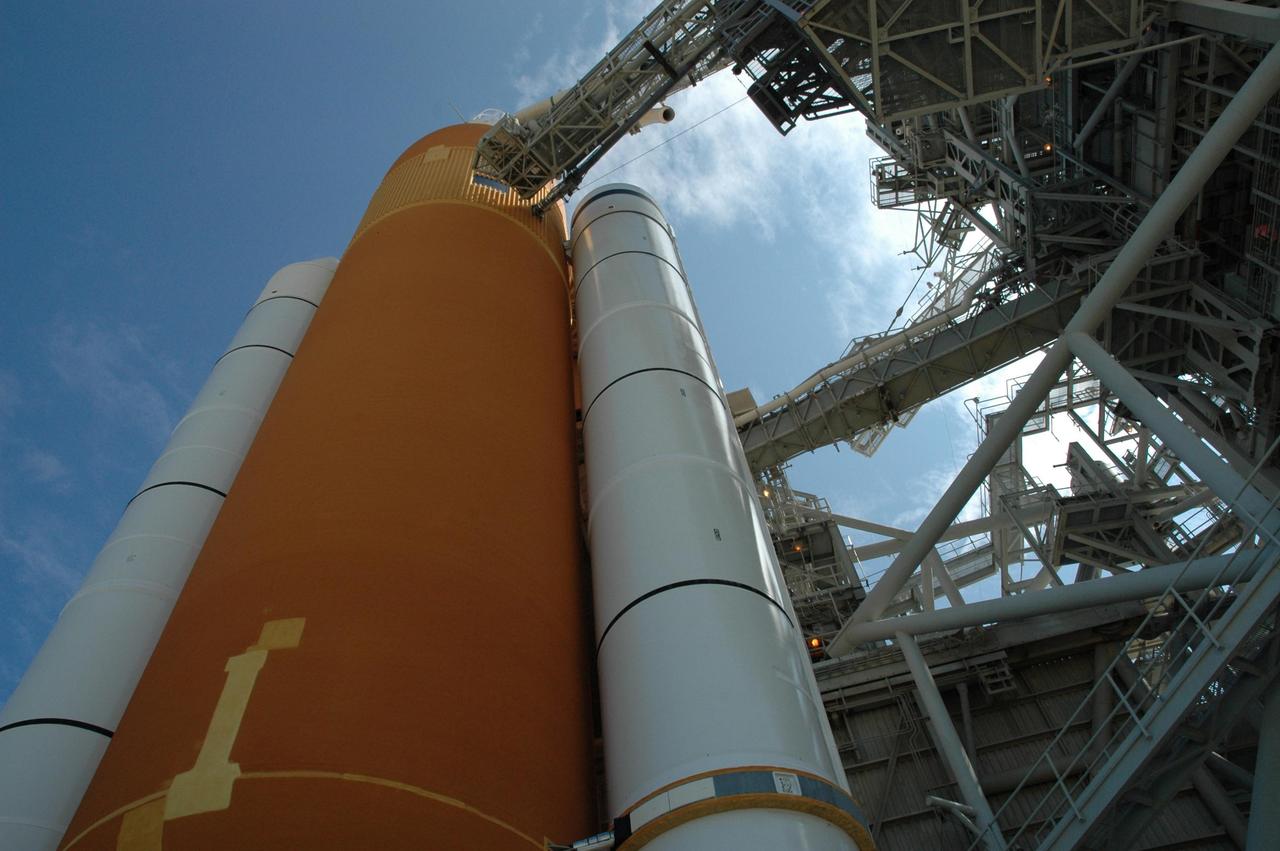
KENNEDY SPACE CENTER, FLA. - Seen on Launch Pad 39B, the looming external tank (center) flanked by the solid rocket boosters hide Space Shuttle Atlantis, behind them. Near the top of the external tank is the liquid hydrogen vent arm. Preparations continue on the pad for launch of Atlantis on mission STS-115 as early as Aug. 29. However, preparations are also underway for a rollback of Atlantis to the Vehicle Assembly Building due to Hurricane Ernesto. The rollback will be determined by the mission management team based on information about Hurricane Ernesto and its path through Florida. Atlantis has been poised on Launch Pad 39B for liftoff on mission STS-115 to the International Space Station to deliver the P3/P4 truss segment. Photo credit: NASA/Jack Pfaller

KENNEDY SPACE CENTER, FLA. -- Smoke and steam billow across Launch Pad 39A as Space Shuttle Atlantis leaps into the sky on mission STS-117 to the International Space Station. Liftoff was on-time at 7:38:04 p.m. The shuttle is delivering a new segment to the starboard side of the International Space Station's backbone, known as the truss. Three spacewalks are planned to install the S3/S4 truss segment, deploy a set of solar arrays and prepare them for operation. STS-117 is the 118th space shuttle flight, the 21st flight to the station, the 28th flight for Atlantis and the first of four flights planned for 2007. Photo courtesy of Nikon/Scott Andrews

KENNEDY SPACE CENTER, FLA. -- After a nearly 5.3 million mile round trip to the International Space Station, space shuttle Atlantis comes to a stop near the control tower on Runway 15 of the Shuttle Landing Facility at NASA's Kennedy Space Center. The shuttle landed on orbit 202 to complete the 13-day STS-122 mission. Main gear touchdown was 9:07:10 a.m. Nose gear touchdown was 9:07:20 a.m. Wheel stop was at 9:08:08 a.m. Mission elapsed time was 12 days, 18 hours, 21 minutes and 44 seconds. During the mission, Atlantis' crew installed the new Columbus laboratory, leaving a larger space station and one with increased science capabilities. The Columbus Research Module adds nearly 1,000 cubic feet of habitable volume and affords room for 10 experiment racks, each an independent science lab. Photo credit: NASA/Kenny Allen, Robert Murray
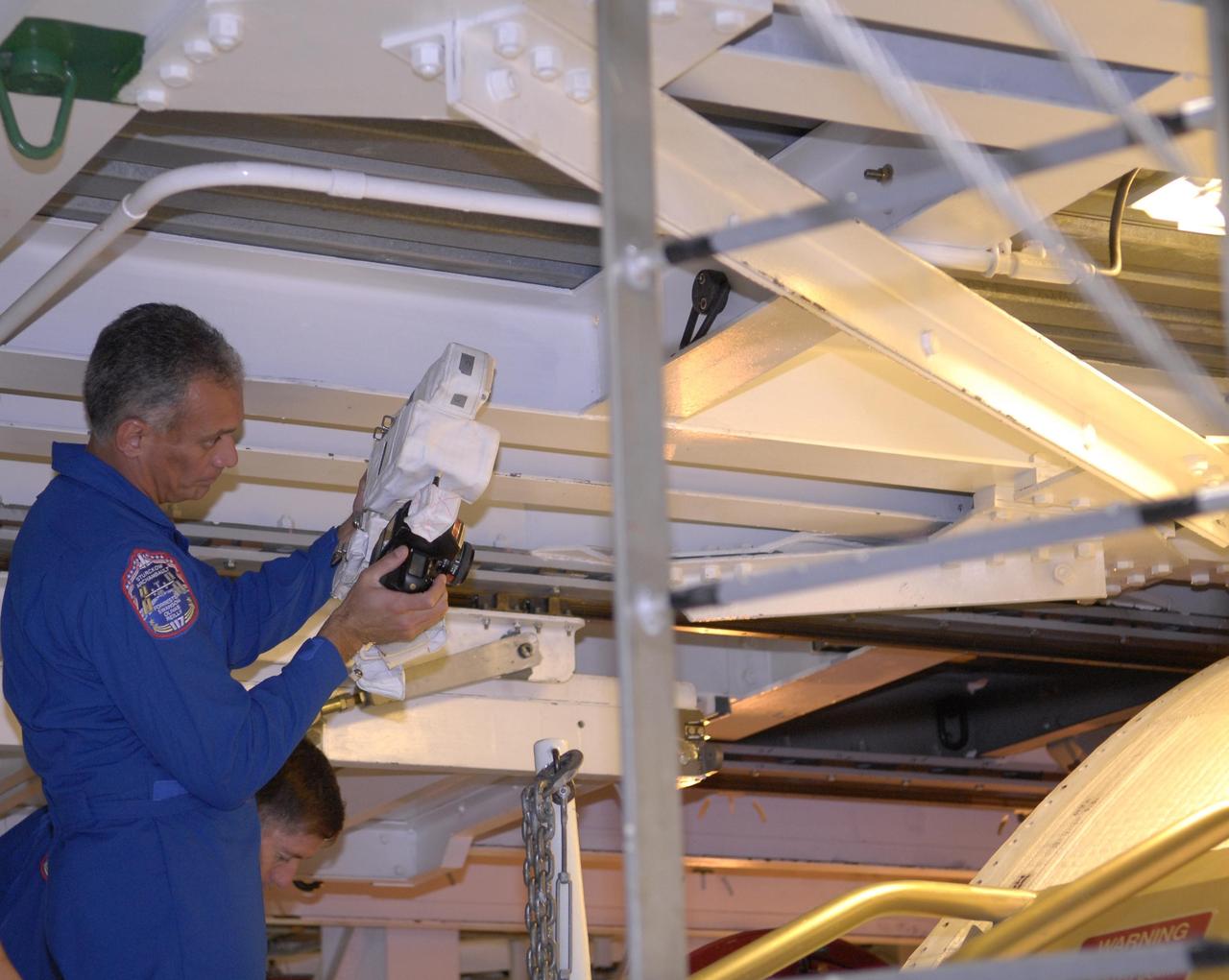
KENNEDY SPACE CENTER, FLA. -- In the Orbiter Processing Facility, STS-117 Mission Specialist John (Danny) Olivas practices photographing the orbiter Atlantis with a camera to be used on the mission. He and other crew members are at KSC to take part in a Crew Equipment Interface Test that allows them opportunities to become familiar with equipment and hardware for their mission. STS-117 will deliver the S3/S4 and another pair of solar arrays to the space station. The 21st shuttle mission to the International Space Station, STS-117 is scheduled to launch no earlier than March 16. Photo credit: NASA/Kim Shiflett
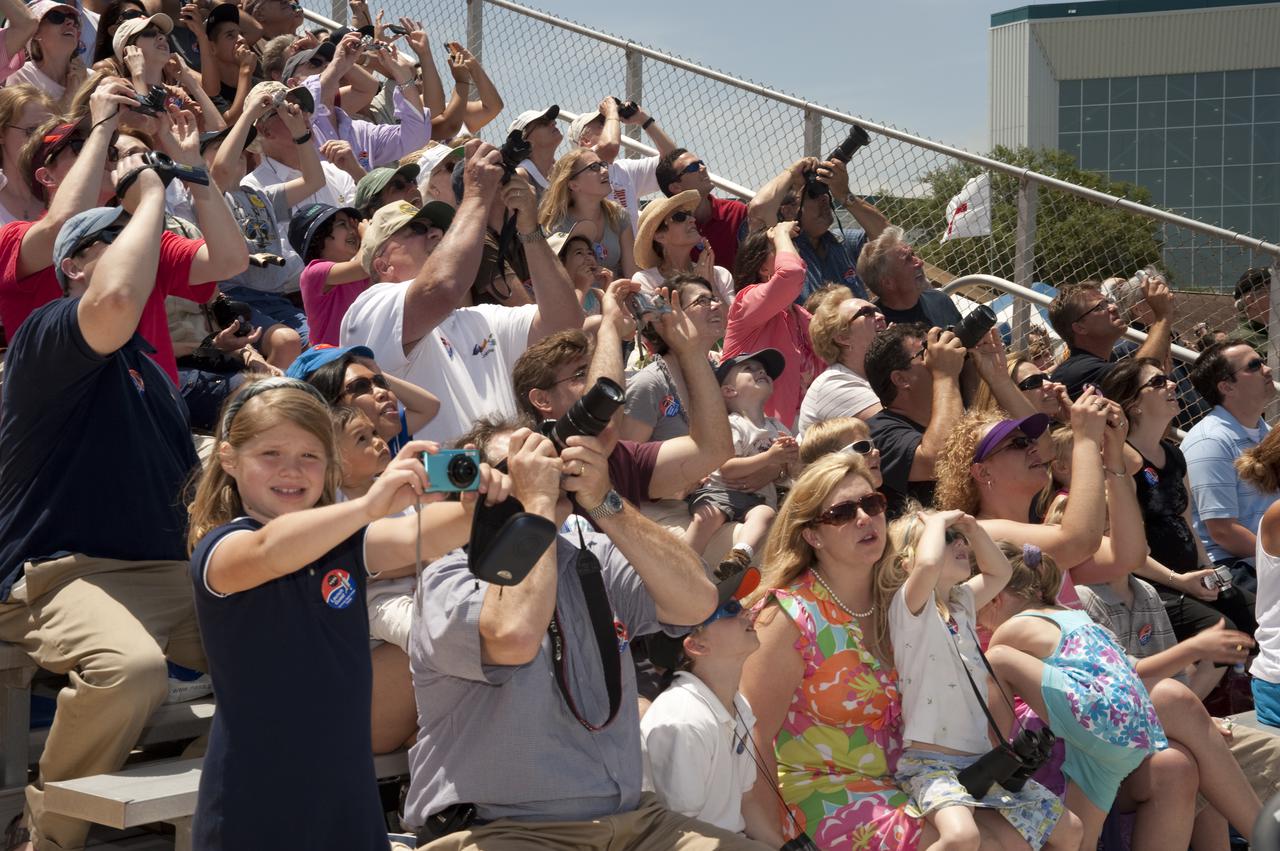
CAPE CANAVERAL, Fla. - Children and adults at the Banana Creek Viewing Site near the Saturn V Center at NASA's Kennedy Space Center in Florida snap photos and stare in awe as space shuttle Atlantis lifts off Launch Pad 39A. Launch of the STS-132 mission to the International Space Station occurred right on time at 2:20 p.m. on May 14. The Russian-built Mini Research Module-1 known as Rassvet, or 'dawn,' is inside the shuttle's cargo bay. It will provide additional storage space and a new docking port for Russian Soyuz and Progress spacecraft. The laboratory will be attached to the bottom port of the station's Zarya module. The mission's three spacewalks will focus on storing spare components outside the station, including six batteries, a communications antenna and parts for the Canadian Dextre robotic arm. STS-132 is the 132nd shuttle flight, the 32nd for Atlantis and the 34th shuttle mission dedicated to station assembly and maintenance. For more information on the STS-132 mission objectives, payload and crew, visit www.nasa.gov_mission_pages_shuttle_shuttlemissions_sts132_index.html. Photo Credit: NASA_Ben Cooper
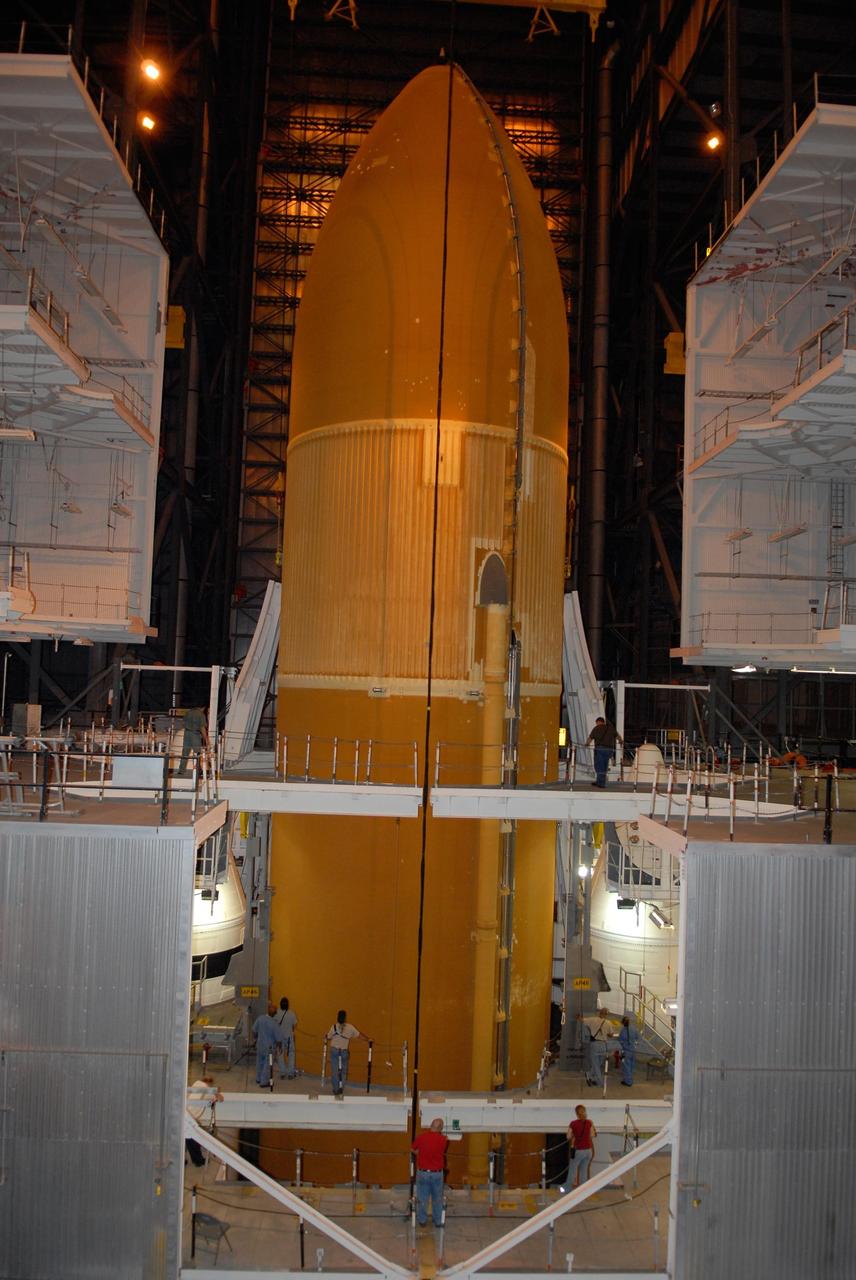
KENNEDY SPACE CENTER, FLA. -- In the Vehicle Assembly Building at NASA's Kennedy Space Center, the external tank is lowered between the solid rocket boosters on the mobile launcher platform below. After mating, the boosters-tank configuration will be used on space shuttle Atlantis for mission STS-122, which is targeted for launch on Dec. 6. Photo credit: Kim Shiflett

KENNEDY SPACE CENTER, FLA. -- Smoke and steam billow across Launch Pad 39A as Space Shuttle Atlantis, trailing columns of fire from the solid rocket boosters, hurtles into the sky on mission STS-117 to the International Space Station. Liftoff was on-time at 7:38:04 p.m. EDT. The shuttle is delivering a new segment to the starboard side of the International Space Station's backbone, known as the truss. Three spacewalks are planned to install the S3/S4 truss segment, deploy a set of solar arrays and prepare them for operation. STS-117 is the 118th space shuttle flight, the 21st flight to the station, the 28th flight for Atlantis and the first of four flights planned for 2007. Photo courtesy of Nikon/Scott Andrews
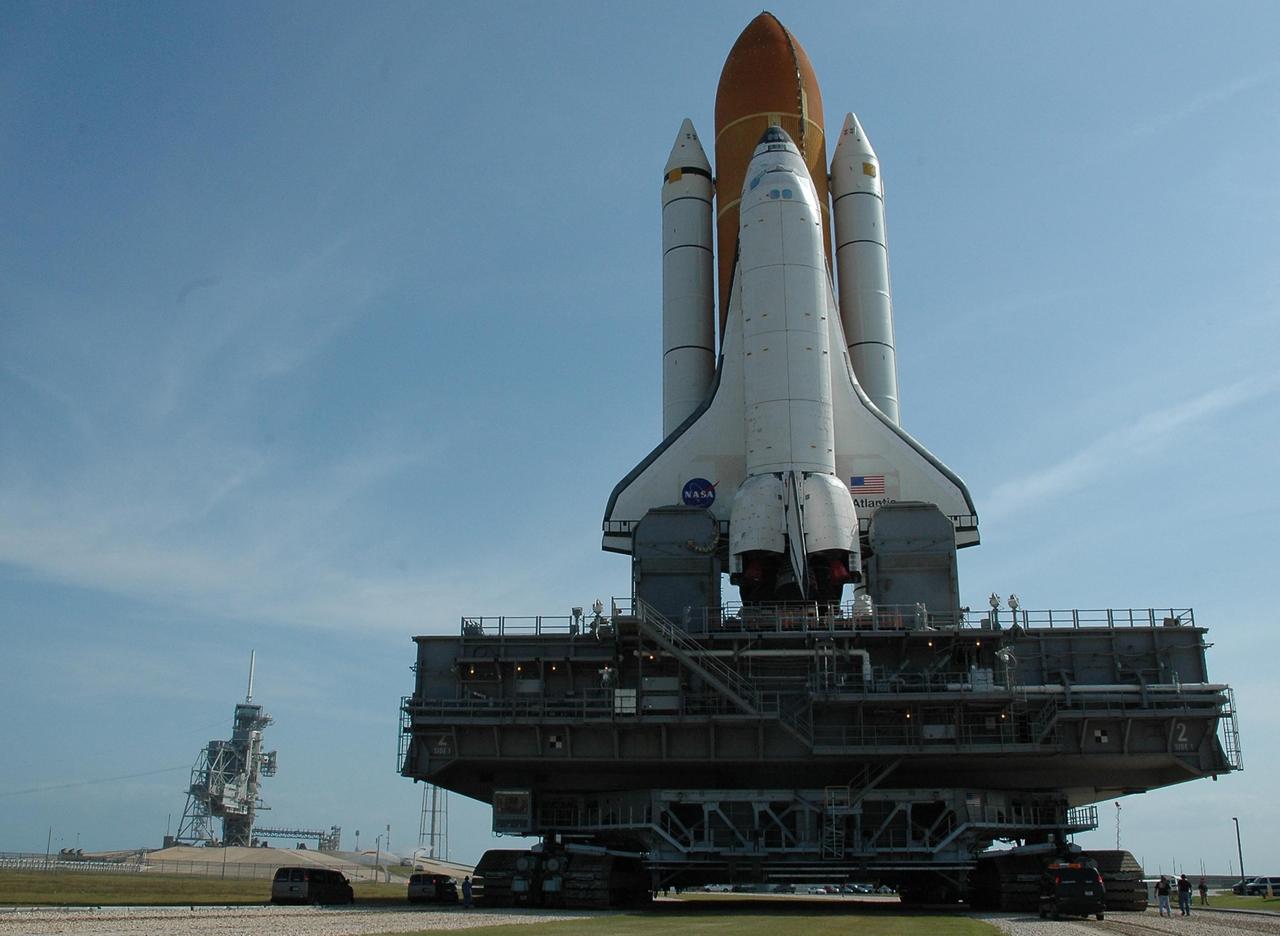
KENNEDY SPACE CENTER, FLA. -- Under a feather-painted sky, Space Shuttle Atlantis, mounted on a mobile launch platform atop a crawler transporter, nears Launch Pad 39A. This is the second rollout for the shuttle. First motion out of the Vehicle Assembly Building was at 5:02 a.m. EDT. In late February, while Atlantis was on the launch pad, Atlantis' external tank received hail damage during a severe thunderstorm that passed through the Kennedy Space Center Launch Complex 39 area. The hail caused visible divots in the giant tank's foam insulation, as well as minor surface damage to about 26 heat shield tiles on the shuttle's left wing. The shuttle was returned to the VAB for repairs. The launch of Space Shuttle Atlantis on mission STS-117 is now targeted for June 8. A flight readiness review will be held on May 30 and 31. Photo credit: NASA/Troy Cryder
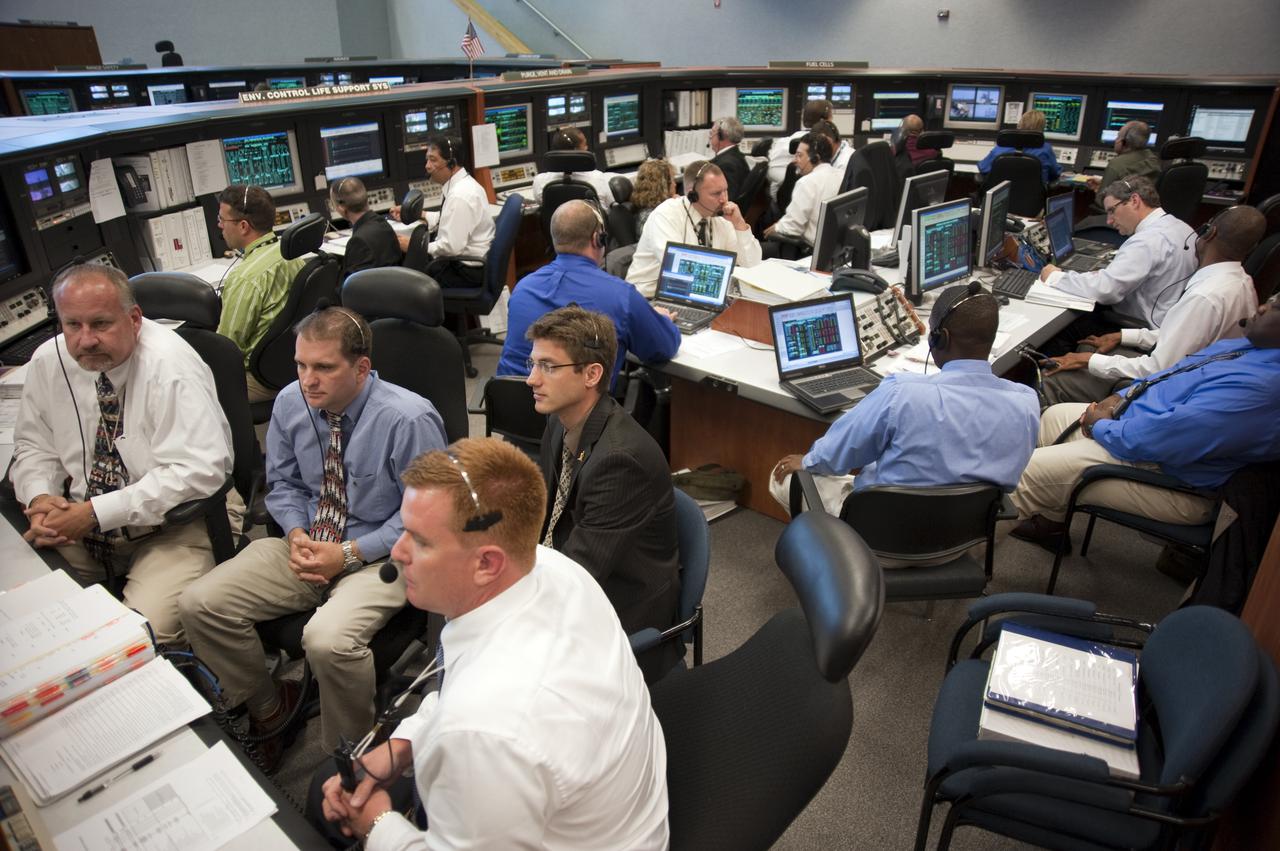
CAPE CANAVERAL, Fla. -- In Firing Room 4 of the Launch Control Center at NASA's Kennedy Space Center in Florida, launch controllers keep track of the imminent launch of space shuttle Atlantis on its STS-132 mission to the International Space Station. The launch team worked very few issues during the countdown and picture-perfect weather led to an on-time launch at 2:20 p.m. EDT on May 14. STS-132 is the 132nd shuttle flight, the 32nd for Atlantis and the 34th shuttle mission dedicated to station assembly and maintenance. For more information on the STS-132 mission objectives, payload and crew, visit www.nasa.gov_mission_pages_shuttle_shuttlemissions_sts132_index.html. Photo credit: NASA_Kim Shiflett
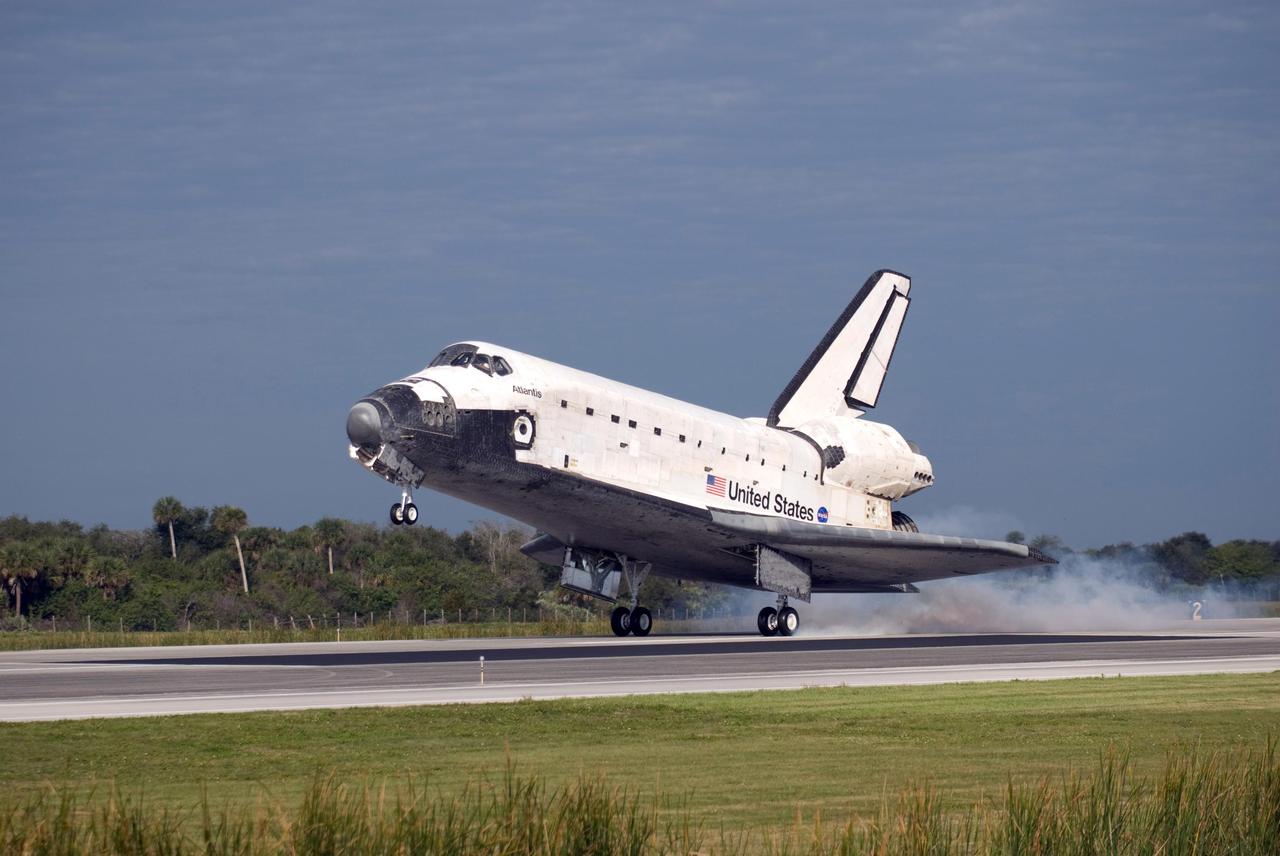
KENNEDY SPACE CENTER, FLA. -- The space shuttle Atlantis kicks up dust as it touches down on Runway 15 of the Shuttle Landing Facility at NASA's Kennedy Space Center. The shuttle landed on orbit 202 to complete the 13-day STS-122 mission. Main gear touchdown was 9:07:10 a.m. Nose gear touchdown was 9:07:20 a.m. Wheel stop was at 9:08:08 a.m. Mission elapsed time was 12 days, 18 hours, 21 minutes and 44 seconds. During the mission, Atlantis' crew installed the new Columbus laboratory, leaving a larger space station and one with increased science capabilities. The Columbus Research Module adds nearly 1,000 cubic feet of habitable volume and affords room for 10 experiment racks, each an independent science lab. Photo credit: NASA/Chris Lynch
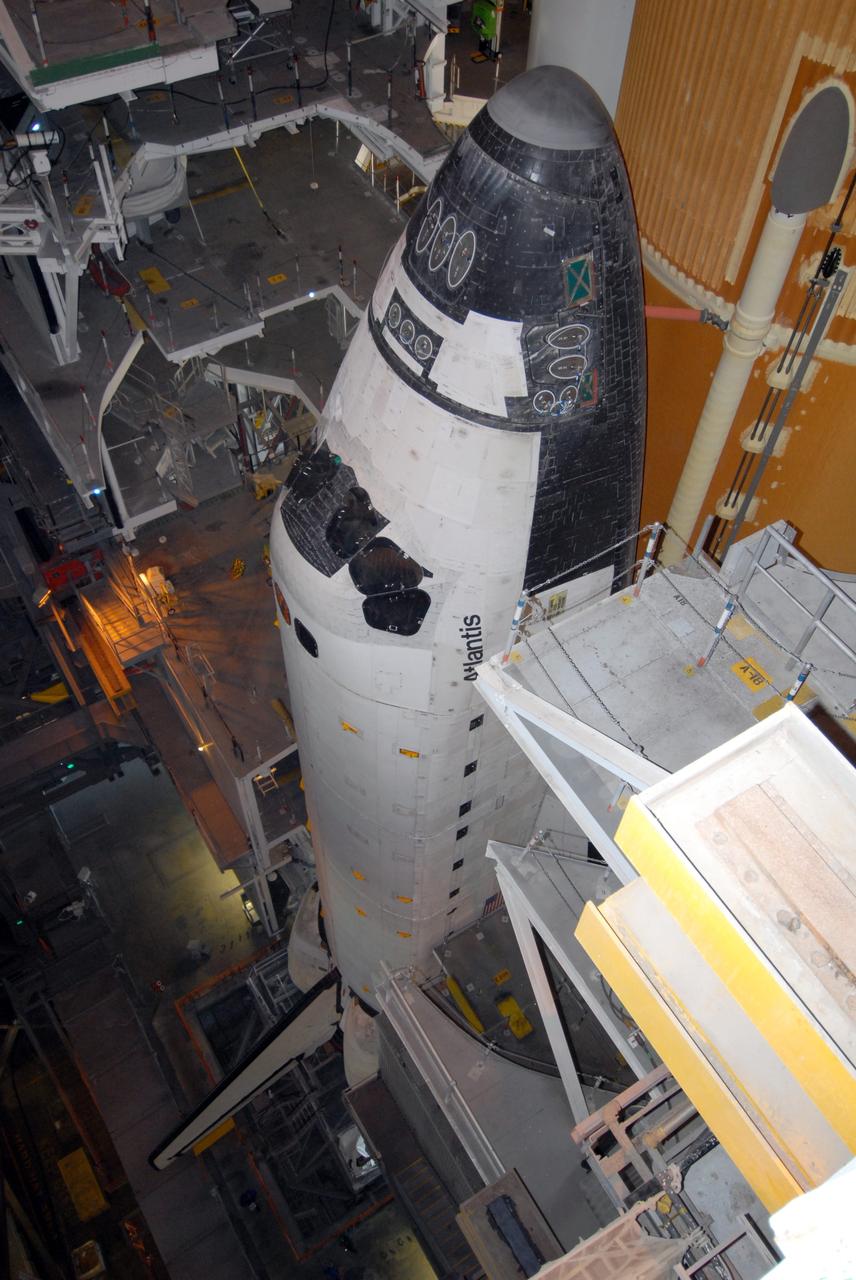
CAPE CANAVERAL, Fla. – Space shuttle Atlantis stands ready in the Vehicle Assembly Building at NASA’s Kennedy Space Center for the pending rollout to Launch Pad 39A. Visible at right behind Atlantis is the external fuel tank. The Sept. 2 rollout date was postponed due to Tropical Storm Hanna’s shift to a northern track. Managers are closely following Hanna to determine when would be the best time this week to move space shuttle Atlantis to its launch pad. The tentative rollout time is 10 a.m. Sept. 4, depending on the track Hanna follows along the Florida coast. Atlantis is scheduled to launch on the STS-125 mission to service NASA’s Hubble Space Telescope. Launch is targeted for Oct. 8. Photo credit: NASA/Jack Pfaller
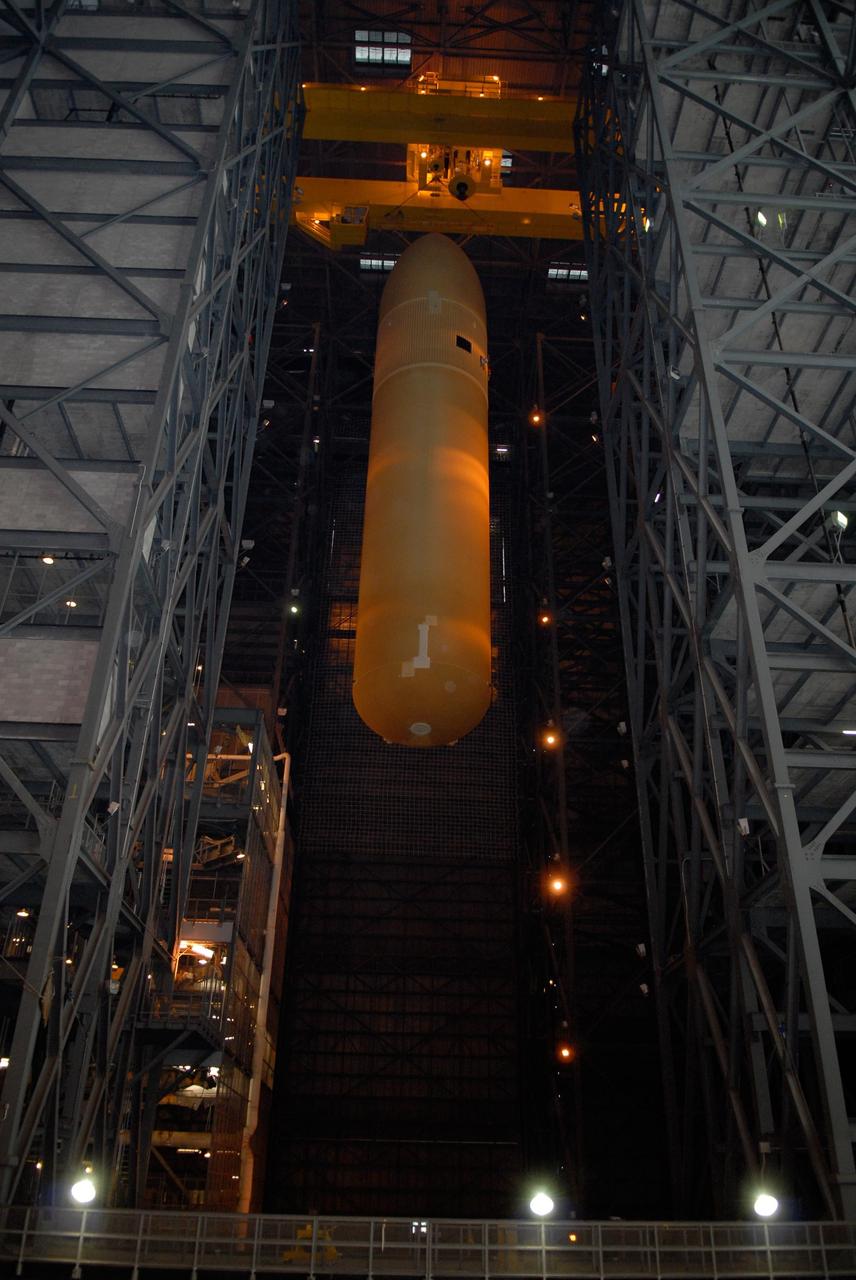
KENNEDY SPACE CENTER, FLA. -- In the Vehicle Assembly Building at NASA's Kennedy Space Center, the external tank is lowered toward the solid rocket boosters on the mobile launcher platform below. After mating, the boosters-tank configuration will be used on space shuttle Atlantis for mission STS-122, which is targeted for launch on Dec. 6. Photo credit: Kim Shiflett

KENNEDY SPACE CENTER, FLA. -- In the Orbiter Processing Facility, STS-117 Pilot Lee Archambault points to a part on the external airlock in the payload bay of Atlantis. He and other crew members are at KSC to take part in a Crew Equipment Interface Test that allows them opportunities to become familiar with equipment and hardware for their mission. STS-117 will deliver the S3/S4 and another pair of solar arrays to the space station. The 21st shuttle mission to the International Space Station, STS-117 is scheduled to launch no earlier than March 16. Photo credit: NASA/Kim Shiflett

CAPE CANAVERAL, Fla. - Space shuttle Atlantis rumbles off Launch Pad 39A at NASA's Kennedy Space Center in Florida on the STS-132 mission to the International Space Station at 2:20 p.m. EDT on May 14. The Russian-built Mini Research Module-1 known as Rassvet, or "dawn," is inside the shuttle's cargo bay. It will provide additional storage space and a new docking port for Russian Soyuz and Progress spacecraft. The laboratory will be attached to the bottom port of the station's Zarya module. The mission's three spacewalks will focus on storing spare components outside the station, including six batteries, a communications antenna and parts for the Canadian Dextre robotic arm. STS-132 is the 132nd shuttle flight, the 32nd for Atlantis and the 34th shuttle mission dedicated to station assembly and maintenance. For more information on the STS-132 mission objectives, payload and crew, visit www.nasa.gov/mission_pages/shuttle/shuttlemissions/sts132/index.html. Photo Credit: NASA/Jack Pfaller

KENNEDY SPACE CENTER, FLA. - Reflected in the nearby pool of water, Space Shuttle Atlantis, propelled by the crawler-transporter, arrives on the hard stand on Launch Pad 39B. Atop the fixed service structure at right can be seen the 80-foot lightning mast that helps provide lightning protection. The slow speed of the crawler results in a 6- to 8-hour trek to the pad approximately 4 miles away. Atlantis' launch window begins Aug. 27 for an 11-day mission to the International Space Station. The STS-115 crew of six astronauts will continue construction of the station and install their cargo, the Port 3/4 truss segment with its two large solar arrays. Photo credit: NASA/Tony Gray
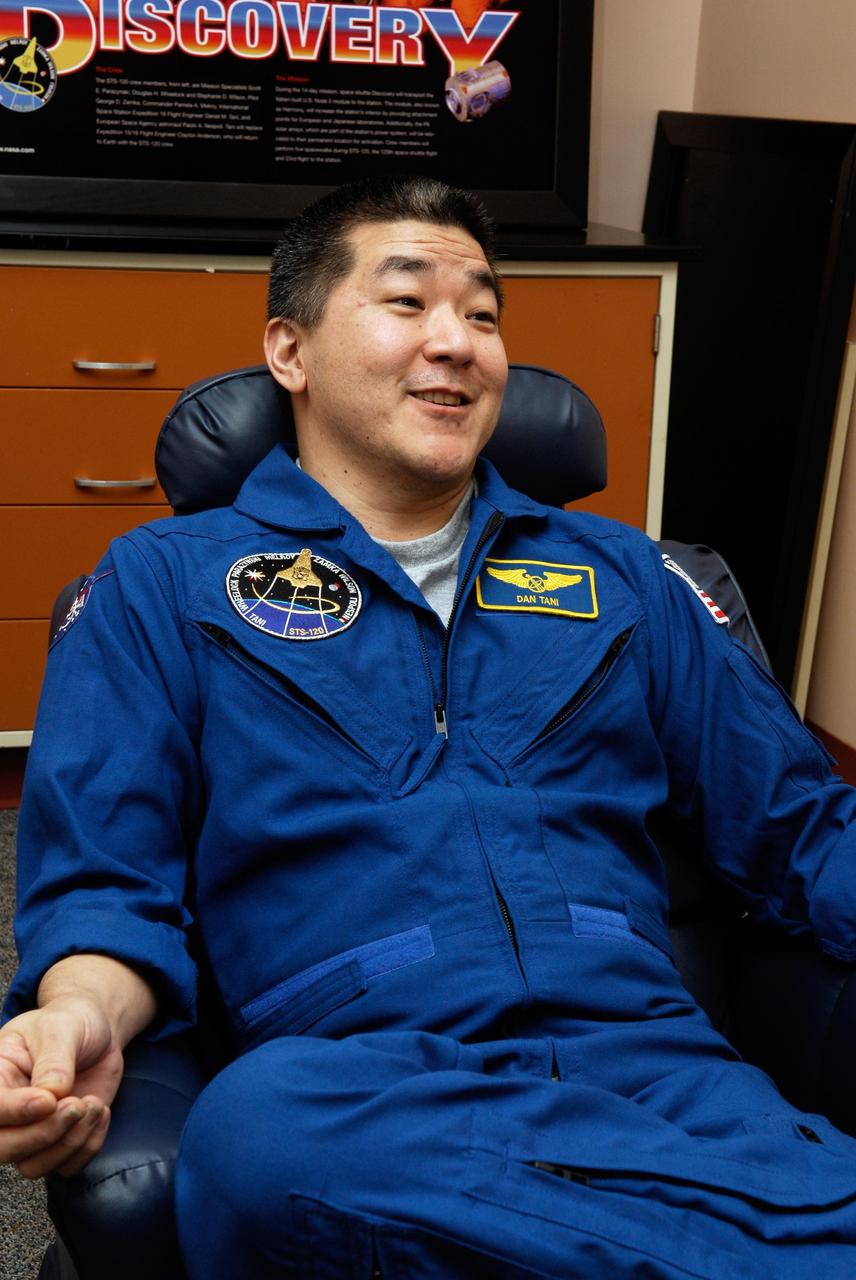
KENNEDY SPACE CENTER, FLA. -- After returning from a nearly four-month stay on the International Space Station, astronaut Dan Tani rests in the crew quarters at the Operations and Checkout Building. Tani returned with the STS-122 crew on space shuttle Atlantis with a landing at 9:07 a.m. EST on Runway 15 at NASA's Kennedy Space Center after a round trip of nearly 5.3 million miles. Photo credit: NASA/Kim Shiflett
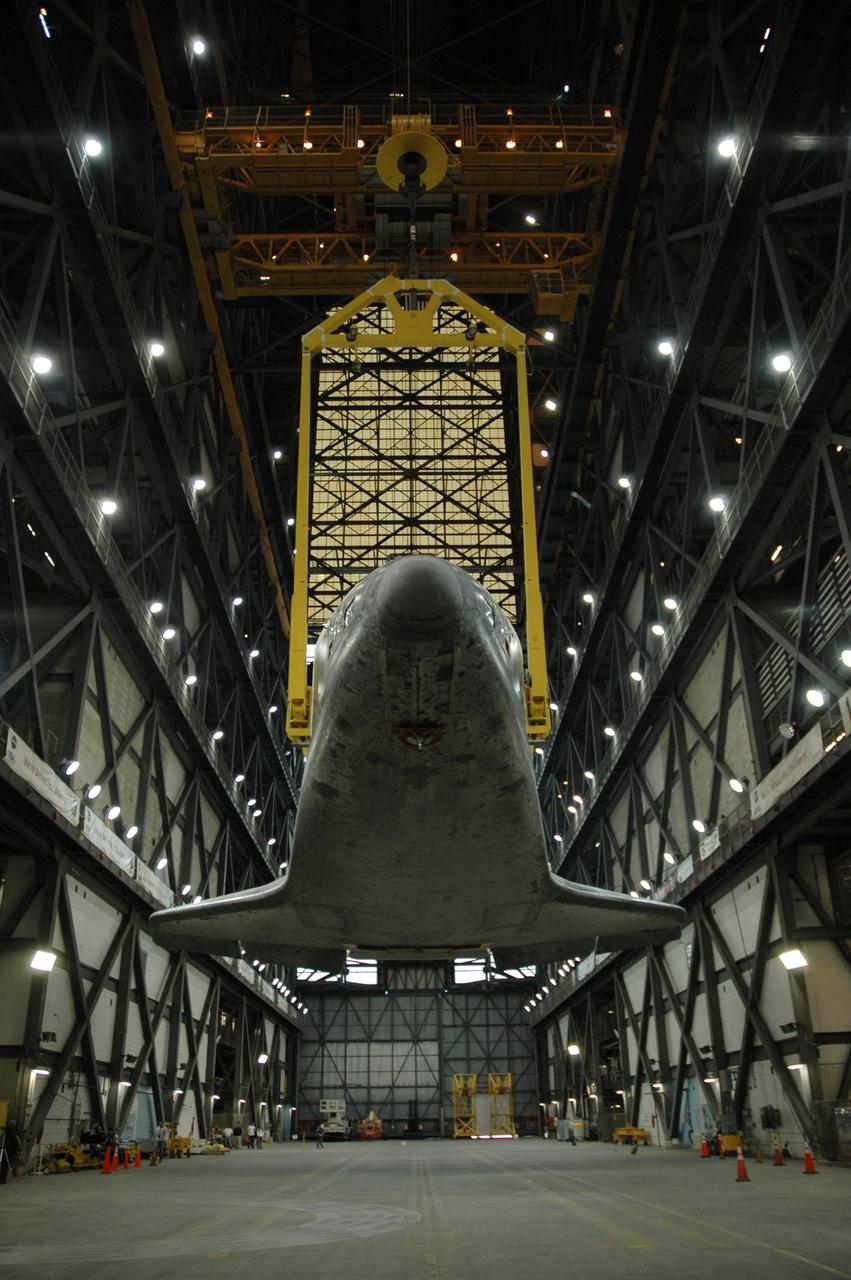
KENNEDY SPACE CENTER, FLA. -- In the transfer aisle of the Vehicle Assembly Building, the orbiter Atlantis is suspended by a sling. With the transporter moved away, the orbiter will be raised to vertical and lifted up into high bay 1. Then it will be lowered onto the mobile launcher platform where the external tank and solid rocket boosters are already stacked. Space Shuttle Atlantis is targeted to roll out to Launch Pad 39A on February 14 for mission STS-117. The mission is No. 21 to the International Space Station and construction flight 13A. Photo credit: NASA/Amanda Diller
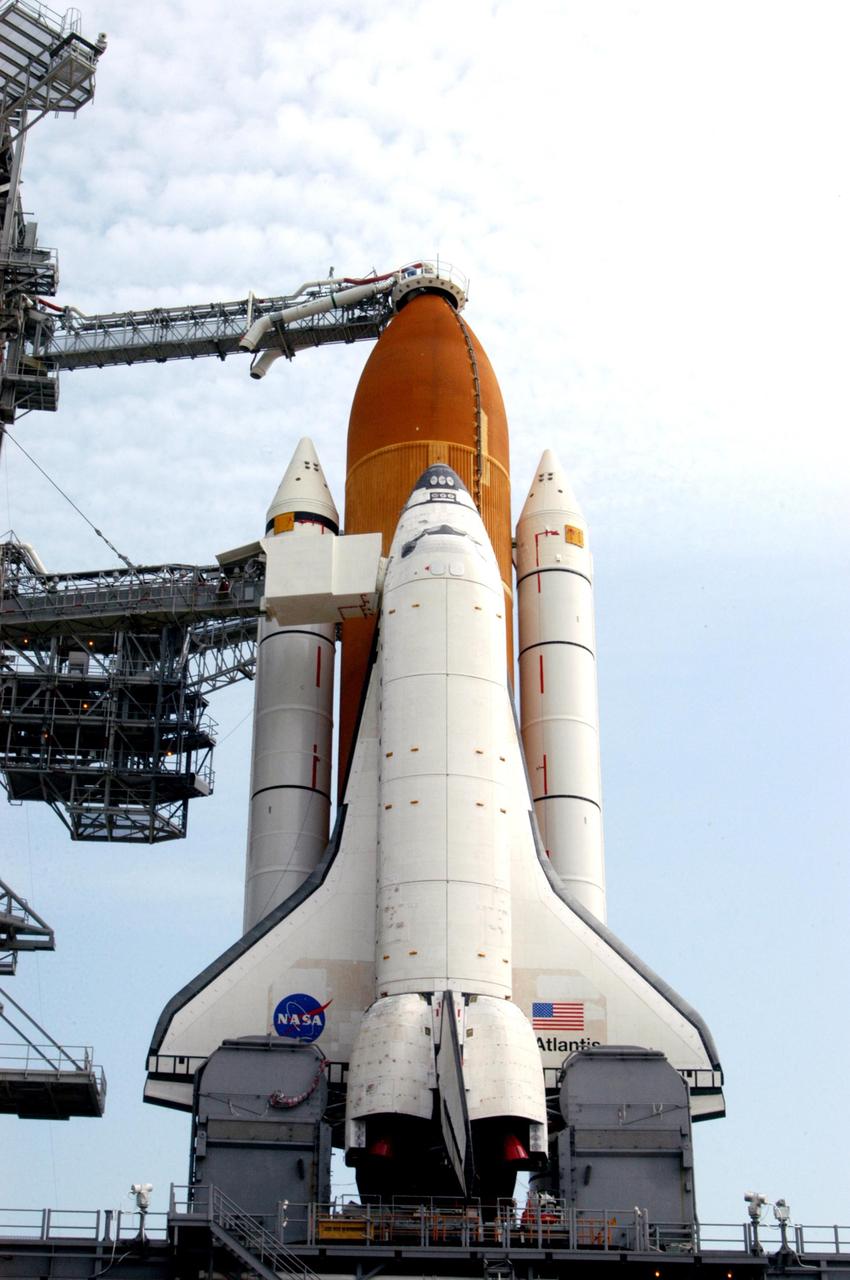
KENNEDY SPACE CENTER, FLA. - This closeup of Space Shuttle Atlantis on the hardstand of Launch Pad 39B shows the surrounding area, including the Atlantic Ocean in the background. Above the orange external tank is the "beanie cap" at the end of the external tank gaseous oxygen vent arm. The cap is a vent hood that vacuums away the very cold liquid oxygen vapors as they boil off from the top of the external tank before launch. Lower down is the orbiter access arm, with the White Room on the outer end, extended toward Atlantis' crew access hatch. The slow speed of the crawler results in a 6- to 8-hour trek to the pad approximately 4 miles away. Atlantis' launch window begins Aug. 27 for an 11-day mission to the International Space Station. The STS-115 crew of six astronauts will continue construction of the station and install their cargo, the Port 3/4 truss segment with its two large solar arrays. Photo credit: NASA/Troy Cryder & George Shelton
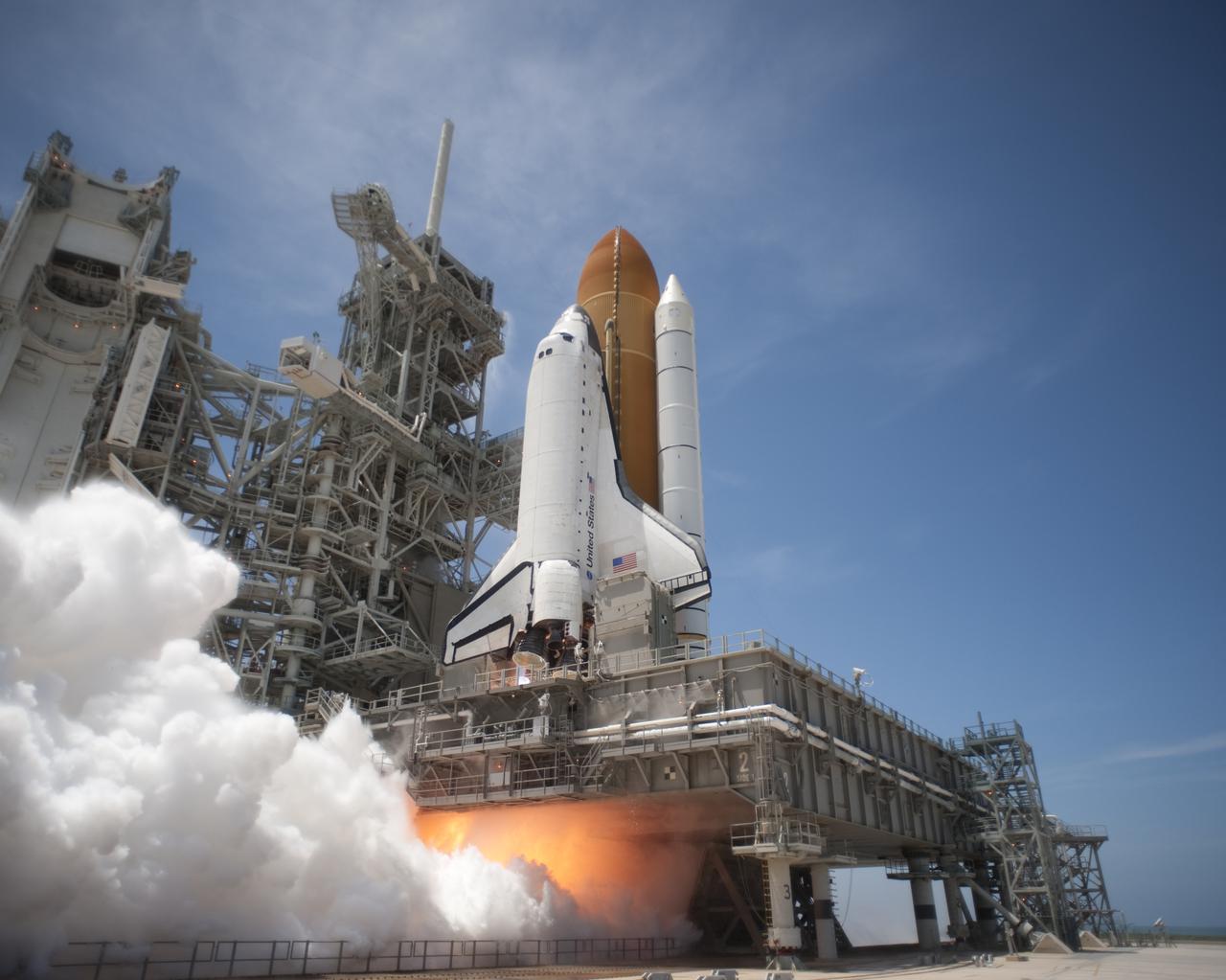
CAPE CANAVERAL, Fla. - At NASA's Kennedy Space Center in Florida, an exhaust plume forms under the mobile launcher platform on Launch Pad 39A as space shuttle Atlantis lifts off on the STS-132 mission at 2:20 p.m. EDT on May 14. Atlantis' primary payload for the STS-132 mission is the Russian-built Mini Research Module-1, which will provide additional storage space and a new docking port for Russian Soyuz and Progress spacecraft aboard the International Space Station. STS-132 is the 132nd shuttle flight, the 32nd for Atlantis and the 34th shuttle mission dedicated to station assembly and maintenance. For more information on the STS-132 mission objectives, payload and crew, visit www.nasa.gov_mission_pages_shuttle_shuttlemissions_sts132_index.html. Photo credit: NASA_Tony Gray and Tom Farrar
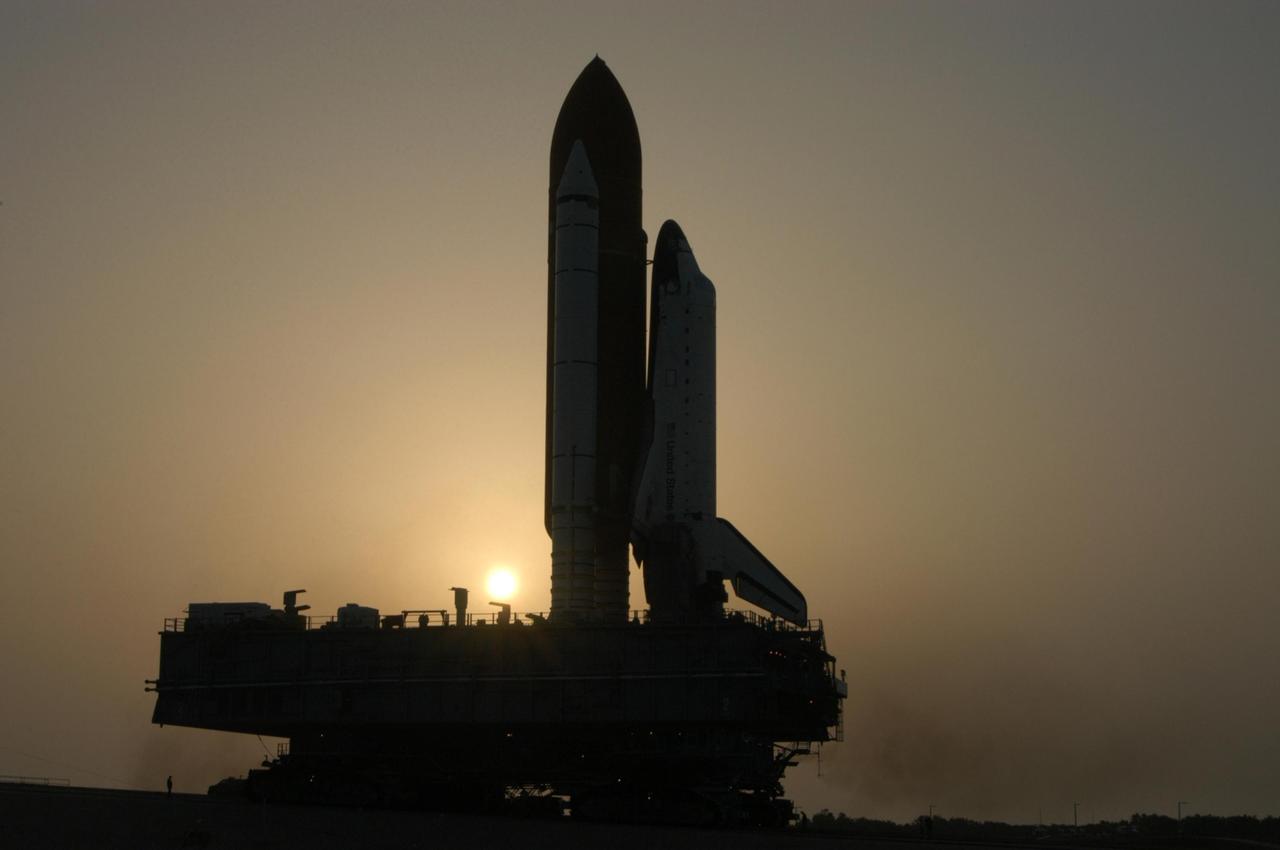
KENNEDY SPACE CENTER, FLA. - Silhouetted against the rising sun, Space Shuttle Atlantis rolls toward Launch Pad 39B. First motion out of the Vehicle Assembly Building was 1:05 a.m. The shuttle sits on top of the mobile launcher platform, which in turn rests on the crawler-transporter. The slow speed of the crawler results in a 6-hour trek to the pad approximately 4 miles away. Atlantis' launch window begins Aug. 27 for an 11-day mission to the International Space Station. The STS-115 crew of six astronauts will continue construction of the station and install their cargo, the Port 3/4 truss segment with its two large solar arrays. Photo credit: NASA/George Shelton

KENNEDY SPACE CENTER, FLA. -- Through the windows of the Launch Control Center, Shuttle Launch Director Mike Leinbach (left) watches the near-perfect launch of Space Shuttle Atlantis on mission STS-117 to the International Space Station. In front of him are Angie Brewer, NASA flow director for Atlantis, and Doug Lyons, assistant launch director. Liftoff from Launch Pad 39A was on-time at 7:38:04 p.m. EDT. The shuttle is delivering a new segment to the starboard side of the International Space Station's backbone, known as the truss. Three spacewalks are planned to install the S3/S4 truss segment, deploy a set of solar arrays and prepare them for operation. STS-117 is the 118th space shuttle flight, the 21st flight to the station, the 28th flight for Atlantis and the first of four flights planned for 2007. Photo credit: NASA/Kim Shiflett
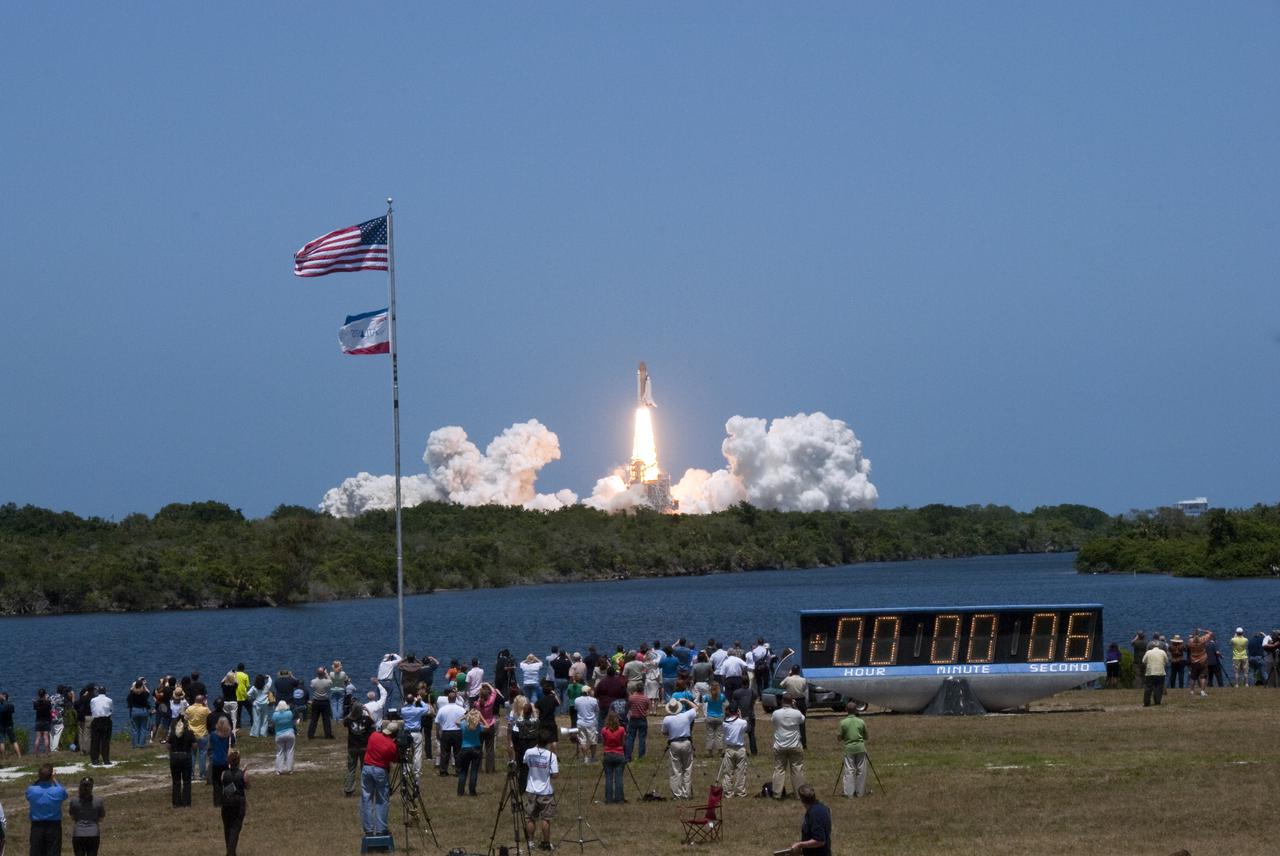
CAPE CANAVERAL, Fla. - Space shuttle Atlantis' liftoff from Launch Pad 39A at NASA's Kennedy Space Center in Florida is witnessed by news media representatives and STS-132 Tweetup participants on hand by the countdown clock at the Press Site. Launch of the STS-132 mission was at 2:20 p.m. EDT on May 14. The six-member crew will deliver the Russian-built Mini Research Module-1 to the International Space Station. Named Rassvet, Russian for 'dawn,' the module is the second in a series of new pressurized components for Russia and will be permanently attached to the Earth-facing port of the Zarya control module. Rassvet will be used for cargo storage and will provide an additional docking port to the station. Also aboard Atlantis is an Integrated Cargo Carrier, or ICC, an unpressurized flat bed pallet and keel yoke assembly used to support the transfer of exterior cargo from the shuttle to the station. STS-132 is the 34th mission to the station and the last scheduled flight for Atlantis. For more information on the STS-132 mission objectives, payload and crew, visit http:__www.nasa.gov_mission_pages_shuttle_shuttlemissions_sts132_index.html. Photo Credit: NASA_Jim Grossmann
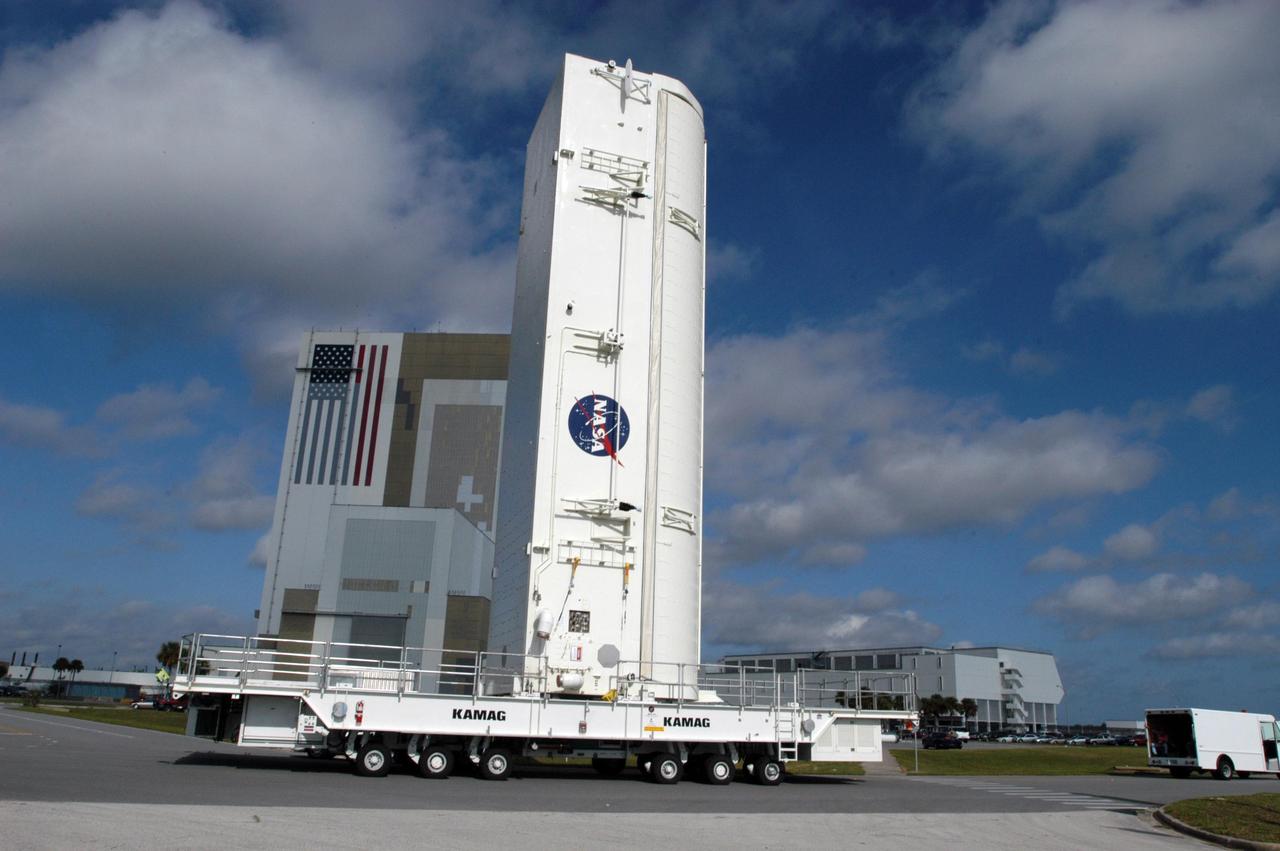
KENNEDY SPACE CENTER, FLA. -- This payload canister is being transported to Launch Pad 39A for a "fit check." At a later date, the canister will be used to transport to the pad the S3/S4 solar arrays that are the payload for mission STS-117. The mission will launch on Space Shuttle Atlantis for the 21st flight to the International Space Station, and the crew of six will continue the construction of station with the installation of the arrays. The launch of Atlantis is targeted for March 16. Photo credit: NASA/George Shelton
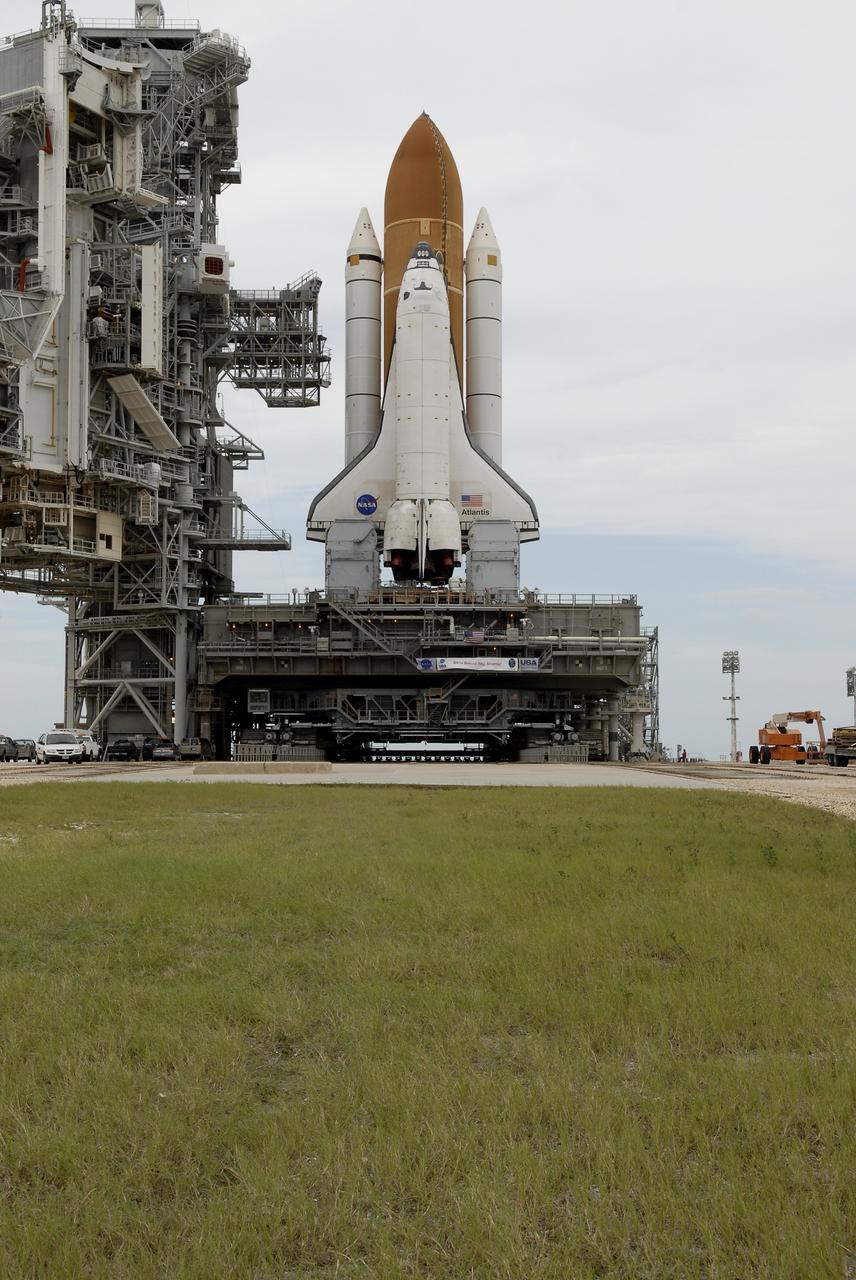
CAPE CANAVERAL, Fla. – Space shuttle Atlantis comes to a stop on the top of Launch Pad 39A at NASA's Kennedy Space Center after more than a 6-hour journey from the Vehicle Assembly Building. First motion occurred at 9:19 a.m. EDT and Atlantis was hard down on the pad at 3:52 p.m. The shuttle stack, with solid rocket boosters and external fuel tank attached to Atlantis, rest on the mobile launcher platform. Movement is provided by the crawler-transporter underneath. The Sept. 2 rollout date was postponed due to Tropical Storm Hanna’s shift to a northern track. Atlantis is scheduled to launch on the STS-125 mission to service NASA’s Hubble Space Telescope. Launch is targeted for Oct. 8. Photo credit: NASA/Kim Shiflett

KENNEDY SPACE CENTER, FLA. -- In the Orbiter Processing Facility, STS-117 Pilot Lee Archambault (left) and Mission Specialist James Reilly (right) look over the external airlock in the payload bay of Atlantis. They and other crew members are at KSC to take part in a Crew Equipment Interface Test that allows them opportunities to become familiar with equipment and hardware for their mission. STS-117 will deliver the S3/S4 and another pair of solar arrays to the space station. The 21st shuttle mission to the International Space Station, STS-117 is scheduled to launch no earlier than March 16. Photo credit: NASA/Kim Shiflett

KENNEDY SPACE CENTER, FLA. - Nearing dawn on Launch Pad 39B, the payload canister is in position to be lifted into the payload changeout room (PCR) for transfer of its cargo into the PCR. The canister holds the payload for Atlantis and mission STS-115, the Port 3/4 truss segment with two large solar arrays. The payload changeout room provides an environmentally clean or "white room" condition in which to receive a payload transferred from a protective payload canister. After the shuttle arrives at the pad, the rotating service structure will close around it and the payload will then be transferred into Atlantis' payload bay. Atlantis' launch window begins Aug. 28. During its 11-day mission to the International Space Station, the STS-115 crew of six astronauts will install the truss, a 17-ton segment of the space station's truss backbone. Photo credit: NASA/George Shelton
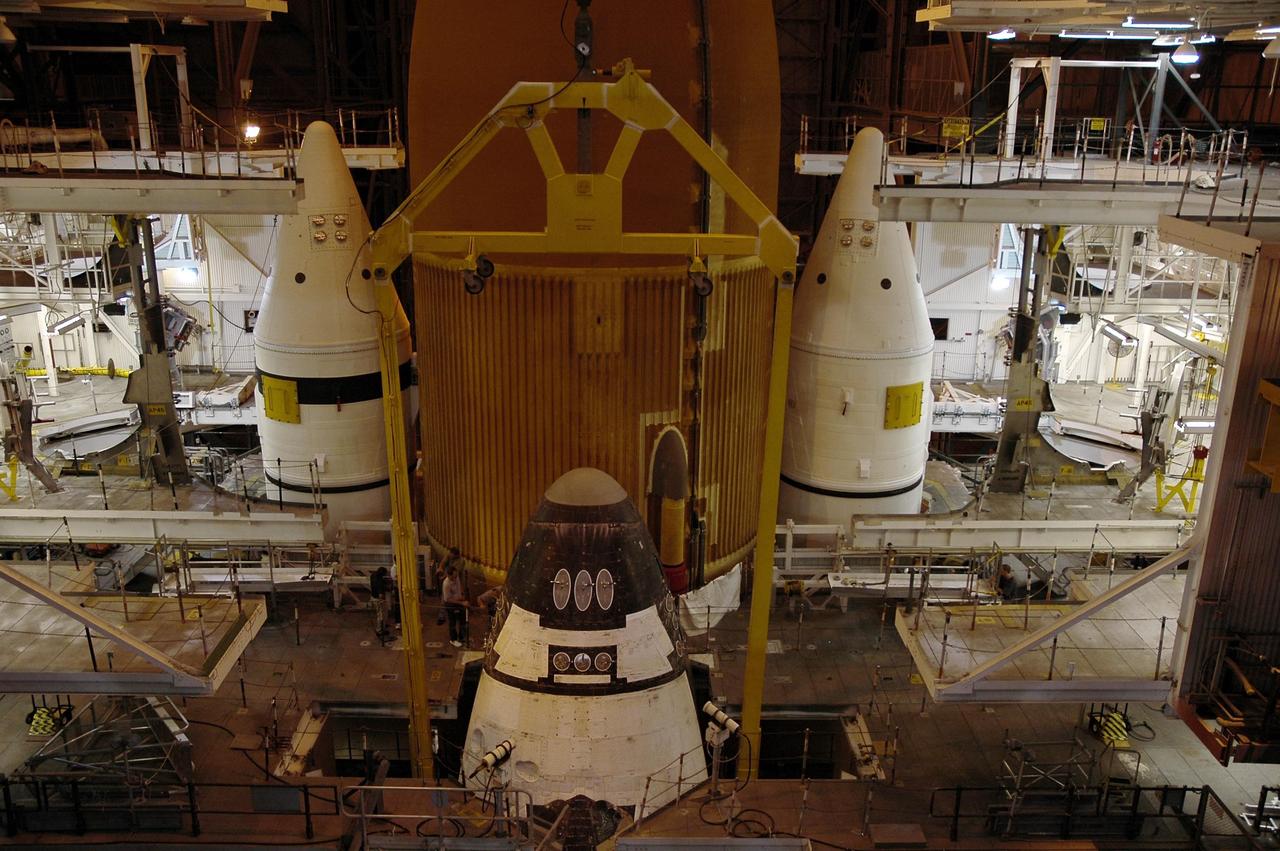
KENNEDY SPACE CENTER, FLA. - In high bay 3 of the Vehicle Assembly Building, the nose of the orbiter Atlantis is dwarfed by the external tank behind it and the twin solid rocket boosters. The orbiter is being mated with the tank and boosters, already installed on the mobile launcher platform below. After the stacking, Atlantis will undergo a shuttle interface test and other prelaunch processing. Atlantis' launch window begins Aug. 28. During its 11-day mission to the International Space Station, the STS-115 crew of six astronauts will continue construction of the station and install their cargo, the Port 3/4 truss segment with its two large solar arrays. Photo credit: NASA/Troy Cryder
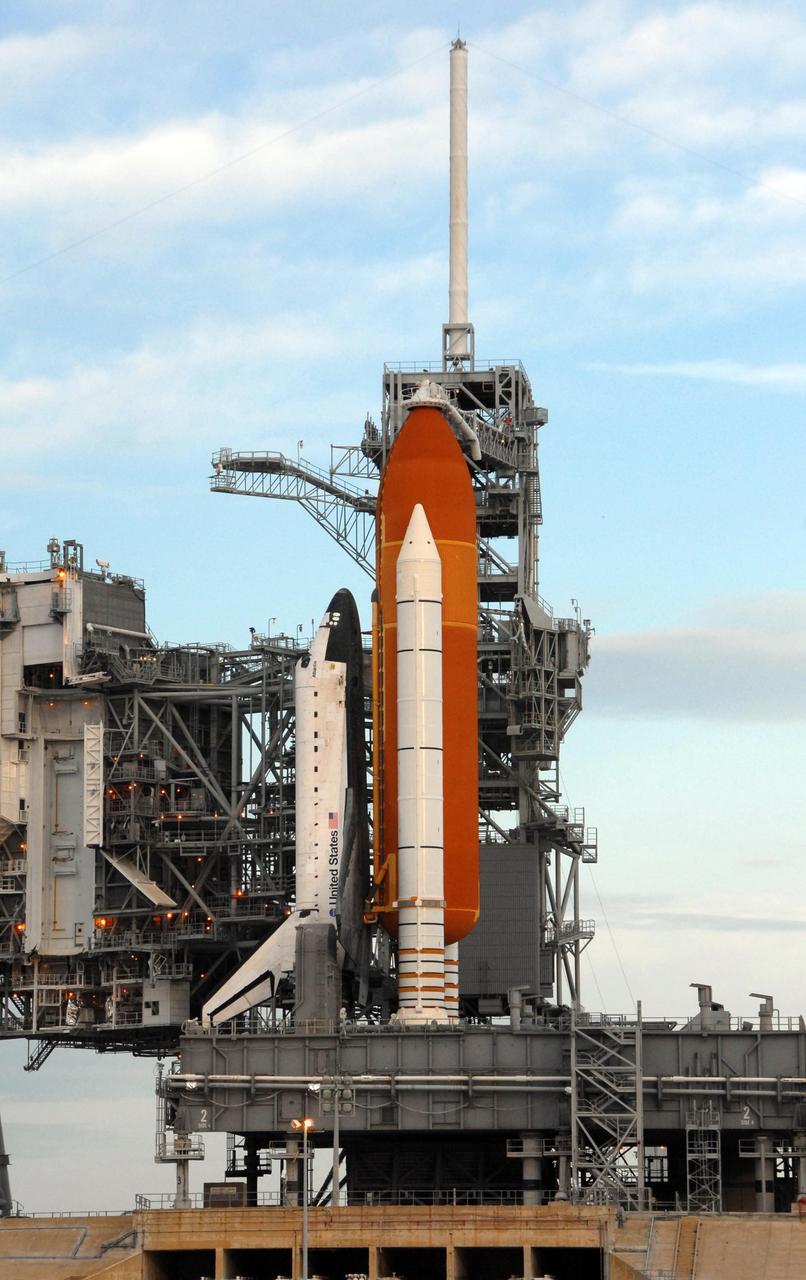
KENNEDY SPACE CENTER, FLA. -- The lightning mast on Launch Pad 39A stands ready to protect Space Shuttle Atlantis from potential thunderstorms following sunrise on a cloudy Florida day. Rollback of the pad's rotating service structure, or RSS, is one of the milestones in preparation for the launch of mission STS-117 on June 8. Rollback started at 10:56 p.m. EDT June 7 and was complete at 11:34 p.m. The RSS, the massive structure to the left of the shuttle, provides protected access to the orbiter for changeout and servicing of payloads at the pad. The structure is supported by a rotating bridge that pivots about a vertical axis on the side of the pad's flame trench. The hinge column rests on the pad surface and is braced to the fixed service structure. Support for the outer end of the bridge is provided by two eight-wheel, motor-driven trucks that move along circular twin rails installed flush with the pad surface. The track crosses the flame trench on a permanent bridge. The RSS is 102 feet long, 50 feet wide and 130 feet high. The structure has orbiter access platforms at five levels to provide access to the payload bay while the orbiter is being serviced in the RSS. Each platform has independent extendable planks that can be arranged to conform to a payload's configuration. This mission is the 118th shuttle flight and the 21st U.S. flight to the International Space Station and will deliver and install the S3/S4 truss segment, deploy a set of solar arrays and prepare them for operation. Photo credit: NASA/Ken Thornsley
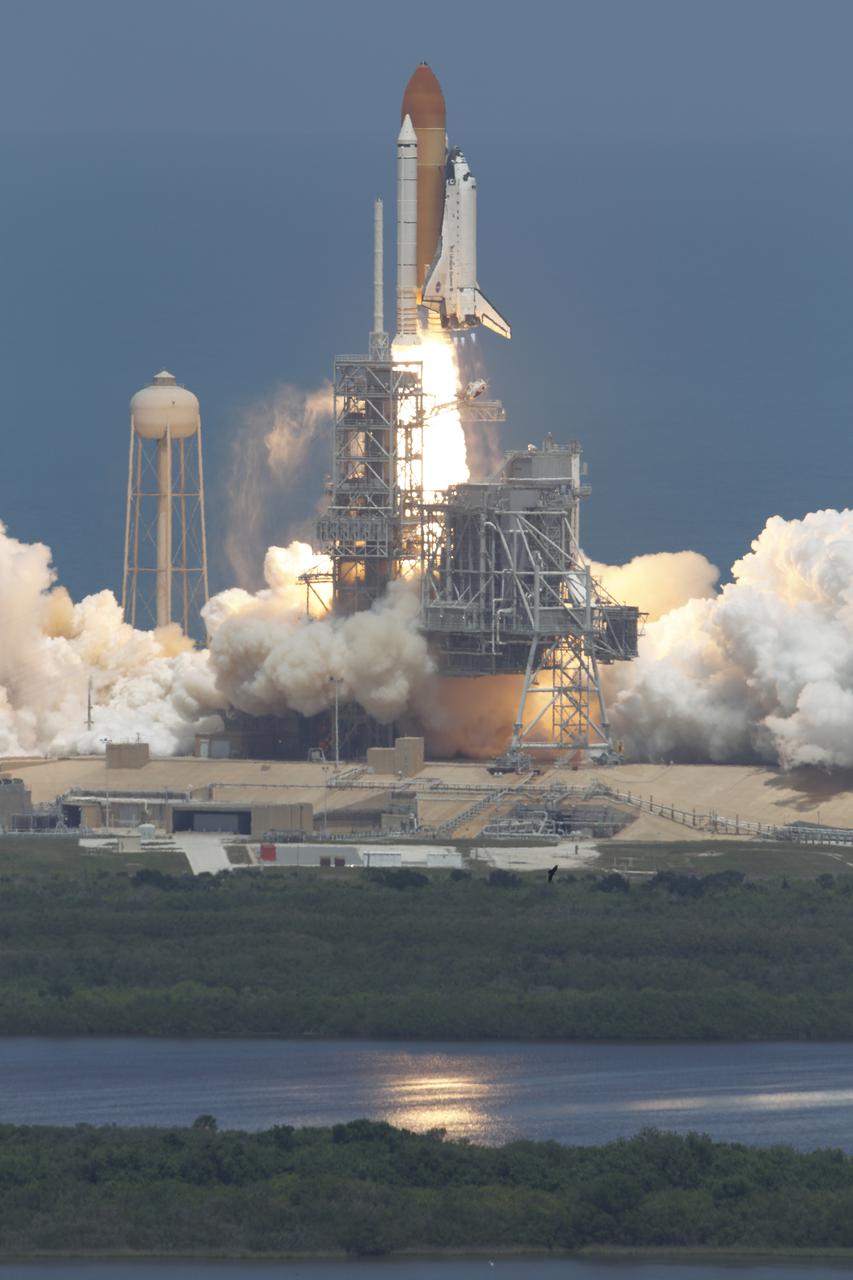
CAPE CANAVERAL, Fla. - Space shuttle Atlantis soars toward orbit from Florida's Space Coast, beginning the STS-132 mission to the International Space Station. The spacecraft took off from NASA Kennedy Space Center's Launch Pad 39A at 2:20 p.m. EDT on May 14. STS-132 is the 132nd shuttle flight, the 32nd for Atlantis and the 34th shuttle mission dedicated to station assembly and maintenance. For more information on the STS-132 mission objectives, payload and crew, visit www.nasa.gov_mission_pages_shuttle_shuttlemissions_sts132_index.html. Photo courtesy of Scott Andrews

CAPE CANAVERAL, Fla. - Space shuttle Atlantis soars to orbit from Launch Pad 39A at NASA's Kennedy Space Center in Florida on the STS-132 mission to the International Space Station at 2:20 p.m. EDT on May 14. The Russian-built Mini Research Module-1 known as Rassvet, or 'dawn,' is inside the shuttle's cargo bay. It will provide additional storage space and a new docking port for Russian Soyuz and Progress spacecraft. The laboratory will be attached to the bottom port of the station's Zarya module. The mission's three spacewalks will focus on storing spare components outside the station, including six batteries, a communications antenna and parts for the Canadian Dextre robotic arm. STS-132 is the 132nd shuttle flight, the 32nd for Atlantis and the 34th shuttle mission dedicated to station assembly and maintenance. For more information on the STS-132 mission objectives, payload and crew, visit www.nasa.gov_mission_pages_shuttle_shuttlemissions_sts132_index.html. Photo Credit: NASA_Jack Pfaller
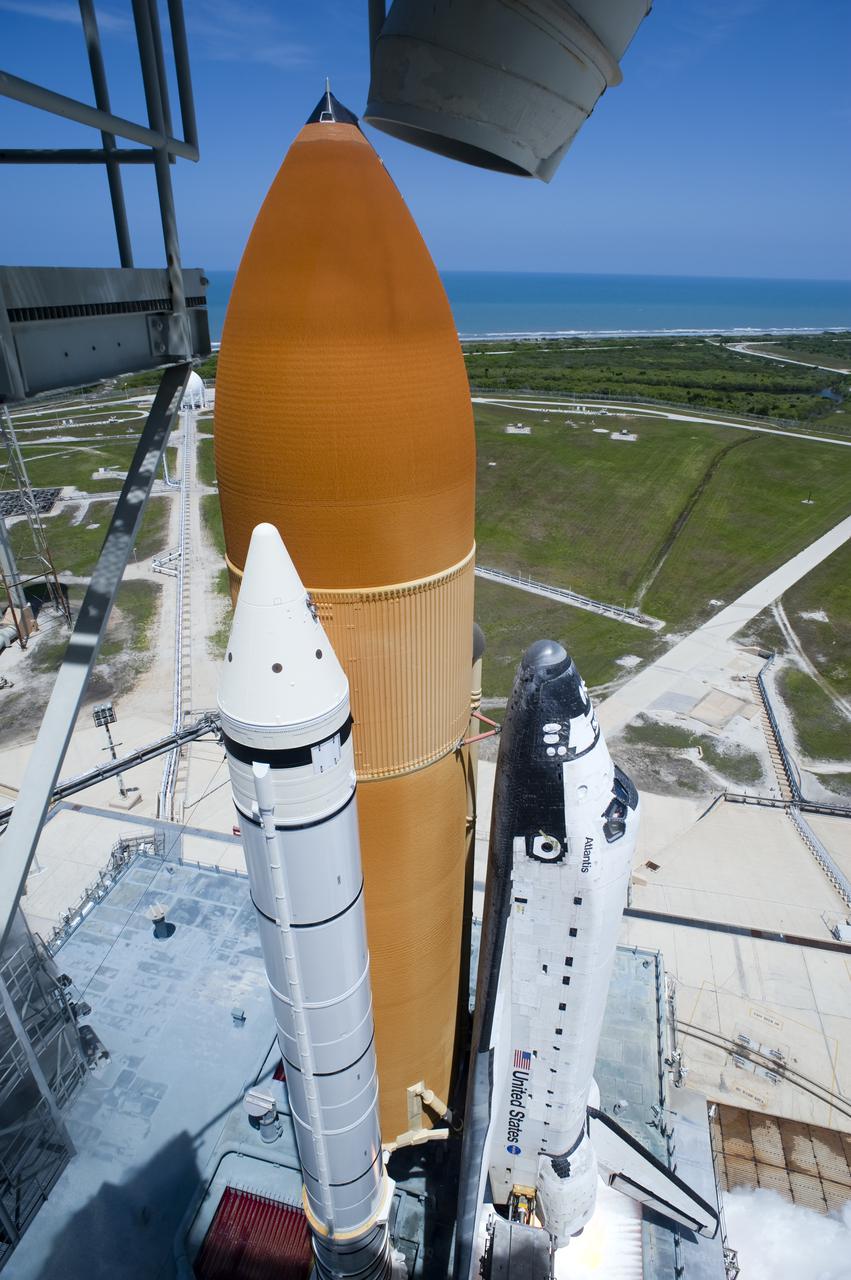
CAPE CANAVERAL, Fla. - Space shuttle Atlantis and its six STS-132 astronauts lift off seaside Launch Pad 39A at NASA's Kennedy Space Center in Florida at 2:20 p.m. EDT on May 14. Atlantis' primary payload for the STS-132 mission is the Russian-built Mini Research Module-1, which will provide additional storage space and a new docking port for Russian Soyuz and Progress spacecraft aboard the International Space Station. STS-132 is the 132nd shuttle flight, the 32nd for Atlantis and the 34th shuttle mission dedicated to station assembly and maintenance. For more information on the STS-132 mission objectives, payload and crew, visit www.nasa.gov_mission_pages_shuttle_shuttlemissions_sts132_index.html. Photo credit: NASA_Tony Gray and Tom Farrar

CAPE CANAVERAL, Fla. – In the Vehicle Assembly Building at NASA's Kennedy Space Center in Florida, a worker on an access platform in High Bay 1 is spotter for space shuttle Atlantis as the crawler-transporter prepares to carry it to Launch Pad 39A. First motion out of the bay was at 6:38 a.m. EDT Oct. 14. The 3.4-mile trip, known as rollout, is expected to take about six hours. Liftoff of Atlantis on its STS-129 mission to the International Space Station is targeted for Nov. 12. For information on the STS-129 mission and crew, visit http://www.nasa.gov/mission_pages/shuttle/shuttlemissions/sts129/index.html. Photo credit: NASA/Kim Shiflett

KENNEDY SPACE CENTER, FLA. -- External tank No. 124 is lowered into high bay 1 of the Vehicle Assembly Building where it will be mated with the solid rocket boosters for mission STS-117. The boosters are already in place on the mobile launcher platform in the VAB. The mission is targeted to launch on March 16 aboard Space Shuttle Atlantis. Photo credit: NASA/Kim Shiflett

CAPE CANAVERAL, Fla. - Space shuttle Atlantis soars to orbit from Launch Pad 39A at NASA's Kennedy Space Center in Florida on the STS-132 mission to the International Space Station at 2:20 p.m. EDT on May 14. The third of five shuttle missions planned for 2010, this was the last planned launch for Atlantis. The Russian-built Mini Research Module-1 is inside the shuttle's cargo bay. Also known as Rassvet, or 'dawn,' it will provide additional storage space and a new docking port for Russian Soyuz and Progress spacecraft. The laboratory will be attached to the bottom port of the station's Zarya module. The mission's three spacewalks will focus on storing spare components outside the station, including six batteries, a communications antenna and parts for the Canadian Dextre robotic arm. STS-132 is the 132nd shuttle flight, the 32nd for Atlantis and the 34th shuttle mission dedicated to station assembly and maintenance. For more information on the STS-132 mission objectives, payload and crew, visit www.nasa.gov_mission_pages_shuttle_shuttlemissions_sts132_index.html. Photo Credit: NASA_Kenny Allen