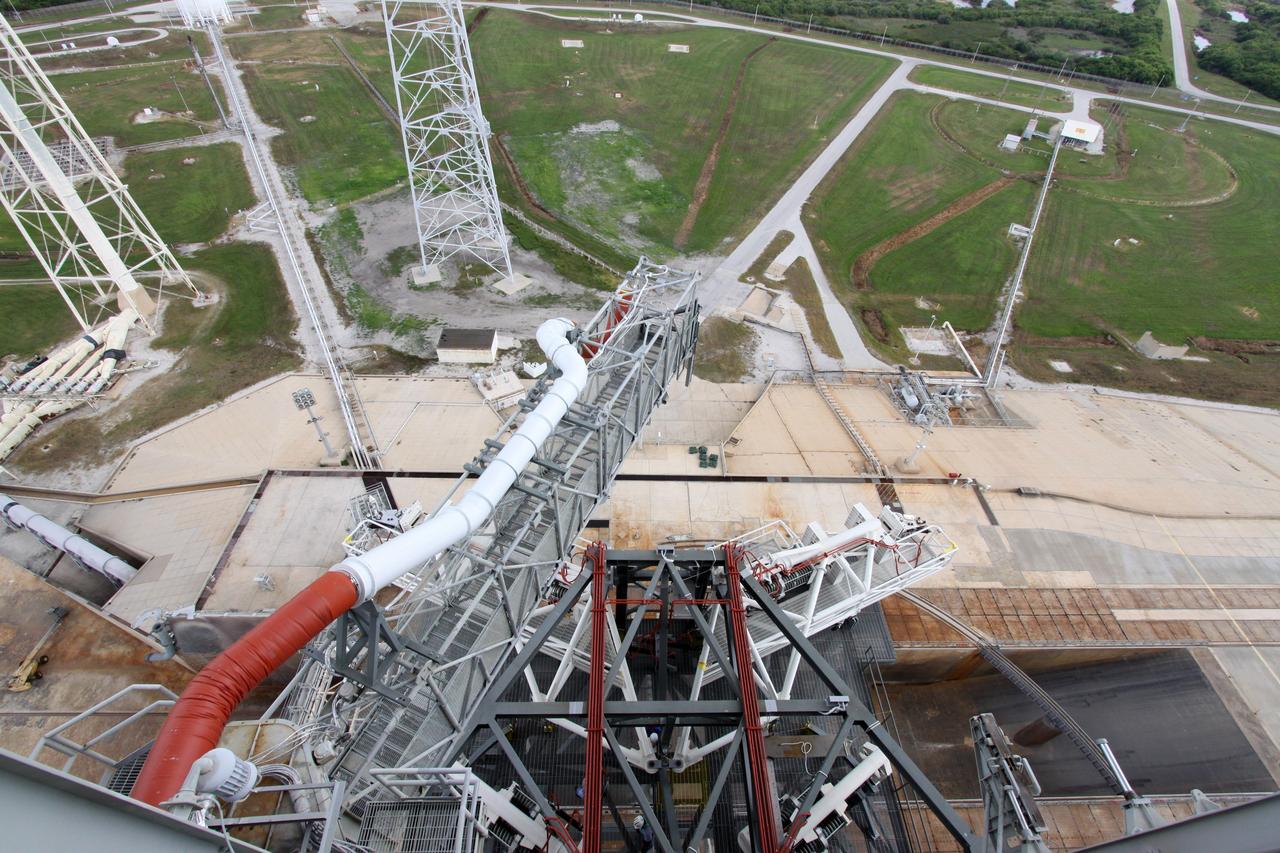
CAPE CANAVERAL, Fla. – At NASA's Kennedy Space Center in Florida, an access platform and vent line have been installed on the 255-foot level of Launch Pad 39B to support the Ares I-X rocket. Below it on the 235-foot level is the vehicle stabilization system. The transfer of the pad from the Space Shuttle Program to the Constellation Program took place May 31. Other modifications made to the pad include the removal of shuttle unique subsystems, such as the orbiter access arm and a section of the gaseous oxygen vent arm, along with the installation of three 600-foot lightning towers, access platforms and environmental control systems. Part of the Constellation Program, the Ares I-X is the test vehicle for the Ares I, which is the essential core of a space transportation system designed to carry crewed missions back to the moon, on to Mars and out into the solar system. The Ares I-X flight test is targeted for Oct. 27. For information on the Ares I-X vehicle and flight test, visit http://www.nasa.gov/aresIX. Photo credit: NASA/Jack Pfaller
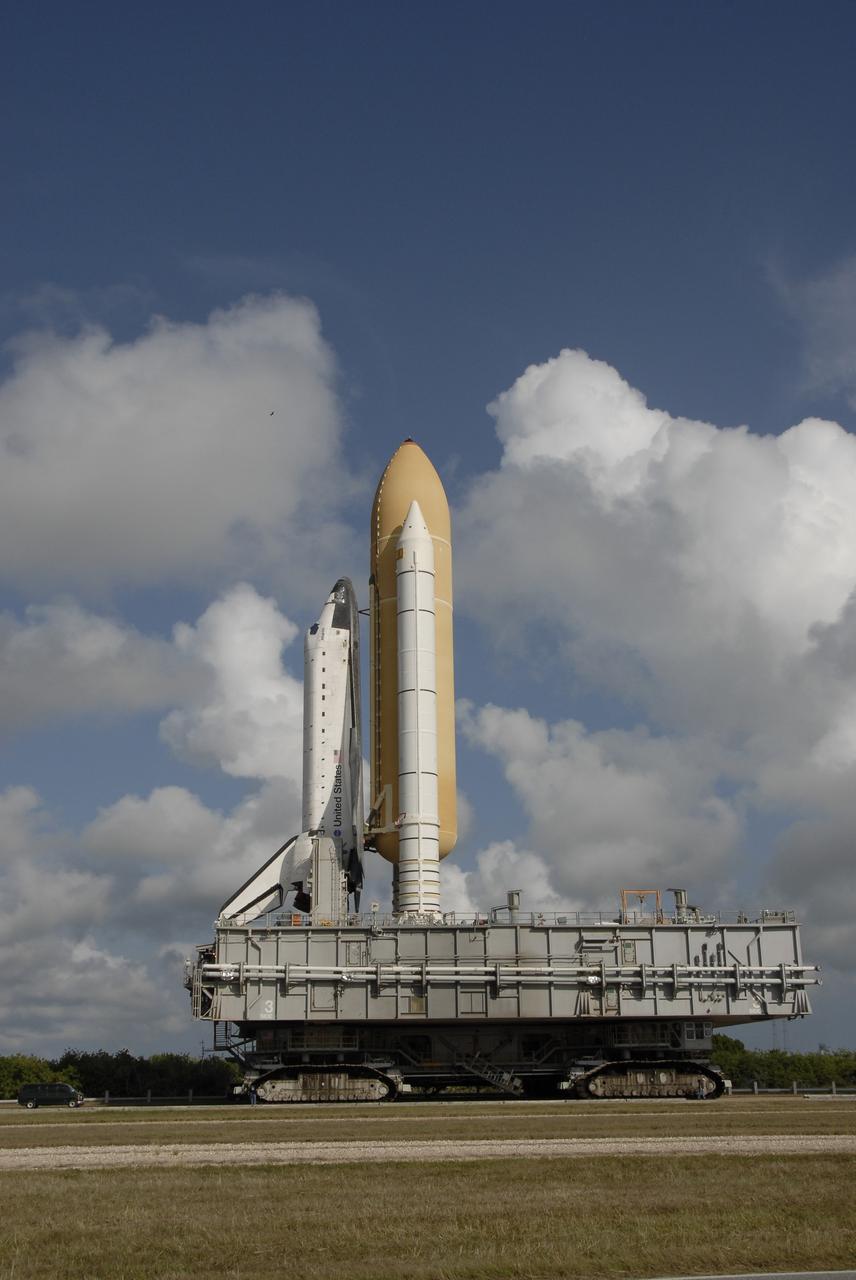
CAPE CANAVERAL, Fla. – At NASA's Kennedy Space Center in Florida, space shuttle Atlantis makes steady progress on its 3.4-mile trek from the Vehicle Assembly Building to Launch Pad 39A. First motion was at 6:38 a.m. EDT Oct. 14. The move, known as rollout, is expected to take about six hours. Liftoff of Atlantis on its STS-129 mission to the International Space Station is targeted for Nov. 12. For information on the STS-129 mission and crew, visit http://www.nasa.gov/mission_pages/shuttle/shuttlemissions/sts129/index.html. Photo credit: NASA/Kim Shiflett

CAPE CANAVERAL, Fla. – At NASA's Kennedy Space Center in Florida, members of the news media interview Ares I-X project managers and take photographs on the 295-foot level of Launch Pad 39B. Modifications to the pad to support the Ares I-X rocket are complete. The transfer of the pad from the Space Shuttle Program to the Constellation Program took place May 31. Modifications made to the pad include the removal of shuttle unique subsystems, such as the orbiter access arm and a section of the gaseous oxygen vent arm, along with the installation of three 600-foot lightning towers, access platforms, environmental control systems and a vehicle stabilization system. Part of the Constellation Program, the Ares I-X is the test vehicle for the Ares I, which is the essential core of a space transportation system designed to carry crewed missions back to the moon, on to Mars and out into the solar system. The Ares I-X flight test is targeted for Oct. 27. For information on the Ares I-X vehicle and flight test, visit http://www.nasa.gov/aresIX. Photo credit: NASA/Jack Pfaller
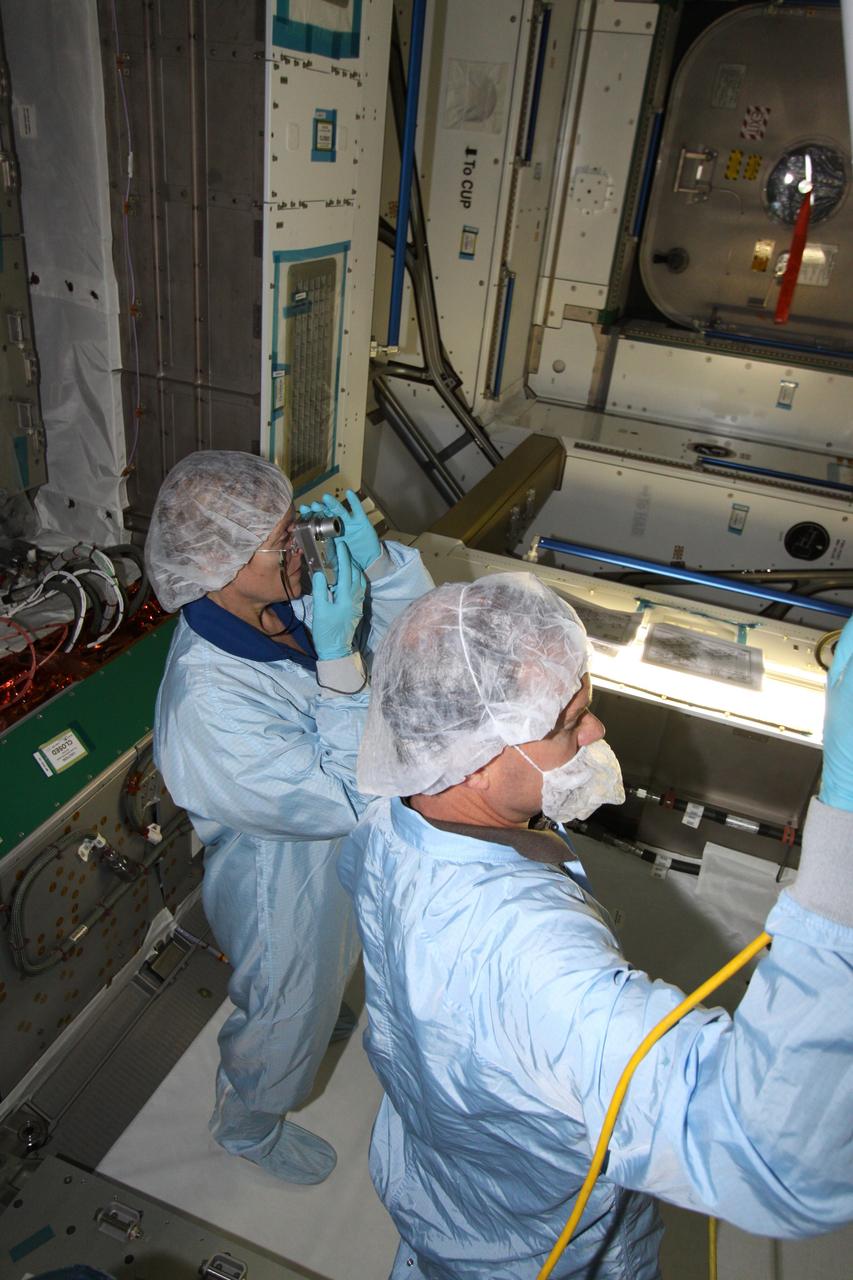
CAPE CANAVERAL, Fla. – Mission specialist Kathryn "Kay" Hire, at left, assigned to the crew of space shuttle Endeavour's STS-130 mission, takes a tour of the Tranquility Node 3 module in the Space Station Processing Facility at NASA's Kennedy Space Center in Florida. Assisting her, at right, is Chris Hardcastle, an STS-130 flight crew representative with United Space Alliance. Tranquility is a pressurized module that will provide room for many of the International Space Station's life support systems. Attached to the node is a cupola, a unique work station with six windows on its sides and one on top. Tranquility is the payload for the STS-130 mission. The module was built for the European Space Agency by Alenia Spazio in Turin, Italy. Cupola resembles a circular bay window that will provide a vastly improved view of the station's exterior. Just under 10 feet in diameter, the module will accommodate two crew members and portable workstations that can control station and robotic activities. The multi-directional view will allow the crew to monitor spacewalks and docking operations, as well as provide a spectacular view of Earth and other celestial objects. Endeavour is targeted to launch Feb. 4, 2010. Photo credit: NASA/Jack Pfaller
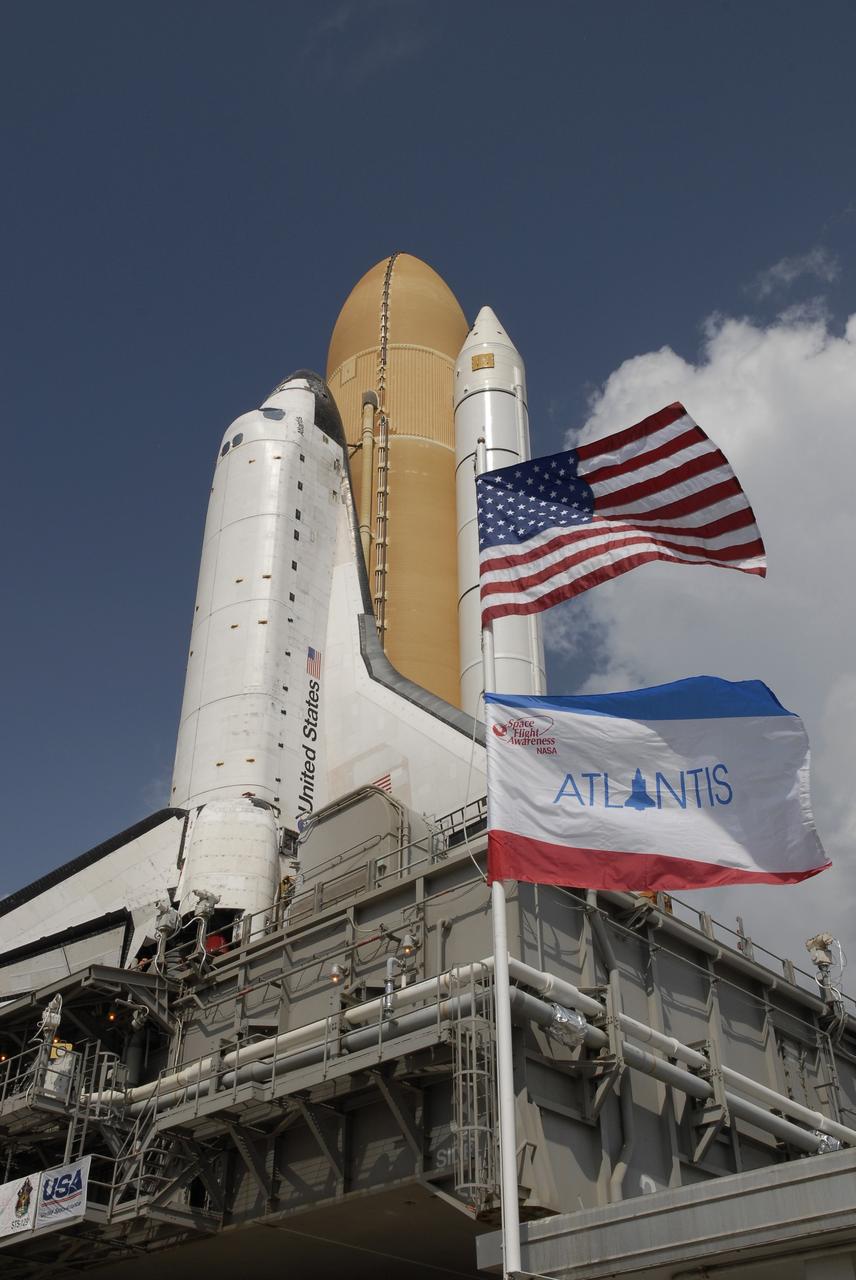
CAPE CANAVERAL, Fla. – At NASA's Kennedy Space Center in Florida, flags at Launch Pad 39A wave as if greeting space shuttle Atlantis upon its arrival. First motion on the 3.4-mile trip from the Vehicle Assembly Building, known as rollout, was at 6:38 a.m. EDT Oct. 14. The rollout took about six hours, and the shuttle was secure on the pad at 1:31 p.m. Liftoff of Atlantis on its STS-129 mission to the International Space Station is targeted for Nov. 12. For information on the STS-129 mission and crew, visit http://www.nasa.gov/mission_pages/shuttle/shuttlemissions/sts129/index.html. Photo credit: NASA/Kim Shiflett
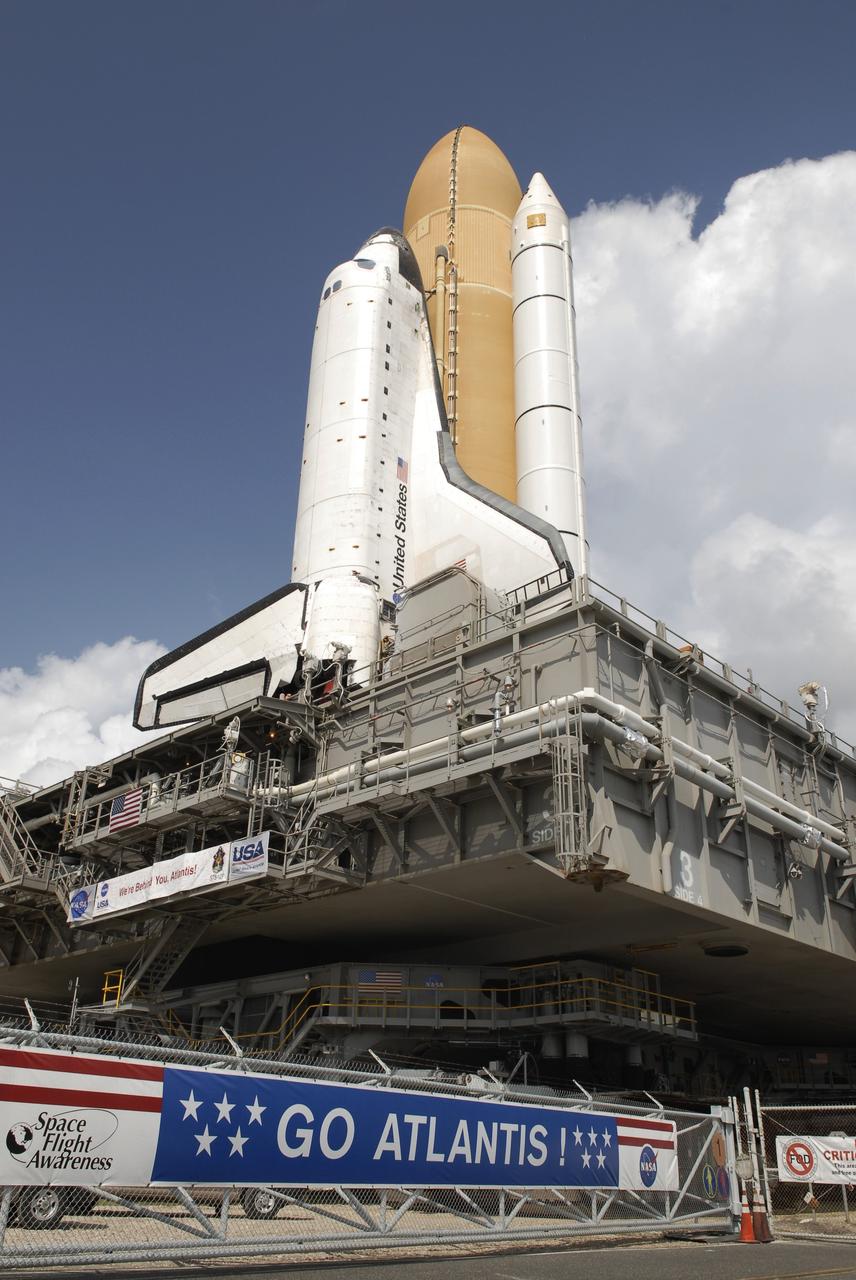
CAPE CANAVERAL, Fla. – At NASA's Kennedy Space Center in Florida, space shuttle Atlantis, attached to its external tank and solid rocket boosters atop a mobile launcher platform, arrives at Launch Complex 39A. First motion on the 3.4-mile trip from the Vehicle Assembly Building, known as rollout, was at 6:38 a.m. EDT Oct. 14. The rollout took about six hours, and the shuttle was secure on the pad at 1:31 p.m. Liftoff of Atlantis on its STS-129 mission to the International Space Station is targeted for Nov. 12. For information on the STS-129 mission and crew, visit http://www.nasa.gov/mission_pages/shuttle/shuttlemissions/sts129/index.html. Photo credit: NASA/Kim Shiflett
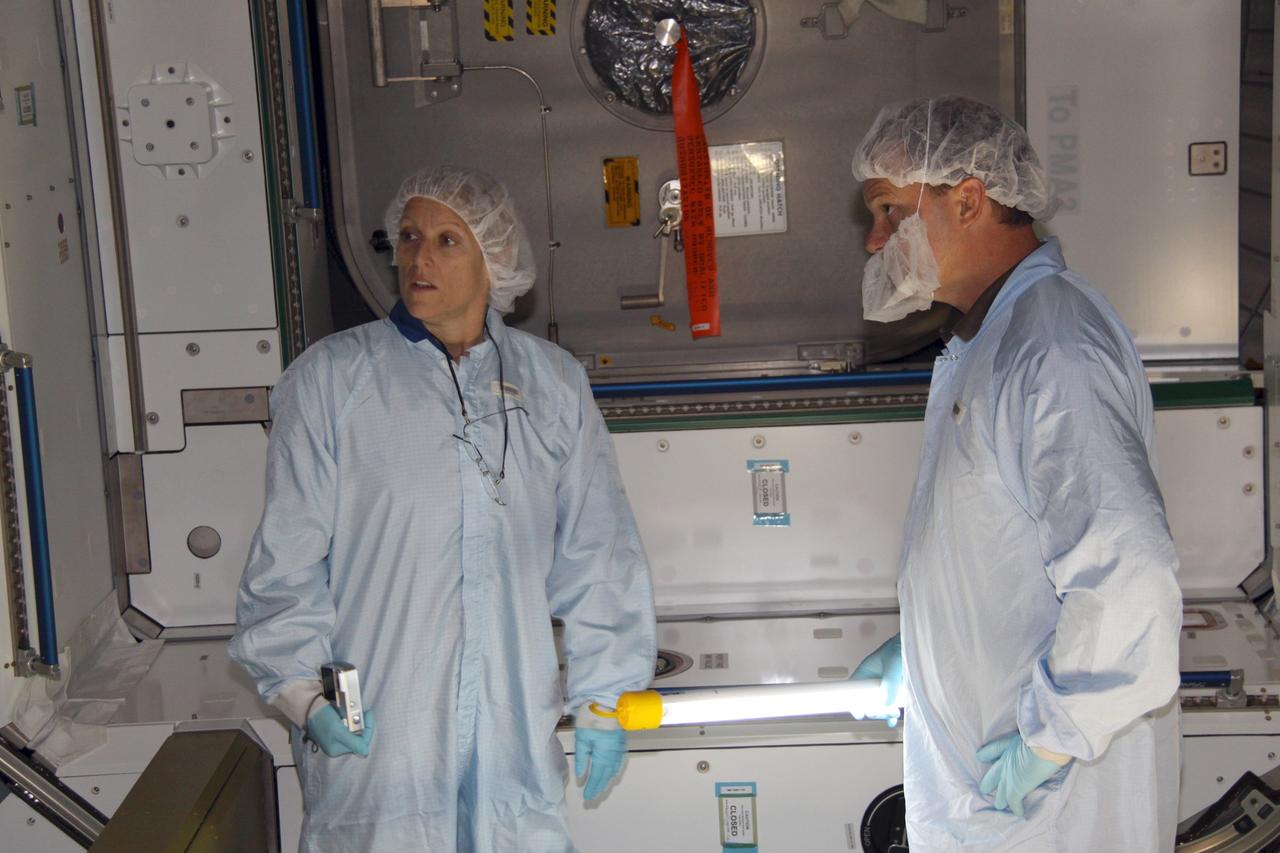
CAPE CANAVERAL, Fla. – Mission specialist Kathryn "Kay" Hire, at left, a crew member on space shuttle Endeavour's STS-130 mission, photographs the interior of the Tranquility Node 3 module in the Space Station Processing Facility at NASA's Kennedy Space Center in Florida. Assisting her, at right, is Chris Hardcastle, an STS-130 flight crew representative with United Space Alliance. Tranquility is a pressurized module that will provide room for many of the International Space Station's life support systems. Attached to the node is a cupola, a unique work station with six windows on its sides and one on top. Tranquility is the payload for the STS-130 mission. The module was built for the European Space Agency by Alenia Spazio in Turin, Italy. Cupola resembles a circular bay window that will provide a vastly improved view of the station's exterior. Just under 10 feet in diameter, the module will accommodate two crew members and portable workstations that can control station and robotic activities. The multi-directional view will allow the crew to monitor spacewalks and docking operations, as well as provide a spectacular view of Earth and other celestial objects. Endeavour is targeted to launch Feb. 4, 2010. Photo credit: NASA/Jack Pfaller
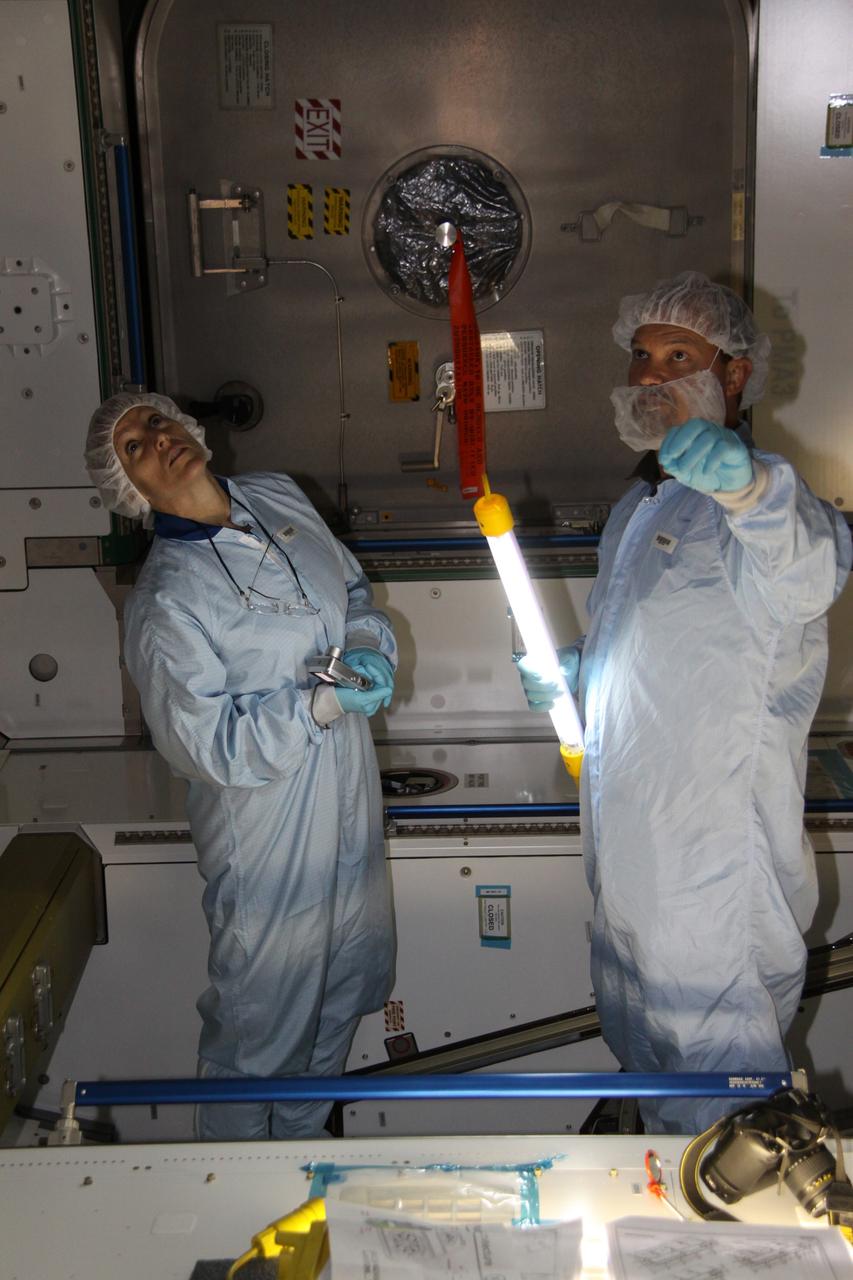
CAPE CANAVERAL, Fla. – Mission specialist Kathryn "Kay" Hire, at left, a crew member on space shuttle Endeavour's STS-130 mission, participates in familiarization training for the Tranquility Node 3 module in the Space Station Processing Facility at NASA's Kennedy Space Center in Florida. Assisting her, at right, is Chris Hardcastle, an STS-130 flight crew representative with United Space Alliance. Tranquility is a pressurized module that will provide room for many of the International Space Station's life support systems. Attached to the node is a cupola, a unique work station with six windows on its sides and one on top. Tranquility is the payload for the STS-130 mission. The module was built for the European Space Agency by Alenia Spazio in Turin, Italy. Cupola resembles a circular bay window that will provide a vastly improved view of the station's exterior. Just under 10 feet in diameter, the module will accommodate two crew members and portable workstations that can control station and robotic activities. The multi-directional view will allow the crew to monitor spacewalks and docking operations, as well as provide a spectacular view of Earth and other celestial objects. Endeavour is targeted to launch Feb. 4, 2010. Photo credit: NASA/Jack Pfaller
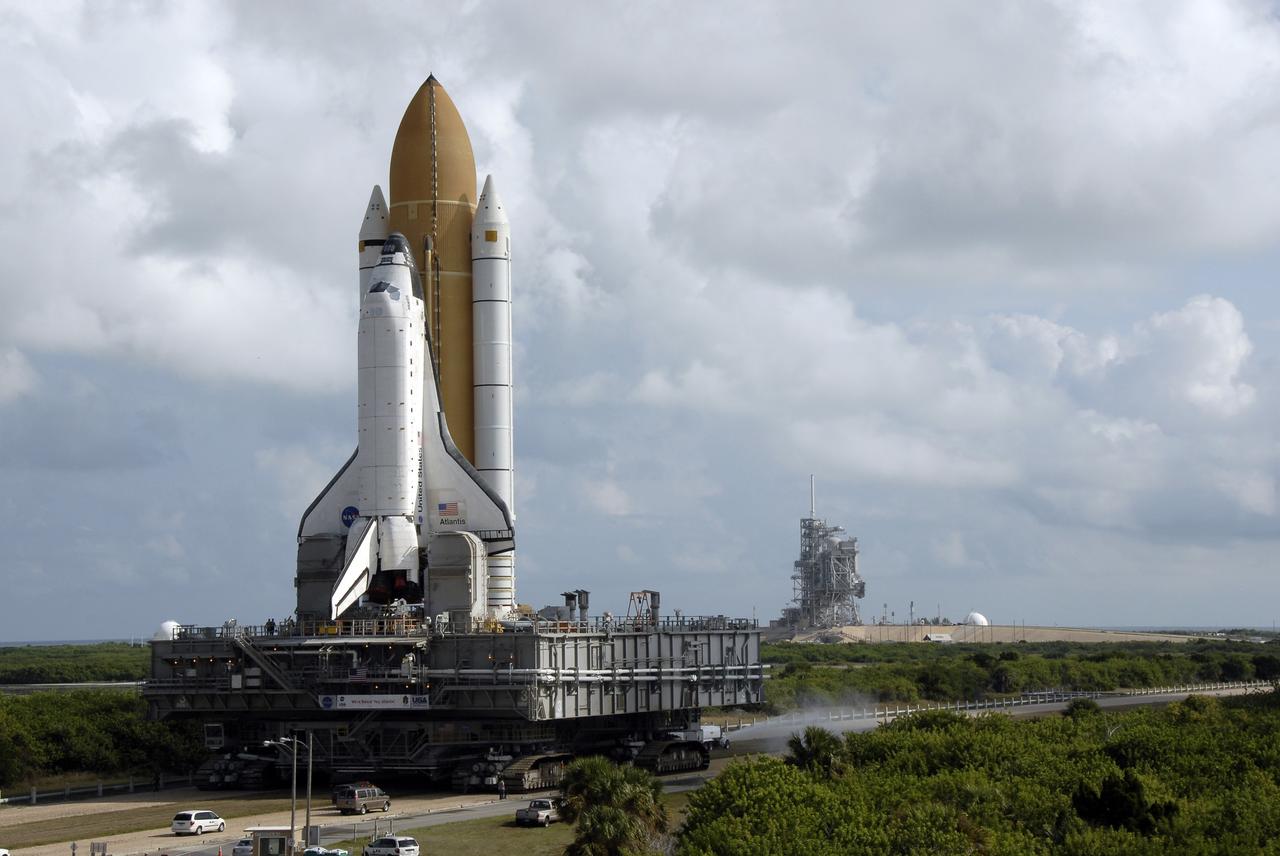
CAPE CANAVERAL, Fla. – At NASA's Kennedy Space Center in Florida, the crawlerway is sprayed with water to minimize the dust cloud generated by the passing of the crawler-transporter. Space shuttle Atlantis is making its 3.4-mile trek from the Vehicle Assembly Building to Launch Pad 39A in the background. First motion was at 6:38 a.m. EDT Oct. 14. The move, known as rollout, is expected to take about six hours. Liftoff of Atlantis on its STS-129 mission to the International Space Station is targeted for Nov. 12. For information on the STS-129 mission and crew, visit http://www.nasa.gov/mission_pages/shuttle/shuttlemissions/sts129/index.html. Photo credit: NASA/Kim Shiflett
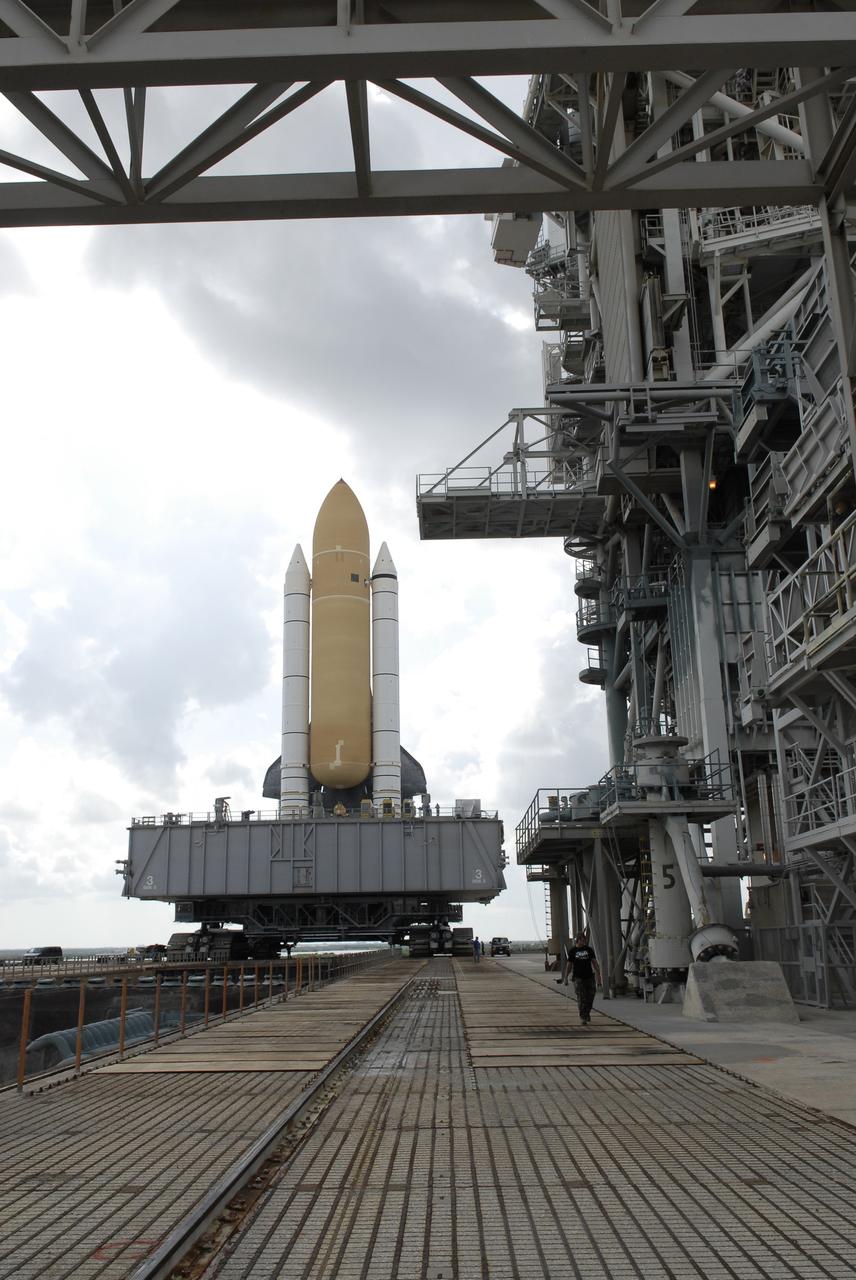
CAPE CANAVERAL, Fla. – At NASA's Kennedy Space Center in Florida, a crawler-transport safely delivers space shuttle Atlantis into position beside the fixed service structure on Launch Pad 39A. First motion on the 3.4-mile journey from the Vehicle Assembly Building, known as rollout, was at 6:38 a.m. EDT Oct. 14. The rollout took about six hours, and the shuttle was secure on the pad at 1:31 p.m. Liftoff of Atlantis on its STS-129 mission to the International Space Station is targeted for Nov. 12. For information on the STS-129 mission and crew, visit http://www.nasa.gov/mission_pages/shuttle/shuttlemissions/sts129/index.html. Photo credit: NASA/Kim Shiflett
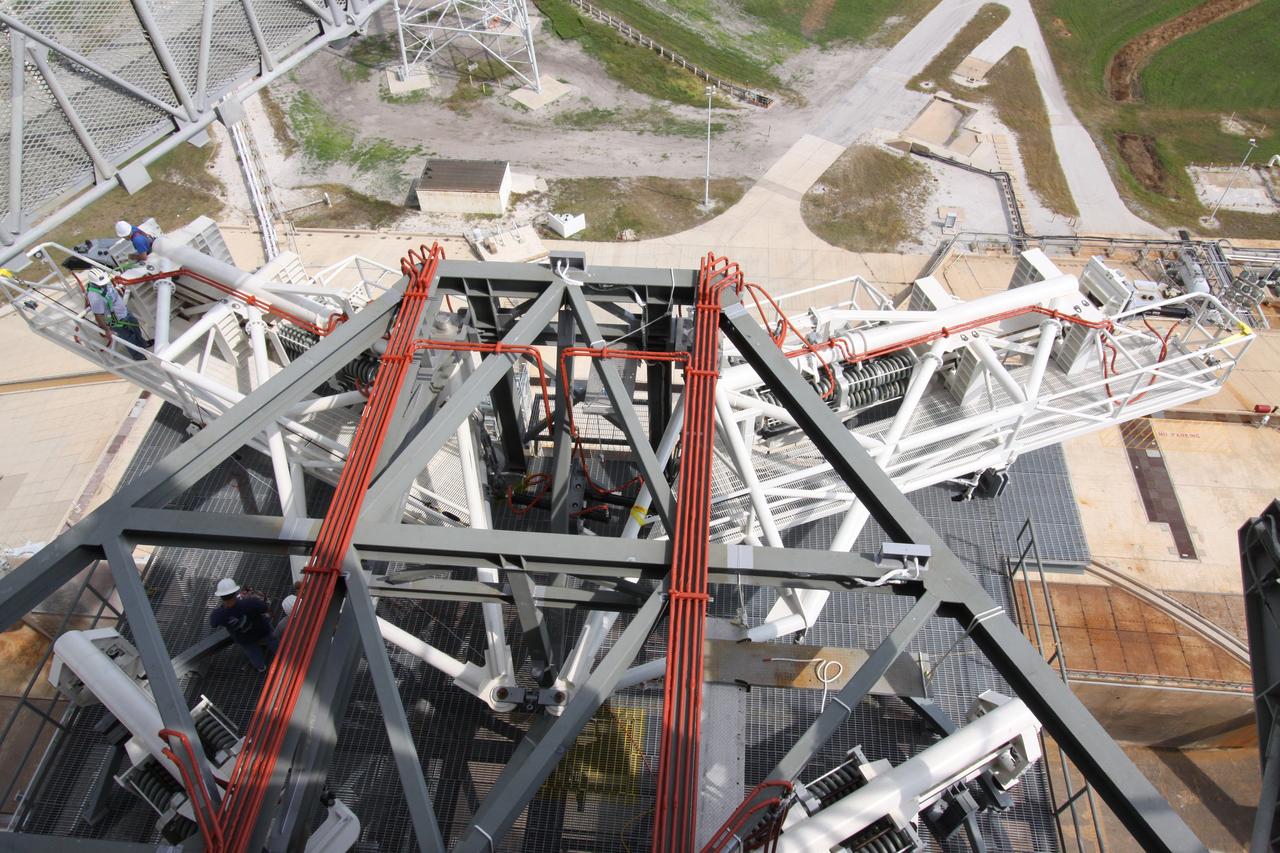
CAPE CANAVERAL, Fla. – At NASA's Kennedy Space Center in Florida, a vehicle stabilization system has been installed on the 235-foot level of Launch Pad 39B to support the Ares I-X rocket. The transfer of the pad from the Space Shuttle Program to the Constellation Program took place May 31. Other modifications made to the pad include the removal of shuttle unique subsystems, such as the orbiter access arm and a section of the gaseous oxygen vent arm, along with the installation of three 600-foot lightning towers, access platforms and environmental control systems. Part of the Constellation Program, the Ares I-X is the test vehicle for the Ares I, which is the essential core of a space transportation system designed to carry crewed missions back to the moon, on to Mars and out into the solar system. The Ares I-X flight test is targeted for Oct. 27. For information on the Ares I-X vehicle and flight test, visit http://www.nasa.gov/aresIX. Photo credit: NASA/Jack Pfaller
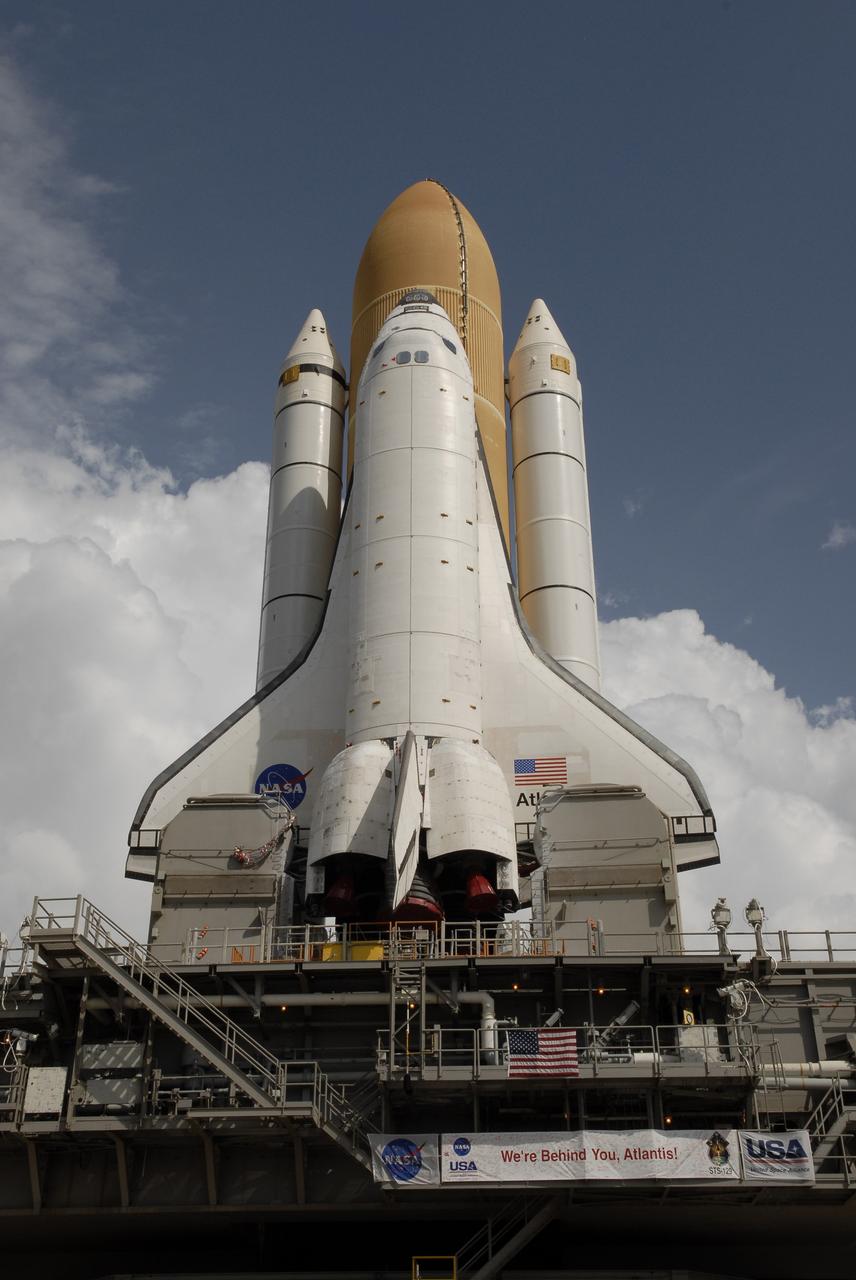
CAPE CANAVERAL, Fla. – At NASA's Kennedy Space Center in Florida, space shuttle Atlantis, attached to its external tank and solid rocket boosters atop a mobile launcher platform, nears the end of its 3.4-mile trip, known as rollout, from the Vehicle Assembly Building to Launch Pad 39A. First motion was at 6:38 a.m. EDT Oct. 14. Rollout is expected to take about six hours. Liftoff of Atlantis on its STS-129 mission to the International Space Station is targeted for Nov. 12. For information on the STS-129 mission and crew, visit http://www.nasa.gov/mission_pages/shuttle/shuttlemissions/sts129/index.html. Photo credit: NASA/Kim Shiflett
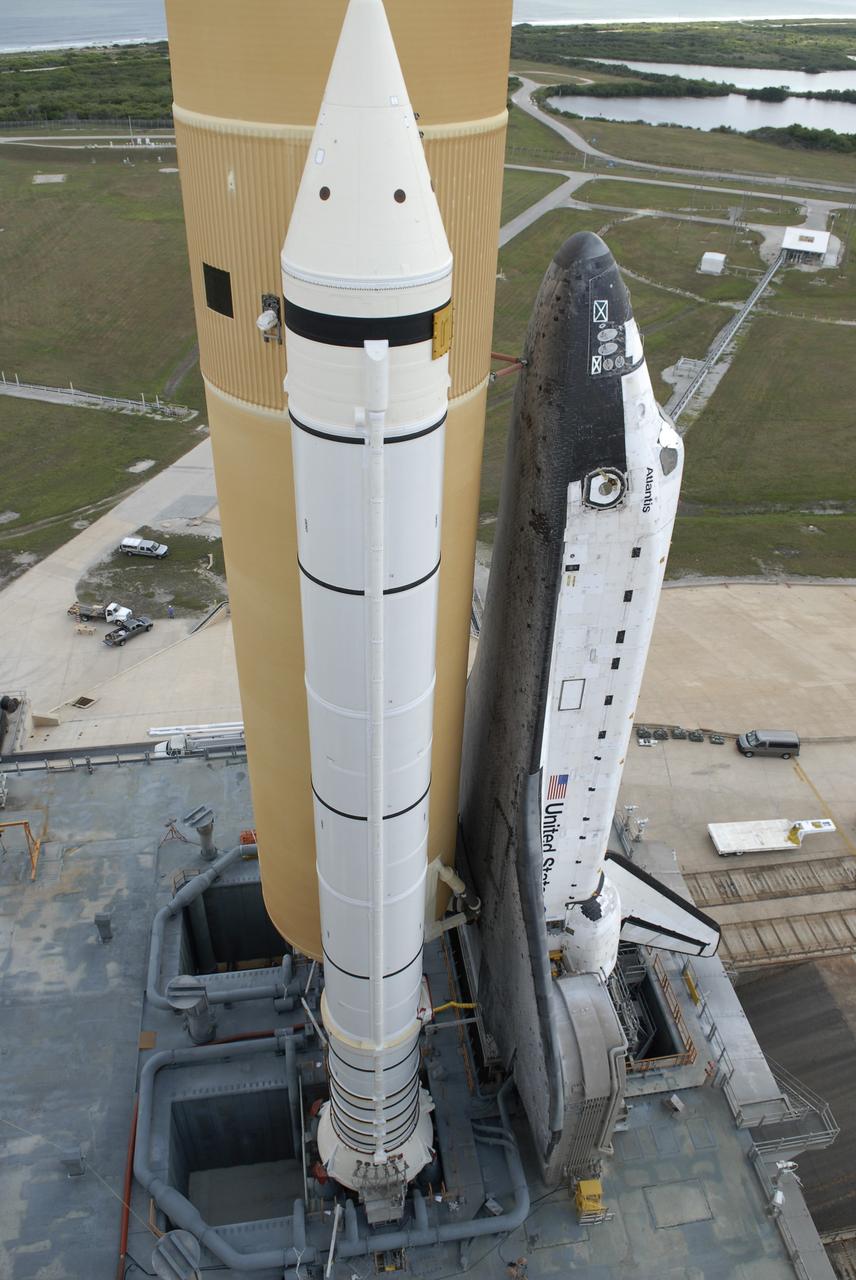
CAPE CANAVERAL, Fla. – At NASA's Kennedy Space Center in Florida, the mobile launcher platform, on which space shuttle Atlantis sits, straddles the flame trench on Launch Pad 39A. First motion on the 3.4-mile journey from the Vehicle Assembly Building, known as rollout, was at 6:38 a.m. EDT Oct. 14. The rollout took about six hours, and the shuttle was secure or "hard down" on the pad at 1:31 p.m. Liftoff of Atlantis on its STS-129 mission to the International Space Station is targeted for Nov. 12. For information on the STS-129 mission and crew, visit http://www.nasa.gov/mission_pages/shuttle/shuttlemissions/sts129/index.html. Photo credit: NASA/Kim Shiflett
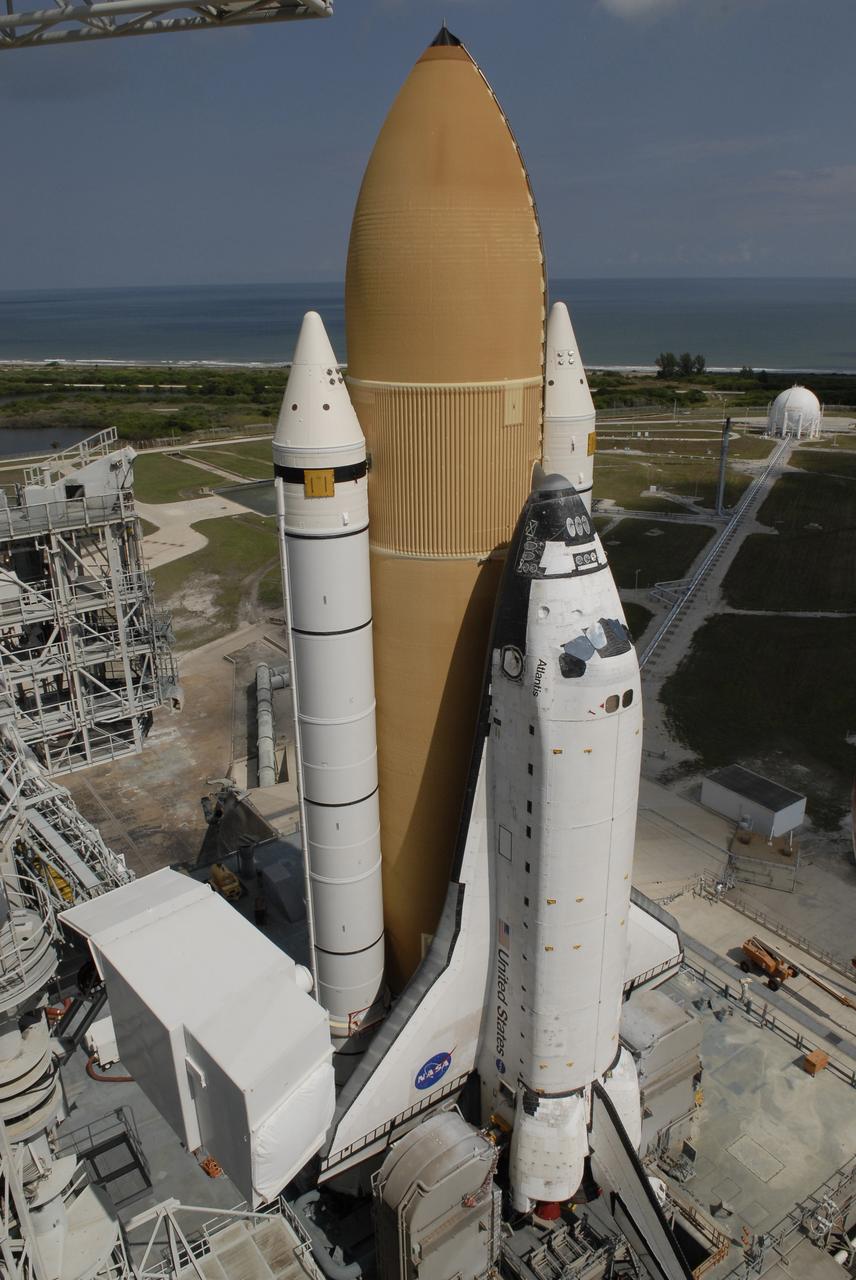
CAPE CANAVERAL, Fla. – At NASA's Kennedy Space Center in Florida, space shuttle Atlantis reaches the end of its 3.4-mile journey, known as rollout, from the Vehicle Assembly Building to Launch Pad 39A. The pad overlooks the Atlantic Ocean in the background. First motion was at 6:38 a.m. EDT Oct. 14. The rollout took about six hours, and the shuttle was secure or "hard down" on the pad at 1:31 p.m. Liftoff of Atlantis on its STS-129 mission to the International Space Station is targeted for Nov. 12. For information on the STS-129 mission and crew, visit http://www.nasa.gov/mission_pages/shuttle/shuttlemissions/sts129/index.html. Photo credit: NASA/Kim Shiflett
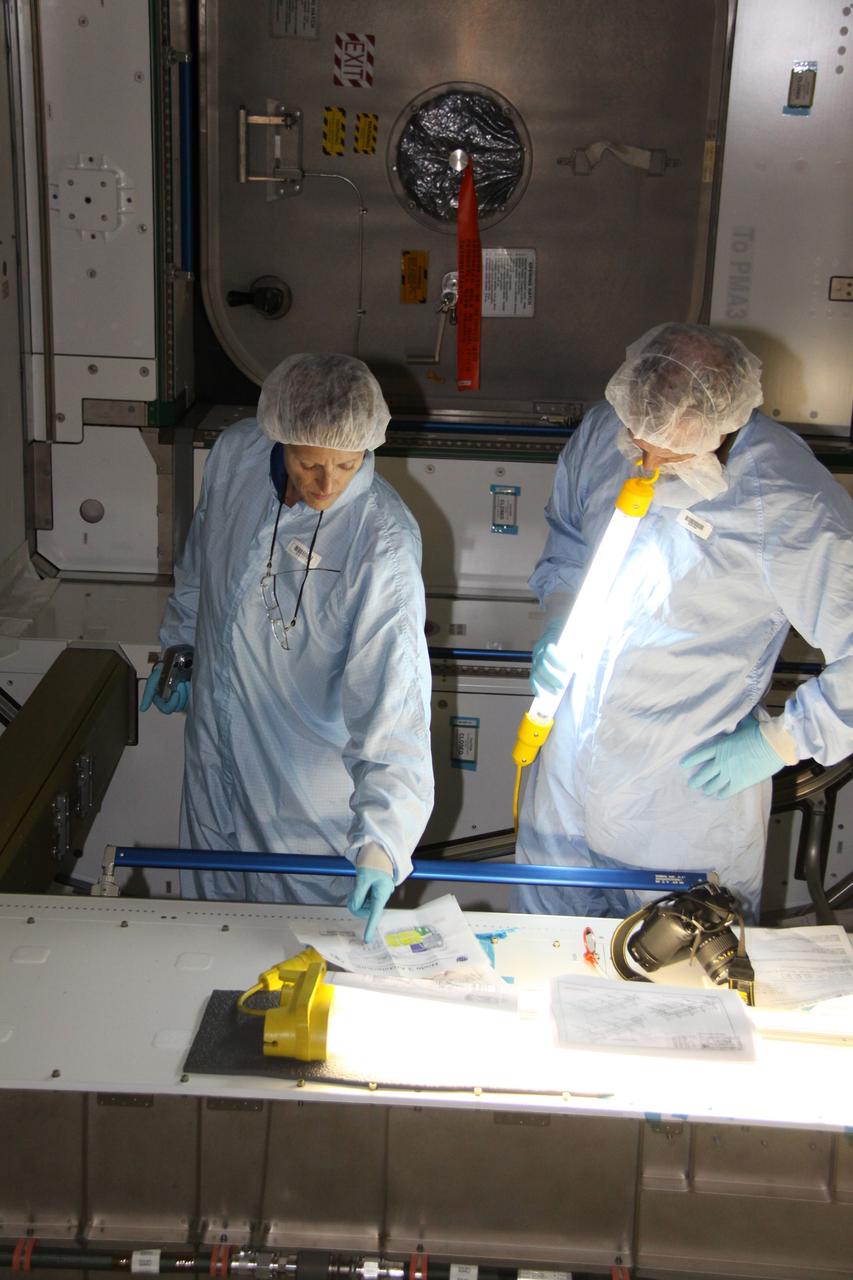
CAPE CANAVERAL, Fla. – In the Space Station Processing Facility at NASA's Kennedy Space Center in Florida, mission specialist Kathryn "Kay" Hire, left, a crew member on space shuttle Endeavour's STS-130 mission, discusses the layout of the Tranquility Node 3 module in which she is standing with Chris Hardcastle, an STS-130 flight crew representative with United Space Alliance. Tranquility is a pressurized module that will provide room for many of the International Space Station's life support systems. Attached to the node is a cupola, a unique work station with six windows on its sides and one on top. Tranquility is the payload for the STS-130 mission. The module was built for the European Space Agency by Alenia Spazio in Turin, Italy. Cupola resembles a circular bay window that will provide a vastly improved view of the station's exterior. Just under 10 feet in diameter, the module will accommodate two crew members and portable workstations that can control station and robotic activities. The multi-directional view will allow the crew to monitor spacewalks and docking operations, as well as provide a spectacular view of Earth and other celestial objects. Endeavour is targeted to launch Feb. 4, 2010. Photo credit: NASA/Jack Pfaller
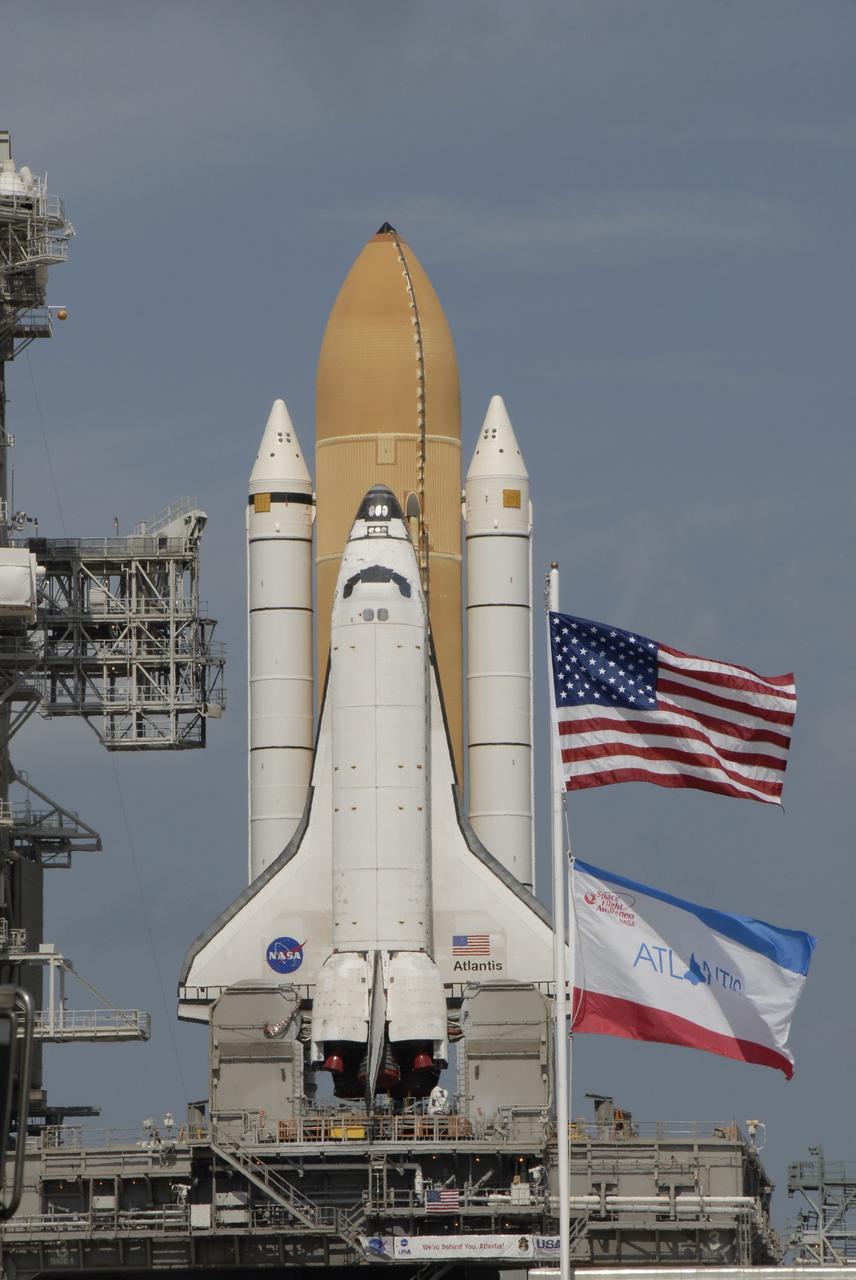
CAPE CANAVERAL, Fla. – At NASA's Kennedy Space Center in Florida, flags flap in the breeze off the Atlantic Ocean at Launch Pad 39A. Space shuttle Atlantis has reached the end of its 3.4-mile journey, known as rollout, from the Vehicle Assembly Building. First motion was at 6:38 a.m. EDT Oct. 14. The rollout took about six hours, and the shuttle was secure or "hard down" on the pad at 1:31 p.m. Liftoff of Atlantis on its STS-129 mission to the International Space Station is targeted for Nov. 12. For information on the STS-129 mission and crew, visit http://www.nasa.gov/mission_pages/shuttle/shuttlemissions/sts129/index.html. Photo credit: NASA/Kim Shiflett
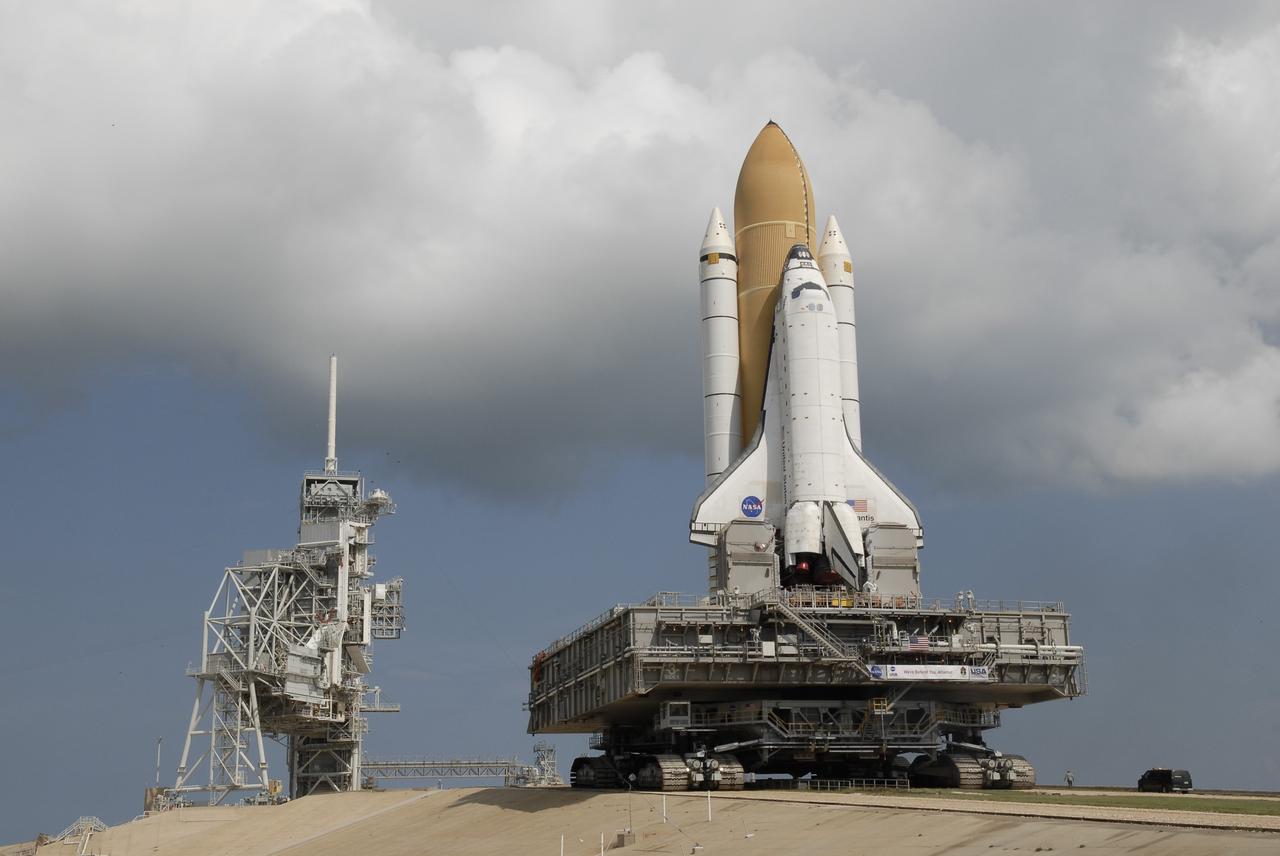
CAPE CANAVERAL, Fla. – At NASA's Kennedy Space Center in Florida, space shuttle Atlantis nears the end of its 3.4-mile journey, known as rollout, from the Vehicle Assembly Building to Launch Pad 39A. First motion was at 6:38 a.m. EDT Oct. 14. The rollout took about six hours, and the shuttle was secure on the pad at 1:31 p.m. Liftoff of Atlantis on its STS-129 mission to the International Space Station is targeted for Nov. 12. For information on the STS-129 mission and crew, visit http://www.nasa.gov/mission_pages/shuttle/shuttlemissions/sts129/index.html. Photo credit: NASA/Kim Shiflett
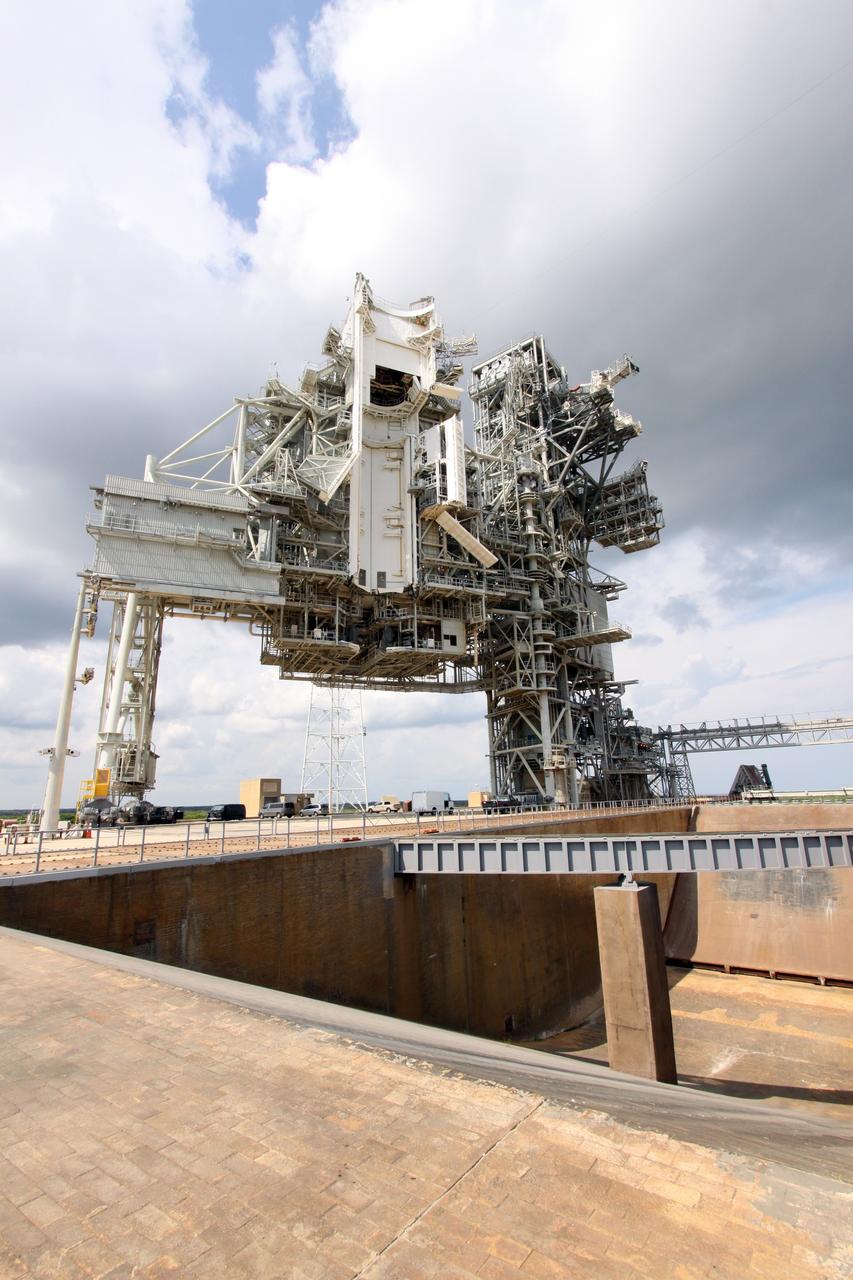
CAPE CANAVERAL, Fla. – At NASA's Kennedy Space Center in Florida, modifications to Launch Pad 39B are complete, and the pad is ready to support the Ares I-X rocket. The transfer of the pad from the Space Shuttle Program to the Constellation Program took place May 31. Modifications made to the pad include the removal of shuttle unique subsystems, such as the orbiter access arm and a section of the gaseous oxygen vent arm, along with the installation of three 600-foot lightning towers, access platforms, environmental control systems and a vehicle stabilization system. Part of the Constellation Program, the Ares I-X is the test vehicle for the Ares I, which is the essential core of a space transportation system designed to carry crewed missions back to the moon, on to Mars and out into the solar system. The Ares I-X flight test is targeted for Oct. 27. For information on the Ares I-X vehicle and flight test, visit http://www.nasa.gov/aresIX. Photo credit: NASA/Jack Pfaller
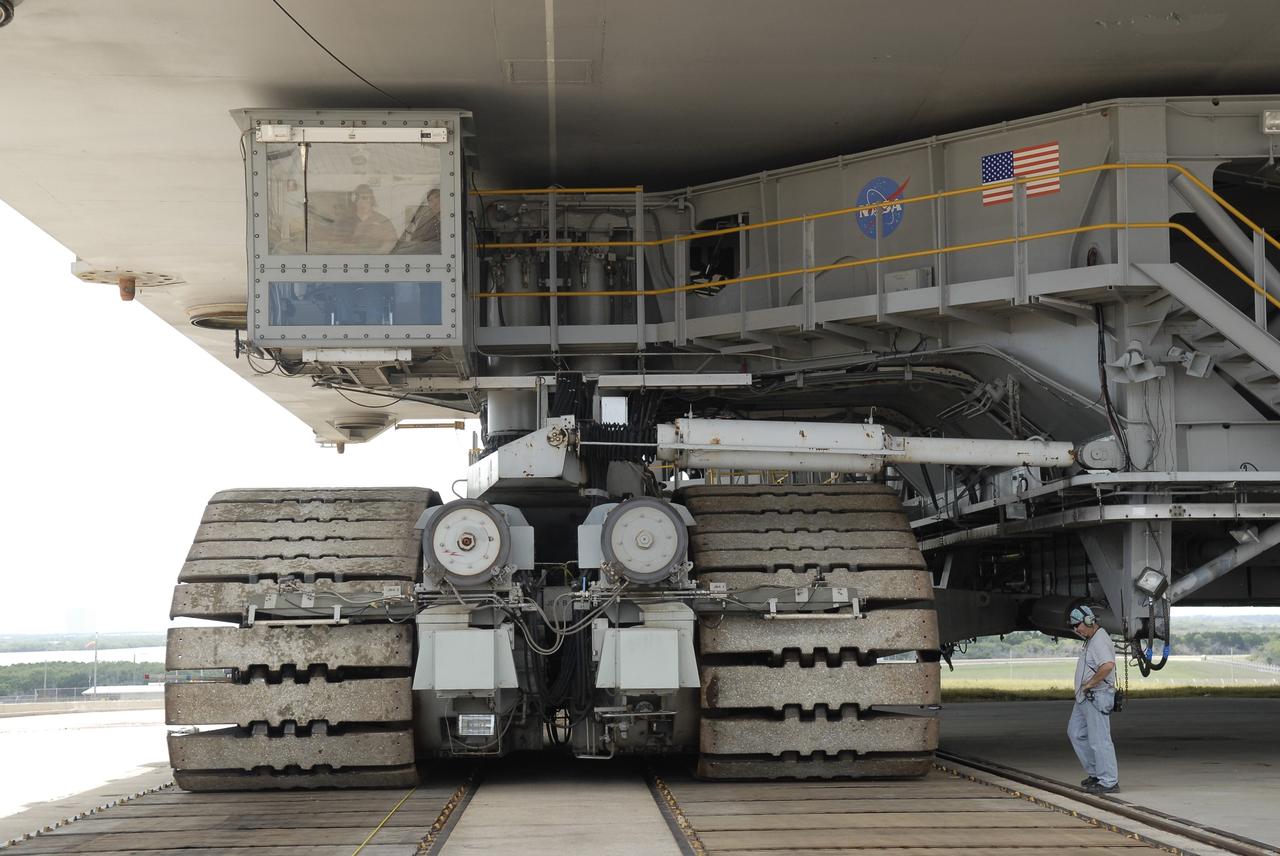
CAPE CANAVERAL, Fla. – At NASA's Kennedy Space Center in Florida, workers carefully guide the crawler-transporter into position on Launch Pad 39A. Space shuttle Atlantis, not in view, towers above them as it nears the end of its 3.4-mile journey from the Vehicle Assembly Building, known as rollout. First motion was at 6:38 a.m. EDT Oct. 14. The rollout took about six hours, and the shuttle was secure on the pad at 1:31 p.m. Liftoff of Atlantis on its STS-129 mission to the International Space Station is targeted for Nov. 12. For information on the STS-129 mission and crew, visit http://www.nasa.gov/mission_pages/shuttle/shuttlemissions/sts129/index.html. Photo credit: NASA/Kim Shiflett
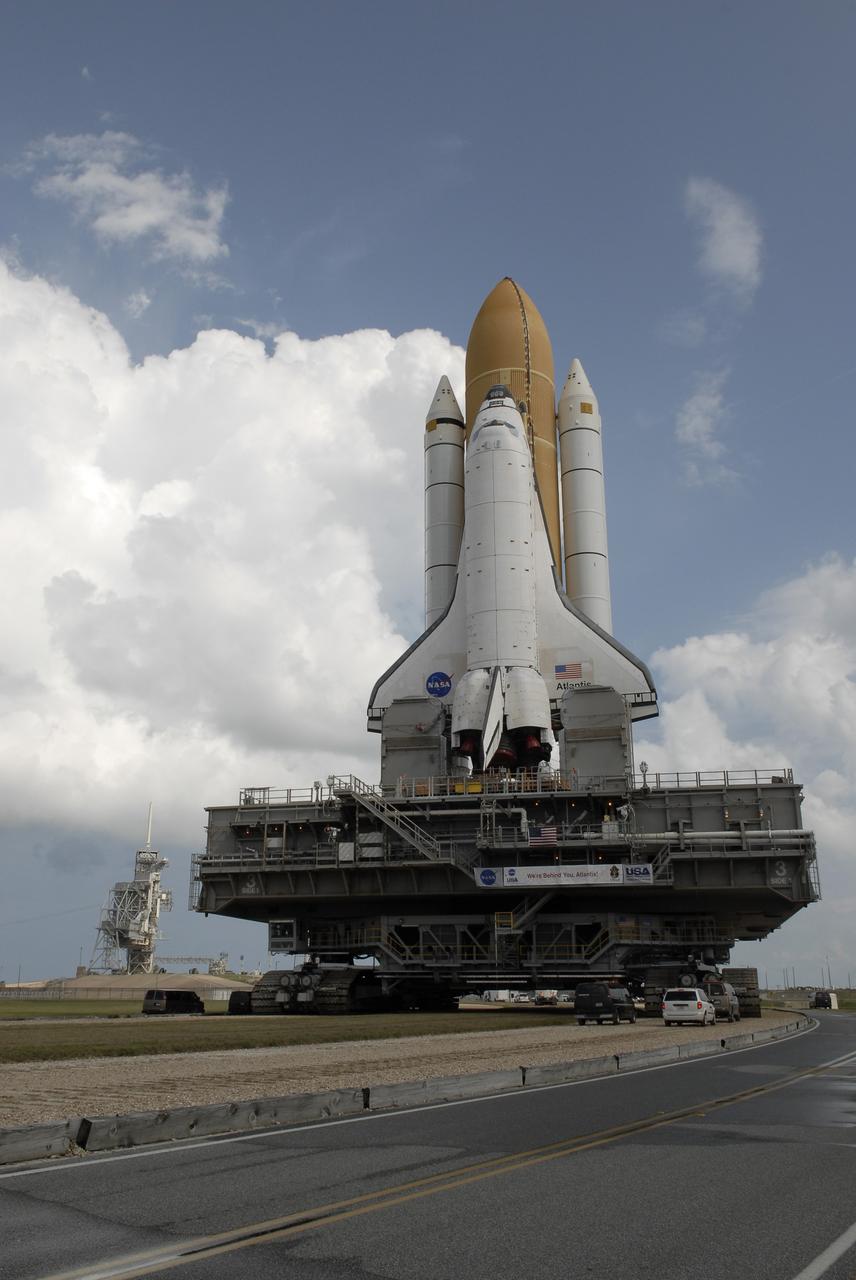
CAPE CANAVERAL, Fla. – At NASA's Kennedy Space Center in Florida, space shuttle Atlantis approaches Launch Pad 39A, at left, on its 3.4-mile trek from the Vehicle Assembly Building. First motion was at 6:38 a.m. EDT Oct. 14. The move, known as rollout, is expected to take about six hours. Liftoff of Atlantis on its STS-129 mission to the International Space Station is targeted for Nov. 12. For information on the STS-129 mission and crew, visit http://www.nasa.gov/mission_pages/shuttle/shuttlemissions/sts129/index.html. Photo credit: NASA/Kim Shiflett
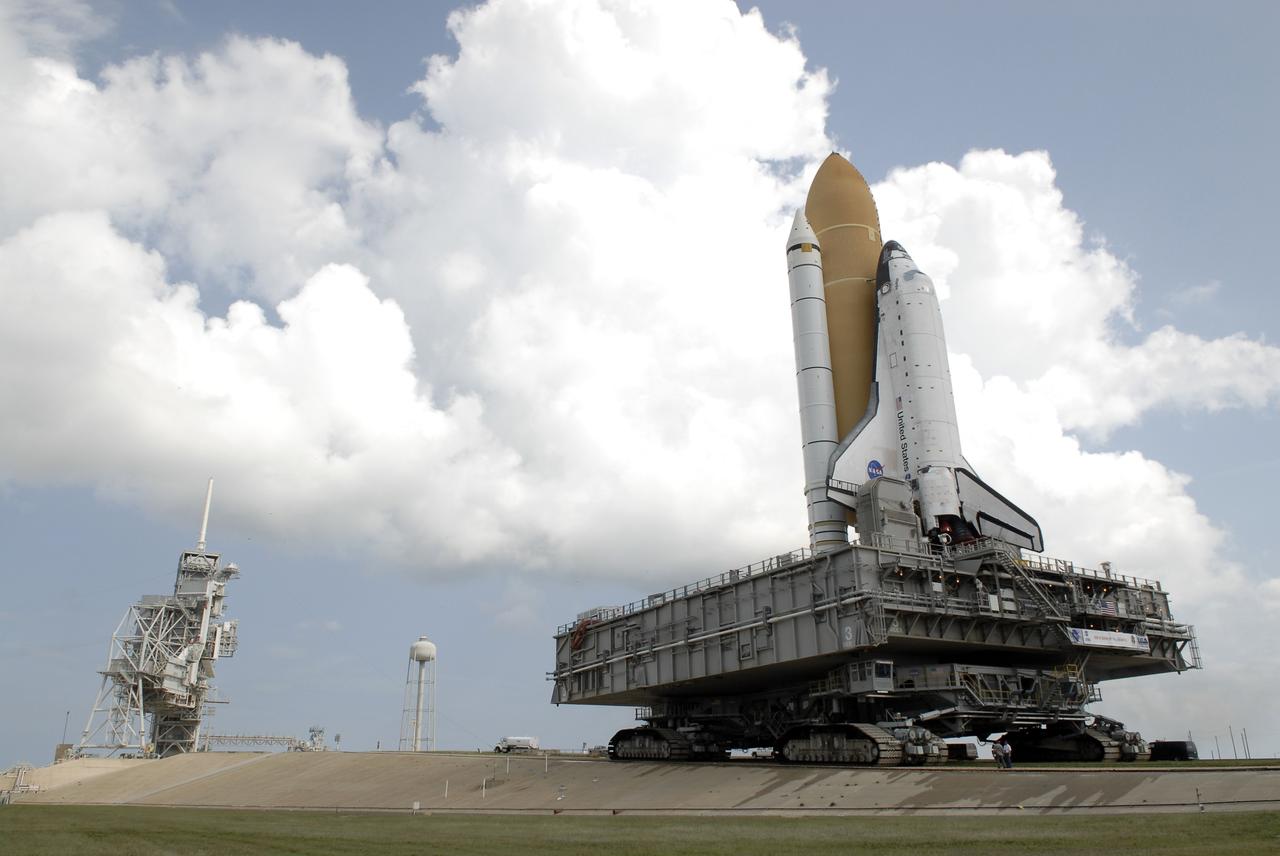
CAPE CANAVERAL, Fla. – At NASA's Kennedy Space Center in Florida, a crawler-transporter keeps space shuttle Atlantis level as it travels up the five percent grade to the top of the crawlerway at Launch Complex 39A. First motion on the 3.4-mile trip from the Vehicle Assembly Building, known as rollout, was at 6:38 a.m. EDT Oct. 14. The rollout took about six hours, and the shuttle was secure on the pad at 1:31 p.m. Liftoff of Atlantis on its STS-129 mission to the International Space Station is targeted for Nov. 12. For information on the STS-129 mission and crew, visit http://www.nasa.gov/mission_pages/shuttle/shuttlemissions/sts129/index.html. Photo credit: NASA/Kim Shiflett
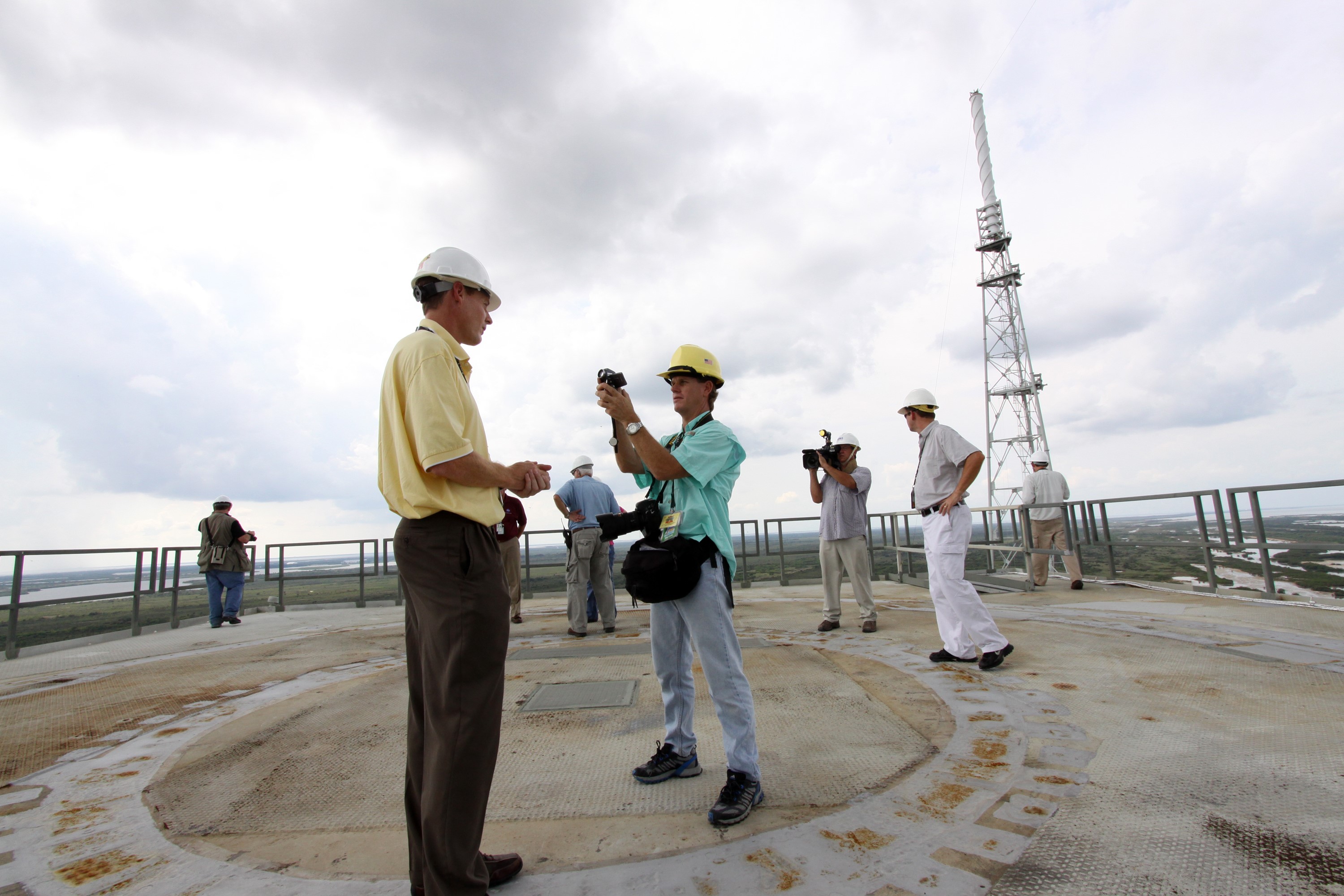
CAPE CANAVERAL, Fla. – At NASA's Kennedy Space Center in Florida, Ares I-X ground systems project manager Mike Stelzer is interviewed by a member of the news media on the 295-foot level of Launch Pad 39B. Modifications to the pad to support the Ares I-X rocket are complete. The transfer of the pad from the Space Shuttle Program to the Constellation Program took place May 31. Modifications made to the pad include the removal of shuttle unique subsystems, such as the orbiter access arm and a section of the gaseous oxygen vent arm, along with the installation of three 600-foot lightning towers, access platforms, environmental control systems and a vehicle stabilization system. Part of the Constellation Program, the Ares I-X is the test vehicle for the Ares I, which is the essential core of a space transportation system designed to carry crewed missions back to the moon, on to Mars and out into the solar system. The Ares I-X flight test is targeted for Oct. 27. For information on the Ares I-X vehicle and flight test, visit http://www.nasa.gov/aresIX. Photo credit: NASA/Jack Pfaller