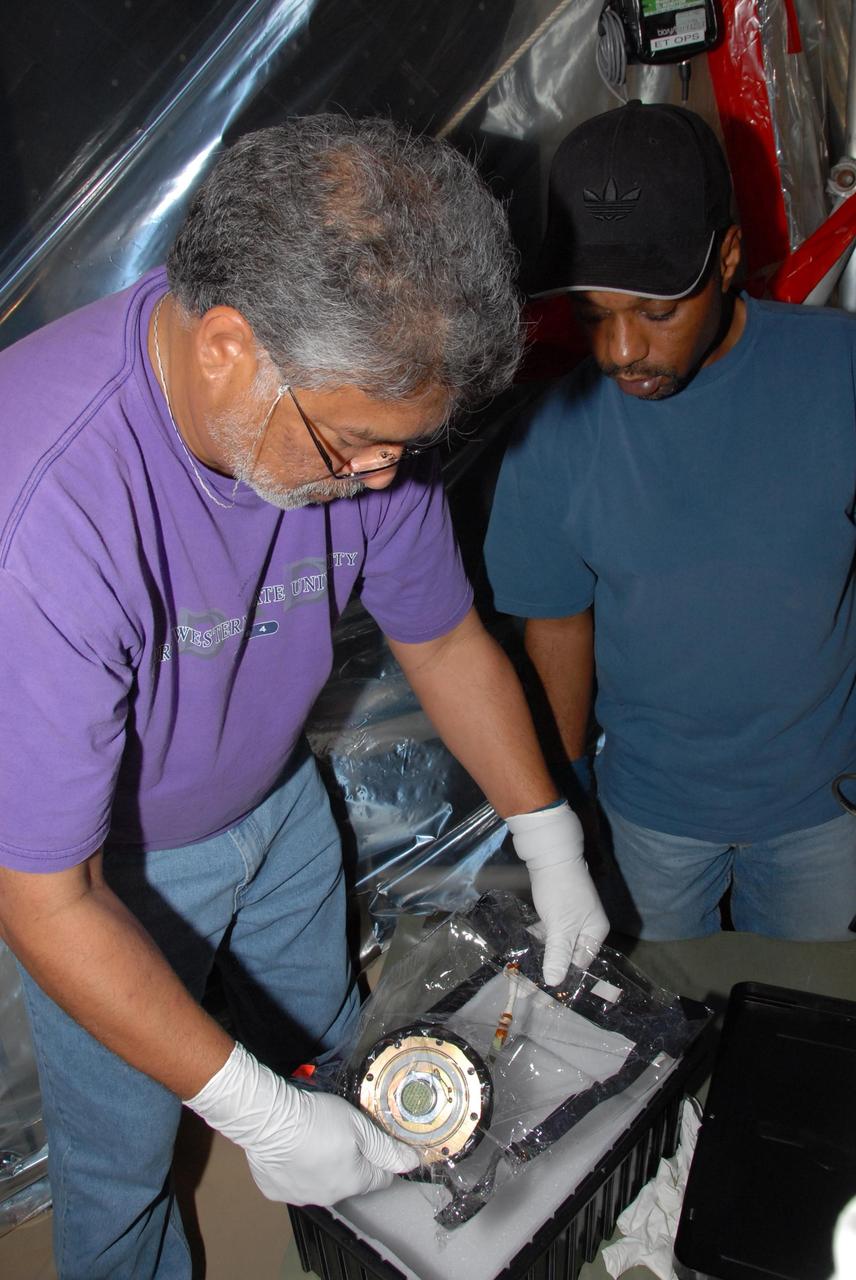
KENNEDY SPACE CENTER, FLA. -- At Launch Pad 39A, a team of external tank specialists from Lockheed Martin and the United Space Alliance undertakes the task of removing the hydrogen feed-through connector in support of space shuttle Atlantis' STS-122 mission. Here, technicians place the wrapped connector in a shipping container for transport to NASA's Marshall Space Flight Center in Huntsville, Ala., for further cryogenic testing. Some of the tank's engine cutoff sensors, or ECO sensors, failed during propellant tanking for launch attempts on Dec. 6 and Dec. 9. Results of a tanking test on Dec. 18 pointed to an open circuit in the feed-through connector wiring, which is located at the base of the tank. The feed-through connector passes the wires from the inside of the tank to the outside. After the data from additional testing on the connector is analyzed, shuttle program managers will decide on a forward plan. Launch of STS-122 is targeted for January 2008. Photo credit: NASA/George Shelton
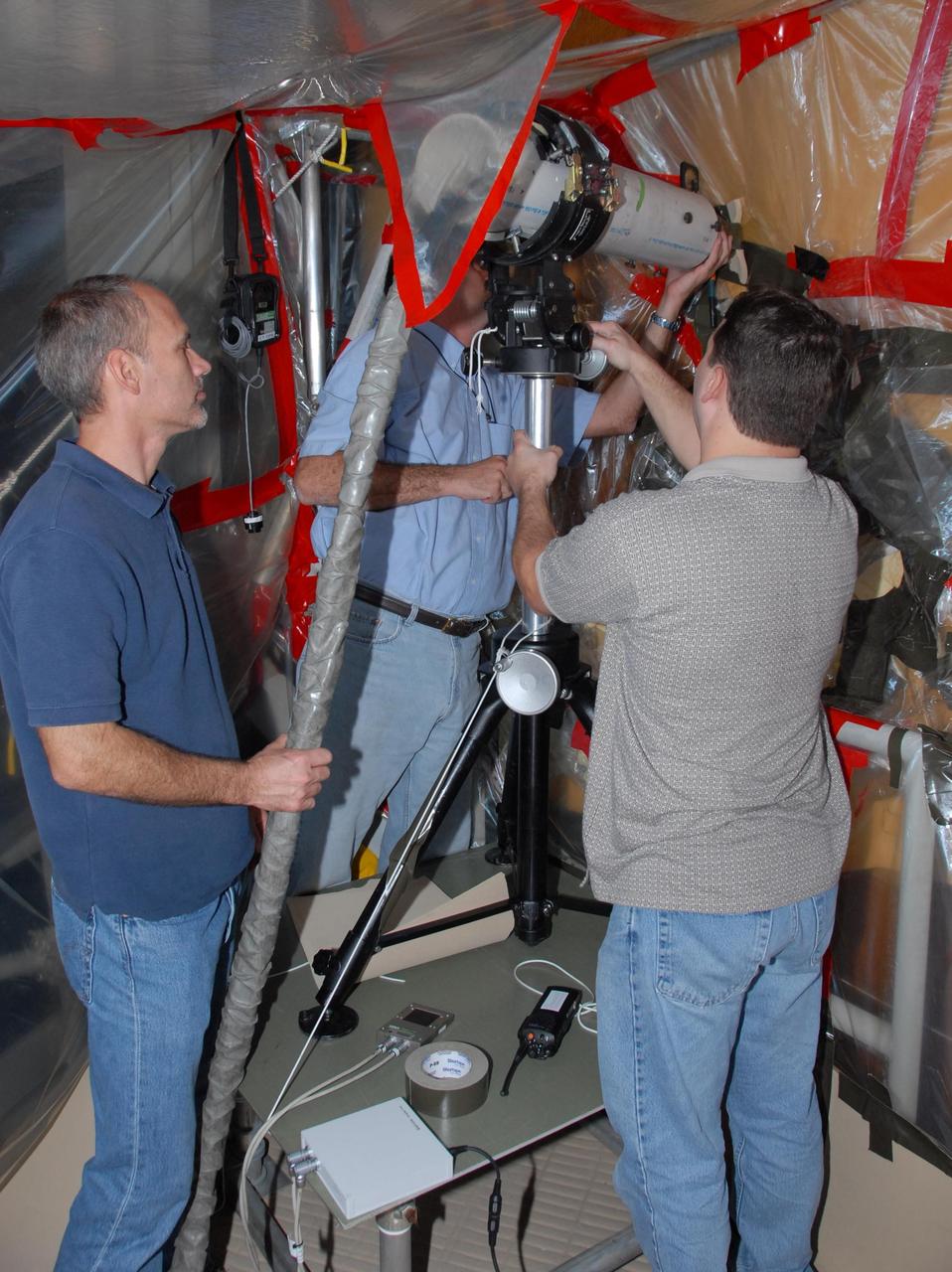
KENNEDY SPACE CENTER, FLA. -- At Launch Pad 39A, a team of external tank specialists from Lockheed Martin and the United Space Alliance undertakes the task of removing the hydrogen feed-through connector in support of space shuttle Atlantis' STS-122 mission. Here, technicians set up equipment that will be used to take X-rays of the connector cable. Some of the tank's engine cutoff sensors, or ECO sensors, failed during propellant tanking for launch attempts on Dec. 6 and Dec. 9. Results of a tanking test on Dec. 18 pointed to an open circuit in the feed-through connector wiring, which is located at the base of the tank. The feed-through connector passes the wires from the inside of the tank to the outside. After the data from additional testing on the connector is analyzed, shuttle program managers will decide on a forward plan. Launch of STS-122 is targeted for January 2008. Photo credit: NASA/George Shelton
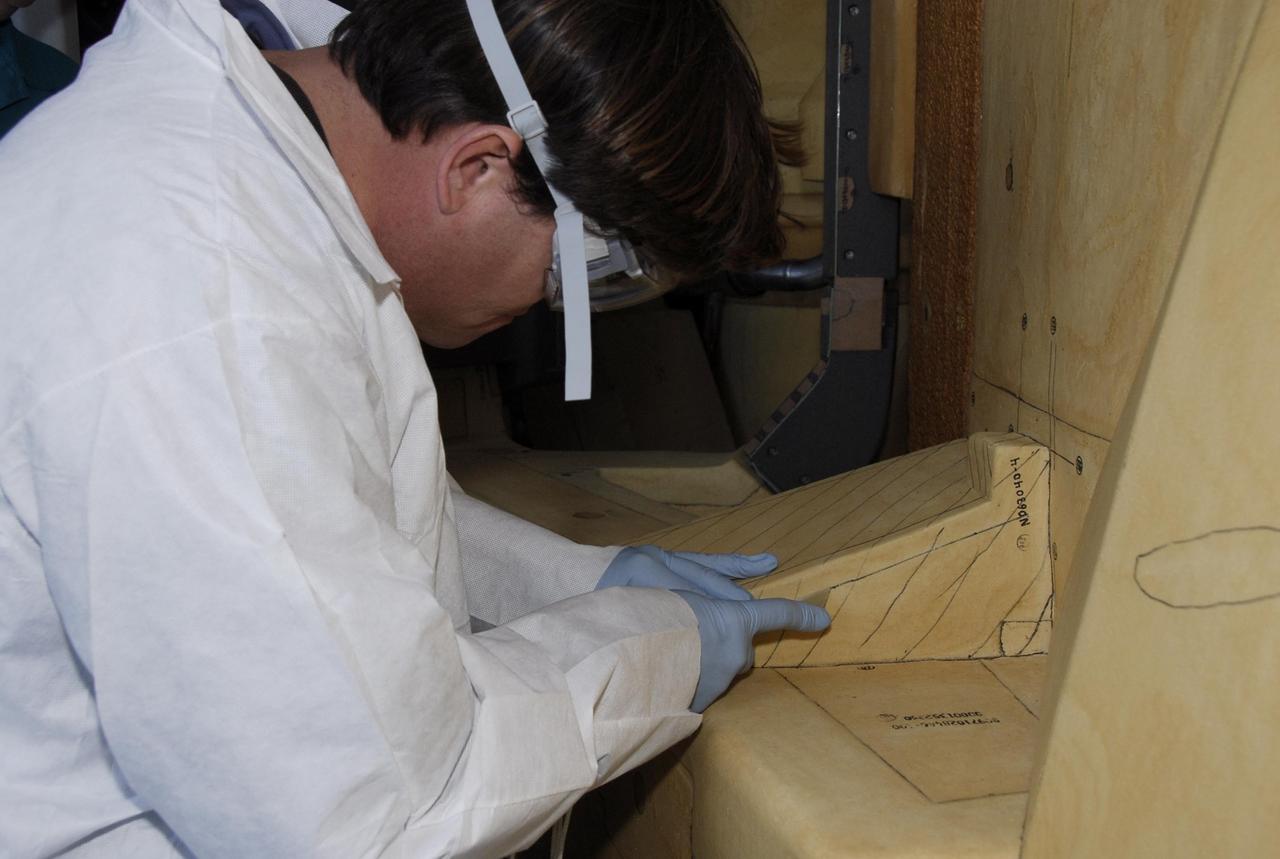
KENNEDY SPACE CENTER, FLA. -- At Launch Pad 39A, a United Space Alliance technician carefully cuts away the foam insulation surrounding the covers over the feed-through connector box on the external tank for space shuttle Atlantis' STS-122 mission. The covers will be removed for access to the feed-through connectors. Following the failure of some of the tank's engine cutoff sensors, or ECO sensors, during propellant tanking for launch attempts on Dec. 6 and Dec. 9, a tanking test was conducted on Dec. 18 to aid in troubleshooting the cause. Technicians spliced test wiring into the ECO sensor electrical system and used time domain reflectometry equipment to help locate the electrical anomaly. Results of the tanking test pointed to an open circuit in the feed-through connector wiring, which is located at the base of the tank. The feed-through connector passes the wires from the inside of the tank to the outside. During the holiday period, workers from Lockheed Martin will begin inspecting and testing the connector. Shuttle program managers will meet on Dec. 27 to review the test and analysis, and decide on a forward plan. Photo credit: NASA/Kim Shiflett
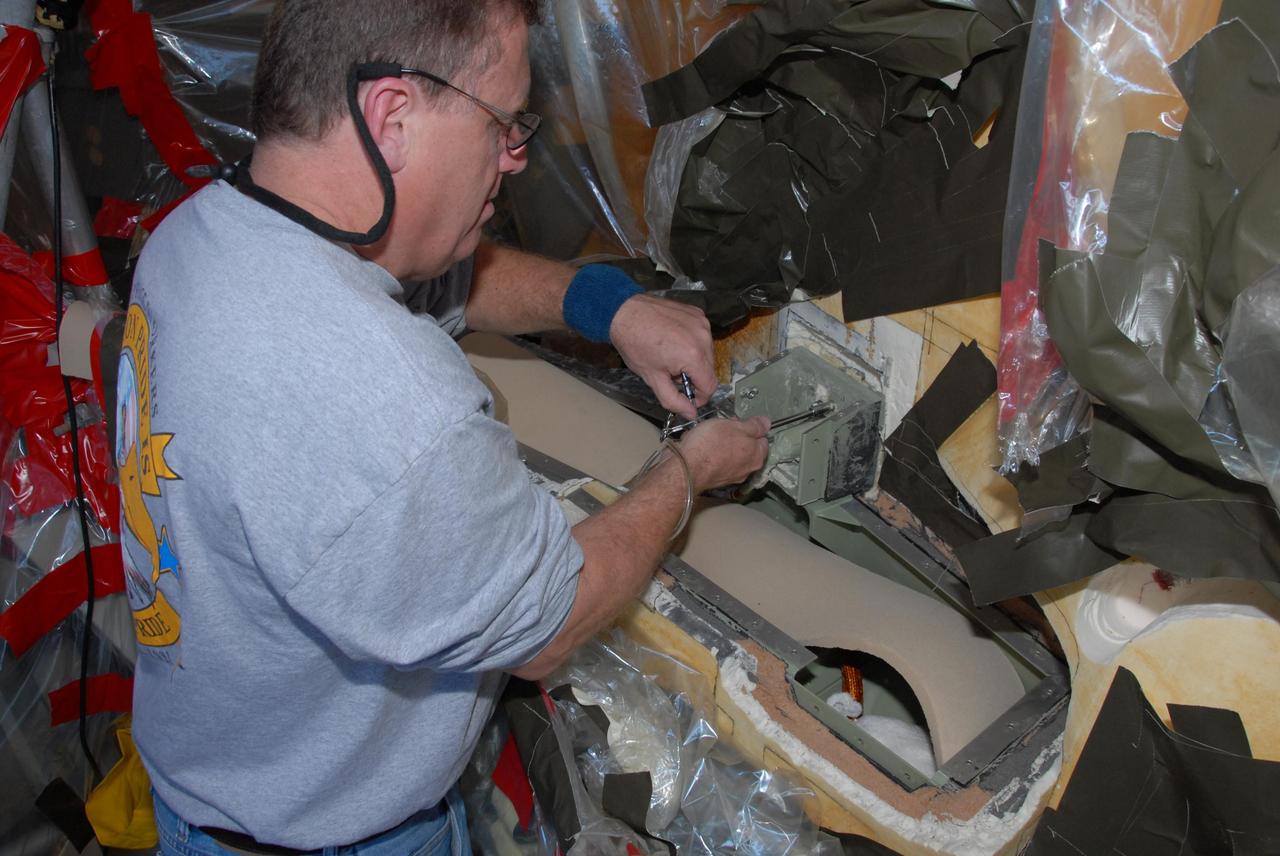
KENNEDY SPACE CENTER, FLA. -- At Launch Pad 39A, a team of external tank specialists from Lockheed Martin and the United Space Alliance undertakes the task of removing the hydrogen feed-through connector in support of space shuttle Atlantis' STS-122 mission. Here, a technician removes a pair of support brackets. Some of the tank's engine cutoff sensors, or ECO sensors, failed during propellant tanking for launch attempts on Dec. 6 and Dec. 9. Results of a tanking test on Dec. 18 pointed to an open circuit in the feed-through connector wiring, which is located at the base of the tank. The feed-through connector passes the wires from the inside of the tank to the outside. After the data from additional testing on the connector is analyzed, shuttle program managers will decide on a forward plan. Launch of STS-122 is targeted for January 2008. Photo credit: NASA/George Shelton
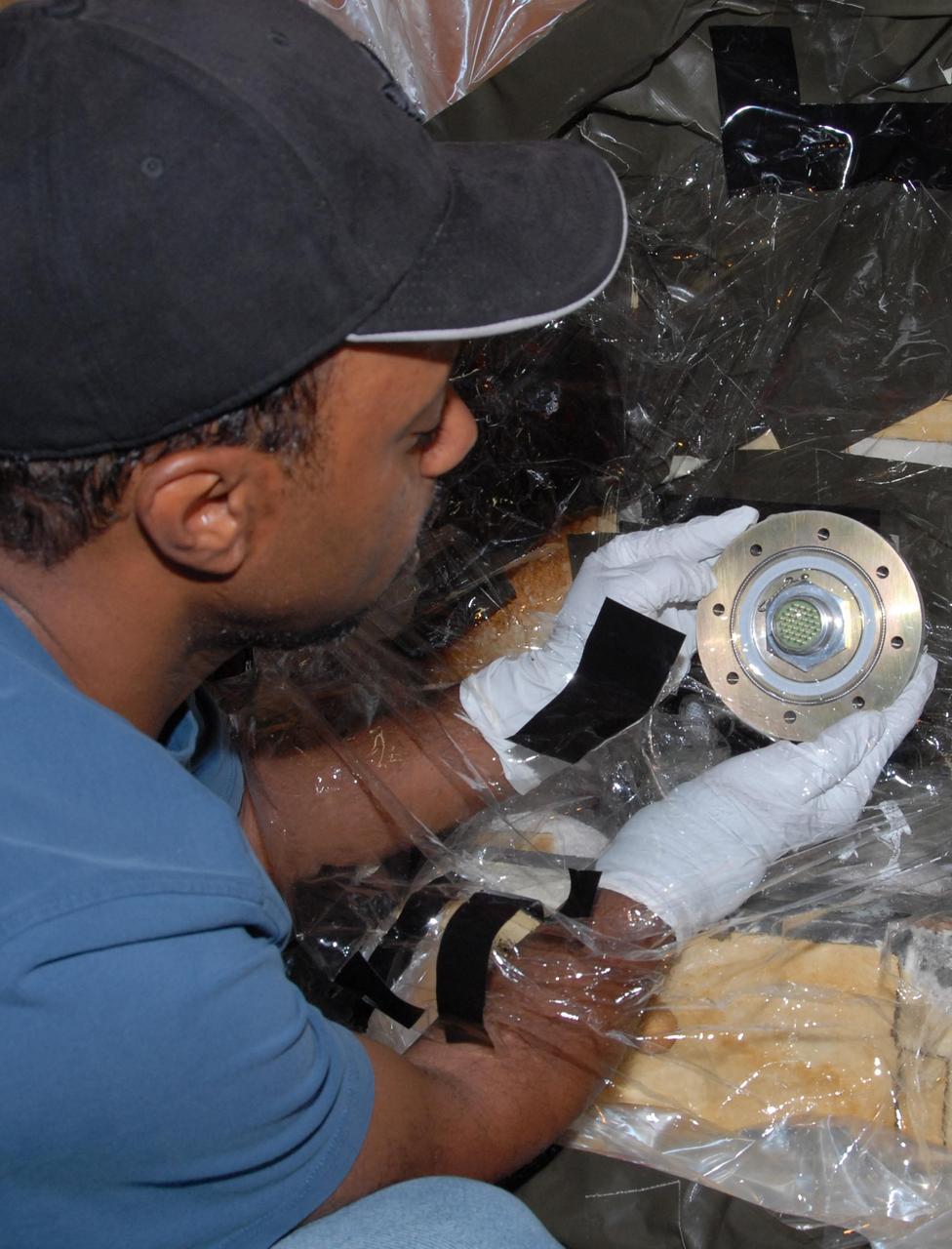
KENNEDY SPACE CENTER, FLA. -- At Launch Pad 39A, a team of external tank specialists from Lockheed Martin and the United Space Alliance undertakes the task of removing the hydrogen feed-through connector in support of space shuttle Atlantis' STS-122 mission. Here, a technician inspects the connector just removed from the external tank. Some of the tank's engine cutoff sensors, or ECO sensors, failed during propellant tanking for launch attempts on Dec. 6 and Dec. 9. Results of a tanking test on Dec. 18 pointed to an open circuit in the feed-through connector wiring, which is located at the base of the tank. The feed-through connector passes the wires from the inside of the tank to the outside. After the data from additional testing on the connector is analyzed, shuttle program managers will decide on a forward plan. Launch of STS-122 is targeted for January 2008. Photo credit: NASA/George Shelton
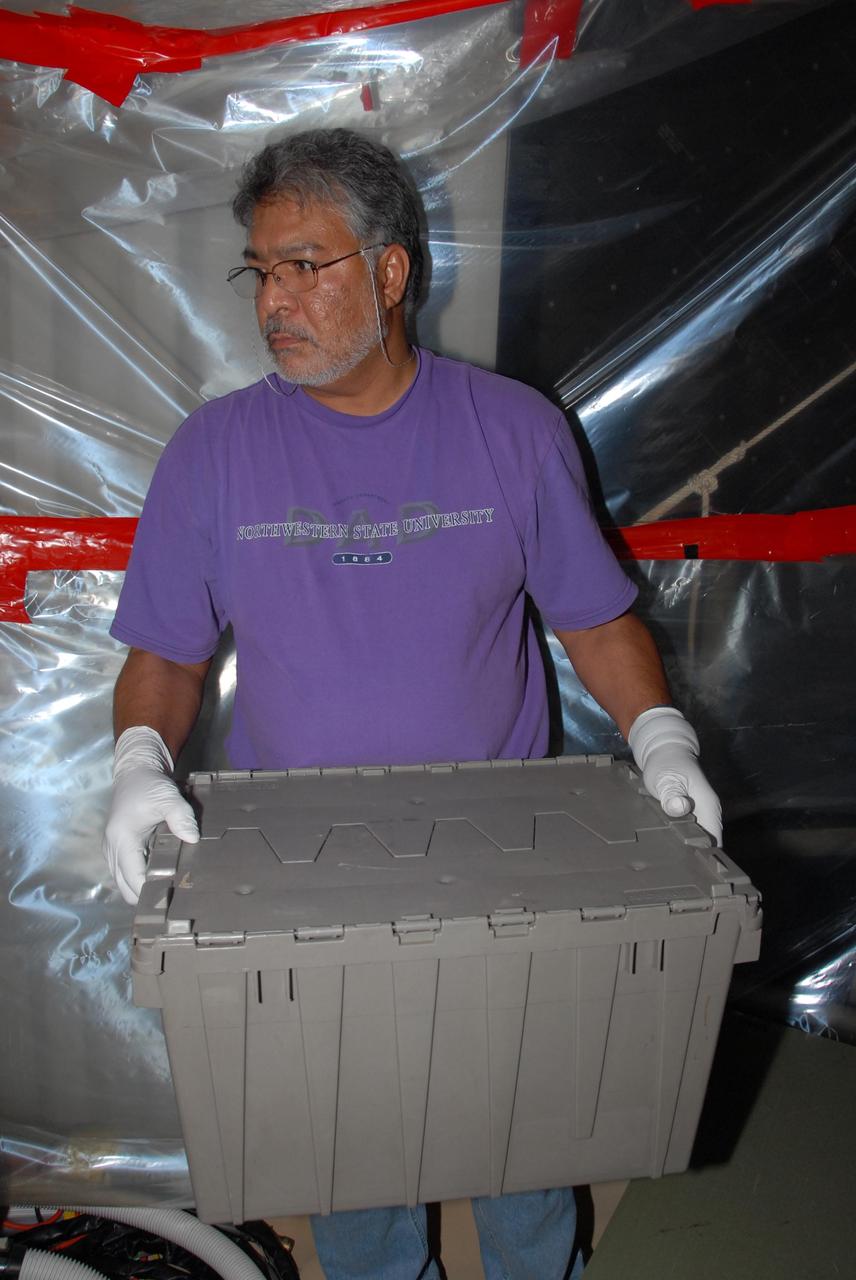
KENNEDY SPACE CENTER, FLA. -- At Launch Pad 39A, a team of external tank specialists from Lockheed Martin and the United Space Alliance undertakes the task of removing the hydrogen feed-through connector in support of space shuttle Atlantis' STS-122 mission. Here, a technician carries the shipping container in which the wrapped connector is secured for transport to NASA's Marshall Space Flight Center in Huntsville, Ala., for further cryogenic testing. Some of the tank's engine cutoff sensors, or ECO sensors, failed during propellant tanking for launch attempts on Dec. 6 and Dec. 9. Results of a tanking test on Dec. 18 pointed to an open circuit in the feed-through connector wiring, which is located at the base of the tank. The feed-through connector passes the wires from the inside of the tank to the outside. After the data from additional testing on the connector is analyzed, shuttle program managers will decide on a forward plan. Launch of STS-122 is targeted for January 2008. Photo credit: NASA/George Shelton
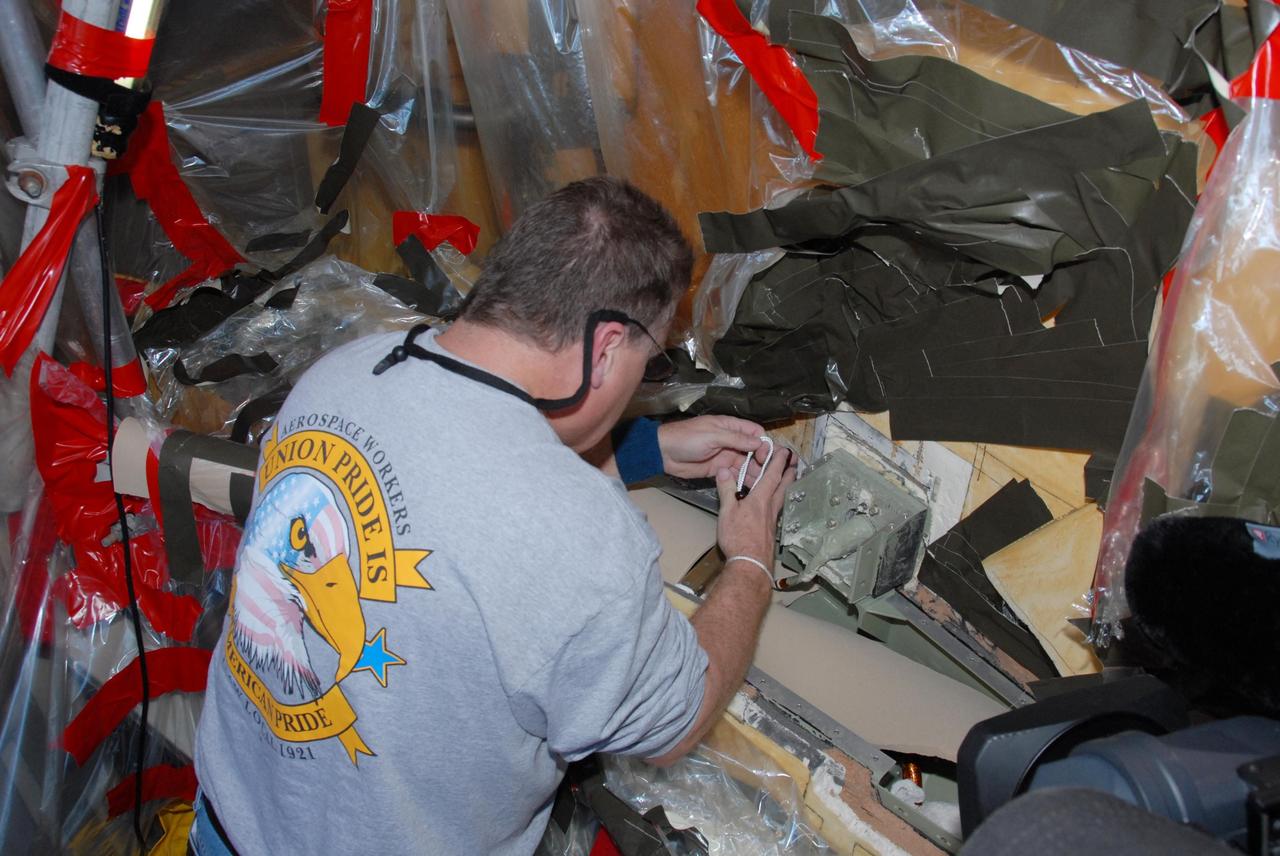
KENNEDY SPACE CENTER, FLA. -- At Launch Pad 39A, a team of external tank specialists from Lockheed Martin and the United Space Alliance undertakes the task of removing the hydrogen feed-through connector in support of space shuttle Atlantis' STS-122 mission. Here, a technician cuts the external connector cable. Some of the tank's engine cutoff sensors, or ECO sensors, failed during propellant tanking for launch attempts on Dec. 6 and Dec. 9. Results of a tanking test on Dec. 18 pointed to an open circuit in the feed-through connector wiring, which is located at the base of the tank. The feed-through connector passes the wires from the inside of the tank to the outside. After the data from additional testing on the connector is analyzed, shuttle program managers will decide on a forward plan. Launch of STS-122 is targeted for January 2008. Photo credit: NASA/George Shelton

KENNEDY SPACE CENTER, FLA. -- At Launch Pad 39A, a team of external tank specialists from Lockheed Martin and the United Space Alliance undertakes the task of removing the hydrogen feed-through connector in support of space shuttle Atlantis' STS-122 mission. Here, technicians wrap the connector for transport to NASA's Marshall Space Flight Center in Huntsville, Ala., for further cryogenic testing. Some of the tank's engine cutoff sensors, or ECO sensors, failed during propellant tanking for launch attempts on Dec. 6 and Dec. 9. Results of a tanking test on Dec. 18 pointed to an open circuit in the feed-through connector wiring, which is located at the base of the tank. The feed-through connector passes the wires from the inside of the tank to the outside. After the data from additional testing on the connector is analyzed, shuttle program managers will decide on a forward plan. Launch of STS-122 is targeted for January 2008. Photo credit: NASA/George Shelton
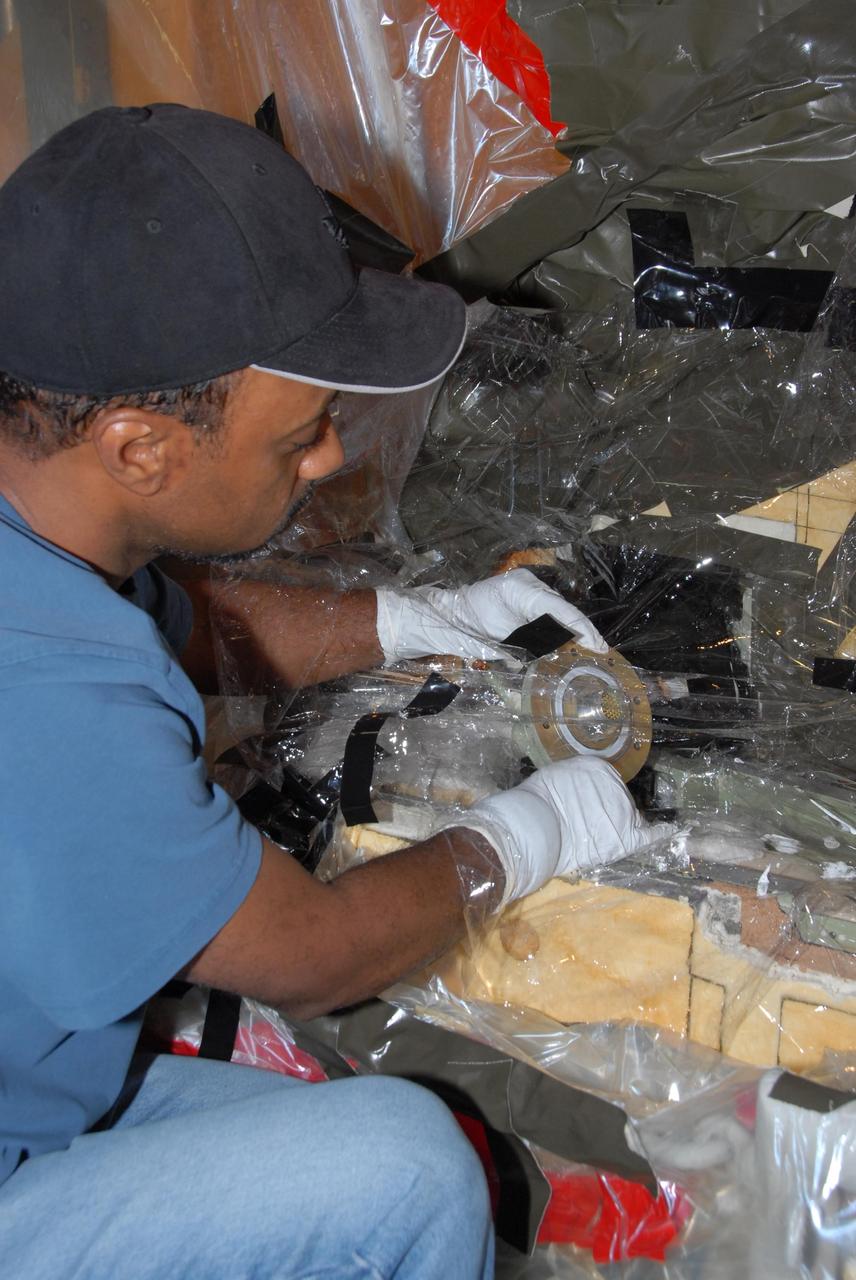
KENNEDY SPACE CENTER, FLA. -- At Launch Pad 39A, a team of external tank specialists from Lockheed Martin and the United Space Alliance undertakes the task of removing the hydrogen feed-through connector in support of space shuttle Atlantis' STS-122 mission. Here, a technician demates the connector from the external tank. Some of the tank's engine cutoff sensors, or ECO sensors, failed during propellant tanking for launch attempts on Dec. 6 and Dec. 9. Results of a tanking test on Dec. 18 pointed to an open circuit in the feed-through connector wiring, which is located at the base of the tank. The feed-through connector passes the wires from the inside of the tank to the outside. After the data from additional testing on the connector is analyzed, shuttle program managers will decide on a forward plan. Launch of STS-122 is targeted for January 2008. Photo credit: NASA/George Shelton
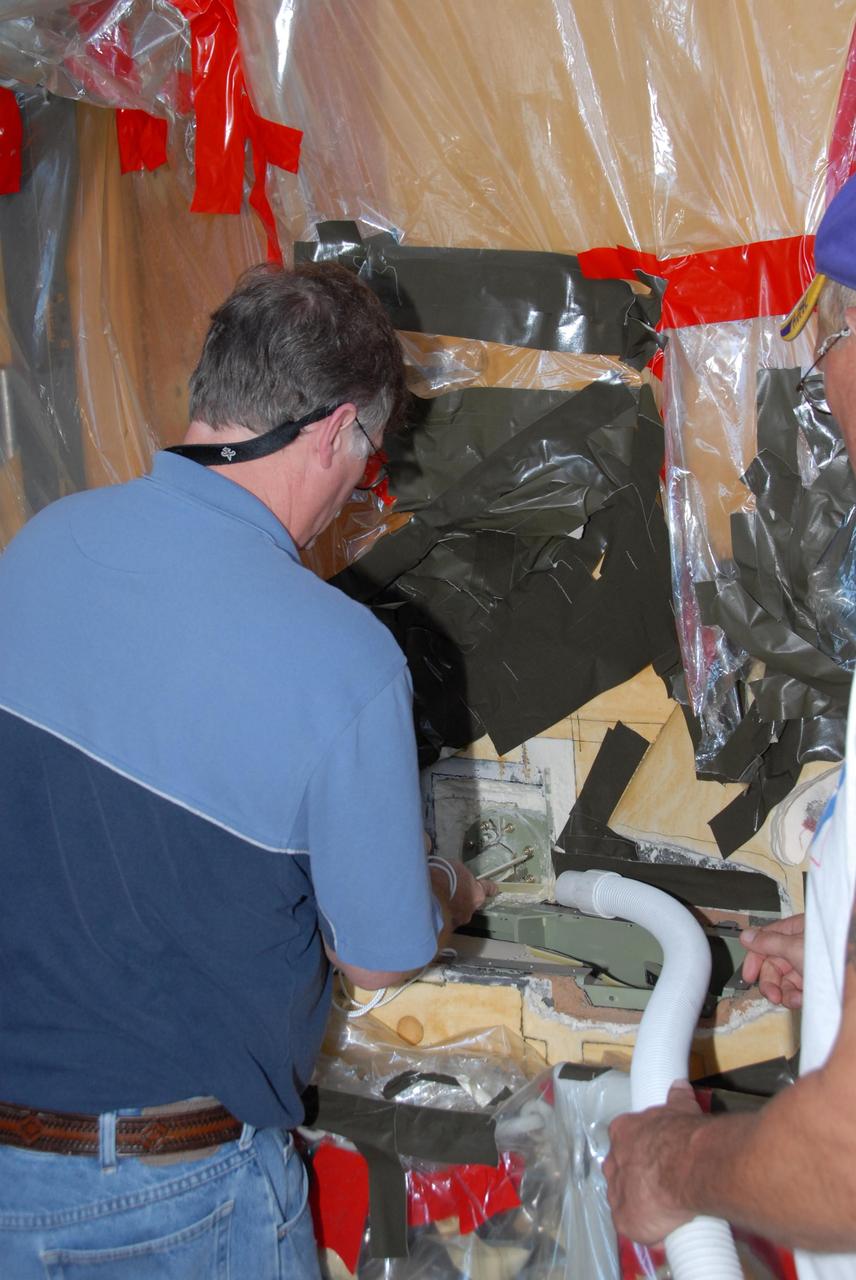
KENNEDY SPACE CENTER, FLA. -- At Launch Pad 39A, a team of external tank specialists from Lockheed Martin and the United Space Alliance undertakes the task of removing the hydrogen feed-through connector in support of space shuttle Atlantis' STS-122 mission. Here, a technician gives the connector a cleaning, removing any residual foam insulation, and begins disconnecting the connector assembly. Some of the tank's engine cutoff sensors, or ECO sensors, failed during propellant tanking for launch attempts on Dec. 6 and Dec. 9. Results of a tanking test on Dec. 18 pointed to an open circuit in the feed-through connector wiring, which is located at the base of the tank. The feed-through connector passes the wires from the inside of the tank to the outside. After the data from additional testing on the connector is analyzed, shuttle program managers will decide on a forward plan. Launch of STS-122 is targeted for January 2008. Photo credit: NASA/George Shelton
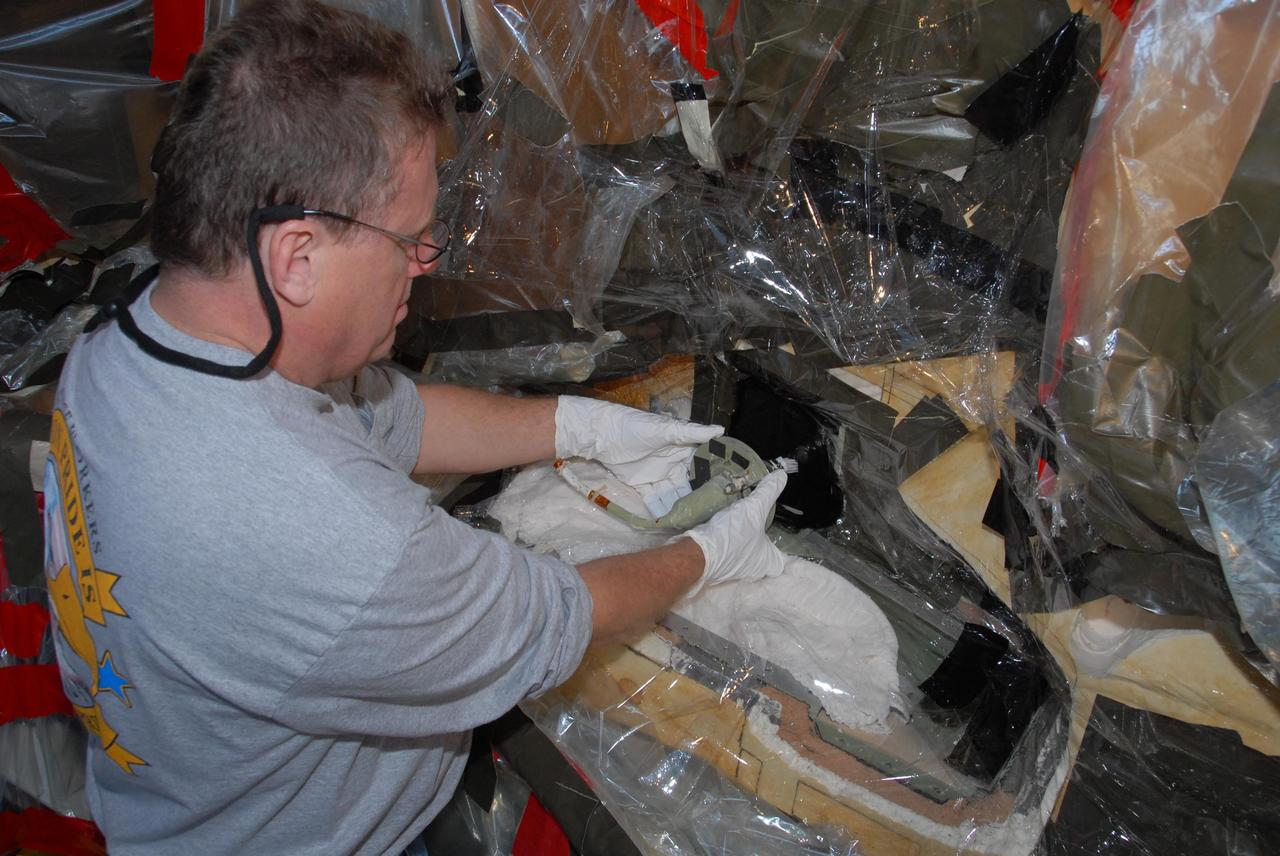
KENNEDY SPACE CENTER, FLA. -- At Launch Pad 39A, a team of external tank specialists from Lockheed Martin and the United Space Alliance undertakes the task of removing the hydrogen feed-through connector in support of space shuttle Atlantis' STS-122 mission. Here, a technician pulls the connector assembly, with its associated electrical harness, away from the tank. Some of the tank's engine cutoff sensors, or ECO sensors, failed during propellant tanking for launch attempts on Dec. 6 and Dec. 9. Results of a tanking test on Dec. 18 pointed to an open circuit in the feed-through connector wiring, which is located at the base of the tank. The feed-through connector passes the wires from the inside of the tank to the outside. After the data from additional testing on the connector is analyzed, shuttle program managers will decide on a forward plan. Launch of STS-122 is targeted for January 2008. Photo credit: NASA/George Shelton
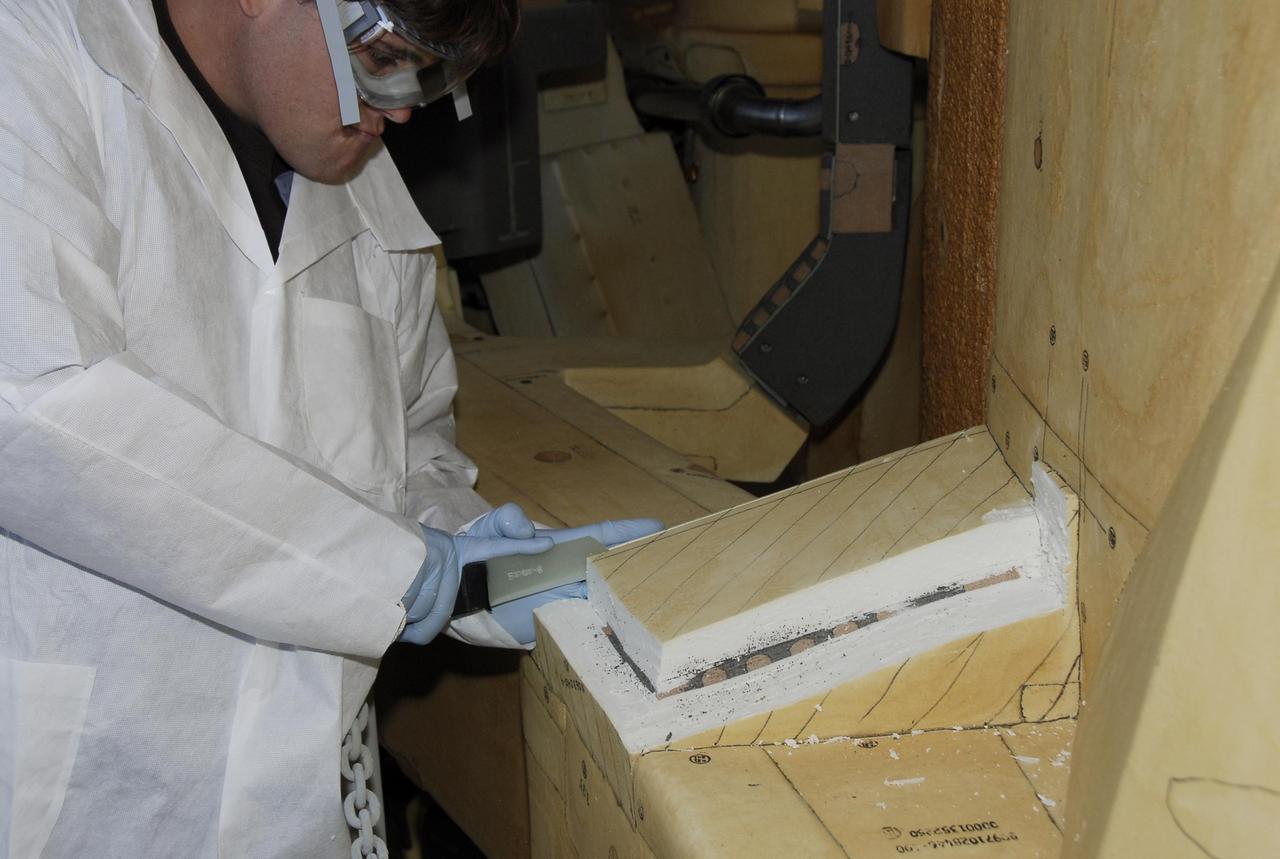
KENNEDY SPACE CENTER, FLA. -- At Launch Pad 39A, a United Space Alliance technician carefully cuts away the foam insulation surrounding the covers over the feed-through connector box on the external tank for space shuttle Atlantis' STS-122 mission, revealing the fastener holes on the covers. The covers will be removed for access to the feed-through connectors. Following the failure of some of the tank's engine cutoff sensors, or ECO sensors, during propellant tanking for launch attempts on Dec. 6 and Dec. 9, a tanking test was conducted on Dec. 18 to aid in troubleshooting the cause. Technicians spliced test wiring into the ECO sensor electrical system and used time domain reflectometry equipment to help locate the electrical anomaly. Results of the tanking test pointed to an open circuit in the feed-through connector wiring, which is located at the base of the tank. The feed-through connector passes the wires from the inside of the tank to the outside. During the holiday period, workers from Lockheed Martin will begin inspecting and testing the connector. Shuttle program managers will meet on Dec. 27 to review the test and analysis, and decide on a forward plan. Photo credit: NASA/Kim Shiflett
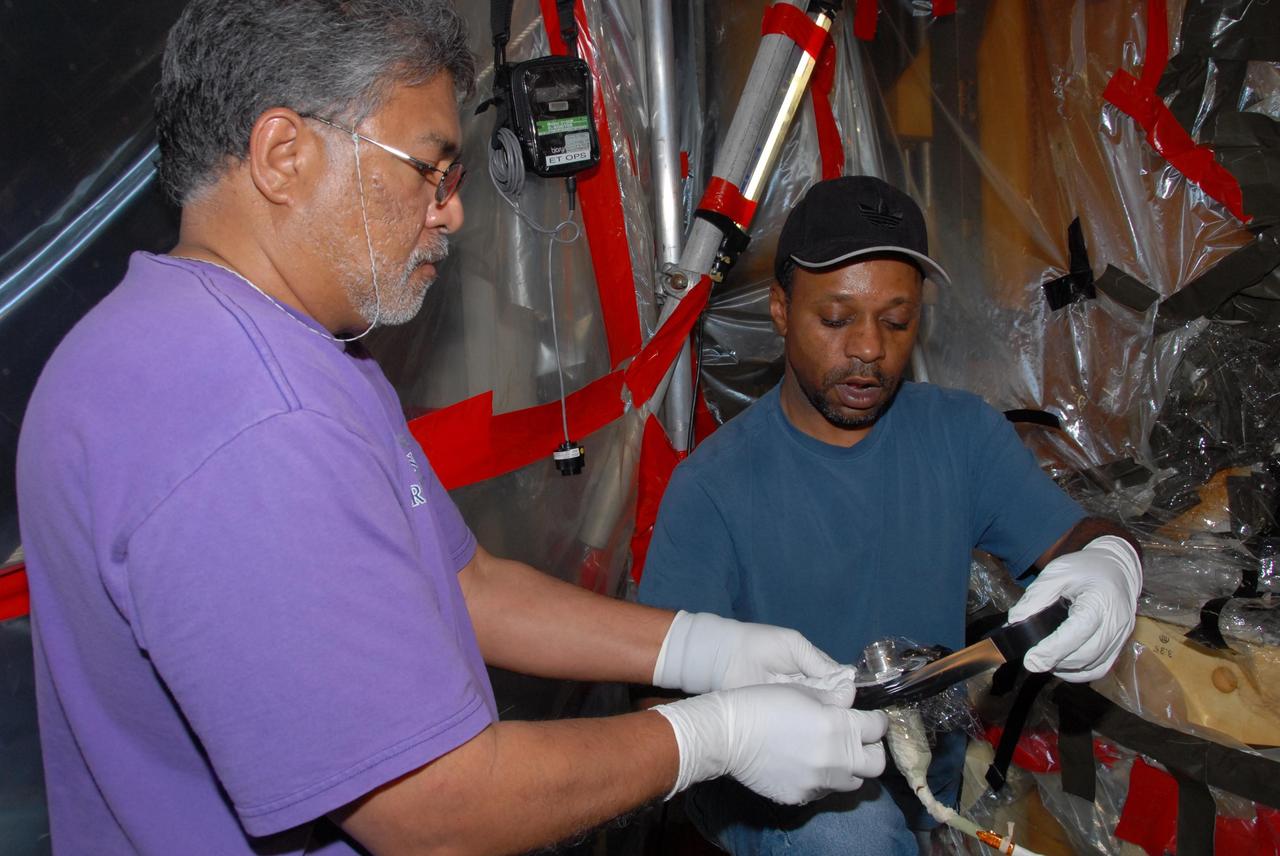
KENNEDY SPACE CENTER, FLA. -- At Launch Pad 39A, a team of external tank specialists from Lockheed Martin and the United Space Alliance undertakes the task of removing the hydrogen feed-through connector in support of space shuttle Atlantis' STS-122 mission. Here, technicians wrap the connector for transport to NASA's Marshall Space Flight Center in Huntsville, Ala., for further cryogenic testing. Some of the tank's engine cutoff sensors, or ECO sensors, failed during propellant tanking for launch attempts on Dec. 6 and Dec. 9. Results of a tanking test on Dec. 18 pointed to an open circuit in the feed-through connector wiring, which is located at the base of the tank. The feed-through connector passes the wires from the inside of the tank to the outside. After the data from additional testing on the connector is analyzed, shuttle program managers will decide on a forward plan. Launch of STS-122 is targeted for January 2008. Photo credit: NASA/George Shelton
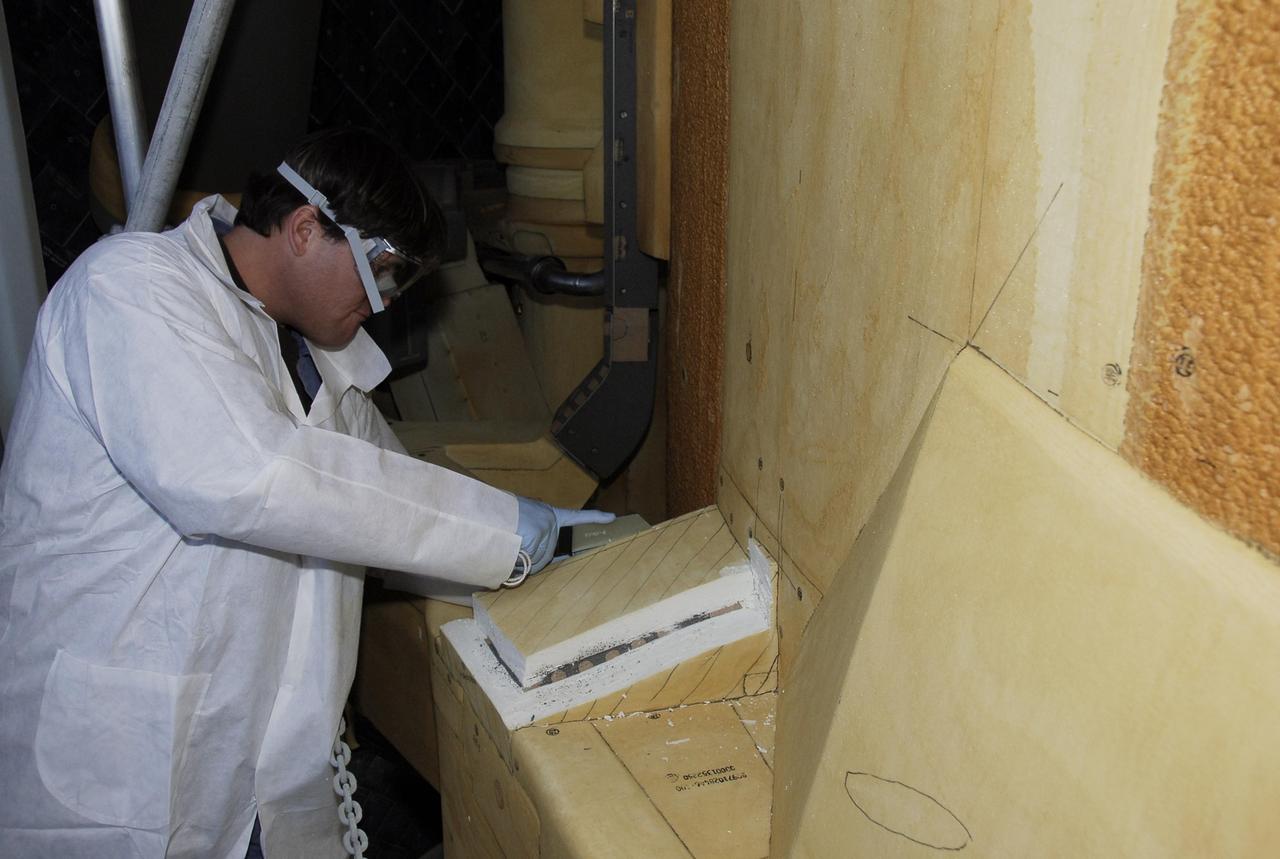
KENNEDY SPACE CENTER, FLA. -- At Launch Pad 39A, a United Space Alliance technician carefully cuts away the foam insulation surrounding the covers over the feed-through connector box on the external tank for space shuttle Atlantis' STS-122 mission, revealing the fastener holes on the covers. The covers will be removed for access to the feed-through connectors. Following the failure of some of the tank's engine cutoff sensors, or ECO sensors, during propellant tanking for launch attempts on Dec. 6 and Dec. 9, a tanking test was conducted on Dec. 18 to aid in troubleshooting the cause. Technicians spliced test wiring into the ECO sensor electrical system and used time domain reflectometry equipment to help locate the electrical anomaly. Results of the tanking test pointed to an open circuit in the feed-through connector wiring, which is located at the base of the tank. The feed-through connector passes the wires from the inside of the tank to the outside. During the holiday period, workers from Lockheed Martin will begin inspecting and testing the connector. Shuttle program managers will meet on Dec. 27 to review the test and analysis, and decide on a forward plan. Photo credit: NASA/Kim Shiflett

KENNEDY SPACE CENTER, FLA. -- At Launch Pad 39A, a team of external tank specialists from Lockheed Martin and the United Space Alliance undertakes the task of removing the hydrogen feed-through connector in support of space shuttle Atlantis' STS-122 mission. Here, a technician disconnects the connector before it is demated from the external tank. Some of the tank's engine cutoff sensors, or ECO sensors, failed during propellant tanking for launch attempts on Dec. 6 and Dec. 9. Results of a tanking test on Dec. 18 pointed to an open circuit in the feed-through connector wiring, which is located at the base of the tank. The feed-through connector passes the wires from the inside of the tank to the outside. After the data from additional testing on the connector is analyzed, shuttle program managers will decide on a forward plan. Launch of STS-122 is targeted for January 2008. Photo credit: NASA/George Shelton

KENNEDY SPACE CENTER, FLA. -- At Launch Pad 39A, a United Space Alliance technician removes foam insulation revealing the fastener holes on the covers over the feed-through connector box on the external tank for space shuttle Atlantis' STS-122 mission. The covers will be removed for access to the feed-through connectors. Following the failure of some of the tank's engine cutoff sensors, or ECO sensors, during propellant tanking for launch attempts on Dec. 6 and Dec. 9, a tanking test was conducted on Dec. 18 to aid in troubleshooting the cause. Technicians spliced test wiring into the ECO sensor electrical system and used time domain reflectometry equipment to help locate the electrical anomaly. Results of the tanking test pointed to an open circuit in the feed-through connector wiring, which is located at the base of the tank. The feed-through connector passes the wires from the inside of the tank to the outside. During the holiday period, workers from Lockheed Martin will begin inspecting and testing the connector. Shuttle program managers will meet on Dec. 27 to review the test and analysis, and decide on a forward plan. Photo credit: NASA/Kim Shiflett
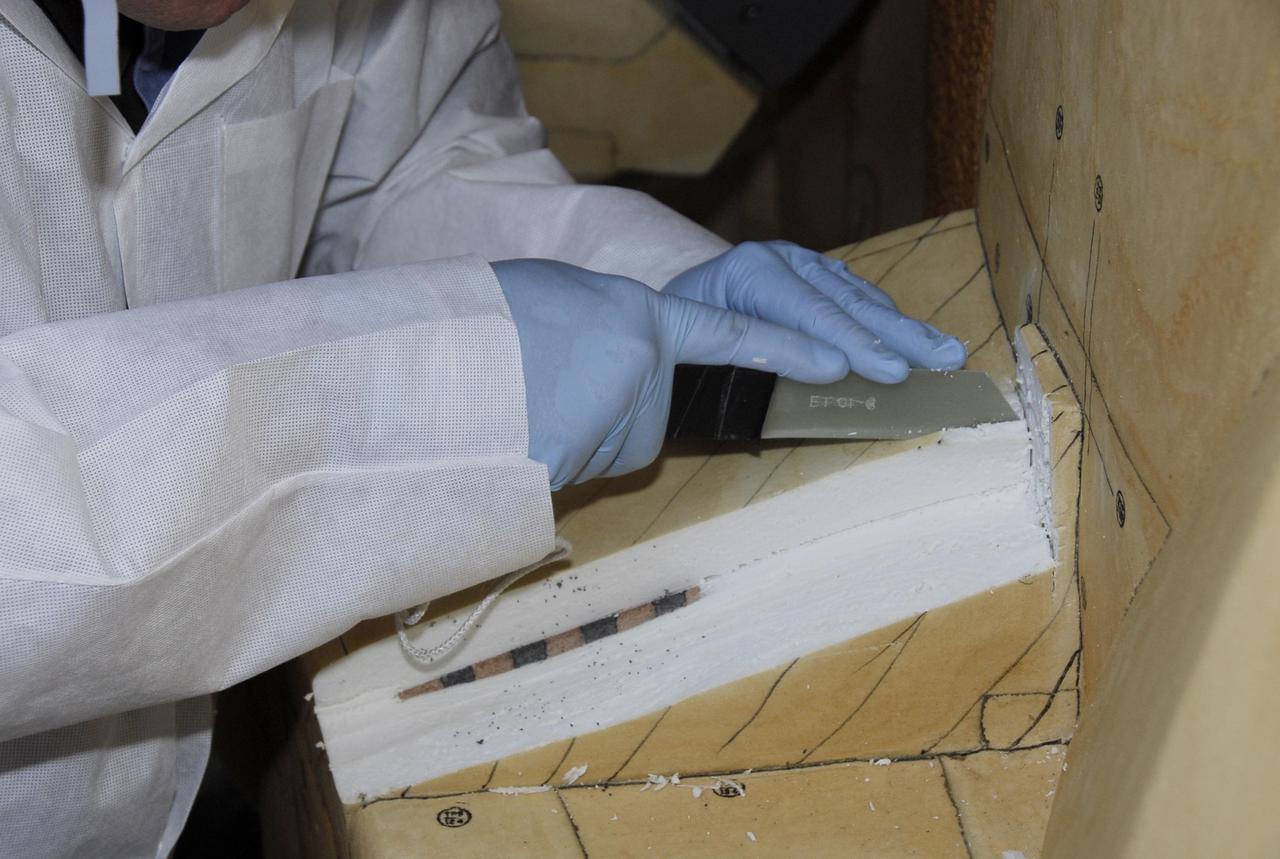
KENNEDY SPACE CENTER, FLA. -- At Launch Pad 39A, the foam insulation surrounding the covers over the feed-through connector box on the external tank for space shuttle Atlantis' STS-122 mission is carefully cut away by a United Space Alliance technician. The covers will be removed for access to the feed-through connectors. Following the failure of some of the tank's engine cutoff sensors, or ECO sensors, during propellant tanking for launch attempts on Dec. 6 and Dec. 9, a tanking test was conducted on Dec. 18 to aid in troubleshooting the cause. Technicians spliced test wiring into the ECO sensor electrical system and used time domain reflectometry equipment to help locate the electrical anomaly. Results of the tanking test pointed to an open circuit in the feed-through connector wiring, which is located at the base of the tank. The feed-through connector passes the wires from the inside of the tank to the outside. During the holiday period, workers from Lockheed Martin will begin inspecting and testing the connector. Shuttle program managers will meet on Dec. 27 to review the test and analysis, and decide on a forward plan. Photo credit: NASA/Kim Shiflett