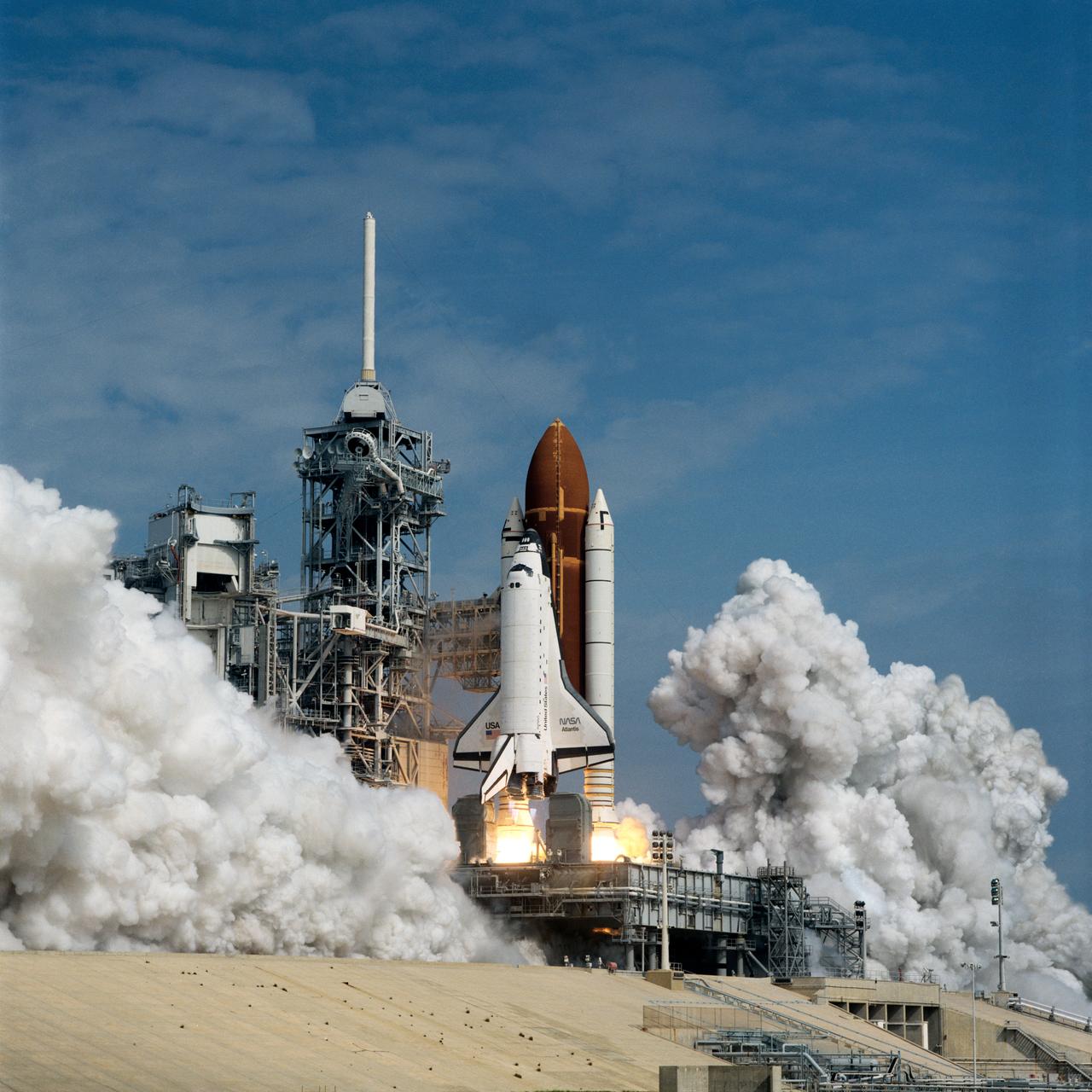
STS-37 Atlantis, Orbiter Vehicle (OV) 104, lifts off from Kennedy Space Center (KSC) Launch Complex (LC) Pad at 9:22:45:0439 (Eastern Standard Time (EST)). OV-104, atop its external tank (ET) and flanked by its two solid rocket boosters (SRBs), is captured just after space shuttle main engine (SSME) firing and as it rises above the mobile launcher platform. The fixed service structure (FSS) and retracted rotating service structure (RSS) appear along side OV-104. Clouds of exhaust smoke begin to fill the launch pad area.
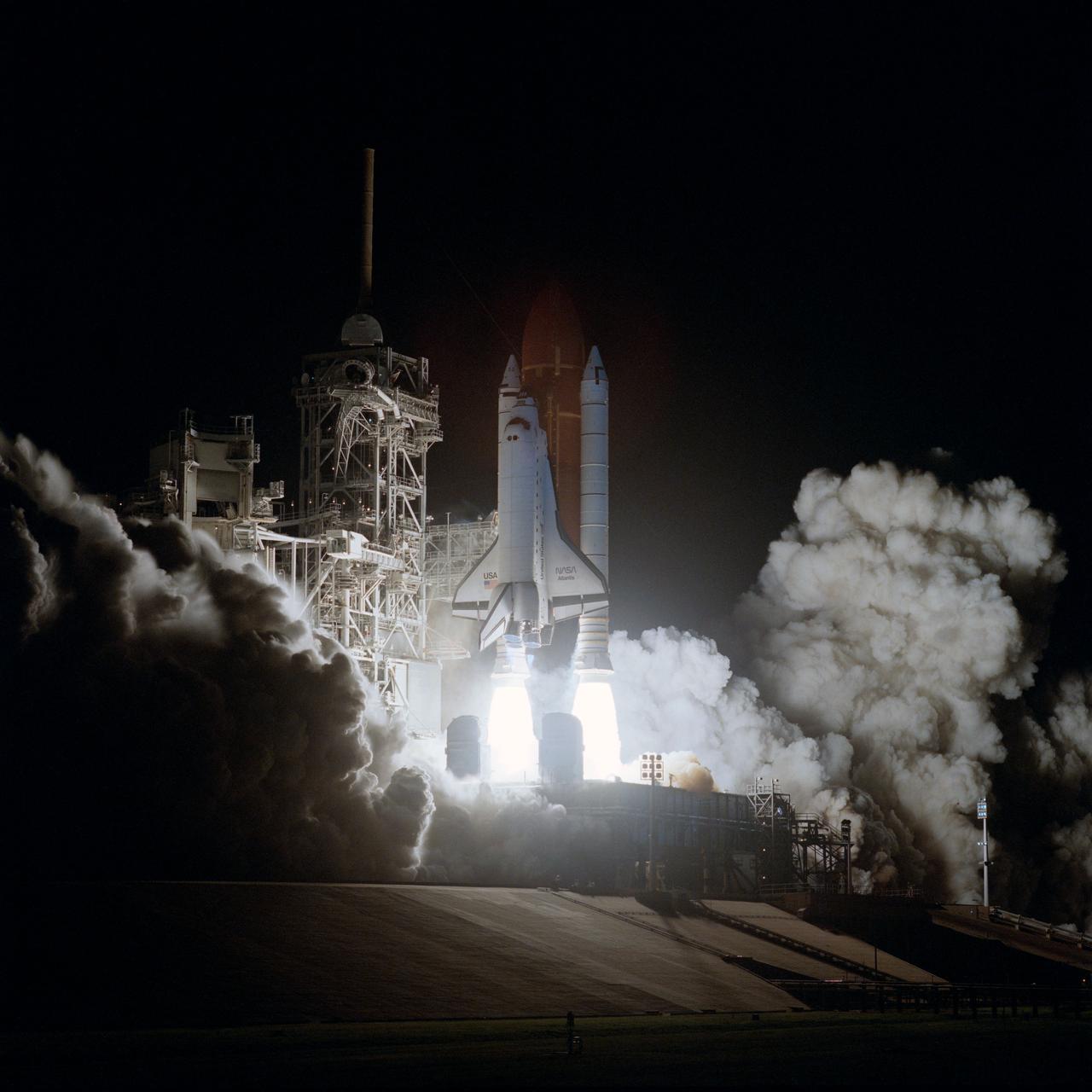
STS-38 Atlantis, Orbiter Vehicle (OV) 104, lifts off from Kennedy Space Center (KSC) Launch Complex Pad at 6:46:15:0639 pm (Eastern Standard Time (EST)). As OV-104, atop the external tank (ET) and flanked by two solid rocket boosters (SRBs), rises above the mobile launcher platform, exhaust smoke fills the area surrounding the launch pad. SRB and space shuttle main engine (SSME) firings glow against the night darkness and light up the fixed service structure (FSS) and retracted rotating service structure (RSS). STS-38 is a Department of Defense (DOD) devoted mission.
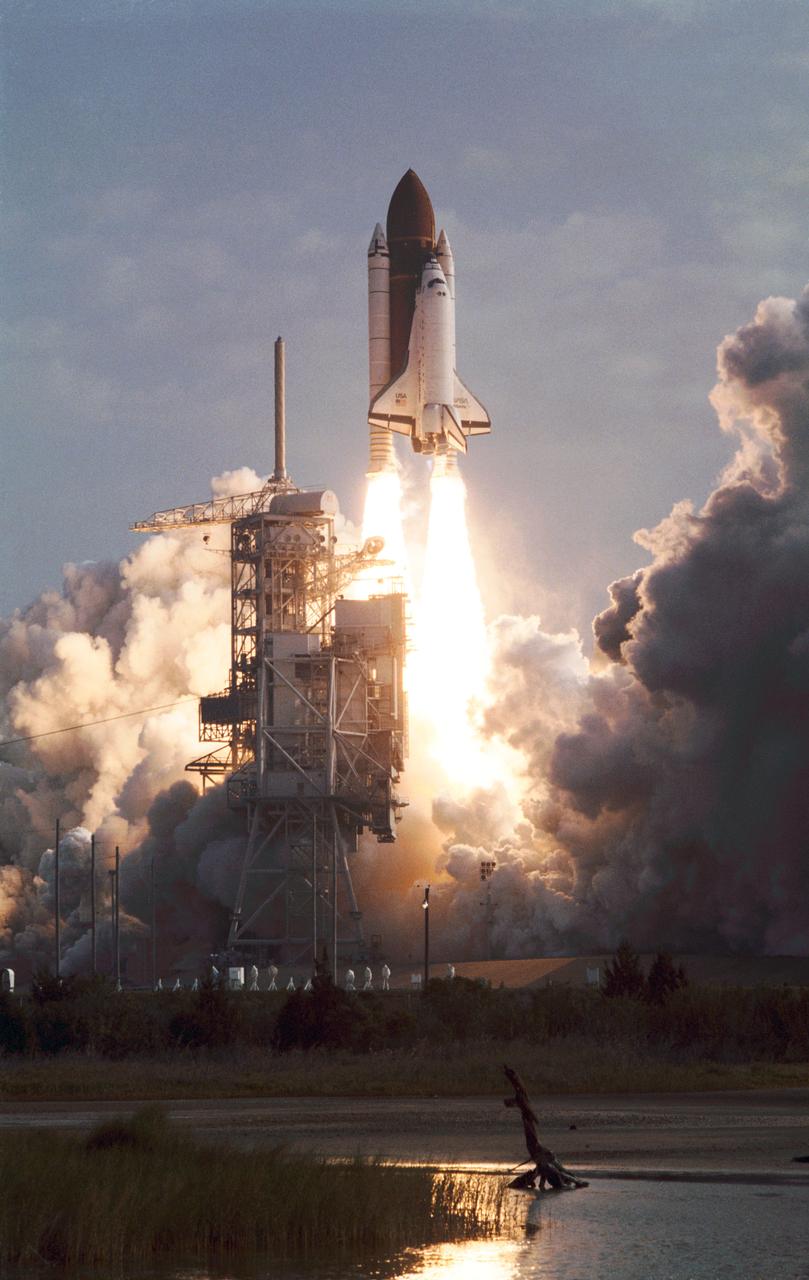
STS-45 Atlantis, Orbiter Vehicle (OV) 104, lifts off from a Kennedy Space Center (KSC) Launch Complex (LC) Pad at 8:13:40:048 am (Eastern Standard Time (EST)). Exhaust billows out the solid rocket boosters (SRBs) as OV-104 atop its external tank (ET) soars above the mobile launcher platform and is nearly clear of the fixed service structure (FSS) tower. The diamond shock effect produced by the space shuttle main engines (SSMEs) is visible. The glow of the SRB/SSME firings is reflected in a nearby waterway. An exhaust cloud covers the launch pad area.
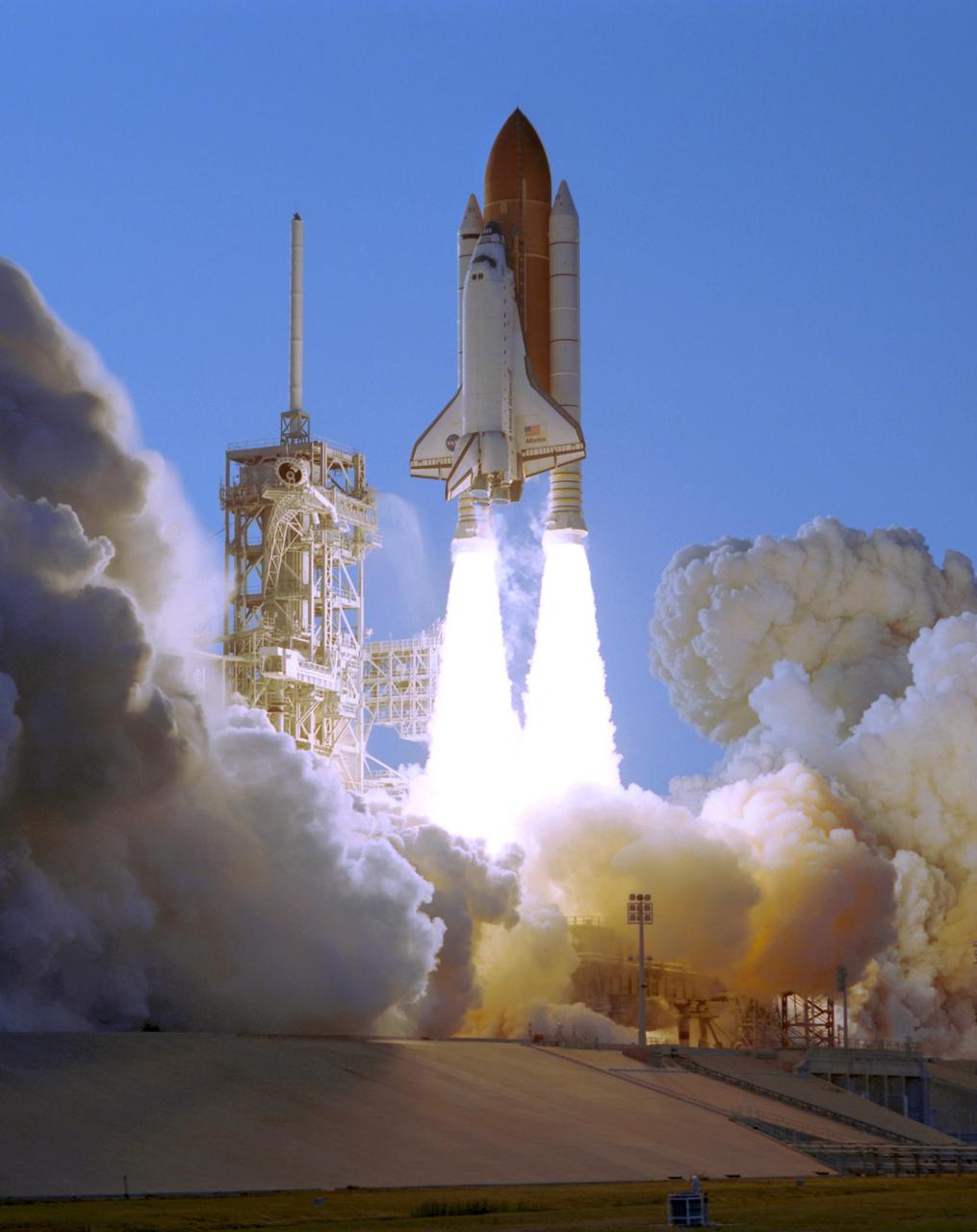
KENNEDY SPACE CENTER, FLA. -- Smoke and steam billow across Launch Pad 39A as Space Shuttle Atlantis, trailing columns of fire from the solid rocket boosters, hurtles into the sky on mission STS-117 to the International Space Station. At left is the fixed service structure with the 80-foot-tall lightning mast on top. Liftoff was on-time at 7:38:04 p.m. EDT. The shuttle is delivering a new segment to the starboard side of the International Space Station's backbone, known as the truss. Three spacewalks are planned to install the S3/S4 truss segment, deploy a set of solar arrays and prepare them for operation. STS-117 is the 118th space shuttle flight, the 21st flight to the station, the 28th flight for Atlantis and the first of four flights planned for 2007. Photo Credit: NASA/Tony Gray & Don Kight
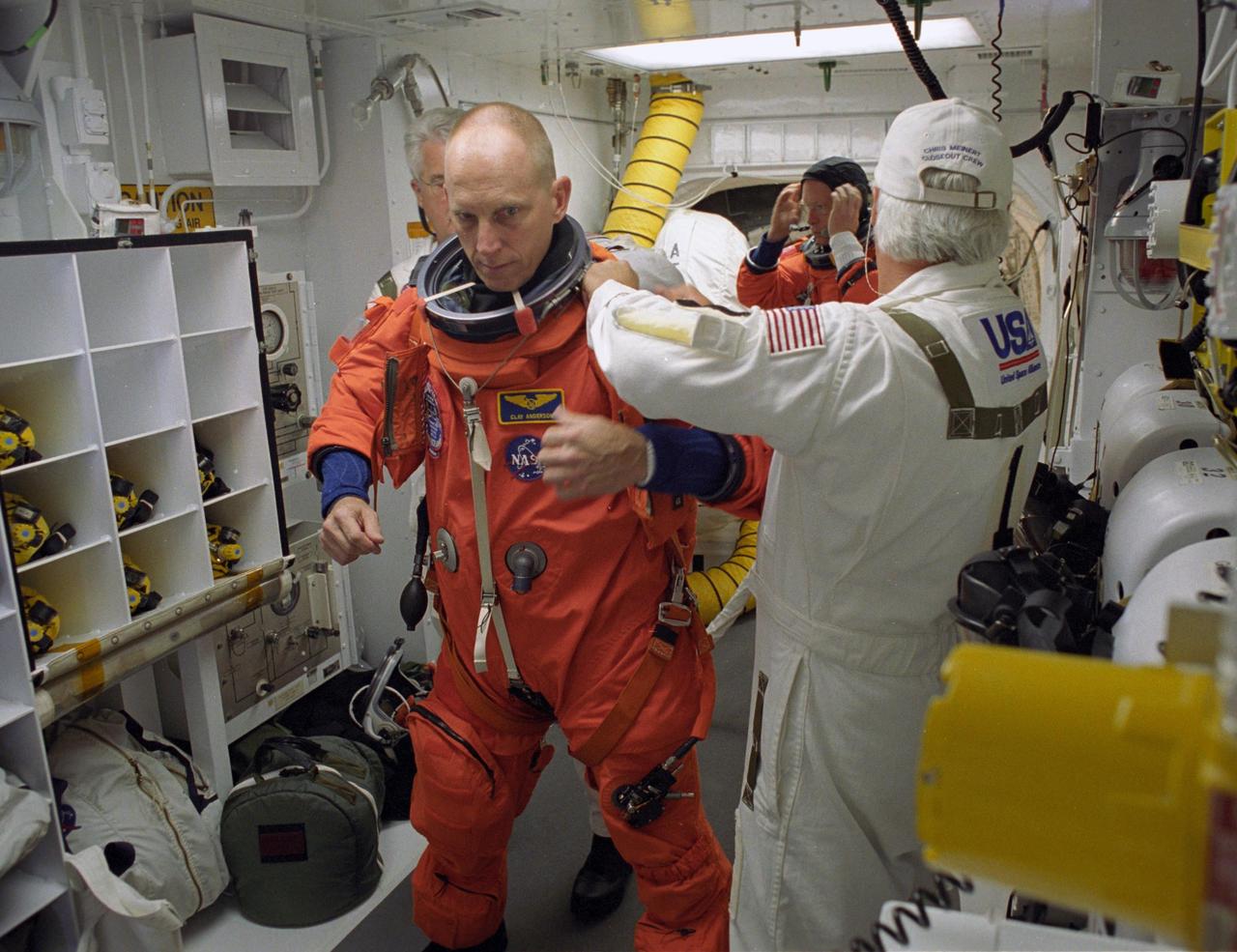
KENNEDY SPACE CENTER, FLA. -- In the White Room on Launch Pad 39A, astronaut Clayton Anderson is helped by the closeout crew to secure his launch suit before climbing into Space Shuttle Atlantis. Anderson is flying to the International Space Station with the STS-117 crew to join the Expedition 15 crew on the space station. Flight Engineer Suni Williams will return to Earth in his place. The mission to the space station is scheduled to launch at 7:38 p.m. EDT. Members of the closeout crew help the astronauts don a parachute pack, strap them into the space shuttle's crew module and take care of any other last-minute needs that arise. The White Room is at the end of the orbiter access arm that extends from the fixed service structure and provides entry into the orbiter. The shuttle is delivering a new segment to the starboard side of the space station's backbone, known as the truss. Three spacewalks are planned to install the S3/S4 truss segment, deploy a set of solar arrays and prepare them for operation. STS-117 is the 118th space shuttle flight, the 21st flight to the station, the 28th flight for Atlantis and the first of four flights planned for 2007. Photo credit: NASA/Tony Gray & Don Kight
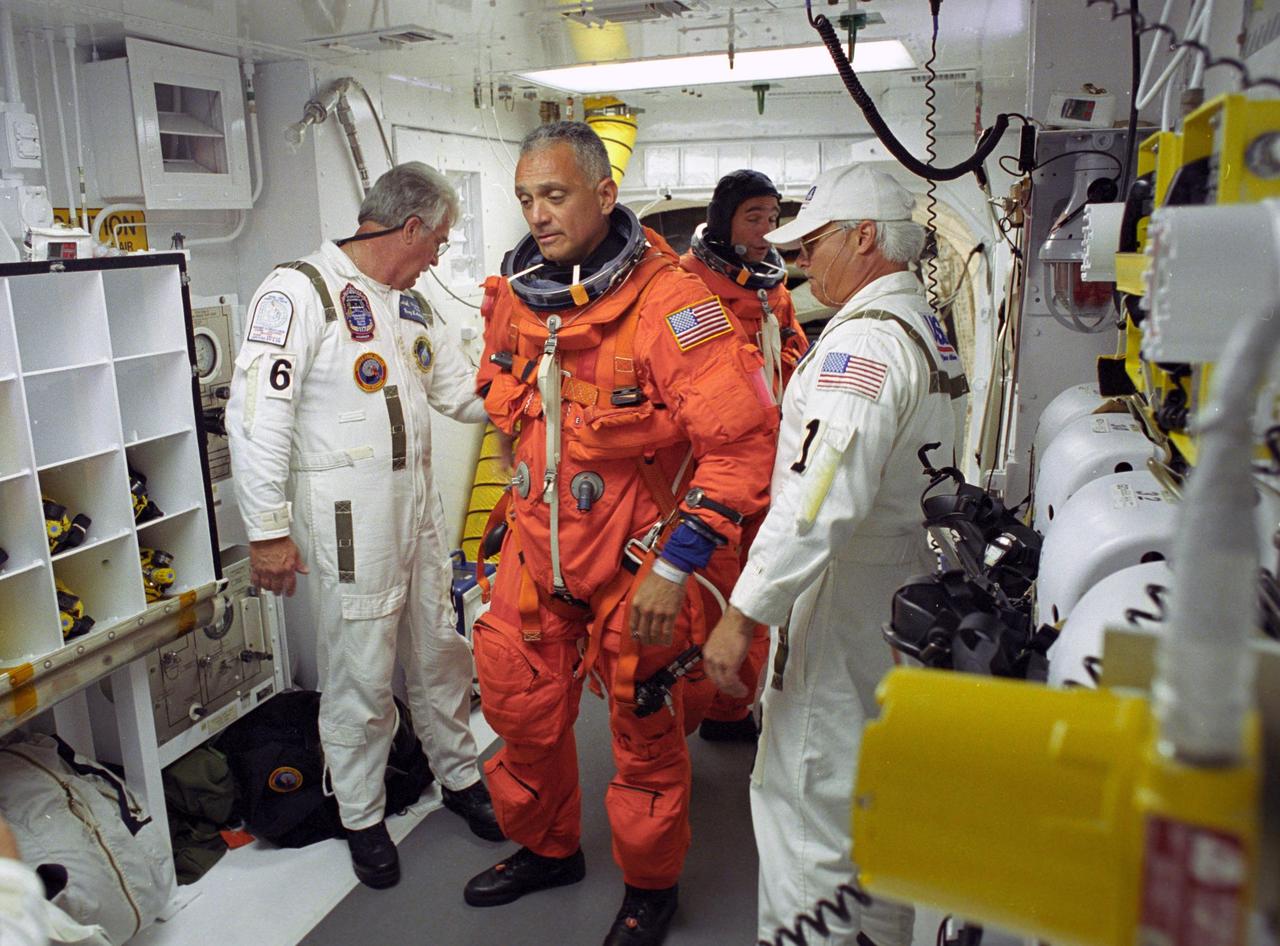
KENNEDY SPACE CENTER, FLA. -- In the White Room on Launch Pad 39A, STS-117 Mission Specialist John "Danny" Olivas is helped by the closeout crew to secure his launch suit before climbing into Space Shuttle Atlantis. Behind Olivas is Pilot Lee Archambault. The mission to the International Space Station is scheduled to launch at 7:38 p.m. EDT. Members of the closeout crew help the astronauts don a parachute pack, strap them into the space shuttle's crew module and take care of any other last-minute needs that arise. The White Room is at the end of the orbiter access arm that extends from the fixed service structure and provides entry into the orbiter. The shuttle is delivering a new segment to the starboard side of the space station's backbone, known as the truss. Three spacewalks are planned to install the S3/S4 truss segment, deploy a set of solar arrays and prepare them for operation. STS-117 is the 118th space shuttle flight, the 21st flight to the station, the 28th flight for Atlantis and the first of four flights planned for 2007. Photo credit: NASA/Tony Gray & Don Kight
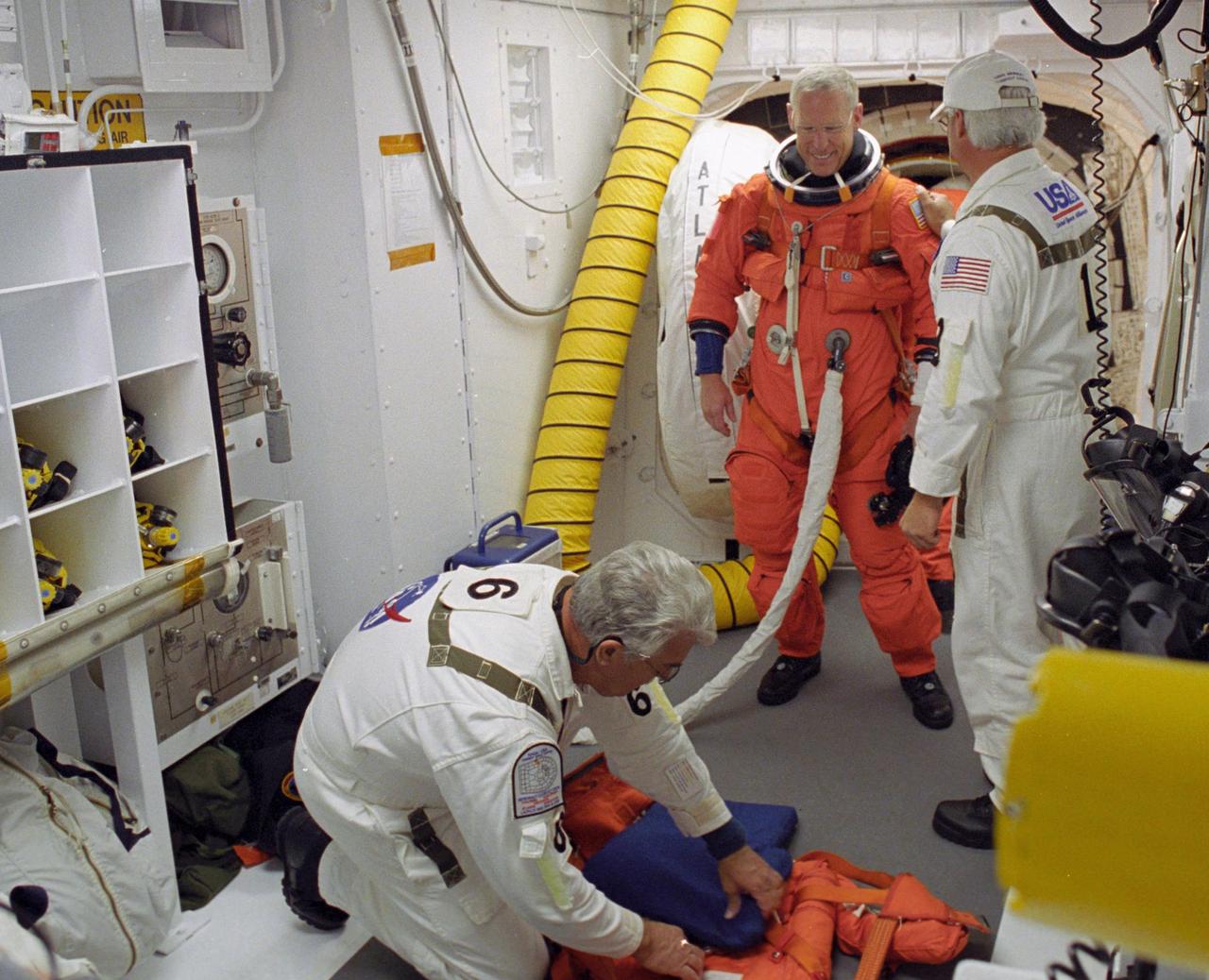
KENNEDY SPACE CENTER, FLA. -- In the White Room on Launch Pad 39A, members of the closeout crew help STS-117Mission Specialist Patrick Forrester secure his equipment before climbing into Space Shuttle Atlantis. The mission to the International Space Station is scheduled to launch at 7:38 p.m. EDT. Members of the closeout crew help the astronauts don a parachute pack, strap them into the space shuttle's crew module and take care of any other last-minute needs that arise. The White Room is at the end of the orbiter access arm that extends from the fixed service structure and provides entry into the orbiter. The shuttle is delivering a new segment to the starboard side of the space station's backbone, known as the truss. Three spacewalks are planned to install the S3/S4 truss segment, deploy a set of solar arrays and prepare them for operation. STS-117 is the 118th space shuttle flight, the 21st flight to the station, the 28th flight for Atlantis and the first of four flights planned for 2007. Photo credit: NASA/Tony Gray & Don Kight
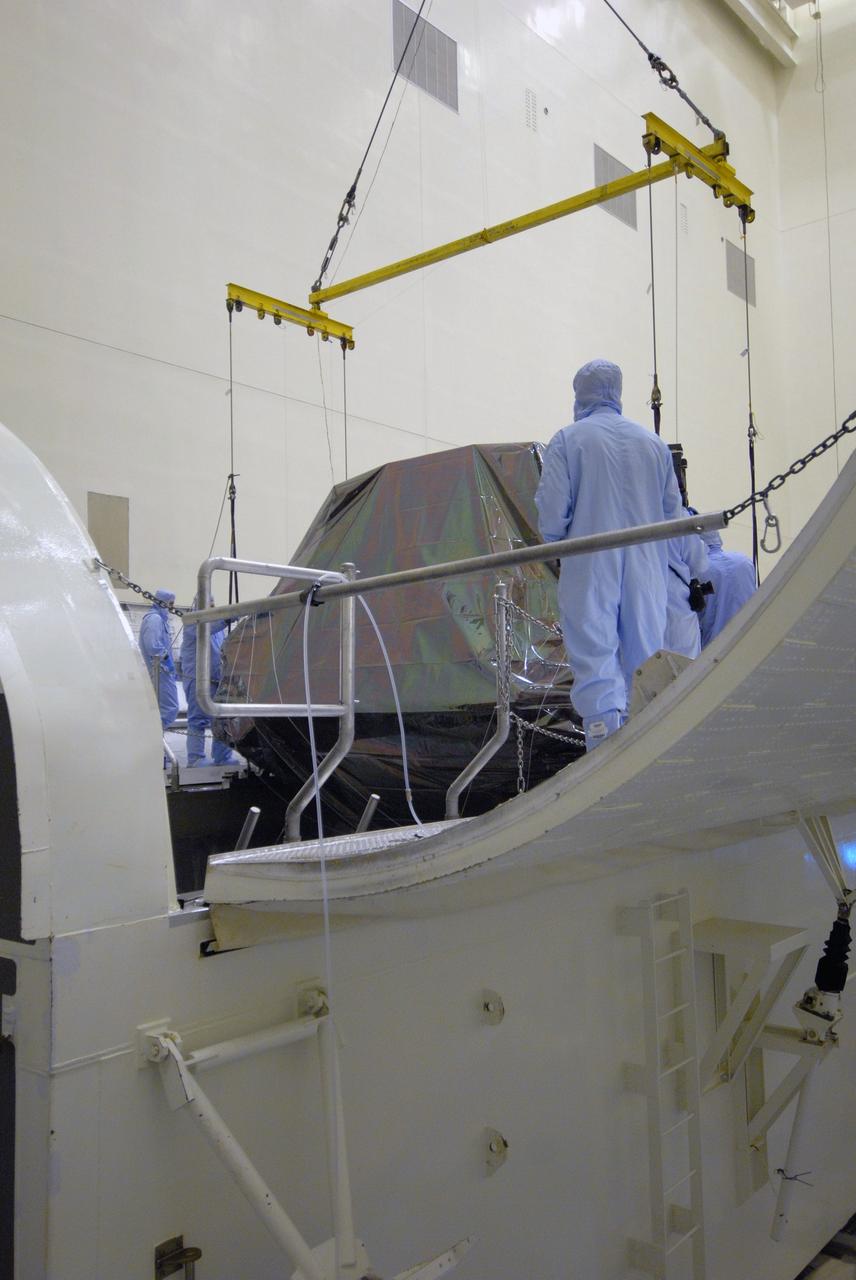
CAPE CANAVERAL, Fla. – In the Payload Hazardous Servicing Facility at NASA's Kennedy Space Center in Florida, an overhead crane lowers the Flight Support System, or FSS, carrier with the Soft Capture Mechanism into the payload canister. The canister will deliver the FSS and other carriers to Launch Pad 39A for installation in space shuttle Atlantis' payload bay. Atlantis' 11-day STS-125 mission to service NASA's Hubble Space Telescope is targeted for launch May 12. It will include five spacewalks in which astronauts will refurbish and upgrade the telescope with state-of-the-art science instruments. As a result, Hubble's capabilities will be expanded and its operational lifespan extended through at least 2014. Photo credit: NASA/Jack Pfaller
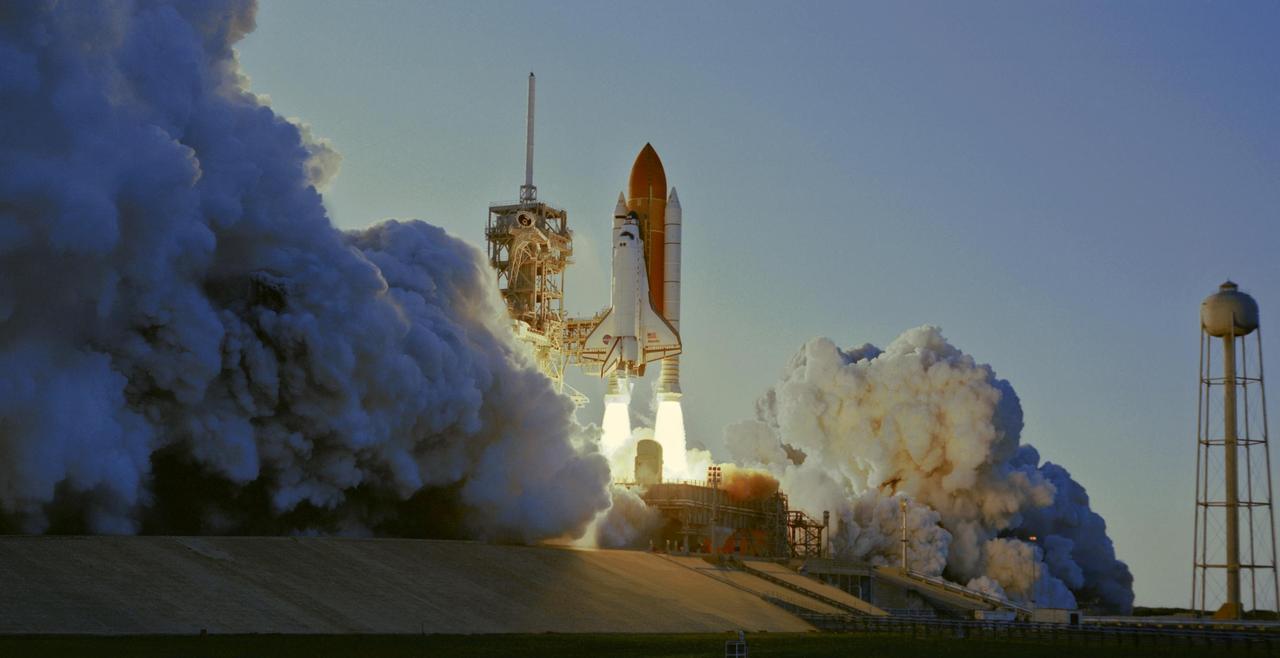
KENNEDY SPACE CENTER, FLA. -- Smoke and steam billow across Launch Pad 39A as Space Shuttle Atlantis, trailing columns of fire from the solid rocket boosters, hurtles into the sky on mission STS-117 to the International Space Station. At left is the fixed service structure with the 80-foot-tall lightning mast on top. At right is the 290-foot-high water tower that supplies the water for sound suppression. Liftoff was on-time at 7:38:04 p.m. EDT. The shuttle is delivering a new segment to the starboard side of the International Space Station's backbone, known as the truss. Three spacewalks are planned to install the S3/S4 truss segment, deploy a set of solar arrays and prepare them for operation. STS-117 is the 118th space shuttle flight, the 21st flight to the station, the 28th flight for Atlantis and the first of four flights planned for 2007. Photo credit: NASA/Tony Gray & Don Kight
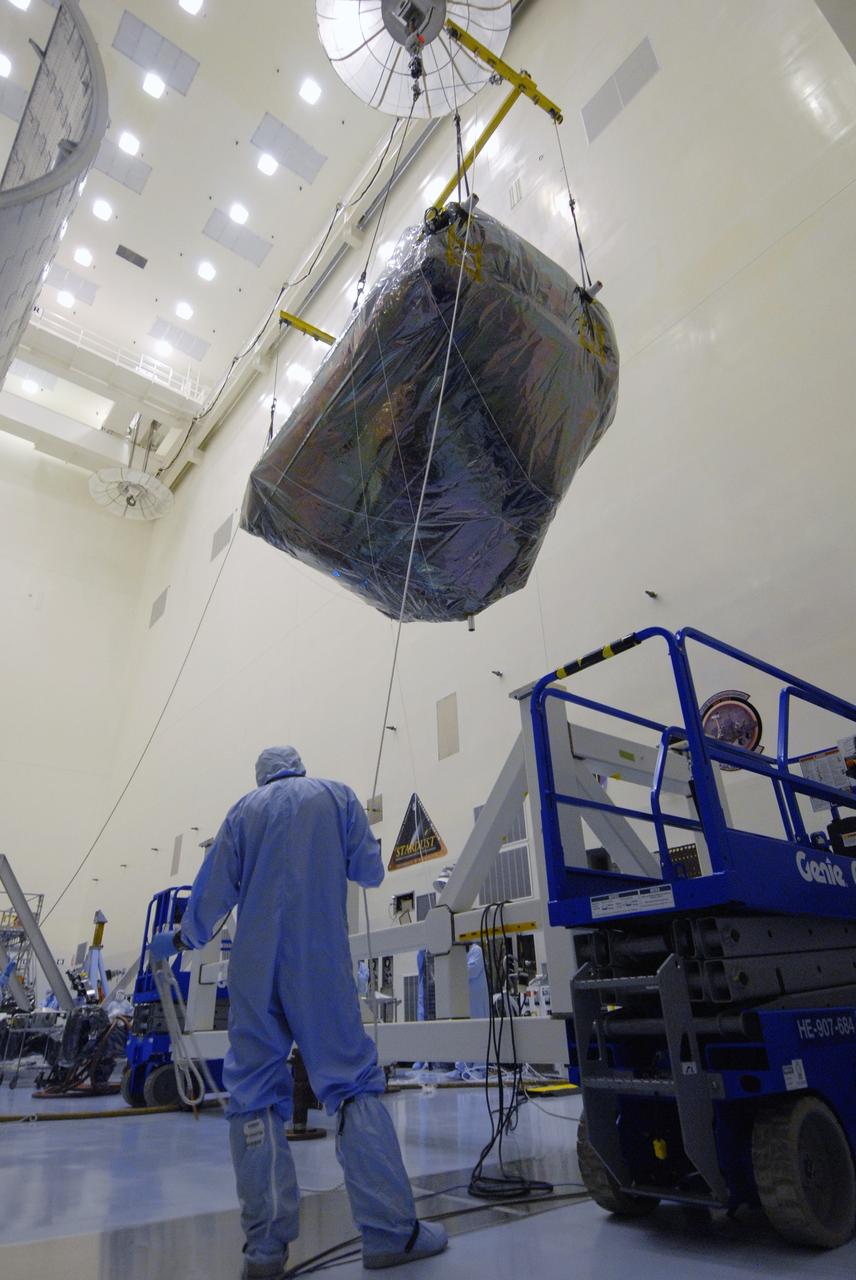
CAPE CANAVERAL, Fla. – In the Payload Hazardous Servicing Facility at NASA's Kennedy Space Center in Florida, an overhead crane is used to lift the Flight Support System, or FSS, carrier with the Soft Capture Mechanism from the workstand. The FSS will be placed in the payload canister and delivered with other carriers to Launch Pad 39A for installation in space shuttle Atlantis' payload bay. Atlantis' 11-day STS-125 mission to service NASA's Hubble Space Telescope is targeted for launch May 12. It will include five spacewalks in which astronauts will refurbish and upgrade the telescope with state-of-the-art science instruments. As a result, Hubble's capabilities will be expanded and its operational lifespan extended through at least 2014. Photo credit: NASA/Jack Pfaller
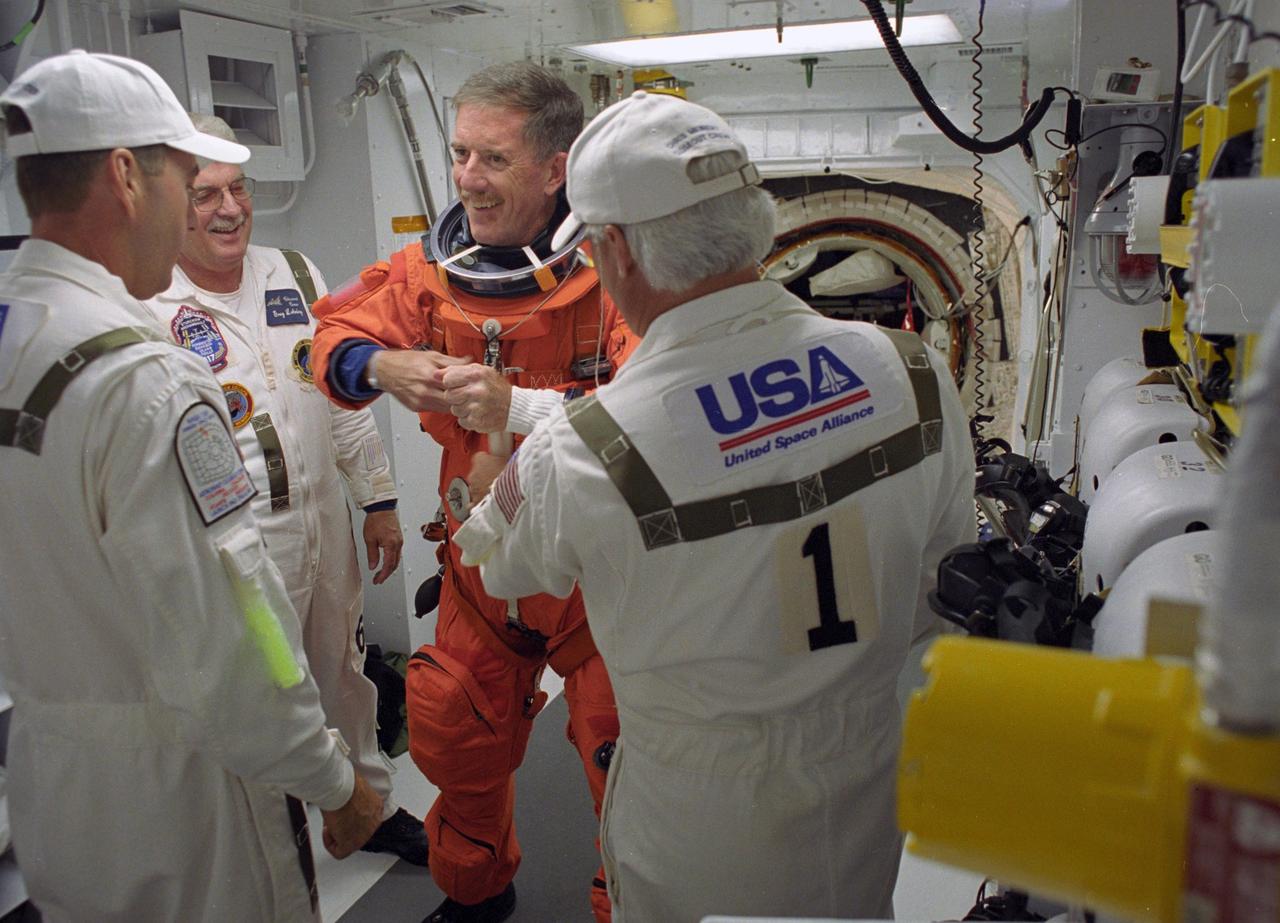
KENNEDY SPACE CENTER, FLA. -- In the White Room on Launch Pad 39A, members of the closeout crew help STS-117 Mission Specialist James Reilly secure his launch suit before climbing into Space Shuttle Atlantis. The mission to the International Space Station is scheduled to launch at 7:38 p.m. EDT. Members of the closeout crew help the astronauts don a parachute pack, strap them into the space shuttle's crew module and take care of any other last-minute needs that arise. The White Room is at the end of the orbiter access arm that extends from the fixed service structure and provides entry into the orbiter. The shuttle is delivering a new segment to the starboard side of the space station's backbone, known as the truss. Three spacewalks are planned to install the S3/S4 truss segment, deploy a set of solar arrays and prepare them for operation. STS-117 is the 118th space shuttle flight, the 21st flight to the station, the 28th flight for Atlantis and the first of four flights planned for 2007. Photo credit: NASA/Tony Gray & Don Kight
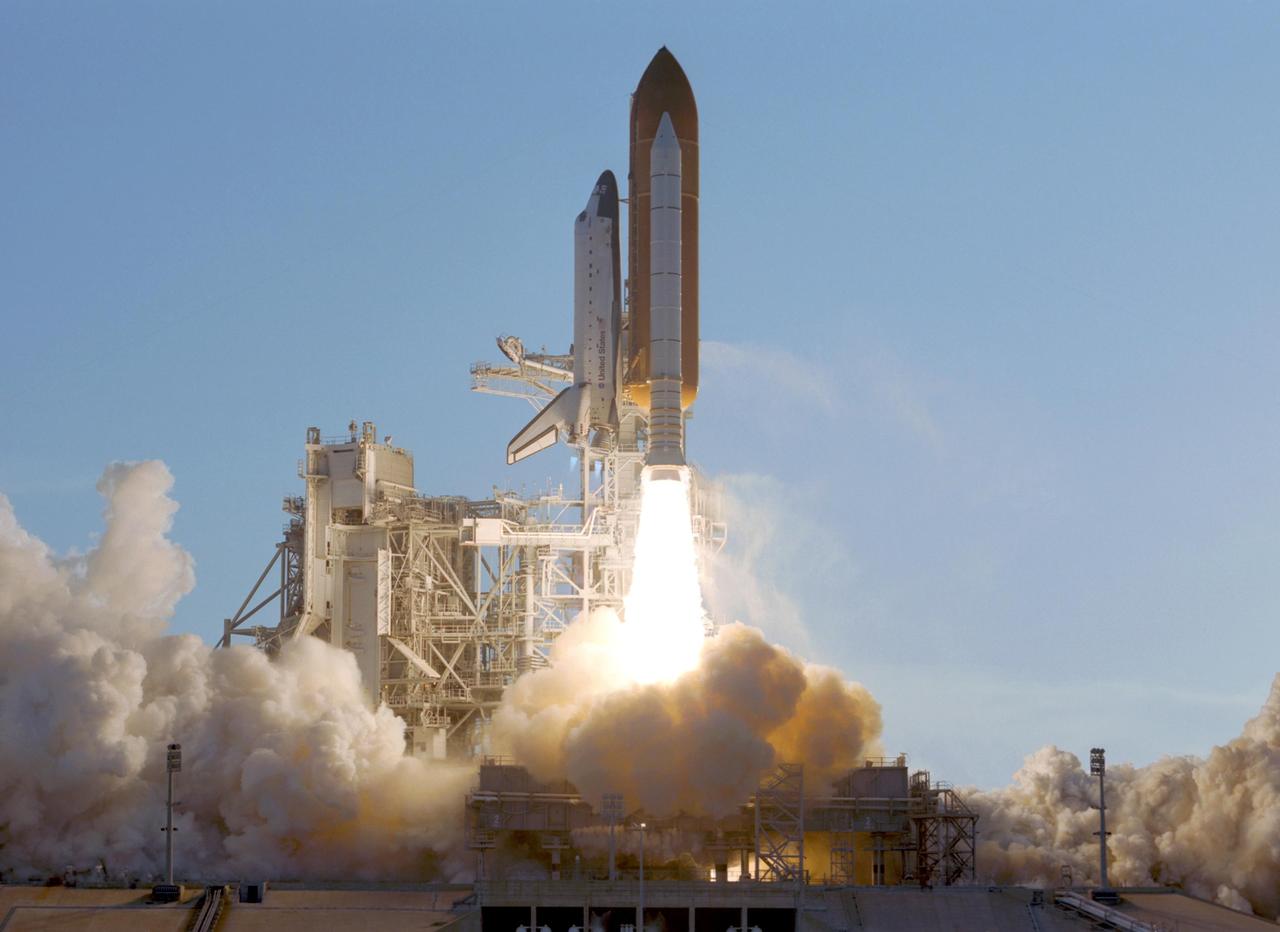
KENNEDY SPACE CENTER, FLA. -- With solid rocket boosters firing, Space Shuttle Atlantis leaps toward the heavens in a near-perfect launch on mission STS-117 to the International Space Station. The clouds of smoke and steam roll across Launch Pad 39A and surround the rotating service structure at left. Liftoff was on-time at 7:38:04 p.m. EDT. The shuttle is delivering a new segment to the starboard side of the International Space Station's backbone, known as the truss. Three spacewalks are planned to install the S3/S4 truss segment, deploy a set of solar arrays and prepare them for operation. STS-117 is the 118th space shuttle flight, the 21st flight to the station, the 28th flight for Atlantis and the first of four flights planned for 2007. Photo credit: NASA/Jerry Cannon & Mike Kerley
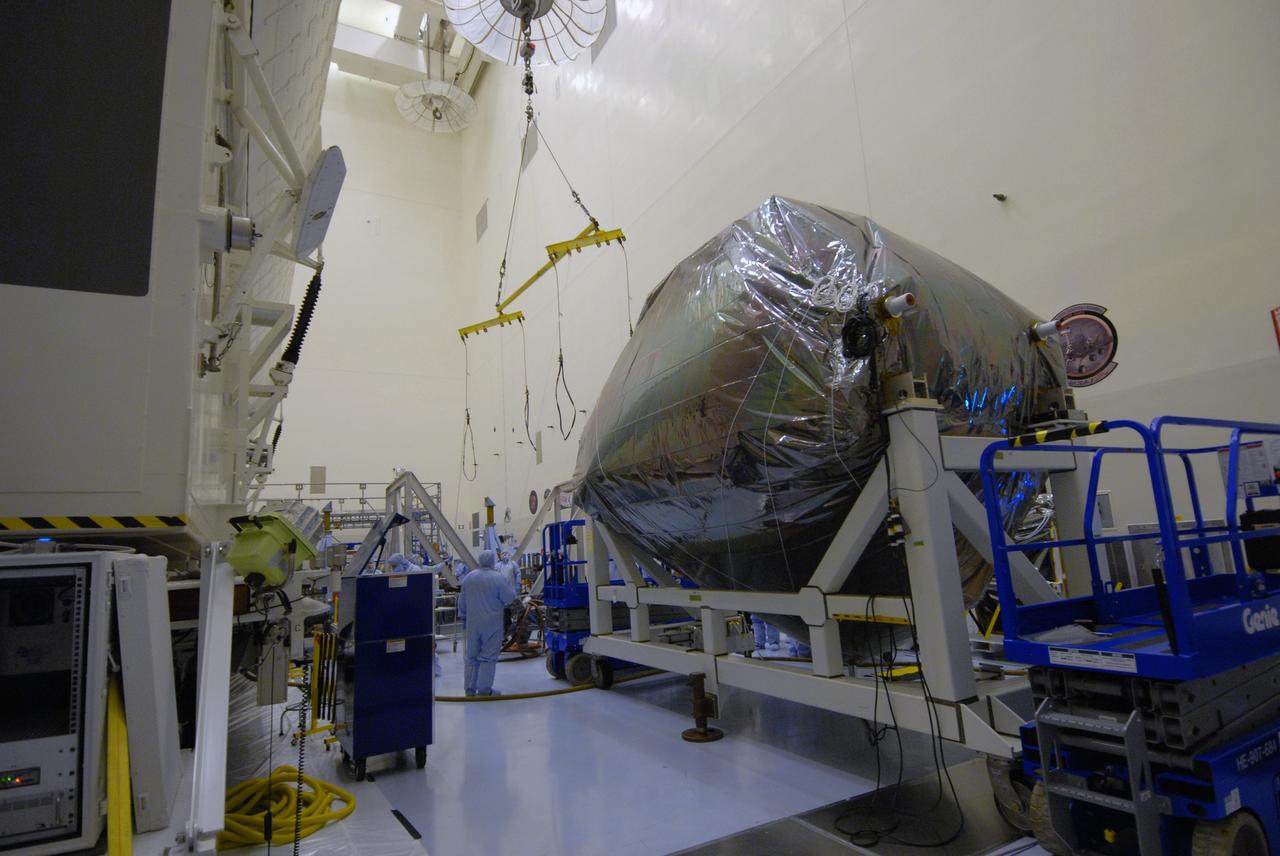
CAPE CANAVERAL, Fla. – In the Payload Hazardous Servicing Facility at NASA's Kennedy Space Center in Florida, the Flight Support System, or FSS, carrier with the Soft Capture Mechanism is waiting to be lifted from the workstand and placed in the payload canister. The canister will deliver the FSS and other carriers to Launch Pad 39A for installation in space shuttle Atlantis' payload bay. Atlantis' 11-day STS-125 mission to service NASA's Hubble Space Telescope is targeted for launch May 12. It will include five spacewalks in which astronauts will refurbish and upgrade the telescope with state-of-the-art science instruments. As a result, Hubble's capabilities will be expanded and its operational lifespan extended through at least 2014. Photo credit: NASA/Jack Pfaller
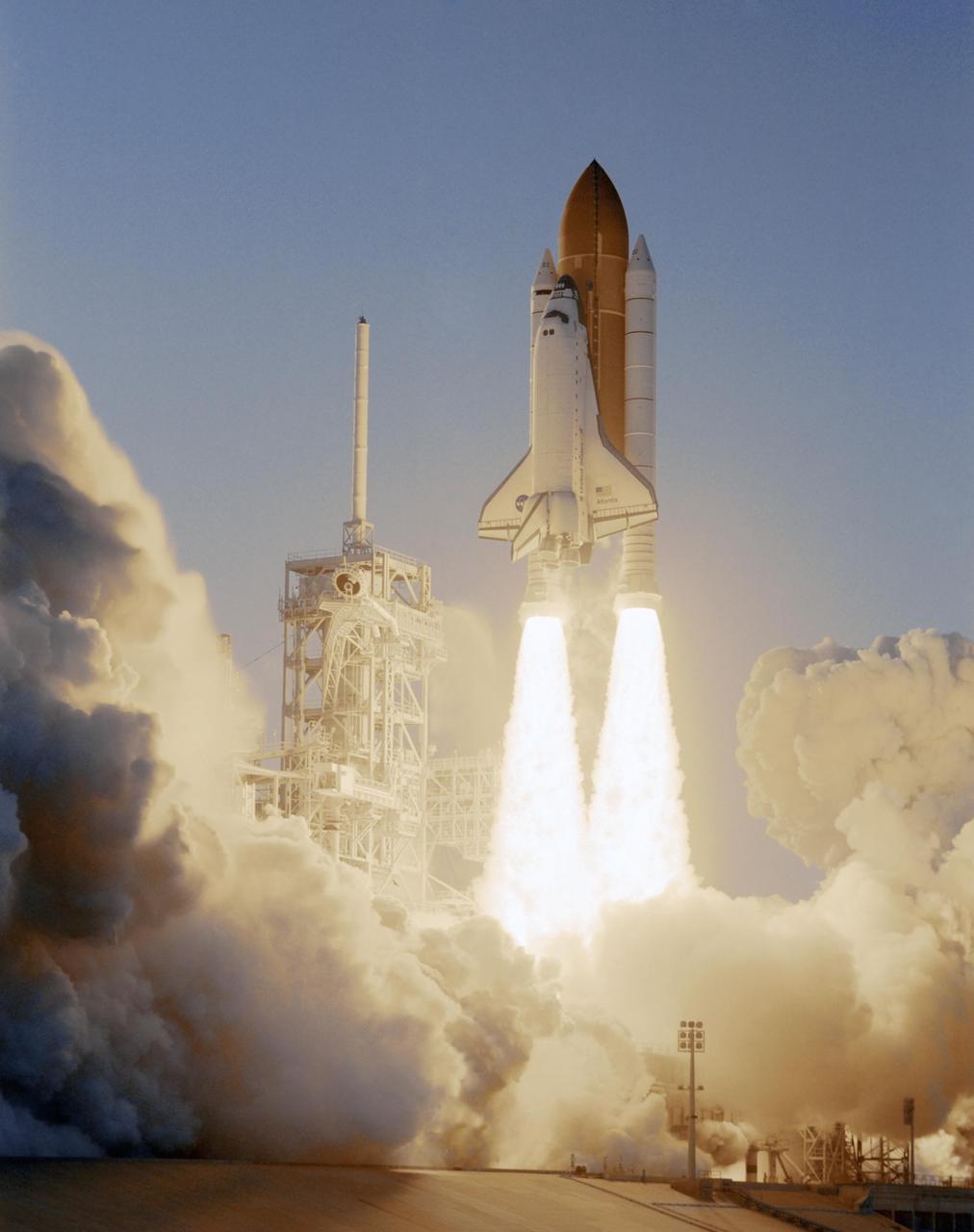
KENNEDY SPACE CENTER, FLA. -- Smoke and steam billow across Launch Pad 39A as Space Shuttle Atlantis, trailing columns of fire from the solid rocket boosters, hurtles into the sky on mission STS-117 to the International Space Station. At left is the fixed service structure with the 80-foot-tall lightning mast on top. Liftoff was on-time at 7:38:04 p.m. EDT. The shuttle is delivering a new segment to the starboard side of the International Space Station's backbone, known as the truss. Three spacewalks are planned to install the S3/S4 truss segment, deploy a set of solar arrays and prepare them for operation. STS-117 is the 118th space shuttle flight, the 21st flight to the station, the 28th flight for Atlantis and the first of four flights planned for 2007. Photo credit: NASA/Tony Gray & Don Kight
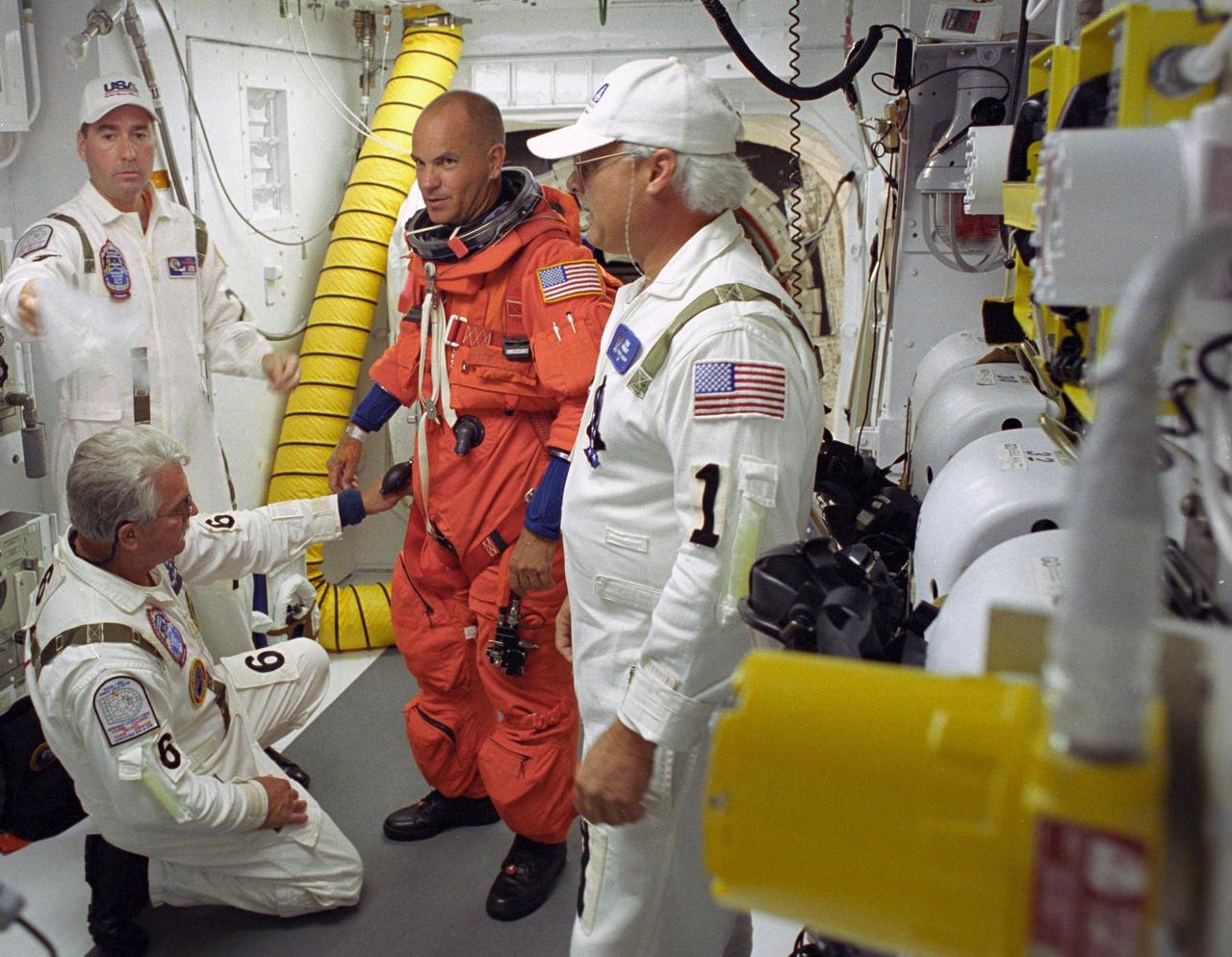
KENNEDY SPACE CENTER, FLA. -- STS-117 Commander Frederick Sturckow is helped by the closeout crew in the White Room on Launch Pad 39A to secure his launch suit before climbing into Space Shuttle Atlantis. The mission to the International Space Station is scheduled to launch at 7:38 p.m. EDT. Members of the Closeout Crew help the astronauts don a parachute pack, strap them into the space shuttle's crew module and take care of any other last-minute needs that arise. The White Room is at the end of the orbiter access arm that extends from the fixed service structure and provides entry into the orbiter. The shuttle is delivering a new segment to the starboard side of the space station's backbone, known as the truss. Three spacewalks are planned to install the S3/S4 truss segment, deploy a set of solar arrays and prepare them for operation. STS-117 is the 118th space shuttle flight, the 21st flight to the station, the 28th flight for Atlantis and the first of four flights planned for 2007. Photo credit: NASA/Tony Gray & Don Kight
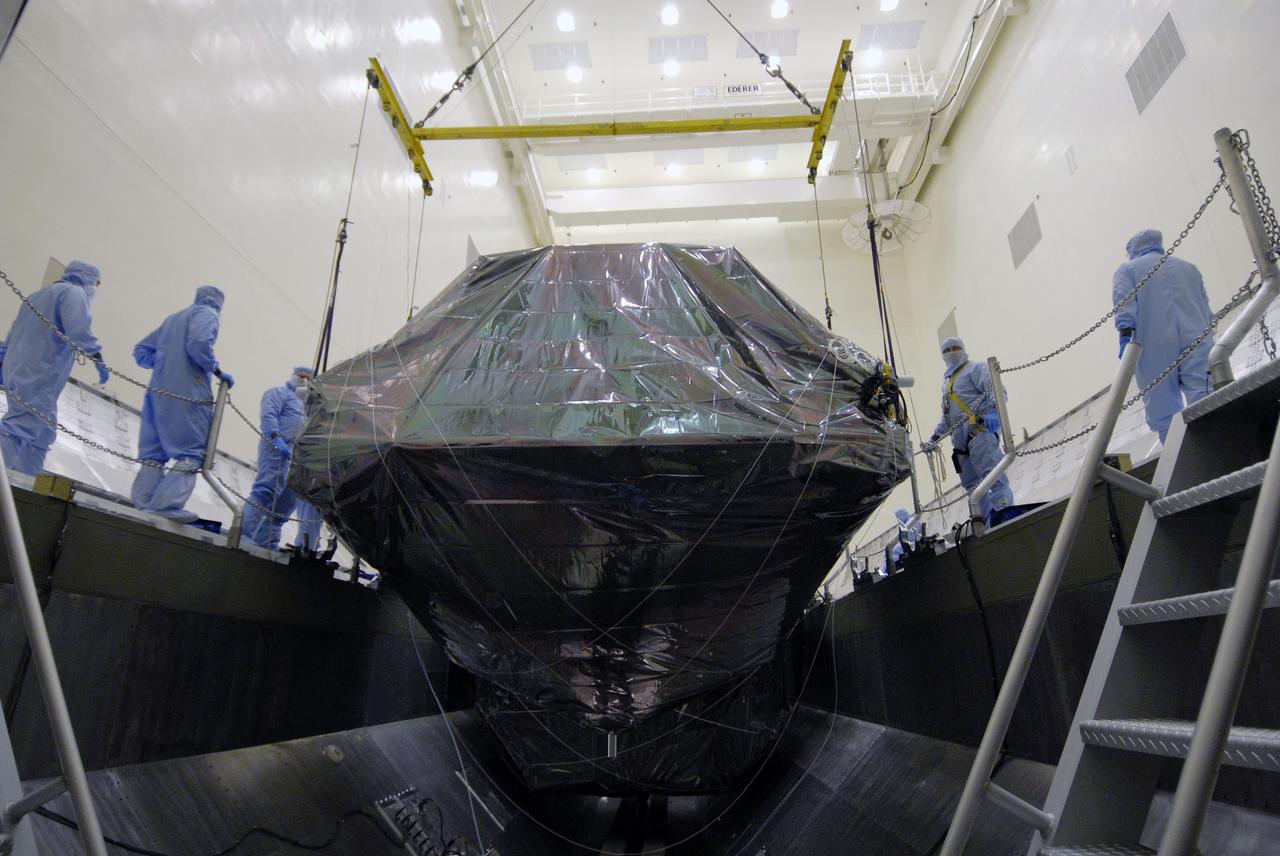
CAPE CANAVERAL, Fla. – In the Payload Hazardous Servicing Facility at NASA's Kennedy Space Center in Florida, an overhead crane lowers the Flight Support System, or FSS, carrier with the Soft Capture Mechanism into the payload canister. The canister will deliver the FSS and other carriers to Launch Pad 39A for installation in space shuttle Atlantis' payload bay. Atlantis' 11-day STS-125 mission to service NASA's Hubble Space Telescope is targeted for launch May 12. It will include five spacewalks in which astronauts will refurbish and upgrade the telescope with state-of-the-art science instruments. As a result, Hubble's capabilities will be expanded and its operational lifespan extended through at least 2014. Photo credit: NASA/Jack Pfaller
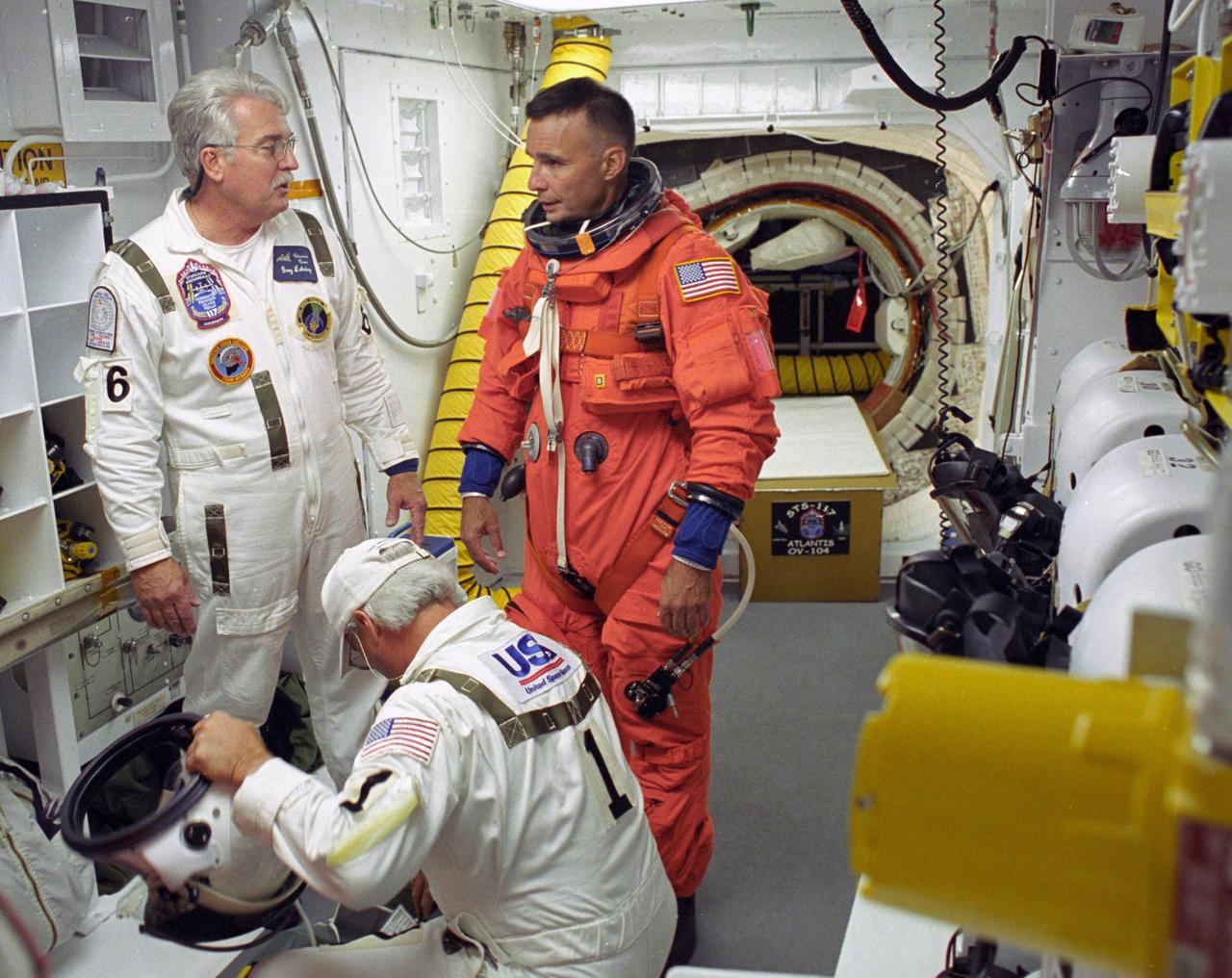
KENNEDY SPACE CENTER, FLA. -- STS-117 Pilot Lee Archambault is helped by the closeout crew in the White Room to secure his launch suit before climbing into Space Shuttle Atlantis. The mission to the International Space Station is scheduled to launch at 7:38 p.m. EDT. Members of the closeout crew help the astronauts don a parachute pack, strap them into the space shuttle's crew module and take care of any other last-minute needs that arise. The White Room is at the end of the orbiter access arm that extends from the fixed service structure and provides entry into the orbiter. The shuttle is delivering a new segment to the starboard side of the space station's backbone, known as the truss. Three spacewalks are planned to install the S3/S4 truss segment, deploy a set of solar arrays and prepare them for operation. STS-117 is the 118th space shuttle flight, the 21st flight to the station, the 28th flight for Atlantis and the first of four flights planned for 2007. Photo credit: NASA/Tony Gray & Don Kight
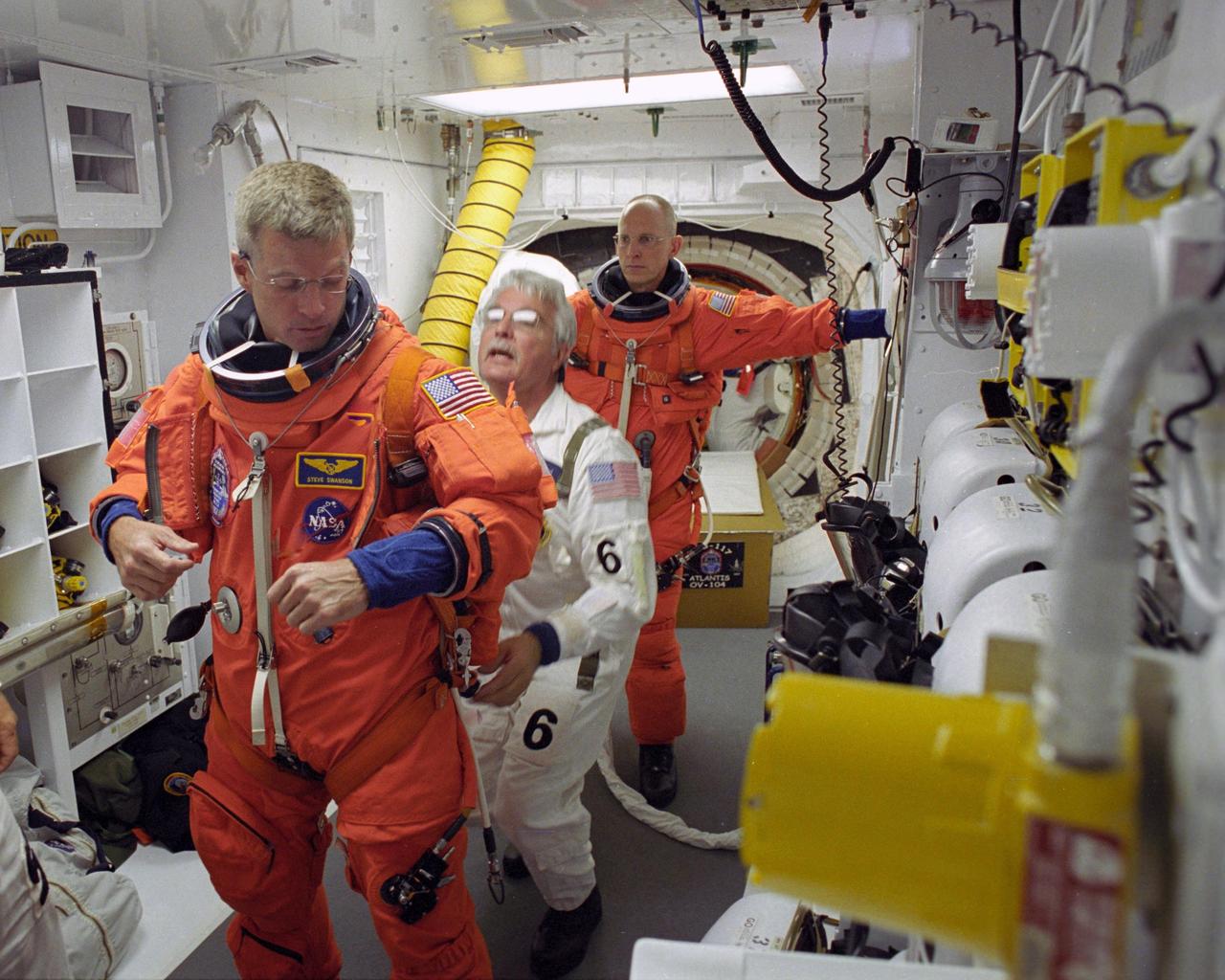
KENNEDY SPACE CENTER, FLA. -- In the White Room on Launch Pad 39A, STS-117 Mission Specialist Steven Swanson is helped by the closeout crew to secure his launch suit before climbing into Space Shuttle Atlantis. Behind Swanson is astronaut Clayton Anderson, waiting his turn. Anderson is joining the Expedition 15 crew on the International Space Station; Flight Engineer Suni Williams will return to Earth in his place. The mission to the space station is scheduled to launch at 7:38 p.m. EDT. Members of the closeout crew help the astronauts don a parachute pack, strap them into the space shuttle's crew module and take care of any other last-minute needs that arise. The White Room is at the end of the orbiter access arm that extends from the fixed service structure and provides entry into the orbiter. The shuttle is delivering a new segment to the starboard side of the space station's backbone, known as the truss. Three spacewalks are planned to install the S3/S4 truss segment, deploy a set of solar arrays and prepare them for operation. STS-117 is the 118th space shuttle flight, the 21st flight to the station, the 28th flight for Atlantis and the first of four flights planned for 2007. Photo credit: NASA/Tony Gray & Don Kight
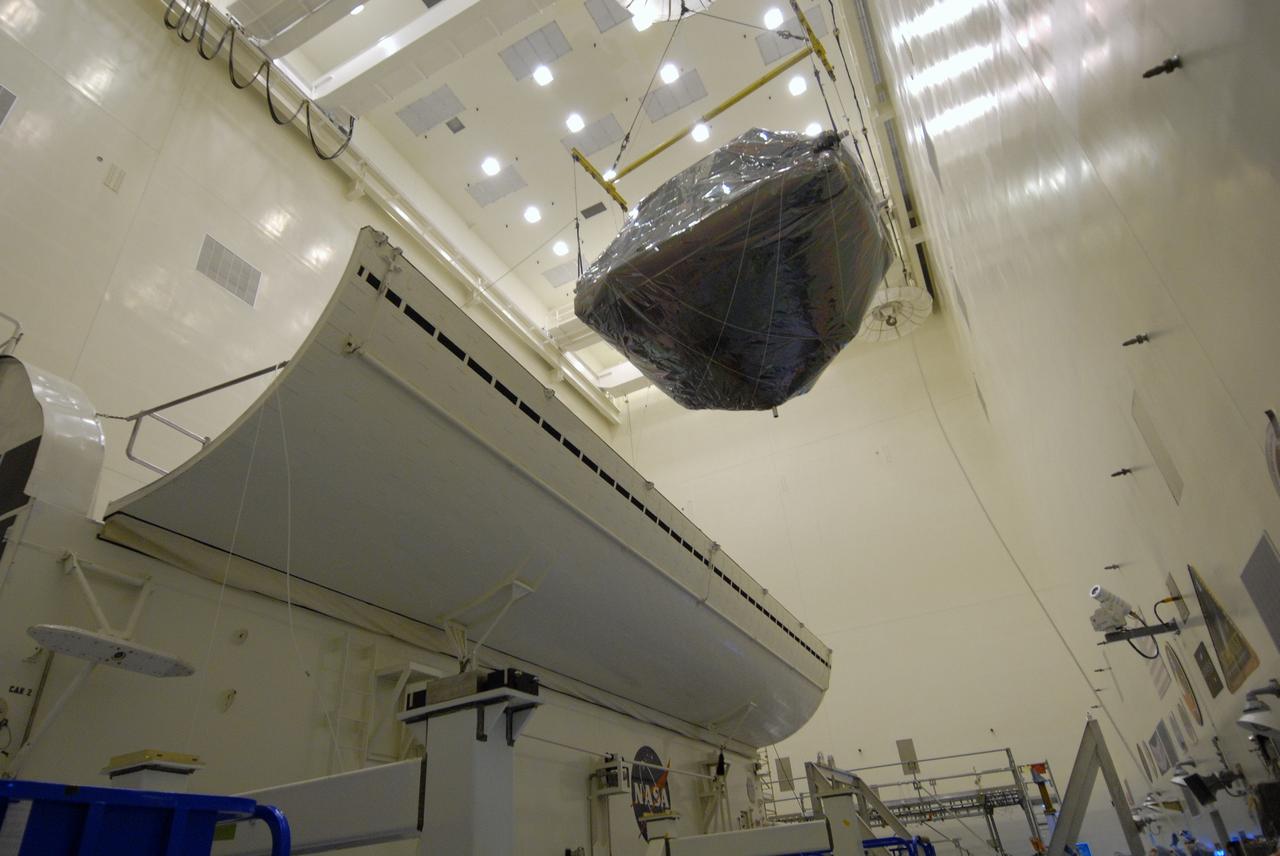
CAPE CANAVERAL, Fla. – In the Payload Hazardous Servicing Facility at NASA's Kennedy Space Center in Florida, an overhead crane moves the Flight Support System, or FSS, carrier with the Soft Capture Mechanism toward the payload canister. The canister will deliver the FSS and other carriers to Launch Pad 39A for installation in space shuttle Atlantis' payload bay. Atlantis' 11-day STS-125 mission to service NASA's Hubble Space Telescope is targeted for launch May 12. It will include five spacewalks in which astronauts will refurbish and upgrade the telescope with state-of-the-art science instruments. As a result, Hubble's capabilities will be expanded and its operational lifespan extended through at least 2014. Photo credit: NASA/Jack Pfaller
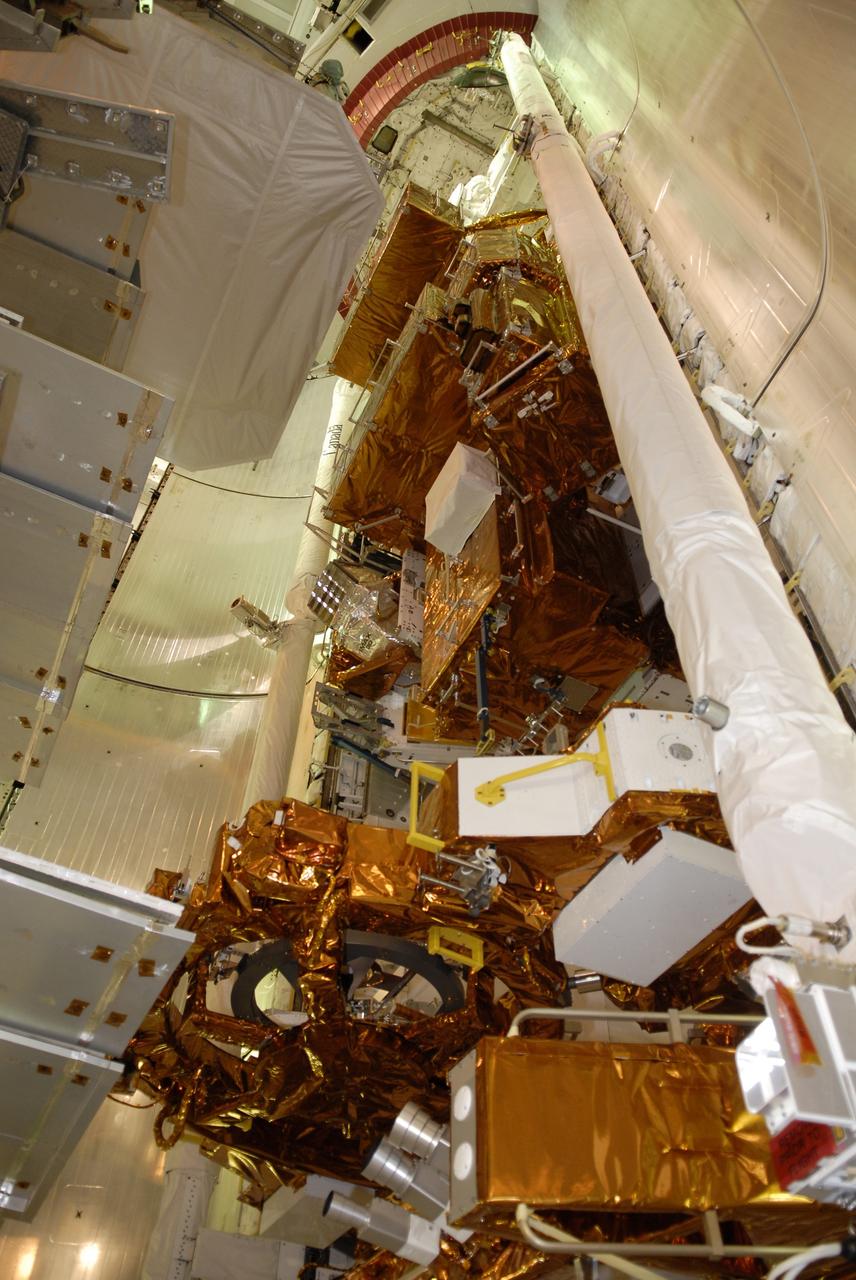
CAPE CANAVERAL, Fla. – On Launch Pad 39A at NASA's Kennedy Space Center in Florida, space shuttle Atlantis' payload bay is filled with hardware for the STS-125 mission to service NASA's Hubble Space Telescope. From the bottom are the Flight Support System with the Soft Capture mechanism and Multi-Use Lightweight Equipment Carrier with the Science Instrument Command and Data Handling Unit, or SIC&DH. At center is the Orbital Replacement Unit Carrier with the Cosmic Origins Spectrograph, or COS, and an IMAX 3D camera. At top is the Super Lightweight Interchangeable Carrier with the Wide Field Camera 3. Atlantis' crew will service NASA's Hubble Space Telescope for the fifth and final time. The flight will include five spacewalks during which astronauts will refurbish and upgrade the telescope with state-of-the-art science instruments. As a result, Hubble's capabilities will be expanded and its operational lifespan extended through at least 2014. Photo credit: NASA/Kim Shiflett
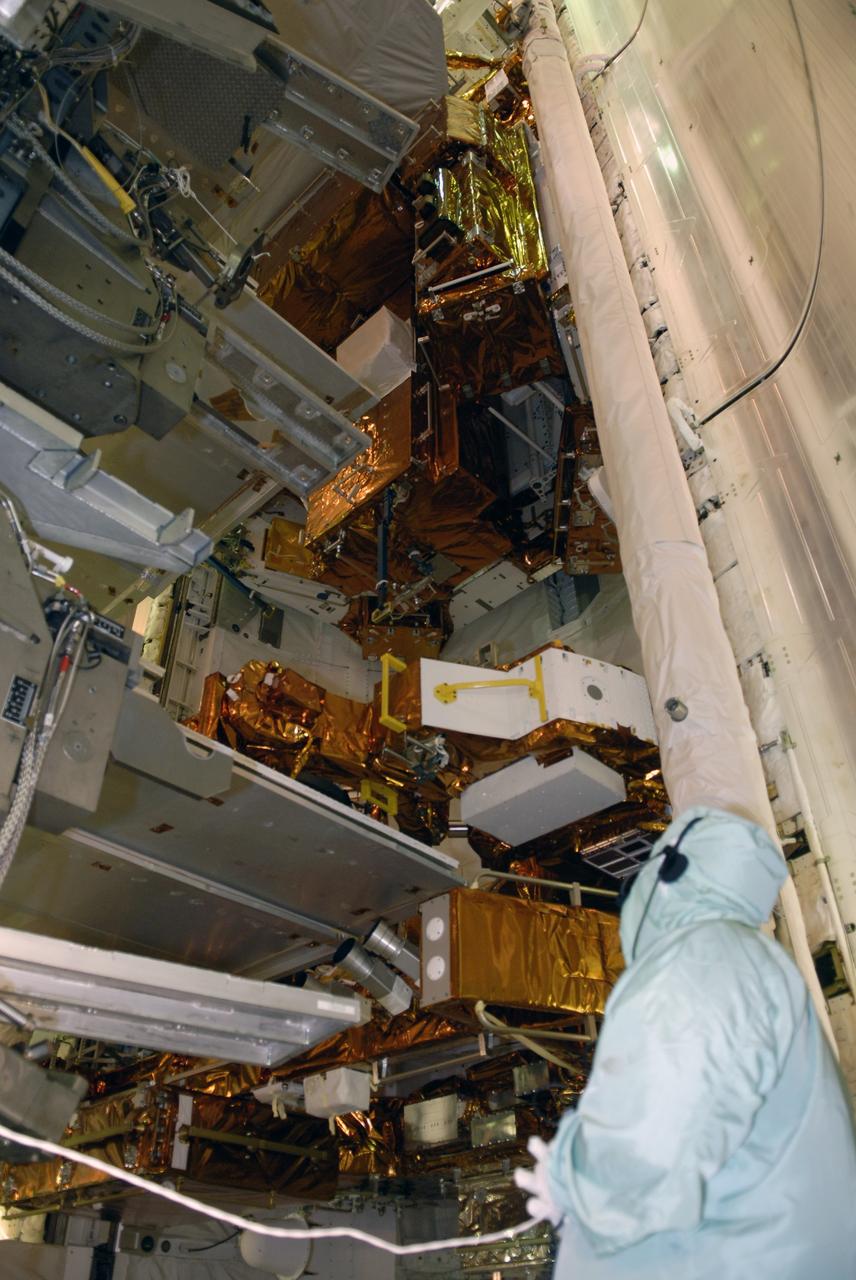
CAPE CANAVERAL, Fla. – On Launch Pad 39A at NASA's Kennedy Space Center in Florida, the payload ground-handling mechanism, known as the PGHM, is retracted after installing the payloads in space shuttle Atlantis' payload bay for the STS-125 mission. Seen here are the service platforms of the PGHM. The payload includes the Flight Support System, or FSS, carrier with the Soft Capture Mechanism; the Multi-Use Lightweight Equipment, or MULE, carrier with the Science Instrument Command and Data Handling Unit, or SIC&DH; the Orbital Replacement Unit Carrier, or ORUC, with the Cosmic Origins Spectrograph, or COS, and an IMAX 3D camera. Atlantis' crew will service NASA's Hubble Space Telescope for the fifth and final time. The flight will include five spacewalks during which astronauts will refurbish and upgrade the telescope with state-of-the-art science instruments. As a result, Hubble's capabilities will be expanded and its operational lifespan extended through at least 2014. Photo credit: NASA/Kim Shiflett
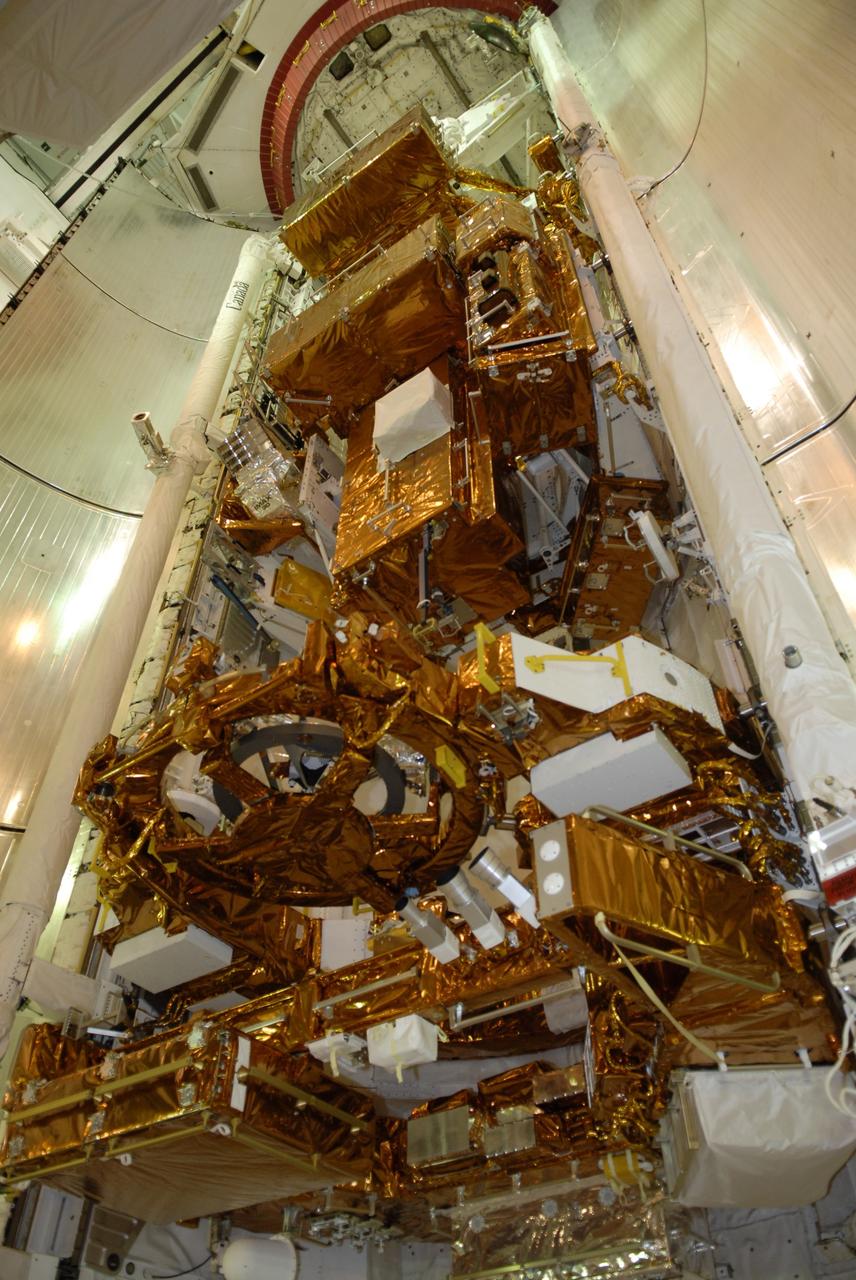
CAPE CANAVERAL, Fla. – On Launch Pad 39A at NASA's Kennedy Space Center in Florida, space shuttle Atlantis' payload bay is filled with hardware for the STS-125 mission to service NASA's Hubble Space Telescope. At the bottom are the Flight Support System with the Soft Capture mechanism and Multi-Use Lightweight Equipment Carrier with the Science Instrument Command and Data Handling Unit, or SIC&DH. At center is the Orbital Replacement Unit Carrier with the Cosmic Origins Spectrograph, or COS, and an IMAX 3D camera. At top is the Super Lightweight Interchangeable Carrier with the Wide Field Camera 3. Atlantis' crew will service NASA's Hubble Space Telescope for the fifth and final time. The flight will include five spacewalks during which astronauts will refurbish and upgrade the telescope with state-of-the-art science instruments. As a result, Hubble's capabilities will be expanded and its operational lifespan extended through at least 2014. Photo credit: NASA/Kim Shiflett
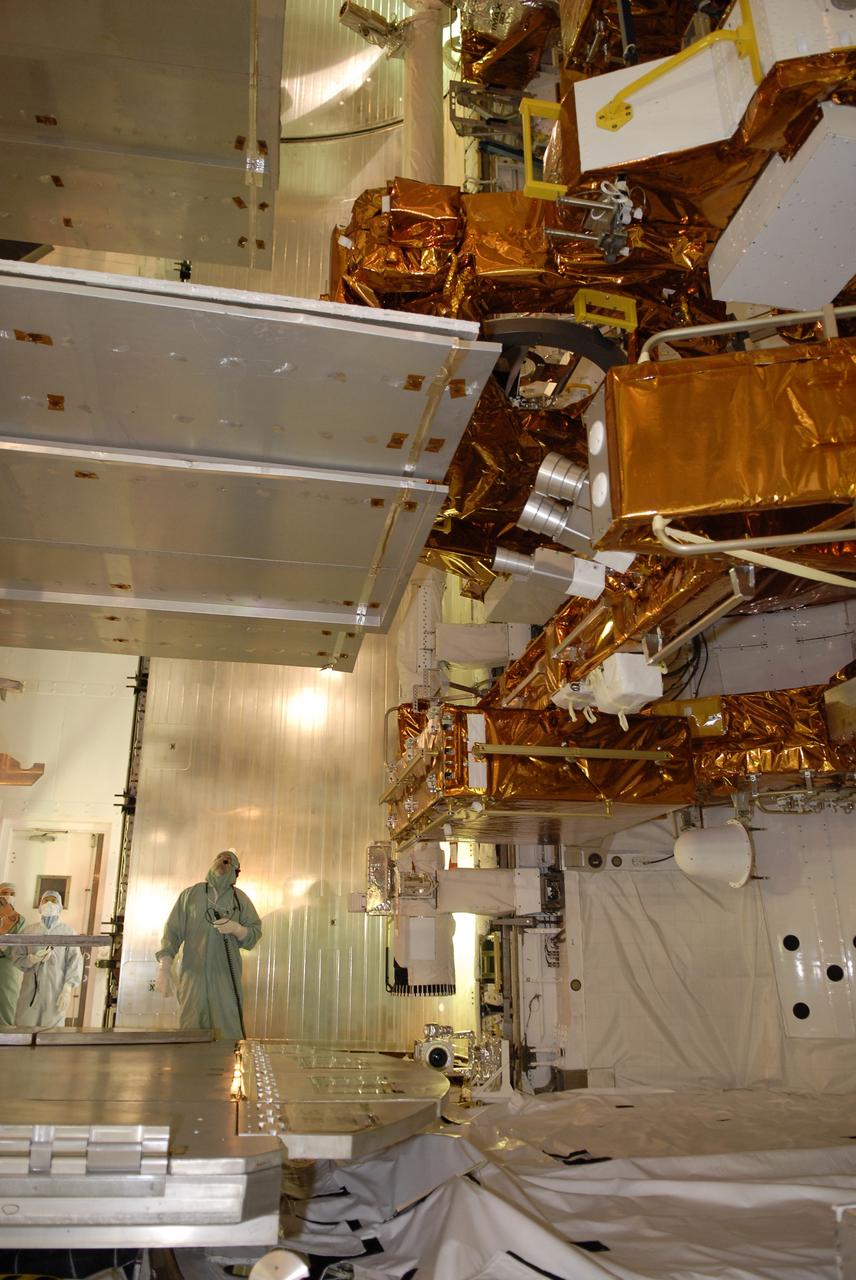
CAPE CANAVERAL, Fla. – On Launch Pad 39A at NASA's Kennedy Space Center in Florida, the payload ground-handling mechanism, known as the PGHM, is retracted after installing the payloads in space shuttle Atlantis' payload bay, at right, for the STS-125 mission. The payload includes the Flight Support System, or FSS, carrier with the Soft Capture Mechanism; the Multi-Use Lightweight Equipment, or MULE, carrier with the Science Instrument Command and Data Handling Unit, or SIC&DH; the Orbital Replacement Unit Carrier, or ORUC, with the Cosmic Origins Spectrograph, or COS, and an IMAX 3D camera. Atlantis' crew will service NASA's Hubble Space Telescope for the fifth and final time. The flight will include five spacewalks during which astronauts will refurbish and upgrade the telescope with state-of-the-art science instruments. As a result, Hubble's capabilities will be expanded and its operational lifespan extended through at least 2014. Photo credit: NASA/Kim Shiflett

CAPE CANAVERAL, Fla. – On Launch Pad 39A at NASA's Kennedy Space Center in Florida, space shuttle Atlantis' payload bay is filled with hardware for the STS-125 mission to service NASA's Hubble Space Telescope. From the bottom are the Flight Support System with the Soft Capture mechanism and Multi-Use Lightweight Equipment Carrier with the Science Instrument Command and Data Handling Unit, or SIC&DH; the Orbital Replacement Unit Carrier with the Cosmic Origins Spectrograph, or COS, and an IMAX 3D camera; and the Super Lightweight Interchangeable Carrier with the Wide Field Camera 3. Atlantis' crew will service NASA's Hubble Space Telescope for the fifth and final time. The flight will include five spacewalks during which astronauts will refurbish and upgrade the telescope with state-of-the-art science instruments. As a result, Hubble's capabilities will be expanded and its operational lifespan extended through at least 2014. Photo credit: NASA/Kim Shiflett
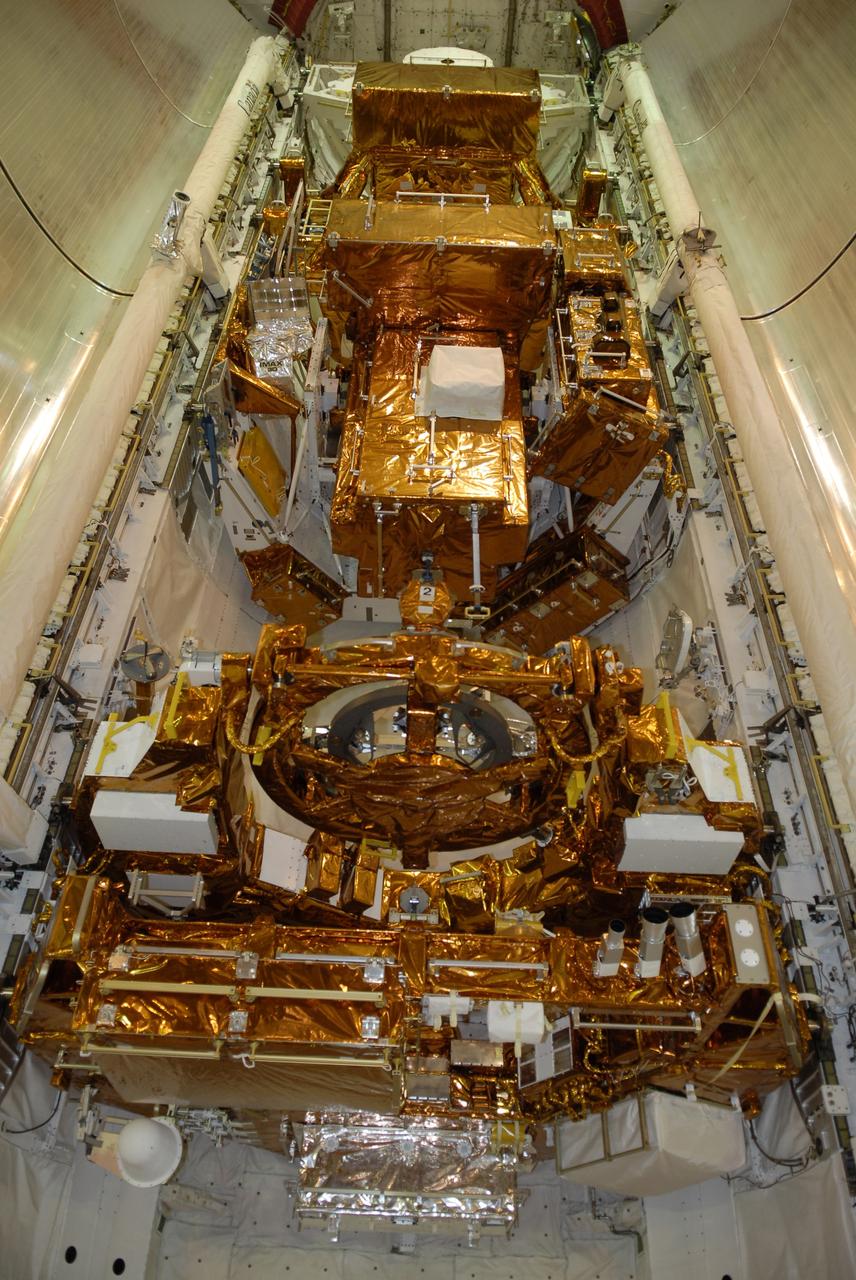
CAPE CANAVERAL, Fla. – On Launch Pad 39A at NASA's Kennedy Space Center in Florida, space shuttle Atlantis' payload bay is filled with hardware for the STS-125 mission to service NASA's Hubble Space Telescope. At the bottom is the Flight Support System with the Soft Capture mechanism. At center is the Orbital Replacement Unit Carrier with the Cosmic Origins Spectrograph, or COS, and an IMAX 3D camera. At top is the Super Lightweight Interchangeable Carrier with the Wide Field Camera 3. Atlantis' crew will service NASA's Hubble Space Telescope for the fifth and final time. The flight will include five spacewalks during which astronauts will refurbish and upgrade the telescope with state-of-the-art science instruments. As a result, Hubble's capabilities will be expanded and its operational lifespan extended through at least 2014. Photo credit: NASA/Kim Shiflett