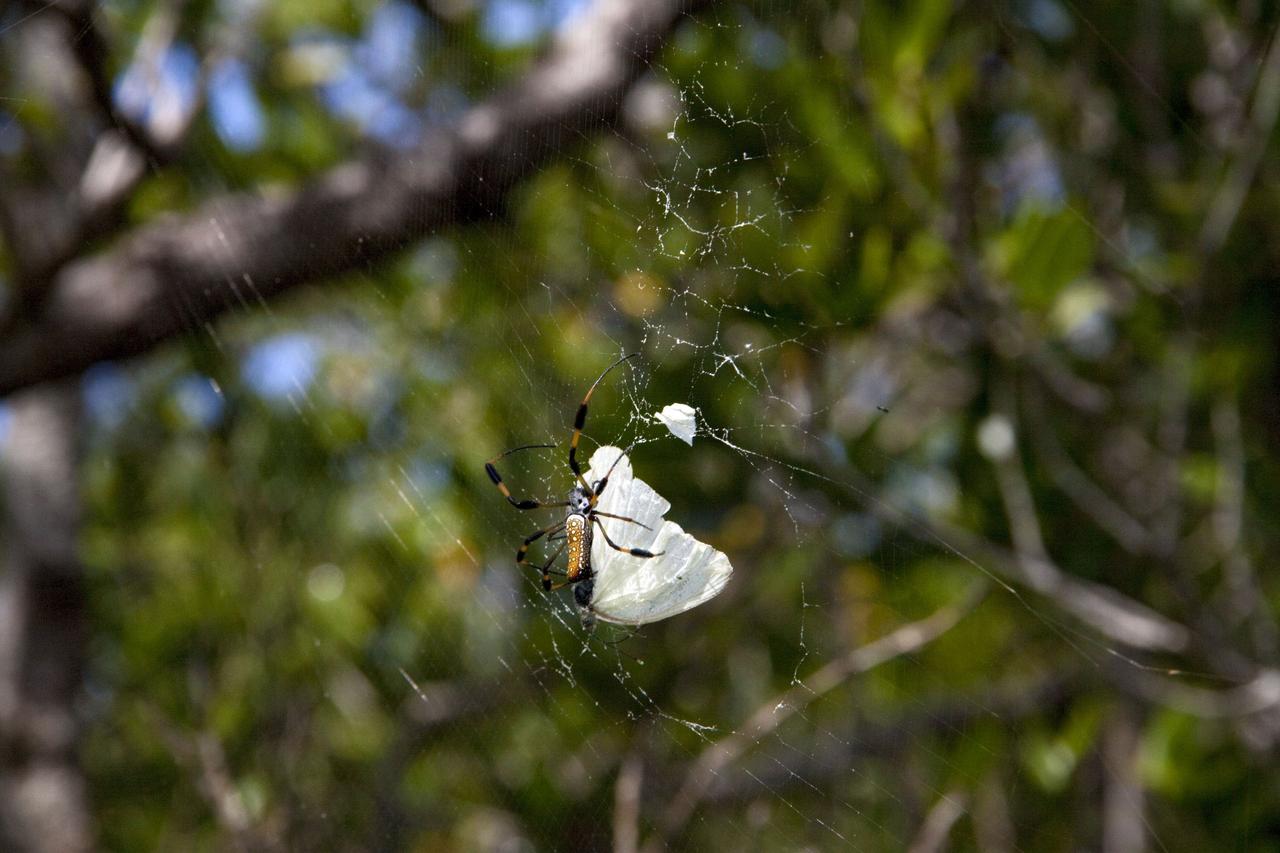
CAPE CANAVERAL, Fla. -- Near Launch Pad 39A at Kennedy Space Center in Florida, a Golden-Silk Spider repairs its web after a capturing a moth. The golden-silk spider repairs the webbing each day, replacing half but never the whole web at one time. Its web may measure two to three feet across. The center shares a boundary with the Merritt Island Wildlife Nature Refuge, consisting of 140,000 acres. The Refuge provides a wide variety of habitats: coastal dunes, saltwater estuaries and marshes, freshwater impoundments, scrub, pine flatwoods, and hardwood hammocks that provide habitat for more than 1,500 species of plants and animals. Atlantis and its crew of four; Commander Chris Ferguson, Pilot Doug Hurley, Mission Specialists Sandy Magnus and Rex Walheim are scheduled to lift off at 11:26 a.m. EDT on July 8 to deliver the Raffaello multi-purpose logistics module packed with supplies and spare parts for the International Space Station. Atlantis also will fly the Robotic Refueling Mission experiment that will investigate the potential for robotically refueling existing satellites in orbit. In addition, Atlantis will return with a failed ammonia pump module to help NASA better understand the failure mechanism and improve pump designs for future systems. STS-135 is the 33rd flight of Atlantis, the 37th shuttle mission to the space station, and the 135th and final mission of NASA's Space Shuttle Program. For more information, visit www.nasa.gov/mission_pages/shuttle/shuttlemissions/sts135/index.html. Photo credit: Ken Thornsley

CAPE CANAVERAL, Fla. -- At the Banana River Creek VIP viewing area at NASA's Kennedy Space Center in Florida, spectators smile with delight as they watch space shuttle Atlantis soar into space on its STS-135 mission to the International Space Station. Atlantis with its crew of four; Commander Chris Ferguson, Pilot Doug Hurley, Mission Specialists Sandy Magnus and Rex Walheim, lifted off at 11:29 a.m. EDT on July 8, 2011 to deliver the Raffaello multi-purpose logistics module packed with supplies and spare parts for the International Space Station. Atlantis also will fly the Robotic Refueling Mission experiment that will investigate the potential for robotically refueling existing satellites in orbit. In addition, Atlantis will return with a failed ammonia pump module to help NASA better understand the failure mechanism and improve pump designs for future systems. STS-135 is the 33rd flight of Atlantis, the 37th shuttle mission to the space station, and the 135th and final mission of NASA's Space Shuttle Program. For more information, visit www.nasa.gov/mission_pages/shuttle/shuttlemissions/sts135/index.html. Photo credit: NASA/Chad Baumer
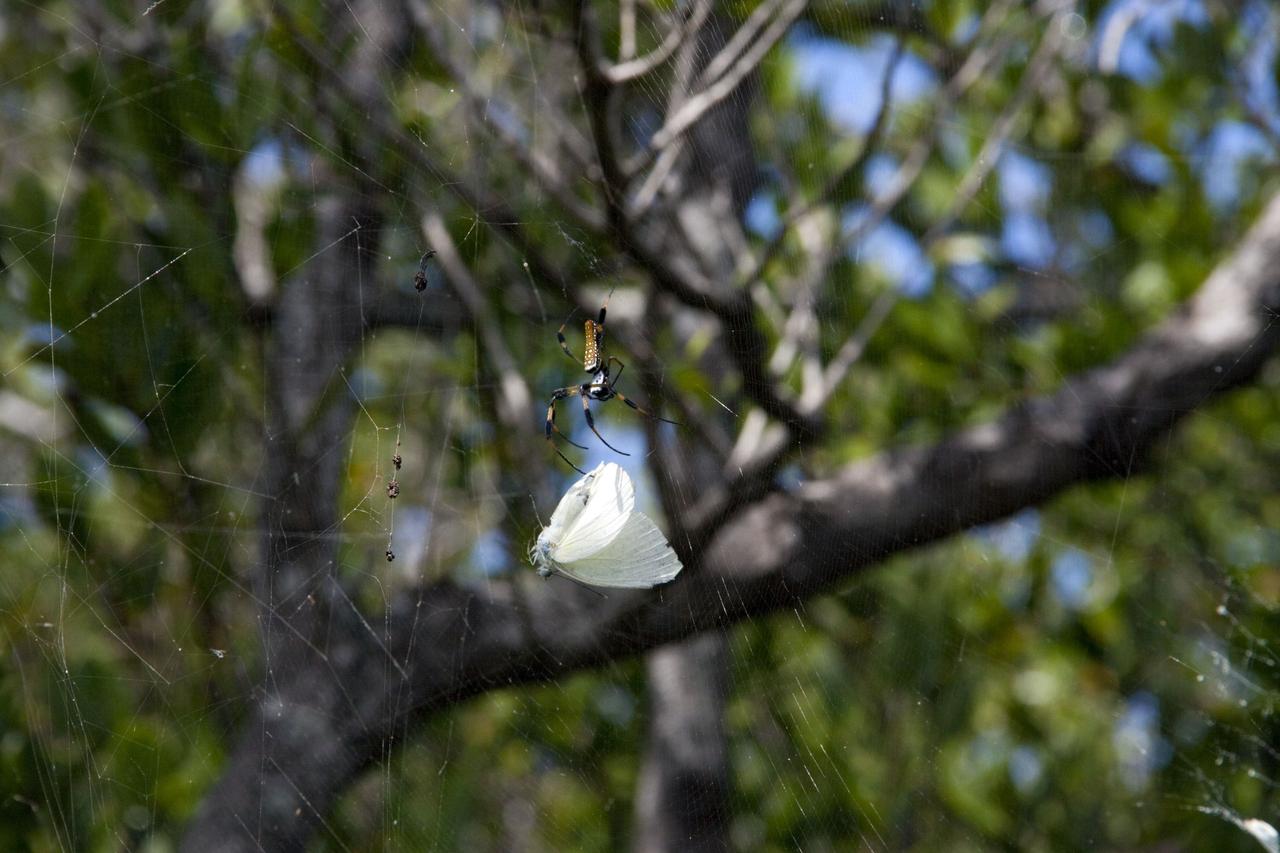
CAPE CANAVERAL, Fla. -- Near Launch Pad 39A at Kennedy Space Center in Florida, a Golden-Silk Spider repairs its web after a capturing a moth. The golden-silk spider repairs the webbing each day, replacing half but never the whole web at one time. Its web may measure two to three feet across. The center shares a boundary with the Merritt Island Wildlife Nature Refuge, consisting of 140,000 acres. The Refuge provides a wide variety of habitats: coastal dunes, saltwater estuaries and marshes, freshwater impoundments, scrub, pine flatwoods, and hardwood hammocks that provide habitat for more than 1,500 species of plants and animals. Atlantis and its crew of four; Commander Chris Ferguson, Pilot Doug Hurley, Mission Specialists Sandy Magnus and Rex Walheim are scheduled to lift off at 11:26 a.m. EDT on July 8 to deliver the Raffaello multi-purpose logistics module packed with supplies and spare parts for the International Space Station. Atlantis also will fly the Robotic Refueling Mission experiment that will investigate the potential for robotically refueling existing satellites in orbit. In addition, Atlantis will return with a failed ammonia pump module to help NASA better understand the failure mechanism and improve pump designs for future systems. STS-135 is the 33rd flight of Atlantis, the 37th shuttle mission to the space station, and the 135th and final mission of NASA's Space Shuttle Program. For more information, visit www.nasa.gov/mission_pages/shuttle/shuttlemissions/sts135/index.html. Photo credit: Ken Thornsley

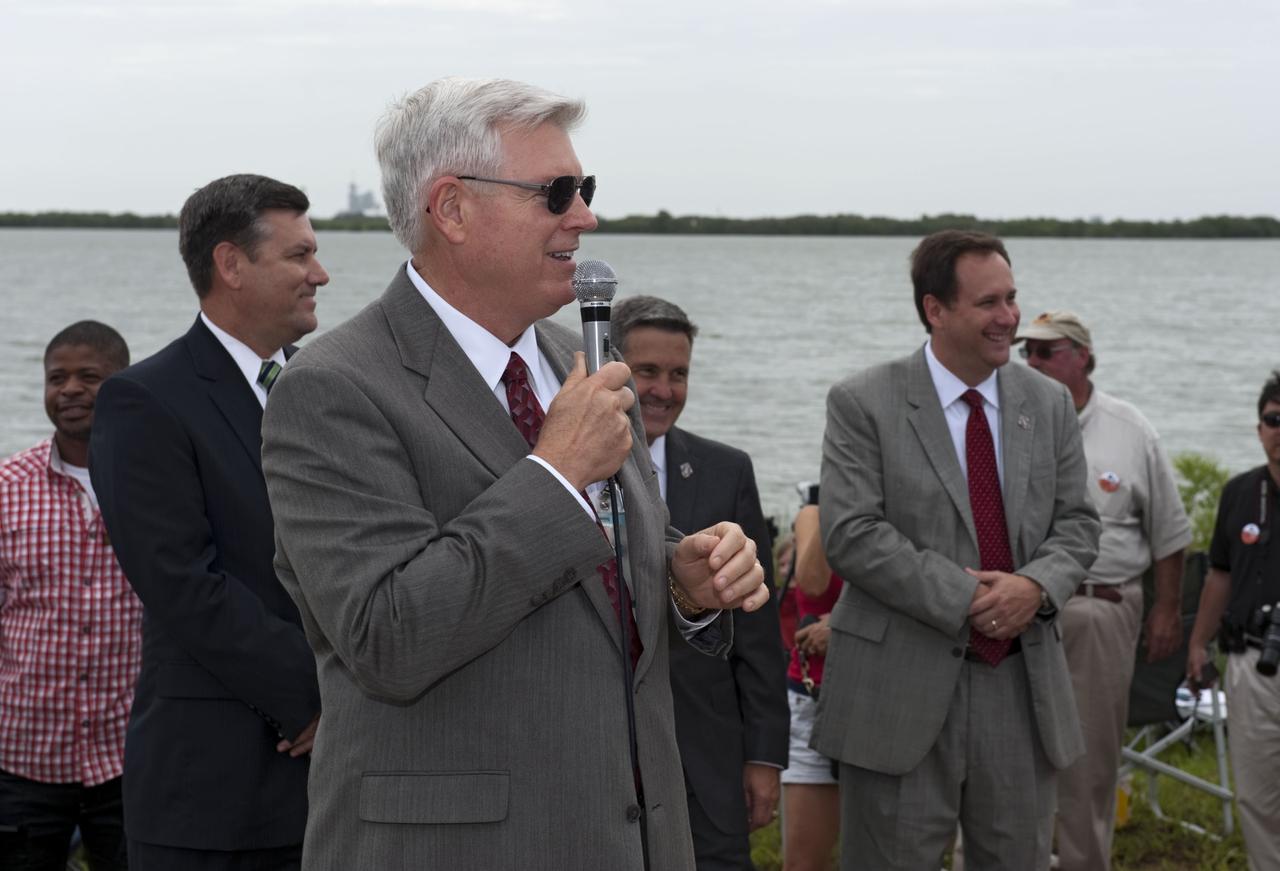
CAPE CANAVERAL, Fla. -- At the Banana River Creek VIP viewing area at NASA's Kennedy Space Center in Florida, Marshall Space Flight Center Director Robert Lightfoot speaks to media and spectators before the launch of space shuttle Atlantis on its STS-135 mission to the International Space Station. Also seen here are Stennis Space Center Director Patrick Scheuermann (left) and Johnson Space Center Director Mike Coats. Atlantis with its crew of four; Commander Chris Ferguson, Pilot Doug Hurley, Mission Specialists Sandy Magnus and Rex Walheim, lifted off at 11:29 a.m. EDT on July 8, 2011 to deliver the Raffaello multi-purpose logistics module packed with supplies and spare parts for the International Space Station. Atlantis also will fly the Robotic Refueling Mission experiment that will investigate the potential for robotically refueling existing satellites in orbit. In addition, Atlantis will return with a failed ammonia pump module to help NASA better understand the failure mechanism and improve pump designs for future systems. STS-135 is the 33rd flight of Atlantis, the 37th shuttle mission to the space station, and the 135th and final mission of NASA's Space Shuttle Program. For more information, visit www.nasa.gov/mission_pages/shuttle/shuttlemissions/sts135/index.html. Photo credit: NASA/Chad Baumer
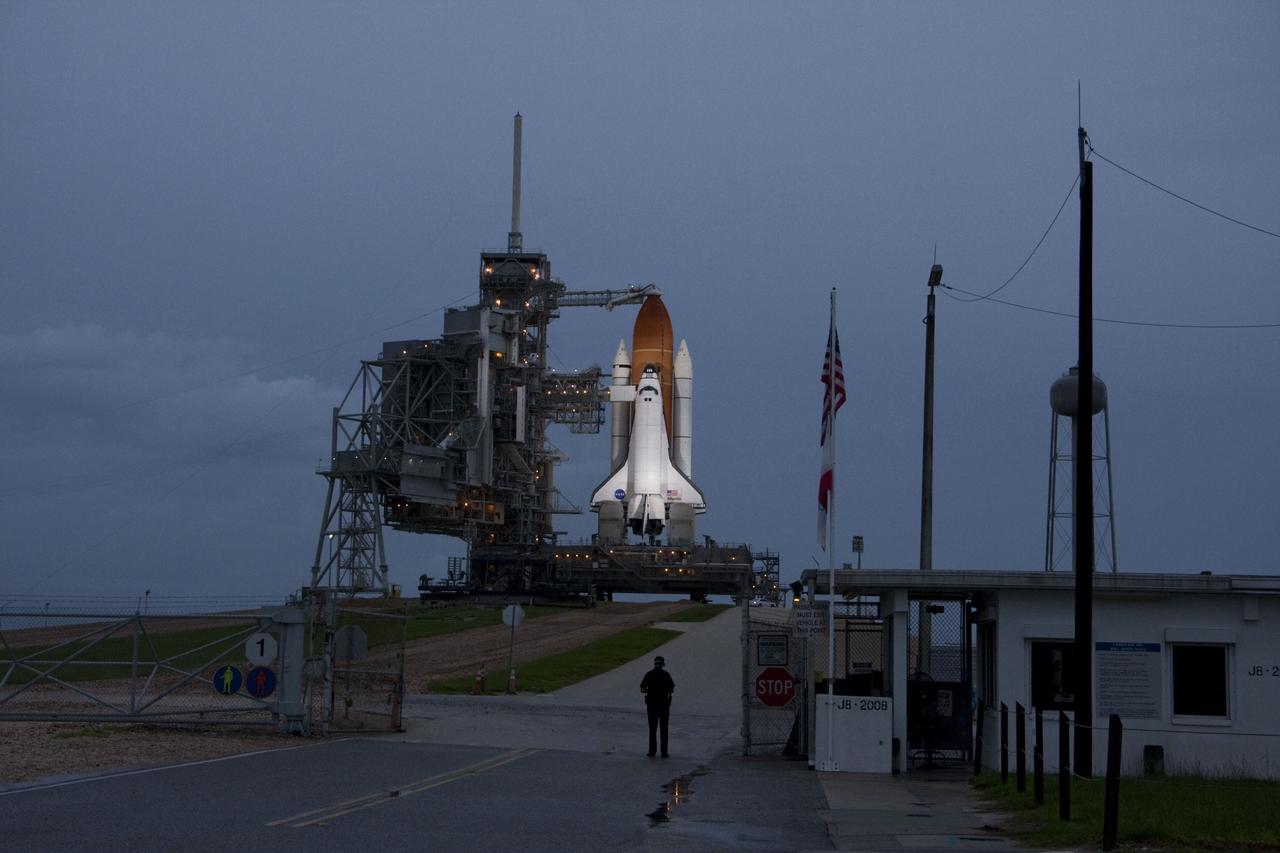
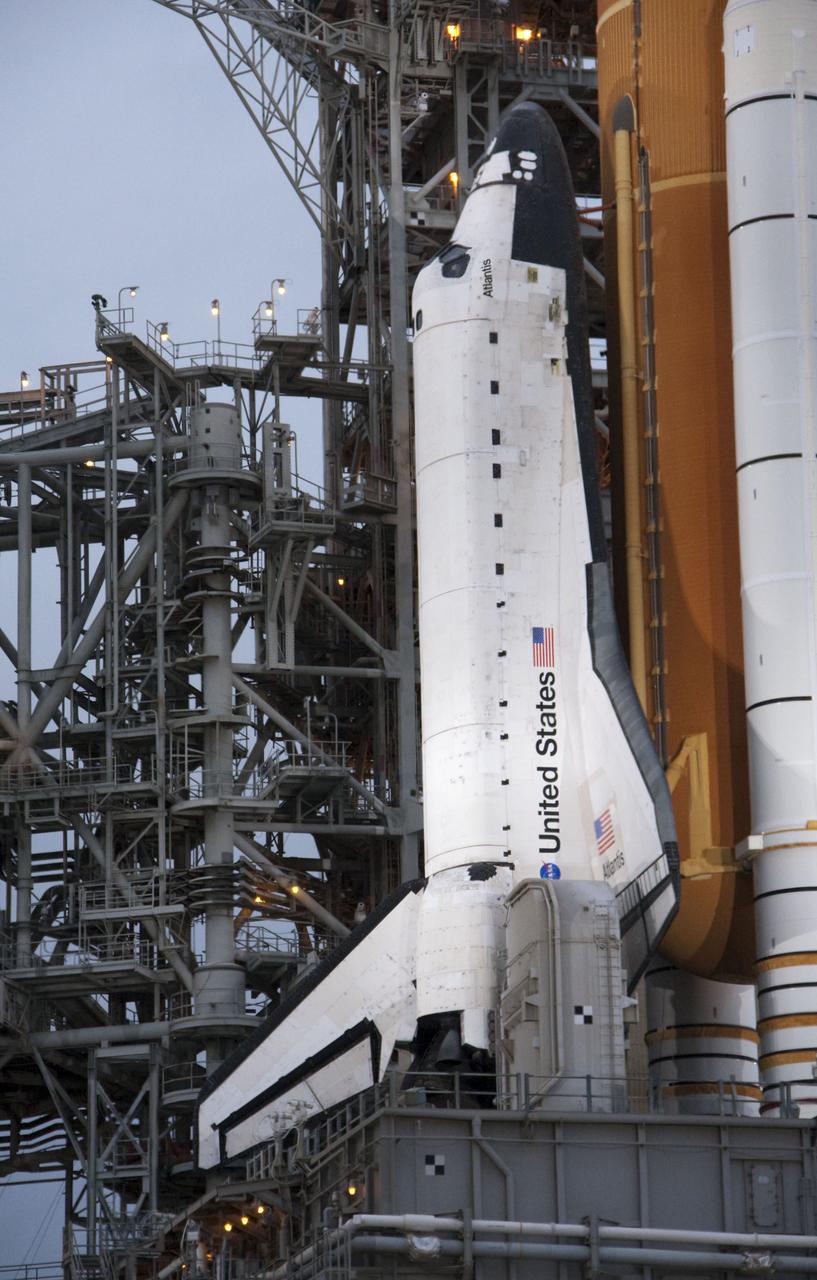
CAPE CANAVERAL, Fla. -- Space shuttle Atlantis is revealed on Launch Pad 39A at NASA's Kennedy Space Center in Florida bathed in xenon lights following the move of the rotating service structure (RSS). The structure provides weather protection and access to the shuttle while it awaits liftoff on the pad. RSS retract marks a major milestone in Atlantis' STS-135 mission countdown. A NASA security guard takes a moment to look at Atlantis on its seaside launch pad before its final flight. Atlantis and its crew of four; Commander Chris Ferguson, Pilot Doug Hurley, Mission Specialists Sandy Magnus and Rex Walheim are scheduled to lift off at 11:26 a.m. EDT on July 8 to deliver the Raffaello multi-purpose logistics module packed with supplies and spare parts for the International Space Station. Atlantis also will fly the Robotic Refueling Mission experiment that will investigate the potential for robotically refueling existing satellites in orbit. In addition, Atlantis will return with a failed ammonia pump module to help NASA better understand the failure mechanism and improve pump designs for future systems. STS-135 is the 33rd flight of Atlantis, the 37th shuttle mission to the space station, and the 135th and final mission of NASA's Space Shuttle Program. For more information, visit www.nasa.gov/mission_pages/shuttle/shuttlemissions/sts135/index.html. Photo credit: Ken Thornsley

CAPE CANAVERAL, Fla. -- At the Banana River Creek VIP viewing area at NASA's Kennedy Space Center in Florida, spectators follow space shuttle Atlantis as it soars into space on its STS-135 mission to the International Space Station. Atlantis with its crew of four; Commander Chris Ferguson, Pilot Doug Hurley, Mission Specialists Sandy Magnus and Rex Walheim, lifted off at 11:29 a.m. EDT on July 8, 2011 to deliver the Raffaello multi-purpose logistics module packed with supplies and spare parts for the International Space Station. Atlantis also will fly the Robotic Refueling Mission experiment that will investigate the potential for robotically refueling existing satellites in orbit. In addition, Atlantis will return with a failed ammonia pump module to help NASA better understand the failure mechanism and improve pump designs for future systems. STS-135 is the 33rd flight of Atlantis, the 37th shuttle mission to the space station, and the 135th and final mission of NASA's Space Shuttle Program. For more information, visit www.nasa.gov/mission_pages/shuttle/shuttlemissions/sts135/index.html. Photo credit: NASA/Chad Baumer
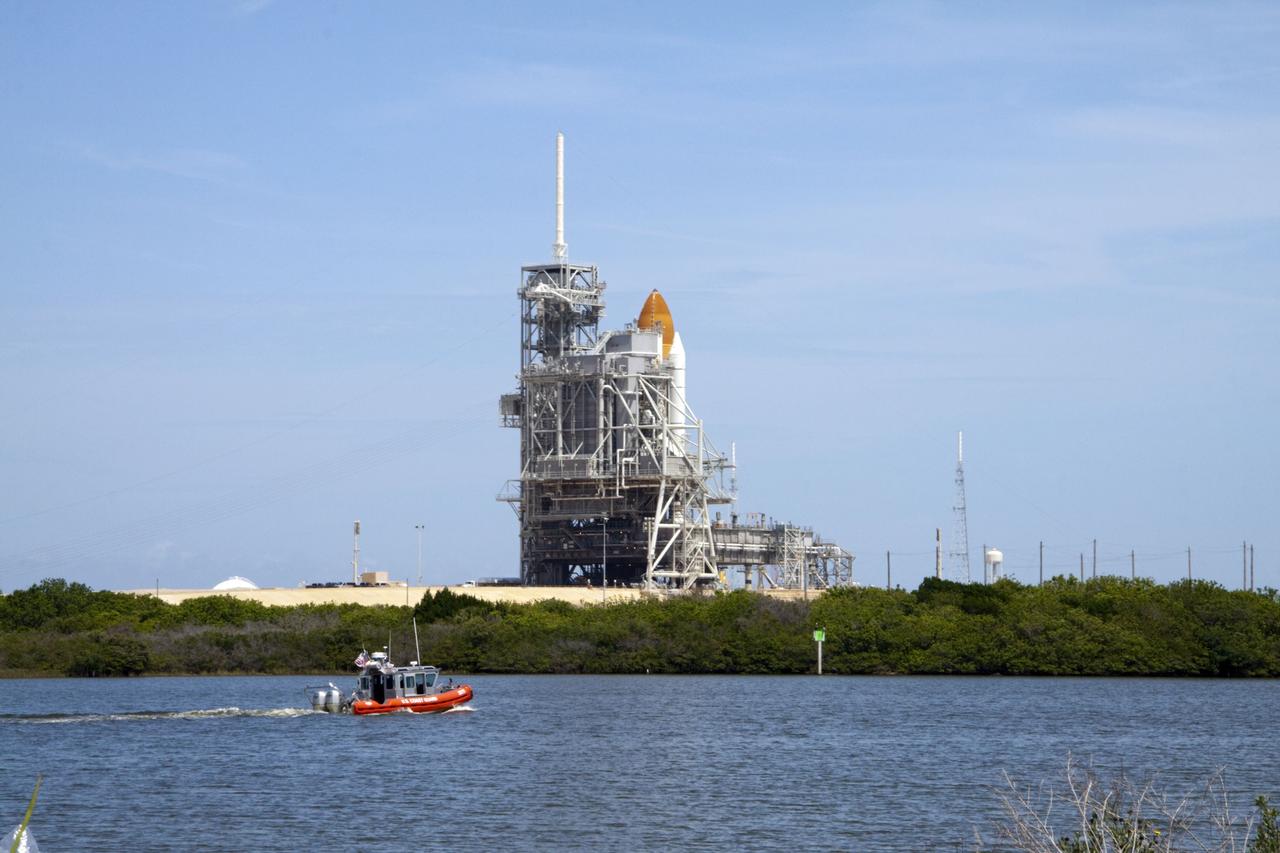
CAPE CANAVERAL, Fla. -- A Coast Guard skiff keeps watch on the waters surrounding space shuttle Atlantis on its seaside launch pad at NASA's Kennedy Space Center in Florida before the shuttle's lift off on the STS-135 mission. Atlantis and its crew of four; Commander Chris Ferguson, Pilot Doug Hurley, Mission Specialists Sandy Magnus and Rex Walheim are scheduled to lift off at 11:26 a.m. EDT on July 8 to deliver the Raffaello multi-purpose logistics module packed with supplies and spare parts for the International Space Station. Atlantis also will fly the Robotic Refueling Mission experiment that will investigate the potential for robotically refueling existing satellites in orbit. In addition, Atlantis will return with a failed ammonia pump module to help NASA better understand the failure mechanism and improve pump designs for future systems. STS-135 is the 33rd flight of Atlantis, the 37th shuttle mission to the space station, and the 135th and final mission of NASA's Space Shuttle Program. For more information, visit www.nasa.gov/mission_pages/shuttle/shuttlemissions/sts135/index.html. Photo credit: Ken Thornsley
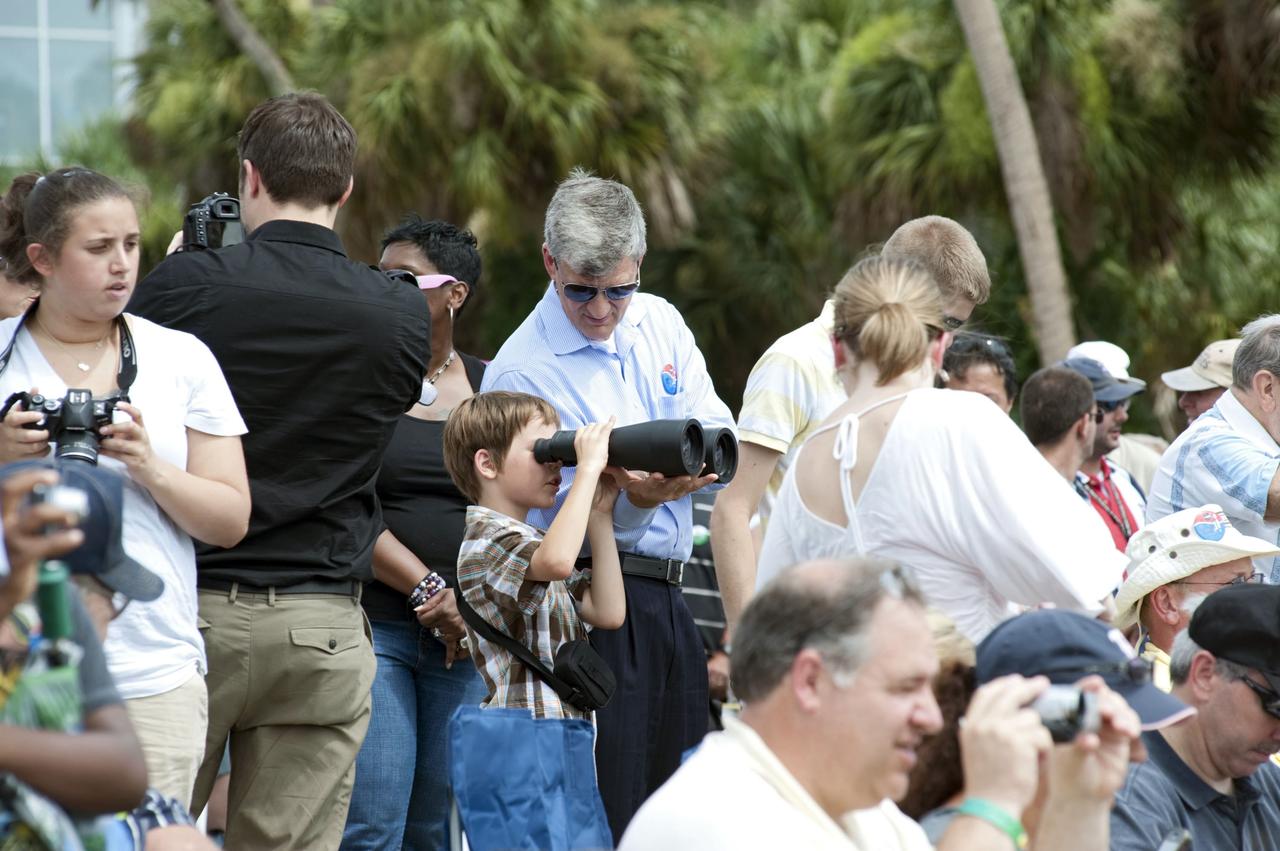
CAPE CANAVERAL, Fla. -- At the Banana River Creek VIP viewing area at NASA's Kennedy Space Center in Florida, spectators relax before the launch of space shuttle Atlantis' STS-135 mission to the International Space Station. Atlantis with its crew of four; Commander Chris Ferguson, Pilot Doug Hurley, Mission Specialists Sandy Magnus and Rex Walheim, lifted off at 11:29 a.m. EDT on July 8, 2011 to deliver the Raffaello multi-purpose logistics module packed with supplies and spare parts for the International Space Station. Atlantis also will fly the Robotic Refueling Mission experiment that will investigate the potential for robotically refueling existing satellites in orbit. In addition, Atlantis will return with a failed ammonia pump module to help NASA better understand the failure mechanism and improve pump designs for future systems. STS-135 is the 33rd flight of Atlantis, the 37th shuttle mission to the space station, and the 135th and final mission of NASA's Space Shuttle Program. For more information, visit www.nasa.gov/mission_pages/shuttle/shuttlemissions/sts135/index.html. Photo credit: NASA/Chad Baumer
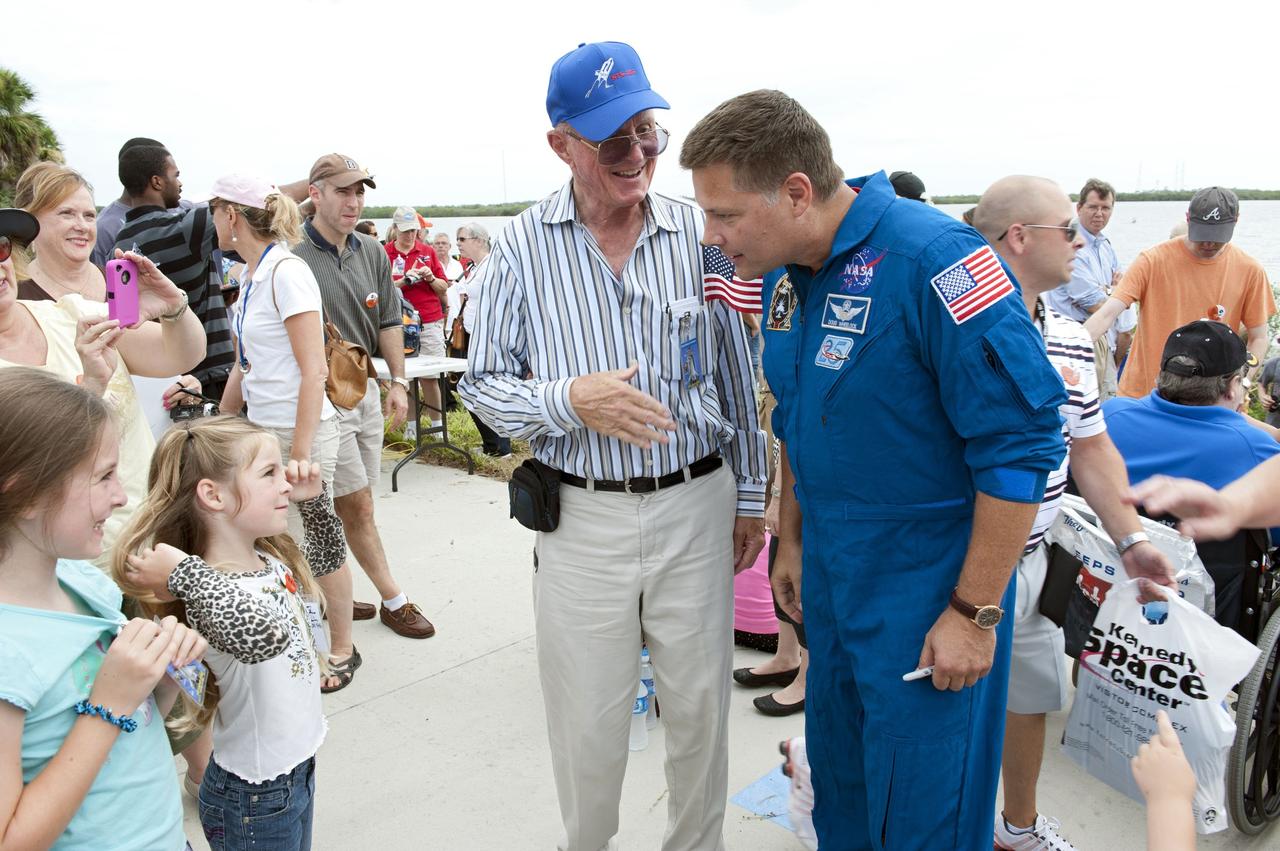
CAPE CANAVERAL, Fla. -- At the Banana River Creek VIP viewing area at NASA's Kennedy Space Center in Florida, NASA astronaut Doug Wheelock speaks with a spectator before the upcoming launch of space shuttle Atlantis' STS-135 mission to the International Space Station. Atlantis with its crew of four; Commander Chris Ferguson, Pilot Doug Hurley, Mission Specialists Sandy Magnus and Rex Walheim, lifted off at 11:29 a.m. EDT on July 8, 2011 to deliver the Raffaello multi-purpose logistics module packed with supplies and spare parts for the International Space Station. Atlantis also will fly the Robotic Refueling Mission experiment that will investigate the potential for robotically refueling existing satellites in orbit. In addition, Atlantis will return with a failed ammonia pump module to help NASA better understand the failure mechanism and improve pump designs for future systems. STS-135 is the 33rd flight of Atlantis, the 37th shuttle mission to the space station, and the 135th and final mission of NASA's Space Shuttle Program. For more information, visit www.nasa.gov/mission_pages/shuttle/shuttlemissions/sts135/index.html. Photo credit: NASA/Chad Baumer
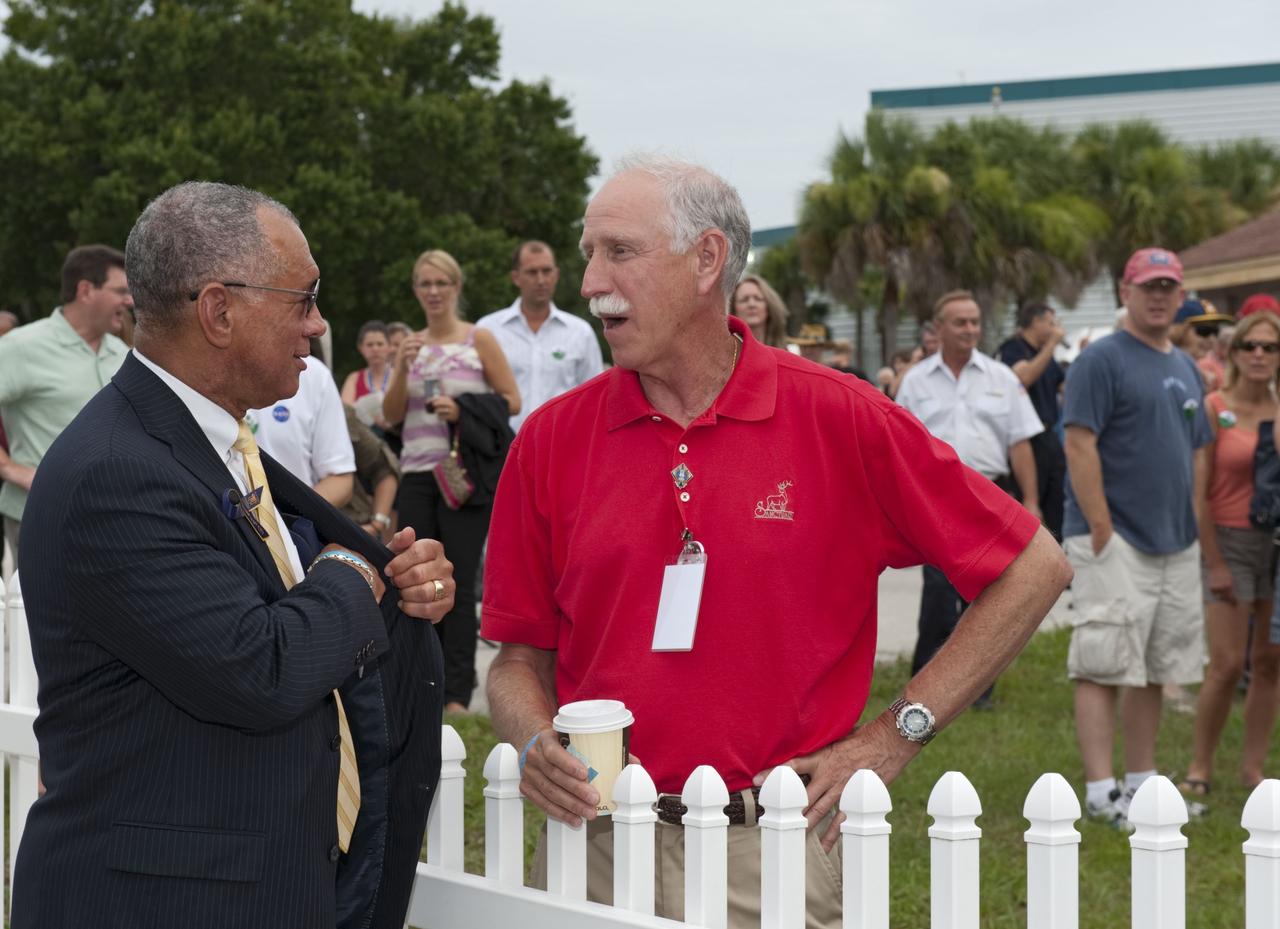
CAPE CANAVERAL, Fla. -- At the Banana River Creek VIP viewing area at NASA's Kennedy Space Center in Florida, NASA Administrator Charles Bolden speaks with former NASA astronaut Richard "Dick" Covey before the upcoming launch of space shuttle Atlantis on its STS-135 mission to the International Space Station. Atlantis with its crew of four; Commander Chris Ferguson, Pilot Doug Hurley, Mission Specialists Sandy Magnus and Rex Walheim, lifted off at 11:29 a.m. EDT on July 8, 2011 to deliver the Raffaello multi-purpose logistics module packed with supplies and spare parts for the International Space Station. Atlantis also will fly the Robotic Refueling Mission experiment that will investigate the potential for robotically refueling existing satellites in orbit. In addition, Atlantis will return with a failed ammonia pump module to help NASA better understand the failure mechanism and improve pump designs for future systems. STS-135 is the 33rd flight of Atlantis, the 37th shuttle mission to the space station, and the 135th and final mission of NASA's Space Shuttle Program. For more information, visit www.nasa.gov/mission_pages/shuttle/shuttlemissions/sts135/index.html. Photo credit: NASA/Chad Baumer

CAPE CANAVERAL, Fla. -- At the Banana River Creek VIP viewing area at NASA's Kennedy Space Center in Florida, Kennedy Center Director Bob Cabana speaks to media and spectators before the launch of space shuttle Atlantis on its STS-135 mission to the International Space Station. Seen also are Stennis Space Center Director Patrick Scheuermann (left), Marshall Space Flight Center Director Robert Lightfoot and Johnson Space Center Director Mike Coats. Atlantis with its crew of four; Commander Chris Ferguson, Pilot Doug Hurley, Mission Specialists Sandy Magnus and Rex Walheim, lifted off at 11:29 a.m. EDT on July 8, 2011 to deliver the Raffaello multi-purpose logistics module packed with supplies and spare parts for the International Space Station. Atlantis also will fly the Robotic Refueling Mission experiment that will investigate the potential for robotically refueling existing satellites in orbit. In addition, Atlantis will return with a failed ammonia pump module to help NASA better understand the failure mechanism and improve pump designs for future systems. STS-135 is the 33rd flight of Atlantis, the 37th shuttle mission to the space station, and the 135th and final mission of NASA's Space Shuttle Program. For more information, visit www.nasa.gov/mission_pages/shuttle/shuttlemissions/sts135/index.html. Photo credit: NASA/Chad Baumer
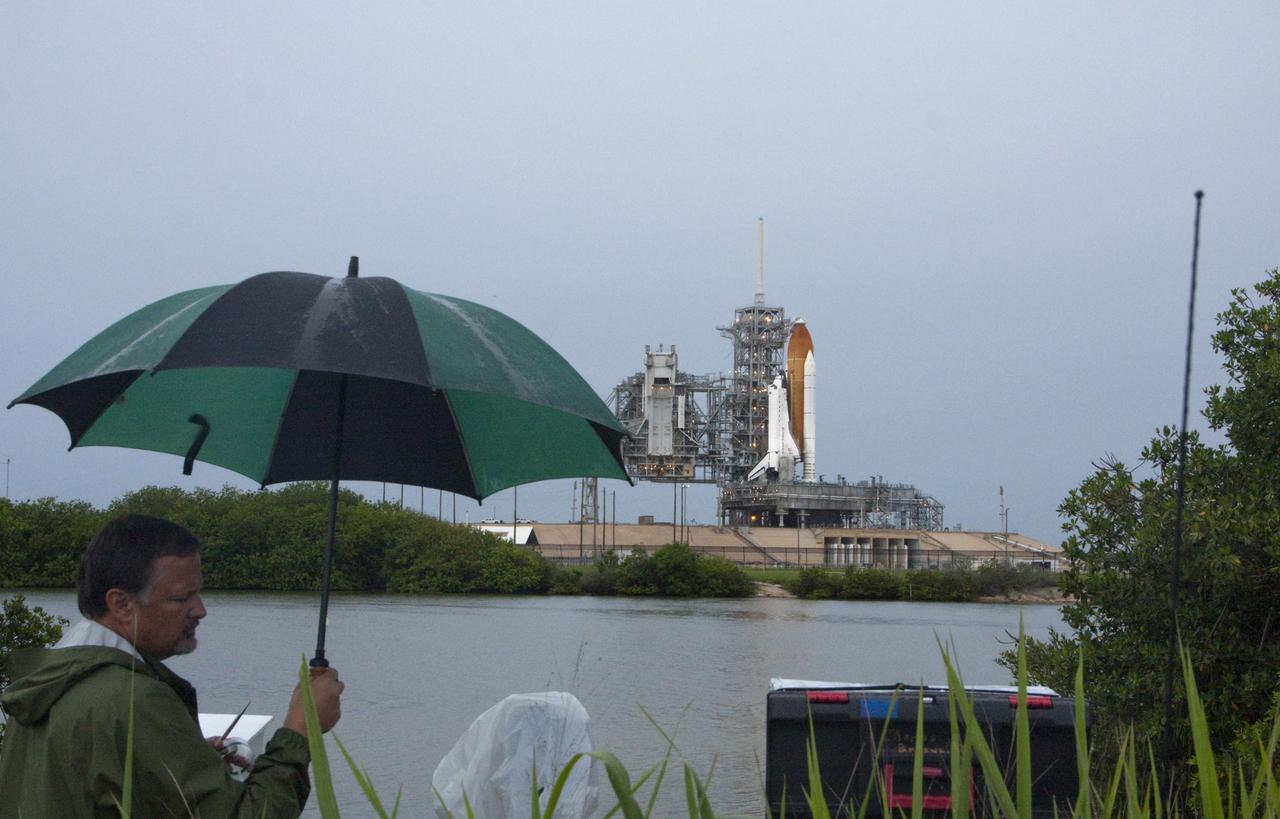
CAPE CANAVERAL, Fla. -- At NASA's Kennedy Space Center, space shuttle Atlantis can be seen in the distance awaiting liftoff on its STS-135 mission while members of the media set up cameras to capture the launch on a very rainy day in Florida. Atlantis and its crew of four; Commander Chris Ferguson, Pilot Doug Hurley, Mission Specialists Sandy Magnus and Rex Walheim are scheduled to lift off at 11:26 a.m. EDT on July 8 to deliver the Raffaello multi-purpose logistics module packed with supplies and spare parts for the International Space Station. Atlantis also will fly the Robotic Refueling Mission experiment that will investigate the potential for robotically refueling existing satellites in orbit. In addition, Atlantis will return with a failed ammonia pump module to help NASA better understand the failure mechanism and improve pump designs for future systems. STS-135 is the 33rd flight of Atlantis, the 37th shuttle mission to the space station, and the 135th and final mission of NASA's Space Shuttle Program. For more information, visit www.nasa.gov/mission_pages/shuttle/shuttlemissions/sts135/index.html. Photo credit: Ken Thornsley

CAPE CANAVERAL, Fla. -- At the Banana River Creek VIP viewing area at NASA's Kennedy Space Center in Florida, spectators relax before the upcoming launch of space shuttle Atlantis on its STS-135 mission to the International Space Station. Atlantis with its crew of four; Commander Chris Ferguson, Pilot Doug Hurley, Mission Specialists Sandy Magnus and Rex Walheim, lifted off at 11:29 a.m. EDT on July 8, 2011 to deliver the Raffaello multi-purpose logistics module packed with supplies and spare parts for the International Space Station. Atlantis also will fly the Robotic Refueling Mission experiment that will investigate the potential for robotically refueling existing satellites in orbit. In addition, Atlantis will return with a failed ammonia pump module to help NASA better understand the failure mechanism and improve pump designs for future systems. STS-135 is the 33rd flight of Atlantis, the 37th shuttle mission to the space station, and the 135th and final mission of NASA's Space Shuttle Program. For more information, visit www.nasa.gov/mission_pages/shuttle/shuttlemissions/sts135/index.html. Photo credit: NASA/Chad Baumer

CAPE CANAVERAL, Fla. -- At the Banana River Creek VIP viewing area at NASA's Kennedy Space Center in Florida, spectators watch the countdown clock as liftoff of space shuttle Atlantis' STS-135 mission to the International Space Station ticks down to the last few seconds. Atlantis with its crew of four; Commander Chris Ferguson, Pilot Doug Hurley, Mission Specialists Sandy Magnus and Rex Walheim, lifted off at 11:29 a.m. EDT on July 8, 2011 to deliver the Raffaello multi-purpose logistics module packed with supplies and spare parts for the International Space Station. Atlantis also will fly the Robotic Refueling Mission experiment that will investigate the potential for robotically refueling existing satellites in orbit. In addition, Atlantis will return with a failed ammonia pump module to help NASA better understand the failure mechanism and improve pump designs for future systems. STS-135 is the 33rd flight of Atlantis, the 37th shuttle mission to the space station, and the 135th and final mission of NASA's Space Shuttle Program. For more information, visit www.nasa.gov/mission_pages/shuttle/shuttlemissions/sts135/index.html. Photo credit: NASA/Chad Baumer

CAPE CANAVERAL, Fla. -- At the Banana River Creek VIP viewing area at NASA's Kennedy Space Center in Florida, spectators smile with delight as they watch space shuttle Atlantis soar into space on its STS-135 mission to the International Space Station. Atlantis with its crew of four; Commander Chris Ferguson, Pilot Doug Hurley, Mission Specialists Sandy Magnus and Rex Walheim, lifted off at 11:29 a.m. EDT on July 8, 2011 to deliver the Raffaello multi-purpose logistics module packed with supplies and spare parts for the International Space Station. Atlantis also will fly the Robotic Refueling Mission experiment that will investigate the potential for robotically refueling existing satellites in orbit. In addition, Atlantis will return with a failed ammonia pump module to help NASA better understand the failure mechanism and improve pump designs for future systems. STS-135 is the 33rd flight of Atlantis, the 37th shuttle mission to the space station, and the 135th and final mission of NASA's Space Shuttle Program. For more information, visit www.nasa.gov/mission_pages/shuttle/shuttlemissions/sts135/index.html. Photo credit: NASA/Chad Baumer
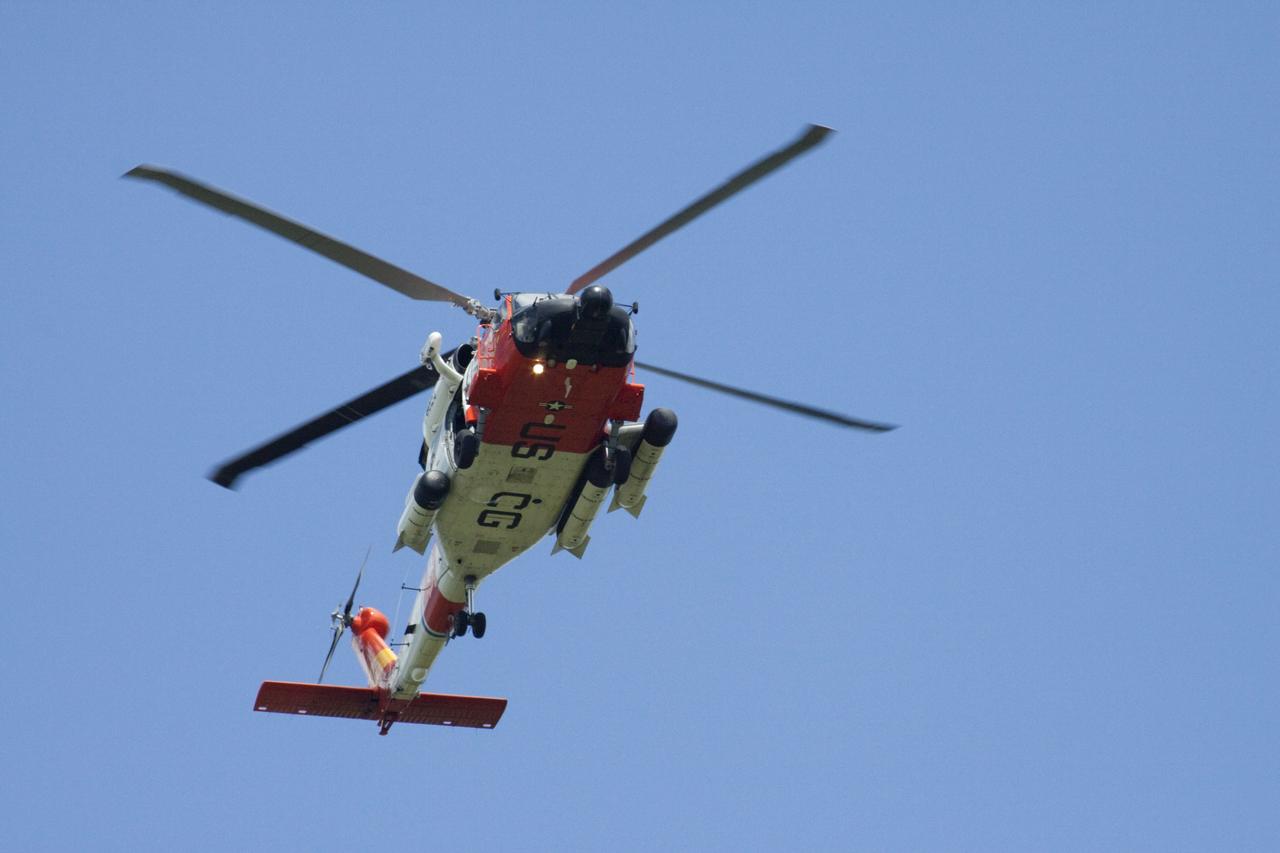
CAPE CANAVERAL, Fla. -- High above the skies at NASA's Kennedy Space Center in Florida a Coast Guard helicopter keeps watch on and around the Atlantic Ocean including space shuttle Atlantis on its seaside launch pad awaiting liftoff on its STS-135 mission. Atlantis and its crew of four; Commander Chris Ferguson, Pilot Doug Hurley, Mission Specialists Sandy Magnus and Rex Walheim are scheduled to lift off at 11:26 a.m. EDT on July 8 to deliver the Raffaello multi-purpose logistics module packed with supplies and spare parts for the International Space Station. Atlantis also will fly the Robotic Refueling Mission experiment that will investigate the potential for robotically refueling existing satellites in orbit. In addition, Atlantis will return with a failed ammonia pump module to help NASA better understand the failure mechanism and improve pump designs for future systems. STS-135 is the 33rd flight of Atlantis, the 37th shuttle mission to the space station, and the 135th and final mission of NASA's Space Shuttle Program. For more information, visit www.nasa.gov/mission_pages/shuttle/shuttlemissions/sts135/index.html. Photo credit: Ken Thornsley
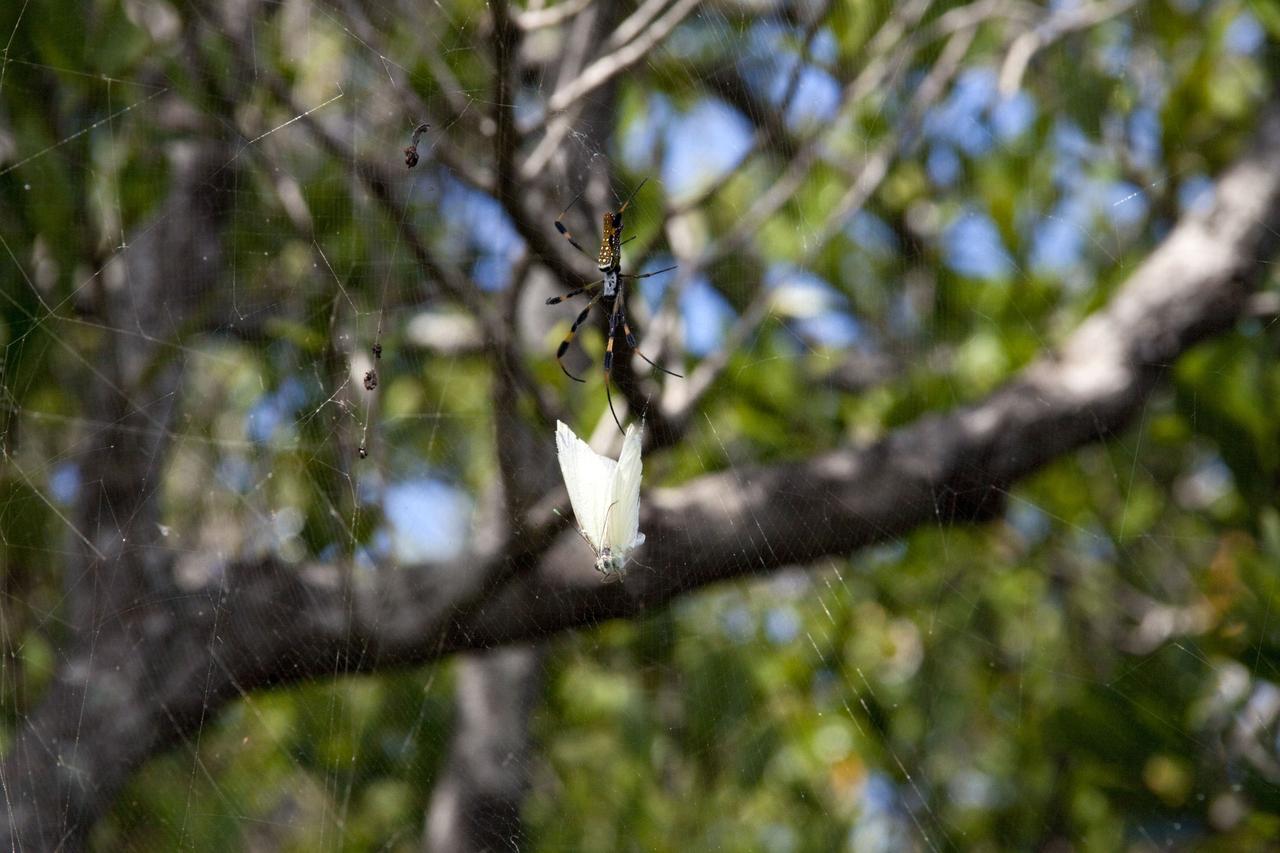
CAPE CANAVERAL, Fla. -- Near Launch Pad 39A at Kennedy Space Center in Florida, a Golden-Silk Spider repairs its web after a capturing a moth. The golden-silk spider repairs the webbing each day, replacing half but never the whole web at one time. Its web may measure two to three feet across. The center shares a boundary with the Merritt Island Wildlife Nature Refuge, consisting of 140,000 acres. The Refuge provides a wide variety of habitats: coastal dunes, saltwater estuaries and marshes, freshwater impoundments, scrub, pine flatwoods, and hardwood hammocks that provide habitat for more than 1,500 species of plants and animals. Atlantis and its crew of four; Commander Chris Ferguson, Pilot Doug Hurley, Mission Specialists Sandy Magnus and Rex Walheim are scheduled to lift off at 11:26 a.m. EDT on July 8 to deliver the Raffaello multi-purpose logistics module packed with supplies and spare parts for the International Space Station. Atlantis also will fly the Robotic Refueling Mission experiment that will investigate the potential for robotically refueling existing satellites in orbit. In addition, Atlantis will return with a failed ammonia pump module to help NASA better understand the failure mechanism and improve pump designs for future systems. STS-135 is the 33rd flight of Atlantis, the 37th shuttle mission to the space station, and the 135th and final mission of NASA's Space Shuttle Program. For more information, visit www.nasa.gov/mission_pages/shuttle/shuttlemissions/sts135/index.html. Photo credit: Ken Thornsley

CAPE CANAVERAL, Fla. -- At the Banana River Creek VIP viewing area at NASA's Kennedy Space Center in Florida, spectators smile with delight as they watch space shuttle Atlantis soar into space on its STS-135 mission to the International Space Station. Atlantis with its crew of four; Commander Chris Ferguson, Pilot Doug Hurley, Mission Specialists Sandy Magnus and Rex Walheim, lifted off at 11:29 a.m. EDT on July 8, 2011 to deliver the Raffaello multi-purpose logistics module packed with supplies and spare parts for the International Space Station. Atlantis also will fly the Robotic Refueling Mission experiment that will investigate the potential for robotically refueling existing satellites in orbit. In addition, Atlantis will return with a failed ammonia pump module to help NASA better understand the failure mechanism and improve pump designs for future systems. STS-135 is the 33rd flight of Atlantis, the 37th shuttle mission to the space station, and the 135th and final mission of NASA's Space Shuttle Program. For more information, visit www.nasa.gov/mission_pages/shuttle/shuttlemissions/sts135/index.html. Photo credit: NASA/Chad Baumer
CAPE CANAVERAL, Fla. -- At the Banana River Creek VIP viewing area at NASA's Kennedy Space Center in Florida, Johnson Space Center Director Mike Coats speaks to media and spectators before the launch of space shuttle Atlantis on its STS-135 mission to the International Space Station. Seen also Stennis Space Center Director Patrick Scheuermann (left), Kennedy Center Director Bob Cabana and Marshall Space Flight Center Director Robert Lightfoot. Atlantis with its crew of four; Commander Chris Ferguson, Pilot Doug Hurley, Mission Specialists Sandy Magnus and Rex Walheim, lifted off at 11:29 a.m. EDT on July 8, 2011 to deliver the Raffaello multi-purpose logistics module packed with supplies and spare parts for the International Space Station. Atlantis also will fly the Robotic Refueling Mission experiment that will investigate the potential for robotically refueling existing satellites in orbit. In addition, Atlantis will return with a failed ammonia pump module to help NASA better understand the failure mechanism and improve pump designs for future systems. STS-135 is the 33rd flight of Atlantis, the 37th shuttle mission to the space station, and the 135th and final mission of NASA's Space Shuttle Program. For more information, visit www.nasa.gov/mission_pages/shuttle/shuttlemissions/sts135/index.html. Photo credit: NASA/Chad Baumer
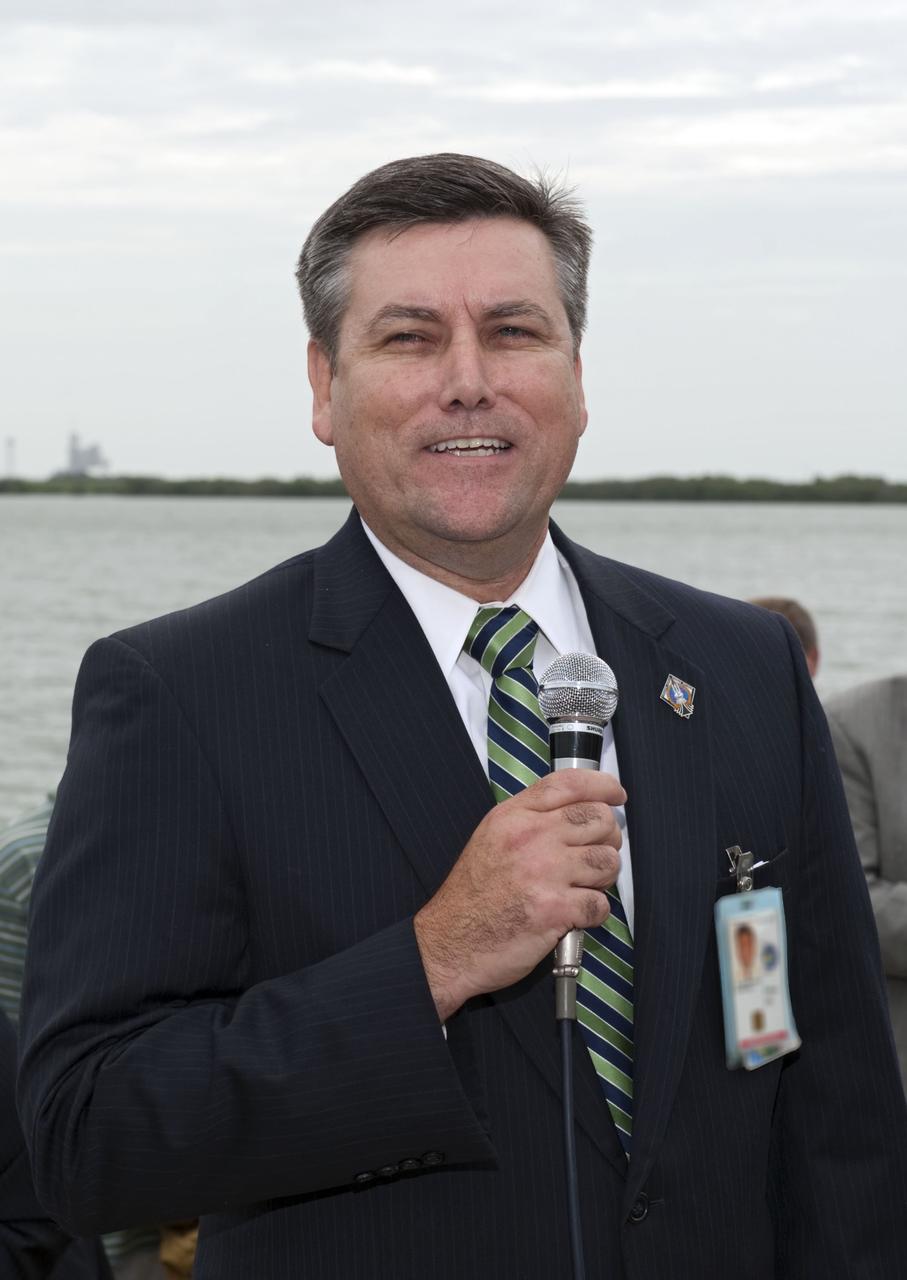
CAPE CANAVERAL, Fla. -- At the Banana River Creek VIP viewing area at NASA's Kennedy Space Center in Florida, Stennis Space Center Director Patrick Scheuermann speaks to media and spectators before the launch of space shuttle Atlantis on its STS-135 mission to the International Space Station. Atlantis with its crew of four; Commander Chris Ferguson, Pilot Doug Hurley, Mission Specialists Sandy Magnus and Rex Walheim, lifted off at 11:29 a.m. EDT on July 8, 2011 to deliver the Raffaello multi-purpose logistics module packed with supplies and spare parts for the International Space Station. Atlantis also will fly the Robotic Refueling Mission experiment that will investigate the potential for robotically refueling existing satellites in orbit. In addition, Atlantis will return with a failed ammonia pump module to help NASA better understand the failure mechanism and improve pump designs for future systems. STS-135 is the 33rd flight of Atlantis, the 37th shuttle mission to the space station, and the 135th and final mission of NASA's Space Shuttle Program. For more information, visit www.nasa.gov/mission_pages/shuttle/shuttlemissions/sts135/index.html. Photo credit: NASA/Chad Baumer
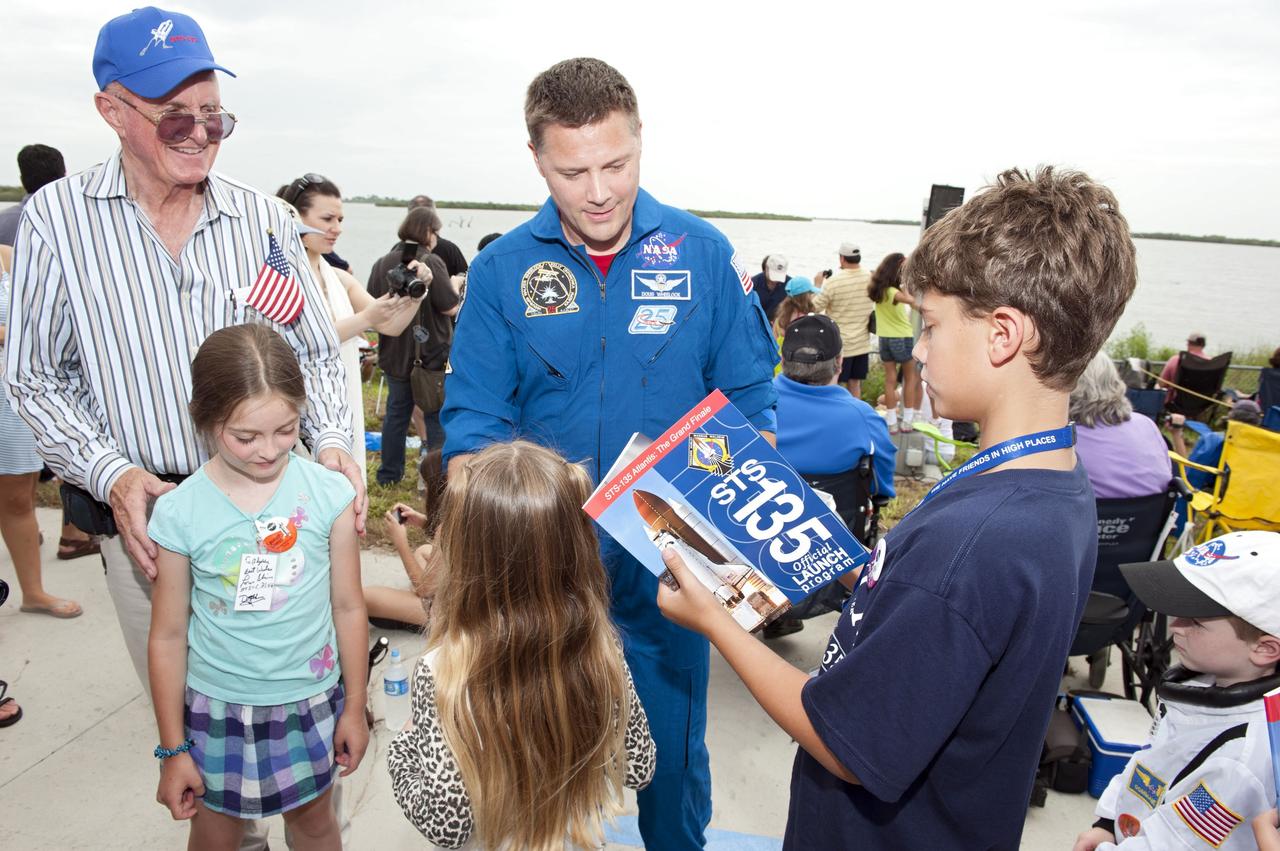
CAPE CANAVERAL, Fla. -- At the Banana River Creek VIP viewing area at NASA's Kennedy Space Center in Florida, youngsters delight in meeting NASA astronaut Doug Wheelock before the launch of space shuttle Atlantis' STS-135 mission to the International Space Station. Atlantis with its crew of four; Commander Chris Ferguson, Pilot Doug Hurley, Mission Specialists Sandy Magnus and Rex Walheim, lifted off at 11:29 a.m. EDT on July 8, 2011 to deliver the Raffaello multi-purpose logistics module packed with supplies and spare parts for the International Space Station. Atlantis also will fly the Robotic Refueling Mission experiment that will investigate the potential for robotically refueling existing satellites in orbit. In addition, Atlantis will return with a failed ammonia pump module to help NASA better understand the failure mechanism and improve pump designs for future systems. STS-135 is the 33rd flight of Atlantis, the 37th shuttle mission to the space station, and the 135th and final mission of NASA's Space Shuttle Program. For more information, visit www.nasa.gov/mission_pages/shuttle/shuttlemissions/sts135/index.html. Photo credit: NASA/Chad Baumer

CAPE CANAVERAL, Fla. -- At the Banana River Creek VIP viewing area at NASA's Kennedy Space Center in Florida, spectators relax before the upcoming launch of space shuttle Atlantis on its STS-135 mission to the International Space Station. Atlantis with its crew of four; Commander Chris Ferguson, Pilot Doug Hurley, Mission Specialists Sandy Magnus and Rex Walheim, lifted off at 11:29 a.m. EDT on July 8, 2011 to deliver the Raffaello multi-purpose logistics module packed with supplies and spare parts for the International Space Station. Atlantis also will fly the Robotic Refueling Mission experiment that will investigate the potential for robotically refueling existing satellites in orbit. In addition, Atlantis will return with a failed ammonia pump module to help NASA better understand the failure mechanism and improve pump designs for future systems. STS-135 is the 33rd flight of Atlantis, the 37th shuttle mission to the space station, and the 135th and final mission of NASA's Space Shuttle Program. For more information, visit www.nasa.gov/mission_pages/shuttle/shuttlemissions/sts135/index.html. Photo credit: NASA/Chad Baumer
CAPE CANAVERAL, Fla. -- At NASA's Kennedy Space Center, space shuttle Atlantis can be seen in the distance awaiting liftoff on its STS-135 mission while members of the media set up cameras to capture the launch on a very rainy day in Florida. Atlantis and its crew of four; Commander Chris Ferguson, Pilot Doug Hurley, Mission Specialists Sandy Magnus and Rex Walheim are scheduled to lift off at 11:26 a.m. EDT on July 8 to deliver the Raffaello multi-purpose logistics module packed with supplies and spare parts for the International Space Station. Atlantis also will fly the Robotic Refueling Mission experiment that will investigate the potential for robotically refueling existing satellites in orbit. In addition, Atlantis will return with a failed ammonia pump module to help NASA better understand the failure mechanism and improve pump designs for future systems. STS-135 is the 33rd flight of Atlantis, the 37th shuttle mission to the space station, and the 135th and final mission of NASA's Space Shuttle Program. For more information, visit www.nasa.gov/mission_pages/shuttle/shuttlemissions/sts135/index.html. Photo credit: Ken Thornsley

CAPE CANAVERAL, Fla. -- At the Banana River Creek VIP viewing area at NASA's Kennedy Space Center in Florida, youngsters delight in meeting NASA astronaut Doug Wheelock before the launch of space shuttle Atlantis' STS-135 mission to the International Space Station. Atlantis with its crew of four; Commander Chris Ferguson, Pilot Doug Hurley, Mission Specialists Sandy Magnus and Rex Walheim, lifted off at 11:29 a.m. EDT on July 8, 2011 to deliver the Raffaello multi-purpose logistics module packed with supplies and spare parts for the International Space Station. Atlantis also will fly the Robotic Refueling Mission experiment that will investigate the potential for robotically refueling existing satellites in orbit. In addition, Atlantis will return with a failed ammonia pump module to help NASA better understand the failure mechanism and improve pump designs for future systems. STS-135 is the 33rd flight of Atlantis, the 37th shuttle mission to the space station, and the 135th and final mission of NASA's Space Shuttle Program. For more information, visit www.nasa.gov/mission_pages/shuttle/shuttlemissions/sts135/index.html. Photo credit: NASA/Chad Baumer
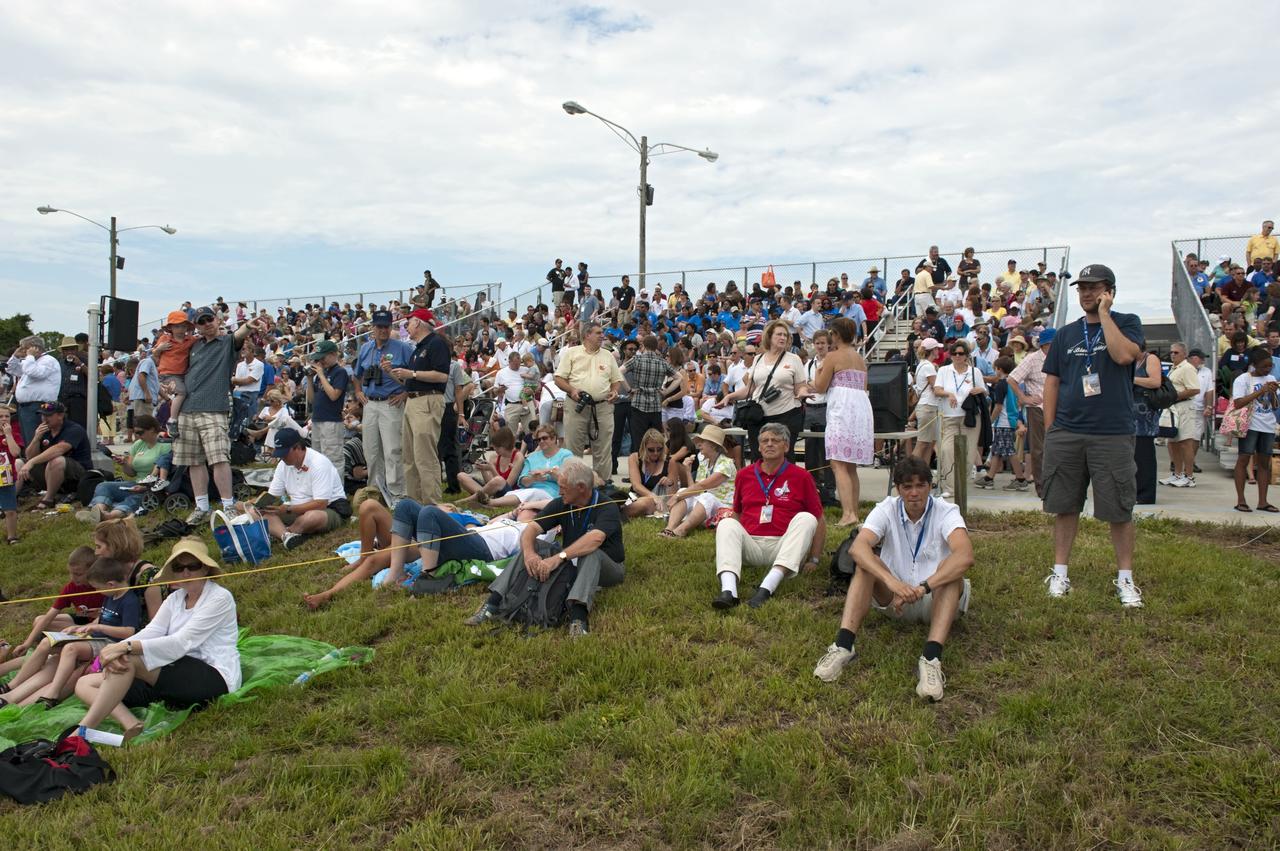
CAPE CANAVERAL, Fla. -- At the Banana River Creek VIP viewing area at NASA's Kennedy Space Center in Florida, spectators relax before the launch of space shuttle Atlantis on its STS-135 mission to the International Space Station. Atlantis with its crew of four; Commander Chris Ferguson, Pilot Doug Hurley, Mission Specialists Sandy Magnus and Rex Walheim, lifted off at 11:29 a.m. EDT on July 8, 2011 to deliver the Raffaello multi-purpose logistics module packed with supplies and spare parts for the International Space Station. Atlantis also will fly the Robotic Refueling Mission experiment that will investigate the potential for robotically refueling existing satellites in orbit. In addition, Atlantis will return with a failed ammonia pump module to help NASA better understand the failure mechanism and improve pump designs for future systems. STS-135 is the 33rd flight of Atlantis, the 37th shuttle mission to the space station, and the 135th and final mission of NASA's Space Shuttle Program. For more information, visit www.nasa.gov/mission_pages/shuttle/shuttlemissions/sts135/index.html. Photo credit: NASA/Chad Baumer

CAPE CANAVERAL, Fla. -- At the Banana River Creek VIP viewing area at NASA's Kennedy Space Center in Florida, spectators have their cameras trained on Launch Pad 39A as space shuttle Atlantis lifts off to begin its STS-135 mission to the International Space Station. Atlantis with its crew of four; Commander Chris Ferguson, Pilot Doug Hurley, Mission Specialists Sandy Magnus and Rex Walheim, lifted off at 11:29 a.m. EDT on July 8, 2011 to deliver the Raffaello multi-purpose logistics module packed with supplies and spare parts for the International Space Station. Atlantis also will fly the Robotic Refueling Mission experiment that will investigate the potential for robotically refueling existing satellites in orbit. In addition, Atlantis will return with a failed ammonia pump module to help NASA better understand the failure mechanism and improve pump designs for future systems. STS-135 is the 33rd flight of Atlantis, the 37th shuttle mission to the space station, and the 135th and final mission of NASA's Space Shuttle Program. For more information, visit www.nasa.gov/mission_pages/shuttle/shuttlemissions/sts135/index.html. Photo credit: NASA/Chad Baumer
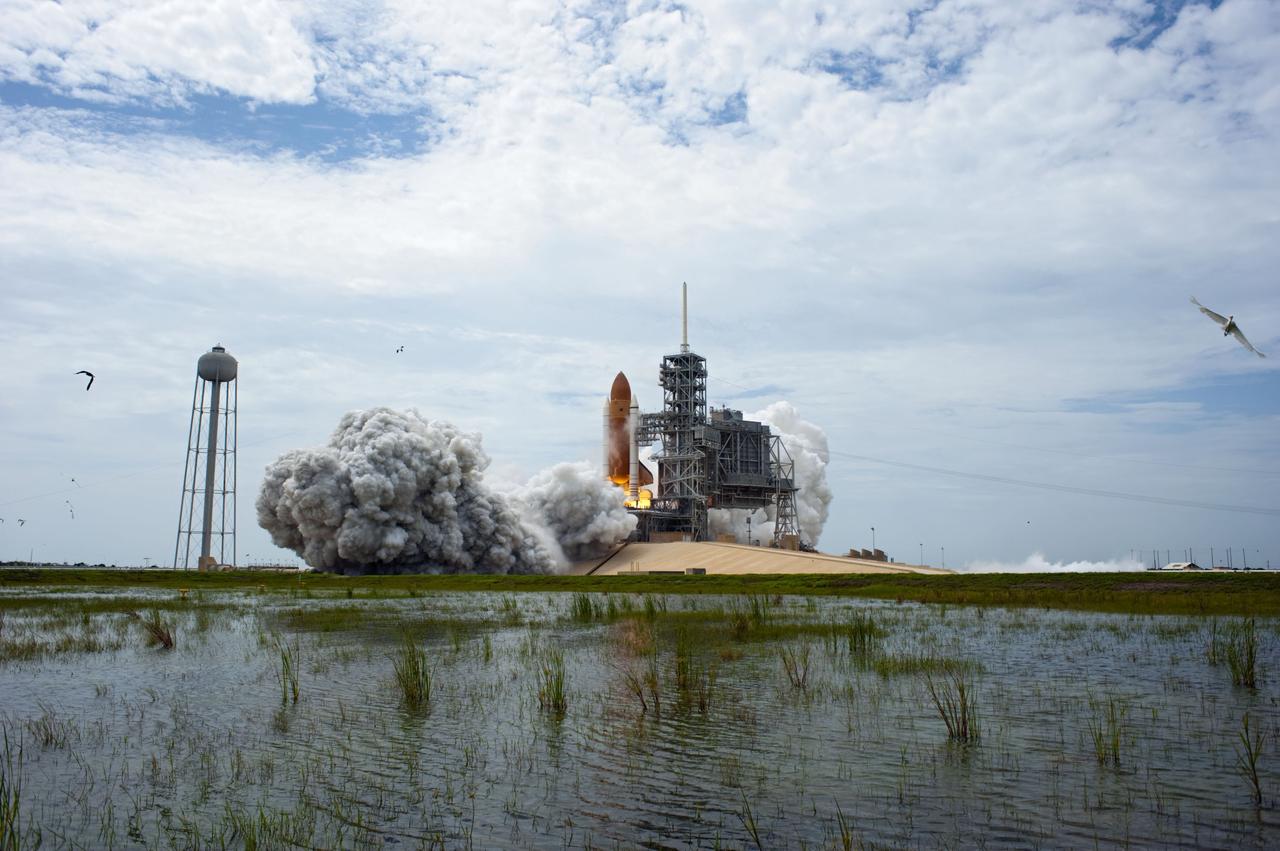
CAPE CANAVERAL, Fla. -- At NASA's Kennedy Space Center in Florida, space shuttle Atlantis' main engines and solid rocket boosters ignite on Launch Pad 39A as it lifts off on its STS-135 mission to the International Space Station. Atlantis with its crew of four; Commander Chris Ferguson, Pilot Doug Hurley, Mission Specialists Sandy Magnus and Rex Walheim, lifted off at 11:29 a.m. EDT on July 8, 2011 to deliver the Raffaello multi-purpose logistics module packed with supplies and spare parts for the station. Atlantis also will fly the Robotic Refueling Mission experiment that will investigate the potential for robotically refueling existing satellites in orbit. In addition, Atlantis will return with a failed ammonia pump module to help NASA better understand the failure mechanism and improve pump designs for future systems. STS-135 is the 33rd flight of Atlantis, the 37th shuttle mission to the space station, and the 135th and final mission of NASA's Space Shuttle Program. For more information, visit www.nasa.gov/mission_pages/shuttle/shuttlemissions/sts135/index.html. Photo credit: NASA/Sandra Joseph and Kevin O'Connell
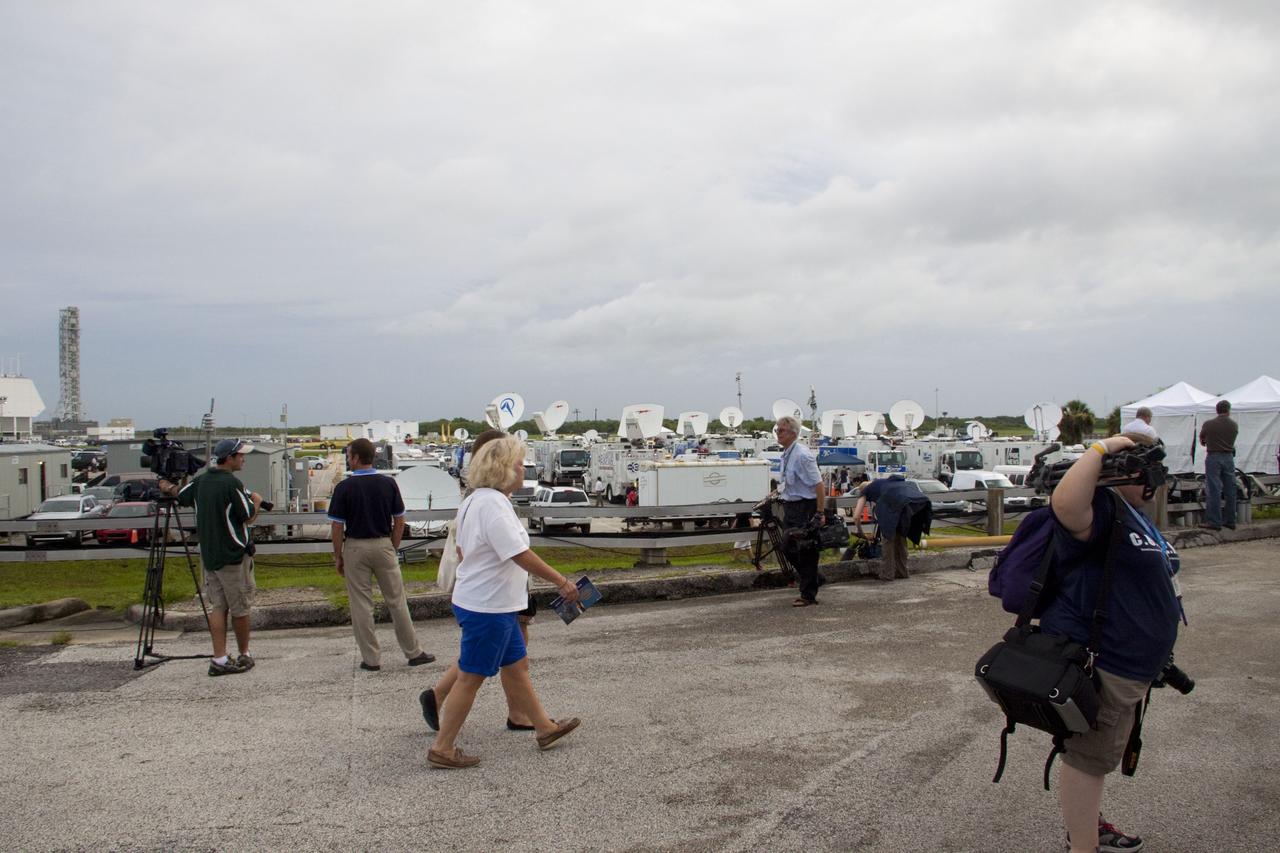
CAPE CANAVERAL, Fla. -- Media from around the globe gather on the grounds of the Press Site at NASA's Kennedy Space Center in Florida to photograph and cover the prelaunch activities and lift off of space shuttle Atlantis on its STS-135 mission to the International Space Station. Satellite news trucks, trailers and automobiles can be seen in the parking lot. Atlantis began its final flight, with Commander Chris Ferguson, Pilot Doug Hurley and Mission Specialists Sandy Magnus and Rex Walheim on board, at 11:29 a.m. EDT July 8 to deliver the Raffaello multi-purpose logistics module packed with supplies and spare parts to the station. Also in Atlantis' payload bay is the Robotic Refueling Mission experiment that will investigate the potential for robotically refueling existing satellites in orbit. In addition, Atlantis will return with a failed ammonia pump module to help NASA better understand the failure mechanism and improve pump designs for future systems. STS-135 is the 33rd flight of Atlantis, the 37th shuttle mission to the space station, and the 135th and final mission of NASA's Space Shuttle Program. For more information, visit www.nasa.gov/mission_pages/shuttle/shuttlemissions/sts135/index.html. Photo credit: NASA/Jim Grossmann
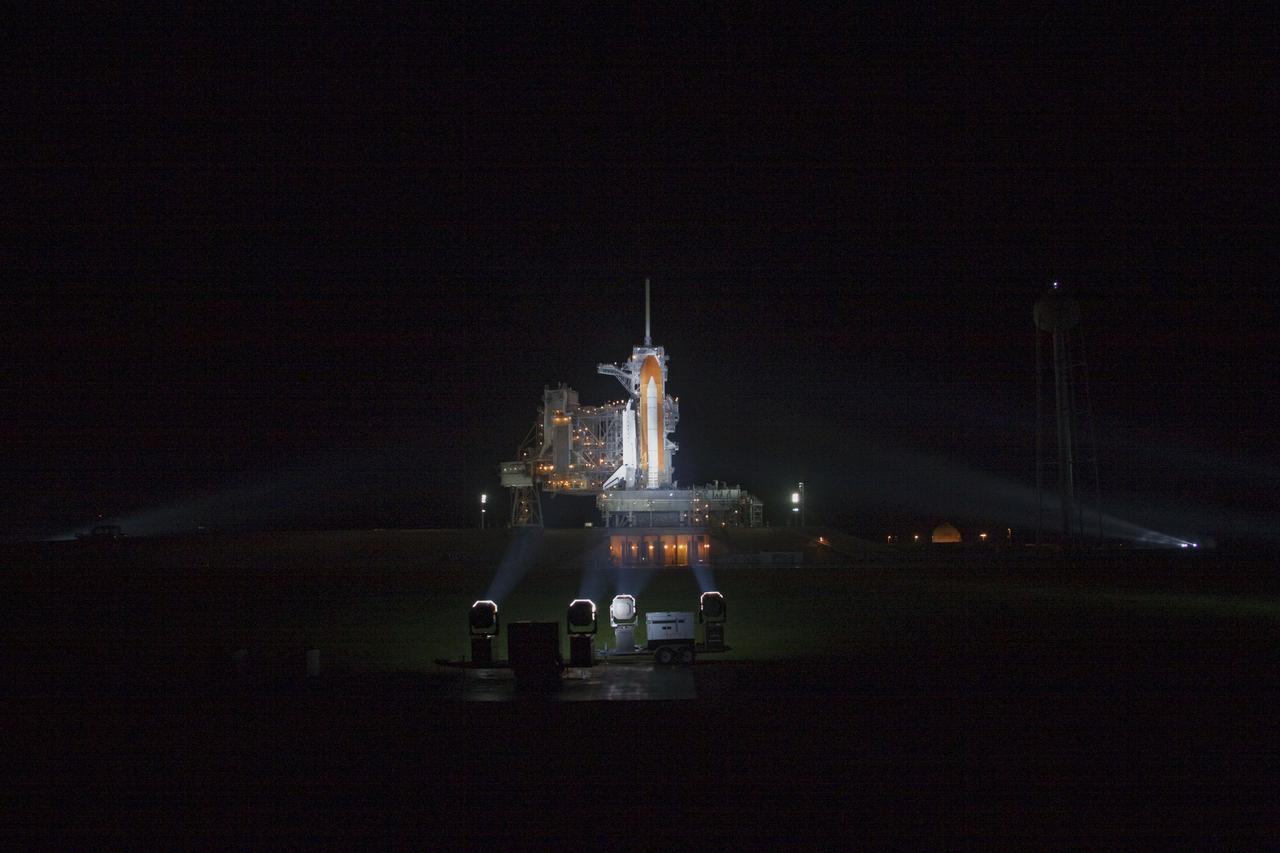
CAPE CANAVERAL, Fla. -- Space shuttle Atlantis is revealed on Launch Pad 39A at NASA's Kennedy Space Center in Florida following the move of the rotating service structure (RSS). The structure provides weather protection and access to the shuttle while it awaits liftoff on the pad. RSS retract marks a major milestone in Atlantis' STS-135 mission countdown. Atlantis and its crew of four; Commander Chris Ferguson, Pilot Doug Hurley, Mission Specialists Sandy Magnus and Rex Walheim will lift off at 11:26 a.m. EDT on July 8 to deliver the Raffaello multi-purpose logistics module packed with supplies and spare parts for the International Space Station. Atlantis also will fly the Robotic Refueling Mission experiment that will investigate the potential for robotically refueling existing satellites in orbit. In addition, Atlantis will return with a failed ammonia pump module to help NASA better understand the failure mechanism and improve pump designs for future systems. STS-135 is the 33rd flight of Atlantis, the 37th shuttle mission to the space station, and the 135th and final mission of NASA's Space Shuttle Program. For more information, visit www.nasa.gov/mission_pages/shuttle/shuttlemissions/sts135/index.html. Photo credit: Jim Grossmann
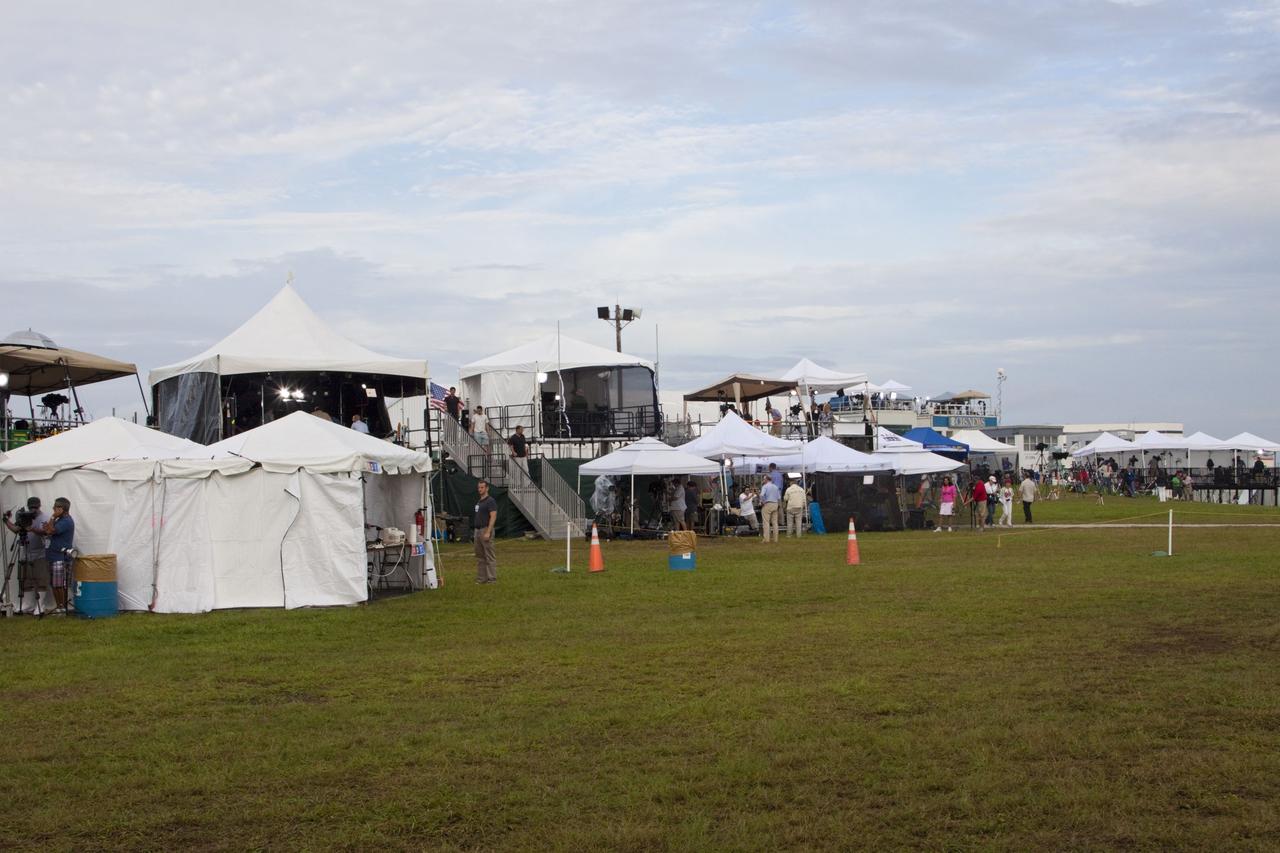
CAPE CANAVERAL, Fla. -- Media from around the globe gather in their respective tents at the Press Site at NASA's Kennedy Space Center in Florida to photograph and cover the prelaunch activities and lift off of space shuttle Atlantis on its STS-135 mission to the International Space Station. Atlantis began its final flight, with Commander Chris Ferguson, Pilot Doug Hurley and Mission Specialists Sandy Magnus and Rex Walheim on board, at 11:29 a.m. EDT July 8 to deliver the Raffaello multi-purpose logistics module packed with supplies and spare parts to the station. Also in Atlantis' payload bay is the Robotic Refueling Mission experiment that will investigate the potential for robotically refueling existing satellites in orbit. In addition, Atlantis will return with a failed ammonia pump module to help NASA better understand the failure mechanism and improve pump designs for future systems. STS-135 is the 33rd flight of Atlantis, the 37th shuttle mission to the space station, and the 135th and final mission of NASA's Space Shuttle Program. For more information, visit www.nasa.gov/mission_pages/shuttle/shuttlemissions/sts135/index.html. Photo credit: NASA/Jim Grossmann
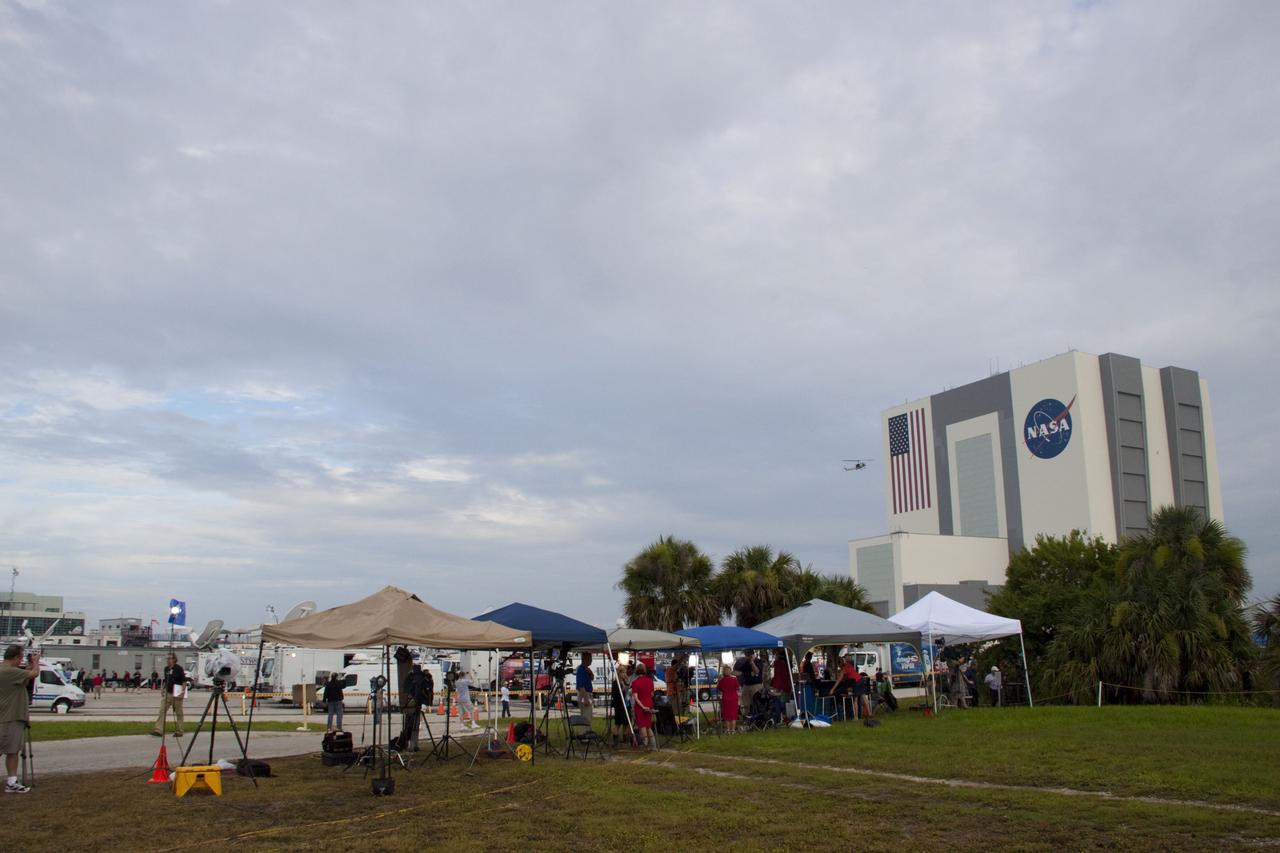
CAPE CANAVERAL, Fla. -- Media from around the globe gather on the grounds of the Press Site at NASA's Kennedy Space Center in Florida to photograph and cover the prelaunch activities and lift off of space shuttle Atlantis on its STS-135 mission to the International Space Station. Dozens of satellite news vehicles can be seen in the parking lot with the massive Vehicle Assembly Building towering above. Atlantis began its final flight, with Commander Chris Ferguson, Pilot Doug Hurley and Mission Specialists Sandy Magnus and Rex Walheim on board, at 11:29 a.m. EDT July 8 to deliver the Raffaello multi-purpose logistics module packed with supplies and spare parts to the station. Also in Atlantis' payload bay is the Robotic Refueling Mission experiment that will investigate the potential for robotically refueling existing satellites in orbit. In addition, Atlantis will return with a failed ammonia pump module to help NASA better understand the failure mechanism and improve pump designs for future systems. STS-135 is the 33rd flight of Atlantis, the 37th shuttle mission to the space station, and the 135th and final mission of NASA's Space Shuttle Program. For more information, visit www.nasa.gov/mission_pages/shuttle/shuttlemissions/sts135/index.html. Photo credit: NASA/Jim Grossmann
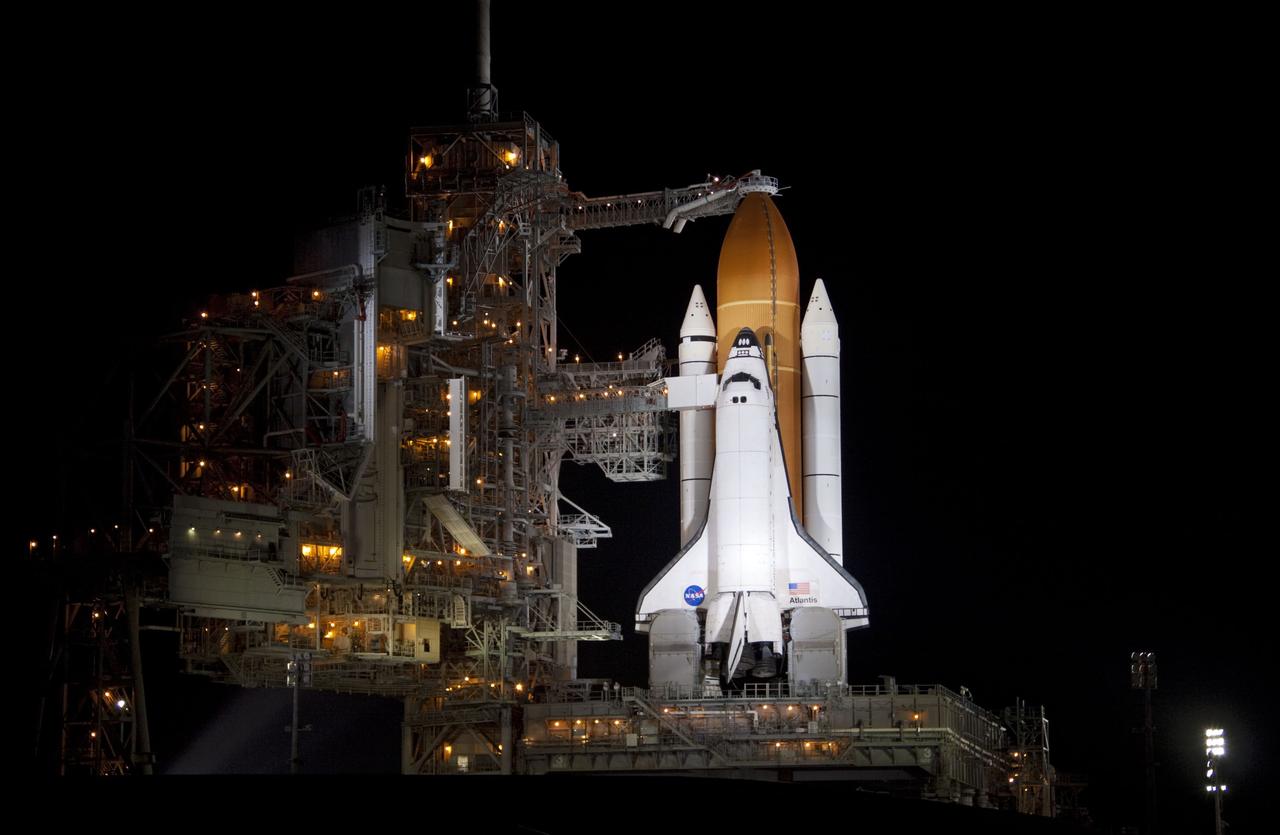
CAPE CANAVERAL, Fla. -- Space shuttle Atlantis is revealed on Launch Pad 39A at NASA's Kennedy Space Center in Florida following the move of the rotating service structure (RSS). The structure provides weather protection and access to the shuttle while it awaits liftoff on the pad. RSS retract marks a major milestone in Atlantis' STS-135 mission countdown. Atlantis and its crew of four; Commander Chris Ferguson, Pilot Doug Hurley, Mission Specialists Sandy Magnus and Rex Walheim will lift off at 11:26 a.m. EDT on July 8 to deliver the Raffaello multi-purpose logistics module packed with supplies and spare parts for the International Space Station. Atlantis also will fly the Robotic Refueling Mission experiment that will investigate the potential for robotically refueling existing satellites in orbit. In addition, Atlantis will return with a failed ammonia pump module to help NASA better understand the failure mechanism and improve pump designs for future systems. STS-135 is the 33rd flight of Atlantis, the 37th shuttle mission to the space station, and the 135th and final mission of NASA's Space Shuttle Program. For more information, visit www.nasa.gov/mission_pages/shuttle/shuttlemissions/sts135/index.html. Photo credit: Jim Grossmann
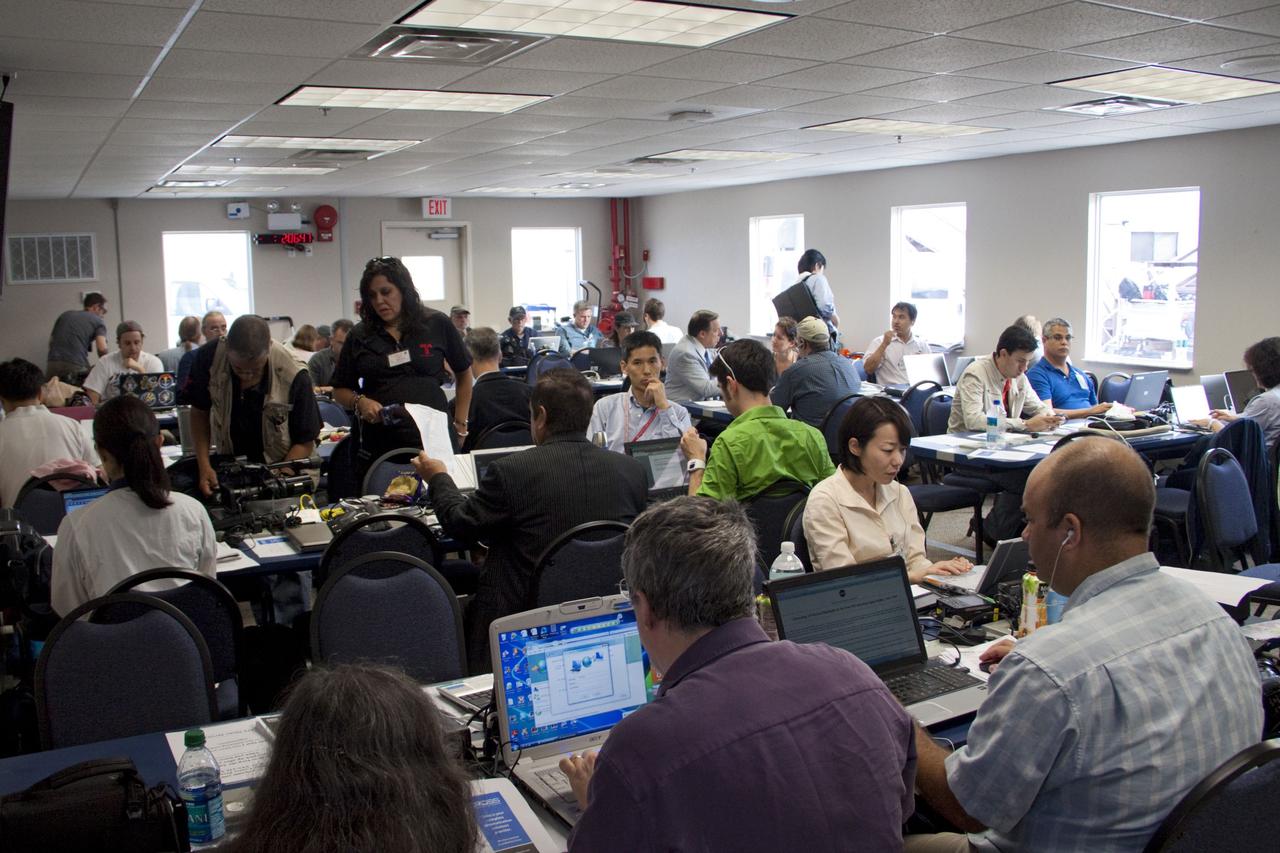
CAPE CANAVERAL, Fla. -- Media from around the globe gather at the NASA News Annex at NASA Kennedy Space Center's Press Site in Florida to cover the prelaunch activities and lift off of space shuttle Atlantis on its STS-135 mission to the International Space Station. Atlantis began its final flight, with Commander Chris Ferguson, Pilot Doug Hurley and Mission Specialists Sandy Magnus and Rex Walheim on board, at 11:29 a.m. EDT July 8 to deliver the Raffaello multi-purpose logistics module packed with supplies and spare parts to the station. Also in Atlantis' payload bay is the Robotic Refueling Mission experiment that will investigate the potential for robotically refueling existing satellites in orbit. In addition, Atlantis will return with a failed ammonia pump module to help NASA better understand the failure mechanism and improve pump designs for future systems. STS-135 is the 33rd flight of Atlantis, the 37th shuttle mission to the space station, and the 135th and final mission of NASA's Space Shuttle Program. For more information, visit www.nasa.gov/mission_pages/shuttle/shuttlemissions/sts135/index.html. Photo credit: NASA/Jim Grossmann
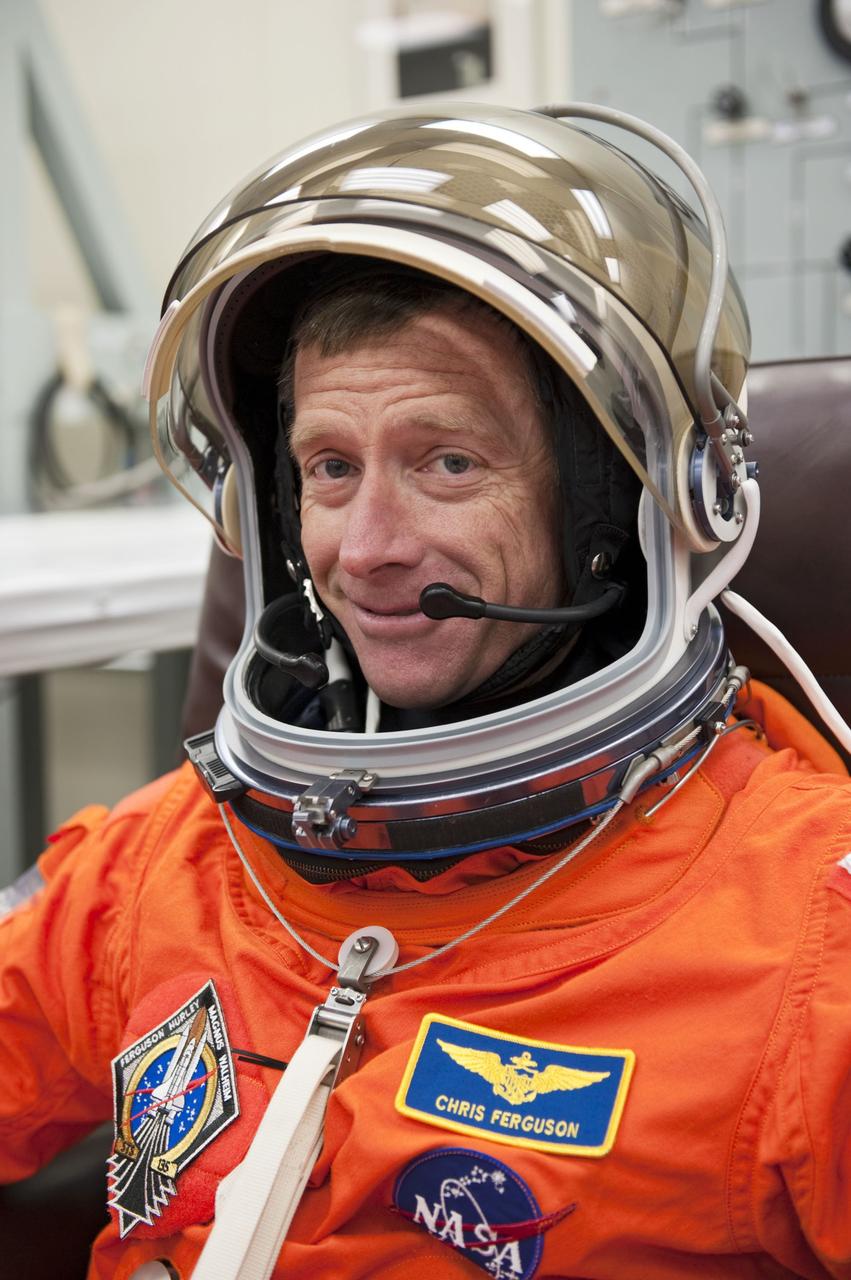
CAPE CANAVERAL, Fla. -- In the Operations and Checkout Building at NASA's Kennedy Space Center in Florida, STS-135 Commander Chris Ferguson checks the fit of his launch-and-entry suit and helmet during a simulated launch countdown. As part of the Terminal Countdown Demonstration Test (TCDT), the crew members are taken to Kennedy's Launch Pad 39A and strapped into space shuttle Atlantis to practice the steps that will be taken on launch day. Atlantis and its crew are targeted to lift off July 8, taking with them the Raffaello multi-purpose logistics module packed with supplies and spare parts to the International Space Station. The STS-135 mission also will fly a system to investigate the potential for robotically refueling existing satellites and return a failed ammonia pump module to help NASA better understand the failure mechanism and improve pump designs for future systems. STS-135 will be the 33rd flight of Atlantis, the 37th shuttle mission to the space station, and the 135th and final mission of NASA's Space Shuttle Program. For more information visit, www.nasa.gov/mission_pages/shuttle/shuttlemissions/sts135/index.html. Photo credit: NASA/Kim Shiflett
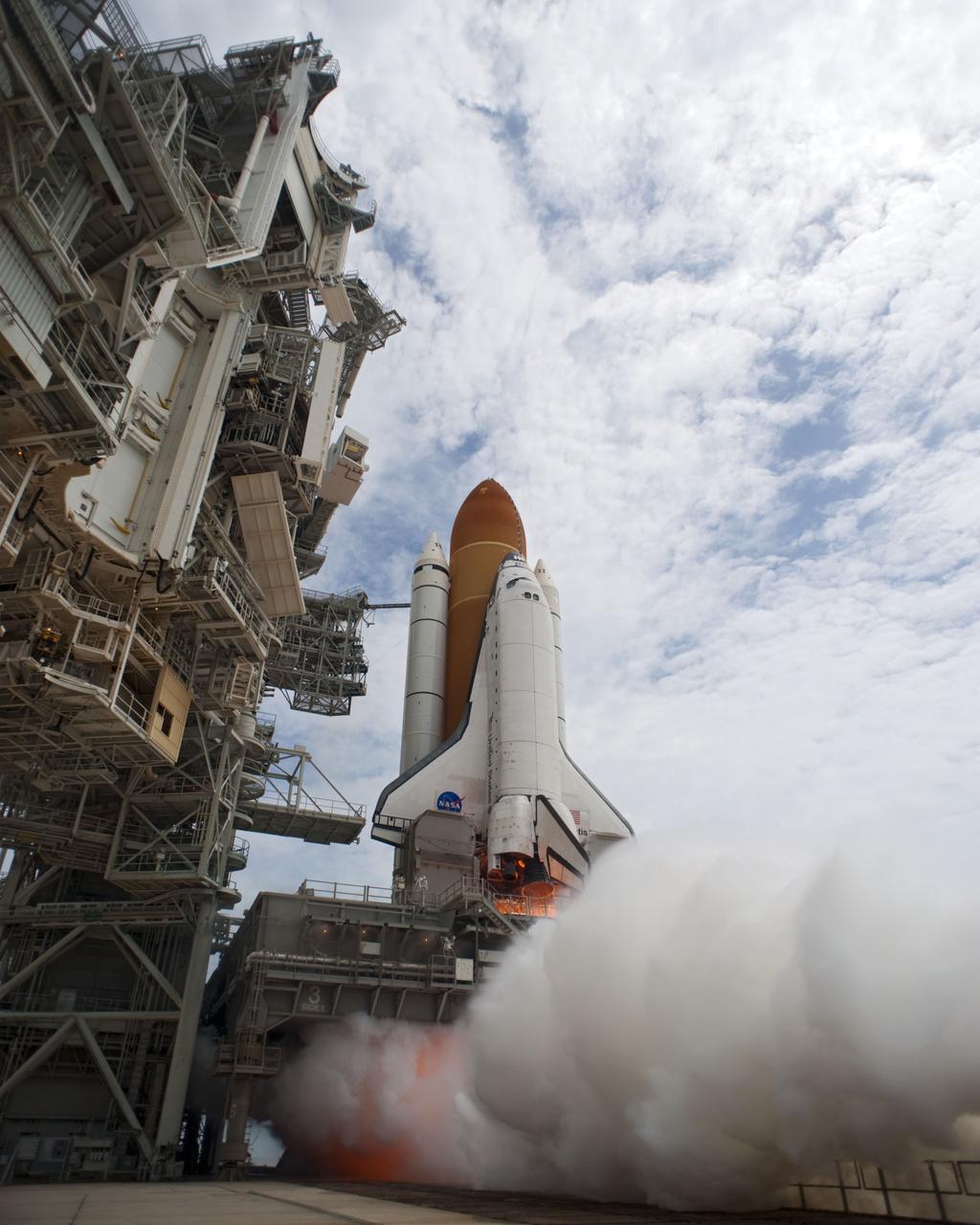
CAPE CANAVERAL, Fla. -- Smoke and steam billow outward as space shuttle Atlantis' main engines are ignited for liftoff at Launch Pad 39A at NASA's Kennedy Space Center in Florida as it begins its STS-135 mission to the International Space Station. Atlantis with its crew of four; Commander Chris Ferguson, Pilot Doug Hurley, Mission Specialists Sandy Magnus and Rex Walheim, lifted off at 11:29 a.m. EDT on July 8, 2011 to deliver the Raffaello multi-purpose logistics module packed with supplies and spare parts for the station. Atlantis also will fly the Robotic Refueling Mission experiment that will investigate the potential for robotically refueling existing satellites in orbit. In addition, Atlantis will return with a failed ammonia pump module to help NASA better understand the failure mechanism and improve pump designs for future systems. STS-135 is the 33rd flight of Atlantis, the 37th shuttle mission to the space station, and the 135th and final mission of NASA's Space Shuttle Program. For more information, visit www.nasa.gov/mission_pages/shuttle/shuttlemissions/sts135/index.html. Photo credit: NASA/Tony Gray and Tom Farrar
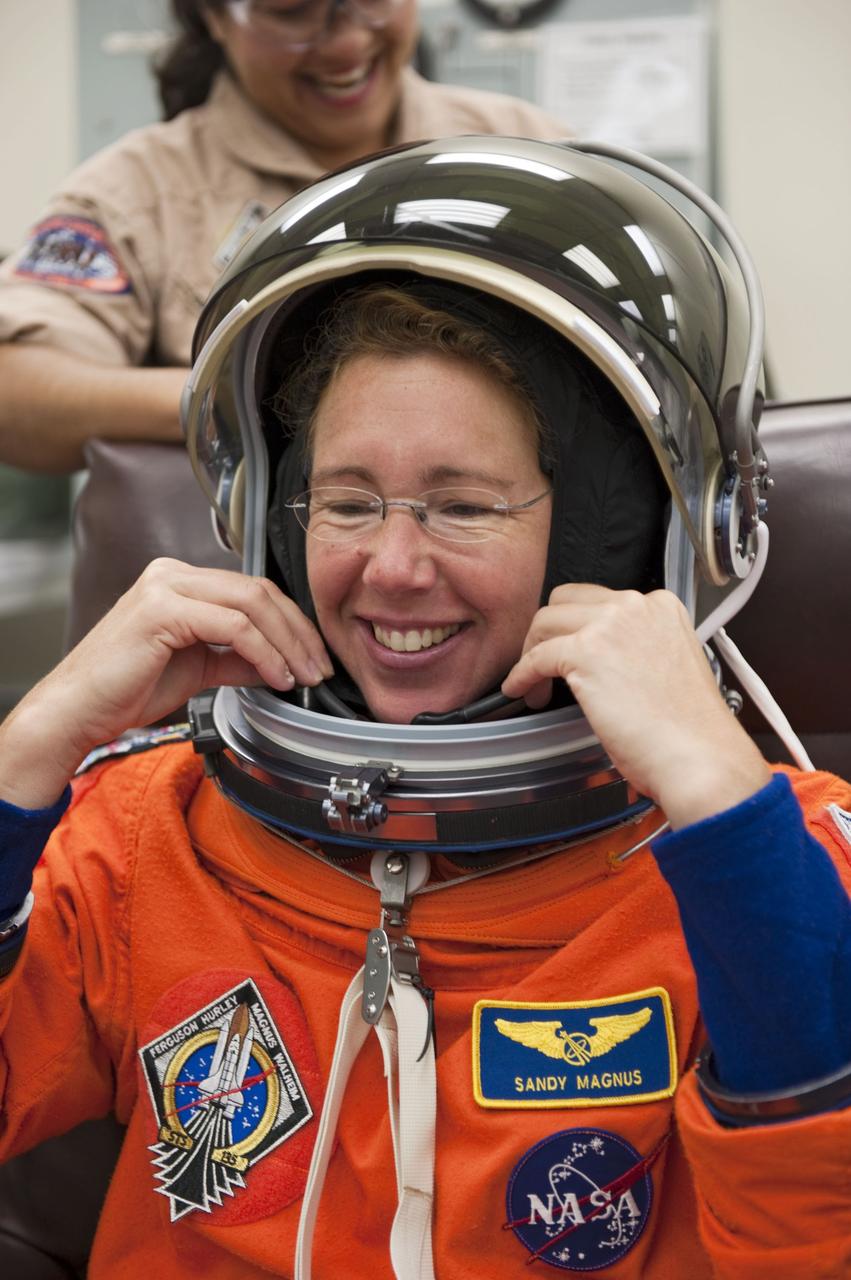
CAPE CANAVERAL, Fla. -- In the Operations and Checkout Building at NASA's Kennedy Space Center in Florida, STS-135 Mission Specialist Sandy Magnus checks the fit of her launch-and-entry suit and helmet during a simulated launch countdown. As part of the Terminal Countdown Demonstration Test (TCDT), the crew members are taken to Kennedy's Launch Pad 39A and strapped into space shuttle Atlantis to practice the steps that will be taken on launch day. Atlantis and its crew are targeted to lift off July 8, taking with them the Raffaello multi-purpose logistics module packed with supplies and spare parts to the International Space Station. The STS-135 mission also will fly a system to investigate the potential for robotically refueling existing satellites and return a failed ammonia pump module to help NASA better understand the failure mechanism and improve pump designs for future systems. STS-135 will be the 33rd flight of Atlantis, the 37th shuttle mission to the space station, and the 135th and final mission of NASA's Space Shuttle Program. For more information visit, www.nasa.gov/mission_pages/shuttle/shuttlemissions/sts135/index.html. Photo credit: NASA/Kim Shiflett
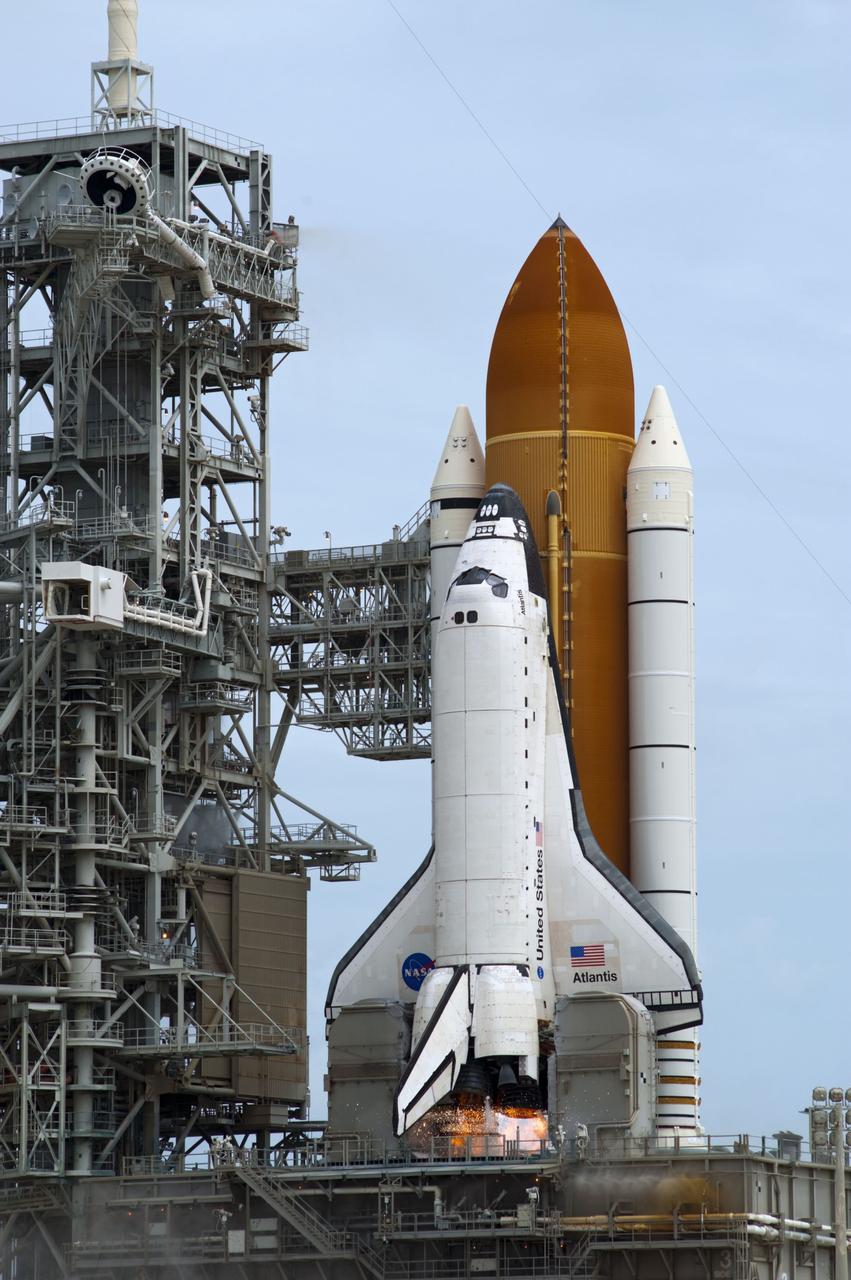
CAPE CANAVERAL, Fla. -- At NASA's Kennedy Space Center in Florida, space shuttle Atlantis' main engines ignite on Launch Pad 39A as it lifts off on its STS-135 mission to the International Space Station. Atlantis with its crew of four; Commander Chris Ferguson, Pilot Doug Hurley, Mission Specialists Sandy Magnus and Rex Walheim, lifted off at 11:29 a.m. EDT on July 8, 2011 to deliver the Raffaello multi-purpose logistics module packed with supplies and spare parts for the station. Atlantis also will fly the Robotic Refueling Mission experiment that will investigate the potential for robotically refueling existing satellites in orbit. In addition, Atlantis will return with a failed ammonia pump module to help NASA better understand the failure mechanism and improve pump designs for future systems. STS-135 is the 33rd flight of Atlantis, the 37th shuttle mission to the space station, and the 135th and final mission of NASA's Space Shuttle Program. For more information, visit www.nasa.gov/mission_pages/shuttle/shuttlemissions/sts135/index.html. Photo credit: NASA/Sandra Joseph and Kevin O'Connell
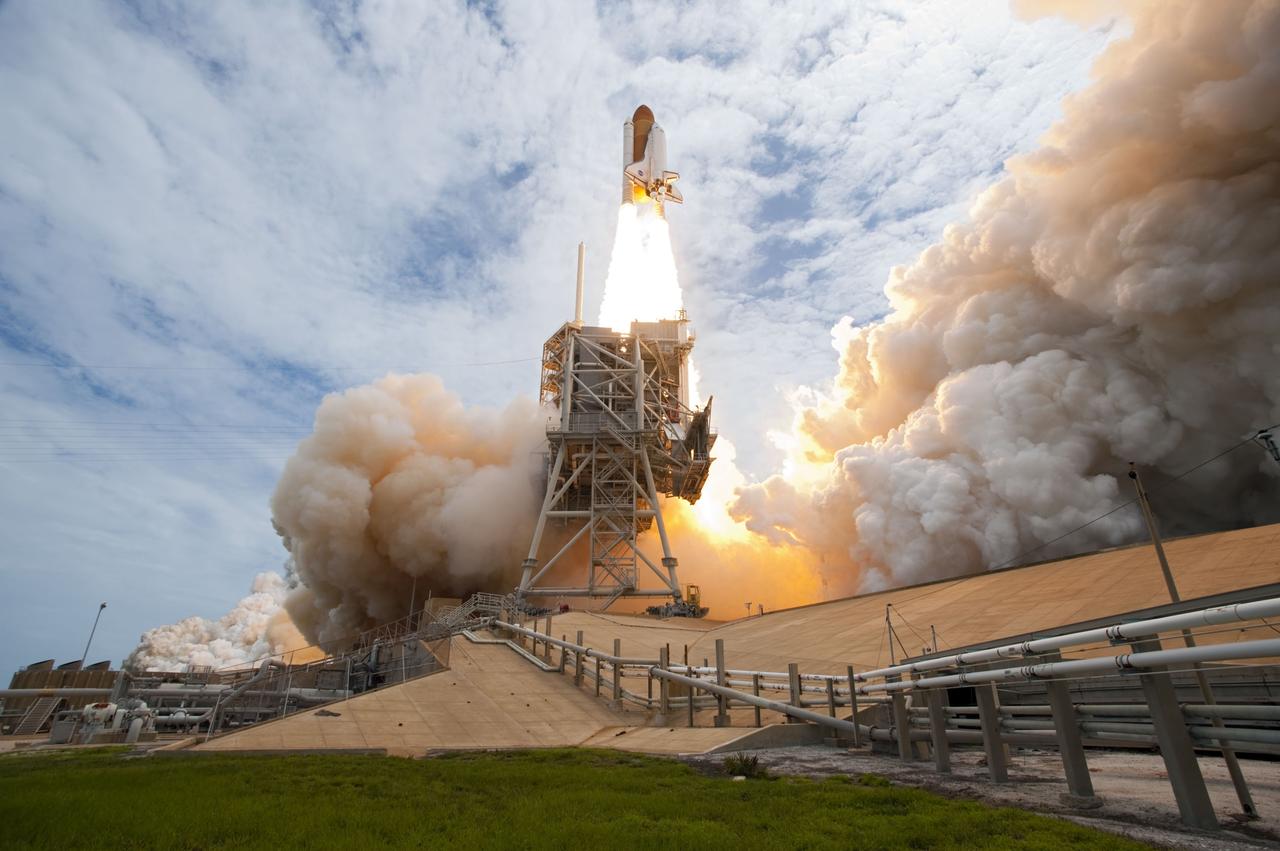
CAPE CANAVERAL, Fla. -- At NASA's Kennedy Space Center in Florida, space shuttle Atlantis lifts off on twin columns of flame from Launch Pad 39A on its way to space on the STS-135 mission to the International Space Station. Atlantis with its crew of four; Commander Chris Ferguson, Pilot Doug Hurley, Mission Specialists Sandy Magnus and Rex Walheim, lifted off at 11:29 a.m. EDT on July 8, 2011 to deliver the Raffaello multi-purpose logistics module packed with supplies and spare parts for the station. Atlantis also will fly the Robotic Refueling Mission experiment that will investigate the potential for robotically refueling existing satellites in orbit. In addition, Atlantis will return with a failed ammonia pump module to help NASA better understand the failure mechanism and improve pump designs for future systems. STS-135 is the 33rd flight of Atlantis, the 37th shuttle mission to the space station, and the 135th and final mission of NASA's Space Shuttle Program. For more information, visit www.nasa.gov/mission_pages/shuttle/shuttlemissions/sts135/index.html. Photo credit: NASA/Tony Gray and Tom Farrar

CAPE CANAVERAL, Fla. -- Space shuttle Atlantis is revealed on Launch Pad 39A at NASA's Kennedy Space Center in Florida bathed in xenon lights following the move of the rotating service structure (RSS). The structure provides weather protection and access to the shuttle while it awaits liftoff on the pad. The tower at left is used for safely burning off any excess hydrogen while the shuttle is on the pad prior to launch. RSS retract marks a major milestone in Atlantis' STS-135 mission countdown. Atlantis and its crew of four; Commander Chris Ferguson, Pilot Doug Hurley, Mission Specialists Sandy Magnus and Rex Walheim will lift off at 11:26 a.m. EDT on July 8 to deliver the Raffaello multi-purpose logistics module packed with supplies and spare parts for the International Space Station. Atlantis also will fly the Robotic Refueling Mission experiment that will investigate the potential for robotically refueling existing satellites in orbit. In addition, Atlantis will return with a failed ammonia pump module to help NASA better understand the failure mechanism and improve pump designs for future systems. STS-135 is the 33rd flight of Atlantis, the 37th shuttle mission to the space station, and the 135th and final mission of NASA's Space Shuttle Program. For more information, visit www.nasa.gov/mission_pages/shuttle/shuttlemissions/sts135/index.html. Photo credit: Jim Grossmann
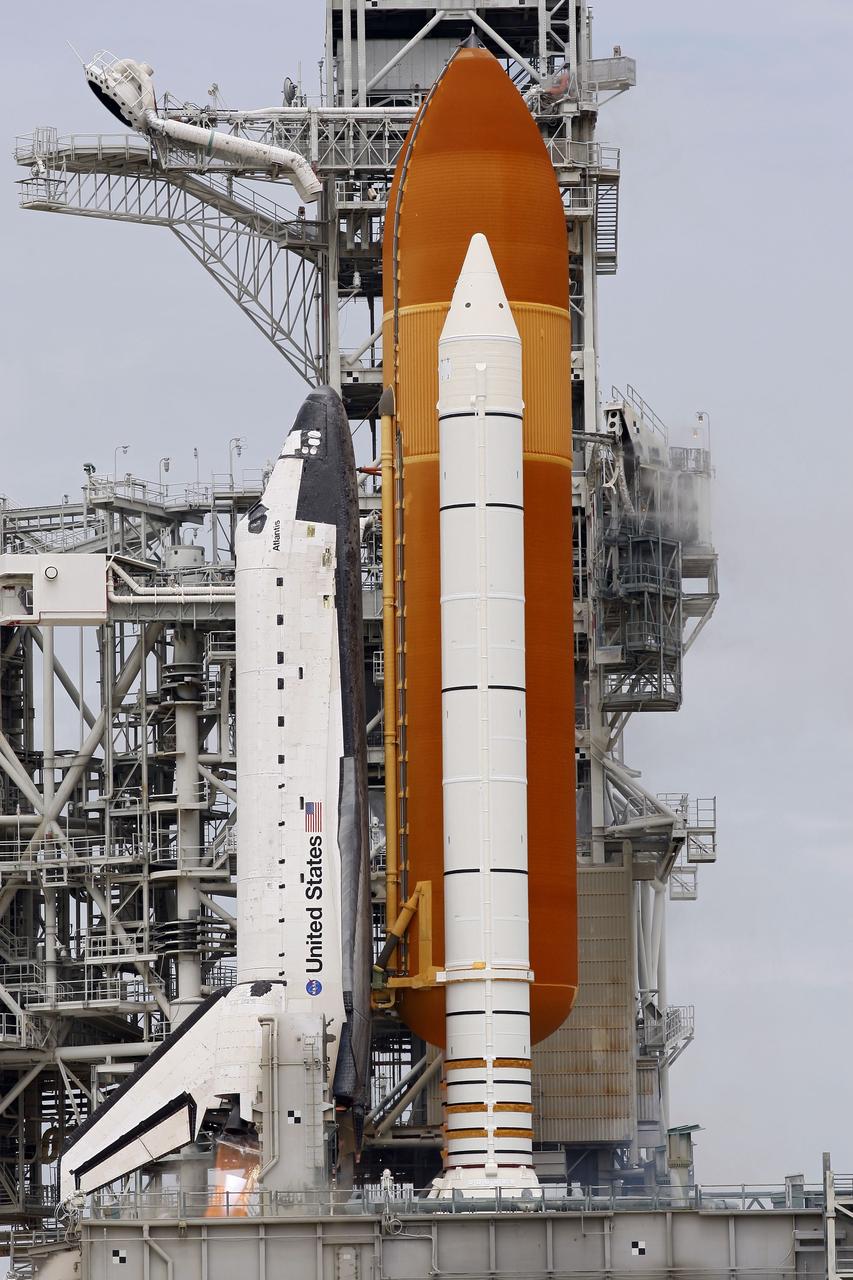
CAPE CANAVERAL, Fla. -- At NASA's Kennedy Space Center in Florida, space shuttle Atlantis' main engines and solid rocket boosters ignite on Launch Pad 39A as it lifts off on its STS-135 mission to the International Space Station. Atlantis with its crew of four; Commander Chris Ferguson, Pilot Doug Hurley, Mission Specialists Sandy Magnus and Rex Walheim, lifted off at 11:29 a.m. EDT on July 8, 2011 to deliver the Raffaello multi-purpose logistics module packed with supplies and spare parts for the International Space Station. Atlantis also will fly the Robotic Refueling Mission experiment that will investigate the potential for robotically refueling existing satellites in orbit. In addition, Atlantis will return with a failed ammonia pump module to help NASA better understand the failure mechanism and improve pump designs for future systems. STS-135 is the 33rd flight of Atlantis, the 37th shuttle mission to the space station, and the 135th and final mission of NASA's Space Shuttle Program. For more information, visit www.nasa.gov/mission_pages/shuttle/shuttlemissions/sts135/index.html. Photo credit: NASA/Rusty Backer and Mike Gayle
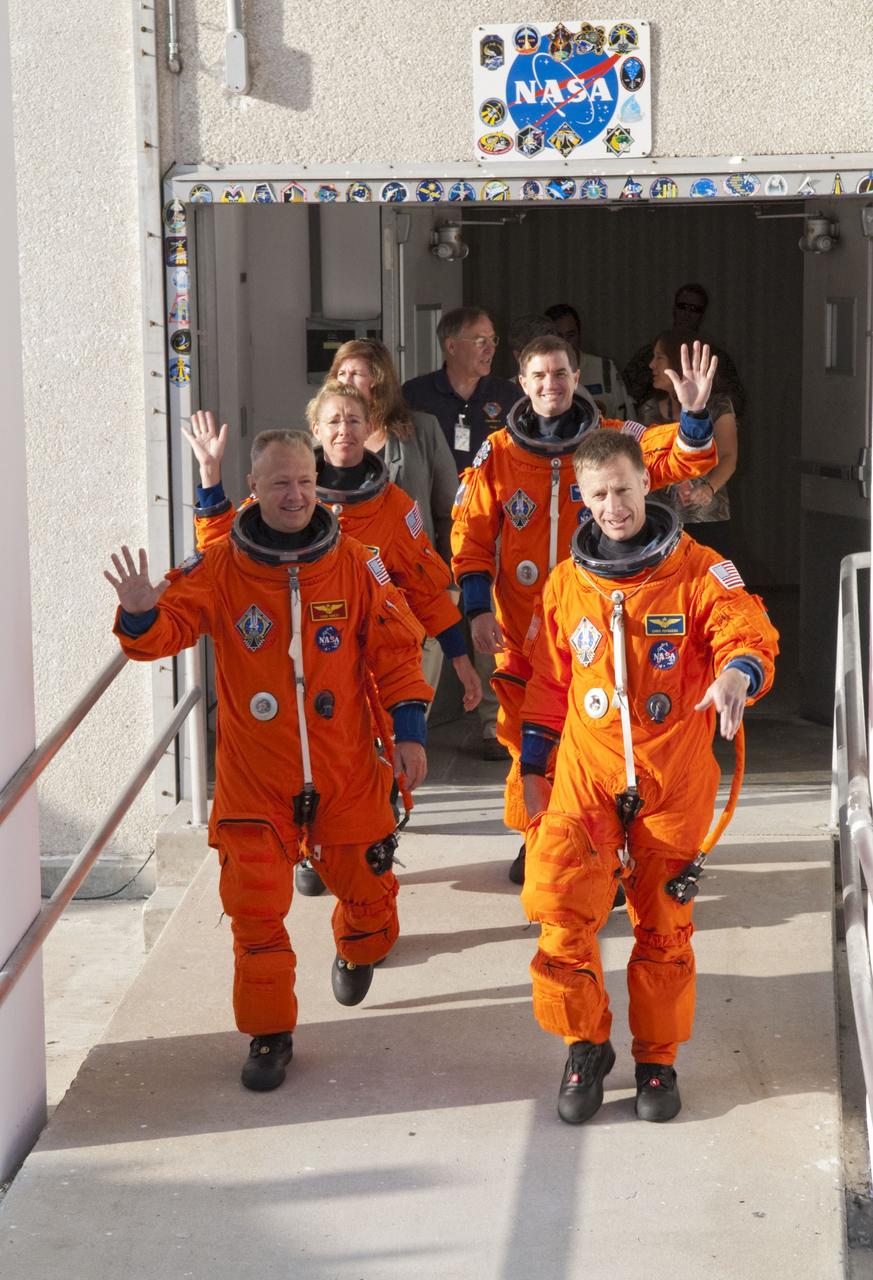
CAPE CANAVERAL, Fla. -- During a simulated launch countdown, the STS-135 crew walks out of the Operations and Checkout Building to the waiting Astrovan at NASA's Kennedy Space Center in Florida. As part of the Terminal Countdown Demonstration Test (TCDT), the crew members are driven to Kennedy's Launch Pad 39A and then are strapped into space shuttle Atlantis to practice the steps that will be taken on launch day. On the front row are STS-135 Pilot Doug Hurley (left) and Commander Chris Ferguson; second row; are Mission Specialists Sandy Magnus and Rex Walheim. Atlantis and its crew are targeted to lift off July 8, taking with them the Raffaello multi-purpose logistics module packed with supplies and spare parts to the International Space Station. The STS-135 mission also will fly a system to investigate the potential for robotically refueling existing satellites and return a failed ammonia pump module to help NASA better understand the failure mechanism and improve pump designs for future systems. STS-135 will be the 33rd flight of Atlantis, the 37th shuttle mission to the space station, and the 135th and final mission of NASA's Space Shuttle Program. For more information visit, www.nasa.gov/mission_pages/shuttle/shuttlemissions/sts135/index.html. Photo credit: NASA/Kim Shiflett
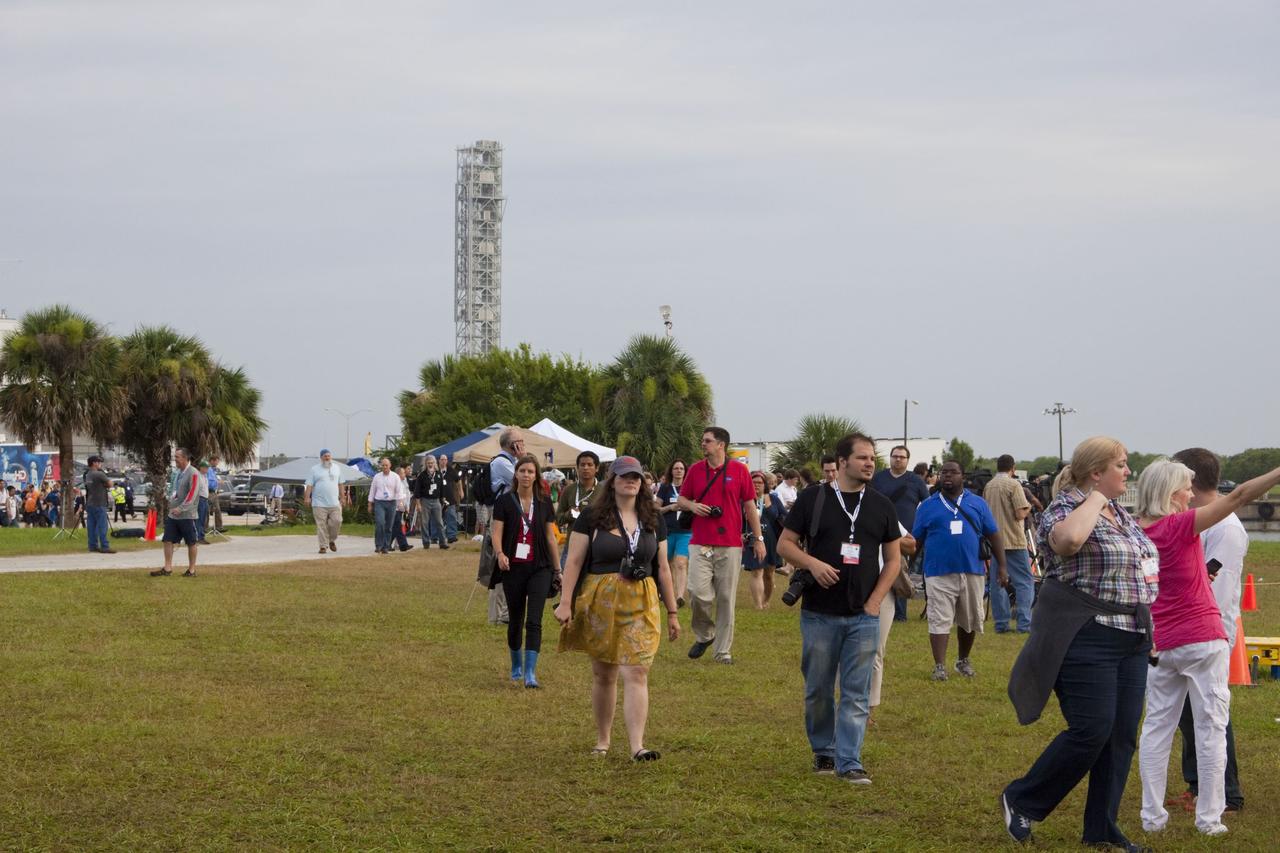
CAPE CANAVERAL, Fla. -- Media from around the globe gather on the grounds of the Press Site at NASA's Kennedy Space Center in Florida to photograph and cover the prelaunch activities and lift off of space shuttle Atlantis on its STS-135 mission to the International Space Station. Seen towering above is the massive Vehicle Assembly Building. Atlantis began its final flight, with Commander Chris Ferguson, Pilot Doug Hurley and Mission Specialists Sandy Magnus and Rex Walheim on board, at 11:29 a.m. EDT July 8 to deliver the Raffaello multi-purpose logistics module packed with supplies and spare parts to the station. Also in Atlantis' payload bay is the Robotic Refueling Mission experiment that will investigate the potential for robotically refueling existing satellites in orbit. In addition, Atlantis will return with a failed ammonia pump module to help NASA better understand the failure mechanism and improve pump designs for future systems. STS-135 is the 33rd flight of Atlantis, the 37th shuttle mission to the space station, and the 135th and final mission of NASA's Space Shuttle Program. For more information, visit www.nasa.gov/mission_pages/shuttle/shuttlemissions/sts135/index.html. Photo credit: NASA/Jim Grossmann
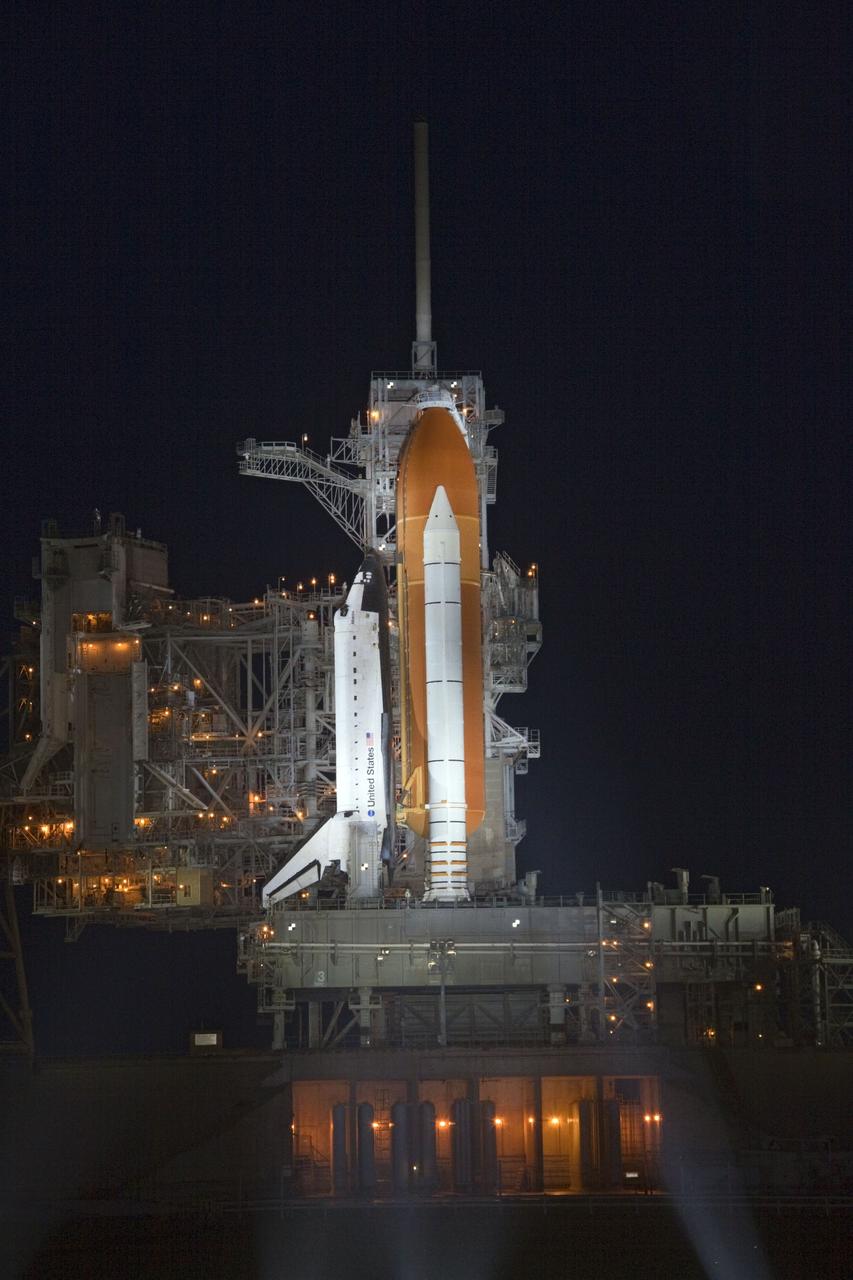
CAPE CANAVERAL, Fla. -- Space shuttle Atlantis is revealed on Launch Pad 39A at NASA's Kennedy Space Center in Florida following the move of the rotating service structure (RSS). The structure provides weather protection and access to the shuttle while it awaits liftoff on the pad. RSS retract marks a major milestone in Atlantis' STS-135 mission countdown. Atlantis and its crew of four; Commander Chris Ferguson, Pilot Doug Hurley, Mission Specialists Sandy Magnus and Rex Walheim will lift off at 11:26 a.m. EDT on July 8 to deliver the Raffaello multi-purpose logistics module packed with supplies and spare parts for the International Space Station. Atlantis also will fly the Robotic Refueling Mission experiment that will investigate the potential for robotically refueling existing satellites in orbit. In addition, Atlantis will return with a failed ammonia pump module to help NASA better understand the failure mechanism and improve pump designs for future systems. STS-135 is the 33rd flight of Atlantis, the 37th shuttle mission to the space station, and the 135th and final mission of NASA's Space Shuttle Program. For more information, visit www.nasa.gov/mission_pages/shuttle/shuttlemissions/sts135/index.html. Photo credit: Jim Grossmann
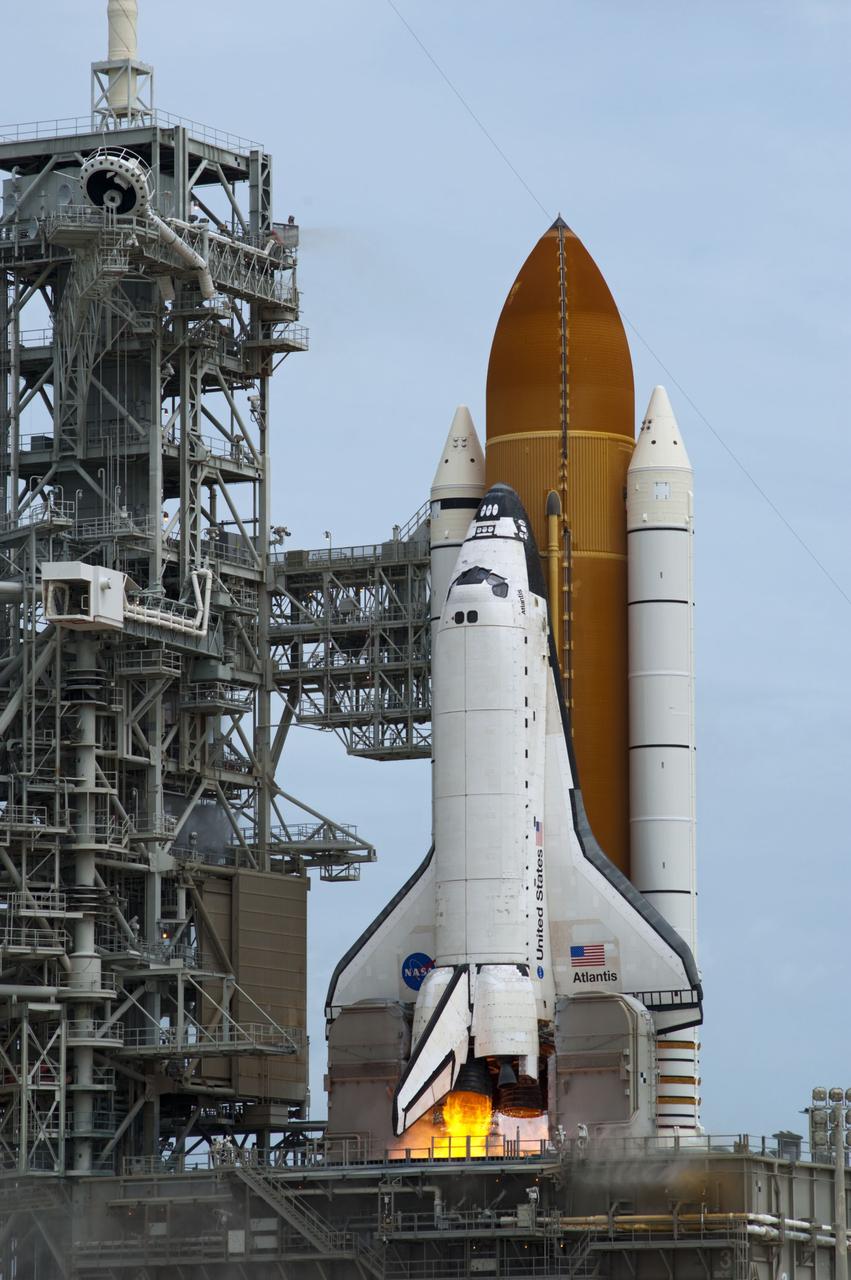
CAPE CANAVERAL, Fla. -- At NASA's Kennedy Space Center in Florida, space shuttle Atlantis' main engines ignite on Launch Pad 39A as it lifts off on its STS-135 mission to the International Space Station. Atlantis with its crew of four; Commander Chris Ferguson, Pilot Doug Hurley, Mission Specialists Sandy Magnus and Rex Walheim, lifted off at 11:29 a.m. EDT on July 8, 2011 to deliver the Raffaello multi-purpose logistics module packed with supplies and spare parts for the station. Atlantis also will fly the Robotic Refueling Mission experiment that will investigate the potential for robotically refueling existing satellites in orbit. In addition, Atlantis will return with a failed ammonia pump module to help NASA better understand the failure mechanism and improve pump designs for future systems. STS-135 is the 33rd flight of Atlantis, the 37th shuttle mission to the space station, and the 135th and final mission of NASA's Space Shuttle Program. For more information, visit www.nasa.gov/mission_pages/shuttle/shuttlemissions/sts135/index.html. Photo credit: NASA/Sandra Joseph and Kevin O'Connell

CAPE CANAVERAL, Fla. -- During a simulated launch countdown the STS-135 crew pauses for a photo before climbing aboard the waiting Astrovan at NASA's Kennedy Space Center in Florida. As part of the Terminal Countdown Demonstration Test (TCDT), the crew members are driven to Kennedy's Launch Pad 39A and then strapped into space shuttle Atlantis to practice the steps that will be taken on launch day. From left are Mission Specialists Rex Walheim and Sandy Magnus, Pilot Doug Hurley and Commander Chris Ferguson. Atlantis and its crew are targeted to lift off July 8, taking with them the Raffaello multi-purpose logistics module packed with supplies and spare parts to the International Space Station. The STS-135 mission also will fly a system to investigate the potential for robotically refueling existing satellites and return a failed ammonia pump module to help NASA better understand the failure mechanism and improve pump designs for future systems. STS-135 will be the 33rd flight of Atlantis, the 37th shuttle mission to the space station, and the 135th and final mission of NASA's Space Shuttle Program. For more information visit, www.nasa.gov/mission_pages/shuttle/shuttlemissions/sts135/index.html. Photo credit: NASA/Kim Shiflett
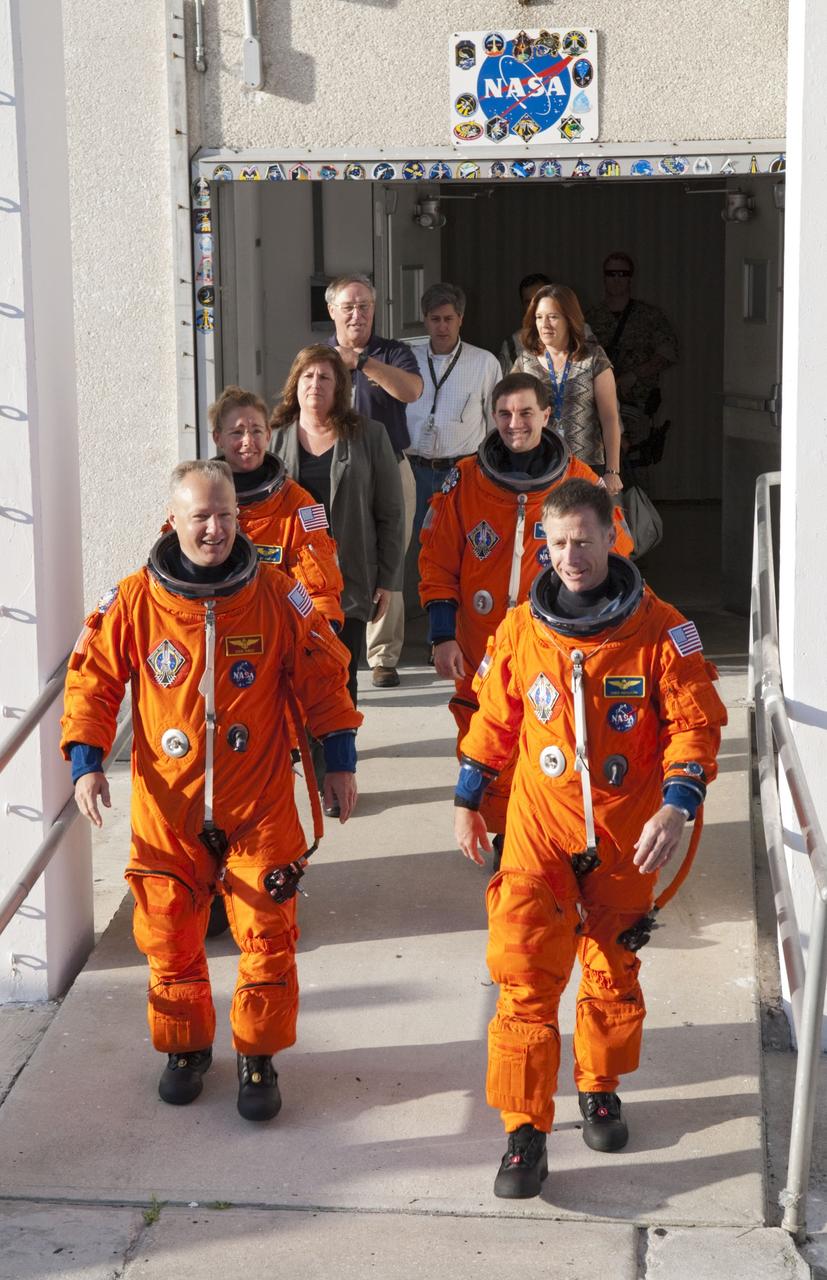
CAPE CANAVERAL, Fla. -- During a simulated launch countdown, the STS-135 crew walks out of the Operations and Checkout Building to the waiting Astrovan at NASA's Kennedy Space Center in Florida. As part of the Terminal Countdown Demonstration Test (TCDT), the crew members are driven to Kennedy's Launch Pad 39A and then are strapped into space shuttle Atlantis to practice the steps that will be taken on launch day. On the front row are STS-135 Pilot Doug Hurley (left) and Commander Chris Ferguson; second row; are Mission Specialists Sandy Magnus and Rex Walheim. Atlantis and its crew are targeted to lift off July 8, taking with them the Raffaello multi-purpose logistics module packed with supplies and spare parts to the International Space Station. The STS-135 mission also will fly a system to investigate the potential for robotically refueling existing satellites and return a failed ammonia pump module to help NASA better understand the failure mechanism and improve pump designs for future systems. STS-135 will be the 33rd flight of Atlantis, the 37th shuttle mission to the space station, and the 135th and final mission of NASA's Space Shuttle Program. For more information visit, www.nasa.gov/mission_pages/shuttle/shuttlemissions/sts135/index.html. Photo credit: NASA/Kim Shiflett
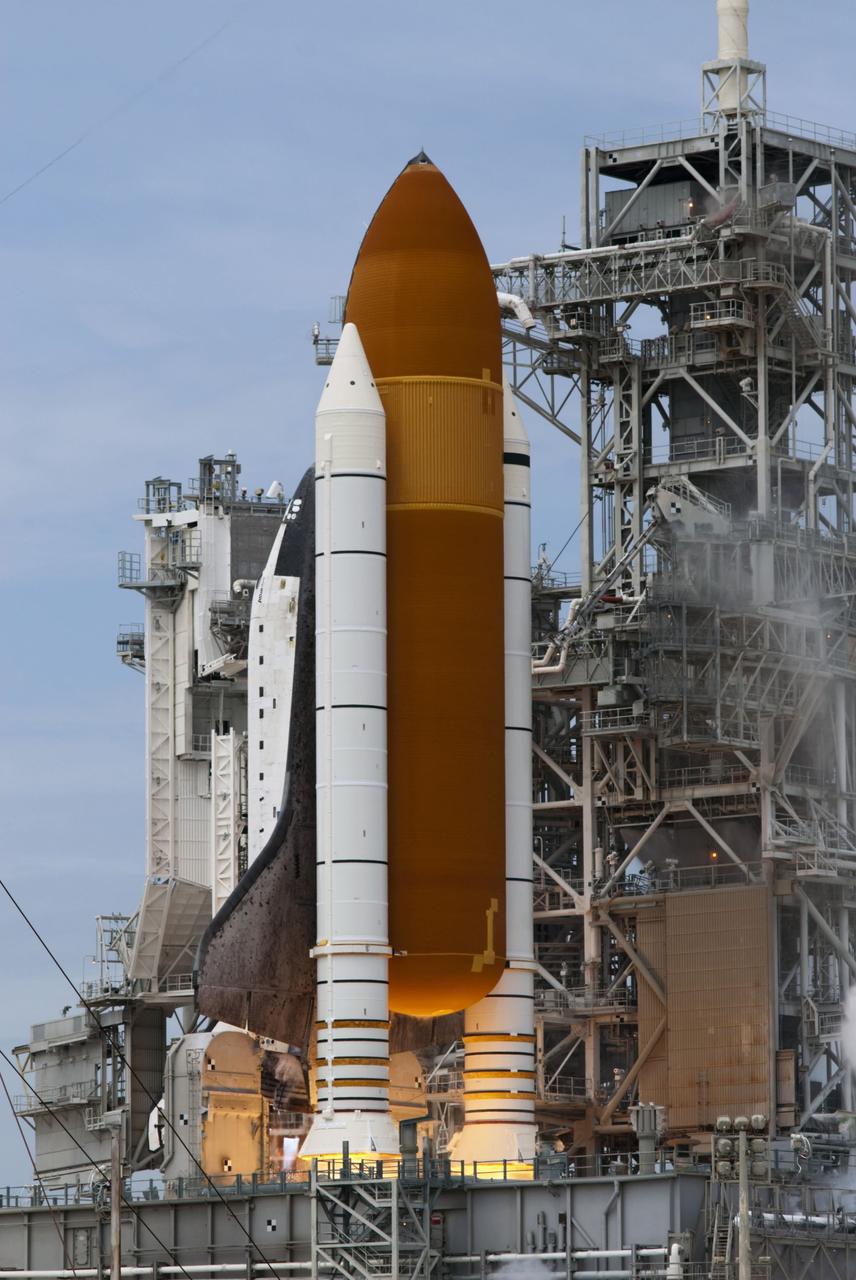
CAPE CANAVERAL, Fla. -- At NASA's Kennedy Space Center in Florida, space shuttle Atlantis' main engines and solid rocket boosters ignite on Launch Pad 39A as it lifts off on its STS-135 mission to the International Space Station. Atlantis with its crew of four; Commander Chris Ferguson, Pilot Doug Hurley, Mission Specialists Sandy Magnus and Rex Walheim, lifted off at 11:29 a.m. EDT on July 8, 2011 to deliver the Raffaello multi-purpose logistics module packed with supplies and spare parts for the station. Atlantis also will fly the Robotic Refueling Mission experiment that will investigate the potential for robotically refueling existing satellites in orbit. In addition, Atlantis will return with a failed ammonia pump module to help NASA better understand the failure mechanism and improve pump designs for future systems. STS-135 is the 33rd flight of Atlantis, the 37th shuttle mission to the space station, and the 135th and final mission of NASA's Space Shuttle Program. For more information, visit www.nasa.gov/mission_pages/shuttle/shuttlemissions/sts135/index.html. Photo credit: NASA/Rusty Backer and Mike Gayle
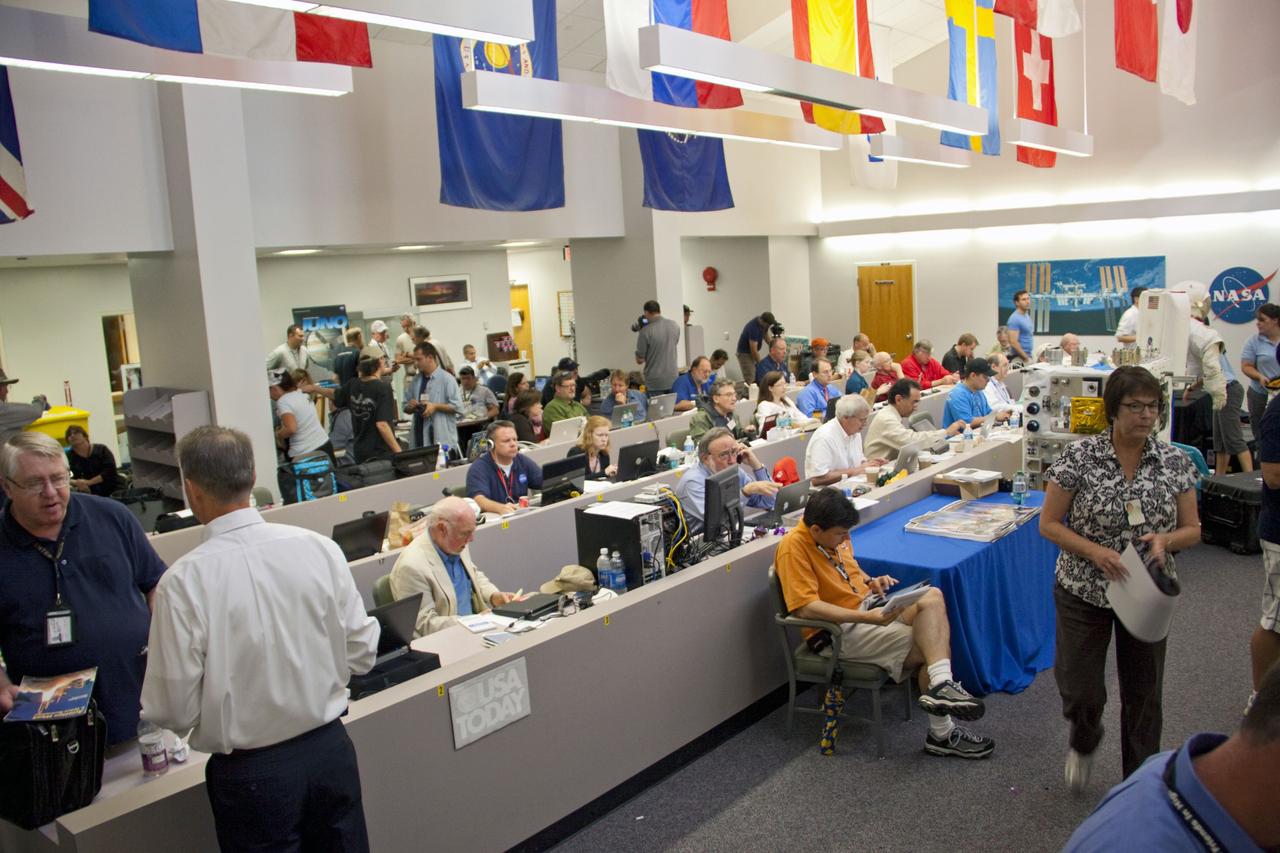
CAPE CANAVERAL, Fla. -- Media from around the globe gather at the NASA News Center at NASA Kennedy Space Center's Press Site in Florida to cover the prelaunch activities and lift off of space shuttle Atlantis on its STS-135 mission to the International Space Station. Atlantis began its final flight, with Commander Chris Ferguson, Pilot Doug Hurley and Mission Specialists Sandy Magnus and Rex Walheim on board, at 11:29 a.m. EDT July 8 to deliver the Raffaello multi-purpose logistics module packed with supplies and spare parts to the station. Also in Atlantis' payload bay is the Robotic Refueling Mission experiment that will investigate the potential for robotically refueling existing satellites in orbit. In addition, Atlantis will return with a failed ammonia pump module to help NASA better understand the failure mechanism and improve pump designs for future systems. STS-135 is the 33rd flight of Atlantis, the 37th shuttle mission to the space station, and the 135th and final mission of NASA's Space Shuttle Program. For more information, visit www.nasa.gov/mission_pages/shuttle/shuttlemissions/sts135/index.html. Photo credit: NASA/Jim Grossmann
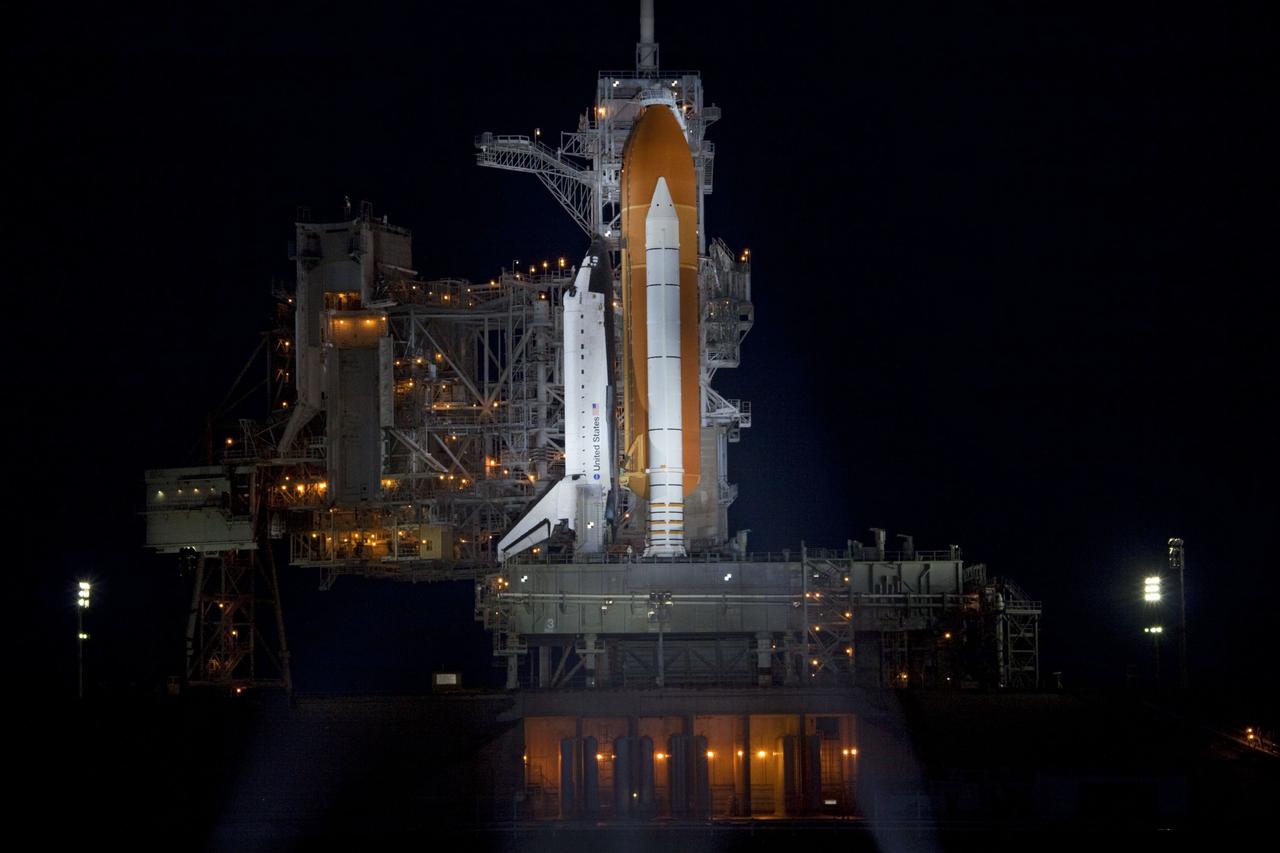
CAPE CANAVERAL, Fla. -- Space shuttle Atlantis is revealed on Launch Pad 39A at NASA's Kennedy Space Center in Florida following the move of the rotating service structure (RSS). The structure provides weather protection and access to the shuttle while it awaits liftoff on the pad. RSS retract marks a major milestone in Atlantis' STS-135 mission countdown. Atlantis and its crew of four; Commander Chris Ferguson, Pilot Doug Hurley, Mission Specialists Sandy Magnus and Rex Walheim will lift off at 11:26 a.m. EDT on July 8 to deliver the Raffaello multi-purpose logistics module packed with supplies and spare parts for the International Space Station. Atlantis also will fly the Robotic Refueling Mission experiment that will investigate the potential for robotically refueling existing satellites in orbit. In addition, Atlantis will return with a failed ammonia pump module to help NASA better understand the failure mechanism and improve pump designs for future systems. STS-135 is the 33rd flight of Atlantis, the 37th shuttle mission to the space station, and the 135th and final mission of NASA's Space Shuttle Program. For more information, visit www.nasa.gov/mission_pages/shuttle/shuttlemissions/sts135/index.html. Photo credit: Jim Grossmann
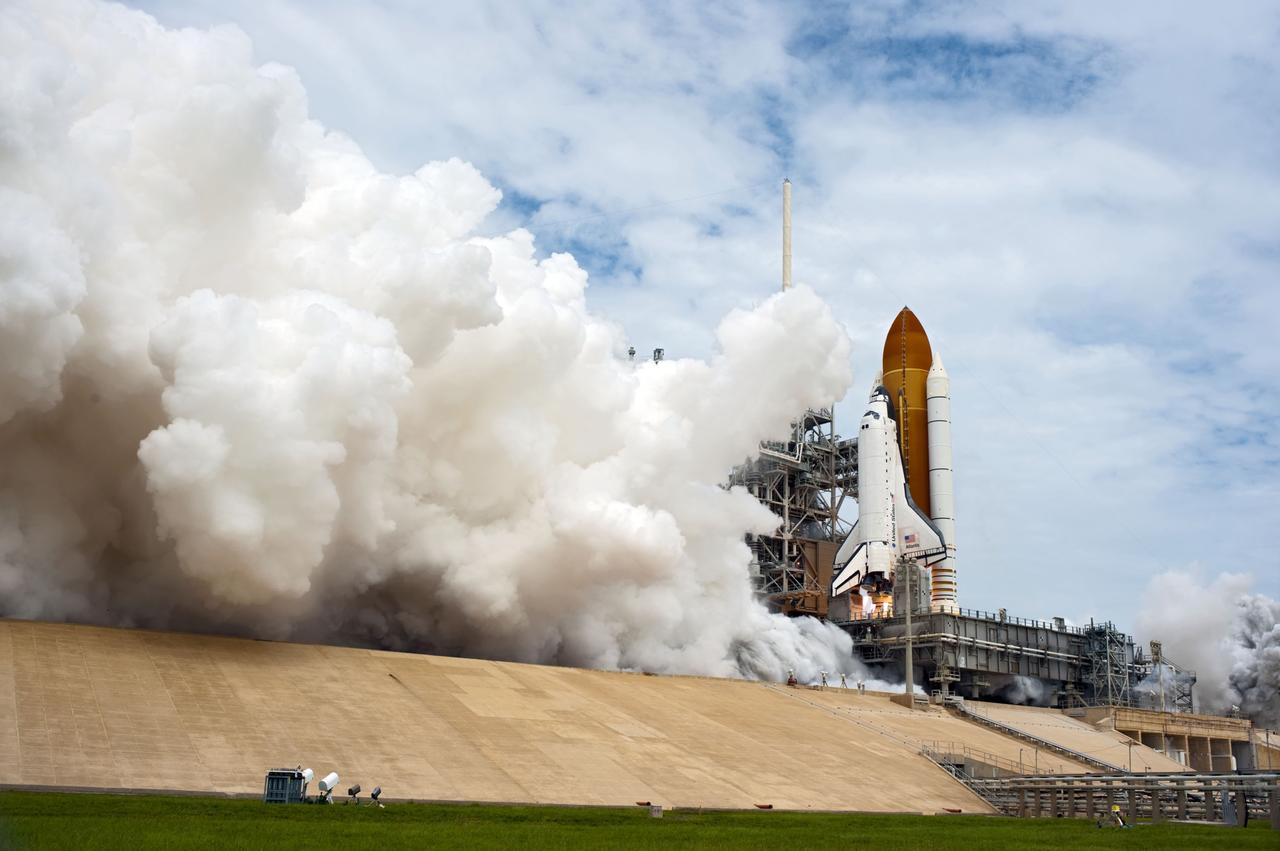
CAPE CANAVERAL, Fla. -- At NASA's Kennedy Space Center in Florida, space shuttle Atlantis' main engines and solid rocket boosters ignite on Launch Pad 39A producing billows of steam and smoke as it lifts off on its STS-135 mission to the International Space Station. Atlantis with its crew of four; Commander Chris Ferguson, Pilot Doug Hurley, Mission Specialists Sandy Magnus and Rex Walheim, lifted off at 11:29 a.m. EDT on July 8, 2011 to deliver the Raffaello multi-purpose logistics module packed with supplies and spare parts for the station. Atlantis also will fly the Robotic Refueling Mission experiment that will investigate the potential for robotically refueling existing satellites in orbit. In addition, Atlantis will return with a failed ammonia pump module to help NASA better understand the failure mechanism and improve pump designs for future systems. STS-135 is the 33rd flight of Atlantis, the 37th shuttle mission to the space station, and the 135th and final mission of NASA's Space Shuttle Program. For more information, visit www.nasa.gov/mission_pages/shuttle/shuttlemissions/sts135/index.html. Photo credit: NASA/Tony Gray and Tom Farrar
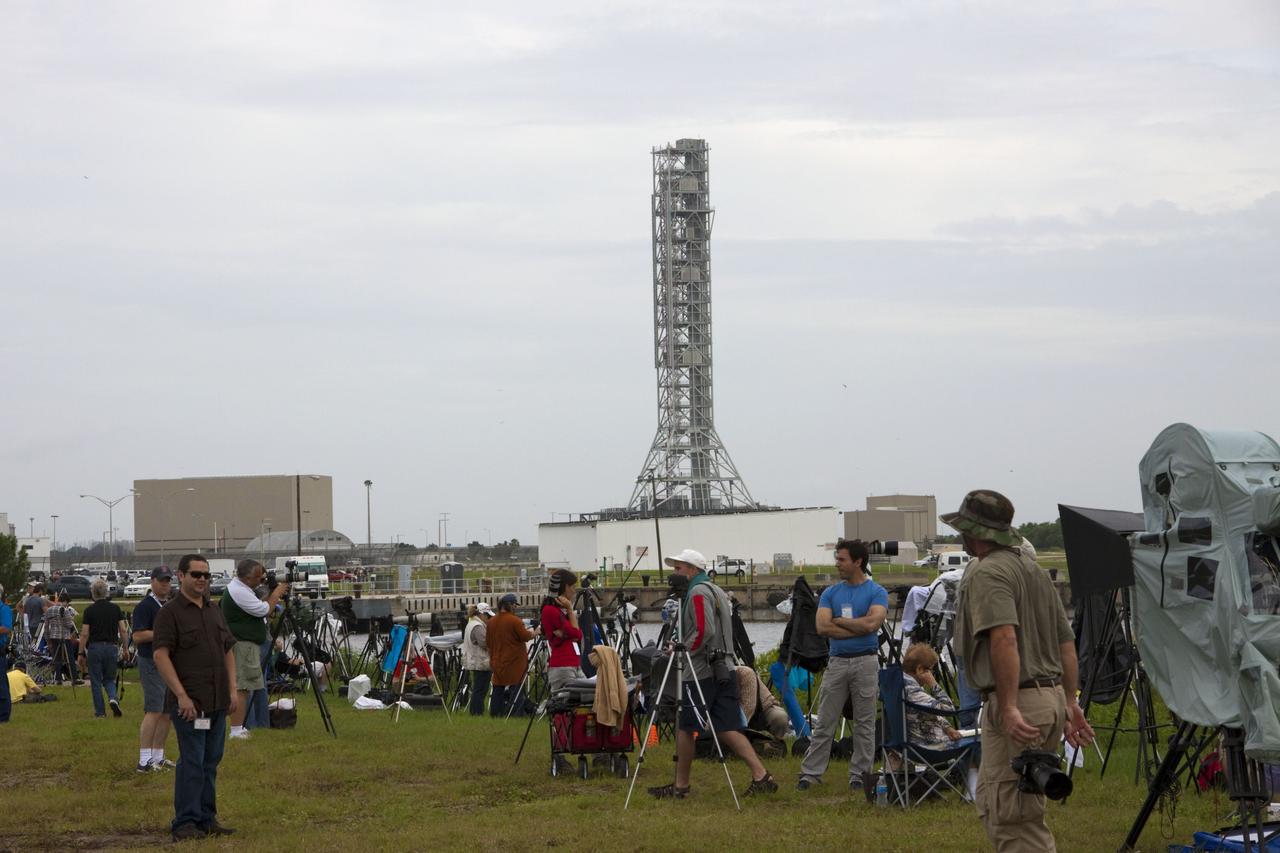
CAPE CANAVERAL, Fla. -- Media from around the globe gather at the NASA News Center at NASA Kennedy Space Center's Press Site in Florida to photograph and cover the prelaunch activities and lift off of space shuttle Atlantis on its STS-135 mission to the International Space Station. Seen in the background is NASA's new mobile launcher (ML) support structure. The ML can be outfitted with ground support equipment, such as umbilicals and access arms, for future rocket launches. Atlantis began its final flight, with Commander Chris Ferguson, Pilot Doug Hurley and Mission Specialists Sandy Magnus and Rex Walheim on board, at 11:29 a.m. EDT July 8 to deliver the Raffaello multi-purpose logistics module packed with supplies and spare parts to the station. Also in Atlantis' payload bay is the Robotic Refueling Mission experiment that will investigate the potential for robotically refueling existing satellites in orbit. In addition, Atlantis will return with a failed ammonia pump module to help NASA better understand the failure mechanism and improve pump designs for future systems. STS-135 is the 33rd flight of Atlantis, the 37th shuttle mission to the space station, and the 135th and final mission of NASA's Space Shuttle Program. For more information, visit www.nasa.gov/mission_pages/shuttle/shuttlemissions/sts135/index.html. Photo credit: NASA/Jim Grossmann
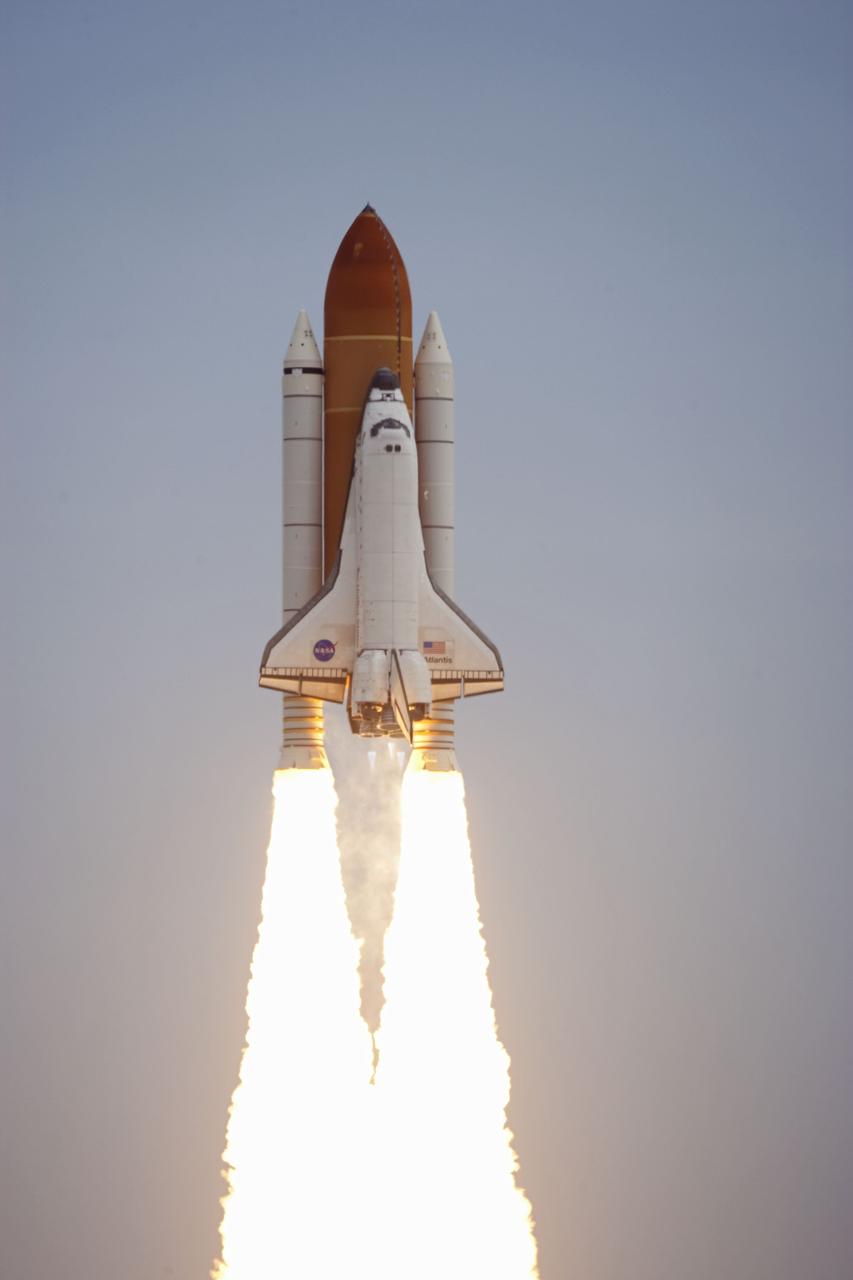
CAPE CANAVERAL, Fla. -- Space shuttle Atlantis soars from Launch Pad 39A at NASA's Kennedy Space Center in Florida on its STS-135 mission to the International Space Station. Atlantis with its crew of four; Commander Chris Ferguson, Pilot Doug Hurley, Mission Specialists Sandy Magnus and Rex Walheim, lifted off at 11:29 a.m. EDT on July 8, 2011 to deliver the Raffaello multi-purpose logistics module packed with supplies and spare parts for the International Space Station. Atlantis also will fly the Robotic Refueling Mission experiment that will investigate the potential for robotically refueling existing satellites in orbit. In addition, Atlantis will return with a failed ammonia pump module to help NASA better understand the failure mechanism and improve pump designs for future systems. STS-135 is the 33rd flight of Atlantis, the 37th shuttle mission to the space station, and the 135th and final mission of NASA's Space Shuttle Program. For more information, visit www.nasa.gov/mission_pages/shuttle/shuttlemissions/sts135/index.html. Photo credit: NASA/ Kenny Allen

CAPE CANAVERAL, Fla. -- In the Operations and Checkout Building at NASA's Kennedy Space Center in Florida, STS-135 Mission Specialist Rex Walheim checks the fit of his launch-and-entry suit, helmet and gloves during a simulated launch countdown. As part of the Terminal Countdown Demonstration Test (TCDT), the crew members are taken to Kennedy's Launch Pad 39A and strapped into space shuttle Atlantis to practice the steps that will be taken on launch day. Atlantis and its crew are targeted to lift off July 8, taking with them the Raffaello multi-purpose logistics module packed with supplies and spare parts to the International Space Station. The STS-135 mission also will fly a system to investigate the potential for robotically refueling existing satellites and return a failed ammonia pump module to help NASA better understand the failure mechanism and improve pump designs for future systems. STS-135 will be the 33rd flight of Atlantis, the 37th shuttle mission to the space station, and the 135th and final mission of NASA's Space Shuttle Program. For more information visit, www.nasa.gov/mission_pages/shuttle/shuttlemissions/sts135/index.html. Photo credit: NASA/Kim Shiflett
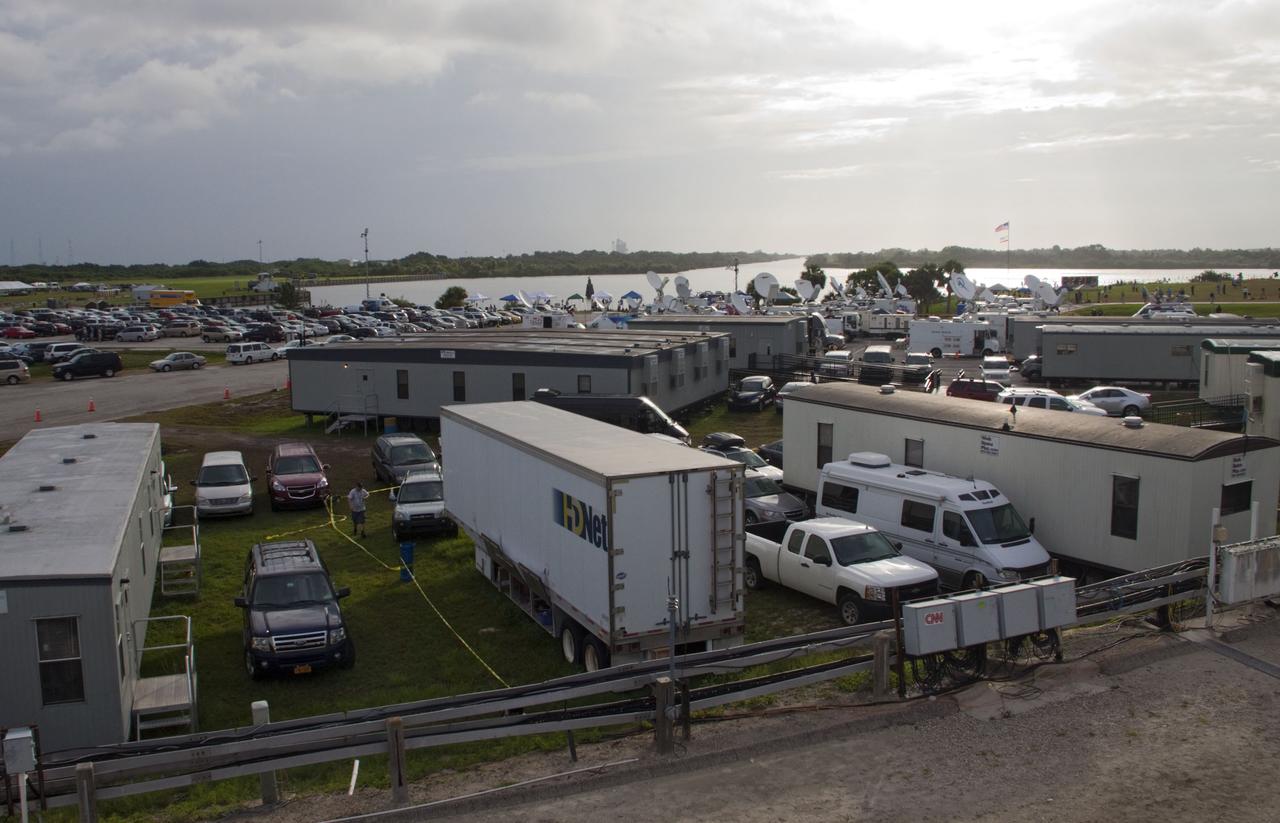
CAPE CANAVERAL, Fla. -- Media from around the globe gather on the grounds of the Press Site at NASA's Kennedy Space Center in Florida to photograph and cover the prelaunch activities and lift off of space shuttle Atlantis on its STS-135 mission to the International Space Station. Seen towering above is the massive Vehicle Assembly Building. Dozens of satellite news vehicles and trailers can be seen in the parking lot. In the background is the Turn Basin where NASA's Pegasus barge delivered the final external tank for the mission. Atlantis began its final flight, with Commander Chris Ferguson, Pilot Doug Hurley and Mission Specialists Sandy Magnus and Rex Walheim on board, at 11:29 a.m. EDT July 8 to deliver the Raffaello multi-purpose logistics module packed with supplies and spare parts to the station. Also in Atlantis' payload bay is the Robotic Refueling Mission experiment that will investigate the potential for robotically refueling existing satellites in orbit. In addition, Atlantis will return with a failed ammonia pump module to help NASA better understand the failure mechanism and improve pump designs for future systems. STS-135 is the 33rd flight of Atlantis, the 37th shuttle mission to the space station, and the 135th and final mission of NASA's Space Shuttle Program. For more information, visit www.nasa.gov/mission_pages/shuttle/shuttlemissions/sts135/index.html. Photo credit: NASA/Jim Grossmann
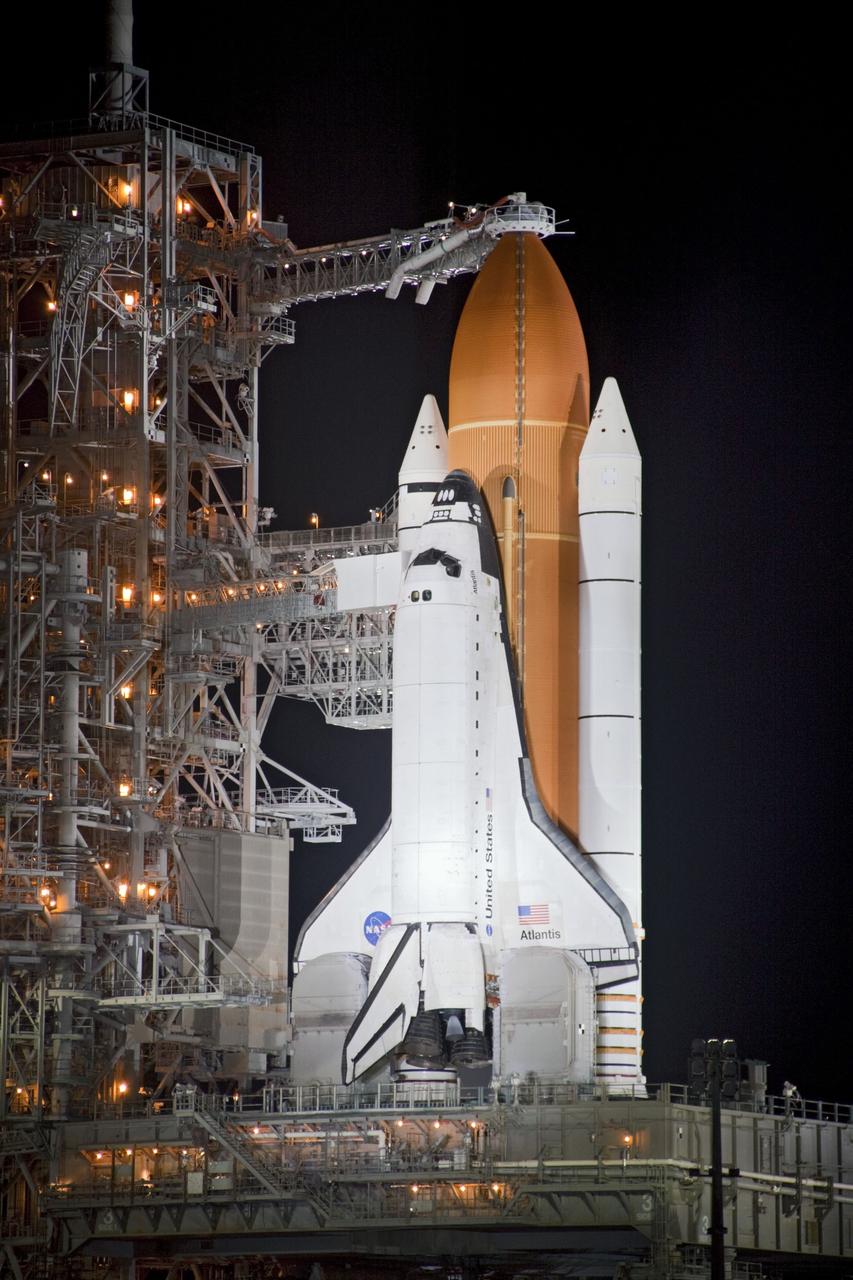
CAPE CANAVERAL, Fla. -- Space shuttle Atlantis is revealed on Launch Pad 39A at NASA's Kennedy Space Center in Florida following the move of the rotating service structure (RSS). The structure provides weather protection and access to the shuttle while it awaits liftoff on the pad. RSS retract marks a major milestone in Atlantis' STS-135 mission countdown. Atlantis and its crew of four; Commander Chris Ferguson, Pilot Doug Hurley, Mission Specialists Sandy Magnus and Rex Walheim will lift off at 11:26 a.m. EDT on July 8 to deliver the Raffaello multi-purpose logistics module packed with supplies and spare parts for the International Space Station. Atlantis also will fly the Robotic Refueling Mission experiment that will investigate the potential for robotically refueling existing satellites in orbit. In addition, Atlantis will return with a failed ammonia pump module to help NASA better understand the failure mechanism and improve pump designs for future systems. STS-135 is the 33rd flight of Atlantis, the 37th shuttle mission to the space station, and the 135th and final mission of NASA's Space Shuttle Program. For more information, visit www.nasa.gov/mission_pages/shuttle/shuttlemissions/sts135/index.html. Photo credit: Jim Grossmann
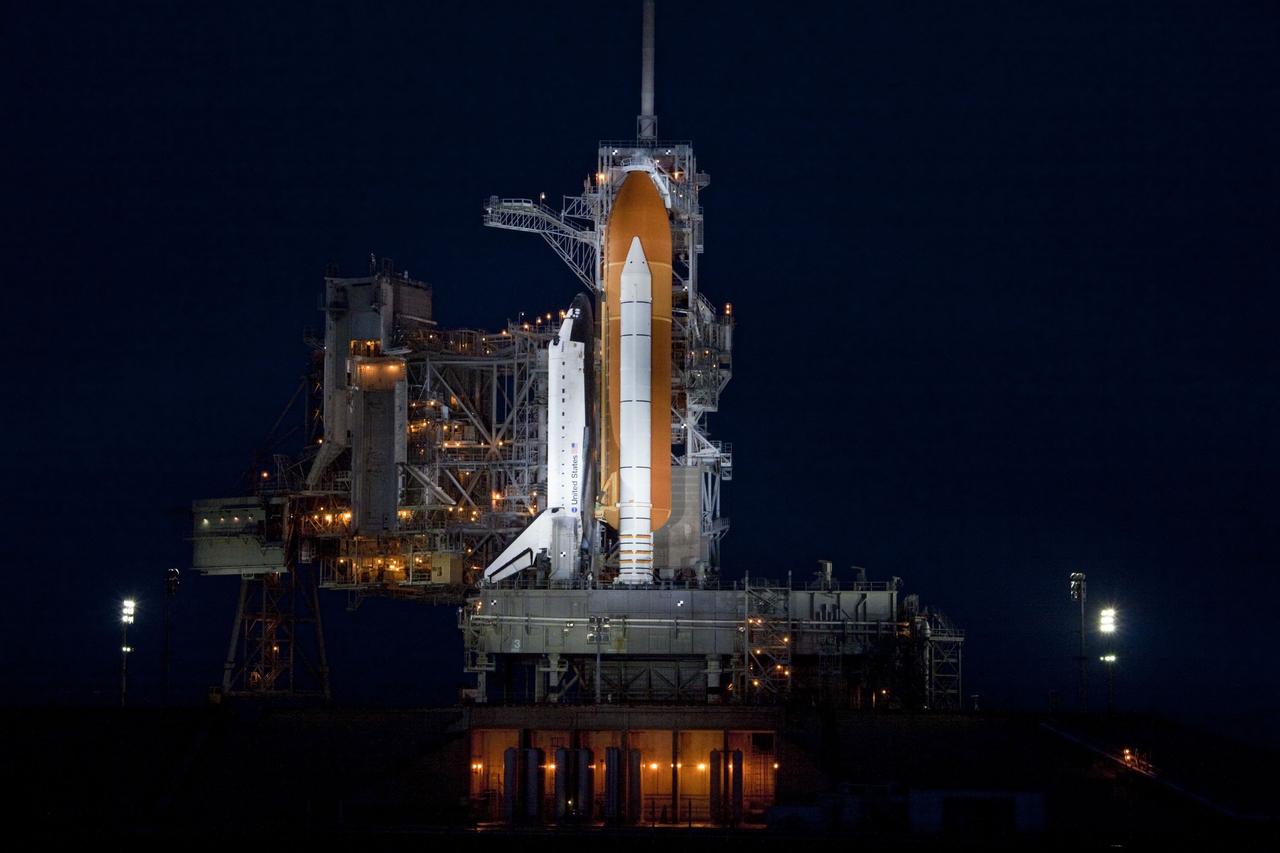
CAPE CANAVERAL, Fla. -- Space shuttle Atlantis is revealed on Launch Pad 39A at NASA's Kennedy Space Center in Florida following the move of the rotating service structure (RSS). The structure provides weather protection and access to the shuttle while it awaits liftoff on the pad. RSS retract marks a major milestone in Atlantis' STS-135 mission countdown. Atlantis and its crew of four; Commander Chris Ferguson, Pilot Doug Hurley, Mission Specialists Sandy Magnus and Rex Walheim will lift off at 11:26 a.m. EDT on July 8 to deliver the Raffaello multi-purpose logistics module packed with supplies and spare parts for the International Space Station. Atlantis also will fly the Robotic Refueling Mission experiment that will investigate the potential for robotically refueling existing satellites in orbit. In addition, Atlantis will return with a failed ammonia pump module to help NASA better understand the failure mechanism and improve pump designs for future systems. STS-135 is the 33rd flight of Atlantis, the 37th shuttle mission to the space station, and the 135th and final mission of NASA's Space Shuttle Program. For more information, visit www.nasa.gov/mission_pages/shuttle/shuttlemissions/sts135/index.html. Photo credit: Jim Grossmann
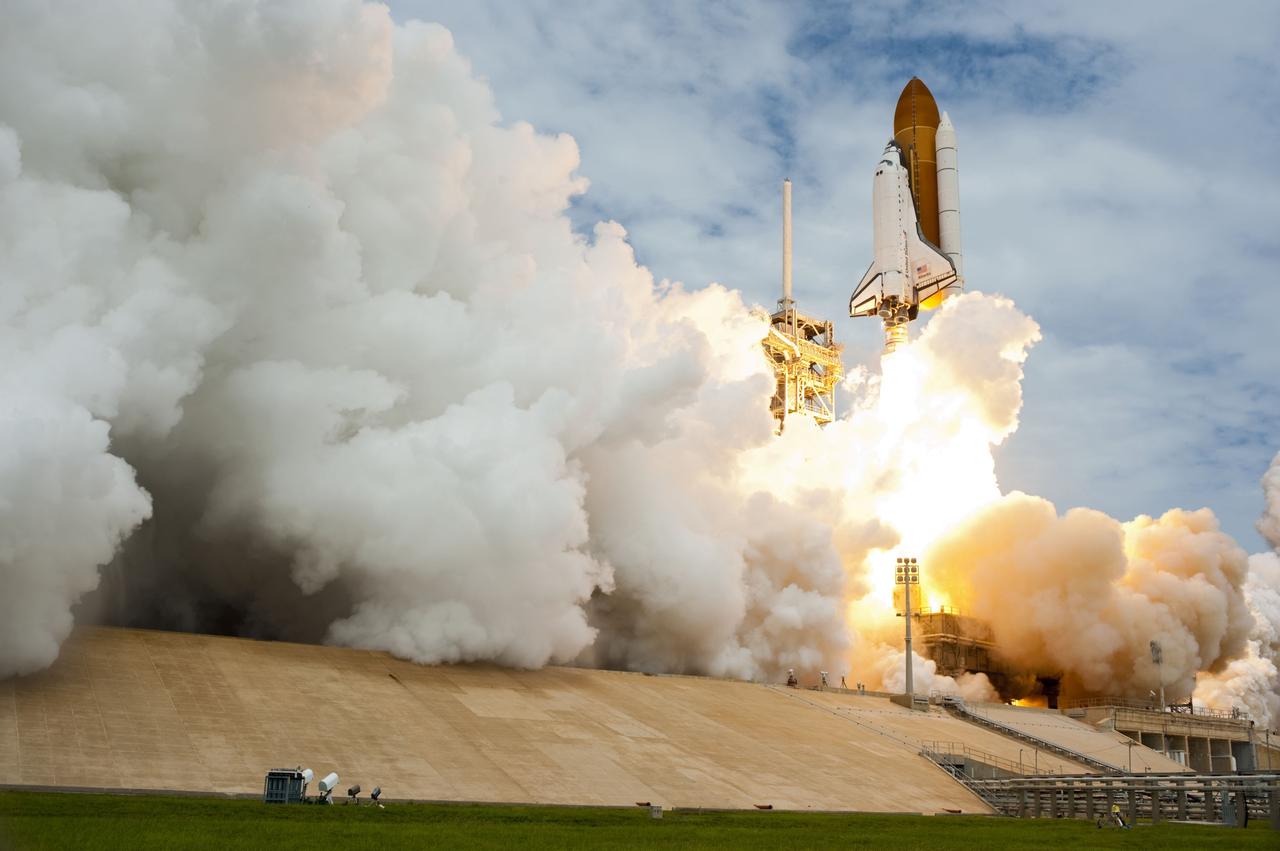
CAPE CANAVERAL, Fla. -- At NASA's Kennedy Space Center in Florida, space shuttle Atlantis lifts off from Launch Pad 39A out of billows of smoke and flame on its STS-135 mission to the International Space Station. Atlantis with its crew of four; Commander Chris Ferguson, Pilot Doug Hurley, Mission Specialists Sandy Magnus and Rex Walheim, lifted off at 11:29 a.m. EDT on July 8, 2011 to deliver the Raffaello multi-purpose logistics module packed with supplies and spare parts for the station. Atlantis also will fly the Robotic Refueling Mission experiment that will investigate the potential for robotically refueling existing satellites in orbit. In addition, Atlantis will return with a failed ammonia pump module to help NASA better understand the failure mechanism and improve pump designs for future systems. STS-135 is the 33rd flight of Atlantis, the 37th shuttle mission to the space station, and the 135th and final mission of NASA's Space Shuttle Program. For more information, visit www.nasa.gov/mission_pages/shuttle/shuttlemissions/sts135/index.html. Photo credit: NASA/Tony Gray and Tom Farrar
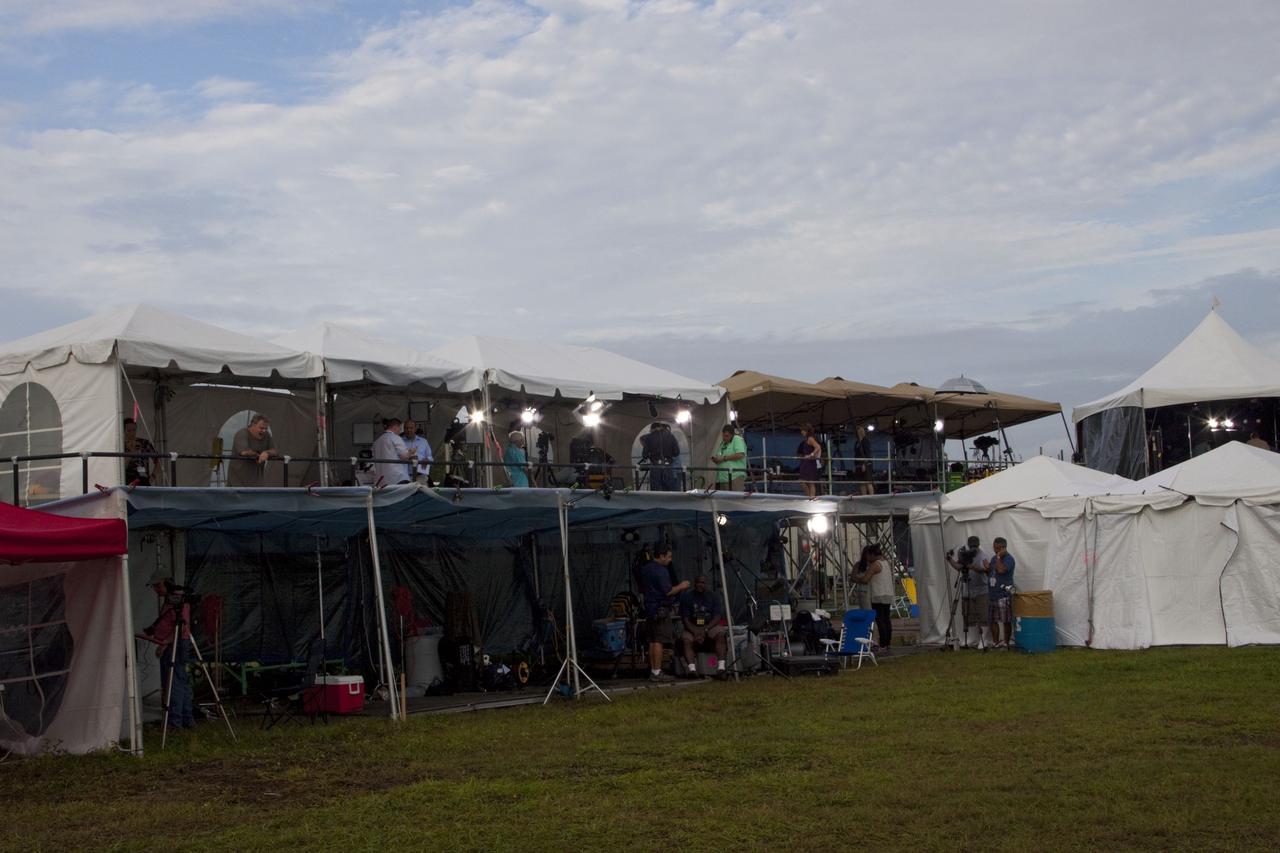
CAPE CANAVERAL, Fla. -- Media from around the globe gather in their respective tents at the Press Site at NASA's Kennedy Space Center in Florida to photograph and cover the prelaunch activities and lift off of space shuttle Atlantis on its STS-135 mission to the International Space Station. Atlantis began its final flight, with Commander Chris Ferguson, Pilot Doug Hurley and Mission Specialists Sandy Magnus and Rex Walheim on board, at 11:29 a.m. EDT July 8 to deliver the Raffaello multi-purpose logistics module packed with supplies and spare parts to the station. Also in Atlantis' payload bay is the Robotic Refueling Mission experiment that will investigate the potential for robotically refueling existing satellites in orbit. In addition, Atlantis will return with a failed ammonia pump module to help NASA better understand the failure mechanism and improve pump designs for future systems. STS-135 is the 33rd flight of Atlantis, the 37th shuttle mission to the space station, and the 135th and final mission of NASA's Space Shuttle Program. For more information, visit www.nasa.gov/mission_pages/shuttle/shuttlemissions/sts135/index.html. Photo credit: NASA/Jim Grossmann

CAPE CANAVERAL, Fla. -- At NASA's Kennedy Space Center in Florida, space shuttle Atlantis lifts off out of billows of smoke and flame from Launch Pad 39A on its way to space on the STS-135 mission to the International Space Station. Atlantis with its crew of four; Commander Chris Ferguson, Pilot Doug Hurley, Mission Specialists Sandy Magnus and Rex Walheim, lifted off at 11:29 a.m. EDT on July 8, 2011 to deliver the Raffaello multi-purpose logistics module packed with supplies and spare parts for the station. Atlantis also will fly the Robotic Refueling Mission experiment that will investigate the potential for robotically refueling existing satellites in orbit. In addition, Atlantis will return with a failed ammonia pump module to help NASA better understand the failure mechanism and improve pump designs for future systems. STS-135 is the 33rd flight of Atlantis, the 37th shuttle mission to the space station, and the 135th and final mission of NASA's Space Shuttle Program. For more information, visit www.nasa.gov/mission_pages/shuttle/shuttlemissions/sts135/index.html. Photo credit: NASA/Tony Gray and Tom Farrar
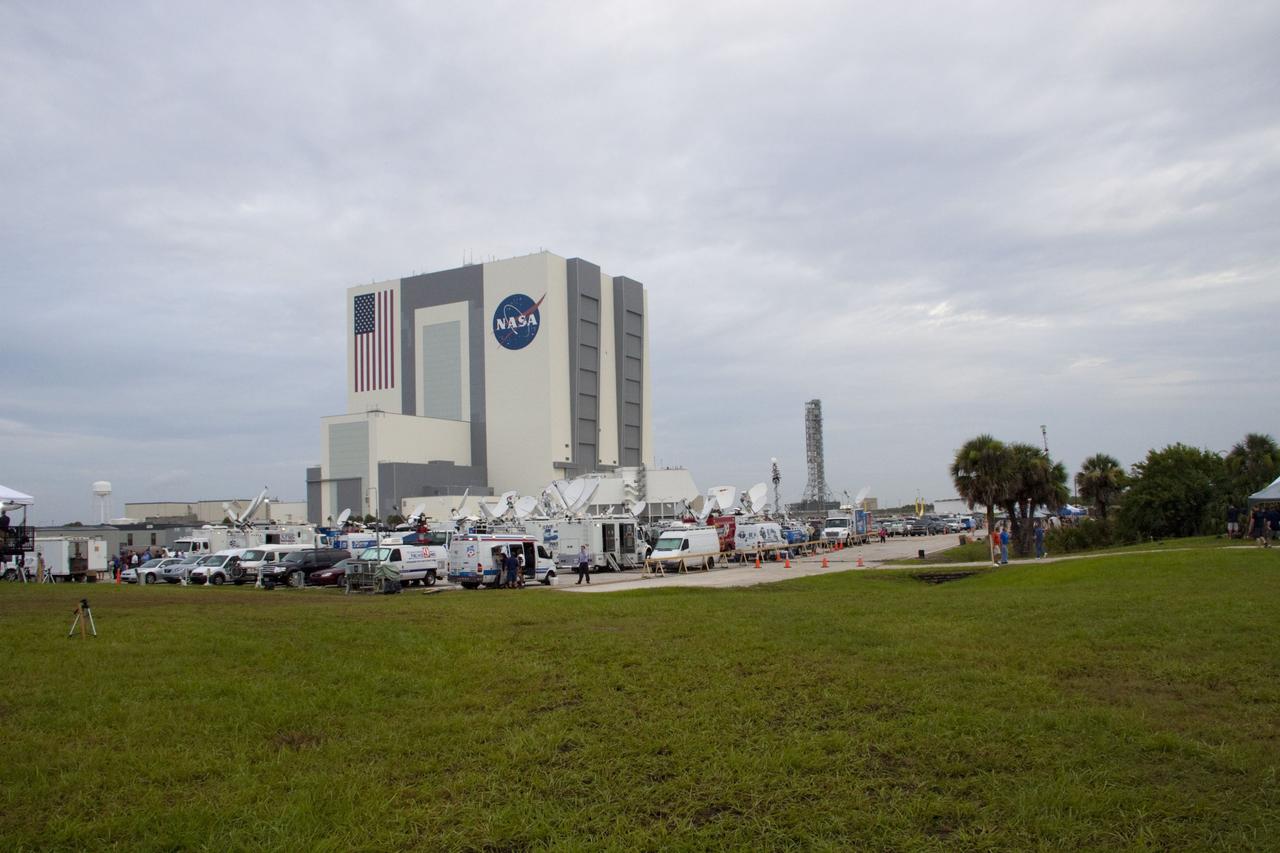
CAPE CANAVERAL, Fla. -- Media from around the globe gather on the grounds of the Press Site at NASA's Kennedy Space Center in Florida to photograph and cover the prelaunch activities and lift off of space shuttle Atlantis on its STS-135 mission to the International Space Station. Dozens of satellite news vehicles can be seen in the parking lot while the massive Vehicle Assembly Building towers above in the background. Atlantis began its final flight, with Commander Chris Ferguson, Pilot Doug Hurley and Mission Specialists Sandy Magnus and Rex Walheim on board, at 11:29 a.m. EDT July 8 to deliver the Raffaello multi-purpose logistics module packed with supplies and spare parts to the station. Also in Atlantis' payload bay is the Robotic Refueling Mission experiment that will investigate the potential for robotically refueling existing satellites in orbit. In addition, Atlantis will return with a failed ammonia pump module to help NASA better understand the failure mechanism and improve pump designs for future systems. STS-135 is the 33rd flight of Atlantis, the 37th shuttle mission to the space station, and the 135th and final mission of NASA's Space Shuttle Program. For more information, visit www.nasa.gov/mission_pages/shuttle/shuttlemissions/sts135/index.html. Photo credit: NASA/Jim Grossmann
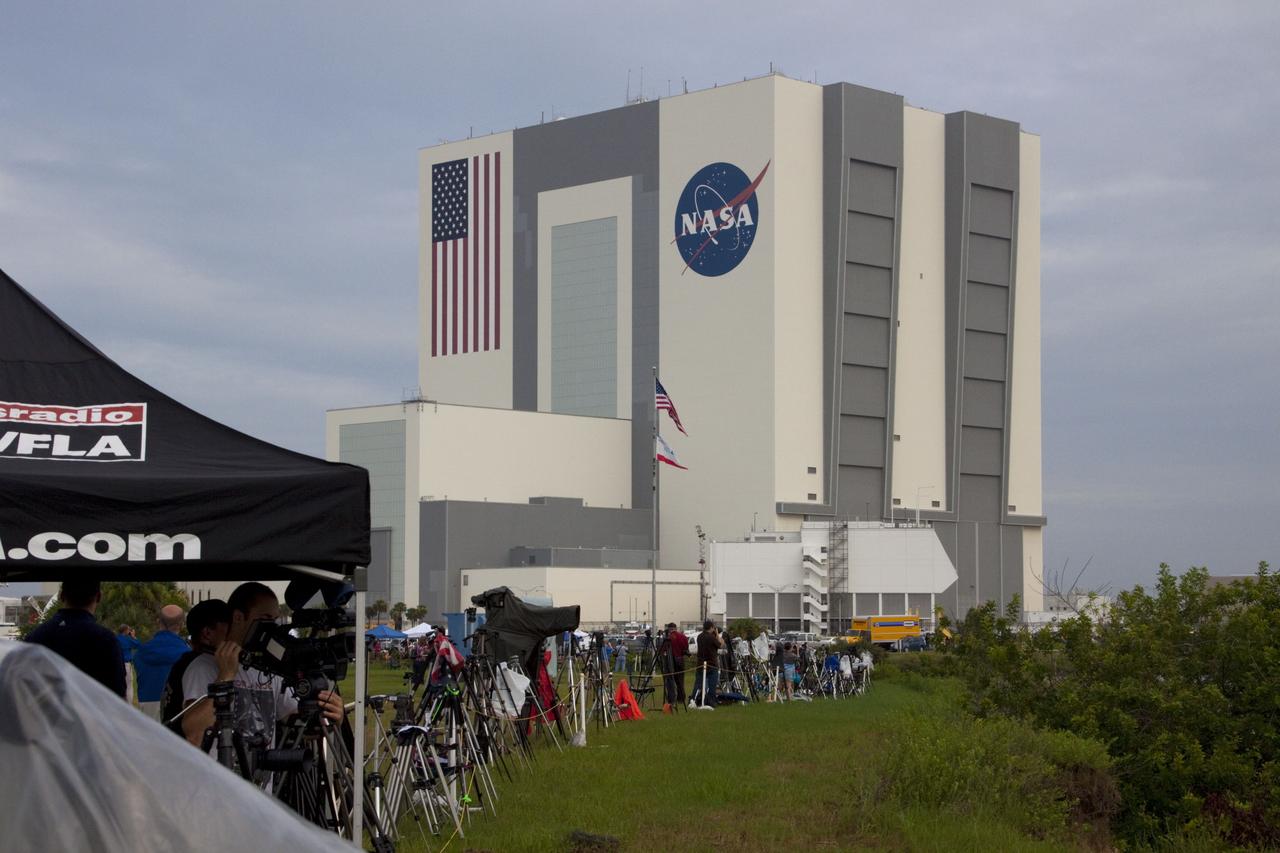
CAPE CANAVERAL, Fla. -- Media from around the globe gather on the grounds of the Press Site at NASA's Kennedy Space Center in Florida to photograph and cover the prelaunch activities and lift off of space shuttle Atlantis on its STS-135 mission to the International Space Station. Seen towering above is the massive Vehicle Assembly Building. Atlantis began its final flight, with Commander Chris Ferguson, Pilot Doug Hurley and Mission Specialists Sandy Magnus and Rex Walheim on board, at 11:29 a.m. EDT July 8 to deliver the Raffaello multi-purpose logistics module packed with supplies and spare parts to the station. Also in Atlantis' payload bay is the Robotic Refueling Mission experiment that will investigate the potential for robotically refueling existing satellites in orbit. In addition, Atlantis will return with a failed ammonia pump module to help NASA better understand the failure mechanism and improve pump designs for future systems. STS-135 is the 33rd flight of Atlantis, the 37th shuttle mission to the space station, and the 135th and final mission of NASA's Space Shuttle Program. For more information, visit www.nasa.gov/mission_pages/shuttle/shuttlemissions/sts135/index.html. Photo credit: NASA/Jim Grossmann

CAPE CANAVERAL, Fla. -- At NASA's Kennedy Space Center in Florida, space shuttle Atlantis' main engines and solid rocket boosters ignite on Launch Pad 39A producing billows of steam and smoke as it lifts off on its STS-135 mission to the International Space Station. Atlantis with its crew of four; Commander Chris Ferguson, Pilot Doug Hurley, Mission Specialists Sandy Magnus and Rex Walheim, lifted off at 11:29 a.m. EDT on July 8, 2011 to deliver the Raffaello multi-purpose logistics module packed with supplies and spare parts for the station. Atlantis also will fly the Robotic Refueling Mission experiment that will investigate the potential for robotically refueling existing satellites in orbit. In addition, Atlantis will return with a failed ammonia pump module to help NASA better understand the failure mechanism and improve pump designs for future systems. STS-135 is the 33rd flight of Atlantis, the 37th shuttle mission to the space station, and the 135th and final mission of NASA's Space Shuttle Program. For more information, visit www.nasa.gov/mission_pages/shuttle/shuttlemissions/sts135/index.html. Photo credit: NASA/Tony Gray and Tom Farrar
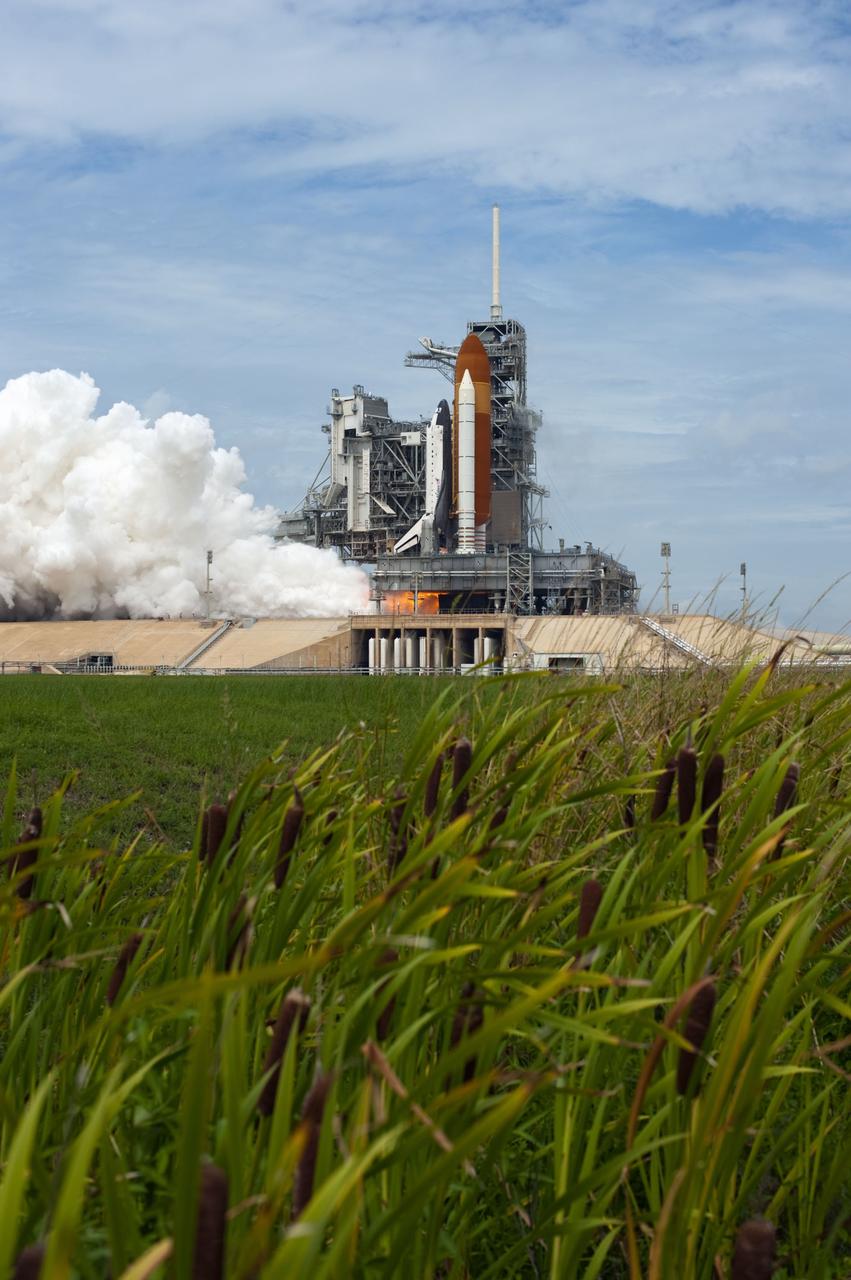
CAPE CANAVERAL, Fla. -- At NASA's Kennedy Space Center in Florida, space shuttle Atlantis' main engines and solid rocket boosters ignite on Launch Pad 39A producing billows of smoke and steam as it lifts off on its STS-135 mission to the International Space Station. Atlantis with its crew of four; Commander Chris Ferguson, Pilot Doug Hurley, Mission Specialists Sandy Magnus and Rex Walheim, lifted off at 11:29 a.m. EDT on July 8, 2011 to deliver the Raffaello multi-purpose logistics module packed with supplies and spare parts for the station. Atlantis also will fly the Robotic Refueling Mission experiment that will investigate the potential for robotically refueling existing satellites in orbit. In addition, Atlantis will return with a failed ammonia pump module to help NASA better understand the failure mechanism and improve pump designs for future systems. STS-135 is the 33rd flight of Atlantis, the 37th shuttle mission to the space station, and the 135th and final mission of NASA's Space Shuttle Program. For more information, visit www.nasa.gov/mission_pages/shuttle/shuttlemissions/sts135/index.html. Photo credit: NASA/Tony Gray and Tom Farrar

Cape Canaveral, Fla. - Space shuttle Atlantis soars into a layer of thin clouds at NASA's Kennedy Space Center in Florida moments after lifting off on the STS-135 mission to the International Space Station. Atlantis with its crew of four; Commander Chris Ferguson, Pilot Doug Hurley, Mission Specialists Sandy Magnus and Rex Walheim, lifted off at 11:29 a.m. EDT on July 8, 2011 to deliver the Raffaello multi-purpose logistics module packed with supplies and spare parts for the International Space Station. Atlantis also will fly the Robotic Refueling Mission experiment that will investigate the potential for robotically refueling existing satellites in orbit. In addition, Atlantis will return with a failed ammonia pump module to help NASA better understand the failure mechanism and improve pump designs for future systems. STS-135 is the 33rd flight of Atlantis, the 37th shuttle mission to the space station, and the 135th and final mission of NASA's Space Shuttle Program. For more information, visit www.nasa.gov/mission_pages/shuttle/shuttlemissions/sts135/index.html. Photo credit: NASA/ Jim Grossmann Atlantis and its crew of four; Commander Chris Ferguson, Pilot Doug Hurley, Mission Specialists Sandy Magnus and Rex Walheim will lift off at 11:26 a.m. EDT on July 8 to deliver the Raffaello multi-purpose logistics module packed with supplies and spare parts for the International Space Station. Atlantis also will fly the Robotic Refueling Mission experiment that will investigate the potential for robotically refueling existing satellites in orbit. In addition, Atlantis will return with a failed ammonia pump module to help NASA better understand the failure mechanism and improve pump designs for future systems. STS-135 is the 33rd flight of Atlantis, the 37th shuttle mission to the space station, and the 135th and final mission of NASA's Space Shuttle Program. For more information, visit www.nasa.gov/mission_pages/shuttle/shuttlemissions/sts135/index.html. Photo credit: Jim Grossmann
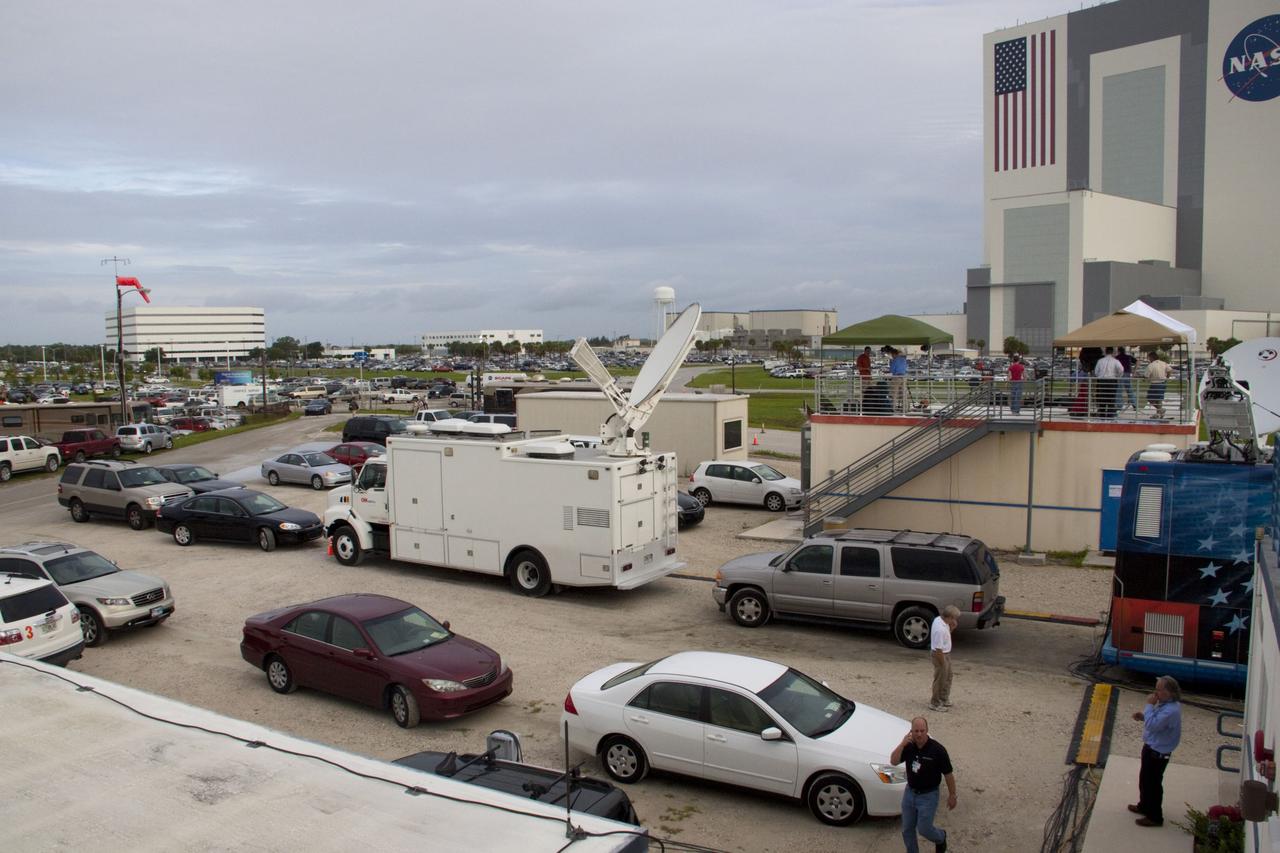
CAPE CANAVERAL, Fla. -- Media from around the globe gather on the grounds of the Press Site at NASA's Kennedy Space Center in Florida to photograph and cover the prelaunch activities and lift off of space shuttle Atlantis on its STS-135 mission to the International Space Station. Seen towering above is the massive Vehicle Assembly Building. Satellite news trucks, trailers and automobiles can be seen in the parking lot with the massive Vehicle Assembly Building towering above. Atlantis began its final flight, with Commander Chris Ferguson, Pilot Doug Hurley and Mission Specialists Sandy Magnus and Rex Walheim on board, at 11:29 a.m. EDT July 8 to deliver the Raffaello multi-purpose logistics module packed with supplies and spare parts to the station. Also in Atlantis' payload bay is the Robotic Refueling Mission experiment that will investigate the potential for robotically refueling existing satellites in orbit. In addition, Atlantis will return with a failed ammonia pump module to help NASA better understand the failure mechanism and improve pump designs for future systems. STS-135 is the 33rd flight of Atlantis, the 37th shuttle mission to the space station, and the 135th and final mission of NASA's Space Shuttle Program. For more information, visit www.nasa.gov/mission_pages/shuttle/shuttlemissions/sts135/index.html. Photo credit: NASA/Jim Grossmann
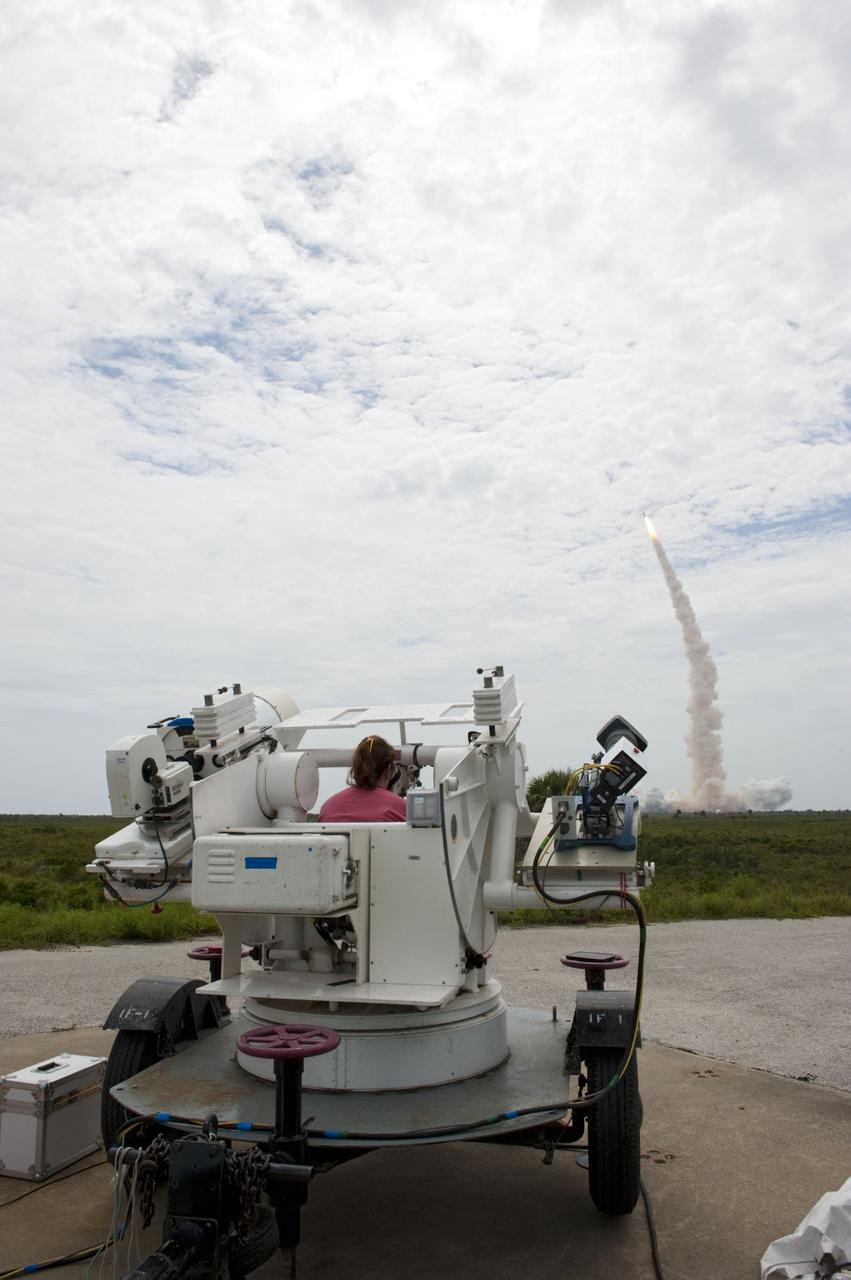
CAPE CANAVERAL, Fla. -- NASA photographer Sandra Joseph aims her remote camera tracker on space shuttle Atlantis at it lifts off from Launch Pad 39A at NASA's Kennedy Space Center in Florida beginning its STS-135 mission to the International Space Station. Atlantis with its crew of four; Commander Chris Ferguson, Pilot Doug Hurley, Mission Specialists Sandy Magnus and Rex Walheim, lifted off at 11:29 a.m. EDT on July 8, 2011 to deliver the Raffaello multi-purpose logistics module packed with supplies and spare parts for the station. Atlantis also will fly the Robotic Refueling Mission experiment that will investigate the potential for robotically refueling existing satellites in orbit. In addition, Atlantis will return with a failed ammonia pump module to help NASA better understand the failure mechanism and improve pump designs for future systems. STS-135 is the 33rd flight of Atlantis, the 37th shuttle mission to the space station, and the 135th and final mission of NASA's Space Shuttle Program. For more information, visit www.nasa.gov/mission_pages/shuttle/shuttlemissions/sts135/index.html. Photo credit: NASA/Sandra Joseph
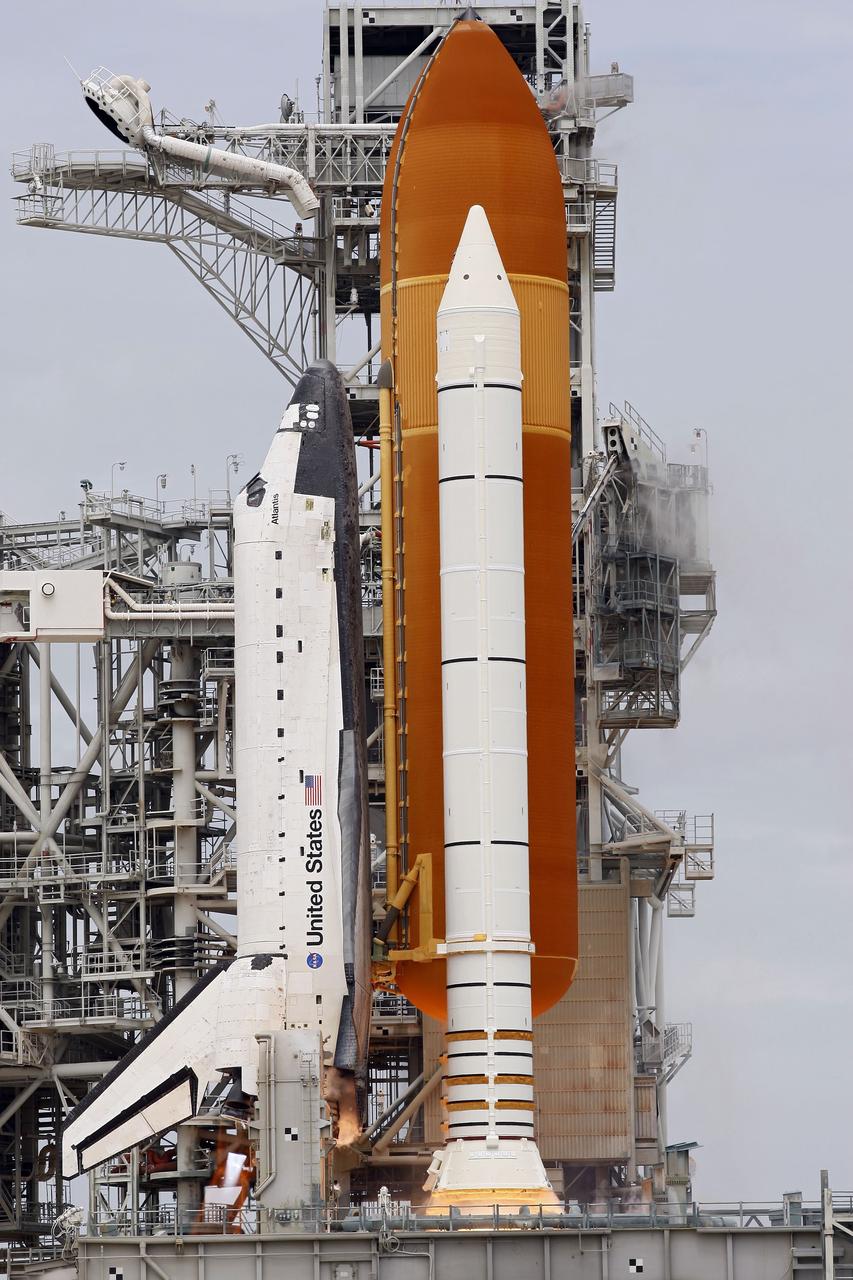
CAPE CANAVERAL, Fla. -- At NASA's Kennedy Space Center in Florida, space shuttle Atlantis' main engines and solid rocket boosters ignite on Launch Pad 39A as it lifts off on its STS-135 mission to the International Space Station. Atlantis with its crew of four; Commander Chris Ferguson, Pilot Doug Hurley, Mission Specialists Sandy Magnus and Rex Walheim, lifted off at 11:29 a.m. EDT on July 8, 2011 to deliver the Raffaello multi-purpose logistics module packed with supplies and spare parts for the International Space Station. Atlantis also will fly the Robotic Refueling Mission experiment that will investigate the potential for robotically refueling existing satellites in orbit. In addition, Atlantis will return with a failed ammonia pump module to help NASA better understand the failure mechanism and improve pump designs for future systems. STS-135 is the 33rd flight of Atlantis, the 37th shuttle mission to the space station, and the 135th and final mission of NASA's Space Shuttle Program. For more information, visit www.nasa.gov/mission_pages/shuttle/shuttlemissions/sts135/index.html. Photo credit: NASA/Rusty Backer and Mike Gayle
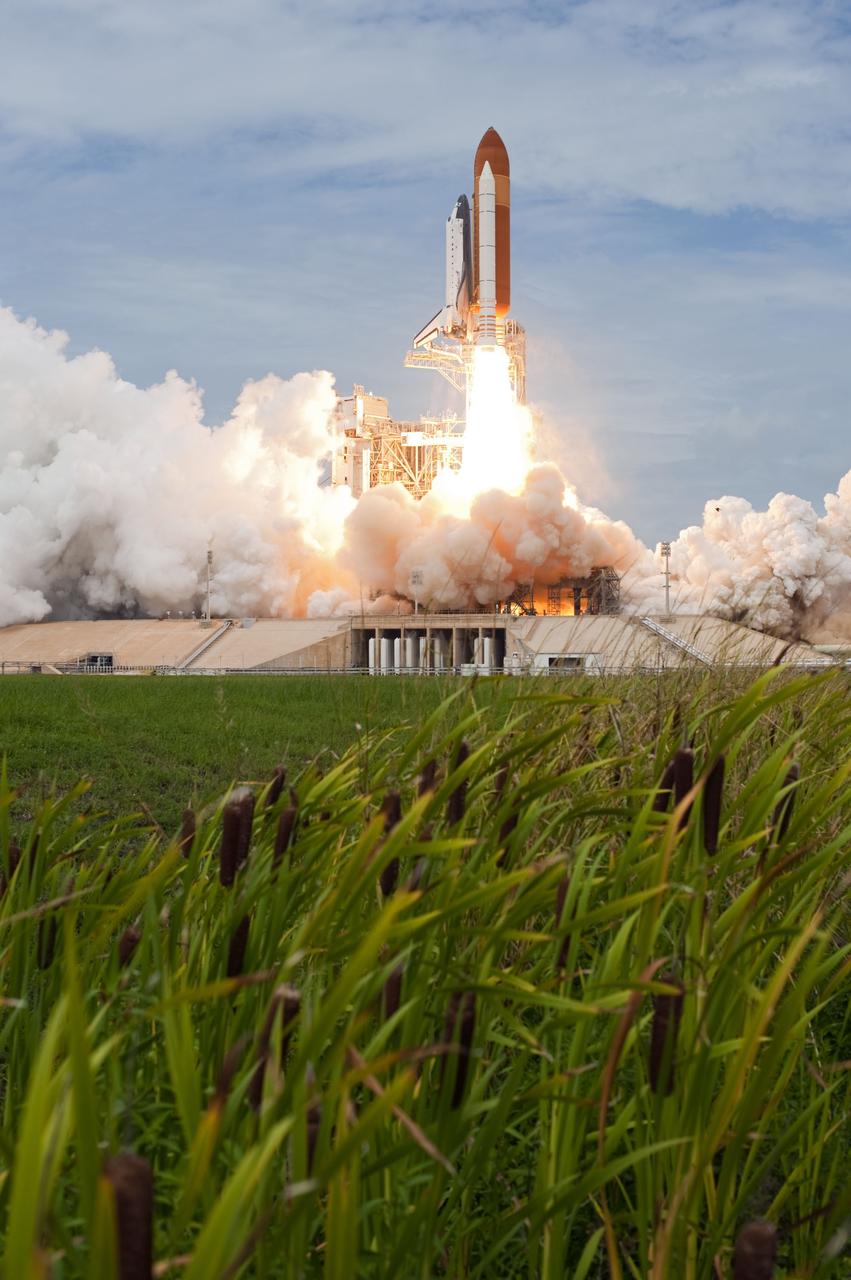
CAPE CANAVERAL, Fla. -- On Launch Pad 39A at NASA's Kennedy Space Center in Florida, space shuttle Atlantis travels upward on streams of flame as it lifts off on its STS-135 mission to the International Space Station. Atlantis with its crew of four; Commander Chris Ferguson, Pilot Doug Hurley, Mission Specialists Sandy Magnus and Rex Walheim, lifted off at 11:29 a.m. EDT on July 8, 2011 to deliver the Raffaello multi-purpose logistics module packed with supplies and spare parts for the station. Atlantis also will fly the Robotic Refueling Mission experiment that will investigate the potential for robotically refueling existing satellites in orbit. In addition, Atlantis will return with a failed ammonia pump module to help NASA better understand the failure mechanism and improve pump designs for future systems. STS-135 is the 33rd flight of Atlantis, the 37th shuttle mission to the space station, and the 135th and final mission of NASA's Space Shuttle Program. For more information, visit www.nasa.gov/mission_pages/shuttle/shuttlemissions/sts135/index.html. Photo credit: NASA/Tony Gray and Tom Farrar

CAPE CANAVERAL, Fla. -- At NASA's Kennedy Space Center in Florida, space shuttle Atlantis' main engines and solid rocket boosters ignite on Launch Pad 39A as it lifts off on its STS-135 mission to the International Space Station. Atlantis with its crew of four; Commander Chris Ferguson, Pilot Doug Hurley, Mission Specialists Sandy Magnus and Rex Walheim, lifted off at 11:29 a.m. EDT on July 8, 2011 to deliver the Raffaello multi-purpose logistics module packed with supplies and spare parts for the station. Atlantis also will fly the Robotic Refueling Mission experiment that will investigate the potential for robotically refueling existing satellites in orbit. In addition, Atlantis will return with a failed ammonia pump module to help NASA better understand the failure mechanism and improve pump designs for future systems. STS-135 is the 33rd flight of Atlantis, the 37th shuttle mission to the space station, and the 135th and final mission of NASA's Space Shuttle Program. For more information, visit www.nasa.gov/mission_pages/shuttle/shuttlemissions/sts135/index.html. Photo credit: NASA/Sandra Joseph and Kevin O'Connell
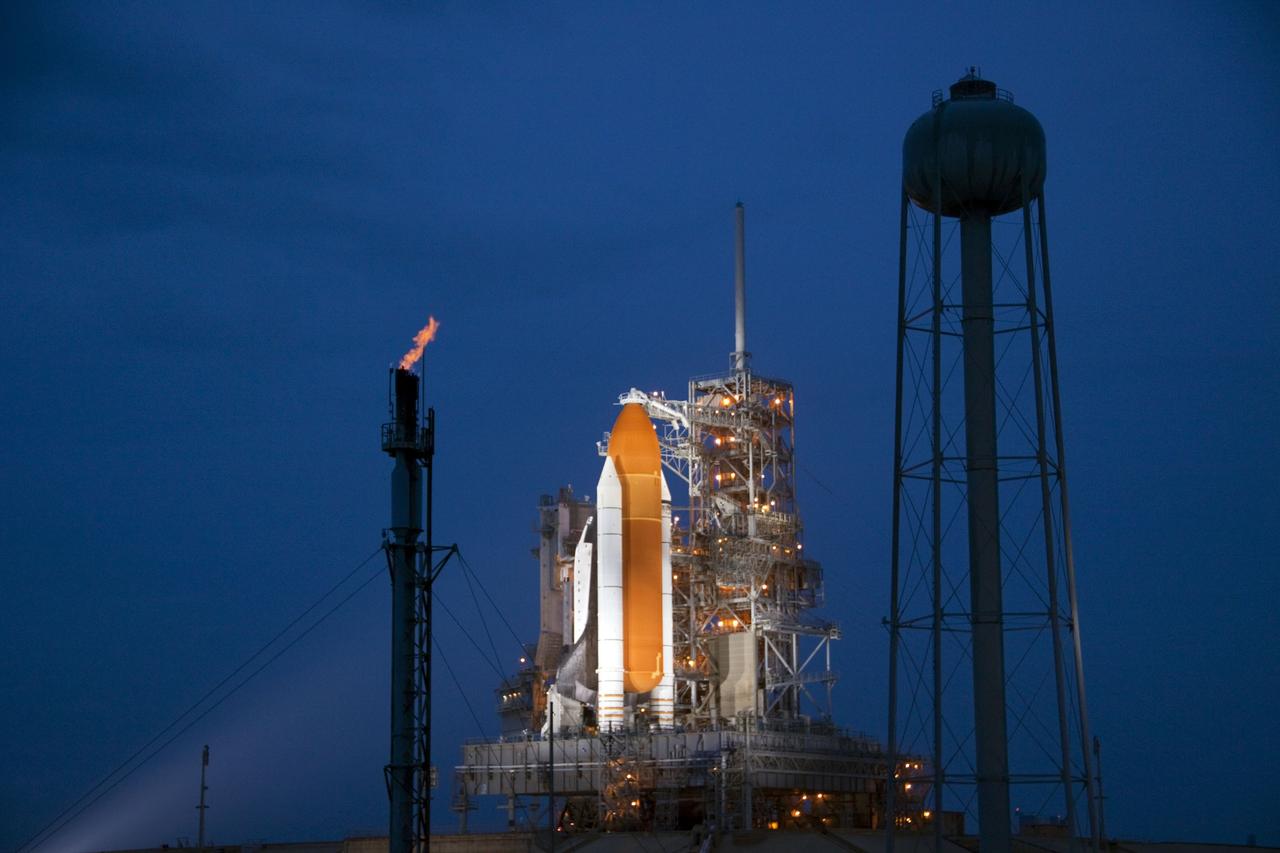
CAPE CANAVERAL, Fla. -- Space shuttle Atlantis is revealed on Launch Pad 39A at NASA's Kennedy Space Center in Florida bathed in xenon lights following the move of the rotating service structure (RSS). The structure provides weather protection and access to the shuttle while it awaits liftoff on the pad. The tower at left is used for safely burning off any excess hydrogen while the shuttle is on the pad prior to launch. To the right of the pad is the 300,000-gallon water tower that provides the water used for sound suppression on the pad during liftoff. RSS retract marks a major milestone in Atlantis' STS-135 mission countdown. Atlantis and its crew of four; Commander Chris Ferguson, Pilot Doug Hurley, Mission Specialists Sandy Magnus and Rex Walheim will lift off at 11:26 a.m. EDT on July 8 to deliver the Raffaello multi-purpose logistics module packed with supplies and spare parts for the International Space Station. Atlantis also will fly the Robotic Refueling Mission experiment that will investigate the potential for robotically refueling existing satellites in orbit. In addition, Atlantis will return with a failed ammonia pump module to help NASA better understand the failure mechanism and improve pump designs for future systems. STS-135 is the 33rd flight of Atlantis, the 37th shuttle mission to the space station, and the 135th and final mission of NASA's Space Shuttle Program. For more information, visit www.nasa.gov/mission_pages/shuttle/shuttlemissions/sts135/index.html. Photo credit: Jim Grossmann
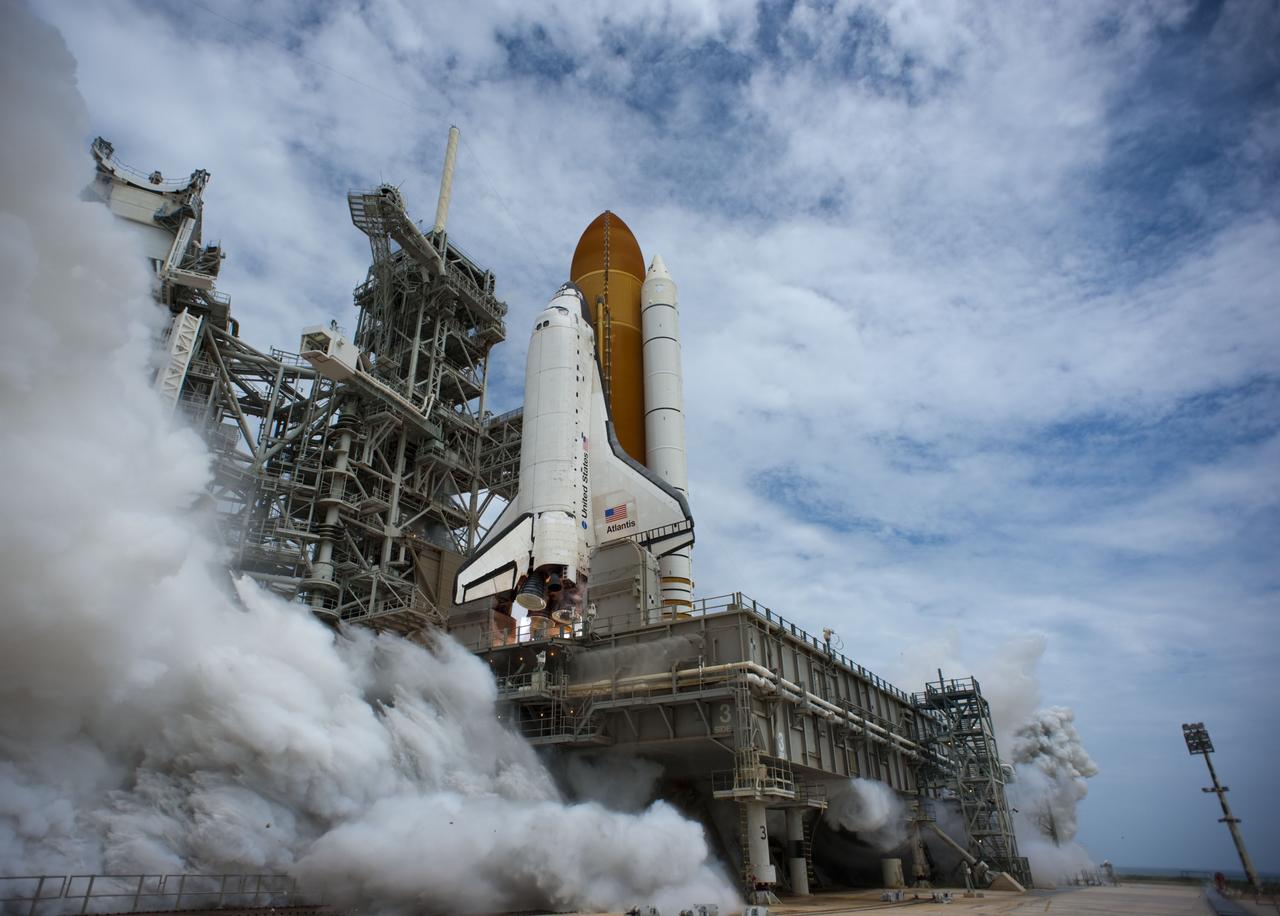
CAPE CANAVERAL, Fla. -- At NASA's Kennedy Space Center in Florida, space shuttle Atlantis' engines and solid rocket boosters ignite on Launch Pad 39A as it begins to lift off on its STS-135 mission to the International Space Station. Atlantis with its crew of four; Commander Chris Ferguson, Pilot Doug Hurley, Mission Specialists Sandy Magnus and Rex Walheim, lifted off at 11:29 a.m. EDT on July 8, 2011 to deliver the Raffaello multi-purpose logistics module packed with supplies and spare parts for the station. Atlantis also will fly the Robotic Refueling Mission experiment that will investigate the potential for robotically refueling existing satellites in orbit. In addition, Atlantis will return with a failed ammonia pump module to help NASA better understand the failure mechanism and improve pump designs for future systems. STS-135 is the 33rd flight of Atlantis, the 37th shuttle mission to the space station, and the 135th and final mission of NASA's Space Shuttle Program. For more information, visit www.nasa.gov/mission_pages/shuttle/shuttlemissions/sts135/index.html. Photo credit: NASA/Tony Gray and Tom Farrar

CAPE CANAVERAL, Fla. -- CAPE CANAVERAL, Fla. - Space shuttle Atlantis soars above its billowing exhaust from Launch Pad 39A at NASA's Kennedy Space Center in Florida on its STS-135 mission to the International Space Station. Atlantis with its crew of four; Commander Chris Ferguson, Pilot Doug Hurley, Mission Specialists Sandy Magnus and Rex Walheim, lifted off at 11:29 a.m. EDT on July 8, 2011 to deliver the Raffaello multi-purpose logistics module packed with supplies and spare parts for the International Space Station. Atlantis also will fly the Robotic Refueling Mission experiment that will investigate the potential for robotically refueling existing satellites in orbit. In addition, Atlantis will return with a failed ammonia pump module to help NASA better understand the failure mechanism and improve pump designs for future systems. STS-135 is the 33rd flight of Atlantis, the 37th shuttle mission to the space station, and the 135th and final mission of NASA's Space Shuttle Program. For more information, visit www.nasa.gov/mission_pages/shuttle/shuttlemissions/sts135/index.html. Photo credit: NASA/ Kenny Allen
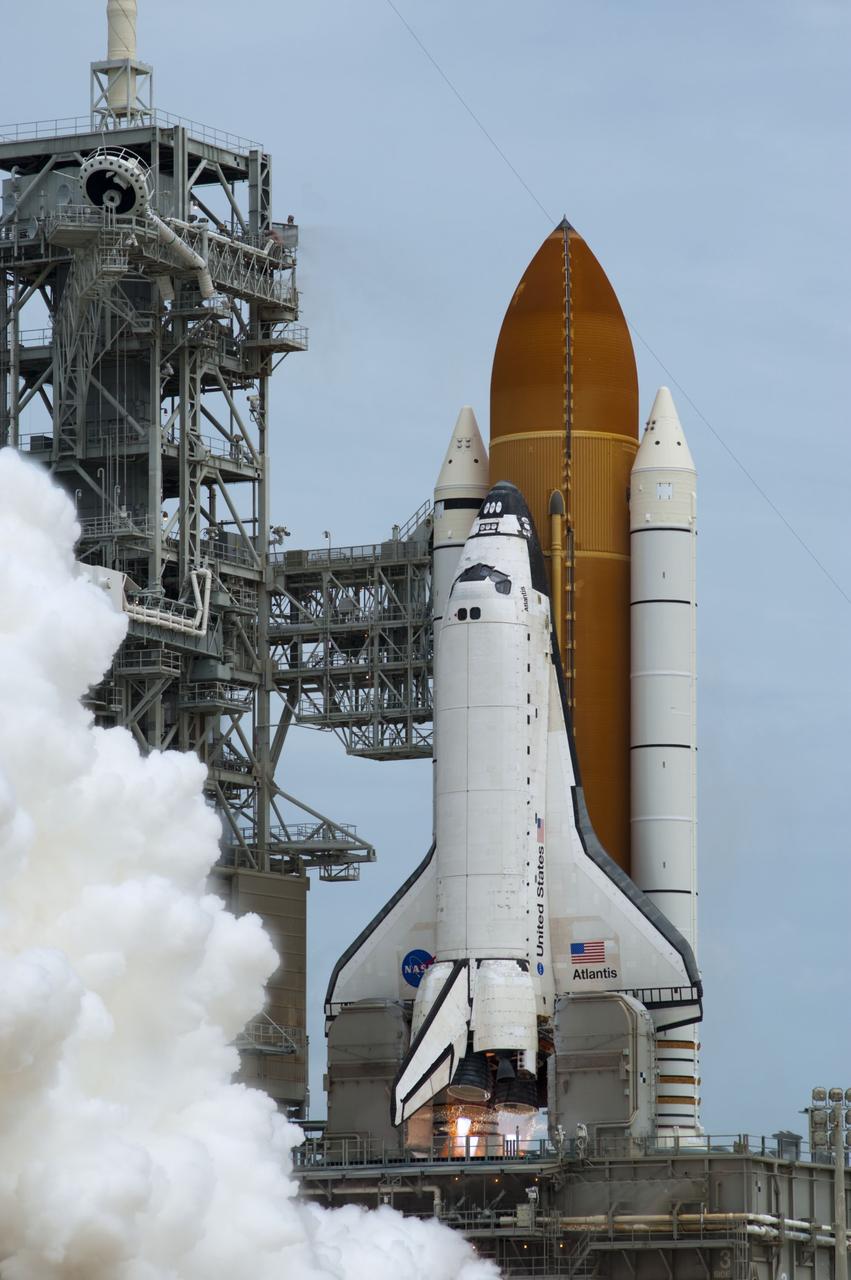
CAPE CANAVERAL, Fla. -- At NASA's Kennedy Space Center in Florida, space shuttle Atlantis' main engines ignite on Launch Pad 39A producing billows of steam and smoke as it lifts off on its STS-135 mission to the International Space Station. Atlantis with its crew of four; Commander Chris Ferguson, Pilot Doug Hurley, Mission Specialists Sandy Magnus and Rex Walheim, lifted off at 11:29 a.m. EDT on July 8, 2011 to deliver the Raffaello multi-purpose logistics module packed with supplies and spare parts for the station. Atlantis also will fly the Robotic Refueling Mission experiment that will investigate the potential for robotically refueling existing satellites in orbit. In addition, Atlantis will return with a failed ammonia pump module to help NASA better understand the failure mechanism and improve pump designs for future systems. STS-135 is the 33rd flight of Atlantis, the 37th shuttle mission to the space station, and the 135th and final mission of NASA's Space Shuttle Program. For more information, visit www.nasa.gov/mission_pages/shuttle/shuttlemissions/sts135/index.html. Photo credit: NASA/Sandra Joseph and Kevin O'Connell
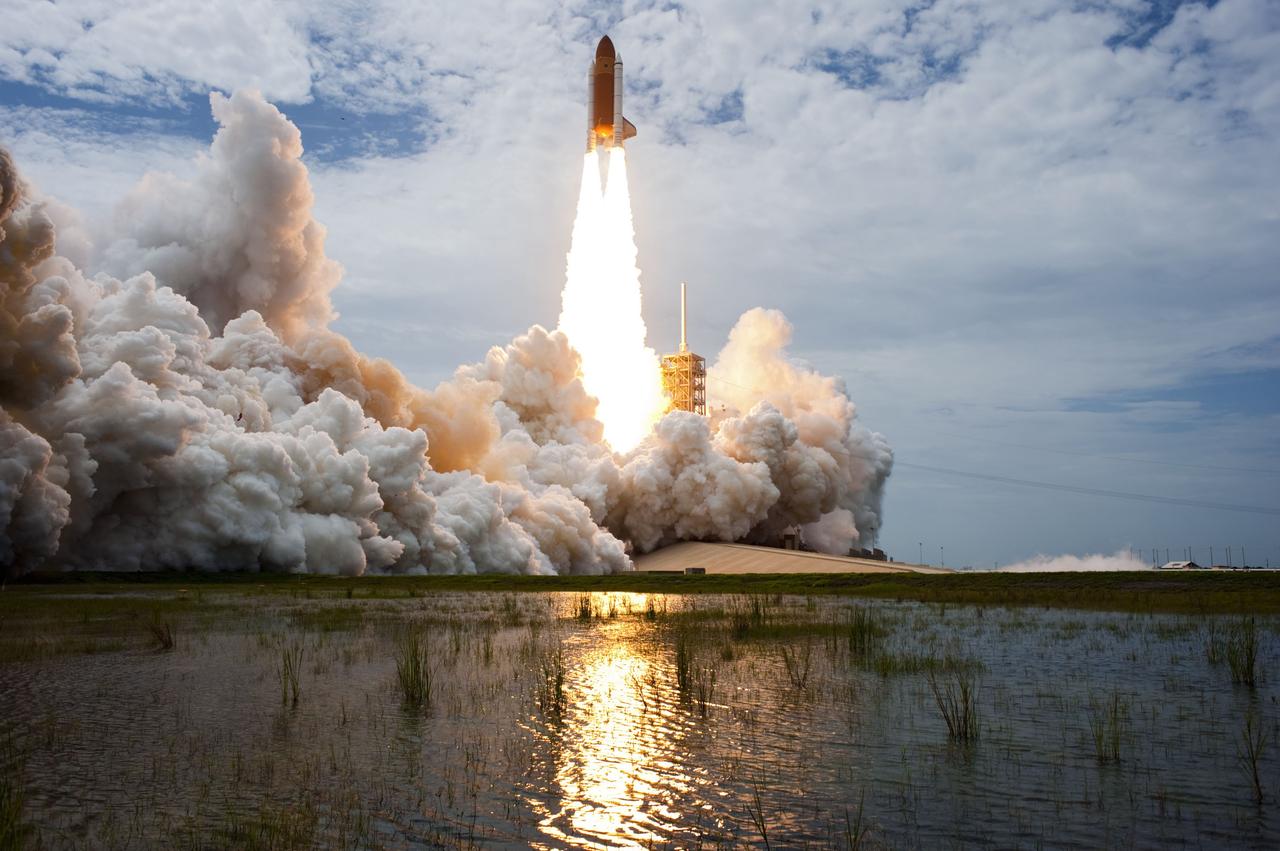
CAPE CANAVERAL, Fla. -- At NASA's Kennedy Space Center in Florida, space shuttle Atlantis lifts off of Launch Pad 39A leaving behind billows of steam and smoke as it heads into the clouds on its STS-135 mission to the International Space Station. Atlantis with its crew of four; Commander Chris Ferguson, Pilot Doug Hurley, Mission Specialists Sandy Magnus and Rex Walheim, lifted off at 11:29 a.m. EDT on July 8, 2011 to deliver the Raffaello multi-purpose logistics module packed with supplies and spare parts for the station. Atlantis also will fly the Robotic Refueling Mission experiment that will investigate the potential for robotically refueling existing satellites in orbit. In addition, Atlantis will return with a failed ammonia pump module to help NASA better understand the failure mechanism and improve pump designs for future systems. STS-135 is the 33rd flight of Atlantis, the 37th shuttle mission to the space station, and the 135th and final mission of NASA's Space Shuttle Program. For more information, visit www.nasa.gov/mission_pages/shuttle/shuttlemissions/sts135/index.html. Photo credit: NASA/Sandra Joseph and Kevin O'Connell
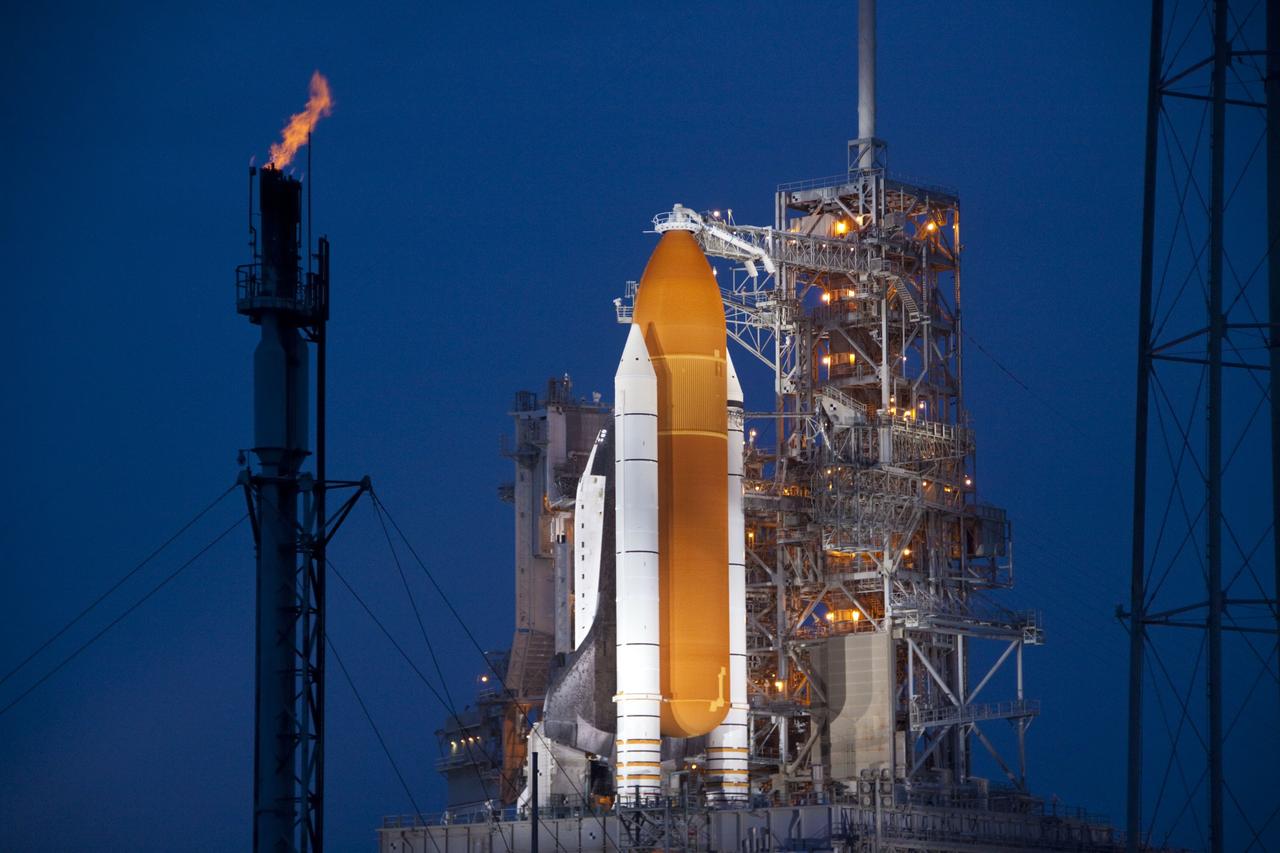
CAPE CANAVERAL, Fla. -- Space shuttle Atlantis is revealed on Launch Pad 39A at NASA's Kennedy Space Center in Florida bathed in xenon lights following the move of the rotating service structure (RSS). The structure provides weather protection and access to the shuttle while it awaits liftoff on the pad. The tower at left is used for safely burning off any excess hydrogen while the shuttle is on the pad prior to launch. RSS retract marks a major milestone in Atlantis' STS-135 mission countdown. Atlantis and its crew of four; Commander Chris Ferguson, Pilot Doug Hurley, Mission Specialists Sandy Magnus and Rex Walheim will lift off at 11:26 a.m. EDT on July 8 to deliver the Raffaello multi-purpose logistics module packed with supplies and spare parts for the International Space Station. Atlantis also will fly the Robotic Refueling Mission experiment that will investigate the potential for robotically refueling existing satellites in orbit. In addition, Atlantis will return with a failed ammonia pump module to help NASA better understand the failure mechanism and improve pump designs for future systems. STS-135 is the 33rd flight of Atlantis, the 37th shuttle mission to the space station, and the 135th and final mission of NASA's Space Shuttle Program. For more information, visit www.nasa.gov/mission_pages/shuttle/shuttlemissions/sts135/index.html. Photo credit: Jim Grossmann
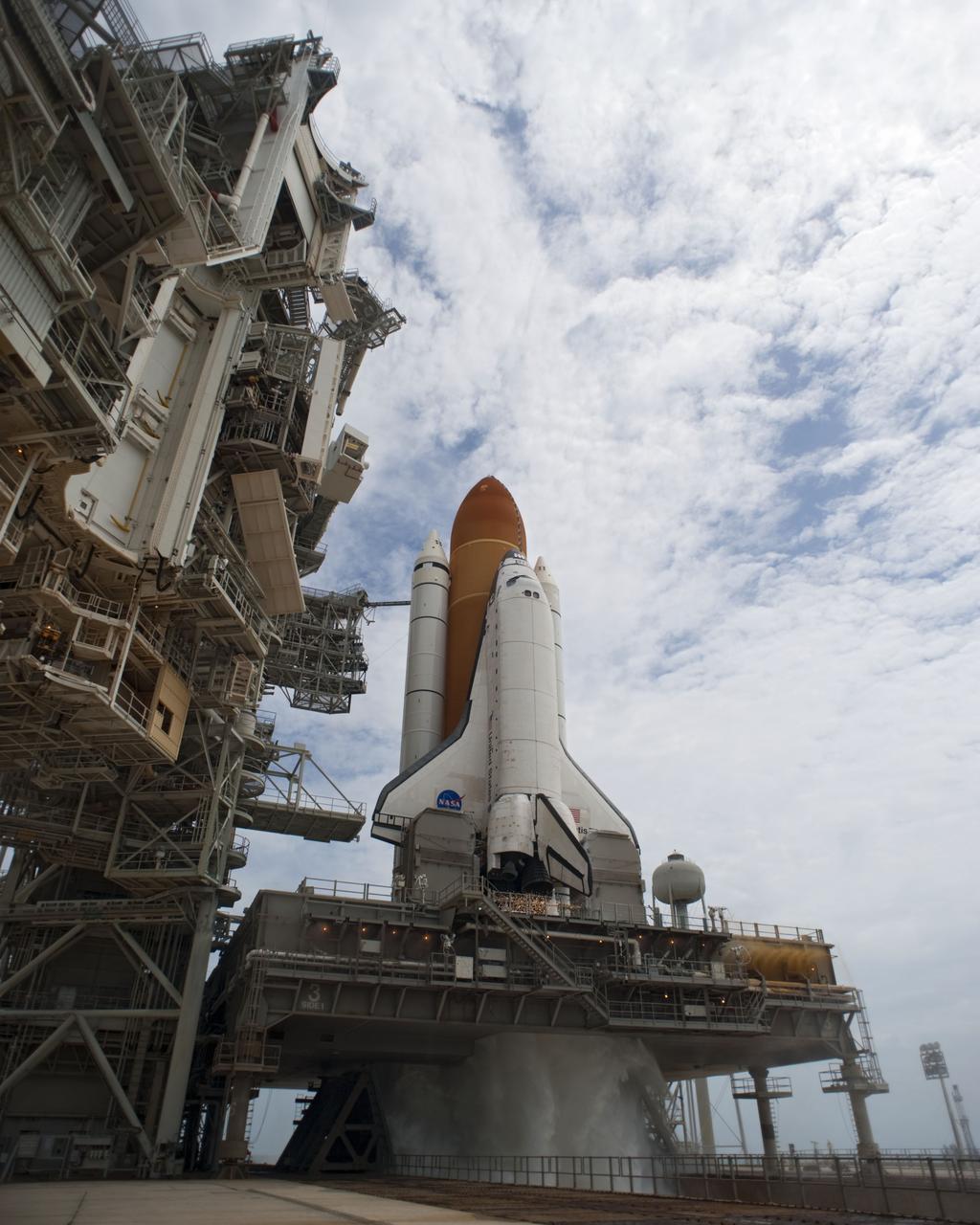
CAPE CANAVERAL, Fla. -- Space shuttle Atlantis' main engines are ignited for liftoff at Launch Pad 39A at NASA's Kennedy Space Center in Florida as it begins its STS-135 mission to the International Space Station. Atlantis with its crew of four; Commander Chris Ferguson, Pilot Doug Hurley, Mission Specialists Sandy Magnus and Rex Walheim, lifted off at 11:29 a.m. EDT on July 8, 2011 to deliver the Raffaello multi-purpose logistics module packed with supplies and spare parts for the station. Atlantis also will fly the Robotic Refueling Mission experiment that will investigate the potential for robotically refueling existing satellites in orbit. In addition, Atlantis will return with a failed ammonia pump module to help NASA better understand the failure mechanism and improve pump designs for future systems. STS-135 is the 33rd flight of Atlantis, the 37th shuttle mission to the space station, and the 135th and final mission of NASA's Space Shuttle Program. For more information, visit www.nasa.gov/mission_pages/shuttle/shuttlemissions/sts135/index.html. Photo credit: NASA/Tony Gray and Tom Farrar
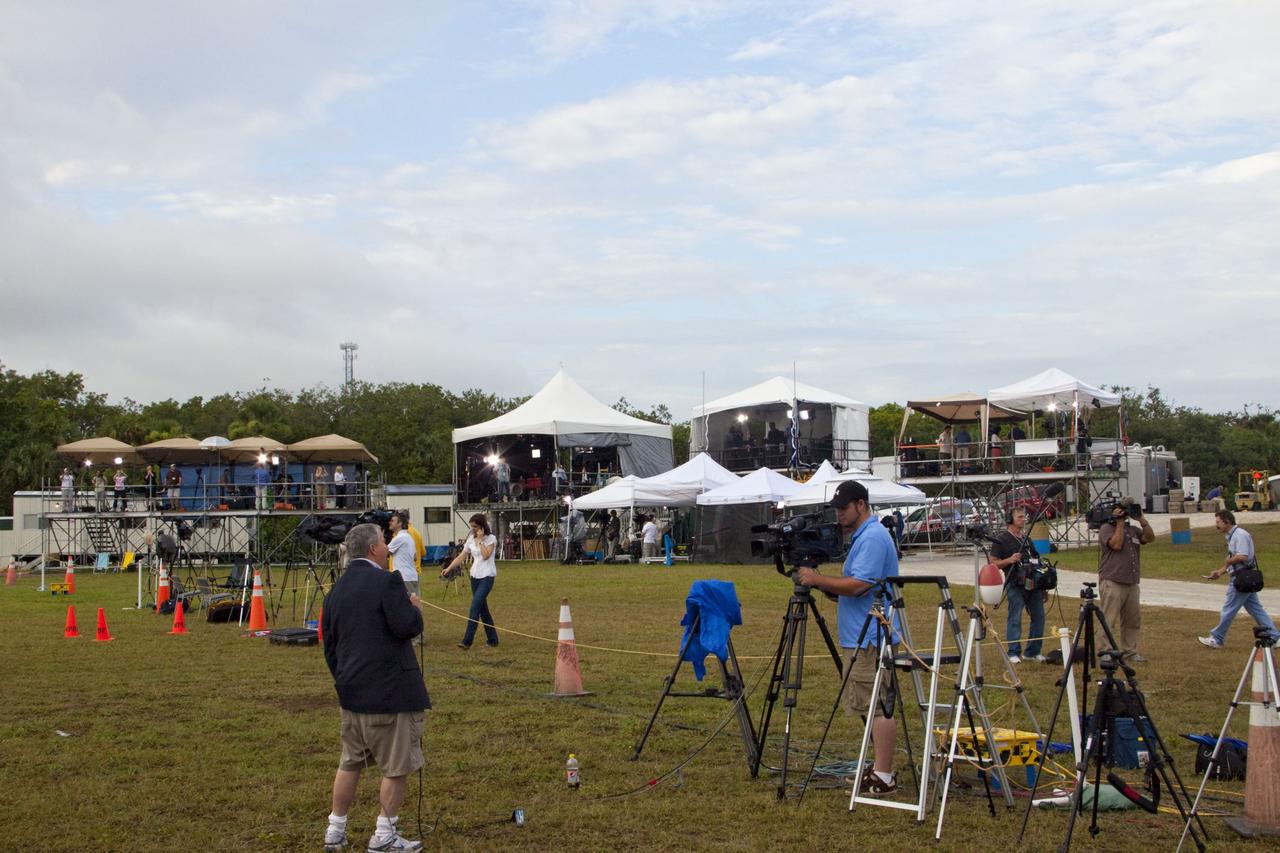
CAPE CANAVERAL, Fla. -- Media from around the globe gather at the Press Site in their respective tents at NASA's Kennedy Space Center in Florida to photograph and cover the prelaunch activities and lift off of space shuttle Atlantis on its STS-135 mission to the International Space Station. Atlantis began its final flight, with Commander Chris Ferguson, Pilot Doug Hurley and Mission Specialists Sandy Magnus and Rex Walheim on board, at 11:29 a.m. EDT July 8 to deliver the Raffaello multi-purpose logistics module packed with supplies and spare parts to the station. Also in Atlantis' payload bay is the Robotic Refueling Mission experiment that will investigate the potential for robotically refueling existing satellites in orbit. In addition, Atlantis will return with a failed ammonia pump module to help NASA better understand the failure mechanism and improve pump designs for future systems. STS-135 is the 33rd flight of Atlantis, the 37th shuttle mission to the space station, and the 135th and final mission of NASA's Space Shuttle Program. For more information, visit www.nasa.gov/mission_pages/shuttle/shuttlemissions/sts135/index.html. Photo credit: NASA/Jim Grossmann
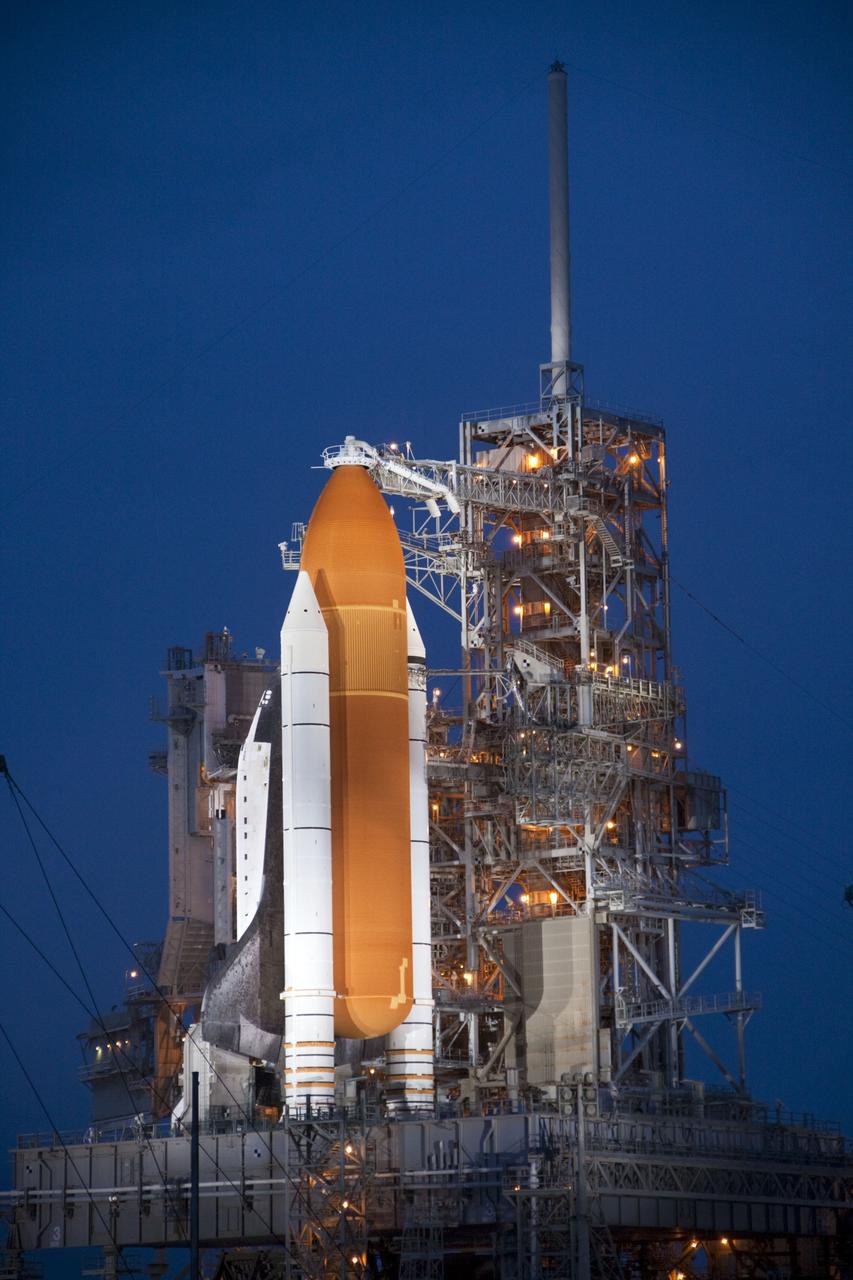
CAPE CANAVERAL, Fla. -- Space shuttle Atlantis is revealed on Launch Pad 39A at NASA's Kennedy Space Center in Florida bathed in xenon lights following the move of the rotating service structure (RSS). The structure provides weather protection and access to the shuttle while it awaits liftoff on the pad. RSS retract marks a major milestone in Atlantis' STS-135 mission countdown. Atlantis and its crew of four; Commander Chris Ferguson, Pilot Doug Hurley, Mission Specialists Sandy Magnus and Rex Walheim will lift off at 11:26 a.m. EDT on July 8 to deliver the Raffaello multi-purpose logistics module packed with supplies and spare parts for the International Space Station. Atlantis also will fly the Robotic Refueling Mission experiment that will investigate the potential for robotically refueling existing satellites in orbit. In addition, Atlantis will return with a failed ammonia pump module to help NASA better understand the failure mechanism and improve pump designs for future systems. STS-135 is the 33rd flight of Atlantis, the 37th shuttle mission to the space station, and the 135th and final mission of NASA's Space Shuttle Program. For more information, visit www.nasa.gov/mission_pages/shuttle/shuttlemissions/sts135/index.html. Photo credit: Jim Grossmann
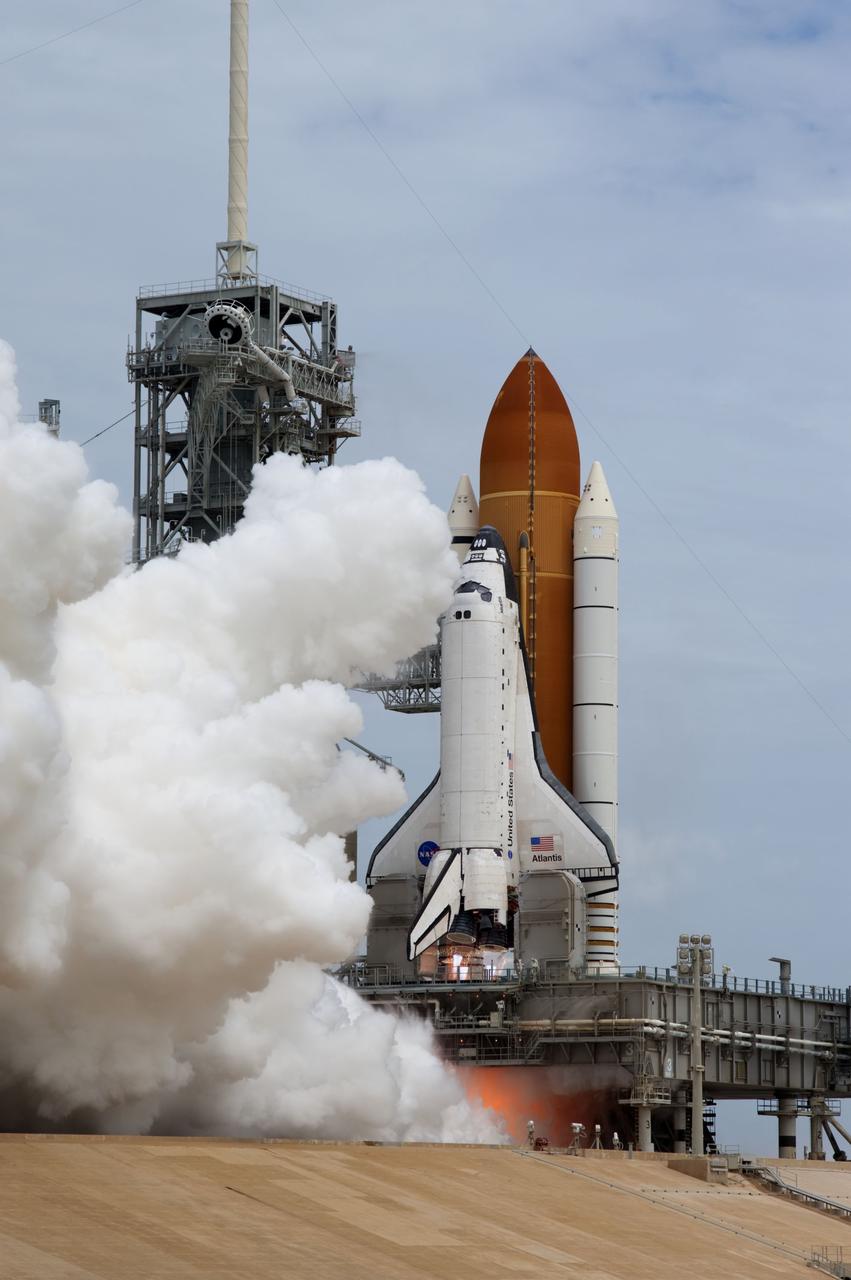
CAPE CANAVERAL, Fla. -- At NASA's Kennedy Space Center in Florida, space shuttle Atlantis' main engines and solid rocket boosters ignite on Launch Pad 39A producing billows of smoke and steam as it lifts off on its STS-135 mission to the International Space Station. Atlantis with its crew of four; Commander Chris Ferguson, Pilot Doug Hurley, Mission Specialists Sandy Magnus and Rex Walheim, lifted off at 11:29 a.m. EDT on July 8, 2011 to deliver the Raffaello multi-purpose logistics module packed with supplies and spare parts for the station. Atlantis also will fly the Robotic Refueling Mission experiment that will investigate the potential for robotically refueling existing satellites in orbit. In addition, Atlantis will return with a failed ammonia pump module to help NASA better understand the failure mechanism and improve pump designs for future systems. STS-135 is the 33rd flight of Atlantis, the 37th shuttle mission to the space station, and the 135th and final mission of NASA's Space Shuttle Program. For more information, visit www.nasa.gov/mission_pages/shuttle/shuttlemissions/sts135/index.html. Photo credit: NASA/Sandra Joseph and Kevin O'Connell
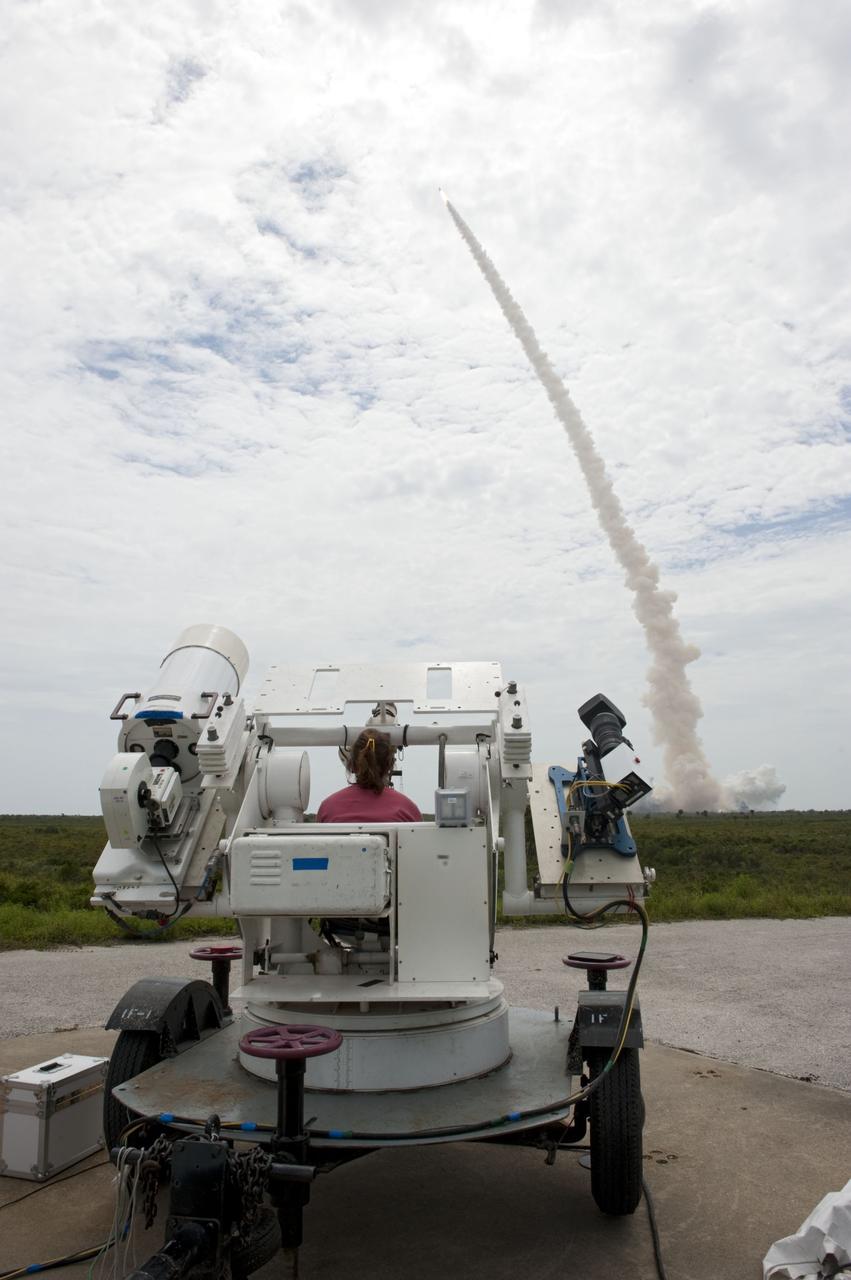
CAPE CANAVERAL, Fla. -- NASA photographer Sandra Joseph aims her remote camera tracker on space shuttle Atlantis at it lifts off from Launch Pad 39A at NASA's Kennedy Space Center in Florida beginning its STS-135 mission to the International Space Station. Atlantis with its crew of four; Commander Chris Ferguson, Pilot Doug Hurley, Mission Specialists Sandy Magnus and Rex Walheim, lifted off at 11:29 a.m. EDT on July 8, 2011 to deliver the Raffaello multi-purpose logistics module packed with supplies and spare parts for the station. Atlantis also will fly the Robotic Refueling Mission experiment that will investigate the potential for robotically refueling existing satellites in orbit. In addition, Atlantis will return with a failed ammonia pump module to help NASA better understand the failure mechanism and improve pump designs for future systems. STS-135 is the 33rd flight of Atlantis, the 37th shuttle mission to the space station, and the 135th and final mission of NASA's Space Shuttle Program. For more information, visit www.nasa.gov/mission_pages/shuttle/shuttlemissions/sts135/index.html. Photo credit: NASA/Sandra Joseph
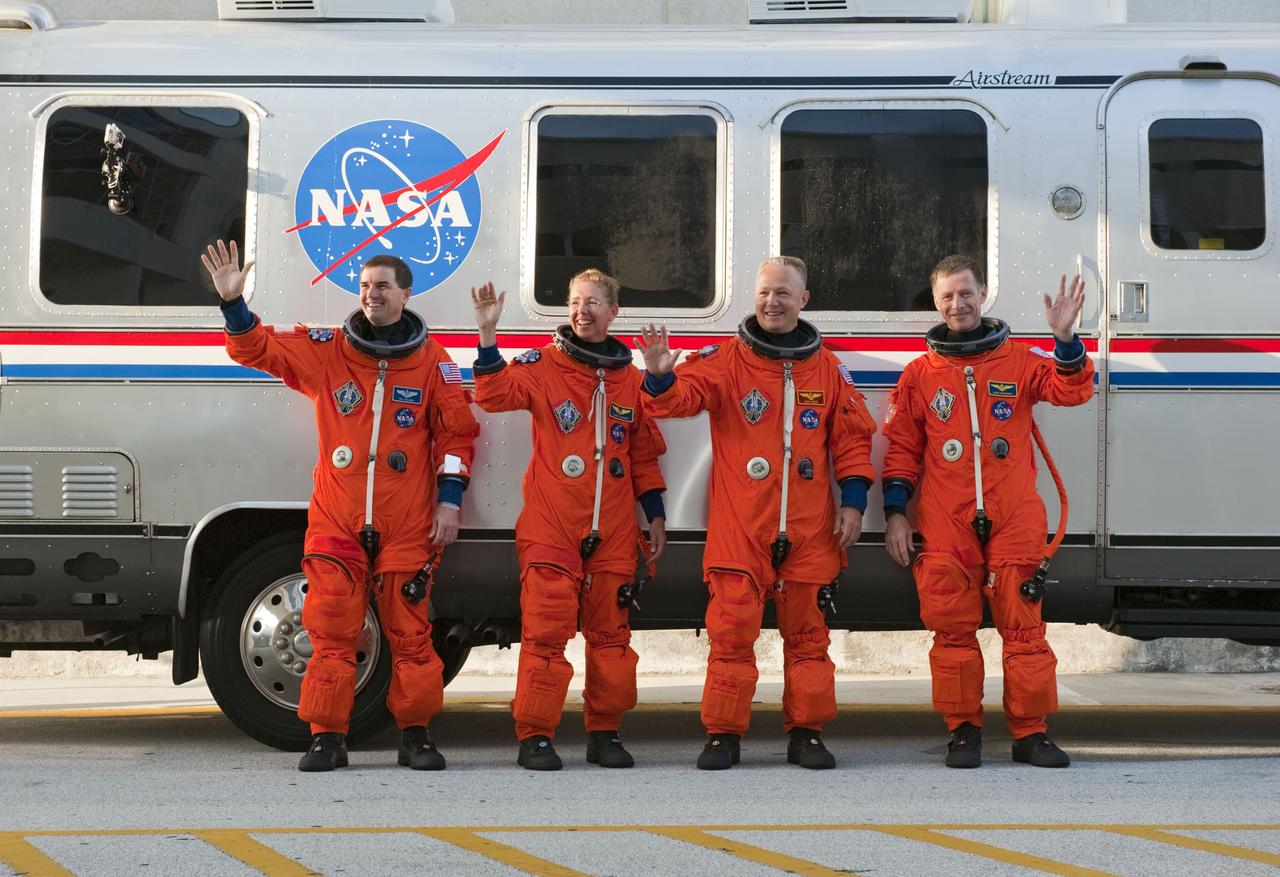
CAPE CANAVERAL, Fla. -- During a simulated launch countdown the STS-135 crew pauses for a photo and waves to Kennedy workers and media before climbing aboard the waiting Astrovan at NASA's Kennedy Space Center in Florida. As part of the Terminal Countdown Demonstration Test (TCDT), the crew members are driven to Kennedy's Launch Pad 39A and then strapped into space shuttle Atlantis to practice the steps that will be taken on launch day. From left are Mission Specialists Rex Walheim and Sandy Magnus, Pilot Doug Hurley and Commander Chris Ferguson. Atlantis and its crew are targeted to lift off July 8, taking with them the Raffaello multi-purpose logistics module packed with supplies and spare parts to the International Space Station. The STS-135 mission also will fly a system to investigate the potential for robotically refueling existing satellites and return a failed ammonia pump module to help NASA better understand the failure mechanism and improve pump designs for future systems. STS-135 will be the 33rd flight of Atlantis, the 37th shuttle mission to the space station, and the 135th and final mission of NASA's Space Shuttle Program. For more information visit, www.nasa.gov/mission_pages/shuttle/shuttlemissions/sts135/index.html. Photo credit: NASA/Kim Shiflett
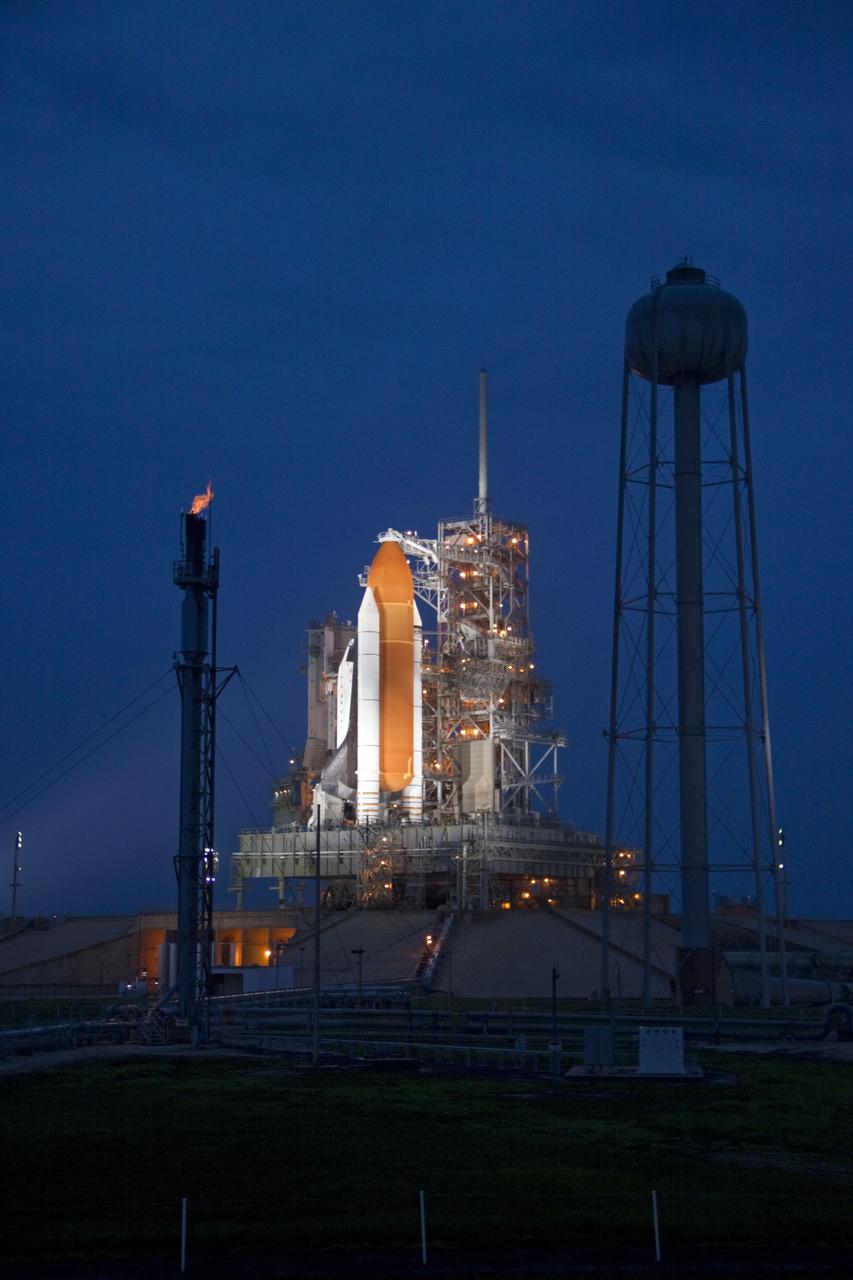
CAPE CANAVERAL, Fla. -- Space shuttle Atlantis is revealed on Launch Pad 39A at NASA's Kennedy Space Center in Florida bathed in xenon lights following the move of the rotating service structure (RSS). The structure provides weather protection and access to the shuttle while it awaits liftoff on the pad. The tower at left is used for safely burning off any excess hydrogen while the shuttle is on the pad prior to launch. To the right of the pad is the 300,000-gallon water tower that provides the water used for sound suppression on the pad during liftoff. RSS retract marks a major milestone in Atlantis' STS-135 mission countdown. Atlantis and its crew of four; Commander Chris Ferguson, Pilot Doug Hurley, Mission Specialists Sandy Magnus and Rex Walheim will lift off at 11:26 a.m. EDT on July 8 to deliver the Raffaello multi-purpose logistics module packed with supplies and spare parts for the International Space Station. Atlantis also will fly the Robotic Refueling Mission experiment that will investigate the potential for robotically refueling existing satellites in orbit. In addition, Atlantis will return with a failed ammonia pump module to help NASA better understand the failure mechanism and improve pump designs for future systems. STS-135 is the 33rd flight of Atlantis, the 37th shuttle mission to the space station, and the 135th and final mission of NASA's Space Shuttle Program. For more information, visit www.nasa.gov/mission_pages/shuttle/shuttlemissions/sts135/index.html. Photo credit: Jim Grossmann
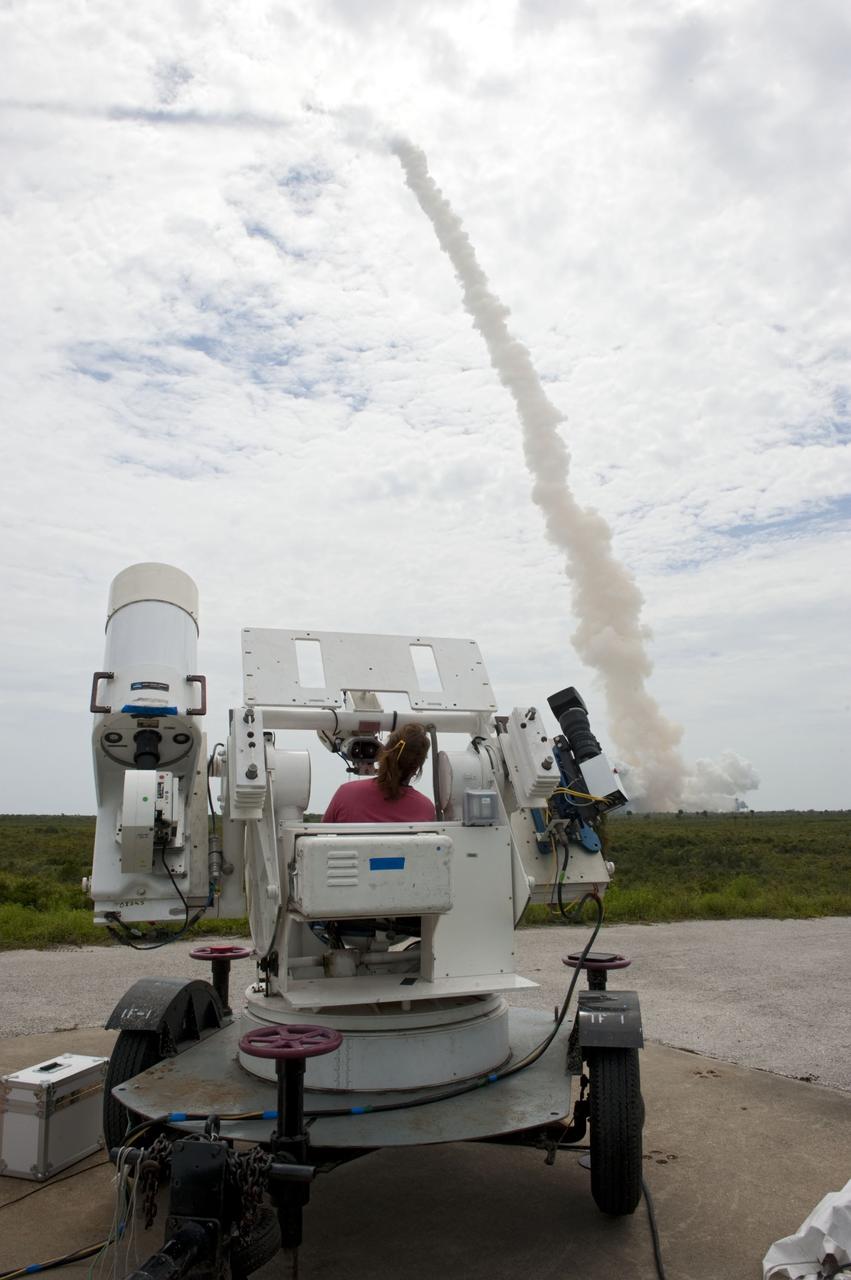
CAPE CANAVERAL, Fla. -- NASA photographer Sandra Joseph aims her remote camera tracker on space shuttle Atlantis at it lifts off from Launch Pad 39A at NASA's Kennedy Space Center in Florida beginning its STS-135 mission to the International Space Station. Atlantis with its crew of four; Commander Chris Ferguson, Pilot Doug Hurley, Mission Specialists Sandy Magnus and Rex Walheim, lifted off at 11:29 a.m. EDT on July 8, 2011 to deliver the Raffaello multi-purpose logistics module packed with supplies and spare parts for the station. Atlantis also will fly the Robotic Refueling Mission experiment that will investigate the potential for robotically refueling existing satellites in orbit. In addition, Atlantis will return with a failed ammonia pump module to help NASA better understand the failure mechanism and improve pump designs for future systems. STS-135 is the 33rd flight of Atlantis, the 37th shuttle mission to the space station, and the 135th and final mission of NASA's Space Shuttle Program. For more information, visit www.nasa.gov/mission_pages/shuttle/shuttlemissions/sts135/index.html. Photo credit: NASA/Sandra Joseph
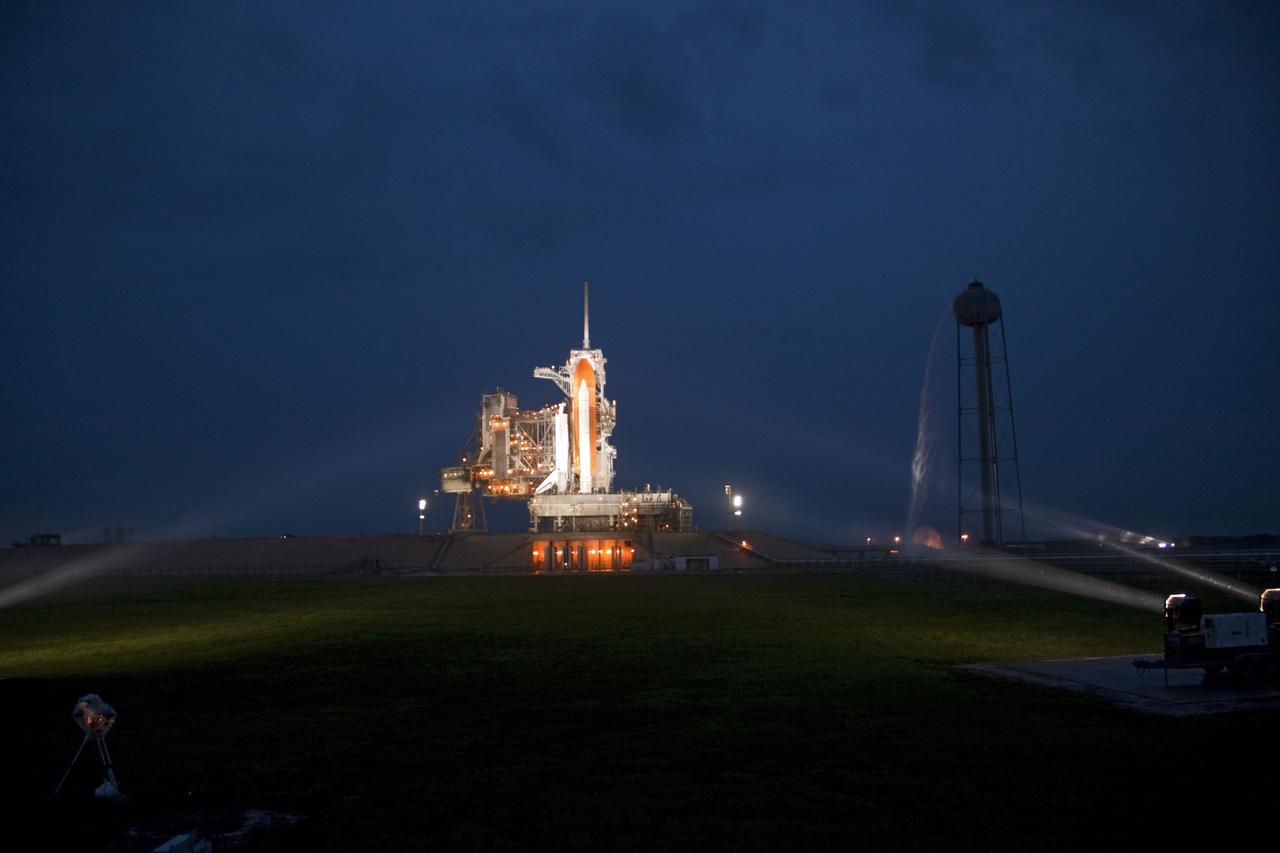
CAPE CANAVERAL, Fla. -- Space shuttle Atlantis is revealed on Launch Pad 39A at NASA's Kennedy Space Center in Florida bathed in xenon lights following the move of the rotating service structure (RSS). The structure provides weather protection and access to the shuttle while it awaits liftoff on the pad. To the right of the pad is the 300,000-gallon water tower that provides the water used for sound suppression on the pad during liftoff. RSS retract marks a major milestone in Atlantis' STS-135 mission countdown. Atlantis and its crew of four; Commander Chris Ferguson, Pilot Doug Hurley, Mission Specialists Sandy Magnus and Rex Walheim will lift off at 11:26 a.m. EDT on July 8 to deliver the Raffaello multi-purpose logistics module packed with supplies and spare parts for the International Space Station. Atlantis also will fly the Robotic Refueling Mission experiment that will investigate the potential for robotically refueling existing satellites in orbit. In addition, Atlantis will return with a failed ammonia pump module to help NASA better understand the failure mechanism and improve pump designs for future systems. STS-135 is the 33rd flight of Atlantis, the 37th shuttle mission to the space station, and the 135th and final mission of NASA's Space Shuttle Program. For more information, visit www.nasa.gov/mission_pages/shuttle/shuttlemissions/sts135/index.html. Photo credit: Jim Grossmann
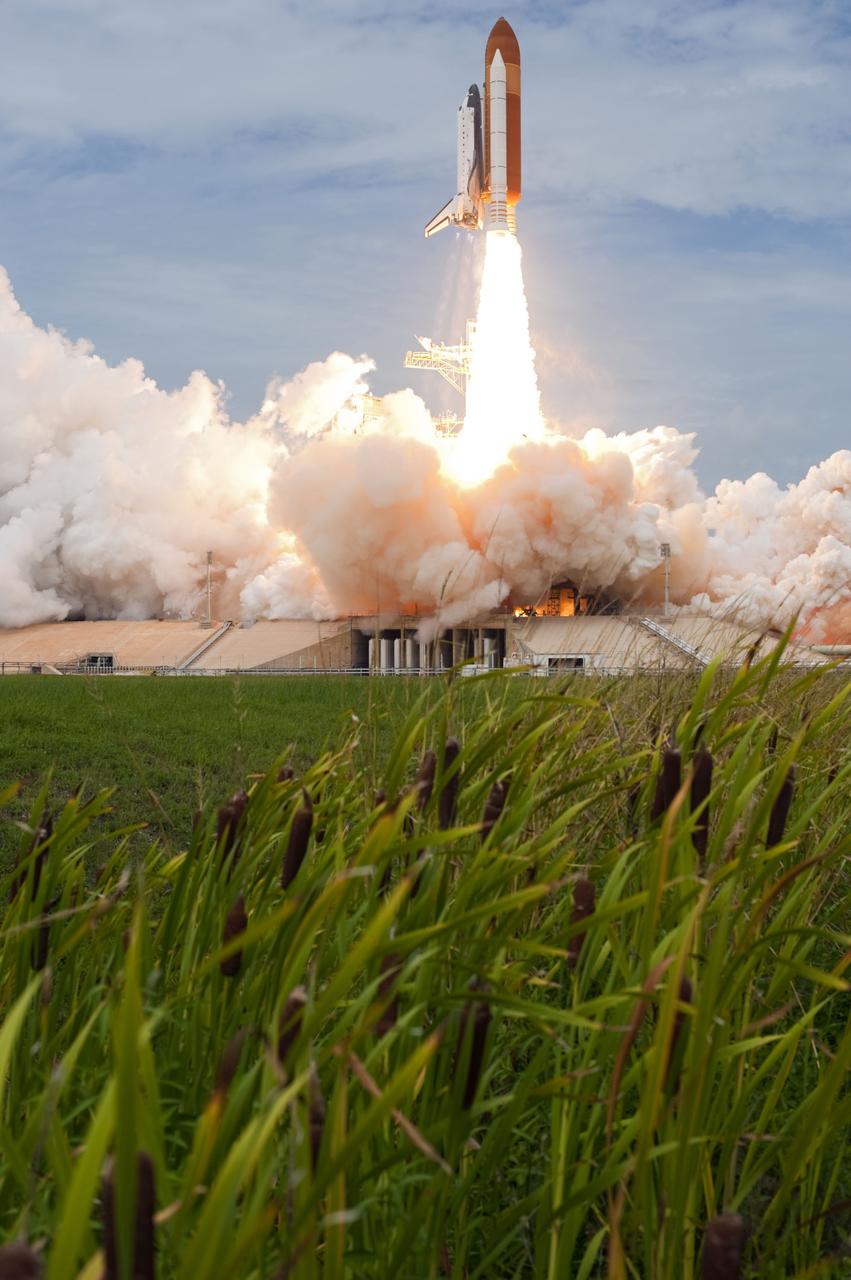
CAPE CANAVERAL, Fla. -- On Launch Pad 39A at NASA's Kennedy Space Center in Florida, space shuttle Atlantis travels upward on streams of flame as it lifts off on its STS-135 mission to the International Space Station. Atlantis with its crew of four; Commander Chris Ferguson, Pilot Doug Hurley, Mission Specialists Sandy Magnus and Rex Walheim, lifted off at 11:29 a.m. EDT on July 8, 2011 to deliver the Raffaello multi-purpose logistics module packed with supplies and spare parts for the station. Atlantis also will fly the Robotic Refueling Mission experiment that will investigate the potential for robotically refueling existing satellites in orbit. In addition, Atlantis will return with a failed ammonia pump module to help NASA better understand the failure mechanism and improve pump designs for future systems. STS-135 is the 33rd flight of Atlantis, the 37th shuttle mission to the space station, and the 135th and final mission of NASA's Space Shuttle Program. For more information, visit www.nasa.gov/mission_pages/shuttle/shuttlemissions/sts135/index.html. Photo credit: NASA/Tony Gray and Tom Farrar
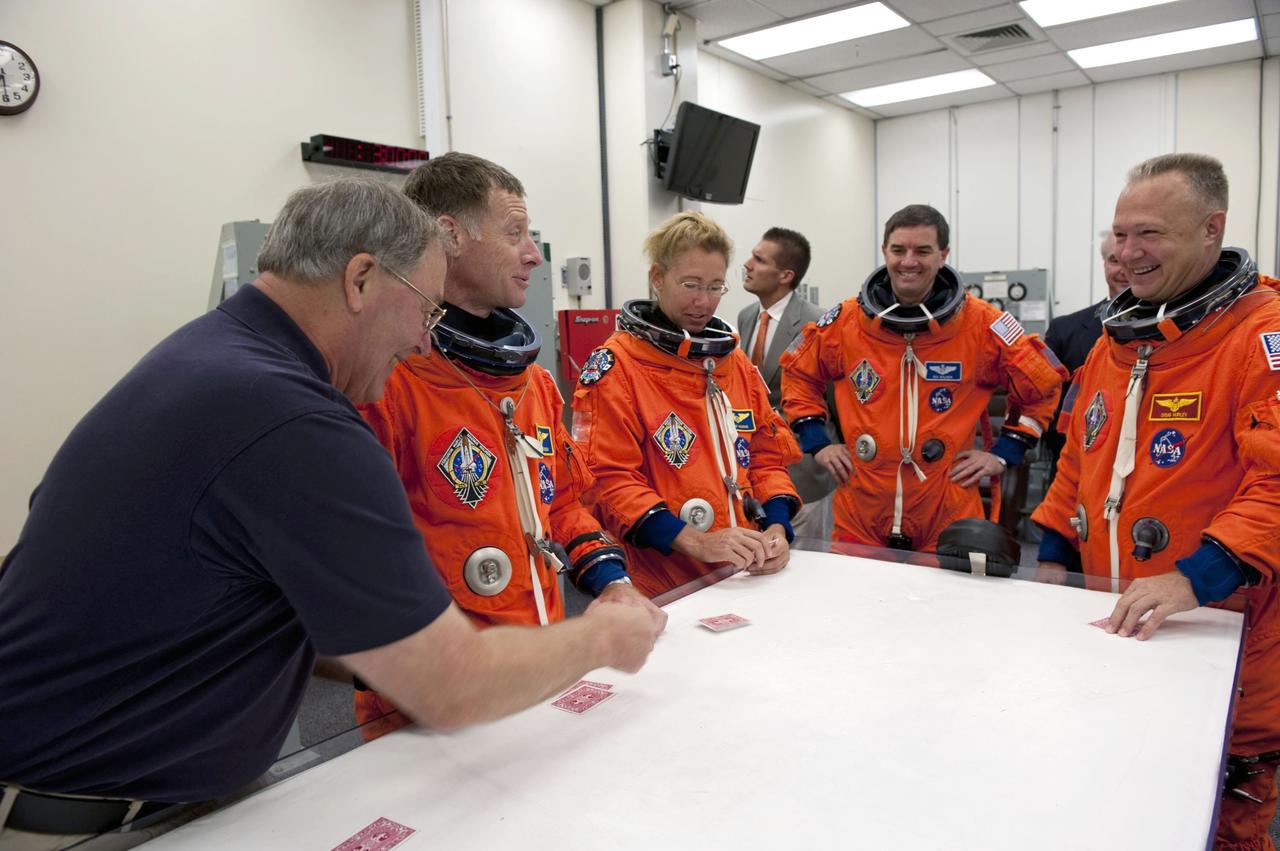
CAPE CANAVERAL, Fla. -- In the Operations and Checkout Building at NASA's Kennedy Space Center in Florida, the STS-135 crew members enjoy a light moment during a simulated launch countdown. From left are Jerry Ross, chief of the Vehicle Integration Test Office and former NASA astronaut, Commander Chris Ferguson, Mission Specialists Sandy Magnus and Rex Walheim, and Pilot Doug Hurley. As part of the Terminal Countdown Demonstration Test (TCDT), the crew members are taken to Kennedy's Launch Pad 39A and strapped into space shuttle Atlantis to practice the steps that will be taken on launch day. Atlantis and its crew are targeted to lift off July 8, taking with them the Raffaello multi-purpose logistics module packed with supplies and spare parts to the International Space Station. The STS-135 mission also will fly a system to investigate the potential for robotically refueling existing satellites and return a failed ammonia pump module to help NASA better understand the failure mechanism and improve pump designs for future systems. STS-135 will be the 33rd flight of Atlantis, the 37th shuttle mission to the space station, and the 135th and final mission of NASA's Space Shuttle Program. For more information visit, www.nasa.gov/mission_pages/shuttle/shuttlemissions/sts135/index.html. Photo credit: NASA/Kim Shiflett

CAPE CANAVERAL, Fla. -- At NASA's Kennedy Space Center in Florida, space shuttle Atlantis' main engines and solid rocket boosters ignite on Launch Pad 39A leaving behind twin streams of flame as it lifts off on its STS-135 mission to the International Space Station. Atlantis with its crew of four; Commander Chris Ferguson, Pilot Doug Hurley, Mission Specialists Sandy Magnus and Rex Walheim, lifted off at 11:29 a.m. EDT on July 8, 2011 to deliver the Raffaello multi-purpose logistics module packed with supplies and spare parts for the station. Atlantis also will fly the Robotic Refueling Mission experiment that will investigate the potential for robotically refueling existing satellites in orbit. In addition, Atlantis will return with a failed ammonia pump module to help NASA better understand the failure mechanism and improve pump designs for future systems. STS-135 is the 33rd flight of Atlantis, the 37th shuttle mission to the space station, and the 135th and final mission of NASA's Space Shuttle Program. For more information, visit www.nasa.gov/mission_pages/shuttle/shuttlemissions/sts135/index.html. Photo credit: NASA/Rusty Backer and Mike Gayle
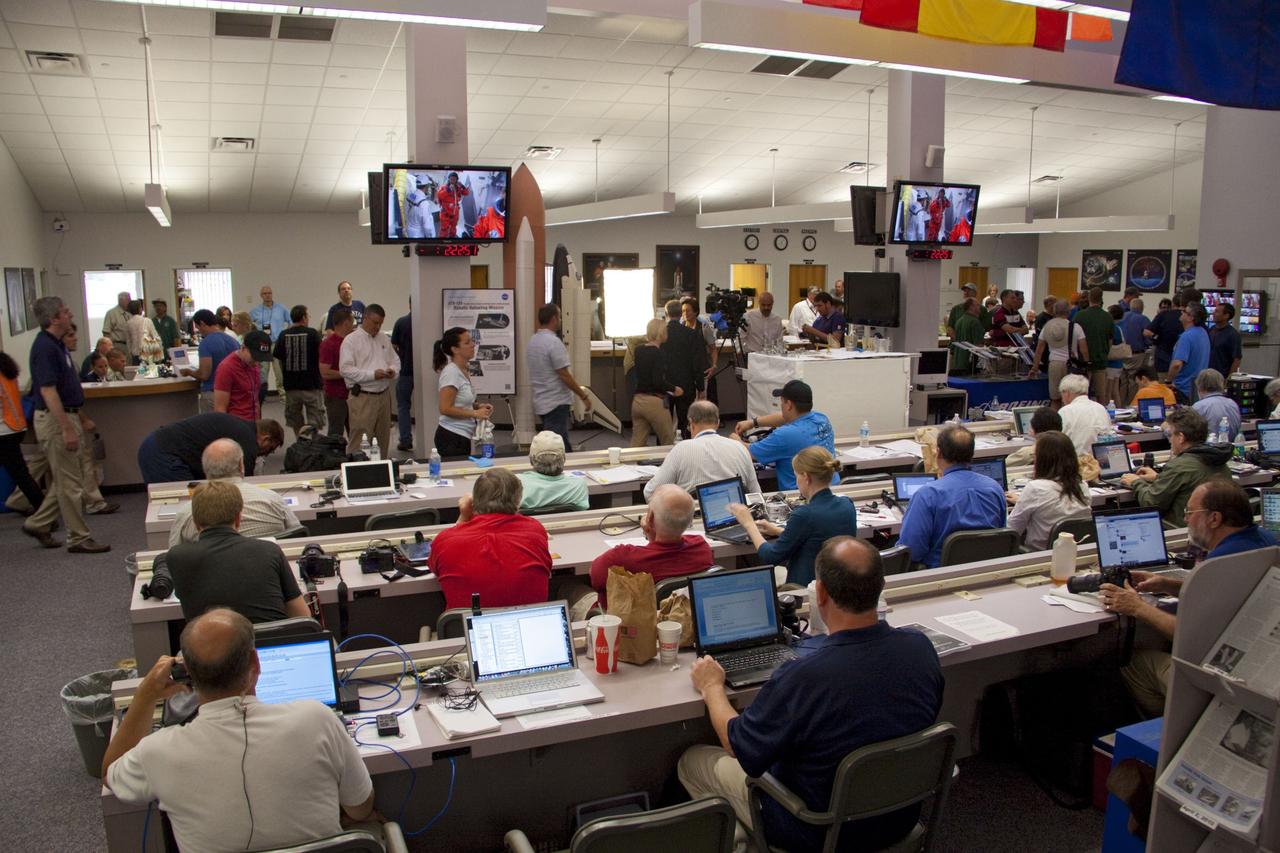
CAPE CANAVERAL, Fla. -- Media from around the globe gather at the NASA News Center at NASA Kennedy Space Center's Press Site in Florida to cover the prelaunch activities and lift off of space shuttle Atlantis on its STS-135 mission to the International Space Station. Atlantis began its final flight, with Commander Chris Ferguson, Pilot Doug Hurley and Mission Specialists Sandy Magnus and Rex Walheim on board, at 11:29 a.m. EDT July 8 to deliver the Raffaello multi-purpose logistics module packed with supplies and spare parts to the station. Also in Atlantis' payload bay is the Robotic Refueling Mission experiment that will investigate the potential for robotically refueling existing satellites in orbit. In addition, Atlantis will return with a failed ammonia pump module to help NASA better understand the failure mechanism and improve pump designs for future systems. STS-135 is the 33rd flight of Atlantis, the 37th shuttle mission to the space station, and the 135th and final mission of NASA's Space Shuttle Program. For more information, visit www.nasa.gov/mission_pages/shuttle/shuttlemissions/sts135/index.html. Photo credit: NASA/Jim Grossmann
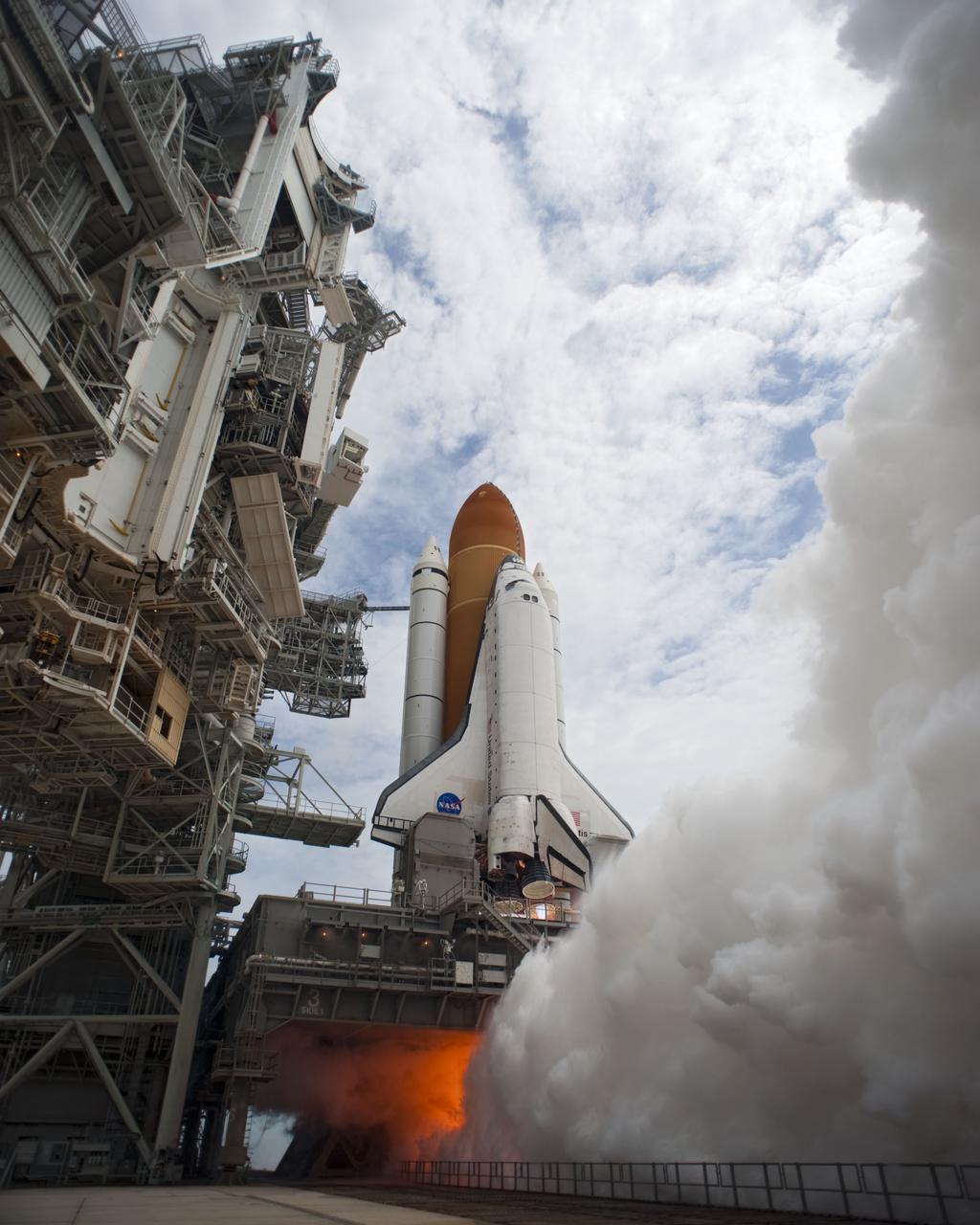
CAPE CANAVERAL, Fla. -- Smoke and steam billow outward as space shuttle Atlantis' main engines are ignited for liftoff at Launch Pad 39A at NASA's Kennedy Space Center in Florida as it begins its STS-135 mission to the International Space Station. Atlantis with its crew of four; Commander Chris Ferguson, Pilot Doug Hurley, Mission Specialists Sandy Magnus and Rex Walheim, lifted off at 11:29 a.m. EDT on July 8, 2011 to deliver the Raffaello multi-purpose logistics module packed with supplies and spare parts for the station. Atlantis also will fly the Robotic Refueling Mission experiment that will investigate the potential for robotically refueling existing satellites in orbit. In addition, Atlantis will return with a failed ammonia pump module to help NASA better understand the failure mechanism and improve pump designs for future systems. STS-135 is the 33rd flight of Atlantis, the 37th shuttle mission to the space station, and the 135th and final mission of NASA's Space Shuttle Program. For more information, visit www.nasa.gov/mission_pages/shuttle/shuttlemissions/sts135/index.html. Photo credit: NASA/Tony Gray and Tom Farrar
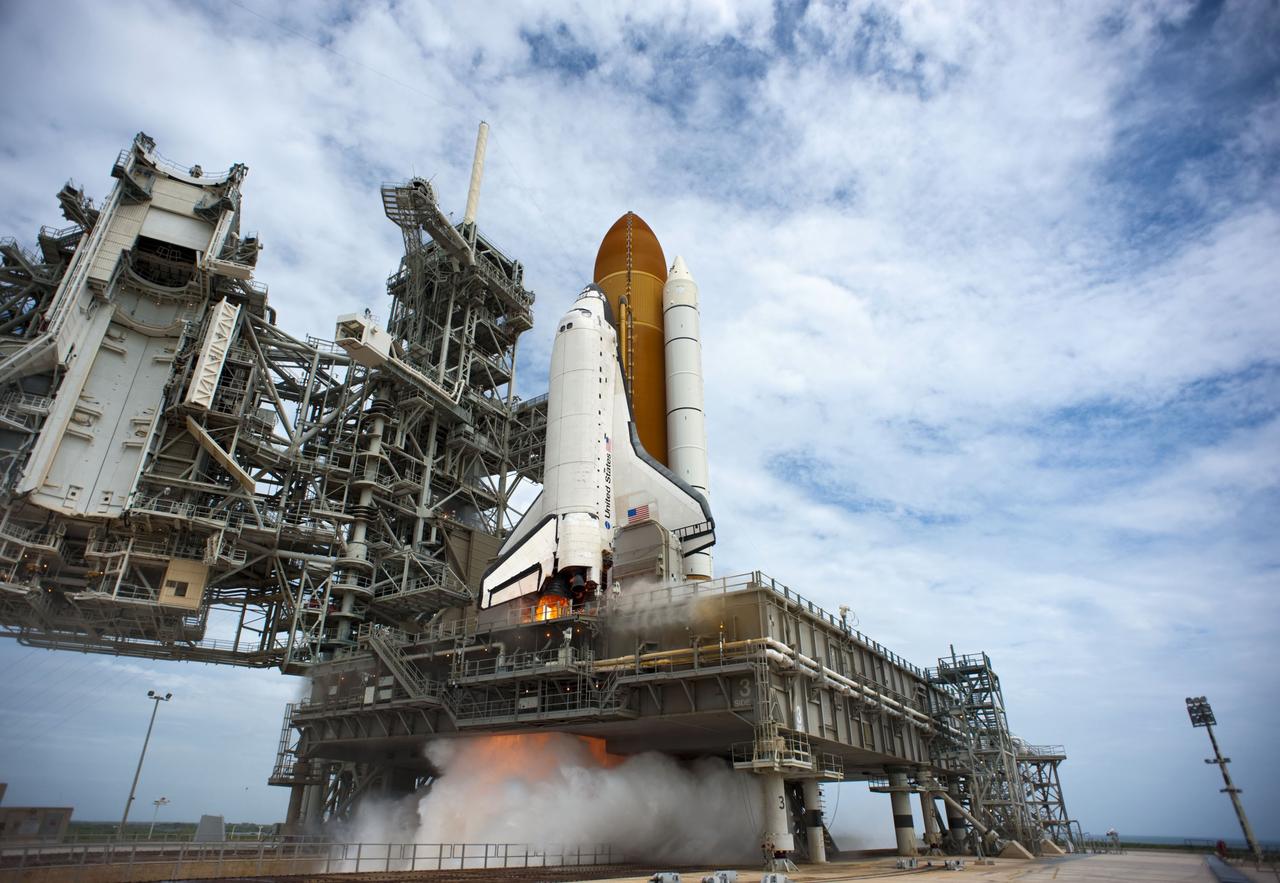
CAPE CANAVERAL, Fla. -- At NASA's Kennedy Space Center in Florida, space shuttle Atlantis' engines and solid rocket boosters ignite on Launch Pad 39A as it begins to lift off on its STS-135 mission to the International Space Station. Atlantis with its crew of four; Commander Chris Ferguson, Pilot Doug Hurley, Mission Specialists Sandy Magnus and Rex Walheim, lifted off at 11:29 a.m. EDT on July 8, 2011 to deliver the Raffaello multi-purpose logistics module packed with supplies and spare parts for the station. Atlantis also will fly the Robotic Refueling Mission experiment that will investigate the potential for robotically refueling existing satellites in orbit. In addition, Atlantis will return with a failed ammonia pump module to help NASA better understand the failure mechanism and improve pump designs for future systems. STS-135 is the 33rd flight of Atlantis, the 37th shuttle mission to the space station, and the 135th and final mission of NASA's Space Shuttle Program. For more information, visit www.nasa.gov/mission_pages/shuttle/shuttlemissions/sts135/index.html. Photo credit: NASA/Tony Gray and Tom Farrar
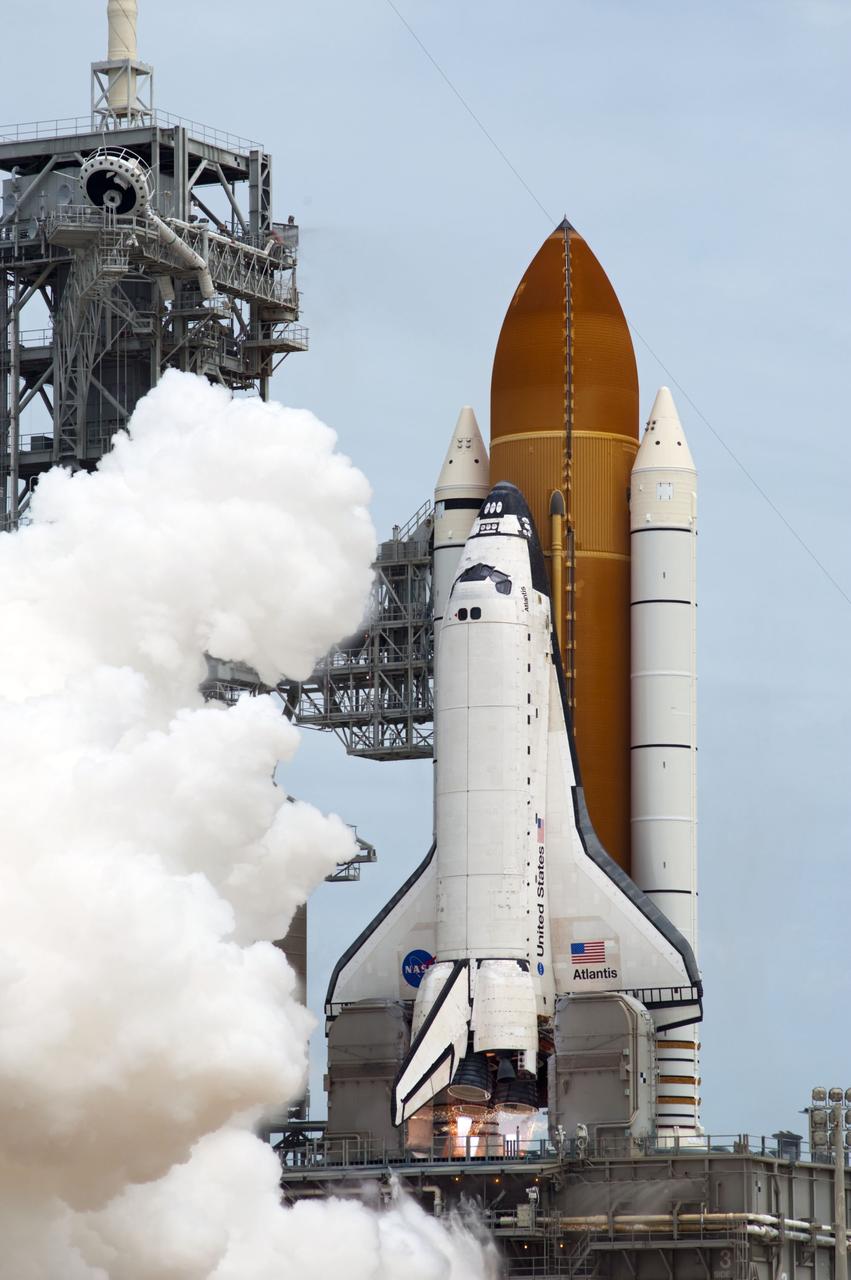
CAPE CANAVERAL, Fla. -- At NASA's Kennedy Space Center in Florida, space shuttle Atlantis' main engines ignite on Launch Pad 39A producing billows of steam and smoke as it lifts off on its STS-135 mission to the International Space Station. Atlantis with its crew of four; Commander Chris Ferguson, Pilot Doug Hurley, Mission Specialists Sandy Magnus and Rex Walheim, lifted off at 11:29 a.m. EDT on July 8, 2011 to deliver the Raffaello multi-purpose logistics module packed with supplies and spare parts for the station. Atlantis also will fly the Robotic Refueling Mission experiment that will investigate the potential for robotically refueling existing satellites in orbit. In addition, Atlantis will return with a failed ammonia pump module to help NASA better understand the failure mechanism and improve pump designs for future systems. STS-135 is the 33rd flight of Atlantis, the 37th shuttle mission to the space station, and the 135th and final mission of NASA's Space Shuttle Program. For more information, visit www.nasa.gov/mission_pages/shuttle/shuttlemissions/sts135/index.html. Photo credit: NASA/Sandra Joseph and Kevin O'Connell
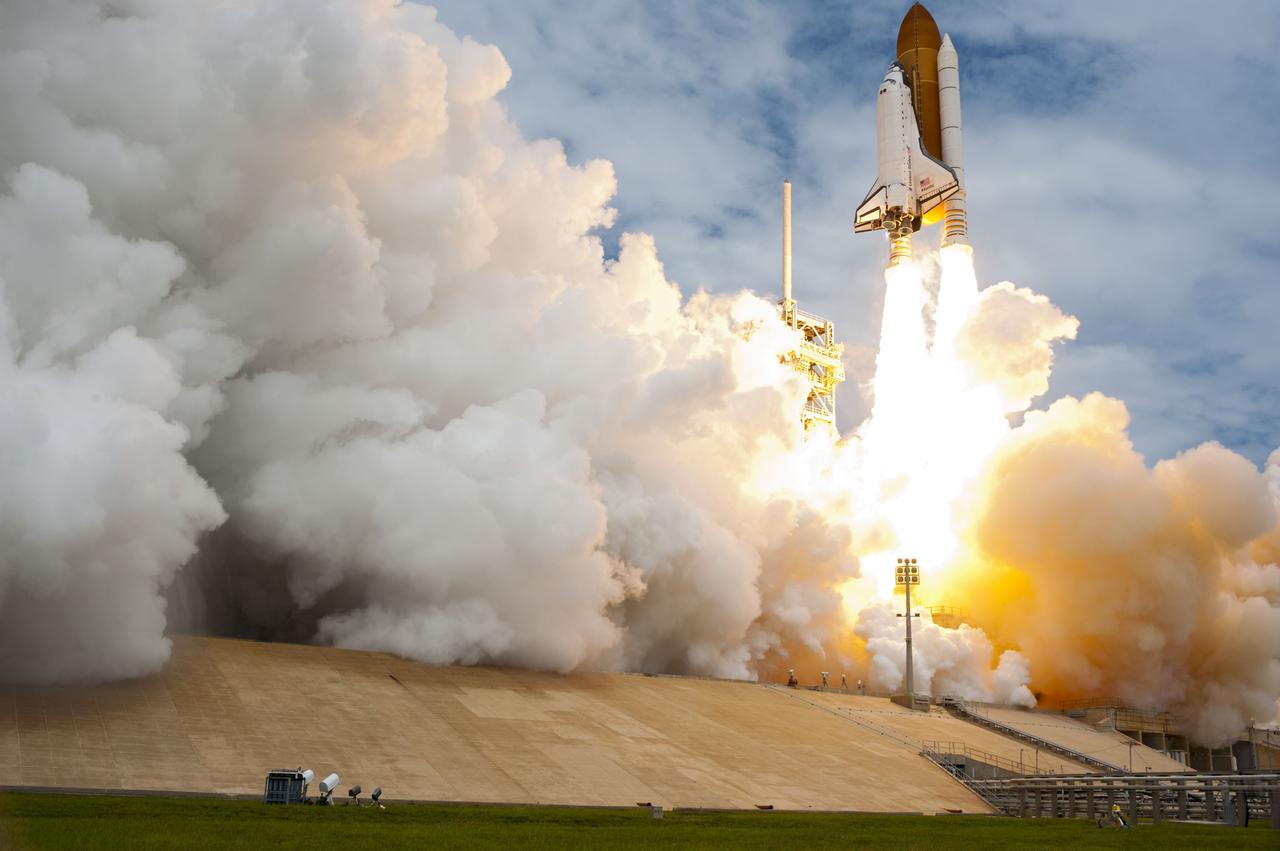
CAPE CANAVERAL, Fla. -- At NASA's Kennedy Space Center in Florida, space shuttle Atlantis lifts off from Launch Pad 39A out of billows of smoke and flame on its STS-135 mission to the International Space Station. Atlantis with its crew of four; Commander Chris Ferguson, Pilot Doug Hurley, Mission Specialists Sandy Magnus and Rex Walheim, lifted off at 11:29 a.m. EDT on July 8, 2011 to deliver the Raffaello multi-purpose logistics module packed with supplies and spare parts for the station. Atlantis also will fly the Robotic Refueling Mission experiment that will investigate the potential for robotically refueling existing satellites in orbit. In addition, Atlantis will return with a failed ammonia pump module to help NASA better understand the failure mechanism and improve pump designs for future systems. STS-135 is the 33rd flight of Atlantis, the 37th shuttle mission to the space station, and the 135th and final mission of NASA's Space Shuttle Program. For more information, visit www.nasa.gov/mission_pages/shuttle/shuttlemissions/sts135/index.html. Photo credit: NASA/Tony Gray and Tom Farrar
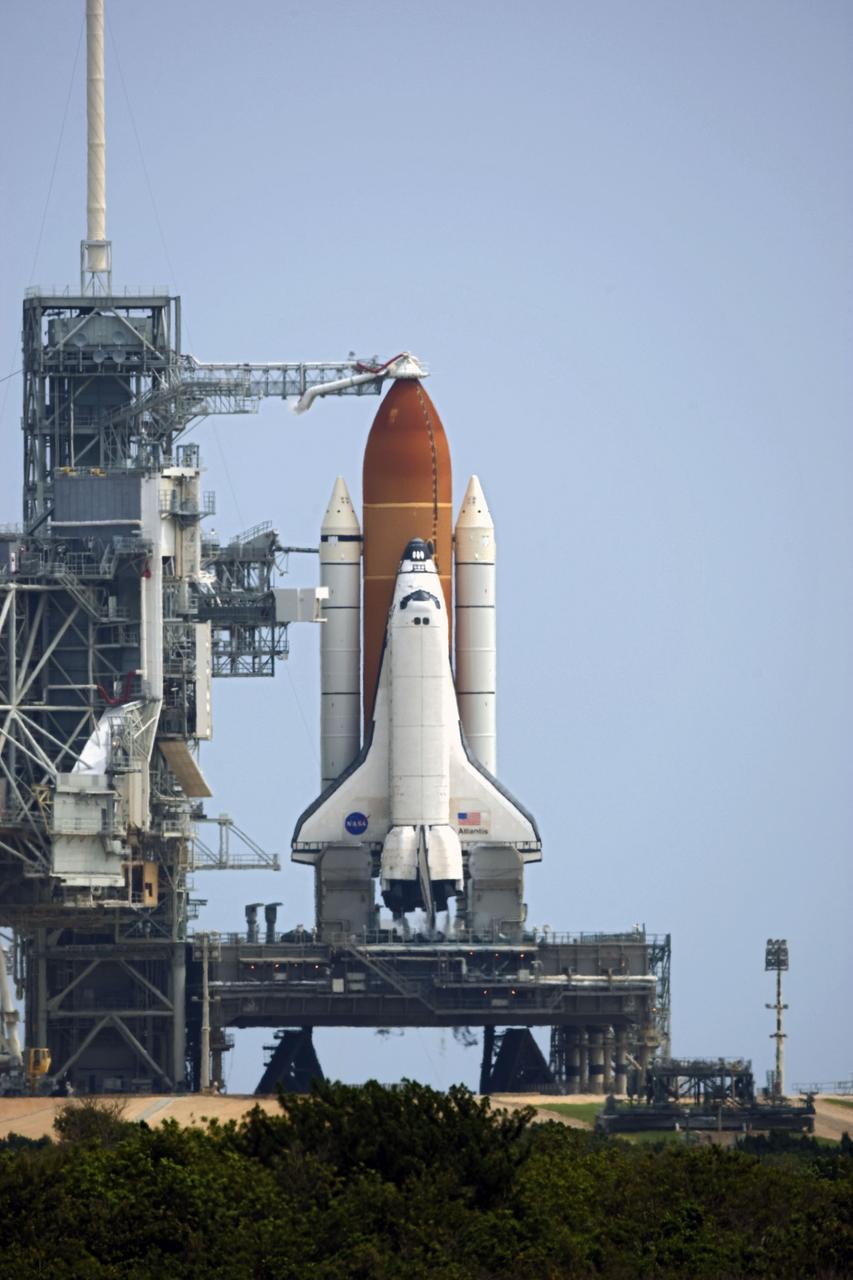
CAPE CANAVERAL, Fla. -- Space shuttle Atlantis awaits liftoff from Launch Pad 39A at NASA's Kennedy Space Center in Florida on its STS-135 mission to the International Space Station. Atlantis with its crew of four; Commander Chris Ferguson, Pilot Doug Hurley, Mission Specialists Sandy Magnus and Rex Walheim, lifted off at 11:29 a.m. EDT on July 8, 2011 to deliver the Raffaello multi-purpose logistics module packed with supplies and spare parts for the International Space Station. Atlantis also will fly the Robotic Refueling Mission experiment that will investigate the potential for robotically refueling existing satellites in orbit. In addition, Atlantis will return with a failed ammonia pump module to help NASA better understand the failure mechanism and improve pump designs for future systems. STS-135 is the 33rd flight of Atlantis, the 37th shuttle mission to the space station, and the 135th and final mission of NASA's Space Shuttle Program. For more information, visit www.nasa.gov/mission_pages/shuttle/shuttlemissions/sts135/index.html. Photo credit: NASA/Kenny Allen
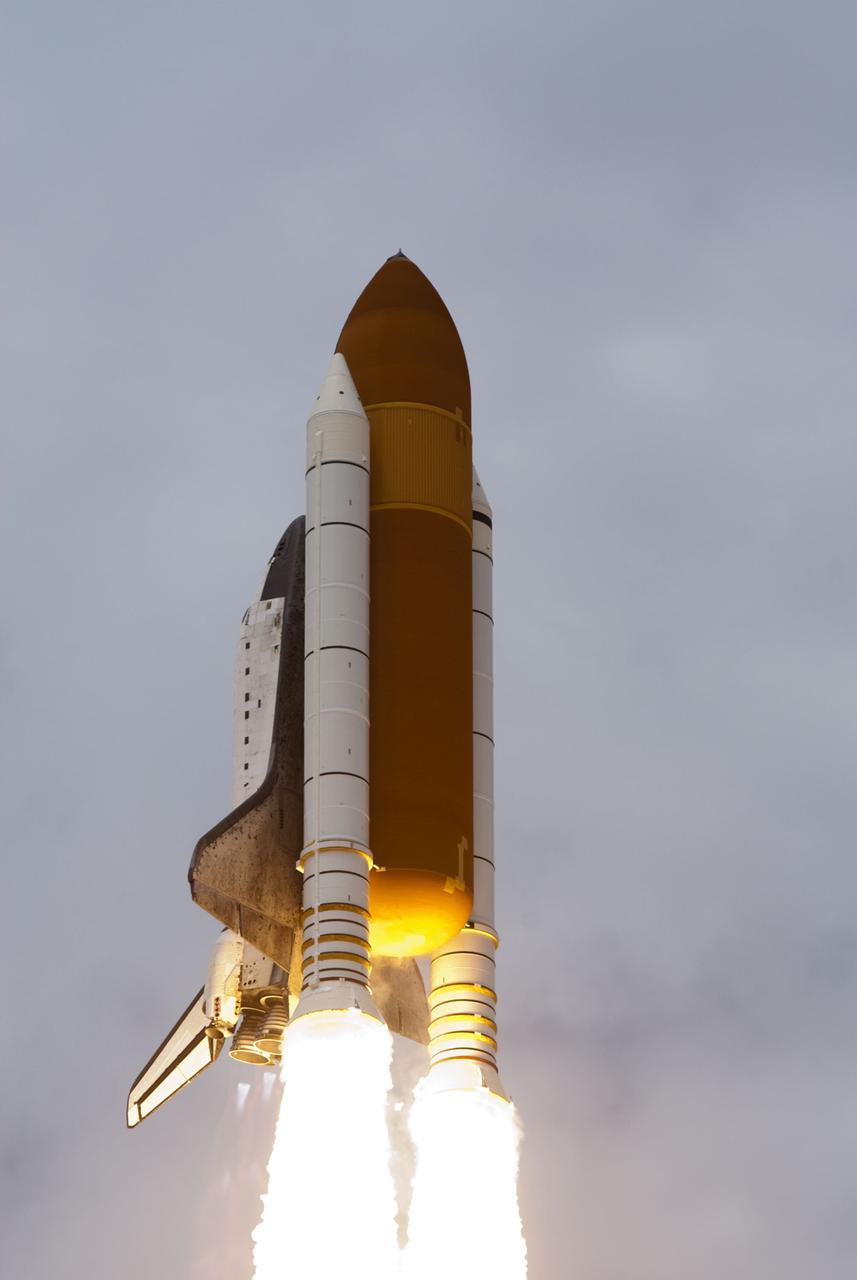
CAPE CANAVERAL, Fla. -- At Launch Pad 39A at NASA's Kennedy Space Center in Florida, space shuttle Atlantis soars into the clouds on its STS-135 mission to the International Space Station. Atlantis with its crew of four; Commander Chris Ferguson, Pilot Doug Hurley, Mission Specialists Sandy Magnus and Rex Walheim, lifted off at 11:29 a.m. EDT on July 8, 2011 to deliver the Raffaello multi-purpose logistics module packed with supplies and spare parts for the station. Atlantis also will fly the Robotic Refueling Mission experiment that will investigate the potential for robotically refueling existing satellites in orbit. In addition, Atlantis will return with a failed ammonia pump module to help NASA better understand the failure mechanism and improve pump designs for future systems. STS-135 is the 33rd flight of Atlantis, the 37th shuttle mission to the space station, and the 135th and final mission of NASA's Space Shuttle Program. For more information, visit www.nasa.gov/mission_pages/shuttle/shuttlemissions/sts135/index.html. Photo credit: NASA/Rusty Backer and Mike Gayle
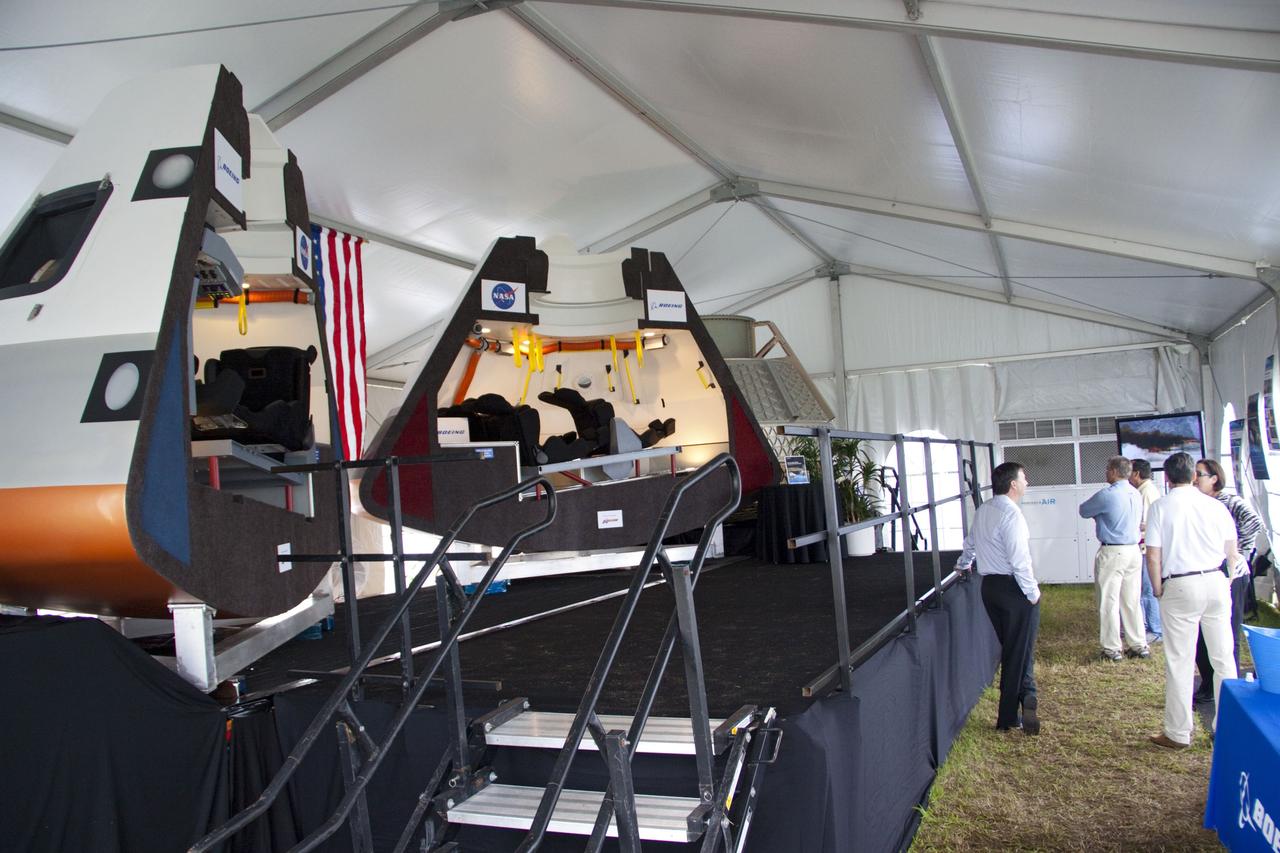
CAPE CANAVERAL, Fla. -- A media event was held for the Multi-Purpose Crew Vehicle (MPCV) that was on display in a tent on the grounds of the Press Site at NASA's Kennedy Space Center in Florida during launch activities for space shuttle Atlantis' STS-135 mission to the International Space Station. The MPCV is based on the Orion design requirements for traveling beyond low Earth orbit and will serve as the exploration vehicle that will carry the crew to space, provide emergency abort capability, sustain the crew during the space travel, and provide safe re-entry from deep space return velocities. Atlantis began its final flight, with Commander Chris Ferguson, Pilot Doug Hurley and Mission Specialists Sandy Magnus and Rex Walheim on board, at 11:29 a.m. EDT July 8 to deliver the Raffaello multi-purpose logistics module packed with supplies and spare parts to the station. Also in Atlantis' payload bay is the Robotic Refueling Mission experiment that will investigate the potential for robotically refueling existing satellites in orbit. In addition, Atlantis will return with a failed ammonia pump module to help NASA better understand the failure mechanism and improve pump designs for future systems. STS-135 is the 33rd flight of Atlantis, the 37th shuttle mission to the space station, and the 135th and final mission of NASA's Space Shuttle Program. For more information, visit www.nasa.gov/mission_pages/shuttle/shuttlemissions/sts135/index.html. Photo credit: NASA/Jim Grossmann
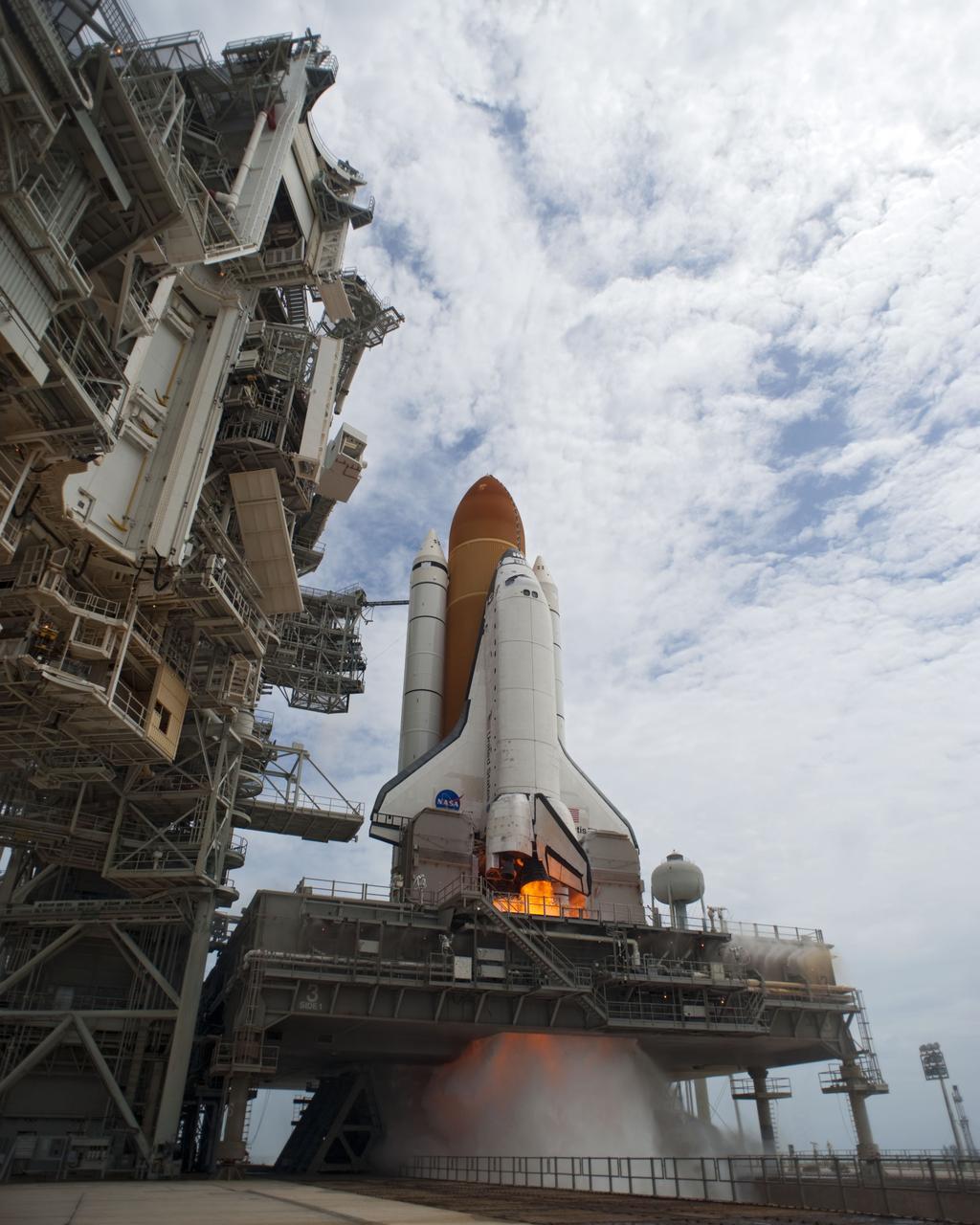
CAPE CANAVERAL, Fla. -- Smoke and steam begins to billow outward as space shuttle Atlantis' main engines are ignited for liftoff at Launch Pad 39A at NASA's Kennedy Space Center in Florida as it begins its STS-135 mission to the International Space Station. Atlantis with its crew of four; Commander Chris Ferguson, Pilot Doug Hurley, Mission Specialists Sandy Magnus and Rex Walheim, lifted off at 11:29 a.m. EDT on July 8, 2011 to deliver the Raffaello multi-purpose logistics module packed with supplies and spare parts for the station. Atlantis also will fly the Robotic Refueling Mission experiment that will investigate the potential for robotically refueling existing satellites in orbit. In addition, Atlantis will return with a failed ammonia pump module to help NASA better understand the failure mechanism and improve pump designs for future systems. STS-135 is the 33rd flight of Atlantis, the 37th shuttle mission to the space station, and the 135th and final mission of NASA's Space Shuttle Program. For more information, visit www.nasa.gov/mission_pages/shuttle/shuttlemissions/sts135/index.html. Photo credit: NASA/Tony Gray and Tom Farrar

CAPE CANAVERAL, Fla. -- At Launch Pad 39A at NASA's Kennedy Space Center in Florida space shuttle Atlantis is reflected in a pond near the pad after the retraction of the rotating service structure (RSS). The structure provides weather protection and access to the shuttle while it awaits liftoff on the pad. RSS retract marks a major milestone in Atlantis' STS-135 mission countdown. Atlantis and its crew of four; Commander Chris Ferguson, Pilot Doug Hurley, Mission Specialists Sandy Magnus and Rex Walheim will lift off at 11:26 a.m. EDT on July 8 to deliver the Raffaello multi-purpose logistics module packed with supplies and spare parts for the International Space Station. Atlantis also will fly the Robotic Refueling Mission experiment that will investigate the potential for robotically refueling existing satellites in orbit. In addition, Atlantis will return with a failed ammonia pump module to help NASA better understand the failure mechanism and improve pump designs for future systems. STS-135 is the 33rd flight of Atlantis, the 37th shuttle mission to the space station, and the 135th and final mission of NASA's Space Shuttle Program. For more information, visit www.nasa.gov/mission_pages/shuttle/shuttlemissions/sts135/index.html. Photo credit: Jim Grossmann
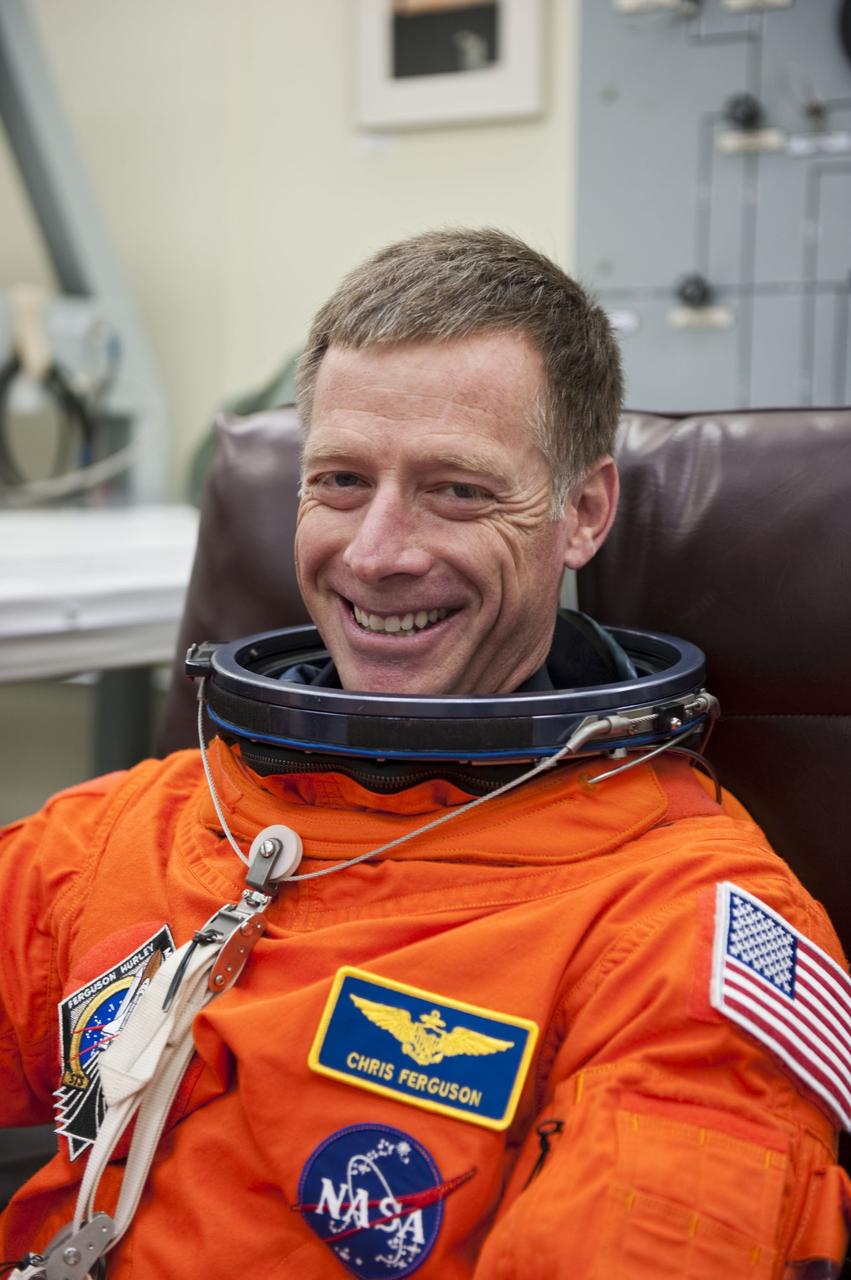
CAPE CANAVERAL, Fla. -- In the Operations and Checkout Building at NASA's Kennedy Space Center in Florida, STS-135 Commander Chris Ferguson checks the fit of his launch-and-entry suit during a simulated launch countdown. As part of the Terminal Countdown Demonstration Test (TCDT), the crew members are taken to Kennedy's Launch Pad 39A and strapped into space shuttle Atlantis to practice the steps that will be taken on launch day. Atlantis and its crew are targeted to lift off July 8, taking with them the Raffaello multi-purpose logistics module packed with supplies and spare parts to the International Space Station. The STS-135 mission also will fly a system to investigate the potential for robotically refueling existing satellites and return a failed ammonia pump module to help NASA better understand the failure mechanism and improve pump designs for future systems. STS-135 will be the 33rd flight of Atlantis, the 37th shuttle mission to the space station, and the 135th and final mission of NASA's Space Shuttle Program. For more information visit, www.nasa.gov/mission_pages/shuttle/shuttlemissions/sts135/index.html. Photo credit: NASA/Kim Shiflett
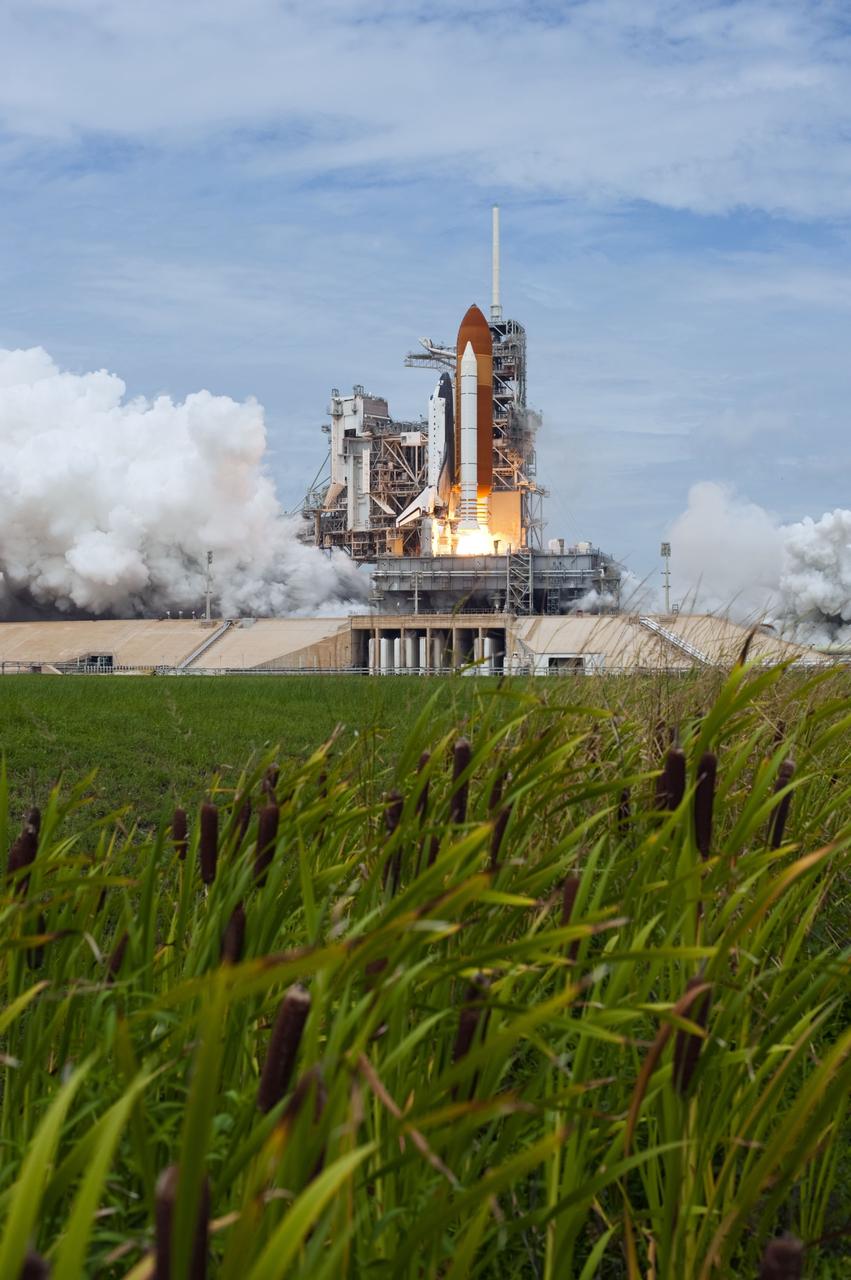
CAPE CANAVERAL, Fla. -- At NASA's Kennedy Space Center in Florida, space shuttle Atlantis' main engines and solid rocket boosters ignite on Launch Pad 39A producing billows of smoke and steam as it lifts off on its STS-135 mission to the International Space Station. Atlantis with its crew of four; Commander Chris Ferguson, Pilot Doug Hurley, Mission Specialists Sandy Magnus and Rex Walheim, lifted off at 11:29 a.m. EDT on July 8, 2011 to deliver the Raffaello multi-purpose logistics module packed with supplies and spare parts for the station. Atlantis also will fly the Robotic Refueling Mission experiment that will investigate the potential for robotically refueling existing satellites in orbit. In addition, Atlantis will return with a failed ammonia pump module to help NASA better understand the failure mechanism and improve pump designs for future systems. STS-135 is the 33rd flight of Atlantis, the 37th shuttle mission to the space station, and the 135th and final mission of NASA's Space Shuttle Program. For more information, visit www.nasa.gov/mission_pages/shuttle/shuttlemissions/sts135/index.html. Photo credit: NASA/Tony Gray and Tom Farrar
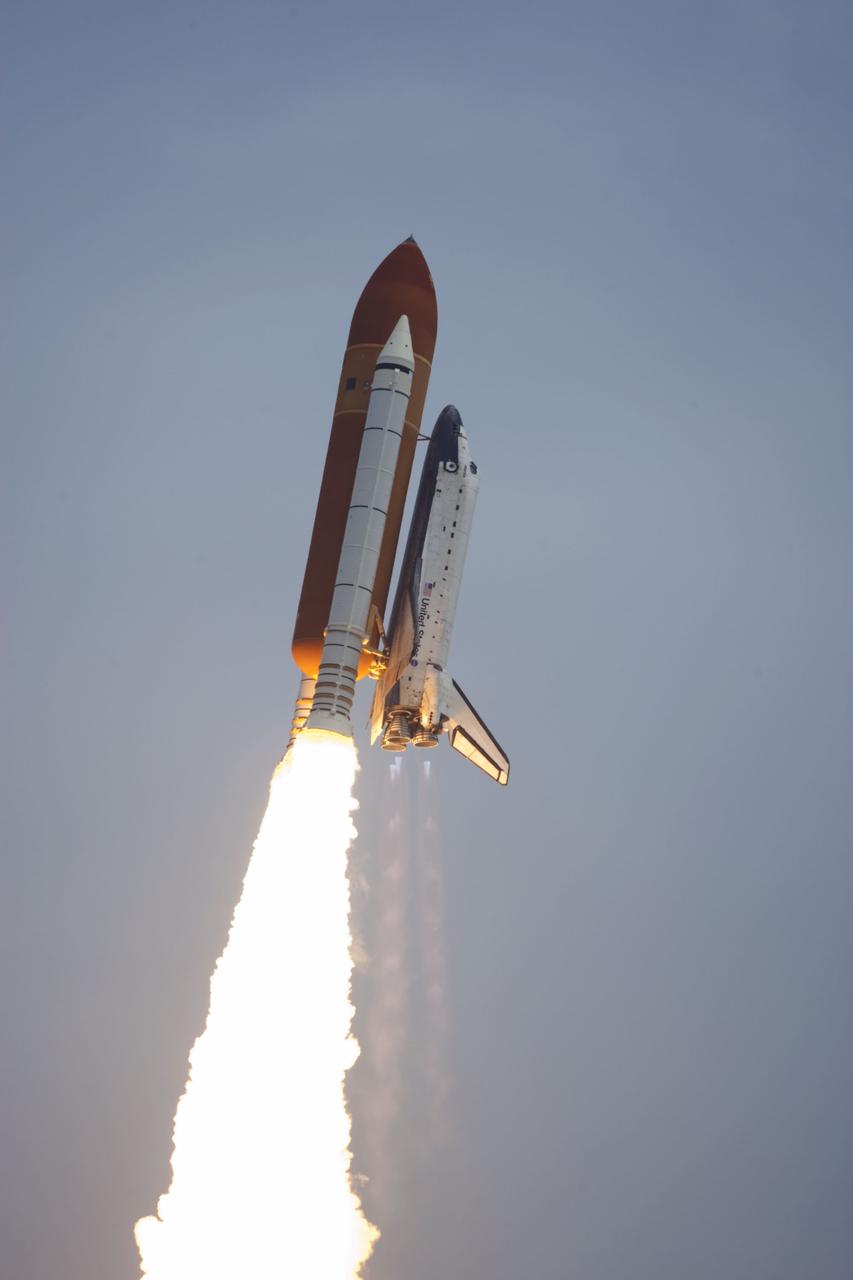
CAPE CANAVERAL, Fla. -- Space shuttle Atlantis completes its roll program moments after liftoff from Launch Pad 39A at NASA's Kennedy Space Center in Florida on its STS-135 mission to the International Space Station. The roll maneuver puts the shuttle in the proper orientation as it heads into space. Atlantis with its crew of four; Commander Chris Ferguson, Pilot Doug Hurley, Mission Specialists Sandy Magnus and Rex Walheim, lifted off at 11:29 a.m. EDT on July 8, 2011 to deliver the Raffaello multi-purpose logistics module packed with supplies and spare parts for the International Space Station. Atlantis also will fly the Robotic Refueling Mission experiment that will investigate the potential for robotically refueling existing satellites in orbit. In addition, Atlantis will return with a failed ammonia pump module to help NASA better understand the failure mechanism and improve pump designs for future systems. STS-135 is the 33rd flight of Atlantis, the 37th shuttle mission to the space station, and the 135th and final mission of NASA's Space Shuttle Program. For more information, visit www.nasa.gov/mission_pages/shuttle/shuttlemissions/sts135/index.html. Photo credit: NASA/ Kenny Allen