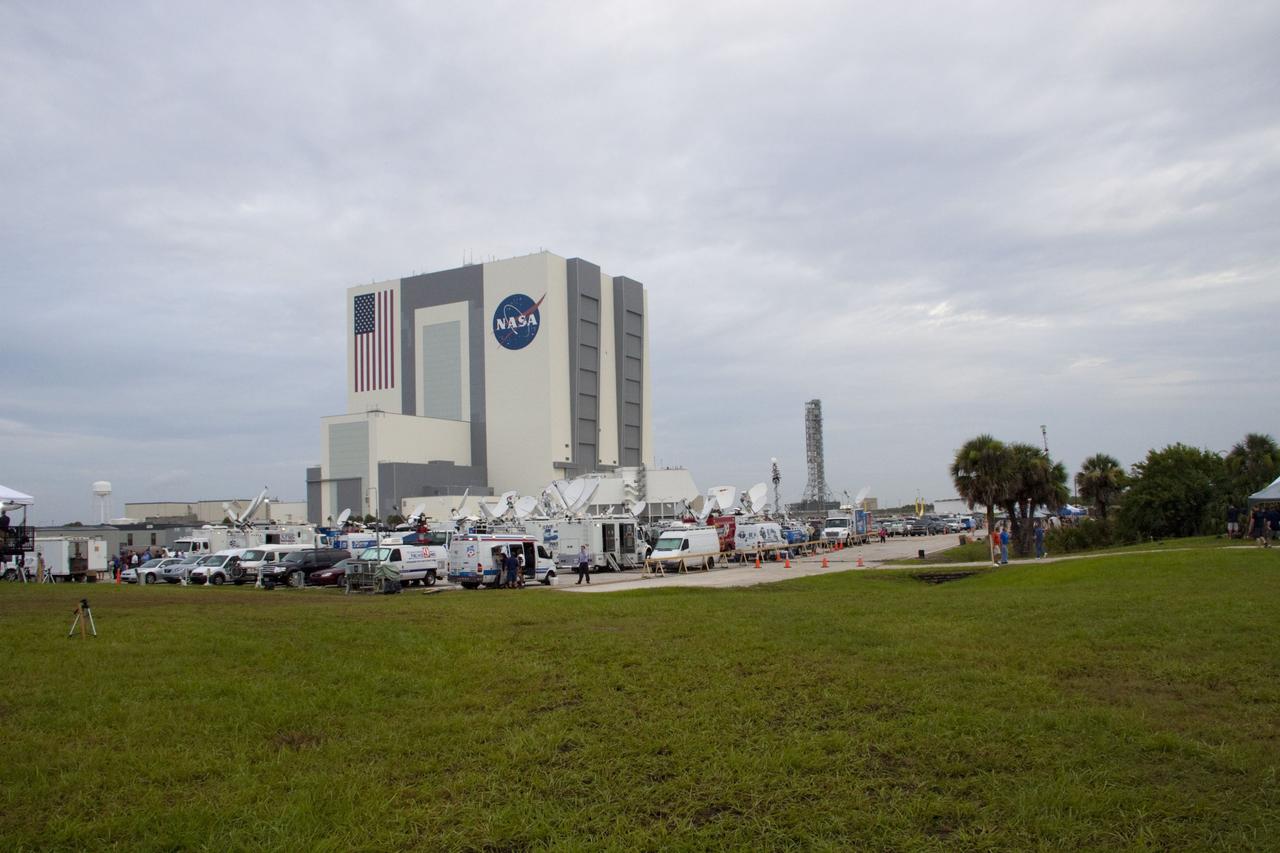
CAPE CANAVERAL, Fla. -- Media from around the globe gather on the grounds of the Press Site at NASA's Kennedy Space Center in Florida to photograph and cover the prelaunch activities and lift off of space shuttle Atlantis on its STS-135 mission to the International Space Station. Dozens of satellite news vehicles can be seen in the parking lot while the massive Vehicle Assembly Building towers above in the background. Atlantis began its final flight, with Commander Chris Ferguson, Pilot Doug Hurley and Mission Specialists Sandy Magnus and Rex Walheim on board, at 11:29 a.m. EDT July 8 to deliver the Raffaello multi-purpose logistics module packed with supplies and spare parts to the station. Also in Atlantis' payload bay is the Robotic Refueling Mission experiment that will investigate the potential for robotically refueling existing satellites in orbit. In addition, Atlantis will return with a failed ammonia pump module to help NASA better understand the failure mechanism and improve pump designs for future systems. STS-135 is the 33rd flight of Atlantis, the 37th shuttle mission to the space station, and the 135th and final mission of NASA's Space Shuttle Program. For more information, visit www.nasa.gov/mission_pages/shuttle/shuttlemissions/sts135/index.html. Photo credit: NASA/Jim Grossmann
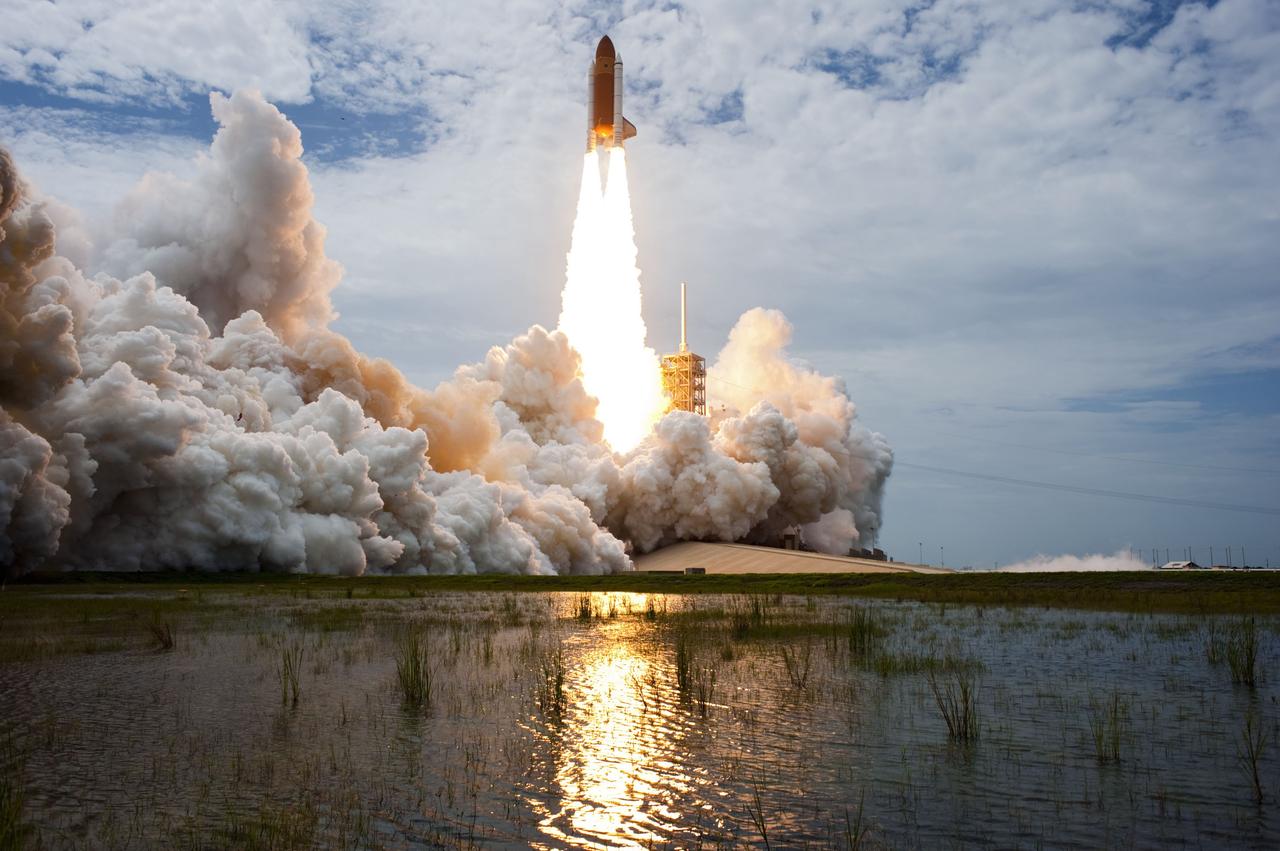
CAPE CANAVERAL, Fla. -- At NASA's Kennedy Space Center in Florida, space shuttle Atlantis lifts off of Launch Pad 39A leaving behind billows of steam and smoke as it heads into the clouds on its STS-135 mission to the International Space Station. Atlantis with its crew of four; Commander Chris Ferguson, Pilot Doug Hurley, Mission Specialists Sandy Magnus and Rex Walheim, lifted off at 11:29 a.m. EDT on July 8, 2011 to deliver the Raffaello multi-purpose logistics module packed with supplies and spare parts for the station. Atlantis also will fly the Robotic Refueling Mission experiment that will investigate the potential for robotically refueling existing satellites in orbit. In addition, Atlantis will return with a failed ammonia pump module to help NASA better understand the failure mechanism and improve pump designs for future systems. STS-135 is the 33rd flight of Atlantis, the 37th shuttle mission to the space station, and the 135th and final mission of NASA's Space Shuttle Program. For more information, visit www.nasa.gov/mission_pages/shuttle/shuttlemissions/sts135/index.html. Photo credit: NASA/Sandra Joseph and Kevin O'Connell
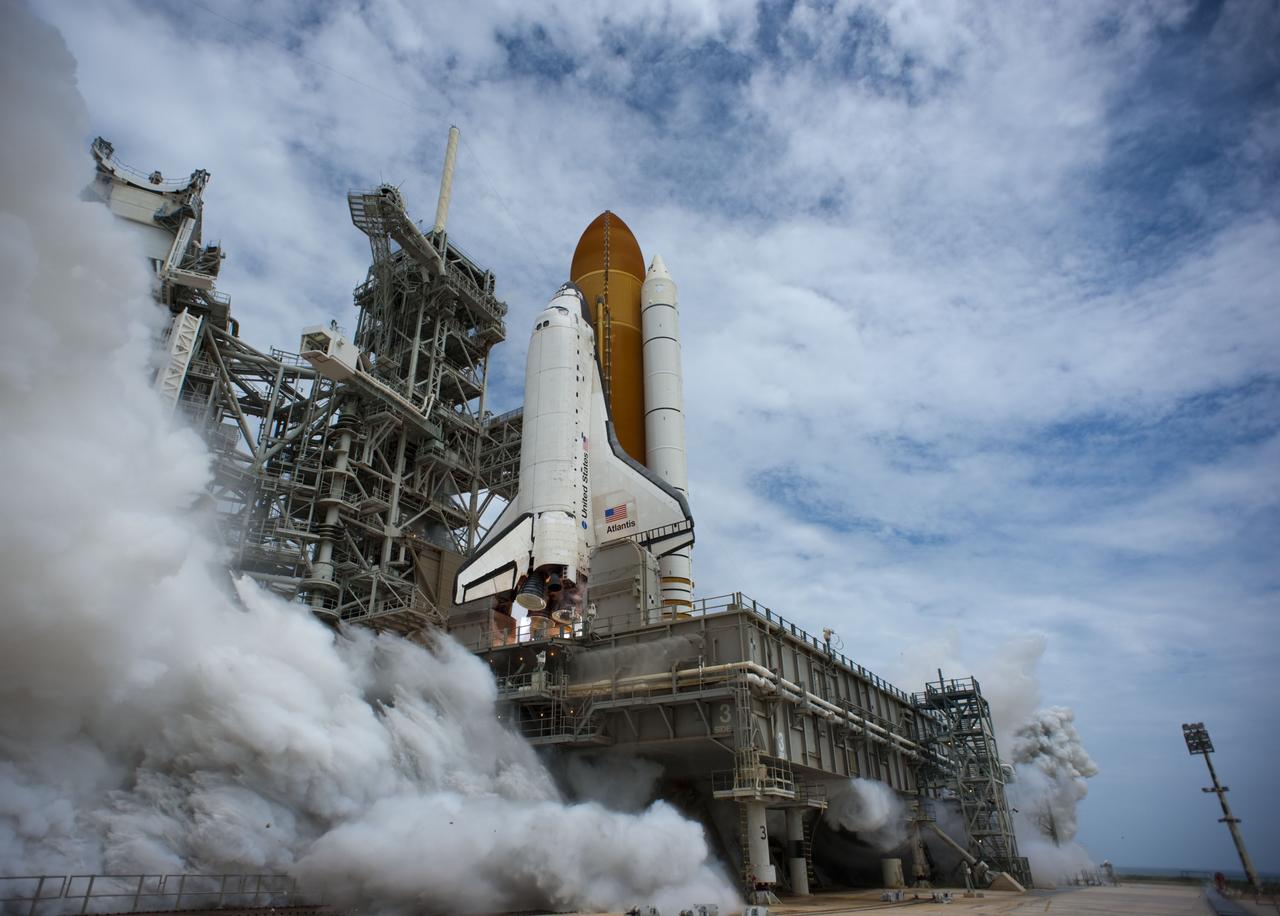
CAPE CANAVERAL, Fla. -- At NASA's Kennedy Space Center in Florida, space shuttle Atlantis' main engines ignite on Launch Pad 39A producing billows of steam and smoke as it lifts off on its STS-135 mission to the International Space Station. Atlantis with its crew of four; Commander Chris Ferguson, Pilot Doug Hurley, Mission Specialists Sandy Magnus and Rex Walheim, lifted off at 11:29 a.m. EDT on July 8, 2011 to deliver the Raffaello multi-purpose logistics module packed with supplies and spare parts for the station. Atlantis also will fly the Robotic Refueling Mission experiment that will investigate the potential for robotically refueling existing satellites in orbit. In addition, Atlantis will return with a failed ammonia pump module to help NASA better understand the failure mechanism and improve pump designs for future systems. STS-135 is the 33rd flight of Atlantis, the 37th shuttle mission to the space station, and the 135th and final mission of NASA's Space Shuttle Program. For more information, visit www.nasa.gov/mission_pages/shuttle/shuttlemissions/sts135/index.html. Photo credit: NASA/Sandra Joseph and Kevin O'Connell
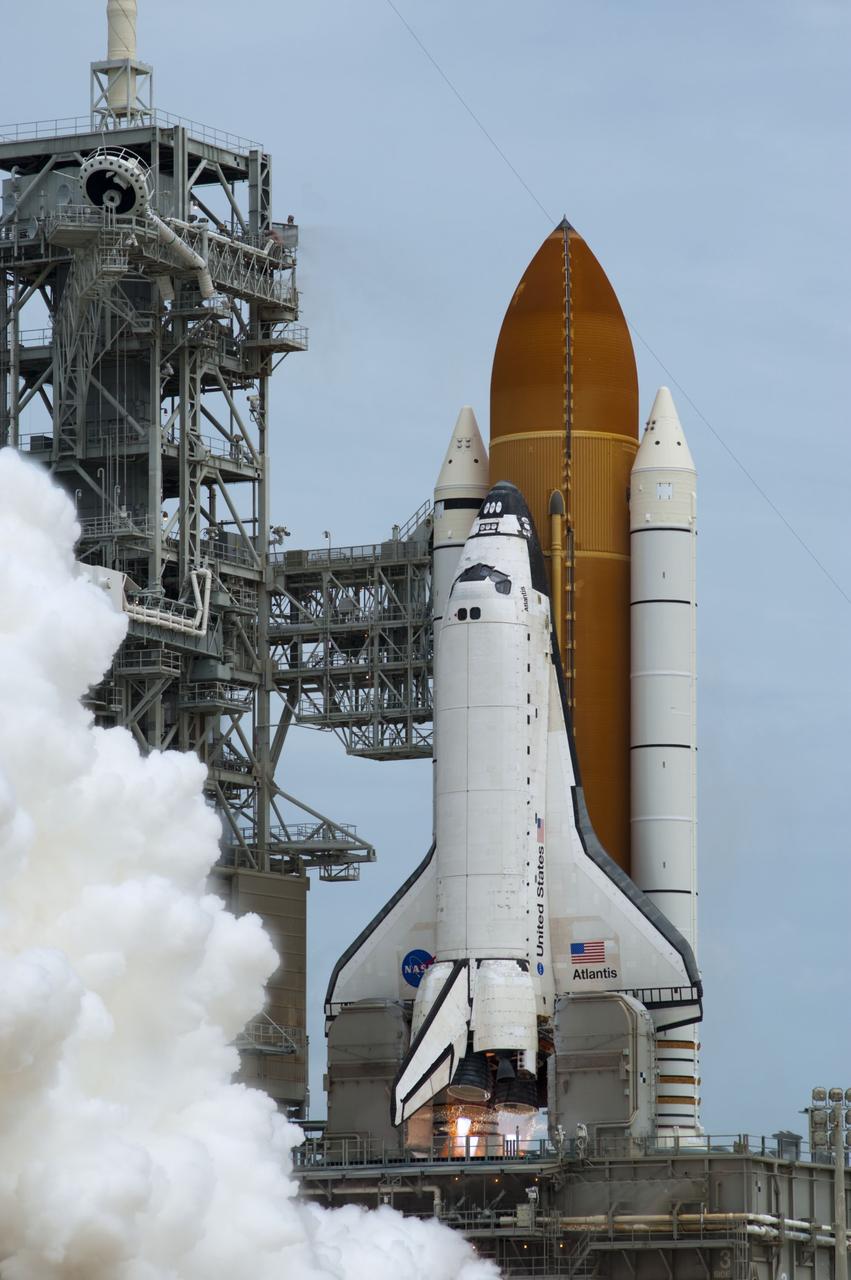
CAPE CANAVERAL, Fla. -- At NASA's Kennedy Space Center in Florida, space shuttle Atlantis' engines and solid rocket boosters ignite on Launch Pad 39A as it begins to lift off on its STS-135 mission to the International Space Station. Atlantis with its crew of four; Commander Chris Ferguson, Pilot Doug Hurley, Mission Specialists Sandy Magnus and Rex Walheim, lifted off at 11:29 a.m. EDT on July 8, 2011 to deliver the Raffaello multi-purpose logistics module packed with supplies and spare parts for the station. Atlantis also will fly the Robotic Refueling Mission experiment that will investigate the potential for robotically refueling existing satellites in orbit. In addition, Atlantis will return with a failed ammonia pump module to help NASA better understand the failure mechanism and improve pump designs for future systems. STS-135 is the 33rd flight of Atlantis, the 37th shuttle mission to the space station, and the 135th and final mission of NASA's Space Shuttle Program. For more information, visit www.nasa.gov/mission_pages/shuttle/shuttlemissions/sts135/index.html. Photo credit: NASA/Tony Gray and Tom Farrar
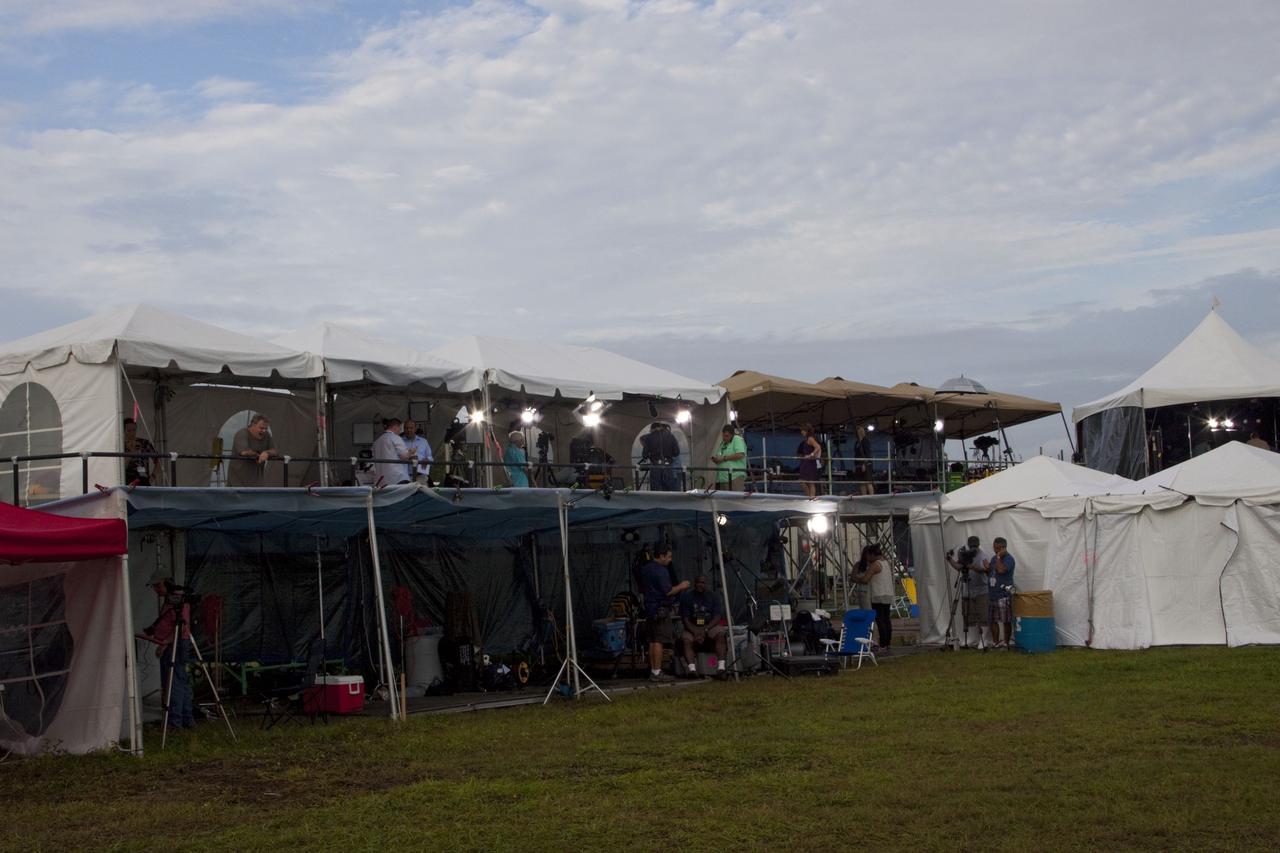
CAPE CANAVERAL, Fla. -- Media from around the globe gather in their respective tents at the Press Site at NASA's Kennedy Space Center in Florida to photograph and cover the prelaunch activities and lift off of space shuttle Atlantis on its STS-135 mission to the International Space Station. Atlantis began its final flight, with Commander Chris Ferguson, Pilot Doug Hurley and Mission Specialists Sandy Magnus and Rex Walheim on board, at 11:29 a.m. EDT July 8 to deliver the Raffaello multi-purpose logistics module packed with supplies and spare parts to the station. Also in Atlantis' payload bay is the Robotic Refueling Mission experiment that will investigate the potential for robotically refueling existing satellites in orbit. In addition, Atlantis will return with a failed ammonia pump module to help NASA better understand the failure mechanism and improve pump designs for future systems. STS-135 is the 33rd flight of Atlantis, the 37th shuttle mission to the space station, and the 135th and final mission of NASA's Space Shuttle Program. For more information, visit www.nasa.gov/mission_pages/shuttle/shuttlemissions/sts135/index.html. Photo credit: NASA/Jim Grossmann

CAPE CANAVERAL, Fla. -- At NASA's Kennedy Space Center in Florida, space shuttle Atlantis lifts off out of billows of smoke and flame from Launch Pad 39A on its way to space on the STS-135 mission to the International Space Station. Atlantis with its crew of four; Commander Chris Ferguson, Pilot Doug Hurley, Mission Specialists Sandy Magnus and Rex Walheim, lifted off at 11:29 a.m. EDT on July 8, 2011 to deliver the Raffaello multi-purpose logistics module packed with supplies and spare parts for the station. Atlantis also will fly the Robotic Refueling Mission experiment that will investigate the potential for robotically refueling existing satellites in orbit. In addition, Atlantis will return with a failed ammonia pump module to help NASA better understand the failure mechanism and improve pump designs for future systems. STS-135 is the 33rd flight of Atlantis, the 37th shuttle mission to the space station, and the 135th and final mission of NASA's Space Shuttle Program. For more information, visit www.nasa.gov/mission_pages/shuttle/shuttlemissions/sts135/index.html. Photo credit: NASA/Tony Gray and Tom Farrar

CAPE CANAVERAL, Fla. -- At NASA's Kennedy Space Center in Florida, space shuttle Atlantis' main engines and solid rocket boosters ignite on Launch Pad 39A producing billows of steam and smoke as it lifts off on its STS-135 mission to the International Space Station. Atlantis with its crew of four; Commander Chris Ferguson, Pilot Doug Hurley, Mission Specialists Sandy Magnus and Rex Walheim, lifted off at 11:29 a.m. EDT on July 8, 2011 to deliver the Raffaello multi-purpose logistics module packed with supplies and spare parts for the station. Atlantis also will fly the Robotic Refueling Mission experiment that will investigate the potential for robotically refueling existing satellites in orbit. In addition, Atlantis will return with a failed ammonia pump module to help NASA better understand the failure mechanism and improve pump designs for future systems. STS-135 is the 33rd flight of Atlantis, the 37th shuttle mission to the space station, and the 135th and final mission of NASA's Space Shuttle Program. For more information, visit www.nasa.gov/mission_pages/shuttle/shuttlemissions/sts135/index.html. Photo credit: NASA/Tony Gray and Tom Farrar
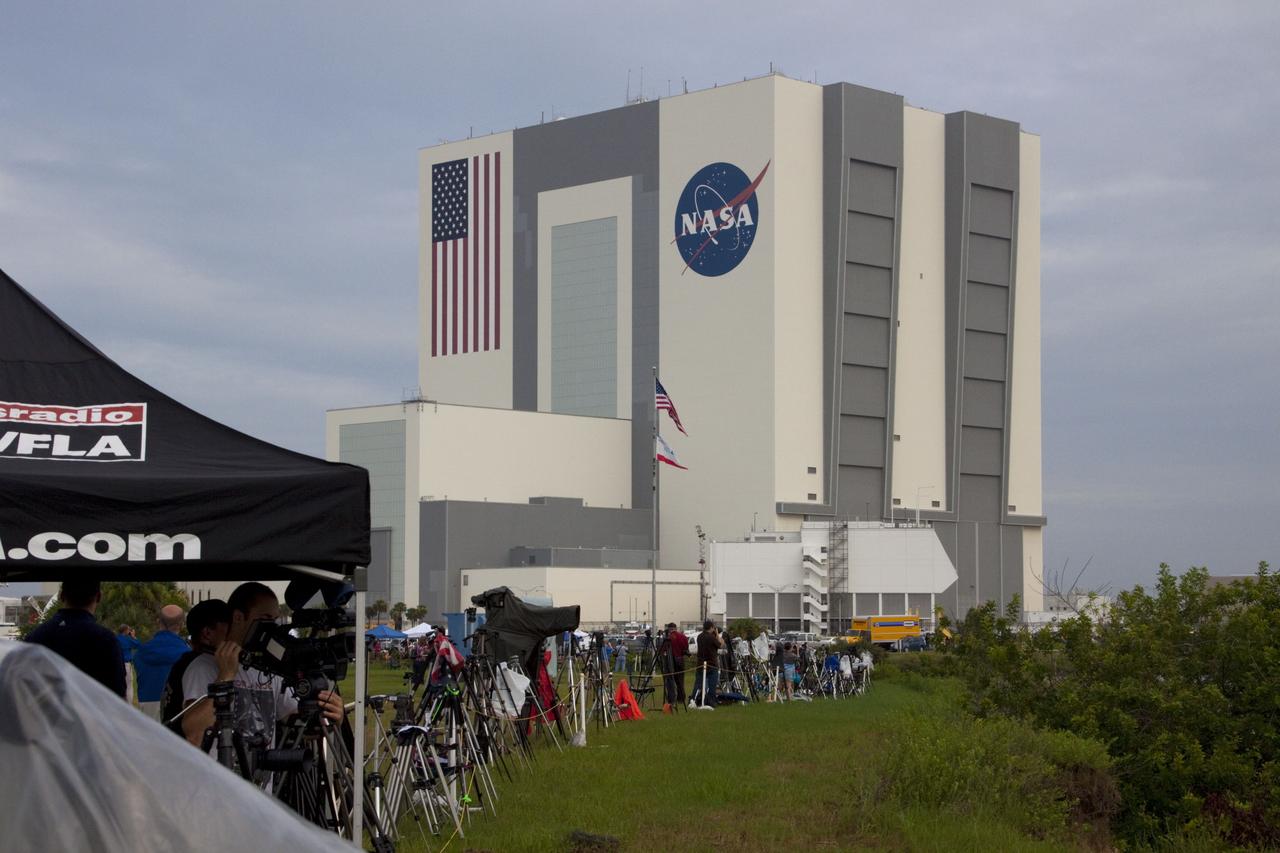
CAPE CANAVERAL, Fla. -- Media from around the globe gather on the grounds of the Press Site at NASA's Kennedy Space Center in Florida to photograph and cover the prelaunch activities and lift off of space shuttle Atlantis on its STS-135 mission to the International Space Station. Seen towering above is the massive Vehicle Assembly Building. Atlantis began its final flight, with Commander Chris Ferguson, Pilot Doug Hurley and Mission Specialists Sandy Magnus and Rex Walheim on board, at 11:29 a.m. EDT July 8 to deliver the Raffaello multi-purpose logistics module packed with supplies and spare parts to the station. Also in Atlantis' payload bay is the Robotic Refueling Mission experiment that will investigate the potential for robotically refueling existing satellites in orbit. In addition, Atlantis will return with a failed ammonia pump module to help NASA better understand the failure mechanism and improve pump designs for future systems. STS-135 is the 33rd flight of Atlantis, the 37th shuttle mission to the space station, and the 135th and final mission of NASA's Space Shuttle Program. For more information, visit www.nasa.gov/mission_pages/shuttle/shuttlemissions/sts135/index.html. Photo credit: NASA/Jim Grossmann
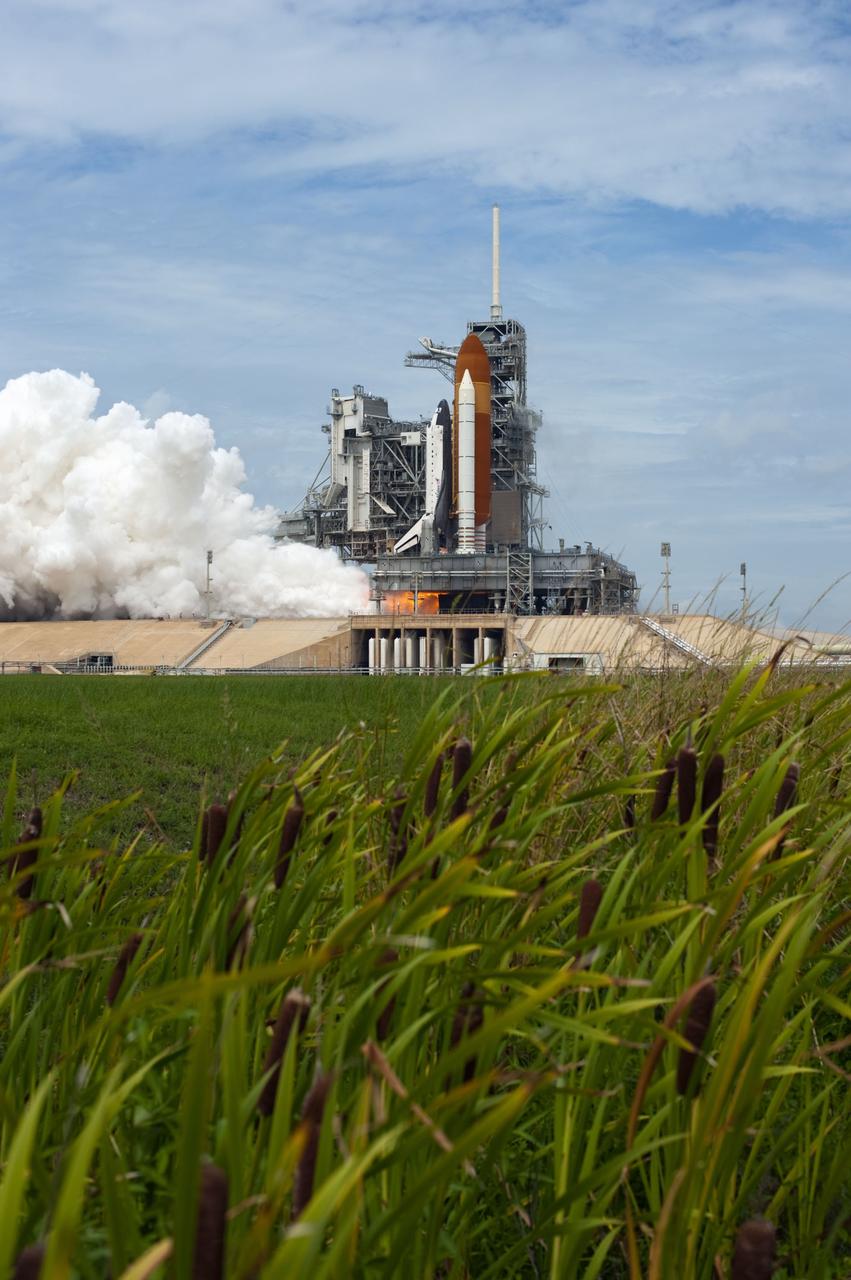
CAPE CANAVERAL, Fla. -- At NASA's Kennedy Space Center in Florida, space shuttle Atlantis' main engines and solid rocket boosters ignite on Launch Pad 39A producing billows of smoke and steam as it lifts off on its STS-135 mission to the International Space Station. Atlantis with its crew of four; Commander Chris Ferguson, Pilot Doug Hurley, Mission Specialists Sandy Magnus and Rex Walheim, lifted off at 11:29 a.m. EDT on July 8, 2011 to deliver the Raffaello multi-purpose logistics module packed with supplies and spare parts for the station. Atlantis also will fly the Robotic Refueling Mission experiment that will investigate the potential for robotically refueling existing satellites in orbit. In addition, Atlantis will return with a failed ammonia pump module to help NASA better understand the failure mechanism and improve pump designs for future systems. STS-135 is the 33rd flight of Atlantis, the 37th shuttle mission to the space station, and the 135th and final mission of NASA's Space Shuttle Program. For more information, visit www.nasa.gov/mission_pages/shuttle/shuttlemissions/sts135/index.html. Photo credit: NASA/Tony Gray and Tom Farrar
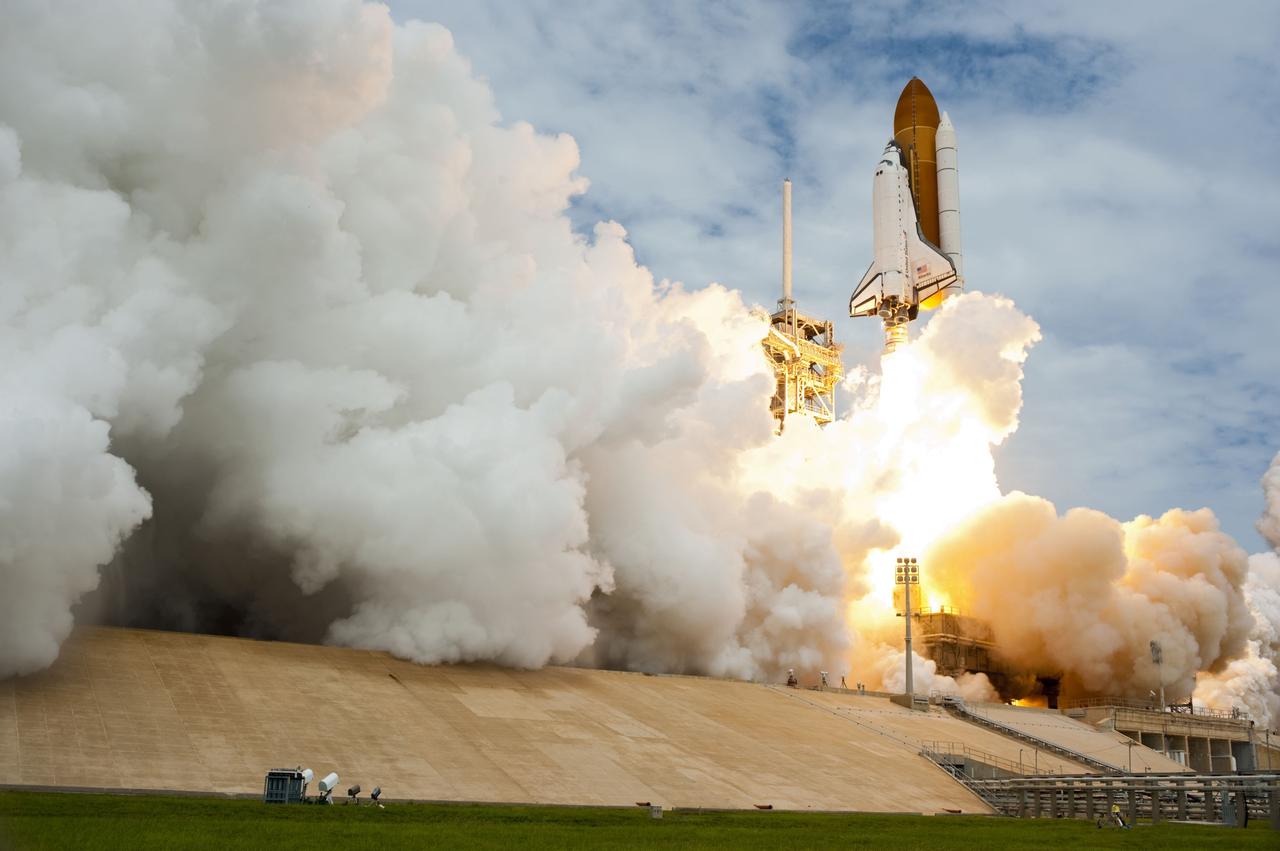
CAPE CANAVERAL, Fla. -- At NASA's Kennedy Space Center in Florida, space shuttle Atlantis lifts off from Launch Pad 39A out of billows of smoke and flame on its STS-135 mission to the International Space Station. Atlantis with its crew of four; Commander Chris Ferguson, Pilot Doug Hurley, Mission Specialists Sandy Magnus and Rex Walheim, lifted off at 11:29 a.m. EDT on July 8, 2011 to deliver the Raffaello multi-purpose logistics module packed with supplies and spare parts for the station. Atlantis also will fly the Robotic Refueling Mission experiment that will investigate the potential for robotically refueling existing satellites in orbit. In addition, Atlantis will return with a failed ammonia pump module to help NASA better understand the failure mechanism and improve pump designs for future systems. STS-135 is the 33rd flight of Atlantis, the 37th shuttle mission to the space station, and the 135th and final mission of NASA's Space Shuttle Program. For more information, visit www.nasa.gov/mission_pages/shuttle/shuttlemissions/sts135/index.html. Photo credit: NASA/Tony Gray and Tom Farrar
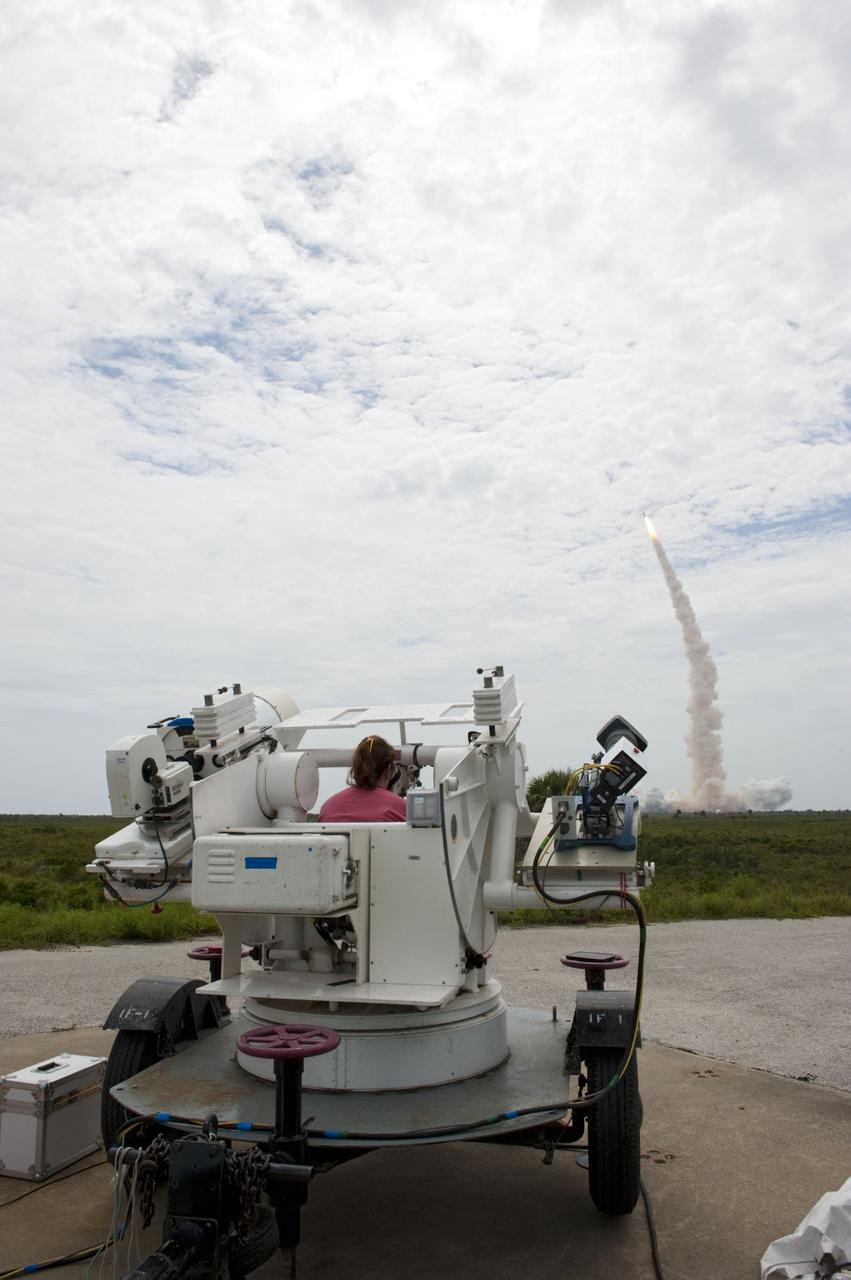
CAPE CANAVERAL, Fla. -- NASA photographer Sandra Joseph aims her remote camera tracker on space shuttle Atlantis at it lifts off from Launch Pad 39A at NASA's Kennedy Space Center in Florida beginning its STS-135 mission to the International Space Station. Atlantis with its crew of four; Commander Chris Ferguson, Pilot Doug Hurley, Mission Specialists Sandy Magnus and Rex Walheim, lifted off at 11:29 a.m. EDT on July 8, 2011 to deliver the Raffaello multi-purpose logistics module packed with supplies and spare parts for the station. Atlantis also will fly the Robotic Refueling Mission experiment that will investigate the potential for robotically refueling existing satellites in orbit. In addition, Atlantis will return with a failed ammonia pump module to help NASA better understand the failure mechanism and improve pump designs for future systems. STS-135 is the 33rd flight of Atlantis, the 37th shuttle mission to the space station, and the 135th and final mission of NASA's Space Shuttle Program. For more information, visit www.nasa.gov/mission_pages/shuttle/shuttlemissions/sts135/index.html. Photo credit: NASA/Sandra Joseph
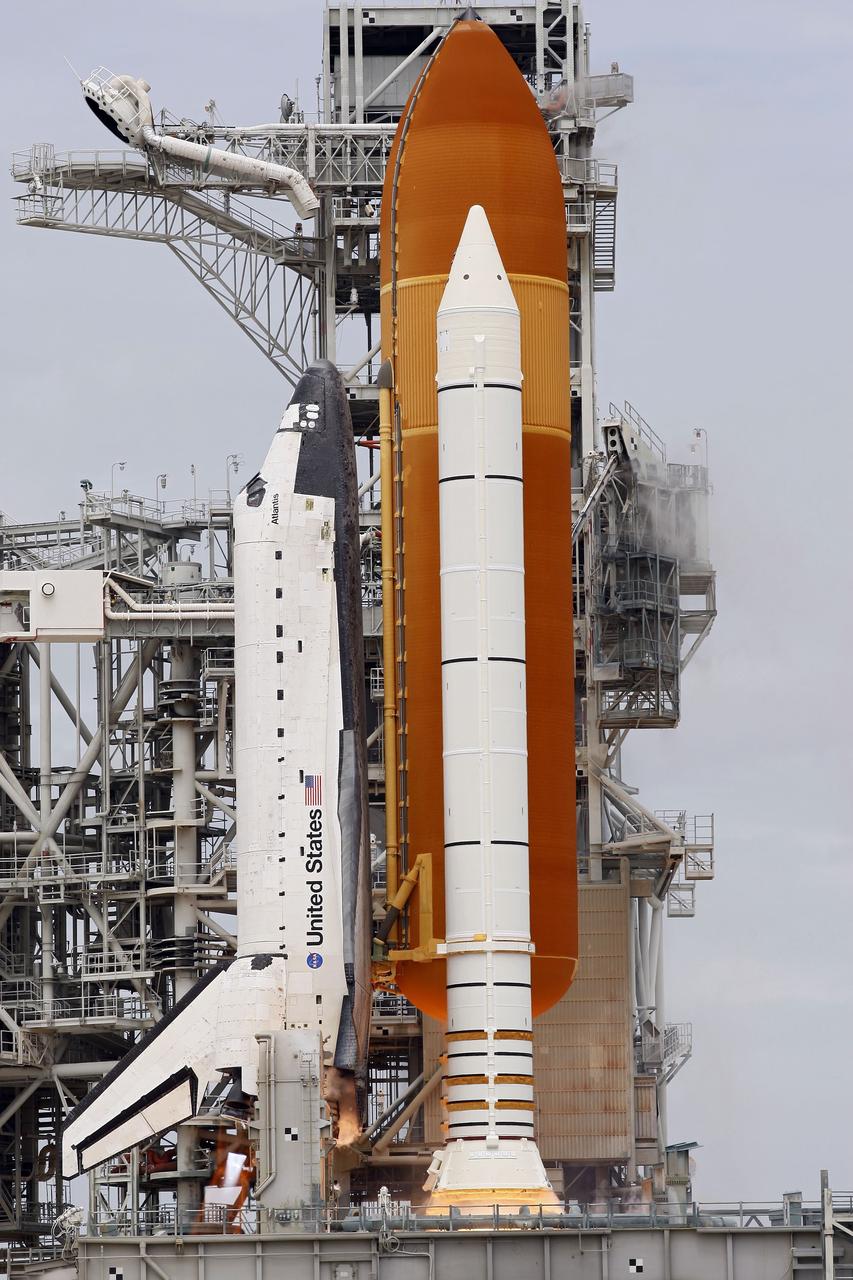
CAPE CANAVERAL, Fla. -- At NASA's Kennedy Space Center in Florida, space shuttle Atlantis' main engines and solid rocket boosters ignite on Launch Pad 39A as it lifts off on its STS-135 mission to the International Space Station. Atlantis with its crew of four; Commander Chris Ferguson, Pilot Doug Hurley, Mission Specialists Sandy Magnus and Rex Walheim, lifted off at 11:29 a.m. EDT on July 8, 2011 to deliver the Raffaello multi-purpose logistics module packed with supplies and spare parts for the International Space Station. Atlantis also will fly the Robotic Refueling Mission experiment that will investigate the potential for robotically refueling existing satellites in orbit. In addition, Atlantis will return with a failed ammonia pump module to help NASA better understand the failure mechanism and improve pump designs for future systems. STS-135 is the 33rd flight of Atlantis, the 37th shuttle mission to the space station, and the 135th and final mission of NASA's Space Shuttle Program. For more information, visit www.nasa.gov/mission_pages/shuttle/shuttlemissions/sts135/index.html. Photo credit: NASA/Rusty Backer and Mike Gayle
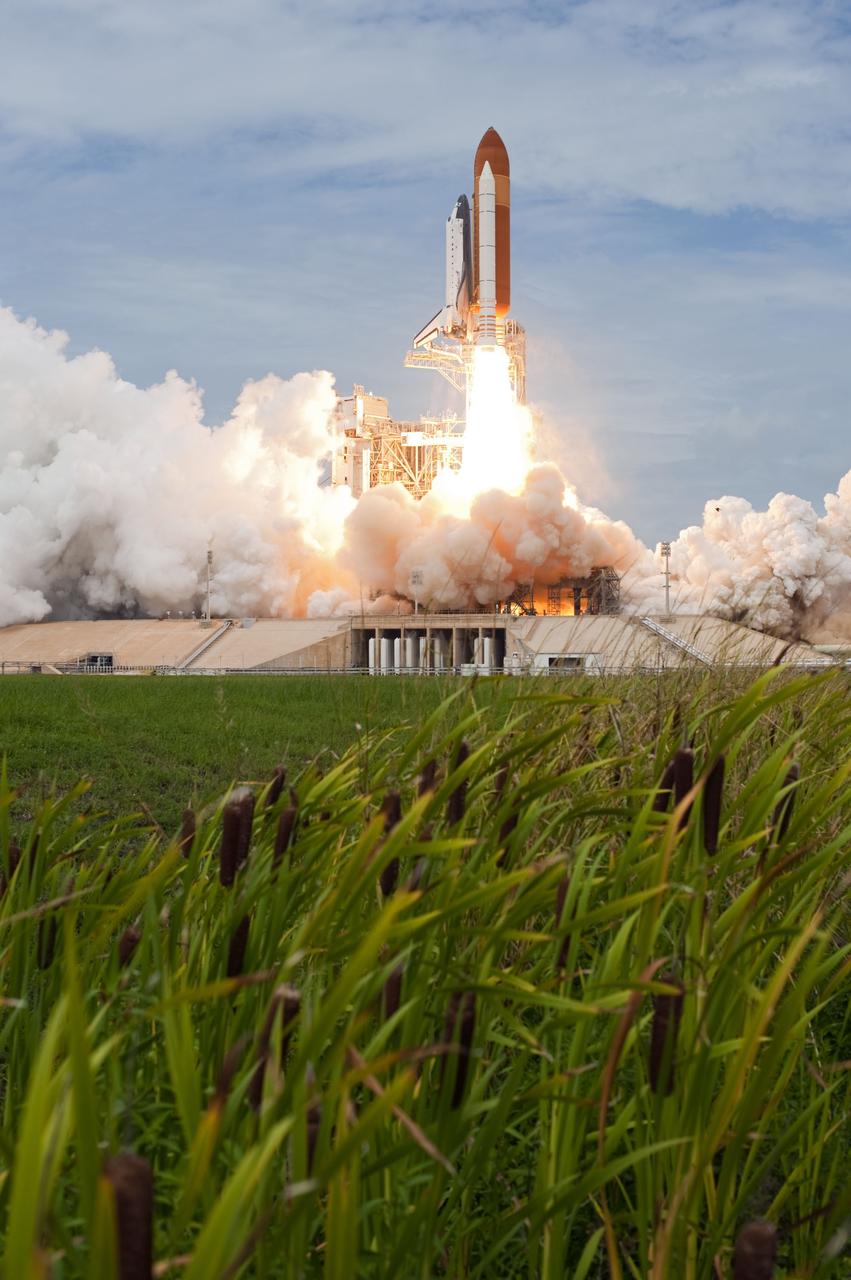
CAPE CANAVERAL, Fla. -- On Launch Pad 39A at NASA's Kennedy Space Center in Florida, space shuttle Atlantis travels upward on streams of flame as it lifts off on its STS-135 mission to the International Space Station. Atlantis with its crew of four; Commander Chris Ferguson, Pilot Doug Hurley, Mission Specialists Sandy Magnus and Rex Walheim, lifted off at 11:29 a.m. EDT on July 8, 2011 to deliver the Raffaello multi-purpose logistics module packed with supplies and spare parts for the station. Atlantis also will fly the Robotic Refueling Mission experiment that will investigate the potential for robotically refueling existing satellites in orbit. In addition, Atlantis will return with a failed ammonia pump module to help NASA better understand the failure mechanism and improve pump designs for future systems. STS-135 is the 33rd flight of Atlantis, the 37th shuttle mission to the space station, and the 135th and final mission of NASA's Space Shuttle Program. For more information, visit www.nasa.gov/mission_pages/shuttle/shuttlemissions/sts135/index.html. Photo credit: NASA/Tony Gray and Tom Farrar

CAPE CANAVERAL, Fla. -- At NASA's Kennedy Space Center in Florida, space shuttle Atlantis' main engines and solid rocket boosters ignite on Launch Pad 39A as it lifts off on its STS-135 mission to the International Space Station. Atlantis with its crew of four; Commander Chris Ferguson, Pilot Doug Hurley, Mission Specialists Sandy Magnus and Rex Walheim, lifted off at 11:29 a.m. EDT on July 8, 2011 to deliver the Raffaello multi-purpose logistics module packed with supplies and spare parts for the station. Atlantis also will fly the Robotic Refueling Mission experiment that will investigate the potential for robotically refueling existing satellites in orbit. In addition, Atlantis will return with a failed ammonia pump module to help NASA better understand the failure mechanism and improve pump designs for future systems. STS-135 is the 33rd flight of Atlantis, the 37th shuttle mission to the space station, and the 135th and final mission of NASA's Space Shuttle Program. For more information, visit www.nasa.gov/mission_pages/shuttle/shuttlemissions/sts135/index.html. Photo credit: NASA/Sandra Joseph and Kevin O'Connell
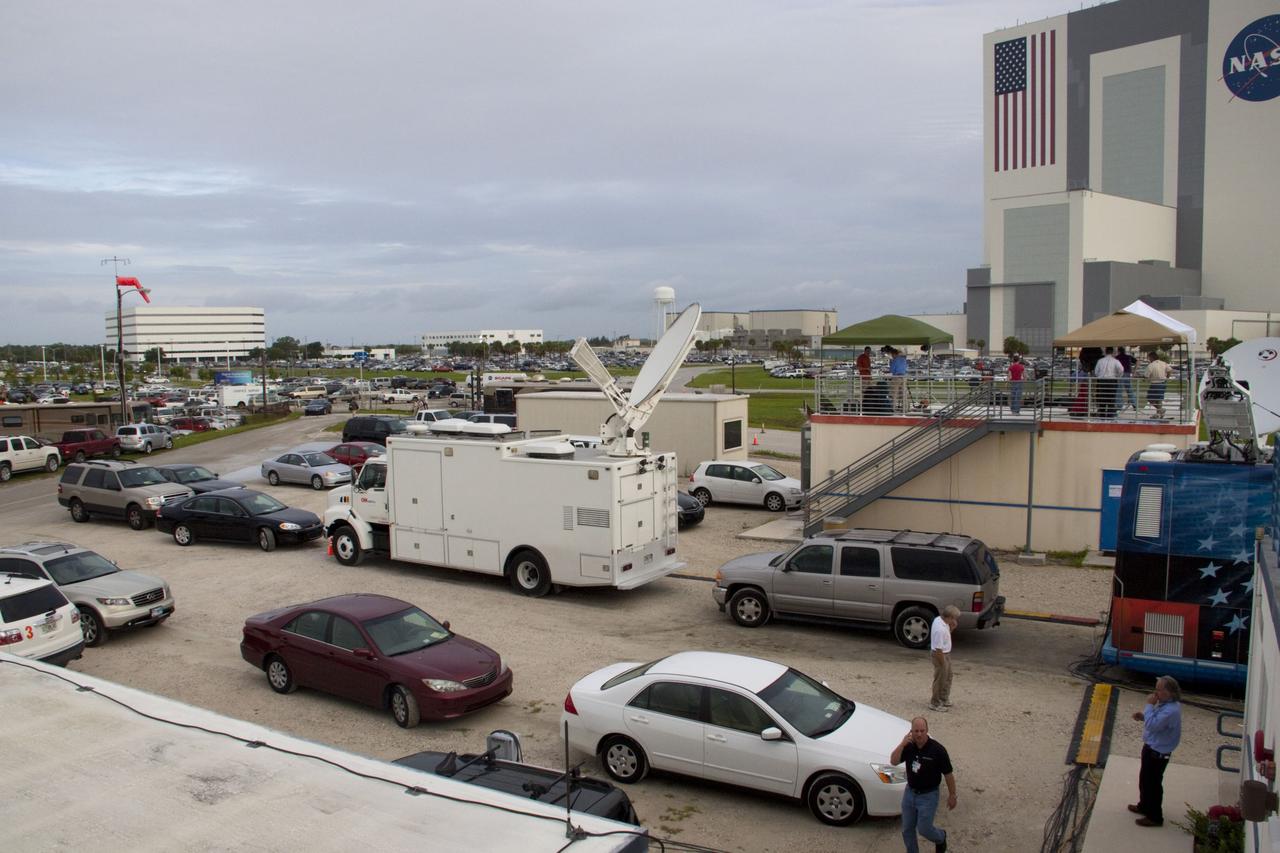
CAPE CANAVERAL, Fla. -- Media from around the globe gather on the grounds of the Press Site at NASA's Kennedy Space Center in Florida to photograph and cover the prelaunch activities and lift off of space shuttle Atlantis on its STS-135 mission to the International Space Station. Seen towering above is the massive Vehicle Assembly Building. Satellite news trucks, trailers and automobiles can be seen in the parking lot with the massive Vehicle Assembly Building towering above. Atlantis began its final flight, with Commander Chris Ferguson, Pilot Doug Hurley and Mission Specialists Sandy Magnus and Rex Walheim on board, at 11:29 a.m. EDT July 8 to deliver the Raffaello multi-purpose logistics module packed with supplies and spare parts to the station. Also in Atlantis' payload bay is the Robotic Refueling Mission experiment that will investigate the potential for robotically refueling existing satellites in orbit. In addition, Atlantis will return with a failed ammonia pump module to help NASA better understand the failure mechanism and improve pump designs for future systems. STS-135 is the 33rd flight of Atlantis, the 37th shuttle mission to the space station, and the 135th and final mission of NASA's Space Shuttle Program. For more information, visit www.nasa.gov/mission_pages/shuttle/shuttlemissions/sts135/index.html. Photo credit: NASA/Jim Grossmann
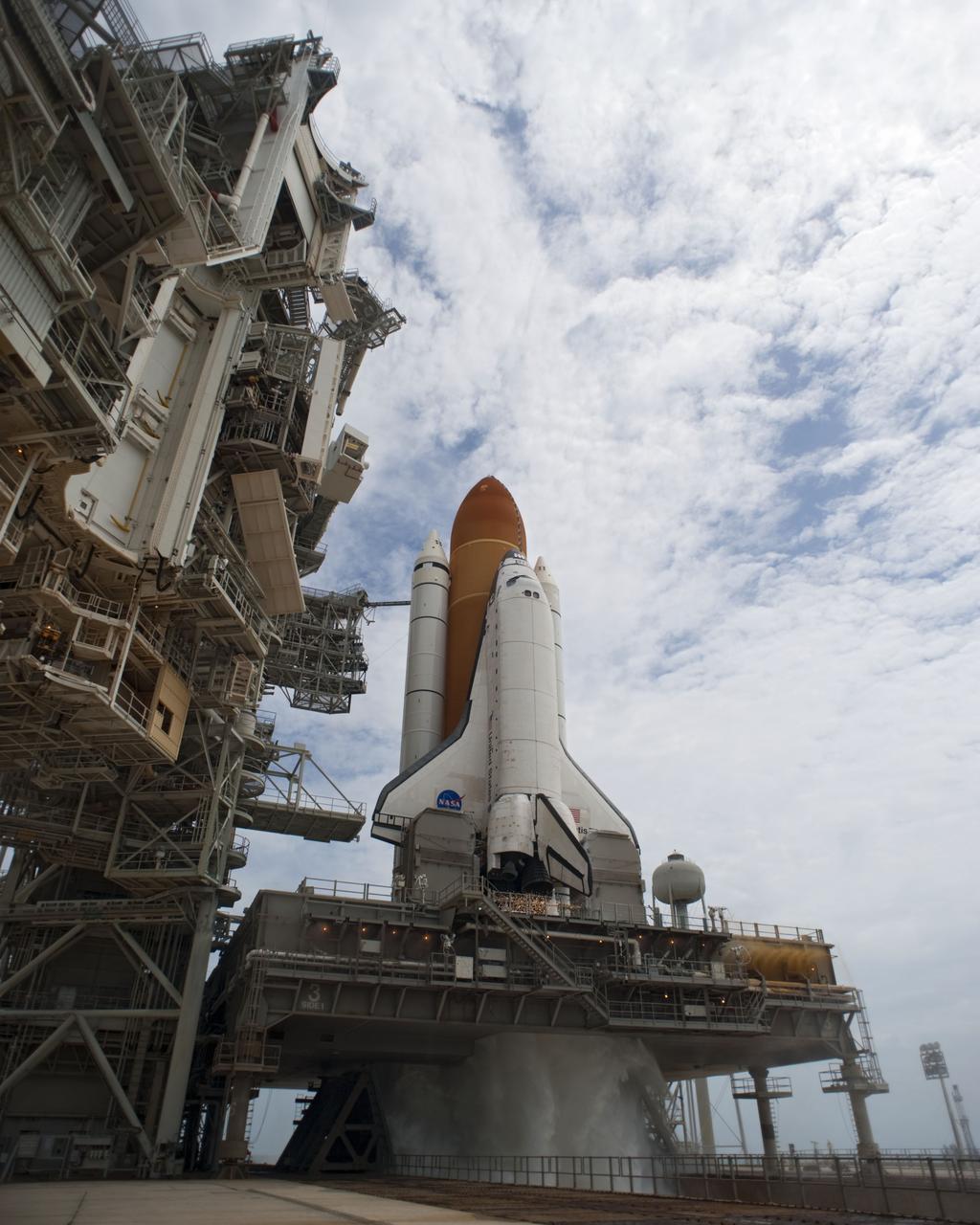
CAPE CANAVERAL, Fla. -- Space shuttle Atlantis' main engines are ignited for liftoff at Launch Pad 39A at NASA's Kennedy Space Center in Florida as it begins its STS-135 mission to the International Space Station. Atlantis with its crew of four; Commander Chris Ferguson, Pilot Doug Hurley, Mission Specialists Sandy Magnus and Rex Walheim, lifted off at 11:29 a.m. EDT on July 8, 2011 to deliver the Raffaello multi-purpose logistics module packed with supplies and spare parts for the station. Atlantis also will fly the Robotic Refueling Mission experiment that will investigate the potential for robotically refueling existing satellites in orbit. In addition, Atlantis will return with a failed ammonia pump module to help NASA better understand the failure mechanism and improve pump designs for future systems. STS-135 is the 33rd flight of Atlantis, the 37th shuttle mission to the space station, and the 135th and final mission of NASA's Space Shuttle Program. For more information, visit www.nasa.gov/mission_pages/shuttle/shuttlemissions/sts135/index.html. Photo credit: NASA/Tony Gray and Tom Farrar
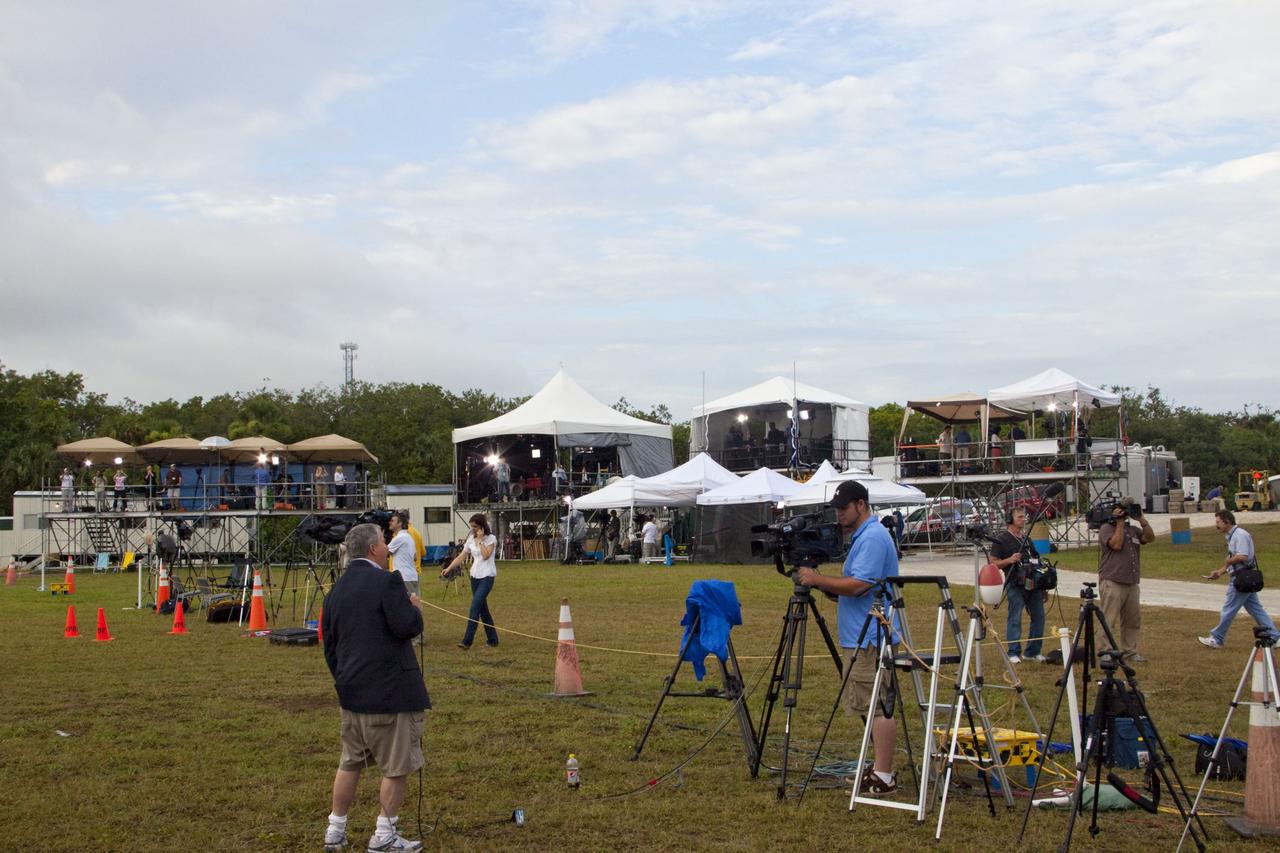
CAPE CANAVERAL, Fla. -- Media from around the globe gather at the Press Site in their respective tents at NASA's Kennedy Space Center in Florida to photograph and cover the prelaunch activities and lift off of space shuttle Atlantis on its STS-135 mission to the International Space Station. Atlantis began its final flight, with Commander Chris Ferguson, Pilot Doug Hurley and Mission Specialists Sandy Magnus and Rex Walheim on board, at 11:29 a.m. EDT July 8 to deliver the Raffaello multi-purpose logistics module packed with supplies and spare parts to the station. Also in Atlantis' payload bay is the Robotic Refueling Mission experiment that will investigate the potential for robotically refueling existing satellites in orbit. In addition, Atlantis will return with a failed ammonia pump module to help NASA better understand the failure mechanism and improve pump designs for future systems. STS-135 is the 33rd flight of Atlantis, the 37th shuttle mission to the space station, and the 135th and final mission of NASA's Space Shuttle Program. For more information, visit www.nasa.gov/mission_pages/shuttle/shuttlemissions/sts135/index.html. Photo credit: NASA/Jim Grossmann
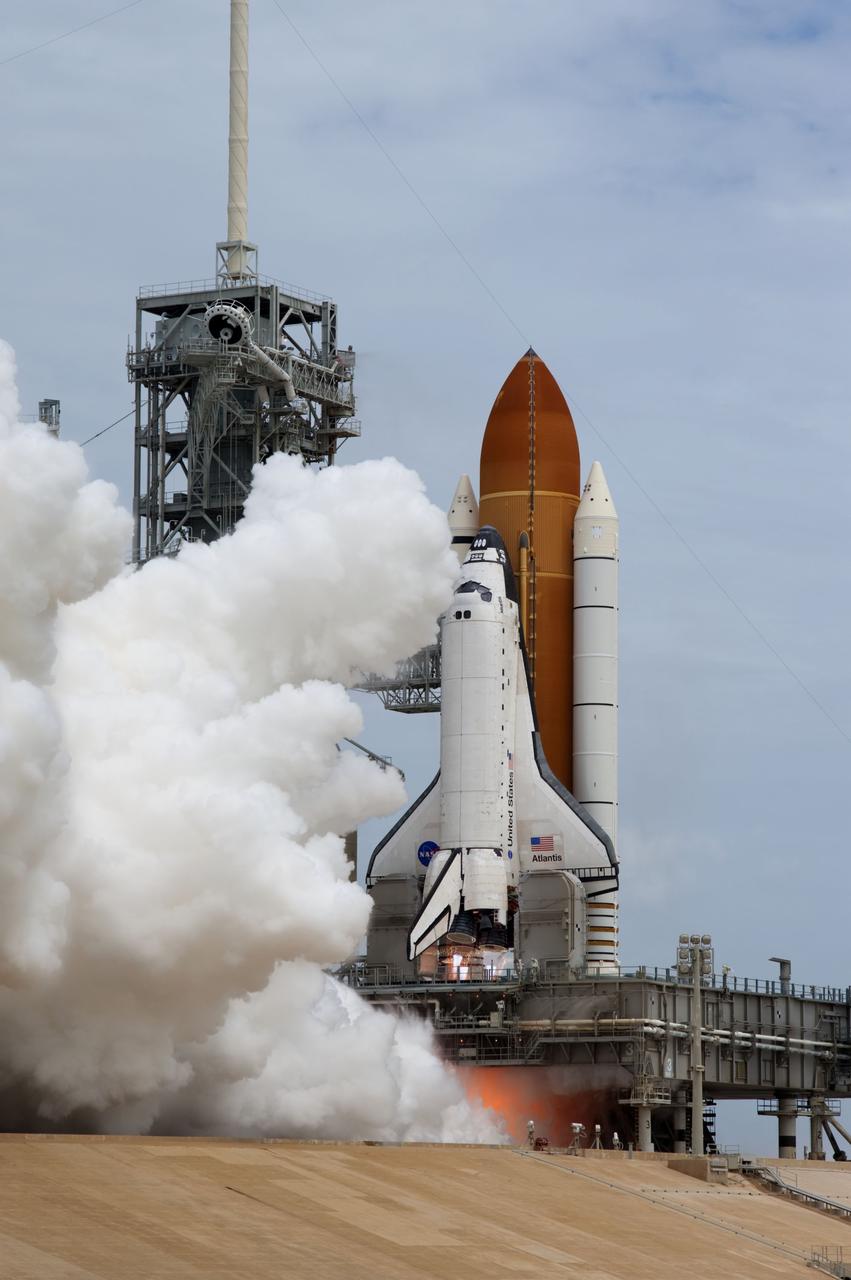
CAPE CANAVERAL, Fla. -- At NASA's Kennedy Space Center in Florida, space shuttle Atlantis' main engines and solid rocket boosters ignite on Launch Pad 39A producing billows of smoke and steam as it lifts off on its STS-135 mission to the International Space Station. Atlantis with its crew of four; Commander Chris Ferguson, Pilot Doug Hurley, Mission Specialists Sandy Magnus and Rex Walheim, lifted off at 11:29 a.m. EDT on July 8, 2011 to deliver the Raffaello multi-purpose logistics module packed with supplies and spare parts for the station. Atlantis also will fly the Robotic Refueling Mission experiment that will investigate the potential for robotically refueling existing satellites in orbit. In addition, Atlantis will return with a failed ammonia pump module to help NASA better understand the failure mechanism and improve pump designs for future systems. STS-135 is the 33rd flight of Atlantis, the 37th shuttle mission to the space station, and the 135th and final mission of NASA's Space Shuttle Program. For more information, visit www.nasa.gov/mission_pages/shuttle/shuttlemissions/sts135/index.html. Photo credit: NASA/Sandra Joseph and Kevin O'Connell
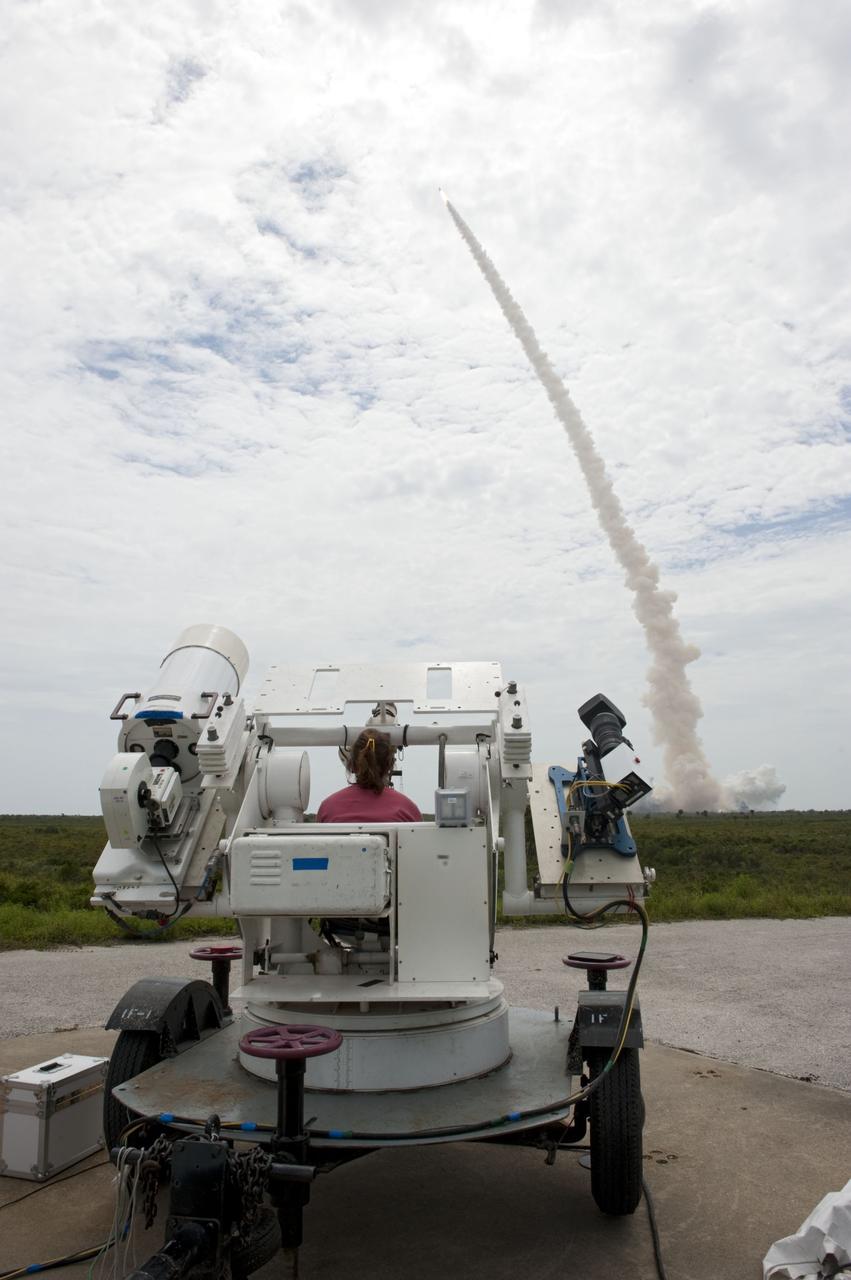
CAPE CANAVERAL, Fla. -- NASA photographer Sandra Joseph aims her remote camera tracker on space shuttle Atlantis at it lifts off from Launch Pad 39A at NASA's Kennedy Space Center in Florida beginning its STS-135 mission to the International Space Station. Atlantis with its crew of four; Commander Chris Ferguson, Pilot Doug Hurley, Mission Specialists Sandy Magnus and Rex Walheim, lifted off at 11:29 a.m. EDT on July 8, 2011 to deliver the Raffaello multi-purpose logistics module packed with supplies and spare parts for the station. Atlantis also will fly the Robotic Refueling Mission experiment that will investigate the potential for robotically refueling existing satellites in orbit. In addition, Atlantis will return with a failed ammonia pump module to help NASA better understand the failure mechanism and improve pump designs for future systems. STS-135 is the 33rd flight of Atlantis, the 37th shuttle mission to the space station, and the 135th and final mission of NASA's Space Shuttle Program. For more information, visit www.nasa.gov/mission_pages/shuttle/shuttlemissions/sts135/index.html. Photo credit: NASA/Sandra Joseph
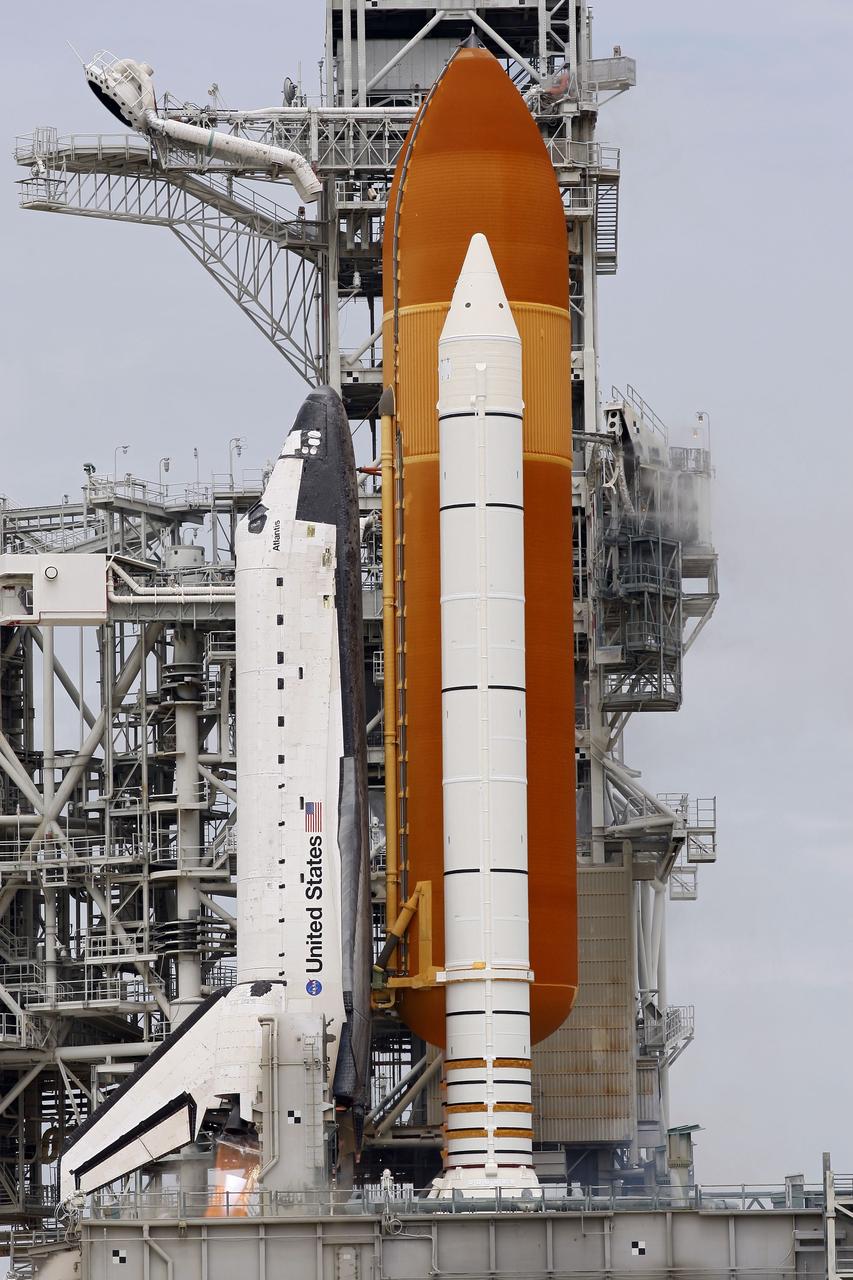
CAPE CANAVERAL, Fla. -- At NASA's Kennedy Space Center in Florida, space shuttle Atlantis' main engines and solid rocket boosters ignite on Launch Pad 39A as it lifts off on its STS-135 mission to the International Space Station. Atlantis with its crew of four; Commander Chris Ferguson, Pilot Doug Hurley, Mission Specialists Sandy Magnus and Rex Walheim, lifted off at 11:29 a.m. EDT on July 8, 2011 to deliver the Raffaello multi-purpose logistics module packed with supplies and spare parts for the International Space Station. Atlantis also will fly the Robotic Refueling Mission experiment that will investigate the potential for robotically refueling existing satellites in orbit. In addition, Atlantis will return with a failed ammonia pump module to help NASA better understand the failure mechanism and improve pump designs for future systems. STS-135 is the 33rd flight of Atlantis, the 37th shuttle mission to the space station, and the 135th and final mission of NASA's Space Shuttle Program. For more information, visit www.nasa.gov/mission_pages/shuttle/shuttlemissions/sts135/index.html. Photo credit: NASA/Rusty Backer and Mike Gayle
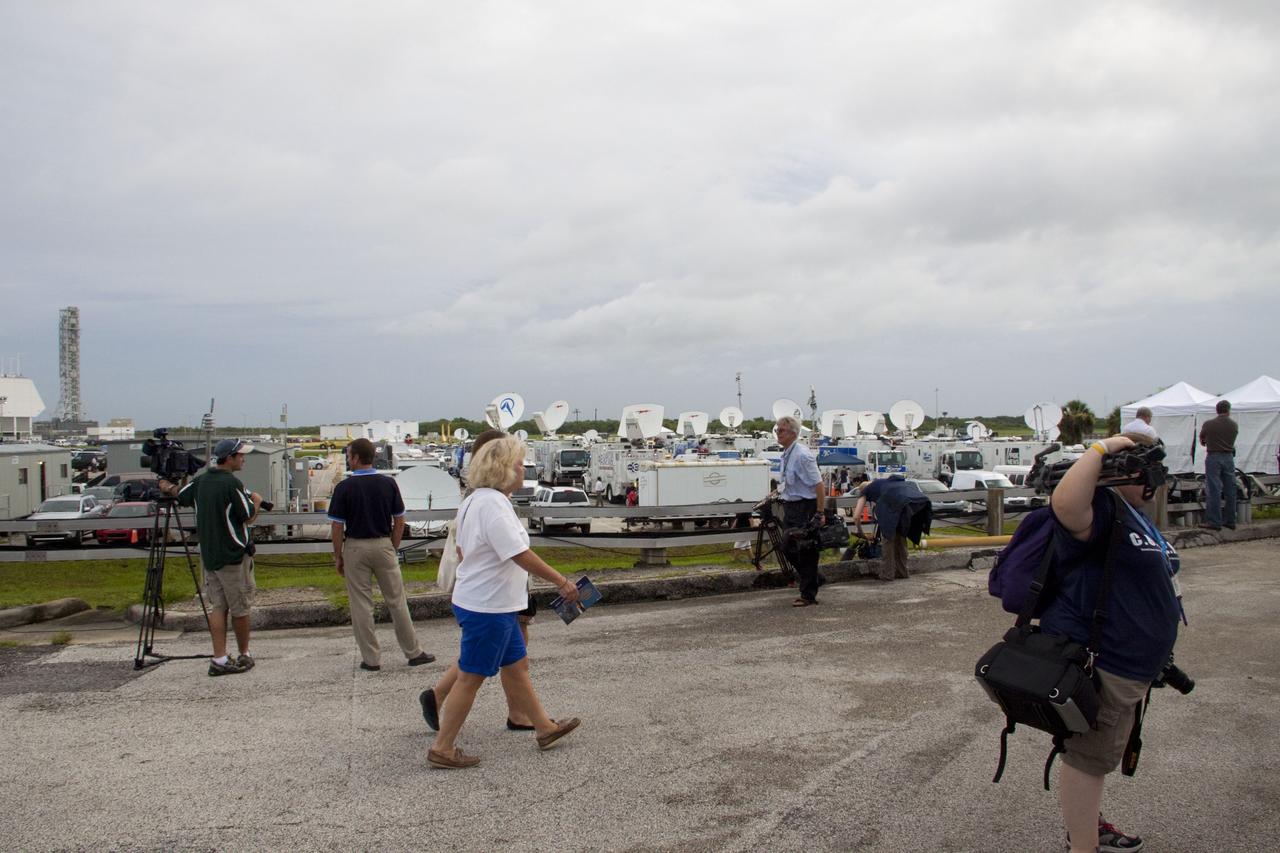
CAPE CANAVERAL, Fla. -- Media from around the globe gather on the grounds of the Press Site at NASA's Kennedy Space Center in Florida to photograph and cover the prelaunch activities and lift off of space shuttle Atlantis on its STS-135 mission to the International Space Station. Satellite news trucks, trailers and automobiles can be seen in the parking lot. Atlantis began its final flight, with Commander Chris Ferguson, Pilot Doug Hurley and Mission Specialists Sandy Magnus and Rex Walheim on board, at 11:29 a.m. EDT July 8 to deliver the Raffaello multi-purpose logistics module packed with supplies and spare parts to the station. Also in Atlantis' payload bay is the Robotic Refueling Mission experiment that will investigate the potential for robotically refueling existing satellites in orbit. In addition, Atlantis will return with a failed ammonia pump module to help NASA better understand the failure mechanism and improve pump designs for future systems. STS-135 is the 33rd flight of Atlantis, the 37th shuttle mission to the space station, and the 135th and final mission of NASA's Space Shuttle Program. For more information, visit www.nasa.gov/mission_pages/shuttle/shuttlemissions/sts135/index.html. Photo credit: NASA/Jim Grossmann
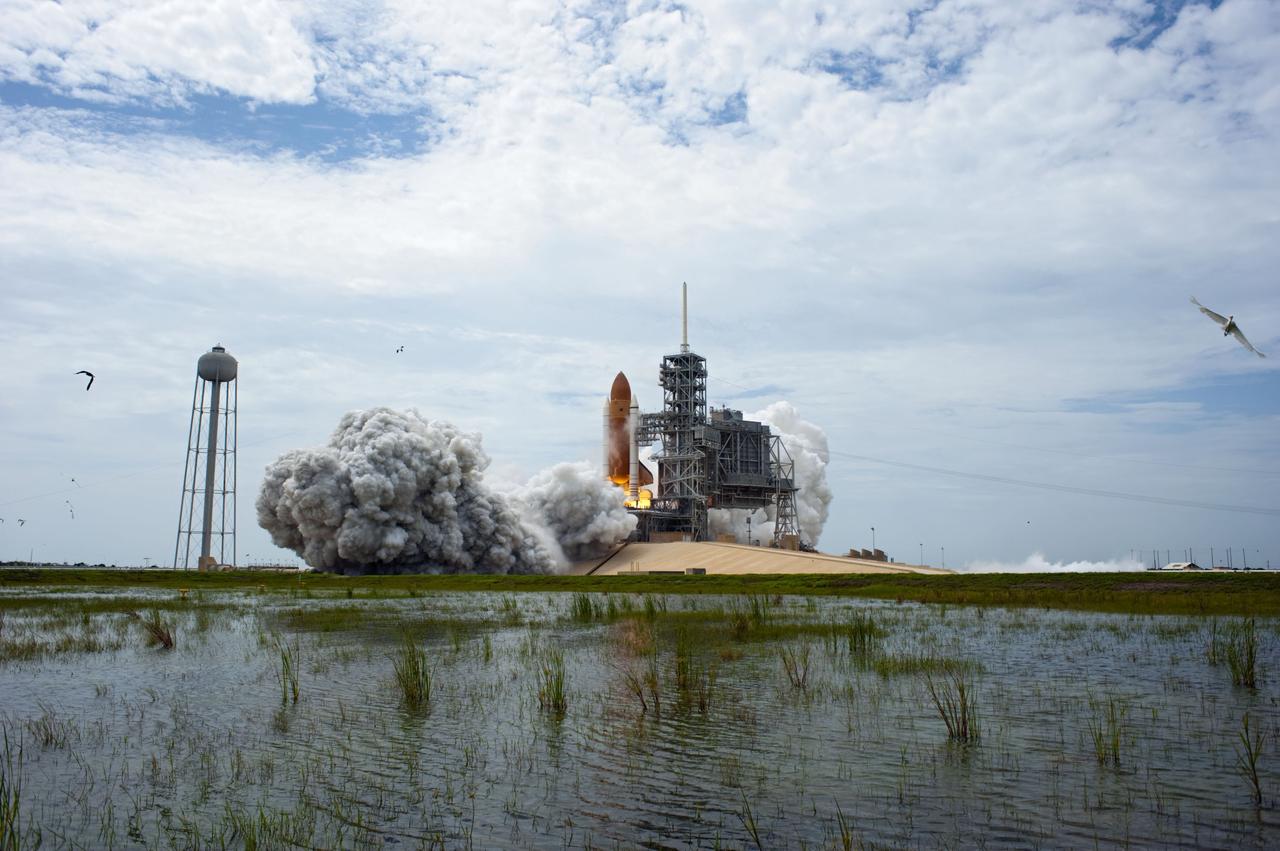
CAPE CANAVERAL, Fla. -- At NASA's Kennedy Space Center in Florida, space shuttle Atlantis' main engines and solid rocket boosters ignite on Launch Pad 39A as it lifts off on its STS-135 mission to the International Space Station. Atlantis with its crew of four; Commander Chris Ferguson, Pilot Doug Hurley, Mission Specialists Sandy Magnus and Rex Walheim, lifted off at 11:29 a.m. EDT on July 8, 2011 to deliver the Raffaello multi-purpose logistics module packed with supplies and spare parts for the station. Atlantis also will fly the Robotic Refueling Mission experiment that will investigate the potential for robotically refueling existing satellites in orbit. In addition, Atlantis will return with a failed ammonia pump module to help NASA better understand the failure mechanism and improve pump designs for future systems. STS-135 is the 33rd flight of Atlantis, the 37th shuttle mission to the space station, and the 135th and final mission of NASA's Space Shuttle Program. For more information, visit www.nasa.gov/mission_pages/shuttle/shuttlemissions/sts135/index.html. Photo credit: NASA/Sandra Joseph and Kevin O'Connell
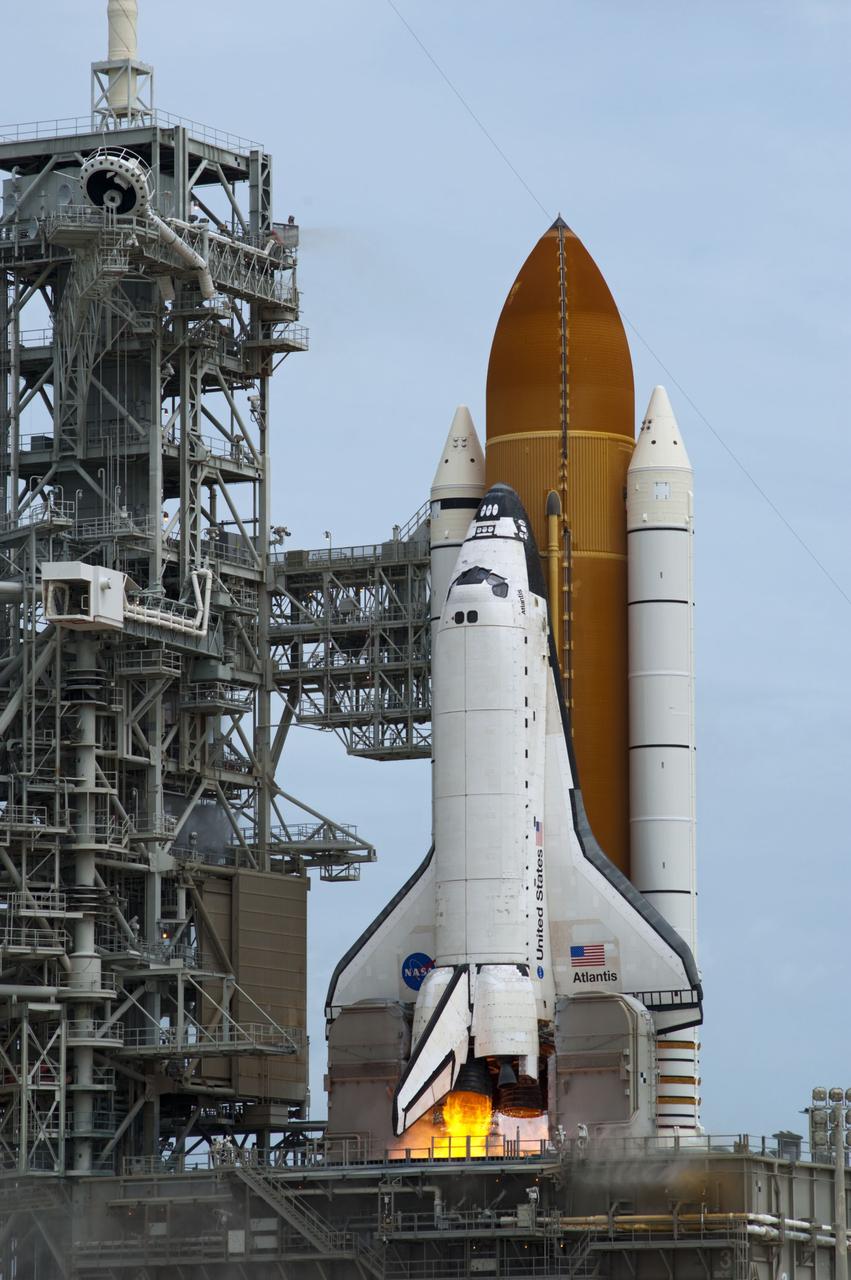
CAPE CANAVERAL, Fla. -- At NASA's Kennedy Space Center in Florida, space shuttle Atlantis' main engines ignite on Launch Pad 39A as it lifts off on its STS-135 mission to the International Space Station. Atlantis with its crew of four; Commander Chris Ferguson, Pilot Doug Hurley, Mission Specialists Sandy Magnus and Rex Walheim, lifted off at 11:29 a.m. EDT on July 8, 2011 to deliver the Raffaello multi-purpose logistics module packed with supplies and spare parts for the station. Atlantis also will fly the Robotic Refueling Mission experiment that will investigate the potential for robotically refueling existing satellites in orbit. In addition, Atlantis will return with a failed ammonia pump module to help NASA better understand the failure mechanism and improve pump designs for future systems. STS-135 is the 33rd flight of Atlantis, the 37th shuttle mission to the space station, and the 135th and final mission of NASA's Space Shuttle Program. For more information, visit www.nasa.gov/mission_pages/shuttle/shuttlemissions/sts135/index.html. Photo credit: NASA/Sandra Joseph and Kevin O'Connell
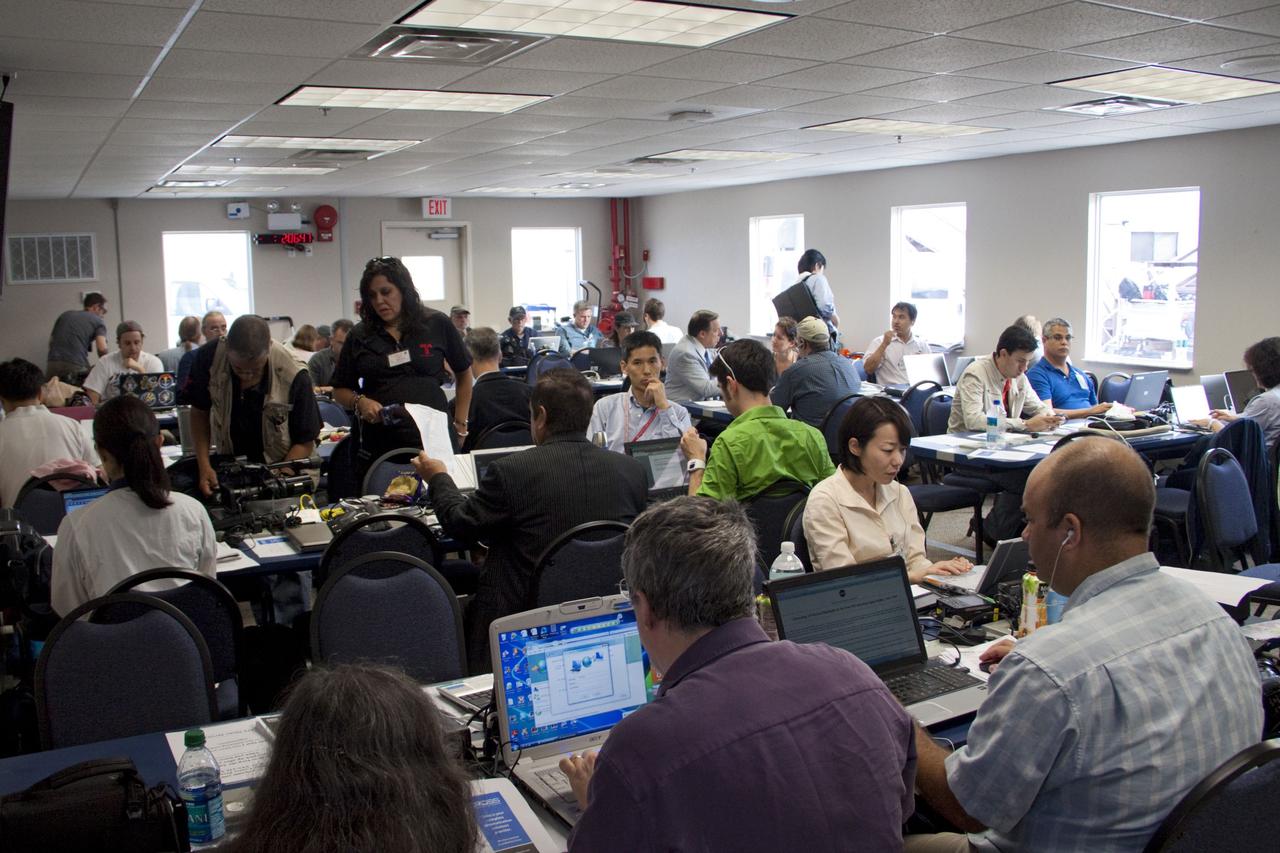
CAPE CANAVERAL, Fla. -- Media from around the globe gather at the NASA News Annex at NASA Kennedy Space Center's Press Site in Florida to cover the prelaunch activities and lift off of space shuttle Atlantis on its STS-135 mission to the International Space Station. Atlantis began its final flight, with Commander Chris Ferguson, Pilot Doug Hurley and Mission Specialists Sandy Magnus and Rex Walheim on board, at 11:29 a.m. EDT July 8 to deliver the Raffaello multi-purpose logistics module packed with supplies and spare parts to the station. Also in Atlantis' payload bay is the Robotic Refueling Mission experiment that will investigate the potential for robotically refueling existing satellites in orbit. In addition, Atlantis will return with a failed ammonia pump module to help NASA better understand the failure mechanism and improve pump designs for future systems. STS-135 is the 33rd flight of Atlantis, the 37th shuttle mission to the space station, and the 135th and final mission of NASA's Space Shuttle Program. For more information, visit www.nasa.gov/mission_pages/shuttle/shuttlemissions/sts135/index.html. Photo credit: NASA/Jim Grossmann
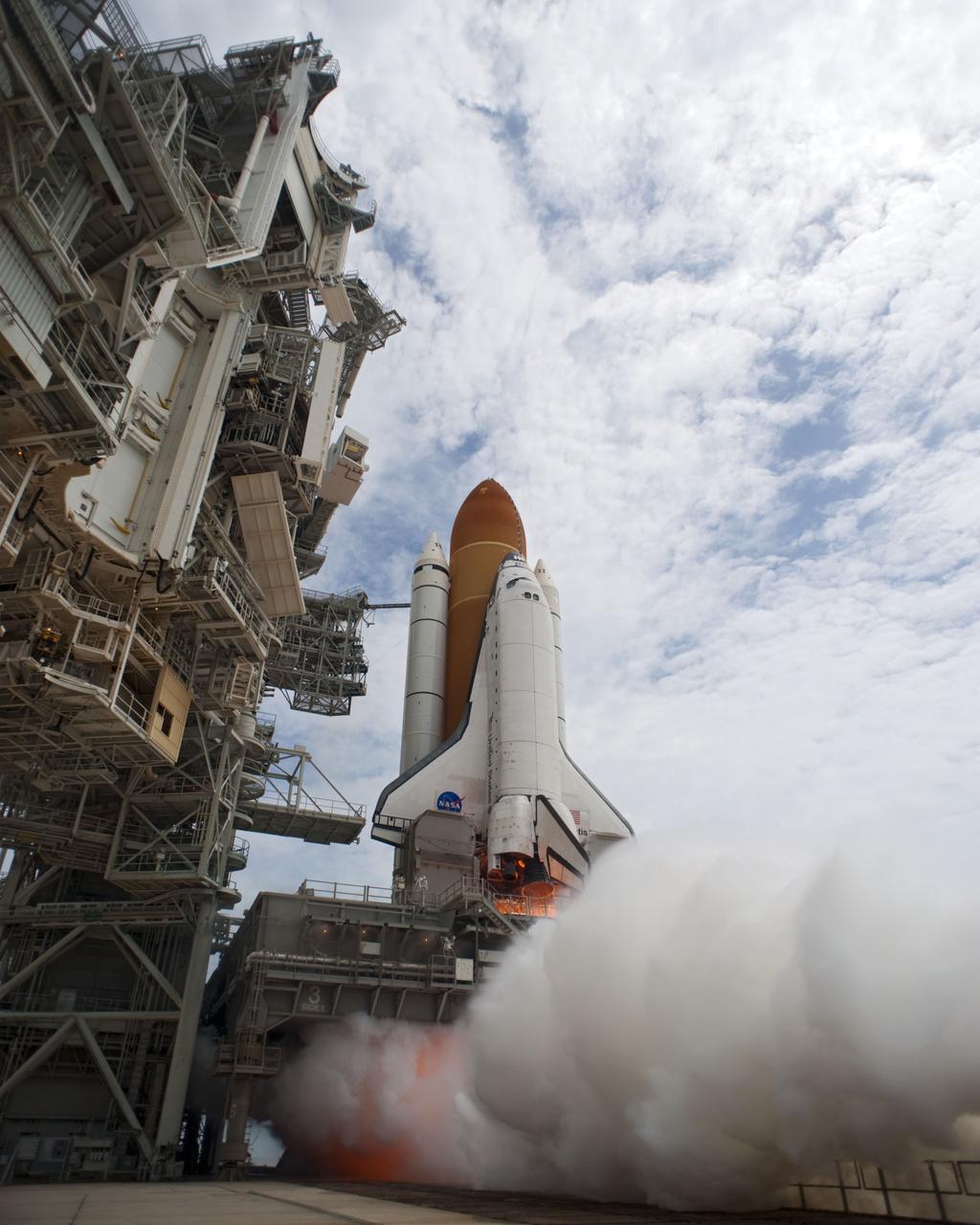
CAPE CANAVERAL, Fla. -- Smoke and steam billow outward as space shuttle Atlantis' main engines are ignited for liftoff at Launch Pad 39A at NASA's Kennedy Space Center in Florida as it begins its STS-135 mission to the International Space Station. Atlantis with its crew of four; Commander Chris Ferguson, Pilot Doug Hurley, Mission Specialists Sandy Magnus and Rex Walheim, lifted off at 11:29 a.m. EDT on July 8, 2011 to deliver the Raffaello multi-purpose logistics module packed with supplies and spare parts for the station. Atlantis also will fly the Robotic Refueling Mission experiment that will investigate the potential for robotically refueling existing satellites in orbit. In addition, Atlantis will return with a failed ammonia pump module to help NASA better understand the failure mechanism and improve pump designs for future systems. STS-135 is the 33rd flight of Atlantis, the 37th shuttle mission to the space station, and the 135th and final mission of NASA's Space Shuttle Program. For more information, visit www.nasa.gov/mission_pages/shuttle/shuttlemissions/sts135/index.html. Photo credit: NASA/Tony Gray and Tom Farrar
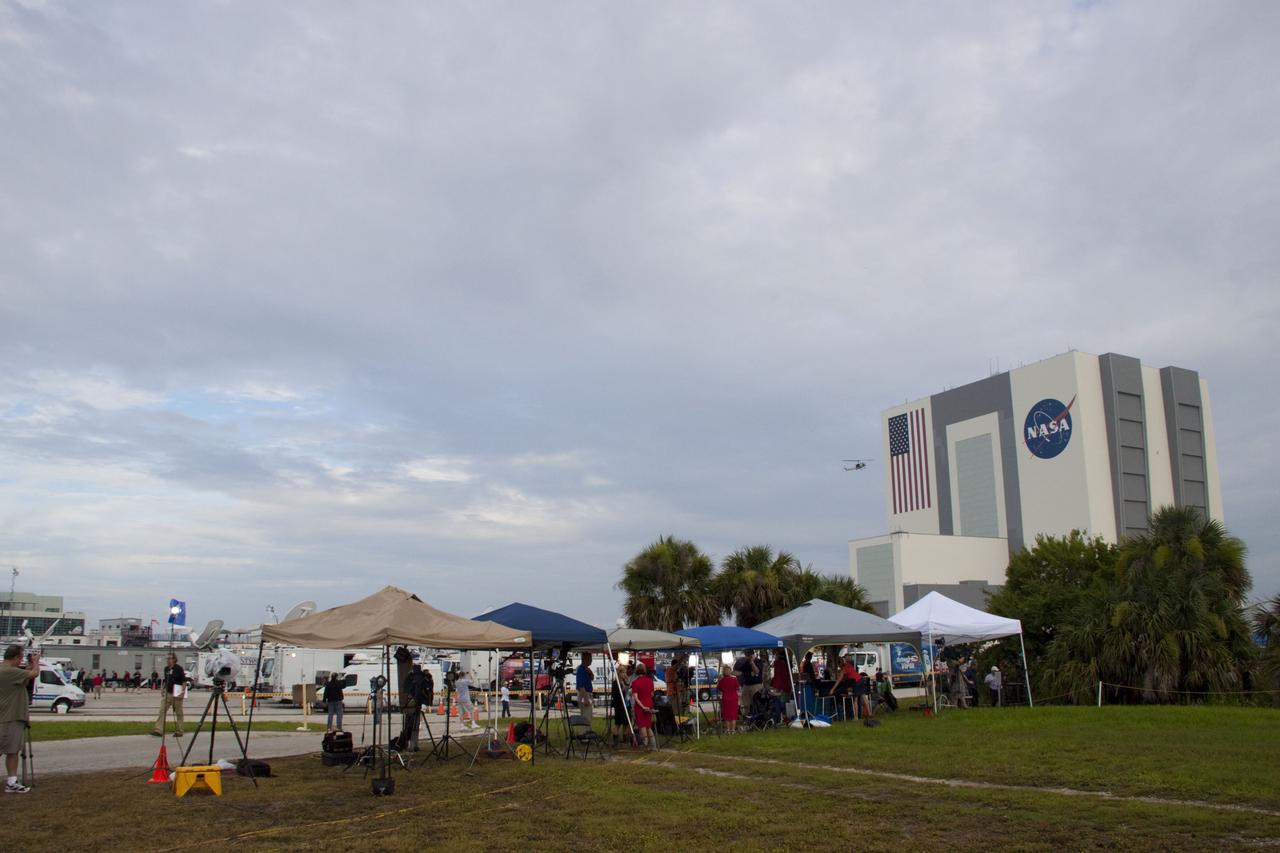
CAPE CANAVERAL, Fla. -- Media from around the globe gather on the grounds of the Press Site at NASA's Kennedy Space Center in Florida to photograph and cover the prelaunch activities and lift off of space shuttle Atlantis on its STS-135 mission to the International Space Station. Dozens of satellite news vehicles can be seen in the parking lot with the massive Vehicle Assembly Building towering above. Atlantis began its final flight, with Commander Chris Ferguson, Pilot Doug Hurley and Mission Specialists Sandy Magnus and Rex Walheim on board, at 11:29 a.m. EDT July 8 to deliver the Raffaello multi-purpose logistics module packed with supplies and spare parts to the station. Also in Atlantis' payload bay is the Robotic Refueling Mission experiment that will investigate the potential for robotically refueling existing satellites in orbit. In addition, Atlantis will return with a failed ammonia pump module to help NASA better understand the failure mechanism and improve pump designs for future systems. STS-135 is the 33rd flight of Atlantis, the 37th shuttle mission to the space station, and the 135th and final mission of NASA's Space Shuttle Program. For more information, visit www.nasa.gov/mission_pages/shuttle/shuttlemissions/sts135/index.html. Photo credit: NASA/Jim Grossmann
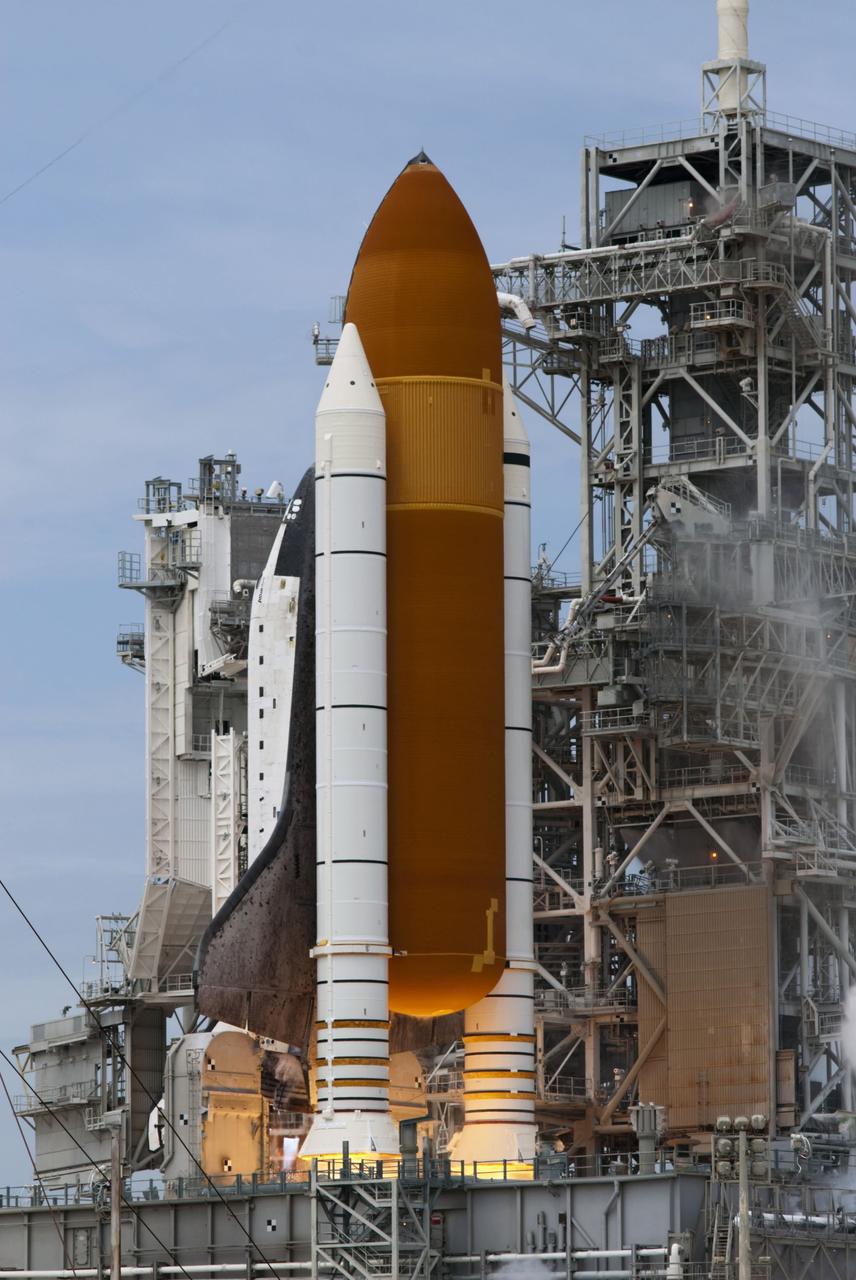
CAPE CANAVERAL, Fla. -- At NASA's Kennedy Space Center in Florida, space shuttle Atlantis' main engines and solid rocket boosters ignite on Launch Pad 39A as it lifts off on its STS-135 mission to the International Space Station. Atlantis with its crew of four; Commander Chris Ferguson, Pilot Doug Hurley, Mission Specialists Sandy Magnus and Rex Walheim, lifted off at 11:29 a.m. EDT on July 8, 2011 to deliver the Raffaello multi-purpose logistics module packed with supplies and spare parts for the station. Atlantis also will fly the Robotic Refueling Mission experiment that will investigate the potential for robotically refueling existing satellites in orbit. In addition, Atlantis will return with a failed ammonia pump module to help NASA better understand the failure mechanism and improve pump designs for future systems. STS-135 is the 33rd flight of Atlantis, the 37th shuttle mission to the space station, and the 135th and final mission of NASA's Space Shuttle Program. For more information, visit www.nasa.gov/mission_pages/shuttle/shuttlemissions/sts135/index.html. Photo credit: NASA/Rusty Backer and Mike Gayle
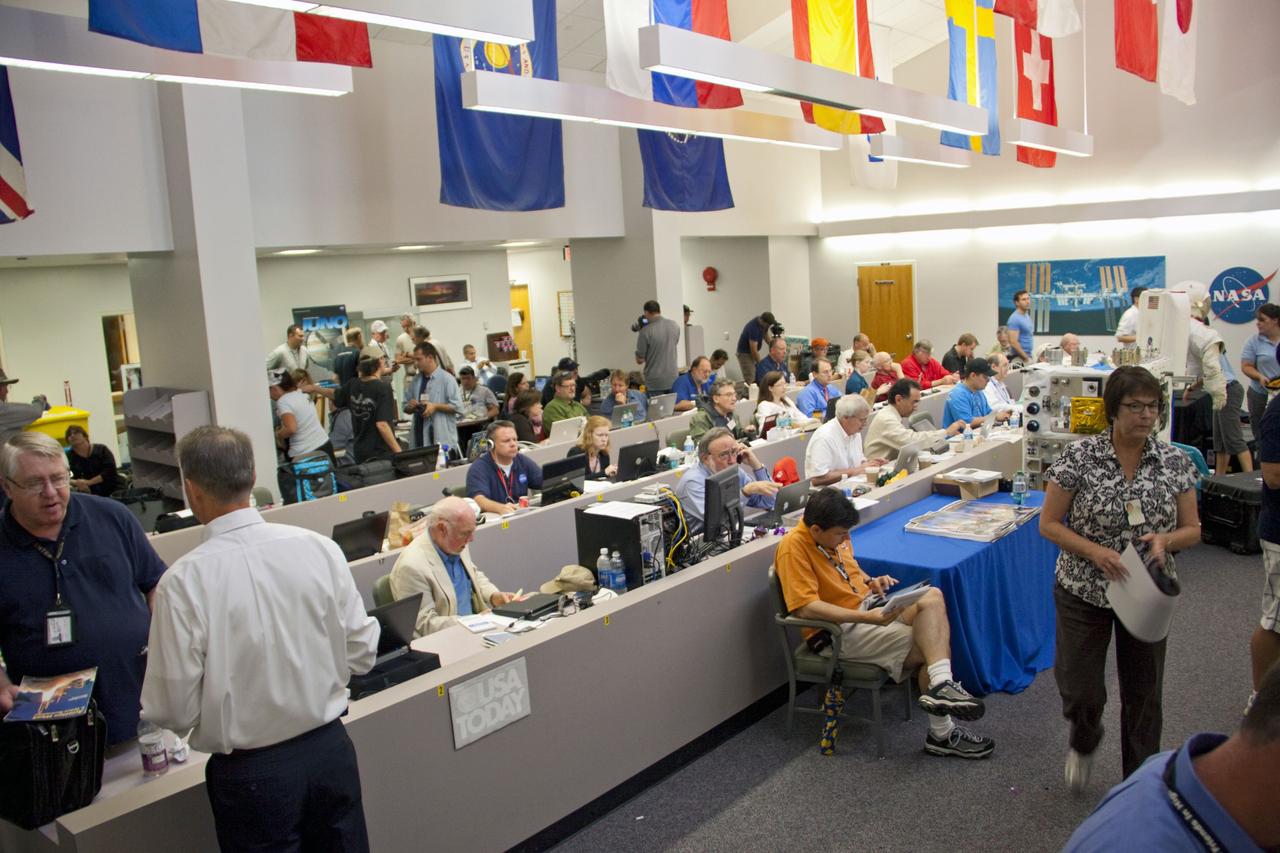
CAPE CANAVERAL, Fla. -- Media from around the globe gather at the NASA News Center at NASA Kennedy Space Center's Press Site in Florida to cover the prelaunch activities and lift off of space shuttle Atlantis on its STS-135 mission to the International Space Station. Atlantis began its final flight, with Commander Chris Ferguson, Pilot Doug Hurley and Mission Specialists Sandy Magnus and Rex Walheim on board, at 11:29 a.m. EDT July 8 to deliver the Raffaello multi-purpose logistics module packed with supplies and spare parts to the station. Also in Atlantis' payload bay is the Robotic Refueling Mission experiment that will investigate the potential for robotically refueling existing satellites in orbit. In addition, Atlantis will return with a failed ammonia pump module to help NASA better understand the failure mechanism and improve pump designs for future systems. STS-135 is the 33rd flight of Atlantis, the 37th shuttle mission to the space station, and the 135th and final mission of NASA's Space Shuttle Program. For more information, visit www.nasa.gov/mission_pages/shuttle/shuttlemissions/sts135/index.html. Photo credit: NASA/Jim Grossmann
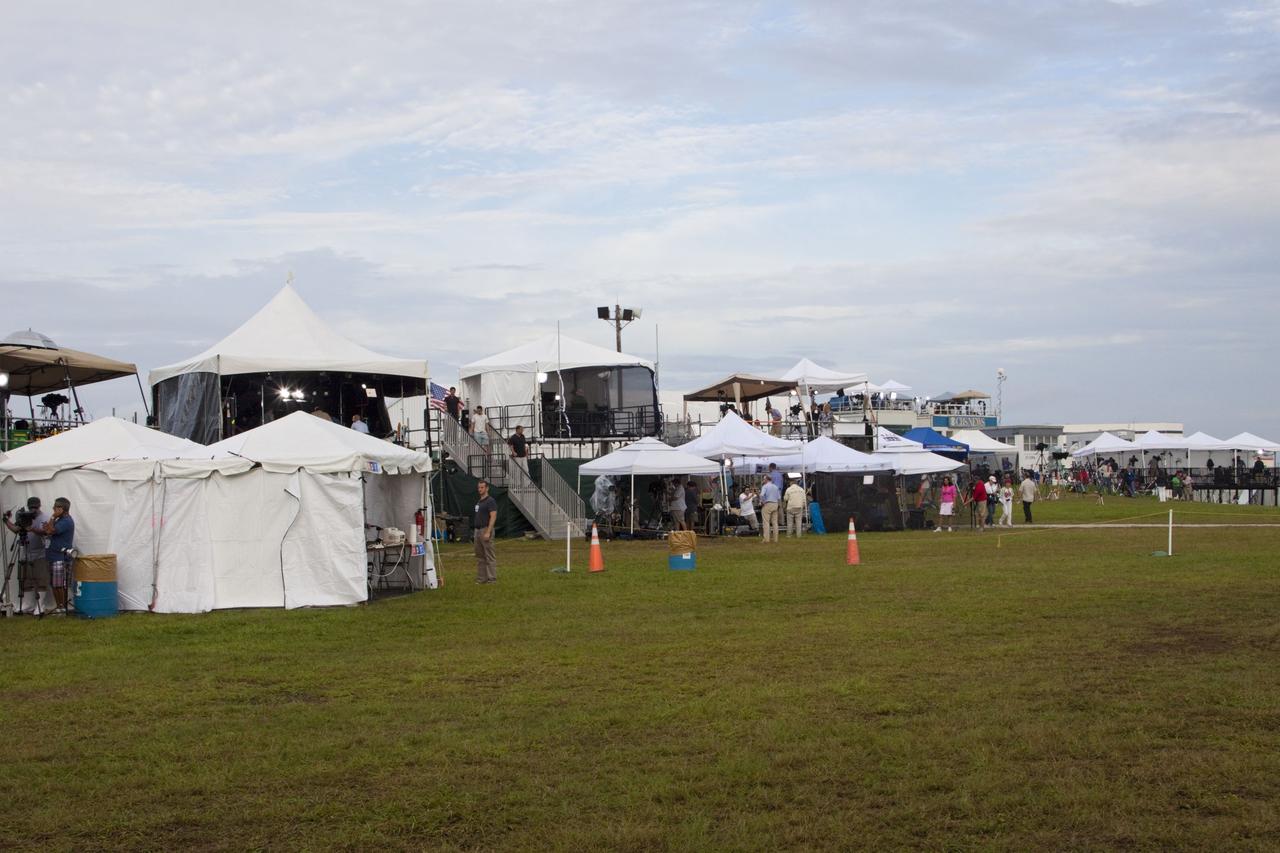
CAPE CANAVERAL, Fla. -- Media from around the globe gather in their respective tents at the Press Site at NASA's Kennedy Space Center in Florida to photograph and cover the prelaunch activities and lift off of space shuttle Atlantis on its STS-135 mission to the International Space Station. Atlantis began its final flight, with Commander Chris Ferguson, Pilot Doug Hurley and Mission Specialists Sandy Magnus and Rex Walheim on board, at 11:29 a.m. EDT July 8 to deliver the Raffaello multi-purpose logistics module packed with supplies and spare parts to the station. Also in Atlantis' payload bay is the Robotic Refueling Mission experiment that will investigate the potential for robotically refueling existing satellites in orbit. In addition, Atlantis will return with a failed ammonia pump module to help NASA better understand the failure mechanism and improve pump designs for future systems. STS-135 is the 33rd flight of Atlantis, the 37th shuttle mission to the space station, and the 135th and final mission of NASA's Space Shuttle Program. For more information, visit www.nasa.gov/mission_pages/shuttle/shuttlemissions/sts135/index.html. Photo credit: NASA/Jim Grossmann
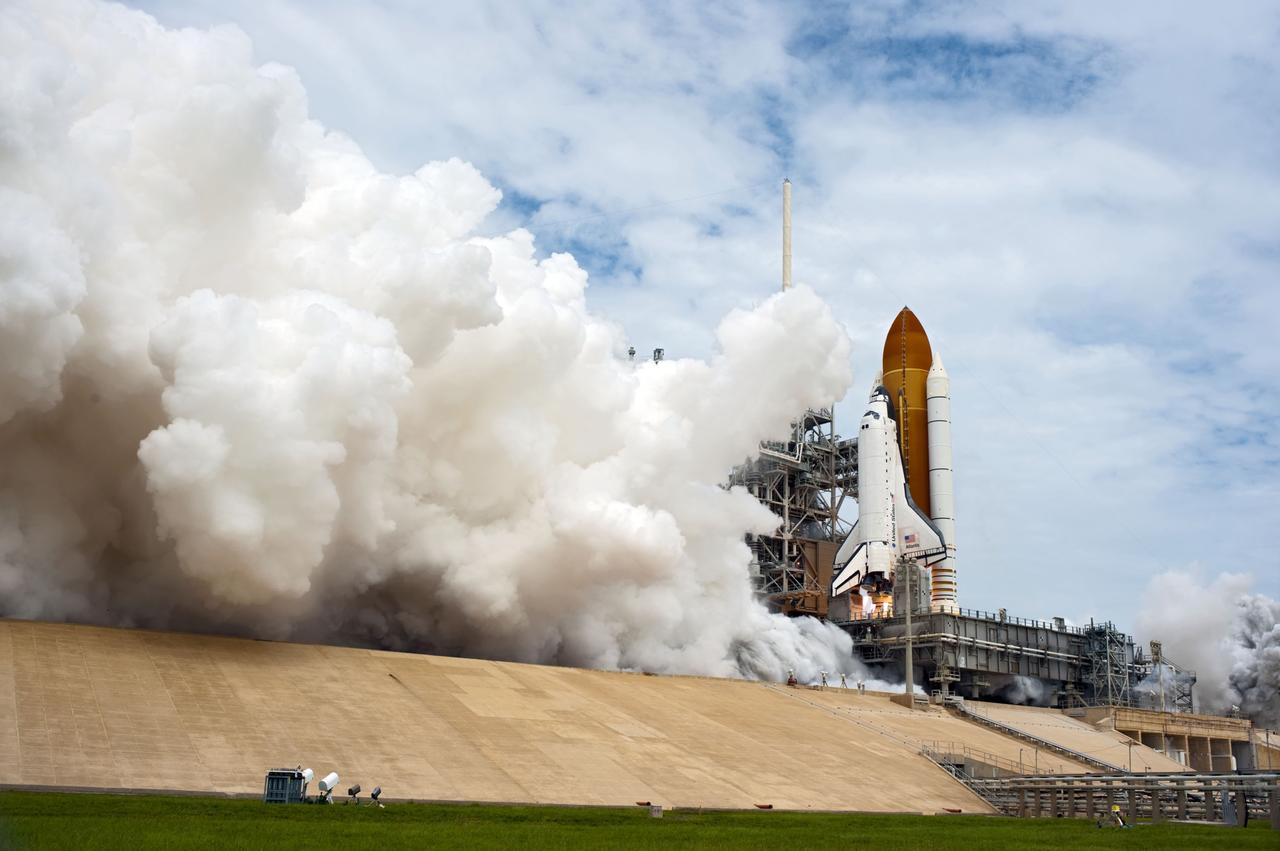
CAPE CANAVERAL, Fla. -- At NASA's Kennedy Space Center in Florida, space shuttle Atlantis' main engines and solid rocket boosters ignite on Launch Pad 39A producing billows of steam and smoke as it lifts off on its STS-135 mission to the International Space Station. Atlantis with its crew of four; Commander Chris Ferguson, Pilot Doug Hurley, Mission Specialists Sandy Magnus and Rex Walheim, lifted off at 11:29 a.m. EDT on July 8, 2011 to deliver the Raffaello multi-purpose logistics module packed with supplies and spare parts for the station. Atlantis also will fly the Robotic Refueling Mission experiment that will investigate the potential for robotically refueling existing satellites in orbit. In addition, Atlantis will return with a failed ammonia pump module to help NASA better understand the failure mechanism and improve pump designs for future systems. STS-135 is the 33rd flight of Atlantis, the 37th shuttle mission to the space station, and the 135th and final mission of NASA's Space Shuttle Program. For more information, visit www.nasa.gov/mission_pages/shuttle/shuttlemissions/sts135/index.html. Photo credit: NASA/Tony Gray and Tom Farrar
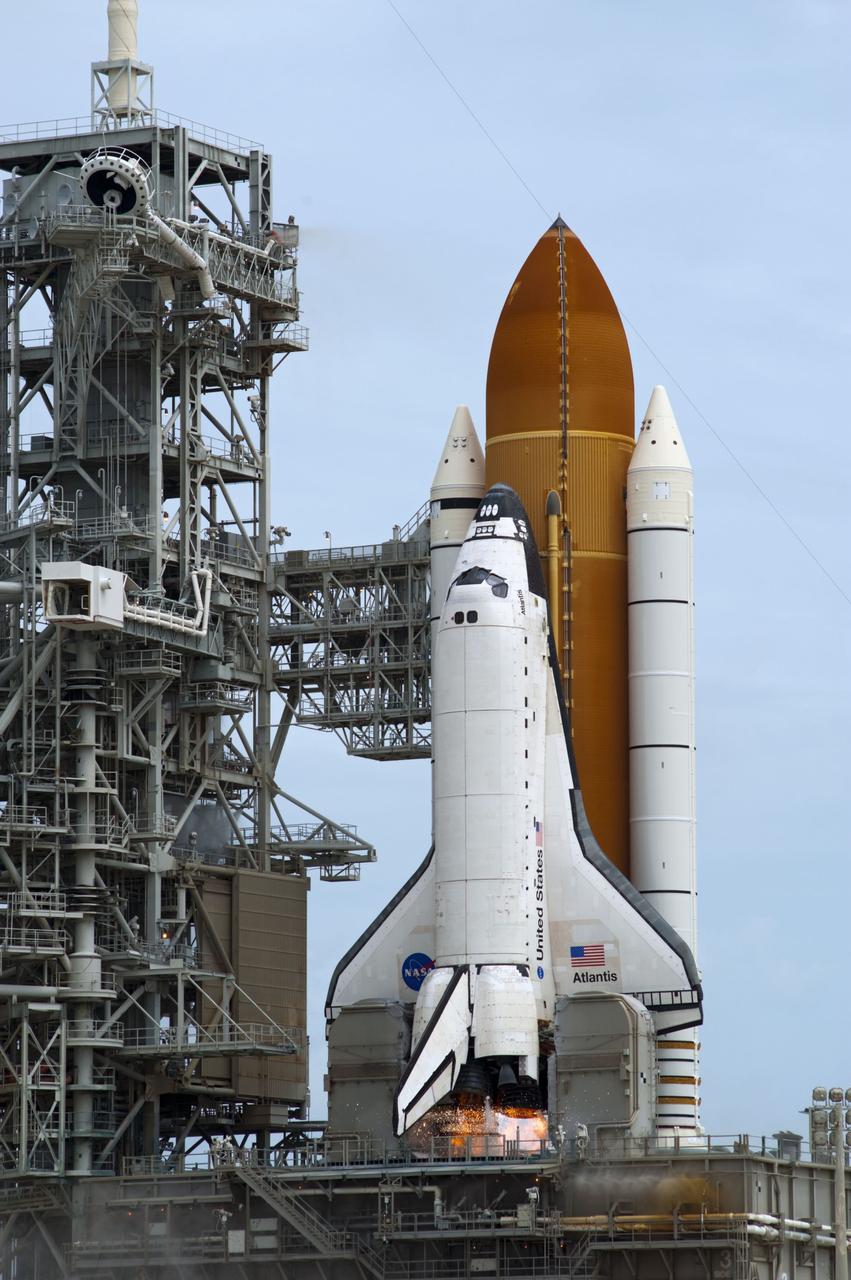
CAPE CANAVERAL, Fla. -- At NASA's Kennedy Space Center in Florida, space shuttle Atlantis' main engines ignite on Launch Pad 39A as it lifts off on its STS-135 mission to the International Space Station. Atlantis with its crew of four; Commander Chris Ferguson, Pilot Doug Hurley, Mission Specialists Sandy Magnus and Rex Walheim, lifted off at 11:29 a.m. EDT on July 8, 2011 to deliver the Raffaello multi-purpose logistics module packed with supplies and spare parts for the station. Atlantis also will fly the Robotic Refueling Mission experiment that will investigate the potential for robotically refueling existing satellites in orbit. In addition, Atlantis will return with a failed ammonia pump module to help NASA better understand the failure mechanism and improve pump designs for future systems. STS-135 is the 33rd flight of Atlantis, the 37th shuttle mission to the space station, and the 135th and final mission of NASA's Space Shuttle Program. For more information, visit www.nasa.gov/mission_pages/shuttle/shuttlemissions/sts135/index.html. Photo credit: NASA/Sandra Joseph and Kevin O'Connell
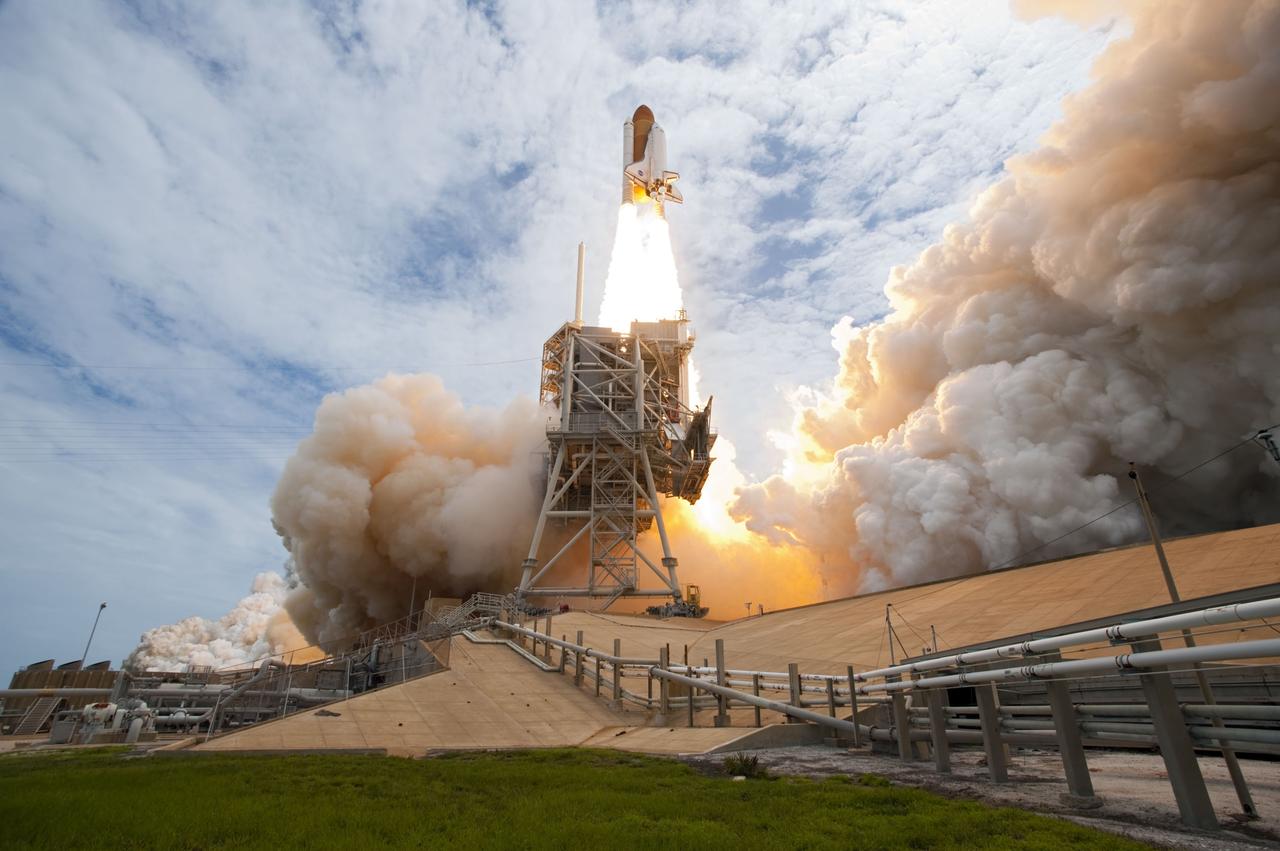
CAPE CANAVERAL, Fla. -- At NASA's Kennedy Space Center in Florida, space shuttle Atlantis lifts off on twin columns of flame from Launch Pad 39A on its way to space on the STS-135 mission to the International Space Station. Atlantis with its crew of four; Commander Chris Ferguson, Pilot Doug Hurley, Mission Specialists Sandy Magnus and Rex Walheim, lifted off at 11:29 a.m. EDT on July 8, 2011 to deliver the Raffaello multi-purpose logistics module packed with supplies and spare parts for the station. Atlantis also will fly the Robotic Refueling Mission experiment that will investigate the potential for robotically refueling existing satellites in orbit. In addition, Atlantis will return with a failed ammonia pump module to help NASA better understand the failure mechanism and improve pump designs for future systems. STS-135 is the 33rd flight of Atlantis, the 37th shuttle mission to the space station, and the 135th and final mission of NASA's Space Shuttle Program. For more information, visit www.nasa.gov/mission_pages/shuttle/shuttlemissions/sts135/index.html. Photo credit: NASA/Tony Gray and Tom Farrar
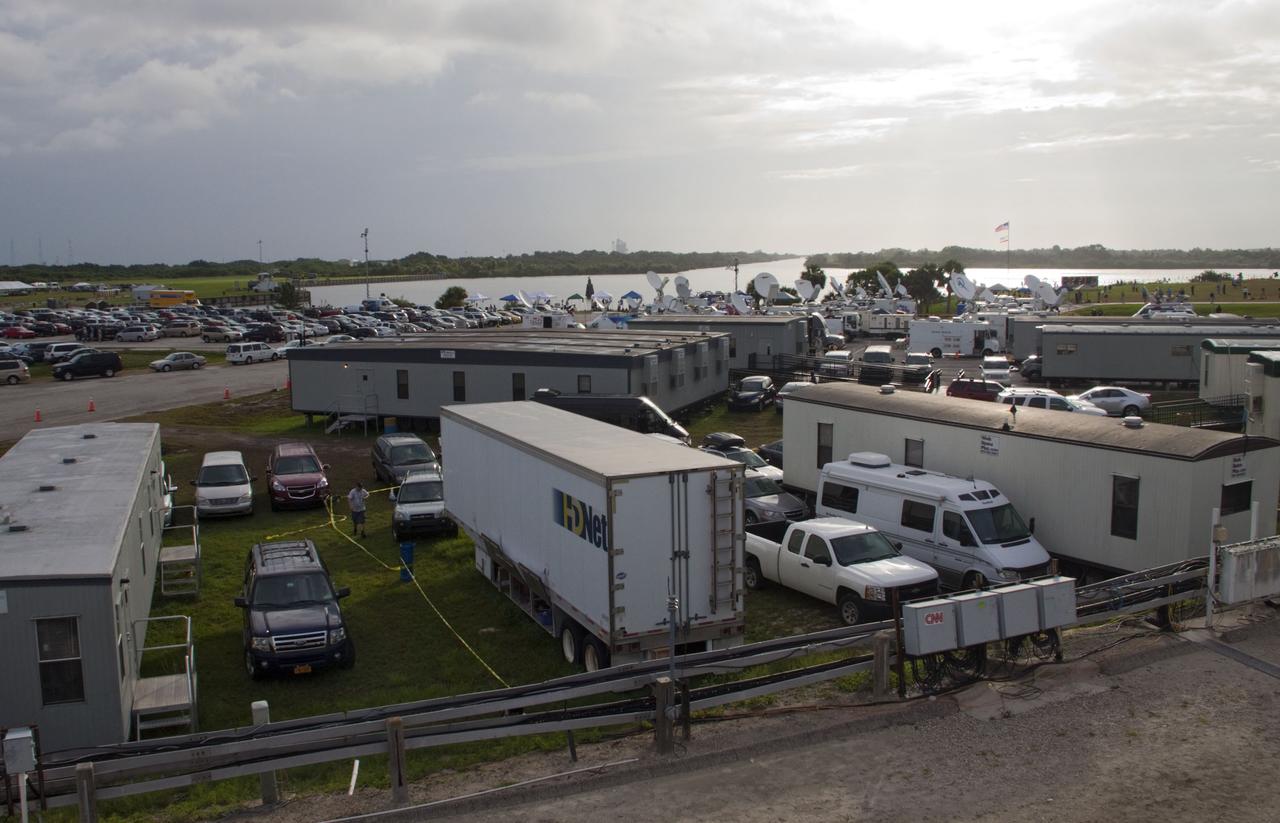
CAPE CANAVERAL, Fla. -- Media from around the globe gather on the grounds of the Press Site at NASA's Kennedy Space Center in Florida to photograph and cover the prelaunch activities and lift off of space shuttle Atlantis on its STS-135 mission to the International Space Station. Seen towering above is the massive Vehicle Assembly Building. Dozens of satellite news vehicles and trailers can be seen in the parking lot. In the background is the Turn Basin where NASA's Pegasus barge delivered the final external tank for the mission. Atlantis began its final flight, with Commander Chris Ferguson, Pilot Doug Hurley and Mission Specialists Sandy Magnus and Rex Walheim on board, at 11:29 a.m. EDT July 8 to deliver the Raffaello multi-purpose logistics module packed with supplies and spare parts to the station. Also in Atlantis' payload bay is the Robotic Refueling Mission experiment that will investigate the potential for robotically refueling existing satellites in orbit. In addition, Atlantis will return with a failed ammonia pump module to help NASA better understand the failure mechanism and improve pump designs for future systems. STS-135 is the 33rd flight of Atlantis, the 37th shuttle mission to the space station, and the 135th and final mission of NASA's Space Shuttle Program. For more information, visit www.nasa.gov/mission_pages/shuttle/shuttlemissions/sts135/index.html. Photo credit: NASA/Jim Grossmann
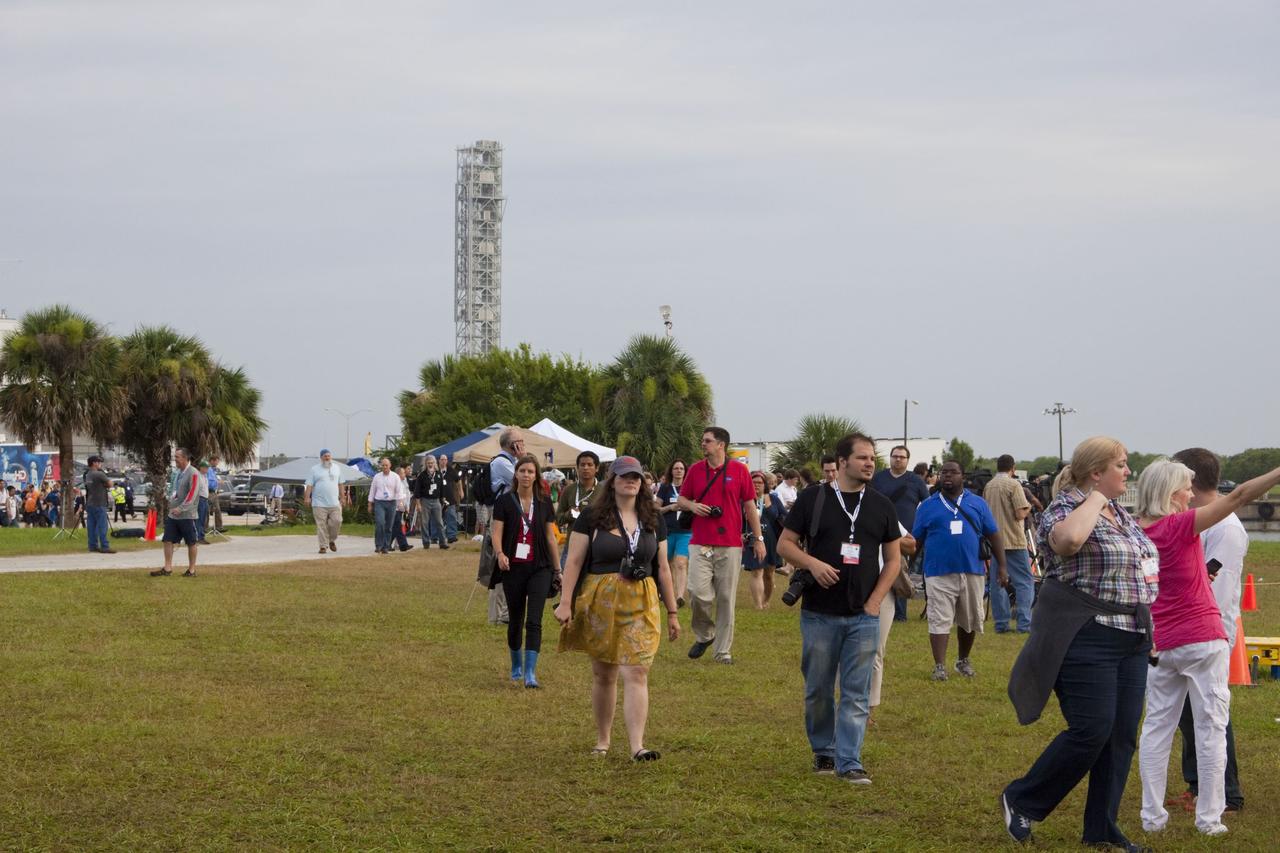
CAPE CANAVERAL, Fla. -- Media from around the globe gather on the grounds of the Press Site at NASA's Kennedy Space Center in Florida to photograph and cover the prelaunch activities and lift off of space shuttle Atlantis on its STS-135 mission to the International Space Station. Seen towering above is the massive Vehicle Assembly Building. Atlantis began its final flight, with Commander Chris Ferguson, Pilot Doug Hurley and Mission Specialists Sandy Magnus and Rex Walheim on board, at 11:29 a.m. EDT July 8 to deliver the Raffaello multi-purpose logistics module packed with supplies and spare parts to the station. Also in Atlantis' payload bay is the Robotic Refueling Mission experiment that will investigate the potential for robotically refueling existing satellites in orbit. In addition, Atlantis will return with a failed ammonia pump module to help NASA better understand the failure mechanism and improve pump designs for future systems. STS-135 is the 33rd flight of Atlantis, the 37th shuttle mission to the space station, and the 135th and final mission of NASA's Space Shuttle Program. For more information, visit www.nasa.gov/mission_pages/shuttle/shuttlemissions/sts135/index.html. Photo credit: NASA/Jim Grossmann
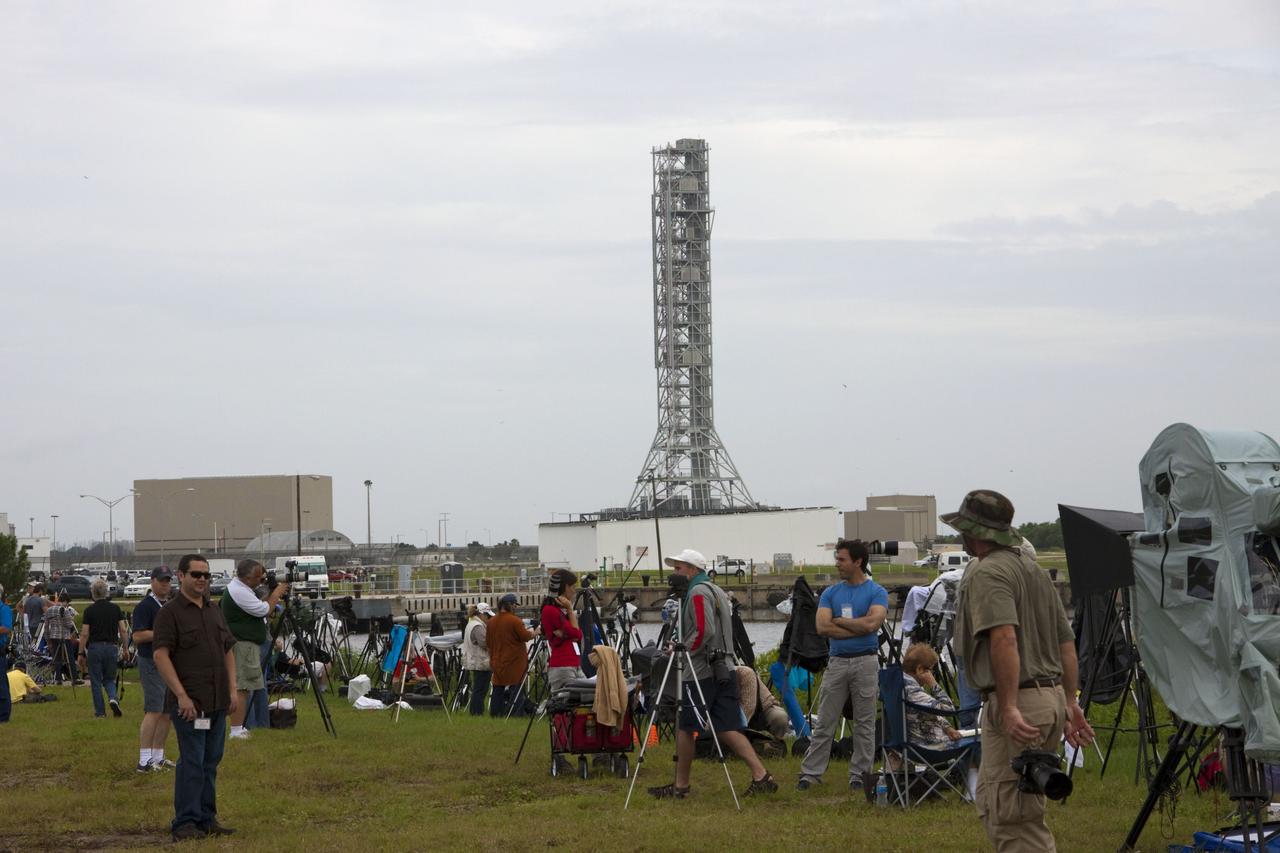
CAPE CANAVERAL, Fla. -- Media from around the globe gather at the NASA News Center at NASA Kennedy Space Center's Press Site in Florida to photograph and cover the prelaunch activities and lift off of space shuttle Atlantis on its STS-135 mission to the International Space Station. Seen in the background is NASA's new mobile launcher (ML) support structure. The ML can be outfitted with ground support equipment, such as umbilicals and access arms, for future rocket launches. Atlantis began its final flight, with Commander Chris Ferguson, Pilot Doug Hurley and Mission Specialists Sandy Magnus and Rex Walheim on board, at 11:29 a.m. EDT July 8 to deliver the Raffaello multi-purpose logistics module packed with supplies and spare parts to the station. Also in Atlantis' payload bay is the Robotic Refueling Mission experiment that will investigate the potential for robotically refueling existing satellites in orbit. In addition, Atlantis will return with a failed ammonia pump module to help NASA better understand the failure mechanism and improve pump designs for future systems. STS-135 is the 33rd flight of Atlantis, the 37th shuttle mission to the space station, and the 135th and final mission of NASA's Space Shuttle Program. For more information, visit www.nasa.gov/mission_pages/shuttle/shuttlemissions/sts135/index.html. Photo credit: NASA/Jim Grossmann
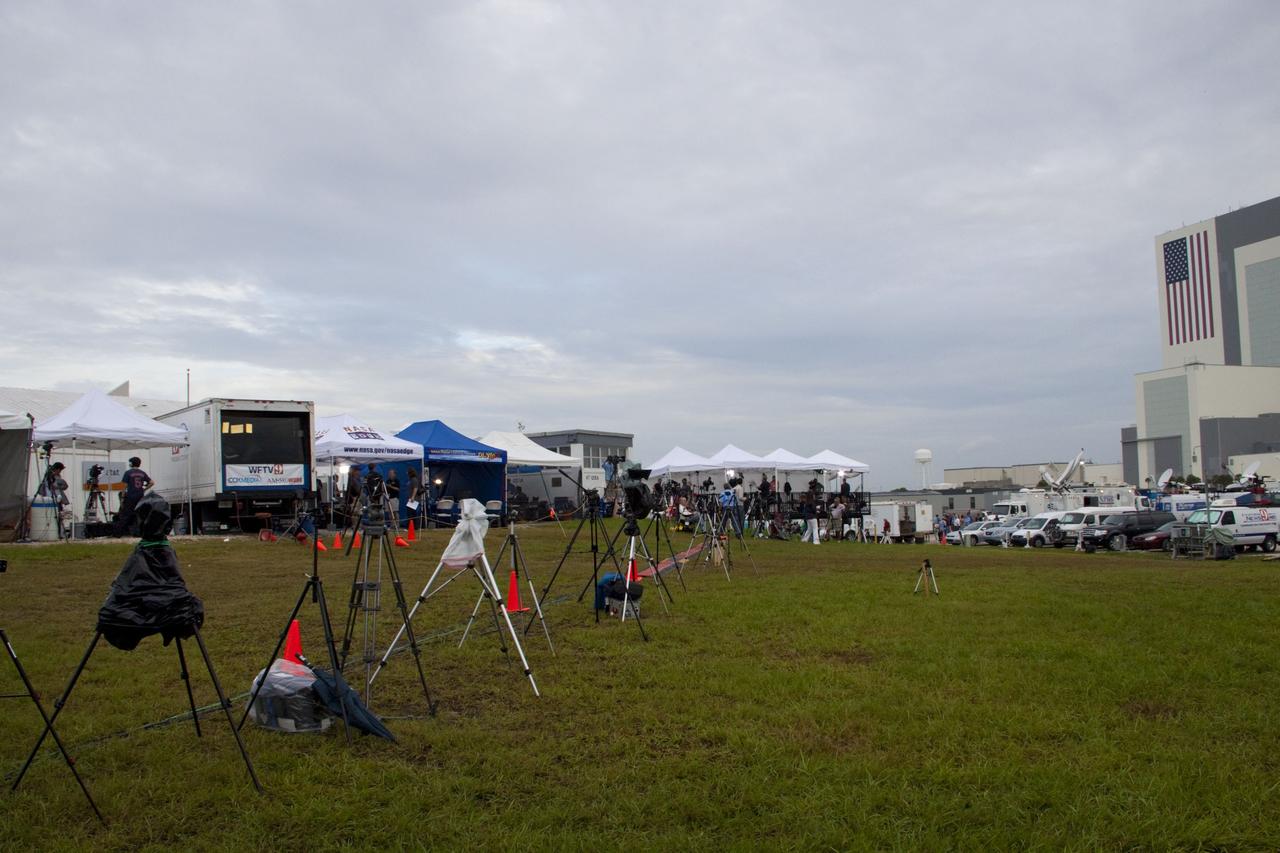
CAPE CANAVERAL, Fla. -- Media from around the globe gather on the grounds of the Press Site at NASA's Kennedy Space Center in Florida to photograph and cover the prelaunch activities and lift off of space shuttle Atlantis on its STS-135 mission to the International Space Station. Atlantis began its final flight, with Commander Chris Ferguson, Pilot Doug Hurley and Mission Specialists Sandy Magnus and Rex Walheim on board, at 11:29 a.m. EDT July 8 to deliver the Raffaello multi-purpose logistics module packed with supplies and spare parts to the station. Also in Atlantis' payload bay is the Robotic Refueling Mission experiment that will investigate the potential for robotically refueling existing satellites in orbit. In addition, Atlantis will return with a failed ammonia pump module to help NASA better understand the failure mechanism and improve pump designs for future systems. STS-135 is the 33rd flight of Atlantis, the 37th shuttle mission to the space station, and the 135th and final mission of NASA's Space Shuttle Program. For more information, visit www.nasa.gov/mission_pages/shuttle/shuttlemissions/sts135/index.html. Photo credit: NASA/Jim Grossmann
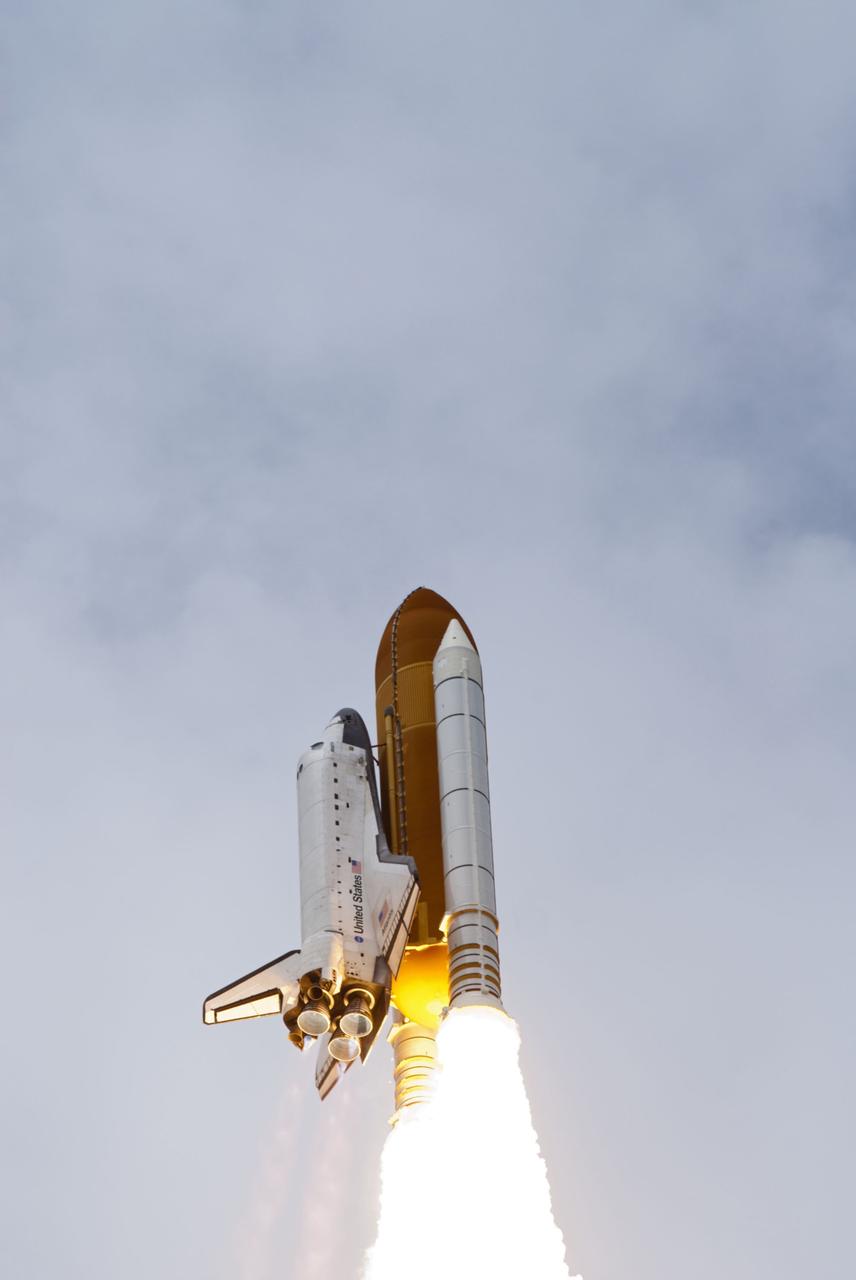
CAPE CANAVERAL, Fla. -- At Launch Pad 39A at NASA's Kennedy Space Center in Florida, space shuttle Atlantis soars into the clouds on its STS-135 mission to the International Space Station. Atlantis with its crew of four; Commander Chris Ferguson, Pilot Doug Hurley, Mission Specialists Sandy Magnus and Rex Walheim, lifted off at 11:29 a.m. EDT on July 8, 2011 to deliver the Raffaello multi-purpose logistics module packed with supplies and spare parts for the station. Atlantis also will fly the Robotic Refueling Mission experiment that will investigate the potential for robotically refueling existing satellites in orbit. In addition, Atlantis will return with a failed ammonia pump module to help NASA better understand the failure mechanism and improve pump designs for future systems. STS-135 is the 33rd flight of Atlantis, the 37th shuttle mission to the space station, and the 135th and final mission of NASA's Space Shuttle Program. For more information, visit www.nasa.gov/mission_pages/shuttle/shuttlemissions/sts135/index.html. Photo credit: NASA/Rusty Backer and Mike Gayle
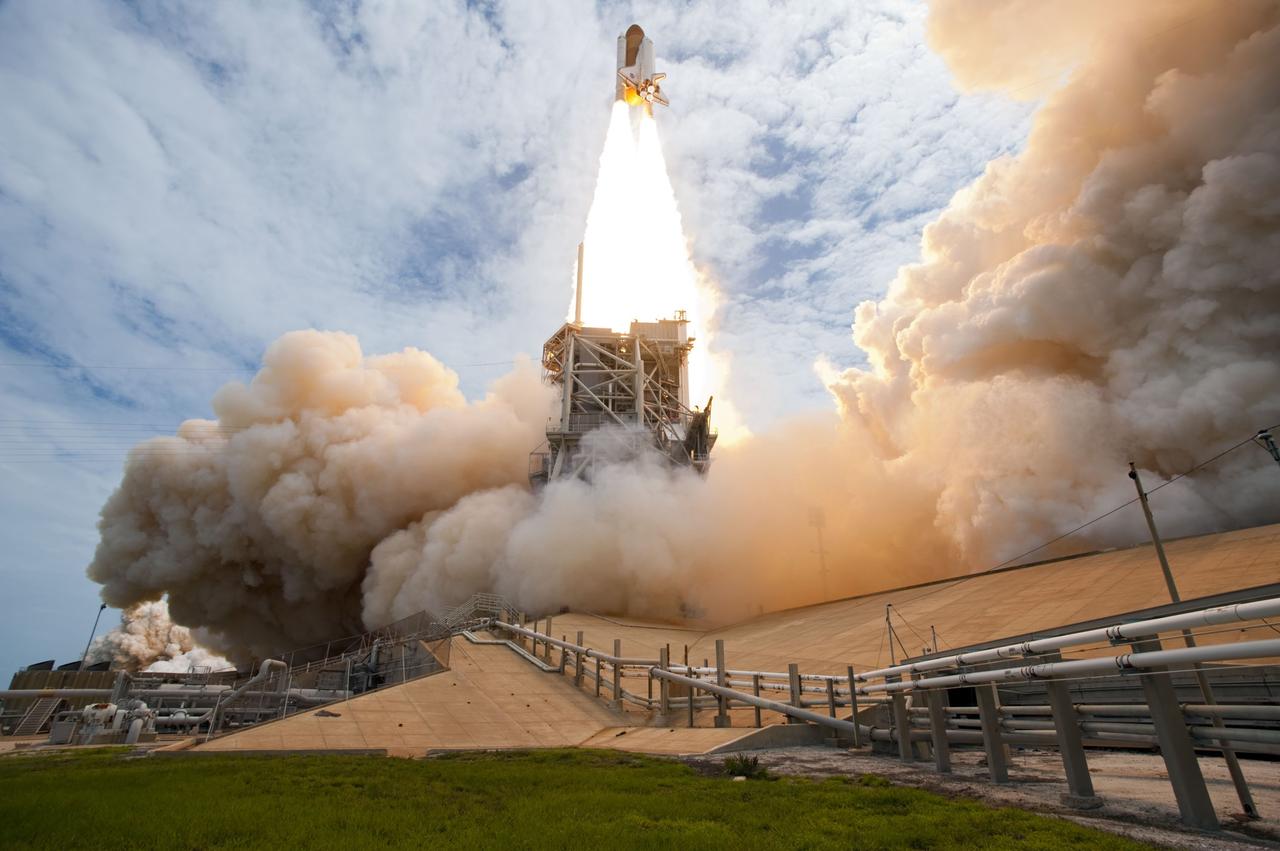
CAPE CANAVERAL, Fla. -- At NASA's Kennedy Space Center in Florida, space shuttle Atlantis lifts off on twin columns of flame from Launch Pad 39A on its way to space on the STS-135 mission to the International Space Station. Atlantis with its crew of four; Commander Chris Ferguson, Pilot Doug Hurley, Mission Specialists Sandy Magnus and Rex Walheim, lifted off at 11:29 a.m. EDT on July 8, 2011 to deliver the Raffaello multi-purpose logistics module packed with supplies and spare parts for the station. Atlantis also will fly the Robotic Refueling Mission experiment that will investigate the potential for robotically refueling existing satellites in orbit. In addition, Atlantis will return with a failed ammonia pump module to help NASA better understand the failure mechanism and improve pump designs for future systems. STS-135 is the 33rd flight of Atlantis, the 37th shuttle mission to the space station, and the 135th and final mission of NASA's Space Shuttle Program. For more information, visit www.nasa.gov/mission_pages/shuttle/shuttlemissions/sts135/index.html. Photo credit: NASA/Tony Gray and Tom Farrar
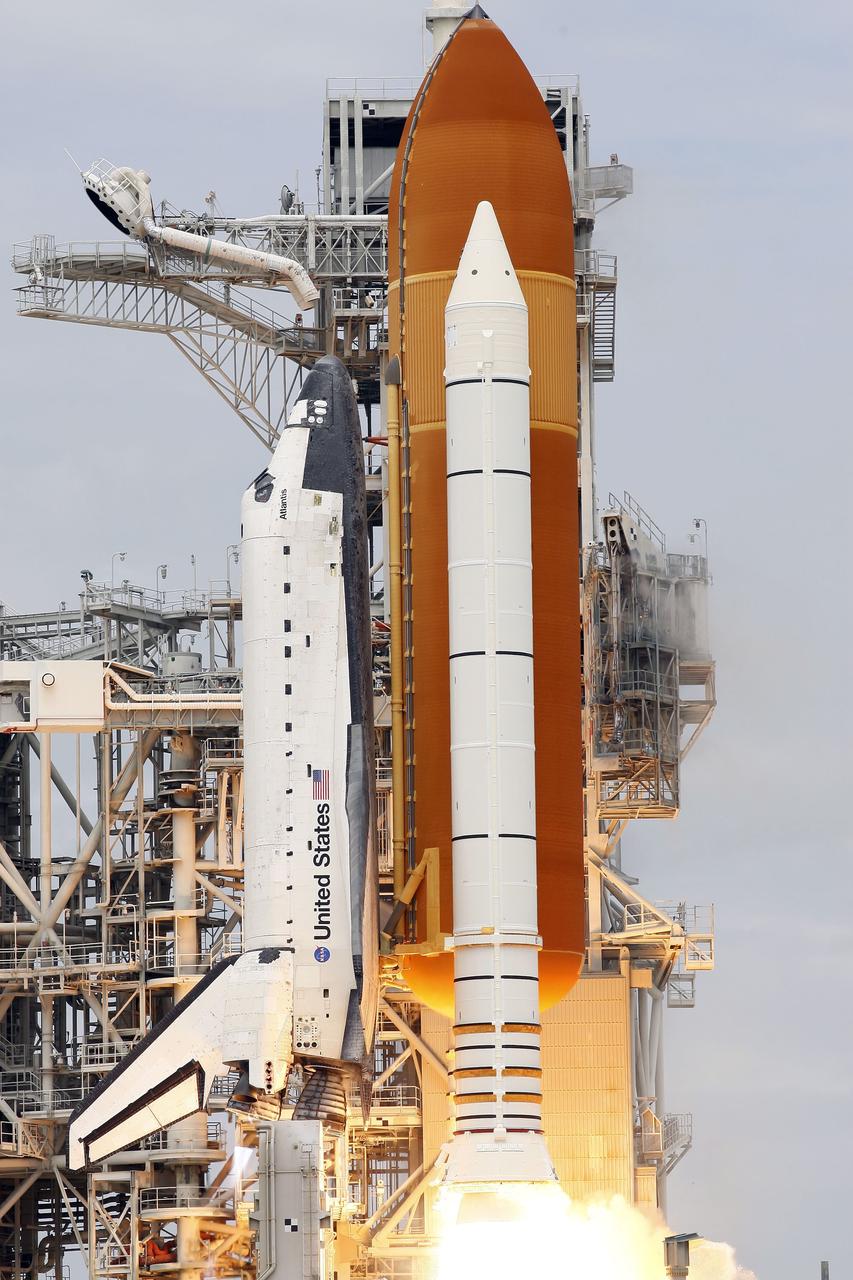
CAPE CANAVERAL, Fla. -- At NASA's Kennedy Space Center in Florida, space shuttle Atlantis' main engines ignite and solid rocket boosters ignite on Launch Pad 39A leaving behind a twin stream of flame as it lifts off on its STS-135 mission to the International Space Station. Atlantis with its crew of four; Commander Chris Ferguson, Pilot Doug Hurley, Mission Specialists Sandy Magnus and Rex Walheim, lifted off at 11:29 a.m. EDT on July 8, 2011 to deliver the Raffaello multi-purpose logistics module packed with supplies and spare parts for the International Space Station. Atlantis also will fly the Robotic Refueling Mission experiment that will investigate the potential for robotically refueling existing satellites in orbit. In addition, Atlantis will return with a failed ammonia pump module to help NASA better understand the failure mechanism and improve pump designs for future systems. STS-135 is the 33rd flight of Atlantis, the 37th shuttle mission to the space station, and the 135th and final mission of NASA's Space Shuttle Program. For more information, visit www.nasa.gov/mission_pages/shuttle/shuttlemissions/sts135/index.html. Photo credit: NASA/Rusty Backer and Mike Gayle
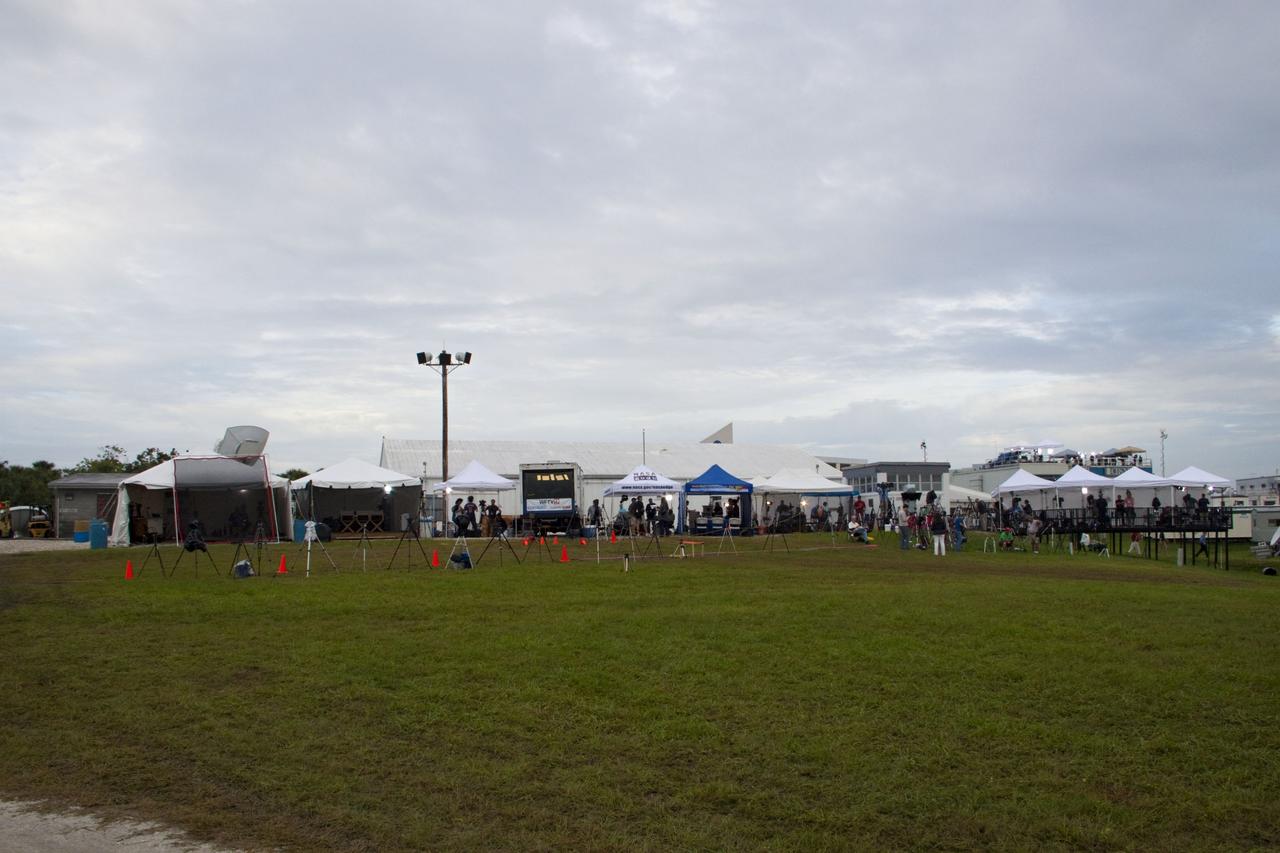
CAPE CANAVERAL, Fla. -- Media from around the globe gather on the grounds of the Press Site at NASA's Kennedy Space Center in Florida to photograph and cover the prelaunch activities and lift off of space shuttle Atlantis on its STS-135 mission to the International Space Station. Atlantis began its final flight, with Commander Chris Ferguson, Pilot Doug Hurley and Mission Specialists Sandy Magnus and Rex Walheim on board, at 11:29 a.m. EDT July 8 to deliver the Raffaello multi-purpose logistics module packed with supplies and spare parts to the station. Also in Atlantis' payload bay is the Robotic Refueling Mission experiment that will investigate the potential for robotically refueling existing satellites in orbit. In addition, Atlantis will return with a failed ammonia pump module to help NASA better understand the failure mechanism and improve pump designs for future systems. STS-135 is the 33rd flight of Atlantis, the 37th shuttle mission to the space station, and the 135th and final mission of NASA's Space Shuttle Program. For more information, visit www.nasa.gov/mission_pages/shuttle/shuttlemissions/sts135/index.html. Photo credit: NASA/Jim Grossmann
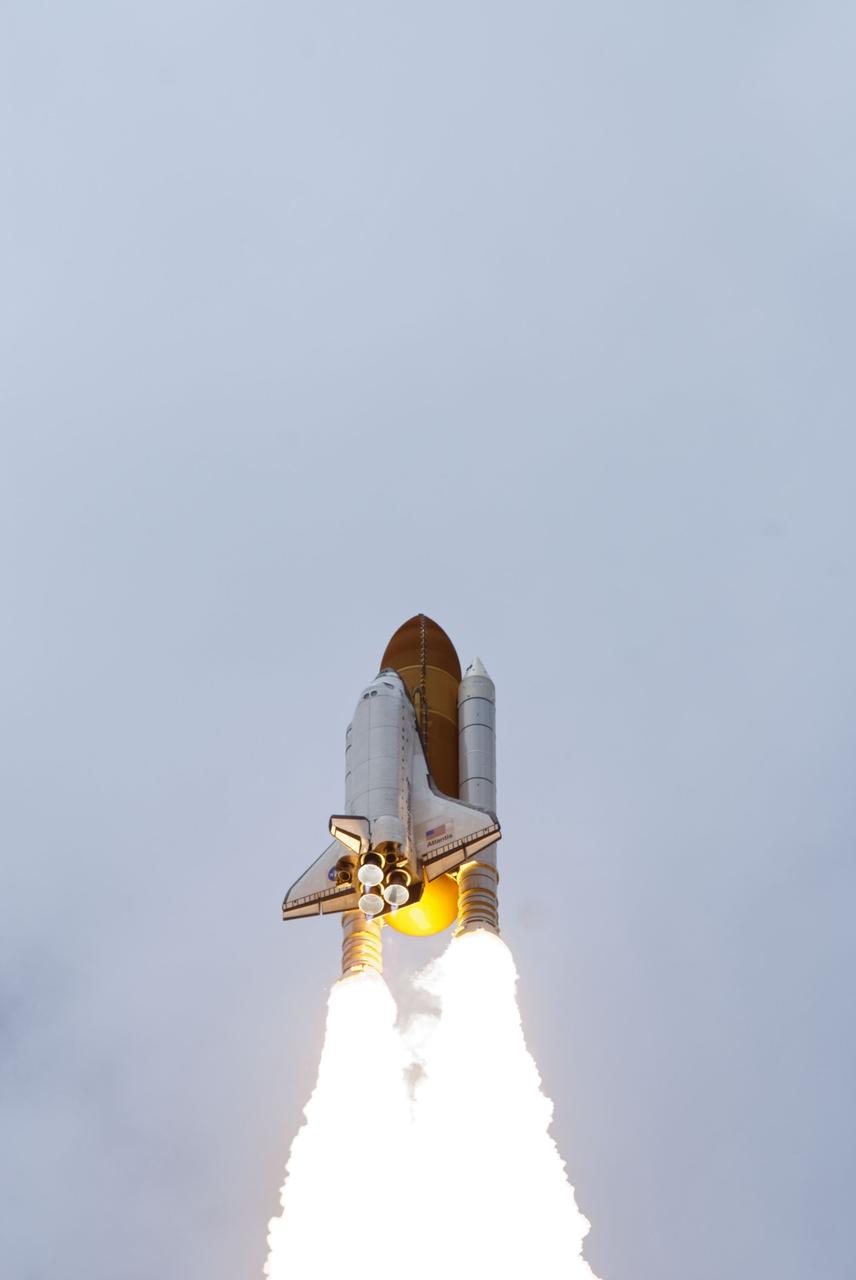
CAPE CANAVERAL, Fla. -- At Launch Pad 39A at NASA's Kennedy Space Center in Florida, space shuttle Atlantis soars into the clouds on its STS-135 mission to the International Space Station. Atlantis with its crew of four; Commander Chris Ferguson, Pilot Doug Hurley, Mission Specialists Sandy Magnus and Rex Walheim, lifted off at 11:29 a.m. EDT on July 8, 2011 to deliver the Raffaello multi-purpose logistics module packed with supplies and spare parts for the station. Atlantis also will fly the Robotic Refueling Mission experiment that will investigate the potential for robotically refueling existing satellites in orbit. In addition, Atlantis will return with a failed ammonia pump module to help NASA better understand the failure mechanism and improve pump designs for future systems. STS-135 is the 33rd flight of Atlantis, the 37th shuttle mission to the space station, and the 135th and final mission of NASA's Space Shuttle Program. For more information, visit www.nasa.gov/mission_pages/shuttle/shuttlemissions/sts135/index.html. Photo credit: NASA/Rusty Backer and Mike Gayle
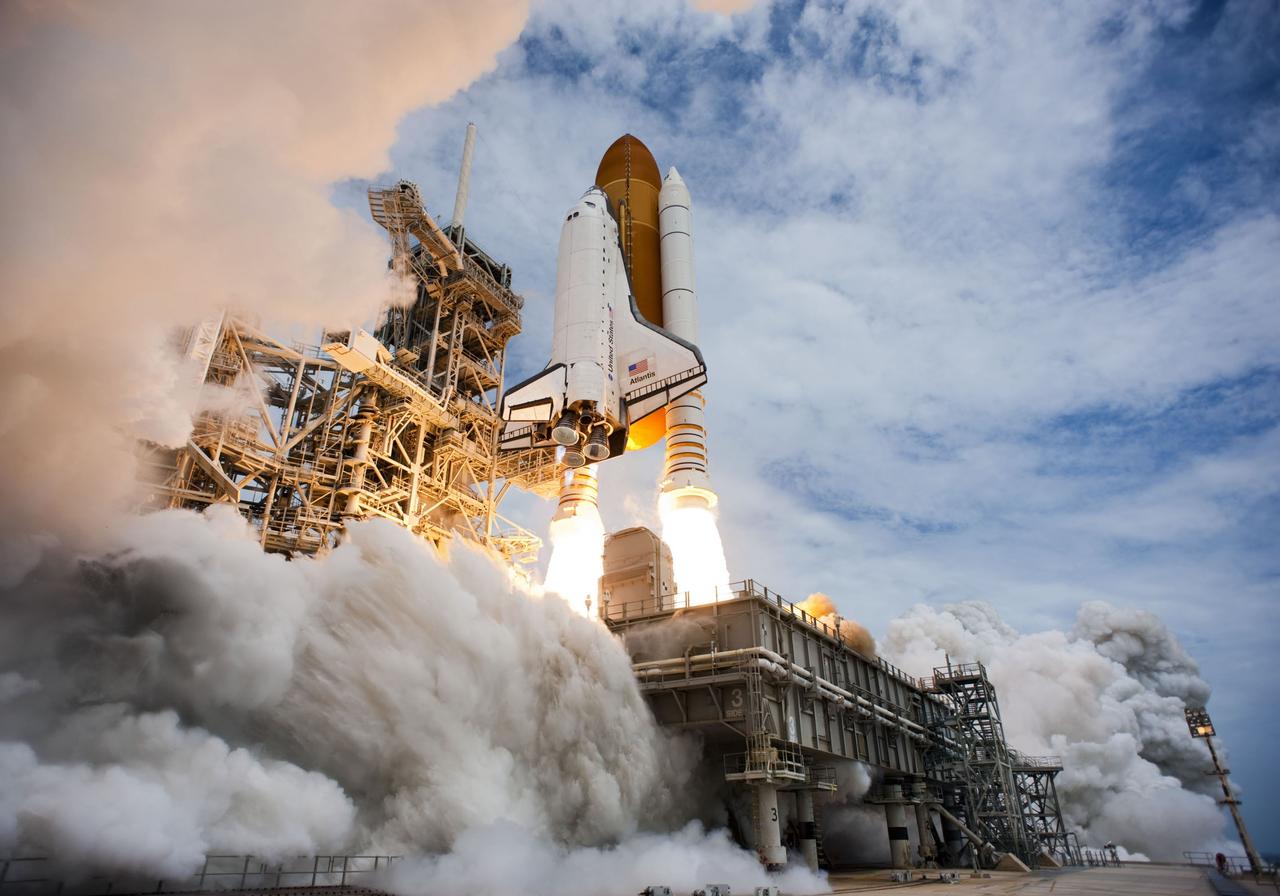
CAPE CANAVERAL, Fla. -- At NASA's Kennedy Space Center in Florida, space shuttle Atlantis lifts off on twin columns of flame from Launch Pad 39A headed for space on the STS-135 mission to the International Space Station. Atlantis with its crew of four; Commander Chris Ferguson, Pilot Doug Hurley, Mission Specialists Sandy Magnus and Rex Walheim, lifted off at 11:29 a.m. EDT on July 8, 2011 to deliver the Raffaello multi-purpose logistics module packed with supplies and spare parts for the station. Atlantis also will fly the Robotic Refueling Mission experiment that will investigate the potential for robotically refueling existing satellites in orbit. In addition, Atlantis will return with a failed ammonia pump module to help NASA better understand the failure mechanism and improve pump designs for future systems. STS-135 is the 33rd flight of Atlantis, the 37th shuttle mission to the space station, and the 135th and final mission of NASA's Space Shuttle Program. For more information, visit www.nasa.gov/mission_pages/shuttle/shuttlemissions/sts135/index.html. Photo credit: NASA/Tony Gray and Tom Farrar
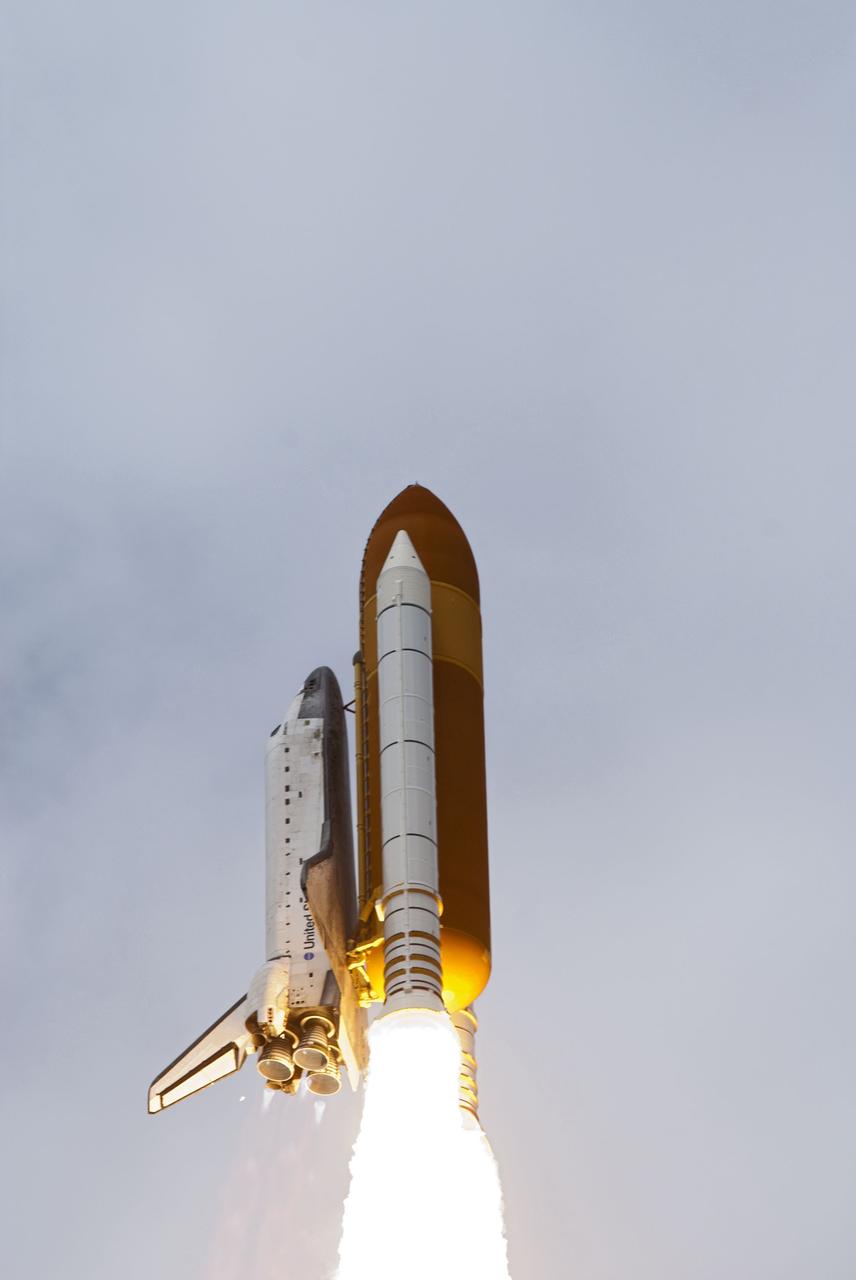
CAPE CANAVERAL, Fla. -- At Launch Pad 39A at NASA's Kennedy Space Center in Florida, space shuttle Atlantis soars into the clouds on its STS-135 mission to the International Space Station. Atlantis with its crew of four; Commander Chris Ferguson, Pilot Doug Hurley, Mission Specialists Sandy Magnus and Rex Walheim, lifted off at 11:29 a.m. EDT on July 8, 2011 to deliver the Raffaello multi-purpose logistics module packed with supplies and spare parts for the station. Atlantis also will fly the Robotic Refueling Mission experiment that will investigate the potential for robotically refueling existing satellites in orbit. In addition, Atlantis will return with a failed ammonia pump module to help NASA better understand the failure mechanism and improve pump designs for future systems. STS-135 is the 33rd flight of Atlantis, the 37th shuttle mission to the space station, and the 135th and final mission of NASA's Space Shuttle Program. For more information, visit www.nasa.gov/mission_pages/shuttle/shuttlemissions/sts135/index.html. Photo credit: NASA/Rusty Backer and Mike Gayle
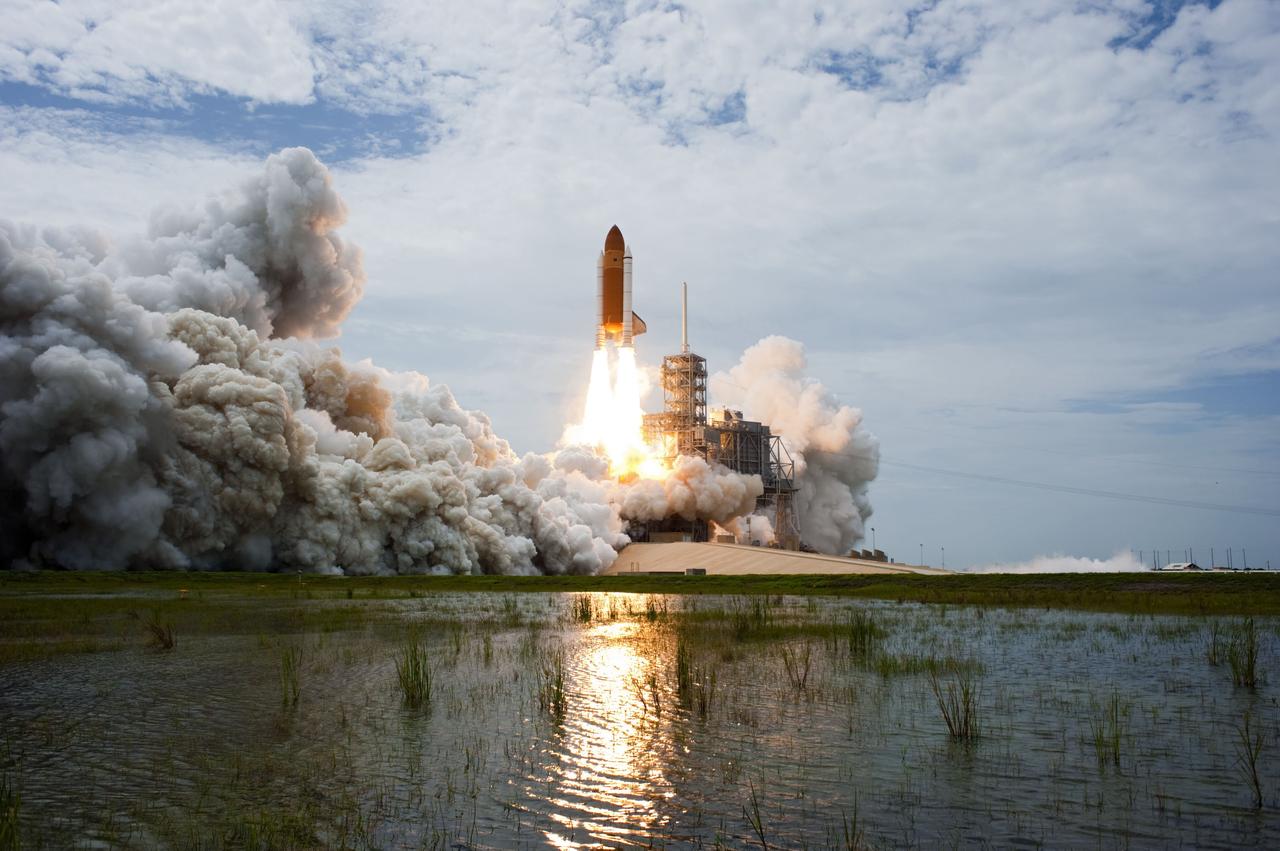
CAPE CANAVERAL, Fla. -- At NASA's Kennedy Space Center in Florida, space shuttle Atlantis lifts off of Launch Pad 39A leaving behind billows of steam and smoke as it heads upwards past the tower on its STS-135 mission to the International Space Station. Atlantis with its crew of four; Commander Chris Ferguson, Pilot Doug Hurley, Mission Specialists Sandy Magnus and Rex Walheim, lifted off at 11:29 a.m. EDT on July 8, 2011 to deliver the Raffaello multi-purpose logistics module packed with supplies and spare parts for the station. Atlantis also will fly the Robotic Refueling Mission experiment that will investigate the potential for robotically refueling existing satellites in orbit. In addition, Atlantis will return with a failed ammonia pump module to help NASA better understand the failure mechanism and improve pump designs for future systems. STS-135 is the 33rd flight of Atlantis, the 37th shuttle mission to the space station, and the 135th and final mission of NASA's Space Shuttle Program. For more information, visit www.nasa.gov/mission_pages/shuttle/shuttlemissions/sts135/index.html. Photo credit: NASA/Sandra Joseph and Kevin O'Connell
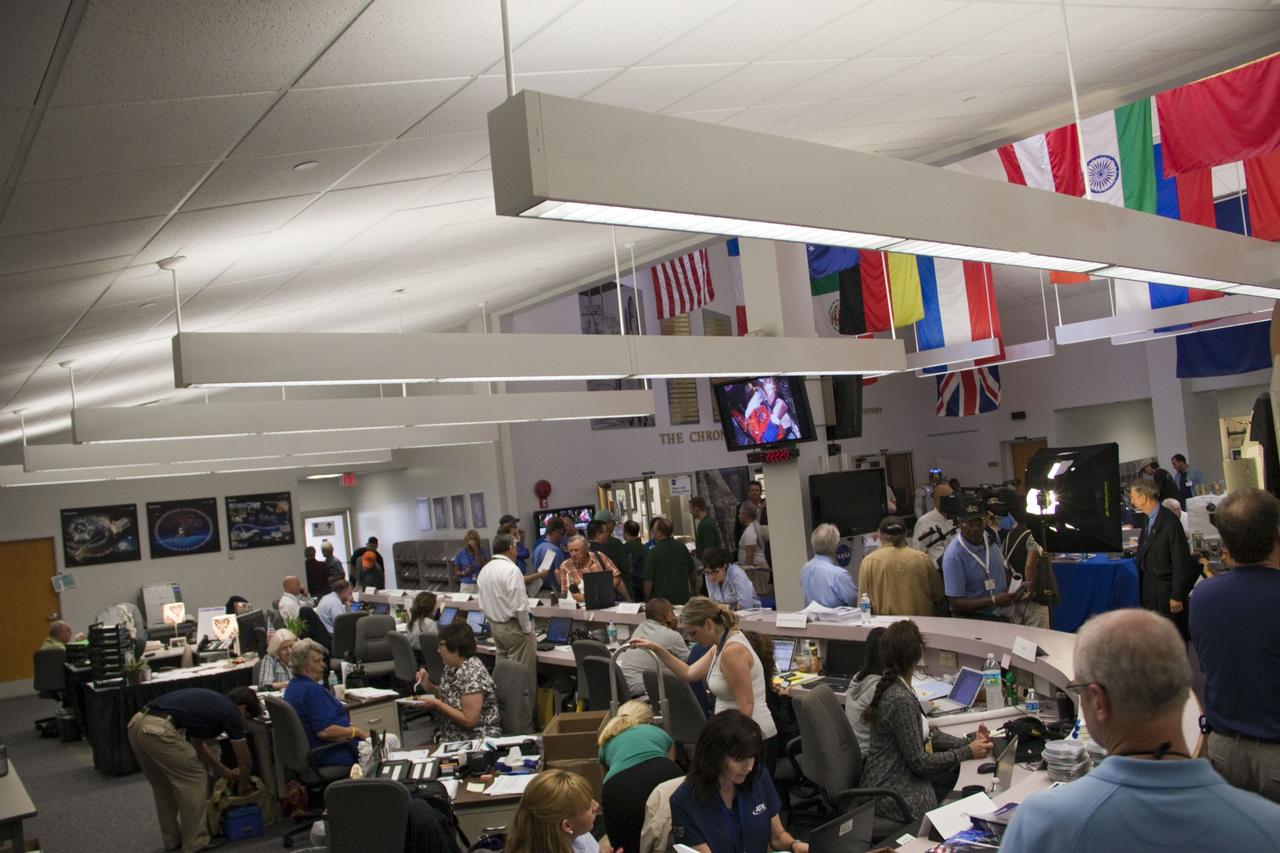
CAPE CANAVERAL, Fla. -- Media from around the globe gather at the NASA News Center at NASA Kennedy Space Center's Press Site in Florida to cover the prelaunch activities and lift off of space shuttle Atlantis on its STS-135 mission to the International Space Station. Volunteers can be seen at their desks answering questions and providing assistance. Atlantis began its final flight, with Commander Chris Ferguson, Pilot Doug Hurley and Mission Specialists Sandy Magnus and Rex Walheim on board, at 11:29 a.m. EDT July 8 to deliver the Raffaello multi-purpose logistics module packed with supplies and spare parts to the station. Also in Atlantis' payload bay is the Robotic Refueling Mission experiment that will investigate the potential for robotically refueling existing satellites in orbit. In addition, Atlantis will return with a failed ammonia pump module to help NASA better understand the failure mechanism and improve pump designs for future systems. STS-135 is the 33rd flight of Atlantis, the 37th shuttle mission to the space station, and the 135th and final mission of NASA's Space Shuttle Program. For more information, visit www.nasa.gov/mission_pages/shuttle/shuttlemissions/sts135/index.html. Photo credit: NASA/Jim Grossmann
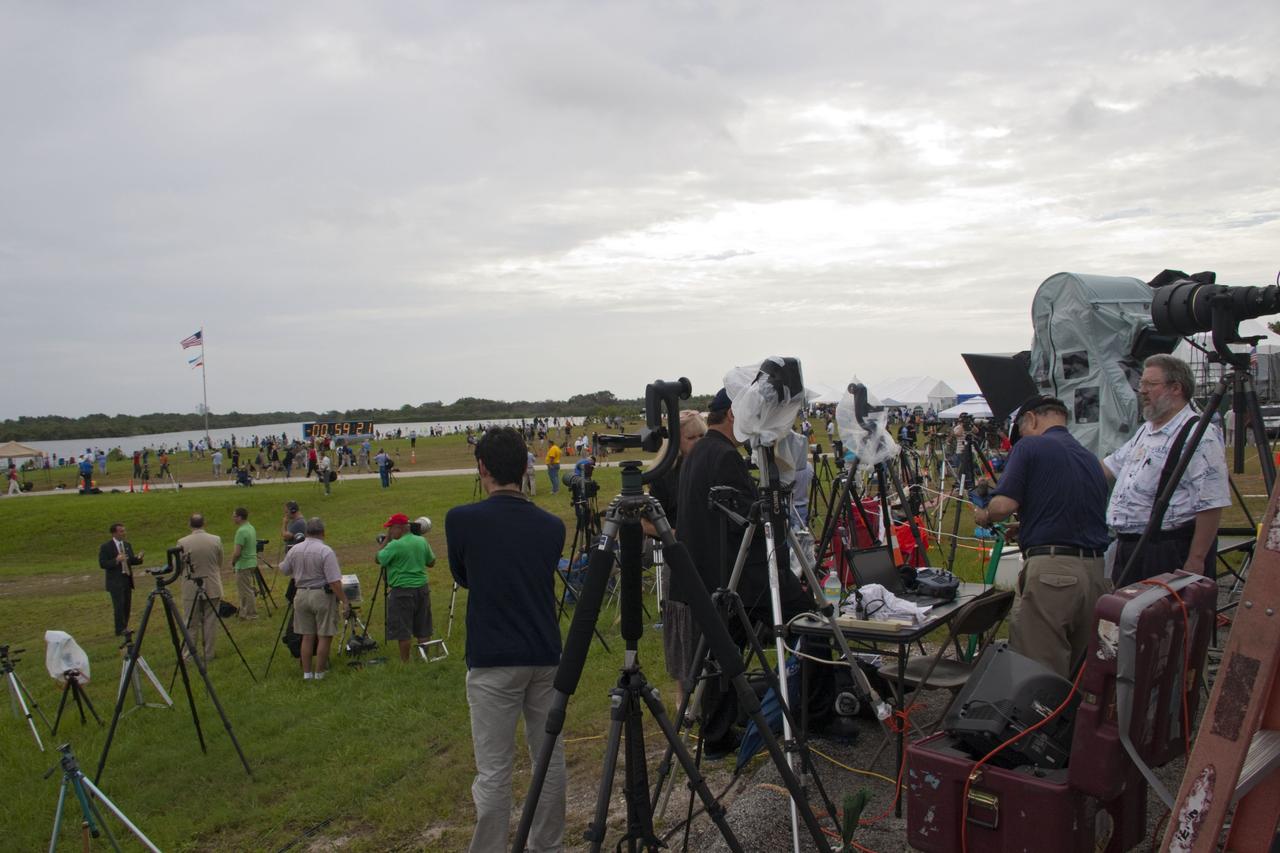
CAPE CANAVERAL, Fla. -- Media from around the globe gather on the grounds of the Press Site and countdown clock at NASA's Kennedy Space Center in Florida to photograph and cover the prelaunch activities and lift off of space shuttle Atlantis on its STS-135 mission to the International Space Station. Atlantis began its final flight, with Commander Chris Ferguson, Pilot Doug Hurley and Mission Specialists Sandy Magnus and Rex Walheim on board, at 11:29 a.m. EDT July 8 to deliver the Raffaello multi-purpose logistics module packed with supplies and spare parts to the station. Also in Atlantis' payload bay is the Robotic Refueling Mission experiment that will investigate the potential for robotically refueling existing satellites in orbit. In addition, Atlantis will return with a failed ammonia pump module to help NASA better understand the failure mechanism and improve pump designs for future systems. STS-135 is the 33rd flight of Atlantis, the 37th shuttle mission to the space station, and the 135th and final mission of NASA's Space Shuttle Program. For more information, visit www.nasa.gov/mission_pages/shuttle/shuttlemissions/sts135/index.html. Photo credit: NASA/Jim Grossmann
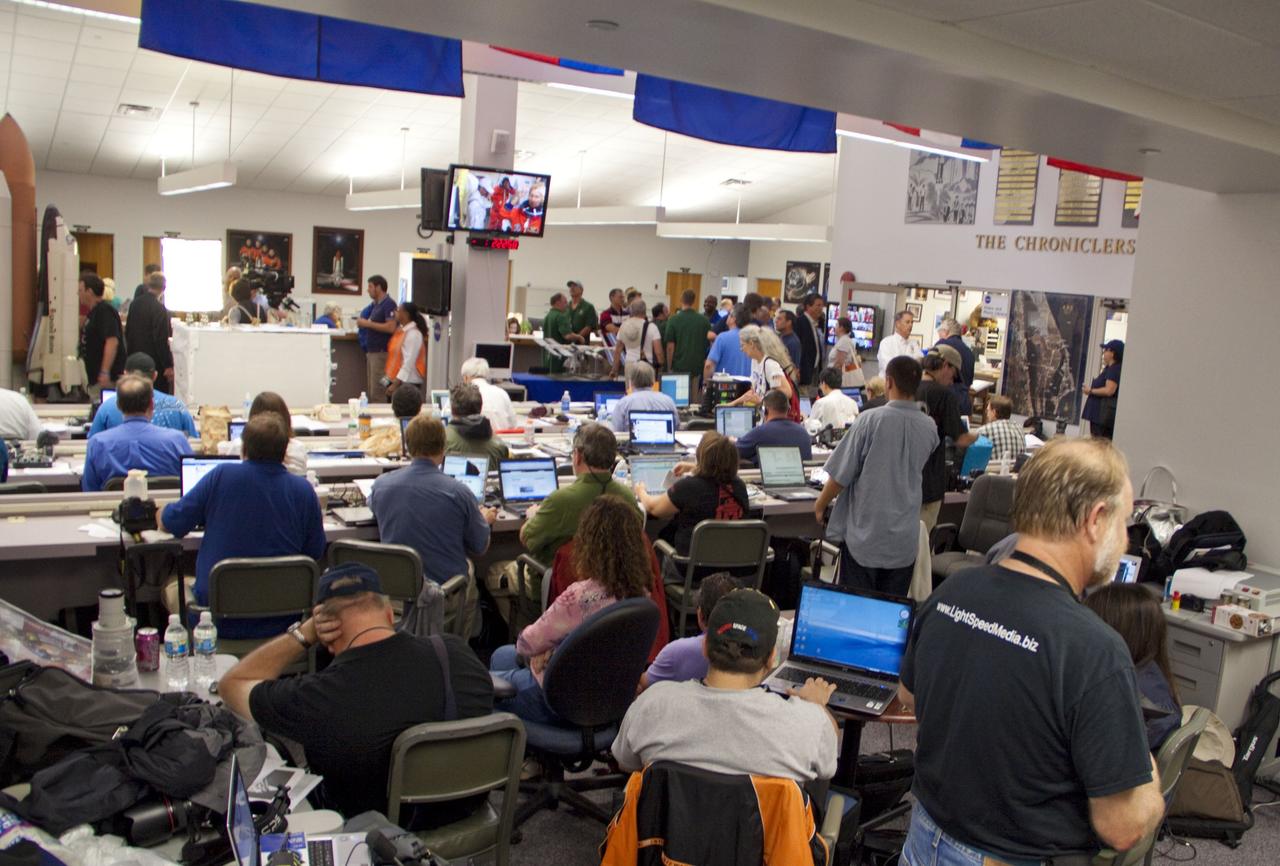
CAPE CANAVERAL, Fla. -- Media and Tweetup participants from around the globe gather at the NASA News Center at NASA Kennedy Space Center's Press Site in Florida to cover the prelaunch activities and lift off of space shuttle Atlantis on its STS-135 mission to the International Space Station. Atlantis began its final flight, with Commander Chris Ferguson, Pilot Doug Hurley and Mission Specialists Sandy Magnus and Rex Walheim on board, at 11:29 a.m. EDT July 8 to deliver the Raffaello multi-purpose logistics module packed with supplies and spare parts to the station. Also in Atlantis' payload bay is the Robotic Refueling Mission experiment that will investigate the potential for robotically refueling existing satellites in orbit. In addition, Atlantis will return with a failed ammonia pump module to help NASA better understand the failure mechanism and improve pump designs for future systems. STS-135 is the 33rd flight of Atlantis, the 37th shuttle mission to the space station, and the 135th and final mission of NASA's Space Shuttle Program. For more information, visit www.nasa.gov/mission_pages/shuttle/shuttlemissions/sts135/index.html. Photo credit: NASA/Jim Grossmann
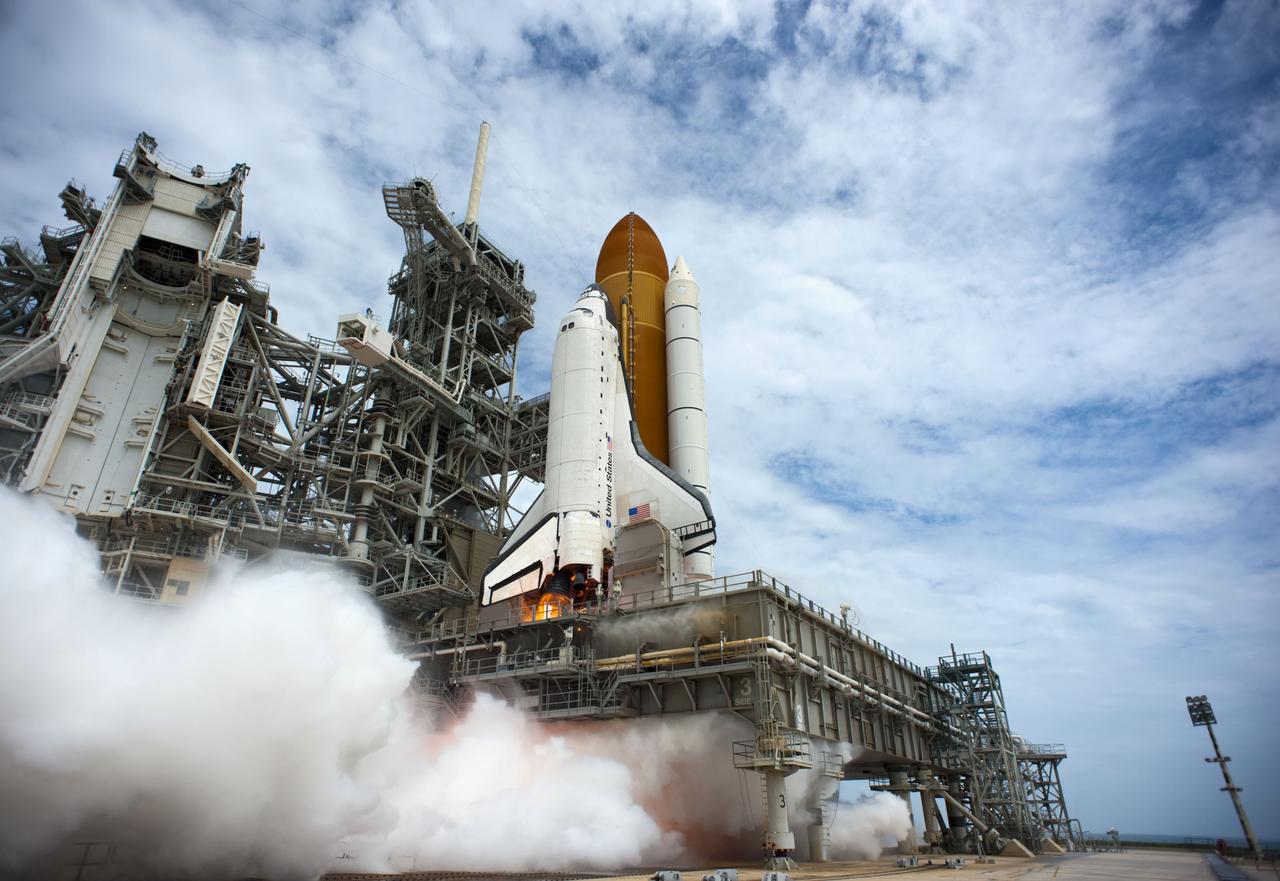
CAPE CANAVERAL, Fla. -- At NASA's Kennedy Space Center in Florida, space shuttle Atlantis' engines and solid rocket boosters ignite on Launch Pad 39A as it begins to lift off on its STS-135 mission to the International Space Station. Atlantis with its crew of four; Commander Chris Ferguson, Pilot Doug Hurley, Mission Specialists Sandy Magnus and Rex Walheim, lifted off at 11:29 a.m. EDT on July 8, 2011 to deliver the Raffaello multi-purpose logistics module packed with supplies and spare parts for the station. Atlantis also will fly the Robotic Refueling Mission experiment that will investigate the potential for robotically refueling existing satellites in orbit. In addition, Atlantis will return with a failed ammonia pump module to help NASA better understand the failure mechanism and improve pump designs for future systems. STS-135 is the 33rd flight of Atlantis, the 37th shuttle mission to the space station, and the 135th and final mission of NASA's Space Shuttle Program. For more information, visit www.nasa.gov/mission_pages/shuttle/shuttlemissions/sts135/index.html. Photo credit: NASA/Tony Gray and Tom Farrar
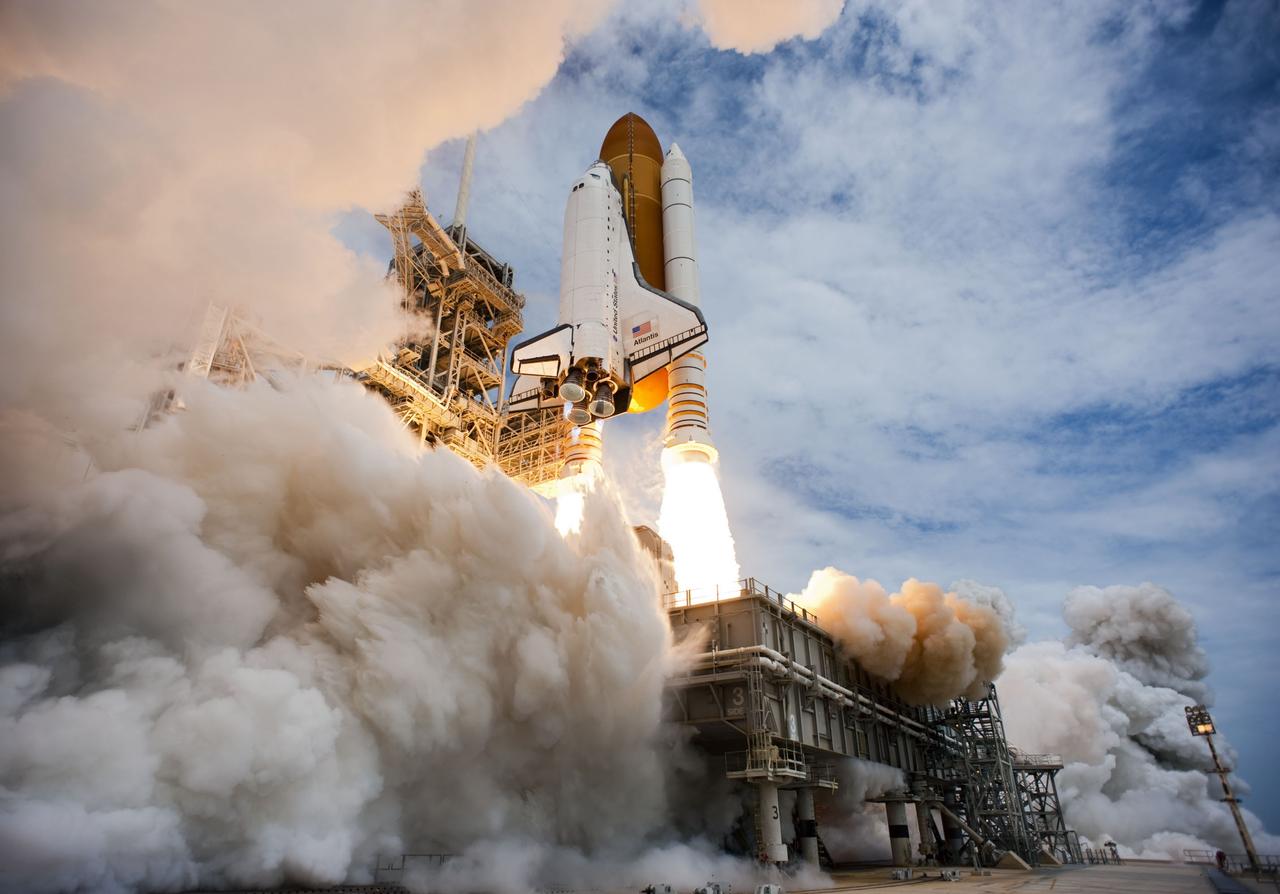
CAPE CANAVERAL, Fla. -- At NASA's Kennedy Space Center in Florida, space shuttle Atlantis lifts off on twin columns of flame from Launch Pad 39A headed for space on the STS-135 mission to the International Space Station. Atlantis with its crew of four; Commander Chris Ferguson, Pilot Doug Hurley, Mission Specialists Sandy Magnus and Rex Walheim, lifted off at 11:29 a.m. EDT on July 8, 2011 to deliver the Raffaello multi-purpose logistics module packed with supplies and spare parts for the station. Atlantis also will fly the Robotic Refueling Mission experiment that will investigate the potential for robotically refueling existing satellites in orbit. In addition, Atlantis will return with a failed ammonia pump module to help NASA better understand the failure mechanism and improve pump designs for future systems. STS-135 is the 33rd flight of Atlantis, the 37th shuttle mission to the space station, and the 135th and final mission of NASA's Space Shuttle Program. For more information, visit www.nasa.gov/mission_pages/shuttle/shuttlemissions/sts135/index.html. Photo credit: NASA/Tony Gray and Tom Farrar
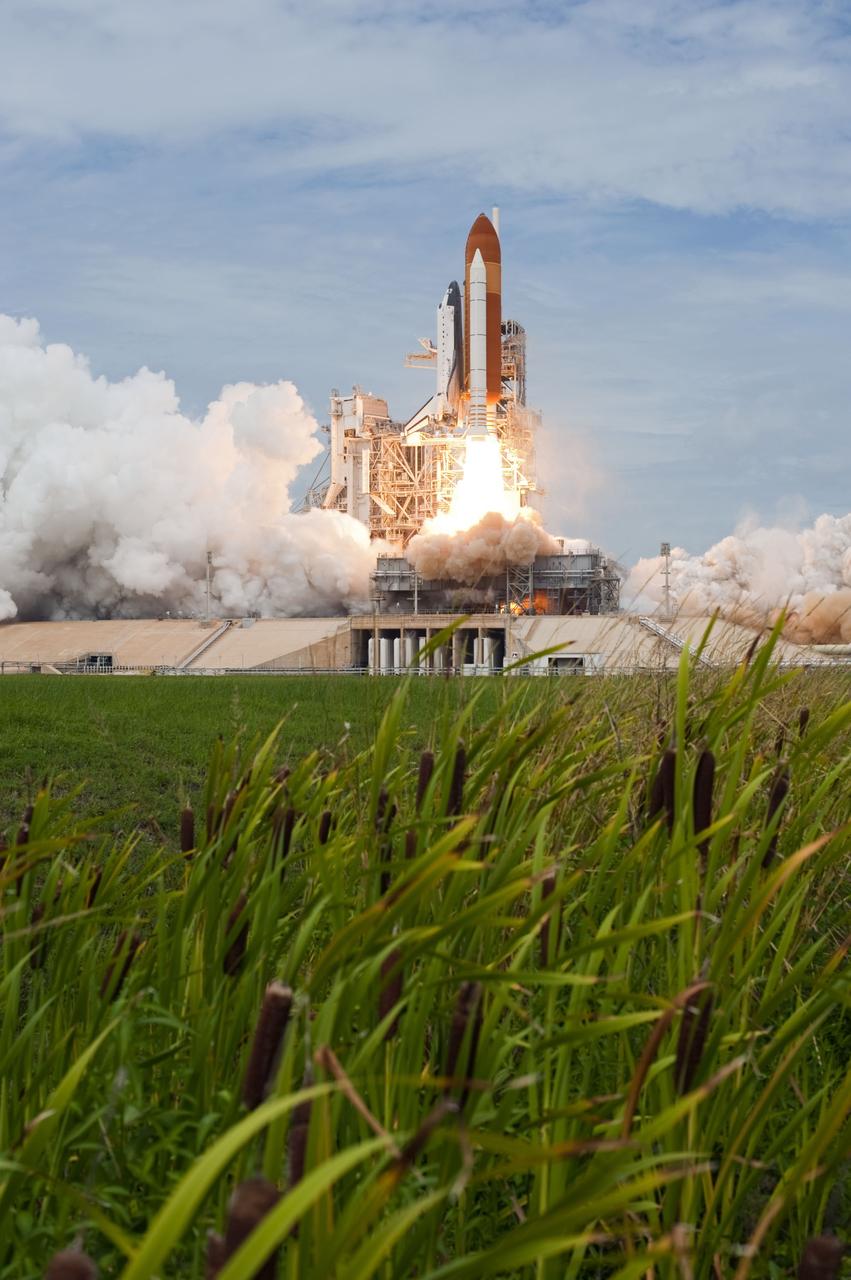
CAPE CANAVERAL, Fla. -- On Launch Pad 39A at NASA's Kennedy Space Center in Florida, space shuttle Atlantis travels upward on streams of flame as it lifts off on its STS-135 mission to the International Space Station. Atlantis with its crew of four; Commander Chris Ferguson, Pilot Doug Hurley, Mission Specialists Sandy Magnus and Rex Walheim, lifted off at 11:29 a.m. EDT on July 8, 2011 to deliver the Raffaello multi-purpose logistics module packed with supplies and spare parts for the station. Atlantis also will fly the Robotic Refueling Mission experiment that will investigate the potential for robotically refueling existing satellites in orbit. In addition, Atlantis will return with a failed ammonia pump module to help NASA better understand the failure mechanism and improve pump designs for future systems. STS-135 is the 33rd flight of Atlantis, the 37th shuttle mission to the space station, and the 135th and final mission of NASA's Space Shuttle Program. For more information, visit www.nasa.gov/mission_pages/shuttle/shuttlemissions/sts135/index.html. Photo credit: NASA/Tony Gray and Tom Farrar
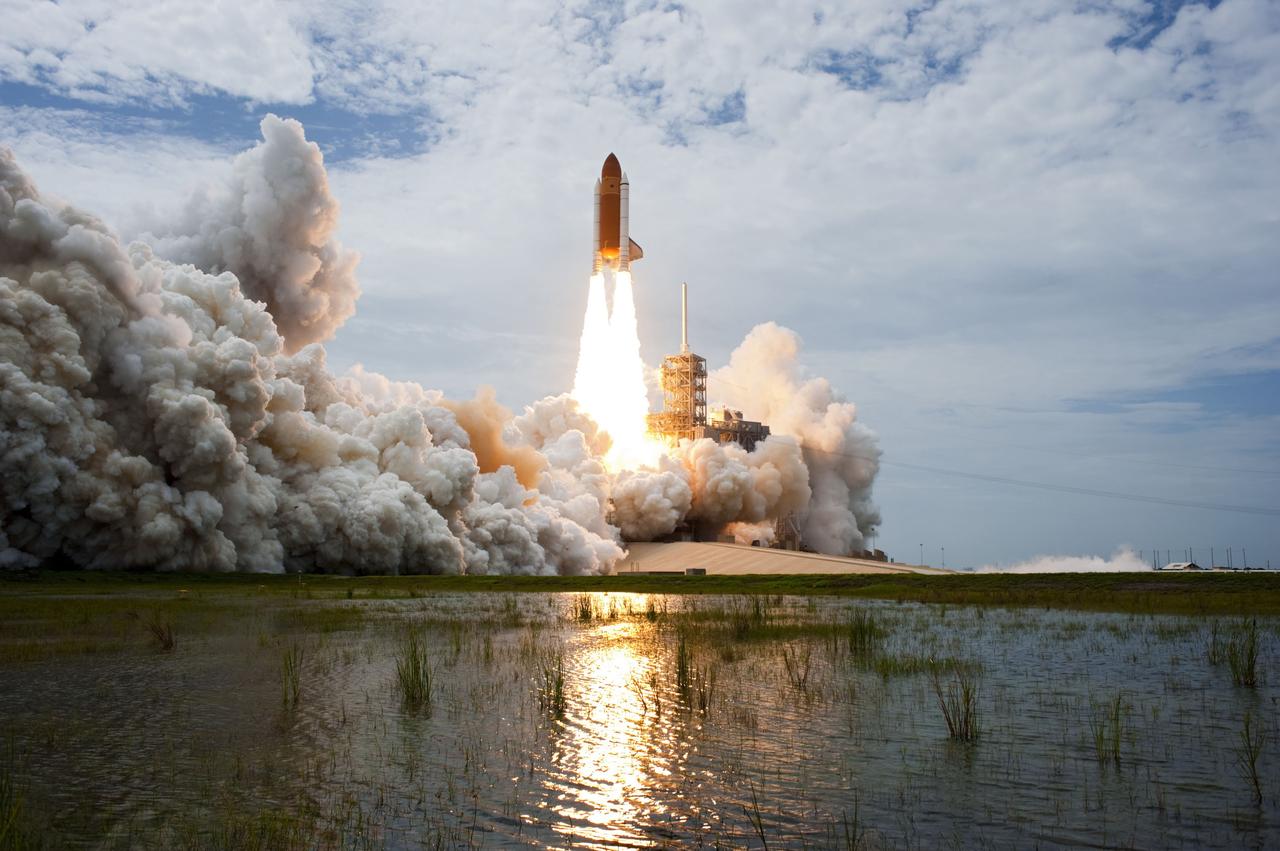
CAPE CANAVERAL, Fla. -- At NASA's Kennedy Space Center in Florida, space shuttle Atlantis lifts off of Launch Pad 39A leaving behind billows of steam and smoke as it heads into the clouds on its STS-135 mission to the International Space Station. Atlantis with its crew of four; Commander Chris Ferguson, Pilot Doug Hurley, Mission Specialists Sandy Magnus and Rex Walheim, lifted off at 11:29 a.m. EDT on July 8, 2011 to deliver the Raffaello multi-purpose logistics module packed with supplies and spare parts for the station. Atlantis also will fly the Robotic Refueling Mission experiment that will investigate the potential for robotically refueling existing satellites in orbit. In addition, Atlantis will return with a failed ammonia pump module to help NASA better understand the failure mechanism and improve pump designs for future systems. STS-135 is the 33rd flight of Atlantis, the 37th shuttle mission to the space station, and the 135th and final mission of NASA's Space Shuttle Program. For more information, visit www.nasa.gov/mission_pages/shuttle/shuttlemissions/sts135/index.html. Photo credit: NASA/Sandra Joseph and Kevin O'Connell
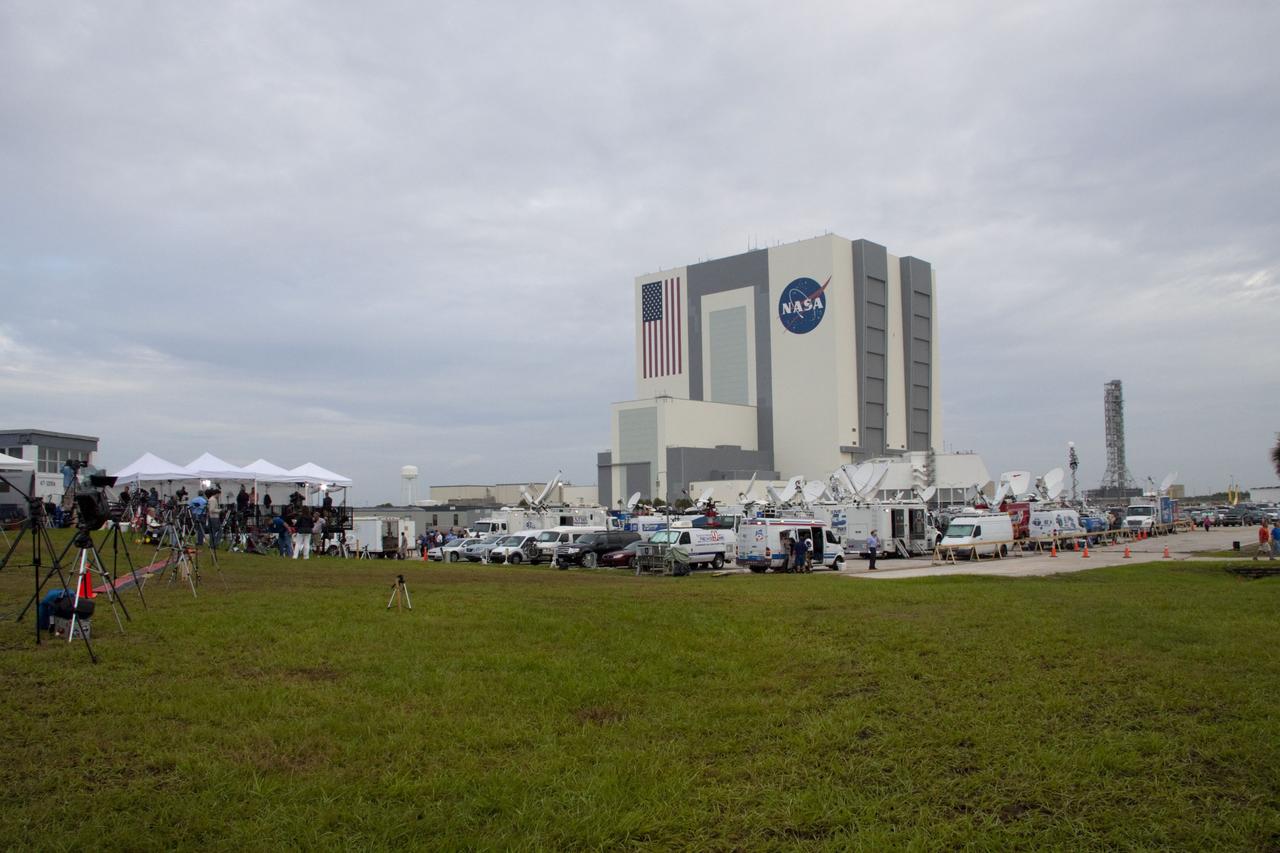
CAPE CANAVERAL, Fla. -- Media from around the globe gather on the grounds of the Press Site at NASA's Kennedy Space Center in Florida to photograph and cover the prelaunch activities and lift off of space shuttle Atlantis on its STS-135 mission to the International Space Station. Dozens of satellite news vehicles can be seen in the parking lot while the massive Vehicle Assembly Building towers above in the background. Atlantis began its final flight, with Commander Chris Ferguson, Pilot Doug Hurley and Mission Specialists Sandy Magnus and Rex Walheim on board, at 11:29 a.m. EDT July 8 to deliver the Raffaello multi-purpose logistics module packed with supplies and spare parts to the station. Also in Atlantis' payload bay is the Robotic Refueling Mission experiment that will investigate the potential for robotically refueling existing satellites in orbit. In addition, Atlantis will return with a failed ammonia pump module to help NASA better understand the failure mechanism and improve pump designs for future systems. STS-135 is the 33rd flight of Atlantis, the 37th shuttle mission to the space station, and the 135th and final mission of NASA's Space Shuttle Program. For more information, visit www.nasa.gov/mission_pages/shuttle/shuttlemissions/sts135/index.html. Photo credit: NASA/Jim Grossmann
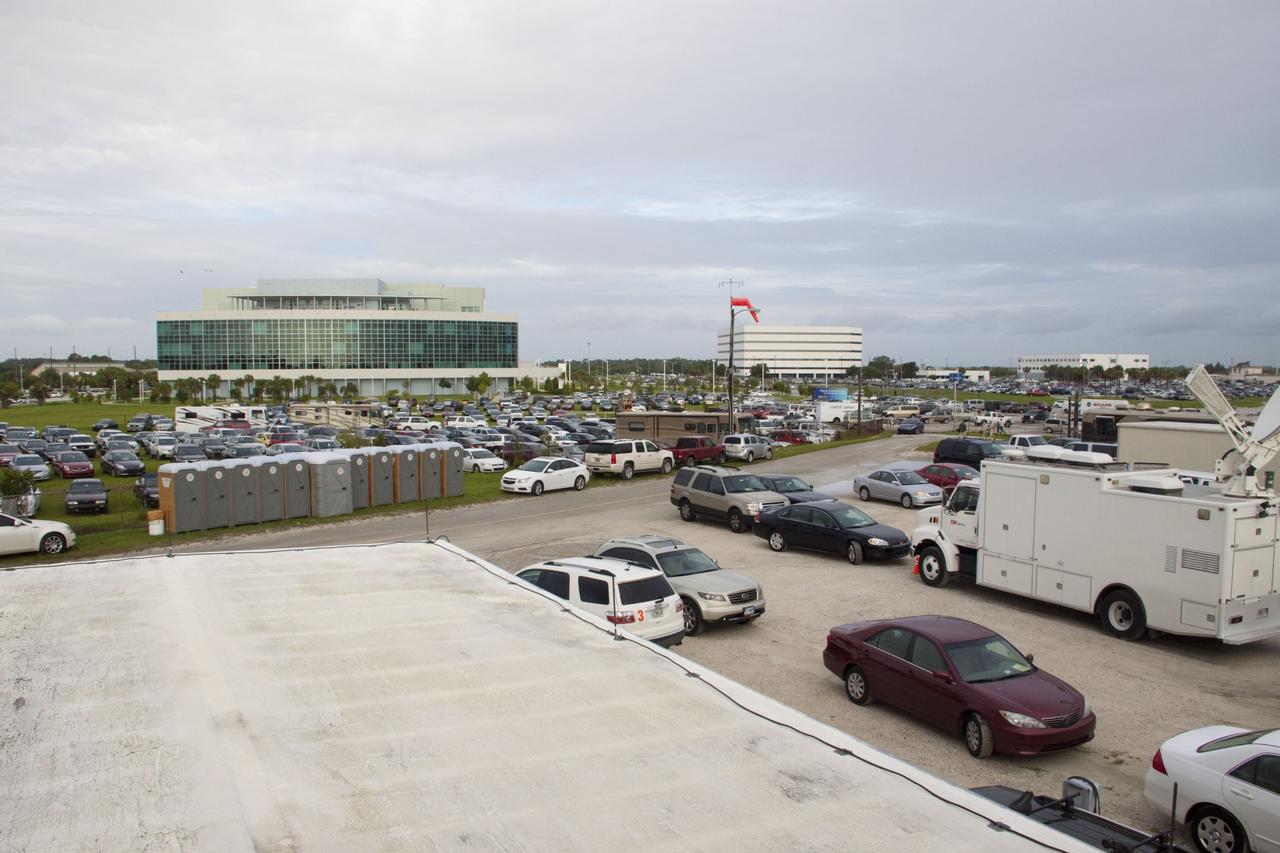
CAPE CANAVERAL, Fla. -- Media from around the globe gather on the grounds of the Press Site at NASA's Kennedy Space Center in Florida to photograph and cover the prelaunch activities and lift off of space shuttle Atlantis on its STS-135 mission to the International Space Station. Satellite news trucks, trailers and automobiles can be seen in the parking lot. In the background is the Operations and Support Building II where VIPs are able to watch the launch from its upper balcony. Atlantis began its final flight, with Commander Chris Ferguson, Pilot Doug Hurley and Mission Specialists Sandy Magnus and Rex Walheim on board, at 11:29 a.m. EDT July 8 to deliver the Raffaello multi-purpose logistics module packed with supplies and spare parts to the station. Also in Atlantis' payload bay is the Robotic Refueling Mission experiment that will investigate the potential for robotically refueling existing satellites in orbit. In addition, Atlantis will return with a failed ammonia pump module to help NASA better understand the failure mechanism and improve pump designs for future systems. STS-135 is the 33rd flight of Atlantis, the 37th shuttle mission to the space station, and the 135th and final mission of NASA's Space Shuttle Program. For more information, visit www.nasa.gov/mission_pages/shuttle/shuttlemissions/sts135/index.html. Photo credit: NASA/Jim Grossmann
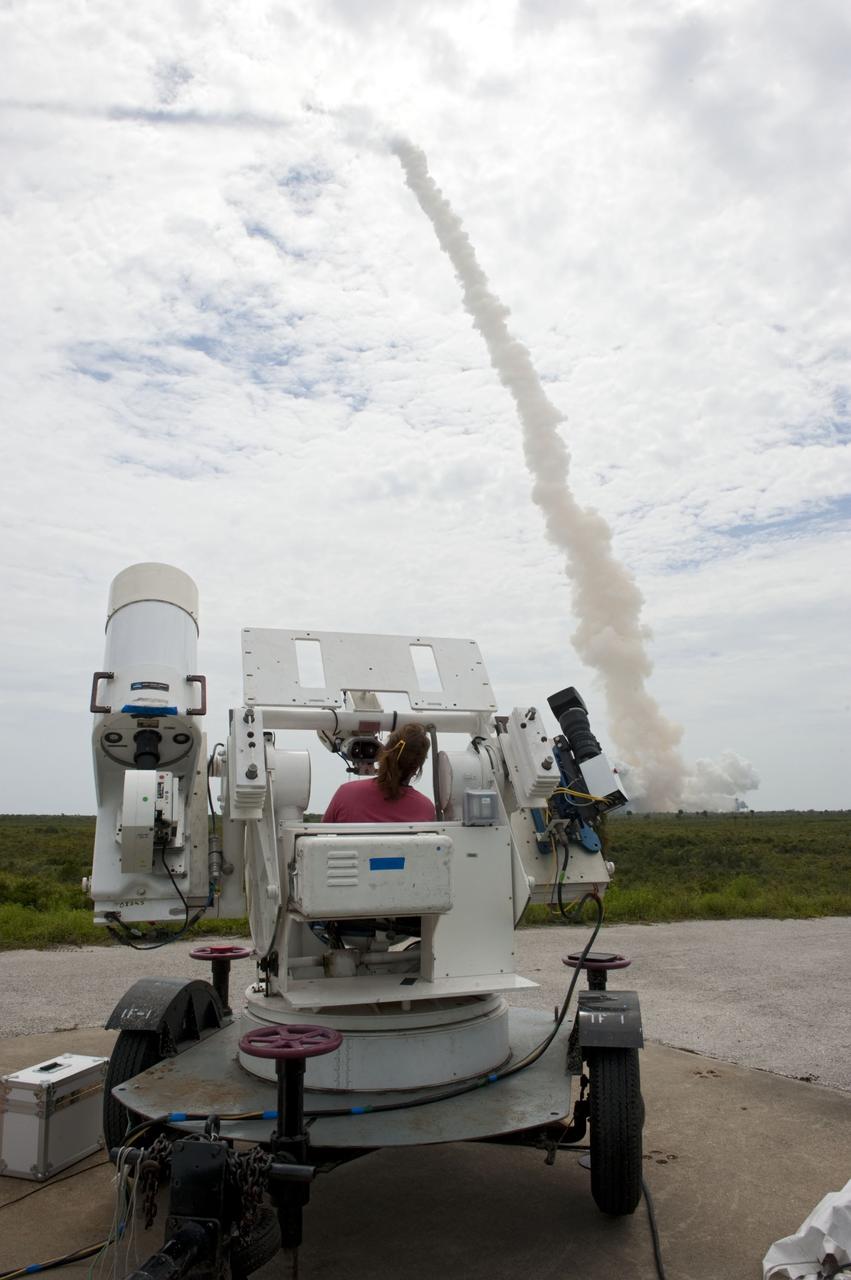
CAPE CANAVERAL, Fla. -- NASA photographer Sandra Joseph aims her remote camera tracker on space shuttle Atlantis at it lifts off from Launch Pad 39A at NASA's Kennedy Space Center in Florida beginning its STS-135 mission to the International Space Station. Atlantis with its crew of four; Commander Chris Ferguson, Pilot Doug Hurley, Mission Specialists Sandy Magnus and Rex Walheim, lifted off at 11:29 a.m. EDT on July 8, 2011 to deliver the Raffaello multi-purpose logistics module packed with supplies and spare parts for the station. Atlantis also will fly the Robotic Refueling Mission experiment that will investigate the potential for robotically refueling existing satellites in orbit. In addition, Atlantis will return with a failed ammonia pump module to help NASA better understand the failure mechanism and improve pump designs for future systems. STS-135 is the 33rd flight of Atlantis, the 37th shuttle mission to the space station, and the 135th and final mission of NASA's Space Shuttle Program. For more information, visit www.nasa.gov/mission_pages/shuttle/shuttlemissions/sts135/index.html. Photo credit: NASA/Sandra Joseph
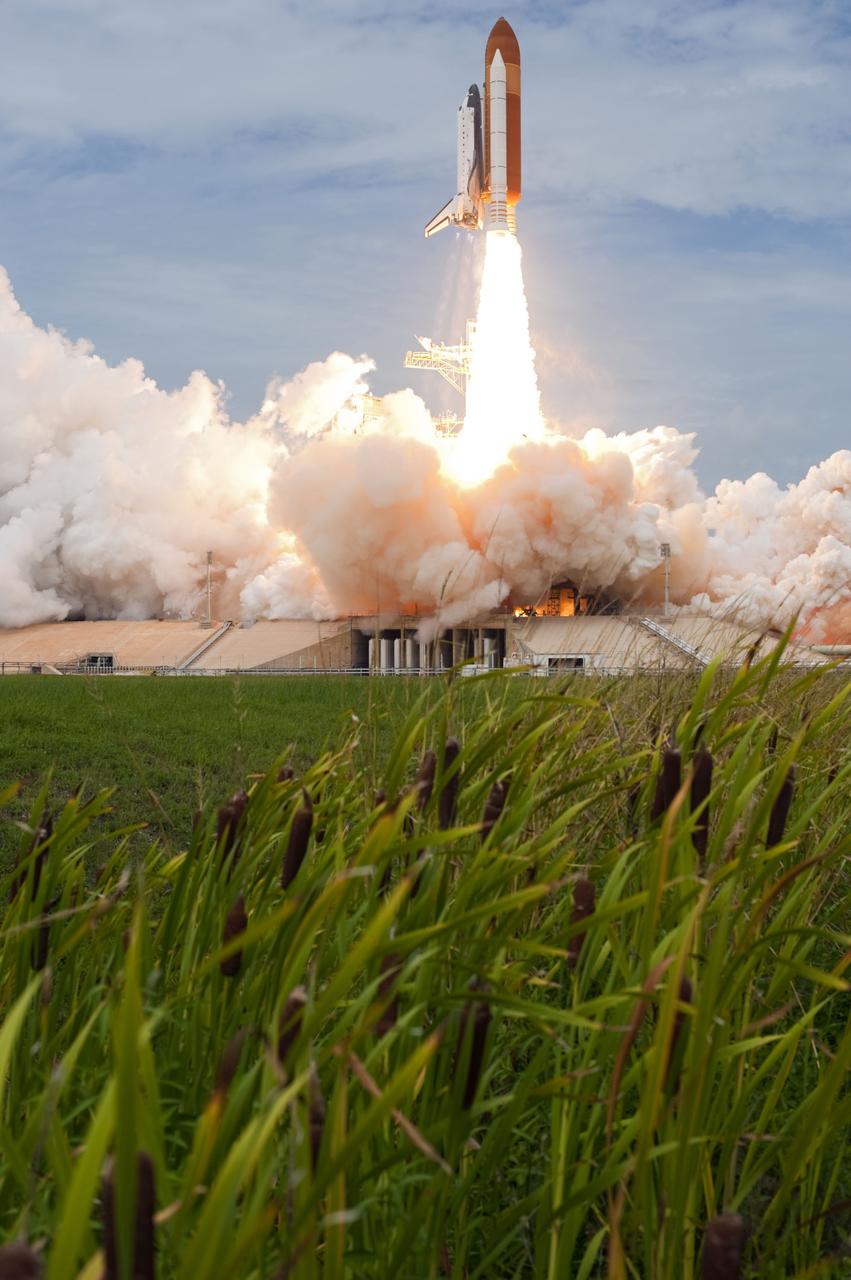
CAPE CANAVERAL, Fla. -- On Launch Pad 39A at NASA's Kennedy Space Center in Florida, space shuttle Atlantis travels upward on streams of flame as it lifts off on its STS-135 mission to the International Space Station. Atlantis with its crew of four; Commander Chris Ferguson, Pilot Doug Hurley, Mission Specialists Sandy Magnus and Rex Walheim, lifted off at 11:29 a.m. EDT on July 8, 2011 to deliver the Raffaello multi-purpose logistics module packed with supplies and spare parts for the station. Atlantis also will fly the Robotic Refueling Mission experiment that will investigate the potential for robotically refueling existing satellites in orbit. In addition, Atlantis will return with a failed ammonia pump module to help NASA better understand the failure mechanism and improve pump designs for future systems. STS-135 is the 33rd flight of Atlantis, the 37th shuttle mission to the space station, and the 135th and final mission of NASA's Space Shuttle Program. For more information, visit www.nasa.gov/mission_pages/shuttle/shuttlemissions/sts135/index.html. Photo credit: NASA/Tony Gray and Tom Farrar
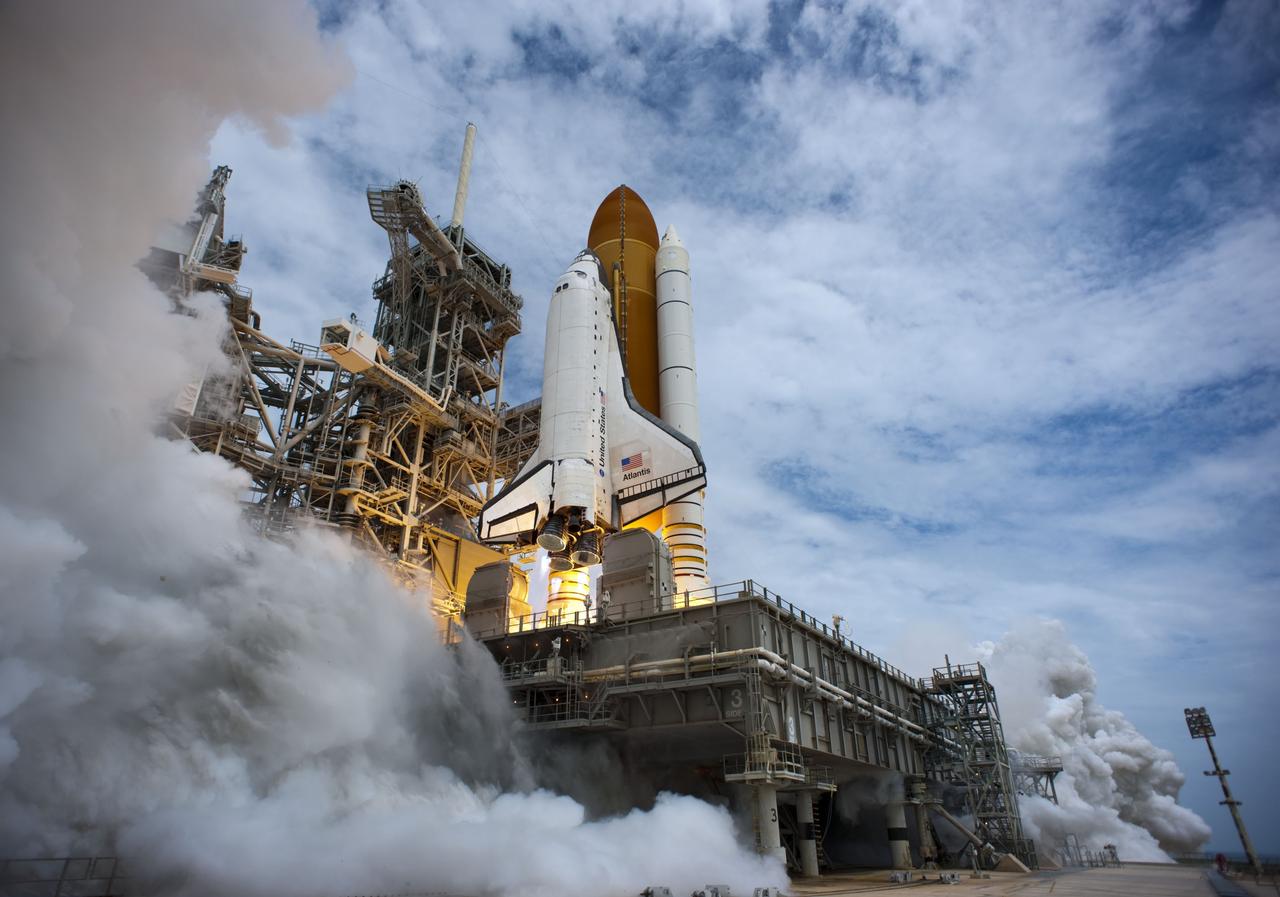
CAPE CANAVERAL, Fla. -- At NASA's Kennedy Space Center in Florida, space shuttle Atlantis' engines and solid rocket boosters ignite on Launch Pad 39A as it lifts off out of billows of smoke and steam on its STS-135 mission to the International Space Station. Atlantis with its crew of four; Commander Chris Ferguson, Pilot Doug Hurley, Mission Specialists Sandy Magnus and Rex Walheim, lifted off at 11:29 a.m. EDT on July 8, 2011 to deliver the Raffaello multi-purpose logistics module packed with supplies and spare parts for the station. Atlantis also will fly the Robotic Refueling Mission experiment that will investigate the potential for robotically refueling existing satellites in orbit. In addition, Atlantis will return with a failed ammonia pump module to help NASA better understand the failure mechanism and improve pump designs for future systems. STS-135 is the 33rd flight of Atlantis, the 37th shuttle mission to the space station, and the 135th and final mission of NASA's Space Shuttle Program. For more information, visit www.nasa.gov/mission_pages/shuttle/shuttlemissions/sts135/index.html. Photo credit: NASA/Tony Gray and Tom Farrar
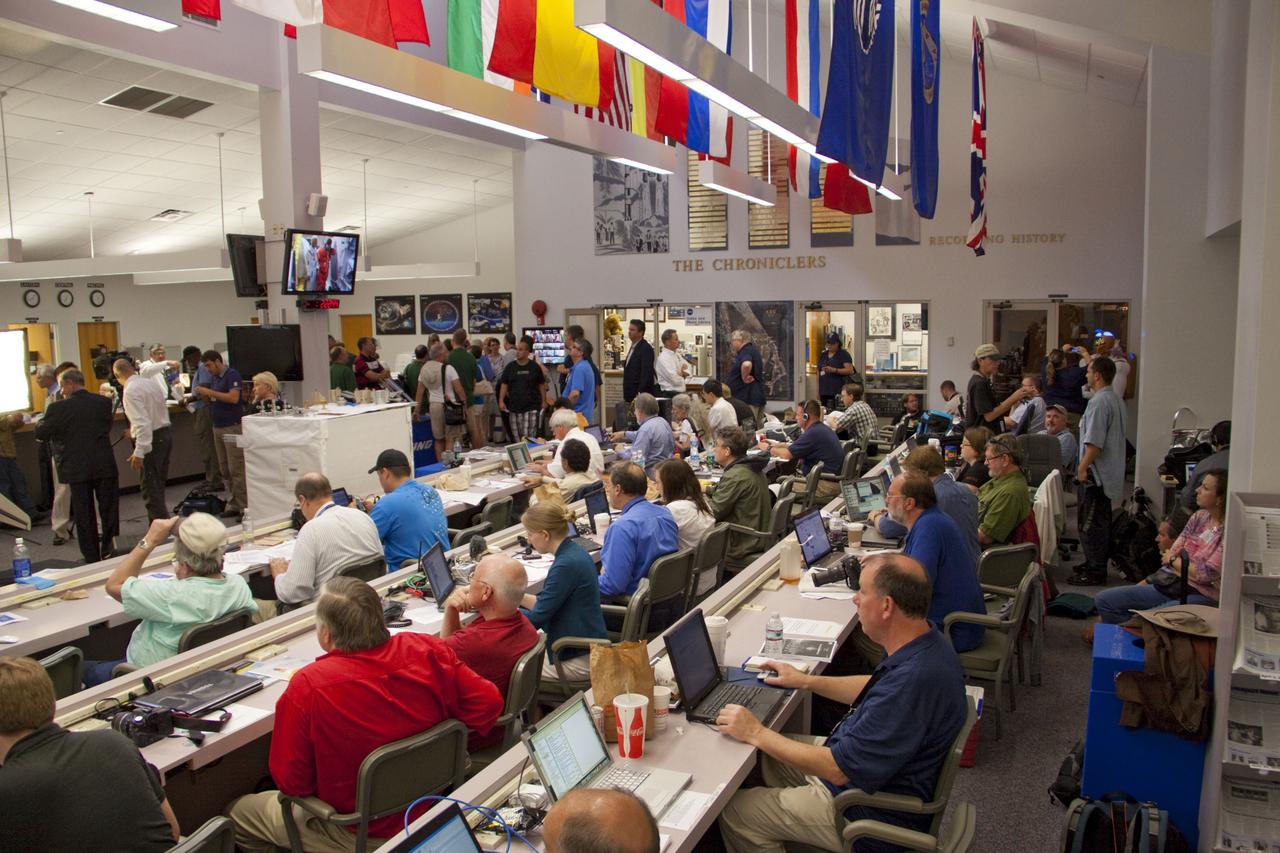
CAPE CANAVERAL, Fla. -- Media from around the globe gather at the NASA News Center at NASA Kennedy Space Center's Press Site in Florida to cover the prelaunch activities and lift off of space shuttle Atlantis on its STS-135 mission to the International Space Station. Atlantis began its final flight, with Commander Chris Ferguson, Pilot Doug Hurley and Mission Specialists Sandy Magnus and Rex Walheim on board, at 11:29 a.m. EDT July 8 to deliver the Raffaello multi-purpose logistics module packed with supplies and spare parts to the station. Also in Atlantis' payload bay is the Robotic Refueling Mission experiment that will investigate the potential for robotically refueling existing satellites in orbit. In addition, Atlantis will return with a failed ammonia pump module to help NASA better understand the failure mechanism and improve pump designs for future systems. STS-135 is the 33rd flight of Atlantis, the 37th shuttle mission to the space station, and the 135th and final mission of NASA's Space Shuttle Program. For more information, visit www.nasa.gov/mission_pages/shuttle/shuttlemissions/sts135/index.html. Photo credit: NASA/Jim Grossmann
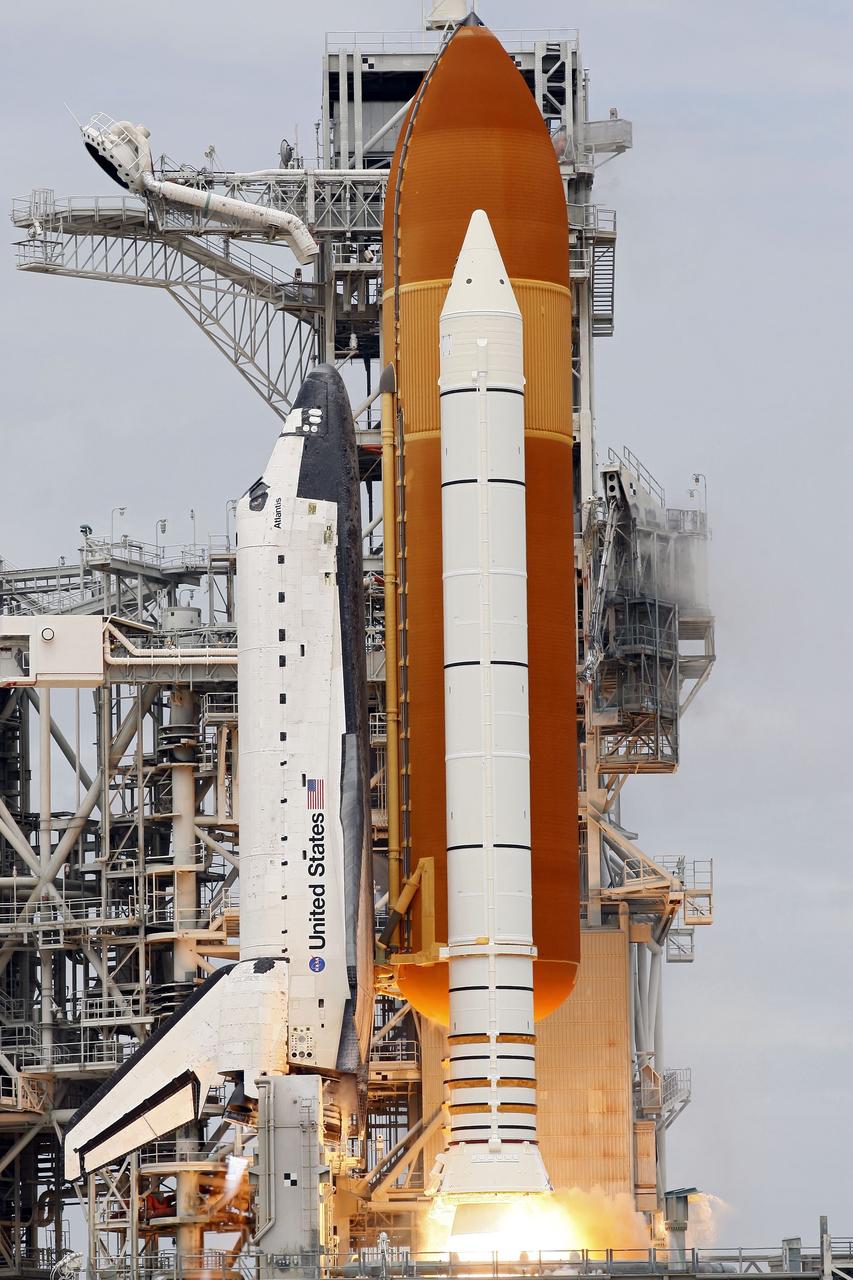
CAPE CANAVERAL, Fla. -- At NASA's Kennedy Space Center in Florida, space shuttle Atlantis' main engines ignite and solid rocket boosters ignite on Launch Pad 39A leaving behind a twin stream of flame as it lifts off on its STS-135 mission to the International Space Station. Atlantis with its crew of four; Commander Chris Ferguson, Pilot Doug Hurley, Mission Specialists Sandy Magnus and Rex Walheim, lifted off at 11:29 a.m. EDT on July 8, 2011 to deliver the Raffaello multi-purpose logistics module packed with supplies and spare parts for the International Space Station. Atlantis also will fly the Robotic Refueling Mission experiment that will investigate the potential for robotically refueling existing satellites in orbit. In addition, Atlantis will return with a failed ammonia pump module to help NASA better understand the failure mechanism and improve pump designs for future systems. STS-135 is the 33rd flight of Atlantis, the 37th shuttle mission to the space station, and the 135th and final mission of NASA's Space Shuttle Program. For more information, visit www.nasa.gov/mission_pages/shuttle/shuttlemissions/sts135/index.html. Photo credit: NASA/Rusty Backer and Mike Gayle

CAPE CANAVERAL, Fla. -- Media from around the globe gather in their respective tents at the Press Site at NASA's Kennedy Space Center in Florida to photograph and cover the prelaunch activities and lift off of space shuttle Atlantis on its STS-135 mission to the International Space Station. Atlantis began its final flight, with Commander Chris Ferguson, Pilot Doug Hurley and Mission Specialists Sandy Magnus and Rex Walheim on board, at 11:29 a.m. EDT July 8 to deliver the Raffaello multi-purpose logistics module packed with supplies and spare parts to the station. Also in Atlantis' payload bay is the Robotic Refueling Mission experiment that will investigate the potential for robotically refueling existing satellites in orbit. In addition, Atlantis will return with a failed ammonia pump module to help NASA better understand the failure mechanism and improve pump designs for future systems. STS-135 is the 33rd flight of Atlantis, the 37th shuttle mission to the space station, and the 135th and final mission of NASA's Space Shuttle Program. For more information, visit www.nasa.gov/mission_pages/shuttle/shuttlemissions/sts135/index.html. Photo credit: NASA/Jim Grossmann
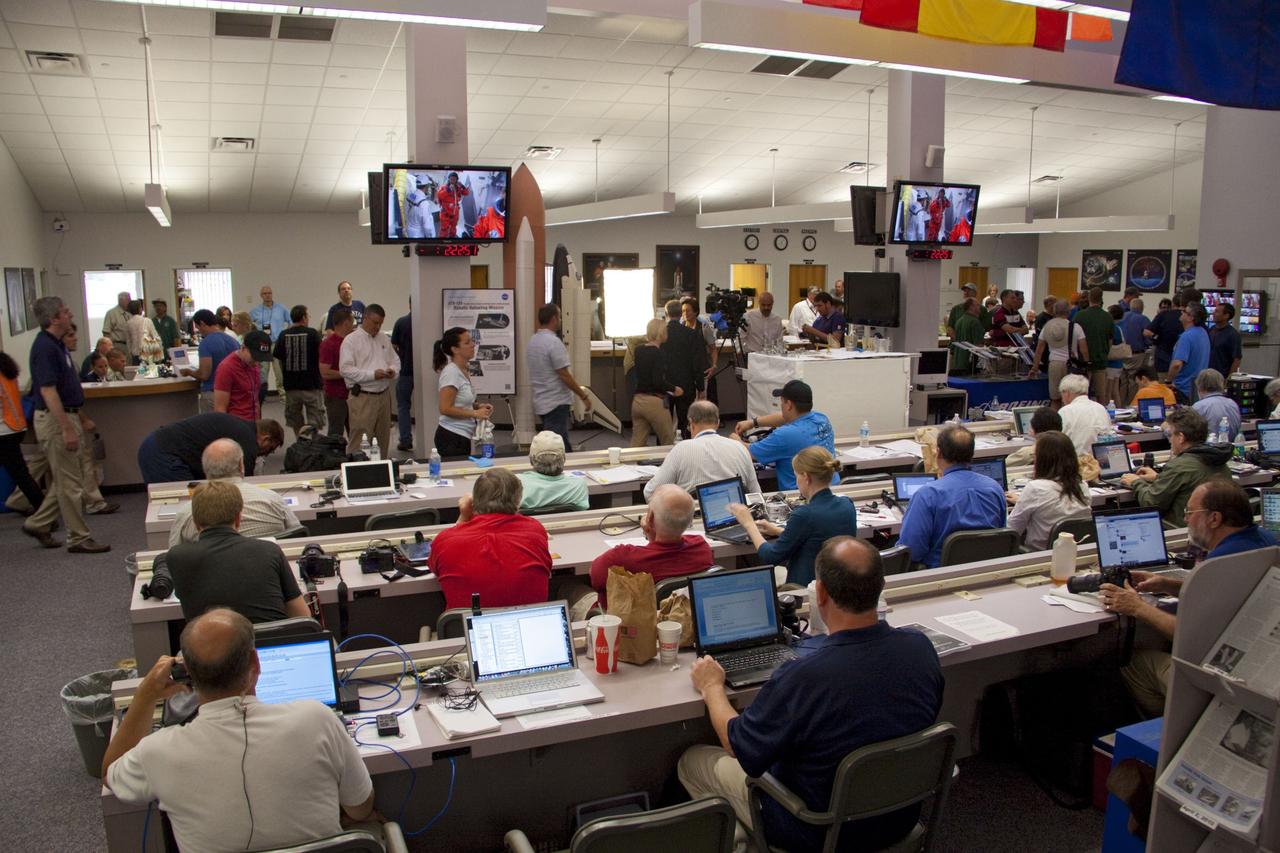
CAPE CANAVERAL, Fla. -- Media from around the globe gather at the NASA News Center at NASA Kennedy Space Center's Press Site in Florida to cover the prelaunch activities and lift off of space shuttle Atlantis on its STS-135 mission to the International Space Station. Atlantis began its final flight, with Commander Chris Ferguson, Pilot Doug Hurley and Mission Specialists Sandy Magnus and Rex Walheim on board, at 11:29 a.m. EDT July 8 to deliver the Raffaello multi-purpose logistics module packed with supplies and spare parts to the station. Also in Atlantis' payload bay is the Robotic Refueling Mission experiment that will investigate the potential for robotically refueling existing satellites in orbit. In addition, Atlantis will return with a failed ammonia pump module to help NASA better understand the failure mechanism and improve pump designs for future systems. STS-135 is the 33rd flight of Atlantis, the 37th shuttle mission to the space station, and the 135th and final mission of NASA's Space Shuttle Program. For more information, visit www.nasa.gov/mission_pages/shuttle/shuttlemissions/sts135/index.html. Photo credit: NASA/Jim Grossmann
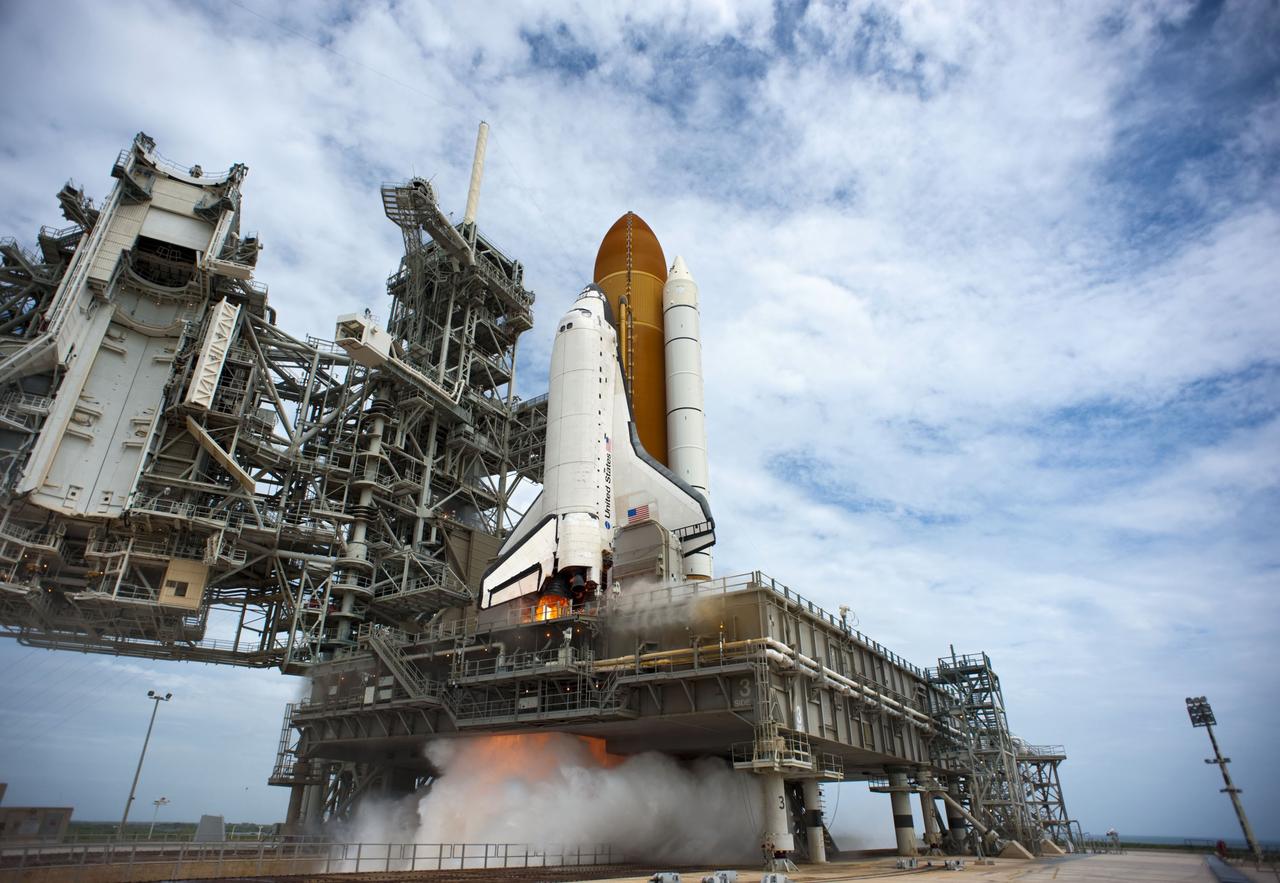
CAPE CANAVERAL, Fla. -- At NASA's Kennedy Space Center in Florida, space shuttle Atlantis' engines and solid rocket boosters ignite on Launch Pad 39A as it begins to lift off on its STS-135 mission to the International Space Station. Atlantis with its crew of four; Commander Chris Ferguson, Pilot Doug Hurley, Mission Specialists Sandy Magnus and Rex Walheim, lifted off at 11:29 a.m. EDT on July 8, 2011 to deliver the Raffaello multi-purpose logistics module packed with supplies and spare parts for the station. Atlantis also will fly the Robotic Refueling Mission experiment that will investigate the potential for robotically refueling existing satellites in orbit. In addition, Atlantis will return with a failed ammonia pump module to help NASA better understand the failure mechanism and improve pump designs for future systems. STS-135 is the 33rd flight of Atlantis, the 37th shuttle mission to the space station, and the 135th and final mission of NASA's Space Shuttle Program. For more information, visit www.nasa.gov/mission_pages/shuttle/shuttlemissions/sts135/index.html. Photo credit: NASA/Tony Gray and Tom Farrar
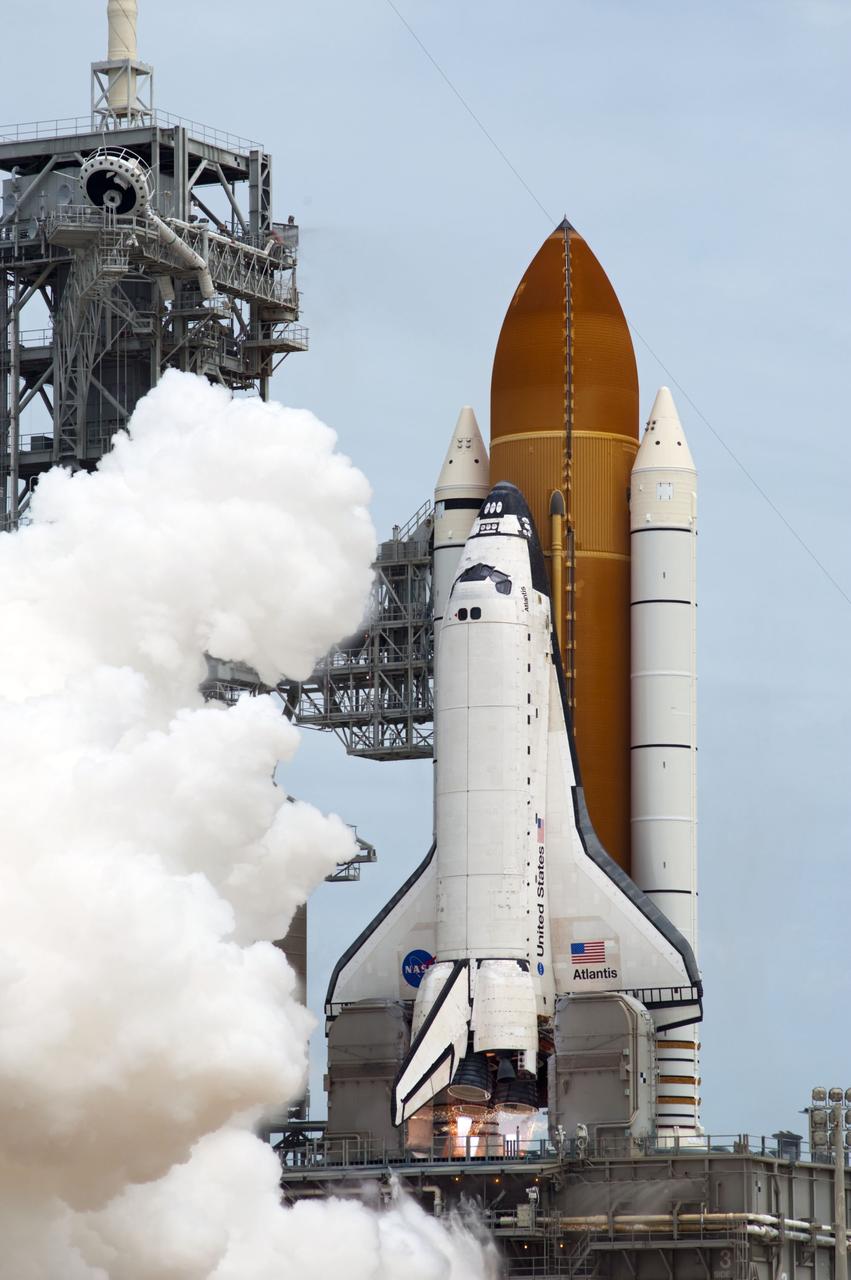
CAPE CANAVERAL, Fla. -- At NASA's Kennedy Space Center in Florida, space shuttle Atlantis' main engines ignite on Launch Pad 39A producing billows of steam and smoke as it lifts off on its STS-135 mission to the International Space Station. Atlantis with its crew of four; Commander Chris Ferguson, Pilot Doug Hurley, Mission Specialists Sandy Magnus and Rex Walheim, lifted off at 11:29 a.m. EDT on July 8, 2011 to deliver the Raffaello multi-purpose logistics module packed with supplies and spare parts for the station. Atlantis also will fly the Robotic Refueling Mission experiment that will investigate the potential for robotically refueling existing satellites in orbit. In addition, Atlantis will return with a failed ammonia pump module to help NASA better understand the failure mechanism and improve pump designs for future systems. STS-135 is the 33rd flight of Atlantis, the 37th shuttle mission to the space station, and the 135th and final mission of NASA's Space Shuttle Program. For more information, visit www.nasa.gov/mission_pages/shuttle/shuttlemissions/sts135/index.html. Photo credit: NASA/Sandra Joseph and Kevin O'Connell

CAPE CANAVERAL, Fla. -- At NASA's Kennedy Space Center in Florida, space shuttle Atlantis' main engines and solid rocket boosters ignite on Launch Pad 39A leaving behind twin streams of flame as it lifts off on its STS-135 mission to the International Space Station. Atlantis with its crew of four; Commander Chris Ferguson, Pilot Doug Hurley, Mission Specialists Sandy Magnus and Rex Walheim, lifted off at 11:29 a.m. EDT on July 8, 2011 to deliver the Raffaello multi-purpose logistics module packed with supplies and spare parts for the station. Atlantis also will fly the Robotic Refueling Mission experiment that will investigate the potential for robotically refueling existing satellites in orbit. In addition, Atlantis will return with a failed ammonia pump module to help NASA better understand the failure mechanism and improve pump designs for future systems. STS-135 is the 33rd flight of Atlantis, the 37th shuttle mission to the space station, and the 135th and final mission of NASA's Space Shuttle Program. For more information, visit www.nasa.gov/mission_pages/shuttle/shuttlemissions/sts135/index.html. Photo credit: NASA/Rusty Backer and Mike Gayle
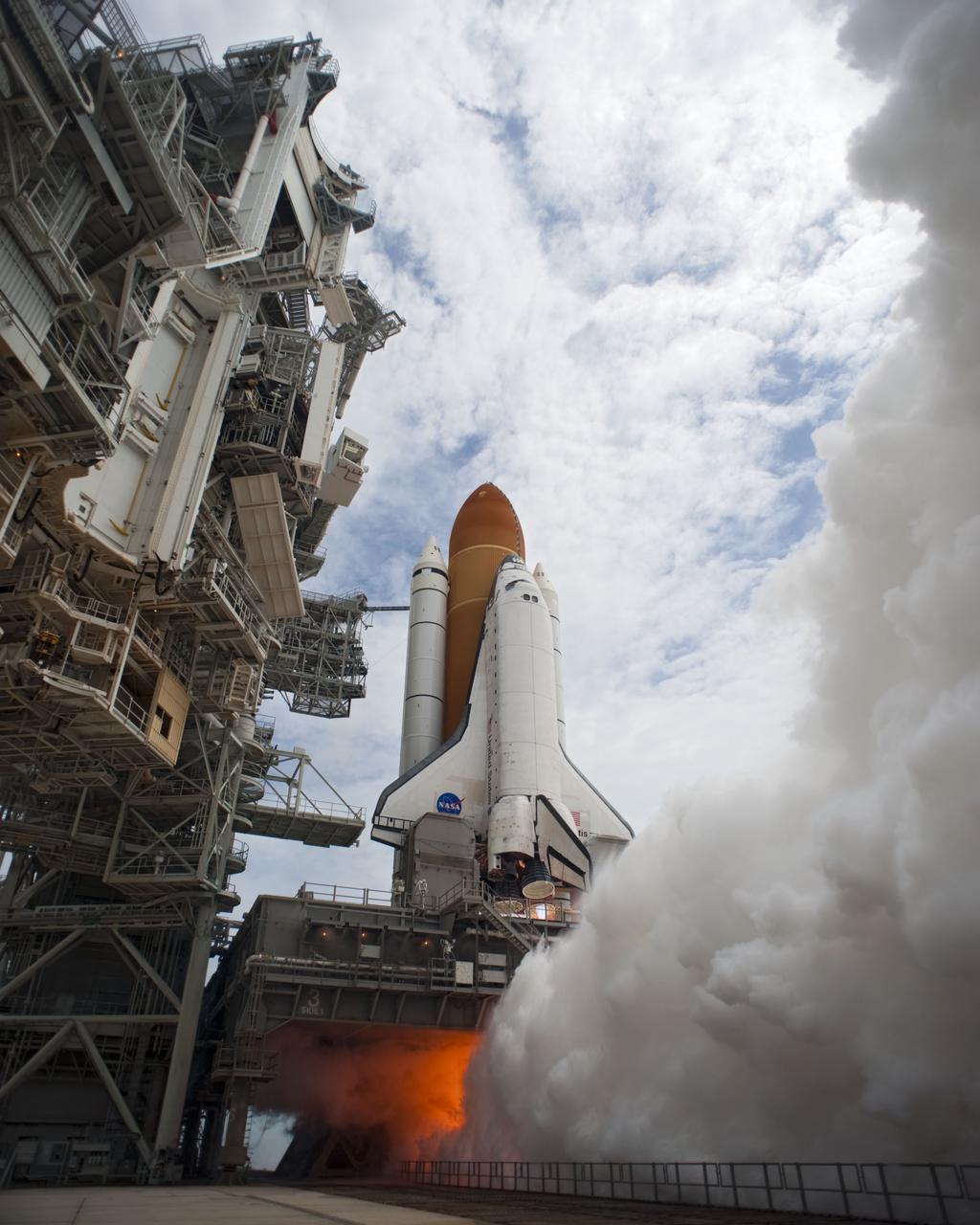
CAPE CANAVERAL, Fla. -- Smoke and steam billow outward as space shuttle Atlantis' main engines are ignited for liftoff at Launch Pad 39A at NASA's Kennedy Space Center in Florida as it begins its STS-135 mission to the International Space Station. Atlantis with its crew of four; Commander Chris Ferguson, Pilot Doug Hurley, Mission Specialists Sandy Magnus and Rex Walheim, lifted off at 11:29 a.m. EDT on July 8, 2011 to deliver the Raffaello multi-purpose logistics module packed with supplies and spare parts for the station. Atlantis also will fly the Robotic Refueling Mission experiment that will investigate the potential for robotically refueling existing satellites in orbit. In addition, Atlantis will return with a failed ammonia pump module to help NASA better understand the failure mechanism and improve pump designs for future systems. STS-135 is the 33rd flight of Atlantis, the 37th shuttle mission to the space station, and the 135th and final mission of NASA's Space Shuttle Program. For more information, visit www.nasa.gov/mission_pages/shuttle/shuttlemissions/sts135/index.html. Photo credit: NASA/Tony Gray and Tom Farrar
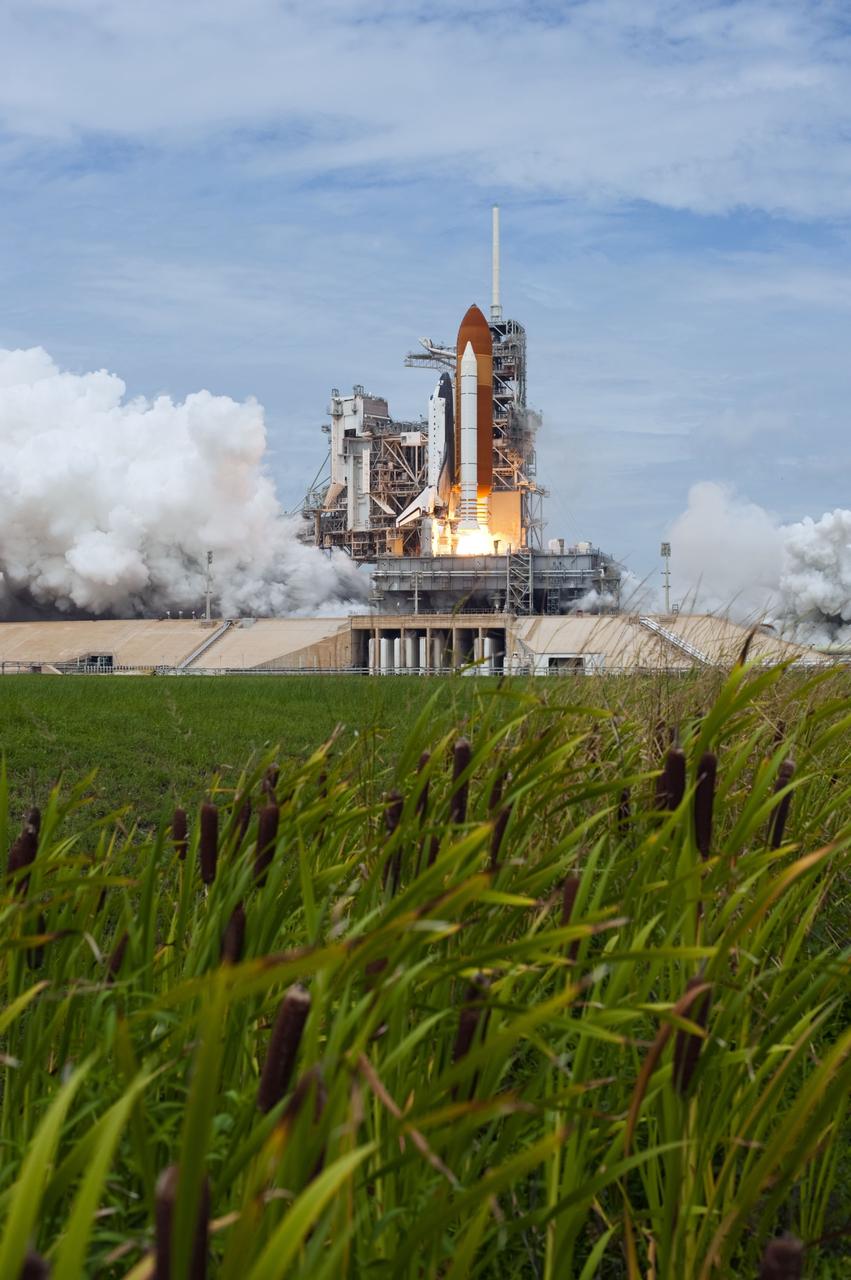
CAPE CANAVERAL, Fla. -- At NASA's Kennedy Space Center in Florida, space shuttle Atlantis' main engines and solid rocket boosters ignite on Launch Pad 39A producing billows of smoke and steam as it lifts off on its STS-135 mission to the International Space Station. Atlantis with its crew of four; Commander Chris Ferguson, Pilot Doug Hurley, Mission Specialists Sandy Magnus and Rex Walheim, lifted off at 11:29 a.m. EDT on July 8, 2011 to deliver the Raffaello multi-purpose logistics module packed with supplies and spare parts for the station. Atlantis also will fly the Robotic Refueling Mission experiment that will investigate the potential for robotically refueling existing satellites in orbit. In addition, Atlantis will return with a failed ammonia pump module to help NASA better understand the failure mechanism and improve pump designs for future systems. STS-135 is the 33rd flight of Atlantis, the 37th shuttle mission to the space station, and the 135th and final mission of NASA's Space Shuttle Program. For more information, visit www.nasa.gov/mission_pages/shuttle/shuttlemissions/sts135/index.html. Photo credit: NASA/Tony Gray and Tom Farrar
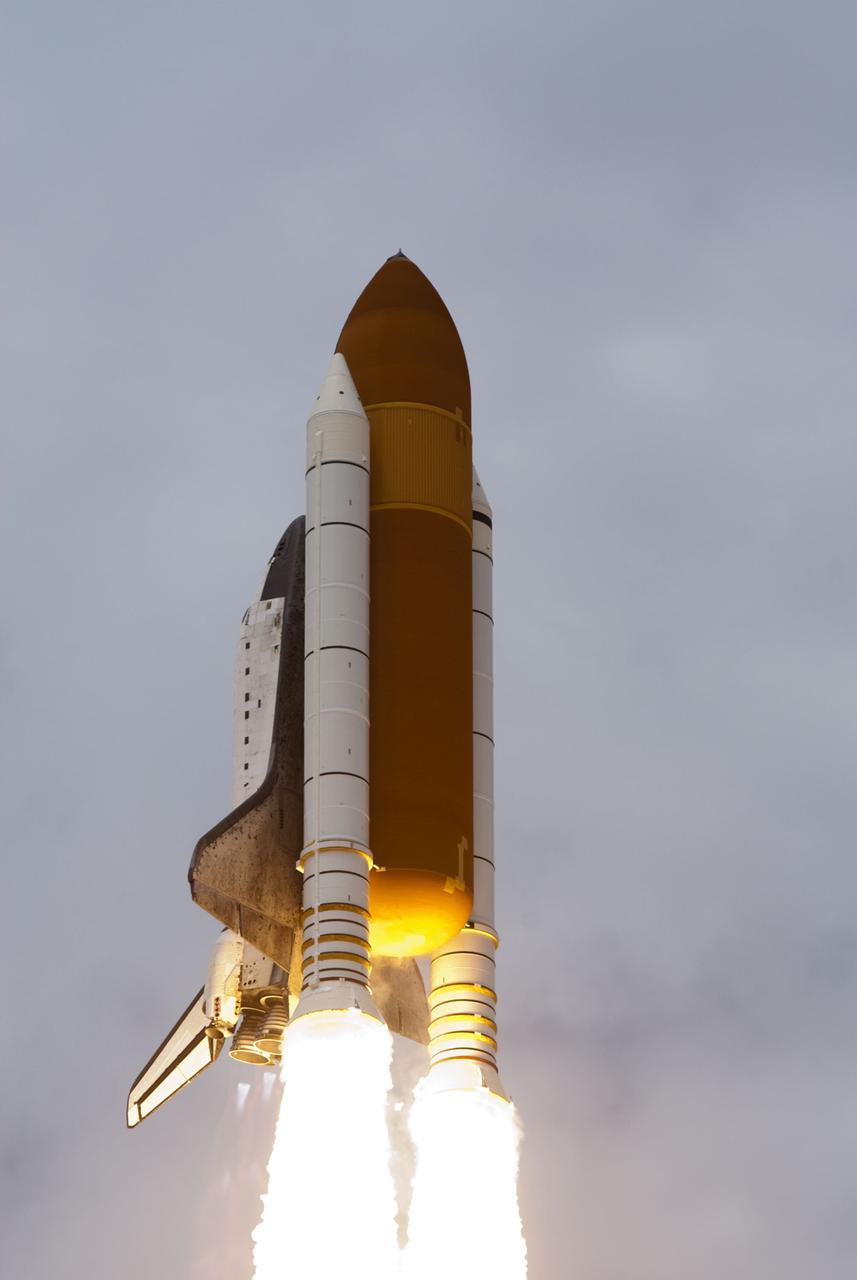
CAPE CANAVERAL, Fla. -- At Launch Pad 39A at NASA's Kennedy Space Center in Florida, space shuttle Atlantis soars into the clouds on its STS-135 mission to the International Space Station. Atlantis with its crew of four; Commander Chris Ferguson, Pilot Doug Hurley, Mission Specialists Sandy Magnus and Rex Walheim, lifted off at 11:29 a.m. EDT on July 8, 2011 to deliver the Raffaello multi-purpose logistics module packed with supplies and spare parts for the station. Atlantis also will fly the Robotic Refueling Mission experiment that will investigate the potential for robotically refueling existing satellites in orbit. In addition, Atlantis will return with a failed ammonia pump module to help NASA better understand the failure mechanism and improve pump designs for future systems. STS-135 is the 33rd flight of Atlantis, the 37th shuttle mission to the space station, and the 135th and final mission of NASA's Space Shuttle Program. For more information, visit www.nasa.gov/mission_pages/shuttle/shuttlemissions/sts135/index.html. Photo credit: NASA/Rusty Backer and Mike Gayle
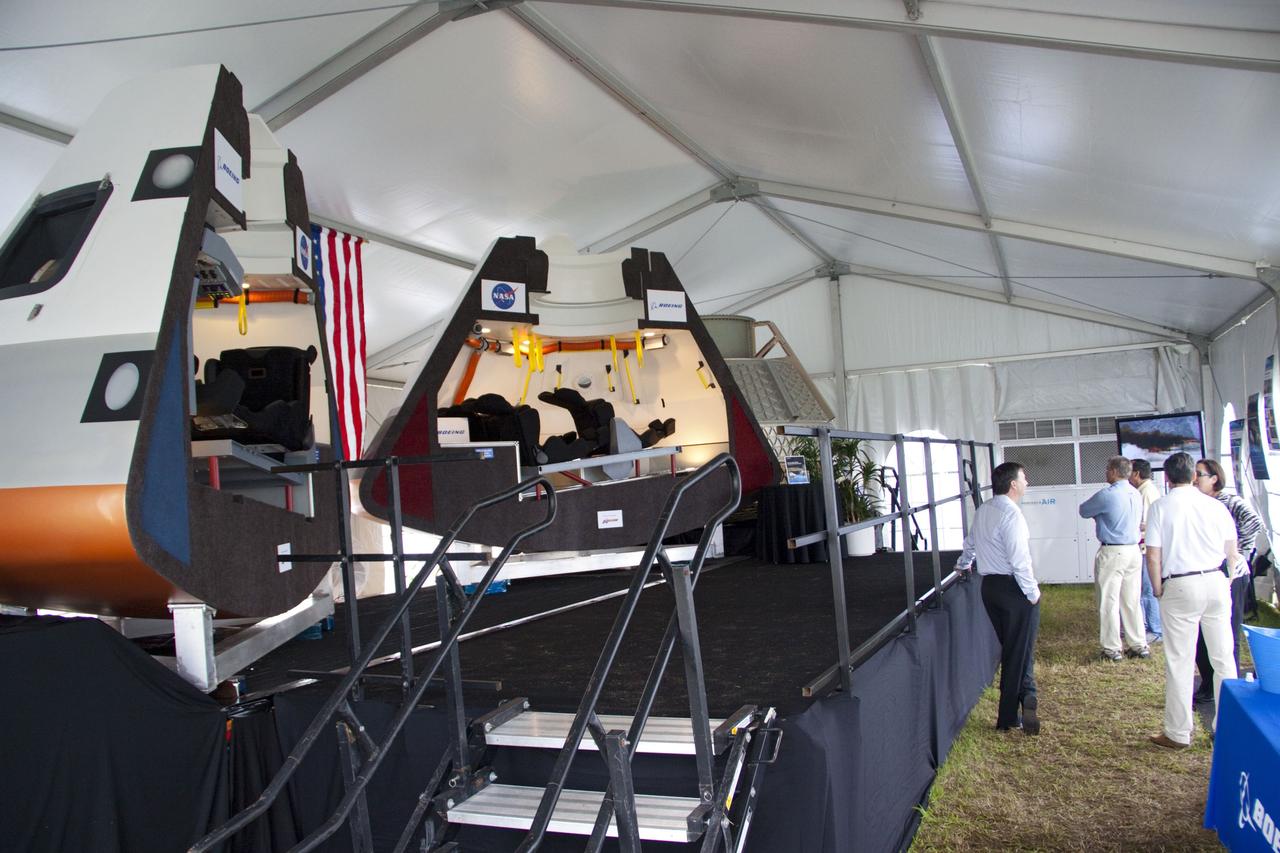
CAPE CANAVERAL, Fla. -- A media event was held for the Multi-Purpose Crew Vehicle (MPCV) that was on display in a tent on the grounds of the Press Site at NASA's Kennedy Space Center in Florida during launch activities for space shuttle Atlantis' STS-135 mission to the International Space Station. The MPCV is based on the Orion design requirements for traveling beyond low Earth orbit and will serve as the exploration vehicle that will carry the crew to space, provide emergency abort capability, sustain the crew during the space travel, and provide safe re-entry from deep space return velocities. Atlantis began its final flight, with Commander Chris Ferguson, Pilot Doug Hurley and Mission Specialists Sandy Magnus and Rex Walheim on board, at 11:29 a.m. EDT July 8 to deliver the Raffaello multi-purpose logistics module packed with supplies and spare parts to the station. Also in Atlantis' payload bay is the Robotic Refueling Mission experiment that will investigate the potential for robotically refueling existing satellites in orbit. In addition, Atlantis will return with a failed ammonia pump module to help NASA better understand the failure mechanism and improve pump designs for future systems. STS-135 is the 33rd flight of Atlantis, the 37th shuttle mission to the space station, and the 135th and final mission of NASA's Space Shuttle Program. For more information, visit www.nasa.gov/mission_pages/shuttle/shuttlemissions/sts135/index.html. Photo credit: NASA/Jim Grossmann
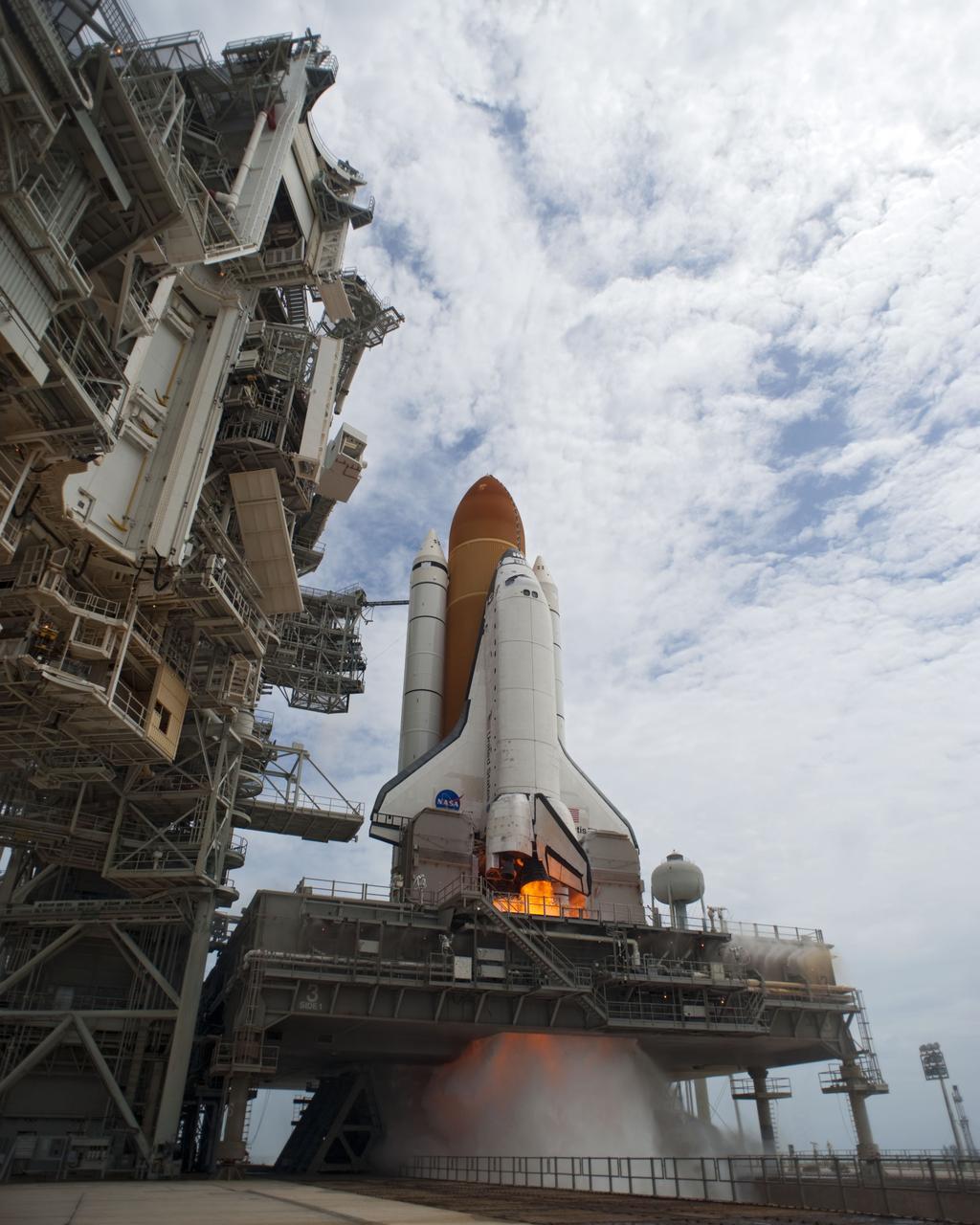
CAPE CANAVERAL, Fla. -- Smoke and steam begins to billow outward as space shuttle Atlantis' main engines are ignited for liftoff at Launch Pad 39A at NASA's Kennedy Space Center in Florida as it begins its STS-135 mission to the International Space Station. Atlantis with its crew of four; Commander Chris Ferguson, Pilot Doug Hurley, Mission Specialists Sandy Magnus and Rex Walheim, lifted off at 11:29 a.m. EDT on July 8, 2011 to deliver the Raffaello multi-purpose logistics module packed with supplies and spare parts for the station. Atlantis also will fly the Robotic Refueling Mission experiment that will investigate the potential for robotically refueling existing satellites in orbit. In addition, Atlantis will return with a failed ammonia pump module to help NASA better understand the failure mechanism and improve pump designs for future systems. STS-135 is the 33rd flight of Atlantis, the 37th shuttle mission to the space station, and the 135th and final mission of NASA's Space Shuttle Program. For more information, visit www.nasa.gov/mission_pages/shuttle/shuttlemissions/sts135/index.html. Photo credit: NASA/Tony Gray and Tom Farrar
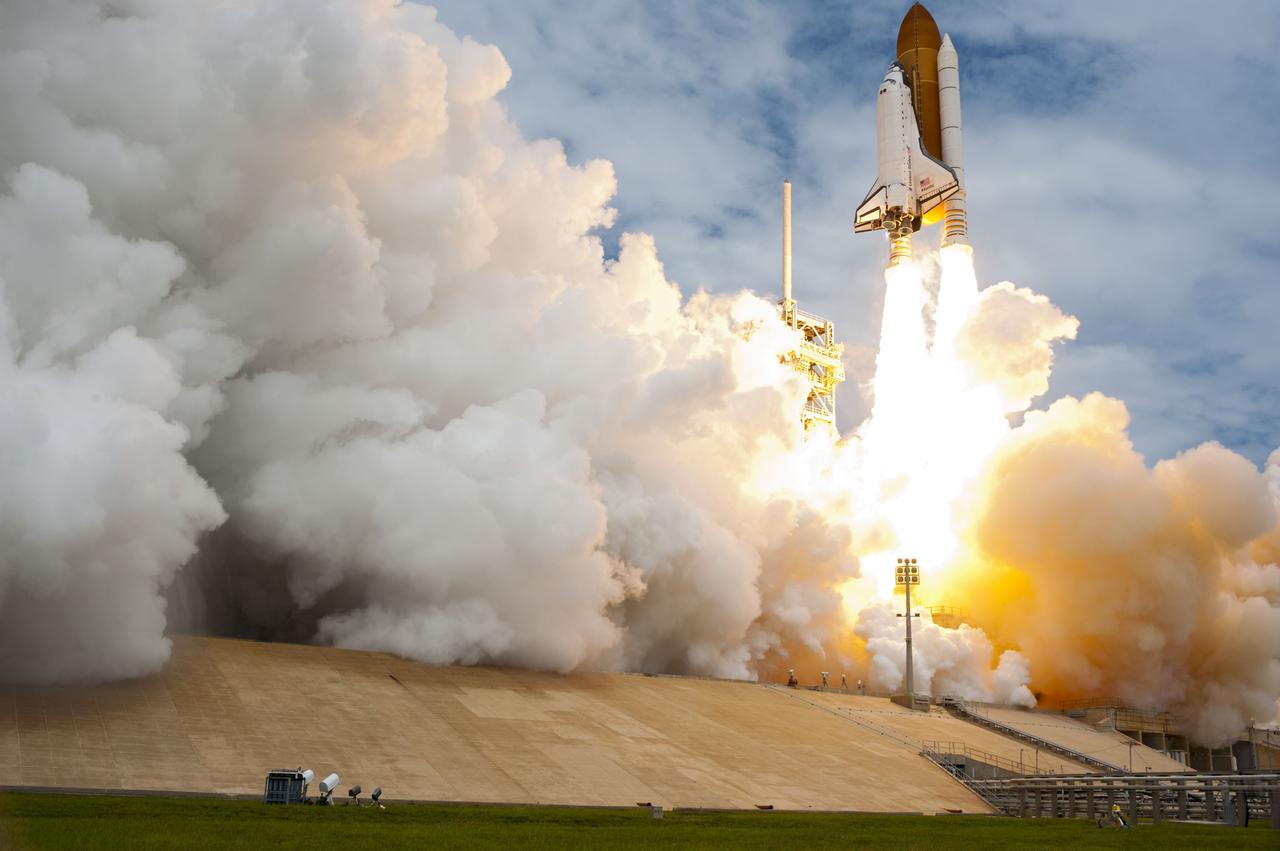
CAPE CANAVERAL, Fla. -- At NASA's Kennedy Space Center in Florida, space shuttle Atlantis lifts off from Launch Pad 39A out of billows of smoke and flame on its STS-135 mission to the International Space Station. Atlantis with its crew of four; Commander Chris Ferguson, Pilot Doug Hurley, Mission Specialists Sandy Magnus and Rex Walheim, lifted off at 11:29 a.m. EDT on July 8, 2011 to deliver the Raffaello multi-purpose logistics module packed with supplies and spare parts for the station. Atlantis also will fly the Robotic Refueling Mission experiment that will investigate the potential for robotically refueling existing satellites in orbit. In addition, Atlantis will return with a failed ammonia pump module to help NASA better understand the failure mechanism and improve pump designs for future systems. STS-135 is the 33rd flight of Atlantis, the 37th shuttle mission to the space station, and the 135th and final mission of NASA's Space Shuttle Program. For more information, visit www.nasa.gov/mission_pages/shuttle/shuttlemissions/sts135/index.html. Photo credit: NASA/Tony Gray and Tom Farrar
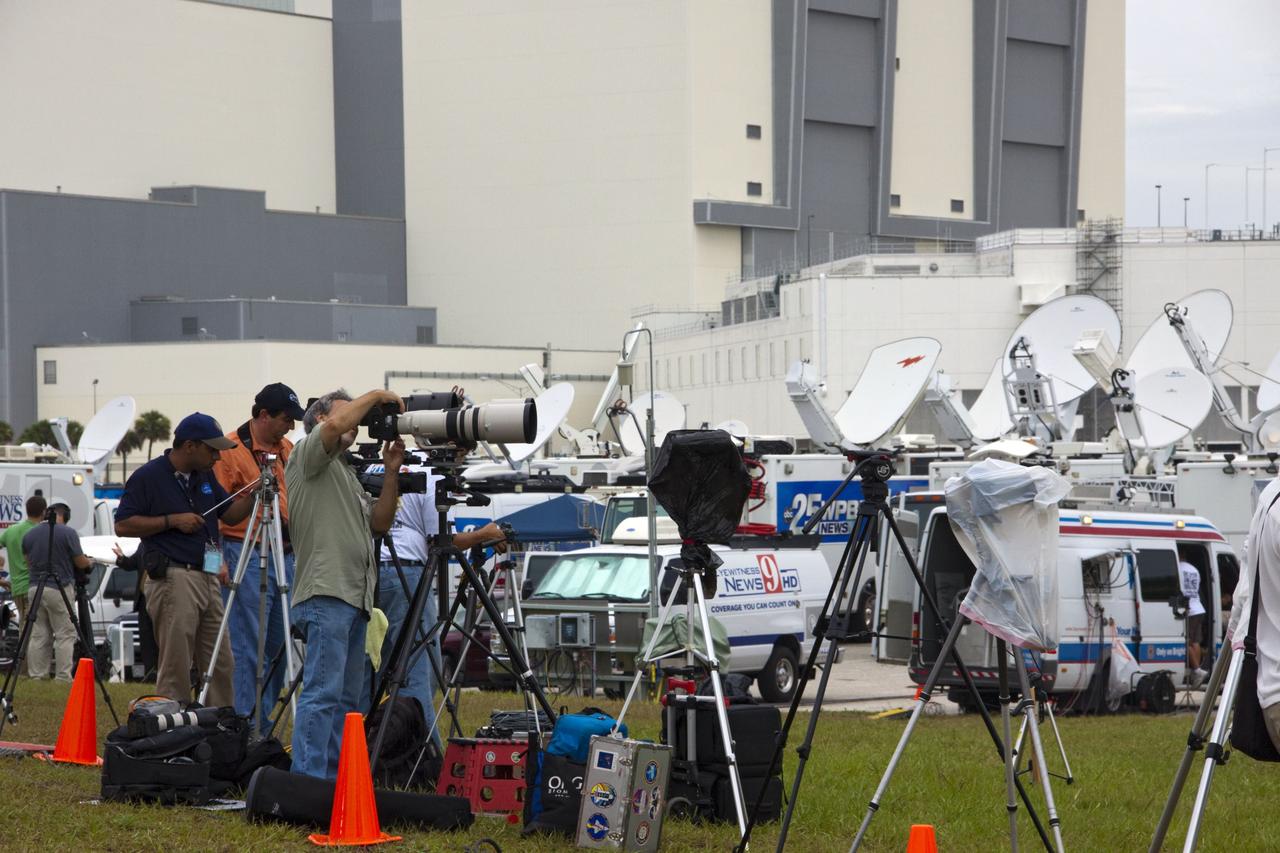
CAPE CANAVERAL, Fla. -- Media from around the globe gather at the NASA News Center at NASA Kennedy Space Center's Press Site in Florida to photograph and cover the prelaunch activities and lift off of space shuttle Atlantis on its STS-135 mission to the International Space Station. Satellite news trucks, trailers and automobiles can be seen in the parking lot with the massive Vehicle Assembly Building towering above. Atlantis began its final flight, with Commander Chris Ferguson, Pilot Doug Hurley and Mission Specialists Sandy Magnus and Rex Walheim on board, at 11:29 a.m. EDT July 8 to deliver the Raffaello multi-purpose logistics module packed with supplies and spare parts to the station. Also in Atlantis' payload bay is the Robotic Refueling Mission experiment that will investigate the potential for robotically refueling existing satellites in orbit. In addition, Atlantis will return with a failed ammonia pump module to help NASA better understand the failure mechanism and improve pump designs for future systems. STS-135 is the 33rd flight of Atlantis, the 37th shuttle mission to the space station, and the 135th and final mission of NASA's Space Shuttle Program. For more information, visit www.nasa.gov/mission_pages/shuttle/shuttlemissions/sts135/index.html. Photo credit: NASA/Jim Grossmann
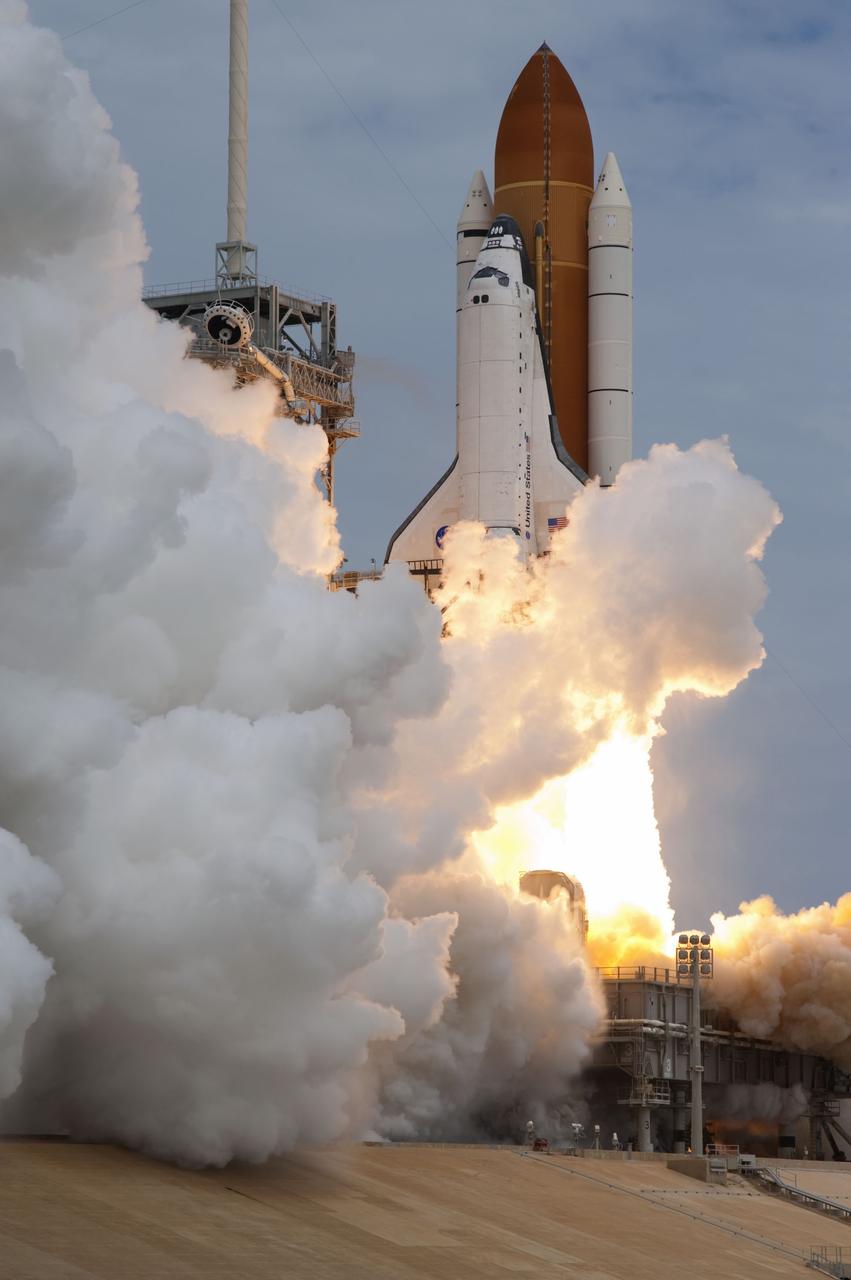
CAPE CANAVERAL, Fla. -- At NASA's Kennedy Space Center in Florida, space shuttle Atlantis lifts off from Launch Pad 39A on twin columns of smoke and flame as it heads toward space on its STS-135 mission to the International Space Station. Atlantis with its crew of four; Commander Chris Ferguson, Pilot Doug Hurley, Mission Specialists Sandy Magnus and Rex Walheim, lifted off at 11:29 a.m. EDT on July 8, 2011 to deliver the Raffaello multi-purpose logistics module packed with supplies and spare parts for the station. Atlantis also will fly the Robotic Refueling Mission experiment that will investigate the potential for robotically refueling existing satellites in orbit. In addition, Atlantis will return with a failed ammonia pump module to help NASA better understand the failure mechanism and improve pump designs for future systems. STS-135 is the 33rd flight of Atlantis, the 37th shuttle mission to the space station, and the 135th and final mission of NASA's Space Shuttle Program. For more information, visit www.nasa.gov/mission_pages/shuttle/shuttlemissions/sts135/index.html. Photo credit: NASA/Sandra Joseph and Kevin O'Connell
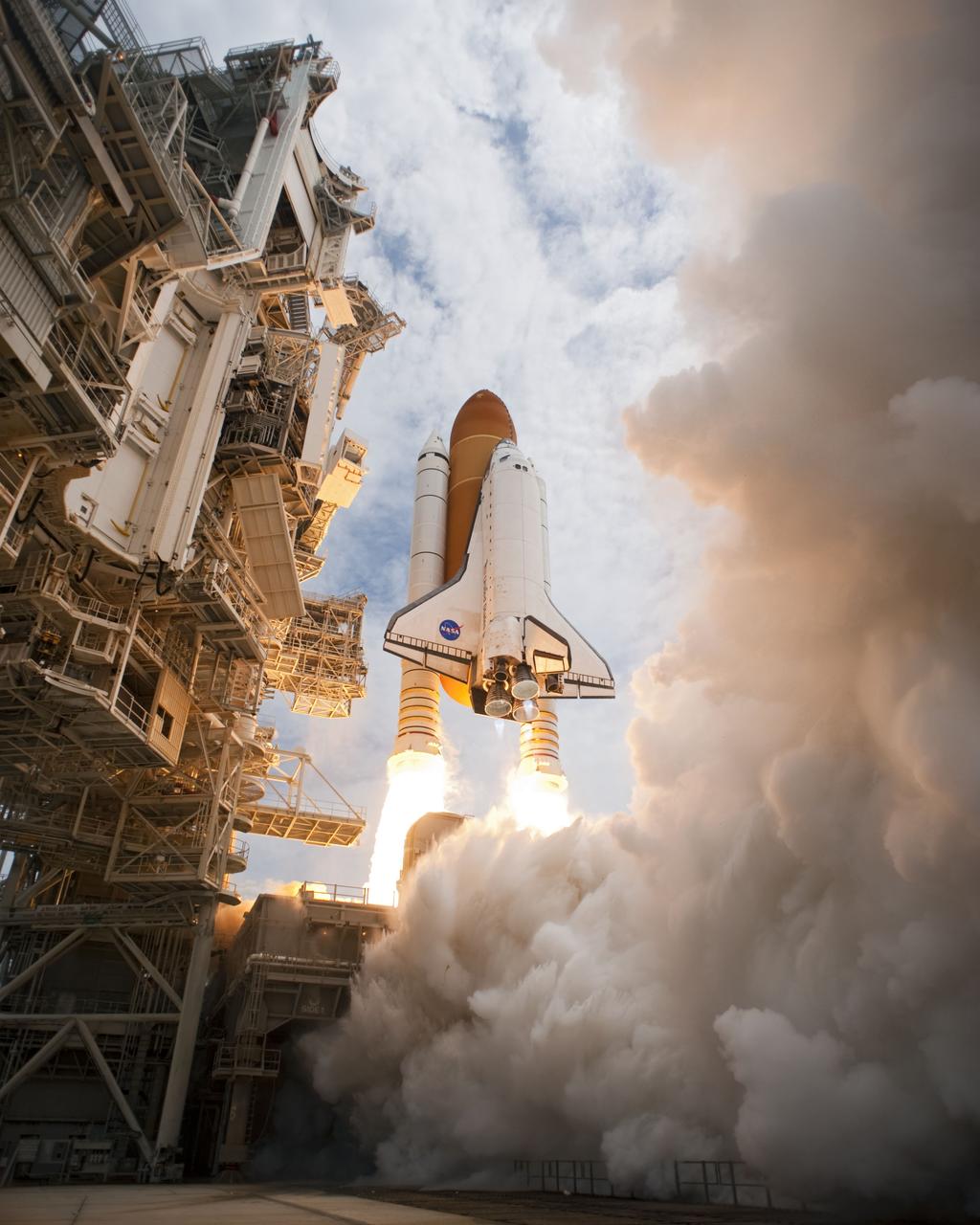
CAPE CANAVERAL, Fla. -- Smoke and steam billow outward as space shuttle Atlantis lifts off on twin columns of flame from Launch Pad 39A at NASA's Kennedy Space Center in Florida as it begins its STS-135 mission to the International Space Station. Atlantis with its crew of four; Commander Chris Ferguson, Pilot Doug Hurley, Mission Specialists Sandy Magnus and Rex Walheim, lifted off at 11:29 a.m. EDT on July 8, 2011 to deliver the Raffaello multi-purpose logistics module packed with supplies and spare parts for the station. Atlantis also will fly the Robotic Refueling Mission experiment that will investigate the potential for robotically refueling existing satellites in orbit. In addition, Atlantis will return with a failed ammonia pump module to help NASA better understand the failure mechanism and improve pump designs for future systems. STS-135 is the 33rd flight of Atlantis, the 37th shuttle mission to the space station, and the 135th and final mission of NASA's Space Shuttle Program. For more information, visit www.nasa.gov/mission_pages/shuttle/shuttlemissions/sts135/index.html. Photo credit: NASA/Tony Gray and Tom Farrar
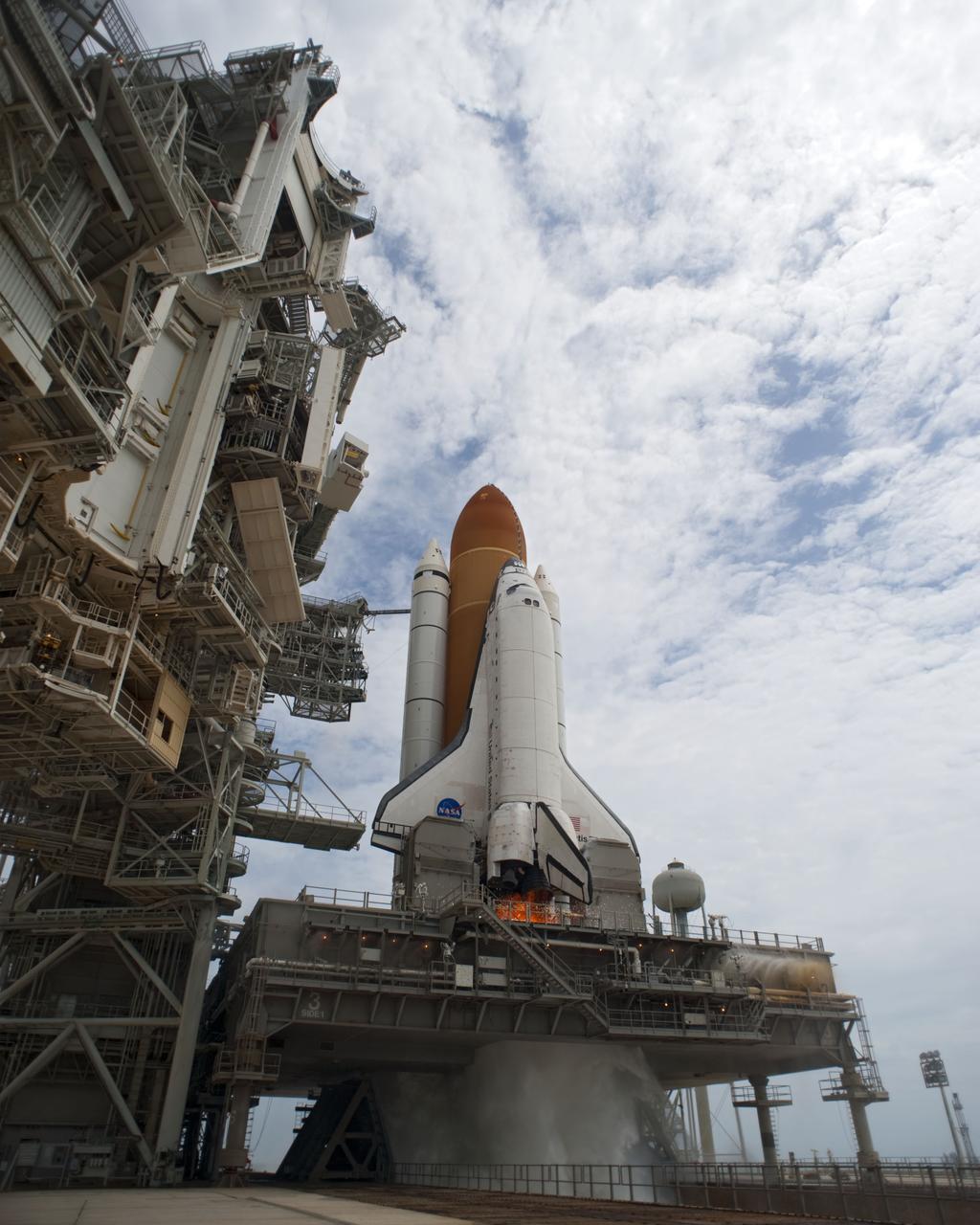
CAPE CANAVERAL, Fla. -- Space shuttle Atlantis' main engines are ignited for liftoff at Launch Pad 39A at NASA's Kennedy Space Center in Florida as it begins its STS-135 mission to the International Space Station. Atlantis with its crew of four; Commander Chris Ferguson, Pilot Doug Hurley, Mission Specialists Sandy Magnus and Rex Walheim, lifted off at 11:29 a.m. EDT on July 8, 2011 to deliver the Raffaello multi-purpose logistics module packed with supplies and spare parts for the station. Atlantis also will fly the Robotic Refueling Mission experiment that will investigate the potential for robotically refueling existing satellites in orbit. In addition, Atlantis will return with a failed ammonia pump module to help NASA better understand the failure mechanism and improve pump designs for future systems. STS-135 is the 33rd flight of Atlantis, the 37th shuttle mission to the space station, and the 135th and final mission of NASA's Space Shuttle Program. For more information, visit www.nasa.gov/mission_pages/shuttle/shuttlemissions/sts135/index.html. Photo credit: NASA/Tony Gray and Tom Farrar
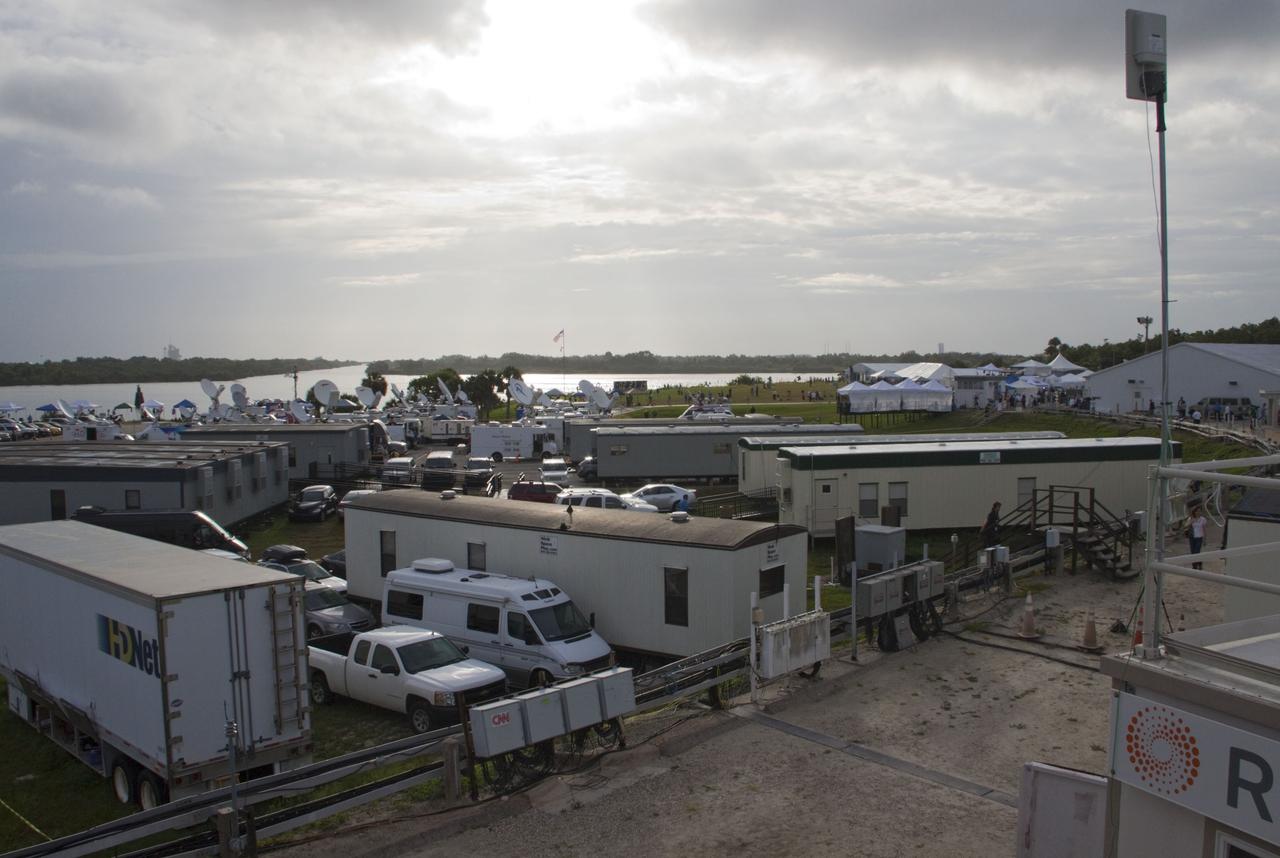
CAPE CANAVERAL, Fla. -- Media from around the globe gather on the grounds of the Press Site at NASA's Kennedy Space Center in Florida to photograph and cover the prelaunch activities and lift off of space shuttle Atlantis on its STS-135 mission to the International Space Station. Seen towering above is the massive Vehicle Assembly Building. Dozens of satellite news vehicles and trailers can be seen in the parking lot. In the background is the Turn Basin where NASA's Pegasus barge delivered the final external tank for the mission. Atlantis began its final flight, with Commander Chris Ferguson, Pilot Doug Hurley and Mission Specialists Sandy Magnus and Rex Walheim on board, at 11:29 a.m. EDT July 8 to deliver the Raffaello multi-purpose logistics module packed with supplies and spare parts to the station. Also in Atlantis' payload bay is the Robotic Refueling Mission experiment that will investigate the potential for robotically refueling existing satellites in orbit. In addition, Atlantis will return with a failed ammonia pump module to help NASA better understand the failure mechanism and improve pump designs for future systems. STS-135 is the 33rd flight of Atlantis, the 37th shuttle mission to the space station, and the 135th and final mission of NASA's Space Shuttle Program. For more information, visit www.nasa.gov/mission_pages/shuttle/shuttlemissions/sts135/index.html. Photo credit: NASA/Jim Grossmann
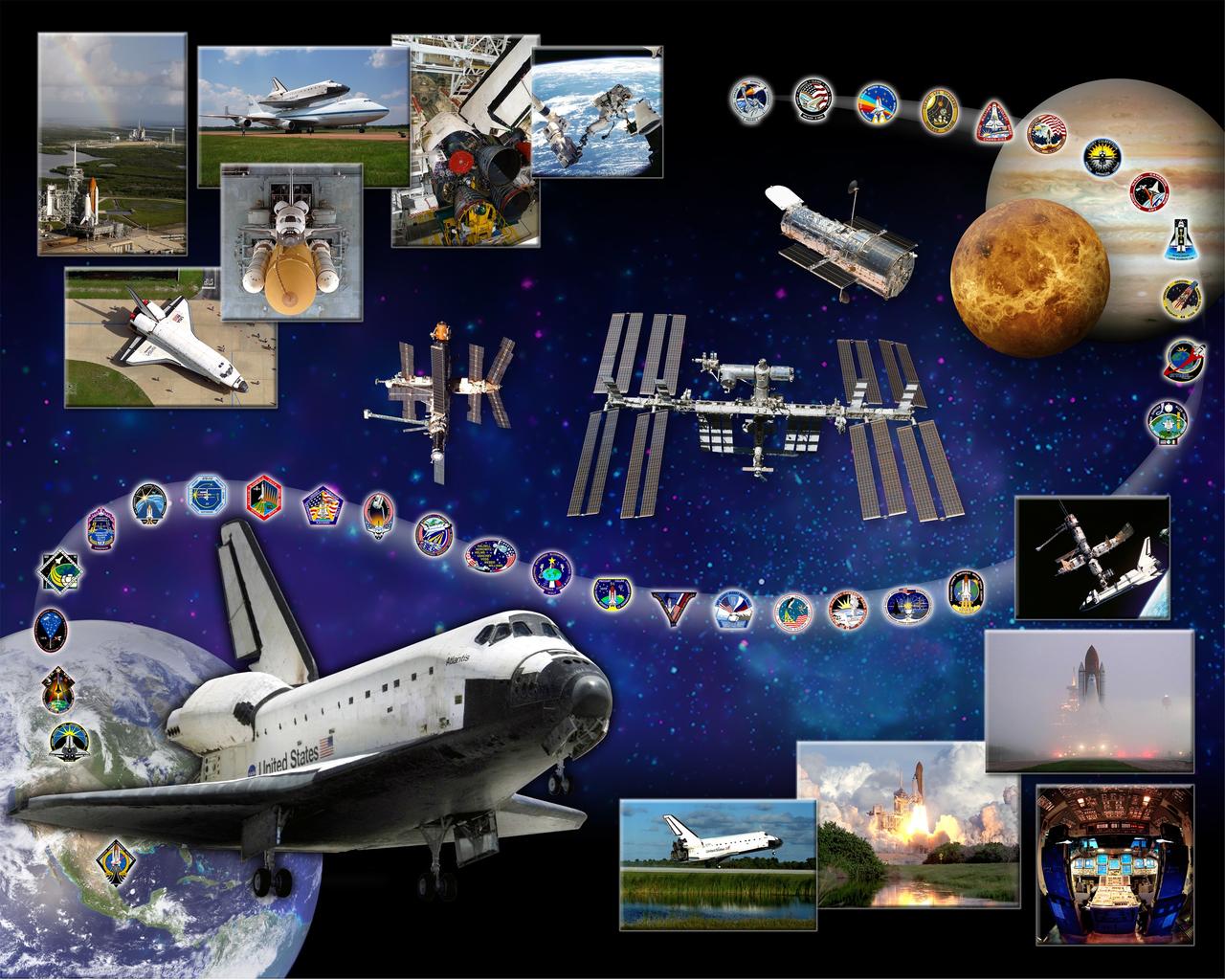
CAPE CANAVERAL, Fla. -- This orbiter tribute of space shuttle Atlantis, or OV-104, hangs in Firing Room 4 of the Launch Control Center at NASA's Kennedy Space Center in Florida. In 2011, the tribute was updated to reflect the addition of one more Atlantis flight -- STS-135 -- which will be the 33rd flight of Atlantis, the 37th shuttle mission to the space station, and the 135th and final mission of NASA's Space Shuttle Program. In the lower-left corner, it features Atlantis soaring above Earth and threaded through the design are the mission patches for each of Atlantis’ flights. Atlantis' accomplishments include seven missions to the Russian space station Mir and several assembly, construction and resupply missions to the International Space Station. Atlantis also flew the last Hubble Space Telescope servicing mission on STS-125. In the tribute, the planet Venus represents the Magellan probe being deployed during STS-30, and Jupiter represents the Galileo probe being deployed during STS-34. The inset photos illustrate various aspects of shuttle processing as well as significant achievements, such as the glass cockpit and the first shuttle docking with Mir during STS-71. The inset photo in the upper-left corner shows a rainbow over Atlantis on Launch Pad 39A and shuttle Endeavour on Launch Pad 39B at Kennedy. Endeavour was the assigned vehicle had Atlantis’ STS-125 mission needed rescue, and this was the last time both launch pads were occupied at the same time. The stars in the background represent the many people who have worked with Atlantis and their contributions to the vehicle’s success. Graphic design credit: NASA/Amy Lombardo. NASA publication number: SP-2010-08-161-KSC

CAPE CANAVERAL, Fla. -- This is a version of space shuttle Atlantis' orbiter tribute, or OV-104, which hangs in Firing Room 4 of the Launch Control Center at NASA's Kennedy Space Center in Florida. In 2011, the tribute was updated to reflect the addition of one more Atlantis flight -- STS-135 -- which will be the 33rd flight of Atlantis, the 37th shuttle mission to the space station, and the 135th and final mission of NASA's Space Shuttle Program. In the lower-left corner, it features Atlantis soaring above Earth and threaded through the design are the mission patches for each of Atlantis’ flights. Atlantis' accomplishments include seven missions to the Russian space station Mir and several assembly, construction and resupply missions to the International Space Station. Atlantis also flew the last Hubble Space Telescope servicing mission on STS-125. In the tribute, the planet Venus represents the Magellan probe being deployed during STS-30, and Jupiter represents the Galileo probe being deployed during STS-34. The inset photos illustrate various aspects of shuttle processing as well as significant achievements, such as the glass cockpit and the first shuttle docking with Mir during STS-71. The inset photo in the upper-left corner shows a rainbow over Atlantis on Launch Pad 39A and shuttle Endeavour on Launch Pad 39B at Kennedy. Endeavour was the assigned vehicle had Atlantis’ STS-125 mission needed rescue, and this was the last time both launch pads were occupied at the same time. The stars in the background represent the many people who have worked with Atlantis and their contributions to the vehicle’s success. Graphic design credit: NASA/Amy Lombardo. NASA publication number: SP-2010-08-161-KSC

CAPE CANAVERAL, Fla. -- This is a printable version of space shuttle Atlantis' orbiter tribute, or OV-104, which hangs in Firing Room 4 of the Launch Control Center at NASA's Kennedy Space Center in Florida. In 2011, the tribute was updated to reflect the addition of one more flight -- STS-135 -- which will be the 33rd flight of Atlantis, the 37th shuttle mission to the space station, and the 135th and final mission of NASA's Space Shuttle Program. In the lower-left corner, it features Atlantis soaring above Earth and threaded through the design are the mission patches for each of Atlantis’ flights. Atlantis' accomplishments include seven missions to the Russian space station Mir and several assembly, construction and resupply missions to the International Space Station. Atlantis also flew the last Hubble Space Telescope servicing mission on STS-125. In the tribute, the planet Venus represents the Magellan probe being deployed during STS-30, and Jupiter represents the Galileo probe being deployed during STS-34. The inset photos illustrate various aspects of shuttle processing as well as significant achievements, such as the glass cockpit and the first shuttle docking with Mir during STS-71. The inset photo in the upper-left corner shows a rainbow over Atlantis on Launch Pad 39A and shuttle Endeavour on Launch Pad 39B at Kennedy. Endeavour was the assigned vehicle had Atlantis’ STS-125 mission needed rescue, and this was the last time both launch pads were occupied at the same time. The stars in the background represent the many people who have worked with Atlantis and their contributions to the vehicle’s success. Graphic design credit: NASA/Amy Lombardo. NASA publication number: SP-2010-08-161-KSC