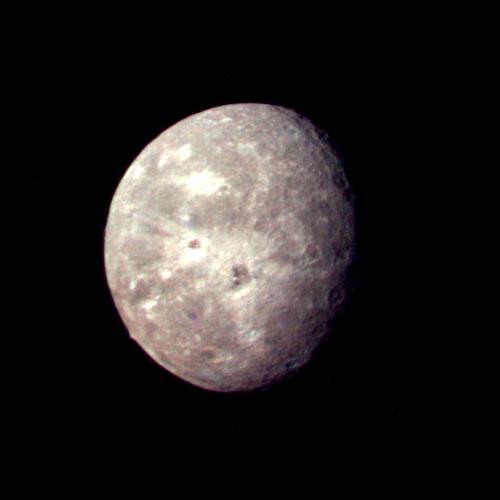
This image of Oberon, Uranus outermost moon, was captured by NASA Voyager 2 on Jan. 24, 1986. Clearly visible are several large impact craters in Oberon icy surface surrounded by bright rays. http://photojournal.jpl.nasa.gov/catalog/PIA00034
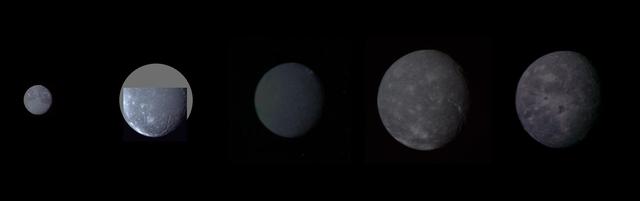
Montage of Uranus five largest satellites taken by NASA Voyager 2. From to right to left in order of decreasing distance from Uranus are Oberon, Titania, Umbriel, Ariel, and Miranda.
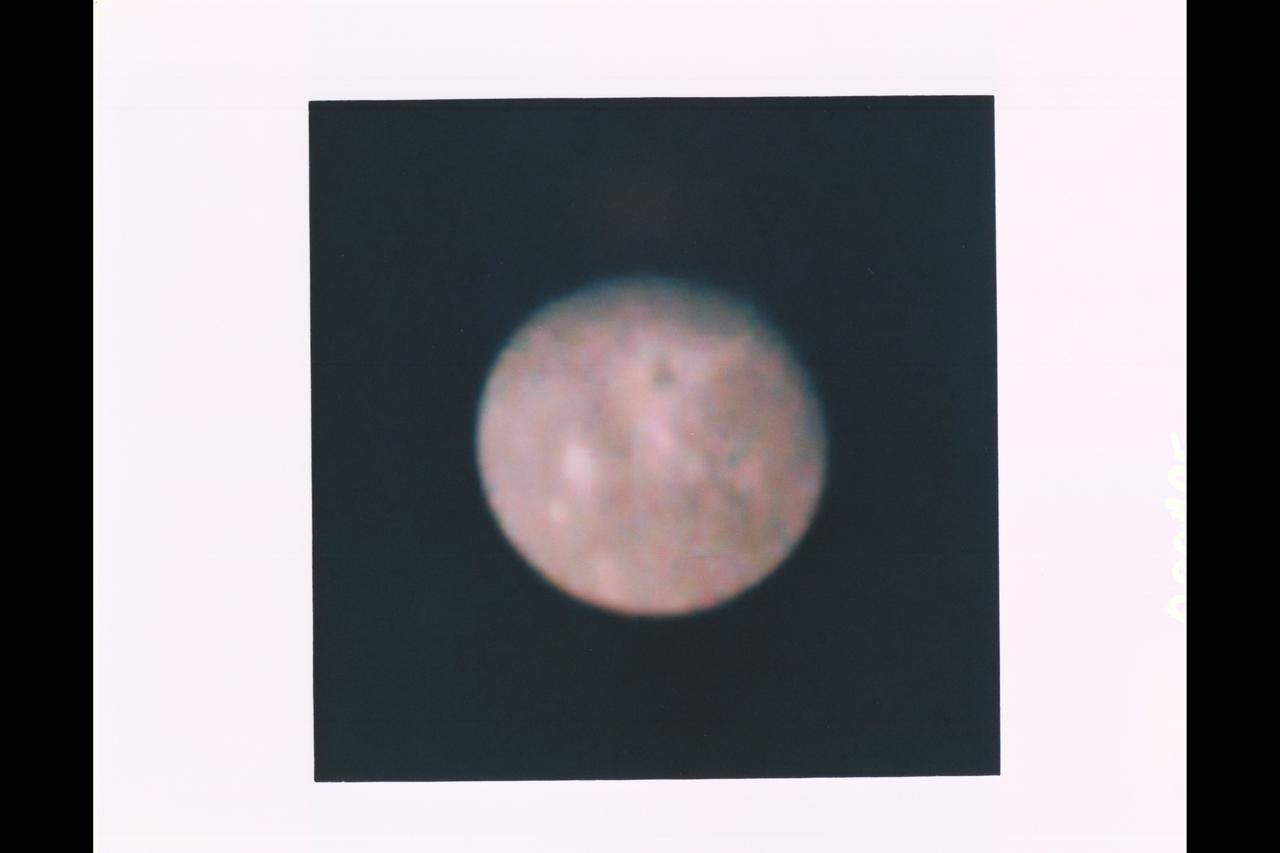
Range : 2.77 million miles (1.72 million miles) resolution : 51 km. (32 mi.) P-29495C This Voyager 2 photograph of the outermost Uranian satellite, Oberon is a computer reconstruction of three frames , exposed through the narrow angle camera's blue, green, and orange filters. the grayness or apparent lack of strong color is a distinctive characteristic of the satellites and the rings of Uranus and can serve as one indicator of the possible composition of the satellites' surfaces. Oberon has a diameter of about 1,600 km. (1,000 mi.) and orbits the planet at a radial distance of 586,000 km. (364,000 mi.). Oberon's surface displays areas of lighter and darker material, probably associated in part with impact craters formed during its long exposure to bombardment by cosmic debris. Thr resolution of this particular image is not sufficient, however, to reveal with confidece the nature of these features.
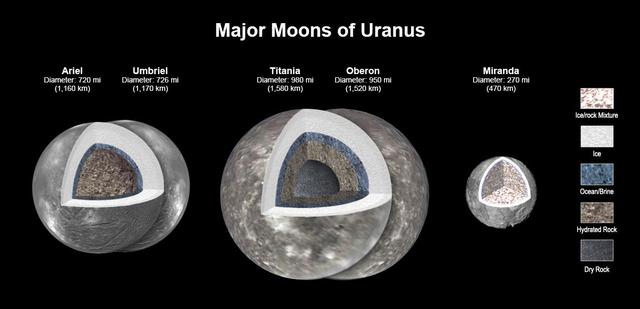
New modeling shows that there likely is an ocean layer in four of Uranus' major moons: Ariel, Umbriel, Titania, and Oberon. Salty – or briny – oceans lie under the ice and atop layers of water-rich rock and dry rock. Miranda is too small to retain enough heat for an ocean layer. The modeling, detailed in a paper published in the Journal of Geophysical Research, was informed by a re-analysis of data from NASA's Voyager spacecraft. Scientists have long thought that Titania, given its size, would be most likely to retain internal heat, caused by radioactive decay. The other moons had been widely considered too small to retain the heat necessary to keep an internal ocean from freezing, especially as heating created by the gravitational pull of Uranus is only a minor source of heat. https://photojournal.jpl.nasa.gov/catalog/PIA25500
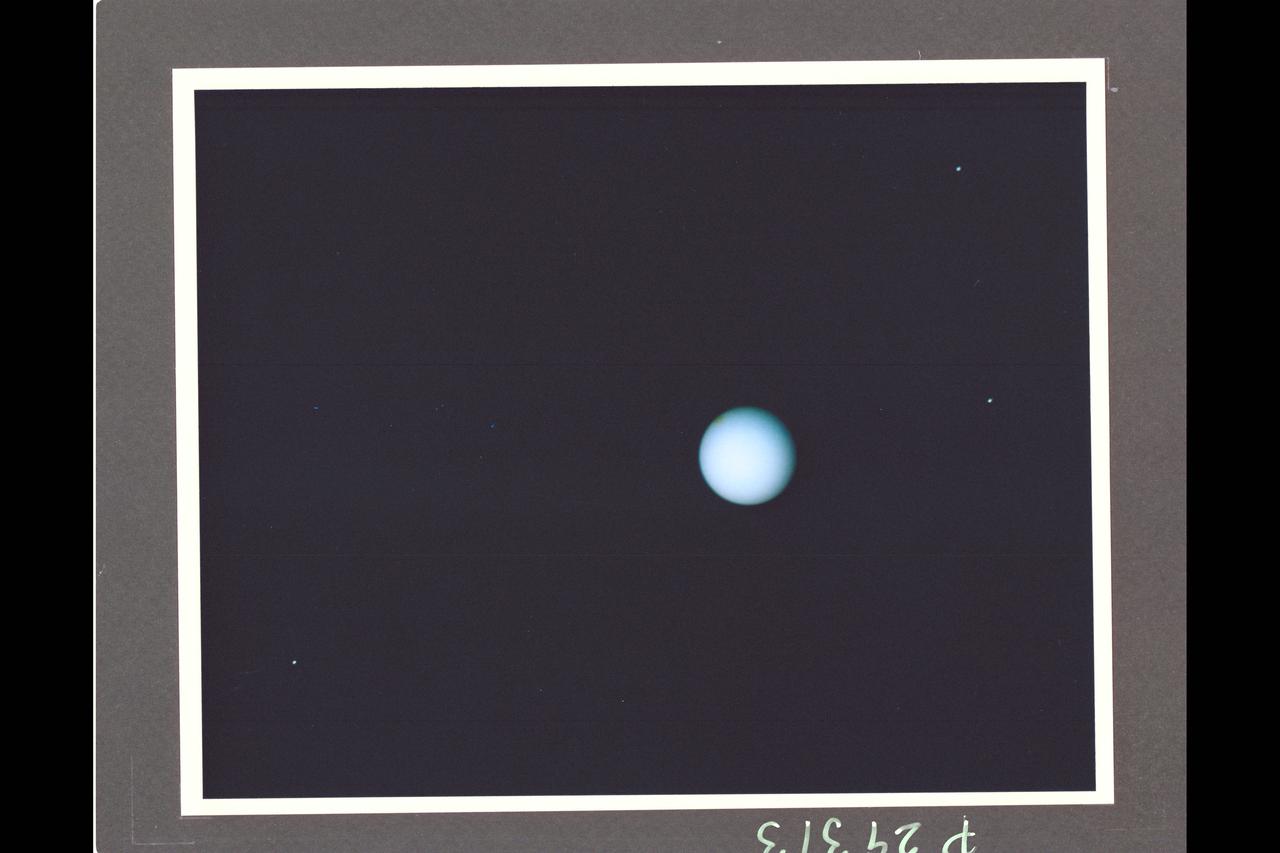
Range : 74 million km. ( 46 million miles ) P-29313CThis Voyager photograph of Uranus is a composite of for images taken by the narrow angle camera. At this range, clouds and other features in the atmosphere as small as 1,370 km. could be detected by Voyager 2. Yet, no such features are visible. This view is toward the illuminated south pole of Uranus. The predominant blue color is the result of atmospheric methane, which absorbs the red wavelengths from incoming sunlight. The spot at the upper left edge of the planet's disk reulted from the removal of a reseau mark used in making measurments on the photograph. Three of Uranus' five known satellites are visible; Miranda ( at far right, closest to the planet ), Ariel ( next out , at top), and Umbriel ( lower left ). Titania and Oberon are now outside the narrow angle camera's field of view when it centered on the planet. This color composite was made from images taken through blue, green, orange, and clear filters.