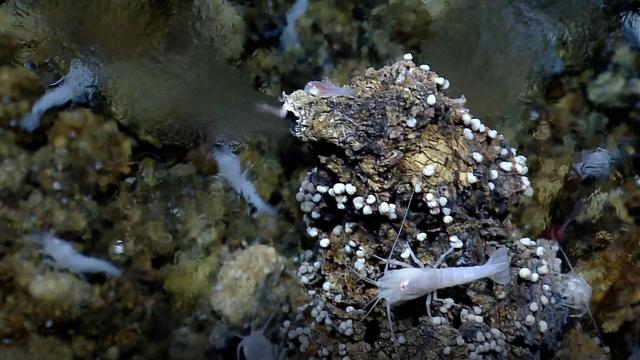
A seafloor vent called a "white smoker" spews mineral-rich water into the ocean and serves as an energy hub for living creatures. Some scientists think life on Earth may have begun around similar vents on the ocean floor billions of years ago. https://photojournal.jpl.nasa.gov/catalog/PIA23686
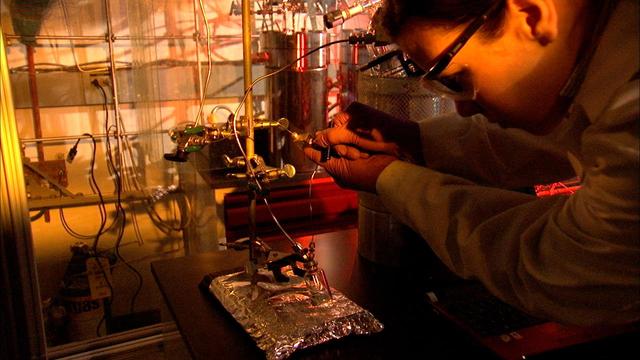
Lauren White, a scientist at NASA's Jet Propulsion Laboratory, adjusts an experiment that simulates how ancient seawater and fluid from hydrothermal vents could have reacted with minerals from the seafloor to create organic molecules 4.5 billion years ago. The image was taken at JPL in 2014. https://photojournal.jpl.nasa.gov/catalog/PIA23688
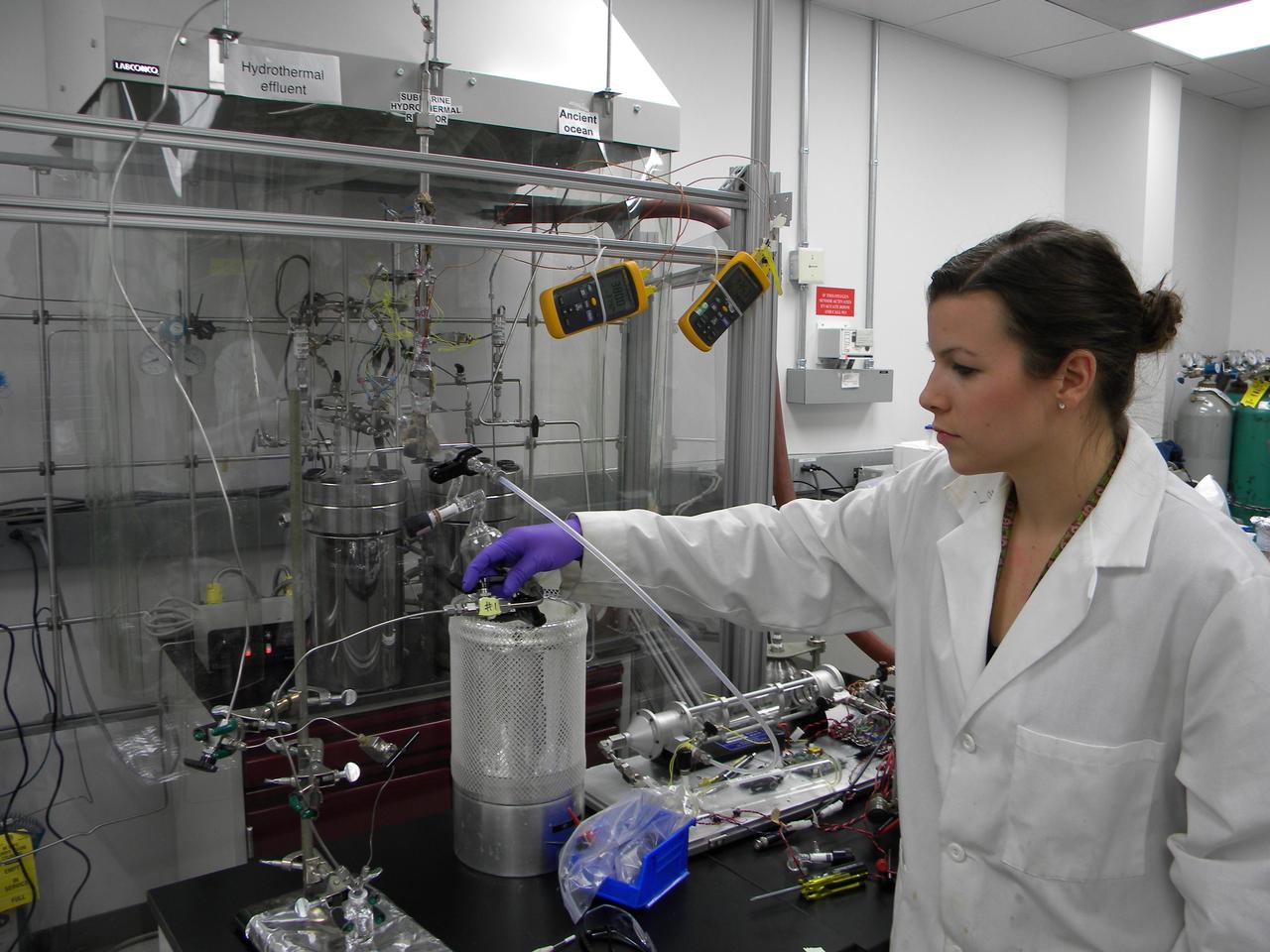
A team of scientists at NASA Jet Propulsion Laboratory is testing whether organic molecules can be brewed in a simulated ocean vent. Pictured here is Lauren White, a member of the NASA Astrobiology Icy Worlds team.
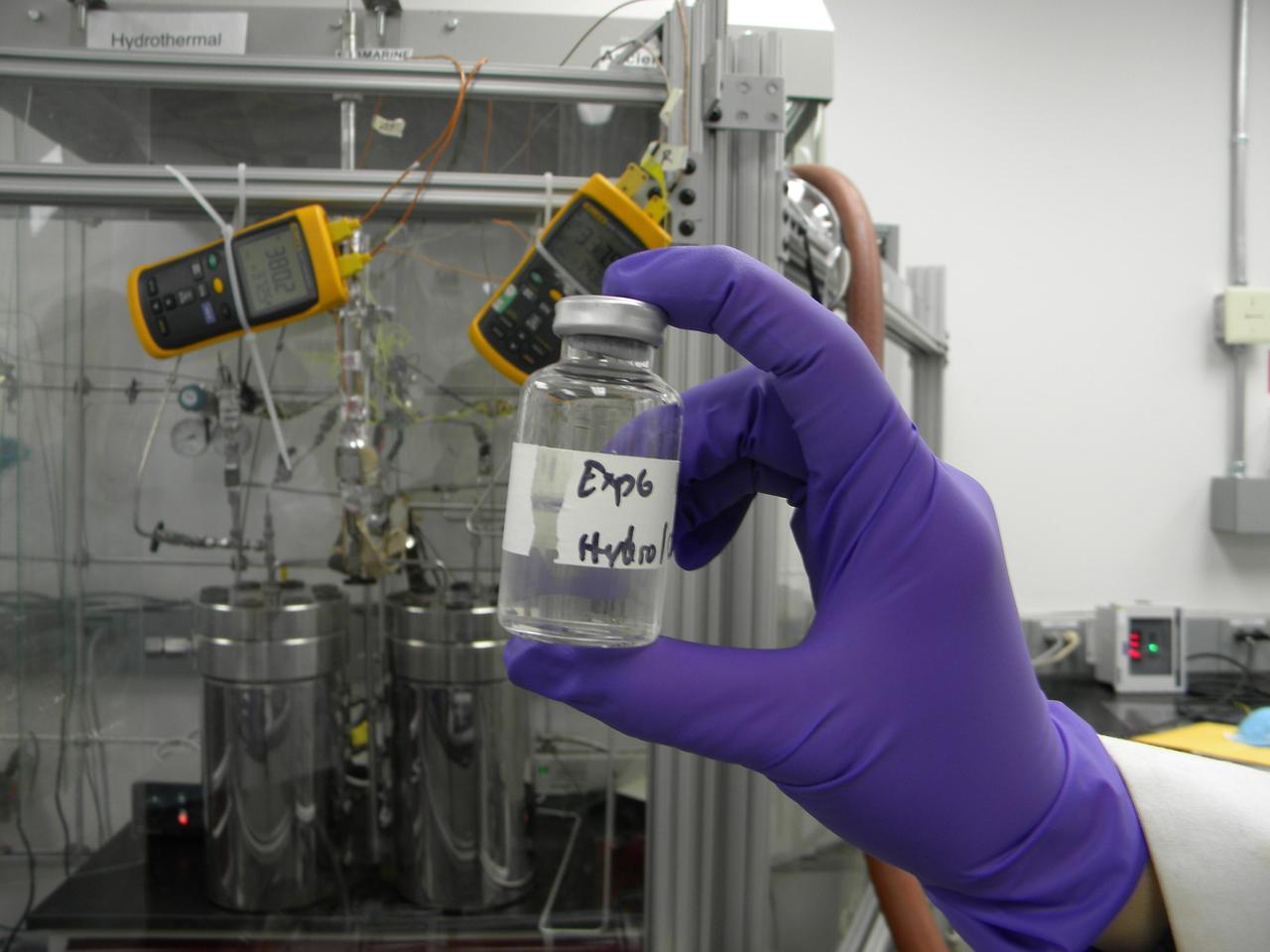
The NASA Astrobiology Icy Worlds team at NASA Jet Propulsion Laboratory are collecting samples from a simulated ocean vent to see if they can detect organic molecules being brewed.
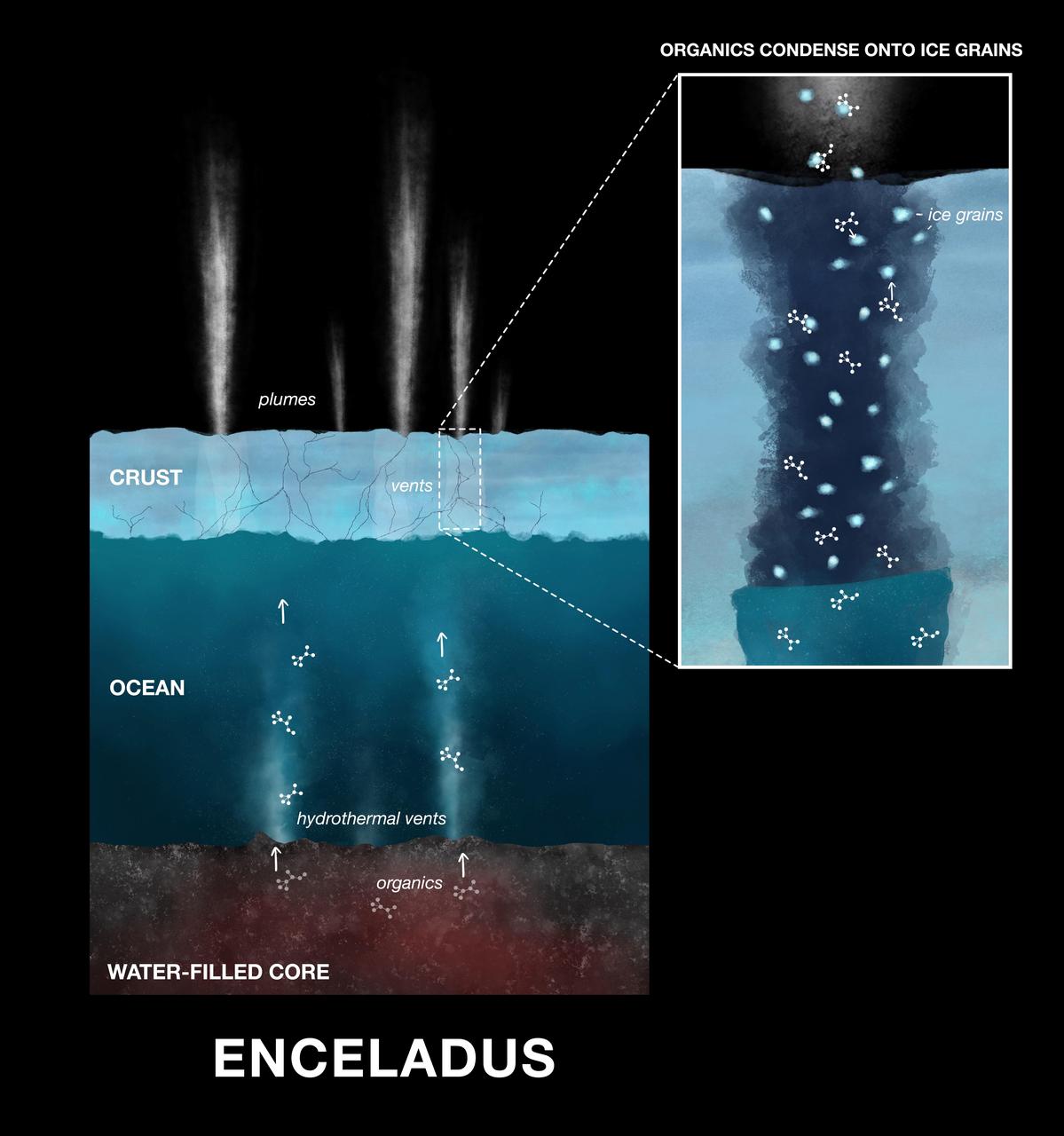
This illustration shows how newly discovered organic compounds — the ingredients of amino acids — were detected by NASA's Cassini spacecraft in the ice grains emitted from Saturn's moon Enceladus. Powerful hydrothermal vents eject material from Enceladus' core into the moon's massive subsurface ocean. After mixing with the water, the material is released into space as water vapor and ice grains. Condensed onto the ice grains are nitrogen- and oxygen-bearing organic compounds. On Earth hydrothermal vents on the ocean floor provide the energy that fuels reactions that produce amino acids, the building blocks of life. Scientists believe Enceladus' hydrothermal vents may operate in the same way, supplying energy that leads to the production of amino acids. https://photojournal.jpl.nasa.gov/catalog/PIA23173

Scientists believe that under the icy surface of Jupiter's moon Europa a saltwater ocean exists that may contain more than twice as much liquid water as all of Earth's oceans combined. This artist's concept (not to scale) depicts what Europa's internal structure could look like: an outer shell of ice, perhaps with plumes of material venting from beneath the surface; a deep, global layer of liquid water; and a rocky interior, potentially with hydrothermal vents on the seafloor. The true nature of Europa's inner structure will be examined by NASA's Europa Clipper mission, which is scheduled to arrive at Jupiter in 2030. Europa Clipper's three main science objectives are to determine the thickness of the moon's icy shell and its interactions with the ocean below, to investigate its composition, and to characterize its geology. The mission's detailed exploration of Europa will help scientists better understand the astrobiological potential for habitable worlds beyond our planet. https://photojournal.jpl.nasa.gov/catalog/PIA26438
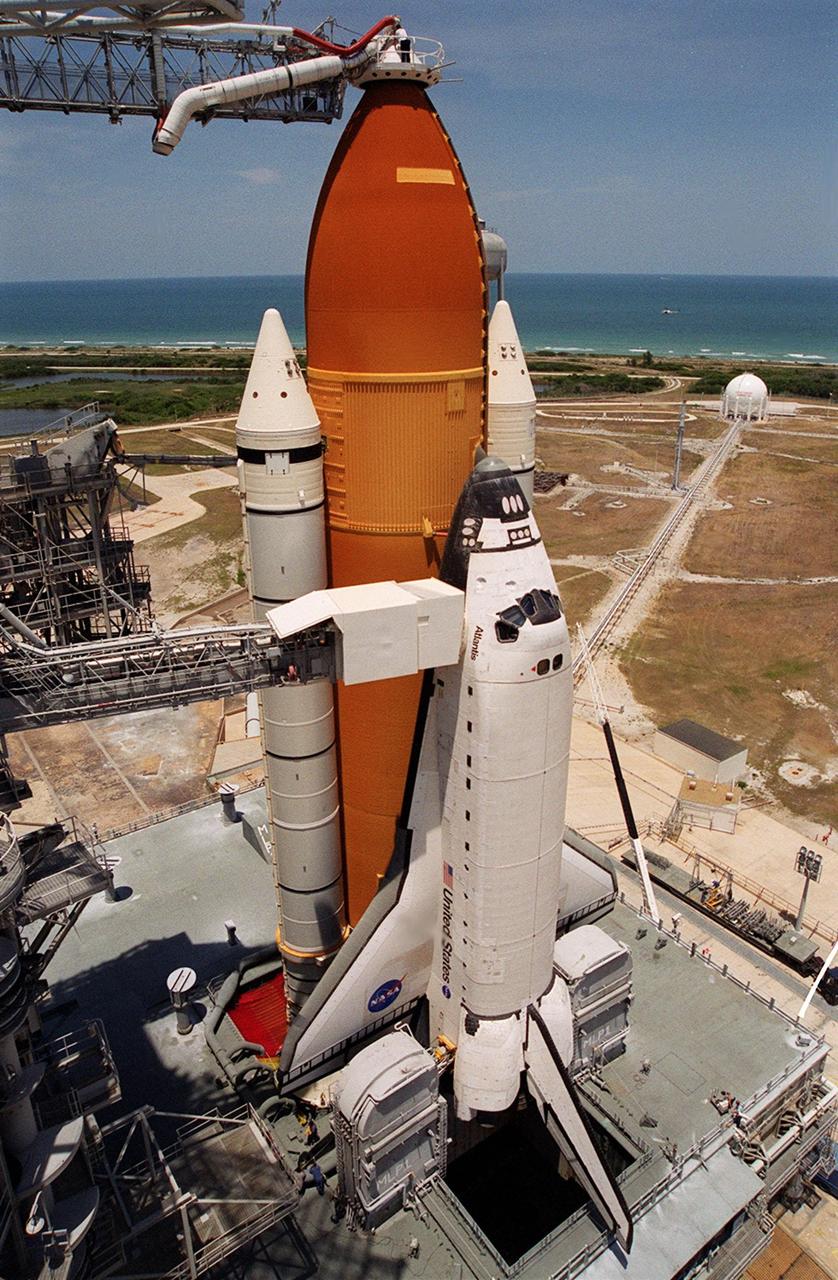
KENNEDY SPACE CENTER, Fla. -- After rollback of the Rotating Service Structure, Space Shuttle Atlantis is poised and ready on Launch Pad 39A for a fourth launch attempt on mission STS-101. At the top of the photo can be seen the Gaseous Oxygen Vent Hood, often called the "beanie cap." The hood helps vent gaseous oxygen vapors away from the Space Shuttle. The hood will be raised and retracted two and a half minutes before launch. Abutting the side of Atlantis is the orbiter access arm with the environmental chamber known as the White Room at the end. The White Room provides access to the crew compartment. In the background of the photo is the Atlantic Ocean. This will be the third assembly flight to the International Space Station. Liftoff of Space Shuttle Atlantis for the 10-day mission is scheduled for about 6:12 a.m. EDT from Launch Pad 39A. Landing is targeted for May 29 at 2:19 a.m. EDT. This is the 98th Shuttle flight and the 21st flight for Shuttle Atlantis
KENNEDY SPACE CENTER, Fla. -- After rollback of the Rotating Service Structure, Space Shuttle Atlantis is poised and ready on Launch Pad 39A for a fourth launch attempt on mission STS-101. At the top of the photo can be seen the Gaseous Oxygen Vent Hood, often called the "beanie cap." The hood helps vent gaseous oxygen vapors away from the Space Shuttle. The hood will be raised and retracted two and a half minutes before launch. Abutting the side of Atlantis is the orbiter access arm with the environmental chamber known as the White Room at the end. The White Room provides access to the crew compartment. In the background of the photo is the Atlantic Ocean. This will be the third assembly flight to the International Space Station. Liftoff of Space Shuttle Atlantis for the 10-day mission is scheduled for about 6:12 a.m. EDT from Launch Pad 39A. Landing is targeted for May 29 at 2:19 a.m. EDT. This is the 98th Shuttle flight and the 21st flight for Shuttle Atlantis
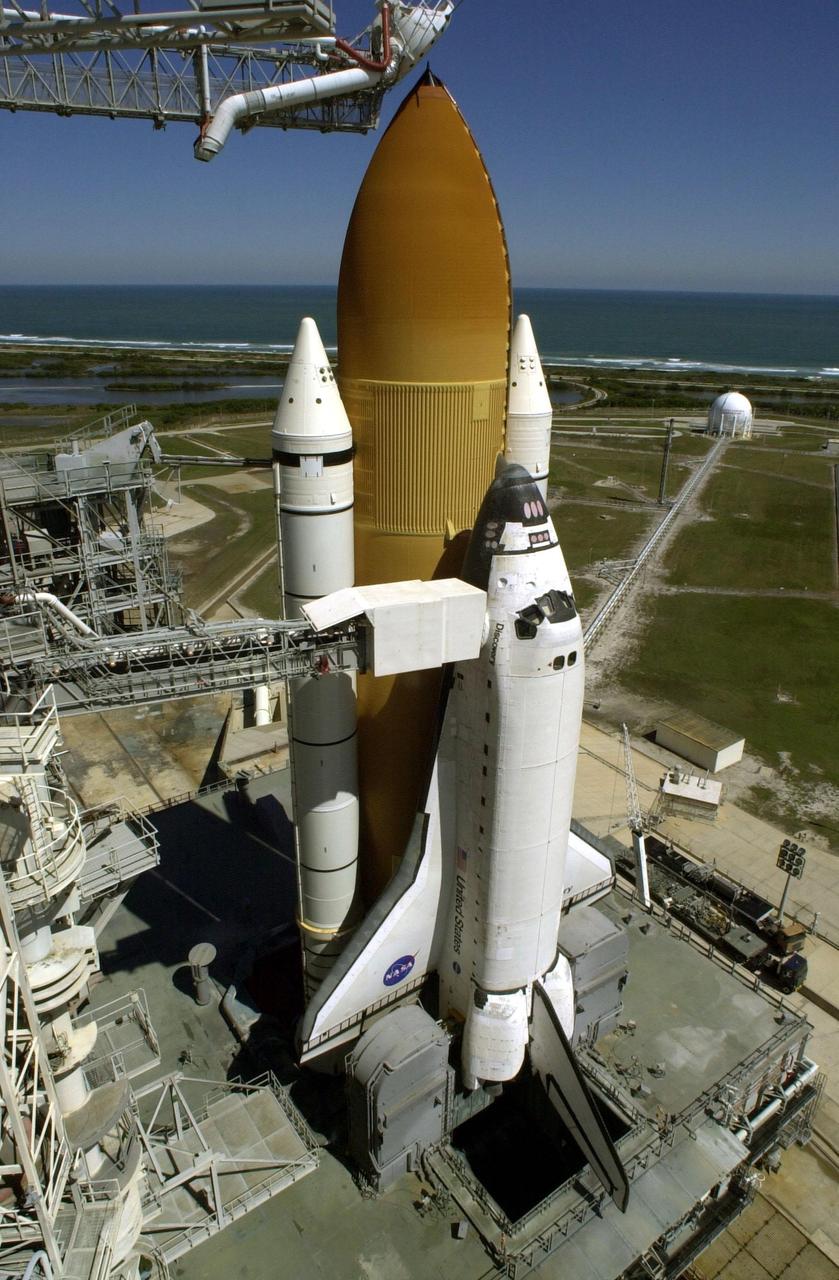
Space Shuttle Discovery sits poised on Launch Pad 39B, ready for launch at 6:42 a.m. EST March 8 on mission STS-102. Situated above the external tank is the Gaseous Oxygen Vent Arm with the “beanie cap,” a vent hood. The orbiter access arm is extended from the Fixed Service Structure (left) to the orbiter. An environmentally controlled chamber, known as the White Room, is at the end of the arm, providing entrance for the astronaut crew into the orbiter. In the distance, behind the Space Shuttle, can be seen the Atlantic Ocean. On this eighth construction flight to the International Space Station, Discovery carries the Multi-Purpose Logistics Module Leonardo, the primary delivery system used to resupply and return Station cargo requiring a pressurized environment. Leonardo will deliver up to 10 tons of laboratory racks filled with equipment, experiments and supplies for outfitting the newly installed U.S. Laboratory Destiny

This artist's concept depicts NASA's Europa Clipper spacecraft in orbit around Jupiter. Scientists believe Jupiter's icy moon Europa harbors a vast internal ocean that may have conditions suitable for supporting life. While orbiting Jupiter, the spacecraft will fly by the moon about 50 times, allowing its science instruments to gather data on Europa's atmosphere, surface, and interior – information that will help scientists learn more about the ocean, the ice crust, and potential plumes that may be venting subsurface water into space. Europa Clipper's three main science objectives are to determine the thickness of the moon's icy shell and its interactions with the ocean below, to investigate its composition, and to characterize its geology. The mission's detailed exploration of Europa will help scientists better understand the astrobiological potential for habitable worlds beyond our planet. https://photojournal.jpl.nasa.gov/catalog/PIA26068

This illustration, updated in December 2020, depicts NASA's Europa Clipper spacecraft. With an internal global ocean twice the size of Earth's oceans combined, Jupiter's moon Europa may have the potential to harbor life. The Europa Clipper orbiter will swoop around Jupiter on an elliptical path, dipping close to the moon on each flyby to collect data. The mission will gather measurements of the internal ocean, map the surface geology and composition, and hunt for plumes of water vapor that may be venting from the icy crust. Understanding Europa's habitability will help scientists better understand how life developed on Earth and the potential for finding life beyond our planet. Europa Clipper is aiming for a launch readiness date of 2024. https://photojournal.jpl.nasa.gov/catalog/PIA24321
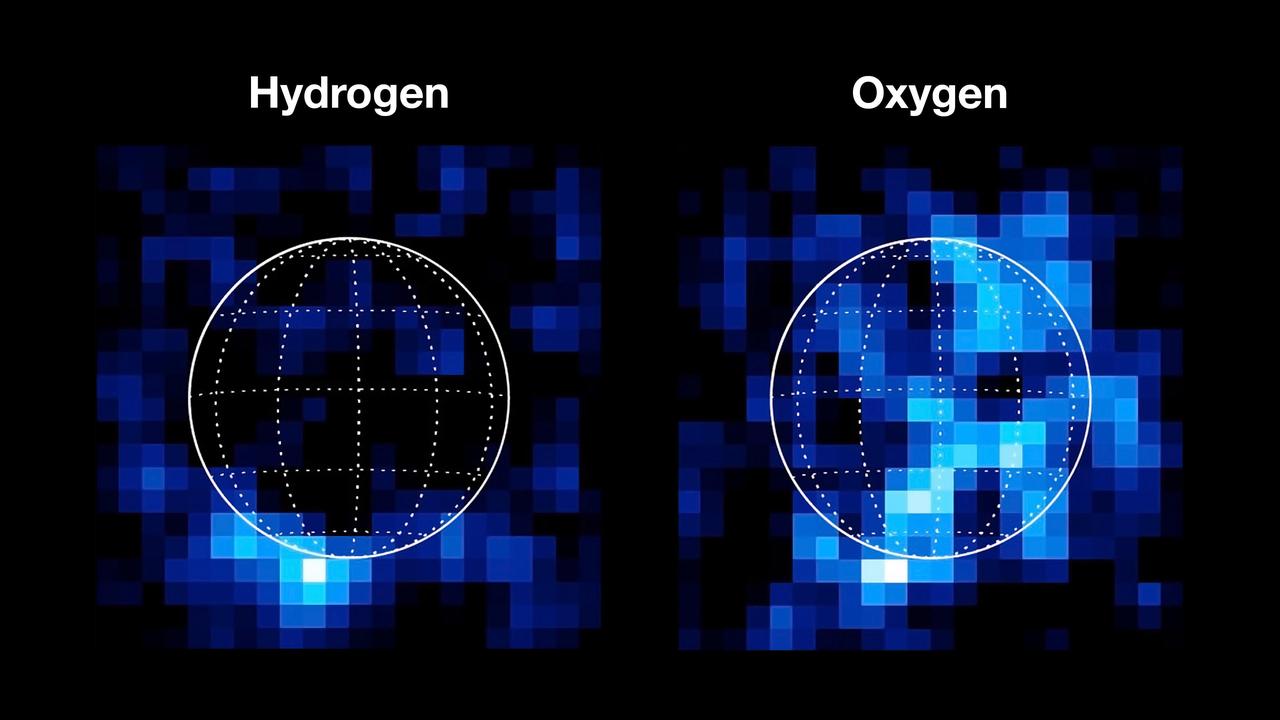
Ultraviolet observations made by NASA's Hubble Space Telescope in 2012 illustrate two key elements in the thin atmosphere of Jupiter's moon Europa: hydrogen and oxygen. A white circle indicates the outline of Europa. The hydrogen data could potentially be evidence of an active plume venting water from the ocean beneath Europa's icy crust. If plumes do exist at the Jovian moon, the ultraviolet spectrograph on NASA's Europa Clipper spacecraft (Europa-UVS) could detect their activity at much higher resolution. Europa Clipper's three main science objectives are to determine the thickness of the moon's icy shell and its interactions with the ocean below, to investigate its composition, and to characterize its geology. The mission's detailed exploration of Europa will help scientists better understand the astrobiological potential for habitable worlds beyond our planet. https://photojournal.jpl.nasa.gov/catalog/PIA26462
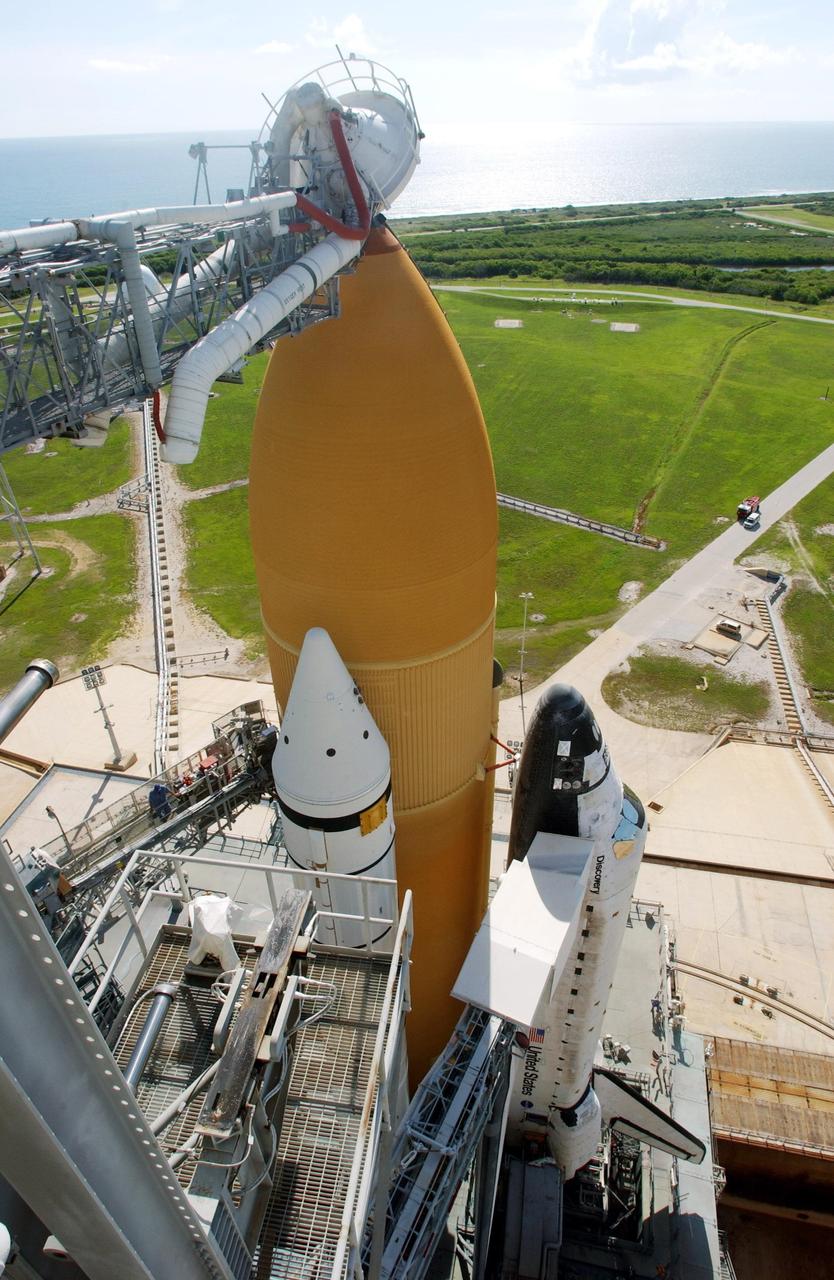
KENNEDY SPACE CENTER, Fla. -- From this high-level view, Space Shuttle Discovery is seen after its rollout to Launch Pad 39A. Extending toward Discovery on the right is the orbiter access arm with the White Room at the end. The White Room provides entry into the orbiter. Above the orange external tank is the gaseous oxygen vent arm with the “beanie cap” hood at the end. Beyond the pad can be seen the Atlantic Ocean. Discovery is scheduled to launch in early August on mission STS-105. Photo by Scott Andrews using a Nikon D1X camera
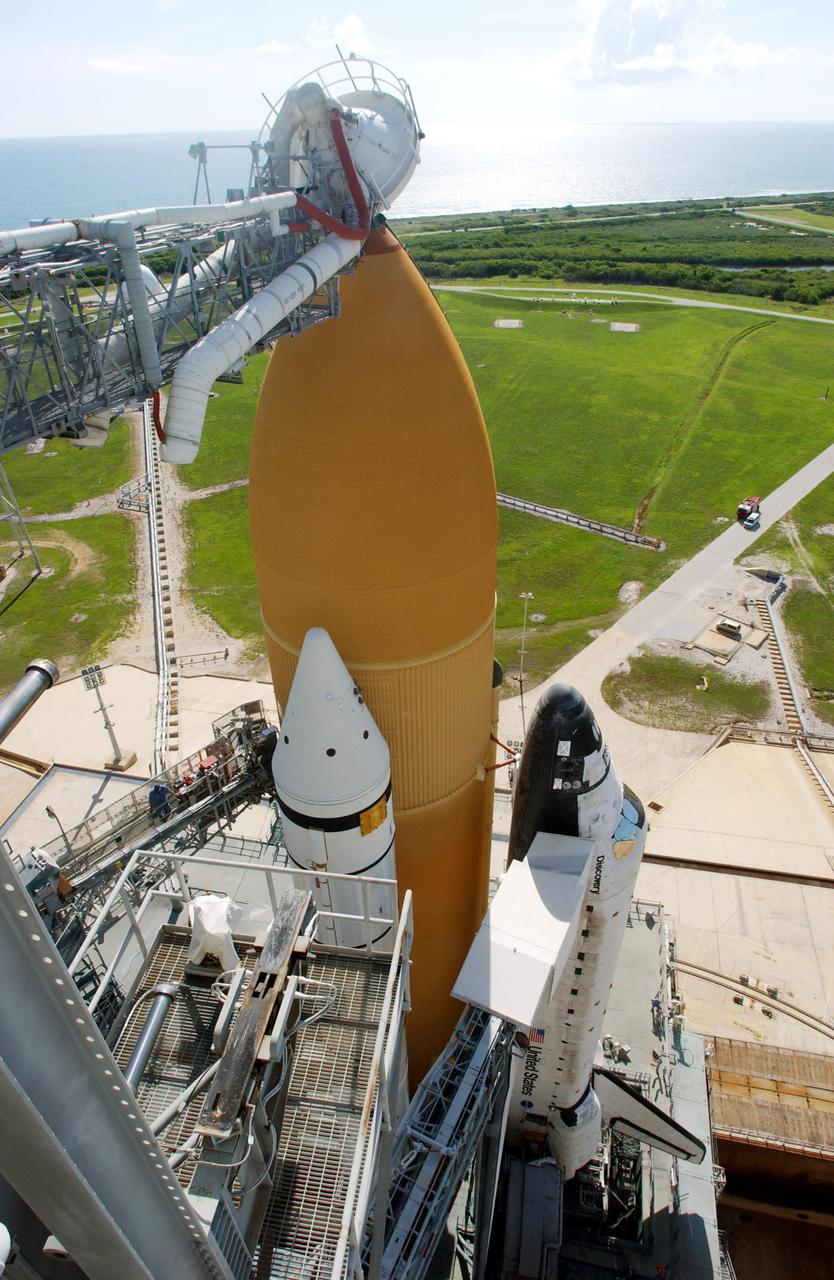
KENNEDY SPACE CENTER, Fla. -- From this high-level view, Space Shuttle Discovery is seen after its rollout to Launch Pad 39A. Extending toward Discovery on the right is the orbiter access arm with the White Room at the end. The White Room provides entry into the orbiter. Above the orange external tank is the gaseous oxygen vent arm with the “beanie cap” hood at the end. Beyond the pad can be seen the Atlantic Ocean. Discovery is scheduled to launch in early August on mission STS-105. Photo by Scott Andrews using a Nikon D1X camera
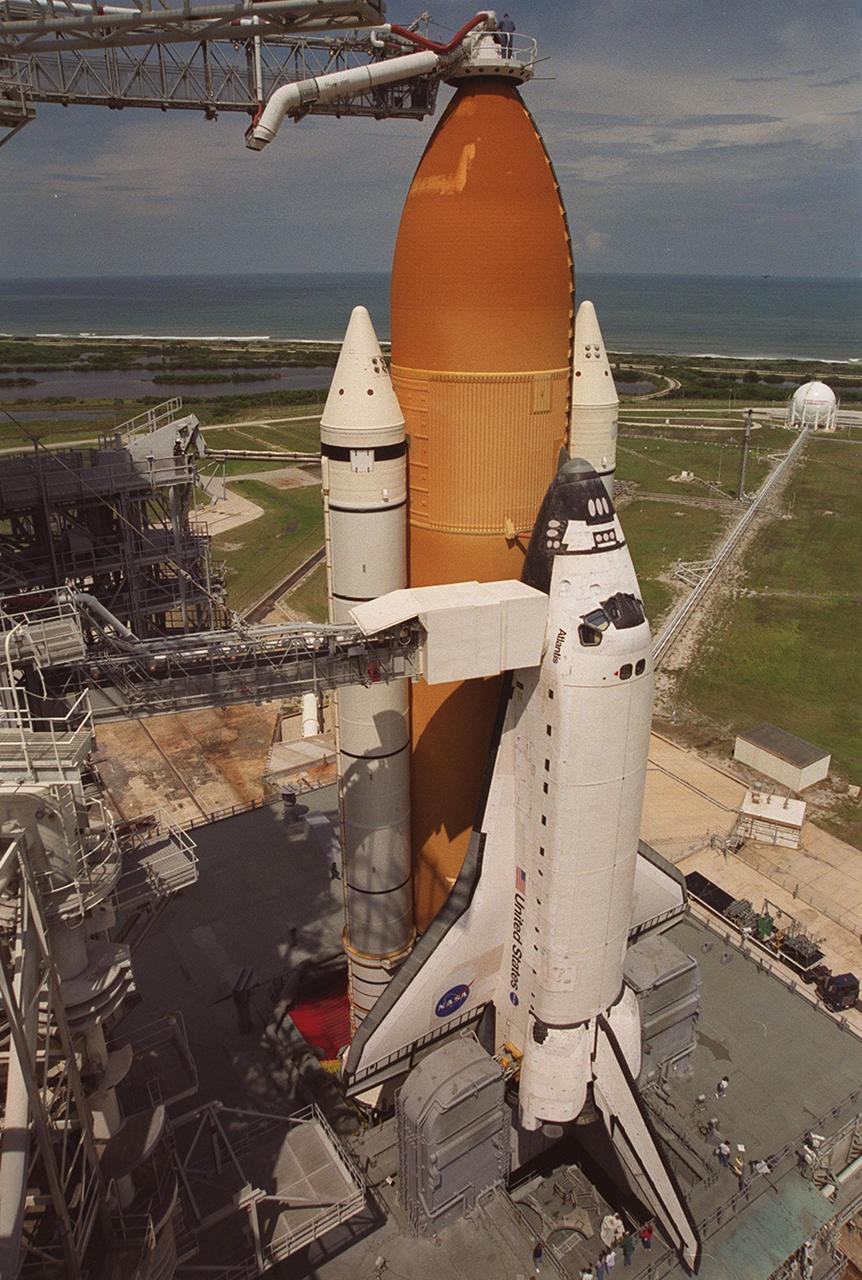
KENNEDY SPACE CENTER, Fla. -- Against a backdrop of the cloudy sky and blue-gray Atlantic Ocean, Space Shuttle Atlantis is revealed after rollback of the Rotating Service Structure. On top of the external tank is the 13-foot-wide “beanie cap,” at the end of the Gaseous Oxygen Vent Arm, designed to vent gaseous oxygen vapors away from the Space Shuttle. Lower is the Orbiter Access Arm with the environmental chamber, known as the “white room,” extended to the orbiter. The chamber provides entry for the crew into the orbiter and also serves as emergency egress up to 7 minutes 24 seconds before launch. Ready for launch of mission STS-106 at 8:45 a.m. EDT on Sept. 8, Atlantis carries supplies to prepare the Russian Zvezda living quarters on the International Space Station for the first long-duration crew. The crew will also be transferring supplies from the Russian Progress resupply ship already docked to the aft of Zvezda. The fourth U.S. launch for the Space Station, the mission is expected to last 10 days, 19 hours and 9 minutes, landing at KSC 4:59 a.m. EDT on Sept. 19
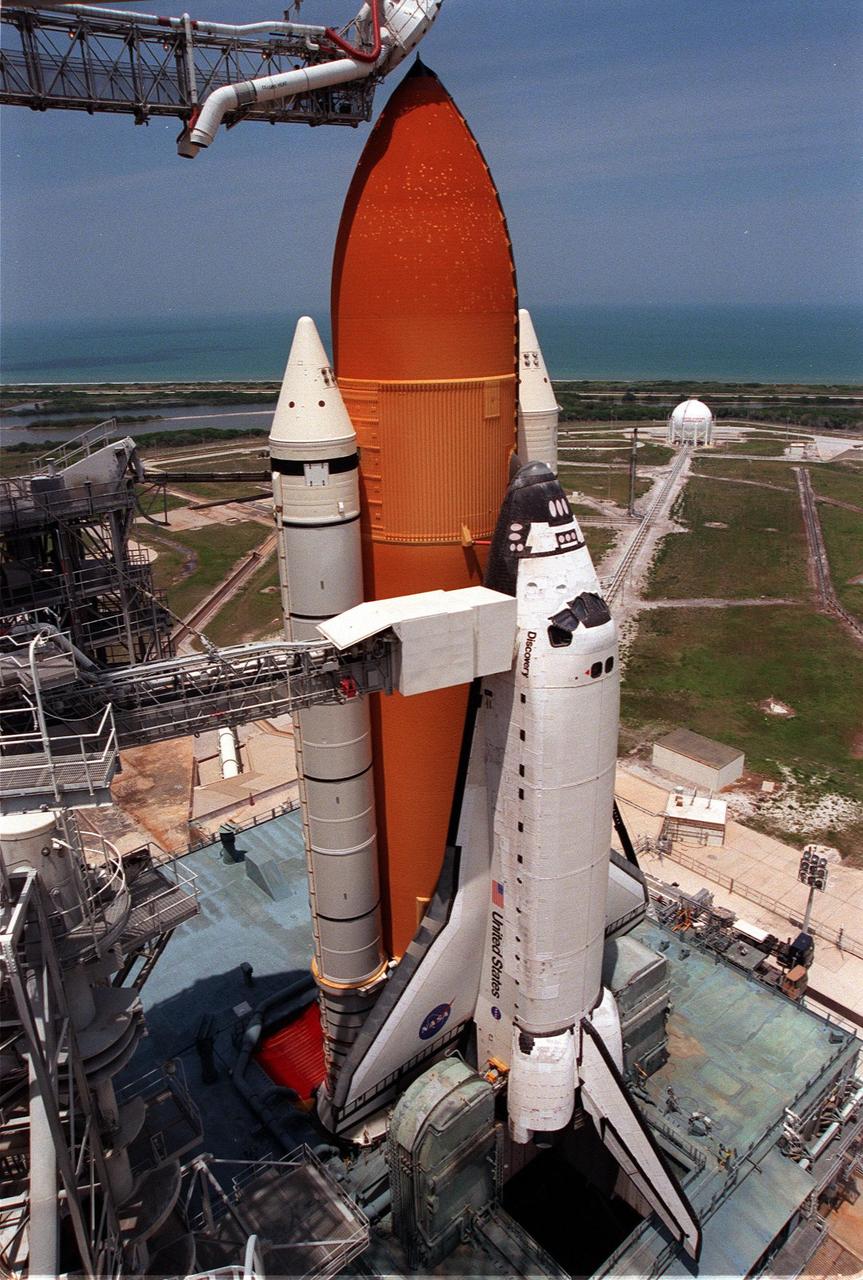
KENNEDY SPACE CENTER, FLA. -- Rollback of the Rotating Service Structure on Launch Pad 39B reveals the Space Shuttle Discovery, scheduled to launch on mission STS-96 at 6:49 a.m. EDT on May 27. Above the top of the external tank is the external tank gaseous oxygen vent arm, with a vent hood, known as the "beanie cap," at the outer end. Below it up against Discovery is the orbiter access arm, which allows entry into the orbiter crew compartment. through an environmental chamber or "white room" at the outer end. STS-96 is a 10-day logistics and resupply mission for the International Space Station, carrying about 4,000 pounds of supplies to be stored aboard the station, for use by future crews, including laptop computers, cameras, tools, spare parts, and clothing. The mission also includes such payloads as a Russian crane, the Strela; a U.S.-built crane; the Spacehab Oceaneering Space System Box (SHOSS), a logistics items carrier; and STARSHINE, a student-involved experiment. The mission will include a space walk to attach the cranes to the outside of the ISS for use in future construction. Space Shuttle Discovery is due to launch on May 27 at 6:49 a.m. EDT. Landing is expected at the SLF on June 6 about 1:58 a.m. EDT
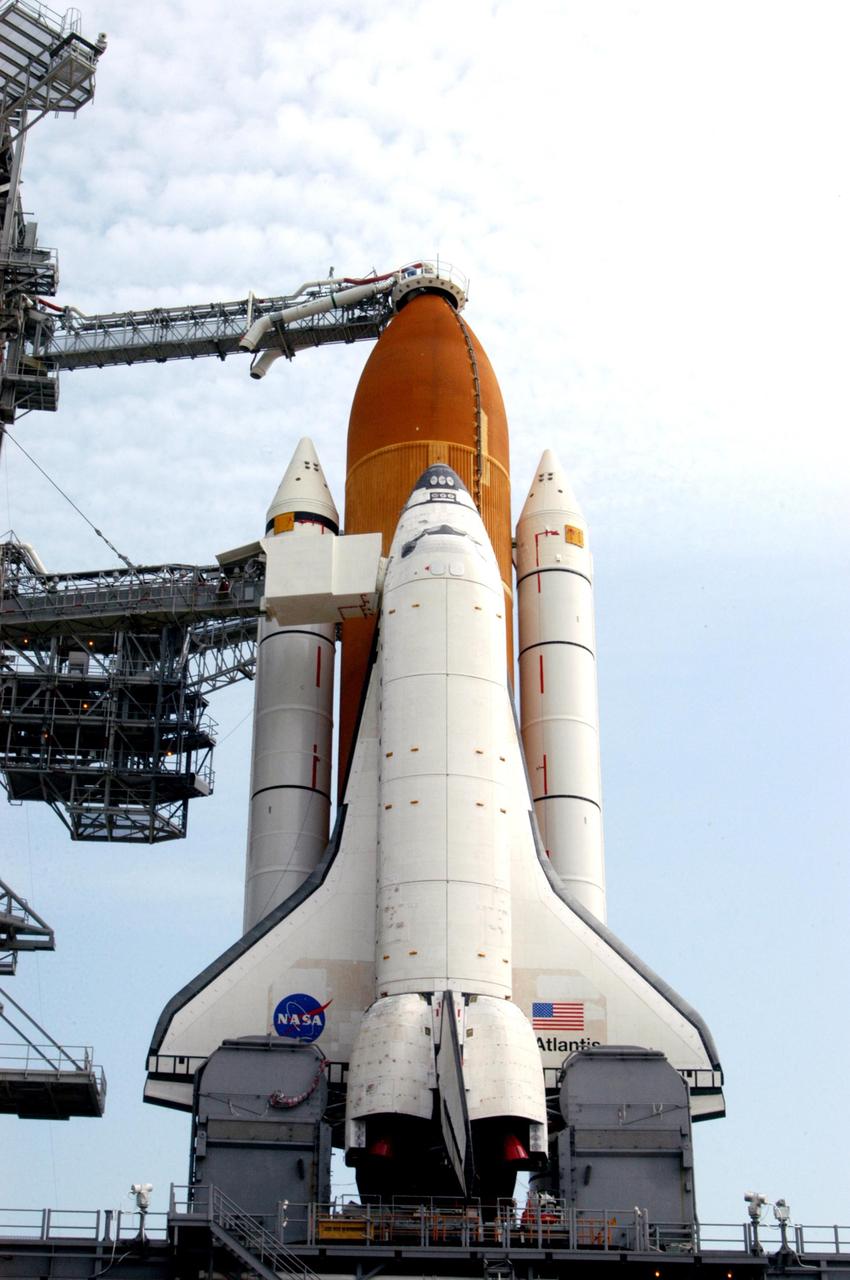
KENNEDY SPACE CENTER, FLA. - This closeup of Space Shuttle Atlantis on the hardstand of Launch Pad 39B shows the surrounding area, including the Atlantic Ocean in the background. Above the orange external tank is the "beanie cap" at the end of the external tank gaseous oxygen vent arm. The cap is a vent hood that vacuums away the very cold liquid oxygen vapors as they boil off from the top of the external tank before launch. Lower down is the orbiter access arm, with the White Room on the outer end, extended toward Atlantis' crew access hatch. The slow speed of the crawler results in a 6- to 8-hour trek to the pad approximately 4 miles away. Atlantis' launch window begins Aug. 27 for an 11-day mission to the International Space Station. The STS-115 crew of six astronauts will continue construction of the station and install their cargo, the Port 3/4 truss segment with its two large solar arrays. Photo credit: NASA/Troy Cryder & George Shelton
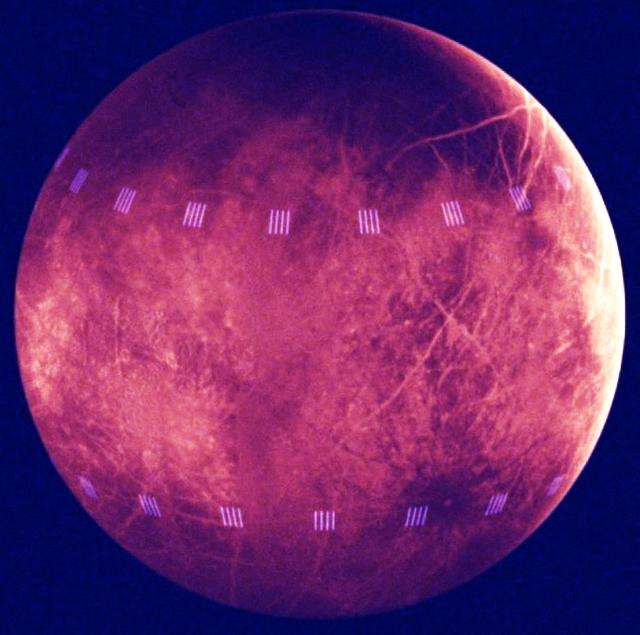
This image is a simulation of how NASA's Europa Clipper will understand which areas of the Jovian moon Europa are warm and active by studying the moon's thermal emissions. Scientists based this image on a model of data from NASA's Galileo mission and data from an instrument on NASA's Cassini mission that studied warm regions of Saturn's moon Enceladus where jets of water ice and organic chemicals spray out from vents in the icy surface. Europa Clipper's Europa Thermal Emission Imaging System, or E-THEMIS, will take both daytime and nighttime observations of Europa. The light pink vertical stripes simulate the warm vents seen on the surface of Enceladus, if they were viewed on Europa in the night. If Europa has warm spots like Enceladus, E-THEMIS is expected to detect such areas on Europa, even from a distance. Europa Clipper will get as close as 16 miles (25 kilometers) from the moon's surface, resulting in observations at much higher resolution. Europa Clipper's three main science objectives are to determine the thickness of the moon's icy shell and its interactions with the ocean below, to investigate its composition, and to characterize its geology. The mission's detailed exploration of Europa will help scientists better understand the astrobiological potential for habitable worlds beyond our planet. https://photojournal.jpl.nasa.gov/catalog/PIA26105
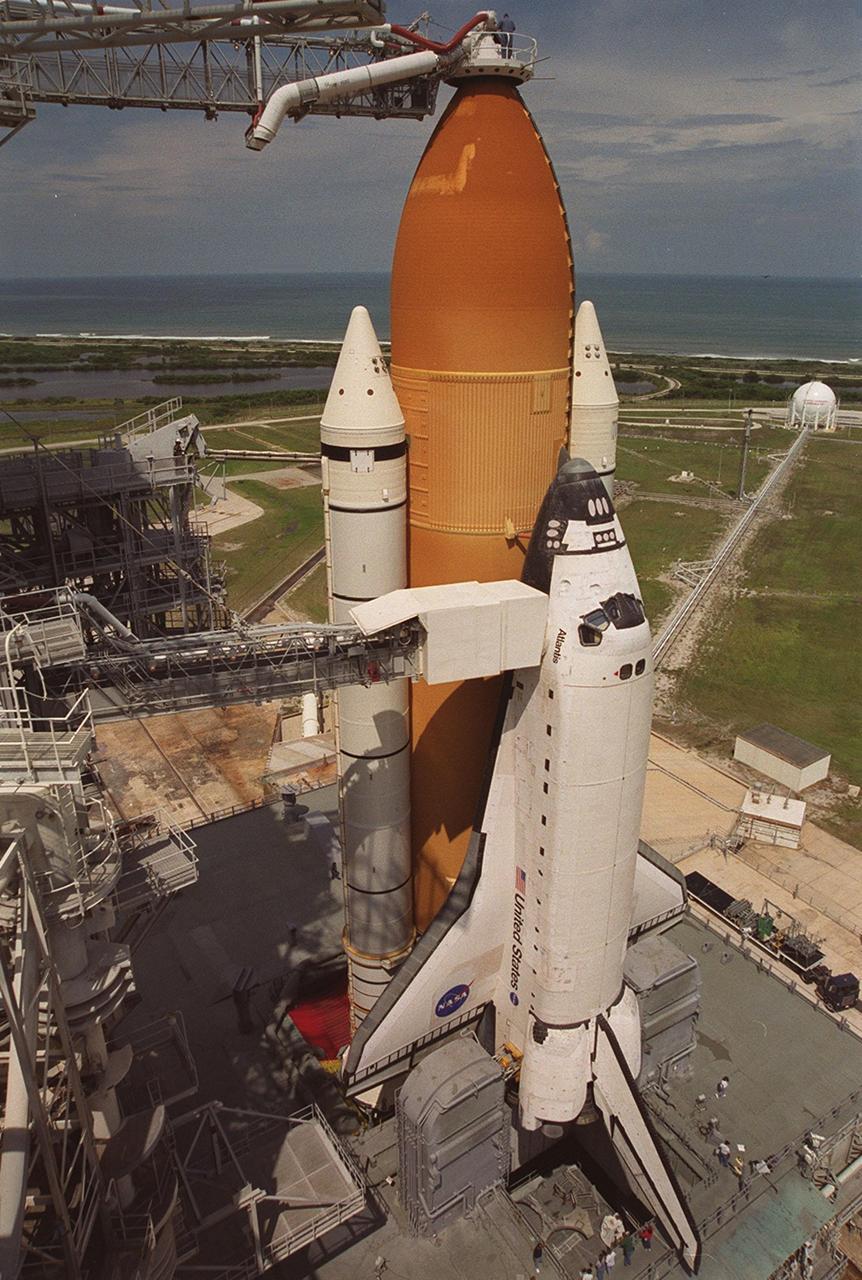
KENNEDY SPACE CENTER, Fla. -- Against a backdrop of the cloudy sky and blue-gray Atlantic Ocean, Space Shuttle Atlantis is revealed after rollback of the Rotating Service Structure. On top of the external tank is the 13-foot-wide “beanie cap,” at the end of the Gaseous Oxygen Vent Arm, designed to vent gaseous oxygen vapors away from the Space Shuttle. Lower is the Orbiter Access Arm with the environmental chamber, known as the “white room,” extended to the orbiter. The chamber provides entry for the crew into the orbiter and also serves as emergency egress up to 7 minutes 24 seconds before launch. Ready for launch of mission STS-106 at 8:45 a.m. EDT on Sept. 8, Atlantis carries supplies to prepare the Russian Zvezda living quarters on the International Space Station for the first long-duration crew. The crew will also be transferring supplies from the Russian Progress resupply ship already docked to the aft of Zvezda. The fourth U.S. launch for the Space Station, the mission is expected to last 10 days, 19 hours and 9 minutes, landing at KSC 4:59 a.m. EDT on Sept. 19
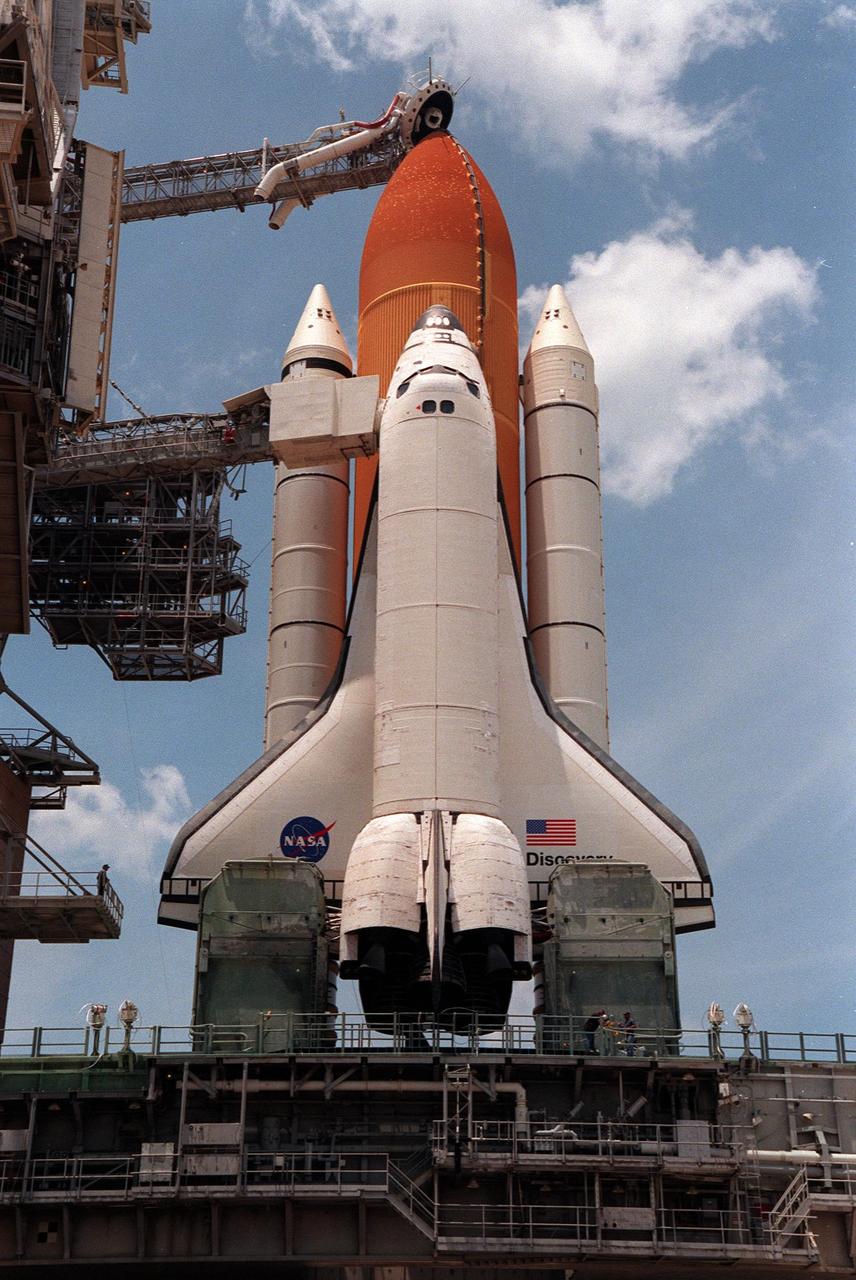
KENNEDY SPACE CENTER, FLA. -- Rollback of the Rotating Service Structure on Launch Pad 39B reveals the Space Shuttle Discovery, scheduled to launch on mission STS-96 at 6:49 a.m. EDT on May 27. Above the top of the external tank is a vent hood, known as the "beanie cap," at the end of the external tank gaseous oxygen vent arm. STS-96 is a 10-day logistics and resupply mission for the International Space Station, carrying about 4,000 pounds of supplies to be stored aboard the station, for use by future crews, including laptop computers, cameras, tools, spare parts, and clothing. The mission also includes such payloads as a Russian crane, the Strela; a U.S.-built crane; the Spacehab Oceaneering Space System Box (SHOSS), a logistics items carrier; and STARSHINE, a student-involved experiment. The mission will include a space walk to attach the cranes to the outside of the ISS for use in future construction. Space Shuttle Discovery is due to launch on May 27 at 6:49 a.m. EDT. Landing is expected at the SLF on June 6 about 1:58 a.m. EDT
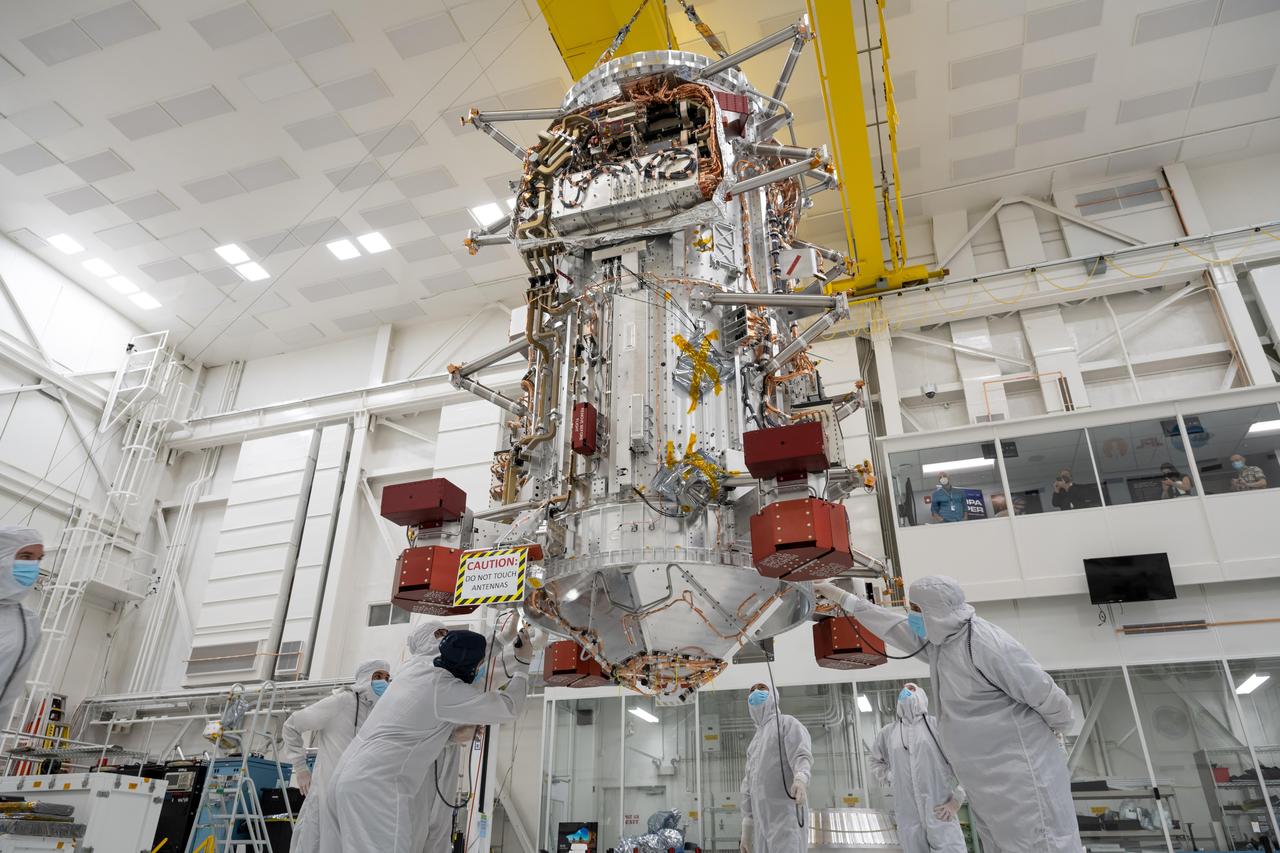
Engineers and technicians use a crane to lift the main body of NASA's Europa Clipper spacecraft and position it in the High Bay 1 clean room of the Spacecraft Assembly Facility at the agency's Jet Propulsion Laboratory in Southern California. Standing 10 feet (3 meters) high and 5 feet (1.5 meters) wide, the core will be the focus of attention as the spacecraft is assembled for its launch to Jupiter's moon Europa in October 2024. Europa Clipper will conduct nearly 50 flybys of the icy Jovian moon Europa, which scientists are confident harbors an internal ocean containing twice as much water as Earth's oceans combined. The moon may currently have conditions suitable for supporting life. The spacecraft's nine science instruments, plus a gravity science investigation, will gather data on the moon's atmosphere, surface, and interior – information that scientists will use to gauge the depth and salinity of the ocean, the thickness of the ice crust, and potential plumes that may be venting subsurface water into space. https://photojournal.jpl.nasa.gov/catalog/PIA25491
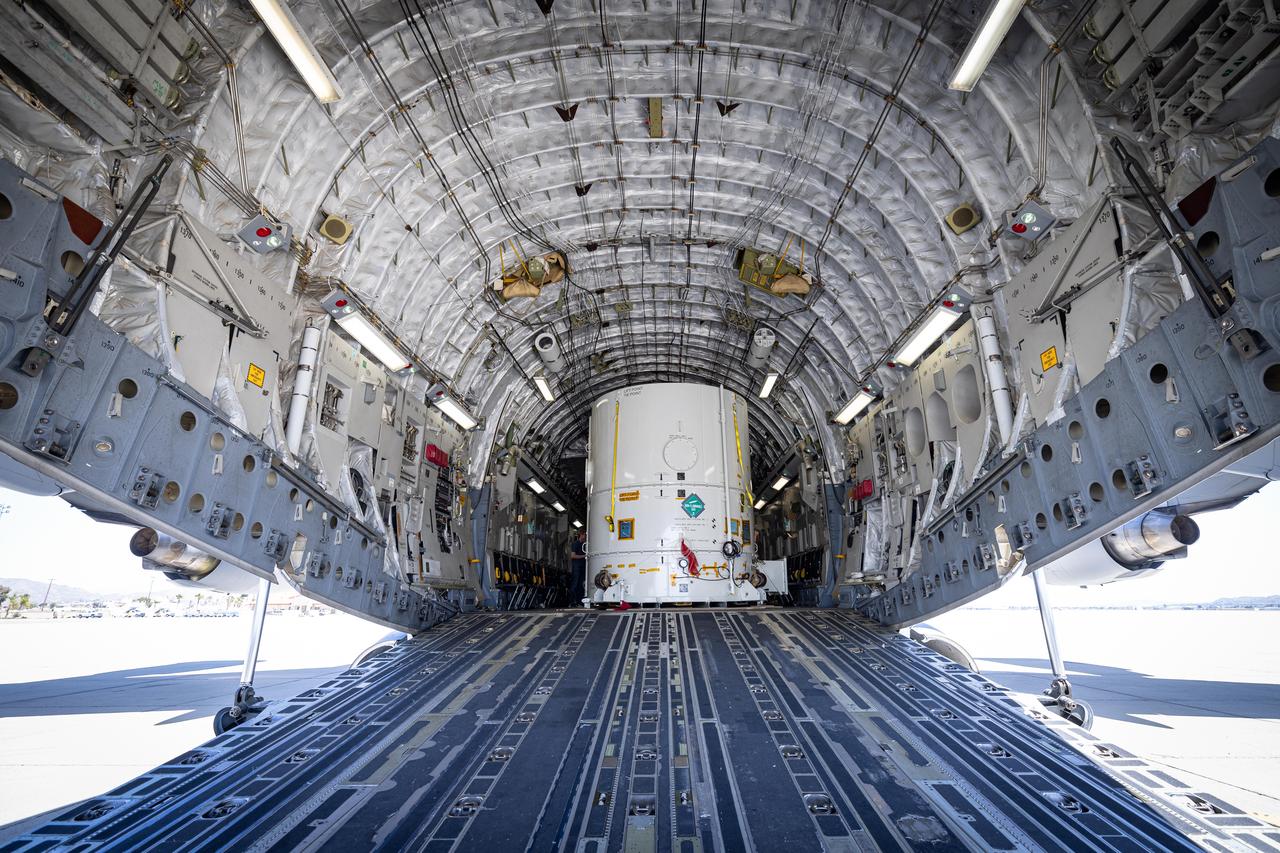
The main body of NASA's Europa Clipper spacecraft is seen in its shipping container, just after arriving aboard a C-17 cargo plane at March Air Reserve Base in Riverside County, California. From there it was delivered by truck to the agency's Jet Propulsion Laboratory in Southern California, where, over the next two years, engineers and technicians will finish assembling the craft by hand. Then it will be tested to make sure it can withstand the journey to Jupiter's icy moon Europa. The Johns Hopkins Applied Physics Laboratory (APL) in Laurel, Maryland, designed and built the spacecraft body in collaboration with JPL and NASA's Goddard Space Flight Center in Greenbelt, Maryland. Set to launch in October 2024, Europa Clipper will conduct nearly 50 flybys of Europa, which scientists are confident harbors an internal ocean containing twice as much water as Earth's oceans combined. And the moon may currently have conditions suitable for supporting life. The spacecraft's nine science instruments will gather data on the moon's atmosphere, surface, and interior – information that scientists will use to gauge the depth and salinity of the ocean, the thickness of the ice crust, and potential plumes that may be venting subsurface water into space. https://photojournal.jpl.nasa.gov/catalog/PIA25238
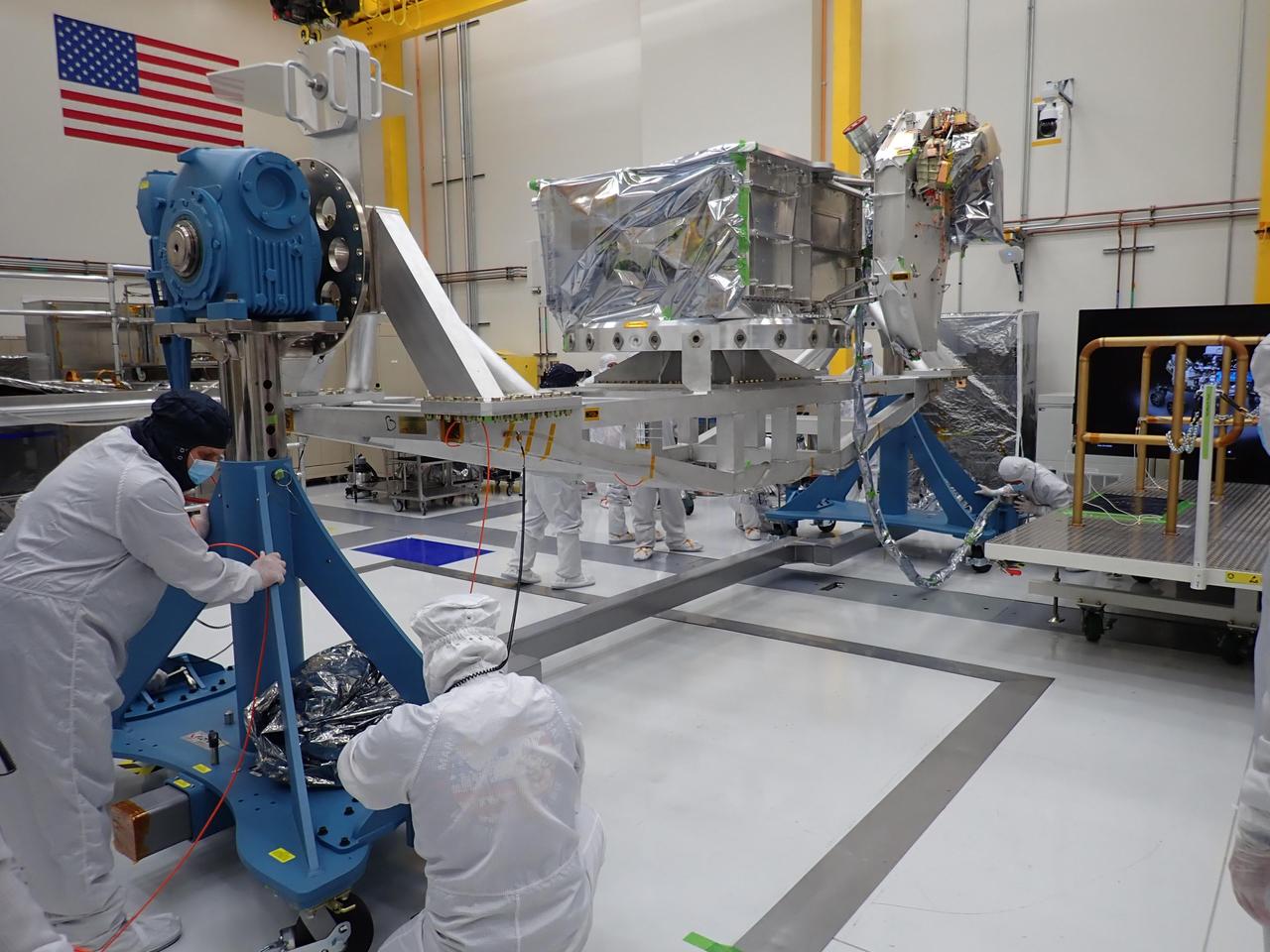
The vault, with nadir deck attached, of NASA's Europa Clipper is prepared to be moved to the High Bay 1 clean room of the Spacecraft Assembly Facility at NASA's Jet Propulsion Laboratory in Southern California. Made of aluminum, the vault will house and protect the spacecraft's electronics from Jupiter's intense radiation and high-energy particles. The nadir deck will support many of the spacecraft's science-instrument sensors by stabilizing them and ensuring they are oriented correctly. The vault and nadir deck soon will join other Europa Clipper hardware in High Bay 1, including the spacecraft's main body. Engineers and technicians will be working through the phase known as assembly, test, and launch operations to prepare the spacecraft for its launch to Jupiter's moon Europa in October 2024. Europa Clipper will conduct nearly 50 flybys of the icy Jovian moon Europa, which scientists are confident harbors an internal ocean containing twice as much water as Earth's oceans combined. The moon may currently have conditions suitable for supporting life. The spacecraft's nine science instruments, plus a gravity science investigation, will gather data on the moon's atmosphere, surface, and interior – information that scientists will use to gauge the depth and salinity of the ocean, the thickness of the ice crust, and potential plumes that may be venting subsurface water into space. https://photojournal.jpl.nasa.gov/catalog/PIA25493

The main body of NASA's Europa Clipper spacecraft has been delivered to the agency's Jet Propulsion Laboratory in Southern California, where, over the next two years, engineers and technicians will finish assembling the craft by hand before testing it to make sure it can withstand the journey to Jupiter's icy moon Europa. Here it is visible in a main clean room at JPL, as engineers and technicians inspect it just after delivery in early June 2022. The Johns Hopkins Applied Physics Laboratory (APL) in Laurel, Maryland, designed and built the spacecraft body in collaboration with JPL and NASA's Goddard Space Flight Center in Greenbelt, Maryland. Set to launch in October 2024, Europa Clipper will conduct nearly 50 flybys of Europa, which scientists are confident harbors an internal ocean containing twice as much water as Earth's oceans combined. And the moon may currently have conditions suitable for supporting life. The spacecraft's nine science instruments will gather data on the moon's atmosphere, surface, and interior – information that scientists will use to gauge the depth and salinity of the ocean, the thickness of the ice crust, and potential plumes that may be venting subsurface water into space. https://photojournal.jpl.nasa.gov/catalog/PIA25236
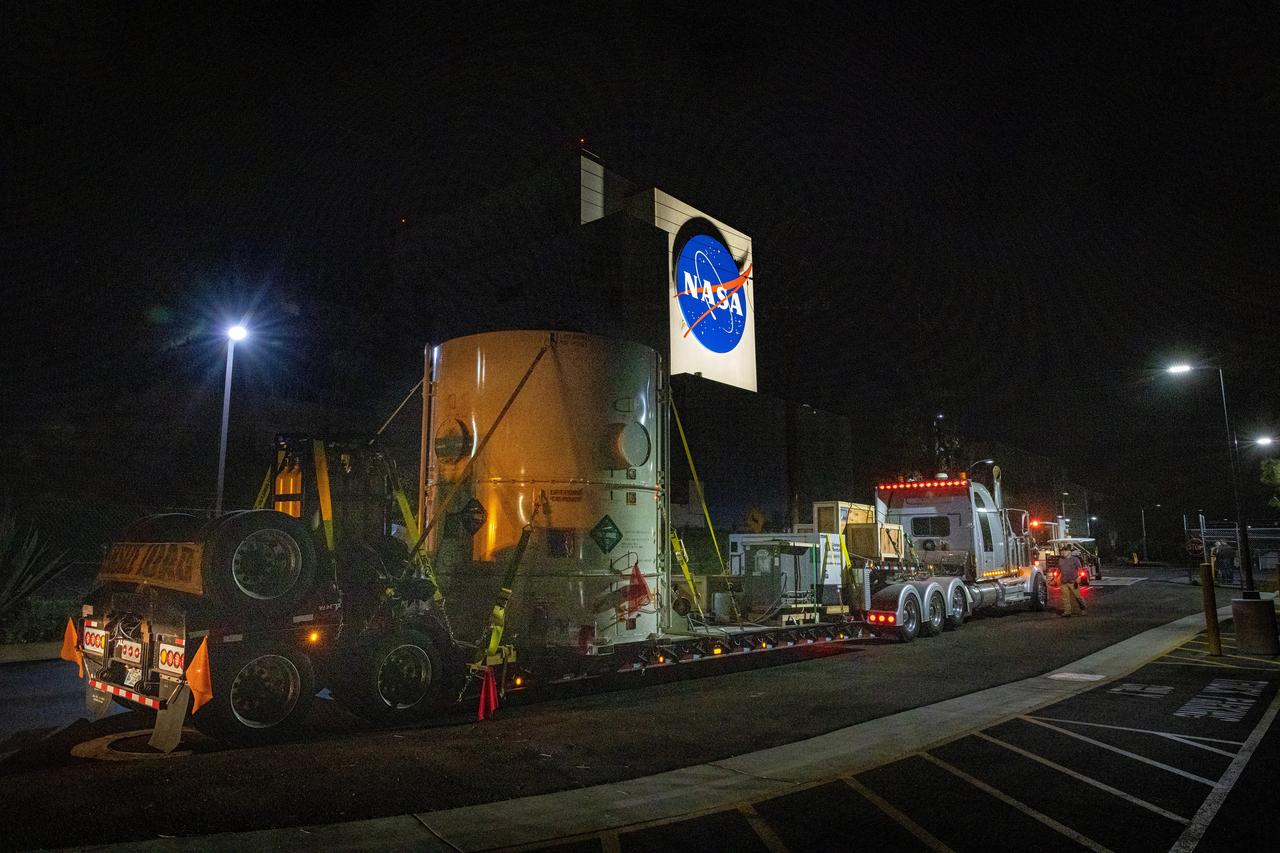
The main body of NASA's Europa Clipper spacecraft is seen in its shipping container as it rolls into the agency's Jet Propulsion Laboratory in Southern California. Over the next two years, engineers and technicians will finish assembling the craft by hand. Then it will be tested to make sure it can withstand the journey to Jupiter's icy moon Europa. The Johns Hopkins Applied Physics Laboratory (APL) in Laurel, Maryland, designed and built the spacecraft body in collaboration with JPL and NASA's Goddard Space Flight Center in Greenbelt, Maryland. Set to launch in October 2024, Europa Clipper will conduct nearly 50 flybys of Europa, which scientists are confident harbors an internal ocean containing twice as much water as Earth's oceans combined. And the moon may currently have conditions suitable for supporting life. The spacecraft's nine science instruments will gather data on the moon's atmosphere, surface, and interior – information that scientists will use to gauge the depth and salinity of the ocean, the thickness of the ice crust, and potential plumes that may be venting subsurface water into space. https://photojournal.jpl.nasa.gov/catalog/PIA25239
Engineers and technicians use a crane to lower the main body of NASA's Europa Clipper spacecraft into position in the High Bay 1 clean room of the Spacecraft Assembly Facility at the agency's Jet Propulsion Laboratory in Southern California. Standing 10 feet (3 meters) high and 5 feet (1.5 meters) wide, the core will be the focus of attention as the spacecraft is assembled for its launch to Jupiter's moon Europa in October 2024.This image was taken on Aug. 9, 2022. Europa Clipper will conduct nearly 50 flybys of the icy Jovian moon Europa, which scientists are confident harbors an internal ocean containing twice as much water as Earth's oceans combined. The moon may currently have conditions suitable for supporting life. The spacecraft's nine science instruments, plus a gravity science investigation, will gather data on the moon's atmosphere, surface, and interior – information that scientists will use to gauge the depth and salinity of the ocean, the thickness of the ice crust, and potential plumes that may be venting subsurface water into space. https://photojournal.jpl.nasa.gov/catalog/PIA25492
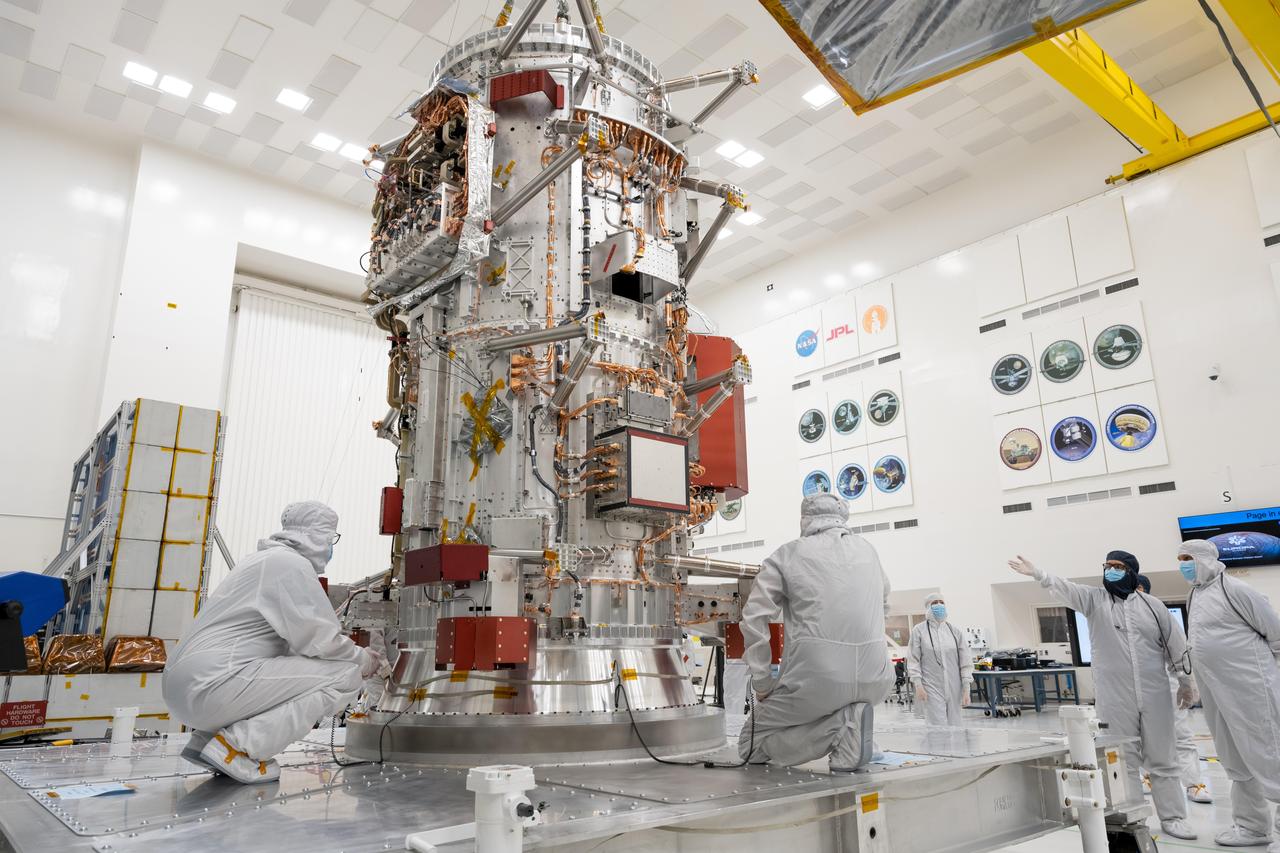
Engineers and technicians work on the towering main body of NASA's Europa Clipper spacecraft in the storied Spacecraft Assembly Facility at the agency's Jet Propulsion Laboratory in Southern California. Standing 10 feet (3 meters) high and 5 feet (1.5 meters) wide, the craft's core will be the focus of attention in the facility's ultra-hygienic High Bay 1 as the spacecraft is assembled for its launch to Jupiter's moon Europa in October 2024. Europa Clipper will conduct nearly 50 flybys of the icy Jovian moon Europa, which scientists are confident harbors an internal ocean containing twice as much water as Earth's oceans combined. The moon may currently have conditions suitable for supporting life. The spacecraft's nine science instruments, plus a gravity science investigation, will gather data on the moon's atmosphere, surface, and interior – information that scientists will use to gauge the depth and salinity of the ocean, the thickness of the ice crust, and potential plumes that may be venting subsurface water into space. https://photojournal.jpl.nasa.gov/catalog/PIA25240
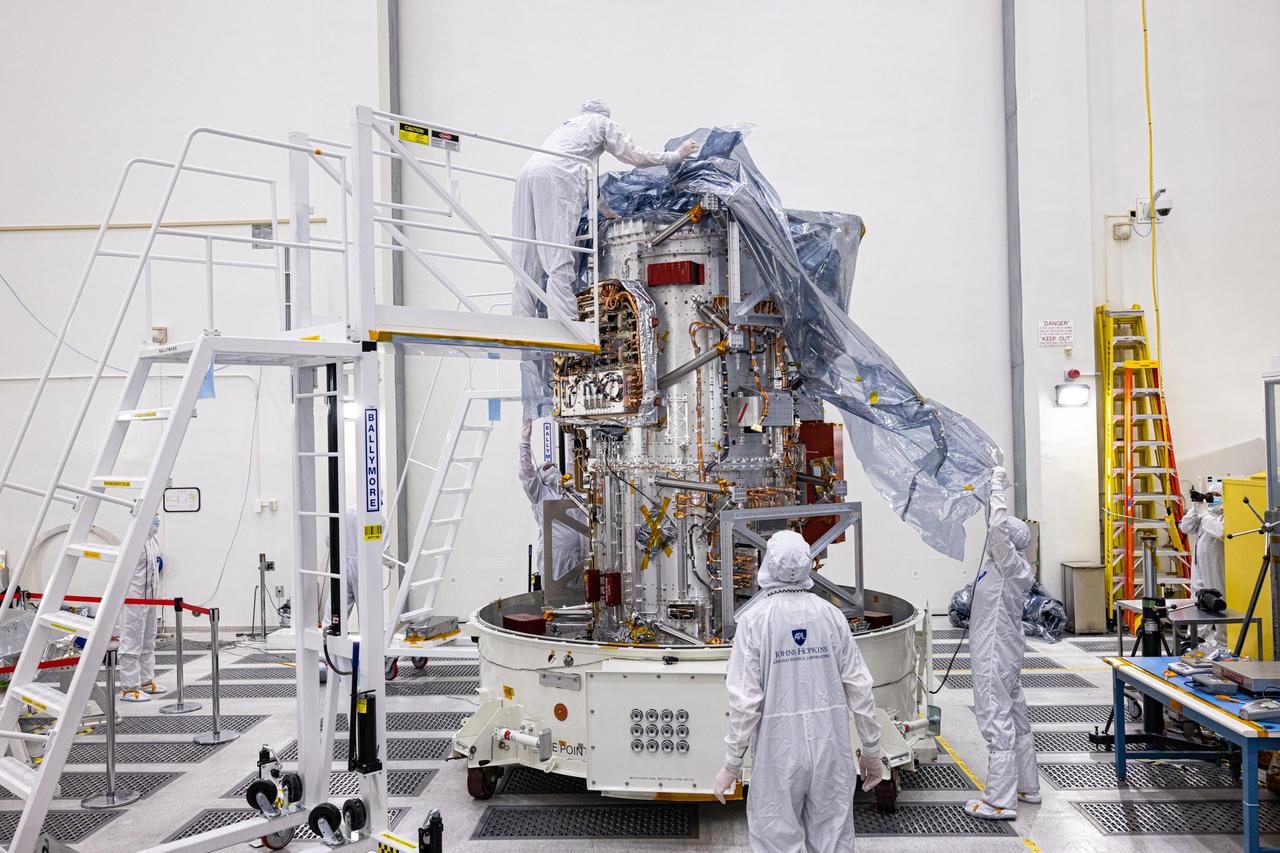
The main body of NASA's Europa Clipper spacecraft has been delivered to the agency's Jet Propulsion Laboratory in Southern California, where, over the next two years, engineers and technicians will finish assembling the craft by hand before testing it to make sure it can withstand the journey to Jupiter's icy moon Europa. Here it is being unwrapped in a main clean room at JPL, as engineers and technicians inspect it just after delivery in early June 2022. The Johns Hopkins Applied Physics Laboratory (APL) in Laurel, Maryland, designed and built the spacecraft body in collaboration with JPL and NASA's Goddard Space Flight Center in Greenbelt, Maryland. Set to launch in October 2024, Europa Clipper will conduct nearly 50 flybys of Europa, which scientists are confident harbors an internal ocean containing twice as much water as Earth's oceans combined. And the moon may currently have conditions suitable for supporting life. The spacecraft's nine science instruments will gather data on the moon's atmosphere, surface, and interior – information that scientists will use to gauge the depth and salinity of the ocean, the thickness of the ice crust, and potential plumes that may be venting subsurface water into space. https://photojournal.jpl.nasa.gov/catalog/PIA25237
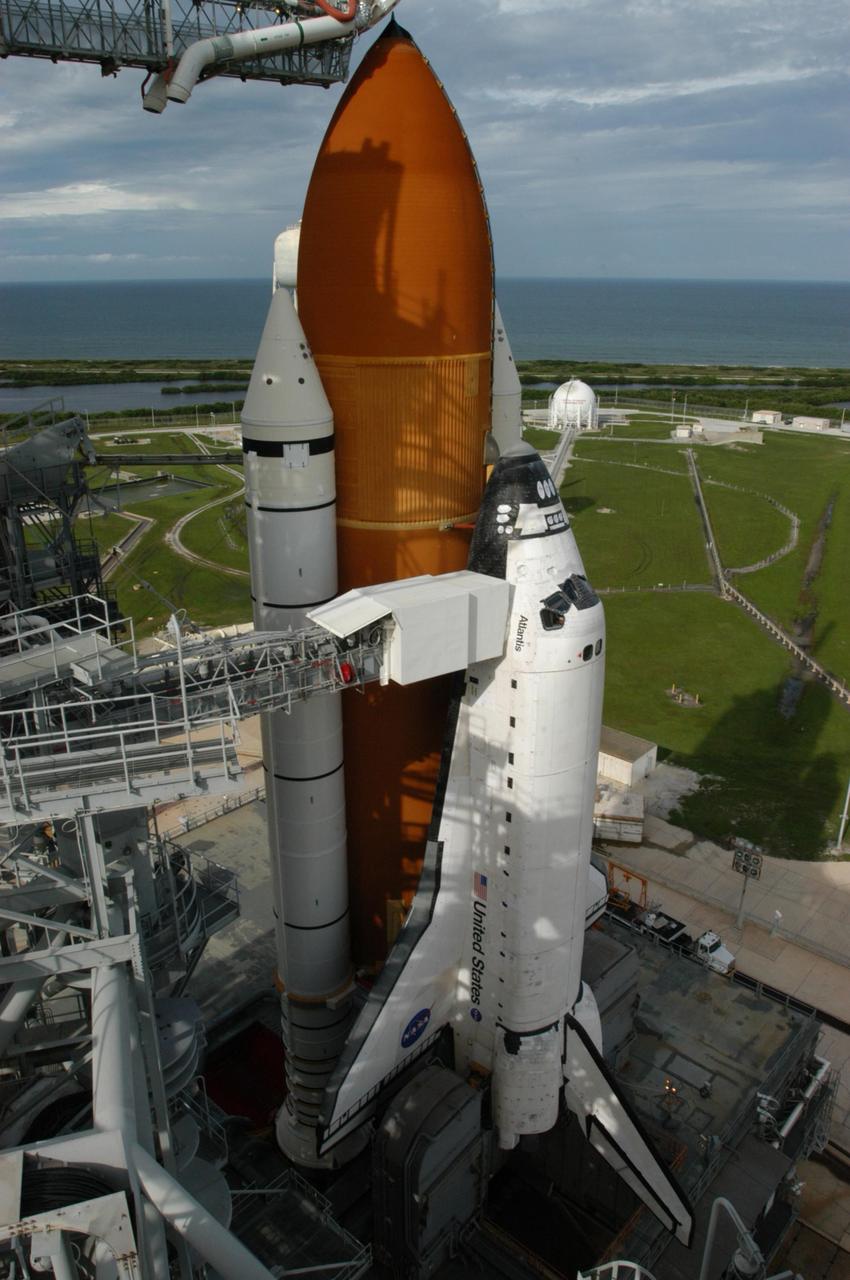
KENNEDY SPACE CENTER, FLA. - Early evening shadows glide across Space Shuttle Atlantis after rollback of the rotating service structure on Launch Pad 39B. The RSS provides protected access to the orbiter for changeout and servicing of payloads at the pad and then is rolled away before liftoff. In the background is the Atlantic Ocean. Extended from the fixed service structure at left is the orbiter access arm with the White Room at the end. The White Room provides entry into the orbiter. Seen above the golden external tank is the vent hood (known as the "beanie cap") at the end of the gaseous oxygen vent arm. Vapors are created as the liquid oxygen in the external tank boil off. The hood vents the gaseous oxygen vapors away from the space shuttle vehicle. Atlantis is scheduled to launch Sept. 6 at 12:29 p.m. EDT on mission STS-115. During the mission, Atlantis' astronauts will deliver and install the 17.5-ton, bus-sized P3/P4 integrated truss segment on the station. The girder-like truss includes a set of giant solar arrays, batteries and associated electronics and will provide one-fourth of the total power-generation capability for the completed station. This mission is the 116th space shuttle flight, the 27th flight for orbiter Atlantis, and the 19th U.S. flight to the International Space Station. STS-115 is scheduled to last 11 days with a planned KSC landing at about 8:03 a.m. EDT on Sept. 17. Photo credit: NASA/George Shelton
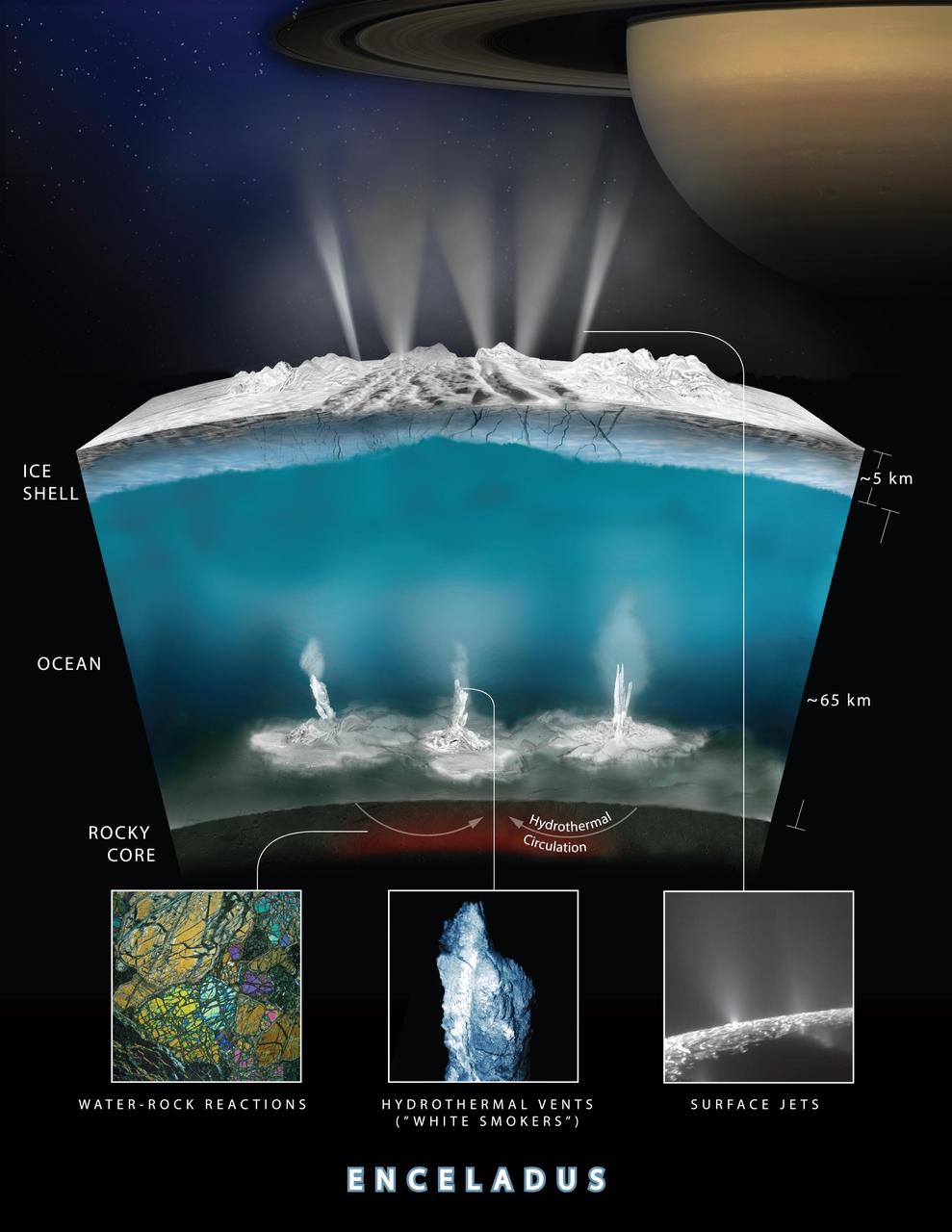
This graphic illustrates how scientists on NASA's Cassini mission think water interacts with rock at the bottom of the ocean of Saturn's icy moon Enceladus, producing hydrogen gas (H2). The Cassini spacecraft detected the hydrogen in the plume of gas and icy material spraying from Enceladus during its deepest and last dive through the plume on Oct. 28, 2015. Cassini also sampled the plume's composition during previous flybys, earlier in the mission. From these observations scientists have determined that nearly 98 percent of the gas in the plume is water vapor, about 1 percent is hydrogen, and the rest is a mixture of other molecules including carbon dioxide, methane and ammonia. The graphic shows water from the ocean circulating through the seafloor, where it is heated and interacts chemically with the rock. This warm water, laden with minerals and dissolved gases (including hydrogen and possibly methane) then pours into the ocean creating chimney-like vents. The hydrogen measurements were made using Cassini's Ion and Neutral Mass Spectrometer, or INMS, instrument, which sniffs gases to determine their composition. The finding is an independent line of evidence that hydrothermal activity is taking place in the Enceladus ocean. Previous results from Cassini's Cosmic Dust Analyzer instrument, published in March 2015, suggested hot water is interacting with rock beneath the ocean; the new findings support that conclusion and indicate that the rock is reduced in its geochemistry. With the discovery of hydrogen gas, scientists can now conclude that there is a source of chemical free energy in Enceladus' ocean. https://photojournal.jpl.nasa.gov/catalog/PIA21442
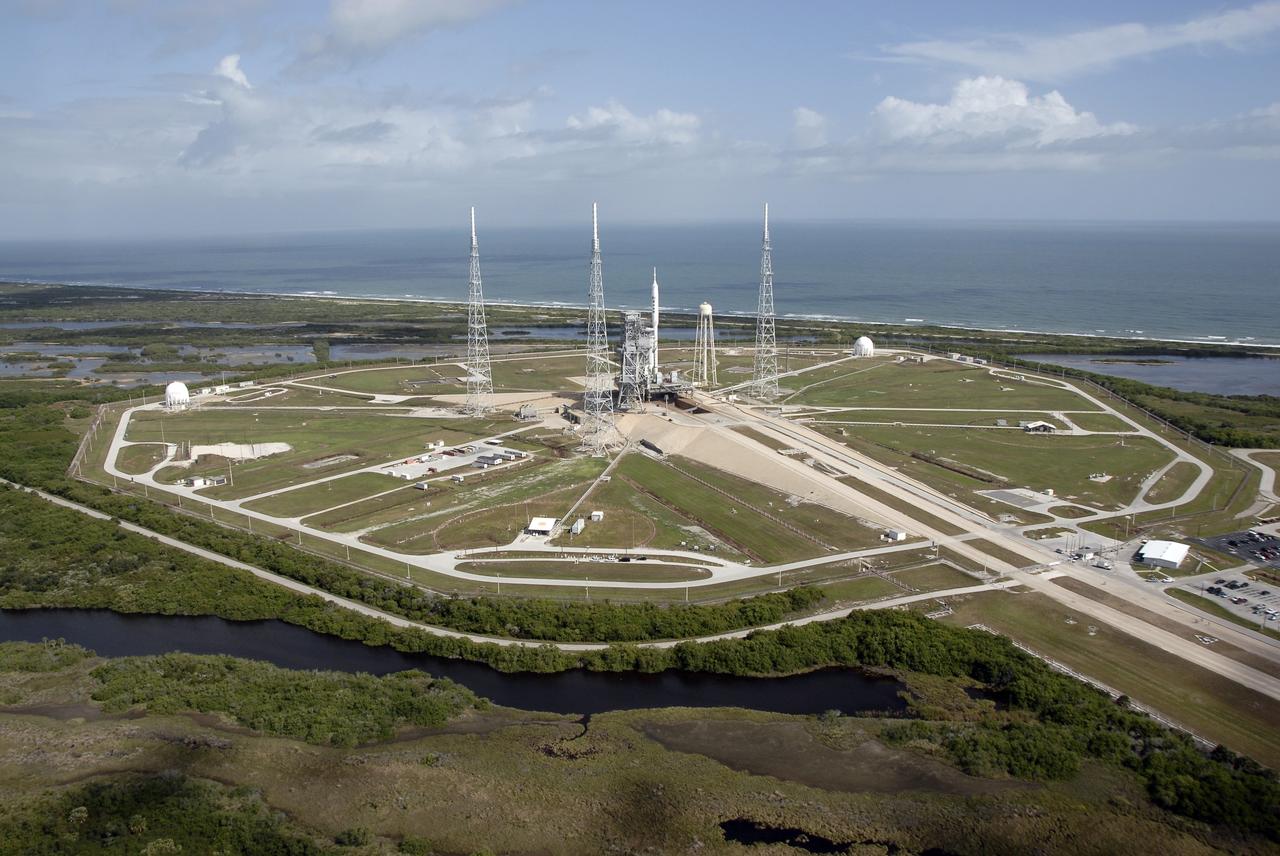
CAPE CANAVERAL, Fla. – At NASA's Kennedy Space Center in Florida, the 327-foot-tall Ares I-X rocket awaits liftoff on the hexagonally shaped Launch Pad 39B on its upcoming flight test. In the background is the Atlantic Ocean. This is the first time since the Apollo Program's Saturn rockets were retired that a vehicle other than the space shuttle has occupied the pad. Modifications to the pad to support the Ares I-X included the removal of shuttle unique subsystems, such as the orbiter access arm and a section of the gaseous oxygen vent arm, and the installation of three 600-foot lightning towers, access platforms, environmental control systems and a vehicle stabilization system. Part of the Constellation Program, the Ares I-X is the test vehicle for the Ares I. The Ares I-X flight test is set for Oct. 27. For information on the Ares I-X vehicle and flight test, visit http://www.nasa.gov/aresIX. Photo credit: NASA/Kim Shiflett
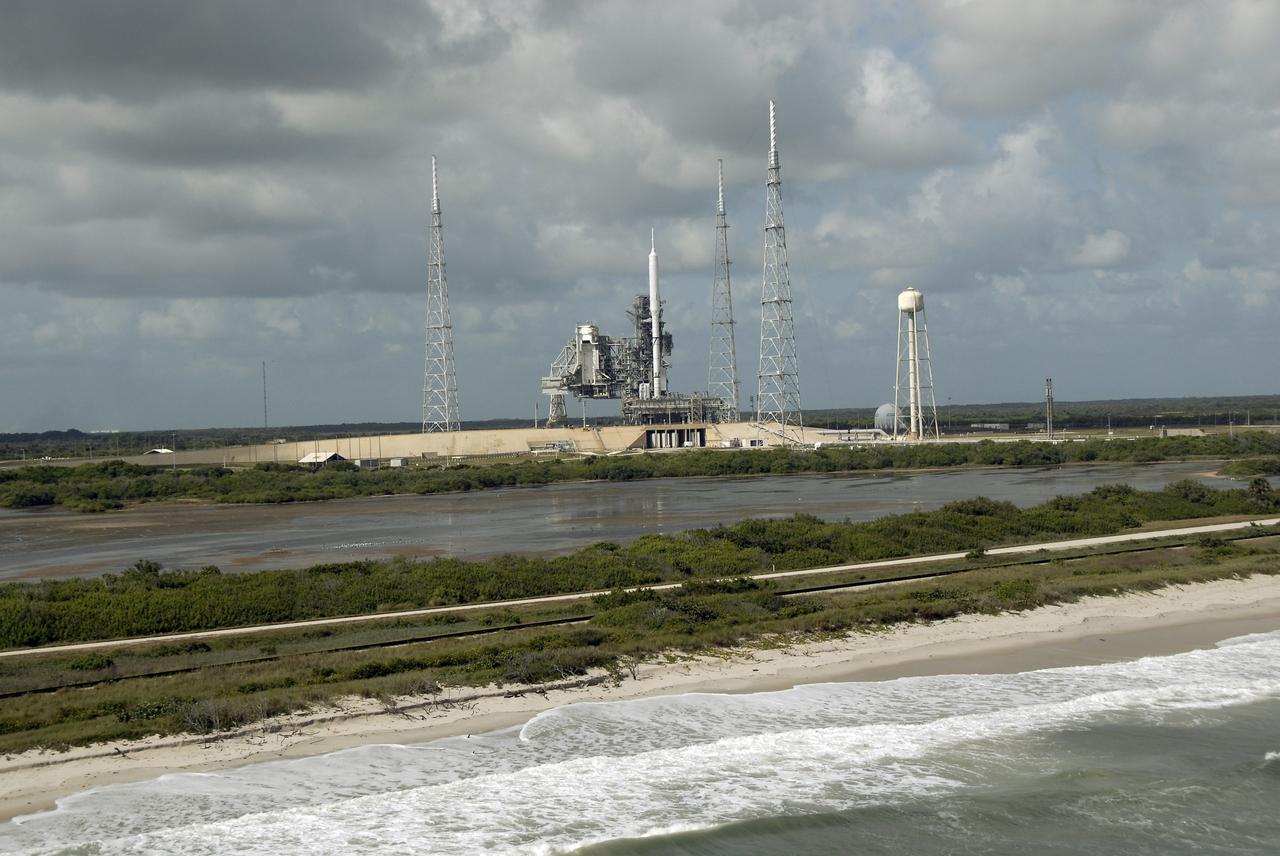
CAPE CANAVERAL, Fla. - Waves lap the shore of the Atlantic Ocean near Launch Pad 39B at NASA's Kennedy Space Center in Florida. On the pad, the Ares I-X rocket awaits liftoff on its upcoming flight test. This is the first time since the Apollo Program's Saturn rockets were retired that a vehicle other than the space shuttle has occupied the pad. Modifications to the pad to support the Ares I-X included the removal of shuttle unique subsystems, such as the orbiter access arm and a section of the gaseous oxygen vent arm, and the installation of three 600-foot lightning towers, access platforms, environmental control systems and a vehicle stabilization system. Part of the Constellation Program, the Ares I-X is the test vehicle for the Ares I. The Ares I-X flight test is set for Oct. 27. For information on the Ares I-X vehicle and flight test, visit http://www.nasa.gov/aresIX. Photo credit: NASA/Kim Shiflett

CAPE CANAVERAL, Fla. – At NASA's Kennedy Space Center in Florida, the 327-foot-tall Ares I-X rocket awaits liftoff on Launch Pad 39B on its upcoming flight test. In the background is the Atlantic Ocean. This is the first time since the Apollo Program's Saturn rockets were retired that a vehicle other than the space shuttle has occupied the pad. Modifications to the pad to support the Ares I-X included the removal of shuttle unique subsystems, such as the orbiter access arm and a section of the gaseous oxygen vent arm, and the installation of three 600-foot lightning towers, access platforms, environmental control systems and a vehicle stabilization system. Part of the Constellation Program, the Ares I-X is the test vehicle for the Ares I. The Ares I-X flight test is set for Oct. 27. For information on the Ares I-X vehicle and flight test, visit http://www.nasa.gov/aresIX. Photo credit: NASA/Kim Shiflett
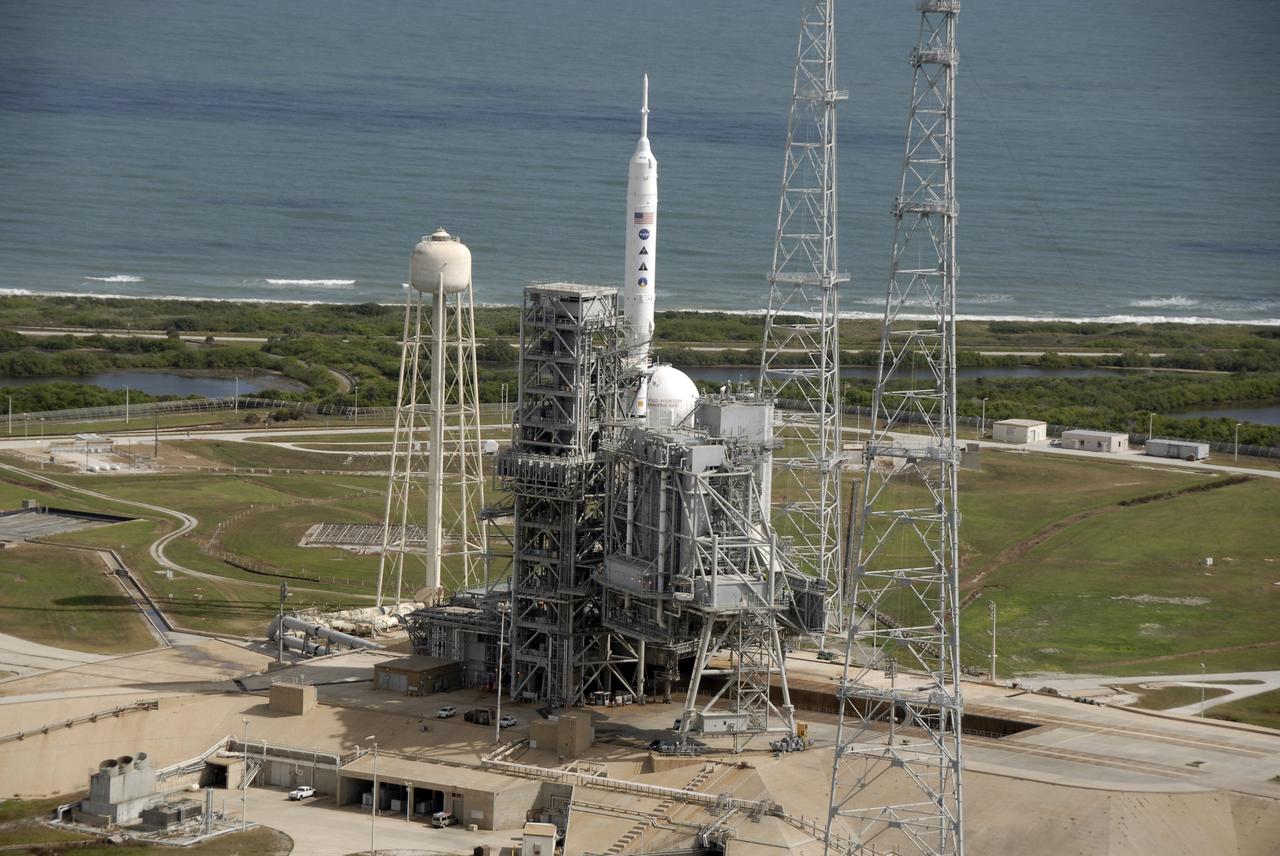
CAPE CANAVERAL, Fla. – At NASA's Kennedy Space Center in Florida, the 327-foot-tall Ares I-X rocket awaits liftoff on Launch Pad 39B on its upcoming flight test. In the background is the Atlantic Ocean. Pad modifications to support the Ares I-X include the removal of shuttle unique subsystems, such as the orbiter access arm and a section of the gaseous oxygen vent arm, and the installation of three 600-foot lightning towers, access platforms, environmental control systems and a vehicle stabilization system. Part of the Constellation Program, the Ares I-X is the test vehicle for the Ares I. The Ares I-X flight test is set for Oct. 27. For information on the Ares I-X vehicle and flight test, visit http://www.nasa.gov/aresIX. Photo credit: NASA/Kim Shiflett

CAPE CANAVERAL, Fla. – At NASA's Kennedy Space Center in Florida, the 327-foot-tall Ares I-X rocket awaits liftoff on Launch Pad 39B on its upcoming flight test. In the background is the Atlantic Ocean. This is the first time since the Apollo Program's Saturn rockets were retired that a vehicle other than the space shuttle has occupied the pad. Modifications to the pad to support the Ares I-X included the removal of shuttle unique subsystems, such as the orbiter access arm and a section of the gaseous oxygen vent arm, and the installation of three 600-foot lightning towers, access platforms, environmental control systems and a vehicle stabilization system. Part of the Constellation Program, the Ares I-X is the test vehicle for the Ares I. The Ares I-X flight test is set for Oct. 27. For information on the Ares I-X vehicle and flight test, visit http://www.nasa.gov/aresIX. Photo credit: NASA/Kim Shiflett
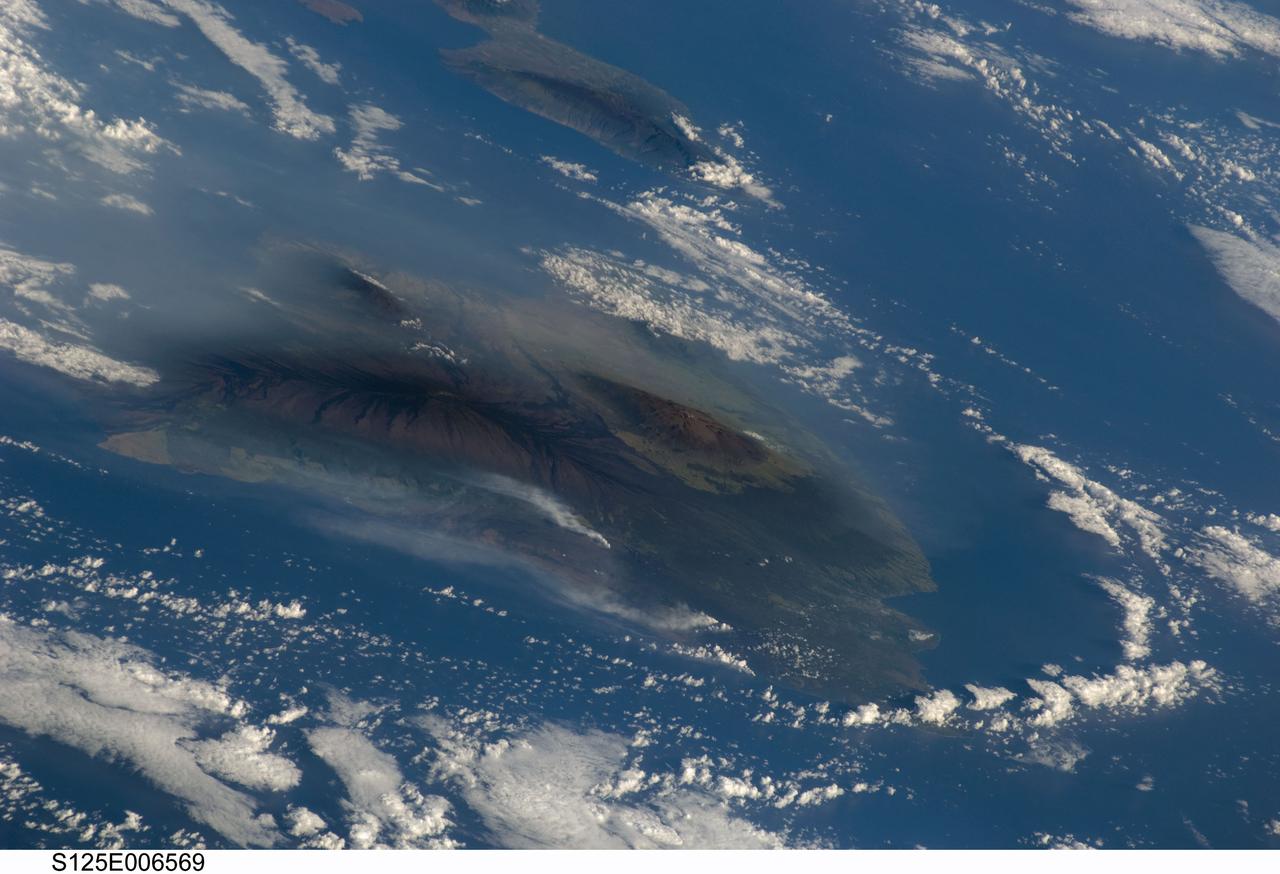
S125-E-006569 (13 May 2009) --- Hawaiian vog from Kilauea volcano, on the island of Hawaii, has been erupting continuously since 1983. This image, taken by the crew of Space Shuttle Atlantis (after completing the capture of the Hubble Space Telescope), shows the volcanic plumes from Kilauea rising up from Halema`uma`u Crater and along the coastline from lava flows entering the ocean from the East rift zone. The volcanic activity has created a blanket of volcanic fog, called vog that envelops the island. The Hawaii Volcano Observatory (HVO) maintains a website (including webcams) that continuously monitors and updates reports on the volcanic activity. Recent maps indicate expanded lava coverage along the coastal plain. In addition, Hawaii?s Department of Health maintains daily vog alerts, and publishes advisories for vog conditions around the ?big island? of Hawaii and the state. When this image was acquired, the region west of Hawaii Volcanoes National Park (downwind from the coastal plumes) had a vog advisory for people with respiratory sensitivities. The Volcano Observatory also reported that ?Lava from east rift zone vents continues to flow through tubes to the coast and is entering the ocean at two locations west of Kalapana. Sulfur dioxide emission rates from the Halema`uma`u and Pu`u `O`o vents remain elevated. Sulfur dioxide emission rates remain elevated and variable; the most recent rate measurement was 1,200 tonnes/day on May 12, compared to the 2003-2007 average rate of 140 tonnes/day. Small amounts of mostly ash-sized tephra continue to be produced consisting mostly of Pele's hair -- irregular pieces of vesicular glass -- and a few hollow spherules.?
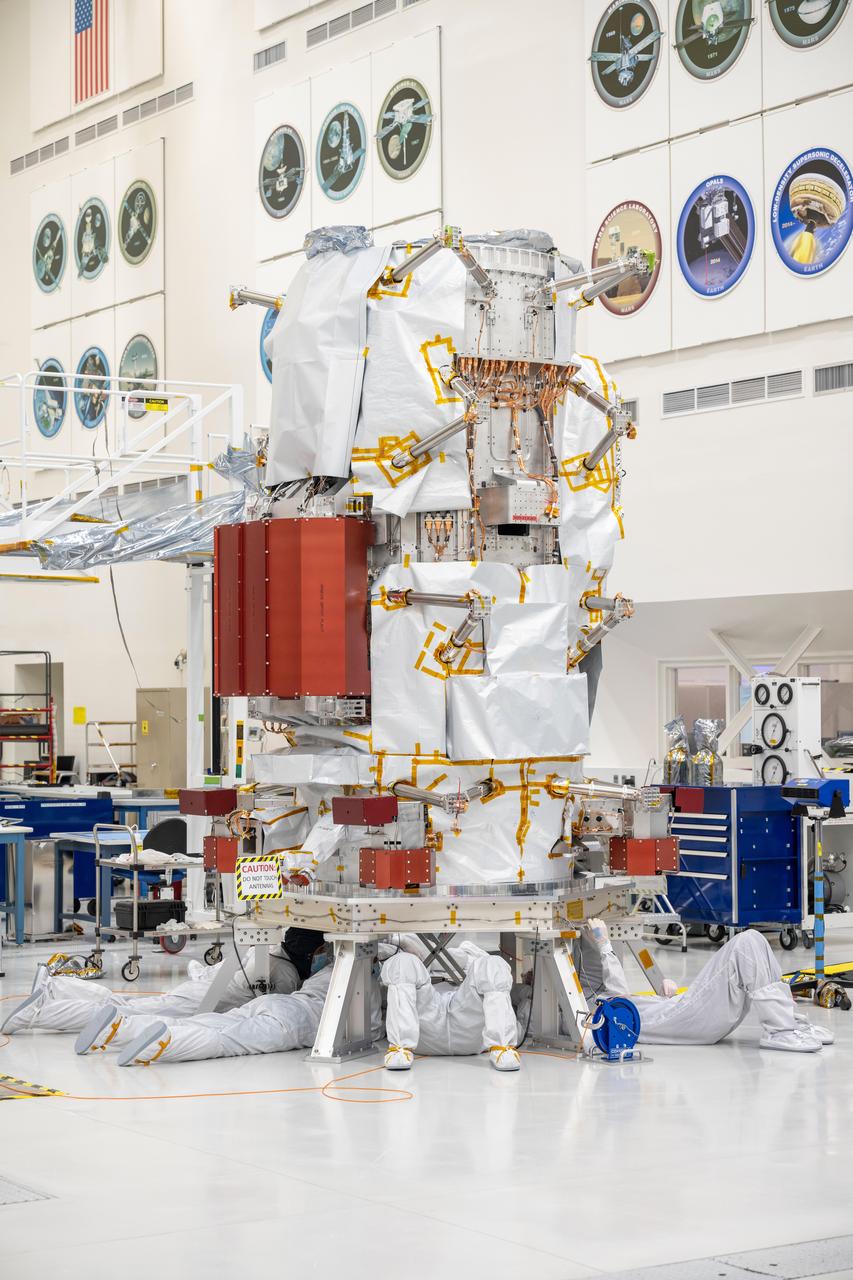
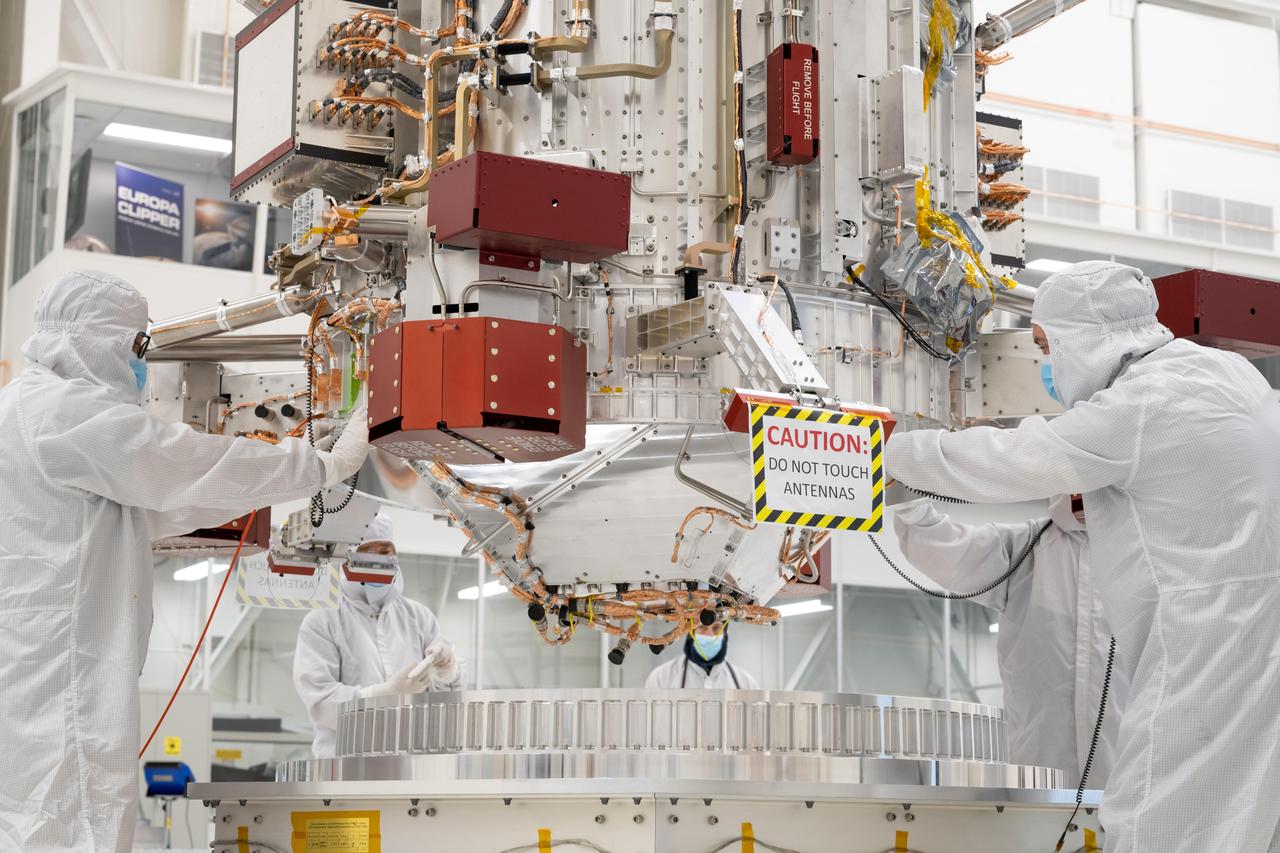
Engineers and technicians work together to install reaction wheels on the underside of the main body of NASA's Europa Clipper spacecraft. The integration of the wheels was one of the latest steps of the spacecraft's assembly, test, and launch operations phase, now underway way in the Spacecraft Assembly Facility at the agency's Jet Propulsion Laboratory in Southern California. Europa Clipper is set to launch to Jupiter's moon Europa in October 2024. When the spacecraft heads through deep space, slips into orbit around Jupiter, and collects science observations while flying dozens of times by Europa, the wheels rotate the orbiter so that its antennas can communicate with Earth and so its science instruments, including cameras, can stay oriented toward Europa. Two feet wide and made of steel, aluminum, and titanium, the wheels spin rapidly to create a force that causes the orbiter to rotate in the opposite direction. The wheels will run on electricity provided by the spacecraft's vast solar arrays. Scientists believe the icy moon Europa harbors a vast internal ocean that may have conditions suitable for supporting life. Europa Clipper will fly by the moon about 50 times while its suite of science instruments gathers data on the moon's atmosphere, surface, and interior – information that will help scientists learn more about the ocean, the ice crust, and potential plumes that may be venting subsurface water into space. https://photojournal.jpl.nasa.gov/catalog/PIA25496
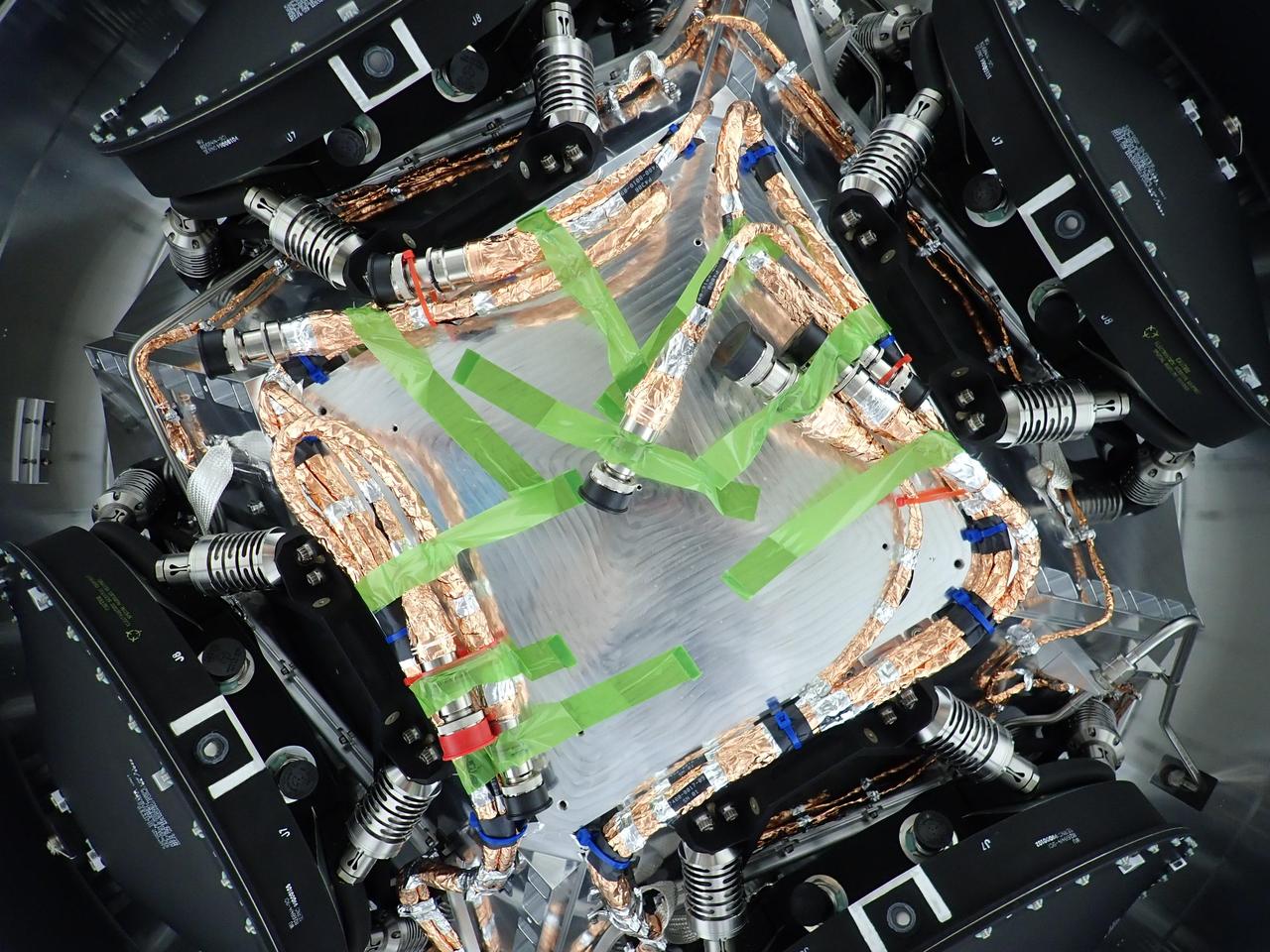
All four of the reaction wheels installed onto NASA's Europa Clipper are visible in this photo, which was shot from underneath the main body of the spacecraft while it is being assembled at the agency's Jet Propulsion Laboratory in Southern California. The spacecraft is set to launch in October 2024 and will head toward Jupiter's moon Europa, where it will collect science observations while flying by the icy moon dozens of times. During its journey through deep space and its flybys of Europa, the spacecraft's reaction wheels rotate the orbiter so its antennas can communicate with Earth and so its science instruments, including cameras, can stay oriented toward Europa. Two feet wide and made of steel, aluminum, and titanium, the wheels spin rapidly to create a force that causes the orbiter to rotate in the opposite direction. The wheels will run on electricity provided by the spacecraft's vast solar arrays. The green tape that is visible here keeps cables temporarily secured during the wheel installation. Scientists believe Europa harbors a vast internal ocean that may have conditions suitable for supporting life. Europa Clipper's suite of science instruments gathers data on the moon's atmosphere, surface, and interior – information that will help scientists learn more about the ocean, the ice crust, and potential plumes that may be venting subsurface water into space. https://photojournal.jpl.nasa.gov/catalog/PIA25495
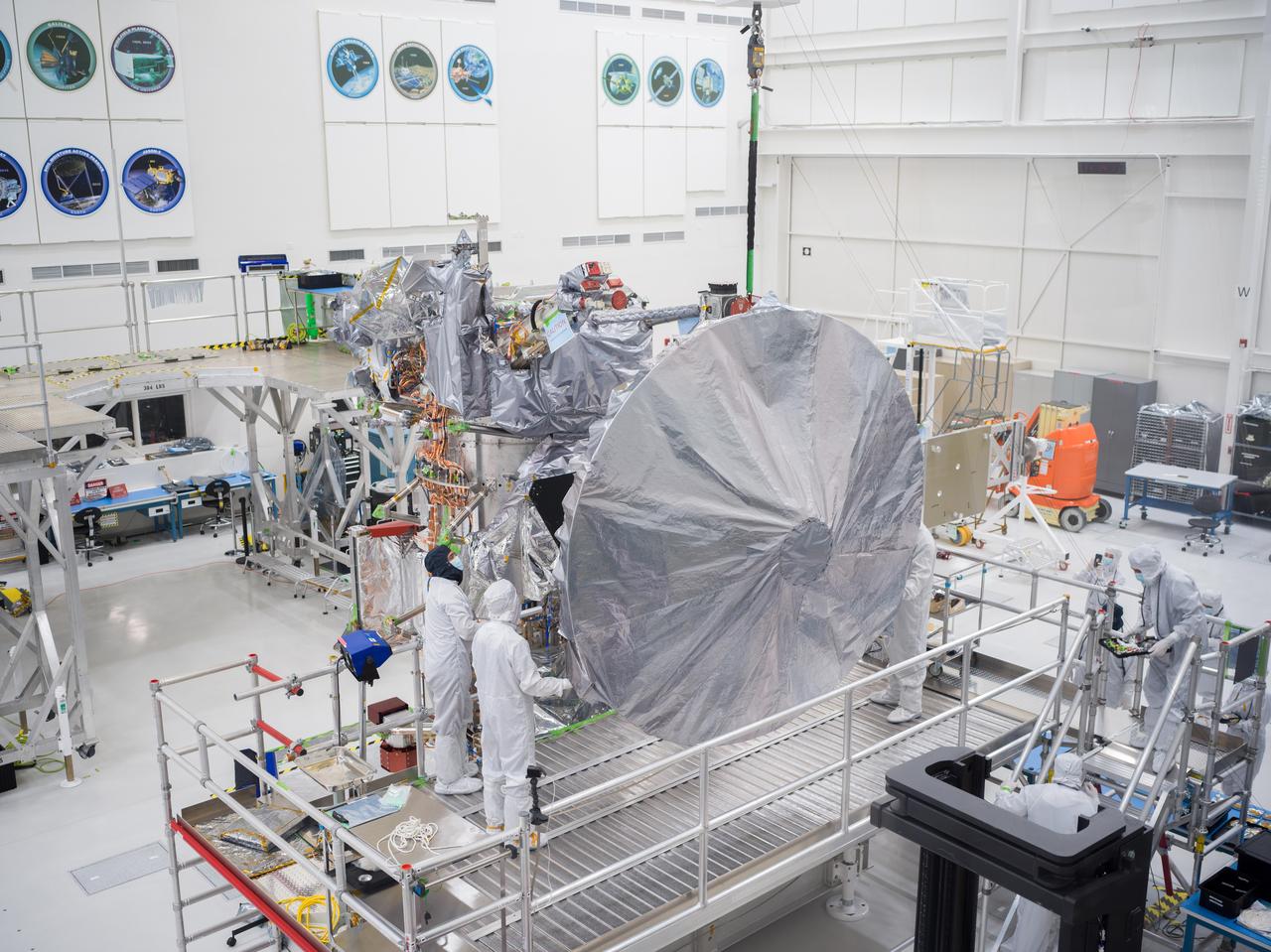
Engineers and technicians install a 10-foot (3-meter) high-gain antenna on NASA's Europa Clipper spacecraft on Aug. 14, 2023. The orbiter is being assembled in the clean room of the High Bay 1 clean room of the Spacecraft Assembly Facility at the agency's Jet Propulsion Laboratory, in preparation for launch to Jupiter's moon Europa in October 2024. The precision-engineered dish was attached to the spacecraft in carefully choreographed stages over the course of several hours. Europa Clipper will need the huge antenna to transmit data hundreds of millions of miles back to Earth. Scientists believe the icy moon Europa harbors a vast internal ocean that may have conditions suitable for supporting life. The spacecraft will fly by the moon about 50 times while its science instruments gather data on the moon's atmosphere, surface, and interior – information that will help scientists learn more about the ocean, the ice crust, and potential plumes that may be venting subsurface water into space. https://photojournal.jpl.nasa.gov/catalog/PIA25957
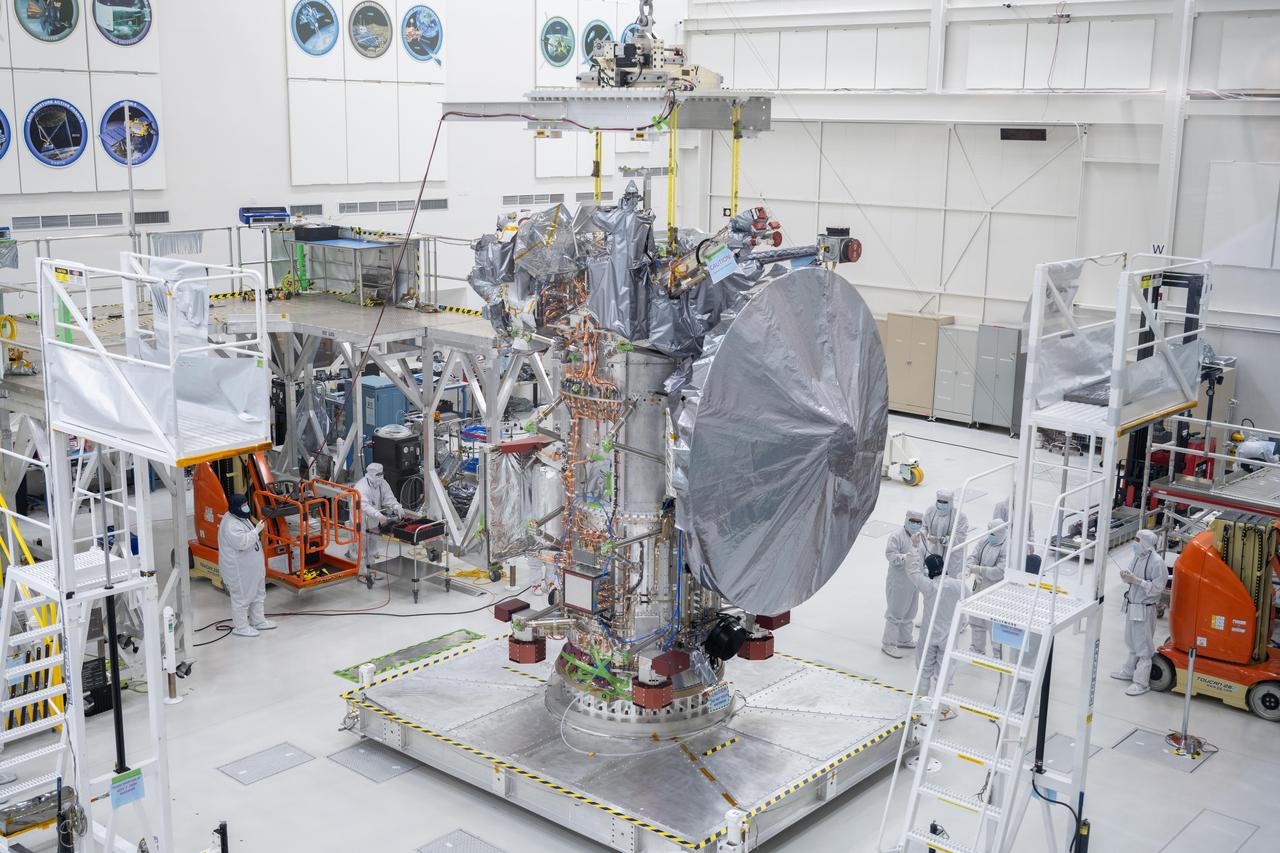
NASA's Europa Clipper spacecraft boasts its new 10-foot (3-meter) high-gain antenna, after its Aug. 14, 2023, installation in High Bay 1 of the Spacecraft Assembly Facility at the agency's Jet Propulsion Laboratory in Southern California. The orbiter is being assembled in preparation for launch to Jupiter's moon Europa in October 2024. The precision-engineered dish was attached to the spacecraft in carefully choreographed stages over the course of several hours. Europa Clipper will need the huge antenna to transmit data hundreds of millions of miles back to Earth. Scientists believe the icy moon Europa harbors a vast internal ocean that may have conditions suitable for supporting life. The spacecraft will fly by the moon about 50 times while its science instruments gather data on the moon's atmosphere, surface, and interior – information that will help scientists learn more about the ocean, the ice crust, and potential plumes that may be venting subsurface water into space. https://photojournal.jpl.nasa.gov/catalog/PIA25958
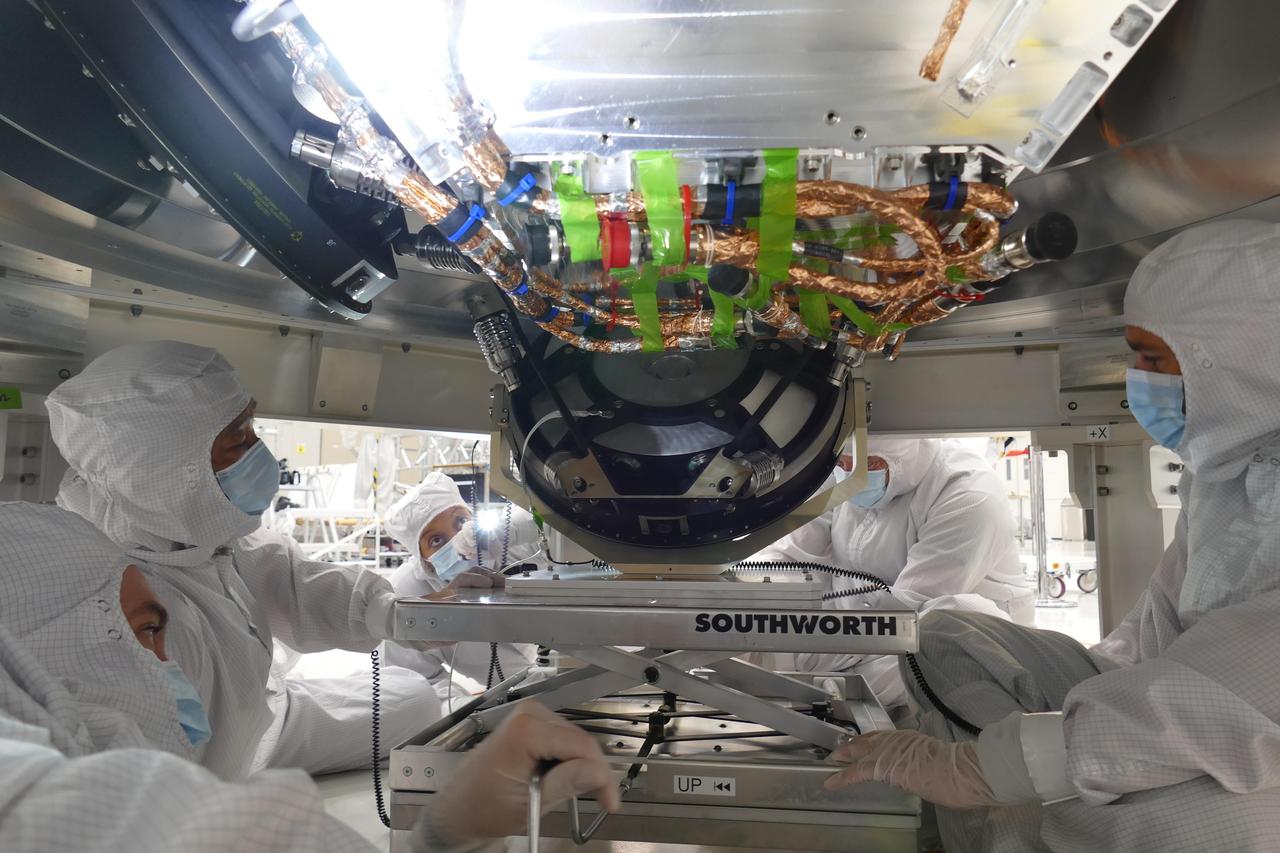
Engineers install a 2-foot-wide reaction wheel onto the main body of NASA's Europa Clipper spacecraft at the agency's Jet Propulsion Laboratory in Southern California. In all, four wheels were integrated onto the spacecraft, which is being assembled for its launch to Jupiter's moon Europa in October 2024. When the spacecraft heads through deep space, slips into orbit around Jupiter, and collects science observations while flying dozens of times by Europa, the wheels rotate the orbiter so that its antennas can communicate with Earth and so its science instruments, including cameras, can stay oriented toward Europa. Two feet wide and made of steel, aluminum, and titanium, the wheels spin rapidly to create a force that causes the orbiter to rotate in the opposite direction. The wheels will run on electricity provided by the spacecraft's vast solar arrays. Scientists believe the icy moon Europa harbors a vast internal ocean that may have conditions suitable for supporting life. Europa Clipper will fly by the moon about 50 times while its suite of science instruments gathers data on the moon's atmosphere, surface, and interior – information that will help scientists learn more about the ocean, the ice crust, and potential plumes that may be venting subsurface water into space. https://photojournal.jpl.nasa.gov/catalog/PIA25497
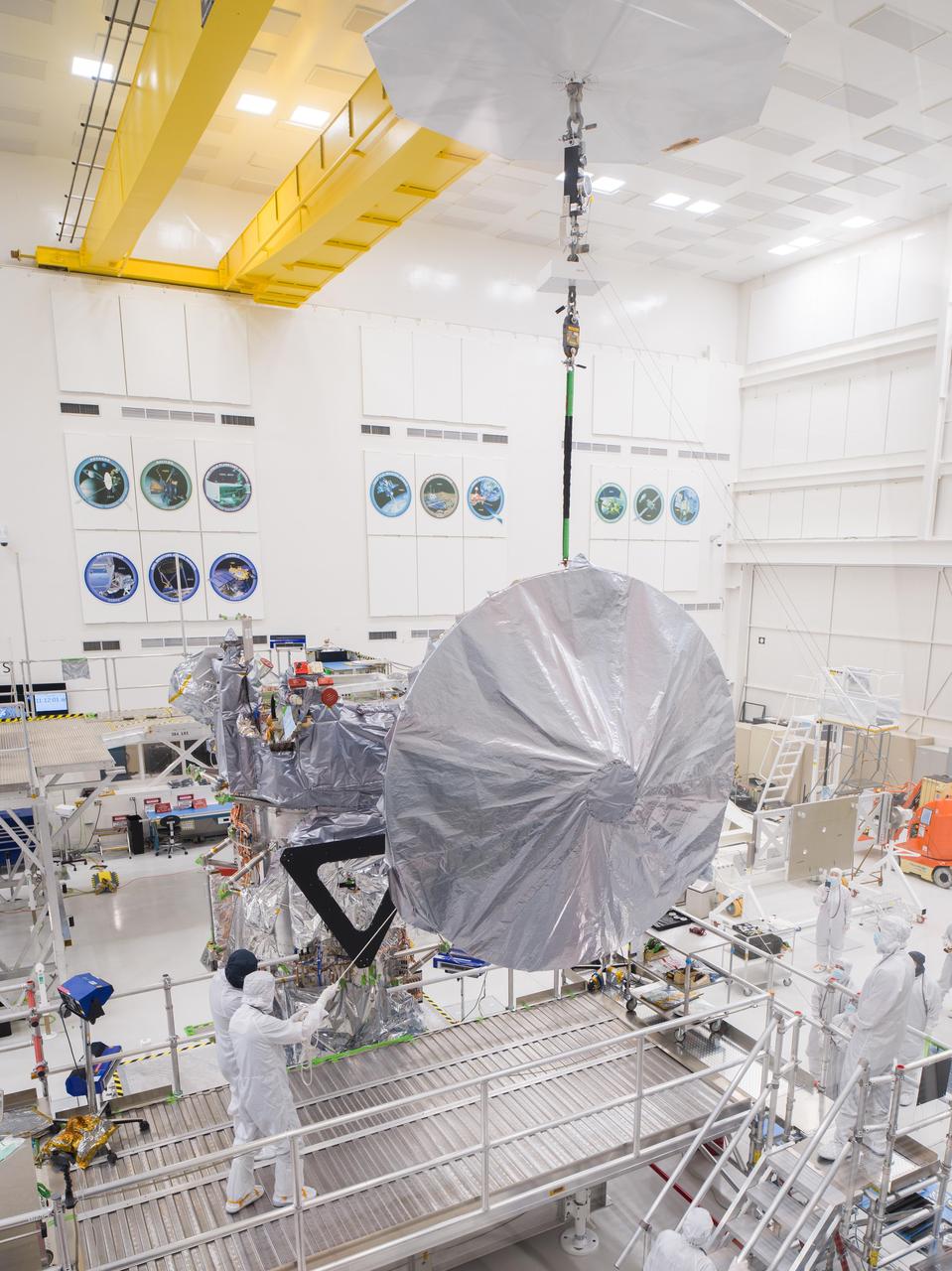
Engineers and technicians use a crane to lift a 10-foot (3-meter) high-gain antenna as they prepare to install it on NASA's Europa Clipper spacecraft on Aug. 14, 2023. The orbiter is being assembled in the clean room of High Bay 1 at the agency's Jet Propulsion Laboratory in Southern California in preparation for its launch to Jupiter's moon Europa in October 2024. The precision-engineered dish was attached to the spacecraft in carefully choreographed stages over the course of several hours. Europa Clipper will need the huge antenna to transmit data hundreds of millions of miles back to Earth. Scientists believe the icy moon Europa harbors a vast internal ocean that may have conditions suitable for supporting life. The spacecraft will fly by the moon about 50 times while its science instruments gather data on the moon's atmosphere, surface, and interior – information that will help scientists learn more about the ocean, the ice crust, and potential plumes that may be venting subsurface water into space. https://photojournal.jpl.nasa.gov/catalog/PIA25956
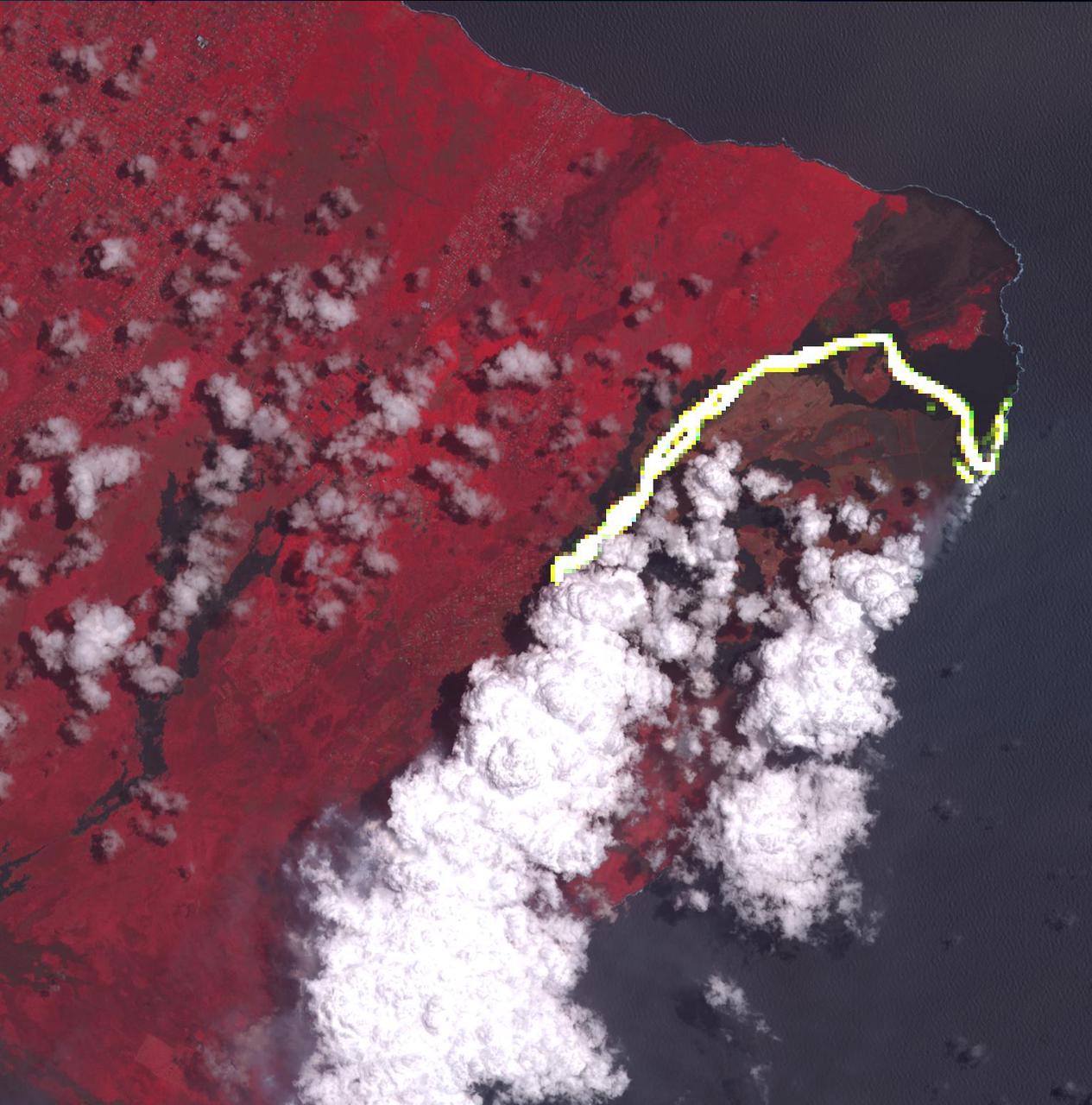
Hawaii's Kilauea volcanic eruption continues after seven weeks of continuous outpouring of lava over the northeastern part of the island. More than 6,100 acres of the Big Island have been covered with new lava, destroying hundreds of homes. At the same time, new land has been created as lava filled Kapoho Bay at the ocean. For some time, the activity has been confined to a leveed channel flow, that starts from the active-most vent, and makes it way 8 miles (13 kilometers) to the ocean. In this image from the Advanced Spaceborne Thermal Emission and Reflection (ASTER) radiometer instrument on NASA's Terra satellite, vegetation is displayed in red, clouds are white and the hot lava flows, detected by ASTER's thermal infrared channels, are overlaid in yellow. The image was acquired June 23, 2018, covers an area of 14.2 by 14.6 miles (23 by 23.3 kilometers), and is located at 19.6 degrees north, 154.9 degrees west. https://photojournal.jpl.nasa.gov/catalog/PIA22553
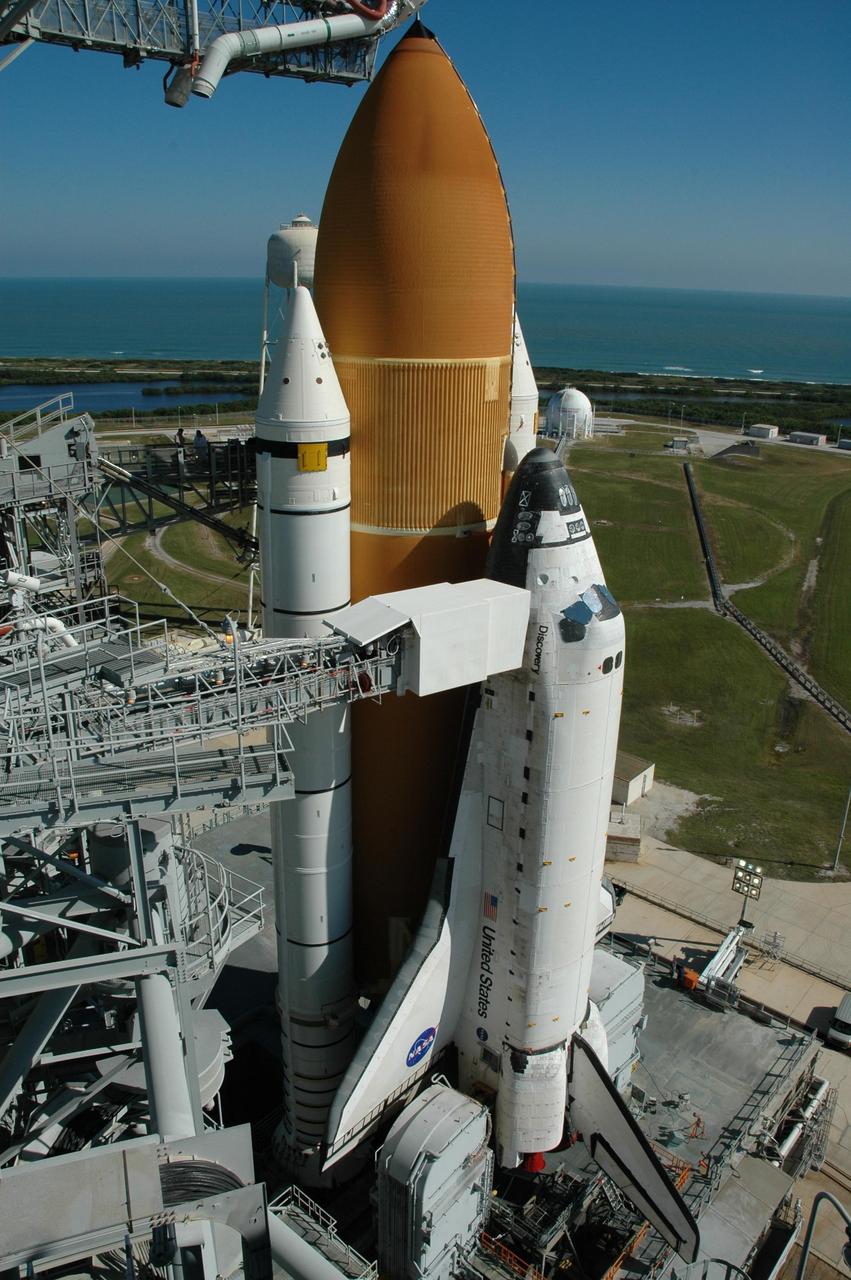
KENNEDY SPACE CENTER, FLA. -- Space Shuttle Discovery and the mobile launcher platform sit on Launch Pad 39B for mission STS-116. Beyond the pad is the Atlantic Ocean. The shuttle's external tank is capped by the oxygen vent hood (at top). Below it is the orbiter access arm which swings out from the fixed service structure to the orbiter crew compartment hatch to allow personnel to enter the crew compartment. The outer end of the access arm ends in an environmental chamber (white room) that mates with the orbiter and holds six persons. The arm remains in the extended position until seven minutes 24 seconds before launch to provide emergency egress for the flight crew. The rollout of Discovery from the Vehicle Assembly Building began at 12:29 a.m. The shuttle was harddown on the pad at 9:03 a.m. The mission is No. 20 to the International Space Station and construction flight 12A.1. The mission payload is the SPACEHAB module, the P5 integrated truss structure and other key components. The launch window for mission STS-116 opens Dec. 7. Photo credit: NASA/Jim Grossmann
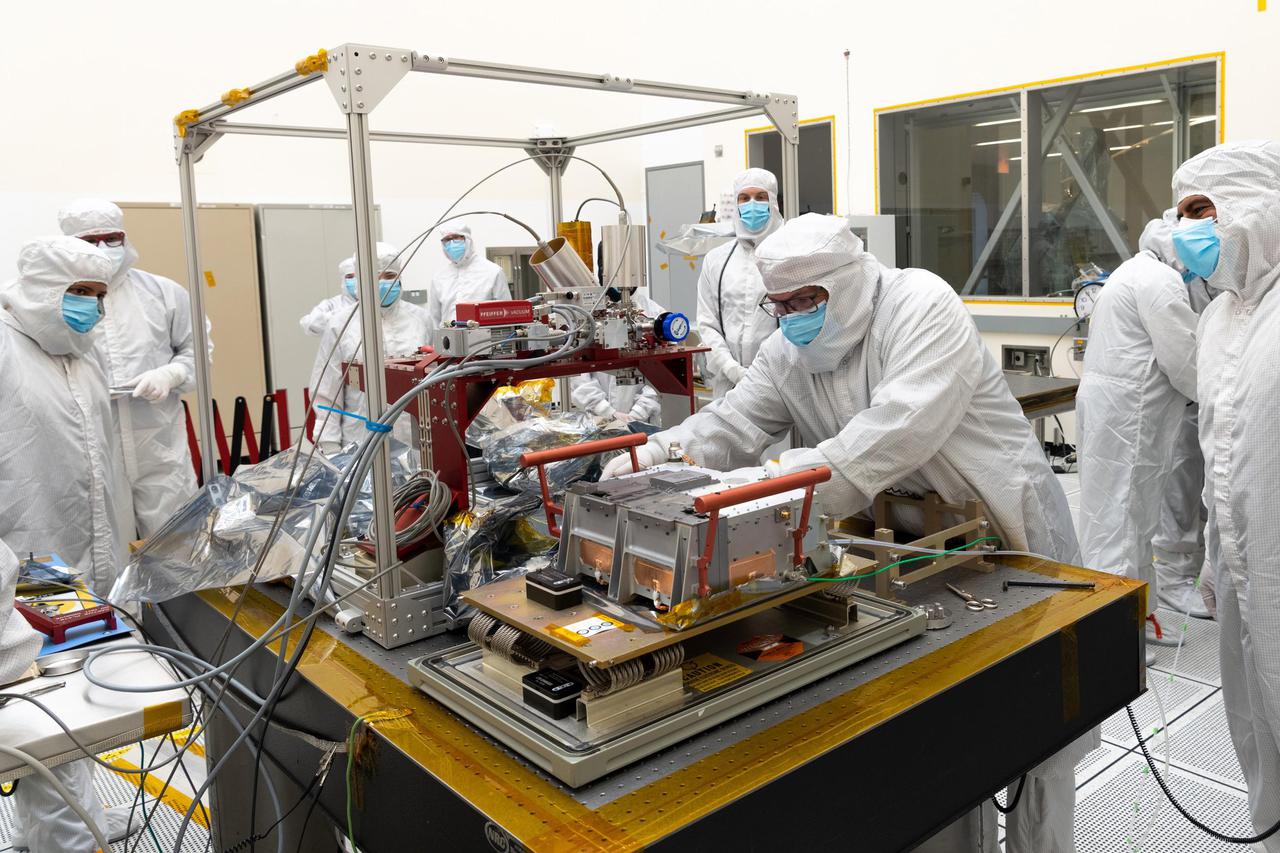
Engineers and technicians examine and test the first of NASA's Europa Clipper's science instruments to be delivered to the agency's Jet Propulsion Laboratory in Southern California. The ultraviolet spectrograph, called Europa-UVS and led by the Southwest Research Institute in San Antonio, Texas, will be integrated into the spacecraft during the phase of the mission called assembly, test, and launch operations. Europa-UVS is part of a payload of nine science instruments aboard Europa Clipper. In this photo, captured in February 2022, the instrument's custom testing equipment is seen at left, with a boxy, red frame. The instrument itself is seen at right. During testing, technicians shined ultraviolet light into the instrument's front aperture. With an internal global ocean under a thick layer of ice, Jupiter's moon Europa may have the potential to harbor existing life. Europa Clipper will swoop around Jupiter in an elliptical orbit, dipping close to the moon on each flyby to collect data. Understanding Europa's habitability will help scientists better understand how life developed on Earth and the potential for finding life beyond our planet. Europa Clipper is set to launch in 2024. Europa-UVS will search above the surface of Europa for signs of potential plumes that may be venting subsurface water into space. The instrument collects ultraviolet light, then separates the wavelengths of that light to help determine the composition of the moon's surface and gases in the atmosphere. https://photojournal.jpl.nasa.gov/catalog/PIA24897

CAPE CANAVERAL, Fla. - Waves break off the Atlantic Ocean near Launch Pad 39B at NASA's Kennedy Space Center in Florida. On the pad, the Ares I-X rocket awaits liftoff on its upcoming flight test. In the background is the Vehicle Assembly Building. This is the first time since the Apollo Program's Saturn rockets were retired that a vehicle other than the space shuttle has occupied the pad. Modifications to the pad to support the Ares I-X included the removal of shuttle unique subsystems, such as the orbiter access arm and a section of the gaseous oxygen vent arm, and the installation of three 600-foot lightning towers, access platforms, environmental control systems and a vehicle stabilization system. Part of the Constellation Program, the Ares I-X is the test vehicle for the Ares I. The Ares I-X flight test is set for Oct. 27. For information on the Ares I-X vehicle and flight test, visit http://www.nasa.gov/aresIX. Photo credit: NASA/Kim Shiflett
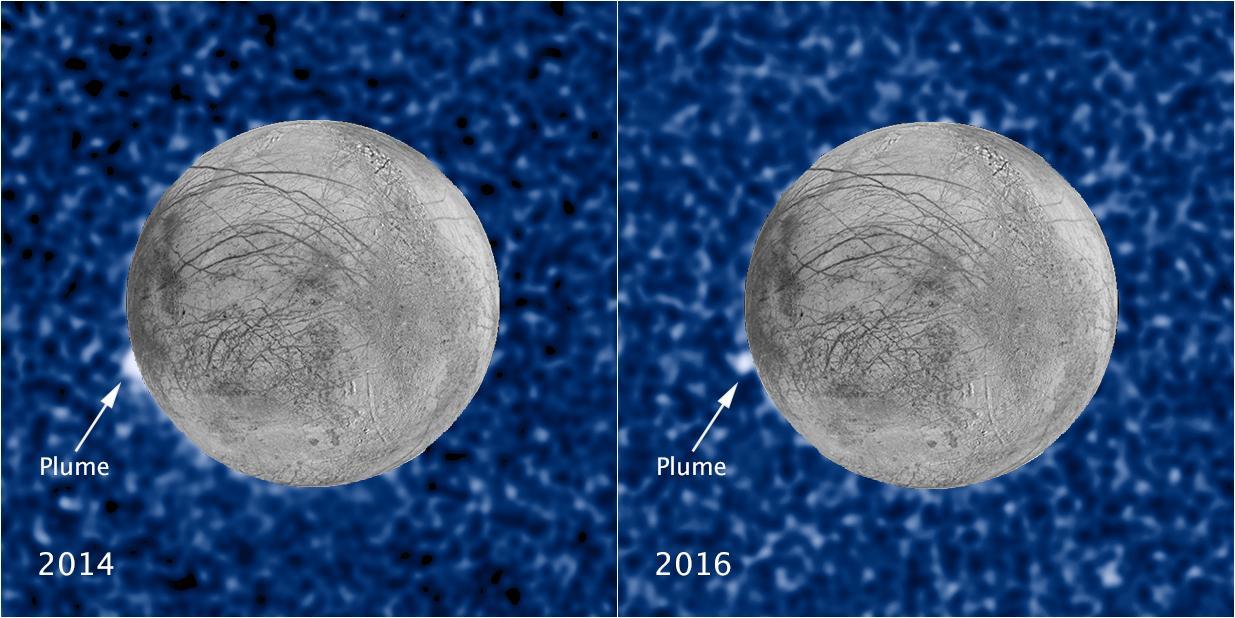
These composite images show a suspected plume of material erupting two years apart from the same location on Jupiter's icy moon Europa. The images bolster evidence that the plumes are a real phenomenon, flaring up intermittently in the same region on the satellite. Both plumes, photographed in ultraviolet light by NASA's Hubble's Space Telescope Imaging Spectrograph, were seen in silhouette as the moon passed in front of Jupiter. The newly imaged plume, shown at right, rises about 62 miles (100 kilometers) above Europa's frozen surface. The image was taken Feb. 22, 2016. The plume in the image at left, observed by Hubble on March 17, 2014, originates from the same location. It is estimated to be about 30 miles (50 kilometers) high. The snapshot of Europa, superimposed on the Hubble image, was assembled from data from NASA's Galileo mission to Jupiter. The plumes correspond to the location of an unusually warm spot on the moon's icy crust, seen in the late 1990s by the Galileo spacecraft (see PIA21444). Researchers speculate that this might be circumstantial evidence for water venting from the moon's subsurface. The material could be associated with the global ocean that is believed to be present beneath the frozen crust. https://photojournal.jpl.nasa.gov/catalog/PIA21443
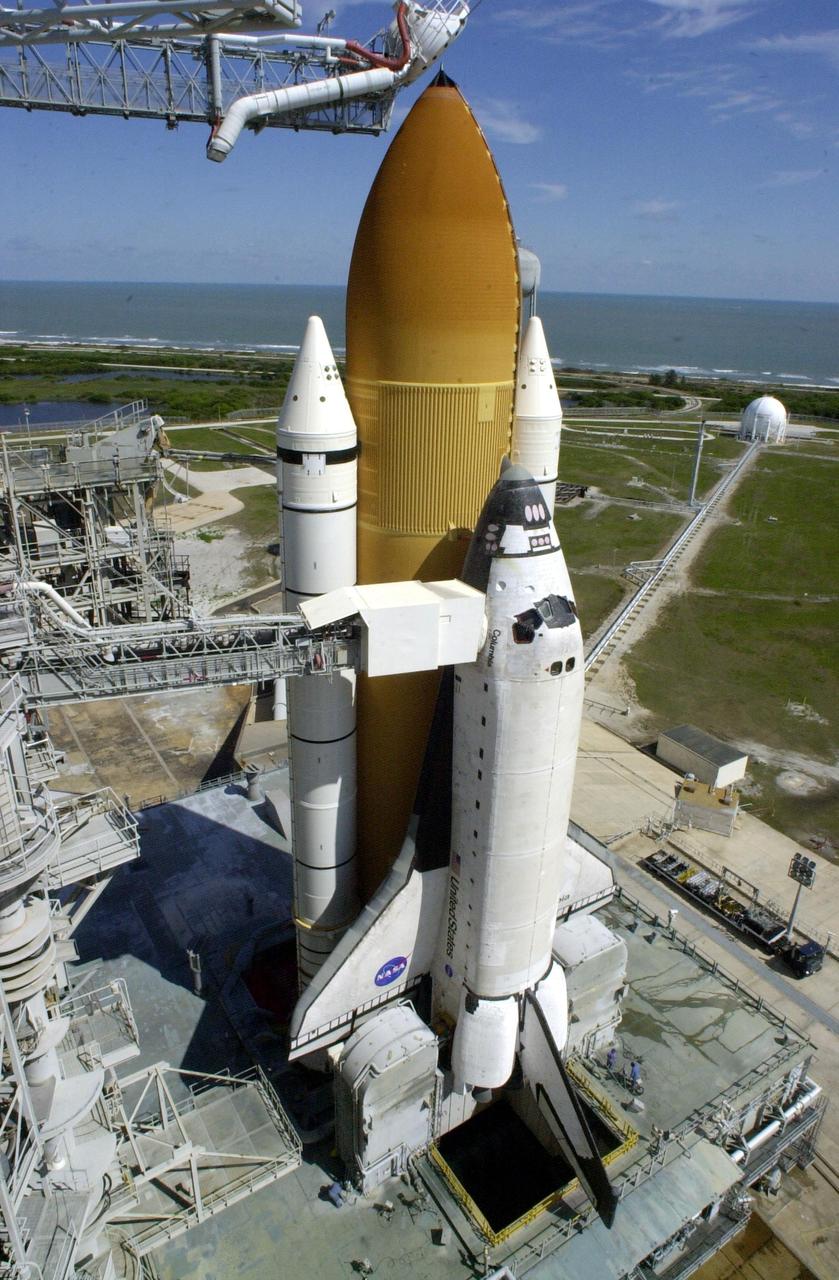
KENNEDY SPACE CENTER, Fla. - Rollback of the Rotating Service Structure for the second time after a scrub of mission STS-109 the day before reveals Space Shuttle Columbia on Launch Pad 39A. The clear blue Florida sky and Atlantic Ocean provide a backdrop. Above the orange-colored external tank is poised the "beanie cap," the gaseous oxygen vent hood. Extending to the side of Columbia is the Orbiter Access Arm with the environmentally controlled White Room at the end. The White Room provides entry for the crew into the orbiter. Columbia sits atop the Mobile Launcher Platform which has an opening to the flame trench below. Columbia is rescheduled for launch on mission STS-109 March 1 at 6:22 a.m. EST (11:22 GMT). The 11-day mission will provide maintenance and upgrade to the Hubble Space Telescope, replacing Solar Array 2 with Solar Array 3, replacing the Power Control Unit, installing the ACS (after removing the Faint Object Camera ), the Near Infrared Camera, the Multi-Object Spectrometer (NICMOS) Cooling System, and the New Outer Blanket Layer insulation.
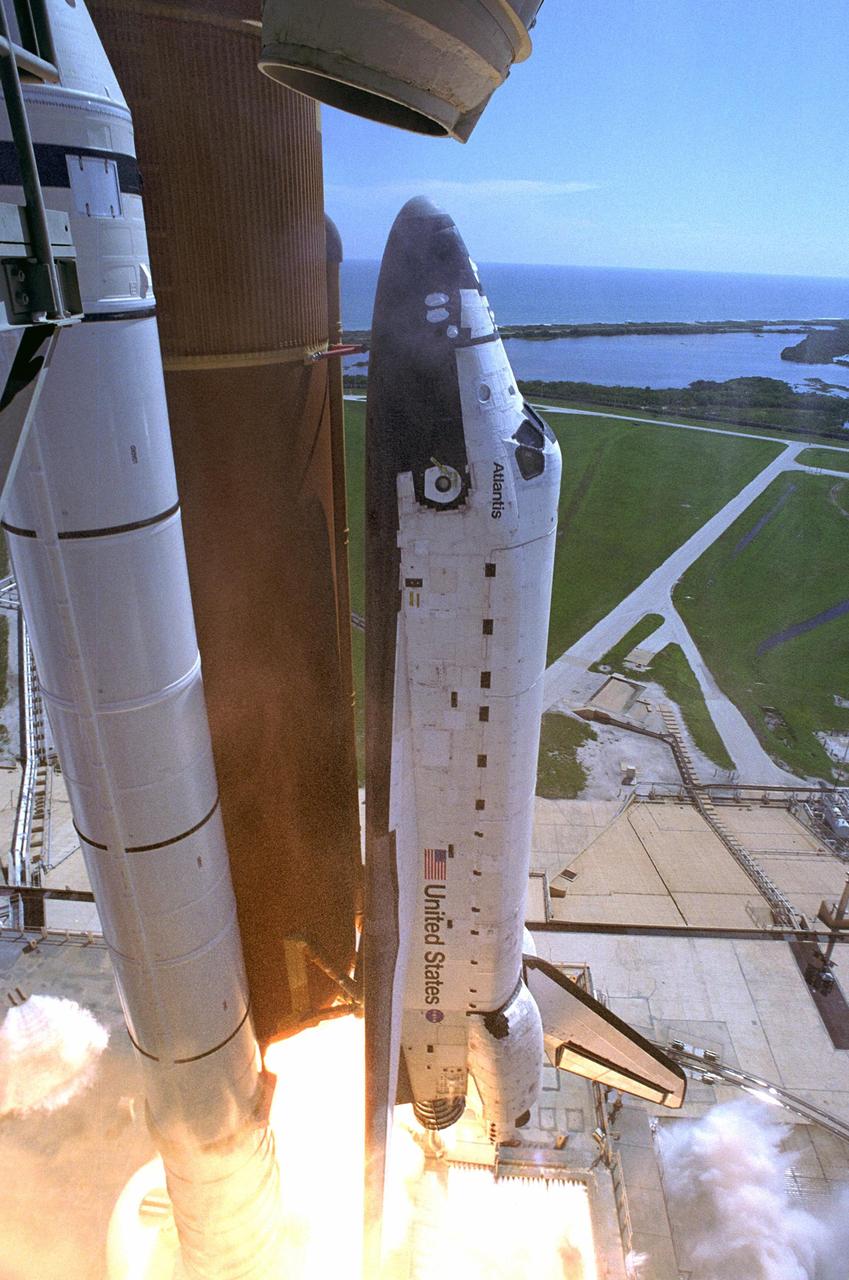
KENNEDY SPACE CENTER, FLA. - Flaming rockets propel Space Shuttle Atlantis off Launch Pad 39B for a rendezvous with the International Space Station on mission STS-115. In the background is the Atlantic Ocean. Appearing above the nose of the orbiter is the end of the gaseous vent line that leads from the hood, or beanie cap, which has been moved away from the shuttle for liftoff. Liftoff was on-time at 11:14:55 a.m. EDT. After several launch attempts were scrubbed due to weather and technical concerns, this launch was executed perfectly. Mission STS-115 is the 116th space shuttle flight, the 27th flight for orbiter Atlantis, and the 19th U.S. flight to the International Space Station. During the mission, Atlantis' astronauts will deliver and install the 17.5-ton, bus-sized P3/P4 integrated truss segment on the station. The girder-like truss includes a set of giant solar arrays, batteries and associated electronics and will provide one-fourth of the total power-generation capability for the completed station. STS-115 is scheduled to last 11 days with a planned landing at KSC
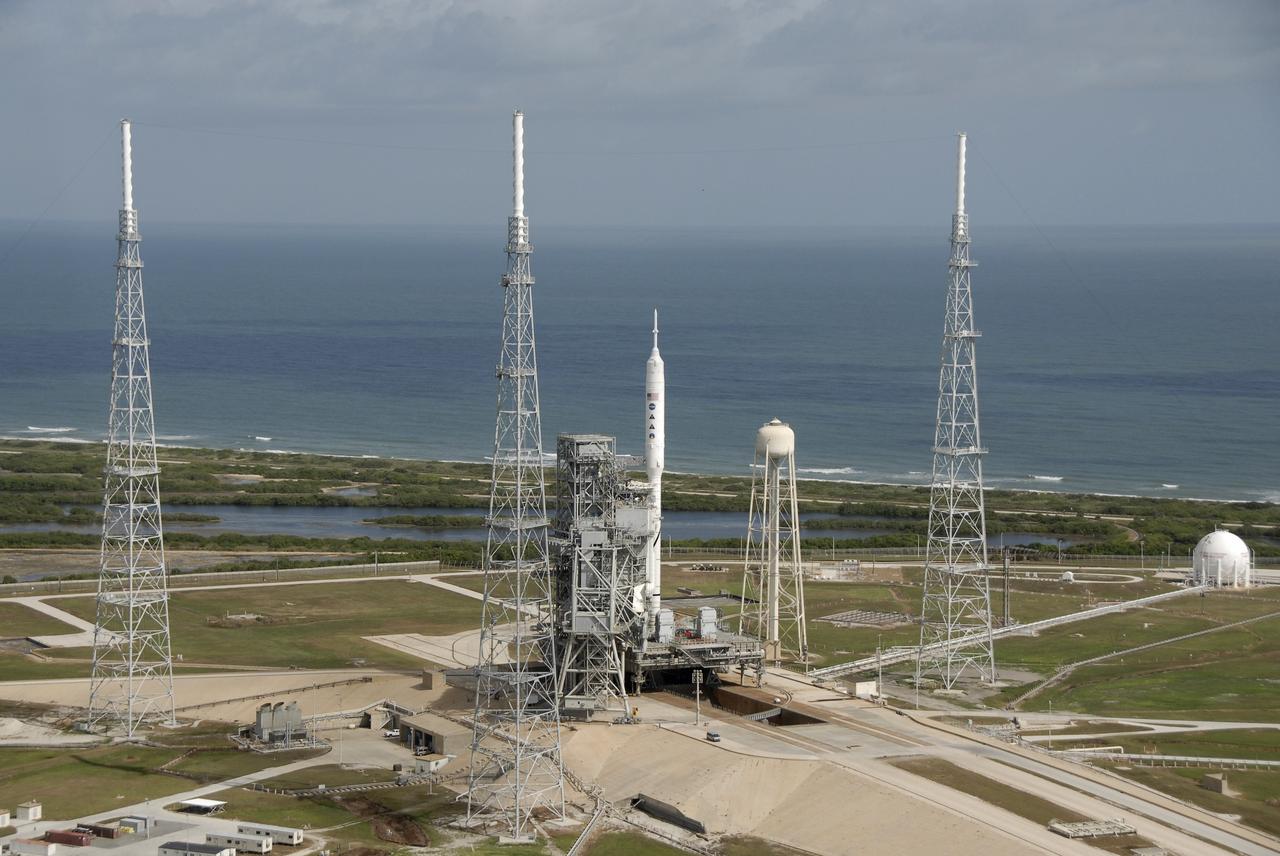
CAPE CANAVERAL, Fla. – The 327-foot-tall Ares I-X rocket is not the tallest structure on Launch Pad 39B beside the Atlantic Ocean at NASA's Kennedy Space Center in Florida. Situated around the pad are three 100-foot fiberglass lightning masts mounted atop 500-foot towers. This is the first time since the Apollo Program's Saturn rockets were retired that a vehicle other than the space shuttle has occupied the pad. The transfer of the pad from the Space Shuttle Program to the Constellation Program took place May 31. Pad modifications to support the Ares I-X include the removal of shuttle unique subsystems, such as the orbiter access arm and a section of the gaseous oxygen vent arm, and the installation of three 600-foot lightning towers, access platforms, environmental control systems and a vehicle stabilization system. Part of the Constellation Program, the Ares I-X is the test vehicle for the Ares I. The Ares I-X flight test is set for Oct. 27. For information on the Ares I-X vehicle and flight test, visit http://www.nasa.gov/aresIX. Photo credit: NASA/Kim Shiflett
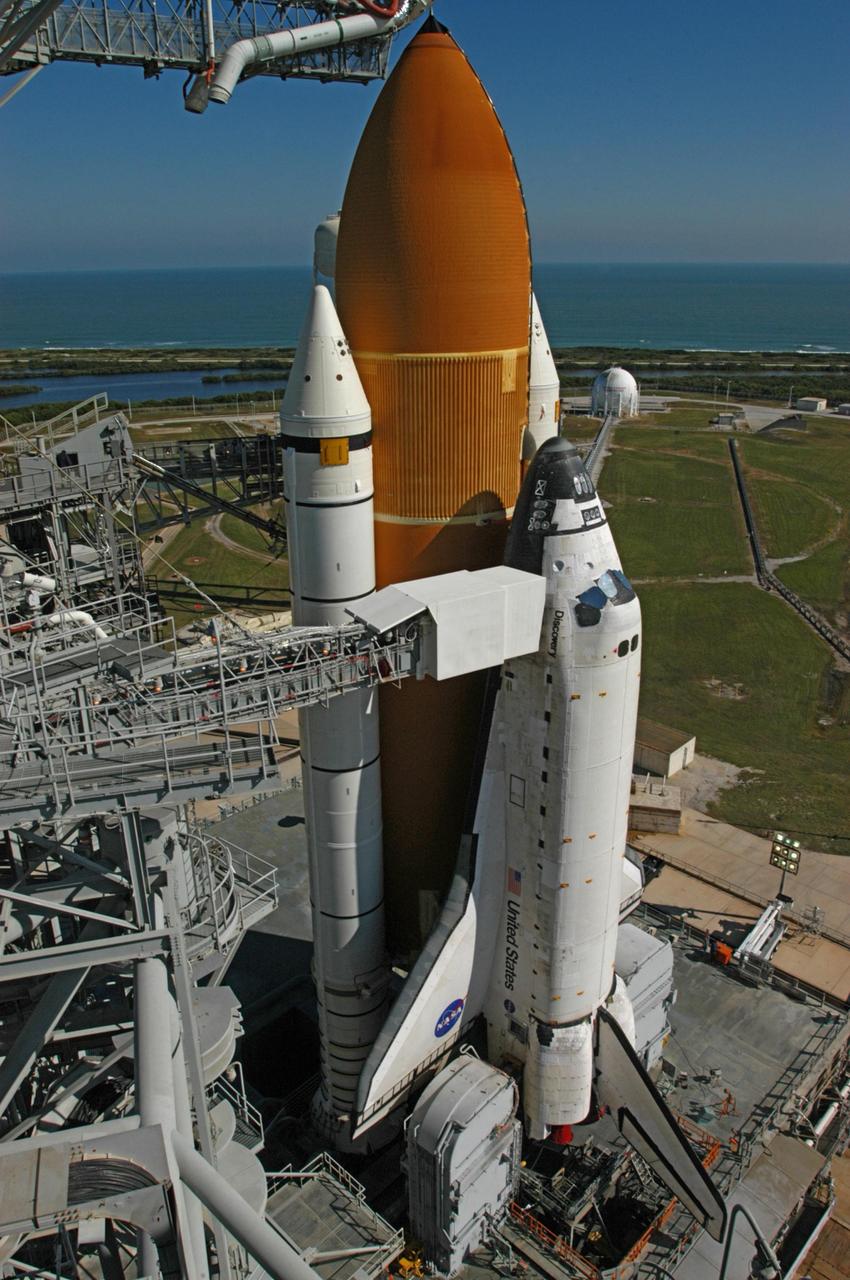
KENNEDY SPACE CENTER, FLA. -- Space Shuttle Discovery and the mobile launcher platform sit on Launch Pad 39B for mission STS-116. Beyond the pad is the Atlantic Ocean. The shuttle's external tank is capped by the oxygen vent hood (at top). Below it is the orbiter access arm which swings out from the fixed service structure to the orbiter crew compartment hatch to allow personnel to enter the crew compartment. The outer end of the access arm ends in an environmental chamber (white room) that mates with the orbiter and holds six persons. The arm remains in the extended position until seven minutes 24 seconds before launch to provide emergency egress for the flight crew. The rollout of Discovery from the Vehicle Assembly Building began at 12:29 a.m. The shuttle was harddown on the pad at 9:03 a.m. The mission is No. 20 to the International Space Station and construction flight 12A.1. The mission payload is the SPACEHAB module, the P5 integrated truss structure and other key components. The launch window for mission STS-116 opens Dec. 7. Photo credit: NASA/George Shelton
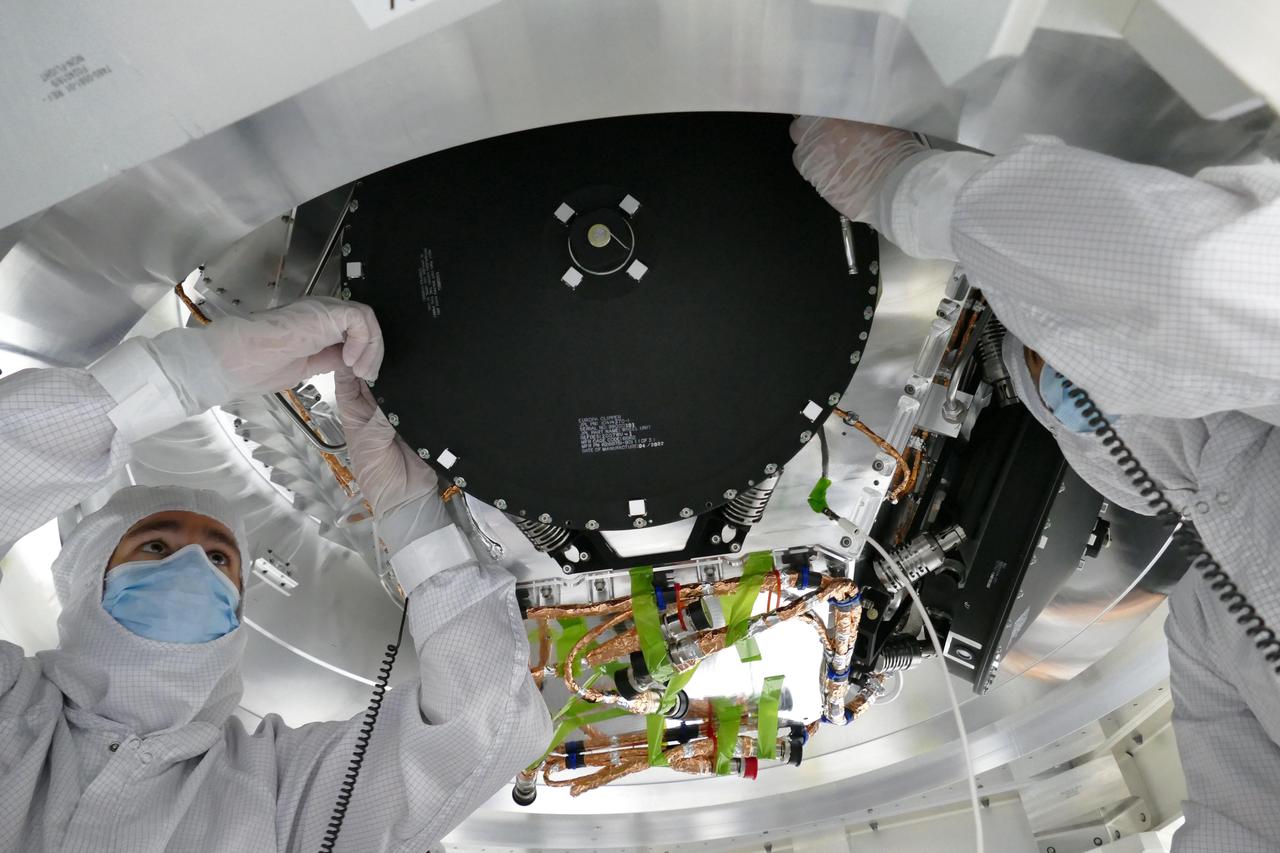
Engineers install 2-foot-wide reaction wheels onto the main body of NASA's Europa Clipper spacecraft at the agency's Jet Propulsion Laboratory in Southern California. In all, four wheels were integrated onto the spacecraft, which is being assembled for its launch to Jupiter's moon Europa in October 2024. When the spacecraft heads through deep space, slips into orbit around Jupiter, and collects science observations while flying dozens of times by Europa, the wheels rotate the orbiter so that its antennas can communicate with Earth and so its science instruments, including cameras, can stay oriented toward Europa. Two feet wide and made of steel, aluminum, and titanium, the wheels spin rapidly to create a force that causes the orbiter to rotate in the opposite direction. The wheels will run on electricity provided by the spacecraft's vast solar arrays. The green tape that is visible here keeps cables temporarily secured during the wheel installation. Scientists believe the icy moon Europa harbors a vast internal ocean that may have conditions suitable for supporting life. Europa Clipper will fly by the moon about 50 times while its suite of science instruments gathers data on the moon's atmosphere, surface, and interior – information that will help scientists learn more about the ocean, the ice crust, and potential plumes that may be venting subsurface water into space. https://photojournal.jpl.nasa.gov/catalog/PIA25494
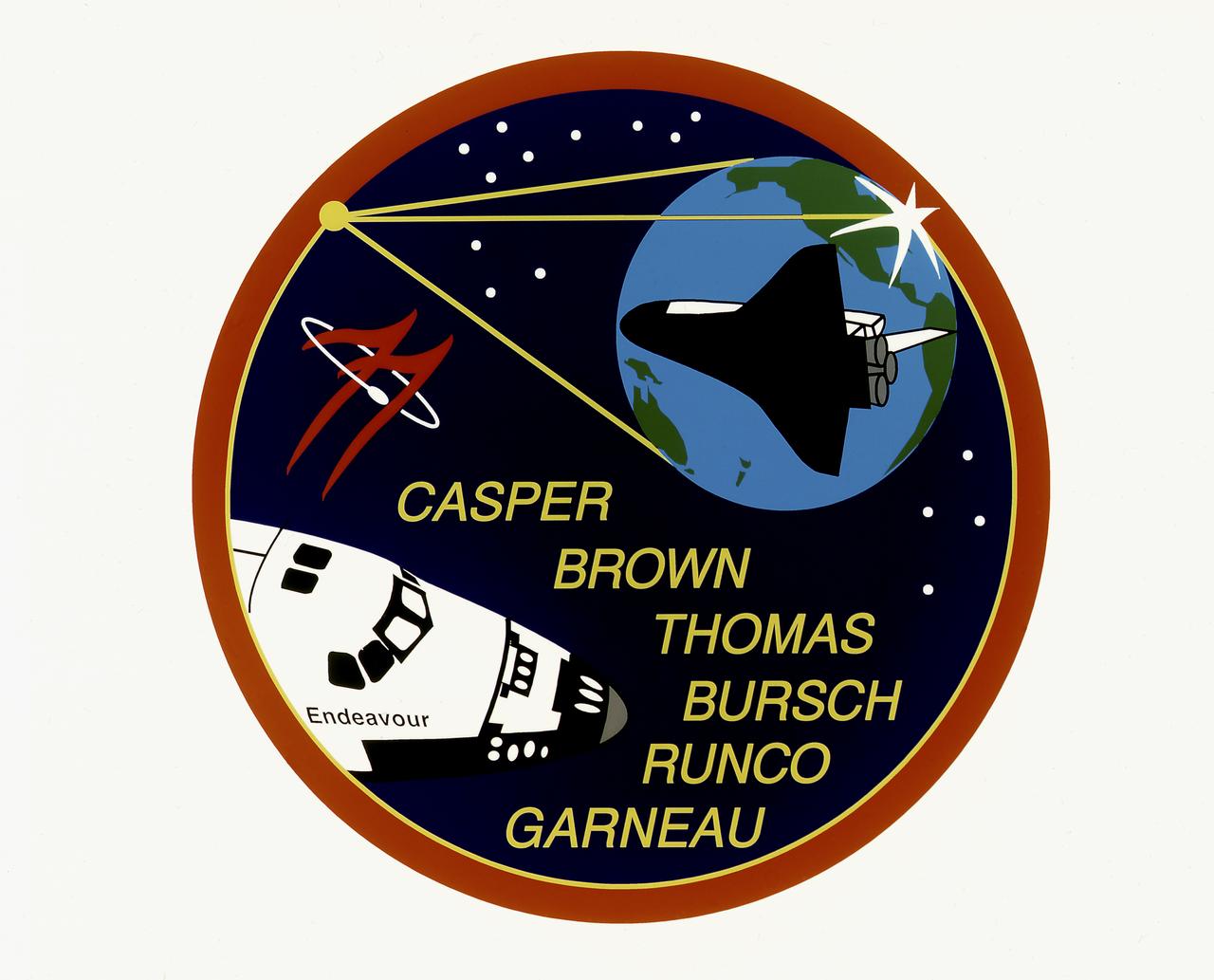
The STS-77 crew patch displays the Shuttle Endeavour in the lower left and its reflection within the tripod and concave parabolic mirror of the SPARTAN Inflatable Antenna Experiment (IAE). The center leg of the tripod also delineates the top of the Spacehab's shape, the rest of which is outlined in gold just inside the red perimeter. The Spacehab was carried in the payload bay and housed the Commercial Float Zone Furnace (CFZF). Also depicted within the confines of the IAE mirror are the mission's rendezvous operations with the Passive Aerodynamically-Stabilized Magnetically-Damped satellite (PAM/STU) appears as a bright six-pointed star-like reflection of the sun on the edge of the mirror with Endeavour in position to track it. The sunlight on the mirror's edge, which also appears as an orbital sunset, is located over Goddard Space Flight Center, the development facility for the SPARTAN/IAE and Technology Experiments Advancing Missions in Space (TEAMS) experiments. The reflection of the Earth is oriented to show the individual countries of the crew as well as the ocean which Captain Cook explored in the original Endeavour. The mission number 77 is featured as twin stylized chevrons and an orbiting satellite as adapted from NASA's logo. The stars at the top are arranged as seen in the northern sky in the vicinity of the constellation Ursa Minor. The field of 11 stars represents both the TEAMS cluster of experiments (the four antennae of GPS Attitude and Navigation Experiment (GANE), the single canister of Liquid Metal Thermal Experiment (LMTE), the three canisters of Vented Tank Resupply Experiment (VTRE), and the three canisters of PAM/STU) and the 11th flight of Endeavour. The constellation at the right shows the fourth flight of Spacehab Experiments.
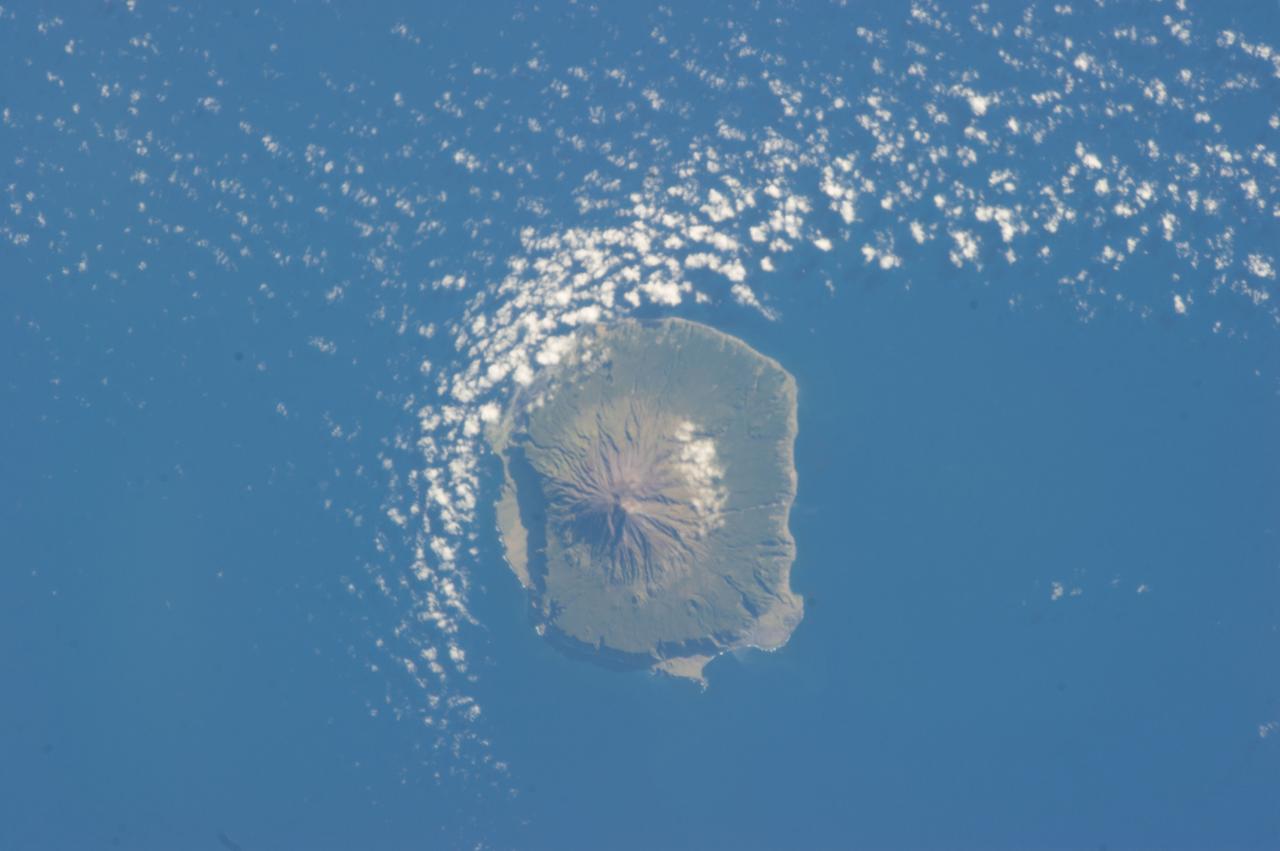
ISS034-E-041528 (6 Feb. 2013) --- Tristan da Cunha is featured in this image photographed by an Expedition 34 crew member on the International Space Station. The island is located in the southern Atlantic Ocean; more than 3,700 kilometers from the northern coastline of Antarctica, approximately 2,800 kilometers to the southern tip of Africa, and more than 3,000 kilometers from the eastern coastline of South America. The island forms part of the British Overseas Territory of Saint Helena, Ascension, and Tristan da Cunha. The shoreline of the 13-kilometer-wide island is marked on most sides by steep cliffs, with lower beach areas on the southern and north-northwestern sides. The island is notable for its bird population, including important breeding grounds for a variety of petrels, albatrosses, penguins and shearwaters. Tristan da Cunha is a shield volcano; a type of volcanic structure usually recognized by a low, broad profile and composed of silica-poor lavas (such as basalt). The upper surface of this low base appears dark green in this photograph. Steeper, brown to tan colored slopes mark the central cone of the volcano at the island?s center. The summit crater, Queen Mary?s Peak, sits at an elevation of 2,060 meters above sea level. While geologic evidence indicates that eruptions have occurred from the central crater, lavas have also erupted from flank vents along the sides of the volcano as well as smaller cinder cones. The last known eruption of Tristan da Cunha took place 1961-1962 and forced evacuation of the only settlement on the island, Edinburgh of the Seven Seas. The settlement is located along the northern coastline of the island (obscured by clouds in this image). This is considered to be the most remote permanent settlement on Earth, with its citizen?s nearest neighbors located 2,173 kilometers to the northeast on the island of St. Helena.
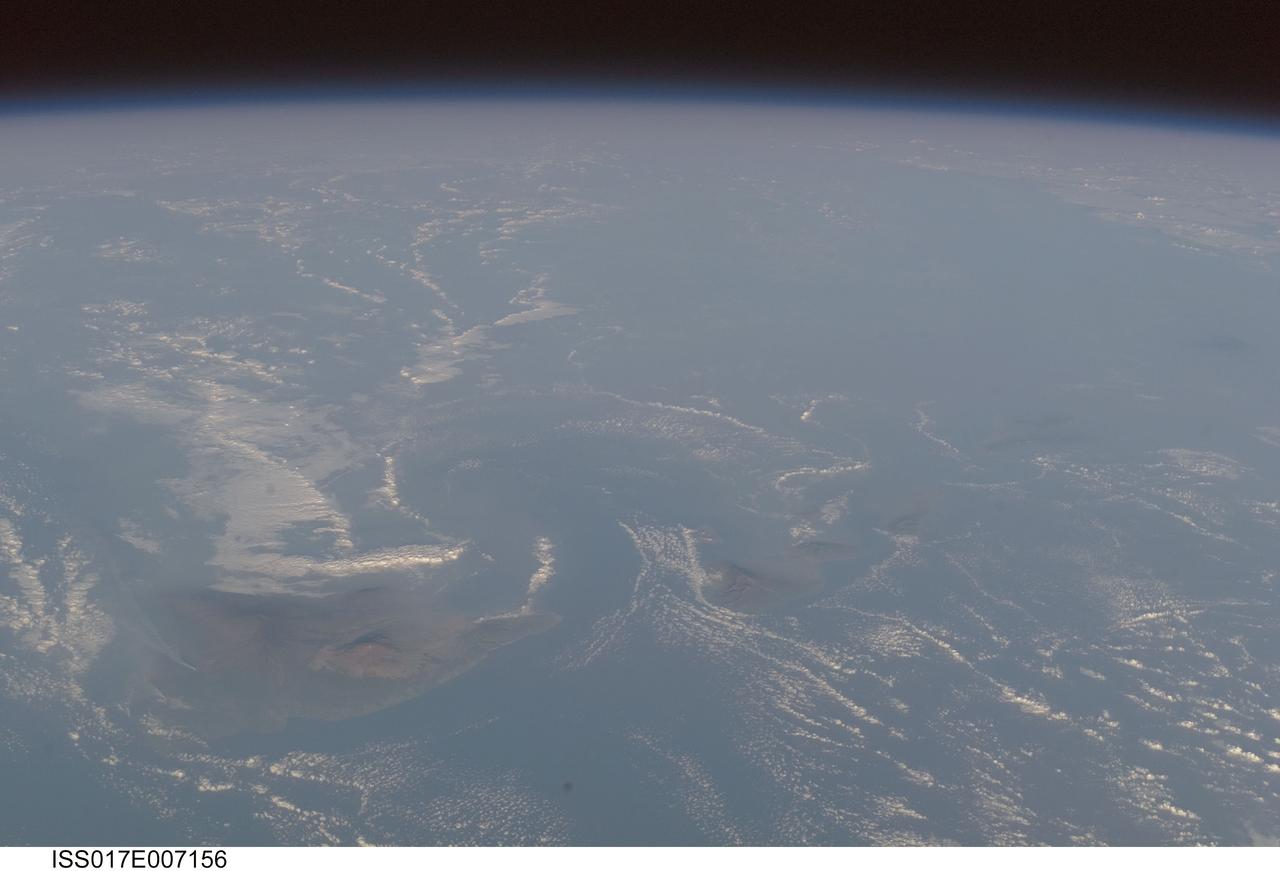
ISS017-E-007156 (17 May 2008) --- Volcanic plumes and volcanic fog in Hawaii are featured in this image photographed by an Expedition 17 crewmember on the International Space Station. For 25 years, Kilauea volcano on Hawaii's Big Island has been erupting continuously. Recent explosive activity that started in March 2008 is producing increased emissions of sulfur dioxide (SO2). These emissions result in a widespread caustic volcanic fog -- known as vog -- that, depending on local winds, drifts as much as 200 miles up the volcanic chain, burning throats and eyes, and inducing asthma attacks as far away as Honolulu, on the island of Oahu. An oblique view of the Hawaiian islands taken from the International Space Station -- viewed looking towards the southwest, rather than "straight down" relative to the station -- on a hazy spring day includes a regional view of three volcanic plumes from Kilauea that contribute to the vog: the plume from Halema'uma'u crater near the summit, a plume from Pu'u O'o vent along the east rift, and a plume from where lava enters the ocean on the coast outside of the park boundaries. At the time this image was taken, doctors throughout the state of Hawaii were reporting an increased caseload of people with respiratory problems. Aside from the vog, this view captures cloud formations indicative of both the large-scale air flow and the local wind patterns around the islands. The parallel lines of clouds aligned roughly northeast to southwest reveal the direction of the region's prevailing trade winds; that flow is disrupted around the islands (between Hawaii and Maui, at right), and further influenced by the local land/sea breeze which at that time had driven the cloud formations offshore and circling the islands. In addition to the Kilauea plumes, the volcanoes of Mauna Loa and Mauna Kea are also visible on the island of Hawaii (center). The uninhabited island of Kaho'olawe is just visible to the southwest of Maui.

ISS020-E-028123 (5 Aug. 2009) --- Mount Hood, Oregon is featured in this image photographed by an Expedition 20 crew member on the International Space Station. Mount Hood is located within the Cascade Range of the western United States, and is the highest peak (3,426 m) in Oregon. The Cascade Range is characterized by a line of volcanoes associated with a slab of oceanic crust that is subducting, or descending underneath, the westward moving continental crust of North America. Magma generated by the subduction process rises upward through the crust and feeds a line of active volcanoes that extends from northern California in the United States to southern British Columbia in Canada. While hot springs and steam vents are still active on Mount Hood, the last eruption from the volcano occurred in 1866. The volcano is considered dormant, but still actively monitored. Separate phases of eruptive activity produced pyroclastic flows and lahars ? mudflows ? that carried erupted materials down all of the major rivers draining the volcano. Gray volcanic deposits extend southwards along the banks of the White River (upper right), and form several prominent ridges along the southeast to southwest flanks of the volcano. The deposits contrast sharply with the green vegetated lower flanks of the volcano. The Mount Hood stratovolcano ? a typically cone-shaped volcanic structure formed by interlayered lava flows and explosive eruption deposits ? hosts twelve mapped glaciers along its upper flanks (center). Like other glaciers in the Pacific Northwest, the Hood glaciers have been receding due to global warming, and have lost an estimated 61 percent of their volume over the past century. The predicted loss of glacial meltwater under future warming scenarios will have significant effects on regional hydrology and water supplies.
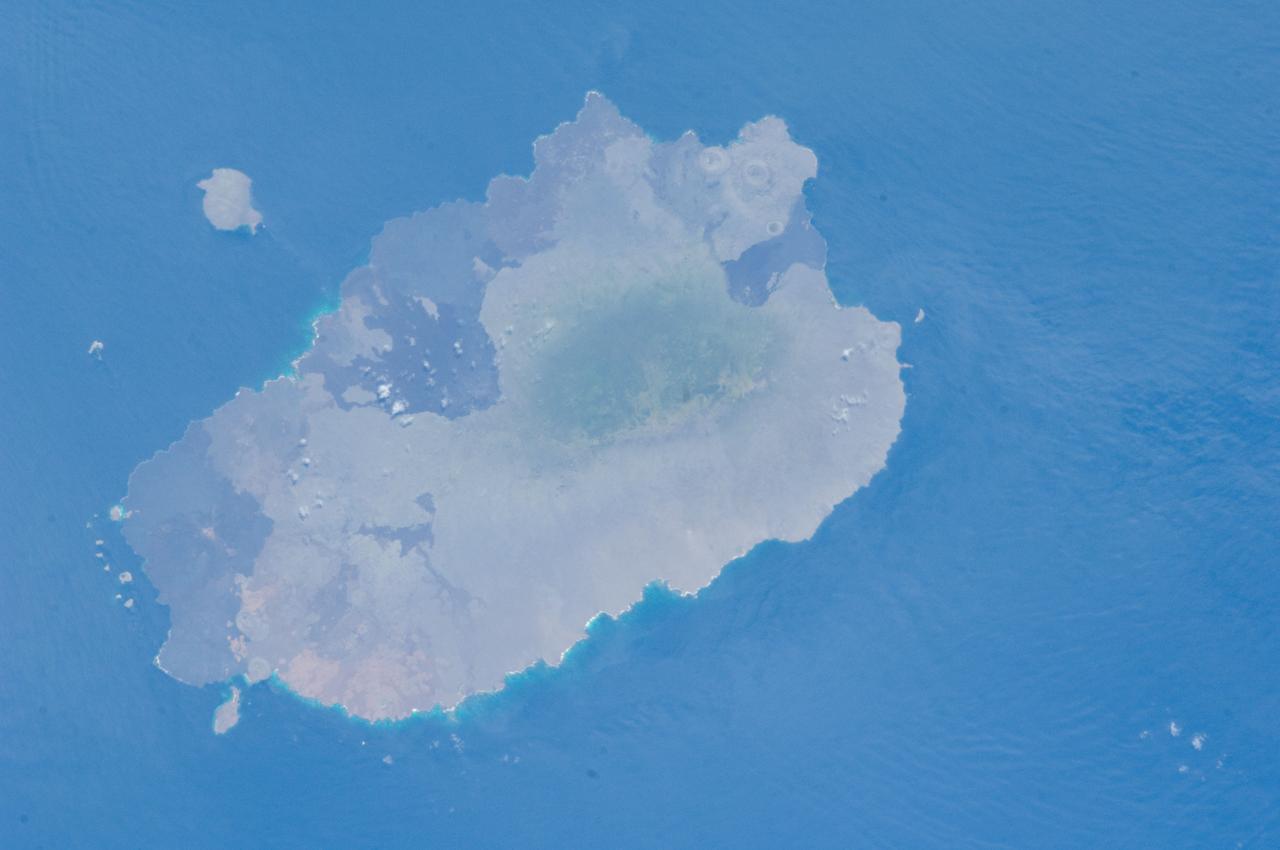
ISS033-E-012648 (18 Oct. 2012) --- Isla Santiago is featured in this image photographed by an Expedition 33 crew member on the International Space Station. The island of Santiago is located near the center of the Galapagos Islands off the coast of Ecuador. The Galapagos Islands are situated near the equator, and were formed from volcanism related to a large mantle plume (also known as a hot spot). This hot spot is very close to the tectonic boundary between the Galapagos Ridge, a plate boundary that is also an oceanic spreading center, and the Nazca and Cocos plates. This combination of mantle plumes and tectonic plate movements produces a unique geological environment, including underwater ridges of volcanoes that influence the water circulation around the Galapagos. All of these aspects contribute to the geology and biology of the Galapagos. Isla Santiago itself is formed from a shield volcano also called Santiago. This type of volcanic structure is recognized by low, flat summits surrounded by extensive flow fields of lava; the lava is not very viscous, so it can flow for great distances from the source vents. Several dark lava flow fields are visible in this photograph, the largest along the eastern, western, and southern coastlines. The small Isla Rabida to the south of Isla Santiago is the peak of another, mostly submerged shield volcano. In addition to the lava flows, other volcanic features known as tuff cones are visible on the eastern and western sides of the island. These cones are formed from the rapid interaction of hot flowing lava and water. The water underneath the lava flow flashes to steam explosively, and this both fragments the lava and rapidly cools it, leading to the formation of cones of glassy, relatively fine-grained volcanic material. The most recent volcanic activity on Isla Santiago occurred during 1904 – 1906. The summit ridge of the Santiago shield volcano is located in the northwestern part of the island (center). Also at center is a large but isolated region of green vegetation primarily located on the south-facing slope below the summit ridge. This image was taken during the dry, or garua, season that lasts from June to November. The season is dominated by cooler air transported by the Southeast Trade winds and cooler waters from the Humboldt and Cromwell currents. The combination of cool air and water results in rain falling only in the island highlands, with south- and east-facing slopes receiving the most precipitation. Despite the favorable topographic location, the yellow green color of the vegetation may indicate water (or other) stress.
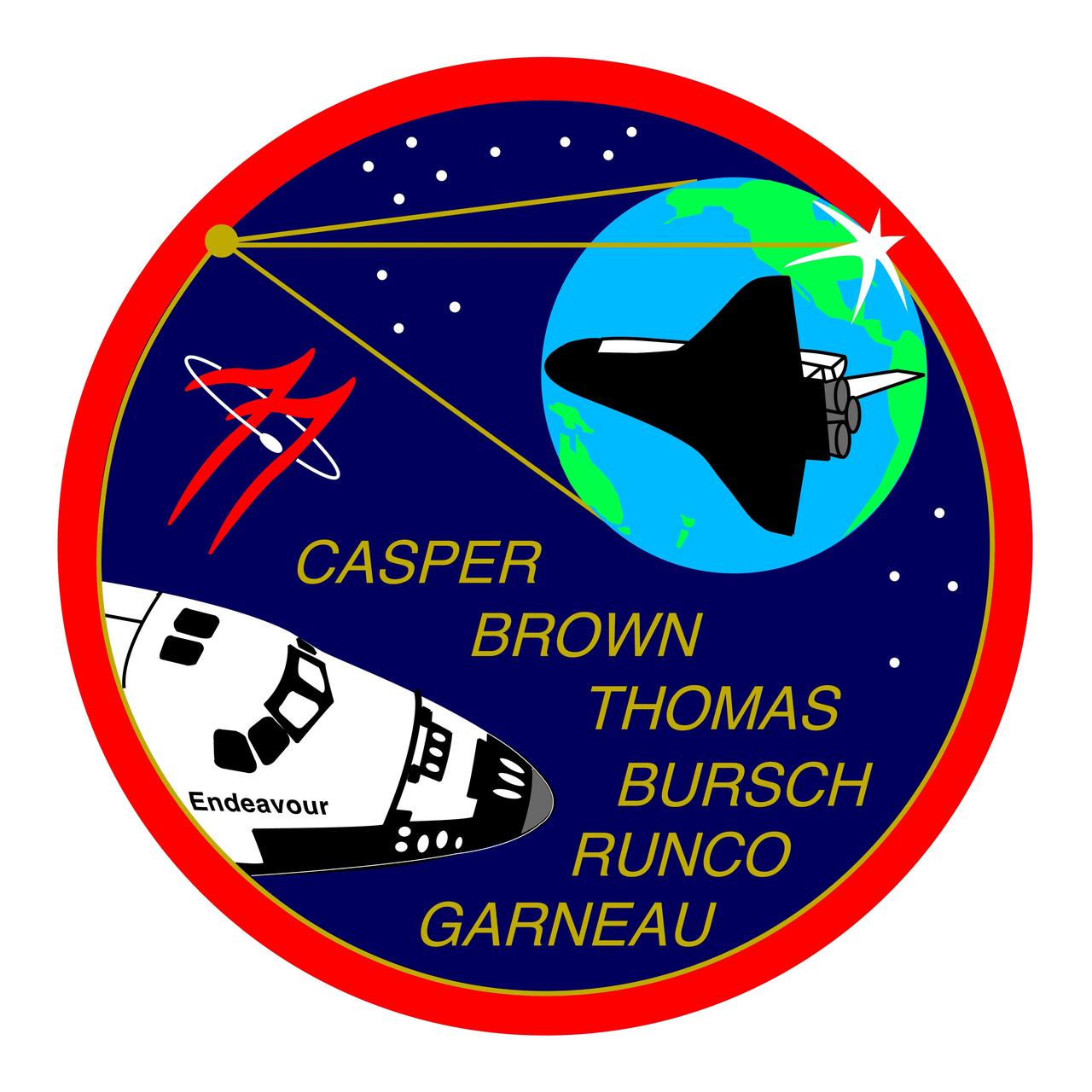
STS077-S-001 (February 1996) --- The STS-77 crew patch, designed by the crew members, displays the space shuttle Endeavour the lower left and its reflection within the tripod and concave parabolic mirror of the Shuttle Pointed Autonomous Research Tool for Astronomy (SPARTAN) Inflatable Antenna Experiment (IAE). The center leg of the tripod also delineates the top of the Spacehab?s shape, the rest of which is outlined in gold just inside the red perimeter. The Spacehab is carried in the payload bay and houses the Commercial Float Zone Furnace (CFZF) and Space Experiment Facility (SEF) experiments. Also depicted within the confines the IAE mirror are the mission?s rendezvous operations with the Passive Aerodynamically Stabilized Magnetically Damped Satellite/Satellite Test Unit (PAM/STU) satellite and a reflection of Earth. The PAM/STU satellite appears as a bright six-pointed star-like reflection of the sun on the edge of the mirror with the space shuttle Endeavour in position to track it. The sunglint on the mirror?s edge, which also appears as an orbital sunset, is located over Goddard Space Flight Center (GSFC), the development facility for the SPARTAN/IAE and Technology Experiments Advancing Missions in Space (TEAMS) experiments. The reflection of Earth is oriented to show the individual countries of the crew as well as the ocean which Captain Cook explored in the original Endeavour. The mission number ?77? is featured as twin stylized chevrons and an orbiting satellite as adapted from NASA?s logo. The stars at the top are arranged as seen in the northern sky in the vicinity of the constellation Ursa Minor. The field of 11 stars represents both the TEAMS cluster of experiments (the four antennae of Global Positioning System Attitude and Navigation Experiment (GANE), the single canister of Liquid Metal Thermal Experiment (LMTE), the three canisters of Vented Tank Resupply Experiment (VTRE), and the canisters of PAM/STU, and the 11th flight of the Endeavour. The constellation at the right shows the four stars of the Southern Cross for the fourth flight of Spacehab. The NASA insignia design for space shuttle flights is reserved for use by the astronauts and for other official use as the NASA Administrator may authorize. Public availability has been approved only in the forms of illustrations by the various news media. When and if there is any change in this policy, which is not anticipated, the change will be publicly announced. Photo credit: NASA

This is a radar image of the Rabaul volcano on the island of New Britain, Papua, New Guinea taken almost a month after its September 19, 1994, eruption that killed five people and covered the town of Rabaul and nearby villages with up to 75 centimeters (30 inches) of ash. More than 53,000 people have been displaced by the eruption. The image was acquired by the Spaceborne Imaging Radar-C/X-band Synthetic Aperture Radar (SIR-C/X-SAR) aboard the space shuttle Endeavour on its 173rd orbit on October 11, 1994. This image is centered at 4.2 degrees south latitude and 152.2 degrees east longitude in the southwest Pacific Ocean. The area shown is approximately 21 kilometers by 25 kilometers (13 miles by 15.5 miles). North is toward the upper right. The colors in this image were obtained using the following radar channels: red represents the L-band (horizontally transmitted and received); green represents the L-band (horizontally transmitted and vertically received); blue represents the C-band (horizontally transmitted and vertically received). Most of the Rabaul volcano is underwater and the caldera (crater) creates Blanche Bay, the semi-circular body of water that occupies most of the center of the image. Volcanic vents within the caldera are visible in the image and include Vulcan, on a peninsula on the west side of the bay, and Rabalanakaia and Tavurvur (the circular purple feature near the mouth of the bay) on the east side. Both Vulcan and Tavurvur were active during the 1994 eruption. Ash deposits appear red-orange on the image, and are most prominent on the south flanks of Vulcan and north and northwest of Tavurvur. A faint blue patch in the water in the center of the image is a large raft of floating pumice fragments that were ejected from Vulcan during the eruption and clog the inner bay. Visible on the east side of the bay are the grid-like patterns of the streets of Rabaul and an airstrip, which appears as a dark northwest-trending band at the right-center of the image. Ashfall and subsequent rains caused the collapse of most buildings in the town of Rabaul. Mudflows and flooding continue to pose serious threats to the town and surrounding villages. Volcanologists and local authorities expect to use data such as this radar image to assist them in identifying the mechanisms of the eruption and future hazardous conditions that may be associated with the vigorously active volcano. http://photojournal.jpl.nasa.gov/catalog/PIA01767