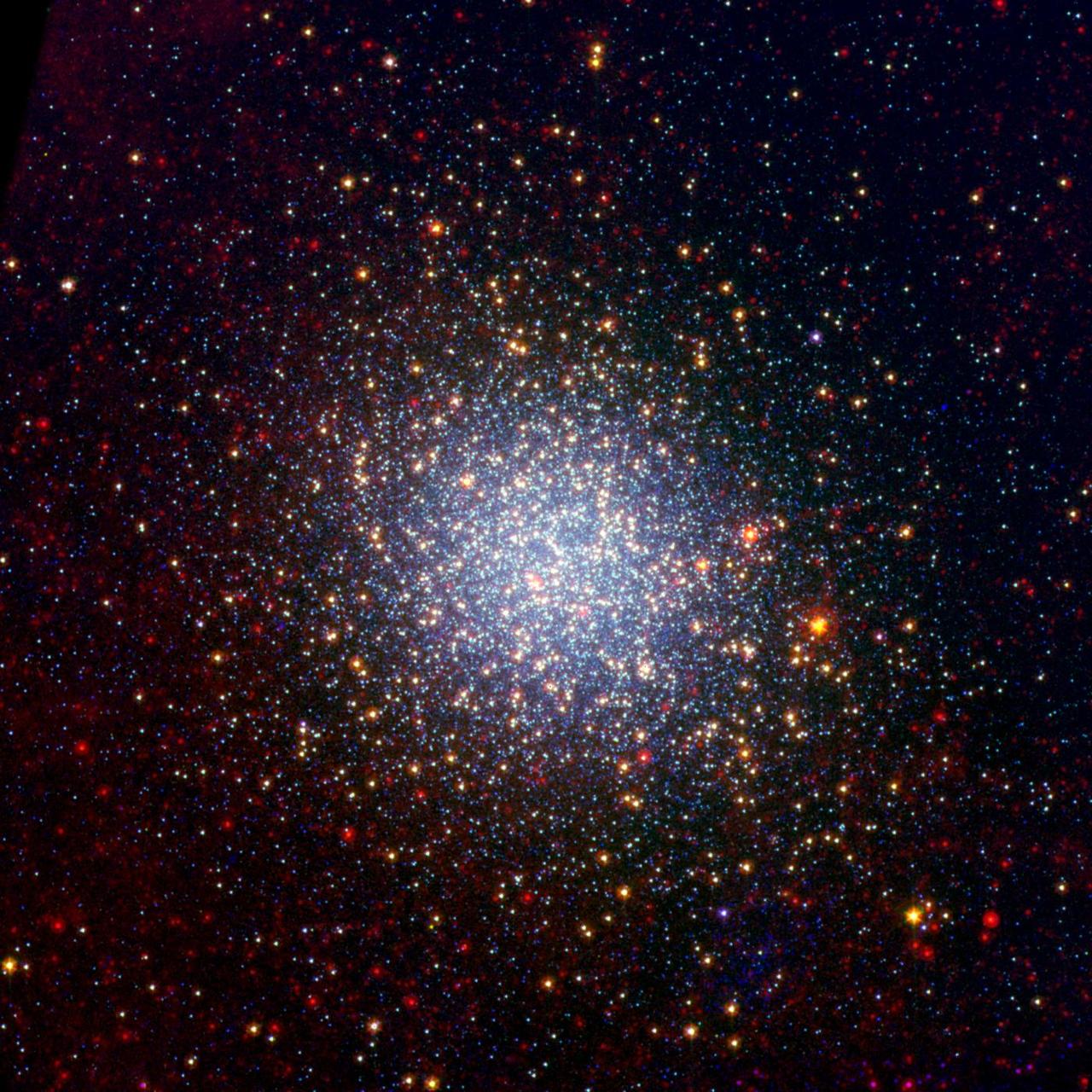
A cluster brimming with millions of stars glistens like an iridescent opal in this image from NASA Spitzer Space Telescope. Called Omega Centauri, the sparkling orb of stars is like a miniature galaxy.
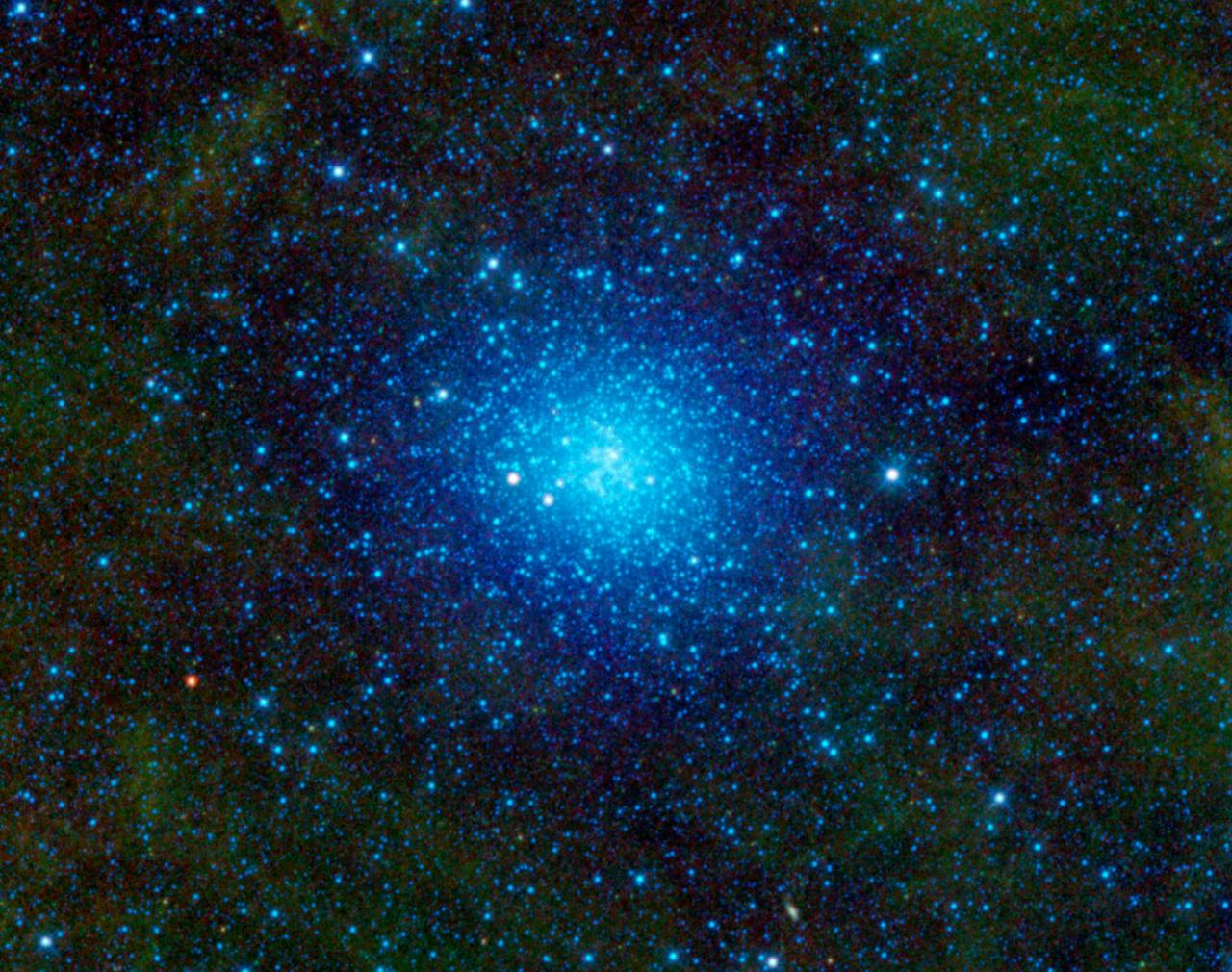
NASA Wide-field Infrared Survey Explorer has captured a favorite observing target of amateur astronomers, Omega Centauri. This celestial cluster of stars can be found in the constellation Centaurus.
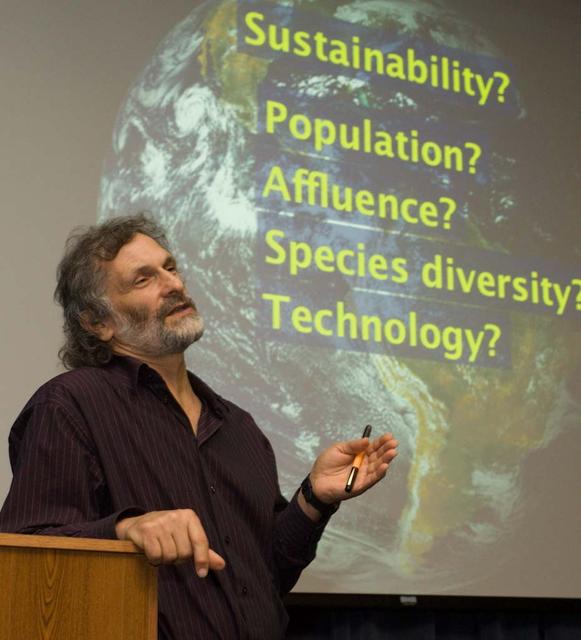
Director's Colloquium; Dr Jonathan Trent, Physical Scientist with NASA Ames Bioengineering Branch presents 'OMEGA and the Future of Aviation Fuels) Abstract: Offshore Membrane Enclosures for Growing Algae (OMEGA) is an innovative approach to growing oil-producing, freshwater algea in off shore enclosures, using municipal wastewater that is currently dumped into the ocean at a rate of >35 billion gals/day.
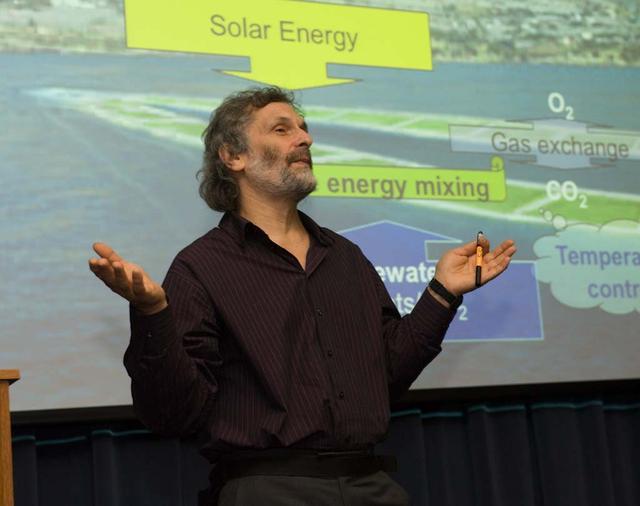
Director's Colloquium; Dr Jonathan Trent, Physical Scientist with NASA Ames Bioengineering Branch presents 'OMEGA and the Future of Aviation Fuels) Abstract: Offshore Membrane Enclosures for Growing Algae (OMEGA) is an innovative approach to growing oil-producing, freshwater algea in off shore enclosures, using municipal wastewater that is currently dumped into the ocean at a rate of >35 billion gals/day.
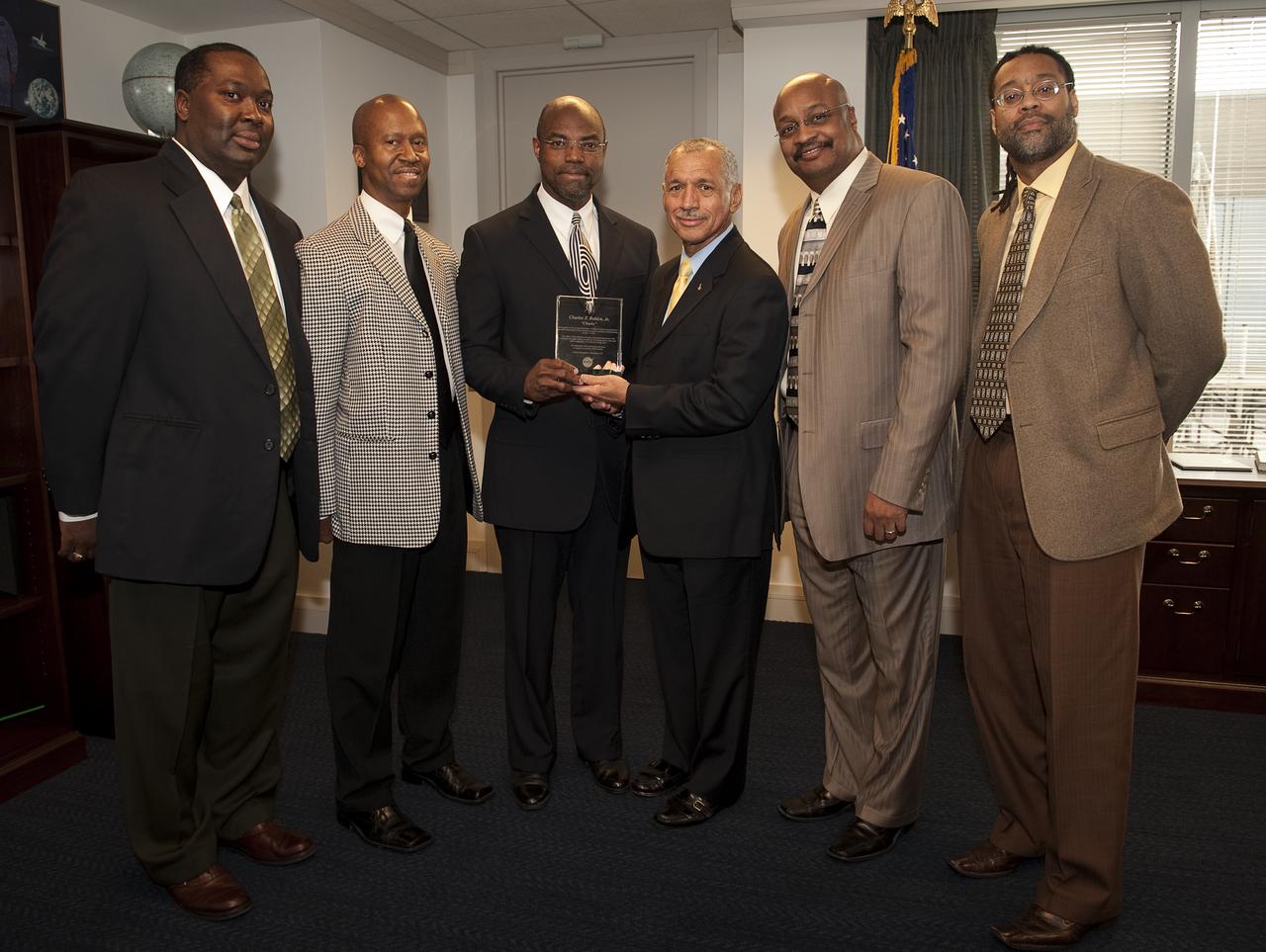
NASA Administrator Charles Bolden, 4th from left, is presented a plaque in honor of him becoming the 12th NASA Administrator by NASA Headquarters members of his fraternity, Omega Psi Phi: from left, Andrew Hubbard, Clinton Green, Carl Person, Dwayne Brown, and Elbert Cox, right. Omega Psi Phi Fraternity, Inc. was founded at Howard University on Nov. 17, 1911. The phrase “friendship is essential to the soul," is the fraternity’s motto. Photo Credit: (NASA/Bill Ingalls)
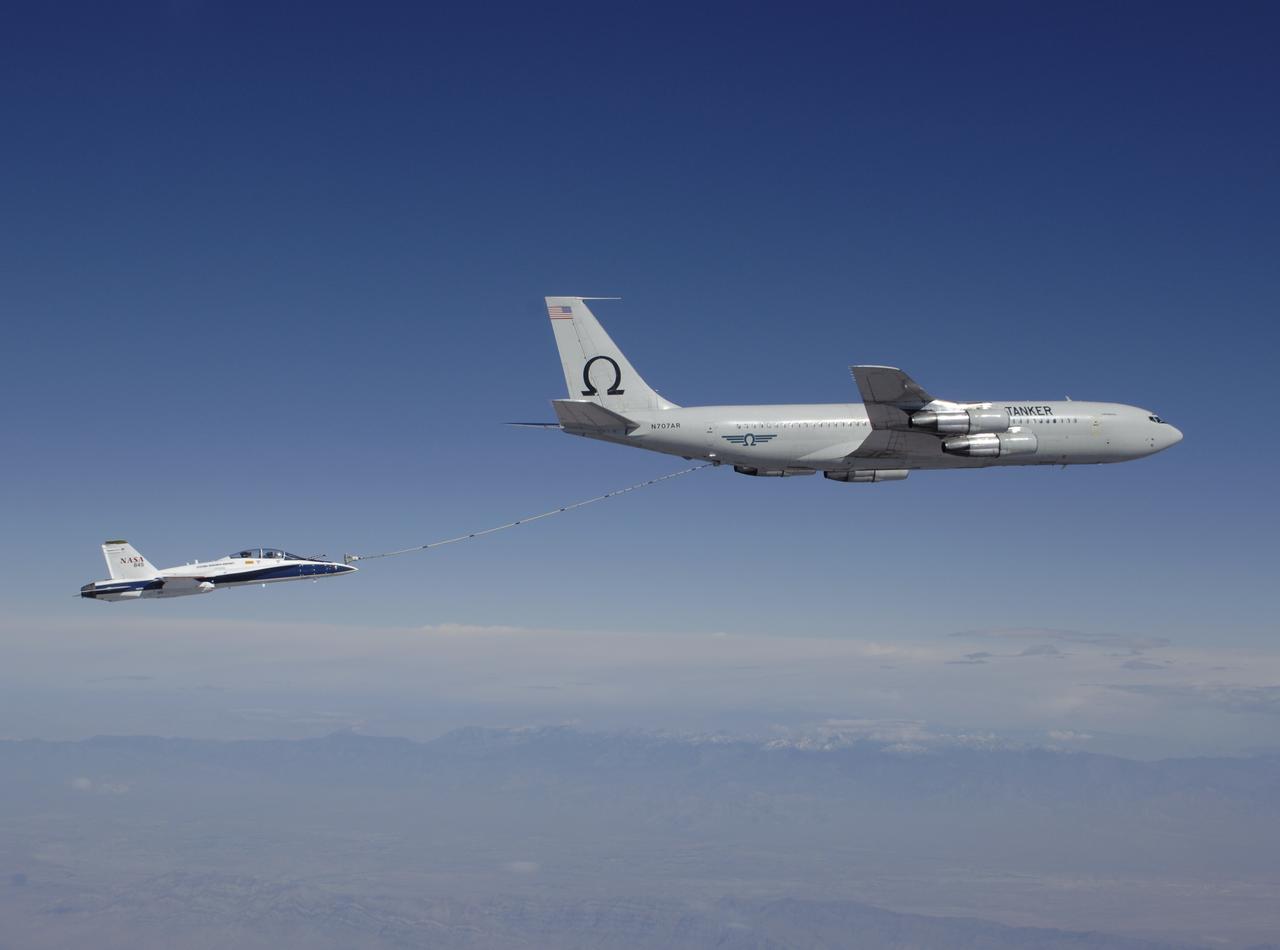
F/A-18 #845 behind an Omega Air Boeing 707 tanker during an Autonomous Airborne Refueling Demonstration (AARD) flight.
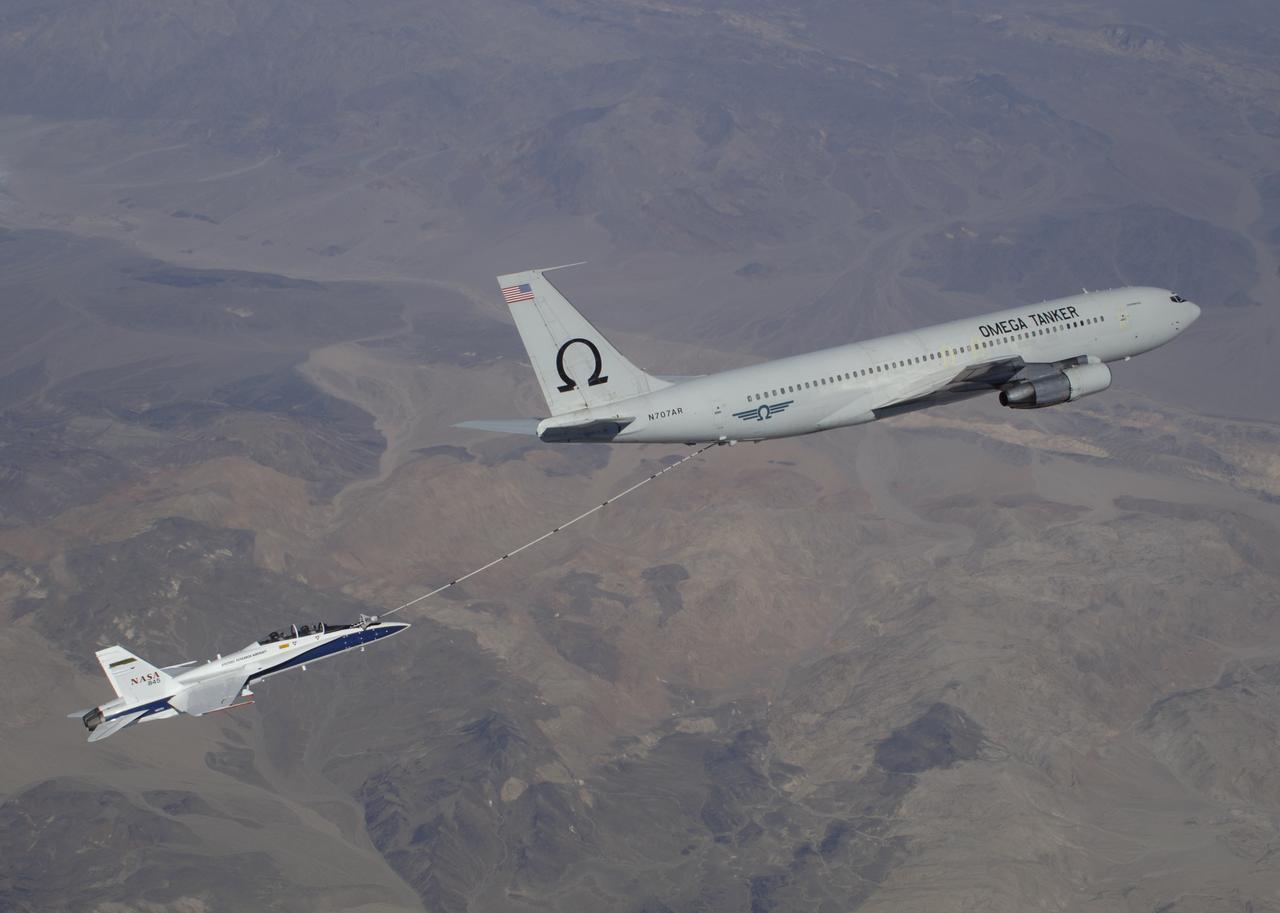
F/A-18 #845 behind an Omega Air Boeing 707 tanker during an Autonomous Airborne Refueling Demonstration (AARD) flight.

View from F/A-18 #845 behind Omega Air Boeing 707 tanker during an AARD flight showing probe and drogue.

In this sturning image provided by the Hubble Space Telescope (HST), the Omega Nebula (M17) resembles the fury of a raging sea, showing a bubbly ocean of glowing hydrogen gas and small amounts of other elements such as oxygen and sulfur. The nebula, also known as the Swan Nebula, is a hotbed of newly born stars residing 5,500 light-years away in the constellation Sagittarius. The wavelike patterns of gas have been sculpted and illuminated by a torrent of ultraviolet radiation from the young massive stars, which lie outside the picture to the upper left. The ultraviolet radiation is carving and heating the surfaces of cold hydrogen gas clouds. The warmed surfaces glow orange and red in this photograph. The green represents an even hotter gas that masks background structures. Various gases represented with color are: sulfur, represented in red; hydrogen, green; and oxygen blue.
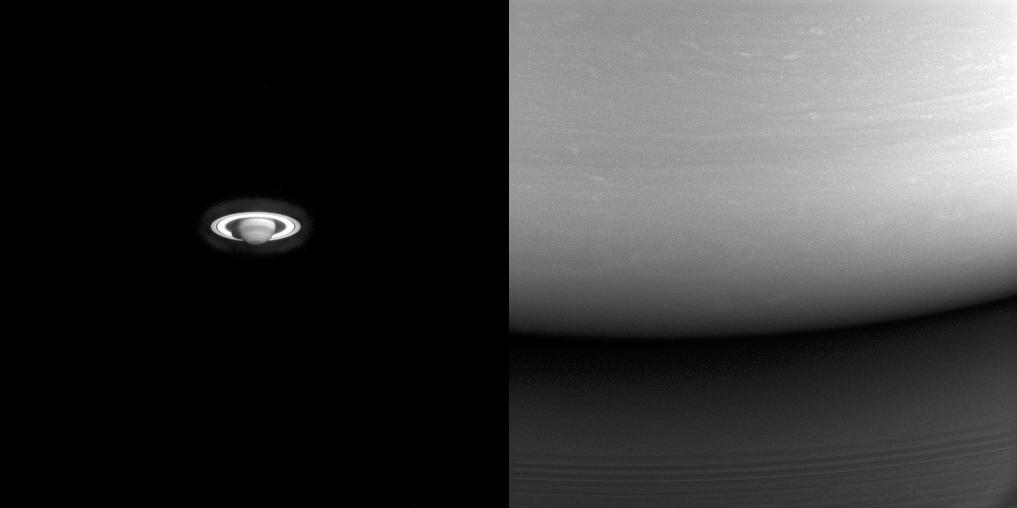
These two images illustrate just how far Cassini traveled to get to Saturn. On the left is one of the earliest images Cassini took of the ringed planet, captured during the long voyage from the inner solar system. On the right is one of Cassini's final images of Saturn, showing the site where the spacecraft would enter the atmosphere on the following day. In the left image, taken in 2001, about six months after the spacecraft passed Jupiter for a gravity assist flyby, the best view of Saturn using the spacecraft's high-resolution (narrow-angle) camera was on the order of what could be seen using the Earth-orbiting Hubble Space Telescope. At the end of the mission (at right), from close to Saturn, even the lower resolution (wide-angle) camera could capture just a tiny part of the planet. The left image looks toward Saturn from 20 degrees below the ring plane and was taken on July 13, 2001 in wavelengths of infrared light centered at 727 nanometers using the Cassini spacecraft narrow-angle camera. The view at right is centered on a point 6 degrees north of the equator and was taken in visible light using the wide-angle camera on Sept. 14, 2017. The view on the left was acquired at a distance of approximately 317 million miles (510 million kilometers) from Saturn. Image scale is about 1,900 miles (3,100 kilometers) per pixel. The view at right was acquired at a distance of approximately 360,000 miles (579,000 kilometers) from Saturn. Image scale is 22 miles (35 kilometers) per pixel. The Cassini spacecraft ended its mission on Sept. 15, 2017. https://photojournal.jpl.nasa.gov/catalog/PIA21353
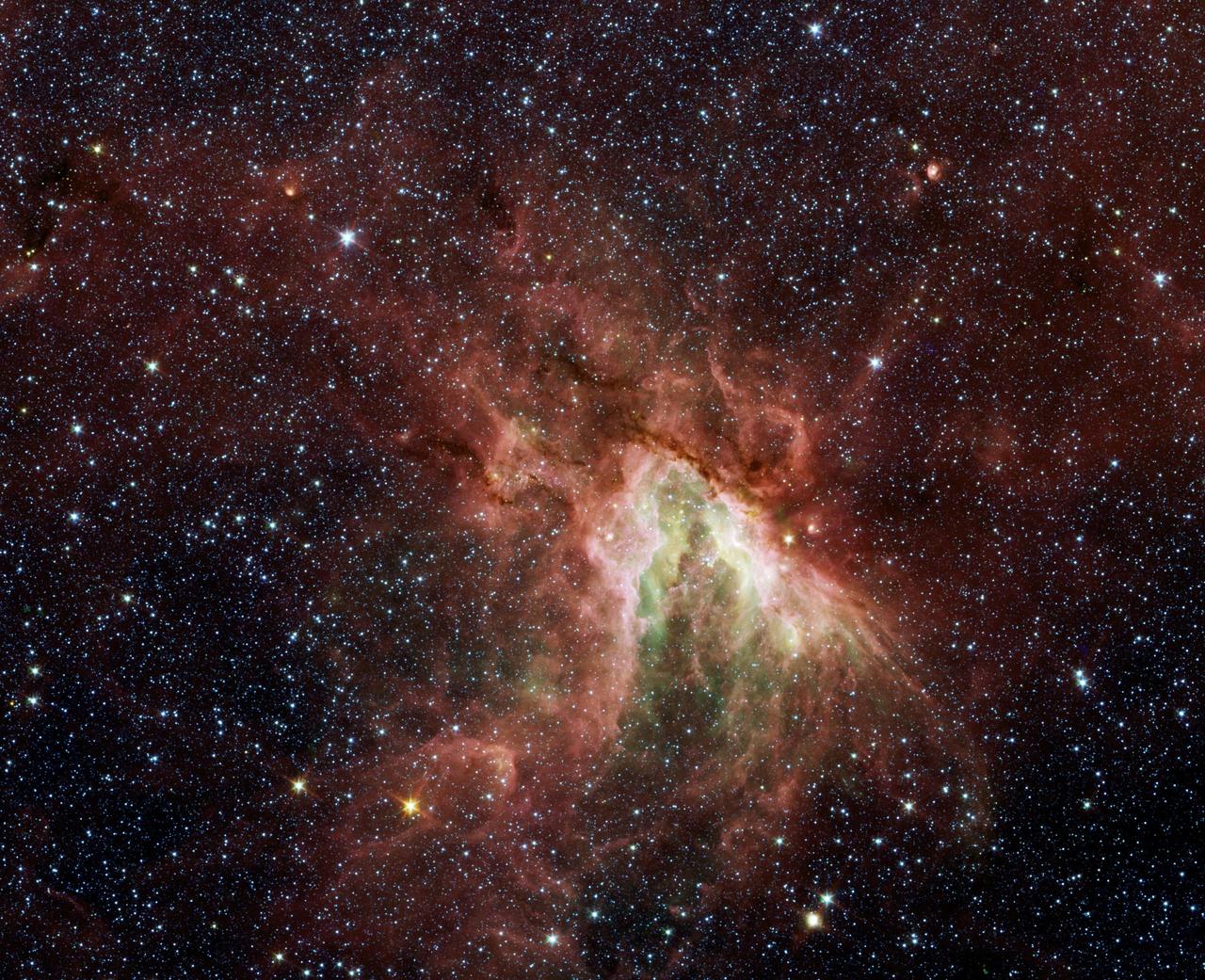
NASA Spitzer Space Telescope has captured a new, infrared view of the choppy star-making cloud called M17, also known as Omega Nebula or the Swan nebula.
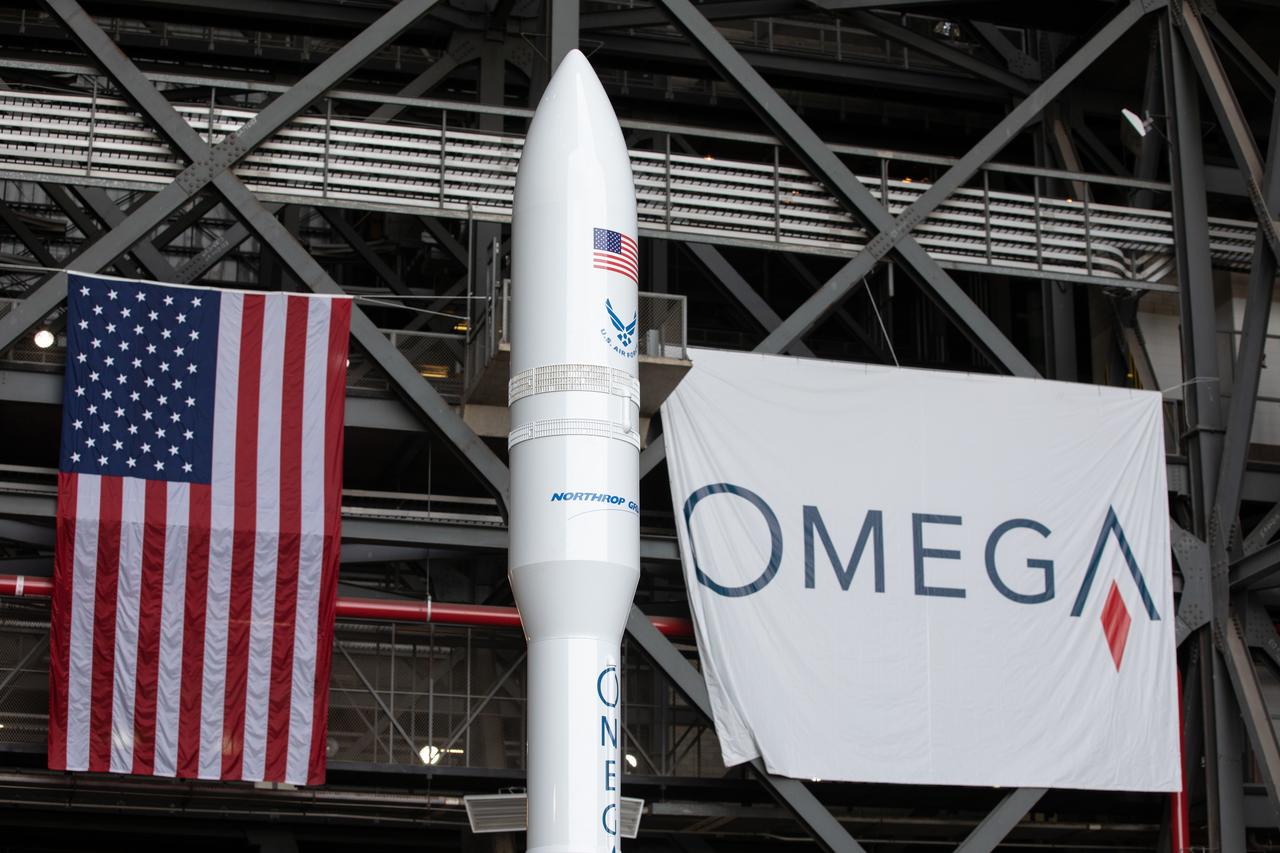
During a ribbon cutting ceremony on Aug. 16, 2019, in High Bay 2 of the Vehicle Assembly Building (VAB) at NASA’s Kennedy Space Center in Florida, a scale model of the Northrop Grumman OmegA launch system is in view. The VAB is getting its first commercial tenant. Northrop Grumman signed a Reimbursable Space Act Agreement with NASA for use of the facilities. The company will assemble and test its new OmegA rocket inside the massive facility’s High Bay 2. The company also will modify mobile launcher platform-3 to serve as the launch vehicle’s assembly and launch platform. Northrop Grumman is developing the OmegA rocket, an intermediate/heavy-class launch vehicle, as part of a launch services agreement with the U.S. Air Force.
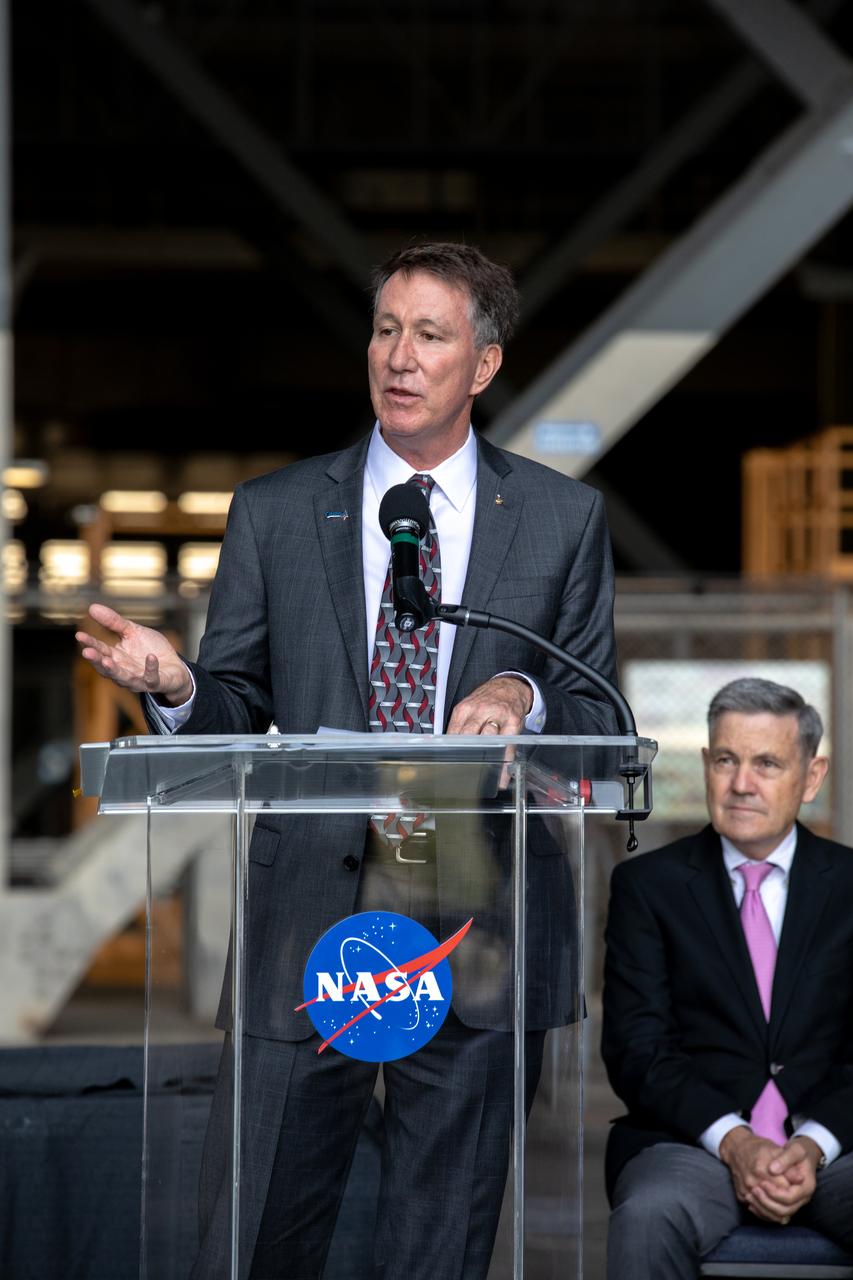
During a ribbon cutting ceremony on Aug. 16, 2019, in High Bay 2 of the Vehicle Assembly Building (VAB) at NASA’s Kennedy Space Center in Florida, Kent Rominger, Northrop Grumman’s vice president and capture lead for the OmegA launch system, speaks to legislators and guests. Seated behind him is Kennedy Center Director Bob Cabana. The VAB is getting its first commercial tenant. Northrop Grumman signed a Reimbursable Space Act Agreement with NASA for use of the facilities. The company will assemble and test its new OmegA rocket inside the massive facility’s High Bay 2. The company also will modify mobile launcher platform-3 to serve as the launch vehicle’s assembly and launch platform. Northrop Grumman is developing the OmegA rocket, an intermediate/heavy-class launch vehicle, as part of a launch services agreement with the U.S. Air Force.
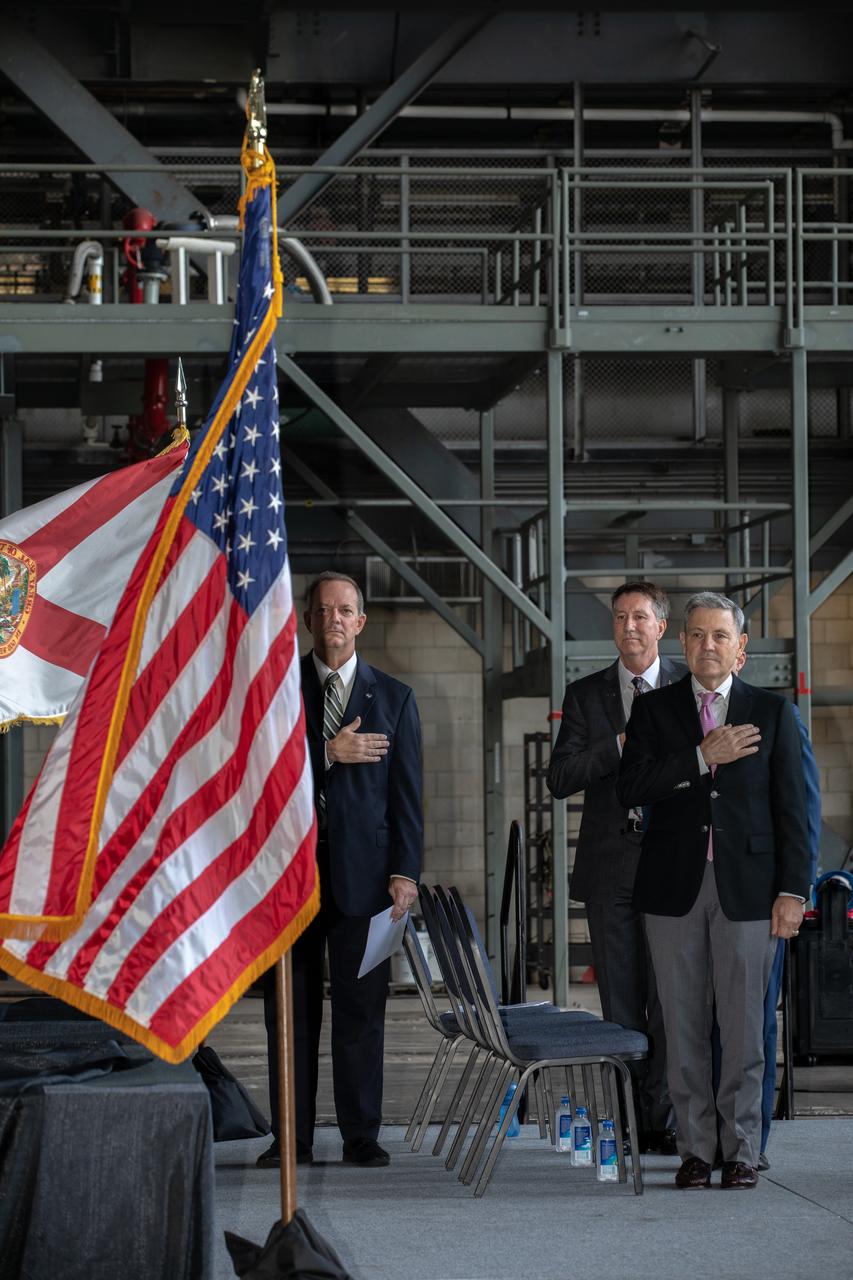
The National Anthem is sung during a ribbon cutting ceremony on Aug. 16, 2019, in High Bay 2 of the Vehicle Assembly Building (VAB) at NASA’s Kennedy Space Center in Florida. From left are Tom Engler, director of Kennedy’s Center Planning and Development Office; Kent Rominger, Northrop Grumman’s vice president and capture lead for the OmegA launch system; and Kennedy’s Center Director Bob Cabana. The VAB is getting its first commercial tenant. Northrop Grumman signed a Reimbursable Space Act Agreement with NASA for use of the facilities. The company will assemble and test its new OmegA rocket inside the massive facility’s High Bay 2. The company also will modify mobile launcher platform-3 to serve as the launch vehicle’s assembly and launch platform. Northrop Grumman is developing the OmegA rocket, an intermediate/heavy-class launch vehicle, as part of a launch services agreement with the U.S. Air Force.
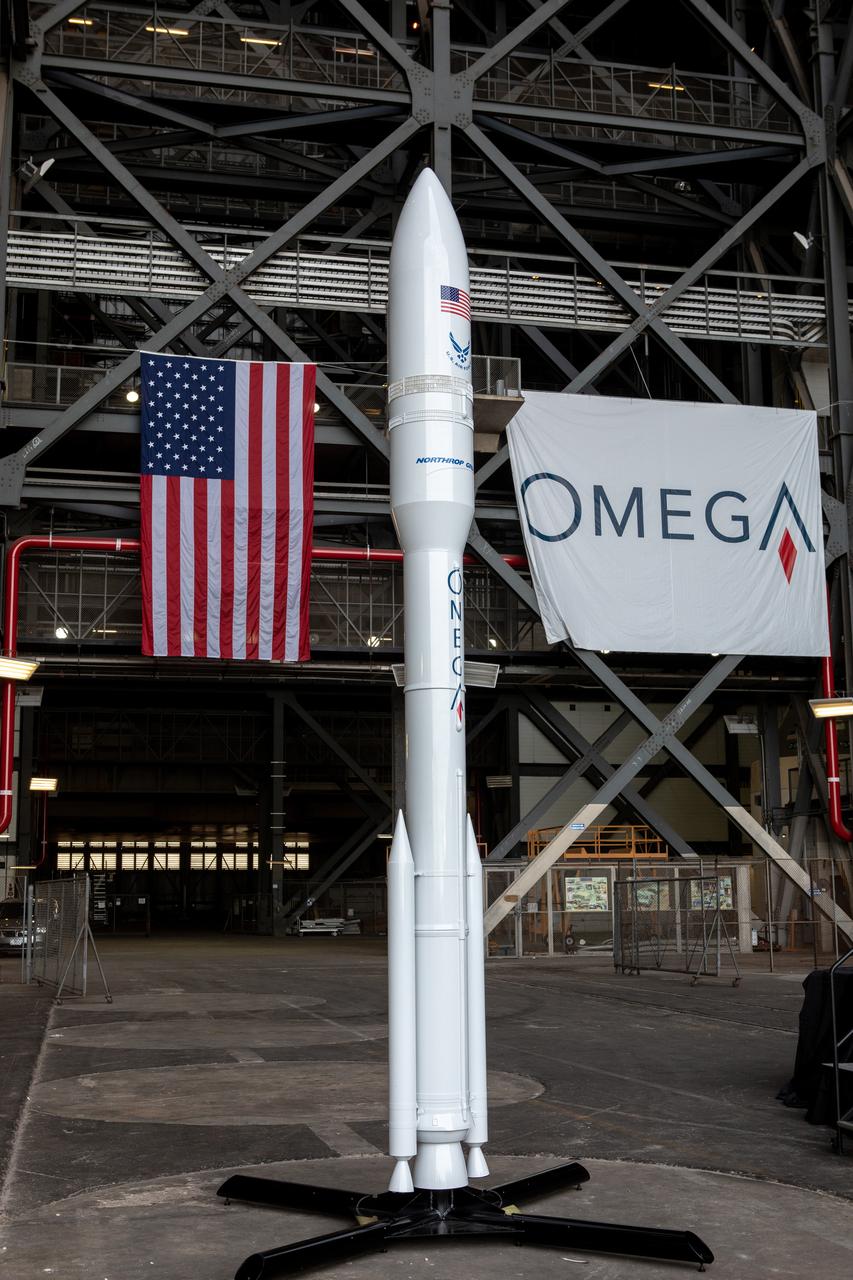
During a ribbon cutting ceremony on Aug. 16, 2019, in High Bay 2 of the Vehicle Assembly Building (VAB) at NASA’s Kennedy Space Center in Florida, a scale model of the Northrop Grumman OmegA launch system is on display. The VAB is getting its first commercial tenant. Northrop Grumman signed a Reimbursable Space Act Agreement with NASA for use of the facilities. The company will assemble and test its new OmegA rocket inside the massive facility’s High Bay 2. The company also will modify mobile launcher platform-3 to serve as the launch vehicle’s assembly and launch platform. Northrop Grumman is developing the OmegA rocket, an intermediate/heavy-class launch vehicle, as part of a launch services agreement with the U.S. Air Force.
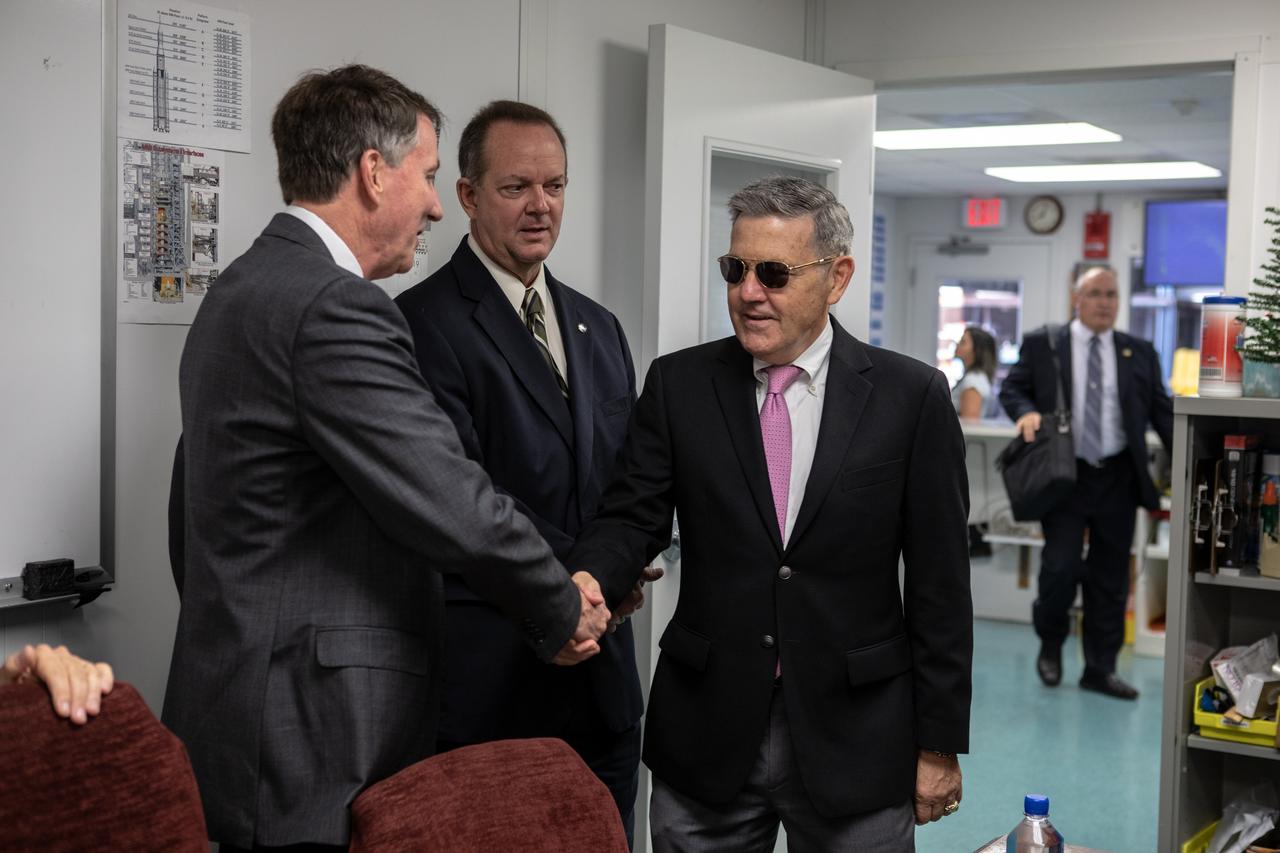
Just before a ribbon cutting ceremony on Aug. 16, 2019, in High Bay 2 of the Vehicle Assembly (VAB) at NASA’s Kennedy Space Center in Florida, Center Director Bob Cabana, at right, shakes hands with Kent Rominger, Northrop Grumman’s vice president and capture lead for the OmegA launch system. In the center is Tom Engler, director of the Center Planning and Development Office at Kennedy. The VAB is getting its first commercial tenant. Northrop Grumman signed a Reimbursable Space Act Agreement with NASA for use of the facilities. The company will assemble and test its new OmegA rocket inside the massive facility’s High Bay 2. The company also will modify the space shuttle-era mobile launcher platform-3 to serve as the launch vehicle’s assembly and launch platform. Northrop Grumman is developing the OmegA rocket, an intermediate/heavy-class launch vehicle, as part of a launch services agreement with the U.S. Air Force.
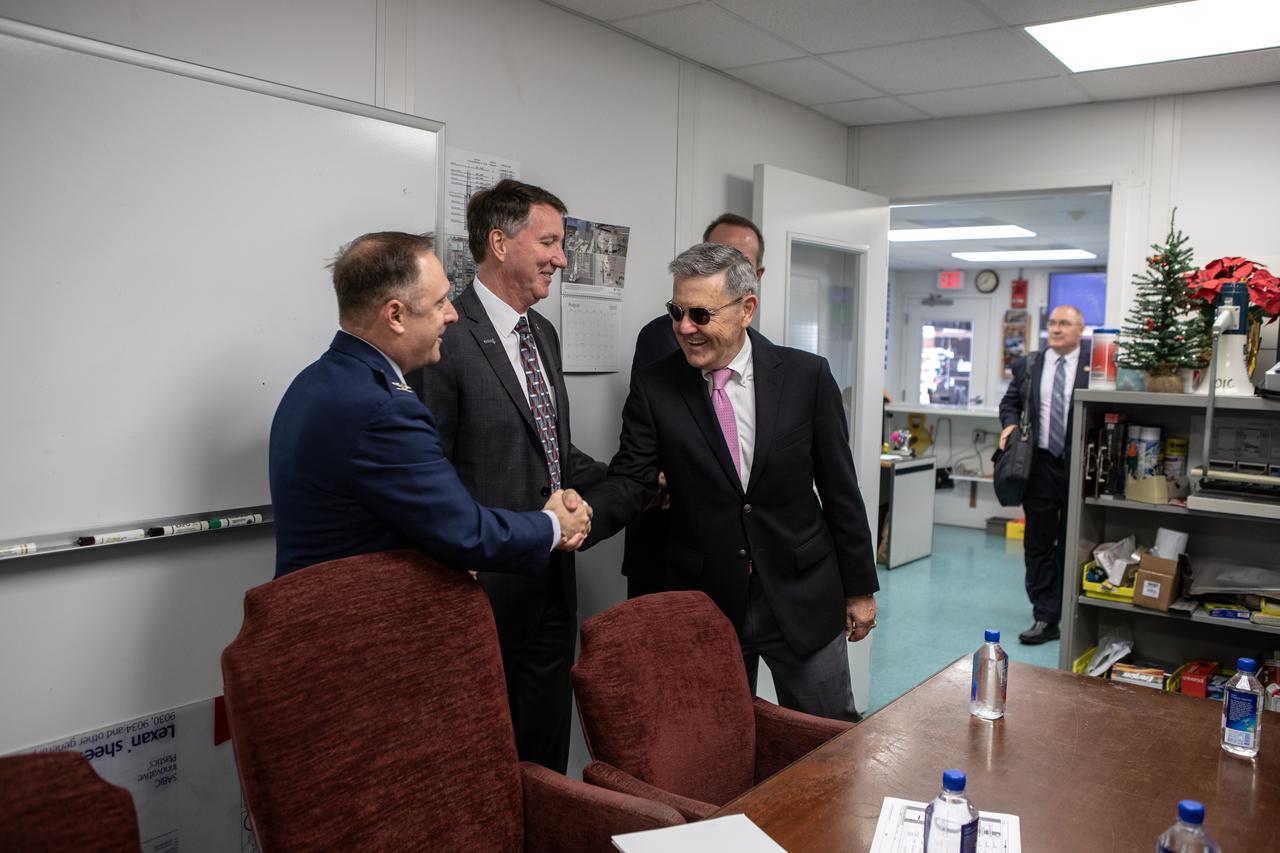
Just before a ribbon cutting ceremony on Aug. 16, 2019, in High Bay 2 of the Vehicle Assembly (VAB) at NASA’s Kennedy Space Center in Florida, Center Director Bob Cabana, at right, shakes hands with Col. Thomas Ste. Marie, vice commander, U.S. Air Force, 45th Space Wing. In the center is Kent Rominger, Northrop Grumman’s vice president and capture lead for the OmegA launch system. The VAB is getting its first commercial tenant. Northrop Grumman signed a Reimbursable Space Act Agreement with NASA for use of the facilities. The company will assemble and test its new OmegA rocket inside the massive facility’s High Bay 2. The company also will modify the space shuttle-era mobile launcher platform-3 to serve as the launch vehicle’s assembly and launch platform. Northrop Grumman is developing the OmegA rocket, an intermediate/heavy-class launch vehicle, as part of a launch services agreement with the U.S. Air Force.
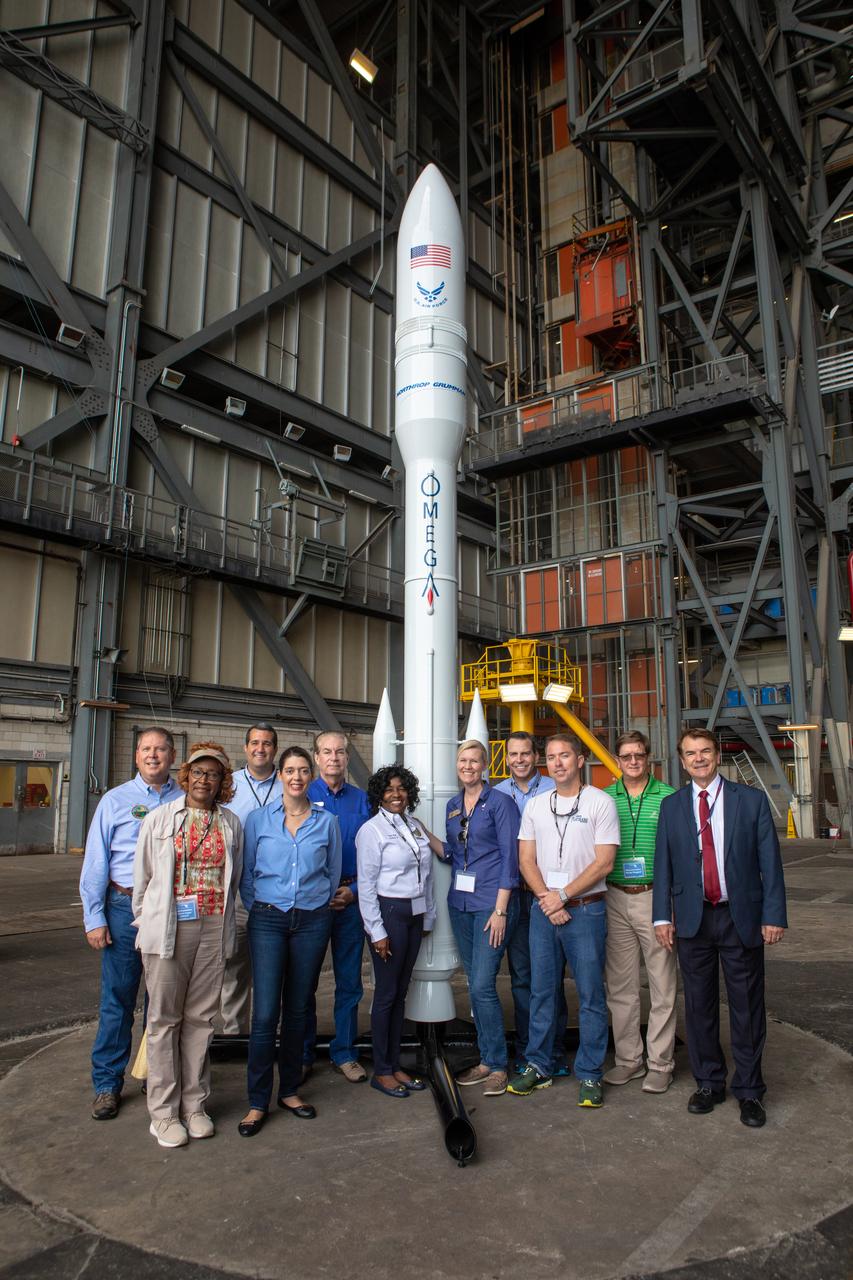
Legislators and invited guests attend a ribbon cutting ceremony on Aug. 16, 2019, in High Bay 2 of the Vehicle Assembly Building (VAB) at NASA’s Kennedy Space Center in Florida. At far right is Florida State Senator Thad Altman. Behind the group is a scale model of the Northrop Grumman OmegA launch vehicle. The VAB is getting its first commercial tenant. Northrop Grumman signed a Reimbursable Space Act Agreement with NASA for use of the facilities. The company will assemble and test its new OmegA rocket inside the massive facility’s High Bay 2. The company also will modify mobile launcher platform-3 to serve as the launch vehicle’s assembly and launch platform. Northrop Grumman is developing the OmegA rocket, an intermediate/heavy-class launch vehicle, as part of a launch services agreement with the U.S. Air Force.
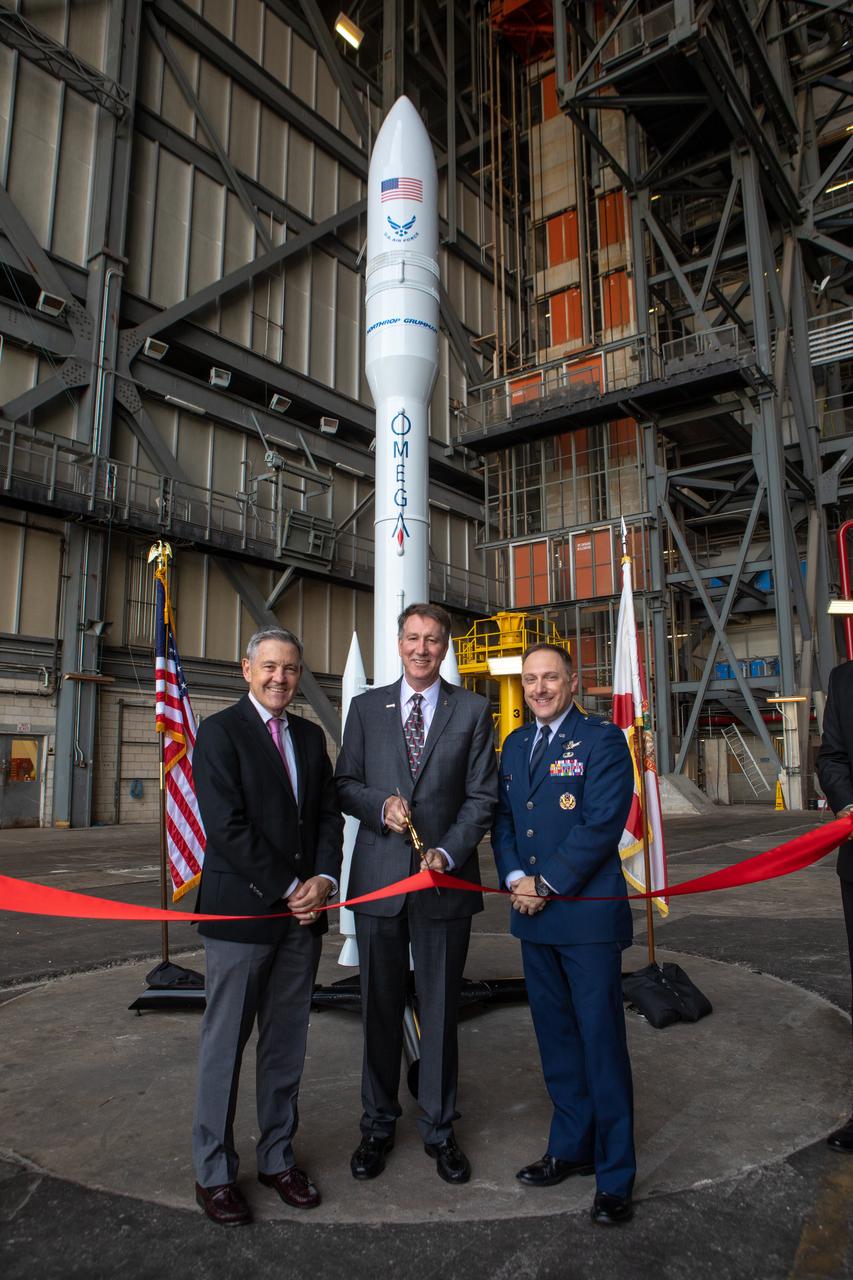
A ribbon cutting ceremony took place on Aug. 16, 2019, in High Bay 2 of the Vehicle Assembly Building (VAB) at NASA’s Kennedy Space Center in Florida. From left are Kennedy Center Director Bob Cabana; Kent Rominger, Northrop Grumman’s vice president and capture lead for the OmegA launch system; and Col. Thomas Ste. Marie, vice commander, U.S. Air Force, 45th Space Wing. Behind them is a scale model of the OmegA launch system. The VAB is getting its first commercial tenant. Northrop Grumman signed a Reimbursable Space Act Agreement with NASA for use of the facilities. The company will assemble and test its new OmegA rocket inside the massive facility’s High Bay 2. The company also will modify mobile launcher platform-3 to serve as the launch vehicle’s assembly and launch platform. Northrop Grumman is developing the OmegA rocket, an intermediate/heavy-class launch vehicle, as part of a launch services agreement with the U.S. Air Force.
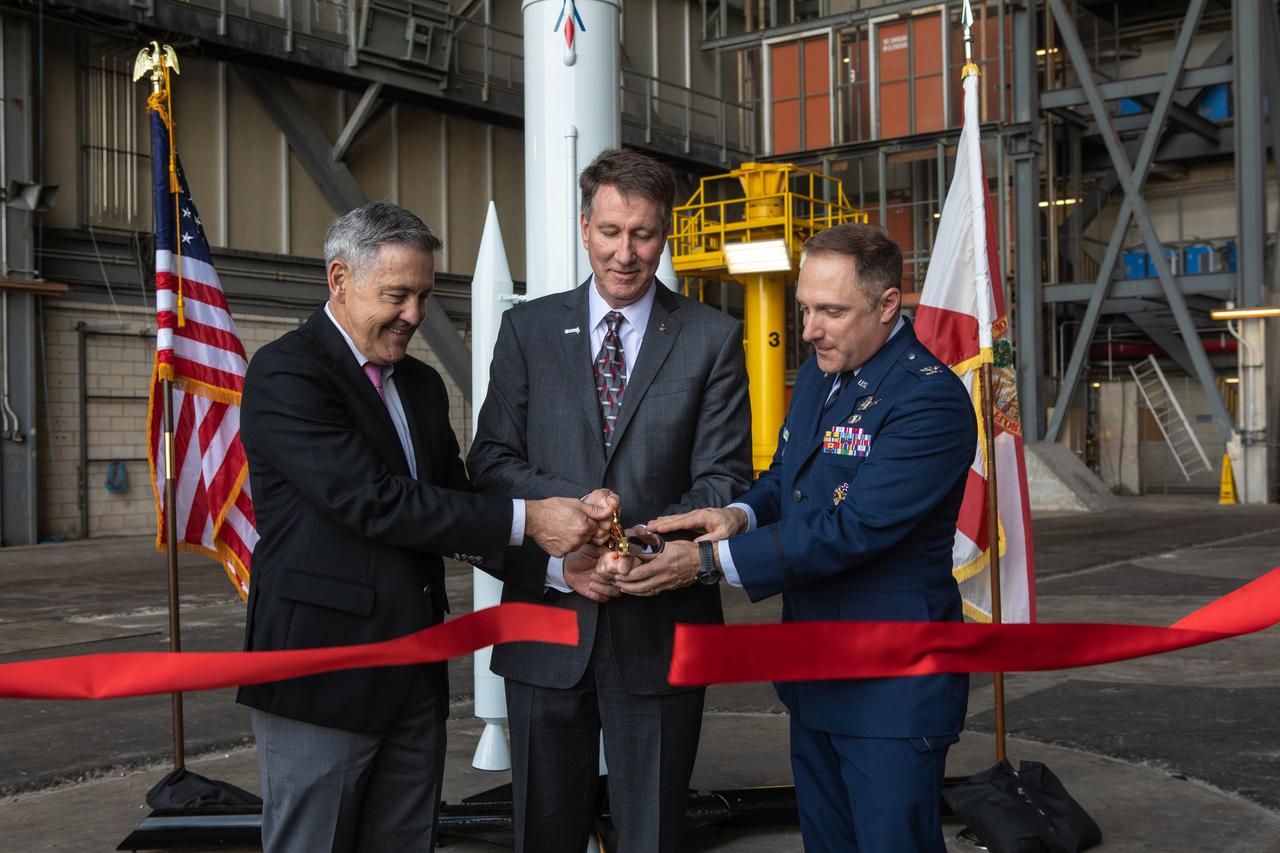
A ribbon cutting ceremony took place on Aug. 16, 2019, in High Bay 2 of the Vehicle Assembly Building (VAB) at NASA’s Kennedy Space Center in Florida. From left are Kennedy Center Director Bob Cabana; Kent Rominger, Northrop Grumman’s vice president and capture lead for the OmegA launch system; and Col. Thomas Ste. Marie, vice commander, U.S. Air Force, 45th Space Wing. Behind them is a scale model of the OmegA launch system. The VAB is getting its first commercial tenant. Northrop Grumman signed a Reimbursable Space Act Agreement with NASA for use of the facilities. The company will assemble and test its new OmegA rocket inside the massive facility’s High Bay 2. The company also will modify mobile launcher platform-3 to serve as the launch vehicle’s assembly and launch platform. Northrop Grumman is developing the OmegA rocket, an intermediate/heavy-class launch vehicle, as part of a launch services agreement with the U.S. Air Force.

A ribbon cutting ceremony took place on Aug. 16, 2019, in High Bay 2 of the Vehicle Assembly Building (VAB) at NASA’s Kennedy Space Center in Florida. From left are Kennedy Center Director Bob Cabana; Kent Rominger, Northrop Grumman’s vice president and capture lead for the OmegA launch system; and Col. Thomas Ste. Marie, vice commander, U.S. Air Force, 45th Space Wing. Behind them is a scale model of the OmegA launch system. The VAB is getting its first commercial tenant. Northrop Grumman signed a Reimbursable Space Act Agreement with NASA for use of the facilities. The company will assemble and test its new OmegA rocket inside the massive facility’s High Bay 2. The company also will modify mobile launcher platform-3 to serve as the launch vehicle’s assembly and launch platform. Northrop Grumman is developing the OmegA rocket, an intermediate/heavy-class launch vehicle, as part of a launch services agreement with the U.S. Air Force.
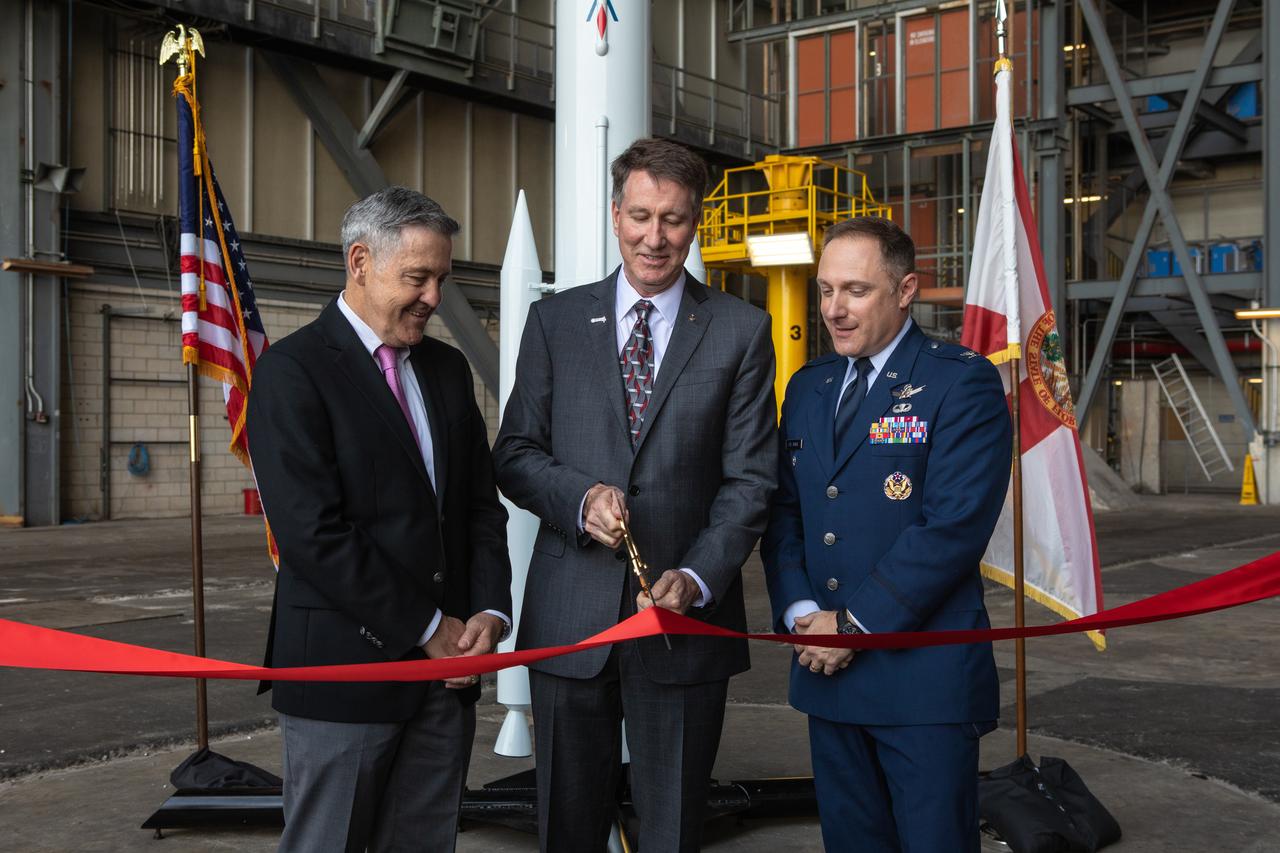
A ribbon cutting ceremony took place on Aug. 16, 2019, in High Bay 2 of the Vehicle Assembly Building (VAB) at NASA’s Kennedy Space Center in Florida. From left are Kennedy Center Director Bob Cabana; Kent Rominger, Northrop Grumman’s vice president and capture lead for the OmegA launch system; and Col. Thomas Ste. Marie, vice commander, U.S. Air Force, 45th Space Wing. Behind them is a scale model of the OmegA launch system. The VAB is getting its first commercial tenant. Northrop Grumman signed a Reimbursable Space Act Agreement with NASA for use of the facilities. The company will assemble and test its new OmegA rocket inside the massive facility’s High Bay 2. The company also will modify mobile launcher platform-3 to serve as the launch vehicle’s assembly and launch platform. Northrop Grumman is developing the OmegA rocket, an intermediate/heavy-class launch vehicle, as part of a launch services agreement with the U.S. Air Force.
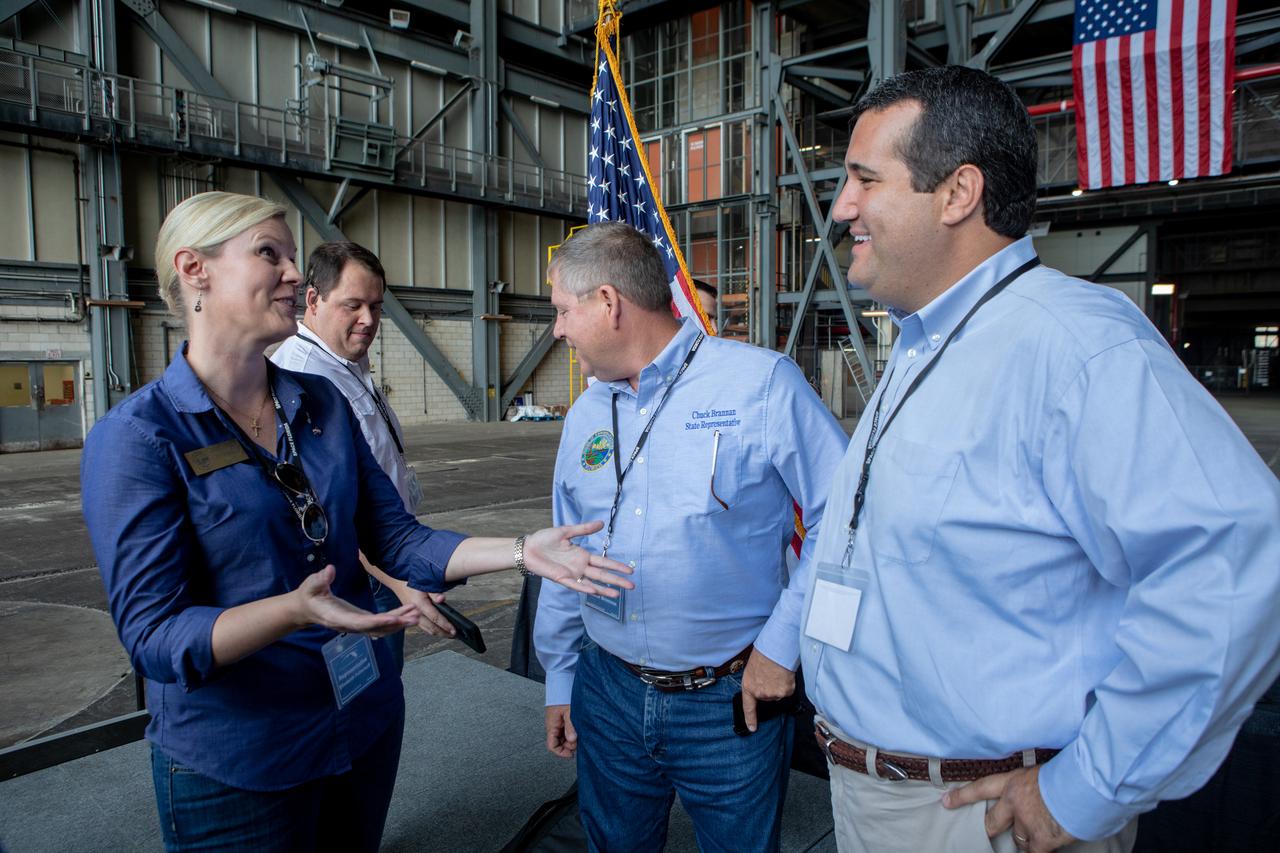
Elected officials and guests visit after a ribbon cutting ceremony on Aug. 16, 2019, in High Bay 2 of the Vehicle Assembly Building (VAB) at NASA’s Kennedy Space Center in Florida. The VAB is getting its first commercial tenant. Northrop Grumman signed a Reimbursable Space Act Agreement with NASA for use of the facilities. The company will assemble and test its new OmegA rocket inside the massive facility’s High Bay 2. The company also will modify mobile launcher platform-3 to serve as the launch vehicle’s assembly and launch platform. Northrop Grumman is developing the OmegA rocket, an intermediate/heavy-class launch vehicle, as part of a launch services agreement with the U.S. Air Force.
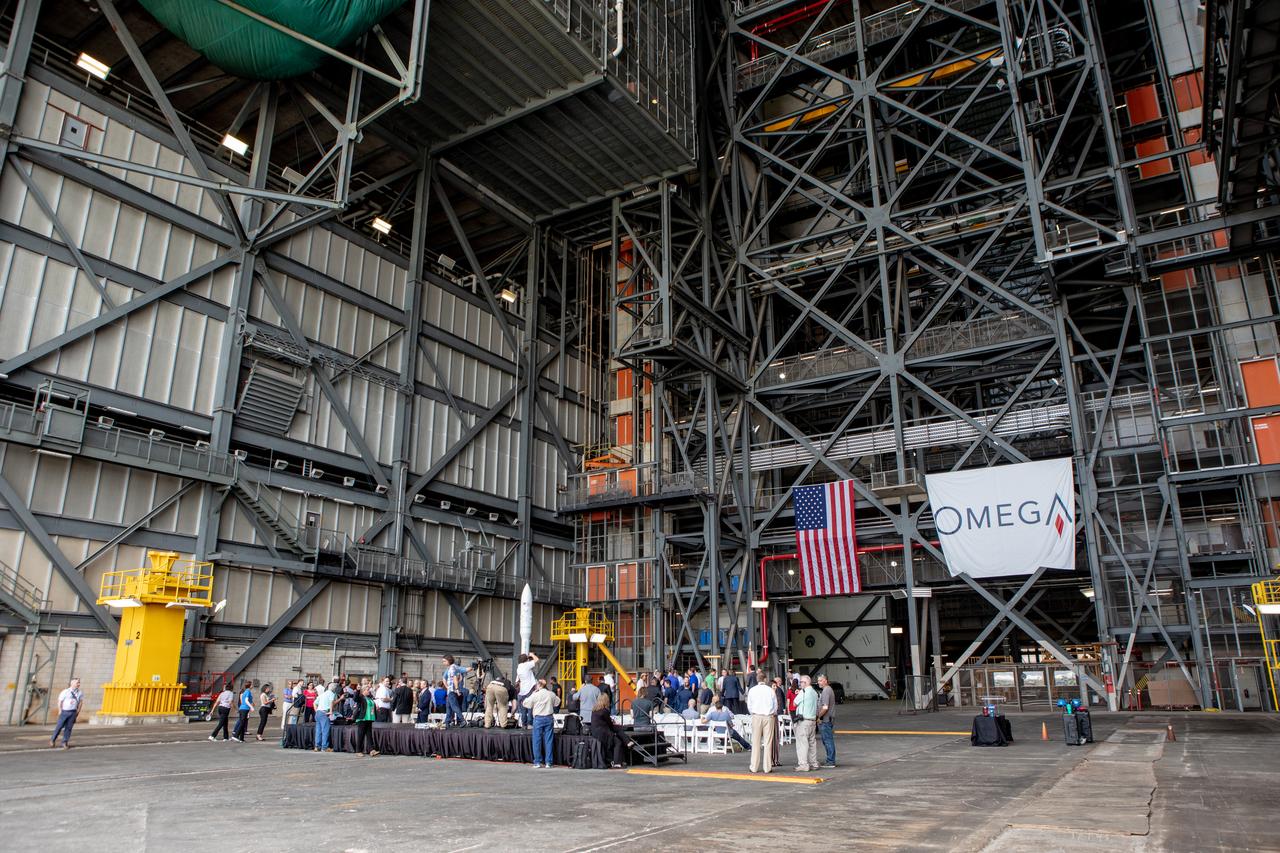
Legislators, invited guests and members of the media attend a ribbon cutting ceremony on Aug. 16, 2019, in High Bay 2 of the Vehicle Assembly Building (VAB) at NASA’s Kennedy Space Center in Florida. The VAB is getting its first commercial tenant. Northrop Grumman signed a Reimbursable Space Act Agreement with NASA for use of the facilities. The company will assemble and test its new OmegA rocket inside the massive facility’s High Bay 2. The company also will modify MLP-3 to serve as the launch vehicle’s assembly and launch platform. Northrop Grumman is developing the OmegA rocket, an intermediate/heavy-class launch vehicle, as part of a launch services agreement with the U.S. Air Force.
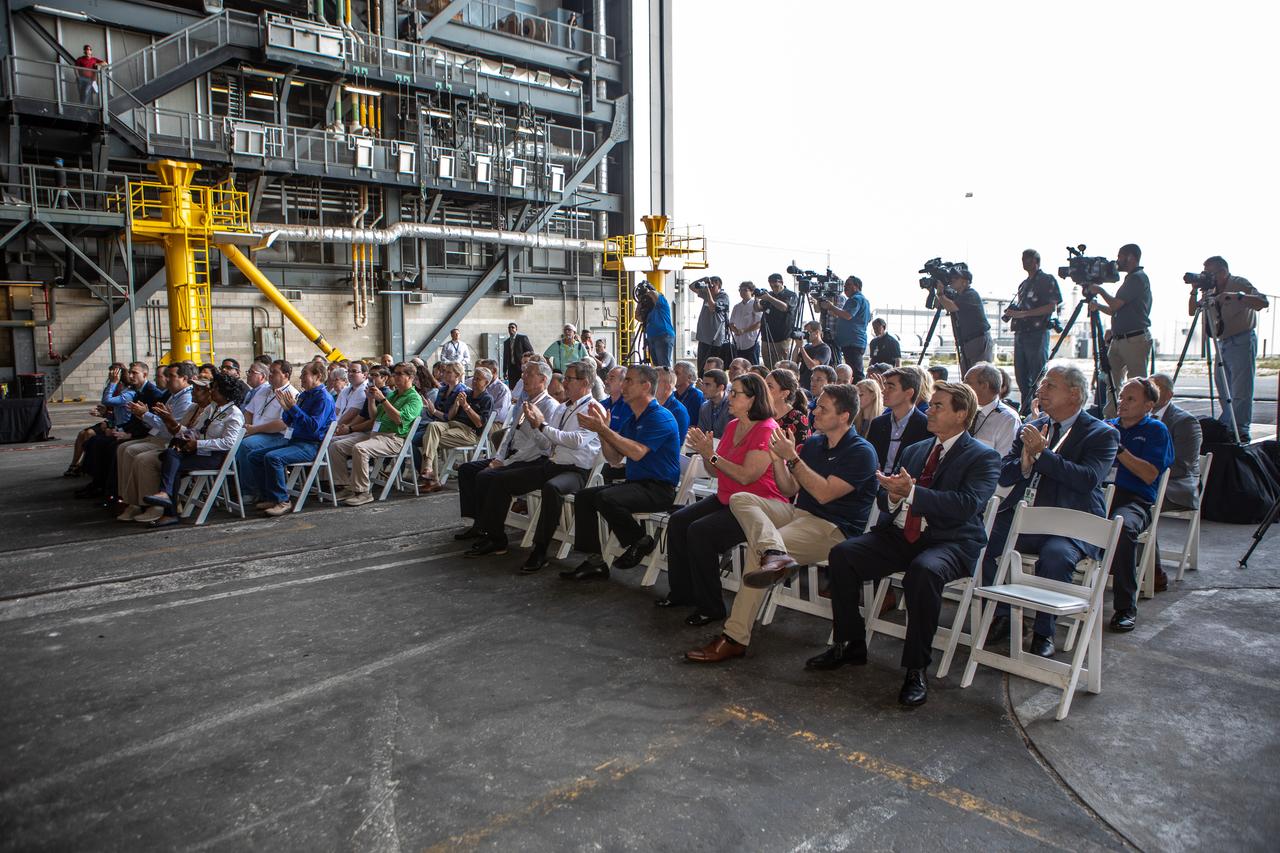
Legislators and invited guests clap during a ribbon cutting ceremony on Aug. 16, 2019, in High Bay 2 of the Vehicle Assembly Building (VAB) at NASA’s Kennedy Space Center in Florida. The VAB is getting its first commercial tenant. Northrop Grumman signed a Reimbursable Space Act Agreement with NASA for use of the facilities. The company will assemble and test its new OmegA rocket inside the massive facility’s High Bay 2. The company also will modify mobile launcher platform-3 to serve as the launch vehicle’s assembly and launch platform. Northrop Grumman is developing the OmegA rocket, an intermediate/heavy-class launch vehicle, as part of a launch services agreement with the U.S. Air Force.
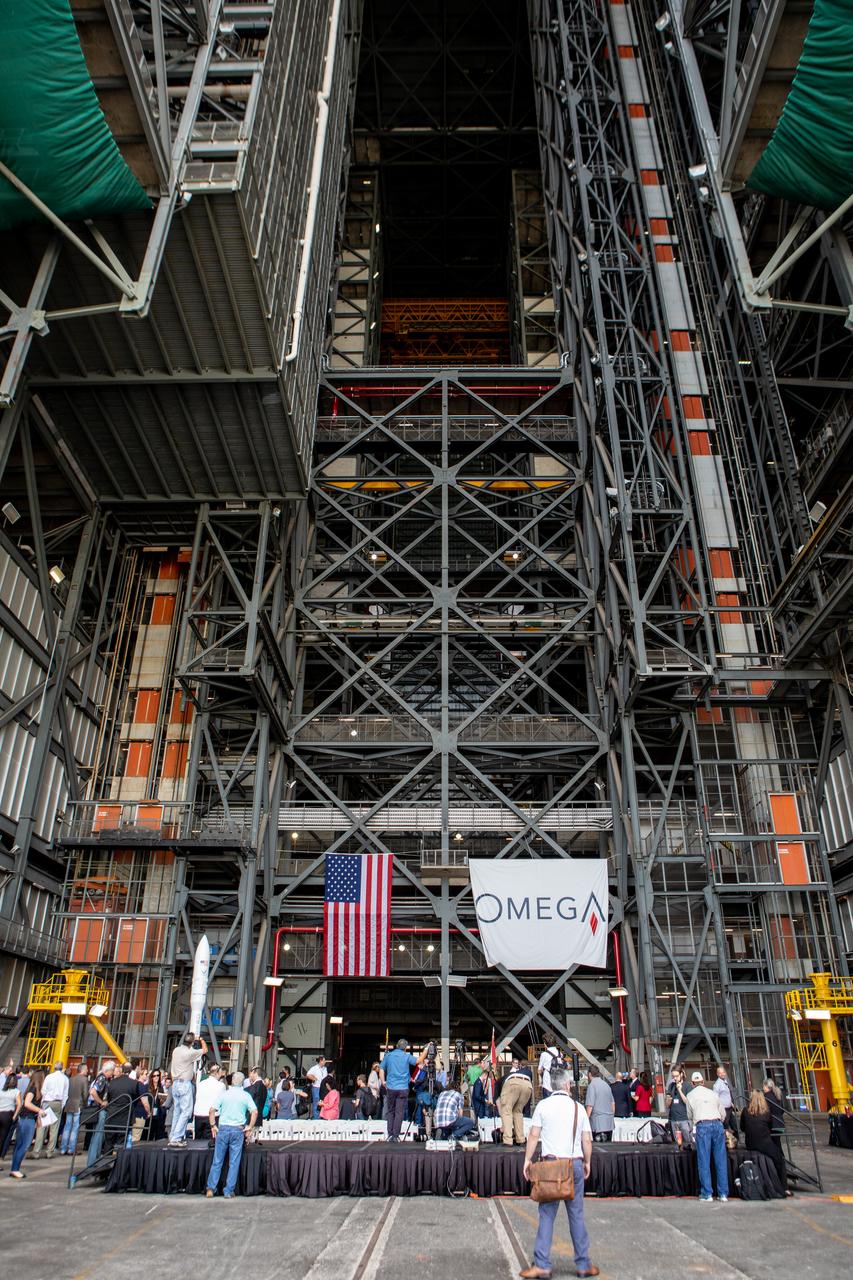
Legislators, invited guests and members of the media attend a ribbon cutting ceremony on Aug. 16, 2019, in High Bay 2 of the Vehicle Assembly Building (VAB) at NASA’s Kennedy Space Center in Florida. The VAB is getting its first commercial tenant. Northrop Grumman signed a Reimbursable Space Act Agreement with NASA for use of the facilities. The company will assemble and test its new OmegA rocket inside the massive facility’s High Bay 2. The company also will modify MLP-3 to serve as the launch vehicle’s assembly and launch platform. Northrop Grumman is developing the OmegA rocket, an intermediate/heavy-class launch vehicle, as part of a launch services agreement with the U.S. Air Force.

This sturning image, taken by the newly installed Advanced Camera for Surveys (ACS) aboard the Hubble Space Telescope (HST), is an image of the center of the Omega Nebula. It is a hotbed of newly born stars wrapped in colorful blankets of glowing gas and cradled in an enormous cold, dark hydrogen cloud. The region of nebula shown in this photograph is about 3,500 times wider than our solar system. The nebula, also called M17 and the Swan Nebula, resides 5,500 light-years away in the constellation Sagittarius. The Swan Nebula is illuminated by ultraviolet radiation from young, massive stars, located just beyond the upper-right corner of the image. The powerful radiation from these stars evaporates and erodes the dense cloud of cold gas within which the stars formed. The blistered walls of the hollow cloud shine primarily in the blue, green, and red light emitted by excited atoms of hydrogen, nitrogen, oxygen, and sulfur. Particularly striking is the rose-like feature, seen to the right of center, which glows in the red light emitted by hydrogen and sulfur. As the infant stars evaporate the surrounding cloud, they expose dense pockets of gas that may contain developing stars. One isolated pocket is seen at the center of the brightest region of the nebula. Other dense pockets of gas have formed the remarkable feature jutting inward from the left edge of the image. The color image is constructed from four separate images taken in these filters: blue, near infrared, hydrogen alpha, and doubly ionized oxygen. Credit: NASA, H. Ford (JHU), G. Illingworth (USCS/LO), M. Clampin (STScI), G. Hartig (STScI), the ACS Science Team, and ESA.
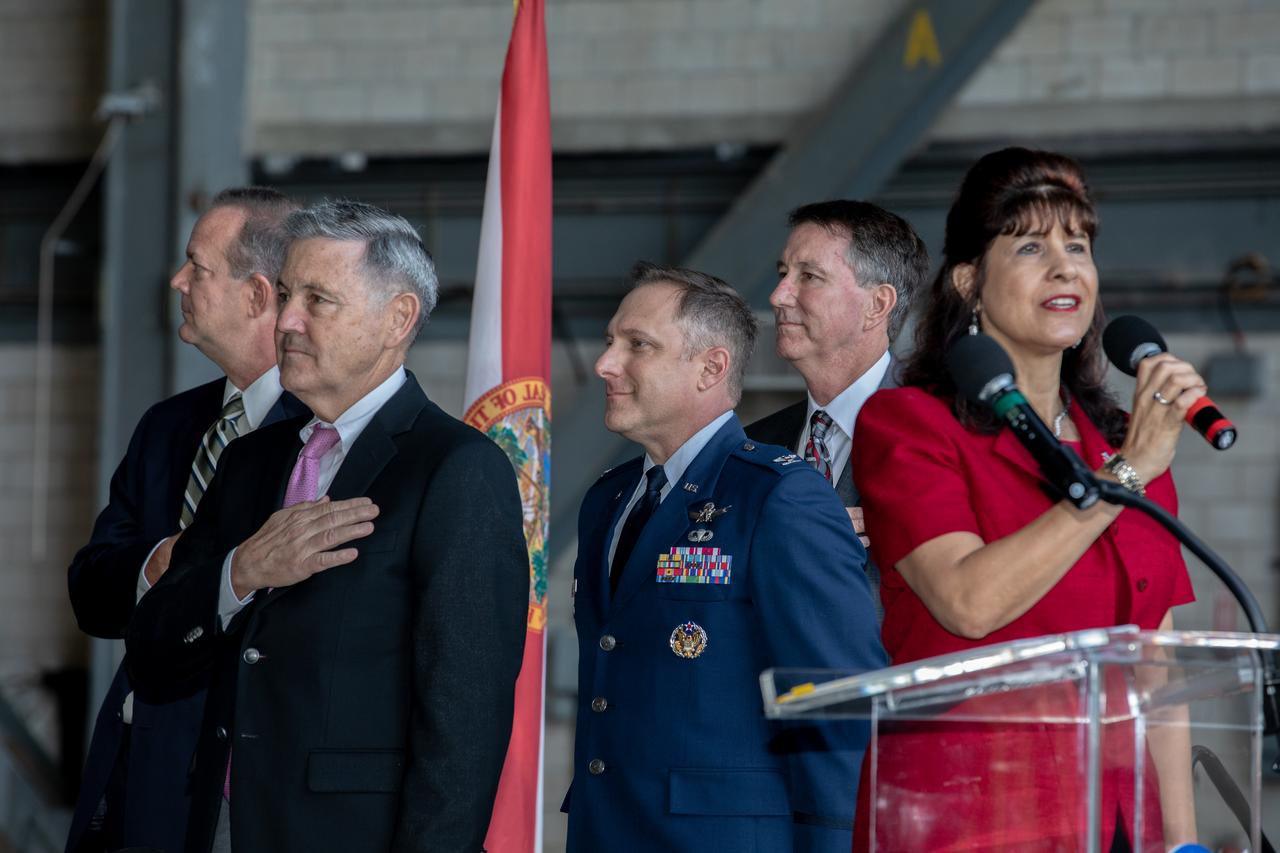
The National Anthem is sung by Suzy Cunningham, NASA Strategy and Integration manager, during a ribbon cutting ceremony on Aug. 16, 2019, in High Bay 2 of the Vehicle Assembly Building (VAB) at NASA’s Kennedy Space Center in Florida. From left are Tom Engler, director of Kennedy’s Center Planning and Development Office; Kennedy’s Center Director Bob Cabana; Col. Thomas Ste. Marie, vice commander, U.S. Air Force, 45th Space Wing; and Kent Rominger, Northrop Grumman’s vice president and capture lead for the OmegA launch system. The VAB is getting its first commercial tenant. Northrop Grumman signed a Reimbursable Space Act Agreement with NASA for use of the facilities. The company will assemble and test its new OmegA rocket inside the massive facility’s High Bay 2. The company also will modify mobile launcher platform-3 to serve as the launch vehicle’s assembly and launch platform. Northrop Grumman is developing the OmegA rocket, an intermediate/heavy-class launch vehicle, as part of a launch services agreement with the U.S. Air Force.
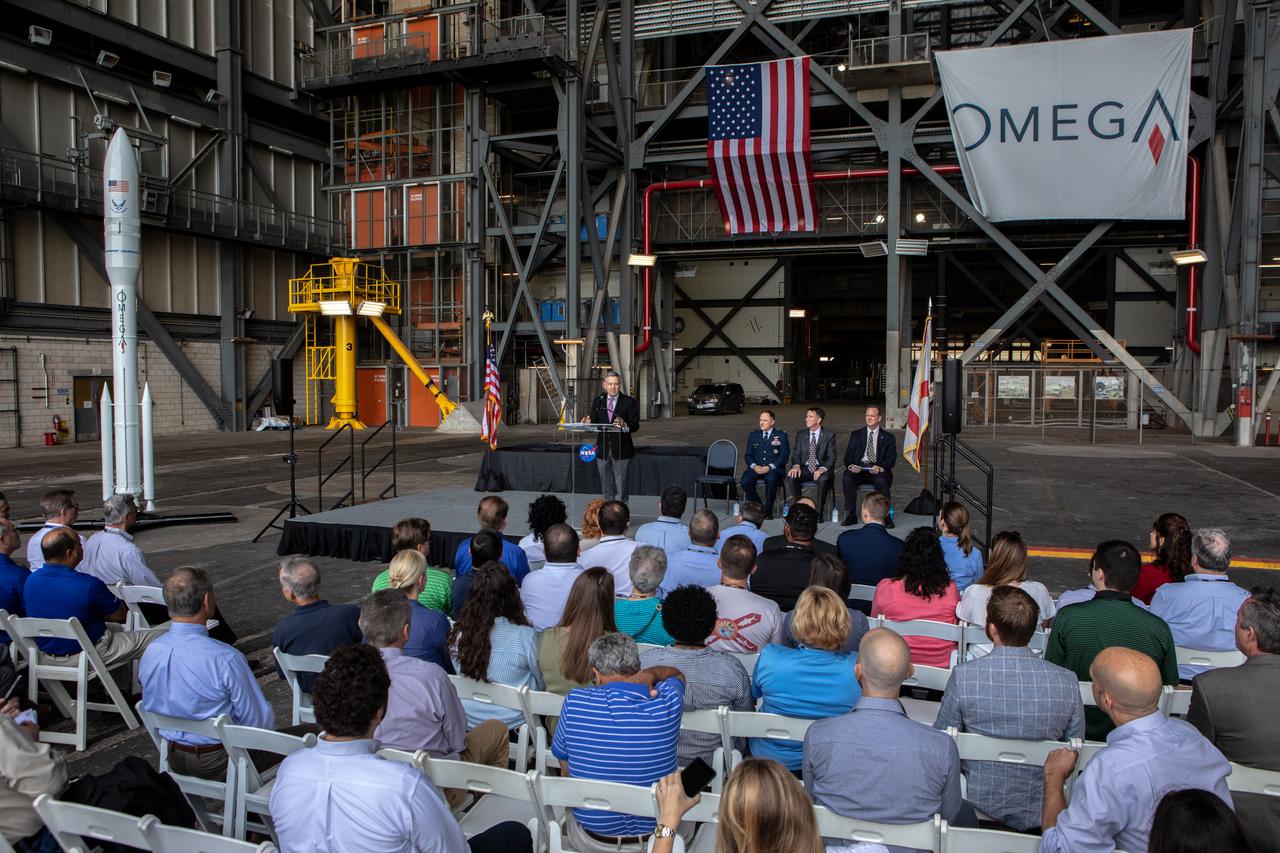
During a ribbon cutting ceremony on Aug. 16, 2019, in High Bay 2 of the Vehicle Assembly Building (VAB) at NASA’s Kennedy Space Center in Florida, Kennedy Center Director Bob Cabana speaks to legislators and guests. Seated from left, are Col. Thomas Ste. Marie, vice commander, U.S. Air Force, 45th Space Wing; Kent Rominger, Northrop Grumman’s vice president and capture lead for the OmegA launch system; and Tom Engler, director of Kennedy’s Center Planning and Development Office. The VAB is getting its first commercial tenant. Northrop Grumman signed a Reimbursable Space Act Agreement with NASA for use of the facilities. The company will assemble and test its new OmegA rocket inside the massive facility’s High Bay 2. The company also will modify mobile launcher platform-3 to serve as the launch vehicle’s assembly and launch platform. Northrop Grumman is developing the OmegA rocket, an intermediate/heavy-class launch vehicle, as part of a launch services agreement with the U.S. Air Force.

During a ribbon cutting ceremony on Aug. 16, 2019, in High Bay 2 of the Vehicle Assembly Building (VAB) at NASA’s Kennedy Space Center in Florida, Col. Thomas Ste. Marie, vice commander, U.S. Air Force, 45th Space Wing, speaks to legislators and guests. Seated behind him, from left, are Kennedy Center Director Bob Cabana; Kent Rominger, Northrop Grumman’s vice president and capture lead for the OmegA launch system; and Tom Engler, director of Kennedy’s Center Planning and Development Office. The VAB is getting its first commercial tenant. Northrop Grumman signed a Reimbursable Space Act Agreement with NASA for use of the facilities. The company will assemble and test its new OmegA rocket inside the massive facility’s High Bay 2. The company also will modify mobile launcher platform-3 to serve as the launch vehicle’s assembly and launch platform. Northrop Grumman is developing the OmegA rocket, an intermediate/heavy-class launch vehicle, as part of a launch services agreement with the U.S. Air Force.
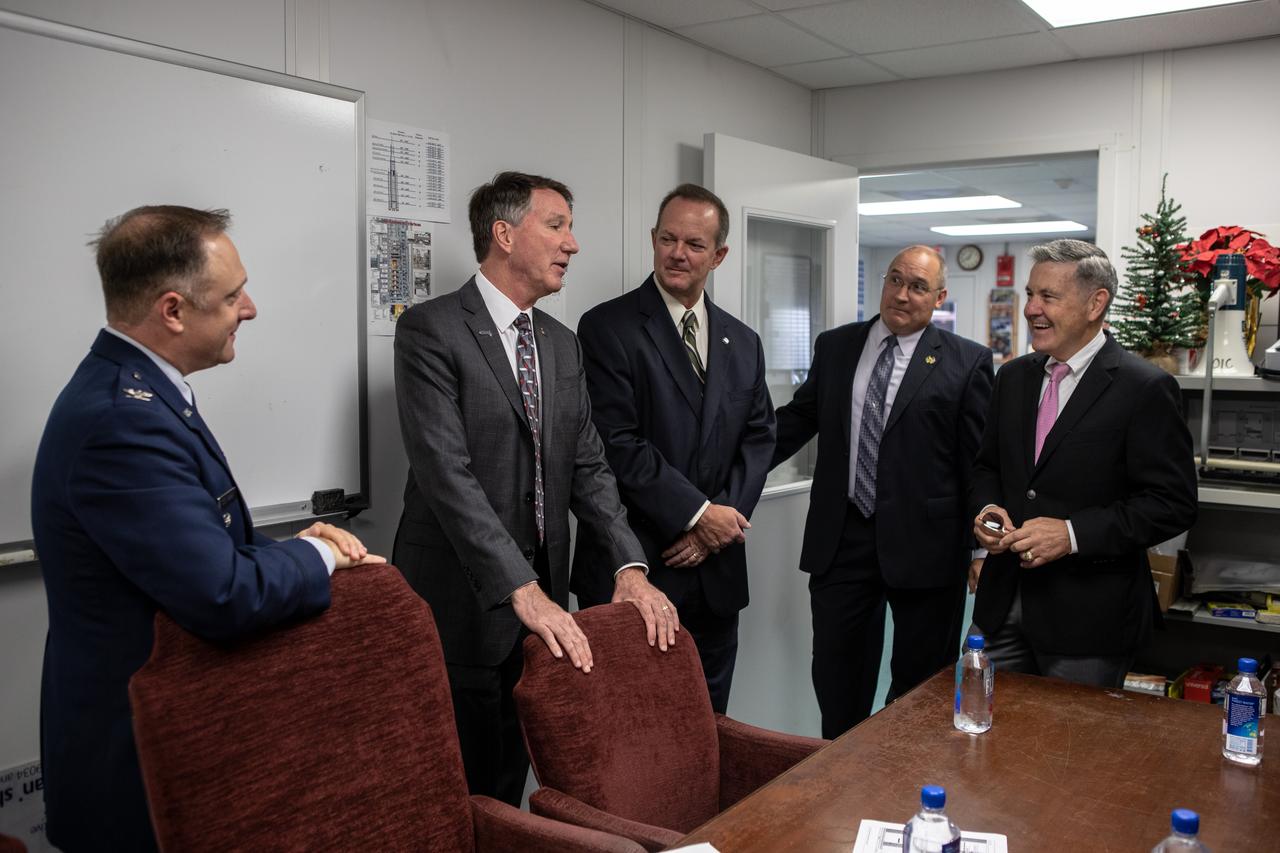
Just before a ribbon cutting ceremony on Aug. 16, 2019, in High Bay 2 of the Vehicle Assembly (VAB) at NASA’s Kennedy Space Center in Florida, Center Director Bob Cabana, at right, visits with, from left, Col. Thomas Ste. Marie, vice commander, U.S. Air Force, 45th Space Wing; Kurt Rominger, Northrop Grumman’s vice president and capture lead for the OmegA launch system; Tom Engler, director of Kennedy’s Center Planning and Development Office; and Greg Harland, NASA communications. The VAB is getting its first commercial tenant. Northrop Grumman signed a Reimbursable Space Act Agreement with NASA for use of the facilities. The company will assemble and test its new OmegA rocket inside the massive facility’s High Bay 2. The company also will modify the space shuttle-era mobile launcher platform-3 to serve as the launch vehicle’s assembly and launch platform. Northrop Grumman is developing the OmegA rocket, an intermediate/heavy-class launch vehicle, as part of a launch services agreement with the U.S. Air Force.
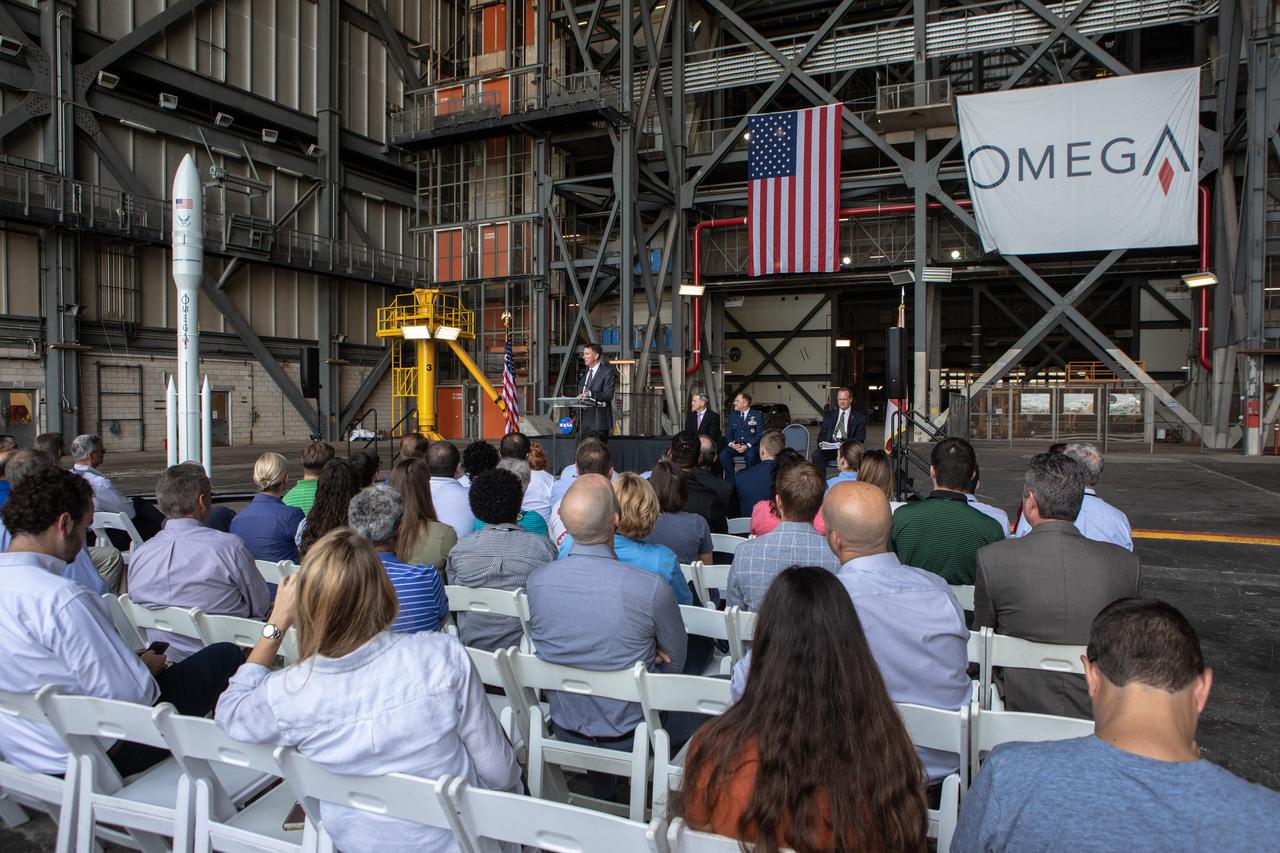
During a ribbon cutting ceremony on Aug. 16, 2019, in High Bay 2 of the Vehicle Assembly Building (VAB) at NASA’s Kennedy Space Center in Florida, Kent Rominger, Northrop Grumman’s vice president and capture lead for the OmegA launch system, speaks to legislators and guests. Seated behind him, from left, are Kennedy Center Director Bob Cabana; Col. Thomas Ste. Marie, vice commander, U.S. Air Force, 45th Space Wing; and Tom Engler, director of Kennedy’s Center Planning and Development Office. The VAB is getting its first commercial tenant. Northrop Grumman signed a Reimbursable Space Act Agreement with NASA for use of the facilities. The company will assemble and test its new OmegA rocket inside the massive facility’s High Bay 2. The company also will modify mobile launcher platform-3 to serve as the launch vehicle’s assembly and launch platform. Northrop Grumman is developing the OmegA rocket, an intermediate/heavy-class launch vehicle, as part of a launch services agreement with the U.S. Air Force.
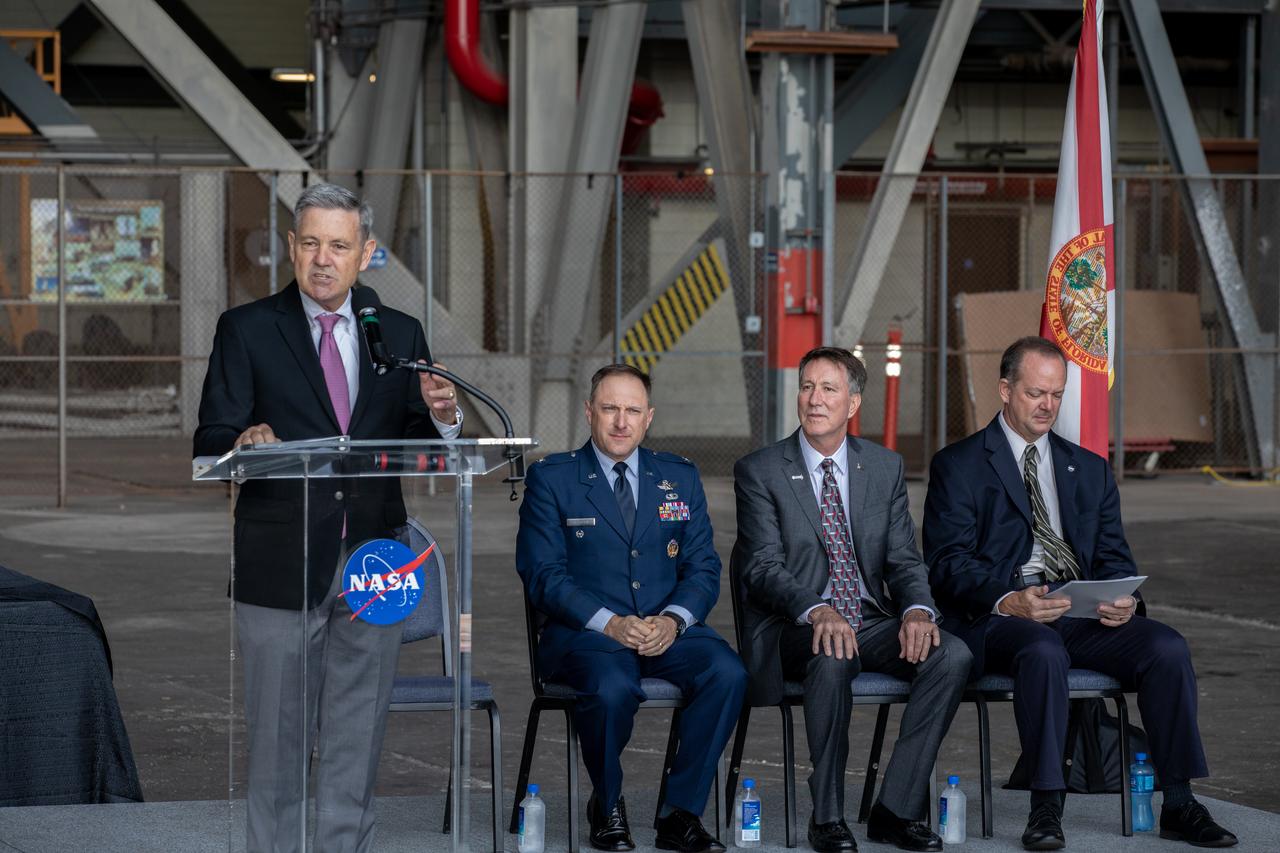
During a ribbon cutting ceremony on Aug. 16, 2019, in High Bay 2 of the Vehicle Assembly Building (VAB) at NASA’s Kennedy Space Center in Florida, Center Director Bob Cabana speaks to legislators and guests. Seated behind him, from left, are Col. Thomas St. Marie, vice commander, U.S. Air Force, 45th Space Wing; Kent Rominger, Northrop Grumman’s vice president and capture lead for the OmegA launch system; and Tom Engler, director of Kennedy’s Center Planning and Development Office. The VAB is getting its first commercial tenant. Northrop Grumman signed a Reimbursable Space Act Agreement with NASA for use of the facilities. The company will assemble and test its new OmegA rocket inside the massive facility’s High Bay 2. The company also will modify mobile launcher platform-3 to serve as the launch vehicle’s assembly and launch platform. Northrop Grumman is developing the OmegA rocket, an intermediate/heavy-class launch vehicle, as part of a launch services agreement with the U.S. Air Force.

A ribbon cutting ceremony took place on Aug. 16, 2019, in High Bay 2 of the Vehicle Assembly Building (VAB) at NASA’s Kennedy Space Center in Florida. Attendees included legislators and invited guests. In the center is Florida State Senator Thad Altman. In the front row, far left, is Kennedy Center Director Bob Cabana. In the front row, far right, is Col. Thomas Ste. Marie, vice commander, U.S. Air Force, 45th Space Wing. In the back row, far right, is Kent Rominger, Northrop Grumman’s vice president and capture lead for the OmegA launch system. The VAB is getting its first commercial tenant. Northrop Grumman signed a Reimbursable Space Act Agreement with NASA for use of the facilities. The company will assemble and test its new OmegA rocket inside the massive facility’s High Bay 2. The company also will modify mobile launcher platform-3 to serve as the launch vehicle’s assembly and launch platform. Northrop Grumman is developing the OmegA rocket, an intermediate/heavy-class launch vehicle, as part of a launch services agreement with the U.S. Air Force.
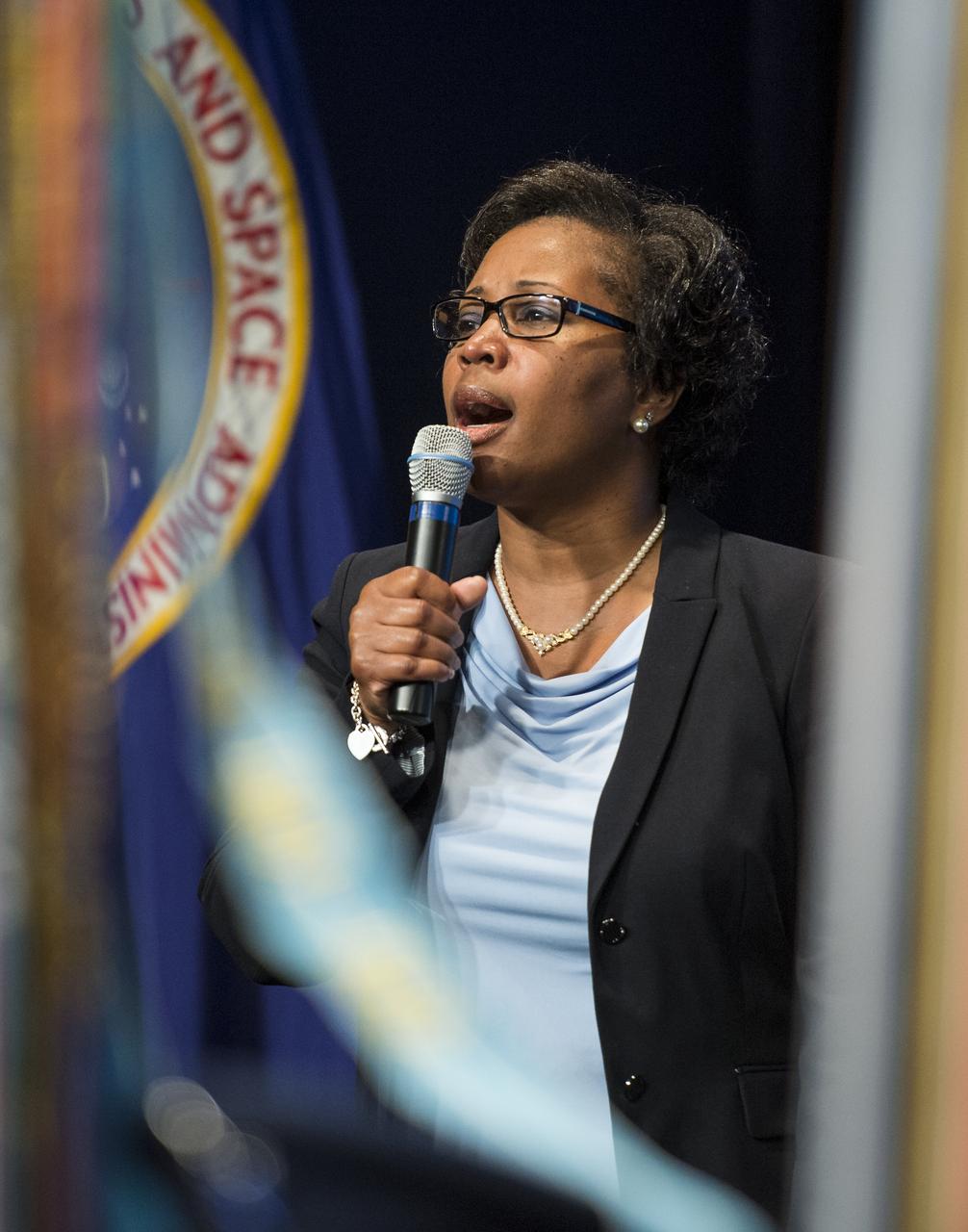
Omega Jones sings the national anthem as a color guard from the at an event celebrating the 50th Anniversary of the Civil Rights Act of 1964 on Monday, June 23, 2014 in the James E. Webb Auditorium at NASA Headquarters in Washington, DC. The event highlighted the influence of the Civil Rights Act on NASA. Photo Credit: (NASA/Joel Kowsky)

In this composite image of the Omega Nebula, SOFIA detected the blue areas (20 microns) near the center, revealing gas as it's heated by massive stars located at the center, near the bend, and the green areas (37 microns) that trace dust as it's warmed both by massive stars and nearby newborn stars. The nine never-before-seen protostars were found primarily in the southern areas. The red areas near the edge represent cold dust that was detected by the Herschel Space Telescope (70 microns), while the white star field was detected by the Spitzer Space Telescope (3.6 microns). The space telescopes could not observe the blue and green regions in such detail because the detectors were saturated. SOFIA's view reveals evidence that parts of the nebula formed separately to create the swan-like shape seen today. https://photojournal.jpl.nasa.gov/catalog/PIA23409

During a practice run, crawler-transporter 2 (CT-2), with the space shuttle-era mobile launch platform-3 (MLP-3) on top, has exited High Bay 2 of the Vehicle Assembly Building (VAB) and moves slowly along the crawlerway at NASA’s Kennedy Space Center in Florida on May 1, 2019. The VAB is getting its first commercial tenant. Northrop Grumman signed a Reimbursable Space Act Agreement with NASA for use of the facilities. The company will assemble and test its new OmegA rocket inside the massive facility’s High Bay 2. The company also will modify MLP-3 to serve as the launch vehicle’s assembly and launch platform. Northrop Grumman is developing the OmegA rocket, an intermediate/heavy-class launch vehicle, as part of a launch services agreement with the U.S. Air Force.
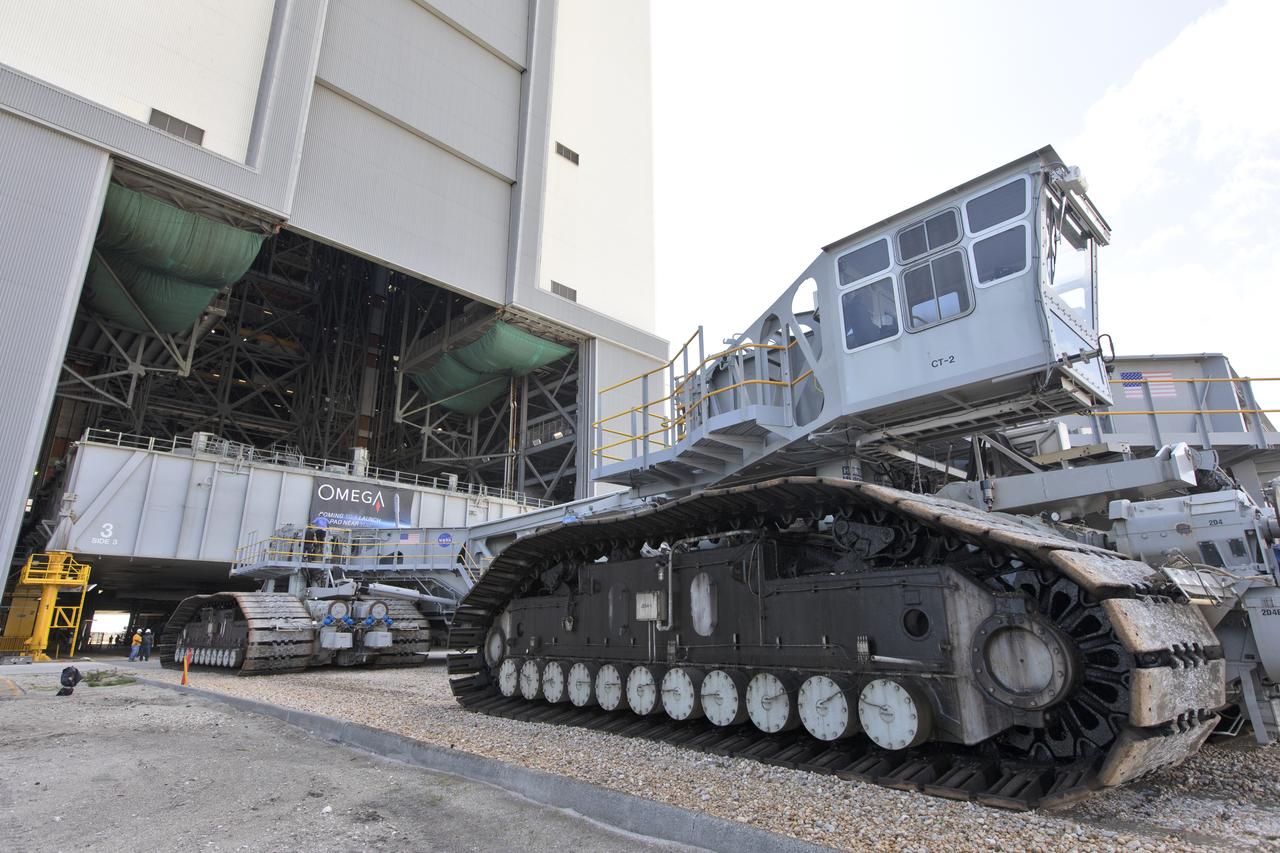
During a practice run, crawler-transporter 2 (CT-2) is at the entrance to High Bay 2 of the Vehicle Assembly Building (VAB) at NASA’s Kennedy Space Center in Florida on May 1, 2019. CT-2 entered High Bay 2, and picked up the space shuttle-era mobile launch platform-3 (MLP-3). The VAB is getting its first commercial tenant. Northrop Grumman signed a Reimbursable Space Act Agreement with NASA for use of the facilities. The company will assemble and test its new OmegA rocket inside the massive facility’s High Bay 2. The company also will modify MLP-3 to serve as the launch vehicle’s assembly and launch platform. Northrop Grumman is developing the OmegA rocket, an intermediate/heavy-class launch vehicle, as part of a launch services agreement with the U.S. Air Force.
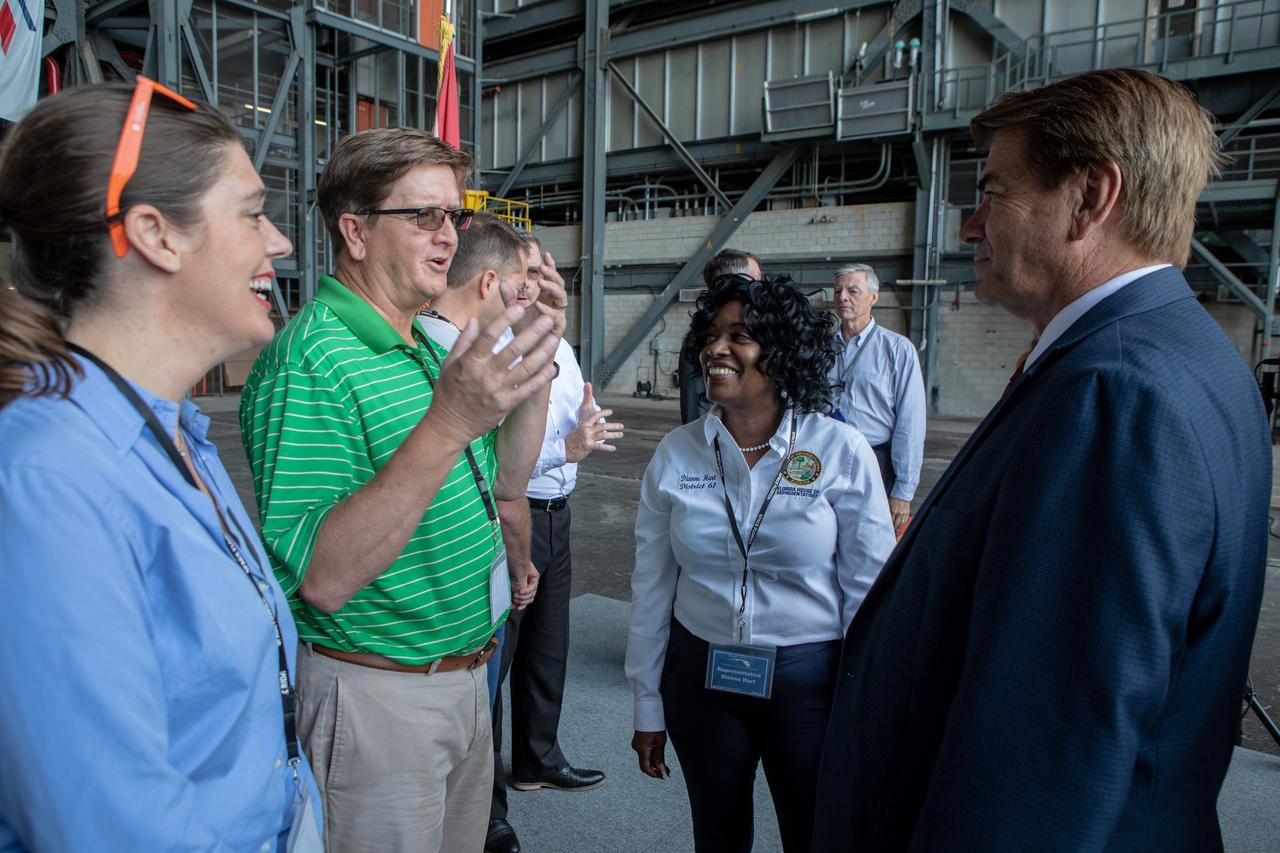
Elected officials and guests visit after a ribbon cutting ceremony on Aug. 16, 2019, in High Bay 2 of the Vehicle Assembly Building (VAB) at NASA’s Kennedy Space Center in Florida. At far right is Florida State Senator Thad Altman. The VAB is getting its first commercial tenant. Northrop Grumman signed a Reimbursable Space Act Agreement with NASA for use of the facilities. The company will assemble and test its new OmegA rocket inside the massive facility’s High Bay 2. The company also will modify mobile launcher platform-3 to serve as the launch vehicle’s assembly and launch platform. Northrop Grumman is developing the OmegA rocket, an intermediate/heavy-class launch vehicle, as part of a launch services agreement with the U.S. Air Force.

During a practice run, crawler-transporter 2 (CT-2), with the space shuttle-era mobile launch platform-3 (MLP-3) on top, moves out of High Bay 2 of the Vehicle Assembly Building (VAB) at NASA’s Kennedy Space Center in Florida on May 1, 2019. The VAB is getting its first commercial tenant. Northrop Grumman signed a Reimbursable Space Act Agreement with NASA for use of the facilities. The company will assemble and test its new OmegA rocket inside the massive facility’s High Bay 2. The company also will modify MLP-3 to serve as the launch vehicle’s assembly and launch platform. Northrop Grumman is developing the OmegA rocket, an intermediate/heavy-class launch vehicle, as part of a launch services agreement with the U.S. Air Force.
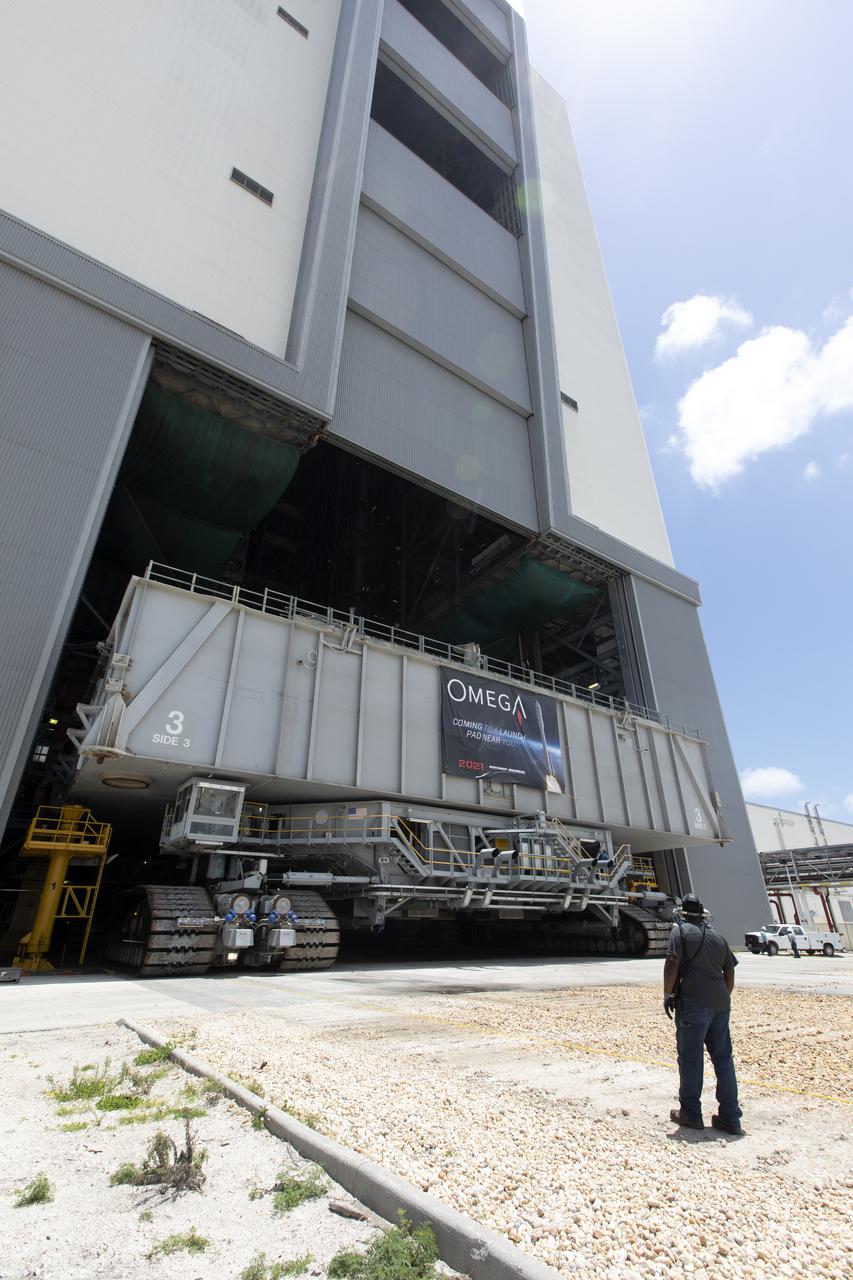
During a practice run, crawler-transporter 2 (CT-2), with the space shuttle-era mobile launch platform-3 (MLP-3) on top, begins its move out of High Bay 2 of the Vehicle Assembly Building (VAB) at NASA’s Kennedy Space Center in Florida on May 1, 2019. The VAB is getting its first commercial tenant. Northrop Grumman signed a Reimbursable Space Act Agreement with NASA for use of the facilities. The company will assemble and test its new OmegA rocket inside the massive facility’s High Bay 2. The company also will modify MLP-3 to serve as the launch vehicle’s assembly and launch platform. Northrop Grumman is developing the OmegA rocket, an intermediate/heavy-class launch vehicle, as part of a launch services agreement with the U.S. Air Force.
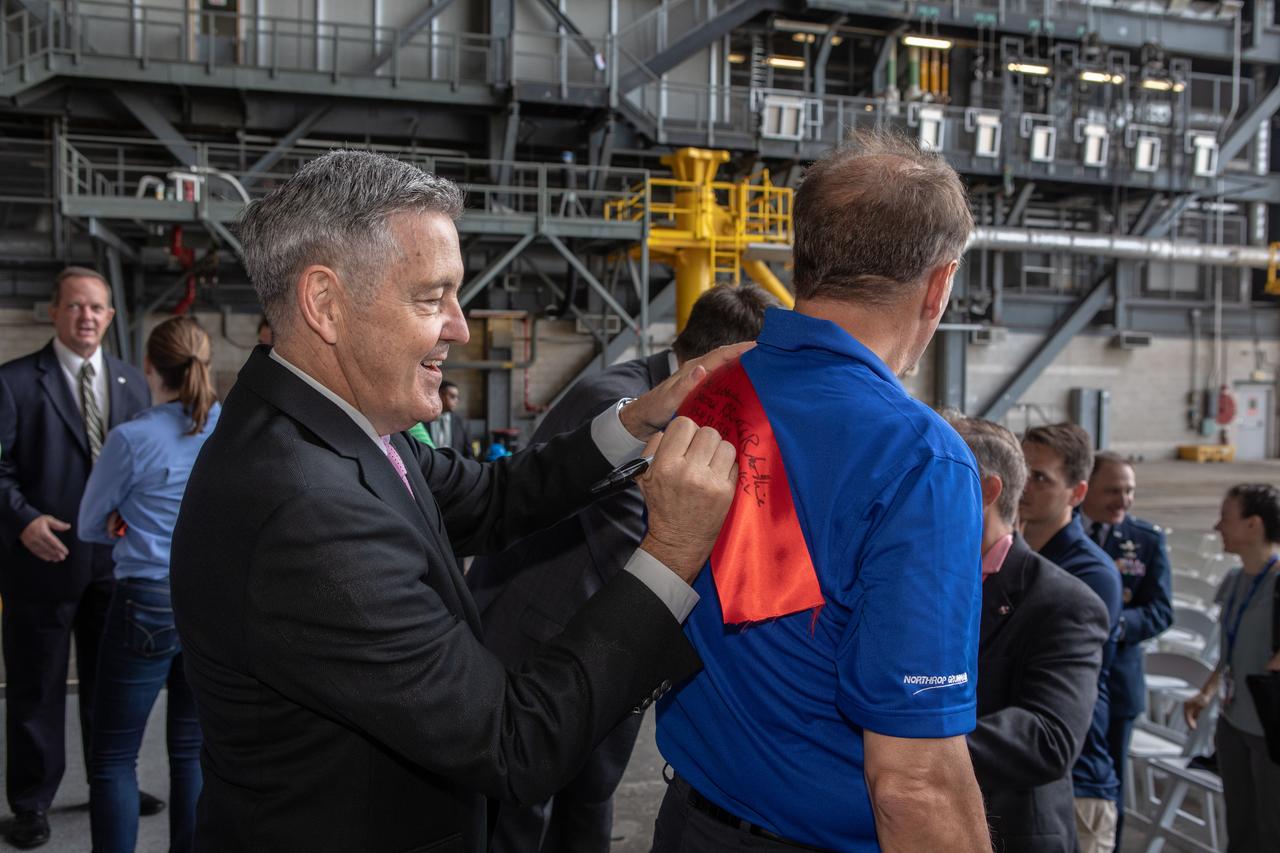
Legislators, invited guests and members of the media attend a ribbon cutting ceremony on Aug. 16, 2019, in High Bay 2 of the Vehicle Assembly Building (VAB) at NASA’s Kennedy Space Center in Florida. Kennedy Center Director Bob Cabana autographs a portion of the ribbon for a guest. In view, at far left, is Tom Engler, director of Kennedy’s Center Planning and Development Office. The VAB is getting its first commercial tenant. Northrop Grumman signed a Reimbursable Space Act Agreement with NASA for use of the facilities. The company will assemble and test its new OmegA rocket inside the massive facility’s High Bay 2. The company also will modify mobile launcher platform-3 to serve as the launch vehicle’s assembly and launch platform. Northrop Grumman is developing the OmegA rocket, an intermediate/heavy-class launch vehicle, as part of a launch services agreement with the U.S. Air Force.
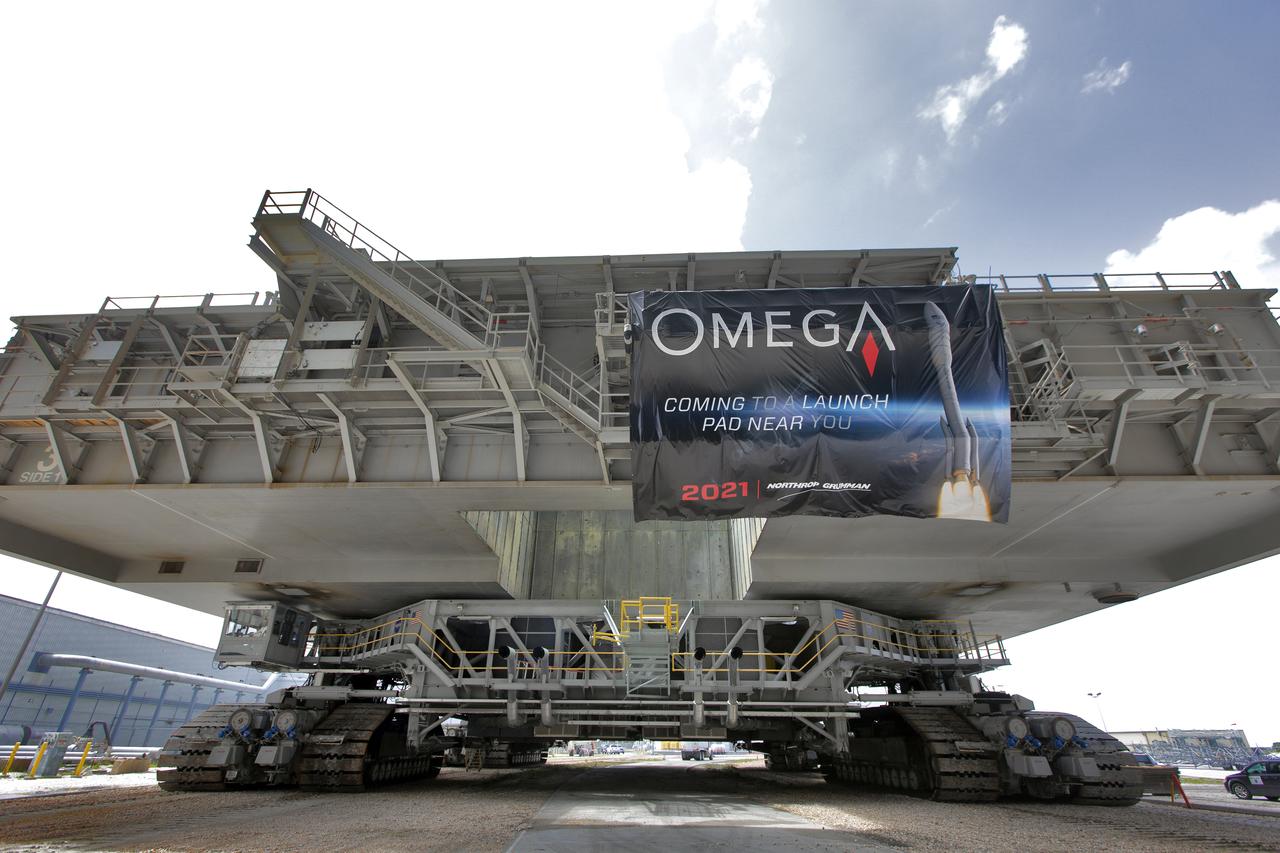
During a practice run, crawler-transporter 2 (CT-2), with the space shuttle-era mobile launch platform-3 (MLP-3) on top, has exited High Bay 2 of the Vehicle Assembly Building (VAB) and moves slowly along the crawlerway at NASA’s Kennedy Space Center in Florida on May 1, 2019. The VAB is getting its first commercial tenant. Northrop Grumman signed a Reimbursable Space Act Agreement with NASA for use of the facilities. The company will assemble and test its new OmegA rocket inside the massive facility’s High Bay 2. The company also will modify MLP-3 to serve as the launch vehicle’s assembly and launch platform. Northrop Grumman is developing the OmegA rocket, an intermediate/heavy-class launch vehicle, as part of a launch services agreement with the U.S. Air Force.
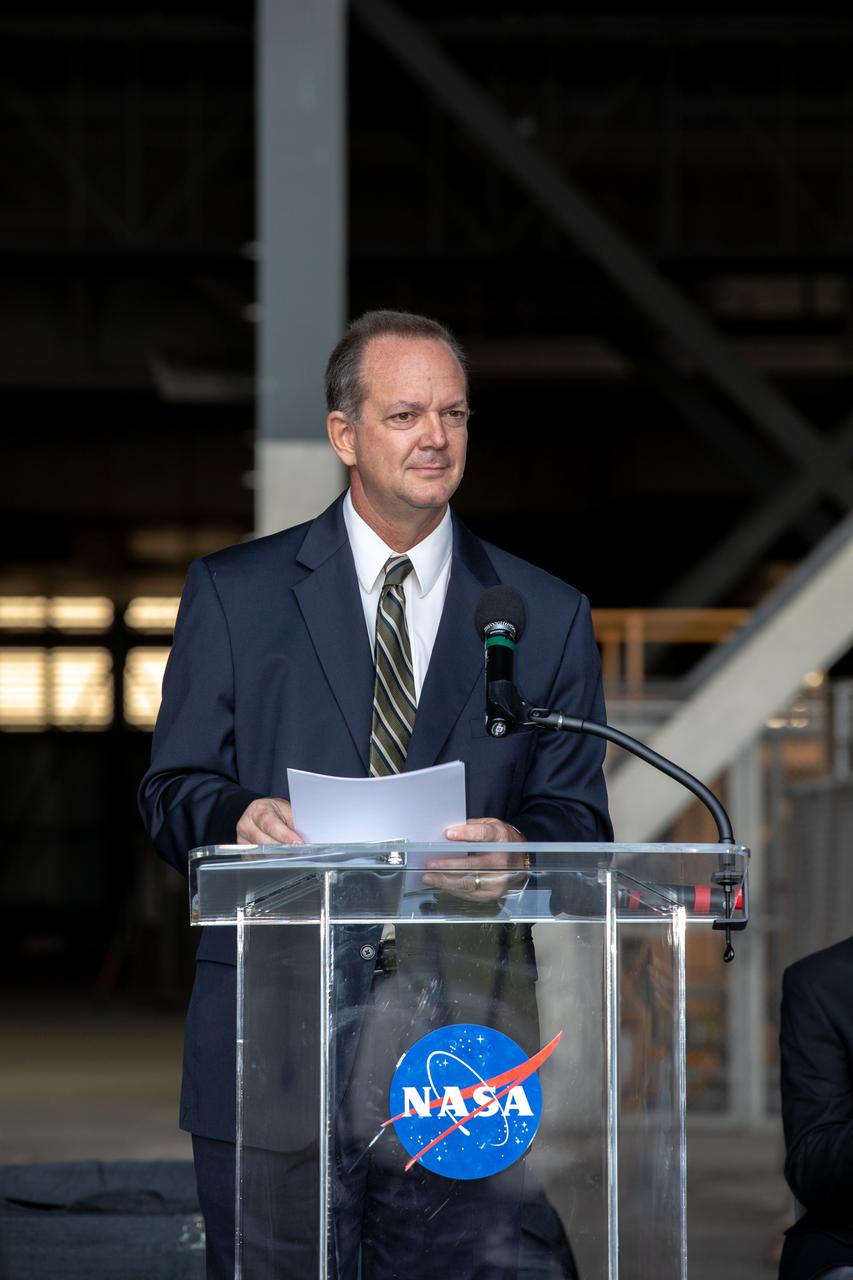
During a ribbon cutting ceremony on Aug. 16, 2019, in High Bay 2 of the Vehicle Assembly Building (VAB) at NASA’s Kennedy Space Center in Florida, Tom Engler, director of Kennedy’s Center Planning and Development Office, welcomes legislators and guests. The VAB is getting its first commercial tenant. Northrop Grumman signed a Reimbursable Space Act Agreement with NASA for use of the facilities. The company will assemble and test its new OmegA rocket inside the massive facility’s High Bay 2. The company also will modify MLP-3 to serve as the launch vehicle’s assembly and launch platform. Northrop Grumman is developing the OmegA rocket, an intermediate/heavy-class launch vehicle, as part of a launch services agreement with the U.S. Air Force.
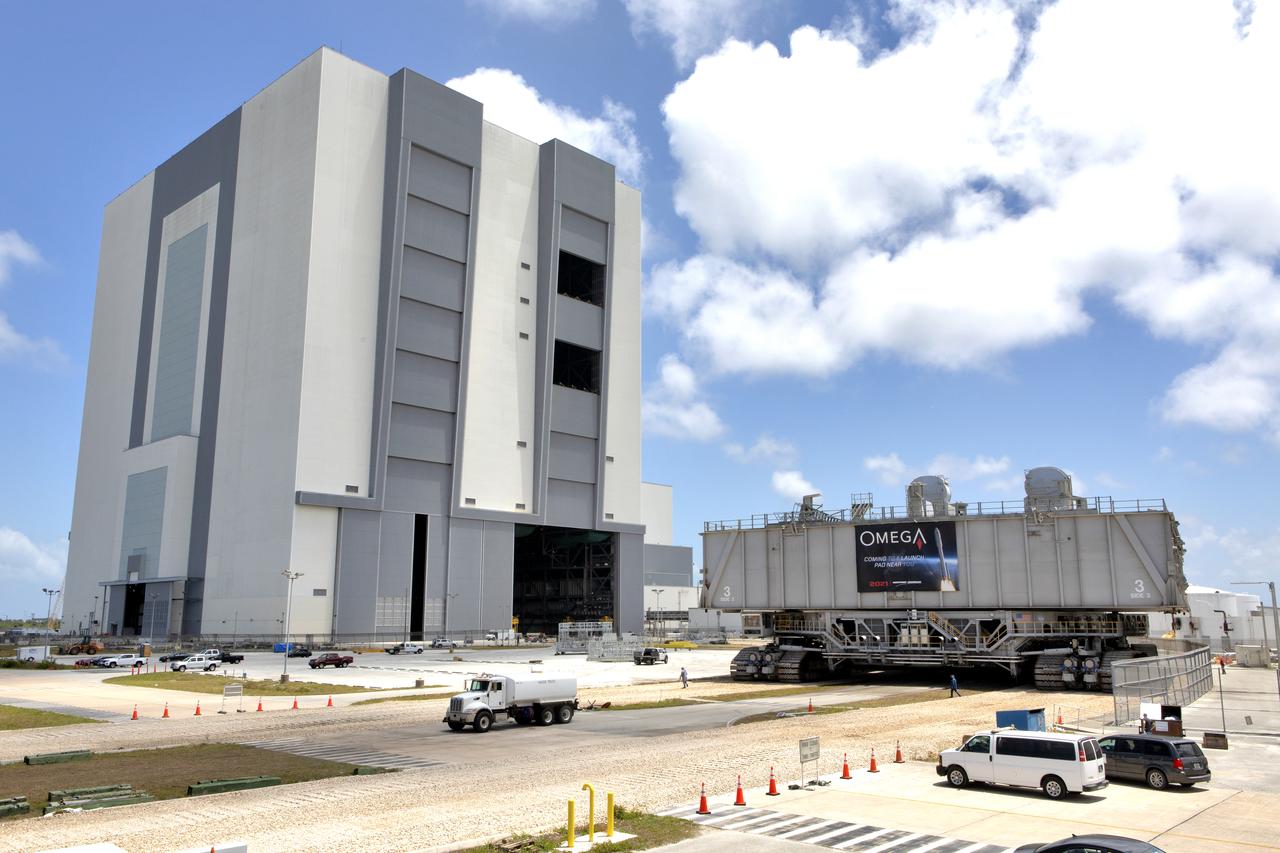
During a practice run, crawler-transporter 2 (CT-2), with the space shuttle-era mobile launch platform-3 (MLP-3) on top, has exited High Bay 2 of the Vehicle Assembly Building (VAB) and moves slowly along the crawlerway at NASA’s Kennedy Space Center in Florida on May 1, 2019. The VAB is getting its first commercial tenant. Northrop Grumman signed a Reimbursable Space Act Agreement with NASA for use of the facilities. The company will assemble and test its new OmegA rocket inside the massive facility’s High Bay 2. The company also will modify MLP-3 to serve as the launch vehicle’s assembly and launch platform. Northrop Grumman is developing the OmegA rocket, an intermediate/heavy-class launch vehicle, as part of a launch services agreement with the U.S. Air Force.
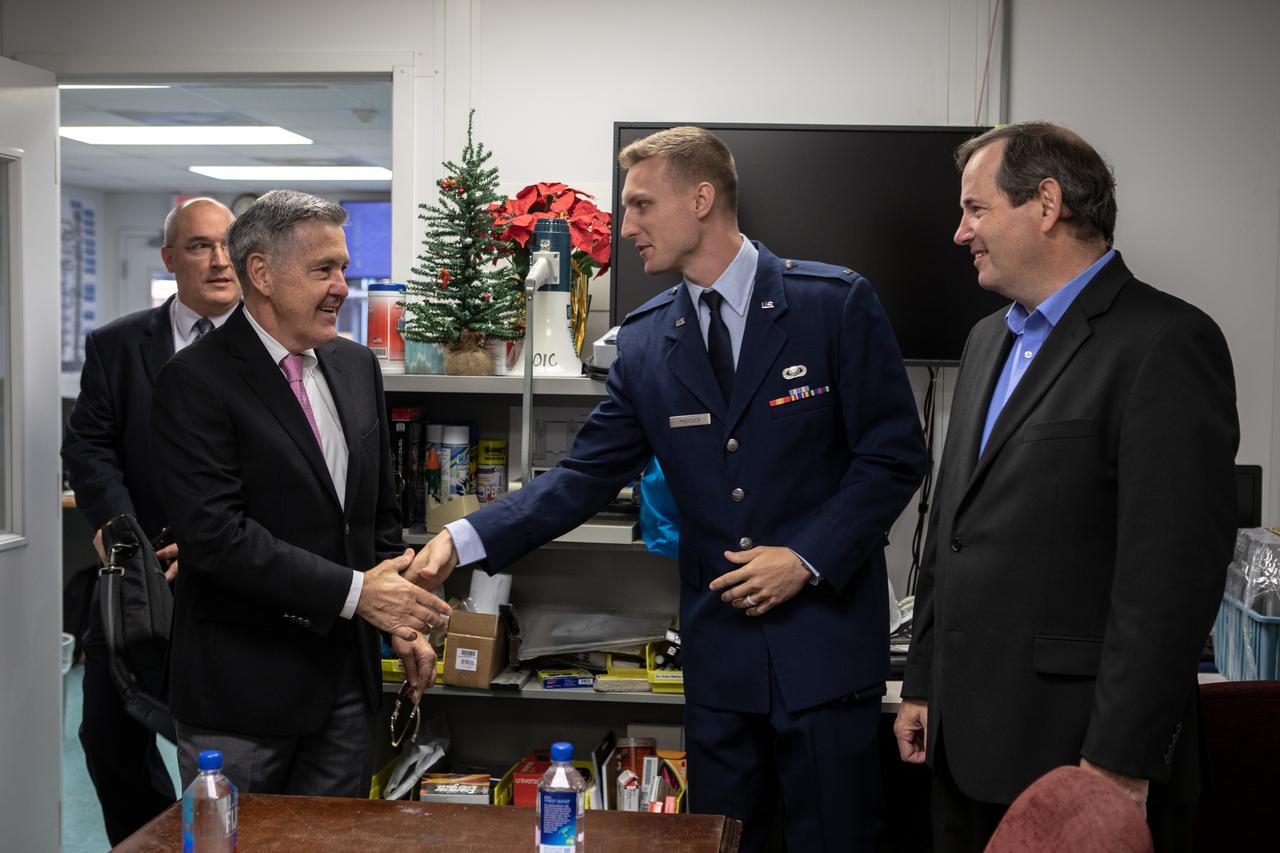
Just before a ribbon cutting ceremony on Aug. 16, 2019, in High Bay 2 of the Vehicle Assembly (VAB) at NASA’s Kennedy Space Center in Florida, Center Director Bob Cabana, at left, shakes hands with First Lieutenant Alex Priesser, U.S. Air Force, 45th Space Wing. At far right is Jim Williams, director of media operations, 45th Space Wing. The VAB is getting its first commercial tenant. Northrop Grumman signed a Reimbursable Space Act Agreement with NASA for use of the facilities. The company will assemble and test its new OmegA rocket inside the massive facility’s High Bay 2. The company also will modify the space shuttle-era mobile launcher platform-3 to serve as the launch vehicle’s assembly and launch platform. Northrop Grumman is developing the OmegA rocket, an intermediate/heavy-class launch vehicle, as part of a launch services agreement with the U.S. Air Force.

During a practice run, crawler-transporter 2 (CT-2) is at the entrance to High Bay 2 of the Vehicle Assembly Building (VAB) at NASA’s Kennedy Space Center in Florida on May 1, 2019. CT-2 entered High Bay 2, and picked up the space shuttle-era mobile launch platform-3 (MLP-3). The VAB is getting its first commercial tenant. Northrop Grumman signed a Reimbursable Space Act Agreement with NASA for use of the facilities. The company will assemble and test its new OmegA rocket inside the massive facility’s High Bay 2. The company also will modify MLP-3 to serve as the launch vehicle’s assembly and launch platform. Northrop Grumman is developing the OmegA rocket, an intermediate/heavy-class launch vehicle, as part of a launch services agreement with the U.S. Air Force.
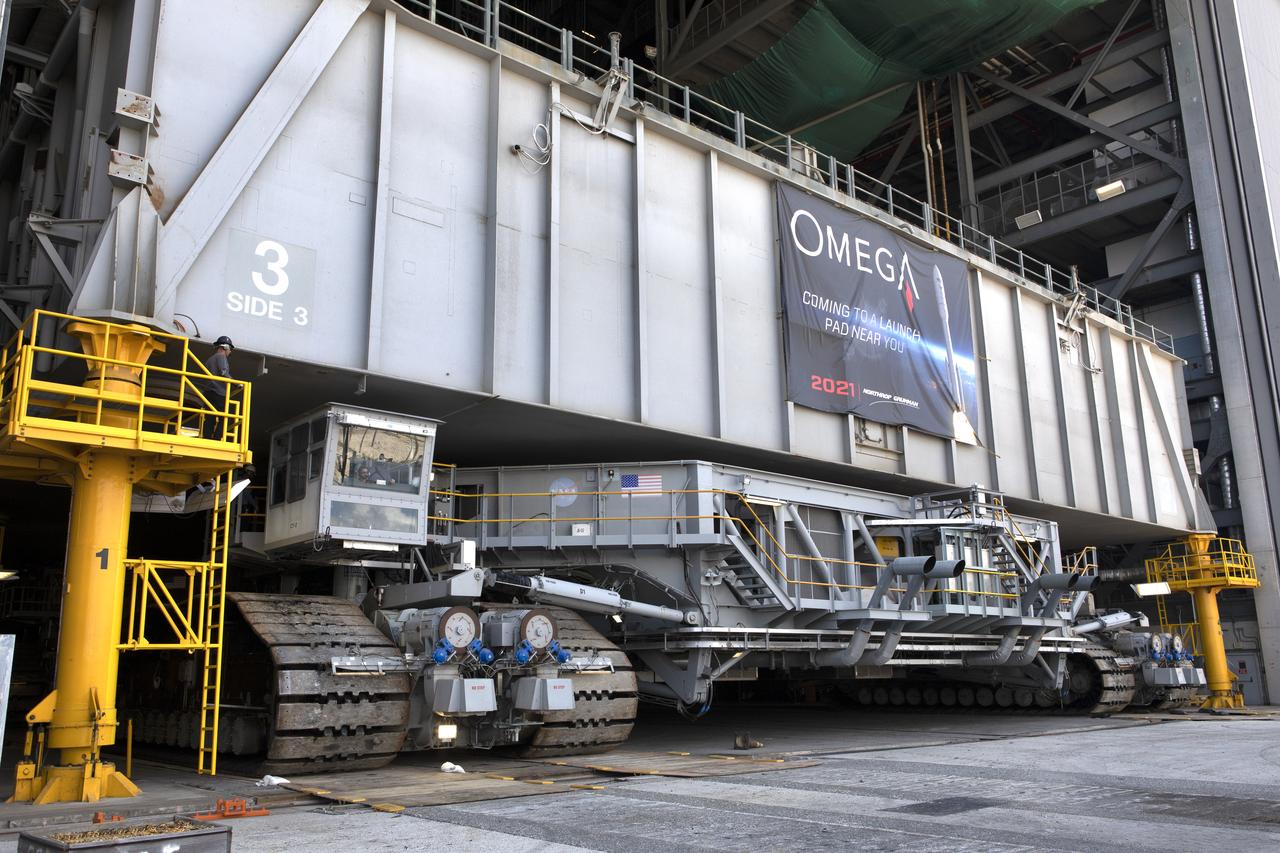
During a practice run, crawler-transporter 2 (CT-2) picked up the space shuttle-era mobile launch platform-3 (MLP-3) inside High Bay 2 of the Vehicle Assembly Building (VAB) at NASA’s Kennedy Space Center in Florida on May 1, 2019. The VAB is getting its first commercial tenant. Northrop Grumman signed a Reimbursable Space Act Agreement with NASA for use of the facilities. The company will assemble and test its new OmegA rocket inside the massive facility’s High Bay 2. The company also will modify MLP-3 to serve as the launch vehicle’s assembly and launch platform. Northrop Grumman is developing the OmegA rocket, an intermediate/heavy-class launch vehicle, as part of a launch services agreement with the U.S. Air Force.
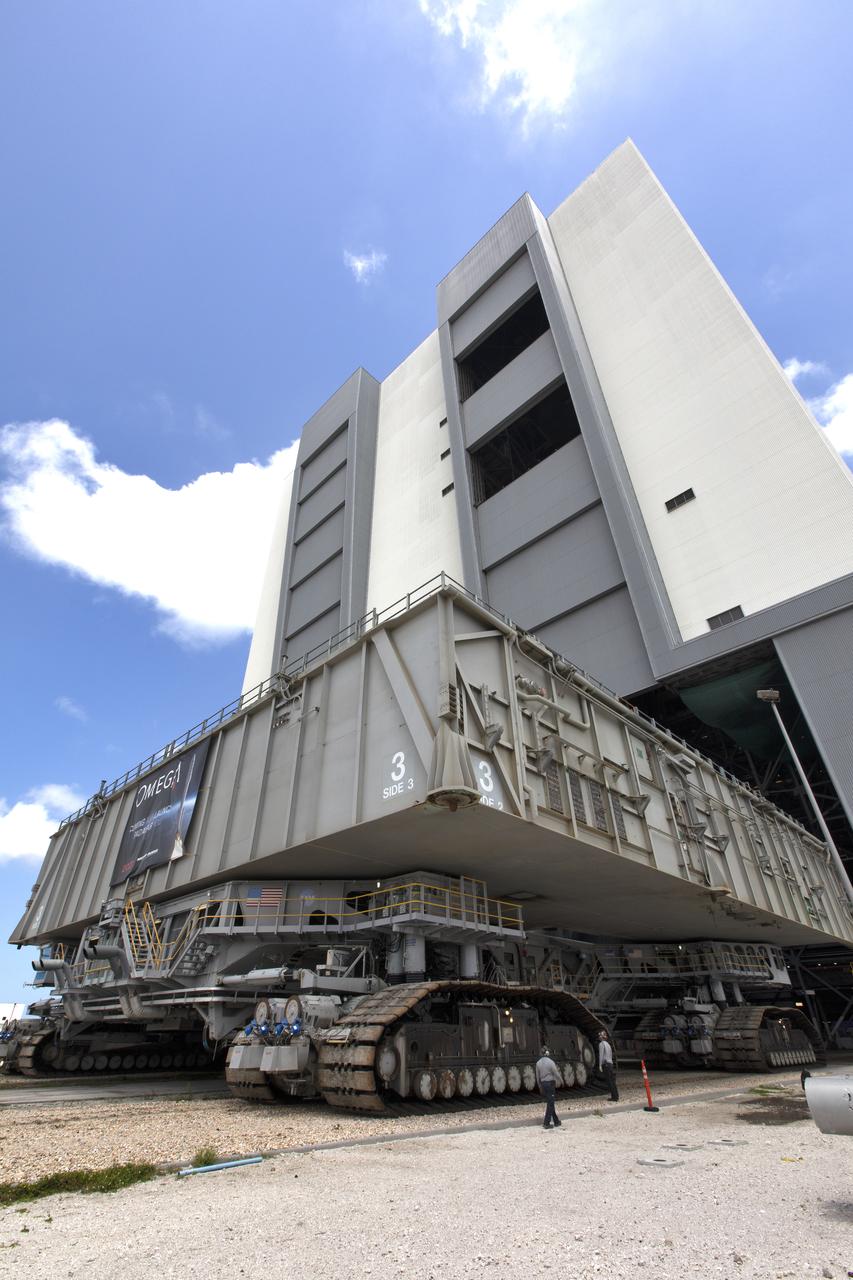
During a practice run, crawler-transporter 2 (CT-2), with the space shuttle-era mobile launch platform-3 (MLP-3) on top, moves out of High Bay 2 of the Vehicle Assembly Building (VAB) at NASA’s Kennedy Space Center in Florida on May 1, 2019. The VAB is getting its first commercial tenant. Northrop Grumman signed a Reimbursable Space Act Agreement with NASA for use of the facilities. The company will assemble and test its new OmegA rocket inside the massive facility’s High Bay 2. The company also will modify MLP-3 to serve as the launch vehicle’s assembly and launch platform. Northrop Grumman is developing the OmegA rocket, an intermediate/heavy-class launch vehicle, as part of a launch services agreement with the U.S. Air Force.
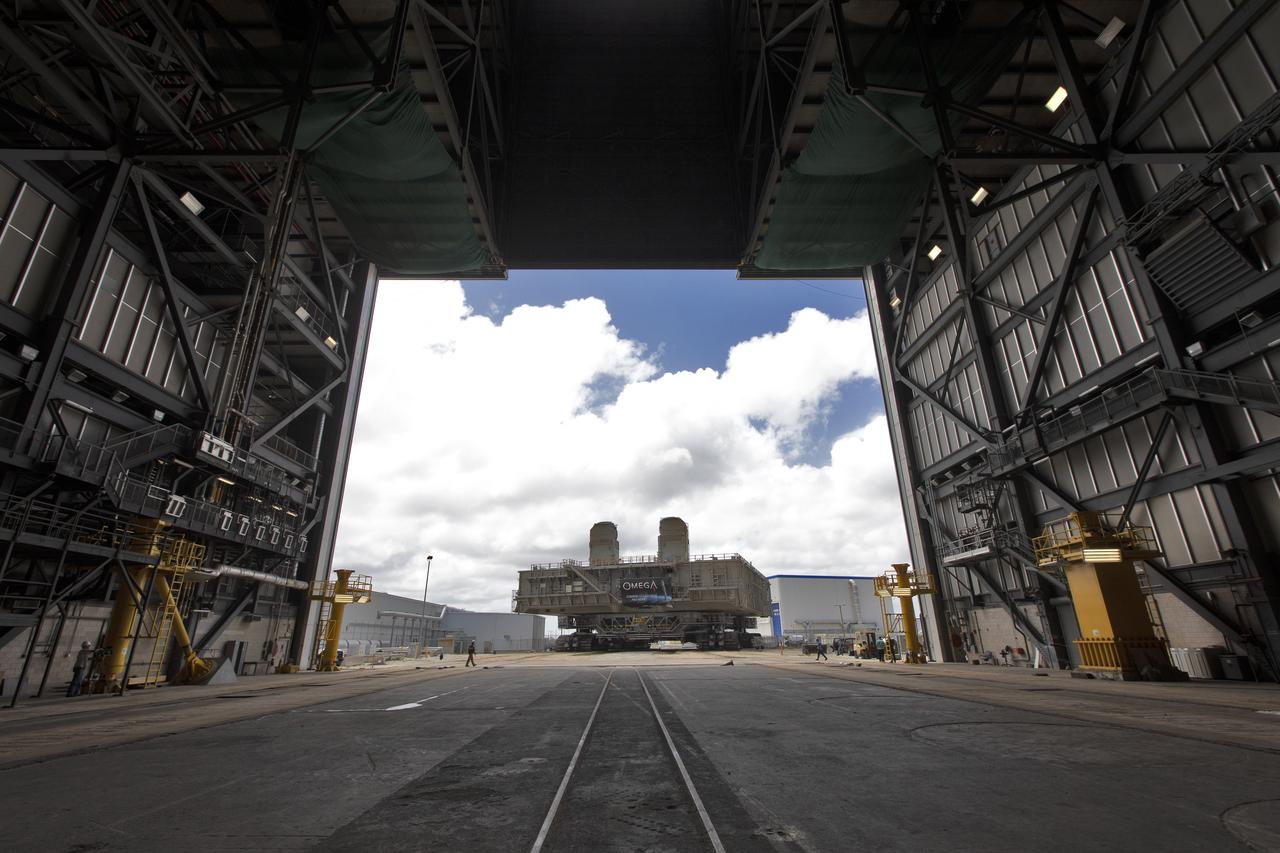
During a practice run, crawler-transporter 2 (CT-2), with the space shuttle-era mobile launch platform-3 (MLP-3) on top, has exited High Bay 2 of the Vehicle Assembly Building (VAB) and moves slowly along the crawlerway at NASA’s Kennedy Space Center in Florida on May 1, 2019. The VAB is getting its first commercial tenant. Northrop Grumman signed a Reimbursable Space Act Agreement with NASA for use of the facilities. The company will assemble and test its new OmegA rocket inside the massive facility’s High Bay 2. The company also will modify MLP-3 to serve as the launch vehicle’s assembly and launch platform. Northrop Grumman is developing the OmegA rocket, an intermediate/heavy-class launch vehicle, as part of a launch services agreement with the U.S. Air Force.

During a ribbon cutting ceremony on Aug. 16, 2019, in High Bay 2 of the Vehicle Assembly Building (VAB) at NASA’s Kennedy Space Center in Florida, Col. Thomas Ste. Marie, vice commander, U.S. Air Force, 45th Space Wing, speaks to legislators and guests. The VAB is getting its first commercial tenant. Northrop Grumman signed a Reimbursable Space Act Agreement with NASA for use of the facilities. The company will assemble and test its new OmegA rocket inside the massive facility’s High Bay 2. The company also will modify mobile launcher platform-3 to serve as the launch vehicle’s assembly and launch platform. Northrop Grumman is developing the OmegA rocket, an intermediate/heavy-class launch vehicle, as part of a launch services agreement with the U.S. Air Force.
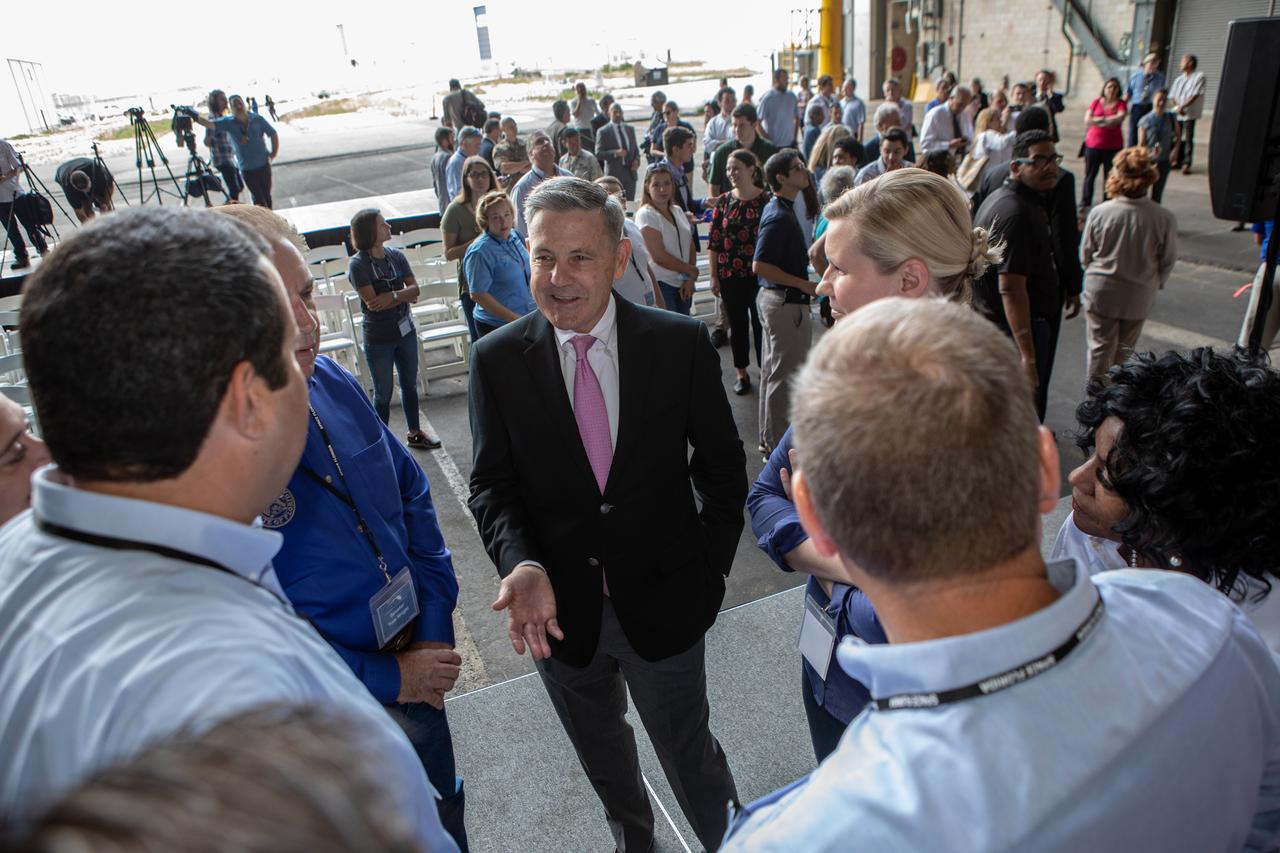
Kennedy Space Center Director Bob Cabana speaks with guests after a ribbon cutting ceremony on Aug. 16, 2019, in High Bay 2 of the Vehicle Assembly Building (VAB) at NASA’s Kennedy Space Center in Florida. The VAB is getting its first commercial tenant. Northrop Grumman signed a Reimbursable Space Act Agreement with NASA for use of the facilities. The company will assemble and test its new OmegA rocket inside the massive facility’s High Bay 2. The company also will modify mobile launcher platform-3 to serve as the launch vehicle’s assembly and launch platform. Northrop Grumman is developing the OmegA rocket, an intermediate/heavy-class launch vehicle, as part of a launch services agreement with the U.S. Air Force.

During a practice run, crawler-transporter 2 (CT-2) is moving inside High Bay 2 of the Vehicle Assembly Building (VAB) at NASA’s Kennedy Space Center in Florida on May 1, 2019. In view at right is one of the cabs used to drive the crawler. CT-2 picked up the space shuttle-era mobile launch platform-3 (MLP-3). The VAB is getting its first commercial tenant. Northrop Grumman signed a Reimbursable Space Act Agreement with NASA for use of the facilities. The company will assemble and test its new OmegA rocket inside the massive facility’s High Bay 2. The company also will modify MLP-3 to serve as the launch vehicle’s assembly and launch platform. Northrop Grumman is developing the OmegA rocket, an intermediate/heavy-class launch vehicle, as part of a launch services agreement with the U.S. Air Force.
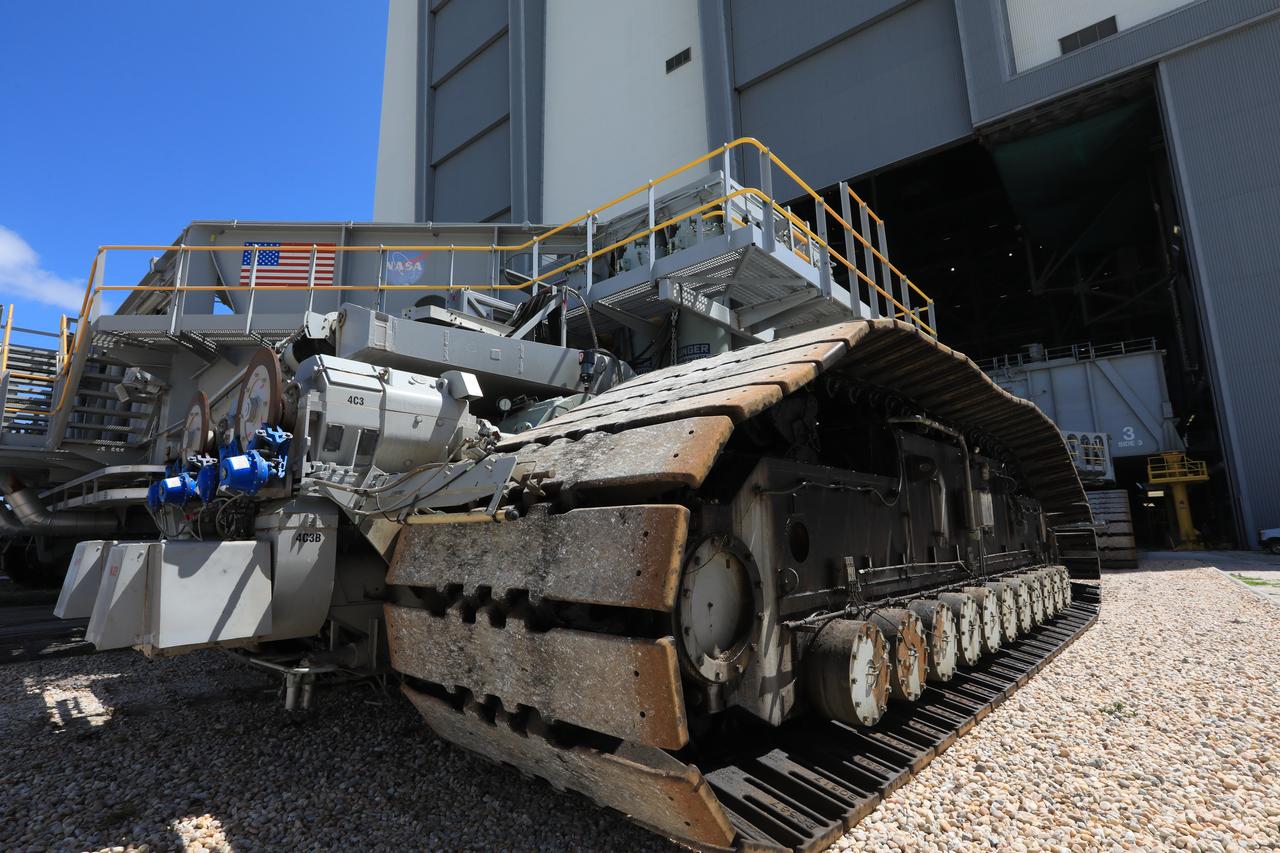
During a practice run, crawler-transporter 2 (CT-2) is at the entrance to High Bay 2 of the Vehicle Assembly Building (VAB) at NASA’s Kennedy Space Center in Florida on May 1, 2019. CT-2 entered High Bay 2, and picked up the space shuttle-era mobile launch platform-3 (MLP-3). The VAB is getting its first commercial tenant. Northrop Grumman signed a Reimbursable Space Act Agreement with NASA for use of the facilities. The company will assemble and test its new OmegA rocket inside the massive facility’s High Bay 2. The company also will modify MLP-3 to serve as the launch vehicle’s assembly and launch platform. Northrop Grumman is developing the OmegA rocket, an intermediate/heavy-class launch vehicle, as part of a launch services agreement with the U.S. Air Force.
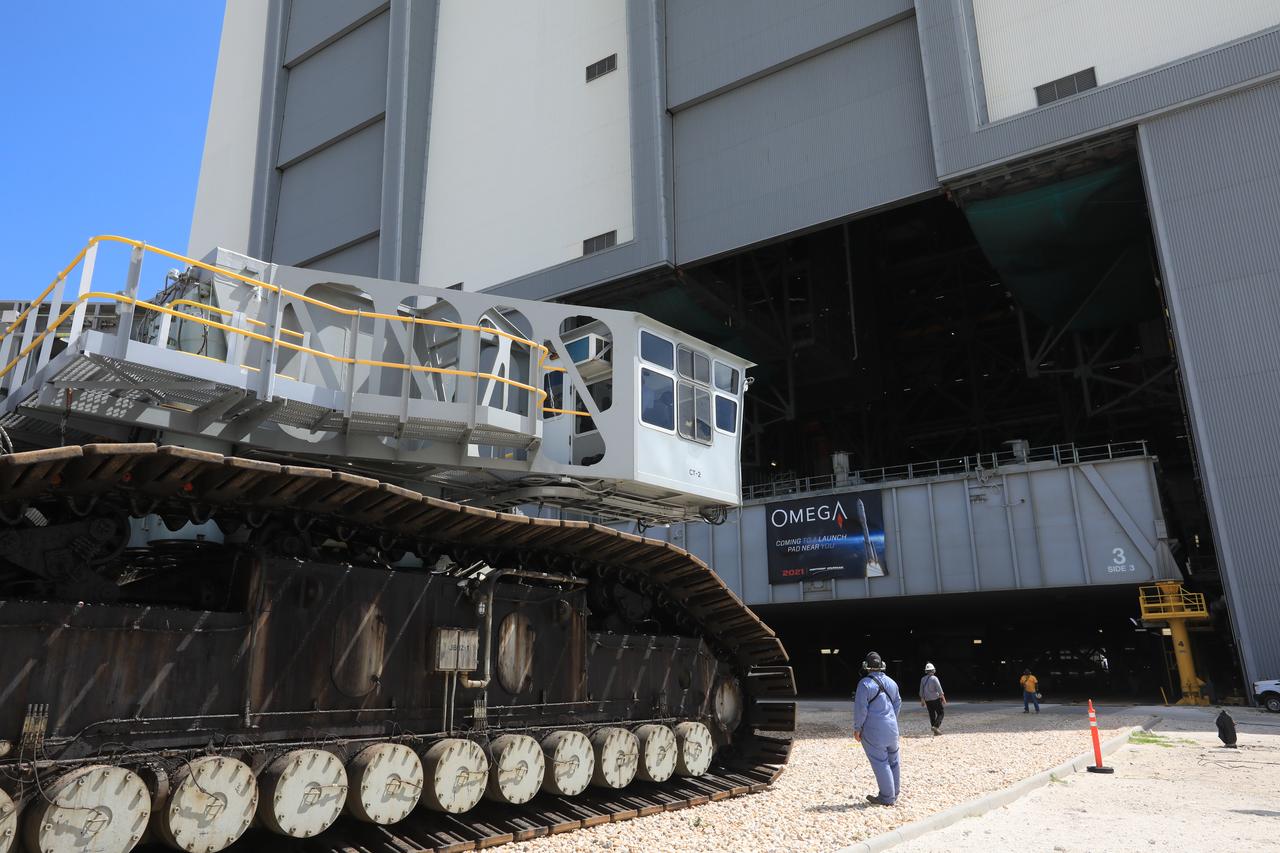
During a practice run, crawler-transporter 2 (CT-2) is being driven to the Vehicle Assembly Building (VAB) at NASA’s Kennedy Space Center in Florida on May 1, 2019. CT-2 entered High Bay 2, and picked up the space shuttle-era mobile launch platform-3 (MLP-3). The VAB is getting its first commercial tenant. Northrop Grumman signed a Reimbursable Space Act Agreement with NASA for use of the facilities. The company will assemble and test its new OmegA rocket inside the massive facility’s High Bay 2. The company also will modify MLP-3 to serve as the launch vehicle’s assembly and launch platform. Northrop Grumman is developing the OmegA rocket, an intermediate/heavy-class launch vehicle, as part of a launch services agreement with the U.S. Air Force.

During a practice run, crawler-transporter 2 (CT-2) is being driven to the Vehicle Assembly Building (VAB) at NASA’s Kennedy Space Center in Florida on May 1, 2019. CT-2 entered High Bay 2, and picked up the space shuttle-era mobile launch platform-3 (MLP-3). The VAB is getting its first commercial tenant. Northrop Grumman signed a Reimbursable Space Act Agreement with NASA for use of the facilities. The company will assemble and test its new OmegA rocket inside the massive facility’s High Bay 2. The company also will modify MLP-3 to serve as the launch vehicle’s assembly and launch platform. Northrop Grumman is developing the OmegA rocket, an intermediate/heavy-class launch vehicle, as part of a launch services agreement with the U.S. Air Force.
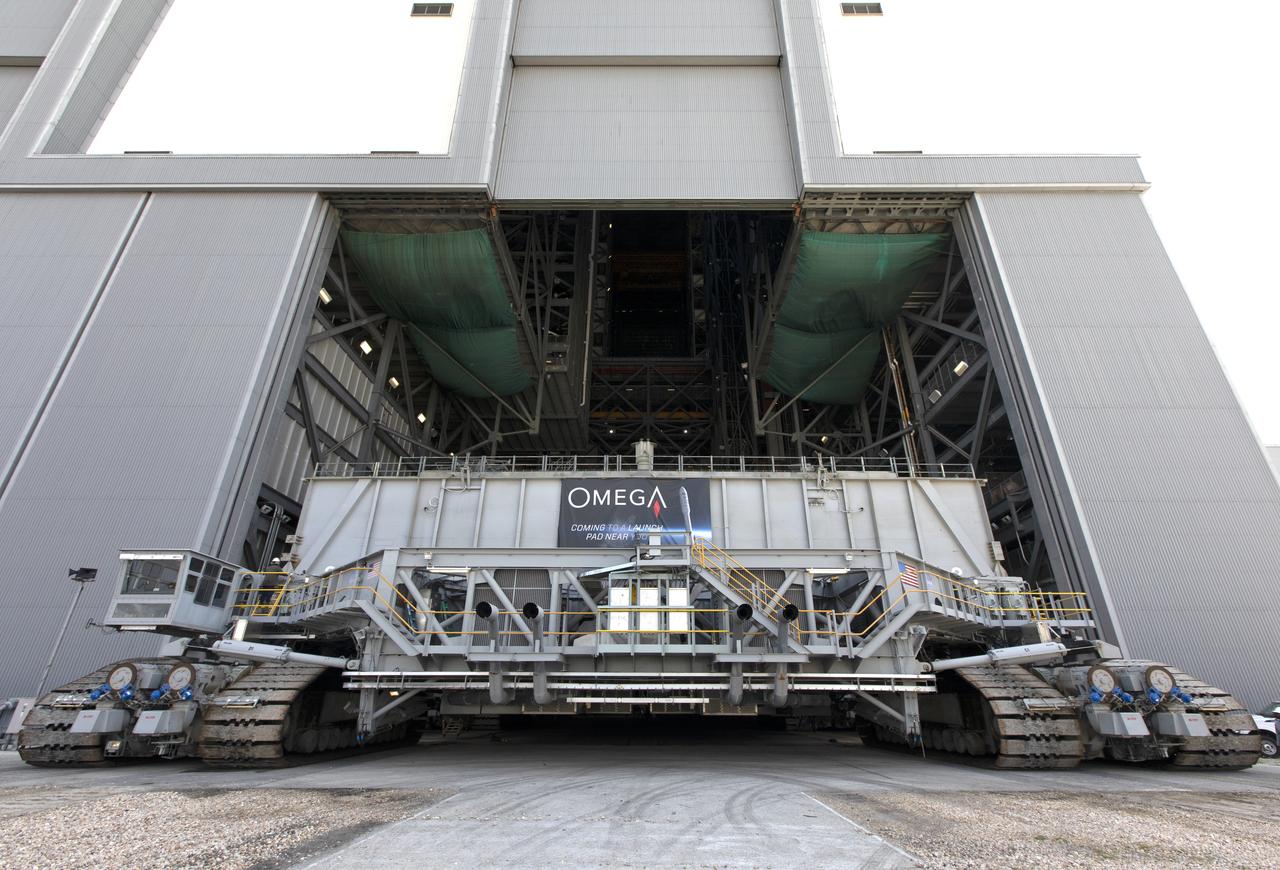
During a practice run, crawler-transporter 2 (CT-2) is moving inside High Bay 2 of the Vehicle Assembly Building (VAB) at NASA’s Kennedy Space Center in Florida on May 1, 2019. CT-2 picked up the space shuttle-era mobile launch platform-3 (MLP-3). The VAB is getting its first commercial tenant. Northrop Grumman signed a Reimbursable Space Act Agreement with NASA for use of the facilities. The company will assemble and test its new OmegA rocket inside the massive facility’s High Bay 2. The company also will modify MLP-3 to serve as the launch vehicle’s assembly and launch platform. Northrop Grumman is developing the OmegA rocket, an intermediate/heavy-class launch vehicle, as part of a launch services agreement with the U.S. Air Force.
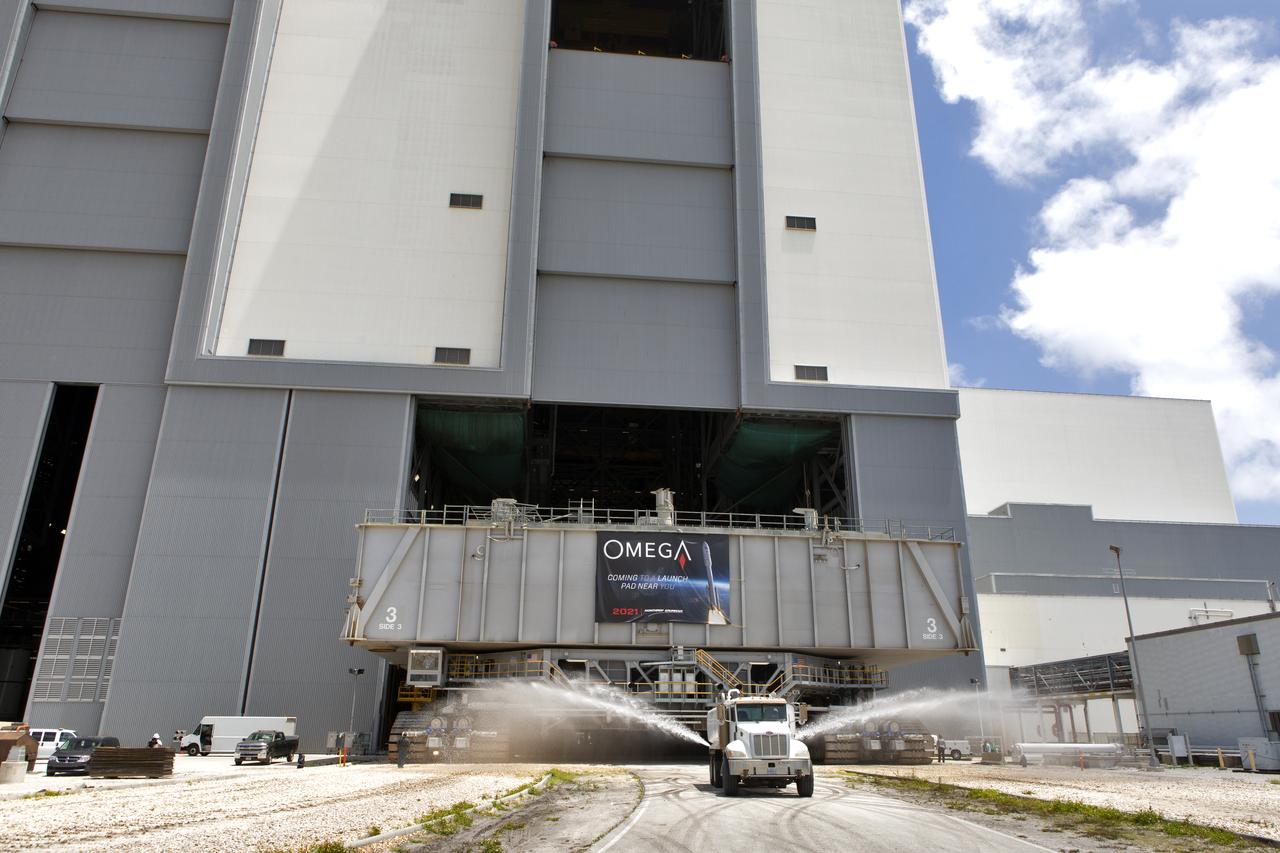
During a practice run, crawler-transporter 2 (CT-2), with the space shuttle-era mobile launch platform-3 (MLP-3) on top, moves out of High Bay 2 of the Vehicle Assembly Building (VAB) at NASA’s Kennedy Space Center in Florida on May 1, 2019. A truck in front sprays water to reduce dust on the crawlerway. The VAB is getting its first commercial tenant. Northrop Grumman signed a Reimbursable Space Act Agreement with NASA for use of the facilities. The company will assemble and test its new OmegA rocket inside the massive facility’s High Bay 2. The company also will modify MLP-3 to serve as the launch vehicle’s assembly and launch platform. Northrop Grumman is developing the OmegA rocket, an intermediate/heavy-class launch vehicle, as part of a launch services agreement with the U.S. Air Force.
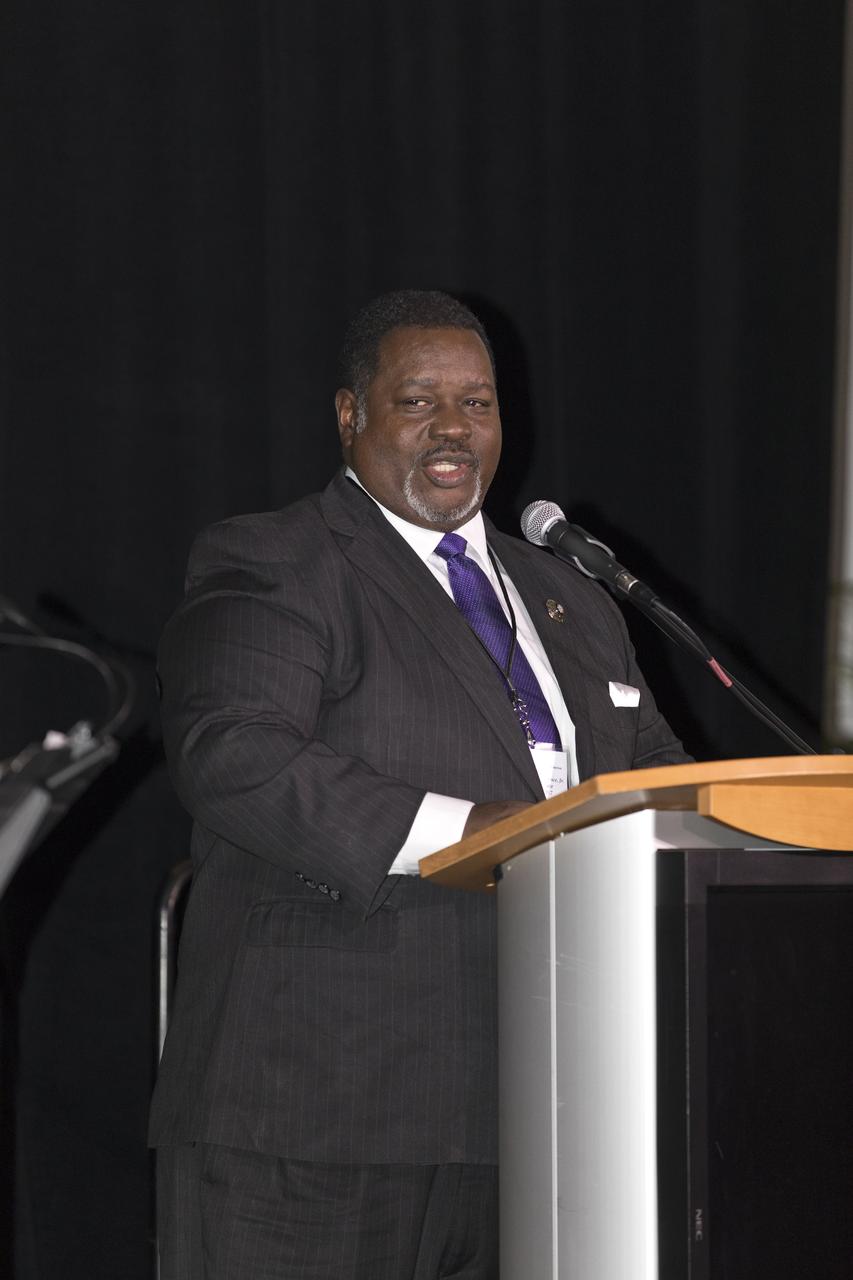
Antonio "Tony" Knox, grand basileus of the Omega Psi Phi, speaks during an Astronauts Memorial Foundation tribute honoring U.S. Air Foce Maj. Robert Lawrence who was a member of the fraternity. Selected in 1967 for the Manned Orbiting Laboratory Program, Lawrence was the first African-American astronaut. He lost his life in a training accident 50 years ago. The ceremony took place in the Center for Space Education at the Kennedy Space Center Visitor Complex.

These four nebulae (star-forming clouds of gas and dust) are known for their breathtaking beauty: the Eagle Nebula (which contains the Pillars of Creation), the Omega Nebula, the Trifid Nebula, and the Lagoon Nebula. In the 1950s, a team of astronomers made rough distance measurements to some of the stars in these nebulae and were able to infer the existence of the Sagittarius Arm. Their work provided some of the first evidence of our galaxy's spiral structure. In a new study, astronomers have shown that these nebulae are part of a substructure within the arm that is angled differently from the rest of the arm. A key property of spiral arms is how tightly they wind around a galaxy. This characteristic is measured by the arm's pitch angle. A circle has a pitch angle of 0 degrees, and as the spiral becomes more open, the pitch angle increases. Most models of the Milky Way suggest that the Sagittarius Arm forms a spiral that has a pitch angle of about 12 degrees, but the protruding structure has a pitch angle of nearly 60 degrees. Similar structures – sometimes called spurs or feathers – are commonly found jutting out of the arms of other spiral galaxies. For decades scientists have wondered whether our Milky Way's spiral arms are also dotted with these structures or if they are relatively smooth. https://photojournal.jpl.nasa.gov/catalog/PIA24577
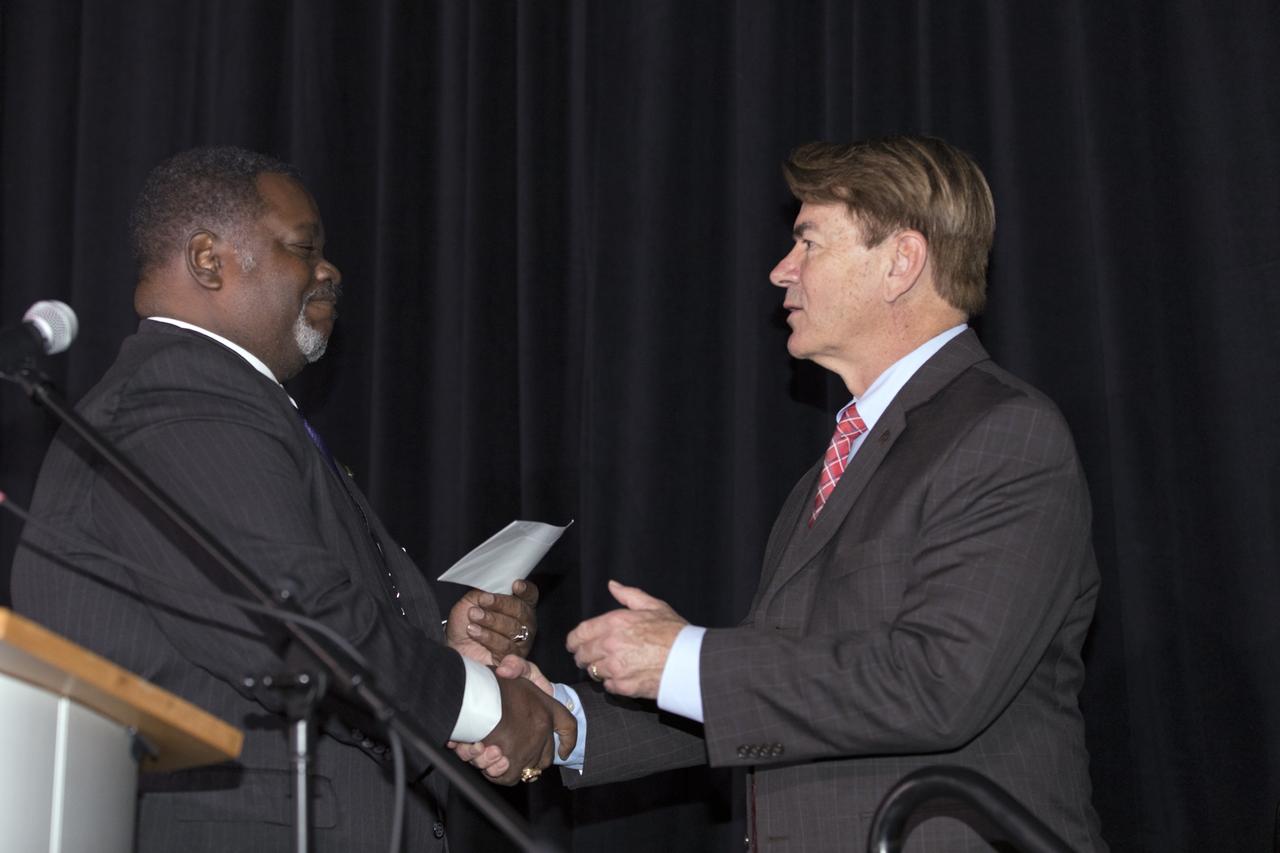
Antonio "Tony" Knox, grand basileus of the Omega Psi Phi farternity, makes a presentation to the Astronauts Memorial Foundation (AMF) with State Rep. Thad Altman, AMF president, accepting on behalf of the organization. The presentation took palce during an AMF tribute honoring U.S. Air Foce Maj. Lawrence who was a member of the fraternity. Selected in 1967 for the Manned Orbiting Laboratory Program, Lawrence was the first African-American astronaut. He lost his life in a training accident 50 years ago. The ceremony took place in the Center for Space Education at the Kennedy Space Center Visitor Complex.
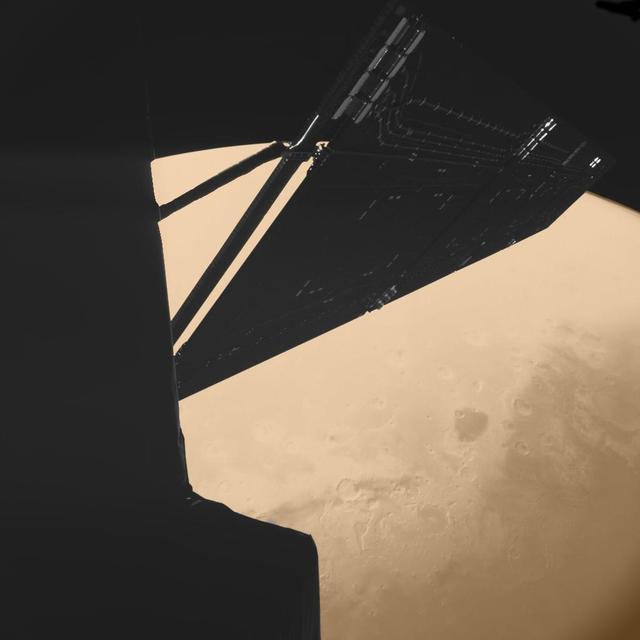
Stunning image taken by the CIVA imaging instrument on Rosetta Philae lander just 4 minutes before closest approach at a distance of some 1000 km from Mars on Feb. 25, 2007. A portion of the spacecraft and one of its solar arrays are visible in nice detail. Beneath, the Mawrth Vallis region is visible on the planet's disk. Mawrth Vallis is particularly relevant as it is one of the areas on the Martian surface where the OMEGA instrument on board ESA's Mars Express detected the presence of hydrated clay minerals -- a sign that water may have flown abundantly on that region in the very early history of Mars. Id 217487 http://photojournal.jpl.nasa.gov/catalog/PIA18154
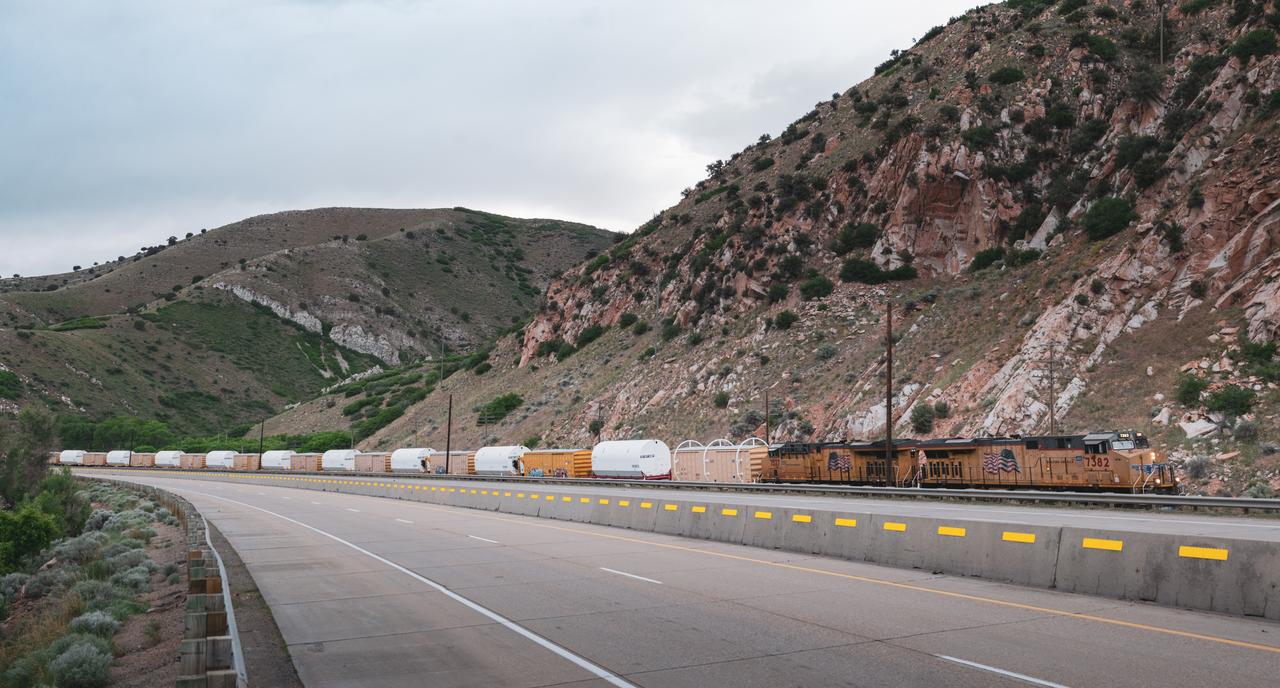
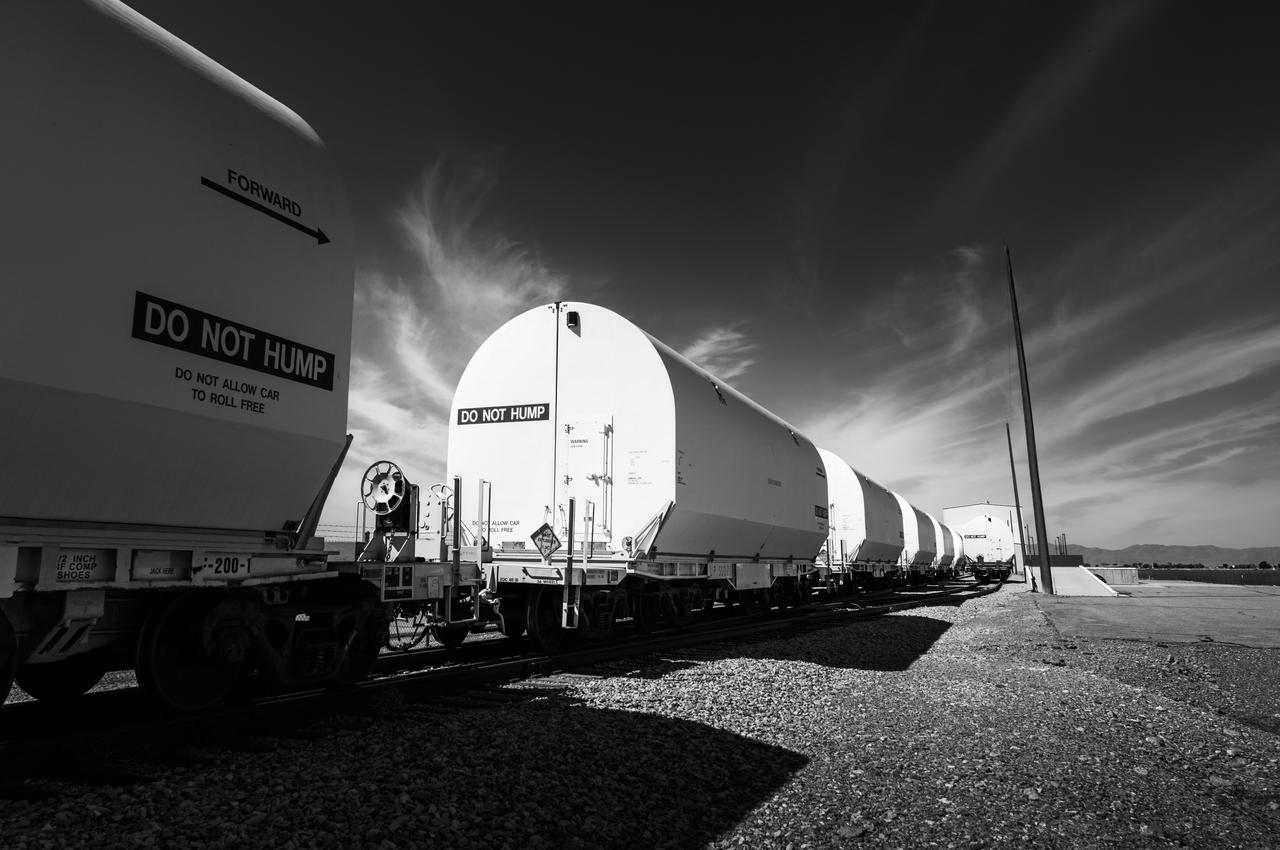
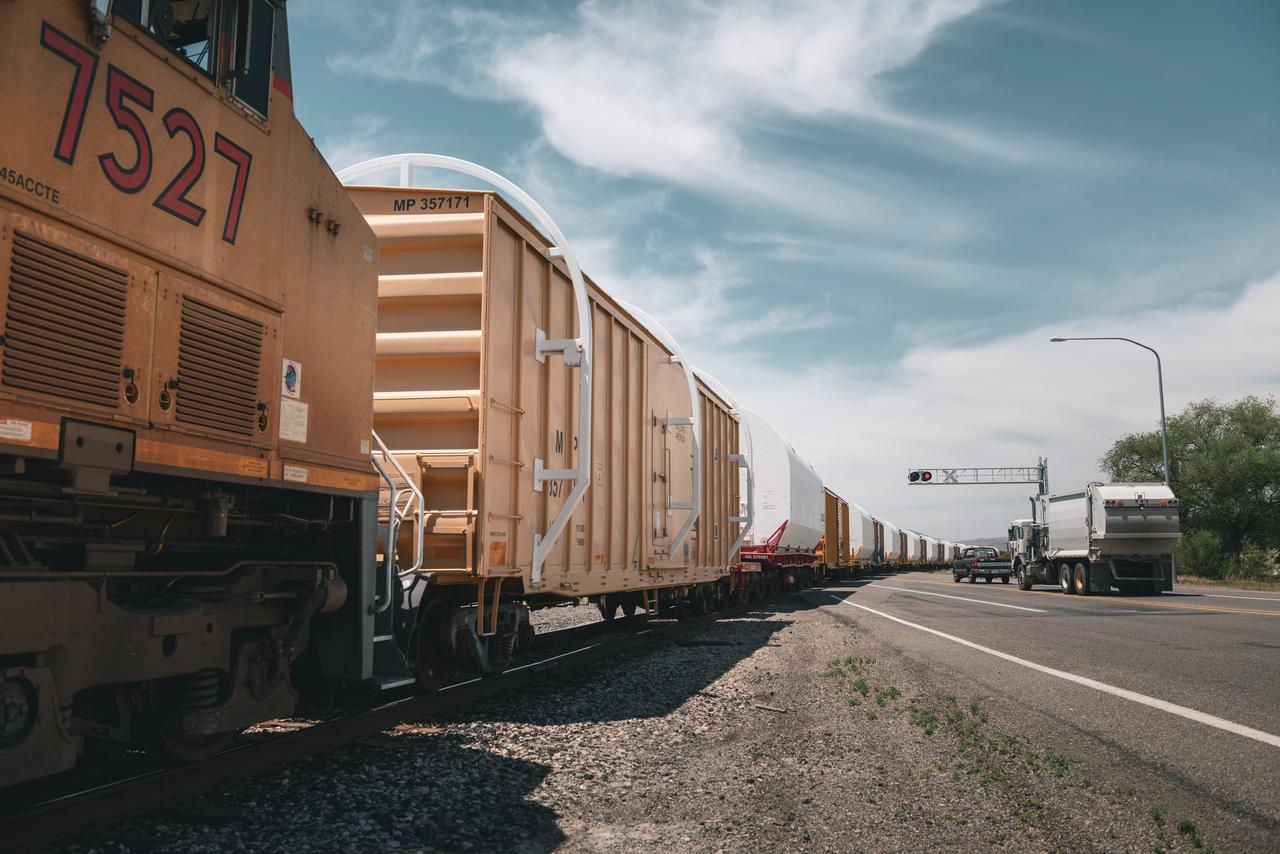
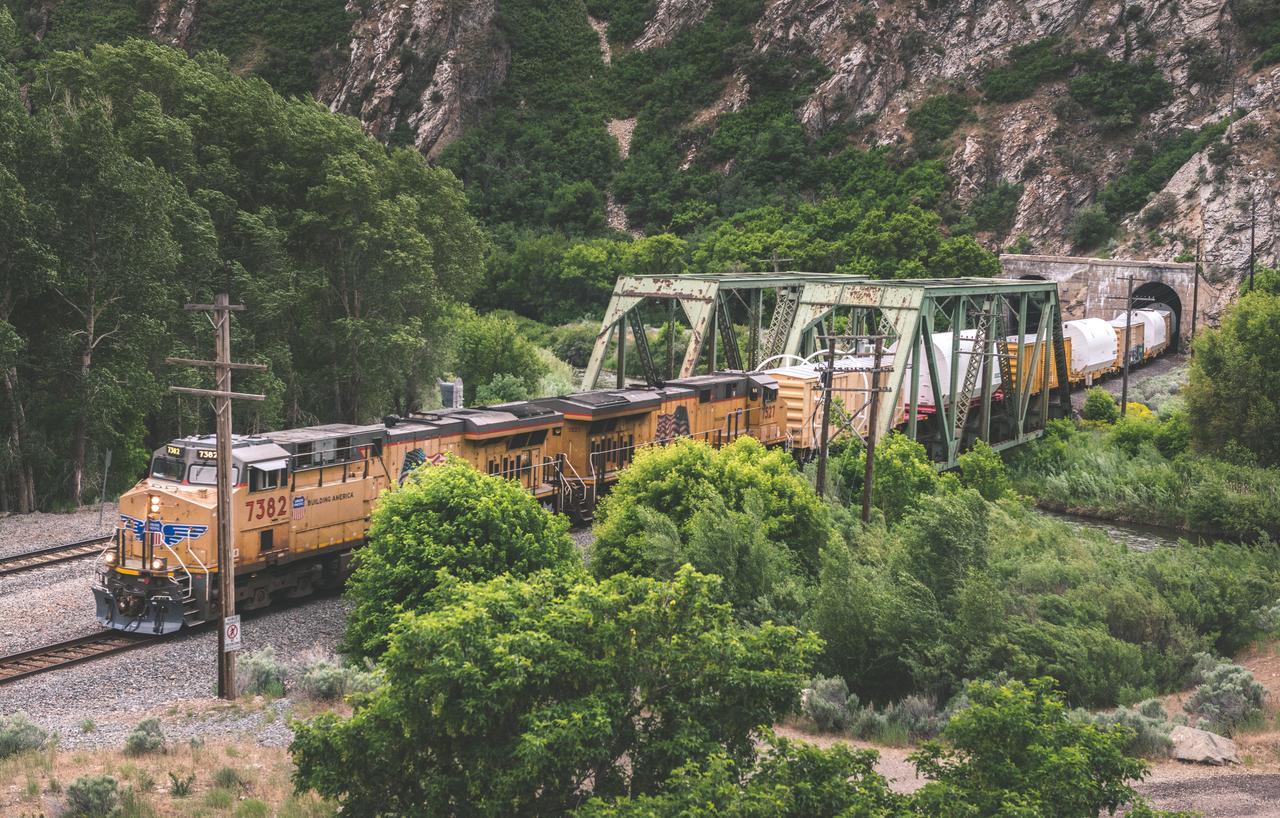
The two solid rocket boosters that will power NASA’s Space Launch System (SLS) for Artemis missions to the Moon are on their way to the agency’s Kennedy Space Center in Florida after departing from a Northrop Grumman manufacturing facility in Promontory, Utah, on June 5, 2020. The boosters – each comprised of five motor segments – are scheduled to arrive at Kennedy’s Rotation, Processing and Surge Facility, where teams with NASA’s Exploration Ground Systems will process the segments before moving them to the Vehicle Assembly Building for stacking on the mobile launcher. Under the Artemis program, NASA will land the first woman and the next man on the Moon by 2024. The first in a series of increasingly complex missions, Artemis I will test the Orion spacecraft and SLS as an integrated system ahead of crewed flights to the Moon.

The two solid rocket boosters that will power NASA’s Space Launch System (SLS) for Artemis missions to the Moon are on their way to the agency’s Kennedy Space Center in Florida after departing from a Northrop Grumman manufacturing facility in Promontory, Utah, on June 5, 2020. The boosters – each comprised of five motor segments – are scheduled to arrive at Kennedy’s Rotation, Processing and Surge Facility, where teams with NASA’s Exploration Ground Systems will process the segments before moving them to the Vehicle Assembly Building for stacking on the mobile launcher. Under the Artemis program, NASA will land the first woman and the next man on the Moon by 2024. The first in a series of increasingly complex missions, Artemis I will test the Orion spacecraft and SLS as an integrated system ahead of crewed flights to the Moon.
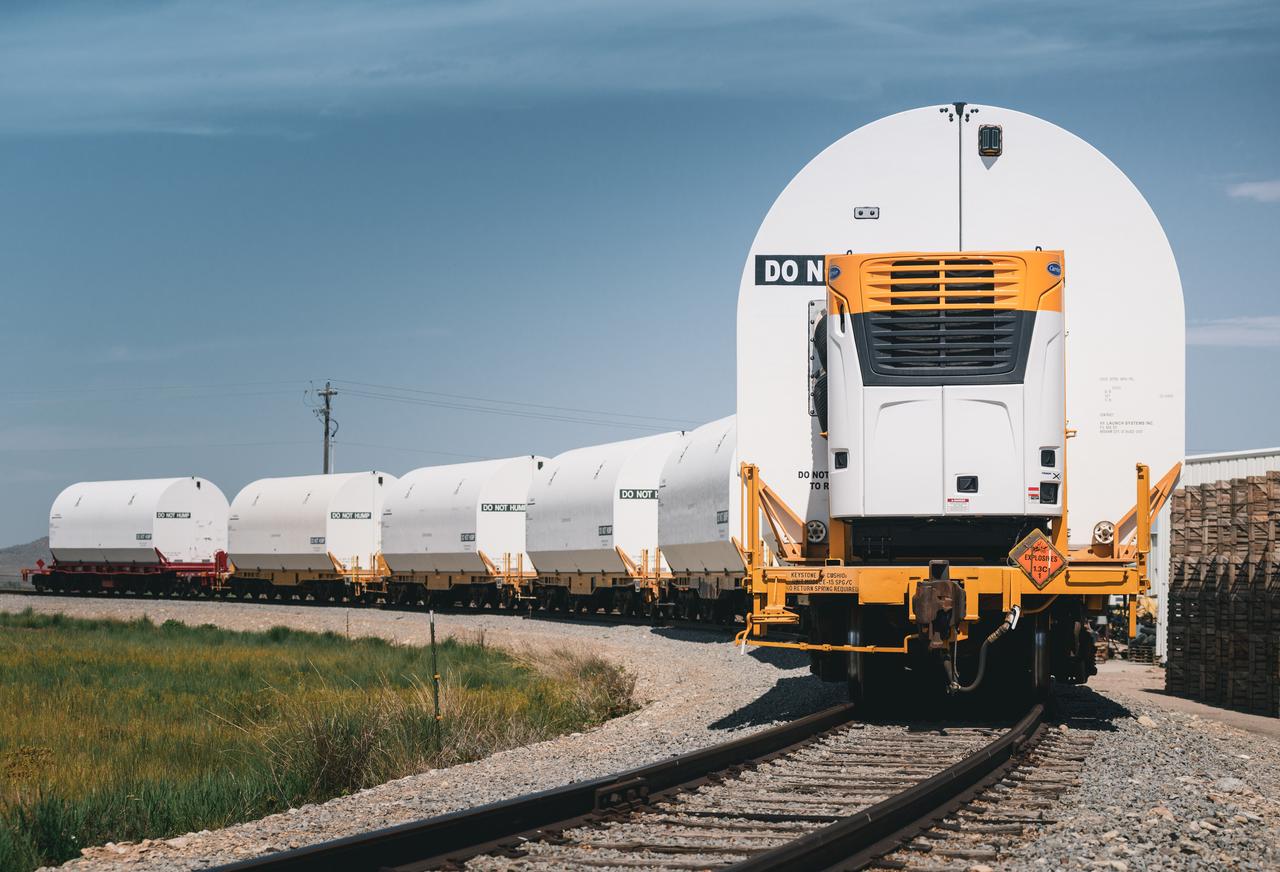
The two solid rocket boosters that will power NASA’s Space Launch System (SLS) for Artemis missions to the Moon are on their way to the agency’s Kennedy Space Center in Florida after departing from a Northrop Grumman manufacturing facility in Promontory, Utah, on June 5, 2020. The boosters – each comprised of five motor segments – are scheduled to arrive at Kennedy’s Rotation, Processing and Surge Facility, where teams with NASA’s Exploration Ground Systems will process the segments before moving them to the Vehicle Assembly Building for stacking on the mobile launcher. Under the Artemis program, NASA will land the first woman and the next man on the Moon by 2024. The first in a series of increasingly complex missions, Artemis I will test the Orion spacecraft and SLS as an integrated system ahead of crewed flights to the Moon.
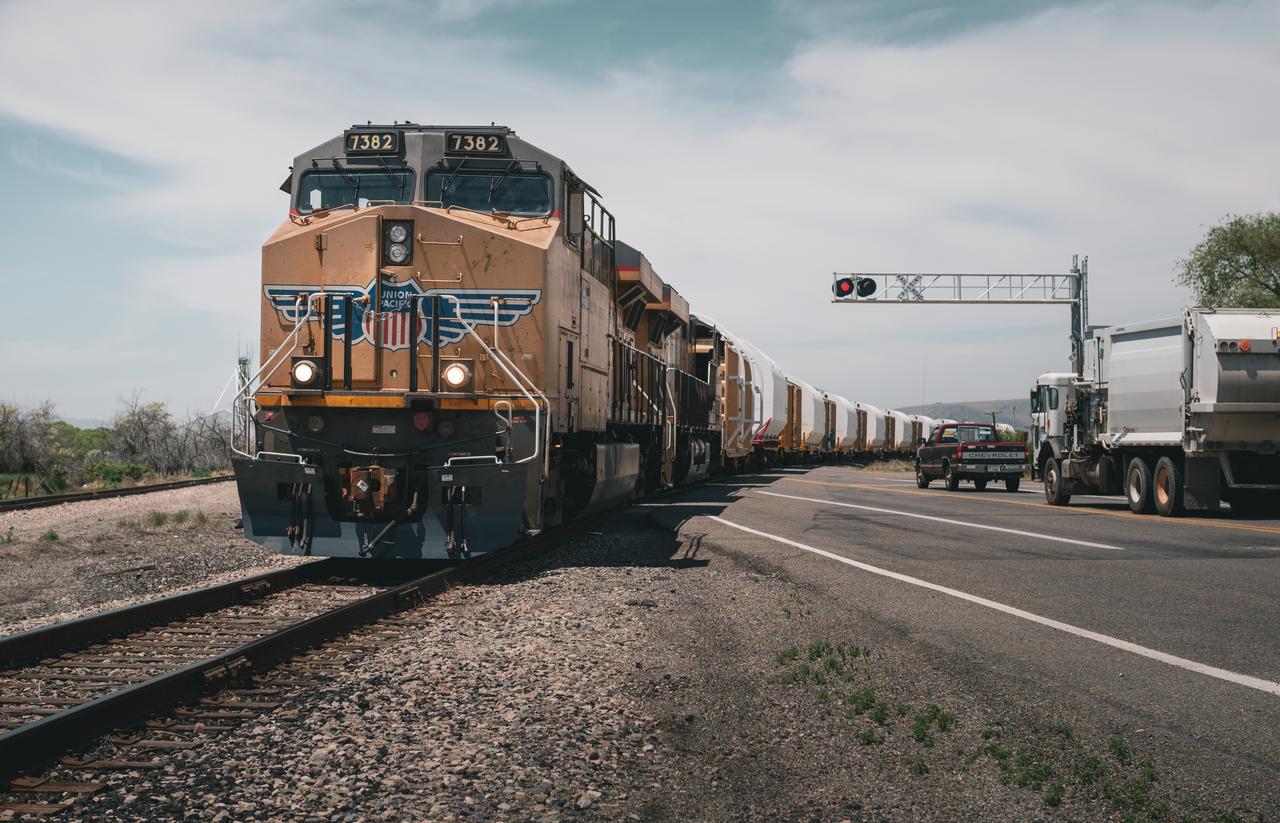
The two solid rocket boosters that will power NASA’s Space Launch System (SLS) for Artemis missions to the Moon are on their way to the agency’s Kennedy Space Center in Florida after departing from a Northrop Grumman manufacturing facility in Promontory, Utah, on June 5, 2020. The boosters – each comprised of five motor segments – are scheduled to arrive at Kennedy’s Rotation, Processing and Surge Facility, where teams with NASA’s Exploration Ground Systems will process the segments before moving them to the Vehicle Assembly Building for stacking on the mobile launcher. Under the Artemis program, NASA will land the first woman and the next man on the Moon by 2024. The first in a series of increasingly complex missions, Artemis I will test the Orion spacecraft and SLS as an integrated system ahead of crewed flights to the Moon.
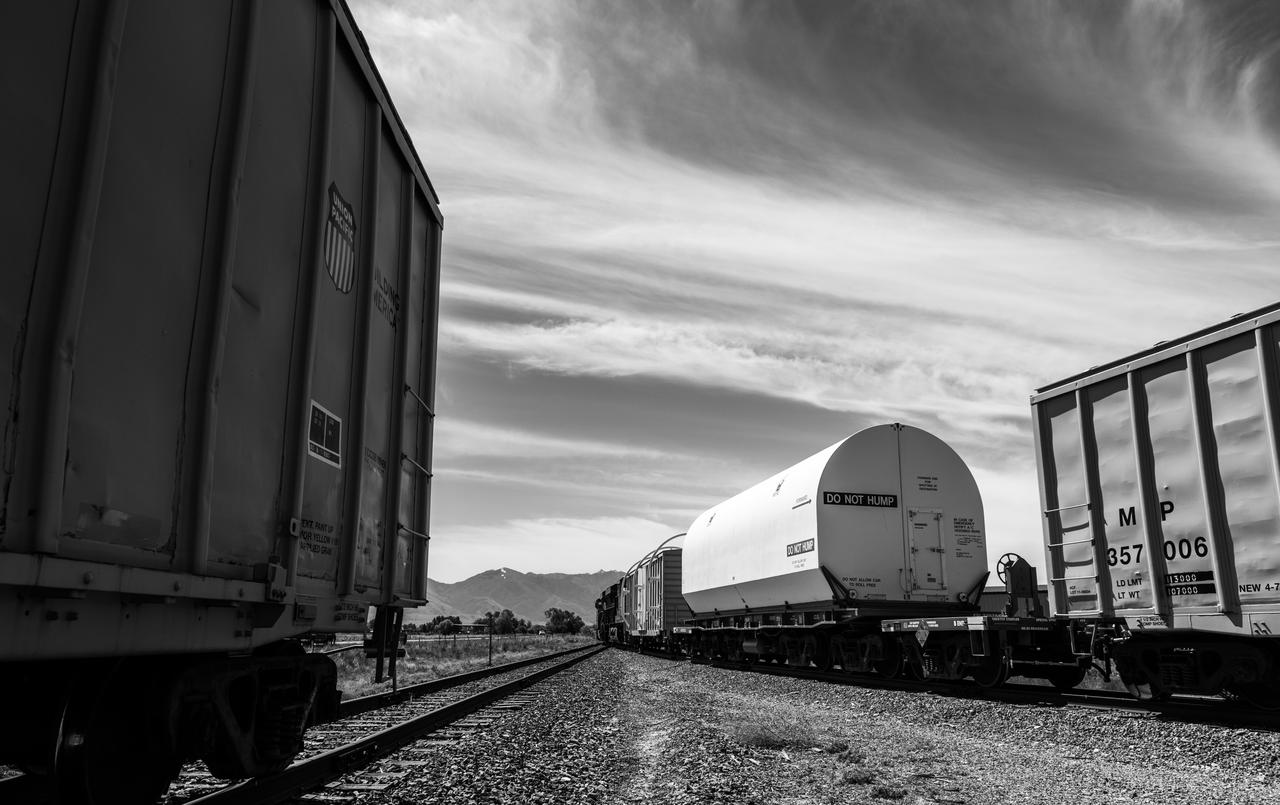
The two solid rocket boosters that will power NASA’s Space Launch System (SLS) for Artemis missions to the Moon are on their way to the agency’s Kennedy Space Center in Florida after departing from a Northrop Grumman manufacturing facility in Promontory, Utah, on June 5, 2020. The boosters – each comprised of five motor segments – are scheduled to arrive at Kennedy’s Rotation, Processing and Surge Facility, where teams with NASA’s Exploration Ground Systems will process the segments before moving them to the Vehicle Assembly Building for stacking on the mobile launcher. Under the Artemis program, NASA will land the first woman and the next man on the Moon by 2024. The first in a series of increasingly complex missions, Artemis I will test the Orion spacecraft and SLS as an integrated system ahead of crewed flights to the Moon.
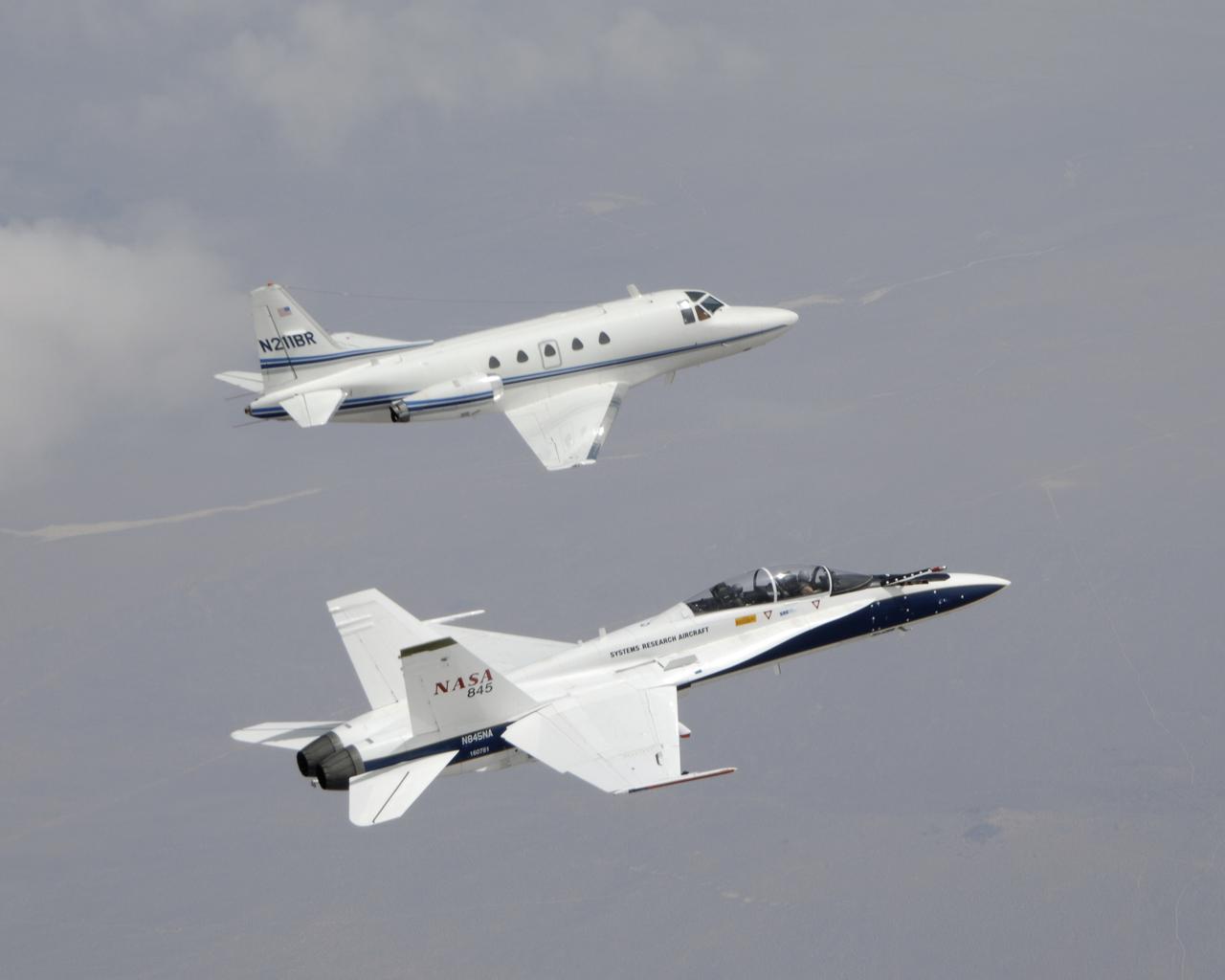
Testing autonomous software for AARD program using a NASA F/A-18 #845 following a chartered Sabreliner.
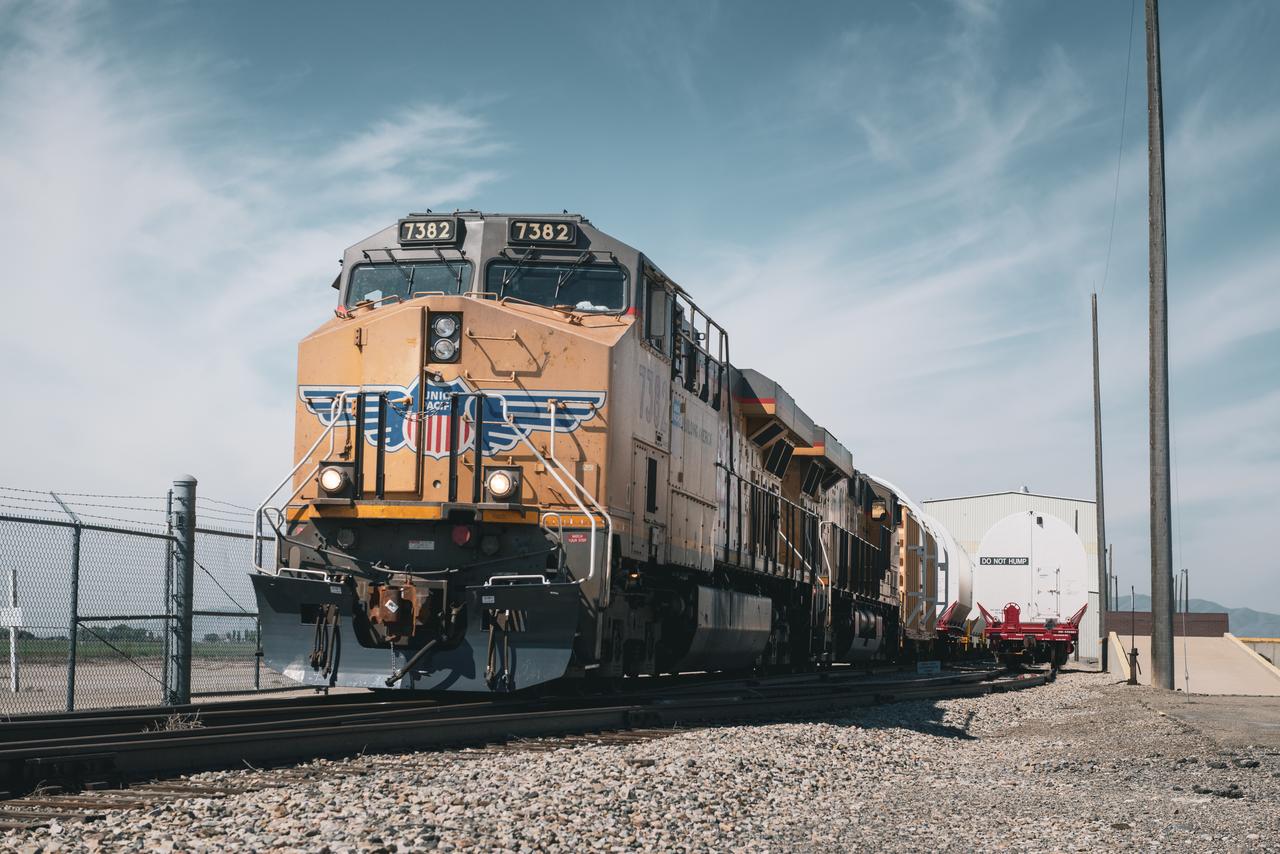
The two solid rocket boosters that will power NASA’s Space Launch System (SLS) for Artemis missions to the Moon are on their way to the agency’s Kennedy Space Center in Florida after departing from a Northrop Grumman manufacturing facility in Promontory, Utah, on June 5, 2020. The boosters – each comprised of five motor segments – are scheduled to arrive at Kennedy’s Rotation, Processing and Surge Facility, where teams with NASA’s Exploration Ground Systems will process the segments before moving them to the Vehicle Assembly Building for stacking on the mobile launcher. Under the Artemis program, NASA will land the first woman and the next man on the Moon by 2024. The first in a series of increasingly complex missions, Artemis I will test the Orion spacecraft and SLS as an integrated system ahead of crewed flights to the Moon.
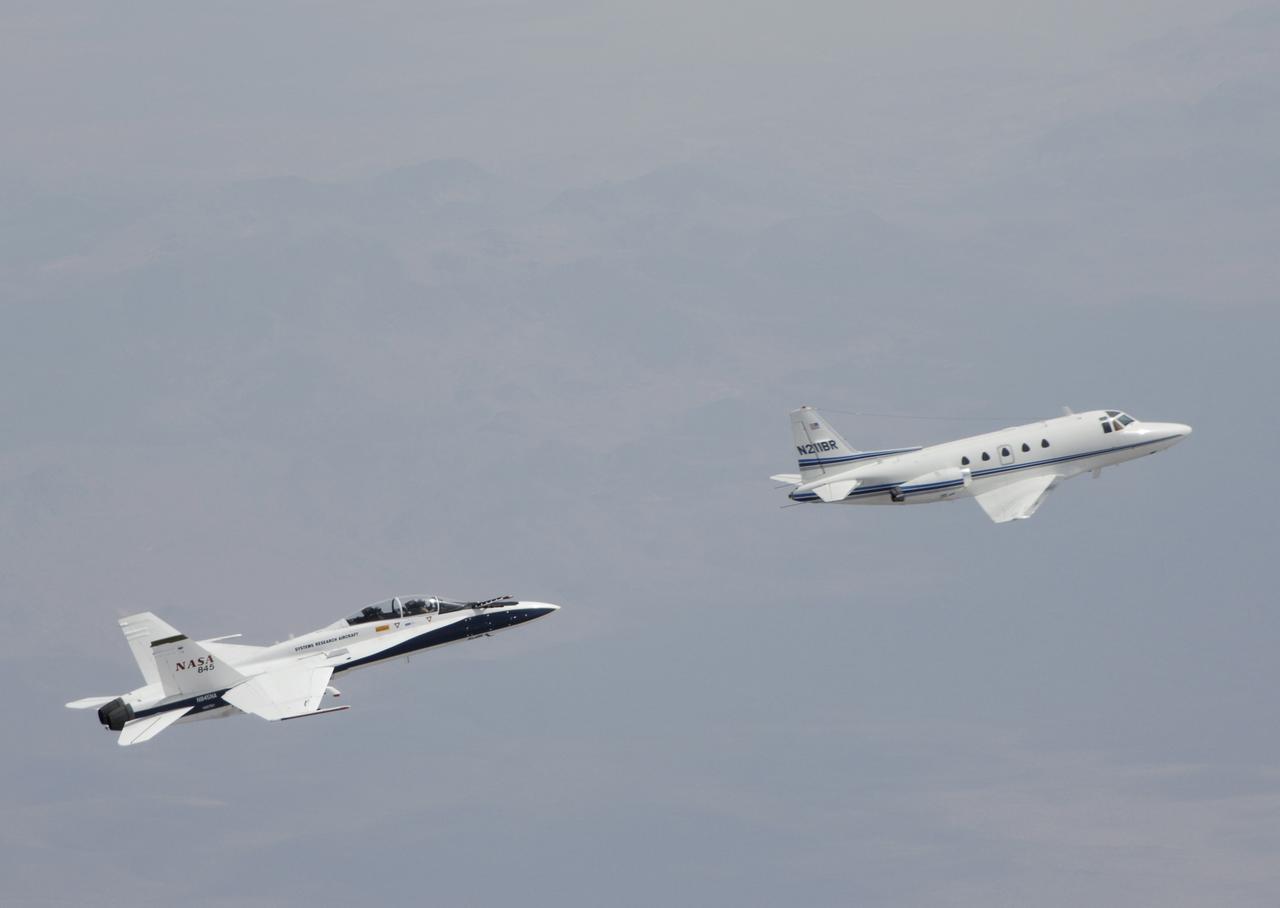
Testing autonomous software for AARD program using a NASA F/A-18 #845 following a chartered Sabreliner.
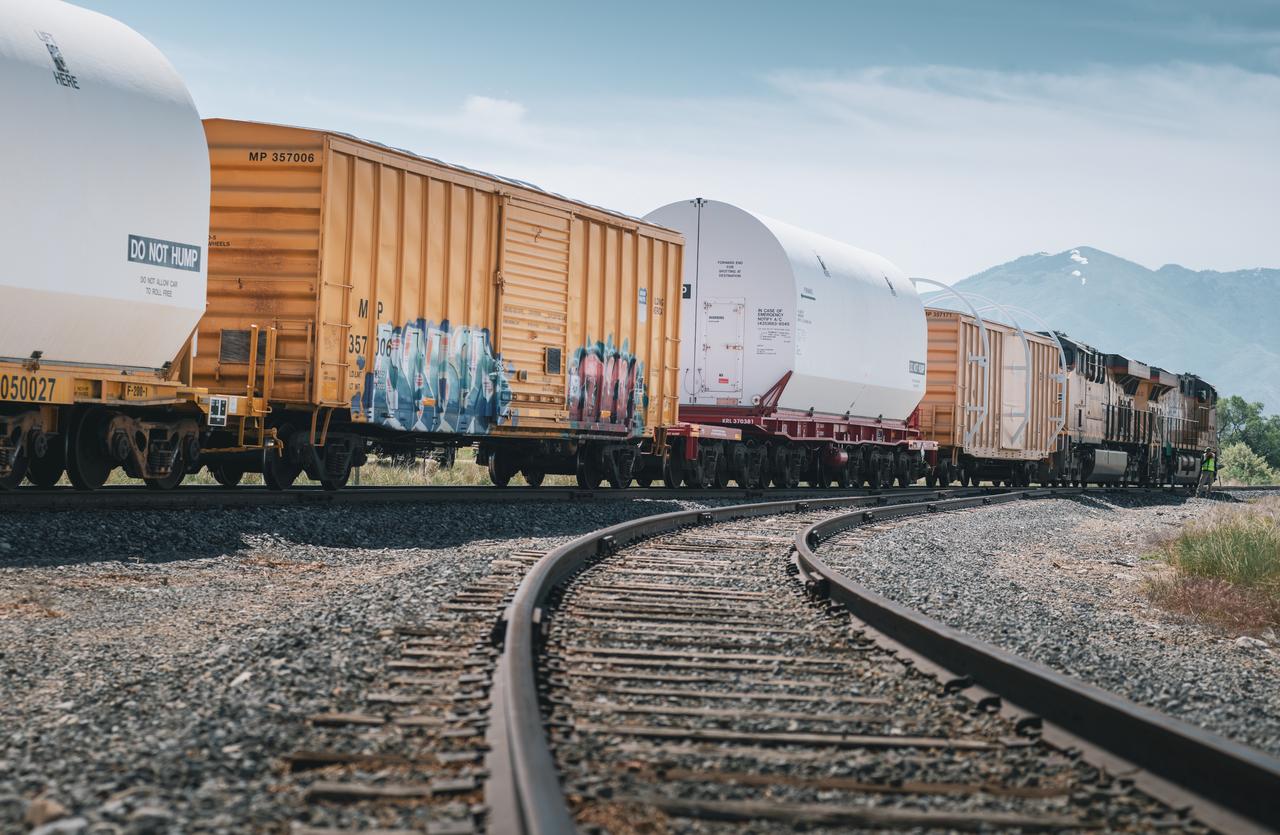
The two solid rocket boosters that will power NASA’s Space Launch System (SLS) for Artemis missions to the Moon are on their way to the agency’s Kennedy Space Center in Florida after departing from a Northrop Grumman manufacturing facility in Promontory, Utah, on June 5, 2020. The boosters – each comprised of five motor segments – are scheduled to arrive at Kennedy’s Rotation, Processing and Surge Facility, where teams with NASA’s Exploration Ground Systems will process the segments before moving them to the Vehicle Assembly Building for stacking on the mobile launcher. Under the Artemis program, NASA will land the first woman and the next man on the Moon by 2024. The first in a series of increasingly complex missions, Artemis I will test the Orion spacecraft and SLS as an integrated system ahead of crewed flights to the Moon.
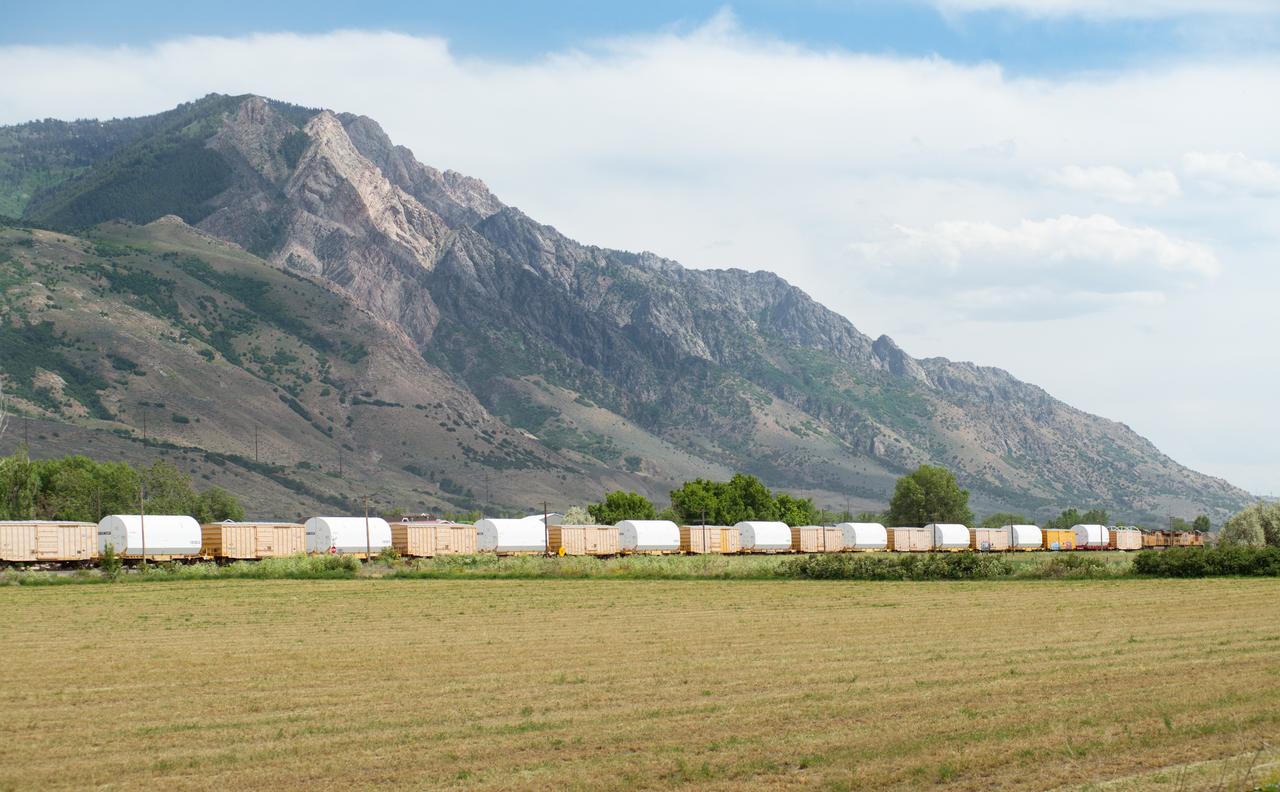
The two solid rocket boosters that will power NASA’s Space Launch System (SLS) for Artemis missions to the Moon are on their way to the agency’s Kennedy Space Center in Florida after departing from a Northrop Grumman manufacturing facility in Promontory, Utah, on June 5, 2020. The boosters – each comprised of five motor segments – are scheduled to arrive at Kennedy’s Rotation, Processing and Surge Facility, where teams with NASA’s Exploration Ground Systems will process the segments before moving them to the Vehicle Assembly Building for stacking on the mobile launcher. Under the Artemis program, NASA will land the first woman and the next man on the Moon by 2024. The first in a series of increasingly complex missions, Artemis I will test the Orion spacecraft and SLS as an integrated system ahead of crewed flights to the Moon.
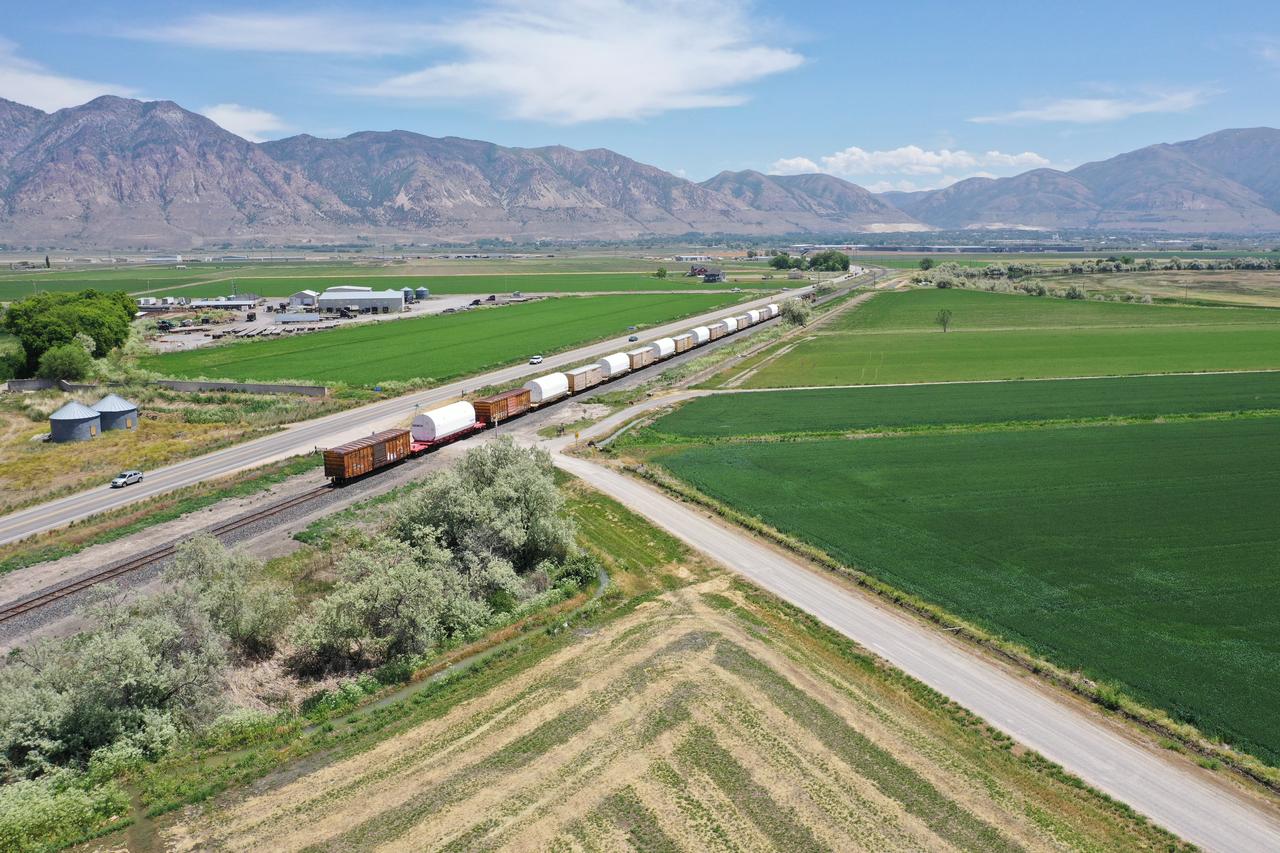
The two solid rocket boosters that will power NASA’s Space Launch System (SLS) for Artemis missions to the Moon are on their way to the agency’s Kennedy Space Center in Florida after departing from a Northrop Grumman manufacturing facility in Promontory, Utah, on June 5, 2020. The boosters – each comprised of five motor segments – are scheduled to arrive at Kennedy’s Rotation, Processing and Surge Facility, where teams with NASA’s Exploration Ground Systems will process the segments before moving them to the Vehicle Assembly Building for stacking on the mobile launcher. Under the Artemis program, NASA will land the first woman and the next man on the Moon by 2024. The first in a series of increasingly complex missions, Artemis I will test the Orion spacecraft and SLS as an integrated system ahead of crewed flights to the Moon.
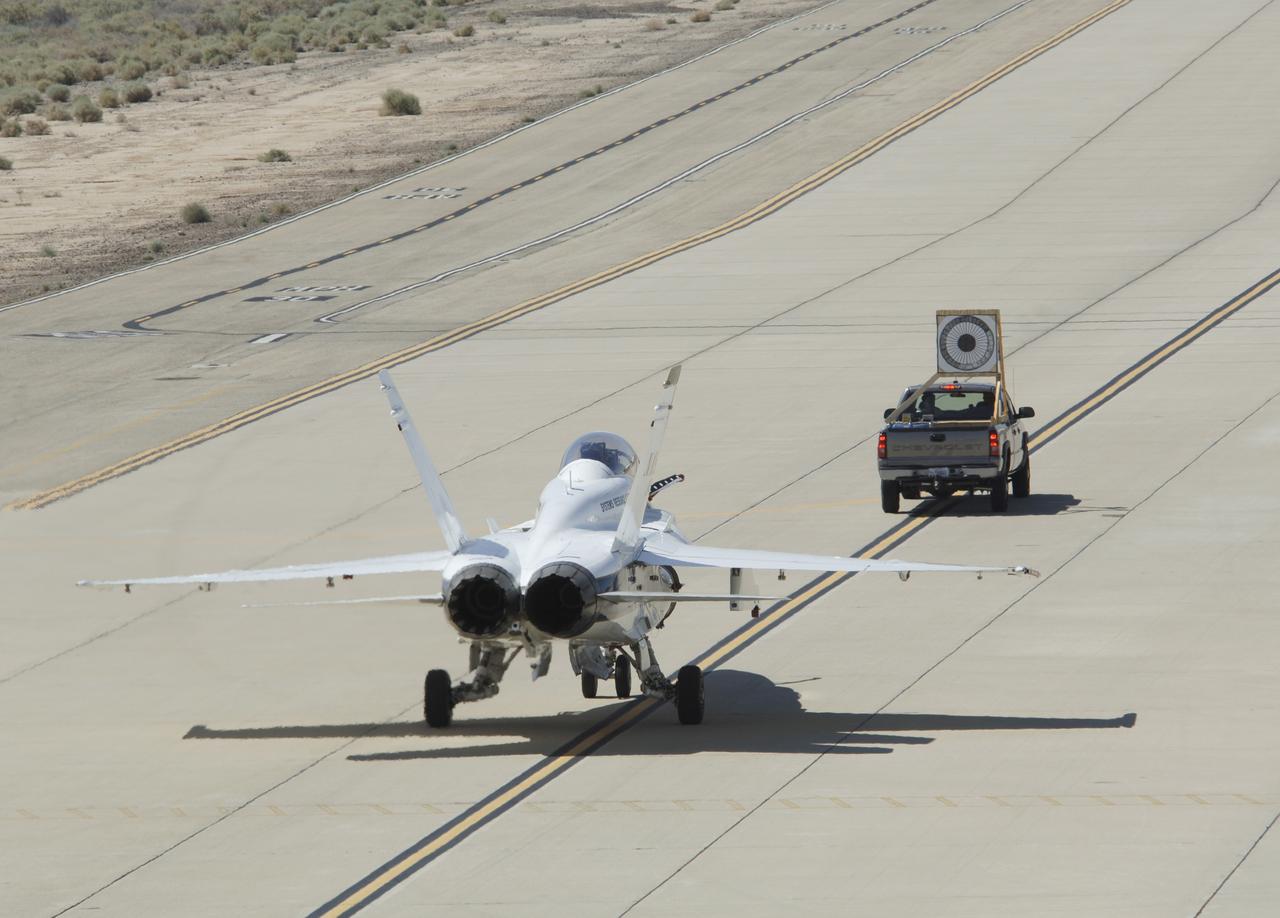
F/A-18 #845 testing autonomous system for AARD project by following a pickup with an airborne tanker drogue illustration.
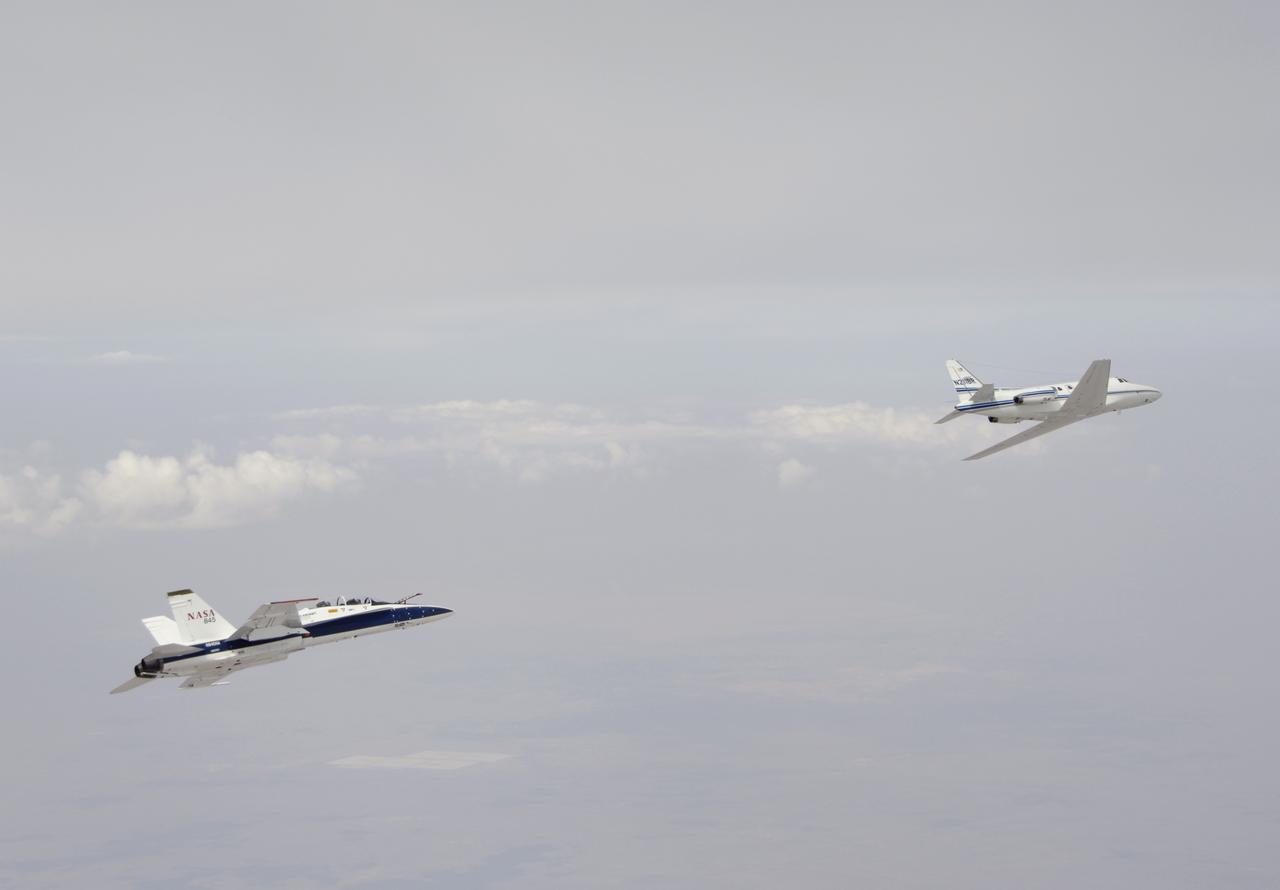
Testing autonomous software for AARD program using a NASA F/A-18 #845 following a chartered Sabreliner.

The two solid rocket boosters that will power NASA’s Space Launch System (SLS) for Artemis missions to the Moon are on their way to the agency’s Kennedy Space Center in Florida after departing from a Northrop Grumman manufacturing facility in Promontory, Utah, on June 5, 2020. The boosters – each comprised of five motor segments – are scheduled to arrive at Kennedy’s Rotation, Processing and Surge Facility, where teams with NASA’s Exploration Ground Systems will process the segments before moving them to the Vehicle Assembly Building for stacking on the mobile launcher. Under the Artemis program, NASA will land the first woman and the next man on the Moon by 2024. The first in a series of increasingly complex missions, Artemis I will test the Orion spacecraft and SLS as an integrated system ahead of crewed flights to the Moon.
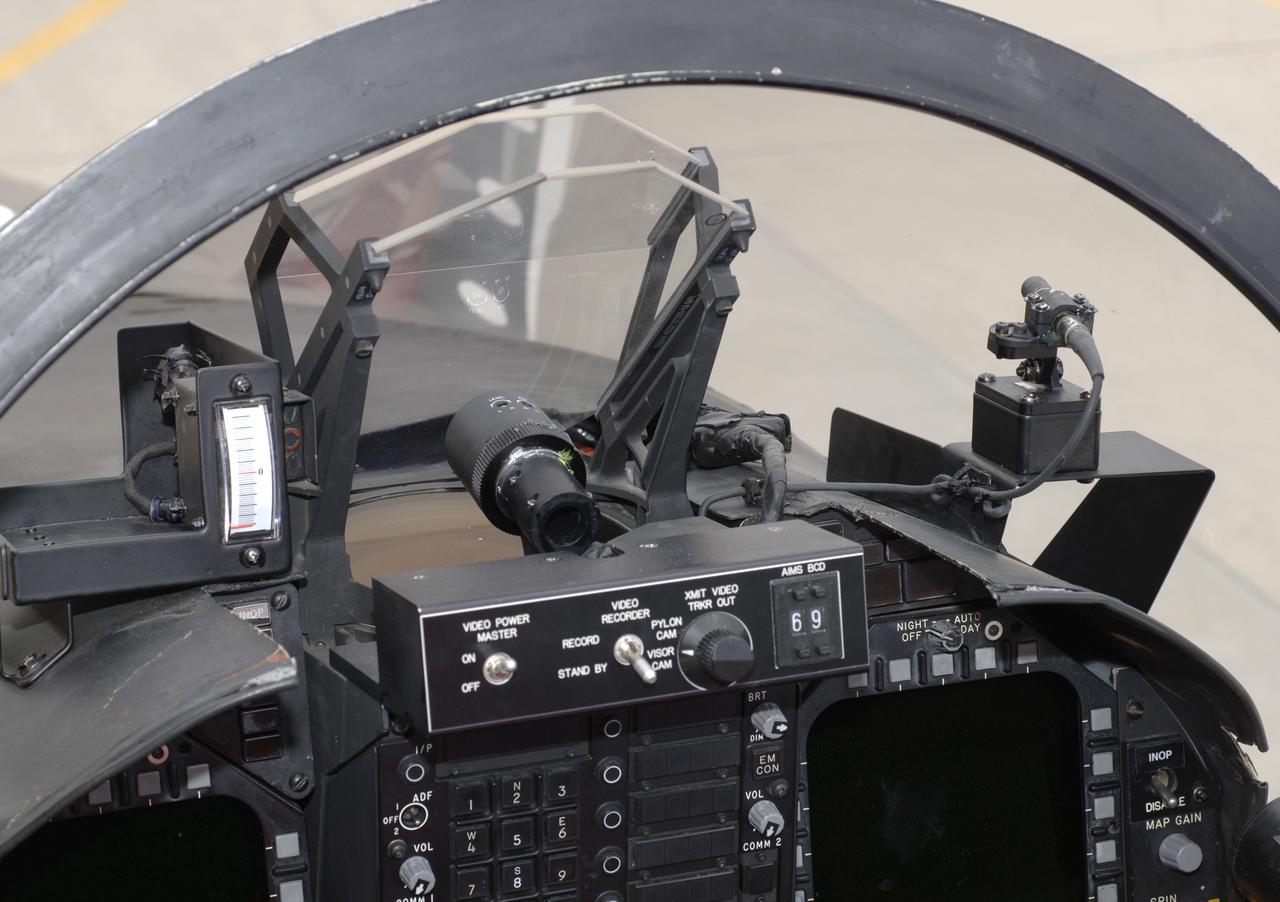
F/A-18 #845 HUD and video camera setup for Autonomous Airborne Refueling Demonstration (AARD) project
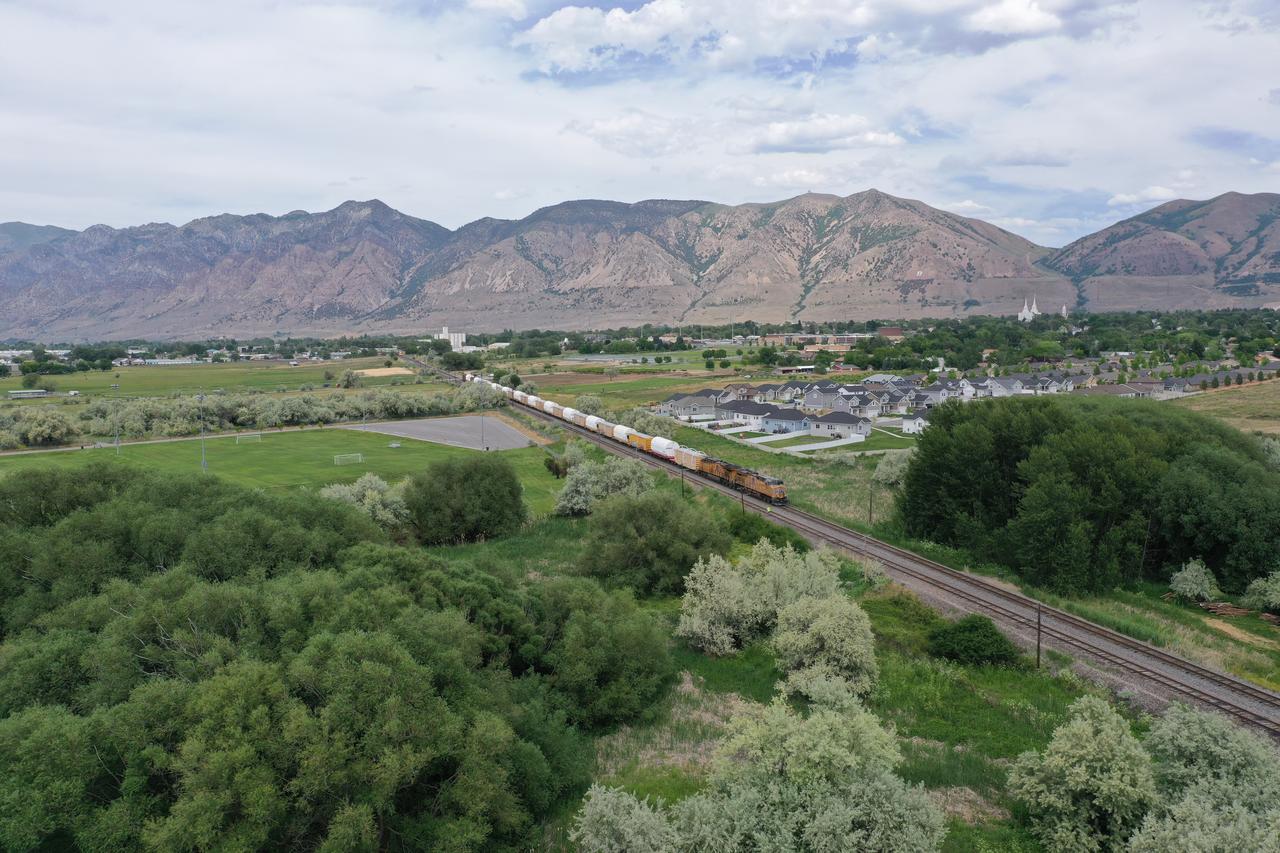
The two solid rocket boosters that will power NASA’s Space Launch System (SLS) for Artemis missions to the Moon are on their way to the agency’s Kennedy Space Center in Florida after departing from a Northrop Grumman manufacturing facility in Promontory, Utah, on June 5, 2020. The boosters – each comprised of five motor segments – are scheduled to arrive at Kennedy’s Rotation, Processing and Surge Facility, where teams with NASA’s Exploration Ground Systems will process the segments before moving them to the Vehicle Assembly Building for stacking on the mobile launcher. Under the Artemis program, NASA will land the first woman and the next man on the Moon by 2024. The first in a series of increasingly complex missions, Artemis I will test the Orion spacecraft and SLS as an integrated system ahead of crewed flights to the Moon.

Two solid rocket boosters that will power NASA’s Space Launch System (SLS) for Artemis missions to the Moon are being transported from a Northrop Grumman manufacturing facility in Promontory, Utah, to the agency’s Kennedy Space Center in Florida by railcar. Departing on June 5, 2020, the boosters – each comprised of five motor segments – are scheduled to arrive at Kennedy’s Rotation, Processing and Surge Facility, where teams with NASA’s Exploration Ground Systems will process the segments before moving them to the Vehicle Assembly Building for stacking on the mobile launcher. Under the Artemis program, NASA will land the first woman and the next man on the Moon by 2024. The first in a series of increasingly complex missions, Artemis I will test the Orion spacecraft and SLS as an integrated system ahead of crewed flights to the Moon.
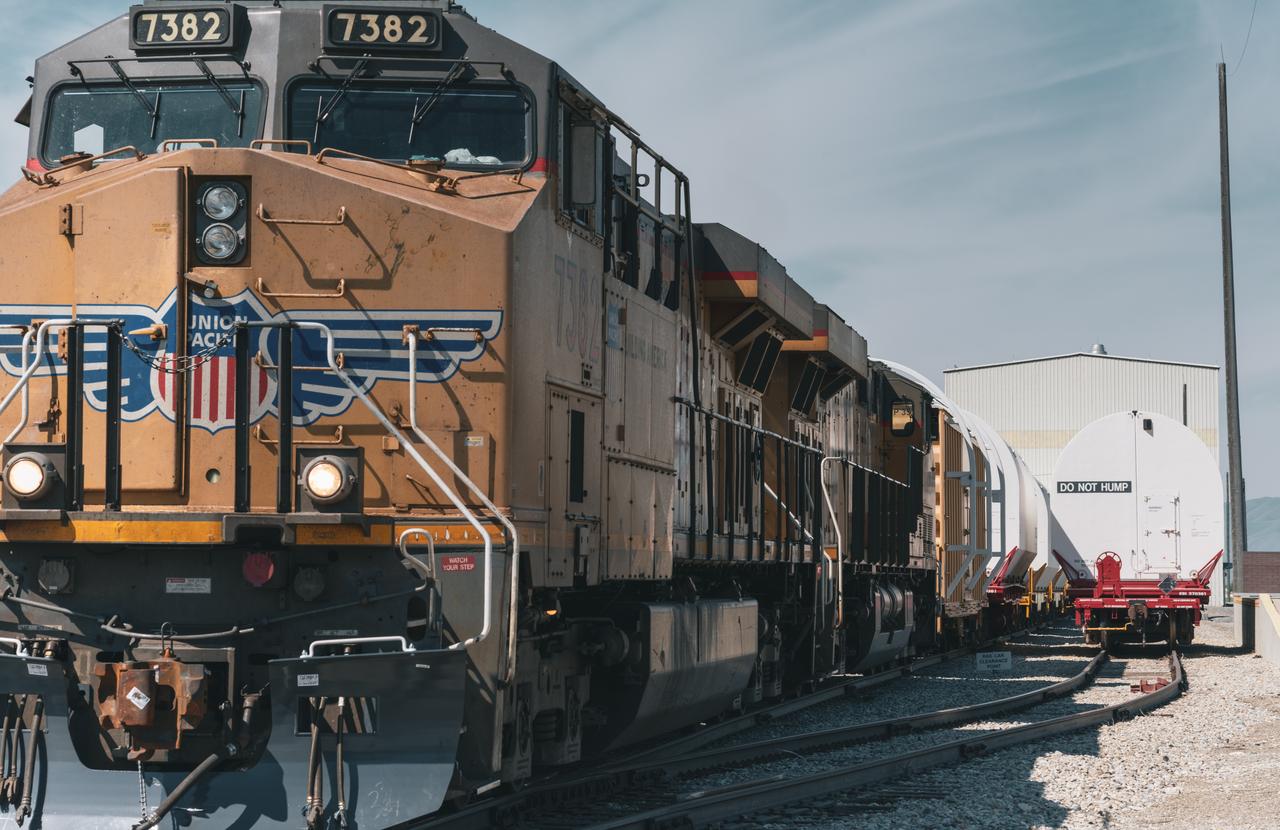
The two solid rocket boosters that will power NASA’s Space Launch System (SLS) for Artemis missions to the Moon are on their way to the agency’s Kennedy Space Center in Florida after departing from a Northrop Grumman manufacturing facility in Promontory, Utah, on June 5, 2020. The boosters – each comprised of five motor segments – are scheduled to arrive at Kennedy’s Rotation, Processing and Surge Facility, where teams with NASA’s Exploration Ground Systems will process the segments before moving them to the Vehicle Assembly Building for stacking on the mobile launcher. Under the Artemis program, NASA will land the first woman and the next man on the Moon by 2024. The first in a series of increasingly complex missions, Artemis I will test the Orion spacecraft and SLS as an integrated system ahead of crewed flights to the Moon.
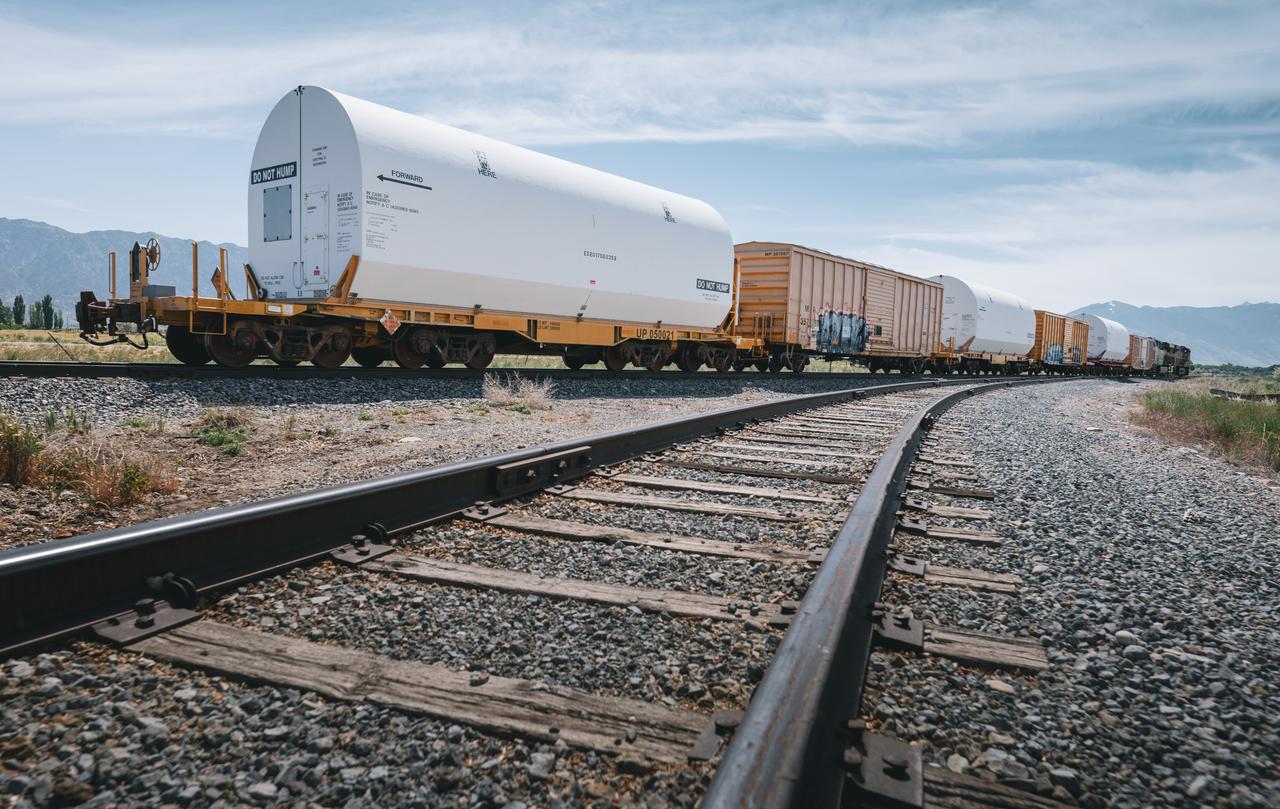
The two solid rocket boosters that will power NASA’s Space Launch System (SLS) for Artemis missions to the Moon are on their way to the agency’s Kennedy Space Center in Florida after departing from a Northrop Grumman manufacturing facility in Promontory, Utah, on June 5, 2020. The boosters – each comprised of five motor segments – are scheduled to arrive at Kennedy’s Rotation, Processing and Surge Facility, where teams with NASA’s Exploration Ground Systems will process the segments before moving them to the Vehicle Assembly Building for stacking on the mobile launcher. Under the Artemis program, NASA will land the first woman and the next man on the Moon by 2024. The first in a series of increasingly complex missions, Artemis I will test the Orion spacecraft and SLS as an integrated system ahead of crewed flights to the Moon.
The two solid rocket boosters that will power NASA’s Space Launch System (SLS) for Artemis missions to the Moon are on their way to the agency’s Kennedy Space Center in Florida after departing from a Northrop Grumman manufacturing facility in Promontory, Utah, on June 5, 2020. The boosters – each comprised of five motor segments – are scheduled to arrive at Kennedy’s Rotation, Processing and Surge Facility, where teams with NASA’s Exploration Ground Systems will process the segments before moving them to the Vehicle Assembly Building for stacking on the mobile launcher. Under the Artemis program, NASA will land the first woman and the next man on the Moon by 2024. The first in a series of increasingly complex missions, Artemis I will test the Orion spacecraft and SLS as an integrated system ahead of crewed flights to the Moon.
The two solid rocket boosters that will power NASA’s Space Launch System (SLS) for Artemis missions to the Moon are on their way to the agency’s Kennedy Space Center in Florida after departing from a Northrop Grumman manufacturing facility in Promontory, Utah, on June 5, 2020. The boosters – each comprised of five motor segments – are scheduled to arrive at Kennedy’s Rotation, Processing and Surge Facility, where teams with NASA’s Exploration Ground Systems will process the segments before moving them to the Vehicle Assembly Building for stacking on the mobile launcher. Under the Artemis program, NASA will land the first woman and the next man on the Moon by 2024. The first in a series of increasingly complex missions, Artemis I will test the Orion spacecraft and SLS as an integrated system ahead of crewed flights to the Moon.
The two solid rocket boosters that will power NASA’s Space Launch System (SLS) for Artemis missions to the Moon are on their way to the agency’s Kennedy Space Center in Florida after departing from a Northrop Grumman manufacturing facility in Promontory, Utah, on June 5, 2020. The boosters – each comprised of five motor segments – are scheduled to arrive at Kennedy’s Rotation, Processing and Surge Facility, where teams with NASA’s Exploration Ground Systems will process the segments before moving them to the Vehicle Assembly Building for stacking on the mobile launcher. Under the Artemis program, NASA will land the first woman and the next man on the Moon by 2024. The first in a series of increasingly complex missions, Artemis I will test the Orion spacecraft and SLS as an integrated system ahead of crewed flights to the Moon.
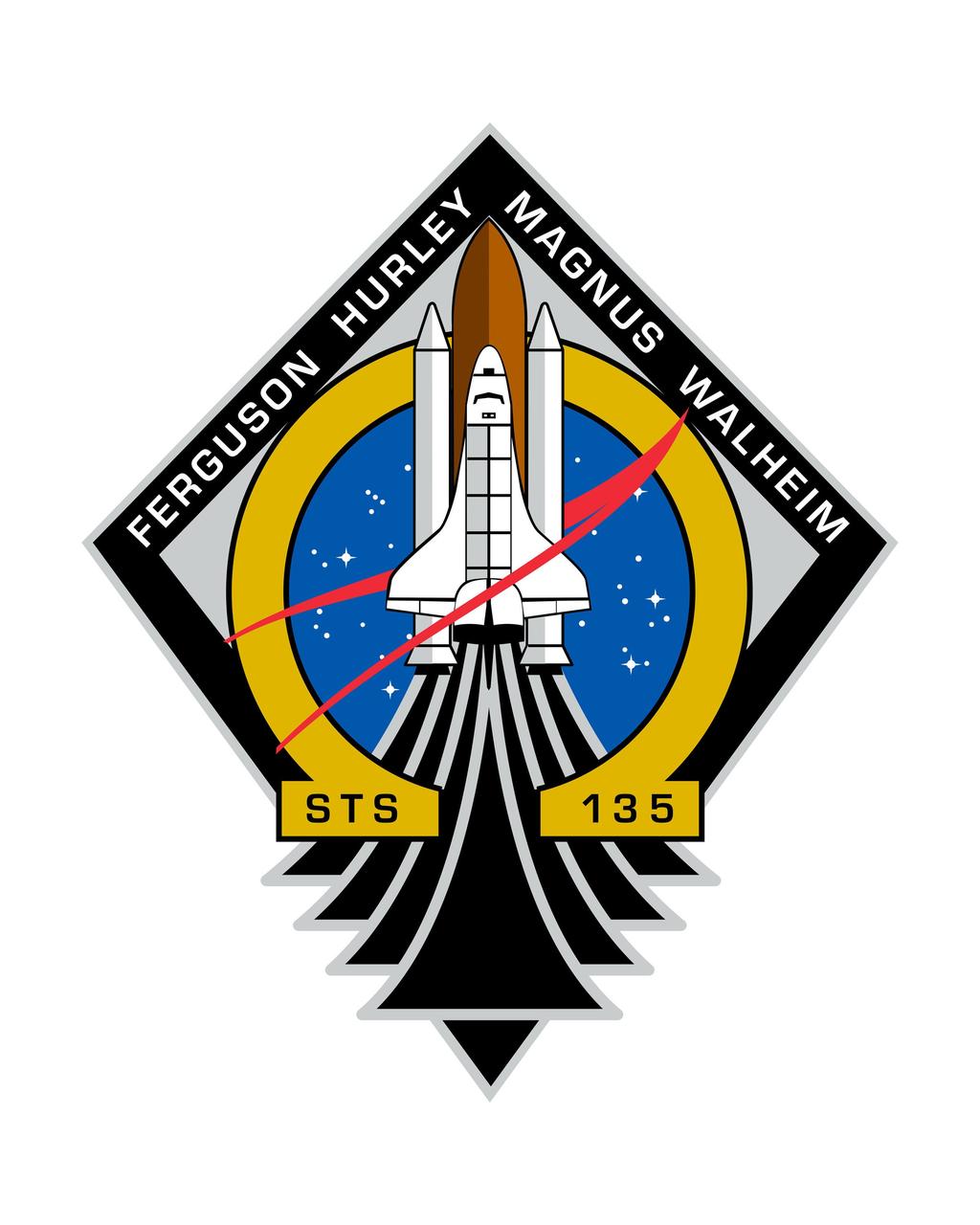
JOHNSON SPACE CENTER, Houston - STS135-S-001 ---The STS-135 patch represents the space shuttle Atlantis embarking on its mission to resupply the International Space Station. Atlantis is centered over elements of the NASA emblem depicting how the space shuttle has been at the heart of NASA for the last 30 years. It also pays tribute to the entire NASA and contractor team that made possible all the incredible accomplishments of the space shuttle. Omega, the last letter in the Greek alphabet, recognizes this mission as the last flight of the Space Shuttle Program. Public availability has been approved only in the form of illustrations by the various news media. When and if there is any change in this policy, which we do not anticipate, it will be publicly announced. Photo credit: NASA or National Aeronautics and Space Administration
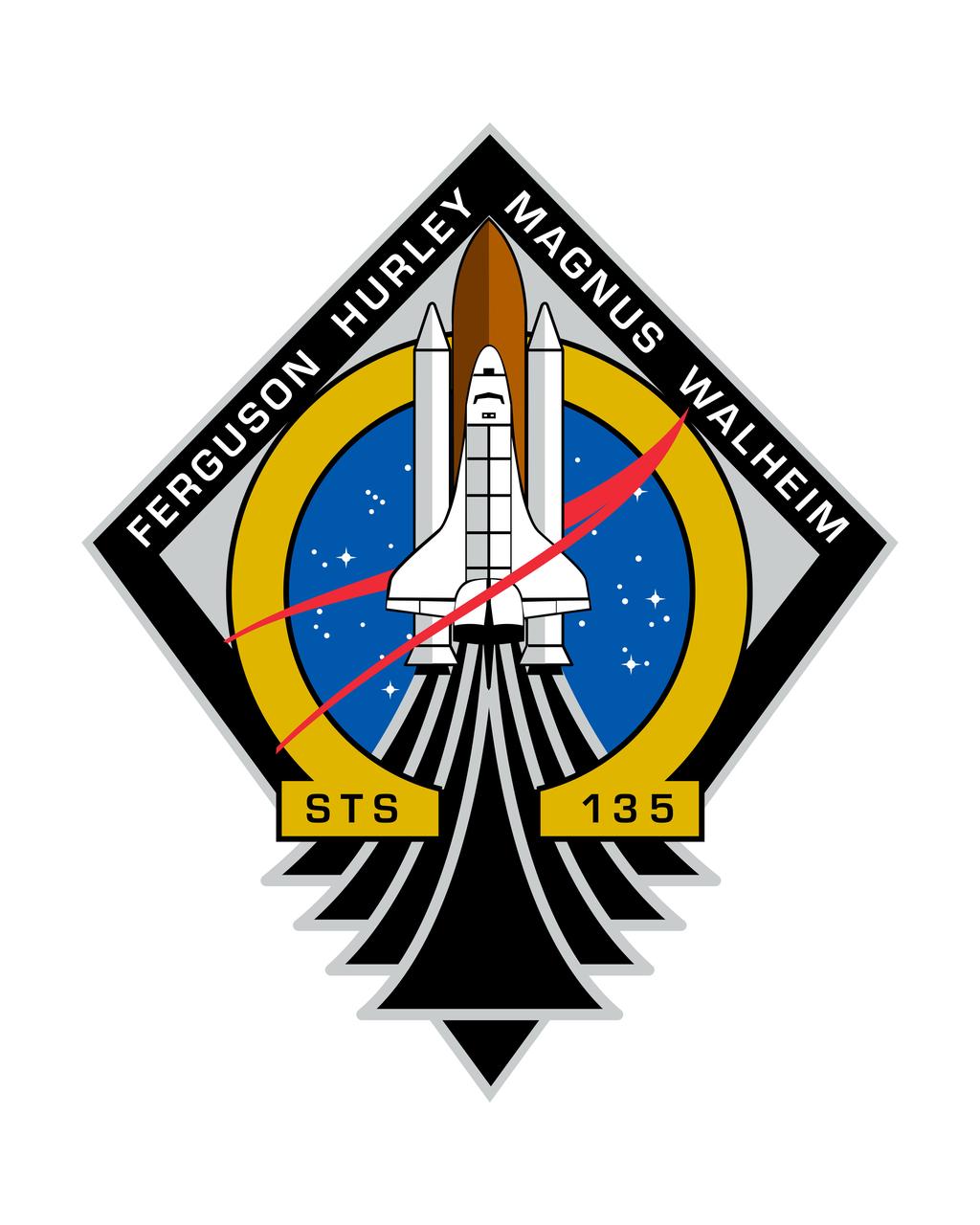
STS135-S-001 (27 Jan. 2011) --- The STS-135 patch represents the space shuttle Atlantis embarking on its mission to resupply the International Space Station. Atlantis is centered over elements of the NASA emblem depicting how the space shuttle has been at the heart of NASA for the last 30 years. It also pays tribute to the entire NASA and contractor team that made possible all the incredible accomplishments of the space shuttle. Omega, the last letter in the Greek alphabet, recognizes this mission as the last flight of the Space Shuttle Program. The NASA insignia design for space shuttle flights is reserved for use by the astronauts and for other official use as the NASA Administrator may authorize. Public availability has been approved only in the forms of illustrations by the various news media. When and if there is any change in this policy, which is not anticipated, the change will be publicly announced. Photo credit: NASA
![The combination of morphological and topographic information from stereo images from NASA's Mars Reconnaissance Orbiter, as well as compositional data from near-infrared spectroscopy has been proven to be a powerful tool for understanding the geology of Mars. Beginning with the OMEGA instrument on the European Space Agency's Mars Express orbiter in 2003, the surface of Mars has been examined at near-infrared wavelengths by imaging spectrometers that are capable of detecting specific minerals and mapping their spatial extent. The CRISM (Compact Reconnaissance Imaging Spectrometer for Mars) instrument on our orbiter is a visible/near-infrared imaging spectrometer, and the HiRISE camera works together with it to document the appearance of mineral deposits detected by this orbital prospecting. Mawrth Vallis is one of the regions on Mars that has attracted much attention because of the nature and diversity of the minerals identified by these spectrometers. It is a large, ancient outflow channel on the margin of the Southern highlands and Northern lowlands. Both the OMEGA and CRISM instruments have detected clay minerals here that must have been deposited in a water-rich environment, probably more than 4 billion years ago. For this reason, Mawrth Vallis is one of the two candidate landing sites for the future Mars Express Rover Mission planned by the European Space Agency. This image was targeted on a location where the CRISM instrument detected a specific mineral called alunite, KAl3(SO4)2(OH)6. Alunite is a hydrated aluminum potassium sulfate, a mineral that is notable because it must have been deposited in a wet acidic environment, rich in sulfuric acid. Our image shows that the deposit is bright and colorful, and extensively fractured. The width of the cutout is 1.2 kilometers. The map is projected here at a scale of 50 centimeters (19.7 inches) per pixel. [The original image scale is 60.1 centimeters (23.7 inches) per pixel (with 2 x 2 binning); objects on the order of 180 centimeters (70.9 inches) across are resolved.] North is up. https://photojournal.jpl.nasa.gov/catalog/PIA21936](https://images-assets.nasa.gov/image/PIA21936/PIA21936~medium.jpg)
The combination of morphological and topographic information from stereo images from NASA's Mars Reconnaissance Orbiter, as well as compositional data from near-infrared spectroscopy has been proven to be a powerful tool for understanding the geology of Mars. Beginning with the OMEGA instrument on the European Space Agency's Mars Express orbiter in 2003, the surface of Mars has been examined at near-infrared wavelengths by imaging spectrometers that are capable of detecting specific minerals and mapping their spatial extent. The CRISM (Compact Reconnaissance Imaging Spectrometer for Mars) instrument on our orbiter is a visible/near-infrared imaging spectrometer, and the HiRISE camera works together with it to document the appearance of mineral deposits detected by this orbital prospecting. Mawrth Vallis is one of the regions on Mars that has attracted much attention because of the nature and diversity of the minerals identified by these spectrometers. It is a large, ancient outflow channel on the margin of the Southern highlands and Northern lowlands. Both the OMEGA and CRISM instruments have detected clay minerals here that must have been deposited in a water-rich environment, probably more than 4 billion years ago. For this reason, Mawrth Vallis is one of the two candidate landing sites for the future Mars Express Rover Mission planned by the European Space Agency. This image was targeted on a location where the CRISM instrument detected a specific mineral called alunite, KAl3(SO4)2(OH)6. Alunite is a hydrated aluminum potassium sulfate, a mineral that is notable because it must have been deposited in a wet acidic environment, rich in sulfuric acid. Our image shows that the deposit is bright and colorful, and extensively fractured. The width of the cutout is 1.2 kilometers. The map is projected here at a scale of 50 centimeters (19.7 inches) per pixel. [The original image scale is 60.1 centimeters (23.7 inches) per pixel (with 2 x 2 binning); objects on the order of 180 centimeters (70.9 inches) across are resolved.] North is up. https://photojournal.jpl.nasa.gov/catalog/PIA21936
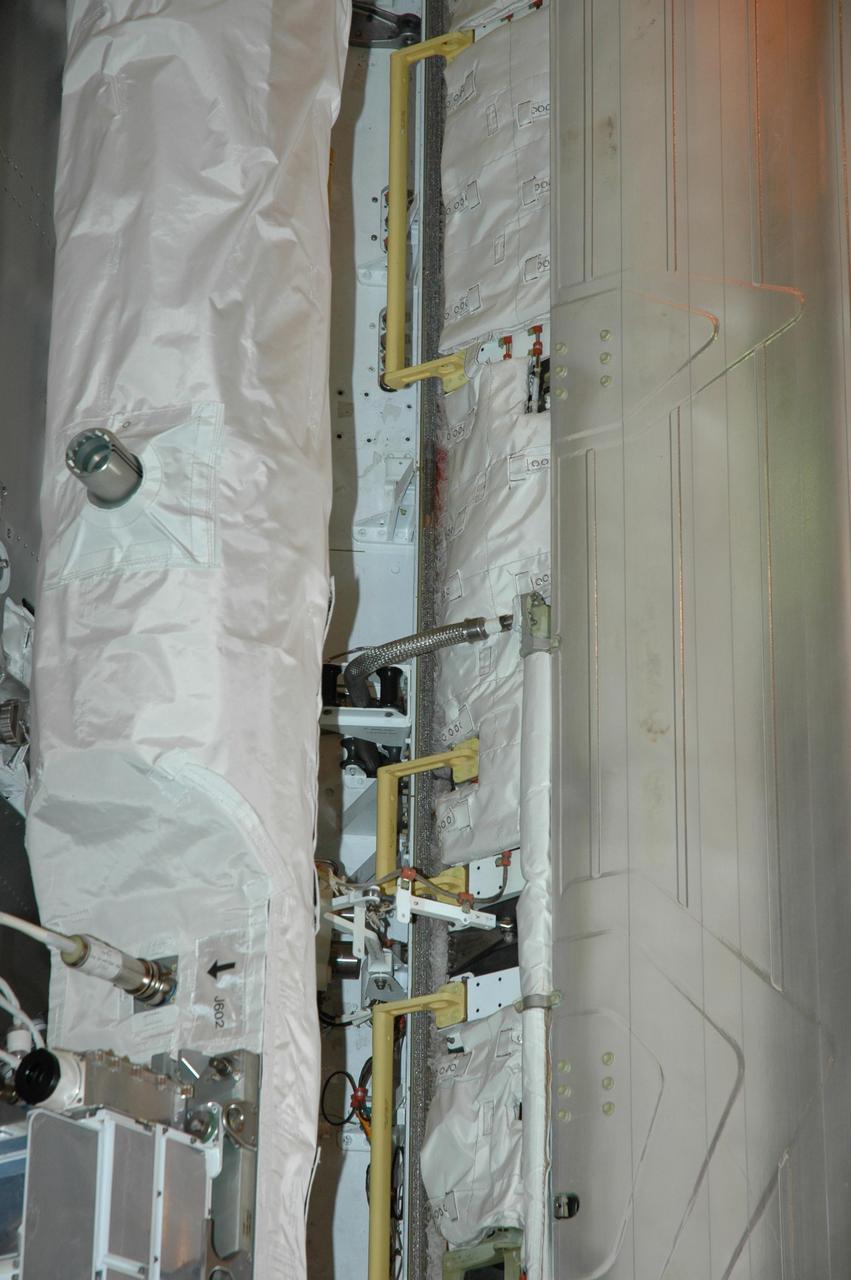
KENNEDY SPACE CENTER, FLA. -- On Launch Pad 39A at NASA's Kennedy Space Center, the payload bay doors are closing on space shuttle Atlantis. During launch preparations, technicians noticed a small section of a braided metal hose that was bent in a shape similar to the Greek letter Omega. The radiator retract hose (seen in the middle), part of the shuttle's cooling system that carries Freon, is designed to flex. Engineers designed a tool to guide the hose back into the storage box. During the starboard door closure, eight incremental stops were performed. After each stop, the aft hose was adjusted and seated in place utilizing the ladder and hose assist tool. The team was satisfied with the final placement of the hose at door closure. STS-122 is the 121st space shuttle flight, the 29th flight for Atlantis and the 24th flight to the International Space Station. The Columbus laboratory module, built by the European Space Agency, is approximately 23 feet long and 15 feet wide, allowing it to hold 10 large racks of experiments. Atlantis is scheduled to launch at 2:45 p.m. Feb. 7. Photo credit: NASA/Jack Pfaller
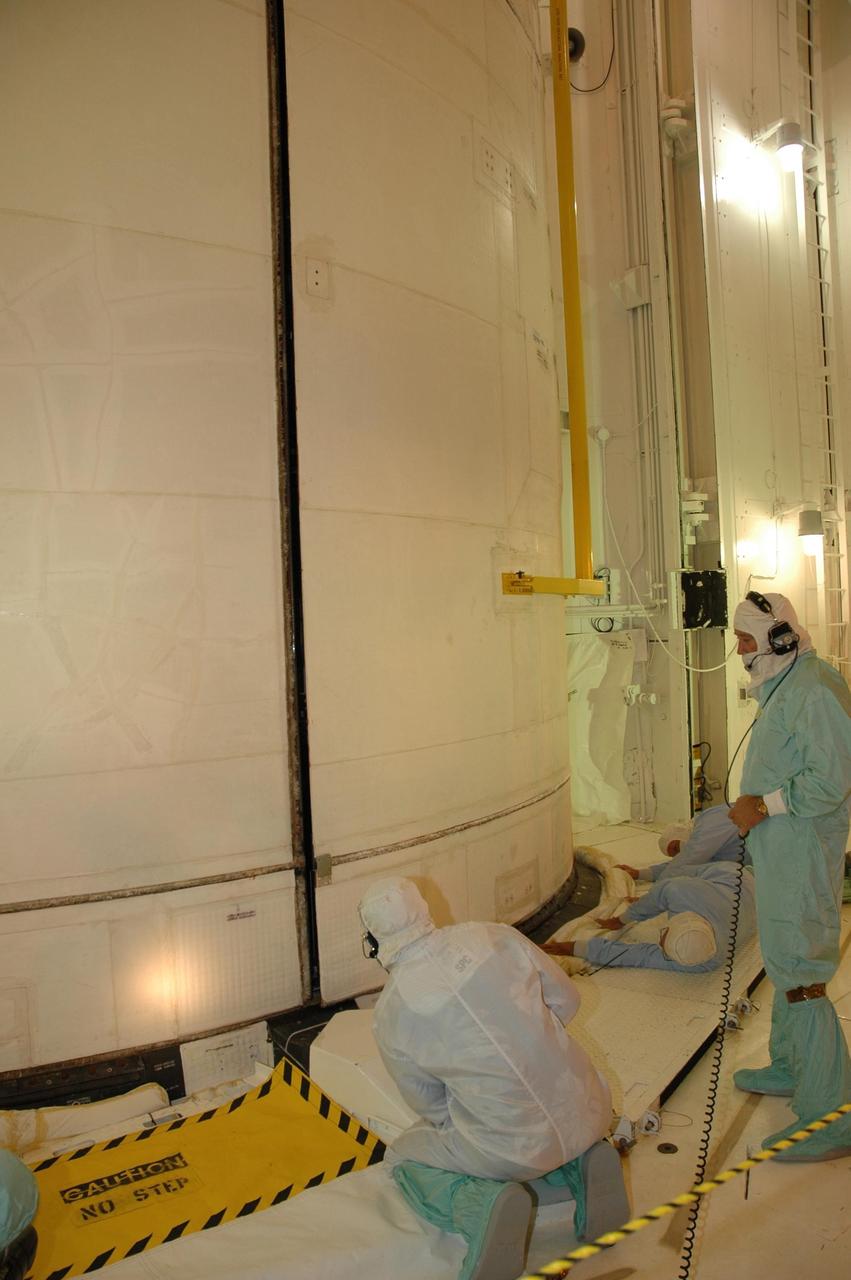
KENNEDY SPACE CENTER, FLA. -- On Launch Pad 39A at NASA's Kennedy Space Center, engineers examine the fit of the payload bay doors on space shuttle Atlantis as they are closing. During launch preparations, technicians noticed a small section of a braided metal hose that was bent in a shape similar to the Greek letter Omega. The radiator retract hose (seen in the middle), part of the shuttle's cooling system that carries Freon, is designed to flex. Engineers designed a tool to guide the hose back into the storage box. During the starboard door closure, eight incremental stops were performed. After each stop, the aft hose was adjusted and seated in place utilizing the ladder and hose assist tool. The team was satisfied with the final placement of the hose at door closure. STS-122 is the 121st space shuttle flight, the 29th flight for Atlantis and the 24th flight to the International Space Station. The Columbus laboratory module, built by the European Space Agency, is approximately 23 feet long and 15 feet wide, allowing it to hold 10 large racks of experiments. Atlantis is scheduled to launch at 2:45 p.m. Feb. 7. Photo credit: NASA/Jack Pfaller
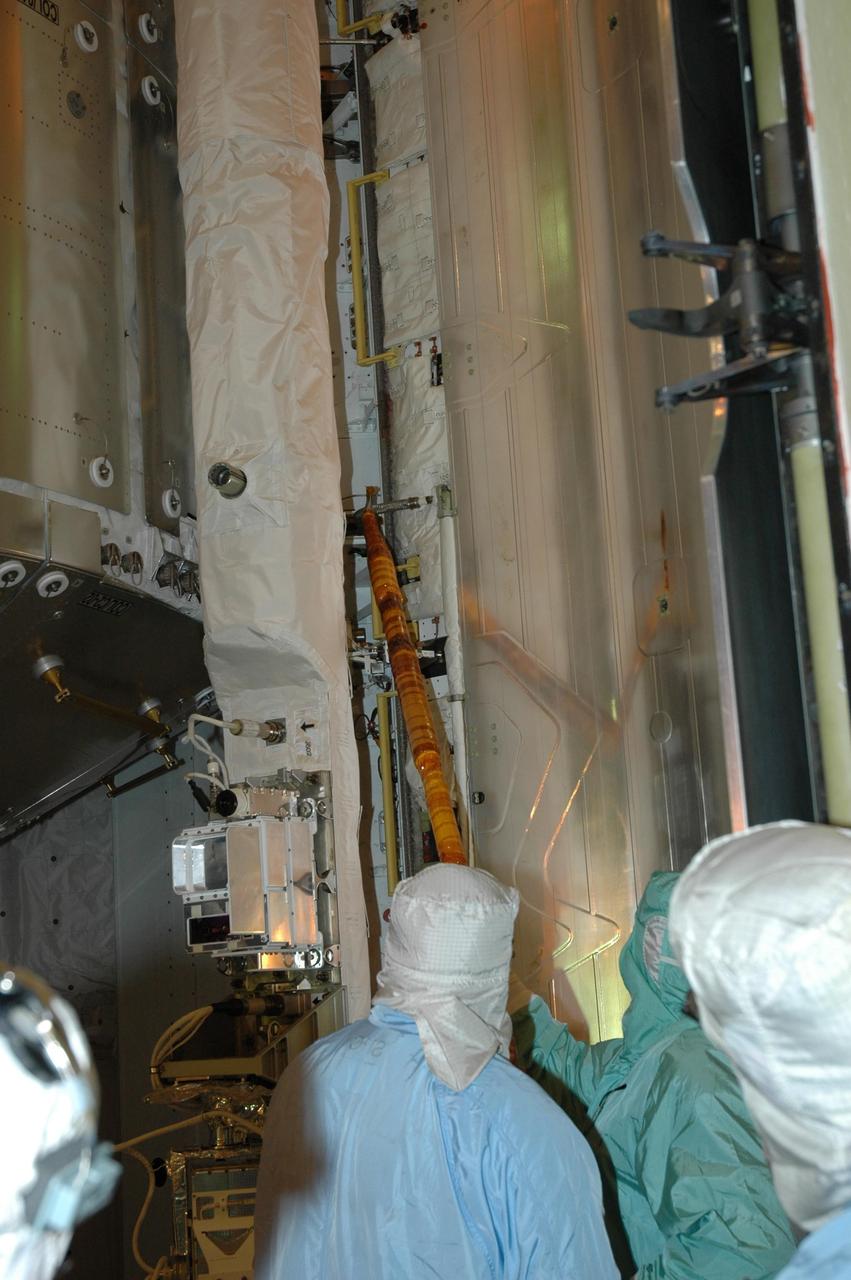
KENNEDY SPACE CENTER, FLA. -- On Launch Pad 39A at NASA's Kennedy Space Center, the payload bay doors are closing on space shuttle Atlantis. During launch preparations, technicians noticed a small section of a braided metal hose that was bent in a shape similar to the Greek letter Omega. The radiator retract hose (seen in the middle), part of the shuttle's cooling system that carries Freon, is designed to flex. Engineers are using a hose assist tool designed to help guide the hose back into the storage box. During the starboard door closure, eight incremental stops were performed. After each stop, the aft hose was adjusted and seated in place utilizing the ladder and hose assist tool. The team was satisfied with the final placement of the hose at door closure. STS-122 is the 121st space shuttle flight, the 29th flight for Atlantis and the 24th flight to the International Space Station. The Columbus laboratory module, built by the European Space Agency, is approximately 23 feet long and 15 feet wide, allowing it to hold 10 large racks of experiments. Atlantis is scheduled to launch at 2:45 p.m. Feb. 7. Photo credit: NASA/Jack Pfaller
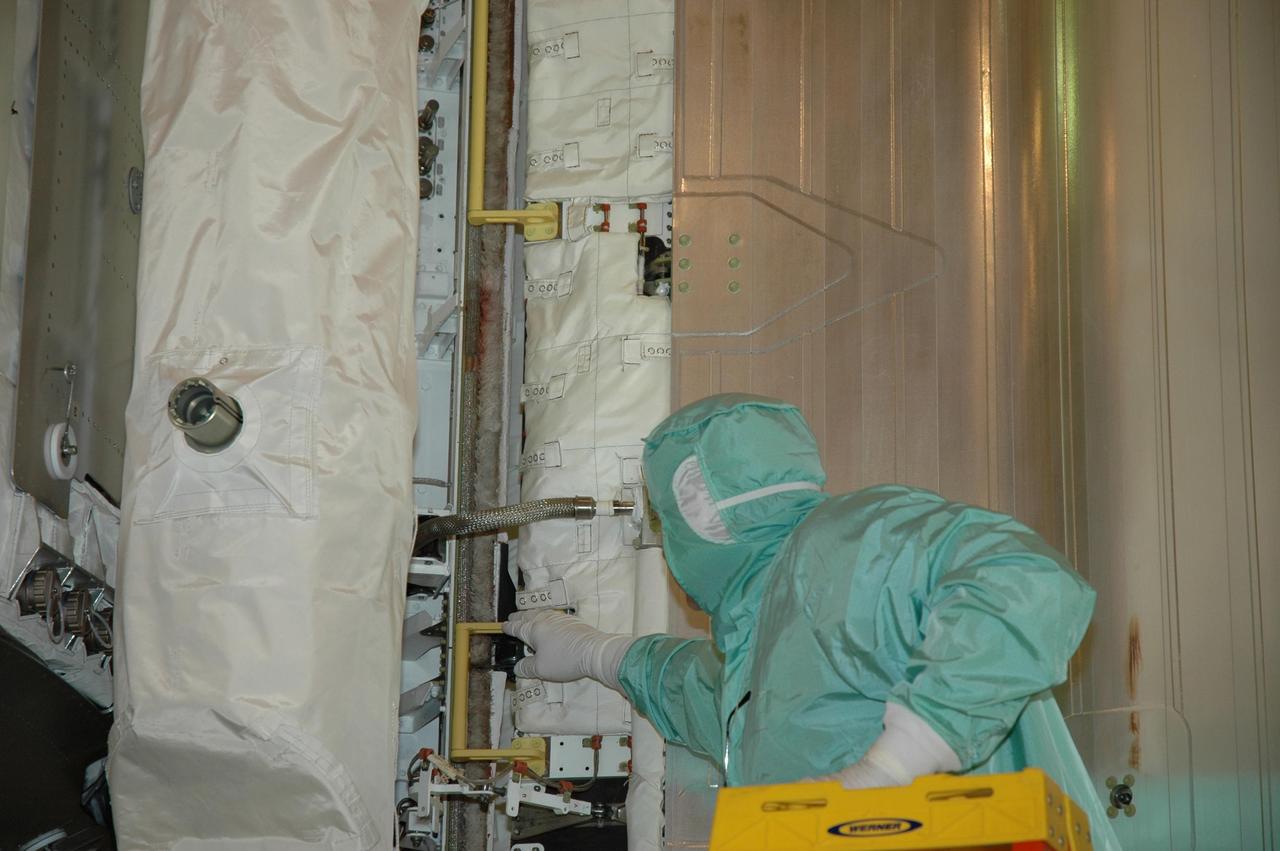
KENNEDY SPACE CENTER, FLA. -- On Launch Pad 39A at NASA's Kennedy Space Center, an engineer checks the progress of payload bay doors closing on space shuttle Atlantis. During launch preparations, technicians noticed a small section of a braided metal hose that was bent in a shape similar to the Greek letter Omega. The radiator retract hose, part of the shuttle's cooling system that carries Freon, is designed to flex. Engineers designed a tool to guide the hose back into the storage box. During the starboard door closure, eight incremental stops were performed. After each stop, the aft hose was adjusted and seated in place utilizing the ladder and hose assist tool. The team was satisfied with the final placement of the hose at door closure. STS-122 is the 121st space shuttle flight, the 29th flight for Atlantis and the 24th flight to the International Space Station. The Columbus laboratory module, built by the European Space Agency, is approximately 23 feet long and 15 feet wide, allowing it to hold 10 large racks of experiments. Atlantis is scheduled to launch at 2:45 p.m. Feb. 7. Photo credit: NASA/Jack Pfaller
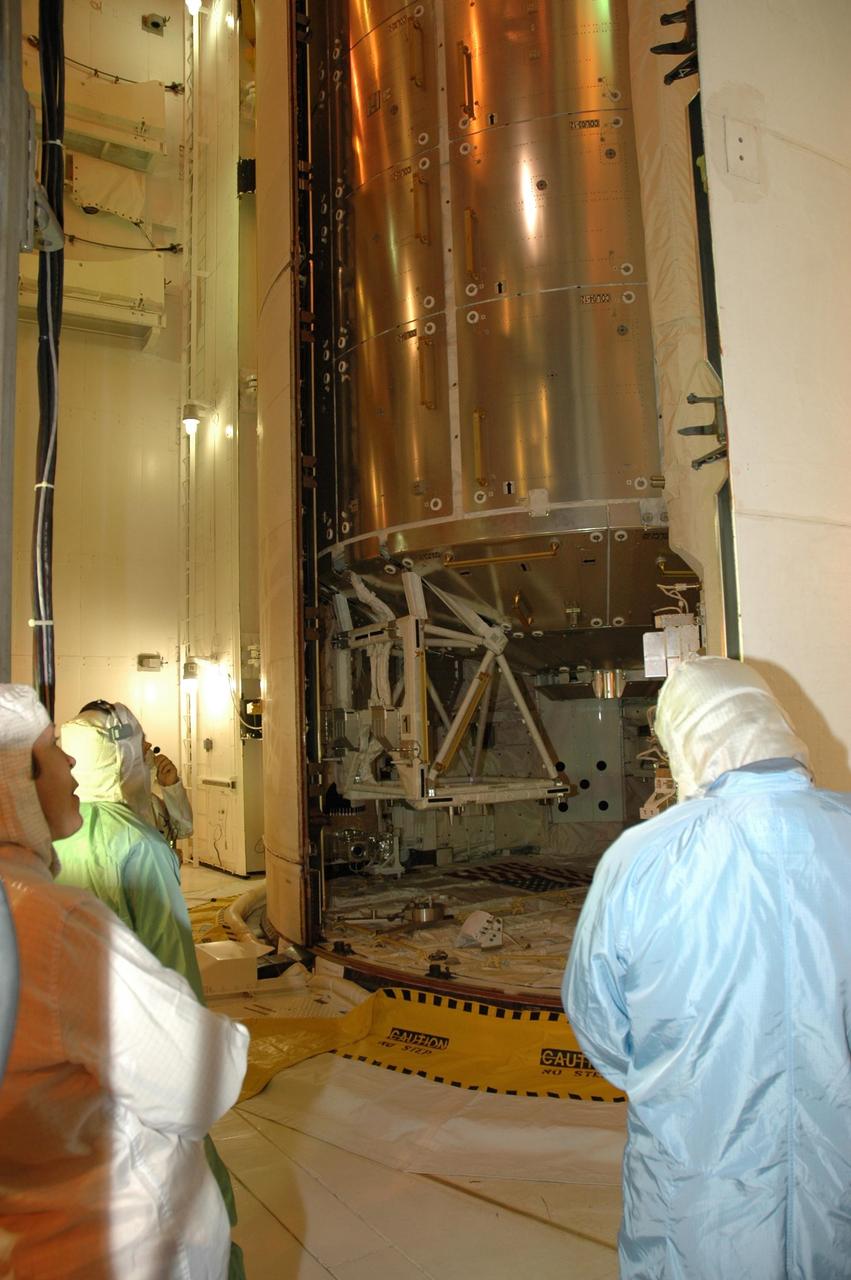
KENNEDY SPACE CENTER, FLA. -- From the payload changeout room on Launch Pad 39A at NASA's Kennedy Space Center, engineers oversee the closing of space shuttle Atlantis' payload bay doors around the cargo -- the Columbus Laboratory seen here. During launch preparations, technicians noticed a small section of a braided metal hose that was bent in a shape similar to the Greek letter Omega. The radiator retract hose, part of the shuttle's cooling system that carries Freon, is designed to flex. Engineers designed a tool to guide the hose back into the storage box. During the starboard door closure, eight incremental stops were performed. After each stop, the aft hose was adjusted and seated in place utilizing the ladder and hose assist tool. The team was satisfied with the final placement of the hose at door closure. STS-122 is the 121st space shuttle flight, the 29th flight for Atlantis and the 24th flight to the International Space Station. The Columbus laboratory module, built by the European Space Agency, is approximately 23 feet long and 15 feet wide, allowing it to hold 10 large racks of experiments. Atlantis is scheduled to launch at 2:45 p.m. Feb. 7. Photo credit: NASA/Jack Pfaller
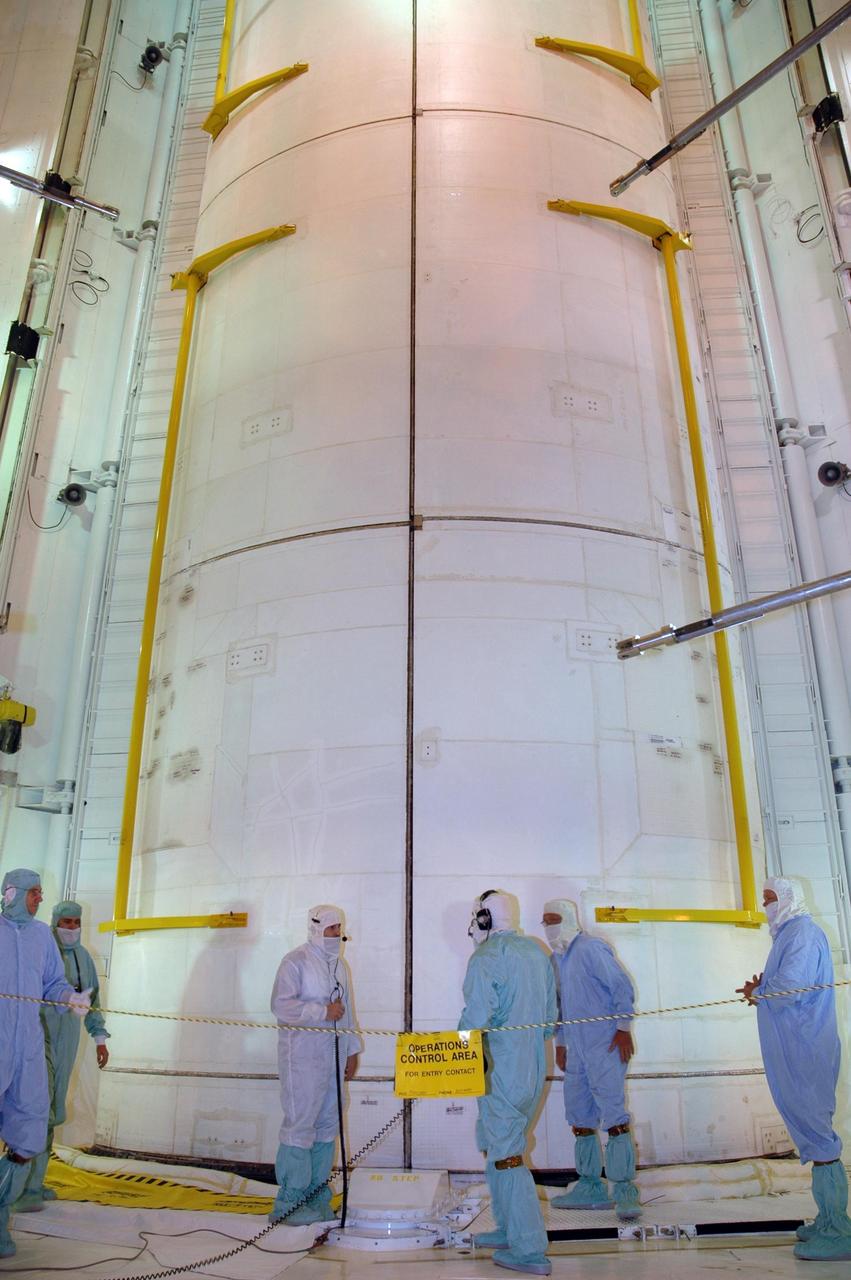
KENNEDY SPACE CENTER, FLA. -- On Launch Pad 39A at NASA's Kennedy Space Center, the payload bay doors on space shuttle Atlantis are successfully closed for launch. During launch preparations, technicians noticed a small section of a braided metal hose that was bent in a shape similar to the Greek letter Omega. The radiator retract hose (seen in the middle), part of the shuttle's cooling system that carries Freon, is designed to flex. Engineers designed a tool to guide the hose back into the storage box. During the starboard door closure, eight incremental stops were performed. After each stop, the aft hose was adjusted and seated in place utilizing the ladder and hose assist tool. The team was satisfied with the final placement of the hose at door closure. STS-122 is the 121st space shuttle flight, the 29th flight for Atlantis and the 24th flight to the International Space Station. The Columbus laboratory module, built by the European Space Agency, is approximately 23 feet long and 15 feet wide, allowing it to hold 10 large racks of experiments. Atlantis is scheduled to launch at 2:45 p.m. Feb. 7. Photo credit: NASA/Jack Pfaller
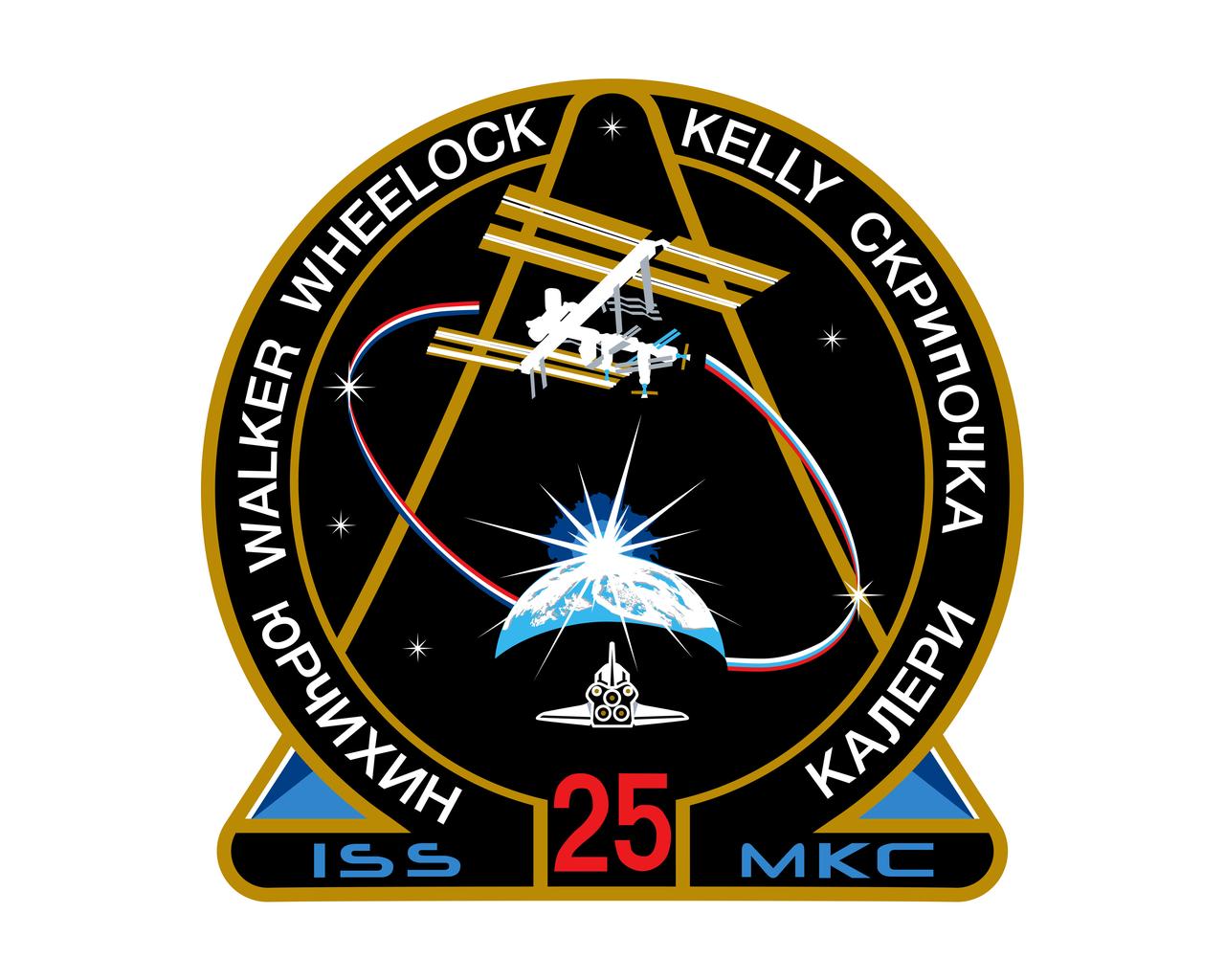
ISS025-S-001 (June 2010) --- The mission patch design for the 25th Expedition to the International Space Station (ISS) pays tribute to the rich history of innovation and bold engineering in the quest for knowledge, exploration and discovery in space. The patch highlights the symbolic passing of the torch to the ISS, as the vehicle that will carry us into the future of space exploration. The Space Shuttle Program emblem is the foundation of the patch and forms the Greek letter Omega?, paying tribute to the culmination of the Space Shuttle Program. The mission designation 25? and the Earth crescent, the orbiter is shown returning to Earth on its final journey, during the Expedition 25 mission. Above Earth and the breaking dawn, the ISS takes center-stage, completed and fully equipped to carry us beyond this new dawn to new voyages and discoveries. The orbit connecting the ISS and the Earth is drawn in the colors of the United States and Russian flags; paying tribute to the blended heritage of the crew. The two largest stars in the field represent the arrival and departure of the crews in separate Russian Soyuz vehicles. The six stars in the field represent the six crew members. The International Space Station abbreviation MKC? ? in English and Russian, respectively- flank the mission number designation, and the names of the crew members in their native languages border the ISS symbol. The NASA insignia design for shuttle and space station flights is reserved for use by the astronauts and for other official use as the NASA Administrator may authorize. Public availability has been approved only in the form of illustrations by the various news media. When and if there is any change in this policy, which is not anticipated, it will be publicly announced.
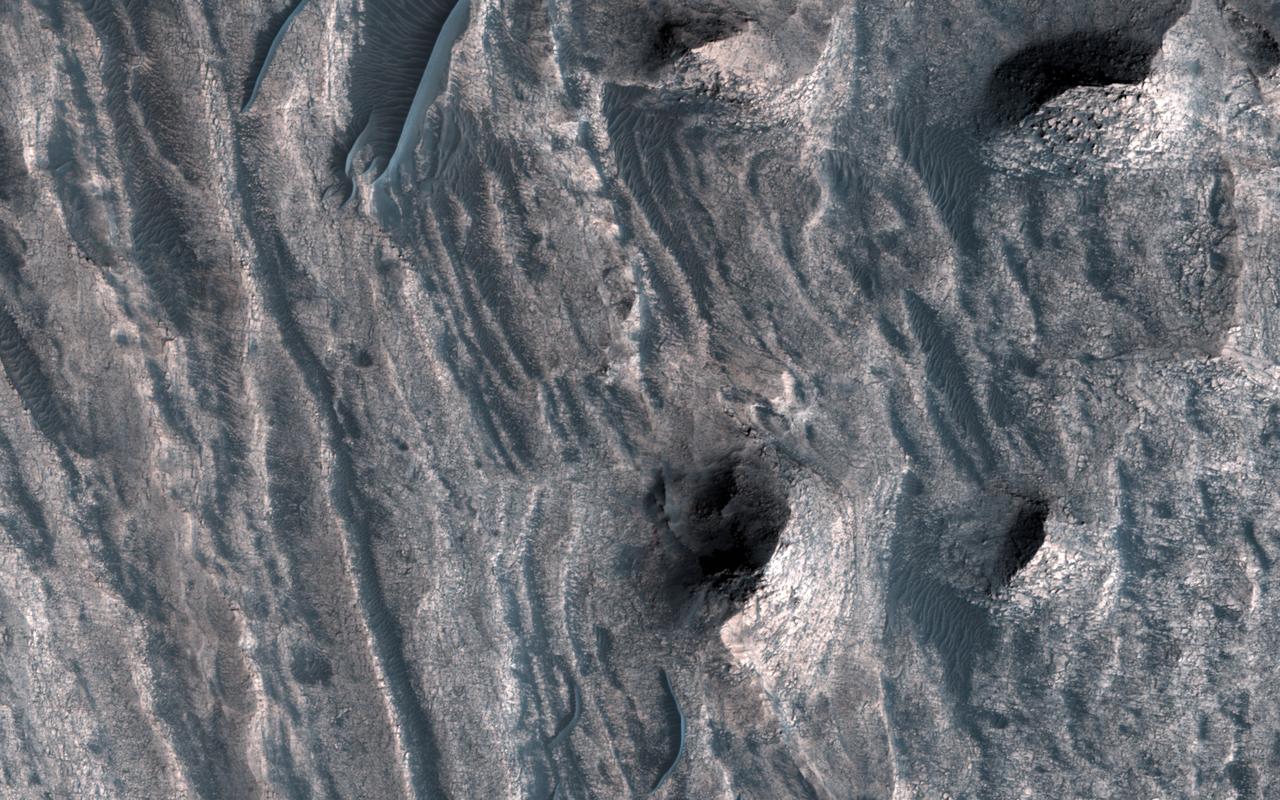
The layered sedimentary deposits inside the giant canyons of Mars have puzzled scientists for decades. These light toned deposits have fine, horizontal laminations that are unlike the rugged rim rock of the Valles Marineris as seen by NASA's Mars Reconnaisance Orbiter (MRO). Various ideas for the origin of the layered sediments have suggested lake deposits, wind blown dust and sand, or volcanic materials that erupted after the canyon was formed, and possibly filled with water. One particular layered deposit, called Ceti Mensa, attracted attention because its deep red color in images collected by the Viking Orbiter mission during the 1970s. Located in west Candor Chasma in the north of the Valles Marineris, Ceti Mensa is an undulating plateau that rises 3 kilometers above the canyon floor and is bounded by steep scarps up to 1.5 kilometers in height. Deep red hues are on the west-facing scarp in particular. The red tint may be due to the presence of crystalline ferric oxide, suggesting that the material may have been exposed to heat or water, or both. Spectral measurements by the Mars Express OMEGA and MRO CRISM instruments confirm the presence of hydrated sulfate salts, such as gypsum and kieserite . These minerals are important for two reasons. On Earth, they typically form in wet environments, suggesting that the deposits in Ceti Mensa may have formed under water. On Mars, these deposits could be valuable to future Martian colonists as fertilizer for growing crops. In a view of the colorful west-facing scarp of Ceti Mensa, we see the interior layers of the deposit, giving us a window into the past history of the sediments as they accumulated over time. We also see layers that were previously too small to view, and a surface that is thoroughly fractured, eroded into knobs, and partially covered by young dark sand dunes. https://photojournal.jpl.nasa.gov/catalog/PIA22051
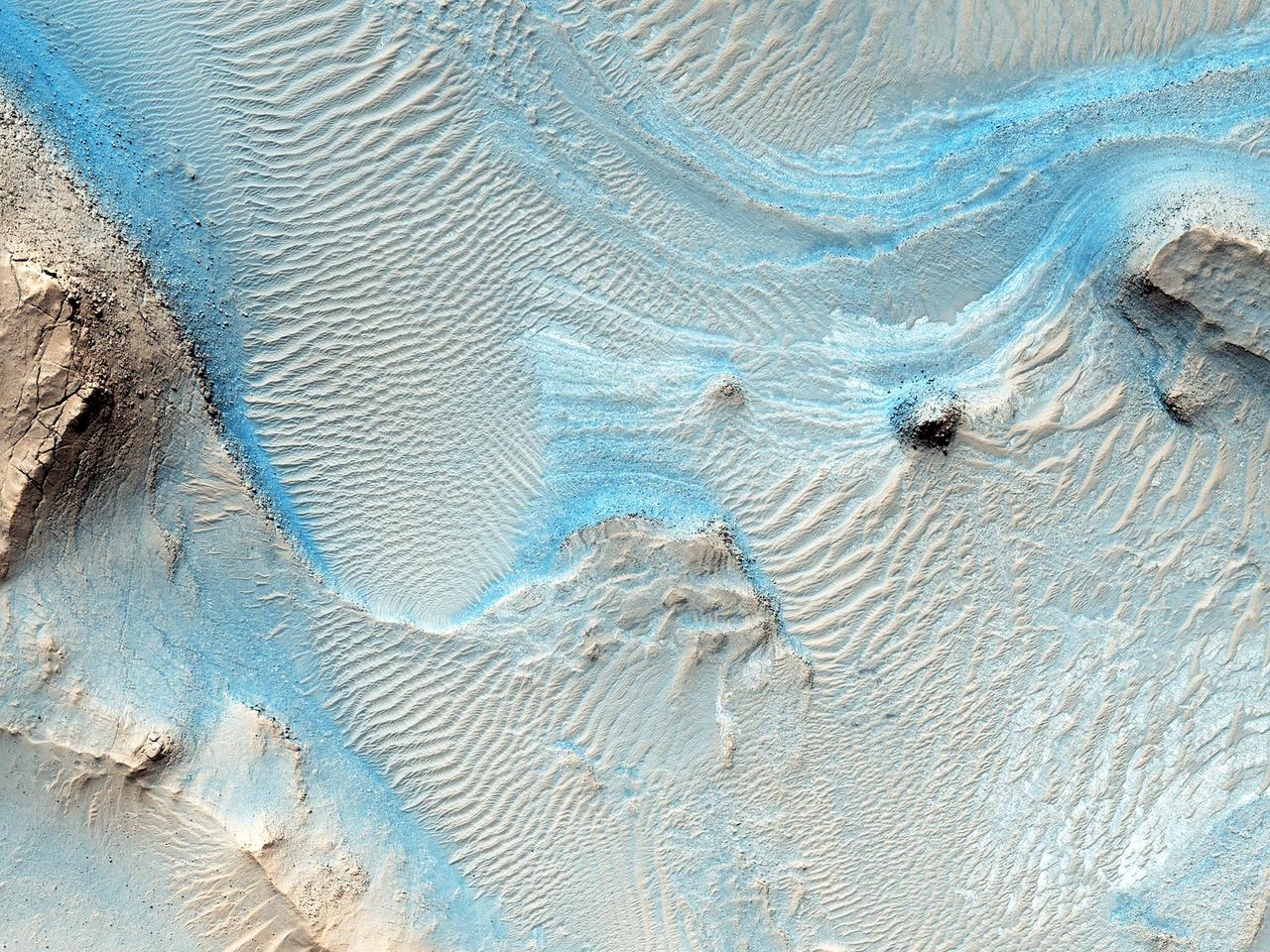
Nothing gets a geologist more excited than layered bedrock, except perhaps finding a fossil or holding a meteorite in your hand. All of these things create a profound feeling of history, the sense of a story that took place ages ago, long before we came appeared. Layered bedrock in particular tells a story that was set out chapter by chapter as each new layer was deposited on top of older, previously deposited layers. Here in Nili Fossae, we see layered bedrock as horizontal striations in the light toned sediments in the floor of a canyon near Syrtis Major. (Note: illumination is from the top of the picture) The ancient layered rocks appear in pale whitish and bluish tones. They are partially covered by much younger ripples made up of dust and other wind blown sediments. The rock of the nearby canyon wall is severely fractured and appears to have shed sand and rocks and boulders onto the floor. This canyon did not form by fluvial erosion: it is part of a system of faults that formed a series of graben like this one, but water probably flowed through Nili Fossae in the distant past. Orbital spectral measurements by the OMEGA instrument on Mars Express and CRISM on MRO detected an abundance of clay minerals of different types in the layered sediments inside Nili Fossae, along with other minerals that are typical of sediments that were deposited by water. The various colors and tones of the layered rocks record changes in the composition of the sediments, details that can tell us about changes in the Martian environment eons ago. Nili Fossae is a candidate site for a future landed robotic mission that could traverse across these layers and make measurements that could be used to unravel a part of the early history of Mars. Nili Fossae is a history book that is waiting to be read. http://photojournal.jpl.nasa.gov/catalog/PIA21206

This image depicts a vast canyon of dust and gas in the Orion Nebula from a 3-D computer model based on observations by NASA's Hubble Space Telescope and created by science visualization specialists at the Space Telescope Science Institute (STScI) in Baltimore, Md. A 3-D visualization of this model takes viewers on an amazing four-minute voyage through the 15-light-year-wide canyon. Credit: NASA, G. Bacon, L. Frattare, Z. Levay, and F. Summers (STScI/AURA) Go here to learn more about Hubble 3D: <a href="http://www.nasa.gov/topics/universe/features/hubble_imax_premiere.html" rel="nofollow">www.nasa.gov/topics/universe/features/hubble_imax_premier...</a> or <a href="http://www.imax.com/hubble/" rel="nofollow">www.imax.com/hubble/</a> Take an exhilarating ride through the Orion Nebula, a vast star-making factory 1,500 light-years away. Swoop through Orion's giant canyon of gas and dust. Fly past behemoth stars whose brilliant light illuminates and energizes the entire cloudy region. Zoom by dusty tadpole-shaped objects that are fledgling solar systems. This virtual space journey isn't the latest video game but one of several groundbreaking astronomy visualizations created by specialists at the Space Telescope Science Institute (STScI) in Baltimore, the science operations center for NASA's Hubble Space Telescope. The cinematic space odysseys are part of the new Imax film "Hubble 3D," which opens today at select Imax theaters worldwide. The 43-minute movie chronicles the 20-year life of Hubble and includes highlights from the May 2009 servicing mission to the Earth-orbiting observatory, with footage taken by the astronauts. The giant-screen film showcases some of Hubble's breathtaking iconic pictures, such as the Eagle Nebula's "Pillars of Creation," as well as stunning views taken by the newly installed Wide Field Camera 3. While Hubble pictures of celestial objects are awe-inspiring, they are flat 2-D photographs. For this film, those 2-D images have been converted into 3-D environments, giving the audience the impression they are space travelers taking a tour of Hubble's most popular targets. "A large-format movie is a truly immersive experience," says Frank Summers, an STScI astronomer and science visualization specialist who led the team that developed the movie visualizations. The team labored for nine months, working on four visualization sequences that comprise about 12 minutes of the movie. "Seeing these Hubble images in 3-D, you feel like you are flying through space and not just looking at picture postcards," Summers continued. "The spacescapes are all based on Hubble images and data, though some artistic license is necessary to produce the full depth of field needed for 3-D." The most ambitious sequence is a four-minute voyage through the Orion Nebula's gas-and-dust canyon, about 15 light-years across. During the ride, viewers will see bright and dark, gaseous clouds; thousands of stars, including a grouping of bright, hefty stars called the Trapezium; and embryonic planetary systems. The tour ends with a detailed look at a young circumstellar disk, which is much like the structure from which our solar system formed 4.5 billion years ago. Based on a Hubble image of Orion released in 2006, the visualization was a collaborative effort between science visualization specialists at STScI, including Greg Bacon, who sculpted the Orion Nebula digital model, with input from STScI astronomer Massimo Roberto; the National Center for Supercomputing Applications at the University of Illinois at Urbana-Champaign; and the Spitzer Science Center at the California Institute of Technology in Pasadena. For some of the sequences, STScI imaging specialists developed new techniques for transforming the 2-D Hubble images into 3-D. STScI image processing specialists Lisa Frattare and Zolt Levay, for example, created methods of splitting a giant gaseous pillar in the Carina Nebula into multiple layers to produce a 3-D effect, giving the structure depth. The Carina Nebula is a nursery for baby stars. Frattare painstakingly removed the thousands of stars in the image so that Levay could separate the gaseous layers on the isolated Carina pillar. Frattare then replaced the stars into both foreground and background layers to complete the 3-D model. For added effect, the same separation was done for both visible and infrared Hubble images, allowing the film to cross-fade between wavelength views in 3-D. In another sequence viewers fly into a field of 170,000 stars in the giant star cluster Omega Centauri. STScI astronomer Jay Anderson used his stellar database to create a synthetic star field in 3-D that matches recent razor-sharp Hubble photos. The film's final four-minute sequence takes viewers on a voyage from our Milky Way Galaxy past many of Hubble's best galaxy shots and deep into space. Some 15,000 galaxies from Hubble's deepest surveys stretch billions of light-years across the universe in a 3-D sequence created by STScI astronomers and visualizers. The view dissolves into a cobweb that traces the universe's large-scale structure, the backbone from which galaxies were born. In addition to creating visualizations, STScI's education group also provided guidance on the "Hubble 3D" Educator Guide, which includes standards-based lesson plans and activities about Hubble and its mission. Students will use the guide before or after seeing the movie. "The guide will enhance the movie experience for students and extend the movie into classrooms," says Bonnie Eisenhamer, STScI's Hubble Formal Education manager. The Hubble Space Telescope is a project of international cooperation between NASA and the European Space Agency (ESA) and is managed by NASA’s Goddard Space Flight Center (GSFC) in Greenbelt, Md. The Space Telescope Science Institute (STScI) conducts Hubble science operations. The institute is operated for NASA by the Association of Universities for Research in Astronomy, Inc., Washington, D.C.