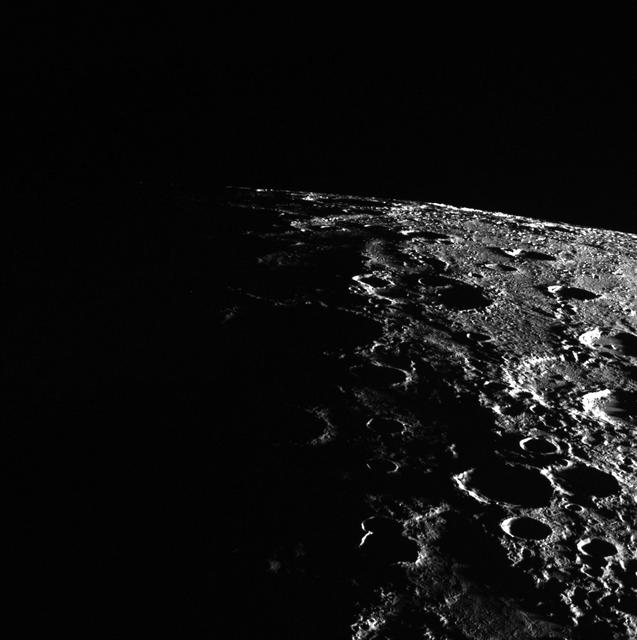
In this image, Mercury's horizon cuts a striking edge against the stark blackness of space. On the right, sunlight harshly brings the landscape into relief while on the left, the surface is shrouded in the darkness of night. This image was acquired as part of MDIS's limb imaging campaign. Once per week, MDIS captures images of Mercury's limb, with an emphasis on imaging the southern hemisphere limb. These limb images provide information about Mercury's shape and complement measurements of topography made by the Mercury Laser Altimeter (MLA) of Mercury's northern hemisphere. The MESSENGER spacecraft is the first ever to orbit the planet Mercury, and the spacecraft's seven scientific instruments and radio science investigation are unraveling the history and evolution of the Solar System's innermost planet. In the mission's more than three years of orbital operations, MESSENGER has acquired over 250,000 images and extensive other data sets. MESSENGER is capable of continuing orbital operations until early 2015. Credit: NASA/Johns Hopkins University Applied Physics Laboratory/Carnegie Institution of Washington <b><a href="http://www.nasa.gov/audience/formedia/features/MP_Photo_Guidelines.html" rel="nofollow">NASA image use policy.</a></b> <b><a href="http://www.nasa.gov/centers/goddard/home/index.html" rel="nofollow">NASA Goddard Space Flight Center</a></b> enables NASA’s mission through four scientific endeavors: Earth Science, Heliophysics, Solar System Exploration, and Astrophysics. Goddard plays a leading role in NASA’s accomplishments by contributing compelling scientific knowledge to advance the Agency’s mission. <b>Follow us on <a href="http://twitter.com/NASAGoddardPix" rel="nofollow">Twitter</a></b> <b>Like us on <a href="http://www.facebook.com/pages/Greenbelt-MD/NASA-Goddard/395013845897?ref=tsd" rel="nofollow">Facebook</a></b> <b>Find us on <a href="http://instagram.com/nasagoddard?vm=grid" rel="nofollow">Instagram</a></b>
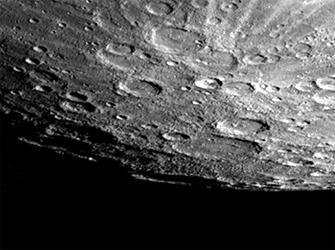
After passing Mercury the first time and making a trip around the Sun, NASA Mariner 10 again flew by Mercury on Sept. 21, 1974. The south pole is located on the right hand edge of Chao Meng Fu crater that has only its rim sticking up into the light.
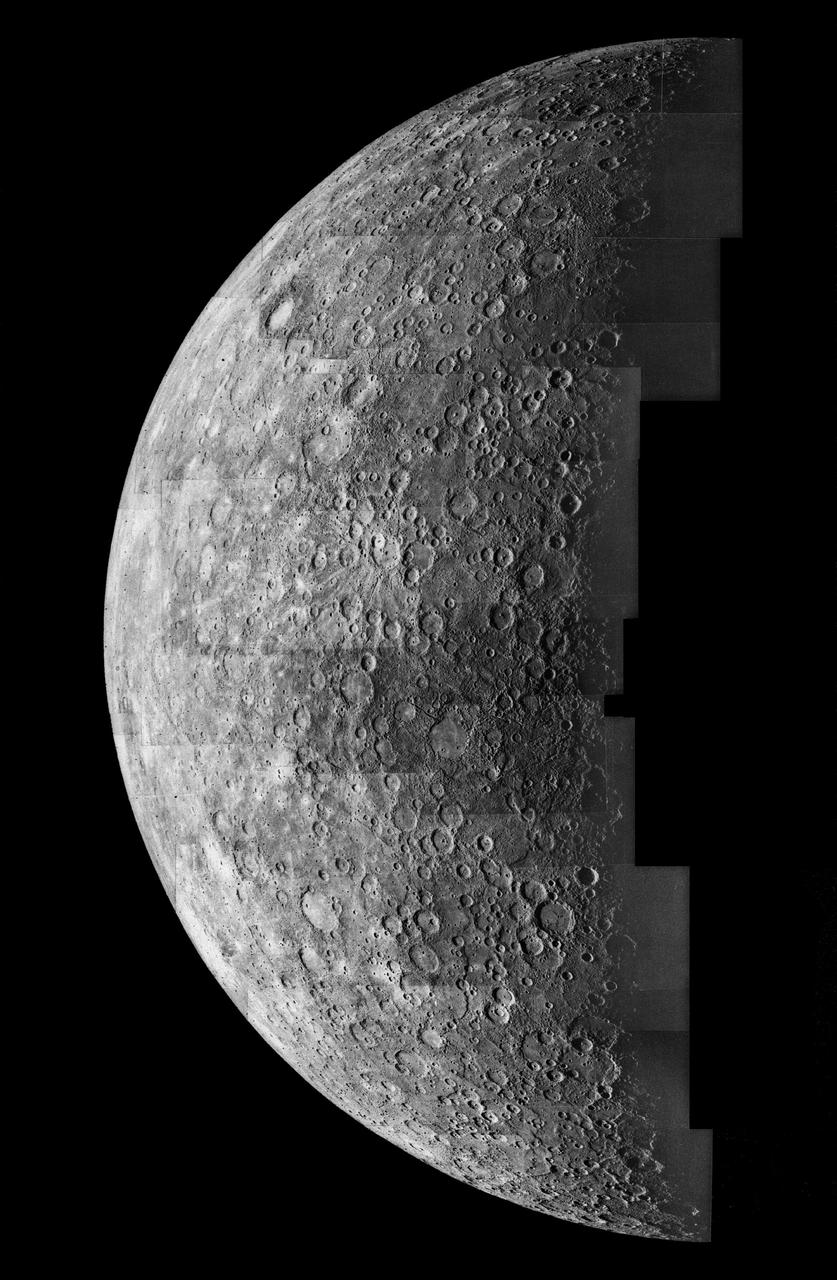
This computer generated photomosaic from NASA Mariner 10 is of the southern half of Mercury Shakespeare Quadrangle, named for the ancient Shakespeare crater located on the upper edge to the left of center.
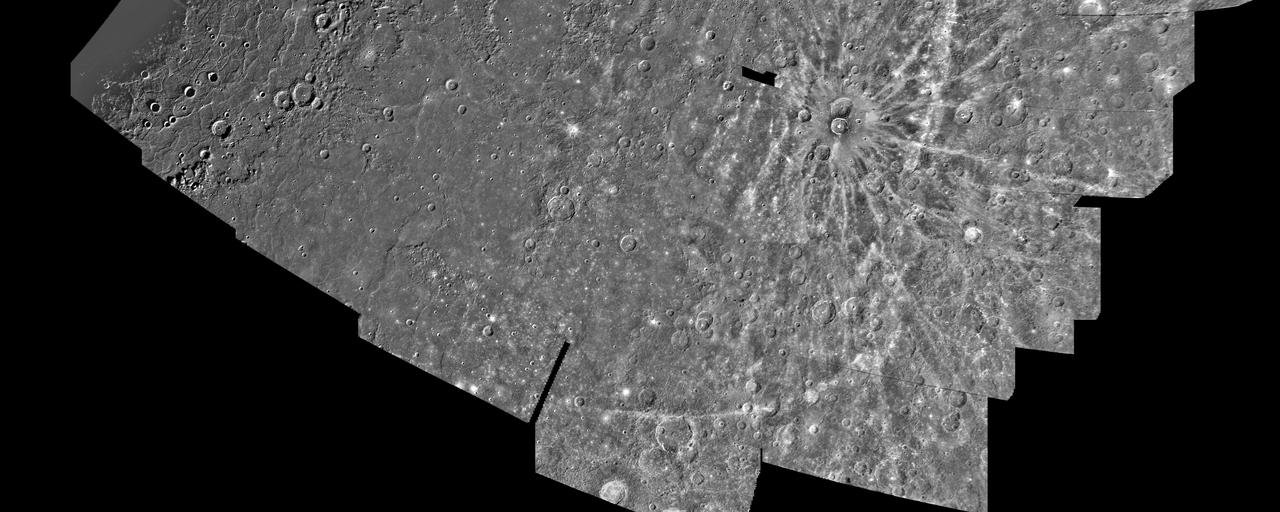
This computer generated photomosaic from NASA Mariner 10 is of the southern half of Mercury Shakespeare Quadrangle, named for the ancient Shakespeare crater located on the upper edge to the left of center. http://photojournal.jpl.nasa.gov/catalog/PIA00067
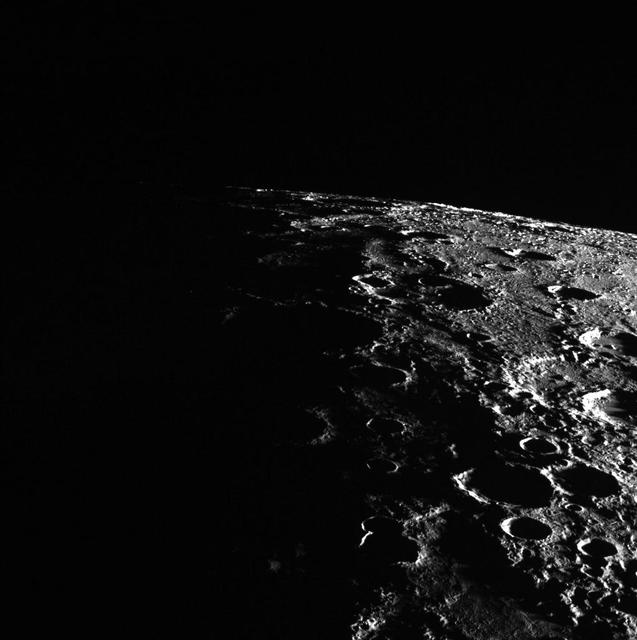
In today's image, Mercury's horizon cuts a striking edge against the stark blackness of space. On the right, sunlight harshly brings the landscape into relief while on the left, the surface is shrouded in the darkness of night. This image was acquired as part of MDIS's limb imaging campaign. Once per week, MDIS captures images of Mercury's limb, with an emphasis on imaging the southern hemisphere limb. These limb images provide information about Mercury's shape and complement measurements of topography made by the Mercury Laser Altimeter (MLA) of Mercury's northern hemisphere. Date acquired: January 20, 2015 Image Mission Elapsed Time (MET): 64084239 Image ID: 7831084 Instrument: Wide Angle Camera (WAC) of the Mercury Dual Imaging System (MDIS) WAC filter: 7 (748 nanometers) Center Latitude: -54.45° Center Longitude: 90.52° E Center Resolution: 401 meters/pixel http://photojournal.jpl.nasa.gov/catalog/PIA19192
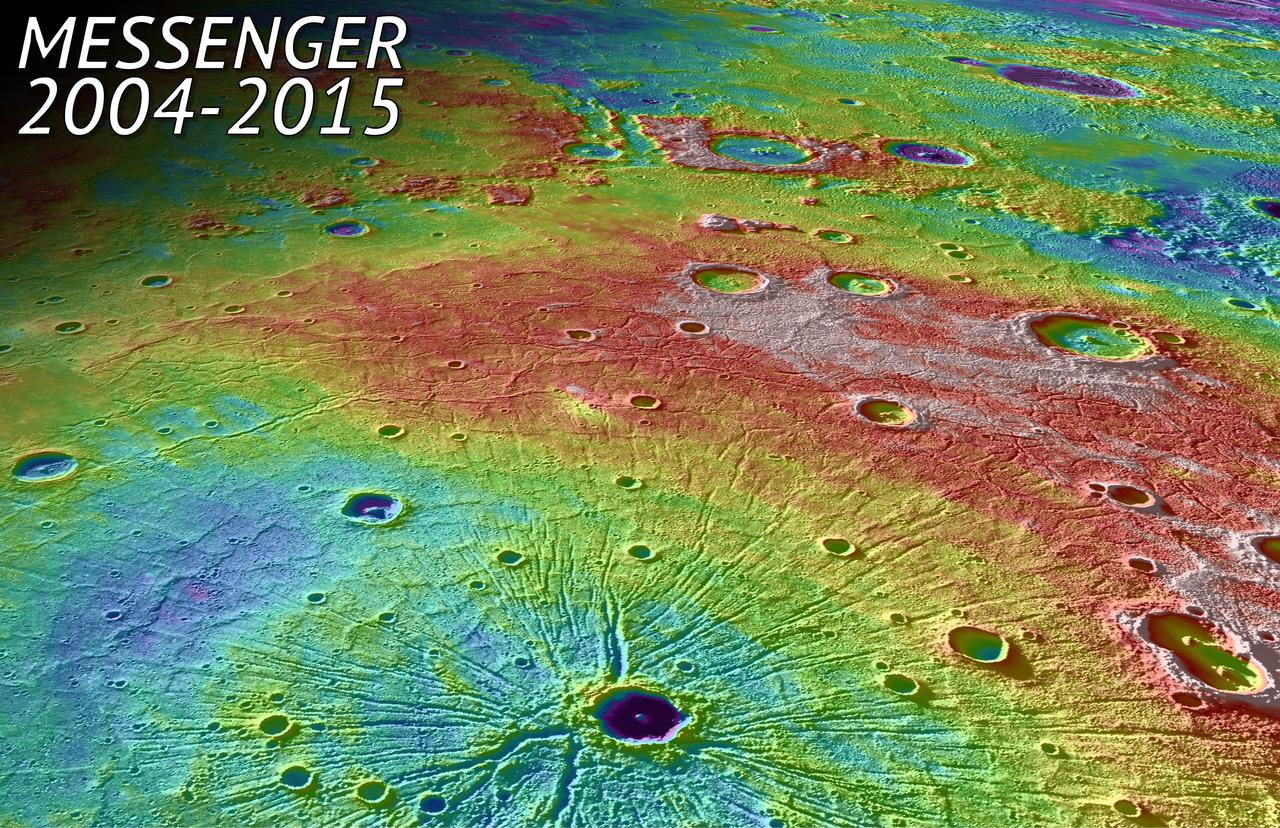
In this perspective view, NASA MESSENGER spacecraft looked northwest over the Caloris Basin, a depression about 1500 km in diameter formed several billion years ago by the impact of a large projectile into the surface of Mercury. The mountain range at the edge of the basin can be seen as an arc in the background. In the foreground, we see a set of tectonic troughs, known as Pantheon Fossae, radiating from the center of the basin outward toward the edge of the basin interior. A 41-km-diameter impact crater, Apollodorus, is superposed just slightly off from the center of Pantheon Fossae. White and red are high topography, and greens and blues are low topography, with a total height differences of roughly 4 km. The MESSENGER spacecraft was launched in 2004 and ended it's orbital operations yesterday, April 30, 2015, by impacting Mercury's surface. Background image texture is provided by the Mercury Dual Imaging System (MDIS) instrument while color corresponds to surface elevation data obtained from the Mercury Laser Altimeter (MLA) experiment, with both draped over a digital elevation model derived from MLA altimetric data. Instrument: Mercury Dual Imaging System (MDIS) and Mercury Laser Altimeter (MLA) Approximate Center Latitude: 33.7° N Approximate Center Longitude: 158.7° E Scale: Apollodorus crater is approximately 41 km (25 miles) in diameter http://photojournal.jpl.nasa.gov/catalog/PIA19450
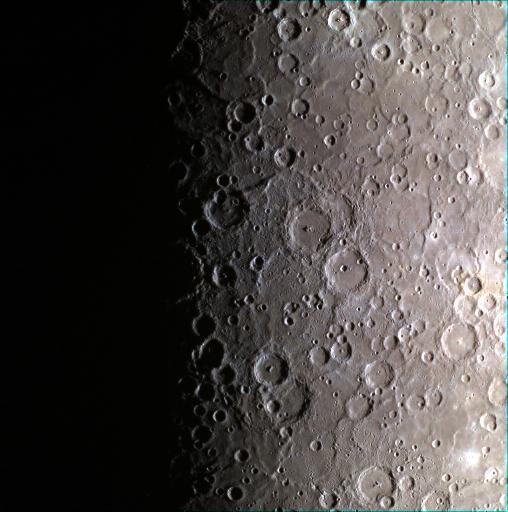
Today's image features a color view of the southern pole of Mercury. About midway down the image, the edge of the large Chao Meng-Fu crater, which lies almost directly on the south pole, can be seen poking out from the shadows. Surrounding Chao Meng-Fu are Roerich, Lovecraft, Hurley and L'Engle craters. This image was obtained as part of the 11-color south polar imaging campaign, through which scientists hope to be able to use the relative brightness of the surface in different colors to understand its composition. http://photojournal.jpl.nasa.gov/catalog/PIA19204
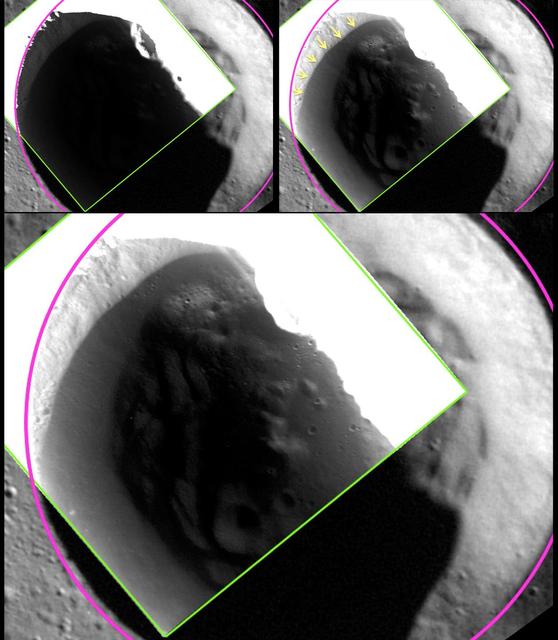
The image shown here was acquired at 24 m/pixel, the highest resolution that has been obtained for any of Mercury's shadowed polar craters. The top left panel shows a view of an unnamed crater in Mercury's north polar region, with the crater rim outlined in pink and the edge of the 24-meter/pixel, low-altitude broadband MDIS image in green. In the large bottom panel, a different stretch has been applied to the same MDIS broadband image, revealing details of the shadowed surface inside the crater. In particular, as highlighted with yellow arrows in the top right panel, the image reveals a region inside the crater that has a lower reflectance. The edge of the low-reflectance region has a sharp and well-defined boundary, even as imaged at this highest resolution of 24 m/pixel. The sharp boundary suggests that the low-reflectance material is sufficiently young to have preserved a sharp boundary against lateral mixing by impact craters. The sharp boundary matches the location predicted by temperature models for the stability of a surficial layer of volatile, organic-rich material tens of centimeters thick that overlies a thicker layer of water ice. http://photojournal.jpl.nasa.gov/catalog/PIA19253
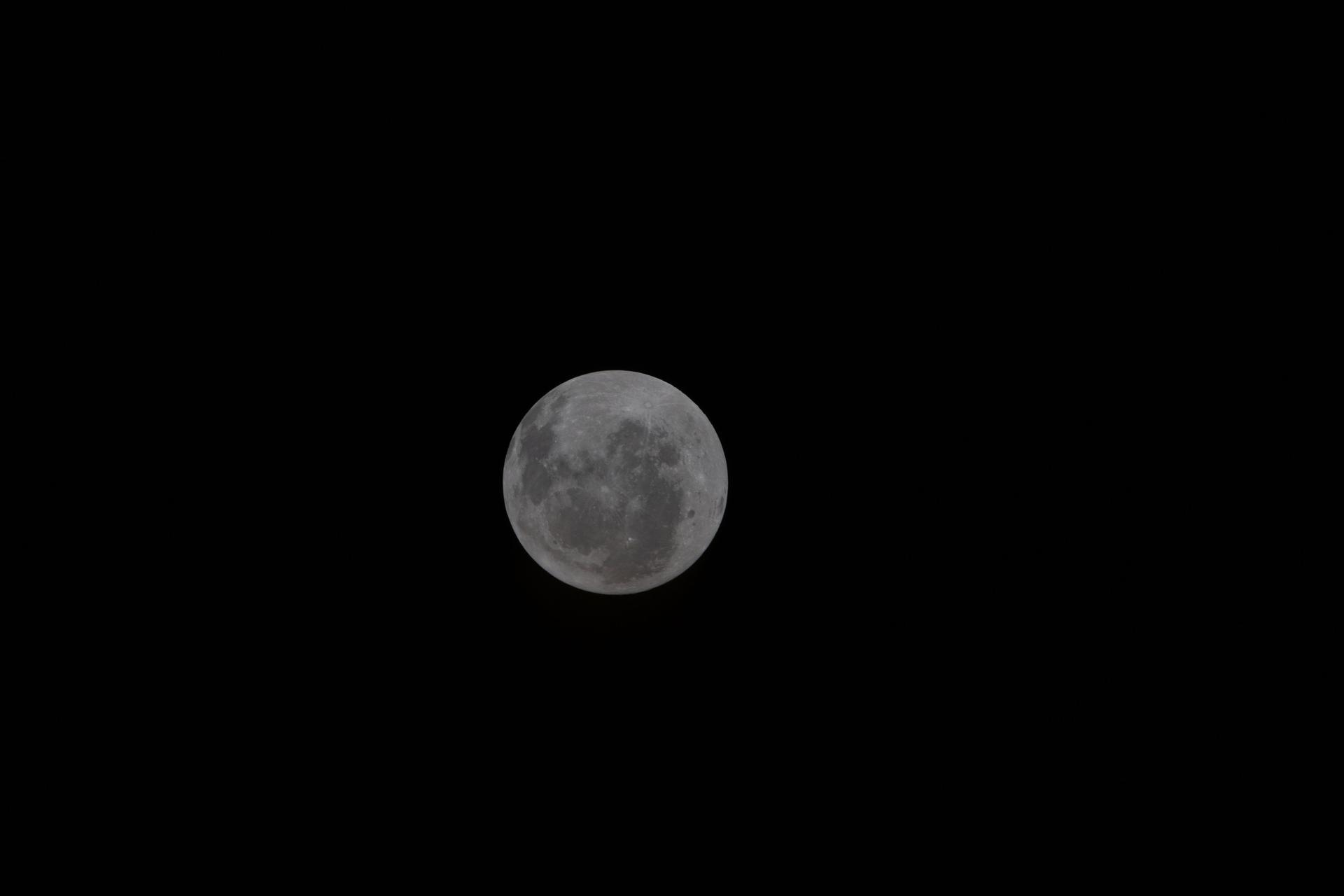
art002e009006 (April 4, 2026) - The Artemis II crew took this photo on day 4 of their journey to the Moon. In it, the Moon is oriented with the South Pole at the top and are beginning to see parts of the lunar far side. Orientale basin is on the right edge of the lunar disk in this image. Artemis II marks the first time that humans have seen the entire basin. The Artemis II crew will continue to observe Orientale from multiple angles as they approach the Moon and throughout the lunar flyby. Orientale is the textbook multi-ring impact basin used as a baseline to compare other impact craters on rocky worlds from Mercury to Pluto.
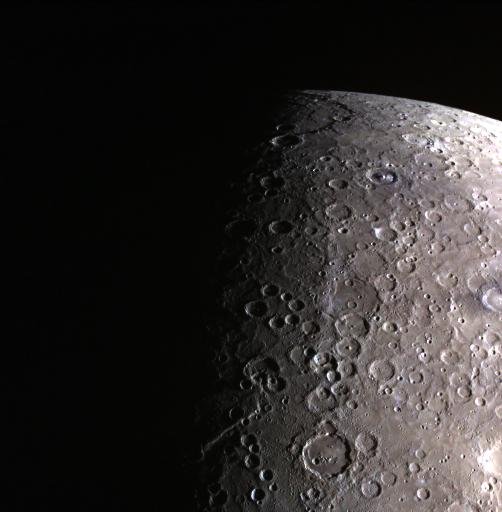
Date acquired: May 05, 2014 Today's color image features both Mercury's terminator and limb. The terminator is the striking separation of night and day on Mercury. It is seen in this image with the change from dark, on the left of the image, to light. Mercury's limb is also captured, as we can see the edge between sunlit Mercury and space. The MESSENGER spacecraft is the first ever to orbit the planet Mercury, and the spacecraft's seven scientific instruments and radio science investigation are unraveling the history and evolution of the Solar System's innermost planet. During the first two years of orbital operations, MESSENGER acquired over 150,000 images and extensive other data sets. MESSENGER is capable of continuing orbital operations until early 2015. Credit: NASA/Johns Hopkins University Applied Physics Laboratory/Carnegie Institution of Washington <b><a href="http://www.nasa.gov/audience/formedia/features/MP_Photo_Guidelines.html" rel="nofollow">NASA image use policy.</a></b> <b><a href="http://www.nasa.gov/centers/goddard/home/index.html" rel="nofollow">NASA Goddard Space Flight Center</a></b> enables NASA’s mission through four scientific endeavors: Earth Science, Heliophysics, Solar System Exploration, and Astrophysics. Goddard plays a leading role in NASA’s accomplishments by contributing compelling scientific knowledge to advance the Agency’s mission. <b>Follow us on <a href="http://twitter.com/NASAGoddardPix" rel="nofollow">Twitter</a></b> <b>Like us on <a href="http://www.facebook.com/pages/Greenbelt-MD/NASA-Goddard/395013845897?ref=tsd" rel="nofollow">Facebook</a></b> <b>Find us on <a href="http://instagram.com/nasagoddard?vm=grid" rel="nofollow">Instagram</a></b>
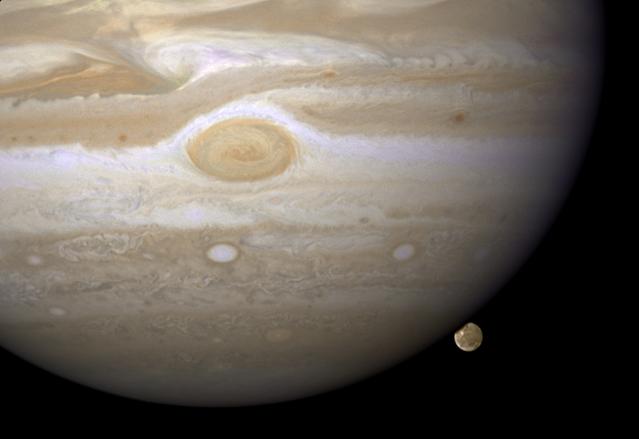
Hubble Catches Jupiter's Largest Moon Going to the 'Dark Side' HST/WFPC2 Image of Jupiter and Ganymede Taken April 9, 2007 NASA's Hubble Space Telescope has caught Jupiter's moon Ganymede playing a game of "peek-a-boo." In this crisp Hubble image, Ganymede is shown just before it ducks behind the giant planet. Ganymede completes an orbit around Jupiter every seven days. Because Ganymede's orbit is tilted nearly edge-on to Earth, it routinely can be seen passing in front of and disappearing behind its giant host, only to reemerge later. Composed of rock and ice, Ganymede is the largest moon in our solar system. It is even larger than the planet Mercury. But Ganymede looks like a dirty snowball next to Jupiter, the largest planet in our solar system. Jupiter is so big that only part of its Southern Hemisphere can be seen in this image. Hubble's view is so sharp that astronomers can see features on Ganymede's surface, most notably the white impact crater, Tros, and its system of rays, bright streaks of material blasted from the crater. Tros and its ray system are roughly the width of Arizona. The image also shows Jupiter's Great Red Spot, the large eye-shaped feature at upper left. A storm the size of two Earths, the Great Red Spot has been raging for more than 300 years. Hubble's sharp view of the gas giant planet also reveals the texture of the clouds in the Jovian atmosphere as well as various other storms and vortices. Astronomers use these images to study Jupiter's upper atmosphere. As Ganymede passes behind the giant planet, it reflects sunlight, which then passes through Jupiter's atmosphere. Imprinted on that light is information about the gas giant's atmosphere, which yields clues about the properties of Jupiter's high-altitude haze above the cloud tops. This color image was made from three images taken on April 9, 2007, with the Wide Field Planetary Camera 2 in red, green, and blue filters. The image shows Jupiter and Ganymede in close to natural colors. For additional information go to: <a href="http://hubblesite.org/newscenter/archive/releases/2008/42/" rel="nofollow">hubblesite.org/newscenter/archive/releases/2008/42/</a> Credit: NASA, ESA, and E. Karkoschka (University of Arizona) <b><a href="http://www.nasa.gov/audience/formedia/features/MP_Photo_Guidelines.html" rel="nofollow">NASA image use policy.</a></b> <b><a href="http://www.nasa.gov/centers/goddard/home/index.html" rel="nofollow">NASA Goddard Space Flight Center</a></b> enables NASA’s mission through four scientific endeavors: Earth Science, Heliophysics, Solar System Exploration, and Astrophysics. Goddard plays a leading role in NASA’s accomplishments by contributing compelling scientific knowledge to advance the Agency’s mission. <b>Follow us on <a href="http://twitter.com/NASAGoddardPix" rel="nofollow">Twitter</a></b> <b>Like us on <a href="http://www.facebook.com/pages/Greenbelt-MD/NASA-Goddard/395013845897?ref=tsd" rel="nofollow">Facebook</a></b> <b>Find us on <a href="http://instagram.com/nasagoddard?vm=grid" rel="nofollow">Instagram</a></b>