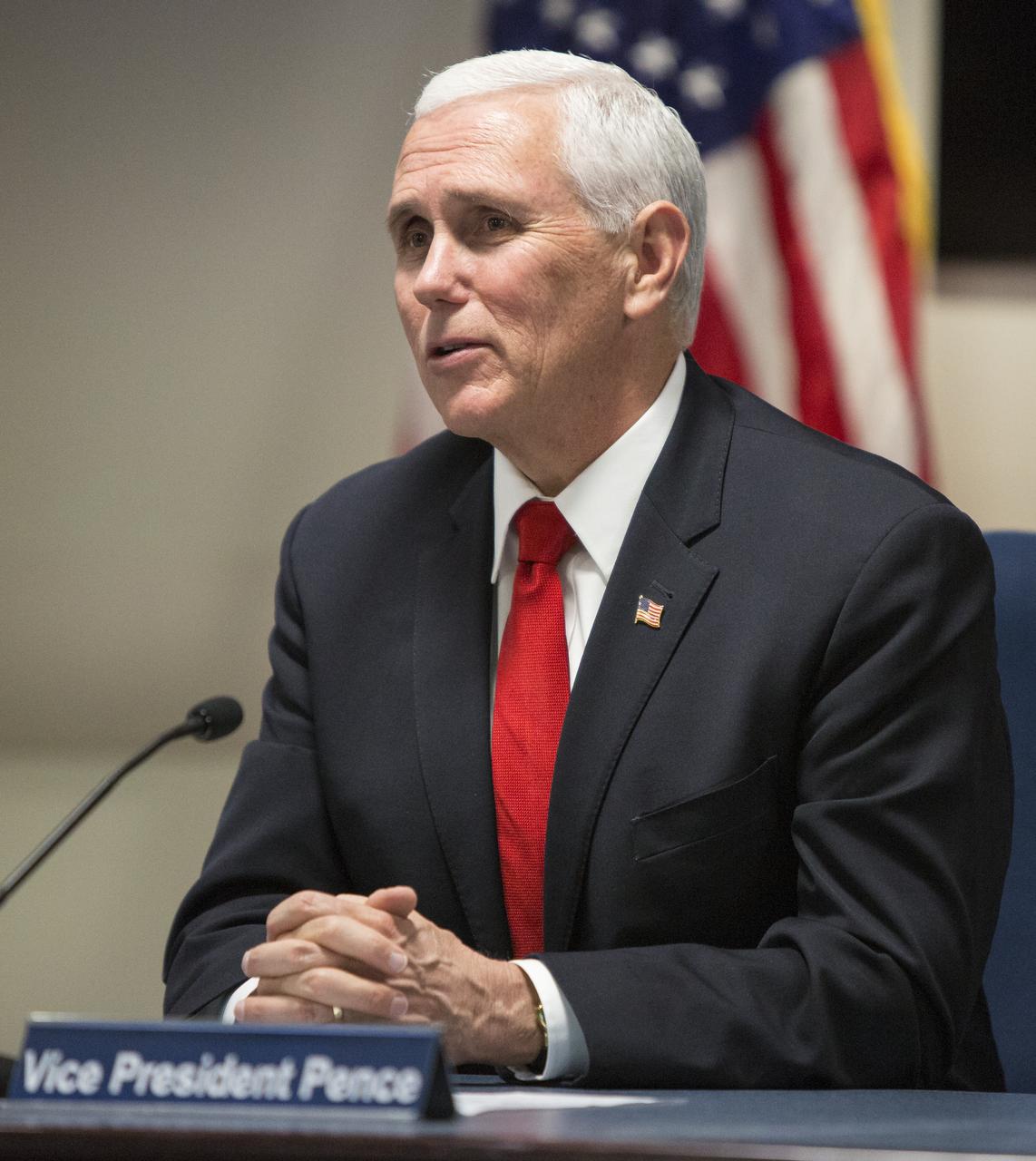
Vice President Mike Pence speaks with Expedition 58 flight engineer Anne McClain of NASA, and flight engineer David Saint-Jacques of the Canadian Space Agency (CSA) who are onboard the International Space Station, Wednesday, March 6, 2019 from the Space Operations Center at NASA Headquarters in Washington. Vice President Pence and Administrator Bridenstine spoke with the astronauts about the arrival of SpaceX's Crew Dragon spacecraft at the International Space Station. Photo Credit: (NASA/Joel Kowsky)
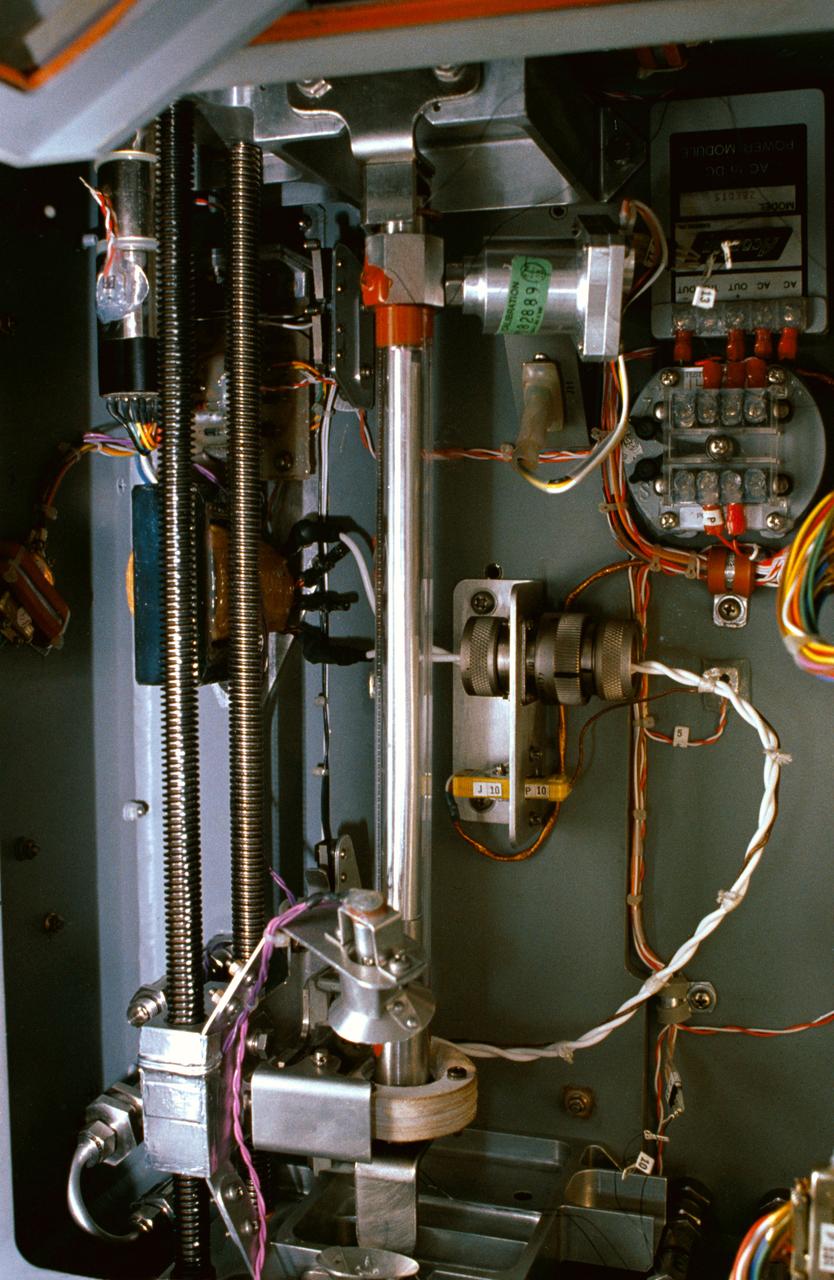
STS030-01-015 (4-8 May 1989) --- A 35mm close-up view of the Fluids Experiment Apparatus (FEA) aboard Atlantis for NASA’s STS-30 mission. Rockwell International is engaged in a joint endeavor agreement with NASA’s Office of Commercial Programs in the field of floating zone crystal growth and purification research. The March 1987 agreement provides for microgravity experiments to be performed in the company’s Microgravity Laboratory, the FEA. Crewmembers, especially Mary L. Cleave, devoted a great deal of onboard time to the monitoring of various materials science experiments using the apparatus.
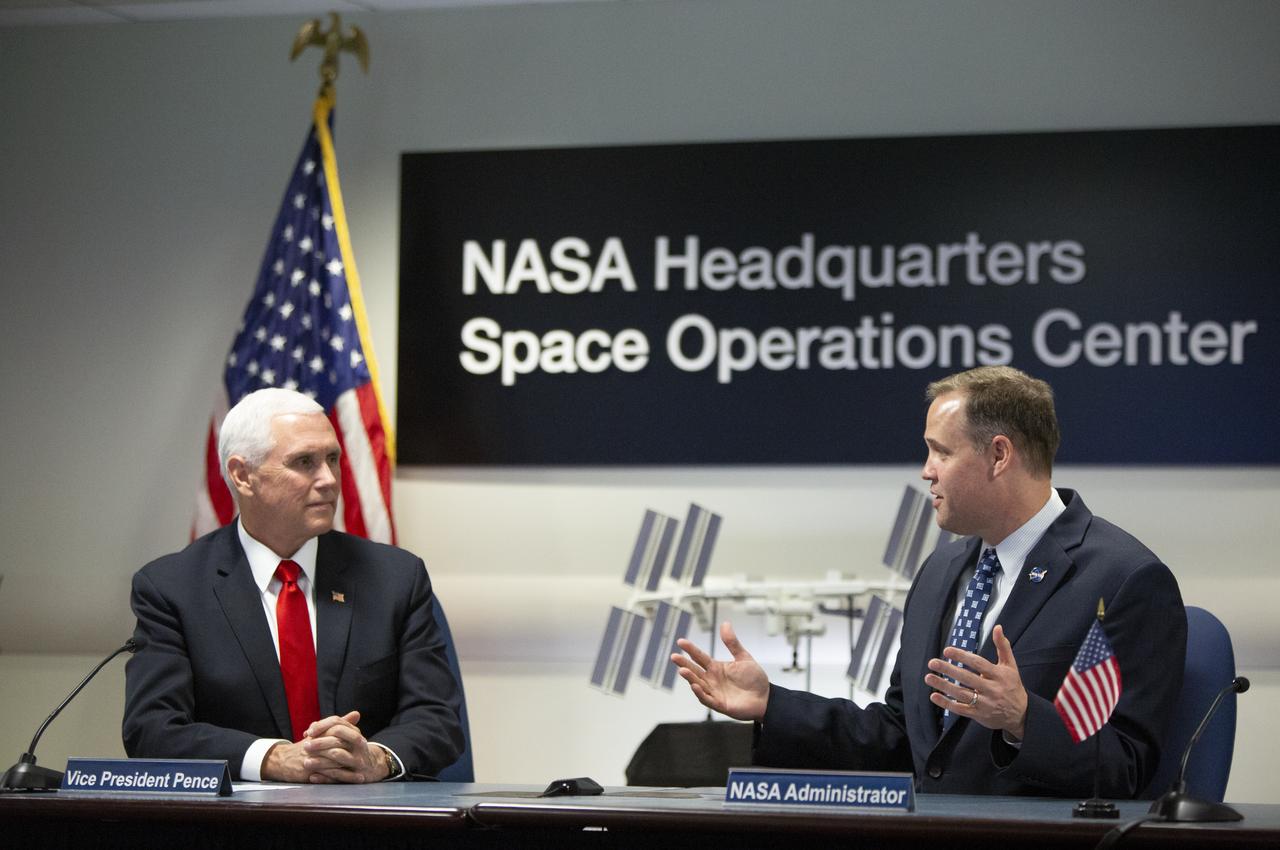
Vice President Mike Pence, left, and NASA Administrator Jim Bridenstine, right, speak with Expedition 58 flight engineer Anne McClain of NASA, and flight engineer David Saint-Jacques of the Canadian Space Agency (CSA) who are onboard the International Space Station, Wednesday, March 6, 2019 from the Space Operations Center at NASA Headquarters in Washington. Vice President Pence and Administrator Bridenstine spoke with the astronauts about the arrival of SpaceX's Crew Dragon spacecraft at the International Space Station. Photo Credit: (NASA/Joel Kowsky)
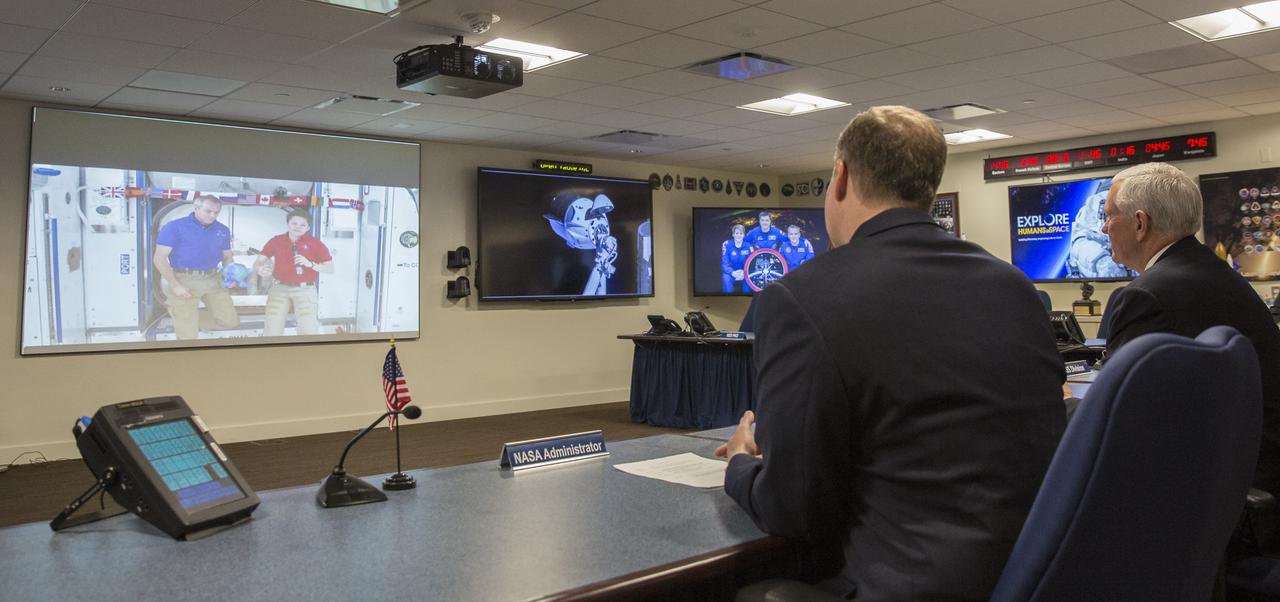
Vice President Mike Pence, right, and NASA Administrator Jim Bridenstine, left, speak with Expedition 58 flight engineer Anne McClain of NASA, and flight engineer David Saint-Jacques of the Canadian Space Agency (CSA) who are onboard the International Space Station, Wednesday, March 6, 2019 from the Space Operations Center at NASA Headquarters in Washington. Vice President Pence and Administrator Bridenstine spoke with the astronauts about the arrival of SpaceX's Crew Dragon spacecraft at the International Space Station. Photo Credit: (NASA/Joel Kowsky)
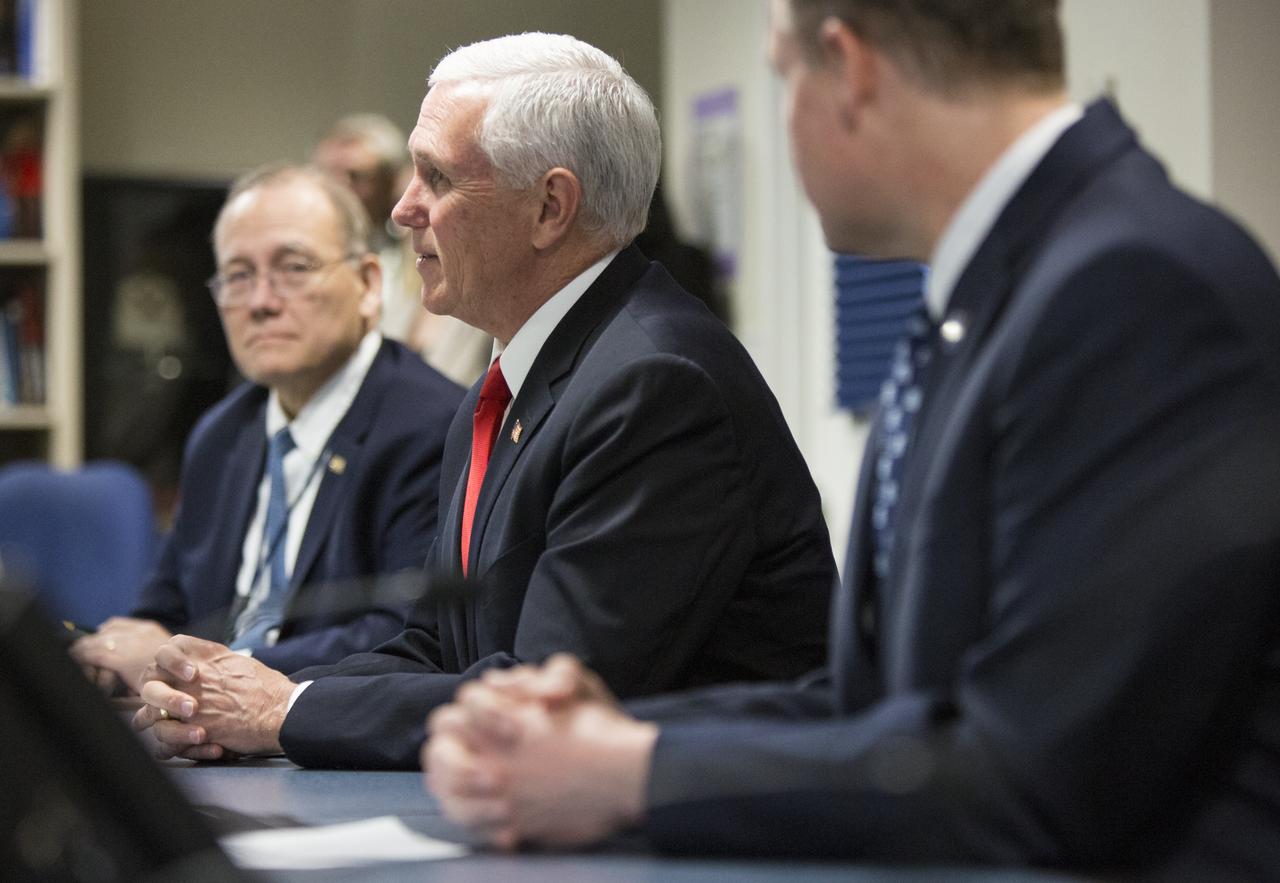
Vice President Mike Pence, center, speaks with Expedition 58 flight engineer Anne McClain of NASA, and flight engineer David Saint-Jacques of the Canadian Space Agency (CSA) who are onboard the International Space Station, Wednesday, March 6, 2019 from the Space Operations Center at NASA Headquarters in Washington. Vice President Pence and Administrator Bridenstine spoke with the astronauts about the arrival of SpaceX's Crew Dragon spacecraft at the International Space Station. Photo Credit: (NASA/Joel Kowsky)
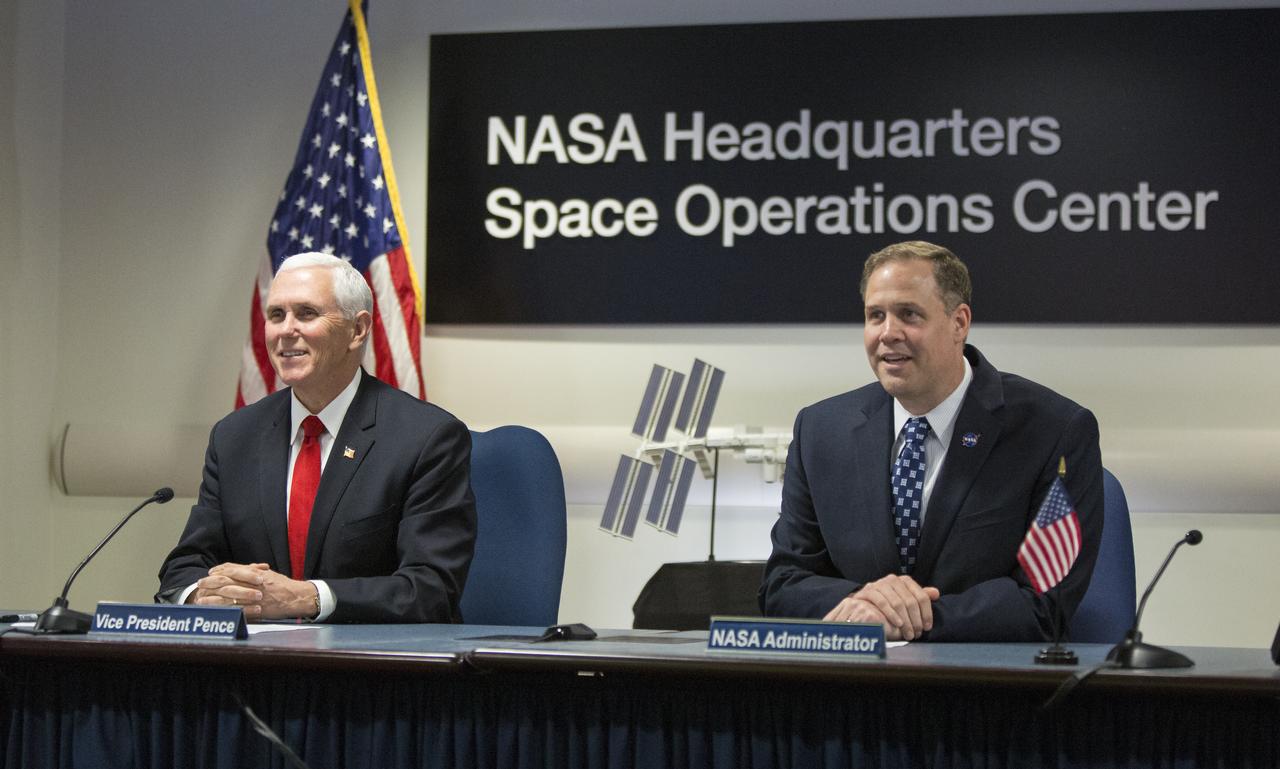
Vice President Mike Pence, left, and NASA Administrator Jim Bridenstine, right, speak with Expedition 58 flight engineer Anne McClain of NASA, and flight engineer David Saint-Jacques of the Canadian Space Agency (CSA) who are onboard the International Space Station, Wednesday, March 6, 2019 from the Space Operations Center at NASA Headquarters in Washington. Vice President Pence and Administrator Bridenstine spoke with the astronauts about the arrival of SpaceX's Crew Dragon spacecraft at the International Space Station. Photo Credit: (NASA/Joel Kowsky)
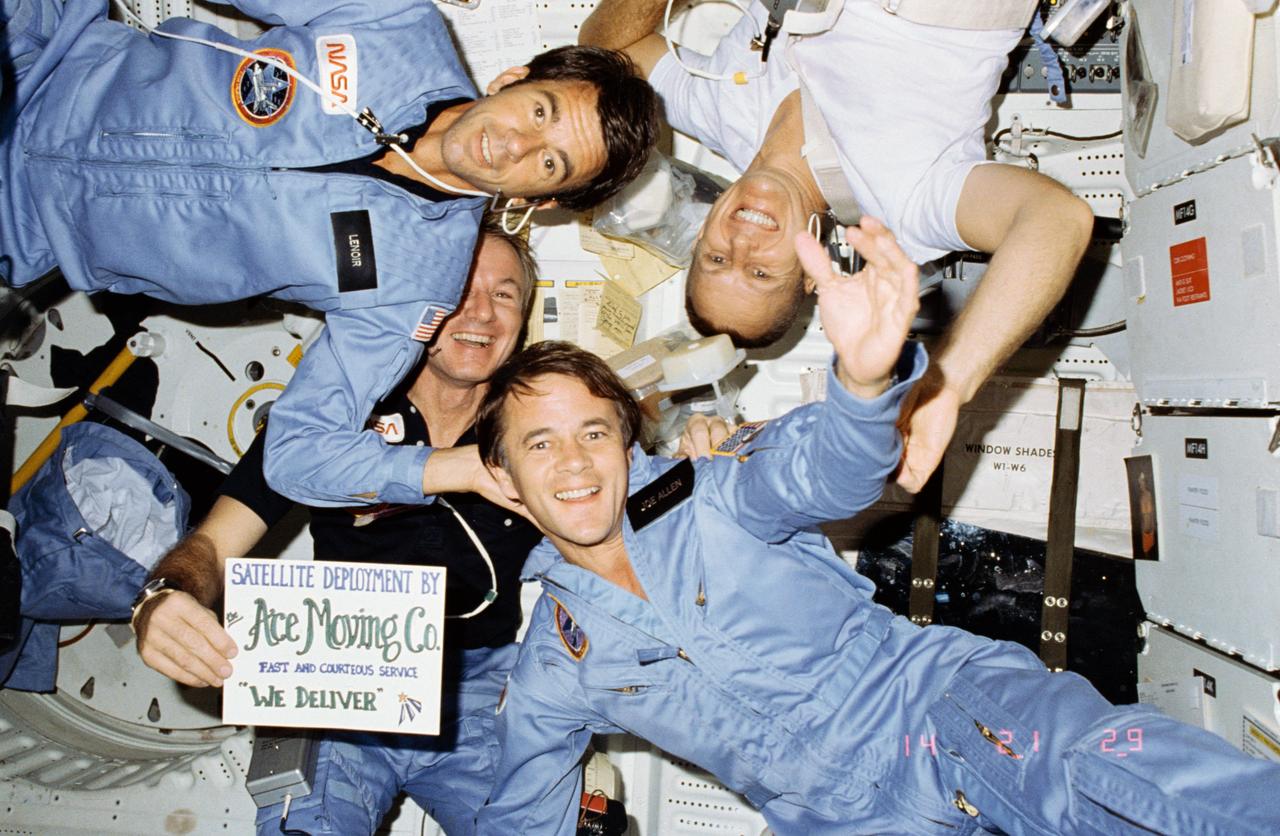
Crew onboard portrait taken on port side middeck shows Commander Brand holding Ace Moving Co sign (partially obscured, near center) and surrounded by Pilot Overmyer (in light t-shirt), Mission Specialist (MS) Allen (center bottom) and MS Lenoir (center top). The sign refers to the successful deployment of two commercial communications satellites on the flight's first two days.
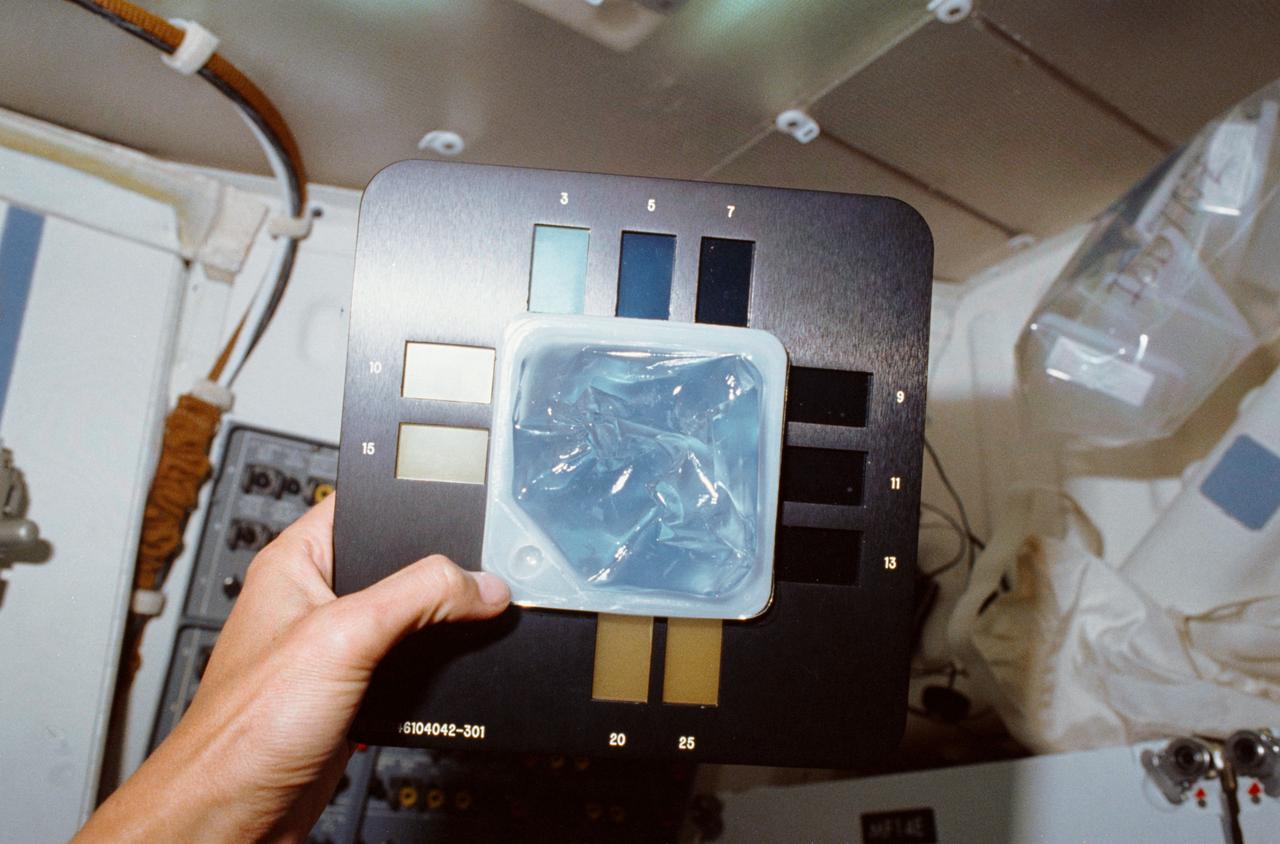
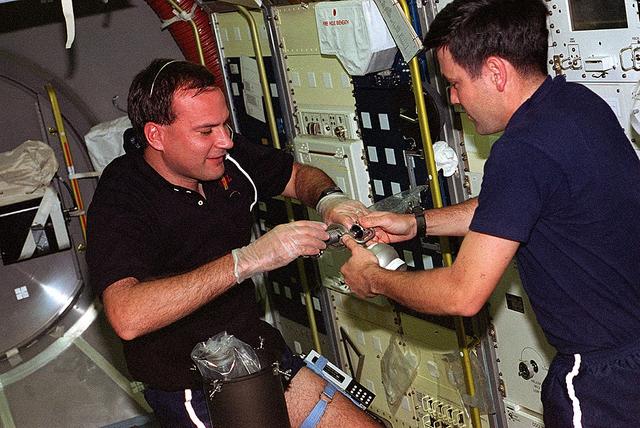
STS034-10-014 (18-23 Oct. 1989) --- An onboard 35mm camera provides a closeup view of an STS-34 beverage container doubling as an experiment module for a test involving iodine concentration in onboard water. The examination called for the adding of starch to a specimen of Atlantis' fuel-cell produced water. The liquid was then compared against the color chart for determining the degree of iodine content. The experiment was designed by Terry H. Slezak of JSC's Photographic Technology and Television Division.
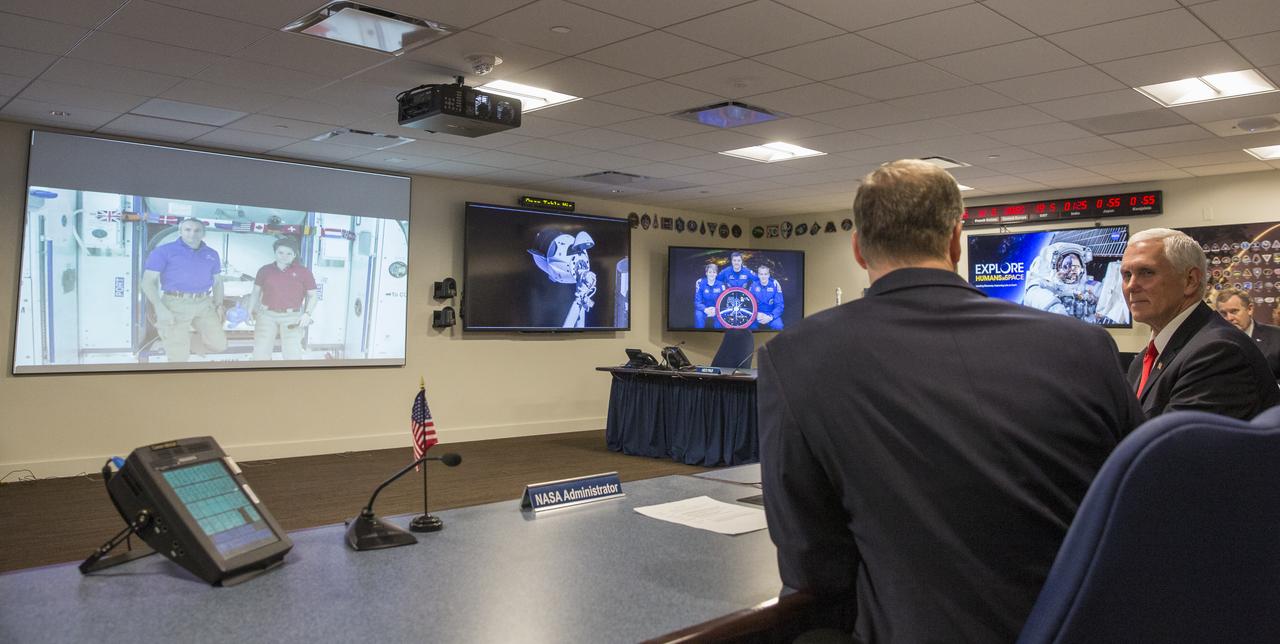
Vice President Mike Pence, right, and NASA Administrator Jim Bridenstine, left, speak with Expedition 58 flight engineer Anne McClain of NASA, and flight engineer David Saint-Jacques of the Canadian Space Agency (CSA) who are onboard the International Space Station, Wednesday, March 6, 2019 from the Space Operations Center at NASA Headquarters in Washington. Vice President Pence and Administrator Bridenstine spoke with the astronauts about the arrival of SpaceX's Crew Dragon spacecraft at the International Space Station. Photo Credit: (NASA/Joel Kowsky)
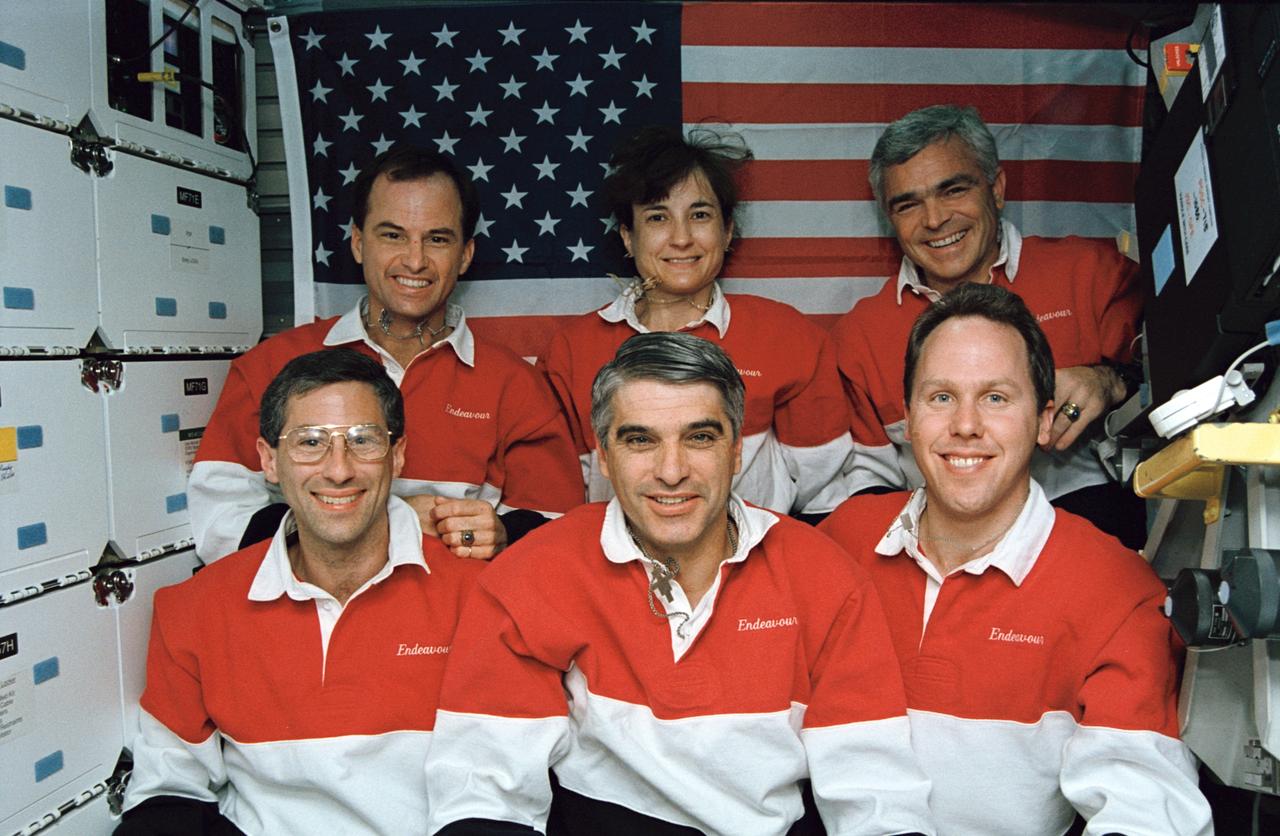
STS059-44-004 (9-20 April 1994) --- This middeck scene aboard the Space Shuttle Endeavour caught all six STS-59 crew members in a rare group shot. Astronaut Sidney M. Gutierrez, mission commander (front center) is flanked by astronauts Jerome (Jay) Apt and Thomas D. Jones, both mission specialists. On the back row are (left to right) astronaut Kevin P. Chilton, pilot; Linda M. Godwin, payload commander; and Michael R. (Rich) Clifford, mission specialist. Most of the week and a half was divided into two work shifts for the crew members.
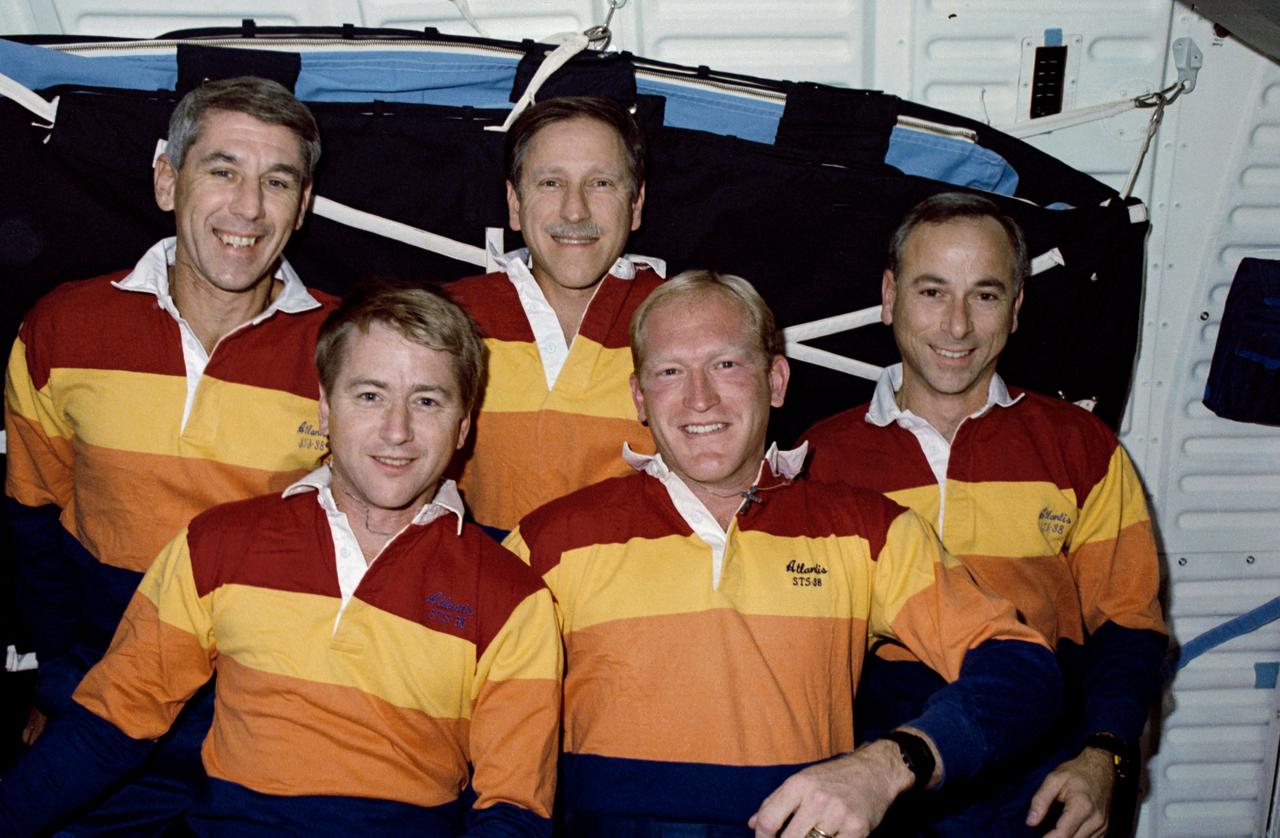
STS038-28-016 (20 Nov 1990) --- STS-38 crewmembers pose on Atlantis', Orbiter Vehicle (OV) 104's, middeck for traditional onboard (in-space) portrait. Wearing red, yellow, and orange crew polo shirts are (right to left) Mission Specialist (MS) Robert C. Springer, Pilot Frank L. Culbertson, Commander Richard O. Covey, MS Charles D. Gemar, and MS Carl J. Meade.
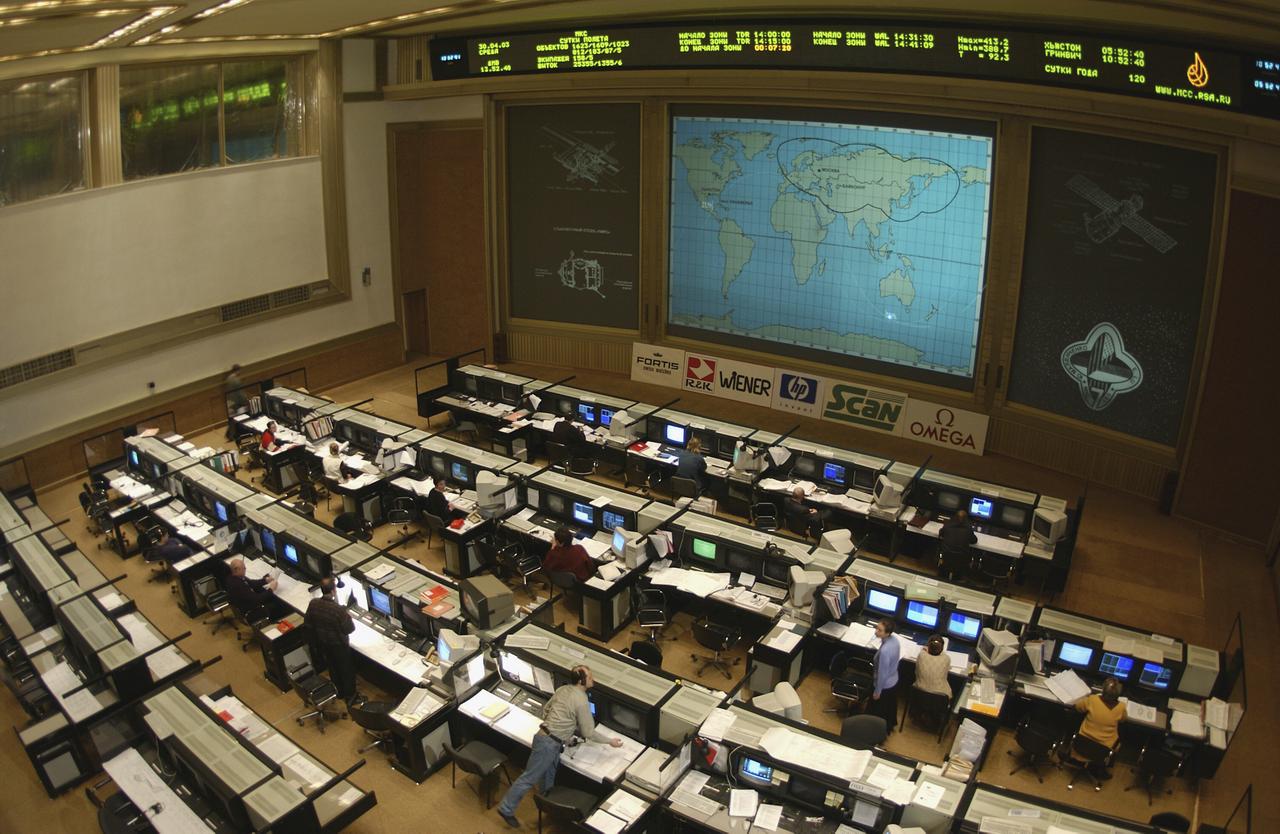
This is an overall view of the Russian Mission Control Center in Korolev, Russia during the Expedition 7 mission, Wednesday, April 30, 2003. Photo Credit: (NASA/Bill Ingalls)
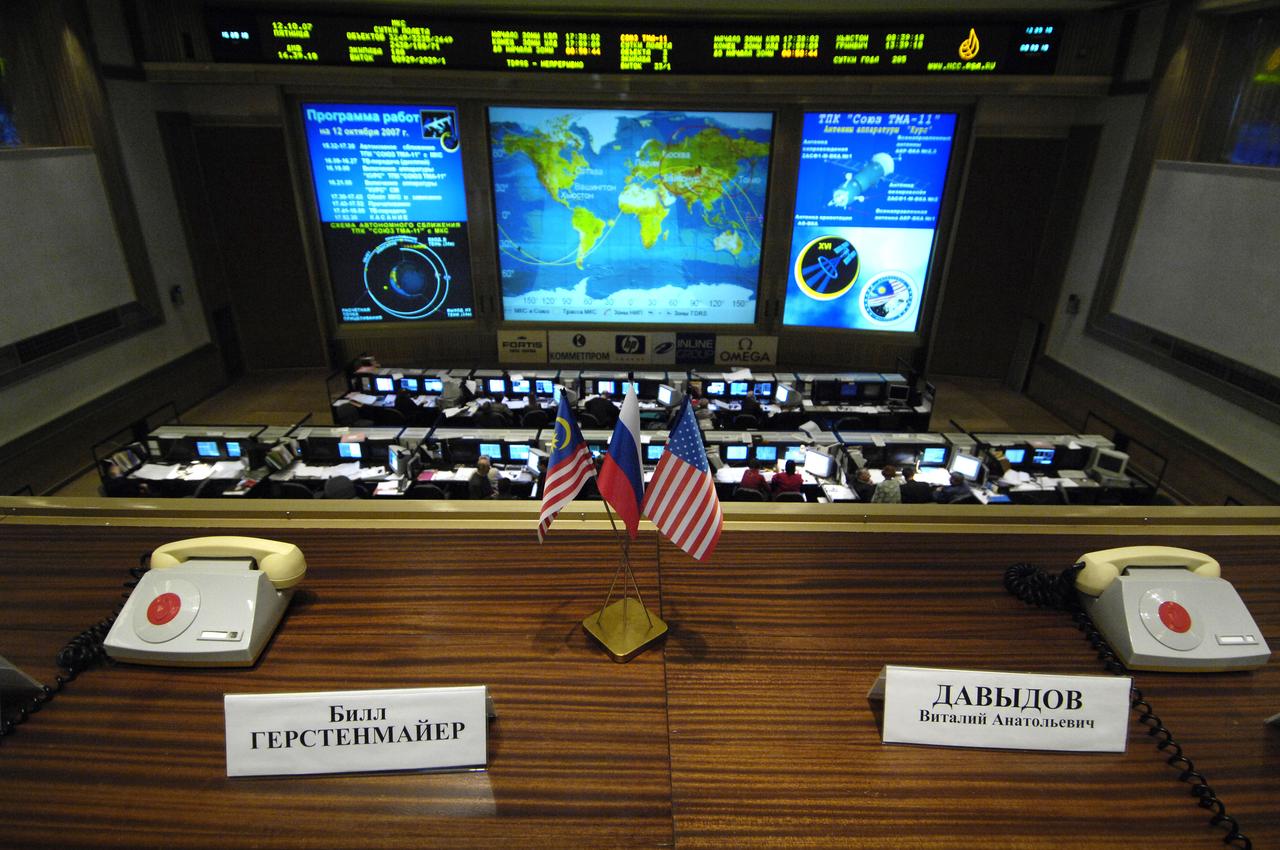
The flags of Malaysia, Russia and the United States sit between the phones used by officials to speak with the crew of the International Space Station (ISS) in the Russian Mission Control Center in Korolev, outside Moscow, Friday, Oct. 12, 2007. Expedition 16 Commander Peggy Whitson, Soyuz Commander and Flight Engineer Yuri Malenchenko and Malaysian spaceflight participant Sheikh Muszaphar Shukor docked their Soyuz TMA-11 spacecraft to the ISS at 10:50 a.m. EDT, October 12. The crew launched on Wednesday from the Baikonur Cosmodrome in Kazakhstan. Photo Credit: (NASA/Bill Ingalls)
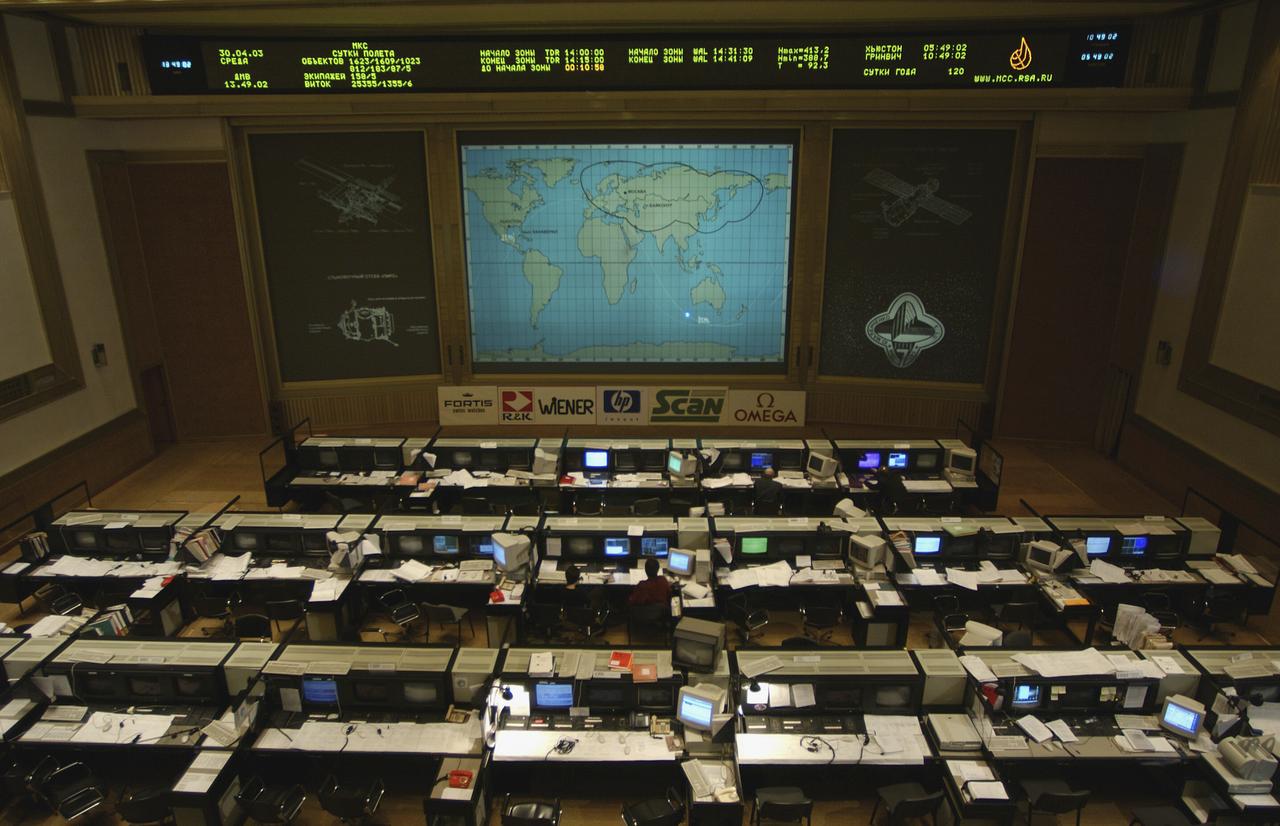
This is an overall view of the Russian Mission Control Center in Korolev, Russia during the Expedition 7 mission, Wednesday, April 30, 2003. Photo Credit: (NASA/Bill Ingalls)
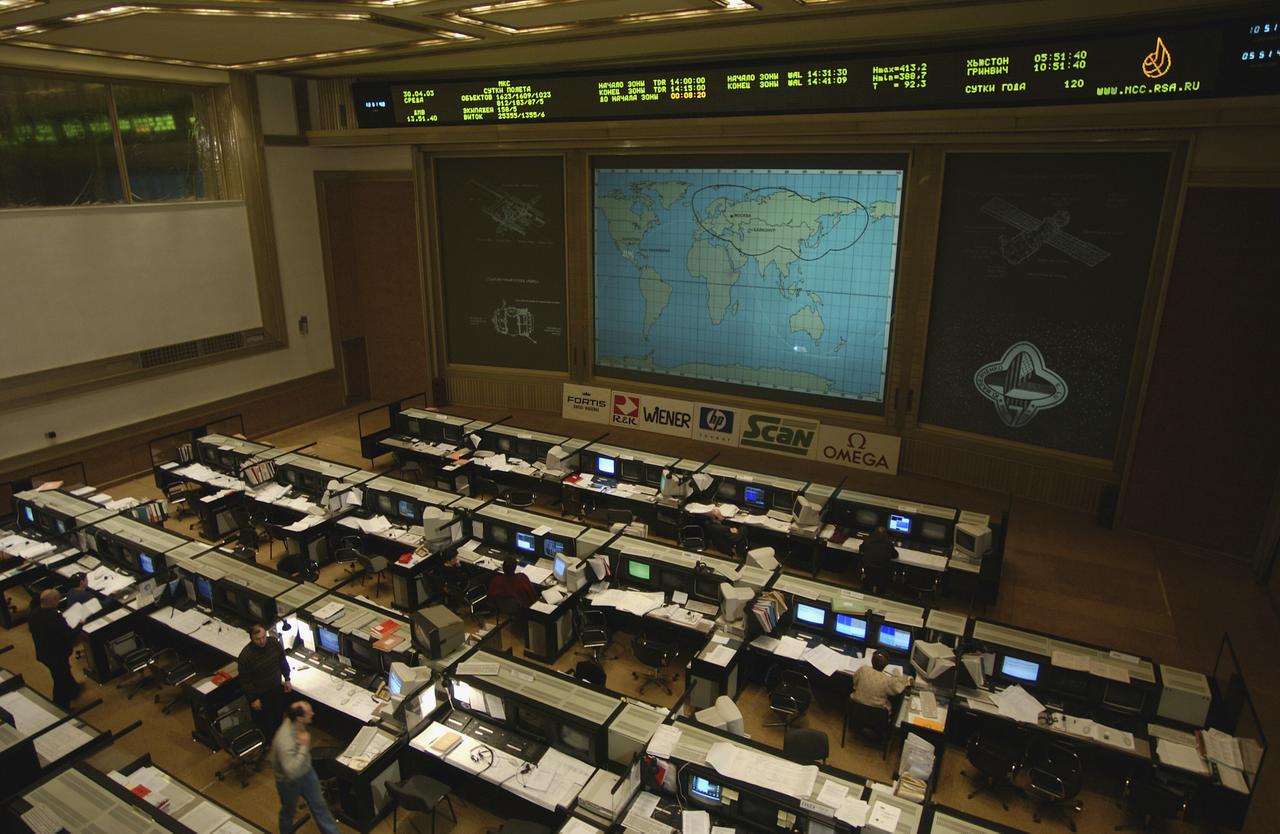
This is an overall view of the Russian Mission Control Center in Korolev, Russia during the Expedition 7 mission, Wednesday, April 30, 2003. Photo Credit: (NASA/Bill Ingalls)
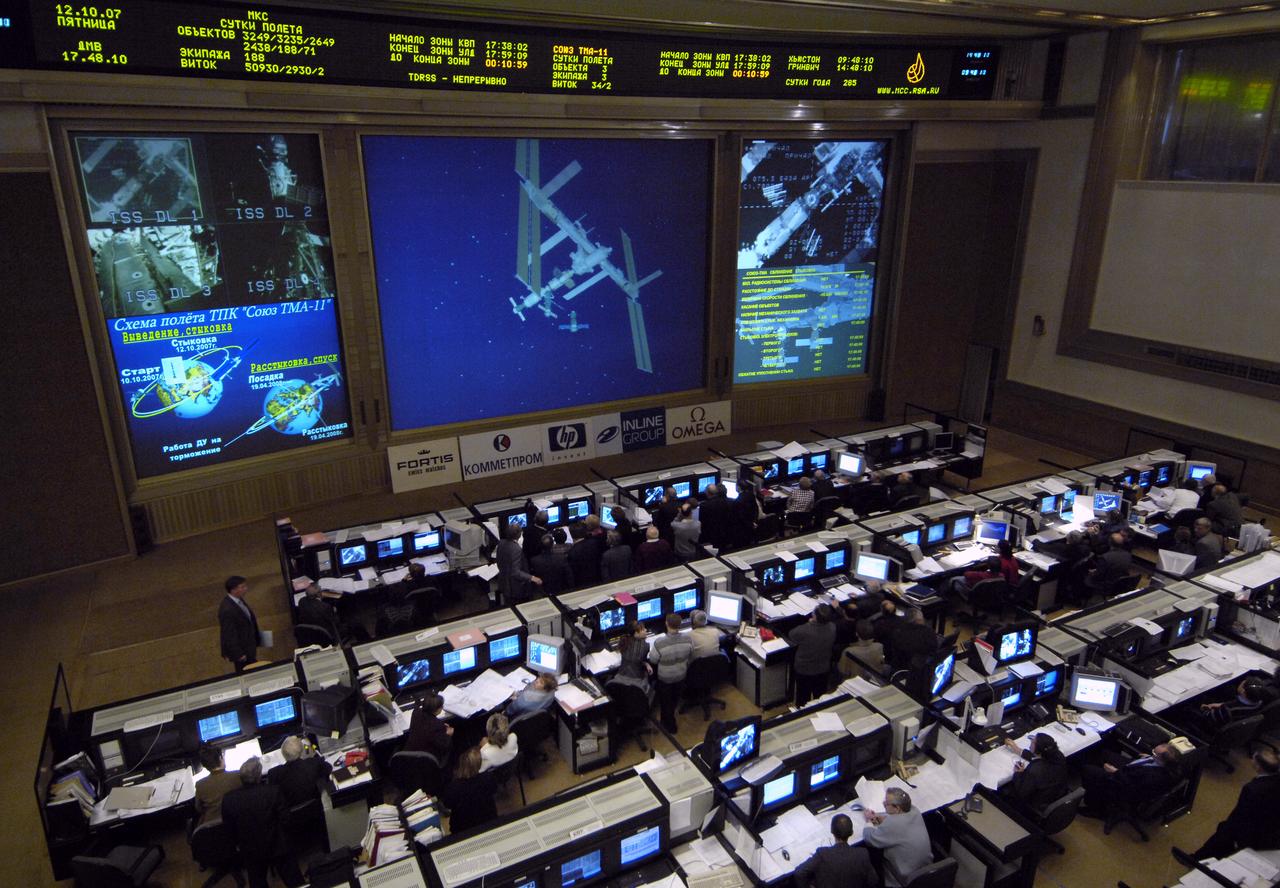
Live video from the Soyuz TMA-11 spacecraft of the International Space Station is shown on the screen in the upper right in the Russian Mission Control Center in Korolev, outside Moscow, Friday, Oct. 12, 2007. Expedition 16 Commander Peggy Whitson, Soyuz Commander and Flight Engineer Yuri Malenchenko and Malaysian spaceflight participant Sheikh Muszaphar Shukor docked their Soyuz TMA-11 spacecraft to the ISS at 10:50 a.m. EDT, October 12. The crew launched on Wednesday from the Baikonur Cosmodrome in Kazakhstan. Photo Credit: (NASA/Bill Ingalls)
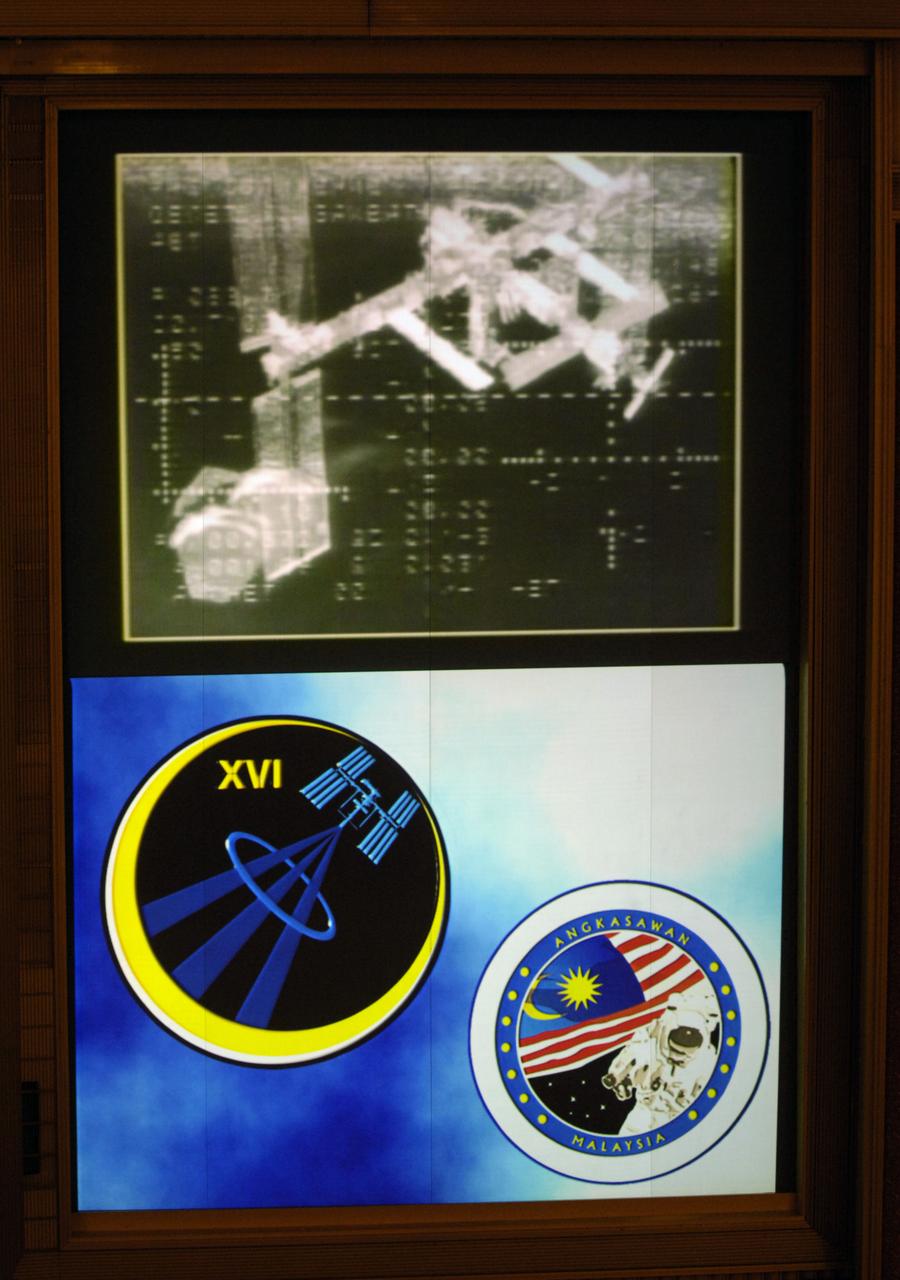
Live video from the Soyuz TMA-11 spacecraft of the International Space Station is shown on the screen in the Russian Mission Control Center in Korolev, outside Moscow, Friday, Oct. 12, 2007. Expedition 16 Commander Peggy Whitson, Soyuz Commander and Flight Engineer Yuri Malenchenko and Malaysian spaceflight participant Sheikh Muszaphar Shukor docked their Soyuz TMA-11 spacecraft to the ISS at 10:50 a.m. EDT, October 12. The crew launched on Wednesday from the Baikonur Cosmodrome in Kazakhstan. Photo Credit: (NASA/Bill Ingalls)
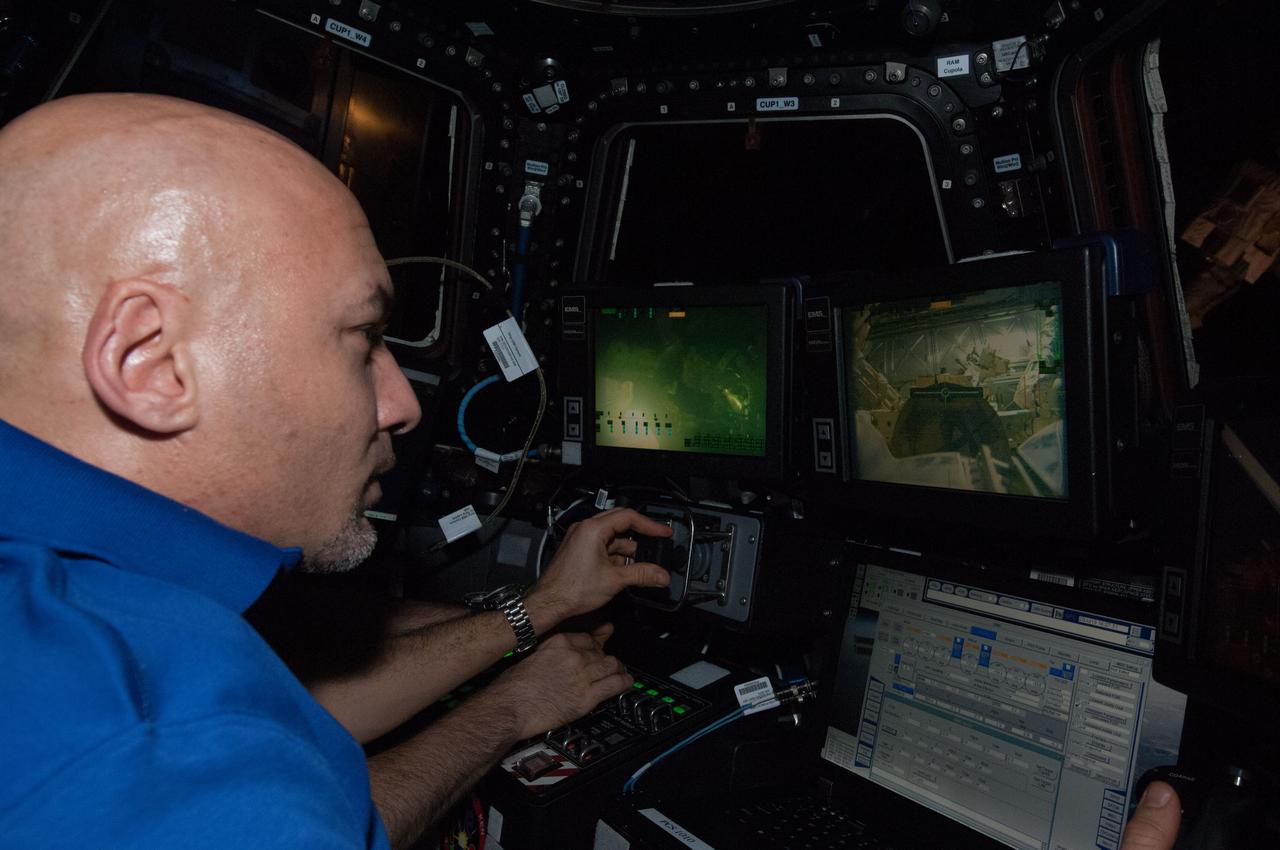
ISS036-E-026283 (29 July 2013) --- In the International Space Station?s Cupola, European Space Agency astronaut Luca Parmitano, Expedition 36 flight engineer, participates in an onboard training activity in preparation for the grapple and berthing of the Japanese ?Kounotori? H2 Transfer Vehicle-4 (HTV-4) set for August 9.
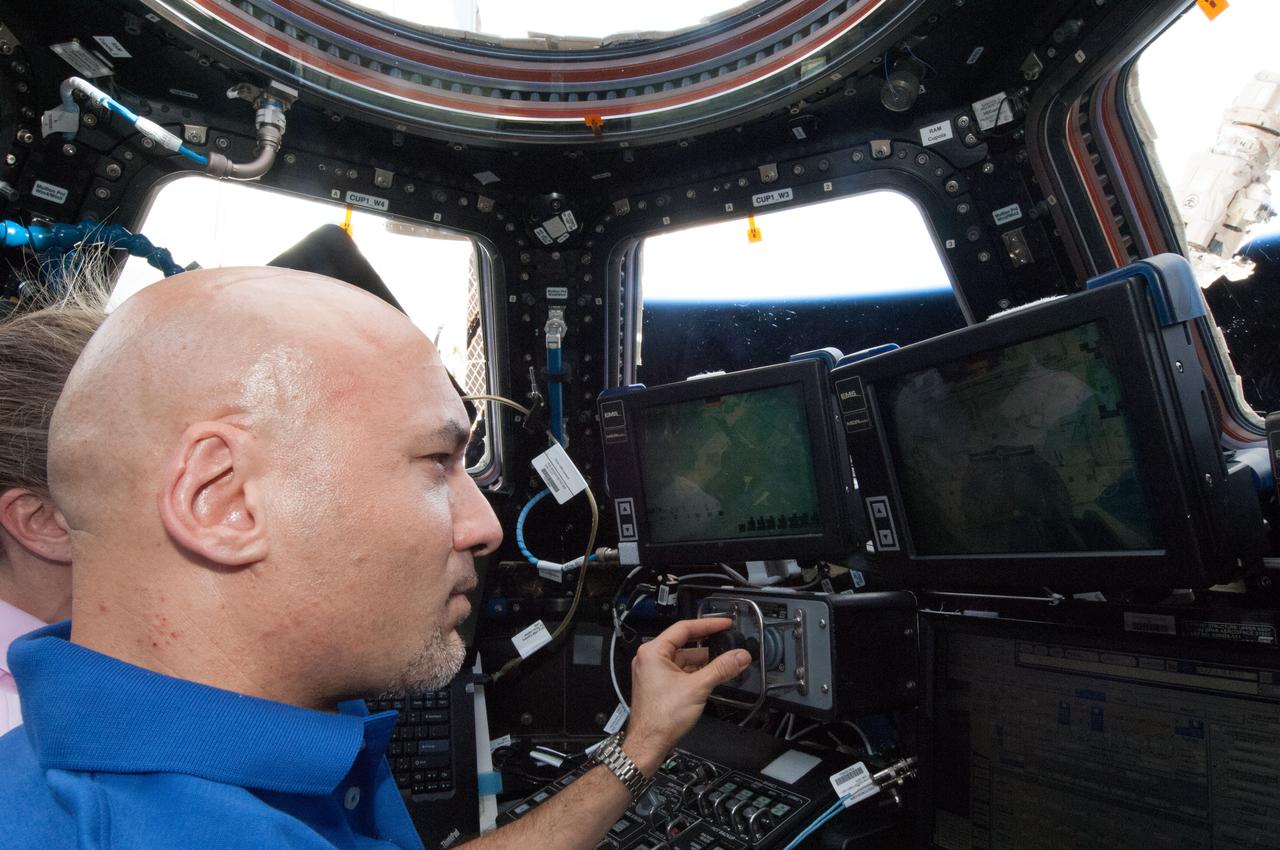
ISS036-E-026326 (29 July 2013) --- In the International Space Station?s Cupola, European Space Agency astronaut Luca Parmitano, Expedition 36 flight engineer, participates in an onboard training activity in preparation for the grapple and berthing of the Japanese ?Kounotori? H2 Transfer Vehicle-4 (HTV-4) set for August 9.
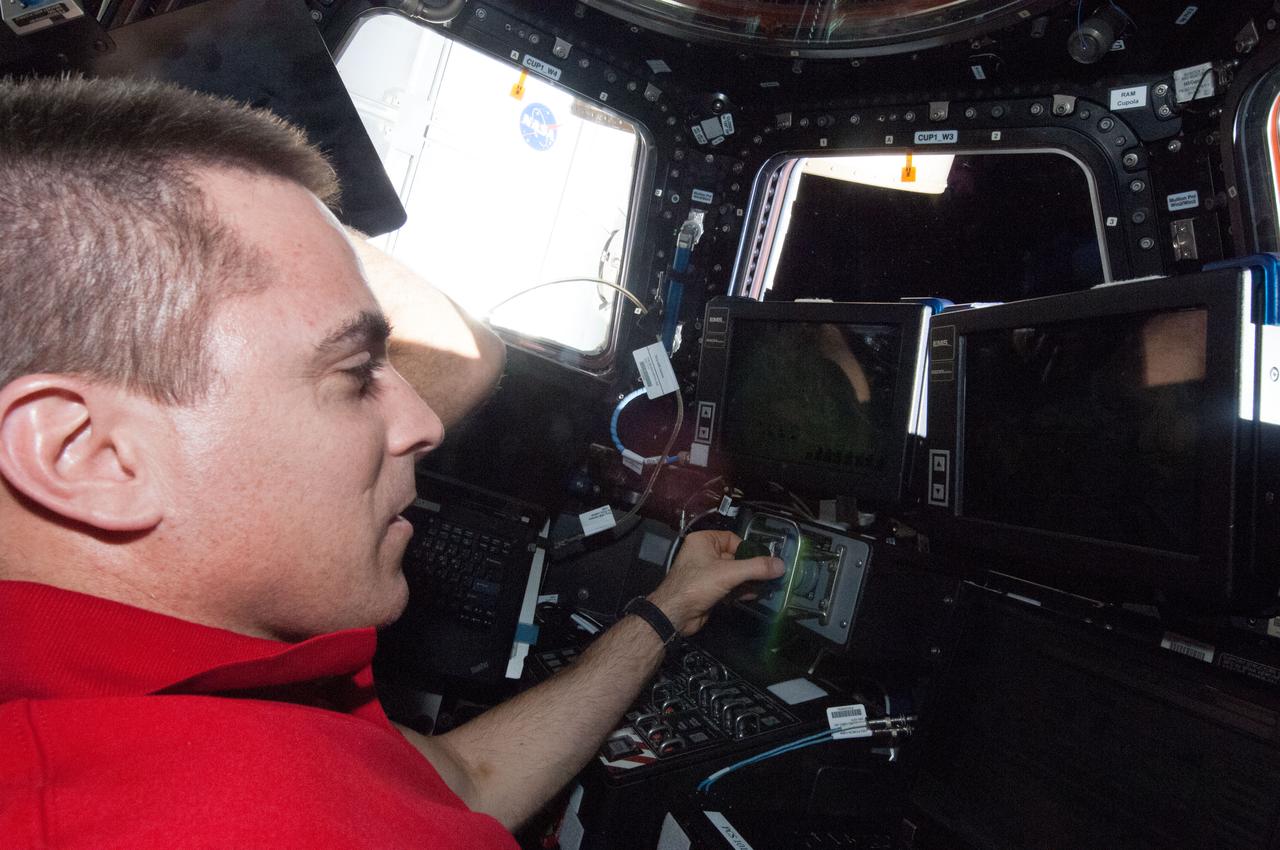
ISS036-E-026298 (29 July 2013) --- In the International Space Station?s Cupola, NASA astronaut Chris Cassidy, Expedition 36 flight engineer, participates in an onboard training activity in preparation for the grapple and berthing of the Japanese ?Kounotori? H2 Transfer Vehicle-4 (HTV-4) set for August 9.
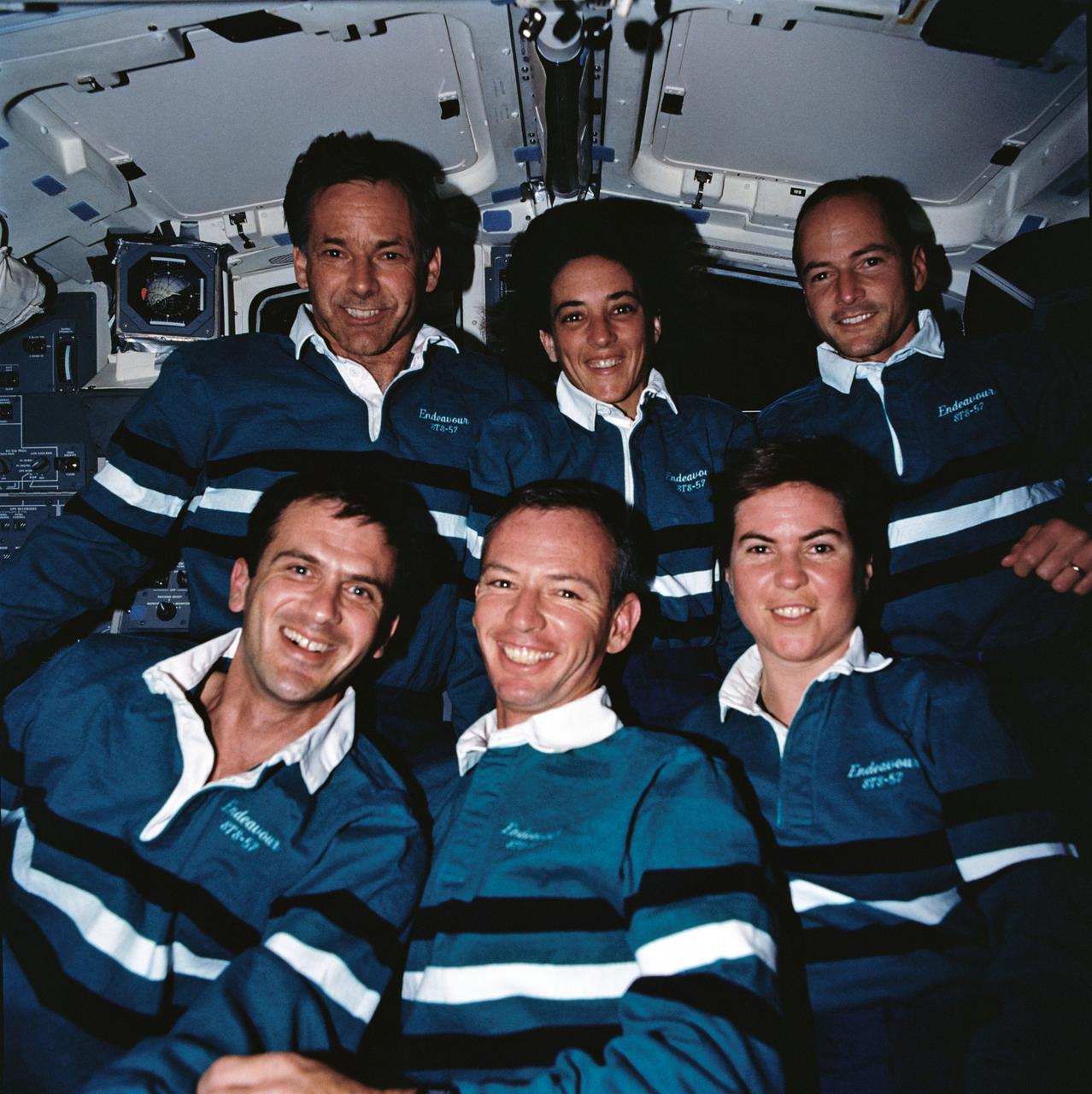
STS057-94-017 (21 June - 1 July 1993) --- Six astronauts onboard the Space Shuttle Endeavour pose for the traditional inflight crew portrait on the aft flight deck. In the rear (left to right) are astronauts Ronald J. Grabe, mission commander; Nancy J. Sherlock, mission specialist; and G. David Low, payload commander; in front (left to right), Peter J. K. (Jeff) Wisoff, mission specialist; Brian Duffy, pilot; and Janice E. Voss, mission specialist.
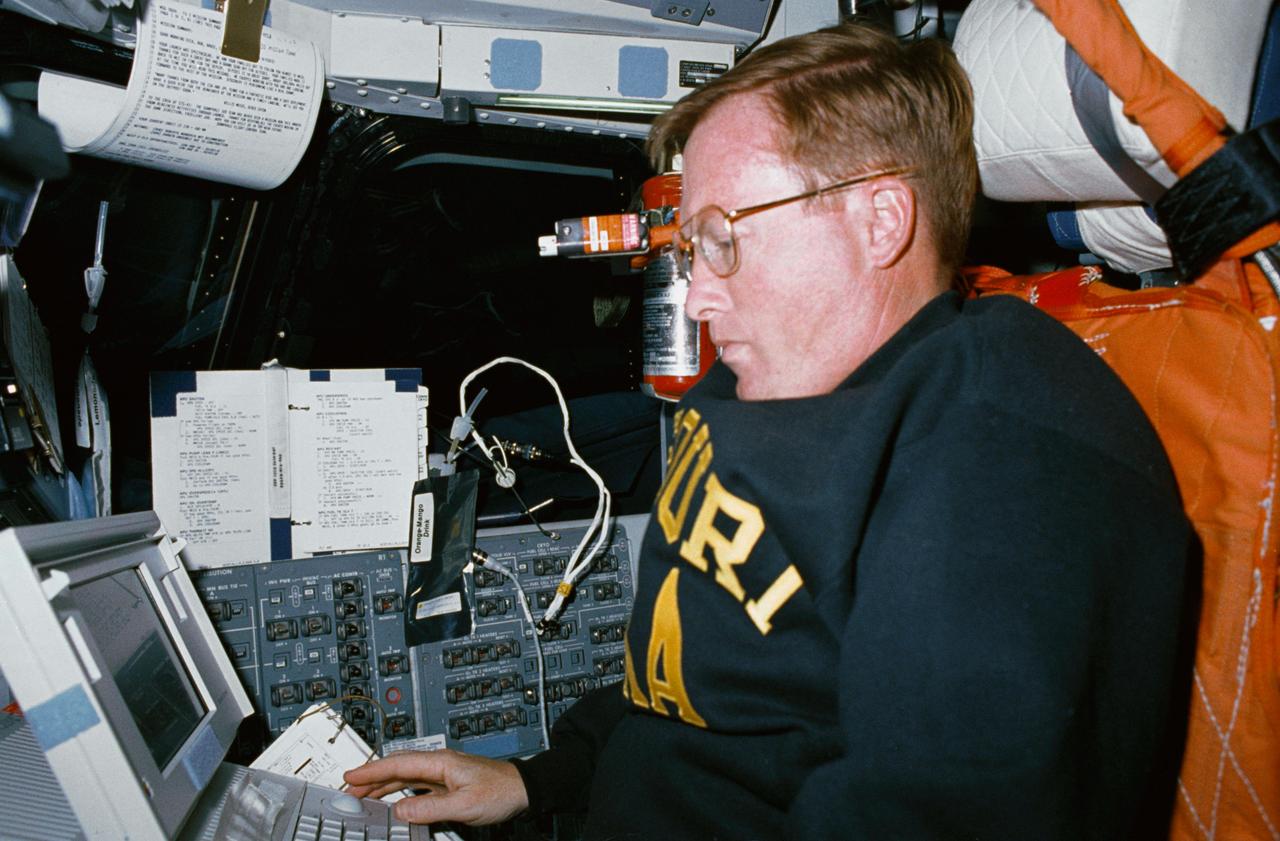
STS041-01-002 (6-10 Oct 1990) --- Astronaut Richard N. Richards, STS 41 mission commander, "borrows" the pilot's station to utilize a Shuttle portable onboard computer during the four-day flight. The photo was made with a 35mm camera.
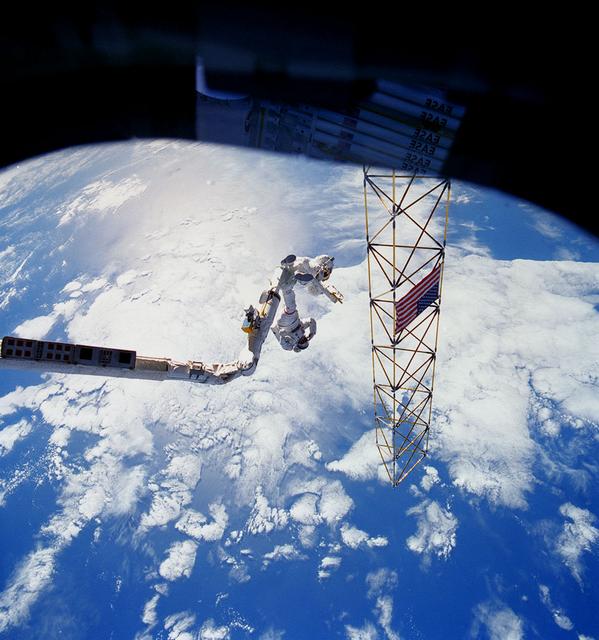
This is an STS-61B onboard photo of astronauts Ross and Spring on the Remote Manipulator System (RMS) as they approach the erected Assembly Concept for Construction of Erectable Space Structure (ACCESS).
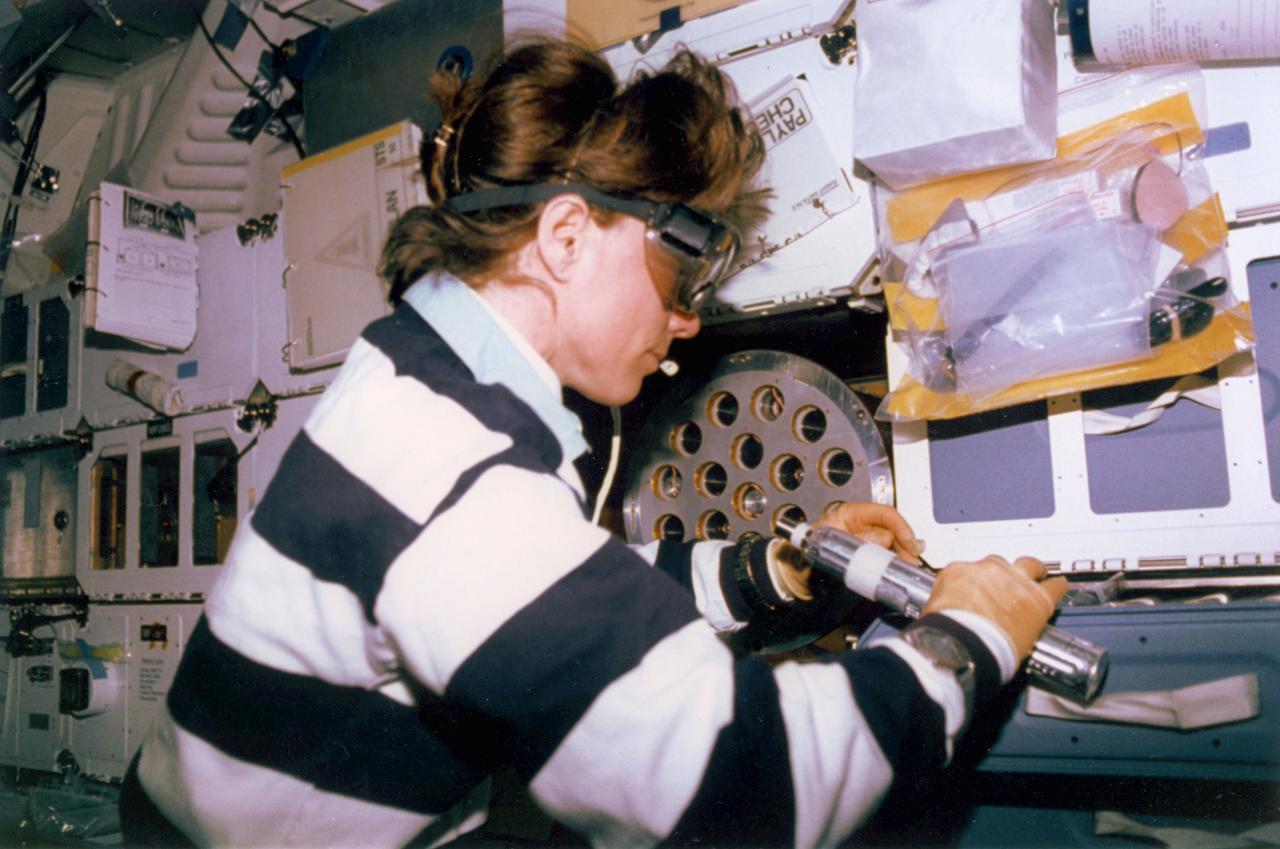
Payload Commander, Bonnie Dunbar working onboard STS-50 USML-1
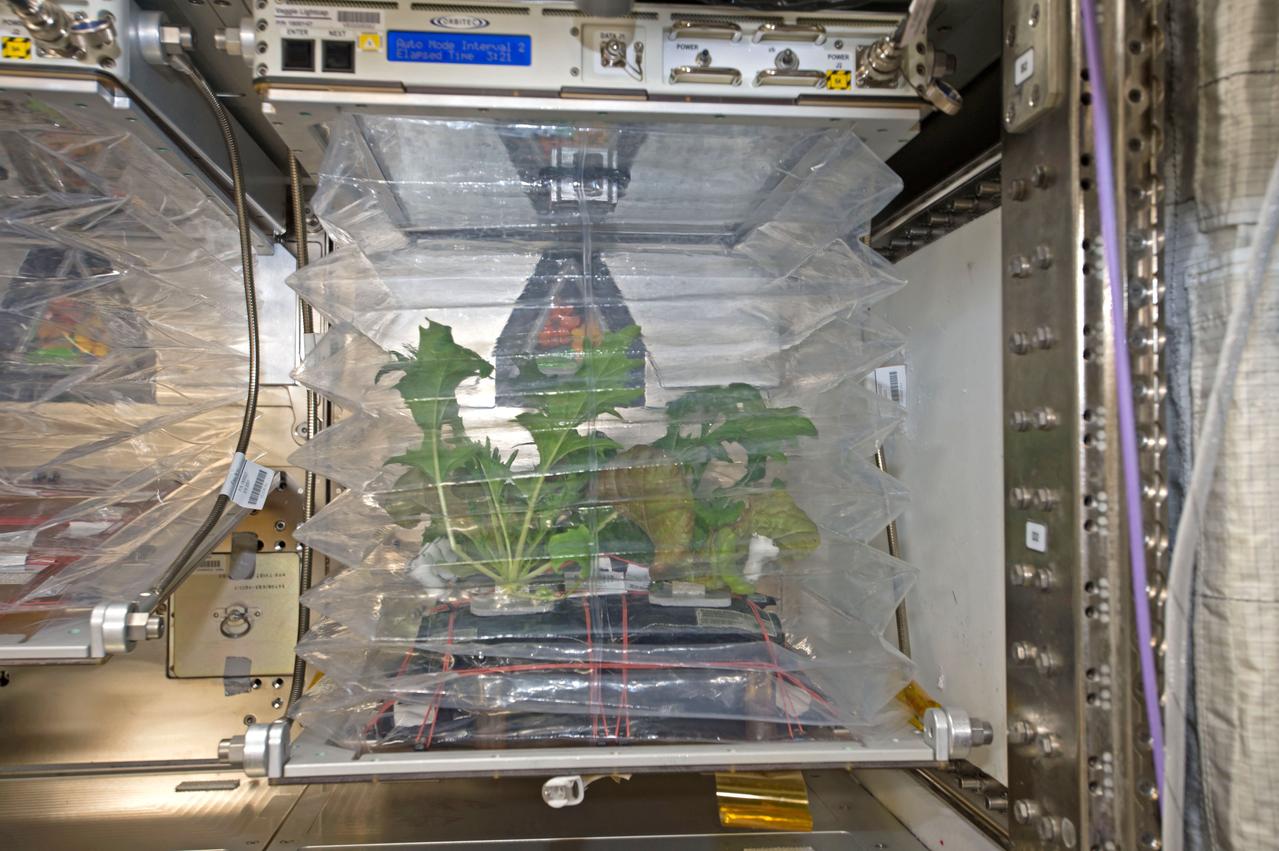
Veg-03D Experiment Onboard the International Space Station. First time three different plant varieties are being grown simultaneously in the Veggie chamber -- Mizuna mustard, Waldmann's green lettuce and Outredgeous Red Romaine lettuce.
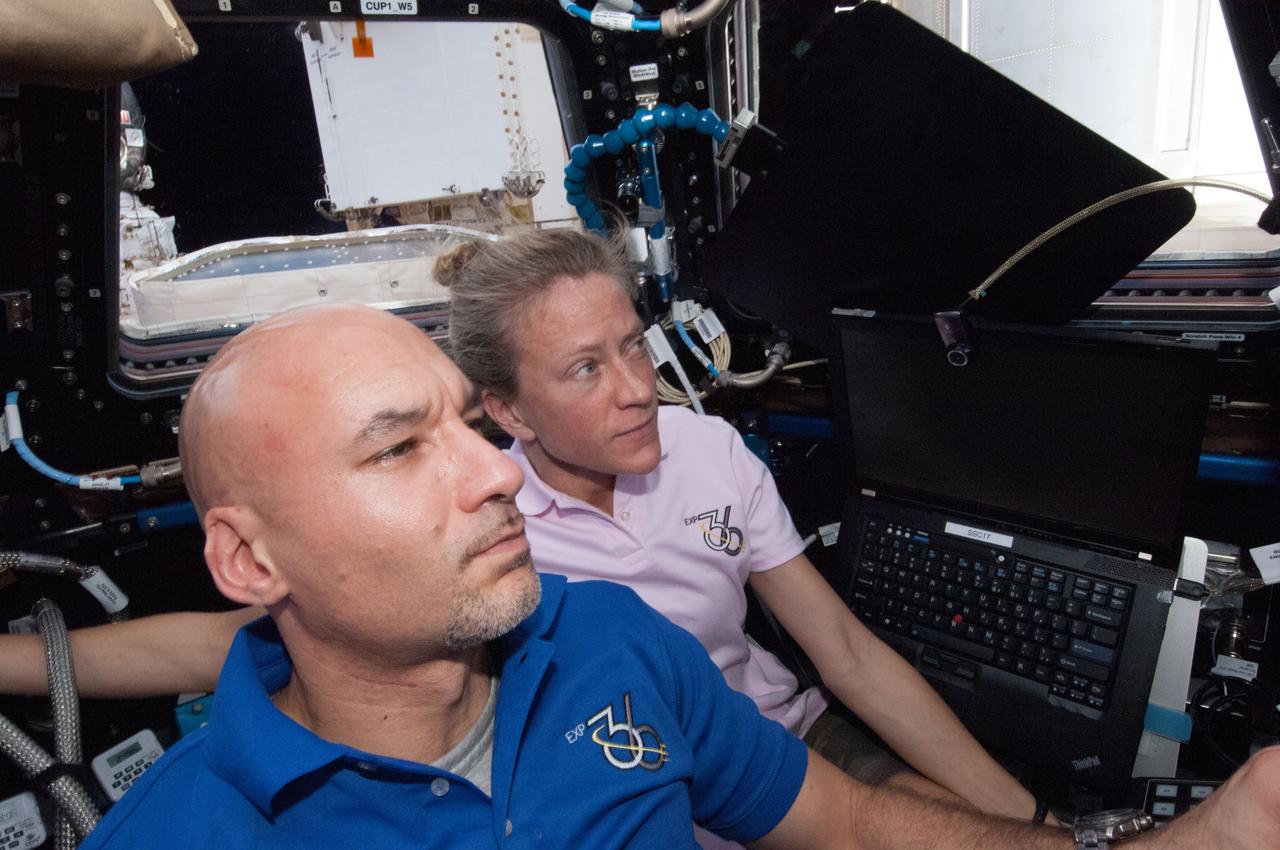
ISS036-E-026332 (29 July 2013) --- In the International Space Station?s Cupola, European Space Agency astronaut Luca Parmitano and NASA astronaut Karen Nyberg, both Expedition 36 flight engineers, participate in an onboard training activity in preparation for the grapple and berthing of the Japanese ?Kounotori? H2 Transfer Vehicle-4 (HTV-4) set for August 9.
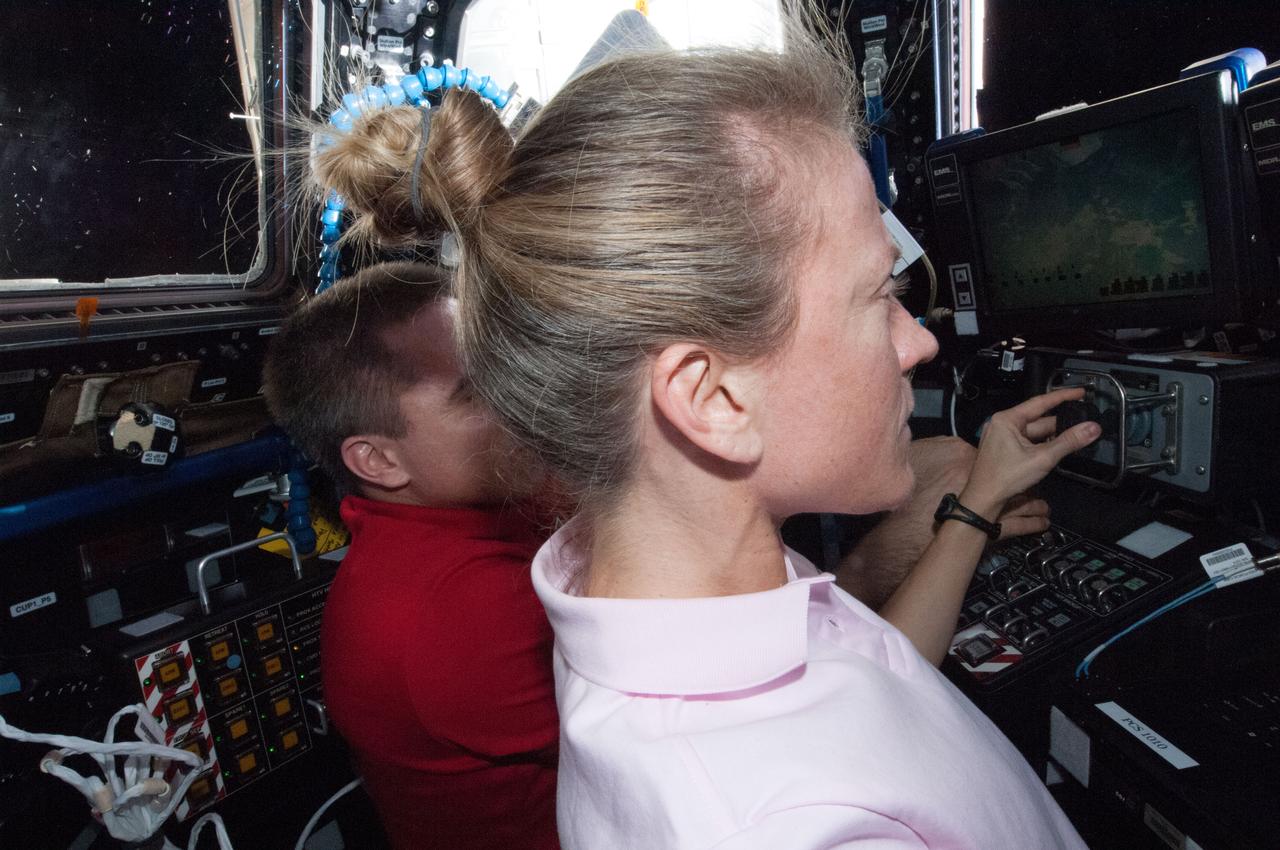
ISS036-E-026306 (29 July 2013) --- In the International Space Station?s Cupola, NASA astronauts Karen Nyberg and Chris Cassidy (partially obscured), both Expedition 36 flight engineers, participate in an onboard training activity in preparation for the grapple and berthing of the Japanese ?Kounotori? H2 Transfer Vehicle-4 (HTV-4) set for August 9.
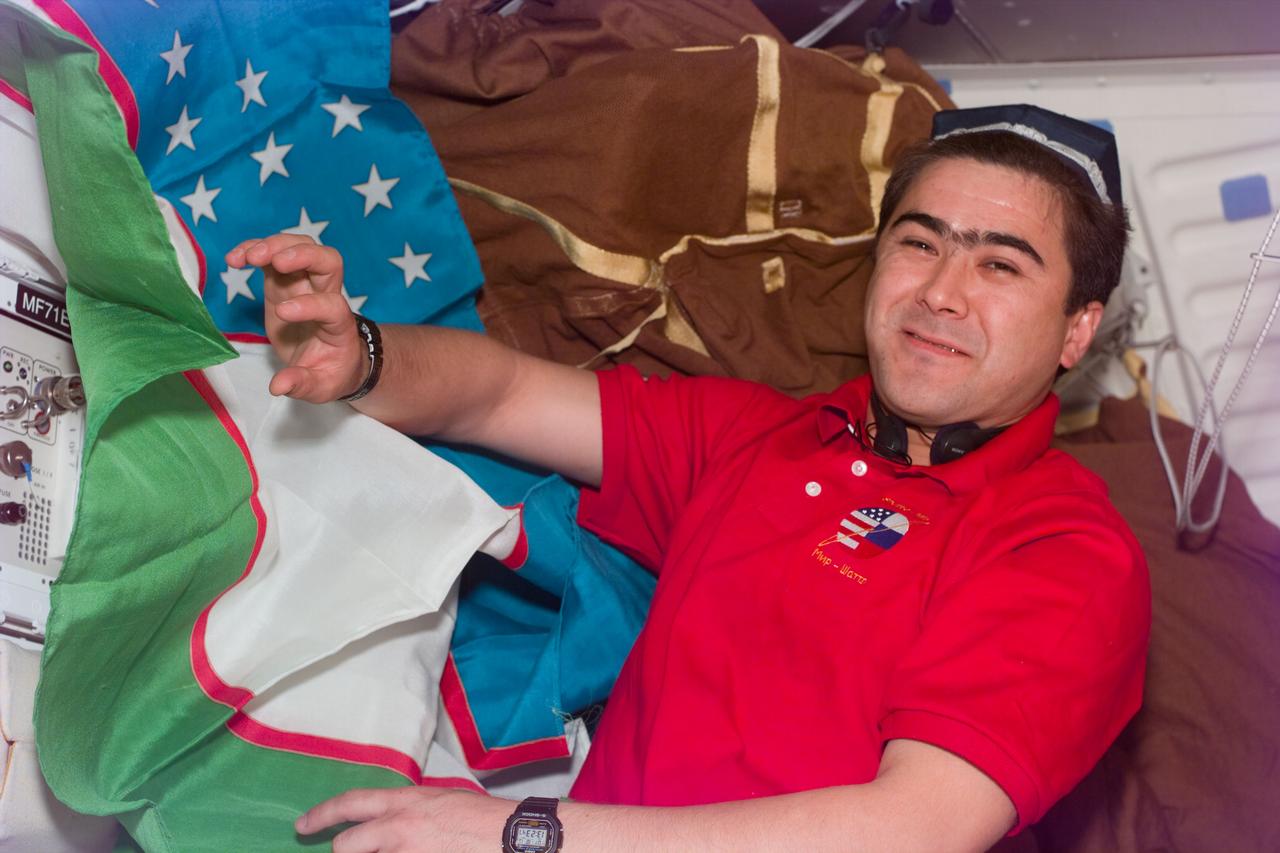
S89-E-5243 (26 Jan 1998) --- This Electronic Still Camera (ESC) image shows cosmonaut Salizan S. Sharipov, payload specialist - representing the Russian Space Agency (RSA), hanging a flag up onboard the Earth-orbiting Space Shuttle Endeavour. This ESC view was taken on January 26, 1998, at 13:23:11 MET.
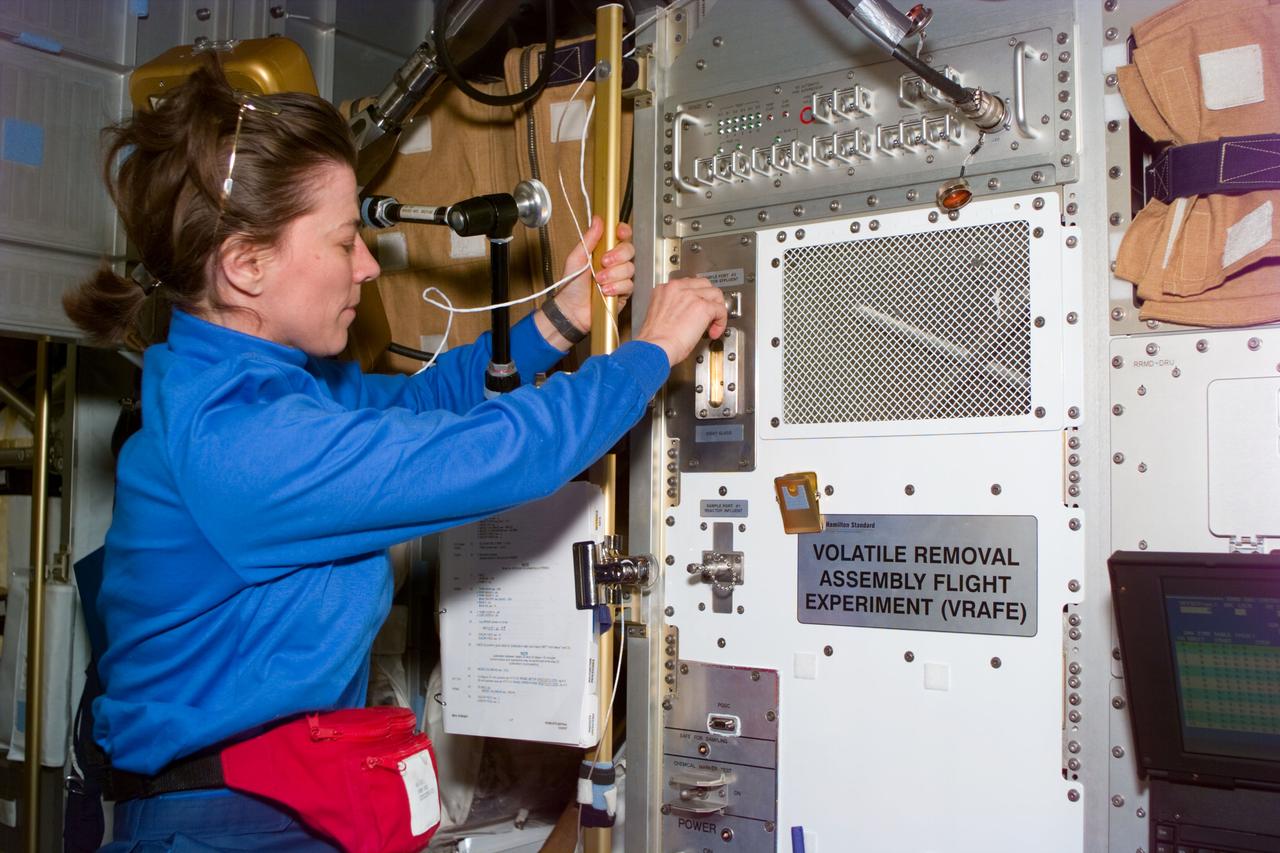
S89-E-5285 (25 Jan 1998) --- This Electronic Still Camera (ESC) image shows mission specialist Bonnie J. Dunbar, payload commander, working in the Spacehab Module onboard the Space Shuttle Endeavour. Dunbar is working with RME-1326, a Risk Mitigation Experiment (RME) at the Volatile Removal Assembly (VRA). This ESC view was taken on January 25, 1998 at 13:16:22 GMT.
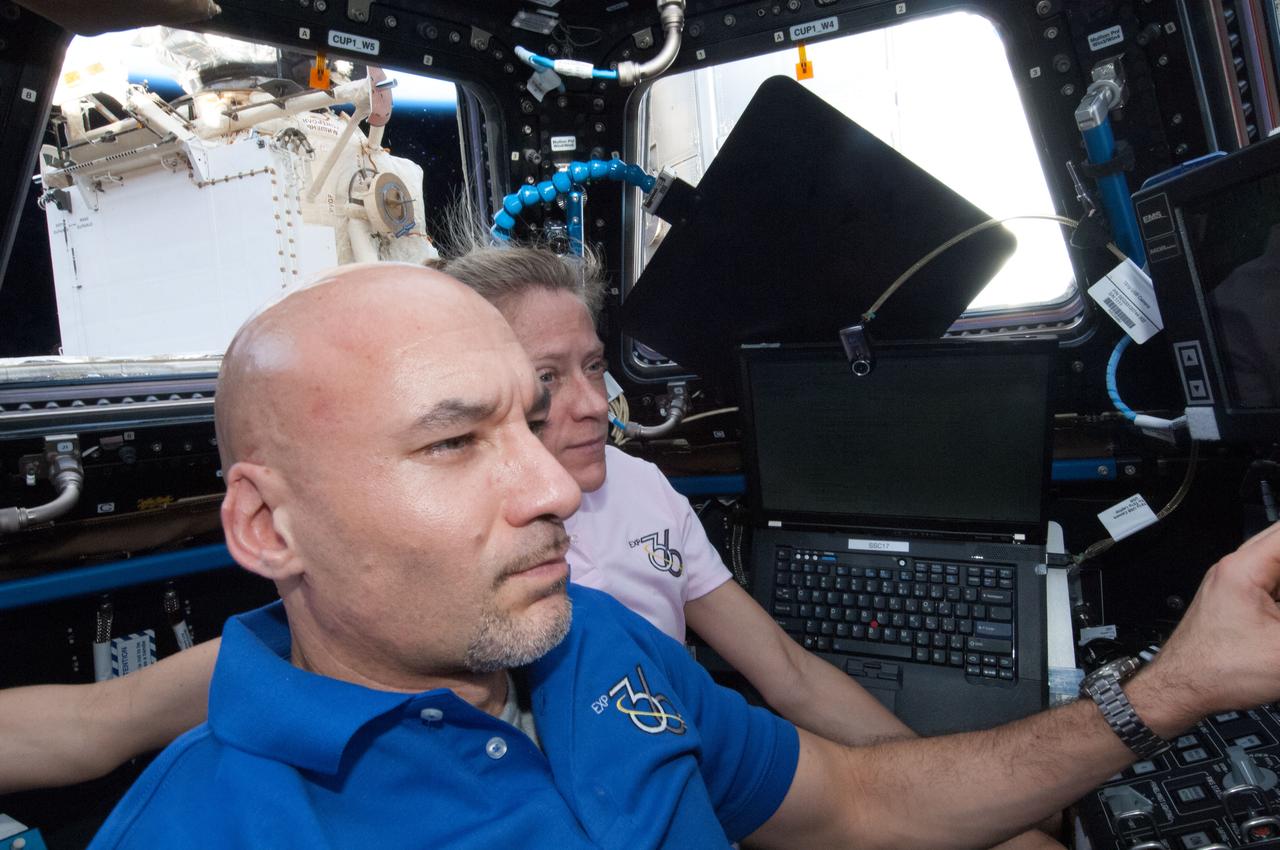
ISS036-E-026331 (29 July 2013) --- In the International Space Station?s Cupola, European Space Agency astronaut Luca Parmitano and NASA astronaut Karen Nyberg, both Expedition 36 flight engineers, participate in an onboard training activity in preparation for the grapple and berthing of the Japanese ?Kounotori? H2 Transfer Vehicle-4 (HTV-4) set for August 9.
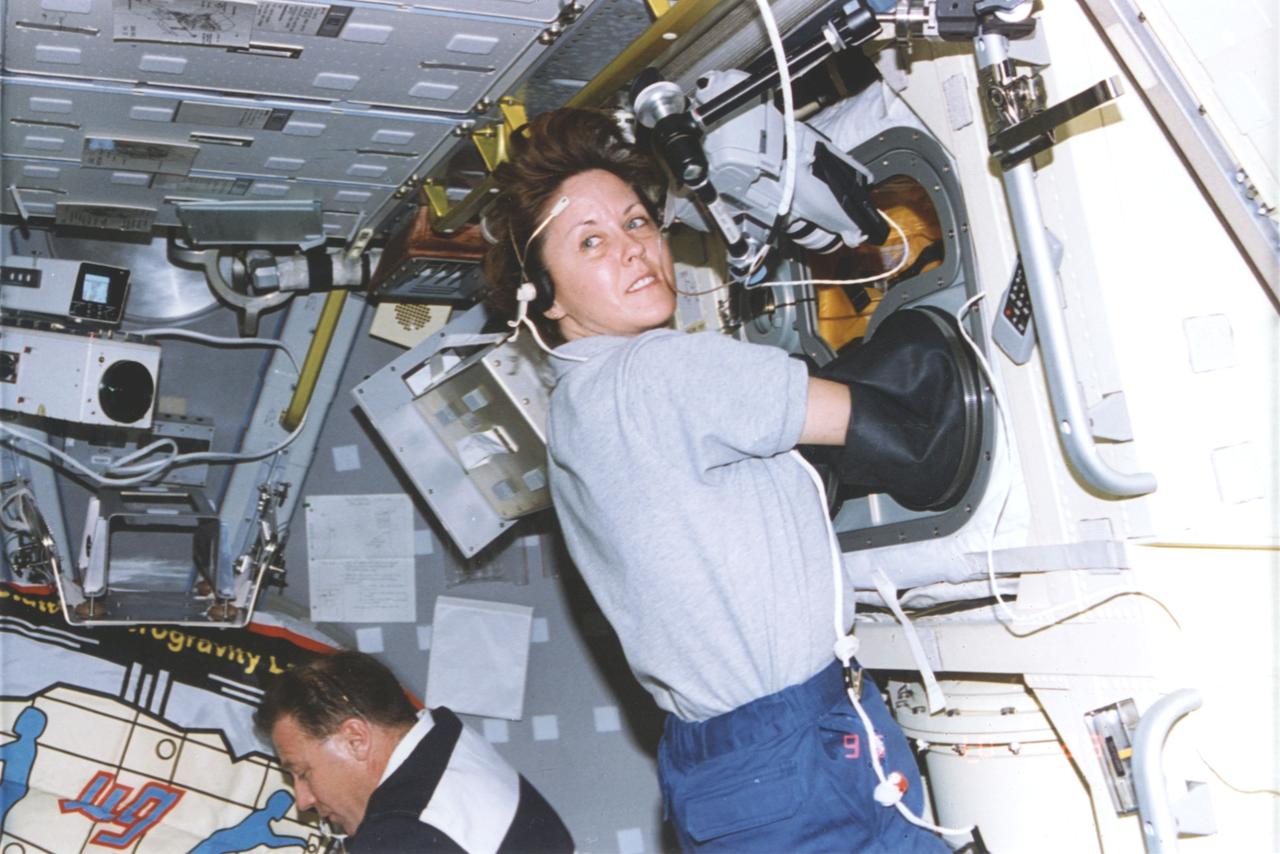
Onboard STS-73, USML-2: Mission Specialist, Payload Commander, Kathryn Thorton with (CGF) Crystal Growth Furnace
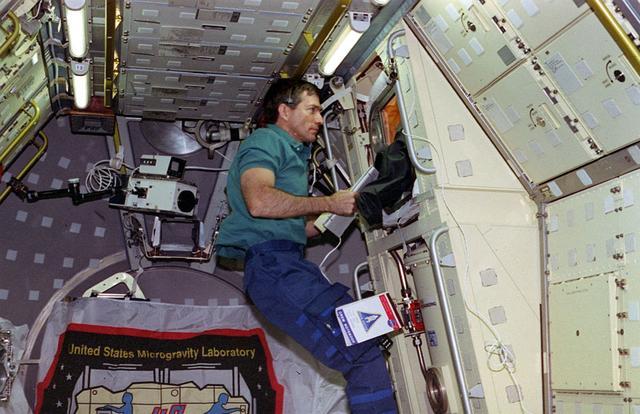
Payload Specialist, Fred Leslie changing samples in (CGF) Crystal Growth Furnace onboard STS-73, USML-2.
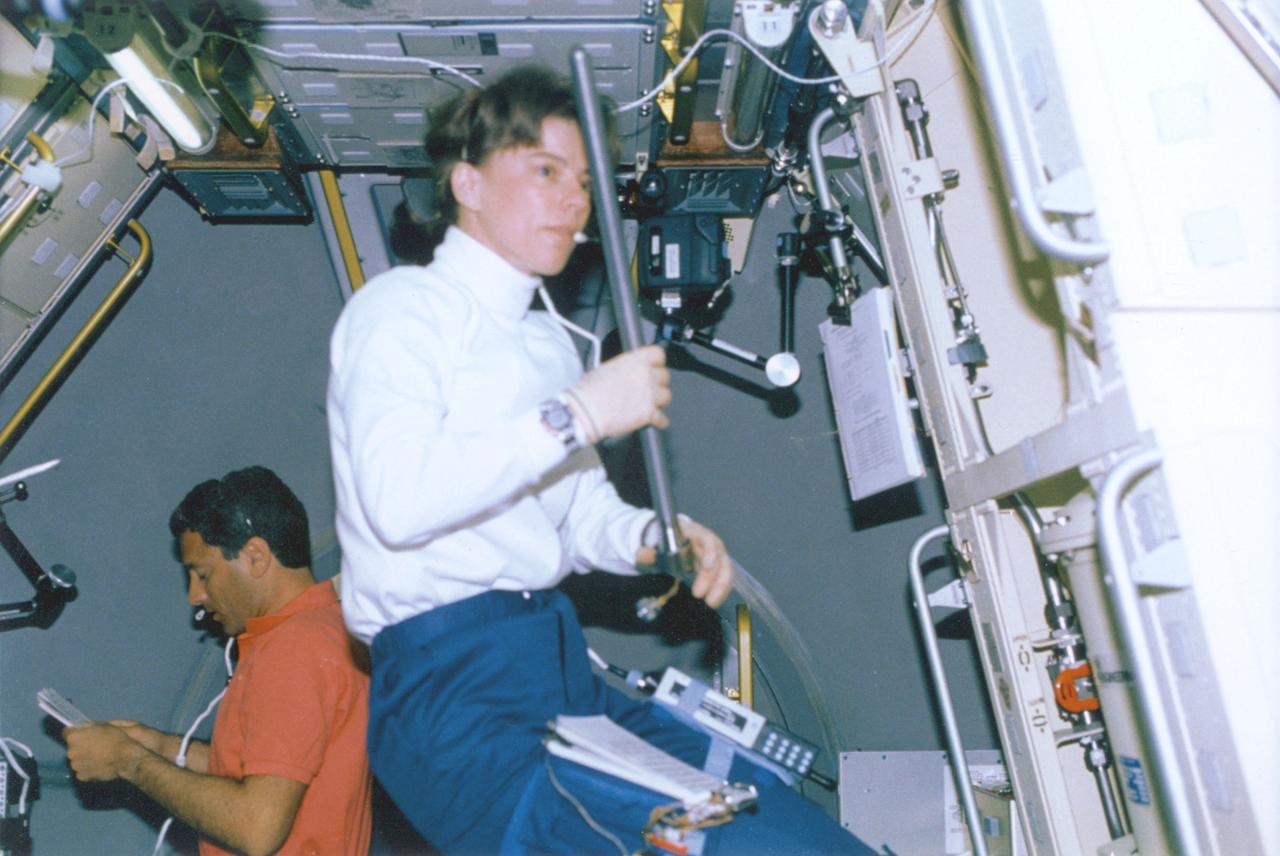
Payload Commander, Bornie Dunbar loading samples in the CGF onboard STS-50, USML-1.
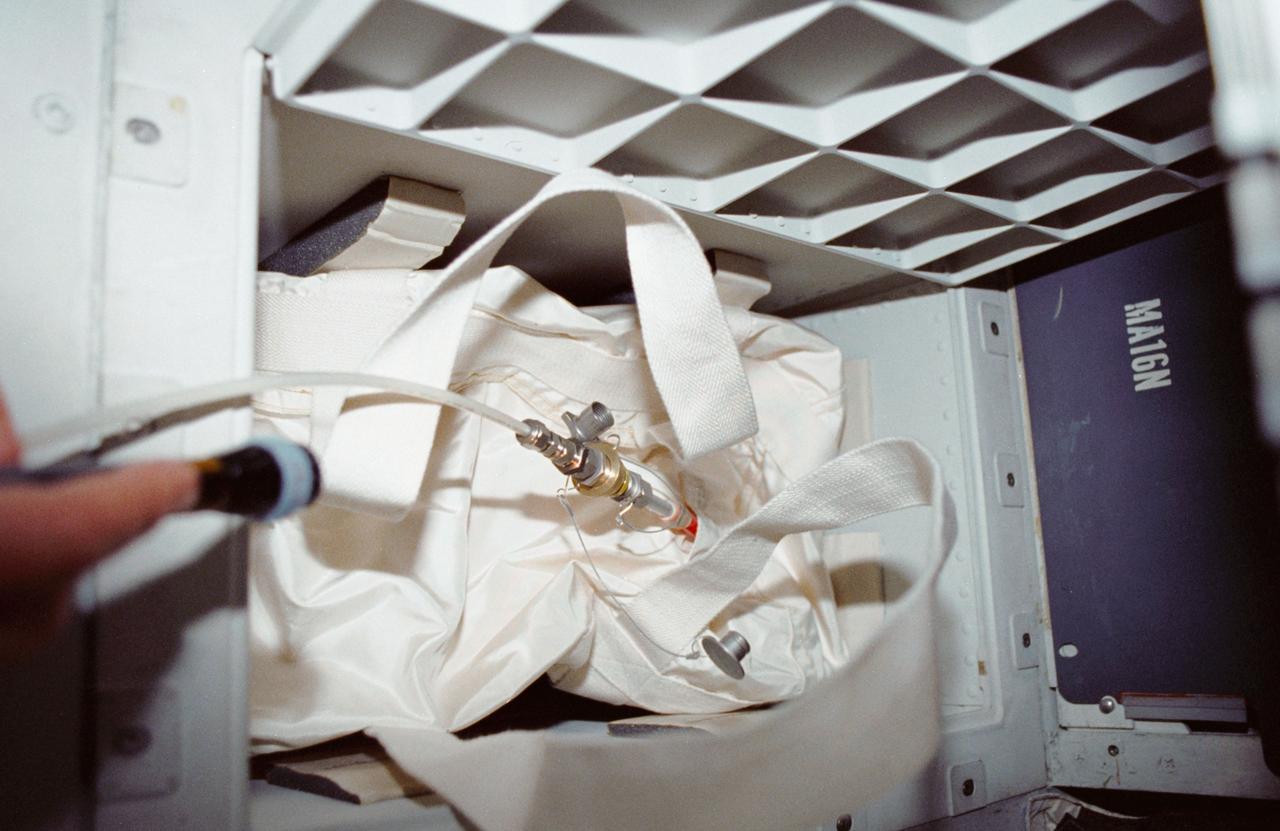
STS035-12-005 (2-10 Dec 1990) --- During STS-35, middeck stowage volume G and a contingency water container (CWC) were utilized to remedy a problem onboard Columbia, Orbiter Vehicle (OV) 102. A hose connecting OV-102's waste water system to the CWC was used in order to bypass a suspected clog in the line from the waste water tank to the exit nozzle. On flight day seven, Pilot Guy S. Gardner carried out an inflight maintenance (IFM) procedure by connecting a spare hose from the line to the container. The CWC is a rubber-lined duffle bag that holds about 95 pounds of water and is used in situations where water cannot be dumped overboard normally.
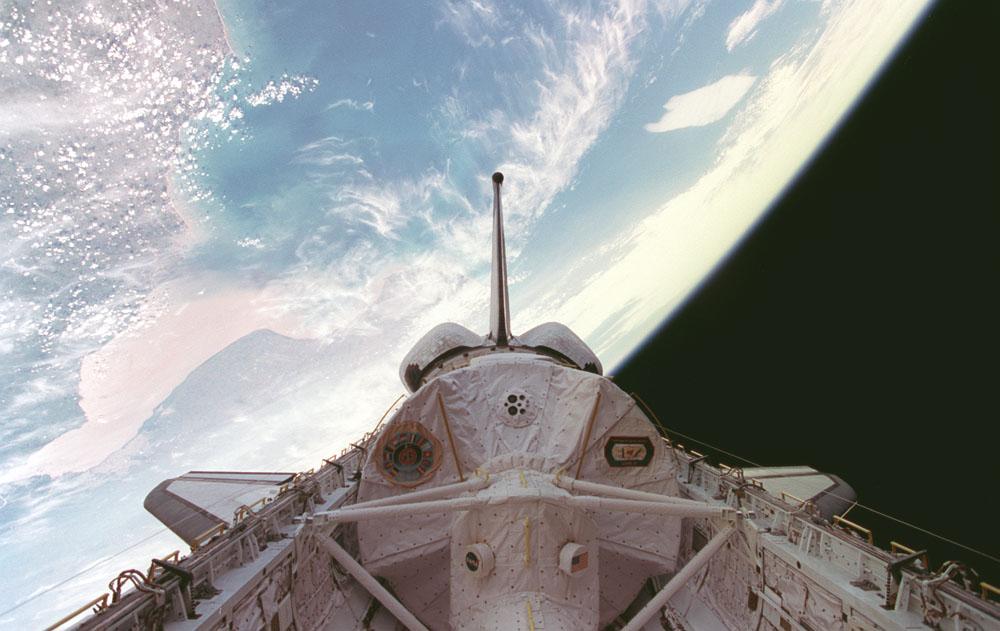
Onboard photo of space shuttle Columbia (STS-73) cargo bay payload - the United States Microgravity Laboratory-2 (USML-2) with an earthview.
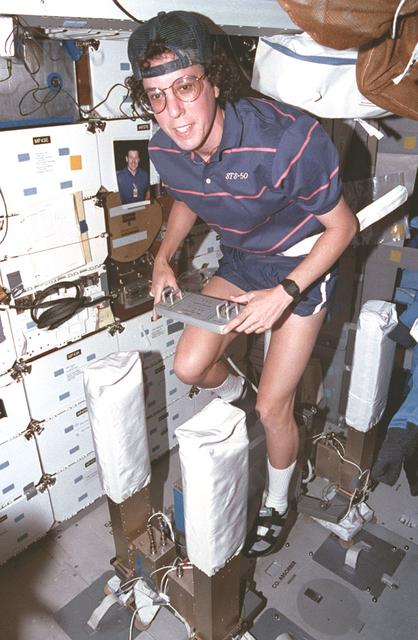
Onboard Space Shuttle Columbia (STS-50) in the United States Microgravity Laboratory (USML-1) mission specialist Ellen S. Baker is hard at work.
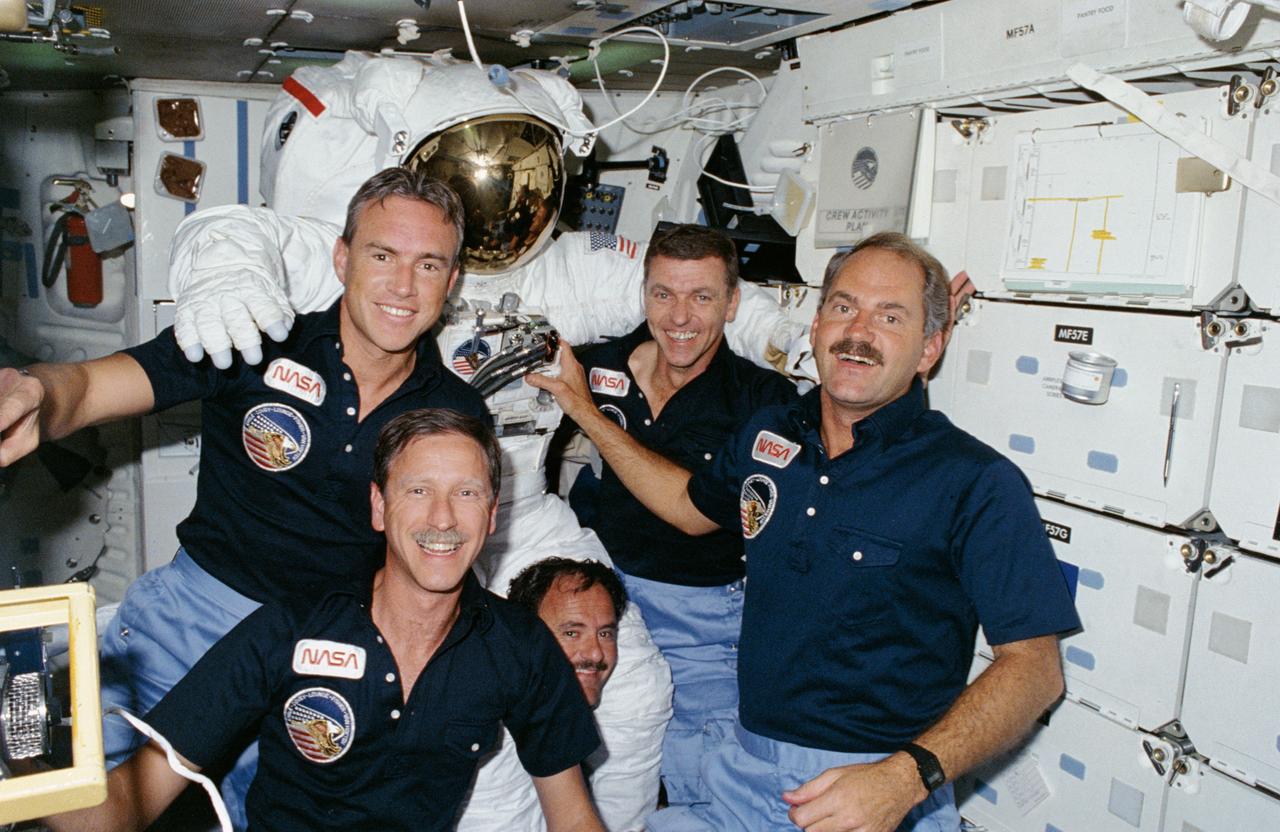
51I-07-015 (4-5 Sept 1985) --- All five STS 51-I crewmembers pose with one of two extravehicular mobility unit (EMU) spacesuits used by Astronauts van Hoften and Fisher on their two-day EVA.
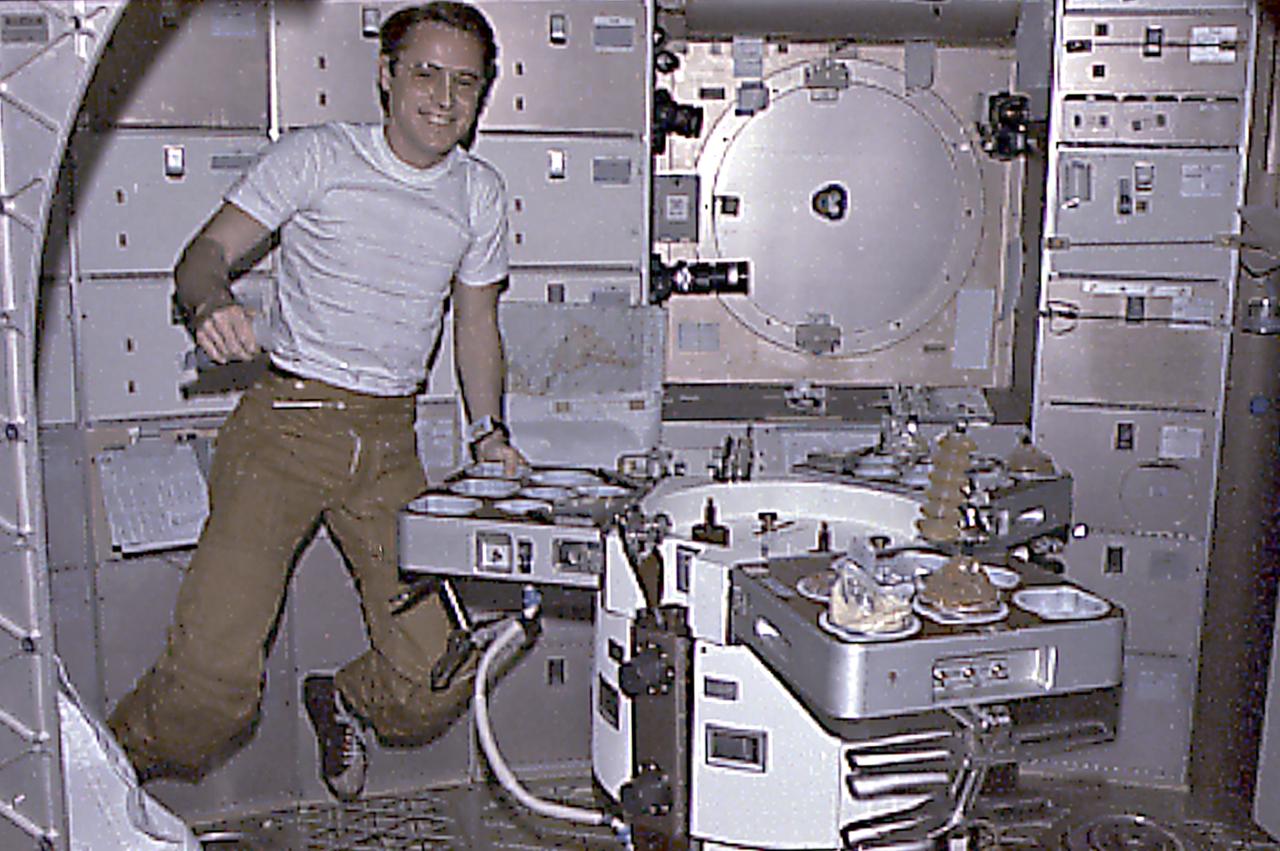
This Skylab-4 mission onboard photograph shows Astronaut Ed Gibson getting ready to prepare his meal in the crew wardroom. The tray contained heating elements for preparing the individual food packets. The food on Skylab was a great improvement over that on earlier spaceflights. It was no longer necessary to squeeze liquified food from plastic tubes. Skylab's kitchen was so equipped that each crewman could select his own menu and prepare it to his own taste.
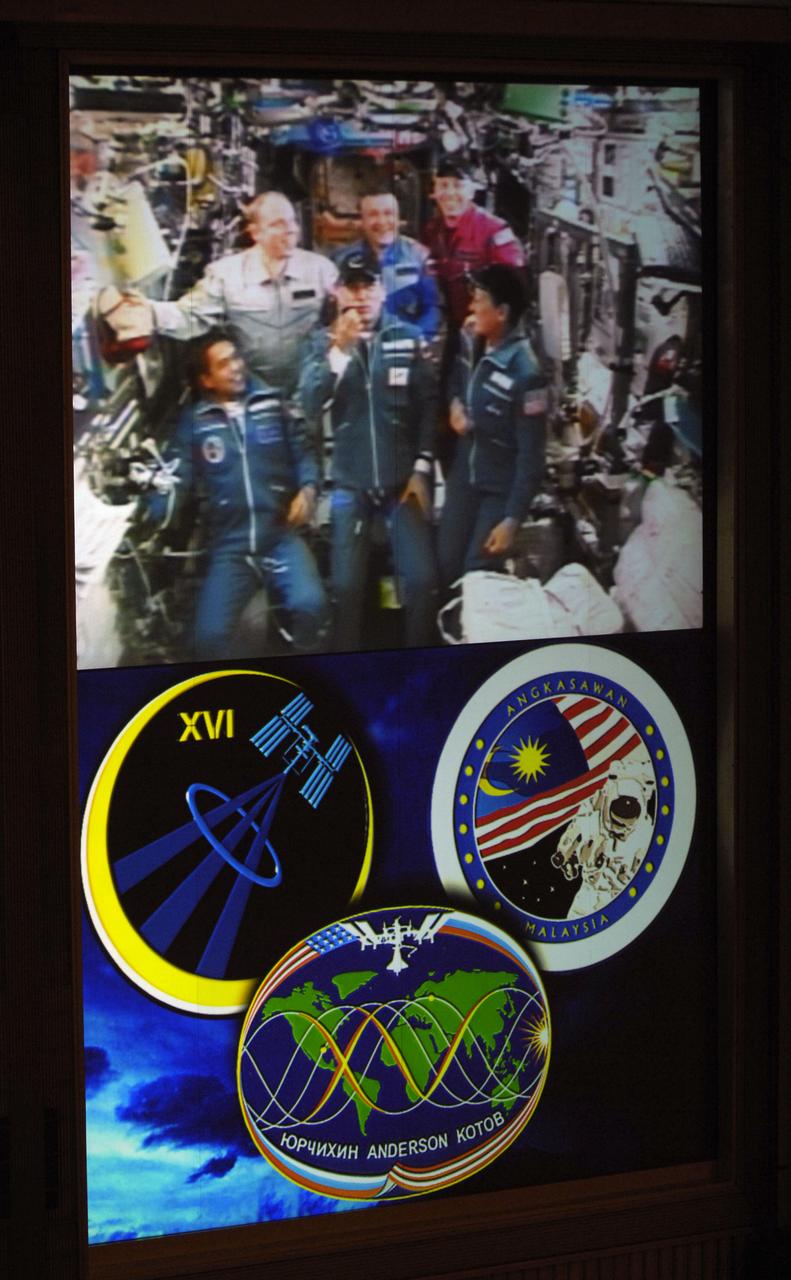
Live video from the International Space Station is shown on the screen in the Russian Mission Control Center in Korolev, outside Moscow, Friday, Oct. 12, 2007. Expedition 16 Commander Peggy Whitson, bottom right, Soyuz Commander and Flight Engineer Yuri Malenchenko, bottom center, and Malaysian spaceflight participant Sheikh Muszaphar Shukor docked their Soyuz TMA-11 spacecraft to the station at 10:50 a.m. EDT. October 12. Expedition 15 Commander Fyodor Yurchikhin, top left, and Flight Engineers Oleg Kotov and Clay Anderson, top right, welcomed the new crew aboard the ISS when the hatches were opened at 12:22 p.m. EDT. Both crews will work together for about nine days before Yurchikhin, Kotov and Shukor depart for Earth in their Soyuz TMA-10 spacecraft. Photo Credit: (NASA/Bill Ingalls)
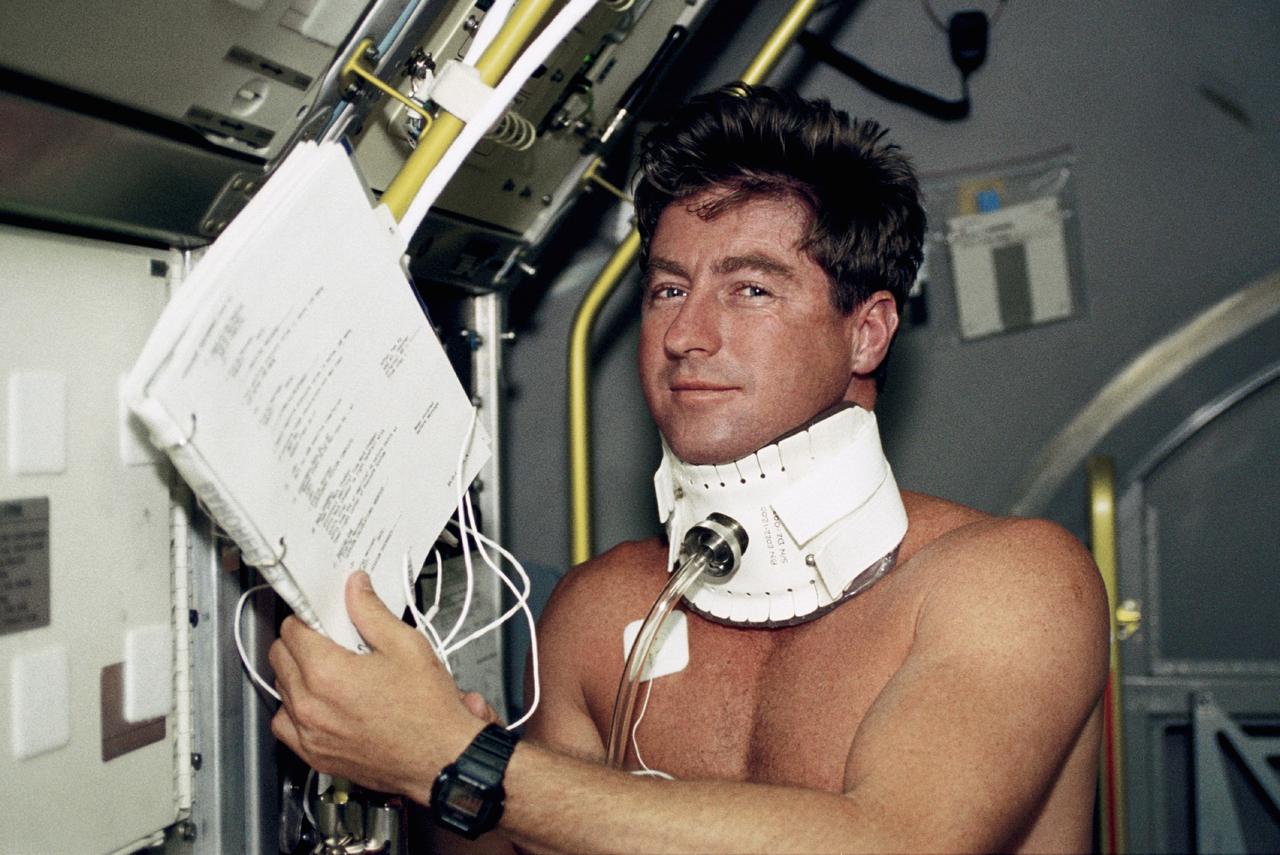
STS055-233-019 (26 April-6 May 1993) --- Terence T. (Tom) Henricks, STS-55 pilot, wears a special collar for a space adaptation experiment in the science module onboard the Earth-orbiting Space Shuttle Columbia. The Baroreflex (BA) experiment is designed to investigate the theory that light-headedness and a reduction in blood pressures upon standing after landing may arise because the normal reflex system regulating blood pressure behaves differently after having adapted to a microgravity environment. These space-based measurements of the baroreflex will be compared to ground measurements to determine if microgravity affects the reflex.
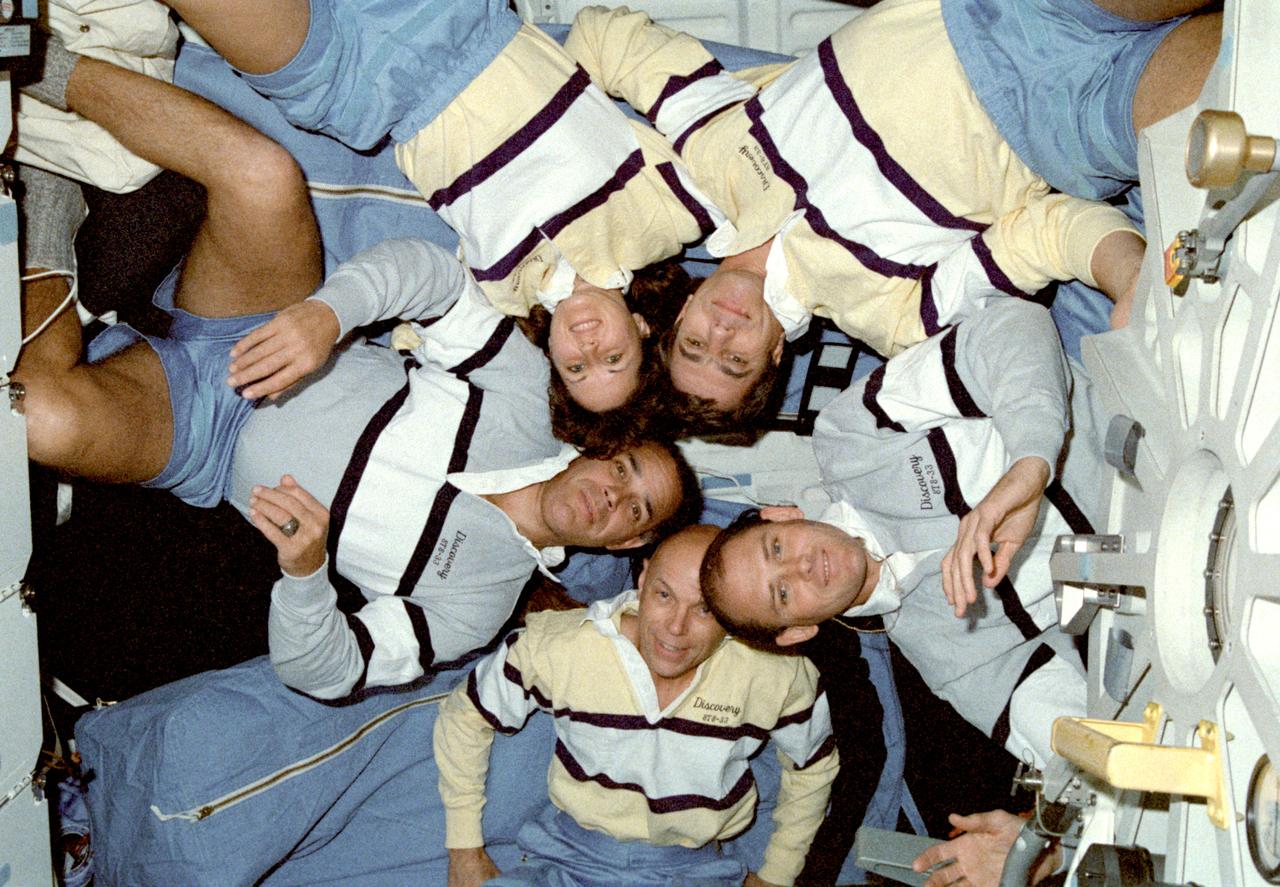
STS033-22-035 (22-27 Nov. 1989) --- STS-33 crewmembers, wearing mission polo shirts, pose on the middeck of the Space Shuttle Discovery for an in-flight crew portrait. Clockwise (starting at left) are astronauts Frederick D. Gregory, commander; Kathryn C. Thornton, mission specialist; John E. Blaha, pilot; Manley L. (Sonny) Carter Jr., and F. Story Musgrave, mission specialists.
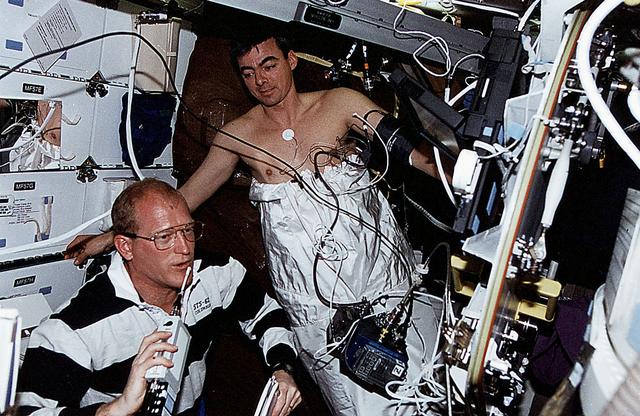
Space Shuttle Columbia (STS-62) onboard photo of Astronaut Charles (Sam) Gemar talking to ground controllers while assisting astronaut Andrew M. Allen with a soak in the Lower Body Negative Pressure (LBNP) apparatus on the middeck.
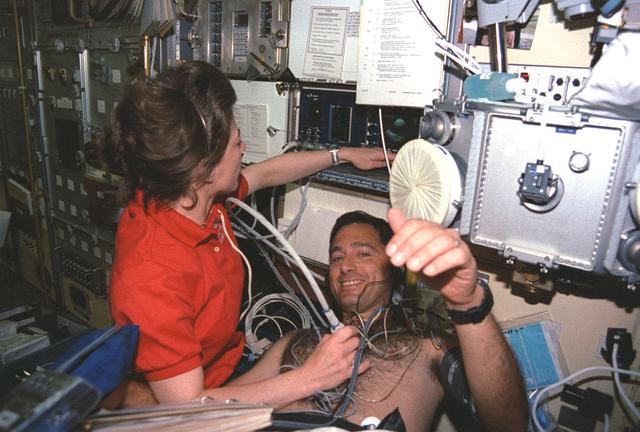
Onboard Space Shuttle Columbia (STS-50) payload commander Bornie Dunbar performs life science experiments on crewmember payload specialist Lawrence Delucas in the United States Microgravity Laboratory (USML-1) science module.
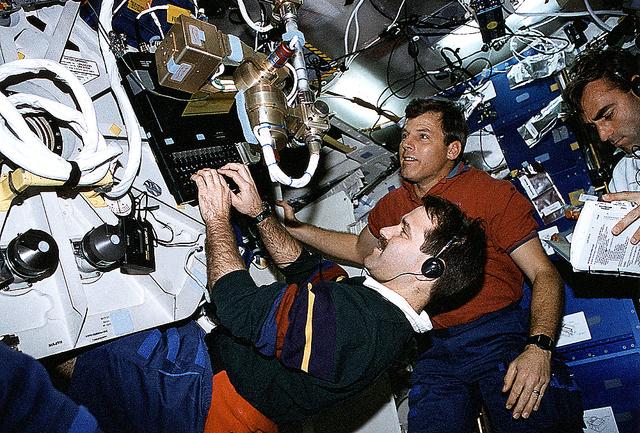
Onboard Space Shuttle Endeavour (STS-67) astronaut John Grunsfeld works at a laptop computer while wearing a headset. Commander Stephen Oswald watches Grunsfeld and Pilot Bill Gregory reads a checklist on the shuttle mid-deck.
Space Shuttle Columbia (STS-65) onboard photo of Payload specialist Richard J. Hieb (right) and Shuttle Pilot James D. Halsell Jr. working on experiments in the Spacelab in the International Microgravity Laboratory (IML-2).
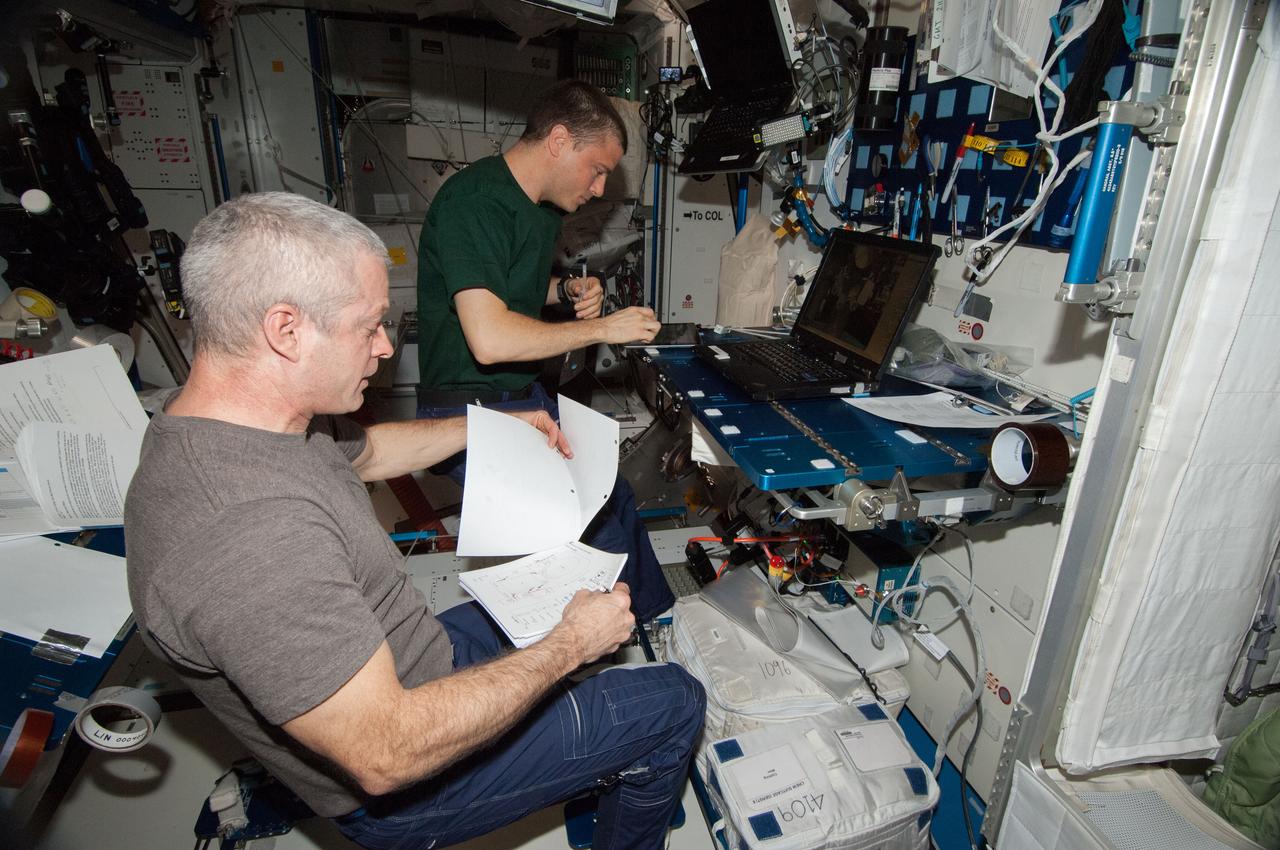
ISS040-E-088730 (4 Aug. 2014) --- In the International Space Station?s Harmony node, NASA astronauts Steve Swanson (foreground), Expedition 40 commander; and Reid Wiseman, flight engineer, perform a portable onboard computer Dynamic Onboard Ubiquitous Graphics (DOUG) software review in preparation for two upcoming U.S. spacewalks.
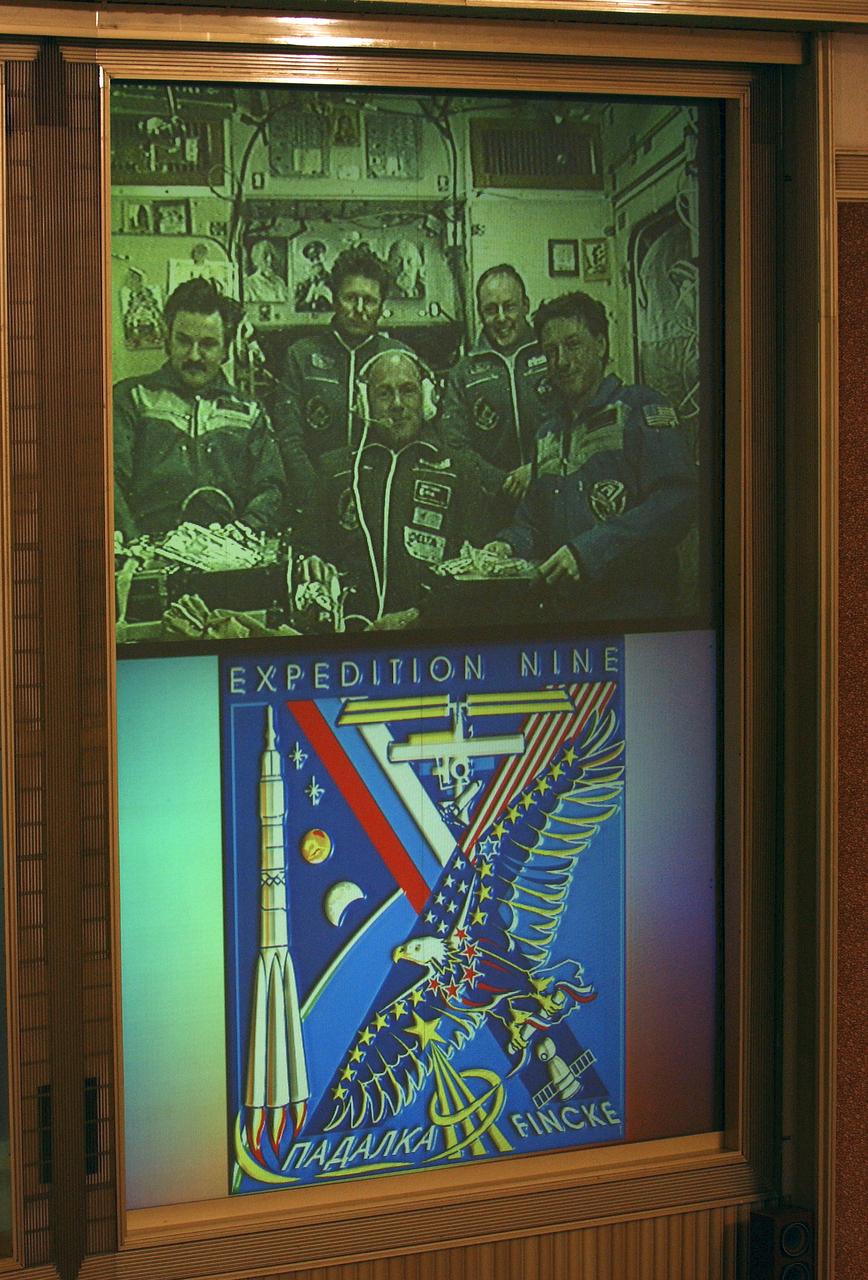
The Expedition 8 and 9 crews and European Space Agency astronaut Andre Kuipers of the Netherlands are viewed on the front screen of the Flight Control Room at the Russian Mission Control Center outside Moscow, Wednesday, April 21, 2004, in a televised welcoming ceremony following their docking to the International Space Station in a Russian Soyuz spacecraft. Under the televised view of the two crews is the insignia of the Expedition 9 crew, consisting of commander Gennady Padalka and Flight Engineer and NASA International Space Station Science Officer Michael Fincke, who will spend six months on the Station. Photo Credit: (NASA/Bill Ingalls)
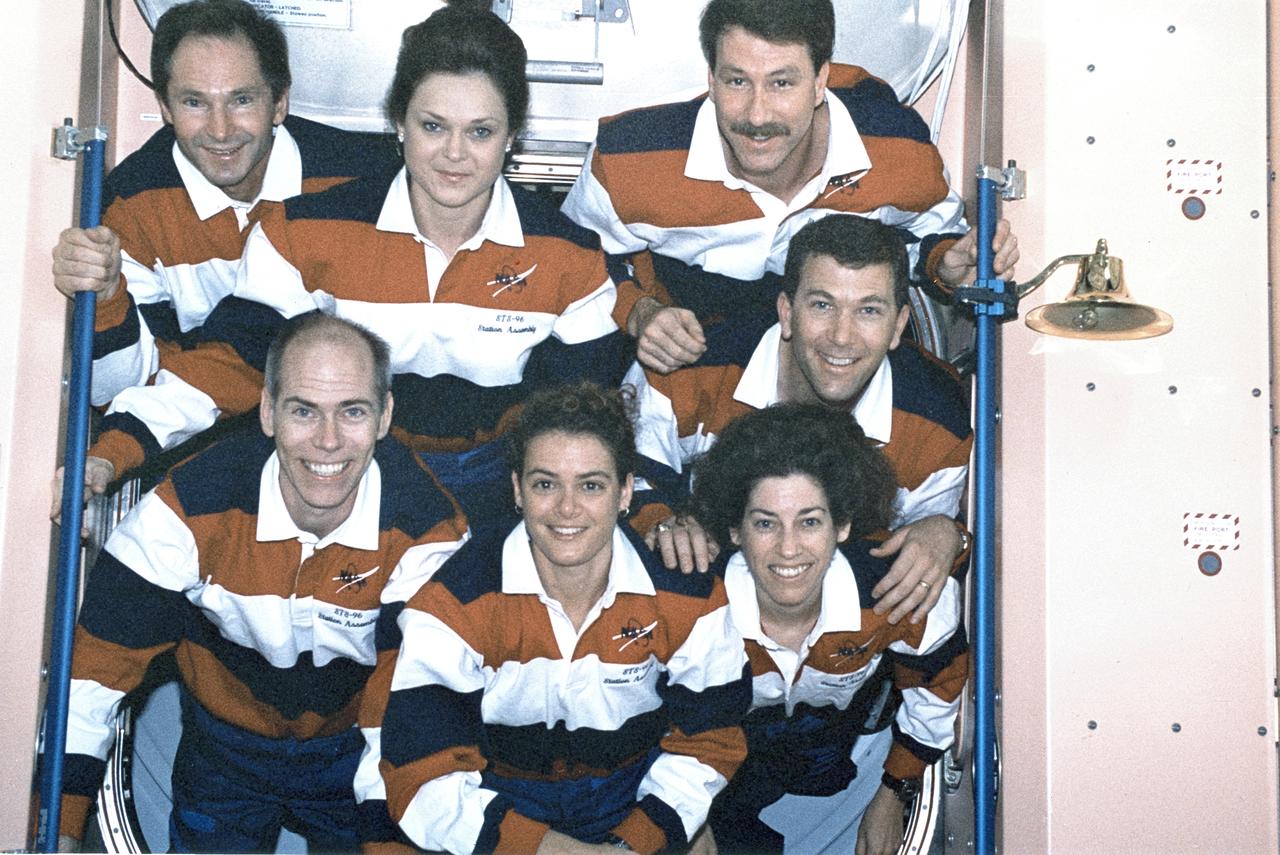
The STS-96 crew paused for an International Space Station (ISS) onboard group photo. Pictured on the bottom row (left to right) are Mission Specialists Daniel Barry, Julie Payette, and Ellen Ochoa. Pictured on the top row (left to right) are Cosmonaut Valery Ivanovich Tokarev, and Tamara Jernigan, Mission Specialists; Kent Rominger, Commander; and Rick Husband, Pilot. STS-96 was the second ISS assembly flight and the first flight to dock with the station. The 10 day mission crew launched aboard the Space Shuttle Orbiter Discovery on May 27, 1999.
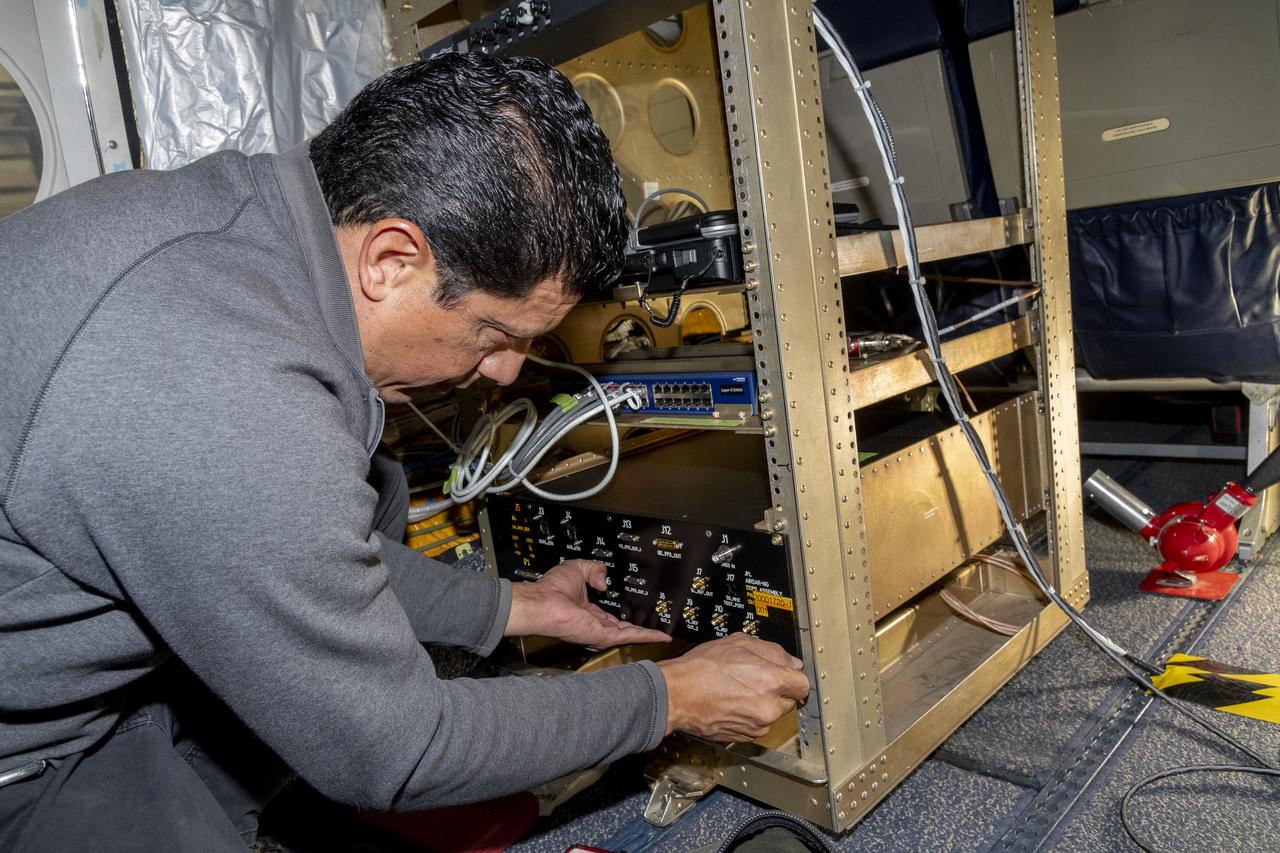
Jose “Manny” Rodriguez adjusts the Soxnav instrument onboard the G-IV aircraft in December 2024. As part of the team of experts, Rodriguez ensures that the electronic components of this instrument are installed efficiently. His expertise will help bring the innovative navigational guidance of the Soxnav system to the G-IV and the wider airborne science fleet at NASA. Precision guidance provided by the Soxnav enables research aircraft like the G-IV to collect more accurate, more reliable Earth science data to scientists on the ground.
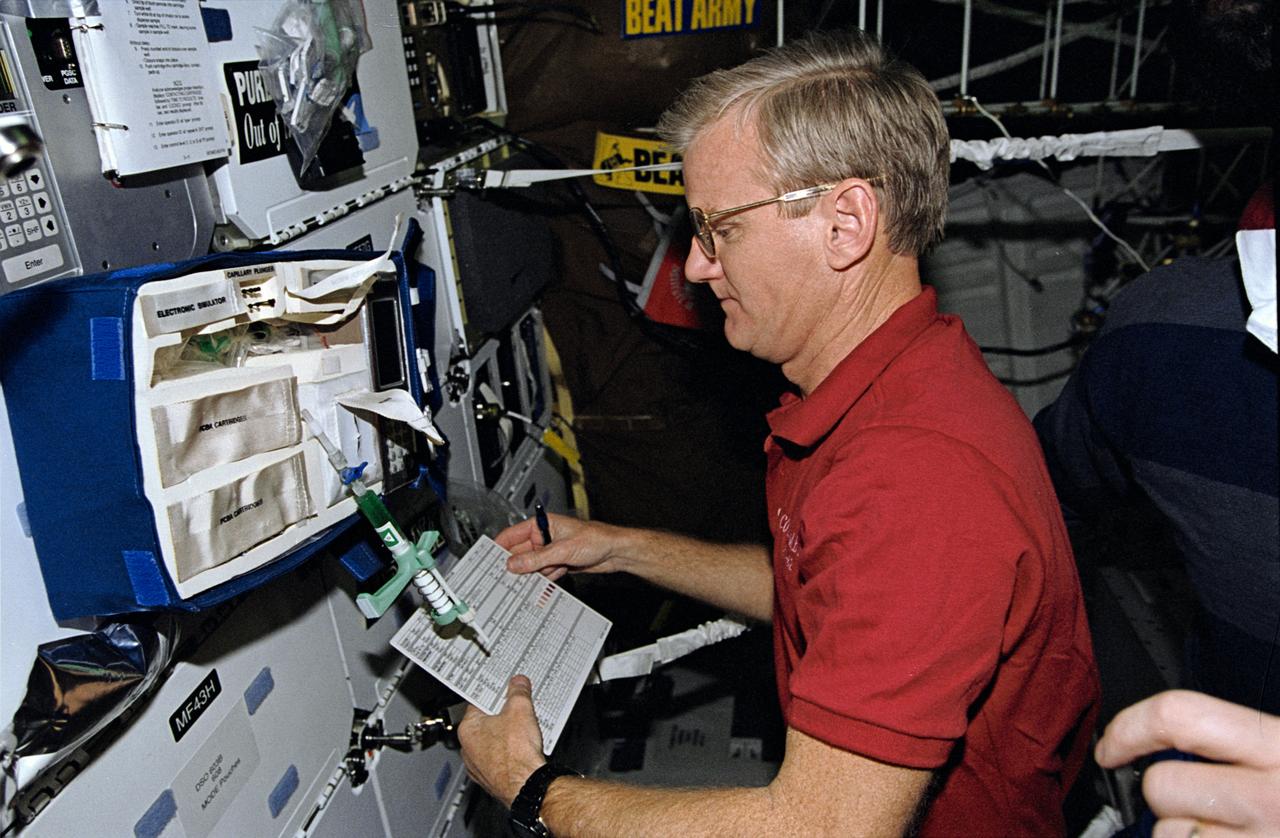
STS062-10-010 (4-18 March 1994) --- Astronaut John H. Casper, mission commander, takes stock of paraphenalia used to support medical testing onboard Columbia's middeck. Casper was poind by four other veteran astronauts for 14 days of variegated research in earth orbit.
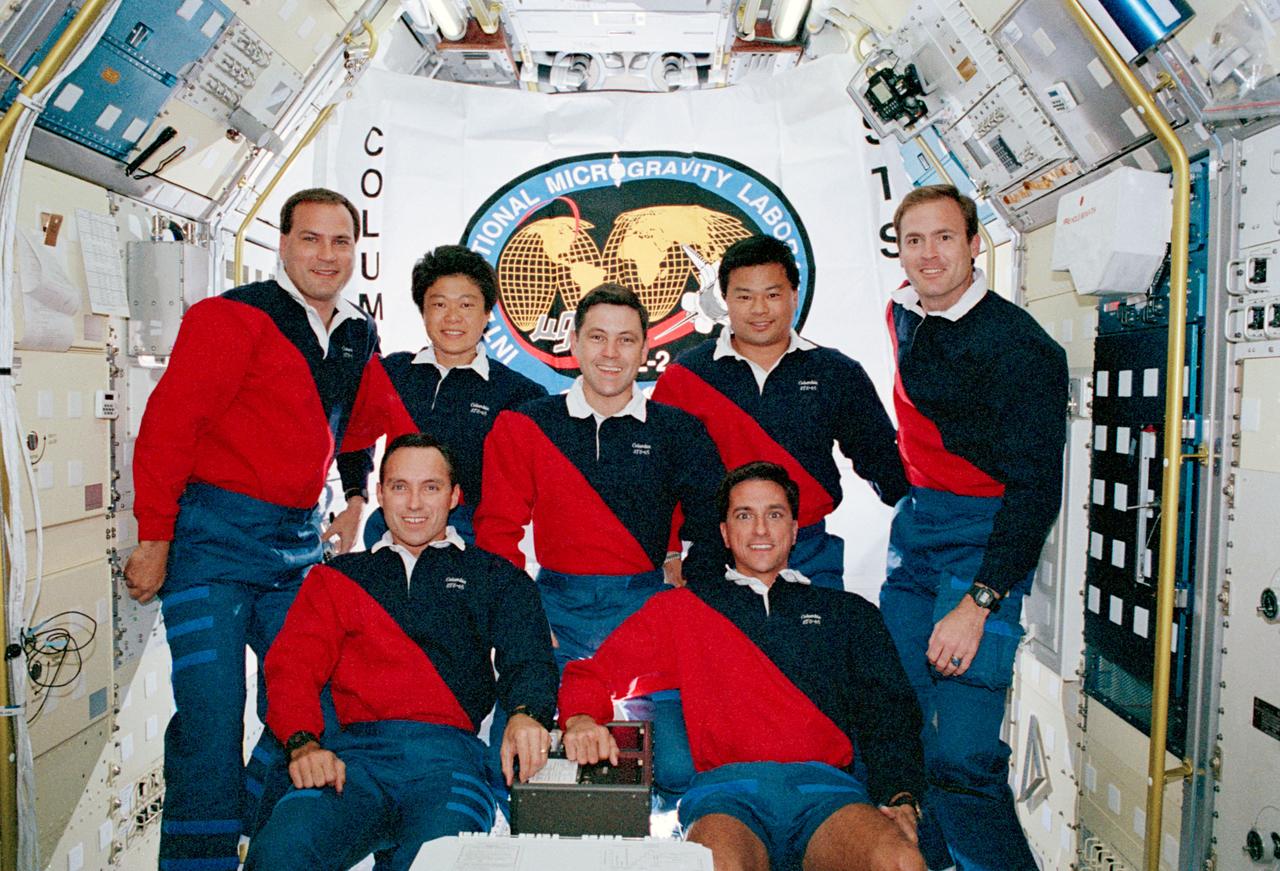
In the spacelab science module aboard the Space Shuttle Columbia, Orbiter Vehicle (OV) 102, the seven crewmembers pose for the traditional onboard (inflight) crew portrait. Displayed in the background is a flag with the International Microgravity Laboratory 2 (IML-2) insignia and Columbia inscribed along the edge. In the front row (left to right) are Mission Specialist (MS) Carl E. Walz and MS Donald A. Thomas. Behind them (left to right) are Payload Commander (PLC) Richard J. Hieb, Payload Specialist Chiaki Mukai, Commander Robert D. Cabana, MS Leroy Chiao, and Pilot James D. Halsell, Jr. Mukai represents the National Space Development Agency (NASDA) of Japan. Crewmembers are wearing their mission polo shirts for the portrait. Inside this module, the crew conducted experiments in support of the IML-2 mission.
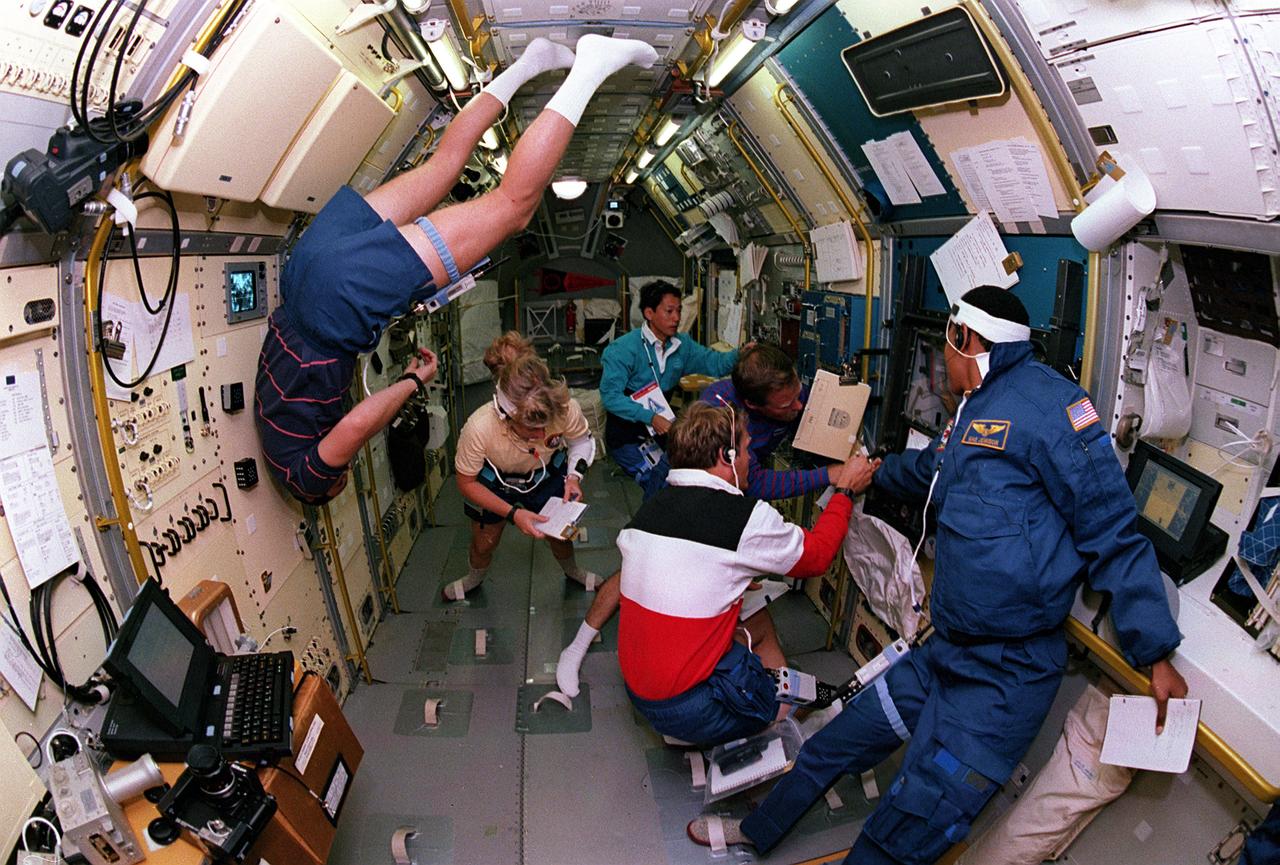
Space Shuttle Endeavour (STS-47) onboard photo of crew members working in the Spacelab-J module.
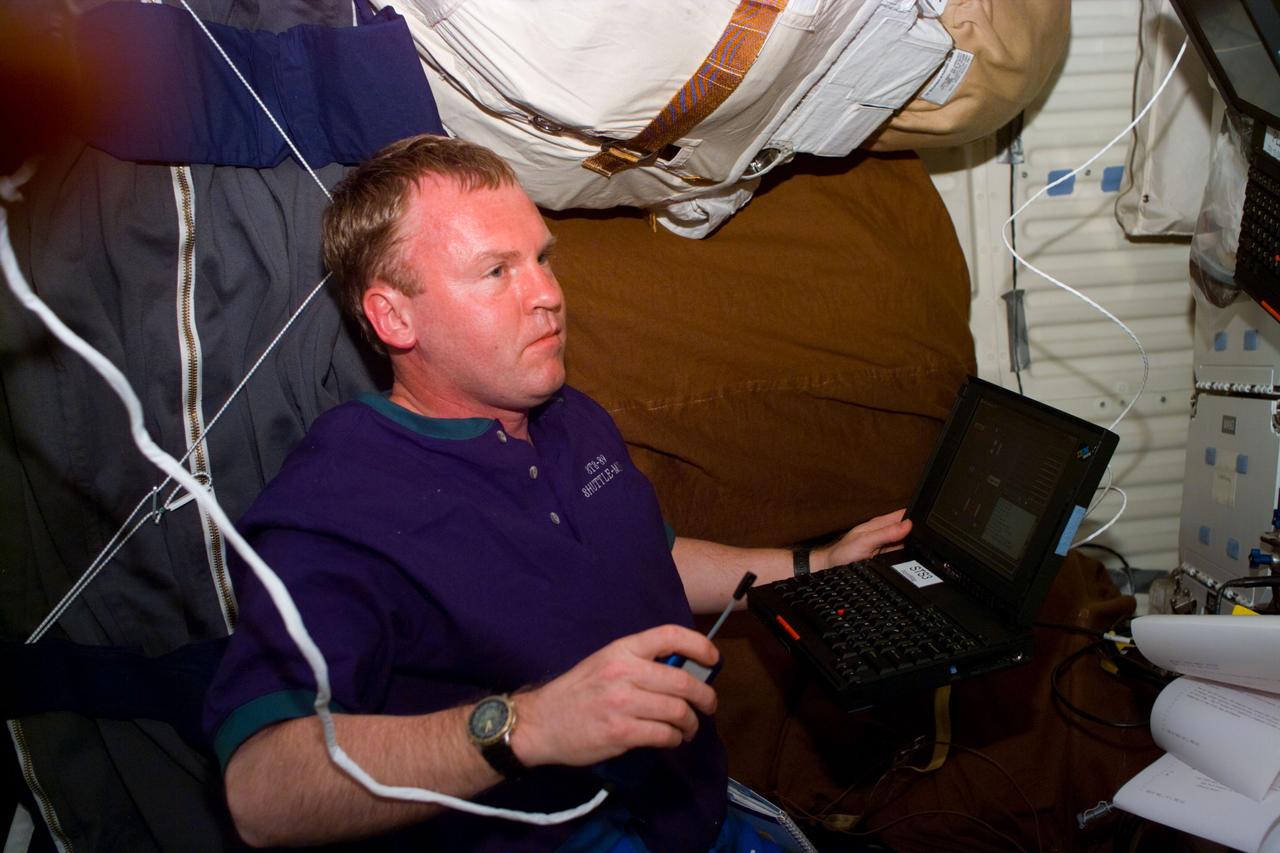
S89-E-5096 (24 Jan 1998) --- Astronaut Andrew S. W. Thomas, mission specialist, is pictured onboard the Space Shuttle Endeavour in one of the first STS-89 still scenes downlinked to flight controllers. Thomas will be the final U.S. astronaut to put in an extended stint aboard the Mir Space Station when he replaces astronaut David A. Wolf later in the week. The photo was taken with the Electronic Still Camera (ESC) at 5:31:59 GMT, January 24, 1998.
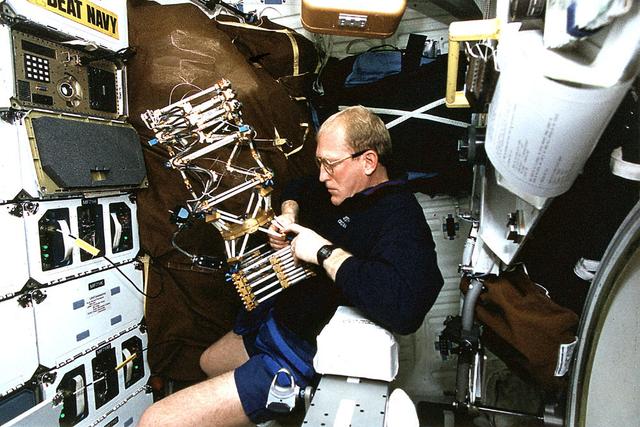
Onboard Space Shuttle Columbia (STS-62) Mission specialist Charles D. (Sam) Gemar works with the Middeck 0-Gravity Dynamics Experiment (MODE). The reusable test facility is designed to study the nonlinear, gravity-dependent behavior of liquids and skewed space structures in the microgravity environment.
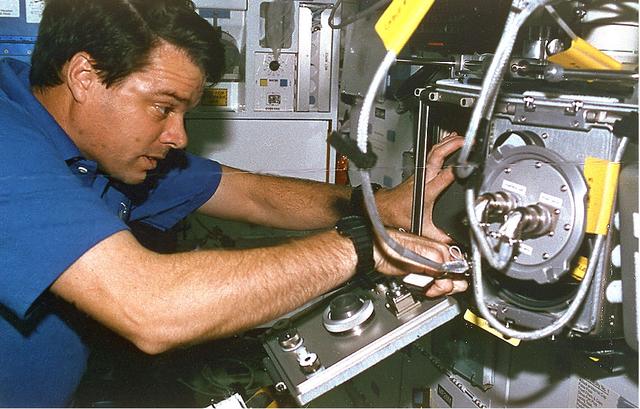
Onboard Space Shuttle Columbia (STS-87) Mission Commander Kevin R. Kregel sets up the mid-deck glove box during early hours of the 16-day United States Microgravity Payload 4 (USMP-4) mission. Kregel was joined by four other astronauts and a Ukrainian payload specialist for the mission.
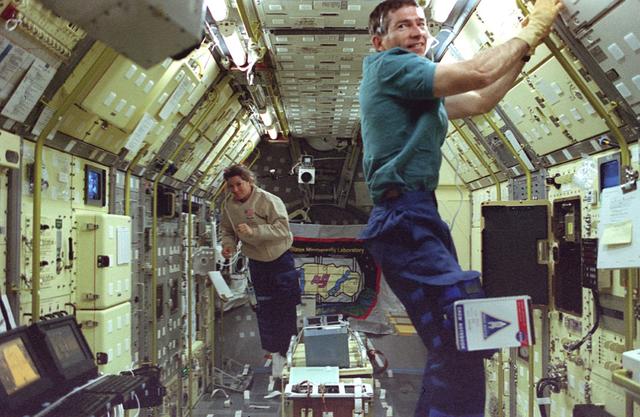
Onboard photo of space shuttle Columbia (STS-73) crewmembers Fred Leslie (foreground) and Catherine Coleman aboard the United States Microgravity Laboratory (USML) conducting experiments in a microgravitational environment available in the Orbiter's cargo bay while in low earth orbit.
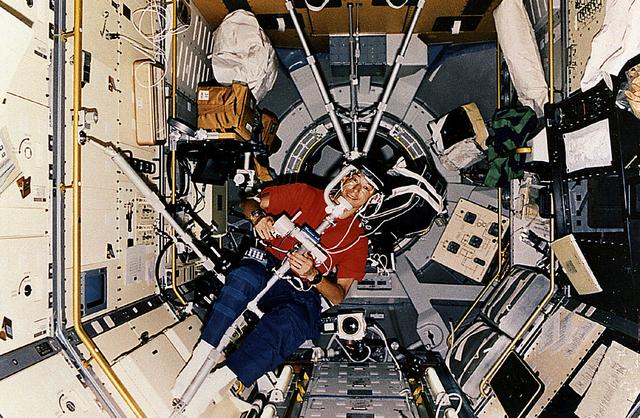
Space Shuttle Endeavour (STS-47) onboard photo of Japanese Payload Specialist Dr. Mamoru Mohri participating in Comparative Measurement of Visual Stability in Earth Cosmic Space experiment to learn more about Space Adaptation Syndrome (SAS).
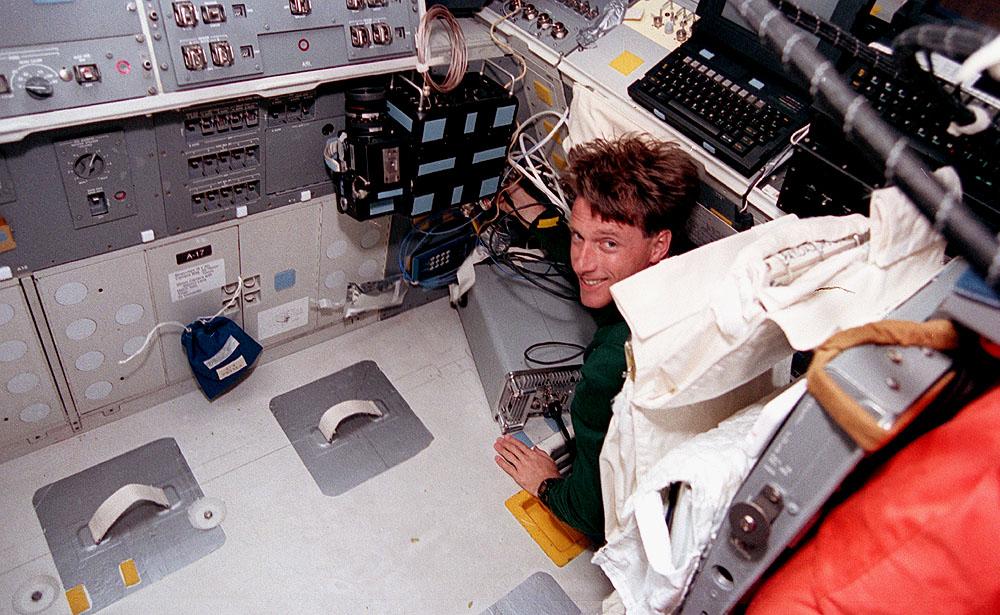
Space Shuttle Discovery (STS-56) onboard photo of Mission Specialist Michael Foale working in the Atmospheric Laboratory for Applications and Science (ATLAS-2). The ATLAS program was designed to measure the long term variability in the total energy radiated by the sun and determine the variability in the solar spectrum.
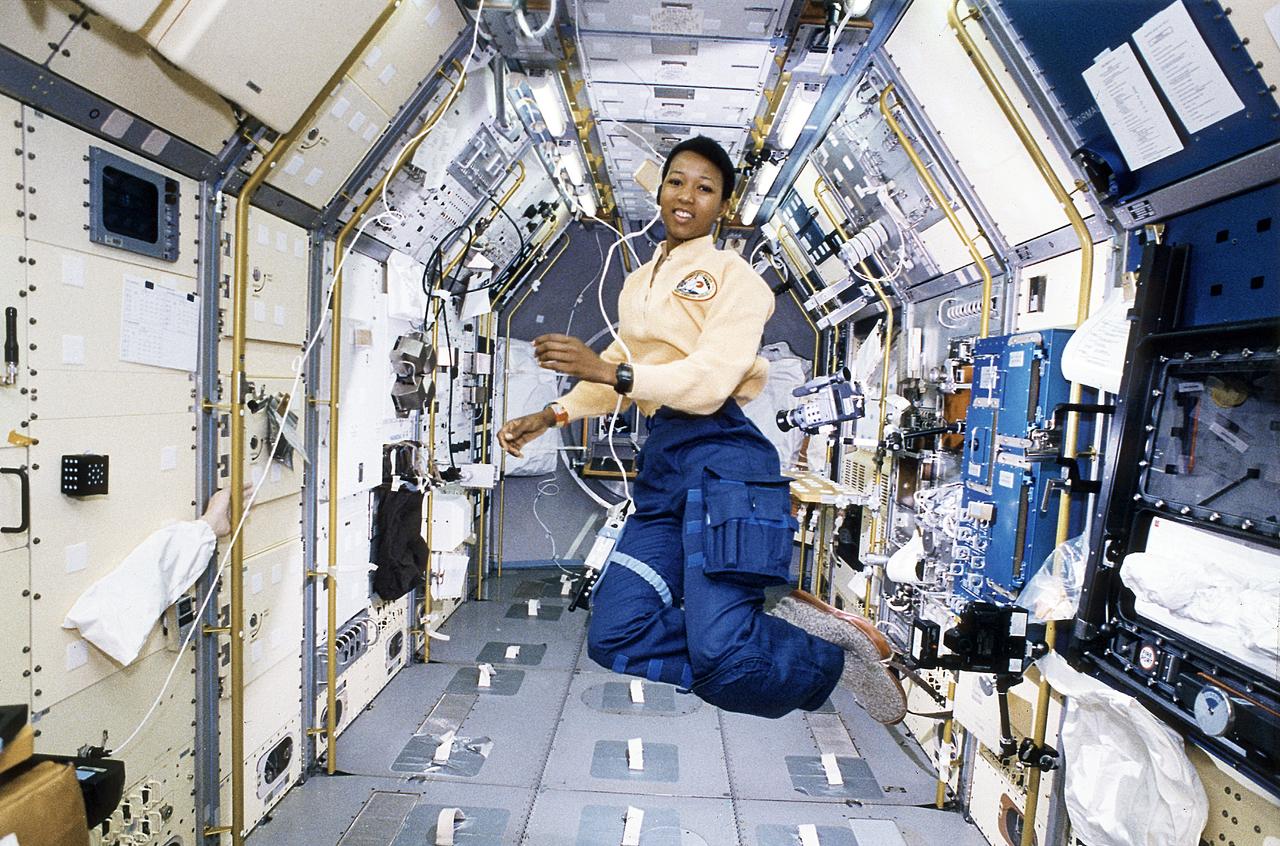
Space Shuttle Endeavour (STS-47) onboard photo of Astronaut Mae Jemison working in Spacelab-J module. Spacelab-J is a combined National Space Development Agency of Japan (NASDA) and NASA mission. The objectives included life sciences, microgravity and technology research.
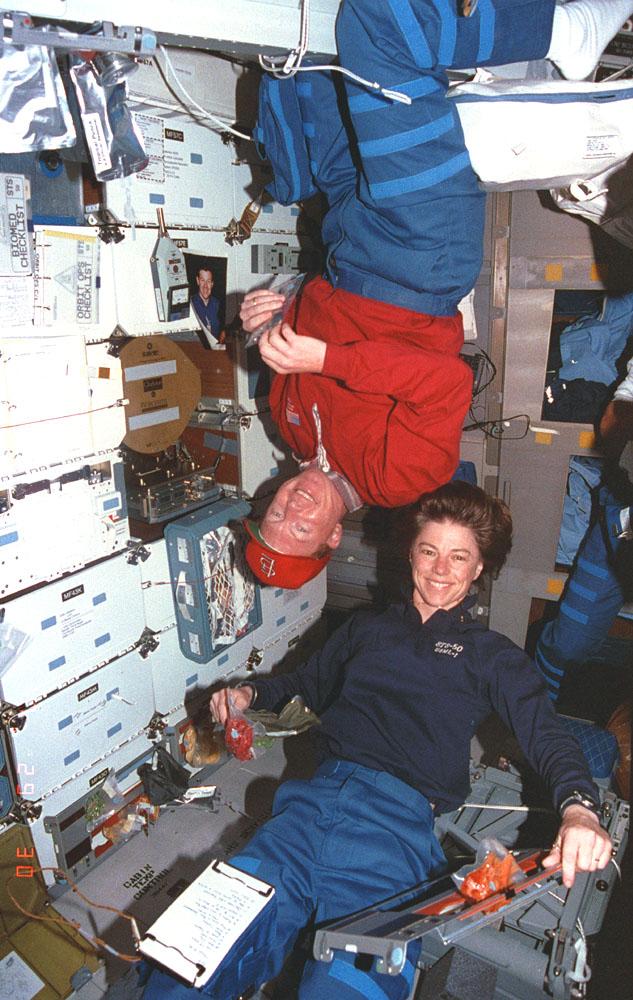
Onboard Space Shuttle Columbia (STS-50) all work and no play make commander Richard (Dick) Richards and payload commander Bornie Dunbar take a break from their work in the United States Microgravity Laboratory (USML-1) responsibilities.
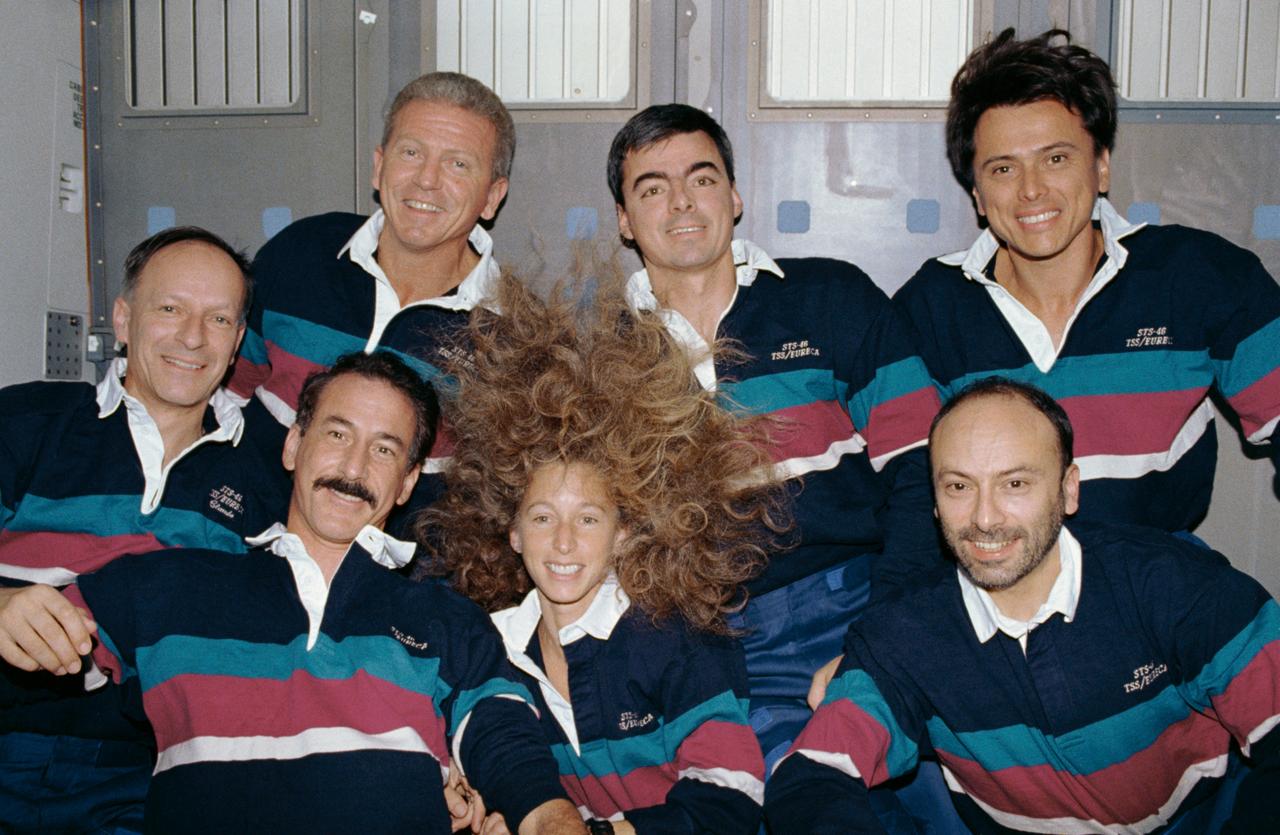
STS046-12-009 (31 July-8 Aug. 1992) --- The seven crew members for the STS-46 mission pose for the traditional in-flight portrait onboard the Earth-orbiting space shuttle Atlantis. In the rear are, left to right, astronauts Loren J. Shriver, commander; Andrew M. Allen, pilot; and Franklin R. Chang-Diaz, mission specialist. In front are, left to right, Swiss scientist Claude Nicollier, mission specialist representing the European Space Agency (ESA); astronaut Jeffrey A. Hoffman, payload commander; astronaut Marsha S. Ivins, mission specialist; and Franco Malerba, payload specialist representing the Italian Space Agency (ASI).
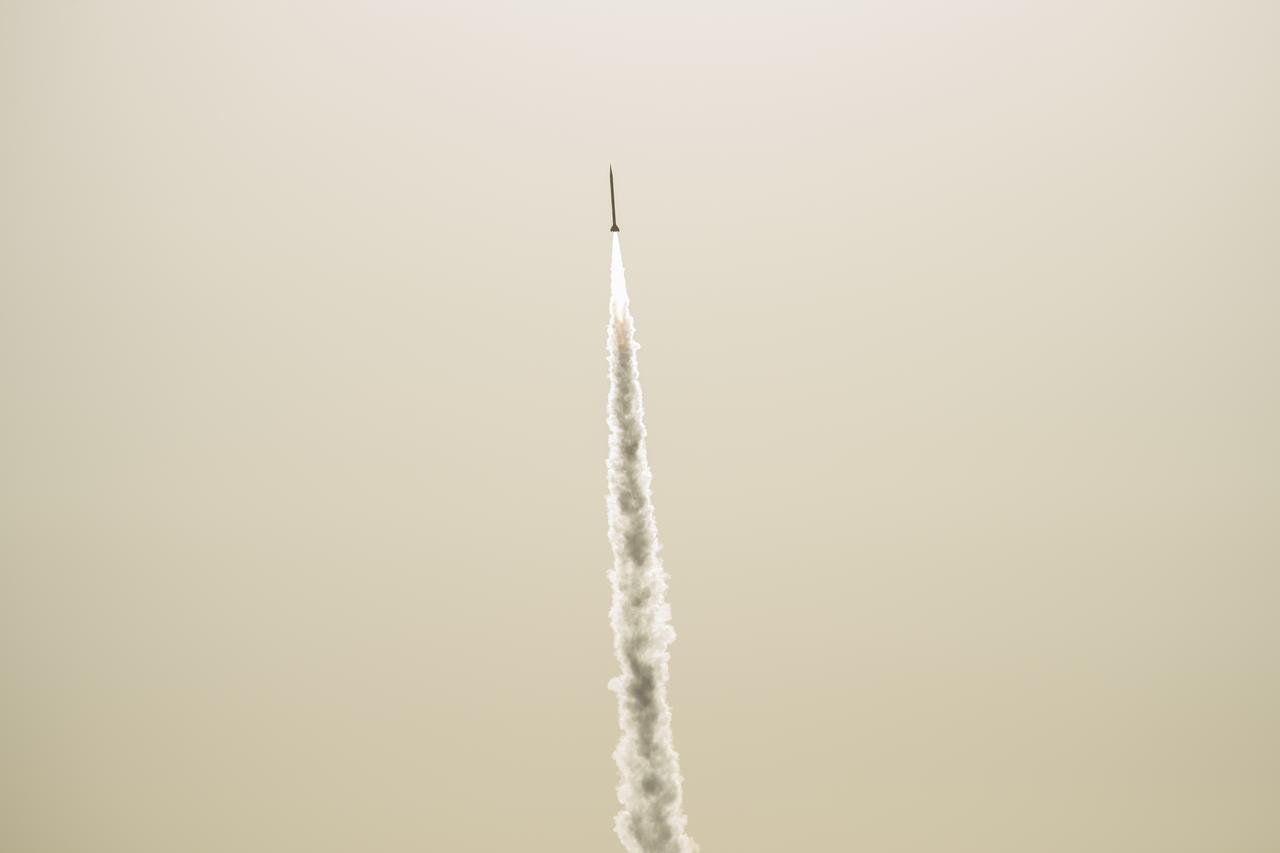
UP Aerospace SpaceLoft rocket launched into space Sept 12, 2018 from Spaceport America in New Mexico carrying three NASA technologies onboard to test in microgravity.
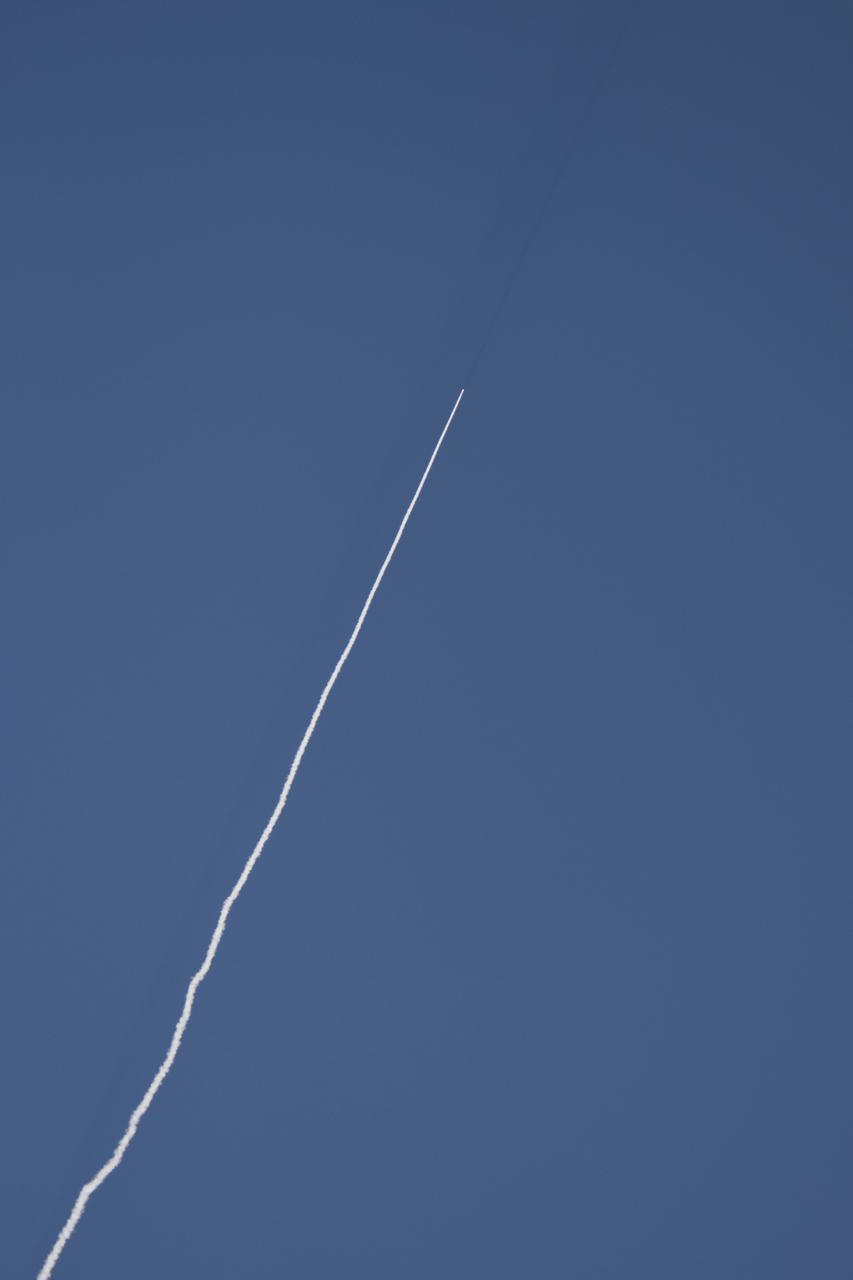
UP Aerospace SpaceLoft rocket launched into space Sept 12, 2018 from Spaceport America in New Mexico carrying three NASA technologies onboard to test in microgravity.
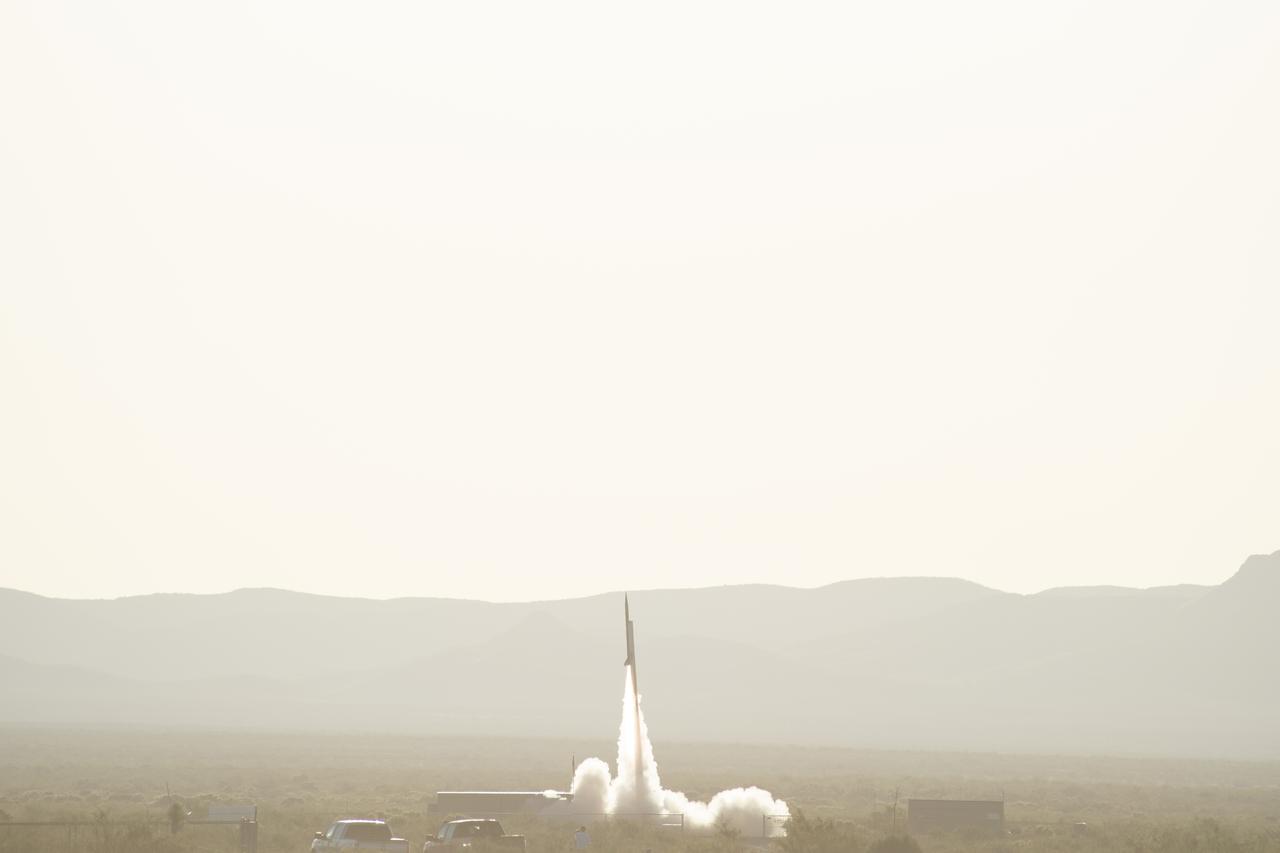
UP Aerospace SpaceLoft rocket launched into space Sept 12, 2018 from Spaceport America in New Mexico carrying three NASA technologies onboard to test in microgravity.
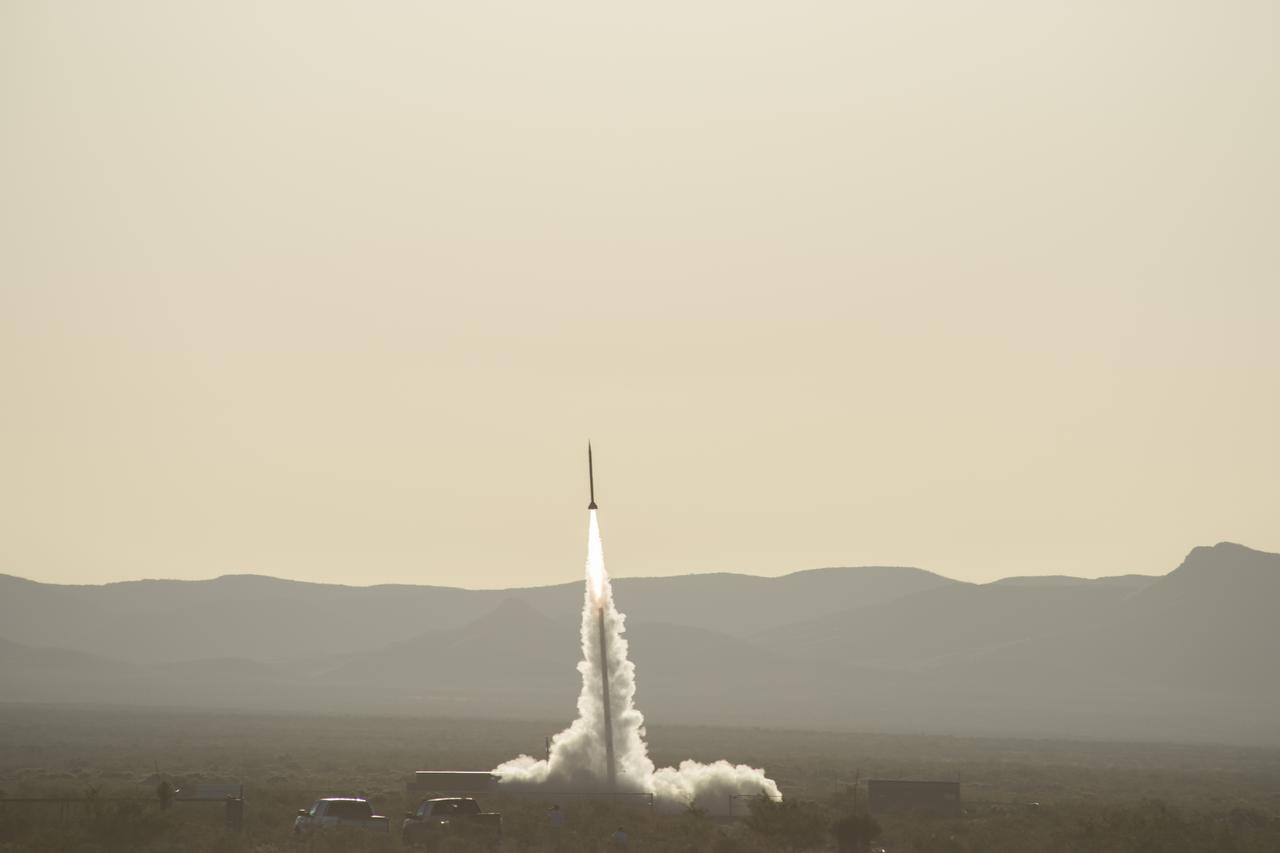
UP Aerospace SpaceLoft rocket launched into space Sept 12, 2018 from Spaceport America in New Mexico carrying three NASA technologies onboard to test in microgravity.
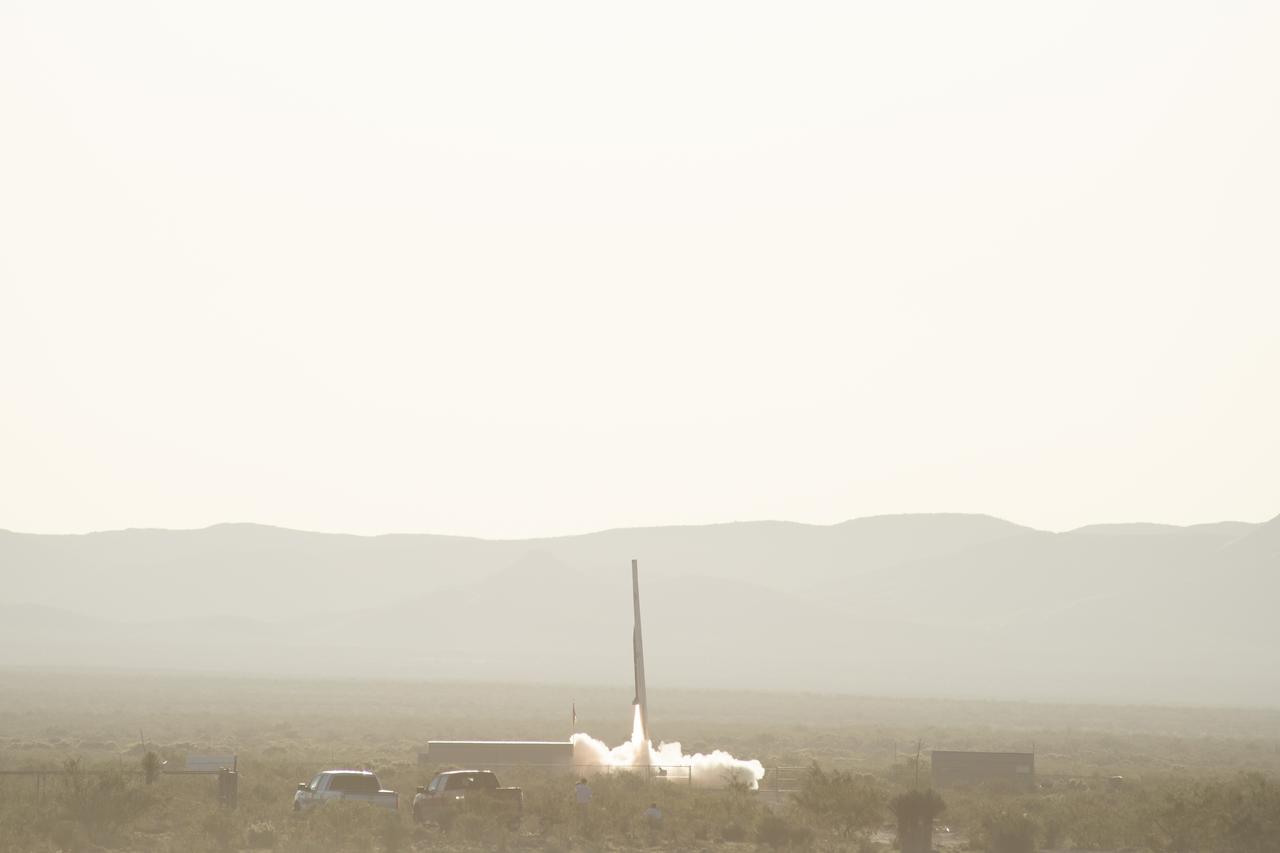
UP Aerospace SpaceLoft rocket launched into space Sept 12, 2018 from Spaceport America in New Mexico carrying three NASA technologies onboard to test in microgravity.
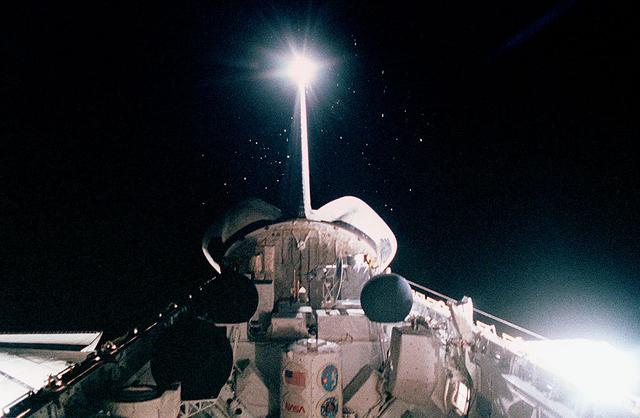
Space Shuttle Atlantis (STS-45) onboard photo of open cargo bay with the forward portion of the Atmospheric Laboratory for Applications and Science (Atlas-1) shown at night.
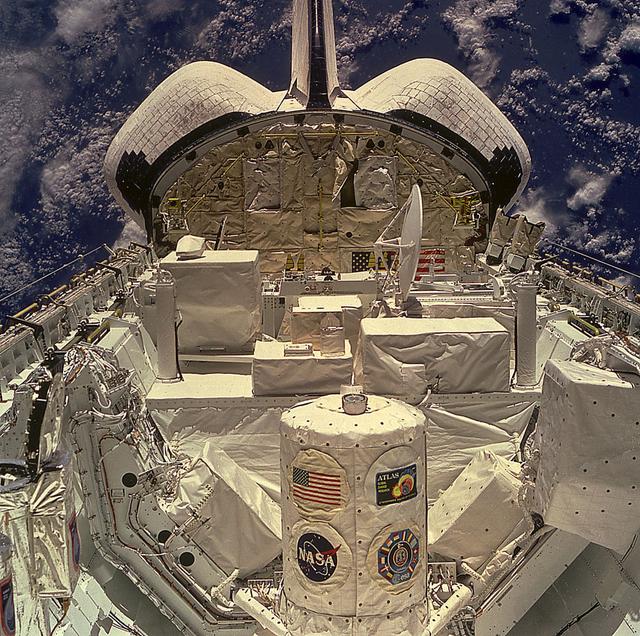
Space Shuttle Discovery (STS-56) onboard photo of the Atmospheric Laboratory for Applications and Science (ATLAS-2) payload on the pallet in the cargo bay of the orbiter.
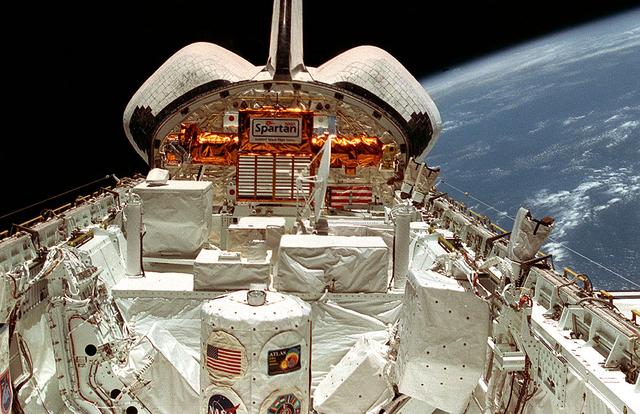
Space Shuttle Discovery (STS-56) onboard photo of the Atmospheric Laboratory for Applications and Science (ATLAS-2) payload on the pallet in the cargo bay of the orbiter.
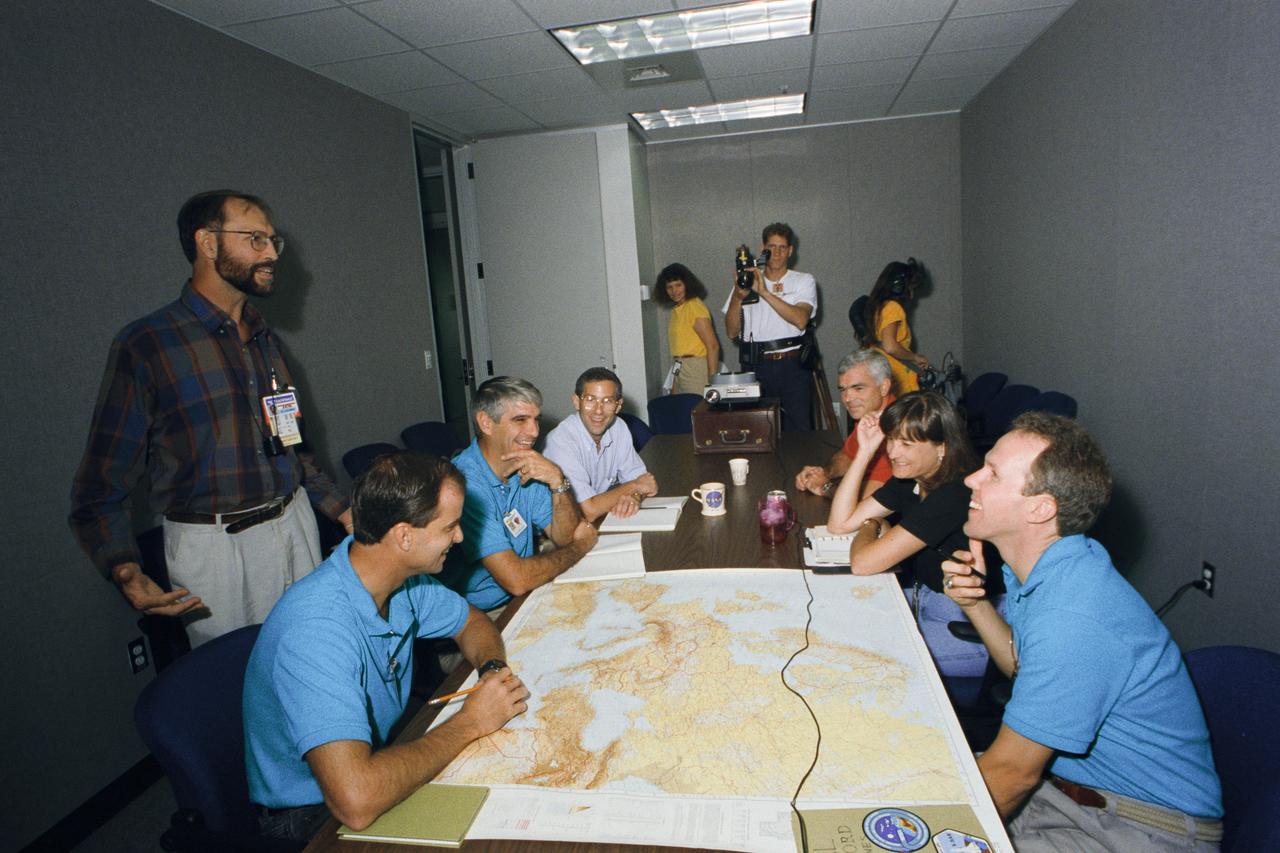
S93-42727 (26 Aug 1993) --- The six astronauts in training for the STS-59 mission are given some onboard Earth observations tips by Justin Wilkinson (standing, foreground) of the Space Shuttle Earth Observations Project (SSEOP) group. Astronaut Sidney M. Gutierrez, mission commander, is at center on the left side of the table. Others, left to right, are astronauts Kevin P. Chilton, pilot; Jerome (Jay) Apt and Michael R.U. (Rich) Clifford, both mission specialists; Linda M. Godwin, payload commander; and Thomas D. Jones, mission specialist.
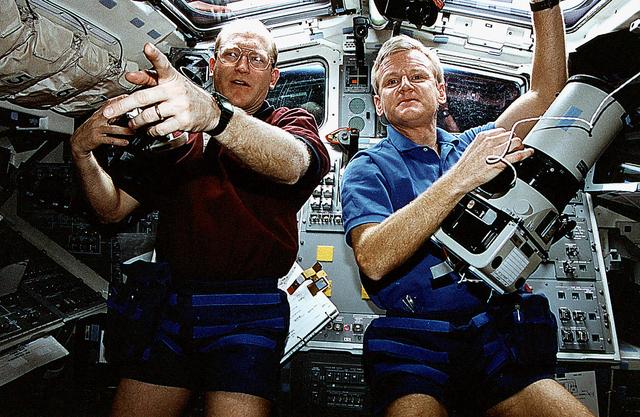
Onboard Space Shuttle Columbia (STS-62) Mission commander John H. Casper (right) and Mission specialist Charles (Sam) Gemar prepare to take pictures of their home planet.
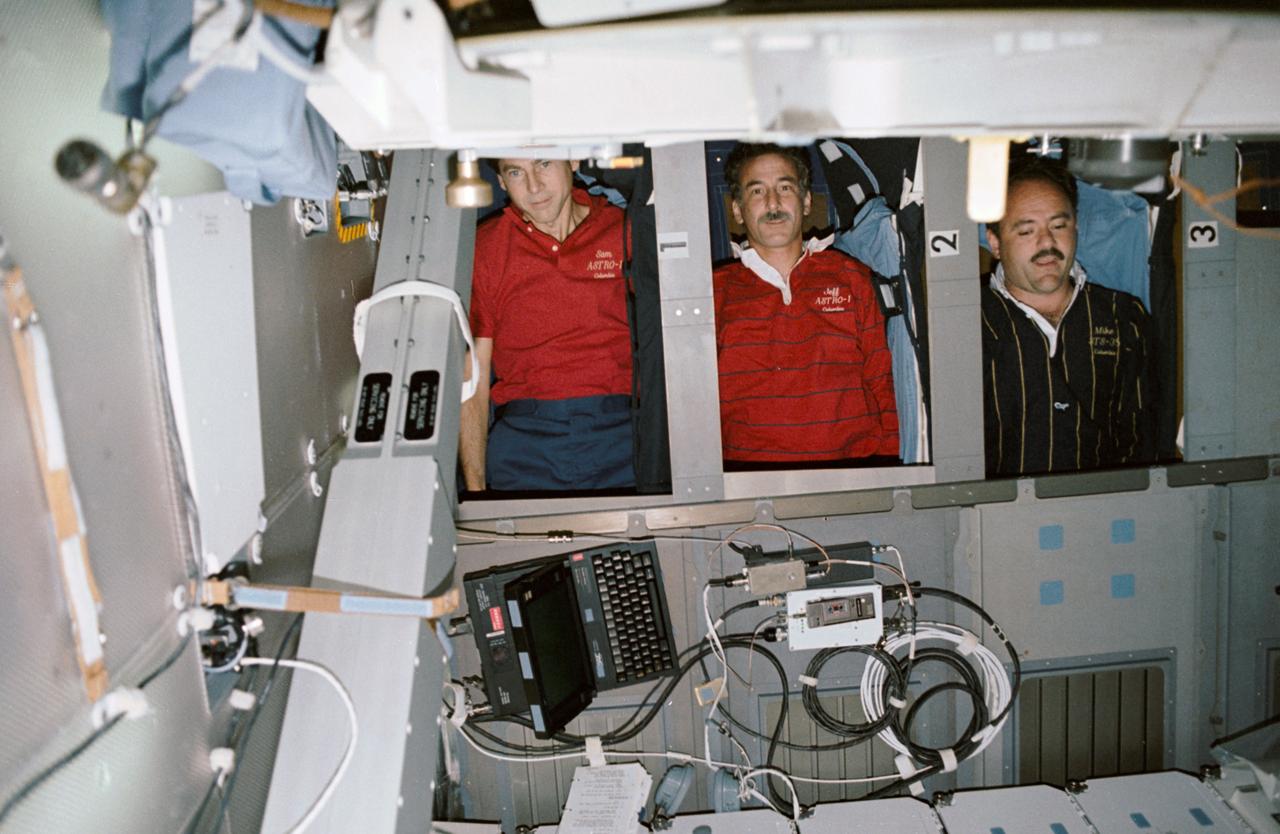
Though they are not actually asleep, three STS-35 crewmembers demonstrate the bunk-style sleep compartments onboard Columbia's, Orbiter Vehicle (OV) 102's, middeck. From top to bottom are Payload Specialist Samuel T. Durrance, Mission Specialist (MS) Jeffrey A. Hoffman, and MS John M. Lounge. At the left is the shuttle amateur radio experiment (SAREX). The crew escape pole (CES) is visible overhead and the open airlock hatch in the foreground. The sleep station is located against the middeck starboard wall.
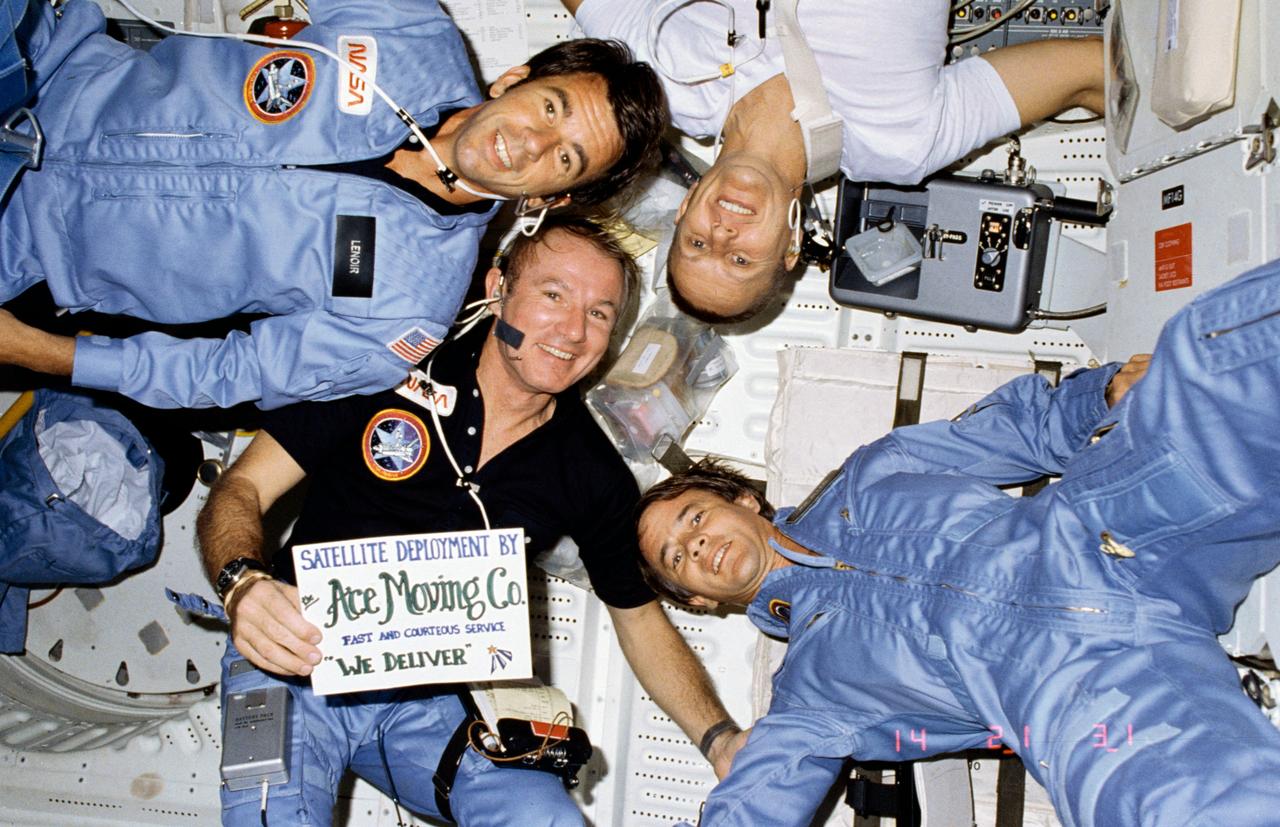
STS005-07-267 (12 Nov. 1982) --- A pre-set 35mm camera?s exposure of all four STS-5 astronaut crew members reveals a bit of their humorous side. The sign held by astronaut Vance D. Brand, crew commander, refers to the successful deployment of two commercial communications satellites on the flight's first two days. Brand is surrounded by, clockwise, left to right, astronauts William B. Lenoir, mission specialist, Robert F. Overmyer, pilot, and Joseph O. Allen IV, mission specialist, in the middeck area of the Earth-orbiting space shuttle Columbia. Photo credit: NASA
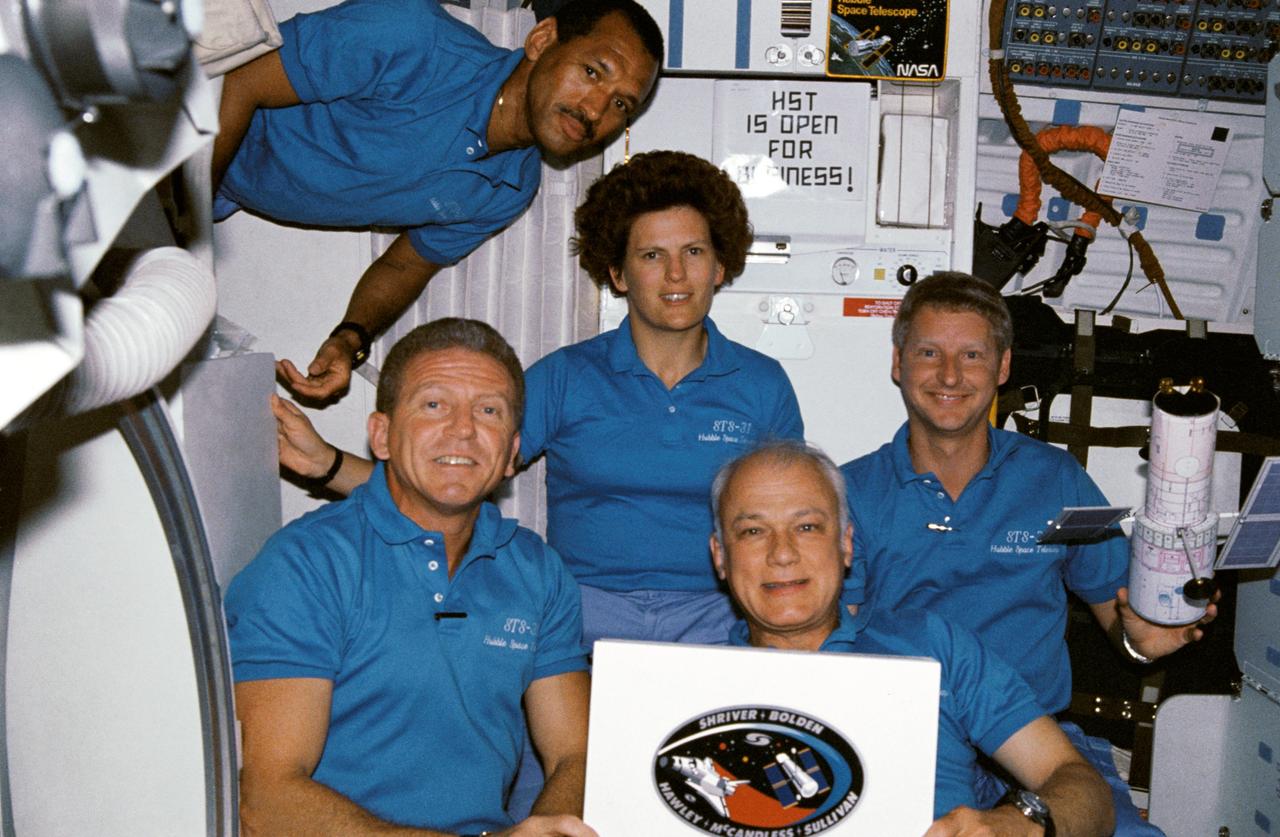
STS031-12-031 (24-29 April 1990) --- On Discovery's middeck, the STS-31 crew poses for a traditional in-flight portrait. Astronaut Loren J. Shriver, mission commander, is at lower left. Astronaut Charles F. Bolden, pilot, floats above. Others, left to right, are Kathryn D. Sullivan, Bruce McCandless II and Steven A. Hawley, all mission specialists. Photo credit: NASA
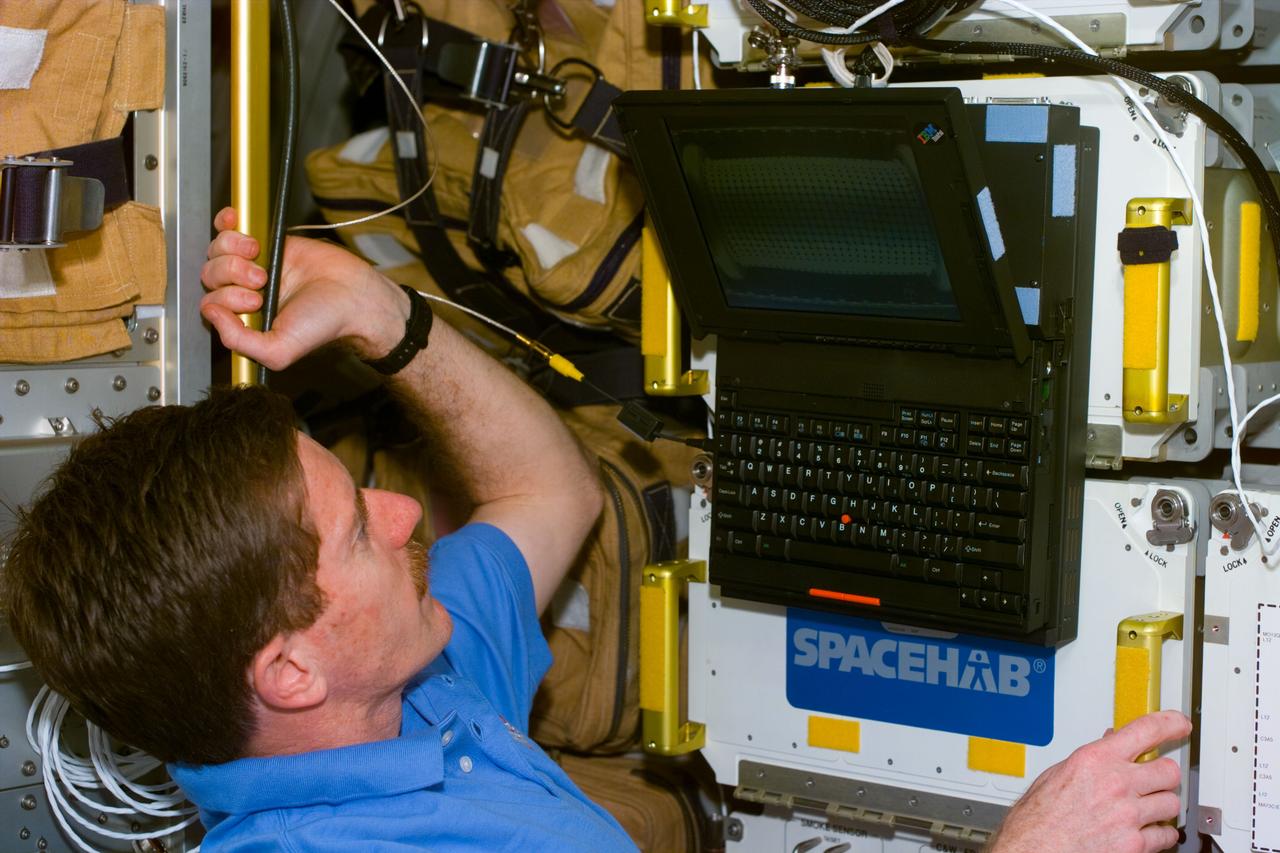
S89-E-5196 (25 Jan 1998) --- This Electronic Still Camera (ESC) image shows astronaut James F. Reilly, mission specialist, using a lap top computer in the Spacehab Double Module (DM), onboard the Space Shuttle Endeavour. This ESC view was taken on January 25, 1998 at 17:06:16 GMT.
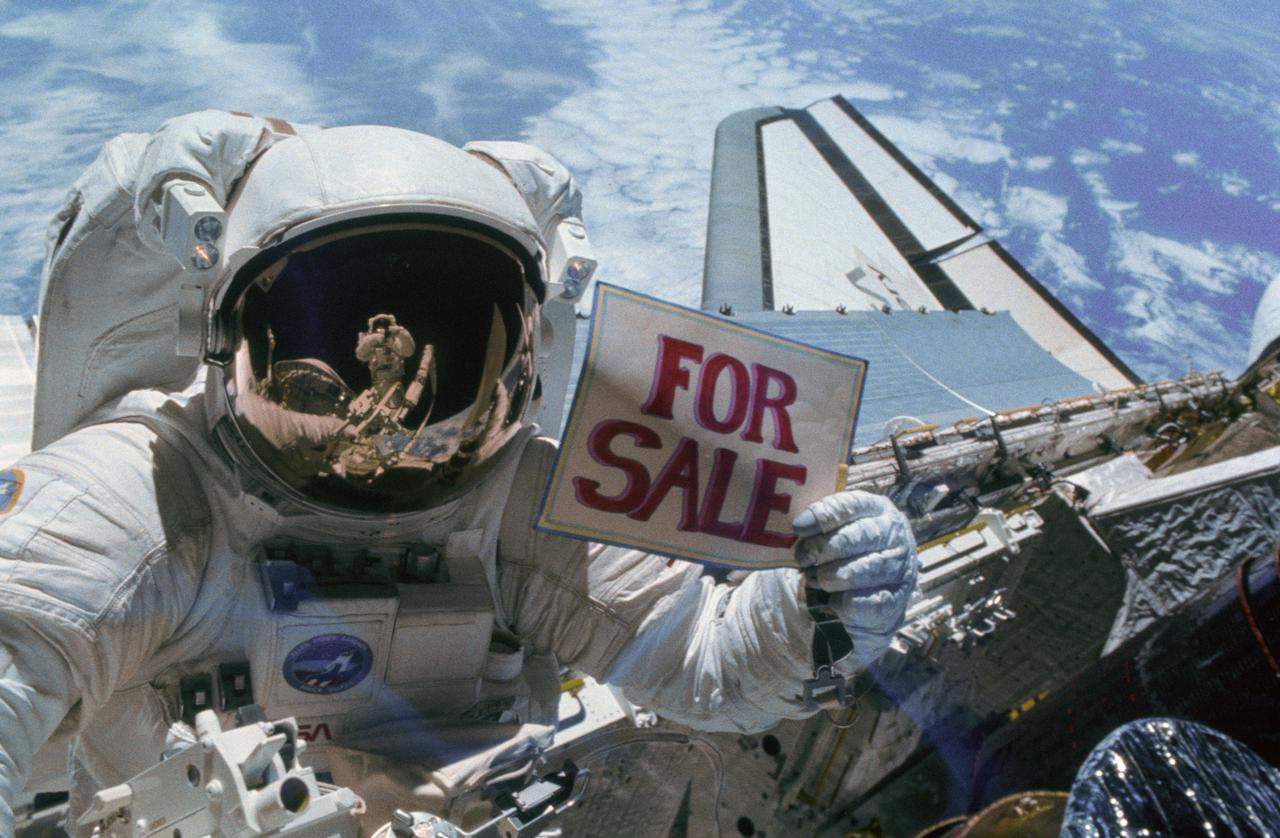
Astronauts are clowning around in space in this STS-51A onboard photo. Astronaut Gardner, holds a “For Sale” sign after the retrieval of two malfunctioning satellites; the Western Union Telegraph Communication Satellite (WESTAR VI); and the PALAPA-B2 Satellite. Astronaut Allen, who is standing on the Remote Manipulator System (RMS) is reflected in Gardner’s helmet visor. The 51A mission launched aboard the Space Shuttle Discovery on November 8, 1984.
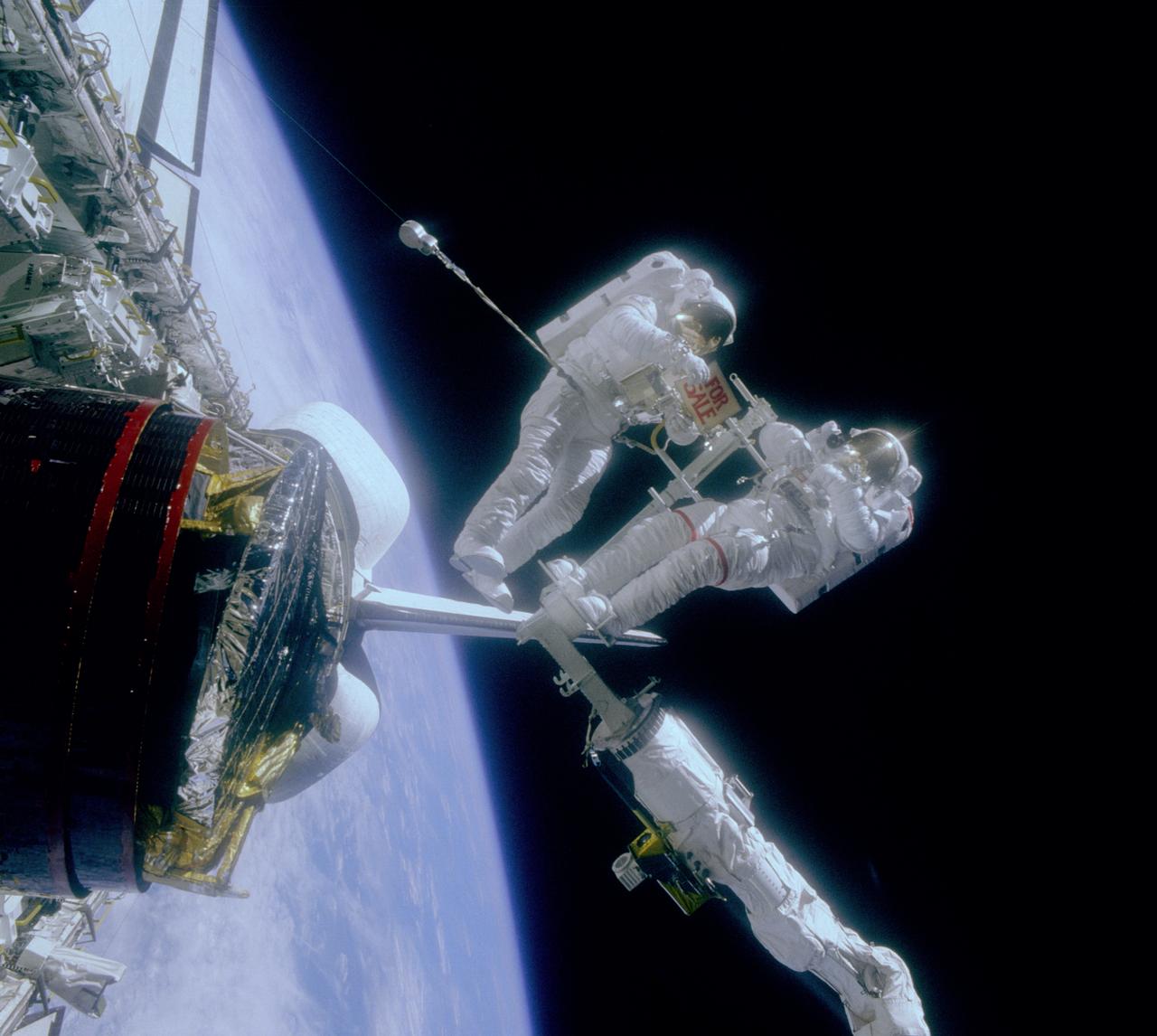
Astronauts are clowning around in space in this STS-51A onboard photo. Astronaut Gardner, holds a “For Sale” sign after the retrieval of two malfunctioning satellites; the Western Union Telegraph Communication Satellite (WESTAR VI); and the PALAPA-B2 Satellite. Astronaut Allen, who is standing on the RMS (Remote Manipulator System) is reflected in Gardner’s helmet visor. The 51A mission launched aboard the Space Shuttle Discovery on November 8, 1984.
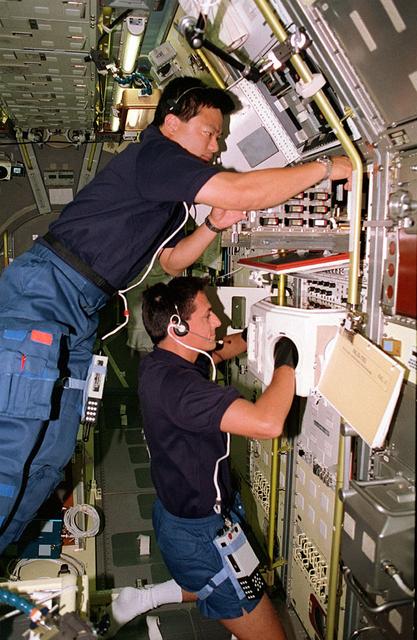
Onboard Space Shuttle Columbia (STS-65) Mission Specialist Leroy Chiao (top) and Mission Specialist Donald A. Thomas are seen at work in the International Microgravity Laboratory 2 (IML-2) spacelab science module. The two crewmembers are conducting experiments at the IML-2 Rack 5 Biorack (BR). Chiao places a sample in the BR incubator as Thomas handles another sample inside the BR glovebox. The glovebox is used to prepare samples for BR and slow rotating centrifuge microscope (NIZEMI) experiments.
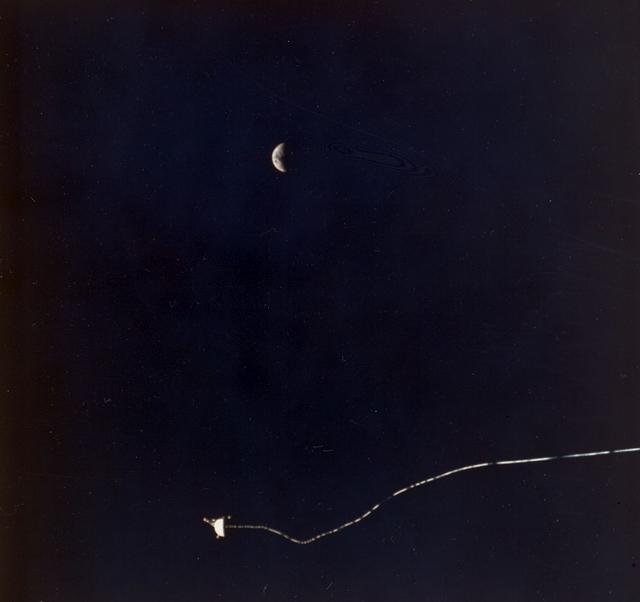
Sharing this scene with a half-moon is the Tethered Satellite System (TSS), in a photo captured onboard the STS-46. Circling Earth at an altitude of 296 kilometers (184 miles), the TSS-1 will be well within the tenuous, electrically charged layer of the atmosphere known as the ionosphere. There, a satellite attached to the orbiter by a thin conducting cord, or tether, will be reeled from the Shuttle payload bay. On this mission the satellite was plarned to be deployed 20 kilometers (12.5 miles) above the Shuttle. The conducting tether will generate high voltage and electrical currents as it moves through the atmosphere allowing scientists to examine the electrodynamics of a conducting tether system. These studies will not only increase our understanding of physical processes in the near-Earth space environment, but will also help provide an explanation for events witnessed elsewhere in the solar system. The crew of the STS-46 mission were unable to reel the satellite as planned. After several unsuccessful attempts, they were only able to extend the satellite 9.8 kilometers (6.1 miles). The TSS was a cooperative development effort by the Italian Space Agency (ASI), and NASA.
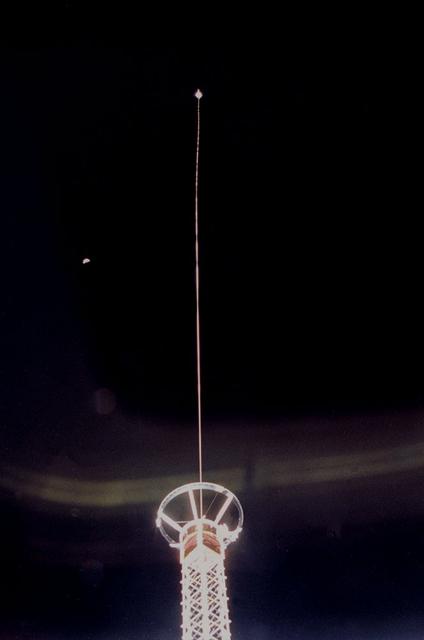
This STS-46 onboard photo is of the Tethered Satellite System-1 (TSS-1) being deployed from its boom as it is perched above the cargo bay of the Earth-orbiting Space Shuttle Atlantis. Circling the Earth at an altitude of 296 kilometers (184 miles), the TSS-1 will be well within the tenuous, electrically charged layer of the atmosphere known as the ionosphere. There, a satellite attached to the orbiter by a thin conducting cord, or tether, will be reeled from the Shuttle payload bay. On this mission the satellite was plarned to be deployed 20 kilometers (12.5 miles) above the Shuttle. The conducting tether will generate high voltage and electrical currents as it moves through the atmosphere allowing scientists to examine the electrodynamics of a conducting tether system. These studies will not only increase our understanding of physical processes in the near-Earth space environment, but will also help provide an explanation for events witnessed elsewhere in the solar system. The crew of the STS-46 mission were unable to reel the satellite as planned. After several unsuccessful attempts, they were only able to extend the satellite 9.8 kilometers (6.1 miles). The TSS was a cooperative development effort by the Italian Space Agency (ASI), and NASA.
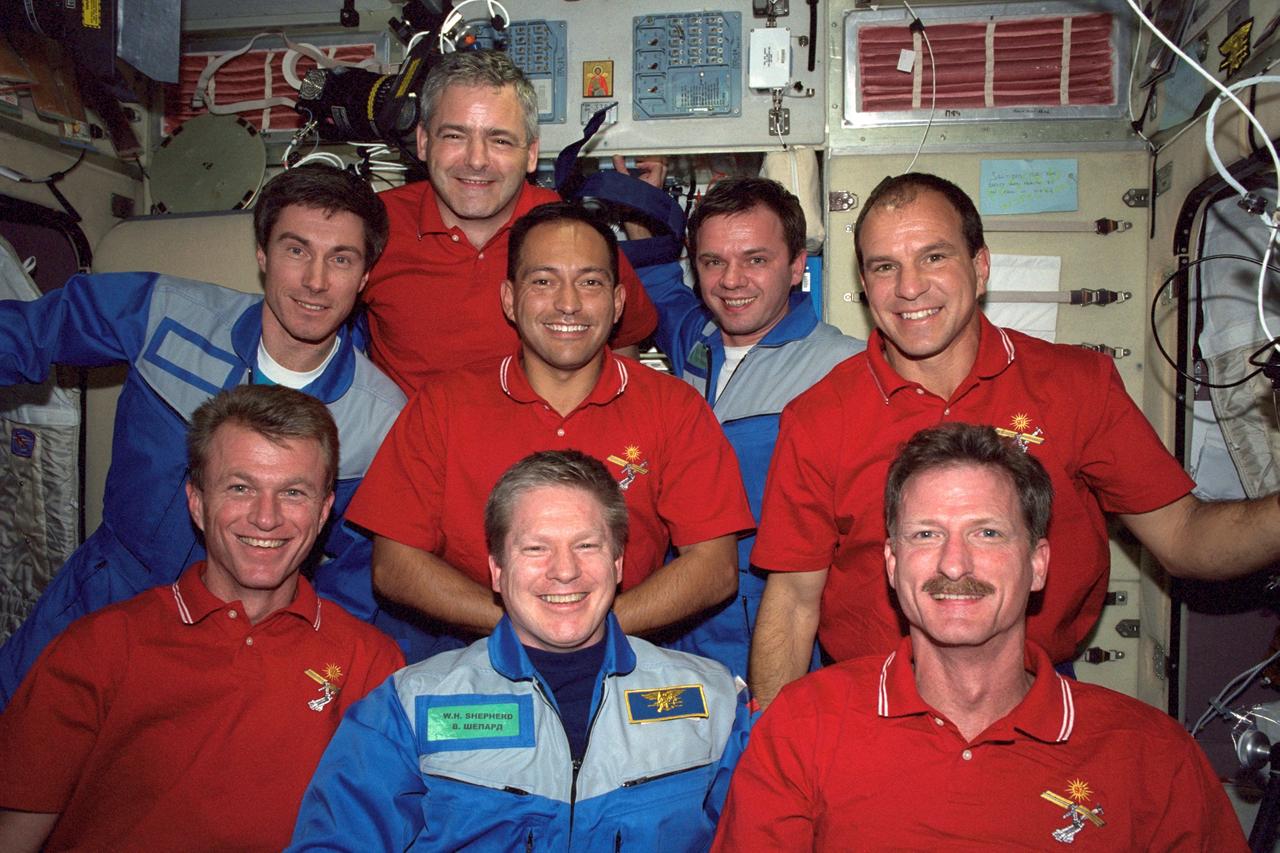
In this image, the five STS-97 crew members pose with the 3 members of the Expedition One crew onboard the International Space Station (ISS) for the first ever traditional onboard portrait taken in the Zvezda Service Module. On the front row, left to right, are astronauts Brent W. Jett, Jr., STS-97 commander; William M. Shepherd, Expedition One mission commander; and Joseph R. Tarner, STS-97 mission specialist. On the second row, from the left are Cosmonaut Sergei K. Krikalev, Expedition One flight engineer; astronaut Carlos I. Noriega, STS-97 mission specialist; cosmonaut Yuri P. Gidzenko, Expedition One Soyuz commander; and Michael J. Bloomfield, STS-97 pilot. Behind them is astronaut Marc Garneau, STS-97 mission specialist representing the Canadian Space Agency (CSA). The primary objective of the STS-97 mission was the delivery, assembly, and activation of the U.S. electrical power system onboard the International Space Station (ISS). The electrical power system, which is built into a 73-meter (240-foot) long solar array structure consists of solar arrays, radiators, batteries, and electronics. The entire 15.4-metric ton (17-ton) package is called the P6 Integrated Truss Segment, and is the heaviest and largest element yet delivered to the station aboard a space shuttle. The electrical system will eventually provide the power necessary for the first ISS crews to live and work in the U.S. segment. The STS-97 crew of five launched aboard the Space Shuttle Orbiter Endeavor on November 30, 2000 for an 11 day mission.
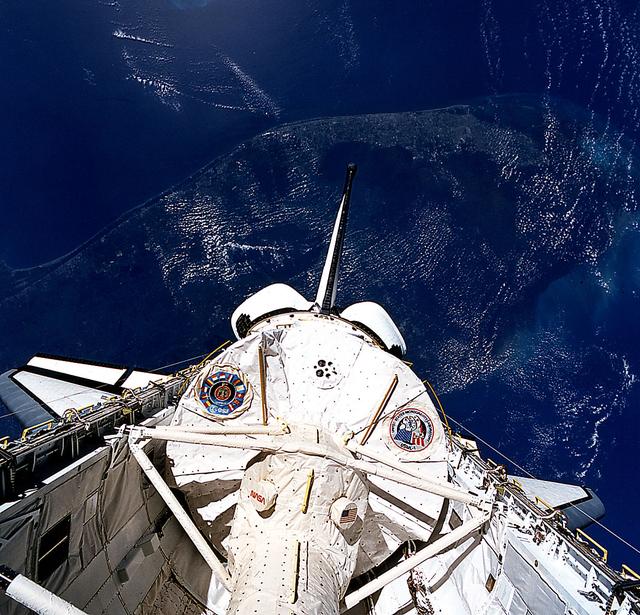
Space Shuttle Columbia (STS-50) onboard photo of the United States Microgravity Laboratory (USML-1) module in payload bay in this scene over the southern two-thirds of the Florida peninsula. Kennedy Space Center (KSC) can be seen just above Columbia's starboard wing.
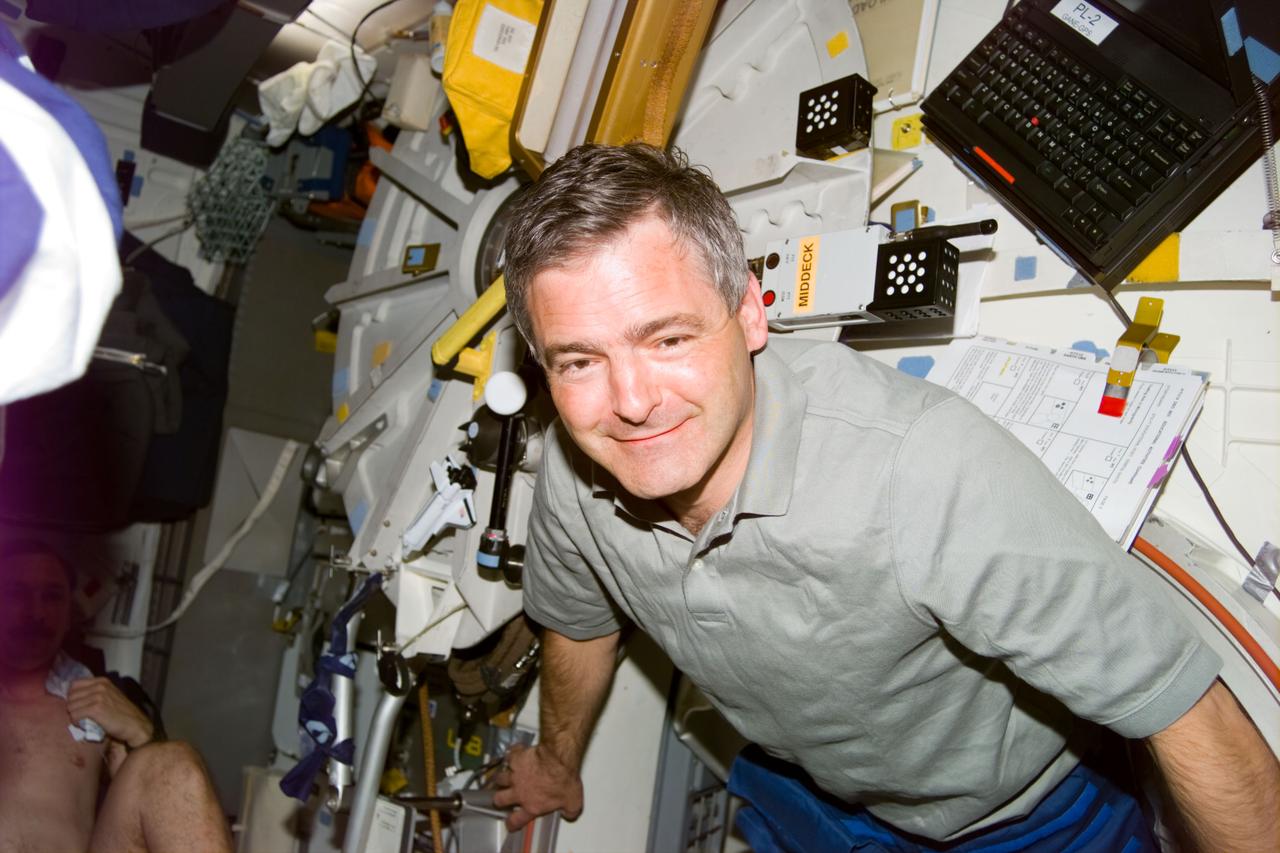
S77-E-5107 (26 May 1996) --- Astronaut Marc Garneau, mission specialist representing the Canadian Space Agency (CSA), poses for a photograph onboard the middeck of the Earth-orbiting Space Shuttle Endeavour. The scene was recorded with an Electronic Still Camera (ESC).
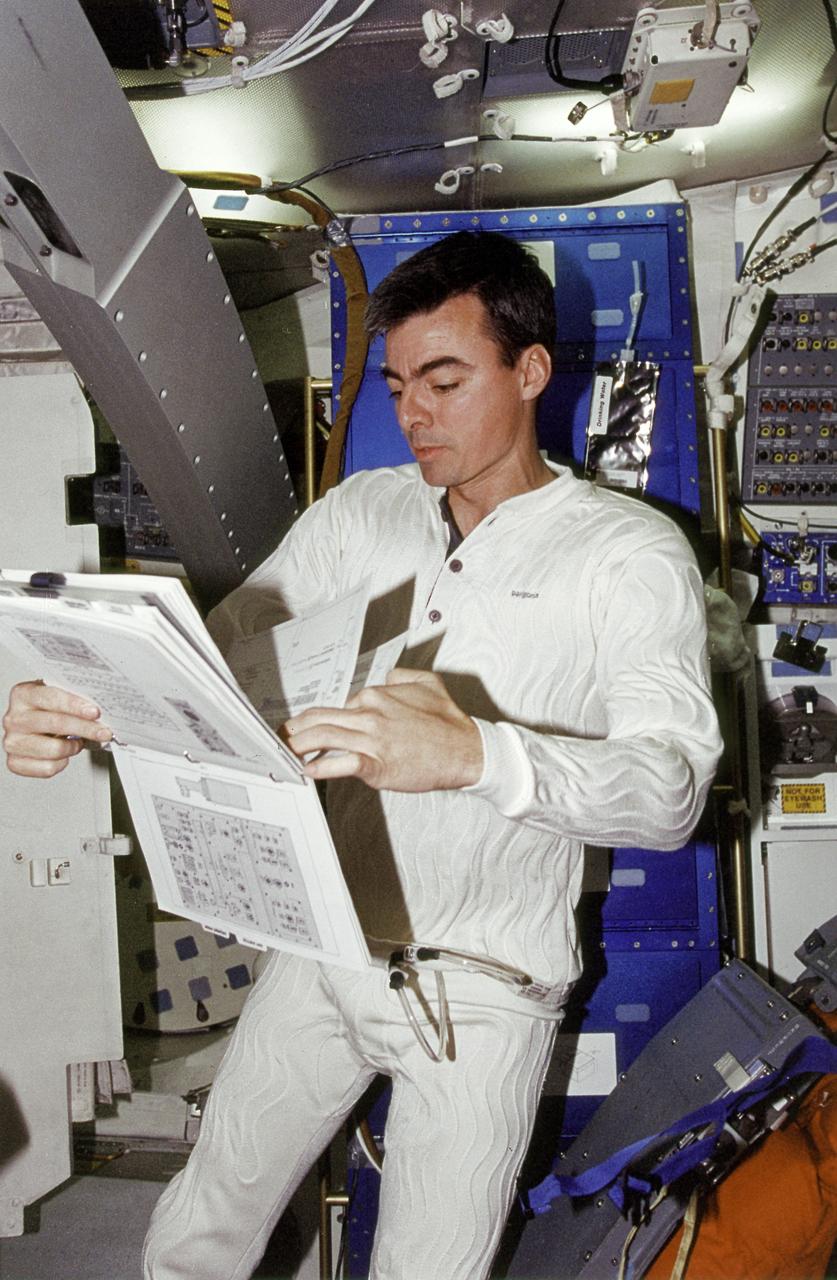
Onboard Space Shuttle Columbia (STS-62) Pilot Andrew M. Allen looks over a procedures book in the midst of a 14-day mission. Allen is attired in a new thermally controlled undergarment. Allen wore the garment during the launch and entry phases of the flight.
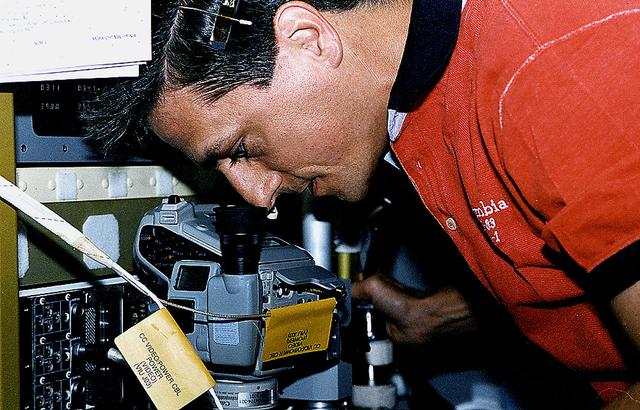
Onboard Space Shuttle Columbia (STS-94) Mission Specialist Donald A. Thomas observes an experiment in the glovebox aboard the Spacelab Science Module. Thomas is looking through an eye-piece of a camcorder and recording his observations on tape for post-flight analysis. Other cameras inside the glovebox are also recording other angles of the experiment or downlinking video to the experiment teams on the ground. The glovebox is thought of as a safety cabinet with closed front and negative pressure differential to prevent spillage and contamination and allow for manipulation of the experiment sample when its containment has to be opened for observation, microscopy and photography. Although not visible in this view, the glovebox is equipped with windows on the top and each side for these observations.
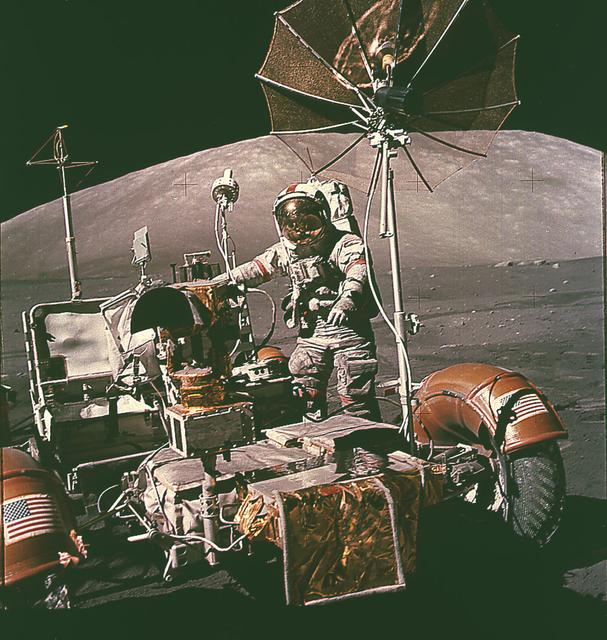
This is an Apollo 17 onboard photo of an astronaut beside the Lunar Roving Vehicle (LRV) on the lunar surface. Designed and developed by the Marshall Space Flight Center and built by the Boeing Company, the LRV was first used on the Apollo 15 mission and increased the range of astronauts' mobility and productivity on the lunar surface. This lightweight electric car had battery power sufficient for about 55 miles. It weighed 462 pounds (77 pounds on the Moon) and could carry two suited astronauts, their gear, cameras, and several hundred pounds of bagged samples. The LRV's mobility was quite high. It could climb and descend slopes of about 25 degrees.
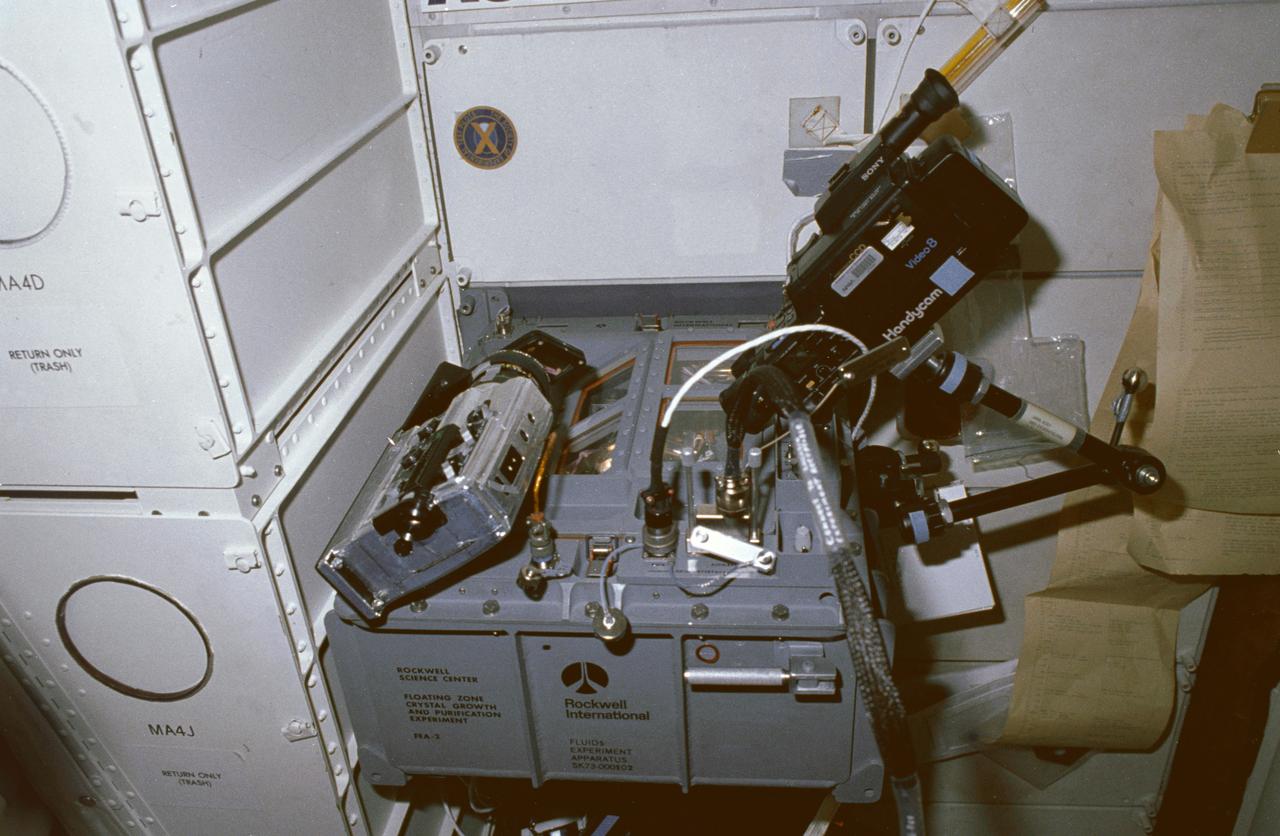
STS030-10-003 (4-8 May 1989) --- An overall scene of the onboard materials science project for STS-30. Seen is the fluids experiment apparatus, supported by an accompanying computer and an 8mm camcorder for its operation. Another major component of the project-- Astronaut Mary L. Cleave, who devoted a great deal of STS-30 monitoring various experiments--is out of frame.
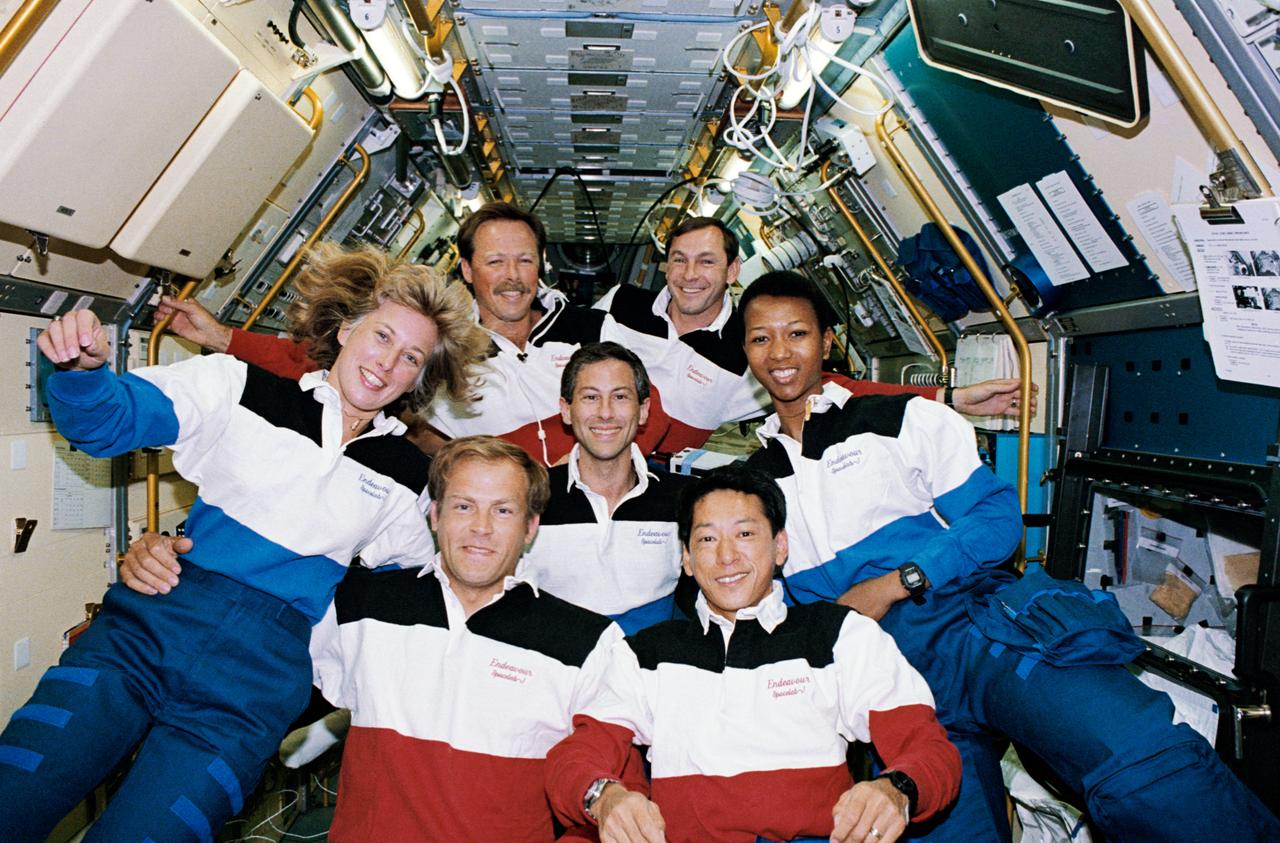
STS047-09-009 (12 - 20 Sept 1992) --- The seven crew members sharing eight days of research in support of Spacelab-J pose for the traditional inflight portrait in the Science Module. Pictured, left to right, back row, are Robert L. Gibson, mission commander; and Curtis L. Brown, Jr., pilot; middle row, N. Jan Davis, Jerome (Jay) Apt and Mae C. Jemison, all mission specialists; and front row, Mark C. Lee, payload commander, and Mamoru Mohri, payload specialist representing Japan's National Space Development Agency (NASDA).
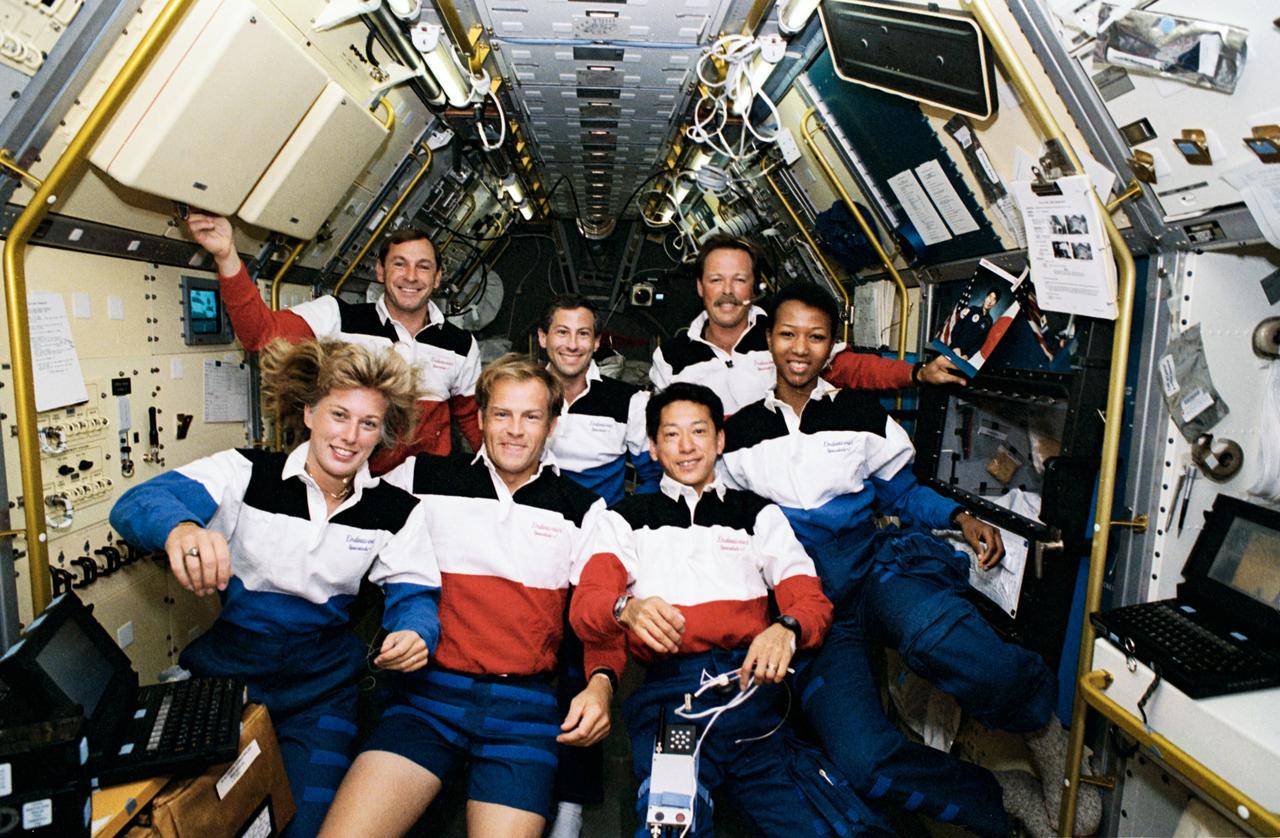
STS047-12-002 (12 - 20 Sept 1992) --- The crew members assemble for their traditional in-flight portrait in this 35mm frame photographed in the Science Module aboard the Earth-orbiting Space Shuttle Endeavour. Left to right (front) are N. Jan Davis, Mark C. Lee and Mamoru Mohri; and (rear) Curtis L. Brown, Jr., Jerome (Jay) Apt, Robert L. Gibson and Mae C. Jemison. The seven spent eight days in space in support of the Spacelab-J mission.
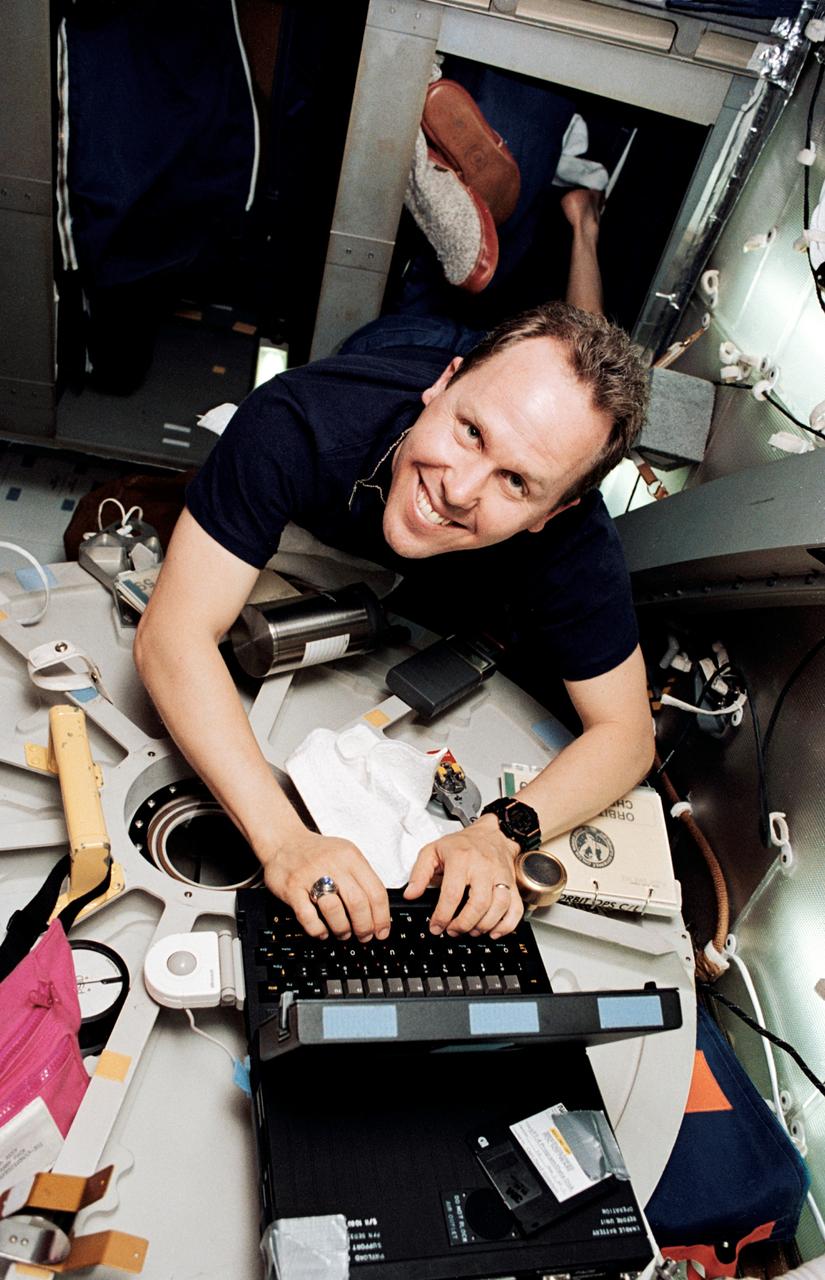
STS059-10-011 (9-20 April 1994) --- Astronaut Thomas D. Jones appears to have climbed out of bed right into his work in this onboard 35mm frame. Actually, Jones had anchored himself in the bunk facility while working on one of the onboard computers which transfered data to the ground via modem. The mission specialist was joined in space by five other NASA astronauts for a week and a half of support to the Space Radar Laboratory (SRL-1)/STS-59 mission.
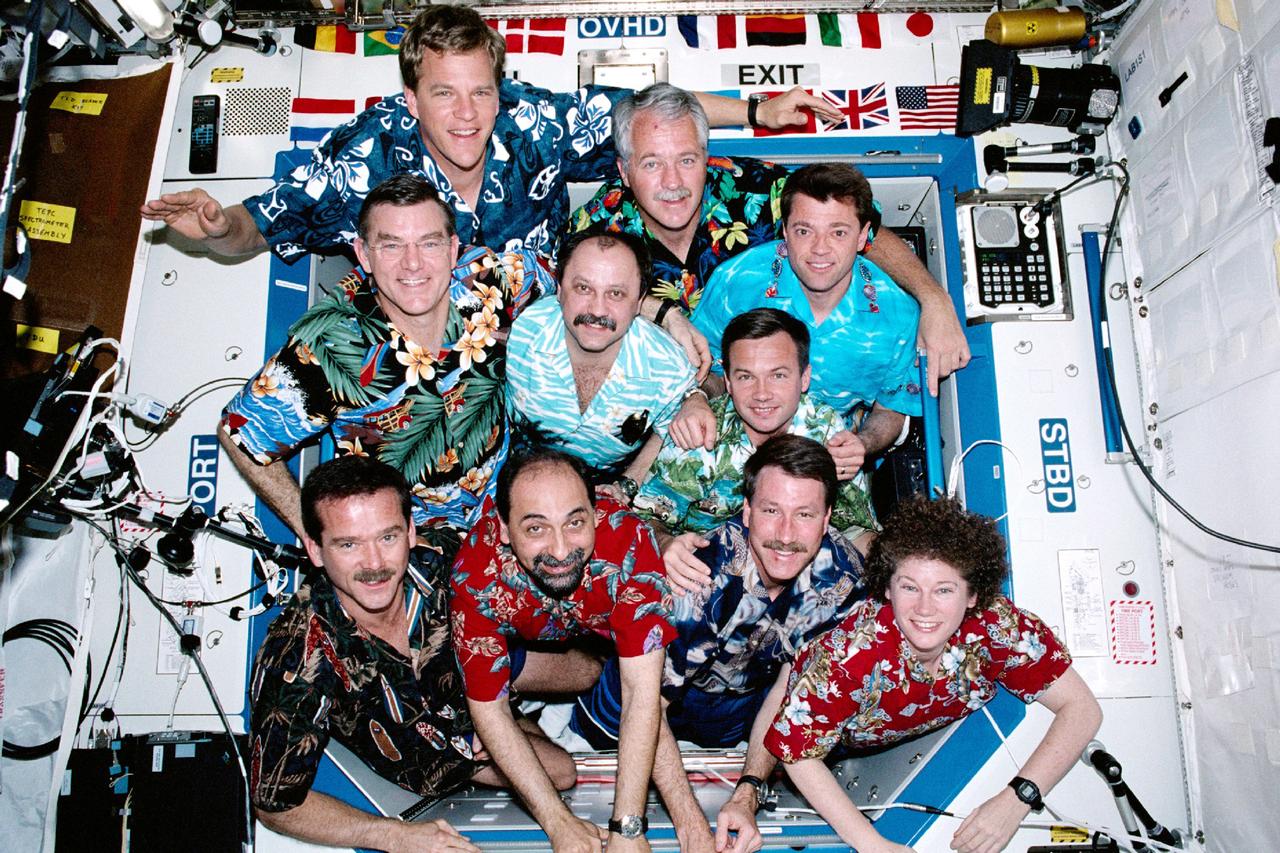
STS-100 and Expedition Two crew members pose for an onboard portrait in the Destiny laboratory of the International Space Station (ISS). Bottom, from left, are Chris A. Hadfield of the Canadian Space Agency, Umberto Guidoni of the European Space Agency, Kent V. Rominger, and Susan J. Helms (Expedition Two). Middle row, James S. Voss (Expedition Two), and cosmonauts Yury V. Usachev (Expedition Two) and Yuri V. Lonchakov. Top, Scott E. Parazynski, John L. Phillips, and Jeffrey S. Ashby. The crews accomplished the following objectives: The delivery of the Canadian-built Space Station Remote Manipulator System (SSRMS), Canadarm2, which is needed to perform assembly operations on later flights; The delivery and installation of a UHF anterna that provides space-to-space communications capability for U.S. based space walks; and carried the Italian-built multipurpose Logistics Module Raffaello containing six system racks and two storage racks for the U.S. Lab, Destiny.
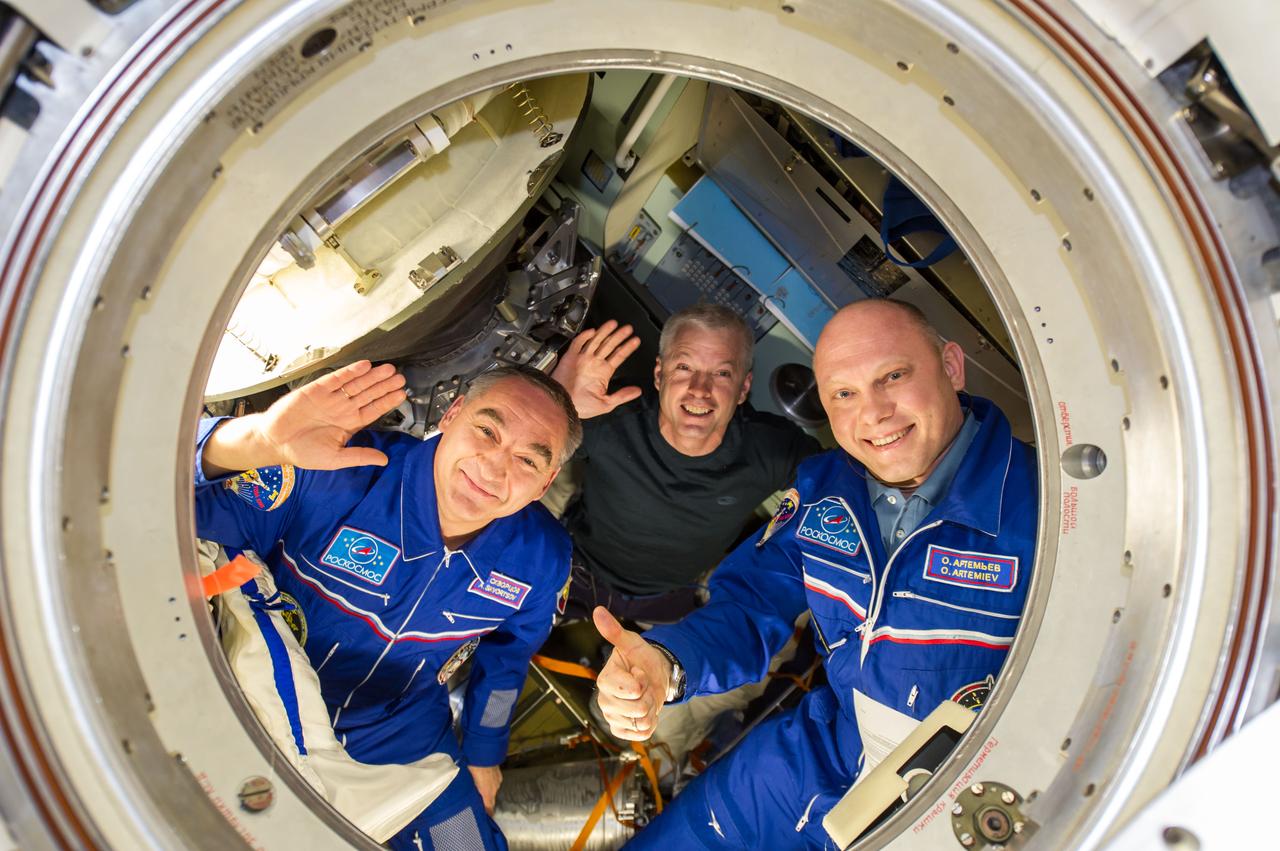
ISS040-E-139846 (10 Sept. 2014) --- NASA astronaut Steve Swanson (center), Expedition 40 commander; along with Russian cosmonauts Alexander Skvortsov (left) and Oleg Artemyev, both flight engineers, are pictured in the Soyuz TMA-12M capsule which will return them back to Earth after serving more than five months onboard the orbital outpost. Undocking from the International Space Station’s Poisk Mini-Research Module 2 (MRM2) occurred at 7:01 p.m. (EDT) on Sept. 10, 2014.
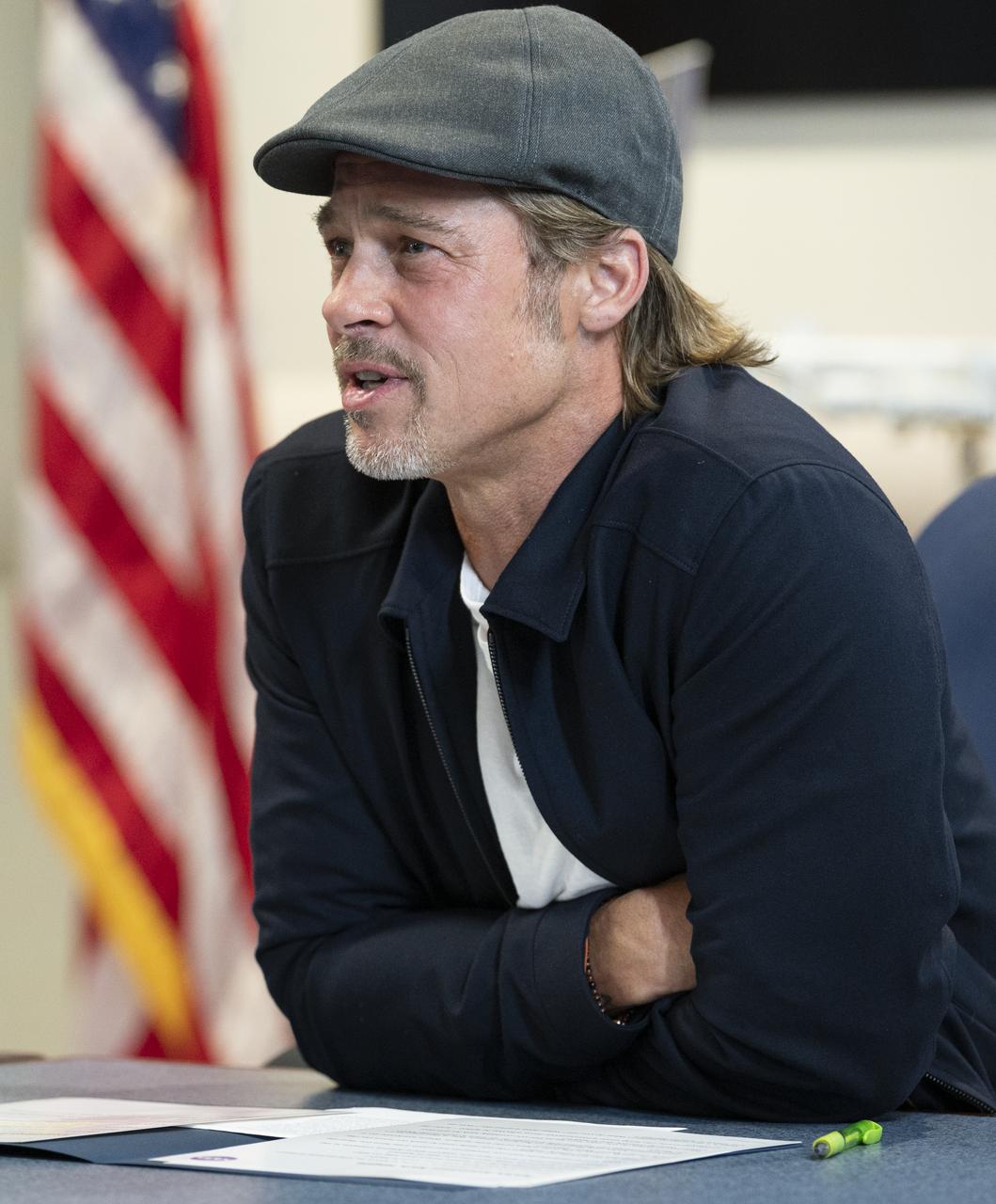
Actor Brad Pitt speaks with NASA astronaut Nick Hague who is onboard the International Space Station, Monday, Sept. 16, 2019 from the Space Operations Center at NASA Headquarters in Washington. Pitt, who stars as an astronaut in his latest film “Ad Astra,” spoke with Hague about what it’s like to live and work aboard the orbiting laboratory. Photo Credit: (NASA/Joel Kowsky)
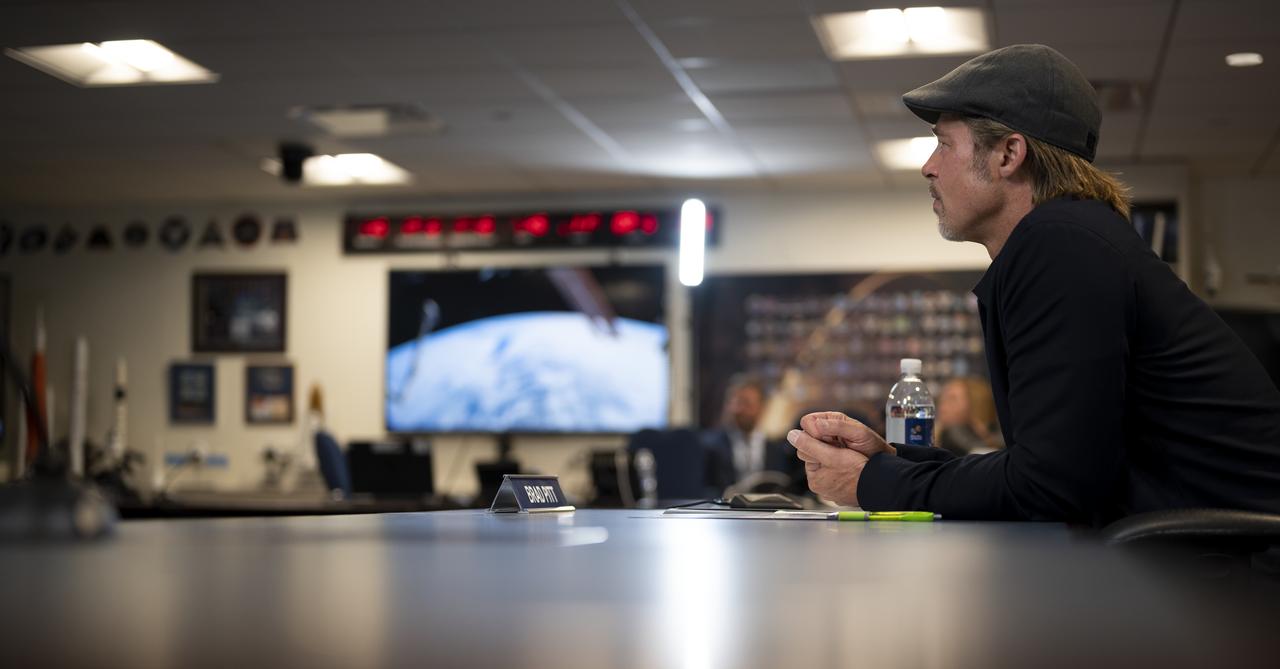
Actor Brad Pitt speaks with NASA astronaut Nick Hague who is onboard the International Space Station, Monday, Sept. 16, 2019 from the Space Operations Center at NASA Headquarters in Washington. Pitt, who stars as an astronaut in his latest film “Ad Astra,” spoke with Hague about what it’s like to live and work aboard the orbiting laboratory. Photo Credit: (NASA/Joel Kowsky)
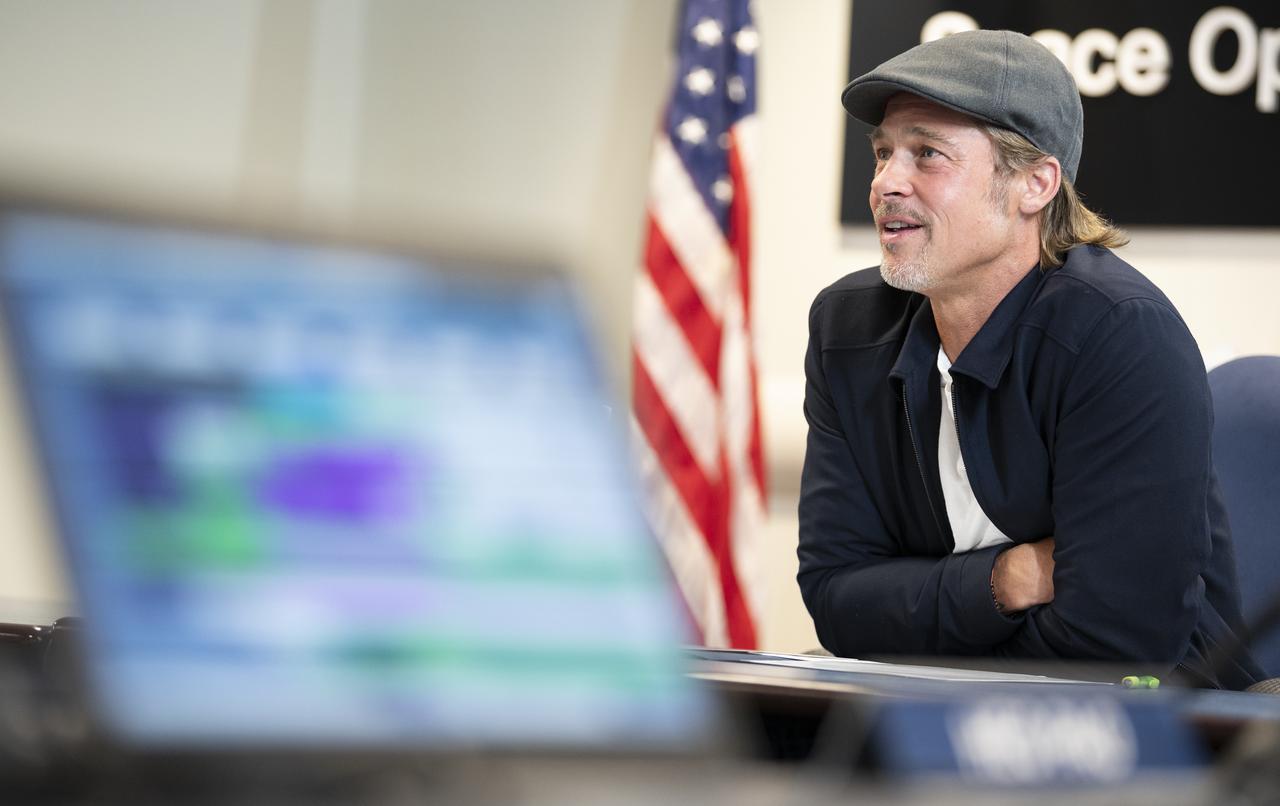
Actor Brad Pitt speaks with NASA astronaut Nick Hague who is onboard the International Space Station, Monday, Sept. 16, 2019 from the Space Operations Center at NASA Headquarters in Washington. Pitt, who stars as an astronaut in his latest film “Ad Astra,” spoke with Hague about what it’s like to live and work aboard the orbiting laboratory. Photo Credit: (NASA/Joel Kowsky)
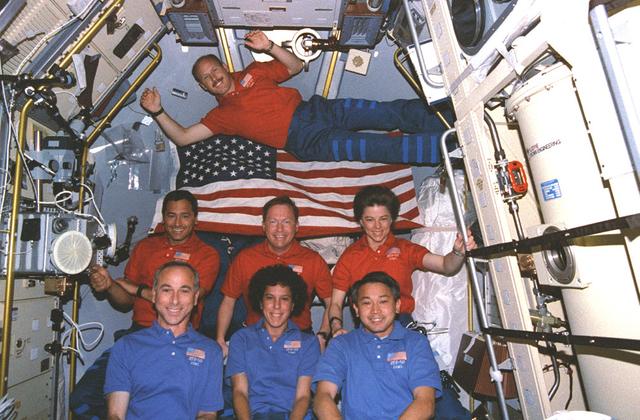
Onboard Space Shuttle Columbia (STS-50) crewmembers rally around the American flag in the United States Microgravity Laboratory-1 (USML-1). Pictured are (from top, left to right) pilot Kerneth D. Bowersox; payload specialist Lawrence J. Delucas; commander Richard N. Richards; payload commander Bonnie J. Dunbar; mission specialists Carl J. Meade and Ellen S. Baker; and payload specialist Eugene H. Trinh.
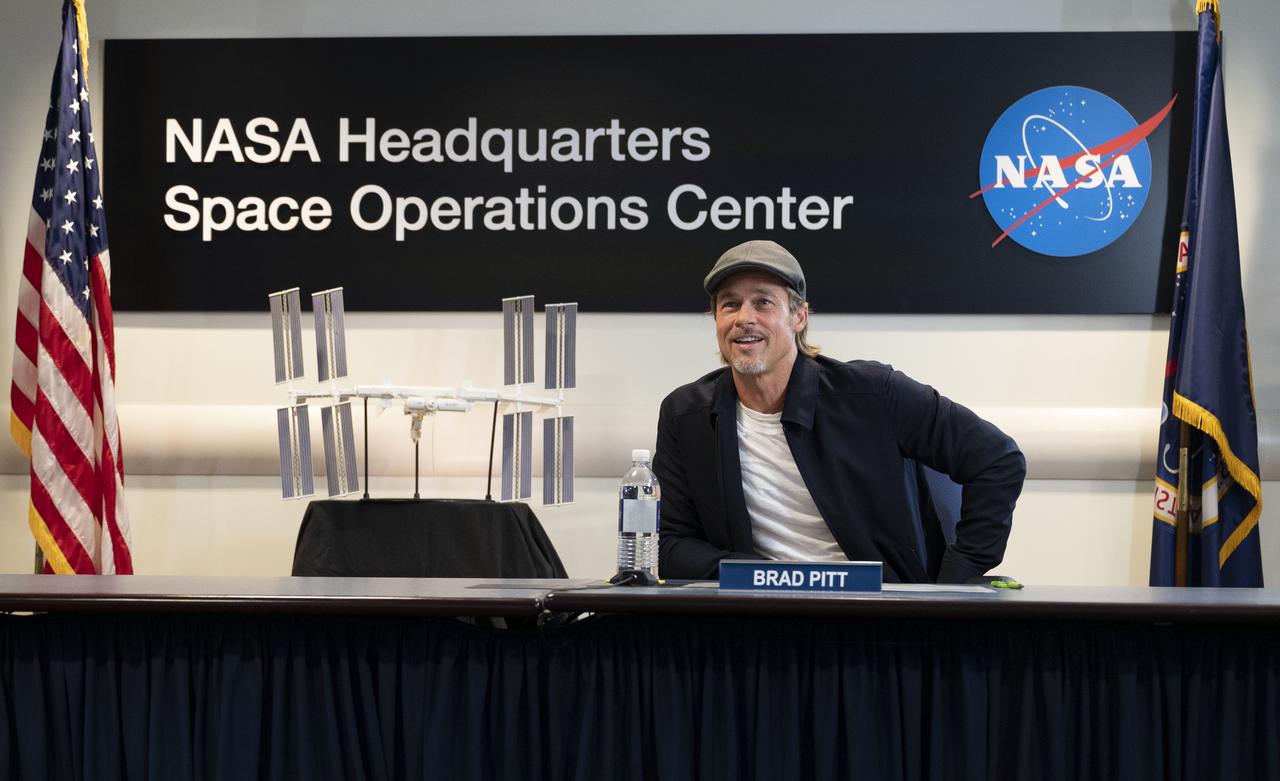
Actor Brad Pitt speaks with NASA astronaut Nick Hague who is onboard the International Space Station, Monday, Sept. 16, 2019 from the Space Operations Center at NASA Headquarters in Washington. Pitt, who stars as an astronaut in his latest film “Ad Astra,” spoke with Hague about what it’s like to live and work aboard the orbiting laboratory. Photo Credit: (NASA/Joel Kowsky)
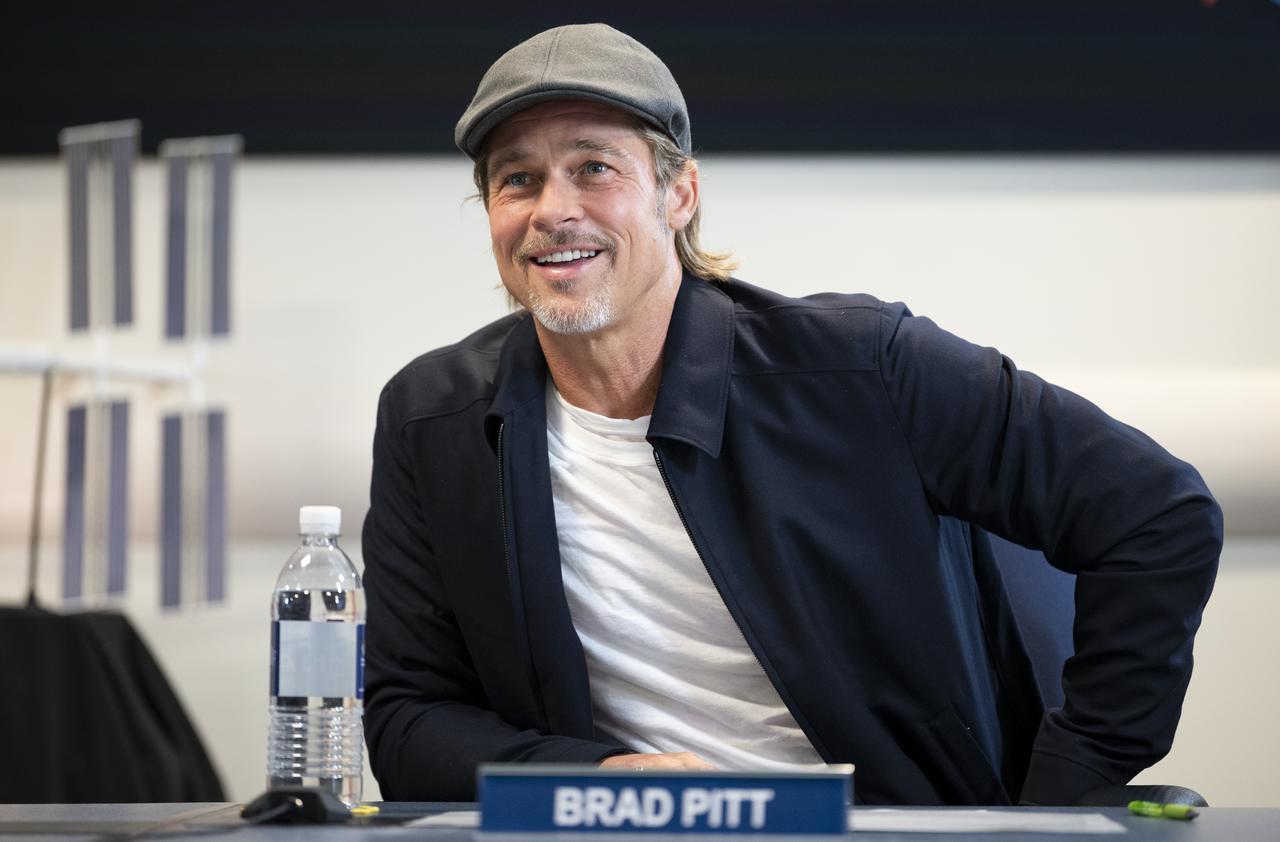
Actor Brad Pitt speaks with NASA astronaut Nick Hague who is onboard the International Space Station, Monday, Sept. 16, 2019 from the Space Operations Center at NASA Headquarters in Washington. Pitt, who stars as an astronaut in his latest film “Ad Astra,” spoke with Hague about what it’s like to live and work aboard the orbiting laboratory. Photo Credit: (NASA/Joel Kowsky)
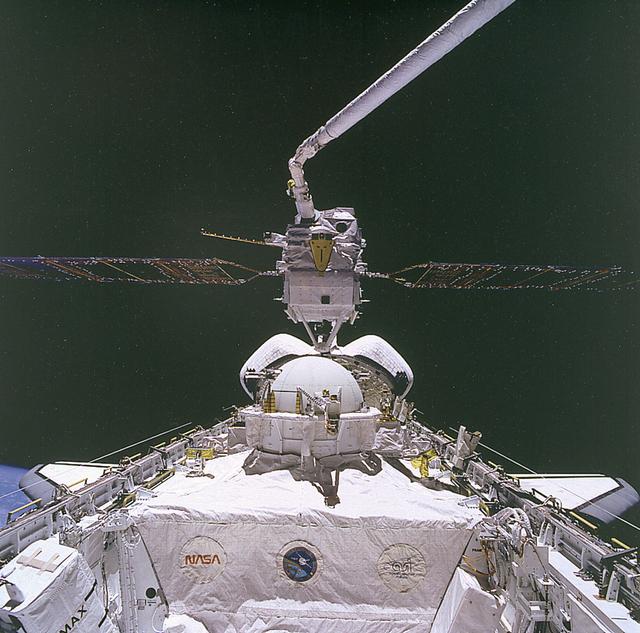
Space Shuttle Atlantis (STS-46) onboard photo of the Tethered Satellite System (TSS-1) on deployer boom. The Tethered Satellite System (TSS) was a cooperative development effort by the Italian Space Agency (ASI) and NASA made capable of deploying and retrieving a satellite which is attached by a wire tether from distances up to 100 km from the Orbiter. These free-flying satellites are used as observation platforms outside of the Orbiter.
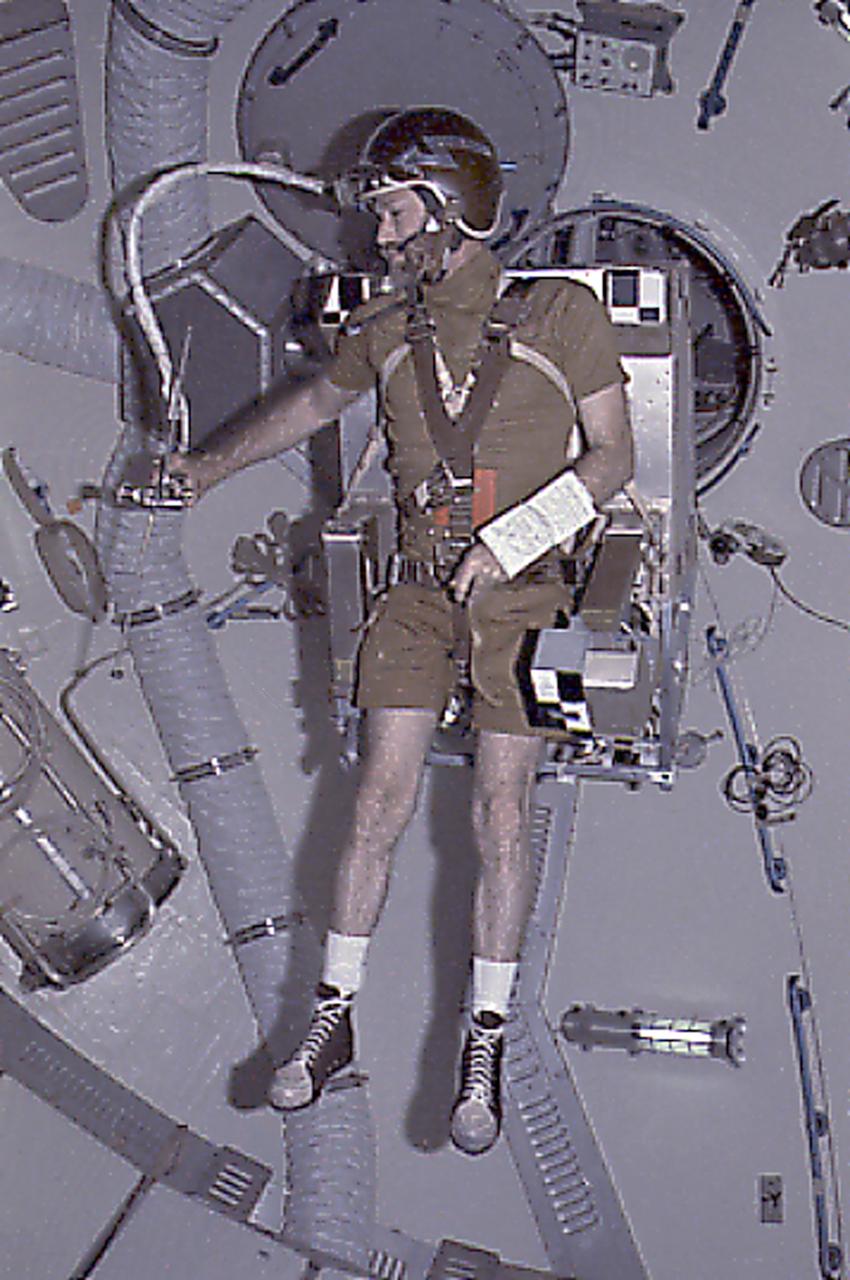
This Skylab-4 onboard photograph depicts Astronaut Gerald Carr testing Astronaut Maneuvering Equipment (M509) by flying it around under weightless conditions in the Orbital Workshop. The M509 experiment was an operational study to evaluate and conduct an in-orbit verification of the utility of various maneuvering techniques to assist astronauts in performing tasks that were representative of future extravehicular activity requirements.