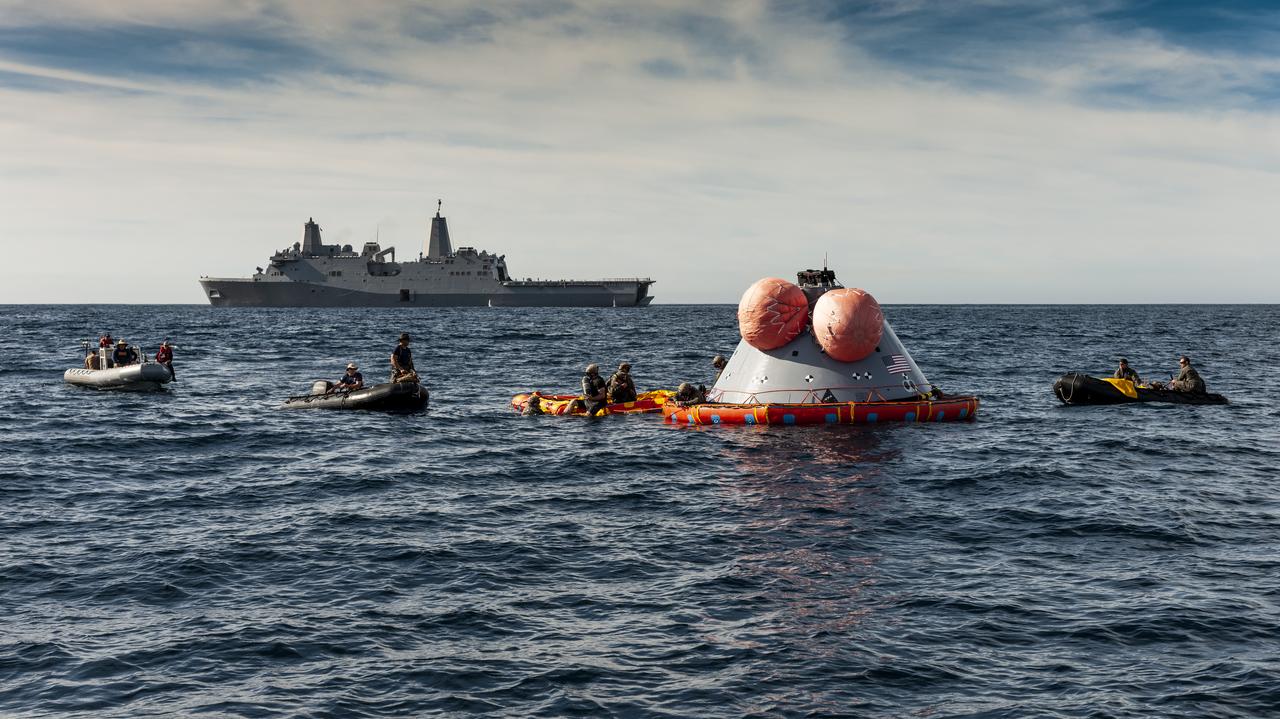
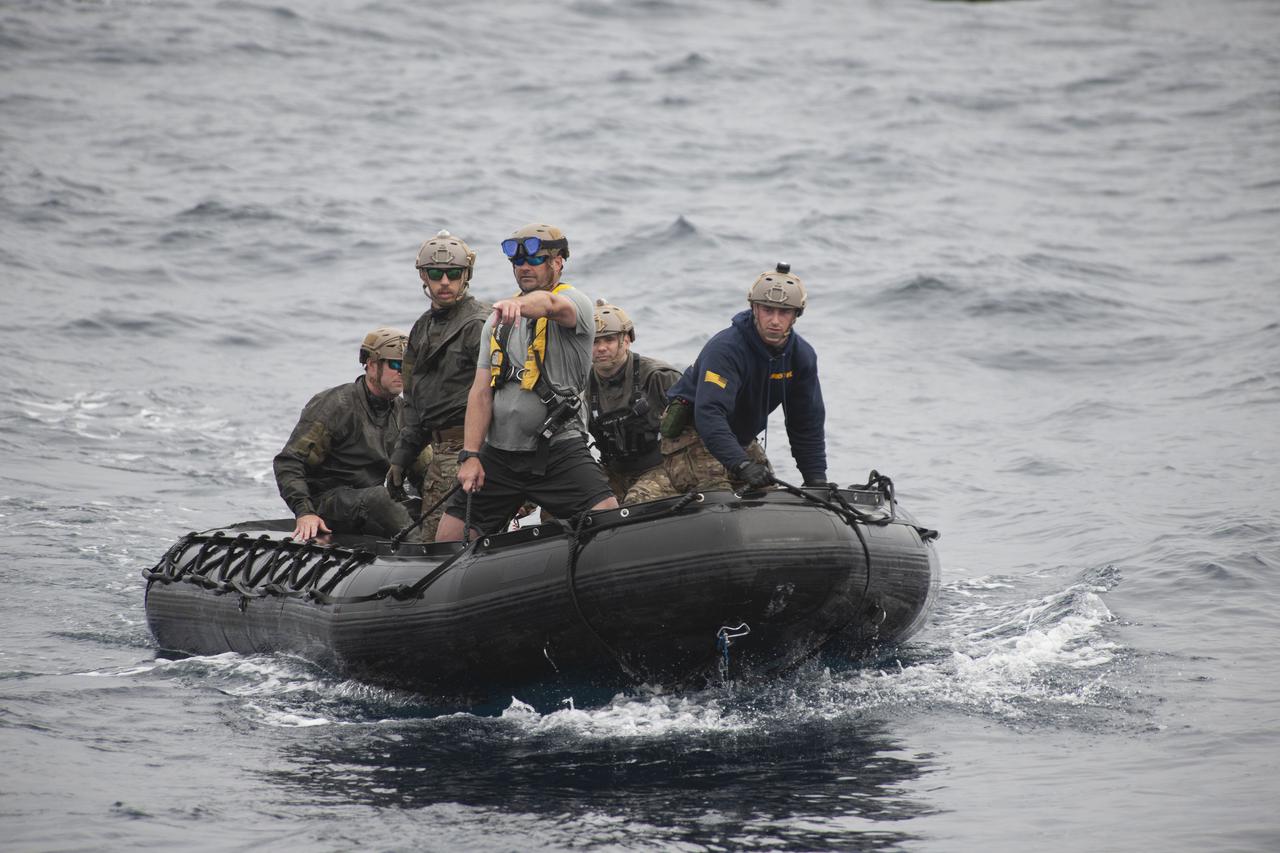
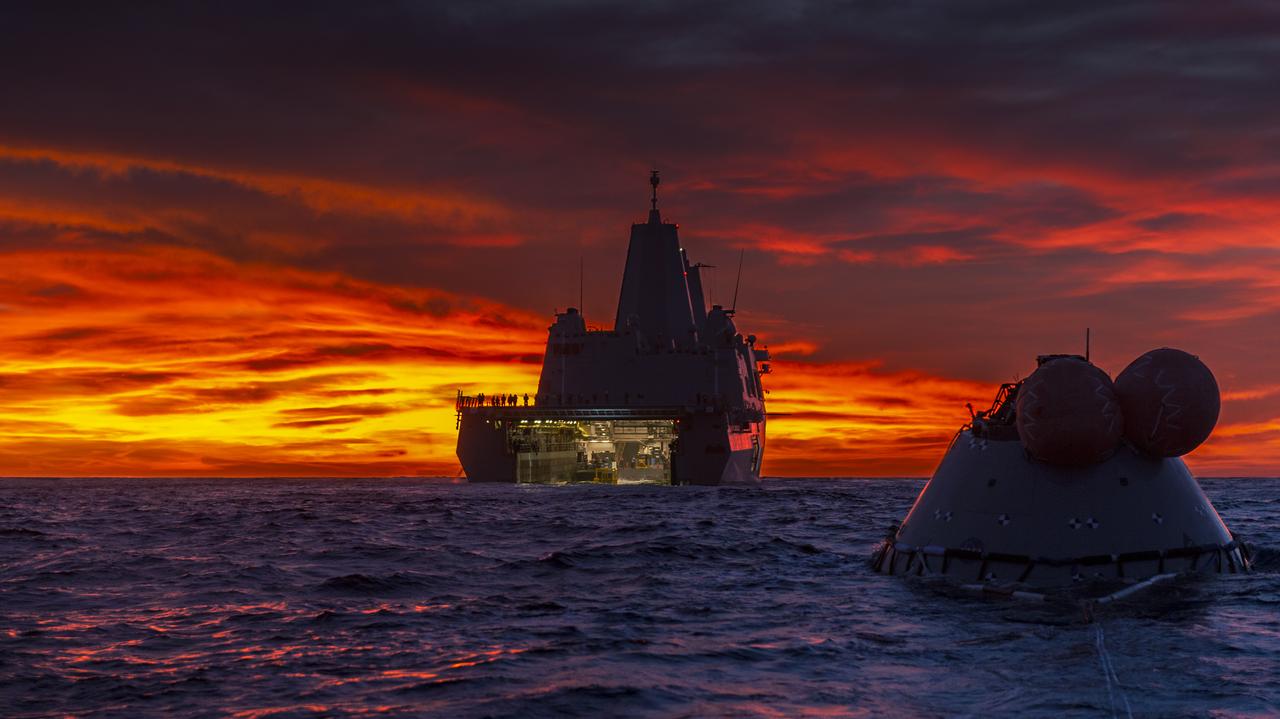
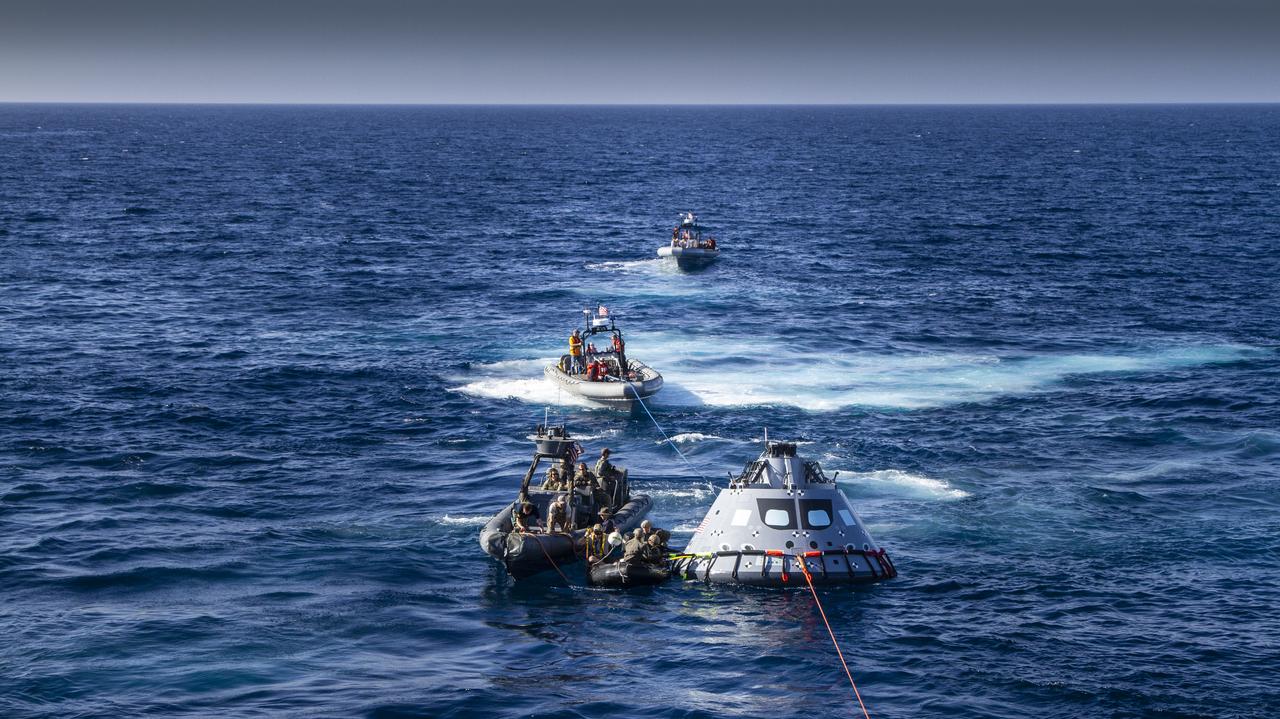
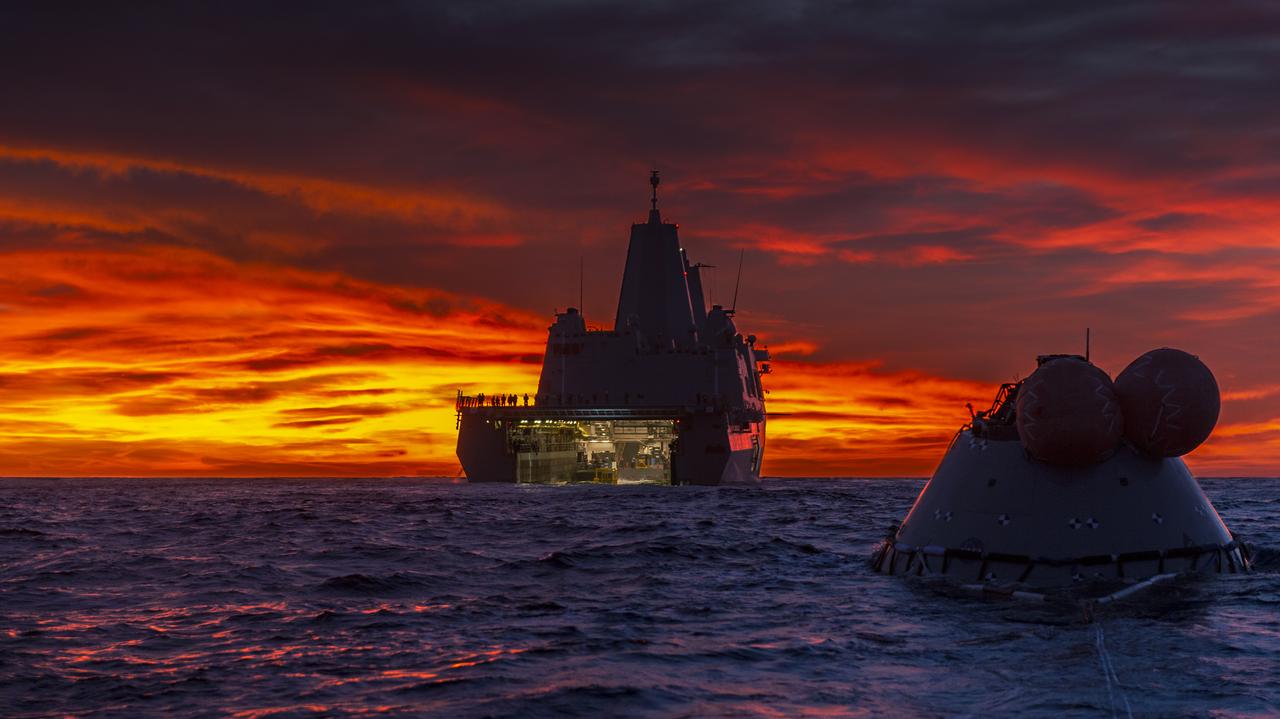
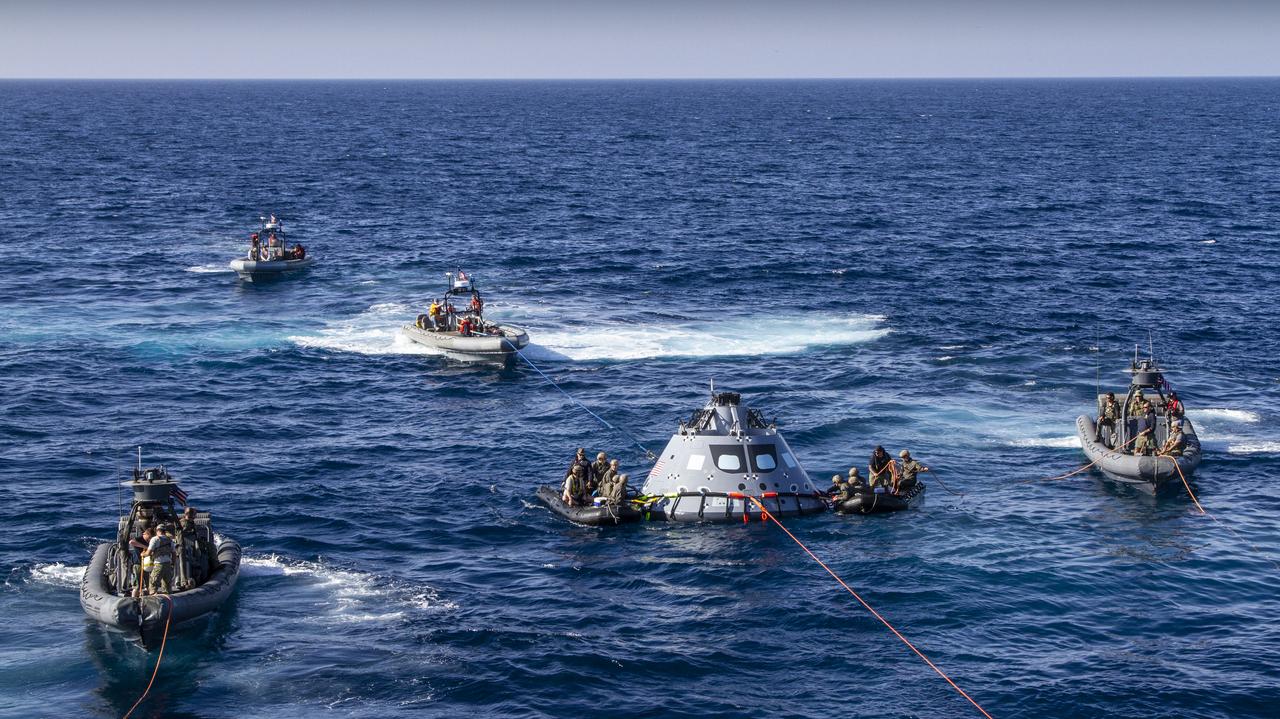
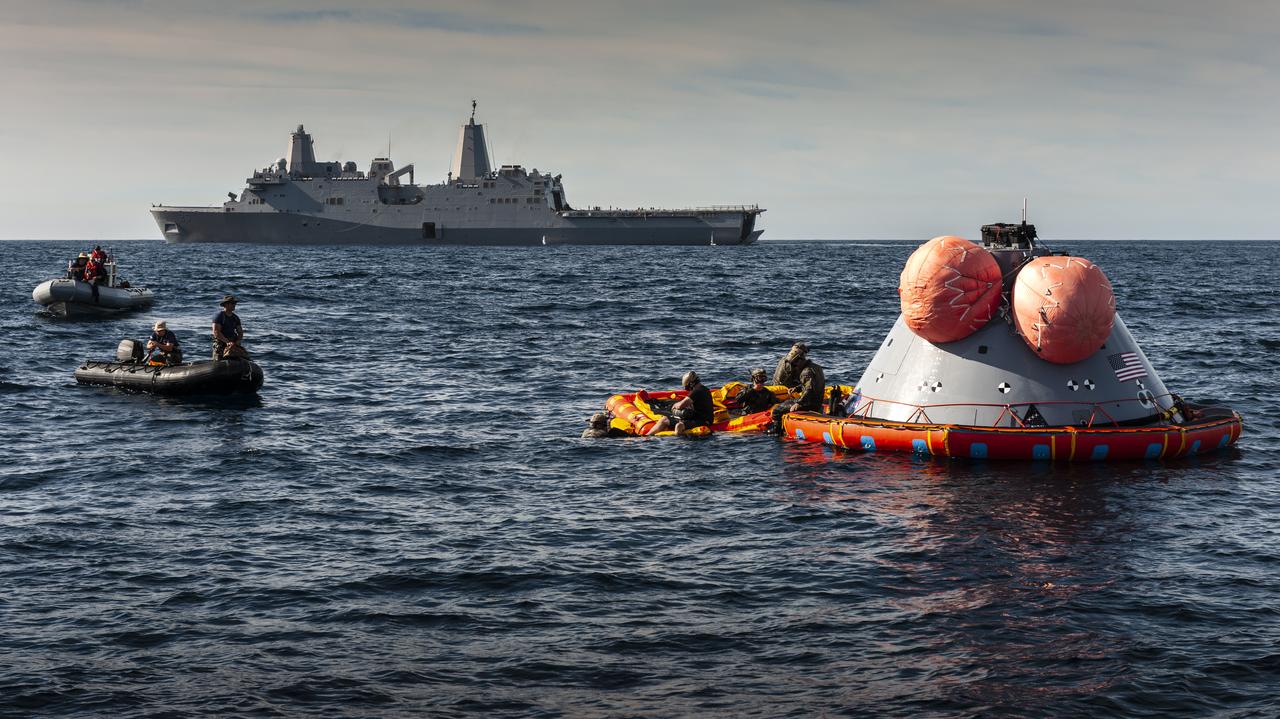
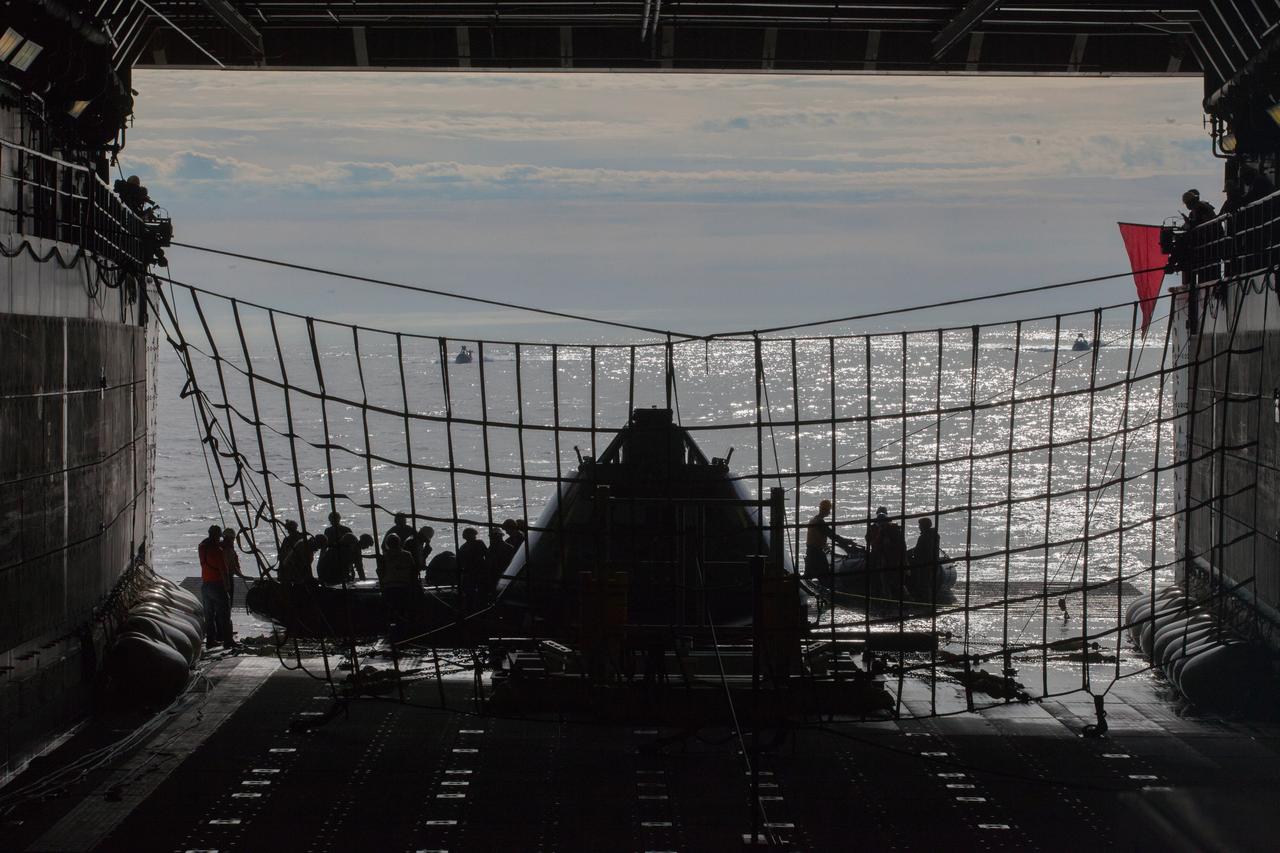
U.S. Navy divers prepare to attach the "front porch" to a test version of the Orion capsule on Nov. 1, 2018, as part of Underway Recovery Test-7 (URT-7) in the open water of the Pacific Ocean. Nearby is the USS John P. Murtha. Orion will be towed into the ship's well deck. There are two large, orange mockup uprighting bags in this view, but when Orion actually splashes down there will be five. URT-7 is one in a series of tests that the Exploration Ground Systems Recovery Team, along with the U.S. Navy, are conducting to verify and validate procedures and hardware that will be used to recover the Orion spacecraft after it splashes down in the Pacific Ocean following deep space exploration missions. Orion will have emergency abort capability, sustain the crew during space travel and provide safe re-entry from deep space return velocities.
Underway Recovery Test 7 (URT-7) - Day 3 Activities
U.S. Navy divers prepare to attach the "front porch" to a test version of the Orion capsule on Nov. 1, 2018, as part of Underway Recovery Test-7 (URT-7) in the open water of the Pacific Ocean. Nearby is the USS John P. Murtha. Orion will be towed into the ship's well deck. There are two large, orange mockup uprighting bags in this view, but when Orion actually splashes down there will be five. URT-7 is one in a series of tests that the Exploration Ground Systems Recovery Team, along with the U.S. Navy, are conducting to verify and validate procedures and hardware that will be used to recover the Orion spacecraft after it splashes down in the Pacific Ocean following deep space exploration missions. Orion will have emergency abort capability, sustain the crew during space travel and provide safe re-entry from deep space return velocities.
Underway Recovery Test 7 (URT-7) - Day 3 Activities
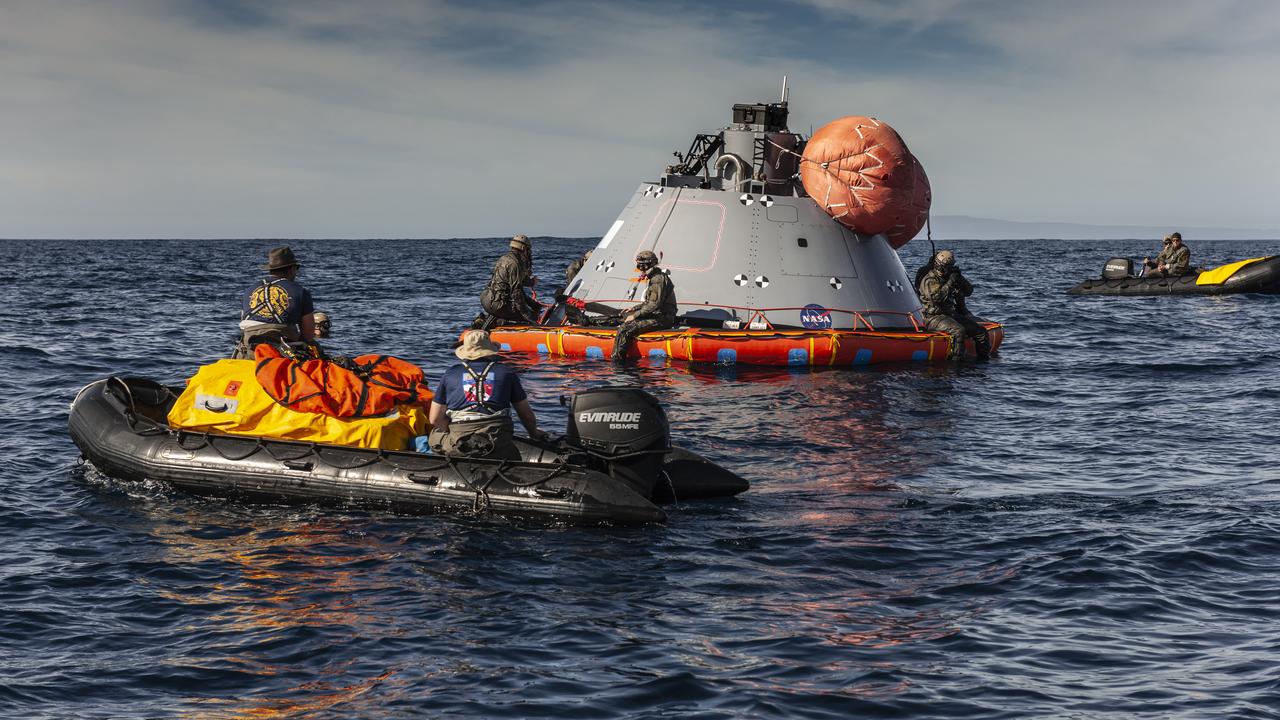
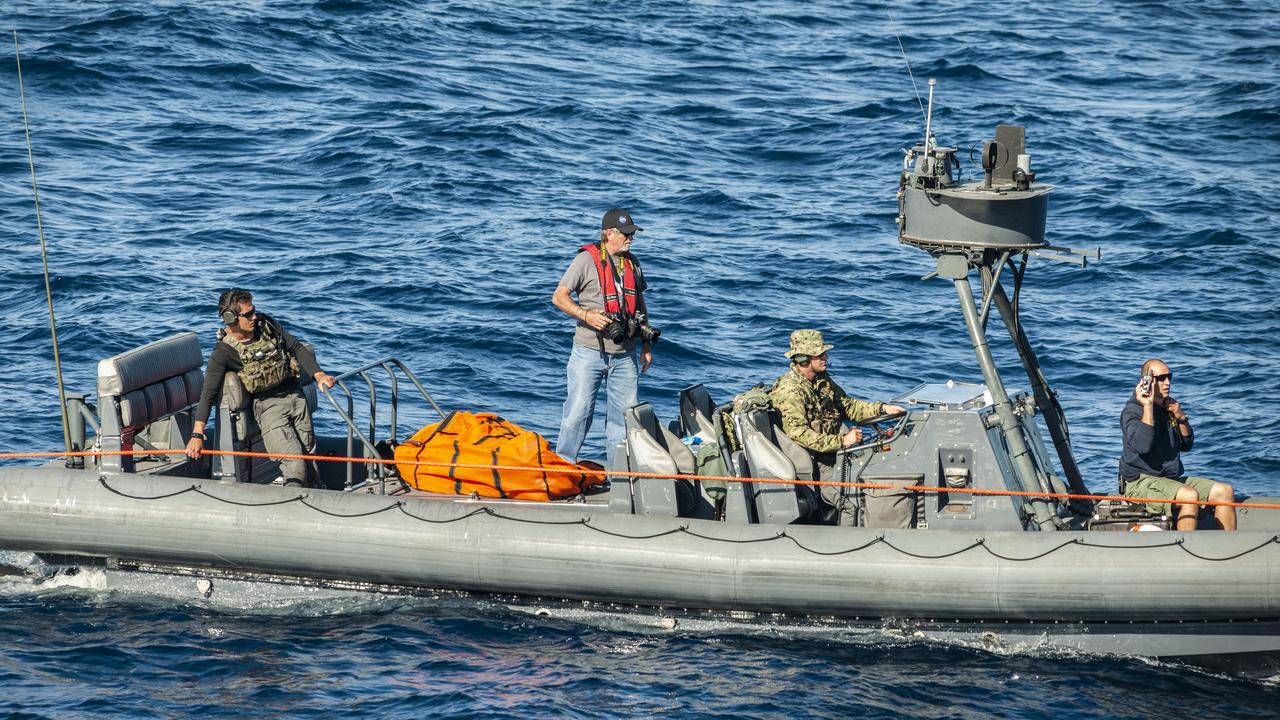
U.S. Navy divers attach the collar around a test version of the Orion capsule On Nov. 1, 2018, as part of Underway Recovery Test-7 (URT-7) in the open water of the Pacific Ocean. There are two large, orange mockup uprighting bags in this view, but when Orion actually splashes down there will be five. URT-7 is one in a series of tests that the Exploration Ground Systems Recovery Team, along with the U.S. Navy, are conducting to verify and validate procedures and hardware that will be used to recover the Orion spacecraft after it splashes down in the Pacific Ocean following deep space exploration missions. Orion will have emergency abort capability, sustain the crew during space travel and provide safe re-entry from deep space return velocities.
Underway Recovery Test 7 (URT-7) - Day 3 Activities
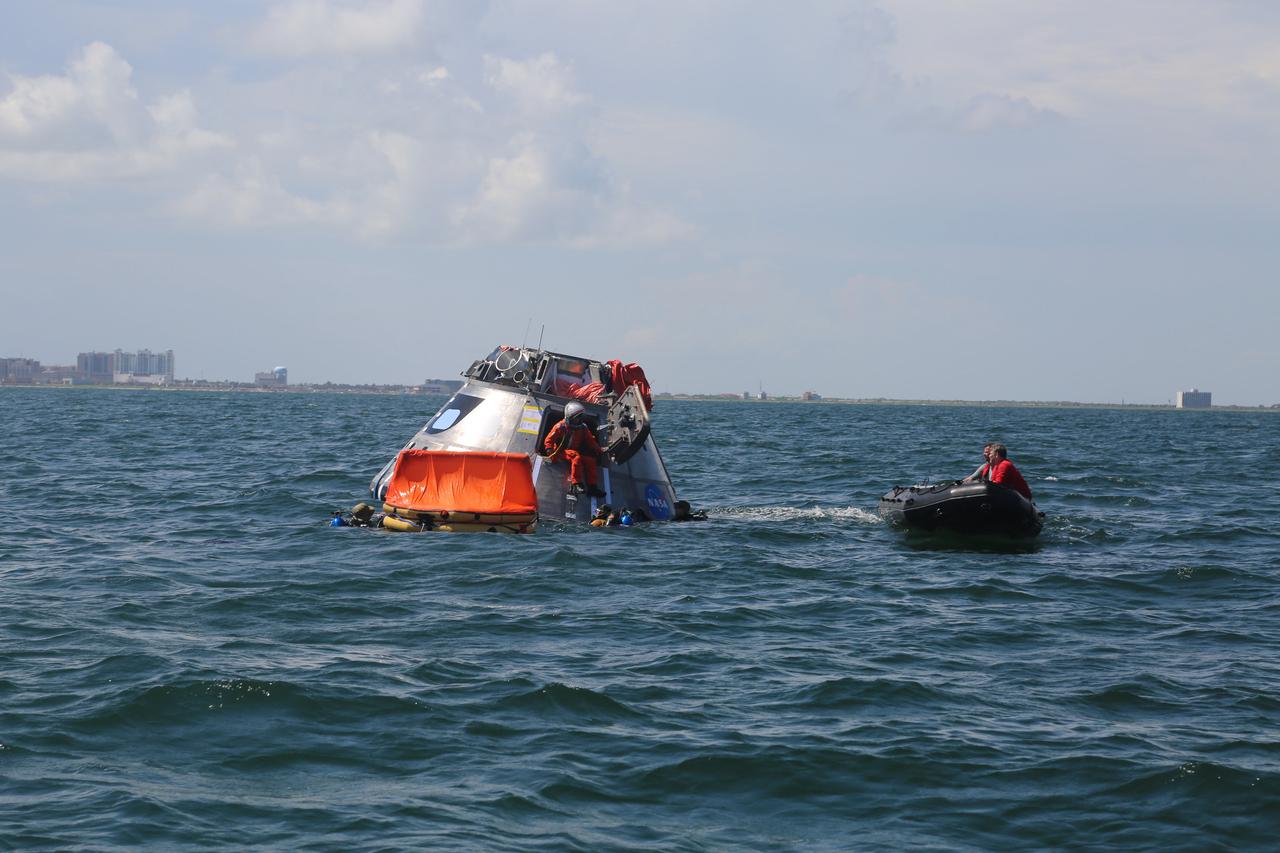
When astronauts return to Earth from destinations beyond the Moon in NASA’s Orion spacecraft and splashdown in the Pacific Ocean, they’ll still need to safely get out of the spacecraft and back on dry land. Using the waters off the coast of Galveston, Texas, a NASA and Department of Defense team test Orion exit procedures in a variety of scenarios on July 11, 2017. Part of Batch images transfer from Flickr.
Orion crew egress testing
When astronauts return to Earth from destinations beyond the Moon in NASA’s Orion spacecraft and splashdown in the Pacific Ocean, they’ll still need to safely get out of the spacecraft and back on dry land. Using the waters off the coast of Galveston, Texas, a NASA and Department of Defense team test Orion exit procedures in a variety of scenarios on July 11, 2017. Part of Batch images transfer from Flickr.
Orion crew egress testing
KENNEDY SPACE CENTER, FLA.  - A  Great Blue Heron takes flight from waters on KSC.  It is one of 310 species of birds that inhabit the National Merritt Island Wildlife Refuge, which shares a boundary with KSC.  The marshes and open water of the refuge also provide wintering areas for 23 species of migratory waterfowl, as well as a year-round home for great blue herons, great egrets, wood storks, cormorants, brown pelicans and other species of marsh and shore birds.
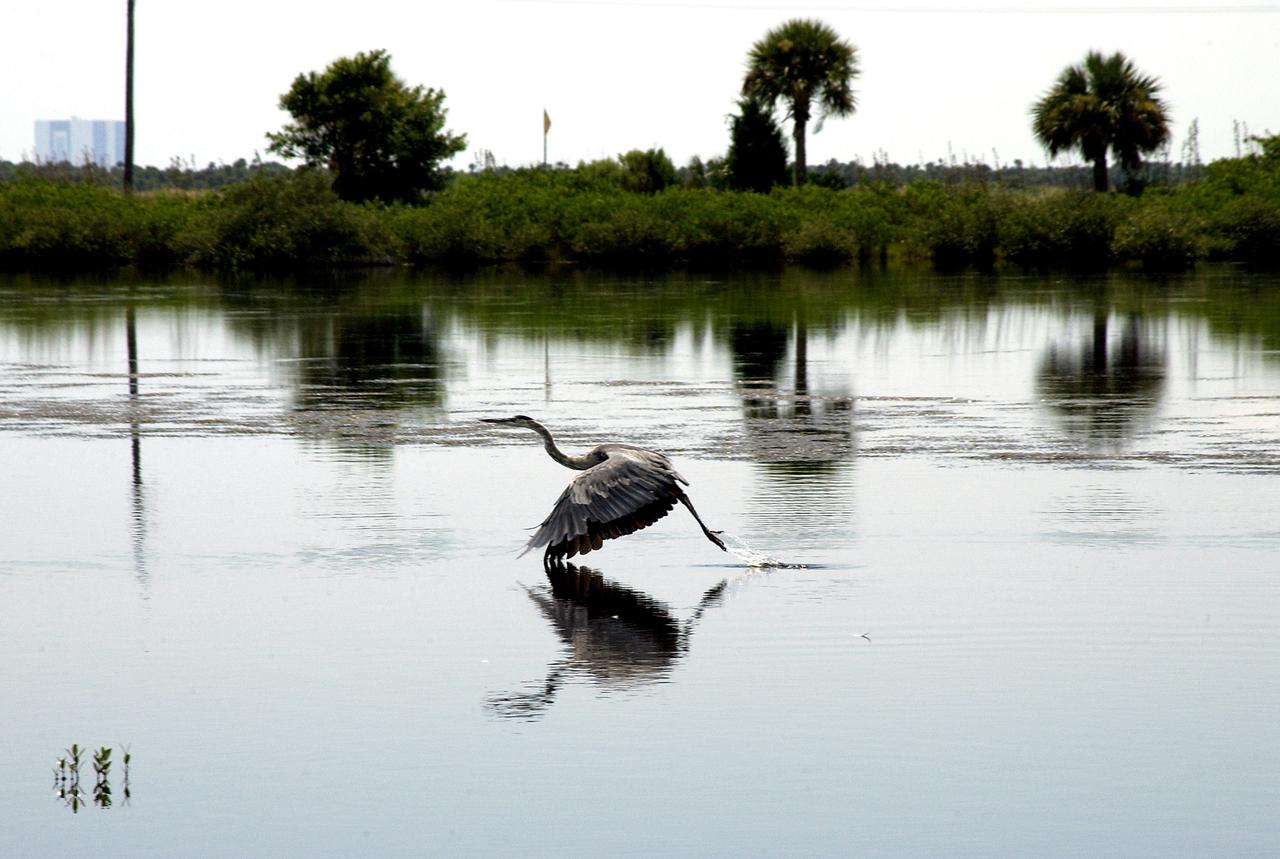
KENNEDY SPACE CENTER, FLA. - A Great Blue Heron takes flight from waters on KSC. It is one of 310 species of birds that inhabit the National Merritt Island Wildlife Refuge, which shares a boundary with KSC. The marshes and open water of the refuge also provide wintering areas for 23 species of migratory waterfowl, as well as a year-round home for great blue herons, great egrets, wood storks, cormorants, brown pelicans and other species of marsh and shore birds.
KENNEDY SPACE CENTER, FLA.  -    A great blue heron swoops down for a landing on the water near KSC.  The heron is one of 310 species of birds that inhabit the National Merritt Island Wildlife Refuge, which shares a boundary with KSC.  The marshes and open water of the refuge also provide wintering areas for 23 species of migratory waterfowl, as well as a year-round home for great blue herons, great egrets, wood storks, cormorants, brown pelicans and other species of marsh and shore birds.
KENNEDY SPACE CENTER, FLA. - A great blue heron swoops down for a landing on the water near KSC. The heron is one of 310 species of birds that inhabit the National Merritt Island Wildlife Refuge, which shares a boundary with KSC. The marshes and open water of the refuge also provide wintering areas for 23 species of migratory waterfowl, as well as a year-round home for great blue herons, great egrets, wood storks, cormorants, brown pelicans and other species of marsh and shore birds.
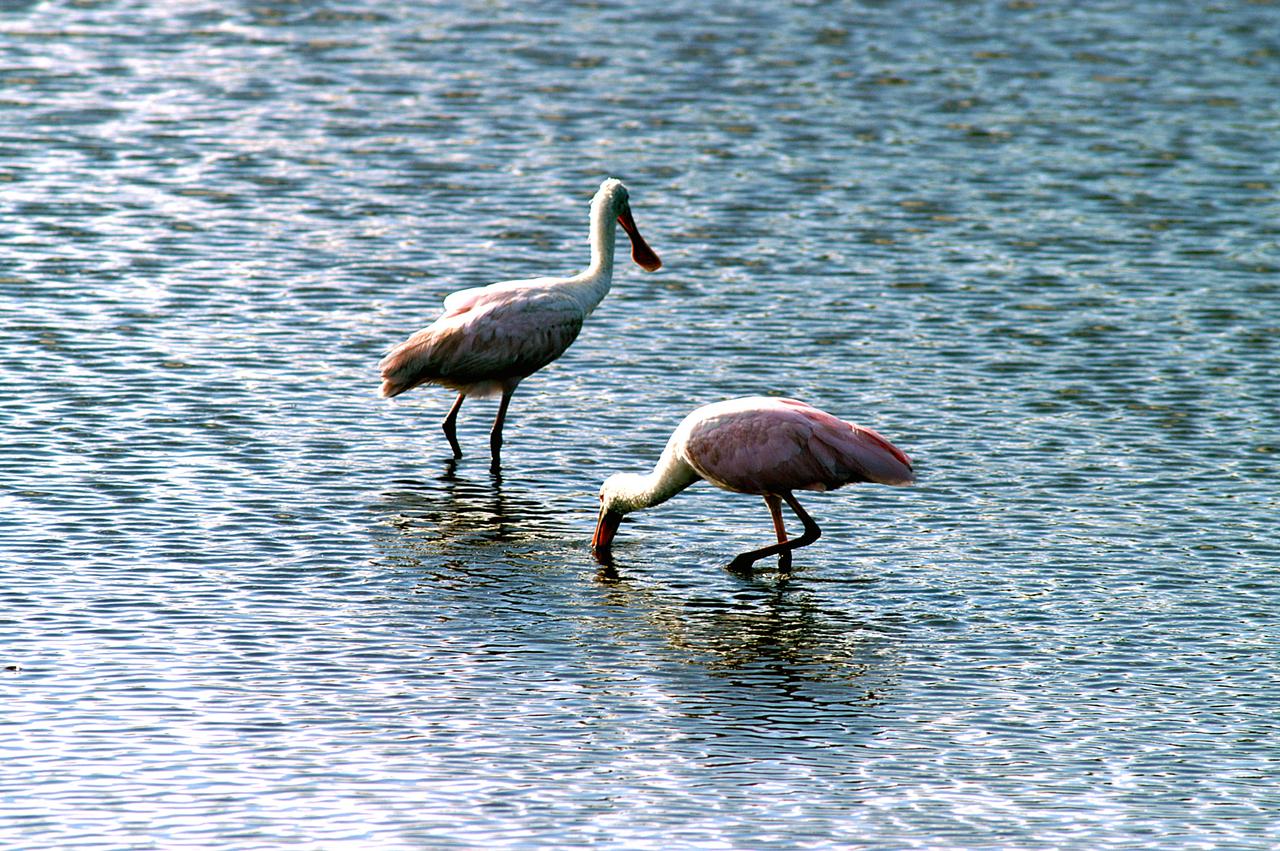
KENNEDY SPACE CENTER, FLA. -- Two roseate spoonbills hunt for their supper in the water near KSC. Spoonbills prefer to inhabit mangroves, ranging from the coasts of southern Florida, Louisiana and Texas, to the West Indies, Mexico, Central and South America. They feed on shrimps and fish in shallow waters. Spoonbills are one of 310 species of birds that inhabit the National Merritt Island Wildlife Refuge, which shares a boundary with KSC. The marshes and open water of the refuge also provide wintering areas for 23 species of migratory waterfowl, as well as a year-round home for great blue herons, great egrets, wood storks, cormorants, brown pelicans and other species of marsh and shore birds.
KENNEDY SPACE CENTER, FLA.   -  A roseate spoonbill flies across the water near KSC.  Spoonbills prefer to inhabit mangroves, ranging from the coasts of southern Florida, Louisiana and Texas, to the West Indies, Mexico, Central and South America.  They feed on shrimps and fish in shallow waters.   Spoonbills are one of 310 species of birds that inhabit the National Merritt Island Wildlife Refuge, which shares a boundary with KSC.  The marshes and open water of the refuge also provide wintering areas for 23 species of migratory waterfowl, as well as a year-round home for great blue herons, great egrets, wood storks, cormorants, brown pelicans and other species of marsh and shore birds.
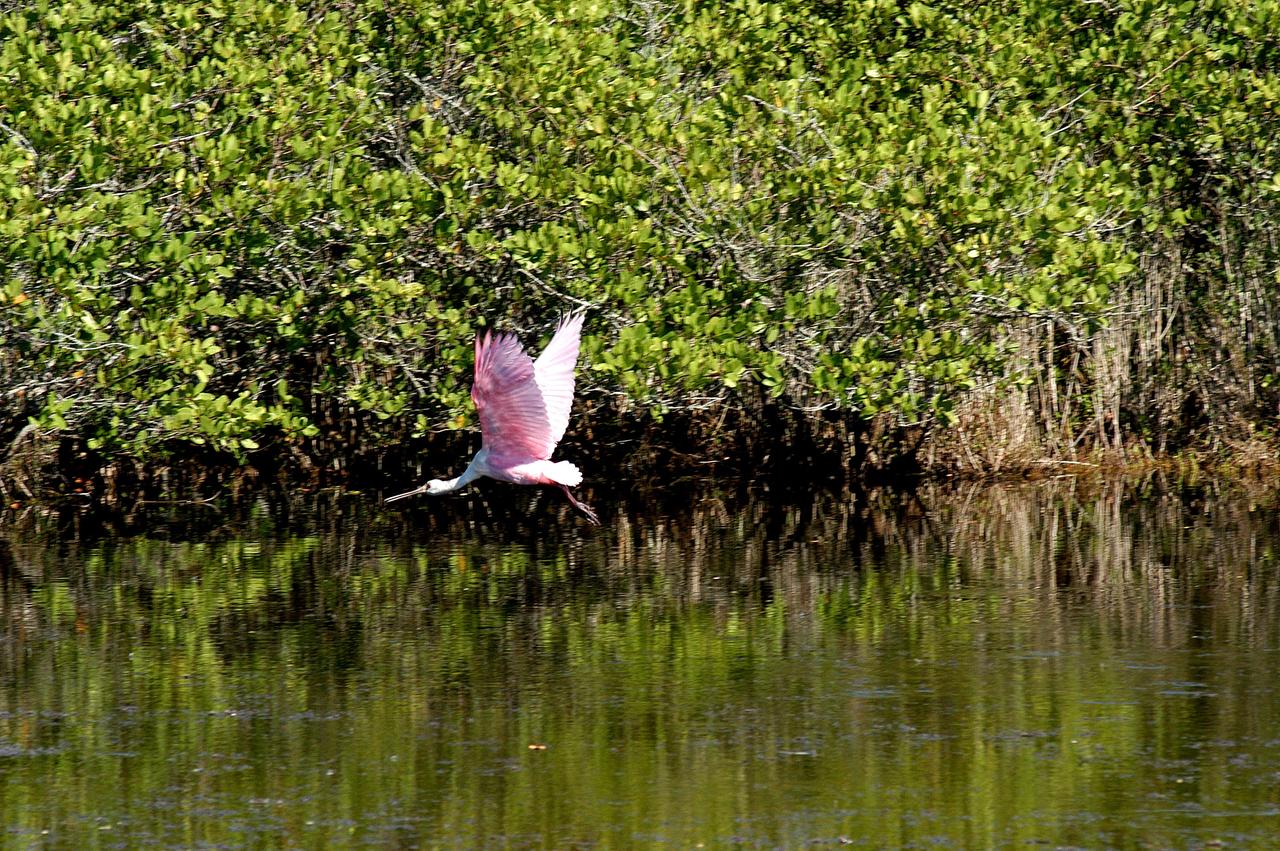
KENNEDY SPACE CENTER, FLA. - A roseate spoonbill flies across the water near KSC. Spoonbills prefer to inhabit mangroves, ranging from the coasts of southern Florida, Louisiana and Texas, to the West Indies, Mexico, Central and South America. They feed on shrimps and fish in shallow waters. Spoonbills are one of 310 species of birds that inhabit the National Merritt Island Wildlife Refuge, which shares a boundary with KSC. The marshes and open water of the refuge also provide wintering areas for 23 species of migratory waterfowl, as well as a year-round home for great blue herons, great egrets, wood storks, cormorants, brown pelicans and other species of marsh and shore birds.
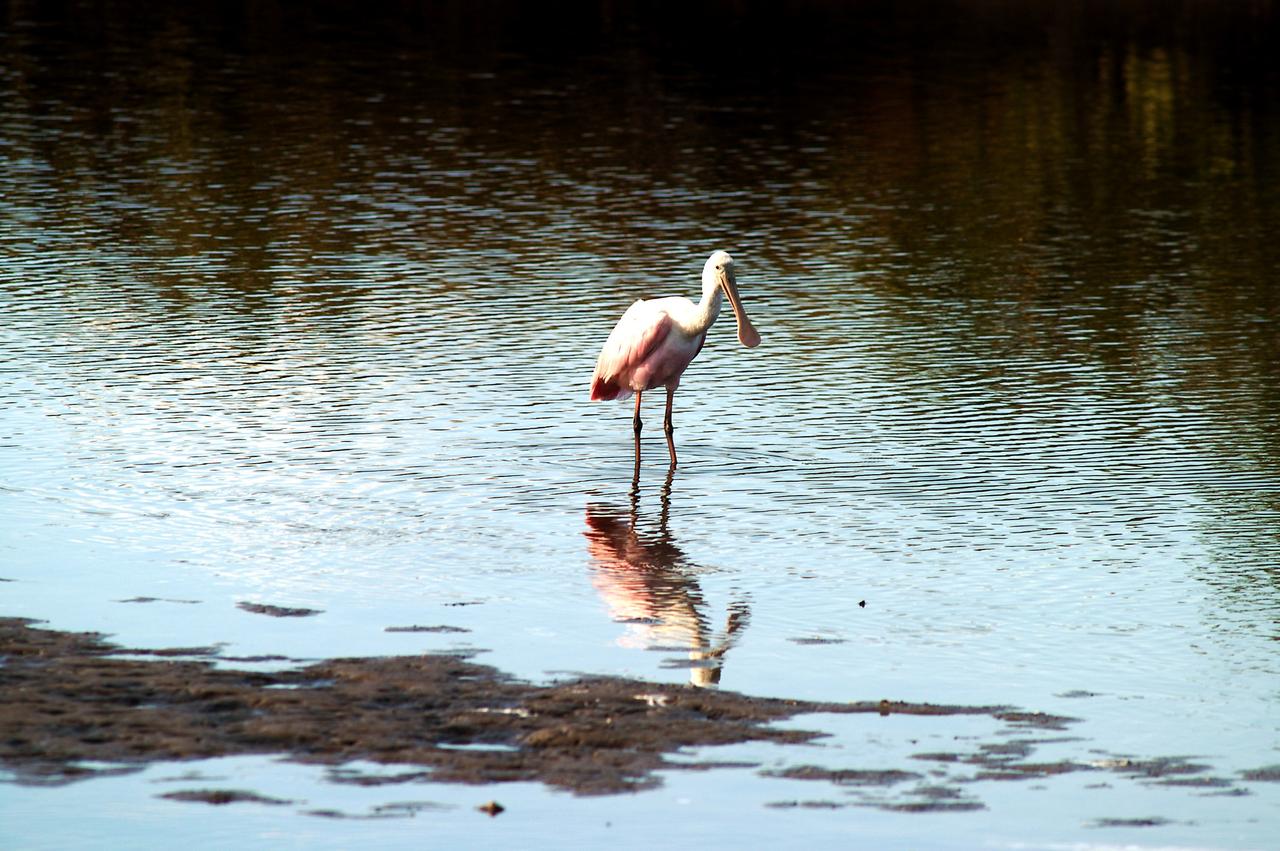
KENNEDY SPACE CENTER, FLA. -- A roseate spoonbill contemplates its reflection in the water near KSC. Spoonbills prefer to inhabit mangroves, ranging from the coasts of southern Florida, Louisiana and Texas, to the West Indies, Mexico, Central and South America. They feed on shrimps and fish in shallow waters. Spoonbills are one of 310 species of birds that inhabit the Merritt Island National Wildlife Refuge, which shares a boundary with KSC. The marshes and open water of the refuge also provide wintering areas for 23 species of migratory waterfowl, as well as a year-round home for great blue herons, great egrets, wood storks, cormorants, brown pelicans and other species of marsh and shore birds.
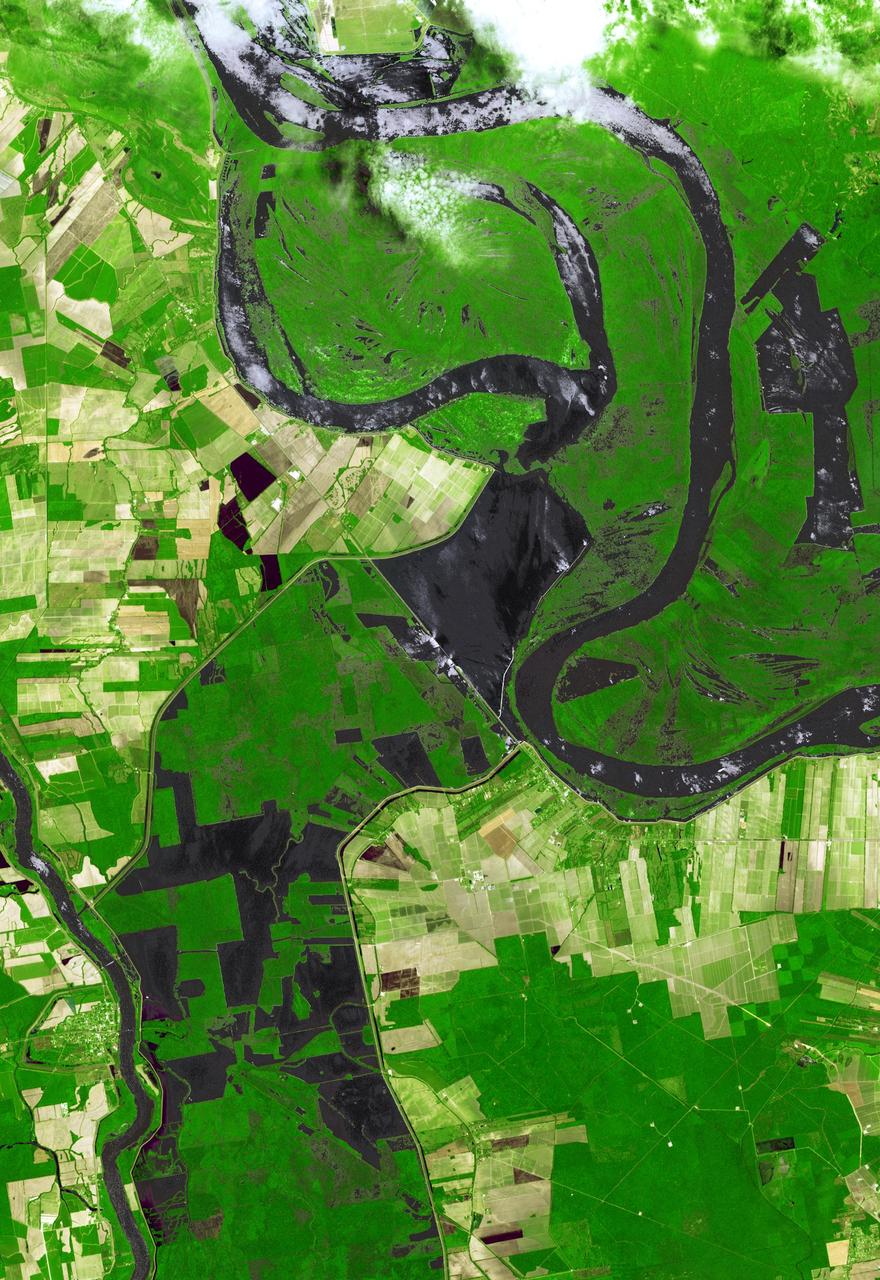
NASA Terra spacecraft shows the water flow after the U.S. Army Corps of Engineers opened the Morganza Spillway, a flood control structure along the western bank of the Mississippi River in Louisiana, to ease flooding along levee systems on May 14, 2011.
NASA Images Mississippi River Flooding in Louisiana
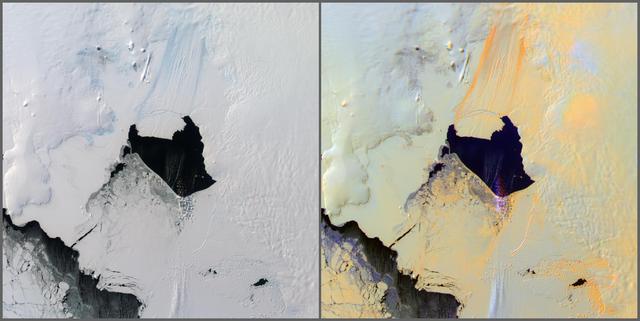
NASA Terra satellite passed over the Pine Island Glacier in Antarctica around Oct. 27, 2013, just days before iceberg B-31 broke completely free. B-31 is finally moving away from the coast, with open water between the iceberg and the glacier.
Pine Island Glacier, Antarctica, MISR Multi-angle Composite
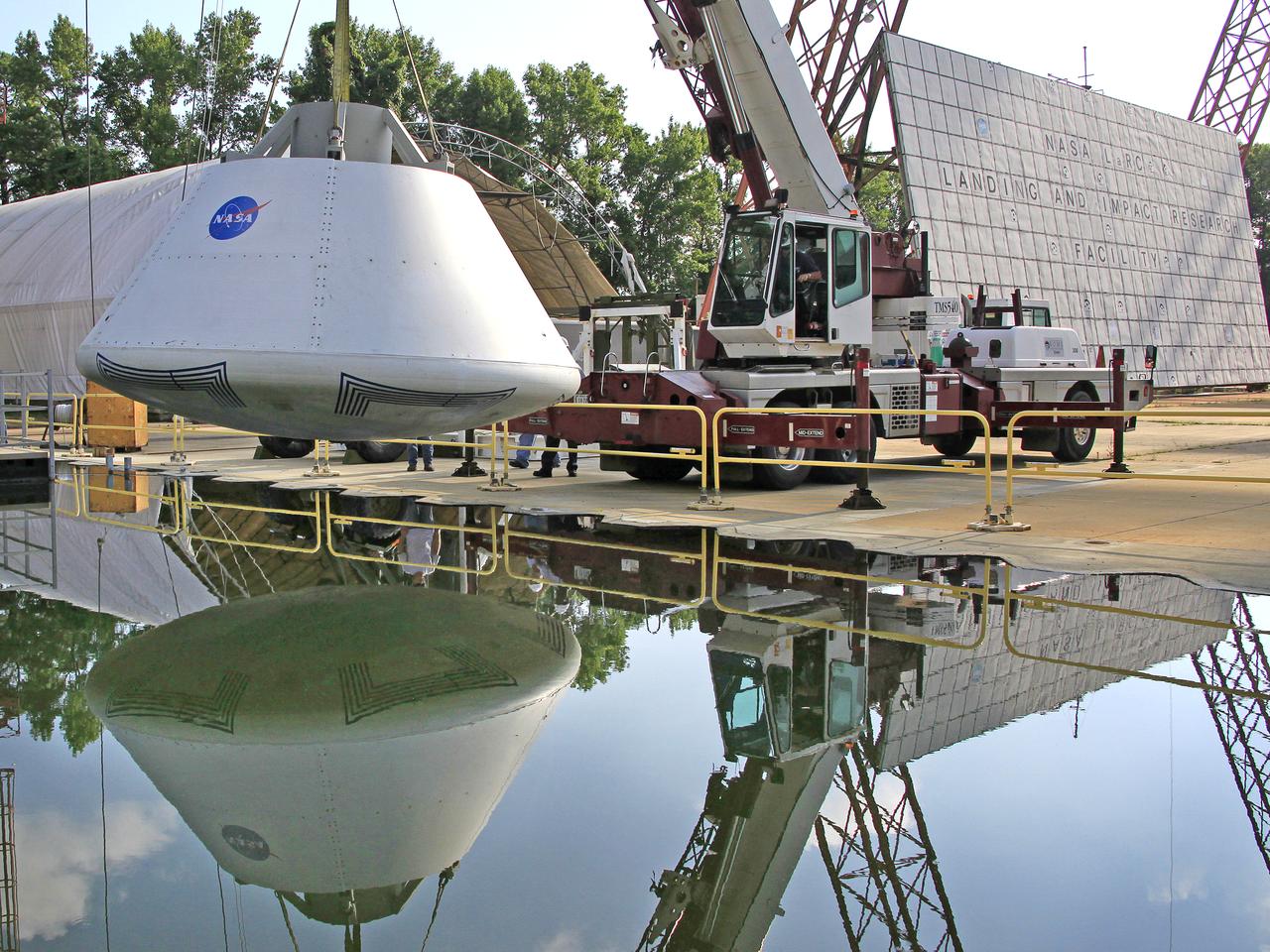
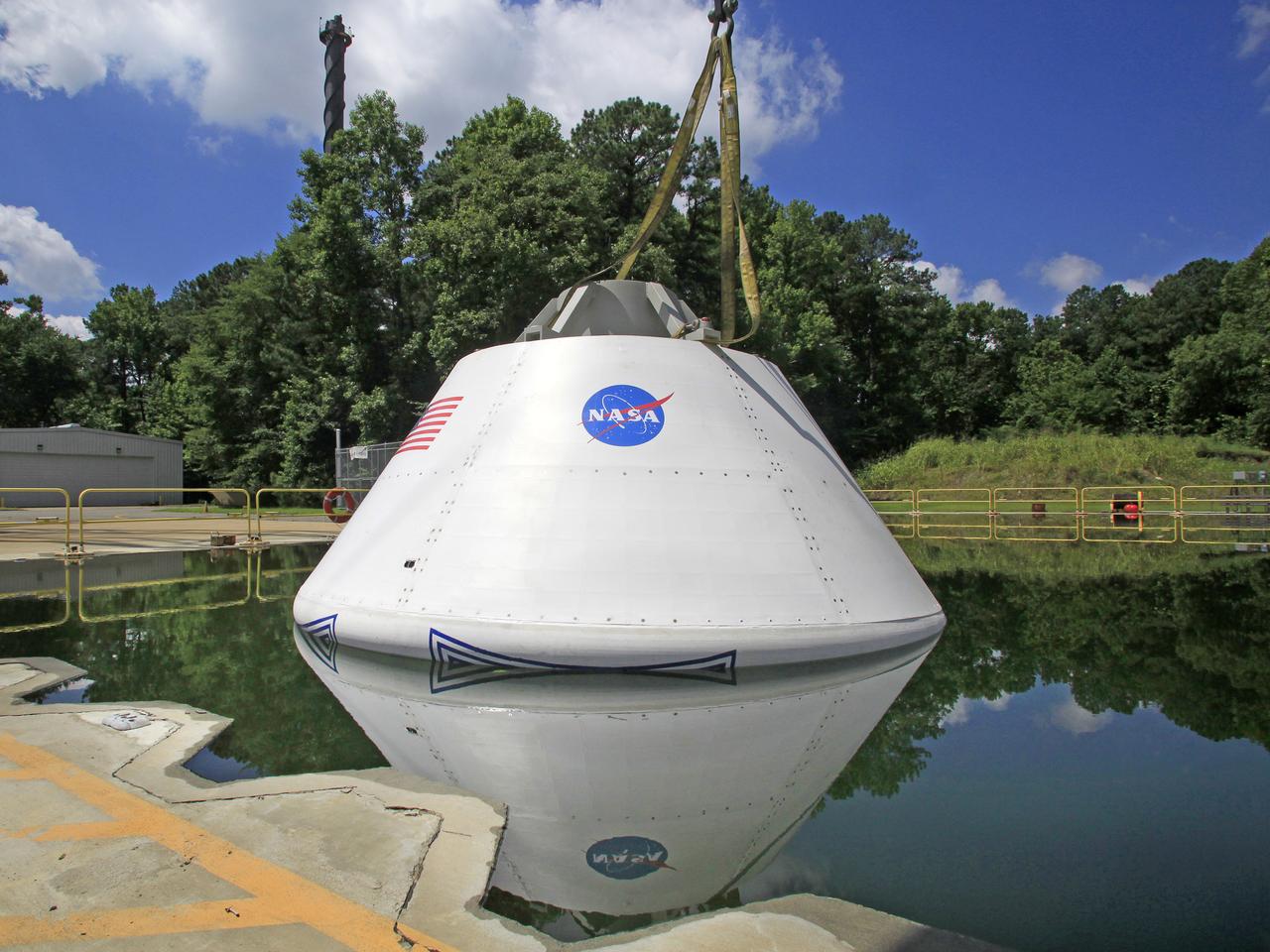
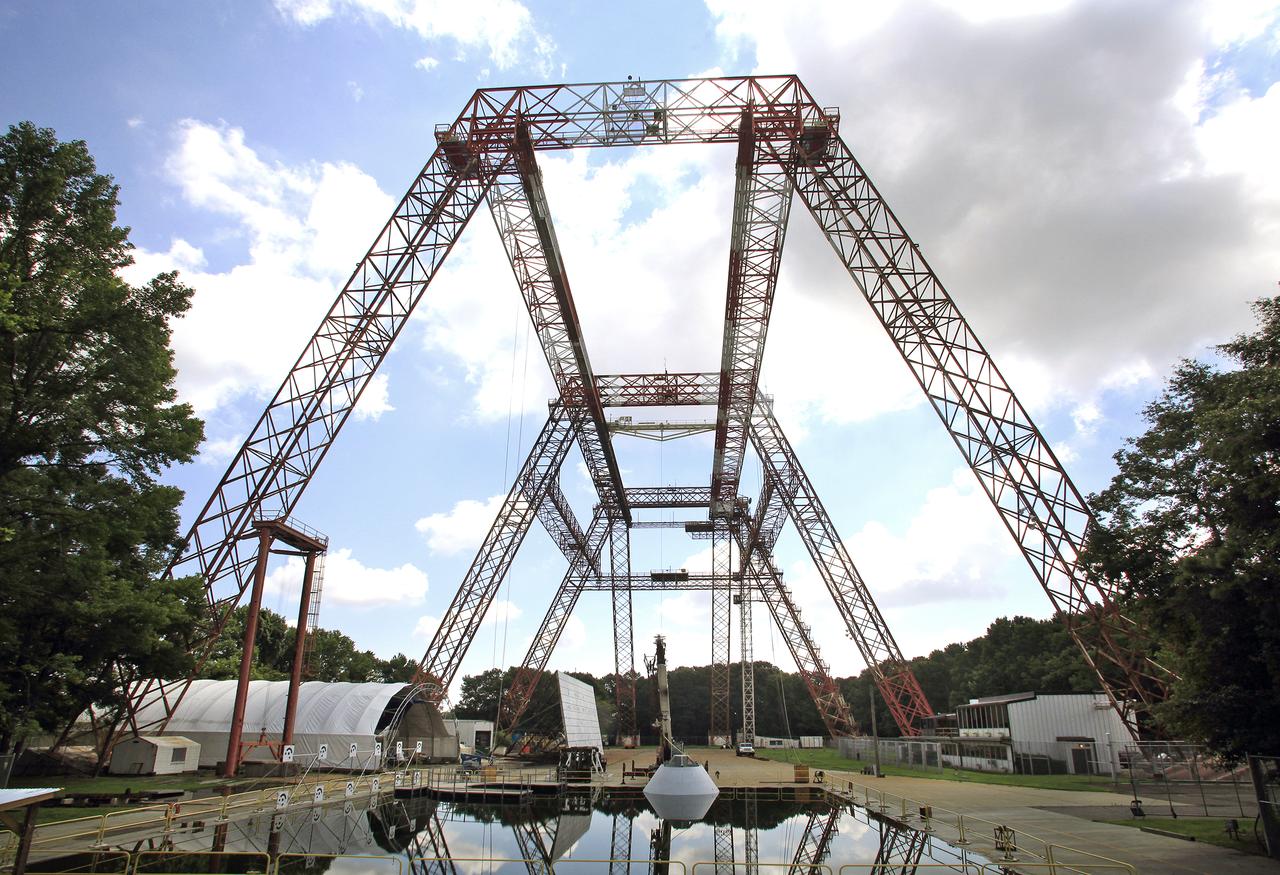
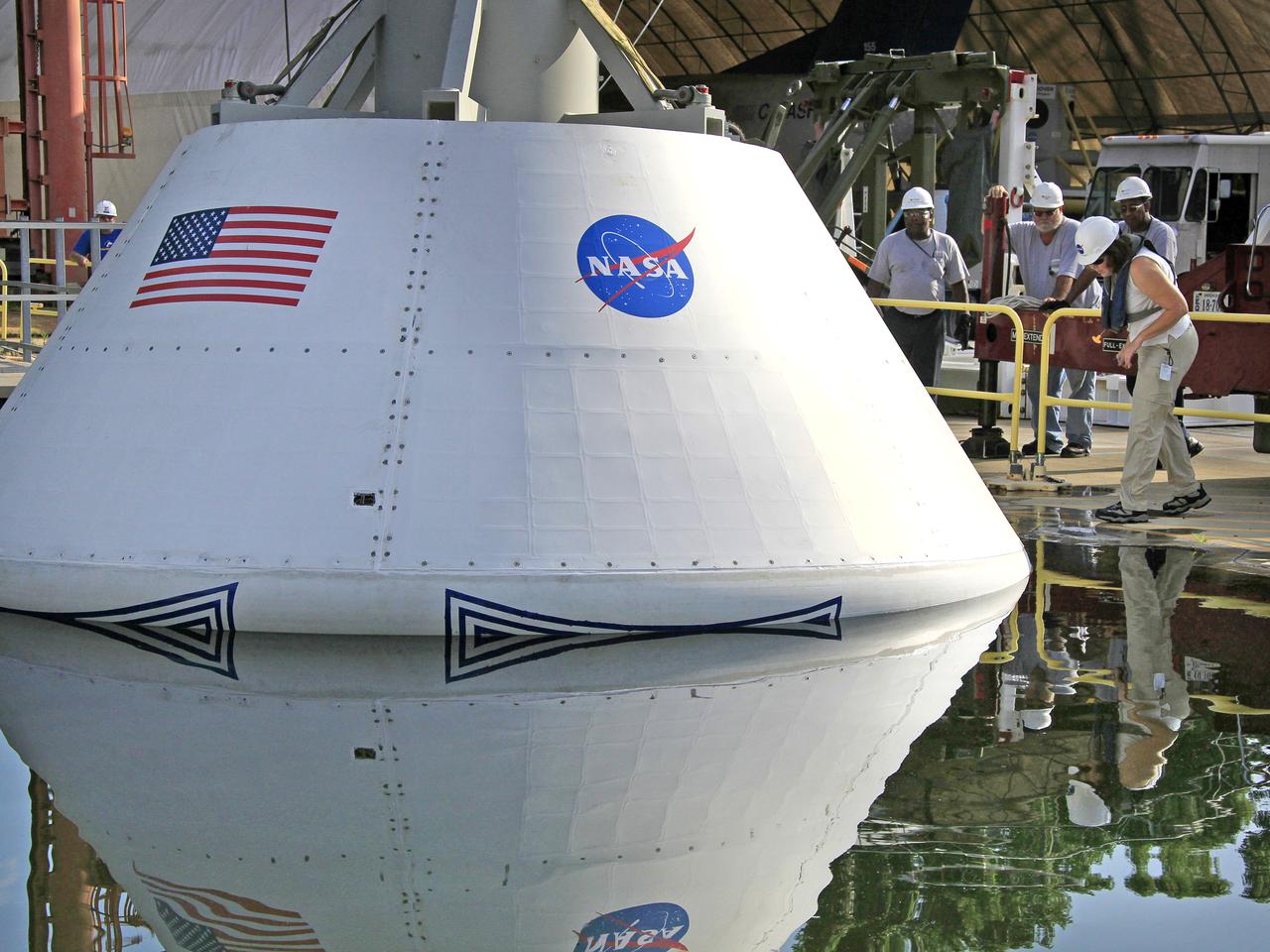
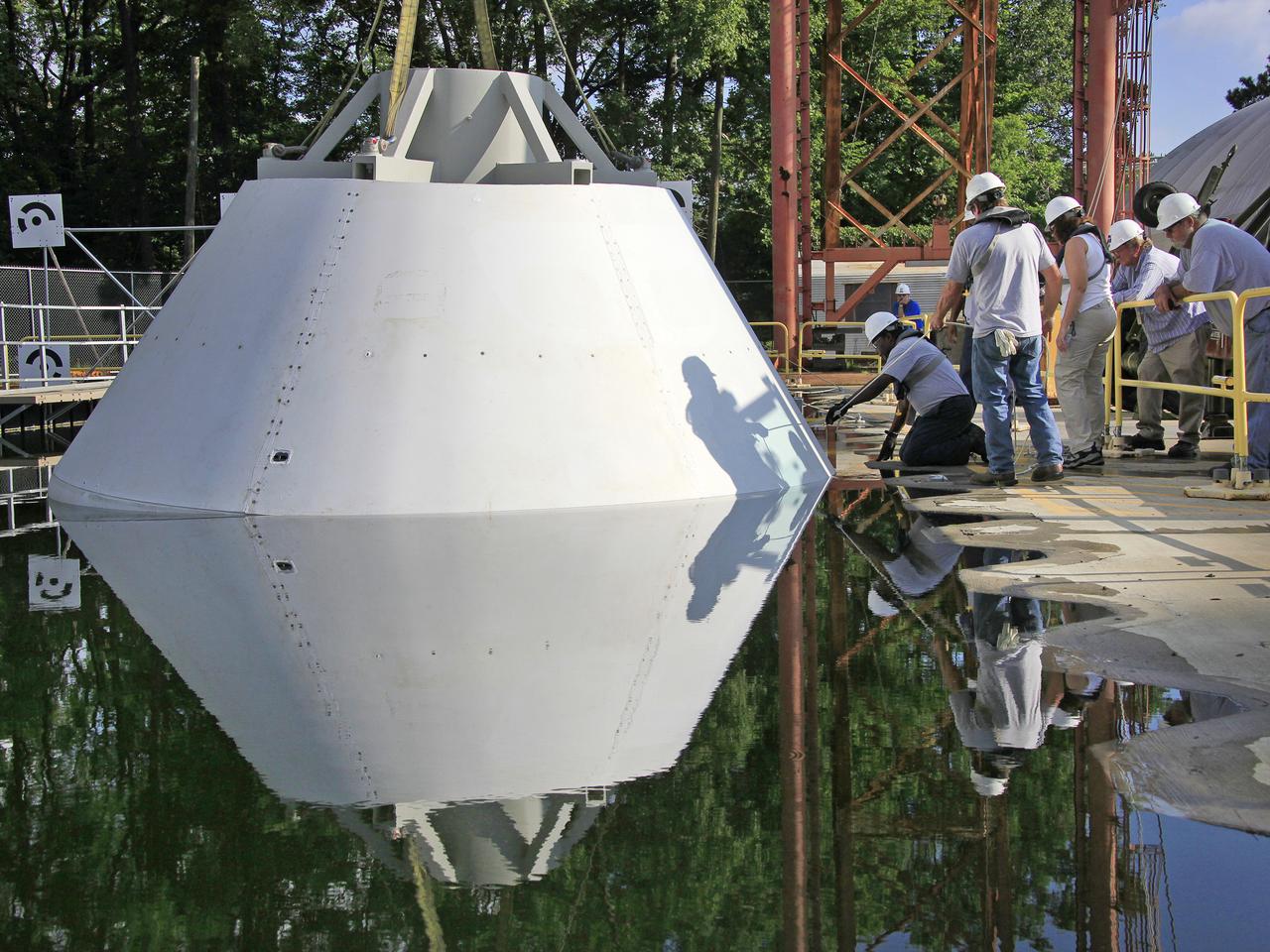
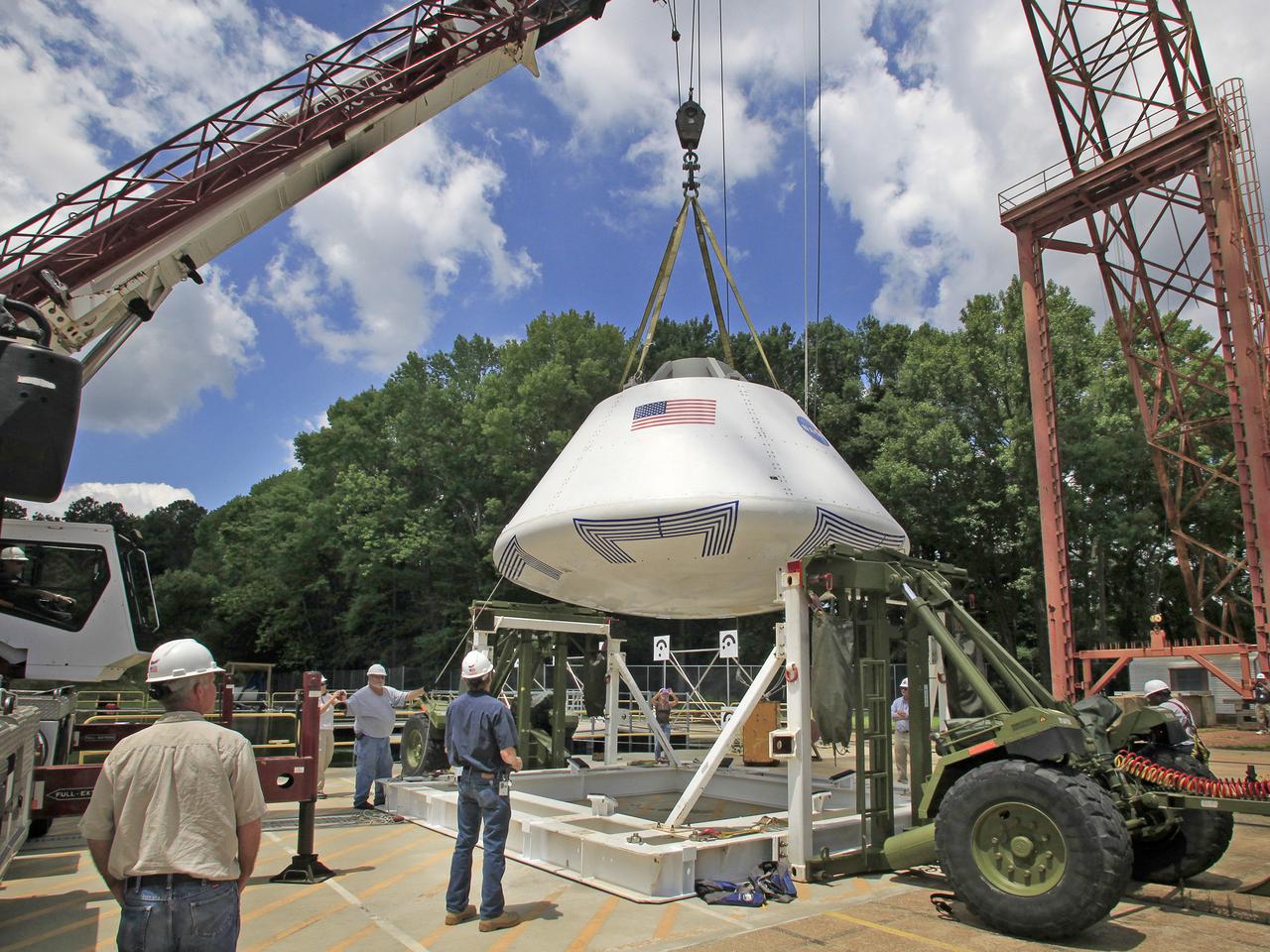
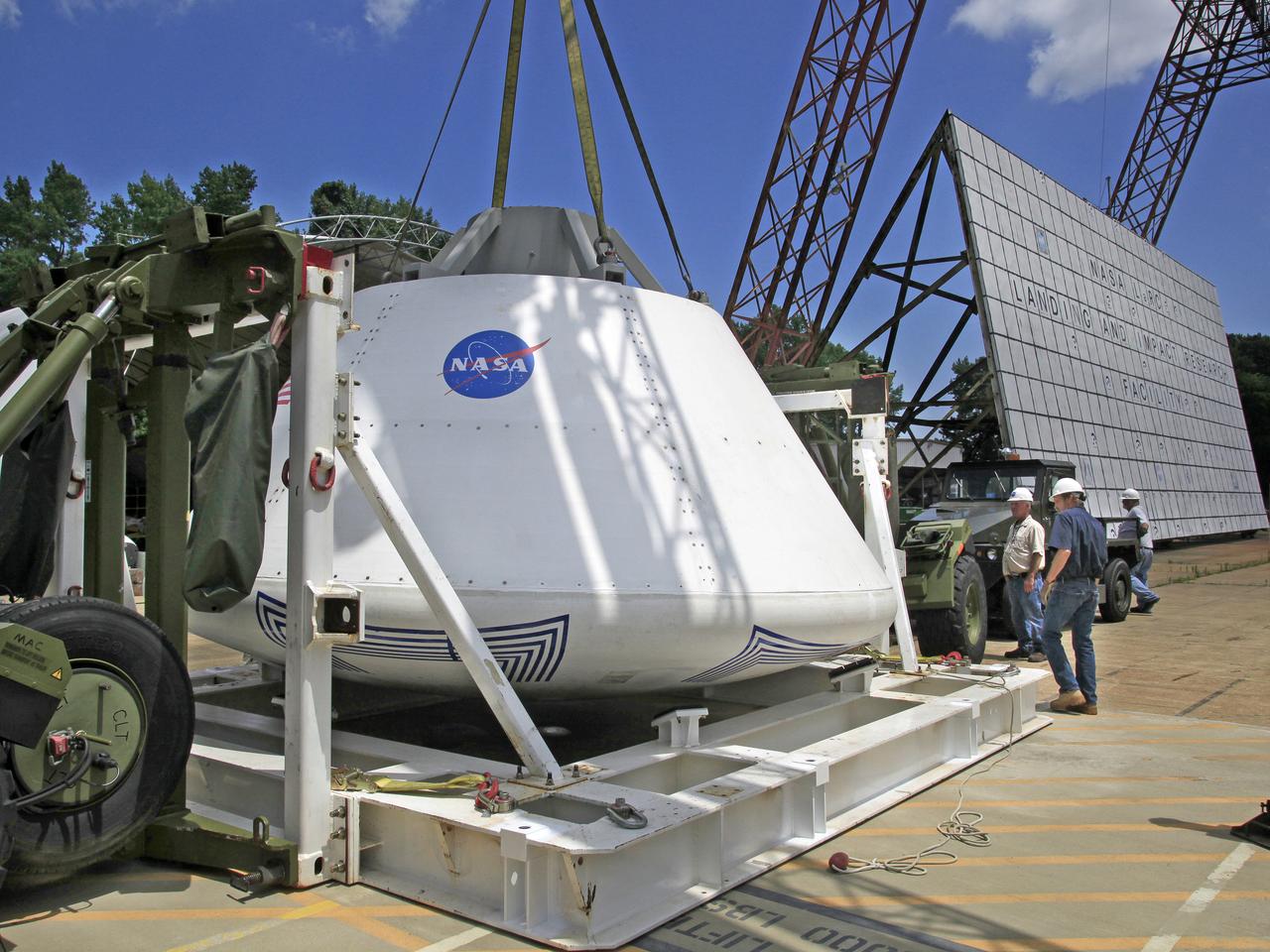
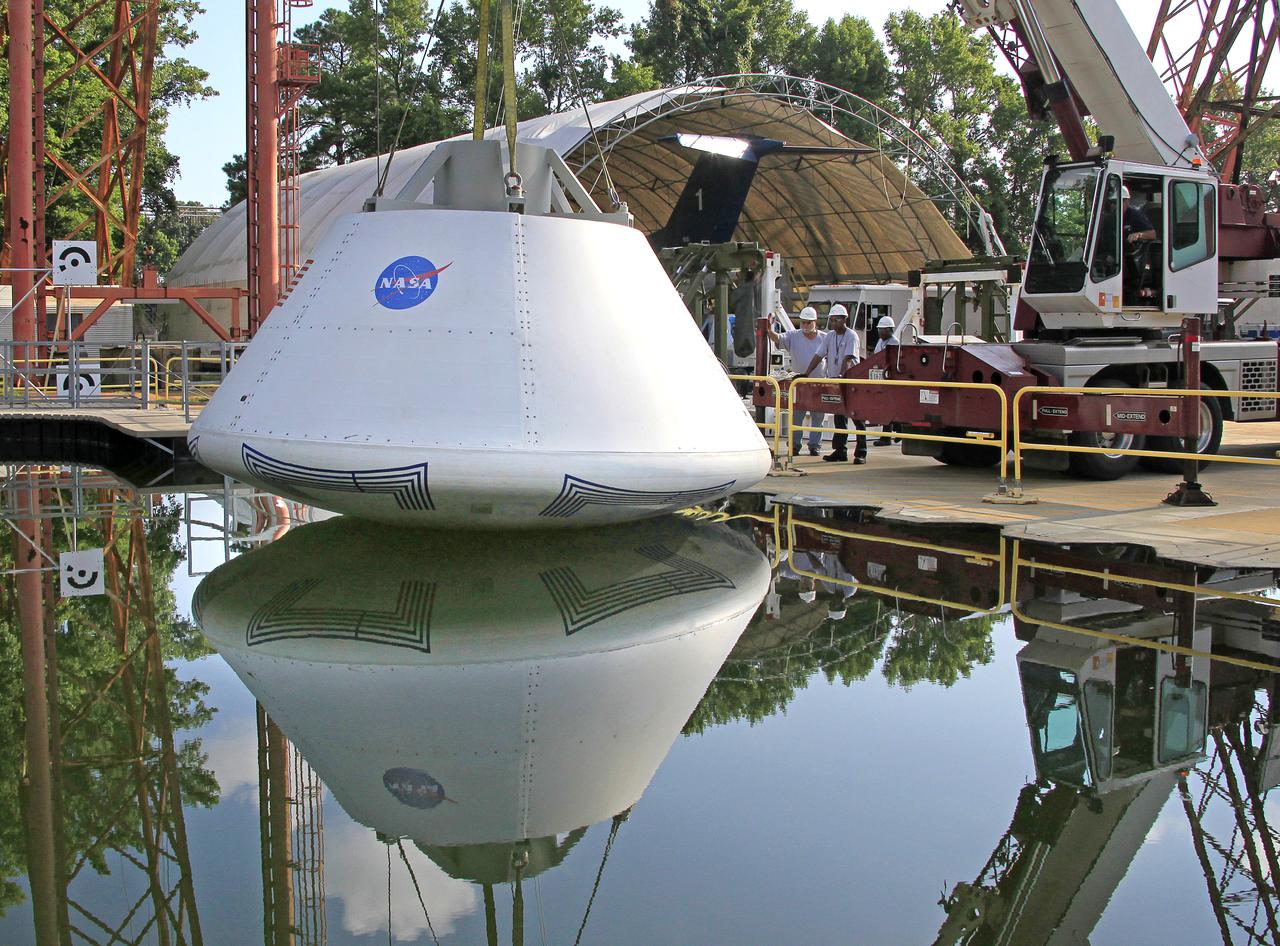
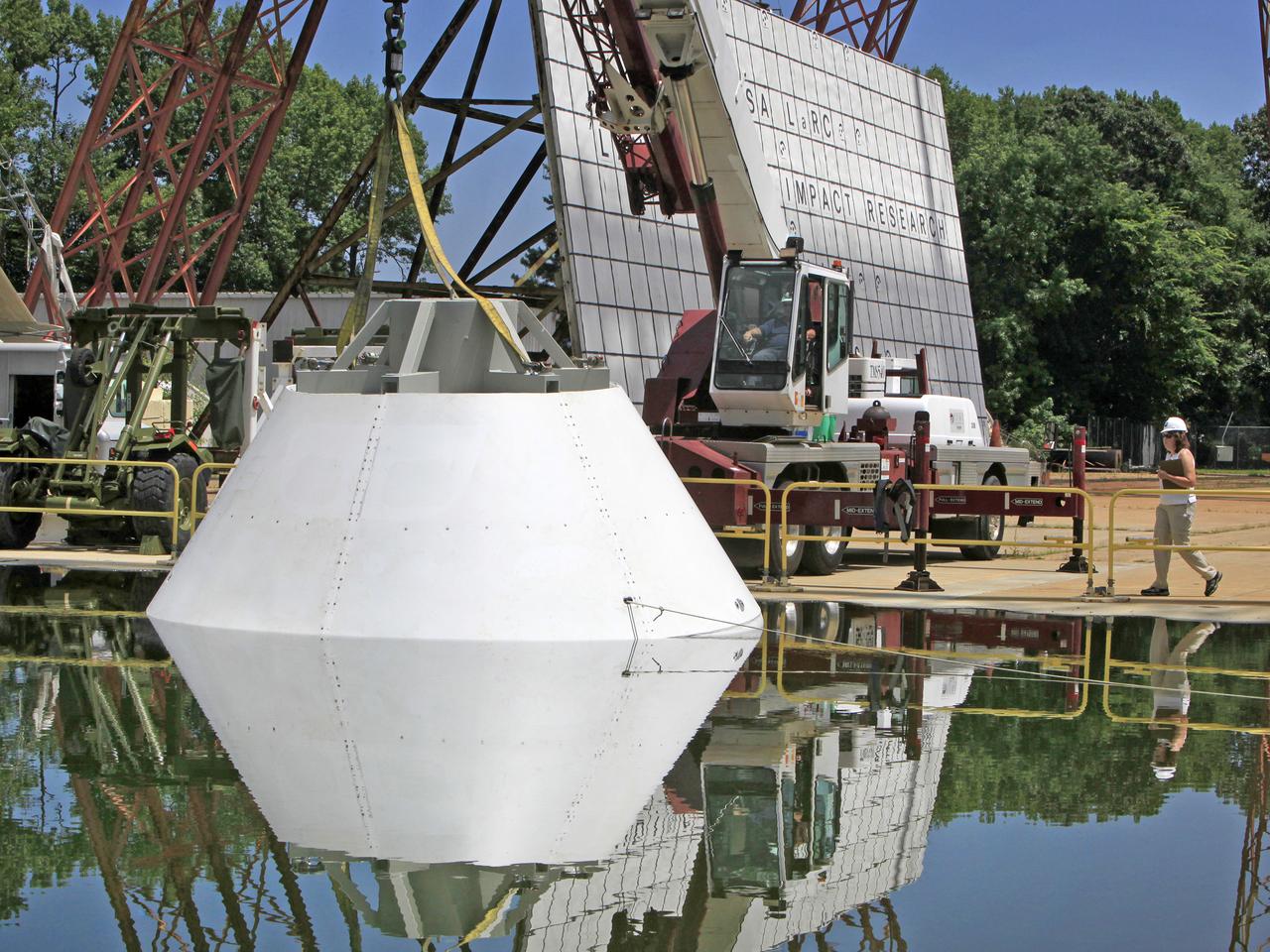
The Orion Test Capsule spent 4 hour in the water tank under NASA Langley's gantry to prove it is ready for the open water recovery test at Norfolk Naval Station.
The Orion Test Capsule at NASA's Langley Research Center's Hydro
The Orion Test Capsule spent 4 hour in the water tank under NASA Langley's gantry to prove it is ready for the open water recovery test at Norfolk Naval Station.
The Orion Test Capsule at NASA's Langley Research Center's Hydro
The Orion Test Capsule spent 4 hour in the water tank under NASA Langley's gantry to prove it is ready for the open water recovery test at Norfolk Naval Station.
The Orion Test Capsule at NASA's Langley Research Center's Hydro
The Orion Test Capsule spent 4 hour in the water tank under NASA Langley's gantry to prove it is ready for the open water recovery test at Norfolk Naval Station.
The Orion Test Capsule at NASA's Langley Research Center's Hydro
The Orion Test Capsule spent 4 hour in the water tank under NASA Langley's gantry to prove it is ready for the open water recovery test at Norfolk Naval Station.
The Orion Test Capsule at NASA's Langley Research Center's Hydro
The Orion Test Capsule spent 4 hour in the water tank under NASA Langley's gantry to prove it is ready for the open water recovery test at Norfolk Naval Station.
The Orion Test Capsule at NASA's Langley Research Center's Hydro
The Orion Test Capsule spent 4 hour in the water tank under NASA Langley's gantry to prove it is ready for the open water recovery test at Norfolk Naval Station.
The Orion Test Capsule at NASA's Langley Research Center's Hydro
The Orion Test Capsule spent 4 hour in the water tank under NASA Langley's gantry to prove it is ready for the open water recovery test at Norfolk Naval Station.
The Orion Test Capsule at NASA's Langley Research Center's Hydro
The Orion Test Capsule spent 4 hour in the water tank under NASA Langley's gantry to prove it is ready for the open water recovery test at Norfolk Naval Station.
The Orion Test Capsule at NASA's Langley Research Center's Hydro
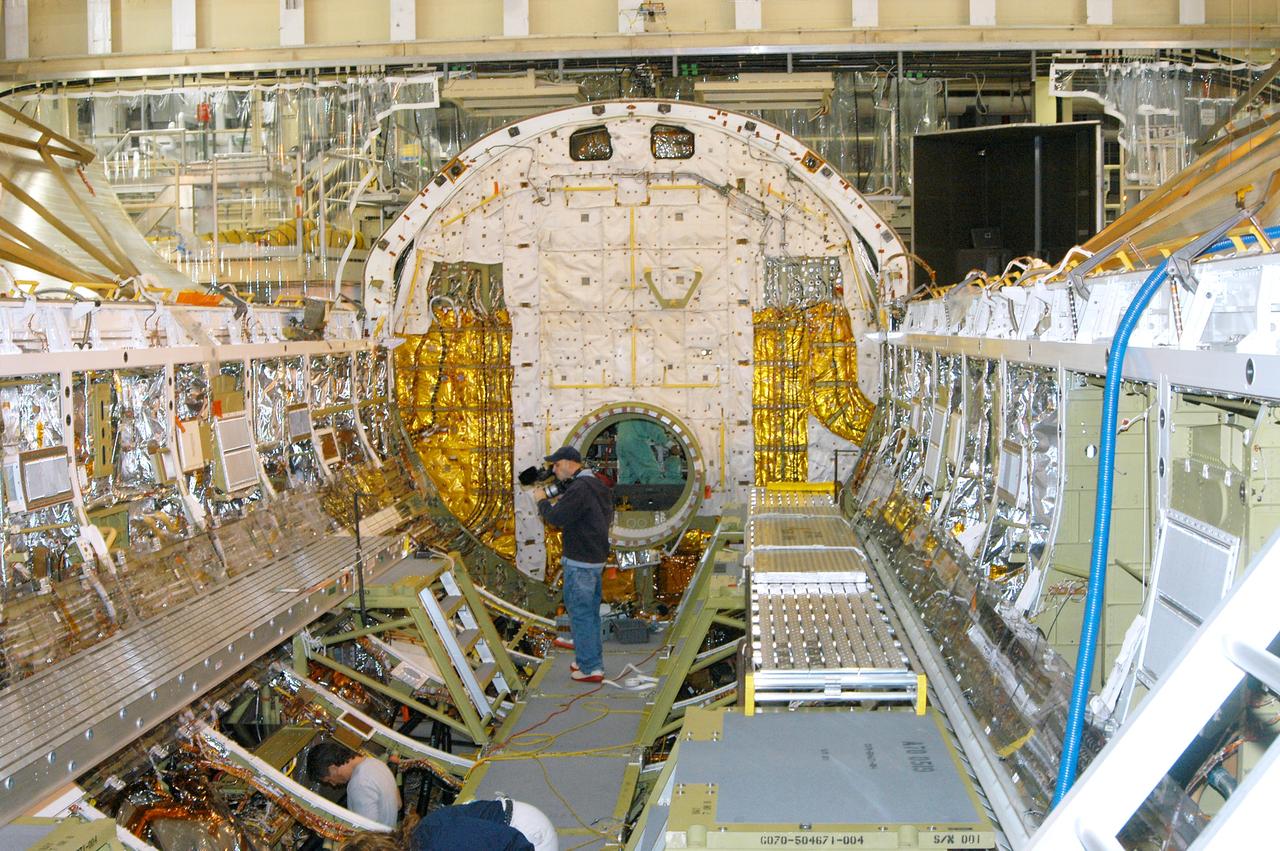
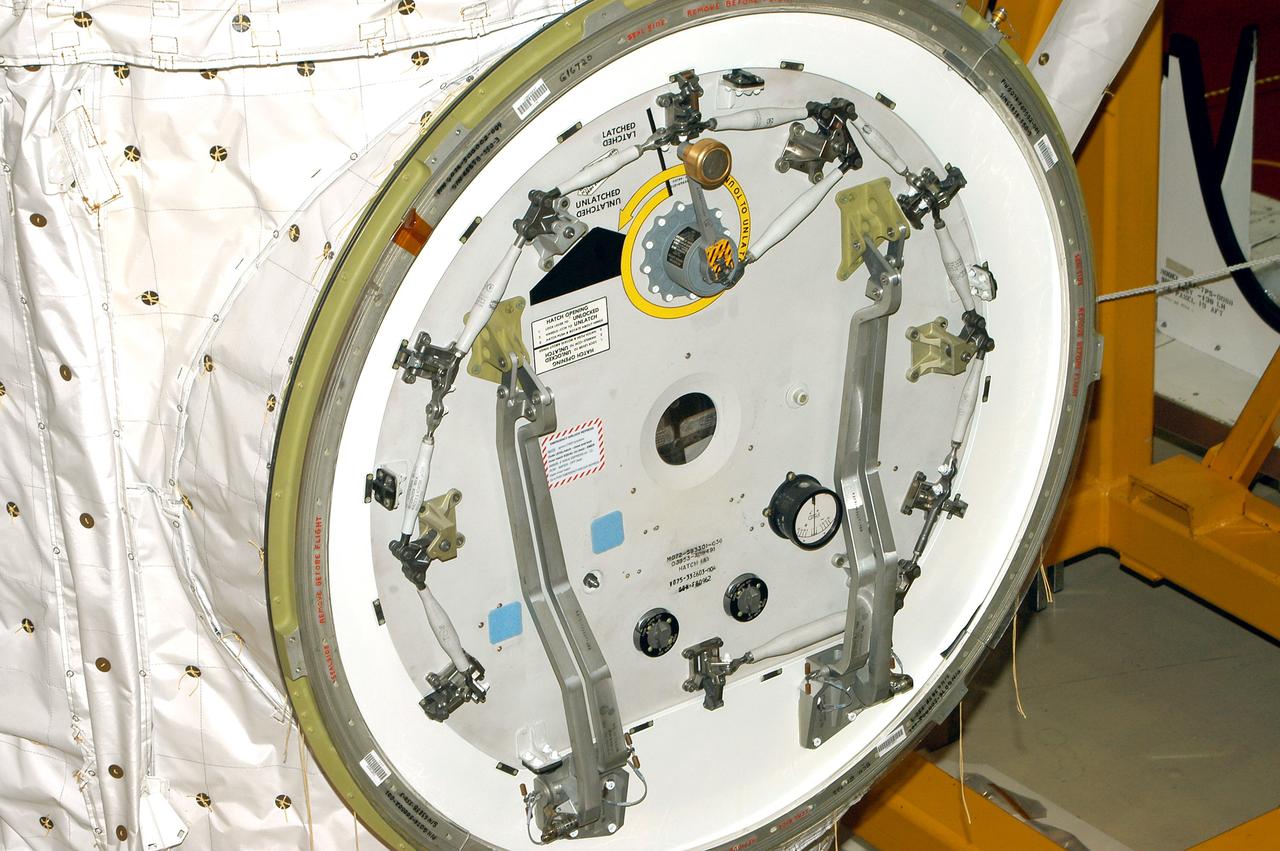
KENNEDY SPACE CENTER, FLA. -  In the Orbiter Processing Facility, a cameraman films part of Discovery’s payload bay for a special feature on the KSC Web.  In the background is the open hatch of the airlock, located inside the middeck of the spacecraft’s pressurized crew cabin. The airlock is sized to accommodate two fully suited flight crew members simultaneously. Support functions include airlock depressurization and repressurization, extravehicular activity equipment recharge, liquid-cooled garment water cooling, EVA equipment checkout, donning and communications. The outer hatch isolates the airlock from the unpressurized payload bay when closed and permits the EVA crew members to exit from the airlock to the payload bay when open.
KENNEDY SPACE CENTER, FLA. - In the Orbiter Processing Facility, a cameraman films part of Discovery’s payload bay for a special feature on the KSC Web. In the background is the open hatch of the airlock, located inside the middeck of the spacecraft’s pressurized crew cabin. The airlock is sized to accommodate two fully suited flight crew members simultaneously. Support functions include airlock depressurization and repressurization, extravehicular activity equipment recharge, liquid-cooled garment water cooling, EVA equipment checkout, donning and communications. The outer hatch isolates the airlock from the unpressurized payload bay when closed and permits the EVA crew members to exit from the airlock to the payload bay when open.
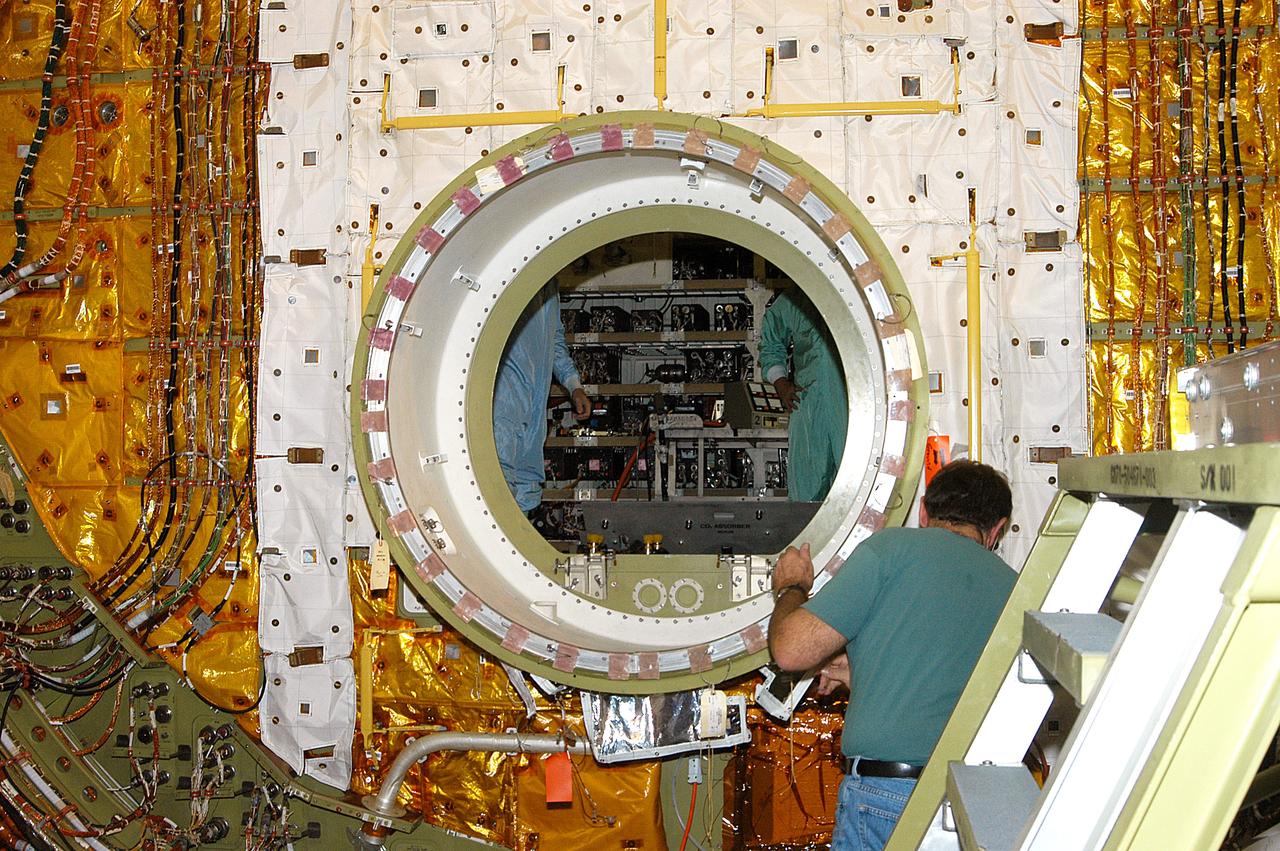
KENNEDY SPACE CENTER, FLA. -  A worker in the Orbiter Processing Facility checks the open hatch of the airlock in Discovery’s payload bay. The airlock is normally located inside the middeck of the spacecraft’s pressurized crew cabin. The airlock is sized to accommodate two fully suited flight crew members simultaneously. Support functions include airlock depressurization and repressurization, extravehicular activity equipment recharge, liquid-cooled garment water cooling, EVA equipment checkout, donning and communications. The outer hatch isolates the airlock from the unpressurized payload bay when closed and permits the EVA crew members to exit from the airlock to the payload bay when open.
KENNEDY SPACE CENTER, FLA. - A worker in the Orbiter Processing Facility checks the open hatch of the airlock in Discovery’s payload bay. The airlock is normally located inside the middeck of the spacecraft’s pressurized crew cabin. The airlock is sized to accommodate two fully suited flight crew members simultaneously. Support functions include airlock depressurization and repressurization, extravehicular activity equipment recharge, liquid-cooled garment water cooling, EVA equipment checkout, donning and communications. The outer hatch isolates the airlock from the unpressurized payload bay when closed and permits the EVA crew members to exit from the airlock to the payload bay when open.
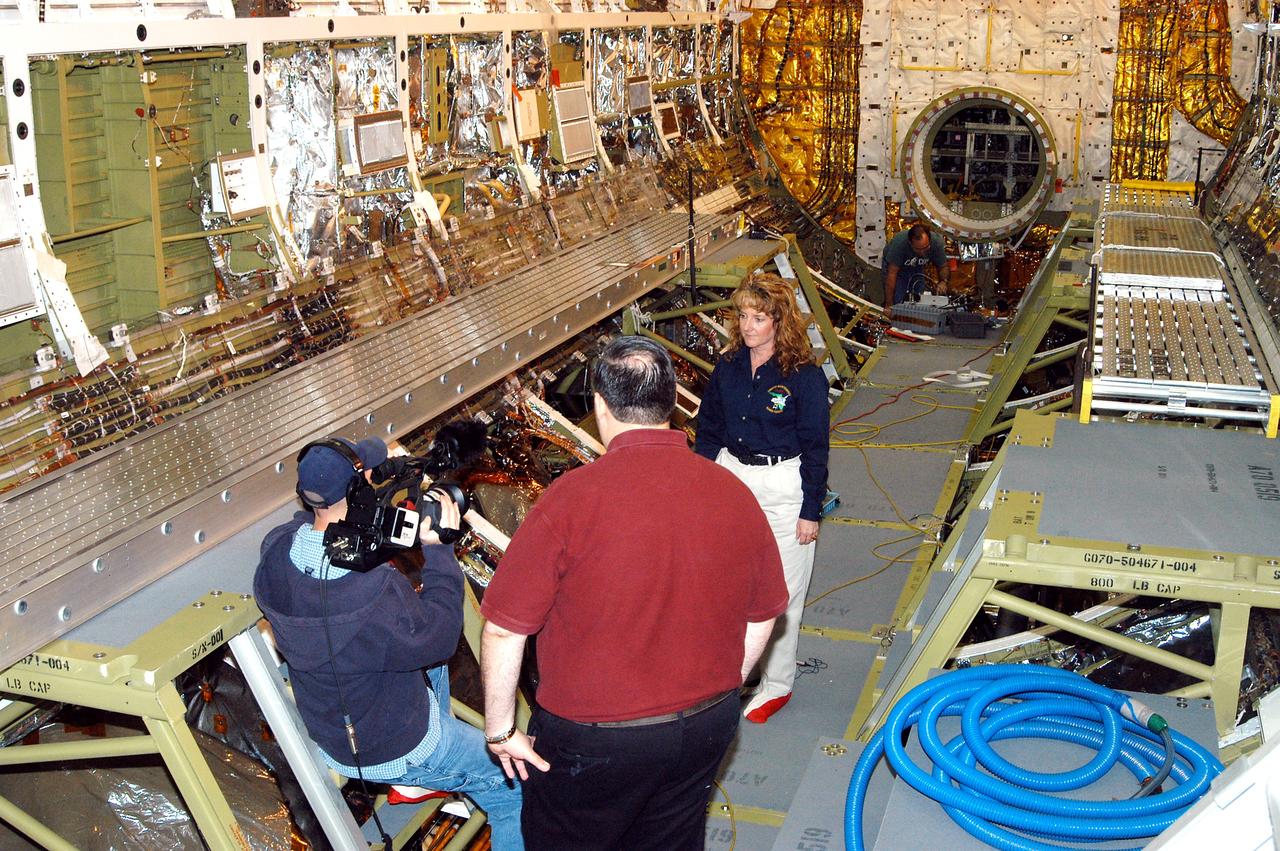
KENNEDY SPACE CENTER, FLA. -  Standing inside Discovery’s payload bay, Carol Scott (right), lead orbiter engineer, talks about her job as part of a special feature for the KSC Web.  With his back to the camera is Bill Kallus, Media manager in the KSC Web Studio.  Behind Scott can be seen the open hatch of the airlock, which provides support functions such as airlock depressurization and repressurization, extravehicular activity equipment recharge, liquid-cooled garment water cooling, EVA equipment checkout, donning and communications. The outer hatch isolates the airlock from the unpressurized payload bay when closed and permits the EVA crew members to exit from the airlock to the payload bay when open.
KENNEDY SPACE CENTER, FLA. - Standing inside Discovery’s payload bay, Carol Scott (right), lead orbiter engineer, talks about her job as part of a special feature for the KSC Web. With his back to the camera is Bill Kallus, Media manager in the KSC Web Studio. Behind Scott can be seen the open hatch of the airlock, which provides support functions such as airlock depressurization and repressurization, extravehicular activity equipment recharge, liquid-cooled garment water cooling, EVA equipment checkout, donning and communications. The outer hatch isolates the airlock from the unpressurized payload bay when closed and permits the EVA crew members to exit from the airlock to the payload bay when open.
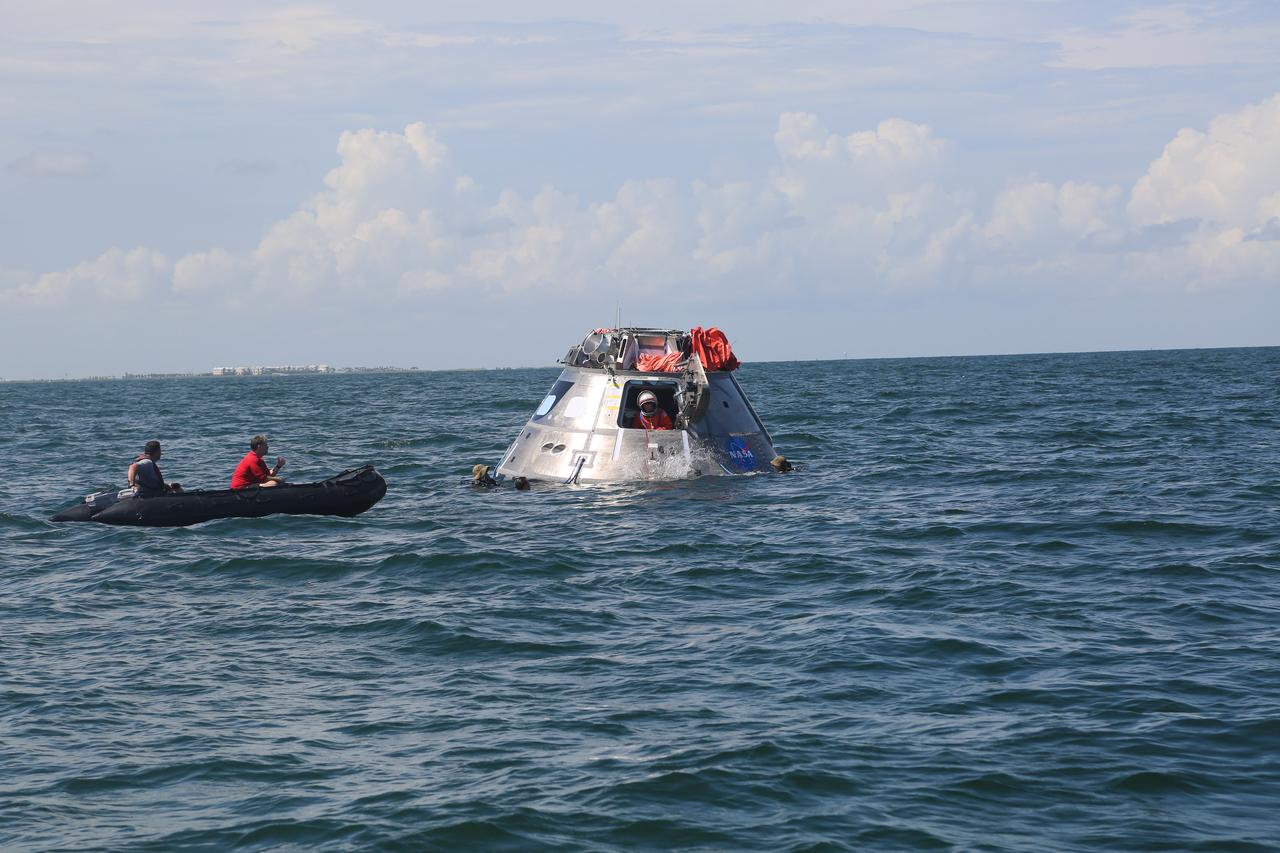
When astronauts return to Earth from destinations beyond the Moon in NASA’s Orion spacecraft and splashdown in the Pacific Ocean, they’ll still need to safely get out of the spacecraft and back on dry land. Using the waters off the coast of Galveston, Texas, a NASA and Department of Defense team test Orion exit procedures in a variety of scenarios on July 11, 2017. Part of Batch images transfer from Flickr.
Orion crew egress testing
Open Water Lead Tim Goddard points the way to the smoke the helicopter dropped in the water, indicating the location of the mock Orion capsule during Underway Recovery Test 9 (URT-9). During the weeklong test, NASA’s Landing and Recovery team is performing their final mission certification ahead of Artemis I.
Underway Recovery Test 9 (URT-9) - Day 3 Activities
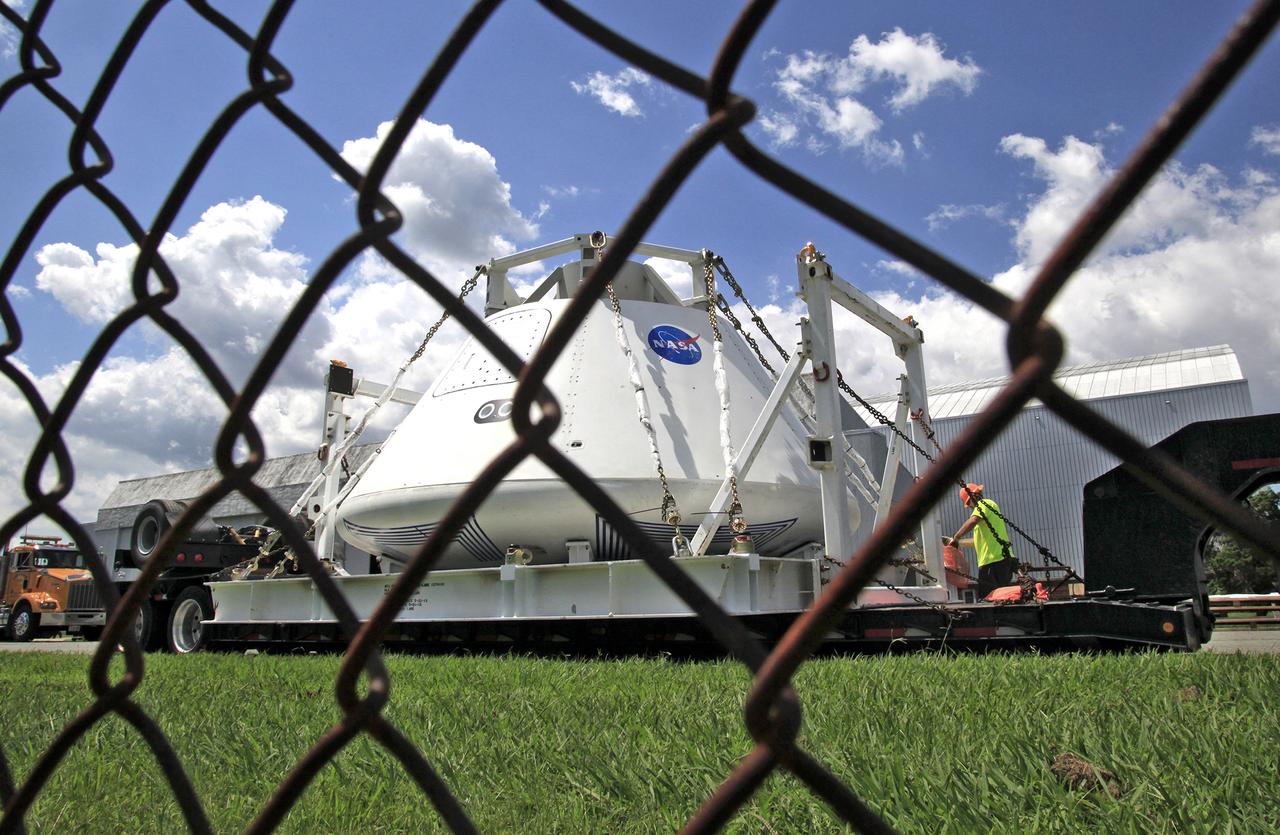
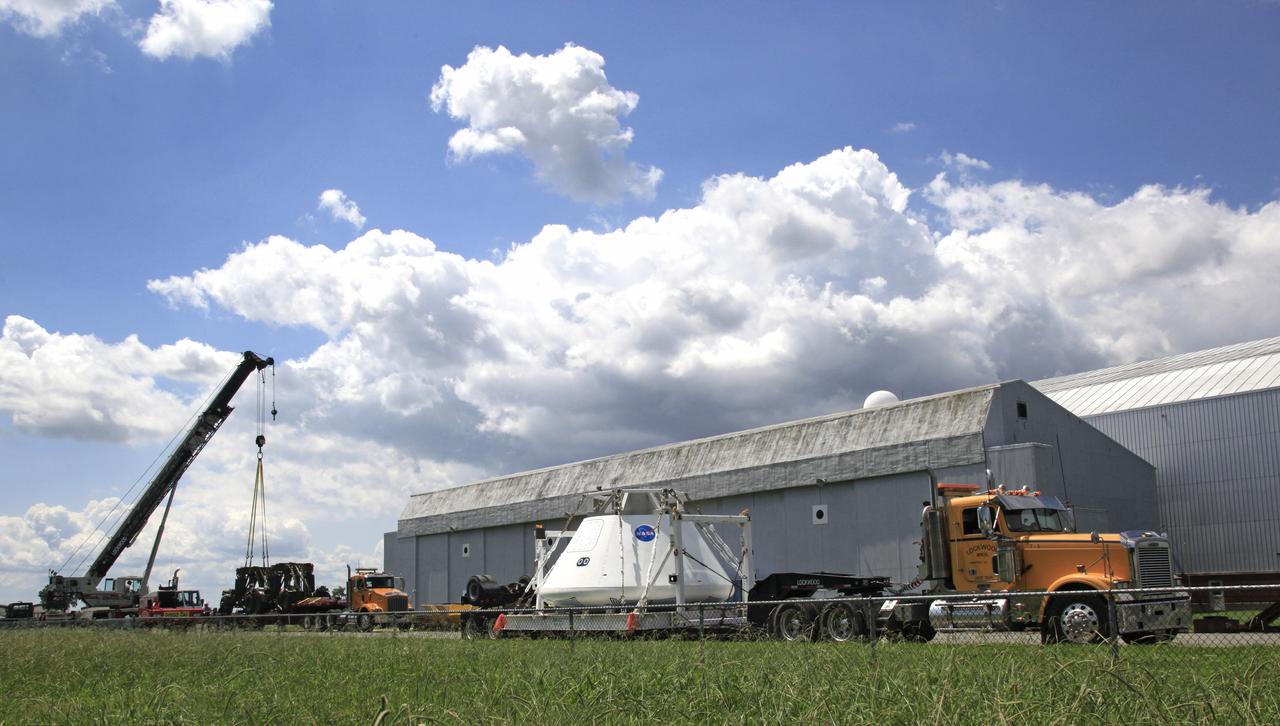
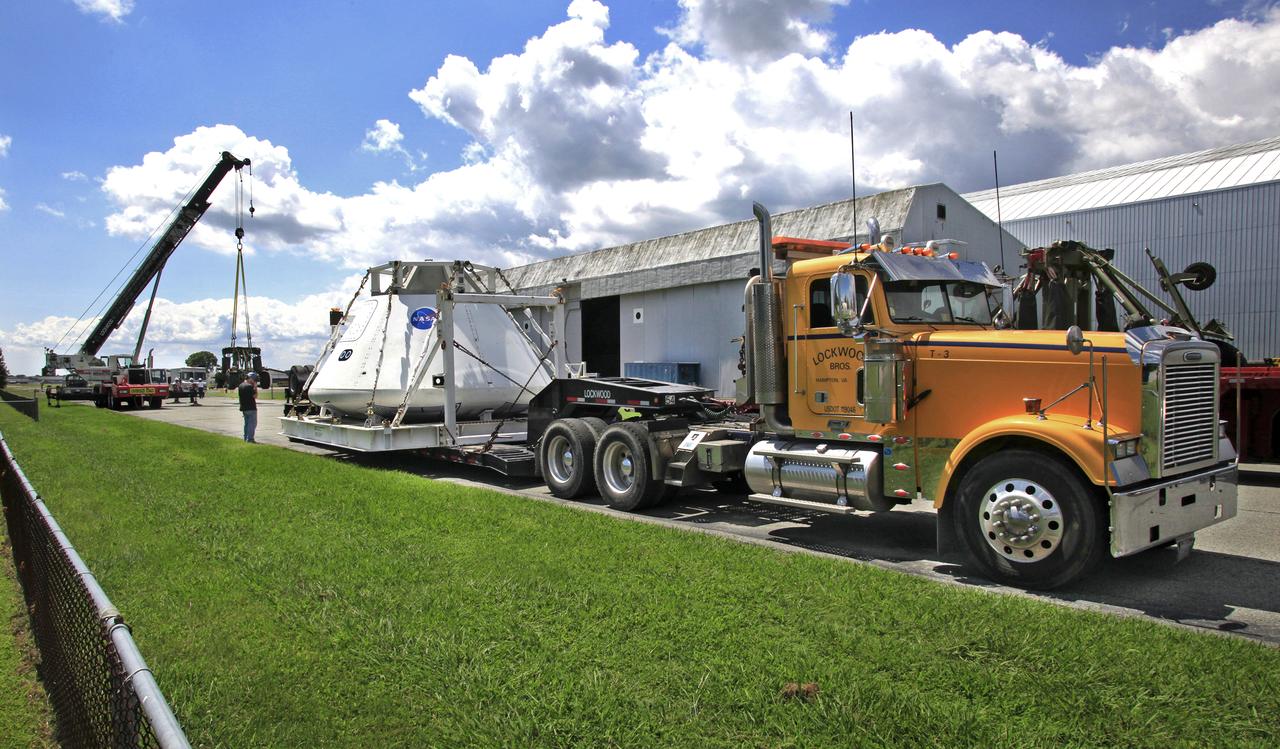
Orion Test Capsule loaded on a flatbed trailer at NASA Langley to be transport to Fort Eustis, VA. where it will be transported by barge to Norfolk Va. for open water recovery test.
Model of the Space Launch System for the Orion Space Capsule is
Orion Test Capsule loaded on a flatbed trailer at NASA Langley to be transport to Fort Eustis, VA. where it will be transported by barge to Norfolk Va. for open water recovery test.
Model of the Space Launch System for the Orion Space Capsule is
Orion Test Capsule loaded on a flatbed trailer at NASA Langley to be transport to Fort Eustis, VA. where it will be transported by barge to Norfolk Va. for open water recovery test.
Model of the Space Launch System for the Orion Space Capsule is
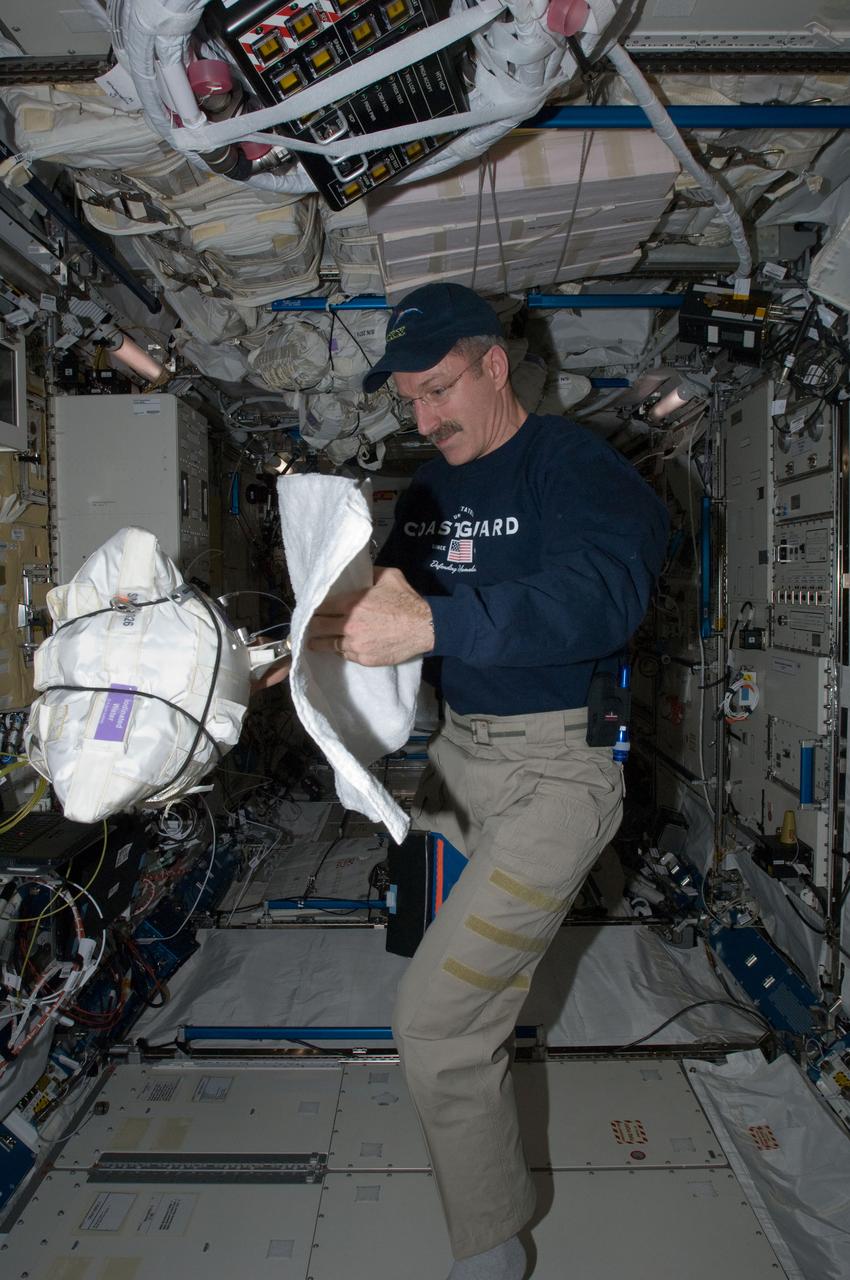
ISS030-E-122089 (6 March 2012) --- NASA astronaut Dan Burbank, Expedition 30 commander, opens a Contingency Water Container-Iodinated (CWC-I) bag in the Kibo laboratory of the International Space Station.
Burbank opens a CWC-I Bag
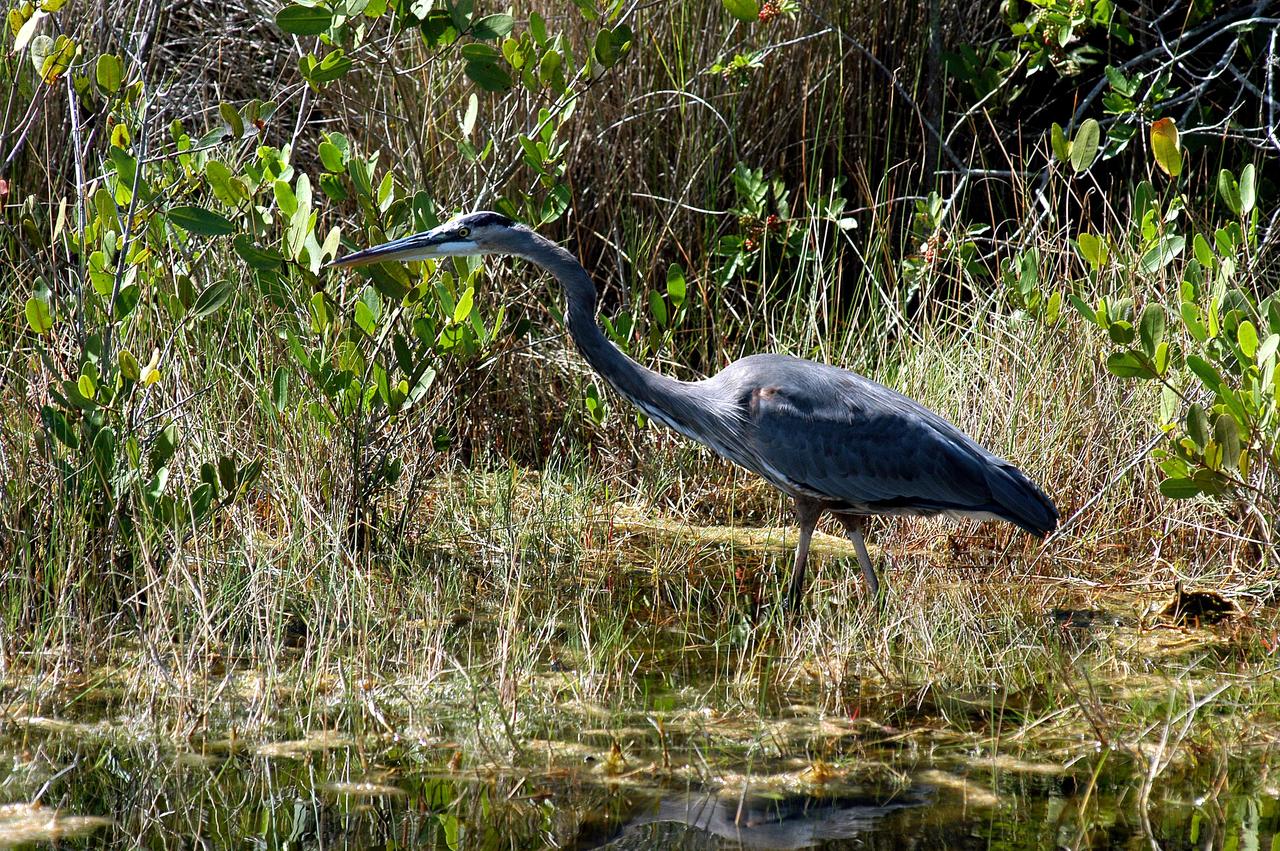
KENNEDY SPACE CENTER, FLA.   -   A great blue heron patiently stalks its prey in the marshes around KSC.   The heron is one of 310 species of birds that inhabit the National Merritt Island Wildlife Refuge, which shares a boundary with KSC.  The marshes and open water of the refuge also provide wintering areas for 23 species of migratory waterfowl, as well as a year-round home for great blue herons, great egrets, wood storks, cormorants, brown pelicans and other species of marsh and shore birds.
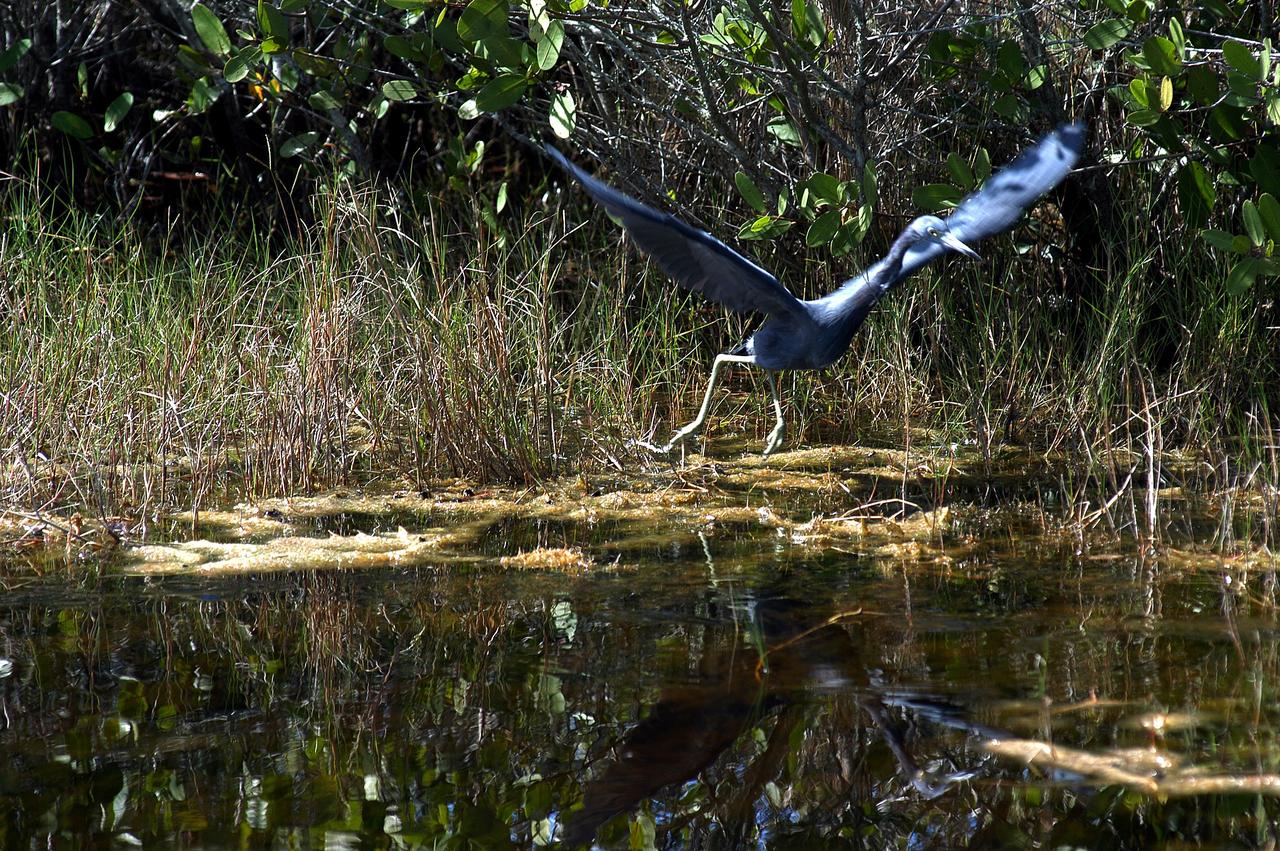
KENNEDY SPACE CENTER, FLA. - A great blue heron patiently stalks its prey in the marshes around KSC. The heron is one of 310 species of birds that inhabit the National Merritt Island Wildlife Refuge, which shares a boundary with KSC. The marshes and open water of the refuge also provide wintering areas for 23 species of migratory waterfowl, as well as a year-round home for great blue herons, great egrets, wood storks, cormorants, brown pelicans and other species of marsh and shore birds.
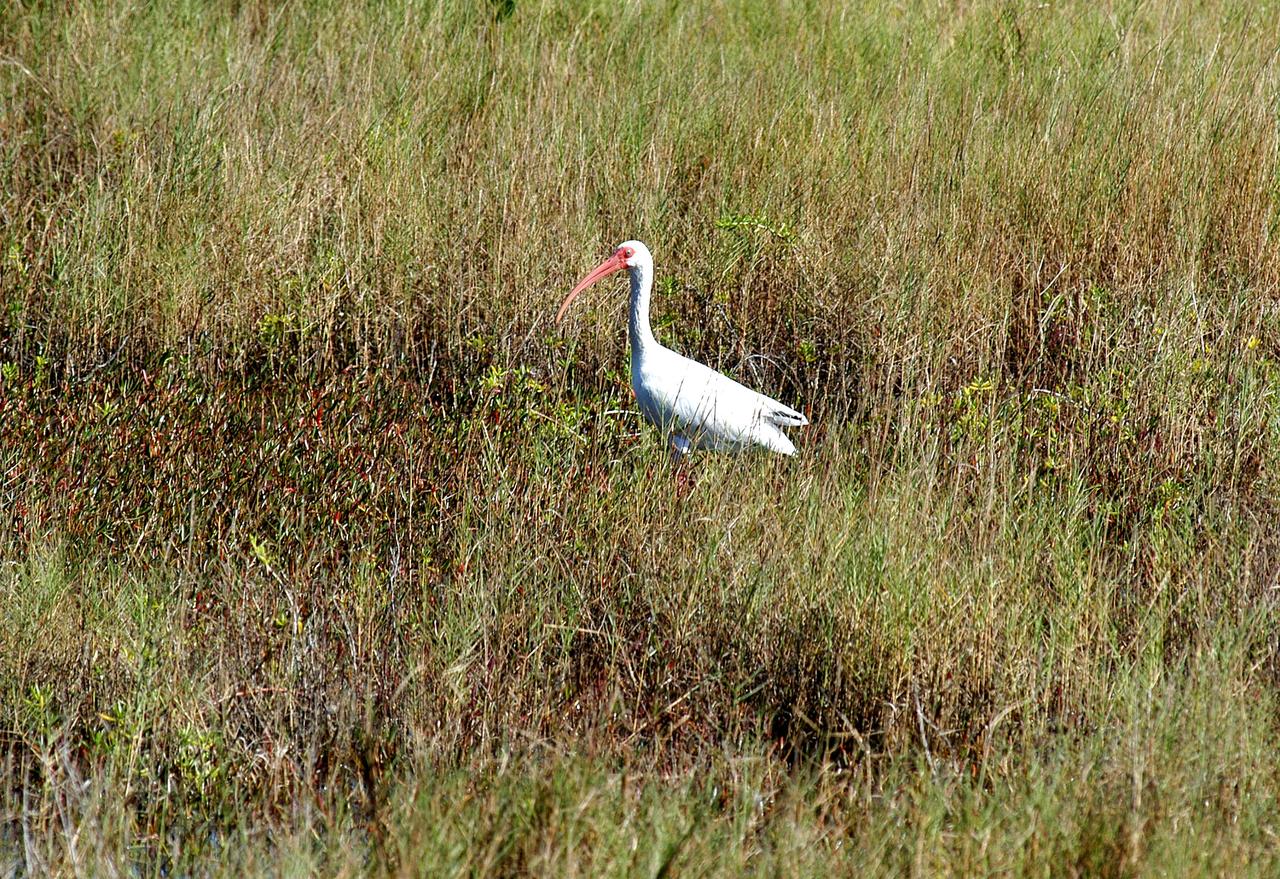
KENNEDY SPACE CENTER, FLA.   -   A great white heron silently waits in the tall grass within KSC.  The heron is one of 310 species of birds that inhabit the National Merritt Island Wildlife Refuge, which shares a boundary with KSC.  The marshes and open water of the refuge also provide wintering areas for 23 species of migratory waterfowl, as well as a year-round home for great blue herons, great egrets, wood storks, cormorants, brown pelicans and other species of marsh and shore birds.
KENNEDY SPACE CENTER, FLA. - A great white heron silently waits in the tall grass within KSC. The heron is one of 310 species of birds that inhabit the National Merritt Island Wildlife Refuge, which shares a boundary with KSC. The marshes and open water of the refuge also provide wintering areas for 23 species of migratory waterfowl, as well as a year-round home for great blue herons, great egrets, wood storks, cormorants, brown pelicans and other species of marsh and shore birds.
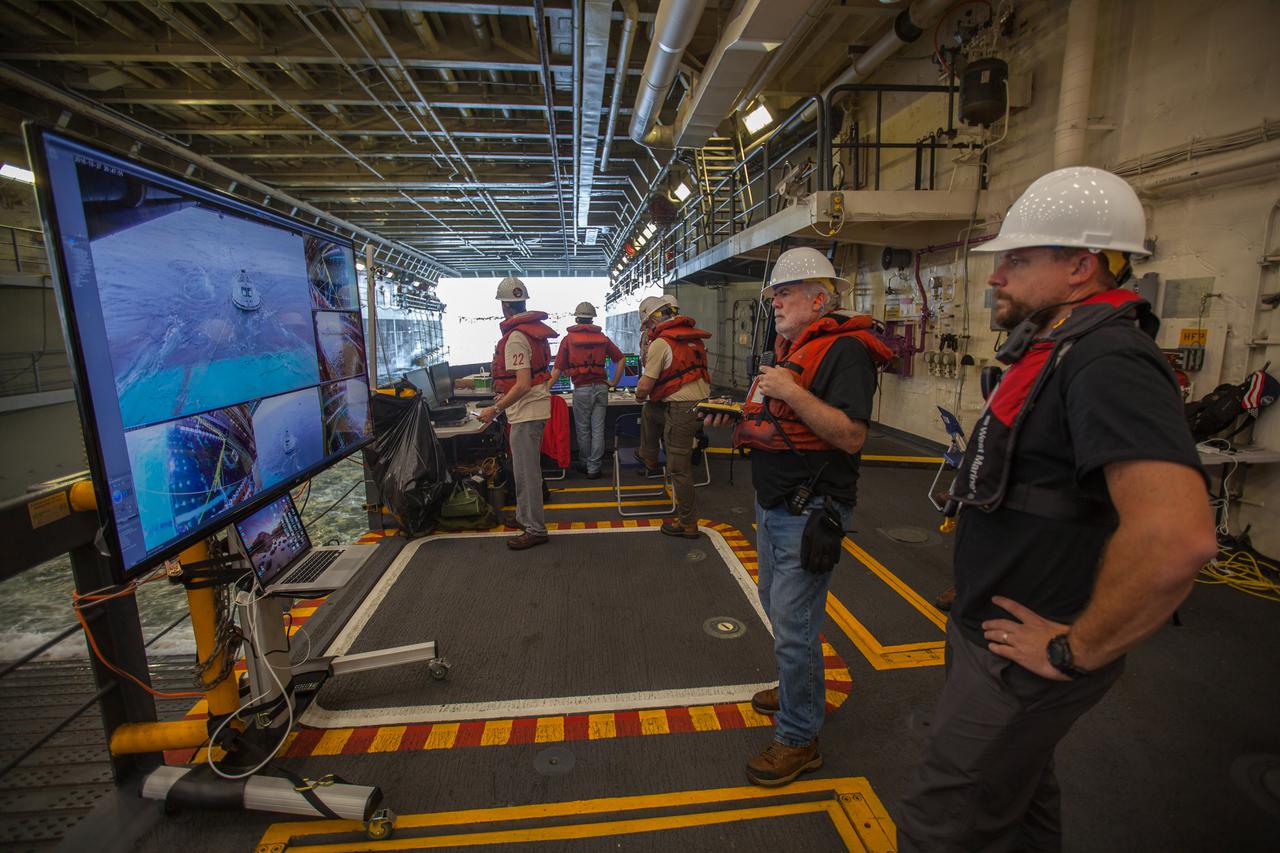
In the well deck of the USS San Diego, recovery team members monitor a portion of Underway Recovery Test 5 in the Pacific Ocean off the coast of California on Oct. 27, 2016. A test version of the Orion crew module is floating in open waters. NASA's Ground Systems Development and Operations Program and the U.S. Navy are conducting a series of tests using the ship's well deck, the test module, various watercraft and equipment to prepare for recovery of Orion on its return from deep space missions. The test will allow the team to demonstrate and evaluate recovery processes, procedures, hardware and personnel in open waters. Part of Batch images transfer from Flickr.
Orion Underway Recovery Test 5 (URT-5)
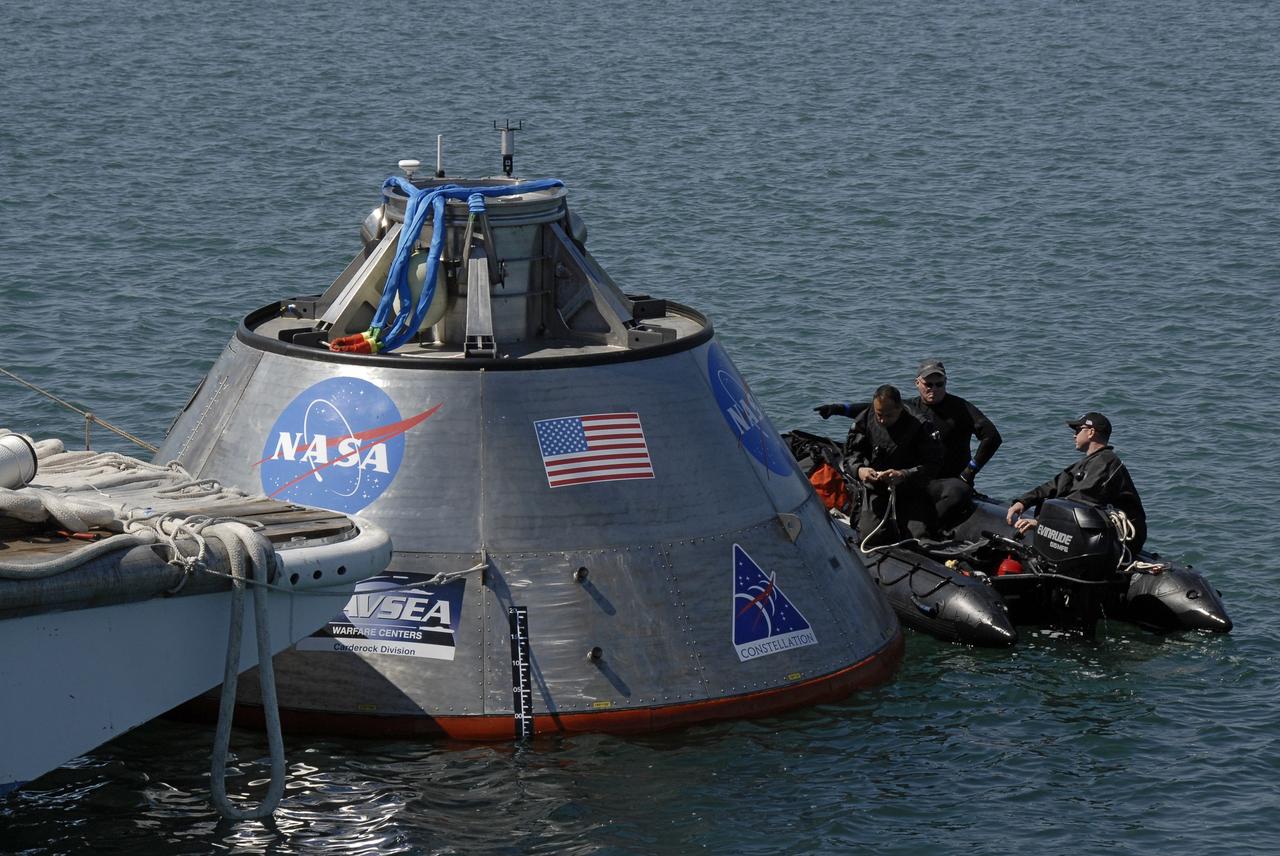
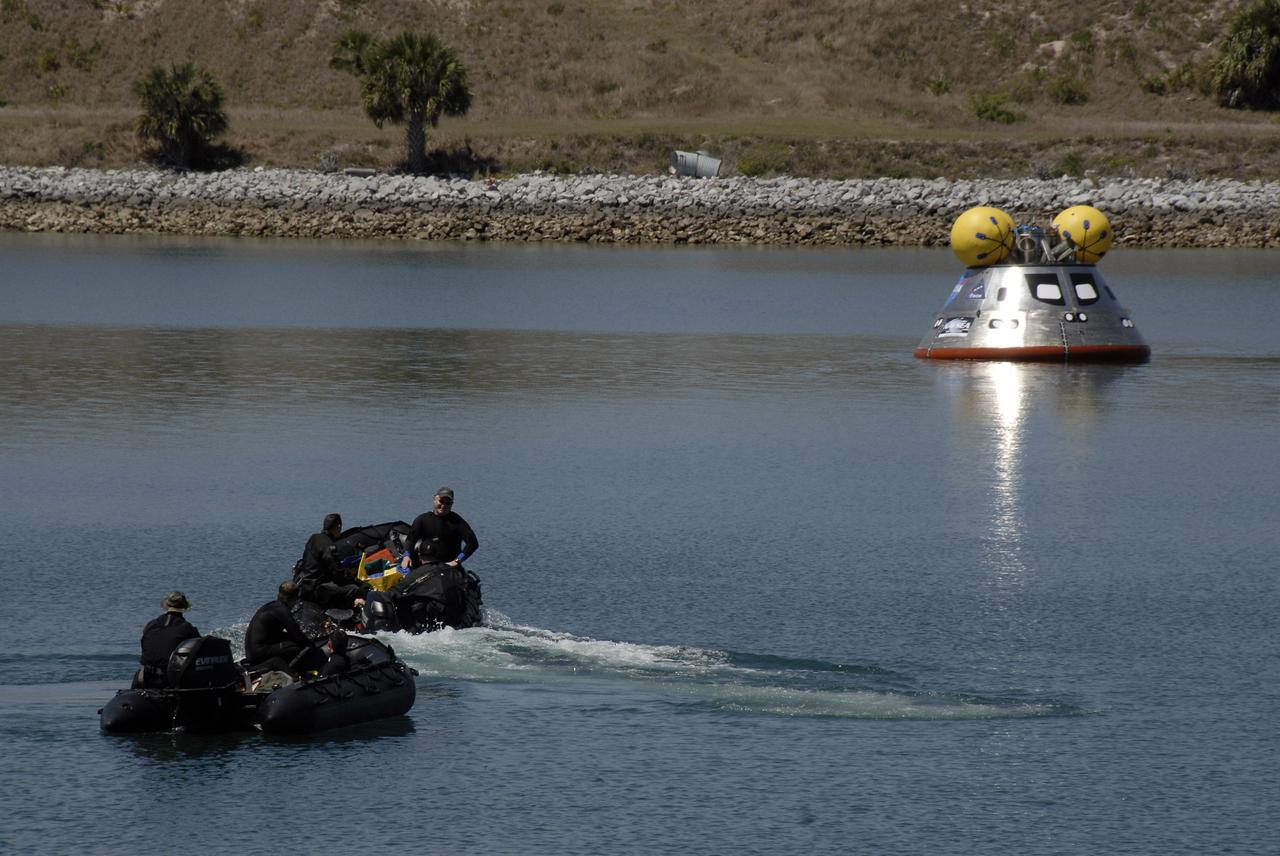
CAPE CANAVERAL, Fla. – Members of the 920th Rescue Wing help prepare the mockup Orion crew exploration vehicle for testing in the open water at the Trident Basin at Port Canaveral, Fla.  The mockup vehicle will undergo testing in open water. The goal of the operation, dubbed the Post-landing Orion Recovery Test, or PORT, is to determine what kind of motion astronauts can expect after landing, as well as outside conditions for recovery teams. Orion is targeted to begin carrying humans to the International Space Station in 2015 and to the moon by 2020. Orion, along with the Ares I and V rockets and the Altair lunar lander, are part of the Constellation Program.  Photo credit: NASA/Kim Shiflett
KSC-2009-2560
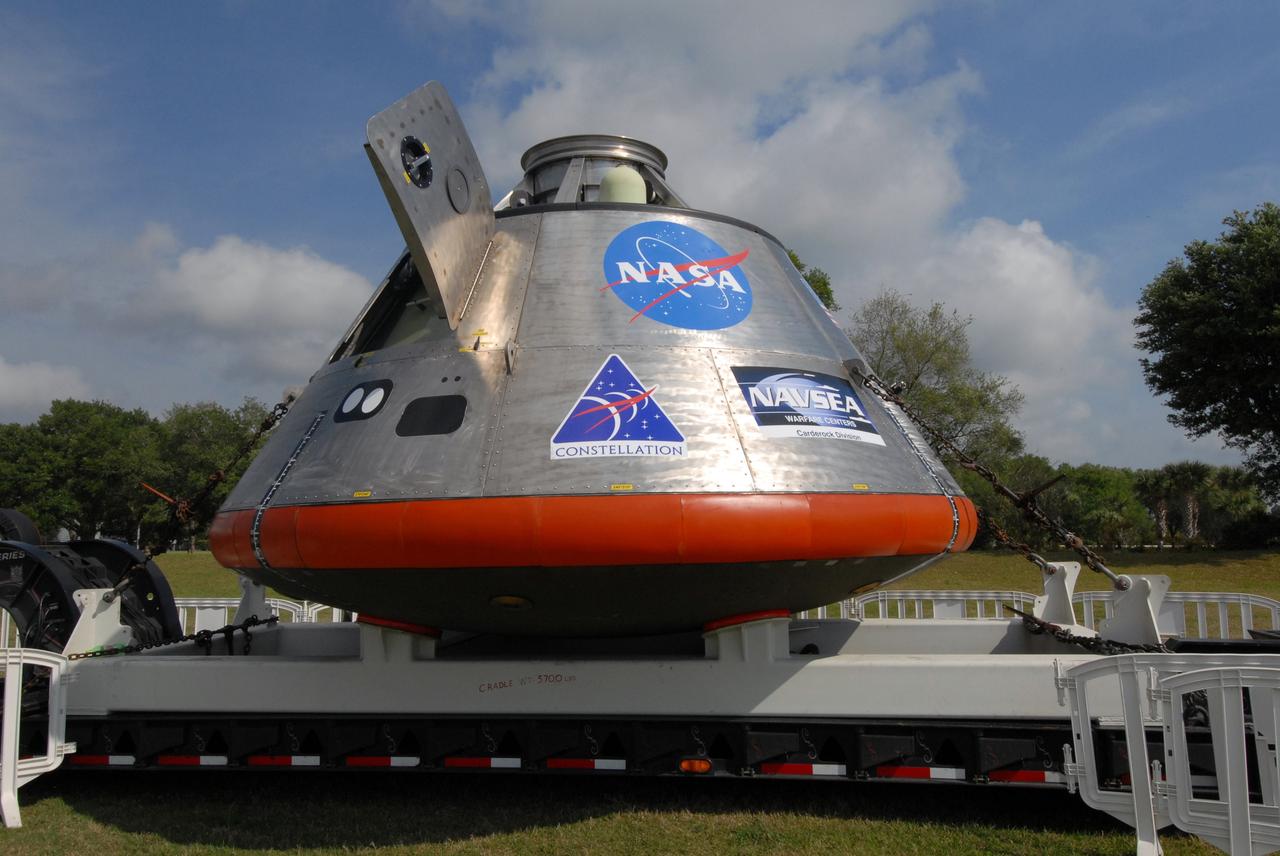
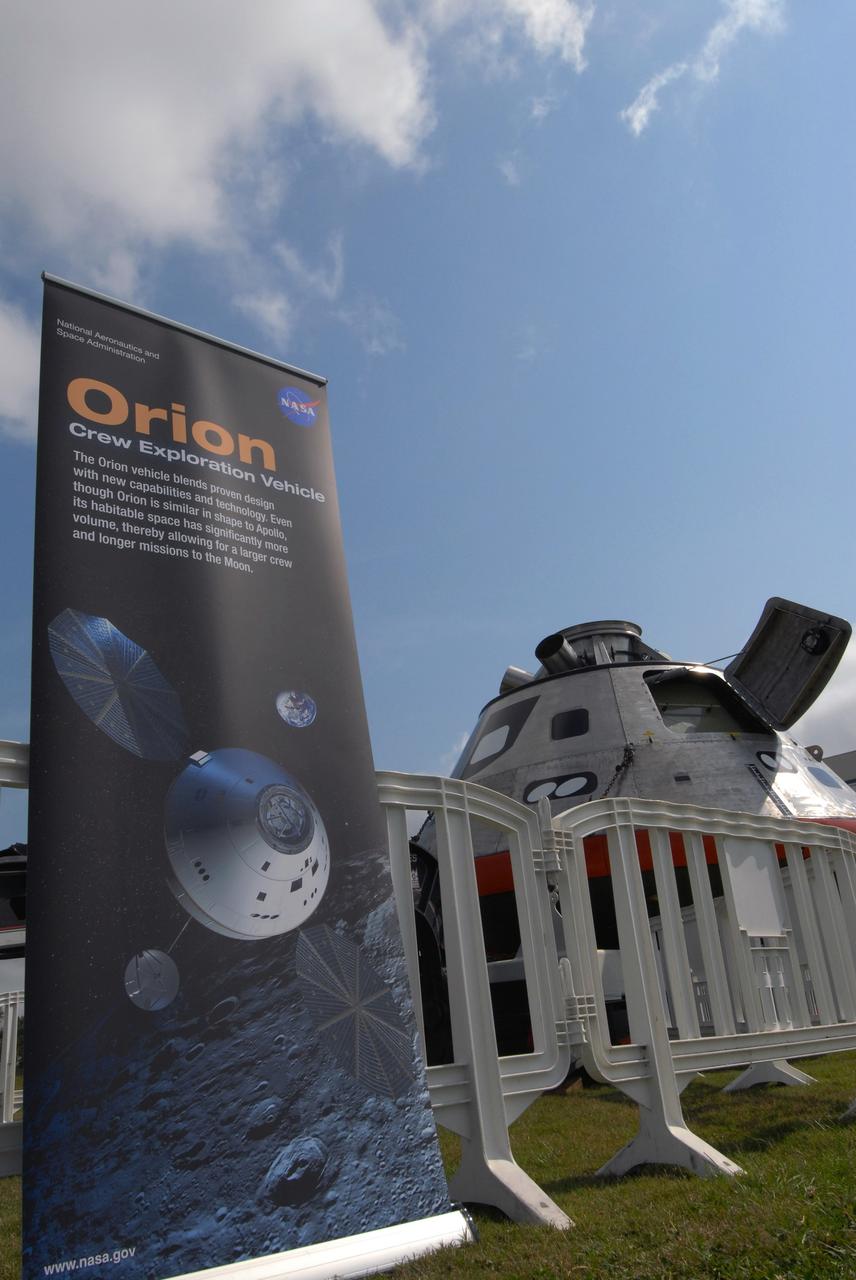
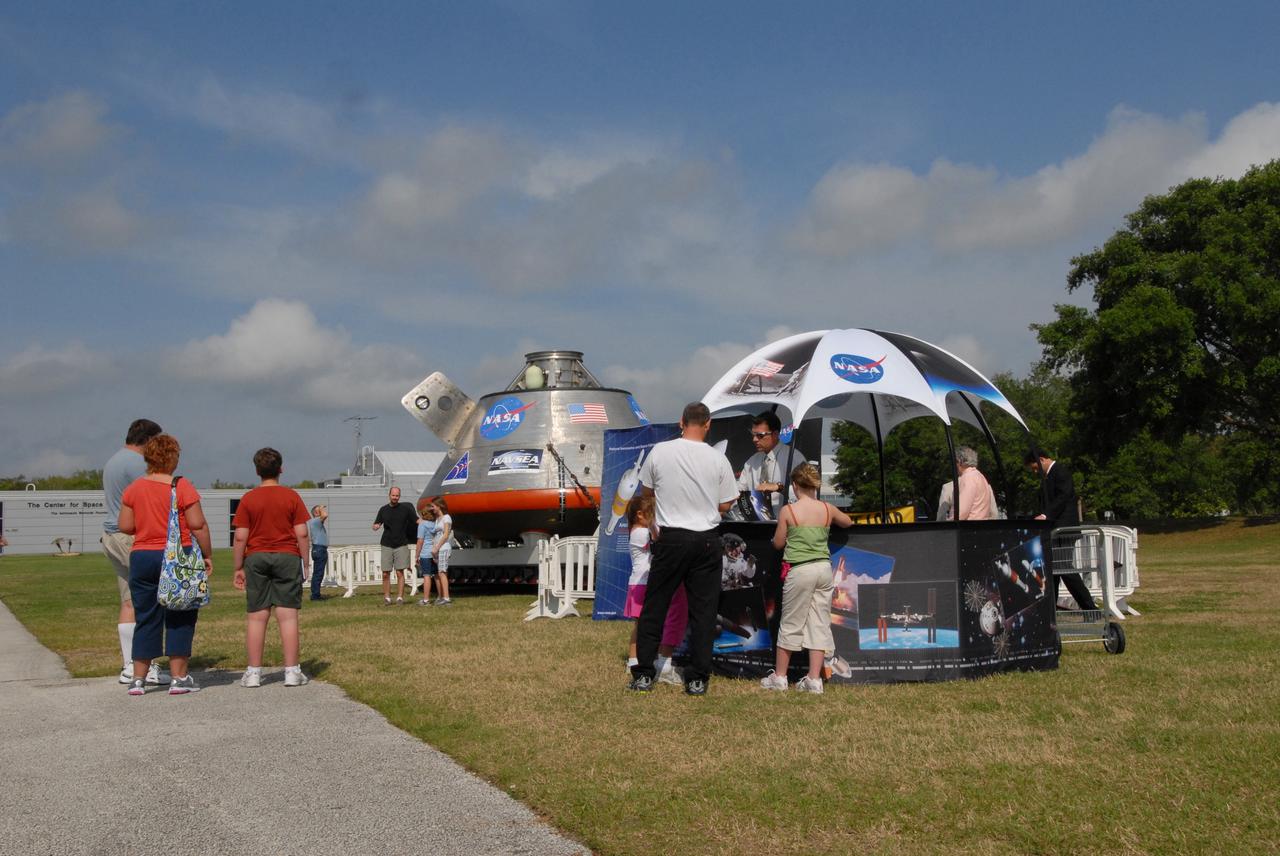
CAPE CANAVERAL, Fla. –  On display at the Kennedy Space Center Visitor Complex in Florida is the Orion crew exploration vehicle mockup, which will be moved onto the center before heading offshore to be tested in open water.  The spacecraft mock-up traveled from the Naval Surface Warfare Center's Carderock Division in Bethesda, Md. The goal of the open water testing, dubbed the Post-landing Orion Recovery Test, or PORT, is to determine what kind of motion astronauts can expect after landing, as well as outside conditions for recovery teams. Part of the Constellation Program, Orion is targeted to begin carrying humans to the International Space Station in 2015 and to the moon by 2020.   Photo credit: NASA/Jack Pfaller
KSC-2009-2506
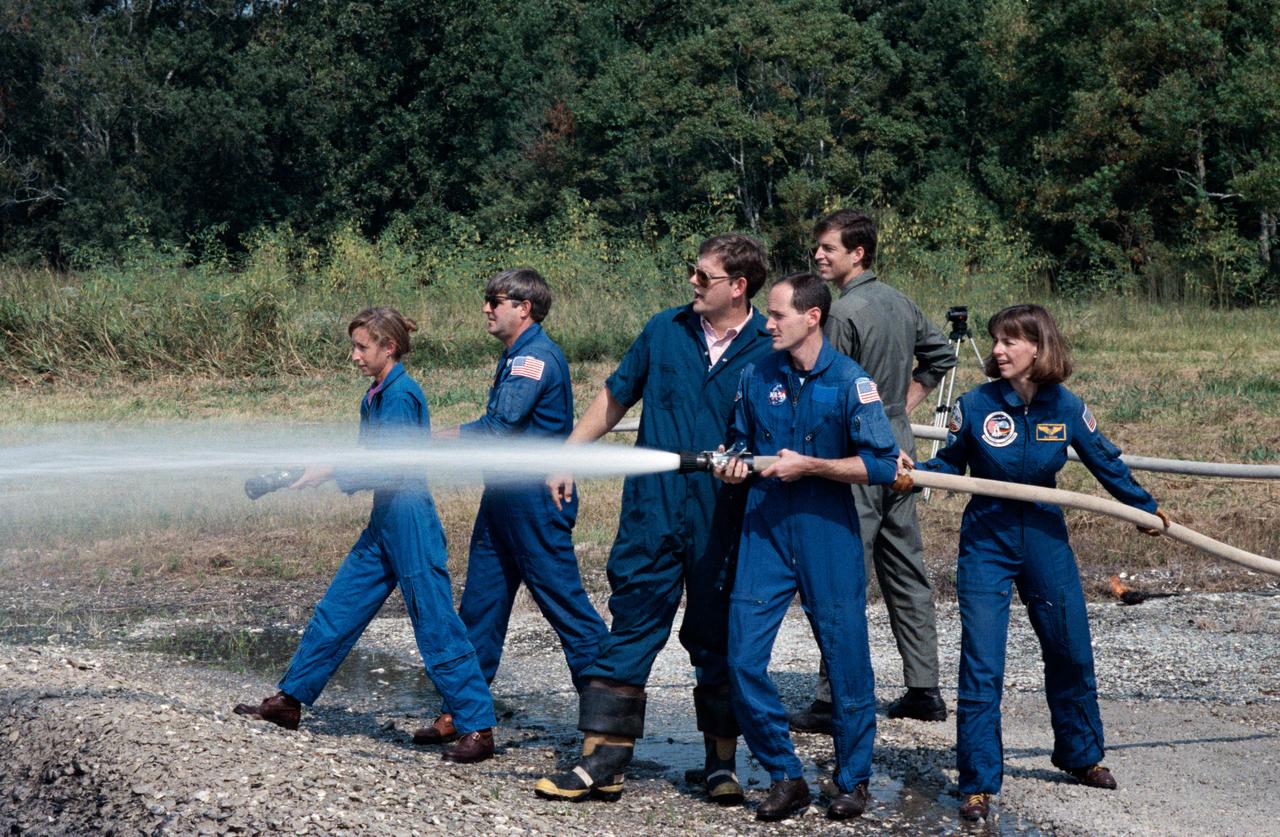
STS-32 crewmembers use water hoses during fire fighting exercises at JSC's Fire Training Pit across from the Gilruth Center Bldg 207. Mission Specialist (MS) G. David Low with nozzle open directs water into the fire as fire/ security personnel coaches and instructs him on his attempt to extinguish the blaze. MS Bonnie J. Dunbar maneuvers the hose behind Low. A second group of crewmembers alongside Low and Dunbar, MS Marsha S. Ivins, holding hose nozzle, Commander Daniel C. Brandenstein, and Pilot James D. Wetherbee position themselves before opening hose nozzle.
STS-32 crewmembers use water hoses during fire fighting training at JSC
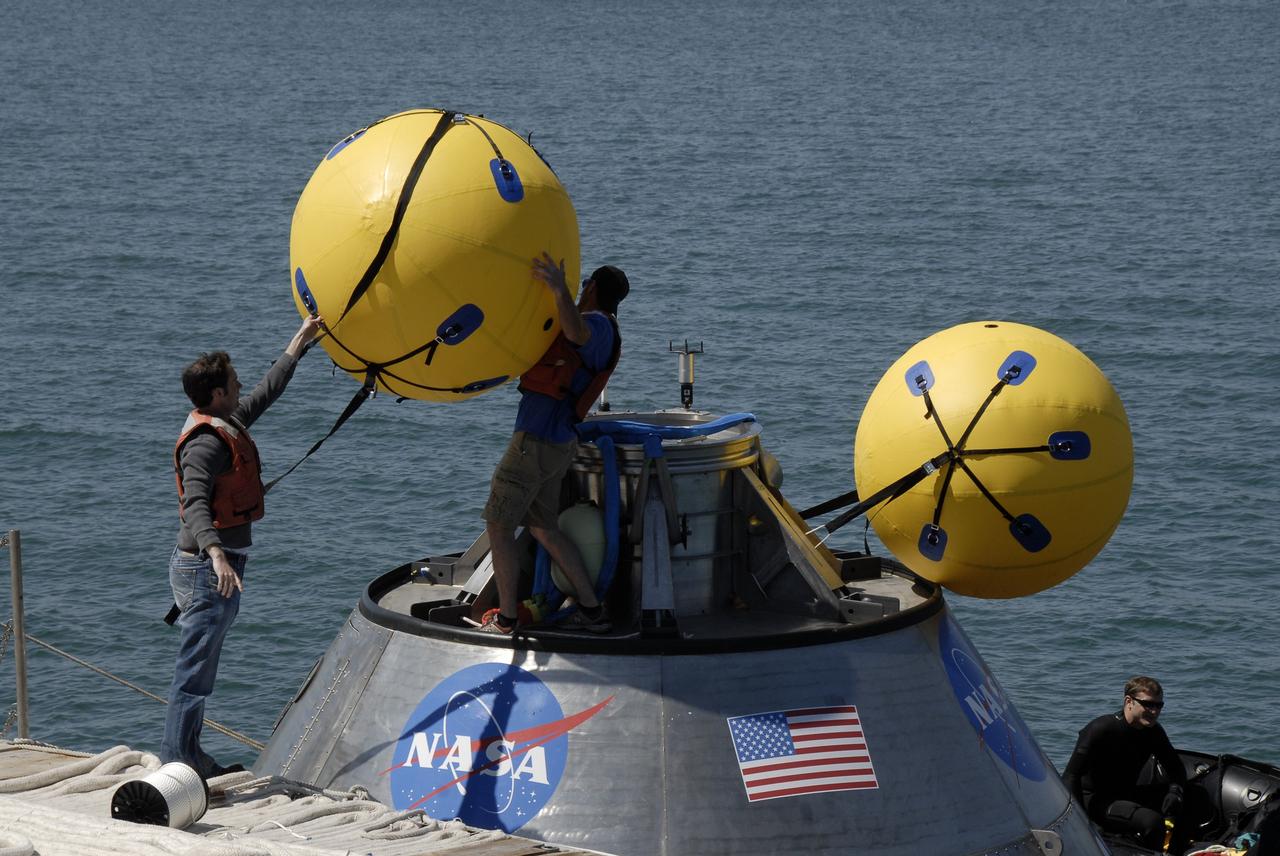
CAPE CANAVERAL, Fla. – Flotation devices are attached to the top of the mockup Orion crew exploration vehicle before the testing in the open water at the Trident Basin at Port Canaveral, Fla.  The mockup vehicle will undergo testing in open water. The goal of the operation, dubbed the Post-landing Orion Recovery Test, or PORT, is to determine what kind of motion astronauts can expect after landing, as well as outside conditions for recovery teams. Orion is targeted to begin carrying humans to the International Space Station in 2015 and to the moon by 2020. Orion, along with the Ares I and V rockets and the Altair lunar lander, are part of the Constellation Program.  Photo credit: NASA/Kim Shiflett
KSC-2009-2561
CAPE CANAVERAL, Fla. –  Visitors to the Visitor Complex at NASA's Kennedy Space Center in Florida get a look at the Orion crew exploration vehicle mockup, which is on display before heading offshore to be tested in open water.  The spacecraft mock-up traveled from the Naval Surface Warfare Center's Carderock Division in Bethesda, Md. The goal of the open water testing, dubbed the Post-landing Orion Recovery Test, or PORT, is to determine what kind of motion astronauts can expect after landing, as well as outside conditions for recovery teams. Part of the Constellation Program, Orion is targeted to begin carrying humans to the International Space Station in 2015 and to the moon by 2020.   Photo credit: NASA/Jack Pfaller
KSC-2009-2503
NASA's Ground Systems Development and Operations Program and the U.S. Navy prepare for another day of Underway Recovery Test 5 in the Pacific Ocean off the coast of California on Oct. 30, 2016. A test version of the Orion crew module is in the well deck of the ship, and U.S. Navy divers and other personnel are in rigid hull inflatable boats preparing to head out into the open water. The recovery team is conducting a series of tests to prepare for recovery of Orion on its return from deep space missions. The testing will allow the team to demonstrate and evaluate recovery processes, procedures, hardware and personnel in open waters. Part of Batch images transfer from Flickr.
Orion Underway Recovery Test 5 (URT-5)
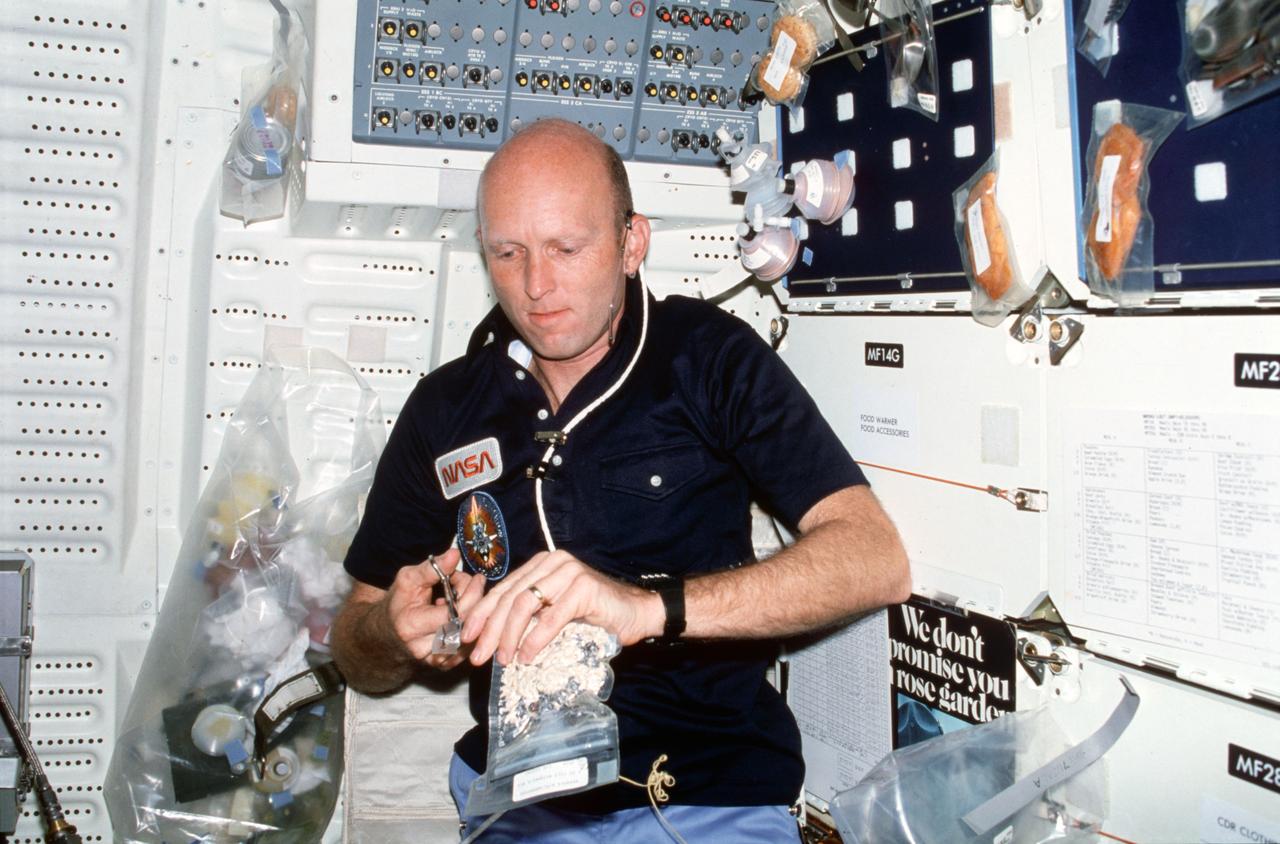
STS003-26-253 (30 March 1982) --- Astronaut Gordon Fullerton, STS-3 pilot, wearing communications kit assembly (assy) mini-headset (HDST), prepares meal on middeck. Fullerton clips corner of rehydratable food (cereal) package with scissors. The opening will allow Fullerton to insert JSC water dispenser kit water gun in order to heat contents with hot water. Meal tray assembly is secured to forward middeck locker and holds additional food packages and beverage containers. Photo credit: NASA
Pilot Fullerton prepares meal on middeck
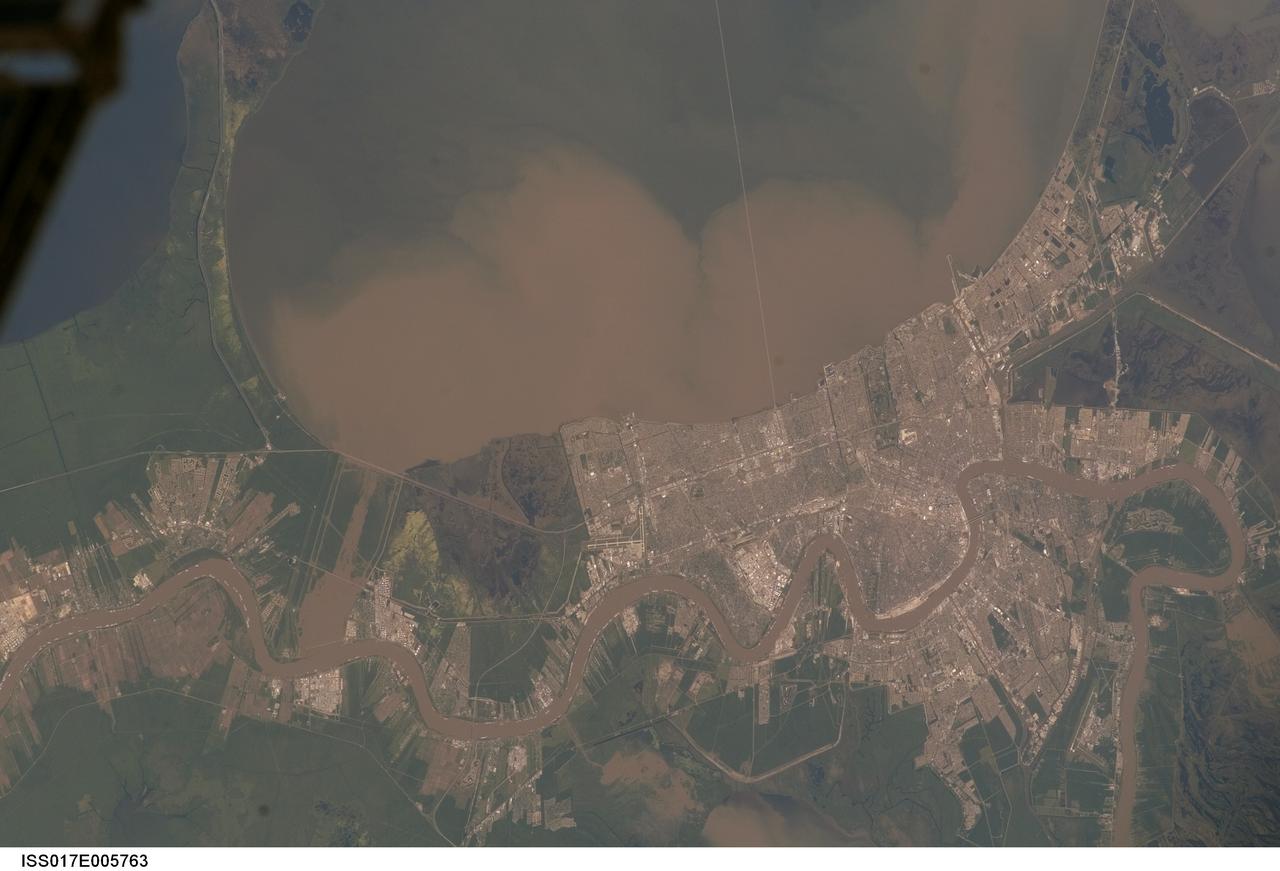
ISS017-E-005763 (29 April 2008) --- Lake Pontchartrain and the Bonnet Carre Spillway, Louisiana, are featured in this image photographed by an Expedition 17 crewmember on the International Space Station. Lake Pontchartrain, a big body of water immediately north of New Orleans, occupies the upper part of this view, with the winding course of the muddy Mississippi River snaking across the bottom of the image (flow is east, from left to right). The city of New Orleans is sandwiched between the lake and river. Heavy rain in March and April 2008 in the Mississippi's catchment area raised water levels in the river sufficiently to make the Army Corps of Engineers take action. To reduce the volume of the river where it passes through New Orleans, the Corps opened the Bonnet Carre Spillway (lower left), a major engineering structure 18 kilometers upriver from New Orleans. The spillway, a 1.6 kilometer-wide gap in the developments along the Mississippi levees, is an integral part of the river and canal system that allows Mississippi river water to flow into Lake Pontchartrain. The spillway control structure itself is visible as a thin, discontinuous, white line along the river's edge in this image. The spillway has only been opened eight times since 1937.  News of the opening in April 2008 was transmitted to crewmembers aboard the International Space Station who managed to capture the immediate effect of muddy water flowing down the spillway and into Lake Pontchartrain, where it forms great brown lobes in the otherwise green water. These lobes moved slowly east along the New Orleans shoreline, where the line of the Lake Pontchartrain Causeway, the longest bridge in the U.S., can be seen, top right. Opening the spillway protects New Orleans in various ways.  First, it reduces pressure on the levees, which famously collapsed at some points during the onslaught of Hurricane Katrina in 2005. Keeping water levels below critical high levels also helps the river channel to accommodate the discharge of water, and reduces both the speed of flow and cross currents in the river which can interfere with vessels navigating the river -- or even cause collisions with levees.
Earth Observations taken by the Expedition 17 Crew
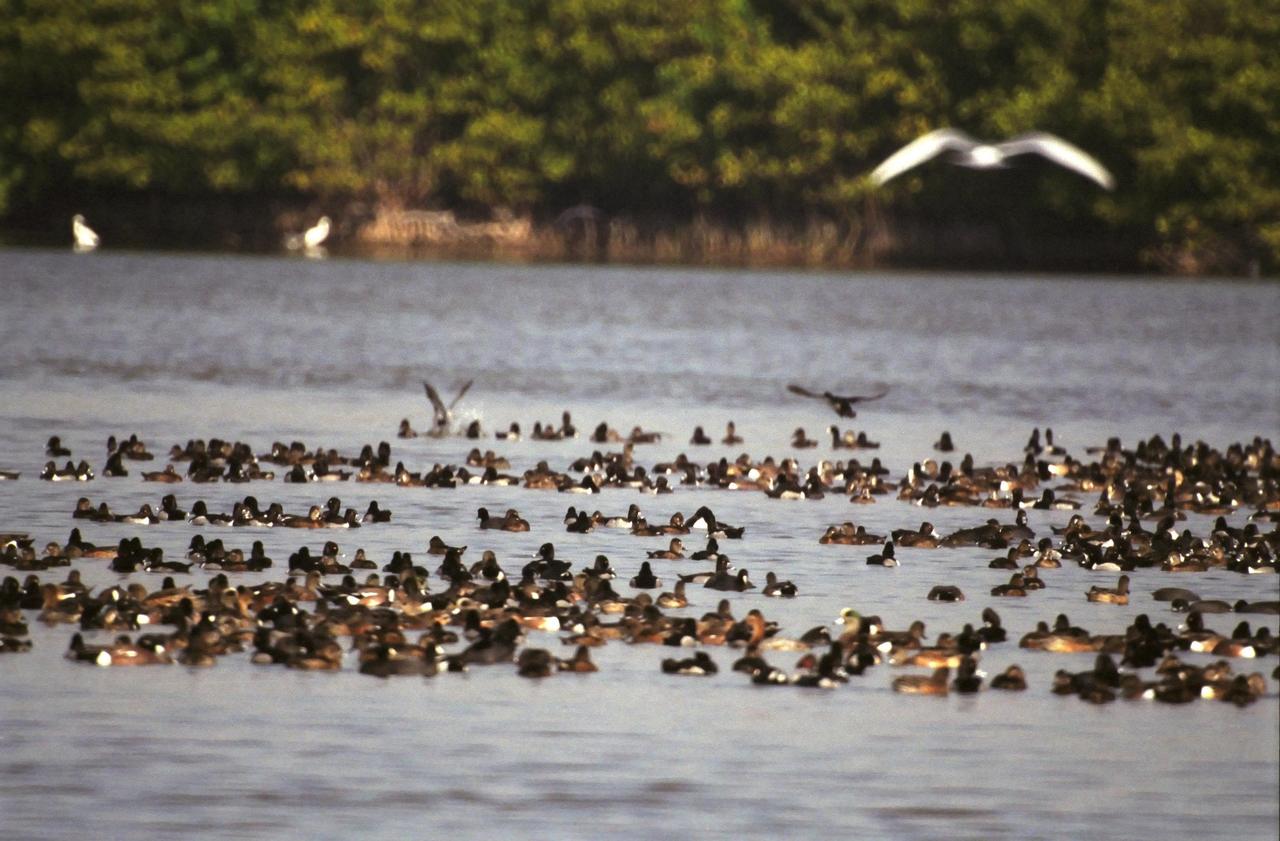
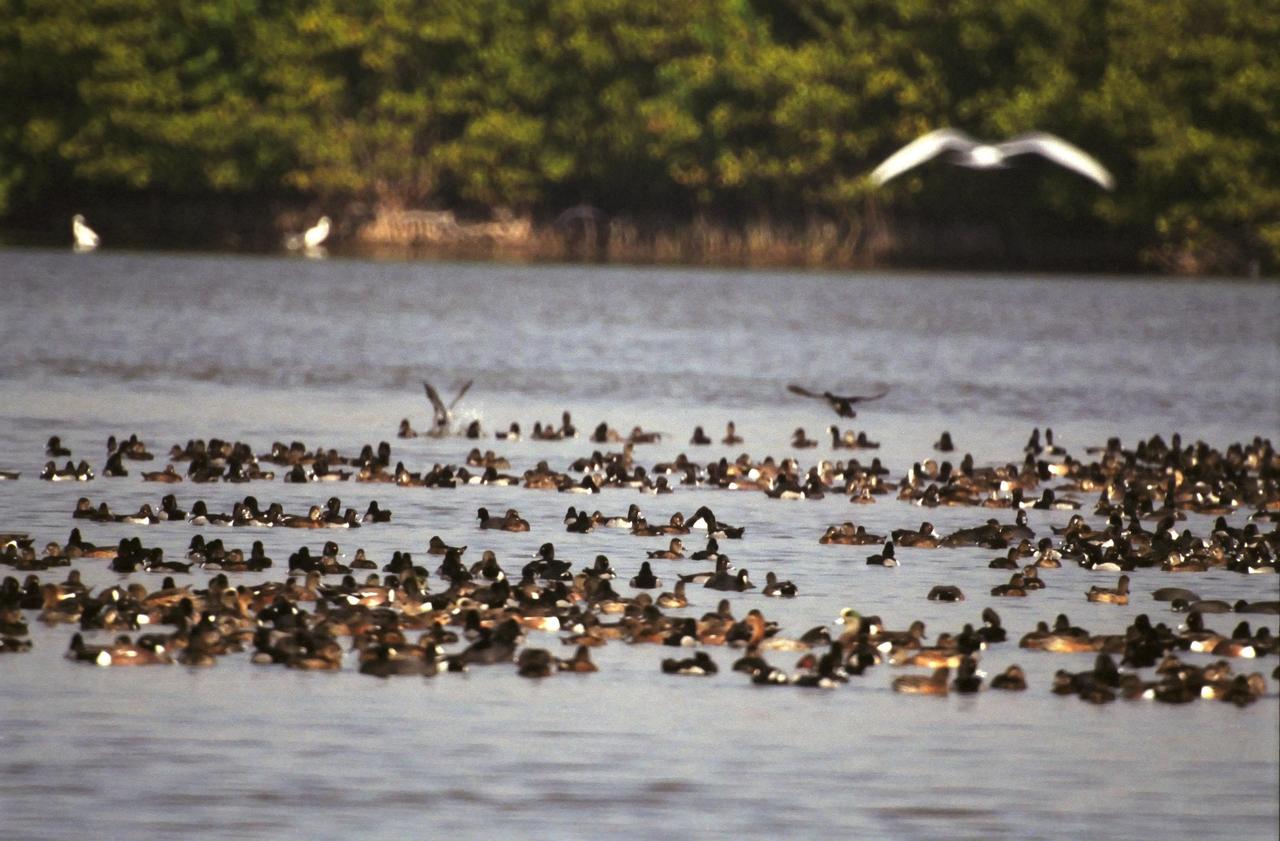
KENNEDY SPACE CENTER, FLA. -   The waters of the Merritt Island National Wildlife Refuge, which shares a boundary with Kennedy Space Center, attract coots, ducks, herons and other water birds as shown here. Coots are readily identified by their slate-gray bodies and conspicuous white bill. They inhabit open ponds and marshes from southern Canada to northern South America.  Excellent swimmers and divers, they eat various aquatic plants, but also feed on seeds grass and waste grain on land. The 92,000-acre refuge is a habitat for more than 330 species of birds, 31 mammals, 117 fishes and 65 amphibians and reptiles.  The marshes and open water of the refuge provide wintering areas for 23 species of migratory waterfowl, as well as a year-round home for great blue herons, great egrets, wood storks, cormorants, brown pelicans and other species of marsh and shore birds.
KSC-00PP-0237
KENNEDY SPACE CENTER, FLA. -   The waters of the Merritt Island National Wildlife Refuge, which shares a boundary with Kennedy Space Center, attract coots, ducks, herons and other water birds as shown here. Coots are readily identified by their slate-gray bodies and conspicuous white bill. They inhabit open ponds and marshes from southern Canada to northern South America.  Excellent swimmers and divers, they eat various aquatic plants, but also feed on seeds grass and waste grain on land. The 92,000-acre refuge is a habitat for more than 330 species of birds, 31 mammals, 117 fishes and 65 amphibians and reptiles.  The marshes and open water of the refuge provide wintering areas for 23 species of migratory waterfowl, as well as a year-round home for great blue herons, great egrets, wood storks, cormorants, brown pelicans and other species of marsh and shore birds.
KSC00PP-0237
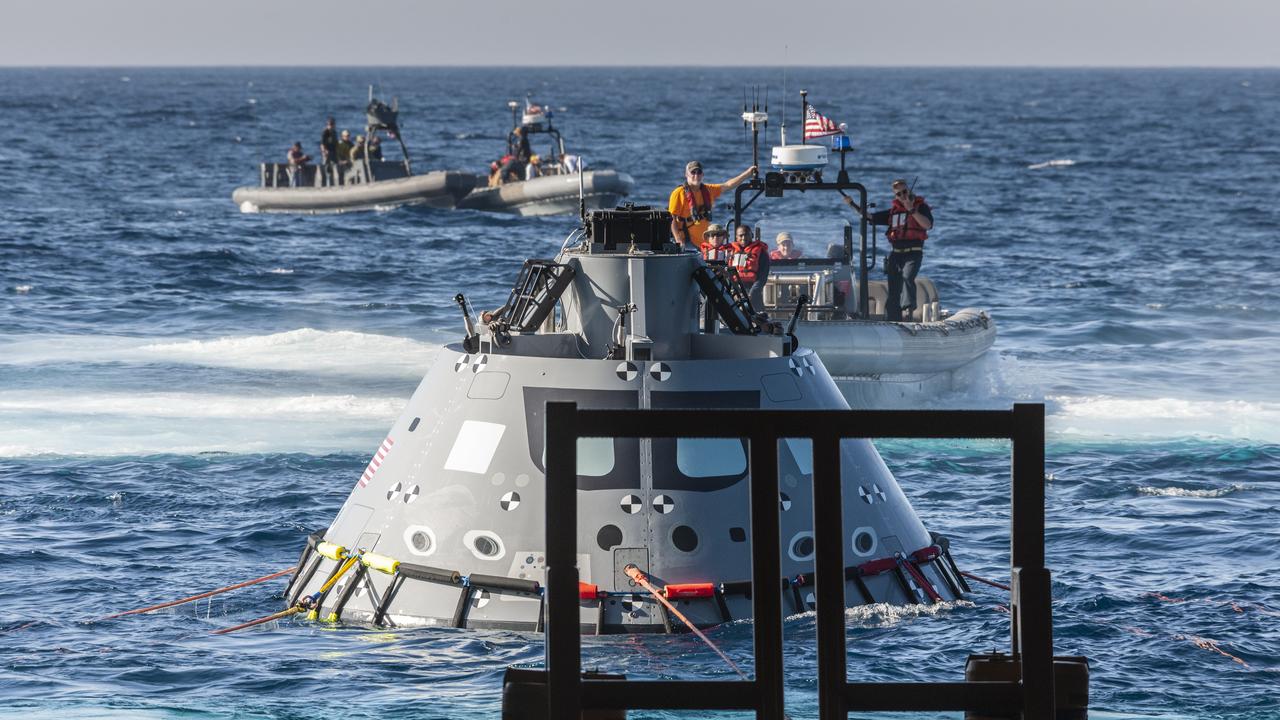
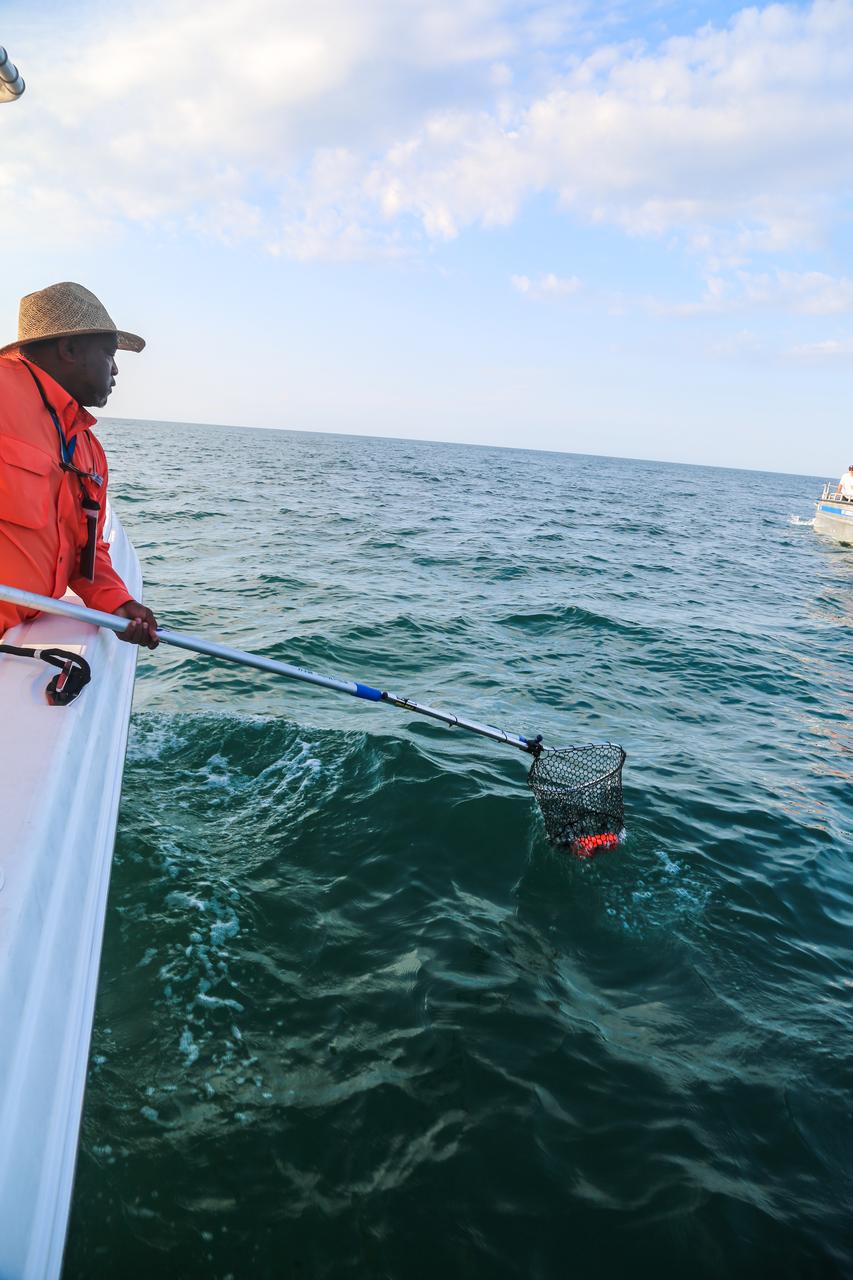
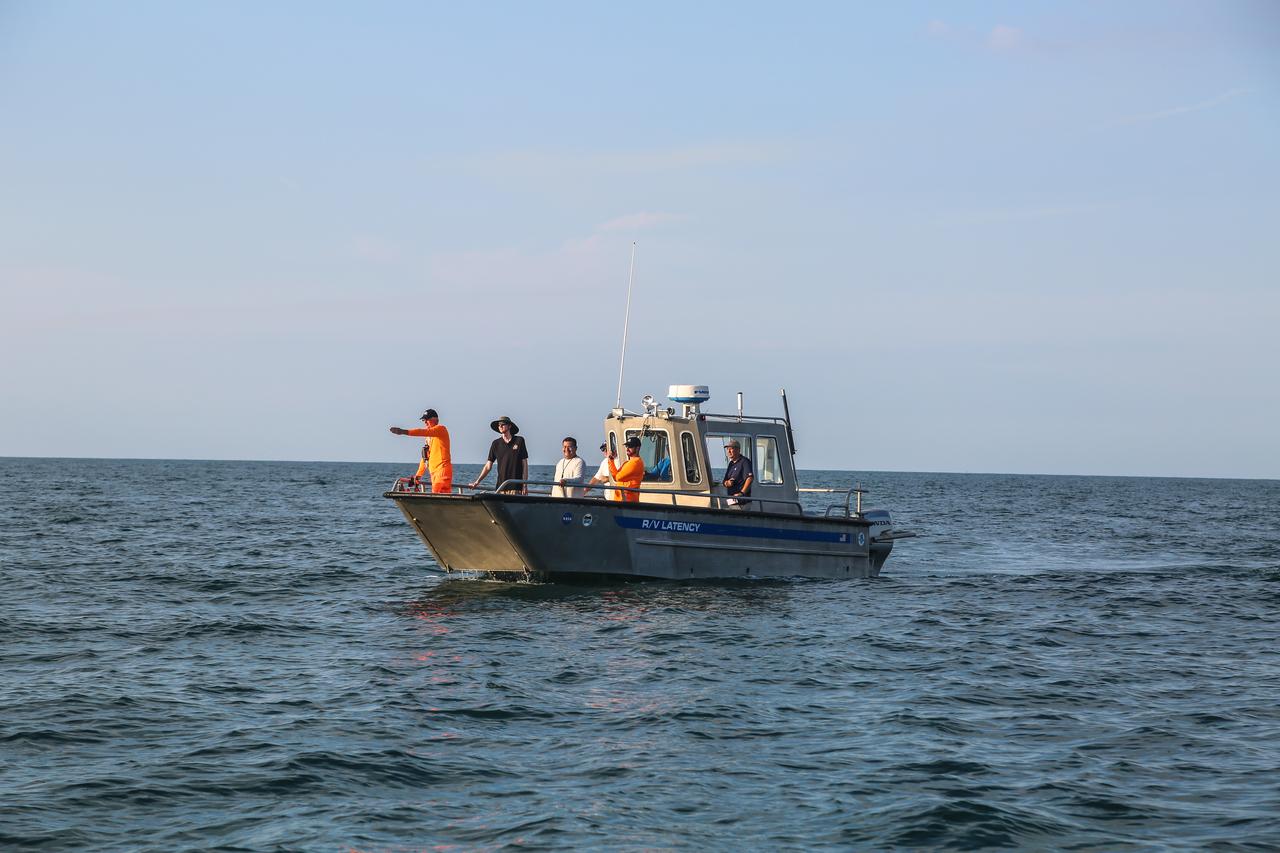
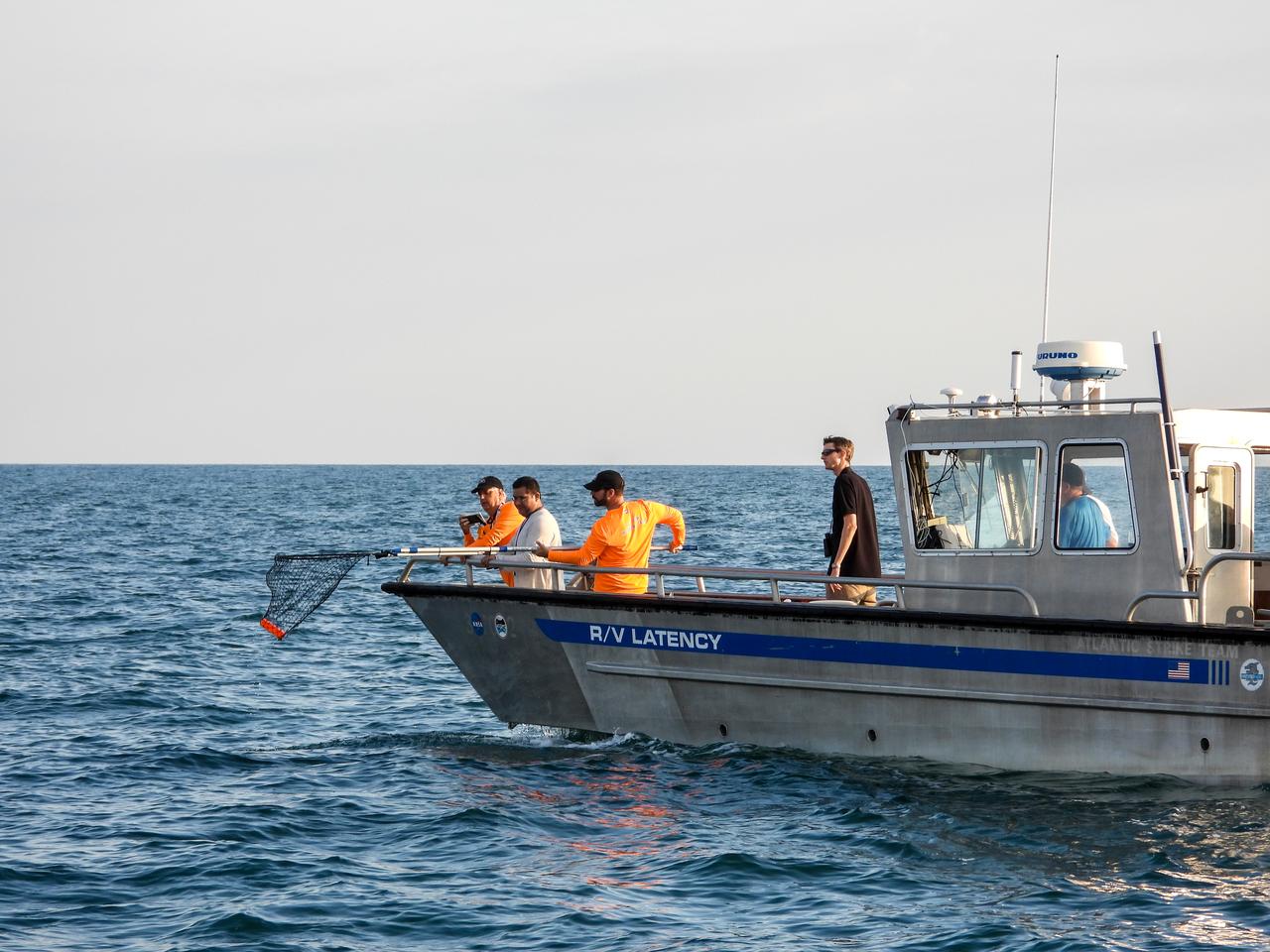
NASA's Recovery Team, along with the U.S. Navy, practice recovering a test version of the Orion capsule as part of Underway Recovery Test-7 (URT-7) in the Pacific Ocean. URT-7 is one in a series of tests that the Exploration Ground Systems Recovery Team, along with the U.S. Navy, are conducting to verify and validate procedures and hardware that will be used to recover the Orion spacecraft after it splashes down in the Pacific Ocean following deep space exploration missions. Orion will have emergency abort capability, sustain the crew during space travel and provide safe re-entry from deep space return velocities.
Underway Recovery Test 7 (URT-7) - Day 2 Activities
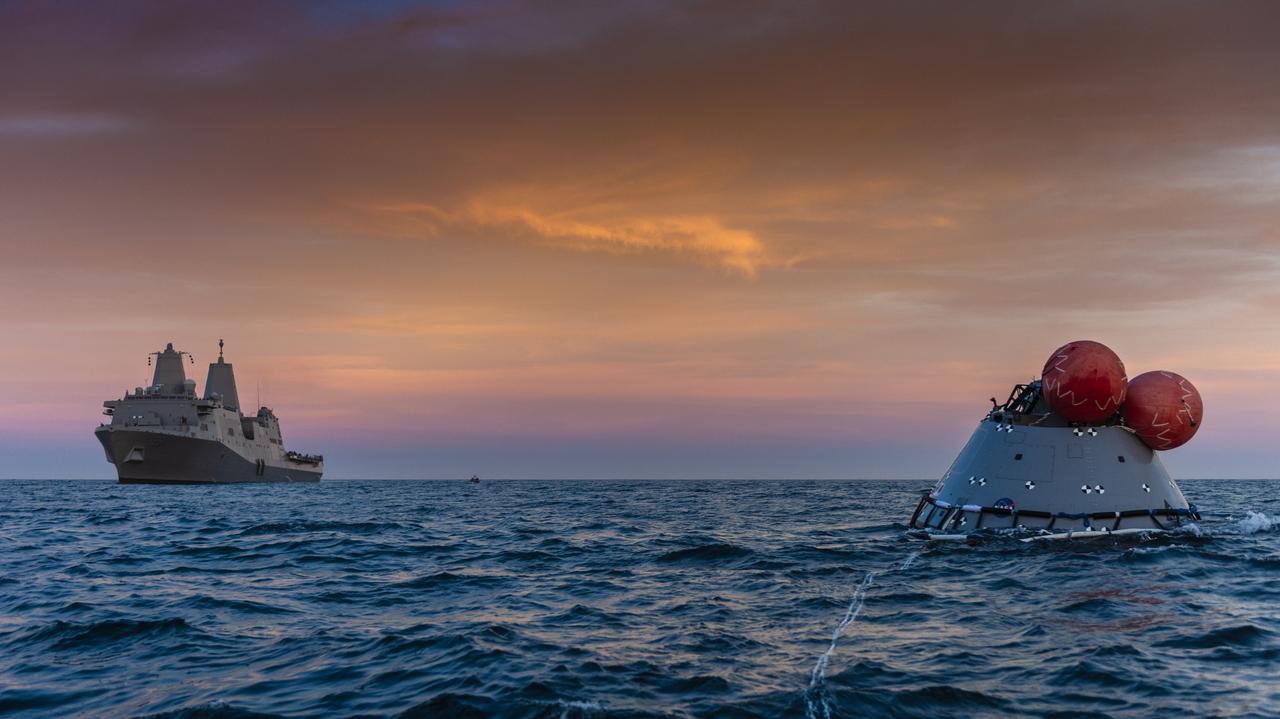
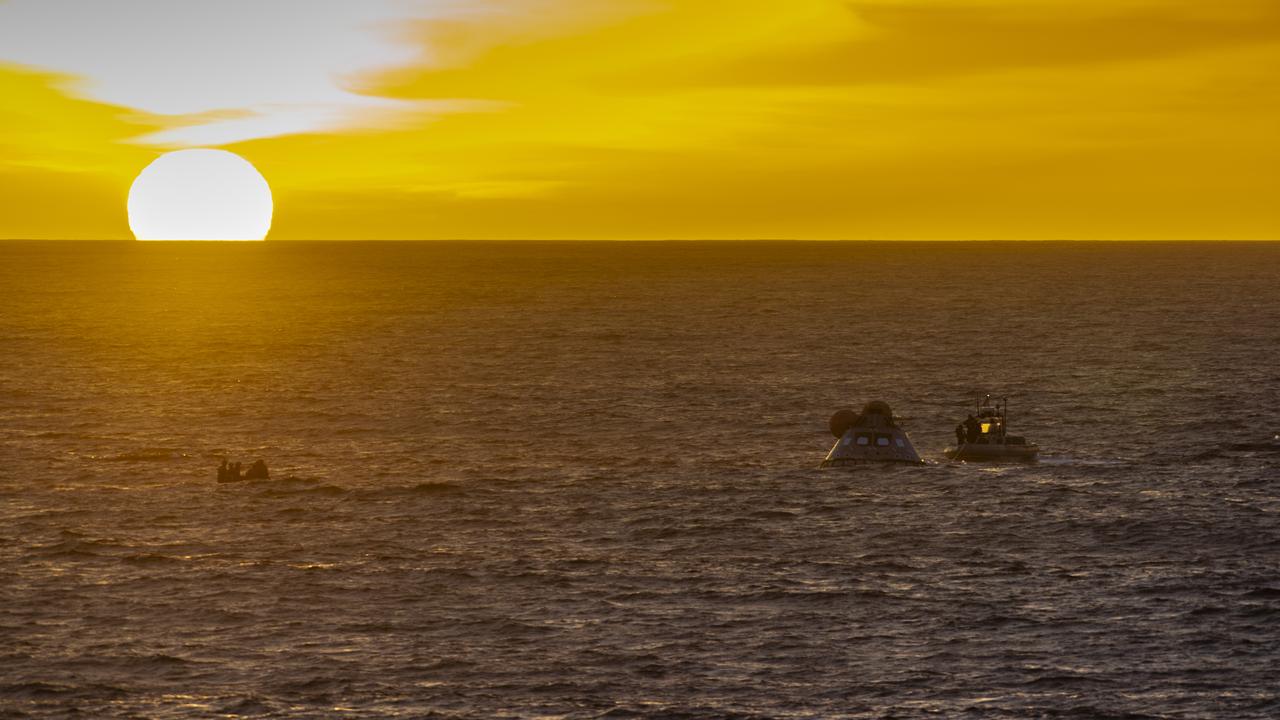
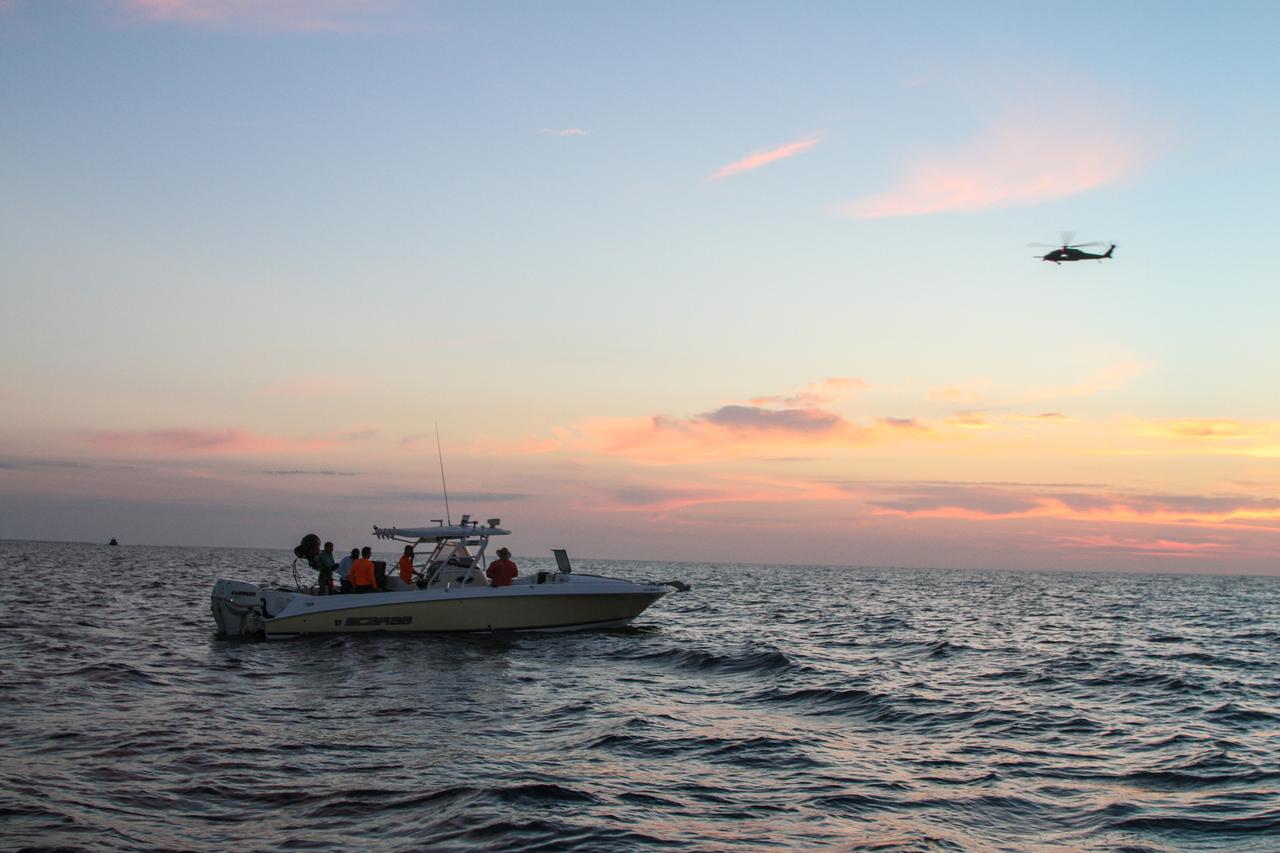
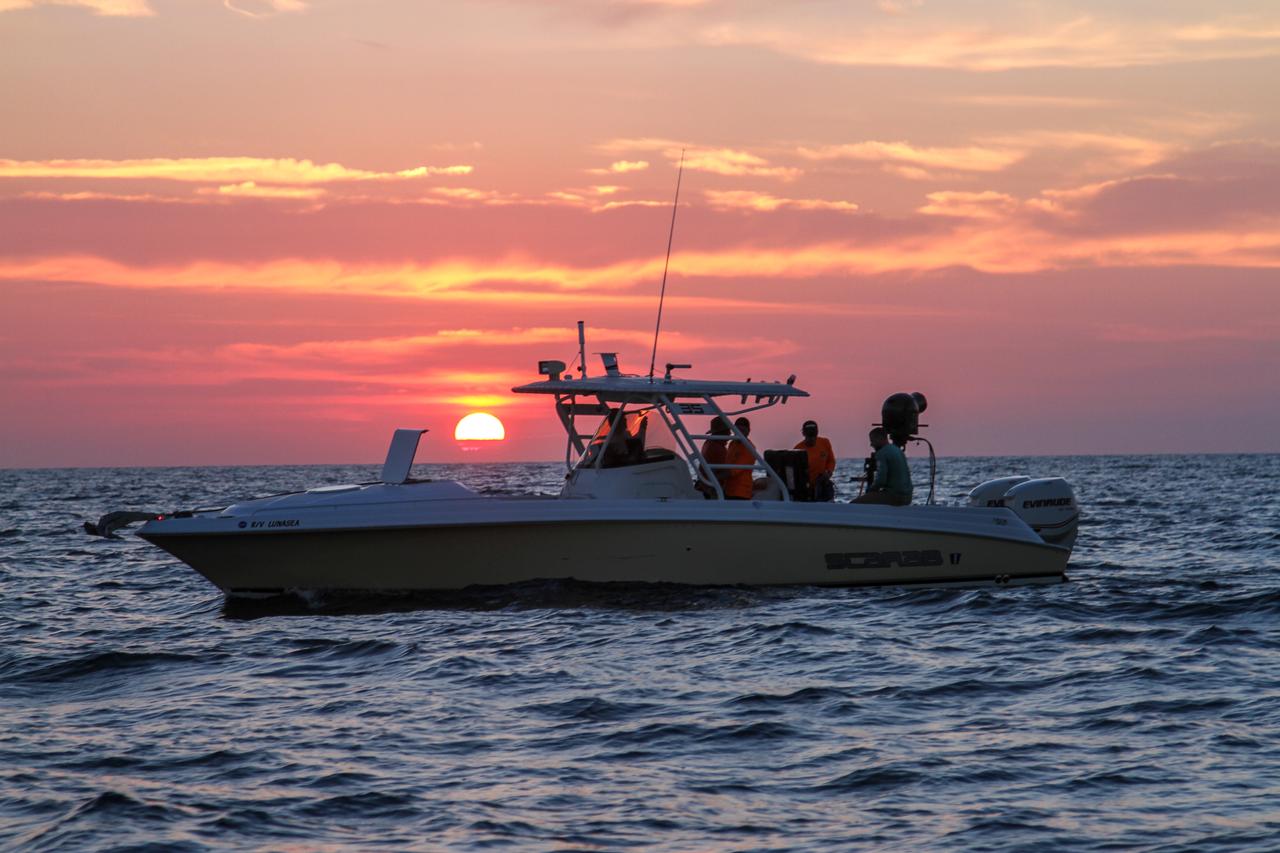
The USS John P. Murtha and a test version of the Orion capsule are in view at sunset on Nov. 1, 2018, during Underway Recovery Test-7 (URT-7) in the Pacific Ocean. URT-7 is one in a series of tests that the Exploration Ground Systems Recovery Team, along with the U.S. Navy, are conducting to verify and validate procedures and hardware that will be used to recover the Orion spacecraft after it splashes down in the Pacific Ocean following deep space exploration missions. Orion will have emergency abort capability, sustain the crew during space travel and provide safe re-entry from deep space return velocities.
Underway Recovery Test 7 (URT-7) - Day 3 Activities
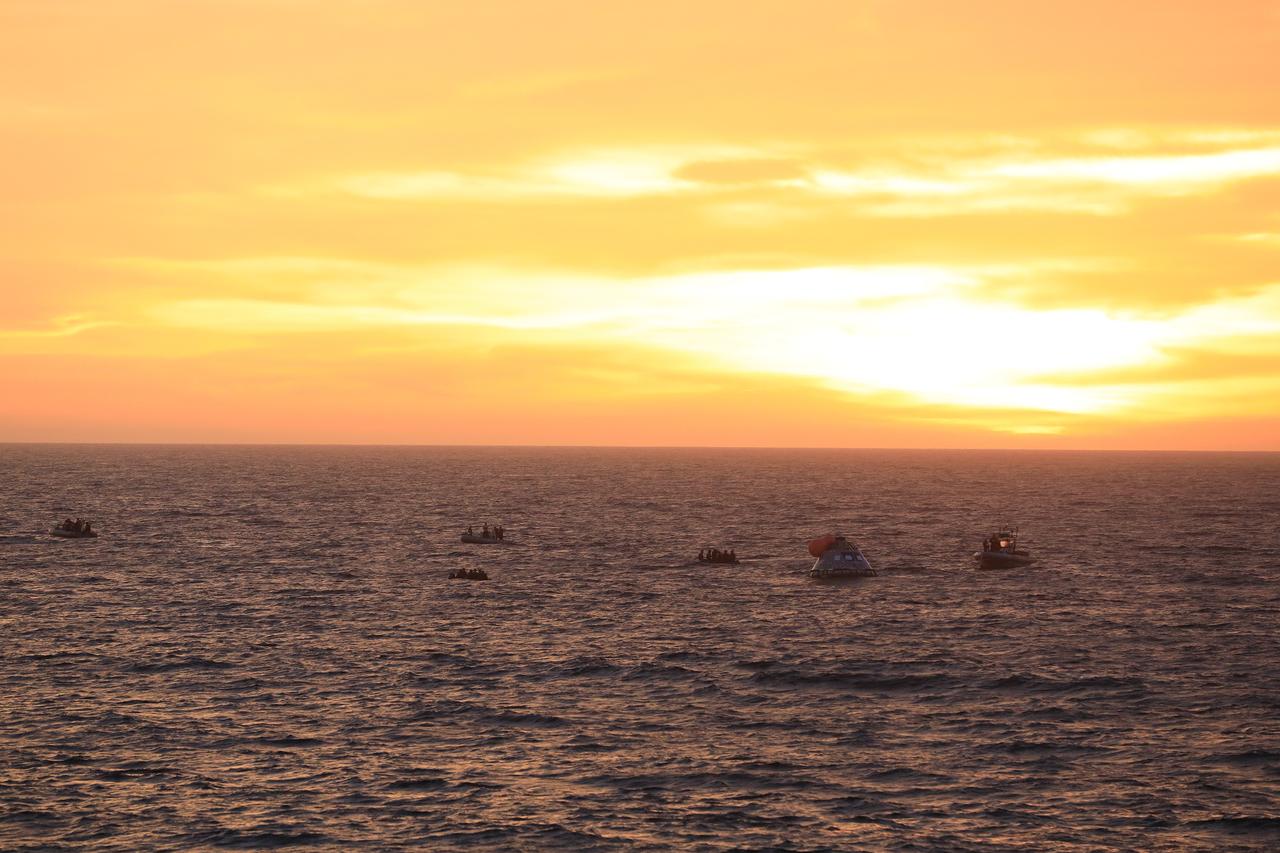
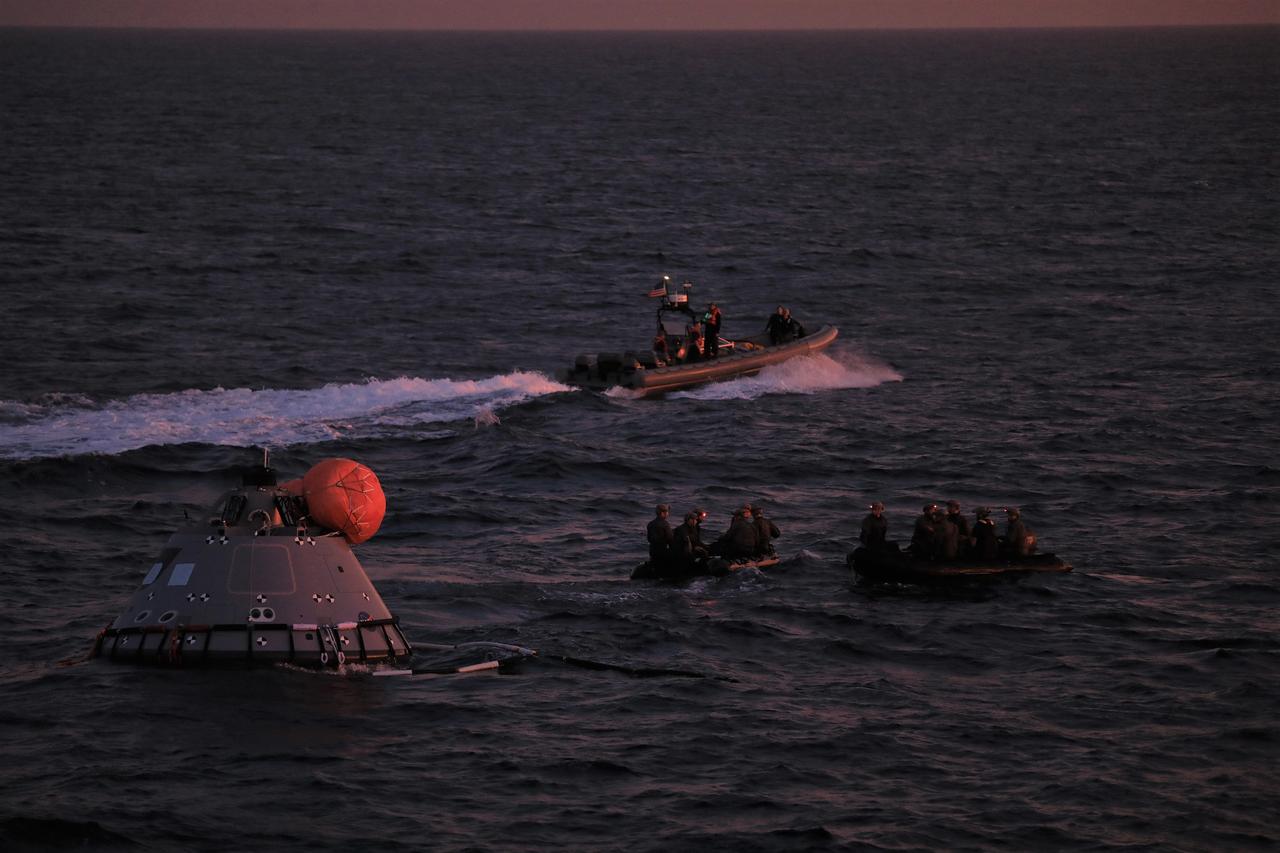
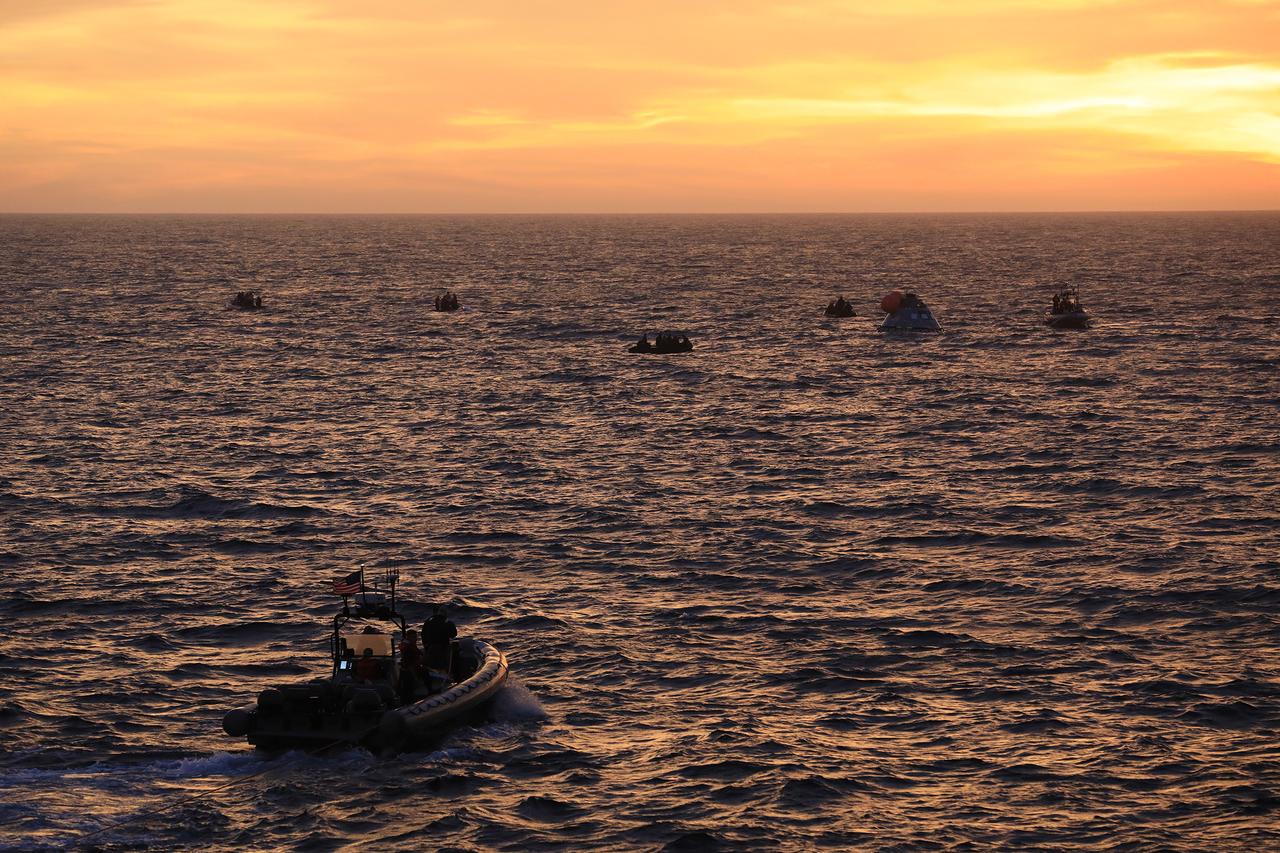
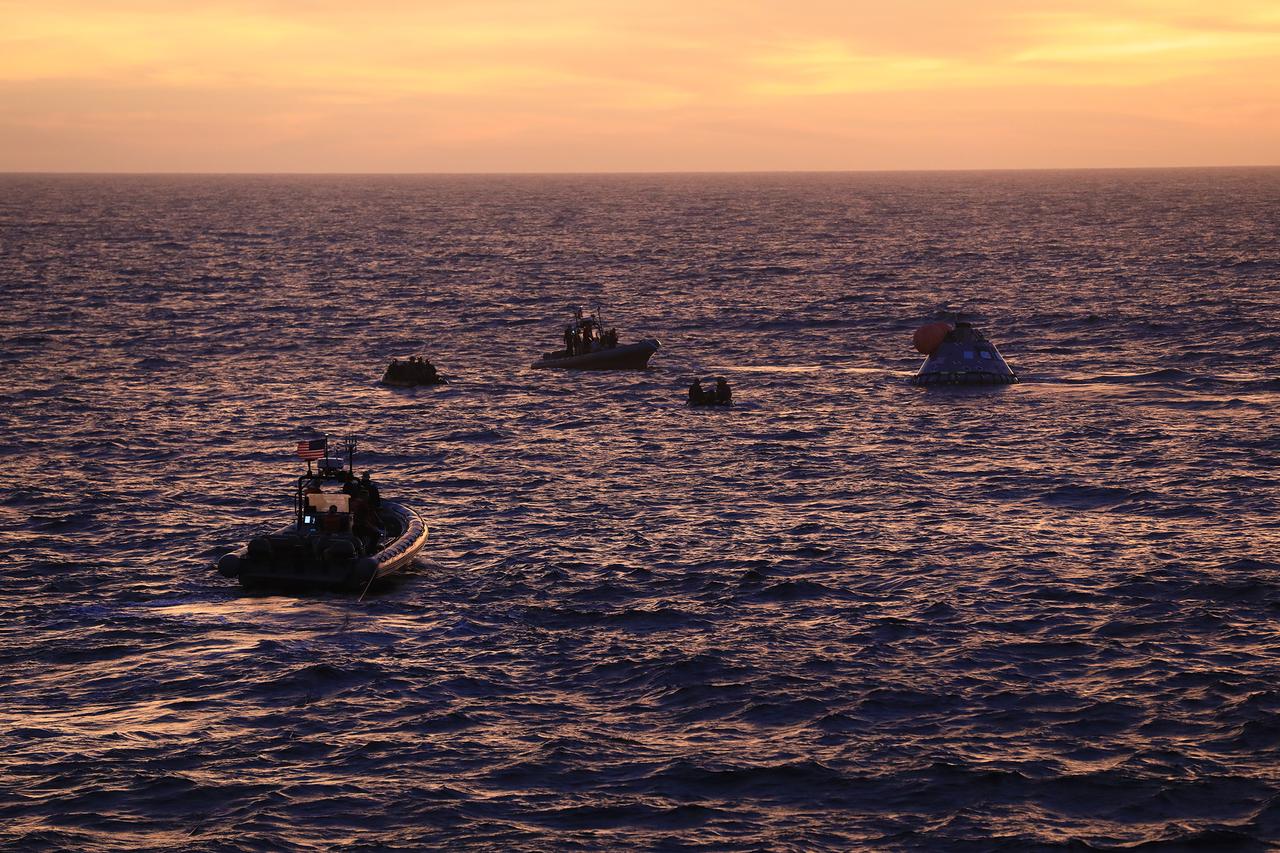
At sunset on Nov. 1, 2018, NASA's Recovery Team, along with the U.S. Navy, practice recovering a test version of the Orion capsule as part of Underway Recovery Test-7 (URT-7) in the Pacific Ocean. URT-7 is one in a series of tests that the Exploration Ground Systems Recovery Team, along with the U.S. Navy, are conducting to verify and validate procedures and hardware that will be used to recover the Orion spacecraft after it splashes down in the Pacific Ocean following deep space exploration missions. Orion will have emergency abort capability, sustain the crew during space travel and provide safe re-entry from deep space return velocities.
Underway Recovery Test 7 (URT-7) - Day 3 Activities
At sunset on Nov. 1, 2018, NASA's Recovery Team, along with the U.S. Navy, practice recovering a test version of the Orion capsule as part of Underway Recovery Test-7 (URT-7) in the Pacific Ocean. URT-7 is one in a series of tests to verify and validate procedures and hardware that will be used to recover the Orion spacecraft after it splashes down in the Pacific Ocean following deep space exploration missions. Orion will have emergency abort capability, sustain the crew during space travel and provide safe re-entry from deep space return velocities.
Underway Recovery Test 7 (URT-7) - Day 3 Activities
NASA Recovery Team members aboard a rigid hull boat monitor the winch line attached to a test version of the Orion capsule during Underway Recovery Test-7 (URT-7) on Oct. 31, 2018, in the Pacific Ocean. URT-7 is one in a series of tests that the EGS Recovery Team, along with the U.S. Navy, are conducting to verify and validate procedures and hardware that will be used to recover the Orion spacecraft after it splashes down in the Pacific Ocean following deep space exploration missions. Orion will have emergency abort capability, sustain the crew during space travel and provide safe re-entry from deep space return velocities.
Underway Recovery Test 7 (URT-7) - Day 2 Activities
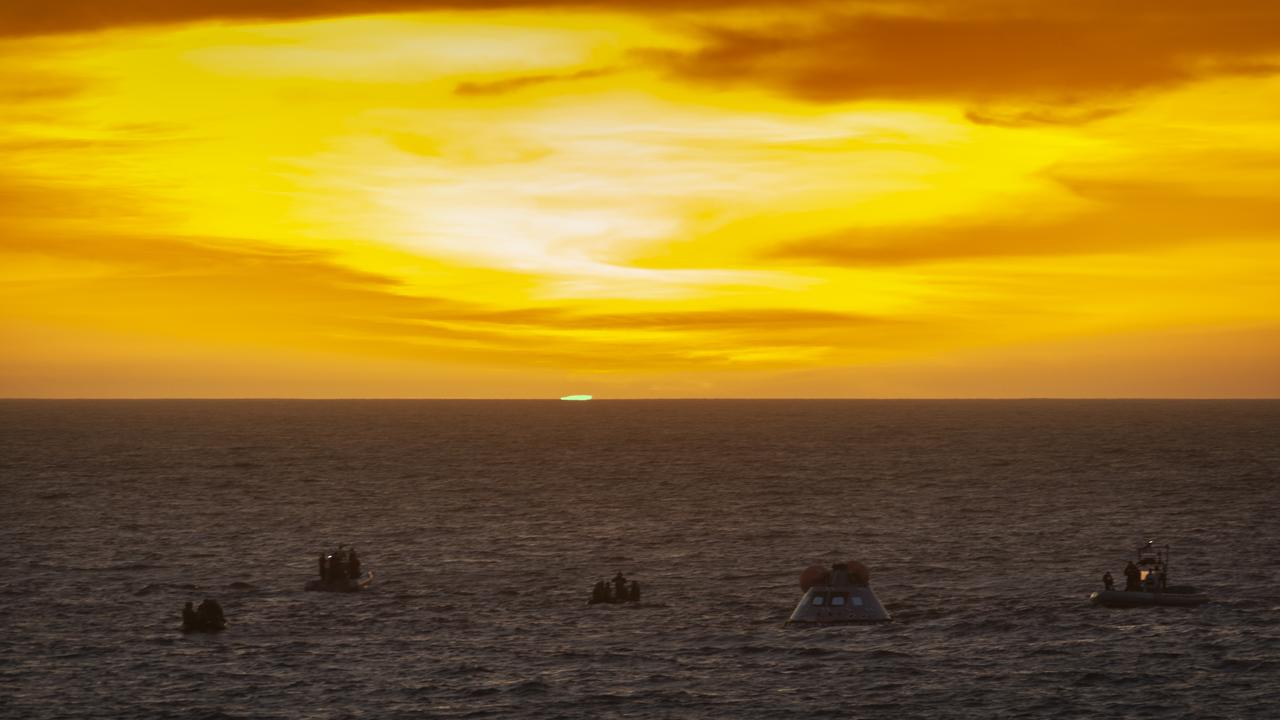
At sunset, a test version of the Orion capsule floats in the Pacific Ocean on Nov. 1, 2018, during Underway Recovery Test-7 (URT-7). Nearby is the USS John P. Murtha. Orion will be towed into the ship's well deck. URT-7 is one in a series of tests that the Exploration Ground Systems Recovery Team, along with the U.S. Navy, are conducting to verify and validate procedures and hardware that will be used to recover the Orion spacecraft after it splashes down in the Pacific Ocean following deep space exploration missions. Orion will have emergency abort capability, sustain the crew during space travel and provide safe re-entry from deep space return velocities.
Underway Recovery Test 7 (URT-7) - Day 3 Activities
The USS John P. Murtha is in view at sunset on Nov. 1, 2018, during Underway Recovery Test-7 (URT-7) in the Pacific Ocean. URT-7 is one in a series of tests that the Exploration Ground Systems Recovery Team, along with the U.S. Navy, are conducting to verify and validate procedures and hardware that will be used to recover the Orion spacecraft after it splashes down in the Pacific Ocean following deep space exploration missions. Orion will have emergency abort capability, sustain the crew during space travel and provide safe re-entry from deep space return velocities.
Underway Recovery Test 7 (URT-7) - Day 3 Activities
At sunset on Nov. 1, 2018, NASA's Recovery Team, along with the U.S. Navy, practice recovering a test version of the Orion capsule as part of Underway Recovery Test-7 (URT-7) in the Pacific Ocean. URT-7 is one in a series of tests to verify and validate procedures and hardware that will be used to recover the Orion spacecraft after it splashes down in the Pacific Ocean following deep space exploration missions. Orion will have emergency abort capability, sustain the crew during space travel and provide safe re-entry from deep space return velocities.
Underway Recovery Test 7 (URT-7) - Day 3 Activities
The USS John P. Murtha and a test version of the Orion capsule are in view at sunset on Nov. 1, 2018, during Underway Recovery Test-7 (URT-7) in the Pacific Ocean. URT-7 is one in a series of tests that the Exploration Ground Systems Recovery Team, along with the U.S. Navy, are conducting to verify and validate procedures and hardware that will be used to recover the Orion spacecraft after it splashes down in the Pacific Ocean following deep space exploration missions. Orion will have emergency abort capability, sustain the crew during space travel and provide safe re-entry from deep space return velocities.
Underway Recovery Test 7 (URT-7) - Day 3 Activities
NASA Recovery Team members with Exploration Ground Systems (EGS) and the U.S. Navy practice recovering a test version of the Orion capsule on Oct. 31, 2018, during Underway Recovery Test-7 (URT-7) in the Pacific Ocean. URT-7 is one in a series of tests that the EGS Recovery Team, along with the U.S. Navy, are conducting to verify and validate procedures and hardware that will be used to recover the Orion spacecraft after it splashes down in the Pacific Ocean following deep space exploration missions. Orion will have emergency abort capability, sustain the crew during space travel and provide safe re-entry from deep space return velocities.
Underway Recovery Test 7 (URT-7) - Day 2 Activities
At sunset on Nov. 1, 2018, NASA's Recovery Team, along with the U.S. Navy, practice recovering a test version of the Orion capsule as part of Underway Recovery Test-7 (URT-7) in the Pacific Ocean. URT-7 is one in a series of tests to verify and validate procedures and hardware that will be used to recover the Orion spacecraft after it splashes down in the Pacific Ocean following deep space exploration missions. Orion will have emergency abort capability, sustain the crew during space travel and provide safe re-entry from deep space return velocities.
Underway Recovery Test 7 (URT-7) - Day 3 Activities
At sunset on Nov. 1, 2018, NASA's Recovery Team, along with the U.S. Navy, practice recovering a test version of the Orion capsule as part of Underway Recovery Test-7 (URT-7) in the Pacific Ocean. URT-7 is one in a series of tests to verify and validate procedures and hardware that will be used to recover the Orion spacecraft after it splashes down in the Pacific Ocean following deep space exploration missions. Orion will have emergency abort capability, sustain the crew during space travel and provide safe re-entry from deep space return velocities.
Underway Recovery Test 7 (URT-7) - Day 3 Activities
At sunset on Nov. 1, 2018, NASA's Recovery Team, along with the U.S. Navy, practice recovering a test version of the Orion capsule as part of Underway Recovery Test-7 (URT-7) in the Pacific Ocean. URT-7 is one in a series of tests that the Exploration Ground Systems Recovery Team, along with the U.S. Navy, are conducting to verify and validate procedures and hardware that will be used to recover the Orion spacecraft after it splashes down in the Pacific Ocean following deep space exploration missions. Orion will have emergency abort capability, sustain the crew during space travel and provide safe re-entry from deep space return velocities.
Underway Recovery Test 7 (URT-7) - Day 3 Activities
At sunset on Nov. 1, 2018, NASA's Recovery Team, along with the U.S. Navy, practice recovering a test version of the Orion capsule as part of Underway Recovery Test-7 (URT-7) in the Pacific Ocean. URT-7 is one in a series of tests to verify and validate procedures and hardware that will be used to recover the Orion spacecraft after it splashes down in the Pacific Ocean following deep space exploration missions. Orion will have emergency abort capability, sustain the crew during space travel and provide safe re-entry from deep space return velocities.
Underway Recovery Test 7 (URT-7) - Day 3 Activities
NASA's Recovery Team, along with the U.S. Navy, practice recovering a test version of the Orion capsule as part of Underway Recovery Test-7 (URT-7) in the Pacific Ocean. URT-7 is one in a series of tests that the Exploration Ground Systems Recovery Team, along with the U.S. Navy, are conducting to verify and validate procedures and hardware that will be used to recover the Orion spacecraft after it splashes down in the Pacific Ocean following deep space exploration missions. Orion will have emergency abort capability, sustain the crew during space travel and provide safe re-entry from deep space return velocities.
Underway Recovery Test 7 (URT-7) - Day 2 Activities
KENNEDY SPACE CENTER, Fla. -  With the solar arrays fully open on the Mars Exploration Rover-2 (MER-2), the low-gain and high-gain antennas can be seen.  Set to launch in Spring 2003, the MER Mission will consist of two identical rovers designed to cover roughly 110 yards each Martian day. Each rover will carry five scientific instruments that will allow it to search for evidence of liquid water that may have been present in the planet's past.  The rovers will be identical to each other, but will land at different regions of Mars.  The first rover has a launch window opening May 30, and the second rover a window opening June 25, 2003.
KSC-03pd0772
KENNEDY SPACE CENTER, Fla. -  Workers in the Payload Hazardous Servicing Facility test the opening of the solar arrays on the Mars Exploration Rover-2 (MER-2).  Set to launch in Spring 2003, the MER Mission will consist of two identical rovers designed to cover roughly 110 yards each Martian day. Each rover will carry five scientific instruments that will allow it to search for evidence of liquid water that may have been present in the planet's past.  The rovers will be identical to each other, but will land at different regions of Mars.  The first rover has a launch window opening May 30, and the second rover a window opening June 25, 2003.
KSC-03pd0770
KENNEDY SPACE CENTER, Fla. -  The solar arrays on the Mars Exploration Rover-2 (MER-2) are fully opened during a test in the Payload Hazardous Servicing Facility.  Set to launch in Spring 2003, the MER Mission will consist of two identical rovers designed to cover roughly 110 yards each Martian day. Each rover will carry five scientific instruments that will allow it to search for evidence of liquid water that may have been present in the planet's past.  The rovers will be identical to each other, but will land at different regions of Mars.  The first rover has a launch window opening May 30, and the second rover a window opening June 25, 2003.
KSC-03pd0771
The solar arrays on the Mars Exploration Rover-2 (MER-2) are fully opened during a test in the Payload Hazardous Servicing Facility. Set to launch in Spring 2003, the MER Mission will consist of two identical rovers designed to cover roughly 110 yards each Martian day. Each rover will carry five scientific instruments that will allow it to search for evidence of liquid water that may have been present in the planet's past. The rovers will be identical to each other, but will land at different regions of Mars. The first rover has a launch window opening May 30, and the second rover a window opening June 25, 2003.
Mars Exploration Rover-2 (MER-2)
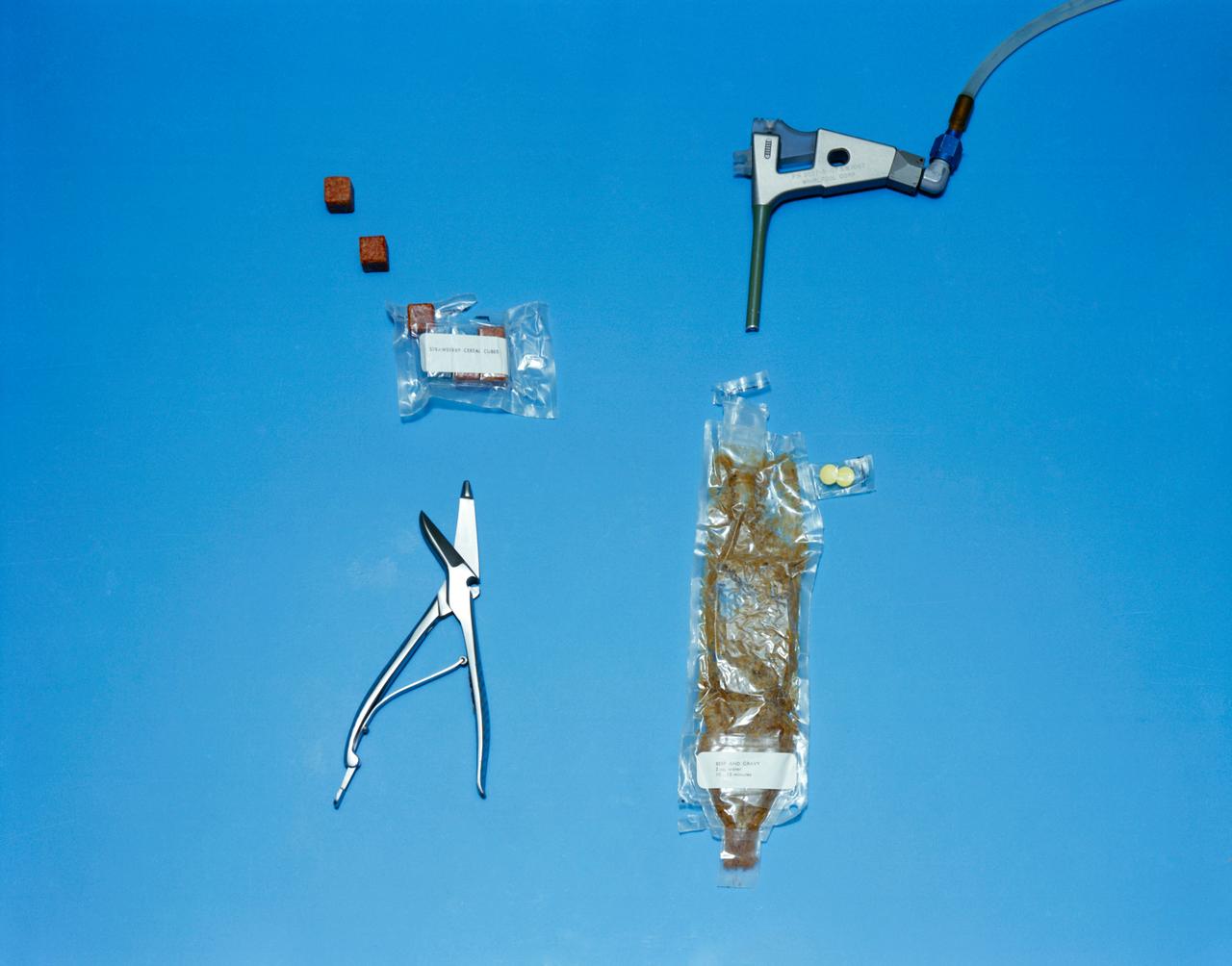
Food packages of beef and gravy fully reconstituted and ready to eat. An astronaut would squeeze food through opening at right side of package. Water gun is used to reconstitute dehydrated food. Scissors are used to open packages. This is the type of space food which will be used on the Gemini-Titan 4 spaceflight.                  MSC, Houston, TX            *S65-24895 thru S65-24899
Space Food Package - Gemini-Titan (GT)-4 Flight - MSC
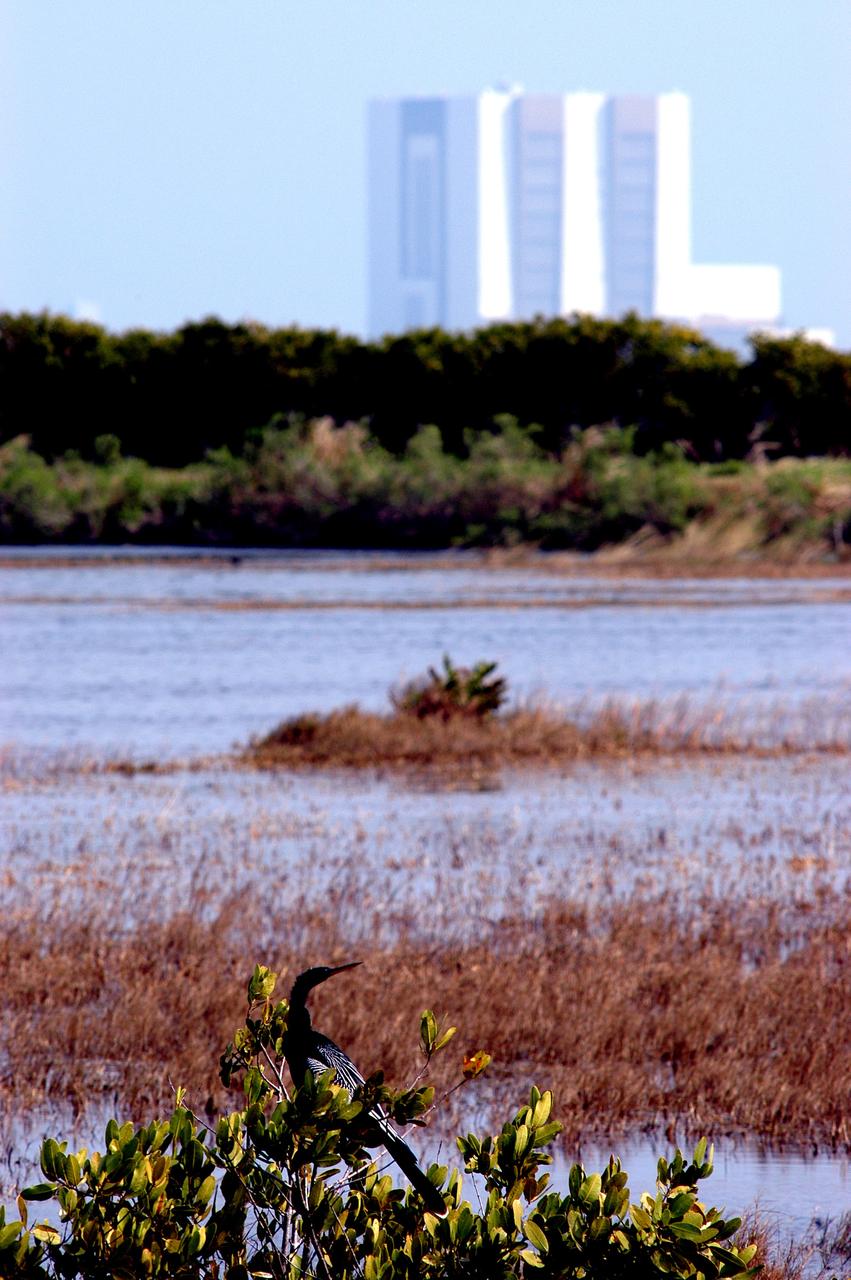
KENNEDY SPACE CENTER, FLA. - Nature thrives with technology as seen in this photo of the Vehicle Assembly Building (background) and surrounding grounds and water.  In the foreground is an Anhinga perched on waterside plants.  A common inhabitant of Kennedy Space Center, it prefers freshwater ponds and swamps with thick vegetation, especially cypress.  Anhinga can be found in the U.S. on the Atlantic and Gulf coasts from North Carolina to Texas.  They are known as the “Snakebird” because when swimming they submerge their bodies, leaving only their heads and long necks visible.  They are often seen on the ground and in the trees with their wings open to dry them in the sun.  Kennedy shares a boundary with the Merritt Island National Wildlife Refuge, home to some of the nation’s rarest and most unusual species of wildlife.  The marshes and open water of the refuge also provide wintering areas for 23 species of migratory waterfowl, as well as a year-round home for great blue herons, great egrets, wood storks, cormorants, brown pelicans and other species of marsh and shore birds.
KENNEDY SPACE CENTER, FLA. - Nature thrives with technology as seen in this photo of the Vehicle Assembly Building (background) and surrounding grounds and water. In the foreground is an Anhinga perched on waterside plants. A common inhabitant of Kennedy Space Center, it prefers freshwater ponds and swamps with thick vegetation, especially cypress. Anhinga can be found in the U.S. on the Atlantic and Gulf coasts from North Carolina to Texas. They are known as the “Snakebird” because when swimming they submerge their bodies, leaving only their heads and long necks visible. They are often seen on the ground and in the trees with their wings open to dry them in the sun. Kennedy shares a boundary with the Merritt Island National Wildlife Refuge, home to some of the nation’s rarest and most unusual species of wildlife. The marshes and open water of the refuge also provide wintering areas for 23 species of migratory waterfowl, as well as a year-round home for great blue herons, great egrets, wood storks, cormorants, brown pelicans and other species of marsh and shore birds.
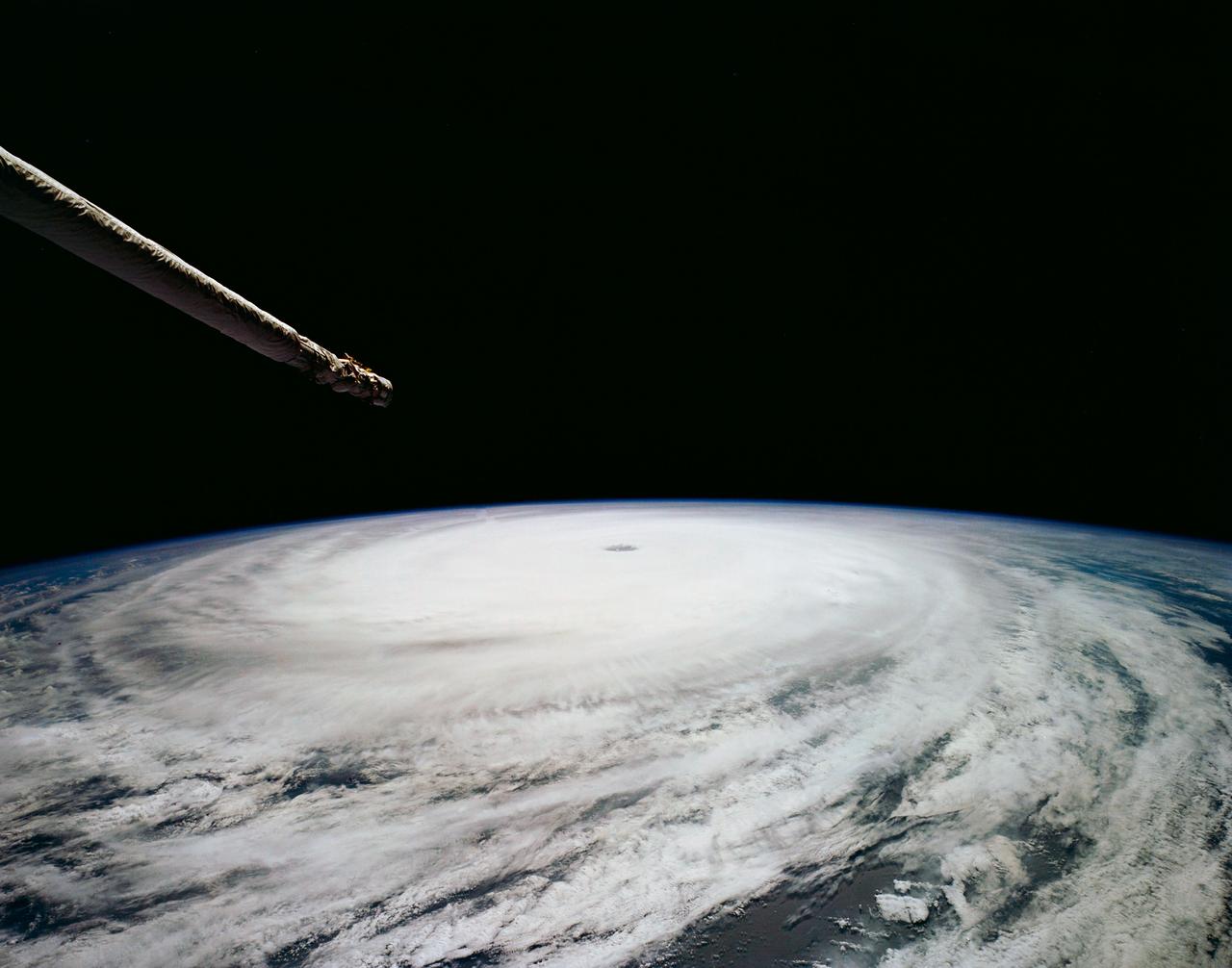
This is a picture of Hurricane Florence at its peak, over the open waters of the North Atlantic. This hurricane never made landfall over the United States, however after the storm became extra-tropical, it's moisture combined with a storm system over parts of Europe and caused large amounts of flooding across Spain and France.
Hurricane Florence as seen from STS-66 shuttle Atlantis
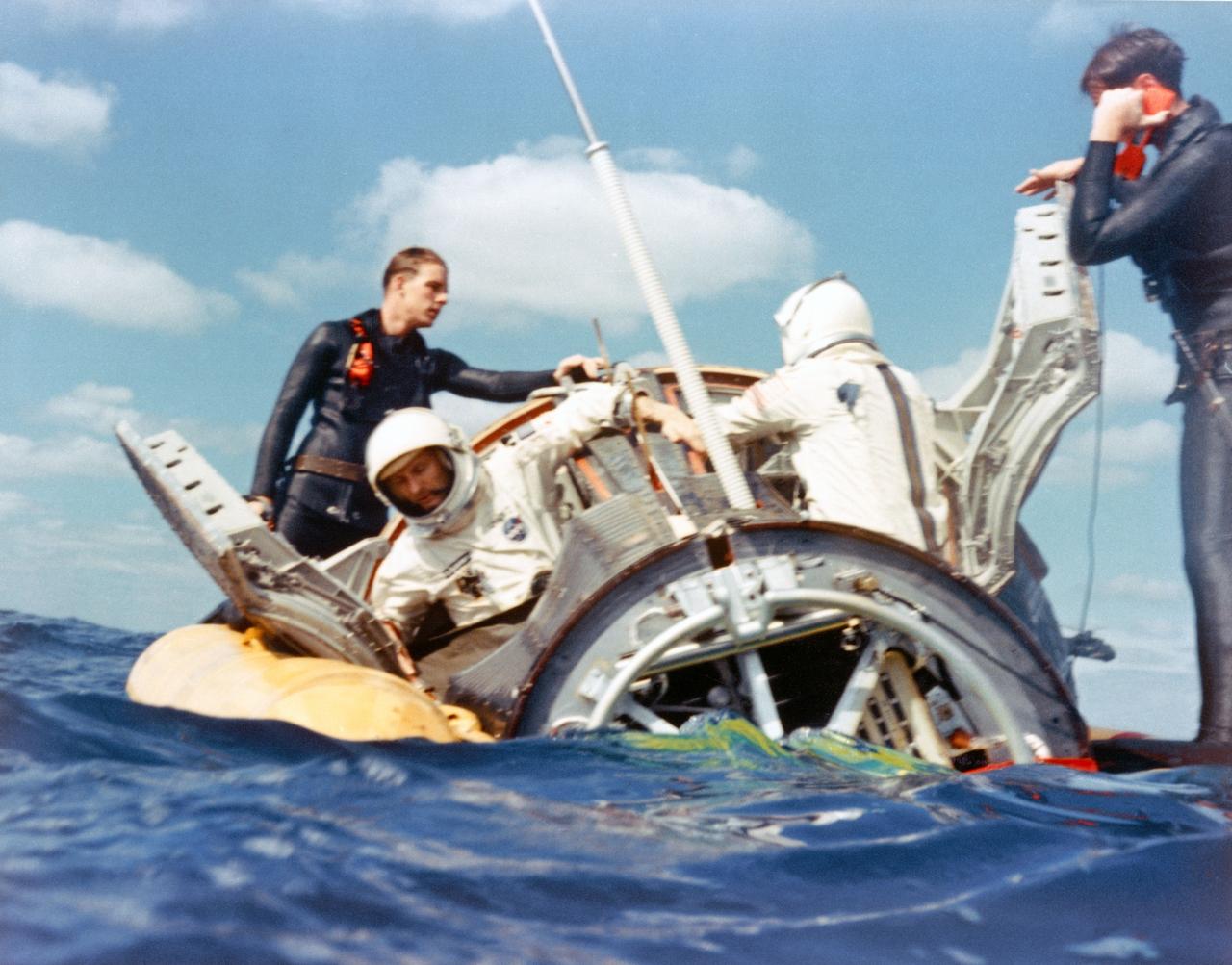
S65-61886 (16 Dec. 1965) --- A water level view of Navy divers assisting Gemini-6 crew members Stafford and Schirra to open hatches after landing in the Atlantic. Photo credit: NASA or National Aeronautics and Space Administration
GEMINI-6 - RECOVERY - ATLANTIC
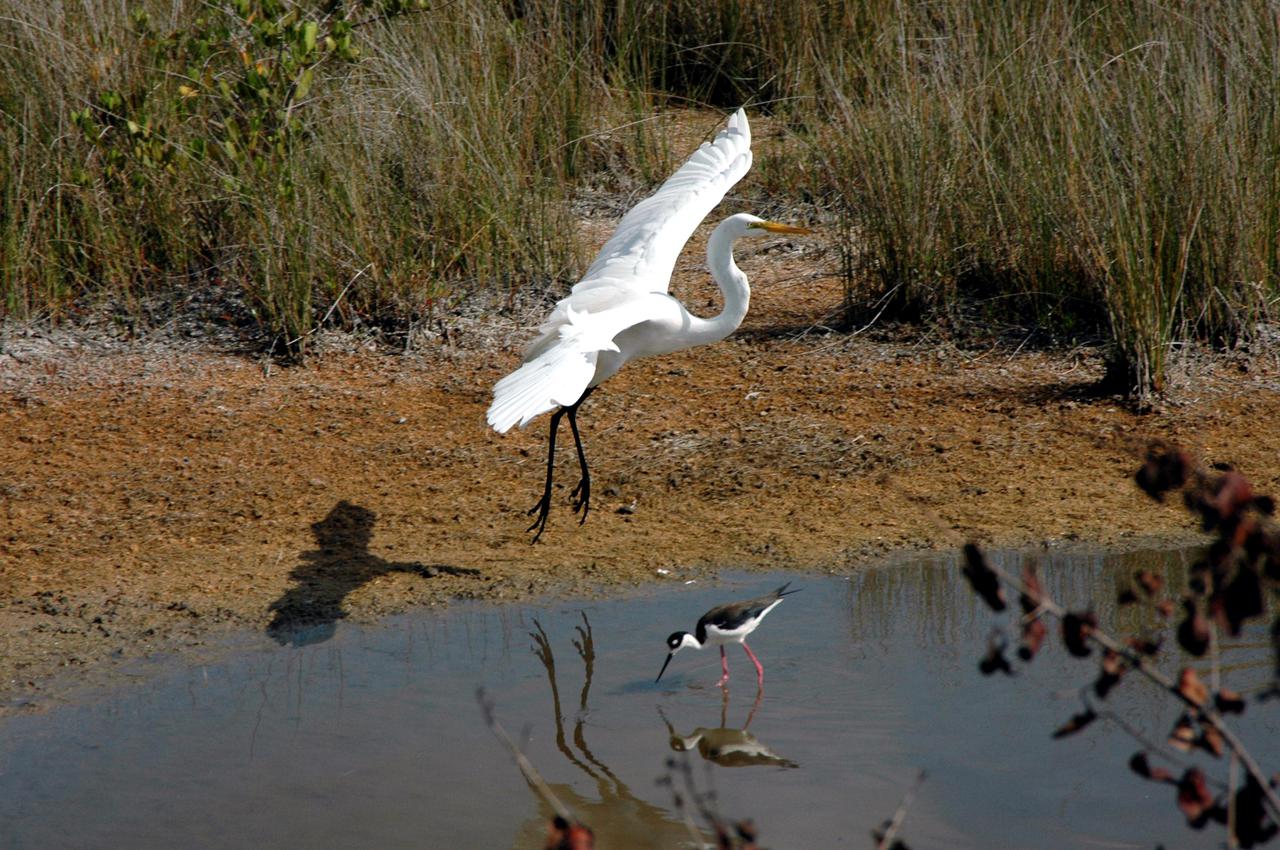
KENNEDY SPACE CENTER, FLA.  -  A black-necked stilt, foraging for food, pays no attention to a great egret as it comes in for a landing in a marshy area of the Merritt Island National Wildlife Refuge. The refuge was established in 1963 on Kennedy Space Center land and water not used by NASA for the space program. The marshes and open water of the refuge provide wintering grounds for 23 species of migratory waterfowl, as well as a year-round home for great blue herons, wood storks, cormorants, brown pelicans and other species of marsh and shore birds.
KSC-05pd-1019
CAPE CANAVERAL, Fla. –– A cormorant enjoys the sunshine while standing in the water on NASA's Kennedy Space Center in Florida. The bird is a common sight around Kennedy, which shares a boundary with the Merritt Island National Wildlife Refuge. The marshes and open water of the refuge provide wintering areas for 23 species of migratory waterfowl, as well as a year-round home for great blue herons, great egrets, wood storks, cormorants, brown pelicans and other species of marsh and shore birds.  Photo credit: NASA/Dimitri Gerondidakis
KSC-2009-2852
STS083-302-002 (4-8 April 1997) --- At the MidDeck Glove Box (MGBX), astronaut Donald A. Thomas, mission specialist, prepares to conduct the Internal Flows in Free Drops (IFFD) experiment.  The IFFD is meant to study drops of several liquids, including water, water/glycerin and silicon oil.  Flows within the drops and shape and stability are studied under varying acoustic pressure.  The MGBX is the overall facility that holds experiments on materials that are not approved for study in the open Spacelab environment.
MGBX - MS Thomas in Spacelab
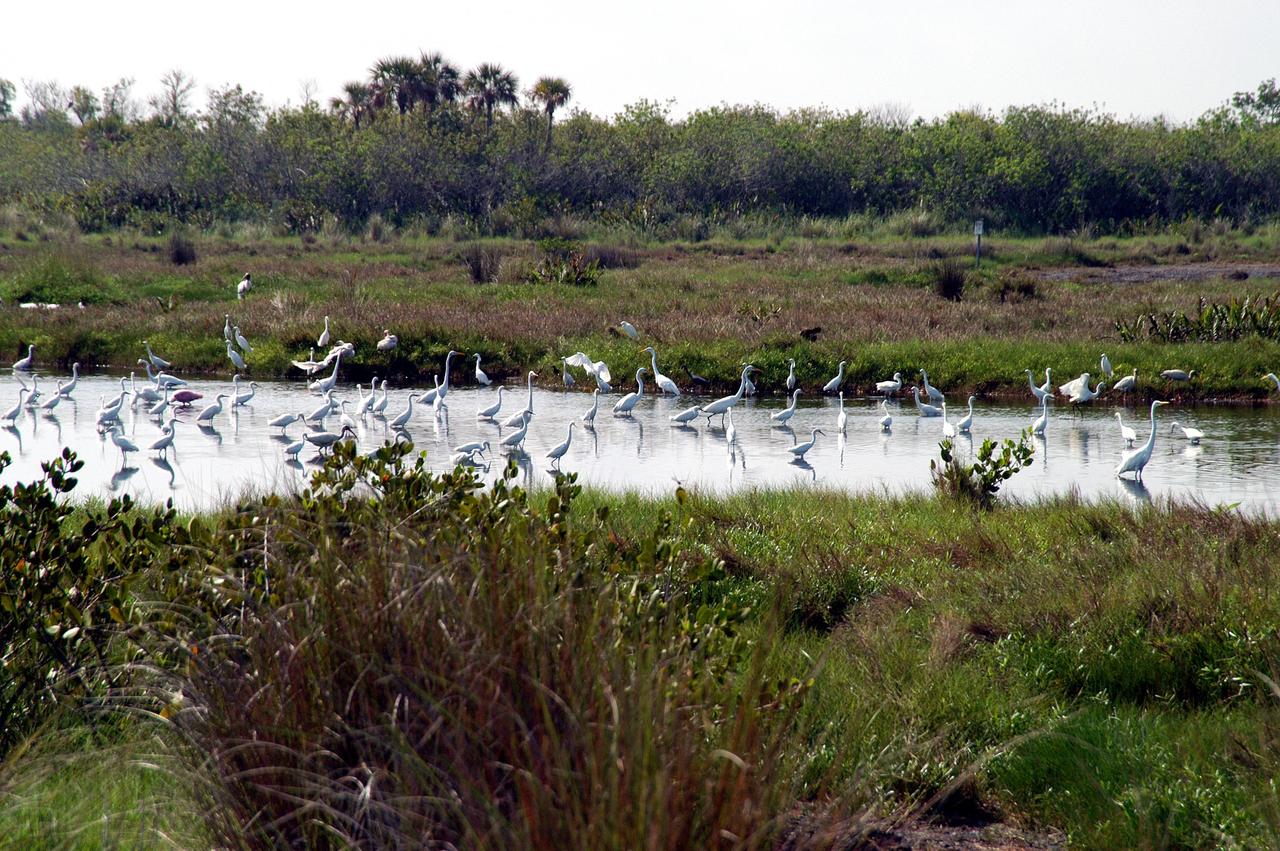
KENNEDY SPACE CENTER, FLA.  -  Herons, a roseate spoonbill and other species of water birds gather in a canal near KSC, which shares a boundary with the Merritt Island National Wildlife Refuge.  The marshes and open water of the refuge provide wintering areas for 23 species of migratory waterfowl, as well as a year-round home for great blue herons, great egrets, wood storks, cormorants, brown pelicans and other species of marsh and shore birds.
KSC-04pd1249
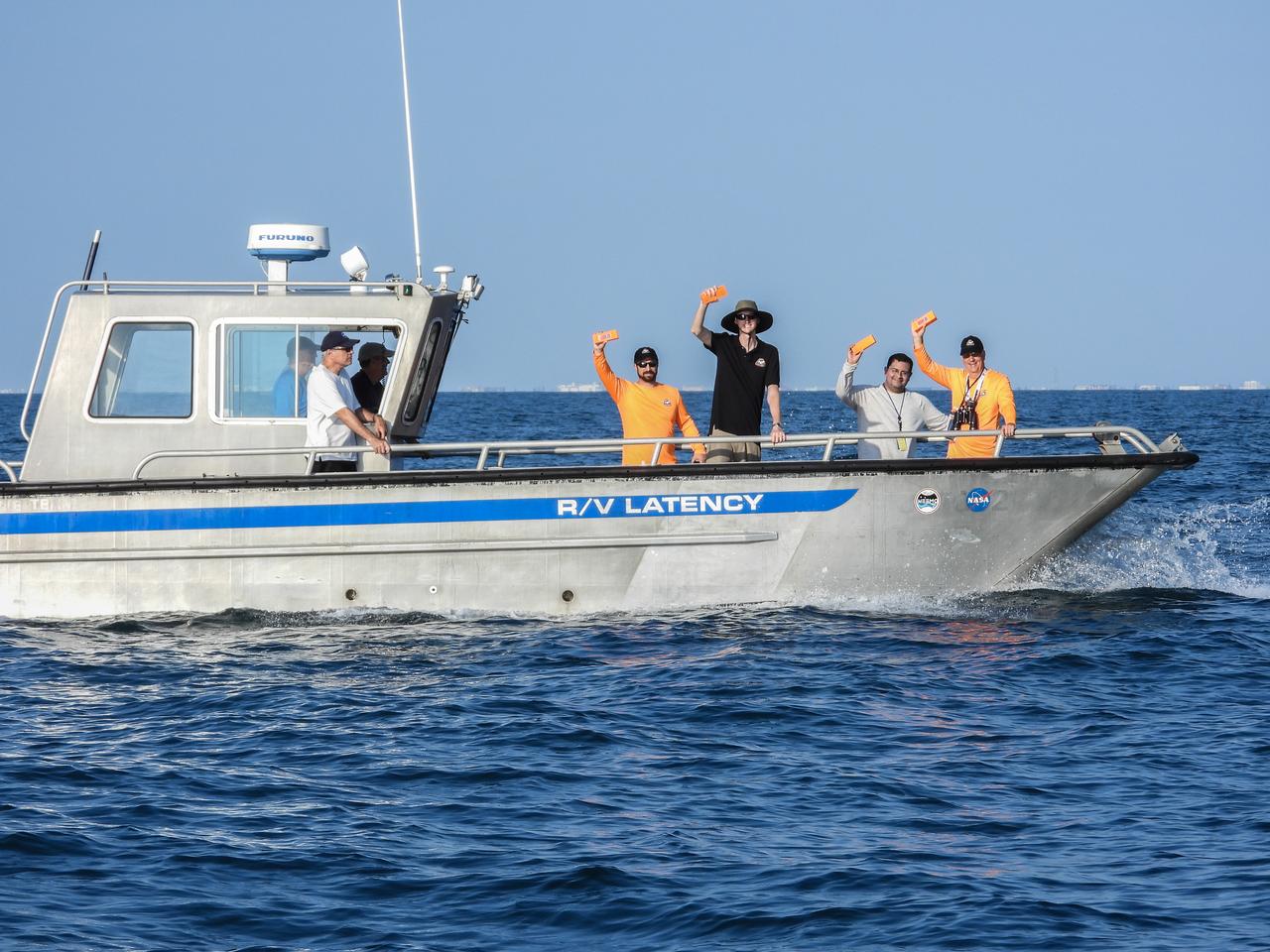
Members of the NASA Ejectable Data Recorder Recovery Team search for the ejectable data recorders in the Atlantic Ocean off the coast of Florida on July 2, 2019, after the Ascent Abort-2 (AA-2) flight test. During AA-2, a fully functional Launch Abort System (LAS) with a test version of Orion attached, launched atop a Northrop Grumman provided booster from Launch Pad 46 at Cape Canaveral Air Force Station on July 2, 2019. Liftoff was at 7 a.m. EDT. During AA-2, the booster sent the LAS and Orion to an altitude of 31,000 feet, traveling at Mach 1.15 (more than 1,000 mph). The LAS’ three motors worked together to pull the crew module away from the booster and prepare it for splashdown in the Atlantic Ocean. The flight test proves that the abort system can pull crew to safety in the unlikely event of an emergency during ascent. Data from the recorders will be analyzed by engineers.
NASA AA-2 team recovering EDRs in the open water
One of the 12 ejectable data recorders from NASA’s Ascent Abort-2 (AA-2) flight test is retrieved from the Atlantic Ocean off the coast of Florida by the NASA Ejectable Data Recorder Recovery Team on July 2, 2019. During AA-2, a fully functional Launch Abort System (LAS) with a test version of Orion attached, launched atop a Northrop Grumman provided booster from Launch Pad 46 at Cape Canaveral Air Force Station on July 2, 2019. Liftoff was at 7 a.m. EDT. During AA-2, the booster sent the LAS and Orion to an altitude of 31,000 feet, traveling at Mach 1.15 (more than 1,000 mph). The LAS’ three motors worked together to pull the crew module away from the booster and prepare it for splashdown in the Atlantic Ocean. The flight test proves that the abort system can pull crew to safety in the unlikely event of an emergency during ascent. Data from the recorders will be analyzed by engineers.
NASA AA-2 team recovering EDRs in the open water
Members of the NASA Ejectable Data Recorder Recovery Team search for the ejectable data recorders in the Atlantic Ocean off the coast of Florida on July 2, 2019, after the Ascent Abort-2 (AA-2) flight test. During AA-2, a fully functional Launch Abort System (LAS) with a test version of Orion attached, launched atop a Northrop Grumman provided booster from Launch Pad 46 at Cape Canaveral Air Force Station on July 2, 2019. Liftoff was at 7 a.m. EDT. During AA-2, the booster sent the LAS and Orion to an altitude of 31,000 feet, traveling at Mach 1.15 (more than 1,000 mph). The LAS’ three motors worked together to pull the crew module away from the booster and prepare it for splashdown in the Atlantic Ocean. The flight test proves that the abort system can pull crew to safety in the unlikely event of an emergency during ascent. Data from the recorders will be analyzed by engineers.
NASA AA-2 team recovering EDRs in the open water
Members of the NASA Ejectable Data Recorder Recovery Team search for the ejectable data recorders in the Atlantic Ocean off the coast of Florida on July 2, 2019, after the Ascent Abort-2 (AA-2) flight test. During AA-2, a fully functional Launch Abort System (LAS) with a test version of Orion attached, launched atop a Northrop Grumman provided booster from Launch Pad 46 at Cape Canaveral Air Force Station on July 2, 2019. Liftoff was at 7 a.m. EDT. During AA-2, the booster sent the LAS and Orion to an altitude of 31,000 feet, traveling at Mach 1.15 (more than 1,000 mph). The LAS’ three motors worked together to pull the crew module away from the booster and prepare it for splashdown in the Atlantic Ocean. The flight test proves that the abort system can pull crew to safety in the unlikely event of an emergency during ascent. Data from the recorders will be analyzed by engineers.
NASA AA-2 team recovering EDRs in the open water
One of the 12 ejectable data recorders from NASA’s Ascent Abort-2 (AA-2) flight test is retrieved from the Atlantic Ocean off the coast of Florida by the NASA Ejectable Data Recorder Recovery Team on July 2, 2019. During AA-2, a fully functional Launch Abort System (LAS) with a test version of Orion attached, launched atop a Northrop Grumman provided booster from Launch Pad 46 at Cape Canaveral Air Force Station on July 2, 2019. Liftoff was at 7 a.m. EDT. During AA-2, the booster sent the LAS and Orion to an altitude of 31,000 feet, traveling at Mach 1.15 (more than 1,000 mph). The LAS’ three motors worked together to pull the crew module away from the booster and prepare it for splashdown in the Atlantic Ocean. The flight test proves that the abort system can pull crew to safety in the unlikely event of an emergency during ascent. Data from the recorders will be analyzed by engineers.
NASA AA-2 team recovering EDRs in the open water
Members of the NASA Ejectable Data Recorder Recovery Team display some of the ejectable data recorders they recovered in the Atlantic Ocean off the coast of Florida on July 2, 2019, after the Ascent Abort-2 (AA-2) flight test. During AA-2, a fully functional Launch Abort System (LAS) with a test version of Orion attached, launched atop a Northrop Grumman provided booster from Launch Pad 46 at Cape Canaveral Air Force Station on July 2, 2019. Liftoff was at 7 a.m. EDT. During AA-2, the booster sent the LAS and Orion to an altitude of 31,000 feet, traveling at Mach 1.15 (more than 1,000 mph). The LAS’ three motors worked together to pull the crew module away from the booster and prepare it for splashdown in the Atlantic Ocean. The flight test proves that the abort system can pull crew to safety in the unlikely event of an emergency during ascent. Data from the recorders will be analyzed by engineers.
NASA AA-2 team recovering EDRs in the open water
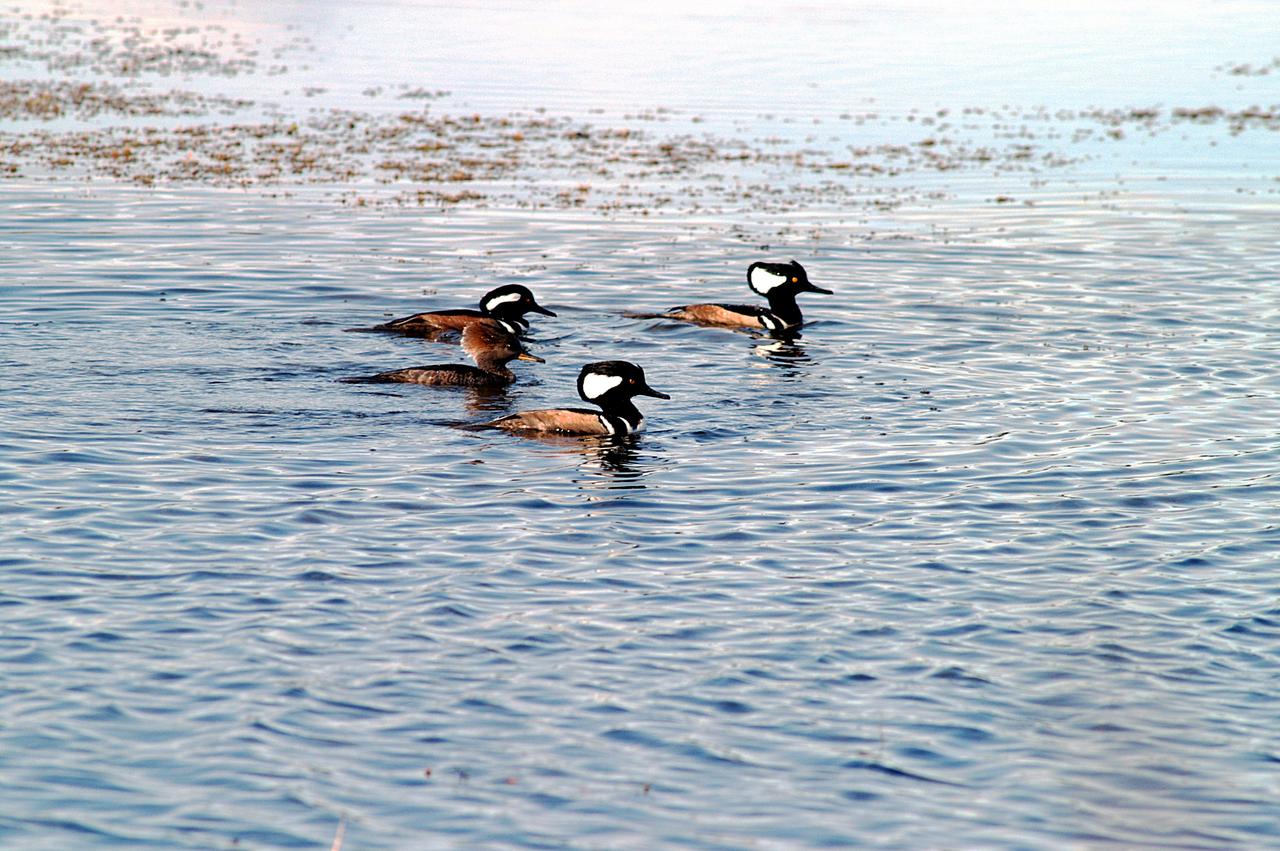
KENNEDY SPACE CENTER, FLA. -- Three male and one female hooded mergansers swim in the quicksilver water of the Merritt Island National Wildlife Refuge, which shares a boundary with Kennedy Space Center. Usually found from Alaska and Canada south to Nebraska, Oregon and Tennessee, hooded mergansers winter south to Mexico and the Gulf Coast, including KSC. The open water of the refuge provides wintering areas for 23 species of migratory waterfowl, as well as a year-round home for great blue herons, great egrets, wood storks, cormorants, brown pelicans and other species of marsh and shore birds. The 92,000-acre refuge is also habitat for more than 310 species of birds, 25 mammals, 117 fishes and 65 amphibians and reptiles.
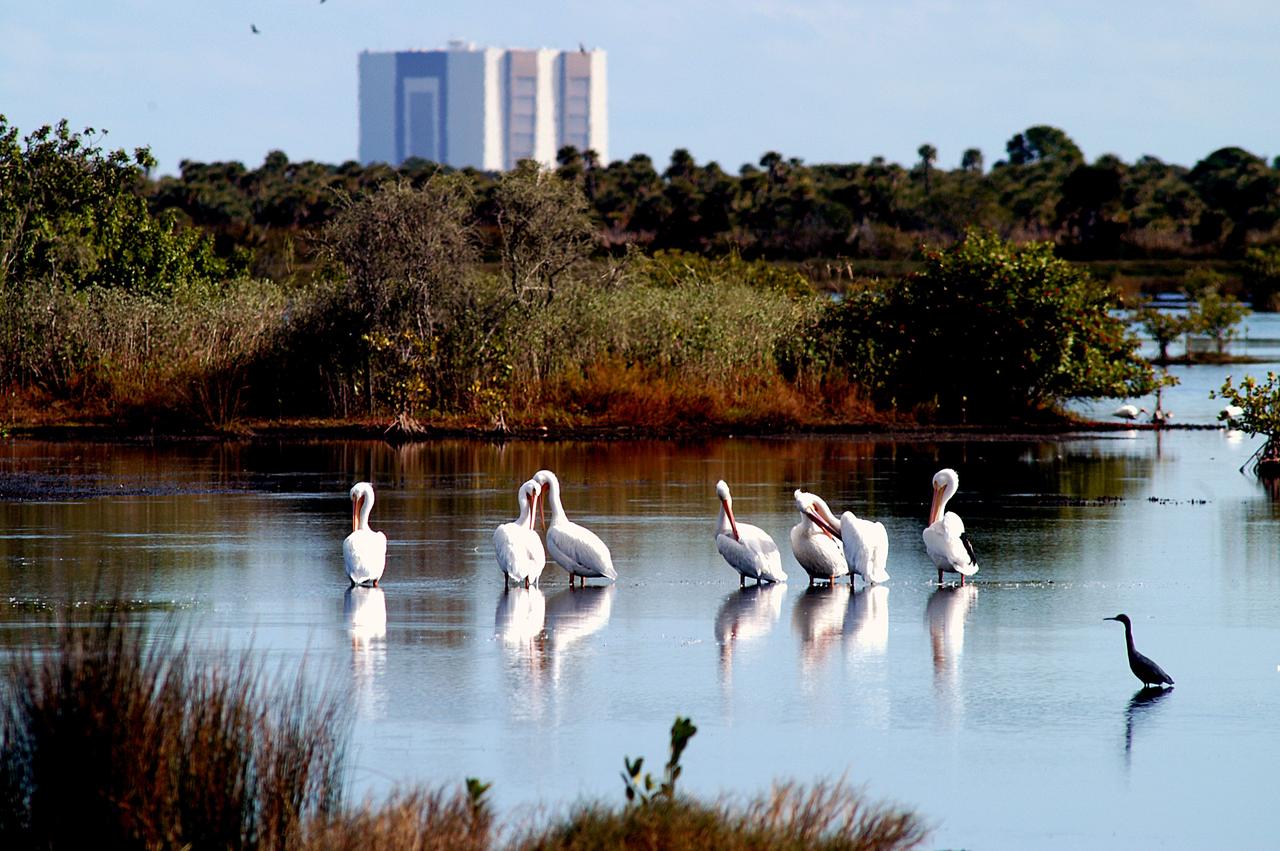
KENNEDY SPACE CENTER, FLA. -- A group of white pelicans spend a few moments relaxing in the water near the Vehicle Assembly Building at Kennedy Space Center. Found from British Columbia south to western Ontario, California and the Texas coast, white pelicans winter from Florida south to Panama. They prefer marshy lakes and coastal regions, and winter chiefly in coastal lagoons. White pelicans are one of 310 species of birds that inhabit the Merritt Island National Wildlife Refuge, which shares a boundary with KSC. The marshes and open water of the refuge also provide wintering areas for 23 species of migratory waterfowl, as well as a year-round home for great blue herons, great egrets, wood storks, cormorants, brown pelicans and other species of marsh and shore birds.
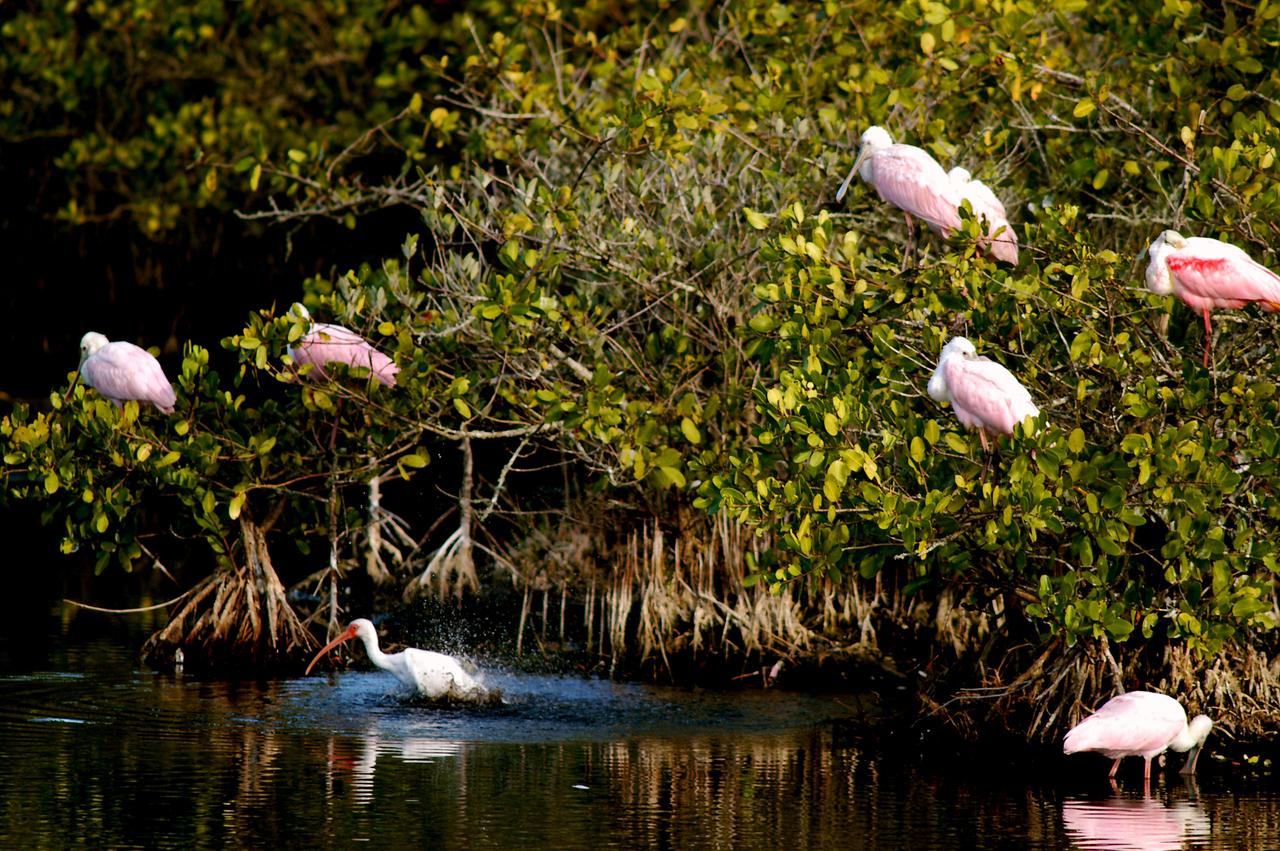
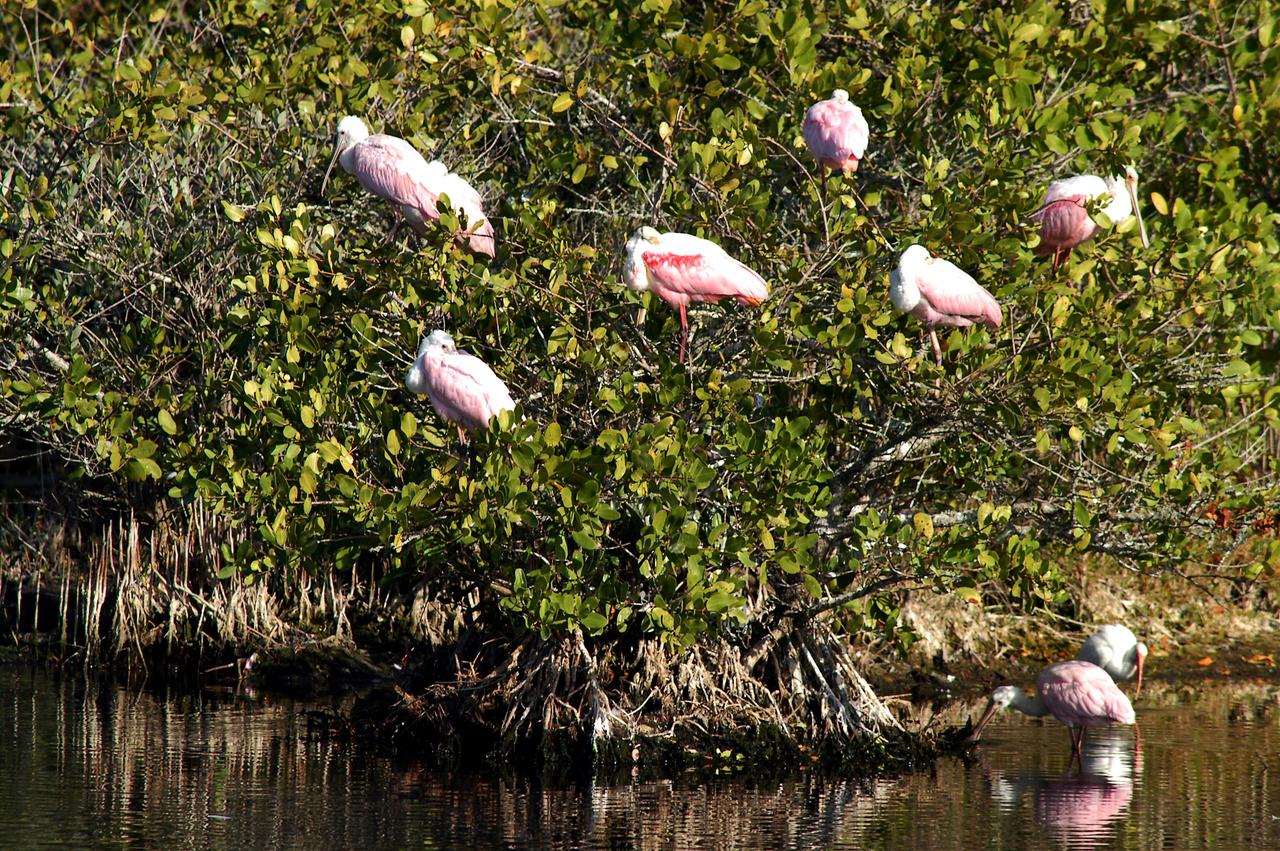
KENNEDY SPACE CENTER, FLA. -- A group of roseate spoonbills share their watery hunting ground with a lone white ibis near KSC. Spoonbills prefer to inhabit mangroves, ranging from the coasts of southern Florida, Louisiana and Texas, to the West Indies, Mexico, Central and South America. They feed on shrimps and fish in shallow waters. Spoonbills are one of 310 species of birds that inhabit the Merritt Island National Wildlife Refuge, which shares a boundary with KSC. The marshes and open water of the refuge also provide wintering areas for 23 species of migratory waterfowl, as well as a year-round home for great blue herons, great egrets, wood storks, cormorants, brown pelicans and other species of marsh and shore birds.
KENNEDY SPACE CENTER, FLA. -- A lone white ibis shares its watery hunting ground with a group of roseate spoonbills near KSC. Spoonbills prefer to inhabit mangroves, ranging from the coasts of southern Florida, Louisiana and Texas, to the West Indies, Mexico, Central and South America. They feed on shrimps and fish in shallow waters. Spoonbills are one of 310 species of birds that inhabit the Merritt Island National Wildlife Refuge, which shares a boundary with KSC. The marshes and open water of the refuge also provide wintering areas for 23 species of migratory waterfowl, as well as a year-round home for great blue herons, great egrets, wood storks, cormorants, brown pelicans and other species of marsh and shore birds.
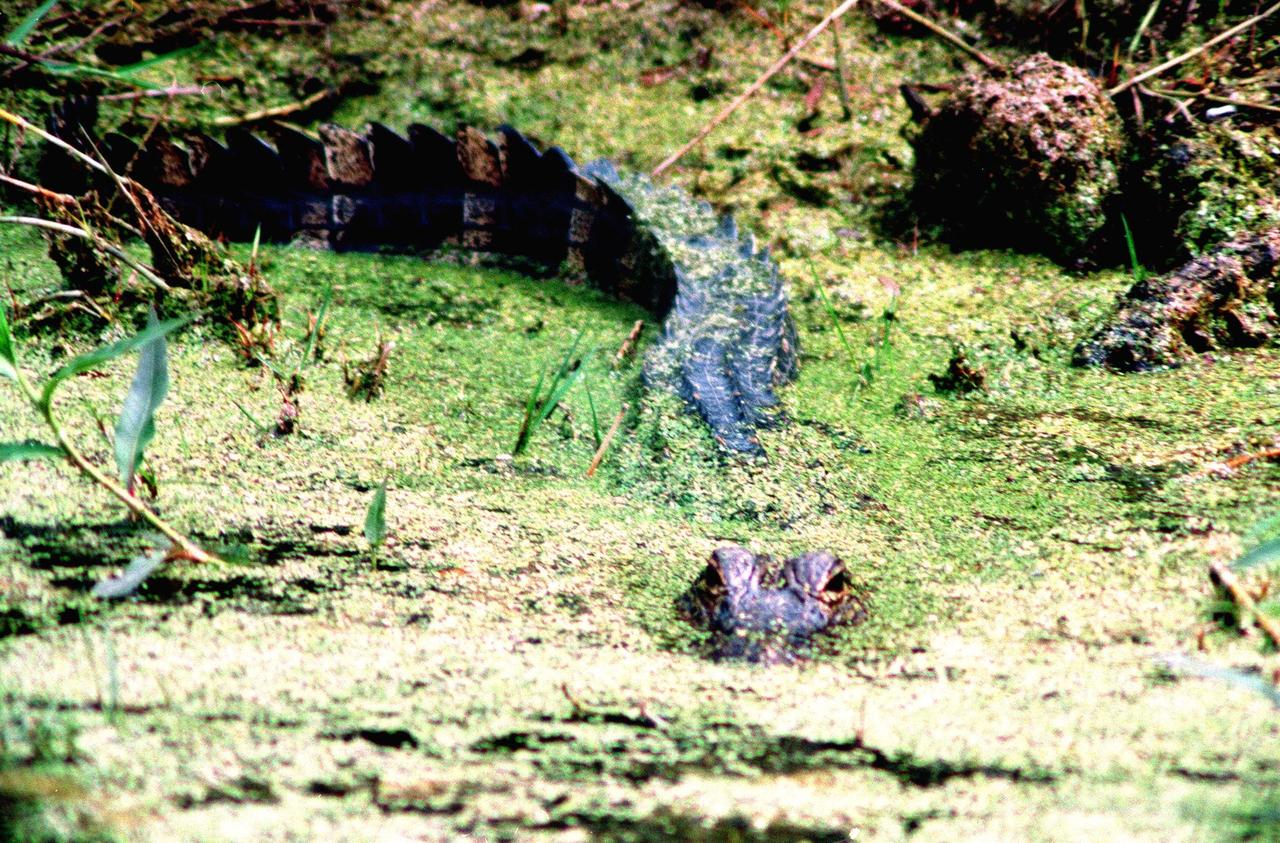
KENNEDY SPACE CENTER, FLA. -- An alligator lurks in the murky, mossy waters of the Merritt Island National Wildlife Refuge at Kennedy Space Center. Its tail surfaces behind him, looking like a log in the water. The wildlife refuge harbors nearly 5,000 American alligators, some of which can be seen in the canals and ponds around KSC. The refuge is also habitat for more than 310 species of birds, 25 mammals, 117 fishes and 65 amphibians and reptiles. The open water provides wintering areas for 23 species of migratory waterfowl and a year-round home for great blue herons, great egrets, wood storks, cormorants, brown pelicans and other species of marsh and shore birds
KSC-99wl09
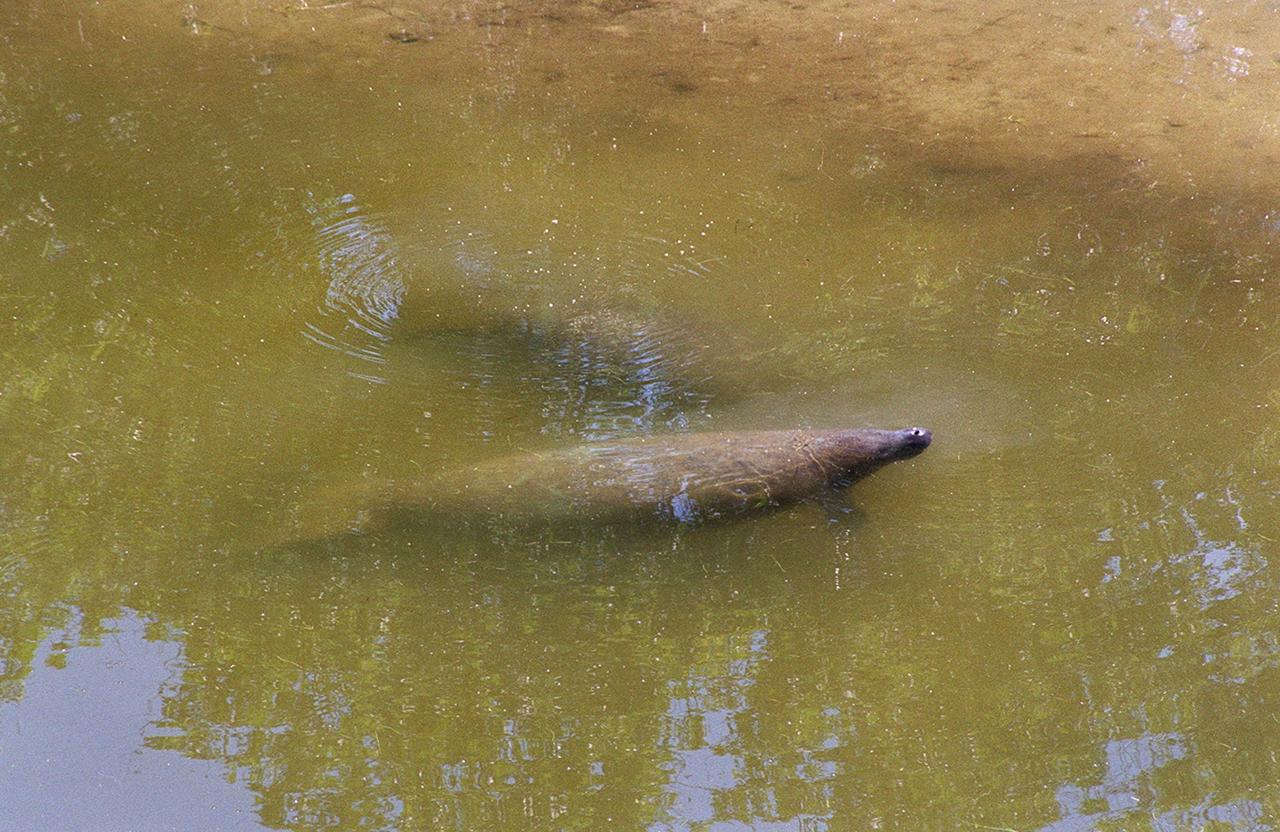
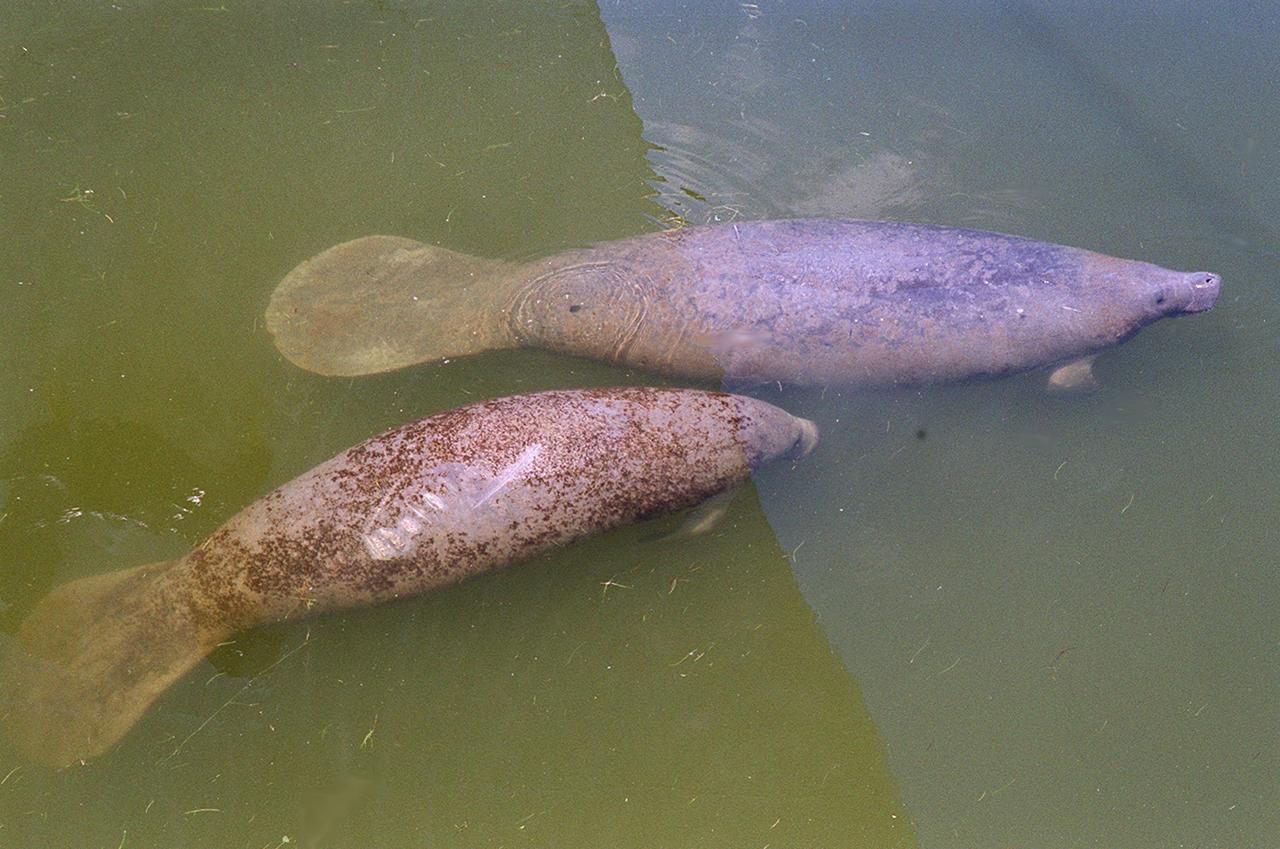
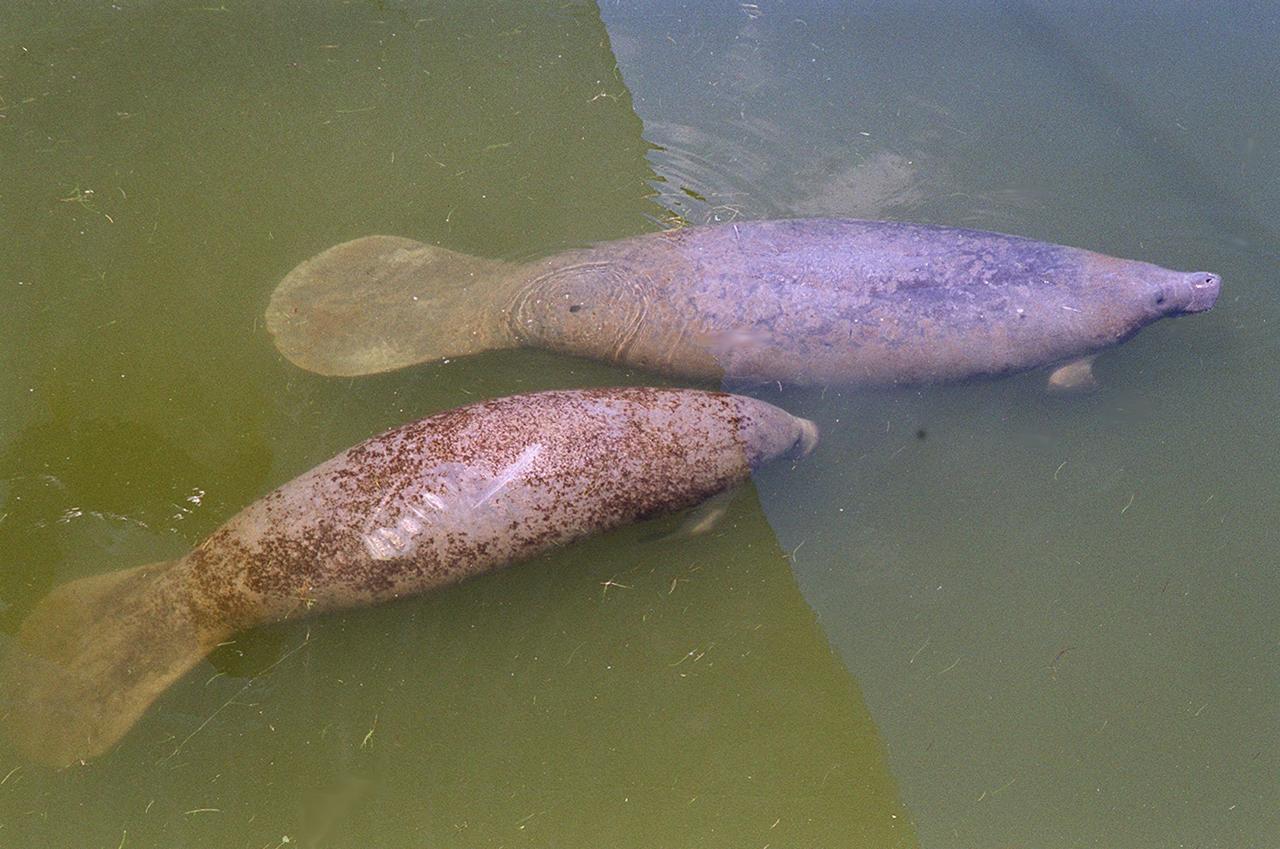
Two manatees swim leisurely in waters on Kennedy Space Center. They gather in Florida's warm water rivers and inland springs during the winter. KSC shares a boundary with the Merritt Island National Wildlife Refuge, which encompasses 92,000 acres that are a habitat for more than 331 species of birds, 31 mammals, 117 fishes, and 65 amphibians and reptiles. The marshes and open water of the refuge provide wintering areas for 23 species of migratory waterfowl, as well as a year-round home for great blue herons, great egrets, wood storks, cormorants, brown pelicans and other species of marsh and shore birds, as well as a variety of insects
KSC-00pp0600
Two manatees swim leisurely in waters on Kennedy Space Center. They gather in Florida's warm water rivers and inland springs during the winter. KSC shares a boundary with the Merritt Island National Wildlife Refuge, which encompasses 92,000 acres that are a habitat for more than 331 species of birds, 31 mammals, 117 fishes, and 65 amphibians and reptiles. The marshes and open water of the refuge provide wintering areas for 23 species of migratory waterfowl, as well as a year-round home for great blue herons, great egrets, wood storks, cormorants, brown pelicans and other species of marsh and shore birds, as well as a variety of insects
KSC00pp0600
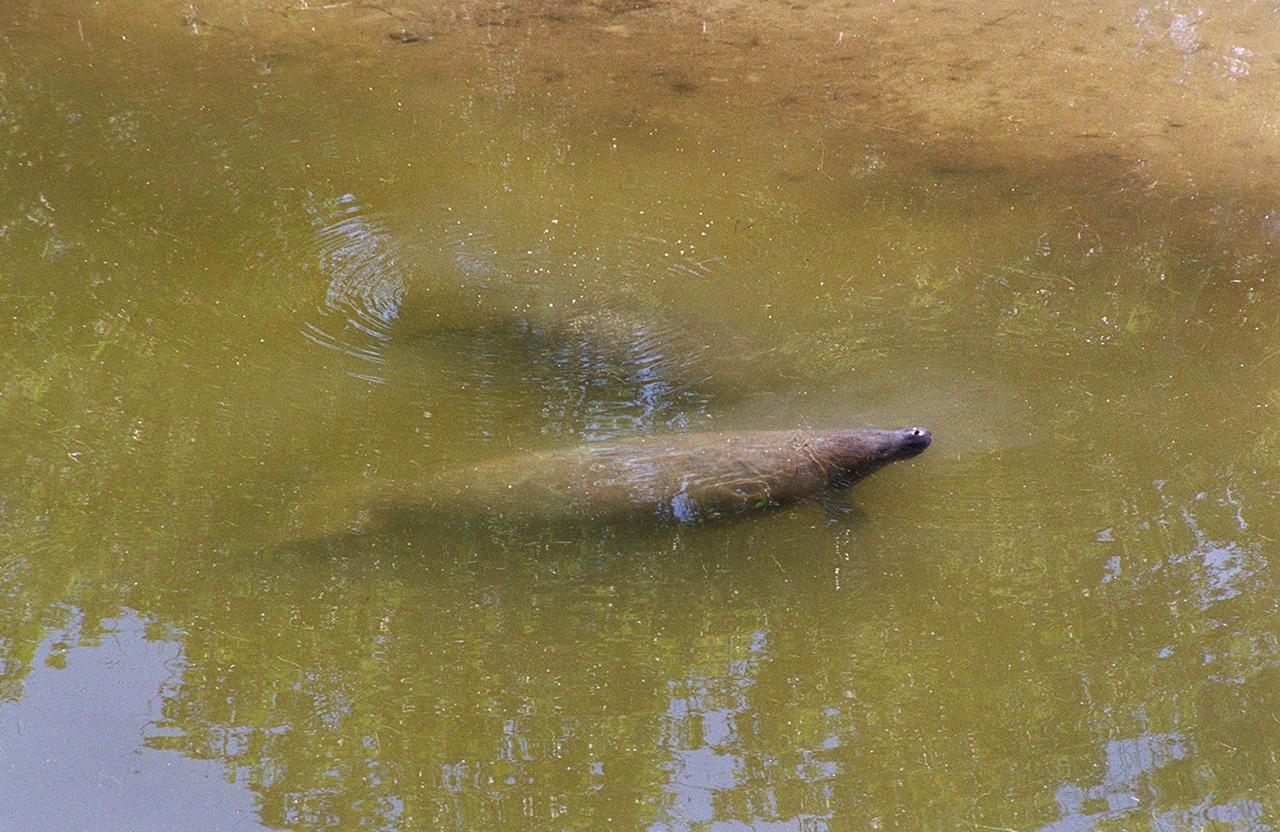
In waters on Kennedy Space Center, two manatees are seen leisurely swimming. In winter they gather in Florida's warm water rivers and inland springs. KSC shares a boundary with the Merritt Island National Wildlife Refuge, which encompasses 92,000 acres that are a habitat for more than 331 species of birds, 31 mammals, 117 fishes, and 65 amphibians and reptiles. The marshes and open water of the refuge provide wintering areas for 23 species of migratory waterfowl, as well as a year-round home for great blue herons, great egrets, wood storks, cormorants, brown pelicans and other species of marsh and shore birds, as well as a variety of insects
KSC-00pp0599
In waters on Kennedy Space Center, two manatees are seen leisurely swimming. In winter they gather in Florida's warm water rivers and inland springs. KSC shares a boundary with the Merritt Island National Wildlife Refuge, which encompasses 92,000 acres that are a habitat for more than 331 species of birds, 31 mammals, 117 fishes, and 65 amphibians and reptiles. The marshes and open water of the refuge provide wintering areas for 23 species of migratory waterfowl, as well as a year-round home for great blue herons, great egrets, wood storks, cormorants, brown pelicans and other species of marsh and shore birds, as well as a variety of insects
KSC00pp0599
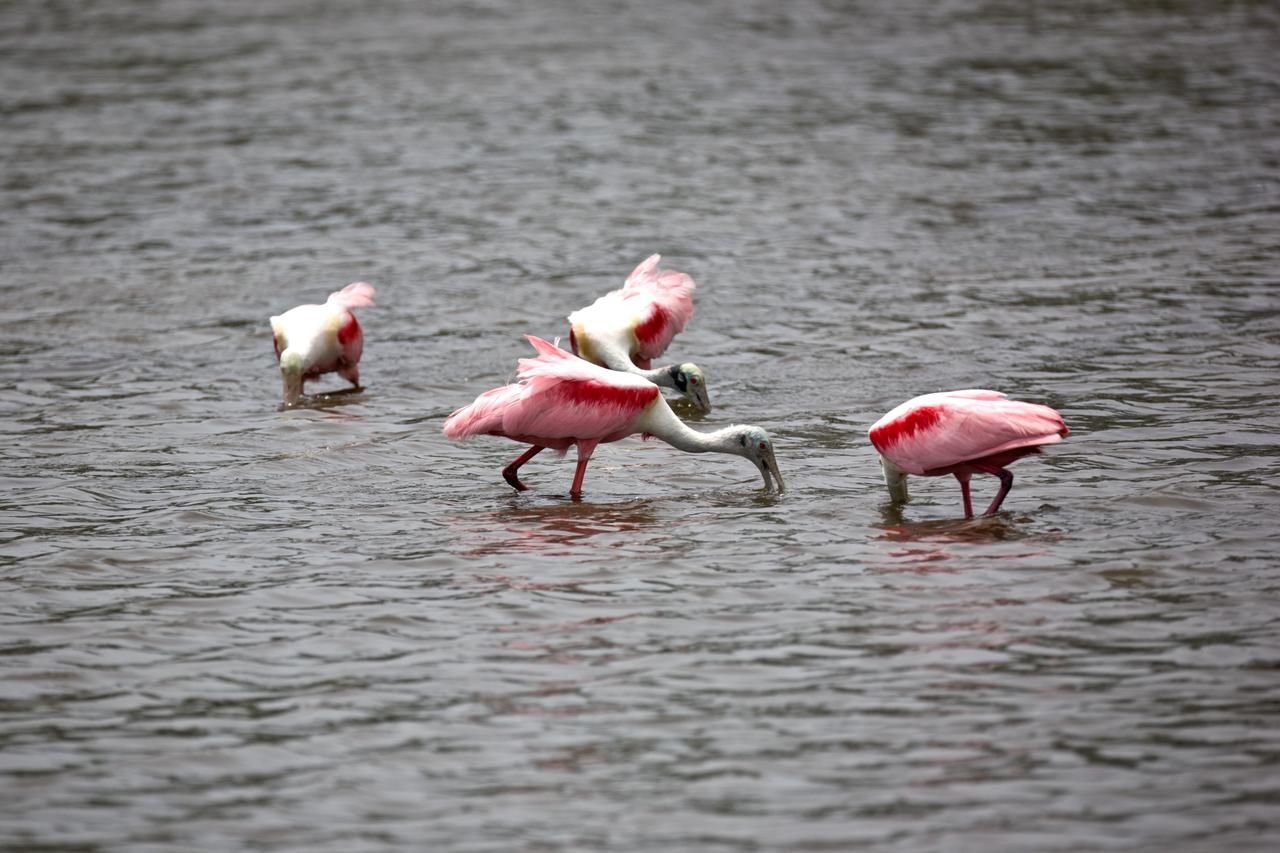
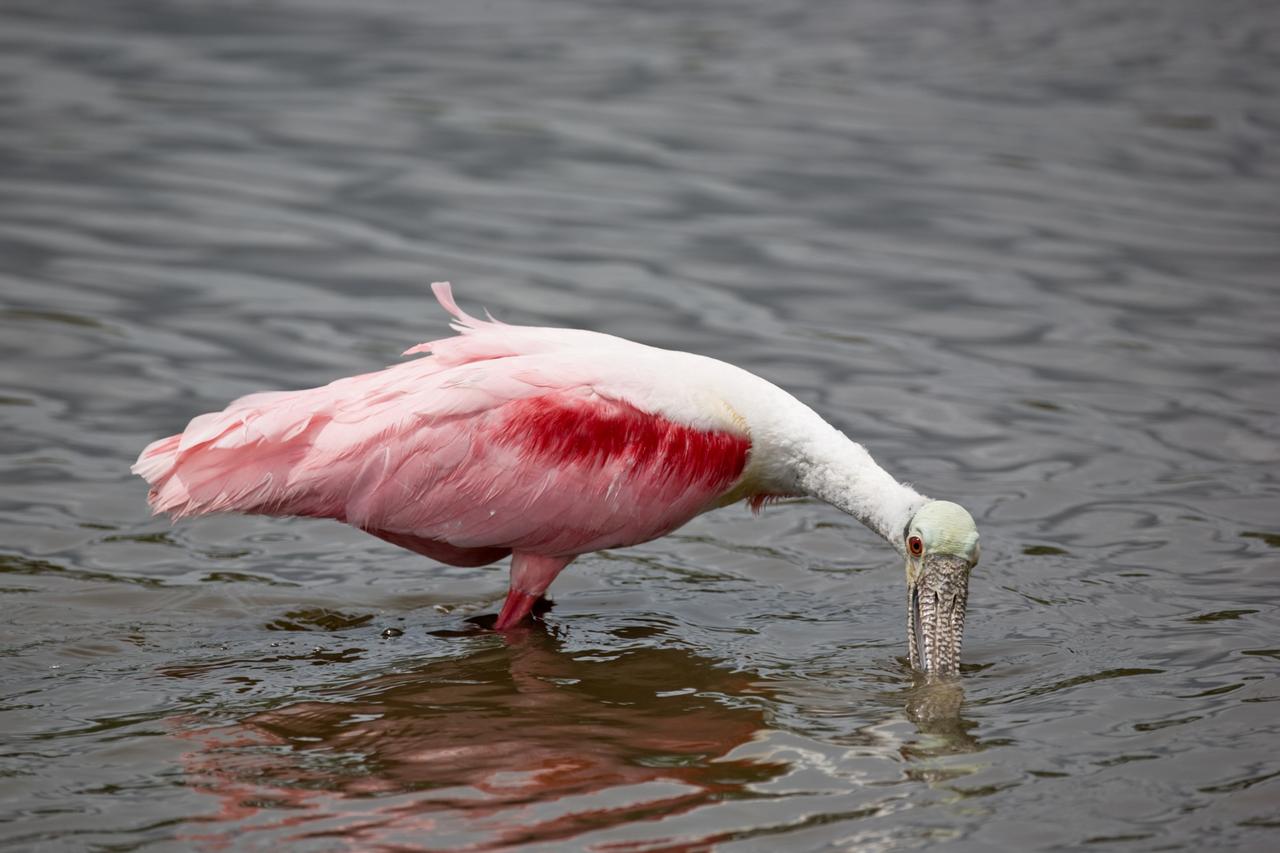
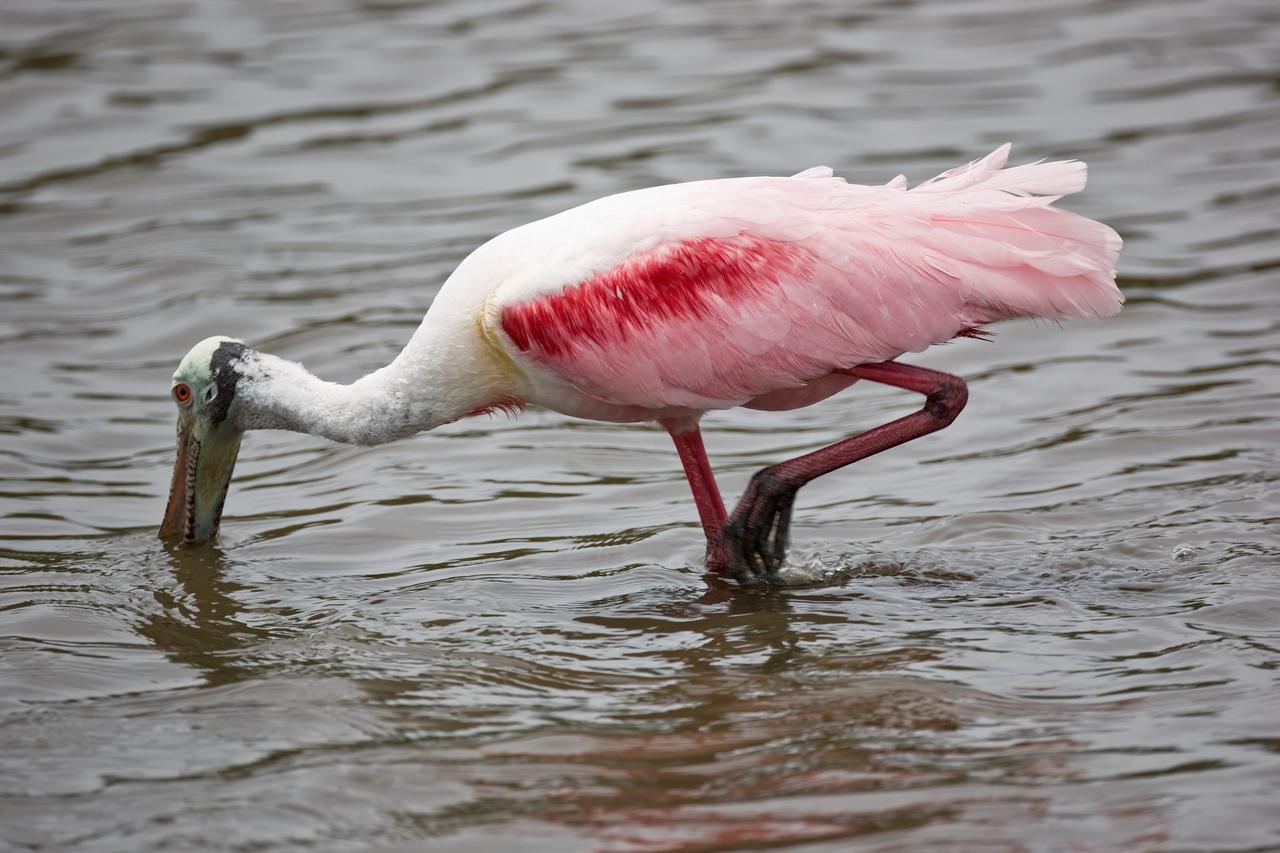
CAPE CANAVERAL, Fla. –– On NASA's Kennedy Space Center in Florida, the scarlet-feathered roseate spoonbill feeds in the water. Spoonbills inhabit areas of mangrove such as on the coasts of southern Florida and Texas.  These birds feed on shrimps and fish in the shallow water, sweeping their bills from side to side.  This and other wildlife abound throughout Kennedy as the center shares a boundary with the Merritt Island National Wildlife Refuge.  The marshes and open water of the refuge provide wintering areas for 23 species of migratory waterfowl, as well as a year-round home for great blue herons, great egrets, wood storks, cormorants, brown pelicans and other species of marsh and shore birds.  Photo credit: NASA/Dimitri Gerondidakis
KSC-2009-2854
CAPE CANAVERAL, Fla. –– On NASA's Kennedy Space Center in Florida, the scarlet-feathered roseate spoonbill feeds in the water. Spoonbills inhabit areas of mangrove such as on the coasts of southern Florida and Texas.  These birds feed on shrimps and fish in the shallow water, sweeping their bills from side to side.  This and other wildlife abound throughout Kennedy as the center shares a boundary with the Merritt Island National Wildlife Refuge. The marshes and open water of the refuge provide wintering areas for 23 species of migratory waterfowl, as well as a year-round home for great blue herons, great egrets, wood storks, cormorants, brown pelicans and other species of marsh and shore birds.  Photo credit: NASA/Dimitri Gerondidakis
KSC-2009-2855
CAPE CANAVERAL, Fla. –– On NASA's Kennedy Space Center in Florida, scarlet-feathered roseate spoonbills feed in the water.   Spoonbills inhabit areas of mangrove such as on the coasts of southern Florida and Texas.  These birds feed on shrimps and fish in the shallow water, sweeping their bills from side to side.  This and other wildlife abound throughout Kennedy as the center shares a boundary with the Merritt Island National Wildlife Refuge. The marshes and open water of the refuge provide wintering areas for 23 species of migratory waterfowl, as well as a year-round home for great blue herons, great egrets, wood storks, cormorants, brown pelicans and other species of marsh and shore birds.  Photo credit: NASA/Dimitri Gerondidakis
KSC-2009-2853
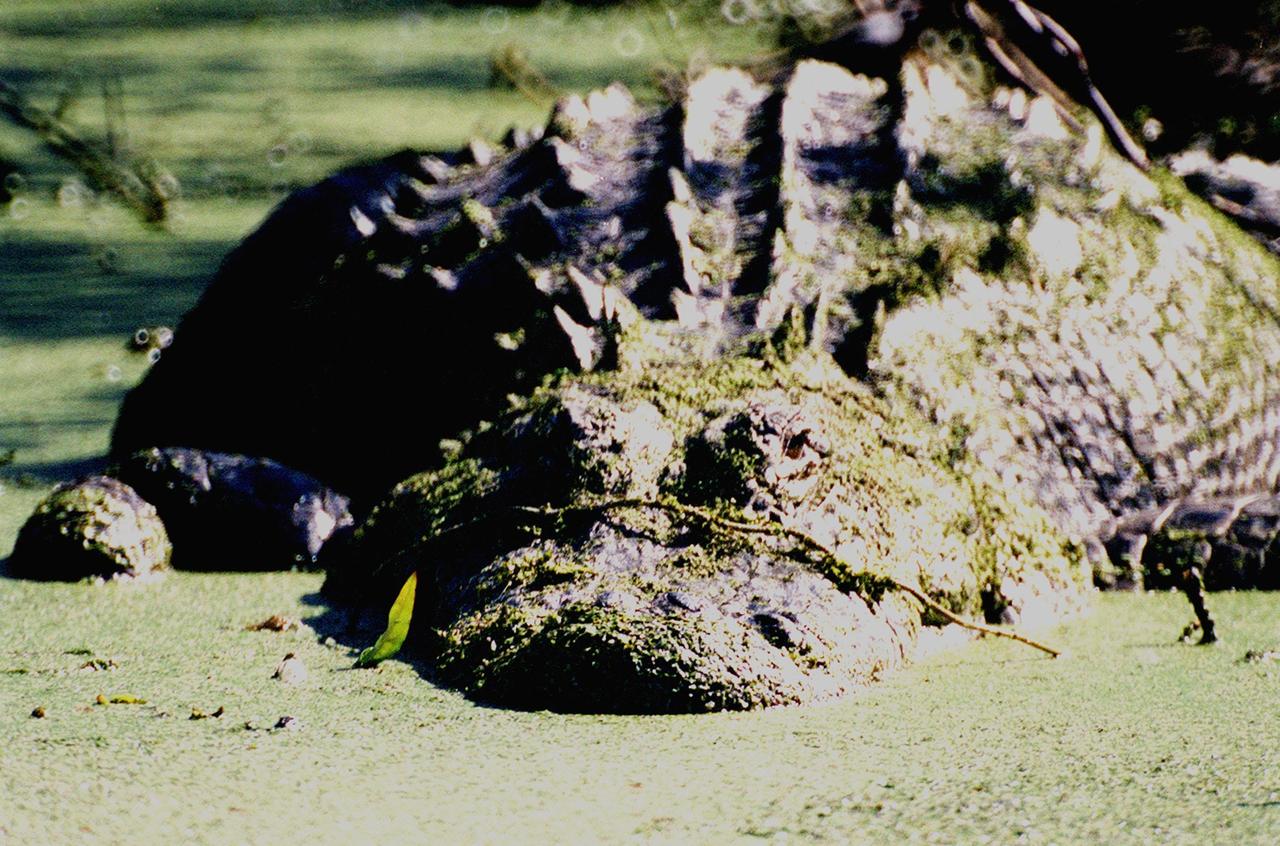
KENNEDY SPACE CENTER, FLA. -- An algae-covered alligator keeps a wary eye open as it rests in one of the ponds at Kennedy Space Center. American alligators feed and rest in the water, and lay their eggs in dens they dig into the banks. The young alligators spend their first several weeks in these dens. The Center shares a boundary with the Merritt Island National Wildlife Refuge, which encompasses 92,000 acres that are a habitat for more than 331 species of birds, 31 mammals, 117 fishes, and 65 amphibians and reptiles. The marshes and open water of the refuge provide wintering areas for 23 species of migratory waterfowl, as well as a year-round home for great blue herons, great egrets, wood storks, cormorants, brown pelicans and other species of marsh and shore birds, as well as a variety of insects
KSC00pp0305
KENNEDY SPACE CENTER, FLA. -- An algae-covered alligator keeps a wary eye open as it rests in one of the ponds at Kennedy Space Center. American alligators feed and rest in the water, and lay their eggs in dens they dig into the banks. The young alligators spend their first several weeks in these dens. The Center shares a boundary with the Merritt Island National Wildlife Refuge, which encompasses 92,000 acres that are a habitat for more than 331 species of birds, 31 mammals, 117 fishes, and 65 amphibians and reptiles. The marshes and open water of the refuge provide wintering areas for 23 species of migratory waterfowl, as well as a year-round home for great blue herons, great egrets, wood storks, cormorants, brown pelicans and other species of marsh and shore birds, as well as a variety of insects
KSC-00pp0305
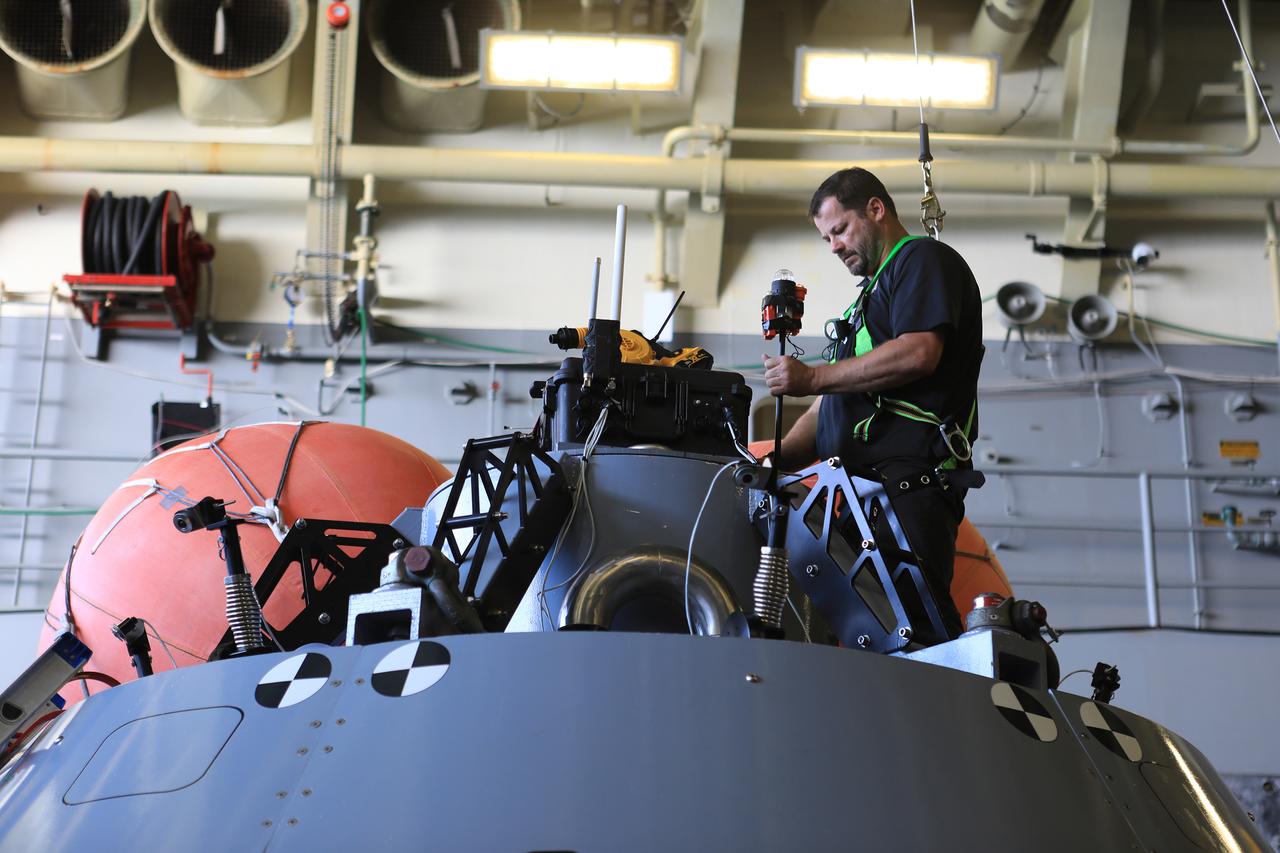
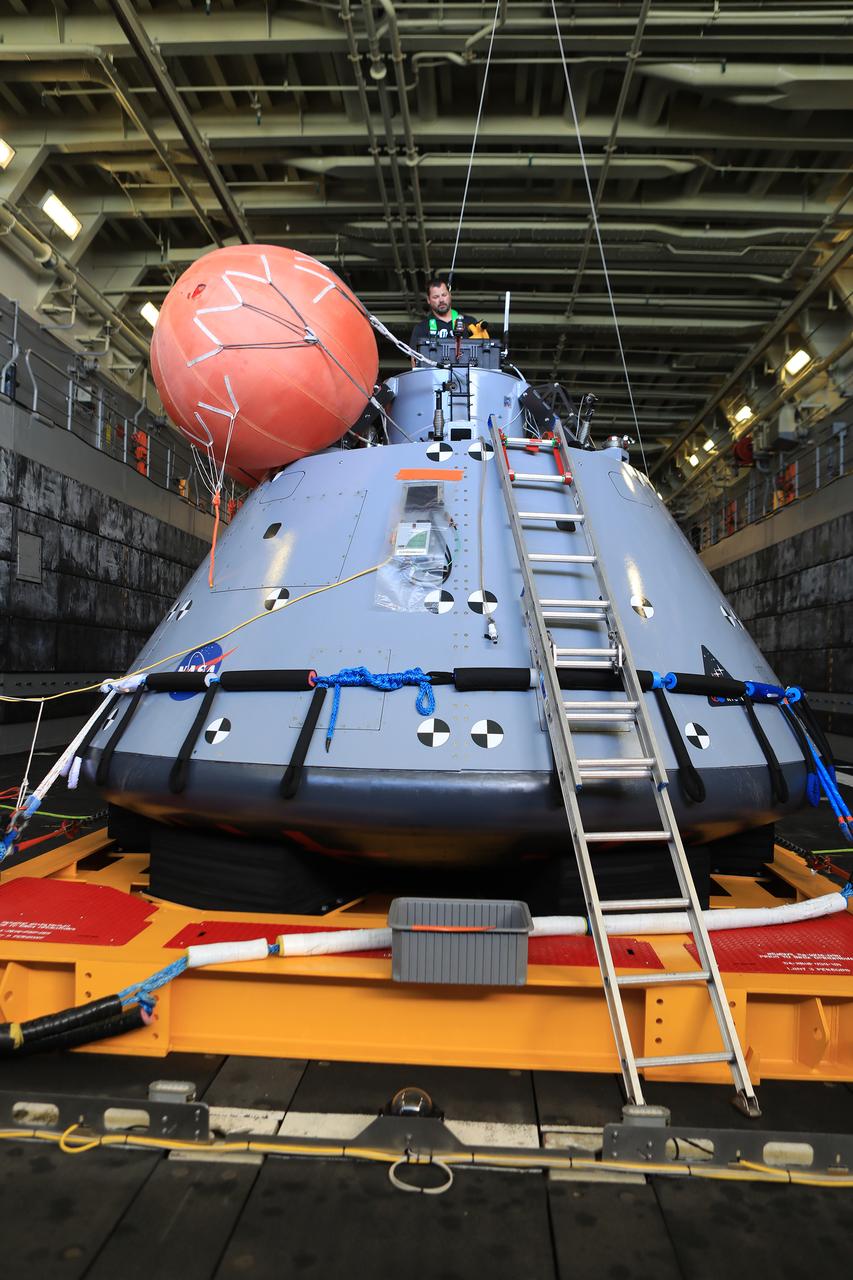
Open Water Recovery Lead Tim Goddard attaches lights to the top of the test version of the Orion capsule used during Underway Recovery Test-7 (URT-7) in the well deck of the USS John P. Murtha on Nov. 3, 2018. Goddard is the hardware expert in the open water and assists dive teams in the Pacific Ocean as they practice recovering the capsule during day and nighttime conditions. URT-7 is one in a series conducted by the Exploration Ground Systems Recovery Team to verify and validate procedures and hardware that will be used to recover the Orion spacecraft after it splashes down in the Pacific Ocean following deep space exploration missions. Orion will have emergency abort capability, sustain the crew during space travel and provide safe re-entry from deep space return velocities.
Underway Recovery Test 7 (URT-7) - Day 5 Activities - Morning
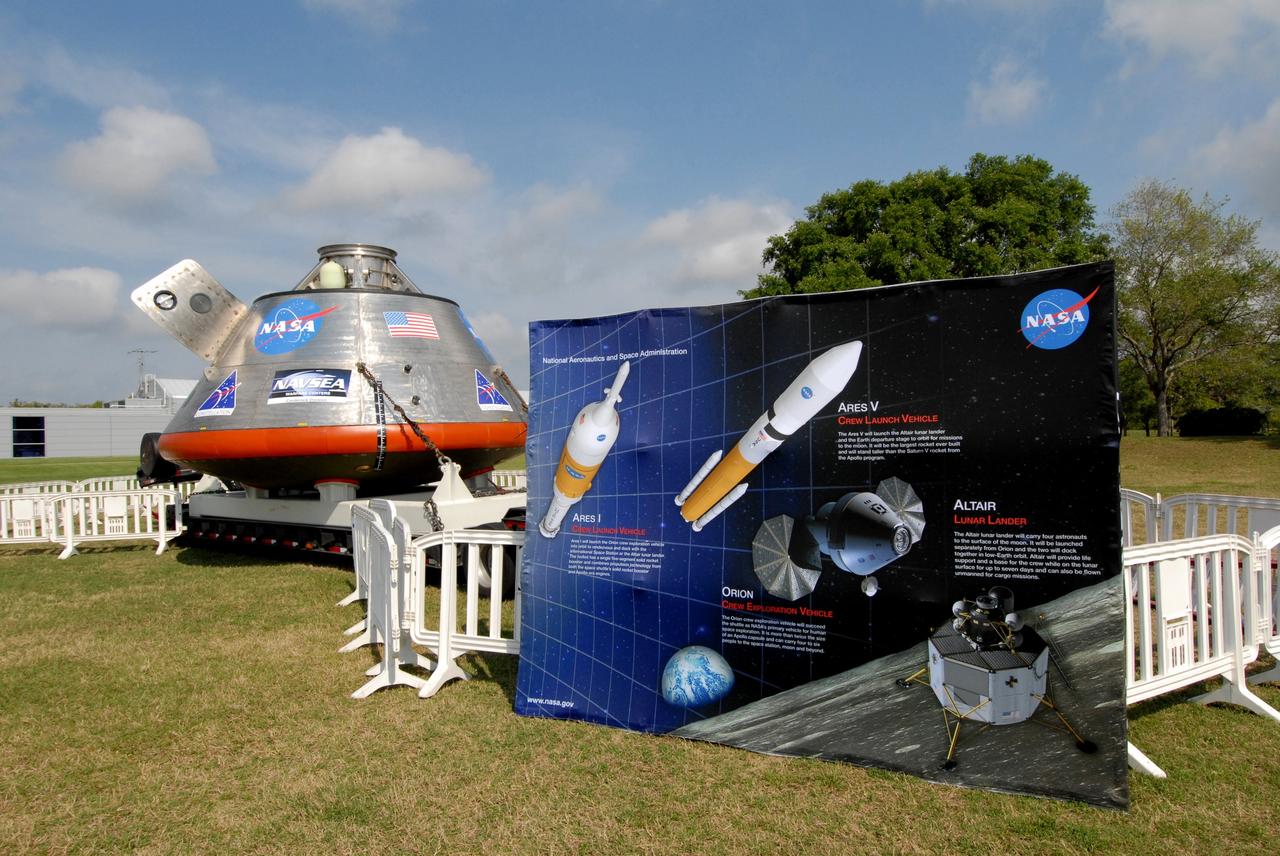
CAPE CANAVERAL, Fla. –  On display at the Kennedy Space Center Visitor Complex in Florida is the Orion crew exploration vehicle mockup (left) and an exhibit about the Constellation Program.  The Orion mockup is on display before heading offshore to be tested in open water.  The spacecraft mock-up traveled from the Naval Surface Warfare Center's Carderock Division in Bethesda, Md. The goal of the open water testing, dubbed the Post-landing Orion Recovery Test, or PORT, is to determine what kind of motion astronauts can expect after landing, as well as outside conditions for recovery teams. Part of the Constellation Program, Orion is targeted to begin carrying humans to the International Space Station in 2015 and to the moon by 2020.   Photo credit: NASA/Jack Pfaller
KSC-2009-2504
Open Water Recovery Lead Tim Goddard attaches lights to the top of the test version of the Orion capsule used during Underway Recovery Test-7 (URT-7) in the well deck of the USS John P. Murtha on Nov. 3, 2018. Goddard is the hardware expert in the open water and assists dive teams in the Pacific Ocean as they practice recovering the capsule during day and nighttime conditions. URT-7 is one in a series conducted by the Exploration Ground Systems Recovery Team to verify and validate procedures and hardware that will be used to recover the Orion spacecraft after it splashes down in the Pacific Ocean following deep space exploration missions. Orion will have emergency abort capability, sustain the crew during space travel and provide safe re-entry from deep space return velocities.
Underway Recovery Test 7 (URT-7) - Day 5 Activities - Morning
CAPE CANAVERAL, Fla. – Members of the 920th Rescue Wing make their way toward the mockup Orion crew exploration vehicle floating in the open water of the Trident Basin at Port Canaveral, Fla.  They will place a flotation collar around the mockup vehicle. The mockup vehicle will undergo testing in open water. The goal of the operation, dubbed the Post-landing Orion Recovery Test, or PORT, is to determine what kind of motion astronauts can expect after landing, as well as outside conditions for recovery teams. Orion is targeted to begin carrying humans to the International Space Station in 2015 and to the moon by 2020.  Orion, along with the Ares I and V rockets and the Altair lunar lander, are part of the Constellation Program.  Photo credit: NASA/Kim Shiflett
KSC-2009-2562
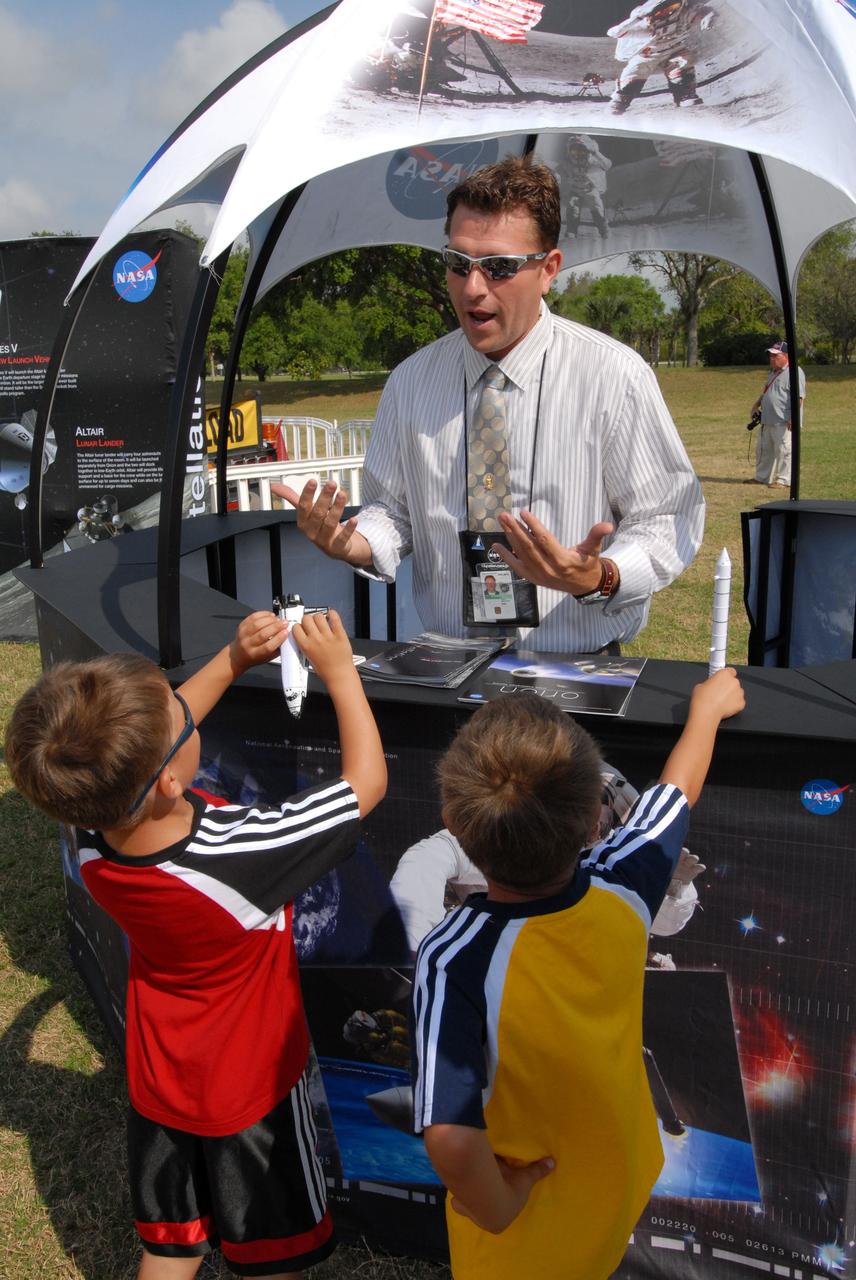
CAPE CANAVERAL, Fla. –  A NASA official talks to visitors at the Kennedy Space Center Visitor Complex in Florida about the Orion crew exploration vehicle mockup and the Constellation Program. The Orion mockup is on display before heading offshore to be tested in open water. The spacecraft mock-up traveled from the Naval Surface Warfare Center's Carderock Division in Bethesda, Md. The goal of the open water testing, dubbed the Post-landing Orion Recovery Test, or PORT, is to determine what kind of motion astronauts can expect after landing, as well as outside conditions for recovery teams. Part of the Constellation Program, Orion is targeted to begin carrying humans to the International Space Station in 2015 and to the moon by 2020.   Photo credit: NASA/Jack Pfaller
KSC-2009-2505
CAPE CANAVERAL, Fla. –  On display at the Kennedy Space Center Visitor Complex in Florida is the Orion crew exploration vehicle mockup (right) and an exhibit about the Constellation Program.  The Orion mockup is on display before heading offshore to be tested in open water. The spacecraft mock-up traveled from the Naval Surface Warfare Center's Carderock Division in Bethesda, Md. The goal of the open water testing, dubbed the Post-landing Orion Recovery Test, or PORT, is to determine what kind of motion astronauts can expect after landing, as well as outside conditions for recovery teams. Part of the Constellation Program, Orion is targeted to begin carrying humans to the International Space Station in 2015 and to the moon by 2020.   Photo credit: NASA/Jack Pfaller
KSC-2009-2507
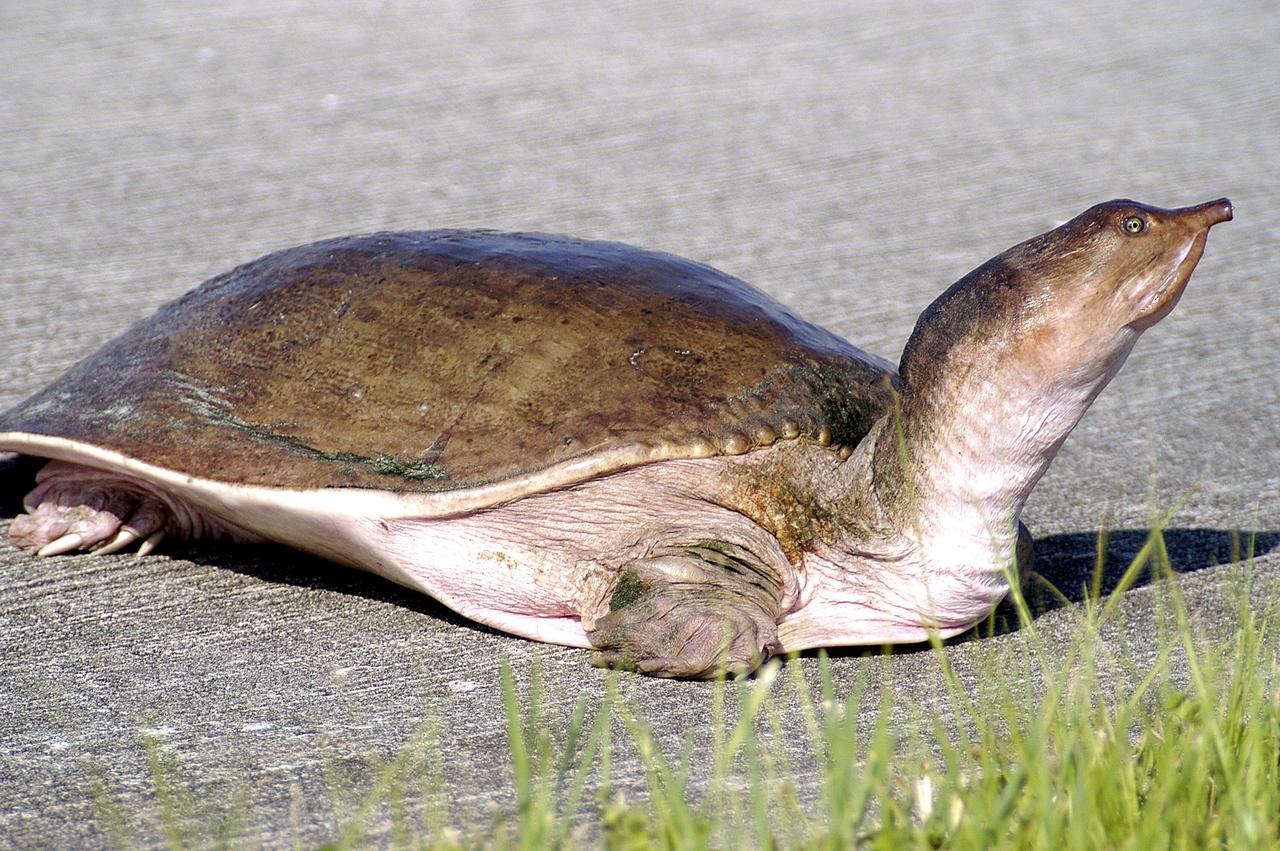
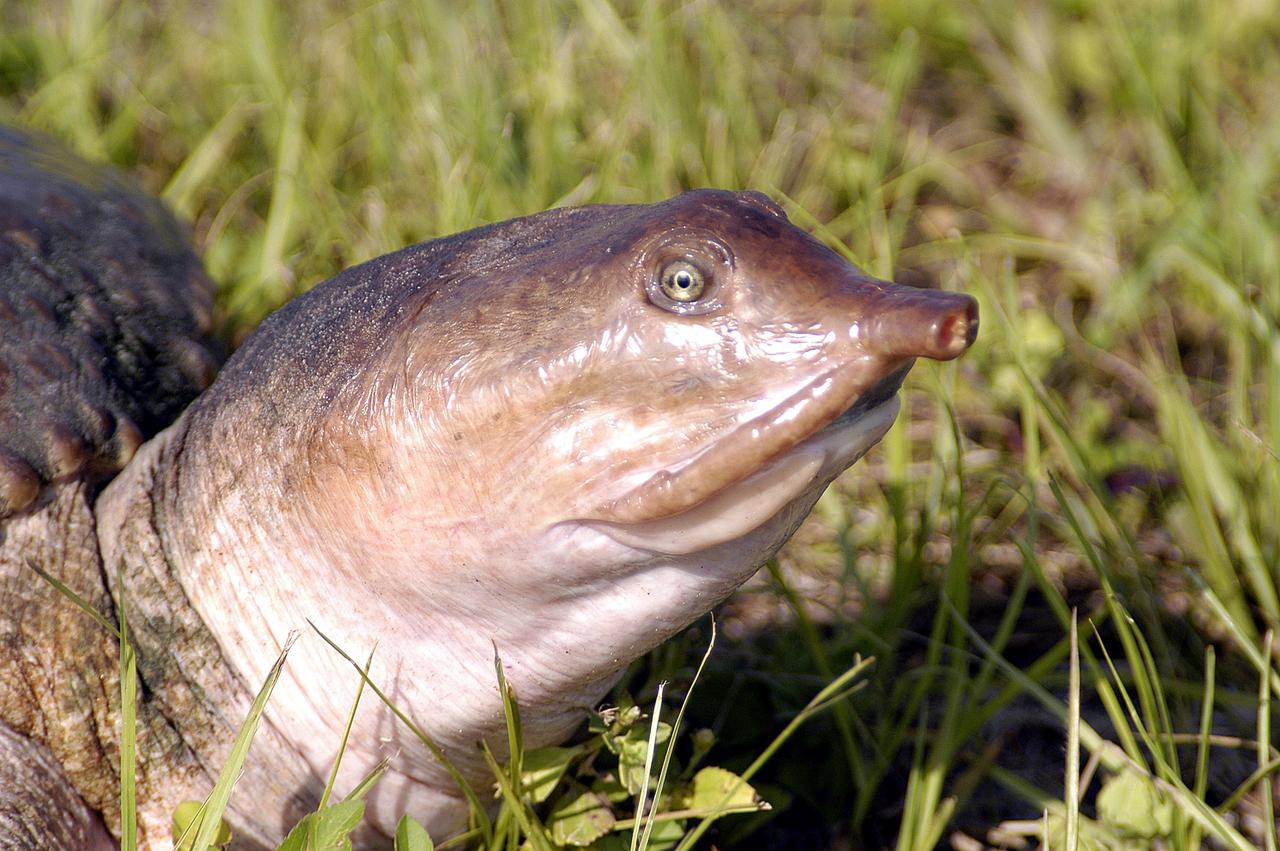
KENNEDY SPACE CENTER, FLA. -  A soft-shell turtle with only three legs is seen crossing the tow-way at KSC.  The turtle is one of 65 amphibians and reptiles found in the Merritt Island National Wildlife Refuge, which surrounds KSC.  The Wildlife Refuge encompasses 92,000 acres that are also a habitat for more than 331 species of birds, 31 mammals and 117 fishes.  The marshes and open water of the refuge provide wintering areas for 23 species of migratory waterfowl, as well as a year-round home for great blue herons, great egrets, wood storks, cormorants, brown pelicans and other species of marsh and shore birds, plus a variety of insects.
KENNEDY SPACE CENTER, FLA. - A soft-shell turtle with only three legs is seen crossing the tow-way at KSC. The turtle is one of 65 amphibians and reptiles found in the Merritt Island National Wildlife Refuge, which surrounds KSC. The Wildlife Refuge encompasses 92,000 acres that are also a habitat for more than 331 species of birds, 31 mammals and 117 fishes. The marshes and open water of the refuge provide wintering areas for 23 species of migratory waterfowl, as well as a year-round home for great blue herons, great egrets, wood storks, cormorants, brown pelicans and other species of marsh and shore birds, plus a variety of insects.
KENNEDY SPACE CENTER, FLA. -  In the Orbiter Processing Facility, a worker checks out part of the equipment in the airlock, at one end of Discovery’s payload bay.  The airlock is sized to accommodate two fully suited flight crew members simultaneously. Support functions include airlock depressurization and repressurization, extravehicular activity equipment recharge, liquid-cooled garment water cooling, EVA equipment checkout, donning and communications. The outer hatch isolates the airlock from the unpressurized payload bay when closed and permits the EVA crew members to exit from the airlock to the payload bay when open.
KENNEDY SPACE CENTER, FLA. - In the Orbiter Processing Facility, a worker checks out part of the equipment in the airlock, at one end of Discovery’s payload bay. The airlock is sized to accommodate two fully suited flight crew members simultaneously. Support functions include airlock depressurization and repressurization, extravehicular activity equipment recharge, liquid-cooled garment water cooling, EVA equipment checkout, donning and communications. The outer hatch isolates the airlock from the unpressurized payload bay when closed and permits the EVA crew members to exit from the airlock to the payload bay when open.
KENNEDY SPACE CENTER, FLA. -  Seen in the photo is one end of the airlock that is installed in the payload bay of orbiter Discovery.  The airlock is normally located inside the middeck of the spacecraft’s pressurized crew cabin. The airlock is sized to accommodate two fully suited flight crew members simultaneously. Support functions include airlock depressurization and repressurization, extravehicular activity equipment recharge, liquid-cooled garment water cooling, EVA equipment checkout, donning and communications. The outer hatch isolates the airlock from the unpressurized payload bay when closed and permits the EVA crew members to exit from the airlock to the payload bay when open.
KENNEDY SPACE CENTER, FLA. - Seen in the photo is one end of the airlock that is installed in the payload bay of orbiter Discovery. The airlock is normally located inside the middeck of the spacecraft’s pressurized crew cabin. The airlock is sized to accommodate two fully suited flight crew members simultaneously. Support functions include airlock depressurization and repressurization, extravehicular activity equipment recharge, liquid-cooled garment water cooling, EVA equipment checkout, donning and communications. The outer hatch isolates the airlock from the unpressurized payload bay when closed and permits the EVA crew members to exit from the airlock to the payload bay when open.
KENNEDY SPACE CENTER, FLA. -  A closeup of a soft-shell turtle seen crossing the tow-way at KSC.  The turtle is one of 65 amphibians and reptiles found in the Merritt Island National Wildlife Refuge, which surrounds KSC.  The Wildlife Refuge encompasses 92,000 acres that are also a habitat for more than 331 species of birds, 31 mammals and 117 fishes.  The marshes and open water of the refuge provide wintering areas for 23 species of migratory waterfowl, as well as a year-round home for great blue herons, great egrets, wood storks, cormorants, brown pelicans and other species of marsh and shore birds, plus a variety of insects.
KENNEDY SPACE CENTER, FLA. - A closeup of a soft-shell turtle seen crossing the tow-way at KSC. The turtle is one of 65 amphibians and reptiles found in the Merritt Island National Wildlife Refuge, which surrounds KSC. The Wildlife Refuge encompasses 92,000 acres that are also a habitat for more than 331 species of birds, 31 mammals and 117 fishes. The marshes and open water of the refuge provide wintering areas for 23 species of migratory waterfowl, as well as a year-round home for great blue herons, great egrets, wood storks, cormorants, brown pelicans and other species of marsh and shore birds, plus a variety of insects.