
Orbiter payload canister being raised into the PCR at Launch Pad 39A - 1980
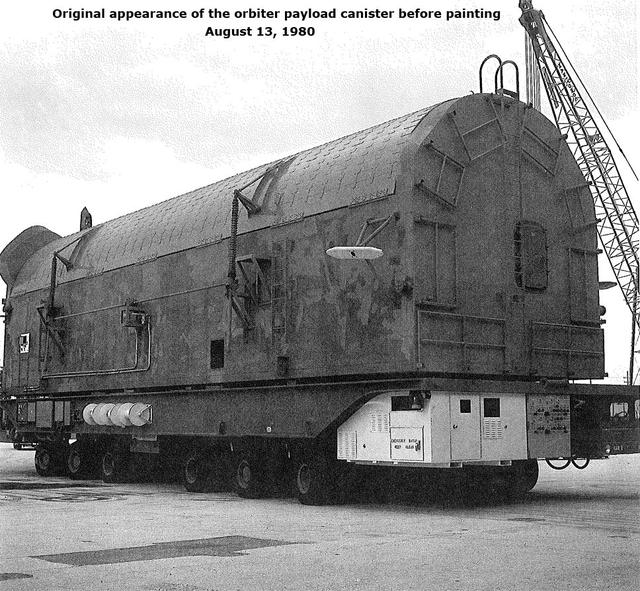
Original appearance of the orbiter payload canister before painting, August 13, 1980
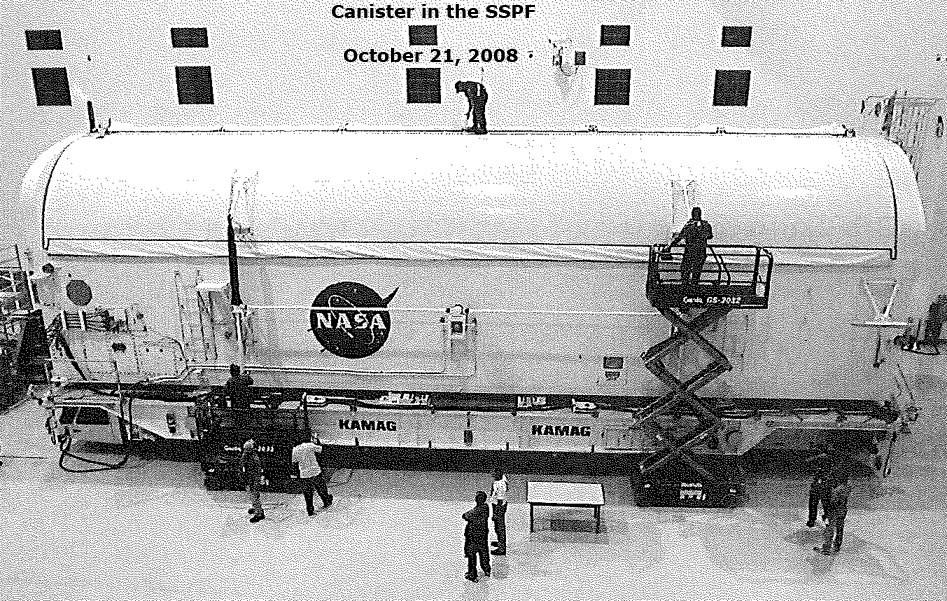
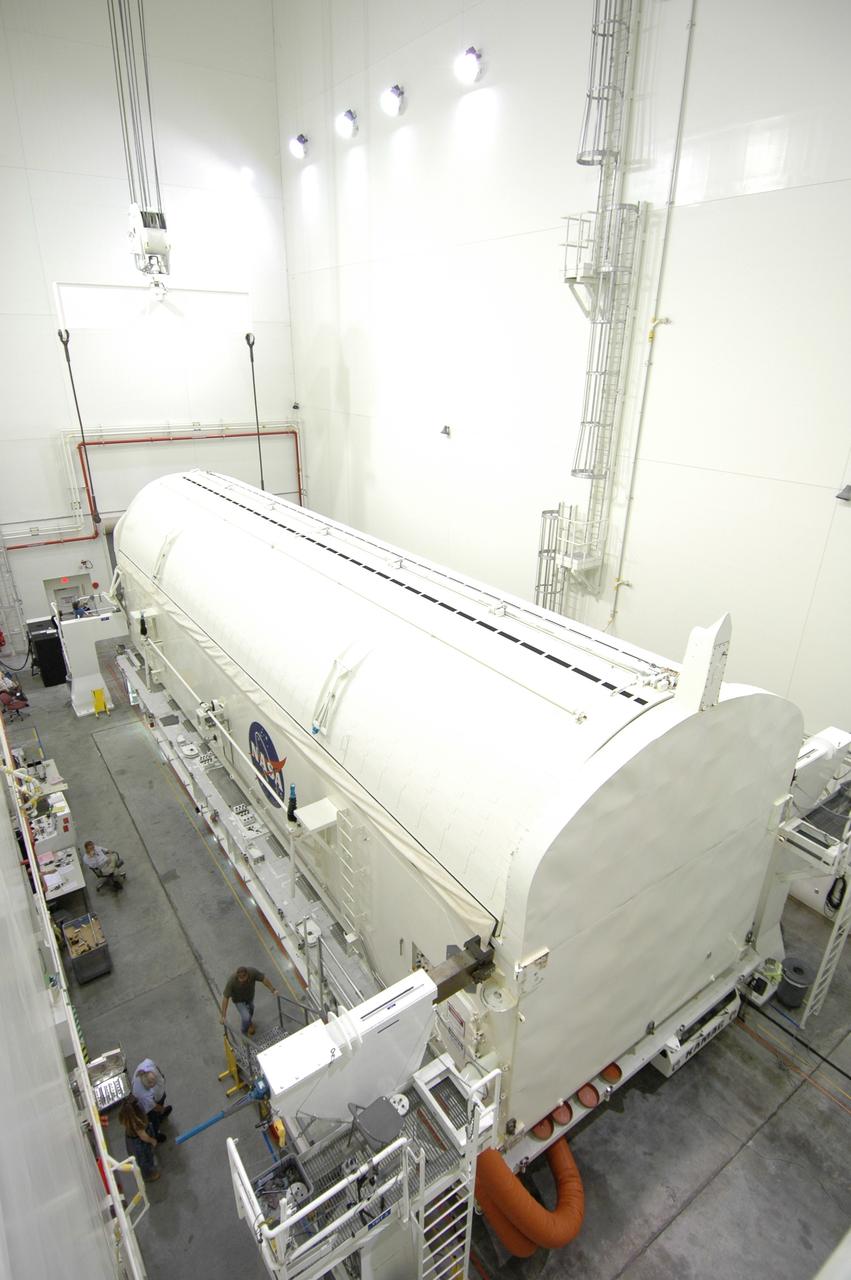
Canister in the SSPF, October 21, 2008
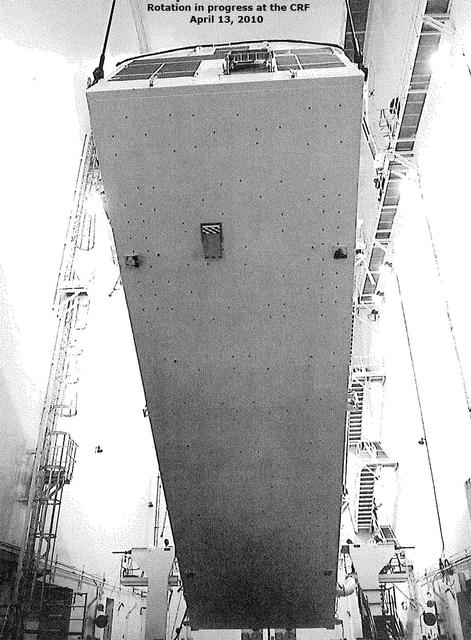
Rotation in progress at the CRF, April 13, 2010

Canister open in VPF. Payload for STS-5, SBS-3, & Anik C-3, being loaded into the canister

Installing the Long Duration Exposure Facility (LDEF) using the payload strongback, into Canister 1 O&C high bay, March 6, 1984
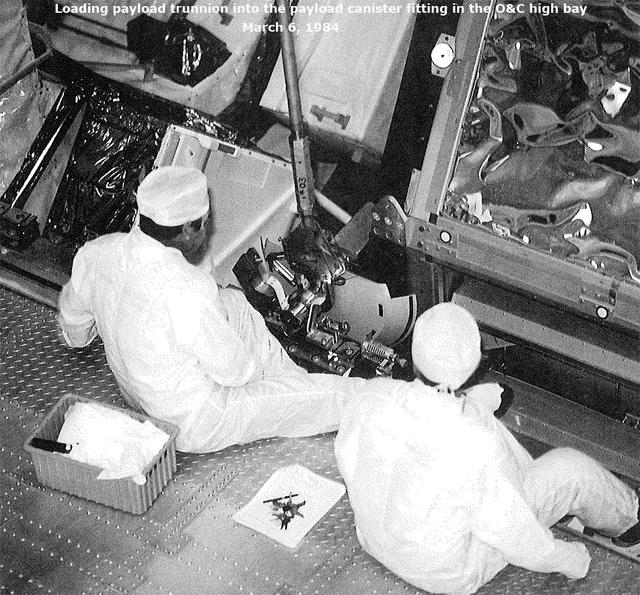
Loading payload trunnion into the payload canister fitting in the O&C high bay, March 6, 1984
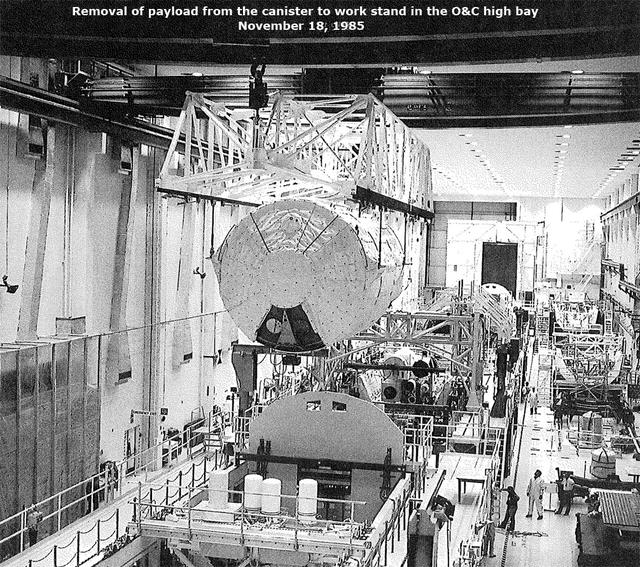
Removal of payload from the canister to work stand in the O&C high bay, November 18, 1985

Horizontal loading & unloading of payload canister with test weights in O&C high bay, November 12, 1980
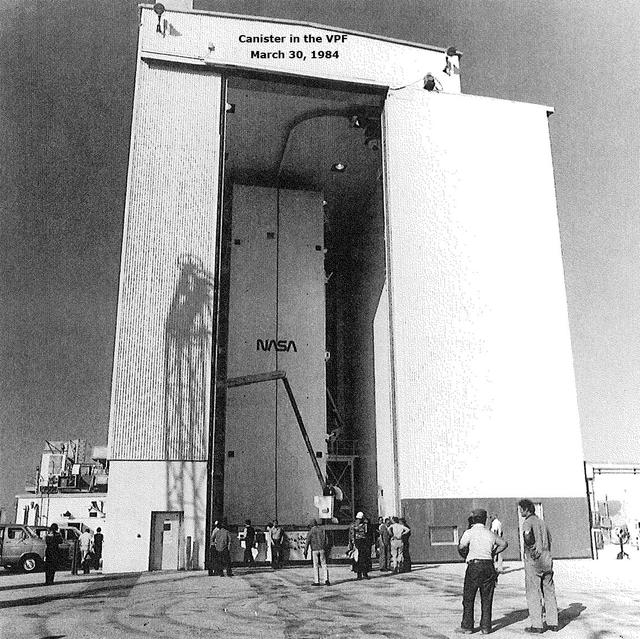
Canister in the VPF, March 30, 1984
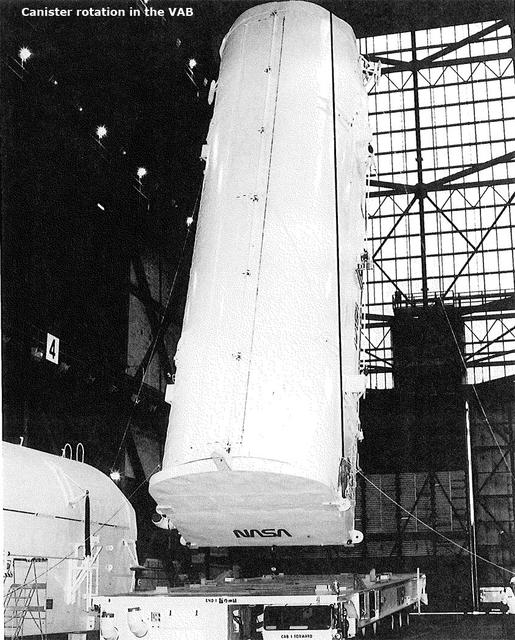
Canister rotation in the VAB
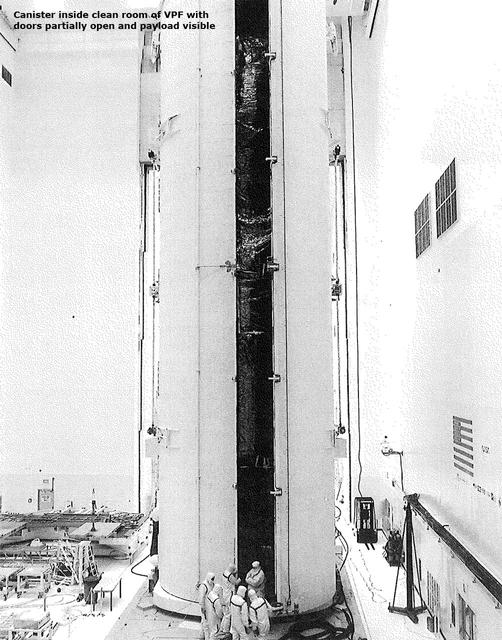
Canister inside the clean room of VPF with doors partially open and payload visible

Installing the Long Duration Exposure Facility (LDEF) using the payload strongback, into Canister 1 O&C high bay, March 6, 1984
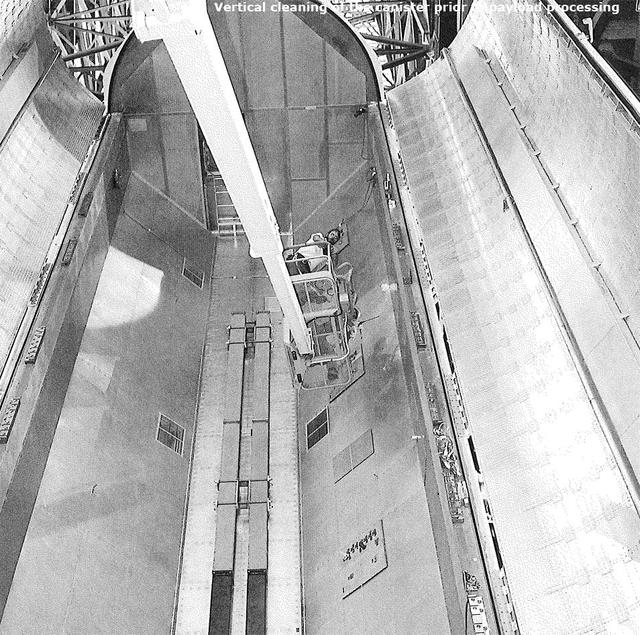
Vertical cleaning of the canister prior to payload processing

Transferring the Long Duration Exposure Facility (LDEF) into Canister 1 for STS-41C, March 6, 1984
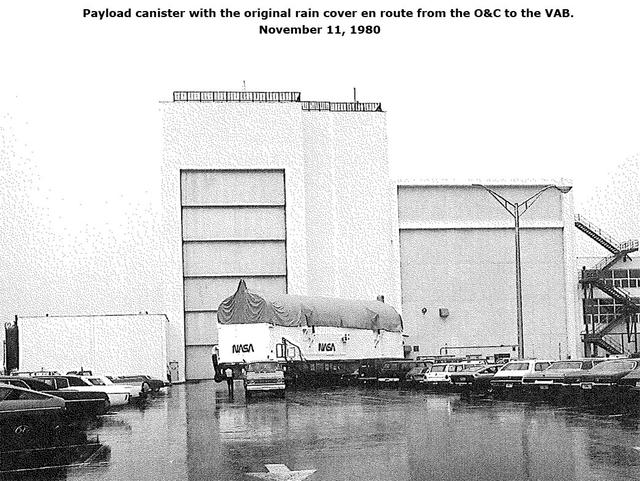
Payload canister with the original rain cover en route from the O&C to the VAB, November 11, 1980
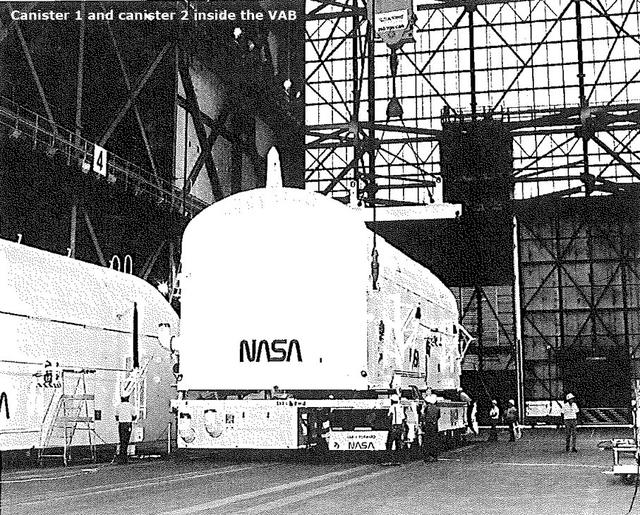
Canister 1 and canister 2 inside the VAB
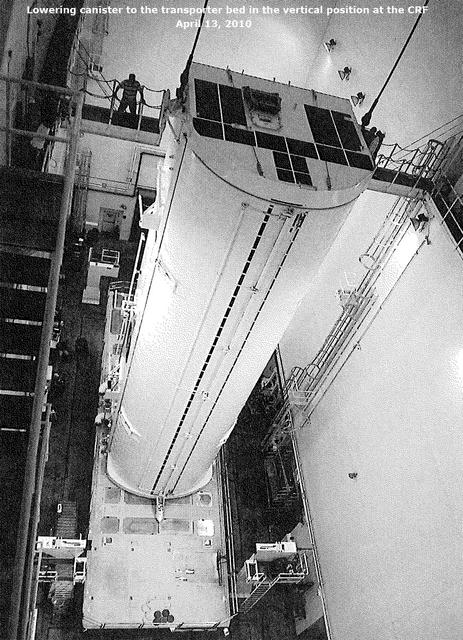
Lowering canister to the transporter bed in the vertical position at the CRF, April 13, 2010
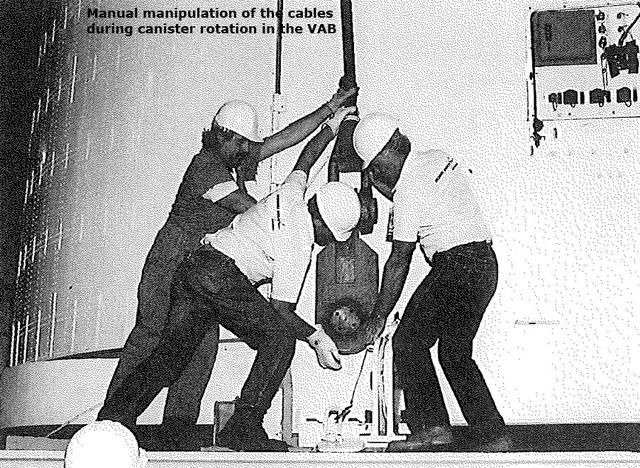
Manual manipulation of the cables during canister rotation in the VAB
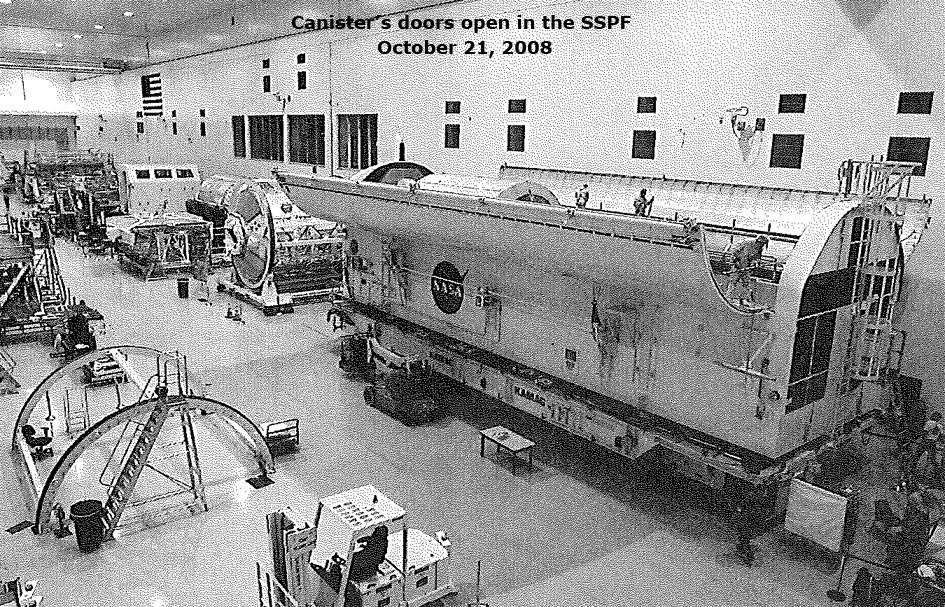
Canister's doors open in the SSPF, October 21, 2008
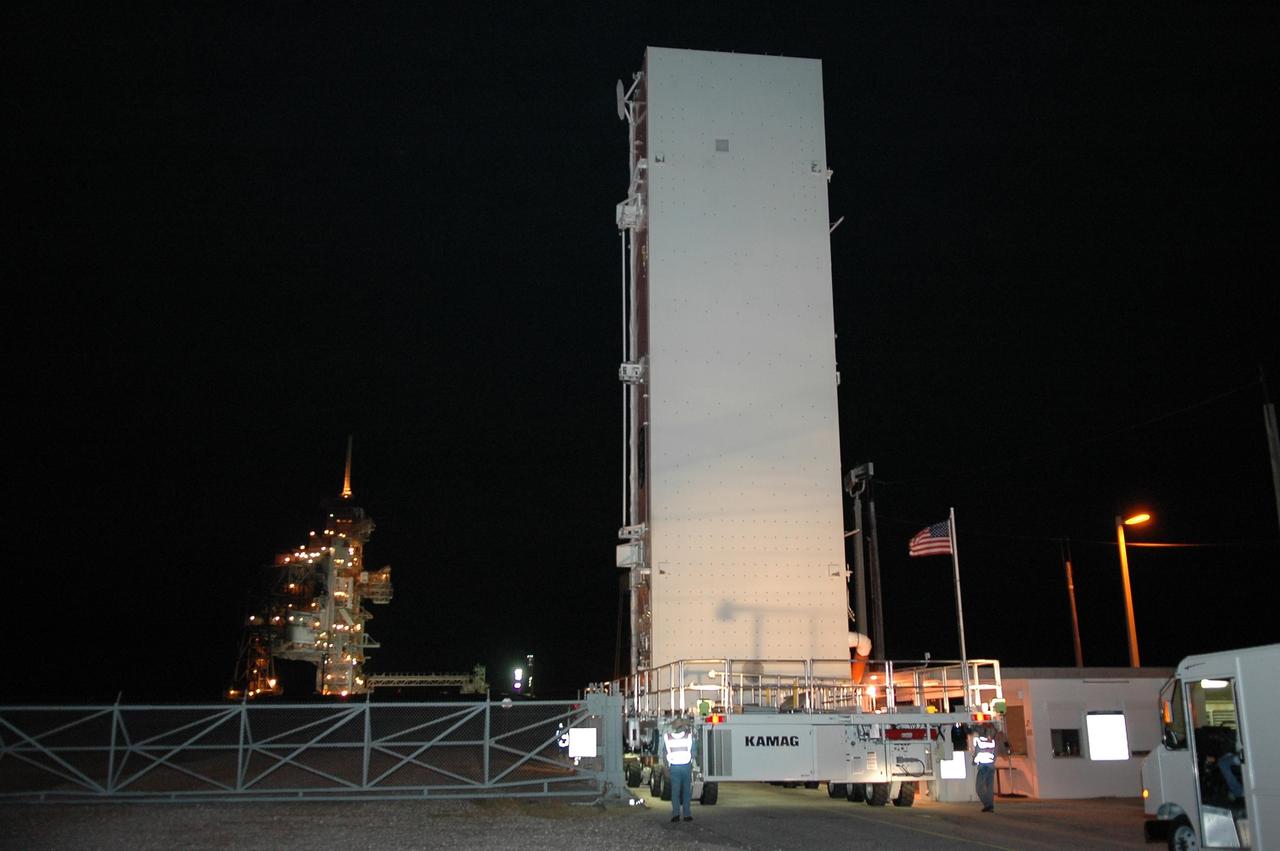
KENNEDY SPACE CENTER, FLA. -- The payload canister transporter and canister arrive at the gate to Launch Pad 39B. Inside the canister are the SPACEHAB module and the port 5 truss segment for mission STS-116. They will be moved into the payload changeout room (PCR) at the pad and transferred into Space Shuttle Discovery's payload bay once the vehicle has rolled out to the pad. The PCR is the enclosed, environmentally controlled portion of the RSS that supports cargo delivery to the pad and subsequent vertical installation into the orbiter payload bay. Seals around the mating surface of the PCR fit against the orbiter and allow the opening of the payload bay or canister doors and removal of the cargo without exposure to outside air and contaminants. A clean-air purge in the PCR maintains environmental control during PCR cargo operations. Cargo is removed from the payload canister and installed vertically in the orbiter by the payload ground handling mechanism (PGHM). Photo credit: NASA/Kim Shiflett
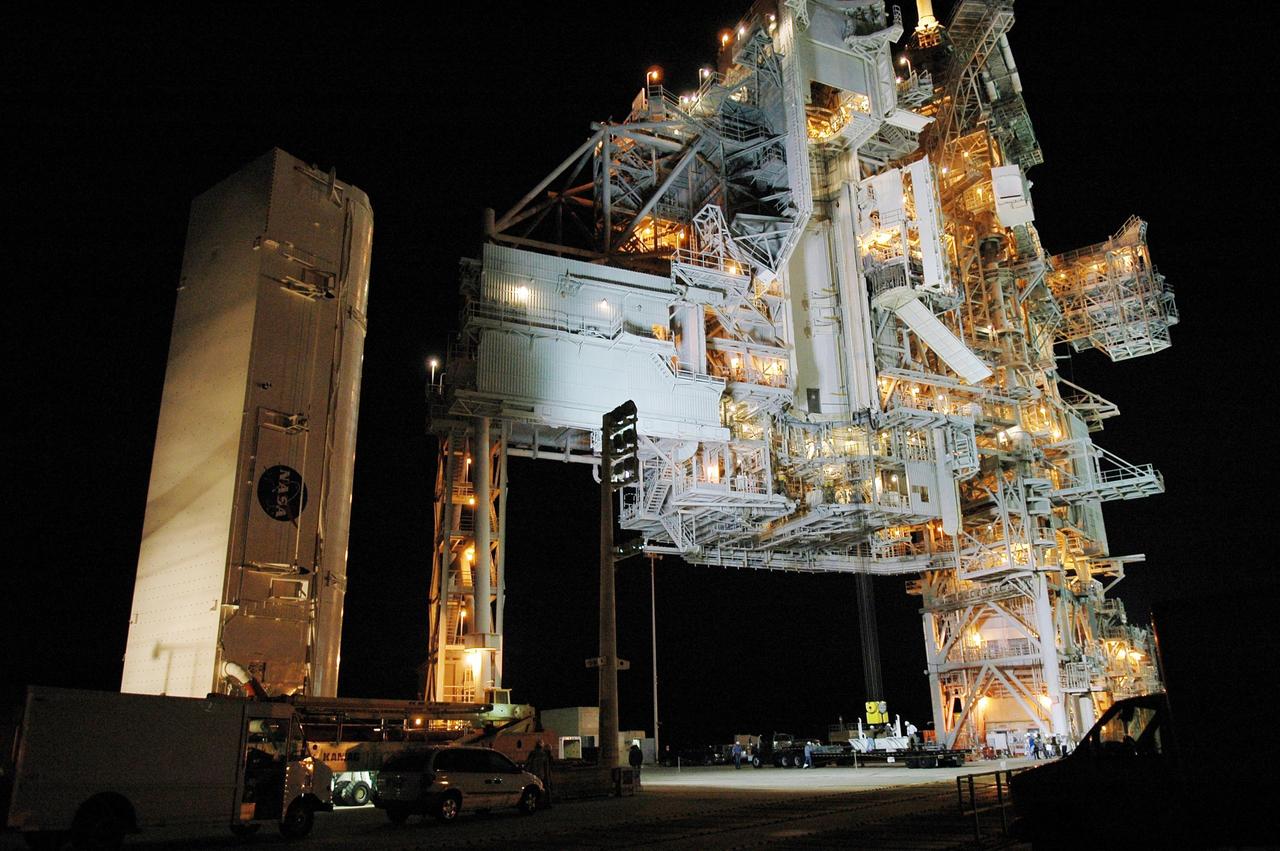
KENNEDY SPACE CENTER, FLA. -- The payload canister transporter and canister approach the rotating service structure (RSS) on Launch Pad 39B. Inside the canister are the SPACEHAB module and the port 5 truss segment for mission STS-116. They will be moved into the payload changeout room (PCR) on the RSS and transferred into Space Shuttle Discovery's payload bay once the vehicle has rolled out to the pad. The PCR is the enclosed, environmentally controlled portion of the RSS that supports cargo delivery to the pad and subsequent vertical installation into the orbiter payload bay. Seals around the mating surface of the PCR fit against the orbiter and allow the opening of the payload bay or canister doors and removal of the cargo without exposure to outside air and contaminants. A clean-air purge in the PCR maintains environmental control during PCR cargo operations. Cargo is removed from the payload canister and installed vertically in the orbiter by the payload ground handling mechanism (PGHM). Photo credit: NASA/Kim Shiflett
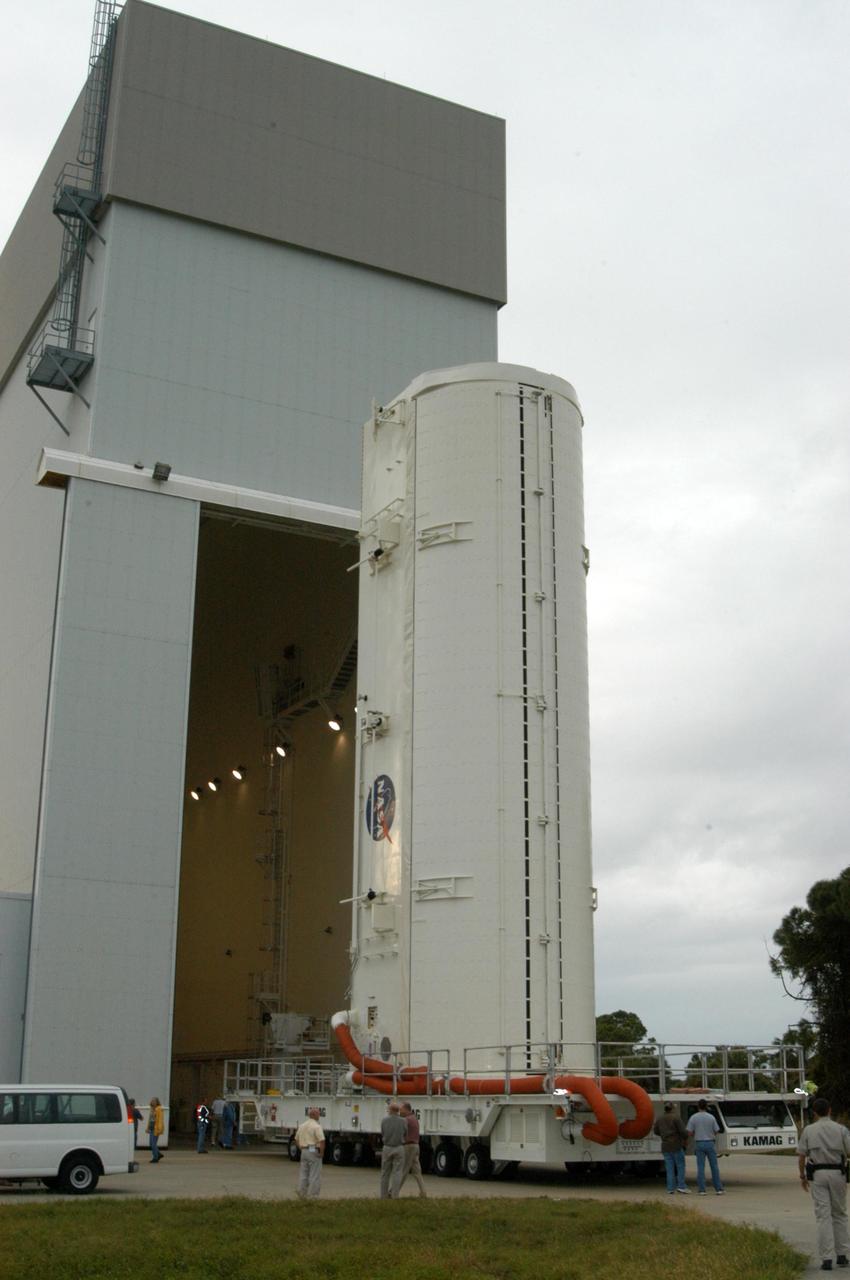
KENNEDY SPACE CENTER, FLA. -- Installed on a transporter, the payload canister moves out of the Vertical Processing Facility. Inside the canister are the SPACEHAB module and the port 5 truss segment for mission STS-116. They will be moved into the payload changeout room at the pad and transferred into Space Shuttle Discovery's payload bay once the vehicle has rolled out to the pad. The payload canister is 65 feet long, 18 feet wide and 18 feet, 7 inches high. It has the capability to carry vertically or horizontally processed payloads up to 15 feet in diameter and 60 feet long, matching the capacity of the orbiter payload bay. It can carry payloads weighing up to 65,000 pounds. Clamshell-shaped doors at the top of the canister operate like the orbiter payload bay doors, with the same allowable clearances. Photo credit: NASA/George Shelton
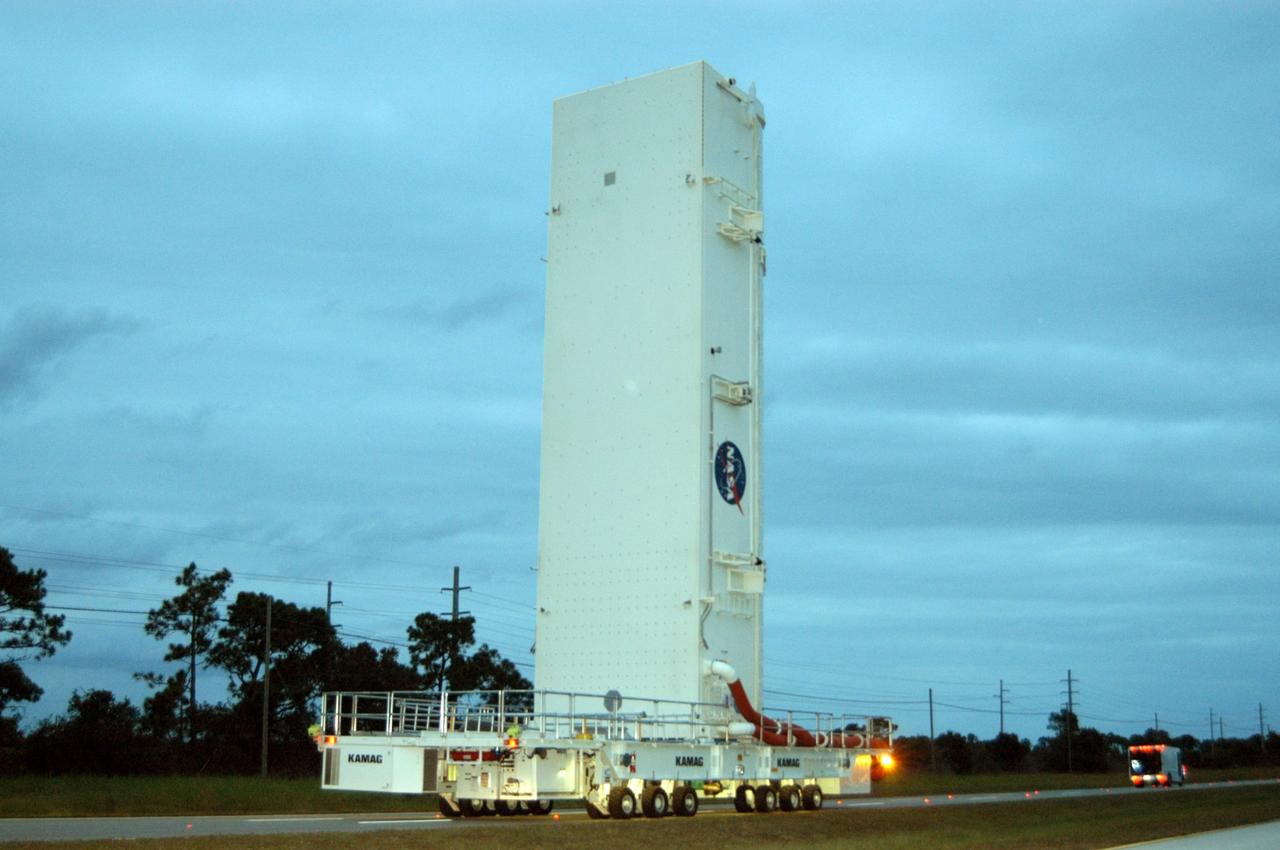
KENNEDY SPACE CENTER, FLA. -- Under a darkening, cloud-covered sky, the payload canister transporter carries its cargo very slowly along the road to Launch Pad 39B for mission STS-116. Inside the canister are the SPACEHAB module and the port 5 truss segment, which will be moved into the payload changeout room at the pad and transferred into Space Shuttle Discovery's payload bay once the vehicle has rolled out to the pad. The payload canister is 65 feet long, 18 feet wide and 18 feet, 7 inches high. It has the capability to carry vertically or horizontally processed payloads up to 15 feet in diameter and 60 feet long, matching the capacity of the orbiter payload bay. It can carry payloads weighing up to 65,000 pounds. Clamshell-shaped doors at the top of the canister operate like the orbiter payload bay doors, with the same allowable clearances. Photo credit: NASA/George Shelton
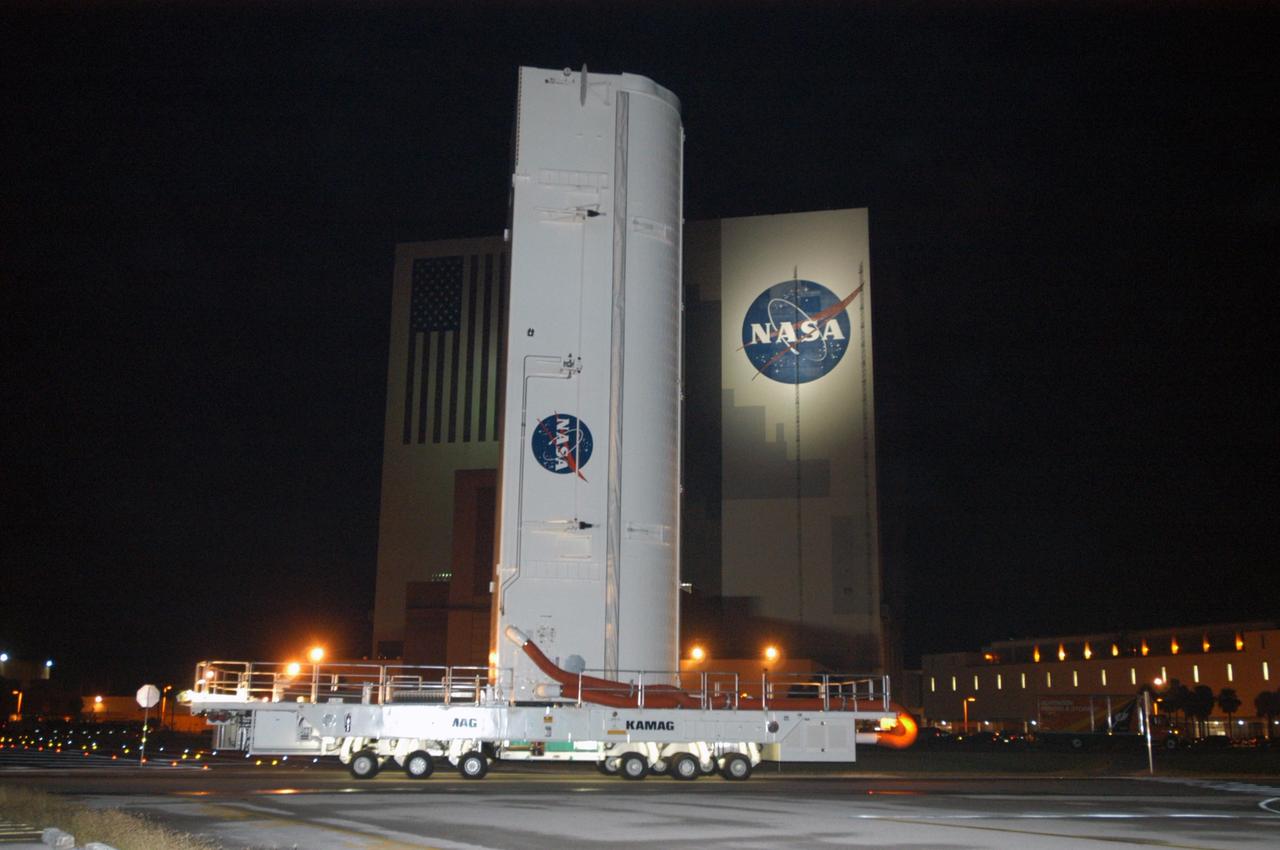
KENNEDY SPACE CENTER, FLA. -- Lamps spotlight the payload canister transporter as it slowly carries its cargo past the Vehicle Assembly Building on the road to Launch Pad 39B for mission STS-116. Inside the canister are the SPACEHAB module and the port 5 truss segment, which will be moved into the payload changeout room at the pad and transferred into Space Shuttle Discovery's payload bay once the vehicle has rolled out to the pad. The payload canister is 65 feet long, 18 feet wide and 18 feet, 7 inches high. It has the capability to carry vertically or horizontally processed payloads up to 15 feet in diameter and 60 feet long, matching the capacity of the orbiter payload bay. It can carry payloads weighing up to 65,000 pounds. Clamshell-shaped doors at the top of the canister operate like the orbiter payload bay doors, with the same allowable clearances. Photo credit: NASA/George Shelton
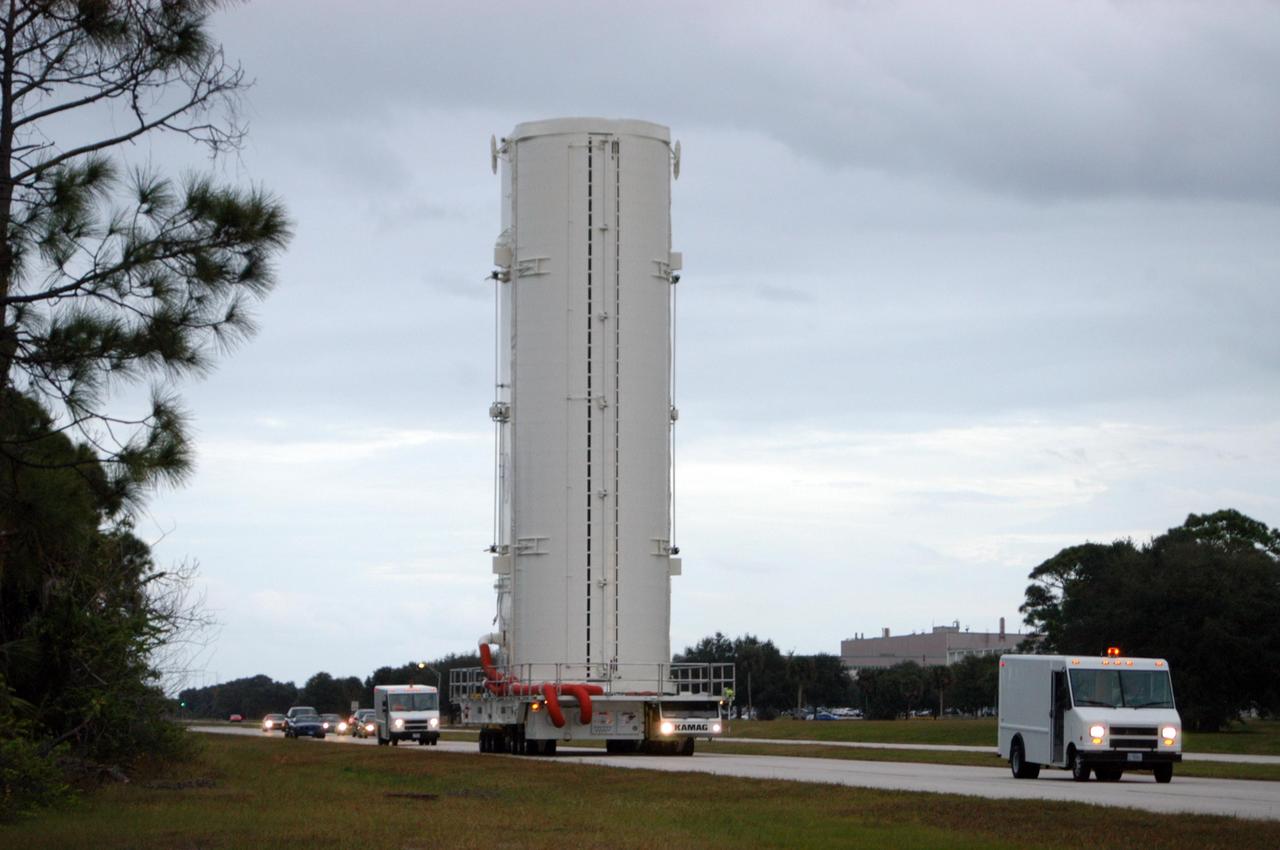
KENNEDY SPACE CENTER, FLA. -- The payload canister transporter carries its cargo very slowly along the road to Launch Pad 39B for mission STS-116. Inside the canister are the SPACEHAB module and the port 5 truss segment, which will be moved into the payload changeout room at the pad and transferred into Space Shuttle Discovery's payload bay once the vehicle has rolled out to the pad. The payload canister is 65 feet long, 18 feet wide and 18 feet, 7 inches high. It has the capability to carry vertically or horizontally processed payloads up to 15 feet in diameter and 60 feet long, matching the capacity of the orbiter payload bay. It can carry payloads weighing up to 65,000 pounds. Clamshell-shaped doors at the top of the canister operate like the orbiter payload bay doors, with the same allowable clearances. Photo credit: NASA/George Shelton
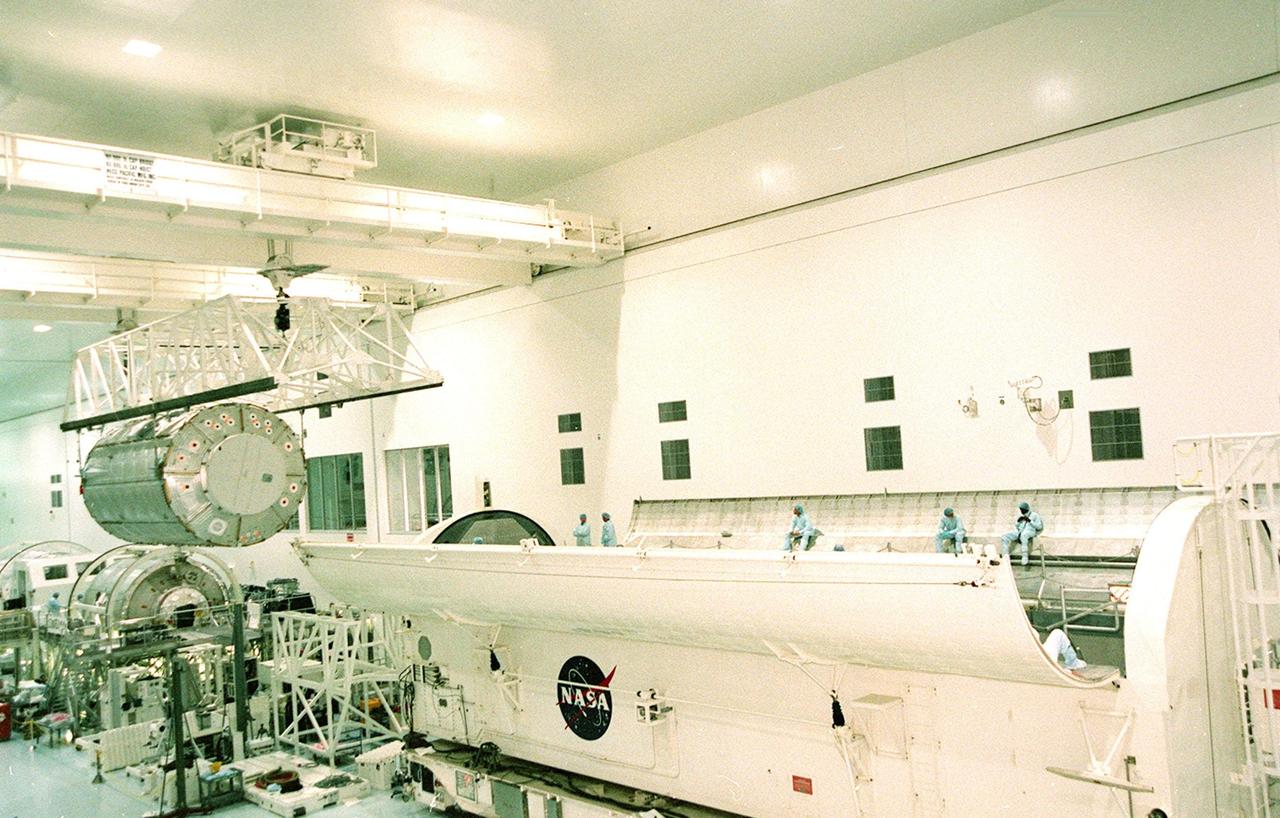
Workers wait inside the payload canister (right) for the U.S. Lab Destiny (left) to finish its move to the canister via overhead crane. Once installed inside the canister, Destiny will be transferred to Launch Pad 39A and lifted to the payload changeout room. From there it will be moved into the payload bay of the orbiter Atlantis. Destiny is the primary payload on mission STS-98, scheduled for launch no earlier than Jan. 19, 2001
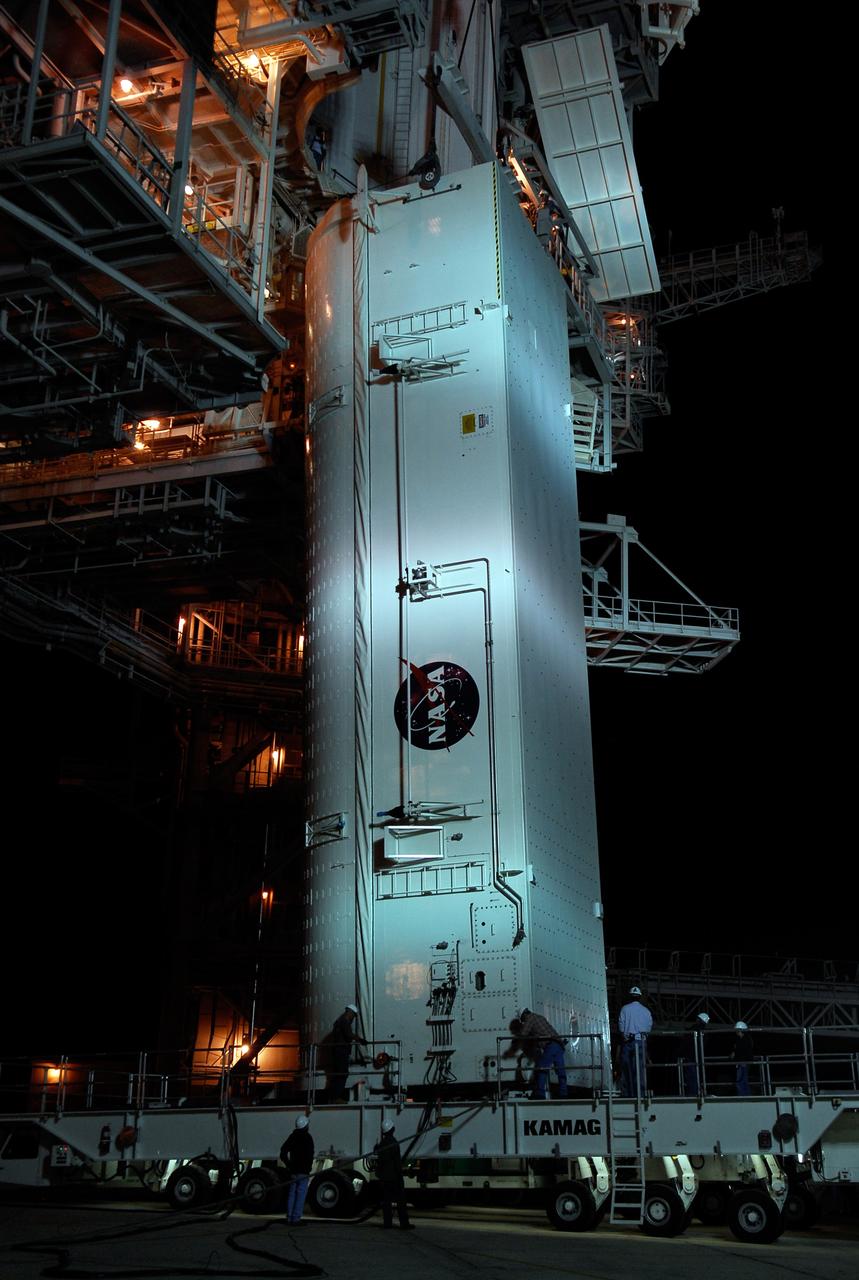
CAPE CANAVERAL, Fla. – On Launch Pad 39A at NASA's Kennedy Space Center, workers on the payload canister transporter prepare for the lifting of the payload canister to the waiting payload changeout room above. Inside the canister are the Japanese Experiment Module - Pressurized Module and the Japanese Remote Manipulator System, or RMS, for the STS-124 mission. The changeout room is the enclosed, environmentally controlled portion of the service structure that supports cargo delivery to the pad and subsequent vertical installation into an orbiter's payload bay. From the payload changeout room, the pressurized module and RMS then will be transferred into space shuttle Discovery’s payload bay. Launch is targeted for May 31. Photo credit: NASA/Kim Shiflett
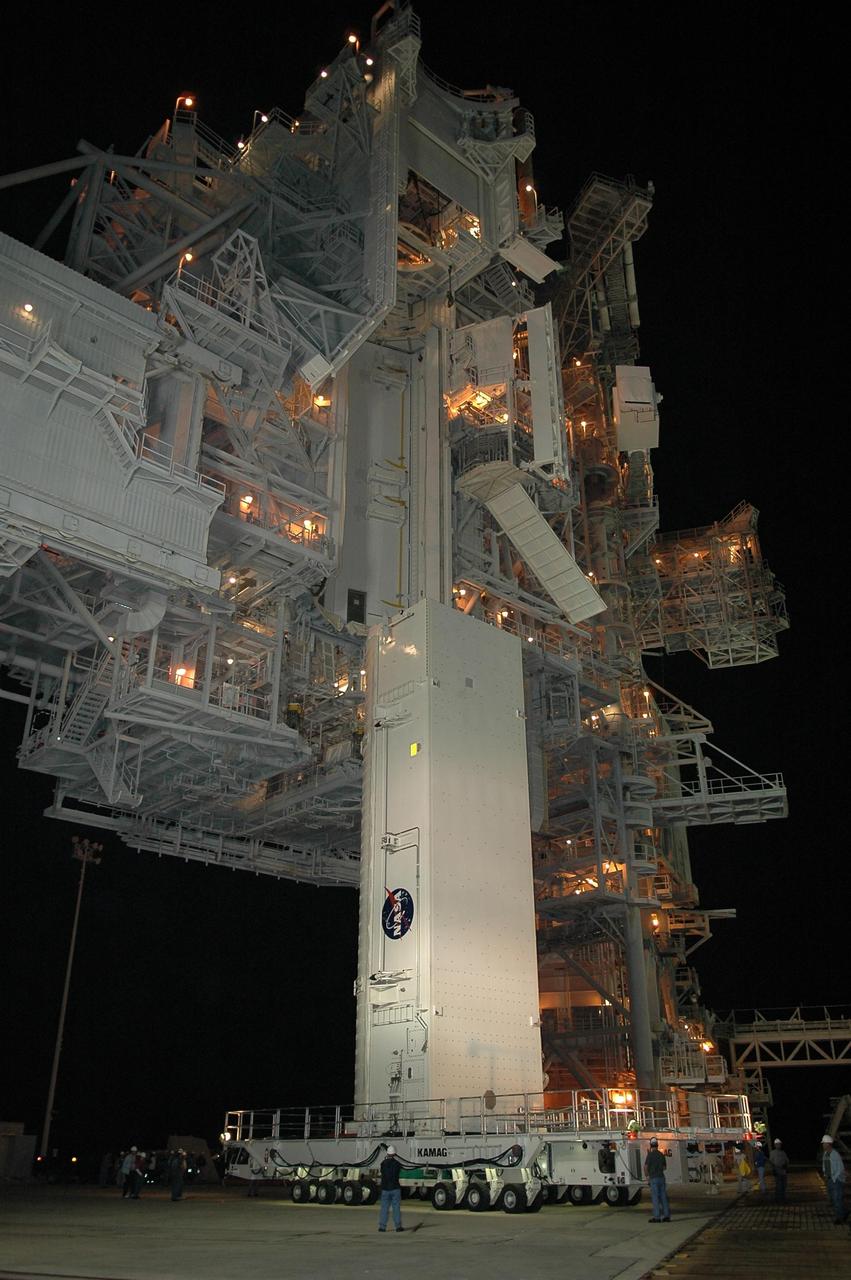
KENNEDY SPACE CENTER, FLA. -- The payload canister transporter and canister move into place under the payload changeout room (PCR) on the rotating service structure (RSS) on Launch Pad 39B. Inside the canister are the SPACEHAB module and the port 5 truss segment for mission STS-116. Once inside the PCR, they will be transferred into Space Shuttle Discovery's payload bay once the vehicle has rolled out to the pad. The PCR is the enclosed, environmentally controlled portion of the RSS that supports cargo delivery to the pad and subsequent vertical installation into the orbiter payload bay. Seals around the mating surface of the PCR fit against the orbiter and allow the opening of the payload bay or canister doors and removal of the cargo without exposure to outside air and contaminants. A clean-air purge in the PCR maintains environmental control during PCR cargo operations. Cargo is removed from the payload canister and installed vertically in the orbiter by the payload ground handling mechanism (PGHM). Photo credit: NASA/Kim Shiflett
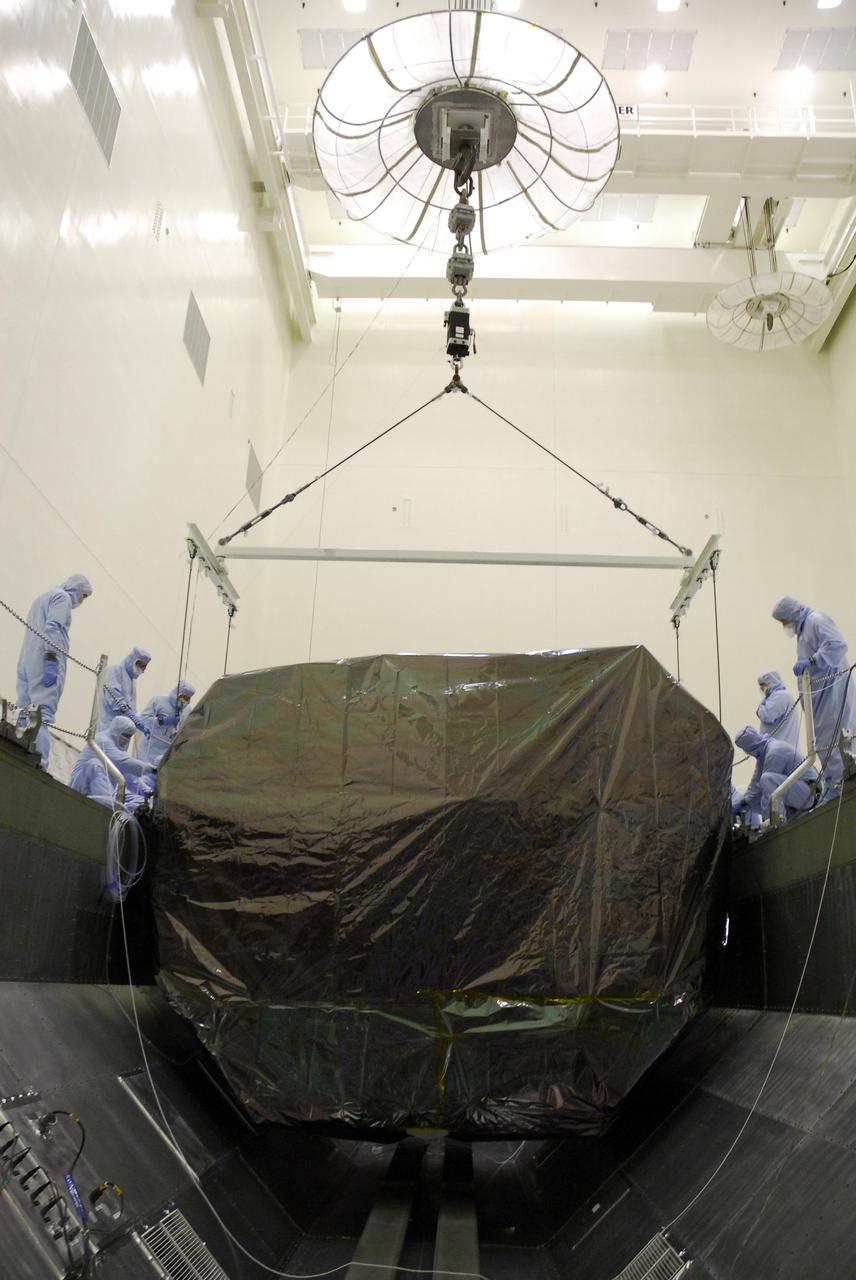
CAPE CANAVERAL, Fla. - In the Payload Hazardous Servicing Facility at NASA's Kennedy Space Center, an overhead crane lowers the Orbital Replacement Unit Carrier, or ORUC, into the payload canister. It is being placed next to the Flight Support System carrier already in the canister. The carrier is one of four associated with the STS-125 mission to service the Hubble Space Telescope. It will be installed in the payload canister for transfer to Launch Pad 39A. At the pad, all the carriers will be loaded into space shuttle Atlantis’ payload bay. Launch of Atlantis is targeted for Oct. 10. Photo credit: NASA/Jack Pfaller
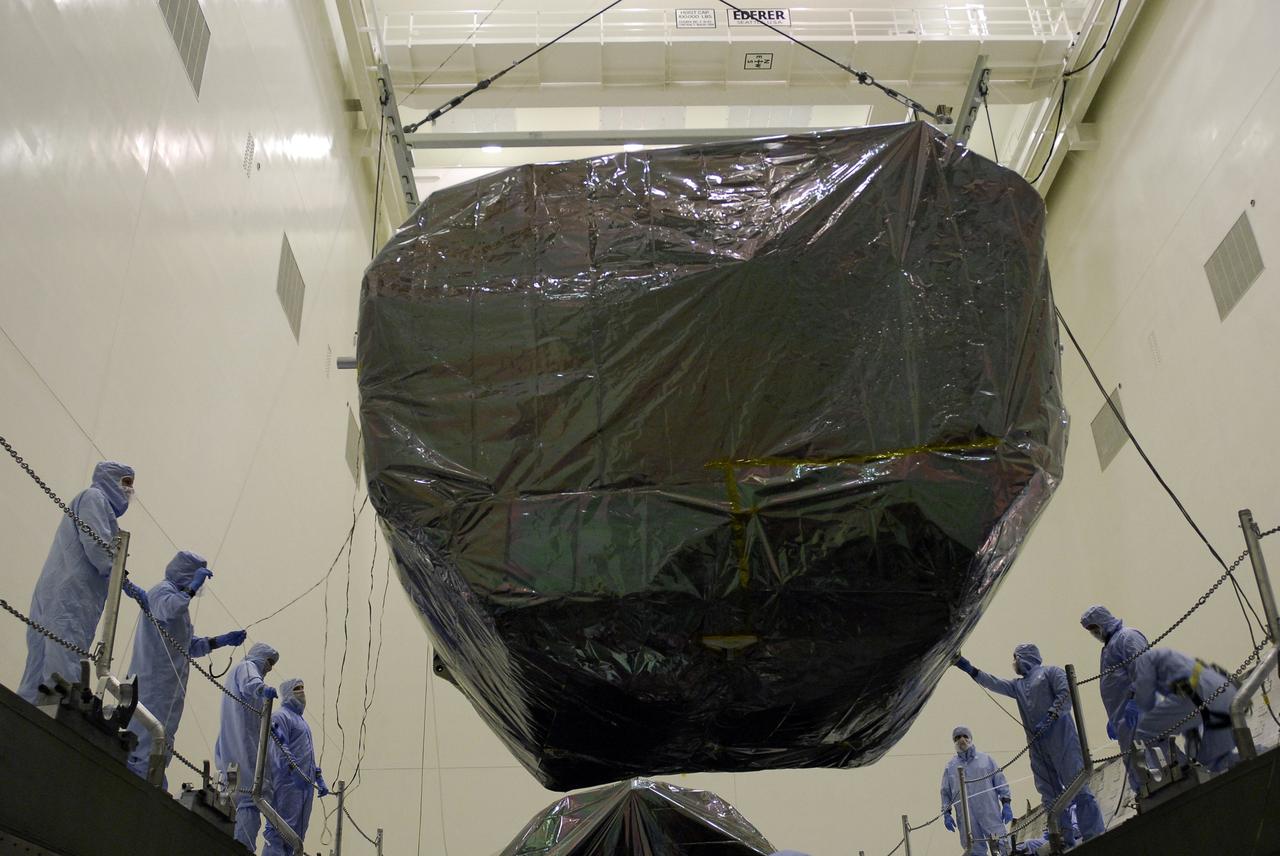
CAPE CANAVERAL, Fla. - In the Payload Hazardous Servicing Facility at NASA's Kennedy Space Center, an overhead crane lowers the Orbital Replacement Unit Carrier, or ORUC, into the payload canister. It will be placed next to the Flight Support System carrier already in the canister. The carrier is one of four associated with the STS-125 mission to service the Hubble Space Telescope. It will be installed in the payload canister for transfer to Launch Pad 39A. At the pad, all the carriers will be loaded into space shuttle Atlantis’ payload bay. Launch of Atlantis is targeted for Oct. 10. Photo credit: NASA/Jack Pfaller
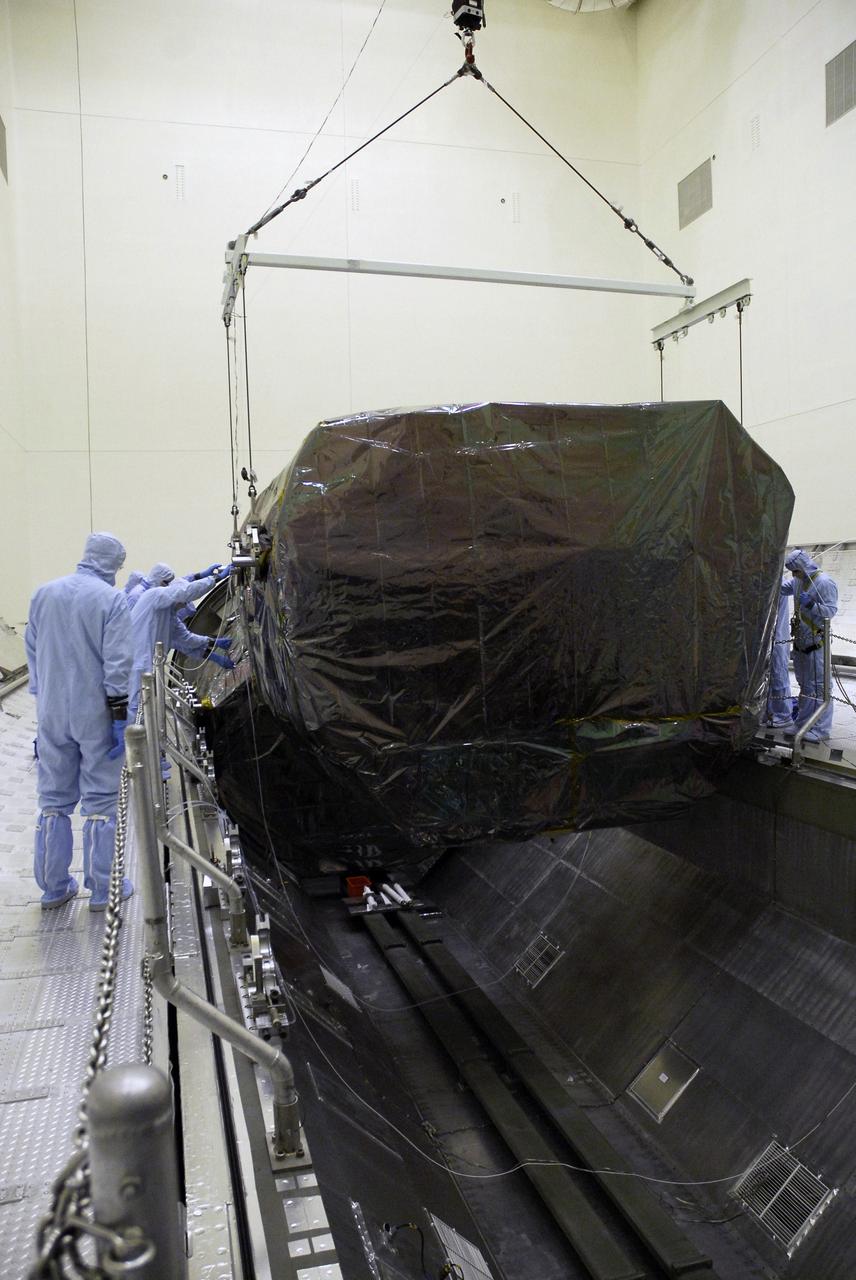
CAPE CANAVERAL, Fla. - In the Payload Hazardous Servicing Facility at NASA's Kennedy Space Center, an overhead crane lowers the Orbital Replacement Unit Carrier, or ORUC, into the payload canister. It is being placed next to the Flight Support System carrier already in the canister. The carrier is one of four associated with the STS-125 mission to service the Hubble Space Telescope. It will be installed in the payload canister for transfer to Launch Pad 39A. At the pad, all the carriers will be loaded into space shuttle Atlantis’ payload bay. Launch of Atlantis is targeted for Oct. 10. Photo credit: NASA/Jack Pfaller
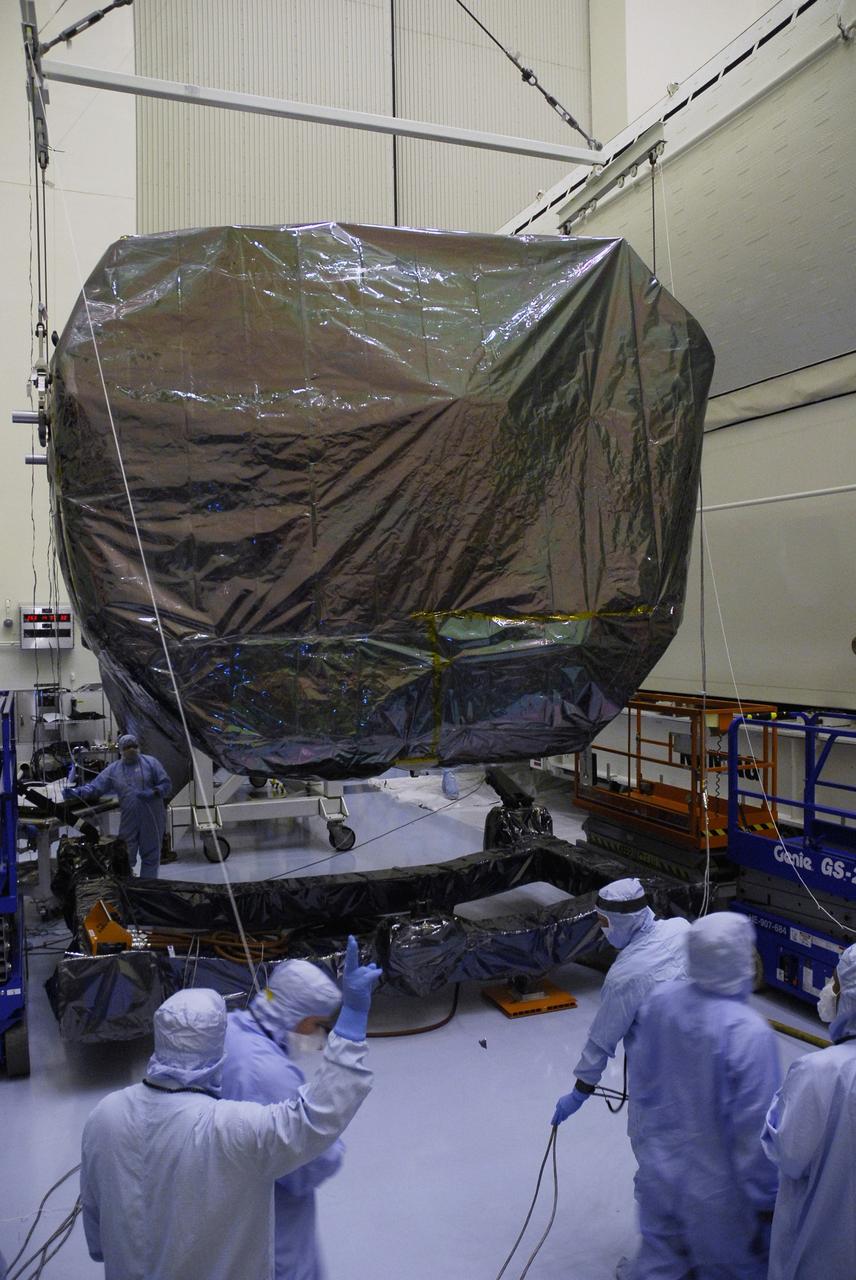
CAPE CANAVERAL, Fla. - In the Payload Hazardous Servicing Facility at NASA's Kennedy Space Center, workers are ready to lift the Orbital Replacement Unit Carrier, or ORUC, to the payload canister. The carrier is one of four associated with the STS-125 mission to service the Hubble Space Telescope. It will be installed in the payload canister for transfer to Launch Pad 39A. At the pad, all the carriers will be loaded into space shuttle Atlantis’ payload bay. Launch of Atlantis is targeted for Oct. 10. Photo credit: NASA/Jack Pfaller
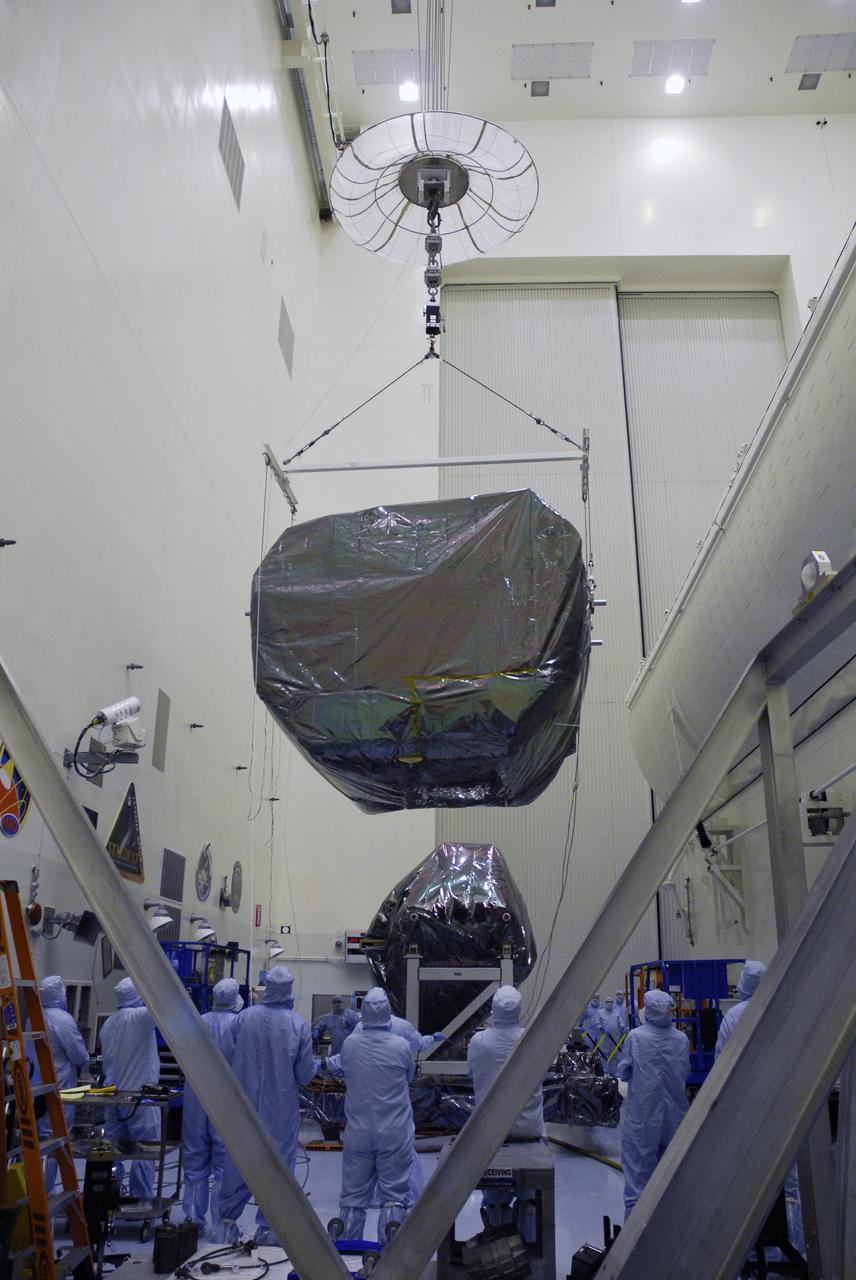
CAPE CANAVERAL, Fla. - In the Payload Hazardous Servicing Facility at NASA's Kennedy Space Center, an overhead crane lifts the Orbital Replacement Unit Carrier, or ORUC, to install it in the payload canister at right. The carrier is one of four associated with the STS-125 mission to service the Hubble Space Telescope. It will be installed in the payload canister for transfer to Launch Pad 39A. At the pad, all the carriers will be loaded into space shuttle Atlantis’ payload bay. Launch of Atlantis is targeted for Oct. 10. Photo credit: NASA/Jack Pfaller

CAPE CANAVERAL, Fla. - In the Payload Hazardous Servicing Facility at NASA's Kennedy Space Center, workers attach an overhead crane to the Orbital Replacement Unit Carrier, or ORUC. The crane will lift and move the ORUC to the payload canister. The carrier is one of four associated with the STS-125 mission to service the Hubble Space Telescope. It will be installed in the payload canister for transfer to Launch Pad 39A. At the pad, all the carriers will be loaded into space shuttle Atlantis’ payload bay. Launch of Atlantis is targeted for Oct. 10. Photo credit: NASA/Jack Pfaller
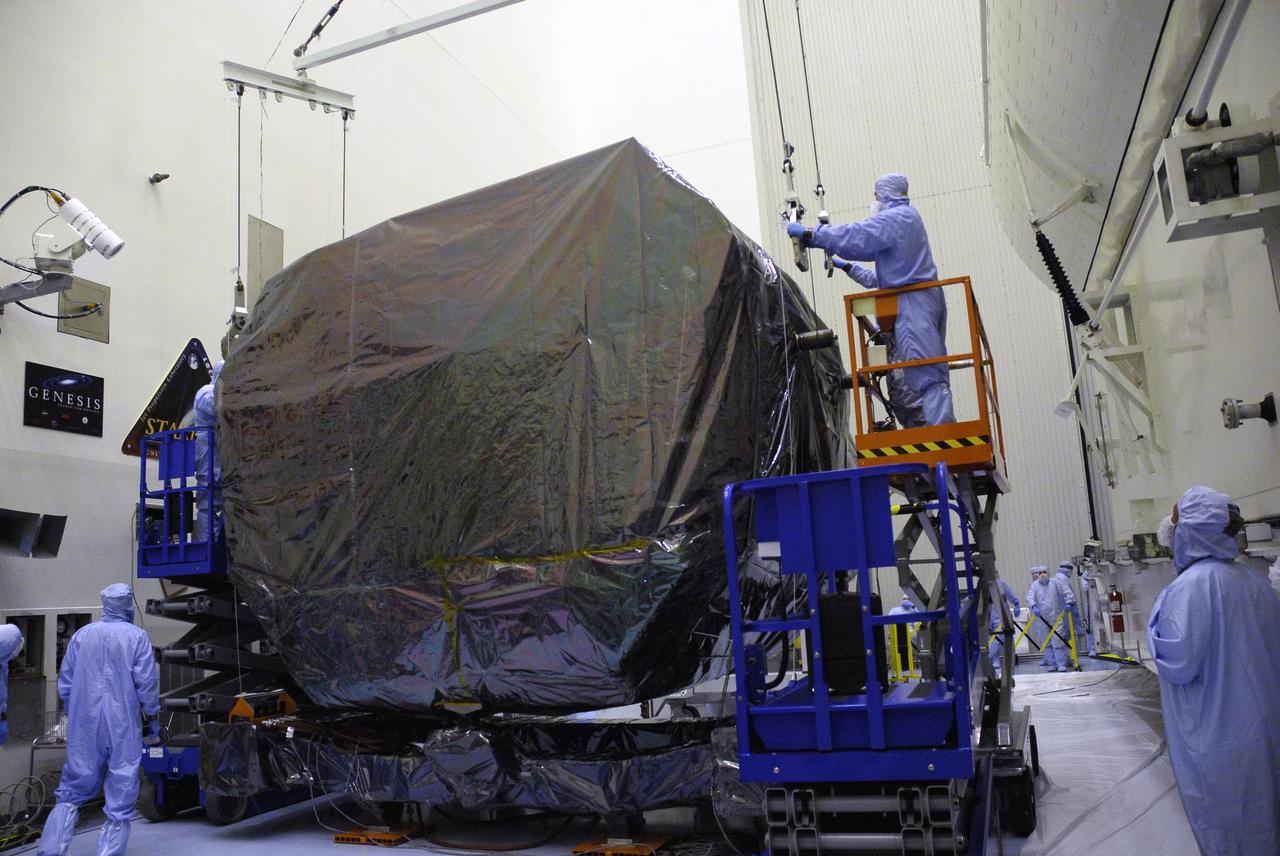
CAPE CANAVERAL, Fla. - In the Payload Hazardous Servicing Facility at NASA's Kennedy Space Center, workers attach an overhead crane to the Orbital Replacement Unit Carrier, or ORUC. The crane will lift and move the ORUC to the payload canister. The carrier is one of four associated with the STS-125 mission to service the Hubble Space Telescope. It will be installed in the payload canister for transfer to Launch Pad 39A. At the pad, all the carriers will be loaded into space shuttle Atlantis’ payload bay. Launch of Atlantis is targeted for Oct. 10. Photo credit: NASA/Jack Pfaller
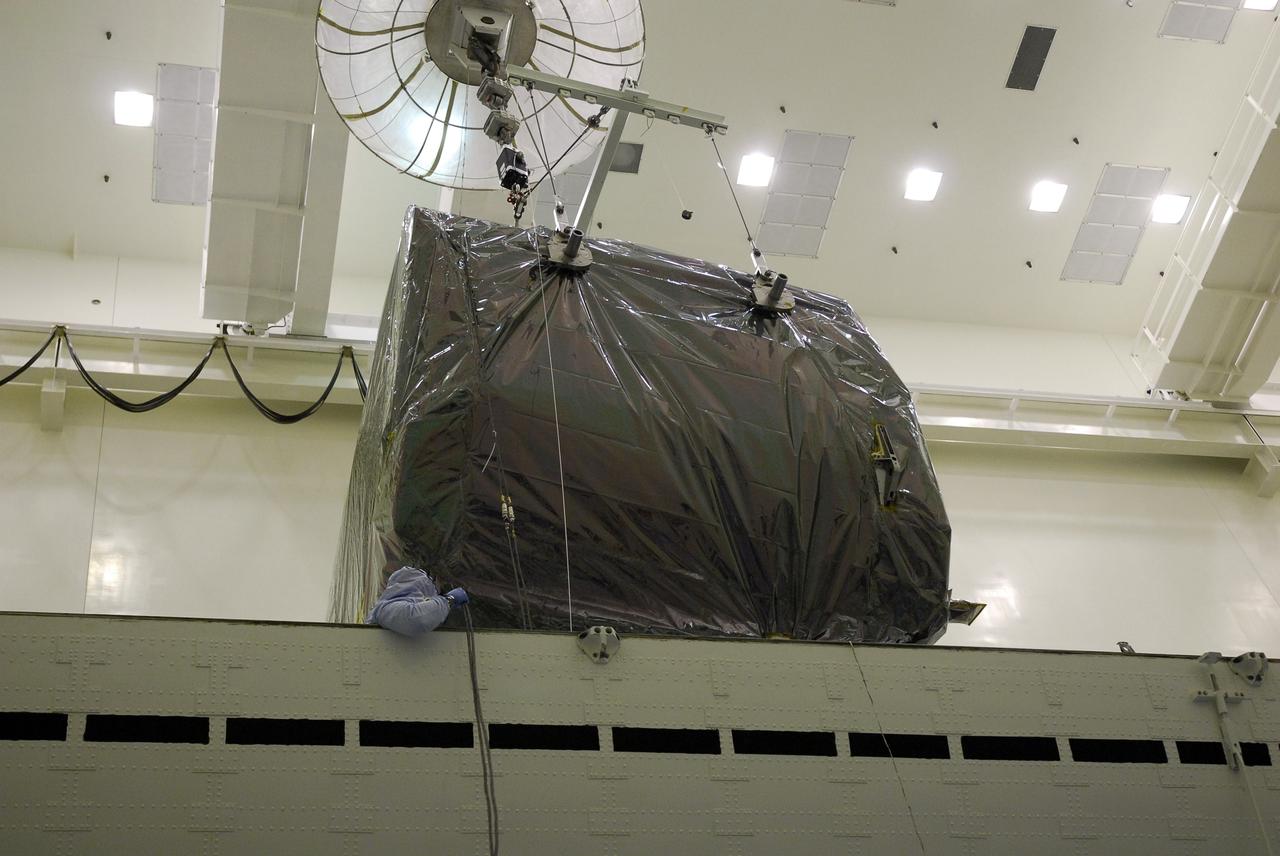
CAPE CANAVERAL, Fla. - In the Payload Hazardous Servicing Facility at NASA's Kennedy Space Center, an overhead crane moves the Orbital Replacement Unit Carrier, or ORUC, above the payload canister for installation. The carrier is one of four associated with the STS-125 mission to service the Hubble Space Telescope. It will be installed in the payload canister for transfer to Launch Pad 39A. At the pad, all the carriers will be loaded into space shuttle Atlantis’ payload bay. Launch of Atlantis is targeted for Oct. 10. Photo credit: NASA/Jack Pfaller
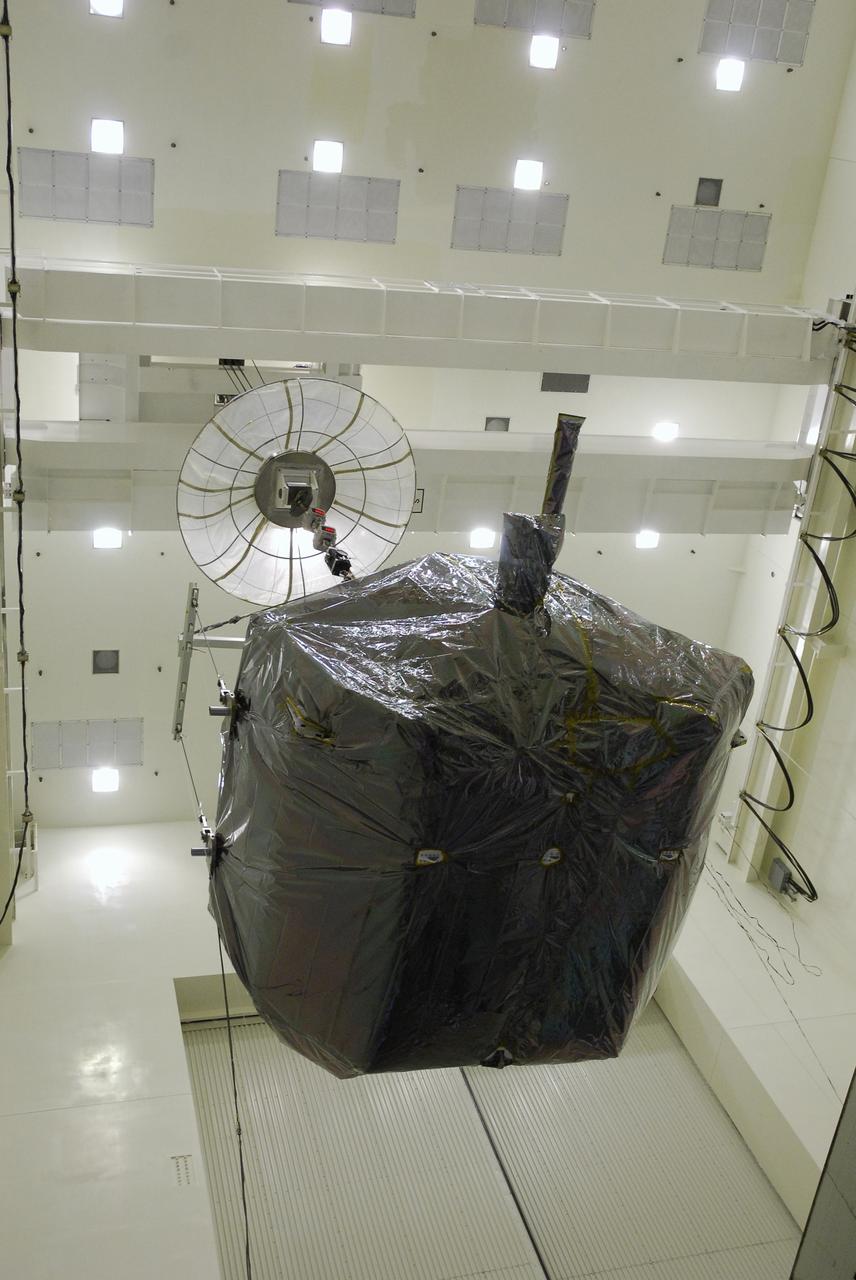
CAPE CANAVERAL, Fla. - In the Payload Hazardous Servicing Facility at NASA's Kennedy Space Center, an overhead crane lifts the Orbital Replacement Unit Carrier, or ORUC, and moves it across the floor to install it in the payload canister. The carrier is one of four associated with the STS-125 mission to service the Hubble Space Telescope. It will be installed in the payload canister for transfer to Launch Pad 39A. At the pad, all the carriers will be loaded into space shuttle Atlantis’ payload bay. Launch of Atlantis is targeted for Oct. 10. Photo credit: NASA/Jack Pfaller
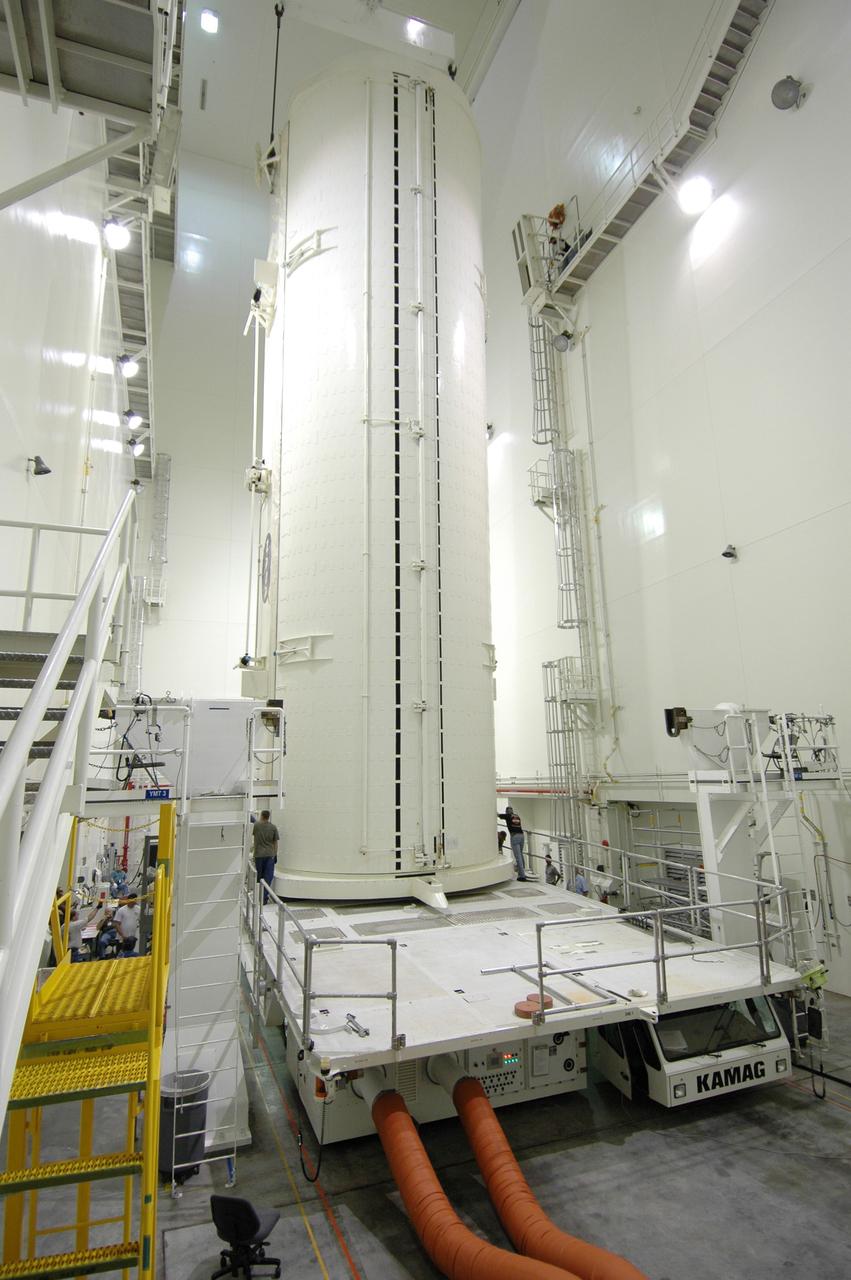
CAPE CANAVERAL, Fla. -- In the Vertical Integration Facility at NASA's Kennedy Space Center, workers check the placement of the payload canister after it was lowered onto the payload canister transporter. The canister contains the Japanese Experiment Module -Pressurized Module, which will be transported to Launch Pad 39A for space shuttle Discovery’s STS-124 mission. At the pad, the payload will be transferred from the canister into the payload changeout room on the rotating service structure. The changeout room is the enclosed, environmentally controlled portion of the service structure that supports cargo delivery to the pad and subsequent vertical installation into an orbiter's payload bay. On the mission, the STS-124 crew will transport the JEM as well as the Japanese Remote Manipulator System to the International Space Station. The launch of Discovery is targeted for May 31. Photo credit: NASA/Jim Grossmann
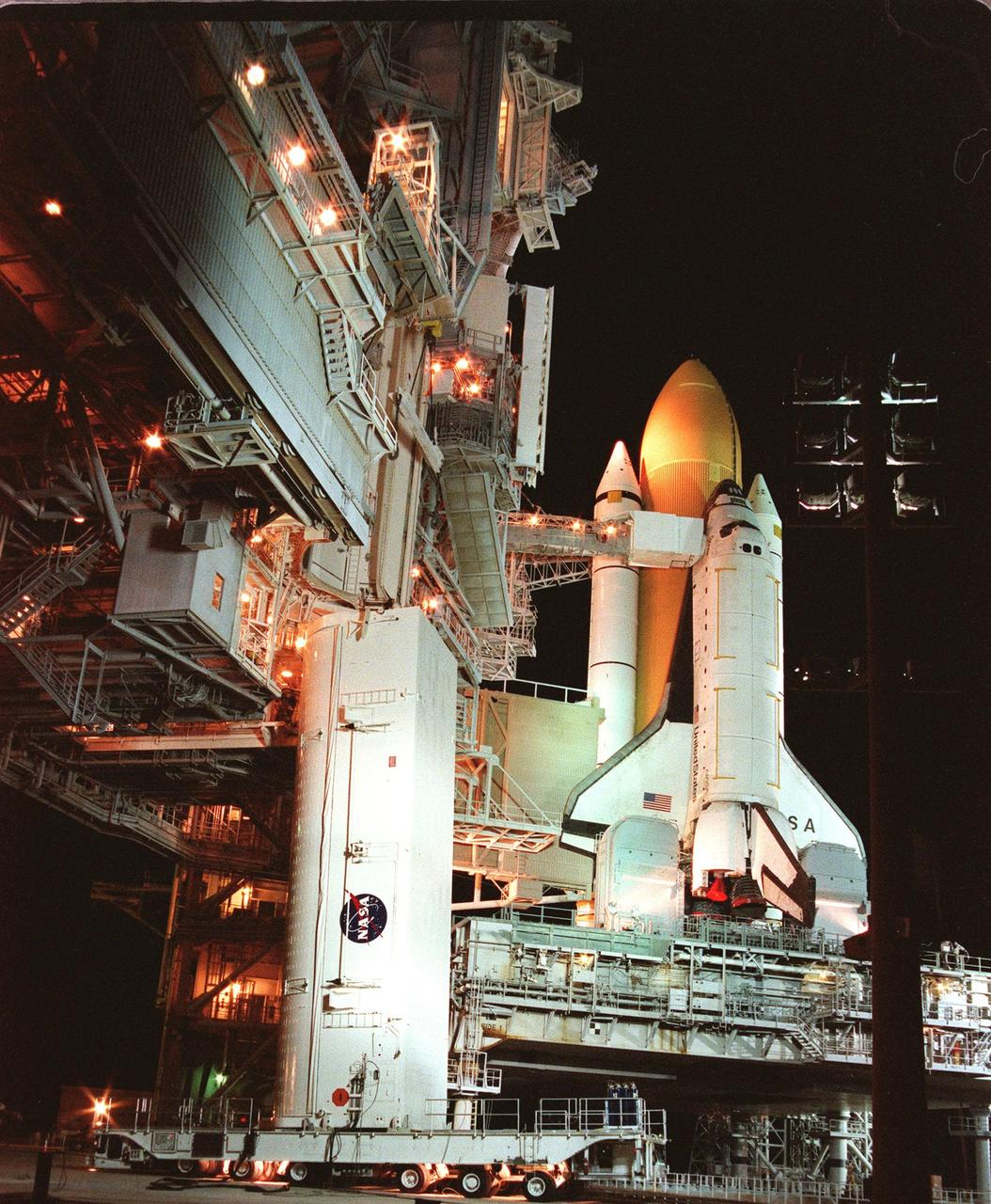
KENNEDY SPACE CENTER, FLA. -- The payload canister containing the Chandra X-ray Observatory is prepared for its ascent up the Rotating Service Structure (RSS). The canister arrived at the pad on the payload canister transporter below it. The canister will be lifted up to the Payload Changeout Room in the RSS where it will be relieved of its cargo. After the RSS rotates to a position behind Space Shuttle Columbia (at right), the observatory will then be installed vertically in the orbiter payload bay. The world's most powerful X-ray telescope, Chandra will allow scientists from around the world to see previously invisible black holes and high-temperature gas clouds, giving the observatory the potential to rewrite the books on the structure and evolution of our universe. Chandra is the primary payload on mission STS-93, scheduled to launch no earlier than July 20 aboard Space Shuttle Columbia (right)
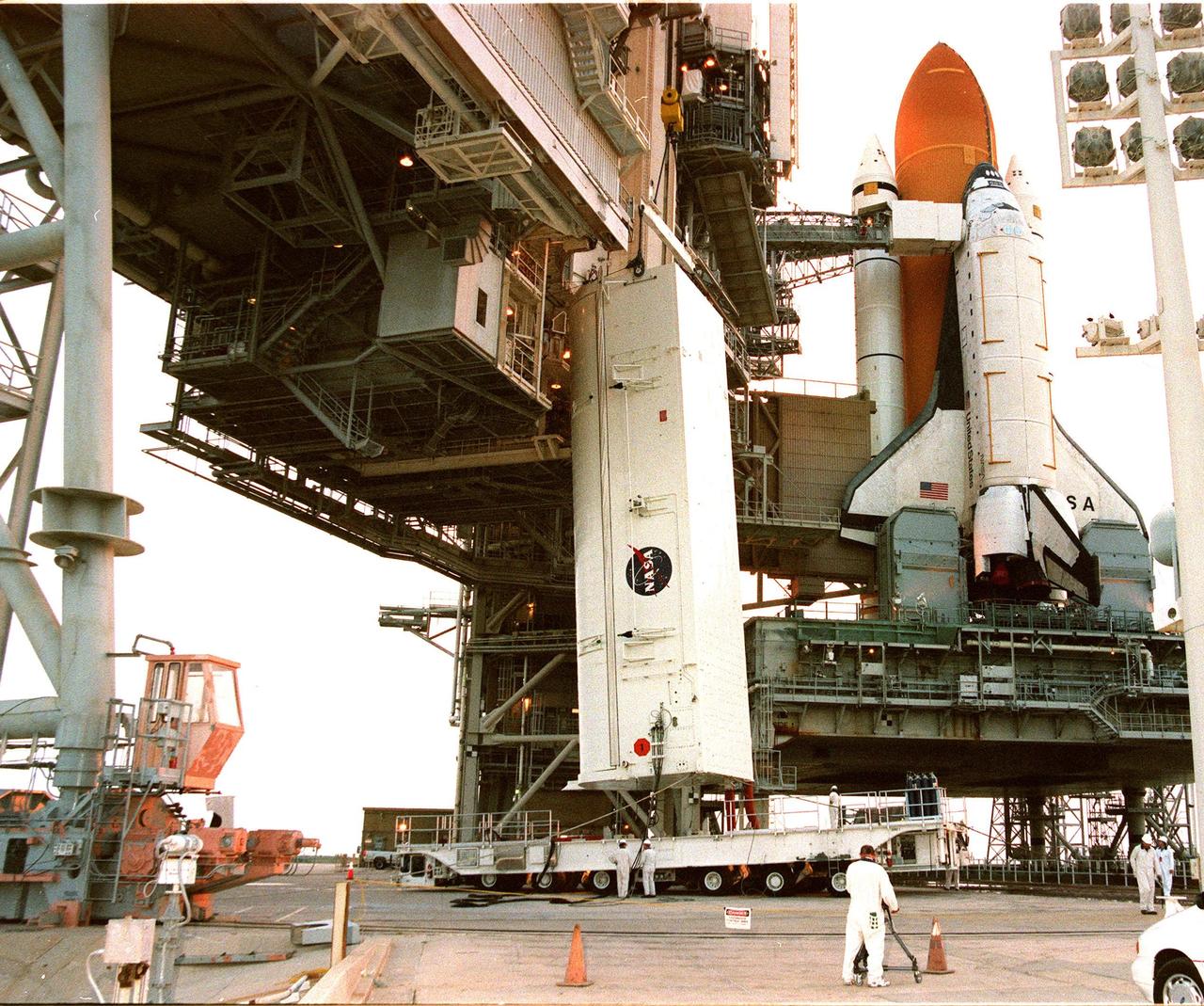
KENNEDY SPACE CENTER, FLA. -- In the early morning daylight, the payload canister containing the Chandra X-ray Observatory begins its ascent up the Rotating Service Structure (RSS). The canister arrived at the pad on the payload canister transporter below it. The canister will be lifted up to the Payload Changeout Room in the RSS where it will be relieved of its cargo. After the RSS rotates to a position behind Space Shuttle Columbia (at right), the observatory will then be installed vertically in the orbiter payload bay. The world's most powerful X-ray telescope, Chandra will allow scientists from around the world to see previously invisible black holes and high-temperature gas clouds, giving the observatory the potential to rewrite the books on the structure and evolution of our universe. Chandra is the primary payload on mission STS-93, scheduled to launch no earlier than July 20 aboard Space Shuttle Columbia (right)
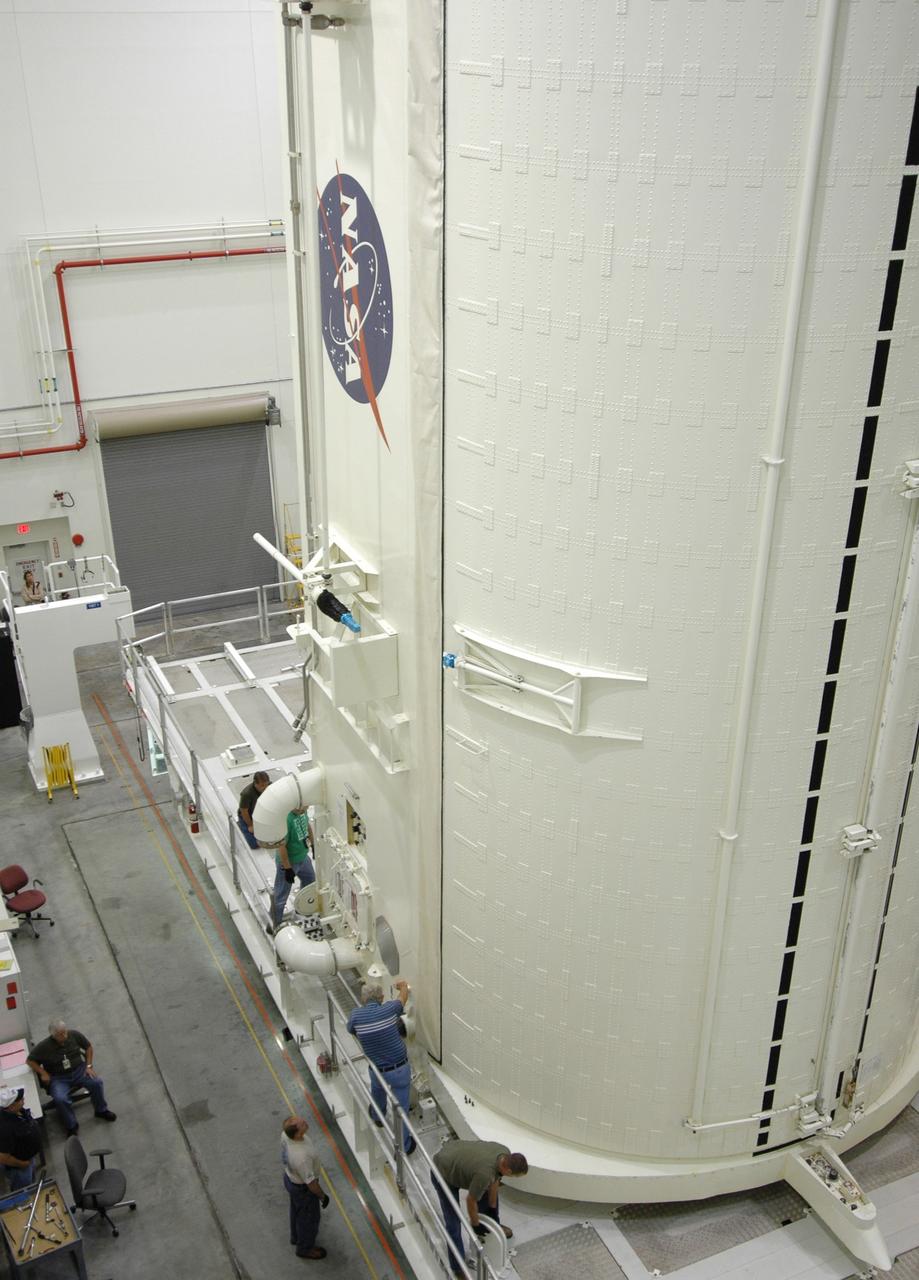
CAPE CANAVERAL, Fla. -- In the Vertical Integration Facility at NASA's Kennedy Space Center, workers check the placement of the payload canister after it was lowered onto the payload canister transporter. The canister contains the Japanese Experiment Module -Pressurized Module, which will be transported to Launch Pad 39A for space shuttle Discovery’s STS-124 mission. At the pad, the payload will be transferred from the canister into the payload changeout room on the rotating service structure. The changeout room is the enclosed, environmentally controlled portion of the service structure that supports cargo delivery to the pad and subsequent vertical installation into an orbiter's payload bay. On the mission, the STS-124 crew will transport the JEM as well as the Japanese Remote Manipulator System to the International Space Station. The launch of Discovery is targeted for May 31. Photo credit: NASA/Jim Grossmann
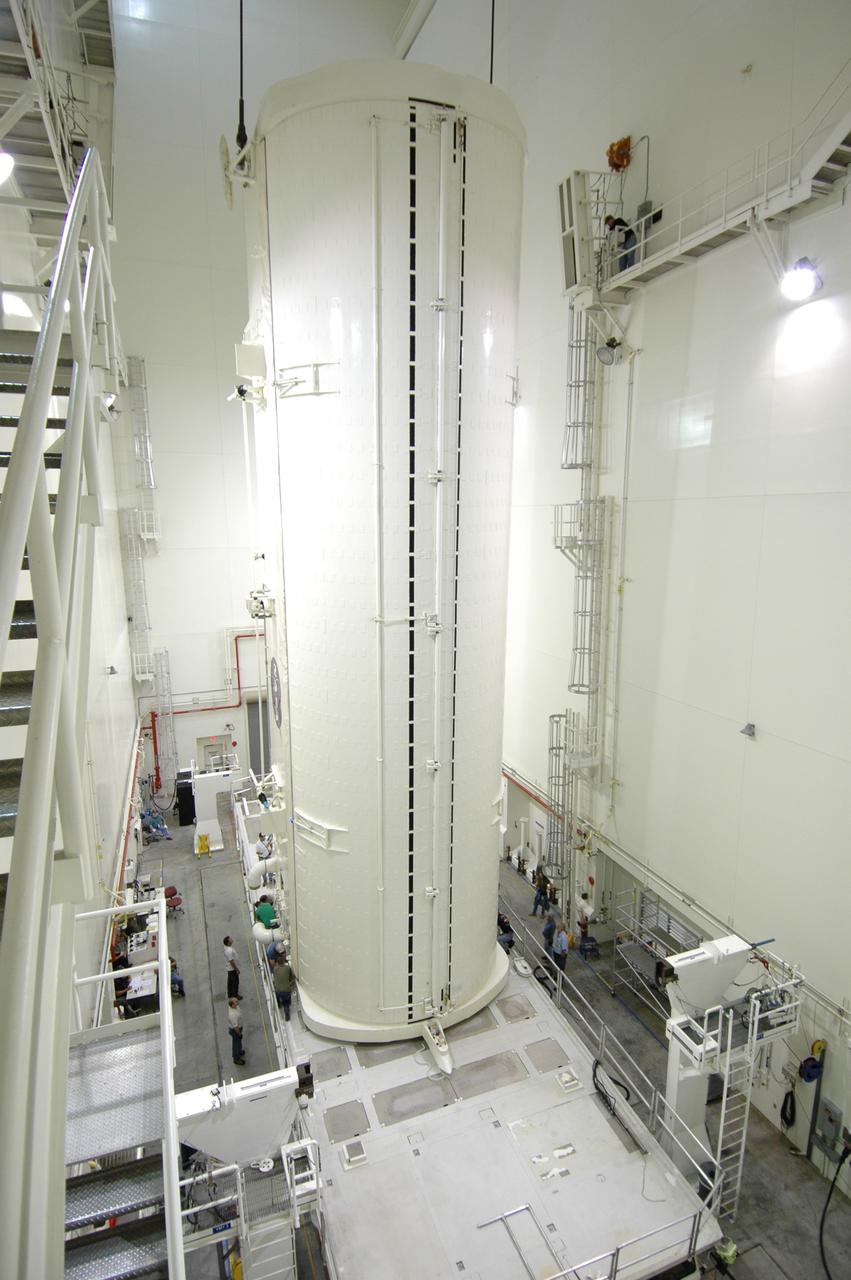
CAPE CANAVERAL, Fla. -- In the Vertical Integration Facility at NASA's Kennedy Space Center, workers check the placement of the payload canister after it was lowered onto the payload canister transporter. The canister contains the Japanese Experiment Module -Pressurized Module, which will be transported to Launch Pad 39A for space shuttle Discovery’s STS-124 mission. At the pad, the payload will be transferred from the canister into the payload changeout room on the rotating service structure. The changeout room is the enclosed, environmentally controlled portion of the service structure that supports cargo delivery to the pad and subsequent vertical installation into an orbiter's payload bay. On the mission, the STS-124 crew will transport the JEM as well as the Japanese Remote Manipulator System to the International Space Station. The launch of Discovery is targeted for May 31. Photo credit: NASA/Jim Grossmann
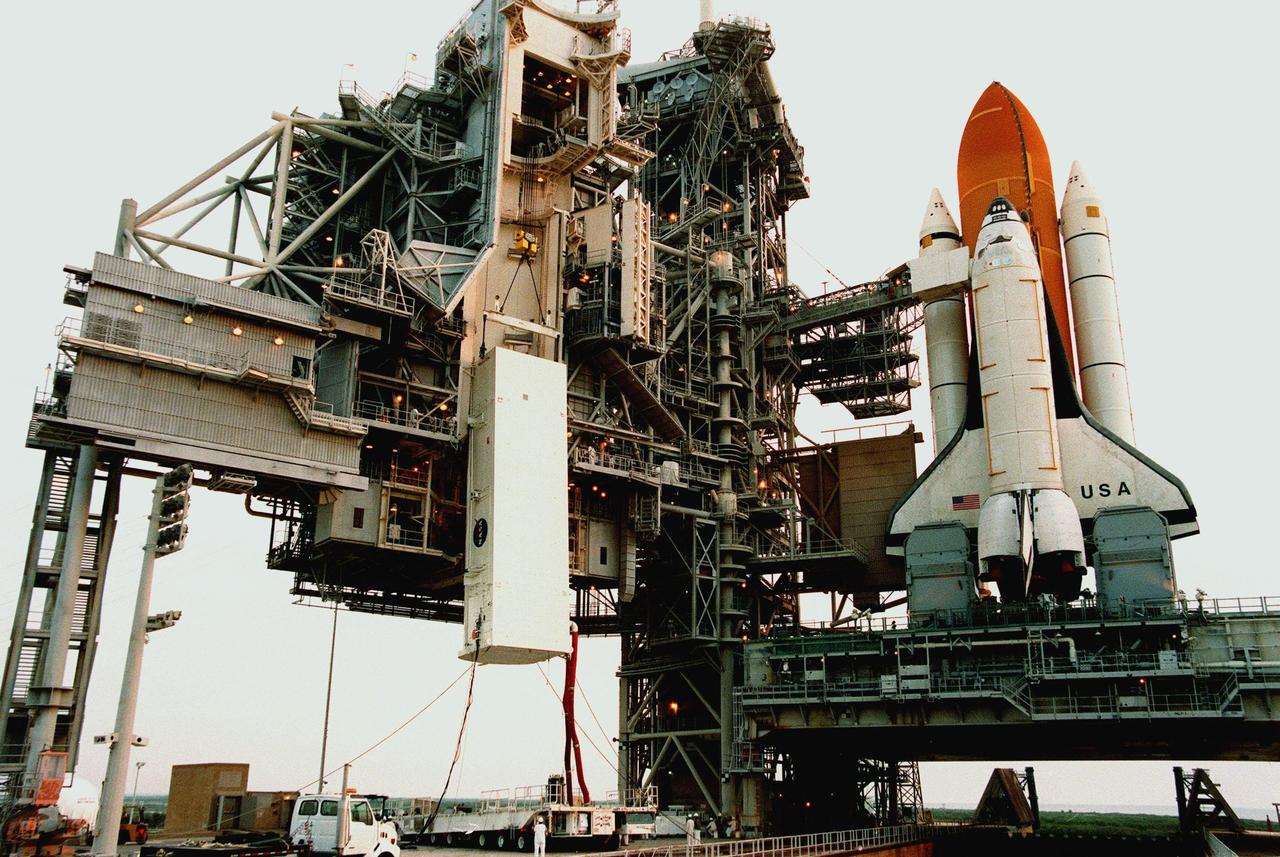
KENNEDY SPACE CENTER, FLA. -- In the early morning, the payload canister containing the Chandra X-ray Observatory, with umbilical hoses still attached, is lifted up the Rotating Service Structure (RSS). The hoses provide a controlled environment during the transfer. The canister arrived at the pad on the payload canister transporter below it. The canister will be lifted up to the Payload Changeout Room in the RSS where it will be relieved of its cargo. After the RSS rotates to a position behind Space Shuttle Columbia (at right), the observatory will then be installed vertically in the orbiter payload bay. The world's most powerful X-ray telescope, Chandra will allow scientists from around the world to see previously invisible black holes and high-temperature gas clouds, giving the observatory the potential to rewrite the books on the structure and evolution of our universe. Chandra is the primary payload on mission STS-93, scheduled to launch no earlier than July 20 aboard Space Shuttle Columbia (right)
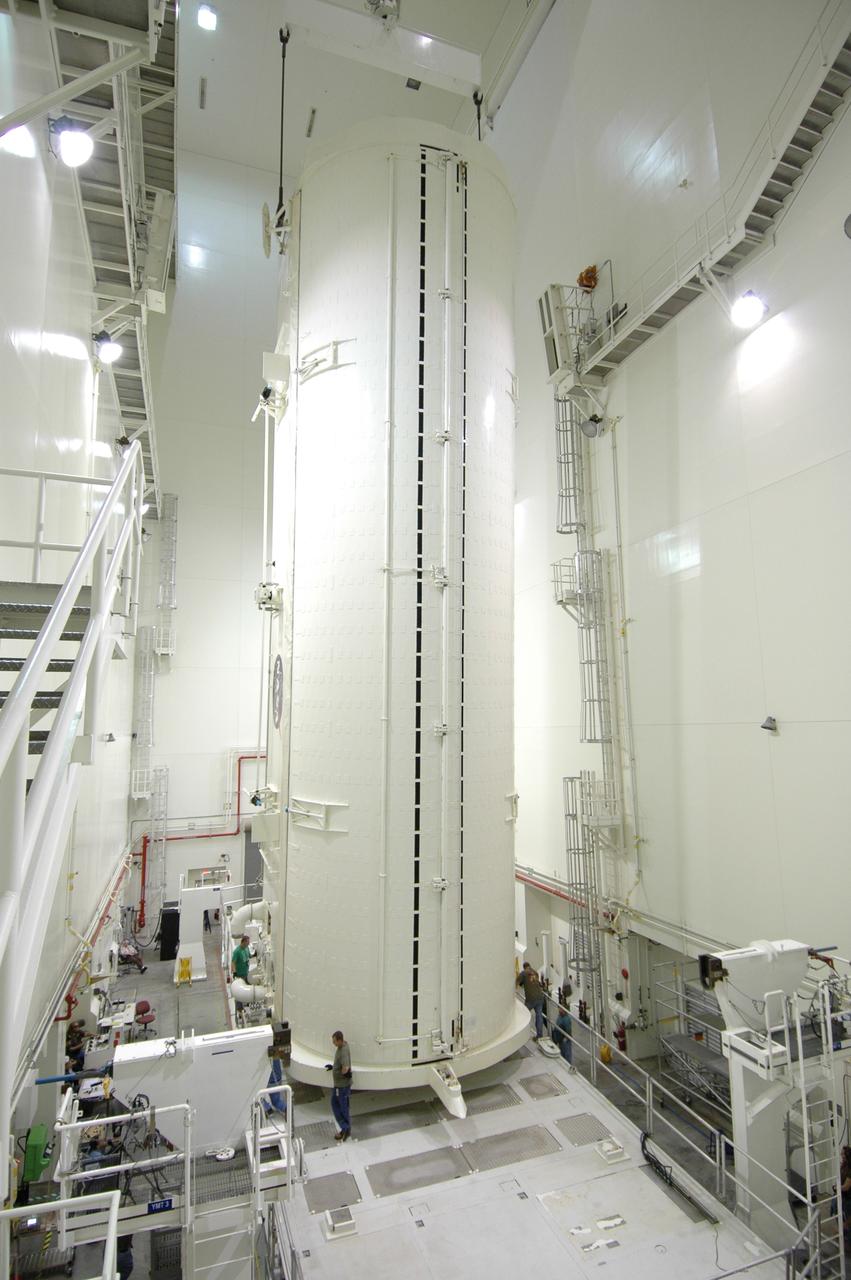
CAPE CANAVERAL, Fla. -- After rotation in the Vertical Integration Facility at NASA's Kennedy Space Center, the payload canister is lowered vertically onto the payload canister transporter. The canister contains the Japanese Experiment Module -Pressurized Module, which will be transported to Launch Pad 39A for space shuttle Discovery’s STS-124 mission. At the pad, the payload will be transferred from the canister into the payload changeout room on the rotating service structure. The changeout room is the enclosed, environmentally controlled portion of the service structure that supports cargo delivery to the pad and subsequent vertical installation into an orbiter's payload bay. On the mission, the STS-124 crew will transport the JEM as well as the Japanese Remote Manipulator System to the International Space Station. The launch of Discovery is targeted for May 31. Photo credit: NASA/Jim Grossmann
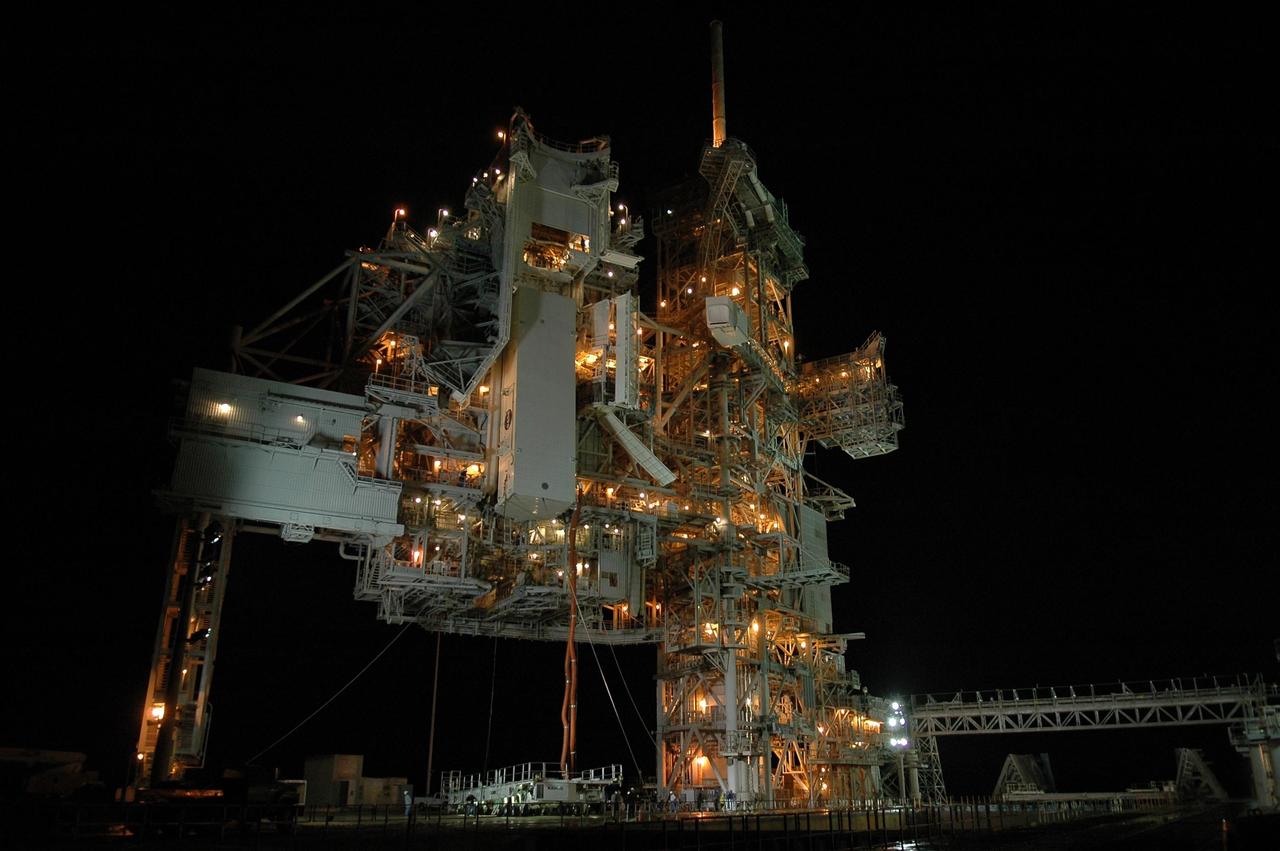
KENNEDY SPACE CENTER, FLA. -- With umbilical lines still attached, the payload canister is lifted up to the payload changeout room (PCR) on the rotating service structure (RSS) on Launch Pad 39B. Inside the canister are the SPACEHAB module and the port 5 truss segment for mission STS-116. Once inside the PCR, they will be transferred into Space Shuttle Discovery's payload bay once the vehicle has rolled out to the pad. On the right is the fixed service structure. The PCR is the enclosed, environmentally controlled portion of the RSS that supports cargo delivery to the pad and subsequent vertical installation into the orbiter payload bay. Seals around the mating surface of the PCR fit against the orbiter and allow the opening of the payload bay or canister doors and removal of the cargo without exposure to outside air and contaminants. A clean-air purge in the PCR maintains environmental control during PCR cargo operations. Cargo is removed from the payload canister and installed vertically in the orbiter by the payload ground handling mechanism (PGHM). Photo credit: NASA/Kim Shiflett
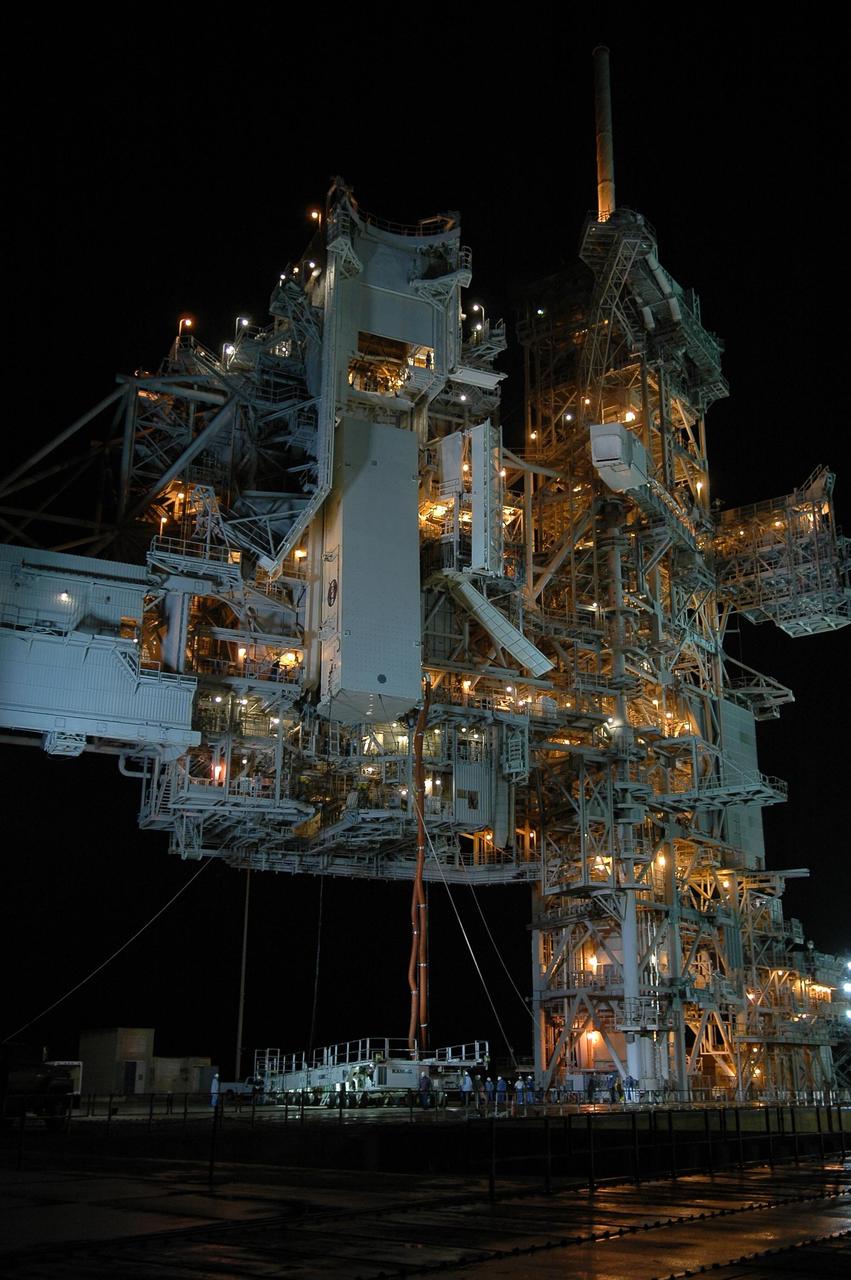
KENNEDY SPACE CENTER, FLA. -- With umbilical lines still attached, the payload canister is lifted up to the payload changeout room (PCR) on the rotating service structure (RSS) on Launch Pad 39B. Inside the canister are the SPACEHAB module and the port 5 truss segment for mission STS-116. Once inside the PCR, they will be transferred into Space Shuttle Discovery's payload bay once the vehicle has rolled out to the pad. On the right is the fixed service structure. The PCR is the enclosed, environmentally controlled portion of the RSS that supports cargo delivery to the pad and subsequent vertical installation into the orbiter payload bay. Seals around the mating surface of the PCR fit against the orbiter and allow the opening of the payload bay or canister doors and removal of the cargo without exposure to outside air and contaminants. A clean-air purge in the PCR maintains environmental control during PCR cargo operations. Cargo is removed from the payload canister and installed vertically in the orbiter by the payload ground handling mechanism (PGHM). Photo credit: NASA/Kim Shiflett
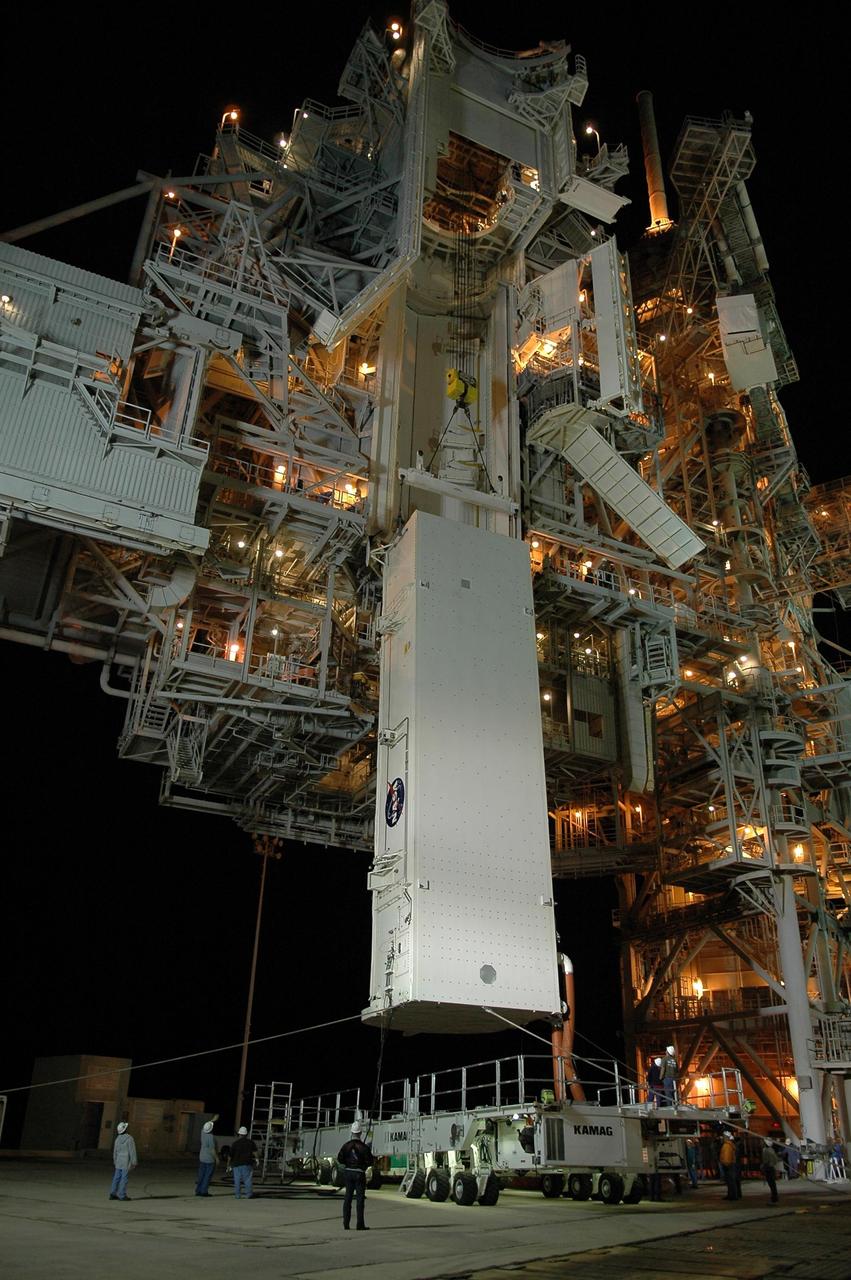
KENNEDY SPACE CENTER, FLA. -- With umbilical lines still attached, the payload canister is lifted up to the payload changeout room (PCR) on the rotating service structure (RSS) on Launch Pad 39B. Inside the canister are the SPACEHAB module and the port 5 truss segment for mission STS-116. Once inside the PCR, they will be transferred into Space Shuttle Discovery's payload bay once the vehicle has rolled out to the pad. On the right is the fixed service structure. The PCR is the enclosed, environmentally controlled portion of the RSS that supports cargo delivery to the pad and subsequent vertical installation into the orbiter payload bay. Seals around the mating surface of the PCR fit against the orbiter and allow the opening of the payload bay or canister doors and removal of the cargo without exposure to outside air and contaminants. A clean-air purge in the PCR maintains environmental control during PCR cargo operations. Cargo is removed from the payload canister and installed vertically in the orbiter by the payload ground handling mechanism (PGHM). Photo credit: NASA/Kim Shiflett
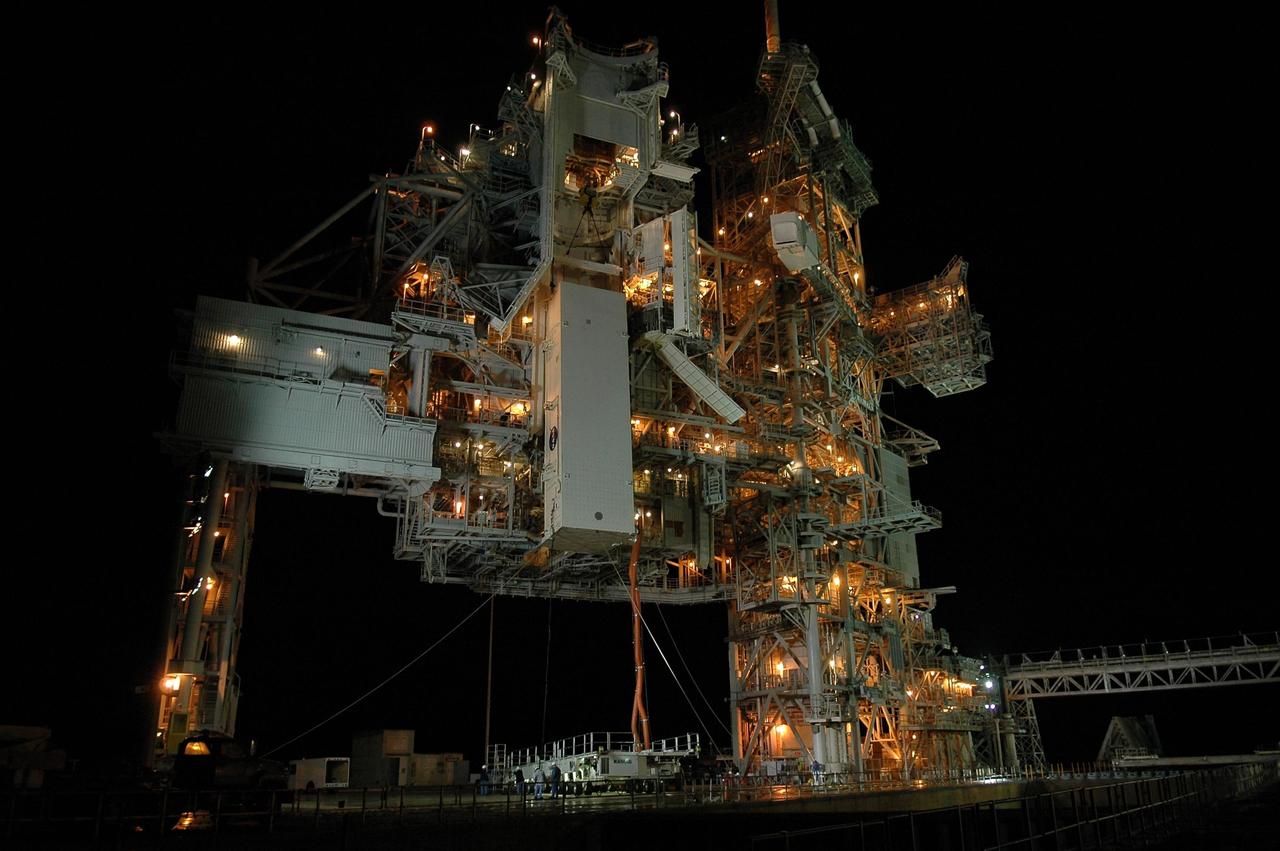
KENNEDY SPACE CENTER, FLA. -- With umbilical lines still attached, the payload canister is lifted up to the payload changeout room (PCR) on the rotating service structure (RSS) on Launch Pad 39B. Inside the canister are the SPACEHAB module and the port 5 truss segment for mission STS-116. Once inside the PCR, they will be transferred into Space Shuttle Discovery's payload bay after the vehicle has rolled out to the pad. On the right is the fixed service structure. The PCR is the enclosed, environmentally controlled portion of the RSS that supports cargo delivery to the pad and subsequent vertical installation into the orbiter payload bay. Seals around the mating surface of the PCR fit against the orbiter and allow the opening of the payload bay or canister doors and removal of the cargo without exposure to outside air and contaminants. A clean-air purge in the PCR maintains environmental control during PCR cargo operations. Cargo is removed from the payload canister and installed vertically in the orbiter by the payload ground handling mechanism (PGHM). Photo credit: NASA/Kim Shiflett
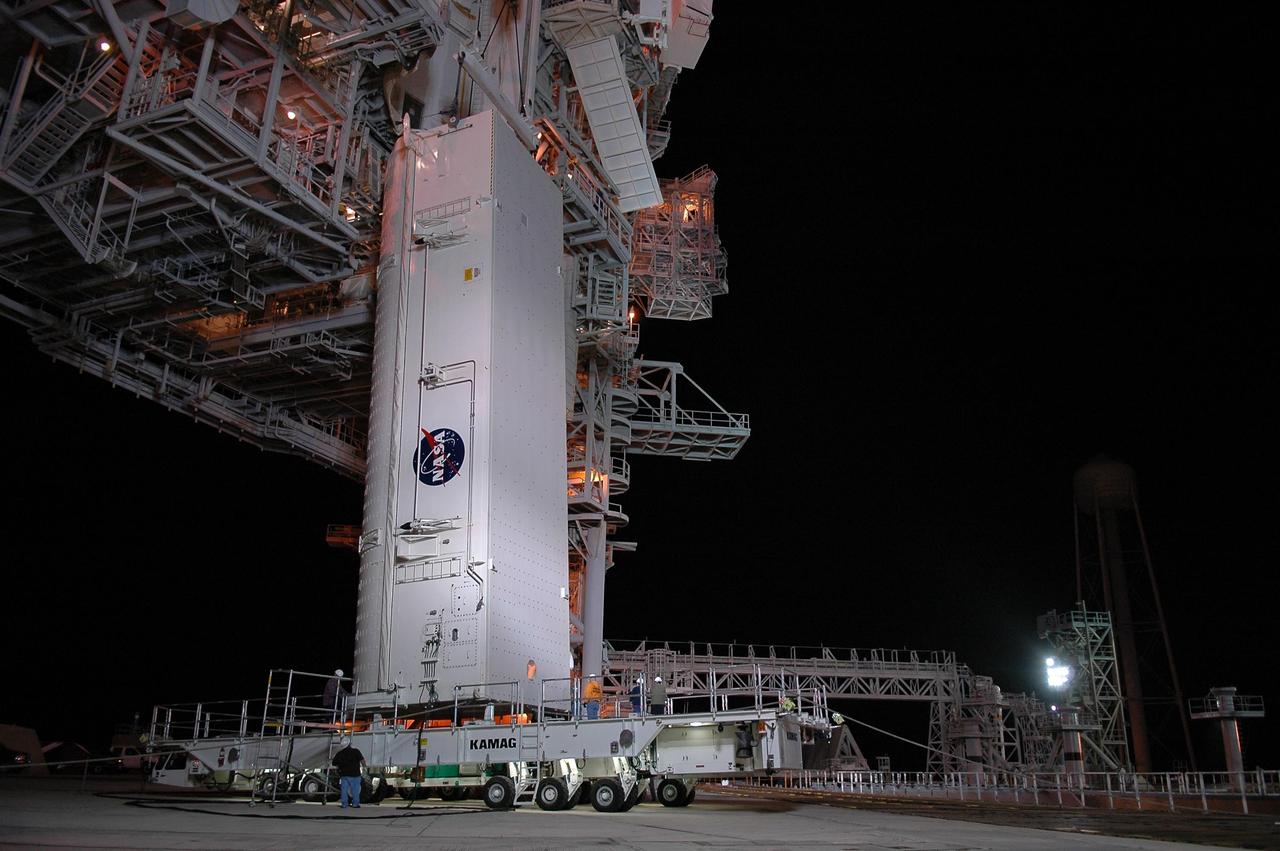
KENNEDY SPACE CENTER, FLA. -- The payload canister is raised off the transporter and will be lifted up to the payload changeout room (PCR) on the rotating service structure (RSS) on Launch Pad 39B. Inside the canister are the SPACEHAB module and the port 5 truss segment for mission STS-116. Once inside the PCR, they will be transferred into Space Shuttle Discovery's payload bay once the vehicle has rolled out to the pad. The PCR is the enclosed, environmentally controlled portion of the RSS that supports cargo delivery to the pad and subsequent vertical installation into the orbiter payload bay. Seals around the mating surface of the PCR fit against the orbiter and allow the opening of the payload bay or canister doors and removal of the cargo without exposure to outside air and contaminants. A clean-air purge in the PCR maintains environmental control during PCR cargo operations. Cargo is removed from the payload canister and installed vertically in the orbiter by the payload ground handling mechanism (PGHM). Photo credit: NASA/Kim Shiflett
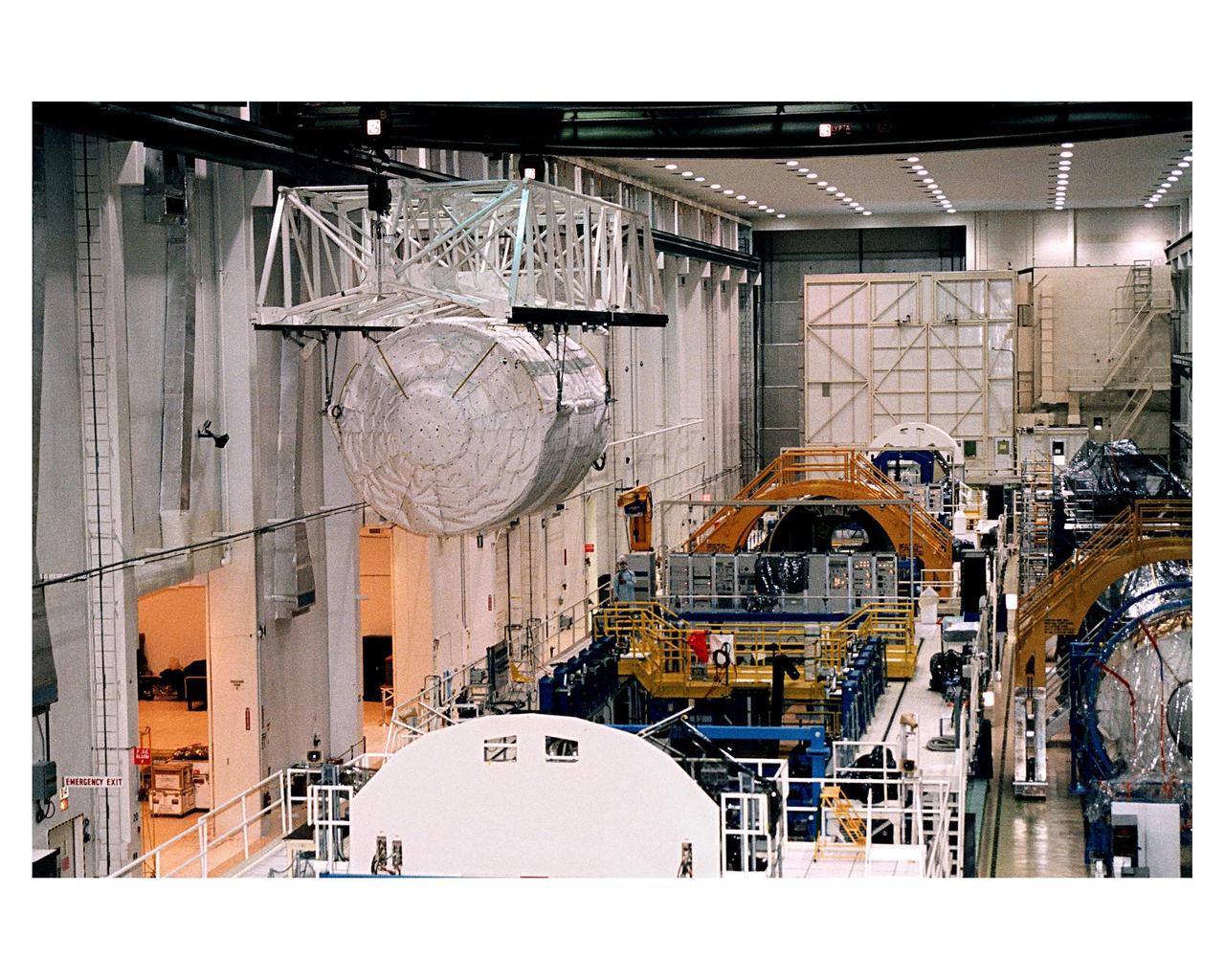
The Microgravity Science Laboratory-1 (MSL-1) Spacelab module is moved to be installed into a payload canister in the Operations and Checkout Building. Once in the canister, the MSL-1 will be transported to Orbiter Processing Bay 1 where it will be integrated into the payload bay of the Space Shuttle orbiter Columbia. During the scheduled 16-day STS-83 mission, the MSL-1 will be used to test some of the hardware, facilities and procedures that are planned for use on the International Space Station while the flight crew conducts combustion, protein crystal growth and materials processing experiments
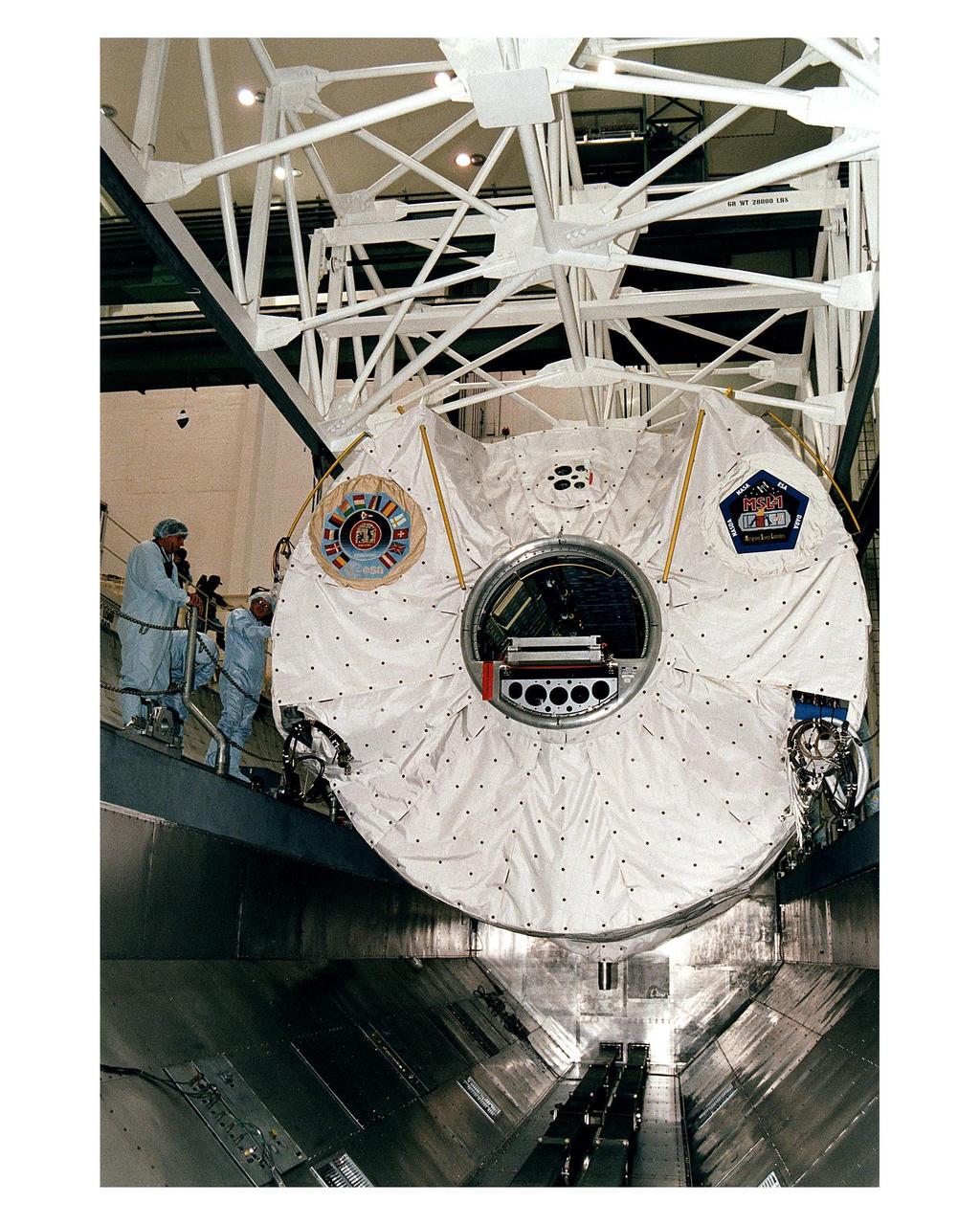
The Microgravity Science Laboratory-1 (MSL-1) Spacelab module is moved to be installed into a payload canister in the Operations and Checkout Building. Once in the canister, the MSL-1 will be transported to Orbiter Processing Bay 1 where it will be integrated into the payload bay of the Space Shuttle orbiter Columbia. During the scheduled 16-day STS-83 mission, the MSL-1 will be used to test some of the hardware, facilities and procedures that are planned for use on the International Space Station while the flight crew conducts combustion, protein crystal growth and materials processing experiments

The Microgravity Science Laboratory-1 (MSL-1) Spacelab module is moved to be installed into a payload canister in the Operations and Checkout Building. Once in the canister, the MSL-1 will be transported to Orbiter Processing Bay 1 where it will be integrated into the payload bay of the Space Shuttle orbiter Columbia. During the scheduled 16-day STS-83 mission, the MSL-1 will be used to test some of the hardware, facilities and procedures that are planned for use on the International Space Station while the flight crew conducts combustion, protein crystal growth and materials processing experiments

KENNEDY SPACE CENTER, FLA. -- Workers in the Space Station Processing Facility check the progress of the SPACEHAB module as it is lowered toward the payload canister below. The module, part of the payload on mission STS-106, will be placed in the payload canister for transport to the launch pad. STS-106 is scheduled to launch Sept. 8 at 8:31 a.m. EDT. During the mission to the International Space Station, the crew will complete service module support tasks on orbit, transfer supplies and outfit the Space Station for the first long-duration crew
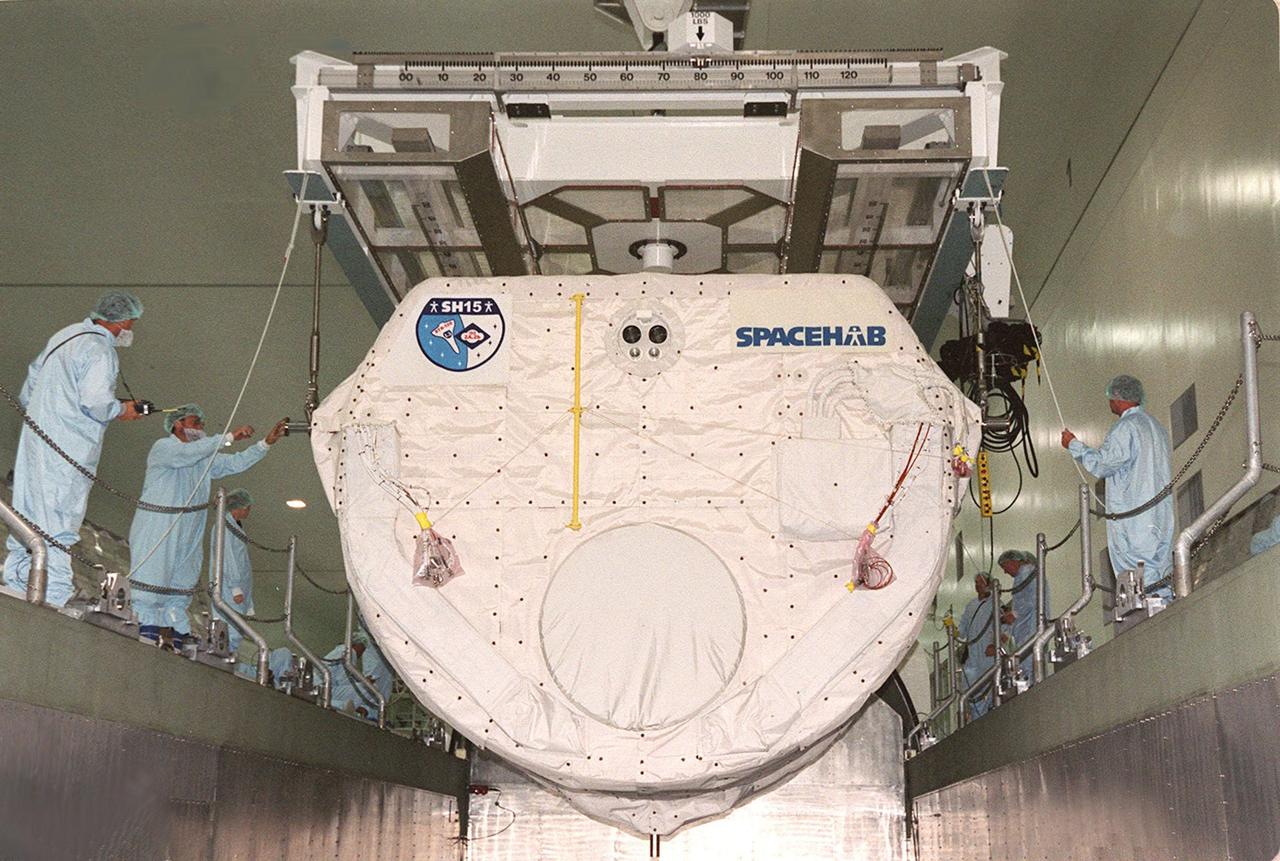
KENNEDY SPACE CENTER, FLA. -- Workers in the Space Station Processing Facility check the progress of the SPACEHAB module as it is lowered toward the payload canister below. The module, part of the payload on mission STS-106, will be placed in the payload canister for transport to the launch pad. STS-106 is scheduled to launch Sept. 8 at 8:31 a.m. EDT. During the mission to the International Space Station, the crew will complete service module support tasks on orbit, transfer supplies and outfit the Space Station for the first long-duration crew

KENNEDY SPACE CENTER, FLA. -- A worker in the Space Station Processing Facility checks the position of the SPACEHAB module as it is lowered into the payload canister below. The module, part of the payload on mission STS-106, will be placed in the payload canister for transport to the launch pad. STS-106 is scheduled to launch Sept. 8 at 8:31 a.m. EDT. During the mission to the International Space Station, the crew will complete service module support tasks on orbit, transfer supplies and outfit the Space Station for the first long-duration crew
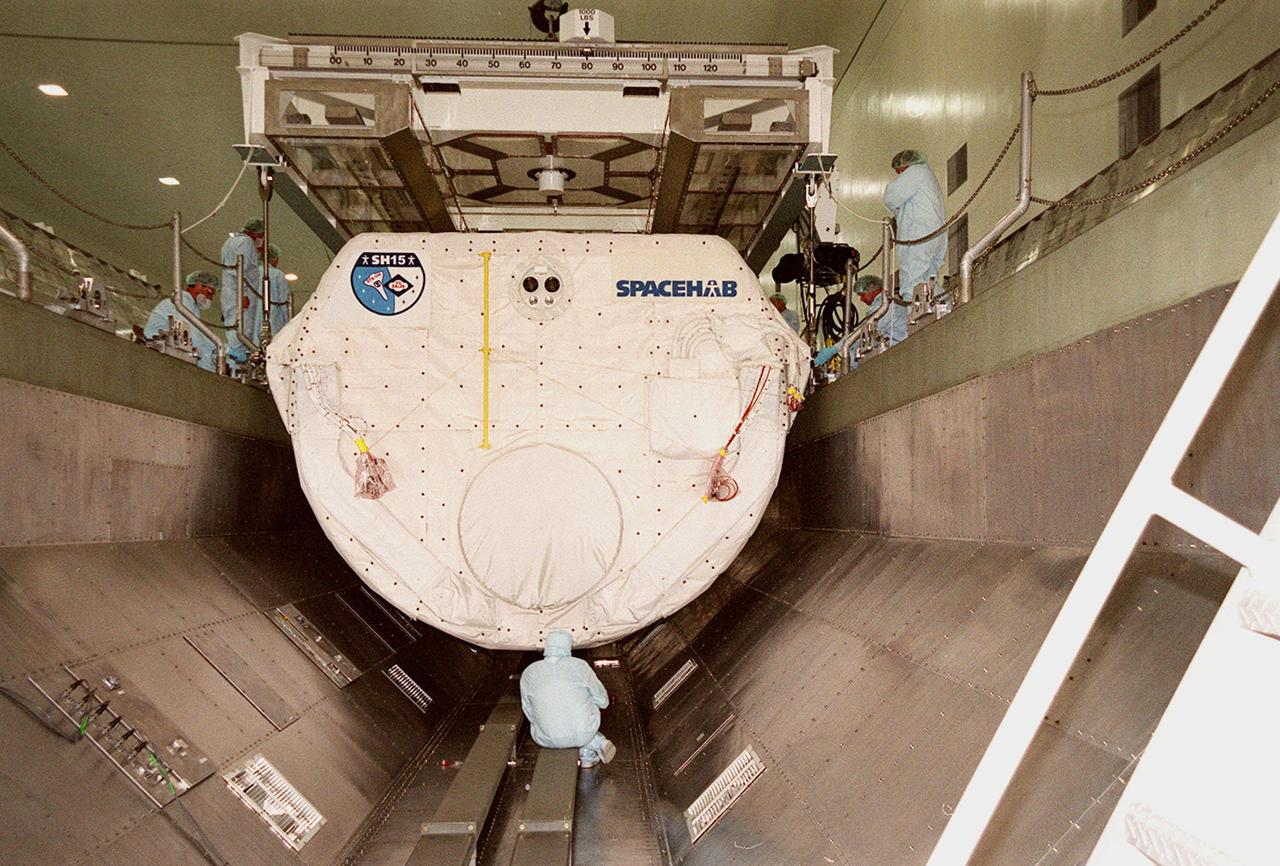
KENNEDY SPACE CENTER, FLA. -- A worker in the Space Station Processing Facility checks the position of the SPACEHAB module as it is lowered into the payload canister below. The module, part of the payload on mission STS-106, will be placed in the payload canister for transport to the launch pad. STS-106 is scheduled to launch Sept. 8 at 8:31 a.m. EDT. During the mission to the International Space Station, the crew will complete service module support tasks on orbit, transfer supplies and outfit the Space Station for the first long-duration crew
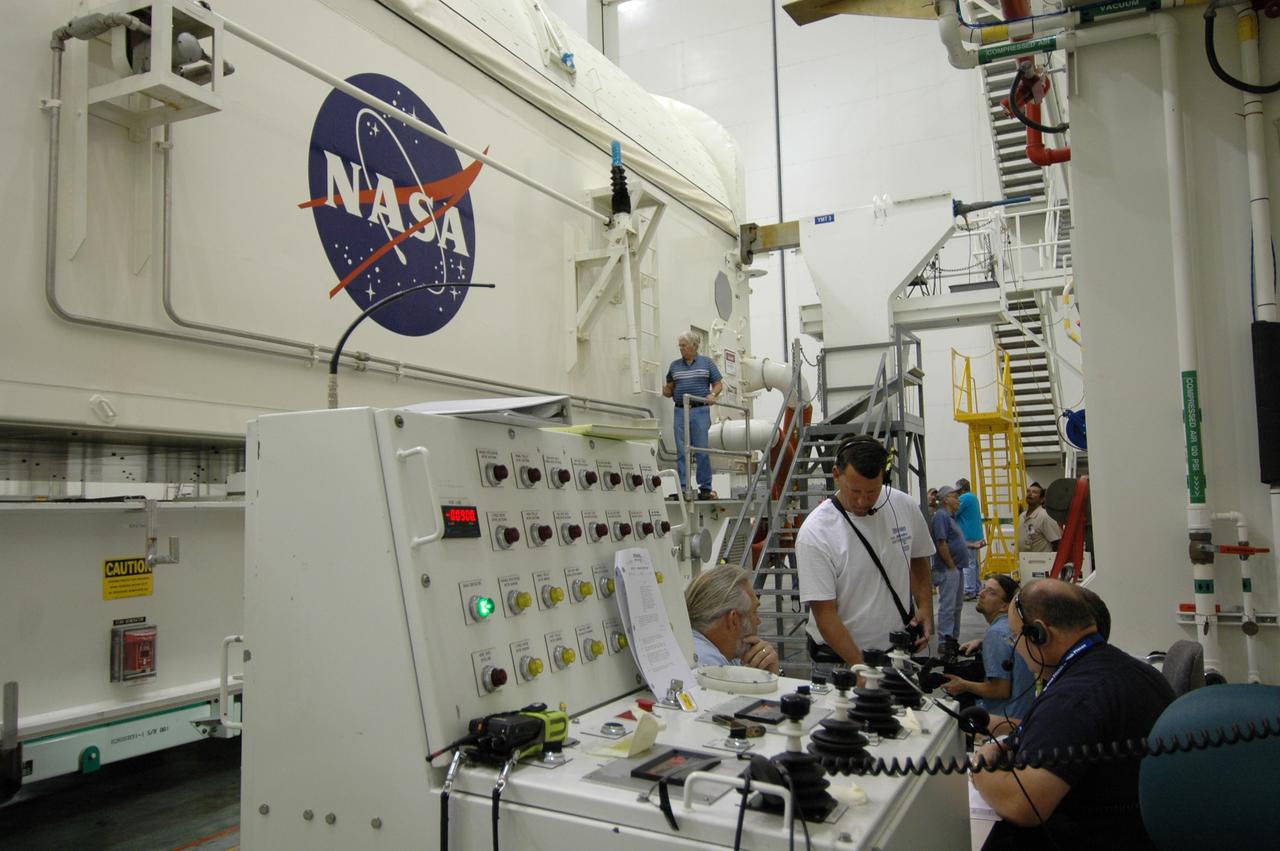
CAPE CANAVERAL, Fla. -- In the Vertical Integration Facility at NASA's Kennedy Space Center, technicians monitor the rotation of the payload canister to a vertical position. The canister contains the Japanese Experiment Module -Pressurized Module. The canister will be transported to Launch Pad 39A for space shuttle Discovery’s STS-124 mission. At the pad, the payload will be transferred from the canister into the payload changeout room on the rotating service structure. The changeout room is the enclosed, environmentally controlled portion of the service structure that supports cargo delivery to the pad and subsequent vertical installation into an orbiter's payload bay. On the mission, the STS-124 crew will transport the JEM as well as the Japanese Remote Manipulator System to the International Space Station. The launch of Discovery is targeted for May 31. Photo credit: NASA/Jim Grossmann
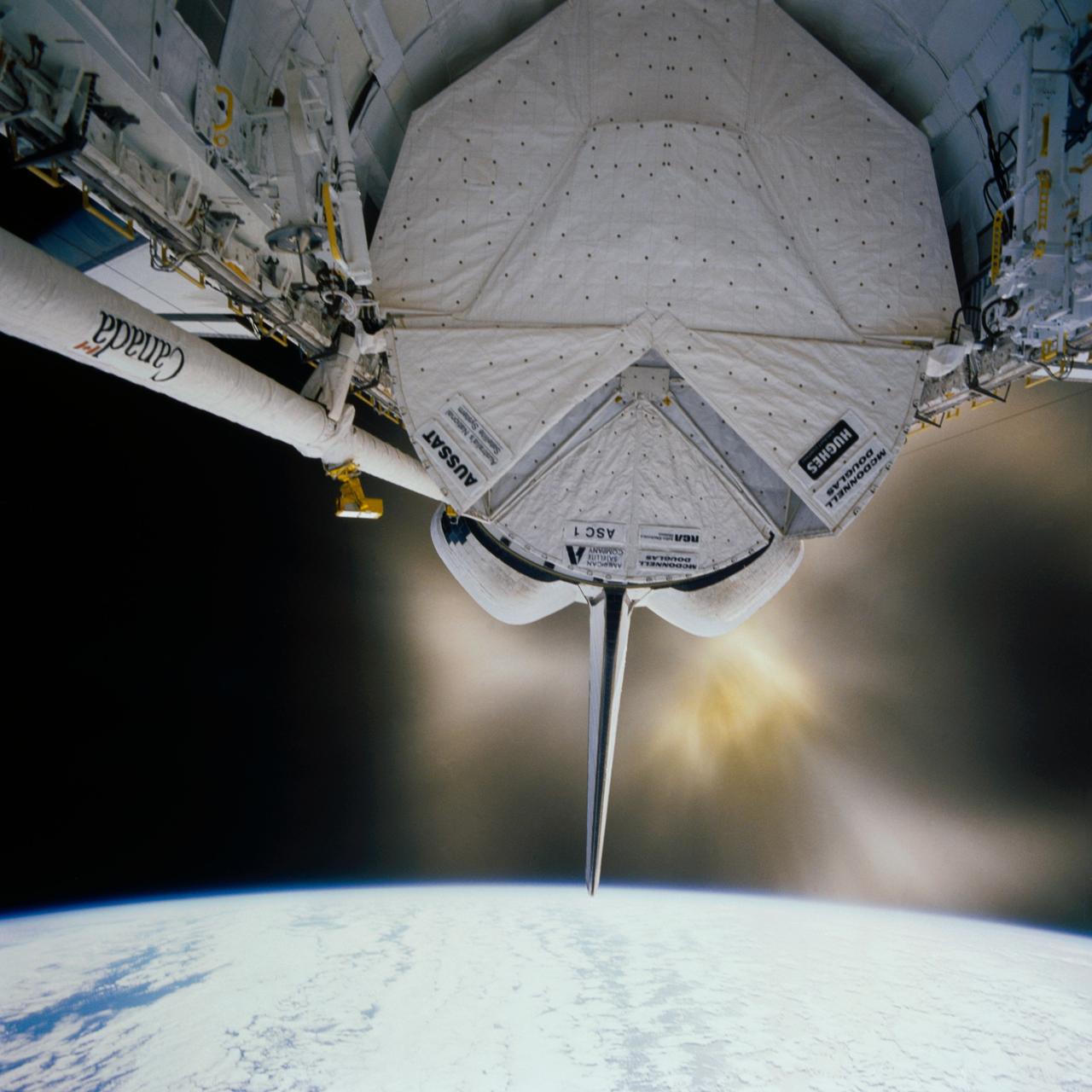
View of a single engine orbital maneuvering system (OMS) firing on the Discovery. The payload bay is open and the protective canisters for the AUSSAT communications satellite (open) and the ASC-1 are visible. A cloudy Earth's horizon can be seen above the orbiter.
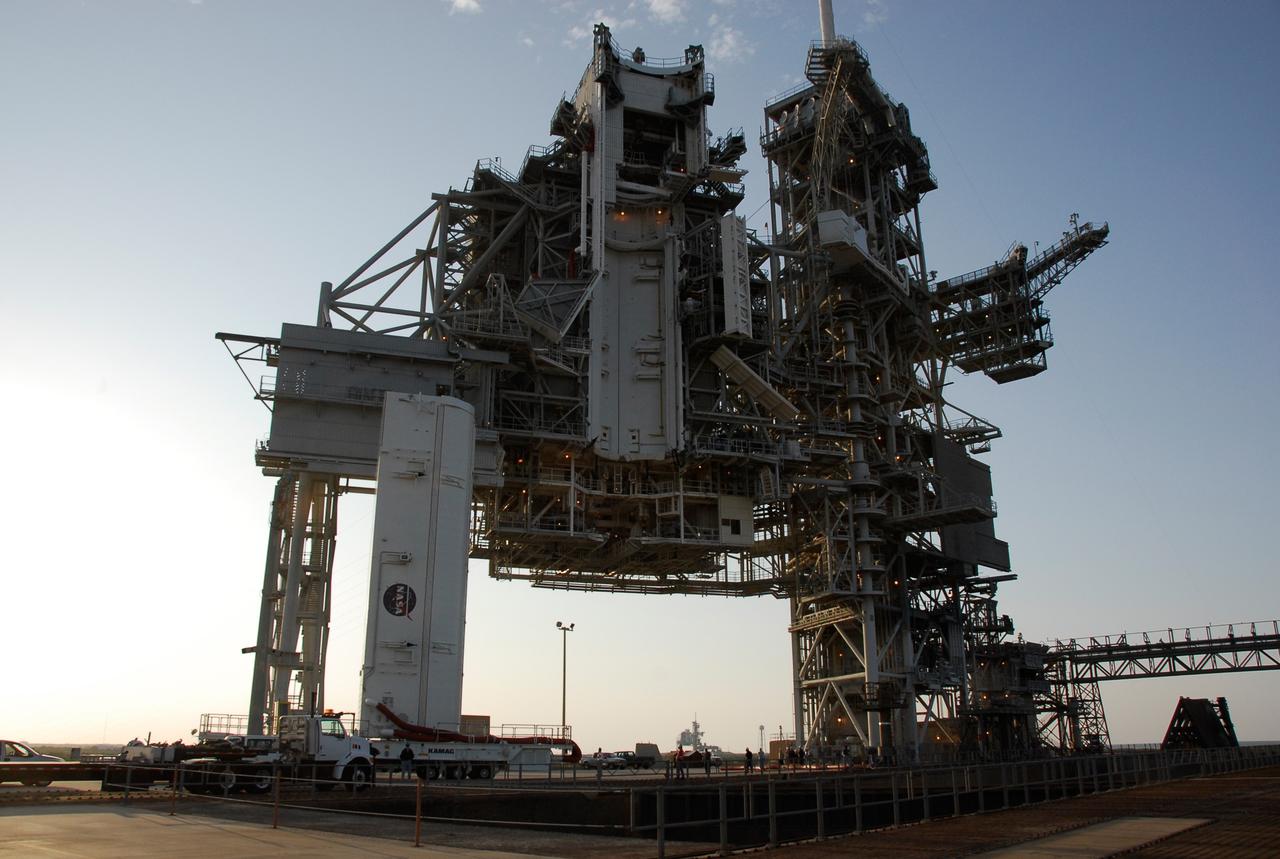
CAPE CANAVERAL, Fla. – On Launch Pad 39A at NASA's Kennedy Space Center, the payload canister approaches the waiting payload changeout room in the rotating service structure. The canister will be lifted up to the changeout room and the payload transferred inside. The changeout room is the enclosed, environmentally controlled portion of the service structure that supports cargo delivery to the pad and subsequent vertical installation into an orbiter's payload bay. From the payload changeout room, the pressurized module and RMS then will be transferred into space shuttle Discovery’s payload bay. Launch is targeted for May 31. Photo credit: NASA/Kim Shiflett
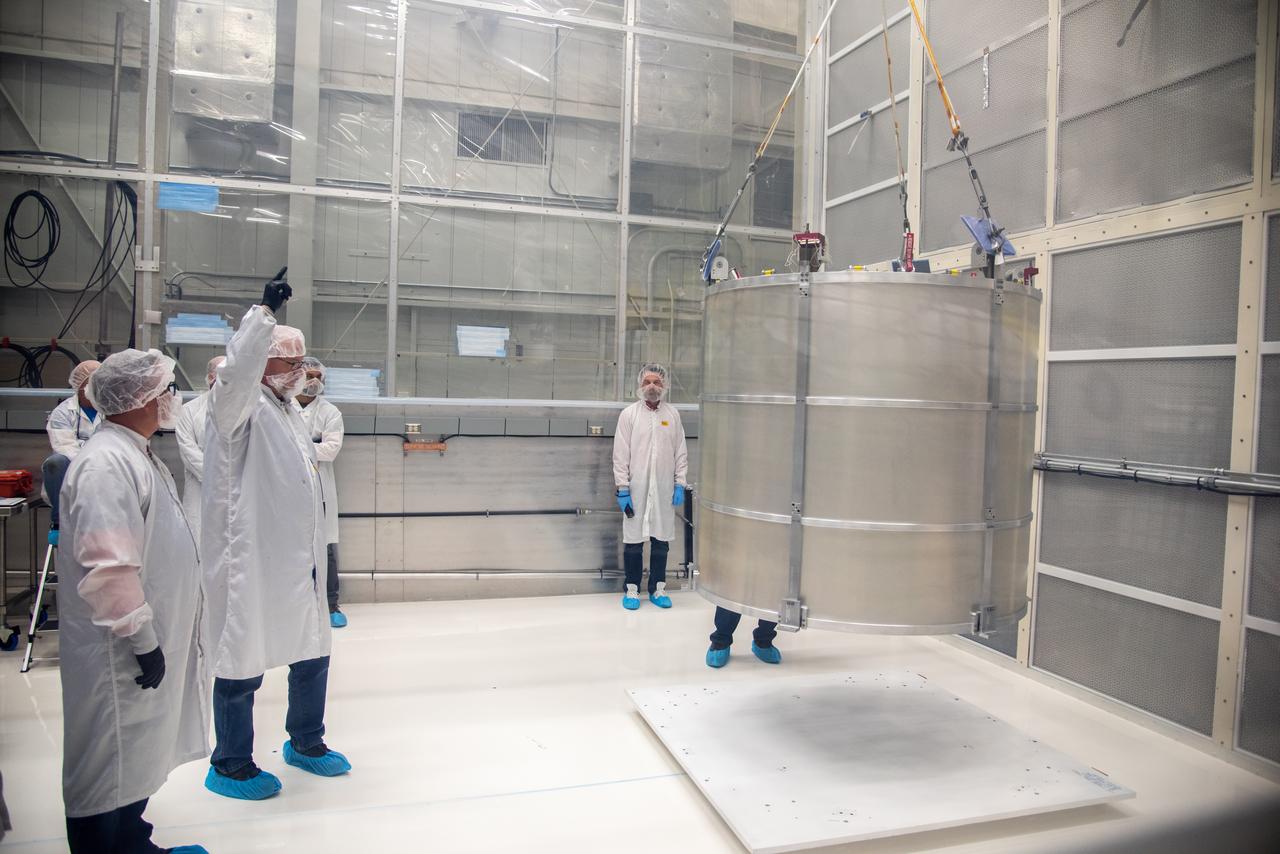
Technicians use a crane to lift the payload adapter separation systems canister for the Low-Earth Orbit Flight Test of an Inflatable Decelerator (LOFTID) as part of launch preparations inside Building 836 at Vandenberg Space Force Base (VSFB) in California on Sept. 1, 2022. The separation system canister loads into the payload adapter canister. The canister will go over the reentry vehicle.. LOFTID is the secondary payload on NASA and the National Oceanic and Atmospheric Administration’s (NOAA) Joint Polar Satellite System-2 (JPSS-2) satellite mission. JPSS-2 is the third satellite in the Joint Polar Satellite System series. It is scheduled to lift off from VSFB on Nov. 1 from Space Launch Complex-3. JPSS-2, which will be renamed NOAA-21 after reaching orbit, will join a constellation of JPSS satellites that orbit from the North to the South pole, circling Earth 14 times a day and providing a full view of the entire globe twice daily. The LOFTID is dedicated to the memory of Bernard Kutter. LOFTID will demonstrate inflatable heat shield technology that could enable a variety of proposed NASA missions to destinations such as Mars, Venus, and Titan, as well as returning heavier payloads from low-Earth orbit.
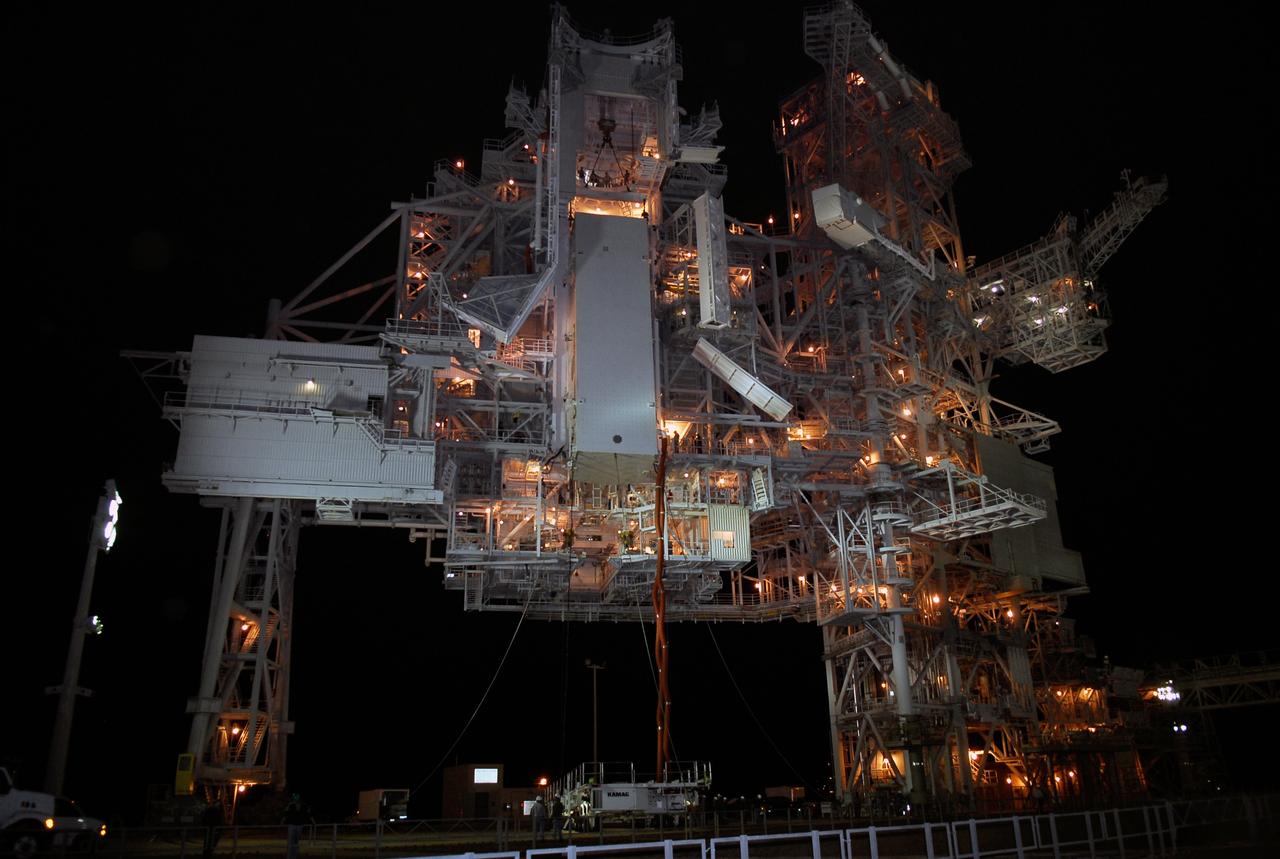
CAPE CANAVERAL, Fla. – On Launch Pad 39A at NASA's Kennedy Space Center, the payload canister has been lifted up to the payload changeout room for transfer of its cargo. Inside the canister are the Japanese Experiment Module - Pressurized Module and the Japanese Remote Manipulator System, or RMS, for the STS-124 mission. The changeout room is the enclosed, environmentally controlled portion of the service structure that supports cargo delivery to the pad and subsequent vertical installation into an orbiter's payload bay. From the payload changeout room, the pressurized module and RMS then will be transferred into space shuttle Discovery’s payload bay. Launch is targeted for May 31. Photo credit: NASA/Kim Shiflett
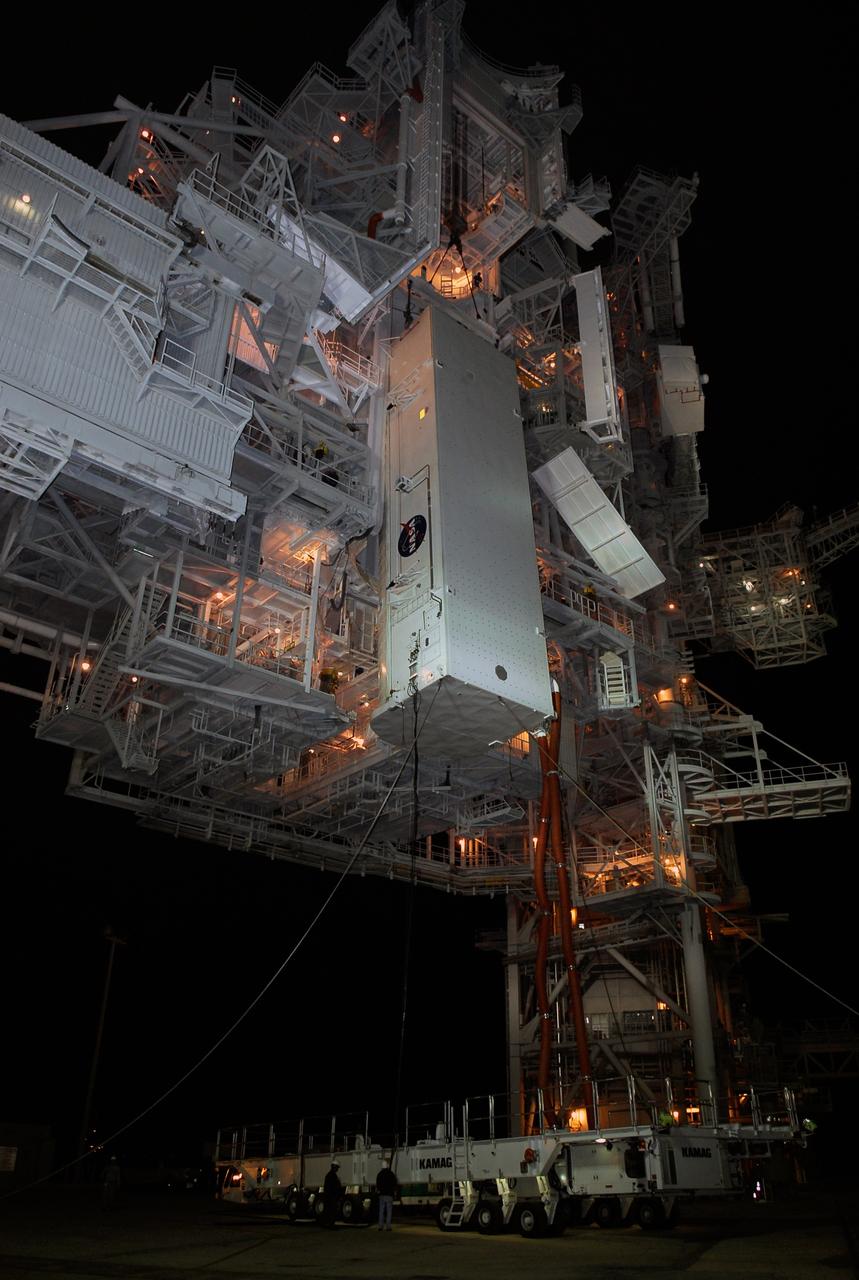
CAPE CANAVERAL, Fla. – On Launch Pad 39A at NASA's Kennedy Space Center, the payload canister has been lifted up to the payload changeout room for transfer of its cargo. Inside the canister are the Japanese Experiment Module - Pressurized Module and the Japanese Remote Manipulator System, or RMS, for the STS-124 mission. The changeout room is the enclosed, environmentally controlled portion of the service structure that supports cargo delivery to the pad and subsequent vertical installation into an orbiter's payload bay. From the payload changeout room, the pressurized module and RMS then will be transferred into space shuttle Discovery’s payload bay. Launch is targeted for May 31. Photo credit: NASA/Kim Shiflett
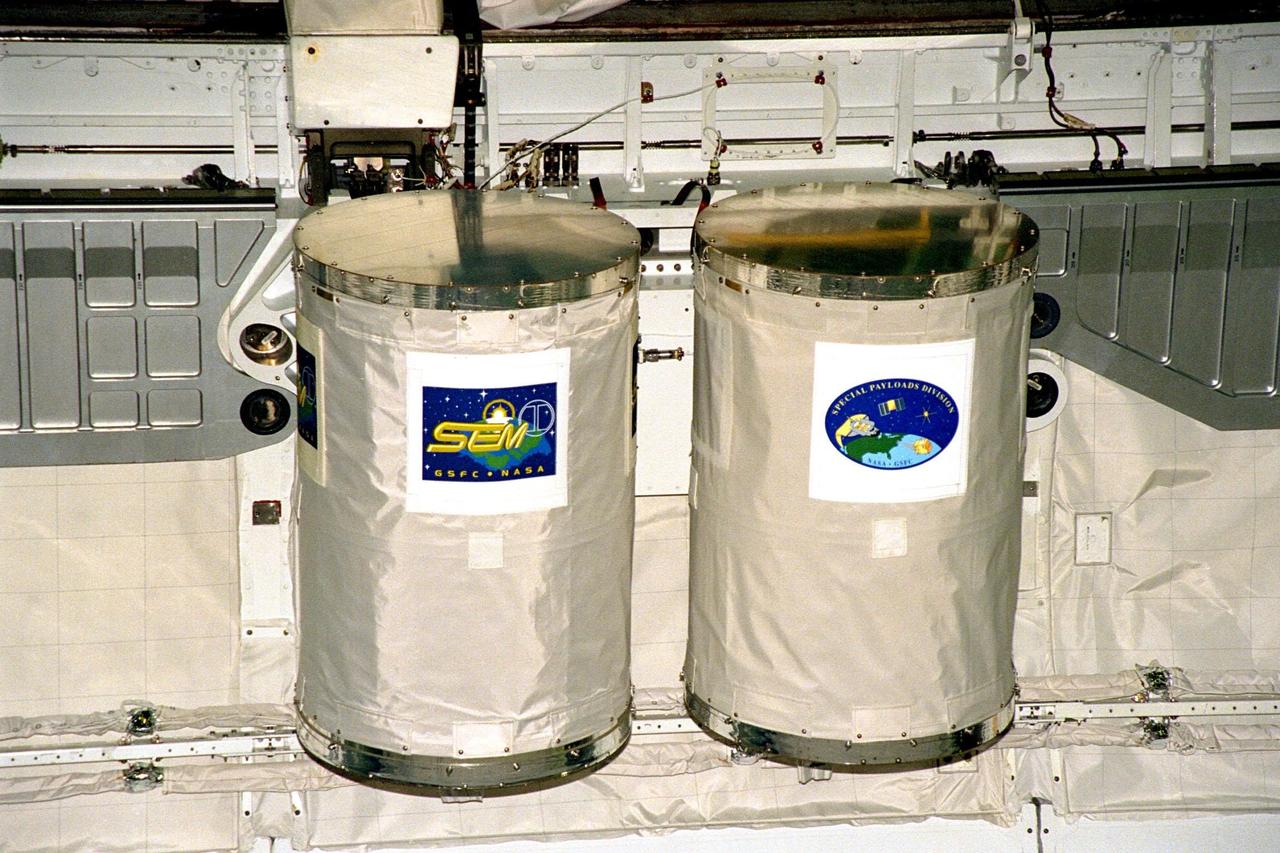
Processing activities for STS-91 continue in KSC's Orbiter Processing Facility Bay 2. Two Get Away Special (GAS) canisters are shown after their installation into Discovery's payload bay. The GAS canister on the left houses the Space Experiment Module (SEM-03), part of an educational initiative of NASA's Shuttle Small Payloads Project. On the right is a canister containing commemorative flags to be flown during the mission. STS-91 is scheduled to launch aboard the Space Shuttle Discovery for the ninth and final docking with the Russian Space Station Mir from KSC's Launch Pad 39A on June 2 with a launch window opening around 6:04 p.m. EDT
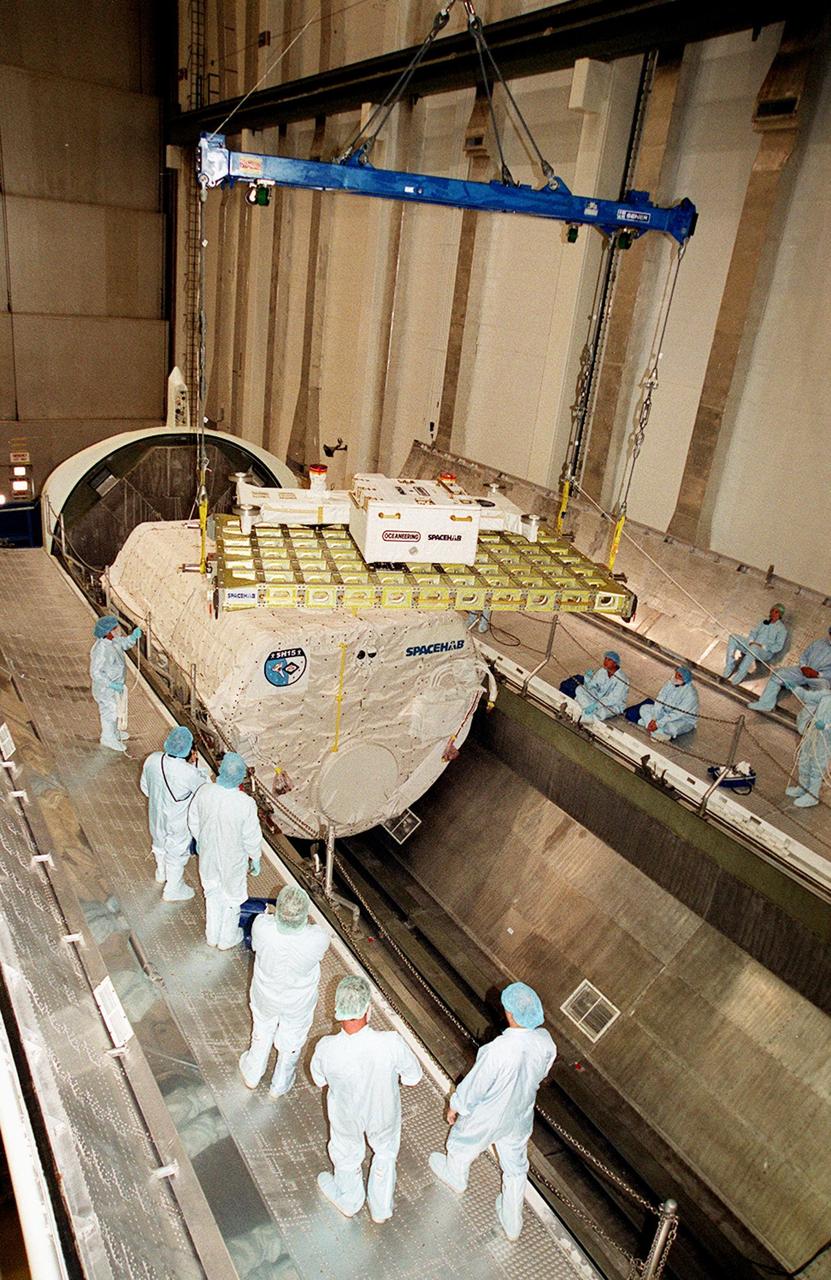
KENNEDY SPACE CENTER, FLA. -- In the Space Station Processing Facility, workers maneuver the Integrated Cargo Carrier (ICC) toward the opening in the payload canister. The canister already has the SPACEHAB module stowed. The canister will transport its cargo to Launch Pad 39B in preparation for mission STS-106, scheduled to launch Sept. 8 at 8:31 a.m. EDT. During the mission to the International Space Station, the crew will complete service module support tasks on orbit, transfer supplies and outfit the Space Station for the first long-duration crew
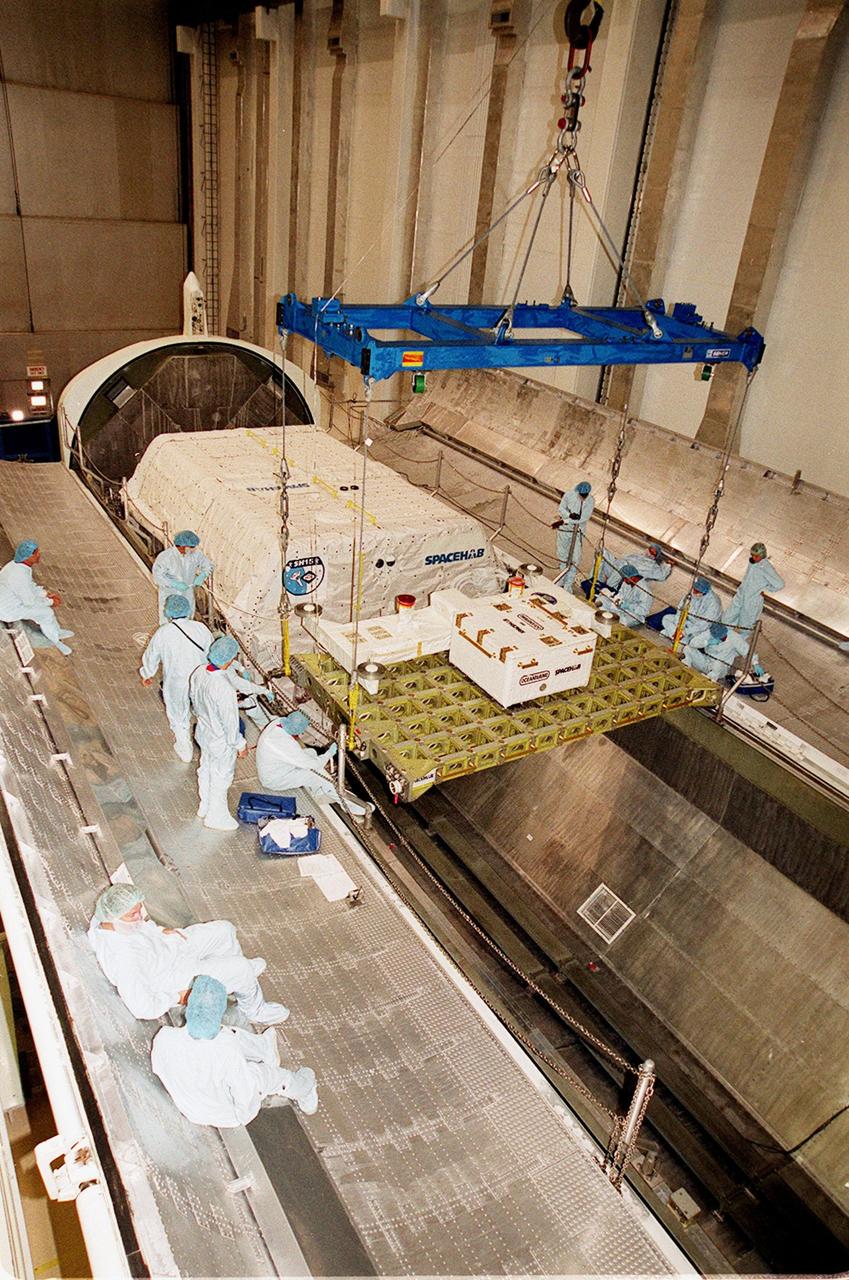
KENNEDY SPACE CENTER, FLA. -- Workers in the Space Station Processing Facility guide the Integrated Cargo Carrier (ICC) into place inside the payload canister. The canister already has the SPACEHAB module stowed. The canister will transport its cargo to Launch Pad 39B in preparation for mission STS-106, scheduled to launch Sept. 8 at 8:31 a.m. EDT. During the mission to the International Space Station, the crew will complete service module support tasks on orbit, transfer supplies and outfit the Space Station for the first long-duration crew
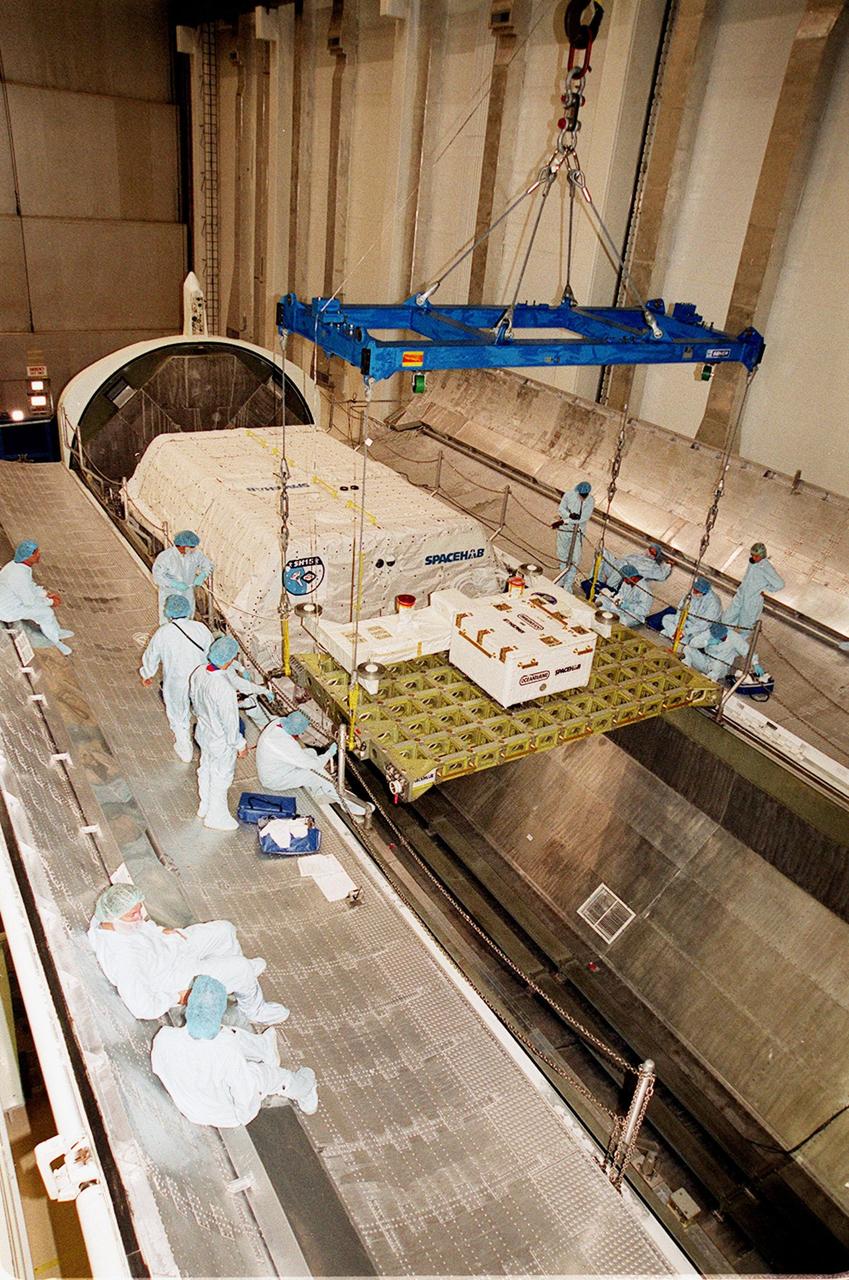
KENNEDY SPACE CENTER, FLA. -- Workers in the Space Station Processing Facility guide the Integrated Cargo Carrier (ICC) into place inside the payload canister. The canister already has the SPACEHAB module stowed. The canister will transport its cargo to Launch Pad 39B in preparation for mission STS-106, scheduled to launch Sept. 8 at 8:31 a.m. EDT. During the mission to the International Space Station, the crew will complete service module support tasks on orbit, transfer supplies and outfit the Space Station for the first long-duration crew
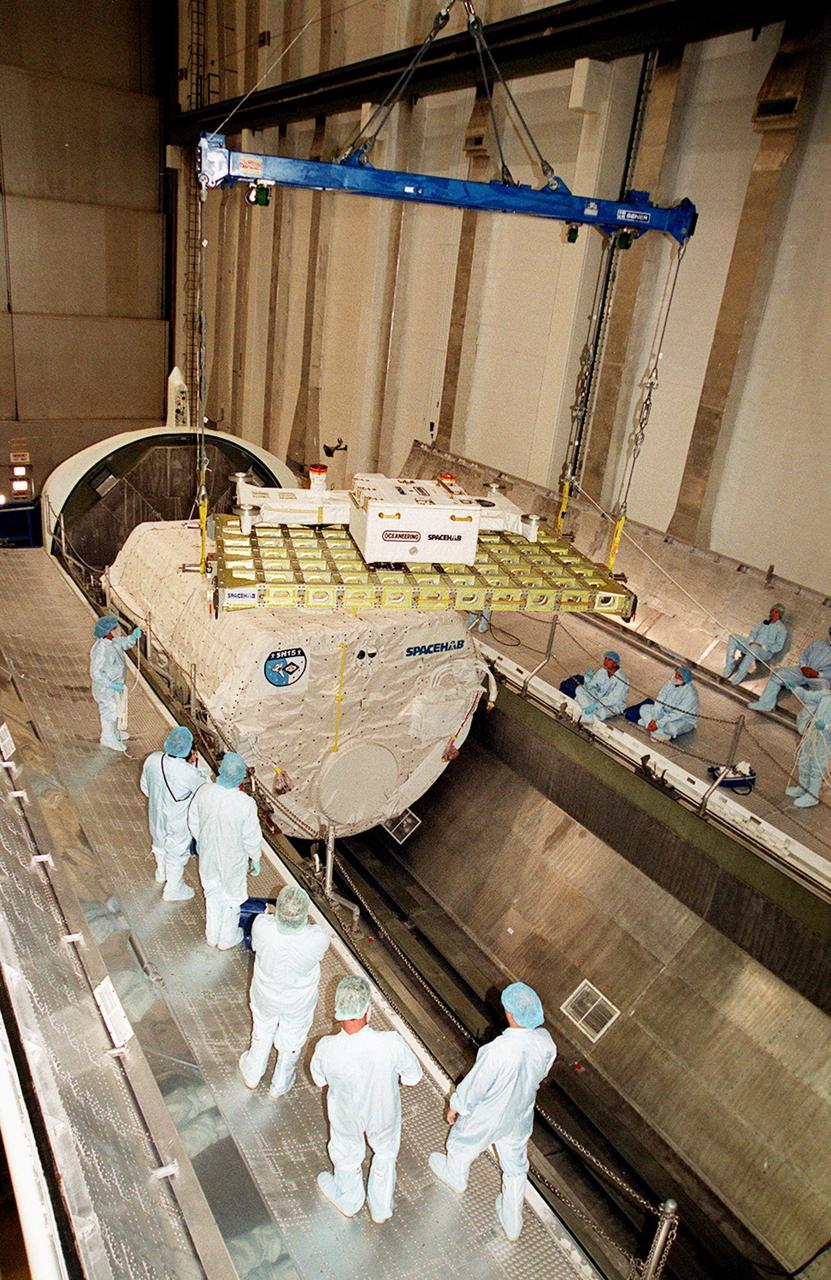
KENNEDY SPACE CENTER, FLA. -- In the Space Station Processing Facility, workers maneuver the Integrated Cargo Carrier (ICC) toward the opening in the payload canister. The canister already has the SPACEHAB module stowed. The canister will transport its cargo to Launch Pad 39B in preparation for mission STS-106, scheduled to launch Sept. 8 at 8:31 a.m. EDT. During the mission to the International Space Station, the crew will complete service module support tasks on orbit, transfer supplies and outfit the Space Station for the first long-duration crew
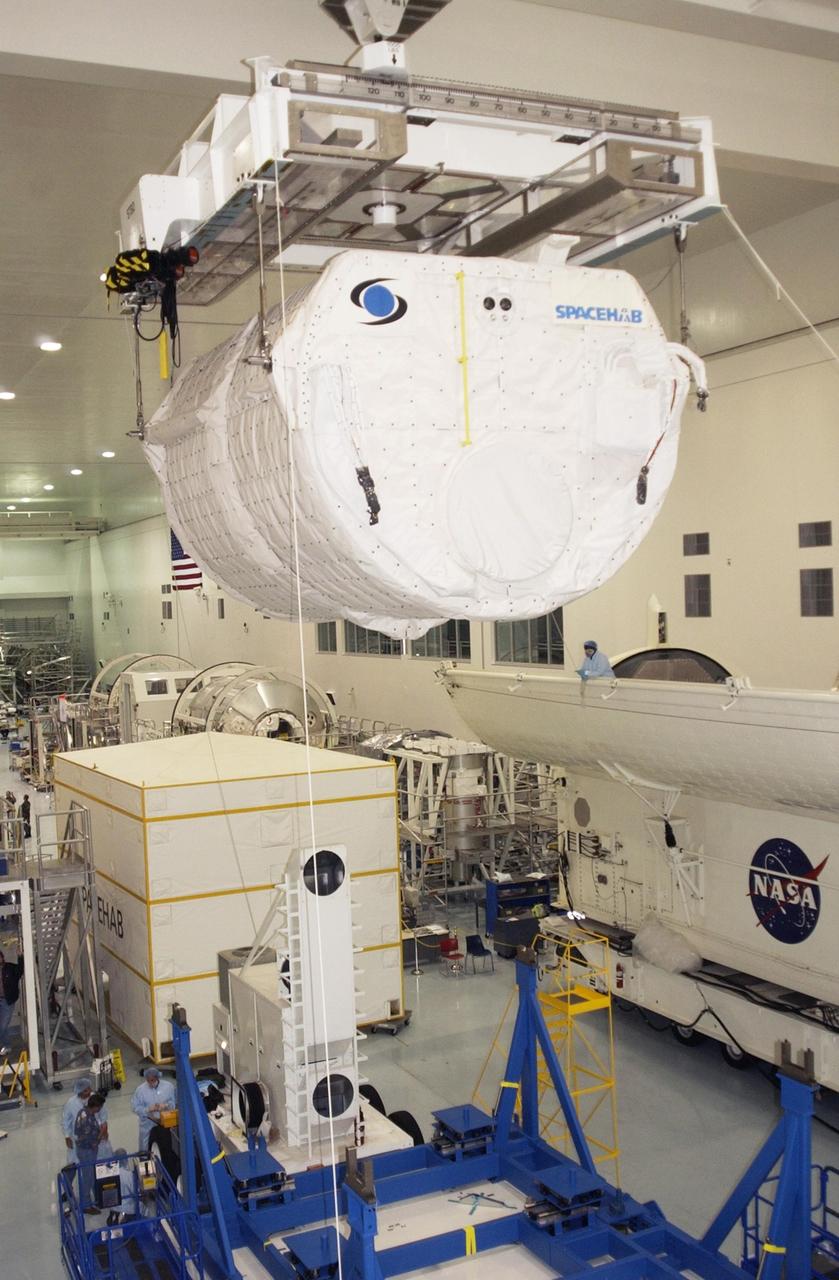
KENNEDY SPACE CENTER, FLA. - Suspended from the overhead crane, the SHI Research Double Module (SHI/RDM) travels across the Space Station Processing Facility to the payload canister waiting at right. The module will be placed in the canister for transport to the Orbiter Processing Facility where it will be installed in Columbia's payload bay for mission STS-107. SHI/RDM is the primary payload of the research mission, with experiments ranging from material sciences to life sciences (many rats). Also part of the payload is the Fast Reaction Experiments Enabling Science, Technology, Applications and Research (FREESTAR) that incorporates eight high priority secondary attached shuttle experiments. STS-107 is scheduled to launch July 19, 2002
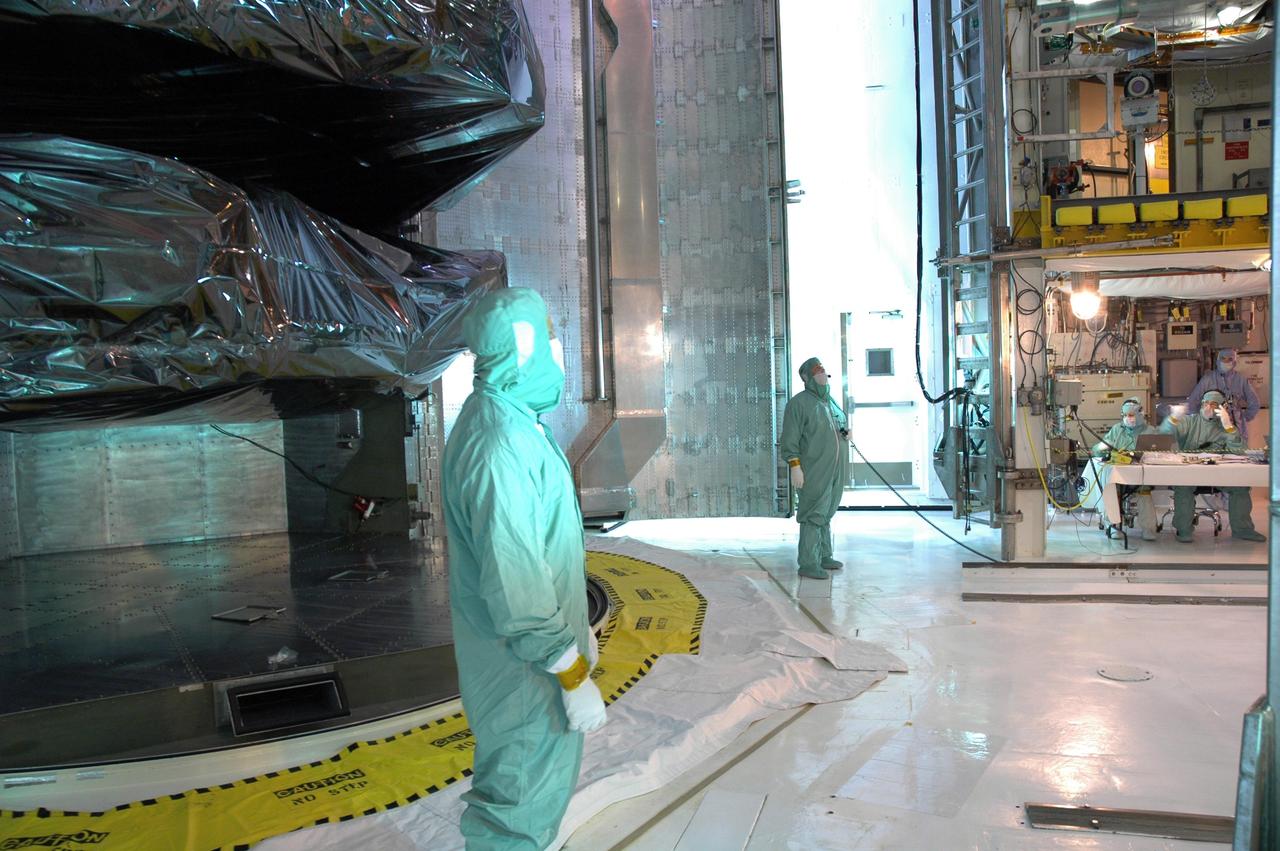
CAPE CANAVERAL, Fla. - In the payload changeout room, or PCR, on Launch Pad 39A at NASA's Kennedy Space Center in Florida, workers prepare for the transfer of the cargo inside the payload canister, at left. Two of the four carriers seen behind the workers are the Orbital Replacement Unit Carrier (top) and the Super Lightweight Interchangeable Carrier. The cargo will be transferred into the PCR via the payload ground-handling mechanism, or PGHM. The PGHM removes payloads from a transportation canister and installs them into the shuttle. It is essentially NASA’s largest fork-lift. Atlantis is targeted to launch Oct. 10. Photo credit: NASA/Jim Grossmann
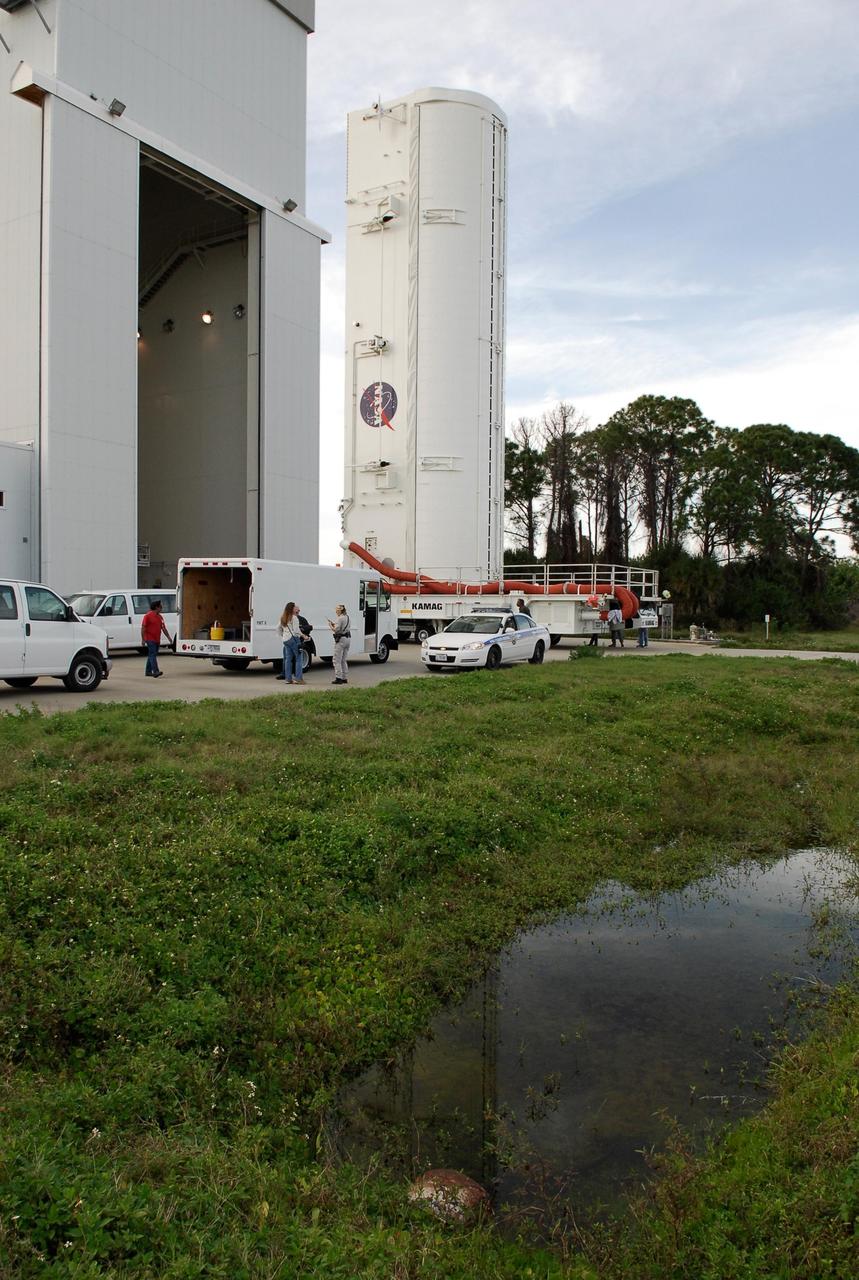
KENNEDY SPACE CENTER, FLA. -- The payload canister moves out of the Vertical Processing Facility, on its way to Launch Pad 39A at NASA's Kennedy Space Center. The canister is transferring the first section of the Japan Aerospace Exploration Agency's Kibo laboratory and the Canadian Space Agency's two-armed robotic system, Dextre, to the payload changeout room, part of the rotating service structure. The changeout room is the enclosed, environmentally controlled portion of the rotating service structure that supports cargo delivery to the pad and subsequent vertical installation into an orbiter's payload bay. The payload will be installed into Endeavour for launch on the STS-123 mission targeted for March 11. Photo credit: NASA/Kim Shiflett
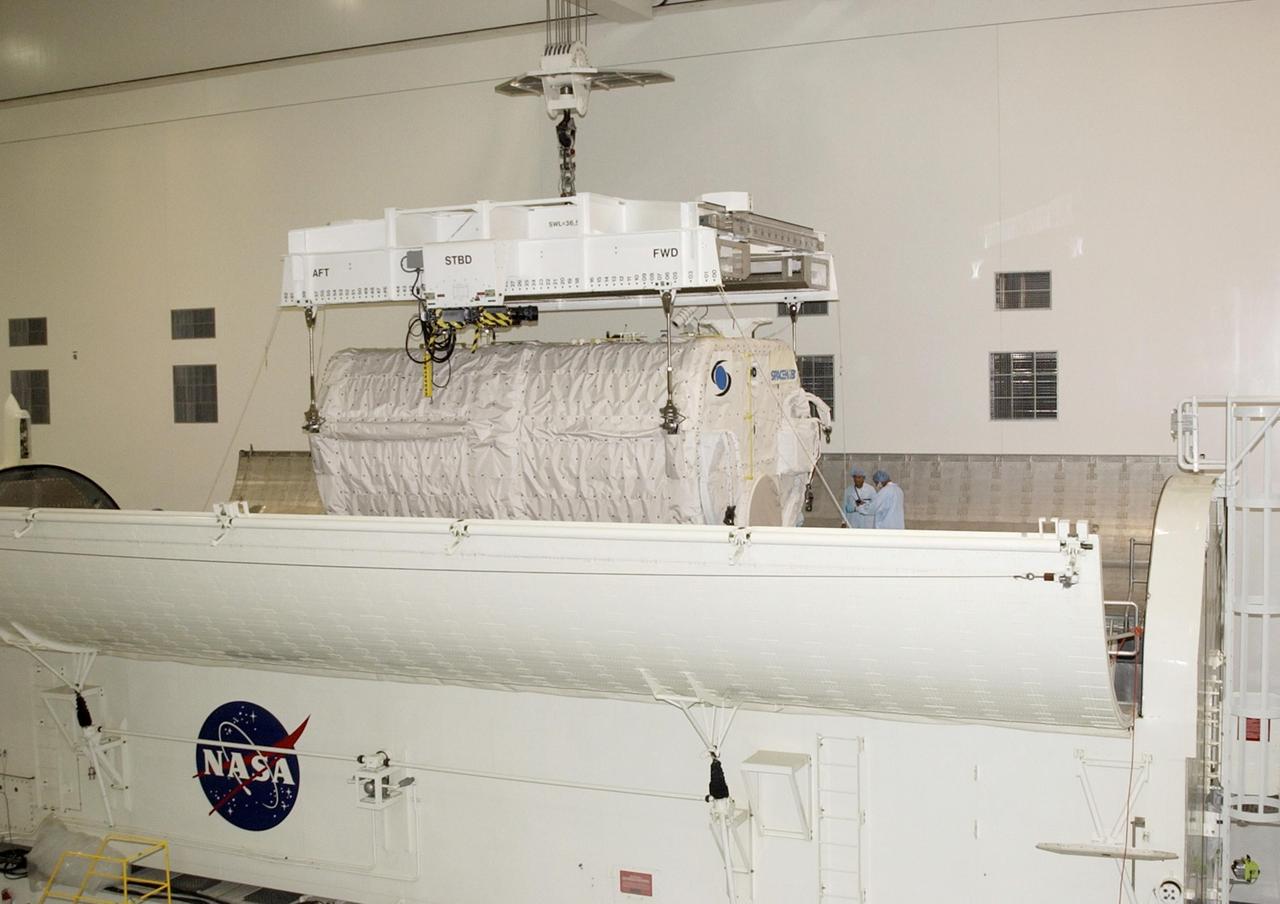
KENNEDY SPACE CENTER, FLA. -- In the Space Station Processing Facility, the overhead crane lowers the SHI Research Double Module (SHI/RDM) into the payload canister. The canister will transport it to the Orbiter Processing Facility where it will be installed in Columbia's payload bay for mission STS-107. SHI/RDM is the primary payload of the research mission, with experiments ranging from material sciences to life sciences (many rats). Also part of the payload is the Fast Reaction Experiments Enabling Science, Technology, Applications and Research (FREESTAR) that incorporates eight high priority secondary attached shuttle experiments. STS-107 is scheduled to launch July 19, 2002
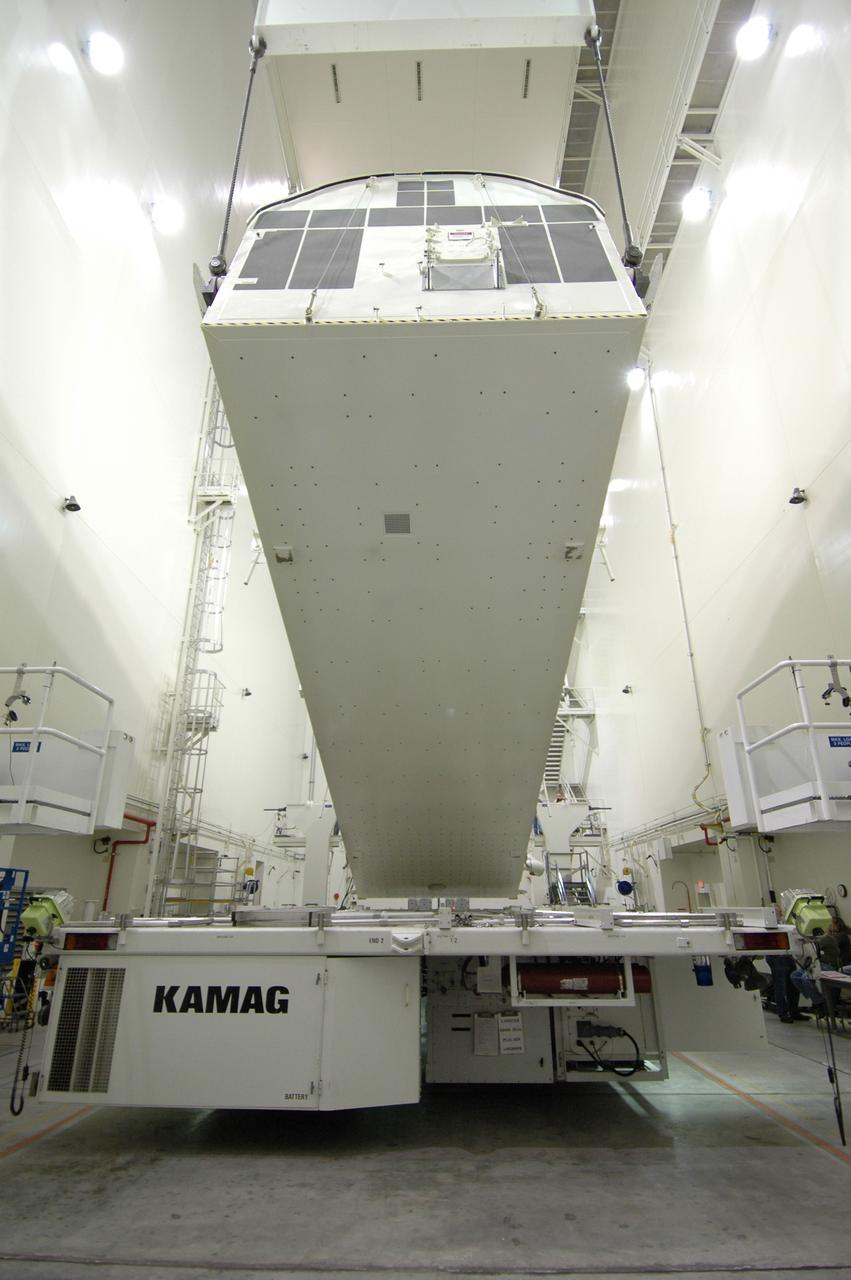
CAPE CANAVERAL, Fla. -- In the Vertical Integration Facility at NASA's Kennedy Space Center, the payload canister containing the Japanese Experiment Module -Pressurized Module is being raised to a vertical position. The canister contains the Japanese Experiment Module -Pressurized Module, which will be transported to Launch Pad 39A for space shuttle Discovery’s STS-124 mission. At the pad, the payload will be transferred from the canister into the payload changeout room on the rotating service structure. The changeout room is the enclosed, environmentally controlled portion of the service structure that supports cargo delivery to the pad and subsequent vertical installation into an orbiter's payload bay. On the mission, the STS-124 crew will transport the JEM as well as the Japanese Remote Manipulator System to the International Space Station. The launch of Discovery is targeted for May 31. Photo credit: NASA/Jim Grossmann
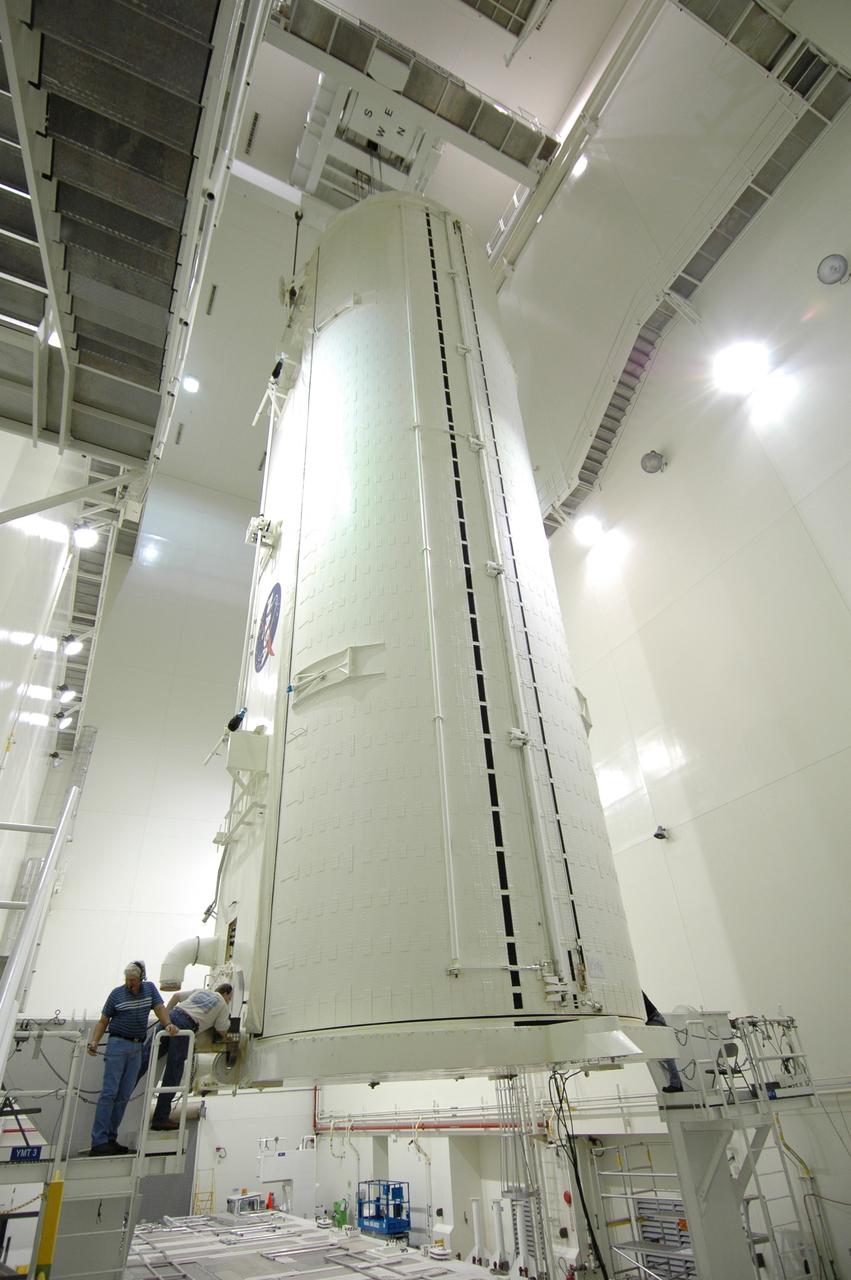
CAPE CANAVERAL, Fla. -- In the Vertical Integration Facility at NASA's Kennedy Space Center, workers on either side of the payload canister check its condition after being rotated from a horizontal position. The canister contains the Japanese Experiment Module -Pressurized Module, which will be transported to Launch Pad 39A for space shuttle Discovery’s STS-124 mission. At the pad, the payload will be transferred from the canister into the payload changeout room on the rotating service structure. The changeout room is the enclosed, environmentally controlled portion of the service structure that supports cargo delivery to the pad and subsequent vertical installation into an orbiter's payload bay. On the mission, the STS-124 crew will transport the JEM as well as the Japanese Remote Manipulator System to the International Space Station. The launch of Discovery is targeted for May 31. Photo credit: NASA/Jim Grossmann
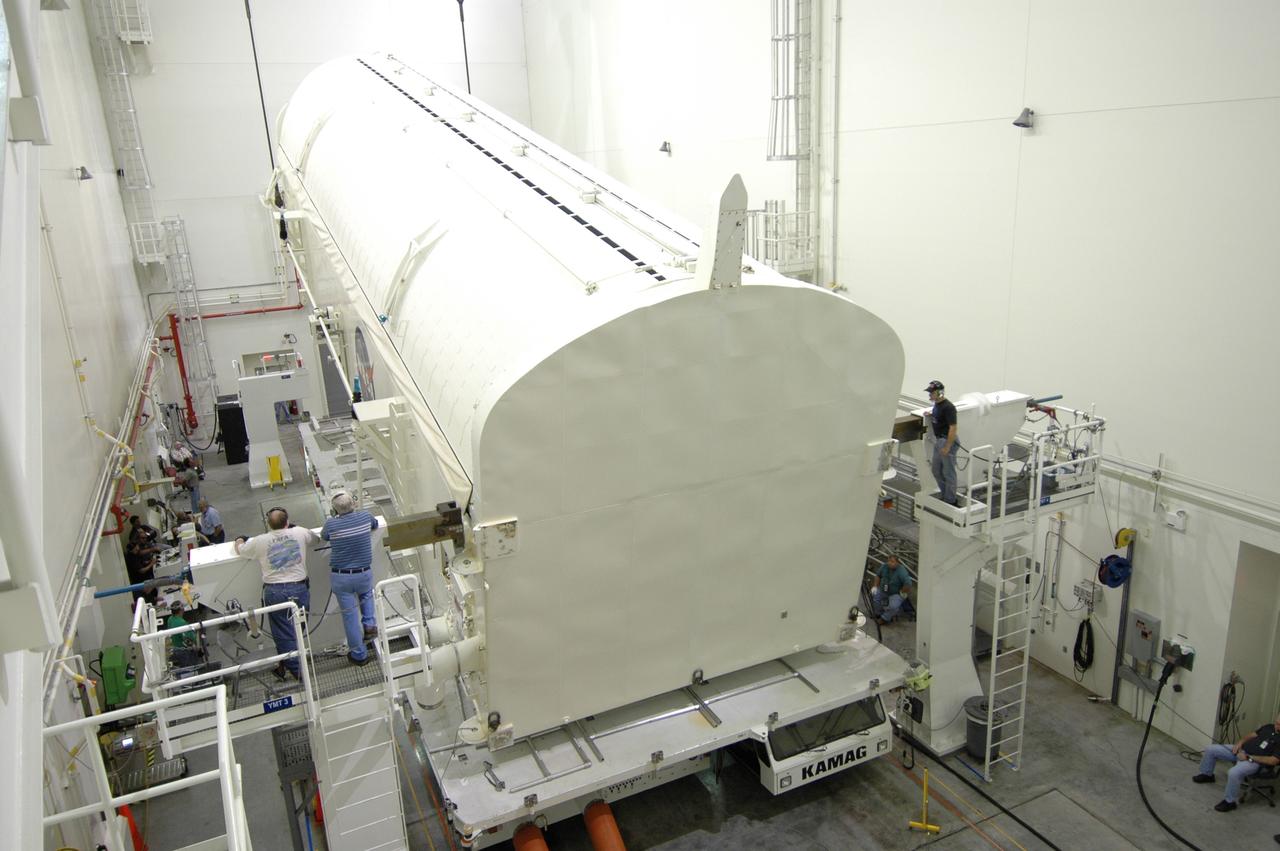
CAPE CANAVERAL, Fla. -- In the Vertical Integration Facility at NASA's Kennedy Space Center, movement begins to raise the payload canister containing the Japanese Experiment Module -Pressurized Module to a vertical position. The canister will be transported to Launch Pad 39A for space shuttle Discovery’s STS-124 mission. At the pad, the payload will be transferred from the canister into the payload changeout room on the rotating service structure. The changeout room is the enclosed, environmentally controlled portion of the service structure that supports cargo delivery to the pad and subsequent vertical installation into an orbiter's payload bay. On the mission, the STS-124 crew will transport the JEM as well as the Japanese Remote Manipulator System to the International Space Station. The launch of Discovery is targeted for May 31. Photo credit: NASA/Jim Grossmann
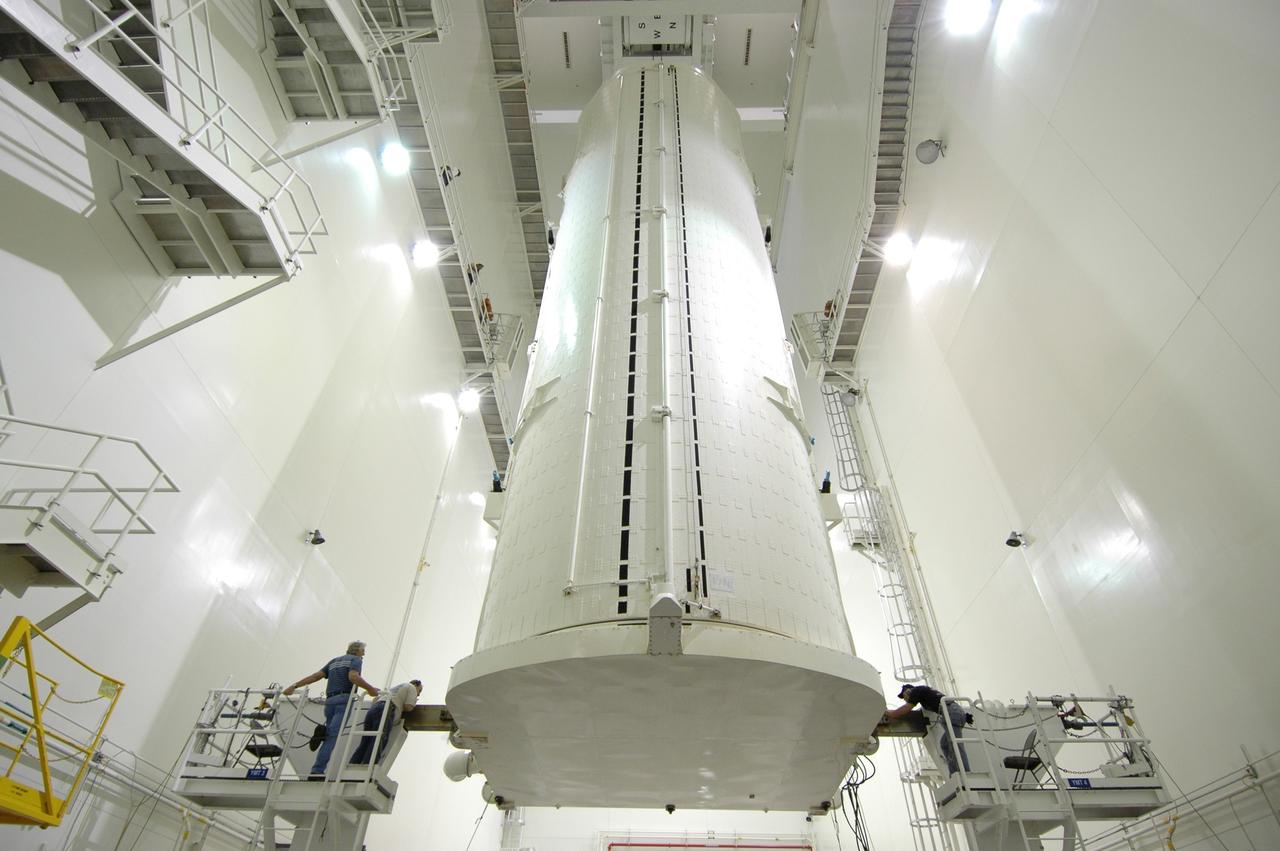
CAPE CANAVERAL, Fla. -- In the Vertical Integration Facility at NASA's Kennedy Space Center, workers on either side of the payload canister check its condition after being rotated from a horizontal position. The canister contains the Japanese Experiment Module -Pressurized Module, which will be transported to Launch Pad 39A for space shuttle Discovery’s STS-124 mission. At the pad, the payload will be transferred from the canister into the payload changeout room on the rotating service structure. The changeout room is the enclosed, environmentally controlled portion of the service structure that supports cargo delivery to the pad and subsequent vertical installation into an orbiter's payload bay. On the mission, the STS-124 crew will transport the JEM as well as the Japanese Remote Manipulator System to the International Space Station. The launch of Discovery is targeted for May 31. Photo credit: NASA/Jim Grossmann
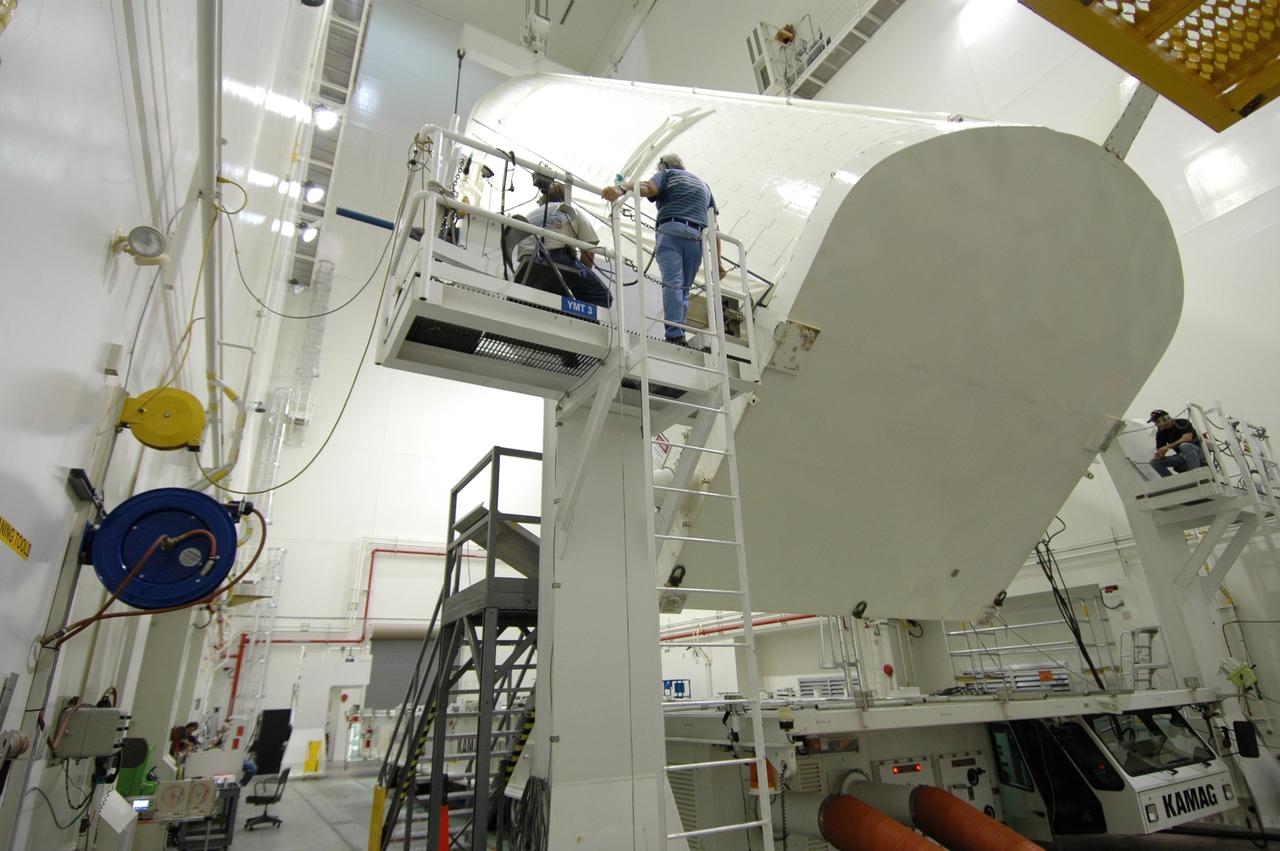
CAPE CANAVERAL, Fla. -- In the Vertical Integration Facility at NASA's Kennedy Space Center, workers on either side monitor the progress of the payload canister as it is raised to a vertical position. The canister contains the Japanese Experiment Module -Pressurized Module, which will be transported to Launch Pad 39A for space shuttle Discovery’s STS-124 mission. At the pad, the payload will be transferred from the canister into the payload changeout room on the rotating service structure. The changeout room is the enclosed, environmentally controlled portion of the service structure that supports cargo delivery to the pad and subsequent vertical installation into an orbiter's payload bay. On the mission, the STS-124 crew will transport the JEM as well as the Japanese Remote Manipulator System to the International Space Station. The launch of Discovery is targeted for May 31. Photo credit: NASA/Jim Grossmann
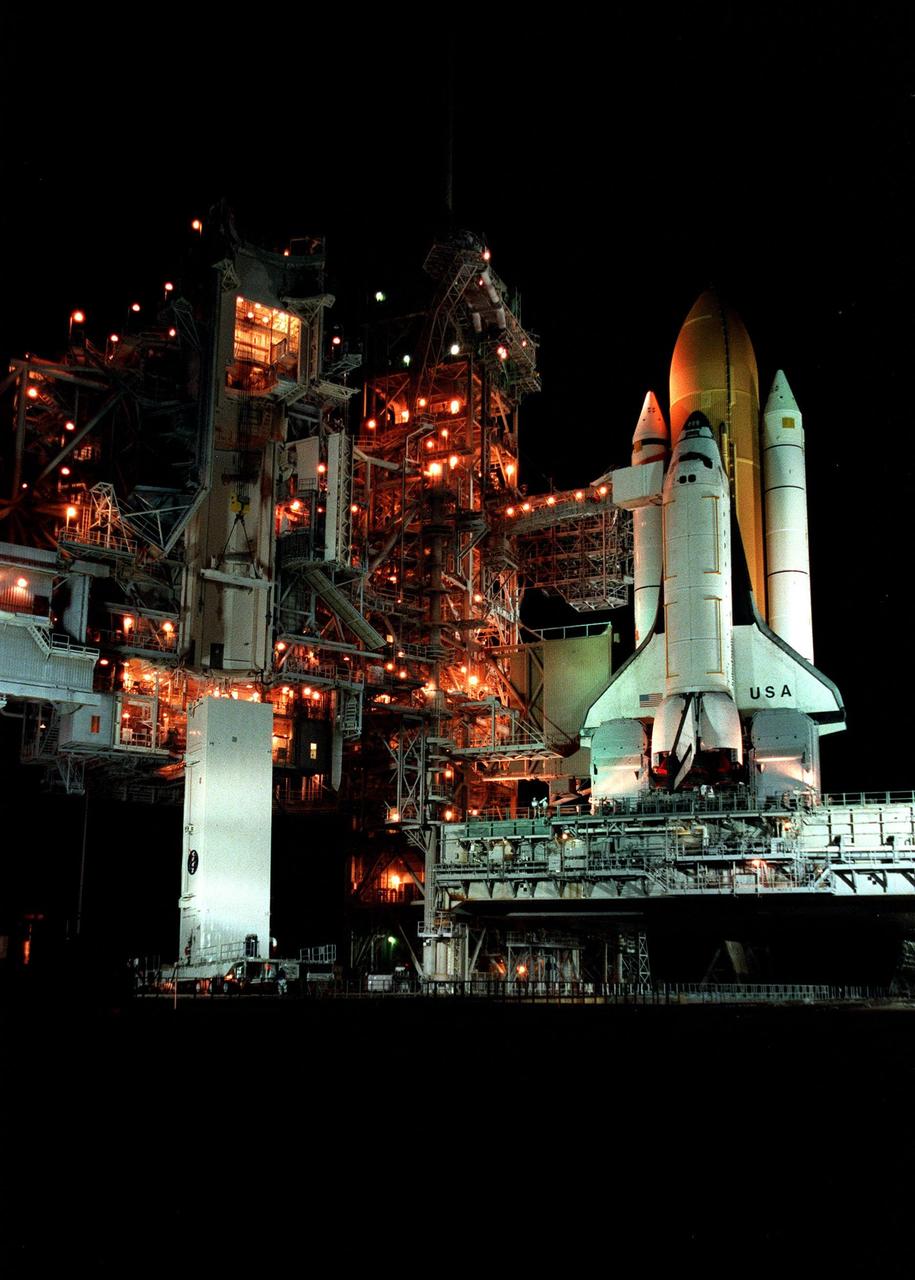
KENNEDY SPACE CENTER, FLA. -- Hours before dawn, the payload canister transporter delivers its cargo (lower left) to Launch Pad 39B, below the Rotating Service Structure (RSS). Inside the canister is the Chandra X-ray Observatory, primary payload on mission STS-93, scheduled to launch no earlier than July 20 aboard Space Shuttle Columbia (right). The canister will be lifted up to the Payload Changeout Room in the RSS where it will be relieved of its cargo. After the RSS rotates to a position behind Columbia, the observatory will then be installed vertically in the orbiter payload bay. The world's most powerful X-ray telescope, Chandra will allow scientists from around the world to see previously invisible black holes and high-temperature gas clouds, giving the observatory the potential to rewrite the books on the structure and evolution of our universe

CAPE CANAVERAL, Fla. -- In the Vertical Integration Facility at NASA's Kennedy Space Center, the payload canister containing the Japanese Experiment Module -Pressurized Module is suspended vertically after rotation from the horizontal. The canister contains the Japanese Experiment Module -Pressurized Module, which will be transported to Launch Pad 39A for space shuttle Discovery’s STS-124 mission. At the pad, the payload will be transferred from the canister into the payload changeout room on the rotating service structure. The changeout room is the enclosed, environmentally controlled portion of the service structure that supports cargo delivery to the pad and subsequent vertical installation into an orbiter's payload bay. On the mission, the STS-124 crew will transport the JEM as well as the Japanese Remote Manipulator System to the International Space Station. The launch of Discovery is targeted for May 31. Photo credit: NASA/Jim Grossmann
CAPE CANAVERAL, Fla. -- In the Vertical Integration Facility at NASA's Kennedy Space Center, the payload canister containing the Japanese Experiment Module -Pressurized Module is ready for rotation to a vertical position. The canister will be transported to Launch Pad 39A for space shuttle Discovery’s STS-124 mission. At the pad, the payload will be transferred from the canister into the payload changeout room on the rotating service structure. The changeout room is the enclosed, environmentally controlled portion of the service structure that supports cargo delivery to the pad and subsequent vertical installation into an orbiter's payload bay. On the mission, the STS-124 crew will transport the JEM as well as the Japanese Remote Manipulator System to the International Space Station. The launch of Discovery is targeted for May 31. Photo credit: NASA/Jim Grossmann
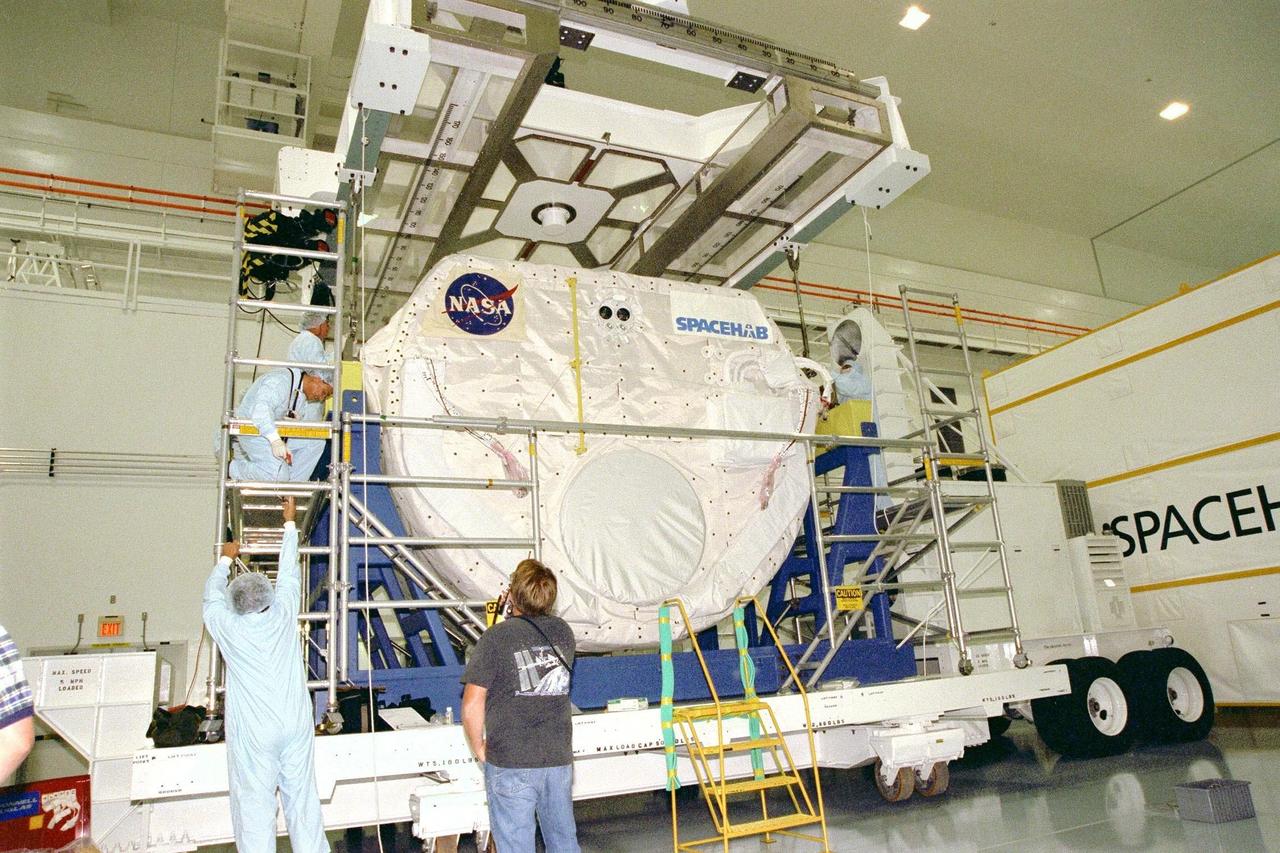
The SPACEHAB Single Module is raised by crane from a transporter in KSC's Space Station Processing Facility, where it will be moved to the payload canister. It will be joined in the canister by the Alpha Magnetic Spectrometer-01 payload before being moved to Launch Pad 39A for the STS-91 mission, scheduled to launch June 2 at around 6:04 p.m. EDT. SPACEHAB is used mainly as a large pressurized cargo container for science, logistical equipment and supplies to be exchanged between the orbiter Discovery and the Russian Space Station Mir. The nearly 10-day flight of STS-91 also is scheduled to return the sixth American, Mission Specialist Andrew Thomas, Ph.D., aboard the Russian orbiting outpost safely to Earth
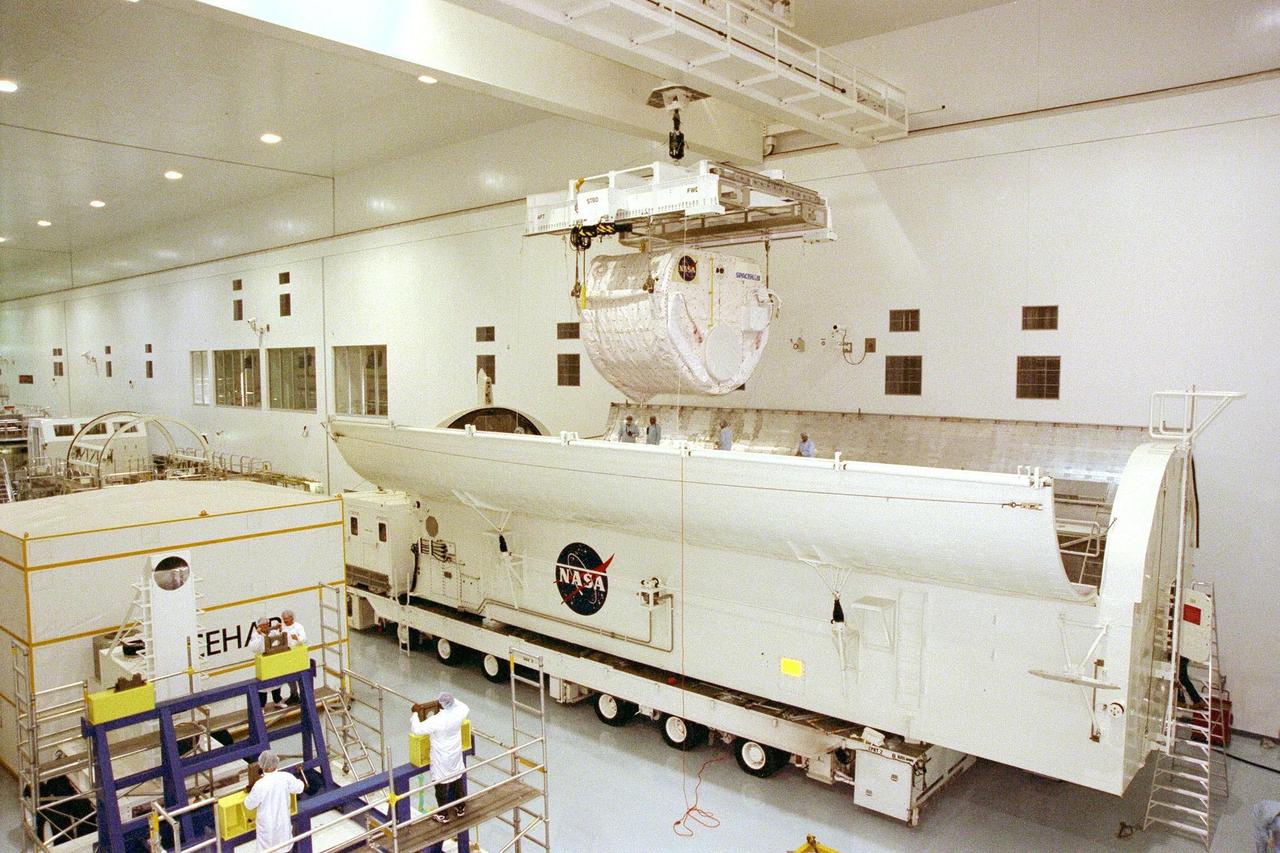
KENNEDY SPACE CENTER, FLA. -- The SPACEHAB Single Module is moved by crane over the payload canister in KSC's Space Station Processing Facility. It will be joined in the canister by the Alpha Magnetic Spectrometer-01 payload before being moved to Launch Pad 39A for the STS-91 mission, scheduled to launch June 2 at around 6:04 p.m. EDT. SPACEHAB is used mainly as a large pressurized cargo container for science, logistical equipment and supplies to be exchanged between the orbiter Discovery and the Russian Space Station Mir. The nearly 10-day flight of STS-91 also is scheduled to return the sixth American, Mission Specialist Andrew Thomas, Ph.D., aboard the Russian orbiting outpost safely to Earth
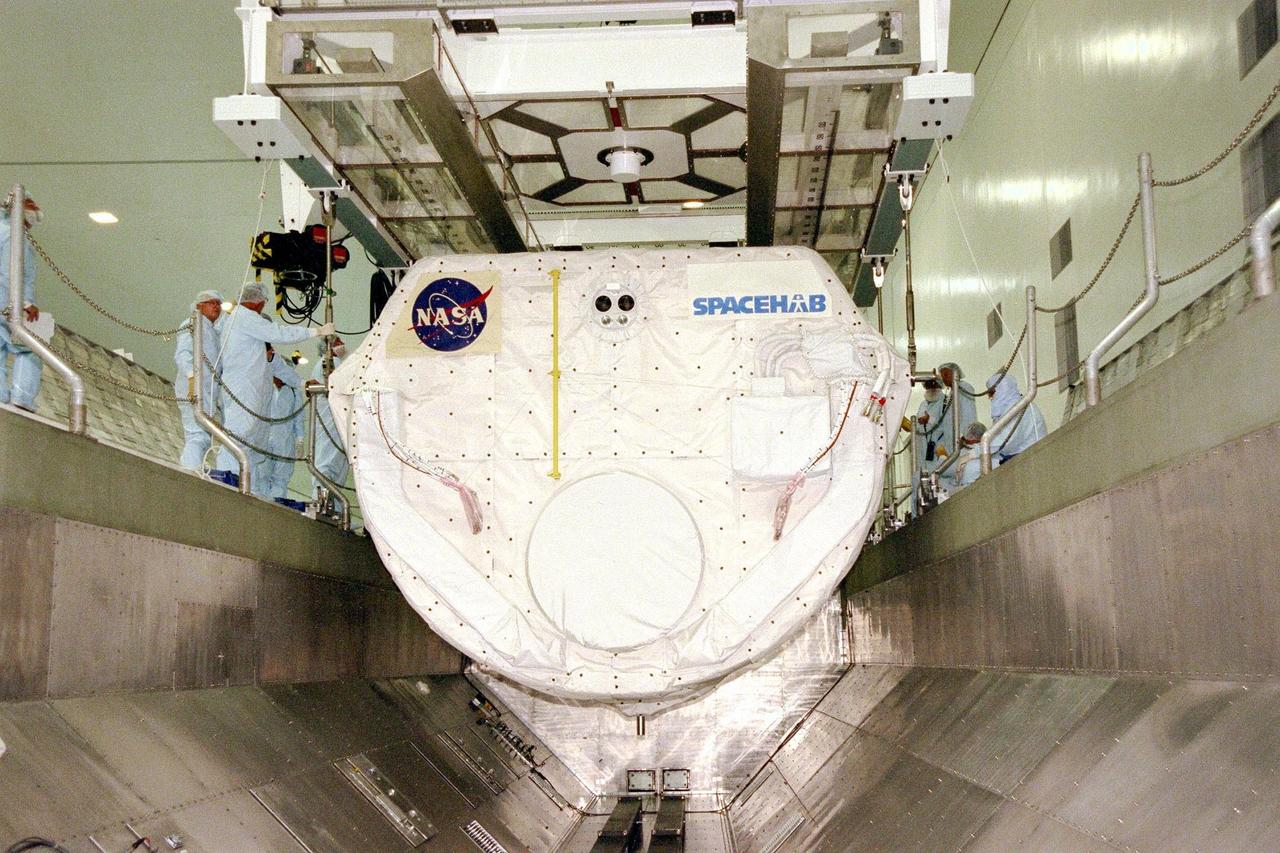
KENNEDY SPACE CENTER, FLA. -- The SPACEHAB Single Module is lowered into the payload canister in KSC's Space Station Processing Facility. It will be joined in the canister by the Alpha Magnetic Spectrometer-01 payload before being moved to Launch Pad 39A for the STS-91 mission, scheduled to launch June 2 at around 6:04 p.m. EDT. SPACEHAB is used mainly as a large pressurized cargo container for science, logistical equipment and supplies to be exchanged between the orbiter Discovery and the Russian Space Station Mir. The nearly 10-day flight of STS-91 also is scheduled to return the sixth American, Mission Specialist Andrew Thomas, Ph.D., aboard the Russian orbiting outpost safely to Earth
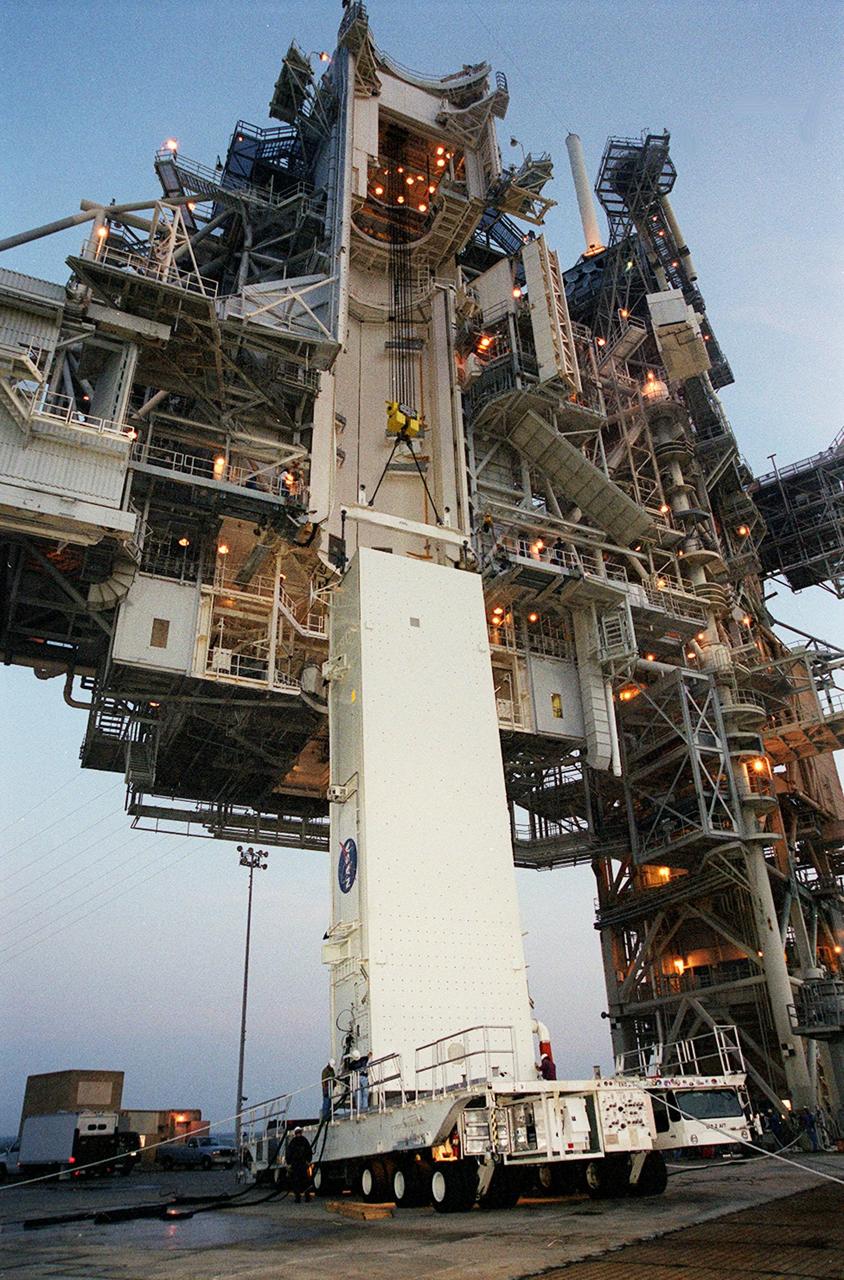
KENNEDY SPACE CENTER, Fla. -- The payload canister arrives at the Rotating Service Structure (RSS) on Launch Pad 39B. The canister with its cargo of the SPACEHAB module and Integrated Cargo Carrier will be lifted up into the Payload Changeout Room near the top of the RSS for transfer to the payload bay of Shuttle Atlantis for mission STS-106. The PCR provides an environmentally controlled facility for the transfer. The 11-day mission to the International Space Station will include service module support tasks on orbit, transfer supplies and outfit the Space Station for the first long-duration crew. Atlantis is scheduled to launch Sept. 8 at 8:31 a.m. EDT.
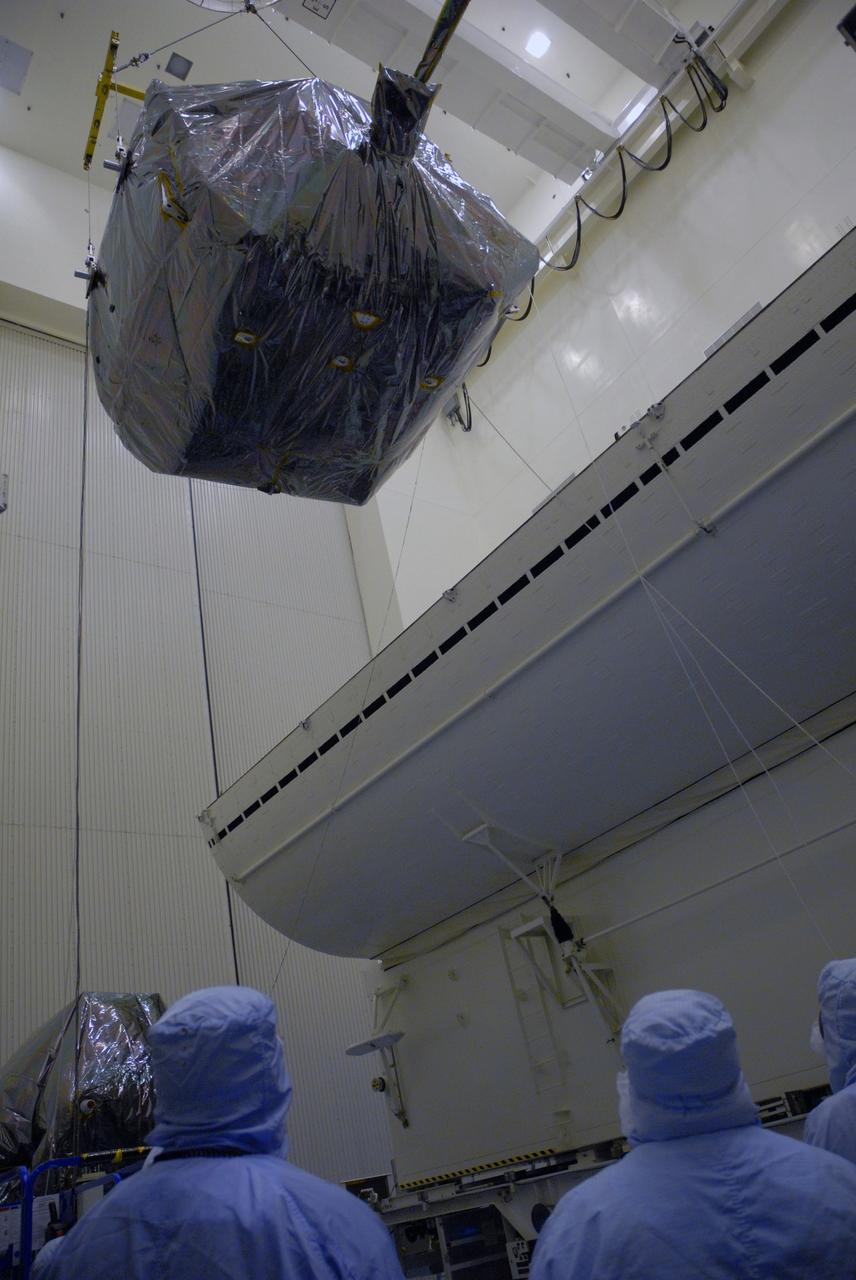
CAPE CANAVERAL, Fla. – In the Payload Hazardous Servicing Facility at NASA's Kennedy Space Center in Florida, the Orbital Replacement Unit Carrier, or ORUC, is lowered toward the payload canister. The canister will deliver the ORUC and other carriers to Launch Pad 39A for installation in space shuttle Atlantis' payload bay. Atlantis' 11-day flight to service NASA's Hubble Space Telescope is targeted for launch May 12. The mission will include five spacewalks in which astronauts will refurbish and upgrade the telescope with state-of-the-art science instruments. As a result, Hubble's capabilities will be expanded and its operational lifespan extended through at least 2014. Photo credit: NASA/Tim Jacobs

KENNEDY SPACE CENTER, FLA. -- With umbilical lines still attached, the payload canister is hoisted up alongside the Rotating Service Structure (RSS) on Launch Pad 39B. The canister with its cargo of the SPACEHAB module and Integrated Cargo Carrier will be moved into the Payload Changeout Room (PCR) near the top of the RSS for transfer to the payload bay of Shuttle Atlantis for mission STS-106. The PCR provides an environmentally controlled facility for the transfer. The 11-day mission to the International Space Station will include service module support tasks on orbit, transfer supplies and outfit the Space Station for the first long-duration crew. Atlantis is scheduled to launch Sept. 8 at 8:31 a.m. EDT
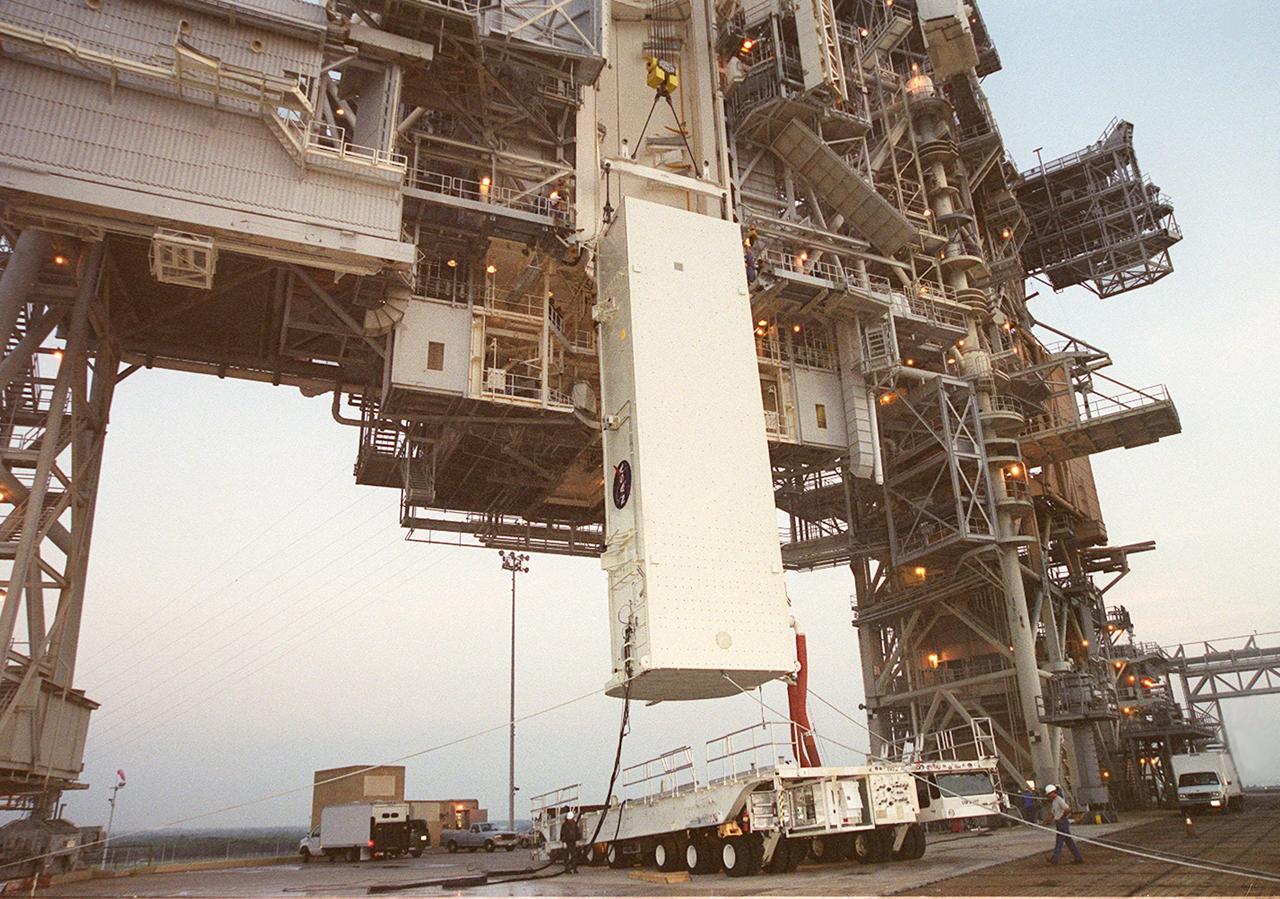
KENNEDY SPACE CENTER, Fla. -- The payload canister is hoisted up alongside the Rotating Service Structure (RSS) on Launch Pad 39B. The canister with its cargo of the SPACEHAB module and Integrated Cargo Carrier will be moved into the Payload Changeout Room near the top of the RSS for transfer to the payload bay of Shuttle Atlantis for mission STS-106. The PCR provides an environmentally controlled facility for the transfer. The 11-day mission to the International Space Station will include service module support tasks on orbit, transfer supplies and outfit the Space Station for the first long-duration crew. Atlantis is scheduled to launch Sept. 8 at 8:31 a.m. EDT.
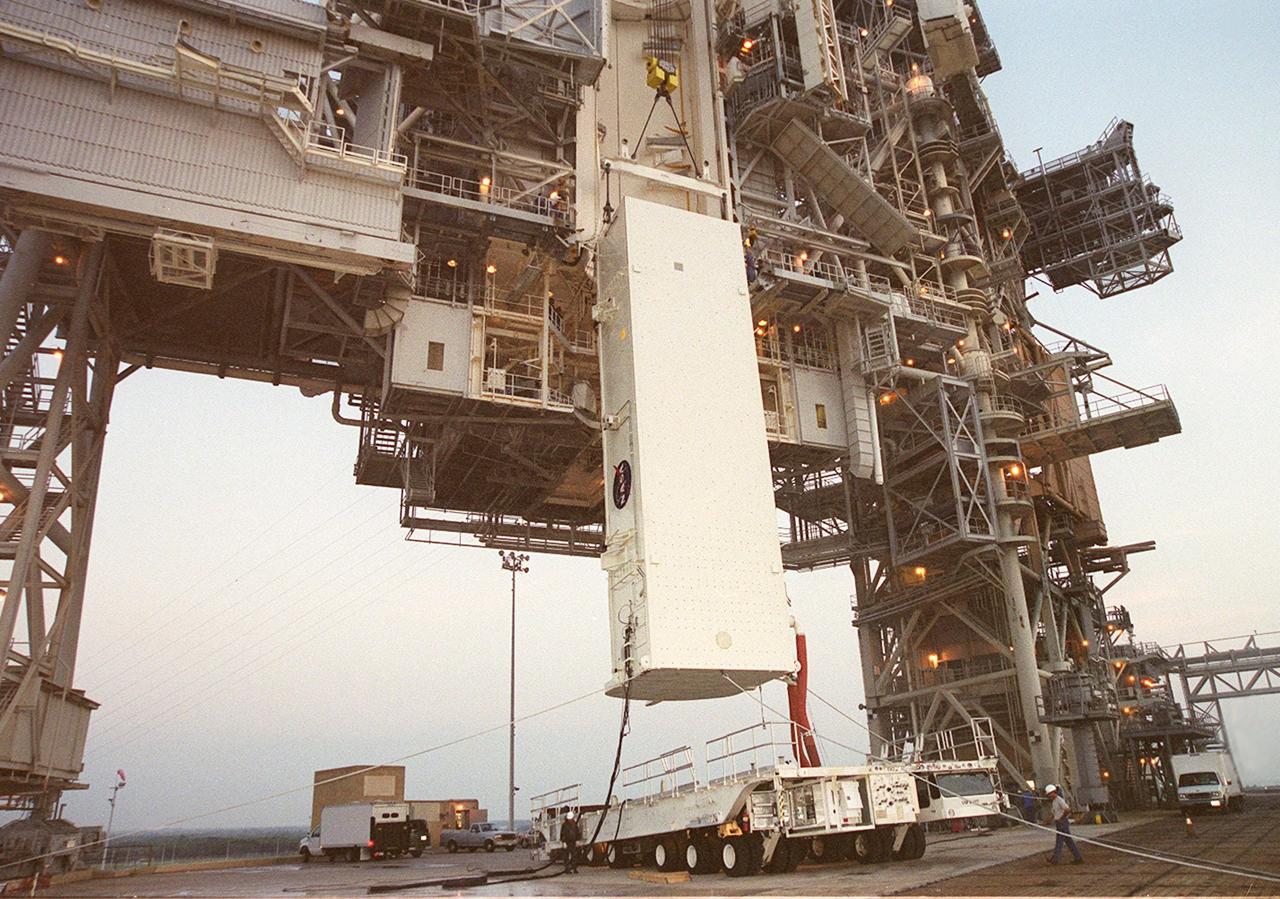
KENNEDY SPACE CENTER, Fla. -- The payload canister is hoisted up alongside the Rotating Service Structure (RSS) on Launch Pad 39B. The canister with its cargo of the SPACEHAB module and Integrated Cargo Carrier will be moved into the Payload Changeout Room near the top of the RSS for transfer to the payload bay of Shuttle Atlantis for mission STS-106. The PCR provides an environmentally controlled facility for the transfer. The 11-day mission to the International Space Station will include service module support tasks on orbit, transfer supplies and outfit the Space Station for the first long-duration crew. Atlantis is scheduled to launch Sept. 8 at 8:31 a.m. EDT.
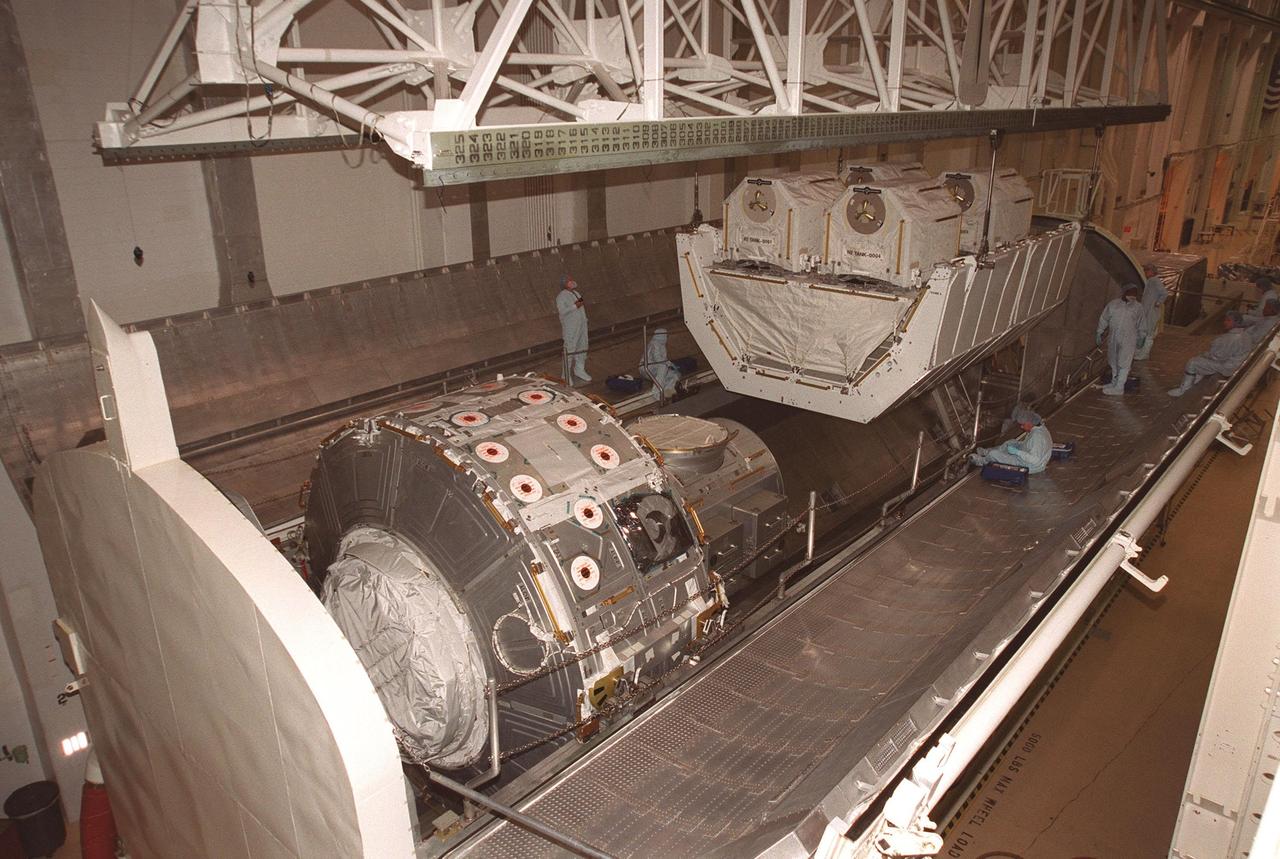
KENNEDY SPACE CENTER, FLA. -- With workers keeping a close watch, the overhead crane lowers the high pressure gas assembly two gaseous oxygen and two gaseous nitrogen storage tanks into the payload canister. The joint airlock module is already in the canister. The airlock and tanks are part of the payload on mission STS-104 and are being transferred to orbiter Atlantis’s payload bay. The storage tanks will be attached to the airlock during two spacewalks. The storage tanks will support future spacewalk operations from the Station and augment the Service Module gas resupply system. STS-104 is scheduled for launch June 14 from Launch Pad 39B

CAPE CANAVERAL, Fla. – In the Payload Hazardous Servicing Facility at NASA's Kennedy Space Center in Florida, the Orbital Replacement Unit Carrier, or ORUC, is lowered into the payload canister. The canister will deliver the ORUC and other carriers to Launch Pad 39A for installation in space shuttle Atlantis' payload bay. Atlantis' 11-day flight to service NASA's Hubble Space Telescope is targeted for launch May 12. The mission will include five spacewalks in which astronauts will refurbish and upgrade the telescope with state-of-the-art science instruments. As a result, Hubble's capabilities will be expanded and its operational lifespan extended through at least 2014. Photo credit: NASA/Tim Jacobs
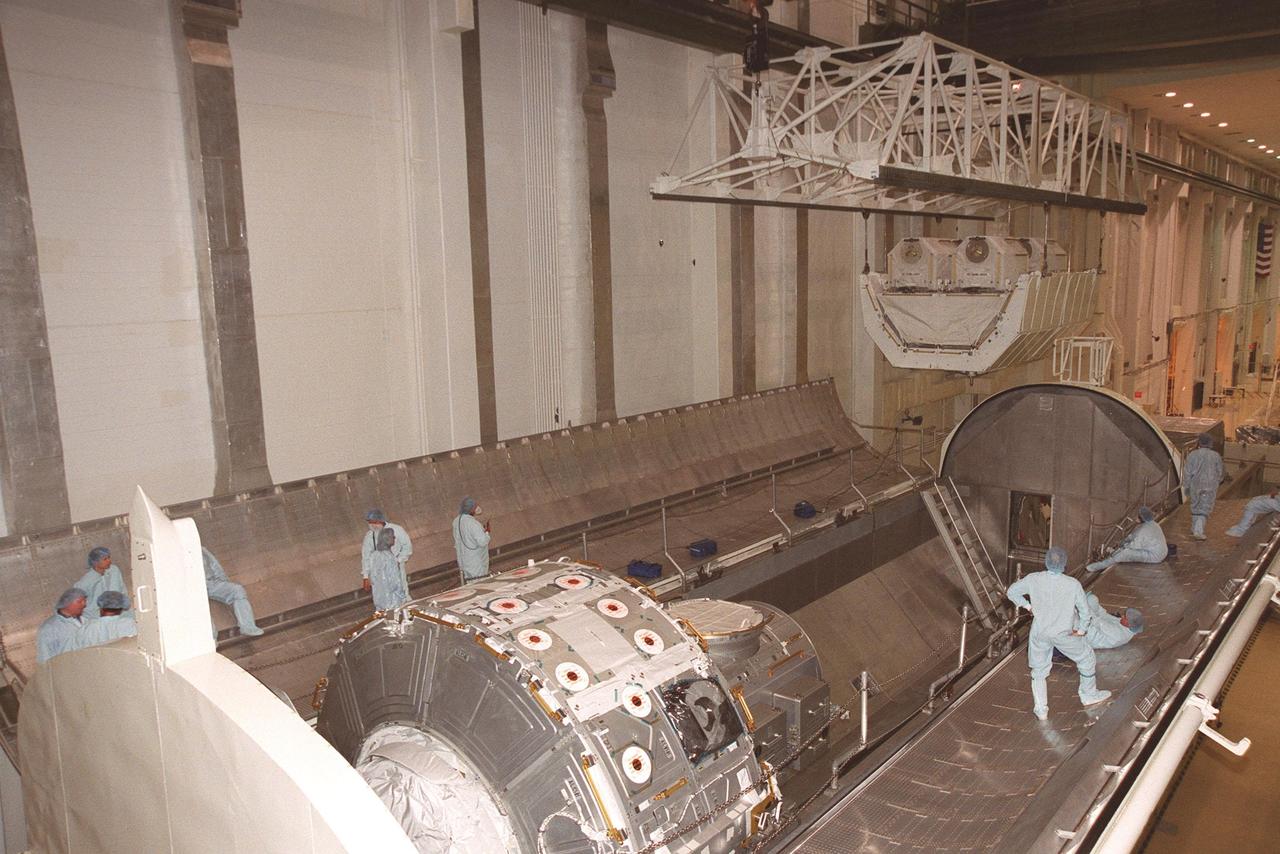
KENNEDY SPACE CENTER, FLA. -- In the Operations and Checkout Building, workers wait in the payload canister as an overhead crane moves the high pressure gas assembly two gaseous oxygen and two gaseous nitrogen storage tanks toward it. The joint airlock module is already in the canister. The airlock and tanks are part of the payload on mission STS-104 and are being transferred to orbiter Atlantis’s payload bay. The storage tanks will be attached to the airlock during two spacewalks. The storage tanks will support future spacewalk operations from the Station and augment the Service Module gas resupply system. STS-104 is scheduled for launch June 14 from Launch Pad 39B
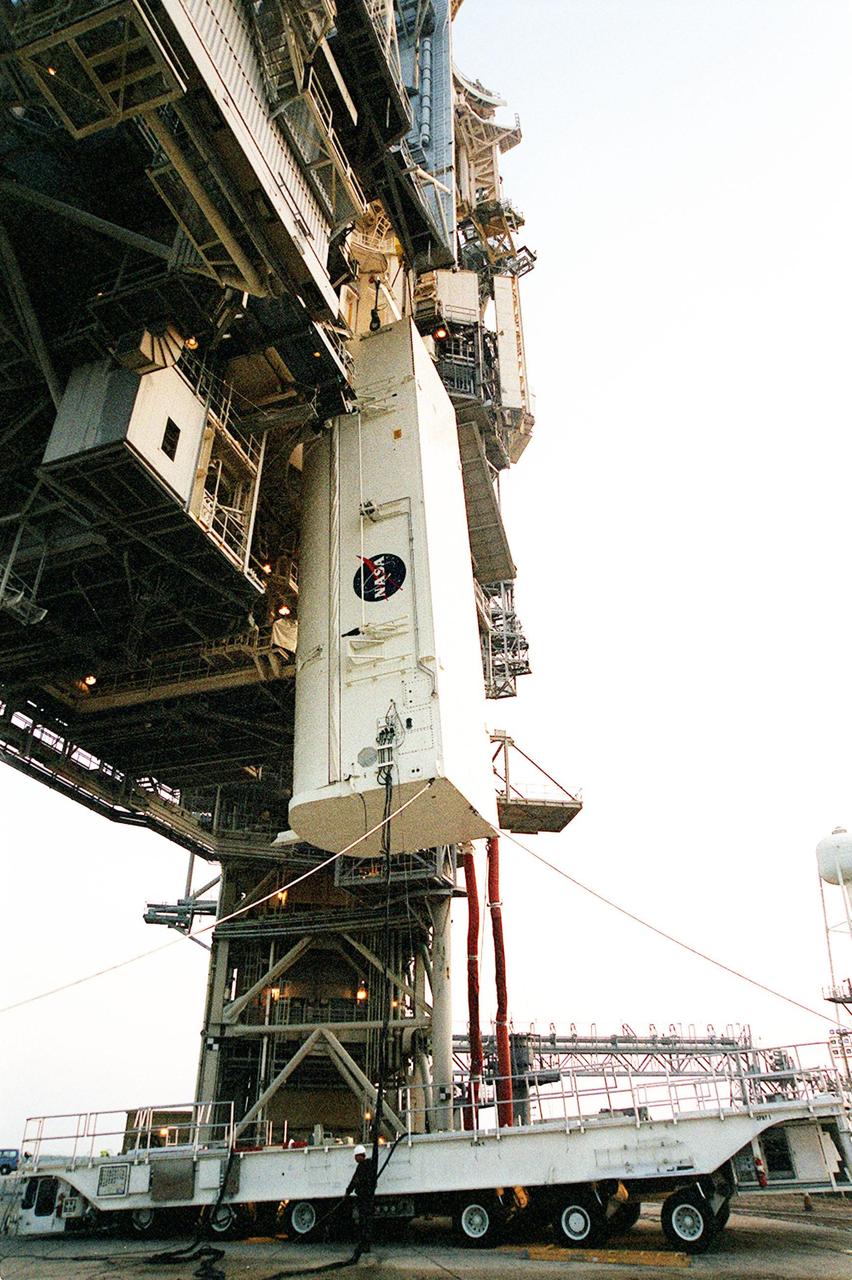
With umbilical lines still attached, the payload canister is hoisted up alongside the Rotating Service Structure (RSS) on Launch Pad 39B. The canister with its cargo of the SPACEHAB module and Integrated Cargo Carrier will be moved into the Payload Changeout Room (PCR) near the top of the RSS for transfer to the payload bay of Shuttle Atlantis for mission STS-106. The PCR provides an environmentally controlled facility for the transfer. The 11-day mission to the International Space Station will include service module support tasks on orbit, transfer supplies and outfit the Space Station for the first long-duration crew. Atlantis is scheduled to launch Sept. 8 at 8:31 a.m. EDT.
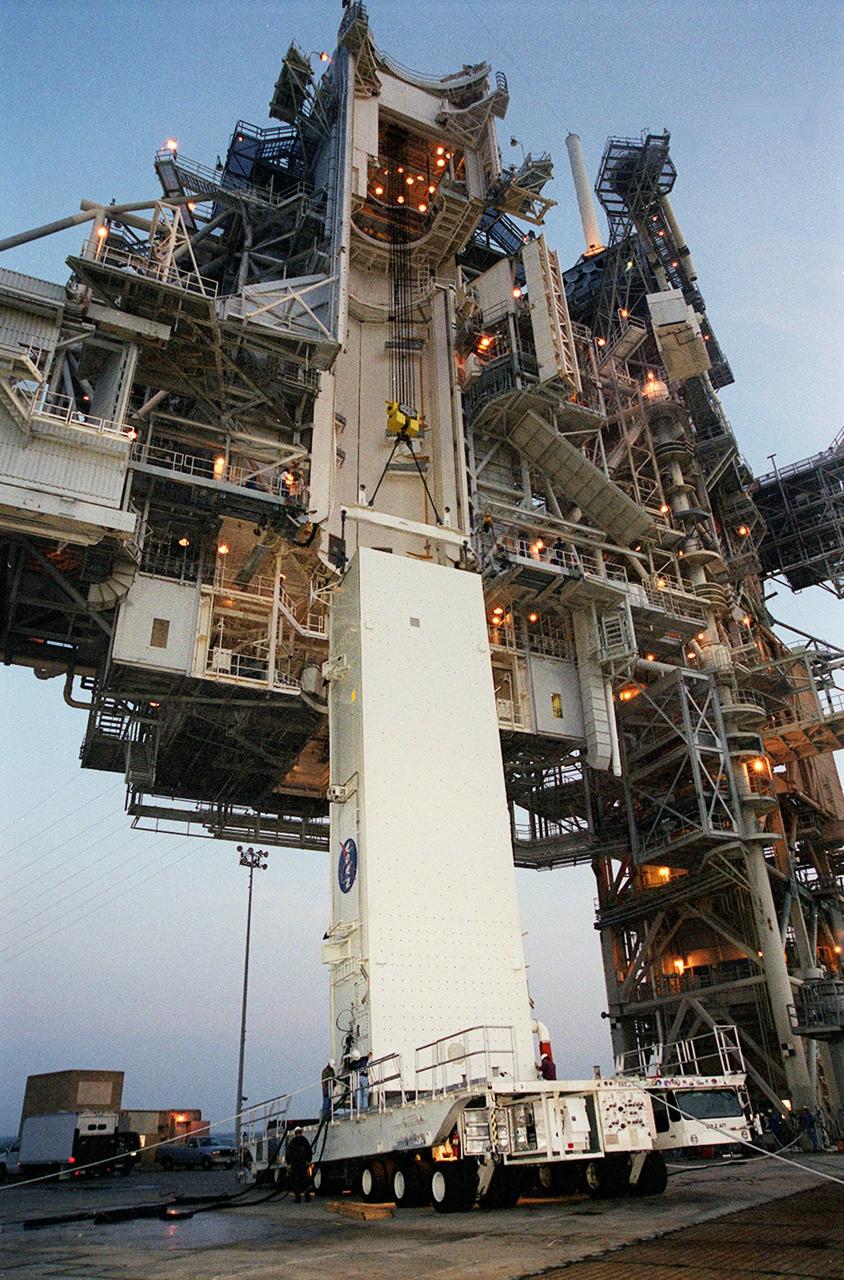
KENNEDY SPACE CENTER, Fla. -- The payload canister arrives at the Rotating Service Structure (RSS) on Launch Pad 39B. The canister with its cargo of the SPACEHAB module and Integrated Cargo Carrier will be lifted up into the Payload Changeout Room near the top of the RSS for transfer to the payload bay of Shuttle Atlantis for mission STS-106. The PCR provides an environmentally controlled facility for the transfer. The 11-day mission to the International Space Station will include service module support tasks on orbit, transfer supplies and outfit the Space Station for the first long-duration crew. Atlantis is scheduled to launch Sept. 8 at 8:31 a.m. EDT.
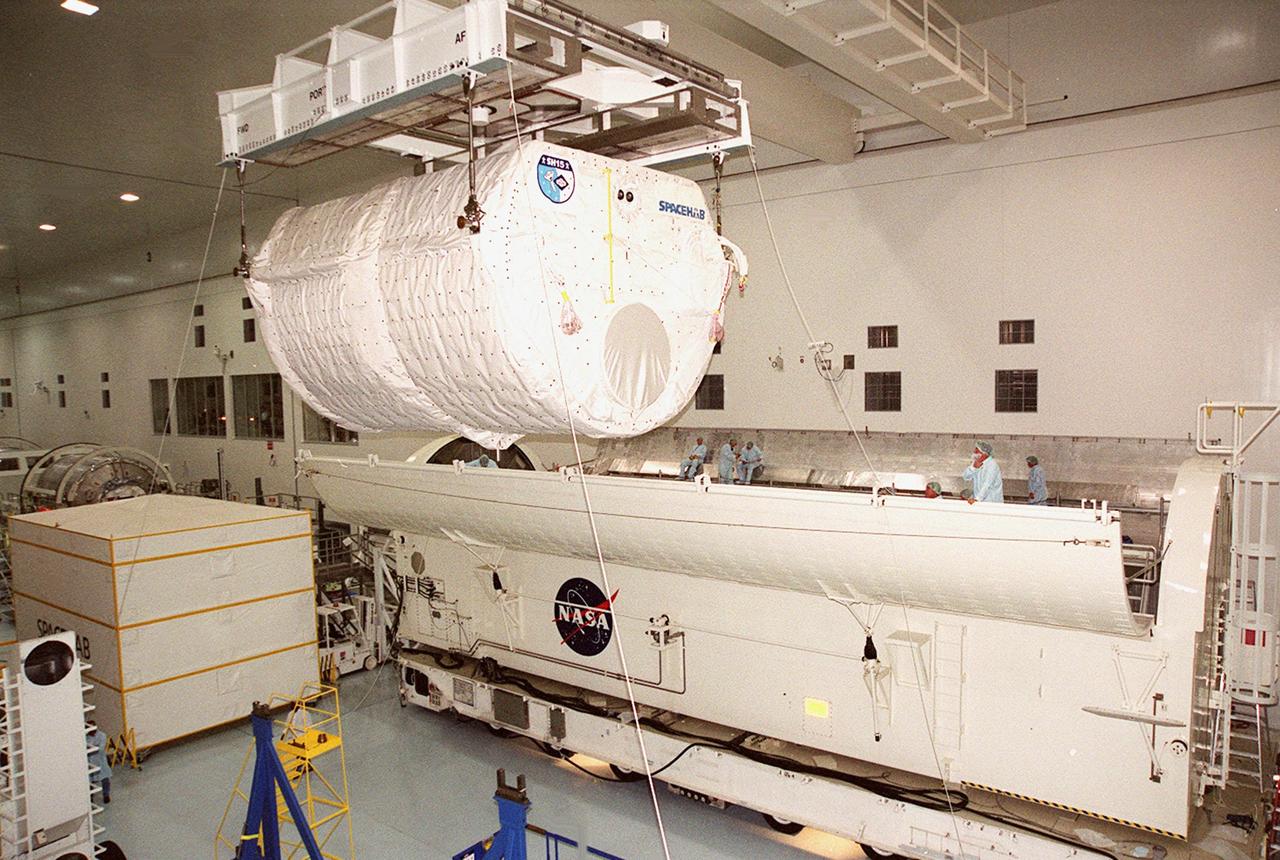
KENNEDY SPACE CENTER, FLA. -- The SPACEHAB module is moved toward the payload canister (right) that will transport it to the launch pad. STS-106 is scheduled to launch Sept. 8 at 8:31 a.m. EDT. During the mission, to the International Space Station, the crew will complete service module support tasks on orbit, transfer supplies and outfit the Space Station for the first long-duration crew. Workers attach an overhead crane to the SPACEHAB module to lift it off the transport vehicle beneath it. The module, part of the payload on mission STS-106, will be placed in the payload canister for transport to the launch pad. STS-106 is scheduled to launch Sept. 8 at 8:31 a.m. EDT
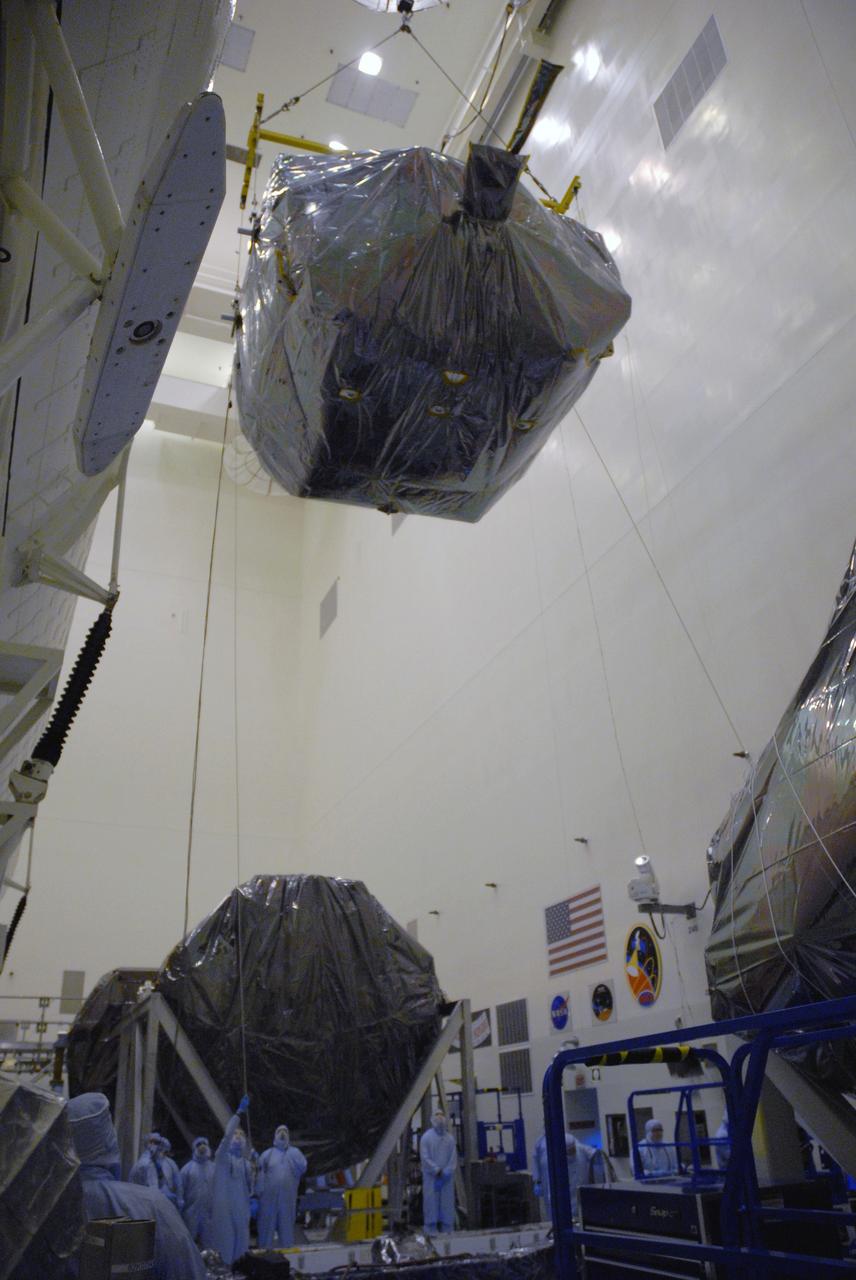
CAPE CANAVERAL, Fla. – In the Payload Hazardous Servicing Facility at NASA's Kennedy Space Center in Florida, the Orbital Replacement Unit Carrier, or ORUC, is moved from its workstand toward the payload canister. The canister will deliver the ORUC and other carriers to Launch Pad 39A for installation in space shuttle Atlantis' payload bay. Atlantis' 11-day flight to service NASA's Hubble Space Telescope is targeted for launch May 12. The mission will include five spacewalks in which astronauts will refurbish and upgrade the telescope with state-of-the-art science instruments. As a result, Hubble's capabilities will be expanded and its operational lifespan extended through at least 2014. Photo credit: NASA/Tim Jacobs
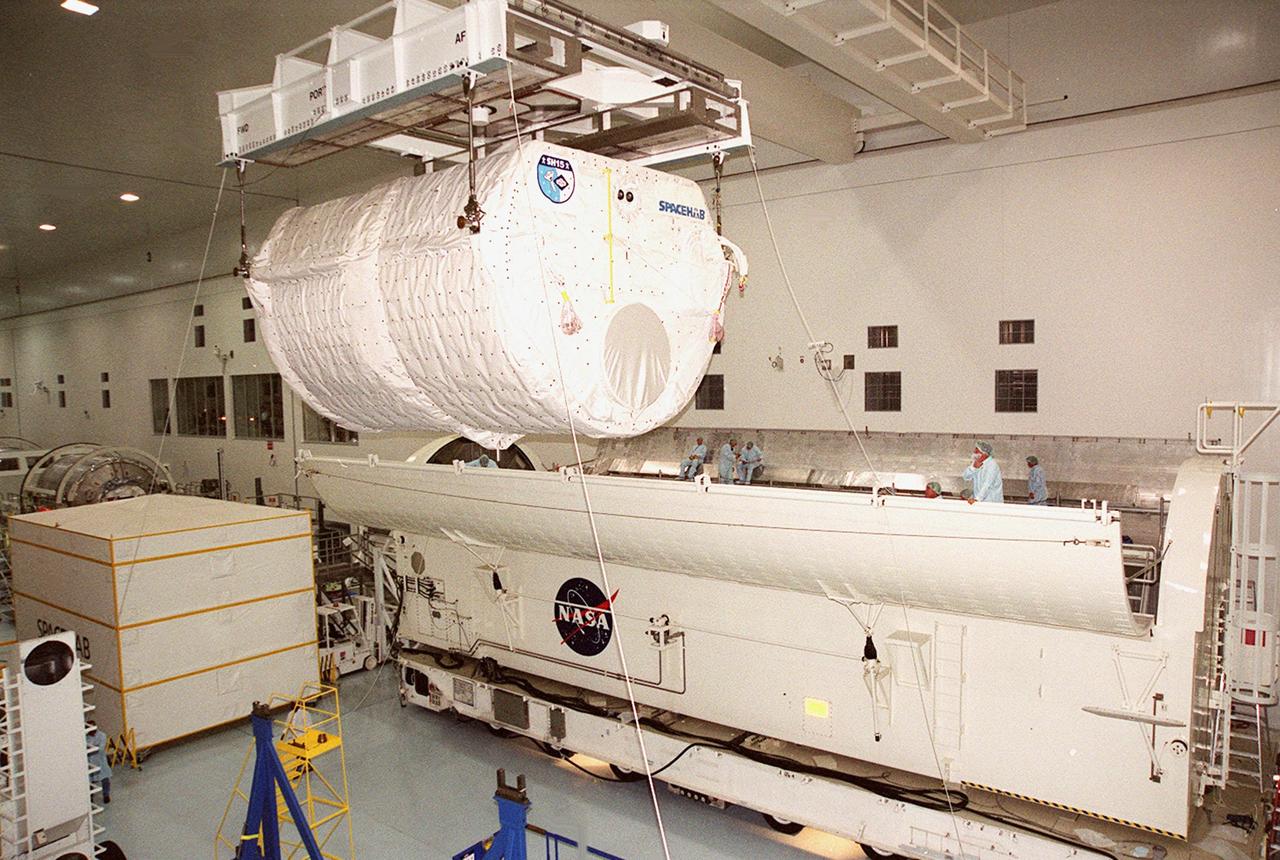
KENNEDY SPACE CENTER, FLA. -- The SPACEHAB module is moved toward the payload canister (right) that will transport it to the launch pad. STS-106 is scheduled to launch Sept. 8 at 8:31 a.m. EDT. During the mission, to the International Space Station, the crew will complete service module support tasks on orbit, transfer supplies and outfit the Space Station for the first long-duration crew. Workers attach an overhead crane to the SPACEHAB module to lift it off the transport vehicle beneath it. The module, part of the payload on mission STS-106, will be placed in the payload canister for transport to the launch pad. STS-106 is scheduled to launch Sept. 8 at 8:31 a.m. EDT
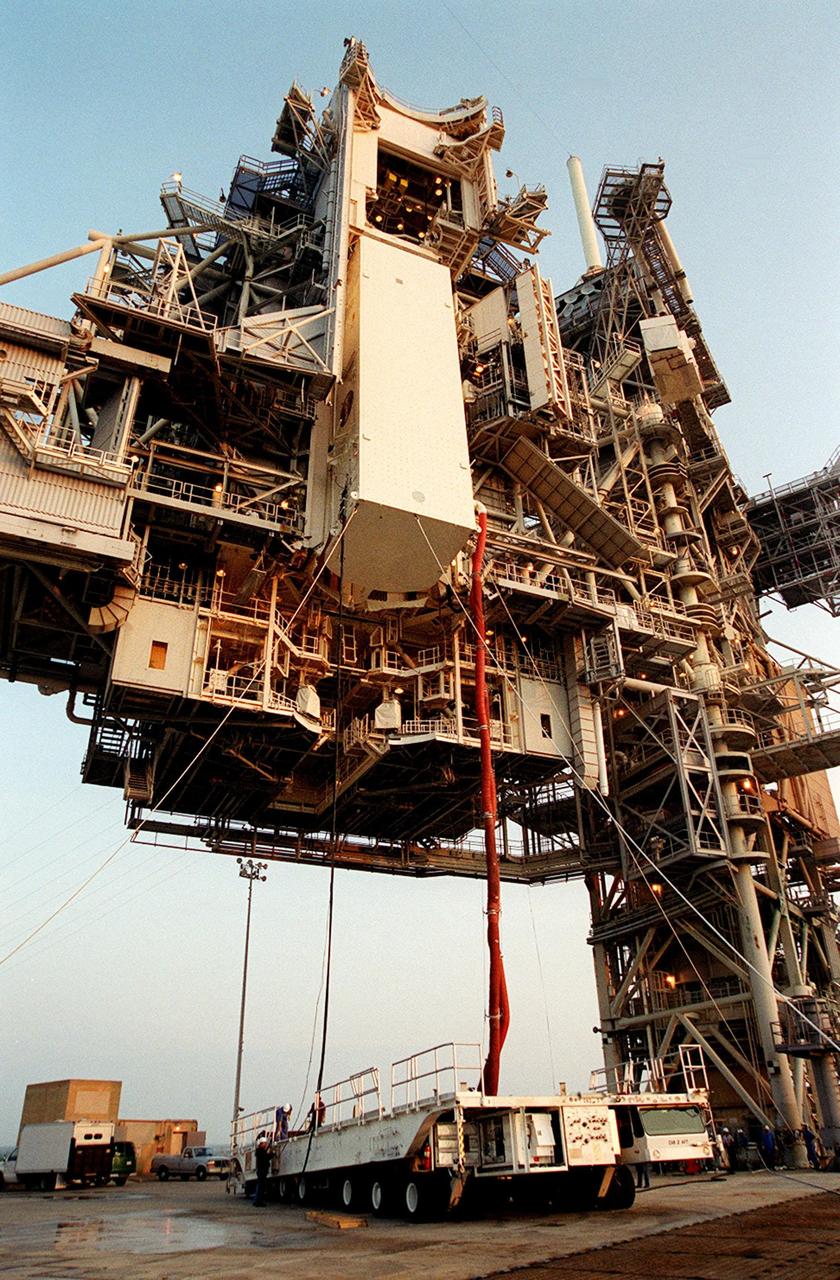
KENNEDY SPACE CENTER, FLA. -- With umbilical lines still attached, the payload canister is hoisted up alongside the Rotating Service Structure (RSS) on Launch Pad 39B. The canister with its cargo of the SPACEHAB module and Integrated Cargo Carrier will be moved into the Payload Changeout Room (PCR) near the top of the RSS for transfer to the payload bay of Shuttle Atlantis for mission STS-106. The PCR provides an environmentally controlled facility for the transfer. The 11-day mission to the International Space Station will include service module support tasks on orbit, transfer supplies and outfit the Space Station for the first long-duration crew. Atlantis is scheduled to launch Sept. 8 at 8:31 a.m. EDT
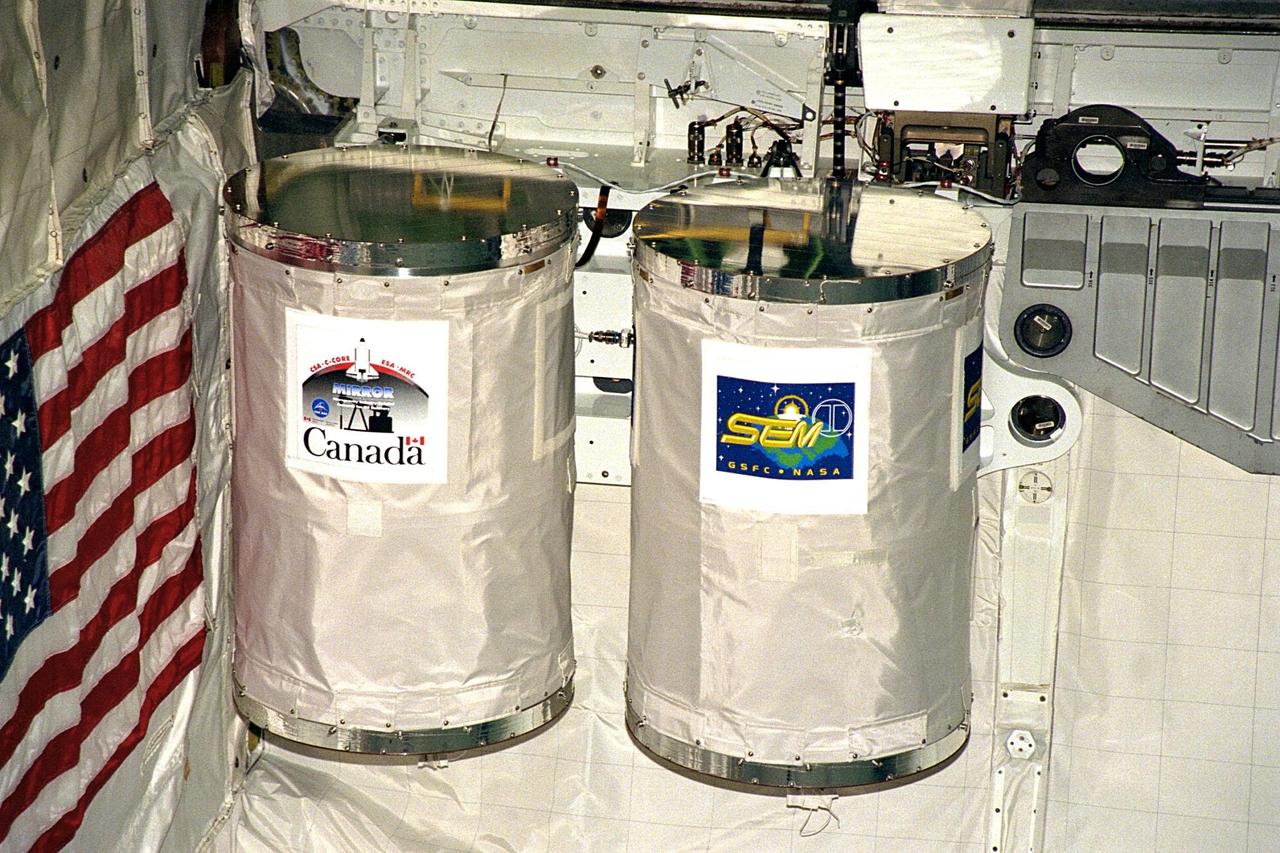
Processing activities for STS-91 continue in Orbiter Processing Facility Bay 2. Two Get Away Special (GAS) canisters are shown after their installation into Discovery's payload bay. The GAS payload G-765, in the canister on the left, is sponsored by the Canadian Space Agency and managed by C-CORE/Memorial University of Newfoundland. It is a study to understand the transport of fluids in porous media as it pertains to improving methods for enhanced oil recovery. The GAS canister on the right houses the Space Experiment Module (SEM-05), part of an educational initiative of NASA's Shuttle Small Payloads Project. STS-91 is scheduled to launch aboard the Space Shuttle Discovery for the ninth and final docking with the Russian Space Station Mir from KSC's Launch Pad 39A on June 2 with a launch window opening around 6:04 p.m. EDT
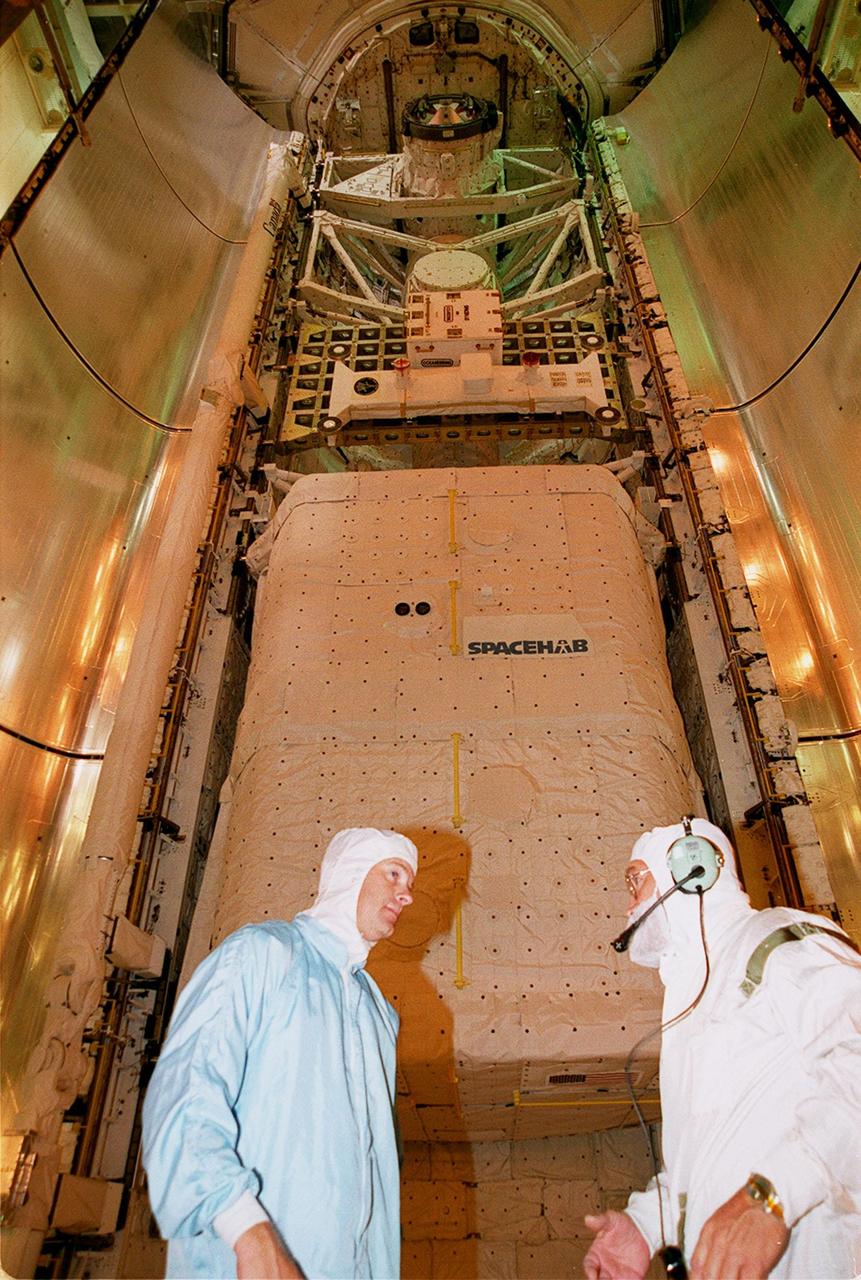
KENNEDY SPACE CENTER, FLA. -- Technicians facilitate the transfer the STS-106 payload to Atlantis on Launch Pad 39-B using the Payload Ground Handling Mechanism (PGHM). The payload within the SPACEHAB module is shown just after being loaded in the payload bay of Atlantis. The PGHM (pronounced pigem) is located inside the Payload Changeout Room (PCR) of each shuttle launch pad Rotating Service Structure. The PGHM removes payloads from a transportation canister and installs them into the orbiter. It is essentially NASA’s largest fork-lift
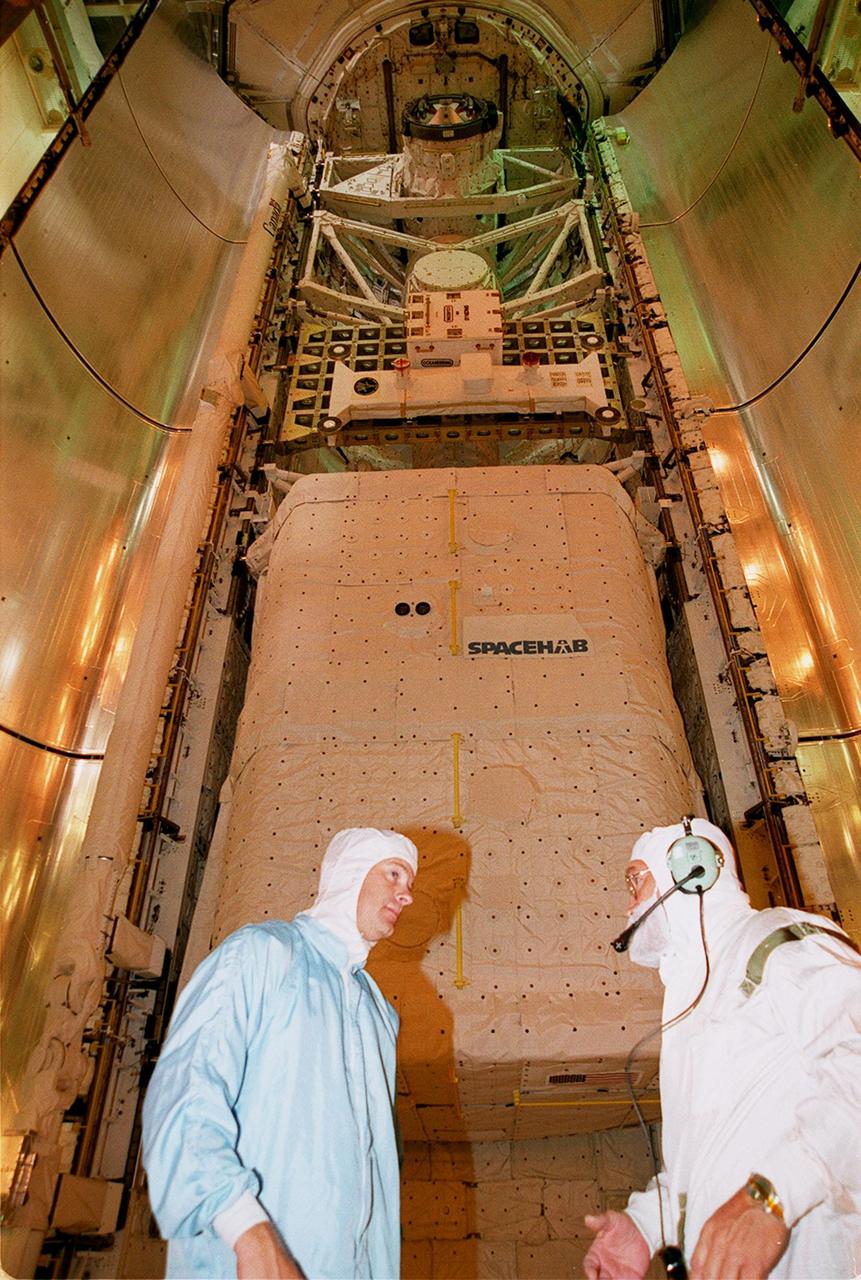
KENNEDY SPACE CENTER, FLA. -- Technicians facilitate the transfer the STS-106 payload to Atlantis on Launch Pad 39-B using the Payload Ground Handling Mechanism (PGHM). The payload within the SPACEHAB module is shown just after being loaded in the payload bay of Atlantis. The PGHM (pronounced pigem) is located inside the Payload Changeout Room (PCR) of each shuttle launch pad Rotating Service Structure. The PGHM removes payloads from a transportation canister and installs them into the orbiter. It is essentially NASA’s largest fork-lift