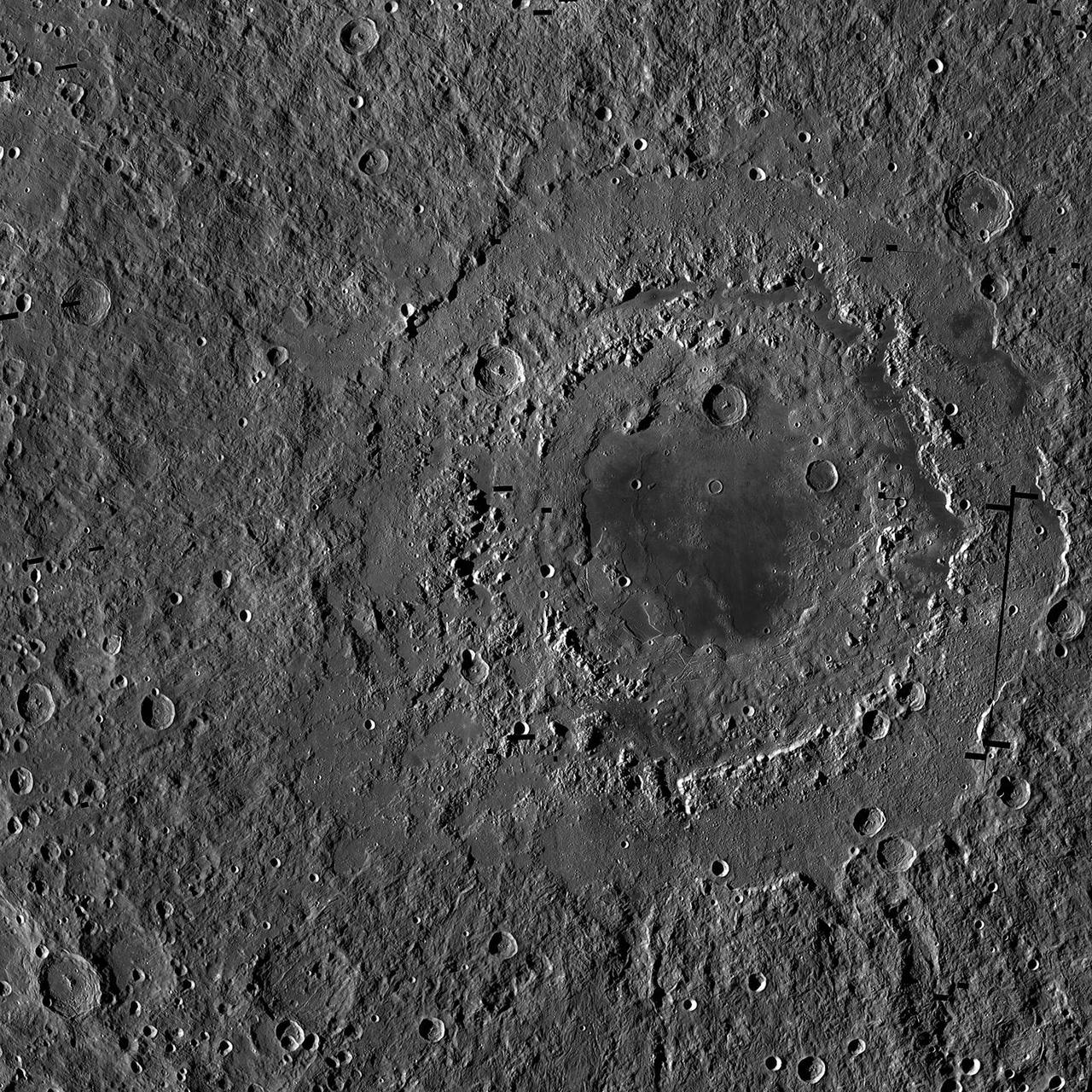
Orientale Basin
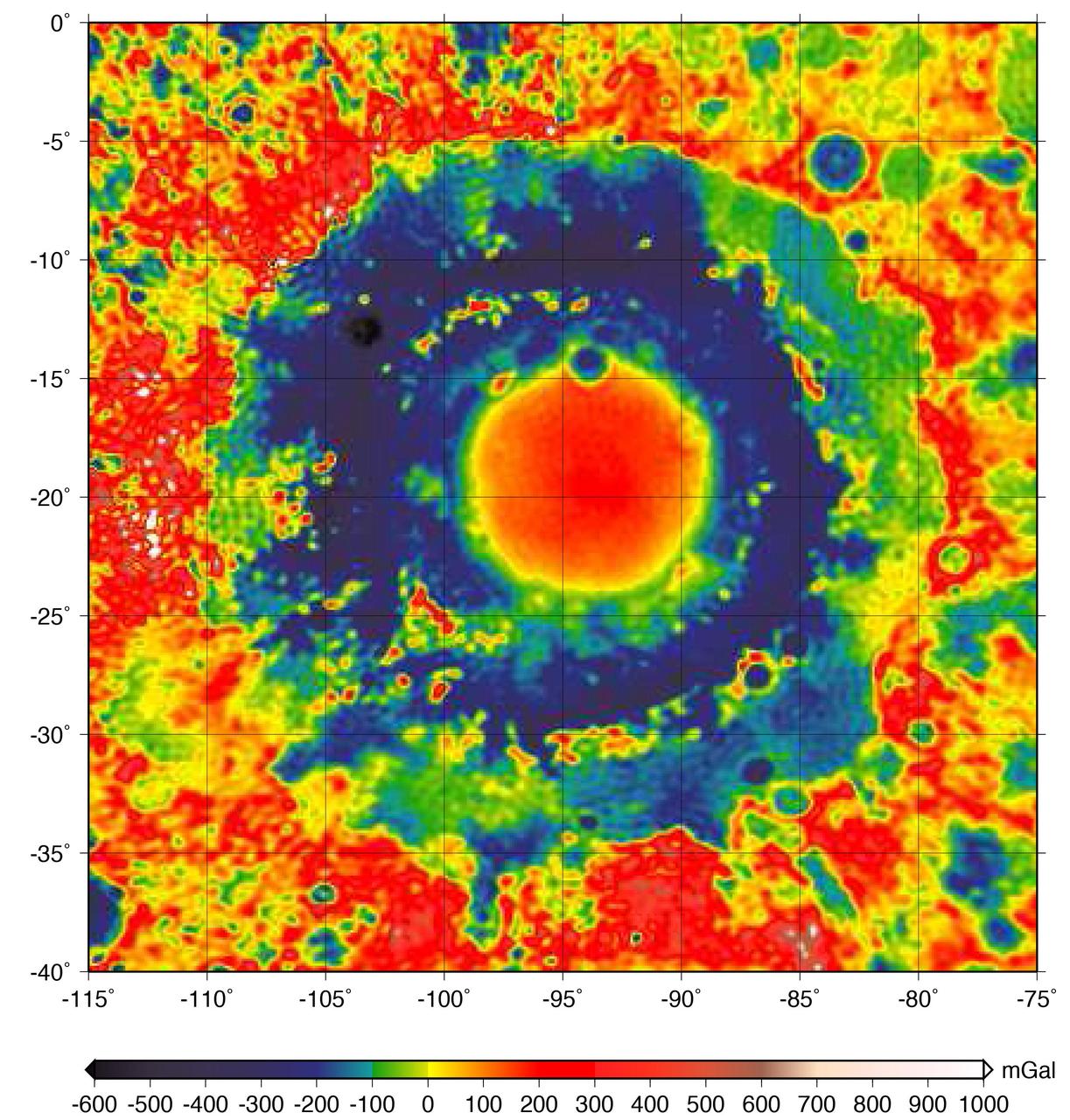
This color-coded map shows the strength of surface gravity around Orientale basin on Earth's moon, derived from data obtained by NASA's GRAIL mission. The GRAIL mission produced a very high-resolution map of gravity over the surface of the entire moon. This plot is zoomed in on the part of that map that features Orientale basin, where the two GRAIL spacecraft flew extremely low near the end of their mission. Their close proximity to the basin made the probes' measurements particularly sensitive to the gravitational acceleration there (due to the inverse squared law). The color scale plots the gravitational acceleration in units of "gals," where 1 gal is one centimeter per second squared, or about 1/1000th of the gravitational acceleration at Earth's surface. (The unit was devised in honor of the astronomer Galileo). Labels on the x and y axes represent latitude and longitude. http://photojournal.jpl.nasa.gov/catalog/PIA21050
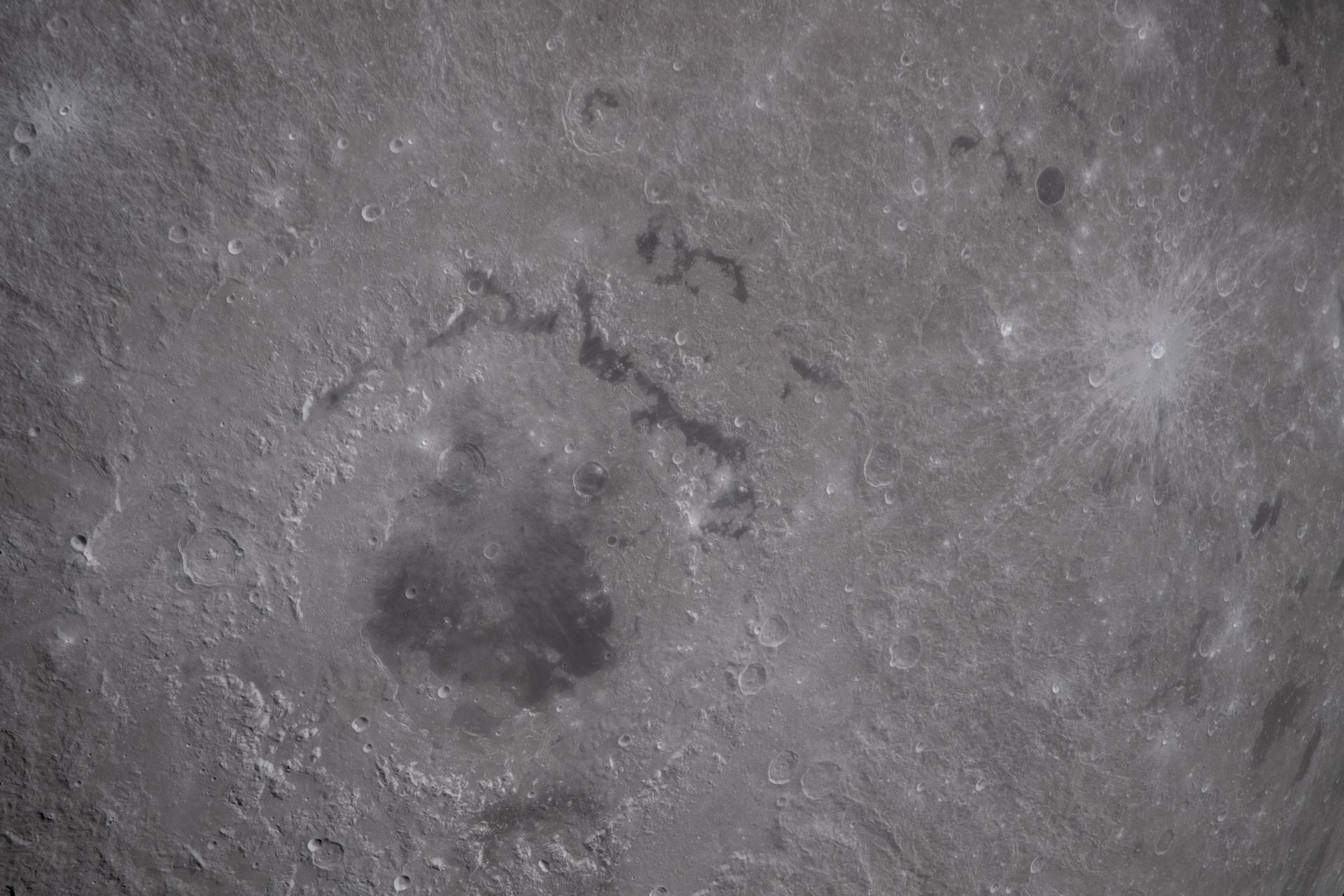
art002e012090 (April 6, 2026) - In this view of the Moon, the Artemis II crew captured an intricate snapshot of the rings of the Orientale basin, one of the Moon’s youngest and best-preserved large impact craters on his first shift during the lunar flyby observation period. Credit: NASA
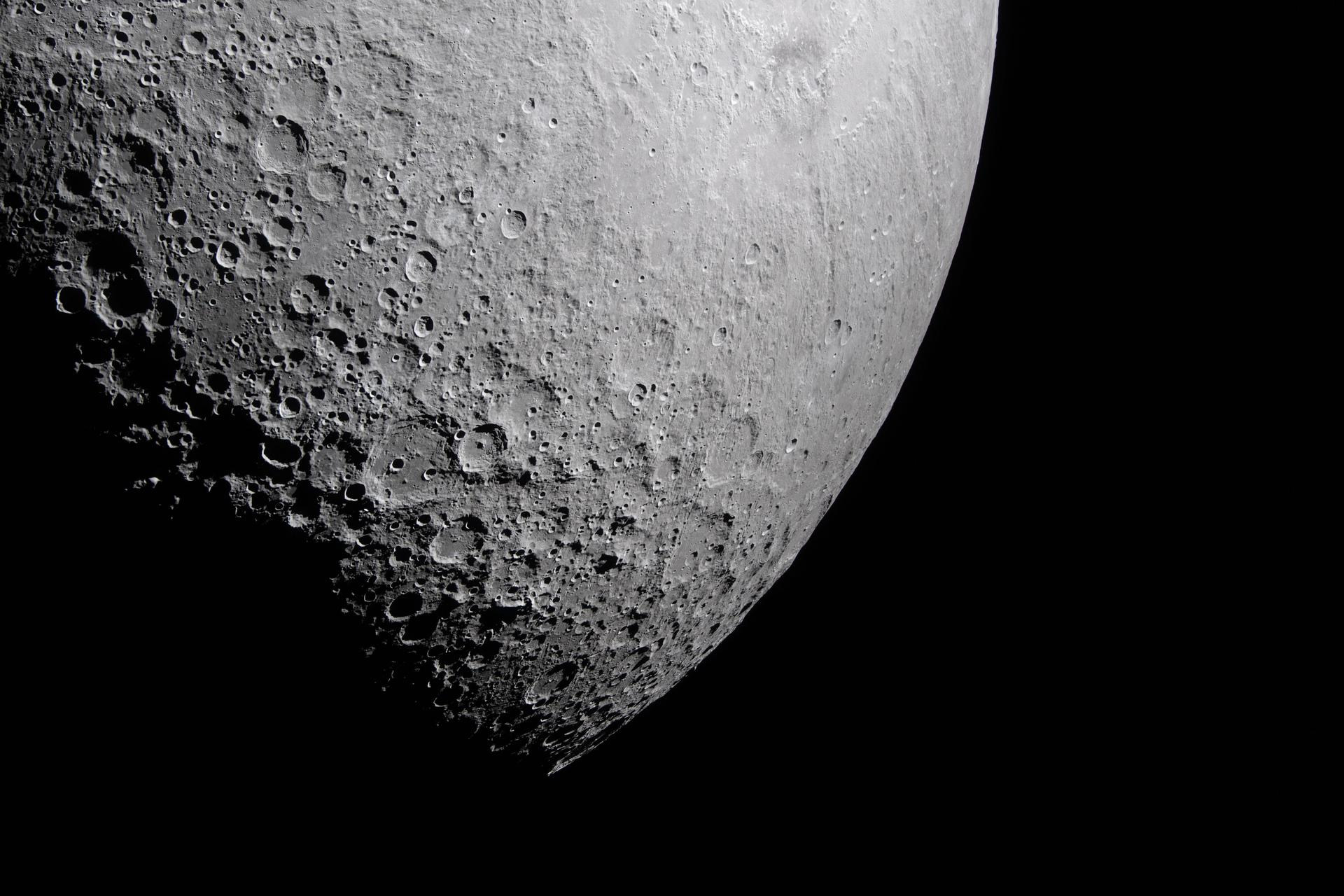
art002e020686 (April 6, 2026) – A portion of the Moon’s farside is seen along the terminator—the boundary between lunar day and night—where low-angle sunlight casts long shadows across the surface. A section of Orientale Basin is visible along the upper right portion of the lunar disk, its structure subtly revealed under grazing illumination. This lighting enhances contrast across the cratered terrain, highlighting variations in surface features and providing insight into the Moon’s geologic history. Credit: NASA
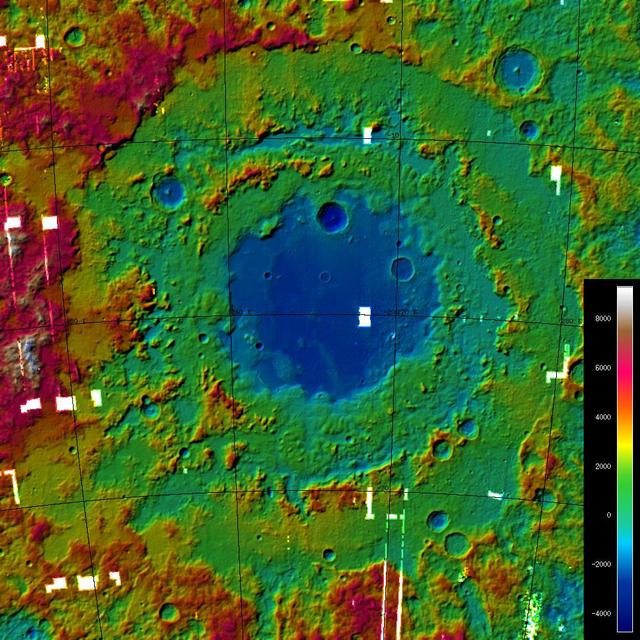
This image is a Digital Terrain Model of the large Orientale Basin, located on the western hemisphere of the Moon.
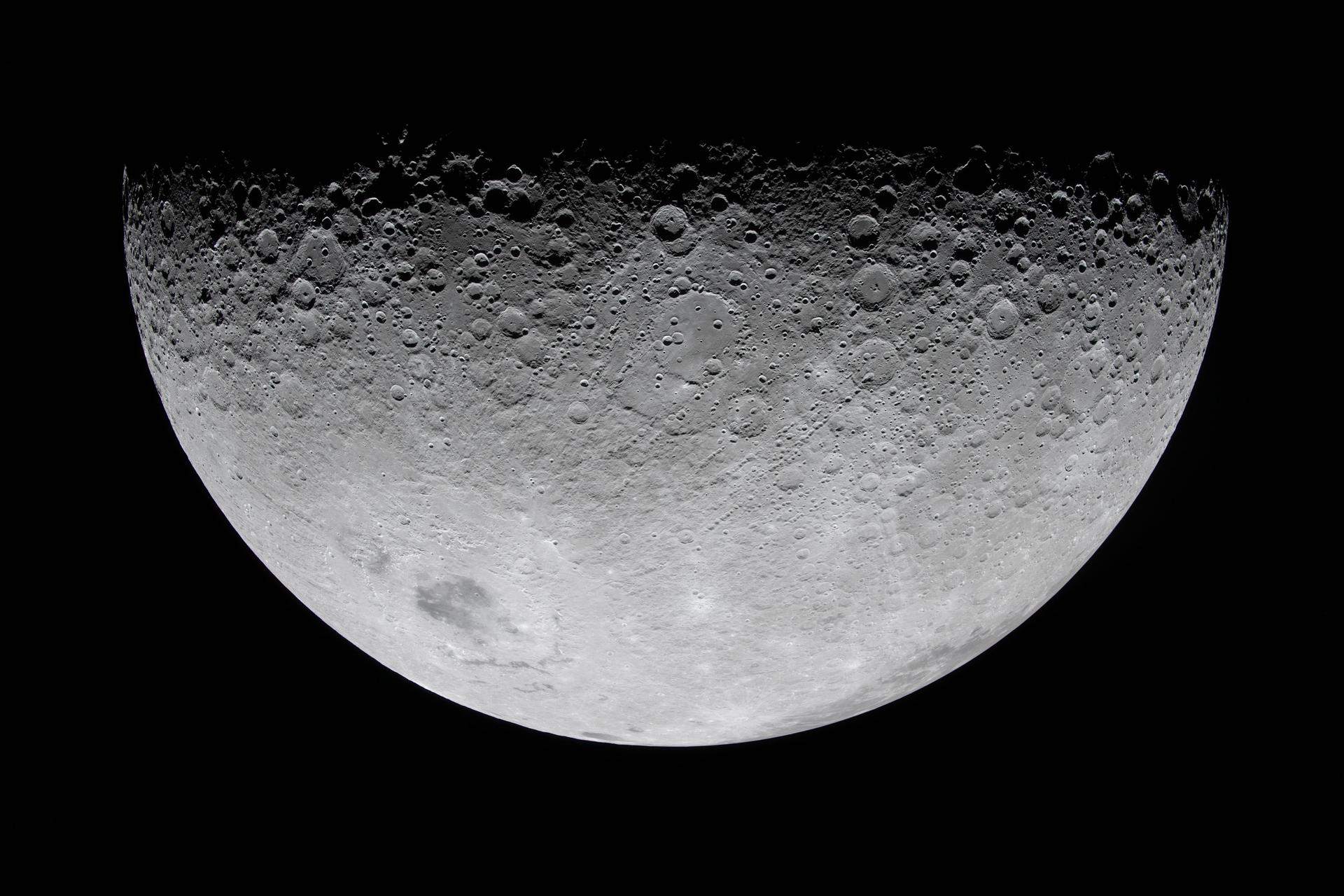
art002e010208 (April 6, 2026) - As the Artemis II crew flew over the terminator, the astronauts described this boundary between day and night as "anything but a straight line." Crater rims along the terminator stand out as "islands" in the night. Giant chains of craters emanating from the 3.7-billion-year-old Orientale basin can be seen scouring the surface, stretching almost to the terminator. This tells a geologic story: these crater chains produced by the Orientale impact event mar the surface of the relatively flat Hertzsprung Basin (center of this image), which means that Hertzsprung Basin must be even older than Orientale!
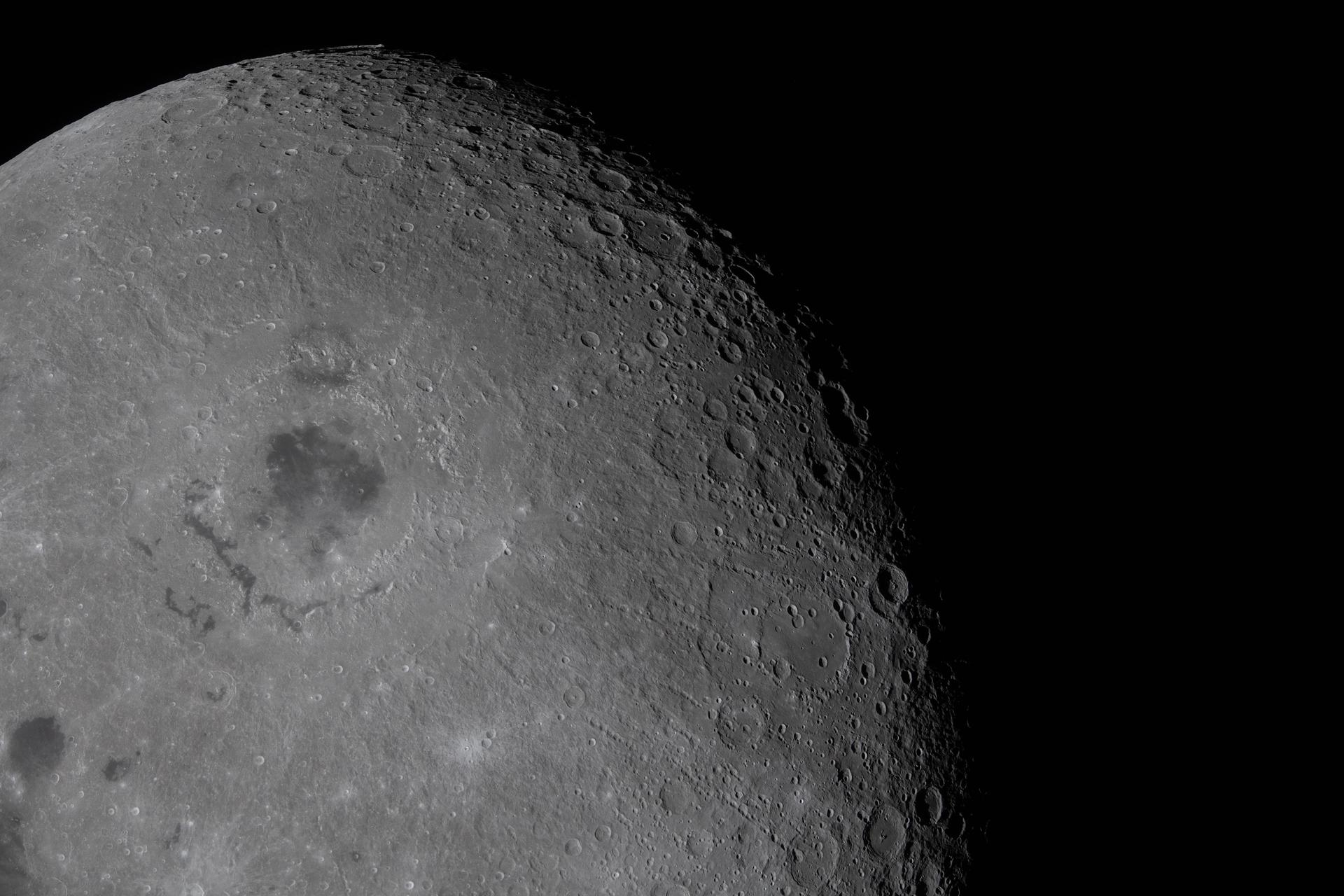
art002e009594 (April 6, 2026) – The Artemis II crew captured this view of the Moon’s Orientale basin during the lunar flyby. The basin stands out as a broad, circular feature surrounded by rugged terrain. Near the Moon’s limb, sunlight strikes the surface at a low angle, creating shadows that accentuate craters, ridges, and other topographic features. Secondary crater chains associated with Orientale extend across terrain to the northwest and south of the basin. Credit: NASA
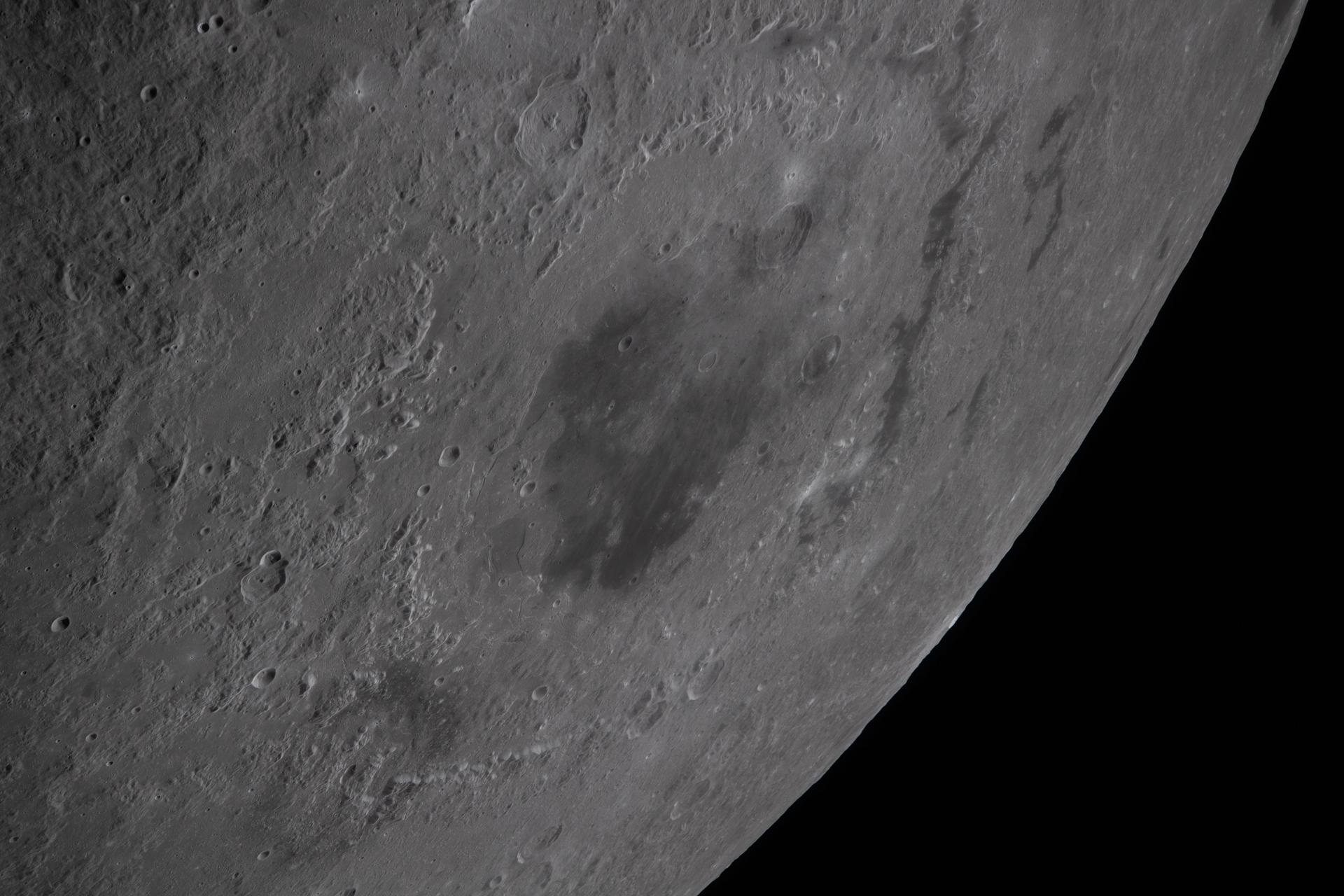
art002e010230 (April 6, 2026) – The Artemis II crew captured this angled view of the Moon’s Orientale basin during their lunar flyby. Darker material within the basin contrasts with the brighter surrounding terrain, while shadows and variations in illumination reveal ridges, craters, and other surface features. Images of Orientale acquired under different viewing and lighting angles support photometric studies of how the lunar surface reflects light. Credits: NASA
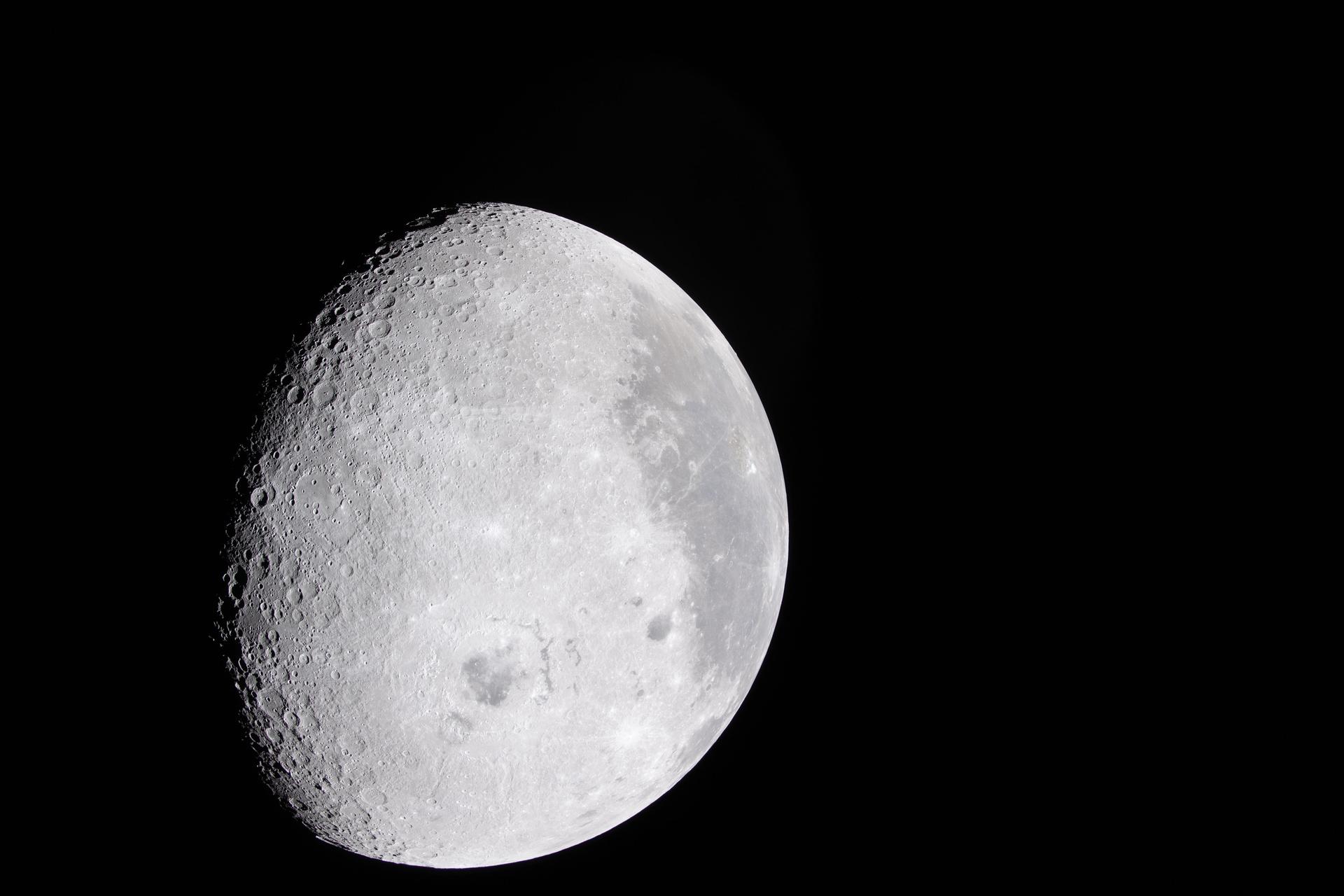
art002e009627 (April 6, 2026) – During the first shift of the lunar flyby observation period, the Artemis II crew captured more than two-thirds of the Moon, highlighting surface details on the nearside, including the 600-mile-wide impact crater, Orientale basin, along the boundary between the near and far sides. They also captured the Grimaldi crater, a dark, round feature northeast of Orientale, known for its dark mare lava floor and heavily worn rim.
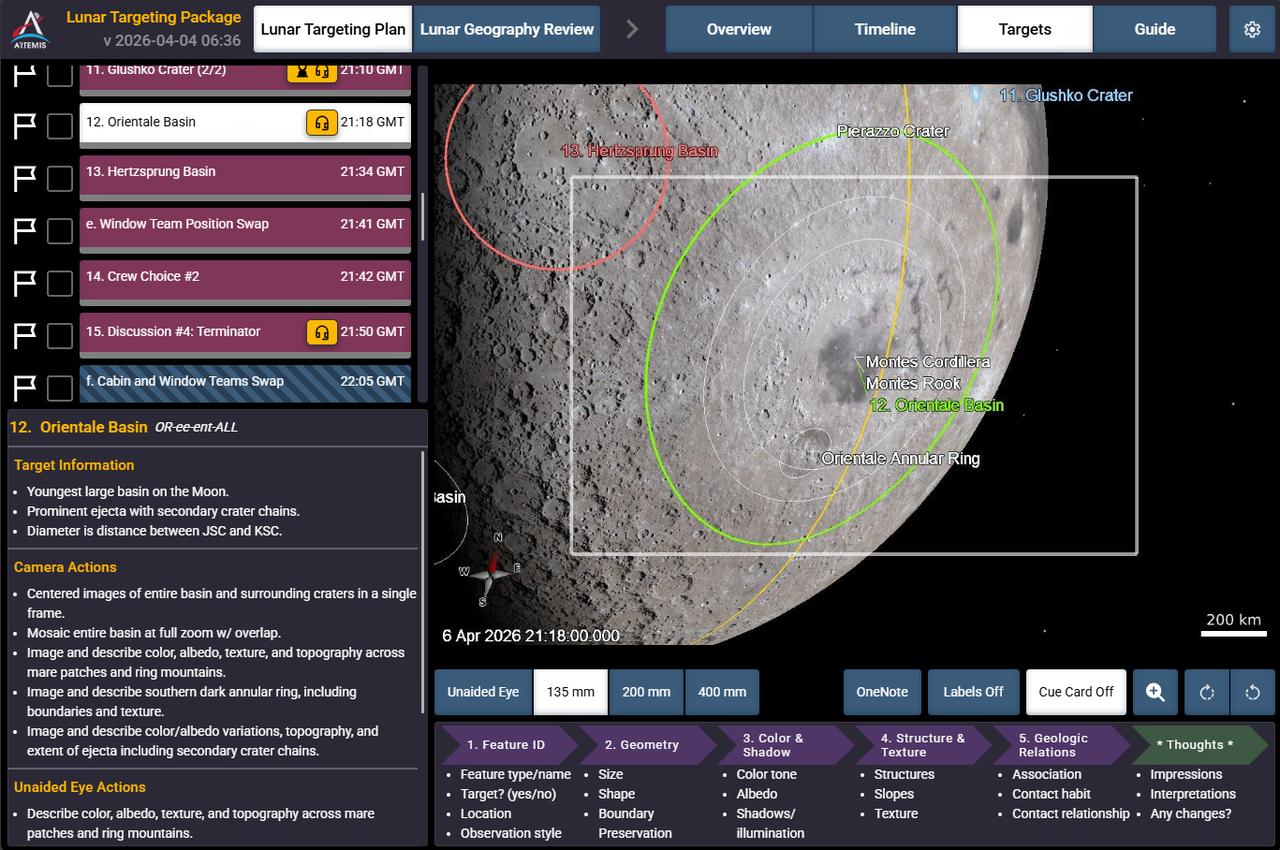
Caption: This is a screen shot of the application the crew sees on their personal computing devices that guides them in the execution of the lunar science observation plan. This custom software was built by the crew lunar observations team, a subset of the Artemis II lunar science team. In this screenshot you can see Orientale basin, target number 12 circled on the bottom right of the Moon, and to its left, target number 13, Hertzsprung basin.
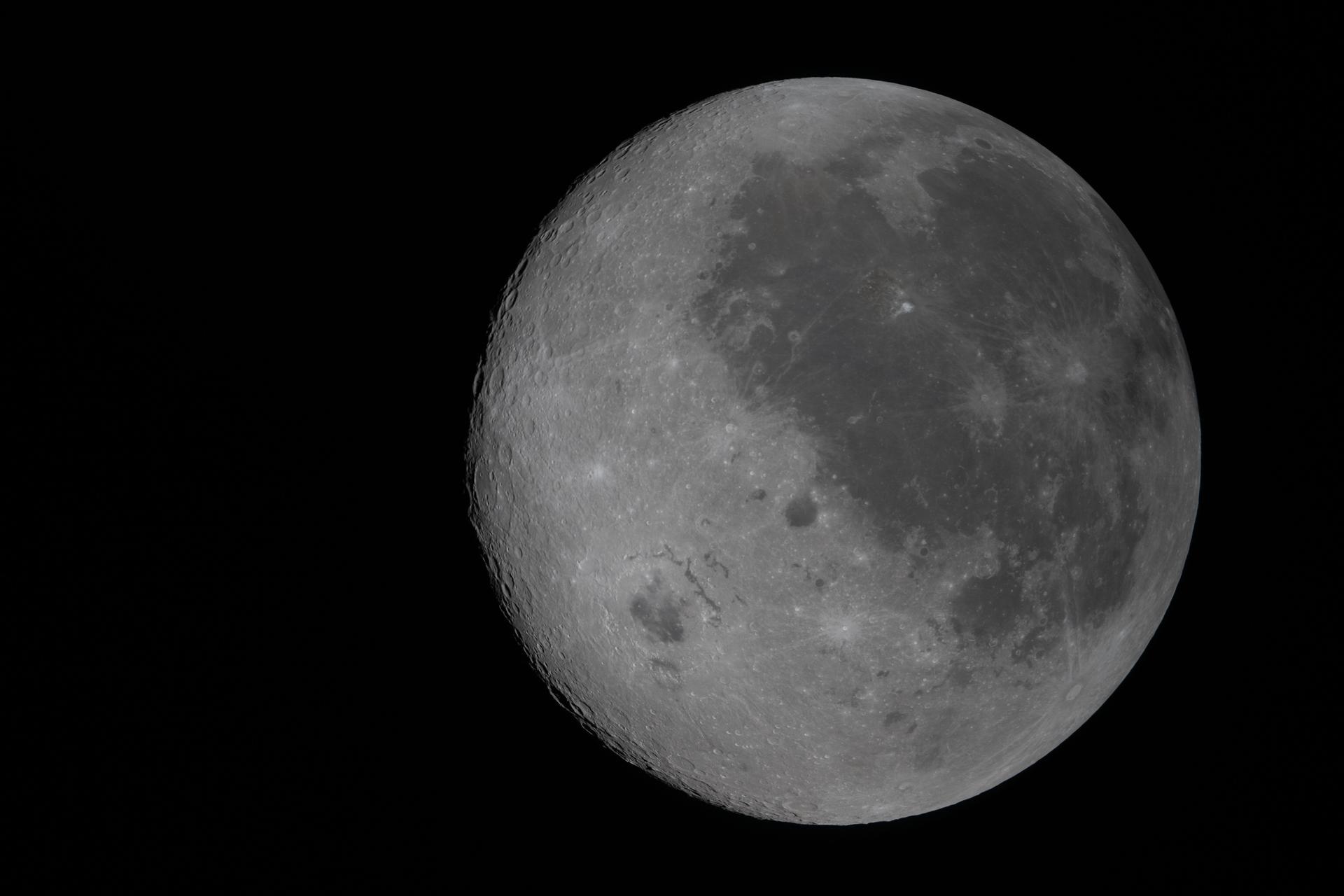
art002e009212 (April 6, 2026) In this fully illuminated view of the Moon, the near side (the hemisphere we see from Earth), is visible on the right. It is identifiable by the dark splotches that cover its surface. These are ancient lava flows from a time early in the Moon’s history when it was volcanically active. The large crater west of the lava flows is Orientale basin, a nearly 600-mile-wide crater that straddles the Moon’s near and far sides. Orientale's left half is not visible from Earth, but in this image we have a full view of the crater. Everything to the left of the crater is the far side, the hemisphere we don’t get to see from Earth because the Moon rotates on its axis at the same rate that it orbits round us.
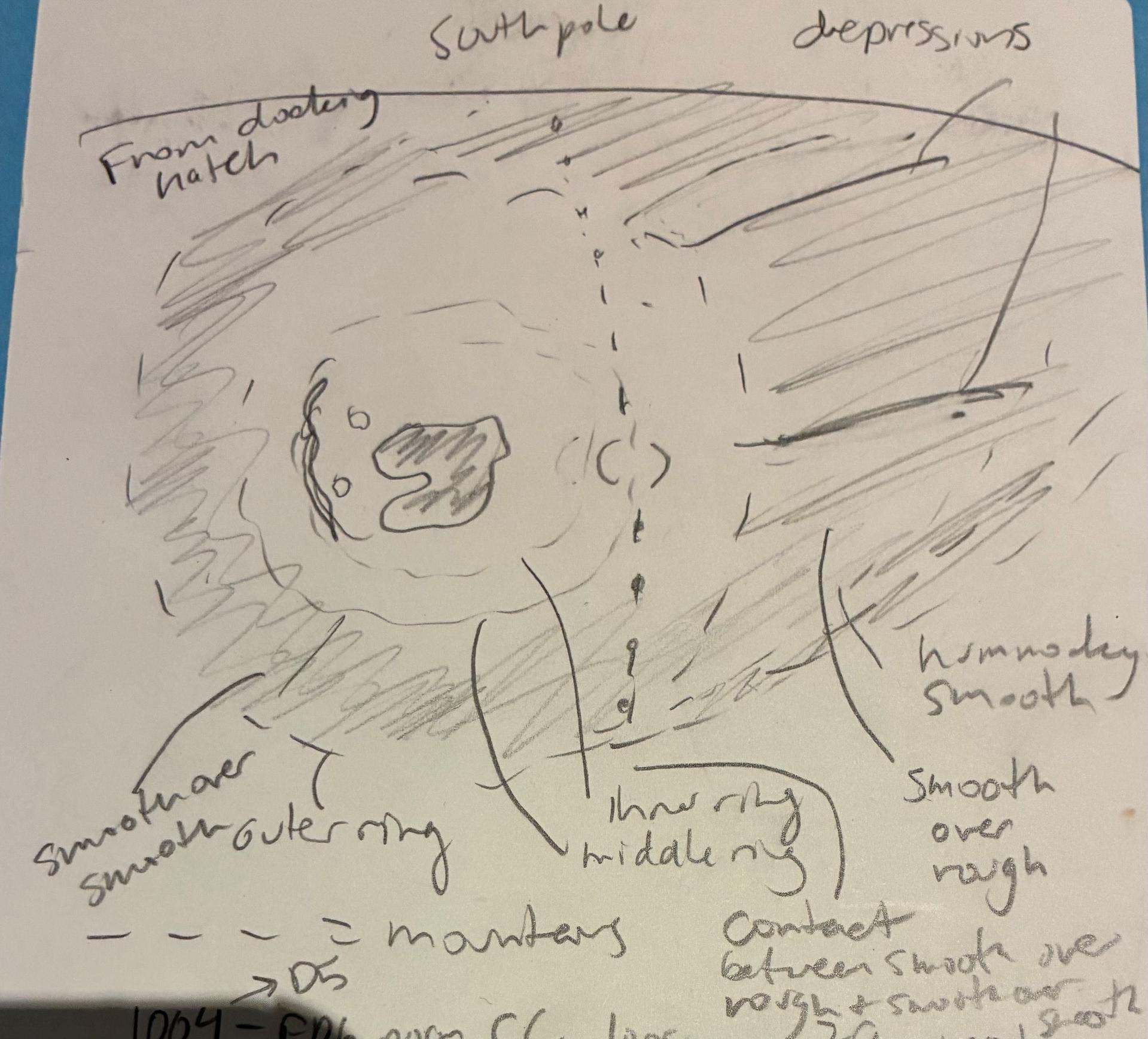
art002e050885 (April 6, 2026) – Artemis II crew member Christina Koch sketched the Orientale basin as observed through Orion’s docking hatch during the lunar flyby. Her in-flight annotation documents differences in texture across the basin and surrounding terrain, including areas she described as smooth and rough. The sketch is oriented with the Moon’s South Pole toward the top, an unconventional orientation that reflects the crew’s view from the spacecraft.

art002e024311 (April 6, 2026) - The Artemis II crew was tasked with capturing many key features visible in this image of the Moon, captured on flight day 6. The terminator, or the difference in light and darkness, is visible on the top left. The large dark gray area toward center-left is Orientale Basin, while the characteristic dark patches of ancient lava flow we see on the near side are visible on the right half of this image.
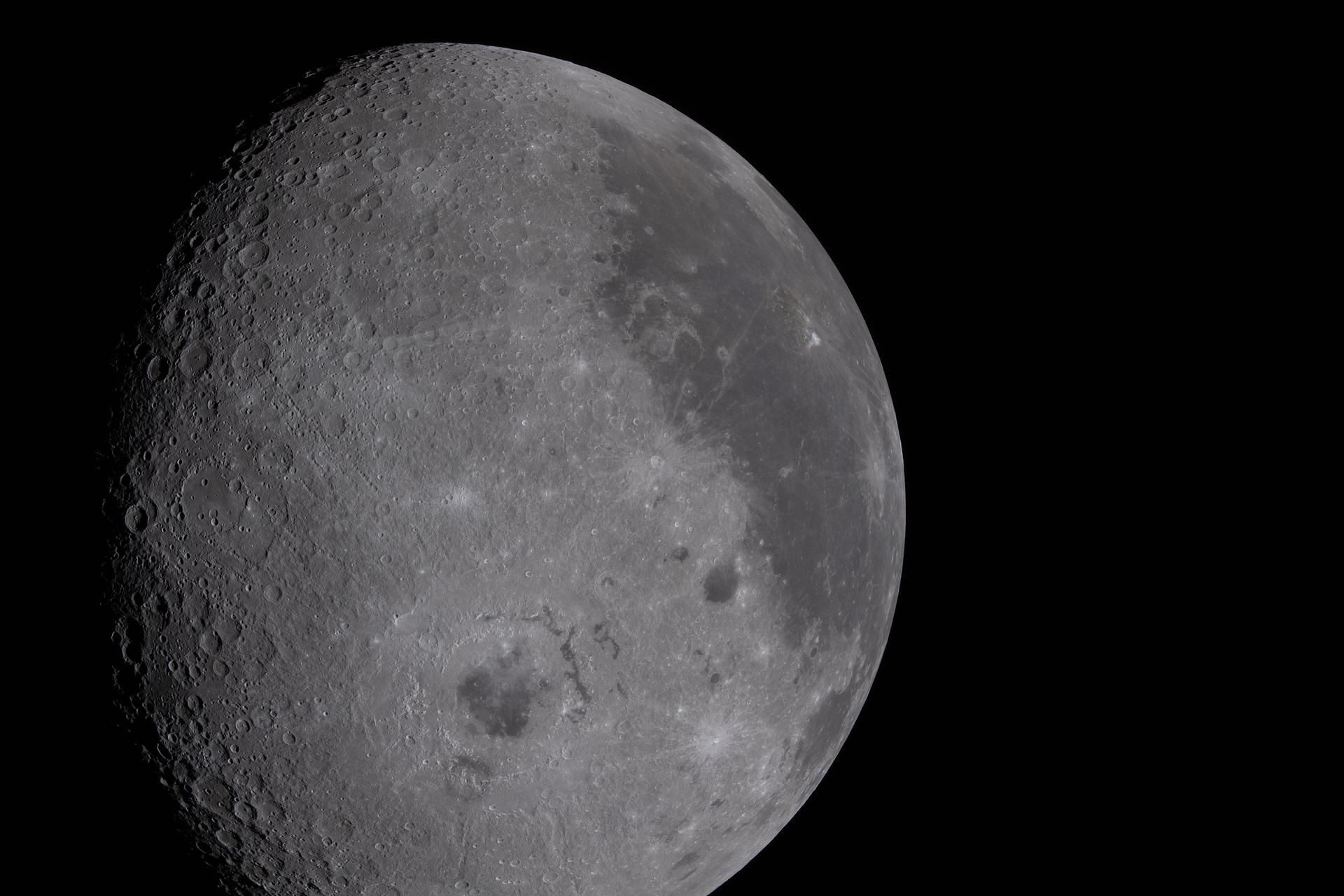
art002e012183 (April 6, 2026) - On the first shift during the lunar flyby observation period, the Artemis II crew captured more than two-thirds of the Moon showcasing the intricate features of the nearside. The 600-mile-wide impact crater, Orientale basin, lies along the transition between the near and far sides and is sometimes partly visible from Earth. The round black spot northeast of Orientale is Grimaldi crater, known for its exceptionally dark mare lava floor and heavily degraded rim. Credit: NASA
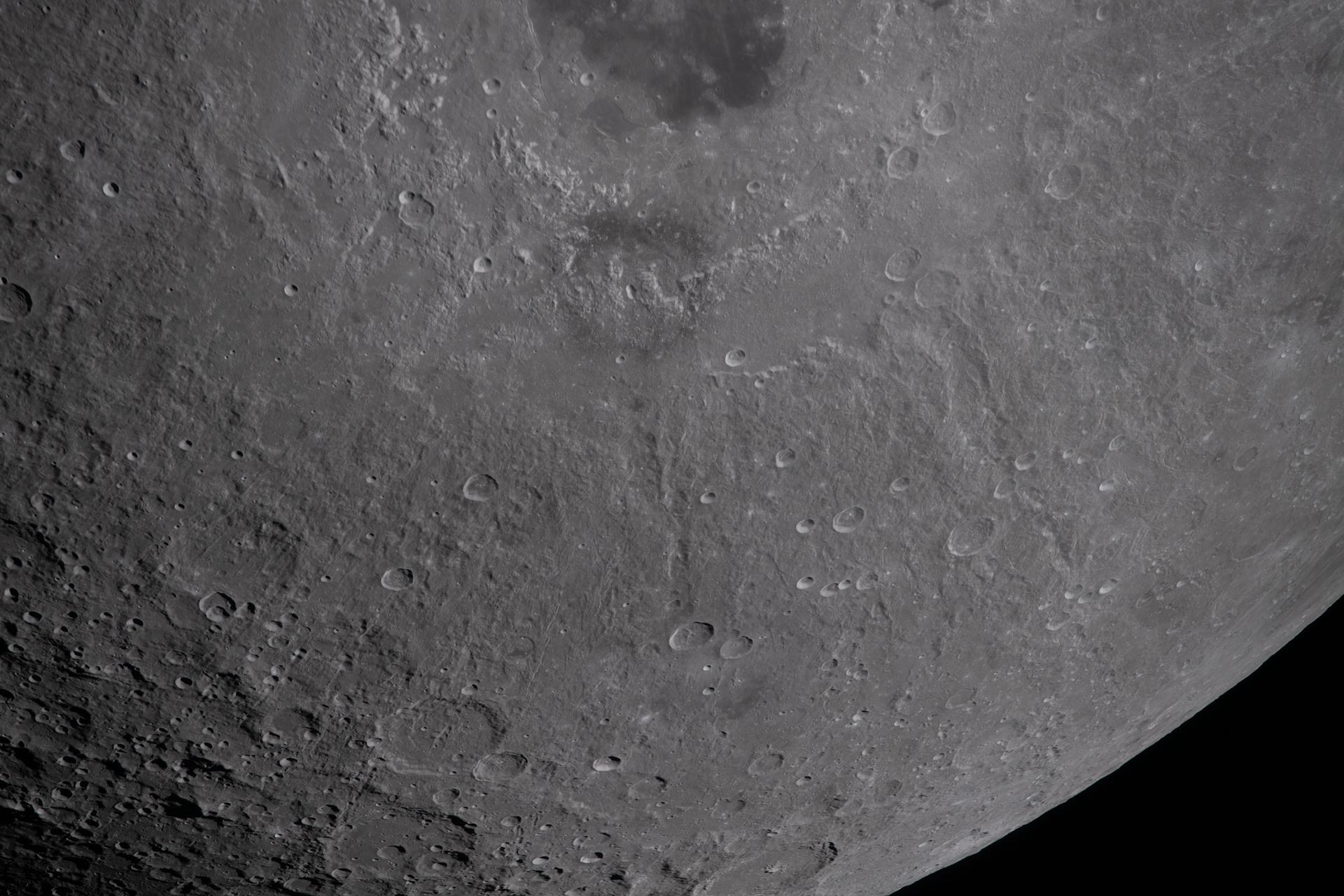
art002e012273 (April 6, 2026) - This view of the southwest portion of Orientale Basin highlights its prominent annular ring—a sweeping arc of mountainous terrain formed by the immense energy of an ancient impact. The ring structure rises above the surrounding surface, tracing the basin’s outer boundary and revealing the layered, multi-ring nature of one of the Moon’s most well-preserved impact features. Apollo-era observers nicknamed this formation “the kiss,” reflecting its distinctive, curved shape.
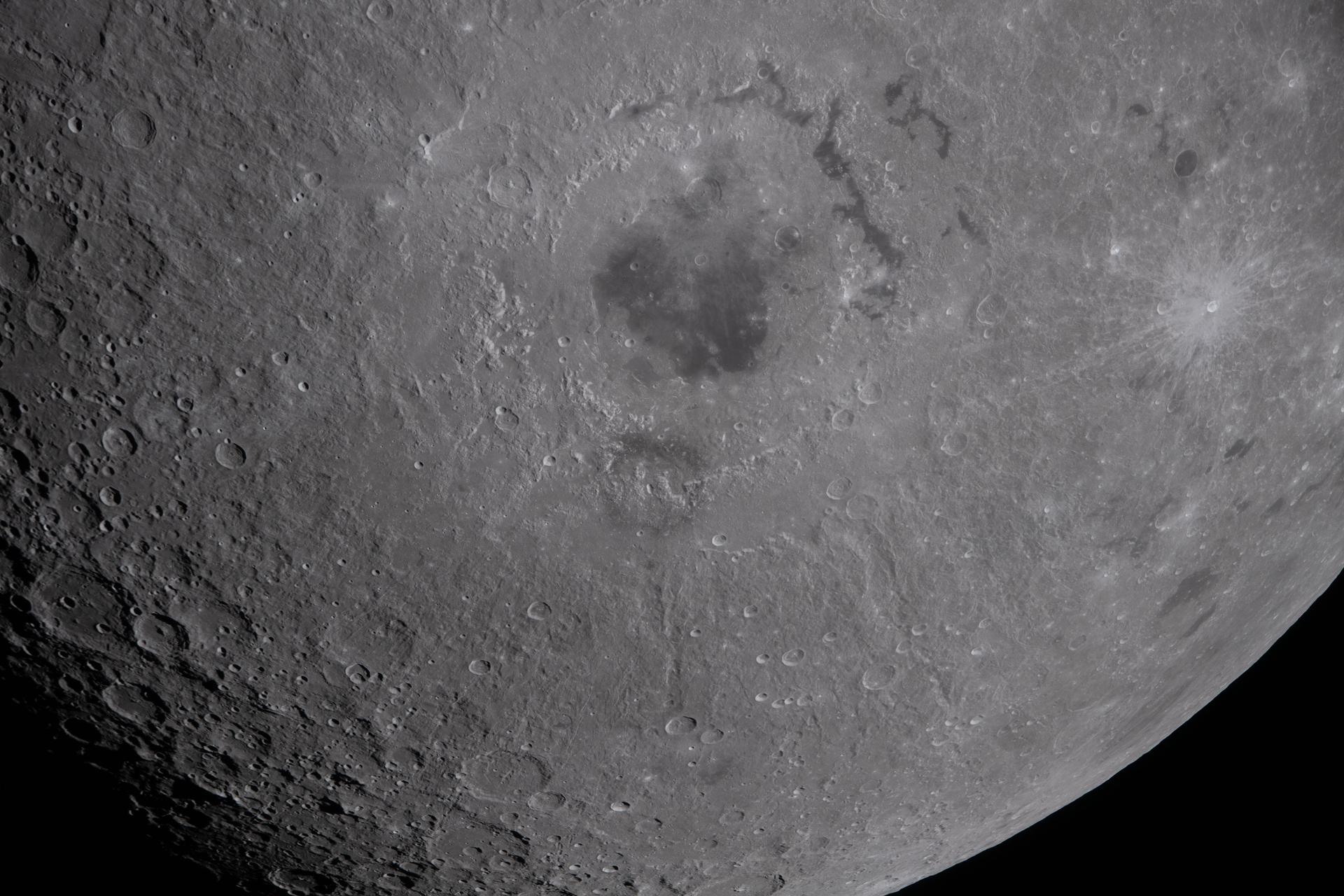
art002e012129 (April 6, 2026) - The lower half of the Moon hangs suspended in time in this photograph from the Artemis II crew during the lunar flyby observation period. In the upper center of the photo, the Orientale basin is the prominent feature, with a black patch of ancient lava in the center that punched through the Moon’s crust in an eruption billions of years ago. Credit: NASA
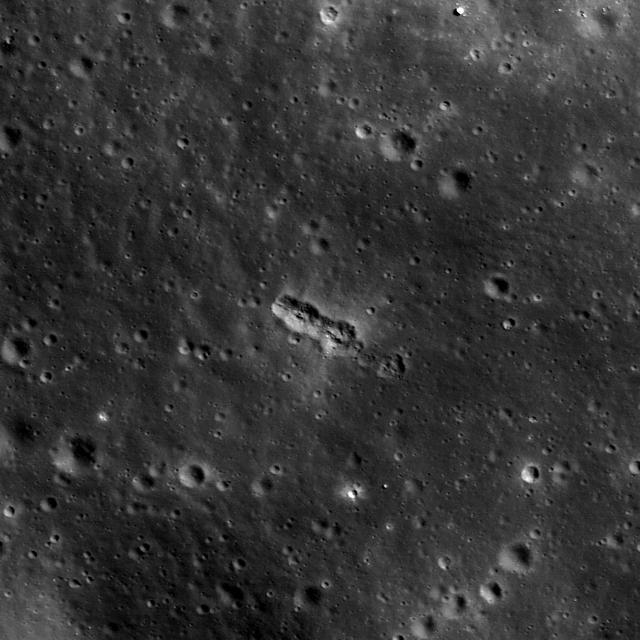
This image taken by NASA Lunar Reconnaissance Orbiter shows a small secondary crater chain near the southwestern margin of Mare Orientale, within the Inner Rook Mountains. The ~125-meter-long chain lies within the Orientale multi-ring basin.
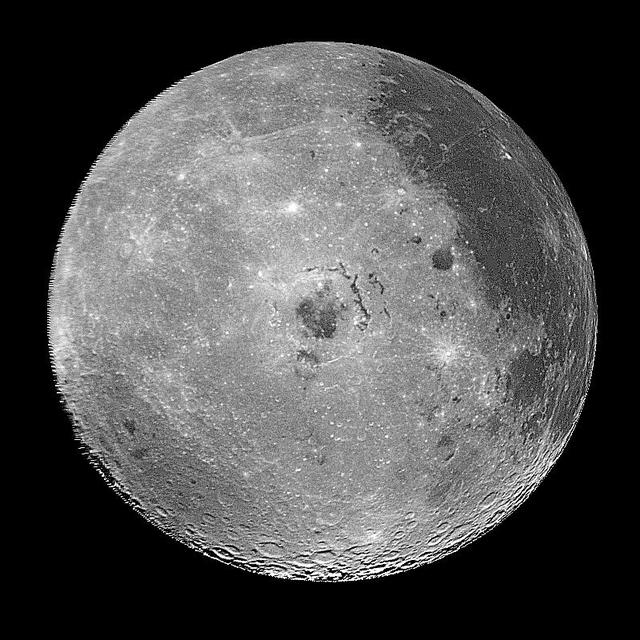
This image of the western hemisphere of the Moon was taken through a green filter by NASA's Galileo spacecraft at 9:35 a.m. PST Dec. 9 at a range of about 350,000 miles. In the center is the Orientale Basin. http://photojournal.jpl.nasa.gov/catalog/PIA00120
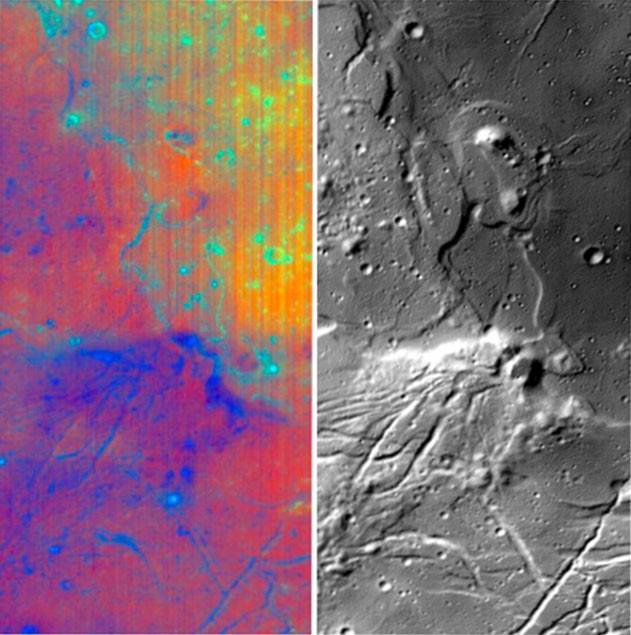
Different wavelengths of light provide new information about the Orientale Basin region of the moon in a composite image taken by NASA Moon Mineralogy Mapper, a guest instrument aboard the Indian Space Research Organization Chandrayaan-1 spacecraft.
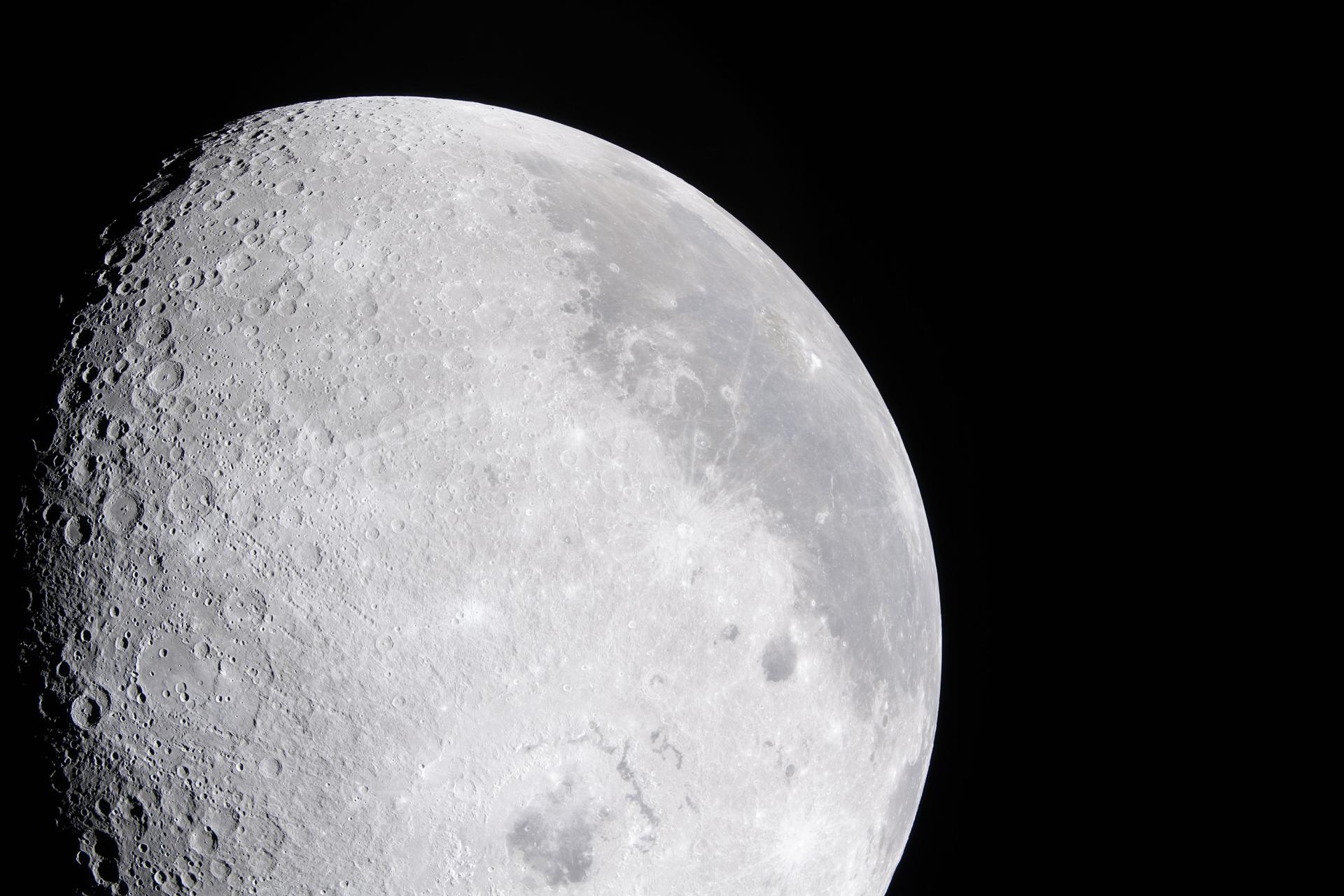
art002e010014 (April 6, 2026) – A bright portion of the Moon is visible in this image. If you look closely, you can see linear, pitted features known as “crater chains” radiating from the Orientale basin, an impact crater with a patch of ancient lava at its center, visible in the bottom center of the image. These crater chains formed about 3.8 billion years ago, when rocks spewed from the collision that formed Orientale landed in lines extending away from the crater. These chains are found near other large craters on the Moon, but we don’t get to see them on Earth because our planet’s crust has been turned over so many times through plate tectonics and largely erased by rain, wind, and ice. In the upper left corner of the Moon disk is a line called the terminator, the boundary between lunar day and night. Here, low-angle sunlight skims the surface, casting dramatic shadows that expose the area’s topography — or the shape of its surface. Glushko crater is the bright spot just to the left of the dark mare, or “sea” of ancient lava flows on the near side of the Moon. It’s identifiable by the bright rays that shoot across the mare, some hundreds of miles away. These rays are made of ejected material after the collision that formed Glushko. Glushko and its rays are brighter than the surrounding area because that younger has experienced less weathering from radiation and impacts. Oceanus Procellarum, the largest lava-filled region on the Moon, spans the horizon. The Aristarchus crater, the bright spot in the sea of lava, creeps toward the right edge of the Moon.
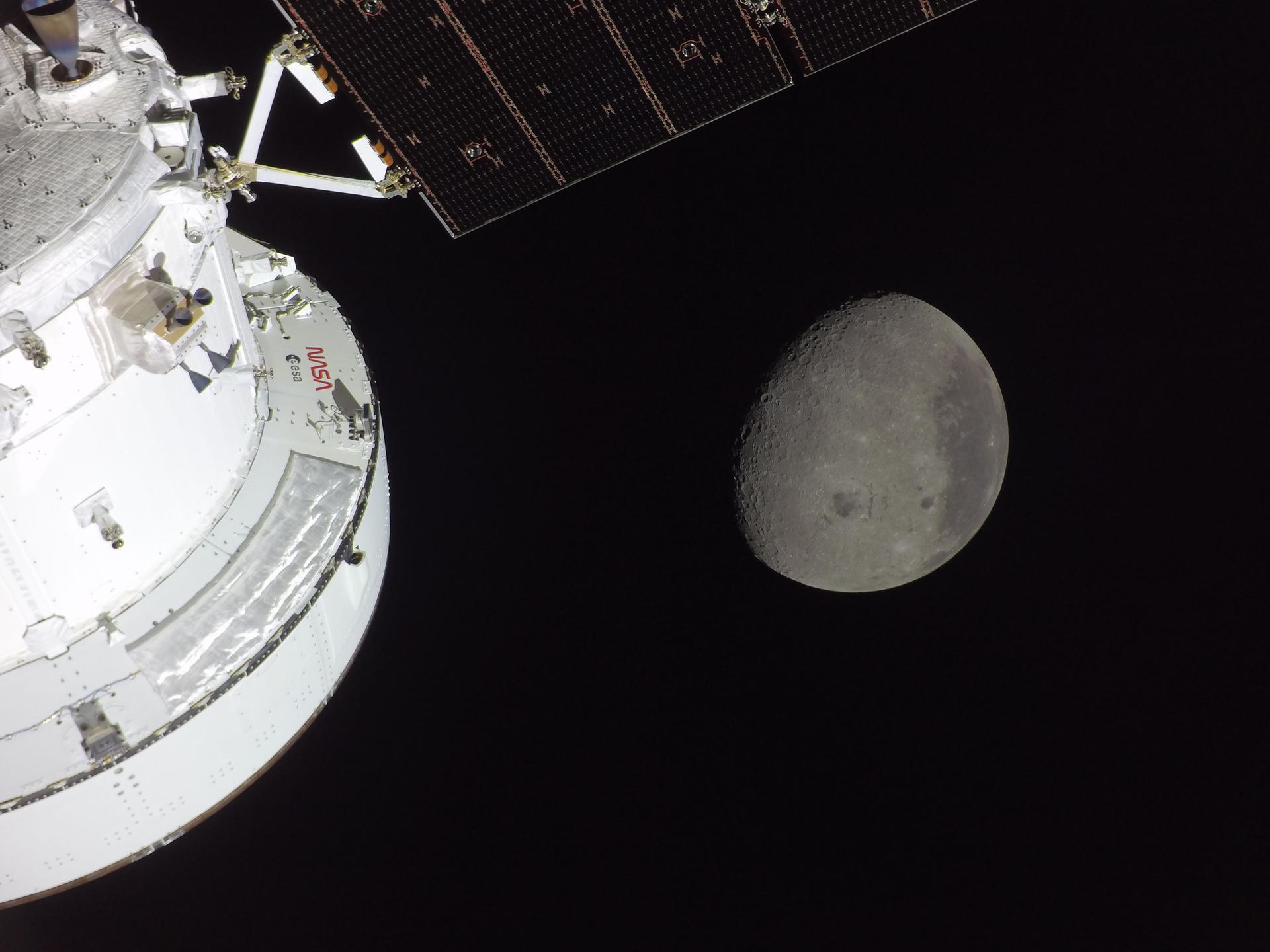
art002e009562 (April 6, 2026) - The Orion spacecraft is seen in the foreground lit up by the Sun. A waxing gibbous Moon is visible in the background. Orientale basin, a 600-mile-wide impact crater ringed by mountains, is visible toward the center bottom of the Moon. This basin straddles the Moon’s near and far sides. To the left of Orientale, which has a patch of ancient lava in its basin, is the far side; this is the hemisphere we don’t get to see from Earth. To the right of Orientale is the near side, the hemisphere we see every day from Earth. The nearside is notable for giant, dark patches of ancient lave flows that cover its surface.
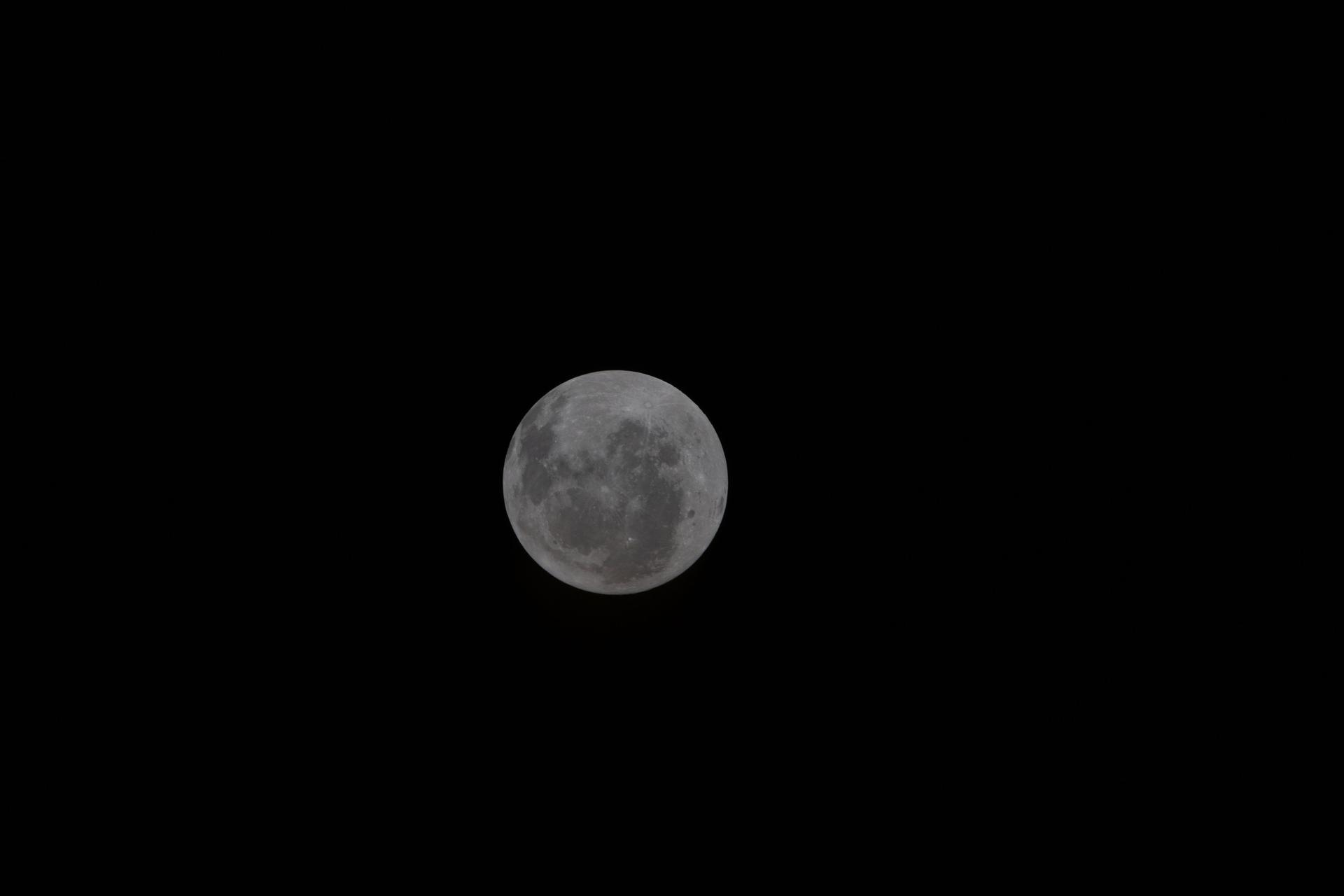
art002e009006 (April 4, 2026) - The Artemis II crew took this photo on day 4 of their journey to the Moon. In it, the Moon is oriented with the South Pole at the top and are beginning to see parts of the lunar far side. Orientale basin is on the right edge of the lunar disk in this image. Artemis II marks the first time that humans have seen the entire basin. The Artemis II crew will continue to observe Orientale from multiple angles as they approach the Moon and throughout the lunar flyby. Orientale is the textbook multi-ring impact basin used as a baseline to compare other impact craters on rocky worlds from Mercury to Pluto.
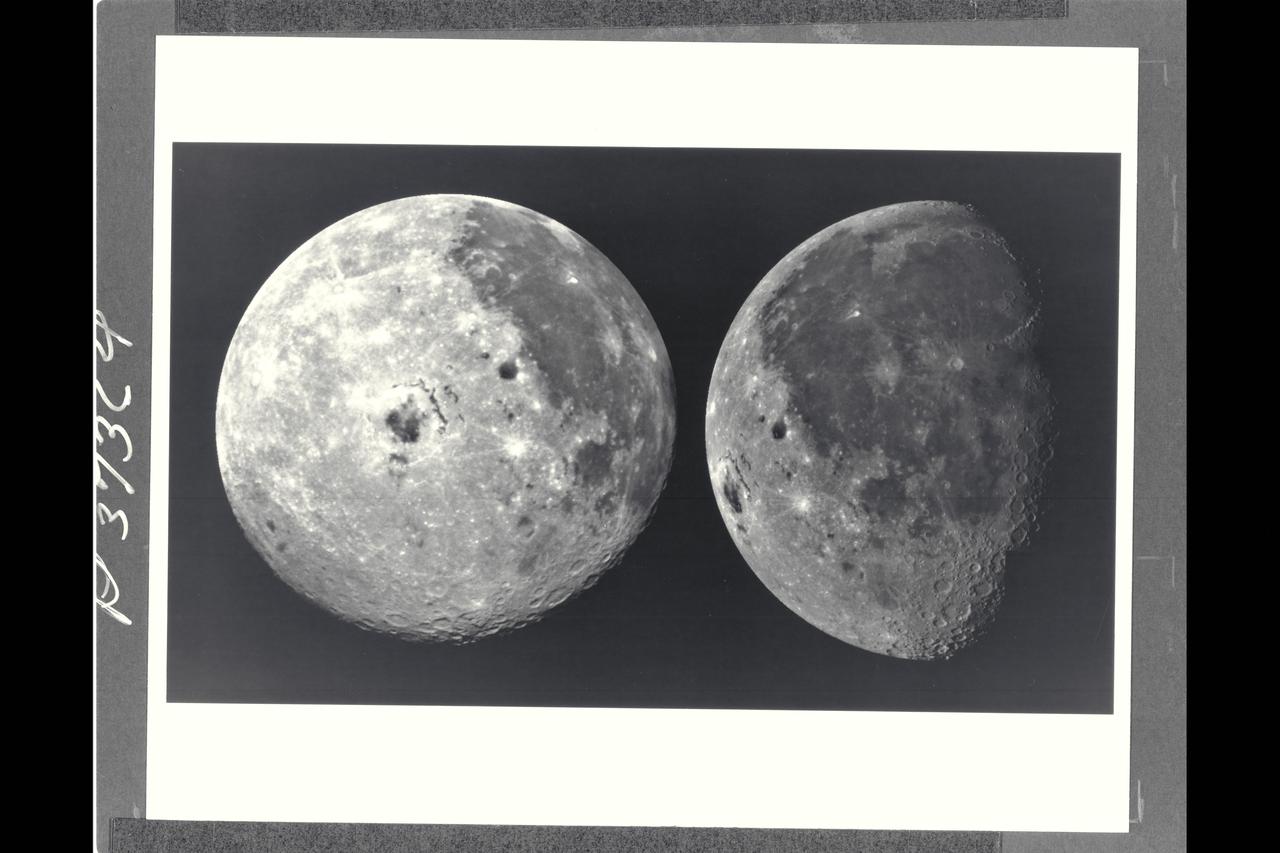
Range : 220,000 mi. (left)/350,000 mi. (right) These pictures of the Moon were taken by the Galileo spacecraft. Image on the right shows the dark Oceanus Procellarum in the upper center, with Mare Imbrium above it and the smaller circular Mare Humorum below. The Orientale Basin, with a small mare in its center, is on the lower left near the limb or edge. Between stretches the cratered highland terrain, with scattered bright young craters on highlands and maria alike. The left image shows the globe of the Moon rotated, putting Mare Imbrium on the eastern limb and moving the Orientale Basin almost to the center. The extent of the cratered highlands on tghe far side is very apparent., At lower left, near the limb, is the South-Pole-Aitken basin, similar to Orientale but very much older and some 1,200 miles in diameter. This feature was previously known as a large depression in the southern far side; this image shows its Orientale-like structure and darkness relative to surrounding highlands.
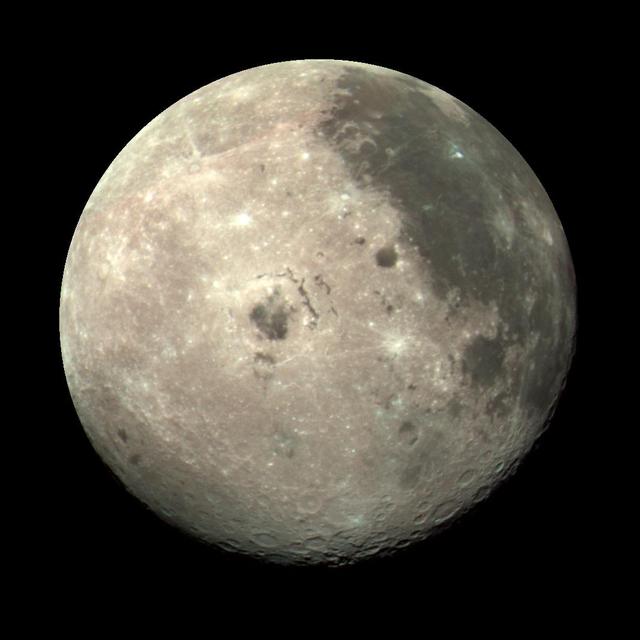
This color image of the Moon was taken by NASA's Galileo spacecraft at 9:35 a.m. PST Dec. 9, 1990, at a range of about 350,000 miles. The concentric, circular Orientale basin, is near the center; the nearside is to the right, the far side to the left. http://photojournal.jpl.nasa.gov/catalog/PIA00113
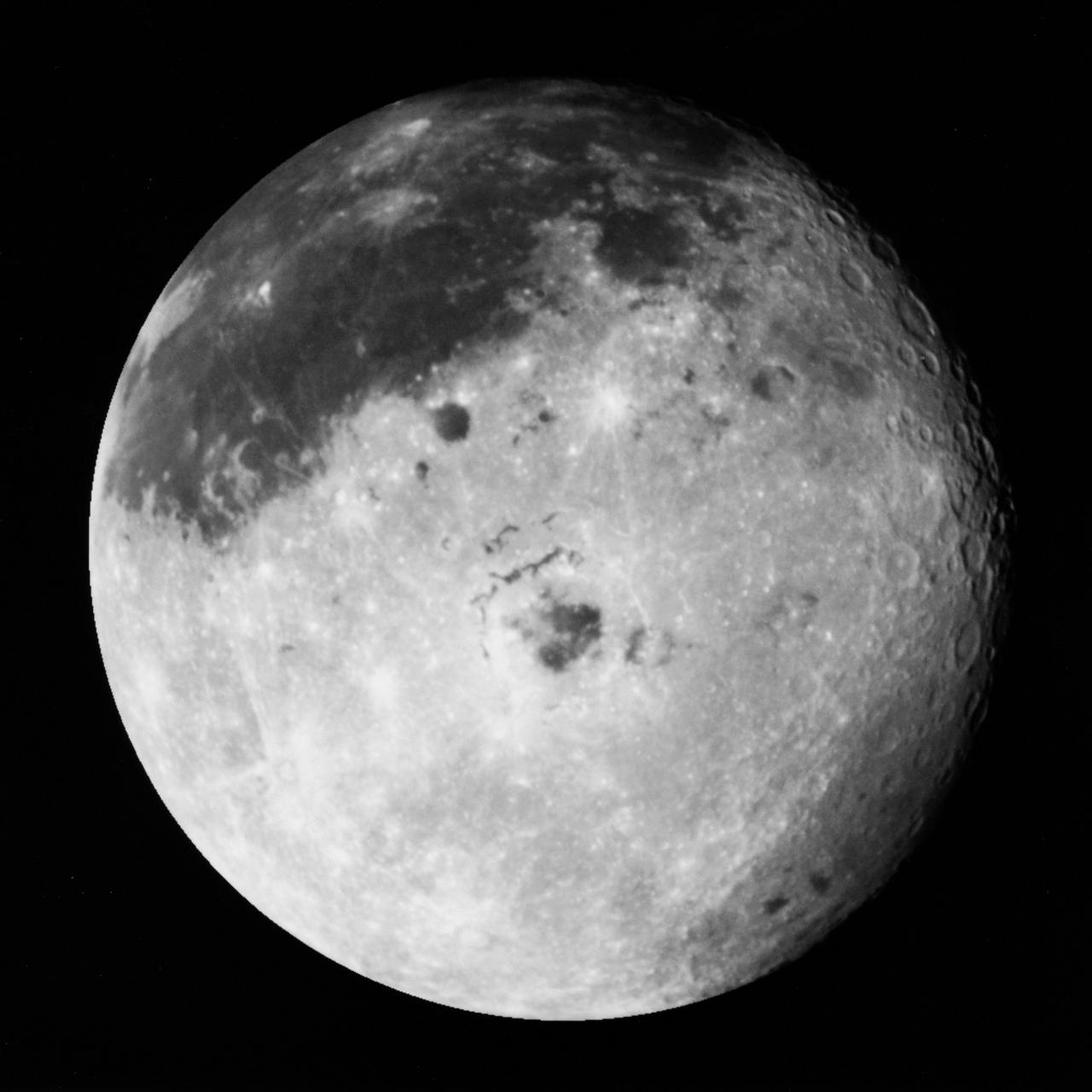
S90-55753 (9 Dec. 1990) --- This color image of the Moon was taken by the Galileo spacecraft at 9:25 a.m. (PST) December 9, 1990, at a range of about 350,000 miles. The color composite uses monochrome images taken through violet, red, and near infrared filters. The concentric, circular Orientale Basin, 600 miles across, is near the center; the near side is to the right, the far side to the left. At the upper right is the large, dark Oceanus Procellarum; below it is the smaller Mare Humorum. These, like the small dark Mare Orientale in the center of the basin, formed over 3 billion years ago as basaltic lava flows. At the lower left, among the southern cratered highlands of the far side, is the South-Pole-Aitken Basin, similar to Orientale but twice as great in diameter and much older and more degraded by crating and weathering. The cratered highlights of the near and far sides and the Maria are covered with scattered bright, young ray-craters.

Galileo spacecraft image of the Moon recorded at 9:35 am Pacific Standard Time (PST), 12-09-90, after completing its first Earth Gravity Assist. Western hemisphere of the Moon was taken through a green filter at a range of about 350,000 miles. In the center is Orientale Basin, 600 miles in diameter, formed about 3.8 billion years ago by the impact of an asteroid-size body. Orientale's dark center is a small mare. To the right is the lunar near side with the great, dark Oceanus Procellarum above the small, circular, dark Mare Humorum below. Maria are broad plains formed mostly over 3 billion years ago as vast basaltic lava flows. To the left is the lunar far side with fewer maria, but, at lower left South-Pole-Aitken basin, about 1200 miles in diameter, which resembles Orientale but is much older and more weathered and battered by cratering. The intervening cratered highlands of both sides, as well as the maria, are dotted with bright young craters. This image was "reprojected" so as to center the Orientale Basin, and was filtered to enhance the visibility of small features. The digital image processing was done by DLR, the German Aerospace Research Establishment near Munich, an international collaborator in the Galileo mission. Photo was provided by Jet Propulsion Laboratory (JPL) with alternate number P-37327, 12-19-90.
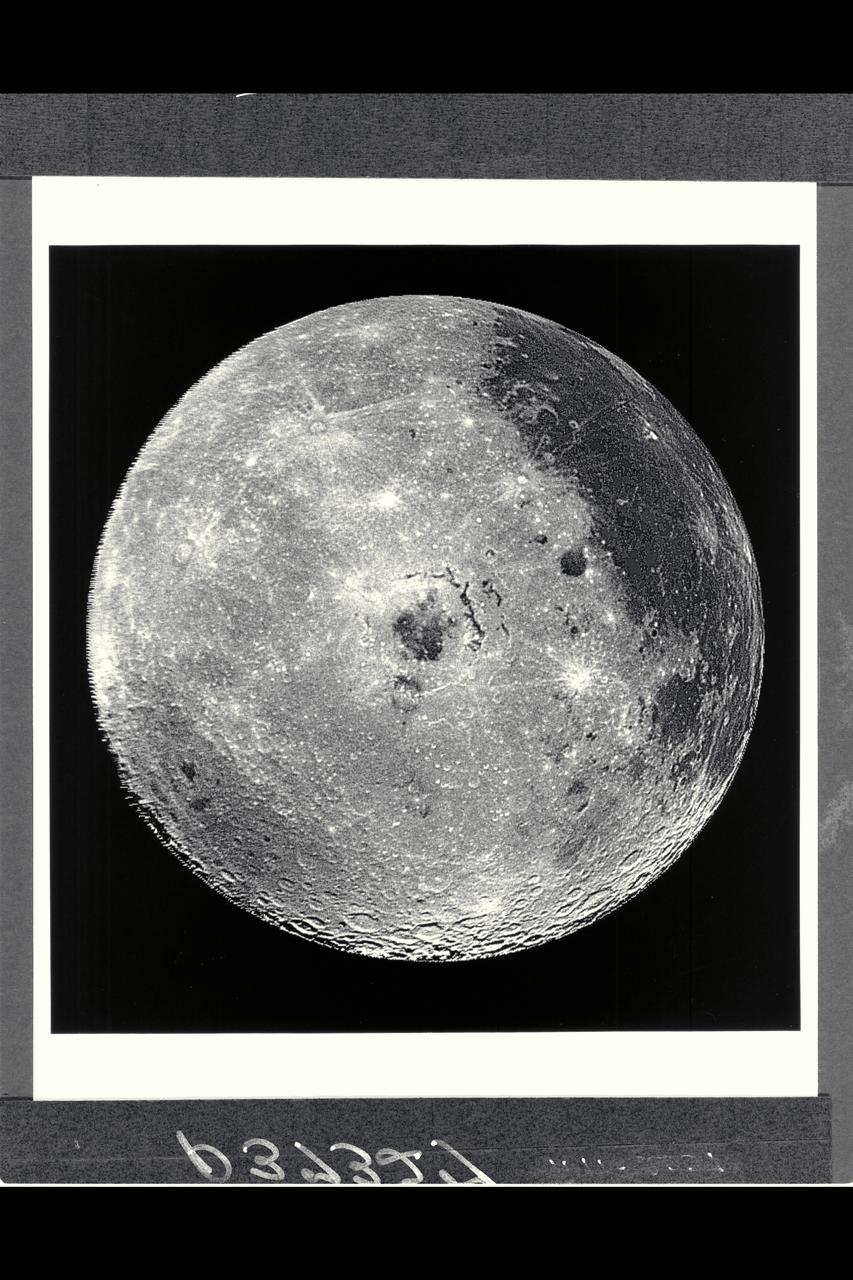
Range : 350,000 miles This image of the western hemisphere of the Moon was taken through a green filter by Galileo at 9:35 am PST. In the center is the Orientale Basin, 600 miles in diameter, formed about 3.8 billion years ago by the impact of an streroid-size body. Orientale's dark center is a small mare. To the right is the lunar near side with the great, dark Oceanus Procellarum above and the small, circular, dark Mare Humorum Below. Maria are broad plains formed mostly over 3 billion years ago as vast bassaltic lava flows. To the left is the lunar far side with fewer maria, but, at lower left, the South-Pole-Aitken basin, about 1200 miles in diameter, which resemble Orientale but is much older and more weathered and battered by cratering. The intervening cratered highlands of both sides, as well as the maria, are dotted with bright, young craters. This image was 'reprojected' so as to center visibility of small features.
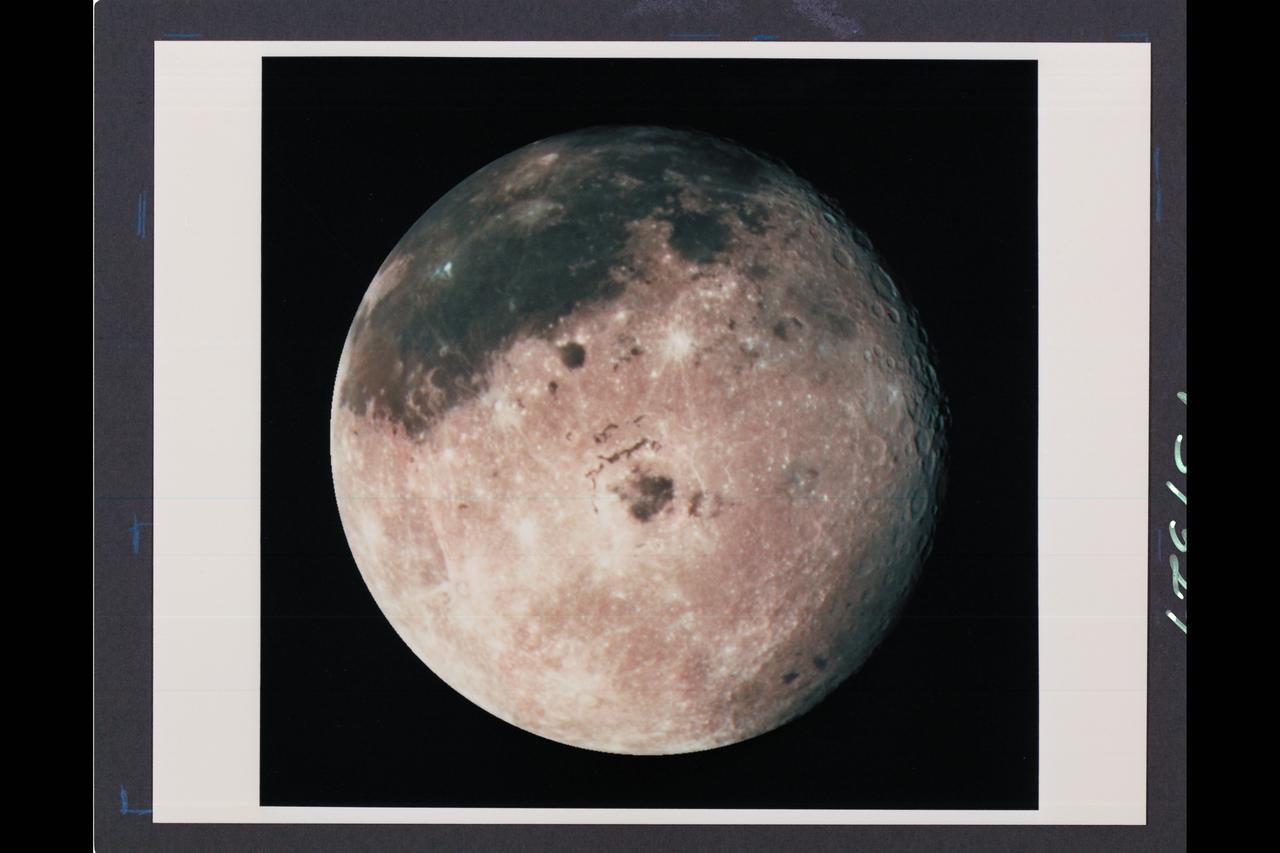
Range : 350,000 miles (JPL Ref: P-37329) This image of the western hemisphere of the Moon was taken through a green filter by Galileo at 9:35 am PST. In the center is the Orientale Basin, 600 miles in diameter, formed about 3.8 billion years ago by the impact of an streroid-size body. Orientale's dark center is a small mare. To the right is the lunar near side with the great, dark Oceanus Procellarum above and the small, circular, dark Mare Humorum Below. Maria are broad plains formed mostly over 3 billion years ago as vast bassaltic lava flows. To the left is the lunar far side with fewer maria, but, at lower left, the South-Pole-Aitken basin, about 1200 miles in diameter, which resemble Orientale but is much older and more weathered and battered by cratering. The intervening cratered highlands of both sides, as well as the maria, are dotted with bright, young craters. This image was 'reprojected' so as to center visibility of small features.
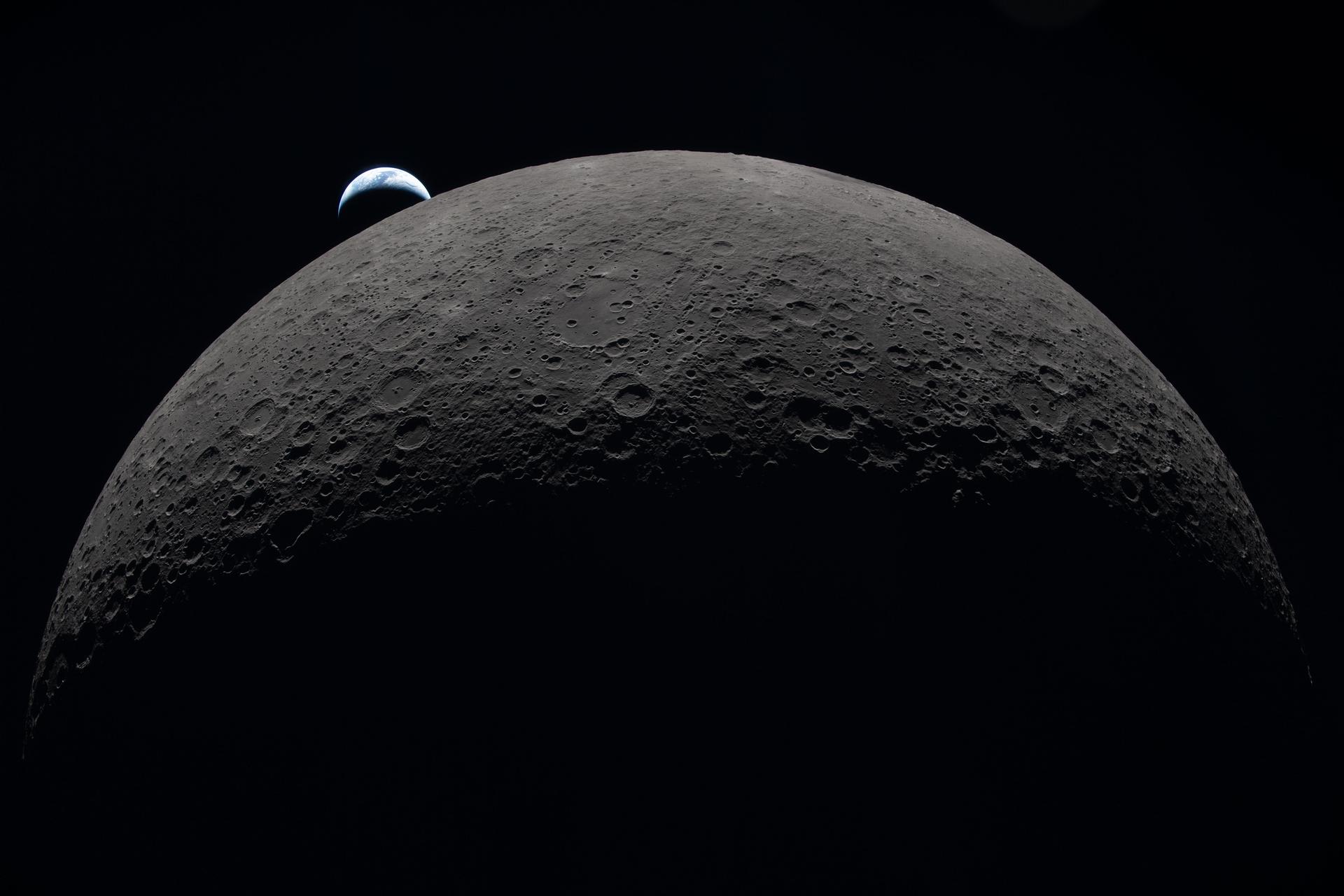
art002e009287 (April 6, 2026) – Earth sets at 6:41 p.m. EDT, April 6, 2026, over the Moon’s curved limb in this photo captured by the Artemis II crew during their journey around the far side of the Moon. Orientale basin is perched on the edge of the visible lunar surface. Hertzsprung Basin appears as two subtle concentric rings, which are interrupted by Vavilov, a younger crater superimposed over the older structure. The lines of indentations are secondary crater chains formed by ejecta from the massive impact that created Orientale. The dark portion of Earth is experiencing nighttime. On Earth’s day side, swirling clouds are visible over the Australia and Oceania region.
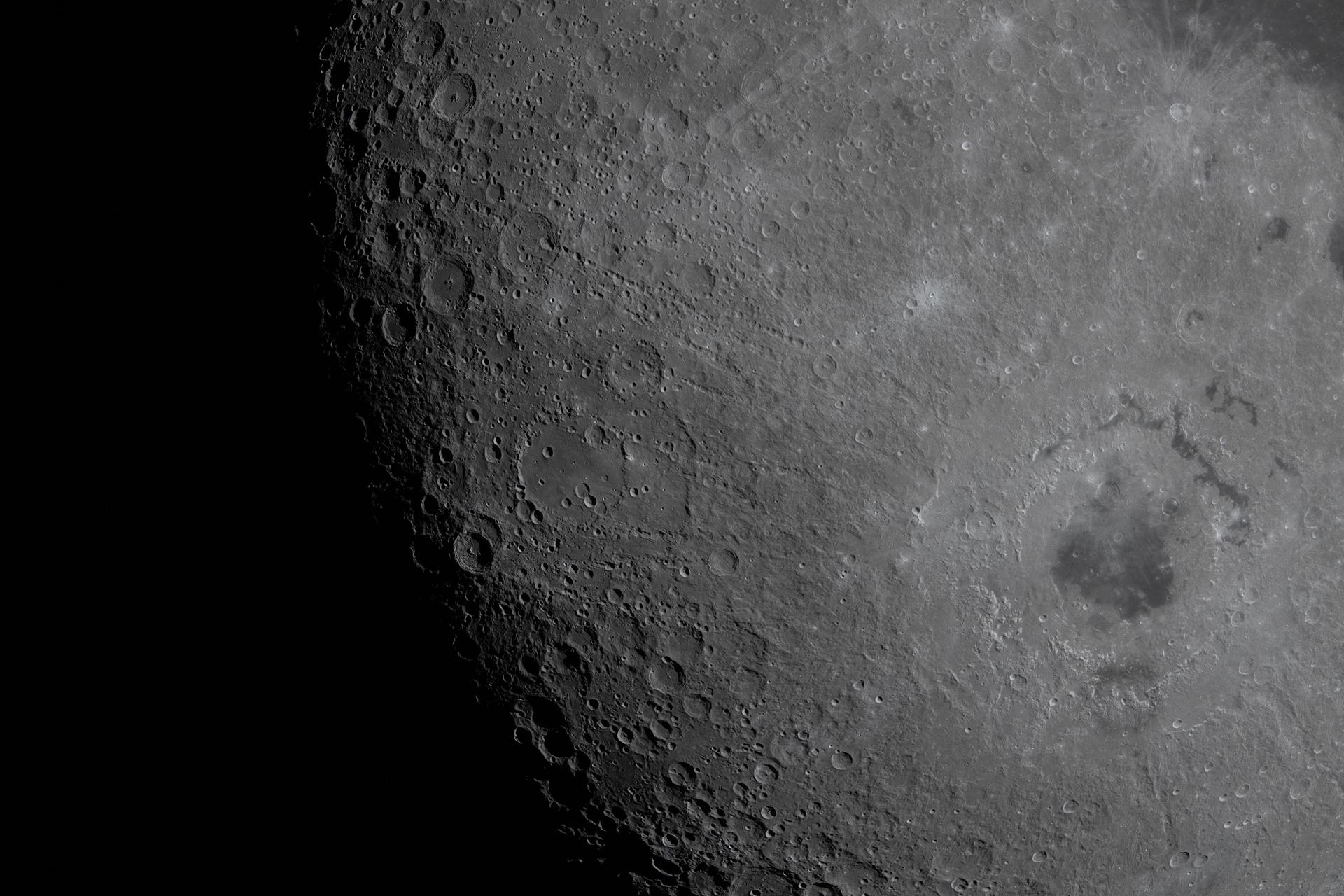
art002e009279 (April 6, 2026) – During their lunar flyby observation period, the Artemis II crew captured this image at 3:41 p.m. EDT, showing the rings of the Orientale basin, one of the Moon’s youngest and best-preserved large impact craters. These concentric rings offer scientists a rare window into how massive impacts shape planetary surfaces, helping refine models of crater formation and the Moon’s geologic history. At the 10 o’clock position of the Orientale basin, the two smaller craters – which the Artemis II crew has suggested be named Integrity and Carroll – are visible. These features highlight how crew observations can directly support surface feature identification and real-time science.
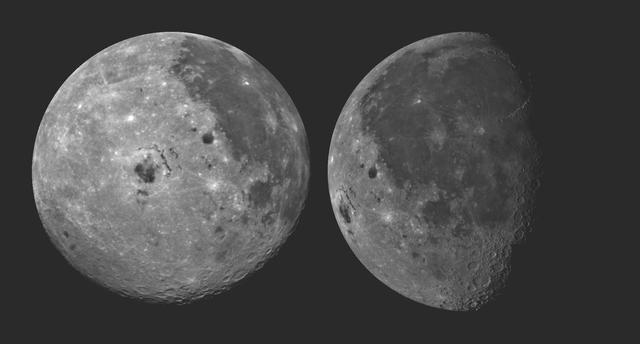
These pictures of the Moon were taken by NASA Galileo spacecraft at right photo Dec.8, 1990 from a distance of almost 220,000 miles, and at left photo Dec. 9, 1990 at a range of more than 350,000 miles. http://photojournal.jpl.nasa.gov/catalog/PIA00077
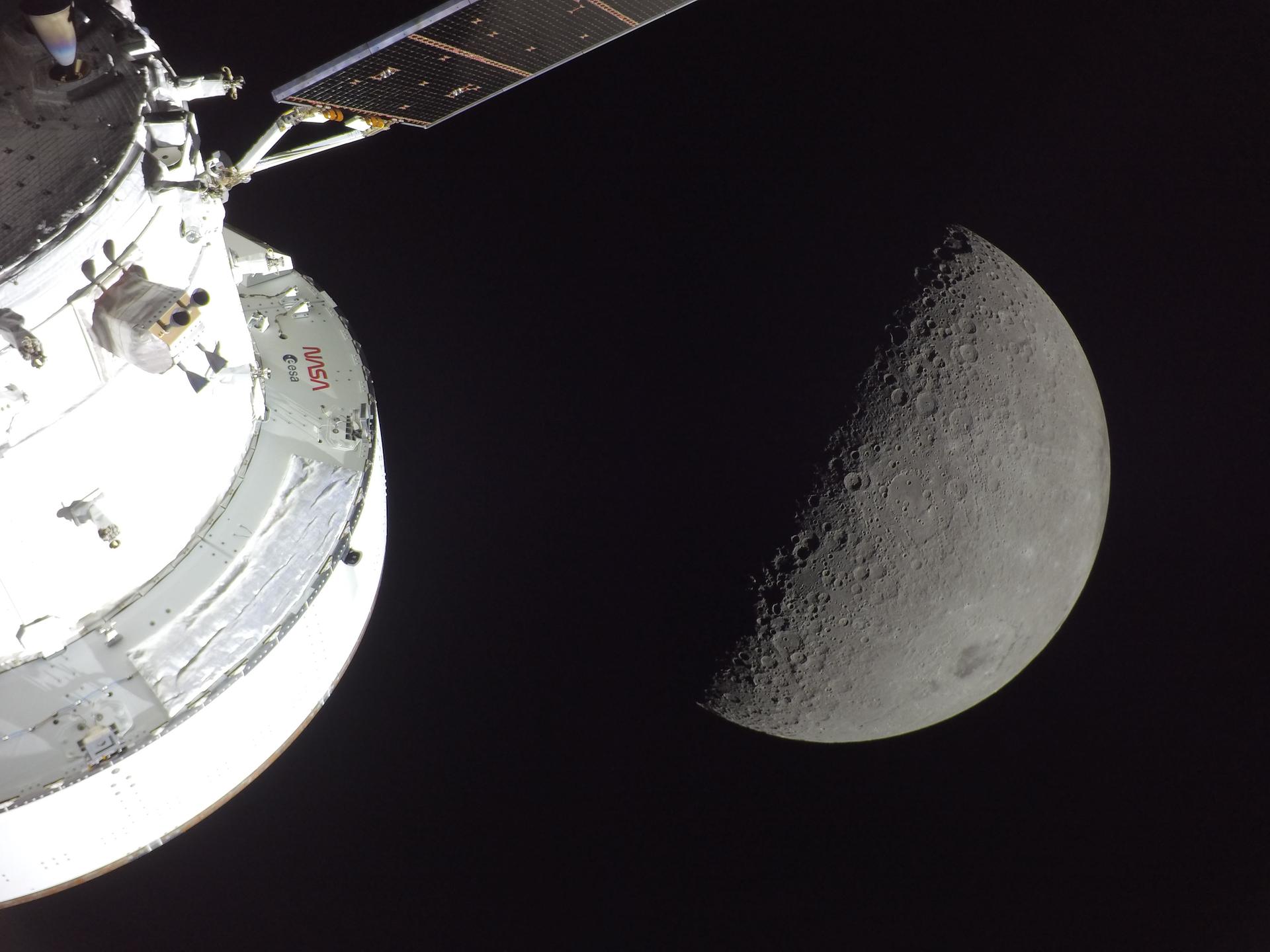
art002e009566 (April 6, 2026) - NASA’s Orion spacecraft is seen in the foreground, lit up by the Sun. A first quarter Moon is visible behind it, with sunlight coming from the right. Near the bottom right edge of the Moon, Orientale basin stands out with a black patch of ancient lava in its center. A 600-mile-wide impact crater ringed by mountains, Orientale straddles the near and far sides of the Moon. Credit: NASA
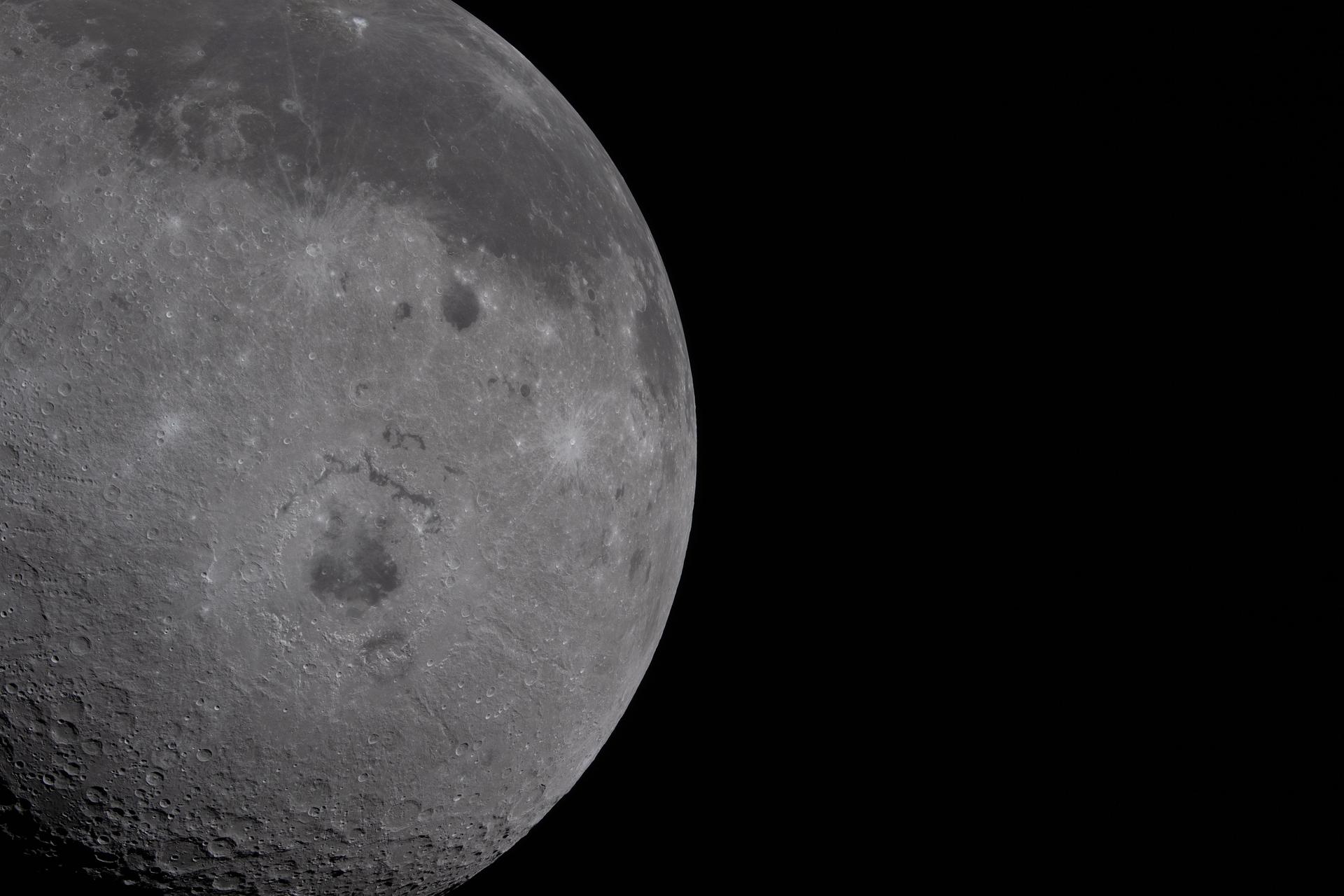
art002e009278 (April 6, 2026) - Just over half of the Moon fills the left half of the image. The near side, characterized by the dark patches of ancient lava, is visible on the top third of the lunar disk. Orientale basin, a round crater in the center with a black patch of ancient lava in the center, is wrapped in rings of mountains. The round black spot northeast of Orientale is Grimaldi crater, and Aristarchus crater is the bright white dot in the midst of a dark grey lava flow at the top of the image.
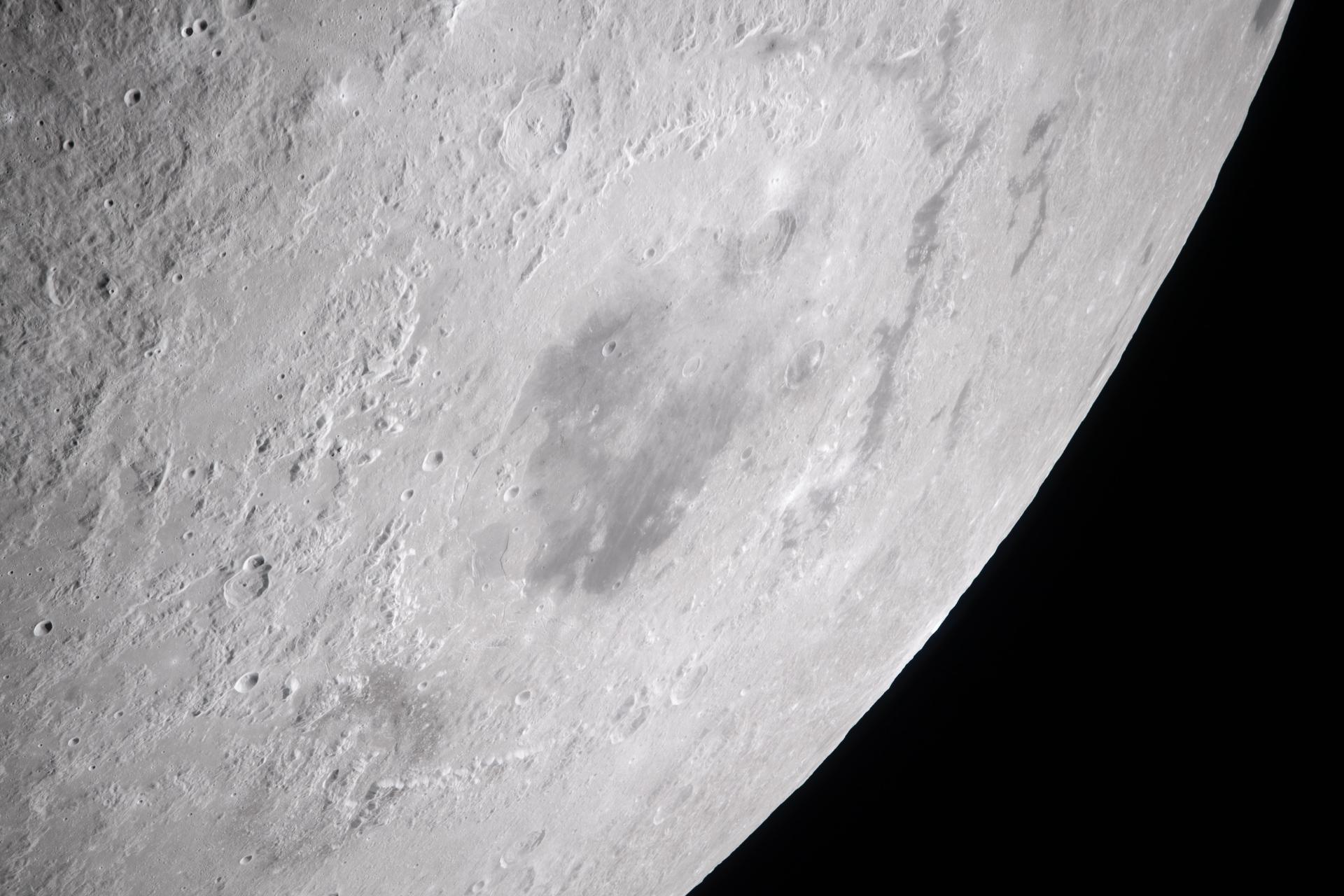
art002e010232 (April 6, 2026) – During the lunar flyby observation period, the Artemis II crew captures a detailed image of the Orientale basin, a 600-mile-wide impact crater marked by a dark patch of ancient lava that erupted through the Moon’s crust billions of years ago.
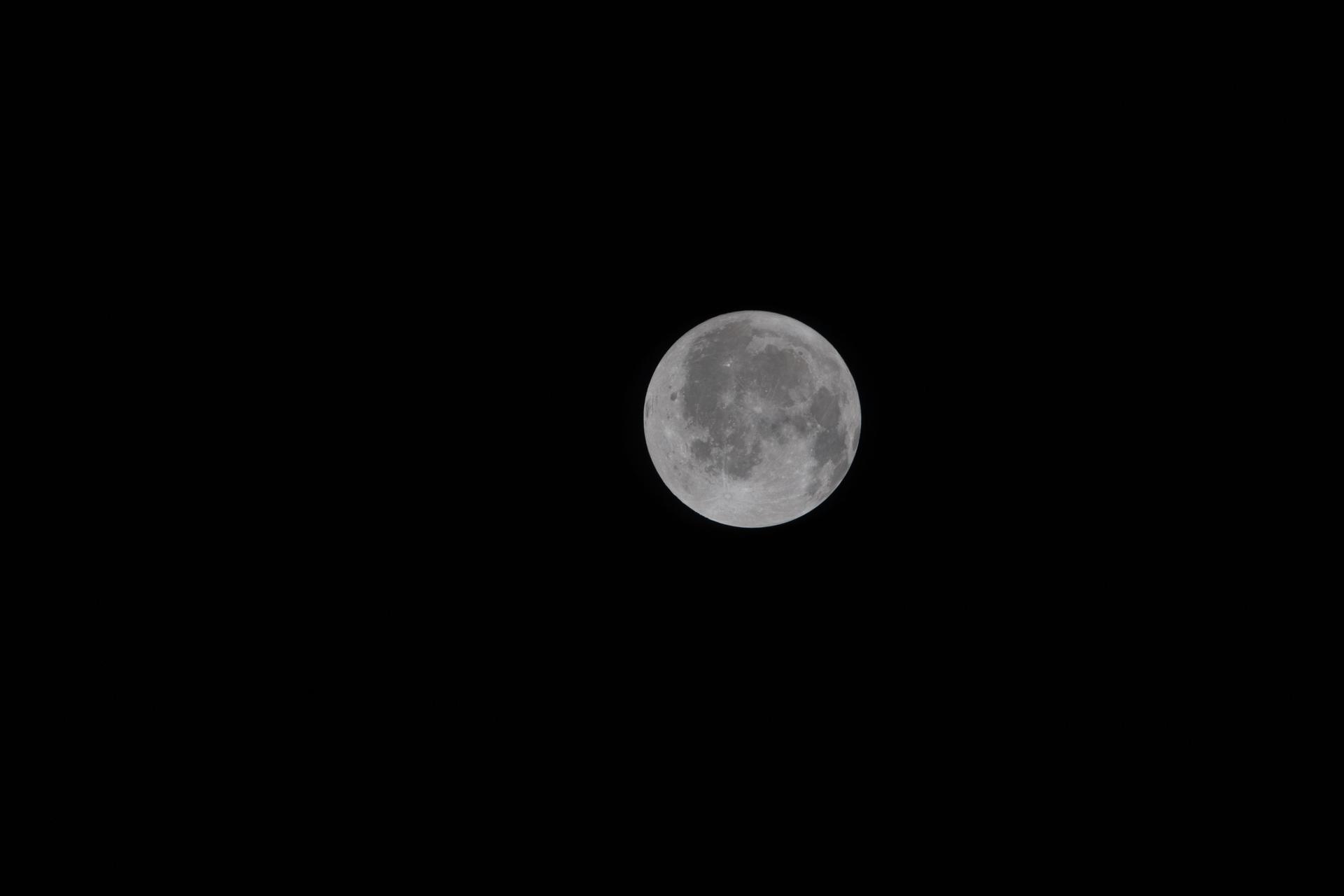
art002e004438 (April 3, 2026) - A view of the Moon taken by an Artemis II crewmember through the window of the Orion spacecraft on the third day of the mission. The image includes a portion of the Orientale basin (far left), a first for humans and human eyes. Until today, only robotic imagers have seen this region of our Moon.
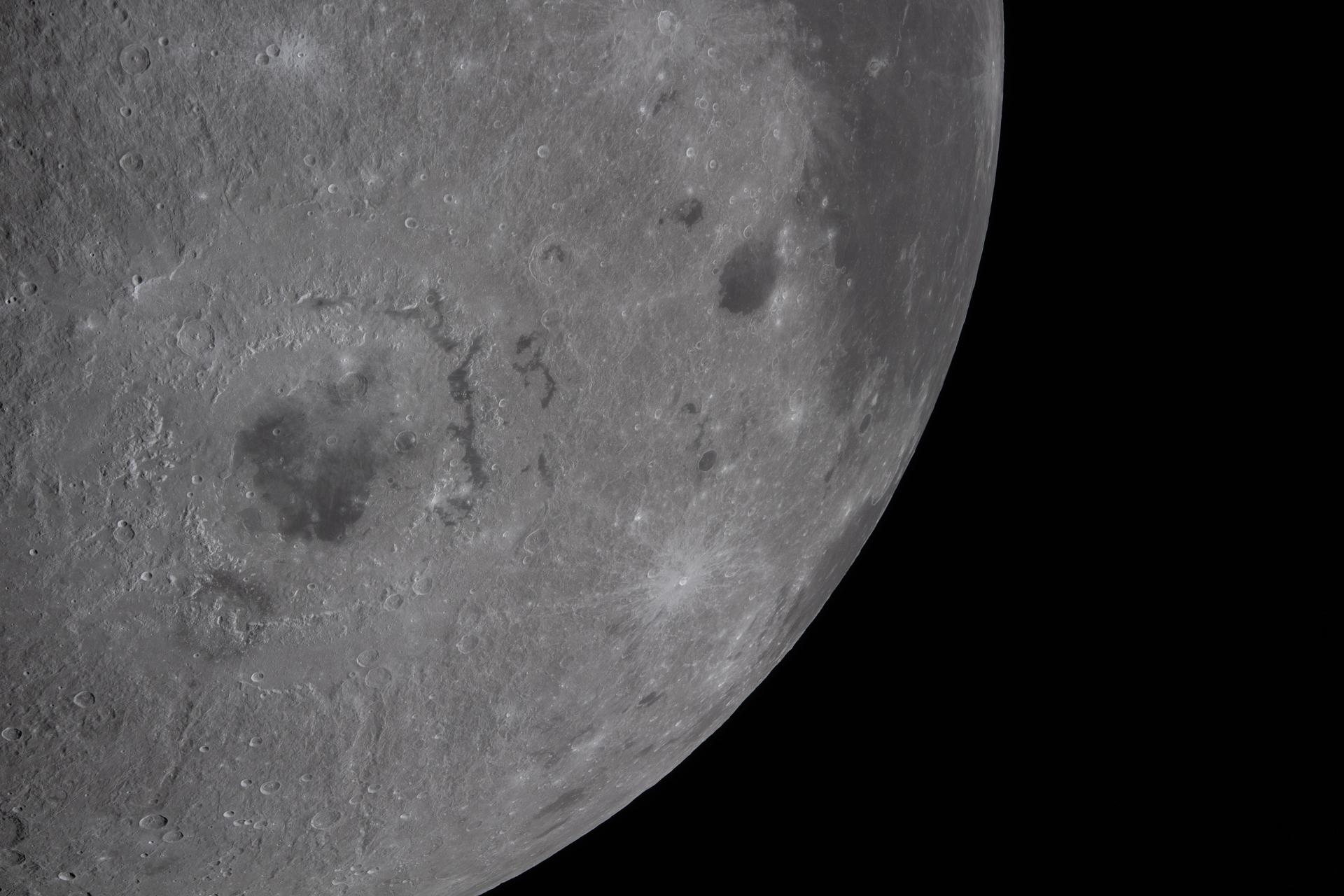
art002e019914 (April 6, 2026) – The Artemis II crew captured this close-up view of the Moon’s southwestern limb during lunar flyby observation operations. The view highlights variations in brightness across the lunar surface and features including Orientale basin, Grimaldi crater, Byrgius A crater, and the western edge of Oceanus Procellarum. Credit: NASA
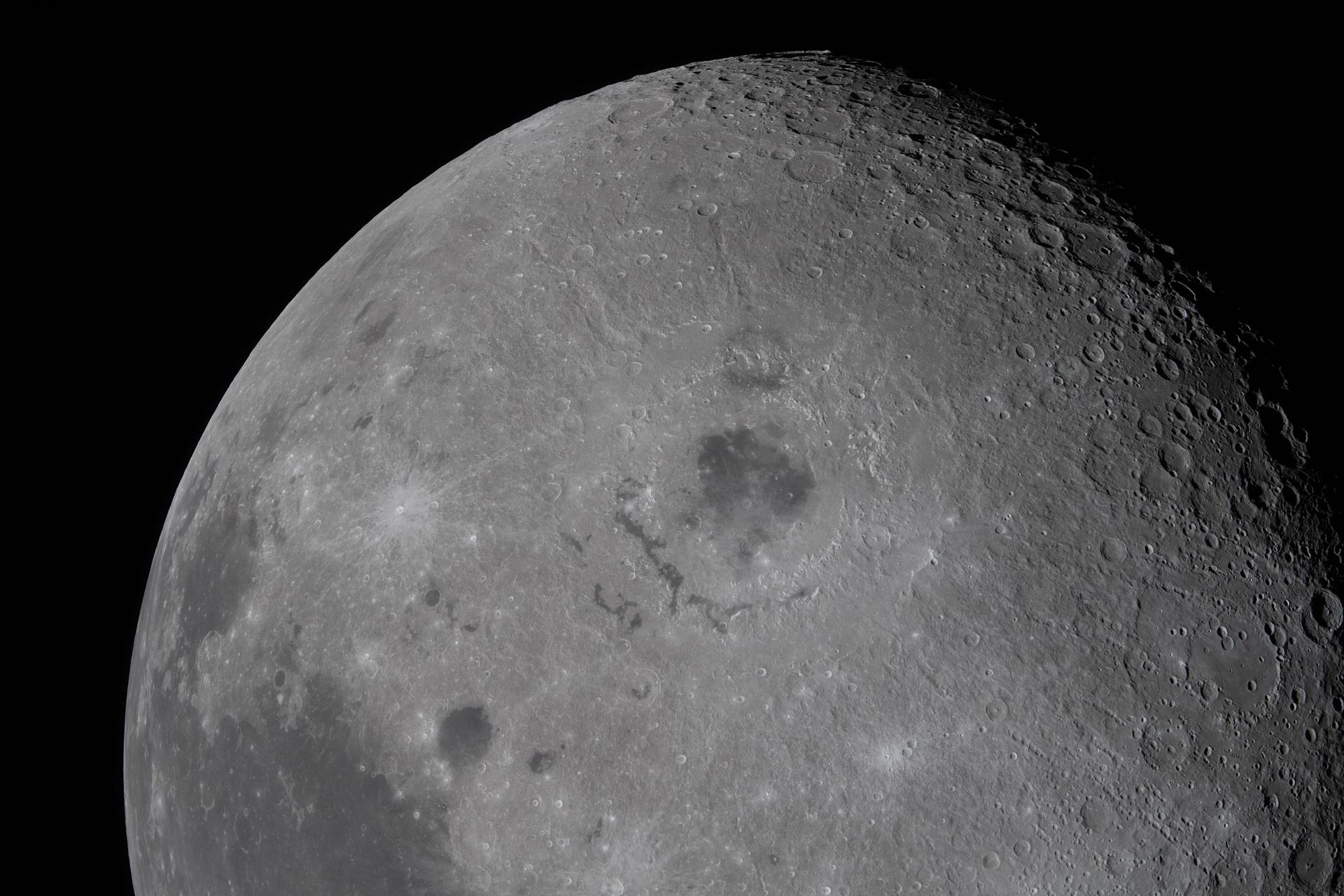
art002e009277 (April 6, 2026) - In this view of the Moon, taken by the Artemis II crew at 2:19 p.m. EDT, just before the crew began their observation period, Orientale basin is visible in the center, with a black patch of ancient lava in the center that punched through the Moon’s crust in an eruption billions of years ago. This 600-mile-wide impact crater lies along the transition between the near and far sides and is sometimes partly visible from Earth. The small, bright crater to its left is Byrgius, which has 250-mile rays extending out from its basin.
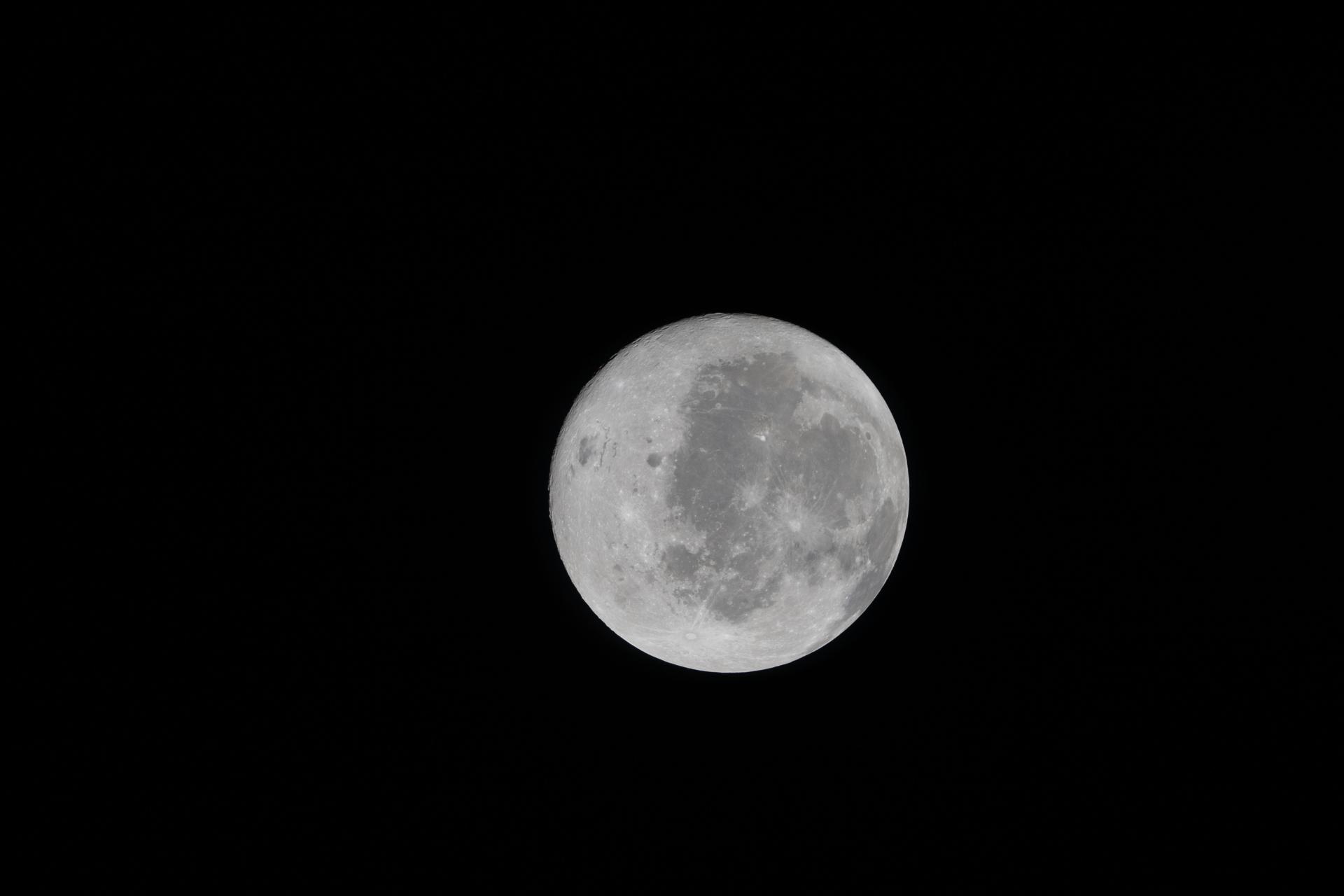
art002e009057 (April 4, 2026) - A view of the nearside of the Moon, the side we always see from Earth. Some of the far side is visible, as well, on the left edge, just beyond the black patch that is Orientale basin, a nearly 600-mile-wide crater that straddles the Moon’s near and far sides and is partly visible from Earth. The dark areas in the center and right side of the disk are ancient lava flows, which are unique to the near side of the Moon. The white dot at the bottom of the disk, with white rays shooting out from it, is Tycho crater, one of the younger craters on the Moon at 108 million years old.
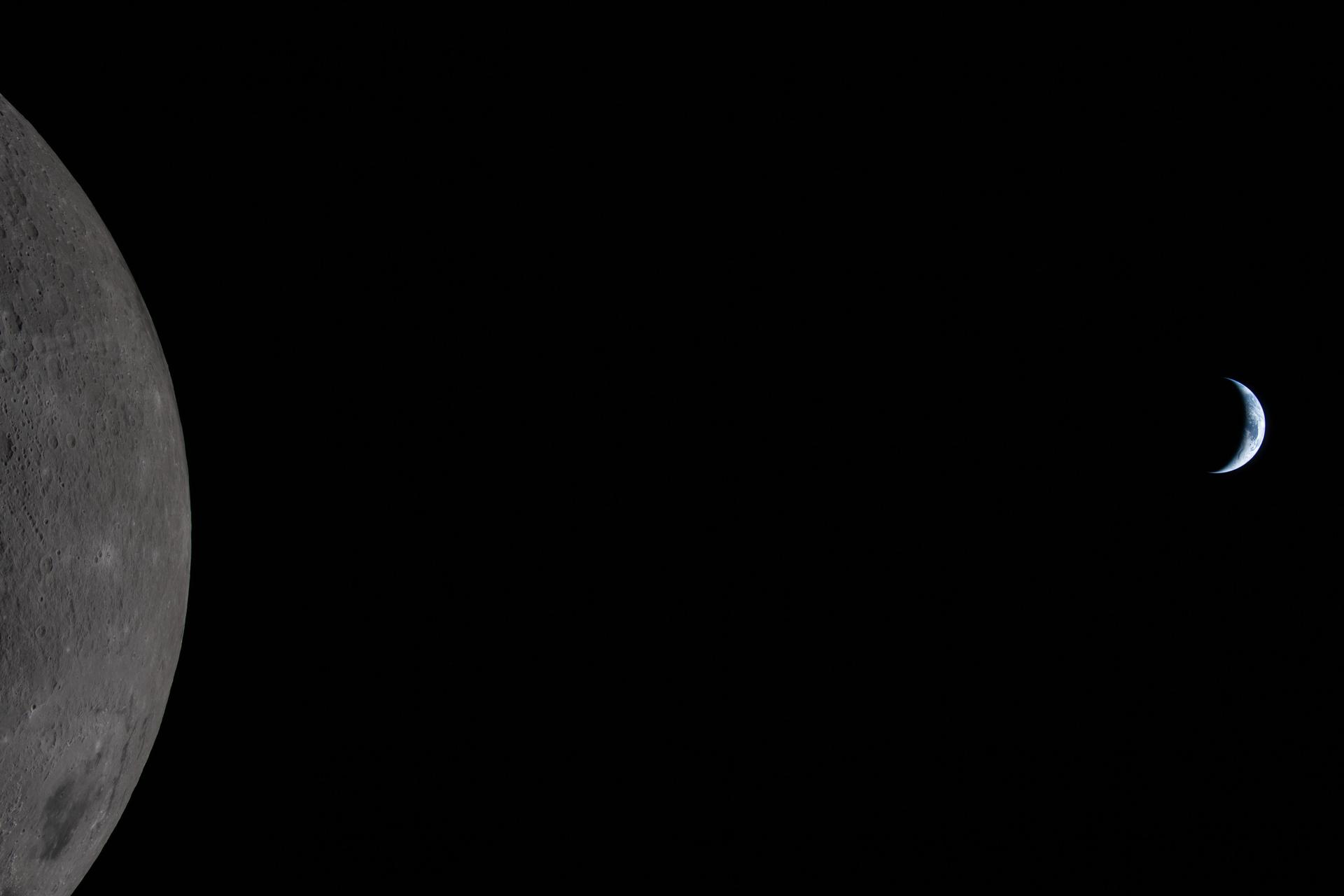
art002e009284 (April 6, 2026) – Earth appears tiny as the Moon looms large in this photo taken by the Artemis II crew during their lunar flyby on April 6, 2026. Taken 36 minutes before Earthset, our home planet is visible in the blackness of space off the limb of the illuminated Moon. Earth is in a crescent phase, with sunlight coming from the right. Orientale mare basin, with its dark floor of cooled lava and outer rings of mountains, covers nearly the lower third of the imaged lunar surface. Different colors in the mare hint at its mineral composition. The lines of small indentations above Orientale are secondary crater chains, formed by material ejected during a violent primary impact. Both of the new craters that the Artemis II crew has suggested names for – Integrity and Carroll – are in full view. The edge of the visible surface of the Moon is called the “lunar limb.” Seen from afar, it almost looks like a circular arc – except when backlit, as in other images captured by the Artemis II crew.
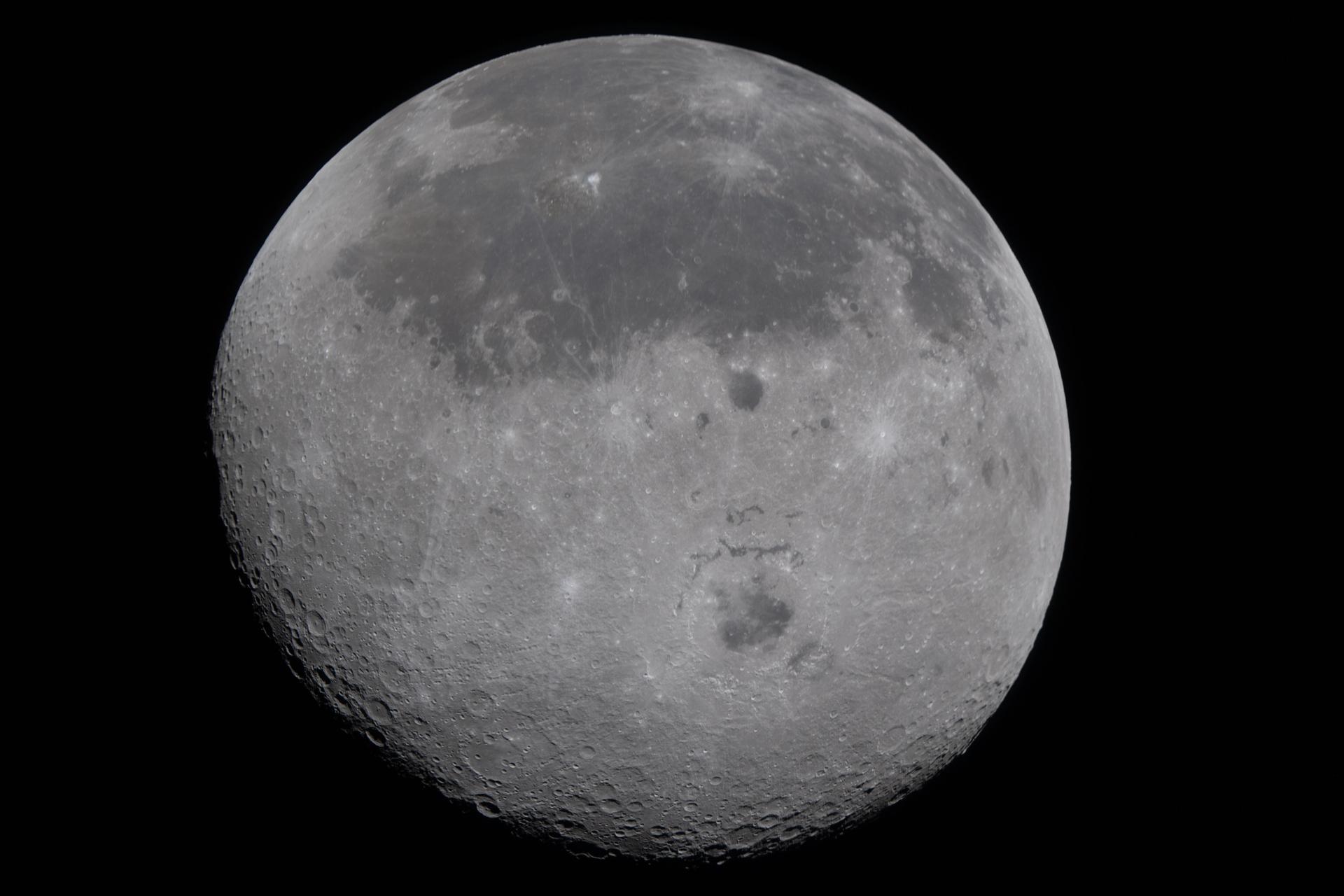
art002e009276 (April 6, 2026) - In this view of the Moon, the near side (the hemisphere we see from Earth), is visible at the top half of the Moon disk. It is identifiable by the dark splotches. These are ancient lava flows from a time early in the Moon’s history when it was volcanically active. The large crater that appears below the lava flows, dark in the center, is Orientale basin, a nearly 600-mile-wide crater that straddles the Moon’s near and far sides as is partly visible from Earth on the edge of the Moon. In this image, we have a full view of the crater. Everything below the crater is the far side, the hemisphere we don’t get to see from Earth because the Moon rotates on its axis at the same rate that it orbits round us.

NASA image release March 11, 2011 Caption: The lunar farside as never seen before! LROC WAC orthographic projection centered at 180° longitude, 0° latitude. Credit: NASA/Goddard/Arizona State University. Because the moon is tidally locked (meaning the same side always faces Earth), it was not until 1959 that the farside was first imaged by the Soviet Luna 3 spacecraft (hence the Russian names for prominent farside features, such as Mare Moscoviense). And what a surprise - unlike the widespread maria on the nearside, basaltic volcanism was restricted to a relatively few, smaller regions on the farside, and the battered highlands crust dominated. A different world from what we saw from Earth. Of course, the cause of the farside/nearside asymmetry is an interesting scientific question. Past studies have shown that the crust on the farside is thicker, likely making it more difficult for magmas to erupt on the surface, limiting the amount of farside mare basalts. Why is the farside crust thicker? That is still up for debate, and in fact several presentations at this week's Lunar and Planetary Science Conference attempt to answer this question. The Clementine mission obtained beautiful mosaics with the sun high in the sky (low phase angles), but did not have the opportunity to observe the farside at sun angles favorable for seeing surface topography. This WAC mosaic provides the most complete look at the morphology of the farside to date, and will provide a valuable resource for the scientific community. And it's simply a spectacular sight! The Lunar Reconnaissance Orbiter Camera (LROC) Wide Angle Camera (WAC) is a push-frame camera that captures seven color bands (321, 360, 415, 566, 604, 643, and 689 nm) with a 57-km swath (105-km swath in monochrome mode) from a 50 km orbit. One of the primary objectives of LROC is to provide a global 100 m/pixel monochrome (643 nm) base map with incidence angles between 55°-70° at the equator, lighting that is favorable for morphological interpretations. Each month, the WAC provides nearly complete coverage of the Moon under unique lighting. As an added bonus, the orbit-to-orbit image overlap provides stereo coverage. Reducing all these stereo images into a global topographic map is a big job, and is being led by LROC Team Members from the German Aerospace Center (Deutsches Zentrum für Luft- und Raumfahrt; DLR). Several preliminary WAC topographic products have appeared in LROC featured images over the past year (Orientale basin, Sinus Iridum). For a sneak preview of the WAC global DEM with the WAC global mosaic, view a rotating composite moon (70 MB video from ASU's LROC website). The WAC topographic dataset will be completed and released later this year. The global mosaic released today is comprised of over 15,000 WAC images acquired between November 2009 and February 2011. The non-polar images were map projected onto the GLD100 shape model (WAC derived 100 m/pixel DTM), while polar images were map projected on the LOLA shape model. In addition, the LOLA derived crossover corrected ephemeris, and an improved camera pointing, provide accurate positioning (better than 100 m) of each WAC image. As part of the March 2011 PDS release, the LROC team posted the global map in ten regional tiles. Eight of the tiles are equirectangular projections that encompass 60° latitude by 90° longitude. In addition, two polar stereographic projections are available for each pole from ±60° to the pole. These reduced data records (RDR) products will be available for download on March 15, 2011. As the mission progresses, and our knowledge of the lunar photometric function increases, improved and new mosaics will be released! Work your way around the moon with these six orthographic projections constructed from WAC mosaics. The nearside view linked below is different from that released on 21 February. To read more con't here: <a href="http://www.nasa.gov/mission_pages/LRO/news/lro-farside.html" rel="nofollow">www.nasa.gov/mission_pages/LRO/news/lro-farside.html</a> <b><a href="http://www.nasa.gov/centers/goddard/home/index.html" rel="nofollow">NASA Goddard Space Flight Center</a></b> enables NASA’s mission through four scientific endeavors: Earth Science, Heliophysics, Solar System Exploration, and Astrophysics. Goddard plays a leading role in NASA’s accomplishments by contributing compelling scientific knowledge to advance the Agency’s mission. <b>Follow us on <a href="http://twitter.com/NASA_GoddardPix" rel="nofollow">Twitter</a></b> <b>Join us on <a href="http://www.facebook.com/pages/Greenbelt-MD/NASA-Goddard/395013845897?ref=tsd" rel="nofollow">Facebook</a></b>