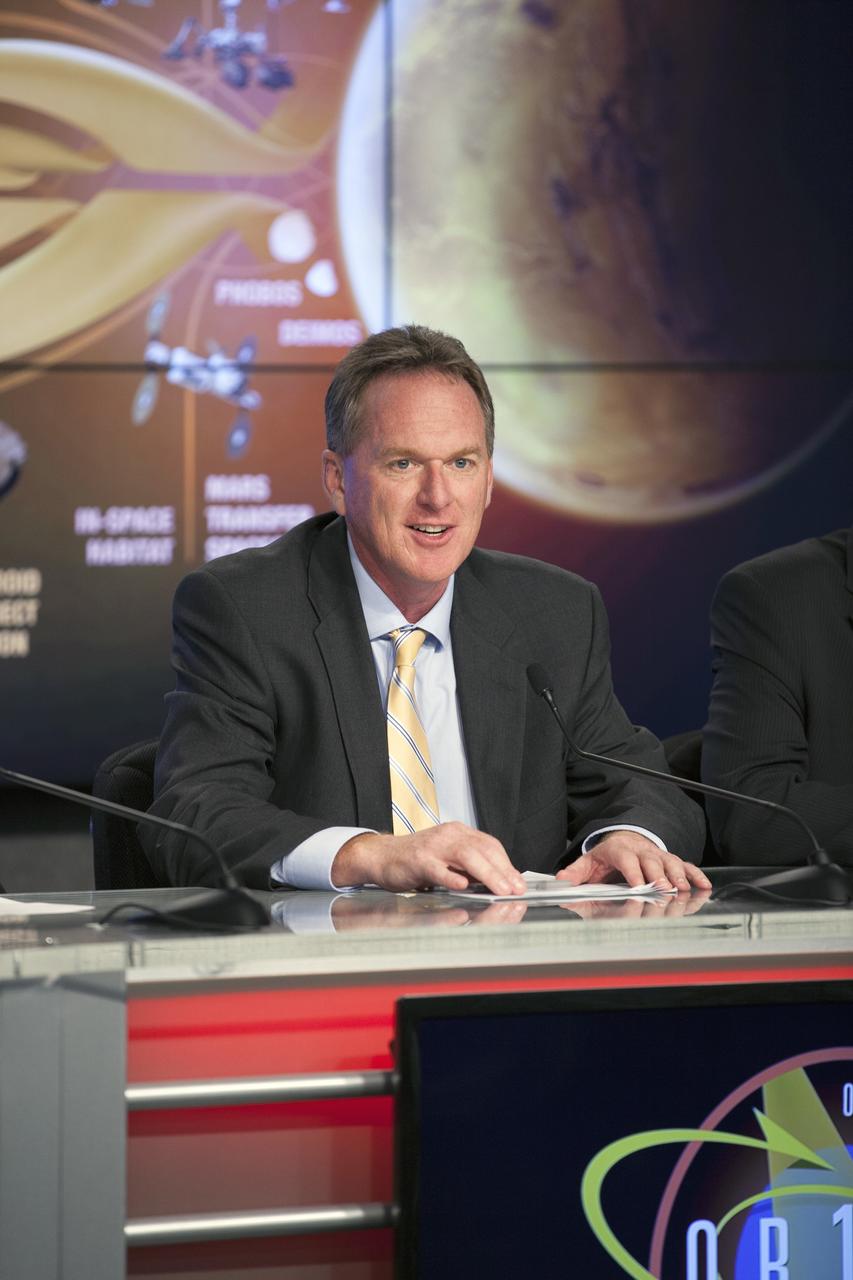
CAPE CANAVERAL, Fla. – At NASA's Kennedy Space Center in Florida, Mike Bolger, program manager of Ground Systems Development and Operations Program, was one of several agency leaders who spoke to member of the news media about how the first flight of the new Orion spacecraft is a first step in the agency's plans to send humans to Mars. Orion is the exploration spacecraft designed to carry astronauts to destinations not yet explored by humans, including an asteroid and Mars. It will have emergency abort capability, sustain the crew during space travel and provide safe re-entry from deep space return velocities. The first unpiloted flight test of Orion is scheduled to launch Dec. 4, 2014 atop a United Launch Alliance Delta IV Heavy rocket, and in 2018 on NASA’s Space Launch System rocket. For more information, visit www.nasa.gov/orion Photo credit: NASA/Kim Shiflett
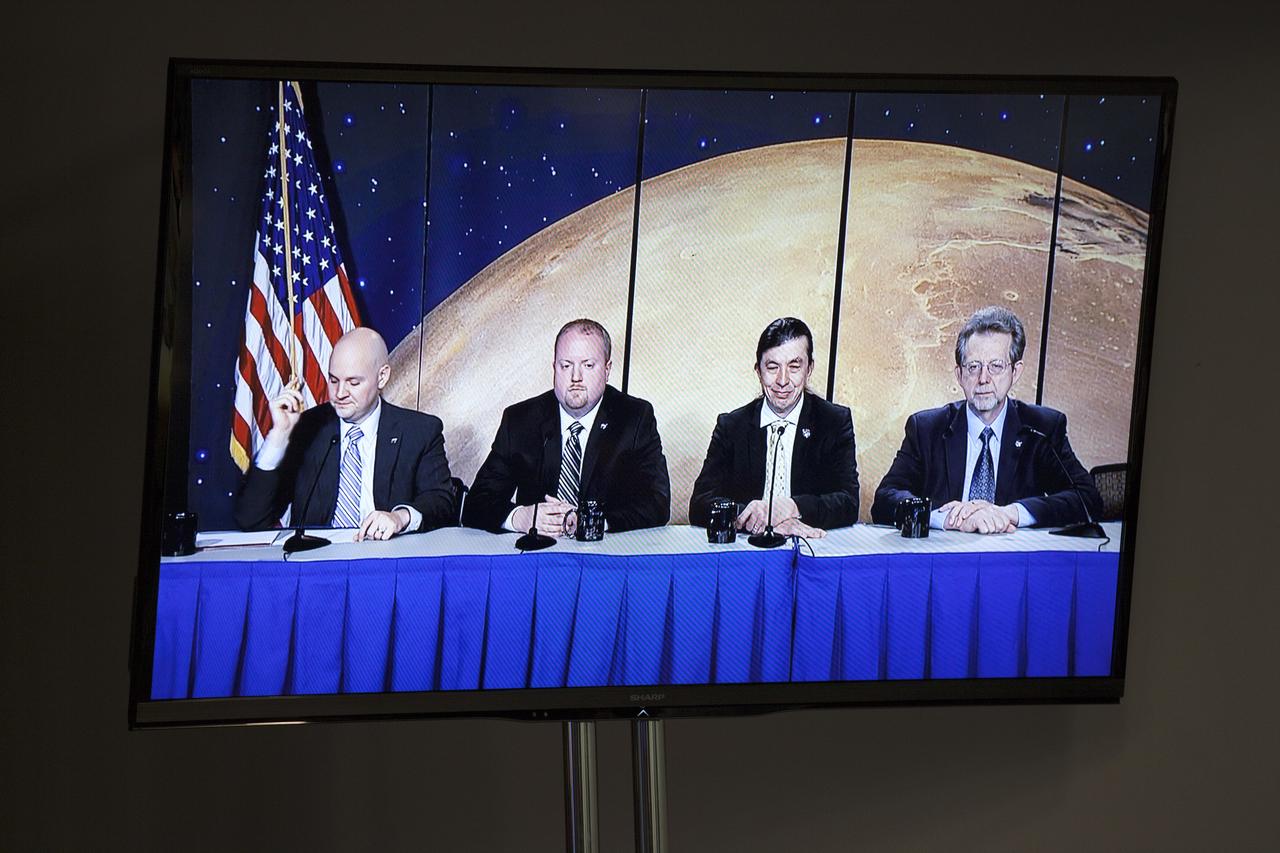
CAPE CANAVERAL, Fla. – At NASA Headquarters in Washington and the Kennedy Space Center in Florida, NASA leaders spoke to members of the new media about how the first flight of the new Orion spacecraft is a first step in the agency's plans to send humans to Mars. Seen on a video monitor at Kennedy, Headquarter participants, from the left are: Trent Perrotto of NASA Public Affairs, Jason Crusan, director of Advanced Exploration Systems Division of Human Exploration and Operations Mission Directorate, Jim Reuther, deputy associate administrator for Programs, Space Technology Mission Directorate, and Jim Green, director of Planetary Division of the Science Mission Directorate. Orion is the exploration spacecraft designed to carry astronauts to destinations not yet explored by humans, including an asteroid and Mars. It will have emergency abort capability, sustain the crew during space travel and provide safe re-entry from deep space return velocities. The first unpiloted flight test of Orion is scheduled to launch Dec. 4, 2014 atop a United Launch Alliance Delta IV Heavy rocket, and in 2018 on NASA’s Space Launch System rocket. For more information, visit www.nasa.gov/orion Photo credit: NASA/Kim Shiflett
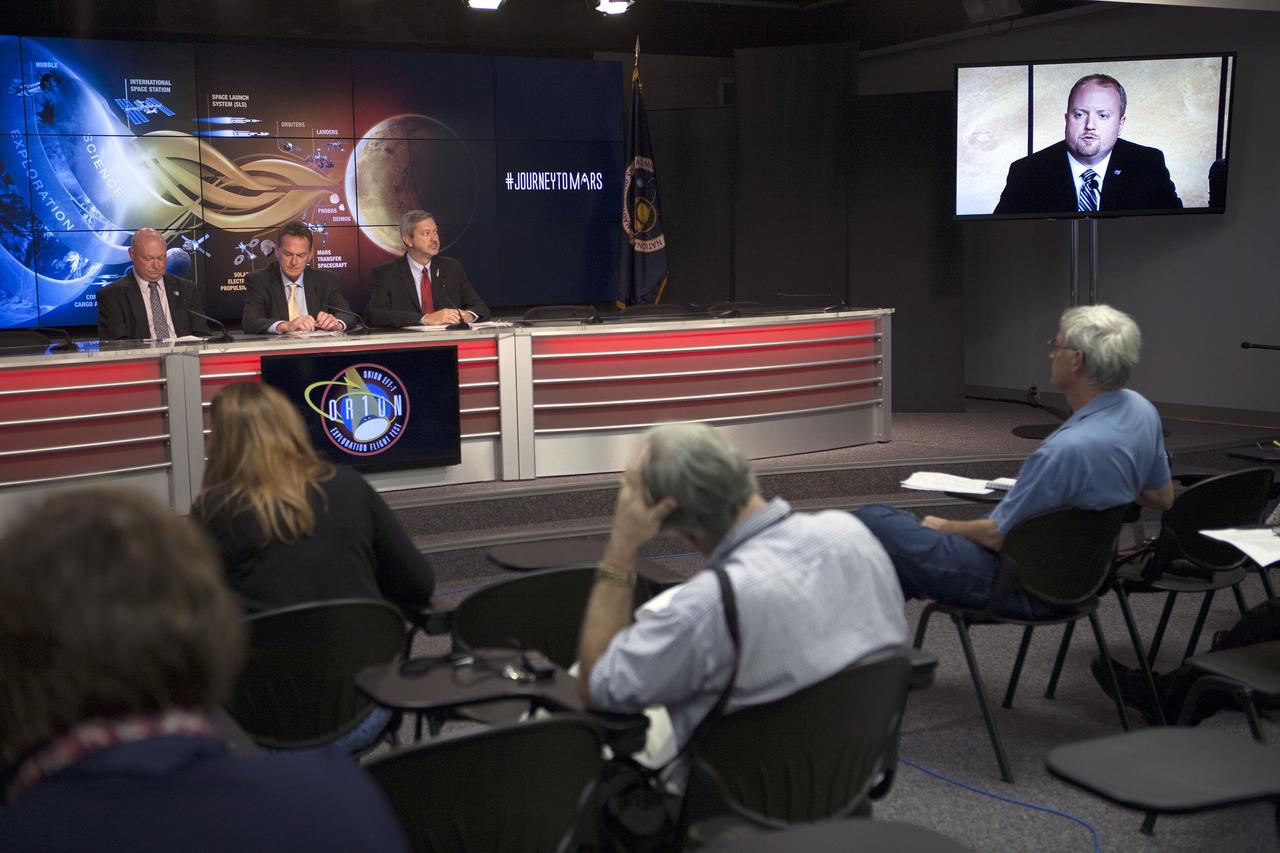
CAPE CANAVERAL, Fla. – At NASA's Kennedy Space Center in Florida, NASA leaders spoke to members of the news media about how the first flight of the new Orion spacecraft is a first step in the agency's plans to send humans to Mars. At Kennedy's News Center auditorium from the left are: Mike Curie of NASA Public Affairs, Mike Bolger, program manager of Ground Systems Development and Operations Program, and Chris Crumbly, manager of Space Launch System Spacecraft/Payload Integration and Evolution. Participating via video from the agency's headquarters in Washington included Jason Crusan, director of Advanced Exploration Systems Division of Human Exploration and Operations Mission Directorate, seen on the monitor on the right. Orion is the exploration spacecraft designed to carry astronauts to destinations not yet explored by humans, including an asteroid and Mars. It will have emergency abort capability, sustain the crew during space travel and provide safe re-entry from deep space return velocities. The first unpiloted flight test of Orion is scheduled to launch Dec. 4, 2014 atop a United Launch Alliance Delta IV Heavy rocket, and in 2018 on NASA’s Space Launch System rocket. For more information, visit www.nasa.gov/orion Photo credit: NASA/Kim Shiflett
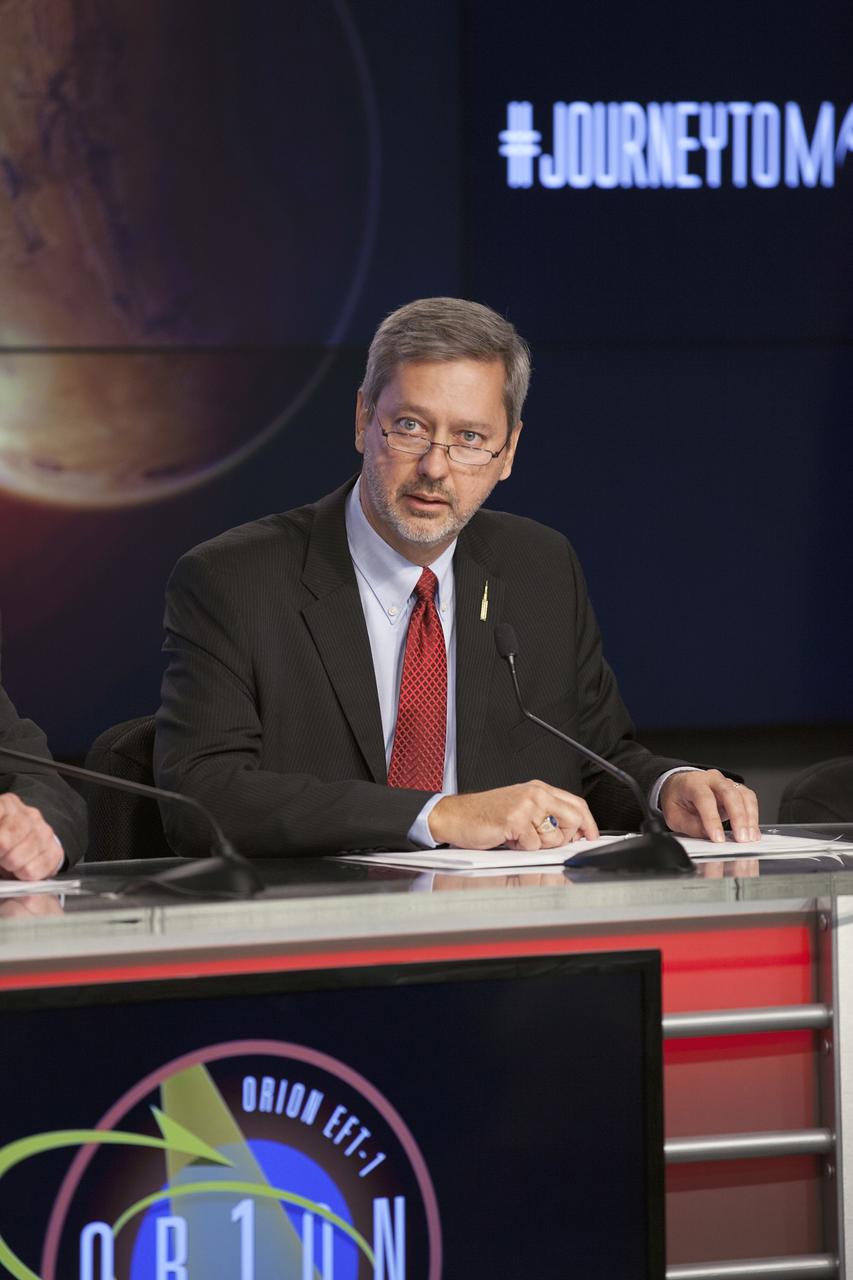
CAPE CANAVERAL, Fla. – At NASA's Kennedy Space Center in Florida, Chris Crumbly, manager of Space Launch System Spacecraft/Payload Integration and Evolution, was one of several agency leaders who spoke to member of the news media about how the first flight of the new Orion spacecraft is a first step in the agency's plans to send humans to Mars. Orion is the exploration spacecraft designed to carry astronauts to destinations not yet explored by humans, including an asteroid and Mars. It will have emergency abort capability, sustain the crew during space travel and provide safe re-entry from deep space return velocities. The first unpiloted flight test of Orion is scheduled to launch Dec. 4, 2014 atop a United Launch Alliance Delta IV Heavy rocket, and in 2018 on NASA’s Space Launch System rocket. For more information, visit www.nasa.gov/orion Photo credit: NASA/Kim Shiflett
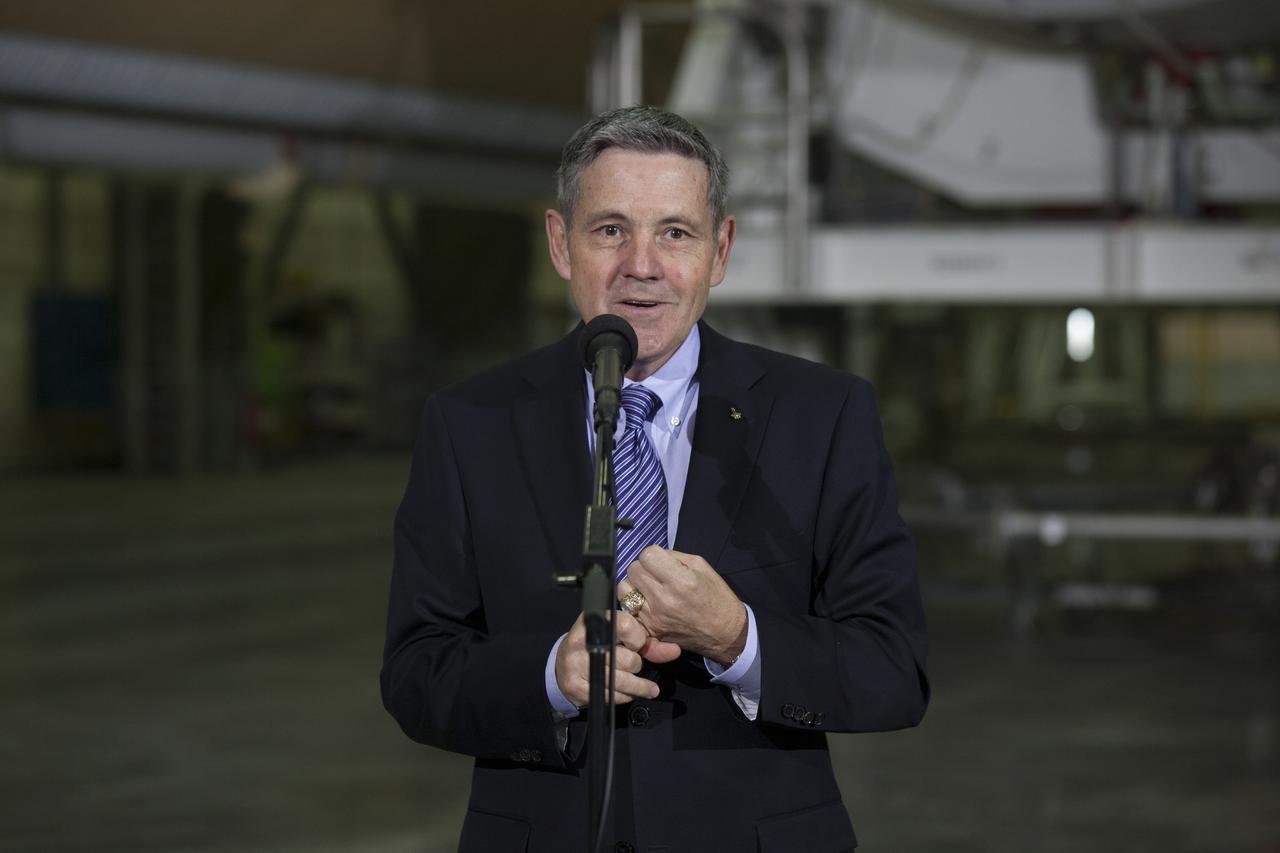
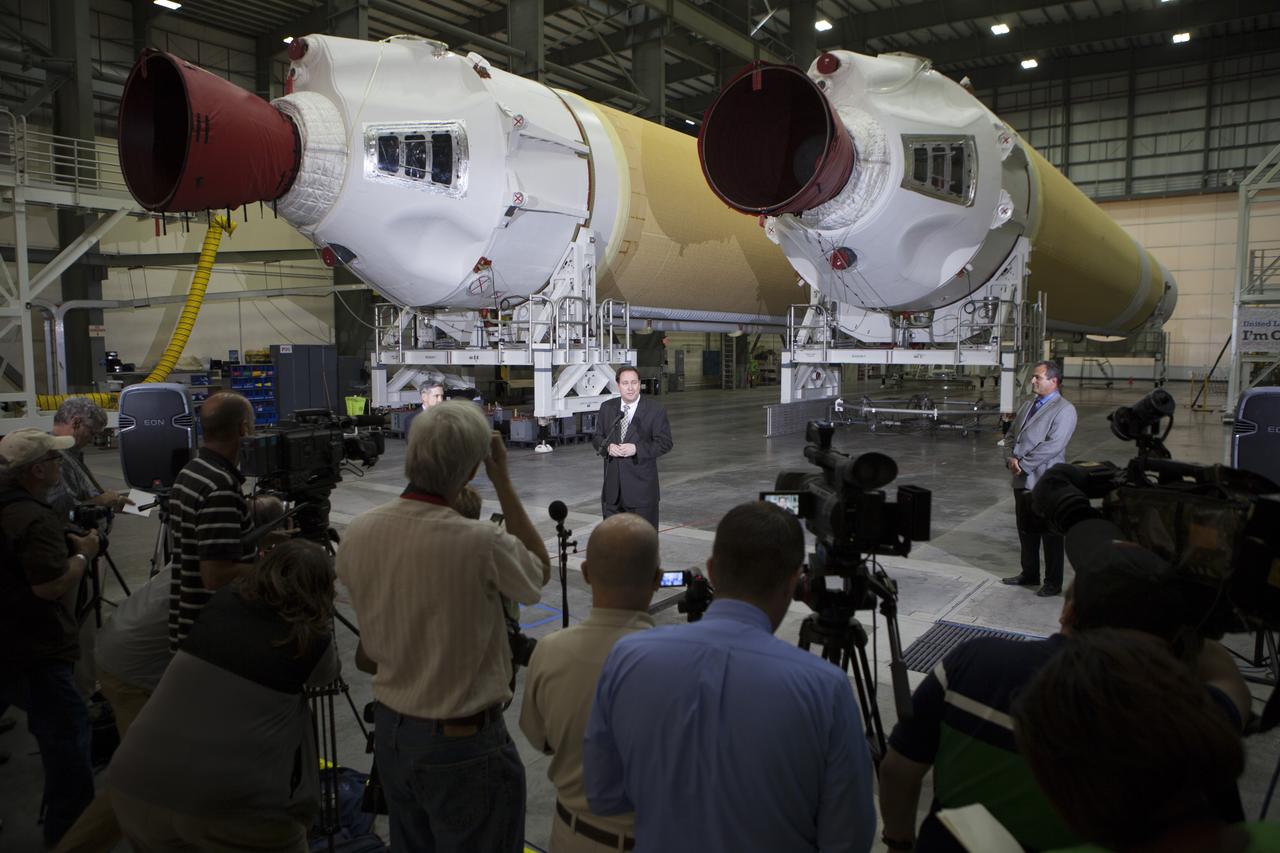
CAPE CANAVERAL, Fla. – During a media event inside the Horizontal Integration Facility at Launch Complex 37 at Cape Canaveral Air Force Station in Florida, Kennedy Space Center Director Bob Cabana speaks to members of the media. Behind him are two of the United Launch Alliance Delta IV boosters for the Orion Exploration Flight Test-1, or EFT-1, mission. Orion is the exploration spacecraft designed to carry astronauts to destinations not yet explored by humans, including an asteroid and Mars. It will have emergency abort capability, sustain the crew during space travel and provide safe re-entry from deep space return velocities. The first unpiloted test flight of Orion, EFT-1, is scheduled to launch in 2014 atop a Delta IV rocket and in 2017 on NASA’s Space Launch System rocket. For more information, visit http://www.nasa.gov/orion. Photo credit: NASA/Kim Shiflett
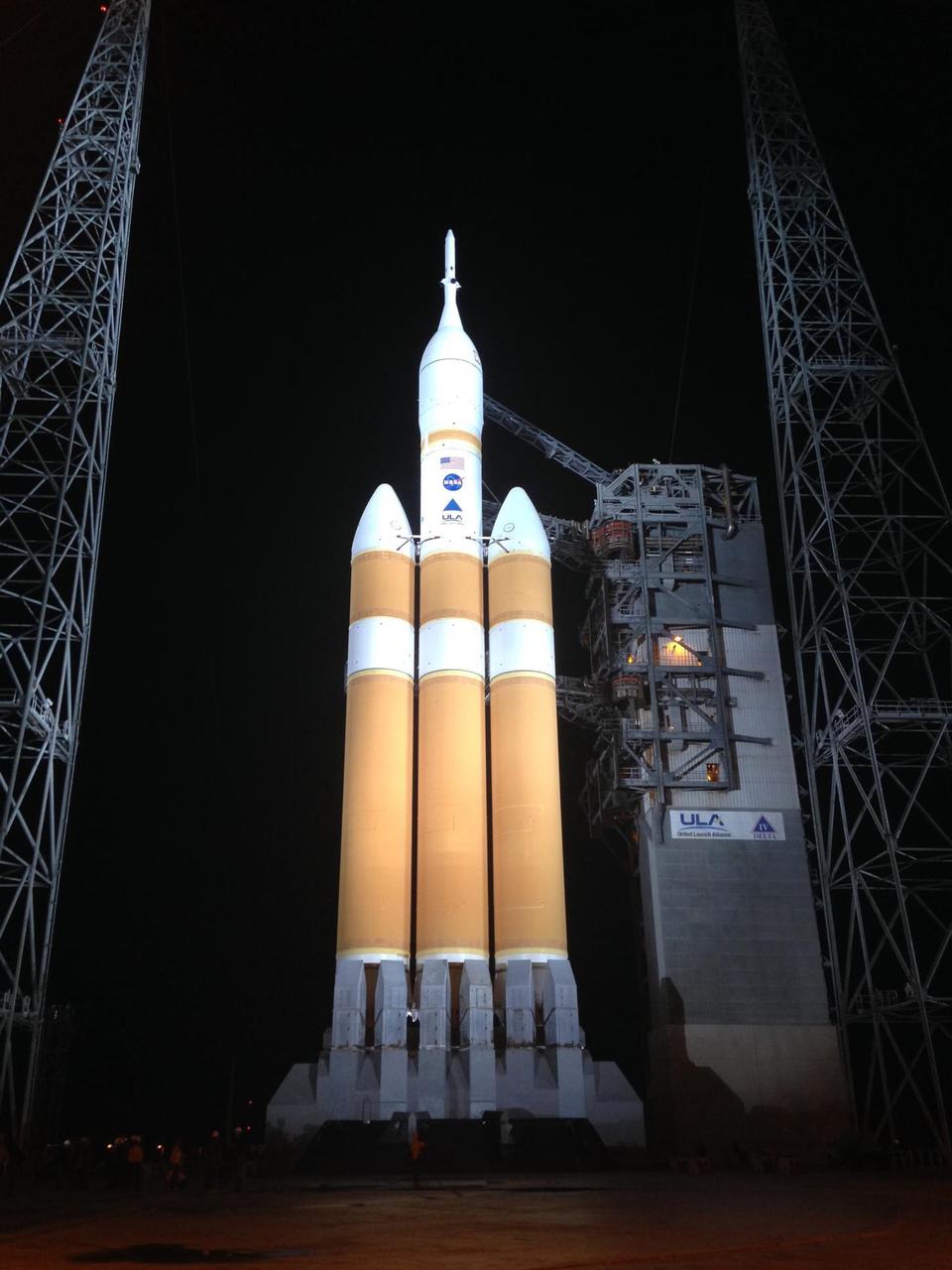
The launch gantry is rolled back to reveal NASA's Orion spacecraft for Exploration Flight Test-1 (EFT-1) mounted atop a United Launch Alliance Delta IV Heavy rocket at Cape Canaveral Air Force Station's Space Launch Complex 37 on Dec. 3, 2014. Orion is NASA’s new spacecraft built to carry humans, designed to allow us to journey to destinations never before visited by humans, including an asteroid and Mars.
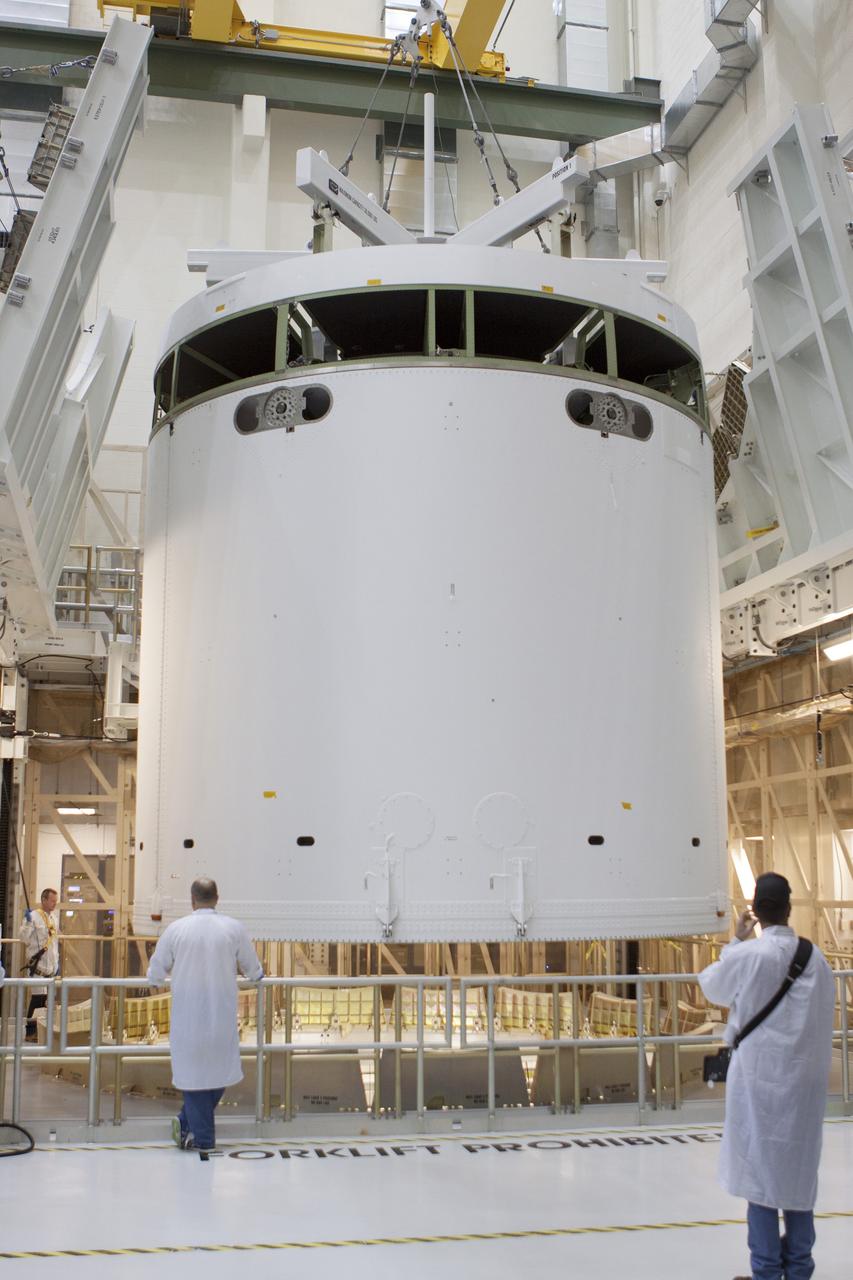
CAPE CANAVERAL, Fla. -- Inside the Operations and Checkout Building high bay at NASA's Kennedy Space Center in Florida, NASA and Lockheed Martin engineers and technicians monitor the progress as a crane lowers the Orion service module into the Final Assembly and System Testing, or FAST, cell. The Orion crew module will be stacked on the service module in the FAST cell and then both modules will be put through their final system tests for Exploration Flight Test-1, or EFT-1, before rolling out of the facility for integration with the United Launch Alliance Delta IV Heavy rocket. Orion is the exploration spacecraft designed to carry astronauts to destinations not yet explored by humans, including an asteroid and Mars. It will have emergency abort capability, sustain the crew during space travel and provide safe re-entry from deep space return velocities. The first unpiloted test flight of Orion, EFT-1, is scheduled to launch later this year atop a Delta IV rocket from Cape Canaveral Air Force Station in Florida to an altitude of 3,600 miles above the Earth's surface. The two-orbit, four-hour flight test will help engineers evaluate the systems critical to crew safety including the heat shield, parachute system and launch abort system. For more information, visit http://www.nasa.gov/orion. Photo credit: NASA/Glenn Benson
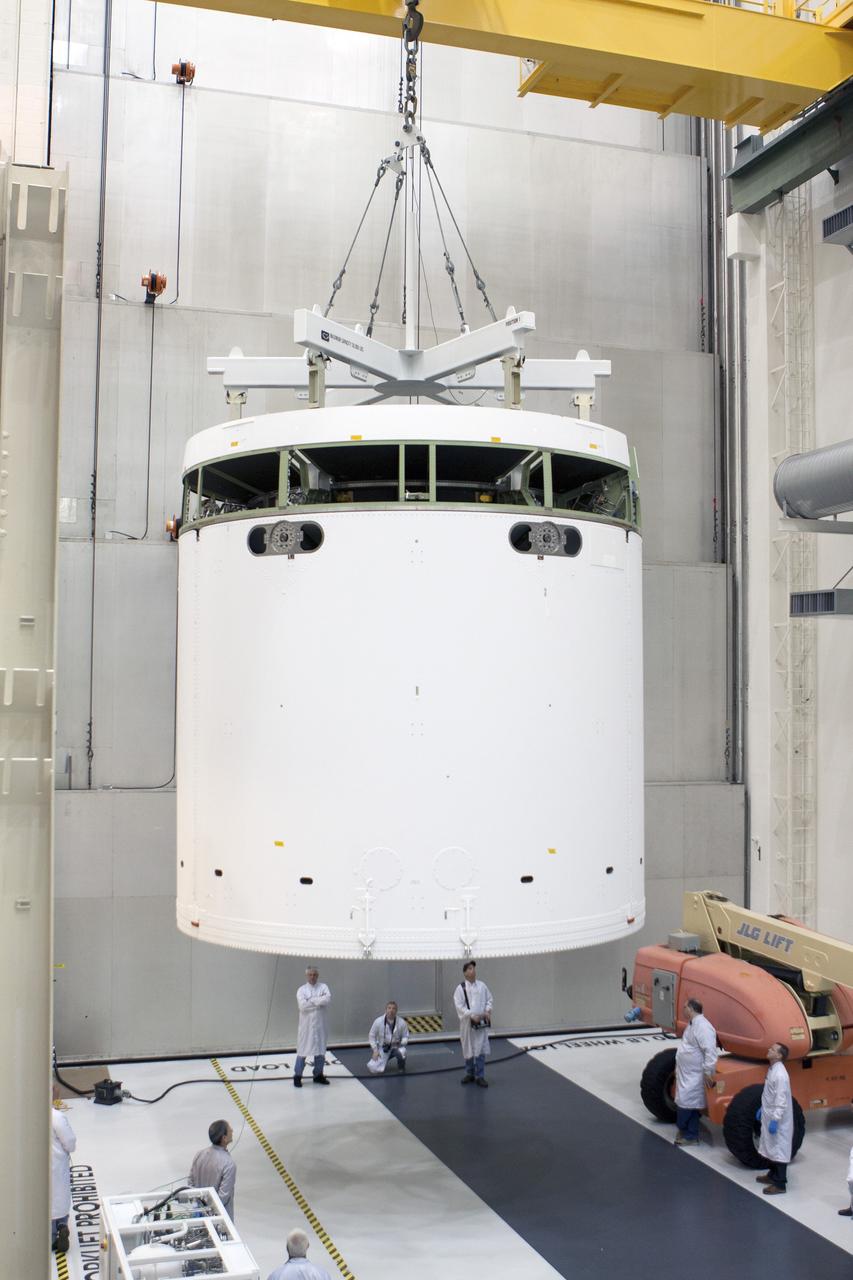
CAPE CANAVERAL, Fla. -- Inside the Operations and Checkout Building high bay at NASA's Kennedy Space Center in Florida, NASA and Lockheed Martin engineers and technicians monitor the progress as a crane is used to move the Orion service module to the Final Assembly and System Testing, or FAST, cell further down the aisle. The Orion crew module will be stacked on the service module in the FAST cell and then both modules will be put through their final system tests for Exploration Flight Test-1, or EFT-1, before rolling out of the facility for integration with the United Launch Alliance Delta IV Heavy rocket. Orion is the exploration spacecraft designed to carry astronauts to destinations not yet explored by humans, including an asteroid and Mars. It will have emergency abort capability, sustain the crew during space travel and provide safe re-entry from deep space return velocities. The first unpiloted test flight of Orion, EFT-1, is scheduled to launch later this year atop a Delta IV rocket from Cape Canaveral Air Force Station in Florida to an altitude of 3,600 miles above the Earth's surface. The two-orbit, four-hour flight test will help engineers evaluate the systems critical to crew safety including the heat shield, parachute system and launch abort system. For more information, visit http://www.nasa.gov/orion. Photo credit: NASA/Glenn Benson
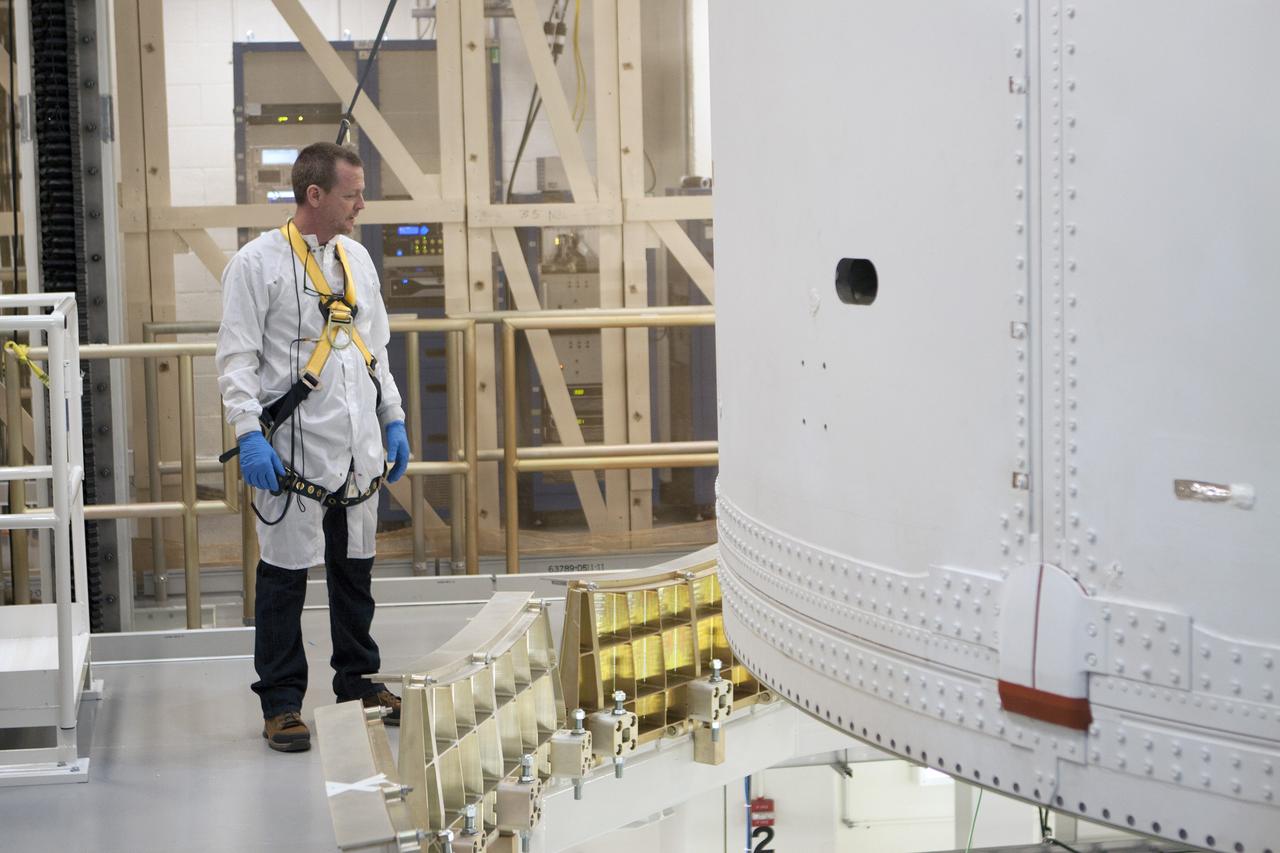
CAPE CANAVERAL, Fla. -- Inside the Operations and Checkout Building high bay at NASA's Kennedy Space Center in Florida, a Lockheed Martin technician monitors the progress as a crane lowers the Orion service module into the Final Assembly and System Testing, or FAST, cell further down the aisle. The Orion crew module will be stacked on the service module in the FAST cell and then both modules will be put through their final system tests for Exploration Flight Test-1, or EFT-1, before rolling out of the facility for integration with the United Launch Alliance Delta IV Heavy rocket. Orion is the exploration spacecraft designed to carry astronauts to destinations not yet explored by humans, including an asteroid and Mars. It will have emergency abort capability, sustain the crew during space travel and provide safe re-entry from deep space return velocities. The first unpiloted test flight of Orion, EFT-1, is scheduled to launch later this year atop a Delta IV rocket from Cape Canaveral Air Force Station in Florida to an altitude of 3,600 miles above the Earth's surface. The two-orbit, four-hour flight test will help engineers evaluate the systems critical to crew safety including the heat shield, parachute system and launch abort system. For more information, visit http://www.nasa.gov/orion. Photo credit: NASA/Glenn Benson
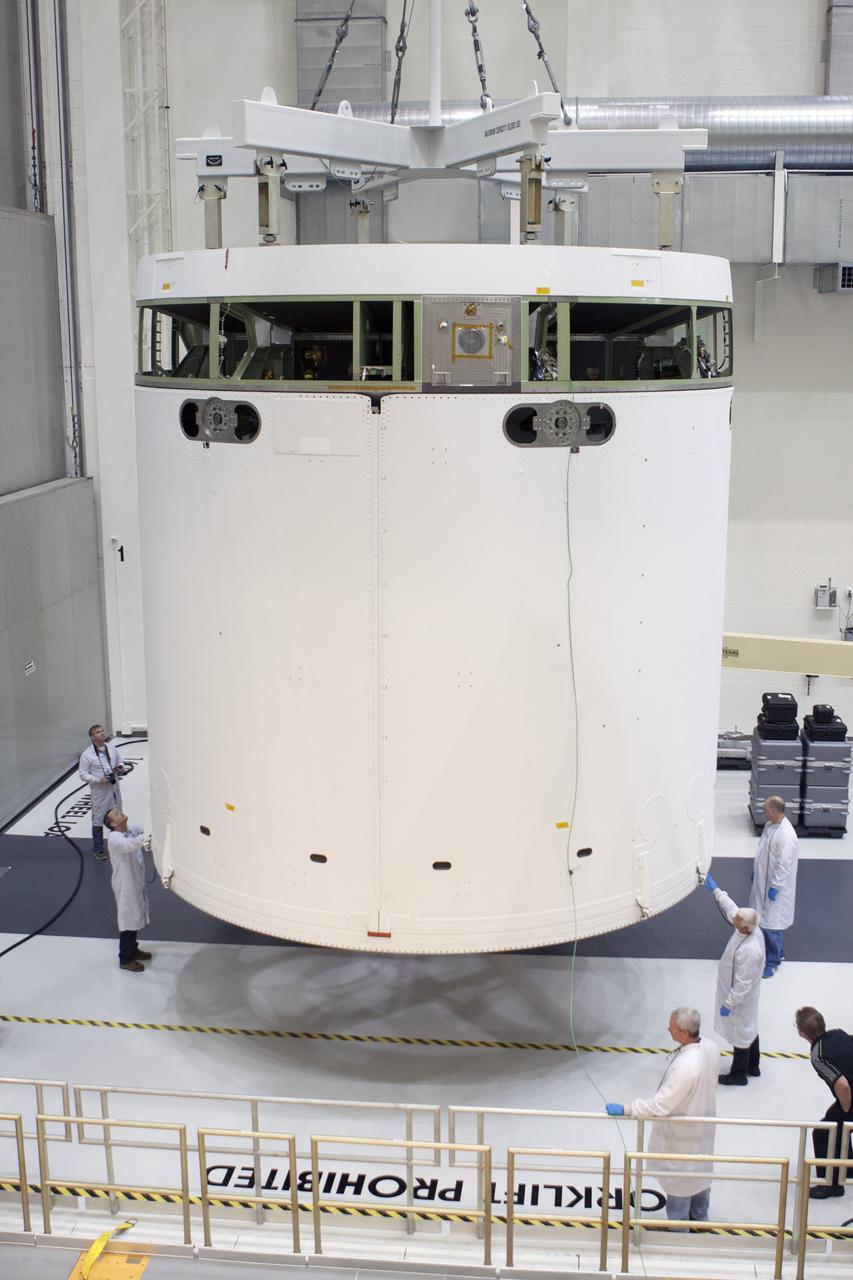
CAPE CANAVERAL, Fla. -- Inside the Operations and Checkout Building high bay at NASA's Kennedy Space Center in Florida, NASA and Lockheed Martin engineers and technicians help guide the Orion service module into the Final Assembly and System Testing, or FAST, cell. The Orion crew module will be stacked on the service module in the FAST cell and then both modules will be put through their final system tests for Exploration Flight Test-1, or EFT-1, before rolling out of the facility for integration with the United Launch Alliance Delta IV Heavy rocket. Orion is the exploration spacecraft designed to carry astronauts to destinations not yet explored by humans, including an asteroid and Mars. It will have emergency abort capability, sustain the crew during space travel and provide safe re-entry from deep space return velocities. The first unpiloted test flight of Orion, EFT-1, is scheduled to launch later this year atop a Delta IV rocket from Cape Canaveral Air Force Station in Florida to an altitude of 3,600 miles above the Earth's surface. The two-orbit, four-hour flight test will help engineers evaluate the systems critical to crew safety including the heat shield, parachute system and launch abort system. For more information, visit http://www.nasa.gov/orion. Photo credit: NASA/Glenn Benson
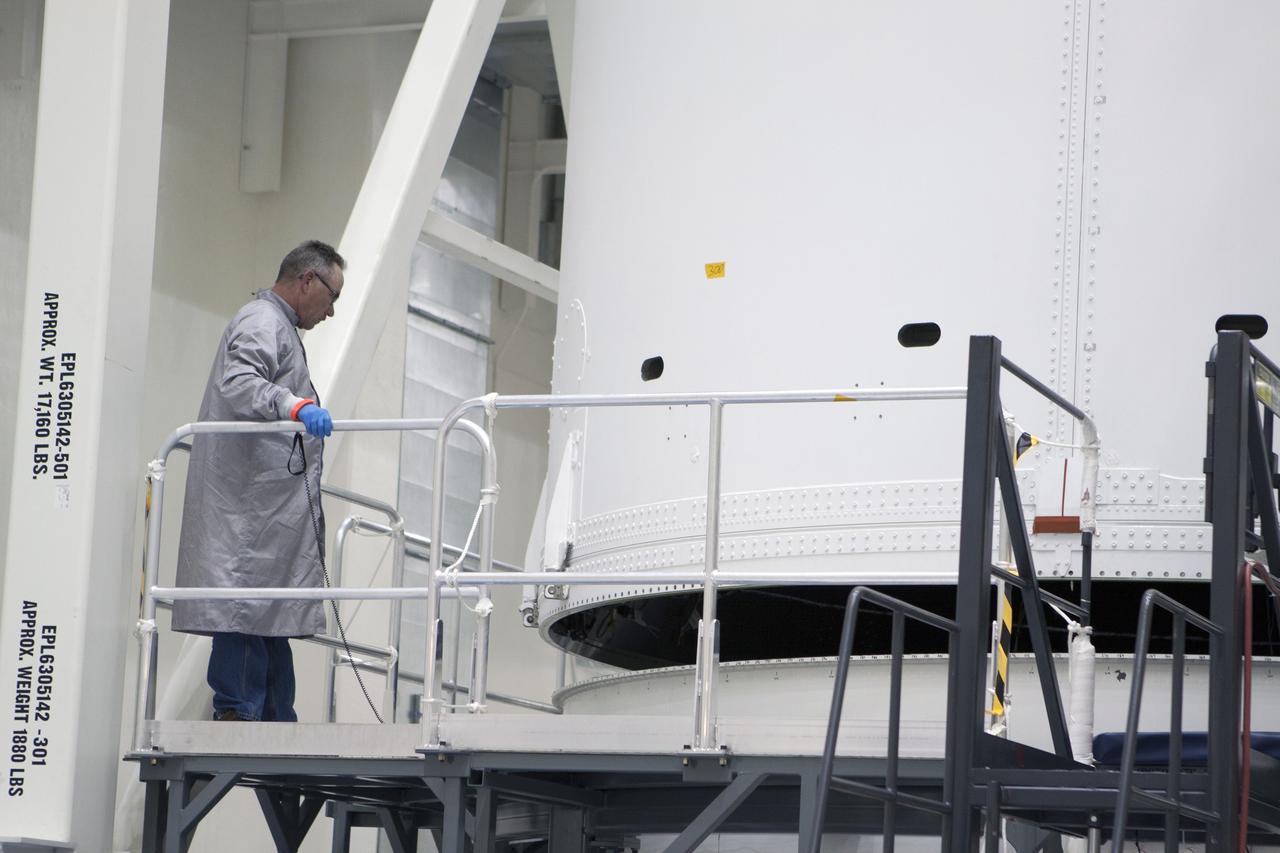
CAPE CANAVERAL, Fla. -- Inside the Operations and Checkout Building high bay at NASA's Kennedy Space Center in Florida, a Lockheed Martin technician monitors the progress as a crane is used to lift the Orion service module from a test stand and move it to the Final Assembly and System Testing, or FAST, cell further down the aisle. The Orion crew module will be stacked on the service module in the FAST cell and then both modules will be put through their final system tests for Exploration Flight Test-1, or EFT-1, prior to rolling out of the facility for integration with the United Launch Alliance Delta IV Heavy rocket. Orion is the exploration spacecraft designed to carry astronauts to destinations not yet explored by humans, including an asteroid and Mars. It will have emergency abort capability, sustain the crew during space travel and provide safe re-entry from deep space return velocities. The first unpiloted test flight of Orion, EFT-1, is scheduled to launch later this year atop a Delta IV rocket from Cape Canaveral Air Force Station in Florida to an altitude of 3,600 miles above the Earth's surface. The two-orbit, four-hour flight test will help engineers evaluate the systems critical to crew safety including the heat shield, parachute system and launch abort system. For more information, visit http://www.nasa.gov/orion. Photo credit: NASA/Glenn Benson
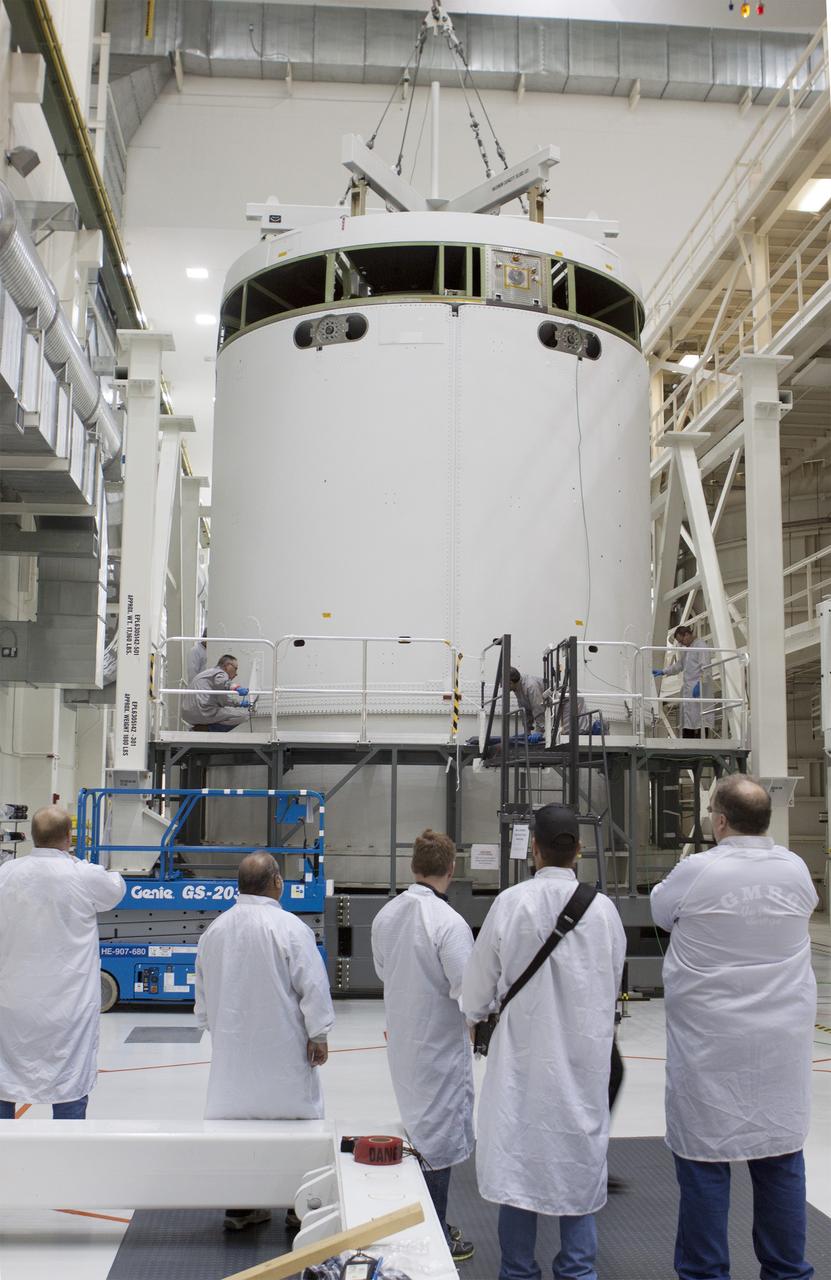
CAPE CANAVERAL, Fla. -- Inside the Operations and Checkout Building high bay at NASA's Kennedy Space Center in Florida, NASA and Lockheed Martin technicians and engineers prepare to move the Orion service module to the Final Assembly and System Testing, or FAST, cell further down the aisle. The Orion crew module will be stacked on the service module in the FAST cell and then both modules will be put through their final system tests for Exploration Flight Test-1, or EFT-1, prior to rolling out of the facility for integration with the United Launch Alliance Delta IV Heavy rocket. Orion is the exploration spacecraft designed to carry astronauts to destinations not yet explored by humans, including an asteroid and Mars. It will have emergency abort capability, sustain the crew during space travel and provide safe re-entry from deep space return velocities. The first unpiloted test flight of Orion, EFT-1, is scheduled to launch later this year atop a Delta IV rocket from Cape Canaveral Air Force Station in Florida to an altitude of 3,600 miles above the Earth's surface. The two-orbit, four-hour flight test will help engineers evaluate the systems critical to crew safety including the heat shield, parachute system and launch abort system. For more information, visit http://www.nasa.gov/orion. Photo credit: NASA/Glenn Benson
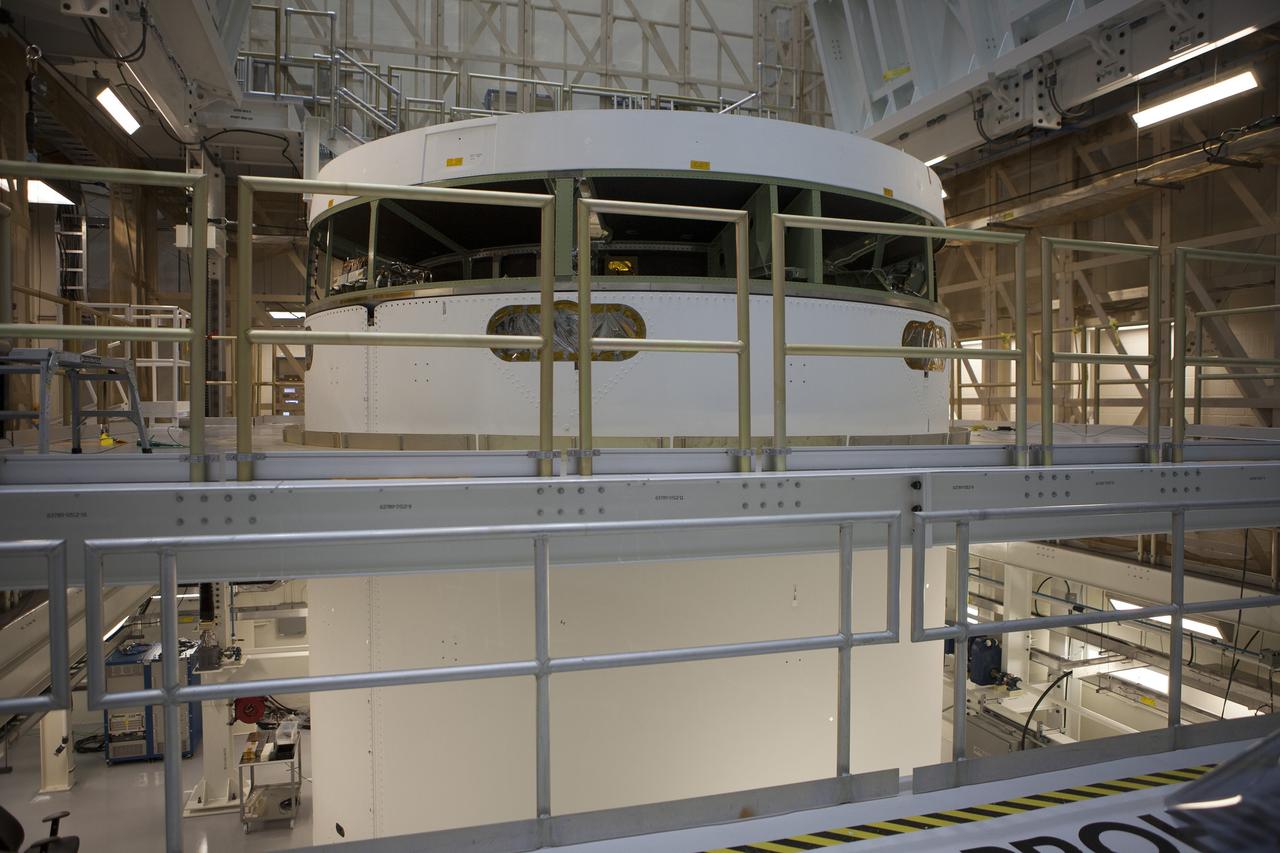
CAPE CANAVERAL, Fla. -- Inside the Operations and Checkout Building high bay at NASA's Kennedy Space Center in Florida, the Orion service module has been secured in the Final Assembly and System Testing, or FAST, cell. The Orion crew module will be stacked on the service module in the FAST cell and then both modules will be put through their final system tests for Exploration Flight Test-1, or EFT-1, before rolling out of the facility for integration with the United Launch Alliance Delta IV Heavy rocket. Orion is the exploration spacecraft designed to carry astronauts to destinations not yet explored by humans, including an asteroid and Mars. It will have emergency abort capability, sustain the crew during space travel and provide safe re-entry from deep space return velocities. The first unpiloted test flight of Orion, EFT-1, is scheduled to launch later this year atop a Delta IV rocket from Cape Canaveral Air Force Station in Florida to an altitude of 3,600 miles above the Earth's surface. The two-orbit, four-hour flight test will help engineers evaluate the systems critical to crew safety including the heat shield, parachute system and launch abort system. For more information, visit http://www.nasa.gov/orion. Photo credit: NASA/Glenn Benson
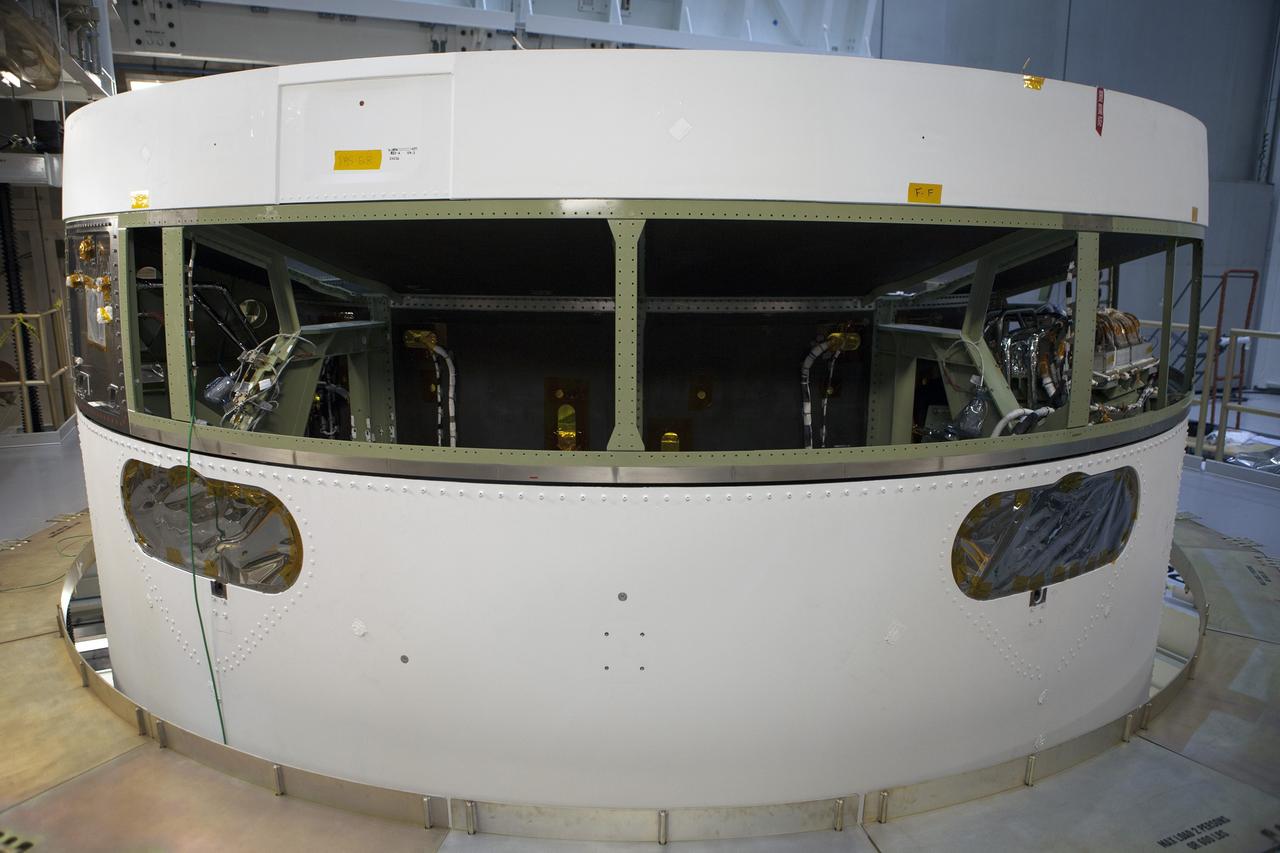
CAPE CANAVERAL, Fla. -- Inside the Operations and Checkout Building high bay at NASA's Kennedy Space Center in Florida, the Orion service module has been secured in the Final Assembly and System Testing, or FAST, cell. The Orion crew module will be stacked on the service module in the FAST cell and then both modules will be put through their final system tests for Exploration Flight Test-1, or EFT-1, before rolling out of the facility for integration with the United Launch Alliance Delta IV Heavy rocket. Orion is the exploration spacecraft designed to carry astronauts to destinations not yet explored by humans, including an asteroid and Mars. It will have emergency abort capability, sustain the crew during space travel and provide safe re-entry from deep space return velocities. The first unpiloted test flight of Orion, EFT-1, is scheduled to launch later this year atop a Delta IV rocket from Cape Canaveral Air Force Station in Florida to an altitude of 3,600 miles above the Earth's surface. The two-orbit, four-hour flight test will help engineers evaluate the systems critical to crew safety including the heat shield, parachute system and launch abort system. For more information, visit http://www.nasa.gov/orion. Photo credit: NASA/Glenn Benson
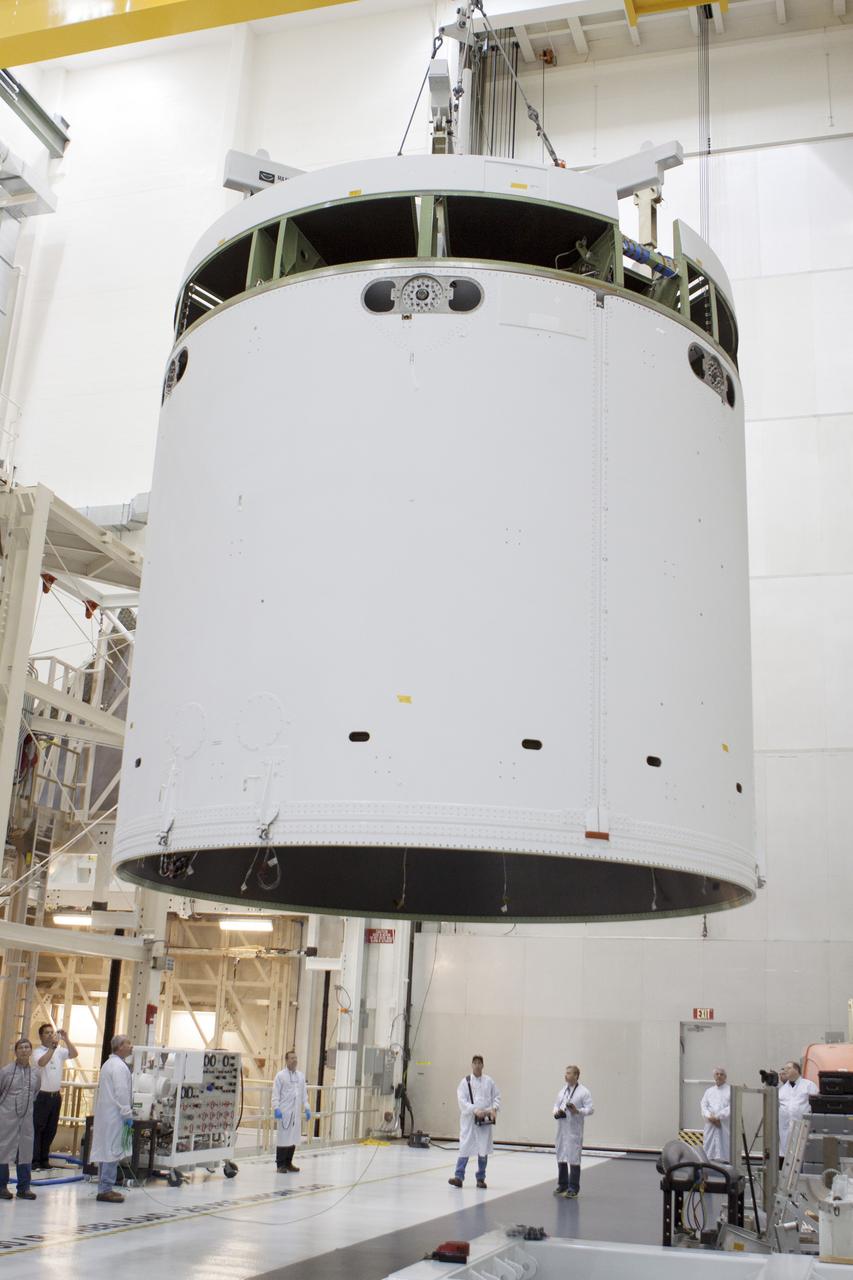
CAPE CANAVERAL, Fla. -- Inside the Operations and Checkout Building high bay at NASA's Kennedy Space Center in Florida, NASA and Lockheed Martin engineers and technicians monitor the progress as a crane is used to move the Orion service module to the Final Assembly and System Testing, or FAST, cell further down the aisle. The Orion crew module will be stacked on the service module in the FAST cell and then both modules will be put through their final system tests for Exploration Flight Test-1, or EFT-1, before rolling out of the facility for integration with the United Launch Alliance Delta IV Heavy rocket. Orion is the exploration spacecraft designed to carry astronauts to destinations not yet explored by humans, including an asteroid and Mars. It will have emergency abort capability, sustain the crew during space travel and provide safe re-entry from deep space return velocities. The first unpiloted test flight of Orion, EFT-1, is scheduled to launch later this year atop a Delta IV rocket from Cape Canaveral Air Force Station in Florida to an altitude of 3,600 miles above the Earth's surface. The two-orbit, four-hour flight test will help engineers evaluate the systems critical to crew safety including the heat shield, parachute system and launch abort system. For more information, visit http://www.nasa.gov/orion. Photo credit: NASA/Glenn Benson
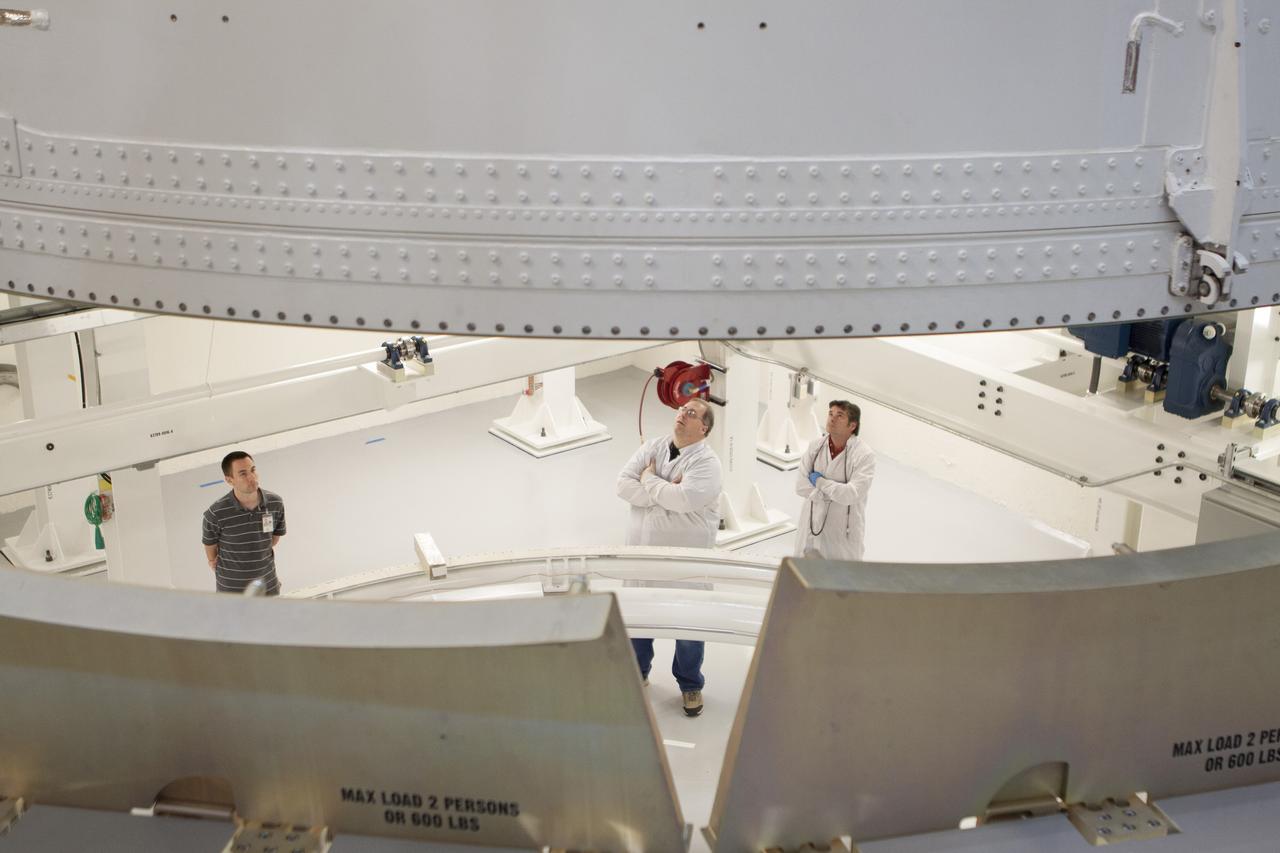
CAPE CANAVERAL, Fla. -- Inside the Operations and Checkout Building high bay at NASA's Kennedy Space Center in Florida, NASA and Lockheed Martin engineers and technicians monitor the progress as a crane lowers the Orion service module into the Final Assembly and System Testing, or FAST, cell. The Orion crew module will be stacked on the service module in the FAST cell and then both modules will be put through their final system tests for Exploration Flight Test-1, or EFT-1, before rolling out of the facility for integration with the United Launch Alliance Delta IV Heavy rocket. Orion is the exploration spacecraft designed to carry astronauts to destinations not yet explored by humans, including an asteroid and Mars. It will have emergency abort capability, sustain the crew during space travel and provide safe re-entry from deep space return velocities. The first unpiloted test flight of Orion, EFT-1, is scheduled to launch later this year atop a Delta IV rocket from Cape Canaveral Air Force Station in Florida to an altitude of 3,600 miles above the Earth's surface. The two-orbit, four-hour flight test will help engineers evaluate the systems critical to crew safety including the heat shield, parachute system and launch abort system. For more information, visit http://www.nasa.gov/orion. Photo credit: NASA/Glenn Benson
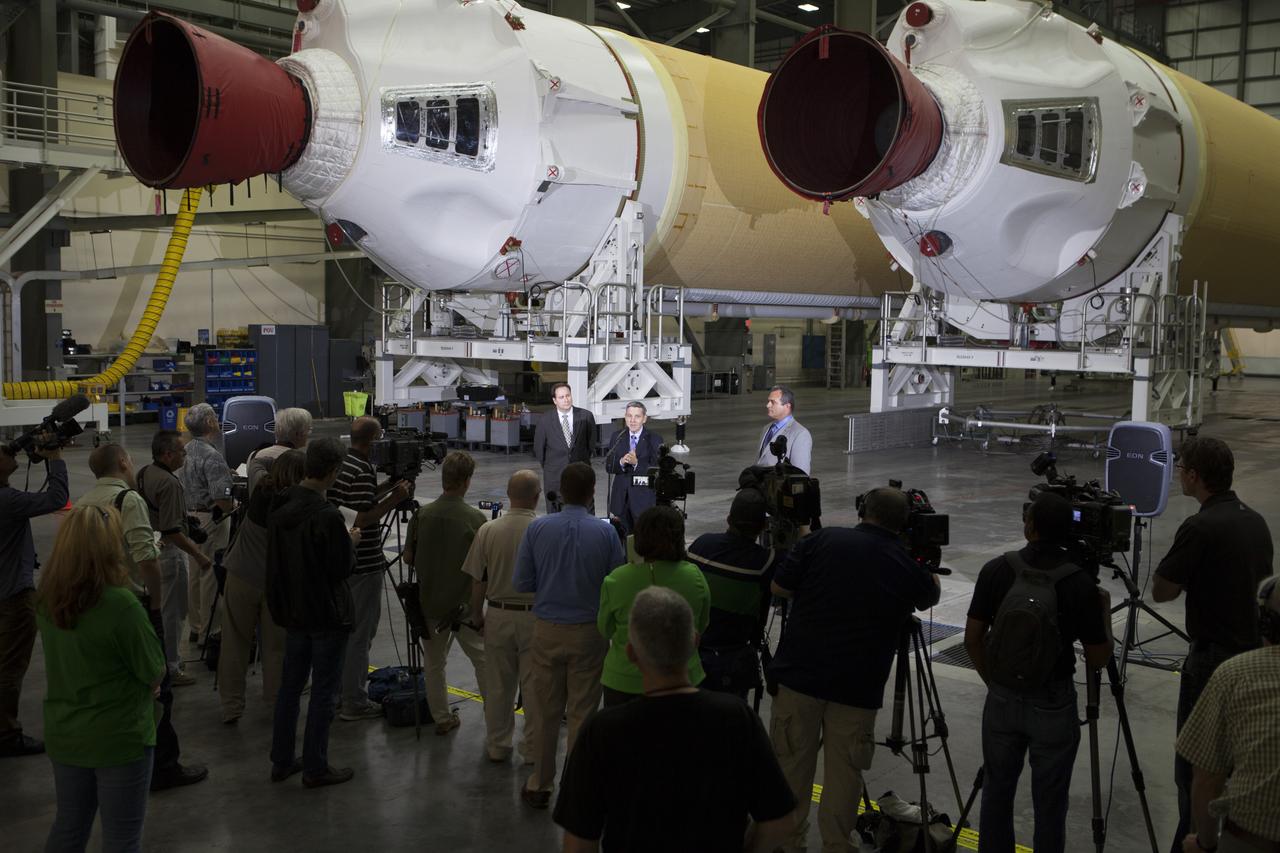
CAPE CANAVERAL, Fla. – During a media event inside the Horizontal Integration Facility at Launch Complex 37 at Cape Canaveral Air Force Station in Florida, Kennedy Space Center Director Bob Cabana speaks to members of the media. To his right is Tony Taliancich, director of East Coast Launch Operations with United Launch Alliance, or ULA. To his left is NASA Associate Administrator Robert Lightfoot. The event was held to showcase two of the ULA Delta IV boosters for the Orion Exploration Flight Test-1, or EFT-1, mission. Orion is the exploration spacecraft designed to carry astronauts to destinations not yet explored by humans, including an asteroid and Mars. It will have emergency abort capability, sustain the crew during space travel and provide safe re-entry from deep space return velocities. The first unpiloted test flight of Orion, EFT-1, is scheduled to launch in 2014 atop a Delta IV rocket and in 2017 on NASA’s Space Launch System rocket. For more information, visit http://www.nasa.gov/orion. Photo credit: NASA/Kim Shiflett

CAPE CANAVERAL, Fla. – During a media event inside the Horizontal Integration Facility at Launch Complex 37 at Cape Canaveral Air Force Station in Florida, Tony Taliancich, director of East Coast Launch Operations with United Launch Alliance, or ULA, speaks to members of the media. Also with him at the briefing were Kennedy Space Center Director Bob Cabana and NASA Associate Administrator Robert Lightfoot. The event was held to showcase two of the ULA Delta IV boosters for the Orion Exploration Flight Test-1, or EFT-1, mission. Orion is the exploration spacecraft designed to carry astronauts to destinations not yet explored by humans, including an asteroid and Mars. It will have emergency abort capability, sustain the crew during space travel and provide safe re-entry from deep space return velocities. The first unpiloted test flight of Orion, EFT-1, is scheduled to launch in 2014 atop a Delta IV rocket and in 2017 on NASA’s Space Launch System rocket. For more information, visit http://www.nasa.gov/orion. Photo credit: NASA/Kim Shiflett
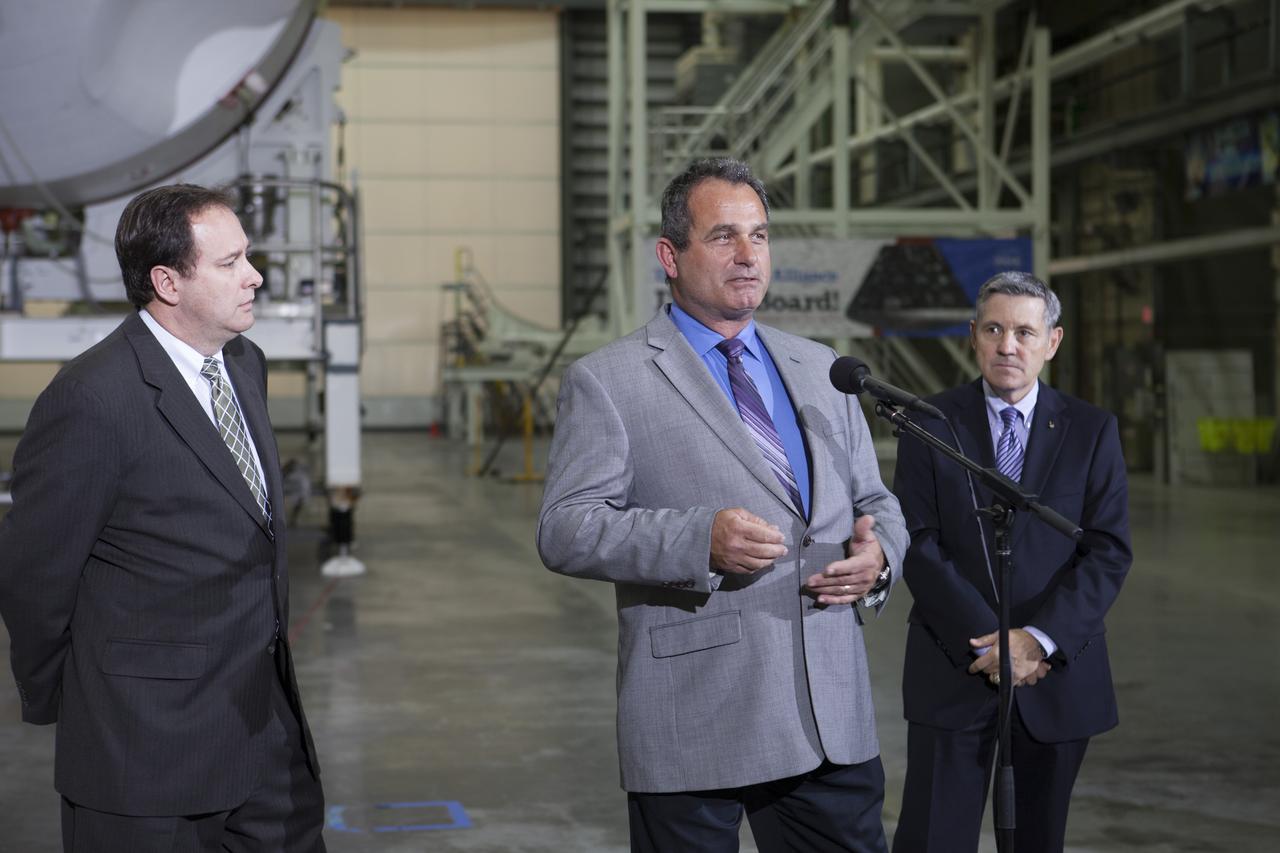
CAPE CANAVERAL, Fla. – During a media event inside the Horizontal Integration Facility at Launch Complex 37 at Cape Canaveral Air Force Station in Florida, Tony Taliancich, director of East Coast Launch Operations with United Launch Alliance, or ULA, speaks to members of the media. Also with Taliancich at the briefing were Kennedy Space Center Director Bob Cabana, at right, and NASA Associate Administrator Robert Lightfoot. The event was held to showcase two of the ULA Delta IV boosters for the Orion Exploration Flight Test-1, or EFT-1, mission. Orion is the exploration spacecraft designed to carry astronauts to destinations not yet explored by humans, including an asteroid and Mars. It will have emergency abort capability, sustain the crew during space travel and provide safe re-entry from deep space return velocities. The first unpiloted test flight of Orion, EFT-1, is scheduled to launch in 2014 atop a Delta IV rocket and in 2017 on NASA’s Space Launch System rocket. For more information, visit http://www.nasa.gov/orion. Photo credit: NASA/Kim Shiflett
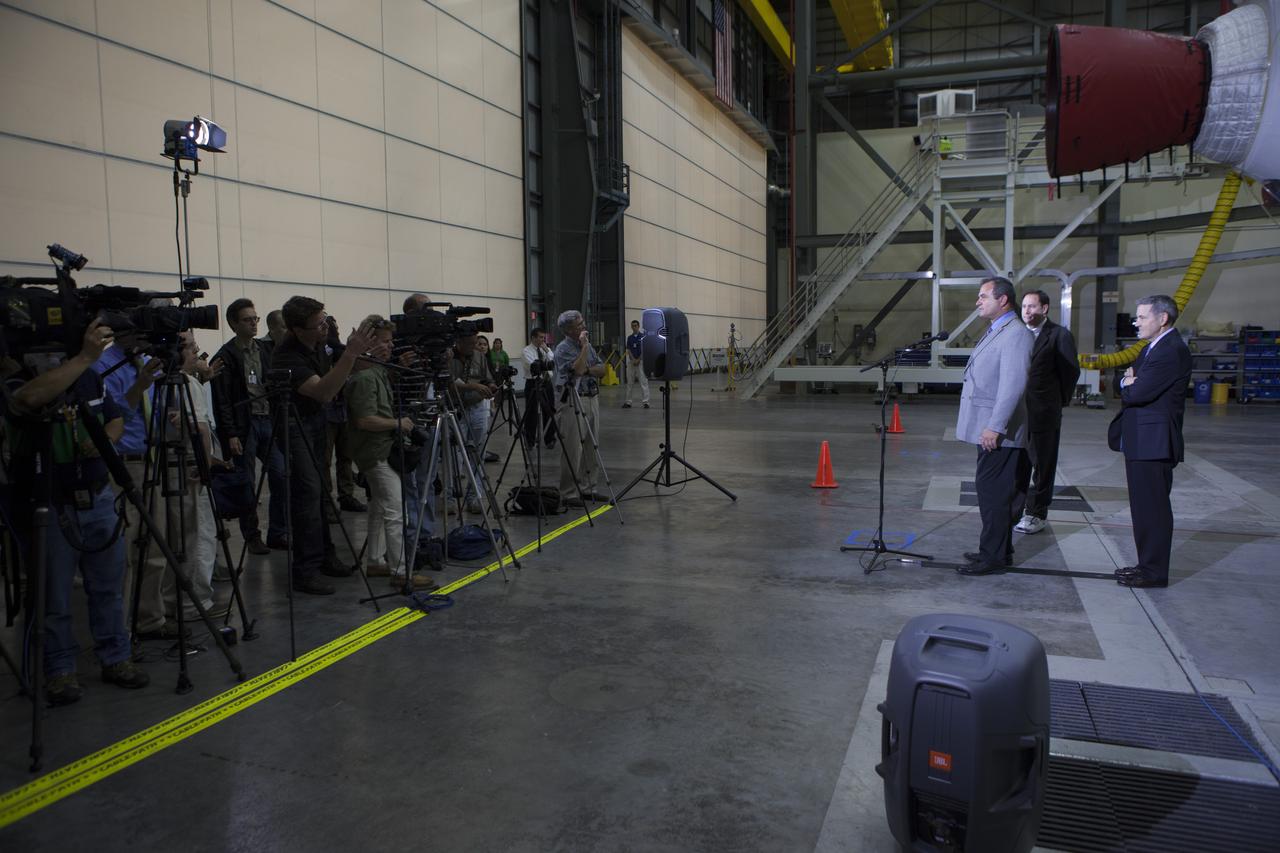
CAPE CANAVERAL, Fla. – During a media event inside the Horizontal Integration Facility at Launch Complex 37 at Cape Canaveral Air Force Station in Florida, Tony Taliancich, director of East Coast Launch Operations with United Launch Alliance, or ULA, speaks to members of the media. Also with Taliancich at the briefing were Kennedy Space Center Director Bob Cabana, at right, and NASA Associate Administrator Robert Lightfoot. The event was held to showcase two of the ULA Delta IV boosters for the Orion Exploration Flight Test-1, or EFT-1, mission. Orion is the exploration spacecraft designed to carry astronauts to destinations not yet explored by humans, including an asteroid and Mars. It will have emergency abort capability, sustain the crew during space travel and provide safe re-entry from deep space return velocities. The first unpiloted test flight of Orion, EFT-1, is scheduled to launch in 2014 atop a Delta IV rocket and in 2017 on NASA’s Space Launch System rocket. For more information, visit http://www.nasa.gov/orion. Photo credit: NASA/Kim Shiflett
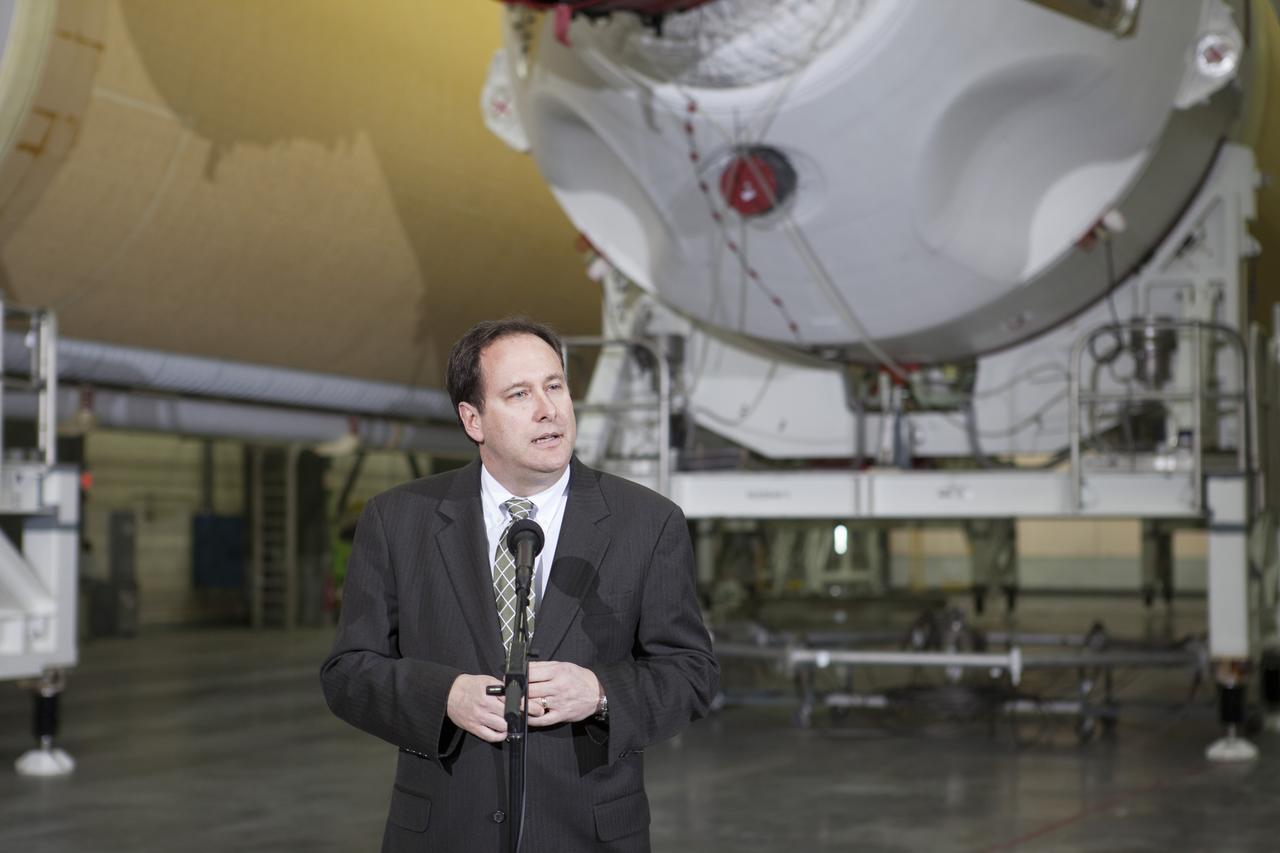
CAPE CANAVERAL, Fla. – During a media event inside the Horizontal Integration Facility at Launch Complex 37 at Cape Canaveral Air Force Station in Florida, NASA Associate Administrator Robert Lightfoot speaks to members of the media. Also attending the briefing were Kennedy Space Center Director Bob Cabana and Tony Taliancich, director of East Coast Launch Operations with United Launch Alliance, or ULA. The event was held to showcase two of the ULA Delta IV boosters for the Orion Exploration Flight Test-1, or EFT-1, mission. Orion is the exploration spacecraft designed to carry astronauts to destinations not yet explored by humans, including an asteroid and Mars. It will have emergency abort capability, sustain the crew during space travel and provide safe re-entry from deep space return velocities. The first unpiloted test flight of Orion, EFT-1, is scheduled to launch in 2014 atop a Delta IV rocket and in 2017 on NASA’s Space Launch System rocket. For more information, visit http://www.nasa.gov/orion. Photo credit: NASA/Kim Shiflett
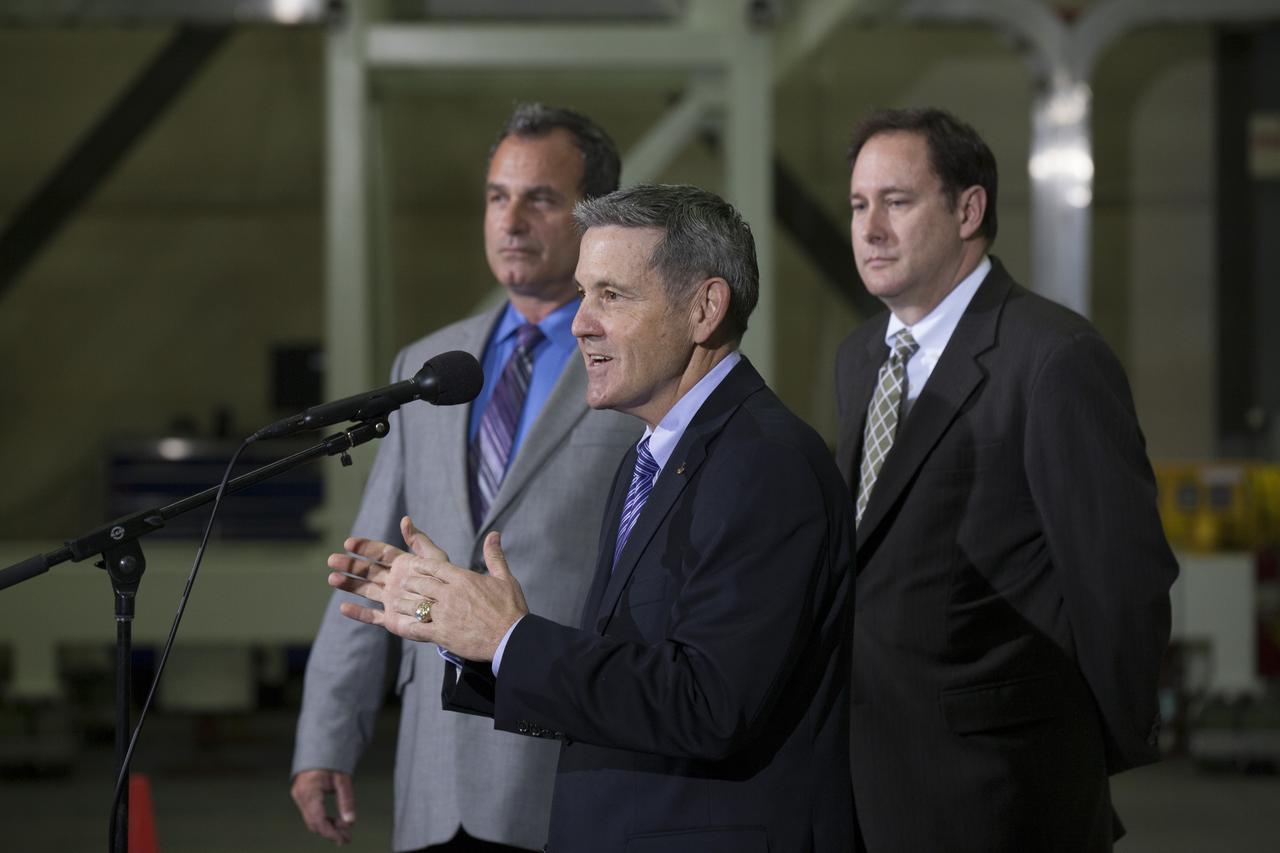
CAPE CANAVERAL, Fla. – During a media event inside the Horizontal Integration Facility at Launch Complex 37 at Cape Canaveral Air Force Station in Florida, Kennedy Space Center Director Bob Cabana speaks to members of the media. To his left is Tony Taliancich, director of East Coast Launch Operations with United Launch Alliance, or ULA. To the right is NASA Associate Administrator Robert Lightfoot. The event was held to showcase two of the ULA Delta IV boosters for the Orion Exploration Flight Test-1, or EFT-1, mission. Orion is the exploration spacecraft designed to carry astronauts to destinations not yet explored by humans, including an asteroid and Mars. It will have emergency abort capability, sustain the crew during space travel and provide safe re-entry from deep space return velocities. The first unpiloted test flight of Orion, EFT-1, is scheduled to launch in 2014 atop a Delta IV rocket and in 2017 on NASA’s Space Launch System rocket. For more information, visit http://www.nasa.gov/orion. Photo credit: NASA/Kim Shiflett
CAPE CANAVERAL, Fla. – During a media event inside the Horizontal Integration Facility at Launch Complex 37 at Cape Canaveral Air Force Station in Florida, NASA Associate Administrator Robert Lightfoot answers questions. To his right is Tony Taliancich, director of East Coast Launch Operations with United Launch Alliance, or ULA. Also participating in the event was Kennedy Space Center Director Bob Cabana. The event was held to showcase two of the ULA Delta IV boosters for the Orion Exploration Flight Test-1, or EFT-1, mission. Orion is the exploration spacecraft designed to carry astronauts to destinations not yet explored by humans, including an asteroid and Mars. It will have emergency abort capability, sustain the crew during space travel and provide safe re-entry from deep space return velocities. The first unpiloted test flight of Orion, EFT-1, is scheduled to launch in 2014 atop a Delta IV rocket and in 2017 on NASA’s Space Launch System rocket. For more information, visit http://www.nasa.gov/orion. Photo credit: NASA/Kim Shiflett
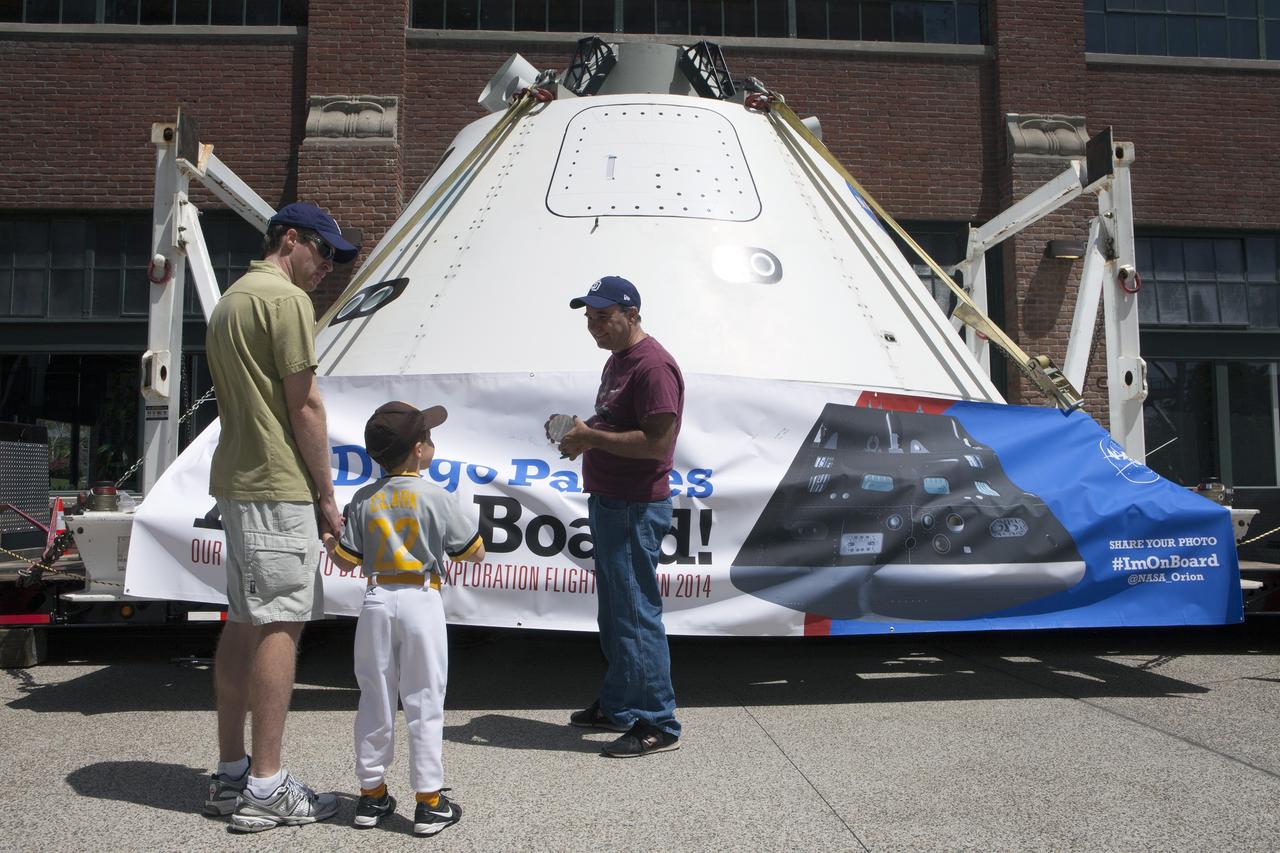
CAPE CANAVERAL, Fla. – San Diego Padres fans talk to Doug Lenhardt, Kennedy Space Center's Exploration Flight Test-1, or EFT-1, mission integration manager outside Petco Field in San Diego, California. NASA's Orion boilerplate test vehicle is on display. The boilerplate test vehicle is being prepared for an Exploration Flight Test-1, or EFT-1, pre-transportation test. The Ground Systems Development and Operations Program will run the test at the U.S. Naval Base San Diego to simulate retrieval and transportation procedures for Orion after it splashes down in the ocean and is retrieved for return to land and ground transportation back to Kennedy Space Center in Florida. Orion is the exploration spacecraft designed to carry astronauts to destinations not yet explored by humans, including an asteroid and Mars. It will have emergency abort capability, sustain the crew during space travel and provide safe re-entry from deep space return velocities. The first unpiloted test flight of the Orion is scheduled to launch later this year atop a Delta IV rocket and in 2017 on NASA’s Space Launch System rocket. For more information, visit http://www.nasa.gov/orion. Photo credit: NASA/Kim Shiflett
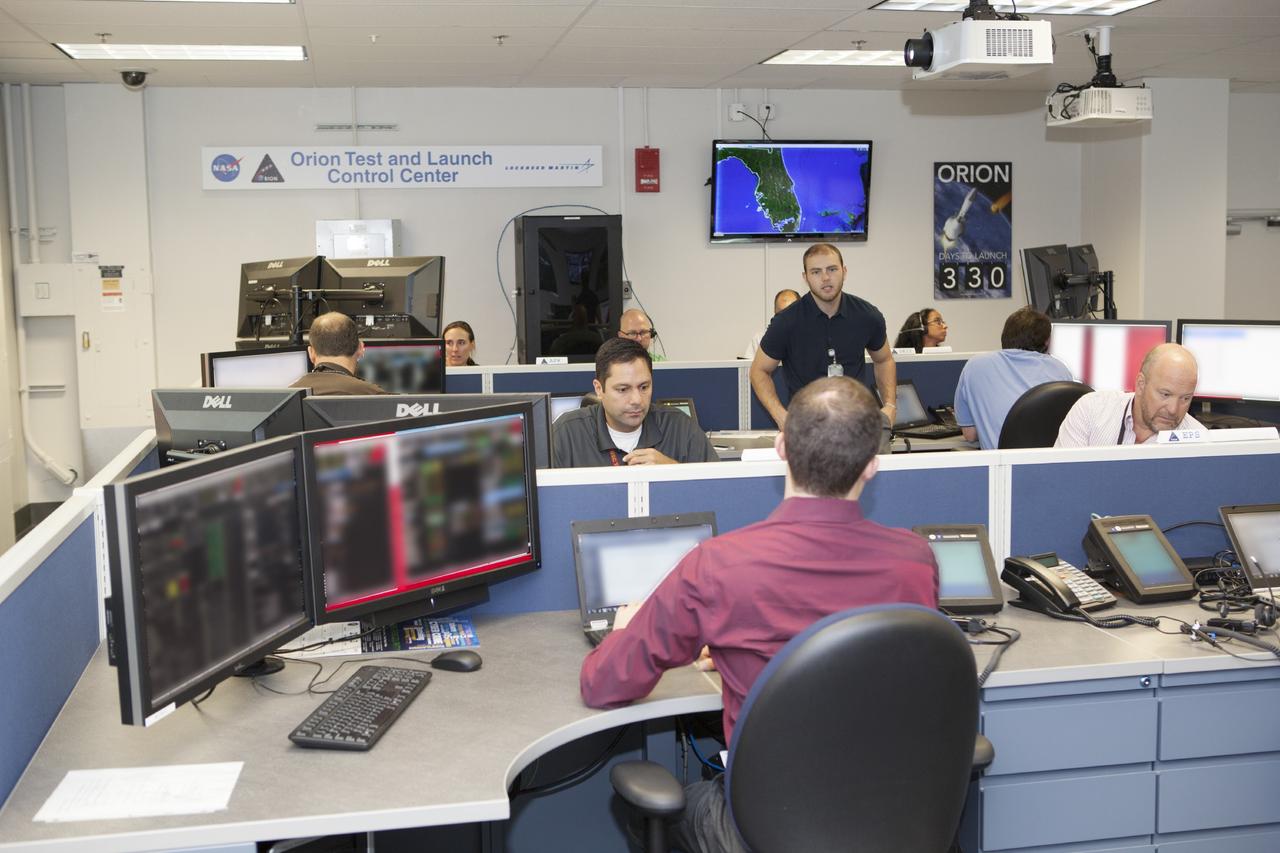
CAPE CANAVERAL, Fla. – Inside the Orion Test and Launch Control Center at NASA’s Kennedy Space Center in Florida, engineers prepare for the first Exploration Flight Test 1, or EFT-1, power up test. NASA’s first-ever deep space craft, Orion, was powered on for the first time, marking a major milestone in the final year of preparations for flight. Orion’s avionics system was installed on the crew module and powered up for a series of systems tests. Orion is the exploration spacecraft designed to carry astronauts to destinations not yet explored by humans, including an asteroid and Mars. It will have emergency abort capability, sustain the crew during space travel and provide safe re-entry from deep space return velocities. The first unpiloted test flight of Orion, EFT-1, is scheduled to launch in 2014 atop a Delta IV rocket and in 2017 on NASA’s Space Launch System rocket. For more information, visit www.nasa.gov/orion. Photo credit: Dimitri Gerondidakis
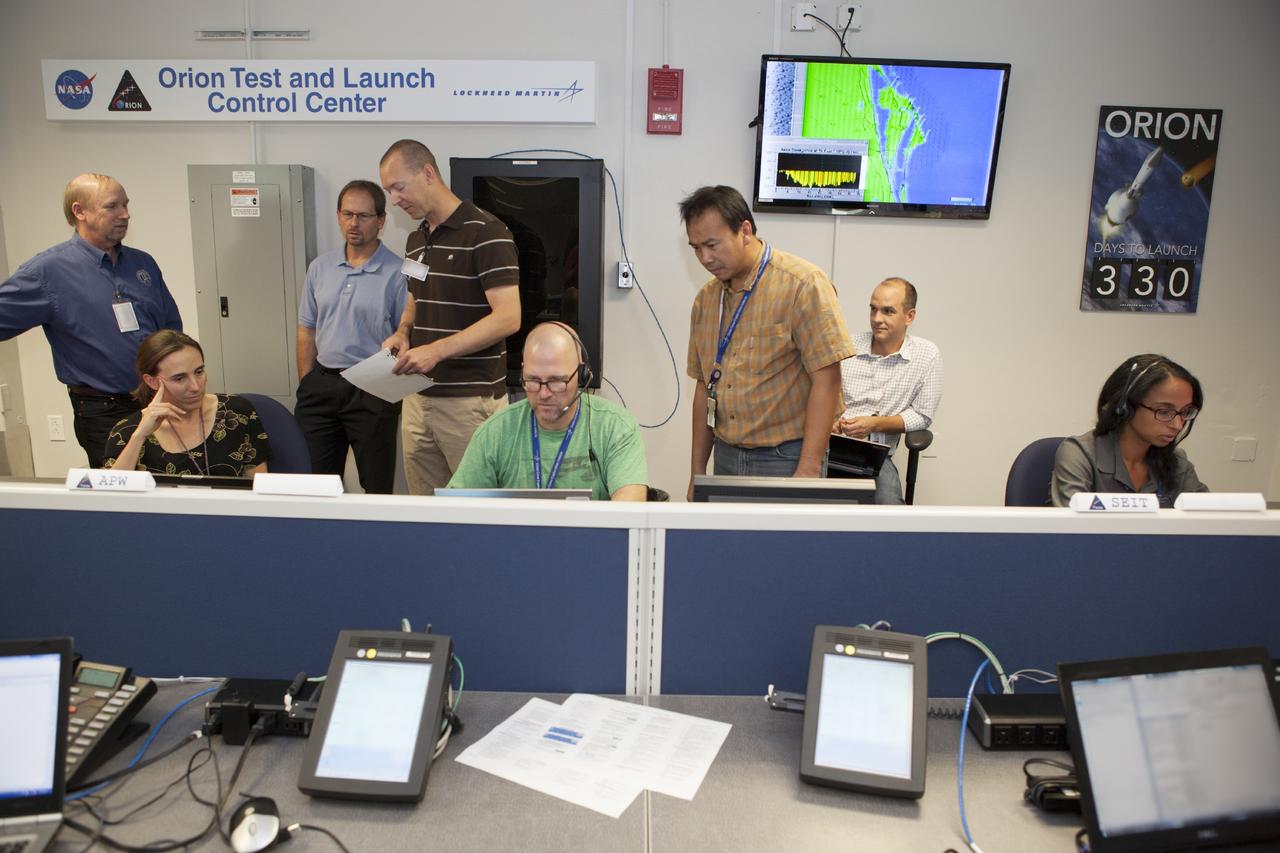
CAPE CANAVERAL, Fla. – Inside the Orion Test and Launch Control Center at NASA’s Kennedy Space Center in Florida, engineers monitor data during the first Exploration Flight Test 1, or EFT-1, power up test. NASA’s first-ever deep space craft, Orion, was powered on for the first time, marking a major milestone in the final year of preparations for flight. Orion’s avionics system was installed on the crew module and powered up for a series of systems tests. Orion is the exploration spacecraft designed to carry astronauts to destinations not yet explored by humans, including an asteroid and Mars. It will have emergency abort capability, sustain the crew during space travel and provide safe re-entry from deep space return velocities. The first unpiloted test flight of Orion, EFT-1, is scheduled to launch in 2014 atop a Delta IV rocket and in 2017 on NASA’s Space Launch System rocket. For more information, visit www.nasa.gov/orion. Photo credit: Dimitri Gerondidakis
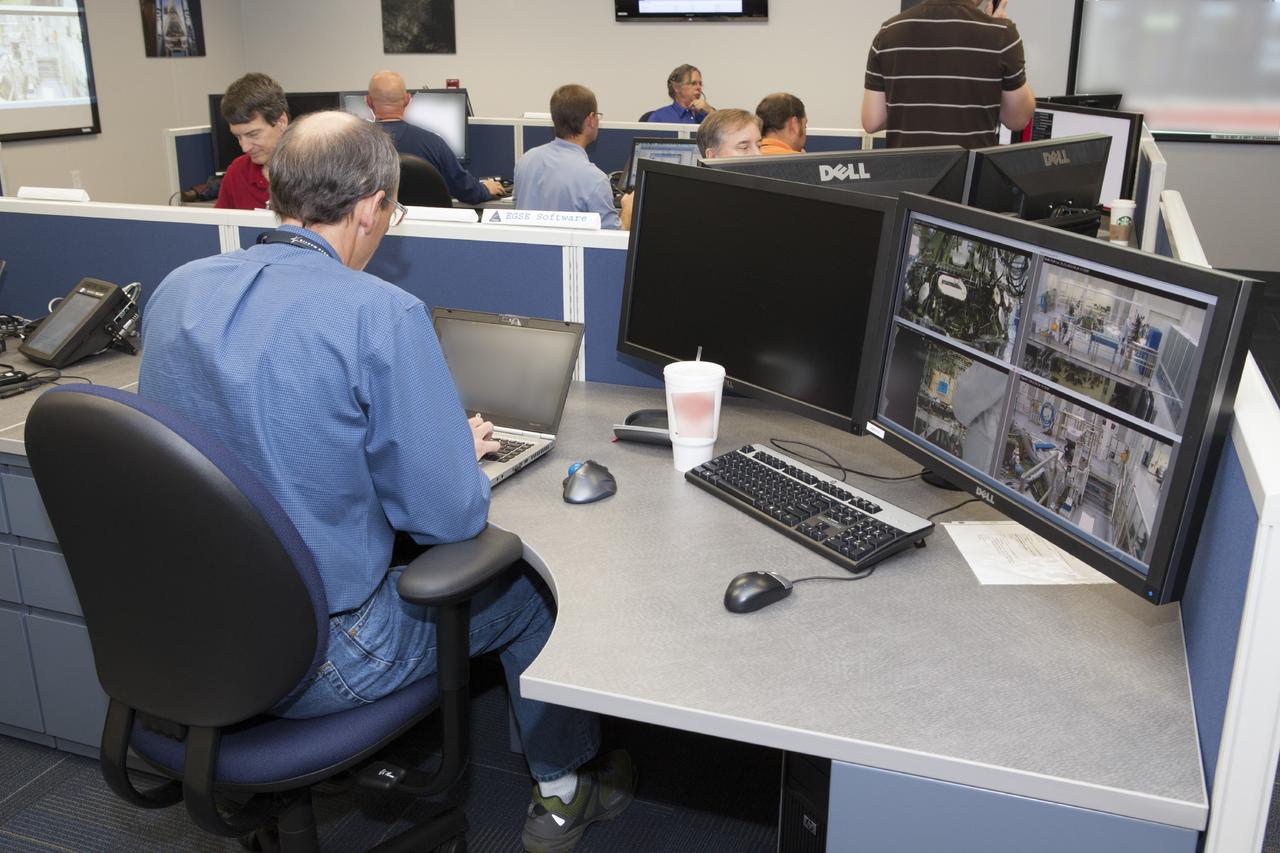
CAPE CANAVERAL, Fla. – Inside the Orion Test and Launch Control Center at NASA’s Kennedy Space Center in Florida, engineers monitor data for the first Exploration Flight Test 1, or EFT-1, power up test. NASA’s first-ever deep space craft, Orion, was powered on for the first time, marking a major milestone in the final year of preparations for flight. Orion’s avionics system was installed on the crew module and powered up for a series of systems tests. Orion is the exploration spacecraft designed to carry astronauts to destinations not yet explored by humans, including an asteroid and Mars. It will have emergency abort capability, sustain the crew during space travel and provide safe re-entry from deep space return velocities. The first unpiloted test flight of Orion, EFT-1, is scheduled to launch in 2014 atop a Delta IV rocket and in 2017 on NASA’s Space Launch System rocket. For more information, visit www.nasa.gov/orion. Photo credit: Dimitri Gerondidakis
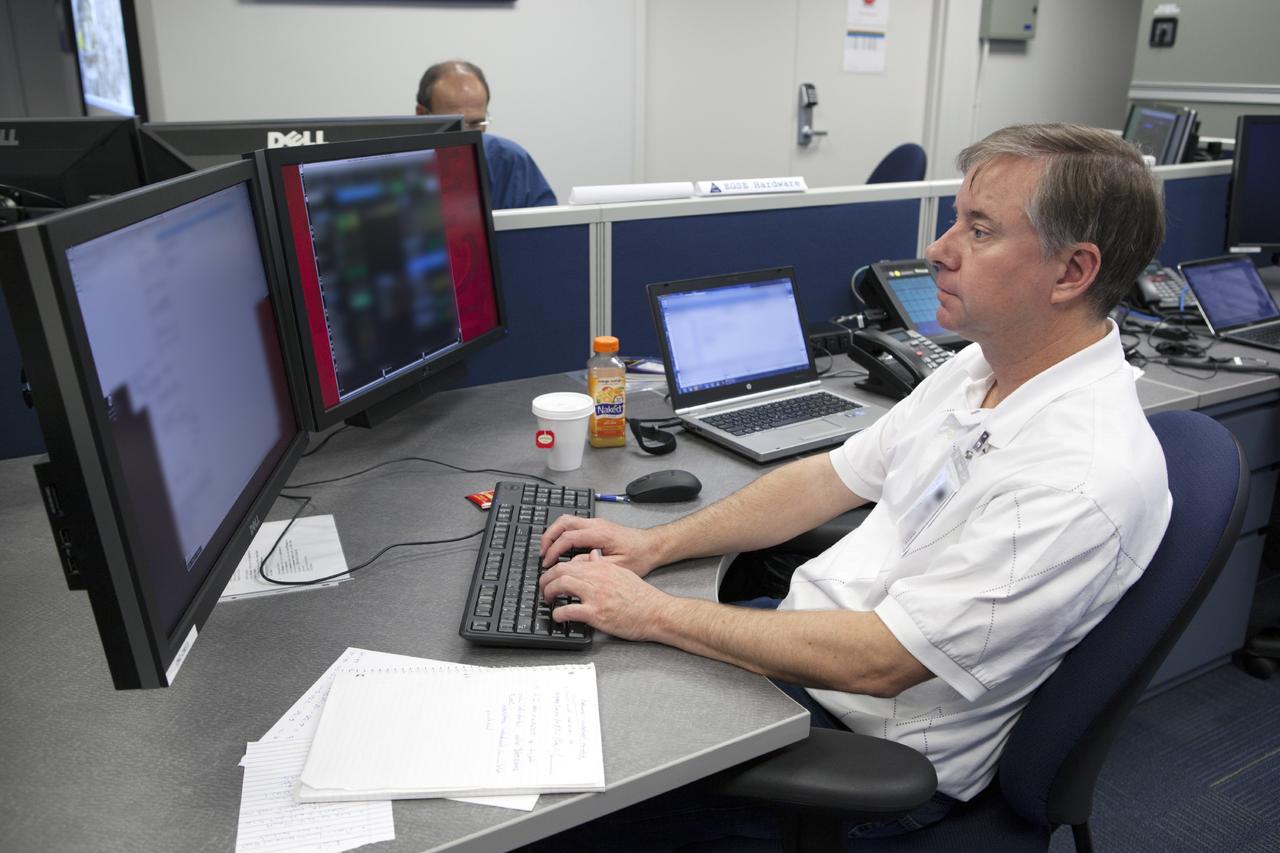
CAPE CANAVERAL, Fla. – Inside the Orion Test and Launch Control Center at NASA’s Kennedy Space Center in Florida, an engineer prepares for the first Exploration Flight Test 1, or EFT-1, power up test. NASA’s first-ever deep space craft, Orion, was powered on for the first time, marking a major milestone in the final year of preparations for flight. Orion’s avionics system was installed on the crew module and powered up for a series of systems tests. Orion is the exploration spacecraft designed to carry astronauts to destinations not yet explored by humans, including an asteroid and Mars. It will have emergency abort capability, sustain the crew during space travel and provide safe re-entry from deep space return velocities. The first unpiloted test flight of Orion, EFT-1, is scheduled to launch in 2014 atop a Delta IV rocket and in 2017 on NASA’s Space Launch System rocket. For more information, visit www.nasa.gov/orion. Photo credit: Dimitri Gerondidakis
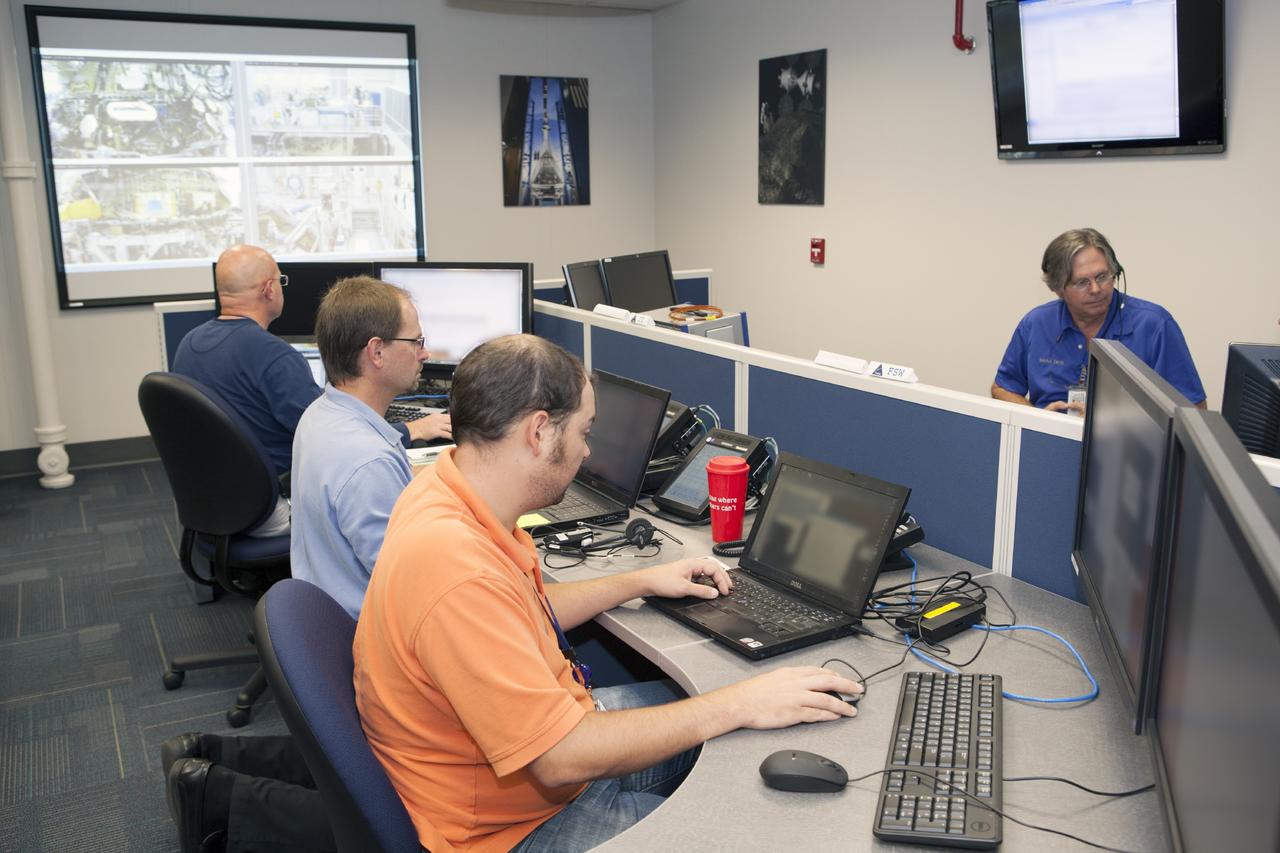
CAPE CANAVERAL, Fla. – Inside the Orion Test and Launch Control Center at NASA’s Kennedy Space Center in Florida, engineers prepare for the first Exploration Flight Test 1, or EFT-1, power up test. NASA’s first-ever deep space craft, Orion, was powered on for the first time, marking a major milestone in the final year of preparations for flight. Orion’s avionics system was installed on the crew module and powered up for a series of systems tests. Orion is the exploration spacecraft designed to carry astronauts to destinations not yet explored by humans, including an asteroid and Mars. It will have emergency abort capability, sustain the crew during space travel and provide safe re-entry from deep space return velocities. The first unpiloted test flight of Orion, EFT-1, is scheduled to launch in 2014 atop a Delta IV rocket and in 2017 on NASA’s Space Launch System rocket. For more information, visit www.nasa.gov/orion. Photo credit: Dimitri Gerondidakis
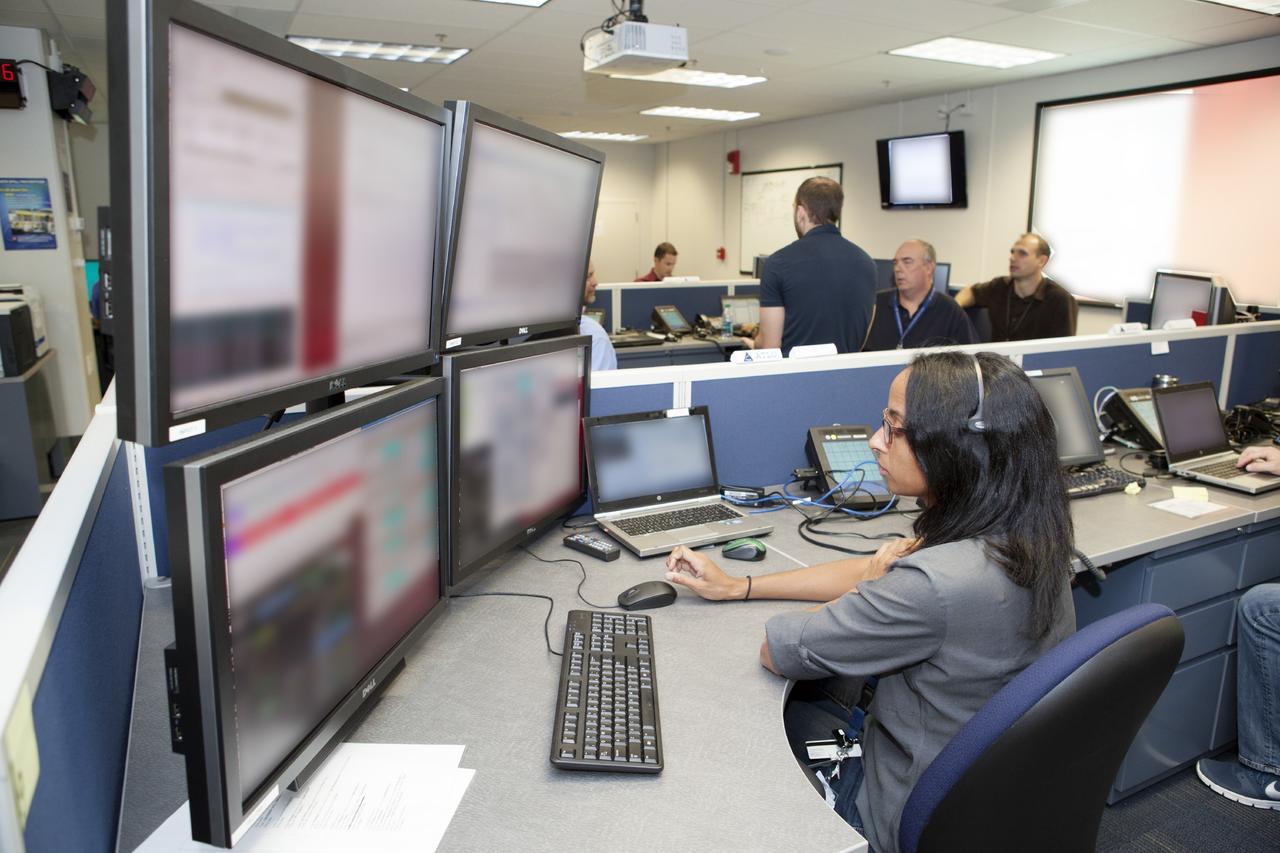
CAPE CANAVERAL, Fla. – Inside the Orion Test and Launch Control Center at NASA’s Kennedy Space Center in Florida, engineers prepare for the first Exploration Flight Test 1, or EFT-1, power up test. NASA’s first-ever deep space craft, Orion, was powered on for the first time, marking a major milestone in the final year of preparations for flight. Orion’s avionics system was installed on the crew module and powered up for a series of systems tests. Orion is the exploration spacecraft designed to carry astronauts to destinations not yet explored by humans, including an asteroid and Mars. It will have emergency abort capability, sustain the crew during space travel and provide safe re-entry from deep space return velocities. The first unpiloted test flight of Orion, EFT-1, is scheduled to launch in 2014 atop a Delta IV rocket and in 2017 on NASA’s Space Launch System rocket. For more information, visit www.nasa.gov/orion. Photo credit: Dimitri Gerondidakis

CAPE CANAVERAL, Fla. – Doug Lenhardt, Kennedy Space Center's Exploration Flight Test-1, or EFT-1, mission integration manager, and the San Diego Padres mascot wave at the crowds at Petco Field in San Diego, California before the start of the baseball game. The Orion boilerplate test vehicle is on display in the stadium. The boilerplate test vehicle is being prepared for an EFT-1 pre-transportation test. The Ground Systems Development and Operations Program will run the test at the U.S. Naval Base San Diego to simulate retrieval and transportation procedures for Orion after it splashes down in the ocean and is retrieved for return to land and ground transportation back to Kennedy Space Center in Florida. Orion is the exploration spacecraft designed to carry astronauts to destinations not yet explored by humans, including an asteroid and Mars. It will have emergency abort capability, sustain the crew during space travel and provide safe re-entry from deep space return velocities. The first unpiloted test flight of the Orion is scheduled to launch later this year atop a Delta IV rocket and in 2017 on NASA’s Space Launch System rocket. For more information, visit http://www.nasa.gov/orion. Photo credit: NASA/Kim Shiflett

CAPE CANAVERAL, Fla. – Doug Lenhardt, Kennedy Space Center's Exploration Flight Test-1, or EFT-1, mission integration manager displays a baseball from the San Diego Padres inside Petco Park in San Diego, California. NASA's Orion boilerplate test vehicle is on display at the stadium. The boilerplate test vehicle is being prepared for an EFT-1 pre-transportation test. The Ground Systems Development and Operations Program will run the test to simulate retrieval and transportation procedures for Orion after it splashes down in the ocean and is retrieved for return to land and ground transportation back to Kennedy Space Center in Florida. Orion is the exploration spacecraft designed to carry astronauts to destinations not yet explored by humans, including an asteroid and Mars. It will have emergency abort capability, sustain the crew during space travel and provide safe re-entry from deep space return velocities. The first unpiloted test flight of the Orion is scheduled to launch later this year atop a Delta IV rocket and in 2017 on NASA’s Space Launch System rocket. For more information, visit http://www.nasa.gov/orion. Photo credit: NASA/Kim Shiflett
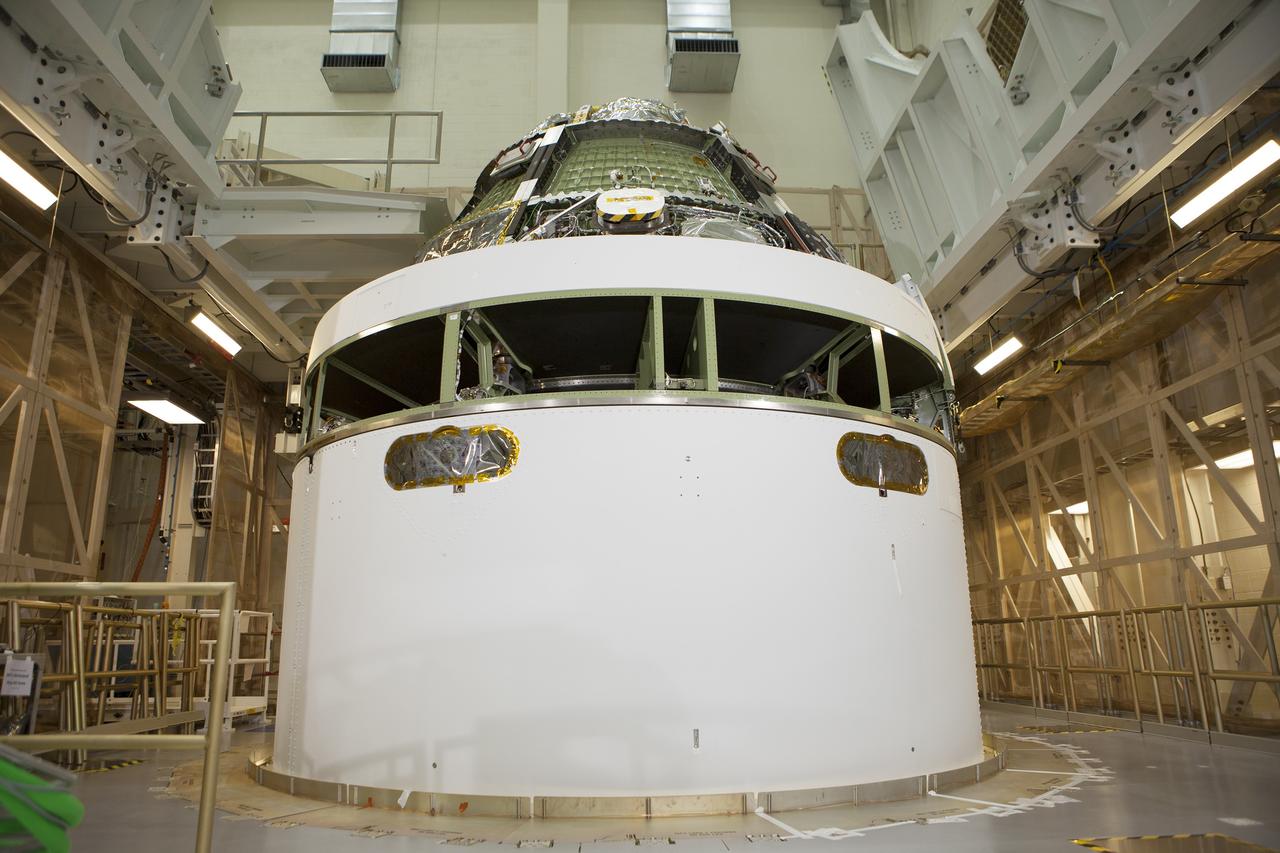
CAPE CANAVERAL, Fla. – Inside the Operations and Checkout Building high bay at NASA's Kennedy Space Center in Florida, the Orion crew module has been stacked on the service module in the Final Assembly and System Testing cell in preparation for final system tests for Exploration Flight Test-1, or EFT-1, prior to rolling out of the facility for integration with the United Launch Alliance Delta IV Heavy rocket. EFT-1 will provide engineers with data about the heat shield's ability to protect Orion and its future crews from the 4,000-degree heat of reentry and an ocean splashdown following the spacecraft’s 20,000-mph reentry from space. Data gathered during the flight will inform decisions about design improvements on the heat shield and other Orion systems, and authenticate existing computer models and new approaches to space systems design and development. This process is critical to reducing overall risks and costs of future Orion missions. Orion is the exploration spacecraft designed to carry astronauts to destinations not yet explored by humans, including an asteroid and Mars. It will have emergency abort capability, sustain the crew during space travel and provide safe re-entry from deep space return velocities. The first unpiloted test flight of the Orion is scheduled to launch later this year atop a Delta IV rocket from Cape Canaveral Air Force Station in Florida to an altitude of 3,600 miles above the Earth's surface. The two-orbit, four-hour flight test will help engineers evaluate the systems critical to crew safety including the heat shield, parachute system and launch abort system. For more information, visit http://www.nasa.gov/orion. Photo credit: NASA/Kim Shiflett
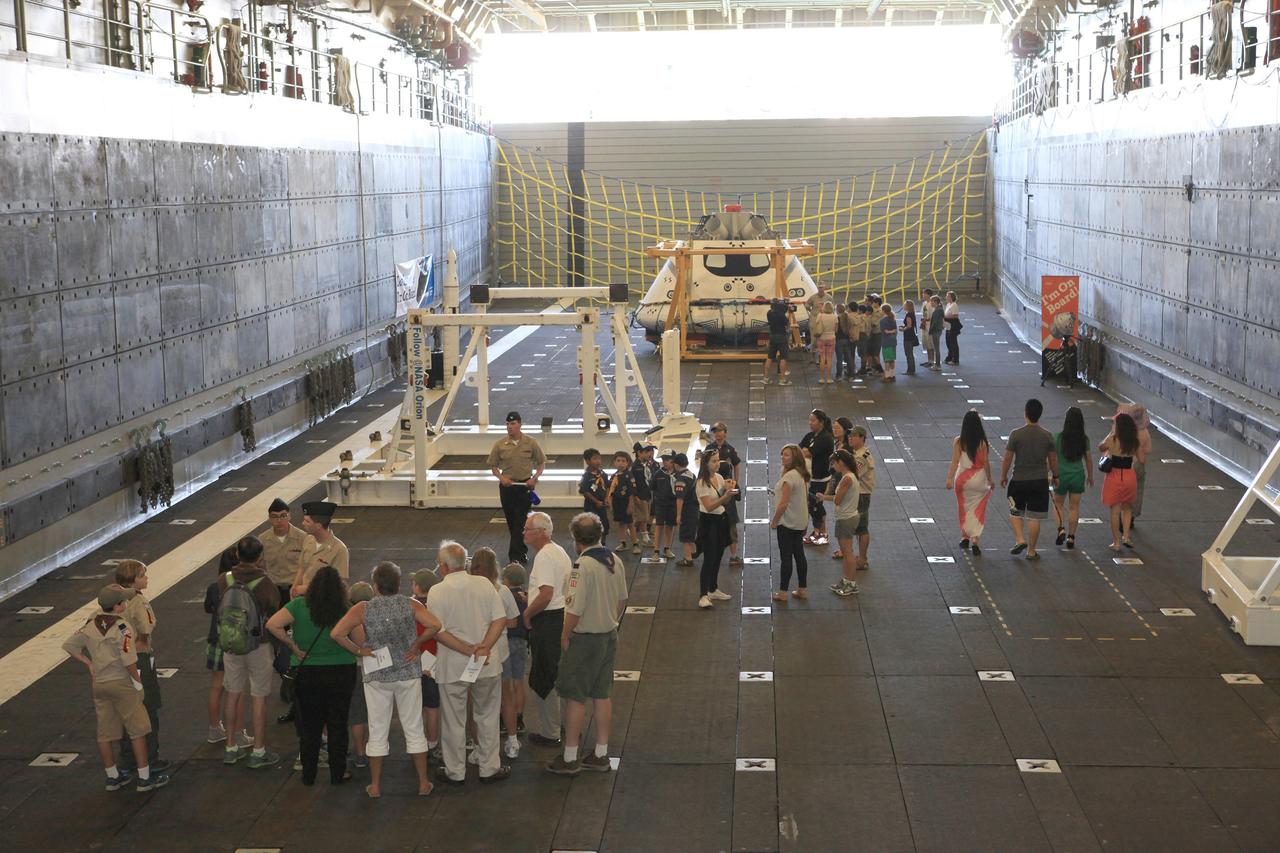
LOS ANGELES, Calif. – Visitors tour the well deck of the USS Anchorage and view the Orion boilerplate test vehicle secured in its recovery cradle during the Science, Technology, Engineering and Mathematics, or STEM, Expo for L.A. Navy Days at the Port of Los Angeles in California. Near the front of the well deck, at left, is a mockup of NASA’s Space Launch System and Orion spacecraft. NASA, Lockheed Martin and the U.S. Navy completed Underway Recovery Test 2 on the Orion test vehicle in the Pacific Ocean off the coast of San Diego to prepare for recovery of the Orion crew module on its return from a deep space mission. The underway recovery test allowed the teams to demonstrate and evaluate the recovery processes, procedures, new hardware and personnel in open waters. The Ground Systems Development and Operations Program conducted the underway recovery test. Orion is the exploration spacecraft designed to carry astronauts to destinations not yet explored by humans, including an asteroid and Mars. It will have emergency abort capability, sustain the crew during space travel and provide safe re-entry from deep space return velocities. The first unpiloted test flight of the Orion is scheduled to launch in 2014 on Exploration Flight Test-1, or EFT-1, atop a Delta IV rocket and in 2017 on NASA’s Space Launch System rocket. For more information, visit http://www.nasa.gov/orion. Photo credit: Kim Shiflett
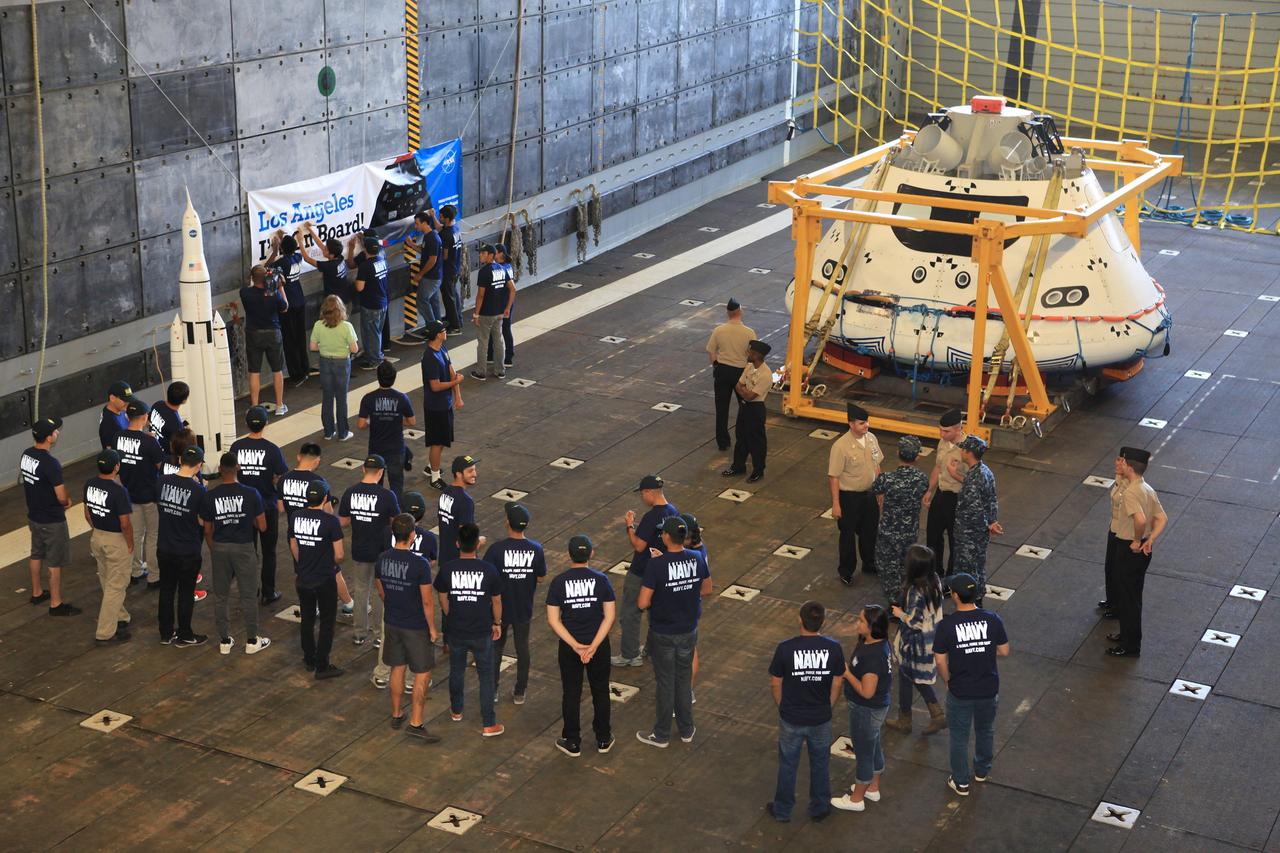
LOS ANGELES, Calif. – Visitors tour the well deck of the USS Anchorage and view the Orion boilerplate test vehicle secured in its recovery cradle during the Science, Technology, Engineering and Mathematics, or STEM, Expo for L.A. Navy Days at the Port of Los Angeles in California. At left is a mockup of NASA’s Space Launch System and Orion spacecraft. NASA, Lockheed Martin and the U.S. Navy completed Underway Recovery Test 2 on the Orion test vehicle in the Pacific Ocean off the coast of San Diego to prepare for recovery of the Orion crew module on its return from a deep space mission. The underway recovery test allowed the teams to demonstrate and evaluate the recovery processes, procedures, new hardware and personnel in open waters. The Ground Systems Development and Operations Program conducted the underway recovery test. Orion is the exploration spacecraft designed to carry astronauts to destinations not yet explored by humans, including an asteroid and Mars. It will have emergency abort capability, sustain the crew during space travel and provide safe re-entry from deep space return velocities. The first unpiloted test flight of the Orion is scheduled to launch in 2014 on Exploration Flight Test-1, or EFT-1, atop a Delta IV rocket and in 2017 on NASA’s Space Launch System rocket. For more information, visit http://www.nasa.gov/orion. Photo credit: Kim Shiflett
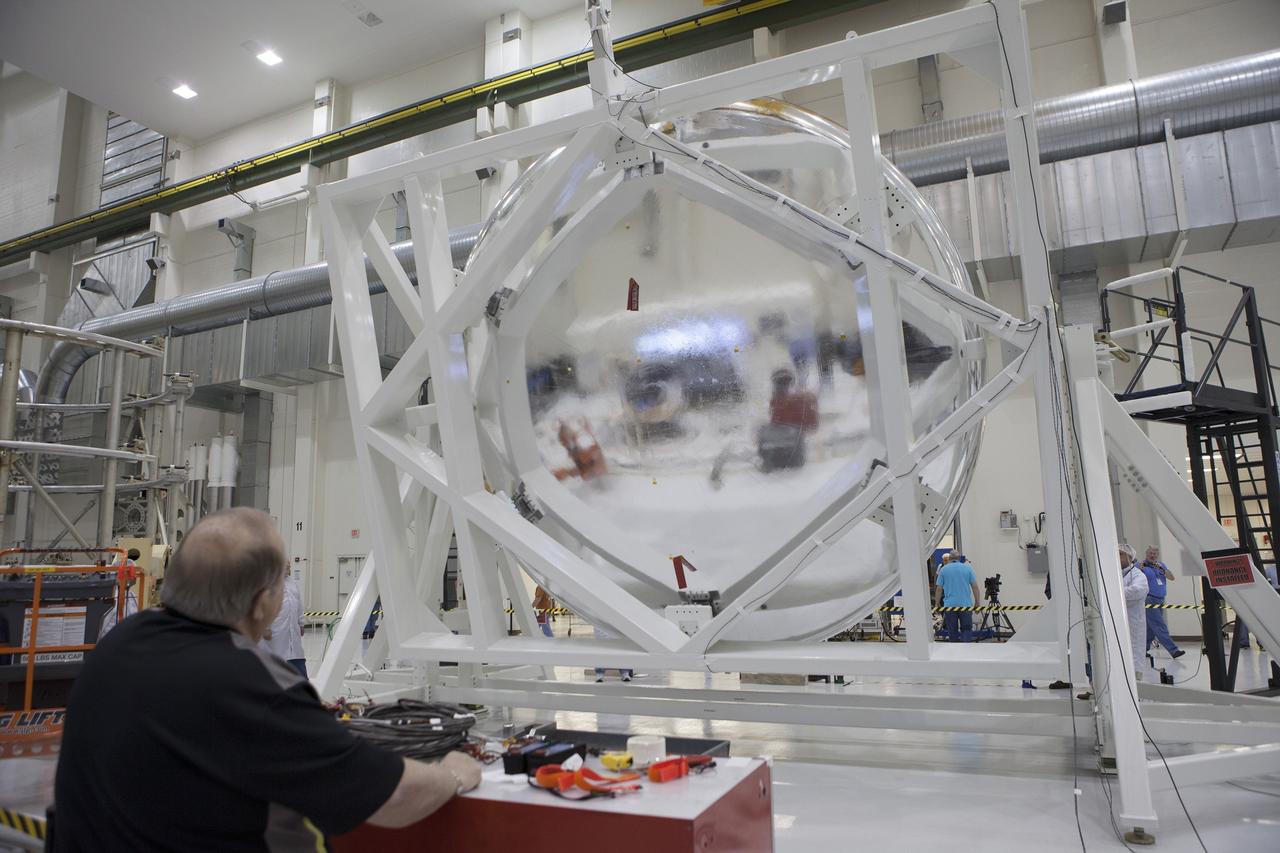
CAPE CANAVERAL, Fla. -- Inside the Operations and Checkout Building high bay at NASA's Kennedy Space Center in Florida, NASA and Lockheed Martin technicians and engineers conduct a center of gravity, or CG, test on the Orion crew module. The CG tool will measure the exact location of the vehicle's center of gravity. This test is important as it affects the handling and control characteristics of the vehicle. The Orion crew module will be stacked on the service module in the Final Assembly and System Testing, or FAST, cell and then both modules will be put through their final system tests for Exploration Flight Test-1, or EFT-1, before rolling out of the facility for integration with the United Launch Alliance Delta IV Heavy rocket. Orion is the exploration spacecraft designed to carry astronauts to destinations not yet explored by humans, including an asteroid and Mars. It will have emergency abort capability, sustain the crew during space travel and provide safe re-entry from deep space return velocities. The first unpiloted test flight of Orion, EFT-1, is scheduled to launch later this year atop a Delta IV rocket from Cape Canaveral Air Force Station in Florida to an altitude of 3,600 miles above the Earth's surface. The two-orbit, four-hour flight test will help engineers evaluate the systems critical to crew safety including the heat shield, parachute system and launch abort system. For more information, visit http://www.nasa.gov/orion. Photo credit: NASA/Glenn Benson
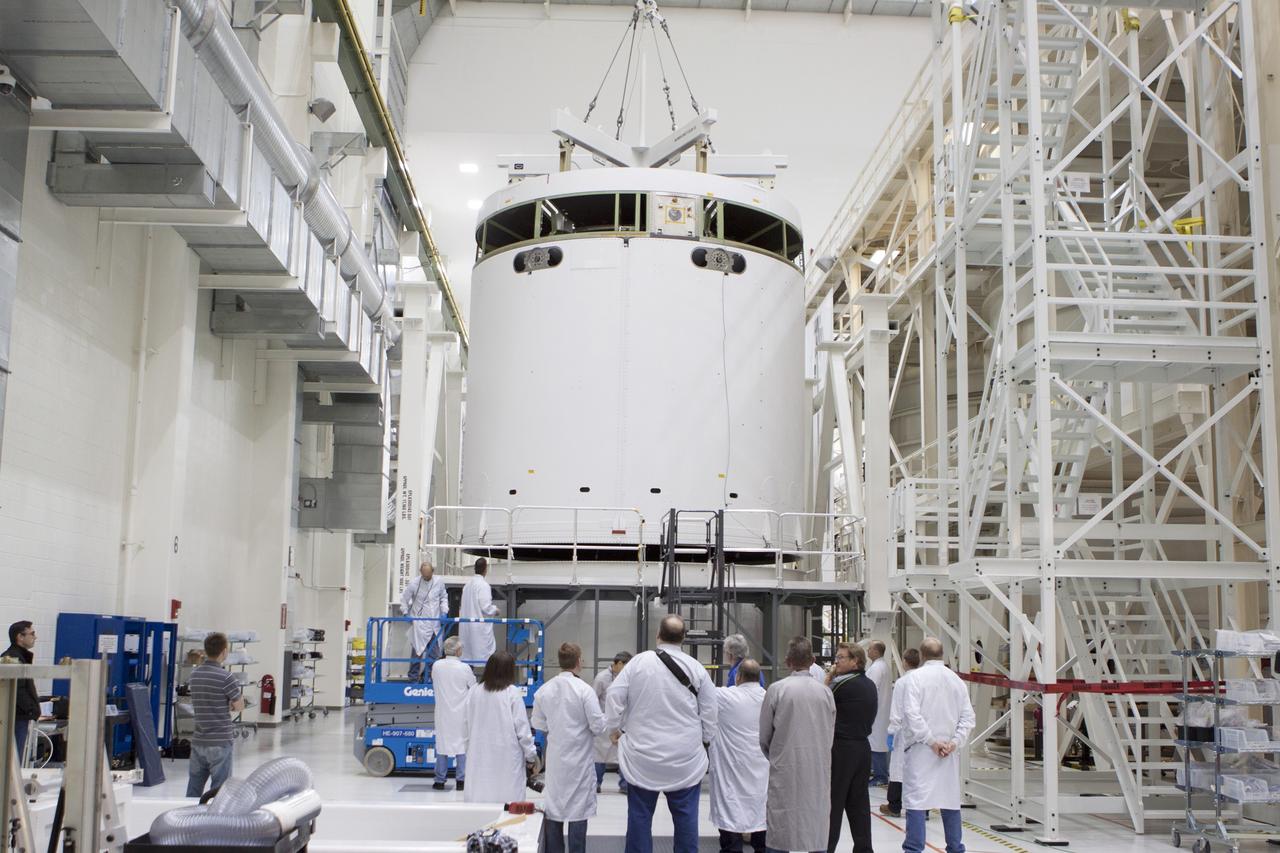
CAPE CANAVERAL, Fla. -- Inside the Operations and Checkout Building high bay at NASA's Kennedy Space Center in Florida, NASA and Lockheed Martin technicians and engineers monitor the progress as a crane is used to lift the Orion service module from a test stand and move it to the Final Assembly and System Testing, or FAST, cell further down the aisle. The Orion crew module will be stacked on the service module in the FAST cell and then both modules will be put through their final system tests for Exploration Flight Test-1, or EFT-1, before rolling out of the facility for integration with the United Launch Alliance Delta IV Heavy rocket. Orion is the exploration spacecraft designed to carry astronauts to destinations not yet explored by humans, including an asteroid and Mars. It will have emergency abort capability, sustain the crew during space travel and provide safe re-entry from deep space return velocities. The first unpiloted test flight of Orion, EFT-1, is scheduled to launch later this year atop a Delta IV rocket from Cape Canaveral Air Force Station in Florida to an altitude of 3,600 miles above the Earth's surface. The two-orbit, four-hour flight test will help engineers evaluate the systems critical to crew safety including the heat shield, parachute system and launch abort system. For more information, visit http://www.nasa.gov/orion. Photo credit: NASA/Glenn Benson
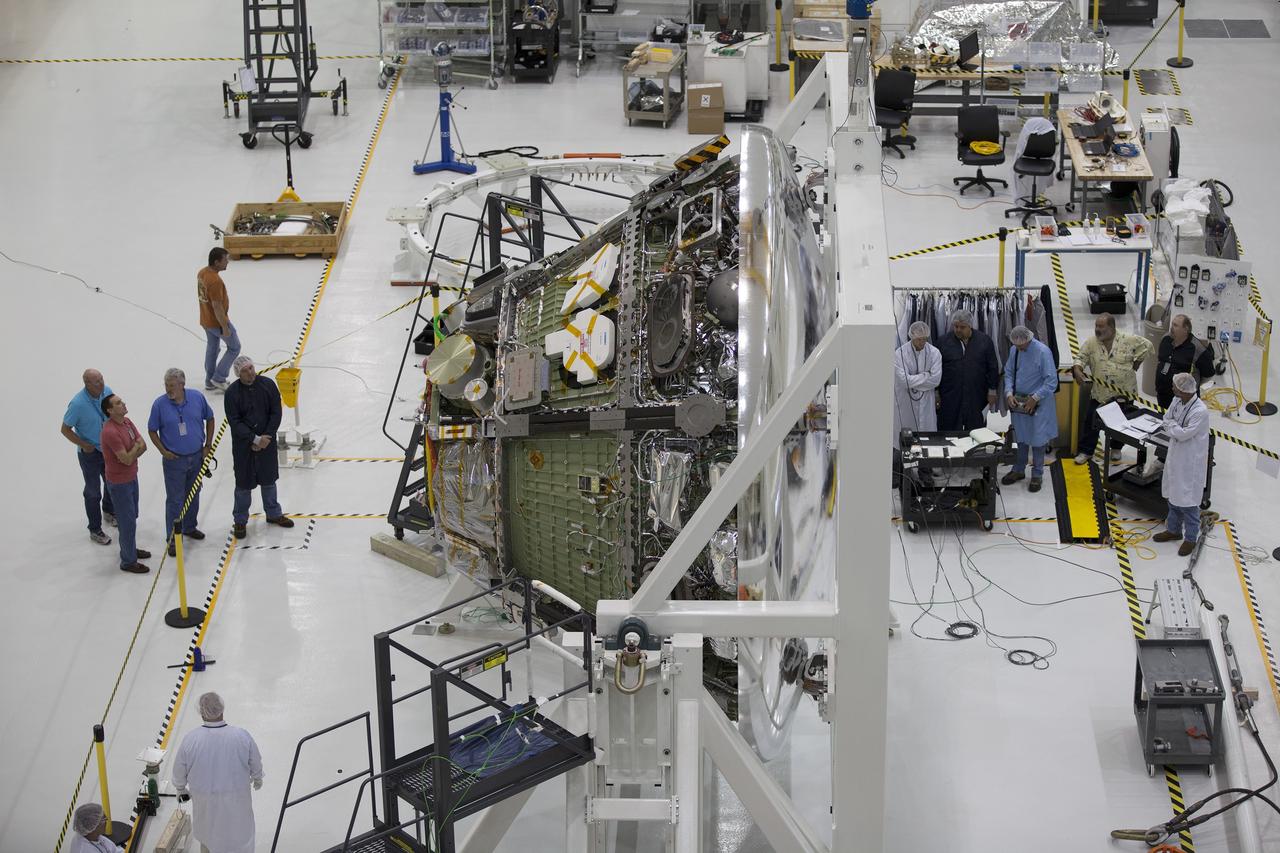
CAPE CANAVERAL, Fla. -- Inside the Operations and Checkout Building high bay at NASA's Kennedy Space Center in Florida, NASA and Lockheed Martin technicians and engineers conduct a center of gravity, or CG, test on the Orion crew module. The CG tool will measure the exact location of the vehicle's center of gravity. This test is important as it affects the handling and control characteristics of the vehicle. The Orion crew module will be stacked on the service module in the Final Assembly and System Testing, or FAST, cell and then both modules will be put through their final system tests for Exploration Flight Test-1, or EFT-1, before rolling out of the facility for integration with the United Launch Alliance Delta IV Heavy rocket. Orion is the exploration spacecraft designed to carry astronauts to destinations not yet explored by humans, including an asteroid and Mars. It will have emergency abort capability, sustain the crew during space travel and provide safe re-entry from deep space return velocities. The first unpiloted test flight of Orion, EFT-1, is scheduled to launch later this year atop a Delta IV rocket from Cape Canaveral Air Force Station in Florida to an altitude of 3,600 miles above the Earth's surface. The two-orbit, four-hour flight test will help engineers evaluate the systems critical to crew safety including the heat shield, parachute system and launch abort system. For more information, visit http://www.nasa.gov/orion. Photo credit: NASA/Glenn Benson
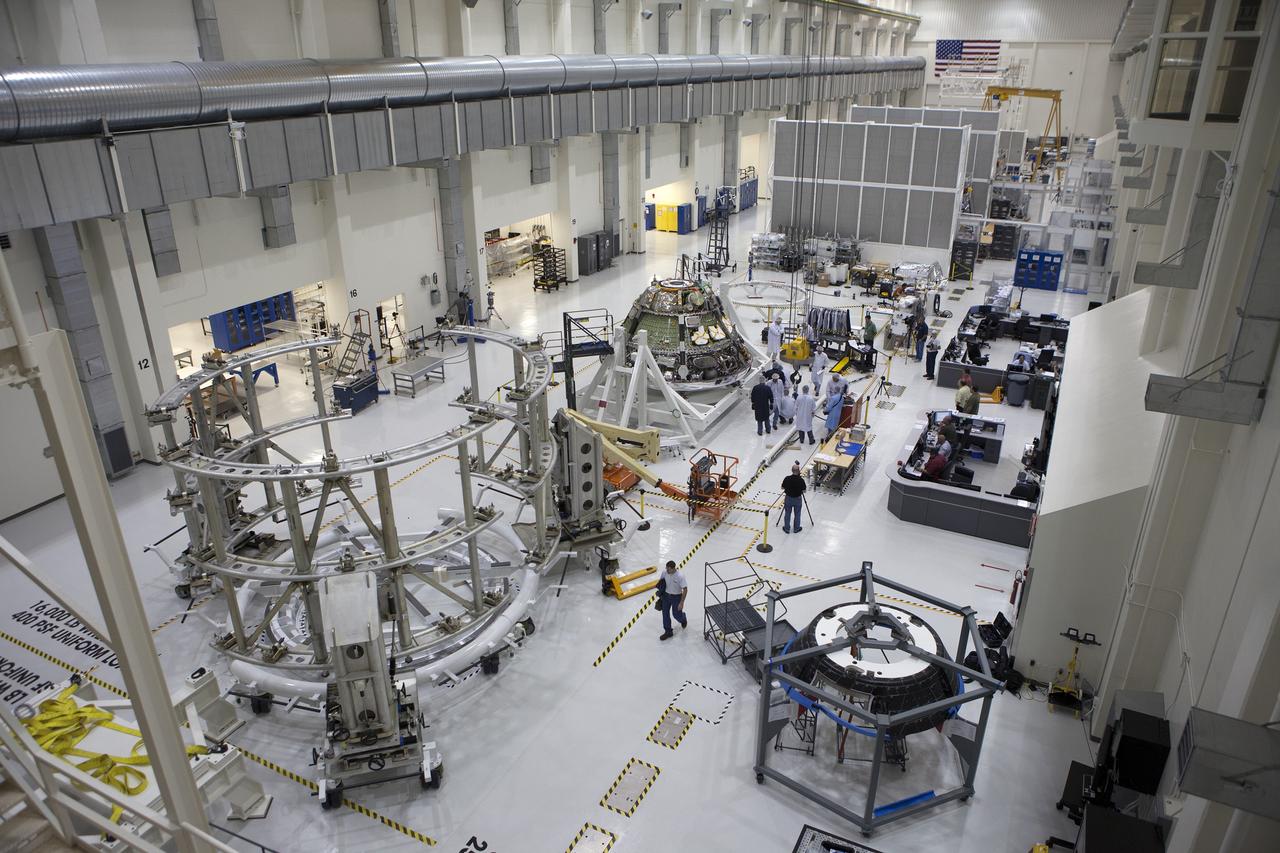
CAPE CANAVERAL, Fla. – Inside the Operations and Checkout Building high bay at NASA's Kennedy Space Center in Florida, NASA and Lockheed Martin technicians and engineers prepare to conduct a center of gravity, or CG, test on the Orion crew module. The CG tool will measure the exact location of the vehicle's center of gravity. This test is important as it affects the handling and control characteristics of the vehicle. The Orion crew module will be stacked on the service module in the Final Assembly and System Testing, or FAST, cell and then both modules will be put through their final system tests for Exploration Flight Test-1, or EFT-1, before rolling out of the facility for integration with the United Launch Alliance Delta IV Heavy rocket. Orion is the exploration spacecraft designed to carry astronauts to destinations not yet explored by humans, including an asteroid and Mars. It will have emergency abort capability, sustain the crew during space travel and provide safe re-entry from deep space return velocities. The first unpiloted test flight of Orion, EFT-1, is scheduled to launch later this year atop a Delta IV rocket from Cape Canaveral Air Force Station in Florida to an altitude of 3,600 miles above the Earth's surface. The two-orbit, four-hour flight test will help engineers evaluate the systems critical to crew safety including the heat shield, parachute system and launch abort system. For more information, visit http://www.nasa.gov/orion. Photo credit: NASA/Kim Shiflett
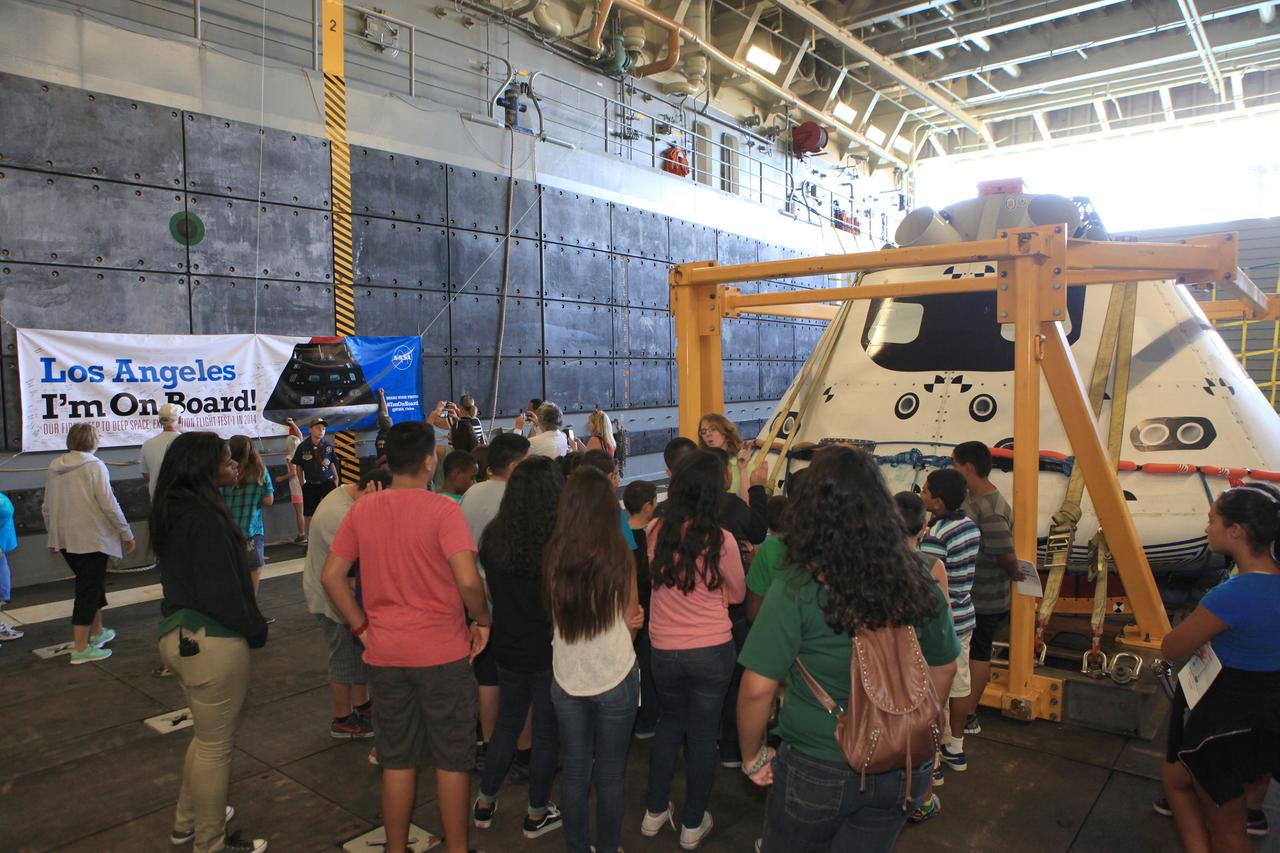
LOS ANGELES, Calif. – Visitors tour the well deck of the USS Anchorage and view the Orion boilerplate test vehicle secured in its recovery cradle during the Science, Technology, Engineering and Mathematics, or STEM, Expo for L.A. Navy Days at the Port of Los Angeles, California. NASA, Lockheed Martin and the U.S. Navy completed Underway Recovery Test 2 on the Orion test vehicle in the Pacific Ocean off the coast of San Diego to prepare for recovery of the Orion crew module on its return from a deep space mission. The underway recovery test allowed the teams to demonstrate and evaluate the recovery processes, procedures, new hardware and personnel in open waters. The Ground Systems Development and Operations Program conducted the underway recovery test. Orion is the exploration spacecraft designed to carry astronauts to destinations not yet explored by humans, including an asteroid and Mars. It will have emergency abort capability, sustain the crew during space travel and provide safe re-entry from deep space return velocities. The first unpiloted test flight of the Orion is scheduled to launch in 2014 on Exploration Flight Test-1, or EFT-1, atop a Delta IV rocket and in 2017 on NASA’s Space Launch System rocket. For more information, visit http://www.nasa.gov/orion. Photo credit: Kim Shiflett
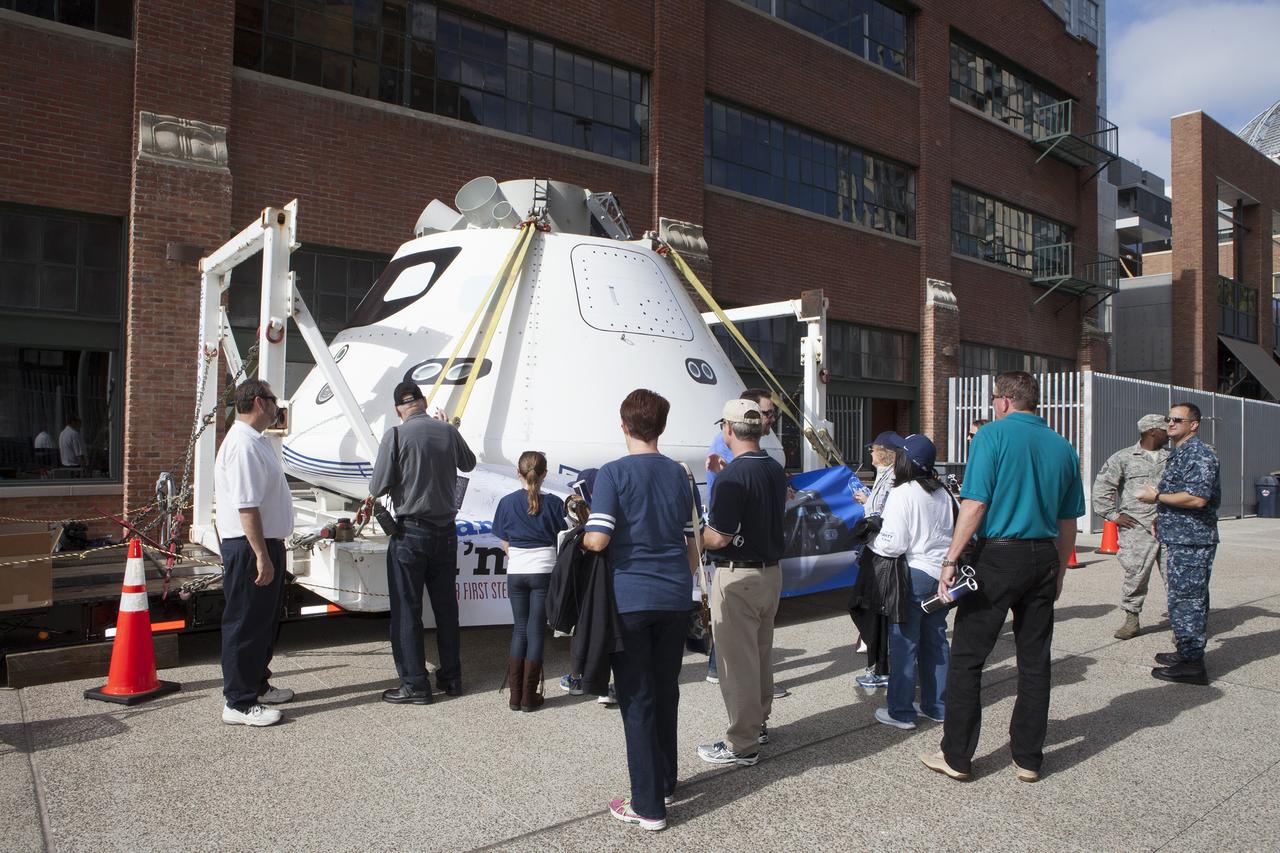
CAPE CANAVERAL, Fla. – The Orion boilerplate test vehicle is on display at Petco Park in San Diego, California, before the San Diego Padres' baseball game. The boilerplate test vehicle is being prepared for an Exploration Flight Test-1, or EFT-1, pre-transportation test. The Ground Systems Development and Operations Program will run the test at the U.S. Naval Base San Diego to simulate retrieval and transportation procedures for Orion after it splashes down in the ocean and is retrieved for return to land and ground transportation back to Kennedy Space Center in Florida. Orion is the exploration spacecraft designed to carry astronauts to destinations not yet explored by humans, including an asteroid and Mars. It will have emergency abort capability, sustain the crew during space travel and provide safe re-entry from deep space return velocities. The first unpiloted test flight of the Orion is scheduled to launch later this year atop a Delta IV rocket and in 2017 on NASA’s Space Launch System rocket. For more information, visit http://www.nasa.gov/orion. Photo credit: NASA/Kim Shiflett
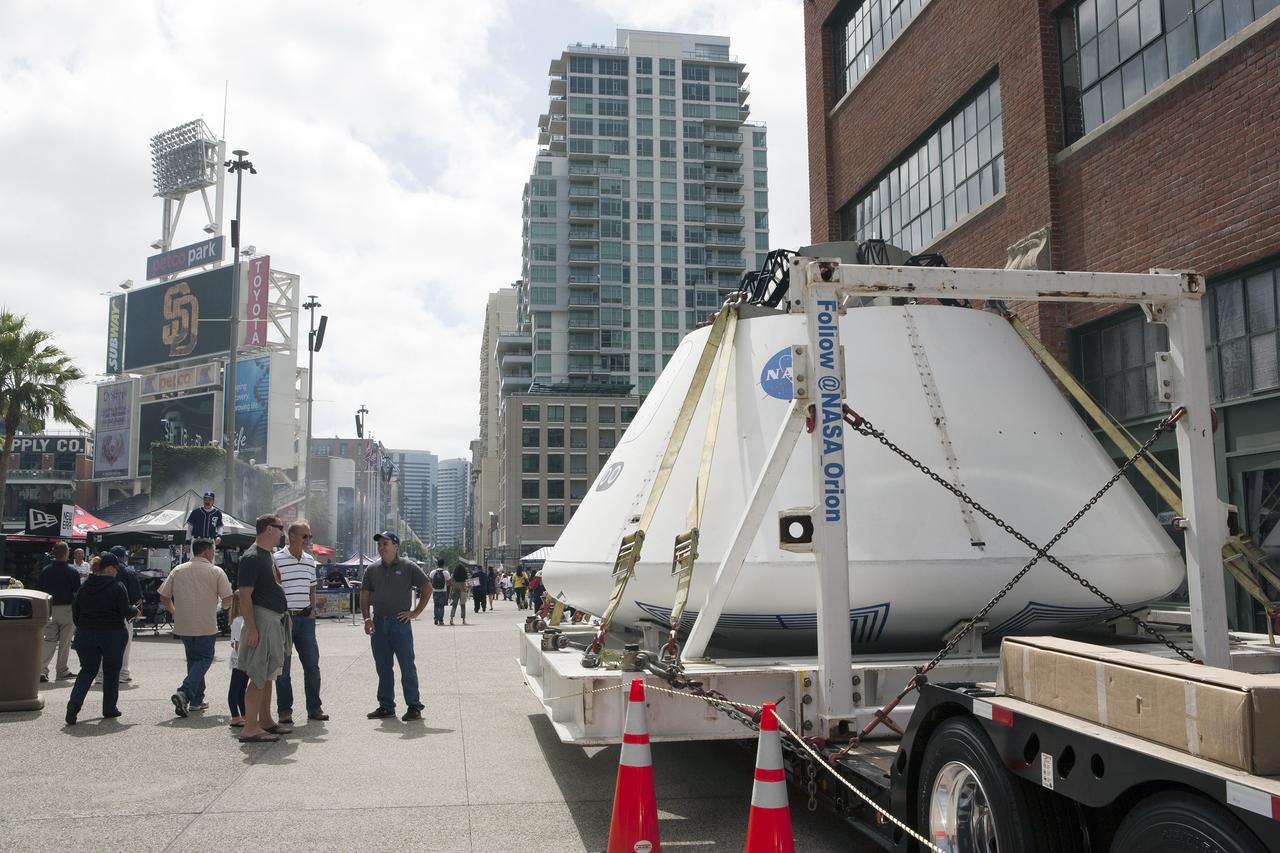
CAPE CANAVERAL, Fla. – The Orion boilerplate test vehicle is on display at Petco Park in San Diego, California, before the San Diego Padres' baseball game. The boilerplate test vehicle is being prepared for an Exploration Flight Test-1, or EFT-1, pre-transportation test. The Ground Systems Development and Operations Program will run the test at the U.S. Naval Base San Diego to simulate retrieval and transportation procedures for Orion after it splashes down in the ocean and is retrieved for return to land and ground transportation back to Kennedy Space Center in Florida. Orion is the exploration spacecraft designed to carry astronauts to destinations not yet explored by humans, including an asteroid and Mars. It will have emergency abort capability, sustain the crew during space travel and provide safe re-entry from deep space return velocities. The first unpiloted test flight of the Orion is scheduled to launch later this year atop a Delta IV rocket and in 2017 on NASA’s Space Launch System rocket. For more information, visit http://www.nasa.gov/orion. Photo credit: NASA/Kim Shiflett
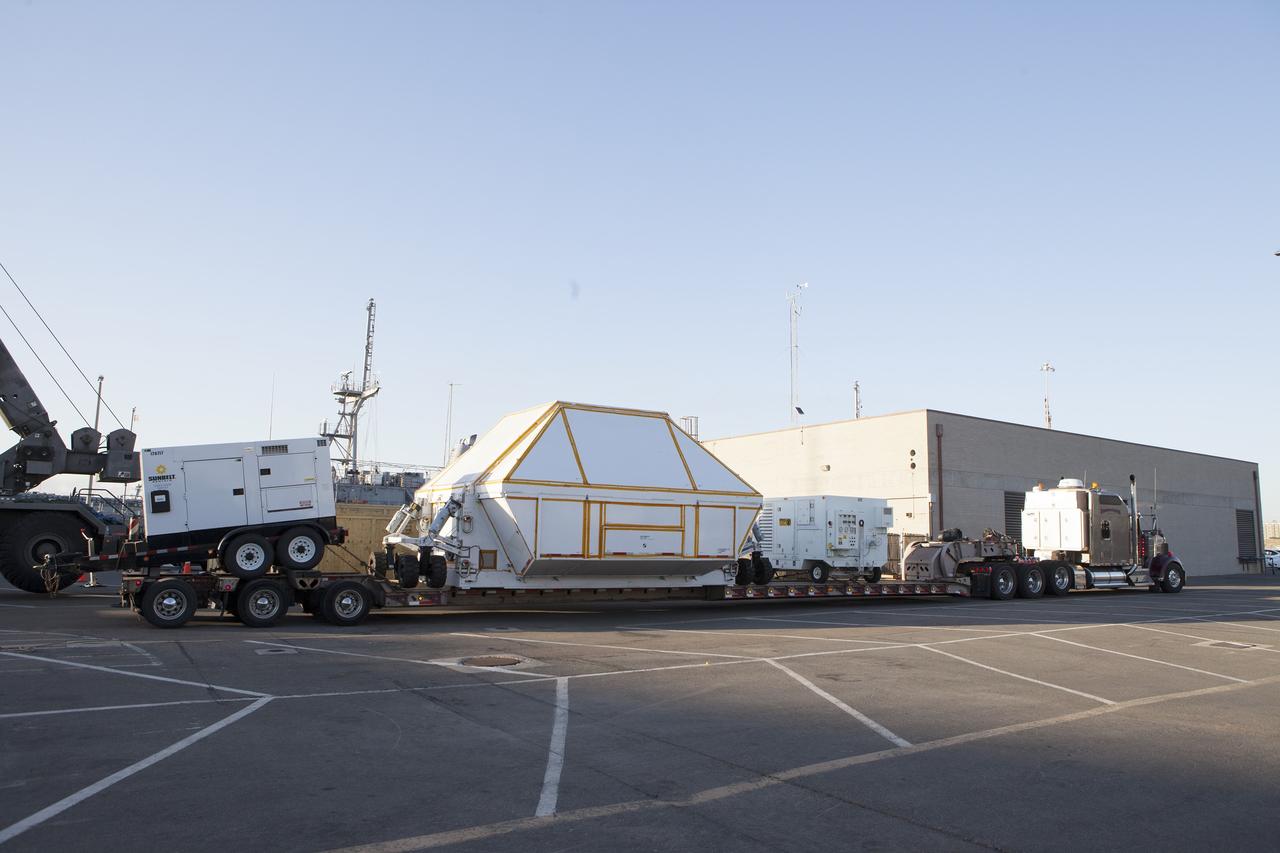
SAN DIEGO, Calif. – At the Mole Pier at Naval Base San Diego in California, the crew module transportation fixture has been secured on a flatbed truck, simulating readiness for Orion's cross-country trip. The Ground Systems Development and Operations Program, Lockheed Martin and the U.S. Navy are evaluating the hardware and processes for preparing the Orion crew module for Exploration Flight Test-1, or EFT-1, for overland transport from the naval base to NASA's Kennedy Space Center in Florida. Orion is the exploration spacecraft designed to carry astronauts to destinations not yet explored by humans, including an asteroid and Mars. It will have emergency abort capability, sustain the crew during space travel and provide safe re-entry from deep space return velocities. The first unpiloted test flight of the Orion is scheduled to launch later this year atop a Delta IV rocket from Cape Canaveral Air Force Station in Florida to an altitude of 3,600 miles above the Earth's surface. The two-orbit, four-hour flight test will help engineers evaluate the systems critical to crew safety including the heat shield, parachute system and launch abort system. For more information, visit http://www.nasa.gov/orion. Photo credit: NASA/Kim Shiflett
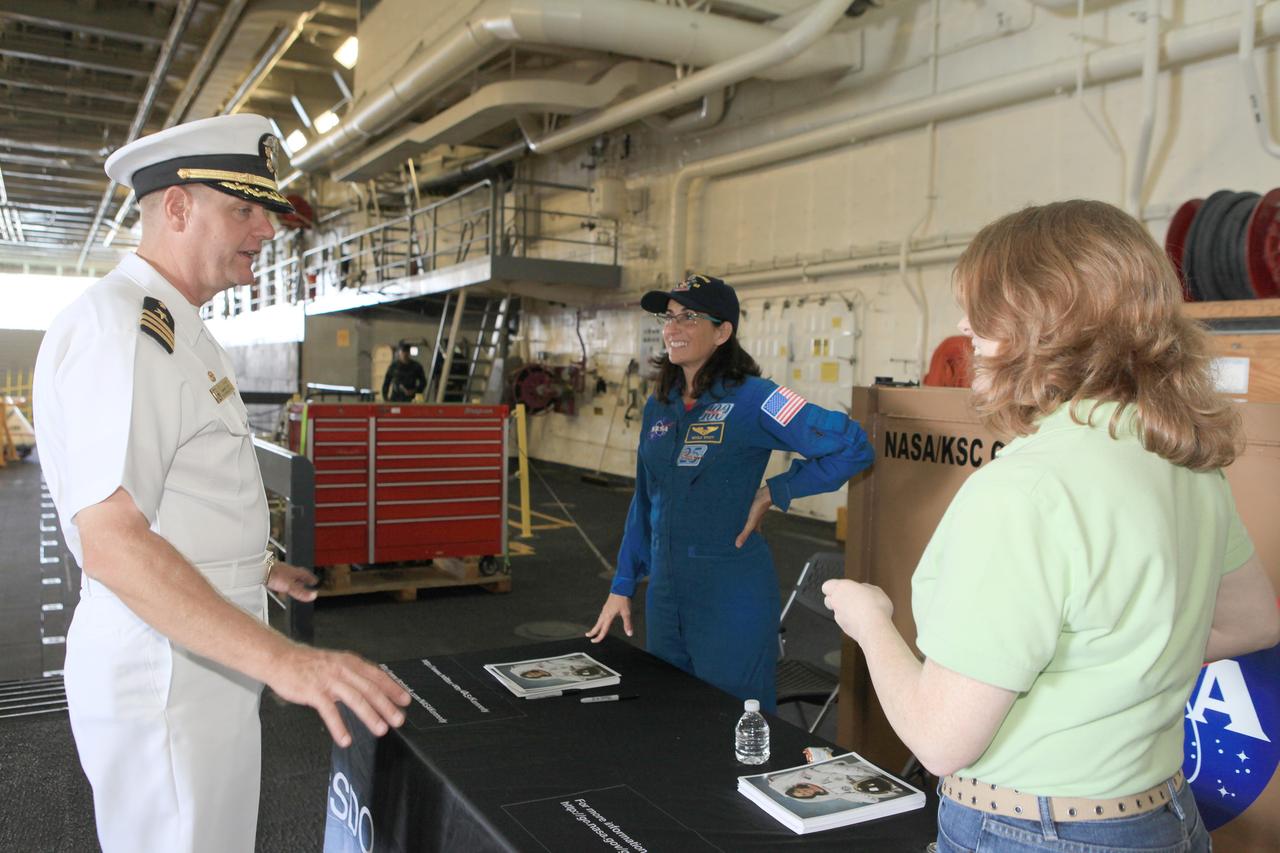
LOS ANGELES, Calif. – NASA astronaut Nicole Stott prepares for the Science, Technology, Engineering and Mathematics, or STEM, Expo for L.A. Navy Days in the well deck of the USS Anchorage at the Port of Los Angeles in California. At left, is Commanding Officer Joel G. Stewart, USS Anchorage. Visitors will have the opportunity to meet Stott and view the Orion boilerplate test vehicle secured in its recovery cradle. NASA, Lockheed Martin and the U.S. Navy completed Underway Recovery Test 2 in the Pacific Ocean off the coast of San Diego to prepare for recovery of the Orion crew module on its return from a deep space mission. The underway recovery test allowed the teams to demonstrate and evaluate the recovery processes, procedures, new hardware and personnel in open waters. The Ground Systems Development and Operations Program conducted the underway recovery test. Orion is the exploration spacecraft designed to carry astronauts to destinations not yet explored by humans, including an asteroid and Mars. It will have emergency abort capability, sustain the crew during space travel and provide safe re-entry from deep space return velocities. The first unpiloted test flight of the Orion is scheduled to launch in 2014 on Exploration Flight Test-1, or EFT-1, atop a Delta IV rocket and in 2017 on NASA’s Space Launch System rocket. For more information, visit http://www.nasa.gov/orion. Photo credit: Kim Shiflett

SAN DIEGO, Calif. – A flatbed truck carrying the crew module transportation fixture simulates the future transportation route of Orion at Naval Base San Diego in California. The Ground Systems Development and Operations Program, Lockheed Martin and the U.S. Navy are evaluating the hardware and processes for preparing the Orion crew module for Exploration Flight Test-1, or EFT-1, for overland transport from the naval base to NASA's Kennedy Space Center in Florida. Orion is the exploration spacecraft designed to carry astronauts to destinations not yet explored by humans, including an asteroid and Mars. It will have emergency abort capability, sustain the crew during space travel and provide safe re-entry from deep space return velocities. The first unpiloted test flight of the Orion is scheduled to launch later this year atop a Delta IV rocket from Cape Canaveral Air Force Station in Florida to an altitude of 3,600 miles above the Earth's surface. The two-orbit, four-hour flight test will help engineers evaluate the systems critical to crew safety including the heat shield, parachute system and launch abort system. For more information, visit http://www.nasa.gov/orion. Photo credit: NASA/Kim Shiflett
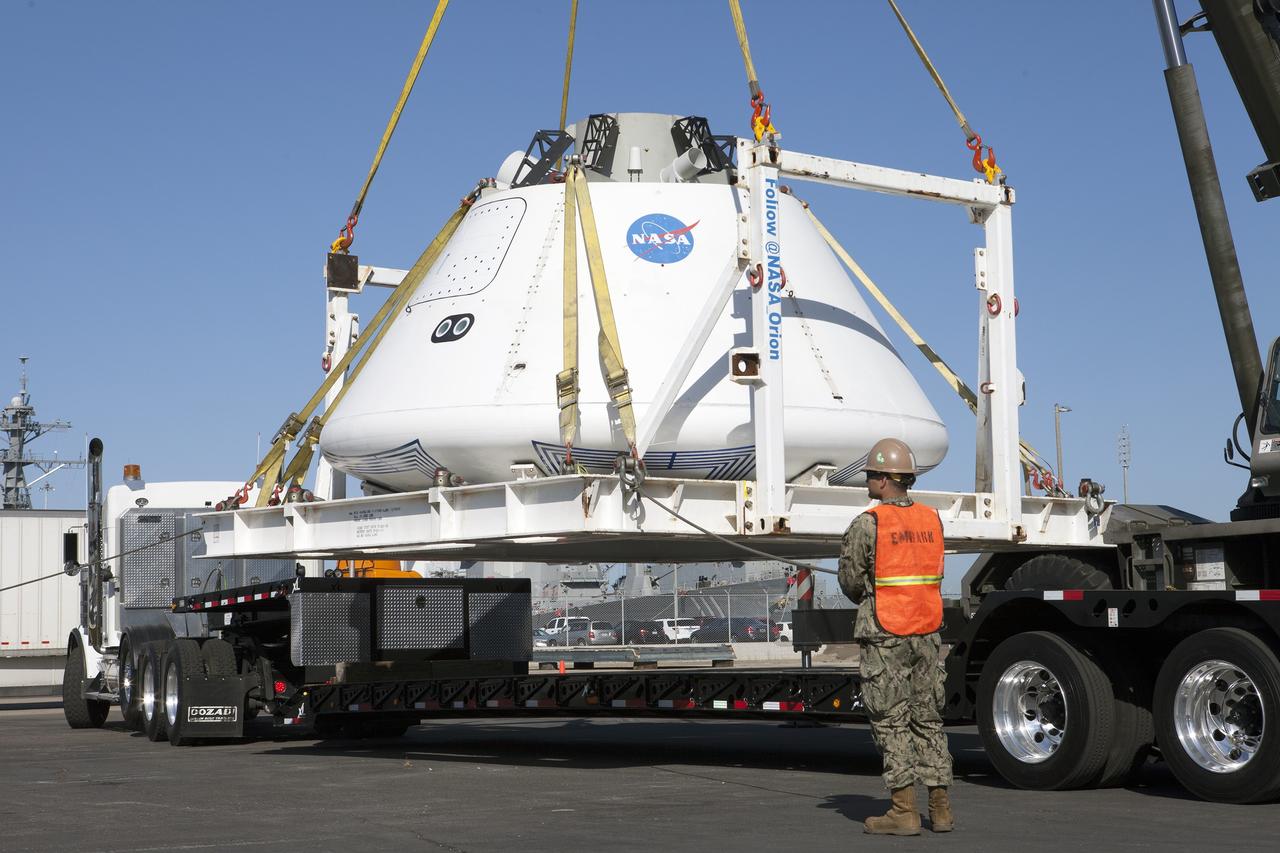
SAN DIEGO, Calif. – A crane lifts the Orion boilerplate test vehicle from a flatbed truck to lower it to the ground at a warehouse at the Naval Base San Diego in California. The test vehicle is attached to the BTA handling fixture. The Ground Systems Development and Operations Program, Lockheed Martin and the U.S. Navy are evaluating the hardware and processes for preparing the Orion crew module for Exploration Flight Test-1, or EFT-1, for overland transport from the naval base to NASA's Kennedy Space Center in Florida. Orion is the exploration spacecraft designed to carry astronauts to destinations not yet explored by humans, including an asteroid and Mars. It will have emergency abort capability, sustain the crew during space travel and provide safe re-entry from deep space return velocities. The first unpiloted test flight of the Orion is scheduled to launch later this year atop a Delta IV rocket from Cape Canaveral Air Force Station in Florida to an altitude of 3,600 miles above the Earth's surface. The two-orbit, four-hour flight test will help engineers evaluate the systems critical to crew safety including the heat shield, parachute system and launch abort system. For more information, visit http://www.nasa.gov/orion. Photo credit: NASA/Kim Shiflett
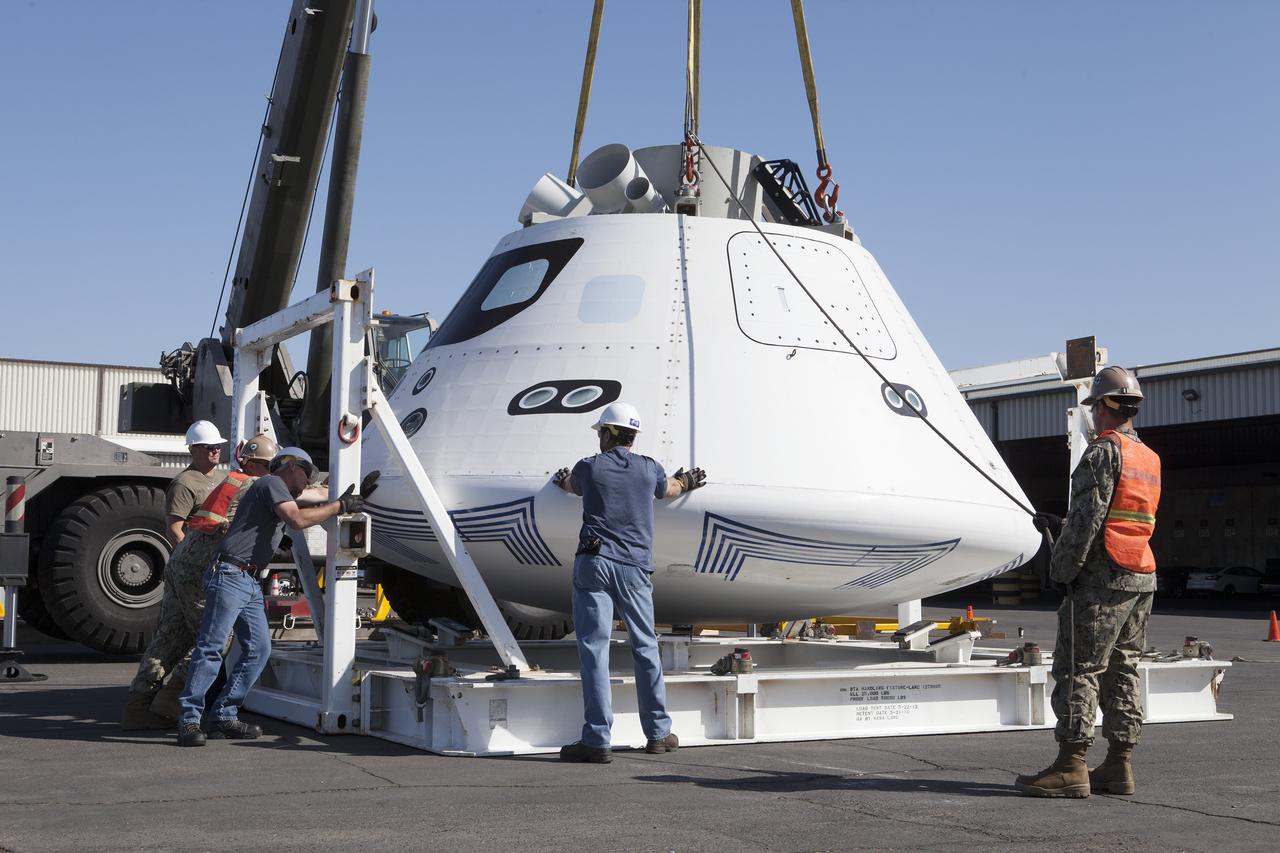
SAN DIEGO, Calif. – U.S. Navy and Jacobs/TOSC workers help detach the Orion boilerplate test vehicle from the BTA handling fixture as a crane begins to lift it away at a warehouse at the Naval Base San Diego in California. The Ground Systems Development and Operations Program, Lockheed Martin and U.S. Navy are evaluating the hardware and processes for preparing the Orion crew module for Exploration Flight Test-1, or EFT-1, for overland transport from the naval base to NASA's Kennedy Space Center in Florida. Orion is the exploration spacecraft designed to carry astronauts to destinations not yet explored by humans, including an asteroid and Mars. It will have emergency abort capability, sustain the crew during space travel and provide safe re-entry from deep space return velocities. The first unpiloted test flight of the Orion is scheduled to launch later this year atop a Delta IV rocket from Cape Canaveral Air Force Station in Florida to an altitude of 3,600 miles above the Earth's surface. The two-orbit, four-hour flight test will help engineers evaluate the systems critical to crew safety including the heat shield, parachute system and launch abort system. For more information, visit http://www.nasa.gov/orion. Photo credit: NASA/Kim Shiflett

SAN DIEGO, Calif. – Workers prepare the lid for the crew module transportation fixture for the Orion boilerplate test vehicle at the Mole Pier at Naval Base San Diego in California. The Ground Systems Development and Operations Program, Lockheed Martin and the U.S. Navy are evaluating the hardware and processes for preparing the Orion crew module for Exploration Flight Test-1, or EFT-1, for overland transport from the naval base to NASA's Kennedy Space Center in Florida. Orion is the exploration spacecraft designed to carry astronauts to destinations not yet explored by humans, including an asteroid and Mars. It will have emergency abort capability, sustain the crew during space travel and provide safe re-entry from deep space return velocities. The first unpiloted test flight of the Orion is scheduled to launch later this year atop a Delta IV rocket from Cape Canaveral Air Force Station in Florida to an altitude of 3,600 miles above the Earth's surface. The two-orbit, four-hour flight test will help engineers evaluate the systems critical to crew safety including the heat shield, parachute system and launch abort system. For more information, visit http://www.nasa.gov/orion. Photo credit: NASA/Kim Shiflett
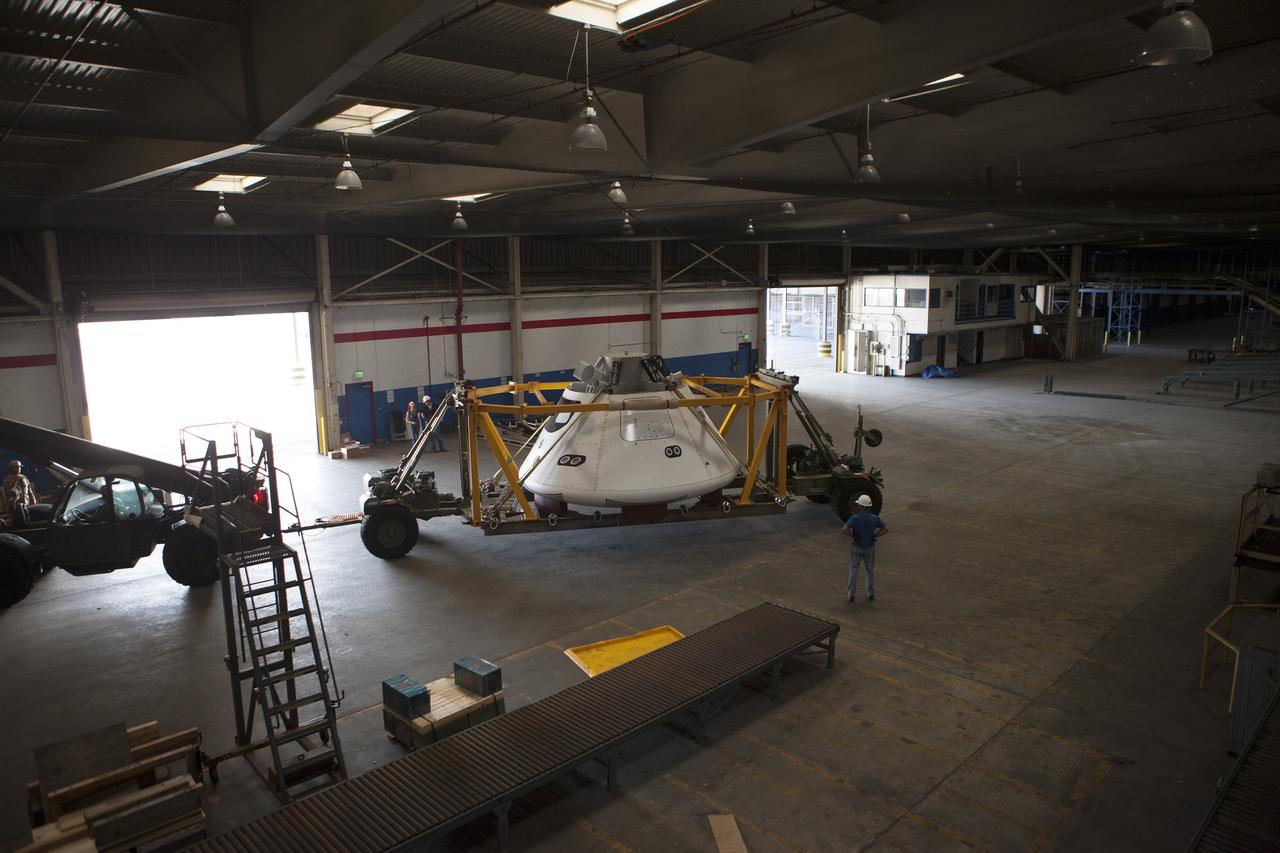
SAN DIEGO, Calif. – The Orion boilerplate test vehicle has been moved to a warehouse at Naval Base San Diego in California from the Mole Pier at the naval base. The test vehicle is attached to the crew module recovery cradle. The Ground Systems Development and Operations Program, Lockheed Martin and the U.S. Navy are evaluating the hardware and processes for preparing the Orion crew module for Exploration Flight Test-1, or EFT-1, for overland transport from the naval base to NASA's Kennedy Space Center in Florida. Orion is the exploration spacecraft designed to carry astronauts to destinations not yet explored by humans, including an asteroid and Mars. It will have emergency abort capability, sustain the crew during space travel and provide safe re-entry from deep space return velocities. The first unpiloted test flight of the Orion is scheduled to launch later this year atop a Delta IV rocket from Cape Canaveral Air Force Station in Florida to an altitude of 3,600 miles above the Earth's surface. The two-orbit, four-hour flight test will help engineers evaluate the systems critical to crew safety including the heat shield, parachute system and launch abort system. For more information, visit http://www.nasa.gov/orion. Photo credit: NASA/Kim Shiflett
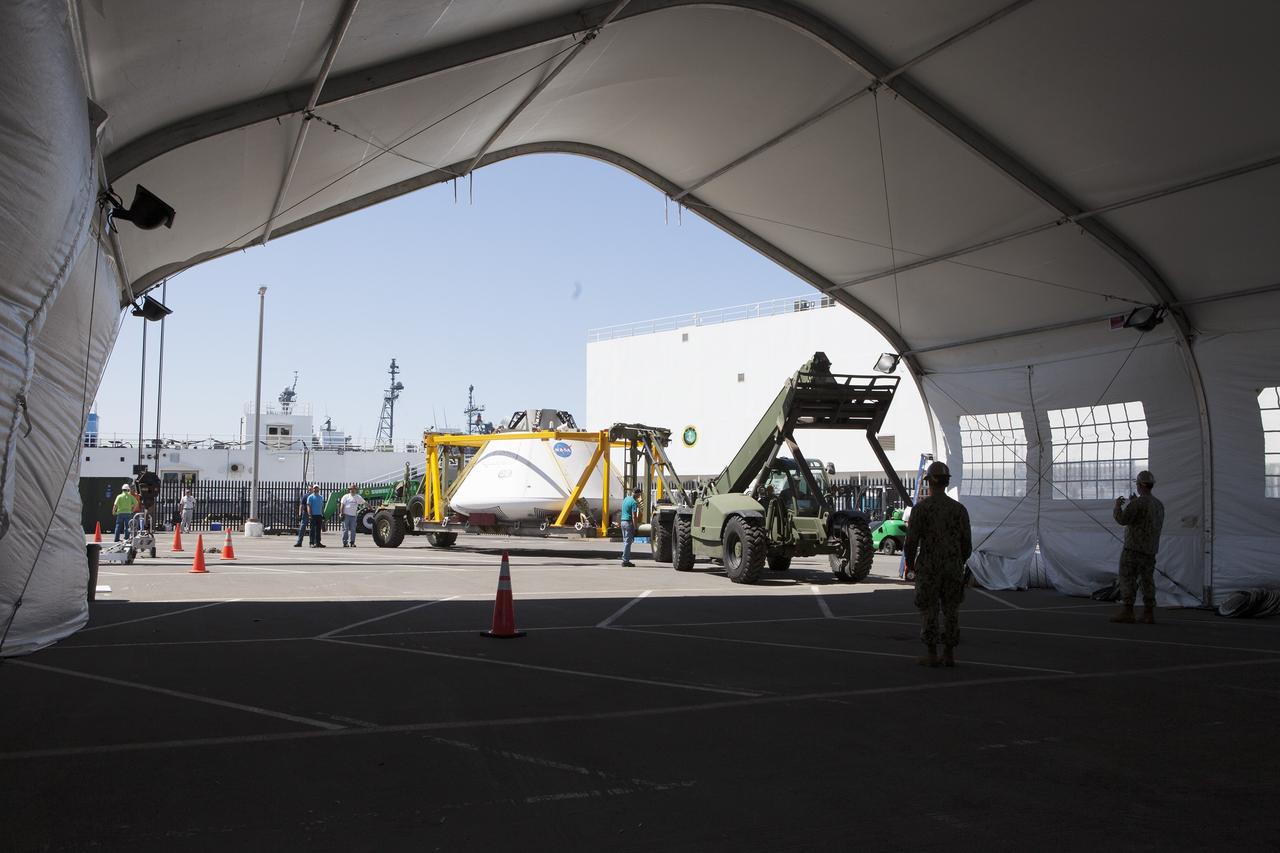
SAN DIEGO, Calif. – The Orion boilerplate test vehicle is being moved into a protective structure at the Mole Pier at the Naval Base San Diego in California for a simulated fit check of the hatch cover. The test vehicle is attached to the crew module recovery cradle. The Ground Systems Development and Operations Program, Lockheed Martin and the U.S. Navy are evaluating the hardware and processes for preparing the Orion crew module for Exploration Flight Test-1, or EFT-1, for overland transport from the naval base to NASA's Kennedy Space Center in Florida. Orion is the exploration spacecraft designed to carry astronauts to destinations not yet explored by humans, including an asteroid and Mars. It will have emergency abort capability, sustain the crew during space travel and provide safe re-entry from deep space return velocities. The first unpiloted test flight of the Orion is scheduled to launch later this year atop a Delta IV rocket from Cape Canaveral Air Force Station in Florida to an altitude of 3,600 miles above the Earth's surface. The two-orbit, four-hour flight test will help engineers evaluate the systems critical to crew safety including the heat shield, parachute system and launch abort system. For more information, visit http://www.nasa.gov/orion. Photo credit: NASA/Kim Shiflett
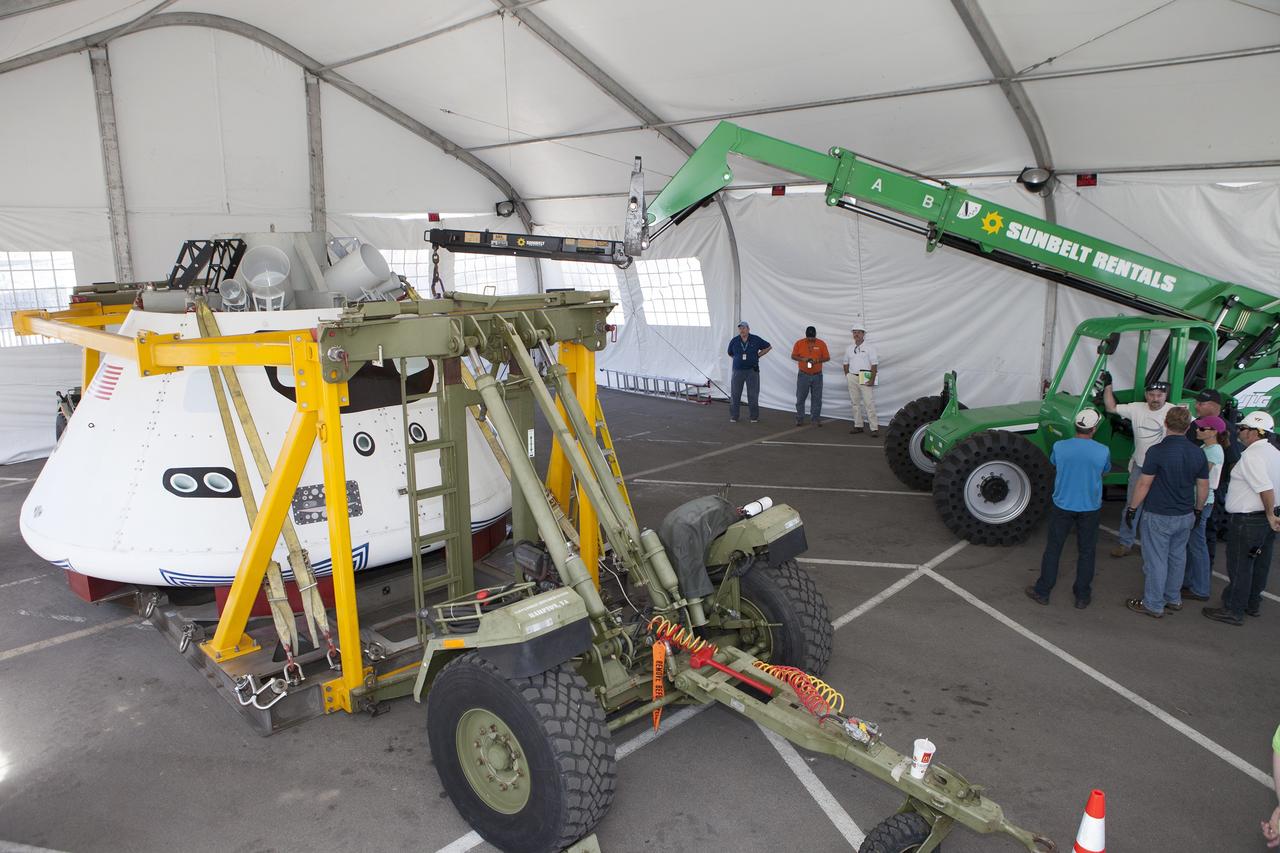
SAN DIEGO, Calif. – The Orion boilerplate test vehicle has been moved into a protective structure at the Mole Pier at the Naval Base San Diego in California for a simulated fit check of the hatch cover. The test vehicle is attached to the crew module recovery cradle. The Ground Systems Development and Operations Program, Lockheed Martin and the U.S. Navy are evaluating the hardware and processes for preparing the Orion crew module for Exploration Flight Test-1, or EFT-1, for overland transport from the naval base to NASA's Kennedy Space Center in Florida. Orion is the exploration spacecraft designed to carry astronauts to destinations not yet explored by humans, including an asteroid and Mars. It will have emergency abort capability, sustain the crew during space travel and provide safe re-entry from deep space return velocities. The first unpiloted test flight of the Orion is scheduled to launch later this year atop a Delta IV rocket from Cape Canaveral Air Force Station in Florida to an altitude of 3,600 miles above the Earth's surface. The two-orbit, four-hour flight test will help engineers evaluate the systems critical to crew safety including the heat shield, parachute system and launch abort system. For more information, visit http://www.nasa.gov/orion. Photo credit: NASA/Kim Shiflett
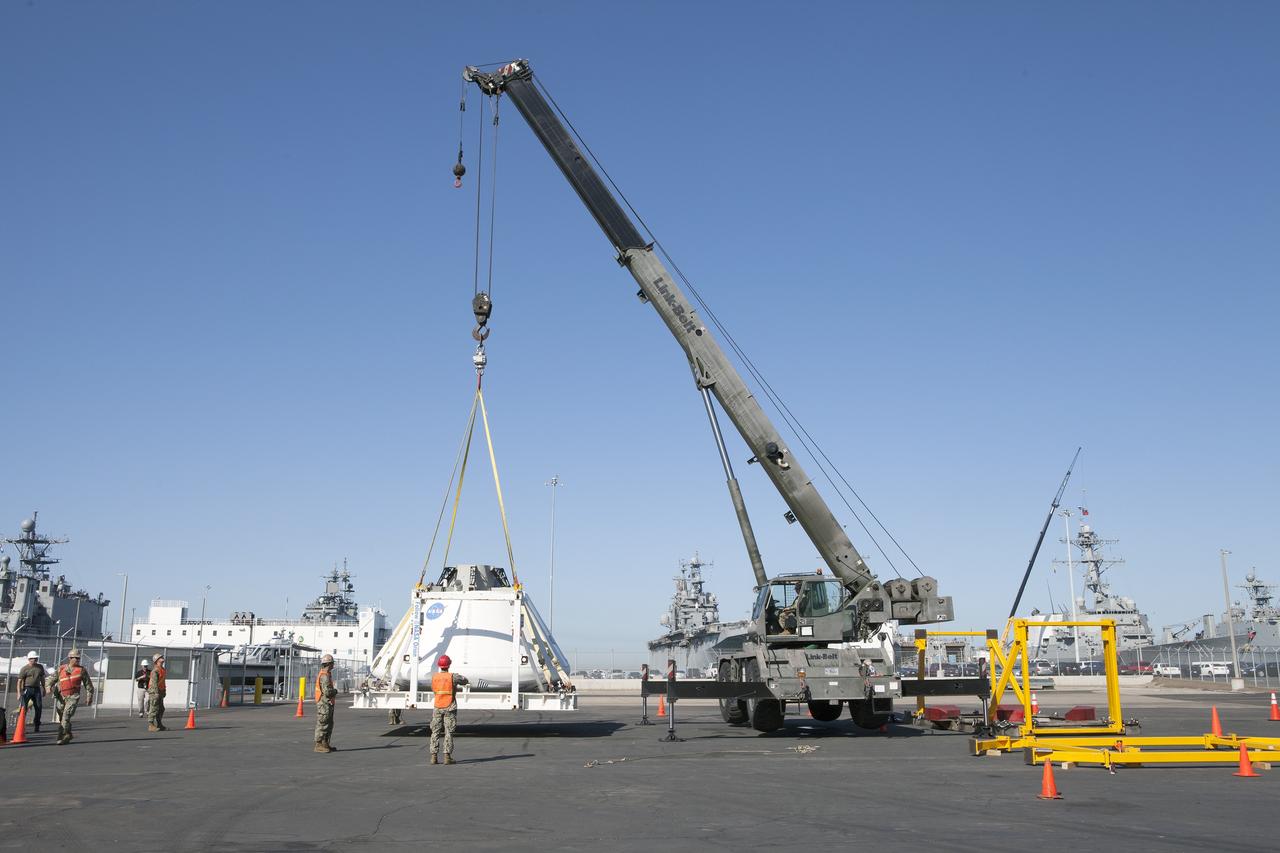
SAN DIEGO, Calif. – A crane lowers the Orion boilerplate test vehicle onto the ground at a warehouse at the Naval Base San Diego in California. The test vehicle is attached to the BTA handling fixture. The Ground Systems Development and Operations Program, Lockheed Martin and the U.S. Navy are evaluating the hardware and processes for preparing the Orion crew module for Exploration Flight Test-1, or EFT-1, for overland transport from the naval base to NASA's Kennedy Space Center in Florida. Orion is the exploration spacecraft designed to carry astronauts to destinations not yet explored by humans, including an asteroid and Mars. It will have emergency abort capability, sustain the crew during space travel and provide safe re-entry from deep space return velocities. The first unpiloted test flight of the Orion is scheduled to launch later this year atop a Delta IV rocket from Cape Canaveral Air Force Station in Florida to an altitude of 3,600 miles above the Earth's surface. The two-orbit, four-hour flight test will help engineers evaluate the systems critical to crew safety including the heat shield, parachute system and launch abort system. For more information, visit http://www.nasa.gov/orion. Photo credit: NASA/Kim Shiflett
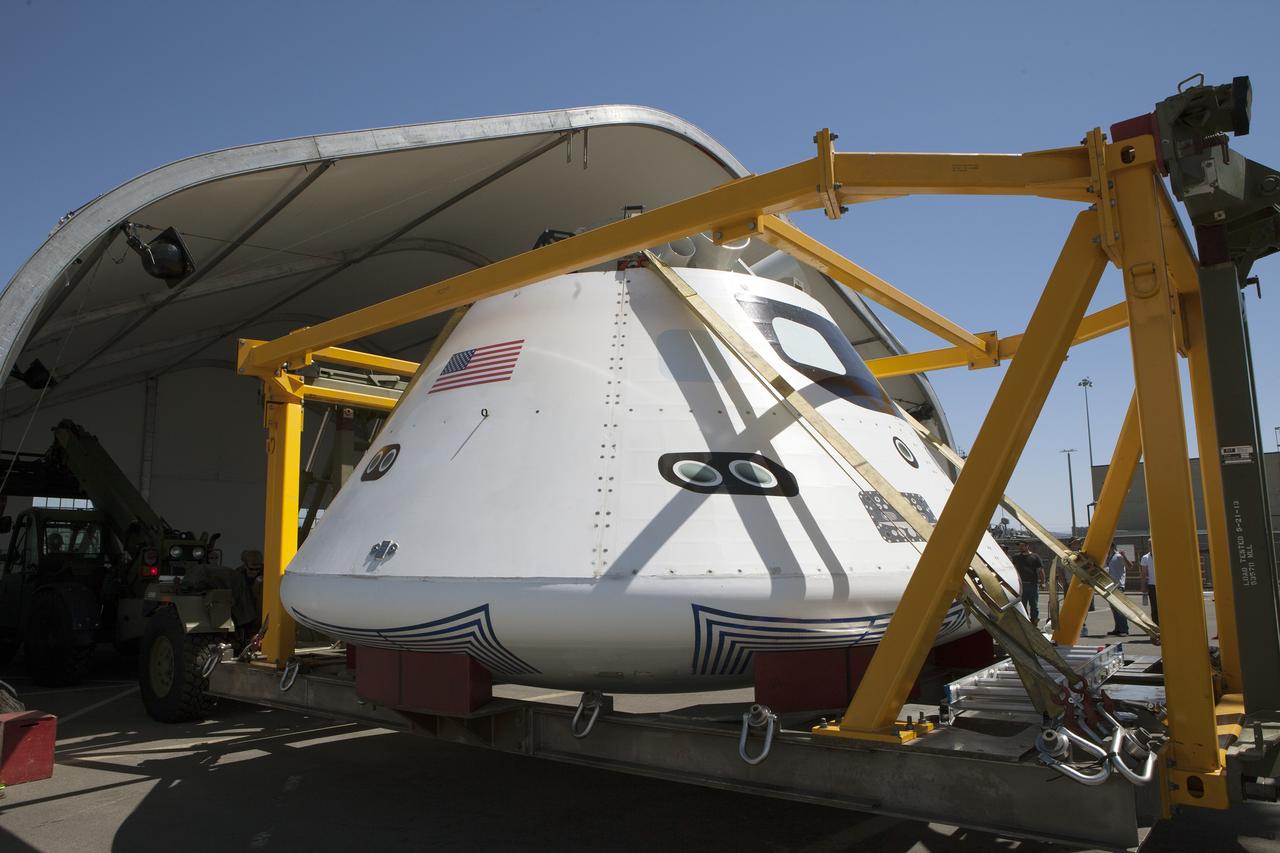
SAN DIEGO, Calif. – The Orion boilerplate test vehicle is being moved into a protective structure at the Mole Pier at the Naval Base San Diego in California for a simulated fit check of the hatch cover. The test vehicle is attached to the crew module recovery cradle. The Ground Systems Development and Operations Program, Lockheed Martin and the U.S. Navy are evaluating the hardware and processes for preparing the Orion crew module for Exploration Flight Test-1, or EFT-1, for overland transport from the naval base to NASA's Kennedy Space Center in Florida. Orion is the exploration spacecraft designed to carry astronauts to destinations not yet explored by humans, including an asteroid and Mars. It will have emergency abort capability, sustain the crew during space travel and provide safe re-entry from deep space return velocities. The first unpiloted test flight of the Orion is scheduled to launch later this year atop a Delta IV rocket from Cape Canaveral Air Force Station in Florida to an altitude of 3,600 miles above the Earth's surface. The two-orbit, four-hour flight test will help engineers evaluate the systems critical to crew safety including the heat shield, parachute system and launch abort system. For more information, visit http://www.nasa.gov/orion. Photo credit: NASA/Kim Shiflett

SAN DIEGO, Calif. – Inside a protective structure at the Mole Pier at the Naval Base San Diego in California, workers prepare for a simulated fit check of the hatch cover on the Orion boilerplate test vehicle. The Ground Systems Development and Operations Program, Lockheed Martin and the U.S. Navy are evaluating the hardware and processes for preparing the Orion crew module for Exploration Flight Test-1, or EFT-1, for overland transport from the naval base to NASA's Kennedy Space Center in Florida. Orion is the exploration spacecraft designed to carry astronauts to destinations not yet explored by humans, including an asteroid and Mars. It will have emergency abort capability, sustain the crew during space travel and provide safe re-entry from deep space return velocities. The first unpiloted test flight of the Orion is scheduled to launch later this year atop a Delta IV rocket from Cape Canaveral Air Force Station in Florida to an altitude of 3,600 miles above the Earth's surface. The two-orbit, four-hour flight test will help engineers evaluate the systems critical to crew safety including the heat shield, parachute system and launch abort system. For more information, visit http://www.nasa.gov/orion. Photo credit: NASA/Kim Shiflett
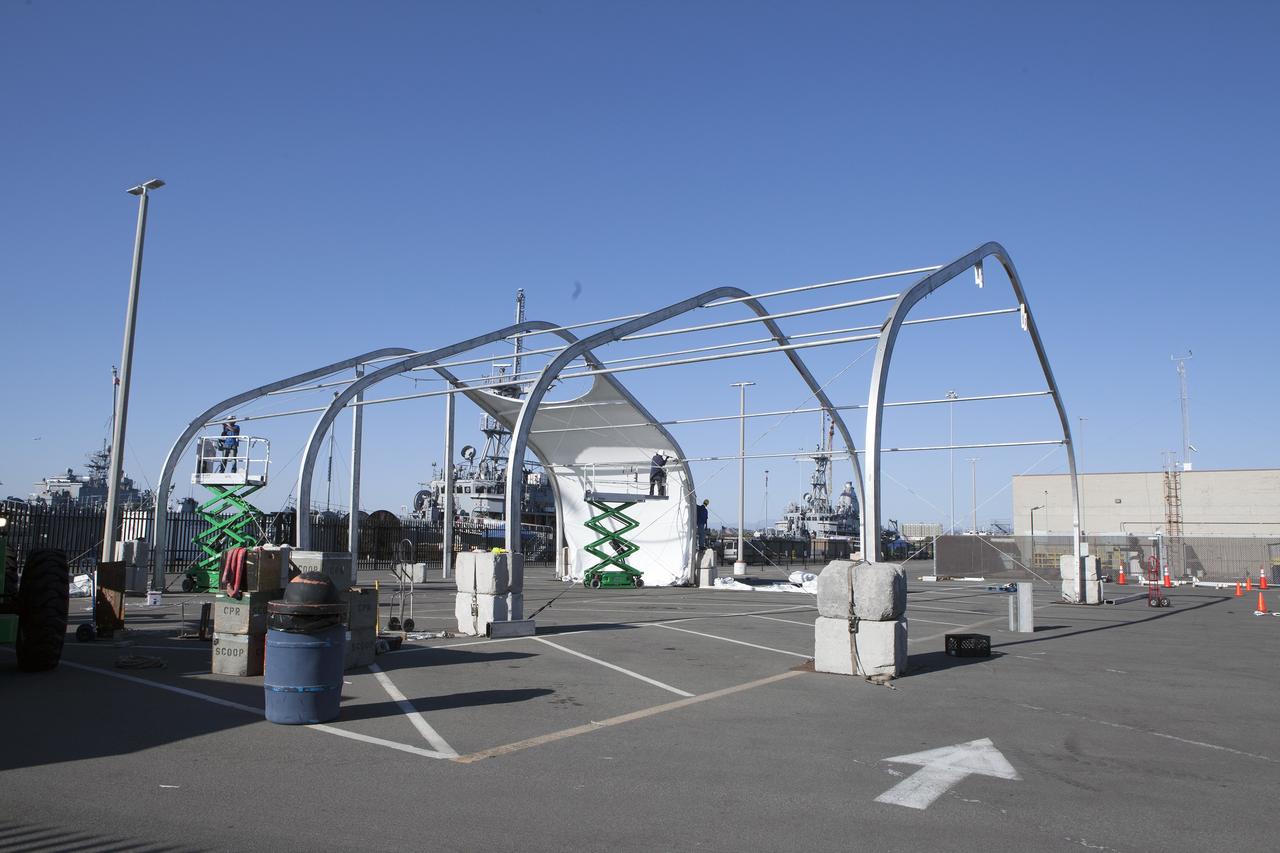
SAN DIEGO, Calif. – Workers on scissor lifts build up a protective structure at the Mole Pier at the Naval Base San Diego in California for the Orion boilerplate test vehicle. The Ground Systems Development and Operations Program, Lockheed Martin and U.S. Navy are evaluating the hardware and processes for preparing the Orion crew module for Exploration Flight Test-1, or EFT-1, for overland transport from the naval base to NASA's Kennedy Space Center in Florida. Orion is the exploration spacecraft designed to carry astronauts to destinations not yet explored by humans, including an asteroid and Mars. It will have emergency abort capability, sustain the crew during space travel and provide safe re-entry from deep space return velocities. The first unpiloted test flight of the Orion is scheduled to launch later this year atop a Delta IV rocket from Cape Canaveral Air Force Station in Florida to an altitude of 3,600 miles above the Earth's surface. The two-orbit, four-hour flight test will help engineers evaluate the systems critical to crew safety including the heat shield, parachute system and launch abort system. For more information, visit http://www.nasa.gov/orion. Photo credit: NASA/Kim Shiflett
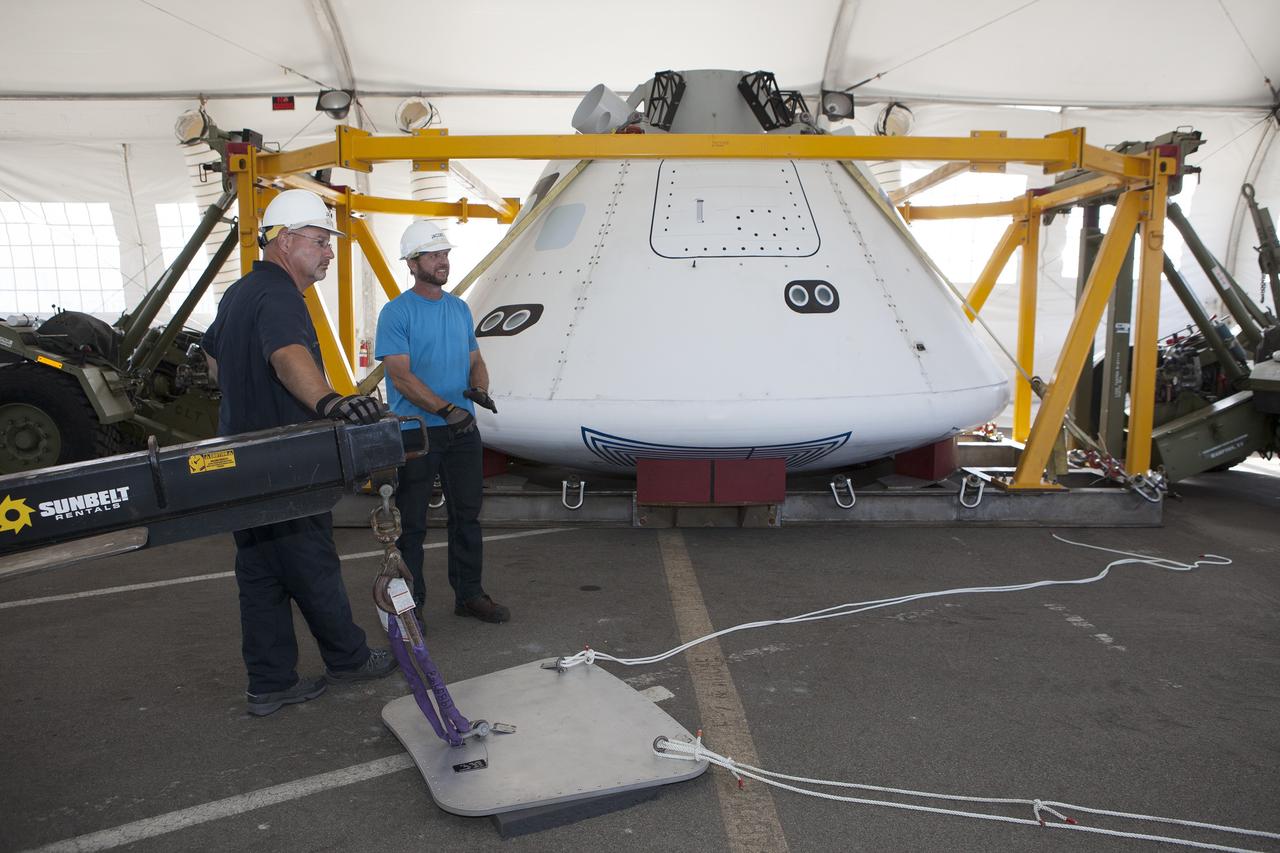
SAN DIEGO, Calif. – Inside a protective structure at the Mole Pier at the Naval Base San Diego in California, workers prepare for a simulated fit check of the hatch cover on the Orion boilerplate test vehicle. The test vehicle is secured on the crew module recovery cradle. The Ground Systems Development and Operations Program, Lockheed Martin and the U.S. Navy are evaluating the hardware and processes for preparing the Orion crew module for Exploration Flight Test-1, or EFT-1, for overland transport from the naval base to NASA's Kennedy Space Center in Florida. Orion is the exploration spacecraft designed to carry astronauts to destinations not yet explored by humans, including an asteroid and Mars. It will have emergency abort capability, sustain the crew during space travel and provide safe re-entry from deep space return velocities. The first unpiloted test flight of the Orion is scheduled to launch later this year atop a Delta IV rocket from Cape Canaveral Air Force Station in Florida to an altitude of 3,600 miles above the Earth's surface. The two-orbit, four-hour flight test will help engineers evaluate the systems critical to crew safety including the heat shield, parachute system and launch abort system. For more information, visit http://www.nasa.gov/orion. Photo credit: NASA/Kim Shiflett
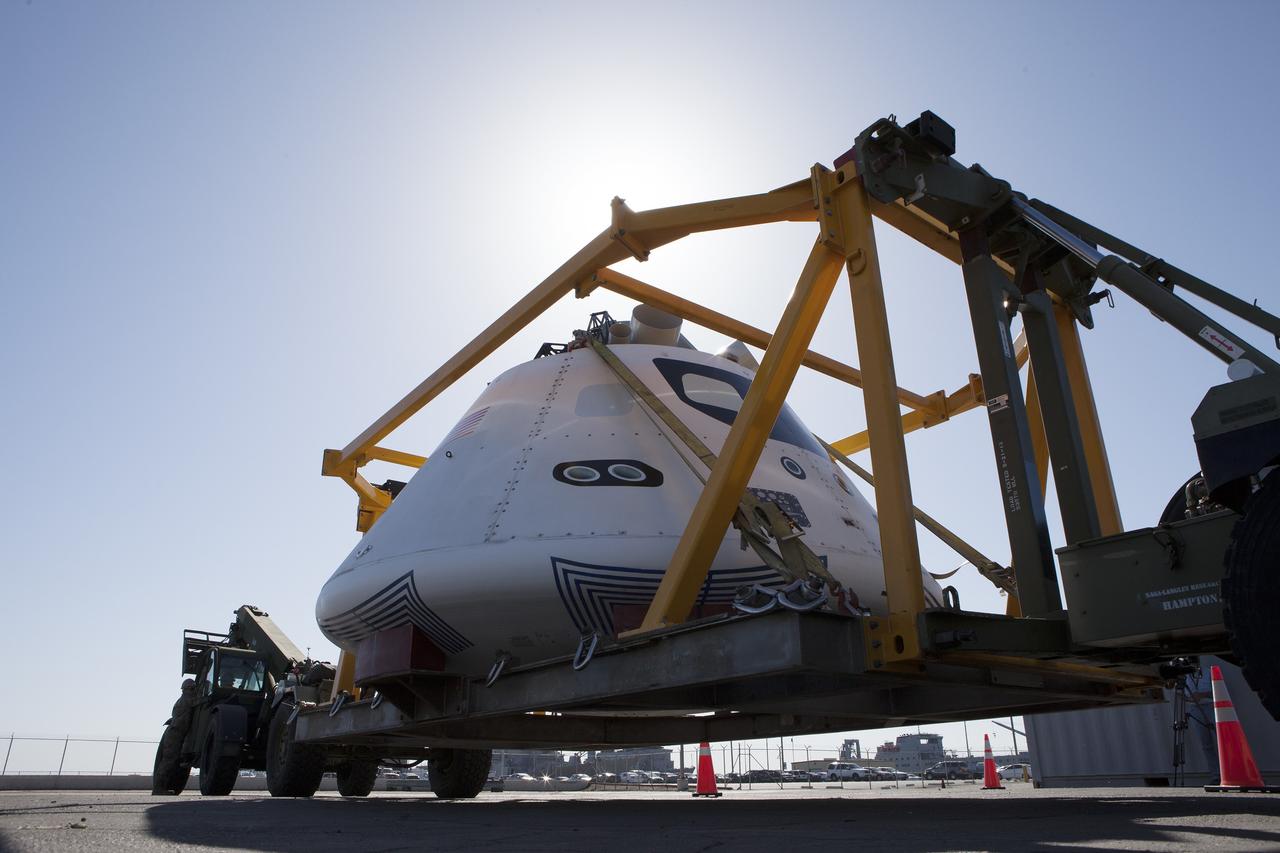
SAN DIEGO, Calif. – The Orion boilerplate test vehicle has been secured in the crew module recovery cradle and raised up at a warehouse at the Naval Base San Diego in California. The Ground Systems Development and Operations Program, Lockheed Martin and U.S. Navy are evaluating the hardware and processes for preparing the Orion crew module for Exploration Flight Test-1, or EFT-1, for overland transport from the naval base to NASA's Kennedy Space Center in Florida. Orion is the exploration spacecraft designed to carry astronauts to destinations not yet explored by humans, including an asteroid and Mars. It will have emergency abort capability, sustain the crew during space travel and provide safe re-entry from deep space return velocities. The first unpiloted test flight of the Orion is scheduled to launch later this year atop a Delta IV rocket from Cape Canaveral Air Force Station in Florida to an altitude of 3,600 miles above the Earth's surface. The two-orbit, four-hour flight test will help engineers evaluate the systems critical to crew safety including the heat shield, parachute system and launch abort system. For more information, visit http://www.nasa.gov/orion. Photo credit: NASA/Kim Shiflett
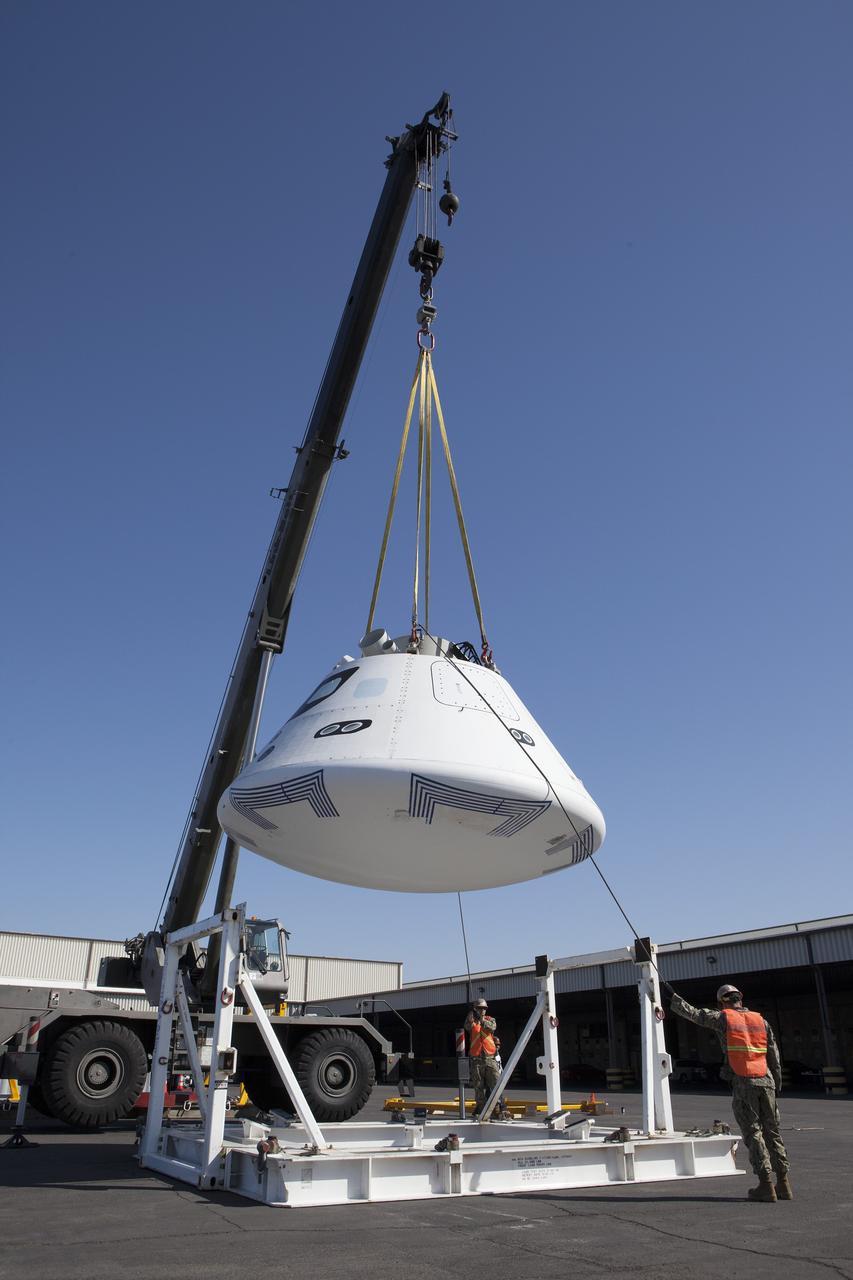
SAN DIEGO, Calif. – A crane lifts the Orion boilerplate test vehicle away from the BTA handling fixture at a warehouse at the Naval Base San Diego in California. The Ground Systems Development and Operations Program, Lockheed Martin and U.S. Navy are evaluating the hardware and processes for preparing the Orion crew module for Exploration Flight Test-1, or EFT-1, for overland transport from the naval base to NASA's Kennedy Space Center in Florida. Orion is the exploration spacecraft designed to carry astronauts to destinations not yet explored by humans, including an asteroid and Mars. It will have emergency abort capability, sustain the crew during space travel and provide safe re-entry from deep space return velocities. The first unpiloted test flight of the Orion is scheduled to launch later this year atop a Delta IV rocket from Cape Canaveral Air Force Station in Florida to an altitude of 3,600 miles above the Earth's surface. The two-orbit, four-hour flight test will help engineers evaluate the systems critical to crew safety including the heat shield, parachute system and launch abort system. For more information, visit http://www.nasa.gov/orion. Photo credit: NASA/Kim Shiflett
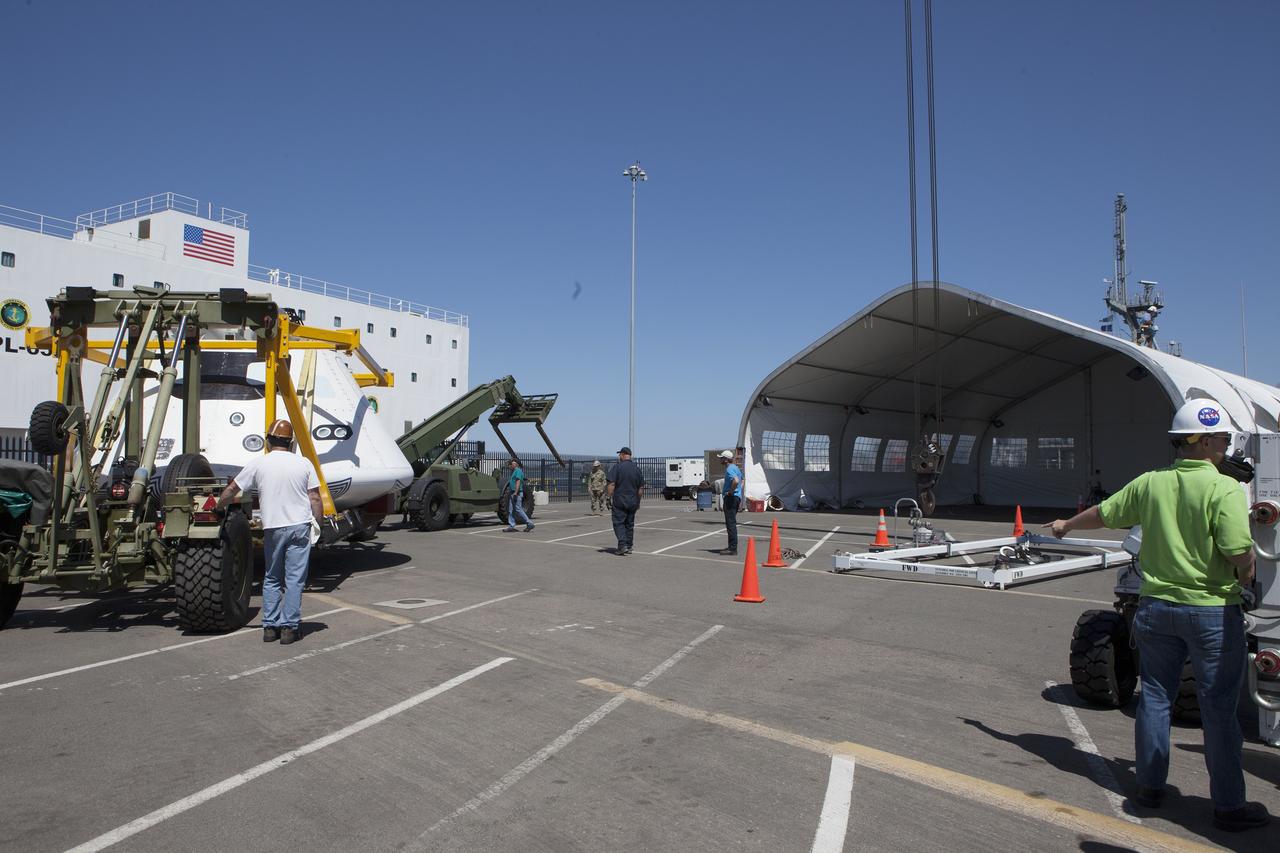
SAN DIEGO, Calif. – Workers prepare to move the Orion boilerplate test vehicle into a protective structure at the Mole Pier at the Naval Base San Diego in California for a simulated fit check of the hatch cover. The test vehicle is attached to the crew module recovery cradle. The Ground Systems Development and Operations Program, Lockheed Martin and the U.S. Navy are evaluating the hardware and processes for preparing the Orion crew module for Exploration Flight Test-1, or EFT-1, for overland transport from the naval base to NASA's Kennedy Space Center in Florida. Orion is the exploration spacecraft designed to carry astronauts to destinations not yet explored by humans, including an asteroid and Mars. It will have emergency abort capability, sustain the crew during space travel and provide safe re-entry from deep space return velocities. The first unpiloted test flight of the Orion is scheduled to launch later this year atop a Delta IV rocket from Cape Canaveral Air Force Station in Florida to an altitude of 3,600 miles above the Earth's surface. The two-orbit, four-hour flight test will help engineers evaluate the systems critical to crew safety including the heat shield, parachute system and launch abort system. For more information, visit http://www.nasa.gov/orion. Photo credit: NASA/Kim Shiflett
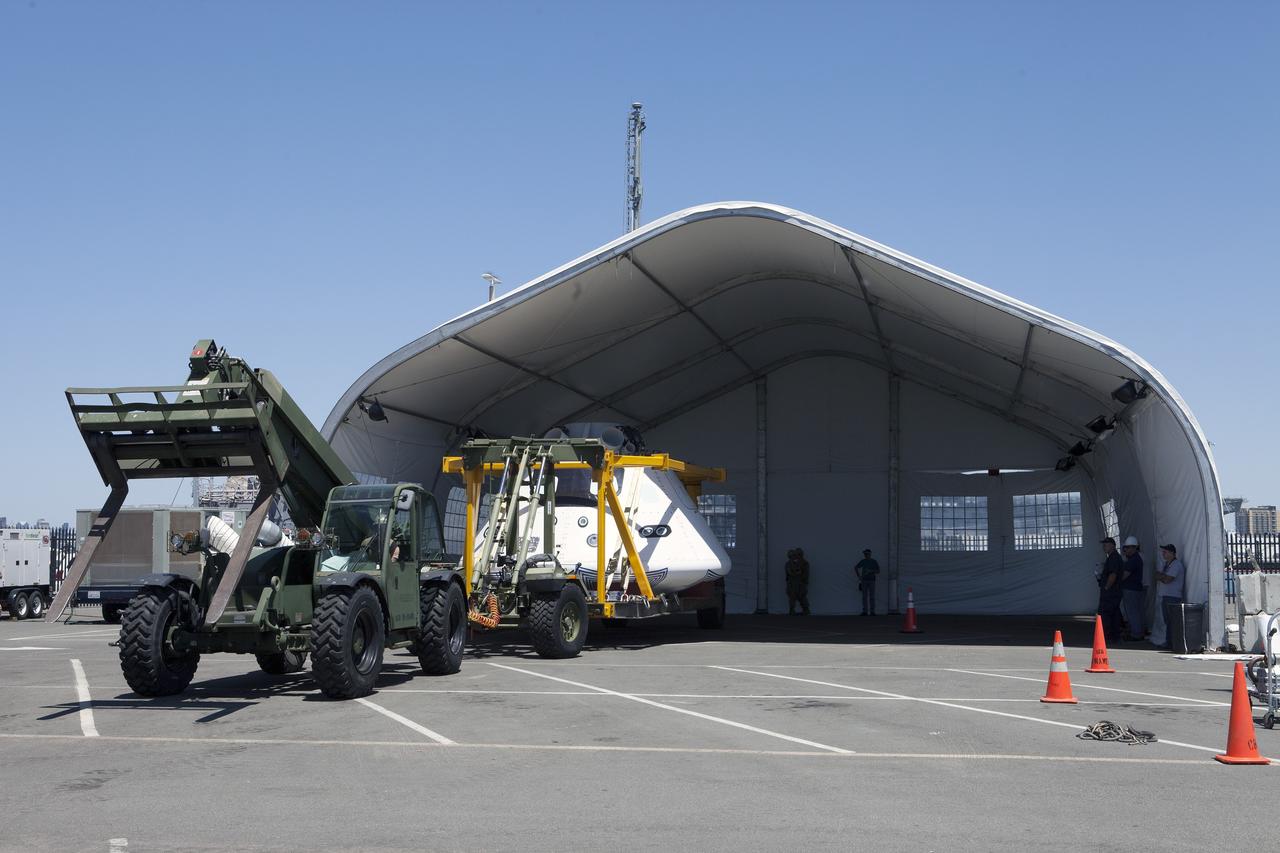
SAN DIEGO, Calif. – The Orion boilerplate test vehicle is being moved into a protective structure at the Mole Pier at the Naval Base San Diego in California for a simulated fit check of the hatch cover. The test vehicle is attached to the crew module recovery cradle. The Ground Systems Development and Operations Program, Lockheed Martin and the U.S. Navy are evaluating the hardware and processes for preparing the Orion crew module for Exploration Flight Test-1, or EFT-1, for overland transport from the naval base to NASA's Kennedy Space Center in Florida. Orion is the exploration spacecraft designed to carry astronauts to destinations not yet explored by humans, including an asteroid and Mars. It will have emergency abort capability, sustain the crew during space travel and provide safe re-entry from deep space return velocities. The first unpiloted test flight of the Orion is scheduled to launch later this year atop a Delta IV rocket from Cape Canaveral Air Force Station in Florida to an altitude of 3,600 miles above the Earth's surface. The two-orbit, four-hour flight test will help engineers evaluate the systems critical to crew safety including the heat shield, parachute system and launch abort system. For more information, visit http://www.nasa.gov/orion. Photo credit: NASA/Kim Shiflett
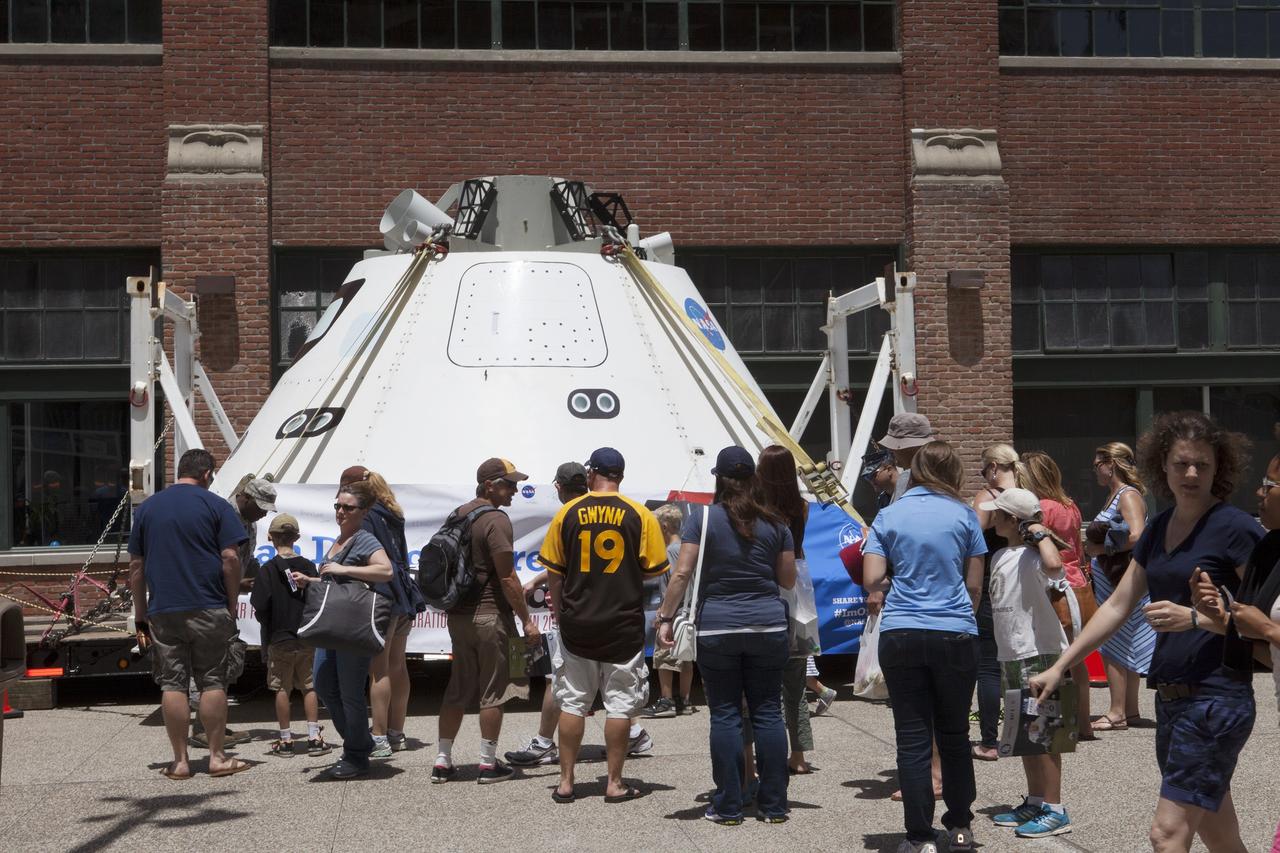
CAPE CANAVERAL, Fla. – Fans check out NASA's Orion boilerplate test vehicle on display at Petco Park in San Diego, California, before the start of a San Diego Padres' baseball game. The boilerplate test vehicle is being prepared for an Exploration Flight Test-1, or EFT-1, pre-transportation test. The Ground Systems Development and Operations Program will run the test at the U.S. Naval Base San Diego to simulate retrieval and transportation procedures for Orion after it splashes down in the ocean and is retrieved for return to land and ground transportation back to Kennedy Space Center in Florida. Orion is the exploration spacecraft designed to carry astronauts to destinations not yet explored by humans, including an asteroid and Mars. It will have emergency abort capability, sustain the crew during space travel and provide safe re-entry from deep space return velocities. The first unpiloted test flight of the Orion is scheduled to launch later this year atop a Delta IV rocket and in 2017 on NASA’s Space Launch System rocket. For more information, visit http://www.nasa.gov/orion. Photo credit: NASA/Kim Shiflett
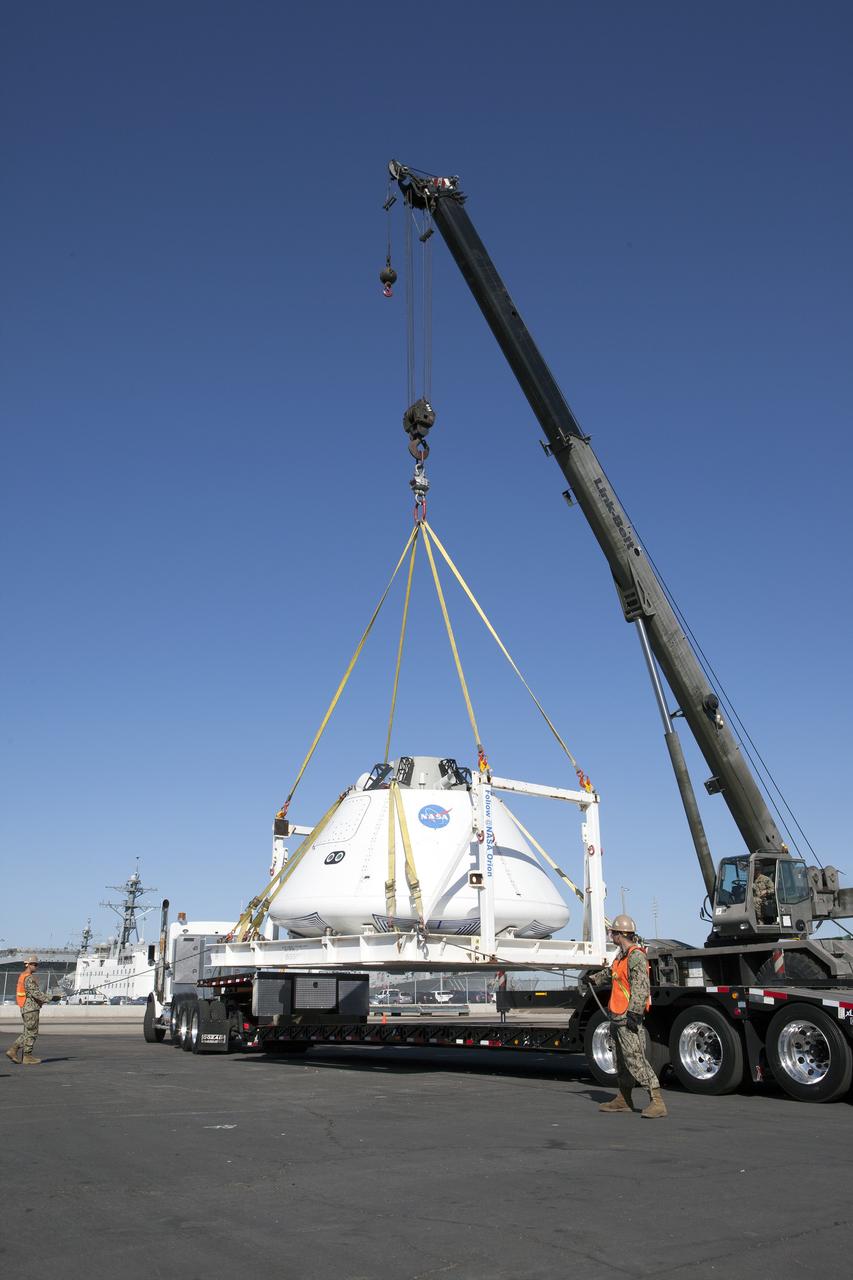
SAN DIEGO, Calif. – A crane lifts the Orion boilerplate test vehicle from a flatbed truck to lower it to the ground at a warehouse at the Naval Base San Diego in California. The test vehicle is attached to the BTA handling fixture. The Ground Systems Development and Operations Program, Lockheed Martin and the U.S. Navy are evaluating the hardware and processes for preparing the Orion crew module for Exploration Flight Test-1, or EFT-1, for overland transport from the naval base to NASA's Kennedy Space Center in Florida. Orion is the exploration spacecraft designed to carry astronauts to destinations not yet explored by humans, including an asteroid and Mars. It will have emergency abort capability, sustain the crew during space travel and provide safe re-entry from deep space return velocities. The first unpiloted test flight of the Orion is scheduled to launch later this year atop a Delta IV rocket from Cape Canaveral Air Force Station in Florida to an altitude of 3,600 miles above the Earth's surface. The two-orbit, four-hour flight test will help engineers evaluate the systems critical to crew safety including the heat shield, parachute system and launch abort system. For more information, visit http://www.nasa.gov/orion. Photo credit: NASA/Kim Shiflett
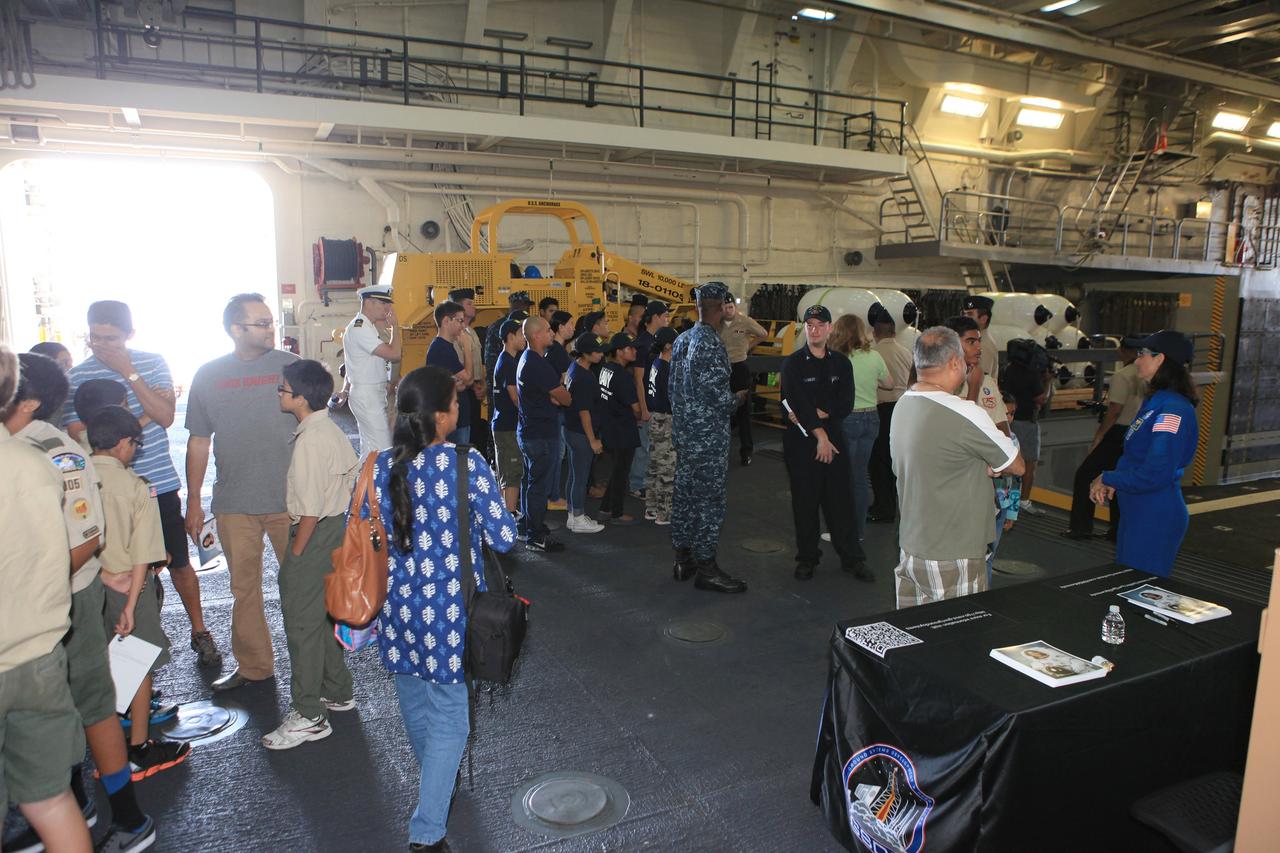
LOS ANGELES, Calif. – Visitors tour the well deck of the USS Anchorage during the Science, Technology, Engineering and Mathematics, or STEM, Expo for L.A. Navy Days at the Port of Los Angeles in California. At far right is NASA astronaut Nicole Stott. NASA, Lockheed Martin and the U.S. Navy completed Underway Recovery Test 2 on the Orion boilerplate test vehicle in the Pacific Ocean off the coast of San Diego to prepare for recovery of the Orion crew module on its return from a deep space mission. The underway recovery test allowed the teams to demonstrate and evaluate the recovery processes, procedures, new hardware and personnel in open waters. The Ground Systems Development and Operations Program conducted the underway recovery test. Orion is the exploration spacecraft designed to carry astronauts to destinations not yet explored by humans, including an asteroid and Mars. It will have emergency abort capability, sustain the crew during space travel and provide safe re-entry from deep space return velocities. The first unpiloted test flight of the Orion is scheduled to launch in 2014 on Exploration Flight Test-1, or EFT-1, atop a Delta IV rocket and in 2017 on NASA’s Space Launch System rocket. For more information, visit http://www.nasa.gov/orion. Photo credit: Kim Shiflett
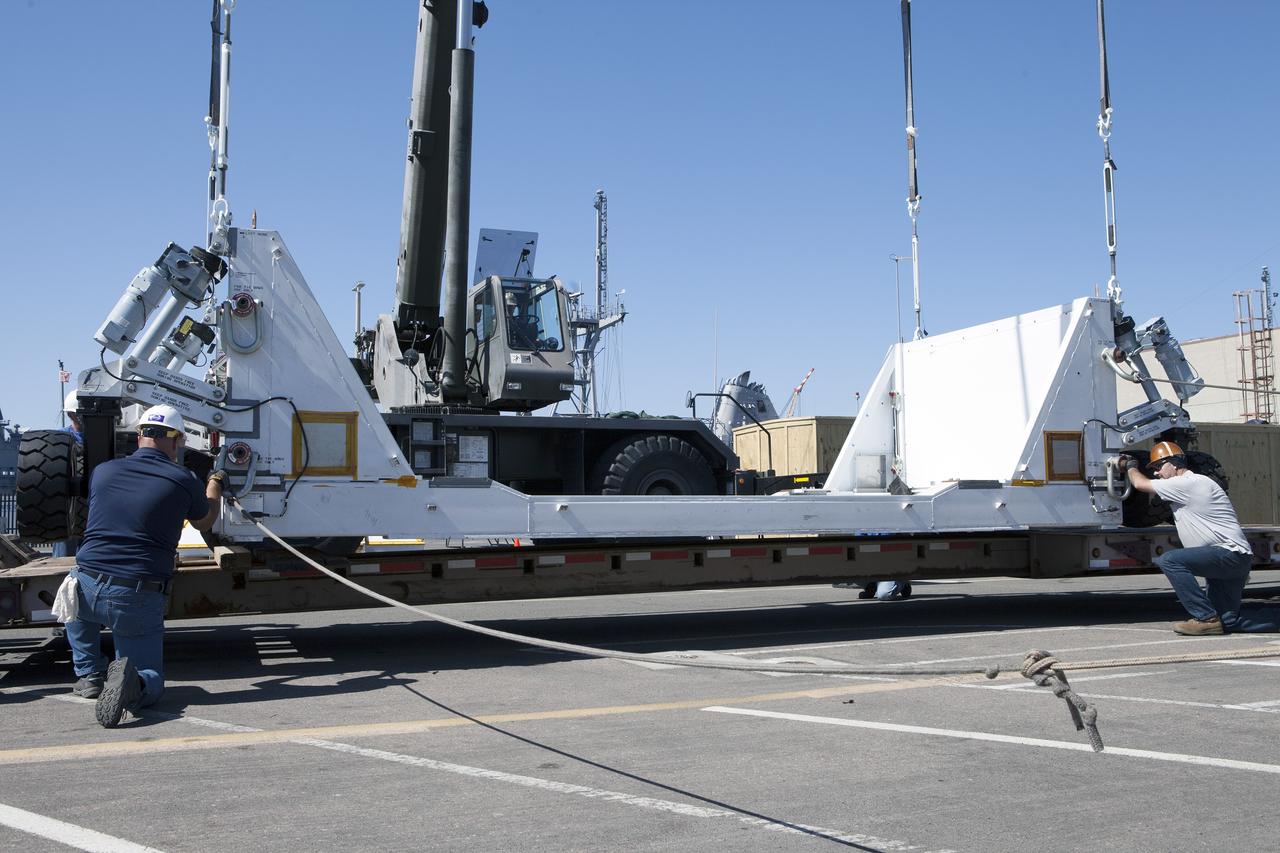
SAN DIEGO, Calif. – Workers prepare the base of the crew module transportation fixture for the Orion boilerplate test vehicle at the Mole Pier at Naval Base San Diego in California. The test vehicle will be moved from the pier to a warehouse hangar at the naval base. The Ground Systems Development and Operations Program, Lockheed Martin and the U.S. Navy are evaluating the hardware and processes for preparing the Orion crew module for Exploration Flight Test-1, or EFT-1, for overland transport from the naval base to NASA's Kennedy Space Center in Florida. Orion is the exploration spacecraft designed to carry astronauts to destinations not yet explored by humans, including an asteroid and Mars. It will have emergency abort capability, sustain the crew during space travel and provide safe re-entry from deep space return velocities. The first unpiloted test flight of the Orion is scheduled to launch later this year atop a Delta IV rocket from Cape Canaveral Air Force Station in Florida to an altitude of 3,600 miles above the Earth's surface. The two-orbit, four-hour flight test will help engineers evaluate the systems critical to crew safety including the heat shield, parachute system and launch abort system. For more information, visit http://www.nasa.gov/orion. Photo credit: NASA/Kim Shiflett
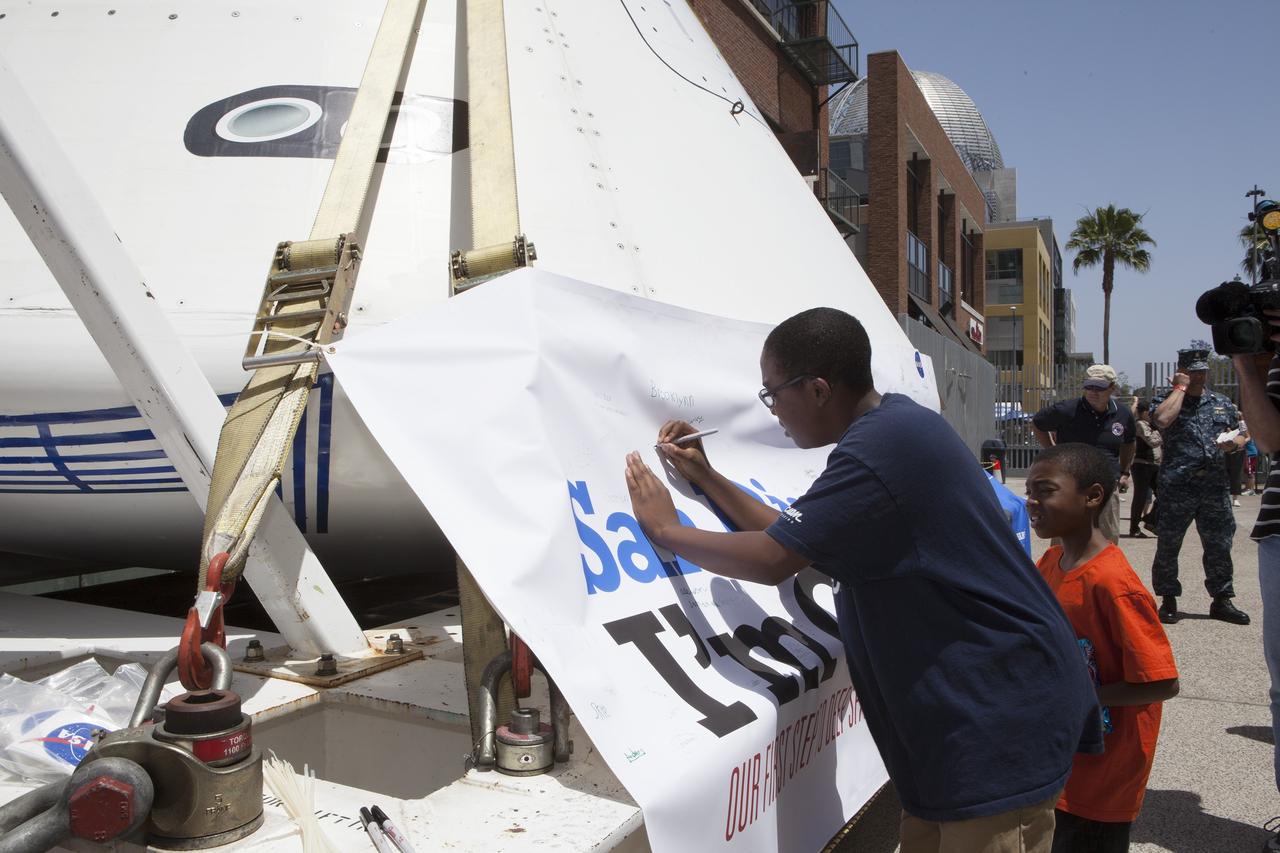
CAPE CANAVERAL, Fla. – Fans sign the banner surrounding NASA's Orion boilerplate test vehicle on display at Petco Park in San Diego, California, before the start of a San Diego Padres' baseball game. The boilerplate test vehicle is being prepared for an Exploration Flight Test-1, or EFT-1, pre-transportation test. The Ground Systems Development and Operations Program will run the test at the U.S. Naval Base San Diego to simulate retrieval and transportation procedures for Orion after it splashes down in the ocean and is retrieved for return to land and ground transportation back to Kennedy Space Center in Florida. Orion is the exploration spacecraft designed to carry astronauts to destinations not yet explored by humans, including an asteroid and Mars. It will have emergency abort capability, sustain the crew during space travel and provide safe re-entry from deep space return velocities. The first unpiloted test flight of the Orion is scheduled to launch later this year atop a Delta IV rocket and in 2017 on NASA’s Space Launch System rocket. For more information, visit http://www.nasa.gov/orion. Photo credit: NASA/Kim Shiflett
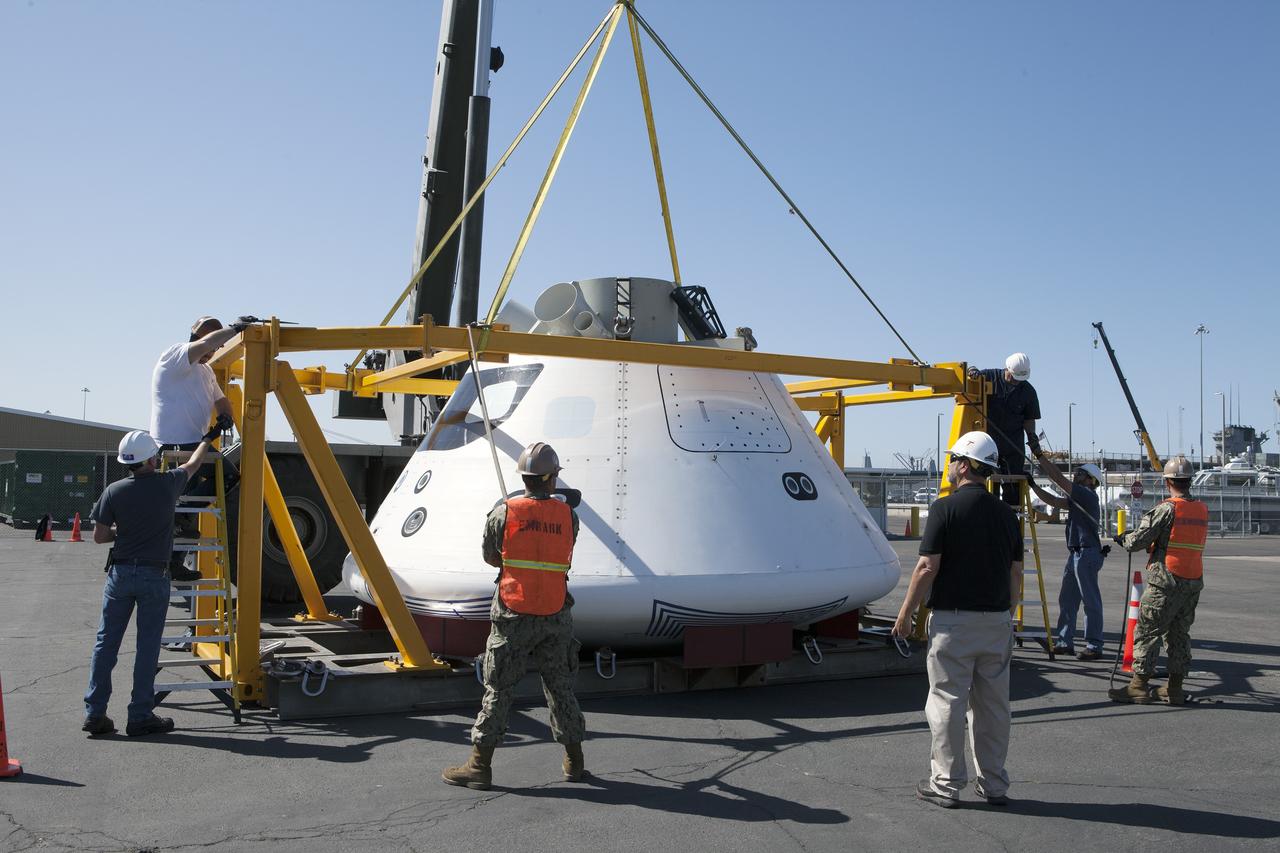
SAN DIEGO, Calif. – A crane lowers the top fixture of the crew module recovery cradle onto the Orion boilerplate test vehicle at a warehouse at the Naval Base San Diego in California. The Ground Systems Development and Operations Program, Lockheed Martin and U.S. Navy are evaluating the hardware and processes for preparing the Orion crew module for Exploration Flight Test-1, or EFT-1, for overland transport from the naval base to NASA's Kennedy Space Center in Florida. Orion is the exploration spacecraft designed to carry astronauts to destinations not yet explored by humans, including an asteroid and Mars. It will have emergency abort capability, sustain the crew during space travel and provide safe re-entry from deep space return velocities. The first unpiloted test flight of the Orion is scheduled to launch later this year atop a Delta IV rocket from Cape Canaveral Air Force Station in Florida to an altitude of 3,600 miles above the Earth's surface. The two-orbit, four-hour flight test will help engineers evaluate the systems critical to crew safety including the heat shield, parachute system and launch abort system. For more information, visit http://www.nasa.gov/orion. Photo credit: NASA/Kim Shiflett

CAPE CANAVERAL, Fla. – Fans check out NASA's Orion boilerplate test vehicle on display at Petco Park in San Diego, California, before the start of a San Diego Padres' baseball game. The boilerplate test vehicle is being prepared for an Exploration Flight Test-1, or EFT-1, pre-transportation test. The Ground Systems Development and Operations Program will run the test at the U.S. Naval Base San Diego to simulate retrieval and transportation procedures for Orion after it splashes down in the ocean and is retrieved for return to land and ground transportation back to Kennedy Space Center in Florida. Orion is the exploration spacecraft designed to carry astronauts to destinations not yet explored by humans, including an asteroid and Mars. It will have emergency abort capability, sustain the crew during space travel and provide safe re-entry from deep space return velocities. The first unpiloted test flight of the Orion is scheduled to launch later this year atop a Delta IV rocket and in 2017 on NASA’s Space Launch System rocket. For more information, visit http://www.nasa.gov/orion. Photo credit: NASA/Kim Shiflett
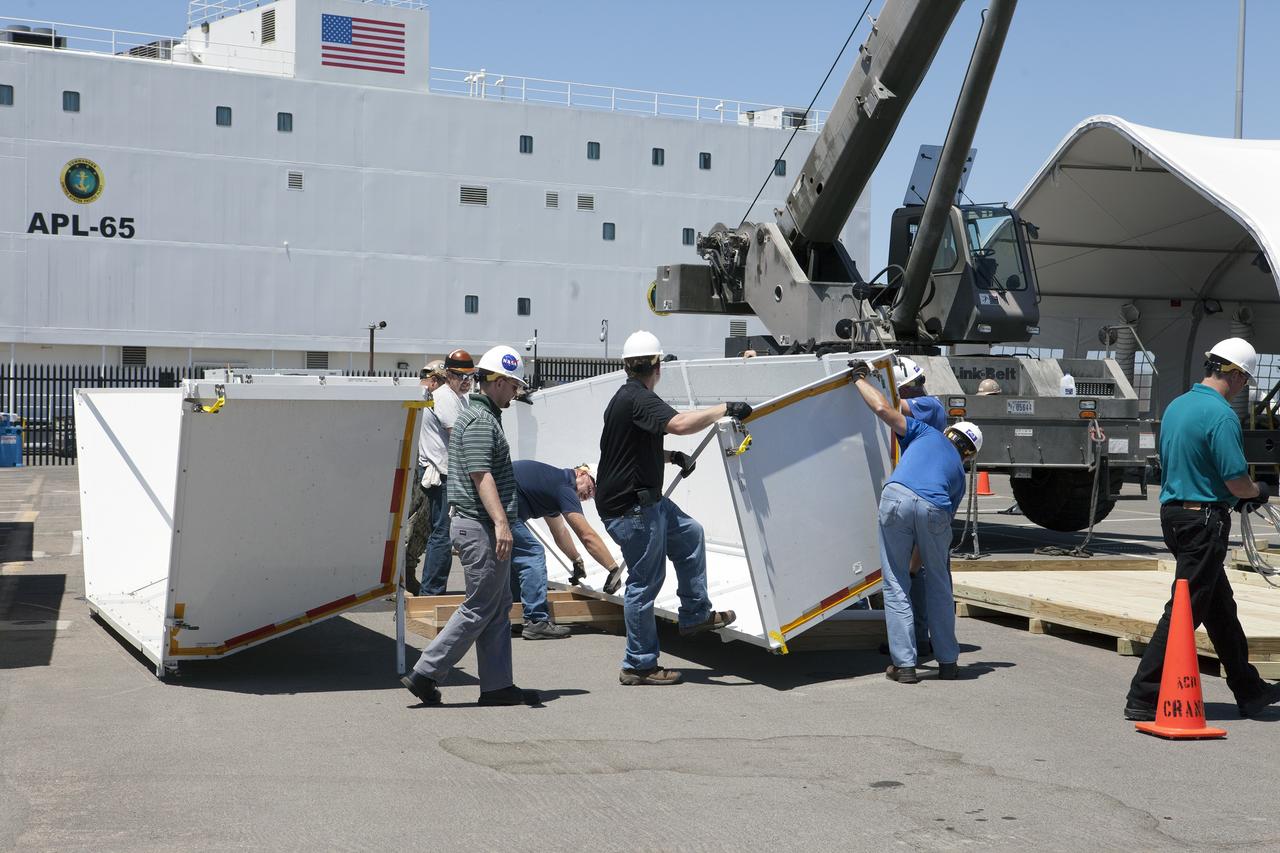
SAN DIEGO, Calif. – Workers prepare to assemble the crew module transportation fixture for the Orion boilerplate test vehicle at the Mole Pier at Naval Base San Diego in California. The test vehicle will be moved from the pier to a warehouse at the naval base. The Ground Systems Development and Operations Program, Lockheed Martin and the U.S. Navy are evaluating the hardware and processes for preparing the Orion crew module for Exploration Flight Test-1, or EFT-1, for overland transport from the naval base to NASA's Kennedy Space Center in Florida. Orion is the exploration spacecraft designed to carry astronauts to destinations not yet explored by humans, including an asteroid and Mars. It will have emergency abort capability, sustain the crew during space travel and provide safe re-entry from deep space return velocities. The first unpiloted test flight of the Orion is scheduled to launch later this year atop a Delta IV rocket from Cape Canaveral Air Force Station in Florida to an altitude of 3,600 miles above the Earth's surface. The two-orbit, four-hour flight test will help engineers evaluate the systems critical to crew safety including the heat shield, parachute system and launch abort system. For more information, visit http://www.nasa.gov/orion. Photo credit: NASA/Kim Shiflett
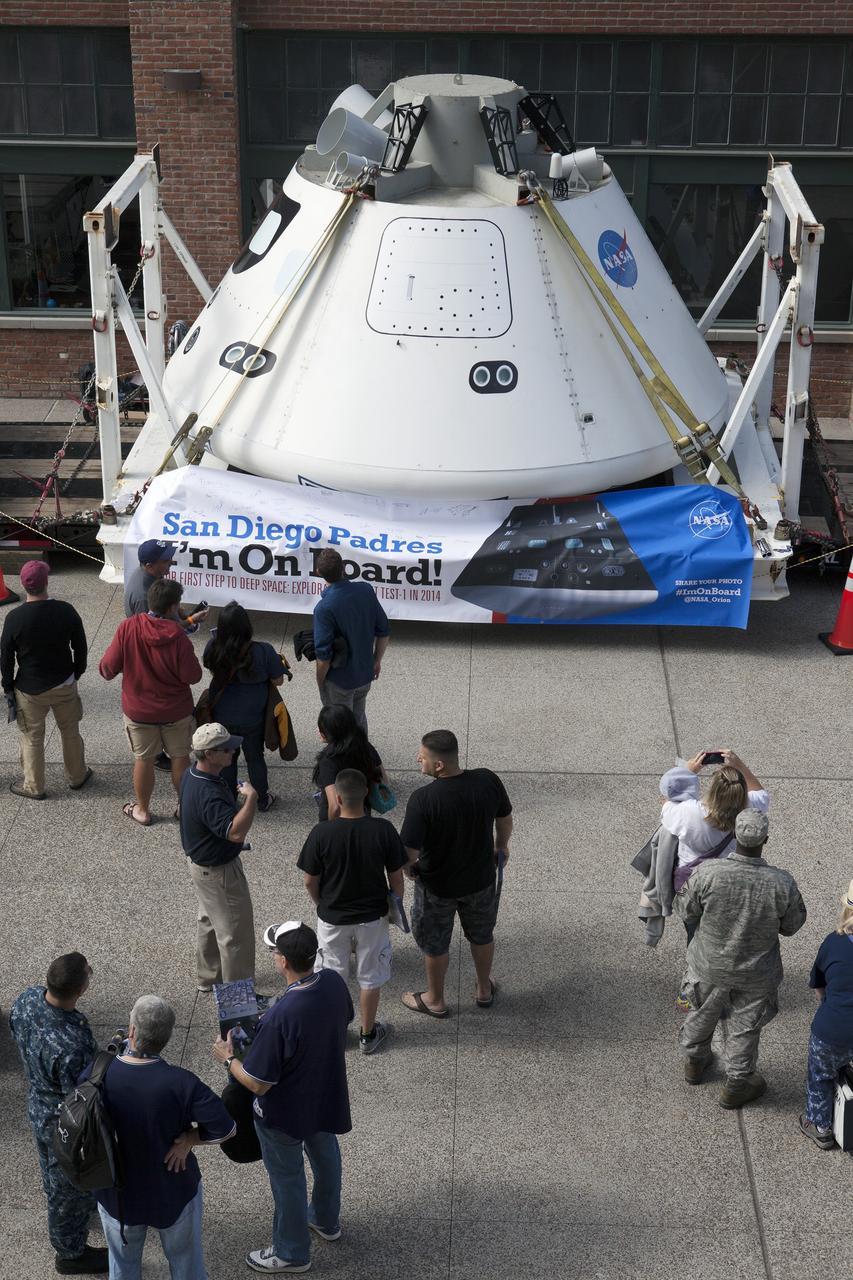
CAPE CANAVERAL, Fla. – The Orion boilerplate test vehicle is on display at Petco Park in San Diego, California, before the San Diego Padres' baseball game. The boilerplate test vehicle is being prepared for an Exploration Flight Test-1, or EFT-1, pre-transportation test. The Ground Systems Development and Operations Program will run the test at the U.S. Naval Base San Diego to simulate retrieval and transportation procedures for Orion after it splashes down in the ocean and is retrieved for return to land and ground transportation back to Kennedy Space Center in Florida. Orion is the exploration spacecraft designed to carry astronauts to destinations not yet explored by humans, including an asteroid and Mars. It will have emergency abort capability, sustain the crew during space travel and provide safe re-entry from deep space return velocities. The first unpiloted test flight of the Orion is scheduled to launch later this year atop a Delta IV rocket and in 2017 on NASA’s Space Launch System rocket. For more information, visit http://www.nasa.gov/orion. Photo credit: NASA/Kim Shiflett
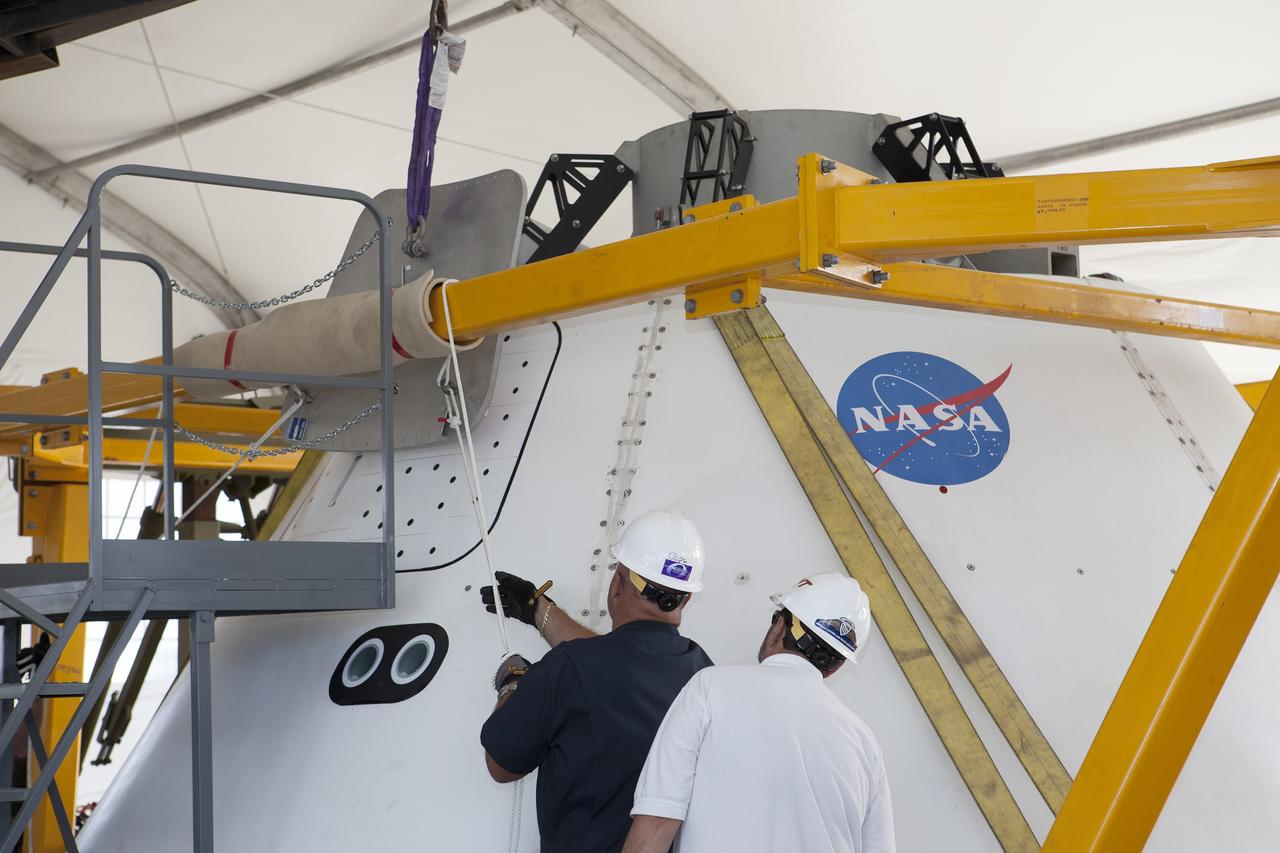
SAN DIEGO, Calif. – Inside a protective structure at the Mole Pier at the Naval Base San Diego in California, workers prepare for a simulated fit check of the hatch cover on the Orion boilerplate test vehicle. The test vehicle is secured on the crew module recovery cradle. The Ground Systems Development and Operations Program, Lockheed Martin and the U.S. Navy are evaluating the hardware and processes for preparing the Orion crew module for Exploration Flight Test-1, or EFT-1, for overland transport from the naval base to NASA's Kennedy Space Center in Florida. Orion is the exploration spacecraft designed to carry astronauts to destinations not yet explored by humans, including an asteroid and Mars. It will have emergency abort capability, sustain the crew during space travel and provide safe re-entry from deep space return velocities. The first unpiloted test flight of the Orion is scheduled to launch later this year atop a Delta IV rocket from Cape Canaveral Air Force Station in Florida to an altitude of 3,600 miles above the Earth's surface. The two-orbit, four-hour flight test will help engineers evaluate the systems critical to crew safety including the heat shield, parachute system and launch abort system. For more information, visit http://www.nasa.gov/orion. Photo credit: NASA/Kim Shiflett
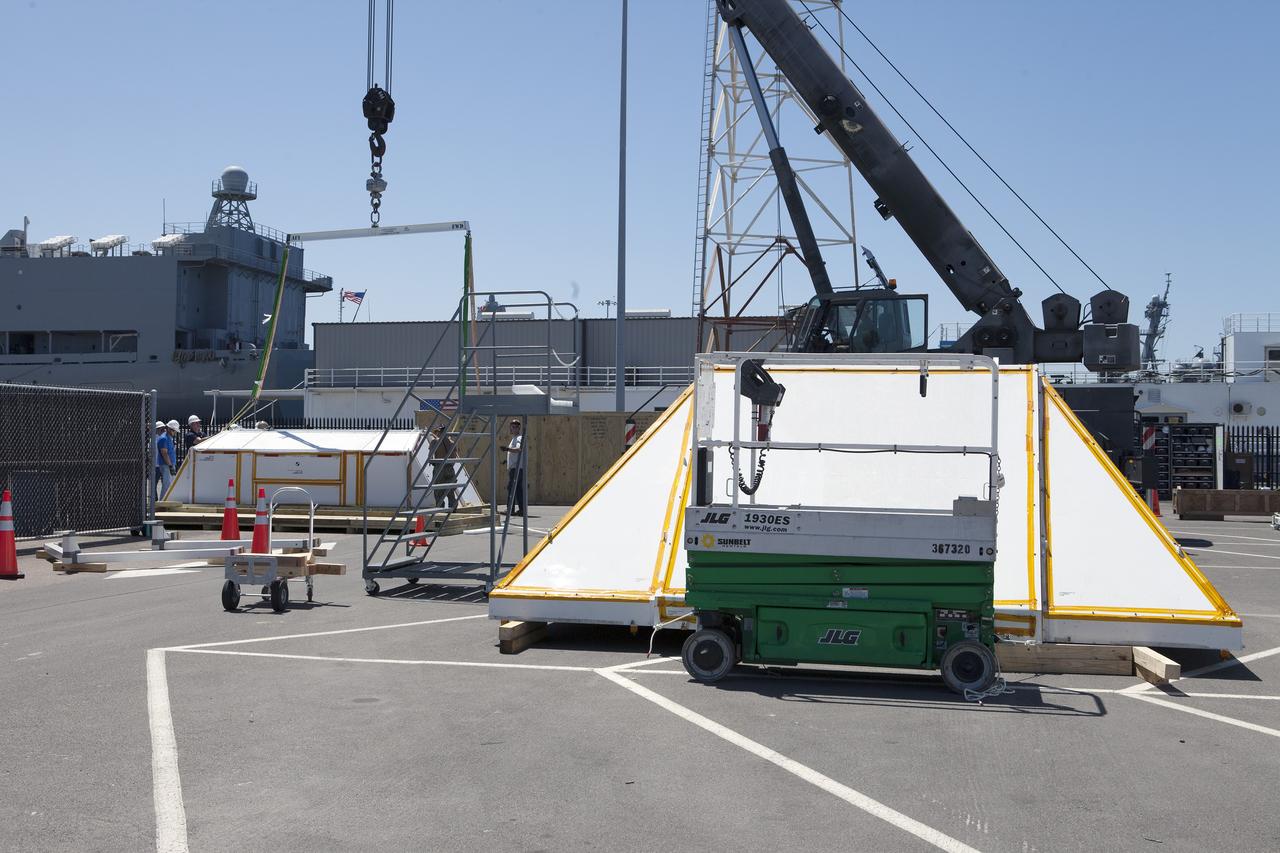
SAN DIEGO, Calif. – Workers prepare the crew module transportation fixture for the Orion boilerplate test vehicle at the Mole Pier at the Naval Base San Diego in California. The test vehicle will be moved from the pier to a warehouse at the naval base. The Ground Systems Development and Operations Program, Lockheed Martin and the U.S. Navy are evaluating the hardware and processes for preparing the Orion crew module for Exploration Flight Test-1, or EFT-1, for overland transport from the naval base to NASA's Kennedy Space Center in Florida. Orion is the exploration spacecraft designed to carry astronauts to destinations not yet explored by humans, including an asteroid and Mars. It will have emergency abort capability, sustain the crew during space travel and provide safe re-entry from deep space return velocities. The first unpiloted test flight of the Orion is scheduled to launch later this year atop a Delta IV rocket from Cape Canaveral Air Force Station in Florida to an altitude of 3,600 miles above the Earth's surface. The two-orbit, four-hour flight test will help engineers evaluate the systems critical to crew safety including the heat shield, parachute system and launch abort system. For more information, visit http://www.nasa.gov/orion. Photo credit: NASA/Kim Shiflett

LOS ANGELES, Calif. – NASA astronaut Nicole Stott poses for photographs in the well deck of the USS Anchorage during the Science, Technology, Engineering and Mathematics, or STEM, Expo for L.A. Navy Days at the Port of Los Angeles in California. With her is Commanding Officer Joel G. Stewart, USS Anchorage. NASA, Lockheed Martin and the U.S. Navy completed Underway Recovery Test 2 on the Orion boilerplate test vehicle in the Pacific Ocean off the coast of San Diego to prepare for recovery of the Orion crew module on its return from a deep space mission. The underway recovery test allowed the teams to demonstrate and evaluate the recovery processes, procedures, new hardware and personnel in open waters. The Ground Systems Development and Operations Program conducted the underway recovery test. Orion is the exploration spacecraft designed to carry astronauts to destinations not yet explored by humans, including an asteroid and Mars. It will have emergency abort capability, sustain the crew during space travel and provide safe re-entry from deep space return velocities. The first unpiloted test flight of the Orion is scheduled to launch in 2014 on Exploration Flight Test-1, or EFT-1, atop a Delta IV rocket and in 2017 on NASA’s Space Launch System rocket. For more information, visit http://www.nasa.gov/orion. Photo credit: Kim Shiflett
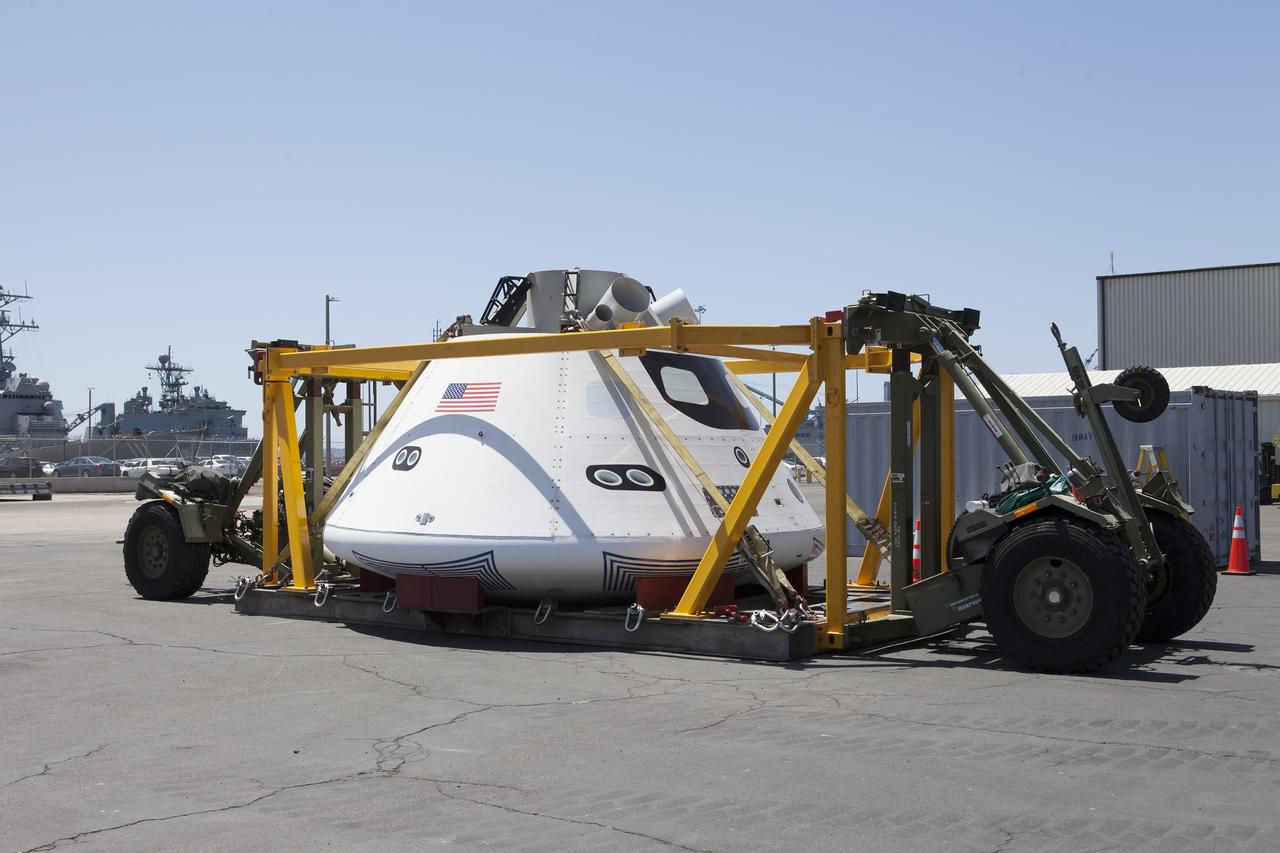
SAN DIEGO, Calif. – The Orion boilerplate test vehicle has been secured in the crew module recovery cradle at a warehouse at the Naval Base San Diego in California. The Ground Systems Development and Operations Program, Lockheed Martin and the U.S. Navy are evaluating the hardware and processes for preparing the Orion crew module for Exploration Flight Test-1, or EFT-1, for overland transport from the naval base to NASA's Kennedy Space Center in Florida. Orion is the exploration spacecraft designed to carry astronauts to destinations not yet explored by humans, including an asteroid and Mars. It will have emergency abort capability, sustain the crew during space travel and provide safe re-entry from deep space return velocities. The first unpiloted test flight of the Orion is scheduled to launch later this year atop a Delta IV rocket from Cape Canaveral Air Force Station in Florida to an altitude of 3,600 miles above the Earth's surface. The two-orbit, four-hour flight test will help engineers evaluate the systems critical to crew safety including the heat shield, parachute system and launch abort system. For more information, visit http://www.nasa.gov/orion. Photo credit: NASA/Kim Shiflett
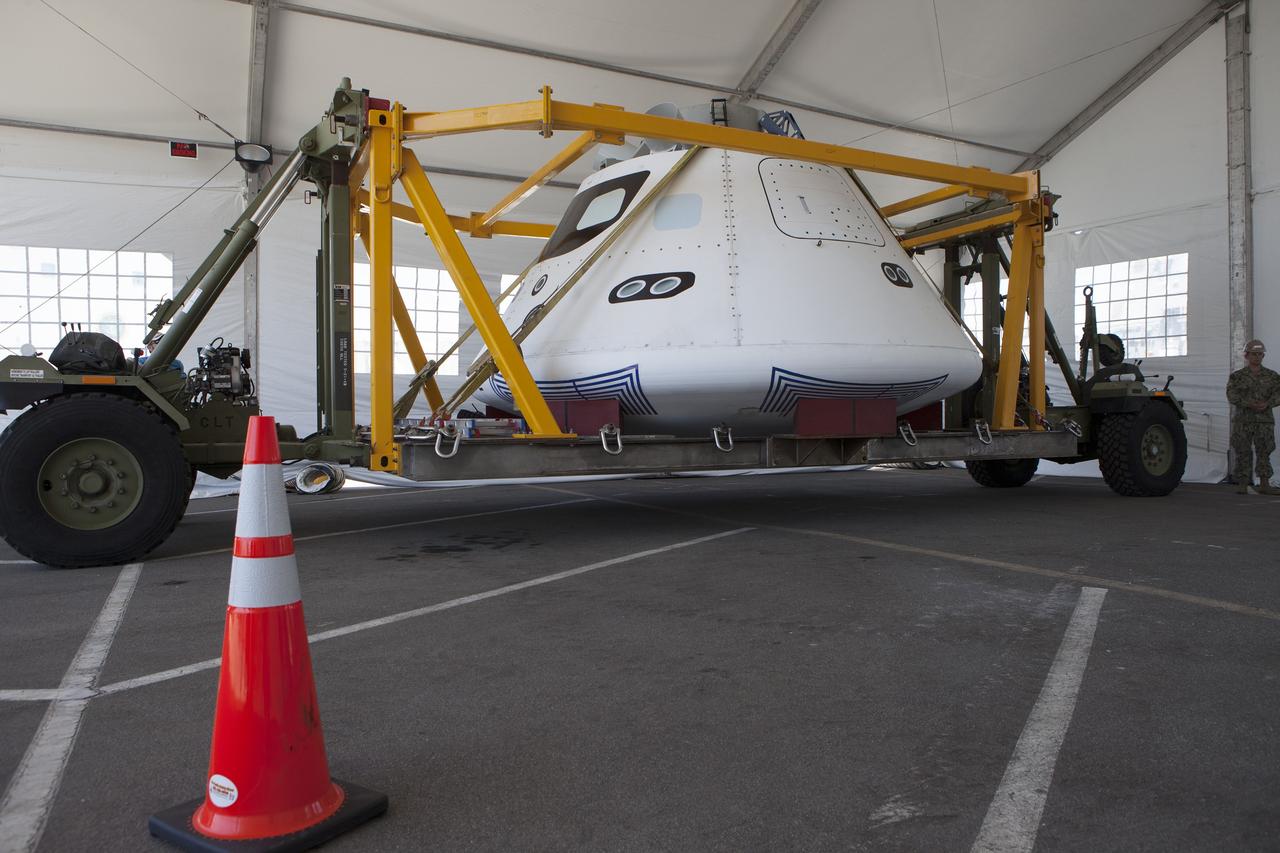
SAN DIEGO, Calif. – The Orion boilerplate test vehicle has been moved into a protective structure at the Mole Pier at the Naval Base San Diego in California for a simulated fit check of the hatch cover. The test vehicle is attached to the crew module recovery cradle. The Ground Systems Development and Operations Program, Lockheed Martin and the U.S. Navy are evaluating the hardware and processes for preparing the Orion crew module for Exploration Flight Test-1, or EFT-1, for overland transport from the naval base to NASA's Kennedy Space Center in Florida. Orion is the exploration spacecraft designed to carry astronauts to destinations not yet explored by humans, including an asteroid and Mars. It will have emergency abort capability, sustain the crew during space travel and provide safe re-entry from deep space return velocities. The first unpiloted test flight of the Orion is scheduled to launch later this year atop a Delta IV rocket from Cape Canaveral Air Force Station in Florida to an altitude of 3,600 miles above the Earth's surface. The two-orbit, four-hour flight test will help engineers evaluate the systems critical to crew safety including the heat shield, parachute system and launch abort system. For more information, visit http://www.nasa.gov/orion. Photo credit: NASA/Kim Shiflett
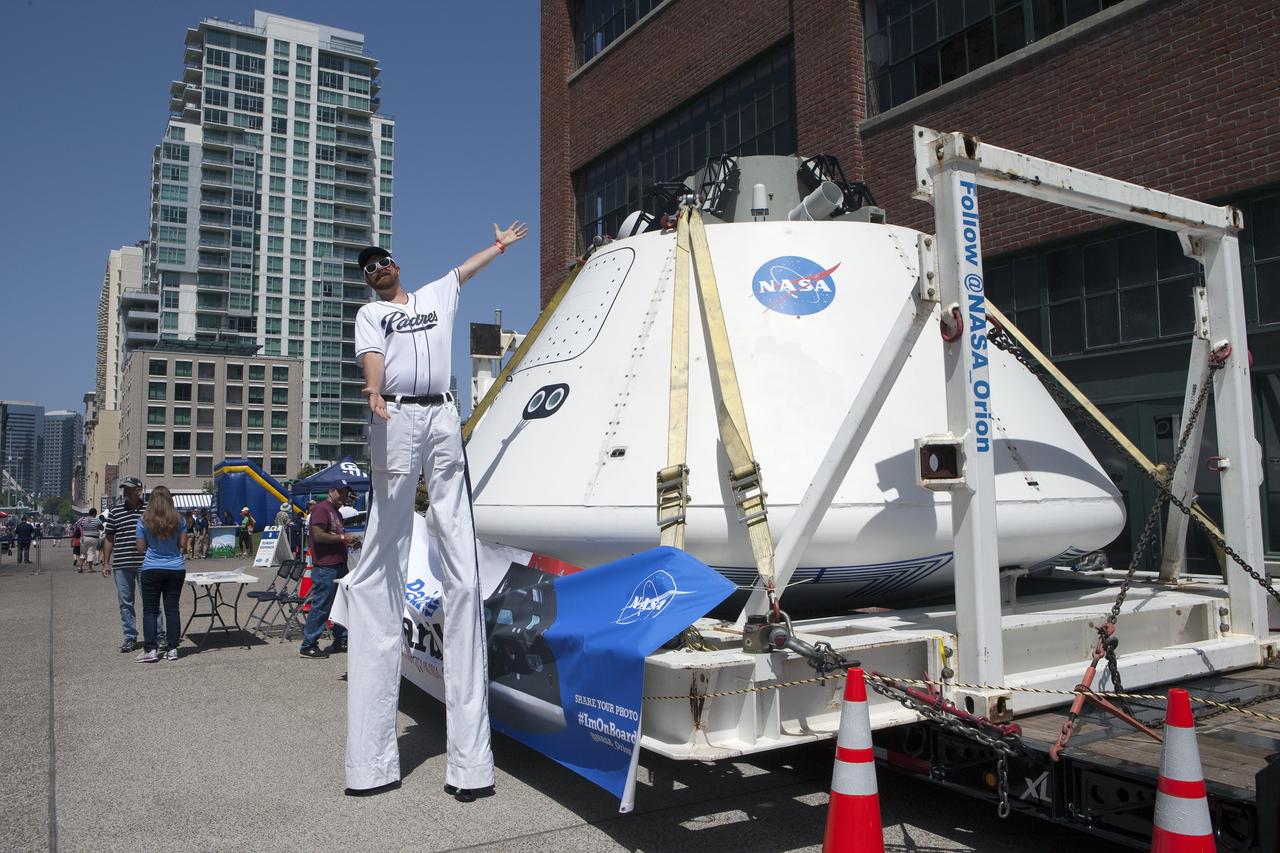
CAPE CANAVERAL, Fla. – A San Diego Padres fan on stilts stands near NASA's Orion boilerplate test vehicle on display at Petco Park in San Diego, California. The boilerplate test vehicle will be prepared for an Exploration Flight Test-1, or EFT-1, pre-transportation test. The Ground Systems Development and Operations Program will run the test at the U.S. Naval Base San Diego to simulate retrieval and transportation procedures for Orion after it splashes down in the ocean and is retrieved for return to land and ground transportation back to Kennedy Space Center in Florida. Orion is the exploration spacecraft designed to carry astronauts to destinations not yet explored by humans, including an asteroid and Mars. It will have emergency abort capability, sustain the crew during space travel and provide safe re-entry from deep space return velocities. The first unpiloted test flight of the Orion is scheduled to launch later this year atop a Delta IV rocket and in 2017 on NASA’s Space Launch System rocket. For more information, visit http://www.nasa.gov/orion. Photo credit: NASA/Kim Shiflett
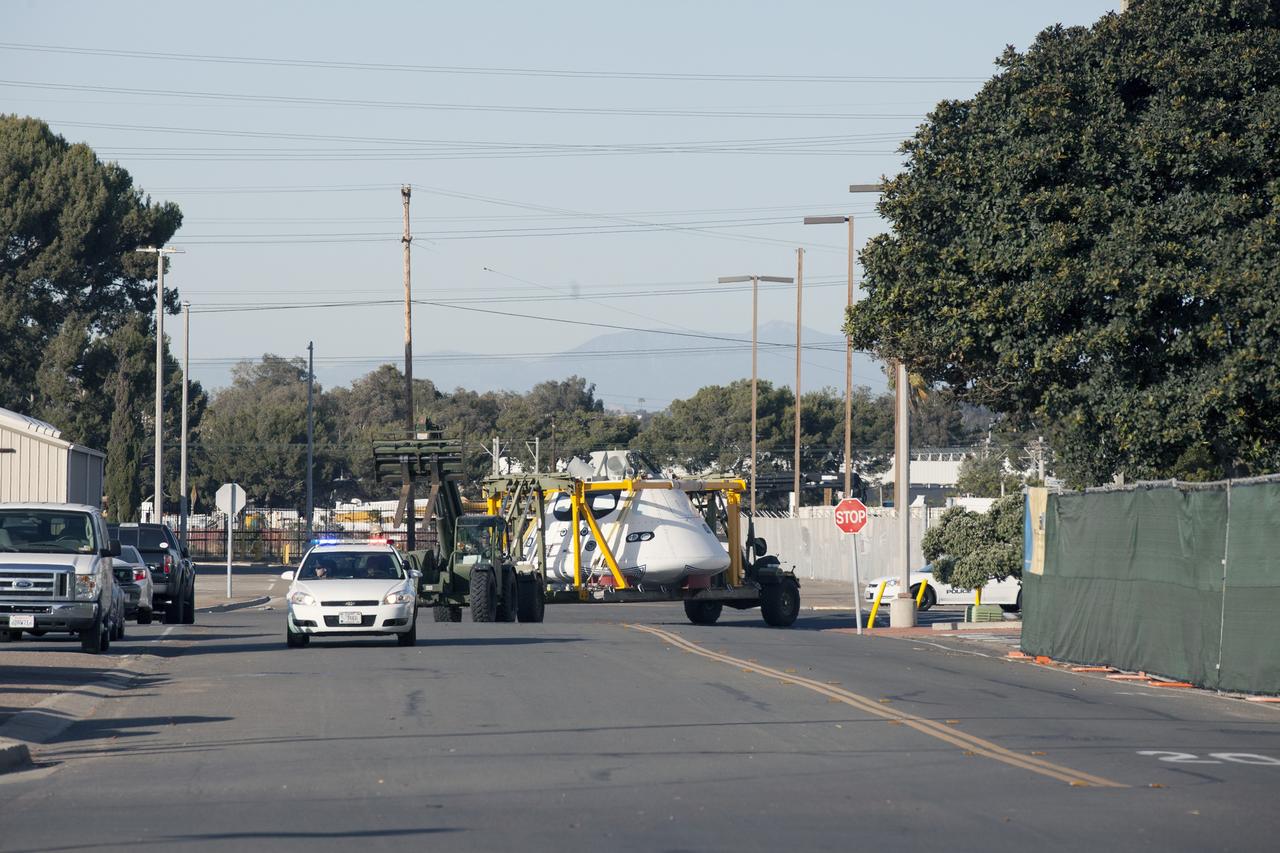
SAN DIEGO, Calif. – The Orion boilerplate test vehicle is being moved from the Mole Pier at Naval Base San Diego in California to a warehouse at the naval base. The test vehicle is attached to the crew module recovery cradle. The Ground Systems Development and Operations Program, Lockheed Martin and the U.S. Navy are evaluating the hardware and processes for preparing the Orion crew module for Exploration Flight Test-1, or EFT-1, for overland transport from the naval base to NASA's Kennedy Space Center in Florida. Orion is the exploration spacecraft designed to carry astronauts to destinations not yet explored by humans, including an asteroid and Mars. It will have emergency abort capability, sustain the crew during space travel and provide safe re-entry from deep space return velocities. The first unpiloted test flight of the Orion is scheduled to launch later this year atop a Delta IV rocket from Cape Canaveral Air Force Station in Florida to an altitude of 3,600 miles above the Earth's surface. The two-orbit, four-hour flight test will help engineers evaluate the systems critical to crew safety including the heat shield, parachute system and launch abort system. For more information, visit http://www.nasa.gov/orion. Photo credit: NASA/Kim Shiflett

SAN DIEGO, Calif. – Workers simulate moving the Orion boilerplate test vehicle in place to be lifted into the crew module transportation fixture at the Mole Pier at Naval Base San Diego in California to a warehouse at the naval base. The test vehicle is attached to the crew module recovery cradle. The Ground Systems Development and Operations Program, Lockheed Martin and the U.S. Navy are evaluating the hardware and processes for preparing the Orion crew module for Exploration Flight Test-1, or EFT-1, for overland transport from the naval base to NASA's Kennedy Space Center in Florida. Orion is the exploration spacecraft designed to carry astronauts to destinations not yet explored by humans, including an asteroid and Mars. It will have emergency abort capability, sustain the crew during space travel and provide safe re-entry from deep space return velocities. The first unpiloted test flight of the Orion is scheduled to launch later this year atop a Delta IV rocket from Cape Canaveral Air Force Station in Florida to an altitude of 3,600 miles above the Earth's surface. The two-orbit, four-hour flight test will help engineers evaluate the systems critical to crew safety including the heat shield, parachute system and launch abort system. For more information, visit http://www.nasa.gov/orion. Photo credit: NASA/Kim Shiflett
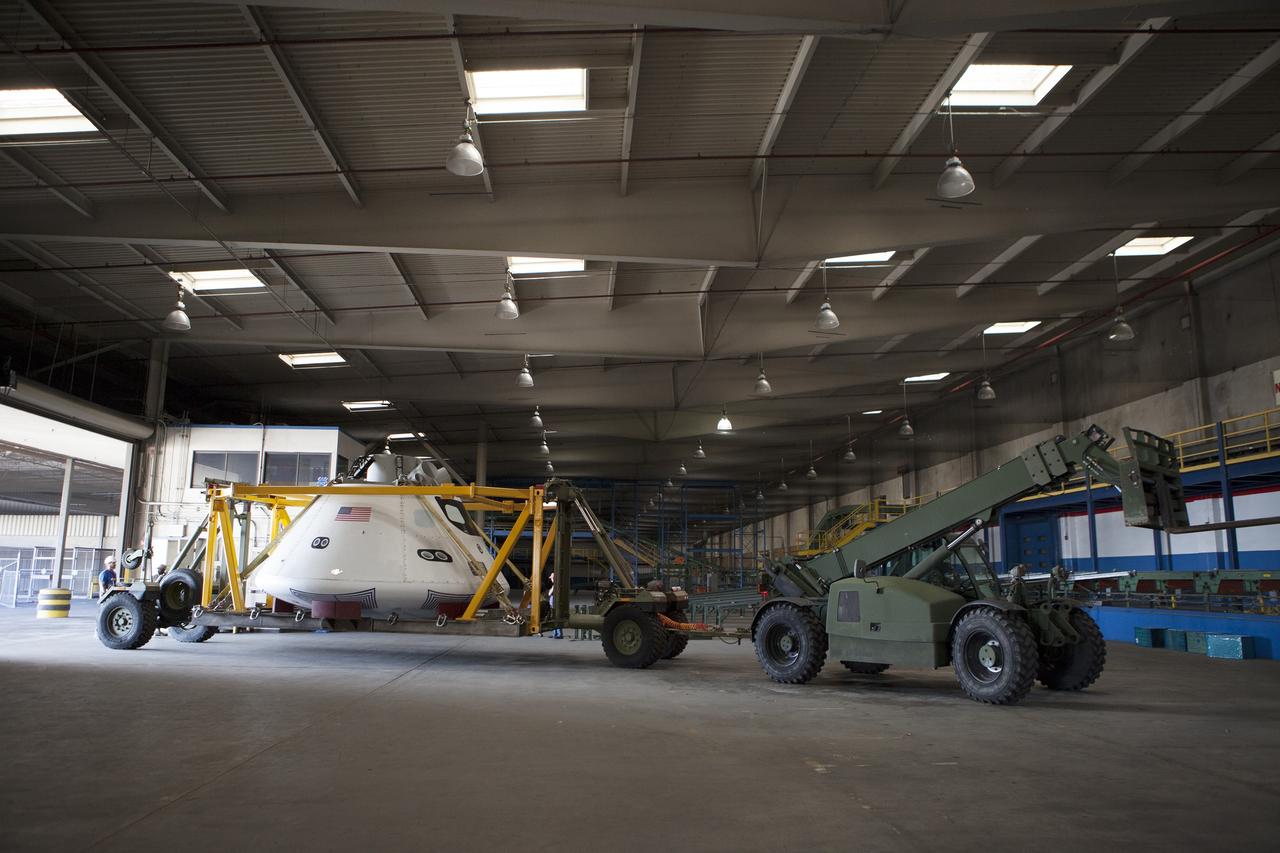
SAN DIEGO, Calif. – The Orion boilerplate test vehicle has been moved to a warehouse at Naval Base San Diego in California from the Mole Pier at the naval base. The test vehicle is attached to the crew module recovery cradle. The Ground Systems Development and Operations Program, Lockheed Martin and the U.S. Navy are evaluating the hardware and processes for preparing the Orion crew module for Exploration Flight Test-1, or EFT-1, for overland transport from the naval base to NASA's Kennedy Space Center in Florida. Orion is the exploration spacecraft designed to carry astronauts to destinations not yet explored by humans, including an asteroid and Mars. It will have emergency abort capability, sustain the crew during space travel and provide safe re-entry from deep space return velocities. The first unpiloted test flight of the Orion is scheduled to launch later this year atop a Delta IV rocket from Cape Canaveral Air Force Station in Florida to an altitude of 3,600 miles above the Earth's surface. The two-orbit, four-hour flight test will help engineers evaluate the systems critical to crew safety including the heat shield, parachute system and launch abort system. For more information, visit http://www.nasa.gov/orion. Photo credit: NASA/Kim Shiflett
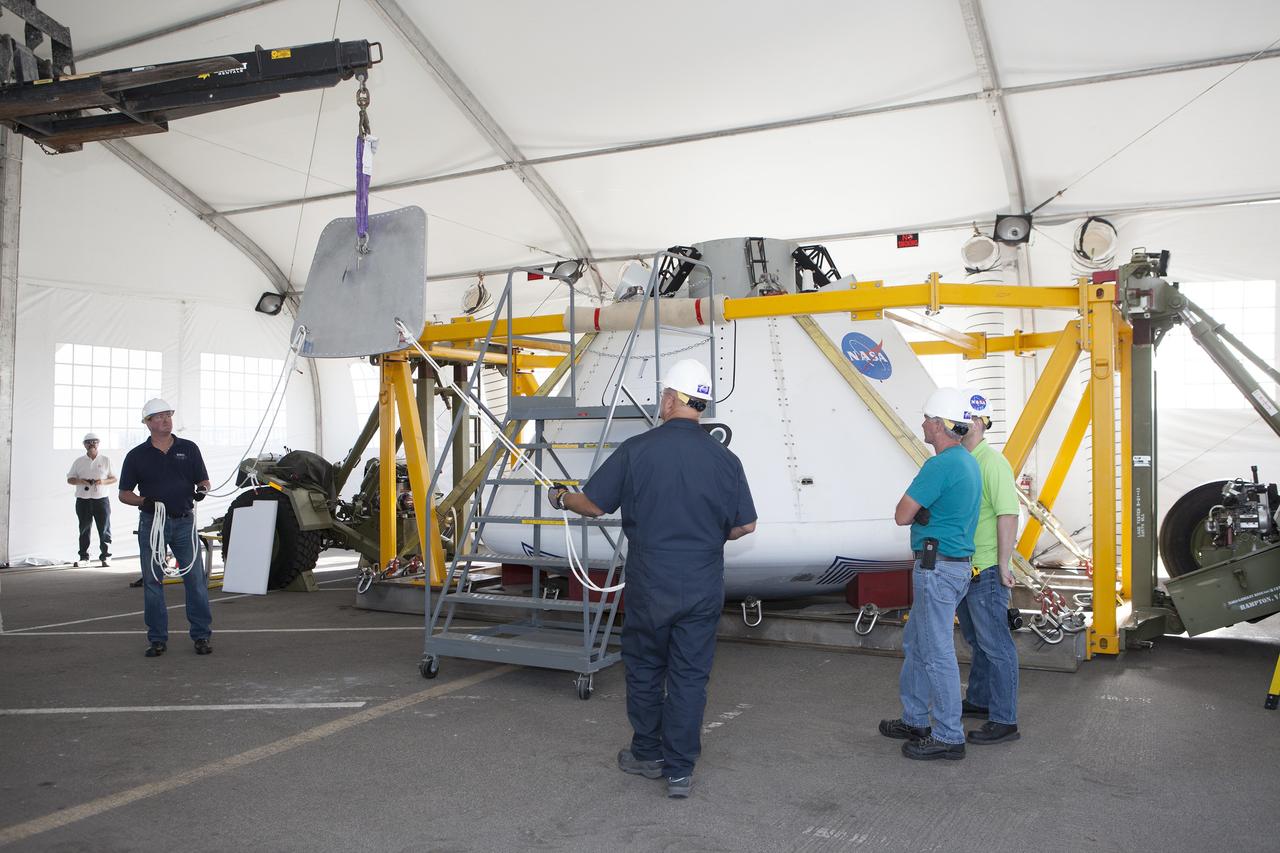
SAN DIEGO, Calif. – Inside a protective structure at the Mole Pier at the Naval Base San Diego in California, workers prepare for a simulated fit check of the hatch cover on the Orion boilerplate test vehicle. The test vehicle is secured on the crew module recovery cradle. The Ground Systems Development and Operations Program, Lockheed Martin and the U.S. Navy are evaluating the hardware and processes for preparing the Orion crew module for Exploration Flight Test-1, or EFT-1, for overland transport from the naval base to NASA's Kennedy Space Center in Florida. Orion is the exploration spacecraft designed to carry astronauts to destinations not yet explored by humans, including an asteroid and Mars. It will have emergency abort capability, sustain the crew during space travel and provide safe re-entry from deep space return velocities. The first unpiloted test flight of the Orion is scheduled to launch later this year atop a Delta IV rocket from Cape Canaveral Air Force Station in Florida to an altitude of 3,600 miles above the Earth's surface. The two-orbit, four-hour flight test will help engineers evaluate the systems critical to crew safety including the heat shield, parachute system and launch abort system. For more information, visit http://www.nasa.gov/orion. Photo credit: NASA/Kim Shiflett
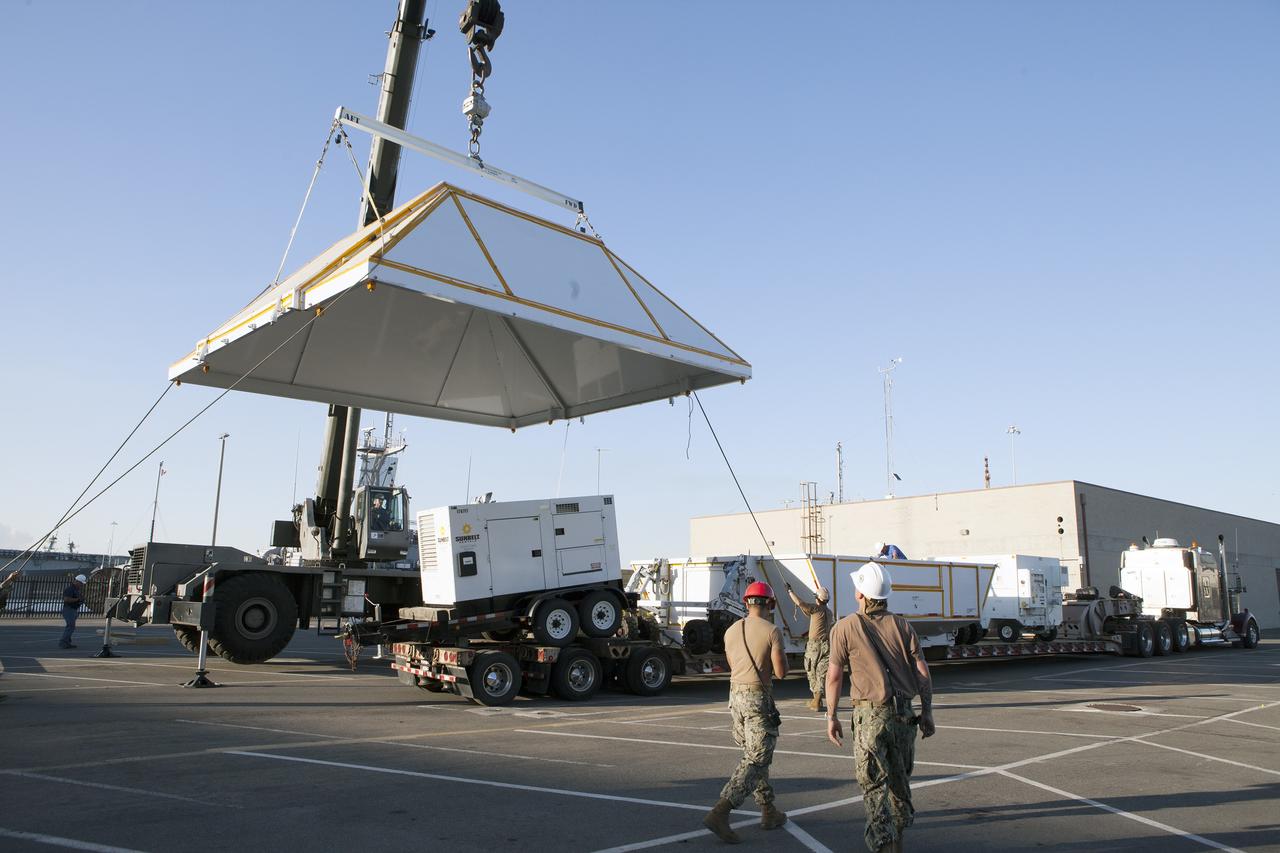
SAN DIEGO, Calif. – Workers prepare the lid for the crew module transportation fixture for the Orion boilerplate test vehicle at the Mole Pier at Naval Base San Diego in California. The Ground Systems Development and Operations Program, Lockheed Martin and the U.S. Navy are evaluating the hardware and processes for preparing the Orion crew module for Exploration Flight Test-1, or EFT-1, for overland transport from the naval base to NASA's Kennedy Space Center in Florida. Orion is the exploration spacecraft designed to carry astronauts to destinations not yet explored by humans, including an asteroid and Mars. It will have emergency abort capability, sustain the crew during space travel and provide safe re-entry from deep space return velocities. The first unpiloted test flight of the Orion is scheduled to launch later this year atop a Delta IV rocket from Cape Canaveral Air Force Station in Florida to an altitude of 3,600 miles above the Earth's surface. The two-orbit, four-hour flight test will help engineers evaluate the systems critical to crew safety including the heat shield, parachute system and launch abort system. For more information, visit http://www.nasa.gov/orion. Photo credit: NASA/Kim Shiflett
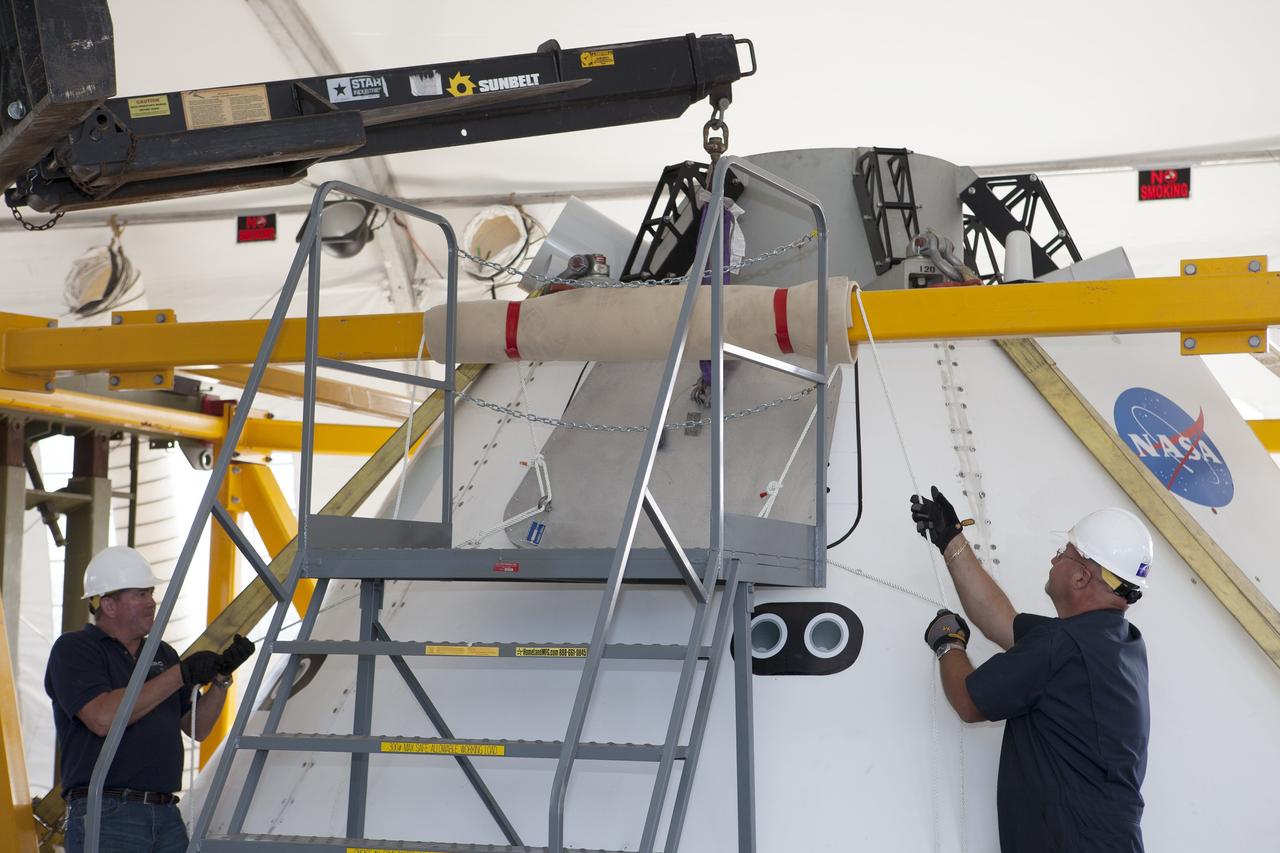
SAN DIEGO, Calif. – Inside a protective structure at the Mole Pier at the Naval Base San Diego in California, workers prepare for a simulated fit check of the hatch cover on the Orion boilerplate test vehicle. The test vehicle is secured on the crew module recovery cradle. The Ground Systems Development and Operations Program, Lockheed Martin and the U.S. Navy are evaluating the hardware and processes for preparing the Orion crew module for Exploration Flight Test-1, or EFT-1, for overland transport from the naval base to NASA's Kennedy Space Center in Florida. Orion is the exploration spacecraft designed to carry astronauts to destinations not yet explored by humans, including an asteroid and Mars. It will have emergency abort capability, sustain the crew during space travel and provide safe re-entry from deep space return velocities. The first unpiloted test flight of the Orion is scheduled to launch later this year atop a Delta IV rocket from Cape Canaveral Air Force Station in Florida to an altitude of 3,600 miles above the Earth's surface. The two-orbit, four-hour flight test will help engineers evaluate the systems critical to crew safety including the heat shield, parachute system and launch abort system. For more information, visit http://www.nasa.gov/orion. Photo credit: NASA/Kim Shiflett
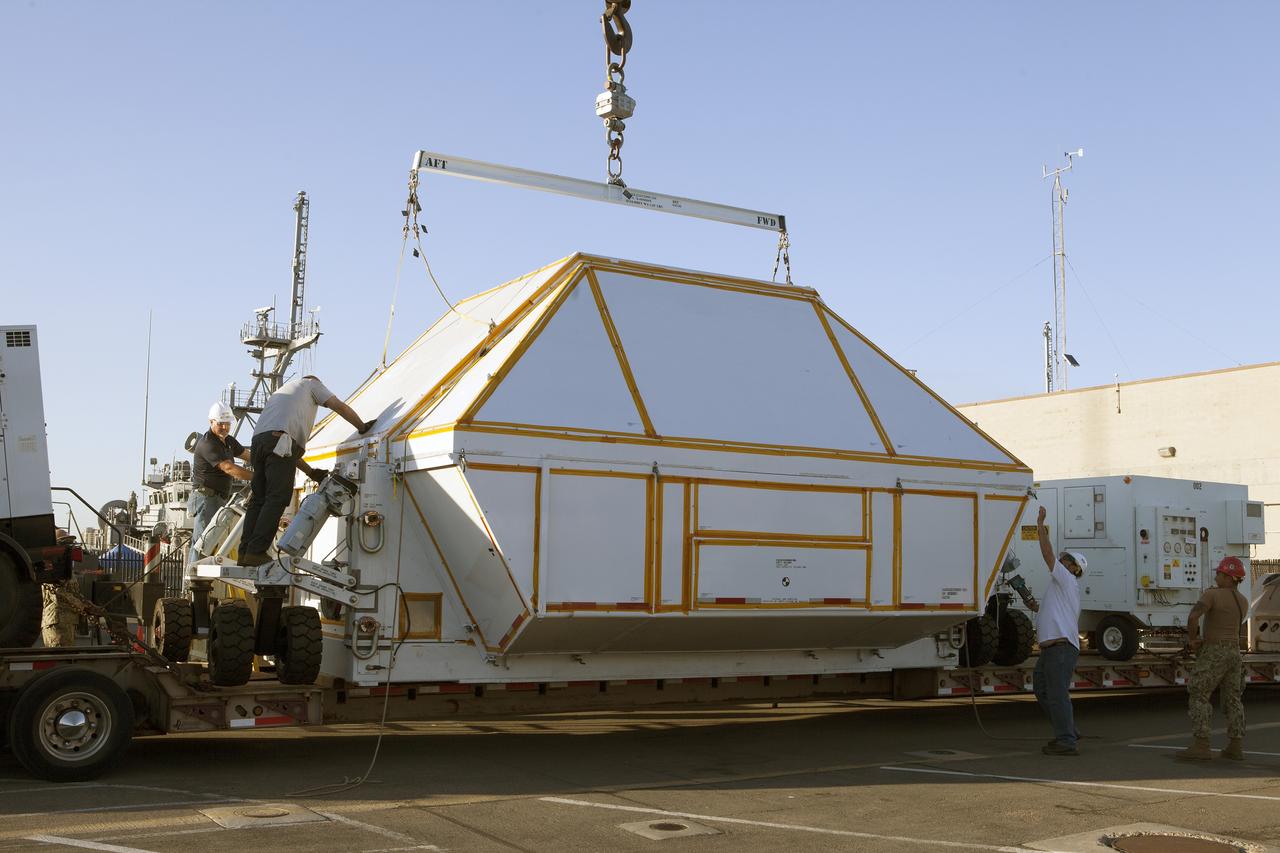
SAN DIEGO, Calif. – Workers simulate securing the crew module transportation fixture around the Orion boilerplate test vehicle at the Mole Pier at Naval Base San Diego in California. The Ground Systems Development and Operations Program, Lockheed Martin and the U.S. Navy are evaluating the hardware and processes for preparing the Orion crew module for Exploration Flight Test-1, or EFT-1, for overland transport from the naval base to NASA's Kennedy Space Center in Florida. Orion is the exploration spacecraft designed to carry astronauts to destinations not yet explored by humans, including an asteroid and Mars. It will have emergency abort capability, sustain the crew during space travel and provide safe re-entry from deep space return velocities. The first unpiloted test flight of the Orion is scheduled to launch later this year atop a Delta IV rocket from Cape Canaveral Air Force Station in Florida to an altitude of 3,600 miles above the Earth's surface. The two-orbit, four-hour flight test will help engineers evaluate the systems critical to crew safety including the heat shield, parachute system and launch abort system. For more information, visit http://www.nasa.gov/orion. Photo credit: NASA/Kim Shiflett
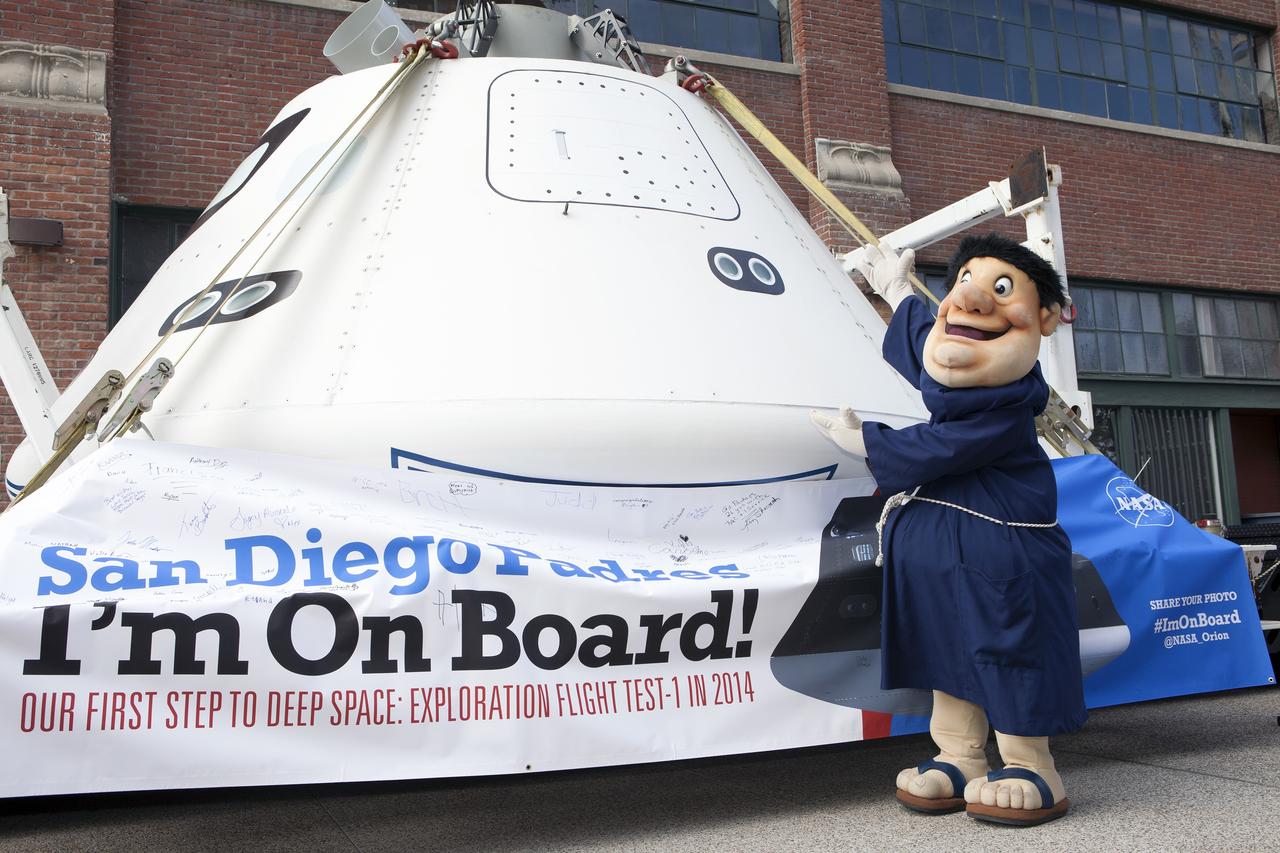
CAPE CANAVERAL, Fla. – The San Diego Padres' mascot checks out NASA's Orion boilerplate test vehicle inside Petco Park in San Diego, California. The boilerplate test vehicle is being prepared for an Exploration Flight Test-1, or EFT-1, pre-transportation test. The Ground Systems Development and Operations Program will run the test at the U.S. Naval Base San Diego to simulate retrieval and transportation procedures for Orion after it splashes down in the ocean and is retrieved for return to land and ground transportation back to Kennedy Space Center in Florida. Orion is the exploration spacecraft designed to carry astronauts to destinations not yet explored by humans, including an asteroid and Mars. It will have emergency abort capability, sustain the crew during space travel and provide safe re-entry from deep space return velocities. The first unpiloted test flight of the Orion is scheduled to launch later this year atop a Delta IV rocket and in 2017 on NASA’s Space Launch System rocket. For more information, visit http://www.nasa.gov/orion. Photo credit: NASA/Kim Shiflett
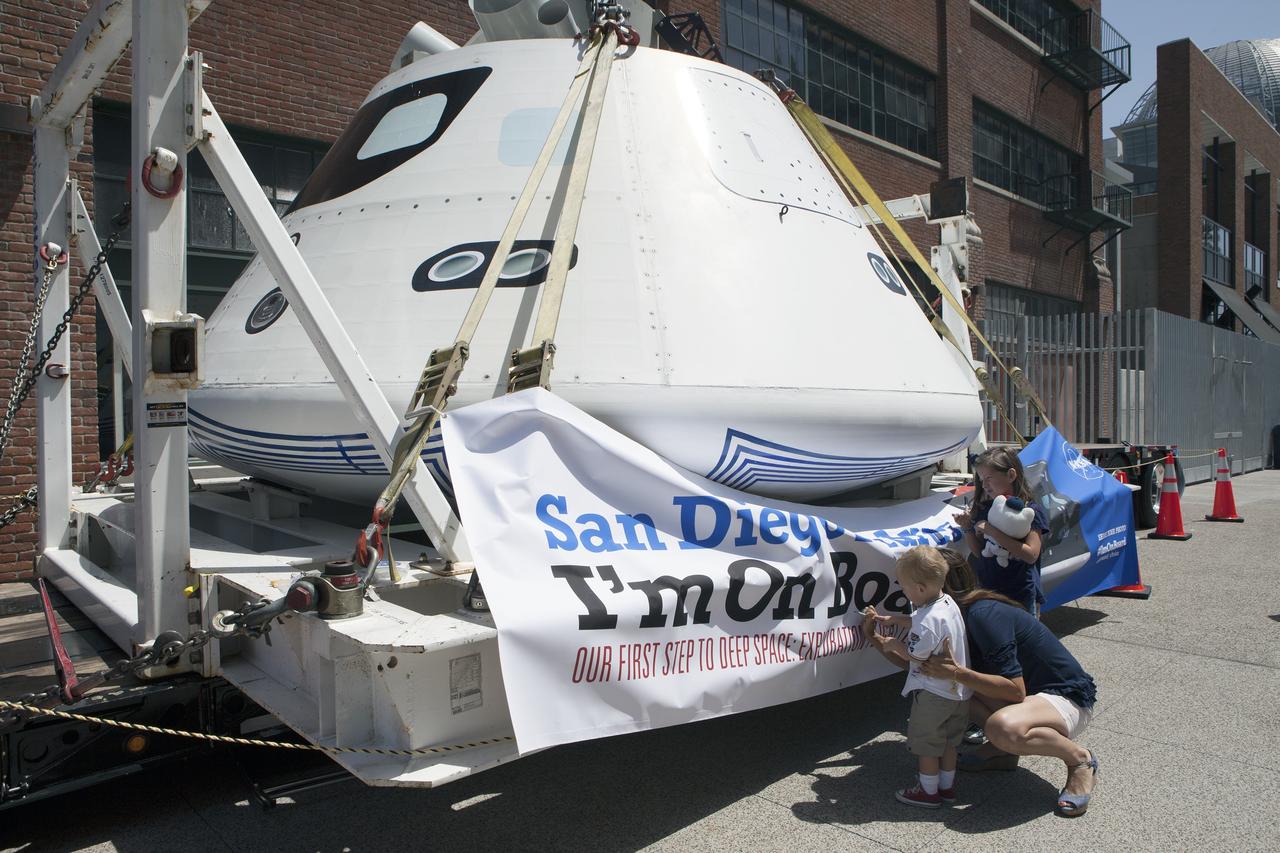
CAPE CANAVERAL, Fla. – Fans sign the banner draped around NASA's Orion boilerplate test vehicle on display at the San Diego Padres Petco Field in San Diego, California, before the start of the baseball game. The test vehicle is being prepared for an Exploration Flight Test-1, or EFT-1, pre-transportation test. The Ground Systems Development and Operations Program will run the test at the U.S. Naval Base San Diego to simulate retrieval and transportation procedures for Orion after it splashes down in the ocean and is retrieved for return to land and ground transportation back to Kennedy Space Center in Florida. Orion is the exploration spacecraft designed to carry astronauts to destinations not yet explored by humans, including an asteroid and Mars. It will have emergency abort capability, sustain the crew during space travel and provide safe re-entry from deep space return velocities. The first unpiloted test flight of the Orion is scheduled to launch later this year atop a Delta IV rocket and in 2017 on NASA’s Space Launch System rocket. For more information, visit http://www.nasa.gov/orion. Photo credit: NASA/Kim Shiflett
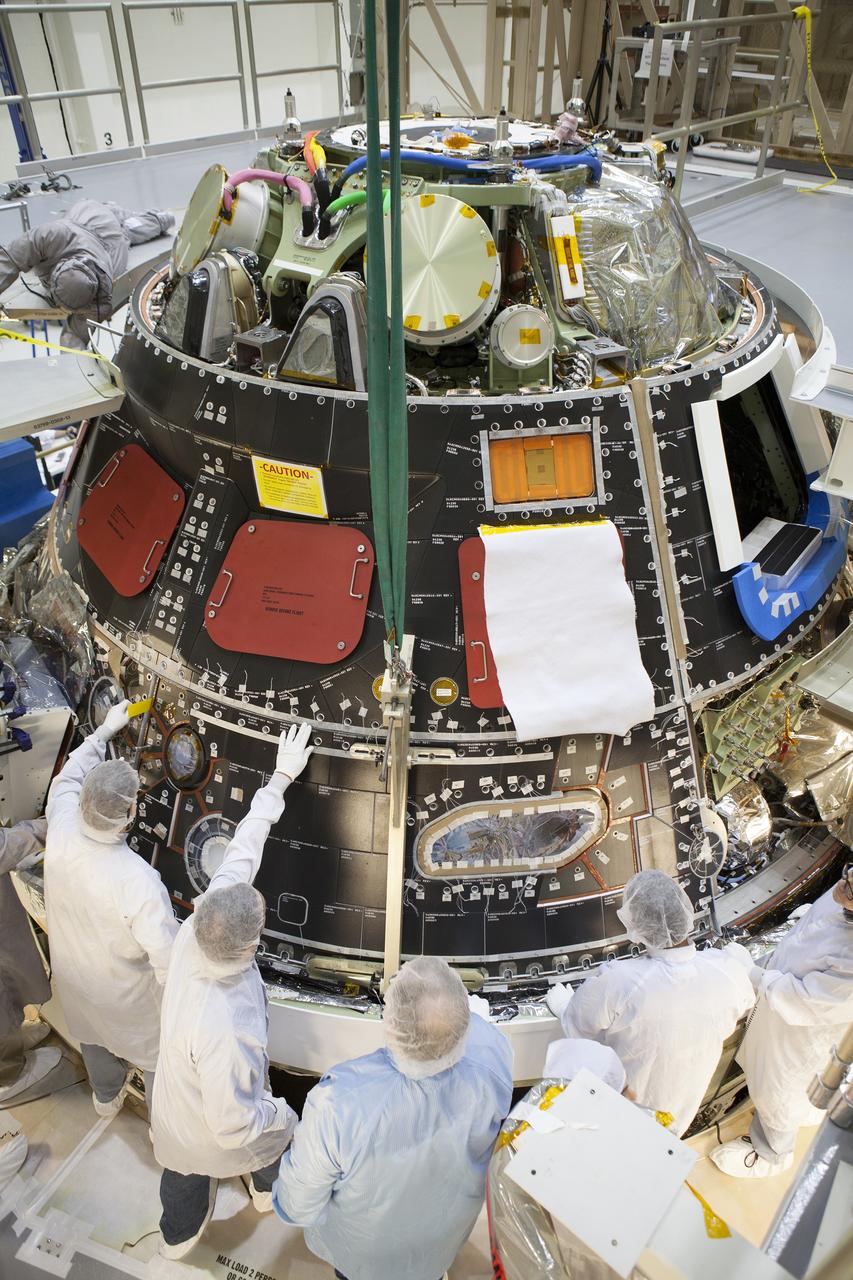
CAPE CANAVERAL, Fla. – Inside the Operations and Checkout Building high bay at NASA's Kennedy Space Center in Florida, technicians dressed in clean-room suits have installed a back shell tile panel onto the Orion crew module and are checking the fit next to the middle back shell tile panel. Preparations are underway for Exploration Flight Test-1, or EFT-1. Orion is the exploration spacecraft designed to carry astronauts to destinations not yet explored by humans, including an asteroid and Mars. It will have emergency abort capability, sustain the crew during space travel and provide safe re-entry from deep space return velocities. The first unpiloted test flight of the Orion is scheduled to launch later this year atop a Delta IV rocket from Cape Canaveral Air Force Station in Florida to an altitude of 3,600 miles above the Earth's surface. The two-orbit, four-hour flight test will help engineers evaluate the systems critical to crew safety including the heat shield, parachute system and launch abort system. For more information, visit http://www.nasa.gov/orion. Photo credit: NASA/Dimitri Gerondidakis
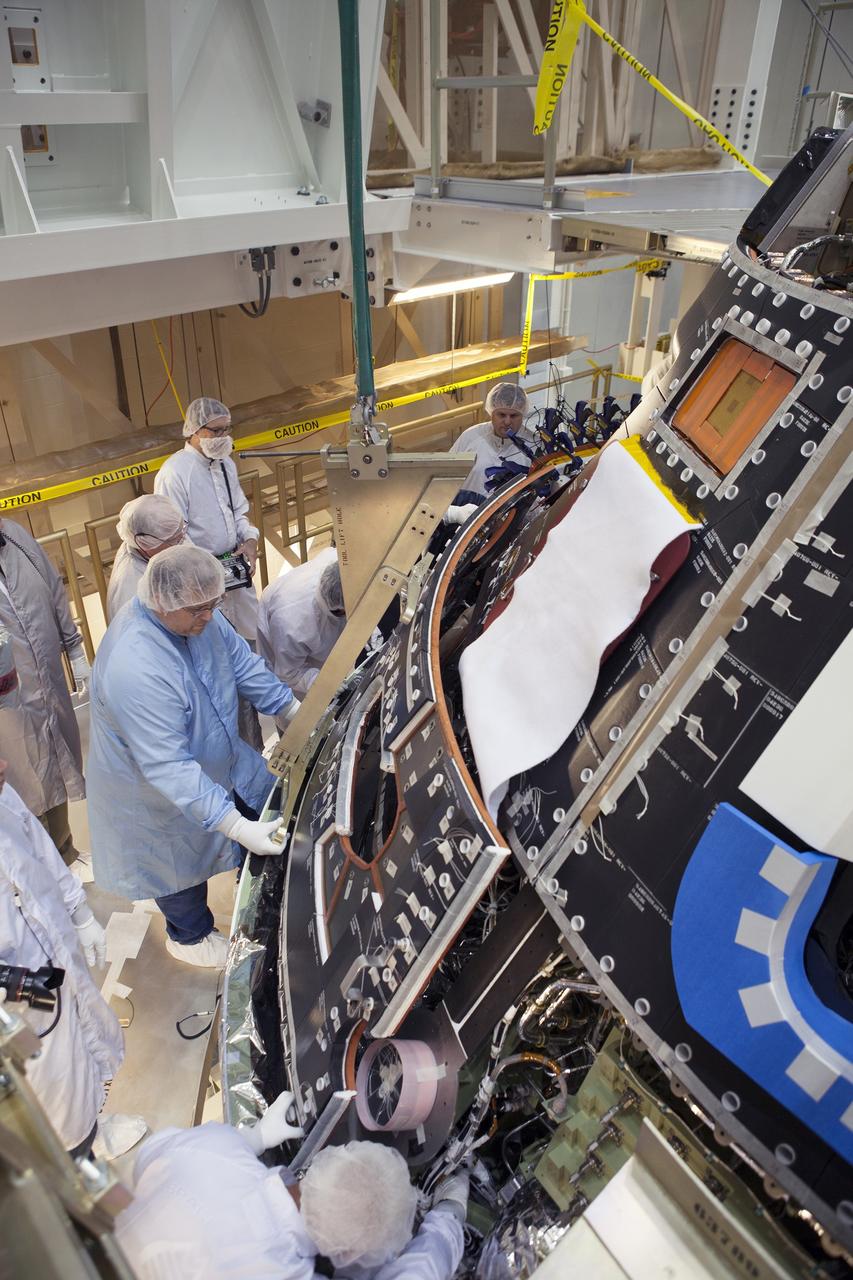
CAPE CANAVERAL, Fla. – Inside the Operations and Checkout Building high bay at NASA's Kennedy Space Center in Florida, technicians dressed in clean-room suits install a back shell tile panel onto the Orion crew module. Preparations are underway for Exploration Flight Test-1, or EFT-1. Orion is the exploration spacecraft designed to carry astronauts to destinations not yet explored by humans, including an asteroid and Mars. It will have emergency abort capability, sustain the crew during space travel and provide safe re-entry from deep space return velocities. The first unpiloted test flight of the Orion is scheduled to launch later this year atop a Delta IV rocket from Cape Canaveral Air Force Station in Florida to an altitude of 3,600 miles above the Earth's surface. The two-orbit, four-hour flight test will help engineers evaluate the systems critical to crew safety including the heat shield, parachute system and launch abort system. For more information, visit http://www.nasa.gov/orion. Photo credit: NASA/Dimitri Gerondidakis
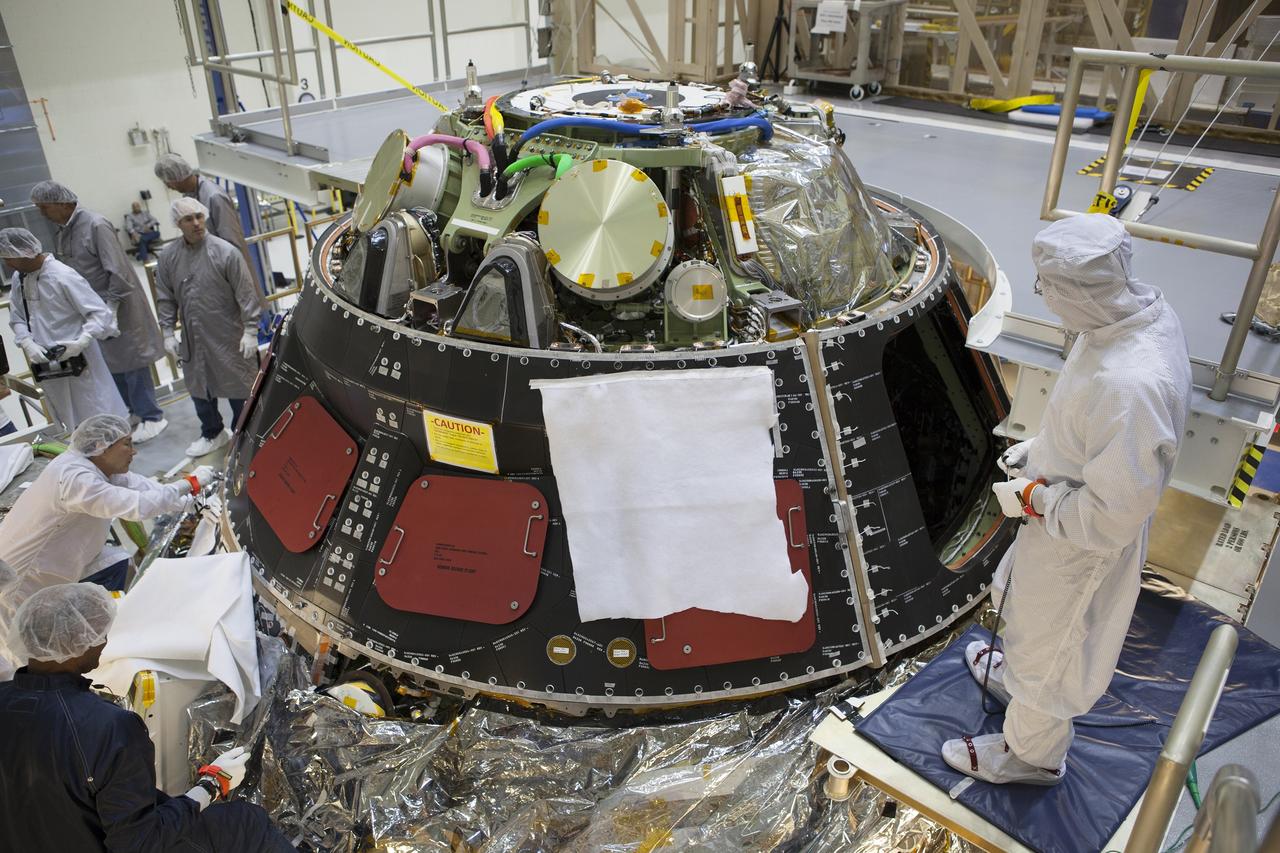
CAPE CANAVERAL, Fla. – Inside the Operations and Checkout Building high bay at NASA's Kennedy Space Center in Florida, technicians dressed in clean-room suits attach the middle back shell tile panel onto the Orion crew module. Preparations are underway for Exploration Flight Test-1, or EFT-1. Orion is the exploration spacecraft designed to carry astronauts to destinations not yet explored by humans, including an asteroid and Mars. It will have emergency abort capability, sustain the crew during space travel and provide safe re-entry from deep space return velocities. The first unpiloted test flight of the Orion is scheduled to launch later this year atop a Delta IV rocket from Cape Canaveral Air Force Station in Florida to an altitude of 3,600 miles above the Earth's surface. The two-orbit, four-hour flight test will help engineers evaluate the systems critical to crew safety including the heat shield, parachute system and launch abort system. For more information, visit http://www.nasa.gov/orion. Photo credit: NASA/Dimitri Gerondidakis
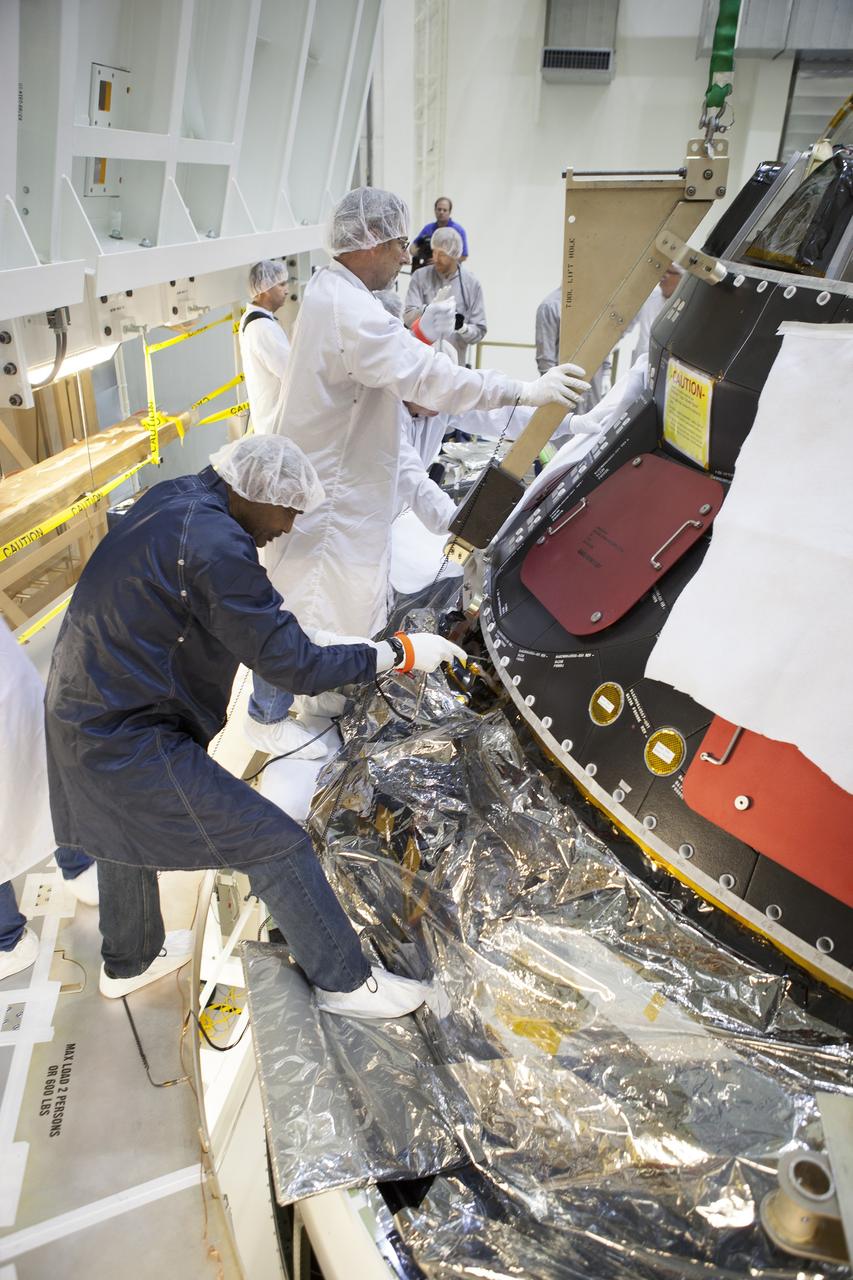
CAPE CANAVERAL, Fla. – Inside the Operations and Checkout Building high bay at NASA's Kennedy Space Center in Florida, technicians dressed in clean-room suits attach the middle back shell tile panel onto the Orion crew module. Preparations are underway for Exploration Flight Test-1, or EFT-1. Orion is the exploration spacecraft designed to carry astronauts to destinations not yet explored by humans, including an asteroid and Mars. It will have emergency abort capability, sustain the crew during space travel and provide safe re-entry from deep space return velocities. The first unpiloted test flight of the Orion is scheduled to launch later this year atop a Delta IV rocket from Cape Canaveral Air Force Station in Florida to an altitude of 3,600 miles above the Earth's surface. The two-orbit, four-hour flight test will help engineers evaluate the systems critical to crew safety including the heat shield, parachute system and launch abort system. For more information, visit http://www.nasa.gov/orion. Photo credit: NASA/Dimitri Gerondidakis
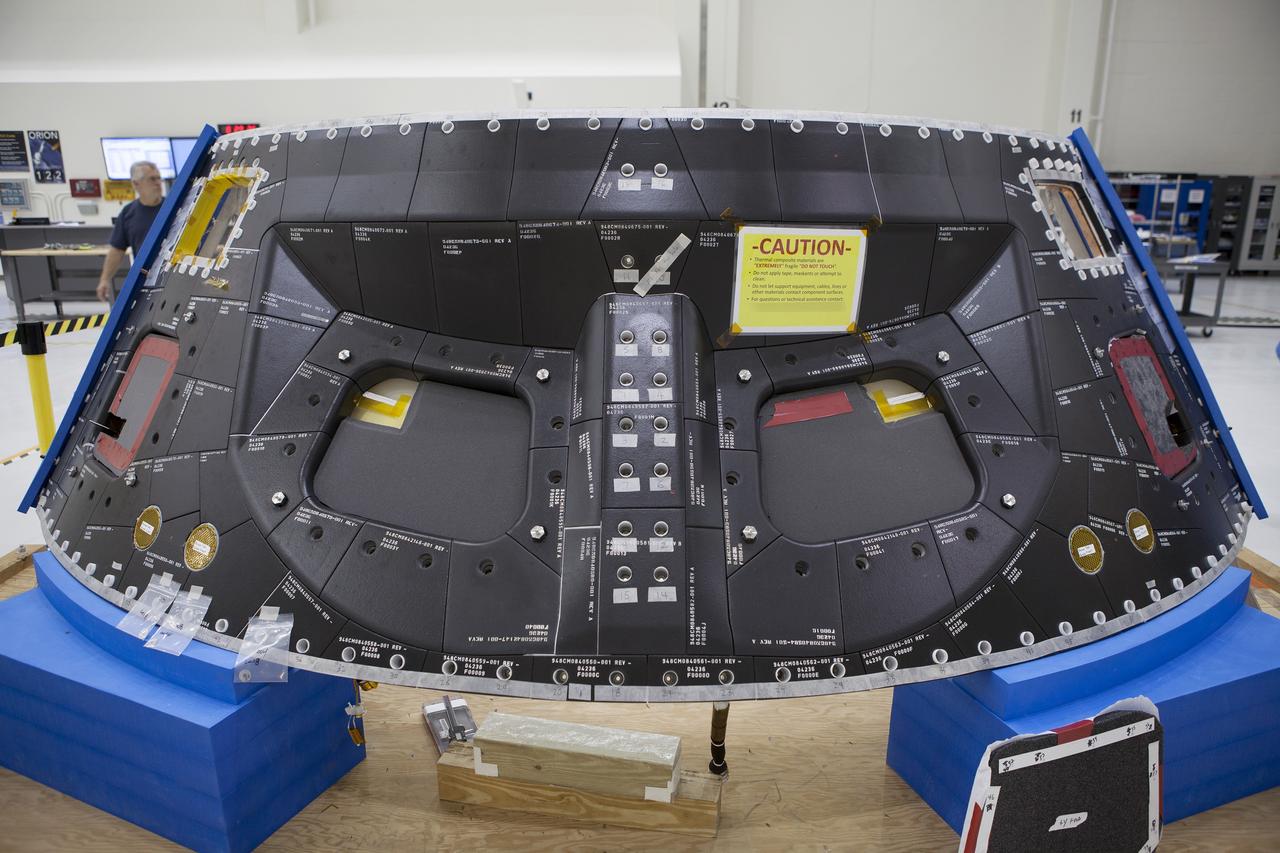
CAPE CANAVERAL, Fla. – Inside the Operations and Checkout Building high bay at NASA's Kennedy Space Center in Florida, technicians prepare the middle back shell tile panel for installation on the Orion crew module. Preparations are underway for Exploration Flight Test-1, or EFT-1. Orion is the exploration spacecraft designed to carry astronauts to destinations not yet explored by humans, including an asteroid and Mars. It will have emergency abort capability, sustain the crew during space travel and provide safe re-entry from deep space return velocities. The first unpiloted test flight of the Orion is scheduled to launch later this year atop a Delta IV rocket from Cape Canaveral Air Force Station in Florida to an altitude of 3,600 miles above the Earth's surface. The two-orbit, four-hour flight test will help engineers evaluate the systems critical to crew safety including the heat shield, parachute system and launch abort system. For more information, visit http://www.nasa.gov/orion. Photo credit: NASA/Dimitri Gerondidakis
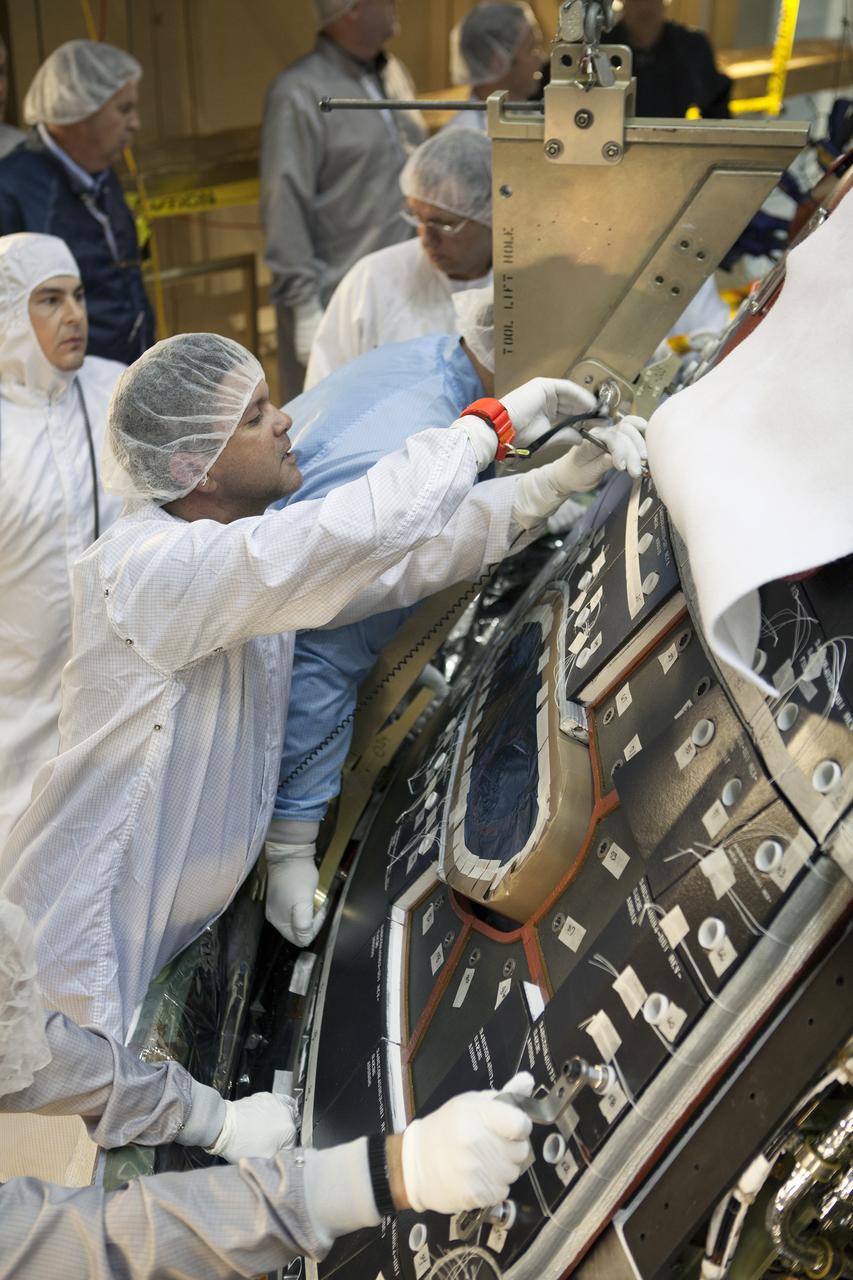
CAPE CANAVERAL, Fla. – Inside the Operations and Checkout Building high bay at NASA's Kennedy Space Center in Florida, technicians dressed in clean-room suits install a back shell tile panel onto the Orion crew module. Preparations are underway for Exploration Flight Test-1, or EFT-1. Orion is the exploration spacecraft designed to carry astronauts to destinations not yet explored by humans, including an asteroid and Mars. It will have emergency abort capability, sustain the crew during space travel and provide safe re-entry from deep space return velocities. The first unpiloted test flight of the Orion is scheduled to launch later this year atop a Delta IV rocket from Cape Canaveral Air Force Station in Florida to an altitude of 3,600 miles above the Earth's surface. The two-orbit, four-hour flight test will help engineers evaluate the systems critical to crew safety including the heat shield, parachute system and launch abort system. For more information, visit http://www.nasa.gov/orion. Photo credit: NASA/Dimitri Gerondidakis
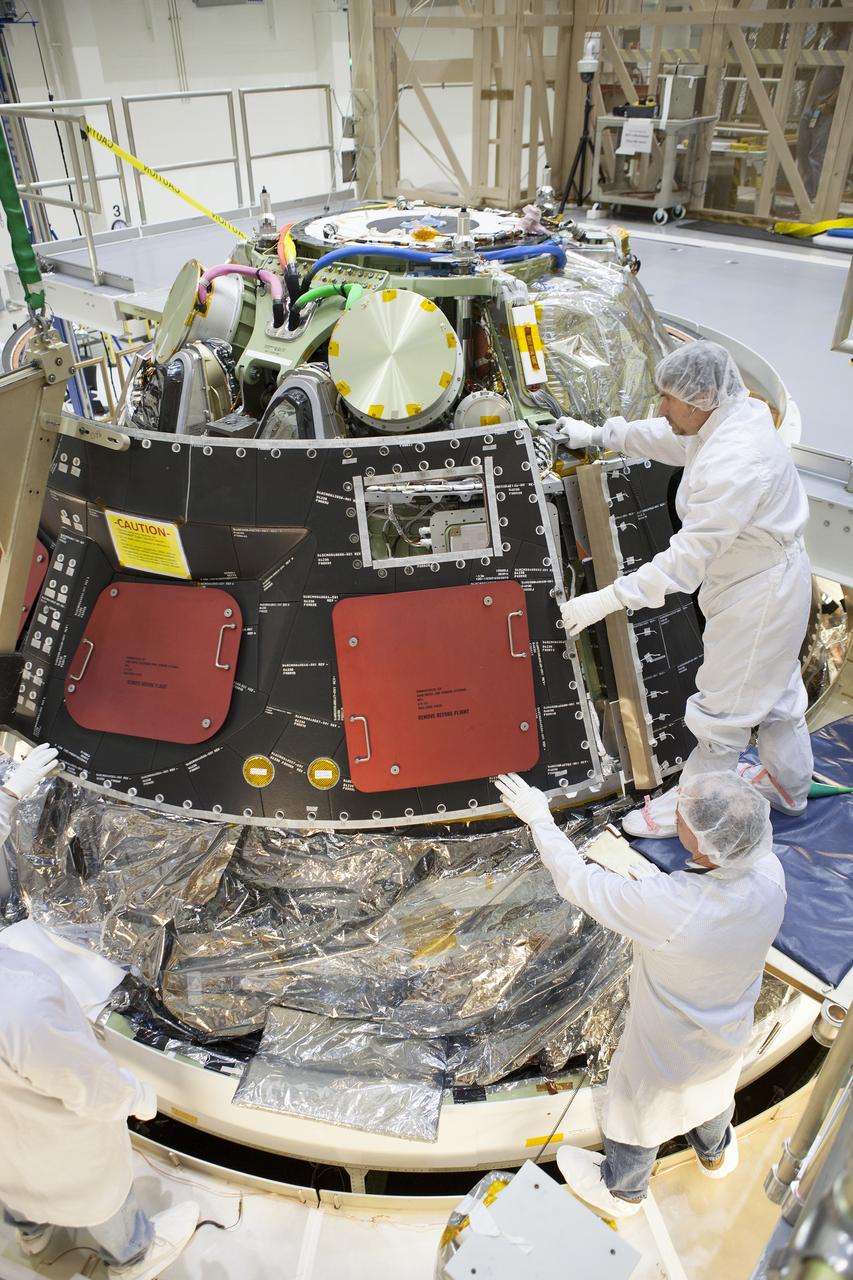
CAPE CANAVERAL, Fla. – Inside the Operations and Checkout Building high bay at NASA's Kennedy Space Center in Florida, technicians dressed in clean-room suits line up the middle back shell tile panel for installation on the Orion crew module. Preparations are underway for Exploration Flight Test-1, or EFT-1. Orion is the exploration spacecraft designed to carry astronauts to destinations not yet explored by humans, including an asteroid and Mars. It will have emergency abort capability, sustain the crew during space travel and provide safe re-entry from deep space return velocities. The first unpiloted test flight of the Orion is scheduled to launch later this year atop a Delta IV rocket from Cape Canaveral Air Force Station in Florida to an altitude of 3,600 miles above the Earth's surface. The two-orbit, four-hour flight test will help engineers evaluate the systems critical to crew safety including the heat shield, parachute system and launch abort system. For more information, visit http://www.nasa.gov/orion. Photo credit: NASA/Dimitri Gerondidakis
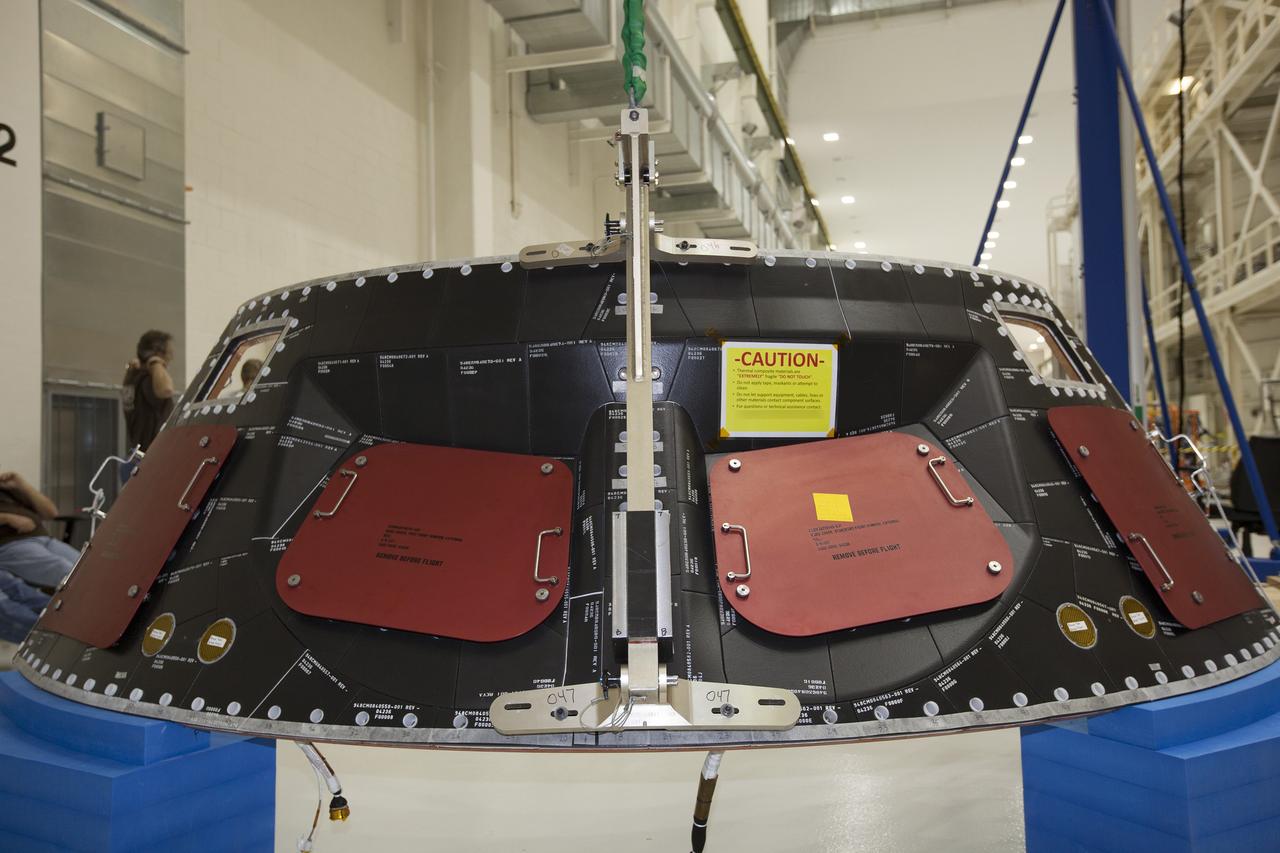
CAPE CANAVERAL, Fla. – Inside the Operations and Checkout Building high bay at NASA's Kennedy Space Center in Florida, a crane is attached to the middle back shell tile panel in order to lift it for installation on the Orion crew module. Preparations are underway for Exploration Flight Test-1, or EFT-1. Orion is the exploration spacecraft designed to carry astronauts to destinations not yet explored by humans, including an asteroid and Mars. It will have emergency abort capability, sustain the crew during space travel and provide safe re-entry from deep space return velocities. The first unpiloted test flight of the Orion is scheduled to launch later this year atop a Delta IV rocket from Cape Canaveral Air Force Station in Florida to an altitude of 3,600 miles above the Earth's surface. The two-orbit, four-hour flight test will help engineers evaluate the systems critical to crew safety including the heat shield, parachute system and launch abort system. For more information, visit http://www.nasa.gov/orion. Photo credit: NASA/Dimitri Gerondidakis
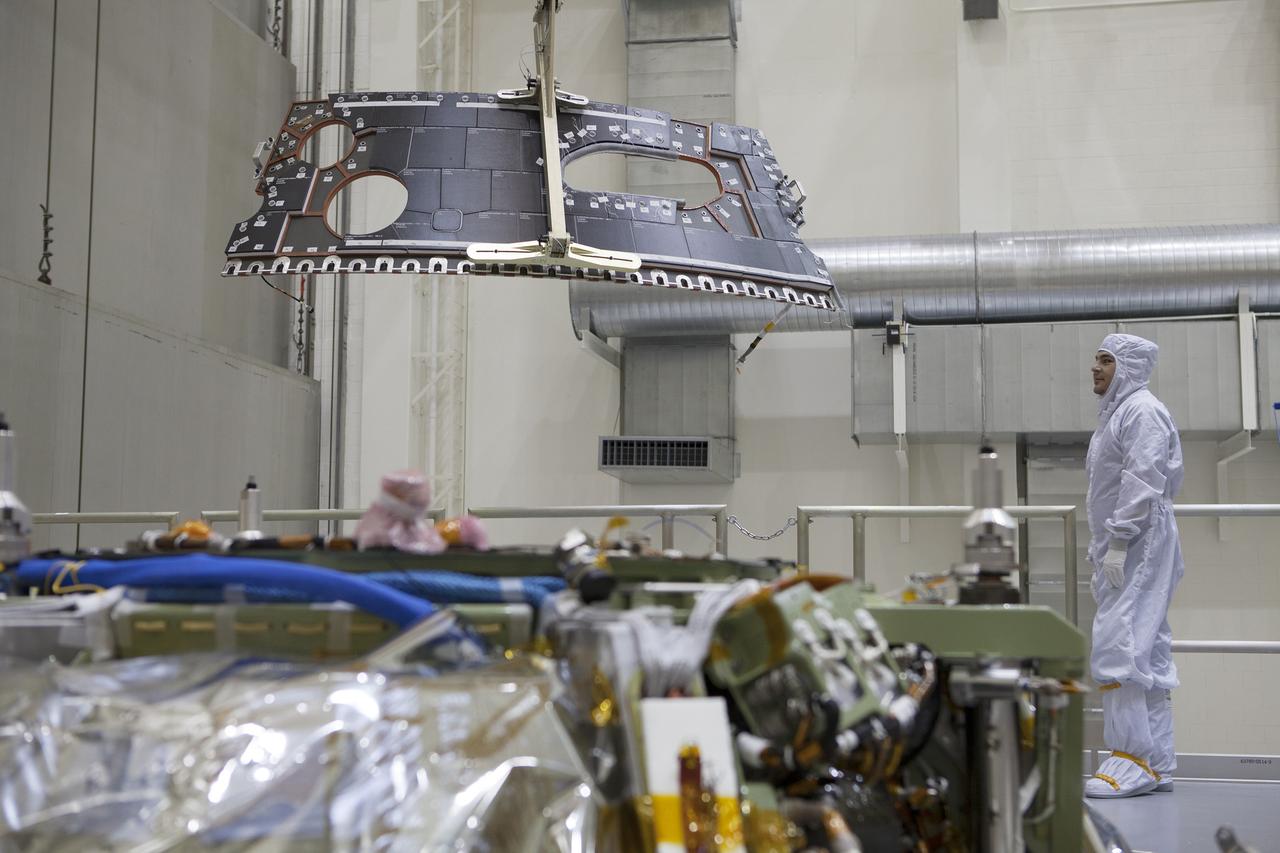
CAPE CANAVERAL, Fla. – Inside the Operations and Checkout Building high bay at NASA's Kennedy Space Center in Florida, a technician dressed in a clean-room suit monitors the progress as a crane is used to lower a back shell tile panel for installation on the Orion crew module. Preparations are underway for Exploration Flight Test-1, or EFT-1. Orion is the exploration spacecraft designed to carry astronauts to destinations not yet explored by humans, including an asteroid and Mars. It will have emergency abort capability, sustain the crew during space travel and provide safe re-entry from deep space return velocities. The first unpiloted test flight of the Orion is scheduled to launch later this year atop a Delta IV rocket from Cape Canaveral Air Force Station in Florida to an altitude of 3,600 miles above the Earth's surface. The two-orbit, four-hour flight test will help engineers evaluate the systems critical to crew safety including the heat shield, parachute system and launch abort system. For more information, visit http://www.nasa.gov/orion. Photo credit: NASA/Dimitri Gerondidakis
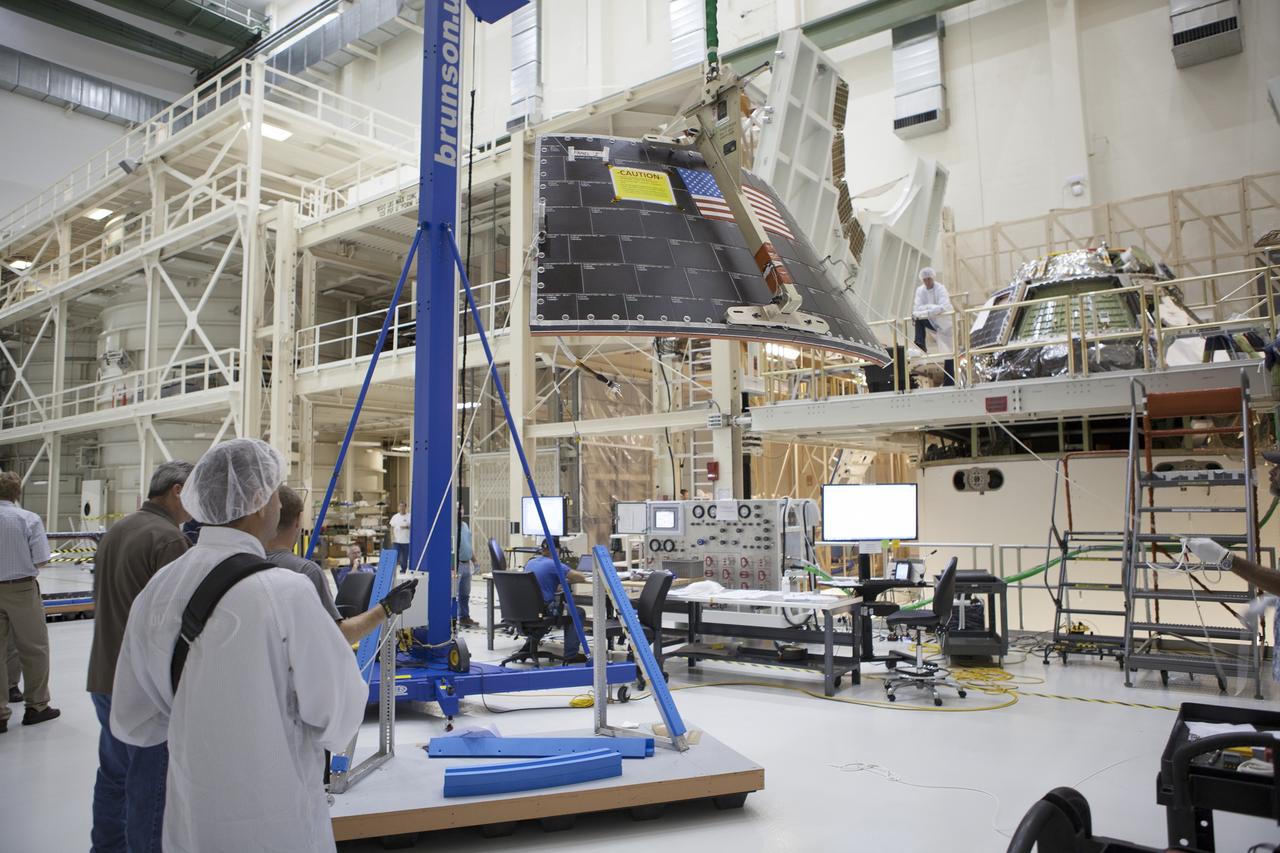
CAPE CANAVERAL, Fla. – Inside the Operations and Checkout Building high bay at NASA's Kennedy Space Center in Florida, technicians and engineers monitor the progress as a crane is used to lift the middle back shell tile panel for installation on the Orion crew module. Preparations are underway for Exploration Flight Test-1, or EFT-1. Orion is the exploration spacecraft designed to carry astronauts to destinations not yet explored by humans, including an asteroid and Mars. It will have emergency abort capability, sustain the crew during space travel and provide safe re-entry from deep space return velocities. The first unpiloted test flight of the Orion is scheduled to launch later this year atop a Delta IV rocket from Cape Canaveral Air Force Station in Florida to an altitude of 3,600 miles above the Earth's surface. The two-orbit, four-hour flight test will help engineers evaluate the systems critical to crew safety including the heat shield, parachute system and launch abort system. For more information, visit http://www.nasa.gov/orion. Photo credit: NASA/Dimitri Gerondidakis
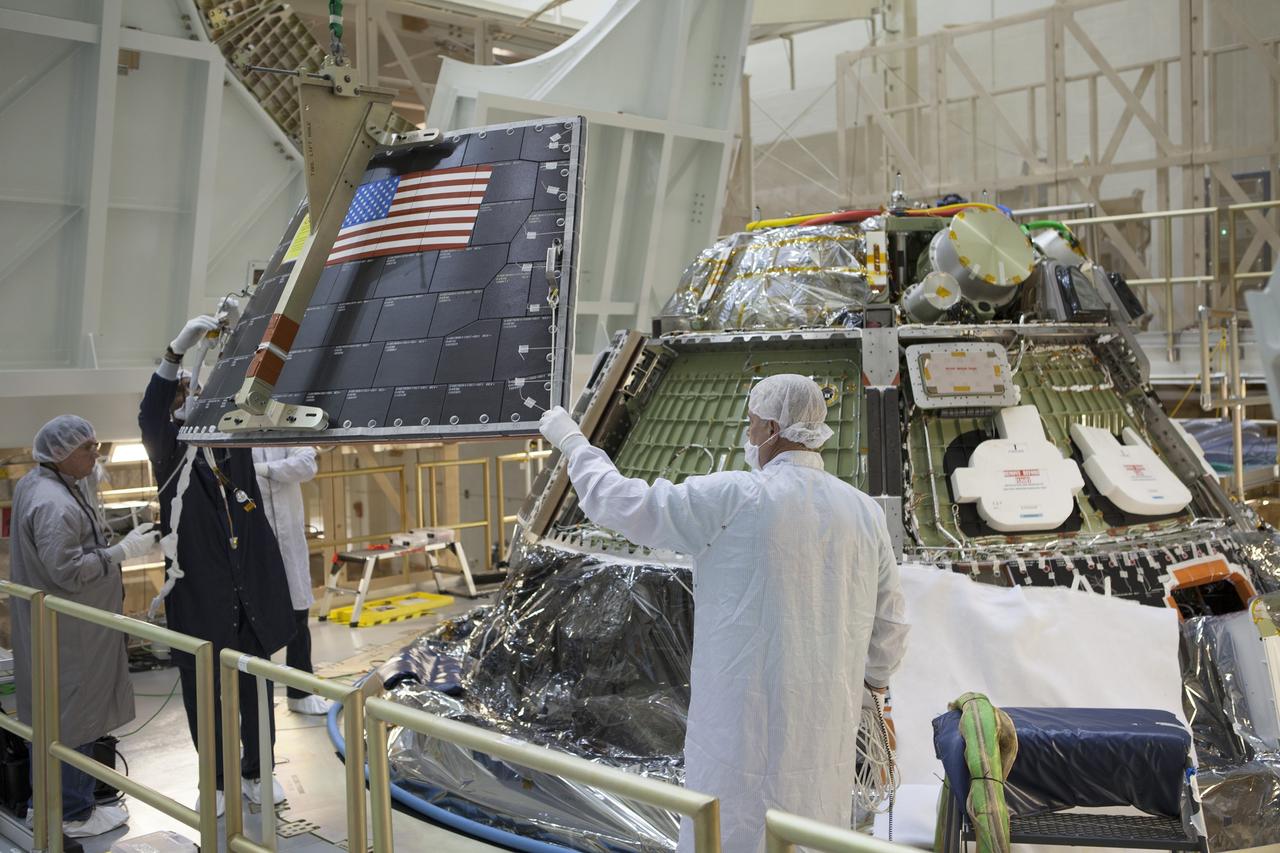
CAPE CANAVERAL, Fla. – Inside the Operations and Checkout Building high bay at NASA's Kennedy Space Center in Florida, technicians and engineers on a work platform monitor the progress as a crane is used to lower the middle back shell tile panel for installation on the Orion crew module. Preparations are underway for Exploration Flight Test-1, or EFT-1. Orion is the exploration spacecraft designed to carry astronauts to destinations not yet explored by humans, including an asteroid and Mars. It will have emergency abort capability, sustain the crew during space travel and provide safe re-entry from deep space return velocities. The first unpiloted test flight of the Orion is scheduled to launch later this year atop a Delta IV rocket from Cape Canaveral Air Force Station in Florida to an altitude of 3,600 miles above the Earth's surface. The two-orbit, four-hour flight test will help engineers evaluate the systems critical to crew safety including the heat shield, parachute system and launch abort system. For more information, visit http://www.nasa.gov/orion. Photo credit: NASA/Dimitri Gerondidakis
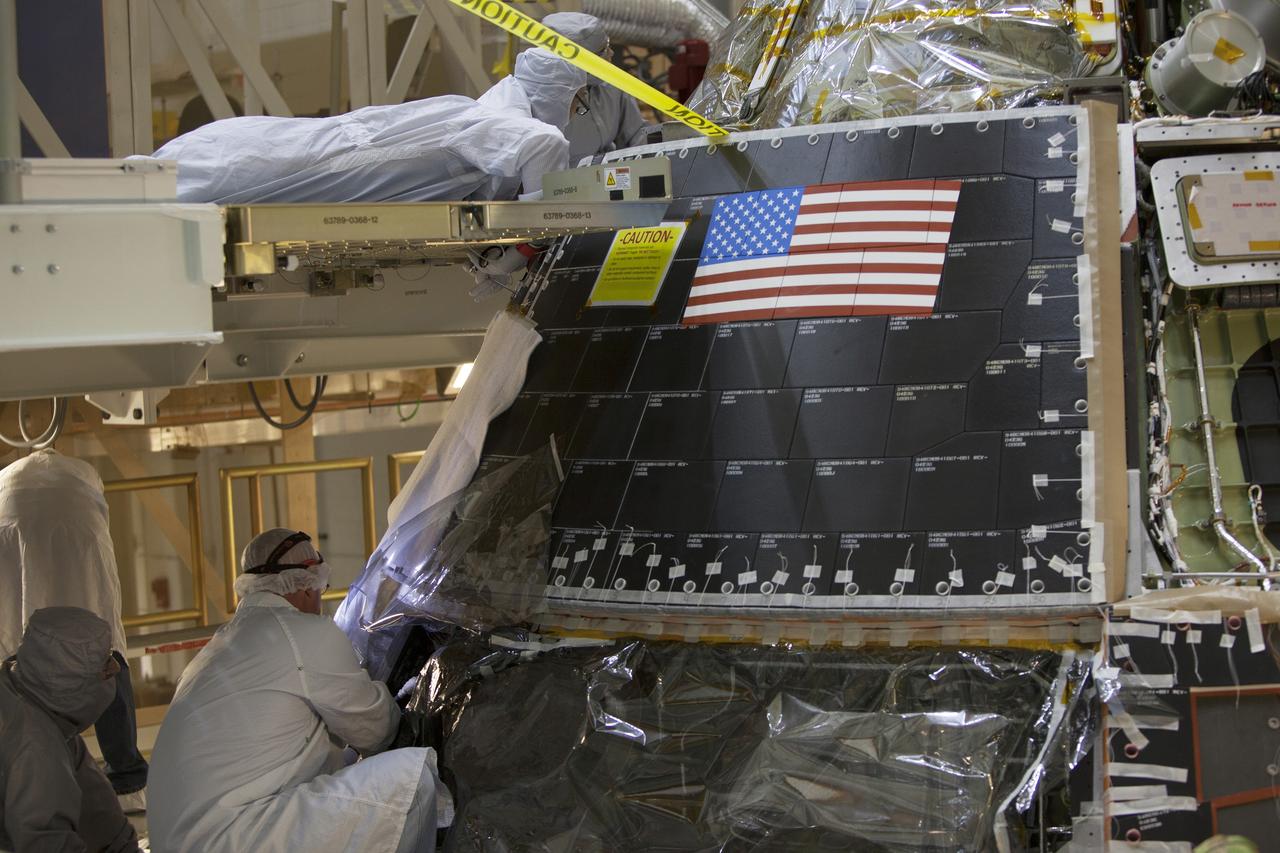
CAPE CANAVERAL, Fla. – Inside the Operations and Checkout Building high bay at NASA's Kennedy Space Center in Florida, technicians dressed in clean-room suits attach the middle back shell tile panel to the Orion crew module. Preparations are underway for Exploration Flight Test-1, or EFT-1. Orion is the exploration spacecraft designed to carry astronauts to destinations not yet explored by humans, including an asteroid and Mars. It will have emergency abort capability, sustain the crew during space travel and provide safe re-entry from deep space return velocities. The first unpiloted test flight of the Orion is scheduled to launch later this year atop a Delta IV rocket from Cape Canaveral Air Force Station in Florida to an altitude of 3,600 miles above the Earth's surface. The two-orbit, four-hour flight test will help engineers evaluate the systems critical to crew safety including the heat shield, parachute system and launch abort system. For more information, visit http://www.nasa.gov/orion. Photo credit: NASA/Dimitri Gerondidakis
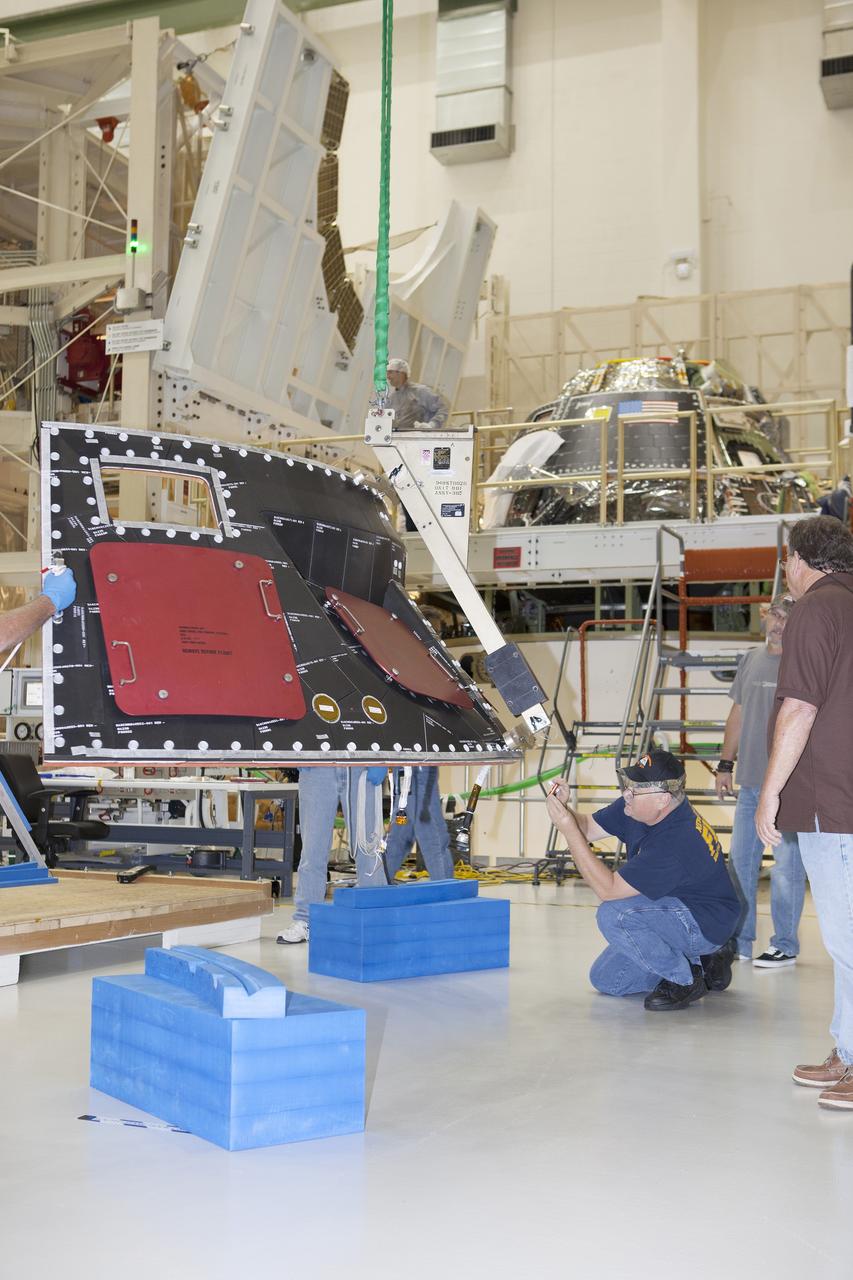
CAPE CANAVERAL, Fla. – Inside the Operations and Checkout Building high bay at NASA's Kennedy Space Center in Florida, technicians and engineers monitor the progress as a crane is used to lift the middle back shell tile panel for installation on the Orion crew module. Preparations are underway for Exploration Flight Test-1, or EFT-1. Orion is the exploration spacecraft designed to carry astronauts to destinations not yet explored by humans, including an asteroid and Mars. It will have emergency abort capability, sustain the crew during space travel and provide safe re-entry from deep space return velocities. The first unpiloted test flight of the Orion is scheduled to launch later this year atop a Delta IV rocket from Cape Canaveral Air Force Station in Florida to an altitude of 3,600 miles above the Earth's surface. The two-orbit, four-hour flight test will help engineers evaluate the systems critical to crew safety including the heat shield, parachute system and launch abort system. For more information, visit http://www.nasa.gov/orion. Photo credit: NASA/Dimitri Gerondidakis
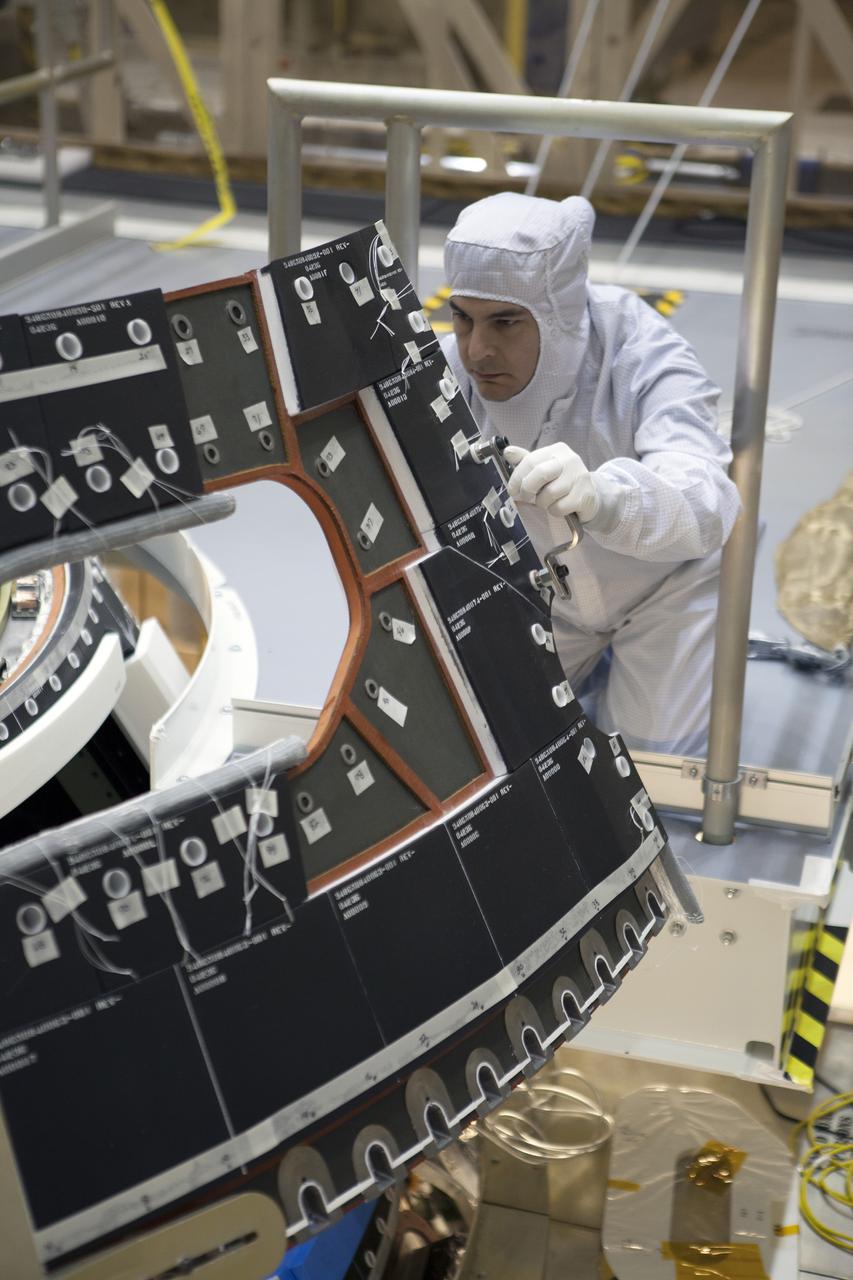
CAPE CANAVERAL, Fla. – Inside the Operations and Checkout Building high bay at NASA's Kennedy Space Center in Florida, a technician dressed in a clean-room suit prepares to install a back shell tile panel onto the Orion crew module. Preparations are underway for Exploration Flight Test-1, or EFT-1. Orion is the exploration spacecraft designed to carry astronauts to destinations not yet explored by humans, including an asteroid and Mars. It will have emergency abort capability, sustain the crew during space travel and provide safe re-entry from deep space return velocities. The first unpiloted test flight of the Orion is scheduled to launch later this year atop a Delta IV rocket from Cape Canaveral Air Force Station in Florida to an altitude of 3,600 miles above the Earth's surface. The two-orbit, four-hour flight test will help engineers evaluate the systems critical to crew safety including the heat shield, parachute system and launch abort system. For more information, visit http://www.nasa.gov/orion. Photo credit: NASA/Dimitri Gerondidakis
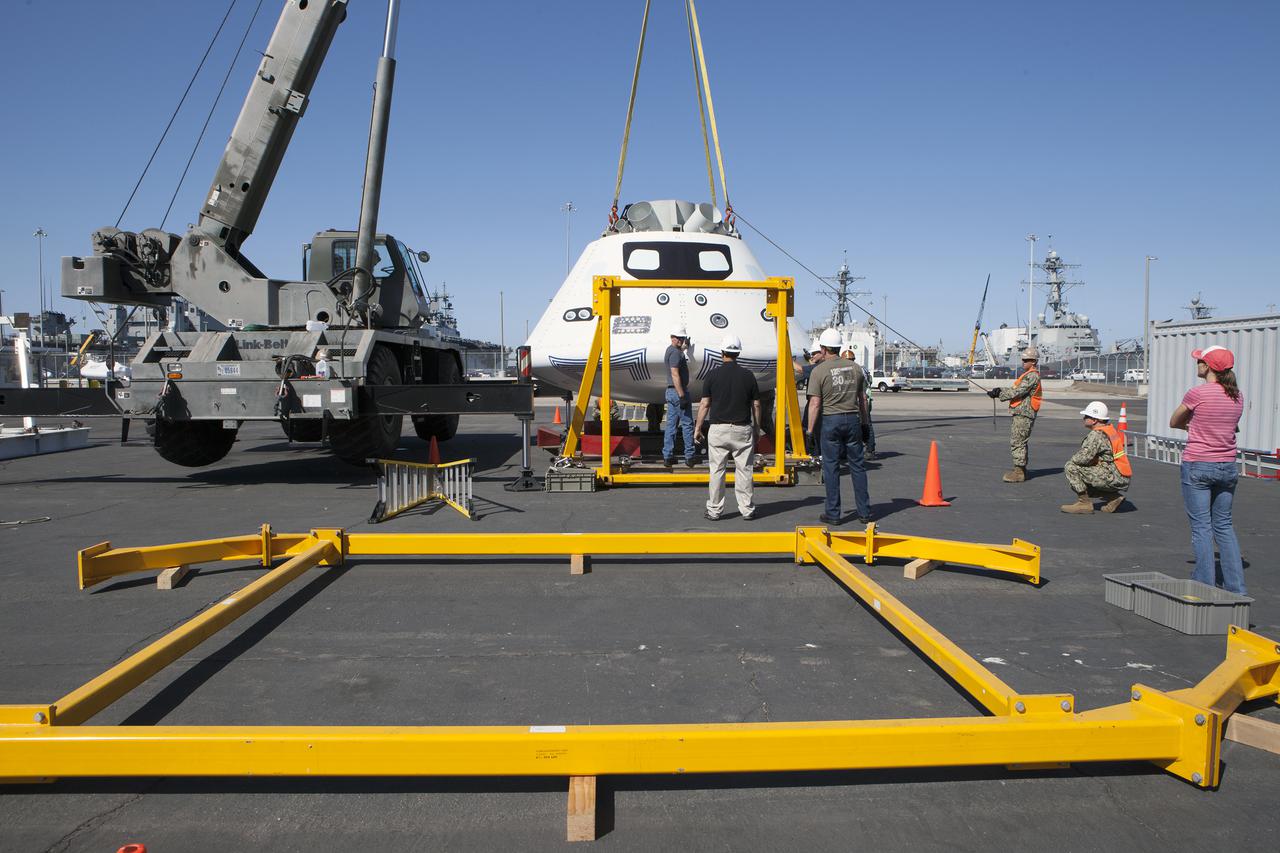
SAN DIEGO, Calif. – A crane lowers the Orion boilerplate test vehicle onto the crew module recovery cradle at a warehouse at the Naval Base San Diego in California. The Ground Systems Development and Operations Program, Lockheed Martin and the U.S. Navy are evaluating the hardware and processes for preparing the Orion crew module for Exploration Flight Test-1, or EFT-1, for overland transport from the naval base to NASA's Kennedy Space Center in Florida. Orion is the exploration spacecraft designed to carry astronauts to destinations not yet explored by humans, including an asteroid and Mars. It will have emergency abort capability, sustain the crew during space travel and provide safe re-entry from deep space return velocities. The first unpiloted test flight of the Orion is scheduled to launch later this year atop a Delta IV rocket from Cape Canaveral Air Force Station in Florida to an altitude of 3,600 miles above the Earth's surface. The two-orbit, four-hour flight test will help engineers evaluate the systems critical to crew safety including the heat shield, parachute system and launch abort system. For more information, visit http:__www.nasa.gov_orion. Photo credit: NASA_Kim Shiflett
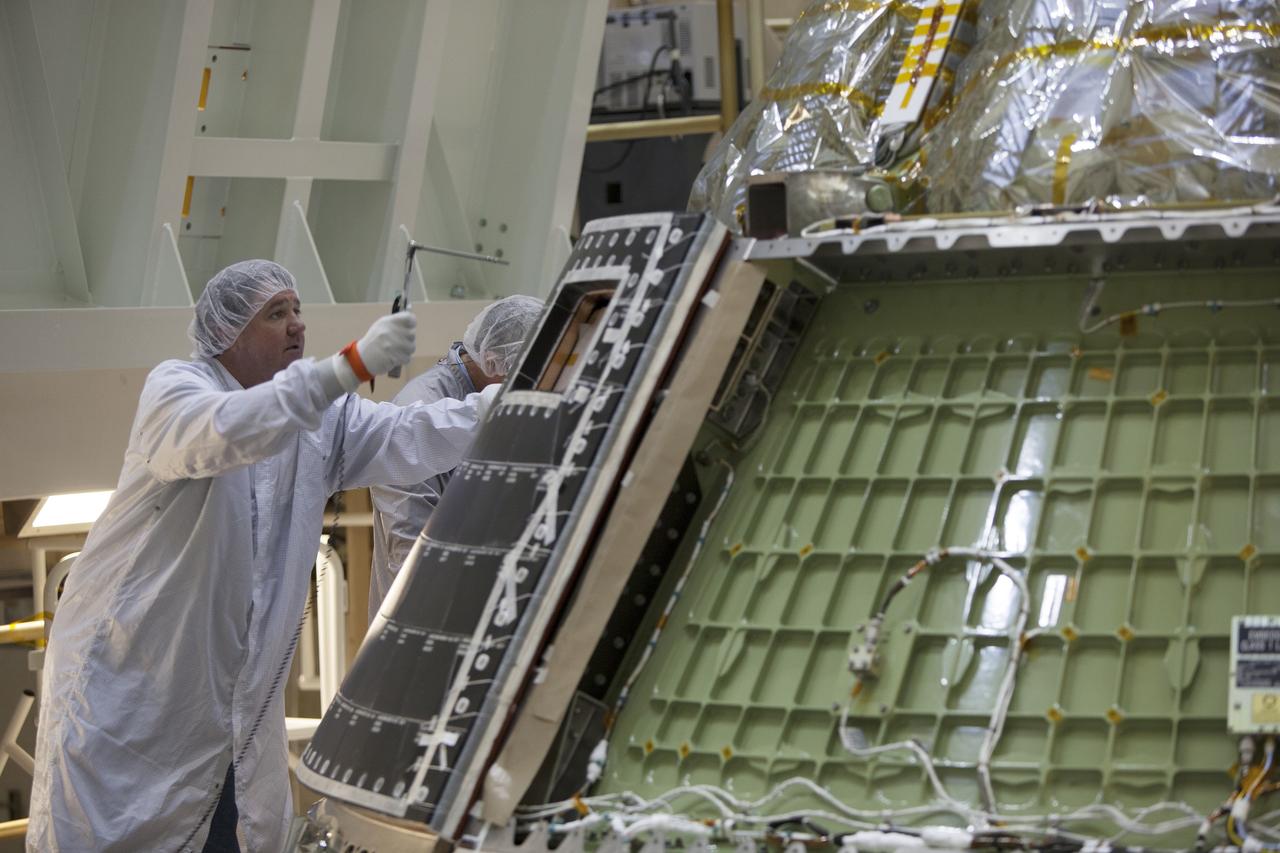
CAPE CANAVERAL, Fla. – Inside the Operations and Checkout Building high bay at NASA's Kennedy Space Center in Florida, a technicians attaches the middle back shell tile panel onto the Orion crew module. Preparations are underway for Exploration Flight Test-1, or EFT-1. Orion is the exploration spacecraft designed to carry astronauts to destinations not yet explored by humans, including an asteroid and Mars. It will have emergency abort capability, sustain the crew during space travel and provide safe re-entry from deep space return velocities. The first unpiloted test flight of the Orion is scheduled to launch later this year atop a Delta IV rocket from Cape Canaveral Air Force Station in Florida to an altitude of 3,600 miles above the Earth's surface. The two-orbit, four-hour flight test will help engineers evaluate the systems critical to crew safety including the heat shield, parachute system and launch abort system. For more information, visit http://www.nasa.gov/orion. Photo credit: NASA/Dimitri Gerondidakis