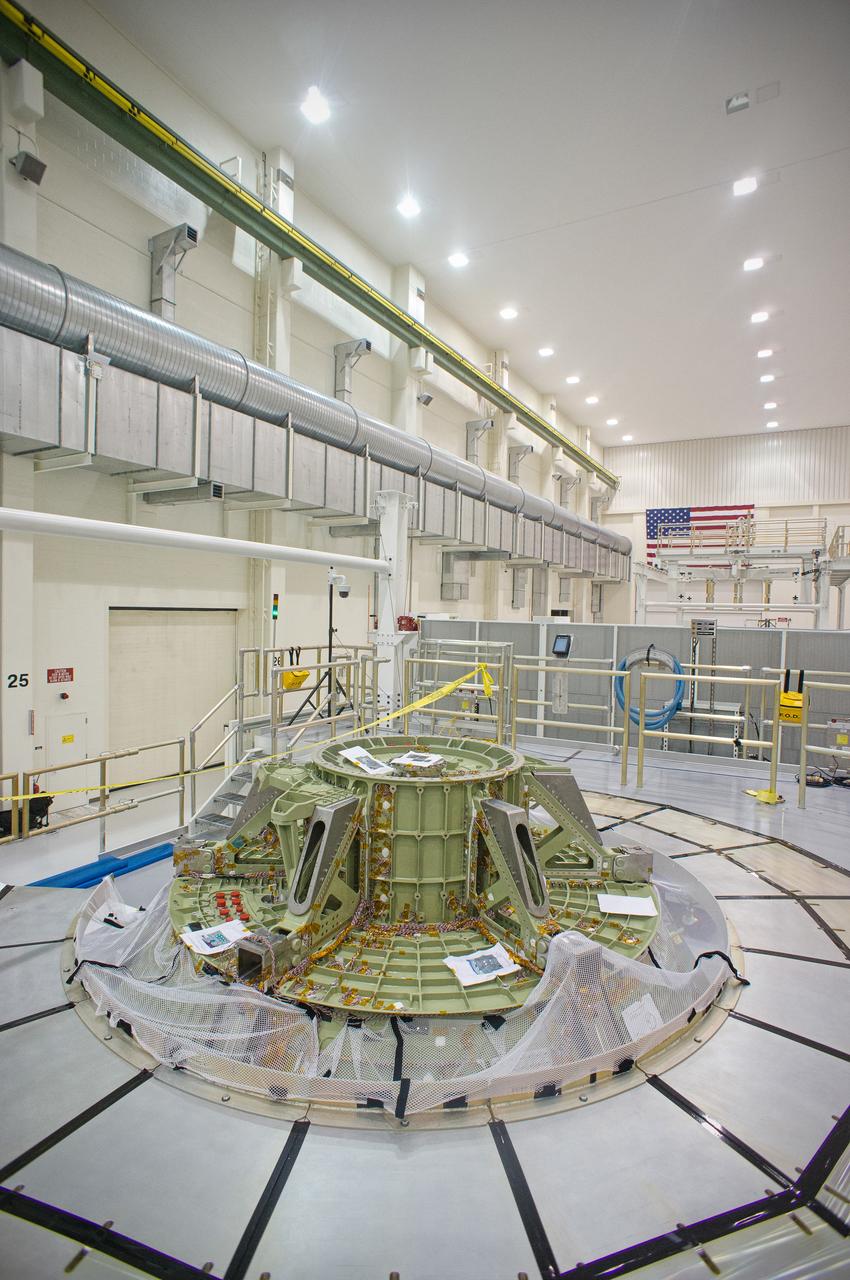
The Exploration Flight Test-1 (EFT-1) Orion crew module in the Operations and Checkout (O&C) Building at NASA’s Kennedy Space Center on Dec. 31, 2011. Part of Batch image transfer from Flickr.
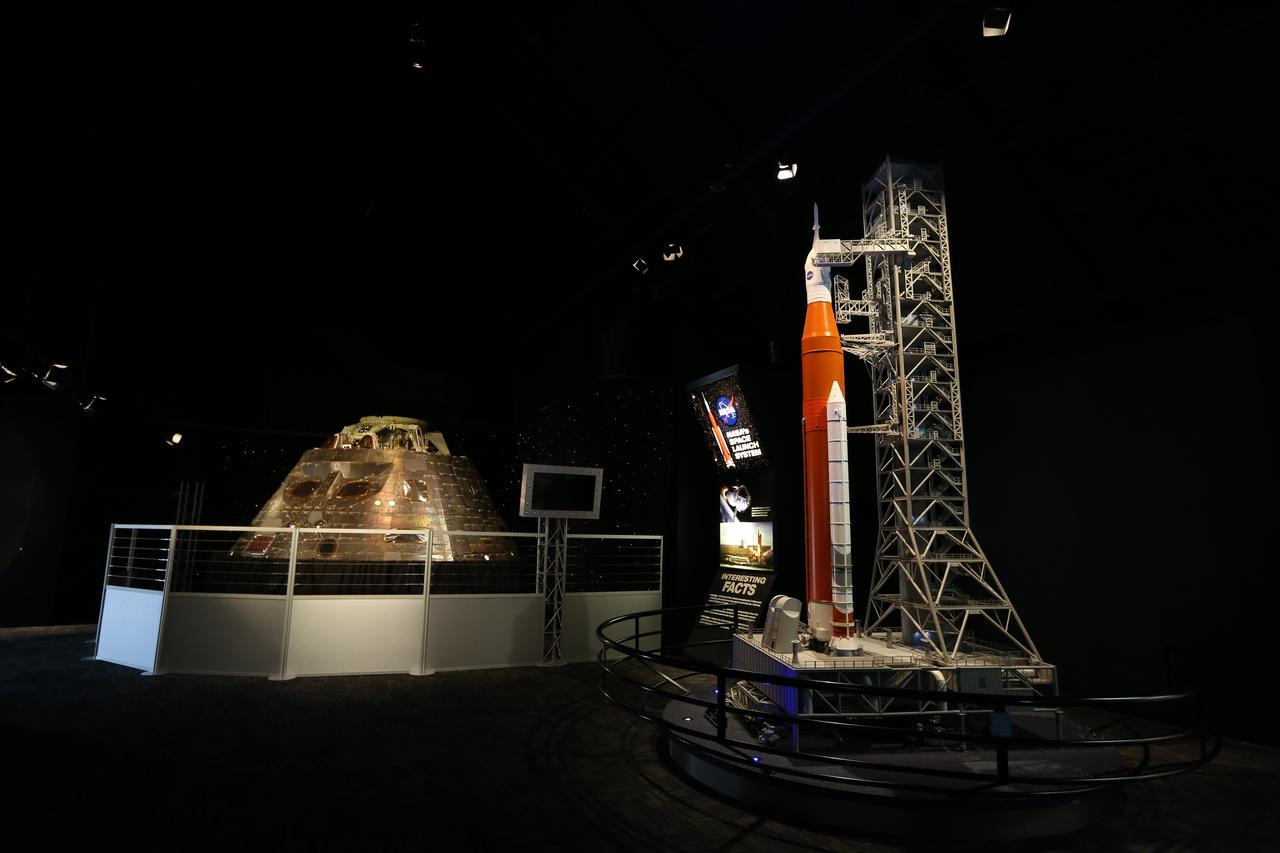
The Orion crew module from Exploration Flight Test 1 (EFT-1) is on display at nearby NASA Kennedy Space Center Visitor Complex in Florida. The crew module is part of the NASA Now exhibit in the IMAX Theater. Also in view is a scale model of NASA's Space Launch System rocket and Orion spacecraft on the mobile launcher. The Orion EFT-1 spacecraft launched atop a United Launch Alliance Delta IV rocket Dec. 5, 2014, from Space Launch Complex 37 at Cape Canaveral Air Force Station. The spacecraft built for humans traveled 3,604 miles above Earth and splashed down about 4.5 hours later in the Pacific Ocean.
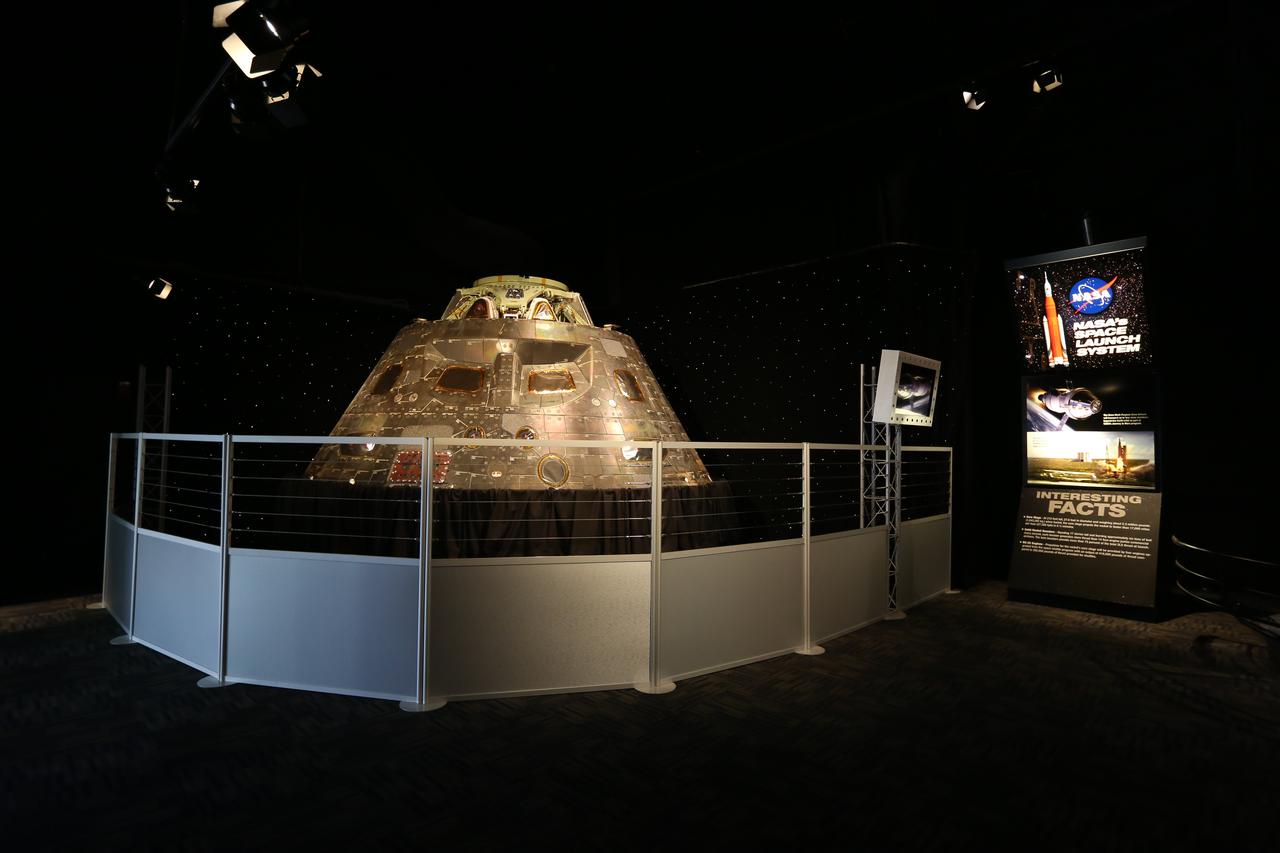
The Orion crew module from Exploration Flight Test 1 (EFT-1) is on display at nearby NASA Kennedy Space Center Visitor Complex in Florida. The crew module is part of the NASA Now exhibit in the IMAX Theater. The Orion EFT-1 spacecraft launched atop a United Launch Alliance Delta IV rocket Dec. 5, 2014, from Space Launch Complex 37 at Cape Canaveral Air Force Station. The spacecraft built for humans traveled 3,604 miles above Earth and splashed down about 4.5 hours later in the Pacific Ocean.
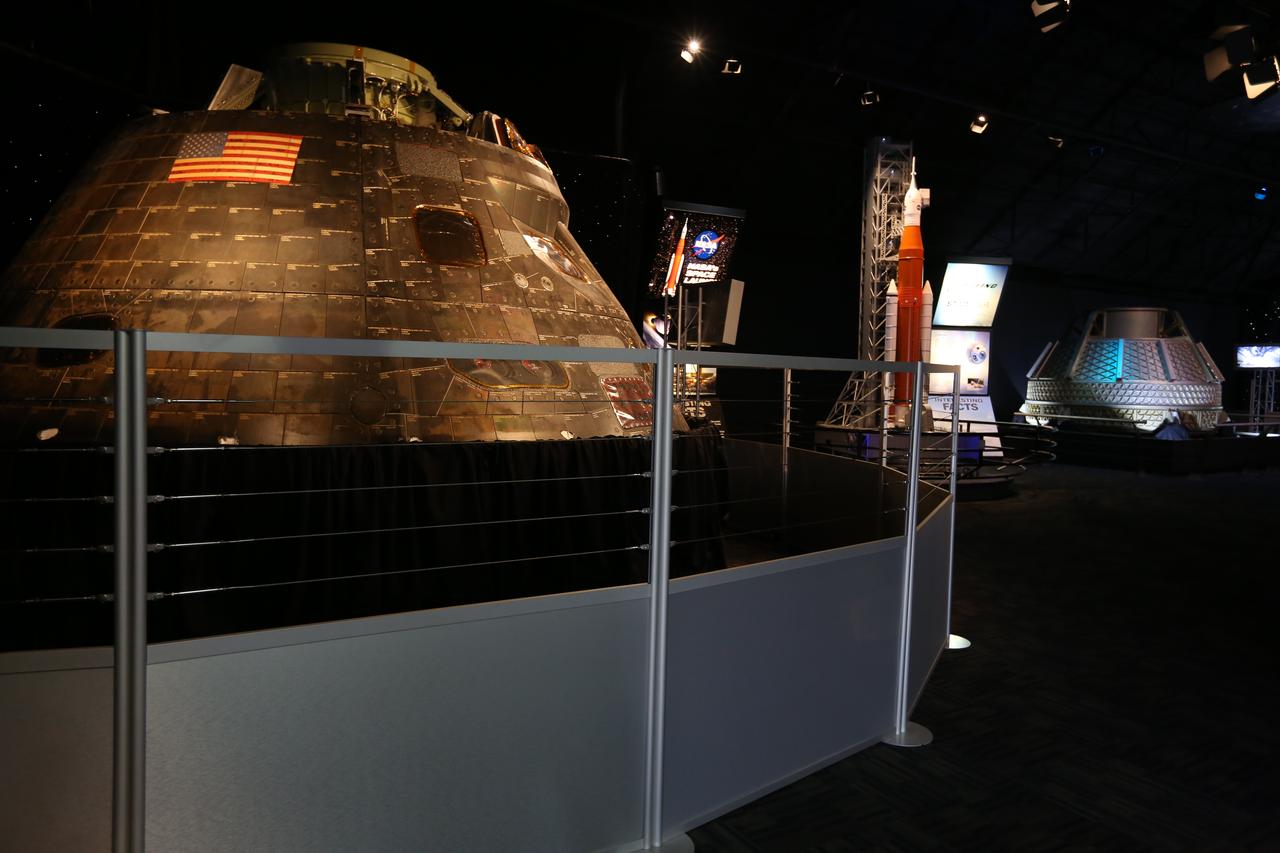
The Orion crew module from Exploration Flight Test 1 (EFT-1) is on display at nearby NASA Kennedy Space Center Visitor Complex in Florida. The crew module is part of the NASA Now exhibit in the IMAX Theater. The Orion EFT-1 spacecraft launched atop a United Launch Alliance Delta IV rocket Dec. 5, 2014, from Space Launch Complex 37 at Cape Canaveral Air Force Station. The spacecraft built for humans traveled 3,604 miles above Earth and splashed down about 4.5 hours later in the Pacific Ocean.
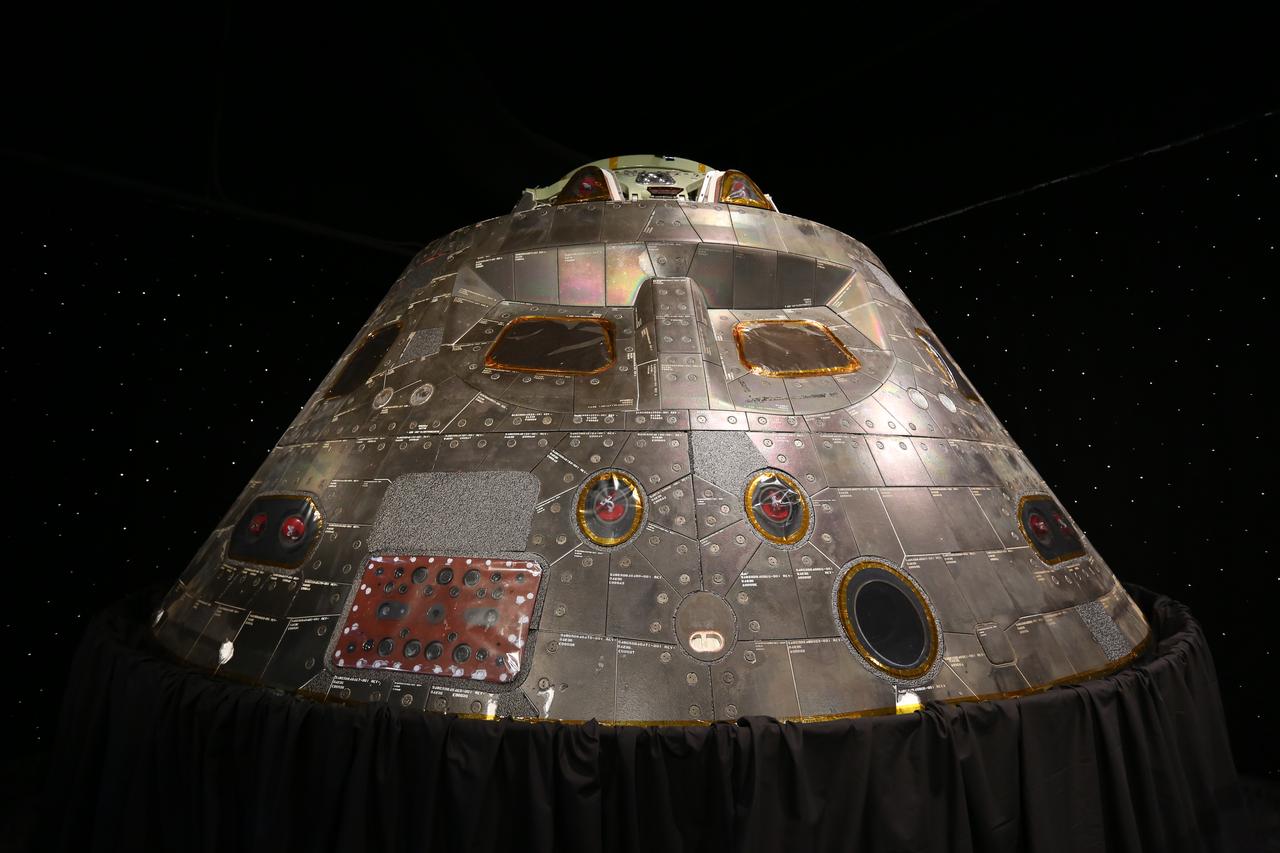
A close-up view of the Orion crew module from Exploration Flight Test 1 (EFT-1) on display at nearby NASA Kennedy Space Center Visitor Complex in Florida. The crew module is part of the NASA Now exhibit in the IMAX Theater. The Orion EFT-1 spacecraft launched atop a United Launch Alliance Delta IV rocket Dec. 5, 2014, from Space Launch Complex 37 at Cape Canaveral Air Force Station. The spacecraft built for humans traveled 3,604 miles above Earth and splashed down about 4.5 hours later in the Pacific Ocean.
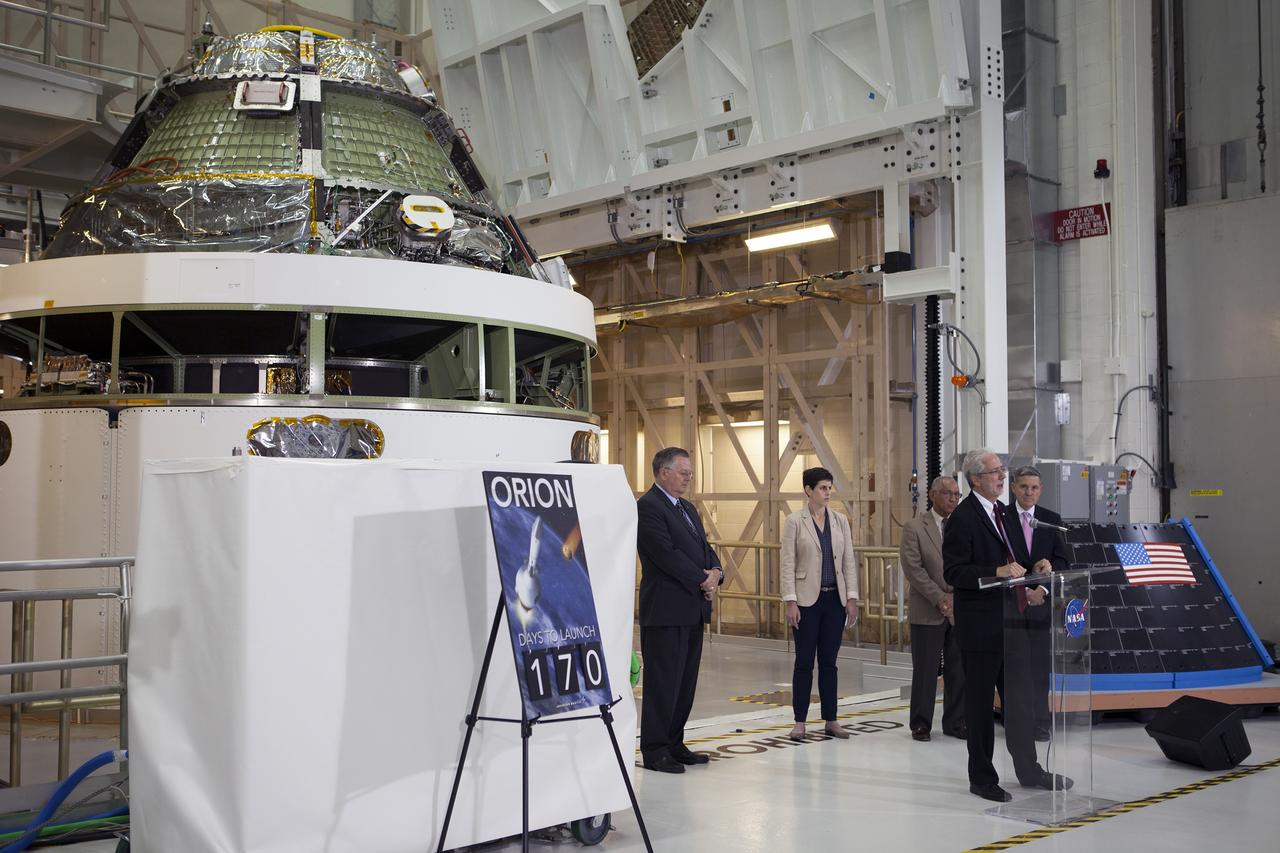
CAPE CANAVERAL, Fla. – Members of the media listen as NASA Orion Program Manager Mark Geyer marks the T-6 months and counting to the launch of Orion on Exploration Flight Test-1, or EFT-1, in the Operations and Checkout Building high bay at NASA's Kennedy Space Center in Florida. To his right is Kennedy Director Bob Cabana. Partially hidden behind him is NASA Administrator Charlie Bolden. To his left is Cleon Lacefield, Lockheed Martin Orion Program manager, and Rachel Kraft, NASA Public Affairs Officer. Behind them is the crew module stacked on the service module in the Final Assembly and System Testing cell. EFT-1 will provide engineers with data about the heat shield's ability to protect Orion and its future crews from the 4,000-degree heat of reentry and an ocean splashdown following the spacecraft’s 20,000-mph reentry from space. Data gathered during the flight will inform decisions about design improvements on the heat shield and other Orion systems, and authenticate existing computer models and new approaches to space systems design and development. This process is critical to reducing overall risks and costs of future Orion missions. Orion is the exploration spacecraft designed to carry astronauts to destinations not yet explored by humans, including an asteroid and Mars. It will have emergency abort capability, sustain the crew during space travel and provide safe re-entry from deep space return velocities. The first unpiloted test flight of the Orion is scheduled to launch later this year atop a Delta IV rocket from Cape Canaveral Air Force Station in Florida to an altitude of 3,600 miles above the Earth's surface. The two-orbit, four-hour flight test will help engineers evaluate the systems critical to crew safety including the heat shield, parachute system and launch abort system. For more information, visit http://www.nasa.gov/orion. Photo credit: NASA/Kim Shiflett
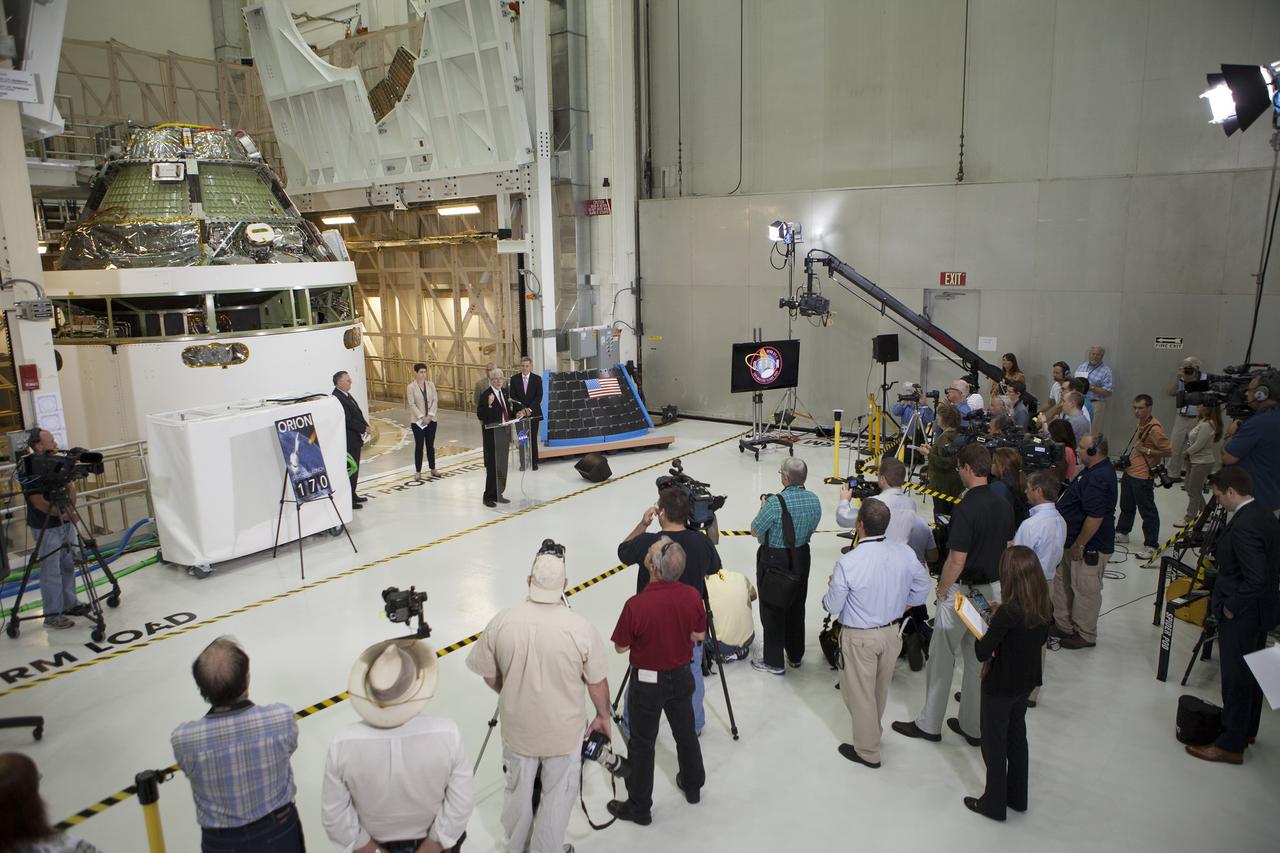
CAPE CANAVERAL, Fla. – Members of the media listen as NASA Orion Program Manager Mark Geyer marks the T-6 months and counting to the launch of Orion on Exploration Flight Test-1, or EFT-1, in the Operations and Checkout Building high bay at NASA's Kennedy Space Center in Florida. To his right is Kennedy Director Bob Cabana. Partially hidden behind him is NASA Administrator Charlie Bolden. To his left is Cleon Lacefield, Lockheed Martin Orion Program manager, and Rachel Kraft, NASA Public Affairs Officer. Behind them is the crew module stacked on the service module in the Final Assembly and System Testing cell. EFT-1 will provide engineers with data about the heat shield's ability to protect Orion and its future crews from the 4,000-degree heat of reentry and an ocean splashdown following the spacecraft’s 20,000-mph reentry from space. Data gathered during the flight will inform decisions about design improvements on the heat shield and other Orion systems, and authenticate existing computer models and new approaches to space systems design and development. This process is critical to reducing overall risks and costs of future Orion missions. Orion is the exploration spacecraft designed to carry astronauts to destinations not yet explored by humans, including an asteroid and Mars. It will have emergency abort capability, sustain the crew during space travel and provide safe re-entry from deep space return velocities. The first unpiloted test flight of the Orion is scheduled to launch later this year atop a Delta IV rocket from Cape Canaveral Air Force Station in Florida to an altitude of 3,600 miles above the Earth's surface. The two-orbit, four-hour flight test will help engineers evaluate the systems critical to crew safety including the heat shield, parachute system and launch abort system. For more information, visit http://www.nasa.gov/orion. Photo credit: NASA/Kim Shiflett
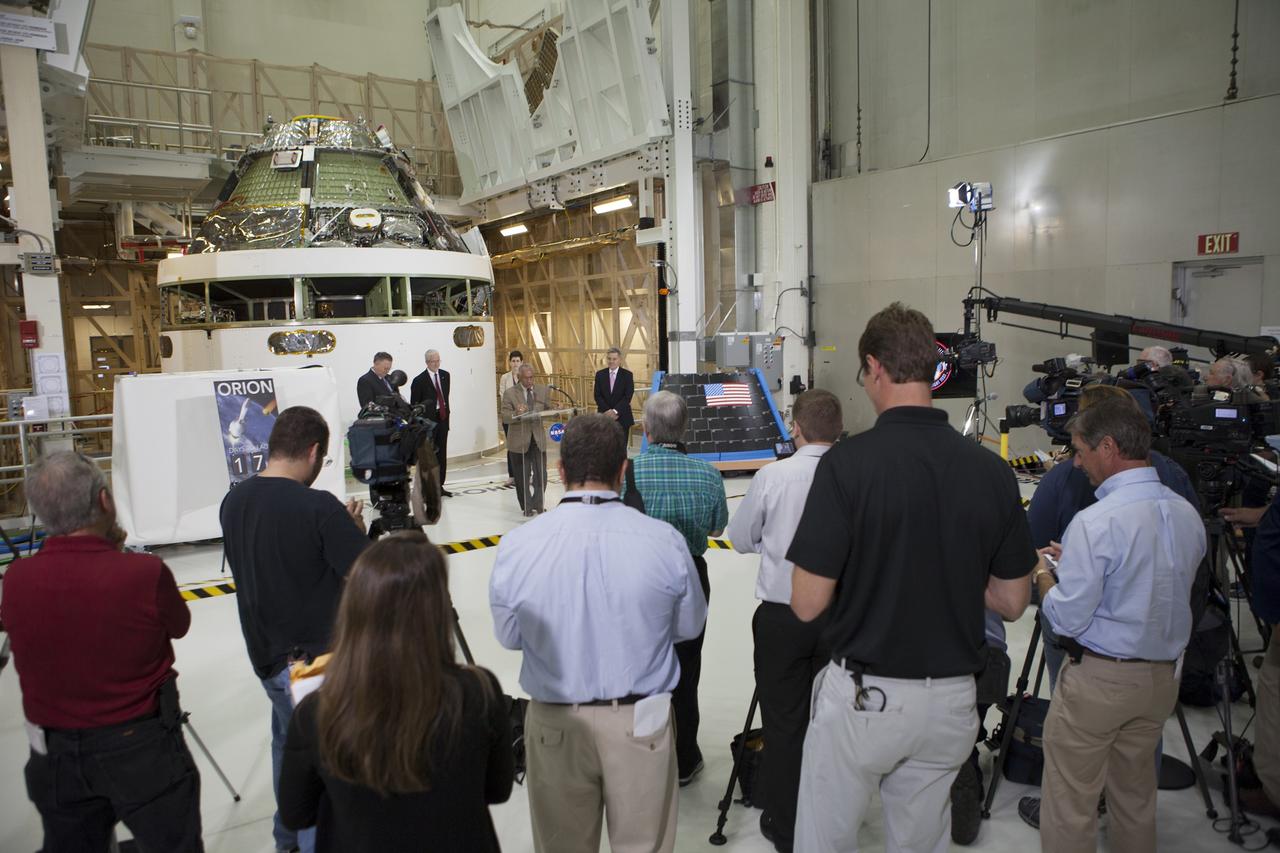
CAPE CANAVERAL, Fla. – Members of the media listen as NASA Administrator Charlie Bolden marks the T-6 months and counting to the launch of Orion on Exploration Flight Test-1, or EFT-1, during a visit to the Operations and Checkout Building high bay at NASA's Kennedy Space Center in Florida. To his right is Kennedy Director Bob Cabana. To his left are Cleon Lacefield, Lockheed Martin Orion Program manager, and Mark Geyer, NASA Orion Program manager. Behind them is the crew module stacked on the service module in the Final Assembly and System Testing cell. EFT-1 will provide engineers with data about the heat shield's ability to protect Orion and its future crews from the 4,000-degree heat of reentry and an ocean splashdown following the spacecraft’s 20,000-mph reentry from space. Data gathered during the flight will inform decisions about design improvements on the heat shield and other Orion systems, and authenticate existing computer models and new approaches to space systems design and development. This process is critical to reducing overall risks and costs of future Orion missions. Orion is the exploration spacecraft designed to carry astronauts to destinations not yet explored by humans, including an asteroid and Mars. It will have emergency abort capability, sustain the crew during space travel and provide safe re-entry from deep space return velocities. The first unpiloted test flight of the Orion is scheduled to launch later this year atop a Delta IV rocket from Cape Canaveral Air Force Station in Florida to an altitude of 3,600 miles above the Earth's surface. The two-orbit, four-hour flight test will help engineers evaluate the systems critical to crew safety including the heat shield, parachute system and launch abort system. For more information, visit http://www.nasa.gov/orion. Photo credit: NASA/Kim Shiflett
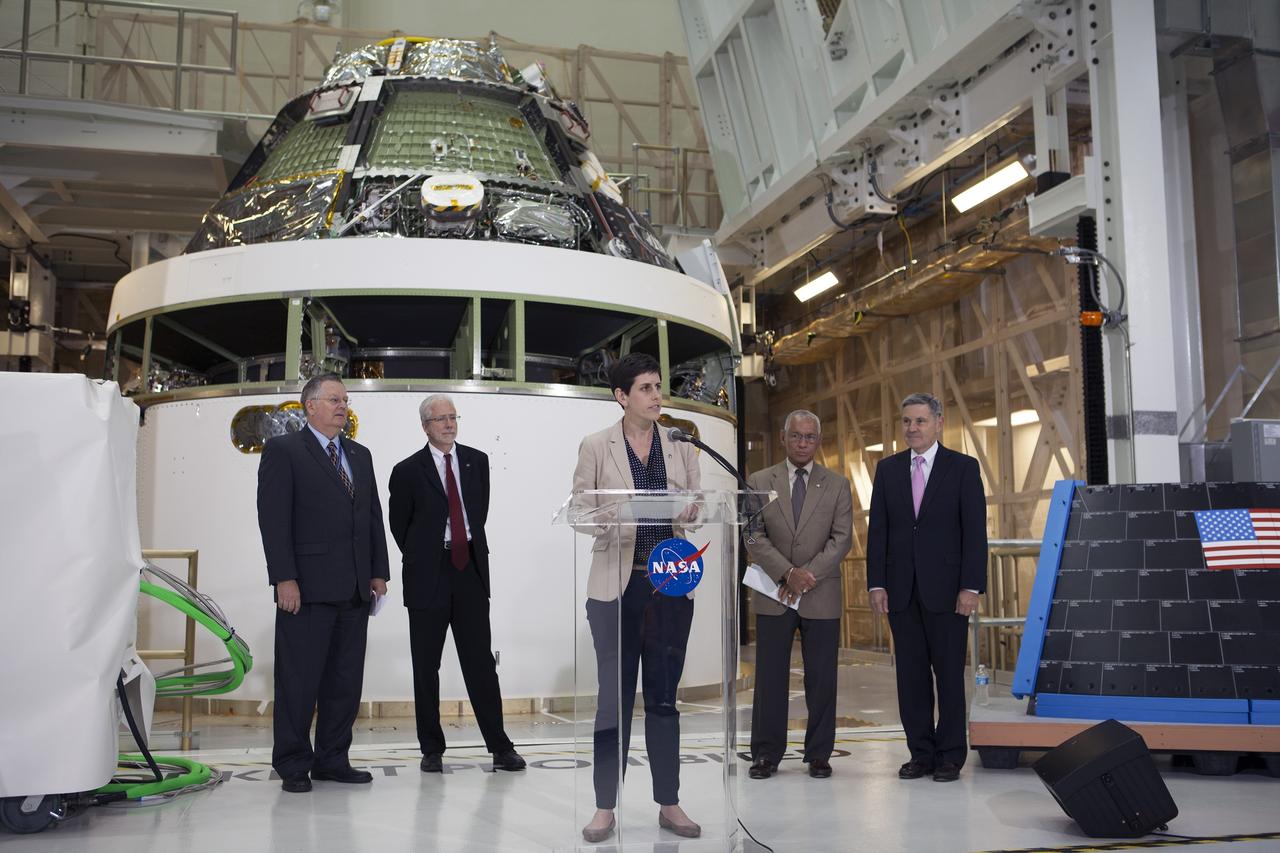
CAPE CANAVERAL, Fla. – NASA Public Affairs Officer Rachel Kraft welcomes members of the media to the Operations and Checkout Building high at NASA's Kennedy Space Center in Florida to mark the T-6 months and counting to the launch of Orion on Exploration Flight Test-1, or EFT-1. To her right are NASA Administrator Charlie Bolden and Kennedy Director Bob Cabana. To her left are Cleon Lacefield, Lockheed Martin Orion Program manager, and Mark Geyer, NASA Orion Program manager. Behind them is the crew module stacked on the service module in the Final Assembly and System Testing cell. EFT-1 will provide engineers with data about the heat shield's ability to protect Orion and its future crews from the 4,000-degree heat of reentry and an ocean splashdown following the spacecraft’s 20,000-mph reentry from space. Data gathered during the flight will inform decisions about design improvements on the heat shield and other Orion systems, and authenticate existing computer models and new approaches to space systems design and development. This process is critical to reducing overall risks and costs of future Orion missions. Orion is the exploration spacecraft designed to carry astronauts to destinations not yet explored by humans, including an asteroid and Mars. It will have emergency abort capability, sustain the crew during space travel and provide safe re-entry from deep space return velocities. The first unpiloted test flight of the Orion is scheduled to launch later this year atop a Delta IV rocket from Cape Canaveral Air Force Station in Florida to an altitude of 3,600 miles above the Earth's surface. The two-orbit, four-hour flight test will help engineers evaluate the systems critical to crew safety including the heat shield, parachute system and launch abort system. For more information, visit http://www.nasa.gov/orion. Photo credit: NASA/Kim Shiflett
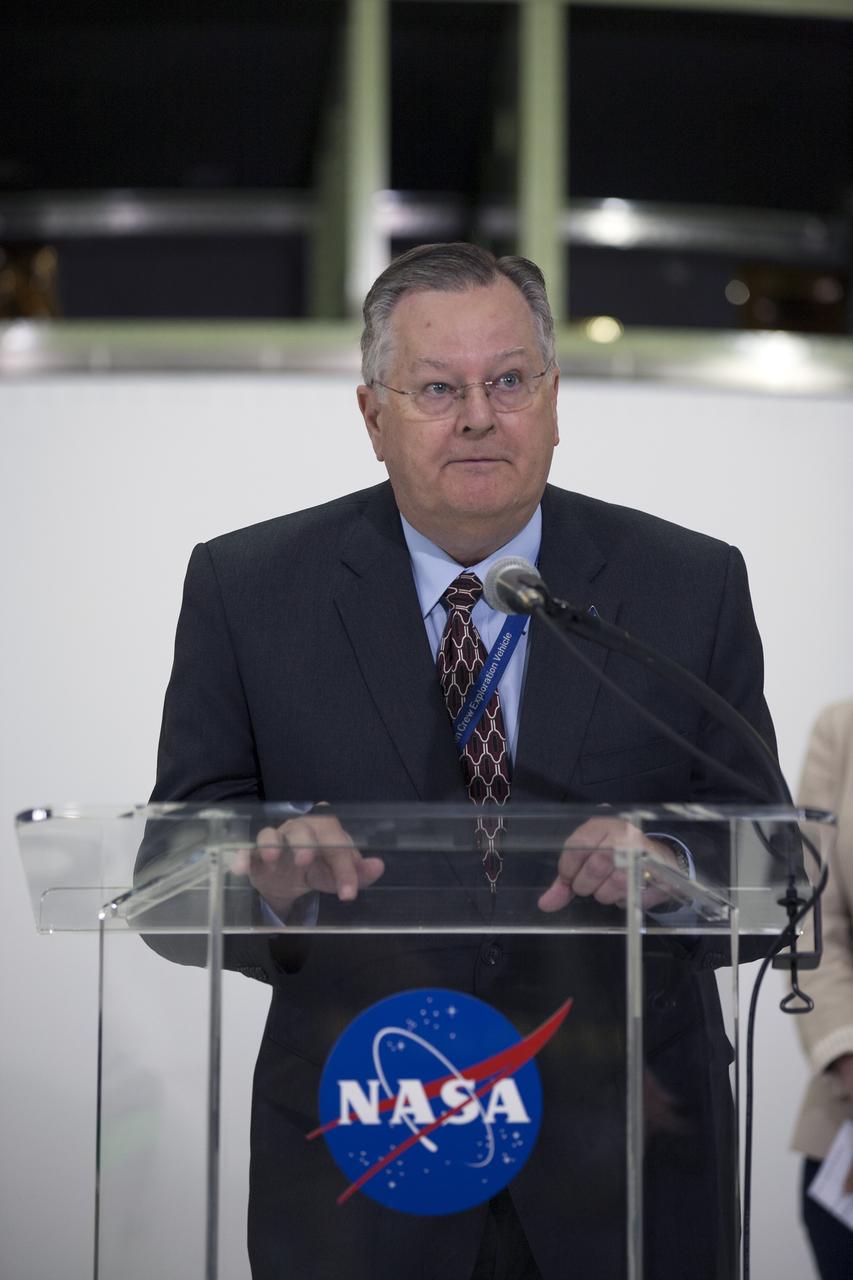
CAPE CANAVERAL, Fla. – Cleon Lacefield, Lockheed Martin Orion Program manager helps mark the T-6 months and counting to the launch of Orion on Exploration Flight Test-1, or EFT-1, inside the Operations and Checkout Building high bay at NASA's Kennedy Space Center in Florida. The crew module has been stacked on the service module in the Final Assembly and System Testing cell. EFT-1 will provide engineers with data about the heat shield's ability to protect Orion and its future crews from the 4,000-degree heat of reentry and an ocean splashdown following the spacecraft’s 20,000-mph reentry from space. Data gathered during the flight will inform decisions about design improvements on the heat shield and other Orion systems, and authenticate existing computer models and new approaches to space systems design and development. This process is critical to reducing overall risks and costs of future Orion missions. Orion is the exploration spacecraft designed to carry astronauts to destinations not yet explored by humans, including an asteroid and Mars. It will have emergency abort capability, sustain the crew during space travel and provide safe re-entry from deep space return velocities. The first unpiloted test flight of the Orion is scheduled to launch later this year atop a Delta IV rocket from Cape Canaveral Air Force Station in Florida to an altitude of 3,600 miles above the Earth's surface. The two-orbit, four-hour flight test will help engineers evaluate the systems critical to crew safety including the heat shield, parachute system and launch abort system. For more information, visit http://www.nasa.gov/orion. Photo credit: NASA/Kim Shiflett
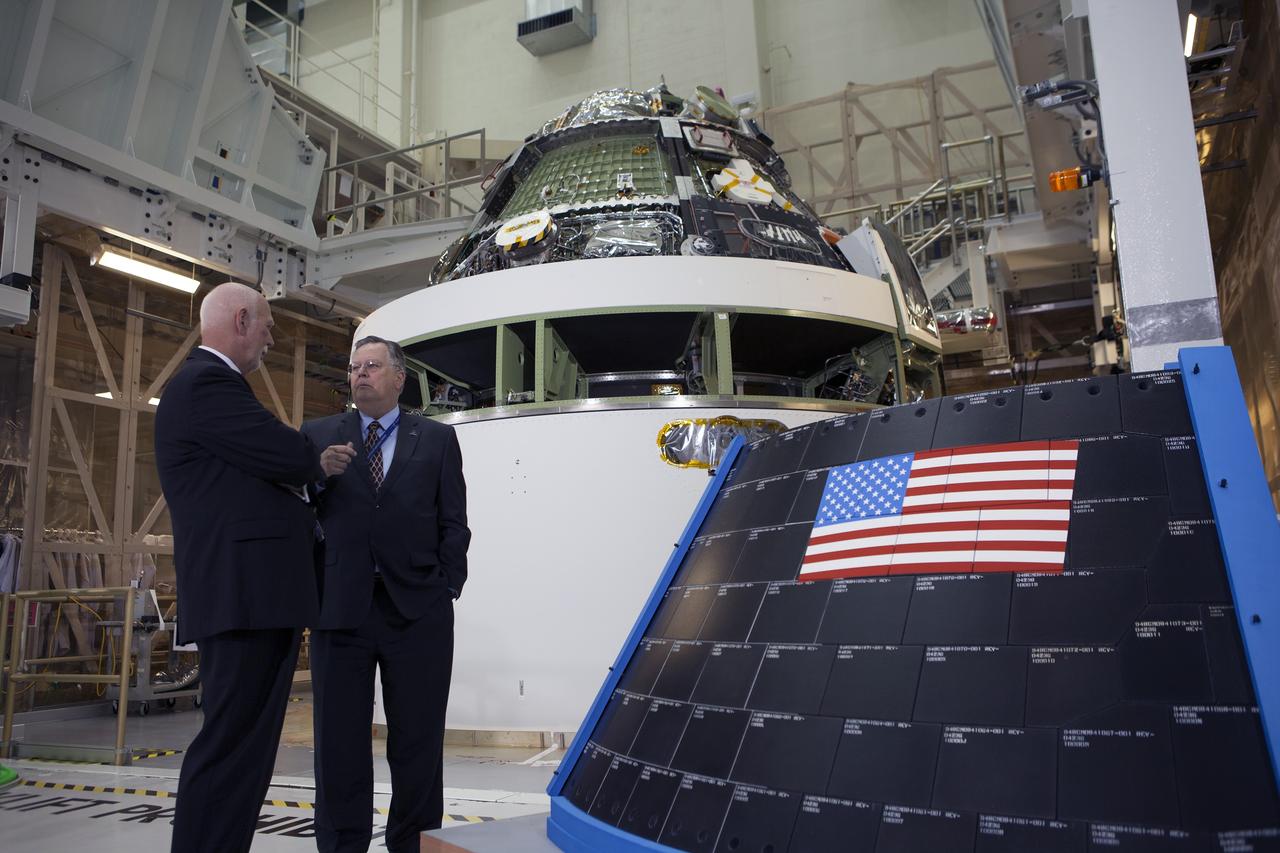
CAPE CANAVERAL, Fla. – Cleon Lacefield, Lockheed Martin Orion Program manager, at right, helps mark the T-6 months and counting to the launch of Orion on Exploration Flight Test-1, or EFT-1, inside the Operations and Checkout Building high bay at NASA's Kennedy Space Center in Florida. In view behind him is the crew module stacked on the service module in the Final Assembly and System Testing cell. EFT-1 will provide engineers with data about the heat shield's ability to protect Orion and its future crews from the 4,000-degree heat of reentry and an ocean splashdown following the spacecraft’s 20,000-mph reentry from space. Data gathered during the flight will inform decisions about design improvements on the heat shield and other Orion systems, and authenticate existing computer models and new approaches to space systems design and development. This process is critical to reducing overall risks and costs of future Orion missions. Orion is the exploration spacecraft designed to carry astronauts to destinations not yet explored by humans, including an asteroid and Mars. It will have emergency abort capability, sustain the crew during space travel and provide safe re-entry from deep space return velocities. The first unpiloted test flight of the Orion is scheduled to launch later this year atop a Delta IV rocket from Cape Canaveral Air Force Station in Florida to an altitude of 3,600 miles above the Earth's surface. The two-orbit, four-hour flight test will help engineers evaluate the systems critical to crew safety including the heat shield, parachute system and launch abort system. For more information, visit http://www.nasa.gov/orion. Photo credit: NASA/Kim Shiflett
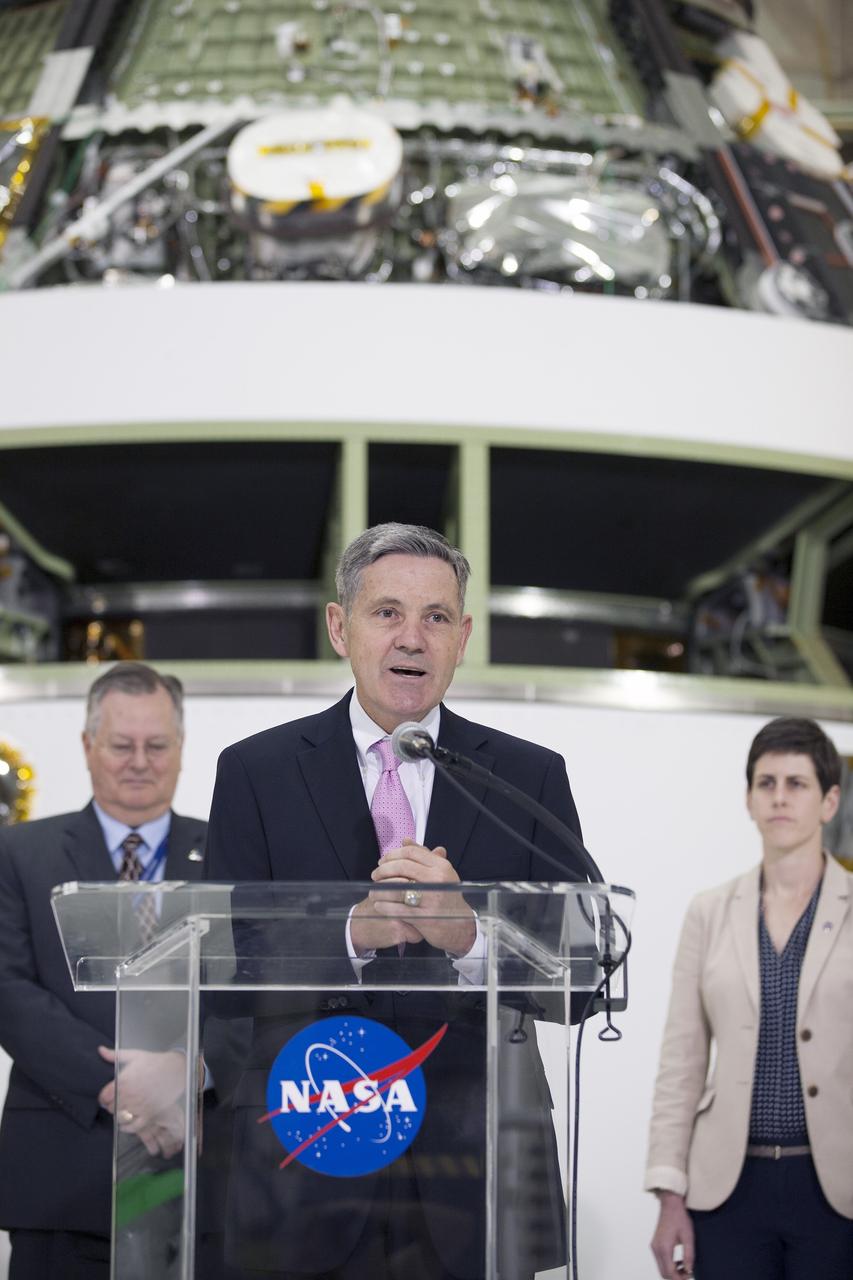
CAPE CANAVERAL, Fla. – Kennedy Space Center Director Bob Cabana helps mark the T-6 months and counting to the launch of Orion on Exploration Flight Test-1, or EFT-1, inside the Operations and Checkout Building high bay at Kennedy Space Center in Florida. To his right is Rachel Kraft, NASA Public Affairs Officer, and standing behind him is Cleon Lacefield, Lockheed Martin Orion Program manager. The crew module has been stacked on the service module in the Final Assembly and System Testing cell. EFT-1 will provide engineers with data about the heat shield's ability to protect Orion and its future crews from the 4,000-degree heat of reentry and an ocean splashdown following the spacecraft’s 20,000-mph reentry from space. Data gathered during the flight will inform decisions about design improvements on the heat shield and other Orion systems, and authenticate existing computer models and new approaches to space systems design and development. This process is critical to reducing overall risks and costs of future Orion missions. Orion is the exploration spacecraft designed to carry astronauts to destinations not yet explored by humans, including an asteroid and Mars. It will have emergency abort capability, sustain the crew during space travel and provide safe re-entry from deep space return velocities. The first unpiloted test flight of the Orion is scheduled to launch later this year atop a Delta IV rocket from Cape Canaveral Air Force Station in Florida to an altitude of 3,600 miles above the Earth's surface. The two-orbit, four-hour flight test will help engineers evaluate the systems critical to crew safety including the heat shield, parachute system and launch abort system. For more information, visit http://www.nasa.gov/orion. Photo credit: NASA/Kim Shiflett
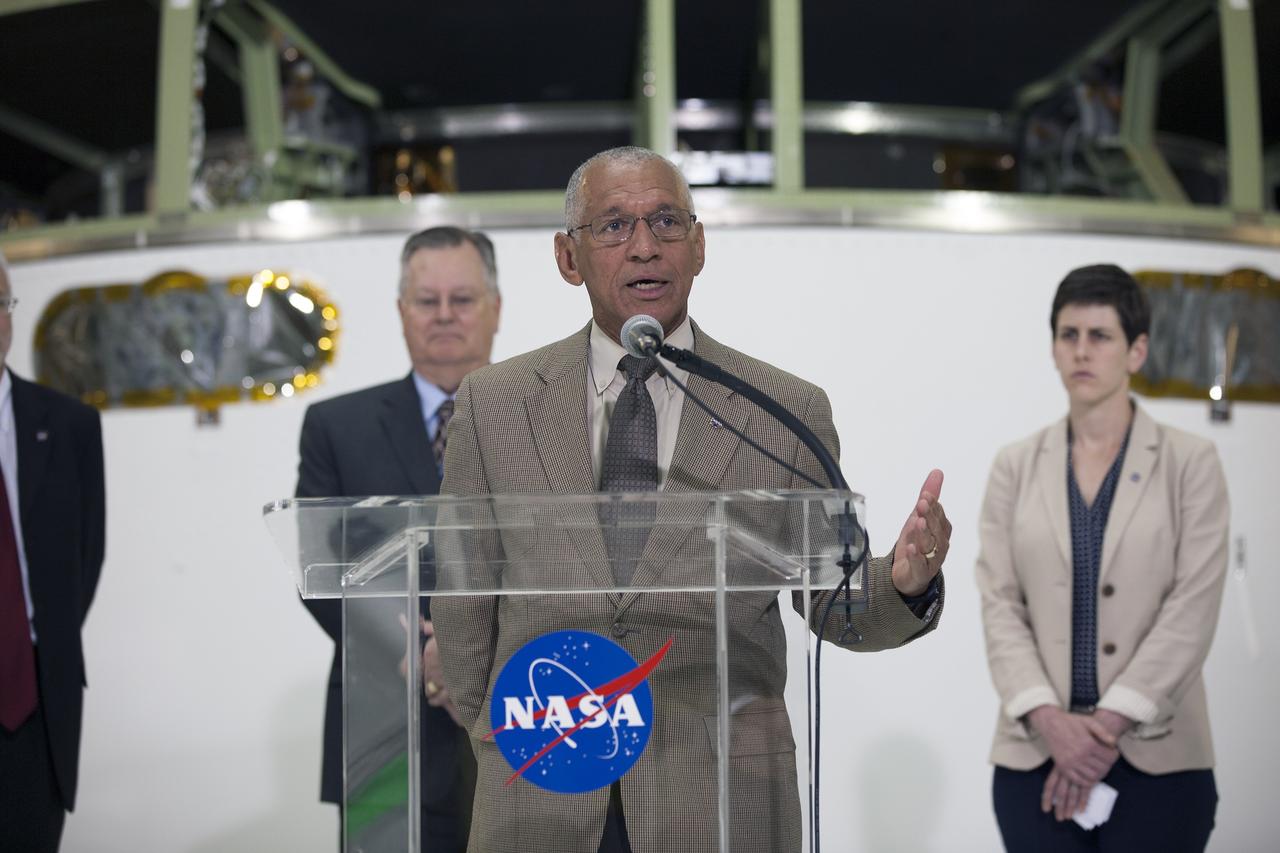
CAPE CANAVERAL, Fla. – NASA Administrator Charlie Bolden helps mark the T-6 months and counting to the launch of Orion on Exploration Flight Test-1, or EFT-1, during a visit to the Operations and Checkout Building high bay at NASA's Kennedy Space Center in Florida. To his right is Rachel Kraft, NASA Public Affairs Officer, and standing behind him is Cleon Lacefield, Lockheed Martin Orion Program manager. The crew module has been stacked on the service module in the Final Assembly and System Testing cell. EFT-1 will provide engineers with data about the heat shield's ability to protect Orion and its future crews from the 4,000-degree heat of reentry and an ocean splashdown following the spacecraft’s 20,000-mph reentry from space. Data gathered during the flight will inform decisions about design improvements on the heat shield and other Orion systems, and authenticate existing computer models and new approaches to space systems design and development. This process is critical to reducing overall risks and costs of future Orion missions. Orion is the exploration spacecraft designed to carry astronauts to destinations not yet explored by humans, including an asteroid and Mars. It will have emergency abort capability, sustain the crew during space travel and provide safe re-entry from deep space return velocities. The first unpiloted test flight of the Orion is scheduled to launch later this year atop a Delta IV rocket from Cape Canaveral Air Force Station in Florida to an altitude of 3,600 miles above the Earth's surface. The two-orbit, four-hour flight test will help engineers evaluate the systems critical to crew safety including the heat shield, parachute system and launch abort system. For more information, visit http://www.nasa.gov/orion. Photo credit: NASA/Kim Shiflett
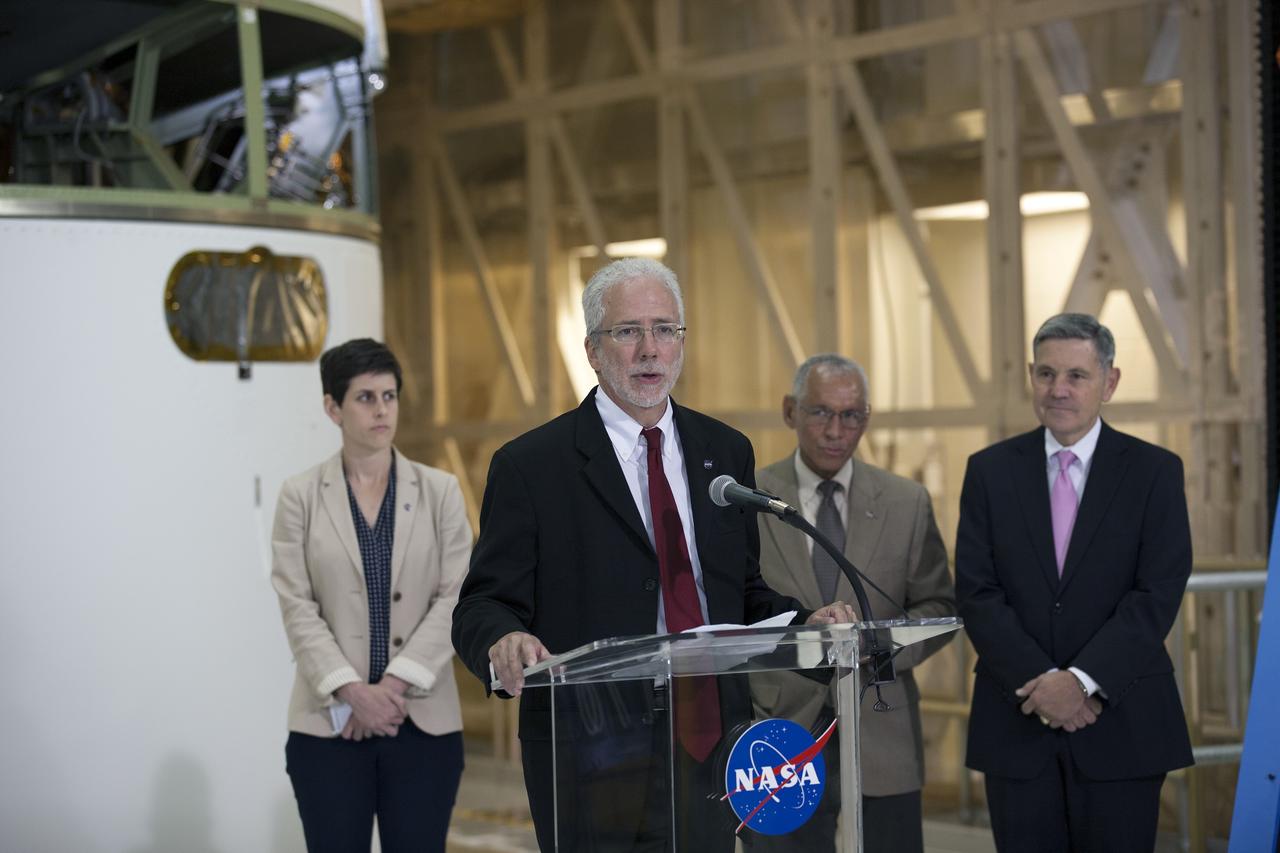
CAPE CANAVERAL, Fla. – Mark Geyer, NASA Orion Program manager, along with NASA Administrator Charlie Bolden, to his right, and Kennedy Space Center Director Bob Cabana help mark the T-6 months and counting to the launch of Orion on Exploration Flight Test-1, or EFT-1, inside the Operations and Checkout Building high bay at NASA's Kennedy Space Center in Florida. At left is Rachel Kraft, NASA Public Affairs Officer. The crew module has been stacked on the service module in the Final Assembly and System Testing cell. EFT-1 will provide engineers with data about the heat shield's ability to protect Orion and its future crews from the 4,000-degree heat of reentry and an ocean splashdown following the spacecraft’s 20,000-mph reentry from space. Data gathered during the flight will inform decisions about design improvements on the heat shield and other Orion systems, and authenticate existing computer models and new approaches to space systems design and development. This process is critical to reducing overall risks and costs of future Orion missions. Orion is the exploration spacecraft designed to carry astronauts to destinations not yet explored by humans, including an asteroid and Mars. It will have emergency abort capability, sustain the crew during space travel and provide safe re-entry from deep space return velocities. The first unpiloted test flight of the Orion is scheduled to launch later this year atop a Delta IV rocket from Cape Canaveral Air Force Station in Florida to an altitude of 3,600 miles above the Earth's surface. The two-orbit, four-hour flight test will help engineers evaluate the systems critical to crew safety including the heat shield, parachute system and launch abort system. For more information, visit http://www.nasa.gov/orion. Photo credit: NASA/Kim Shiflett
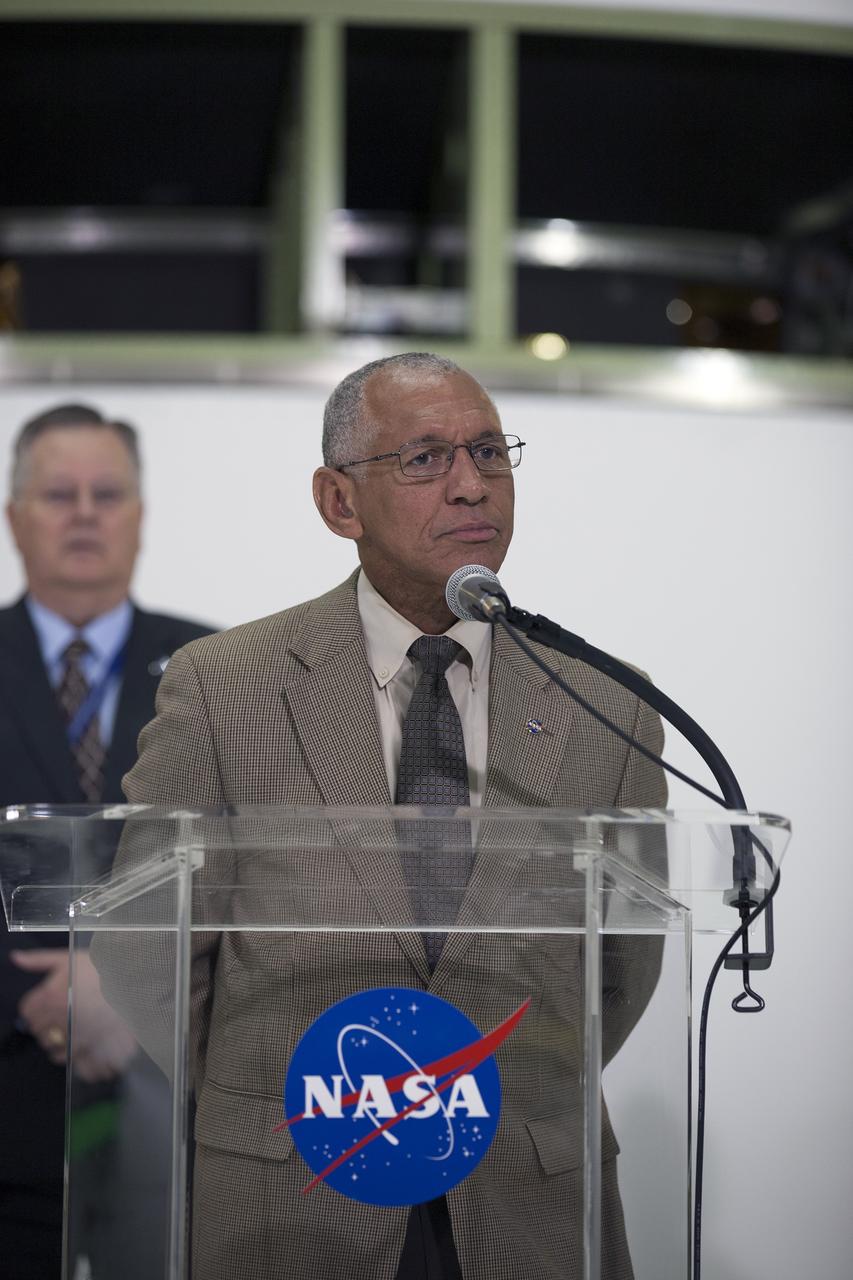
CAPE CANAVERAL, Fla. – NASA Administrator Charlie Bolden helps mark the T-6 months and counting to the launch of Orion on Exploration Flight Test-1, or EFT-1, during a visit to the Operations and Checkout Building high bay at NASA's Kennedy Space Center in Florida. The crew module has been stacked on the service module in the Final Assembly and System Testing cell. EFT-1 will provide engineers with data about the heat shield's ability to protect Orion and its future crews from the 4,000-degree heat of reentry and an ocean splashdown following the spacecraft’s 20,000-mph reentry from space. Data gathered during the flight will inform decisions about design improvements on the heat shield and other Orion systems, and authenticate existing computer models and new approaches to space systems design and development. This process is critical to reducing overall risks and costs of future Orion missions. Orion is the exploration spacecraft designed to carry astronauts to destinations not yet explored by humans, including an asteroid and Mars. It will have emergency abort capability, sustain the crew during space travel and provide safe re-entry from deep space return velocities. The first unpiloted test flight of the Orion is scheduled to launch later this year atop a Delta IV rocket from Cape Canaveral Air Force Station in Florida to an altitude of 3,600 miles above the Earth's surface. The two-orbit, four-hour flight test will help engineers evaluate the systems critical to crew safety including the heat shield, parachute system and launch abort system. For more information, visit http://www.nasa.gov/orion. Photo credit: NASA/Kim Shiflett
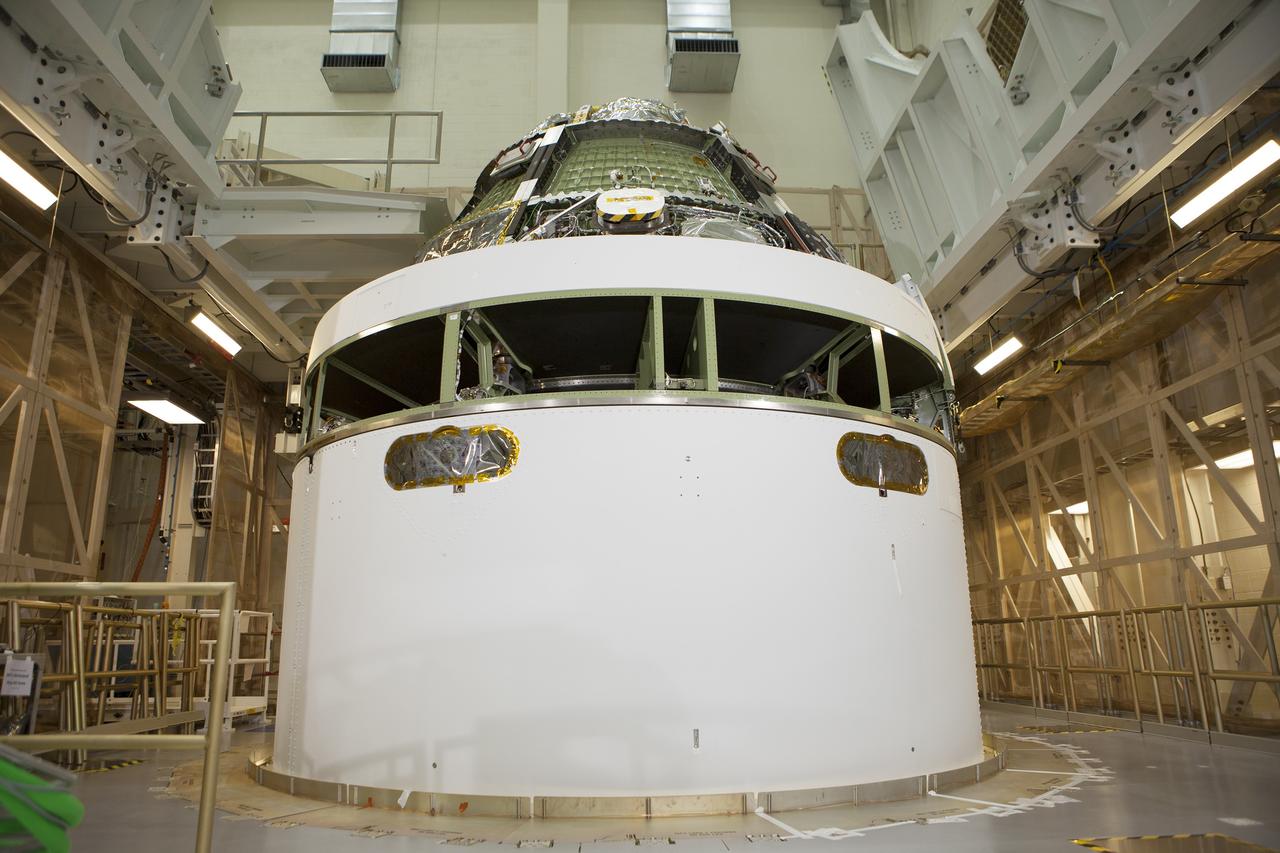
CAPE CANAVERAL, Fla. – Inside the Operations and Checkout Building high bay at NASA's Kennedy Space Center in Florida, the Orion crew module has been stacked on the service module in the Final Assembly and System Testing cell in preparation for final system tests for Exploration Flight Test-1, or EFT-1, prior to rolling out of the facility for integration with the United Launch Alliance Delta IV Heavy rocket. EFT-1 will provide engineers with data about the heat shield's ability to protect Orion and its future crews from the 4,000-degree heat of reentry and an ocean splashdown following the spacecraft’s 20,000-mph reentry from space. Data gathered during the flight will inform decisions about design improvements on the heat shield and other Orion systems, and authenticate existing computer models and new approaches to space systems design and development. This process is critical to reducing overall risks and costs of future Orion missions. Orion is the exploration spacecraft designed to carry astronauts to destinations not yet explored by humans, including an asteroid and Mars. It will have emergency abort capability, sustain the crew during space travel and provide safe re-entry from deep space return velocities. The first unpiloted test flight of the Orion is scheduled to launch later this year atop a Delta IV rocket from Cape Canaveral Air Force Station in Florida to an altitude of 3,600 miles above the Earth's surface. The two-orbit, four-hour flight test will help engineers evaluate the systems critical to crew safety including the heat shield, parachute system and launch abort system. For more information, visit http://www.nasa.gov/orion. Photo credit: NASA/Kim Shiflett
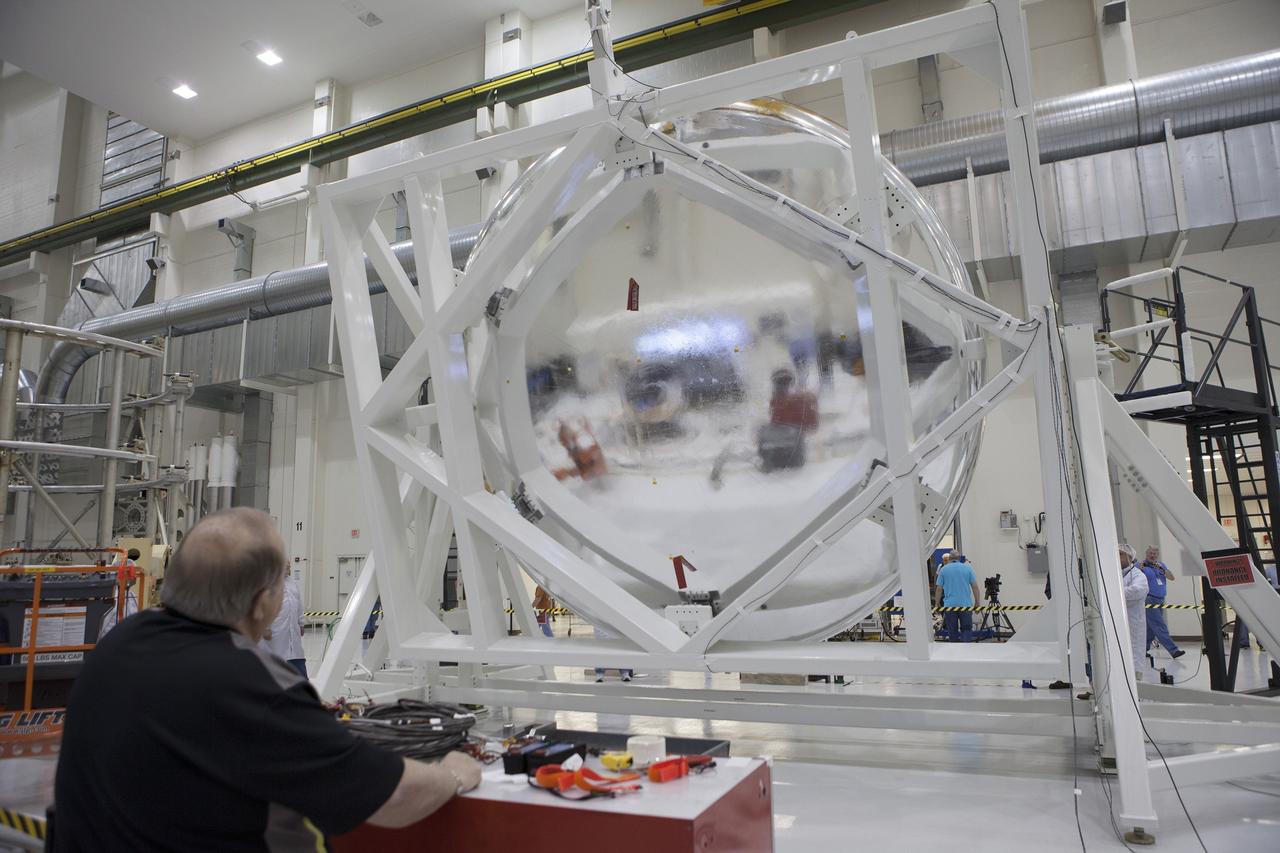
CAPE CANAVERAL, Fla. -- Inside the Operations and Checkout Building high bay at NASA's Kennedy Space Center in Florida, NASA and Lockheed Martin technicians and engineers conduct a center of gravity, or CG, test on the Orion crew module. The CG tool will measure the exact location of the vehicle's center of gravity. This test is important as it affects the handling and control characteristics of the vehicle. The Orion crew module will be stacked on the service module in the Final Assembly and System Testing, or FAST, cell and then both modules will be put through their final system tests for Exploration Flight Test-1, or EFT-1, before rolling out of the facility for integration with the United Launch Alliance Delta IV Heavy rocket. Orion is the exploration spacecraft designed to carry astronauts to destinations not yet explored by humans, including an asteroid and Mars. It will have emergency abort capability, sustain the crew during space travel and provide safe re-entry from deep space return velocities. The first unpiloted test flight of Orion, EFT-1, is scheduled to launch later this year atop a Delta IV rocket from Cape Canaveral Air Force Station in Florida to an altitude of 3,600 miles above the Earth's surface. The two-orbit, four-hour flight test will help engineers evaluate the systems critical to crew safety including the heat shield, parachute system and launch abort system. For more information, visit http://www.nasa.gov/orion. Photo credit: NASA/Glenn Benson
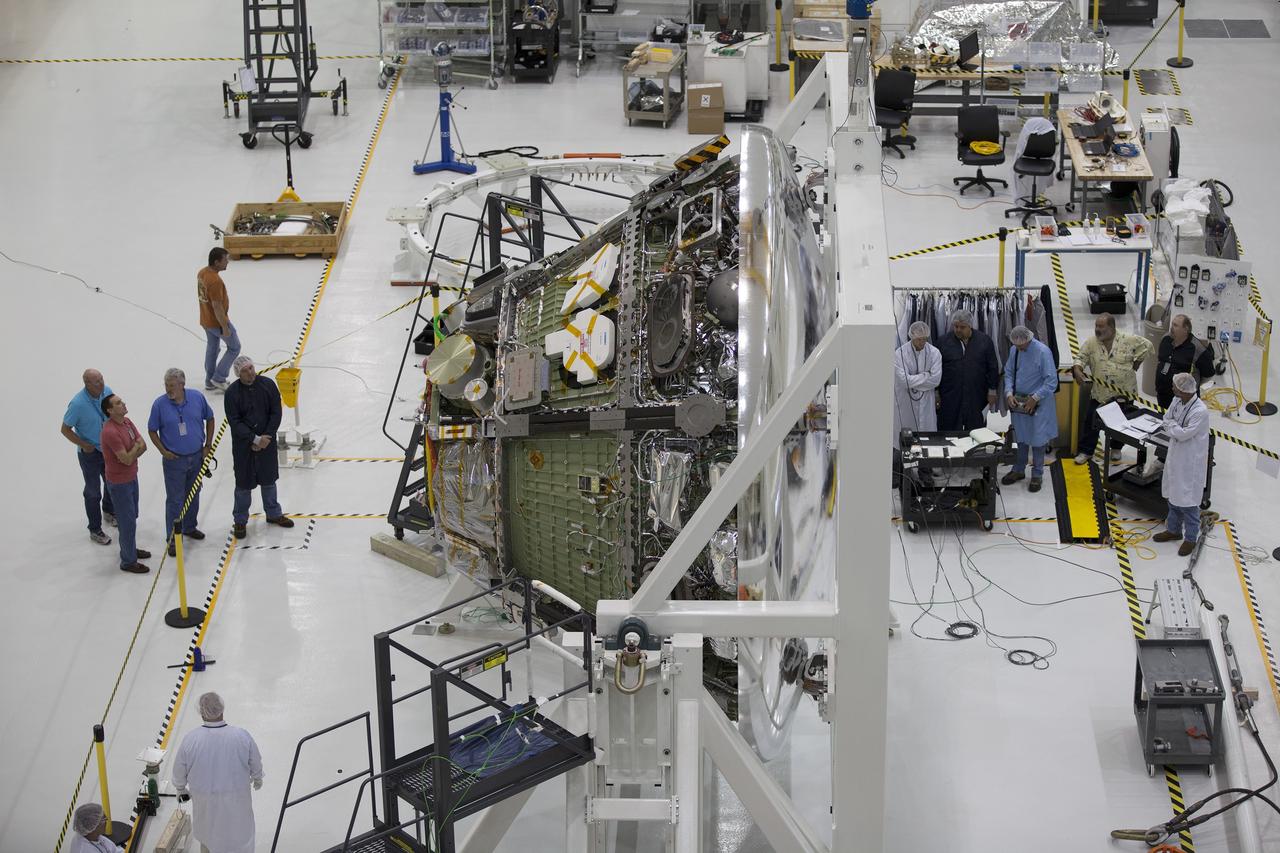
CAPE CANAVERAL, Fla. -- Inside the Operations and Checkout Building high bay at NASA's Kennedy Space Center in Florida, NASA and Lockheed Martin technicians and engineers conduct a center of gravity, or CG, test on the Orion crew module. The CG tool will measure the exact location of the vehicle's center of gravity. This test is important as it affects the handling and control characteristics of the vehicle. The Orion crew module will be stacked on the service module in the Final Assembly and System Testing, or FAST, cell and then both modules will be put through their final system tests for Exploration Flight Test-1, or EFT-1, before rolling out of the facility for integration with the United Launch Alliance Delta IV Heavy rocket. Orion is the exploration spacecraft designed to carry astronauts to destinations not yet explored by humans, including an asteroid and Mars. It will have emergency abort capability, sustain the crew during space travel and provide safe re-entry from deep space return velocities. The first unpiloted test flight of Orion, EFT-1, is scheduled to launch later this year atop a Delta IV rocket from Cape Canaveral Air Force Station in Florida to an altitude of 3,600 miles above the Earth's surface. The two-orbit, four-hour flight test will help engineers evaluate the systems critical to crew safety including the heat shield, parachute system and launch abort system. For more information, visit http://www.nasa.gov/orion. Photo credit: NASA/Glenn Benson
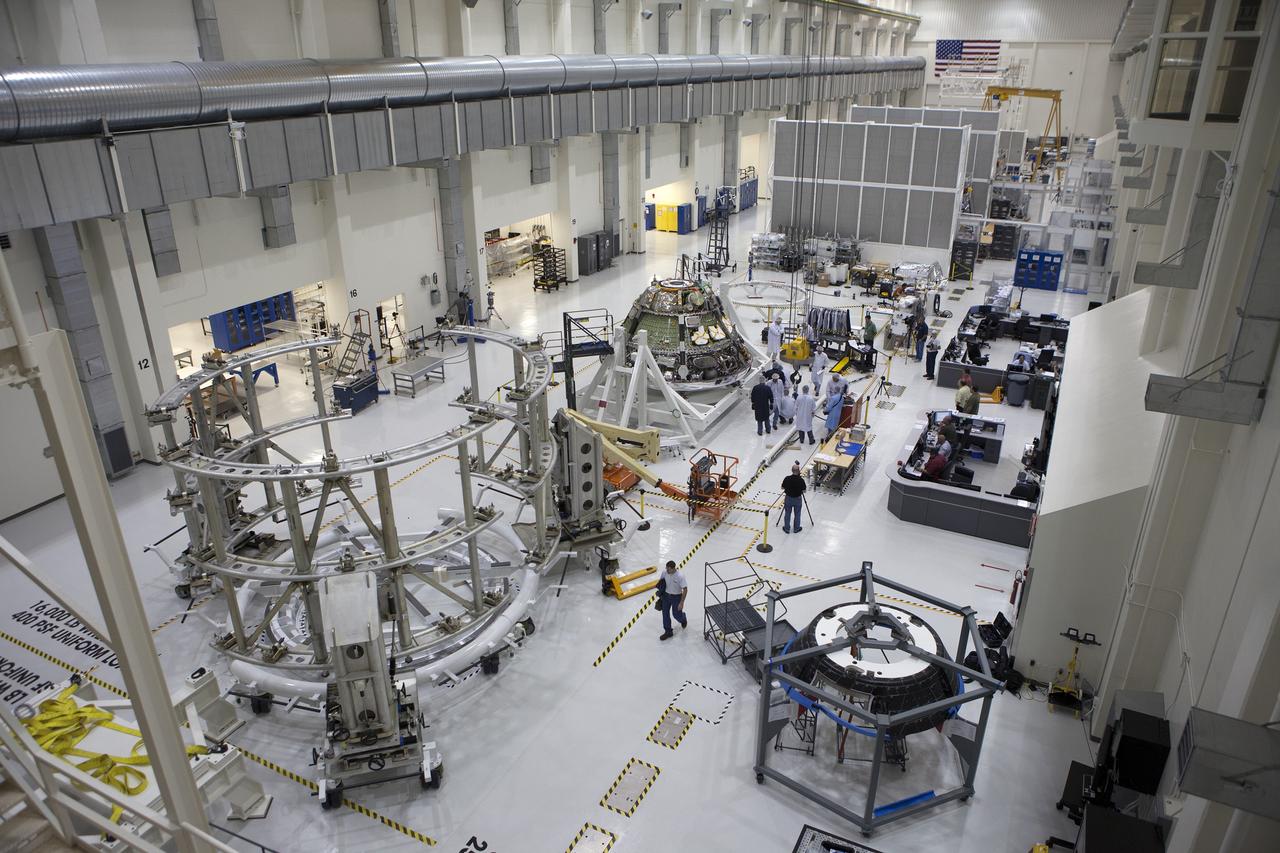
CAPE CANAVERAL, Fla. – Inside the Operations and Checkout Building high bay at NASA's Kennedy Space Center in Florida, NASA and Lockheed Martin technicians and engineers prepare to conduct a center of gravity, or CG, test on the Orion crew module. The CG tool will measure the exact location of the vehicle's center of gravity. This test is important as it affects the handling and control characteristics of the vehicle. The Orion crew module will be stacked on the service module in the Final Assembly and System Testing, or FAST, cell and then both modules will be put through their final system tests for Exploration Flight Test-1, or EFT-1, before rolling out of the facility for integration with the United Launch Alliance Delta IV Heavy rocket. Orion is the exploration spacecraft designed to carry astronauts to destinations not yet explored by humans, including an asteroid and Mars. It will have emergency abort capability, sustain the crew during space travel and provide safe re-entry from deep space return velocities. The first unpiloted test flight of Orion, EFT-1, is scheduled to launch later this year atop a Delta IV rocket from Cape Canaveral Air Force Station in Florida to an altitude of 3,600 miles above the Earth's surface. The two-orbit, four-hour flight test will help engineers evaluate the systems critical to crew safety including the heat shield, parachute system and launch abort system. For more information, visit http://www.nasa.gov/orion. Photo credit: NASA/Kim Shiflett
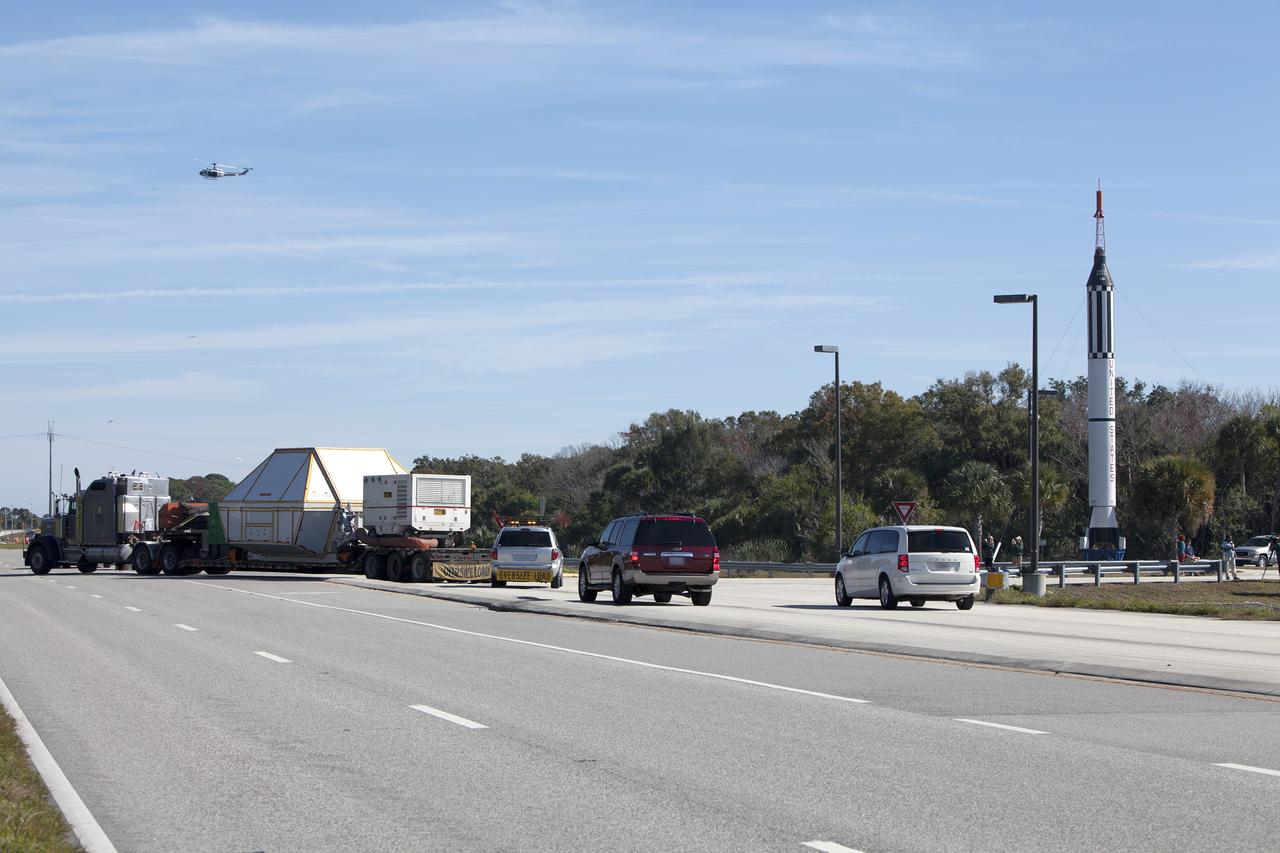
CAPE CANAVERAL, Fla. -- NASA's Orion crew module, enclosed in its crew module transportation fixture and secured on a flatbed truck nears the entrance gate to Kennedy Space Center in Florida. In the background is a full-scale mockup of the Mercury Redstone rocket that boosted NASA astronauts Alan Shepard and Virgil "Gus" Grissom on their 1961 sub-orbital missions that began America's human spaceflight program. Orion made the overland trip from Naval Base San Diego in California. Orion was recovered from the Pacific Ocean after completing a two-orbit, four-and-a-half hour mission Dec. 5 to test systems critical to crew safety, including the launch abort system, the heat shield and the parachute system. The Ground Systems Development and Operations Program led the recovery, offload and transportation efforts. For more information, visit www.nasa.gov/orion. Photo credit: NASA/Dimitri Gerondidakis
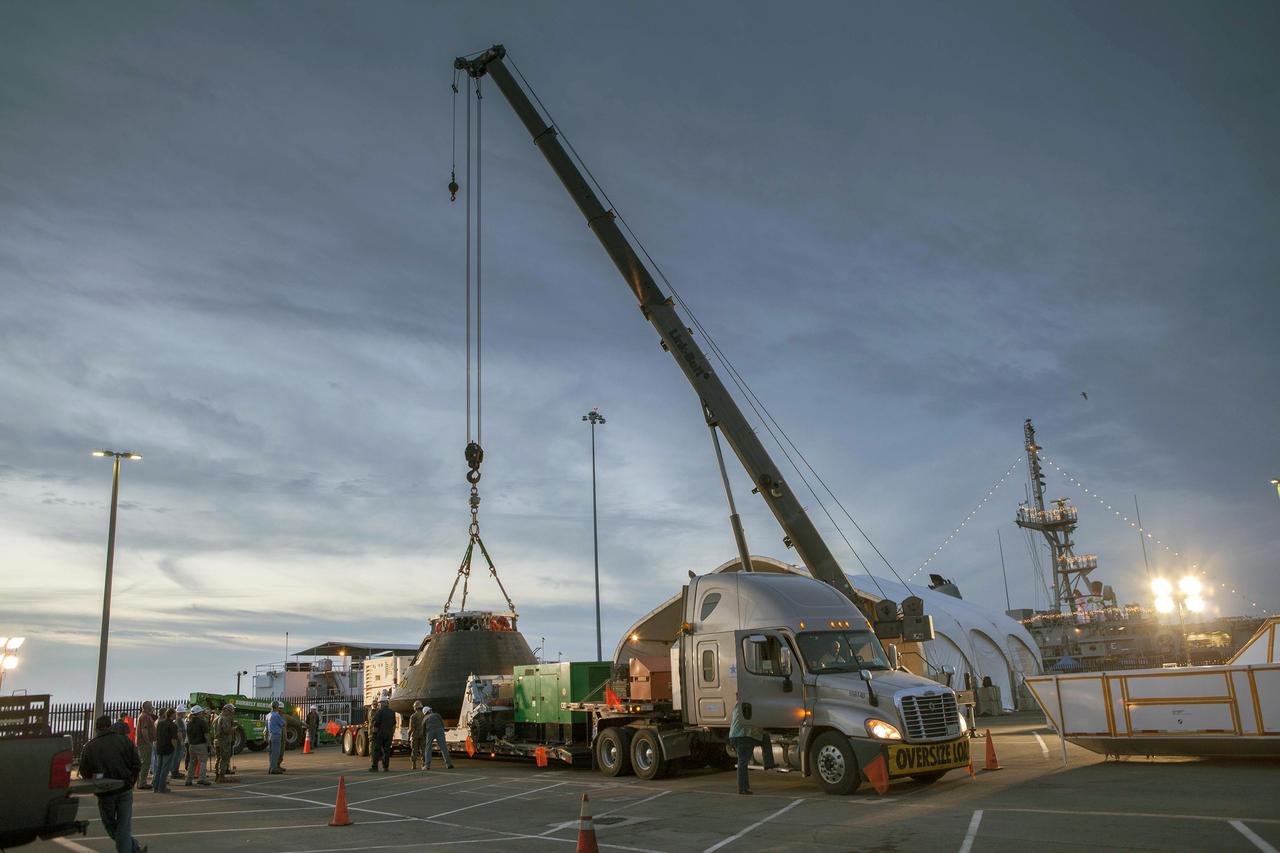
SAN DIEGO, Calif. -- The Orion crew module is being lowered onto the crew module transportation fixture at the Mole Pier at Naval Base San Diego in California. The fixture has been secured on the back of a flatbed truck. Orion is being prepared for the overland trip back to NASA's Kennedy Space Center in Florida. Orion was recovered from the Pacific Ocean after completing a two-orbit, four-and-a-half hour mission Dec. 5 to test systems critical to crew safety, including the launch abort system, the heat shield and the parachute system. NASA, the U.S. Navy and Lockheed Martin coordinated efforts to recover Orion. The Ground Systems Development and Operations Program led the recovery, offload and pre-transportation efforts. For more information, visit www.nasa.gov/orion Photo credit: NASA/Cory Huston
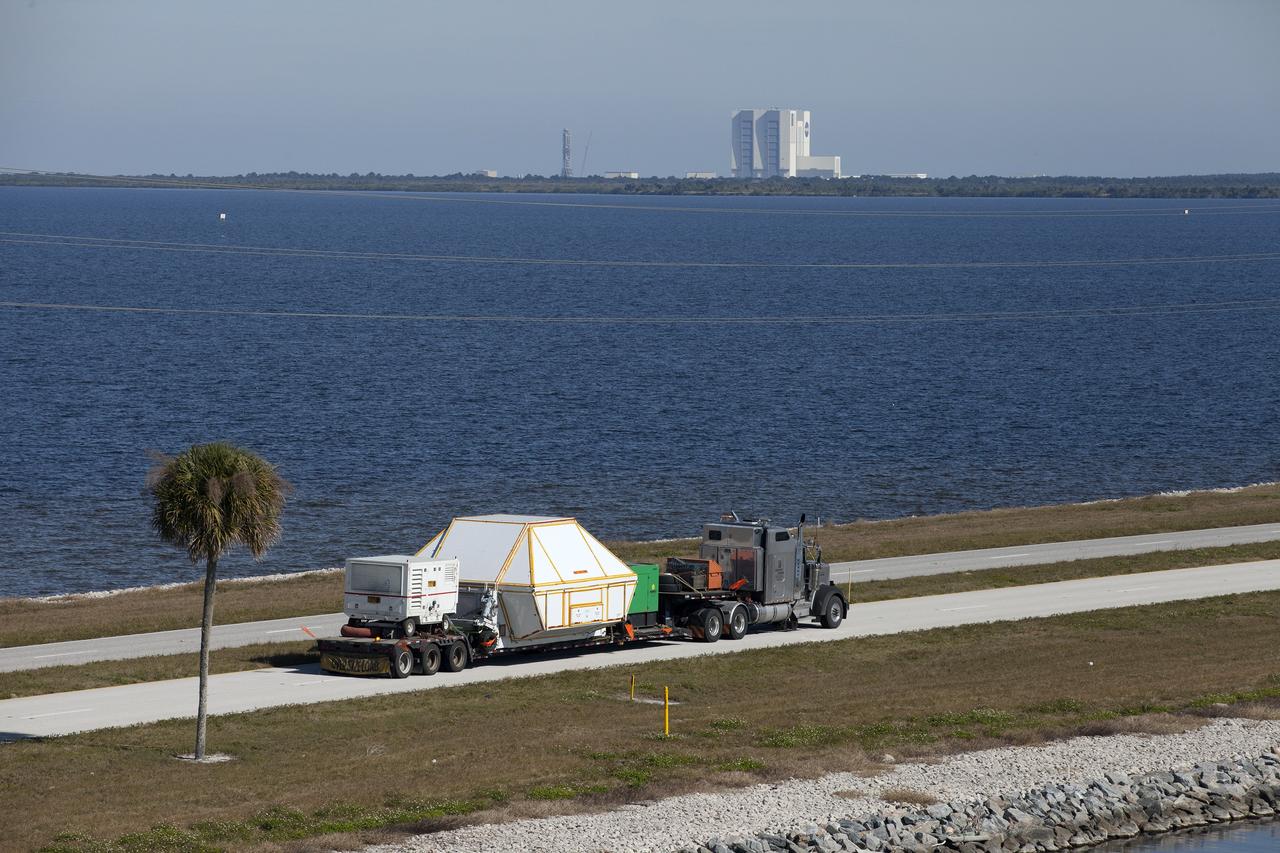
CAPE CANAVERAL, Fla. -- An aerial view near NASA's Kennedy Space Center Visitor Complex reveals the Orion crew module, enclosed in its crew module transportation fixture and secured on a flatbed truck that is proceeding along the NASA Causeway to the entrance gate to Kennedy Space Center in Florida. Across the inland waterway is the iconic Vehicle Assembly Building. Orion made the 2,700 mile overland trip from Naval Base San Diego in California. The spacecraft was recovered from the Pacific Ocean after completing a two-orbit, four-and-a-half hour mission Dec. 5 to test systems critical to crew safety, including the launch abort system, the heat shield and the parachute system. The Ground Systems Development and Operations Program led the recovery, offload and transportation efforts. For more information, visit www.nasa.gov/orion. Photo credit: NASA/Kim Shiflett
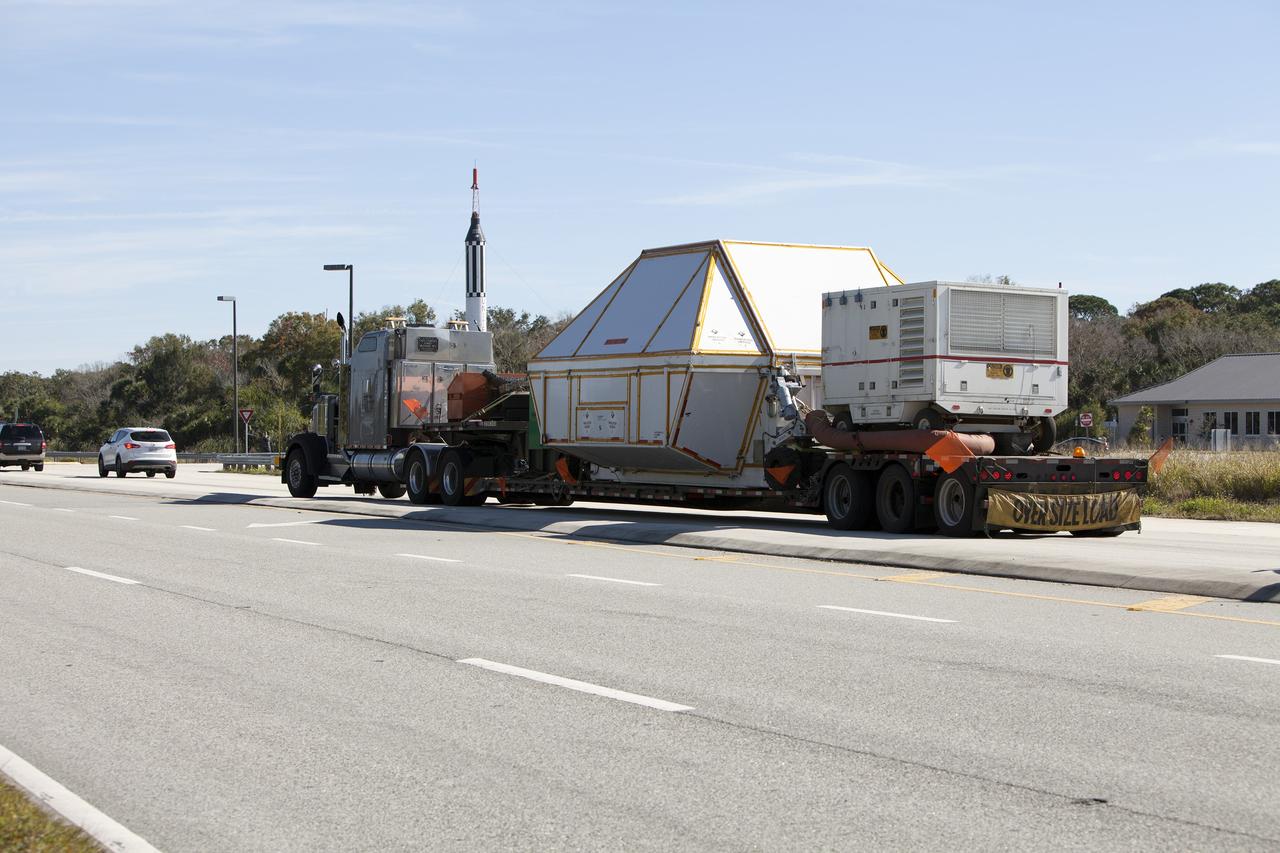
CAPE CANAVERAL, Fla. -- NASA's Orion crew module, enclosed in its crew module transportation fixture and secured on a flatbed truck nears the entrance gate to Kennedy Space Center in Florida. In the background is a full-scale mockup of the Mercury Redstone rocket that boosted NASA astronauts Alan Shepard and Virgil "Gus" Grissom on their 1961 sub-orbital missions that began America's human spaceflight program. Orion made the overland trip from Naval Base San Diego in California. Orion was recovered from the Pacific Ocean after completing a two-orbit, four-and-a-half hour mission Dec. 5 to test systems critical to crew safety, including the launch abort system, the heat shield and the parachute system. The Ground Systems Development and Operations Program led the recovery, offload and transportation efforts. For more information, visit www.nasa.gov/orion. Photo credit: NASA/Dimitri Gerondidakis
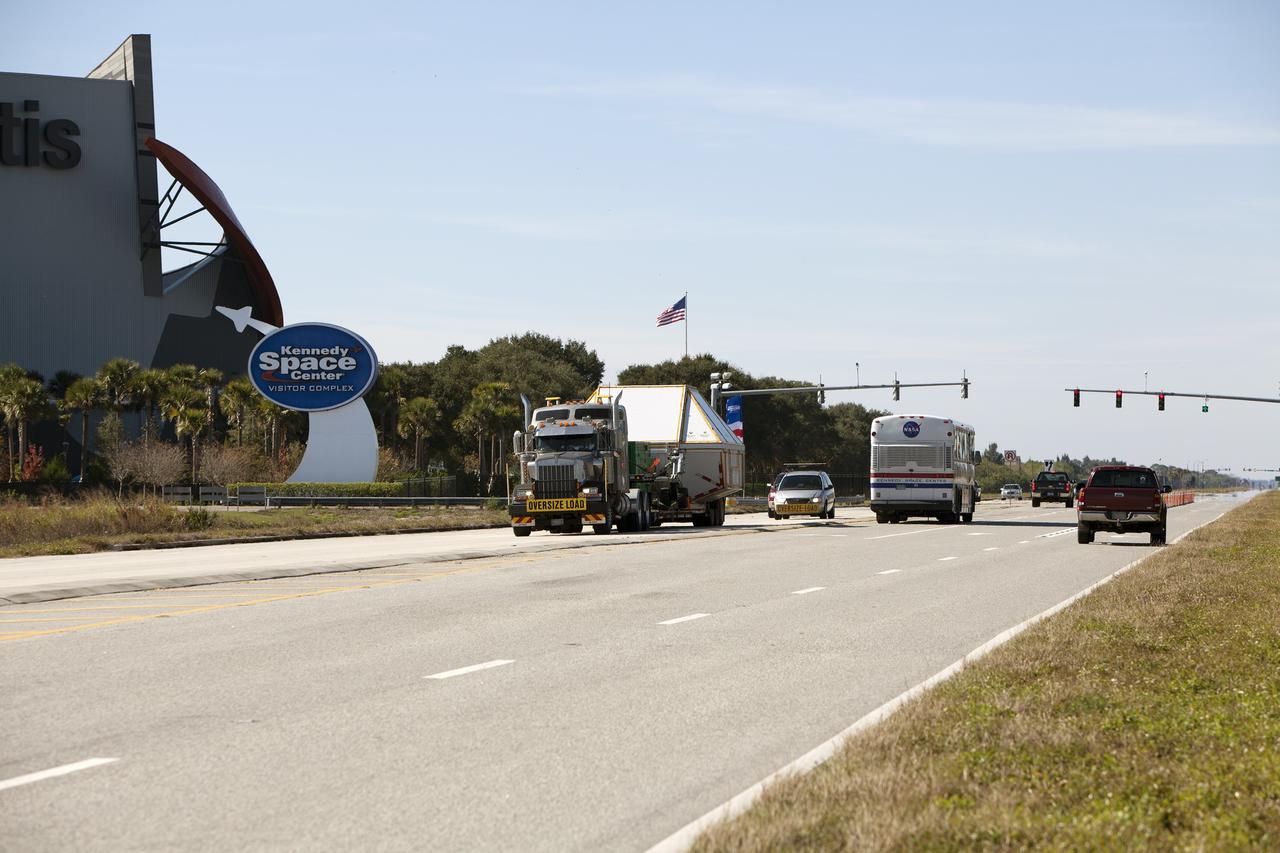
CAPE CANAVERAL, Fla. -- NASA's Orion crew module, enclosed in its crew module transportation fixture and secured on a flatbed truck passes by the Space Shuttle Atlantis building at the Kennedy Space Center Visitor Complex on its way to the entrance gate to Kennedy Space Center in Florida. Orion made the 2,700 mile overland trip from Naval Base San Diego in California. Orion was recovered from the Pacific Ocean after completing a two-orbit, four-and-a-half hour mission Dec. 5 to test systems critical to crew safety, including the launch abort system, the heat shield and the parachute system. The Ground Systems Development and Operations Program led the recovery, offload and transportation efforts. For more information, visit www.nasa.gov/orion. Photo credit: NASA/Dimitri Gerondidakis
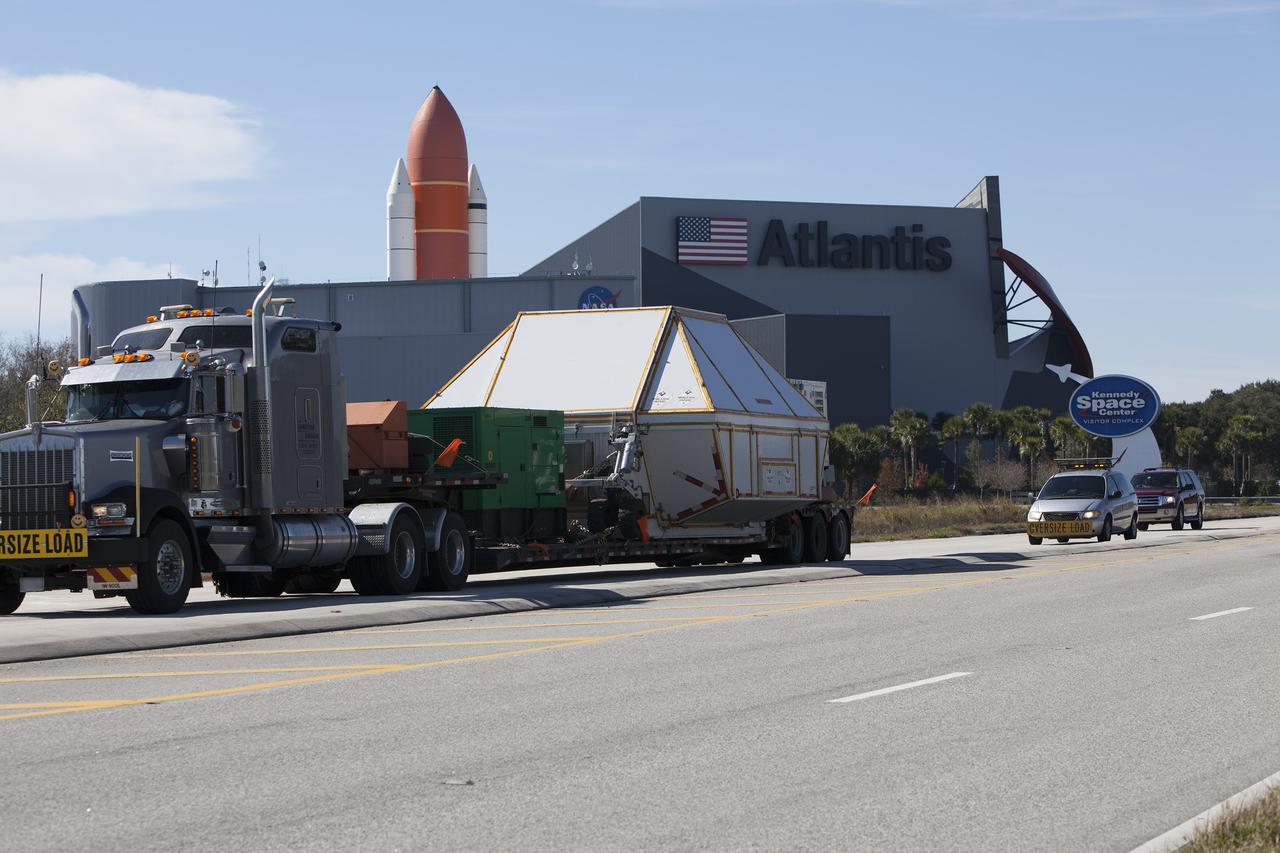
CAPE CANAVERAL, Fla. -- NASA's Orion crew module, enclosed in its crew module transportation fixture and secured on a flatbed truck passes by the Space Shuttle Atlantis building at the Kennedy Space Center Visitor Complex on its way to the entrance gate to Kennedy Space Center in Florida. Orion made the 2,700 mile overland trip from Naval Base San Diego in California. Orion was recovered from the Pacific Ocean after completing a two-orbit, four-and-a-half hour mission Dec. 5 to test systems critical to crew safety, including the launch abort system, the heat shield and the parachute system. The Ground Systems Development and Operations Program led the recovery, offload and transportation efforts. For more information, visit www.nasa.gov/orion. Photo credit: NASA/Dimitri Gerondidakis
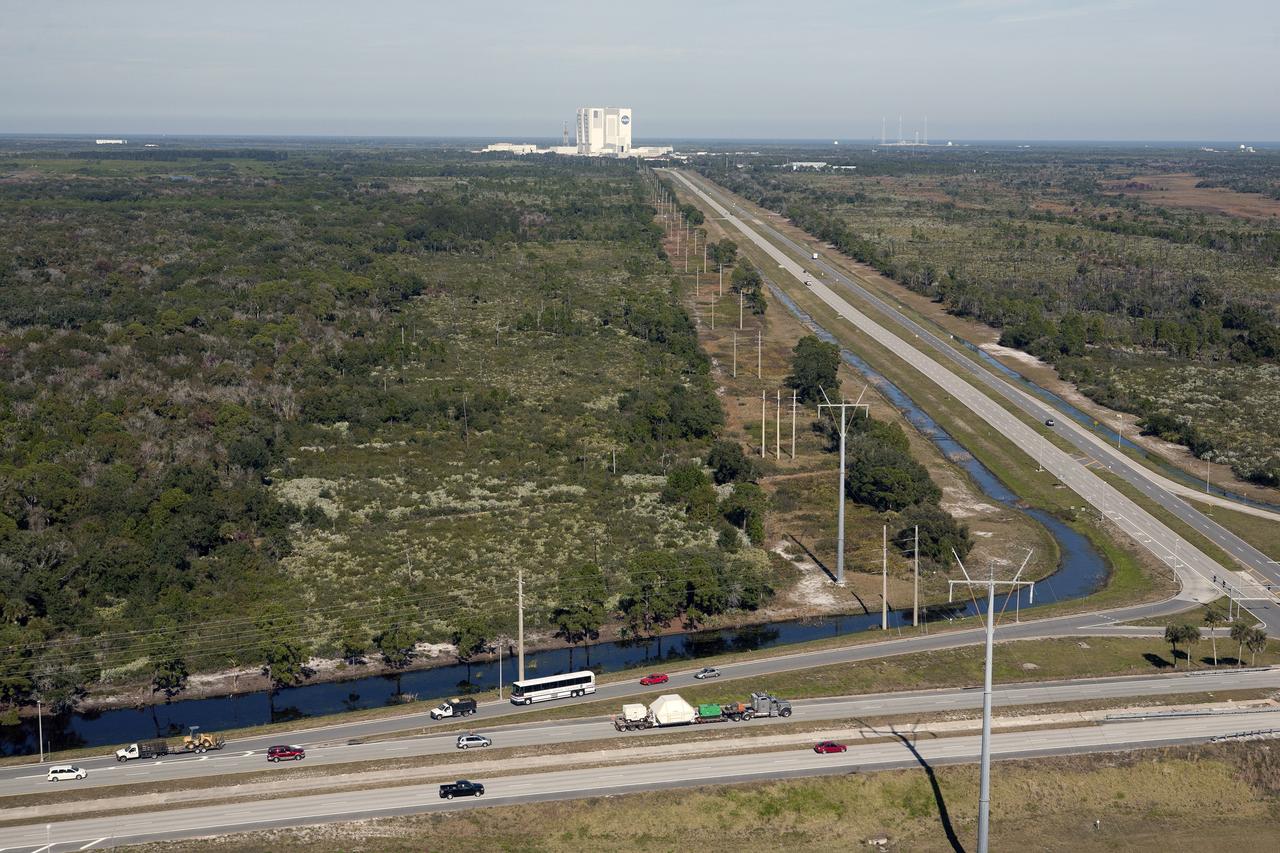
CAPE CANAVERAL, Fla. -- An aerial view reveals the Orion crew module, enclosed in its crew module transportation fixture and secured on a flatbed truck that is proceeding along the NASA Causeway at Kennedy Space Center in Florida. In the background is the iconic Vehicle Assembly Building. Orion made the 2,700 mile overland trip from Naval Base San Diego in California. The spacecraft was recovered from the Pacific Ocean after completing a two-orbit, four-and-a-half hour mission Dec. 5 to test systems critical to crew safety, including the launch abort system, the heat shield and the parachute system. The Ground Systems Development and Operations Program led the recovery, offload and transportation efforts. For more information, visit www.nasa.gov/orion. Photo credit: NASA/Kim Shiflett
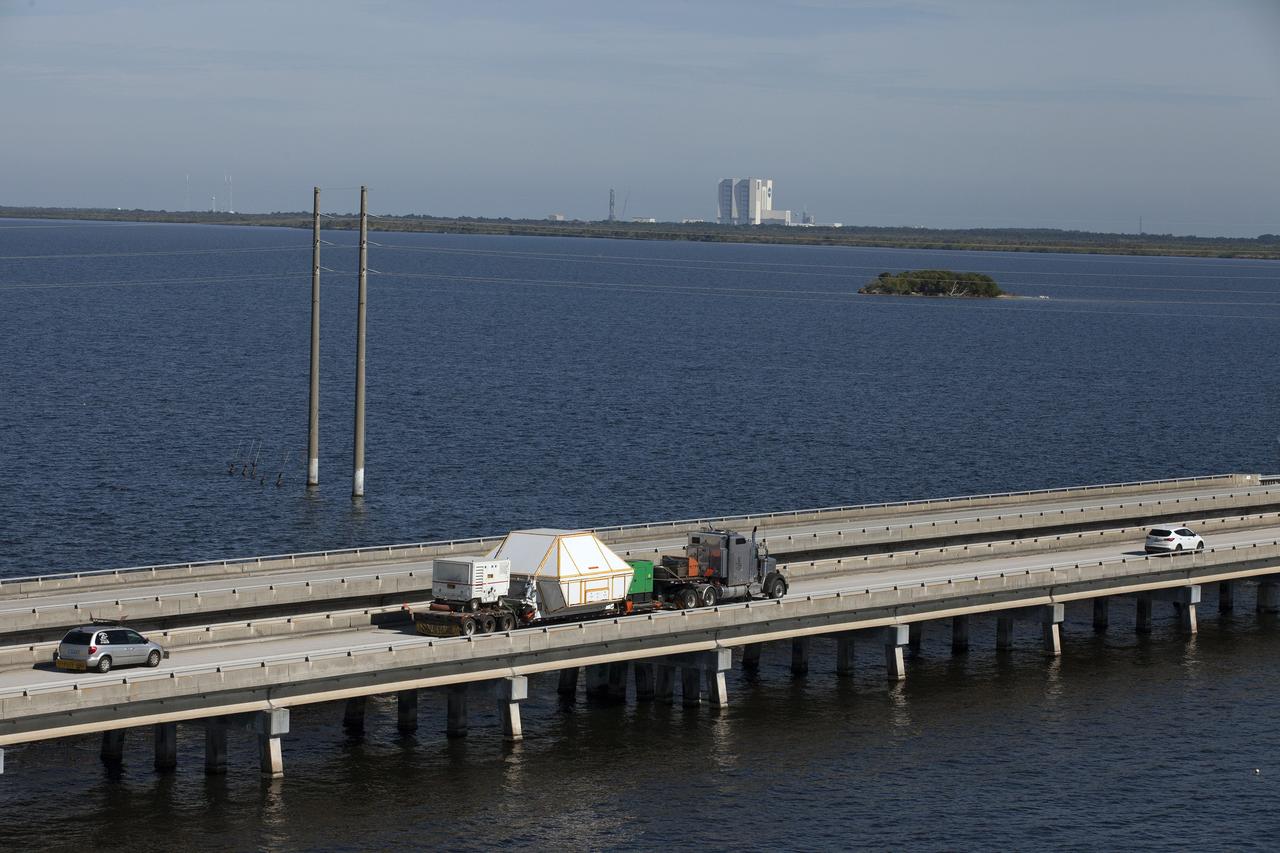
CAPE CANAVERAL, Fla. -- An aerial view near NASA's Kennedy Space Center Visitor Complex reveals the Orion crew module, enclosed in its crew module transportation fixture and secured on a flatbed truck that is proceeding along the NASA Causeway to the entrance gate to Kennedy Space Center in Florida. Across the inland waterway is the iconic Vehicle Assembly Building. Orion made the 2,700 mile overland trip from Naval Base San Diego in California. The spacecraft was recovered from the Pacific Ocean after completing a two-orbit, four-and-a-half hour mission Dec. 5 to test systems critical to crew safety, including the launch abort system, the heat shield and the parachute system. The Ground Systems Development and Operations Program led the recovery, offload and transportation efforts. For more information, visit www.nasa.gov/orion. Photo credit: NASA/Kim Shiflett
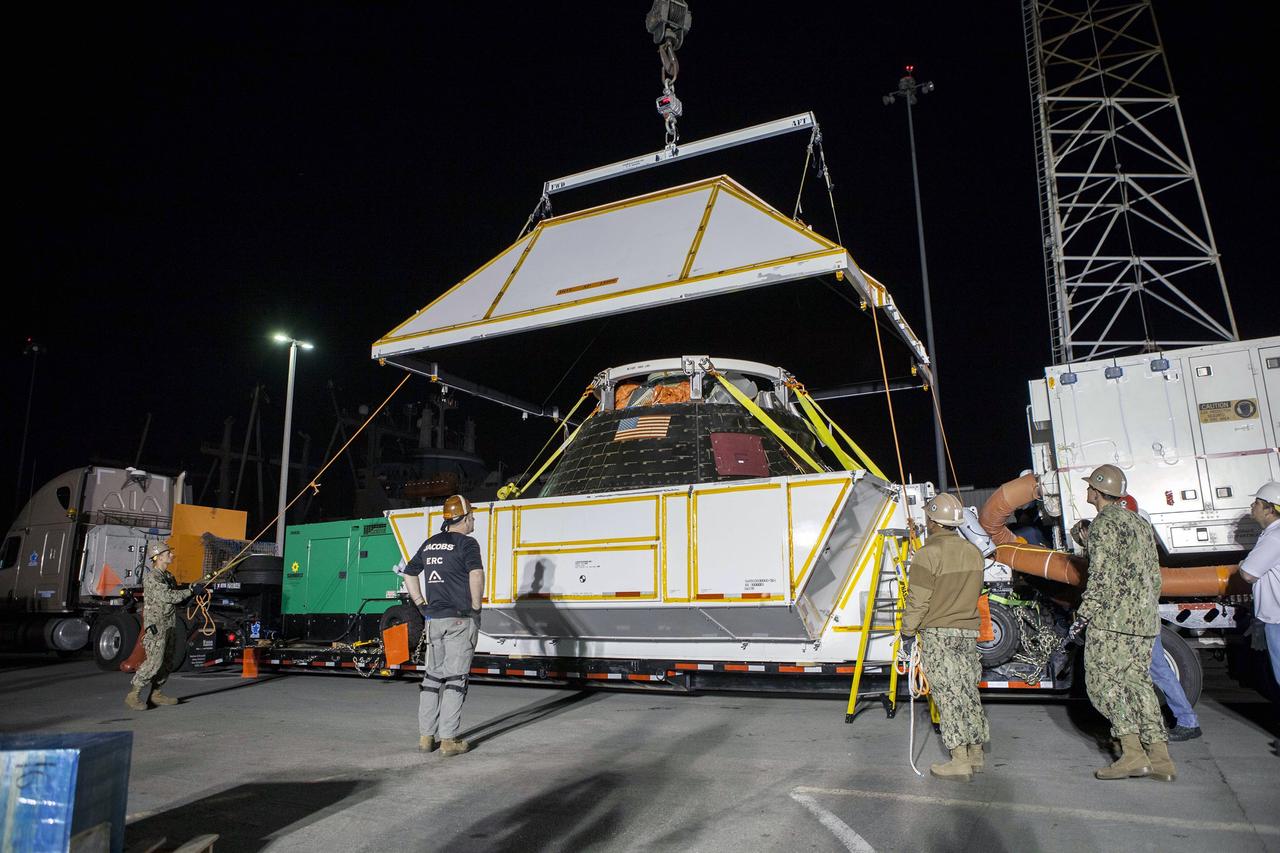
SAN DIEGO, Calif. -- The Orion crew module has been lowered and secured in the crew module transportation fixture at the Mole Pier at Naval Base San Diego in California. The fixture has been secured on the back of a flatbed truck and the cover is being lowered over the spacecraft. Orion is being prepared for the overland trip back to NASA's Kennedy Space Center in Florida. Orion was recovered from the Pacific Ocean after completing a two-orbit, four-and-a-half hour mission Dec. 5 to test systems critical to crew safety, including the launch abort system, the heat shield and the parachute system. NASA, the U.S. Navy and Lockheed Martin coordinated efforts to recover Orion. The Ground Systems Development and Operations Program led the recovery, offload and pre-transportation efforts. For more information, visit www.nasa.gov/orion Photo credit: NASA/Cory Huston
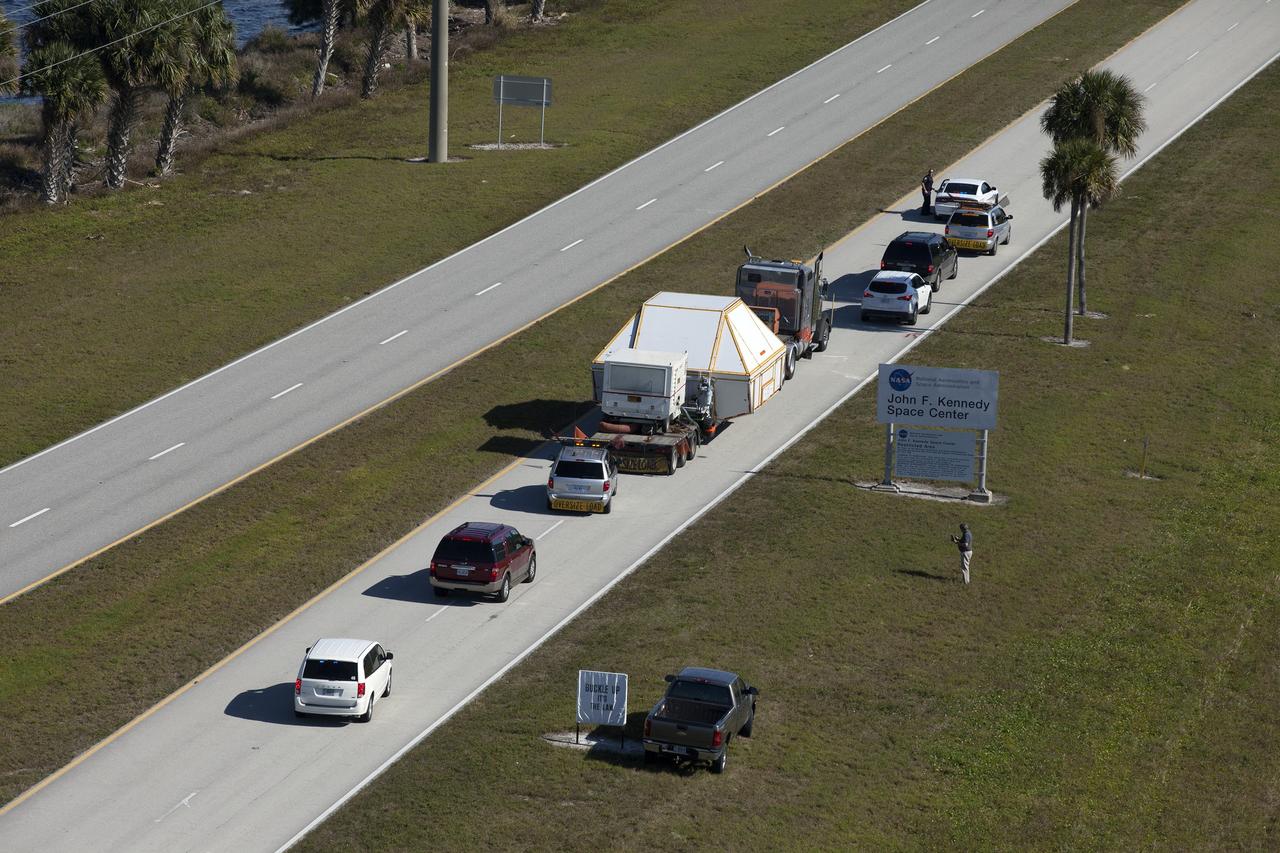
CAPE CANAVERAL, Fla. -- An aerial view near NASA's Kennedy Space Center Visitor Complex reveals the Orion crew module, enclosed in its crew module transportation fixture and secured on a flatbed truck that is proceeding onto the NASA Causeway that leads to the entrance gate to Kennedy Space Center in Florida. Orion made the 2,700 mile overland trip from Naval Base San Diego in California. The spacecraft was recovered from the Pacific Ocean after completing a two-orbit, four-and-a-half hour mission Dec. 5 to test systems critical to crew safety, including the launch abort system, the heat shield and the parachute system. The Ground Systems Development and Operations Program led the recovery, offload and transportation efforts. For more information, visit www.nasa.gov/orion. Photo credit: NASA/Kim Shiflett
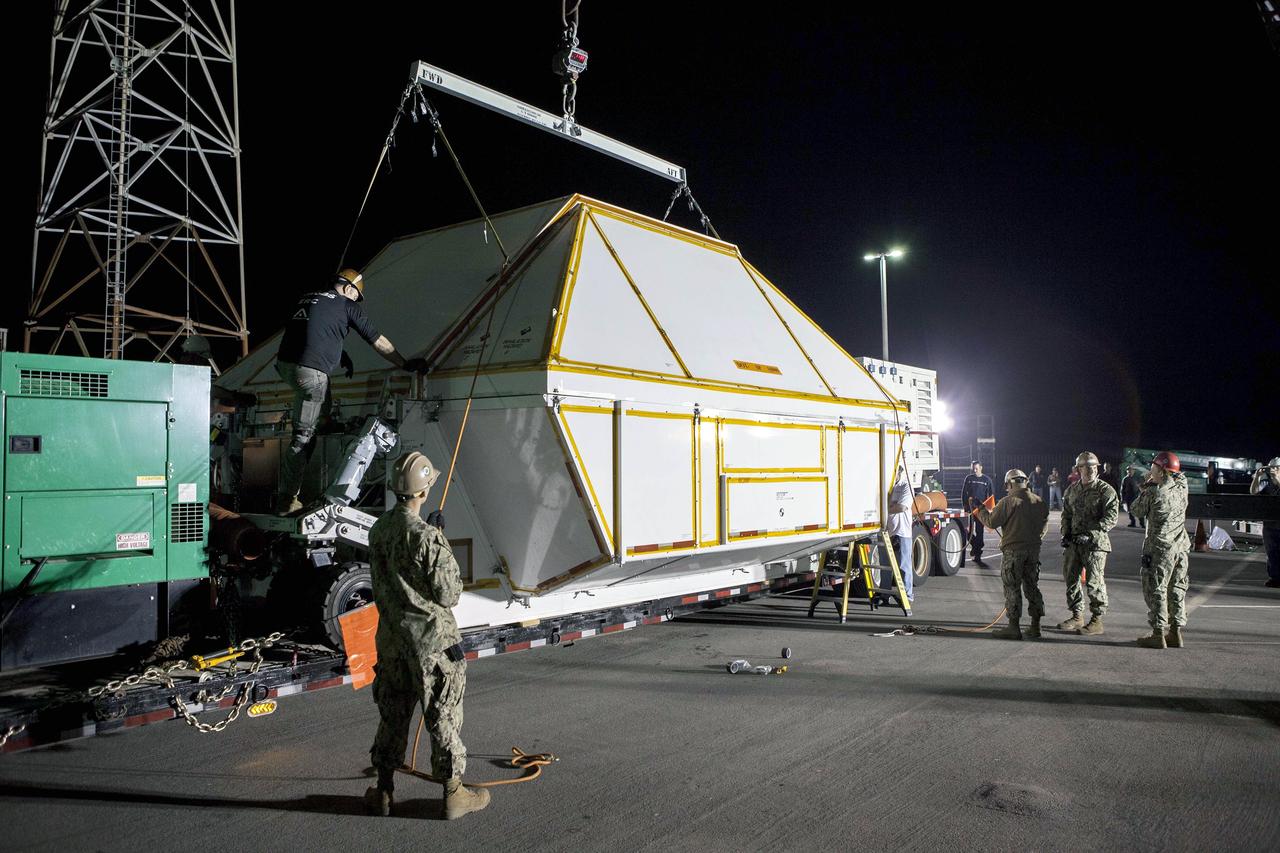
SAN DIEGO, Calif. -- The Orion crew module has been secured in the crew module transportation fixture at the Mole Pier at Naval Base San Diego in California. The fixture has been secured on the back of a flatbed truck and the cover has been lowered over the spacecraft. Orion is being prepared for the overland trip back to NASA's Kennedy Space Center in Florida. Orion was recovered from the Pacific Ocean after completing a two-orbit, four-and-a-half hour mission Dec. 5 to test systems critical to crew safety, including the launch abort system, the heat shield and the parachute system. NASA, the U.S. Navy and Lockheed Martin coordinated efforts to recover Orion. The Ground Systems Development and Operations Program led the recovery, offload and pre-transportation efforts. For more information, visit www.nasa.gov/orion Photo credit: NASA/Cory Huston
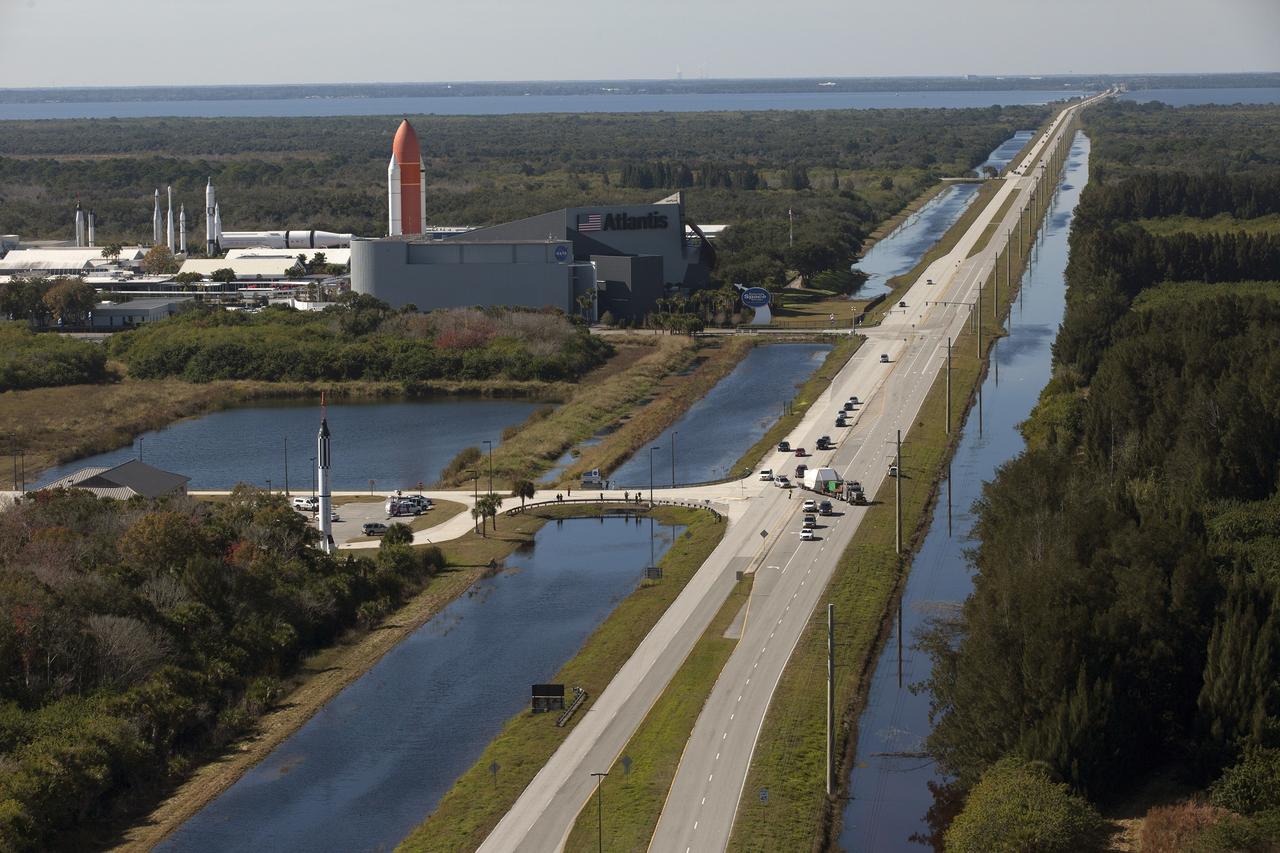
CAPE CANAVERAL, Fla. -- In this aerial view, NASA's Orion crew module, enclosed in its crew module transportation fixture and secured on a flatbed truck is passing the Kennedy Space Center Visitor Complex on its way to the entrance gate to Kennedy Space Center in Florida. In view is the Space Shuttle Atlantis facility. Orion made the 2,700 mile overland trip from Naval Base San Diego in California. Orion was recovered from the Pacific Ocean after completing a two-orbit, four-and-a-half hour mission Dec. 5 to test systems critical to crew safety, including the launch abort system, the heat shield and the parachute system. The Ground Systems Development and Operations Program led the recovery, offload and transportation efforts. For more information, visit www.nasa.gov/orion. Photo credit: NASA/Kim Shiflett
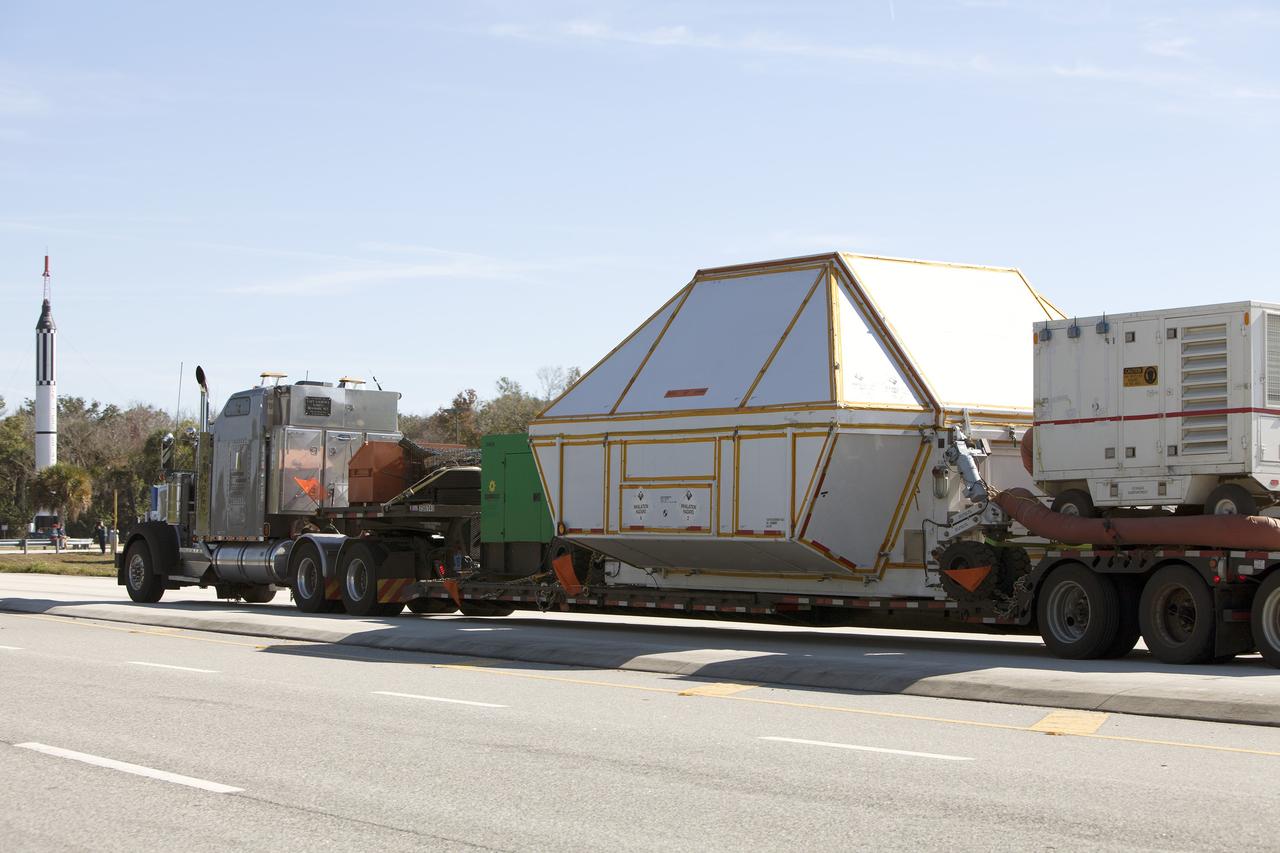
CAPE CANAVERAL, Fla. -- NASA's Orion crew module, enclosed in its crew module transportation fixture and secured on a flatbed truck nears the entrance gate to Kennedy Space Center in Florida. In the background is a full-scale mockup of the Mercury Redstone rocket that boosted NASA astronauts Alan Shepard and Virgil "Gus" Grissom on their 1961 sub-orbital missions that began America's human spaceflight program. Orion made the overland trip from Naval Base San Diego in California. Orion was recovered from the Pacific Ocean after completing a two-orbit, four-and-a-half hour mission Dec. 5 to test systems critical to crew safety, including the launch abort system, the heat shield and the parachute system. The Ground Systems Development and Operations Program led the recovery, offload and transportation efforts. For more information, visit www.nasa.gov/orion. Photo credit: NASA/Dimitri Gerondidakis
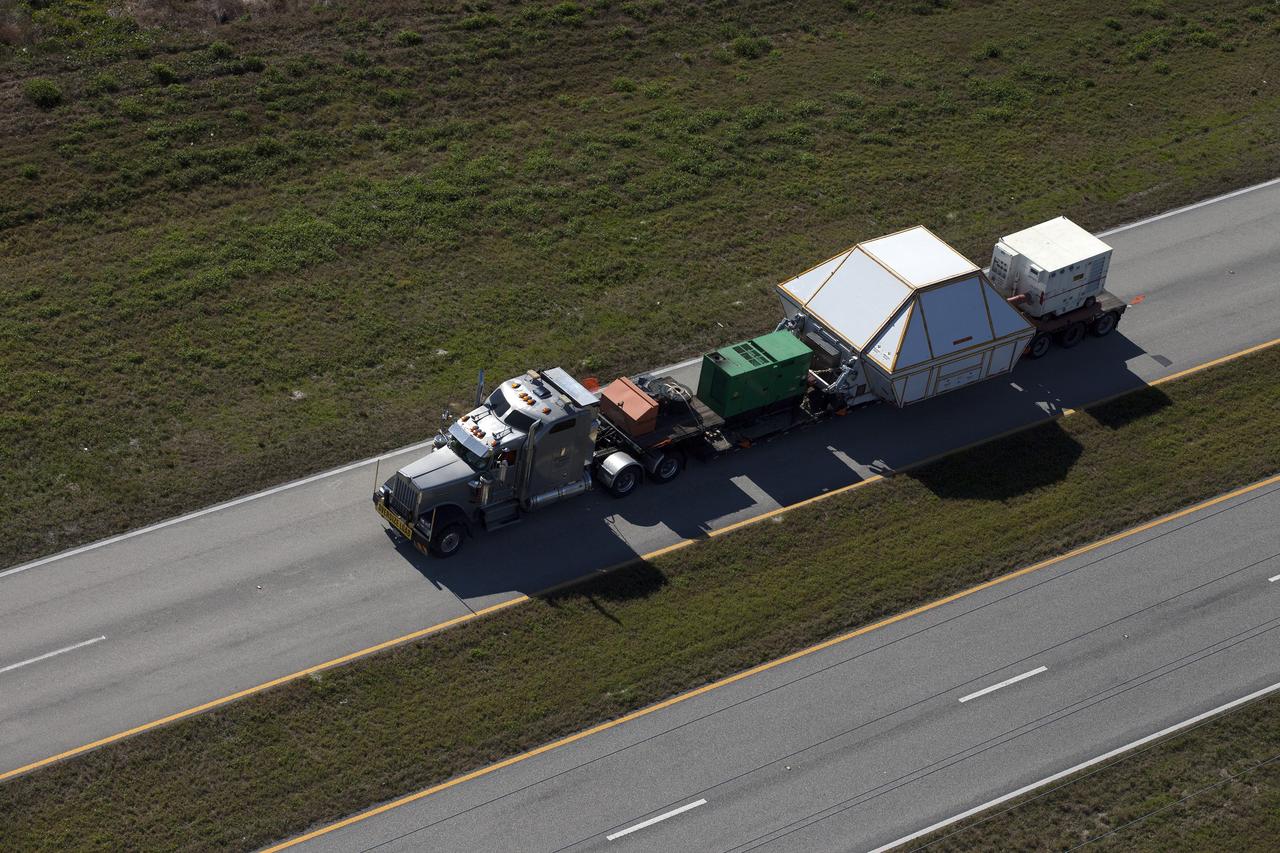
CAPE CANAVERAL, Fla. -- An aerial view near NASA's Kennedy Space Center Visitor Complex reveals the Orion crew module, enclosed in its crew module transportation fixture and secured on a flatbed truck that is proceeding along the NASA Causeway to the entrance gate to Kennedy Space Center in Florida. Orion made the 2,700 mile overland trip from Naval Base San Diego in California. The spacecraft was recovered from the Pacific Ocean after completing a two-orbit, four-and-a-half hour mission Dec. 5 to test systems critical to crew safety, including the launch abort system, the heat shield and the parachute system. The Ground Systems Development and Operations Program led the recovery, offload and transportation efforts. For more information, visit www.nasa.gov/orion. Photo credit: NASA/Kim Shiflett
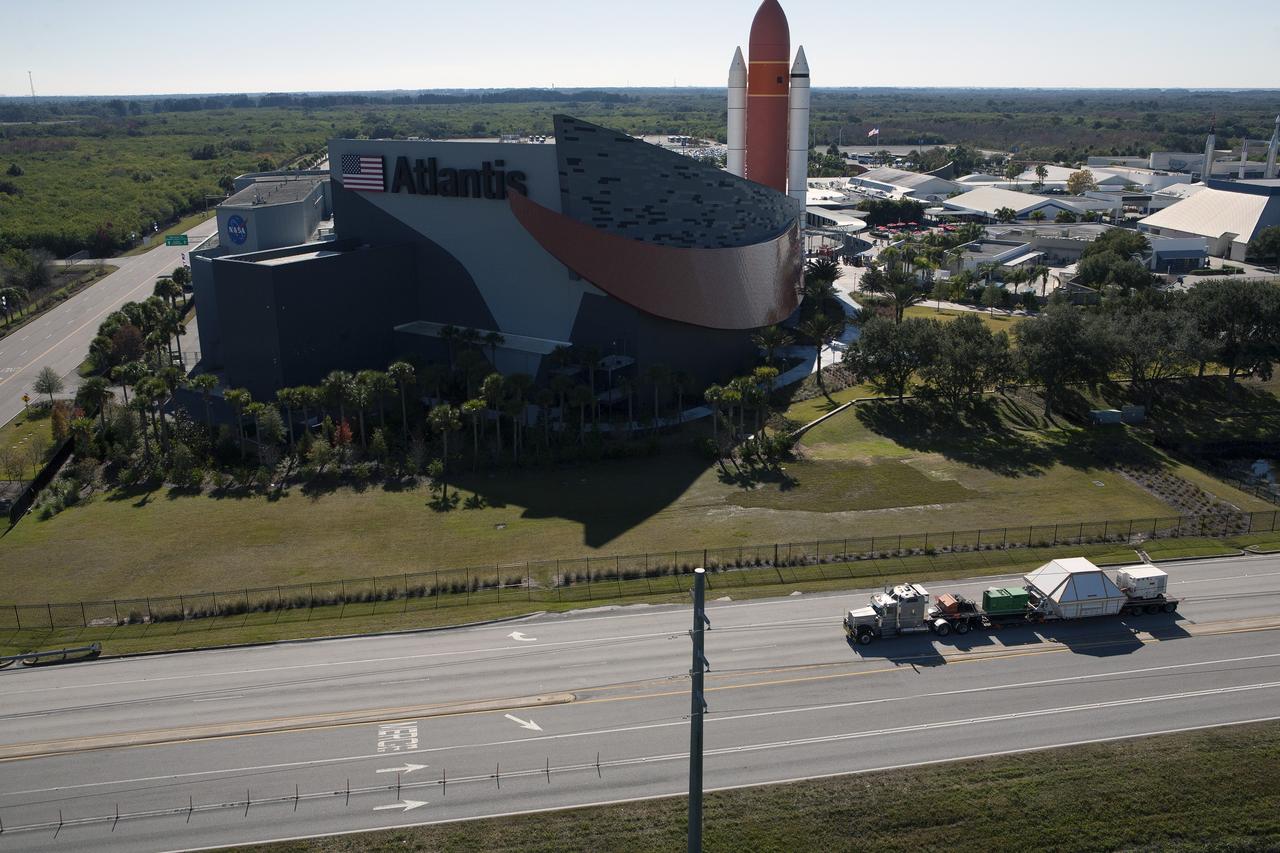
CAPE CANAVERAL, Fla. -- In this aerial view, NASA's Orion crew module, enclosed in its crew module transportation fixture and secured on a flatbed truck is passing the Kennedy Space Center Visitor Complex on its way to the entrance gate to Kennedy Space Center in Florida. In view is the Space Shuttle Atlantis facility. Orion made the 2,700 mile overland trip from Naval Base San Diego in California. Orion was recovered from the Pacific Ocean after completing a two-orbit, four-and-a-half hour mission Dec. 5 to test systems critical to crew safety, including the launch abort system, the heat shield and the parachute system. The Ground Systems Development and Operations Program led the recovery, offload and transportation efforts. For more information, visit www.nasa.gov/orion. Photo credit: NASA/Kim Shiflett
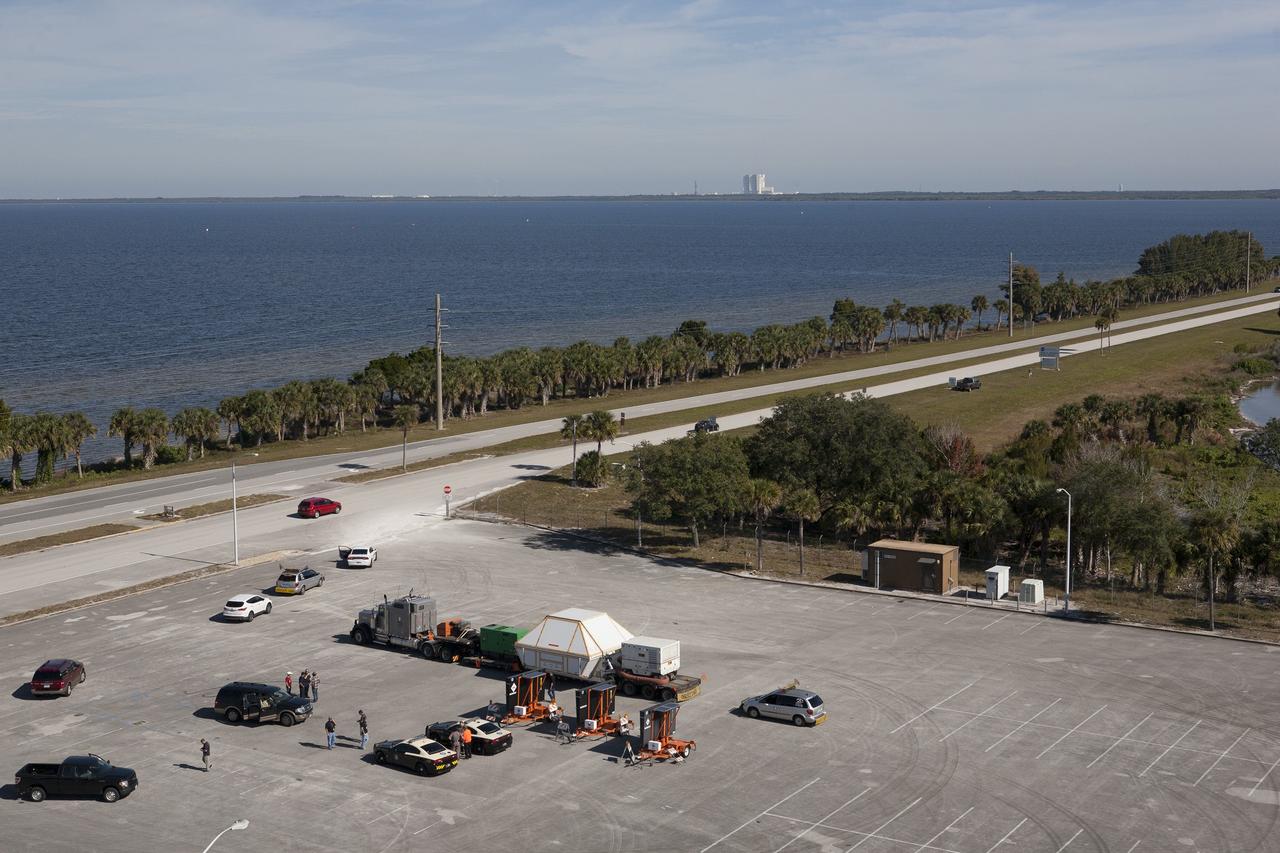
CAPE CANAVERAL, Fla. -- An aerial view near NASA's Kennedy Space Center Visitor Complex reveals the Orion crew module, enclosed in its crew module transportation fixture and secured on a flatbed truck that is preparing to pull onto the NASA Causeway that leads to the entrance gate to Kennedy Space Center in Florida. Orion made the 2,700 mile overland trip from Naval Base San Diego in California. The spacecraft was recovered from the Pacific Ocean after completing a two-orbit, four-and-a-half hour mission Dec. 5 to test systems critical to crew safety, including the launch abort system, the heat shield and the parachute system. The Ground Systems Development and Operations Program led the recovery, offload and transportation efforts. For more information, visit www.nasa.gov/orion. Photo credit: NASA/Kim Shiflett
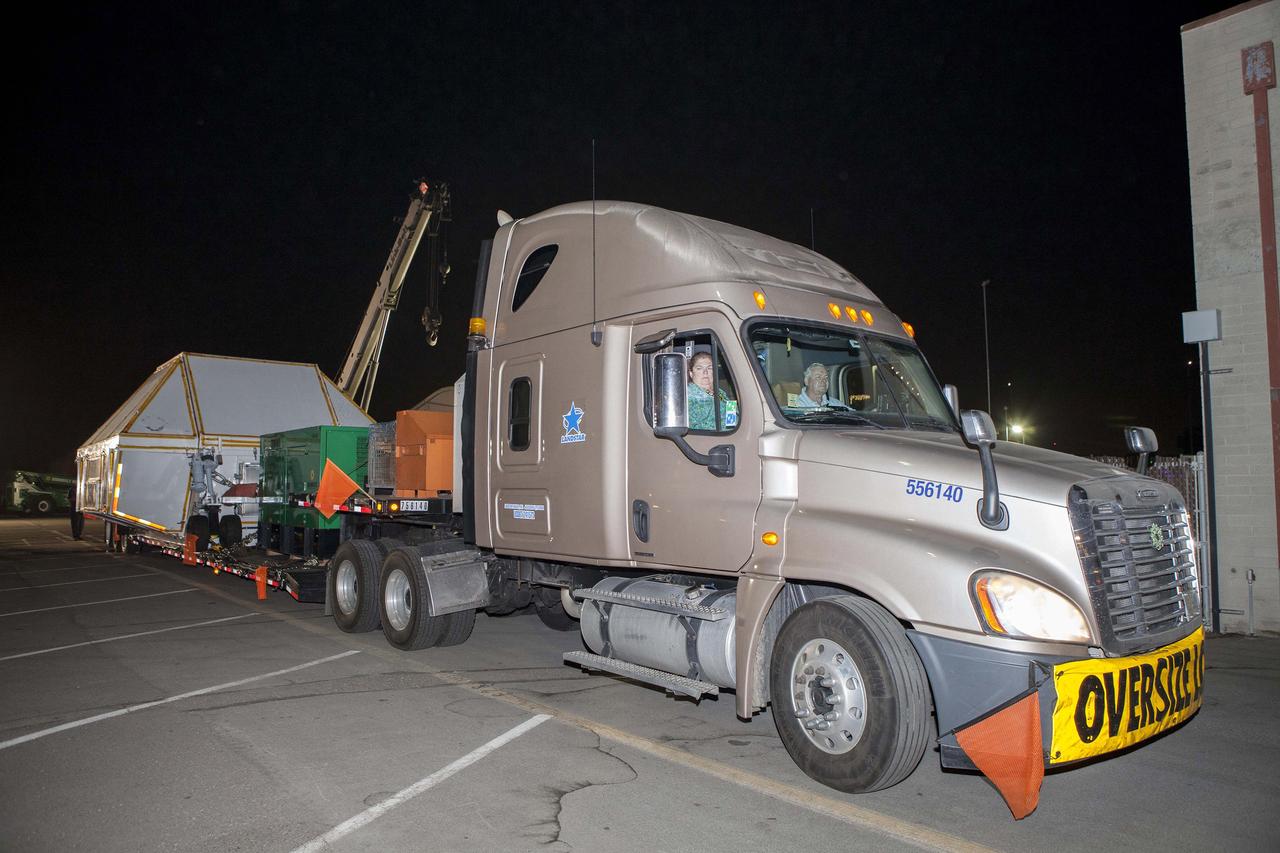
SAN DIEGO, Calif. -- Drivers in a flatbed truck begin the overland trek back to NASA's Kennedy Space Center in Florida, carrying the Orion crew module secured inside the crew module transportation fixture. The truck is leaving the Mole Pier at Naval Base San Diego in California. Orion was recovered from the Pacific Ocean after completing a two-orbit, four-and-a-half hour mission Dec. 5 to test systems critical to crew safety, including the launch abort system, the heat shield and the parachute system. NASA, the U.S. Navy and Lockheed Martin coordinated efforts to recover Orion. The Ground Systems Development and Operations Program led the recovery, offload and pre-transportation efforts. For more information, visit www.nasa.gov/orion Photo credit: NASA/Cory Huston
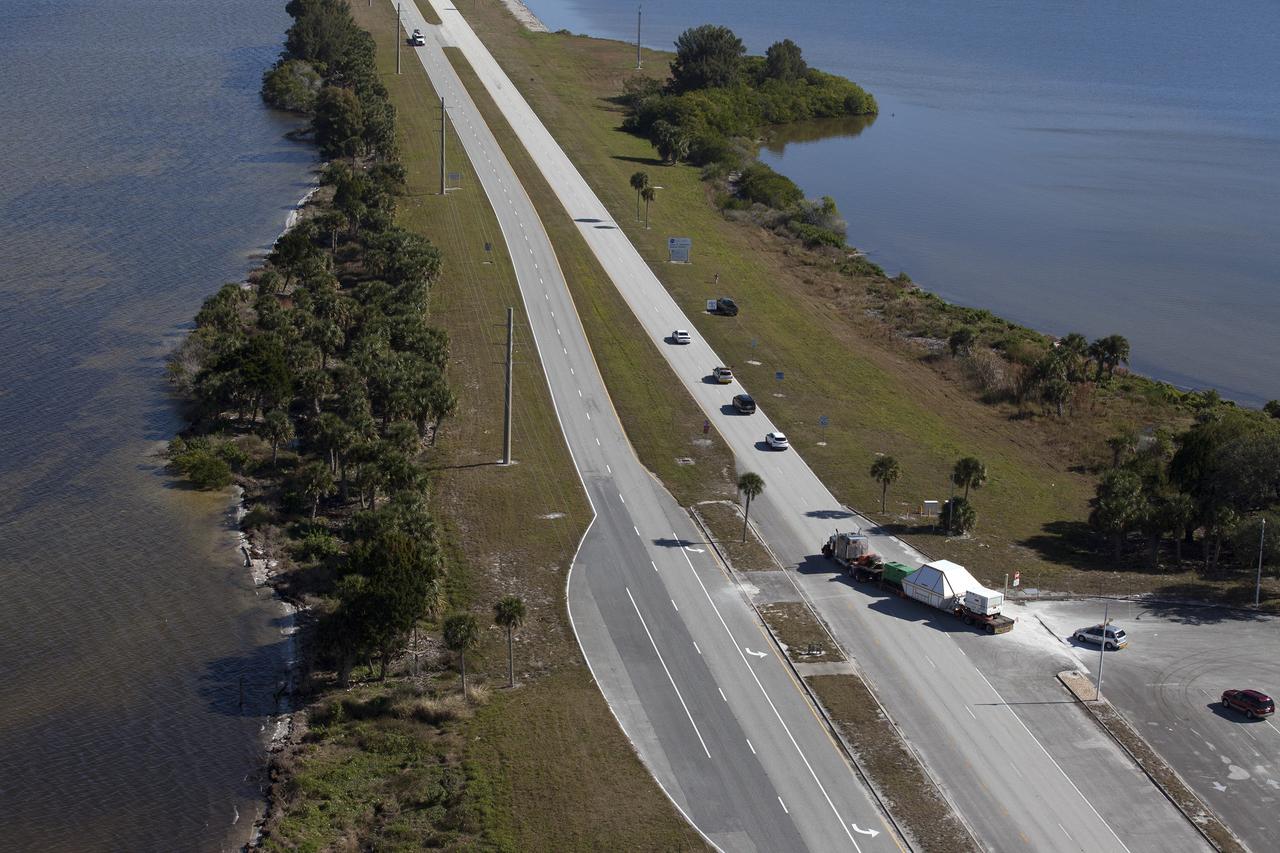
CAPE CANAVERAL, Fla. -- An aerial view near NASA's Kennedy Space Center Visitor Complex reveals the Orion crew module, enclosed in its crew module transportation fixture and secured on a flatbed truck that is proceeding onto the NASA Causeway that leads to the entrance gate to Kennedy Space Center in Florida. Orion made the 2,700 mile overland trip from Naval Base San Diego in California. The spacecraft was recovered from the Pacific Ocean after completing a two-orbit, four-and-a-half hour mission Dec. 5 to test systems critical to crew safety, including the launch abort system, the heat shield and the parachute system. The Ground Systems Development and Operations Program led the recovery, offload and transportation efforts. For more information, visit www.nasa.gov/orion. Photo credit: NASA/Kim Shiflett
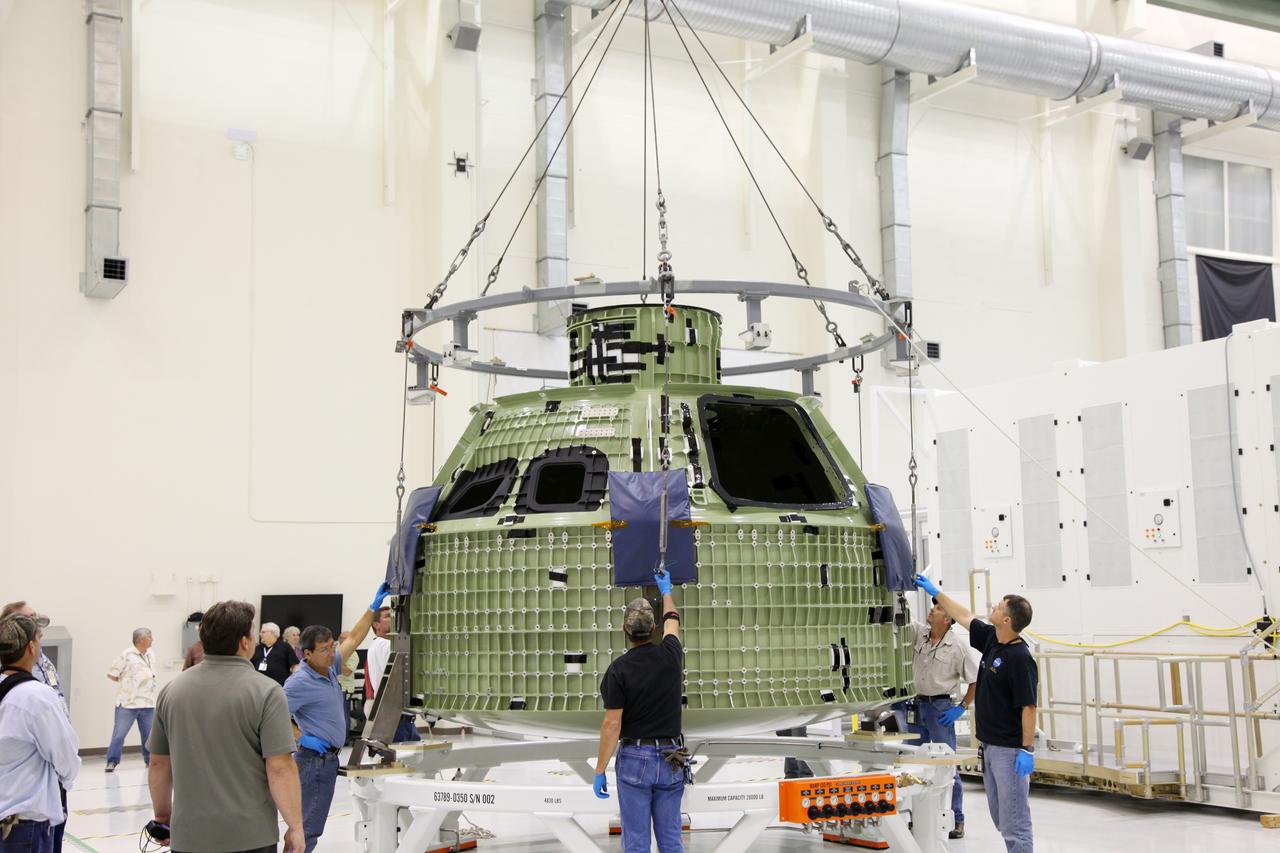
Orion EFT-1 Crew Module Being Uncrated
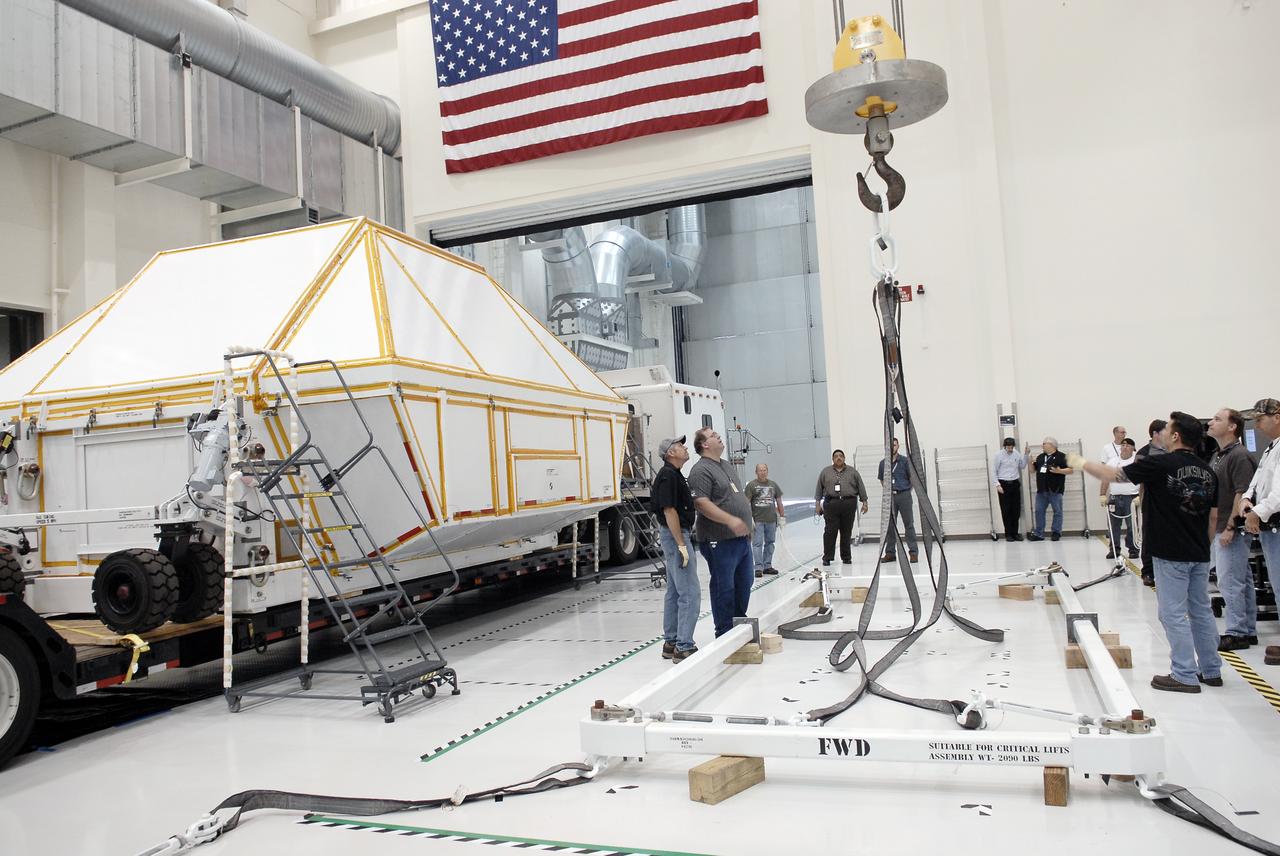
Orion EFT-1 Crew Module Uncrating
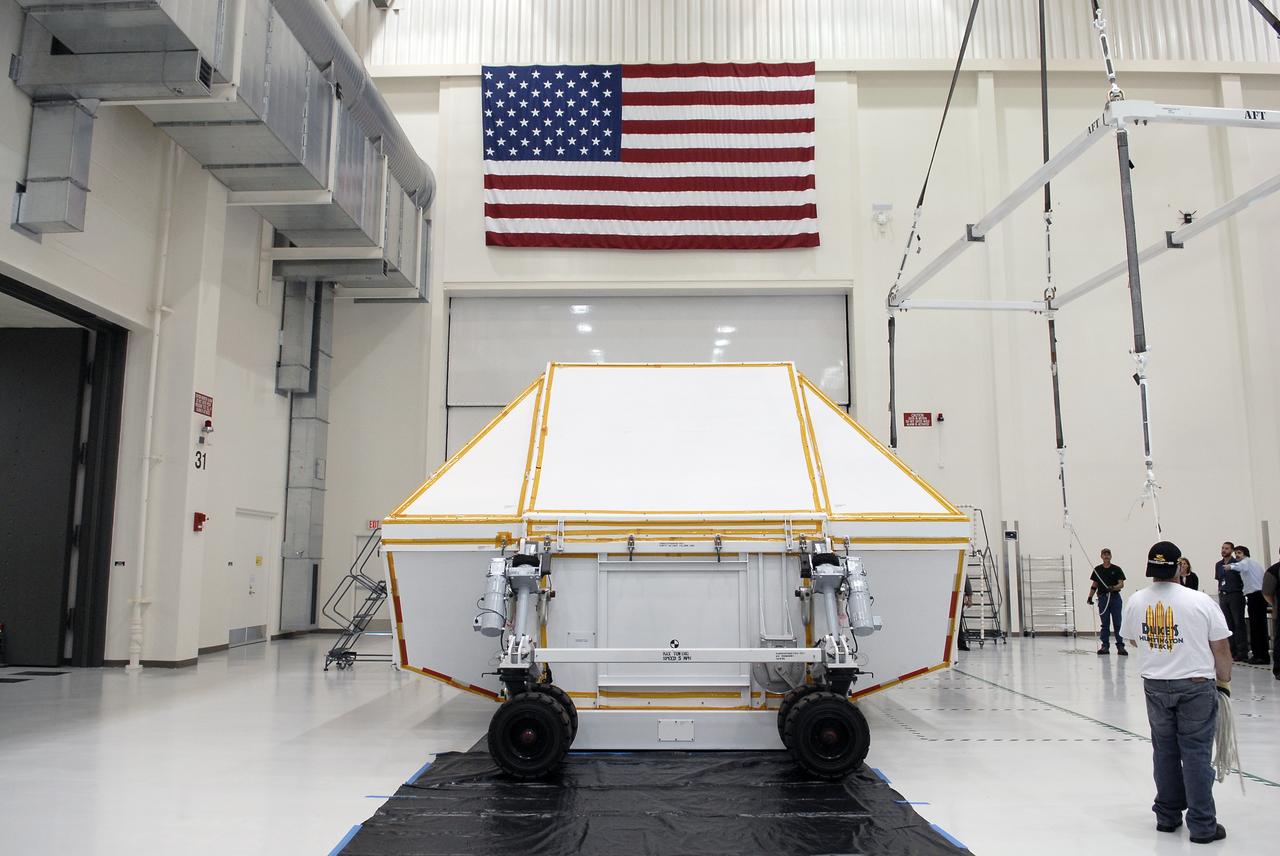
Orion EFT-1 Crew Module Uncrating
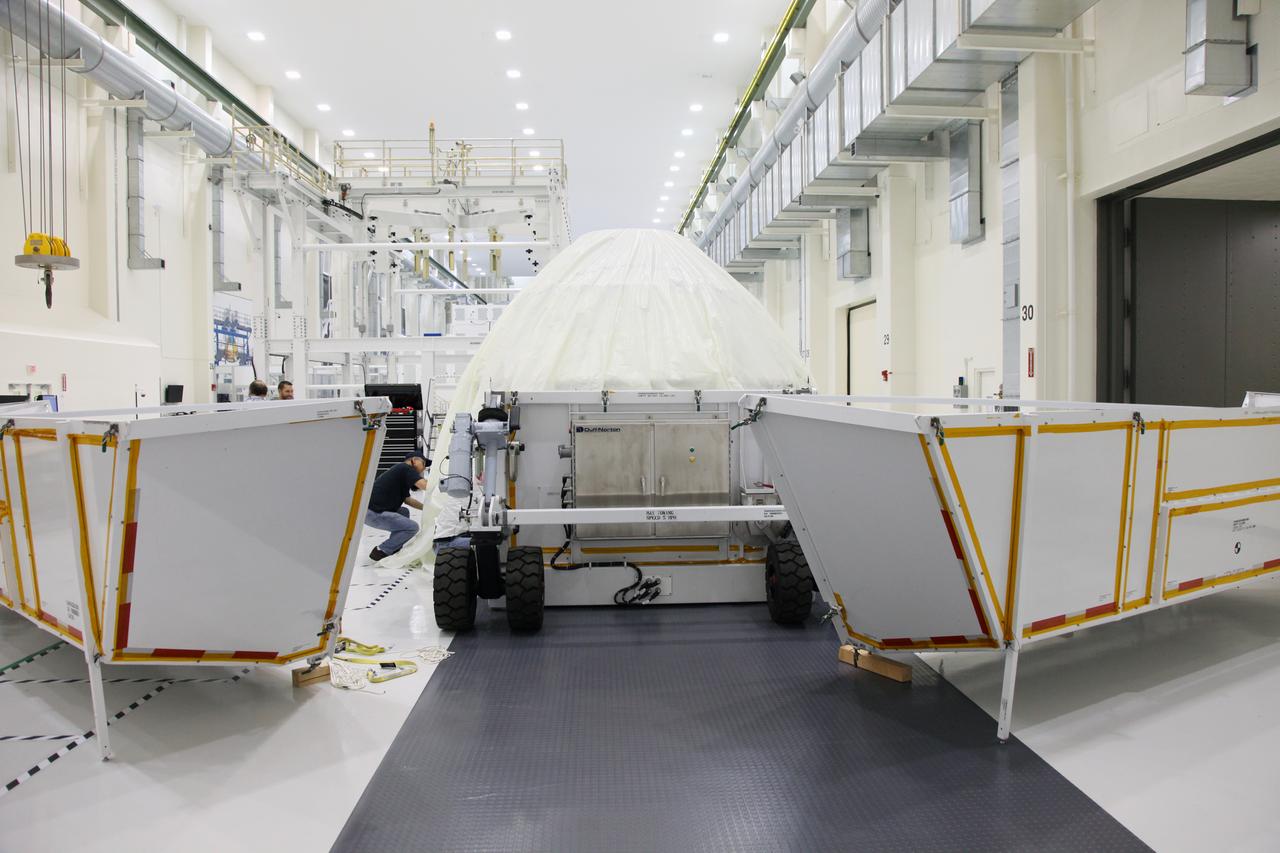
Orion EFT-1 Crew Module Being Uncrated
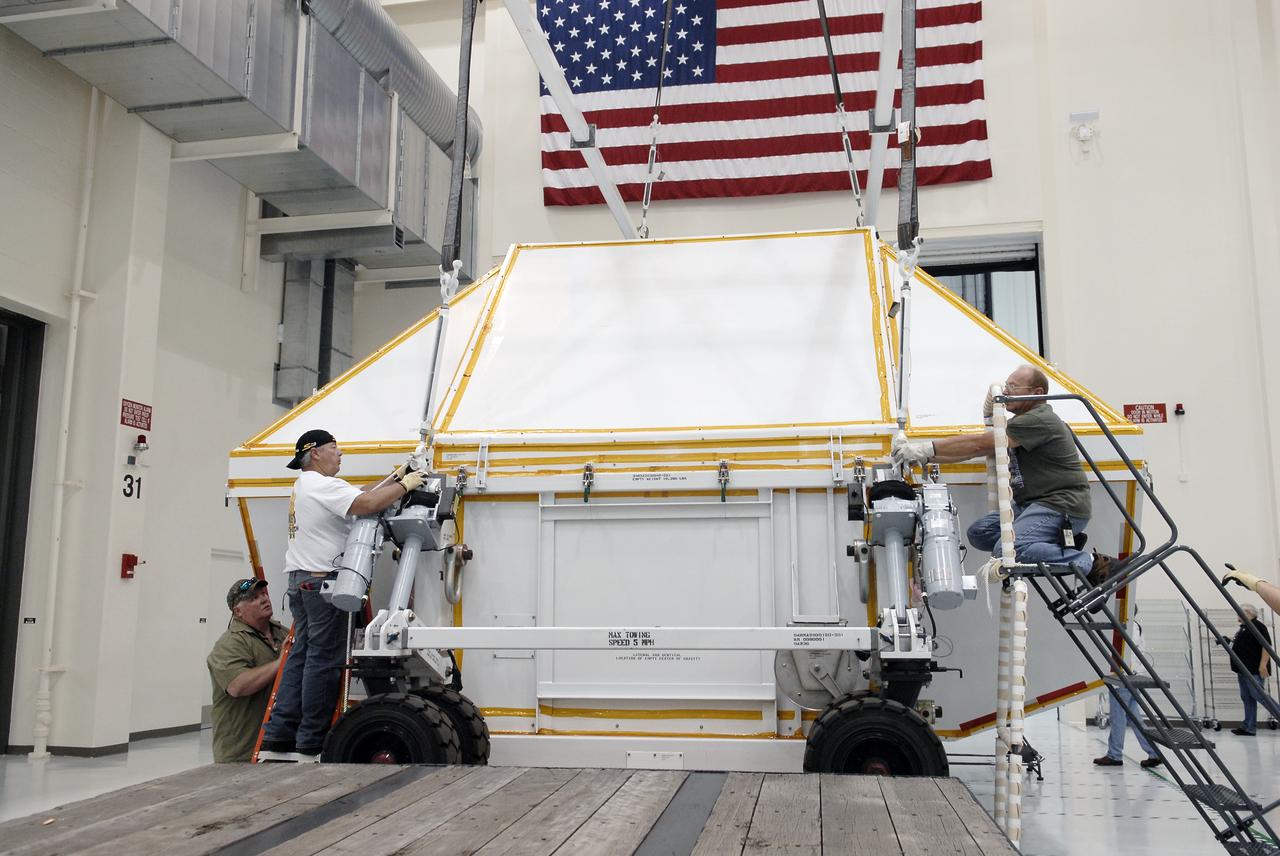
Orion EFT-1 Crew Module Uncrating
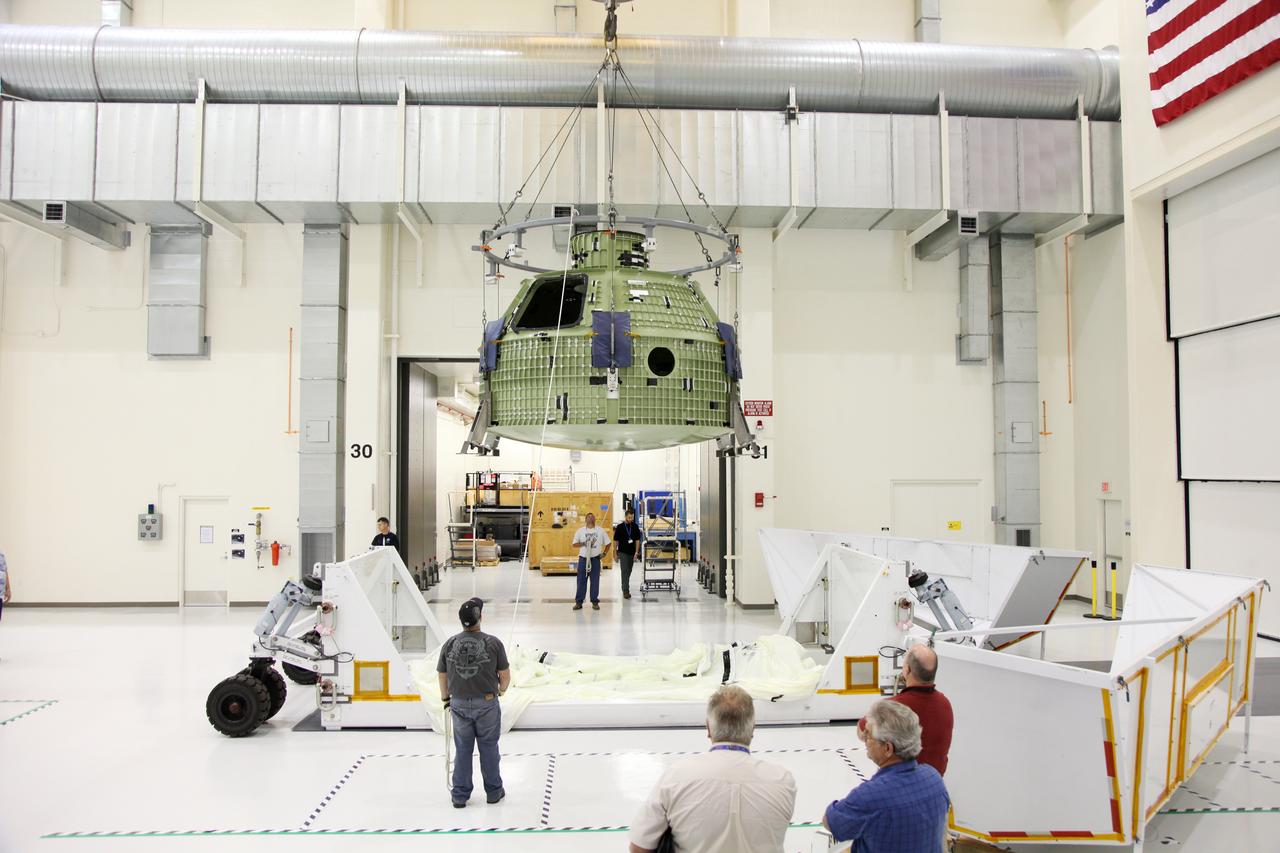
Orion EFT-1 Crew Module Being Uncrated
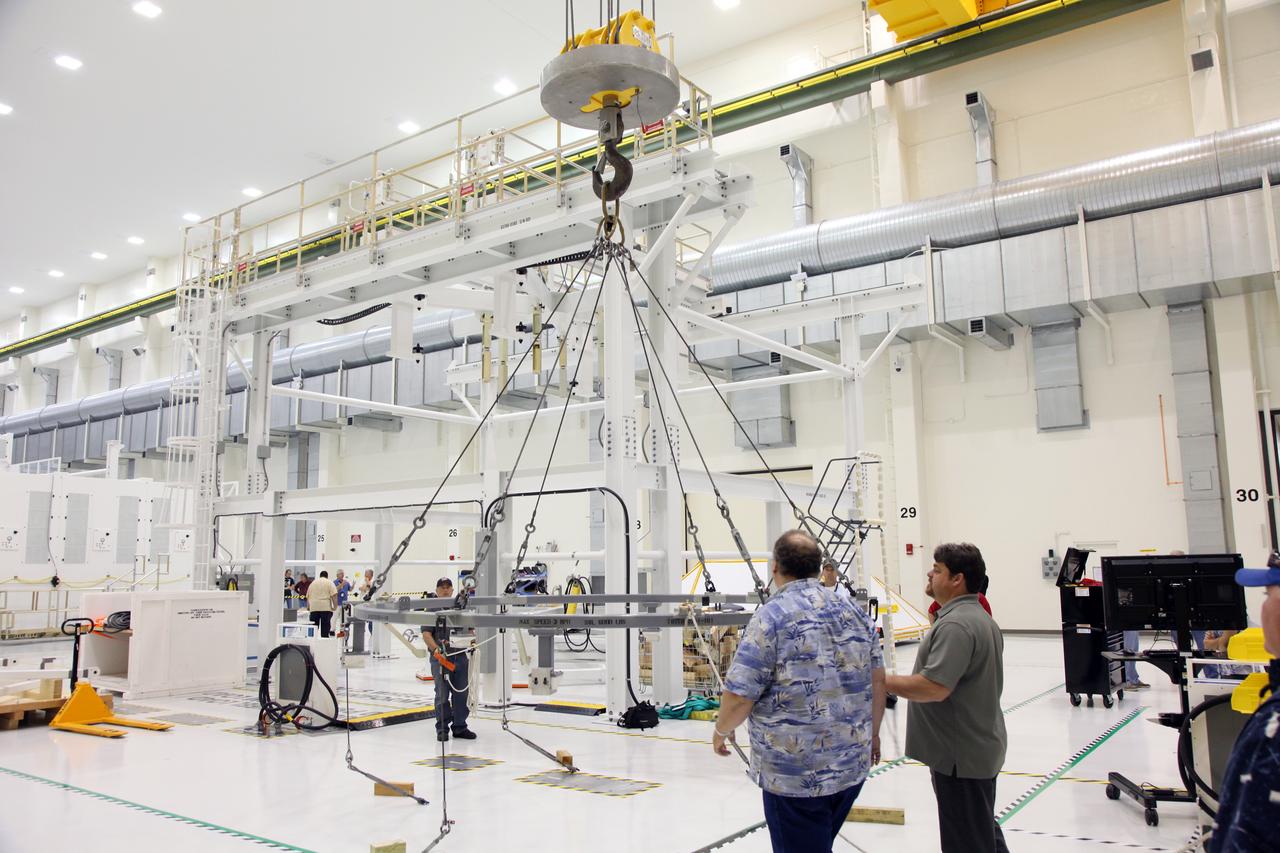
Orion EFT-1 Crew Module Being Uncrated
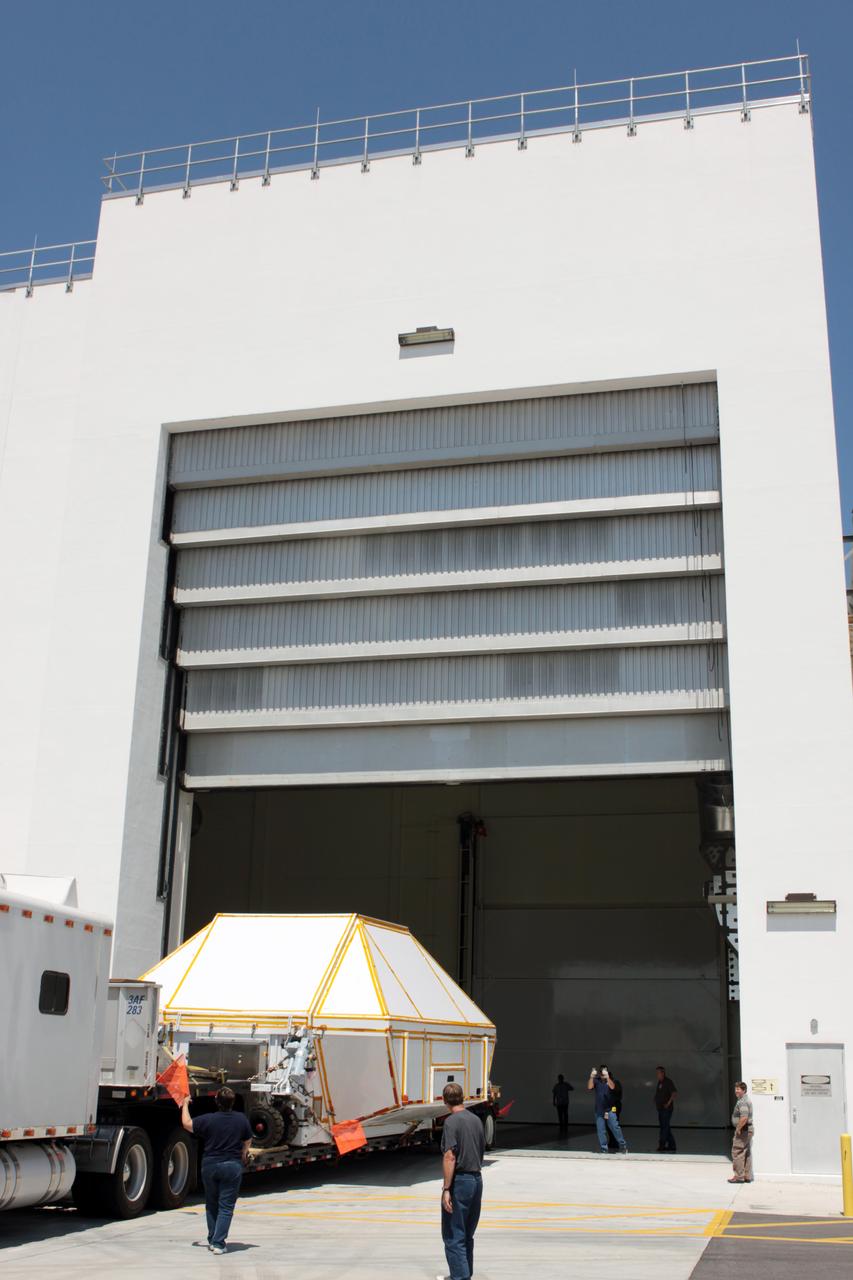
Orion EFT-1 Crew Module Arrival
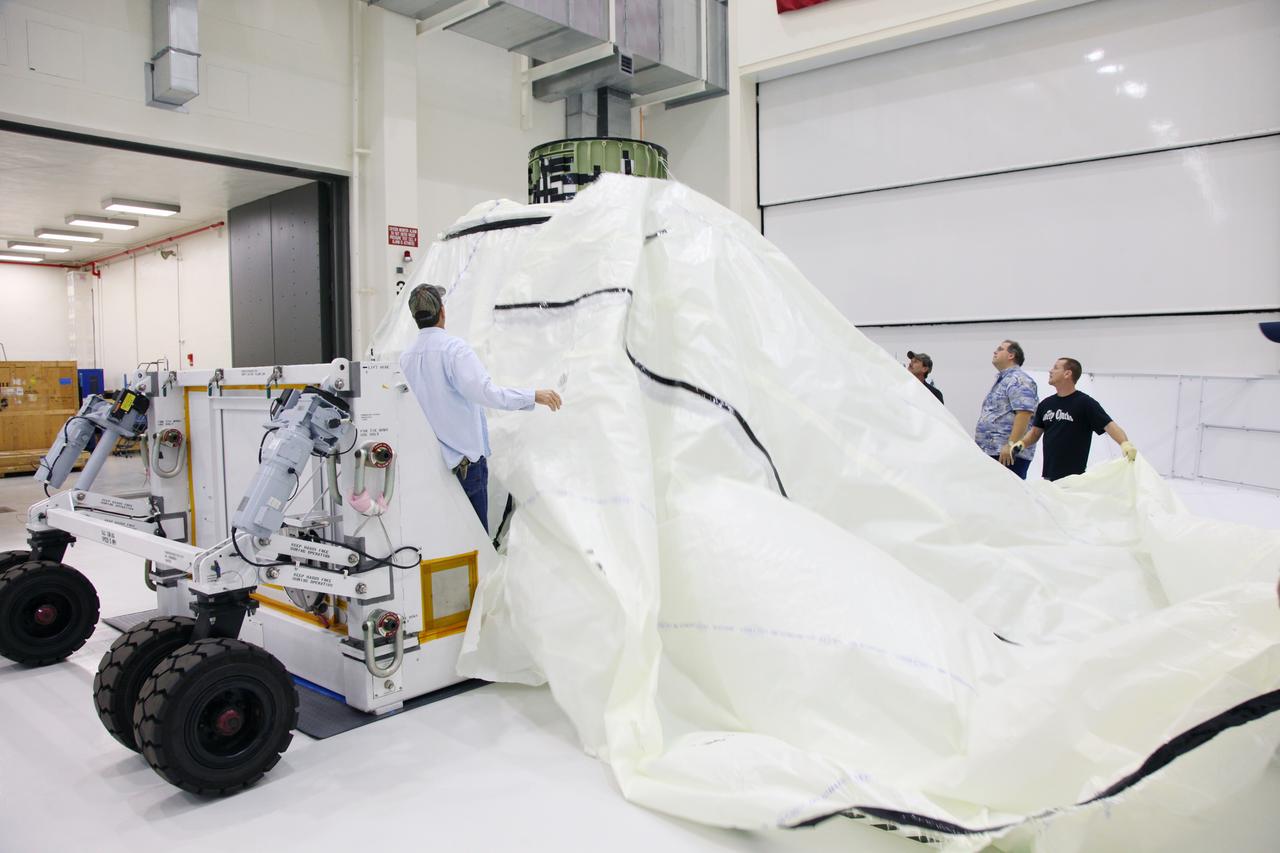
Orion EFT-1 Crew Module Being Uncrated
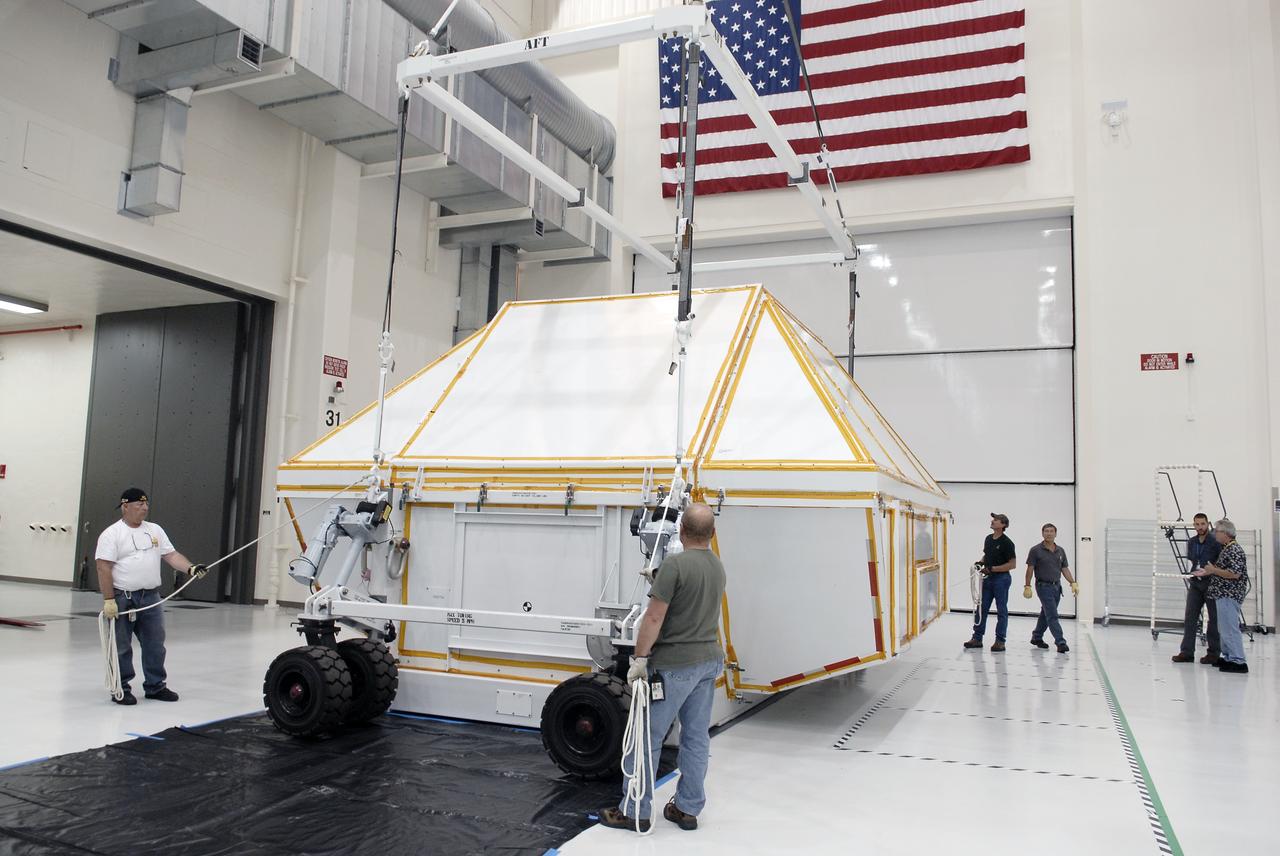
Orion EFT-1 Crew Module Uncrating
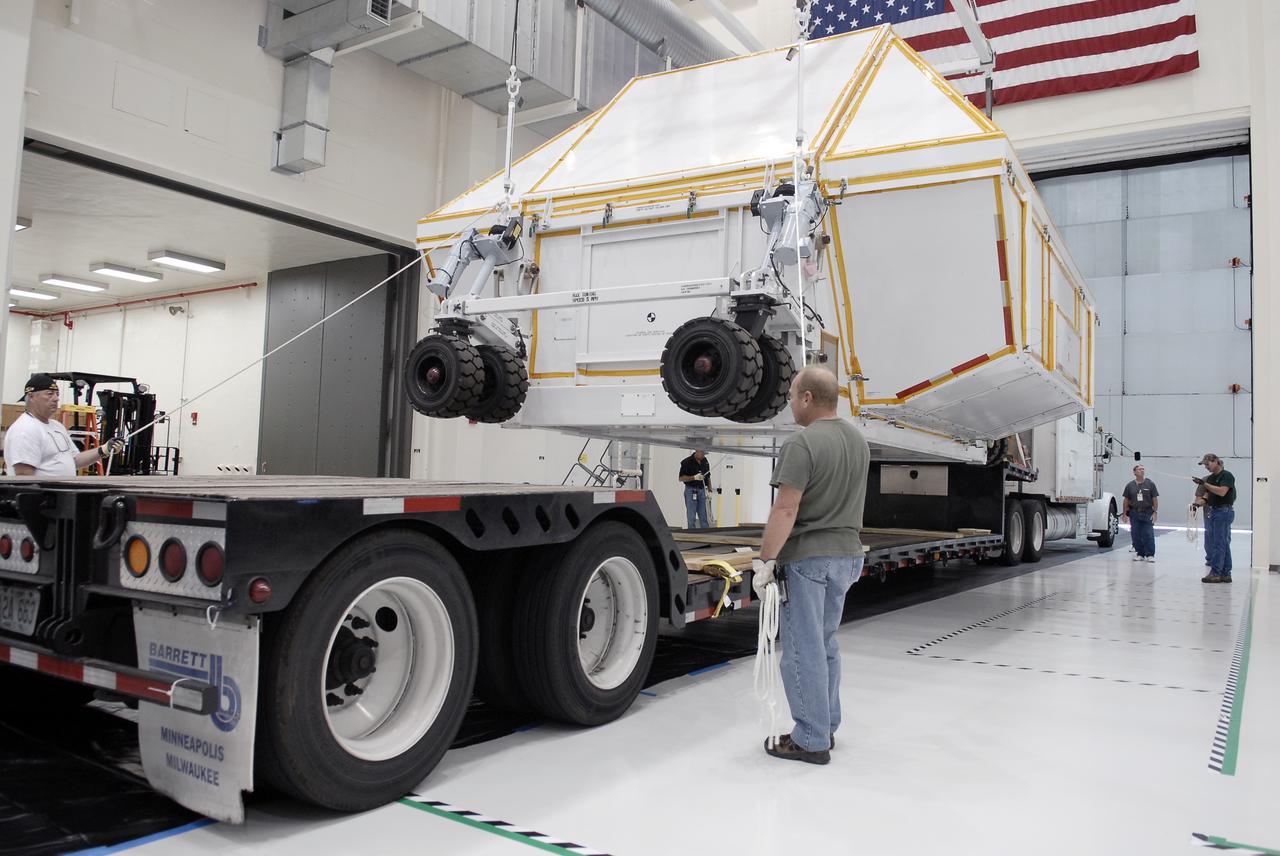
Orion EFT-1 Crew Module Uncrating
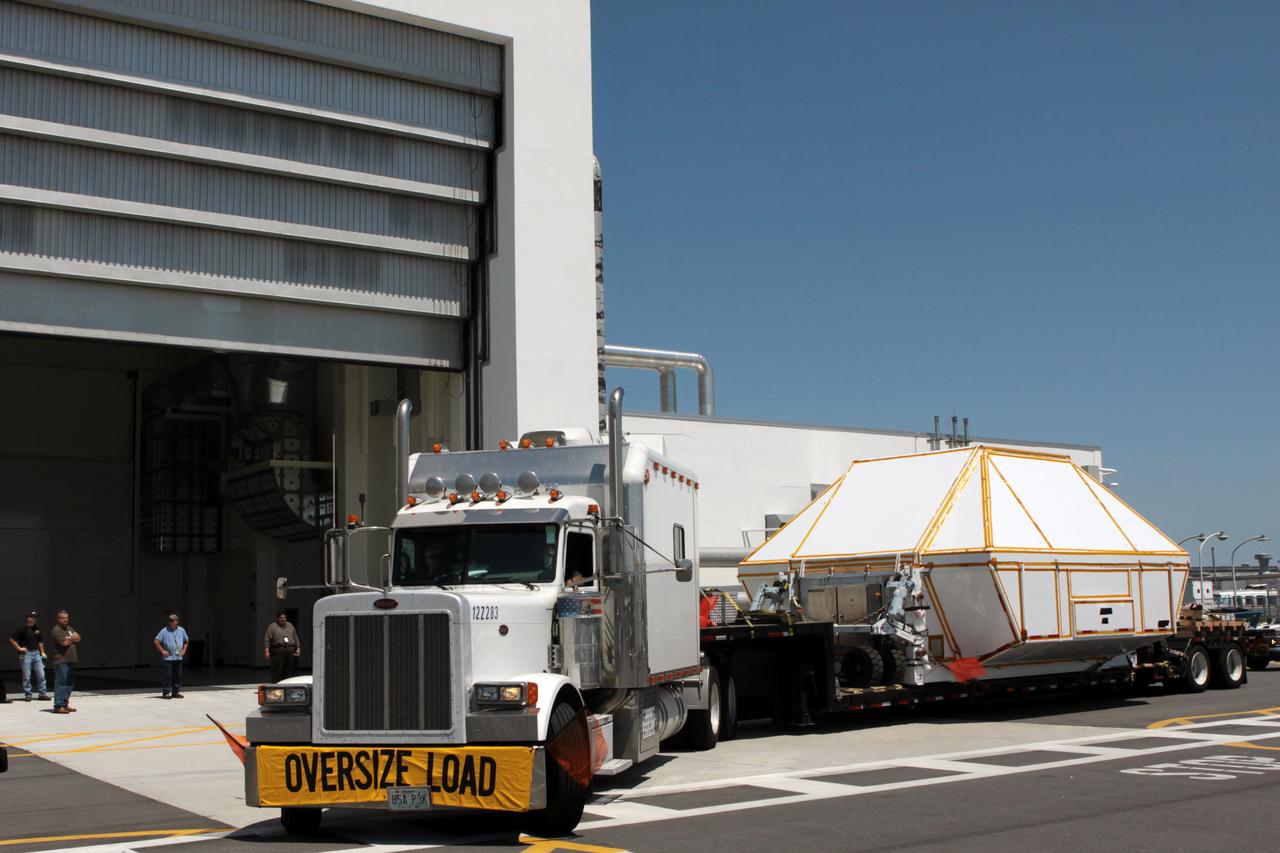
Orion EFT-1 Crew Module Arrival
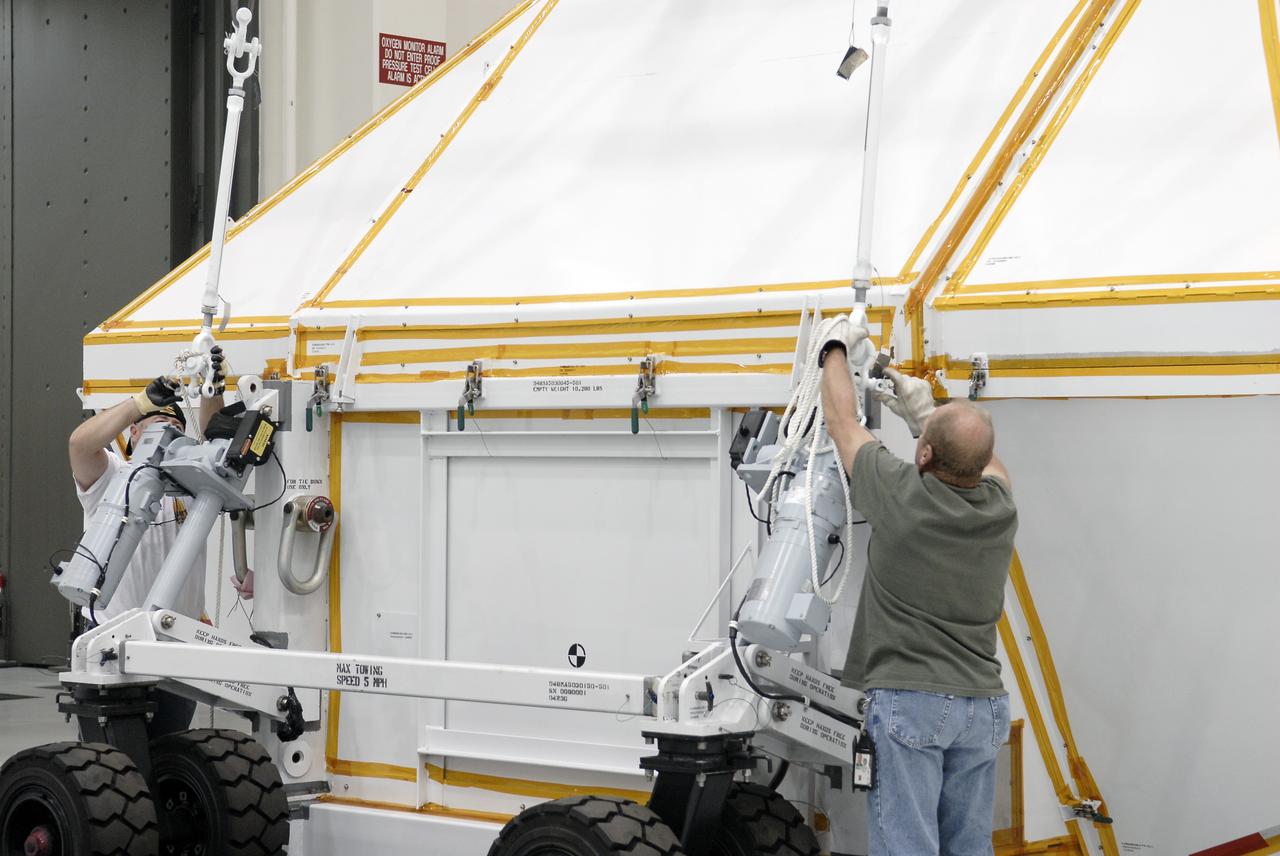
Orion EFT-1 Crew Module Uncrating
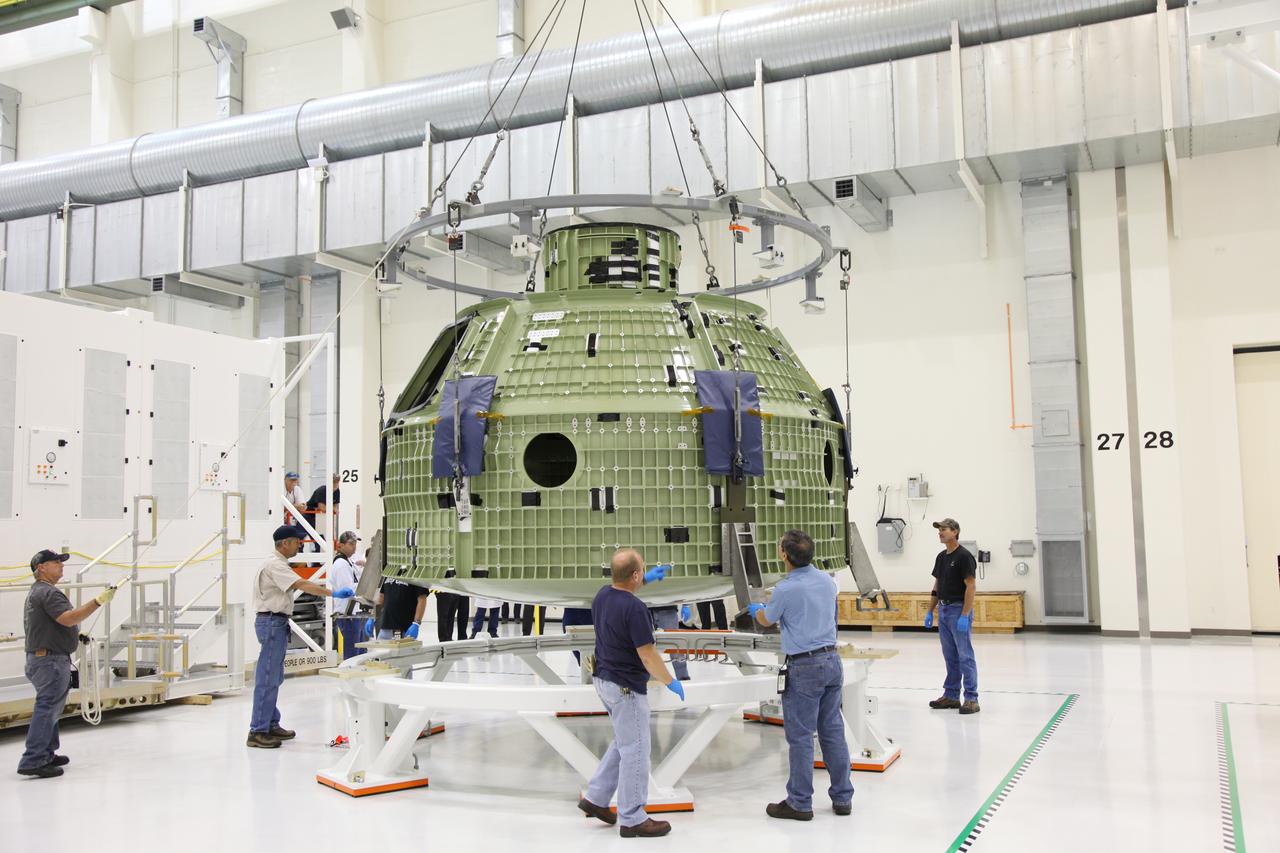
Orion EFT-1 Crew Module Being Uncrated
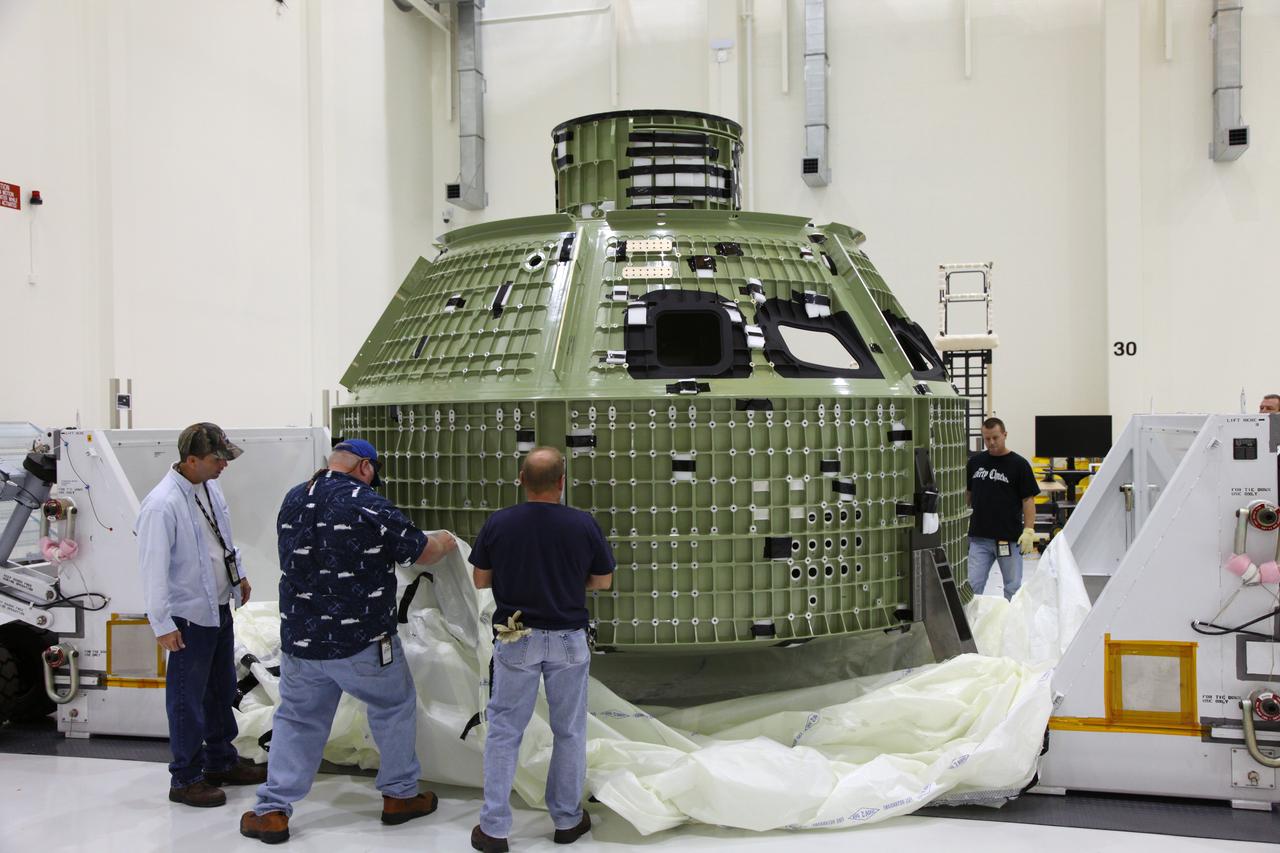
Orion EFT-1 Crew Module Being Uncrated
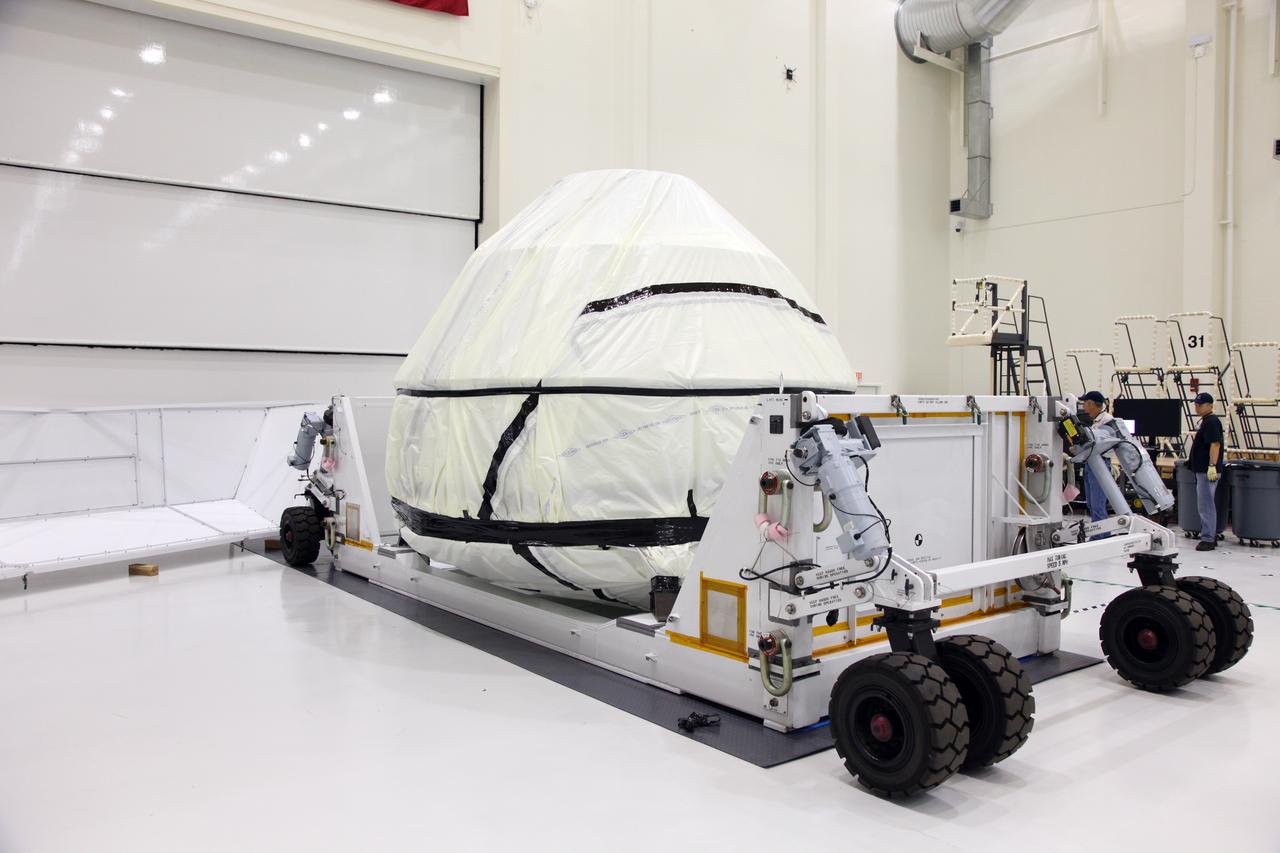
Orion EFT-1 Crew Module Being Uncrated
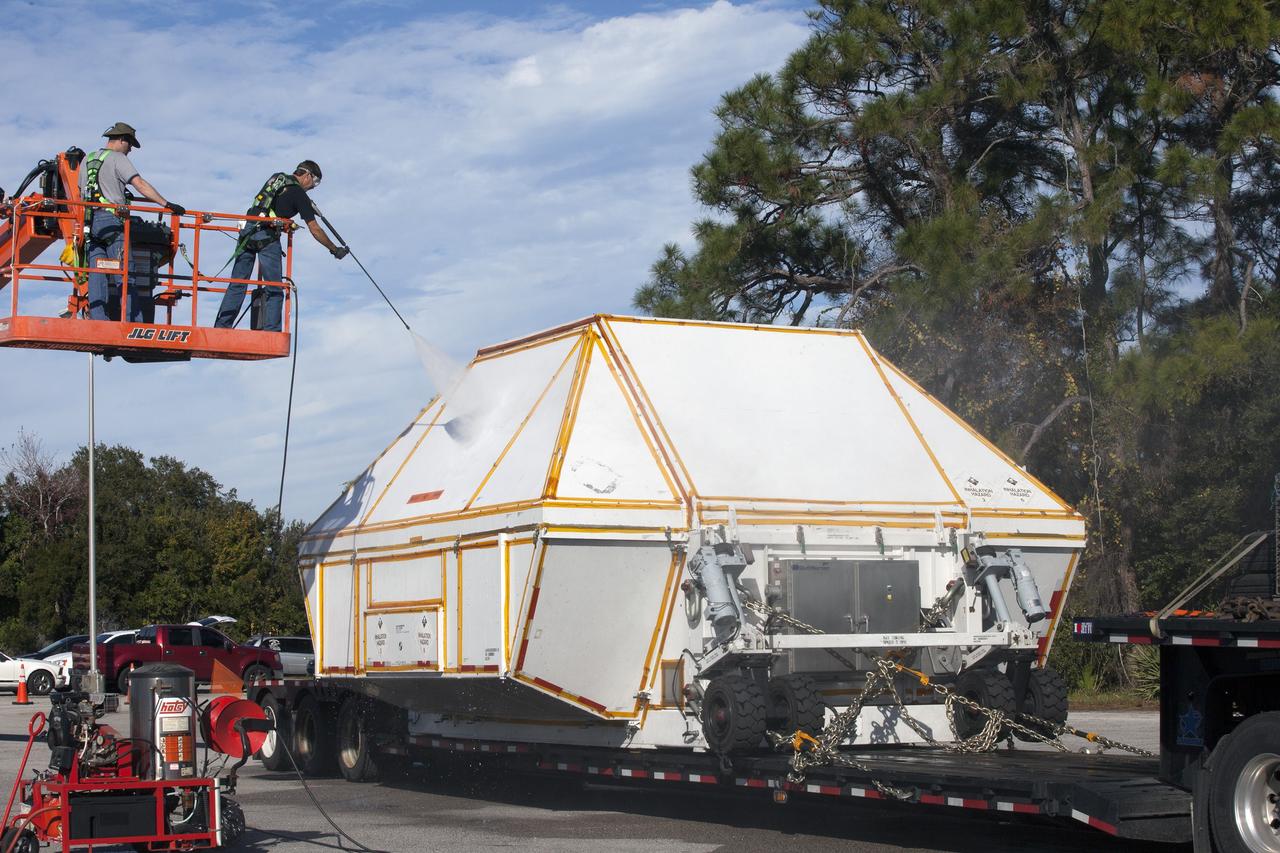
CAPE CANAVERAL, Fla. -- Technicians wash down the crew module transportation fixture containing the Orion crew module on the back of a flatbed truck at the Multi-Operation Support Building at NASA's Kennedy Space Center in Florida. Orion was transported 2,700 miles overland from Naval Base San Diego in California. Orion was recovered from the Pacific Ocean after completing a two-orbit, four-and-a-half hour mission Dec. 5 to test systems critical to crew safety, including the launch abort system, the heat shield and the parachute system. The Ground Systems Development and Operations Program led the recovery, offload and transportation efforts. For more information, visit www.nasa.gov/orion. Photo credit: NASA/Kim Shiflett
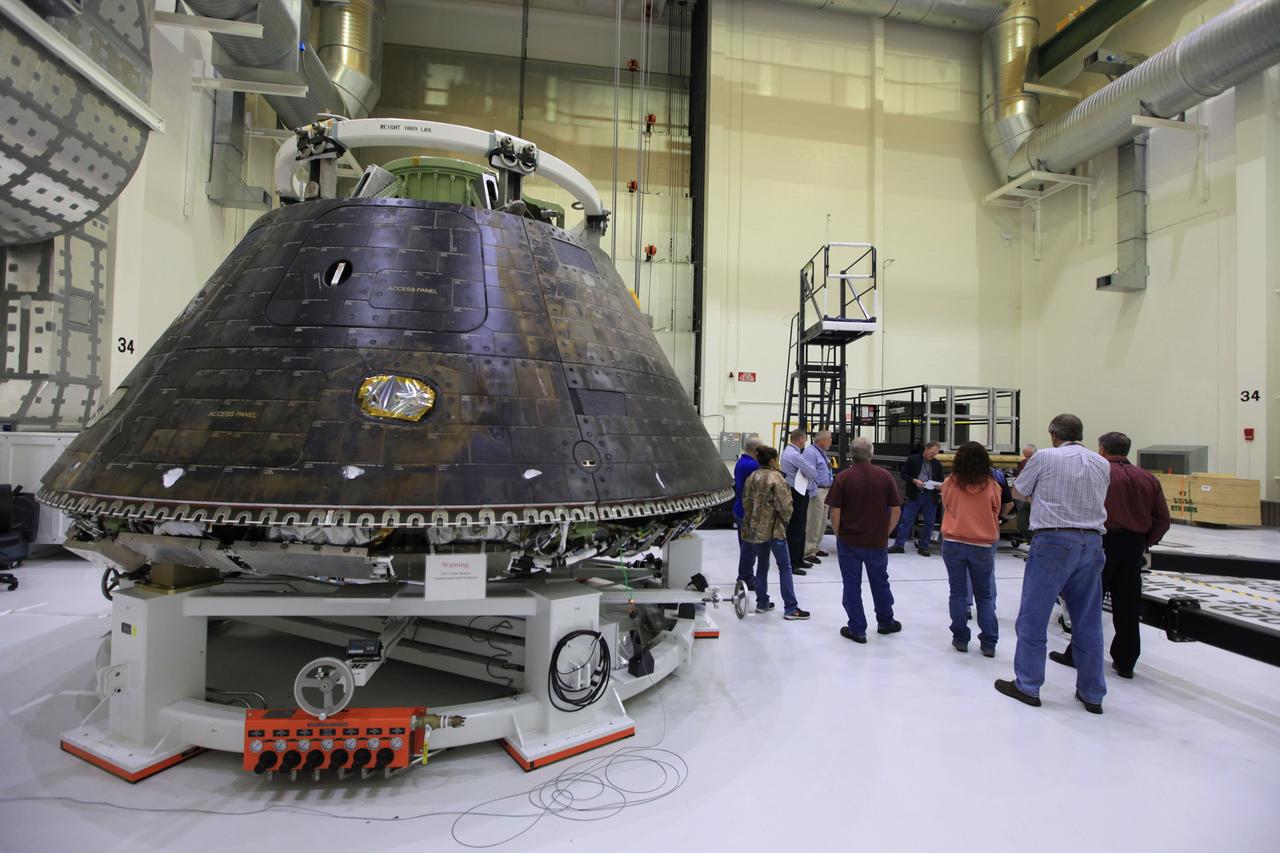
Inside the Neil Armstrong Operations and Checkout Building high bay at NASA's Kennedy Space Center in Florida, Lockheed Martin and ASRC engineers and technicians review procedures before preparing the Orion crew module from Exploration Flight Test 1 for its move to the nearby Kennedy Space Center Visitor Complex. The crew module will be delivered to the IMAX Theater where it will be prepared for display in the NASA Now exhibit. The Orion spacecraft launched atop a United Launch Alliance Delta IV rocket Dec. 5, 2014, from Space Launch Complex 37 at Cape Canaveral Air Force Station. The spacecraft built for humans traveled 3,604 miles above Earth and splashed down about 4.5 hours later in the Pacific Ocean.
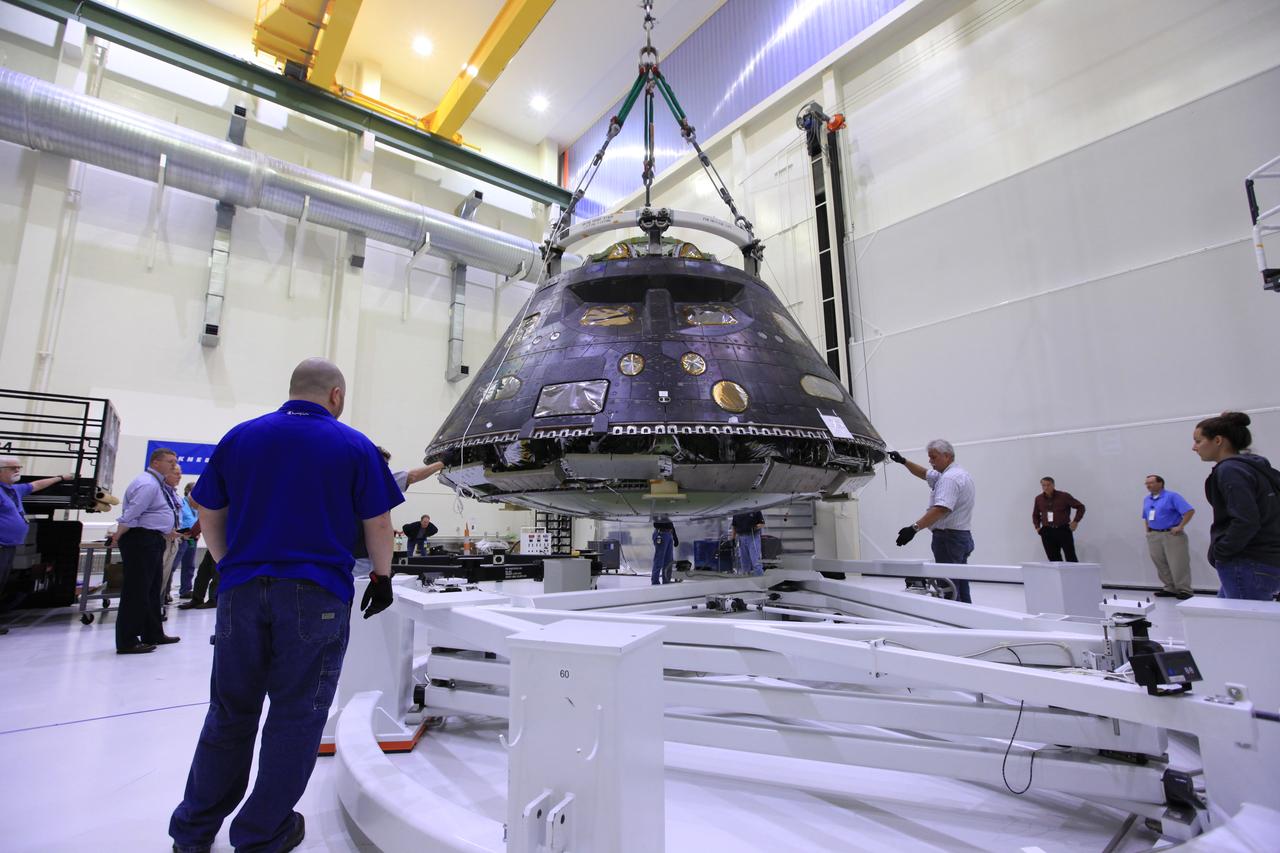
Inside the Neil Armstrong Operations and Checkout Building high bay at NASA's Kennedy Space Center in Florida, Lockheed Martin and ASRC workers monitor the progress as a crane moves the Orion crew module from Exploration Flight Test 1 over to a custom-built transport stand. The crew module is being prepared for its move to the nearby Kennedy Space Center Visitor Complex. It will be on display in the NASA Now exhibit in the IMAX Theater. The Orion spacecraft launched atop a United Launch Alliance Delta IV rocket Dec. 5, 2014, from Space Launch Complex 37 at Cape Canaveral Air Force Station. The spacecraft built for humans traveled 3,604 miles above Earth and splashed down about 4.5 hours later in the Pacific Ocean.
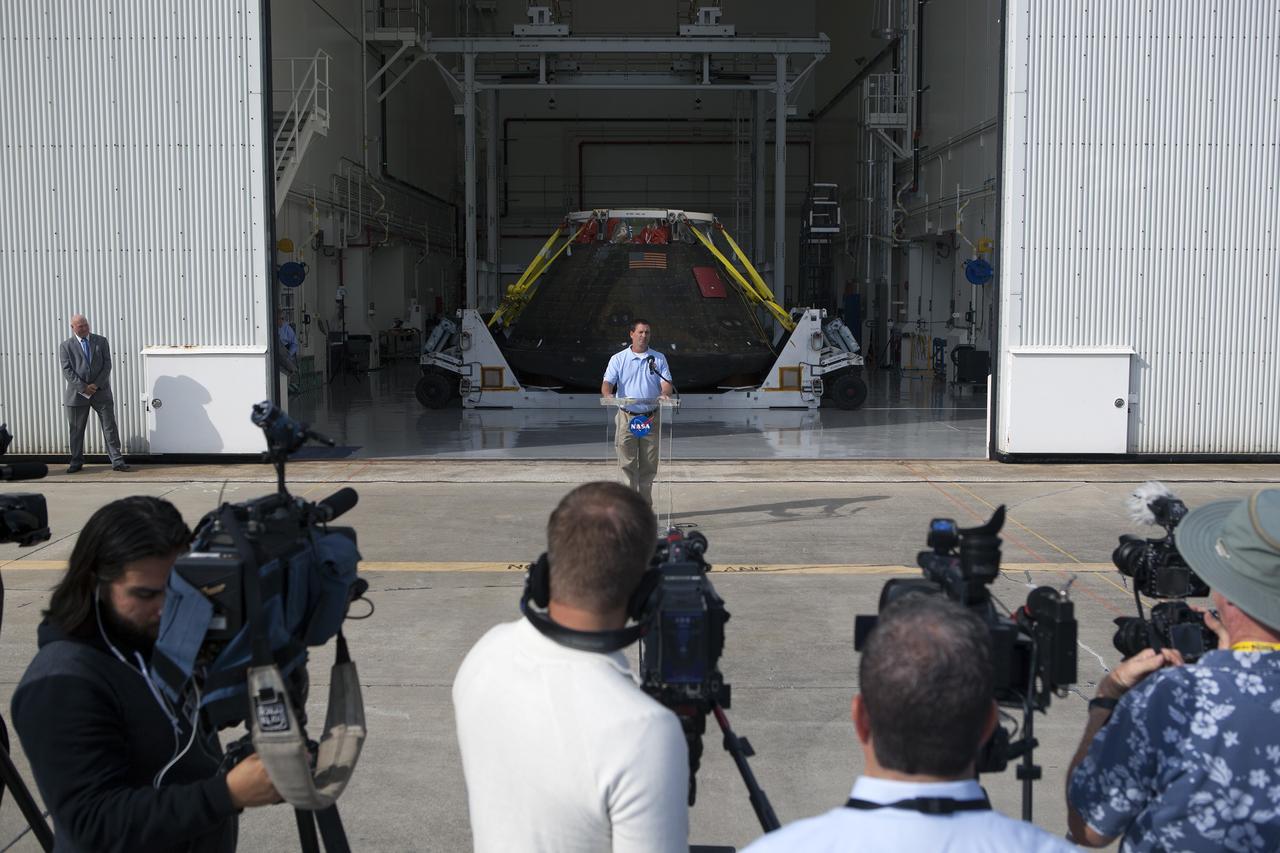
CAPE CANAVERAL, Fla. -- NASA's Orion spacecraft is viewed by members of the media at the Launch Abort System Facility at NASA's Kennedy Space Center in Florida. Lou Garcia, with the Ground Systems Development and Operations Program, or GSDO, speaks to the media during the viewing opportunity. The spacecraft's cross-country return, a 2,700 mile road trip from Naval Base San Diego to Kennedy, sets the stage for in-depth analysis of data obtained during Orion's trip to space. It will provide engineers with detailed information on how the spacecraft fared during its two-orbit, 4.5-hour flight test, completed on Dec. 5. GSDO led the recovery, offload and transportation efforts. For more information, visit www.nasa.gov/orion. Photo credit: NASA/Dimitri Gerondidakis
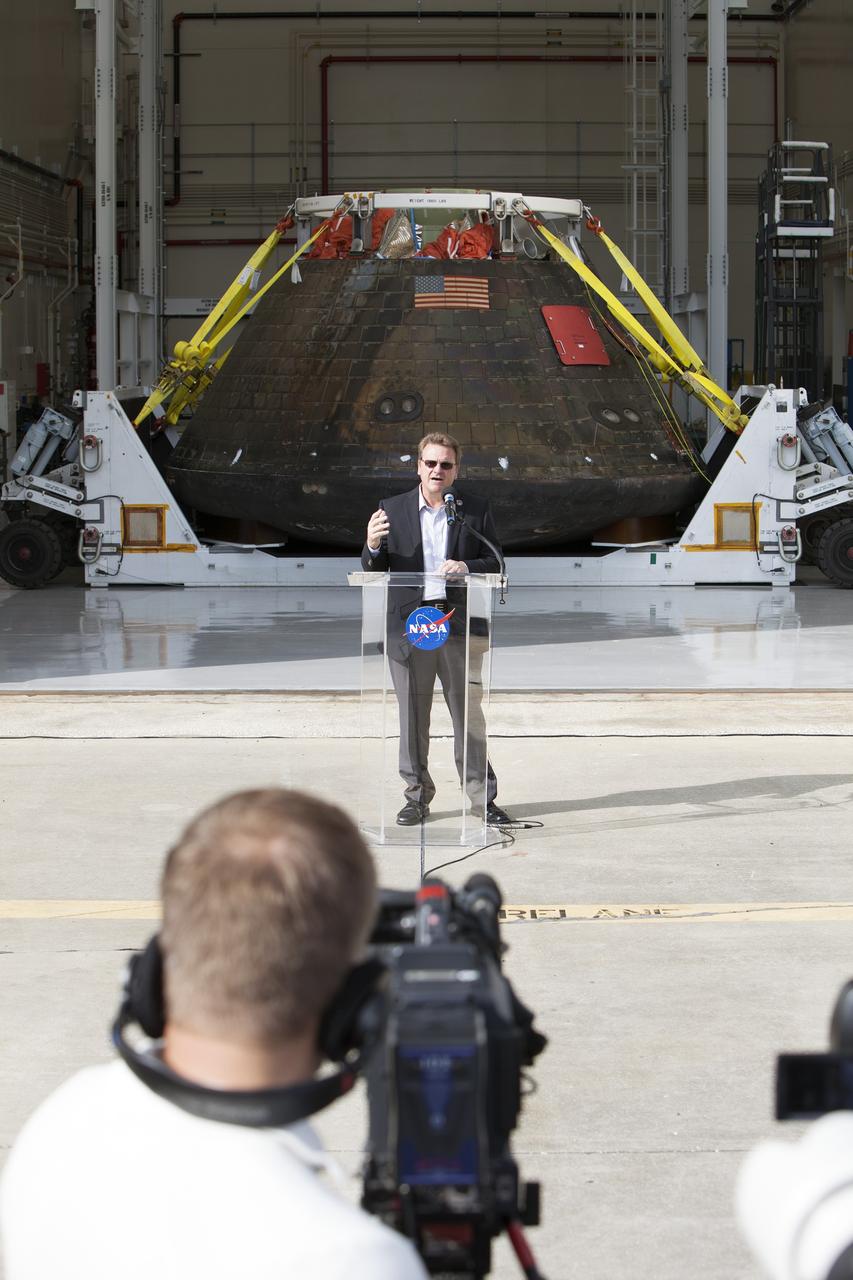
CAPE CANAVERAL, Fla. -- Lockheed Martin Manager Jules Schneider speaks to members of the media during a viewing of NASA's Orion spacecraft at the Launch Abort System Facility at NASA's Kennedy Space Center in Florida. The spacecraft's cross-country return, a 2,700 mile road trip from Naval Base San Diego to Kennedy, sets the stage for in-depth analysis of data obtained during Orion's trip to space. It will provide engineers with detailed information on how the spacecraft fared during its two-orbit, 4.5-hour flight test, completed on Dec. 5. The Ground Systems Development and Operations Program led the recovery, offload and transportation efforts. For more information, visit www.nasa.gov/orion. Photo credit: NASA/Dimitri Gerondidakis
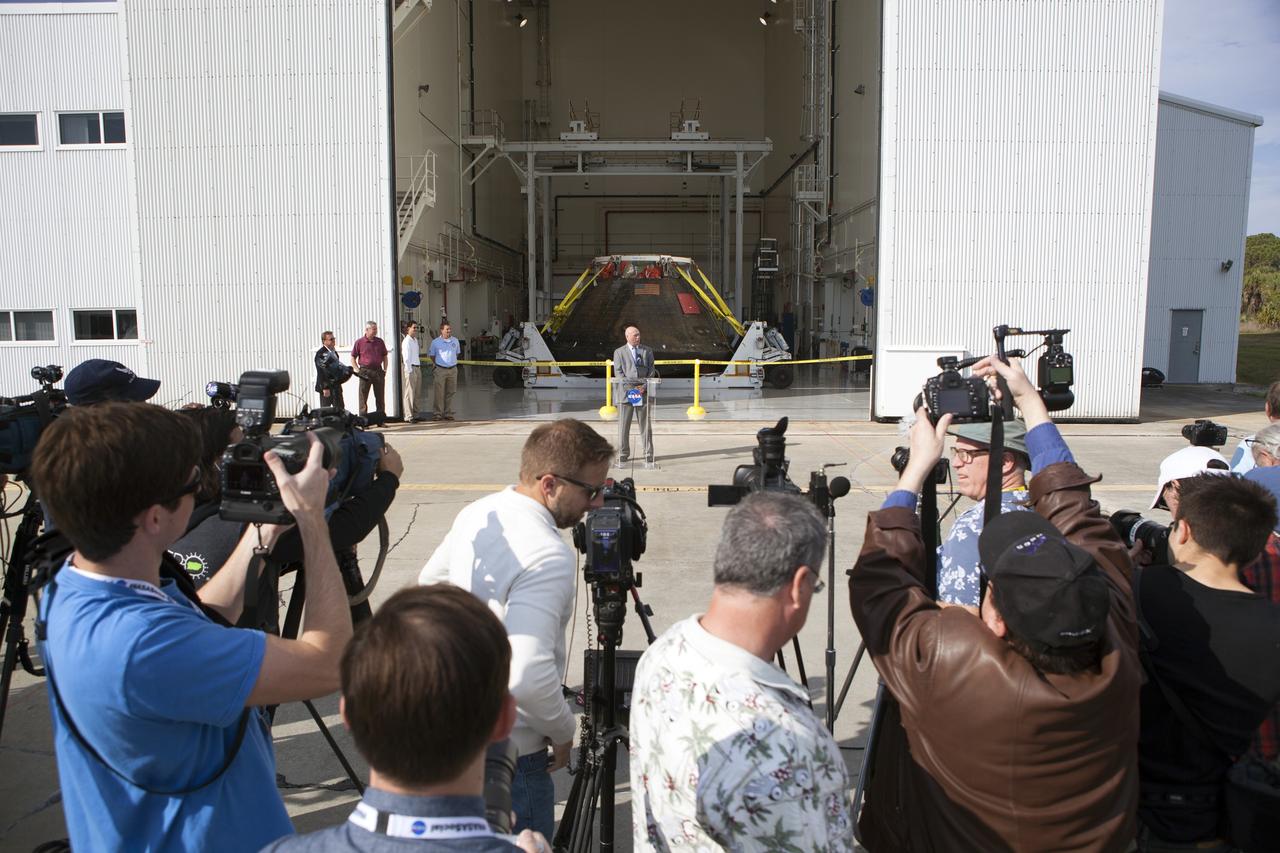
CAPE CANAVERAL, Fla. -- NASA's Orion spacecraft is viewed by members of the media at the Launch Abort System Facility at NASA's Kennedy Space Center in Florida. Kennedy's News Chief Mike Curie speaks to the media during the viewing opportunity. The spacecraft's cross-country return, a 2,700 mile road trip from Naval Base San Diego to Kennedy, sets the stage for in-depth analysis of data obtained during Orion's trip to space. It will provide engineers with detailed information on how the spacecraft fared during its two-orbit, 4.5-hour flight test, completed on Dec. 5. The Ground Systems Development and Operations Program led the recovery, offload and transportation efforts. For more information, visit www.nasa.gov/orion. Photo credit: NASA/Dimitri Gerondidakis
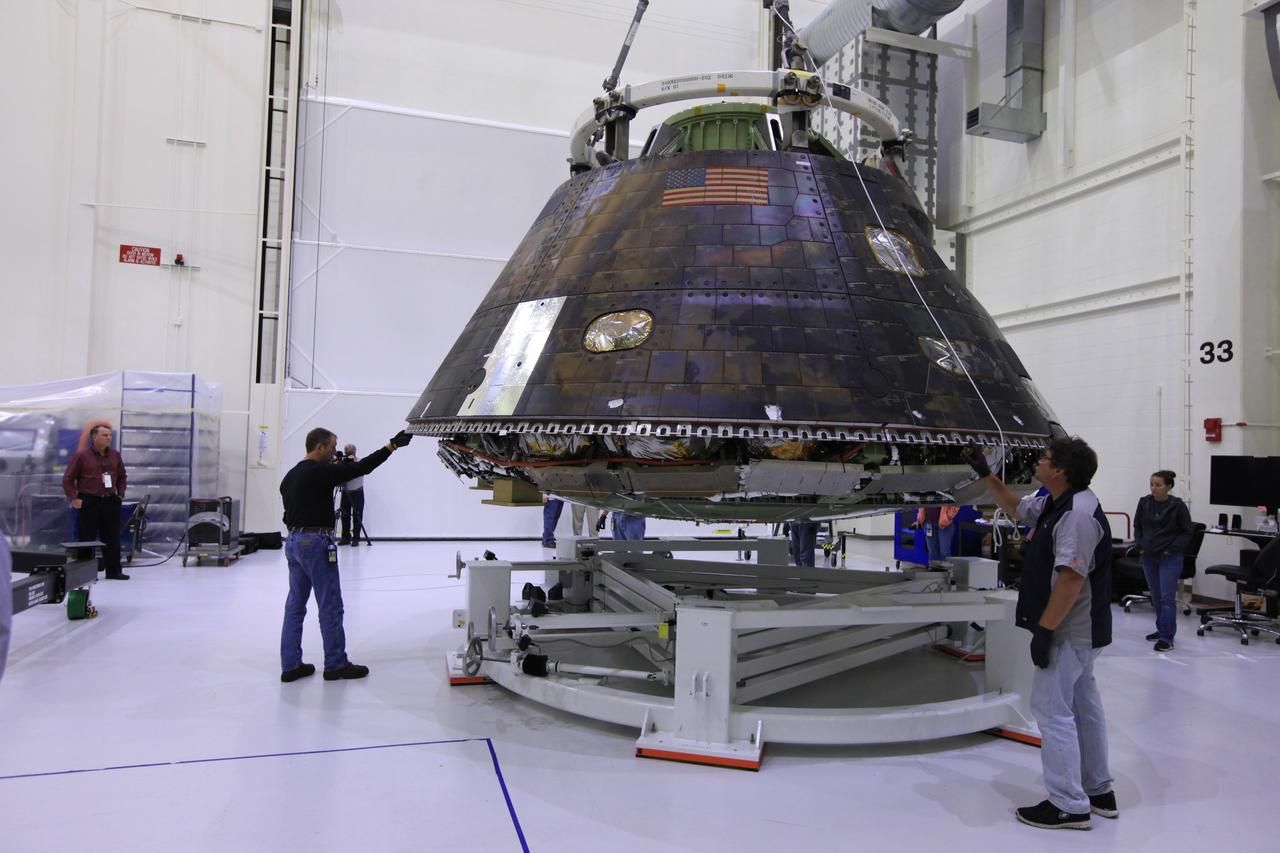
The Exploration Flight Test-1 (EFT-1) Crew Module undergoes preparations to move from the Operations and Checkout Building at Kennedy Space Center to the KSC Visitor Complex on April 6, 2017.
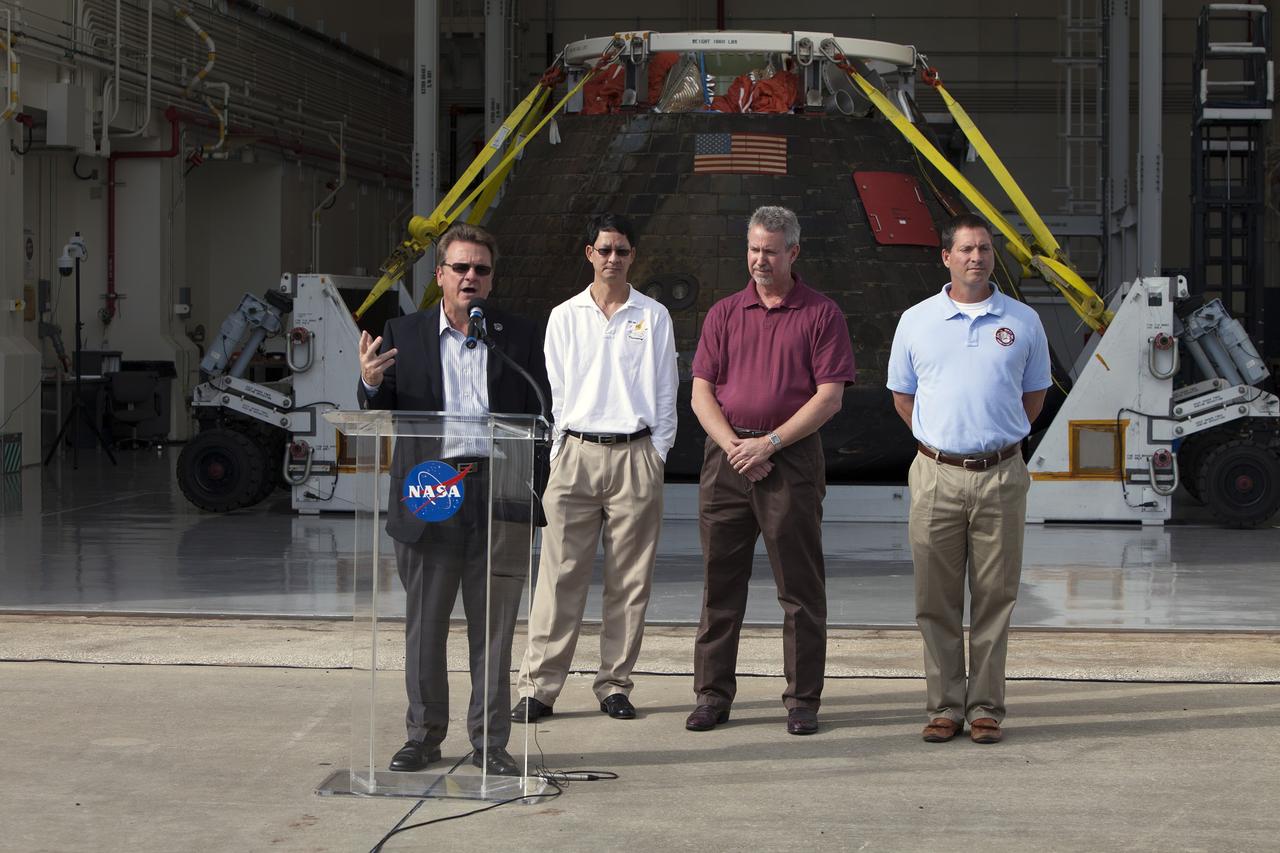
CAPE CANAVERAL, Fla. -- NASA's Orion spacecraft is viewed by members of the media at the Launch Abort System Facility at NASA's Kennedy Space Center in Florida. Speaking to the media during the viewing opportunity is Jules Schneider, Lockheed Martin Manager. Behind him, from left, are Glenn Chin, Orion Production Operations manager and Phil Weber and Lou Garcia, with the Ground Systems Development and Operations Program, or GSDO. Orion made the 8-day, 2,700 mile overland trip back to Kennedy from Naval Base San Diego in California. Analysis of date obtained during its two-orbit, four-and-a-half hour mission Dec. 5 will provide engineers with detailed information on how the spacecraft fared. GSDO led the recovery, offload and transportation efforts. For more information, visit www.nasa.gov/orion. Photo credit: NASA/Dimitri Gerondidakis
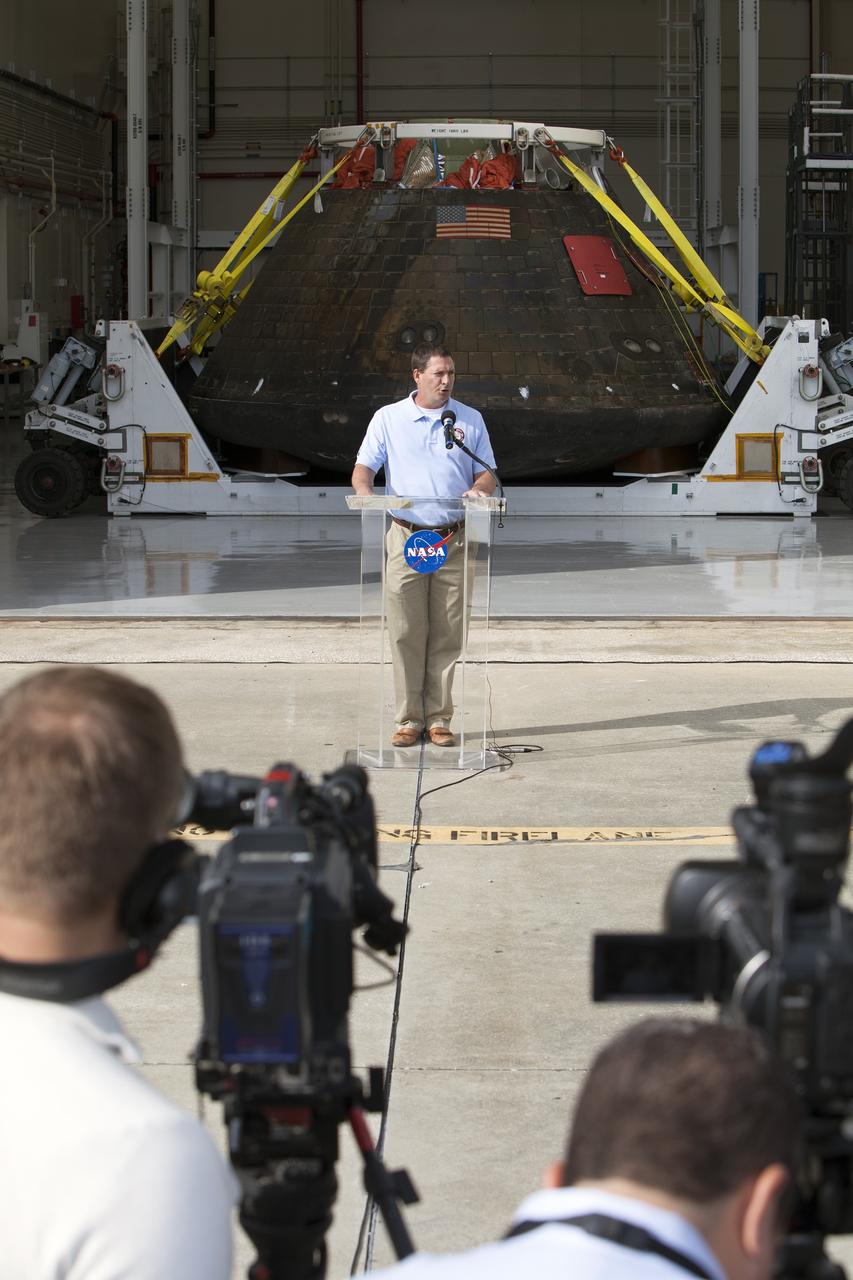
CAPE CANAVERAL, Fla. -- NASA's Orion spacecraft is viewed by members of the media at the Launch Abort System Facility at NASA's Kennedy Space Center in Florida. Lou Garcia, with the Ground Systems Development and Operations Program, or GSDO, speaks to the media during the viewing opportunity. The spacecraft's cross-country return, a 2,700 mile road trip from Naval Base San Diego to Kennedy, sets the stage for in-depth analysis of data obtained during Orion's trip to space. It will provide engineers with detailed information on how the spacecraft fared during its two-orbit, 4.5-hour flight test, completed on Dec. 5. GSDO led the recovery, offload and transportation efforts. For more information, visit www.nasa.gov/orion. Photo credit: NASA/Dimitri Gerondidakis
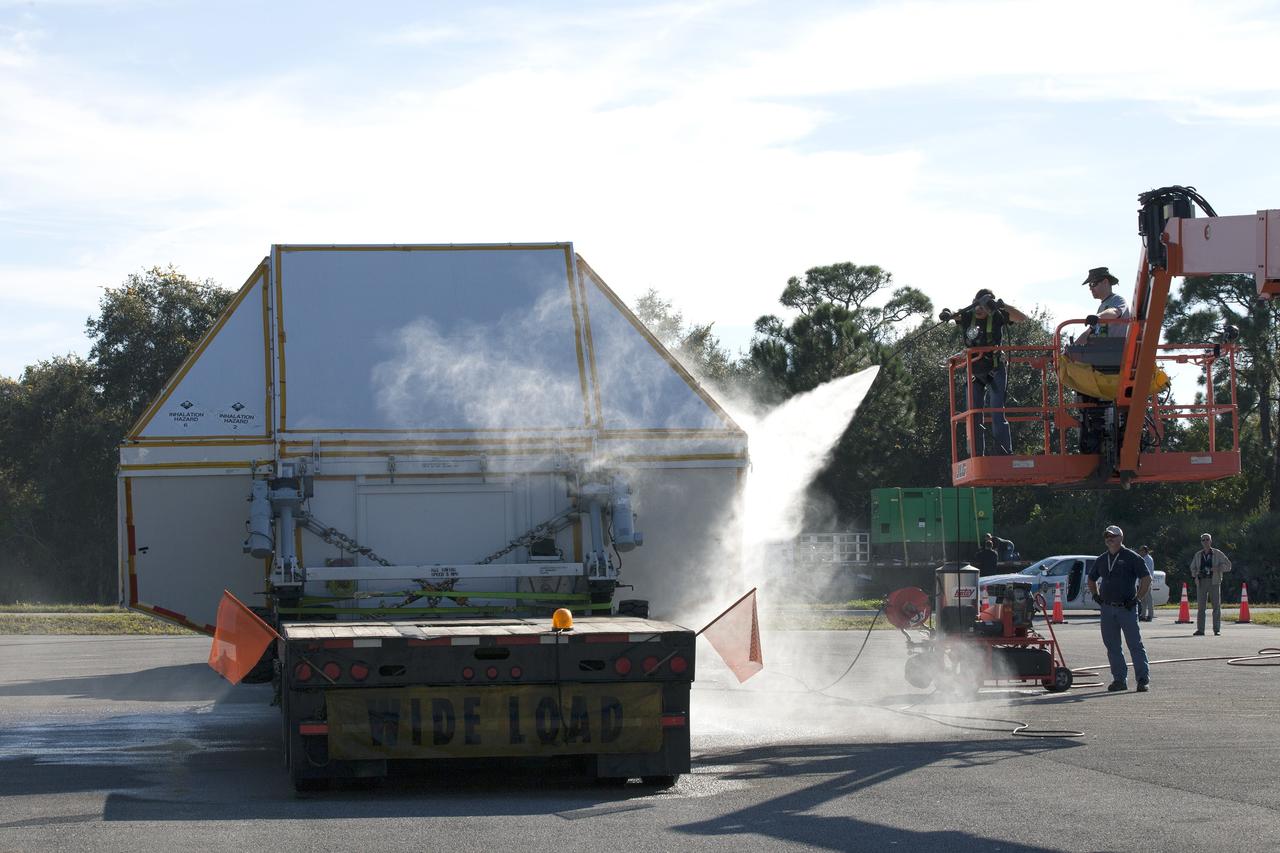
CAPE CANAVERAL, Fla. -- Technicians wash down the crew module transportation fixture containing the Orion crew module on the back of a flatbed truck at the Multi-Operation Support Building at NASA's Kennedy Space Center in Florida. Orion was transported 2,700 miles overland from Naval Base San Diego in California. Orion was recovered from the Pacific Ocean after completing a two-orbit, four-and-a-half hour mission Dec. 5 to test systems critical to crew safety, including the launch abort system, the heat shield and the parachute system. The Ground Systems Development and Operations Program led the recovery, offload and transportation efforts. For more information, visit www.nasa.gov/orion. Photo credit: NASA/Kim Shiflett
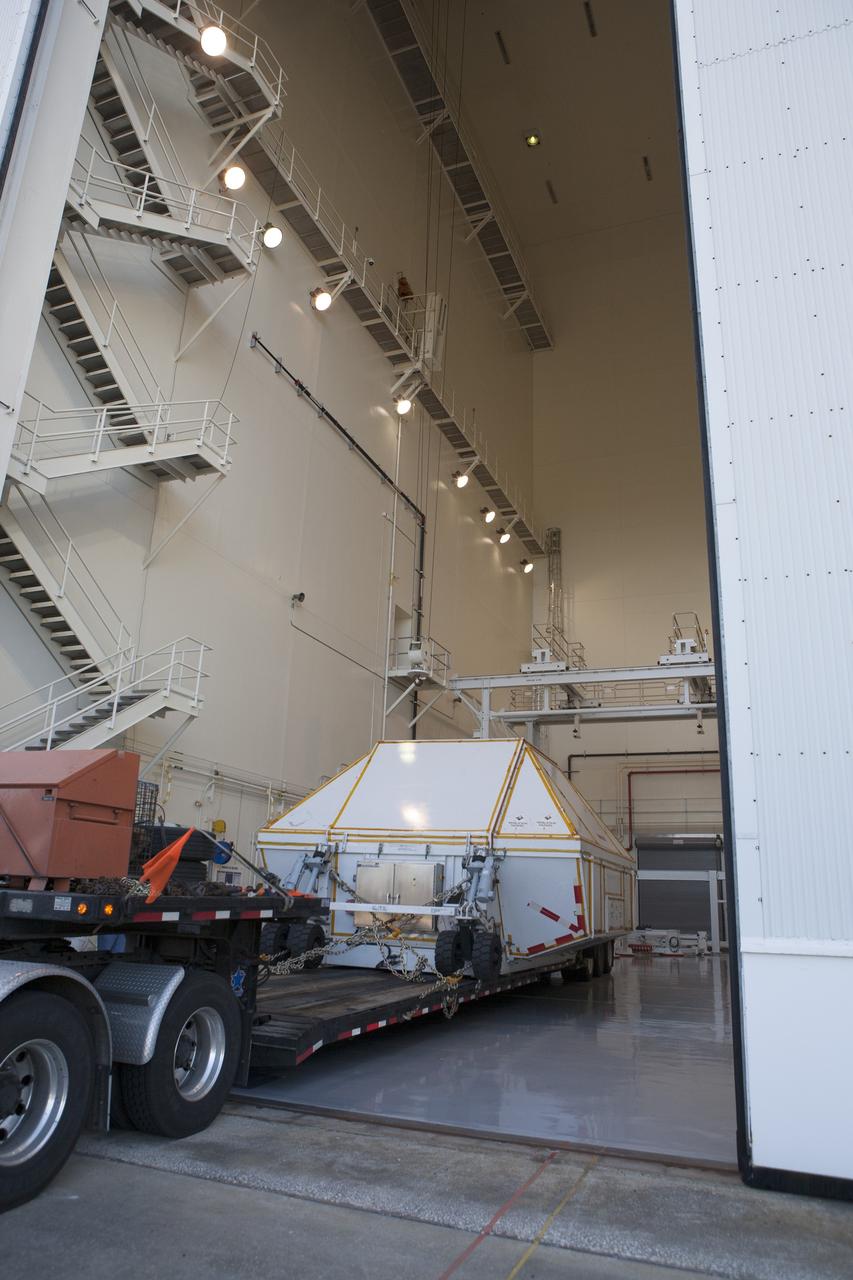
CAPE CANAVERAL, Fla. -- NASA's Orion spacecraft arrives at the Launch Abort System Facility at Kennedy Space Center in Florida. The spacecraft was transported 2,700 miles overland from Naval Base San Diego in California, on a flatbed truck secured in its crew module transportation fixture for the trip. During its first flight test, Orion completed a two-orbit, four-and-a-half hour mission Dec. 5 to test systems critical to crew safety, including the launch abort system, the heat shield and the parachute system. The Ground Systems Development and Operations Program led the recovery, offload and transportation efforts. For more information, visit www.nasa.gov/orion. Photo credit: NASA/Kim Shiflett
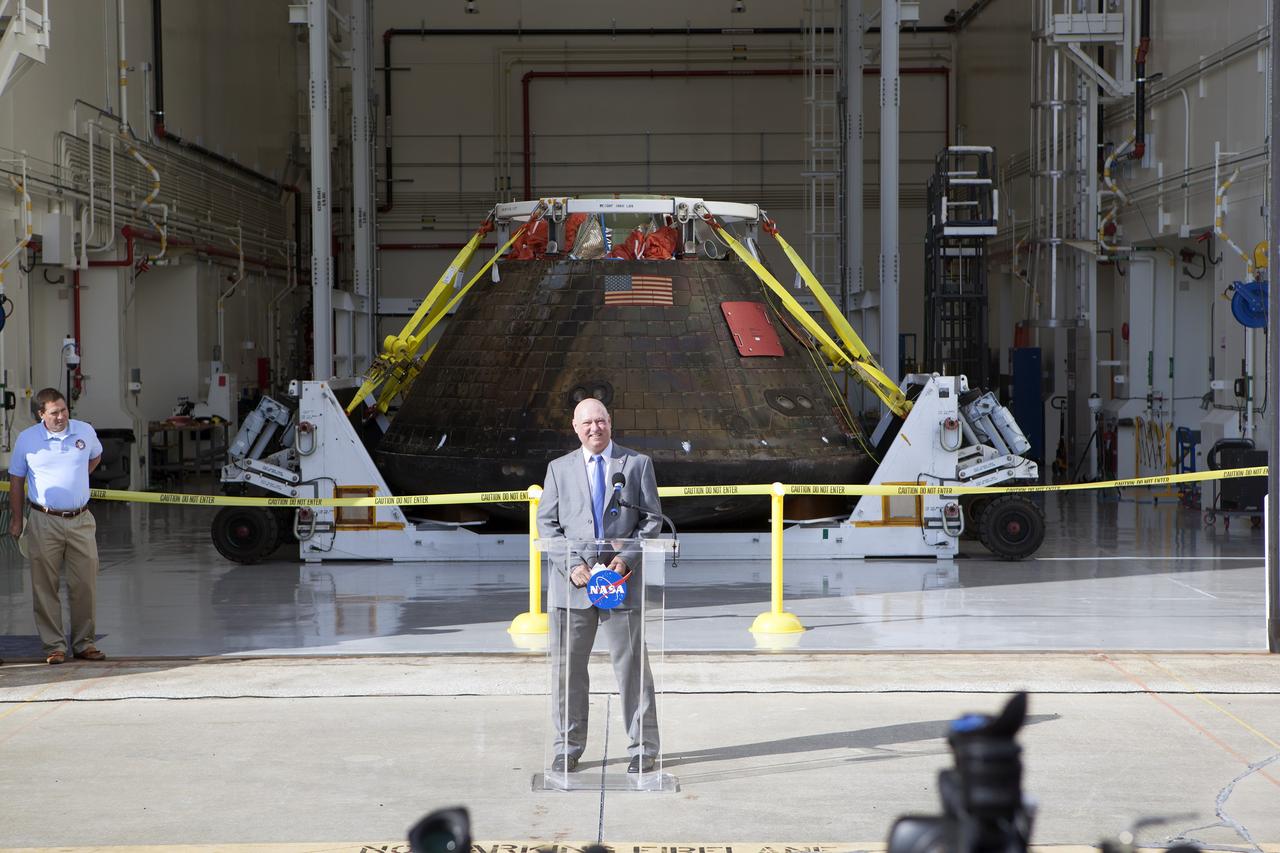
CAPE CANAVERAL, Fla. -- NASA's Orion spacecraft is viewed by members of the media at the Launch Abort System Facility at NASA's Kennedy Space Center in Florida. Kennedy News Chief Mike Curie speaks to the media during the viewing opportunity. Orion made the 8-day, 2,700 mile overland trip back to Kennedy from Naval Base San Diego in California. Analysis of data obtained during its two-orbit, four-and-a-half hour mission Dec. 5 will provide engineers detailed information on how the spacecraft fared. The Ground Systems Development and Operations Program led the recovery, offload and transportation efforts. For more information, visit www.nasa.gov/orion. Photo credit: NASA/Dimitri Gerondidakis
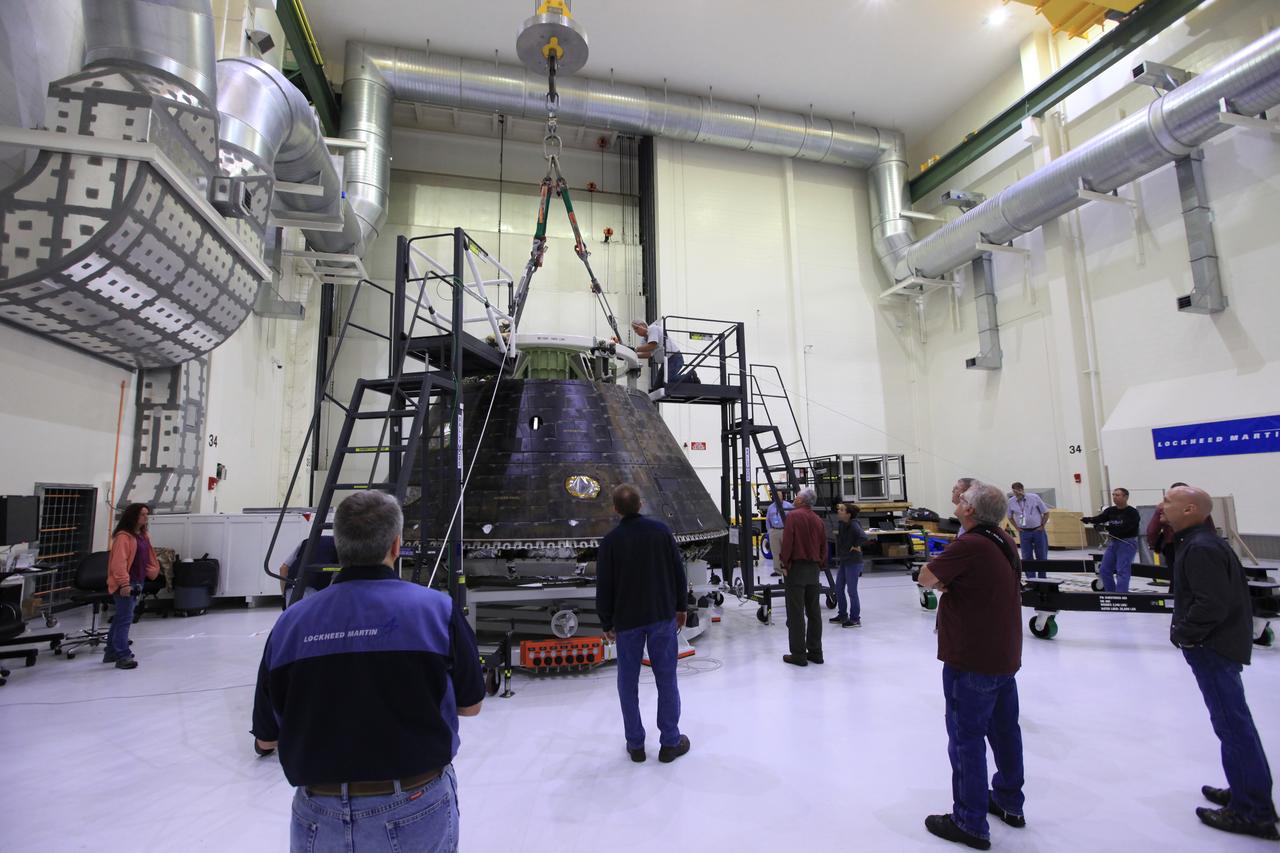
Inside the Neil Armstrong Operations and Checkout Building high bay at NASA's Kennedy Space Center in Florida, Lockheed Martin and ASRC workers monitor the progress as a crane is attached to the top of the Orion crew module from Exploration Flight Test 1. The crew module will be moved to the nearby Kennedy Space Center Visitor Complex and delivered to the IMAX Theater where it will be prepared for display in the NASA Now exhibit. The Orion spacecraft launched atop a United Launch Alliance Delta IV rocket Dec. 5, 2014, from Space Launch Complex 37 at Cape Canaveral Air Force Station. The spacecraft built for humans traveled 3,604 miles above Earth and splashed down about 4.5 hours later in the Pacific Ocean.

CAPE CANAVERAL, Fla. -- NASA's Orion spacecraft is viewed by members of the media at the Launch Abort System Facility at NASA's Kennedy Space Center in Florida. Orion made the 8-day, 2,700 mile overland trip back to Kennedy from Naval Base San Diego in California. Analysis of date obtained during its two-orbit, four-and-a-half hour mission Dec. 5 will provide engineers with detailed information on how the spacecraft fared. The Ground Systems Development and Operations Program led the recovery, offload and transportation efforts. For more information, visit www.nasa.gov/orion. Photo credit: NASA/Dimitri Gerondidakis

The Exploration Flight Test-1 (EFT-1) Crew Module undergoes preparations to move from the Operations and Checkout Building at Kennedy Space Center to the KSC Visitor Complex on April 6, 2017.
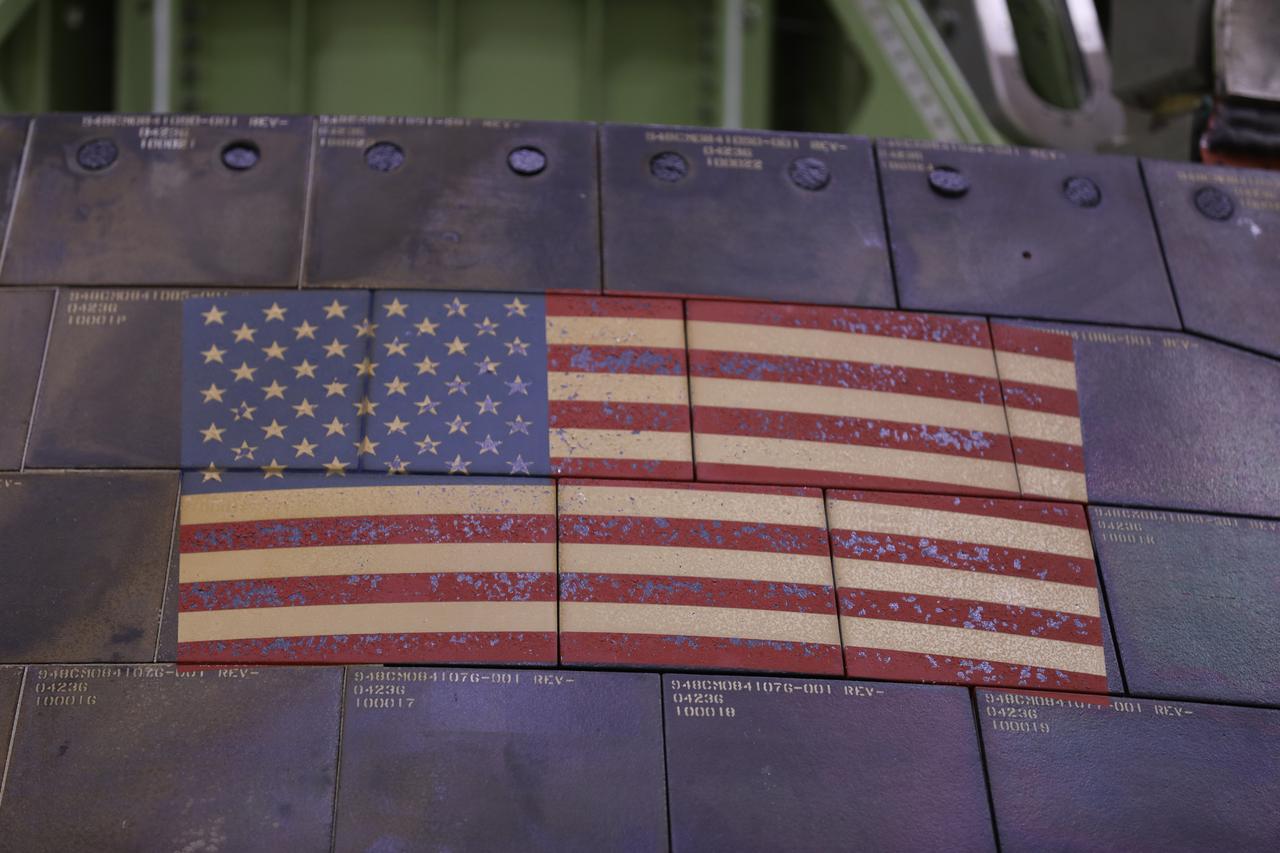
The Exploration Flight Test-1 (EFT-1) Crew Module undergoes preparations to move from the Operations and Checkout Building at Kennedy Space Center to the KSC Visitor Complex on April 6, 2017.
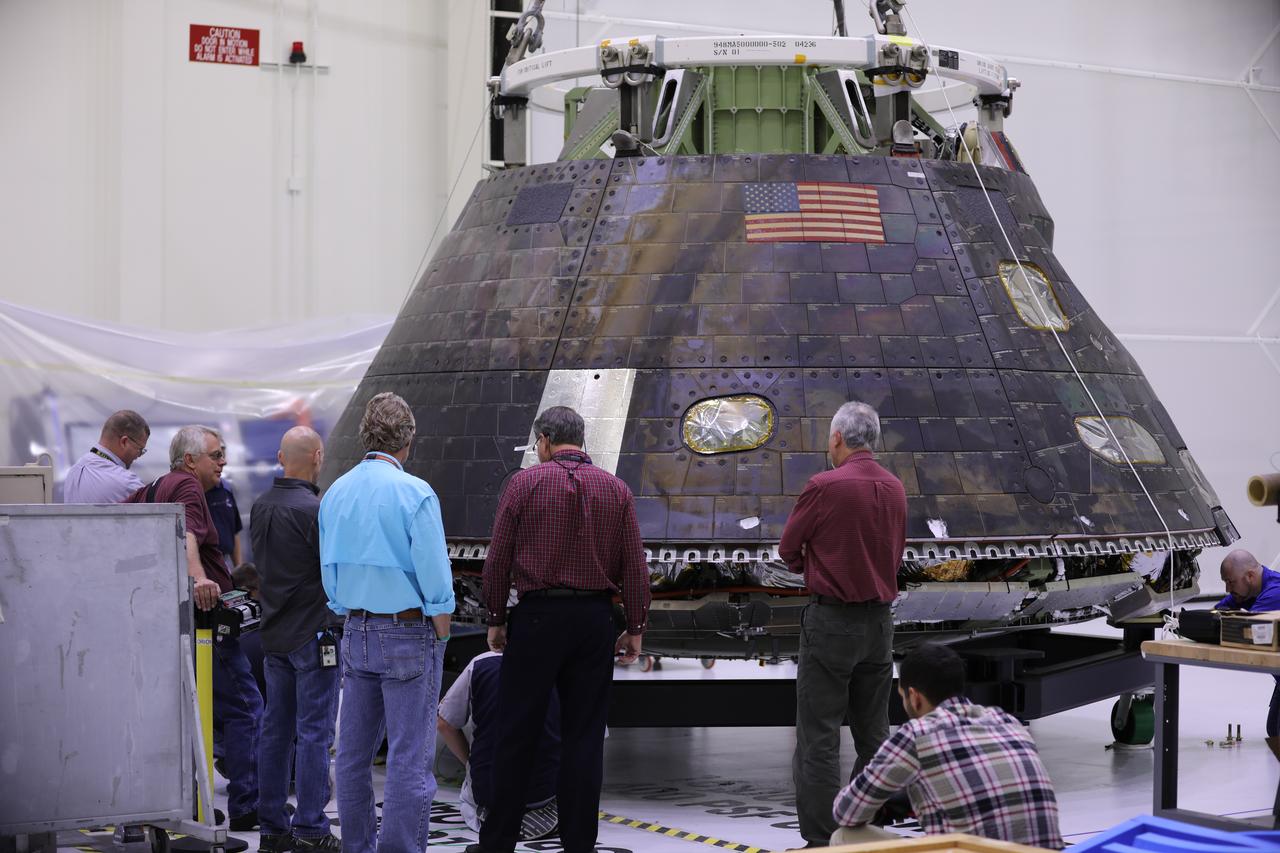
Inside the Neil Armstrong Operations and Checkout Building high bay at NASA's Kennedy Space Center in Florida, the Orion crew module from Exploration Flight Test 1 is lowered onto a custom-built transport stand. The crew module is being prepared for its move to the nearby Kennedy Space Center Visitor Complex and delivery to the IMAX Theater where it will be on display in the NASA Now exhibit. The Orion spacecraft launched atop a United Launch Alliance Delta IV rocket Dec. 5, 2014, from Space Launch Complex 37 at Cape Canaveral Air Force Station. The spacecraft built for humans traveled 3,604 miles above Earth and splashed down about 4.5 hours later in the Pacific Ocean.
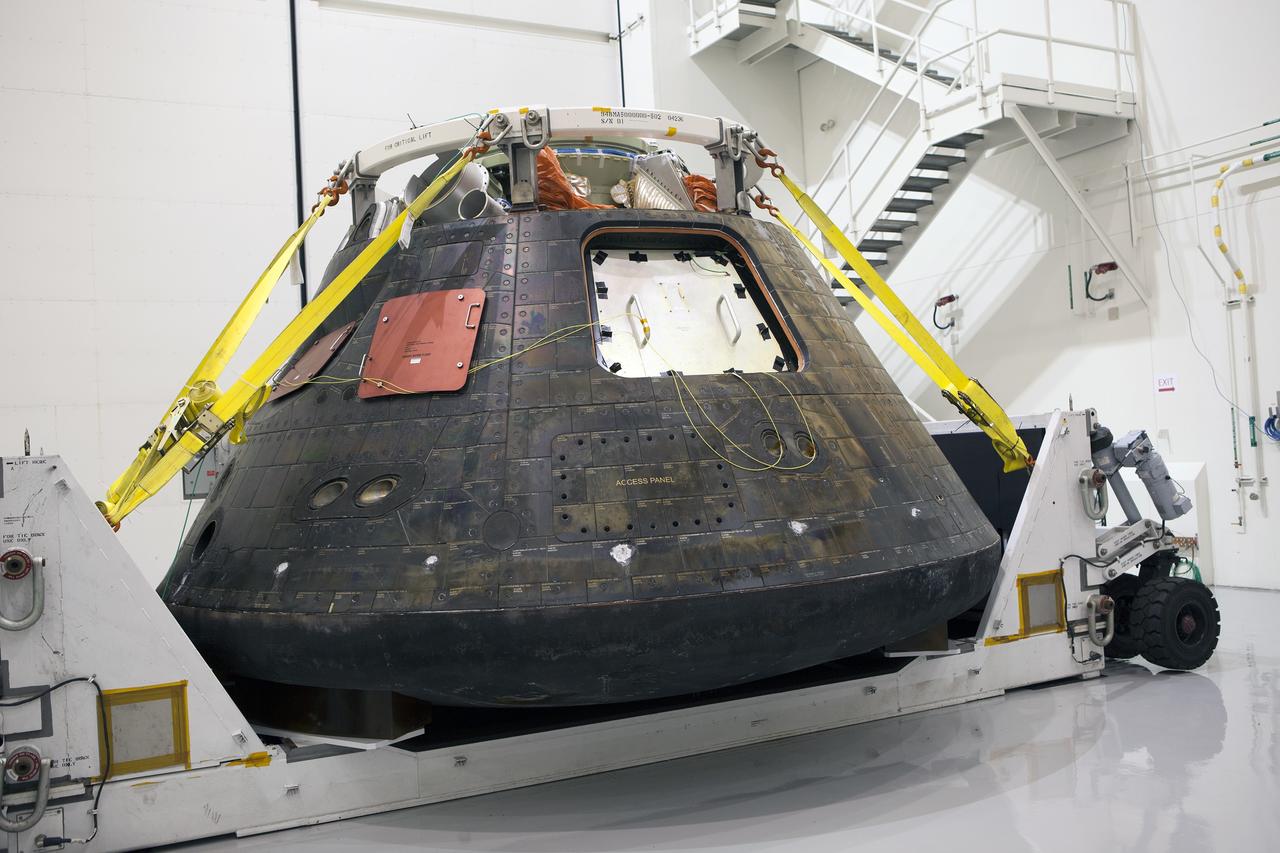
CAPE CANAVERAL, Fla. -- NASA's Orion spacecraft has been uncrated and is inside the Launch Abort System Facility at NASA's Kennedy Space Center in Florida during a media event. Orion made the 8-day, 2,700 mile overland trip back to Kennedy from Naval Base San Diego in California. Analysis of date obtained during its two-orbit, four-and-a-half hour mission Dec. 5 will provide engineers with detailed information on how the spacecraft fared. The Ground Systems Development and Operations Program led the recovery, offload and transportation efforts. For more information, visit www.nasa.gov/orion. Photo credit: NASA/Dimitri Gerondidakis
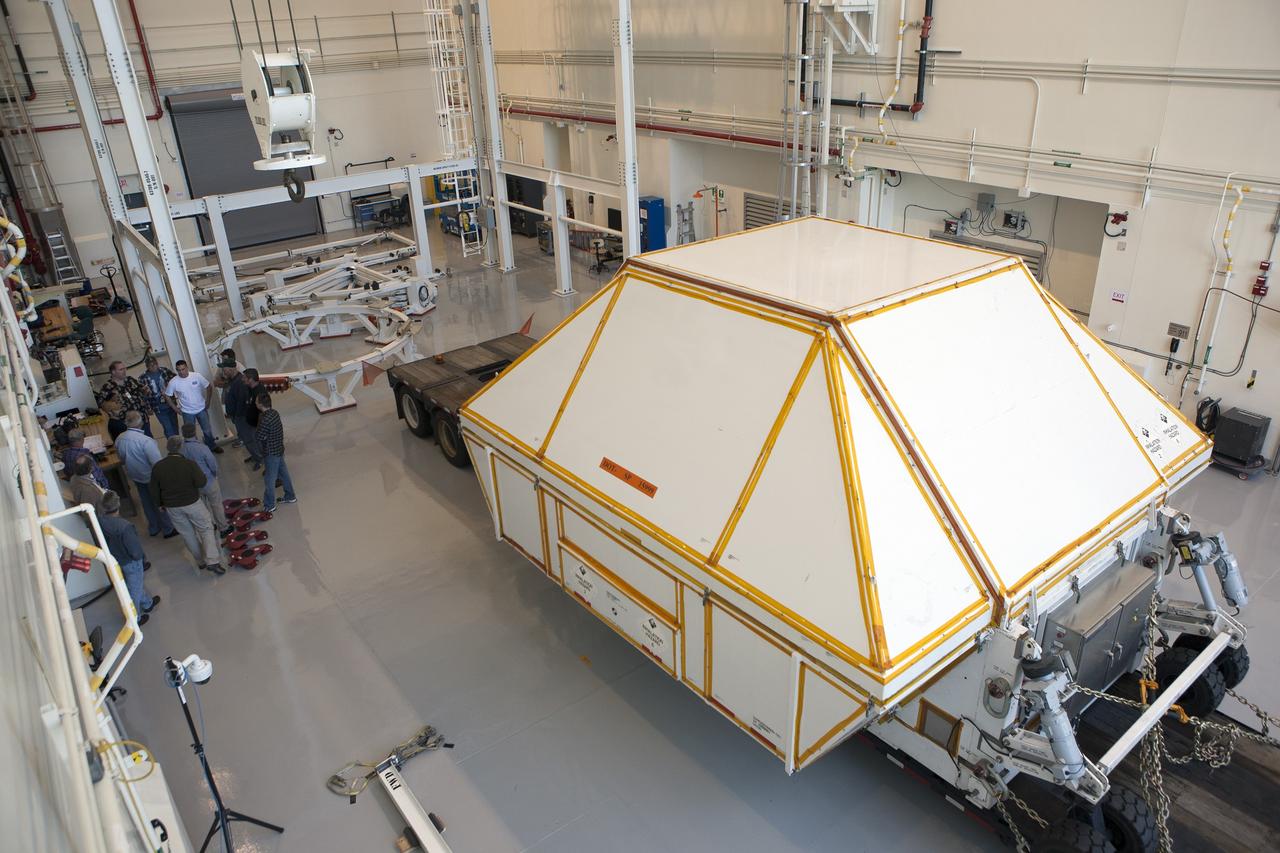
CAPE CANAVERAL, Fla. -- NASA's Orion spacecraft arrives inside the Launch Abort System Facility at Kennedy Space Center in Florida. The spacecraft was transported 2,700 miles overland from Naval Base San Diego in California, on a flatbed truck secured in its crew module transportation fixture for the trip. During its first flight test, Orion completed a two-orbit, four-and-a-half hour mission Dec. 5 to test systems critical to crew safety, including the launch abort system, the heat shield and the parachute system. The Ground Systems Development and Operations Program led the recovery, offload and transportation efforts. For more information, visit www.nasa.gov/orion. Photo credit: NASA/Kim Shiflett
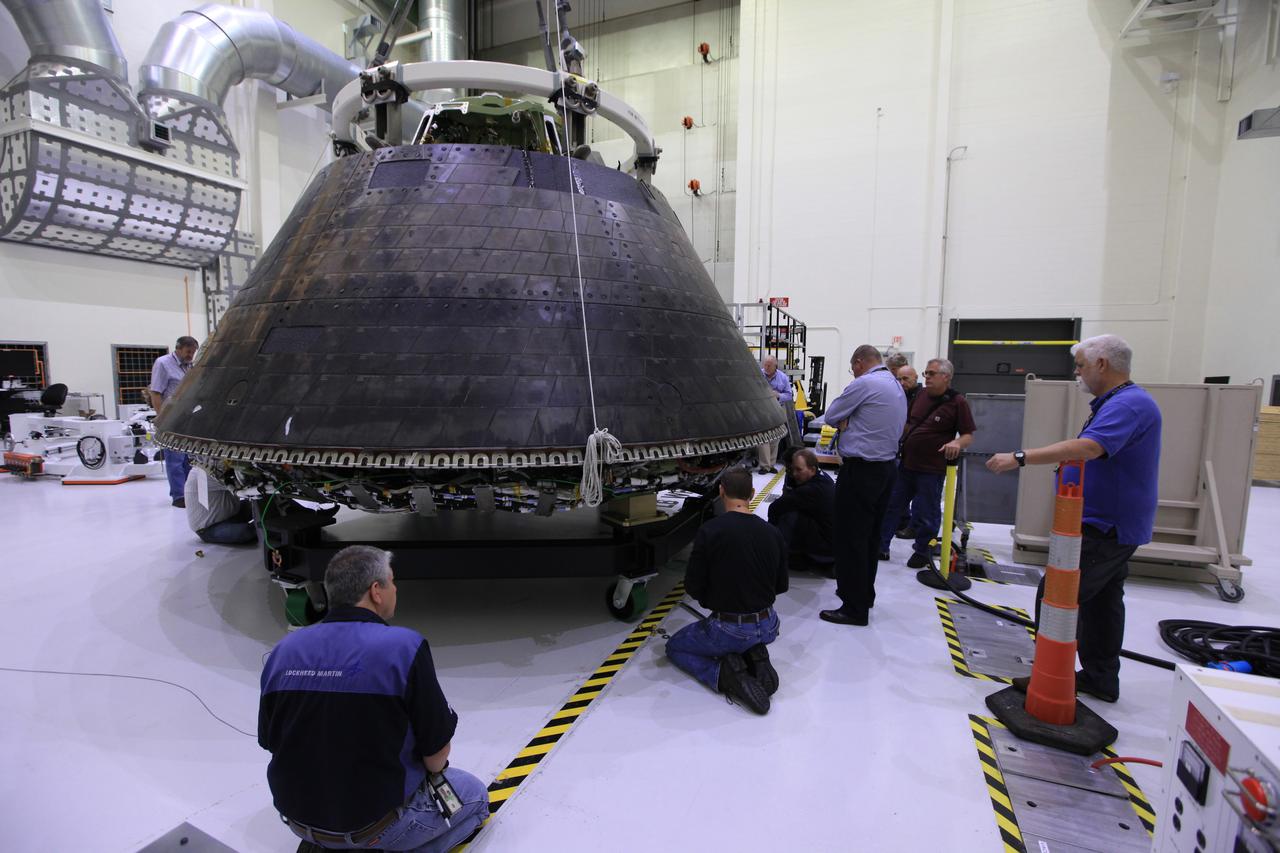
The Exploration Flight Test-1 (EFT-1) Crew Module undergoes preparations to move from the Operations and Checkout Building at Kennedy Space Center to the KSC Visitor Complex on April 6, 2017.
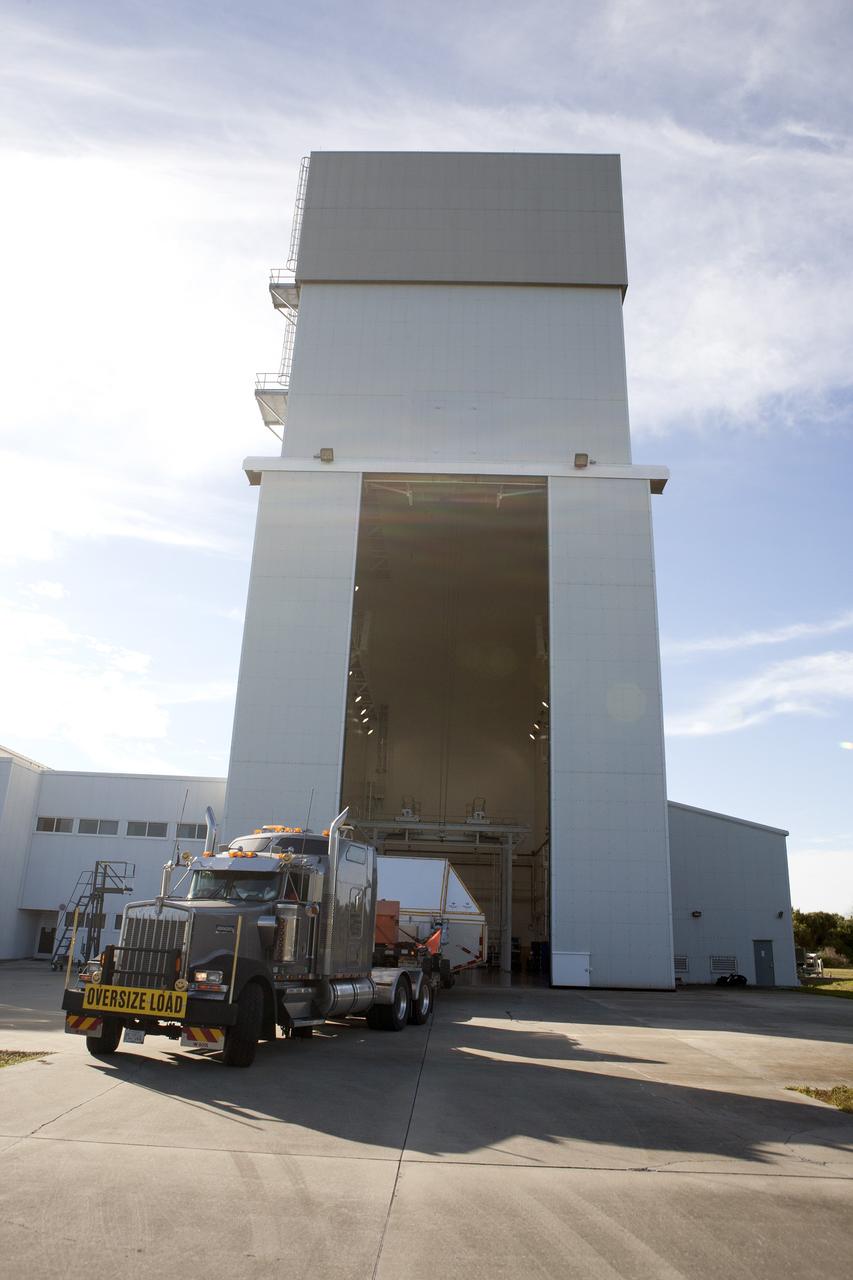
CAPE CANAVERAL, Fla. -- NASA's Orion spacecraft arrives at the Launch Abort System Facility at Kennedy Space Center in Florida. The spacecraft was transported 2,700 miles overland from Naval Base San Diego in California, on a flatbed truck secured in its crew module transportation fixture for the trip. During its first flight test, Orion completed a two-orbit, four-and-a-half hour mission Dec. 5 to test systems critical to crew safety, including the launch abort system, the heat shield and the parachute system. The Ground Systems Development and Operations Program led the recovery, offload and transportation efforts. For more information, visit www.nasa.gov/orion. Photo credit: NASA/Kim Shiflett
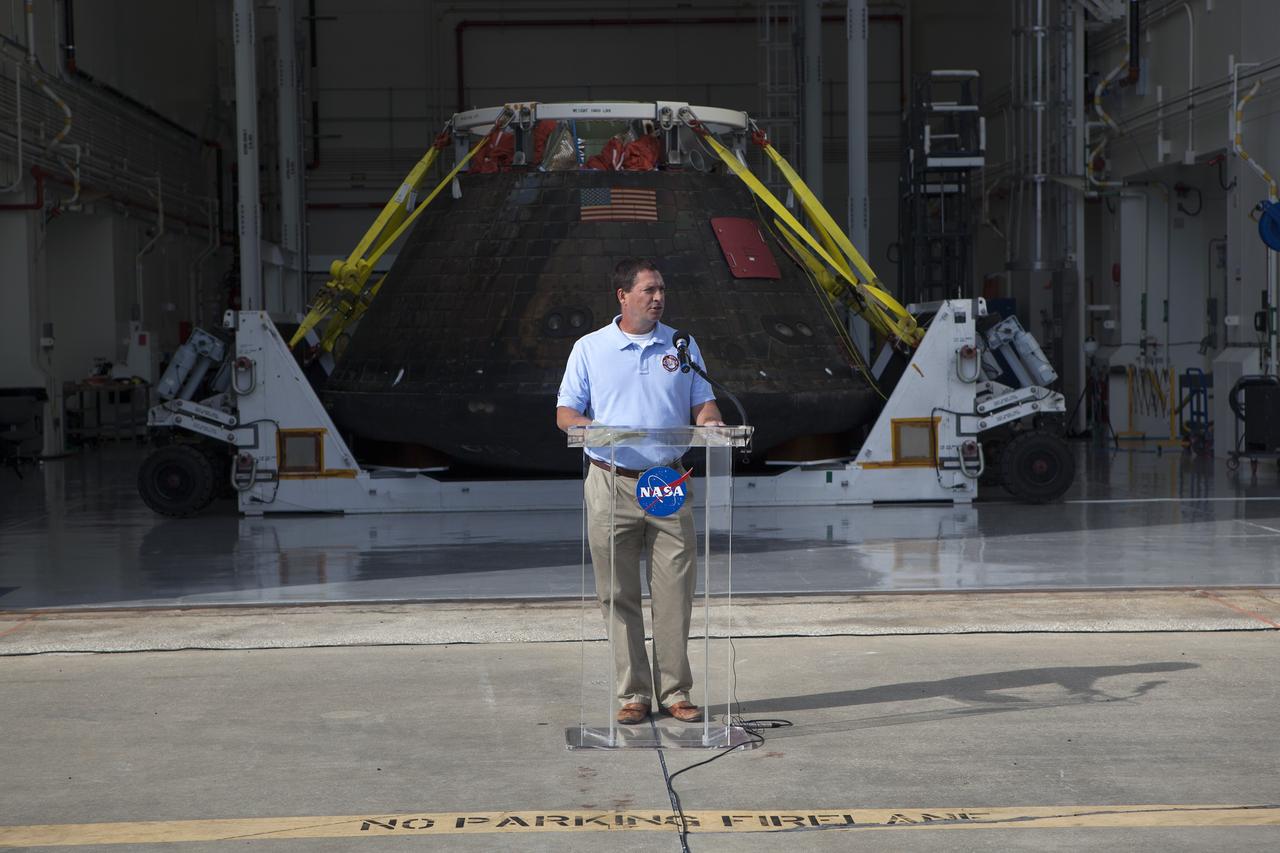
CAPE CANAVERAL, Fla. -- NASA's Orion spacecraft is viewed by members of the media at the Launch Abort System Facility at NASA's Kennedy Space Center in Florida. Lou Garcia, with the Ground Systems Development and Operations Program, or GSDO, speaks to the media during the viewing opportunity. The spacecraft's cross-country return, a 2,700 mile road trip from Naval Base San Diego to Kennedy, sets the stage for in-depth analysis of data obtained during Orion's trip to space. It will provide engineers with detailed information on how the spacecraft fared during its two-orbit, 4.5-hour flight test, completed on Dec. 5. GSDO led the recovery, offload and transportation efforts. For more information, visit www.nasa.gov/orion. Photo credit: NASA/Dimitri Gerondidakis
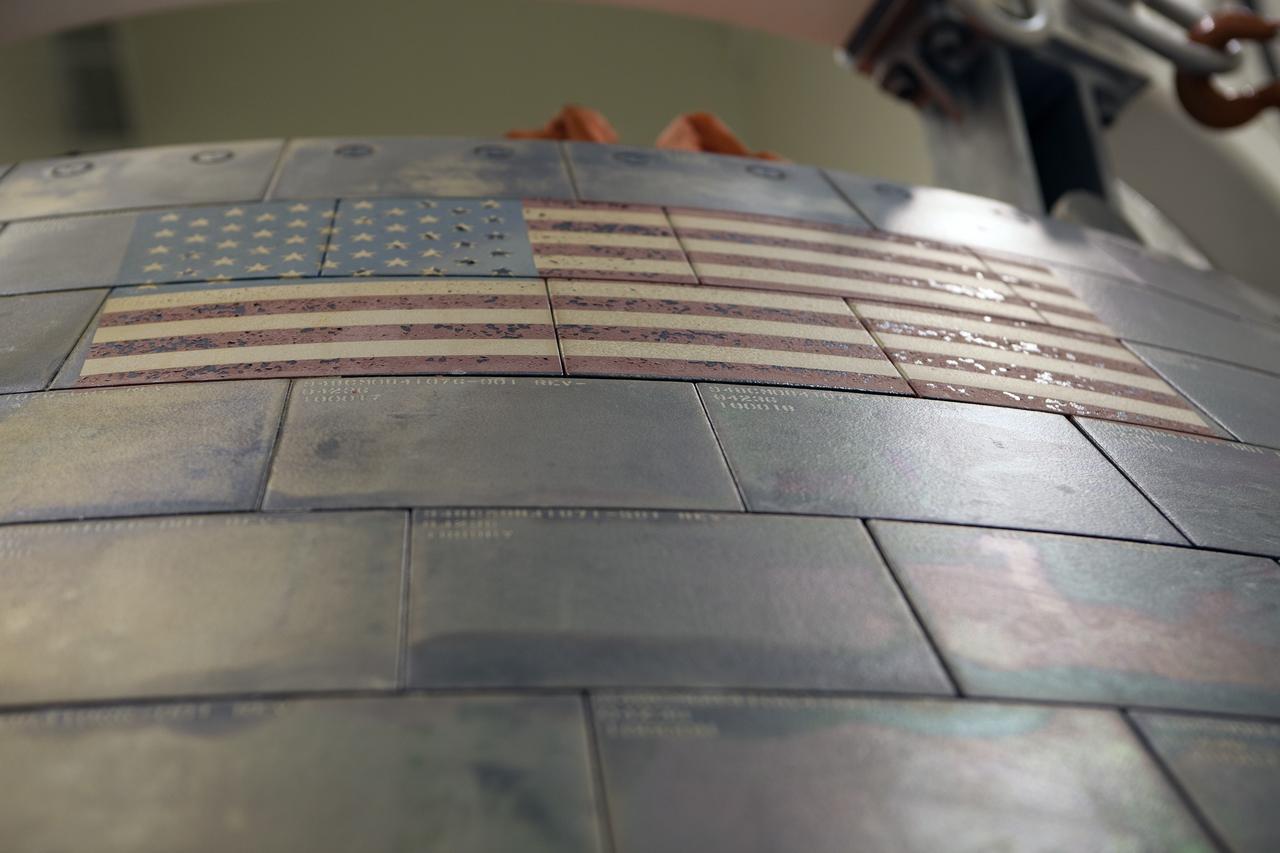
CAPE CANAVERAL, Fla. -- The U.S. Flag is in view on NASA's Orion spacecraft inside the Launch Abort System Facility at NASA's Kennedy Space Center in Florida during a media event. Orion made the 8-day, 2,700 mile overland trip back to Kennedy from Naval Base San Diego in California. Analysis of date obtained during its two-orbit, four-and-a-half hour mission Dec. 5 will provide engineers with detailed information on how the spacecraft fared. The Ground Systems Development and Operations Program led the recovery, offload and transportation efforts. For more information, visit www.nasa.gov/orion. Photo credit: NASA/Dimitri Gerondidakis
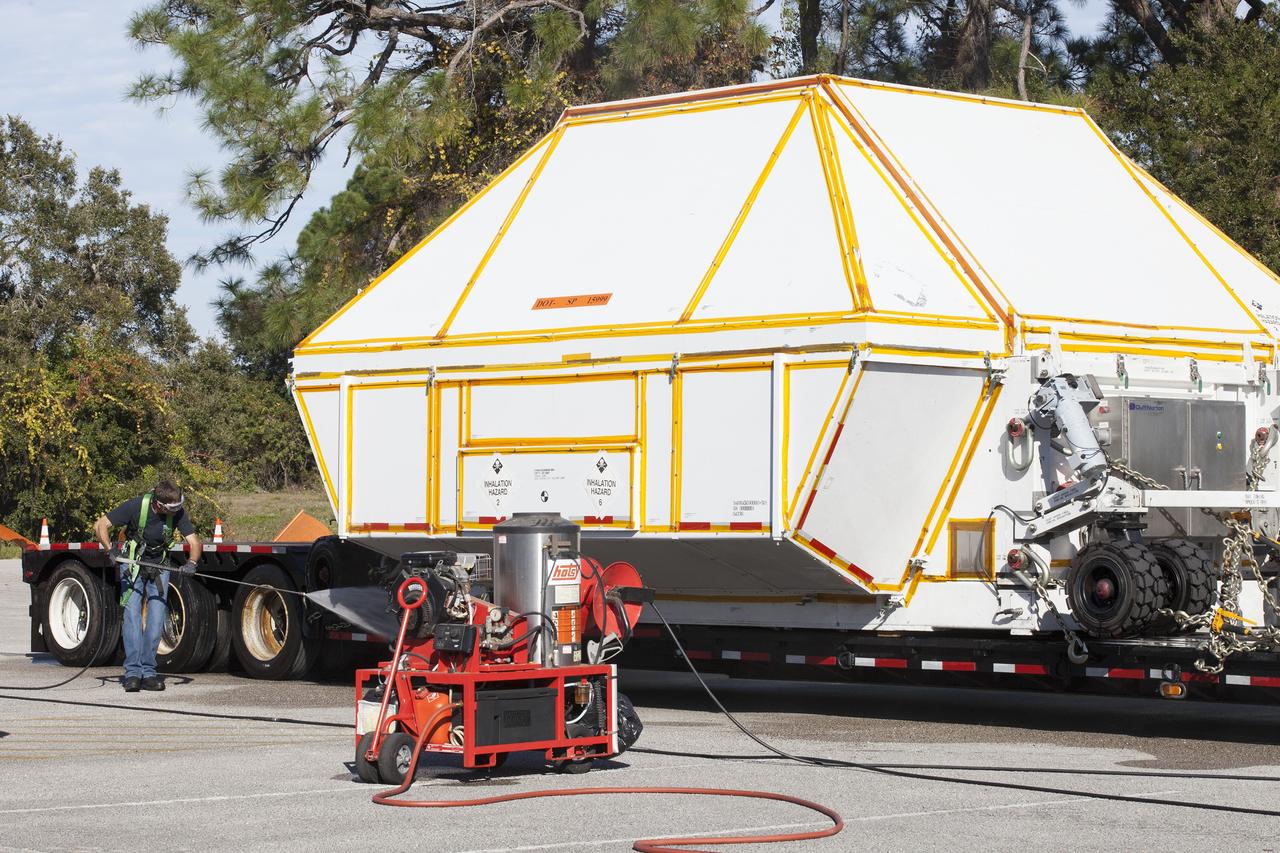
CAPE CANAVERAL, Fla. -- A technician washes down the crew module transportation fixture containing the Orion crew module on the back of a flatbed truck at the Multi-Operation Support Building at NASA's Kennedy Space Center in Florida. Orion was transported 2,700 miles overland from Naval Base San Diego in California. Orion was recovered from the Pacific Ocean after completing a two-orbit, four-and-a-half hour mission Dec. 5 to test systems critical to crew safety, including the launch abort system, the heat shield and the parachute system. The Ground Systems Development and Operations Program led the recovery, offload and transportation efforts. For more information, visit www.nasa.gov/orion. Photo credit: NASA/Kim Shiflett
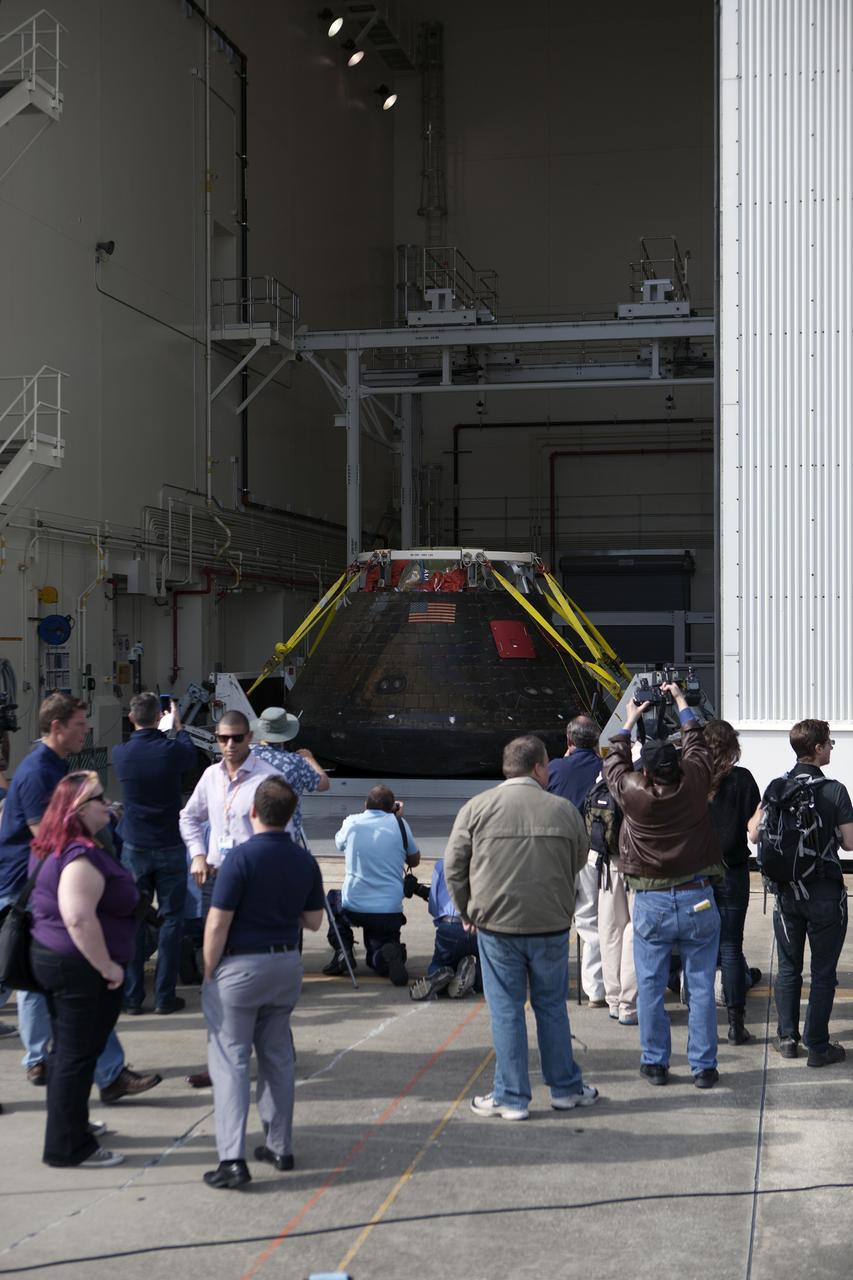
CAPE CANAVERAL, Fla. -- NASA's Orion spacecraft is viewed by members of the media at the Launch Abort System Facility at NASA's Kennedy Space Center in Florida. Orion made the 8-day, 2,700 mile overland trip back to Kennedy from Naval Base San Diego in California. Analysis of date obtained during its two-orbit, four-and-a-half hour mission Dec. 5 will provide engineers detailed information on how the spacecraft fared. The Ground Systems Development and Operations Program led the recovery, offload and transportation efforts. For more information, visit www.nasa.gov/orion. Photo credit: NASA/Dimitri Gerondidakis
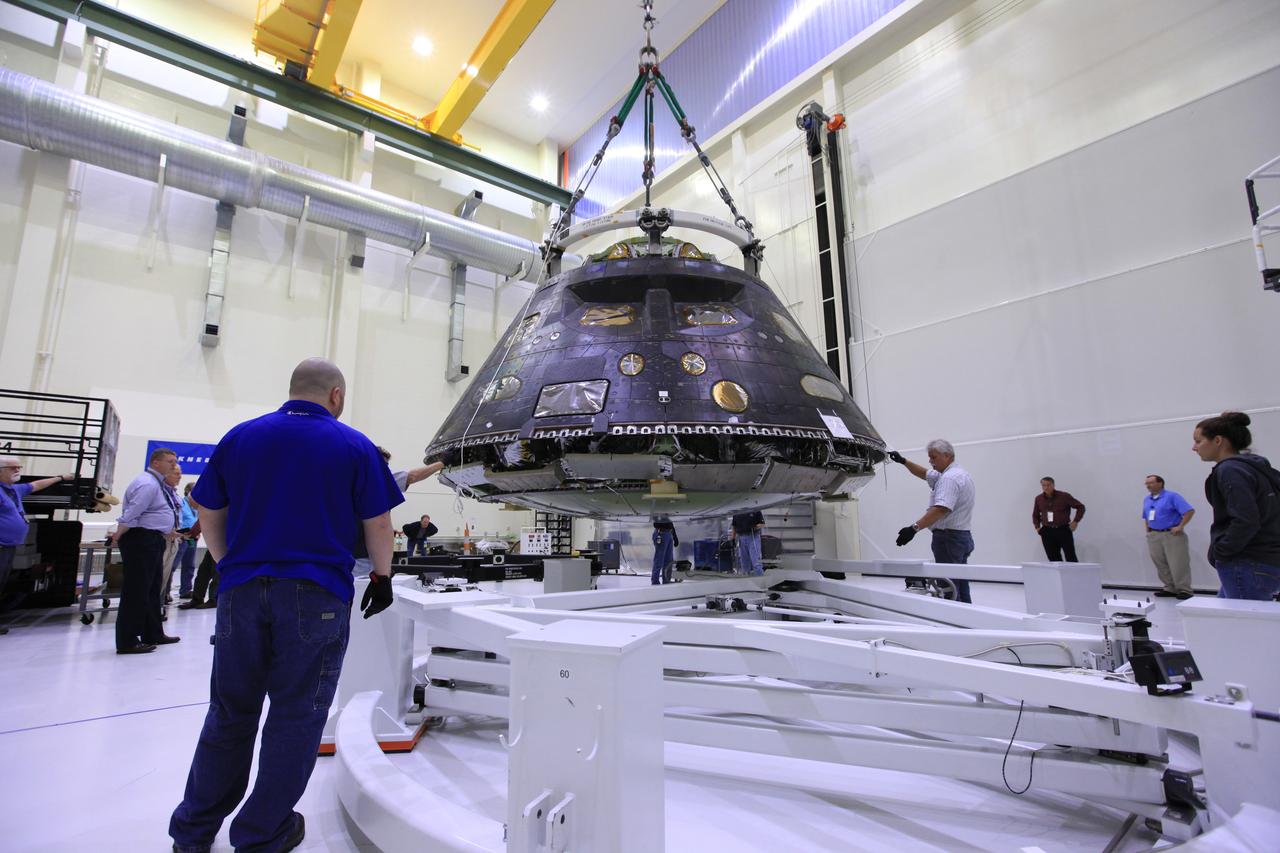
The Exploration Flight Test-1 (EFT-1) Crew Module undergoes preparations to move from the Operations and Checkout Building at Kennedy Space Center to the KSC Visitor Complex on April 6, 2017.
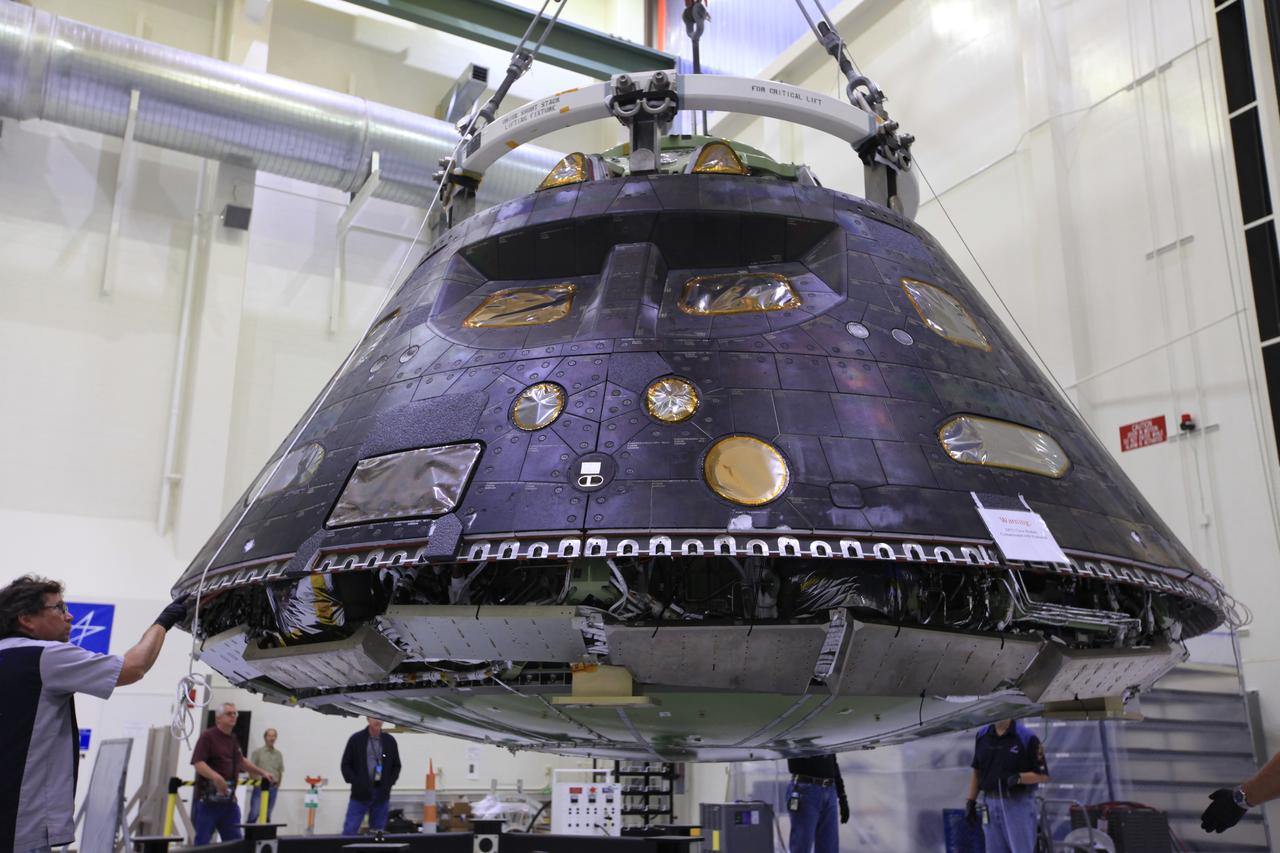
A close-up view of the Orion crew module from Exploration Flight Test 1 in the Neil Armstrong Operations and Checkout Building high bay at NASA's Kennedy Space Center in Florida. A crane has lifted the crew module up from a birdcage test stand and is moving it to a custom-built transport stand for the move to nearby Kennedy Space Center Visitor Complex. Orion will be delivered to IMAX Theater for display in the NASA Now exhibit. The Orion spacecraft launched atop a United Launch Alliance Delta IV rocket Dec. 5, 2014, from Space Launch Complex 37 at Cape Canaveral Air Force Station. The spacecraft built for humans traveled 3,604 miles above Earth and splashed down about 4.5 hours later in the Pacific Ocean.
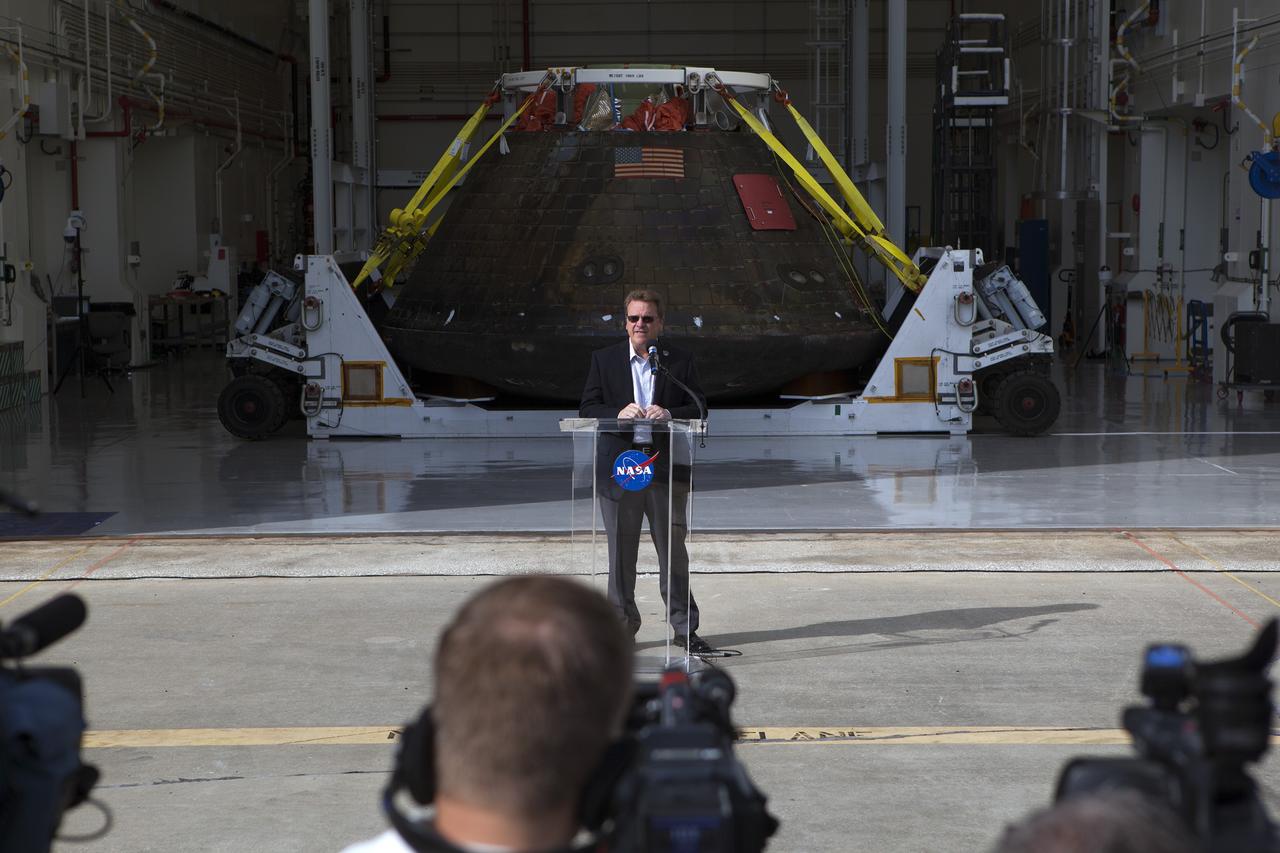
CAPE CANAVERAL, Fla. -- Lockheed Martin Manager Jules Schneider speaks to members of the media during a viewing of NASA's Orion spacecraft at the Launch Abort System Facility at NASA's Kennedy Space Center in Florida. The spacecraft's cross-country return, a 2,700 mile road trip from Naval Base San Diego to Kennedy, sets the stage for in-depth analysis of data obtained during Orion's trip to space. It will provide engineers with detailed information on how the spacecraft fared during its two-orbit, 4.5-hour flight test, completed on Dec. 5. The Ground Systems Development and Operations Program led the recovery, offload and transportation efforts. For more information, visit www.nasa.gov/orion. Photo credit: NASA/Dimitri Gerondidakis
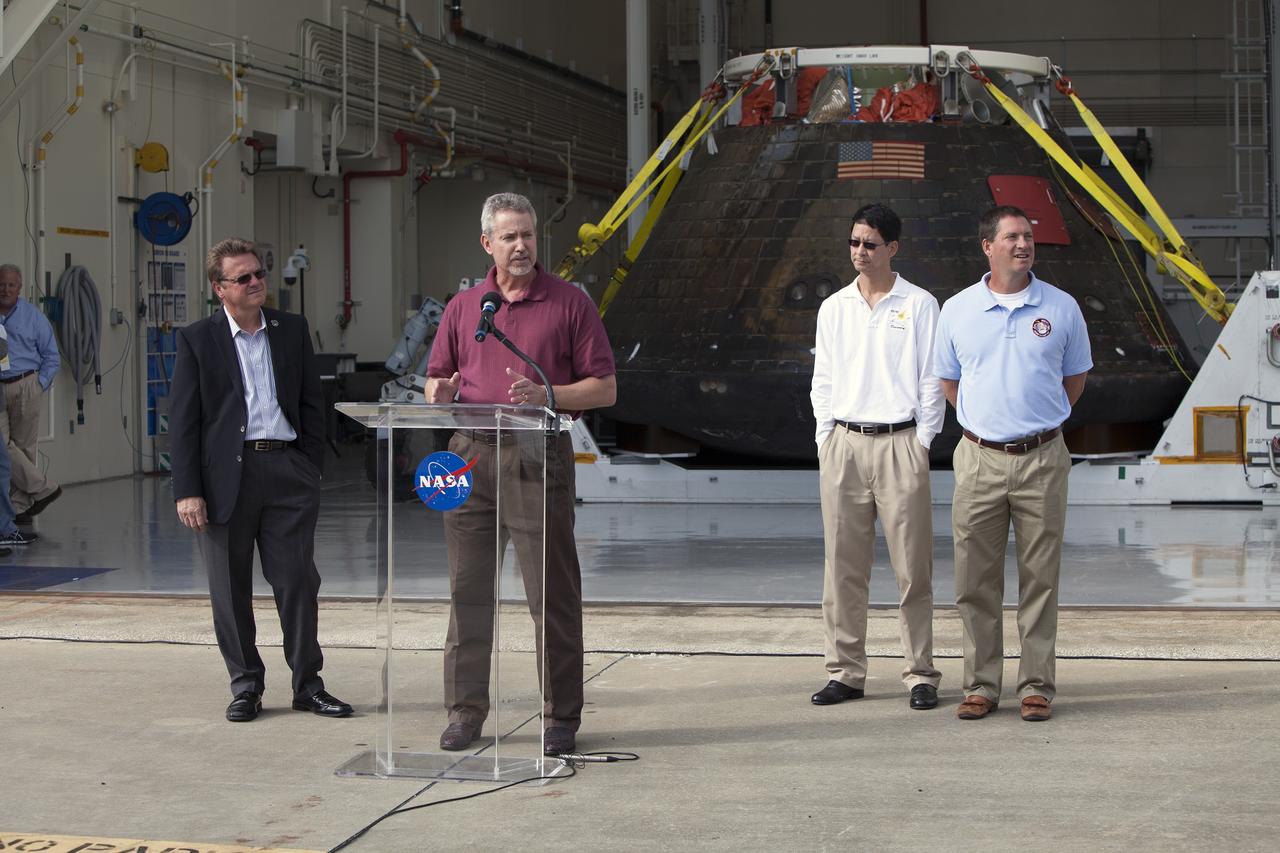
CAPE CANAVERAL, Fla. -- NASA's Orion spacecraft is viewed by members of the media at the Launch Abort System Facility at NASA's Kennedy Space Center in Florida. Speaking to the media during the viewing opportunity is Phil Weber, with the Ground Systems Development and Operations Program, or GSDO. At left is Jules Schneider, Lockheed Martin manager. At right is Glenn Chin, Orion Production Operations, and Lou Garcia, with GSDO. Orion made the 8-day, 2,700 mile overland trip back to Kennedy from Naval Base San Diego in California. Analysis of date obtained during its two-orbit, four-and-a-half hour mission Dec. 5 will provide engineers detailed information on how the spacecraft fared. GSDO led the recovery, offload and transportation efforts. For more information, visit www.nasa.gov/orion. Photo credit: NASA/Dimitri Gerondidakis
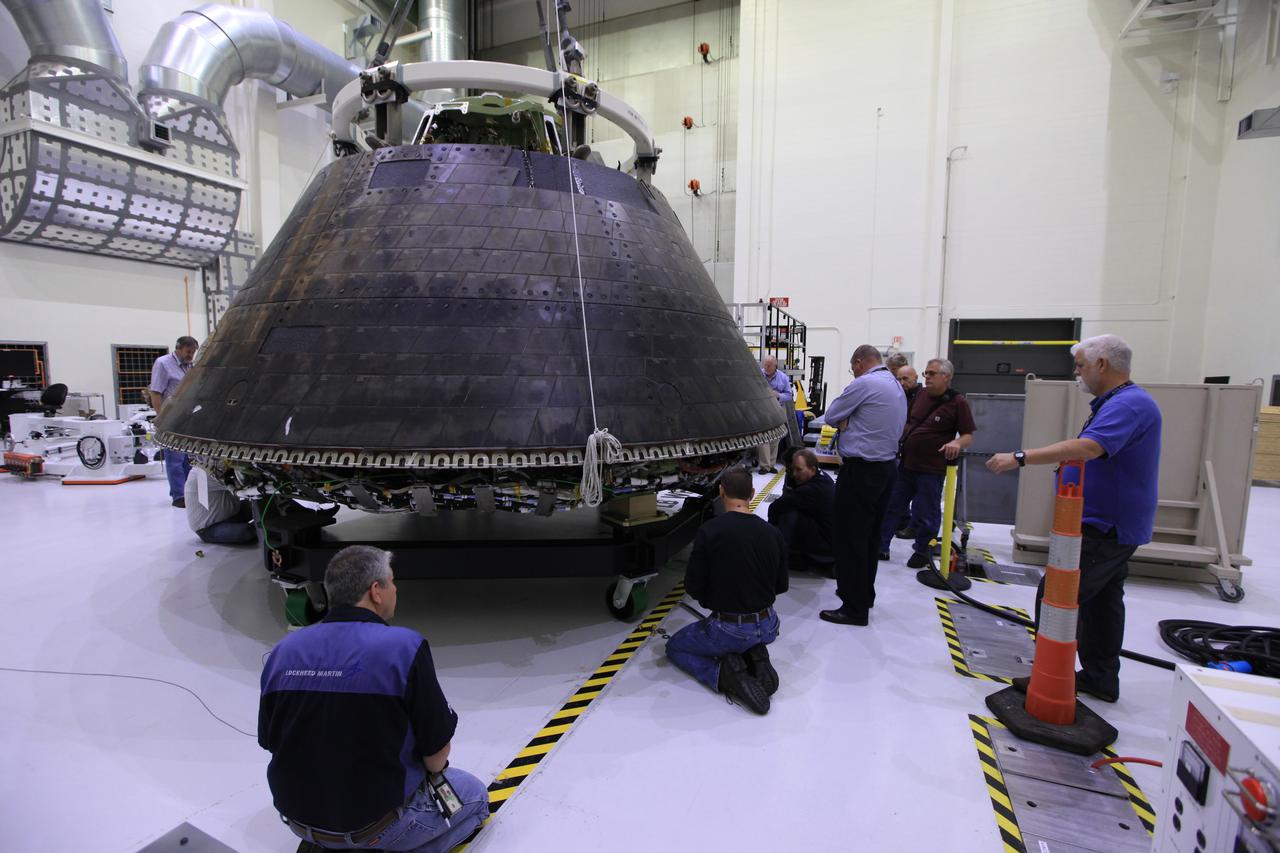
Inside the Neil Armstrong Operations and Checkout Building high bay at NASA's Kennedy Space Center in Florida, Lockheed Martin and ASRC workers assist as a crane lowers the Orion crew module from Exploration Flight Test 1 onto a custom-built transport stand. The crew module is being prepared for its move to the nearby Kennedy Space Center Visitor Complex and delivery to the IMAX Theater where it will be on display in the NASA Now exhibit. The Orion spacecraft launched atop a United Launch Alliance Delta IV rocket Dec. 5, 2014, from Space Launch Complex 37 at Cape Canaveral Air Force Station. The spacecraft built for humans traveled 3,604 miles above Earth and splashed down about 4.5 hours later in the Pacific Ocean.
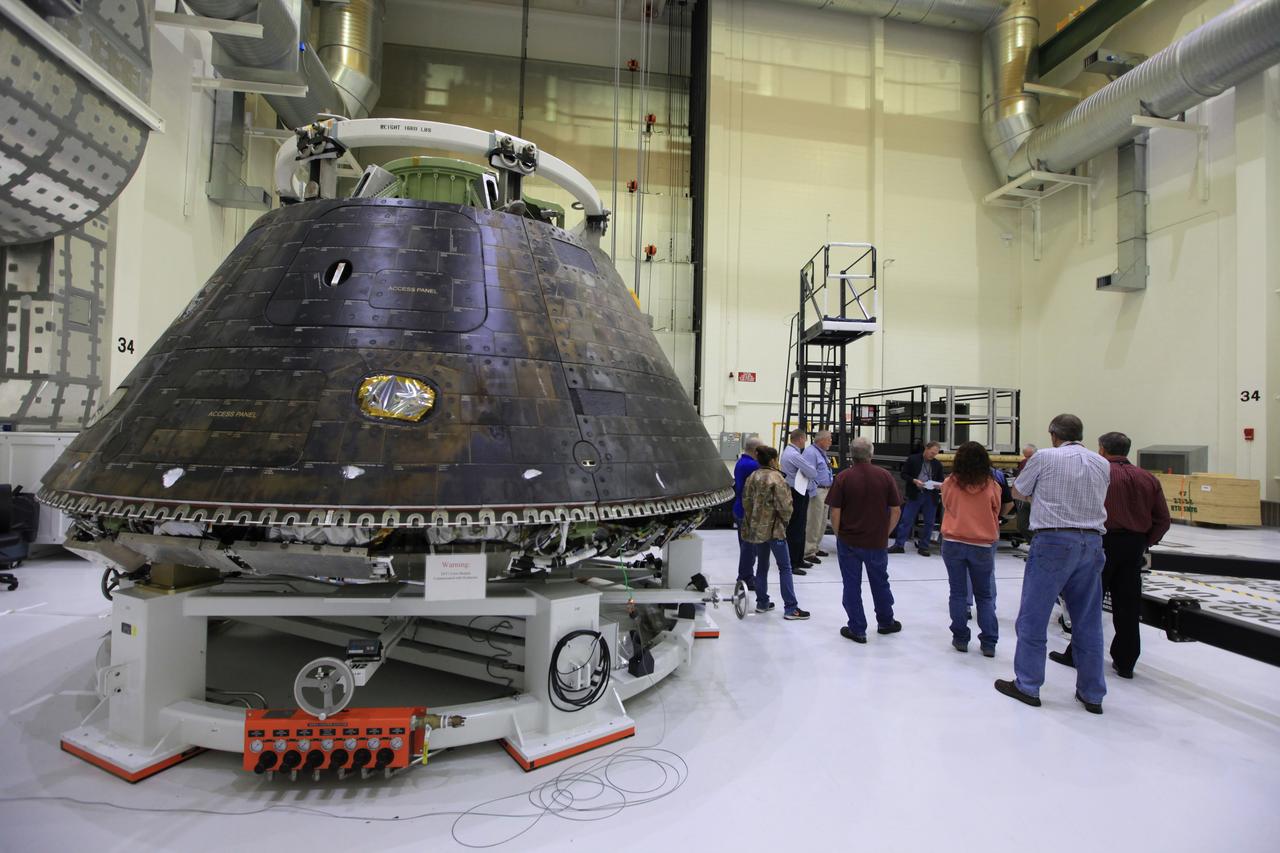
The Exploration Flight Test-1 (EFT-1) Crew Module undergoes preparations to move from the Operations and Checkout Building at Kennedy Space Center to the KSC Visitor Complex on April 6, 2017.
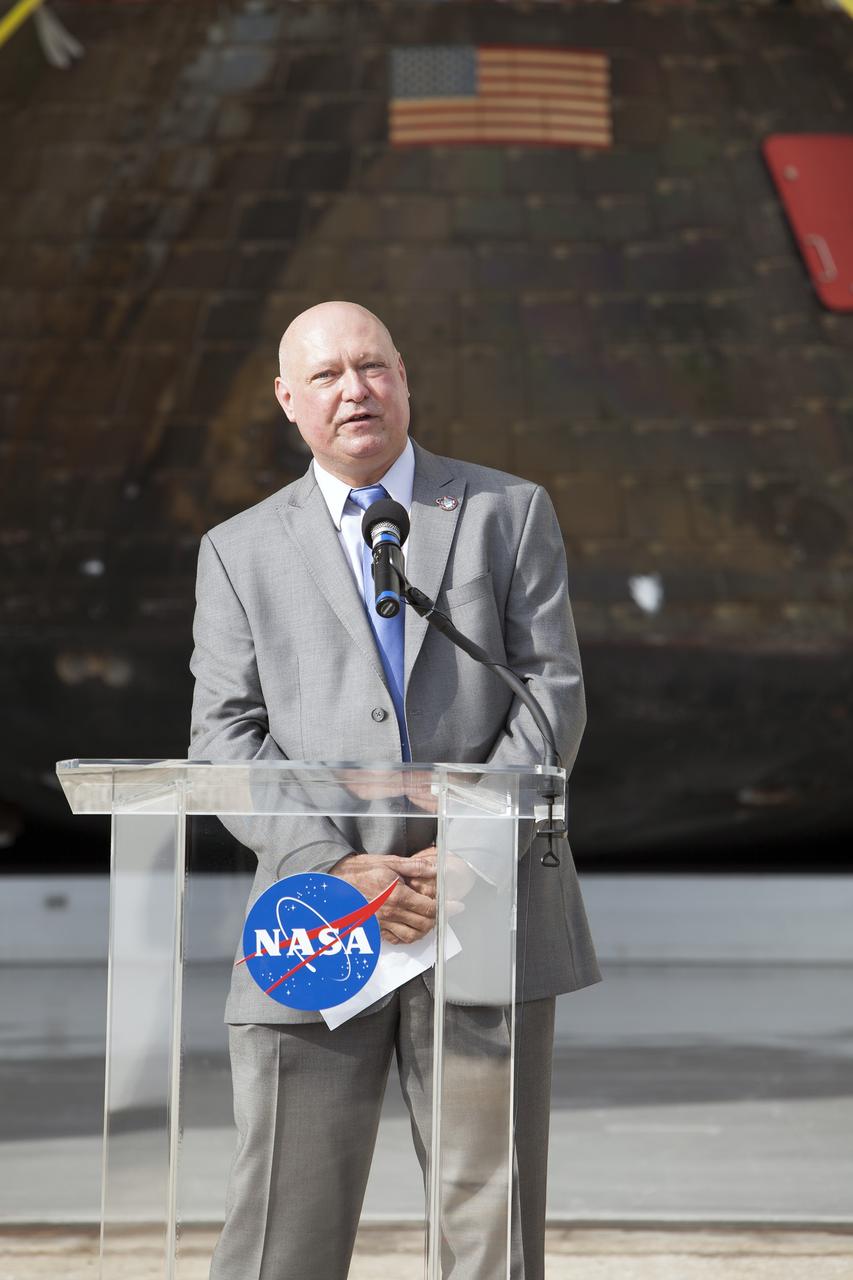
CAPE CANAVERAL, Fla. -- NASA's Orion spacecraft is viewed by members of the media at the Launch Abort System Facility at NASA's Kennedy Space Center in Florida. Kennedy News Chief Mike Curie speaks to the media during the viewing opportunity. Orion made the 8-day, 2,700 mile overland trip back to Kennedy from Naval Base San Diego in California. Analysis of date obtained during its two-orbit, four-and-a-half hour mission Dec. 5 will provide engineers with detailed information on how the spacecraft fared. The Ground Systems Development and Operations Program led the recovery, offload and transportation efforts. For more information, visit www.nasa.gov/orion. Photo credit: NASA/Dimitri Gerondidakis
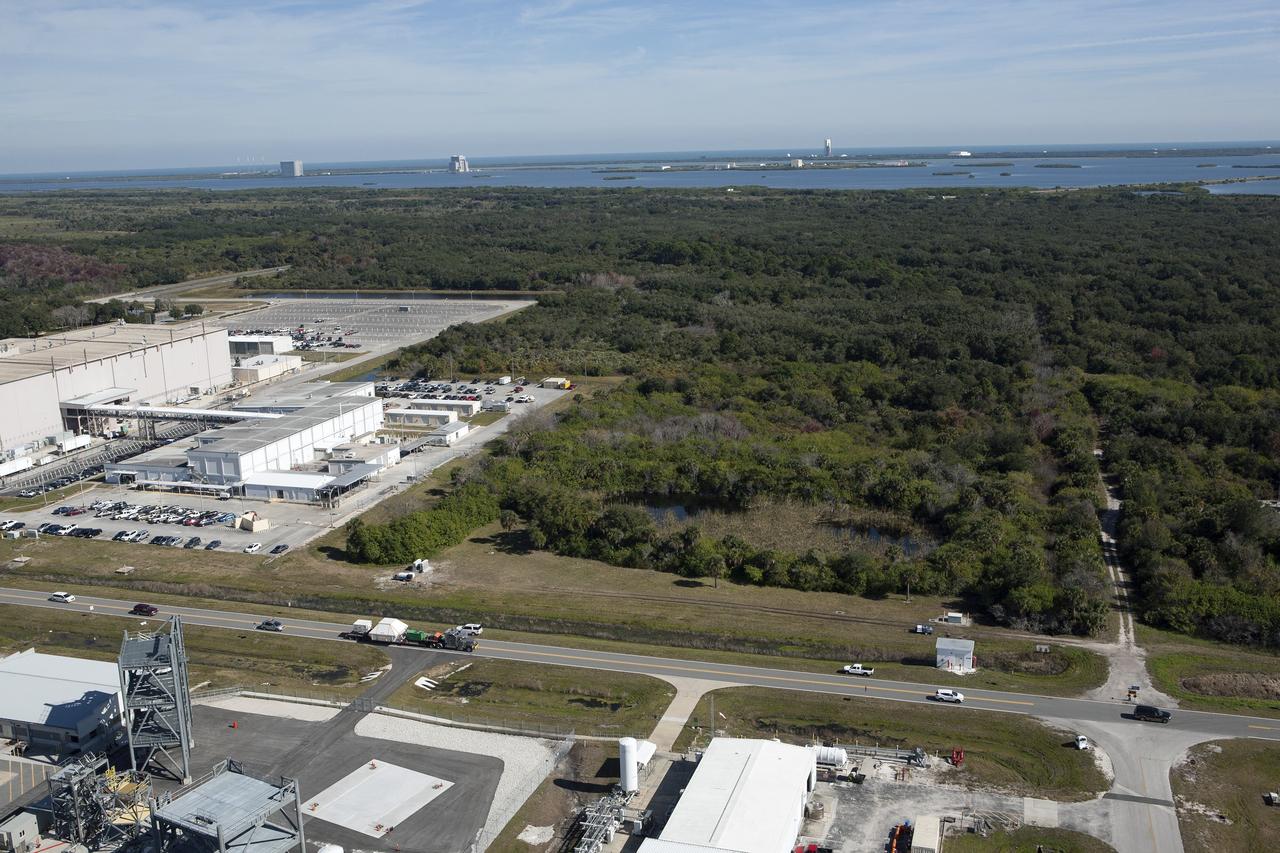
CAPE CANAVERAL, Fla. -- An aerial view reveals the Orion crew module, enclosed in its crew module transportation fixture and secured on a flatbed truck is passing the Space Station Processing Facility at Kennedy Space Center in Florida on its way to the Multi-Operation Support Building. Orion made the 2,700 mile overland trip from Naval Base San Diego in California. The spacecraft was recovered from the Pacific Ocean after completing a two-orbit, four-and-a-half hour mission Dec. 5 to test systems critical to crew safety, including the launch abort system, the heat shield and the parachute system. The Ground Systems Development and Operations Program led the recovery, offload and transportation efforts. For more information, visit www.nasa.gov/orion. Photo credit: NASA/Kim Shiflett
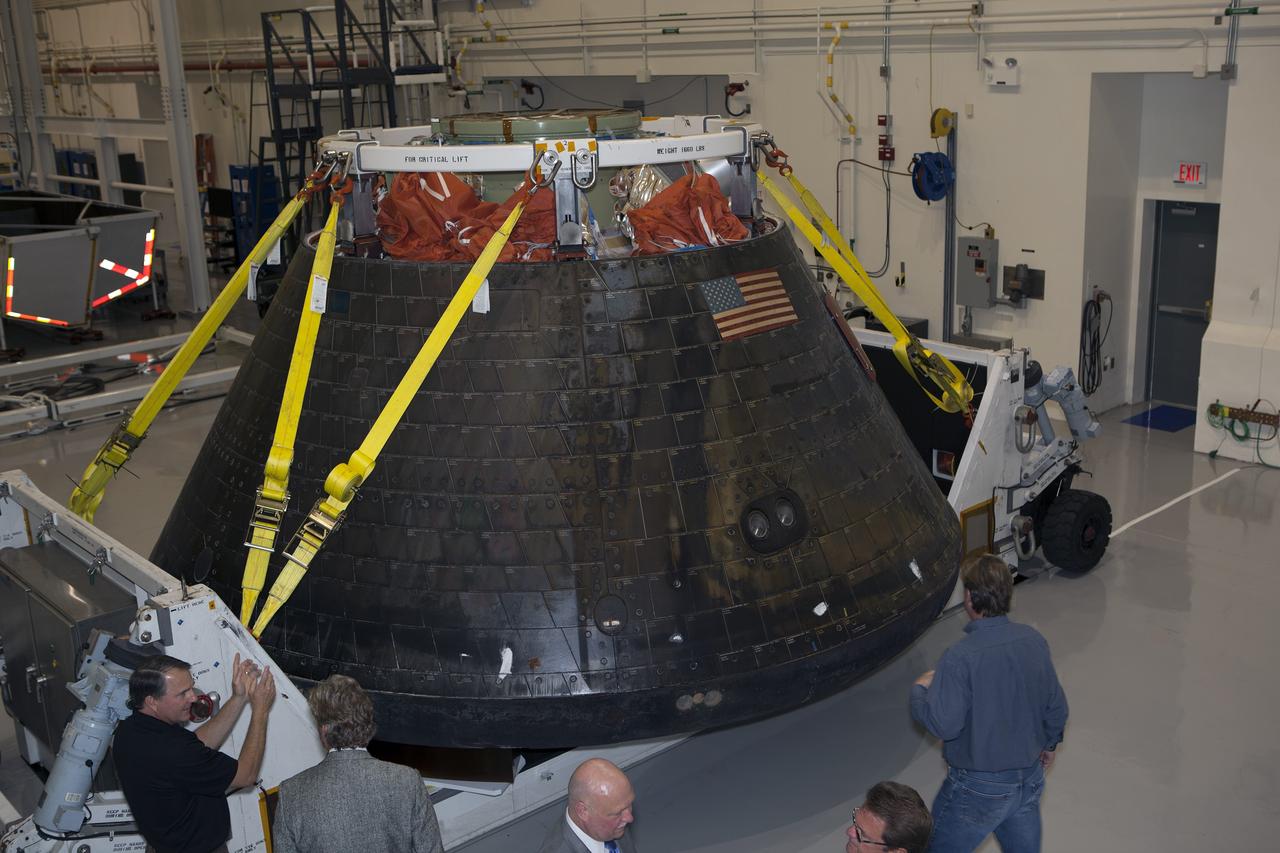
CAPE CANAVERAL, Fla. -- NASA's Orion spacecraft is viewed by members of the media at the Launch Abort System Facility at NASA's Kennedy Space Center in Florida. Orion made the 8-day, 2,700 mile overland trip back to Kennedy from Naval Base San Diego in California. Analysis of date obtained during its two-orbit, four-and-a-half hour mission Dec. 5 will provide engineers with detailed information on how the spacecraft fared. The Ground Systems Development and Operations Program led the recovery, offload and transportation efforts. For more information, visit www.nasa.gov/orion. Photo credit: NASA/Dimitri Gerondidakis
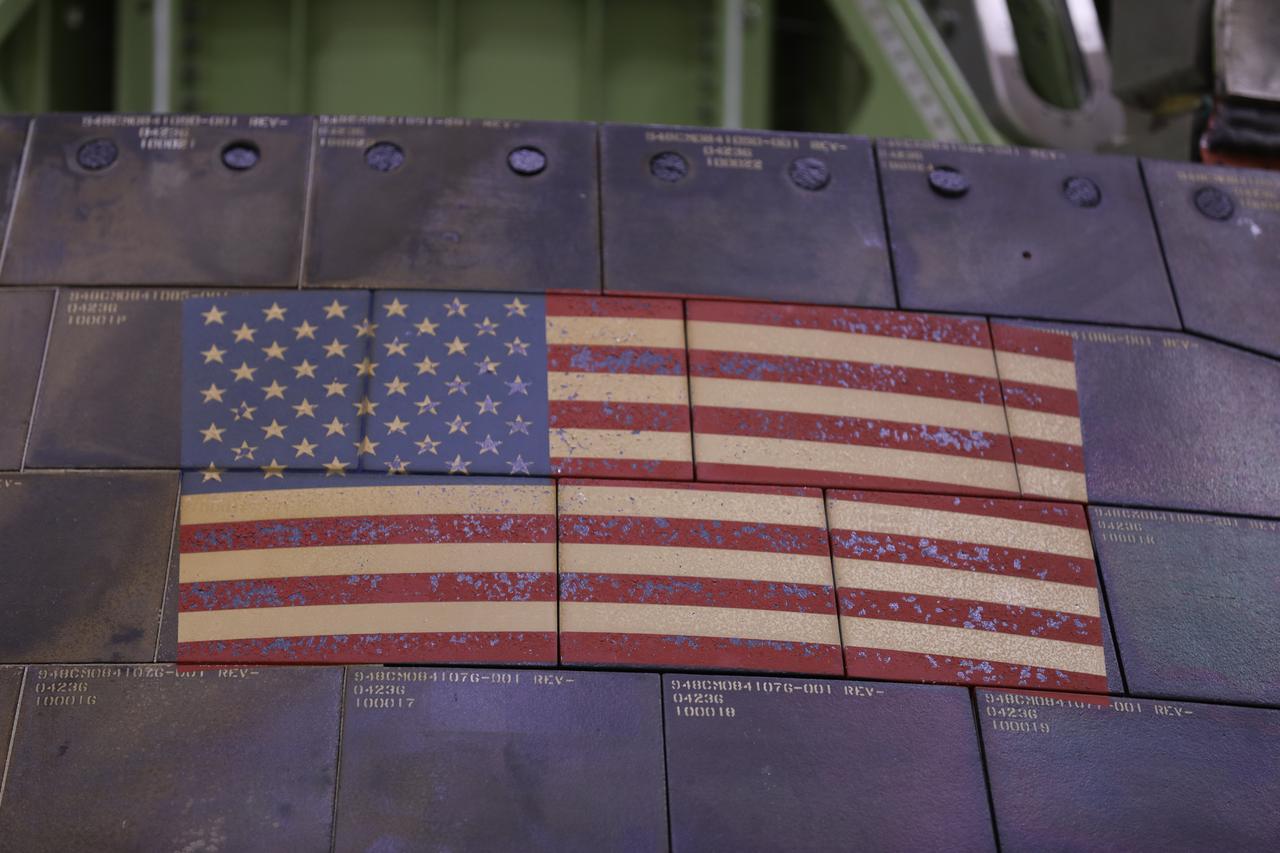
Inside the Neil Armstrong Operations and Checkout Building high bay at NASA's Kennedy Space Center in Florida, the American flag is in view on the Orion crew module from Exploration Flight Test 1. Lockheed Martin and ASRC workers are preparing the crew module for its move to the nearby Kennedy Space Center Visitor Complex. The crew module will be delivered to the IMAX Theater where it will be on display in the NASA Now exhibit. The Orion spacecraft launched atop a United Launch Alliance Delta IV rocket Dec. 5, 2014, from Space Launch Complex 37 at Cape Canaveral Air Force Station. The spacecraft built for humans traveled 3,604 miles above Earth and splashed down about 4.5 hours later in the Pacific Ocean.
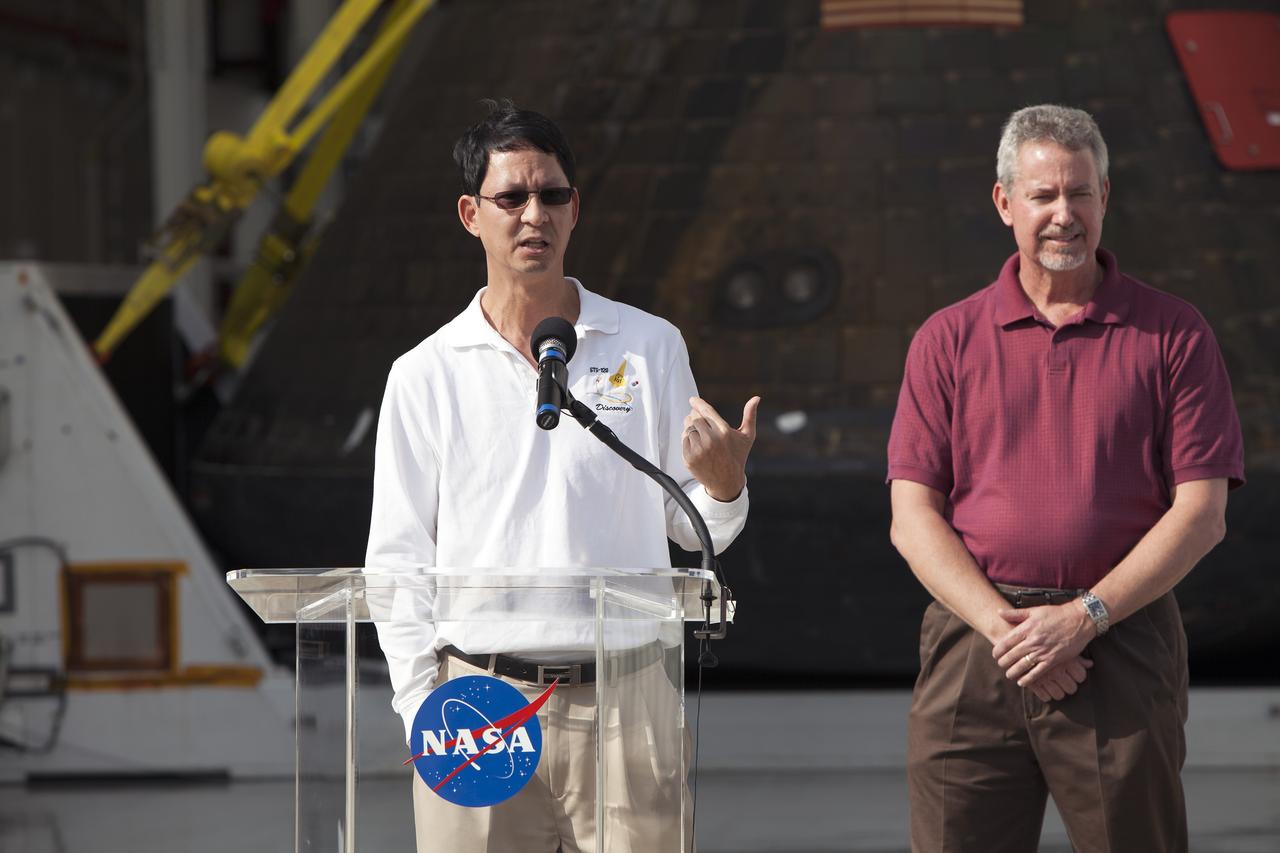
CAPE CANAVERAL, Fla. -- NASA's Orion spacecraft is viewed by members of the media at the Launch Abort System Facility at NASA's Kennedy Space Center in Florida. Speaking to the media during the viewing opportunity is Glenn Chin, Orion Production Operations. To his right is Phil Weber, with the Ground Systems Development and Operations Program, or GSDO. Orion made the 8-day, 2,700 mile overland trip back to Kennedy from Naval Base San Diego in California. Analysis of date obtained during its two-orbit, four-and-a-half hour mission Dec. 5 will provide engineers with detailed information on how the spacecraft fared. GSDO led the recovery, offload and transportation efforts. For more information, visit www.nasa.gov/orion. Photo credit: NASA/Dimitri Gerondidakis
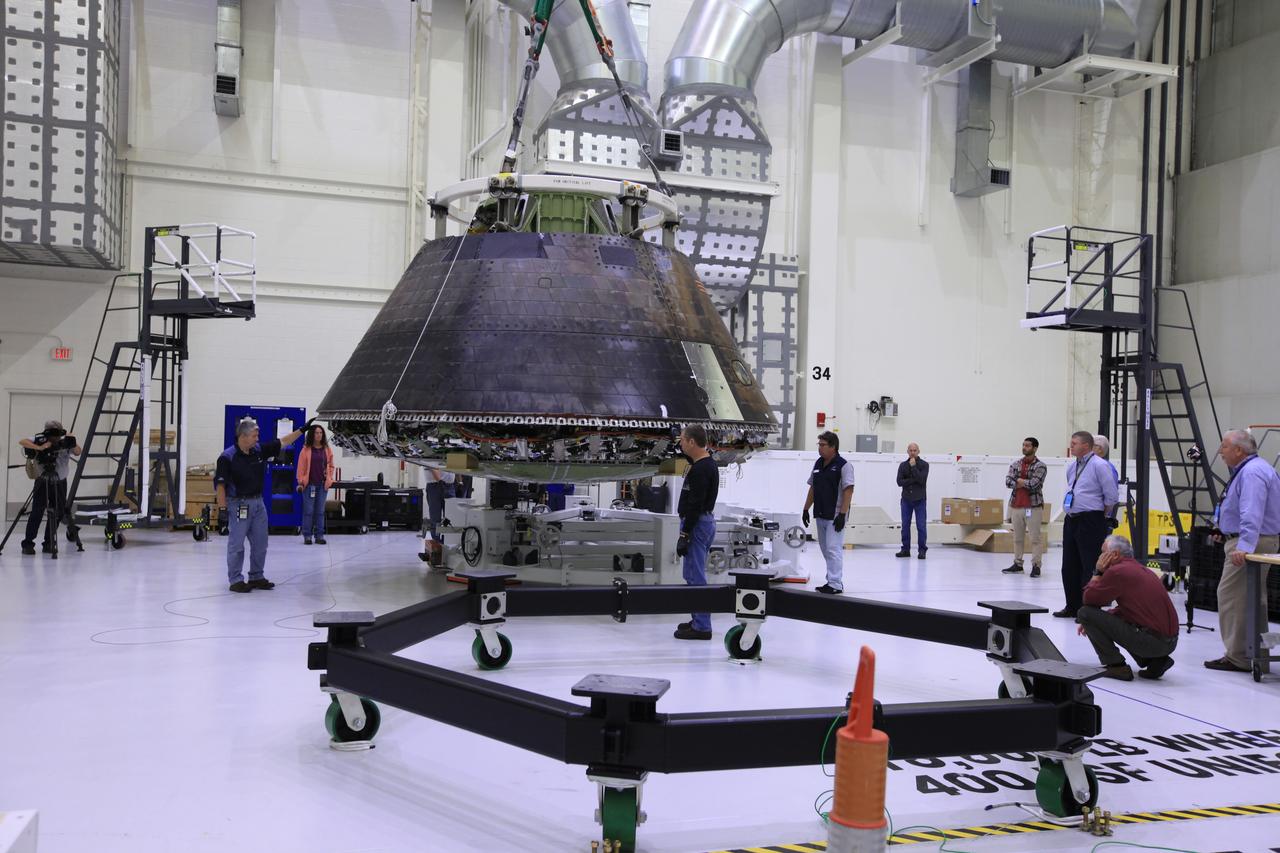
Inside the Neil Armstrong Operations and Checkout Building high bay at NASA's Kennedy Space Center in Florida, Lockheed Martin and ASRC workers monitor the progress as a crane moves the Orion crew module from Exploration Flight Test 1 over to a custom-built transport stand. The crew module is being prepared for its move to the nearby Kennedy Space Center Visitor Complex. It will be on display in the NASA Now exhibit in the IMAX Theater. The Orion spacecraft launched atop a United Launch Alliance Delta IV rocket Dec. 5, 2014, from Space Launch Complex 37 at Cape Canaveral Air Force Station. The spacecraft built for humans traveled 3,604 miles above Earth and splashed down about 4.5 hours later in the Pacific Ocean.
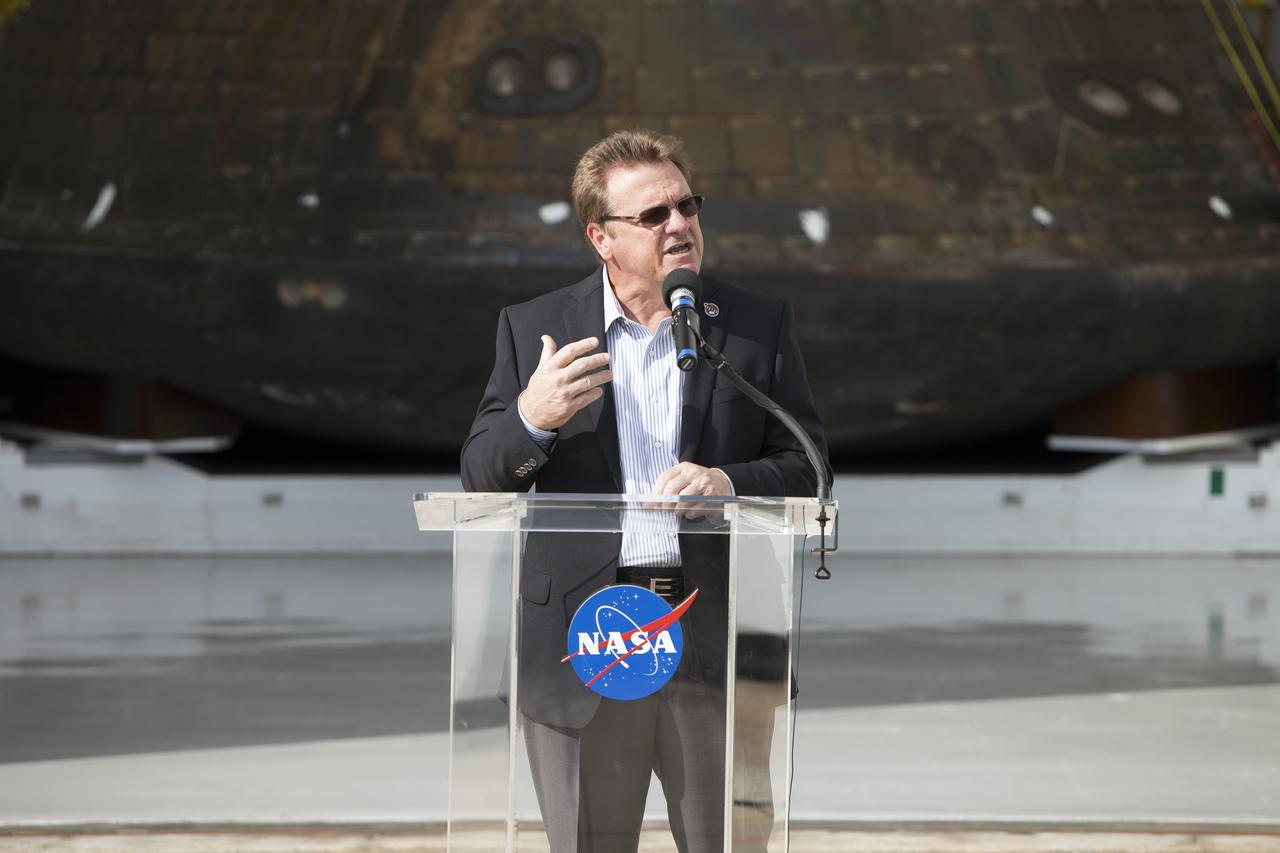
CAPE CANAVERAL, Fla. -- Lockheed Martin Manager Jules Schneider speaks to members of the media during a viewing of NASA's Orion spacecraft at the Launch Abort System Facility at NASA's Kennedy Space Center in Florida. The spacecraft's cross-country return, a 2,700 mile road trip from Naval Base San Diego to Kennedy, sets the stage for in-depth analysis of data obtained during Orion's trip to space. It will provide engineers with detailed information on how the spacecraft fared during its two-orbit, 4.5-hour flight test, completed on Dec. 5. The Ground Systems Development and Operations Program led the recovery, offload and transportation efforts. For more information, visit www.nasa.gov/orion. Photo credit: NASA/Dimitri Gerondidakis

CAPE CANAVERAL, Fla. -- NASA's Orion crew module, enclosed in its crew module transportation fixture and secured on a flatbed truck, leaves the Multi-Operation Support Building and is being transported to the Launch Abort System Facility at NASA's Kennedy Space Center in Florida. Orion was transported 2,700 miles overland from Naval Base San Diego in California. Orion was recovered from the Pacific Ocean after completing a two-orbit, four-and-a-half hour mission Dec. 5 to test systems critical to crew safety, including the launch abort system, the heat shield and the parachute system. The Ground Systems Development and Operations Program led the recovery, offload and transportation efforts. For more information, visit www.nasa.gov/orion. Photo credit: NASA/Kim Shiflett
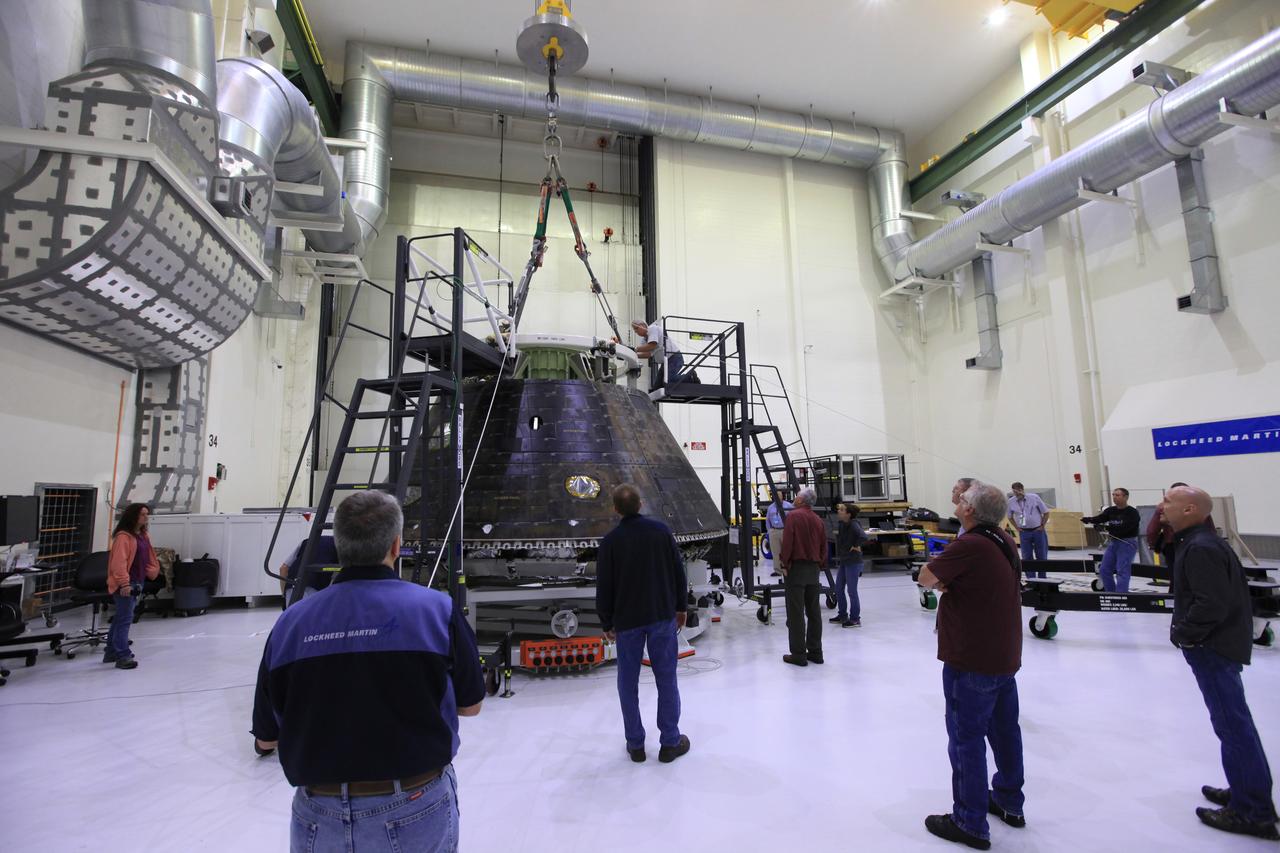
The Exploration Flight Test-1 (EFT-1) Crew Module undergoes preparations to move from the Operations and Checkout Building at Kennedy Space Center to the KSC Visitor Complex on April 6, 2017.
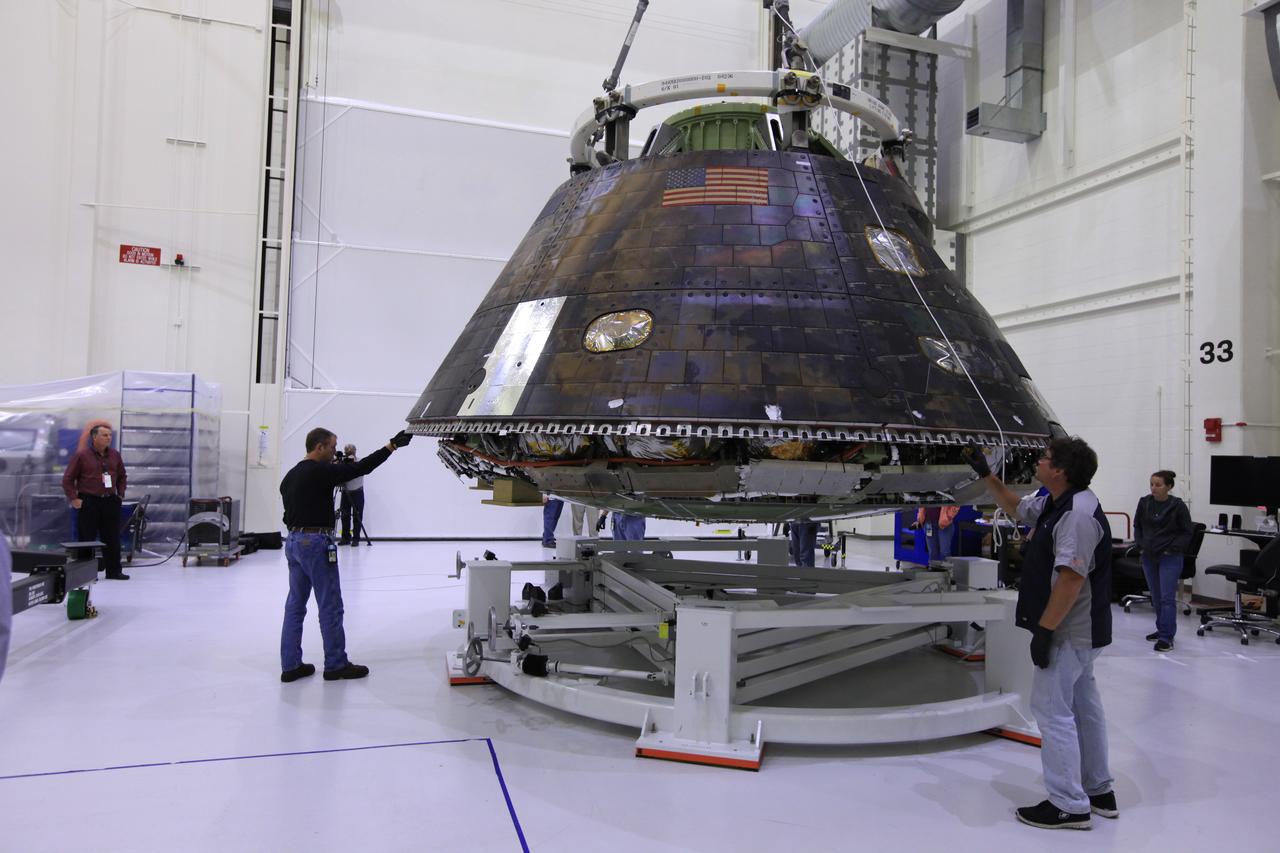
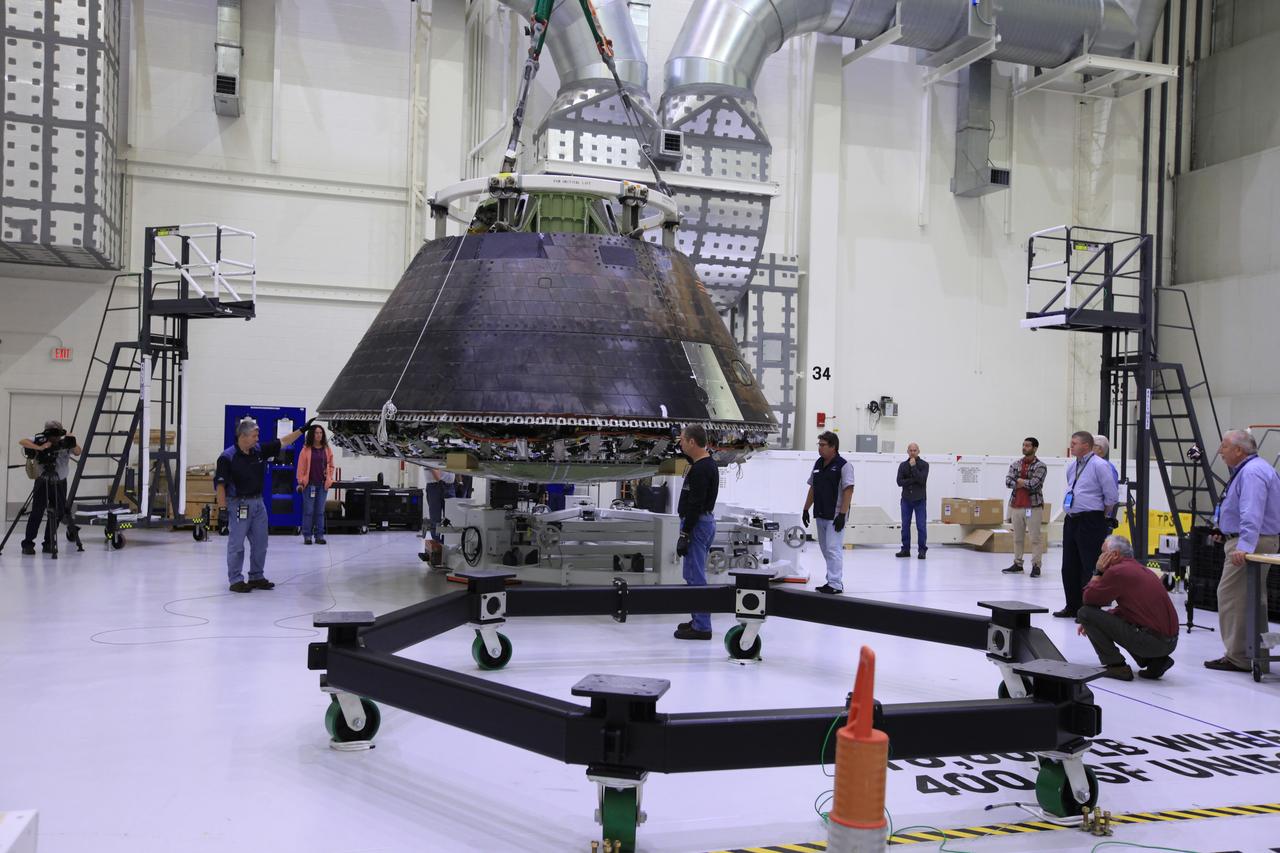
Inside the Neil Armstrong Operations and Checkout Building high bay at NASA's Kennedy Space Center in Florida, Lockheed Martin and ASRC workers monitor the progress as a crane lifts the Orion crew module from Exploration Flight Test 1 up from the birdcage stand. The crew module is being prepared for its move to the nearby Kennedy Space Center Visitor Complex. It will be on display in the NASA Now exhibit in the IMAX Theater. The Orion spacecraft launched atop a United Launch Alliance Delta IV rocket Dec. 5, 2014, from Space Launch Complex 37 at Cape Canaveral Air Force Station. The spacecraft built for humans traveled 3,604 miles above Earth and splashed down about 4.5 hours later in the Pacific Ocean.
The Exploration Flight Test-1 (EFT-1) Crew Module undergoes preparations to move from the Operations and Checkout Building at Kennedy Space Center to the KSC Visitor Complex on April 6, 2017.
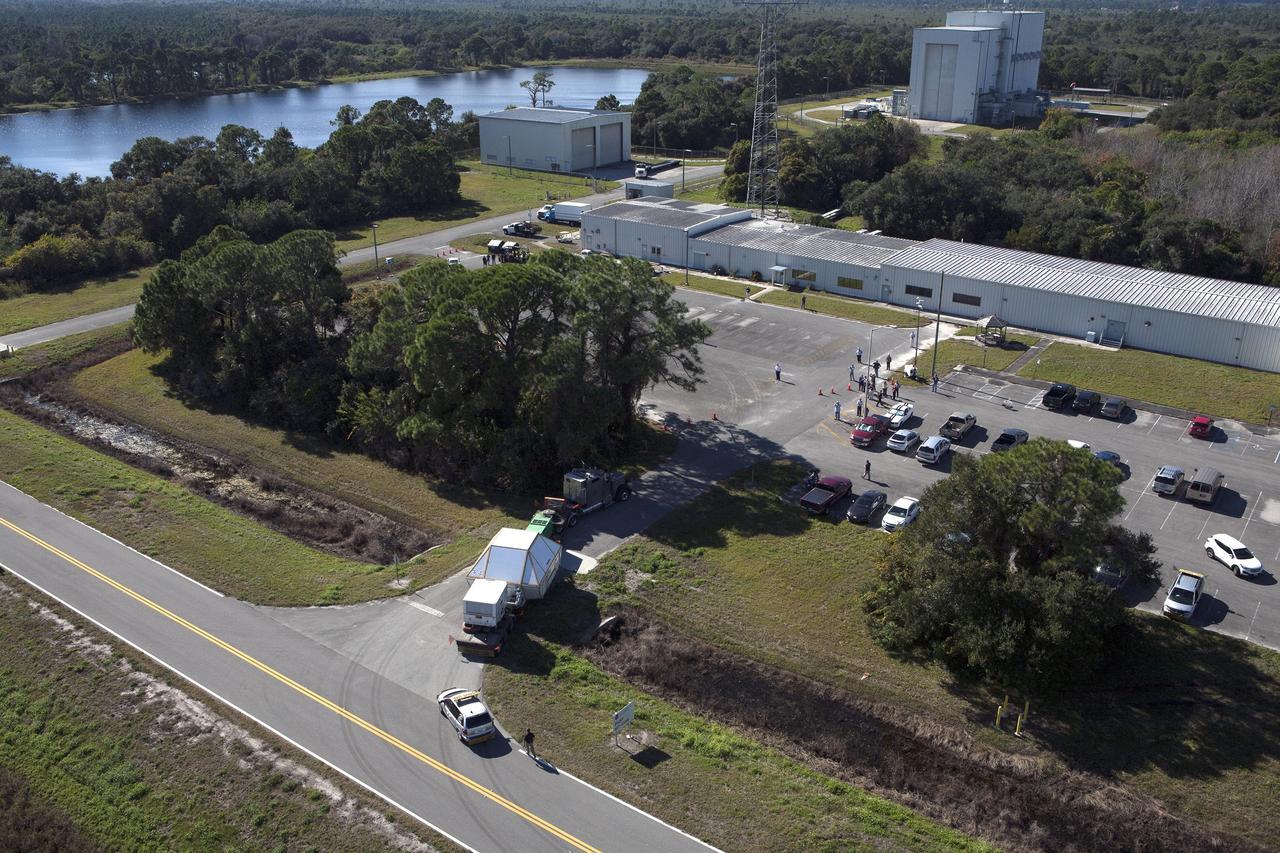
CAPE CANAVERAL, Fla. -- An aerial view reveals the Orion crew module, enclosed in its crew module transportation fixture and secured on a flatbed truck is proceeding to the Multi-Operation Support Building at NASA's Kennedy Space Center. Orion made the 2,700 mile overland trip from Naval Base San Diego in California. The spacecraft was recovered from the Pacific Ocean after completing a two-orbit, four-and-a-half hour mission Dec. 5 to test systems critical to crew safety, including the launch abort system, the heat shield and the parachute system. The Ground Systems Development and Operations Program led the recovery, offload and transportation efforts. For more information, visit www.nasa.gov/orion. Photo credit: NASA/Kim Shiflett
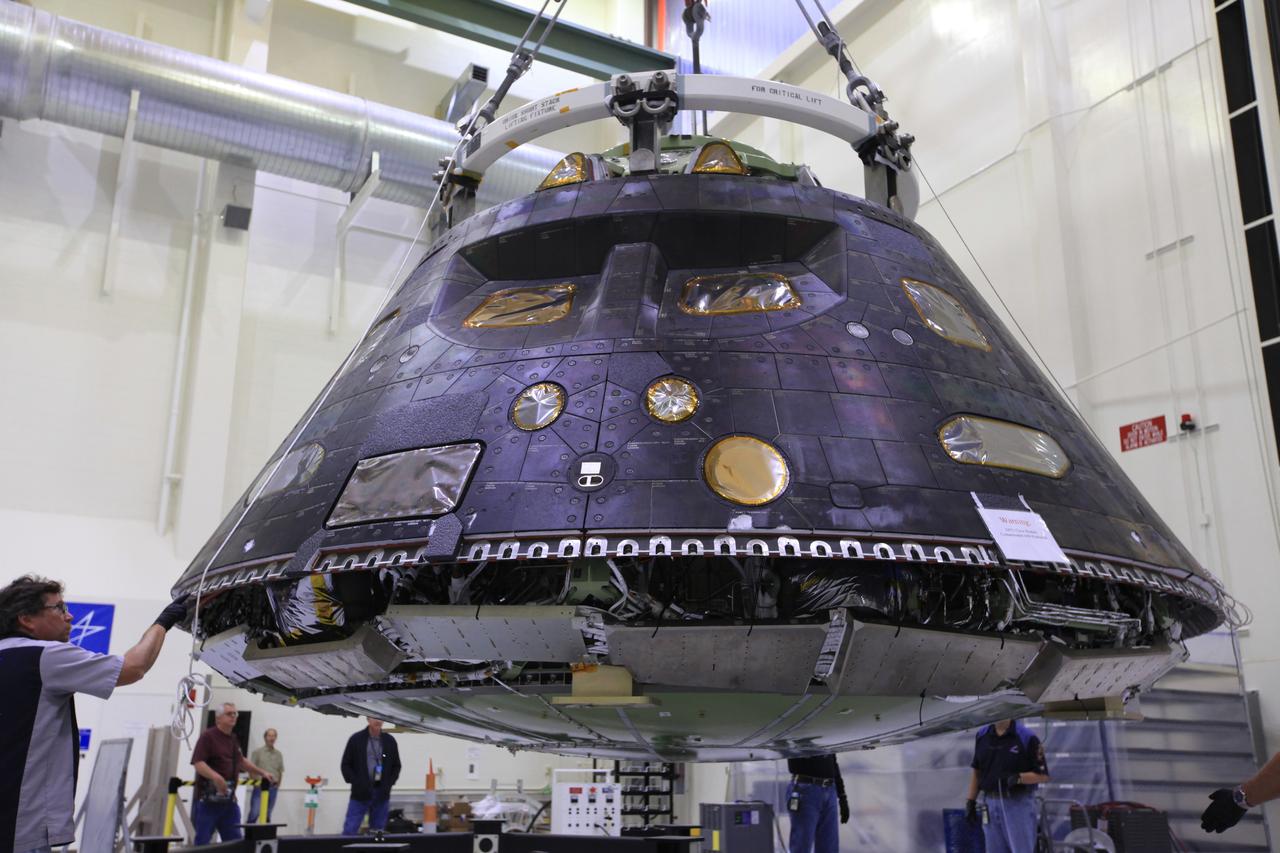
The Exploration Flight Test-1 (EFT-1) Crew Module undergoes preparations to move from the Operations and Checkout Building at Kennedy Space Center to the KSC Visitor Complex on April 6, 2017.
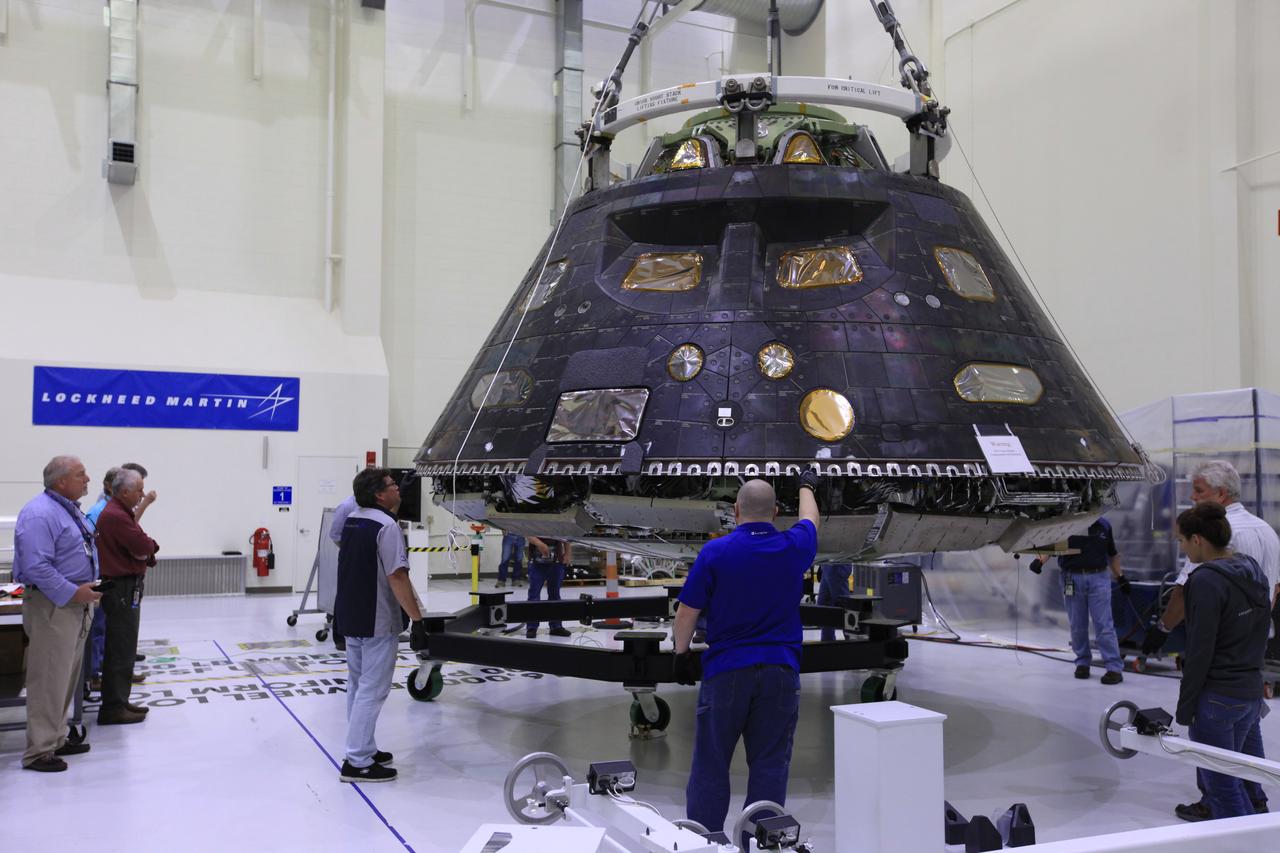
Inside the Neil Armstrong Operations and Checkout Building high bay at NASA's Kennedy Space Center in Florida, Lockheed Martin and ASRC workers monitor the progress as a crane lowers the Orion crew module from Exploration Flight Test 1 onto a custom-built transport stand. The crew module is being prepared for its move to the nearby Kennedy Space Center Visitor Complex and delivery to the IMAX Theater where it will be on display in the NASA Now exhibit. The Orion spacecraft launched atop a United Launch Alliance Delta IV rocket Dec. 5, 2014, from Space Launch Complex 37 at Cape Canaveral Air Force Station. The spacecraft built for humans traveled 3,604 miles above Earth and splashed down about 4.5 hours later in the Pacific Ocean.

CAPE CANAVERAL, Fla. -- NASA's Orion spacecraft is viewed by members of the media at the Launch Abort System Facility at NASA's Kennedy Space Center in Florida. Orion made the 8-day, 2,700 mile overland trip back to Kennedy from Naval Base San Diego in California. Analysis of date obtained during its two-orbit, four-and-a-half hour mission Dec. 5 will provide engineers detailed information on how the spacecraft fared. The Ground Systems Development and Operations Program led the recovery, offload and transportation efforts. For more information, visit www.nasa.gov/orion. Photo credit: NASA/Dimitri Gerondidakis

The crew module separates from service module on Orion's first flight test, Exploration Flight Test-1 (EFT-1), on December 5, 2014.