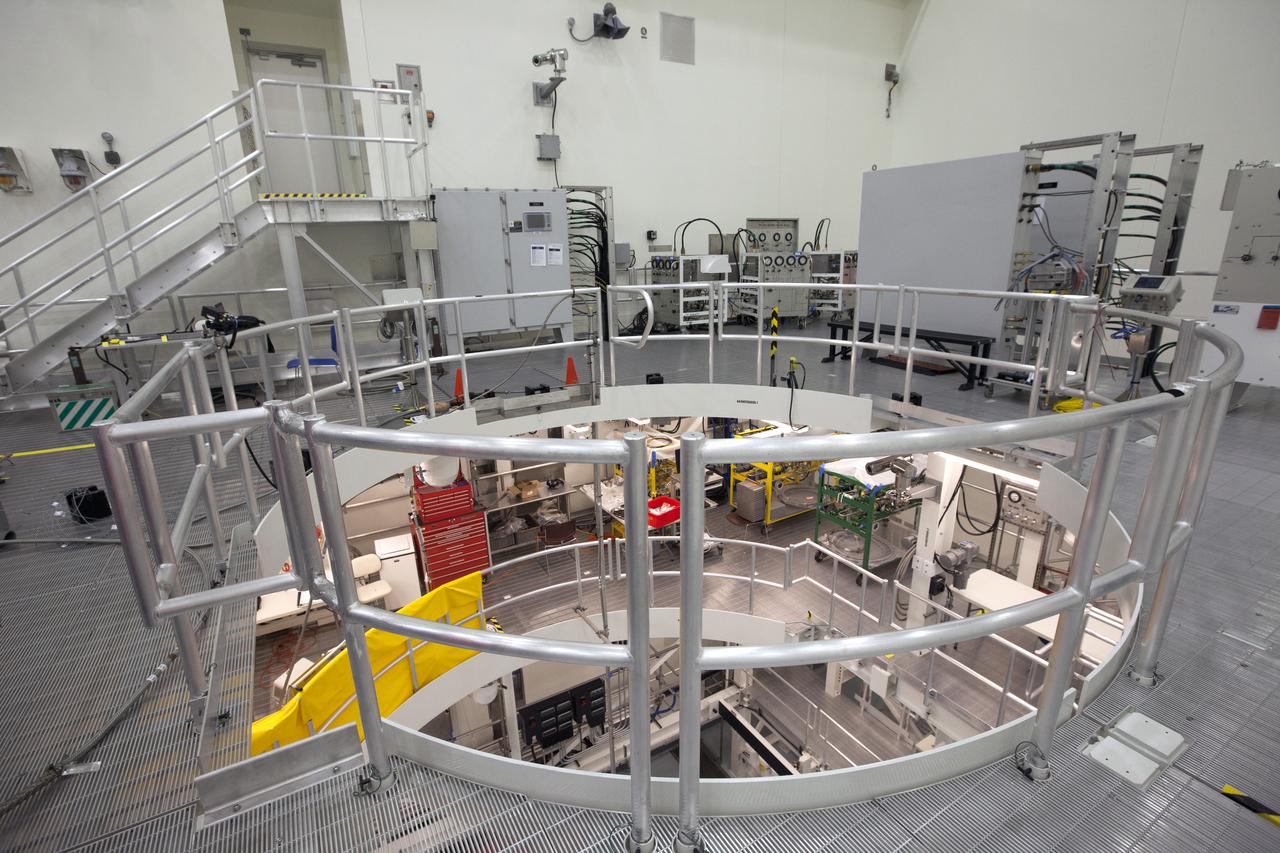
Engineers and technicians completed verification and validation testing of several pneumatic systems inside and outside the Multi-Payload Processing Facility (MPPF) at NASA's Kennedy Space Center in Florida. In view is the top level of the service platform for Orion spacecraft processing. The MPPF will be used for offline processing and fueling of the Orion spacecraft and service module stack before launch. Orion also will be de-serviced in the MPPF after a mission. The Ground Systems Development and Operations Program (GSDO) is overseeing upgrades to the facility. The Engineering Directorate led the recent pneumatic tests.
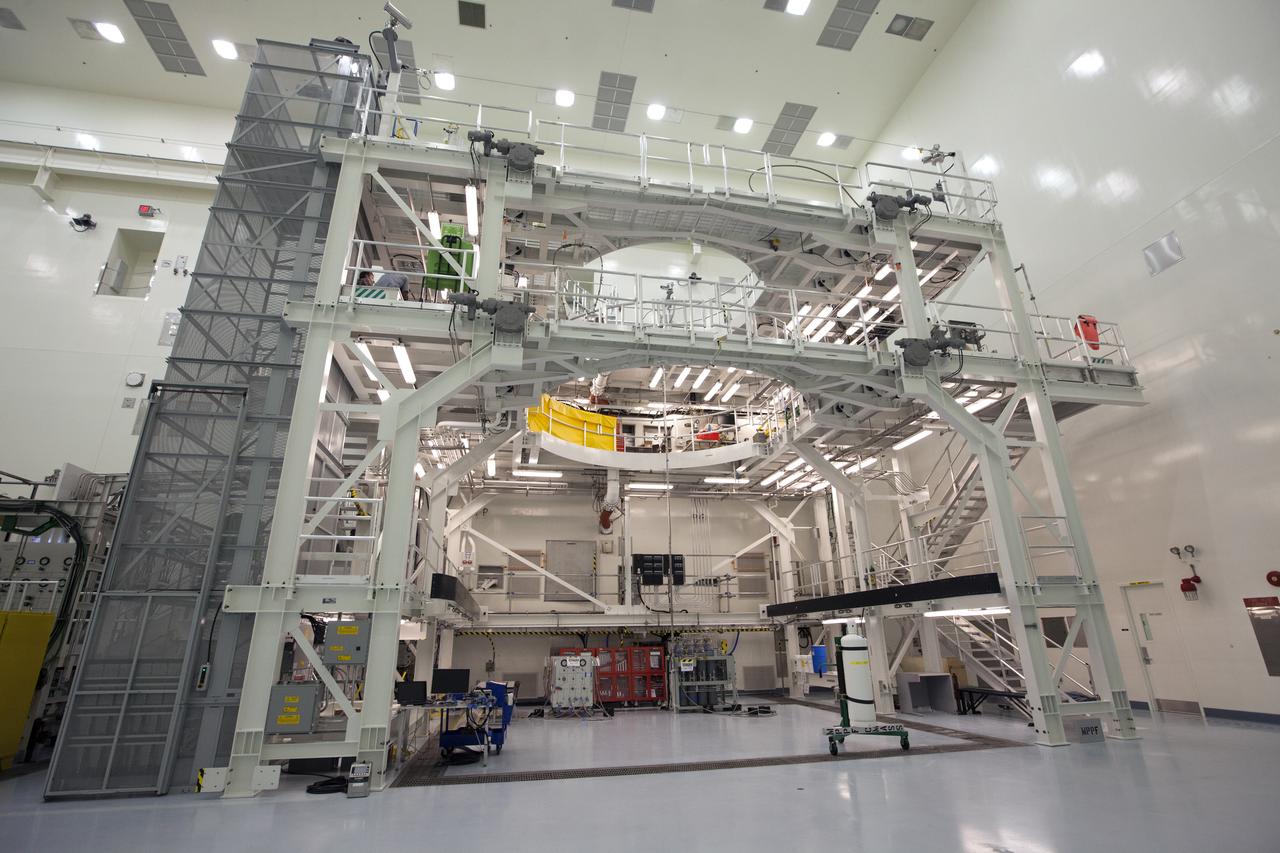
Engineers and technicians completed verification and validation testing of several pneumatic systems inside and outside the Multi-Payload Processing Facility (MPPF) at NASA's Kennedy Space Center in Florida. In view is the service platform for Orion spacecraft processing. The MPPF will be used for offline processing and fueling of the Orion spacecraft and service module stack before launch. Orion also will be de-serviced in the MPPF after a mission. The Ground Systems Development and Operations Program (GSDO) is overseeing upgrades to the facility. The Engineering Directorate led the recent pneumatic tests.
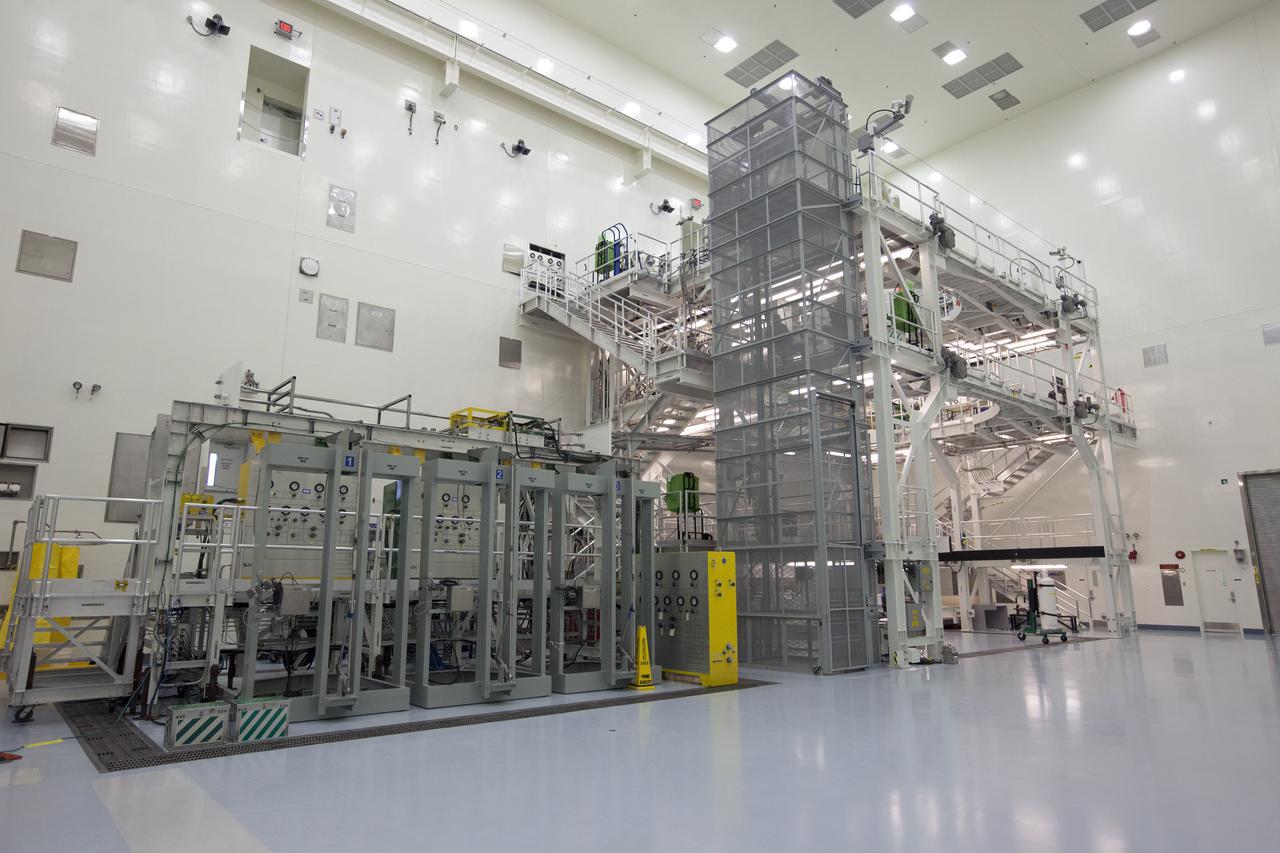
Engineers and technicians completed verification and validation testing of several pneumatic systems inside and outside the Multi-Payload Processing Facility (MPPF) at NASA's Kennedy Space Center in Florida. In view is the service platform for Orion spacecraft processing. To the left are several pneumatic panels. The MPPF will be used for offline processing and fueling of the Orion spacecraft and service module stack before launch. Orion also will be de-serviced in the MPPF after a mission. The Ground Systems Development and Operations Program (GSDO) is overseeing upgrades to the facility. The Engineering Directorate led the recent pneumatic tests.
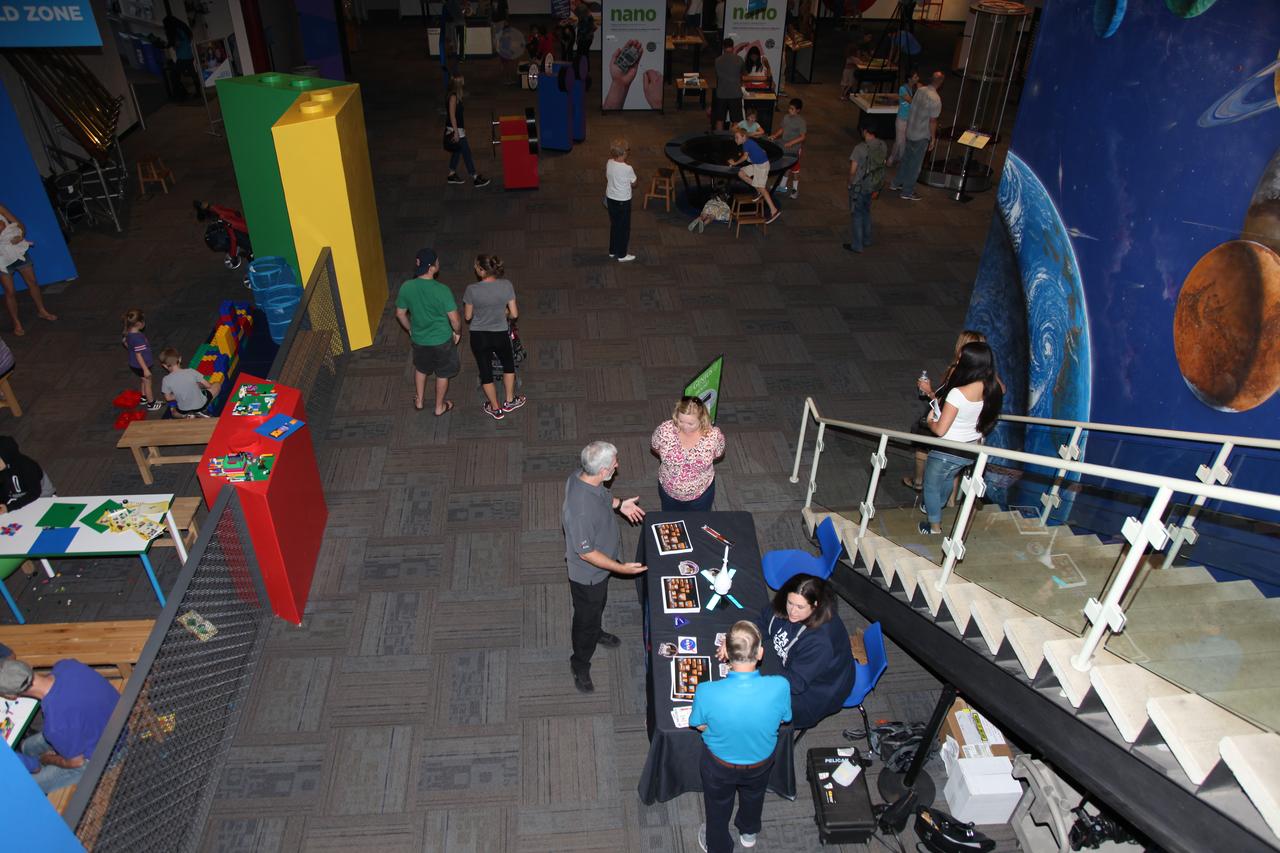
Visitors talk to representatives from NASA’s Ground Systems Development and Operations Program (GSDO) at the Reuben H. Fleet Science Center in San Diego, California. Melissa Jones, seated in blue, GSDO Landing and Recovery director, speaks to visitors during the “Genius in the House” event. GSDO participated in outreach events before the start of the Orion Underway Recovery Test 5 (URT-5) using a test version of the Orion crew module in the Pacific Ocean off the coast of California. URT-5 will allow NASA, Orion manufacturer Lockheed Martin and the U.S. Navy to demonstrate and evaluate the recovery processes, procedures, hardware and personnel necessary for recovery of the Orion crew module on its return from a deep space mission. Orion is the exploration spacecraft designed to carry astronauts to destinations not yet explored by humans, including an asteroid and NASA’s Journey to Mars. It will have emergency abort capability, sustain the crew during space travel and provide safe re-entry from deep space return velocities. Orion is scheduled to launch atop NASA’s Space Launch System rocket in 2018. For more information, visit http://www.nasa.gov/orion.
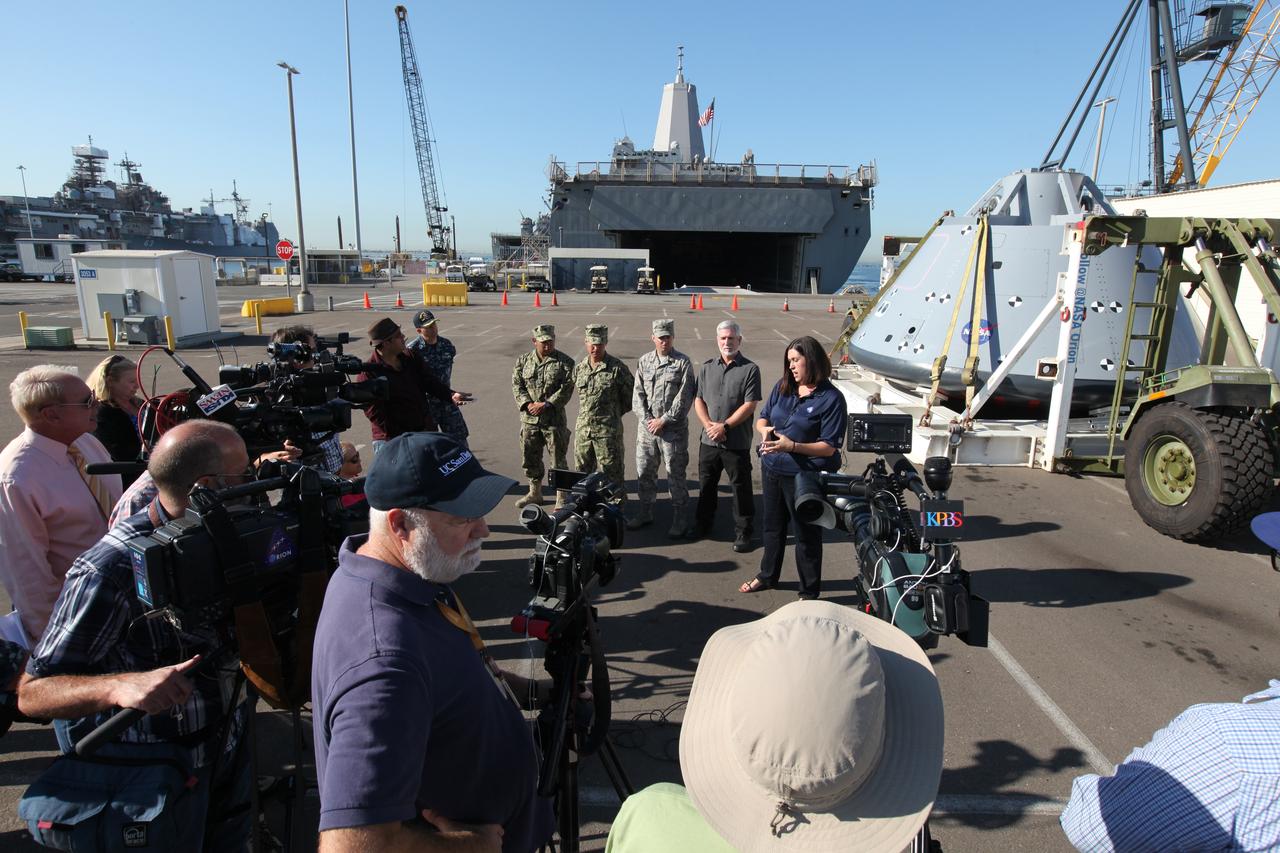
Melissa Jones, far right, Landing and Recovery director with the Ground Systems Development and Operations Program (GSDO), speaks to members of the media about Orion Underway Recovery Test 5. The USS San Diego is docked at Naval Base San Diego in California and the test version of the Orion crew module, secured on its handling fixture, was offloaded from the well deck of the ship. NASA's GSDO Program and the U.S. Navy completed a series of tests using the ship's well deck, the test module, various watercraft and equipment to prepare for recovery of Orion on its return from deep space missions. The testing allowed the team to demonstrate and evaluate recovery processes, procedures, hardware and personnel in open waters. Orion is the exploration spacecraft designed to carry astronauts to destinations not yet explored by humans, including an asteroid and NASA's Journey to Mars. It will have emergency abort capability, sustain the crew during space travel and provide safe re-entry from deep space return velocities. Orion is scheduled to launch on NASA's Space Launch System in late 2018. For more information, visit http://www.nasa.gov/orion.
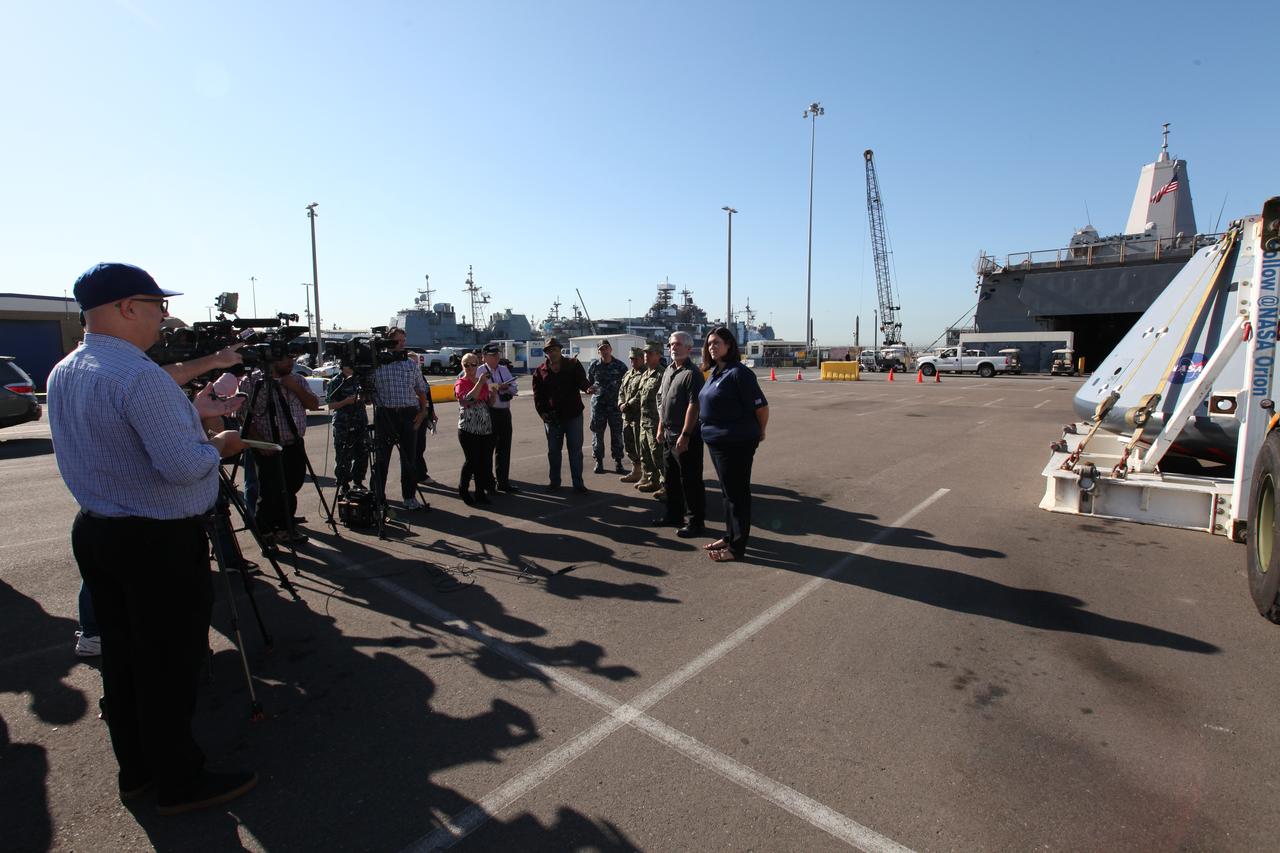
Melissa Jones, far right, Landing and Recovery director with the Ground Systems Development and Operations Program (GSDO), and other members of the recovery team speak to members of the media about Orion Underway Recovery Test 5. The USS San Diego is docked at Naval Base San Diego in California and the test version of the Orion crew module, secured on its handling fixture, was offloaded from the well deck of the ship. NASA's GSDO Program and the U.S. Navy completed a series of tests using the ship's well deck, the test module, various watercraft and equipment to prepare for recovery of Orion on its return from deep space missions. The testing allowed the team to demonstrate and evaluate recovery processes, procedures, hardware and personnel in open waters. Orion is the exploration spacecraft designed to carry astronauts to destinations not yet explored by humans, including an asteroid and NASA's Journey to Mars. It will have emergency abort capability, sustain the crew during space travel and provide safe re-entry from deep space return velocities. Orion is scheduled to launch on NASA's Space Launch System in late 2018. For more information, visit http://www.nasa.gov/orion.
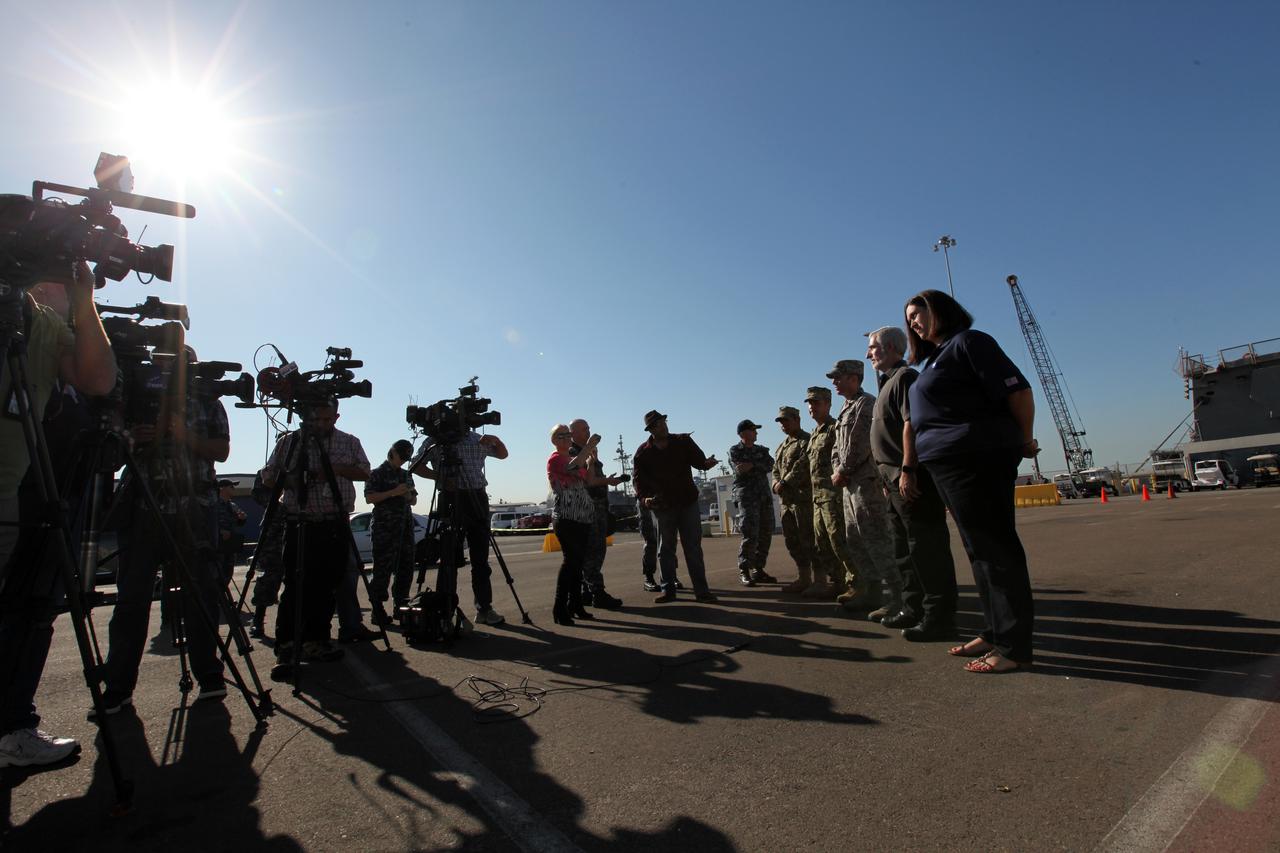
Melissa Jones, far right, Landing and Recovery director with the Ground Systems Development and Operations Program (GSDO), and other members of the recovery team speak to members of the media about Orion Underway Recovery Test 5. The USS San Diego is docked at Naval Base San Diego in California and the test version of the Orion crew module, secured on its handling fixture, was offloaded from the well deck of the ship. NASA's GSDO Program and the U.S. Navy completed a series of tests using the ship's well deck, the test module, various watercraft and equipment to prepare for recovery of Orion on its return from deep space missions. The testing allowed the team to demonstrate and evaluate recovery processes, procedures, hardware and personnel in open waters. Orion is the exploration spacecraft designed to carry astronauts to destinations not yet explored by humans, including an asteroid and NASA's Journey to Mars. It will have emergency abort capability, sustain the crew during space travel and provide safe re-entry from deep space return velocities. Orion is scheduled to launch on NASA's Space Launch System in late 2018. For more information, visit http://www.nasa.gov/orion.

Melissa Jones, far right, Landing and Recovery director with the Ground Systems Development and Operations Program (GSDO), and other members of the recovery team speak to members of the media about Orion Underway Recovery Test 5. The USS San Diego is docked at Naval Base San Diego in California and the test version of the Orion crew module, secured on its handling fixture, was offloaded from the well deck of the ship. NASA's GSDO Program and the U.S. Navy completed a series of tests using the ship's well deck, the test module, various watercraft and equipment to prepare for recovery of Orion on its return from deep space missions. The testing allowed the team to demonstrate and evaluate recovery processes, procedures, hardware and personnel in open waters. Orion is the exploration spacecraft designed to carry astronauts to destinations not yet explored by humans, including an asteroid and NASA's Journey to Mars. It will have emergency abort capability, sustain the crew during space travel and provide safe re-entry from deep space return velocities. Orion is scheduled to launch on NASA's Space Launch System in late 2018. For more information, visit http://www.nasa.gov/orion.

Melissa Jones, center, Ground Systems Development and Operation Program (GSDO) Landing and Recovery director, speaks to a student during the “52 Weeks of Science” celebration at the Logan Heights Library in San Diego, California. GSDO is participating in the special event before the start of Underway Recovery Test 5 using a test version of the Orion spacecraft in the Pacific Ocean off the coast of California. The test will allow NASA, Orion manufacturer Lockheed Martin and the U.S. Navy to demonstrate and evaluate the recovery processes, procedures, hardware and personnel necessary for recovery of the Orion crew module on its return from a deep space mission. Orion is the exploration spacecraft designed to carry astronauts to destinations not yet explored by humans, including an asteroid and NASA Journey to Mars. It will have emergency abort capability, sustain the crew during space travel and provide safe re-entry from deep space return velocities. Orion is scheduled to launch atop NASA’s Space Launch System rocket in 2018. For more information, visit http://www.nasa.gov/orion.
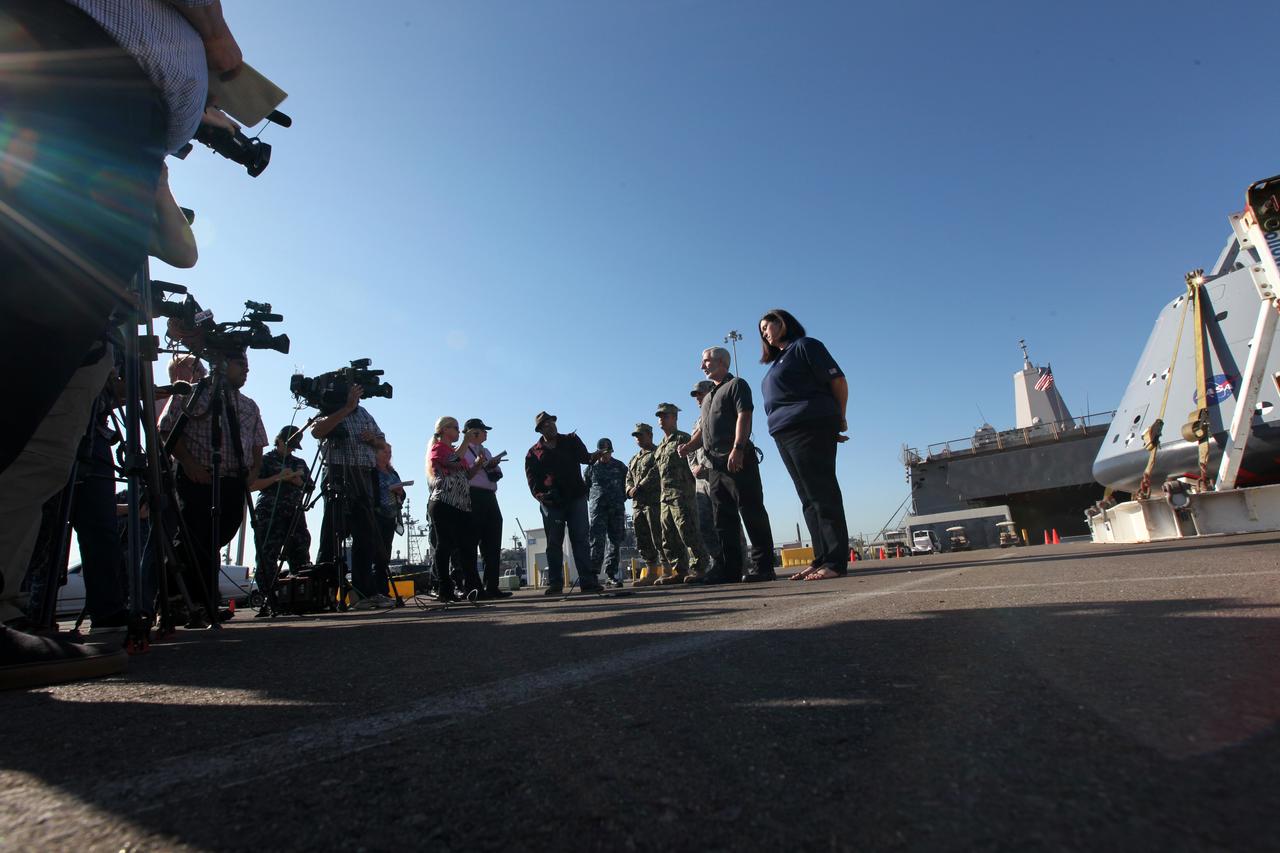
Melissa Jones, far right, Landing and Recovery director with the Ground Systems Development and Operations Program (GSDO), and other members of the recovery team speak to members of the media about Orion Underway Recovery Test 5. The USS San Diego is docked at Naval Base San Diego in California and the test version of the Orion crew module, secured on its handling fixture, was offloaded from the well deck of the ship. NASA's GSDO Program and the U.S. Navy completed a series of tests using the ship's well deck, the test module, various watercraft and equipment to prepare for recovery of Orion on its return from deep space missions. The testing allowed the team to demonstrate and evaluate recovery processes, procedures, hardware and personnel in open waters. Orion is the exploration spacecraft designed to carry astronauts to destinations not yet explored by humans, including an asteroid and NASA's Journey to Mars. It will have emergency abort capability, sustain the crew during space travel and provide safe re-entry from deep space return velocities. Orion is scheduled to launch on NASA's Space Launch System in late 2018. For more information, visit http://www.nasa.gov/orion.

The Logan Heights Library in San Diego, California is the site of the “52 Weeks of Science” celebration for students. The Ground Systems Development and Operations (GSDO) Program is participating in the special event with a Journey to Mars display. GSDO’s participation before the start of Underway Recovery Test 5 using a test version of the Orion spacecraft in the Pacific Ocean off the coast of California. The test will allow NASA, Orion manufacturer Lockheed Martin and the U.S. Navy to demonstrate and evaluate the recovery processes, procedures, hardware and personnel necessary for recovery of the Orion crew module on its return from a deep space mission. Orion is the exploration spacecraft designed to carry astronauts to destinations not yet explored by humans, including an asteroid and NASA Journey to Mars. It will have emergency abort capability, sustain the crew during space travel and provide safe re-entry from deep space return velocities. Orion is scheduled to launch atop NASA’s Space Launch System rocket in 2018. For more information, visit http://www.nasa.gov/orion.
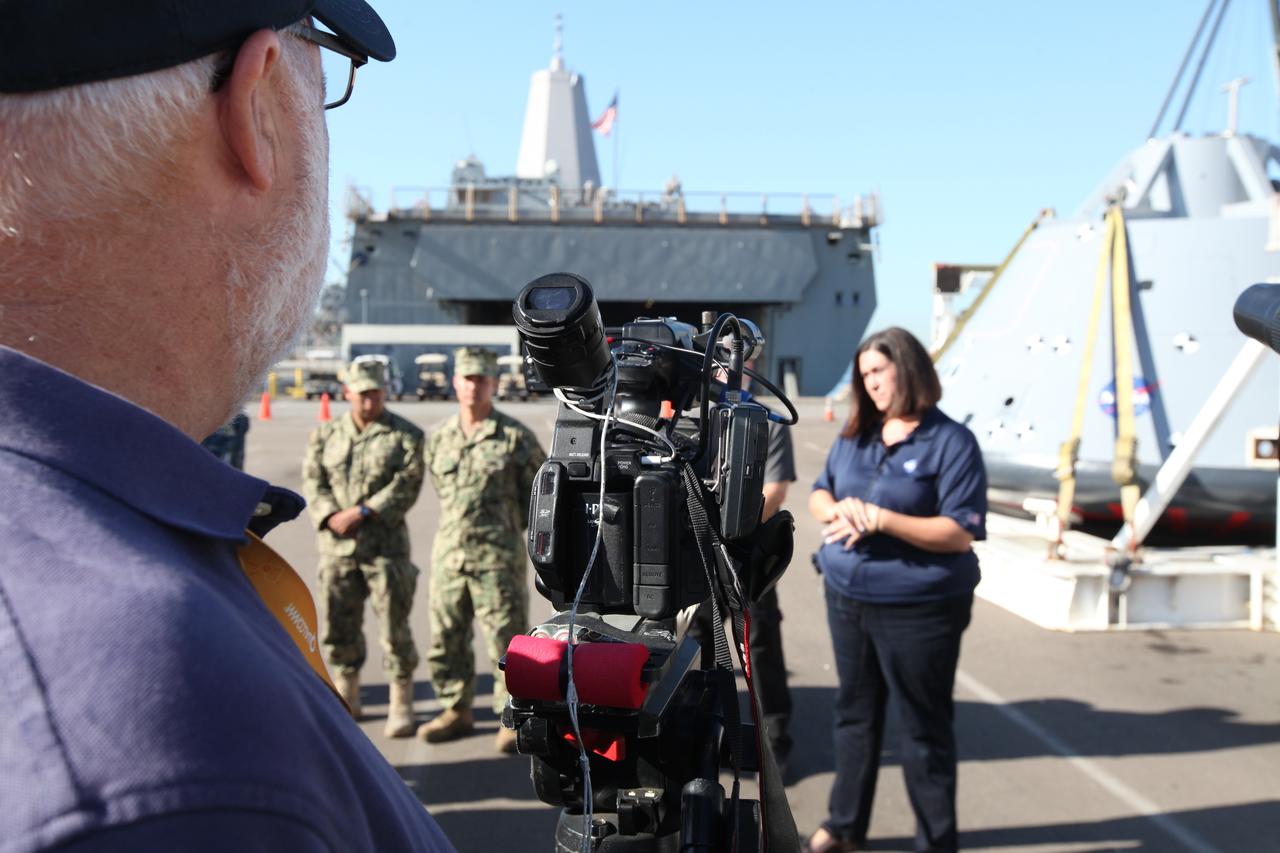
Melissa Jones, Landing and Recovery director with the Ground Systems Development and Operations Program (GSDO), speaks to members of the media about Orion Underway Recovery Test 5. The USS San Diego is docked at Naval Base San Diego in California and the test version of the Orion crew module, secured on its handling fixture, was offloaded from the well deck of the ship. NASA's GSDO Program and the U.S. Navy completed a series of tests using the ship's well deck, the test module, various watercraft and equipment to prepare for recovery of Orion on its return from deep space missions. The testing allowed the team to demonstrate and evaluate recovery processes, procedures, hardware and personnel in open waters. Orion is the exploration spacecraft designed to carry astronauts to destinations not yet explored by humans, including an asteroid and NASA's Journey to Mars. It will have emergency abort capability, sustain the crew during space travel and provide safe re-entry from deep space return velocities. Orion is scheduled to launch on NASA's Space Launch System in late 2018. For more information, visit http://www.nasa.gov/orion.
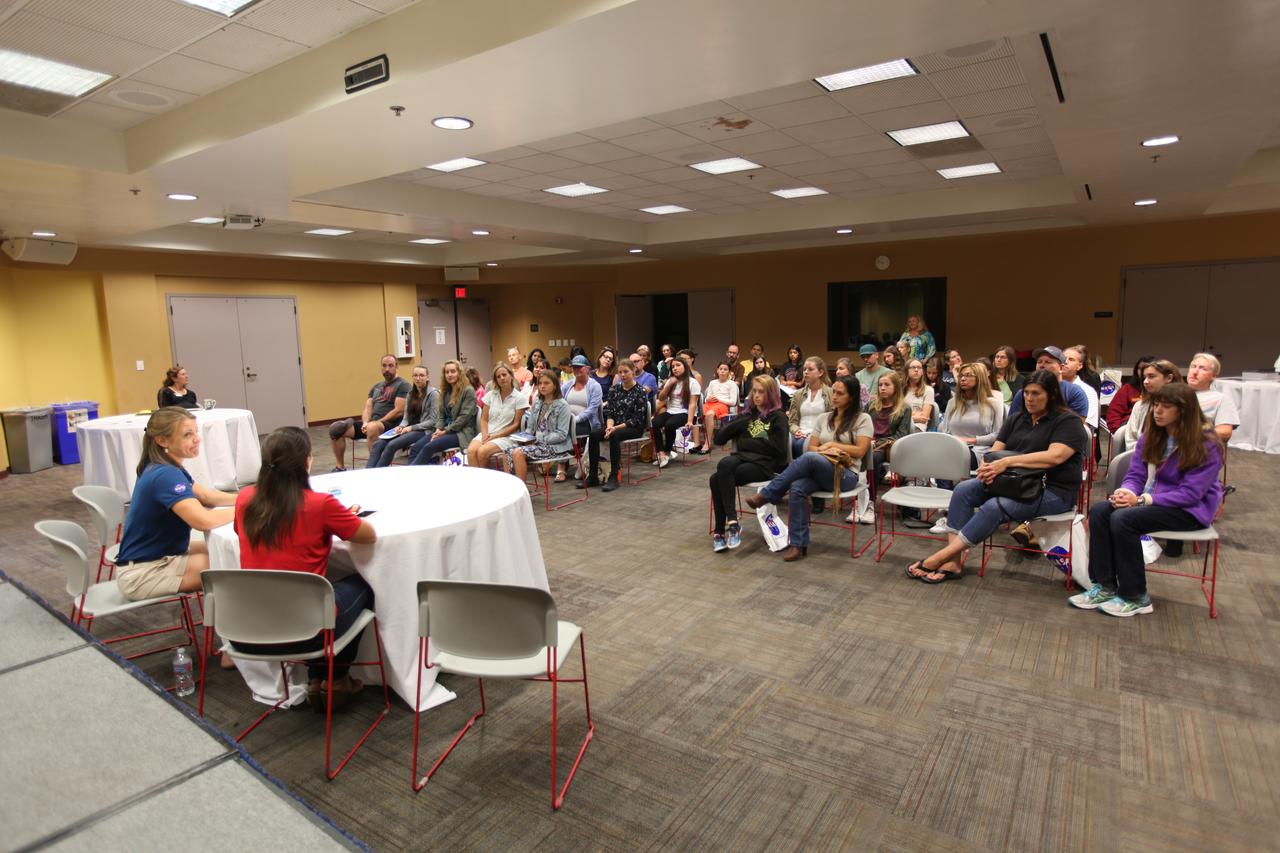
NASA’s Ground Systems Development and Operations Program (GSDO) participates in a “Be Wise” program at the Reuben H. Fleet Science Center in San Diego, California. At the front table, from left are GSDO engineers Carla Koch and Janet Gobaira from the agency’s Kennedy Space Center in Florida. GSDO participated in several outreach events to students and the general public before the start of the Orion Underway Recovery Test 5 (URT-5) using a test version of the Orion crew module in the Pacific Ocean. URT-5 will allow NASA and the U.S. Navy to demonstrate and evaluate the recovery processes, procedures, hardware and personnel necessary for recovery of the Orion crew module on its return from a deep space mission. Orion is the exploration spacecraft designed to carry astronauts to destinations not yet explored by humans, including an asteroid and NASA’s Journey to Mars. It will have emergency abort capability, sustain the crew during space travel and provide safe re-entry from deep space return velocities. Orion is scheduled to launch atop NASA’s Space Launch System rocket in 2018. For more information, visit http://www.nasa.gov/orion.
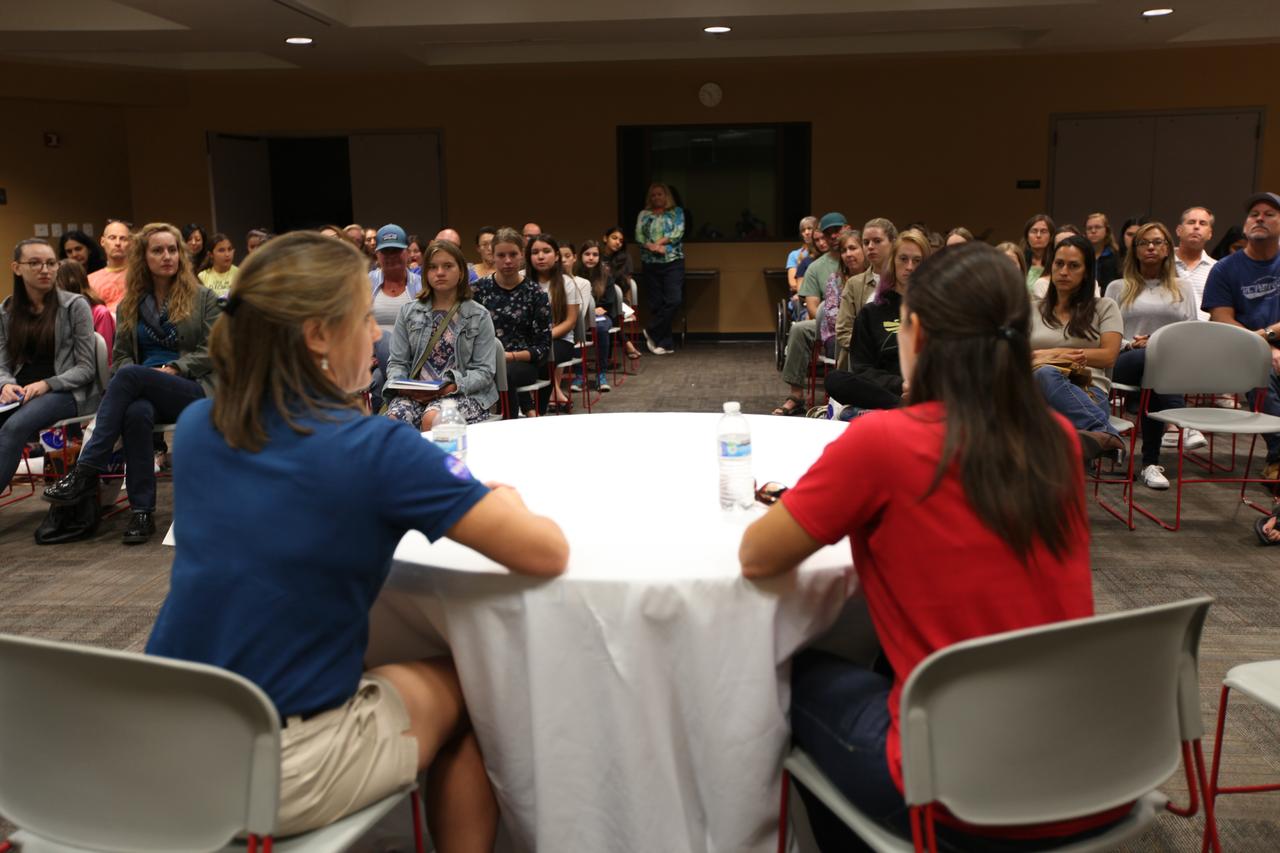
NASA’s Ground Systems Development and Operations Program (GSDO) participates in a “Be Wise” program at the Reuben H. Fleet Science Center in San Diego, California. At the front table, from left are GSDO engineers Carla Koch and Janet Gobaira from the agency’s Kennedy Space Center in Florida. GSDO participated in several outreach events to students and the general public before the start of the Orion Underway Recovery Test 5 (URT-5) using a test version of the Orion crew module in the Pacific Ocean. URT-5 will allow NASA and the U.S. Navy to demonstrate and evaluate the recovery processes, procedures, hardware and personnel necessary for recovery of the Orion crew module on its return from a deep space mission. Orion is the exploration spacecraft designed to carry astronauts to destinations not yet explored by humans, including an asteroid and NASA’s Journey to Mars. It will have emergency abort capability, sustain the crew during space travel and provide safe re-entry from deep space return velocities. Orion is scheduled to launch atop NASA’s Space Launch System rocket in 2018. For more information, visit http://www.nasa.gov/orion.

NASA’s Ground Systems Development and Operations Program (GSDO) participate in a “Be Wise” program at the Reuben H. Fleet Science Center in San Diego, California. At the front table, from left are GSDO engineers Carla Koch and Janet Gobaira from the agency’s Kennedy Space Center in Florida. GSDO participated in several outreach events to students and the general public before the start of the Orion Underway Recovery Test 5 (URT-5) using a test version of the Orion crew module in the Pacific Ocean. URT-5 will allow NASA and the U.S. Navy to demonstrate and evaluate the recovery processes, procedures, hardware and personnel necessary for recovery of the Orion crew module on its return from a deep space mission. Orion is the exploration spacecraft designed to carry astronauts to destinations not yet explored by humans, including an asteroid and NASA’s Journey to Mars. It will have emergency abort capability, sustain the crew during space travel and provide safe re-entry from deep space return velocities. Orion is scheduled to launch atop NASA’s Space Launch System rocket in 2018. For more information, visit http://www.nasa.gov/orion.
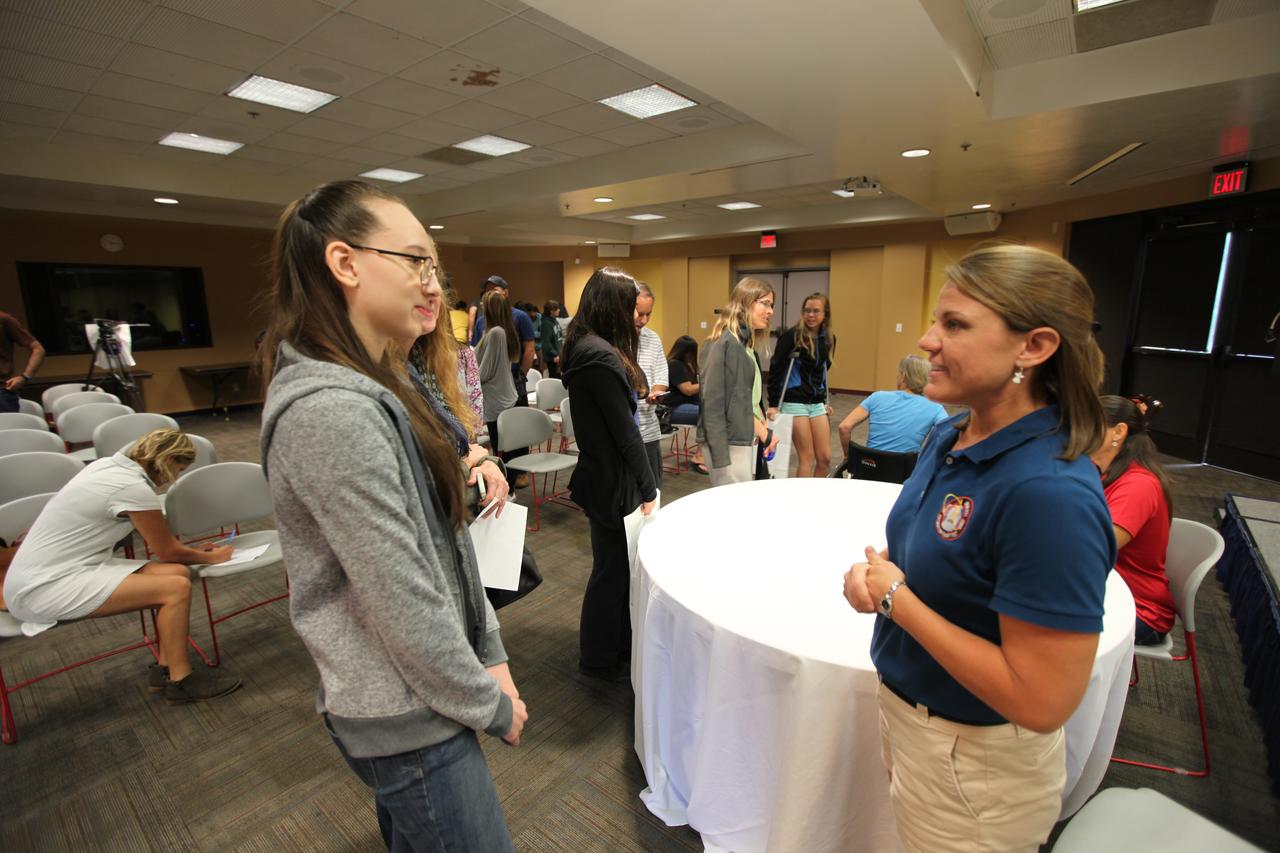
NASA’s Ground Systems Development and Operations Program (GSDO) participates in a “Be Wise” program at the Reuben H. Fleet Science Center in San Diego, California. Carla Koch, right, GSDO engineer from the agency’s Kennedy Space Center in Florida, talks with a student after the program. GSDO participated in several outreach events to students and the general public before the start of the Orion Underway Recovery Test 5 (URT-5) using a test version of the Orion crew module in the Pacific Ocean. URT-5 will allow NASA and the U.S. Navy to demonstrate and evaluate the recovery processes, procedures, hardware and personnel necessary for recovery of the Orion crew module on its return from a deep space mission. Orion is the exploration spacecraft designed to carry astronauts to destinations not yet explored by humans, including an asteroid and NASA’s Journey to Mars. It will have emergency abort capability, sustain the crew during space travel and provide safe re-entry from deep space return velocities. Orion is scheduled to launch atop NASA’s Space Launch System rocket in 2018. For more information, visit http://www.nasa.gov/orion.
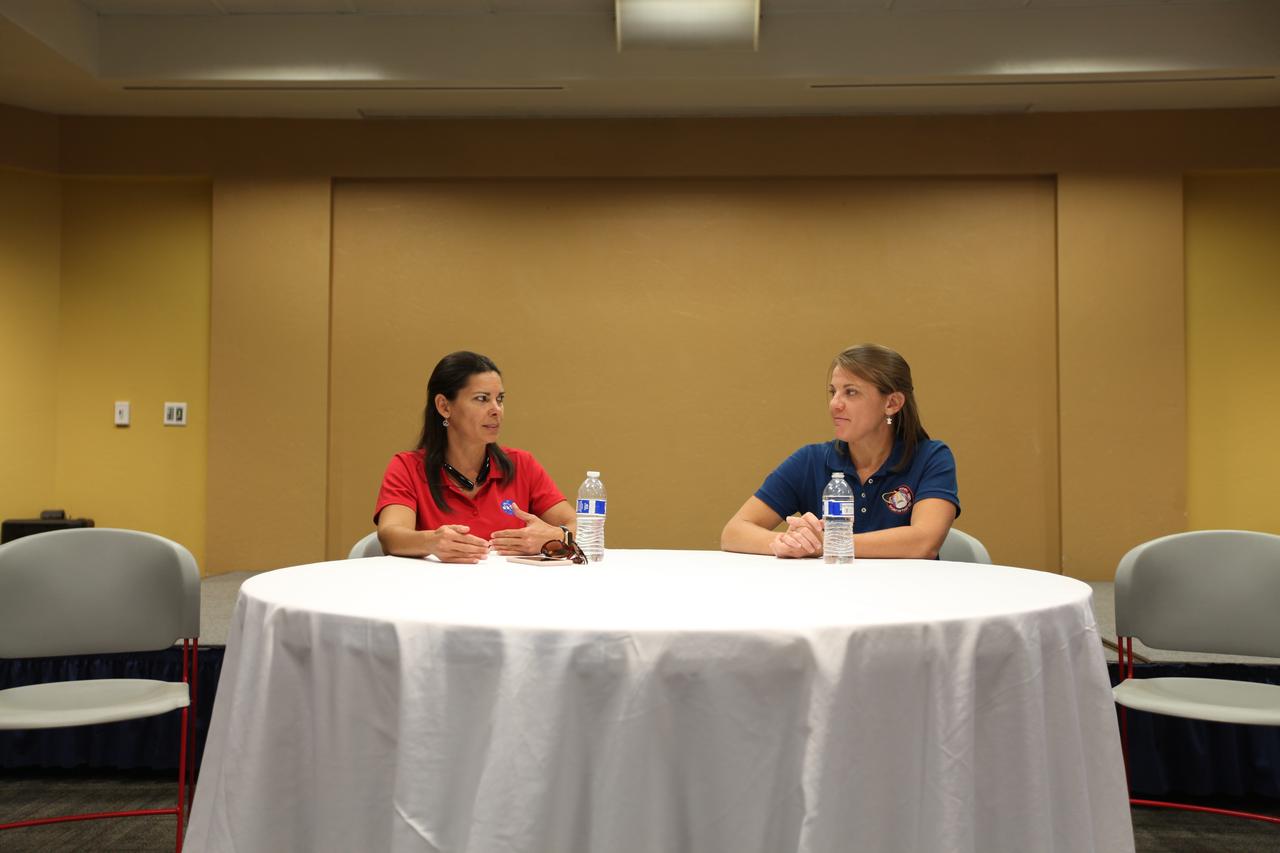
NASA’s Ground Systems Development and Operations Program (GSDO) participates in a “Be Wise” program at the Reuben H. Fleet Science Center in San Diego, California. From left, are GSDO engineers Janet Gobaira and Carla Koch from the agency’s Kennedy Space Center in Florida. GSDO participated in several outreach events to students and the general public before the start of the Orion Underway Recovery Test 5 (URT-5) using a test version of the Orion crew module in the Pacific Ocean. URT-5 will allow NASA and the U.S. Navy to demonstrate and evaluate the recovery processes, procedures, hardware and personnel necessary for recovery of the Orion crew module on its return from a deep space mission. Orion is the exploration spacecraft designed to carry astronauts to destinations not yet explored by humans, including an asteroid and NASA’s Journey to Mars. It will have emergency abort capability, sustain the crew during space travel and provide safe re-entry from deep space return velocities. Orion is scheduled to launch atop NASA’s Space Launch System rocket in 2018. For more information, visit http://www.nasa.gov/orion.
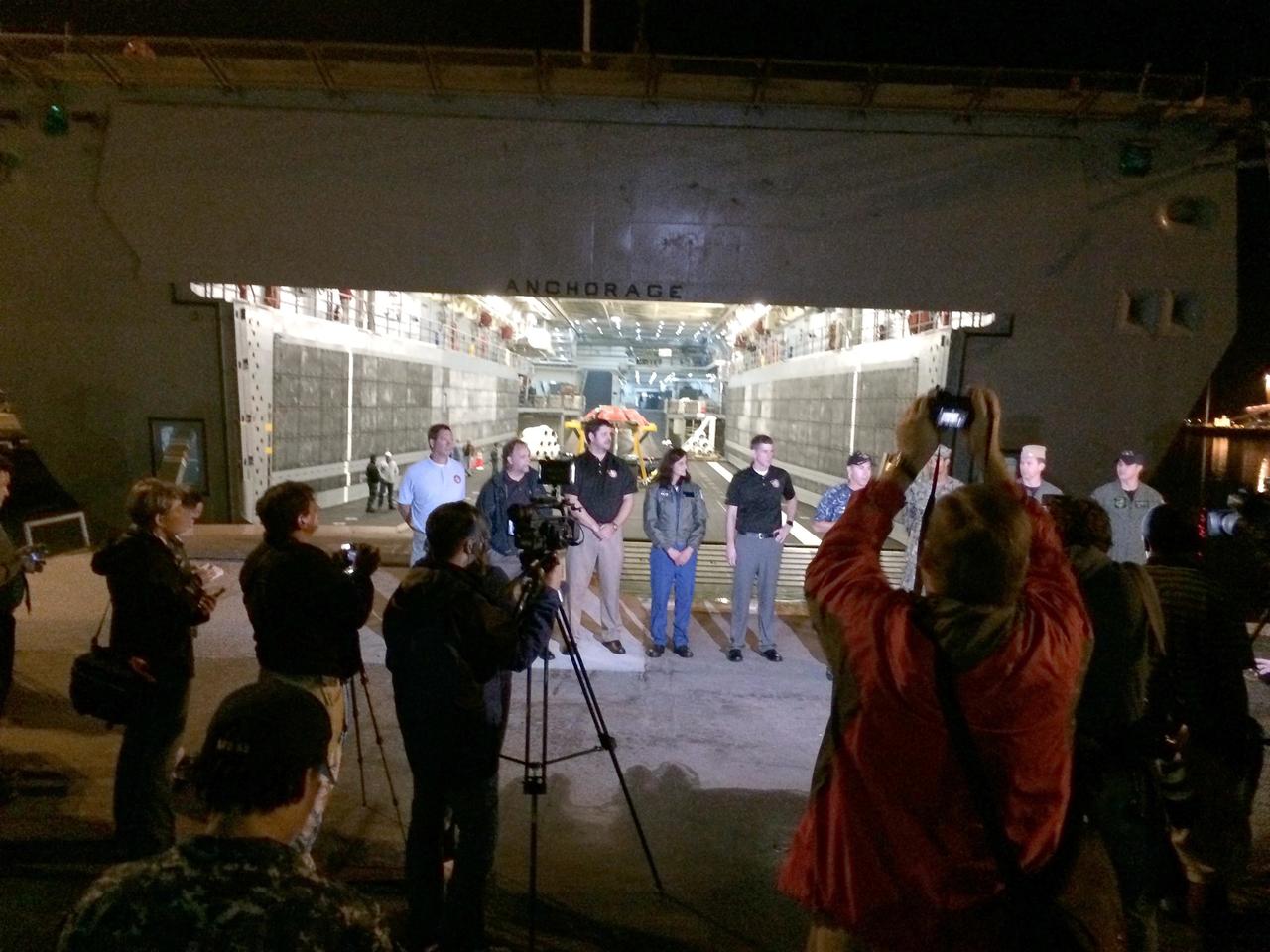
SAN DIEGO, Calif. -- At Naval Base San Diego in California, members of the news media view NASA's Orion spacecraft in the well deck of the USS Anchorage before it is offloaded and prepared for return to Kennedy Space Center in Florida. Speaking to the media are NASA and U.S. Navy officials. After lifting off at 7:05 a.m. EST on Dec. 5 atop a Delta IV Heavy rocket from Space Launch Complex 37 at Cape Canaveral Air Force Station in Florida, Orion completed a two-orbit, four-and-a-half hour mission to test systems critical to crew safety, including the launch abort system, the heat shield and the parachute system. NASA, the U.S. Navy and Lockheed Martin coordinated efforts to recover Orion after splashdown in the Pacific Ocean. The GSDO Program led the recovery efforts. For more information, visit www.nasa.gov/orion Photo credit: NASA/Amber Philman

Melissa Jones, Landing and Recovery director with NASA's Ground Systems Development and Operations Program (GSDO) speaks to the recovery team during wrap up of Underway Recovery Test 5 aboard the USS San Diego. GSDO and the U.S. Navy practiced recovery techniques using the well deck of the ship and a test version of the Orion crew module in the Pacific Ocean off the coast of California to prepare for recovery of Orion on its return from deep space missions. The testing allowed the team to demonstrate and evaluate recovery processes, procedures, hardware and personnel in open waters. Orion is the exploration spacecraft designed to carry astronauts to destinations not yet explored by humans, including an asteroid and NASA's Journey to Mars. It will have emergency abort capability, sustain the crew during space travel and provide safe re-entry from deep space return velocities. Orion is scheduled to launch on NASA's Space Launch System in late 2018. For more information, visit http://www.nasa.gov/orion.
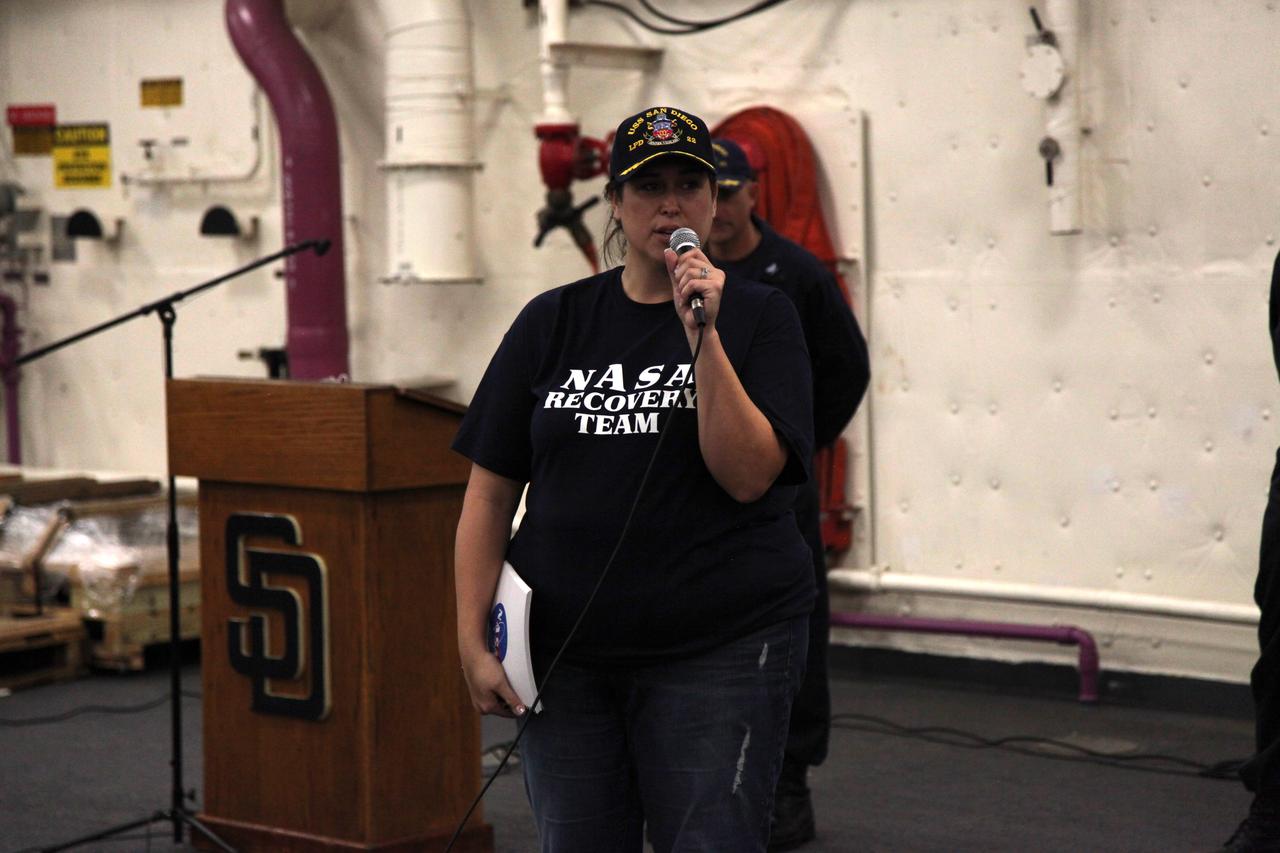
Melissa Jones, Landing and Recovery director with NASA's Ground Systems Development and Operations Program (GSDO) speaks to the recovery team during wrap up of Underway Recovery Test 5 aboard the USS San Diego. GSDO and the U.S. Navy practiced recovery techniques using the well deck of the ship and a test version of the Orion crew module in the Pacific Ocean off the coast of California to prepare for recovery of Orion on its return from deep space missions. The testing allowed the team to demonstrate and evaluate recovery processes, procedures, hardware and personnel in open waters. Orion is the exploration spacecraft designed to carry astronauts to destinations not yet explored by humans, including an asteroid and NASA's Journey to Mars. It will have emergency abort capability, sustain the crew during space travel and provide safe re-entry from deep space return velocities. Orion is scheduled to launch on NASA's Space Launch System in late 2018. For more information, visit http://www.nasa.gov/orion.
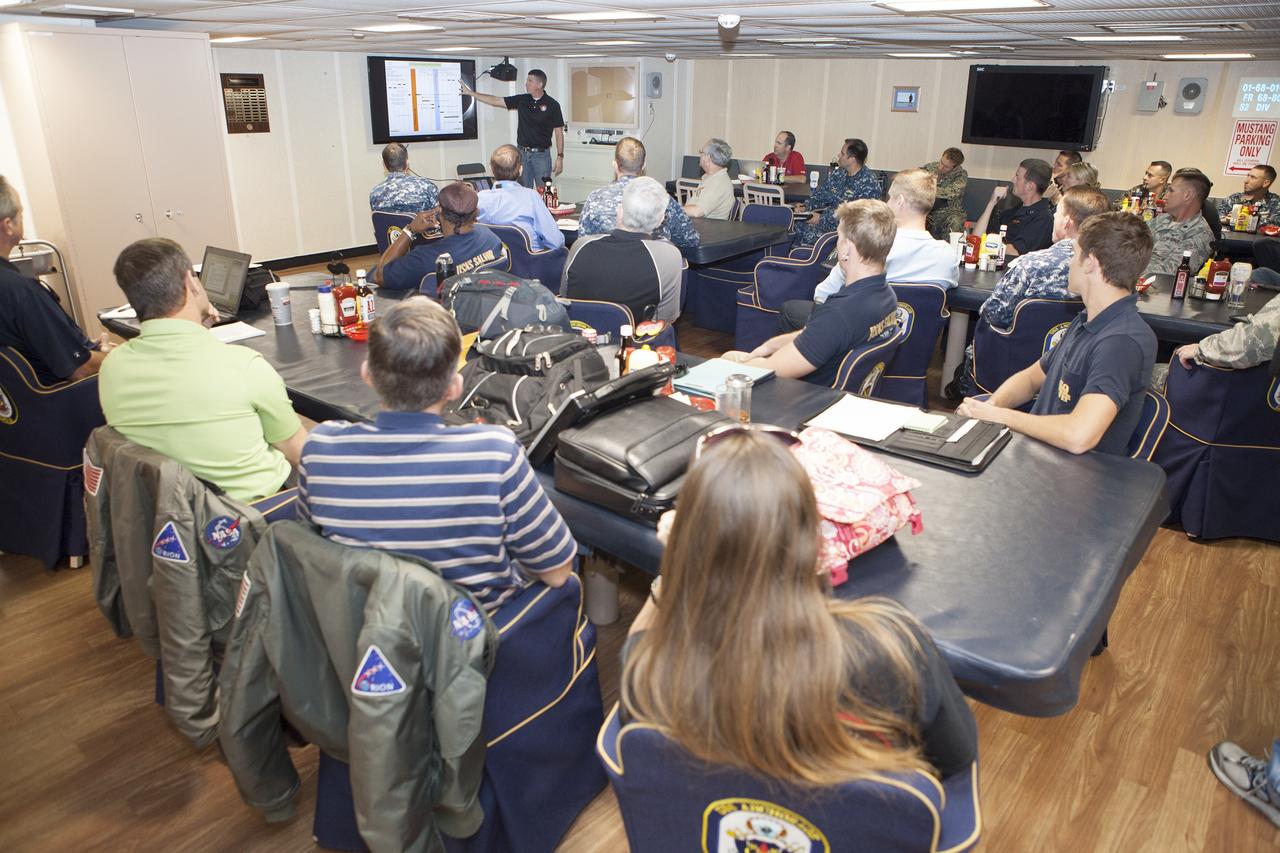
SAN DIEGO, Calif. – NASA Orion Recovery Director Jeremy Graeber, with the Ground Systems Development and Operations Program at Kennedy Space Center in Florida, reviews Orion recovery procedures with NASA, Lockheed Martin and U.S. Navy personnel aboard the USS Anchorage at Naval Base San Diego in California. Before the launch of Orion on its first flight test atop a Delta IV Heavy rocket from Cape Canaveral Air Force Station in Florida, NASA, Lockheed Martin and the U.S. Navy personnel will head out to sea in the USS Anchorage and the USNS Salvor, a salvage ship, and wait for splashdown of the Orion crew module in the Pacific Ocean. The GSDO Program will lead the recovery efforts. Orion is the exploration spacecraft designed to carry astronauts to destinations not yet explored by humans, including an asteroid and Mars. It will have emergency abort capability, sustain the crew during space travel and provide safe re-entry from deep space return velocities. The first unpiloted flight test of Orion is scheduled to launch in December atop a United Launch Alliance Delta IV Heavy rocket and in 2018 on NASA’s Space Launch System rocket. For more information, visit http://www.nasa.gov/orion. Photo credit: NASA/Dimitri Gerondidakis
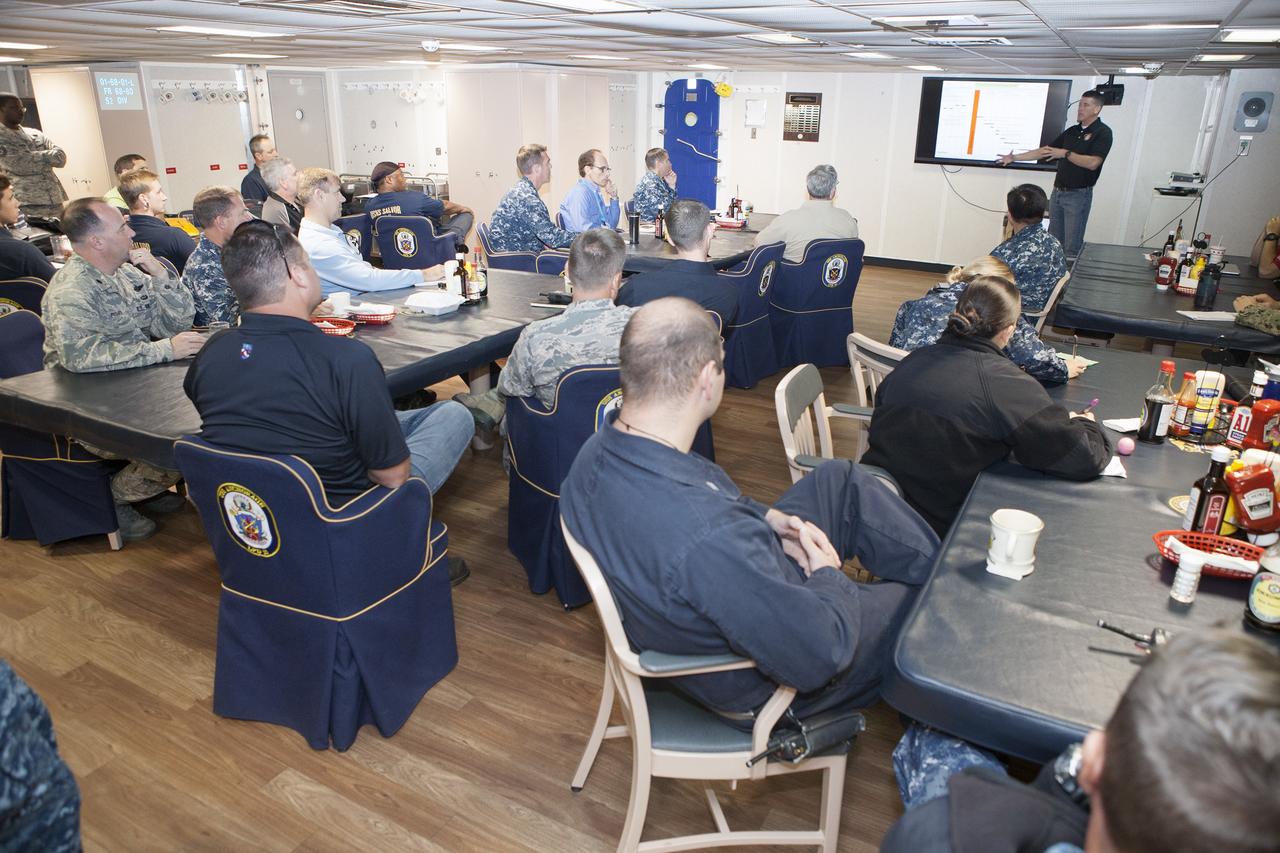
SAN DIEGO, Calif. – NASA Orion Recovery Director Jeremy Graeber, with the Ground Systems Development and Operations Program at Kennedy Space Center in Florida, reviews Orion recovery procedures with NASA, Lockheed Martin and U.S. Navy personnel aboard the USS Anchorage at Naval Base San Diego in California. Before the launch of Orion on its first flight test atop a Delta IV Heavy rocket from Cape Canaveral Air Force Station in Florida, NASA, Lockheed Martin and U.S. Navy personnel will head out to sea in the USS Anchorage and the USNS Salvor, a salvage ship, and wait for splashdown of the Orion crew module in the Pacific Ocean. The GSDO Program will lead the recovery efforts. Orion is the exploration spacecraft designed to carry astronauts to destinations not yet explored by humans, including an asteroid and Mars. It will have emergency abort capability, sustain the crew during space travel and provide safe re-entry from deep space return velocities. The first unpiloted flight test of Orion is scheduled to launch in December atop a United Launch Alliance Delta IV Heavy rocket and in 2018 on NASA’s Space Launch System rocket. For more information, visit http://www.nasa.gov/orion. Photo credit: NASA/Dimitri Gerondidakis
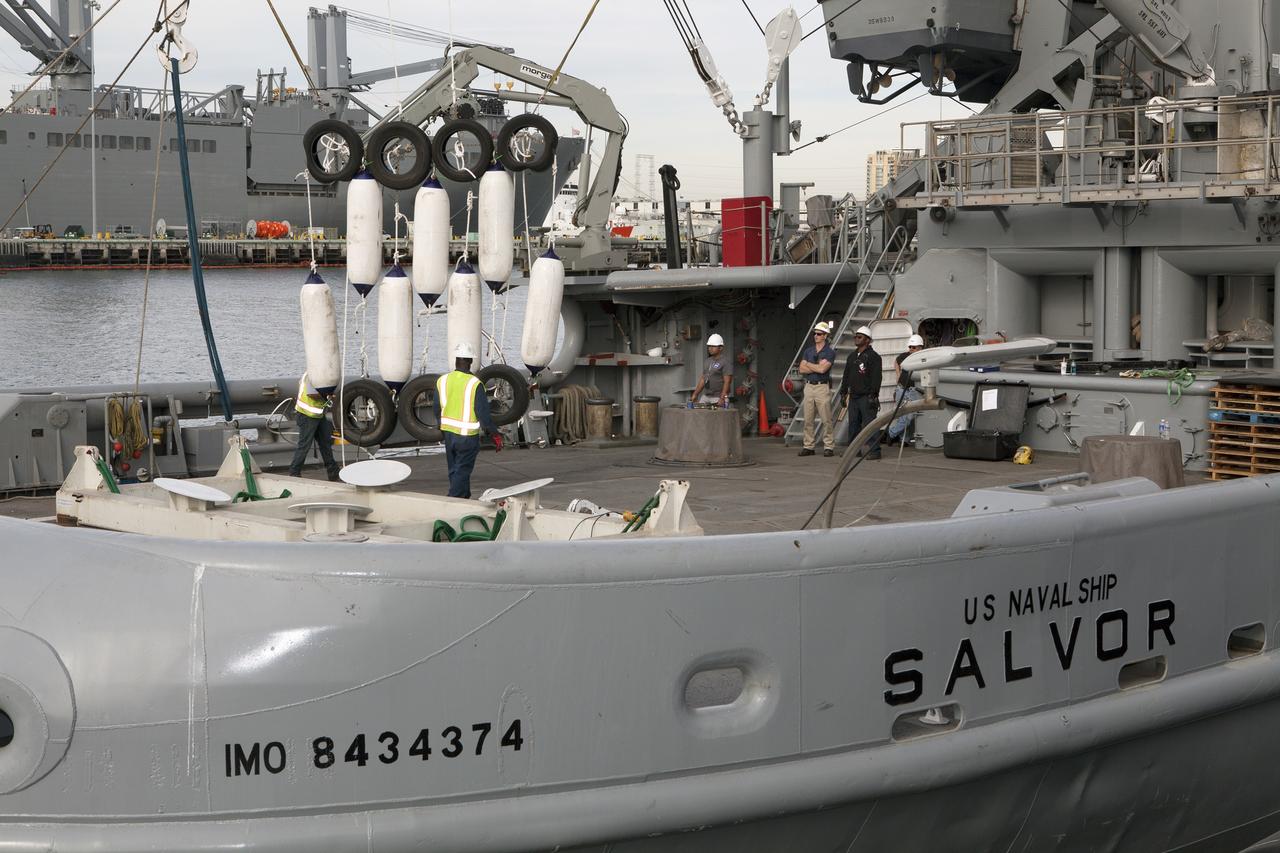
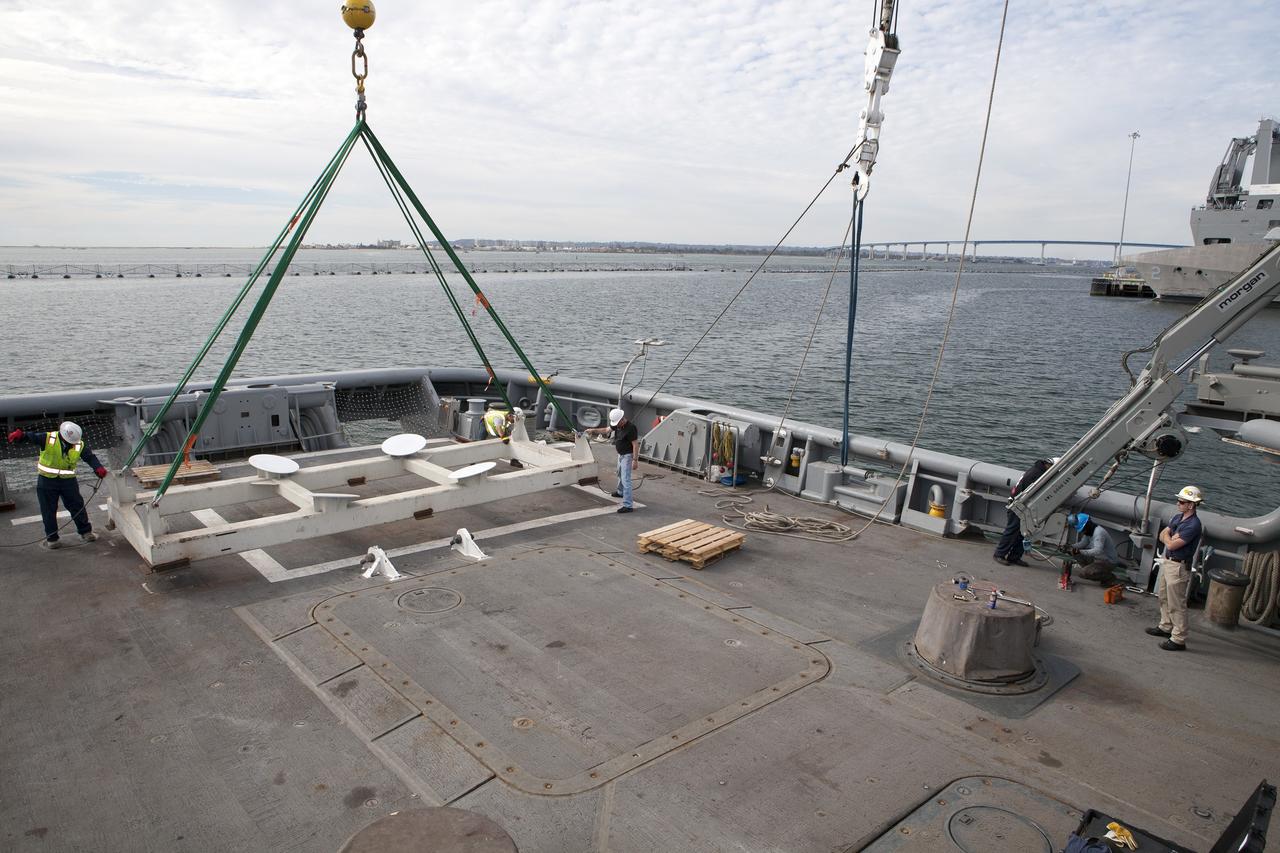
SAN DIEGO, Calif. – Ground support equipment for use during an alternate recovery method of the Orion crew module after its first flight test, if needed, is lowered by crane onto the deck of the USNS Salvor, a salvage ship, at Naval Base San Diego in California. Before launch of Orion on a Delta IV Heavy rocket from Cape Canaveral Air Force Station in Florida, NASA, Lockheed Martin and U.S. Navy personnel will head out to sea in the USS Anchorage and the USNS Salvor and wait for splashdown of the Orion crew module in the Pacific Ocean. The GSDO Program will lead the recovery efforts. Orion is the exploration spacecraft designed to carry astronauts to destinations not yet explored by humans, including an asteroid and Mars. It will have emergency abort capability, sustain the crew during space travel and provide safe re-entry from deep space return velocities. The first unpiloted flight test of Orion is scheduled to launch in December atop a United Launch Alliance Delta IV Heavy rocket and in 2018 on NASA’s Space Launch System rocket. For more information, visit http://www.nasa.gov/orion. Photo credit: NASA/Dimitri Gerondidakis
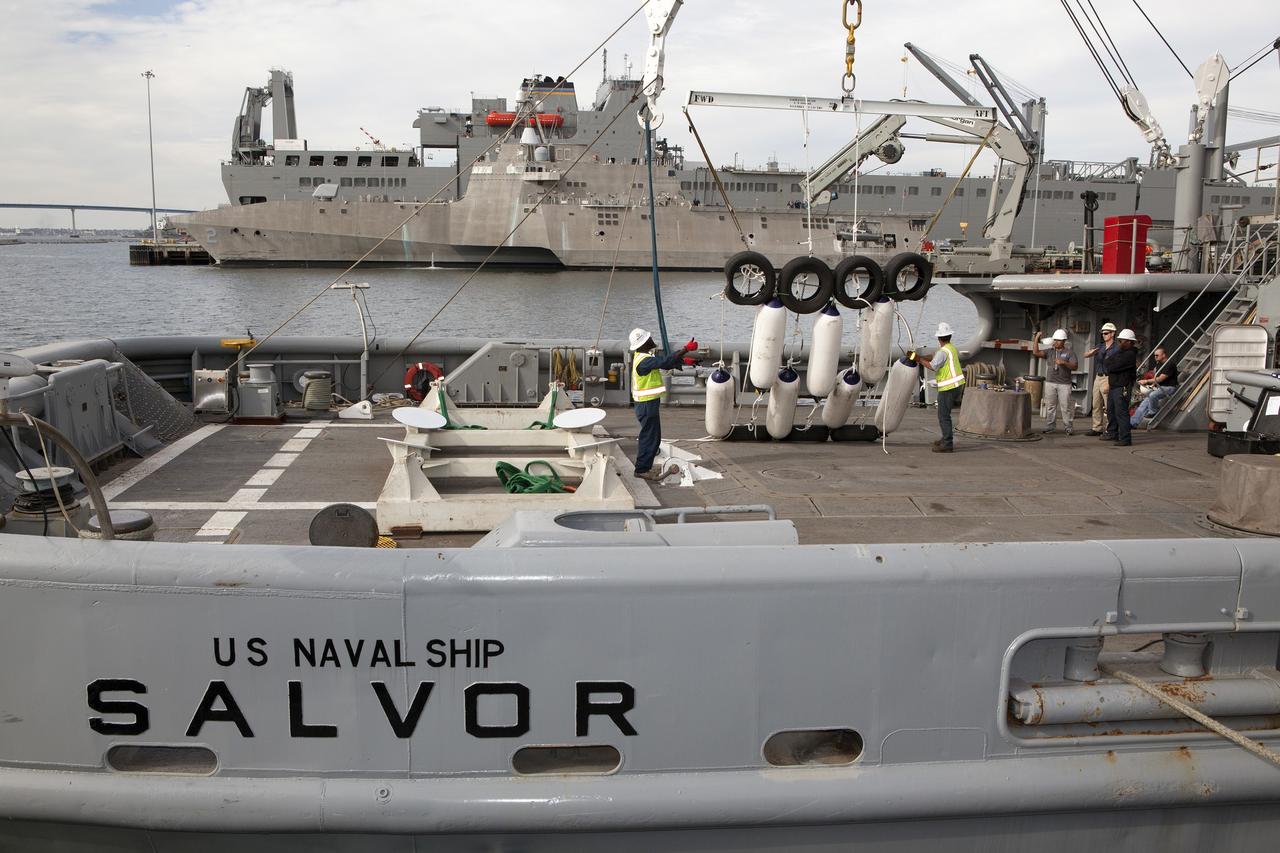
SAN DIEGO, Calif. – Ground support equipment for use during an alternate recovery method of the Orion crew module after its first flight test, if needed, is lowered by crane onto the deck of the USNS Salvor, a salvage ship, at Naval Base San Diego in California. Before launch of Orion on a Delta IV Heavy rocket from Cape Canaveral Air Force Station in Florida, NASA, Lockheed Martin and U.S. Navy personnel will head out to sea in the USS Anchorage and the USNS Salvor and wait for splashdown of the Orion crew module in the Pacific Ocean. The GSDO Program will lead the recovery efforts. Orion is the exploration spacecraft designed to carry astronauts to destinations not yet explored by humans, including an asteroid and Mars. It will have emergency abort capability, sustain the crew during space travel and provide safe re-entry from deep space return velocities. The first unpiloted flight test of Orion is scheduled to launch in December atop a United Launch Alliance Delta IV Heavy rocket and in 2018 on NASA’s Space Launch System rocket. For more information, visit http://www.nasa.gov/orion. Photo credit: NASA/Dimitri Gerondidakis
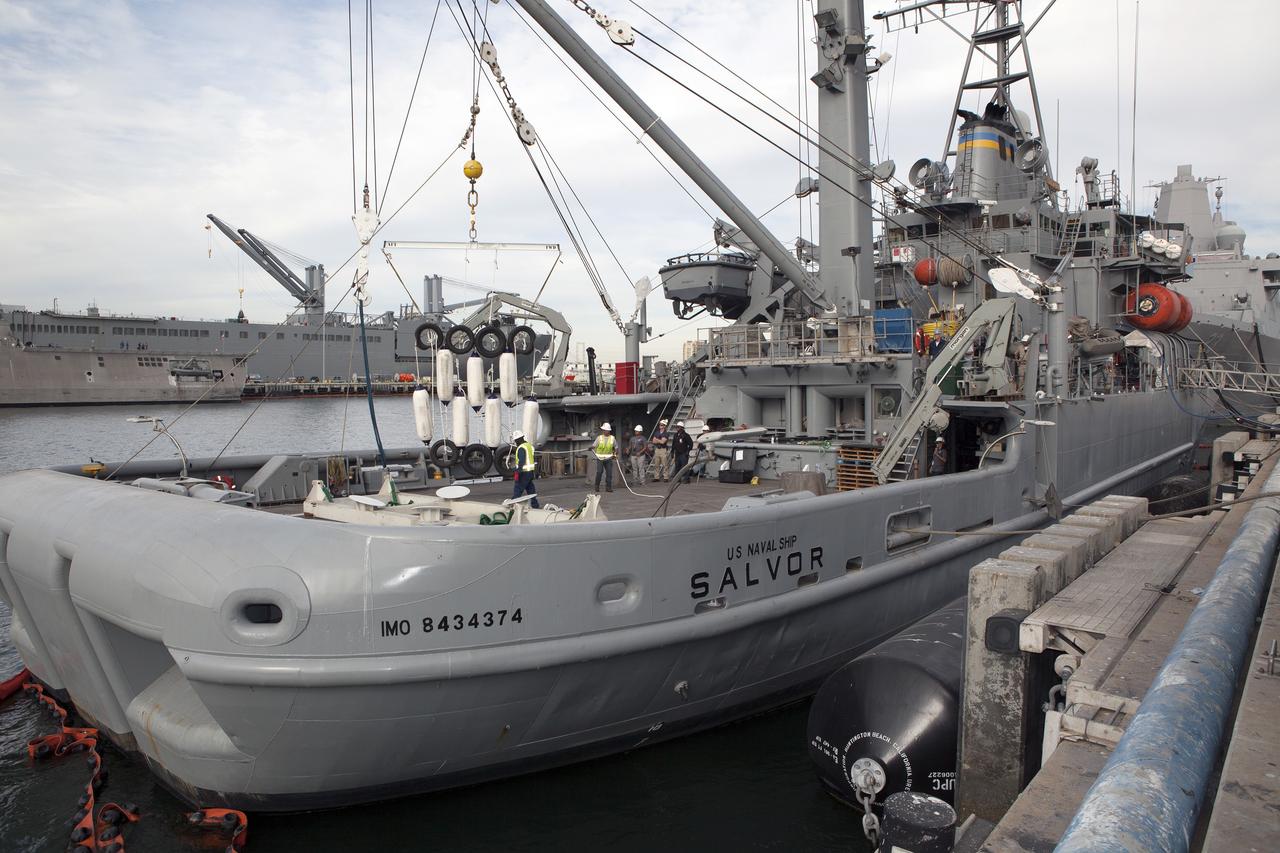
SAN DIEGO, Calif. – Ground support equipment for use during an alternate recovery method of the Orion crew module after its first flight test, if needed, is lowered by crane onto the deck of the USNS Salvor, a salvage ship, at Naval Base San Diego in California. Before launch of Orion on a Delta IV Heavy rocket from Cape Canaveral Air Force Station in Florida, NASA, Lockheed Martin and U.S. Navy personnel will head out to sea in the USS Anchorage and the USNS Salvor and wait for splashdown of the Orion crew module in the Pacific Ocean. The GSDO Program will lead the recovery efforts. Orion is the exploration spacecraft designed to carry astronauts to destinations not yet explored by humans, including an asteroid and Mars. It will have emergency abort capability, sustain the crew during space travel and provide safe re-entry from deep space return velocities. The first unpiloted flight test of Orion is scheduled to launch in December atop a United Launch Alliance Delta IV Heavy rocket and in 2018 on NASA’s Space Launch System rocket. For more information, visit http://www.nasa.gov/orion. Photo credit: NASA/Dimitri Gerondidakis
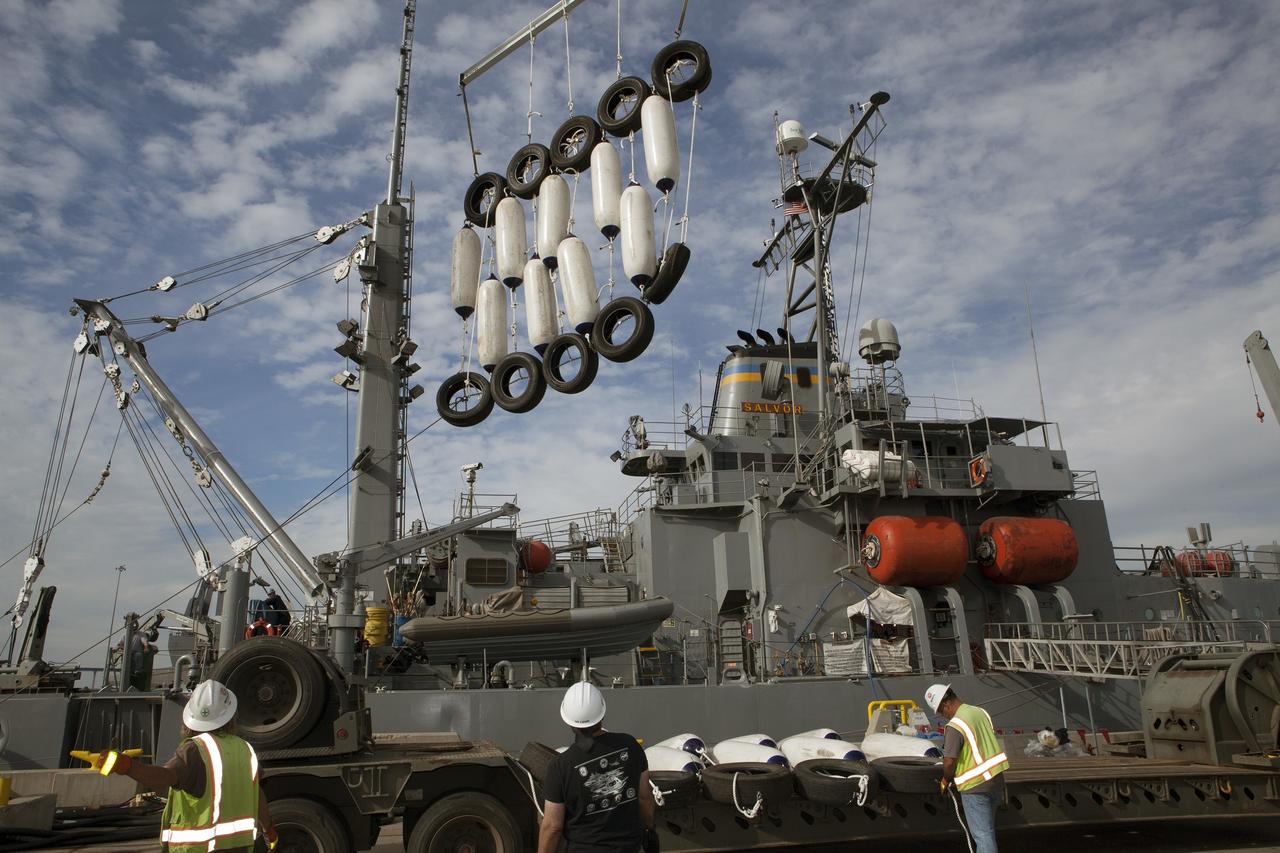
SAN DIEGO, Calif. – Ground support equipment for use during an alternate recovery method of the Orion crew module after its first flight test, if needed, is lowered by crane onto the deck of the USNS Salvor, a salvage ship, at Naval Base San Diego in California. Before launch of Orion on a Delta IV Heavy rocket from Cape Canaveral Air Force Station in Florida, NASA, Lockheed Martin and U.S. Navy personnel will head out to sea in the USS Anchorage and the USNS Salvor and wait for splashdown of the Orion crew module in the Pacific Ocean. The GSDO Program will lead the recovery efforts. Orion is the exploration spacecraft designed to carry astronauts to destinations not yet explored by humans, including an asteroid and Mars. It will have emergency abort capability, sustain the crew during space travel and provide safe re-entry from deep space return velocities. The first unpiloted flight test of Orion is scheduled to launch in December atop a United Launch Alliance Delta IV Heavy rocket and in 2018 on NASA’s Space Launch System rocket. For more information, visit http://www.nasa.gov/orion. Photo credit: NASA/Dimitri Gerondidakis
SAN DIEGO, Calif. – Ground support equipment for use during an alternate recovery method of the Orion crew module after its first flight test, if needed, is secured on the deck of the USNS Salvor, a salvage ship, at Naval Base San Diego in California. Before launch of Orion on a Delta IV Heavy rocket from Cape Canaveral Air Force Station in Florida, NASA, Lockheed Martin and U.S. Navy personnel will head out to sea in the USS Anchorage and the USNS Salvor and wait for splashdown of the Orion crew module in the Pacific Ocean. The GSDO Program will lead the recovery efforts. Orion is the exploration spacecraft designed to carry astronauts to destinations not yet explored by humans, including an asteroid and Mars. It will have emergency abort capability, sustain the crew during space travel and provide safe re-entry from deep space return velocities. The first unpiloted flight test of Orion is scheduled to launch in December atop a United Launch Alliance Delta IV Heavy rocket and in 2018 on NASA’s Space Launch System rocket. For more information, visit http://www.nasa.gov/orion. Photo credit: NASA/Dimitri Gerondidakis
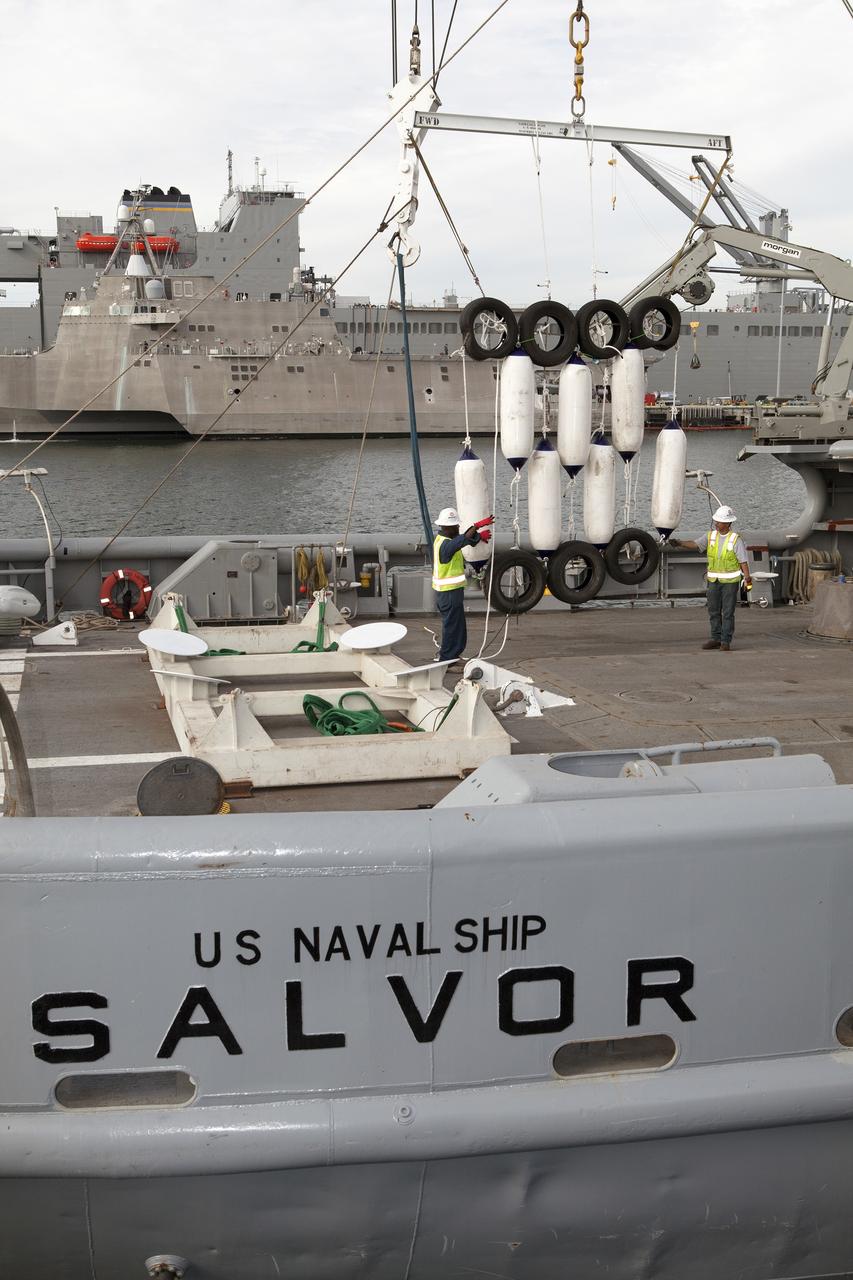
SAN DIEGO, Calif. – Ground support equipment for use during an alternate recovery method of the Orion crew module after its first flight test, if needed, is lowered by crane onto the deck of the USNS Salvor, a salvage ship, at Naval Base San Diego in California. Before launch of Orion on a Delta IV Heavy rocket from Cape Canaveral Air Force Station in Florida, NASA, Lockheed Martin and U.S. Navy personnel will head out to sea in the USS Anchorage and the USNS Salvor and wait for splashdown of the Orion crew module in the Pacific Ocean. The GSDO Program will lead the recovery efforts. Orion is the exploration spacecraft designed to carry astronauts to destinations not yet explored by humans, including an asteroid and Mars. It will have emergency abort capability, sustain the crew during space travel and provide safe re-entry from deep space return velocities. The first unpiloted flight test of Orion is scheduled to launch in December atop a United Launch Alliance Delta IV Heavy rocket and in 2018 on NASA’s Space Launch System rocket. For more information, visit http://www.nasa.gov/orion. Photo credit: NASA/Dimitri Gerondidakis
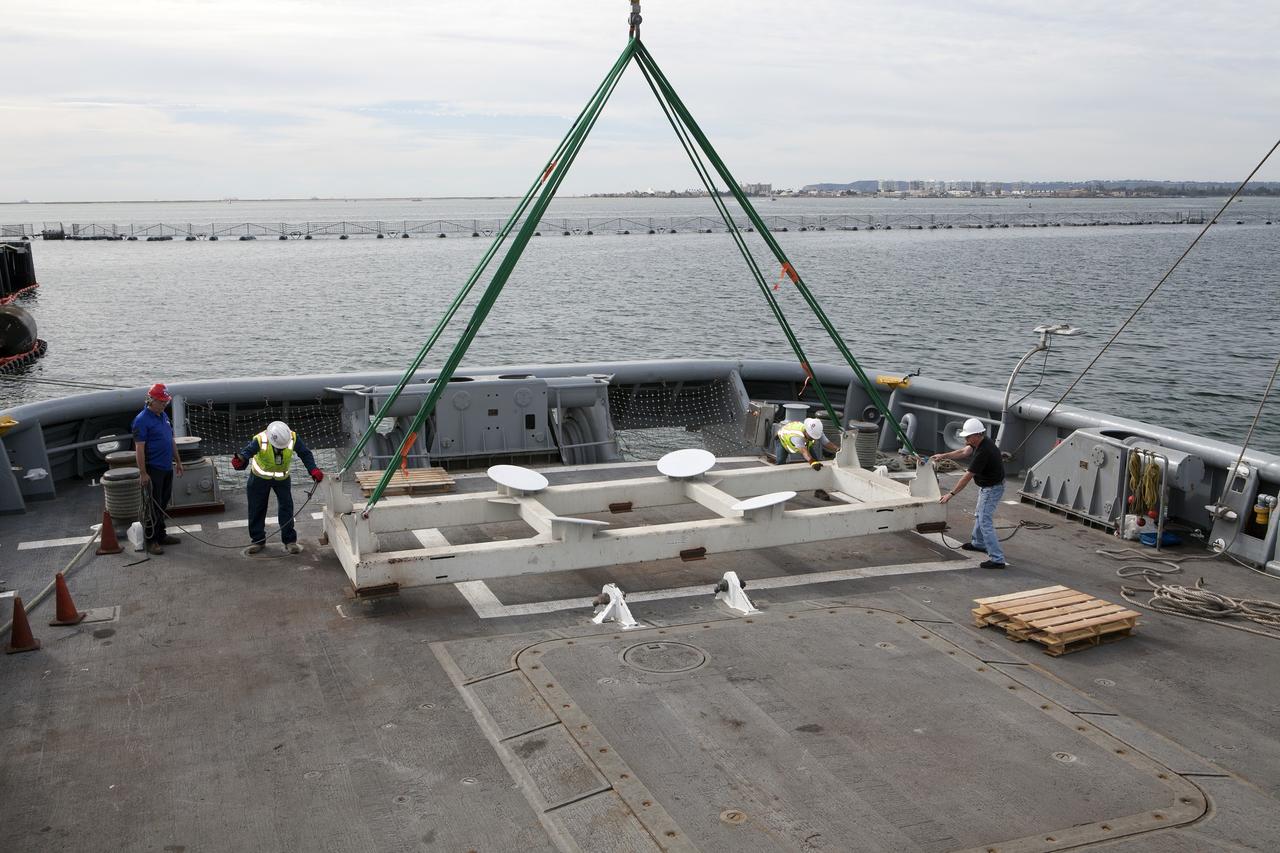
SAN DIEGO, Calif. – Ground support equipment for use during an alternate recovery method of the Orion crew module after its first flight test, if needed, is secured on the deck of the USNS Salvor, a salvage ship, at Naval Base San Diego in California. Before launch of Orion on a Delta IV Heavy rocket from Cape Canaveral Air Force Station in Florida, NASA, Lockheed Martin and U.S. Navy personnel will head out to sea in the USS Anchorage and the USNS Salvor and wait for splashdown of the Orion crew module in the Pacific Ocean. The GSDO Program will lead the recovery efforts. Orion is the exploration spacecraft designed to carry astronauts to destinations not yet explored by humans, including an asteroid and Mars. It will have emergency abort capability, sustain the crew during space travel and provide safe re-entry from deep space return velocities. The first unpiloted flight test of Orion is scheduled to launch in December atop a United Launch Alliance Delta IV Heavy rocket and in 2018 on NASA’s Space Launch System rocket. For more information, visit http://www.nasa.gov/orion. Photo credit: NASA/Dimitri Gerondidakis
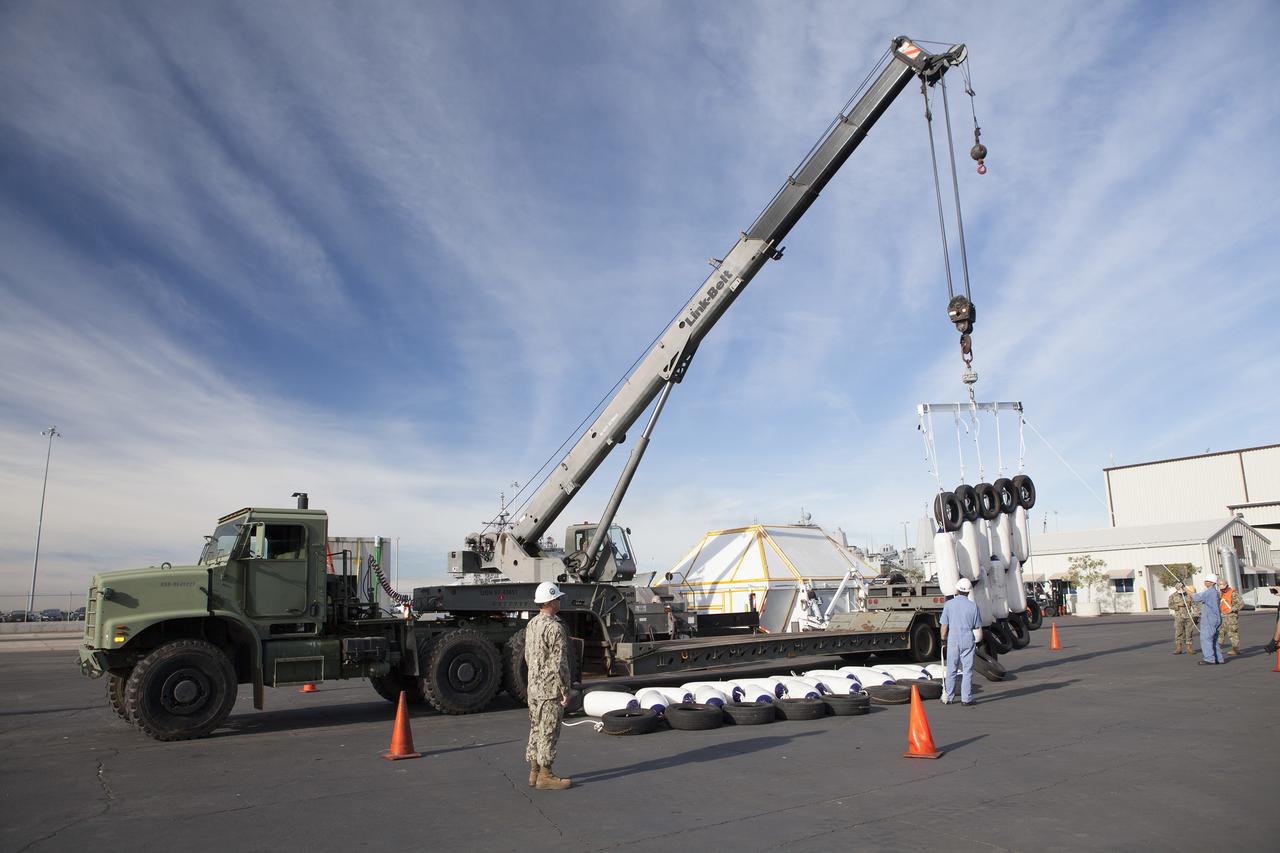
SAN DIEGO, Calif. – Ground support equipment for use during an alternate recovery method of the Orion crew module after its first flight test, if needed, is being prepared for loading onto the USNS Salvor, a salvage ship, at Naval Base San Diego in California. Before launch of Orion on a Delta IV Heavy rocket from Cape Canaveral Air Force Station in Florida, NASA, Lockheed Martin and U.S. Navy personnel will head out to sea in the USS Anchorage and the USNS Salvor and wait for splashdown of the Orion crew module in the Pacific Ocean. The GSDO Program will lead the recovery efforts. Orion is the exploration spacecraft designed to carry astronauts to destinations not yet explored by humans, including an asteroid and Mars. It will have emergency abort capability, sustain the crew during space travel and provide safe re-entry from deep space return velocities. The first unpiloted flight test of Orion is scheduled to launch in December atop a United Launch Alliance Delta IV Heavy rocket and in 2018 on NASA’s Space Launch System rocket. For more information, visit http://www.nasa.gov/orion. Photo credit: NASA/Dimitri Gerondidakis
NASA’s Ground Systems Development and Operations Program (GSDO) participated in the “Genius in the House” event at the Reuben H. Fleet Science Center in San Diego, California. GSDO participated in several outreach events to students and the general public before the start of the Orion Underway Recovery Test 5 (URT-5) using a test version of the Orion crew module in the Pacific Ocean off the coast of California. URT-5 will allow NASA, Orion manufacturer Lockheed Martin and the U.S. Navy to demonstrate and evaluate the recovery processes, procedures, hardware and personnel necessary for recovery of the Orion crew module on its return from a deep space mission. Orion is the exploration spacecraft designed to carry astronauts to destinations not yet explored by humans, including an asteroid and NASA’s Journey to Mars. It will have emergency abort capability, sustain the crew during space travel and provide safe re-entry from deep space return velocities. Orion is scheduled to launch atop NASA’s Space Launch System rocket in 2018. For more information, visit http://www.nasa.gov/orion.
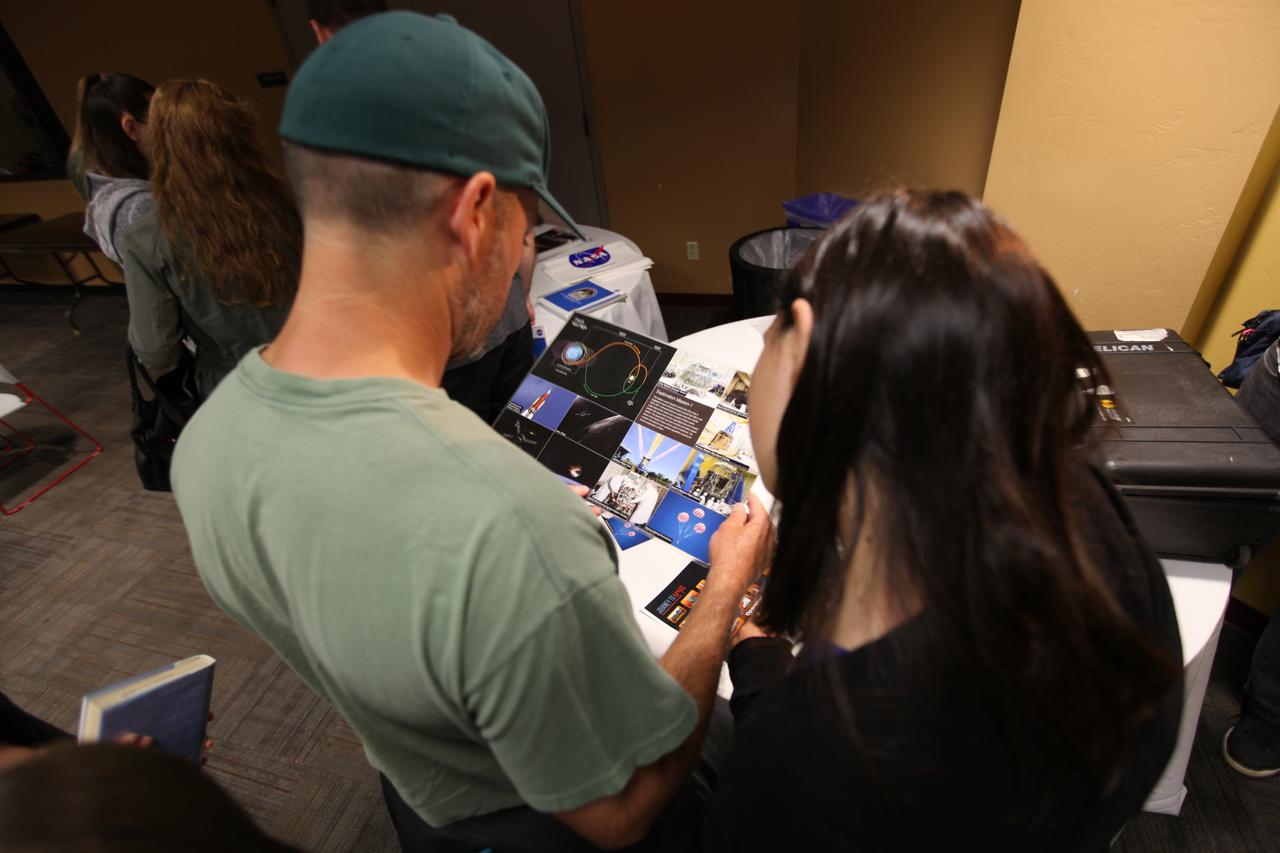
NASA’s Ground Systems Development and Operations Program (GSDO) participates in a “Be Wise” program at the Reuben H. Fleet Science Center in San Diego, California. Participants picked up material about Orion and Exploration Mission 1 after the program. GSDO participated in several outreach events to students and the general public before the start of the Orion Underway Recovery Test 5 (URT-5) using a test version of the Orion crew module in the Pacific Ocean. URT-5 will allow NASA and the U.S. Navy to demonstrate and evaluate the recovery processes, procedures, hardware and personnel necessary for recovery of the Orion crew module on its return from a deep space mission. Orion is the exploration spacecraft designed to carry astronauts to destinations not yet explored by humans, including an asteroid and NASA’s Journey to Mars. It will have emergency abort capability, sustain the crew during space travel and provide safe re-entry from deep space return velocities. Orion is scheduled to launch atop NASA’s Space Launch System rocket in 2018. For more information, visit http://www.nasa.gov/orion.
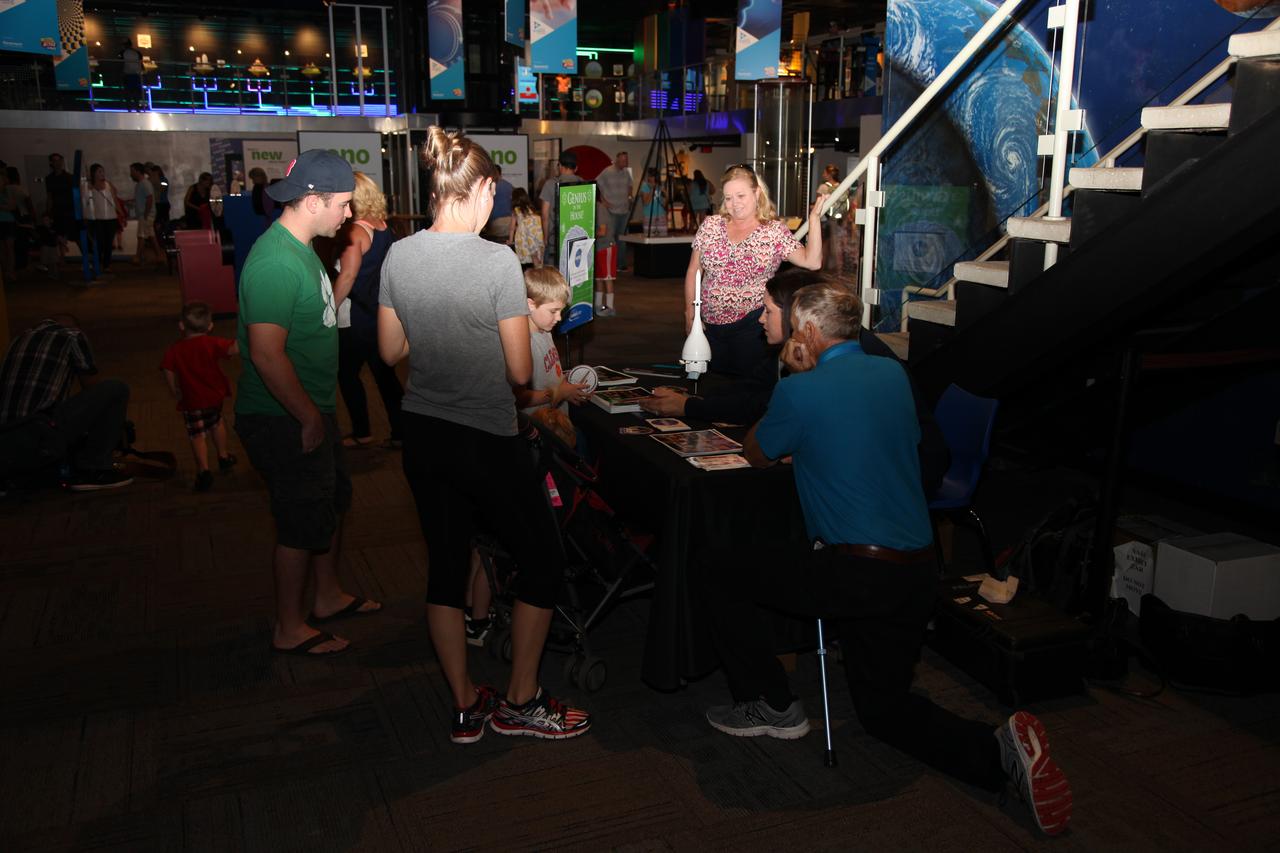
Visitors talk to representatives from NASA’s Ground Systems Development and Operations Program (GSDO) at the Reuben H. Fleet Science Center in San Diego, California. GSDO participated in the “Genius in the House” event at the science center before the start of the Orion Underway Recovery Test 5 (URT-5) using a test version of the Orion crew module in the Pacific Ocean off the coast of California. URT-5 will allow NASA, Orion manufacturer Lockheed Martin and the U.S. Navy to demonstrate and evaluate the recovery processes, procedures, hardware and personnel necessary for recovery of the Orion crew module on its return from a deep space mission. Orion is the exploration spacecraft designed to carry astronauts to destinations not yet explored by humans, including an asteroid and NASA’s Journey to Mars. It will have emergency abort capability, sustain the crew during space travel and provide safe re-entry from deep space return velocities. Orion is scheduled to launch atop NASA’s Space Launch System rocket in 2018. For more information, visit http://www.nasa.gov/orion.

NASA’s Ground Systems Development and Operations Program (GSDO) participates in a “Be Wise” program at the Reuben H. Fleet Science Center in San Diego, California. Participants listen to a presentation by engineers from the agency’s Kennedy Space Center in Florida. GSDO participated in several outreach events to students and the general public before the start of the Orion Underway Recovery Test 5 (URT-5) using a test version of the Orion crew module in the Pacific Ocean. URT-5 will allow NASA and the U.S. Navy to demonstrate and evaluate the recovery processes, procedures, hardware and personnel necessary for recovery of the Orion crew module on its return from a deep space mission. Orion is the exploration spacecraft designed to carry astronauts to destinations not yet explored by humans, including an asteroid and NASA’s Journey to Mars. It will have emergency abort capability, sustain the crew during space travel and provide safe re-entry from deep space return velocities. Orion is scheduled to launch atop NASA’s Space Launch System rocket in 2018. For more information, visit http://www.nasa.gov/orion.
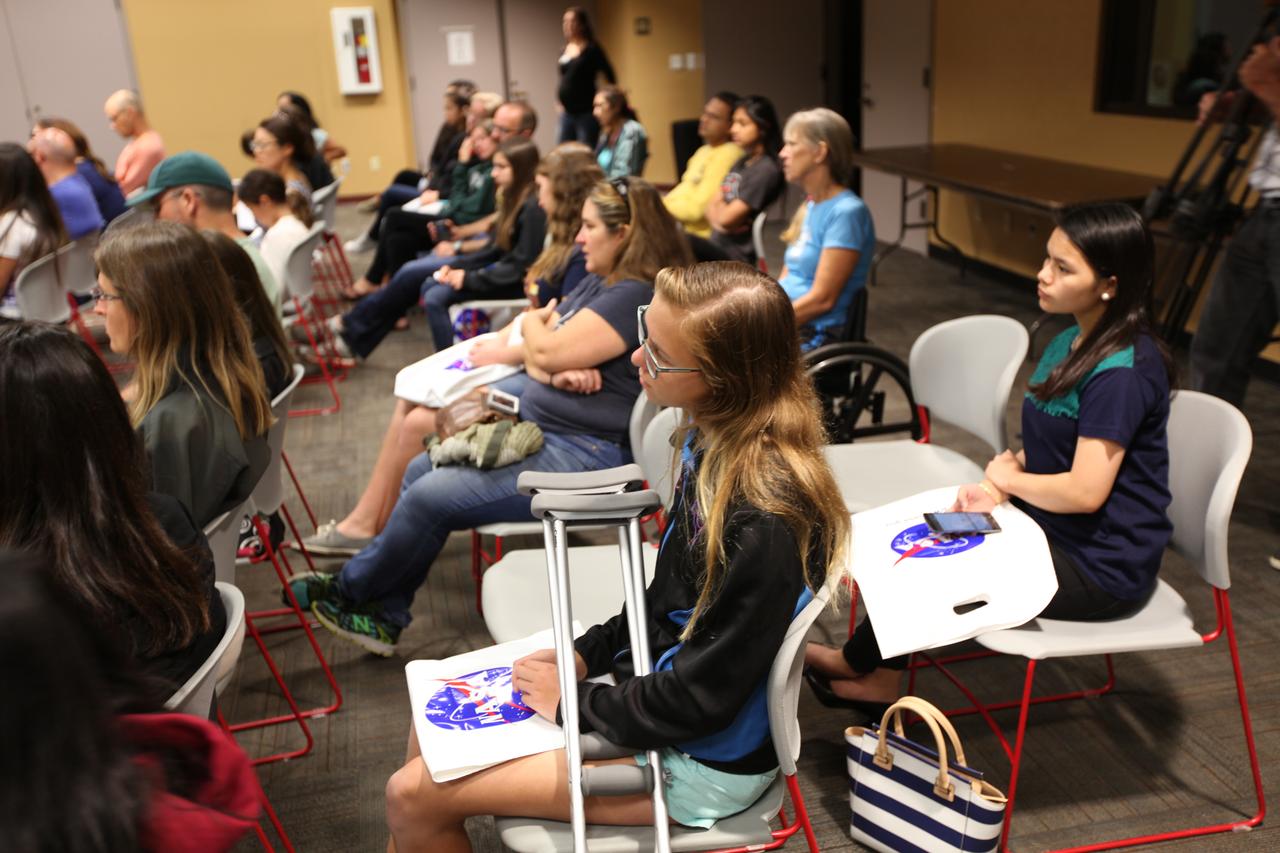
NASA’s Ground Systems Development and Operations Program (GSDO) participates in a “Be Wise” program at the Reuben H. Fleet Science Center in San Diego, California. Participants listen to a presentation by engineers from the agency’s Kennedy Space Center in Florida. GSDO participated in several outreach events to students and the general public before the start of the Orion Underway Recovery Test 5 (URT-5) using a test version of the Orion crew module in the Pacific Ocean. URT-5 will allow NASA and the U.S. Navy to demonstrate and evaluate the recovery processes, procedures, hardware and personnel necessary for recovery of the Orion crew module on its return from a deep space mission. Orion is the exploration spacecraft designed to carry astronauts to destinations not yet explored by humans, including an asteroid and NASA’s Journey to Mars. It will have emergency abort capability, sustain the crew during space travel and provide safe re-entry from deep space return velocities. Orion is scheduled to launch atop NASA’s Space Launch System rocket in 2018. For more information, visit http://www.nasa.gov/orion.
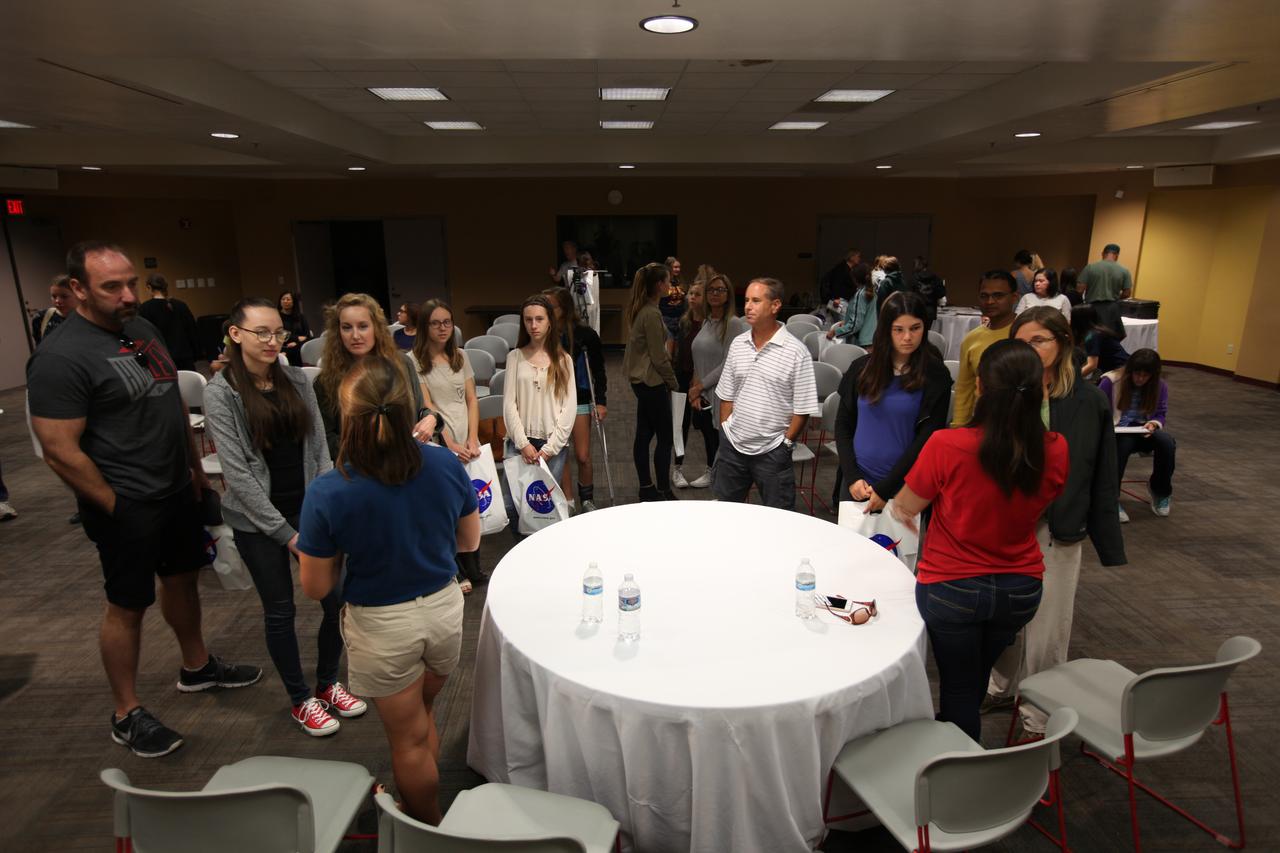
NASA’s Ground Systems Development and Operations Program (GSDO) participates in a “Be Wise” program at the Reuben H. Fleet Science Center in San Diego, California. Carla Koch, left, and Janet Gobaira, engineers from Kennedy Space Center in Florida, talk with participants after the program. GSDO participated in several outreach events to students and the general public before the start of the Orion Underway Recovery Test 5 (URT-5) using a test version of the Orion crew module in the Pacific Ocean. URT-5 will allow NASA and the U.S. Navy to demonstrate and evaluate the recovery processes, procedures, hardware and personnel necessary for recovery of the Orion crew module on its return from a deep space mission. Orion is the exploration spacecraft designed to carry astronauts to destinations not yet explored by humans, including an asteroid and NASA’s Journey to Mars. It will have emergency abort capability, sustain the crew during space travel and provide safe re-entry from deep space return velocities. Orion is scheduled to launch atop NASA’s Space Launch System rocket in 2018. For more information, visit http://www.nasa.gov/orion.
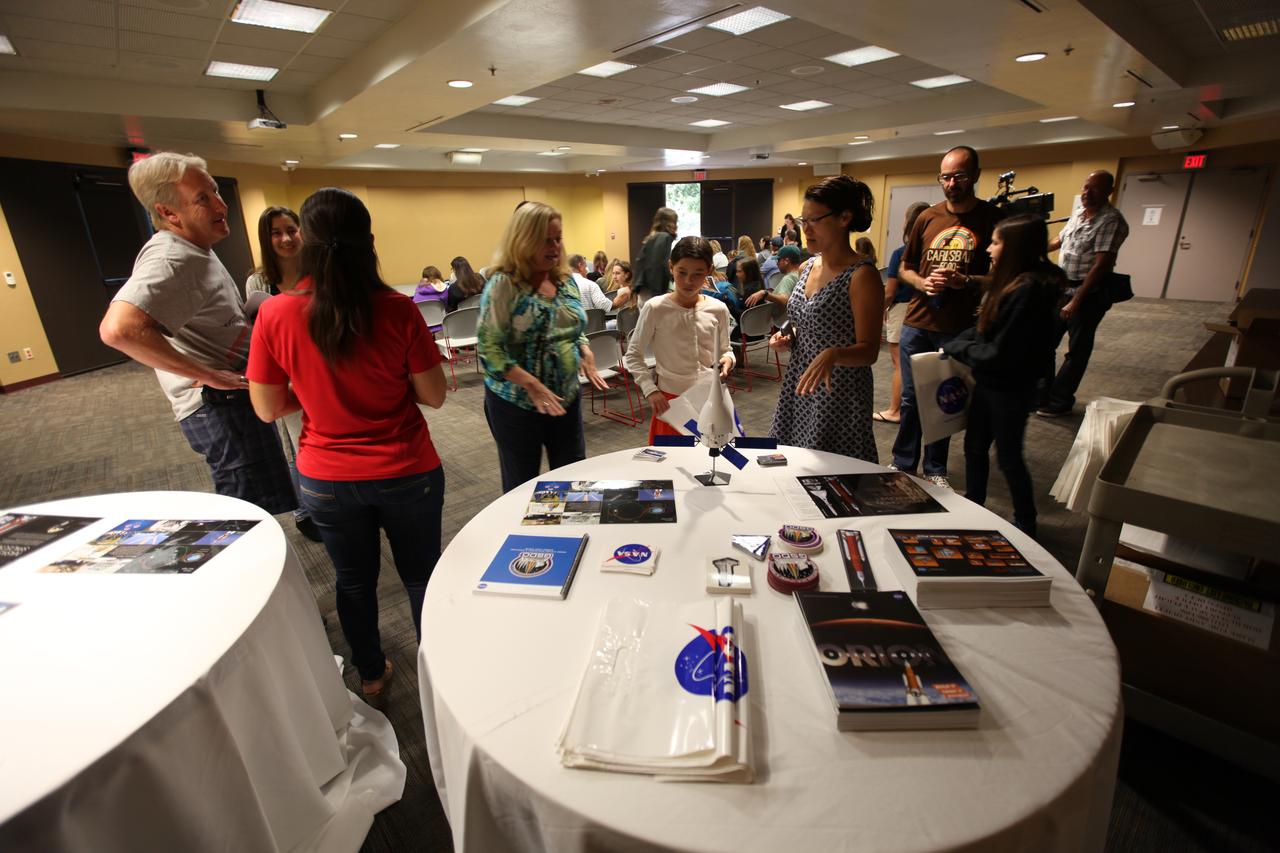
Representatives from NASA’s Ground Systems Development and Operations Program (GSDO) prepare for a “Be Wise” program at the Reuben H. Fleet Science Center in San Diego, California. GSDO participated in several outreach events to students and the general public before the start of the Orion Underway Recovery Test 5 (URT-5) using a test version of the Orion crew module in the Pacific Ocean. URT-5 will allow NASA and the U.S. Navy to demonstrate and evaluate the recovery processes, procedures, hardware and personnel necessary for recovery of the Orion crew module on its return from a deep space mission. Orion is the exploration spacecraft designed to carry astronauts to destinations not yet explored by humans, including an asteroid and NASA’s Journey to Mars. It will have emergency abort capability, sustain the crew during space travel and provide safe re-entry from deep space return velocities. Orion is scheduled to launch atop NASA’s Space Launch System rocket in 2018. For more information, visit http://www.nasa.gov/orion.
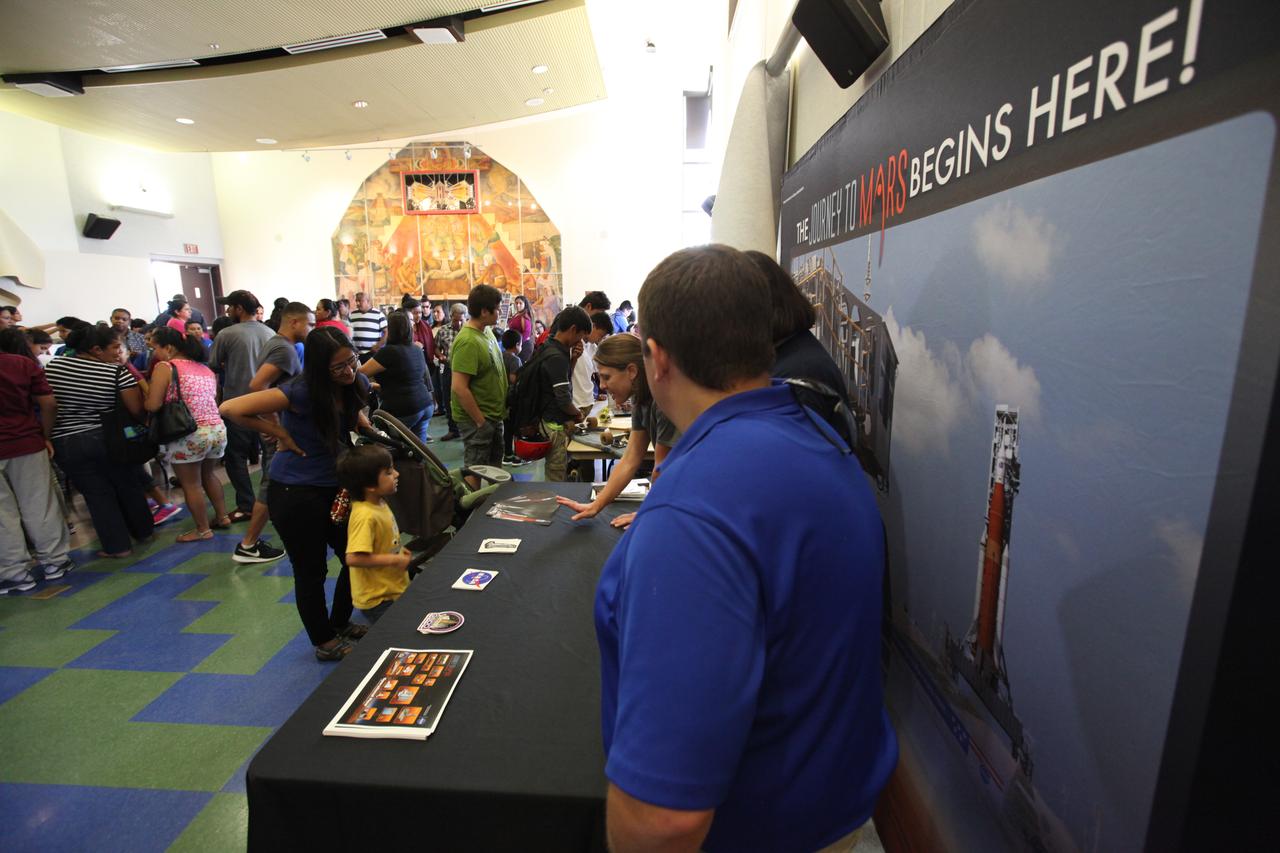
Students visit the displays at the Logan Heights Library in San Diego, California, during the “52 Weeks of Science” celebration. The Ground Systems Development and Operations (GSDO) Program is participating in the special event with a Journey to Mars display before the start of Underway Recovery Test 5 using a test version of the Orion spacecraft in the Pacific Ocean off the coast of California. The test will allow NASA, Orion manufacturer Lockheed Martin and the U.S. Navy to demonstrate and evaluate the recovery processes, procedures, hardware and personnel necessary for recovery of the Orion crew module on its return from a deep space mission. Orion is the exploration spacecraft designed to carry astronauts to destinations not yet explored by humans, including an asteroid and NASA Journey to Mars. It will have emergency abort capability, sustain the crew during space travel and provide safe re-entry from deep space return velocities. Orion is scheduled to launch atop NASA’s Space Launch System rocket in 2018. For more information, visit http://www.nasa.gov/orion.
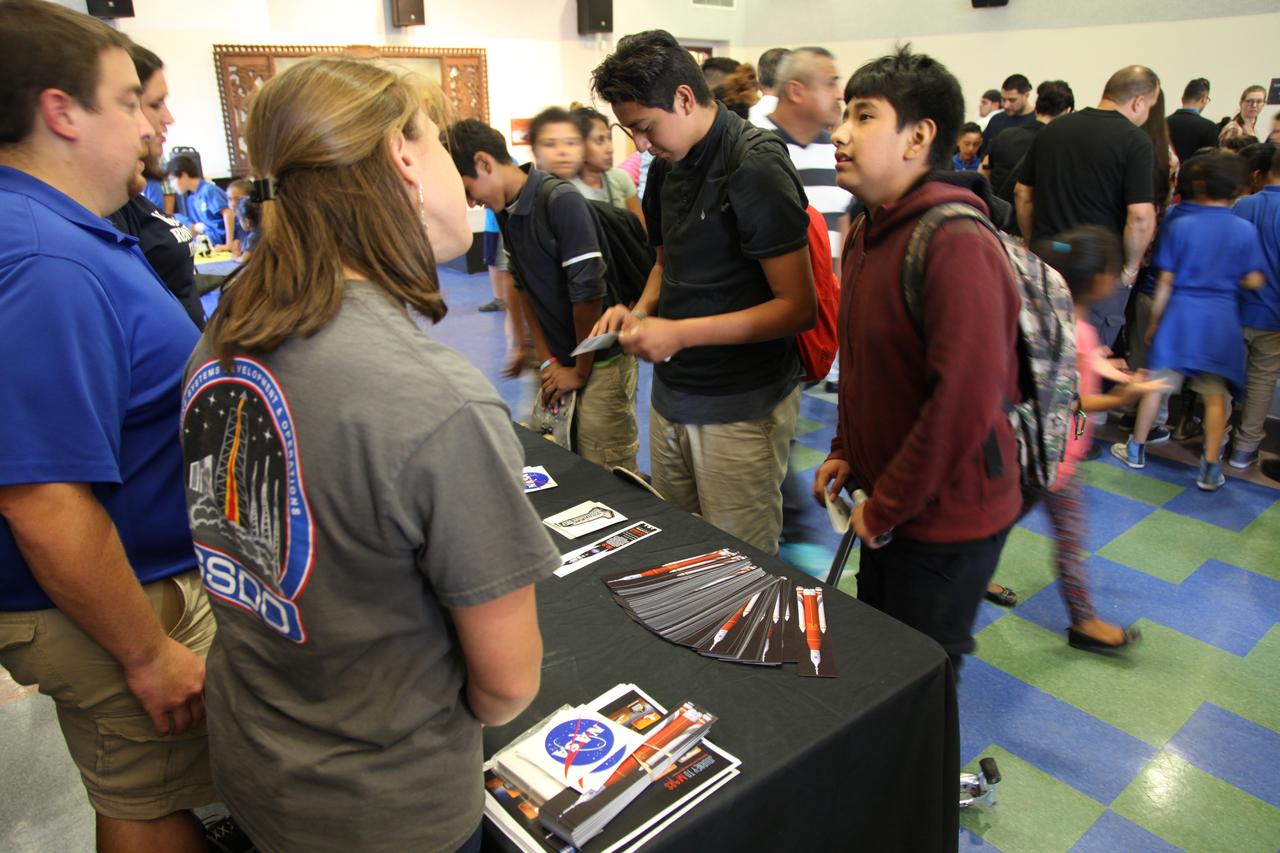
Students visit the displays at the Logan Heights Library in San Diego, California, during the “52 Weeks of Science” celebration. The Ground Systems Development and Operations (GSDO) Program is participating in the special event with a Journey to Mars display before the start of Underway Recovery Test 5 using a test version of the Orion spacecraft in the Pacific Ocean off the coast of California. The test will allow NASA, Orion manufacturer Lockheed Martin and the U.S. Navy to demonstrate and evaluate the recovery processes, procedures, hardware and personnel necessary for recovery of the Orion crew module on its return from a deep space mission. Orion is the exploration spacecraft designed to carry astronauts to destinations not yet explored by humans, including an asteroid and NASA Journey to Mars. It will have emergency abort capability, sustain the crew during space travel and provide safe re-entry from deep space return velocities. Orion is scheduled to launch atop NASA’s Space Launch System rocket in 2018. For more information, visit http://www.nasa.gov/orion.
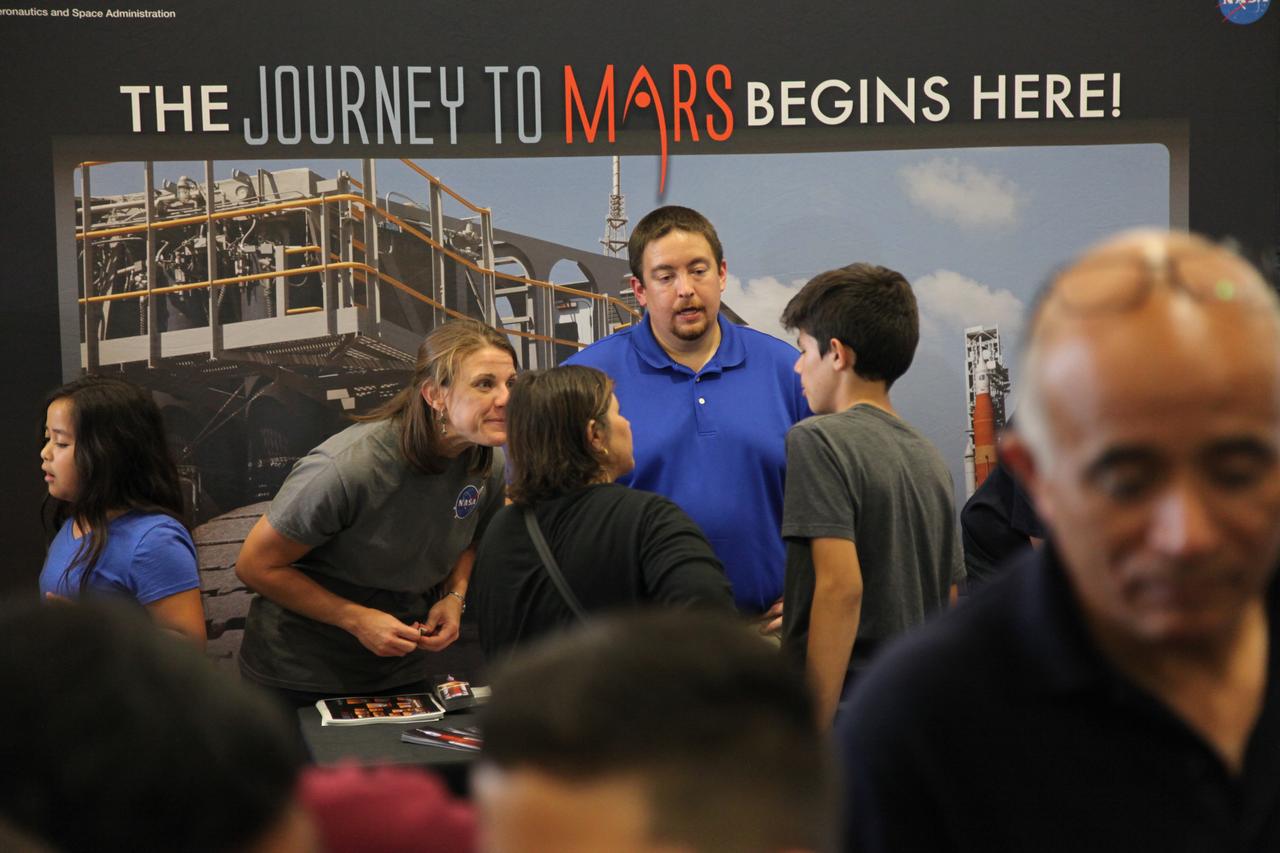
Students visit the displays at the Logan Heights Library in San Diego, California, during the “52 Weeks of Science” celebration. The Ground Systems Development and Operations (GSDO) Program is participating in the special event with a Journey to Mars display before the start of Underway Recovery Test 5 using a test version of the Orion spacecraft in the Pacific Ocean off the coast of California. The test will allow NASA, Orion manufacturer Lockheed Martin and the U.S. Navy to demonstrate and evaluate the recovery processes, procedures, hardware and personnel necessary for recovery of the Orion crew module on its return from a deep space mission. Orion is the exploration spacecraft designed to carry astronauts to destinations not yet explored by humans, including an asteroid and NASA Journey to Mars. It will have emergency abort capability, sustain the crew during space travel and provide safe re-entry from deep space return velocities. Orion is scheduled to launch atop NASA’s Space Launch System rocket in 2018. For more information, visit http://www.nasa.gov/orion.
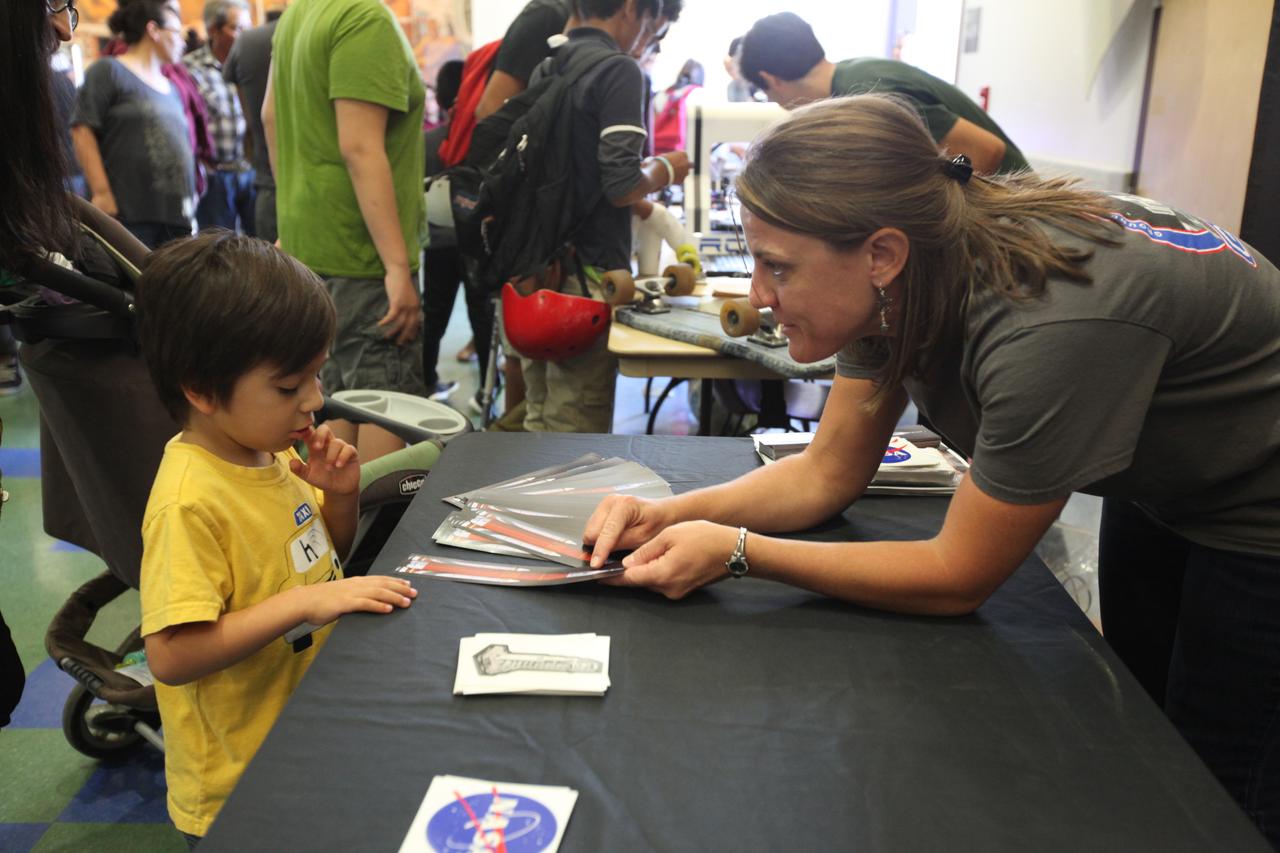
A young student visits the displays at the Logan Heights Library in San Diego, California, during the “52 Weeks of Science” celebration. The Ground Systems Development and Operations (GSDO) Program is participating in the special event with a Journey to Mars display before the start of Underway Recovery Test 5 using a test version of the Orion spacecraft in the Pacific Ocean off the coast of California. The test will allow NASA, Orion manufacturer Lockheed Martin and the U.S. Navy to demonstrate and evaluate the recovery processes, procedures, hardware and personnel necessary for recovery of the Orion crew module on its return from a deep space mission. Orion is the exploration spacecraft designed to carry astronauts to destinations not yet explored by humans, including an asteroid and NASA Journey to Mars. It will have emergency abort capability, sustain the crew during space travel and provide safe re-entry from deep space return velocities. Orion is scheduled to launch atop NASA’s Space Launch System rocket in 2018. For more information, visit http://www.nasa.gov/orion.
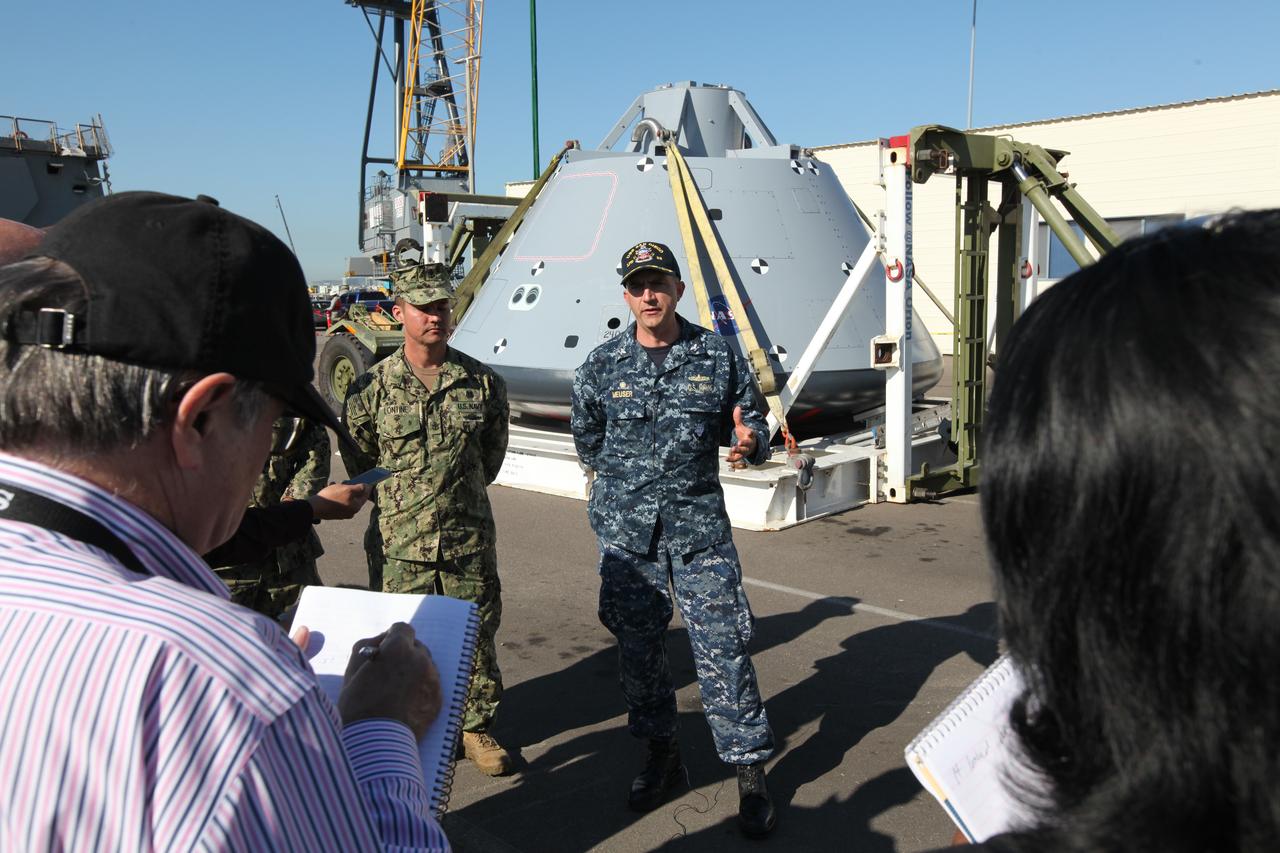
U.S. Navy recovery team members speak to members of the media about Orion Underway Recovery Test 5. The USS San Diego is docked at Naval Base San Diego in California and the test version of the Orion crew module, secured on its handling fixture, was offloaded from the well deck of the ship. NASA's GSDO Program and the U.S. Navy completed a series of tests using the ship's well deck, the test module, various watercraft and equipment to prepare for recovery of Orion on its return from deep space missions. The testing allowed the team to demonstrate and evaluate recovery processes, procedures, hardware and personnel in open waters. Orion is the exploration spacecraft designed to carry astronauts to destinations not yet explored by humans, including an asteroid and NASA's Journey to Mars. It will have emergency abort capability, sustain the crew during space travel and provide safe re-entry from deep space return velocities. Orion is scheduled to launch on NASA's Space Launch System in late 2018. For more information, visit http://www.nasa.gov/orion.
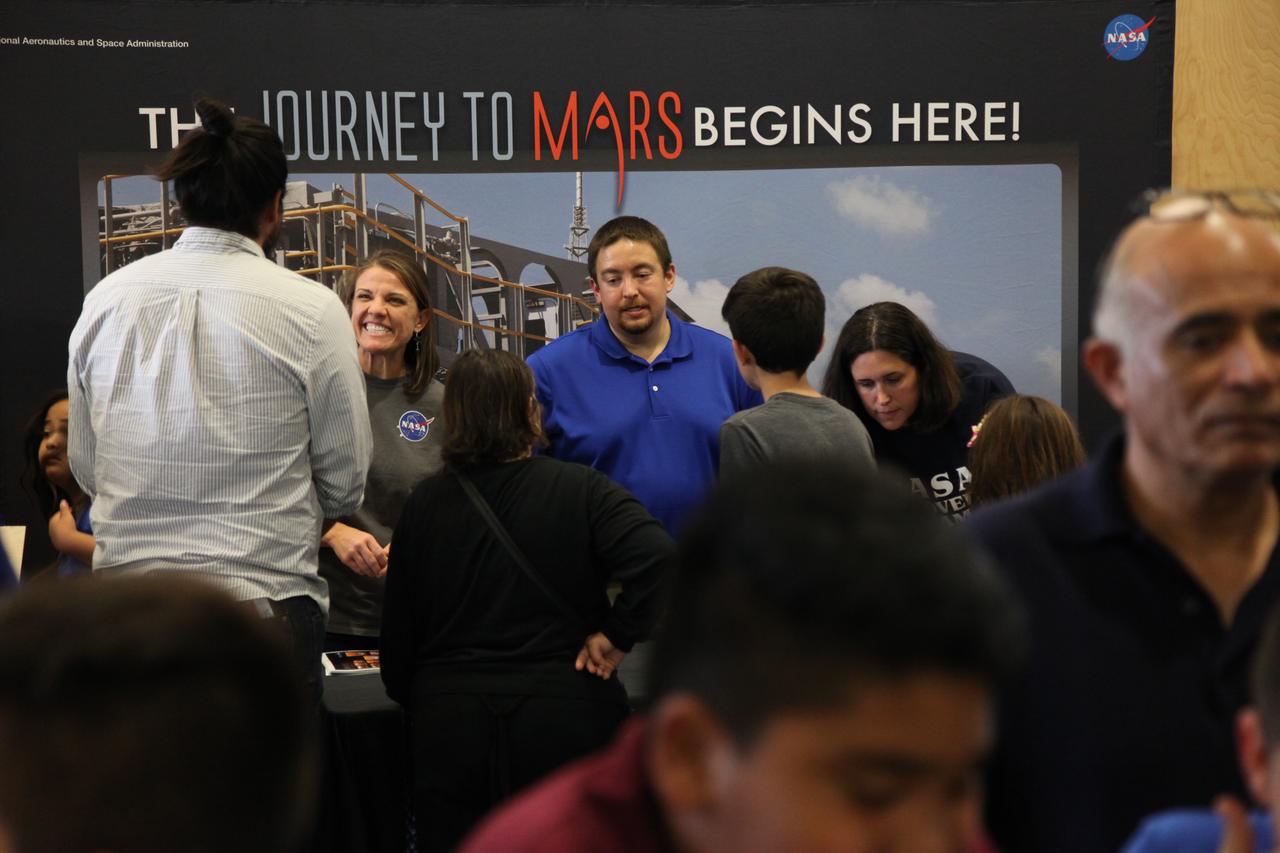
Students and parents visit the displays at the Logan Heights Library in San Diego, California, during the “52 Weeks of Science” celebration. The Ground Systems Development and Operations (GSDO) Program is participating in the special event with a Journey to Mars display before the start of Underway Recovery Test 5 using a test version of the Orion spacecraft in the Pacific Ocean off the coast of California. The test will allow NASA, Orion manufacturer Lockheed Martin and the U.S. Navy to demonstrate and evaluate the recovery processes, procedures, hardware and personnel necessary for recovery of the Orion crew module on its return from a deep space mission. Orion is the exploration spacecraft designed to carry astronauts to destinations not yet explored by humans, including an asteroid and NASA Journey to Mars. It will have emergency abort capability, sustain the crew during space travel and provide safe re-entry from deep space return velocities. Orion is scheduled to launch atop NASA’s Space Launch System rocket in 2018. For more information, visit http://www.nasa.gov/orion.
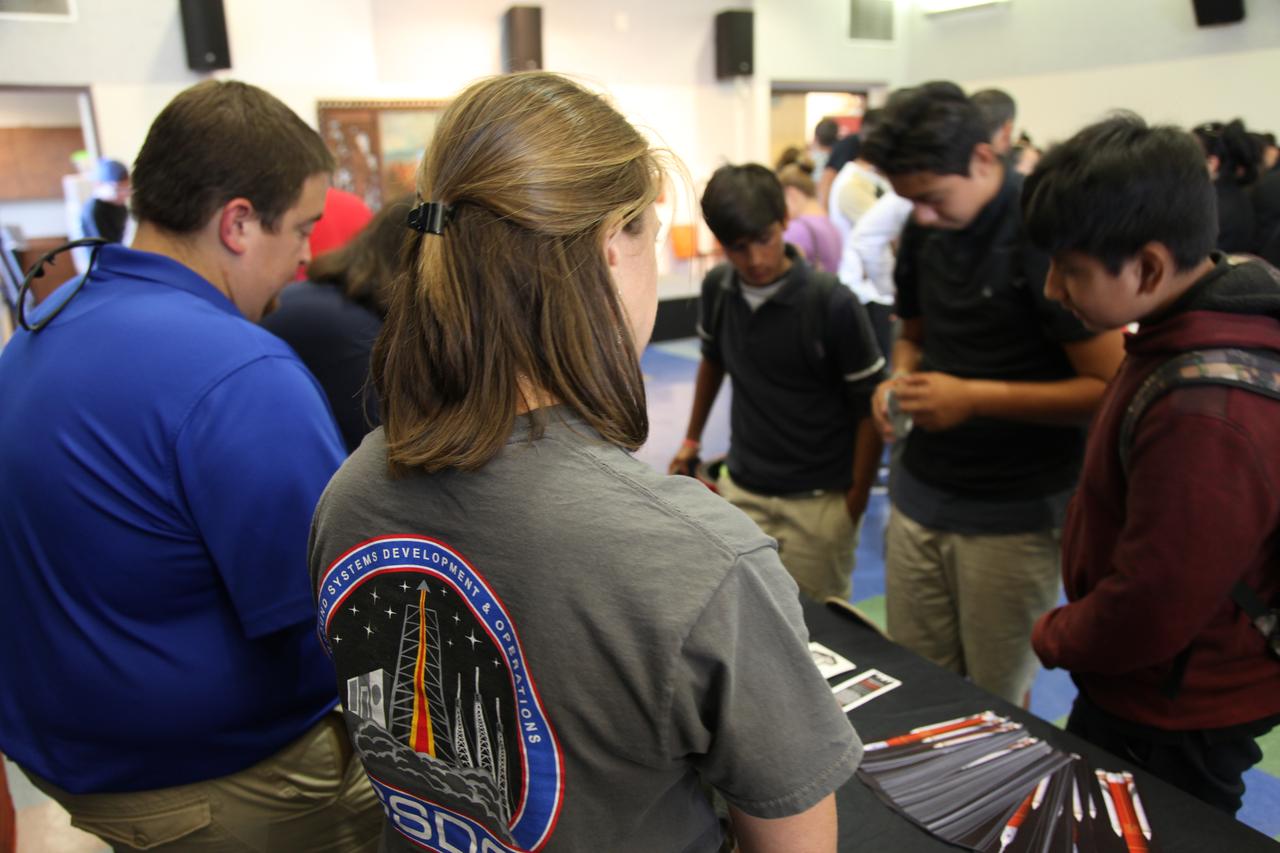
Students visit the displays at the Logan Heights Library in San Diego, California, during the “52 Weeks of Science” celebration. The Ground Systems Development and Operations (GSDO) Program is participating in the special event with a Journey to Mars display before the start of Underway Recovery Test 5 using a test version of the Orion spacecraft in the Pacific Ocean off the coast of California. The test will allow NASA, Orion manufacturer Lockheed Martin and the U.S. Navy to demonstrate and evaluate the recovery processes, procedures, hardware and personnel necessary for recovery of the Orion crew module on its return from a deep space mission. Orion is the exploration spacecraft designed to carry astronauts to destinations not yet explored by humans, including an asteroid and NASA Journey to Mars. It will have emergency abort capability, sustain the crew during space travel and provide safe re-entry from deep space return velocities. Orion is scheduled to launch atop NASA’s Space Launch System rocket in 2018. For more information, visit http://www.nasa.gov/orion.
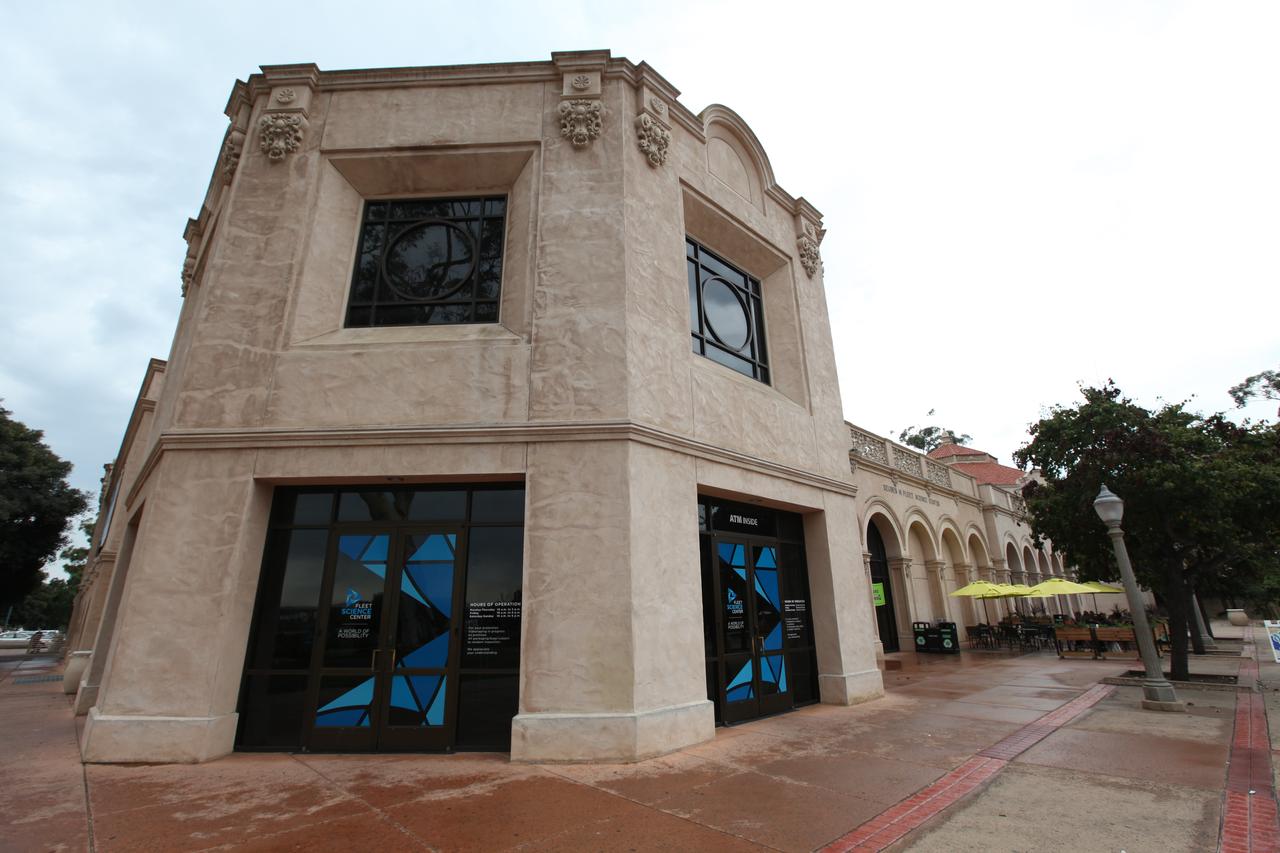
NASA’s Ground Systems Development and Operations Program (GSDO) is participating in a “Be Wise” program at the Reuben H. Fleet Science Center in San Diego, California, before the start of the Orion Underway Recovery Test 5 (URT-5) using a test version of the Orion crew module in the Pacific Ocean. URT-5 will allow NASA and the U.S. Navy to demonstrate and evaluate the recovery processes, procedures, hardware and personnel necessary for recovery of the Orion crew module on its return from a deep space mission. Orion is the exploration spacecraft designed to carry astronauts to destinations not yet explored by humans, including an asteroid and NASA’s Journey to Mars. It will have emergency abort capability, sustain the crew during space travel and provide safe re-entry from deep space return velocities. Orion is scheduled to launch atop NASA’s Space Launch System rocket in 2018.
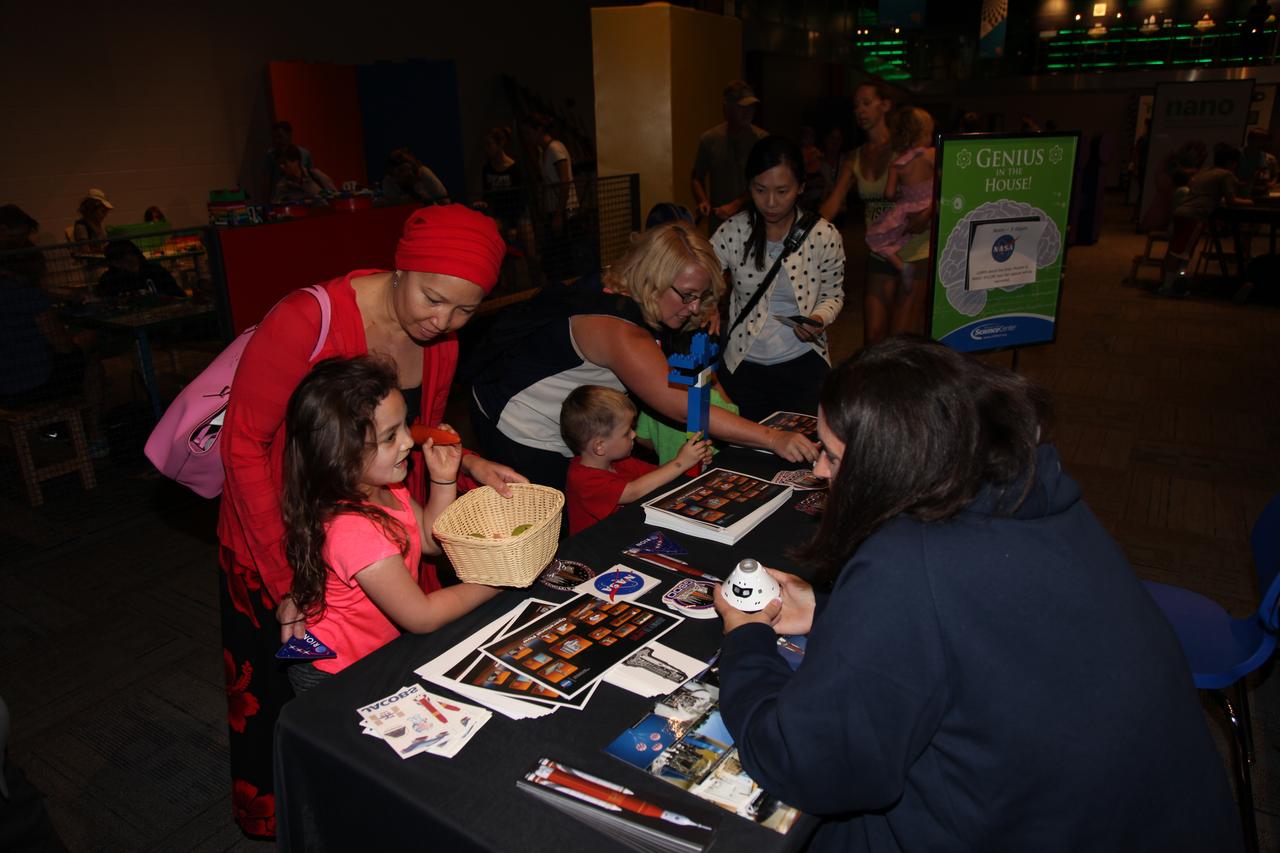
Melissa Jones, right, Landing and Recovery director with NASA’s Ground Systems Development and Operations Program speaks to visitors to the Reuben H. Fleet Science Center in San Diego, California, during a “Genius in the House” event. GSDO participated in several outreach events to students and the general public before the start of the Orion Underway Recovery Test 5 (URT-5) using a test version of the Orion crew module in the Pacific Ocean off the coast of California. URT-5 will allow NASA, Orion manufacturer Lockheed Martin and the U.S. Navy to demonstrate and evaluate the recovery processes, procedures, hardware and personnel necessary for recovery of the Orion crew module on its return from a deep space mission. Orion is the exploration spacecraft designed to carry astronauts to destinations not yet explored by humans, including an asteroid and NASA’s Journey to Mars. It will have emergency abort capability, sustain the crew during space travel and provide safe re-entry from deep space return velocities. Orion is scheduled to launch atop NASA’s Space Launch System rocket in 2018. For more information, visit http://www.nasa.gov/orion.
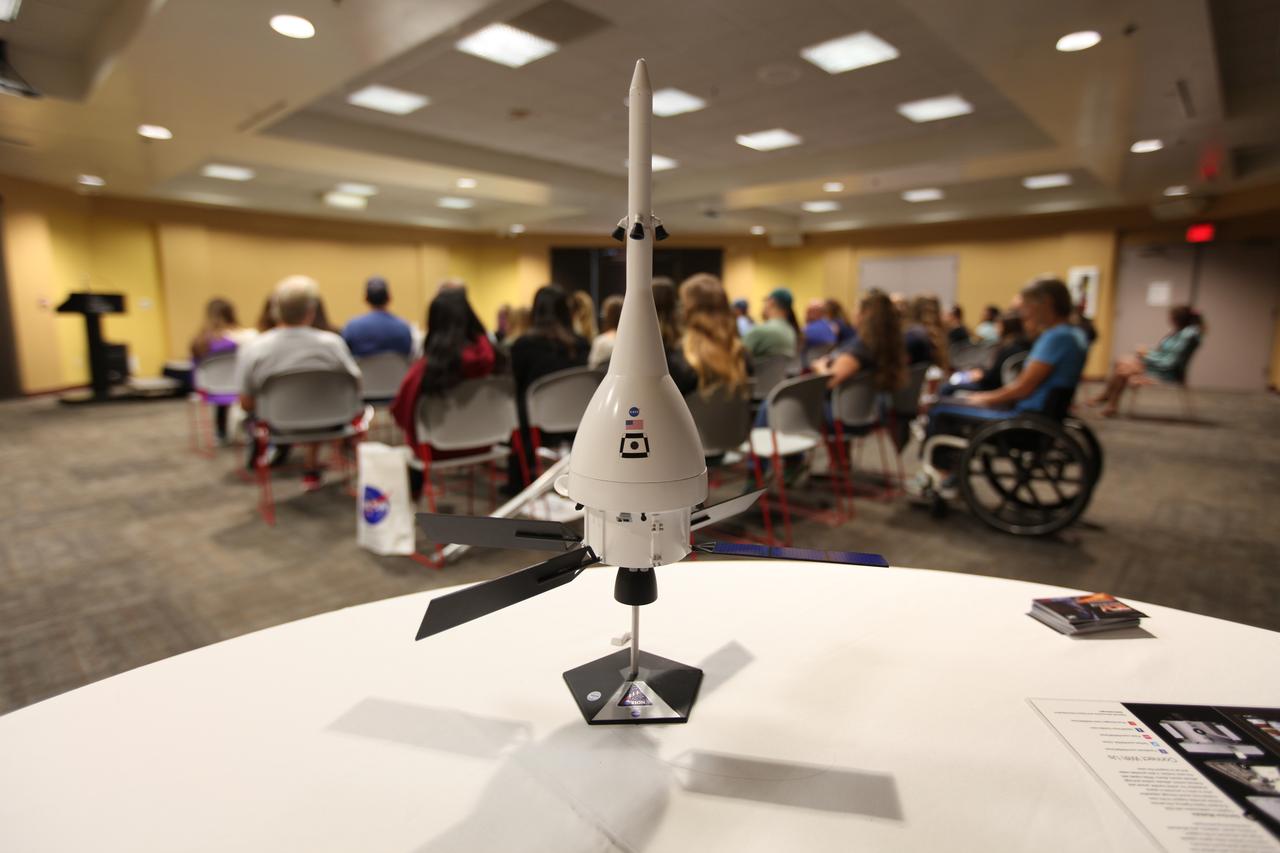
A model of NASA’s Orion spacecraft with the Launch Abort System is on display at the Reuben H. Fleet Science Center in San Diego, California. The agency’s Ground Systems Development and Operations Program is participating in a “Be Wise” program at the science center. GSDO is preparing for Orion Underway Recovery Test 5 (URT-5) using a test version of the Orion crew module in the Pacific Ocean. URT-5 will allow NASA and the U.S. Navy to demonstrate and evaluate the recovery processes, procedures, hardware and personnel necessary for recovery of the Orion crew module on its return from a deep space mission. Orion is the exploration spacecraft designed to carry astronauts to destinations not yet explored by humans, including an asteroid and NASA’s Journey to Mars. It will have emergency abort capability, sustain the crew during space travel and provide safe re-entry from deep space return velocities. Orion is scheduled to launch atop NASA’s Space Launch System rocket in 2018. For more information, visit http://www.nasa.gov/orion.
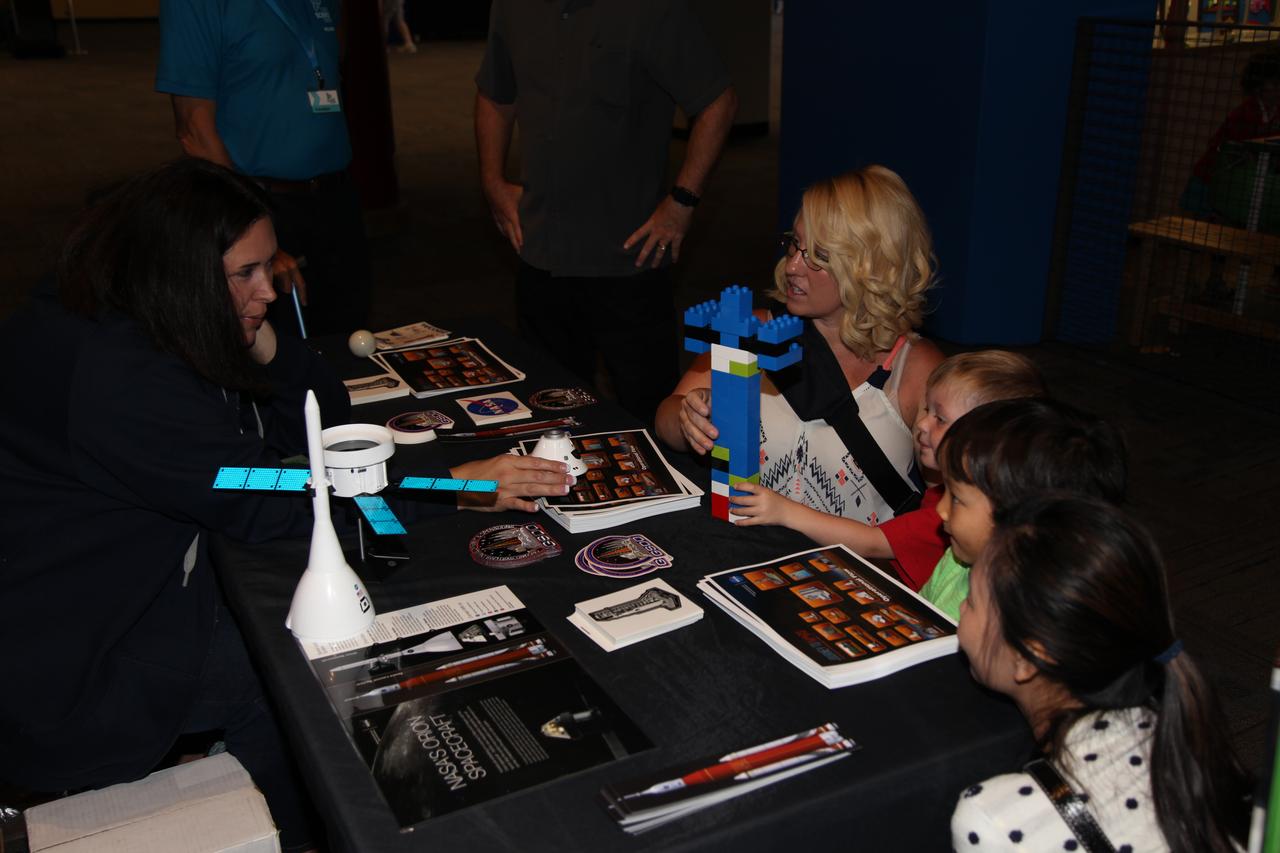
Melissa Jones, left, Landing and Recovery director with NASA’s Ground Systems Development and Operations Program speaks to visitors to the Reuben H. Fleet Science Center in San Diego, California, during a “Genius in the House” event. GSDO participated in several outreach events to students and the general public before the start of the Orion Underway Recovery Test 5 (URT-5) using a test version of the Orion crew module in the Pacific Ocean off the coast of California. URT-5 will allow NASA, Orion manufacturer Lockheed Martin and the U.S. Navy to demonstrate and evaluate the recovery processes, procedures, hardware and personnel necessary for recovery of the Orion crew module on its return from a deep space mission. Orion is the exploration spacecraft designed to carry astronauts to destinations not yet explored by humans, including an asteroid and NASA’s Journey to Mars. It will have emergency abort capability, sustain the crew during space travel and provide safe re-entry from deep space return velocities. Orion is scheduled to launch atop NASA’s Space Launch System rocket in 2018. For more information, visit http://www.nasa.gov/orion.
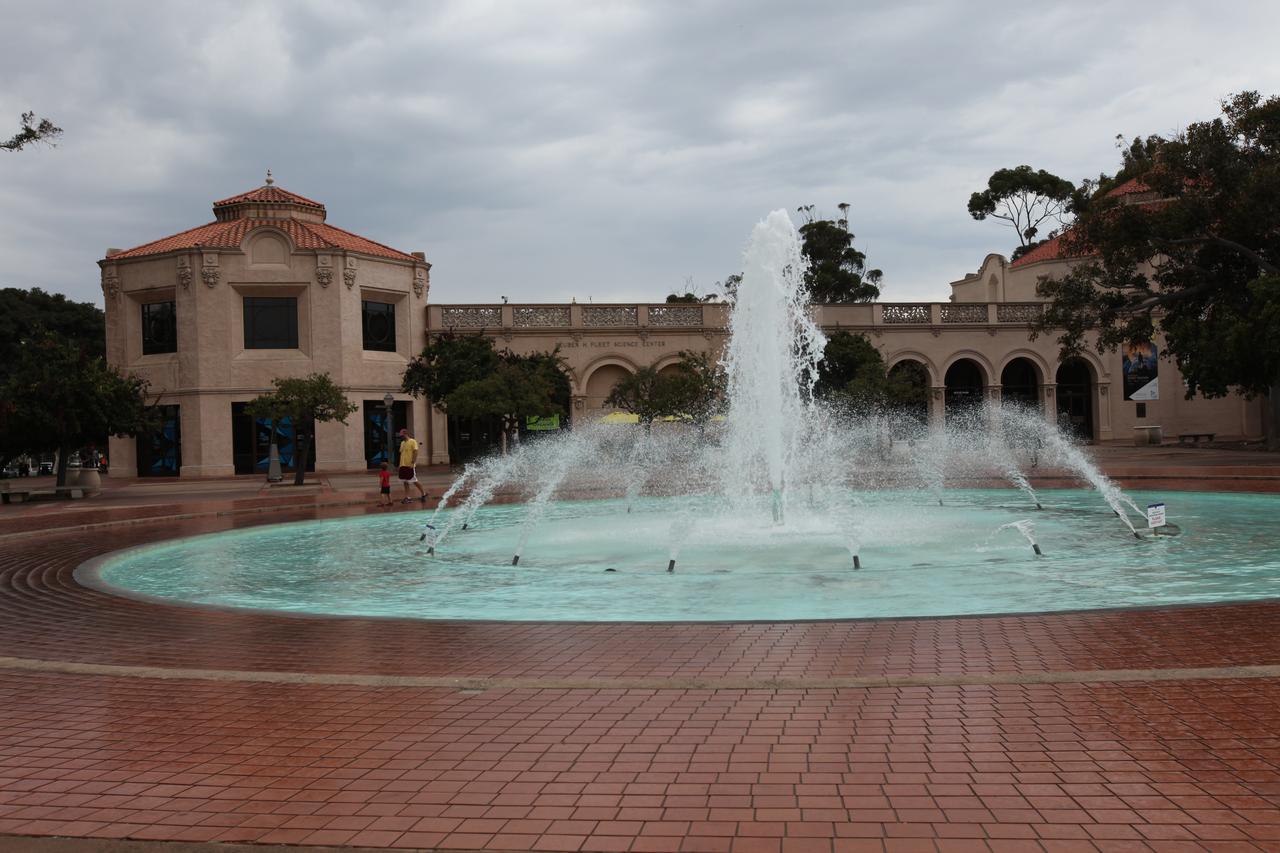
A water fountain marks the entrance to the Reuben H. Fleet Science Center in San Diego, California. NASA’s Ground Systems Development and Operations Program (GSDO) is participating in a “Be Wise” program at the science center before the start of the Orion Underway Recovery Test 5 (URT-5) using a test version of the Orion crew module in the Pacific Ocean. URT-5 will allow NASA and the U.S. Navy to demonstrate and evaluate the recovery processes, procedures, hardware and personnel necessary for recovery of the Orion crew module on its return from a deep space mission. Orion is the exploration spacecraft designed to carry astronauts to destinations not yet explored by humans, including an asteroid and NASA’s Journey to Mars. It will have emergency abort capability, sustain the crew during space travel and provide safe re-entry from deep space return velocities. Orion is scheduled to launch atop NASA’s Space Launch System rocket in 2018. For more information, visit http://www.nasa.gov/orion.
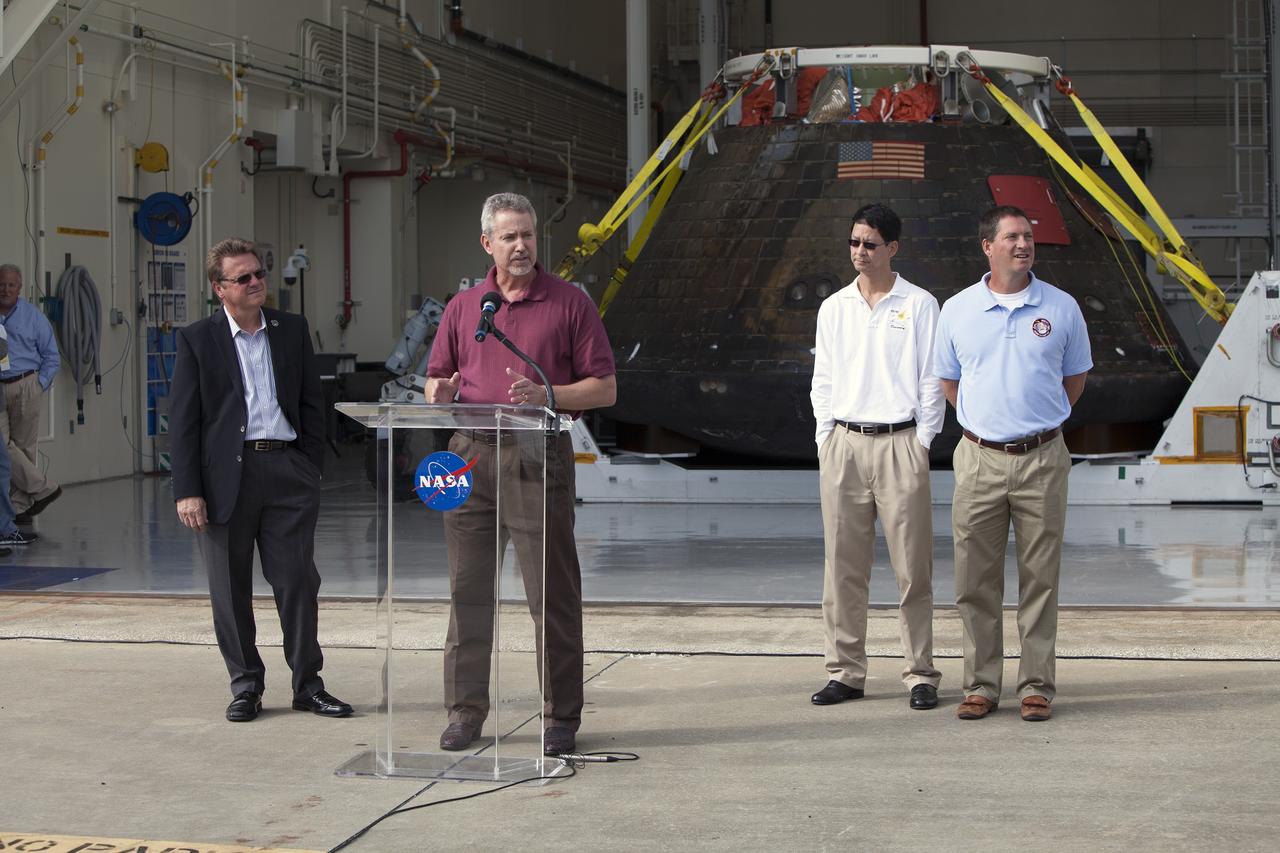
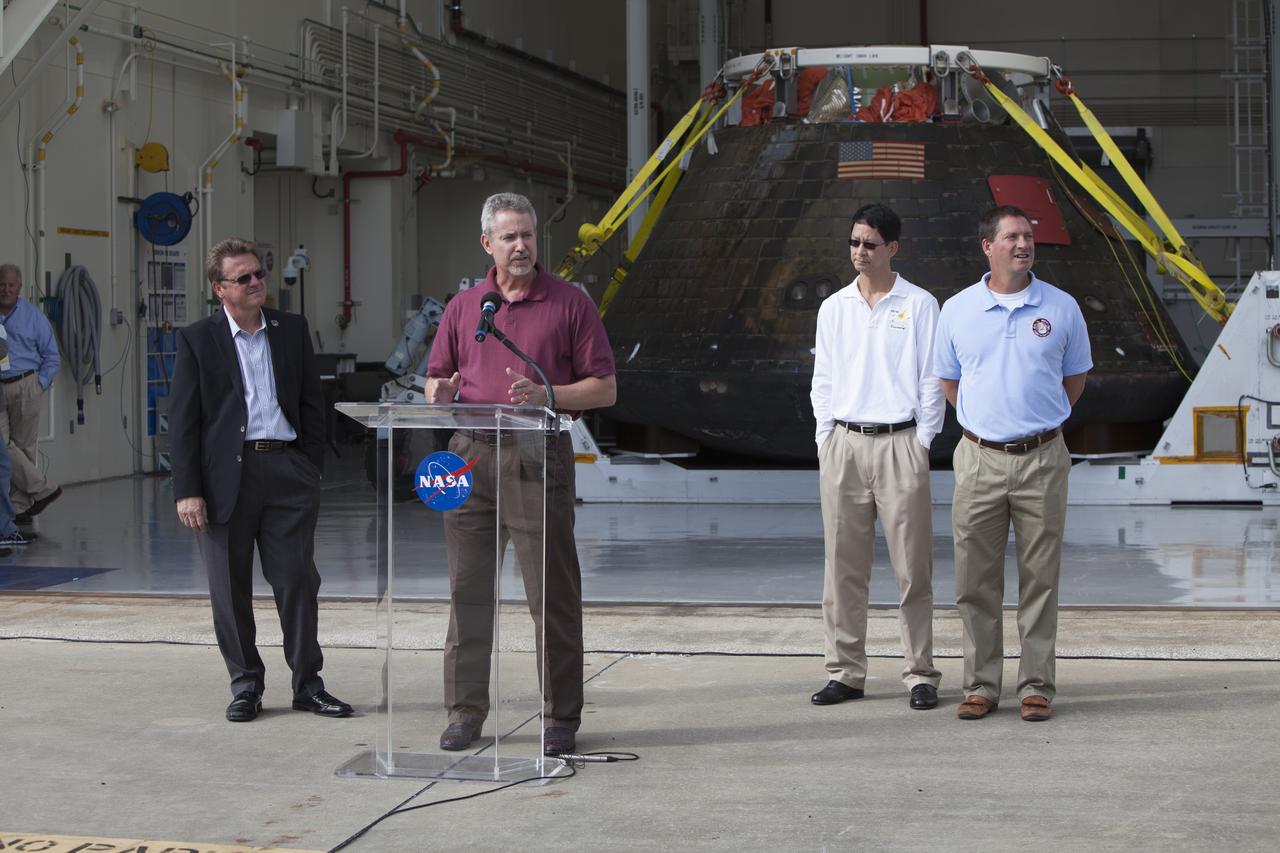
CAPE CANAVERAL, Fla. -- NASA's Orion spacecraft is viewed by members of the media at the Launch Abort System Facility at NASA's Kennedy Space Center in Florida. Speaking to the media during the viewing opportunity is Phil Weber, with the Ground Systems Development and Operations Program, or GSDO. At left is Jules Schneider, Lockheed Martin manager. At right is Glenn Chin, Orion Production Operations, and Lou Garcia, with GSDO. Orion made the 8-day, 2,700 mile overland trip back to Kennedy from Naval Base San Diego in California. Analysis of date obtained during its two-orbit, four-and-a-half hour mission Dec. 5 will provide engineers detailed information on how the spacecraft fared. GSDO led the recovery, offload and transportation efforts. For more information, visit www.nasa.gov/orion. Photo credit: NASA/Dimitri Gerondidakis
NASA's Orion spacecraft is viewed by members of the media at the Launch Abort System Facility at NASA's Kennedy Space Center in Florida. Speaking to the media during the viewing opportunity is Phil Weber, with the Ground Systems Development and Operations Program, or GSDO. At left is Jules Schneider, Lockheed Martin manager. At right is Glenn Chin, Orion Production Operations, and Lou Garcia, with GSDO. Orion made the 8-day, 2,700 mile overland trip back to Kennedy from Naval Base San Diego in California. Analysis of date obtained during its two-orbit, four-and-a-half hour mission Dec. 5 will provide engineers detailed information on how the spacecraft fared. GSDO led the recovery, offload and transportation efforts.
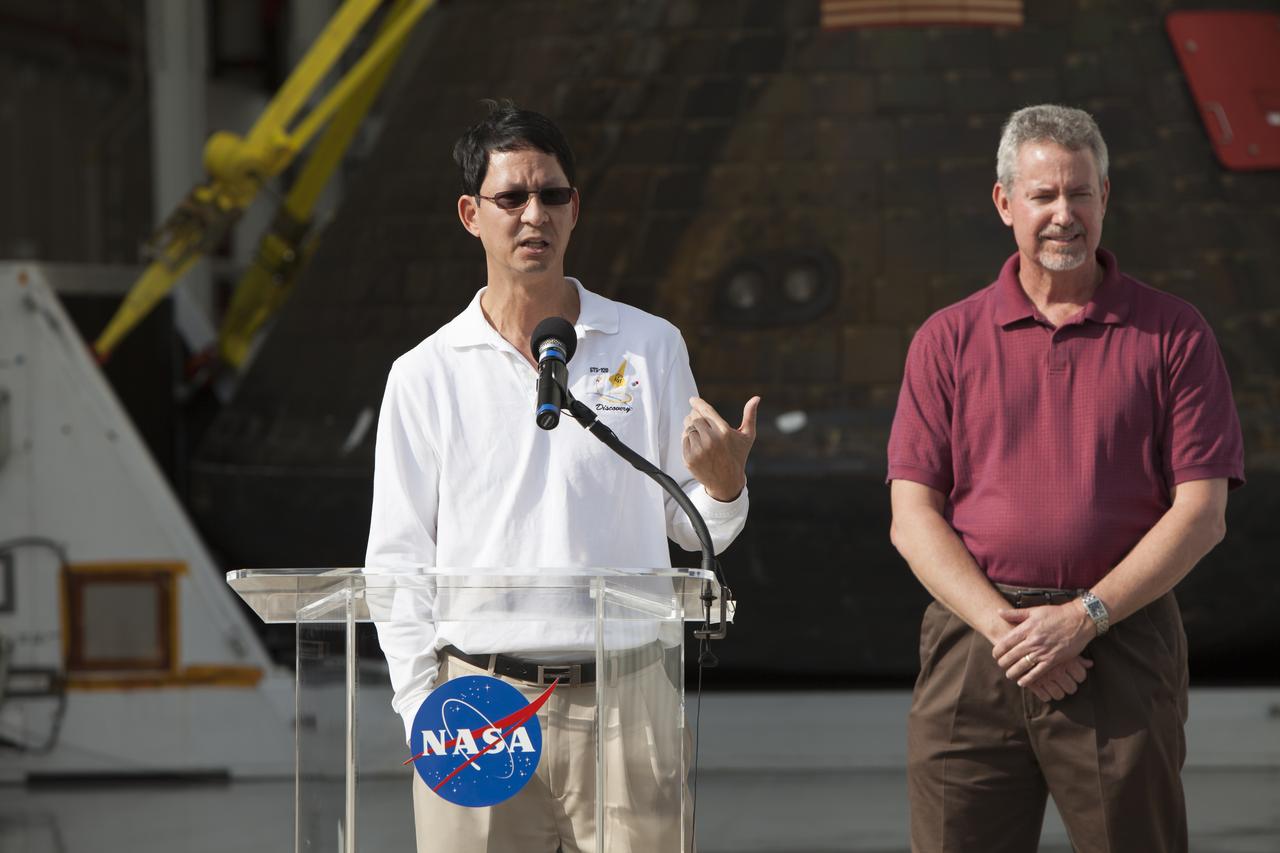
NASA's Orion spacecraft is viewed by members of the media at the Launch Abort System Facility at NASA's Kennedy Space Center in Florida. Speaking to the media during the viewing opportunity is Glenn Chin, Orion Production Operations. To his right is Phil Weber, with the Ground Systems Development and Operations Program, or GSDO. Orion made the 8-day, 2,700 mile overland trip back to Kennedy from Naval Base San Diego in California. Analysis of date obtained during its two-orbit, four-and-a-half hour mission Dec. 5 will provide engineers with detailed information on how the spacecraft fared. GSDO led the recovery, offload and transportation efforts.
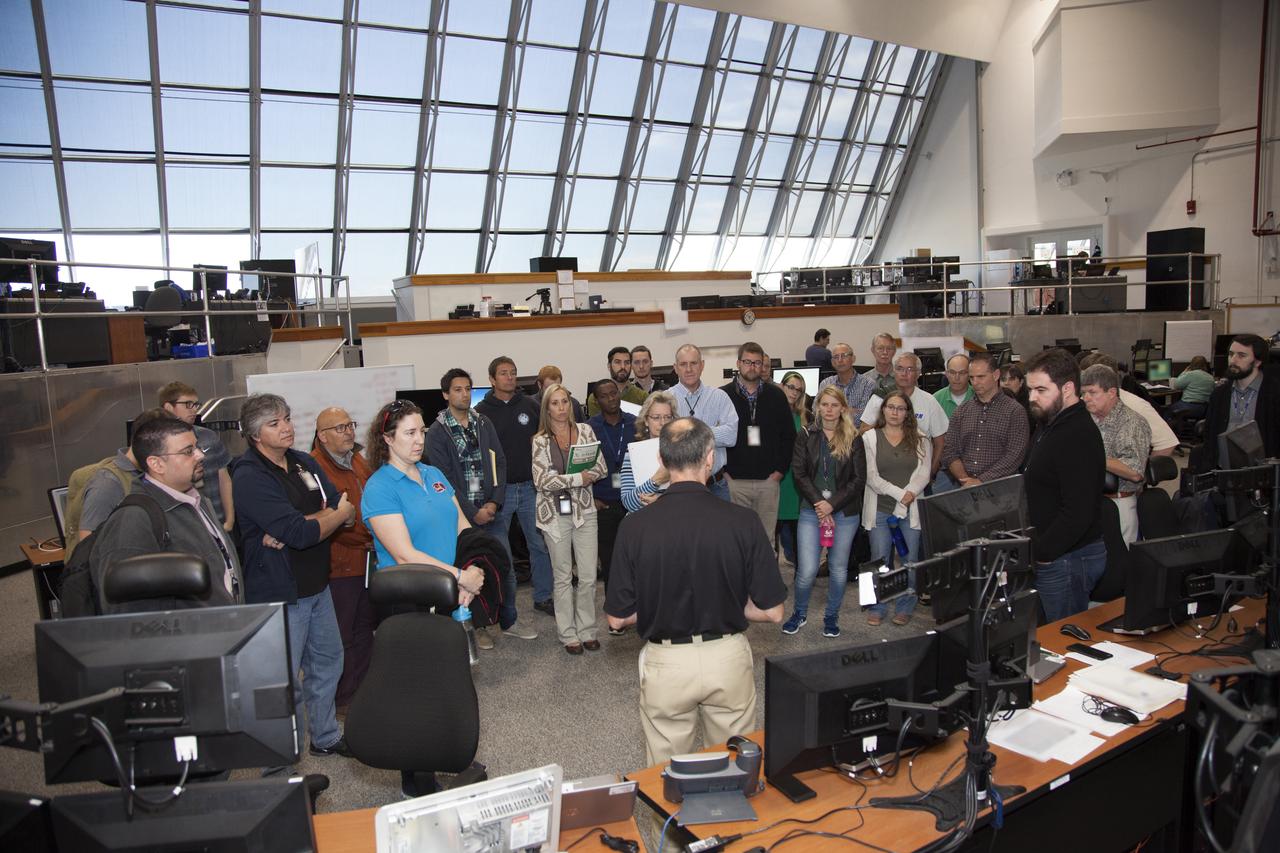
NASA engineers and test directors gather in Firing Room 3 in the Launch Control Center at NASA's Kennedy Space Center in Florida, to watch a demonstration of the automated command and control software for the agency's Space Launch System (SLS) and Orion spacecraft. The software is called the Ground Launch Sequencer. It will be responsible for nearly all of the launch commit criteria during the final phases of launch countdowns. The Ground and Flight Application Software Team (GFAST) demonstrated the software. It was developed by the Command, Control and Communications team in the Ground Systems Development and Operations (GSDO) Program. GSDO is helping to prepare the center for the first test flight of Orion atop the SLS on Exploration Mission 1.
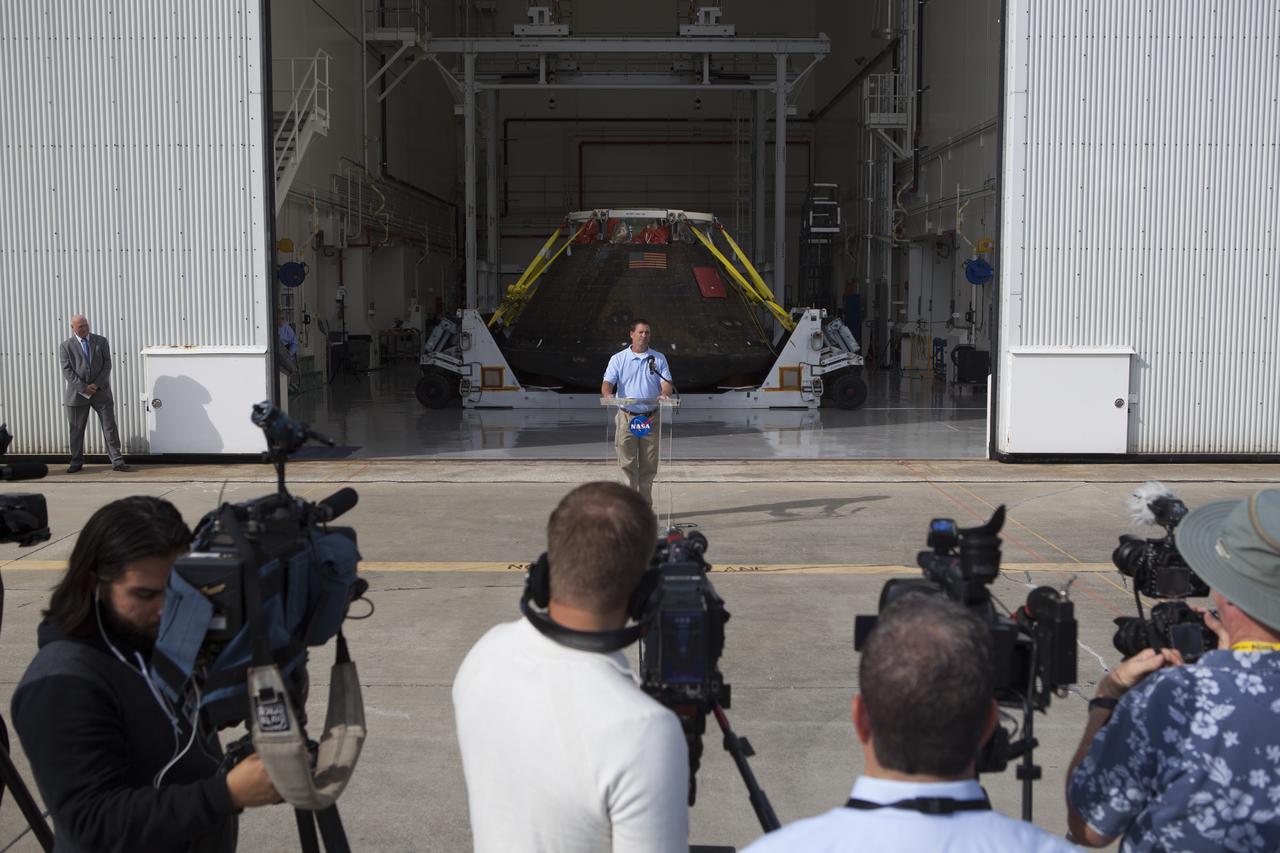
NASA's Orion spacecraft is viewed by members of the media at the Launch Abort System Facility at NASA's Kennedy Space Center in Florida. Lou Garcia, with the Ground Systems Development and Operations Program, or GSDO, speaks to the media during the viewing opportunity. The spacecraft's cross-country return, a 2,700 mile road trip from Naval Base San Diego to Kennedy, sets the stage for in-depth analysis of data obtained during Orion's trip to space. It will provide engineers with detailed information on how the spacecraft fared during its two-orbit, 4.5-hour flight test, completed on Dec. 5. GSDO led the recovery, offload and transportation efforts.
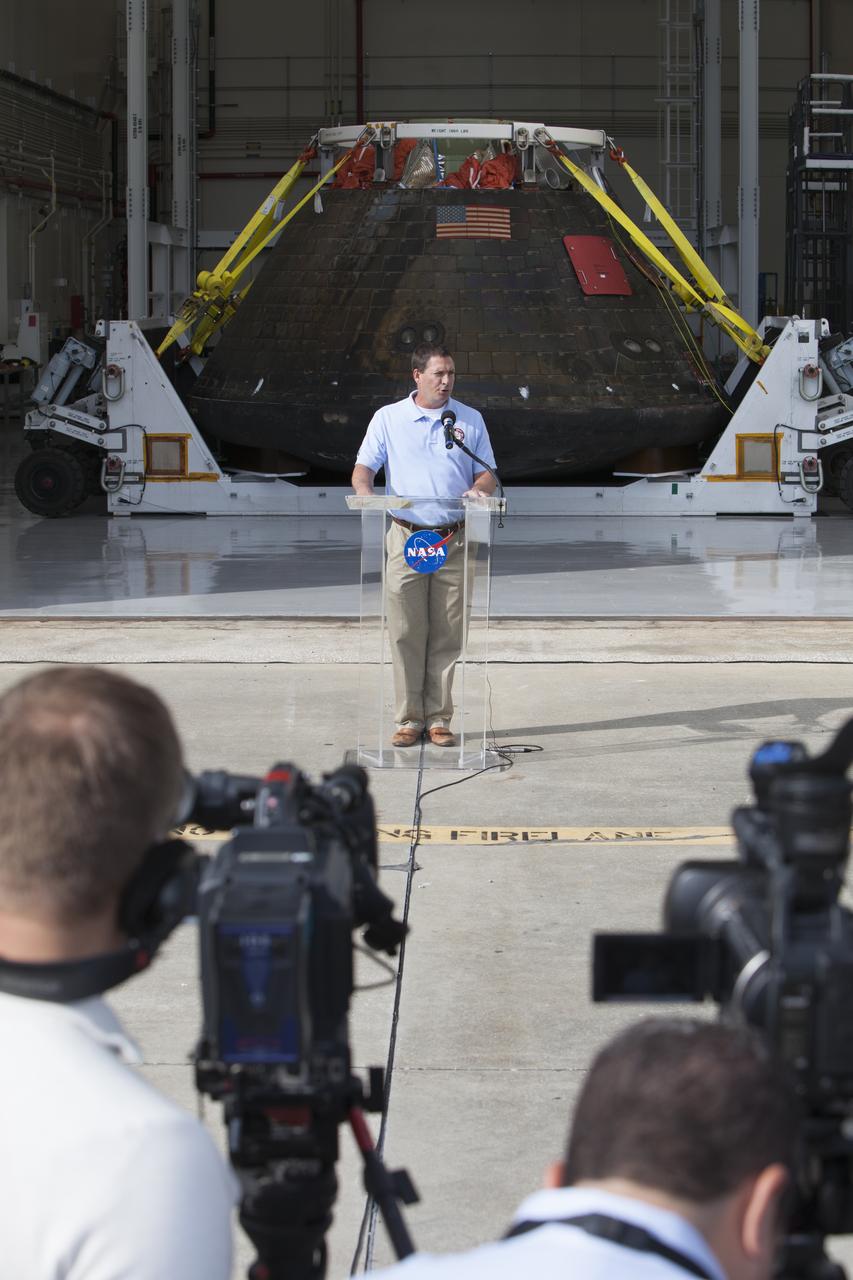
NASA's Orion spacecraft is viewed by members of the media at the Launch Abort System Facility at NASA's Kennedy Space Center in Florida. Lou Garcia, with the Ground Systems Development and Operations Program, or GSDO, speaks to the media during the viewing opportunity. The spacecraft's cross-country return, a 2,700 mile road trip from Naval Base San Diego to Kennedy, sets the stage for in-depth analysis of data obtained during Orion's trip to space. It will provide engineers with detailed information on how the spacecraft fared during its two-orbit, 4.5-hour flight test, completed on Dec. 5. GSDO led the recovery, offload and transportation efforts.

NASA's Orion spacecraft is viewed by members of the media at the Launch Abort System Facility at NASA's Kennedy Space Center in Florida. Lou Garcia, with the Ground Systems Development and Operations Program, or GSDO, speaks to the media during the viewing opportunity. The spacecraft's cross-country return, a 2,700 mile road trip from Naval Base San Diego to Kennedy, sets the stage for in-depth analysis of data obtained during Orion's trip to space. It will provide engineers with detailed information on how the spacecraft fared during its two-orbit, 4.5-hour flight test, completed on Dec. 5. GSDO led the recovery, offload and transportation efforts.
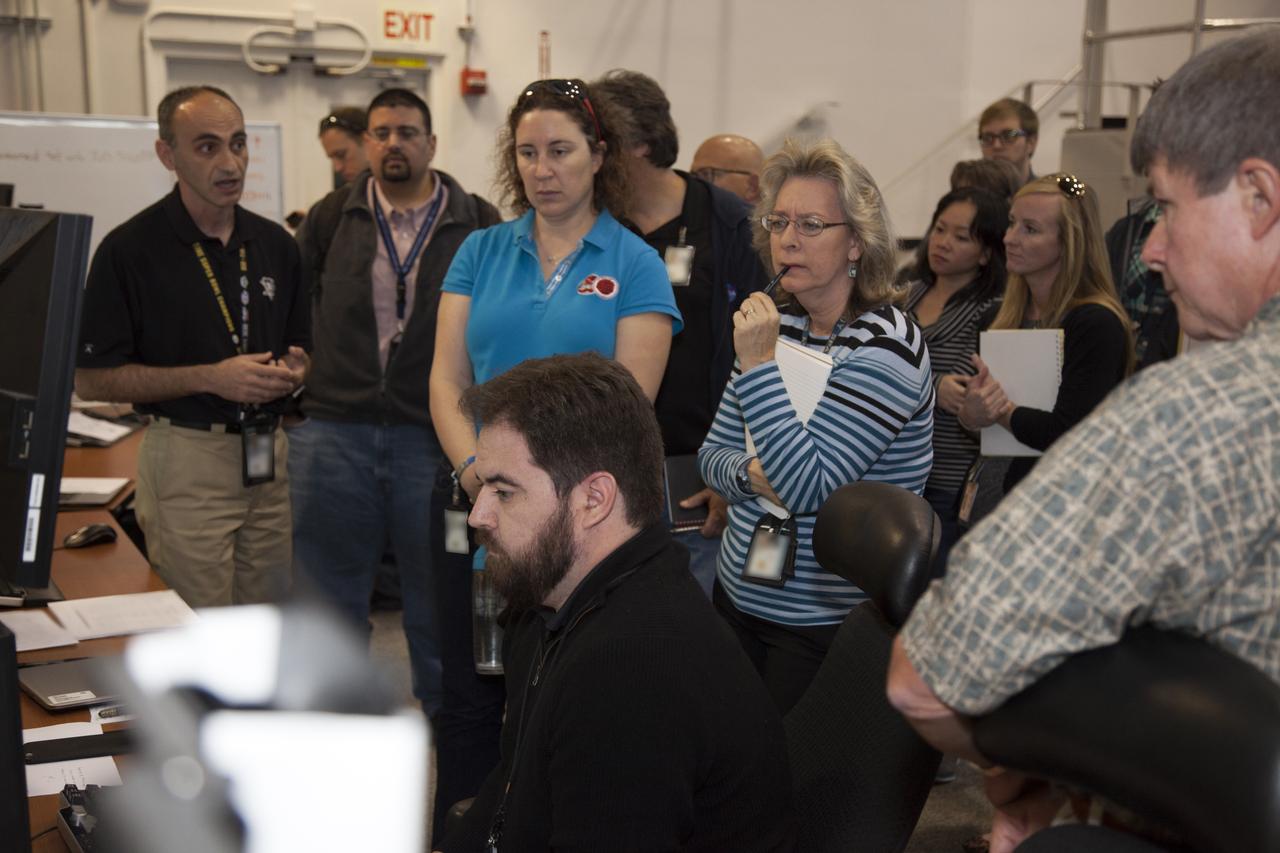
NASA engineers and test directors gather in Firing Room 3 in the Launch Control Center at NASA's Kennedy Space Center in Florida, to watch a demonstration of the automated command and control software for the agency's Space Launch System (SLS) and Orion spacecraft. The software is called the Ground Launch Sequencer. It will be responsible for nearly all of the launch commit criteria during the final phases of launch countdowns. The Ground and Flight Application Software Team (GFAST) demonstrated the software. It was developed by the Command, Control and Communications team in the Ground Systems Development and Operations (GSDO) Program. GSDO is helping to prepare the center for the first test flight of Orion atop the SLS on Exploration Mission 1.
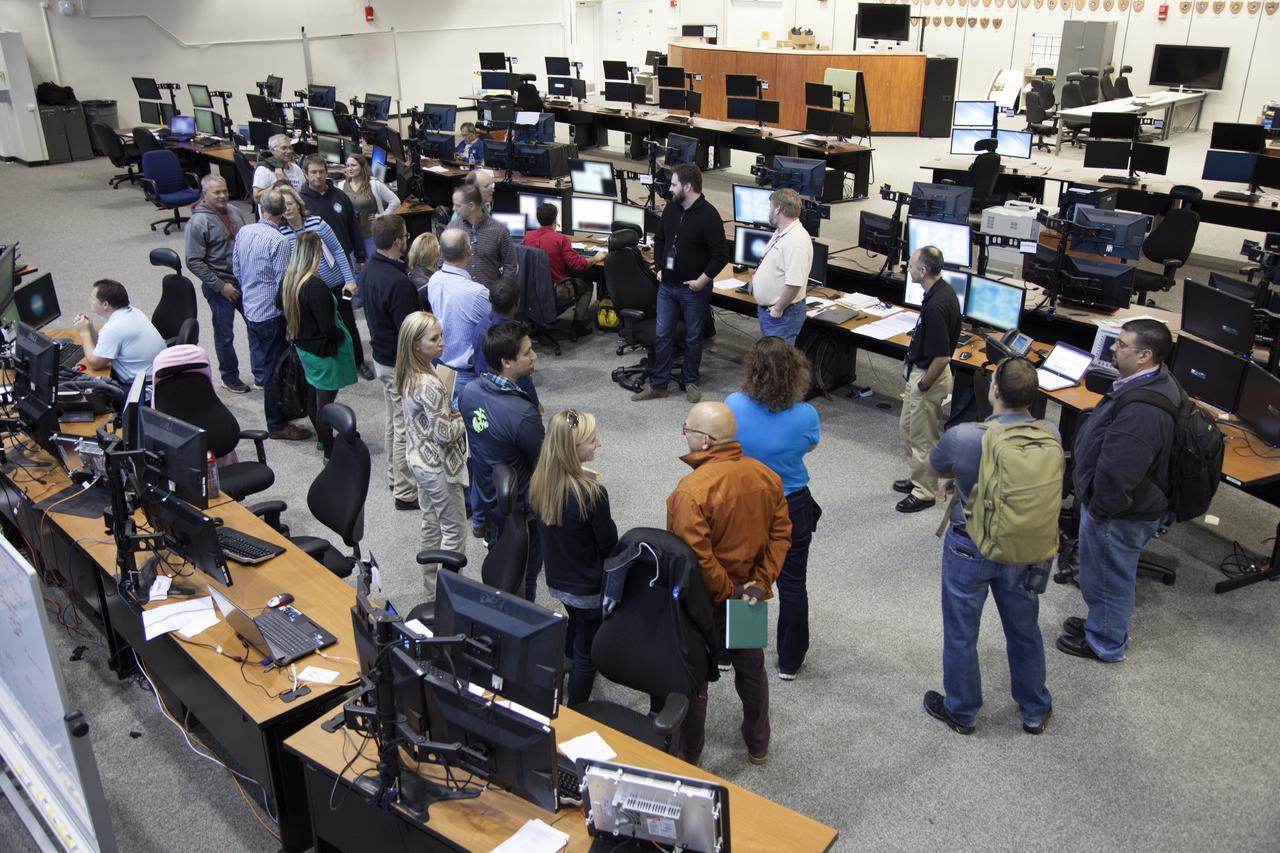
NASA engineers and test directors gather in Firing Room 3 in the Launch Control Center at NASA's Kennedy Space Center in Florida, to watch a demonstration of the automated command and control software for the agency's Space Launch System (SLS) and Orion spacecraft. The software is called the Ground Launch Sequencer. It will be responsible for nearly all of the launch commit criteria during the final phases of launch countdowns. The Ground and Flight Application Software Team (GFAST) demonstrated the software. It was developed by the Command, Control and Communications team in the Ground Systems Development and Operations (GSDO) Program. GSDO is helping to prepare the center for the first test flight of Orion atop the SLS on Exploration Mission 1.
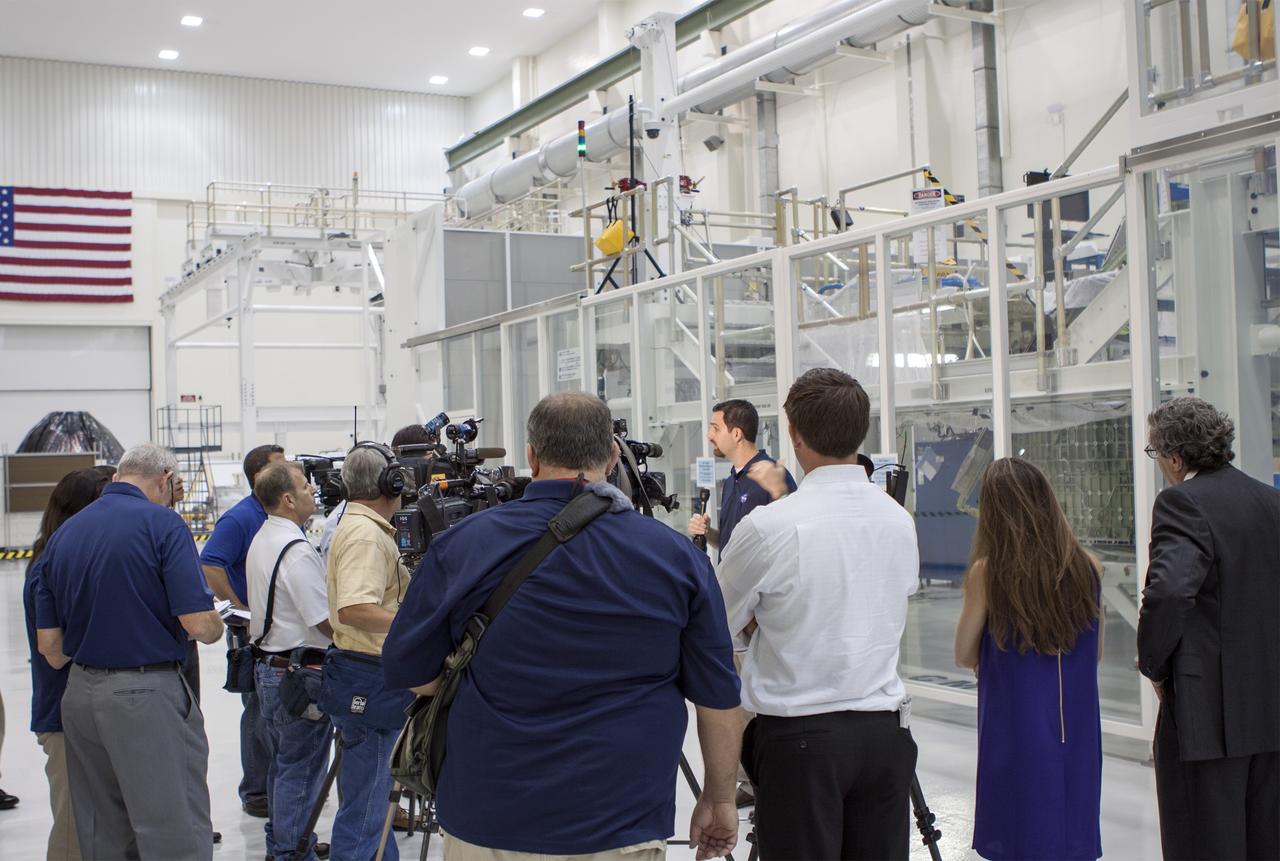
CAPE CANAVERAL, Fla. – Inside the Operations and Checkout Building high bay at NASA’s Kennedy Space Center in Florida, members of the media receive an on activities in NASA’s Ground Systems Development and Operations, or GSDO, Program, Space Launch System and Orion crew module for Exploration Test Flight 1. Speaking to the media is Jeremy Parsons, chief of the GSDO Operations Integration Office at Kennedy. Orion is the exploration spacecraft designed to carry crews to space beyond low Earth orbit. It will provide emergency abort capability, sustain the crew during the space travel and provide safe re-entry from deep space return velocities. Orion’s first unpiloted test flight is scheduled to launch in 2014 atop a Delta IV rocket. A second uncrewed flight test is scheduled for 2017 on NASA’s Space Launch System rocket. For more information, visit http://www.nasa.gov/orion. Photo credit: NASA/Jim Grossmann
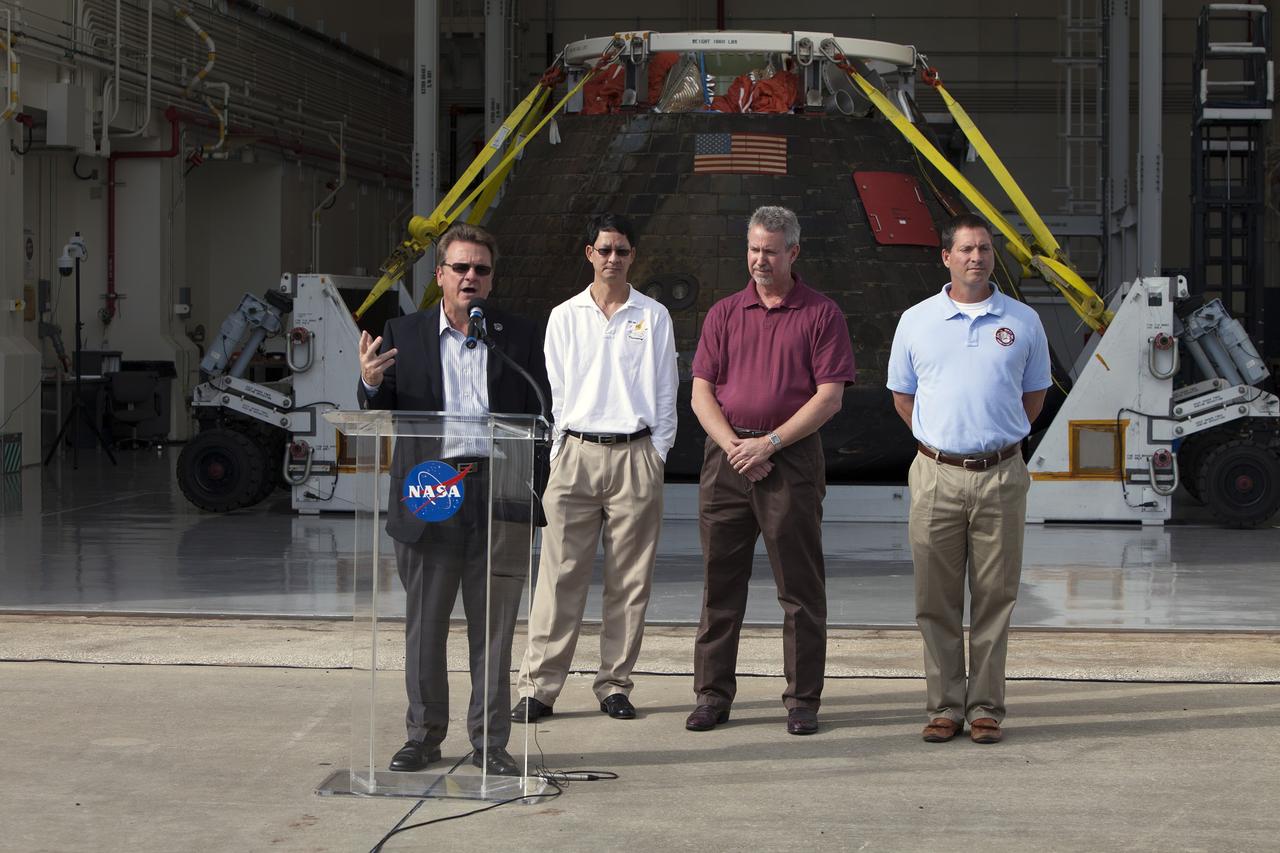
CAPE CANAVERAL, Fla. -- NASA's Orion spacecraft is viewed by members of the media at the Launch Abort System Facility at NASA's Kennedy Space Center in Florida. Speaking to the media during the viewing opportunity is Jules Schneider, Lockheed Martin Manager. Behind him, from left, are Glenn Chin, Orion Production Operations manager and Phil Weber and Lou Garcia, with the Ground Systems Development and Operations Program, or GSDO. Orion made the 8-day, 2,700 mile overland trip back to Kennedy from Naval Base San Diego in California. Analysis of date obtained during its two-orbit, four-and-a-half hour mission Dec. 5 will provide engineers with detailed information on how the spacecraft fared. GSDO led the recovery, offload and transportation efforts. For more information, visit www.nasa.gov/orion. Photo credit: NASA/Dimitri Gerondidakis
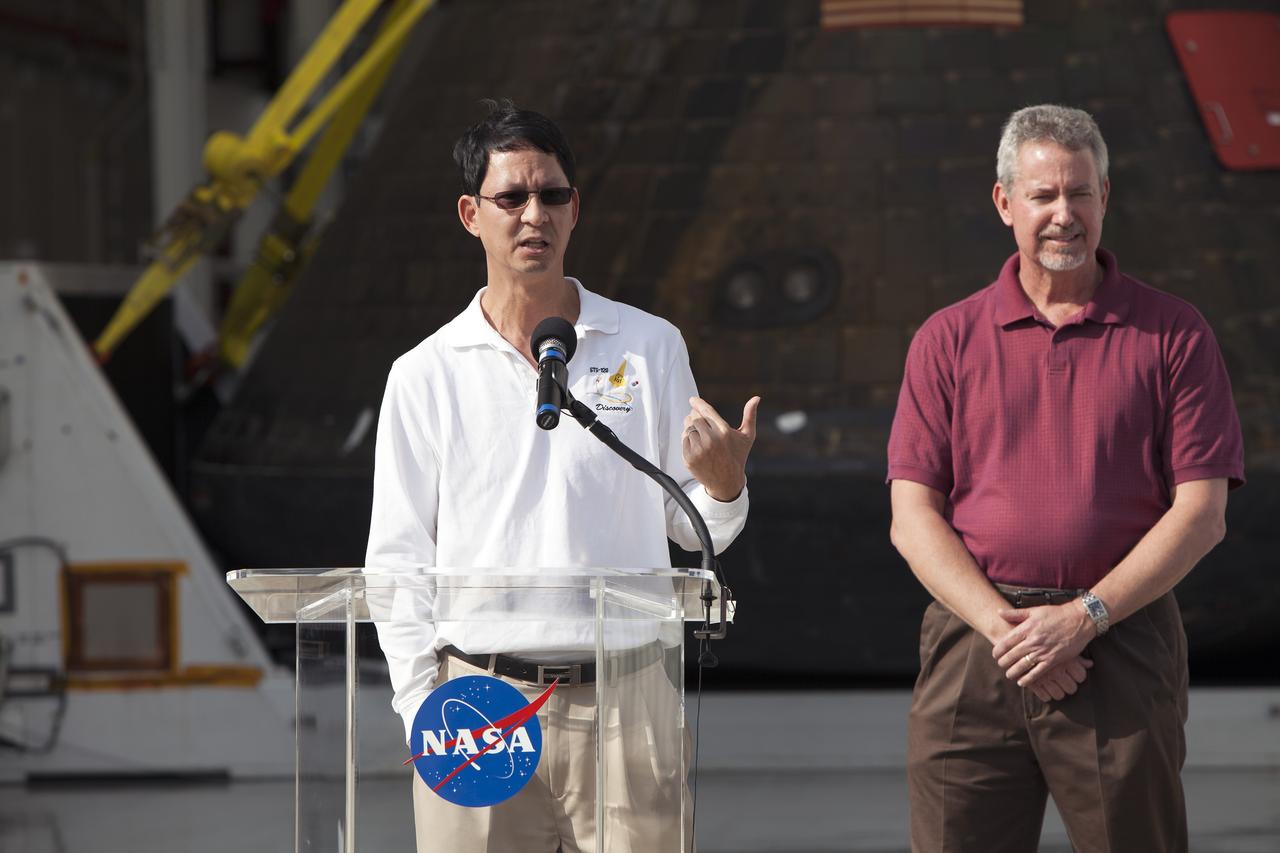
CAPE CANAVERAL, Fla. -- NASA's Orion spacecraft is viewed by members of the media at the Launch Abort System Facility at NASA's Kennedy Space Center in Florida. Speaking to the media during the viewing opportunity is Glenn Chin, Orion Production Operations. To his right is Phil Weber, with the Ground Systems Development and Operations Program, or GSDO. Orion made the 8-day, 2,700 mile overland trip back to Kennedy from Naval Base San Diego in California. Analysis of date obtained during its two-orbit, four-and-a-half hour mission Dec. 5 will provide engineers with detailed information on how the spacecraft fared. GSDO led the recovery, offload and transportation efforts. For more information, visit www.nasa.gov/orion. Photo credit: NASA/Dimitri Gerondidakis
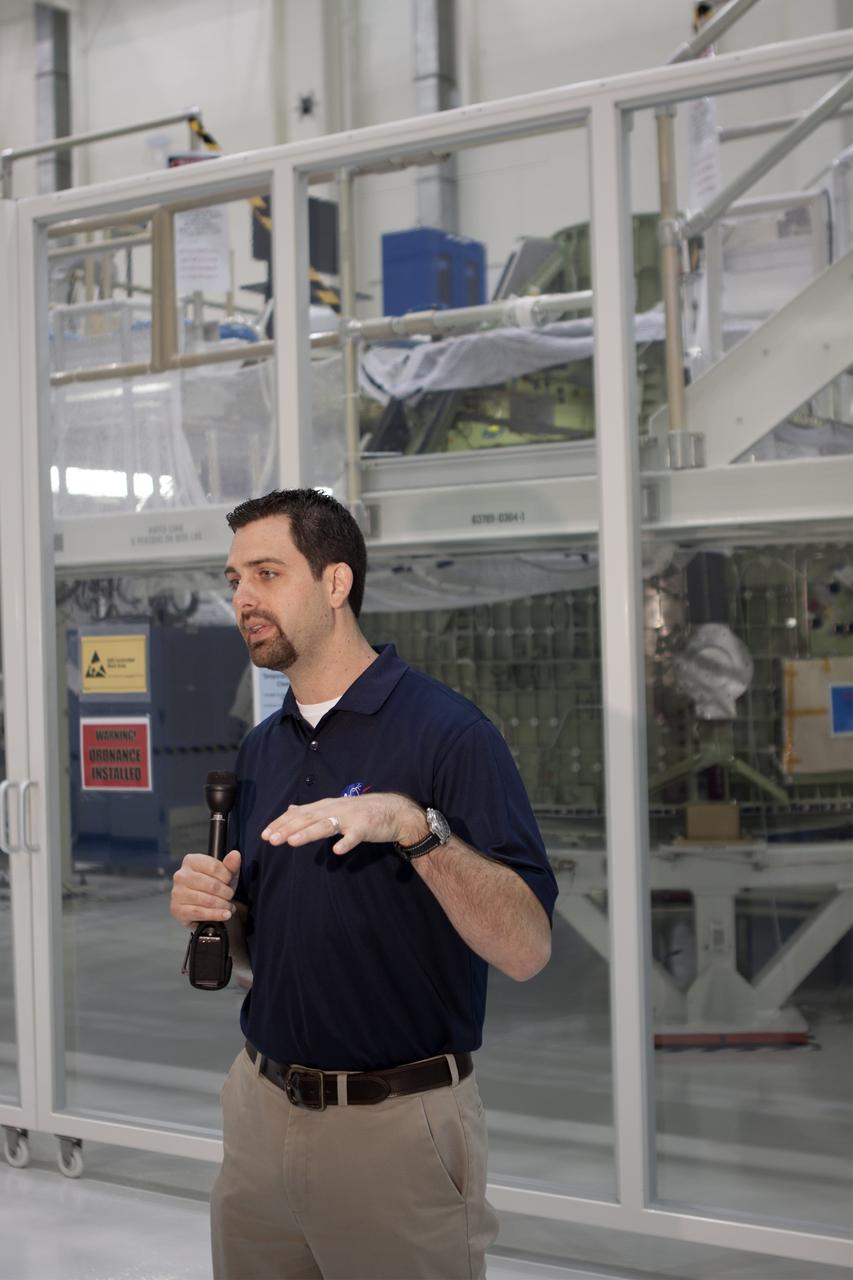
CAPE CANAVERAL, Fla. – Inside the Operations and Checkout Building high bay at NASA’s Kennedy Space Center in Florida, members of the media receive an on activities in NASA’s Ground Systems Development and Operations, or GSDO, Program, Space Launch System and Orion crew module for Exploration Test Flight 1. Speaking to the media is Jeremy Parsons, chief of the GSDO Operations Integration Office at Kennedy. Orion is the exploration spacecraft designed to carry crews to space beyond low Earth orbit. It will provide emergency abort capability, sustain the crew during the space travel and provide safe re-entry from deep space return velocities. Orion’s first unpiloted test flight is scheduled to launch in 2014 atop a Delta IV rocket. A second uncrewed flight test is scheduled for 2017 on NASA’s Space Launch System rocket. For more information, visit http://www.nasa.gov/orion. Photo credit: NASA/Jim Grossmann
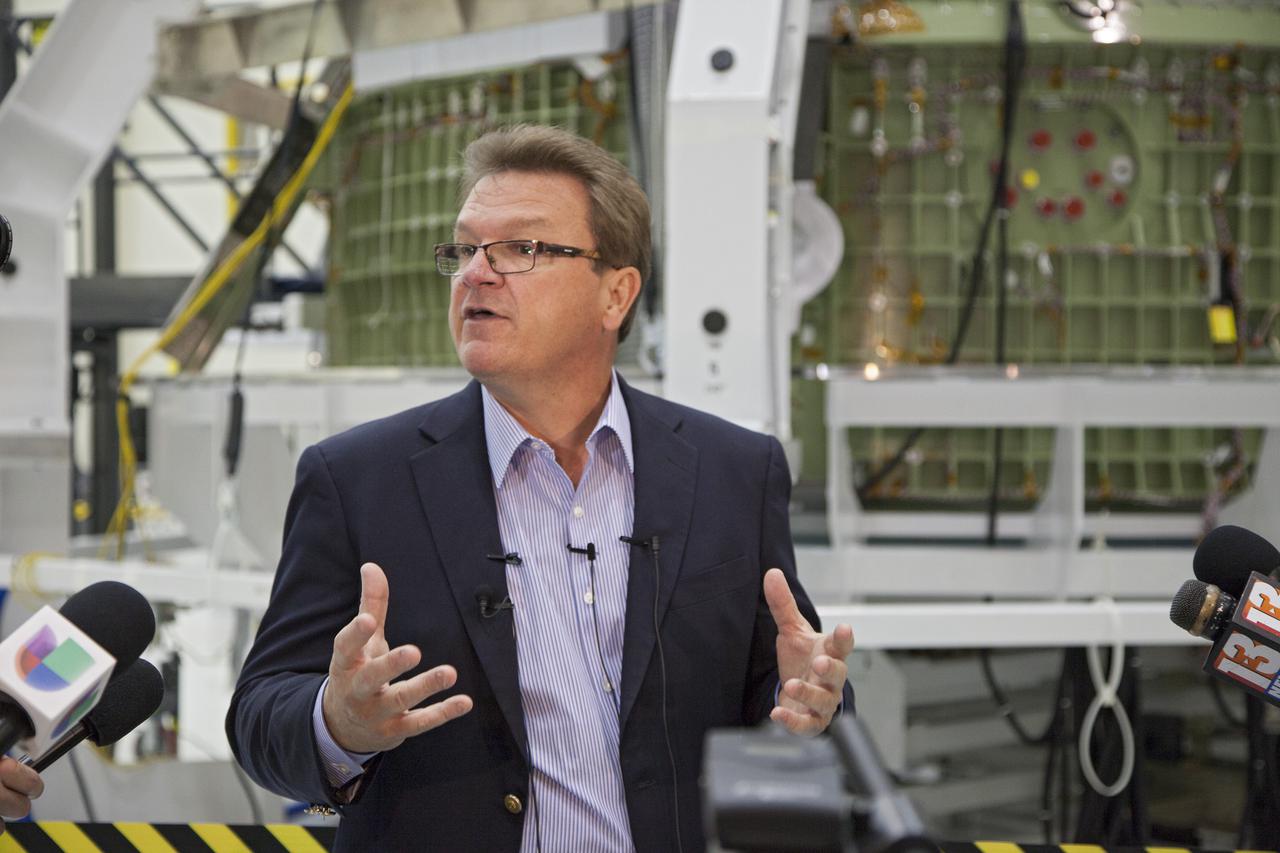
CAPE CANAVERAL, Fla. – Inside the high bay of Kennedy Space Center's Operations and Checkout Building, Jules Schnieder, Lockheed Martin's Orion production manager at the Florida Spaceport, briefs members of the news media about progress in preparing Orion for its first flight. In the background, the Orion spacecraft is surrounded by a special pre-launch processing access fixture. Lockheed Martin is NASA's prime contractor for the Orion spacecraft. Orion is the exploration spacecraft designed to carry crews to space beyond low Earth orbit. It will provide emergency abort capability, sustain the crew during the space travel and provide safe re-entry from deep space return velocities. The first unpiloted test flight of the Orion is scheduled to launch in 2014 atop a Delta IV rocket and in 2017 on a Space Launch System rocket. For more information, visit http:__www.nasa.gov_orion Photo credit: NASA_Kim Shiflett
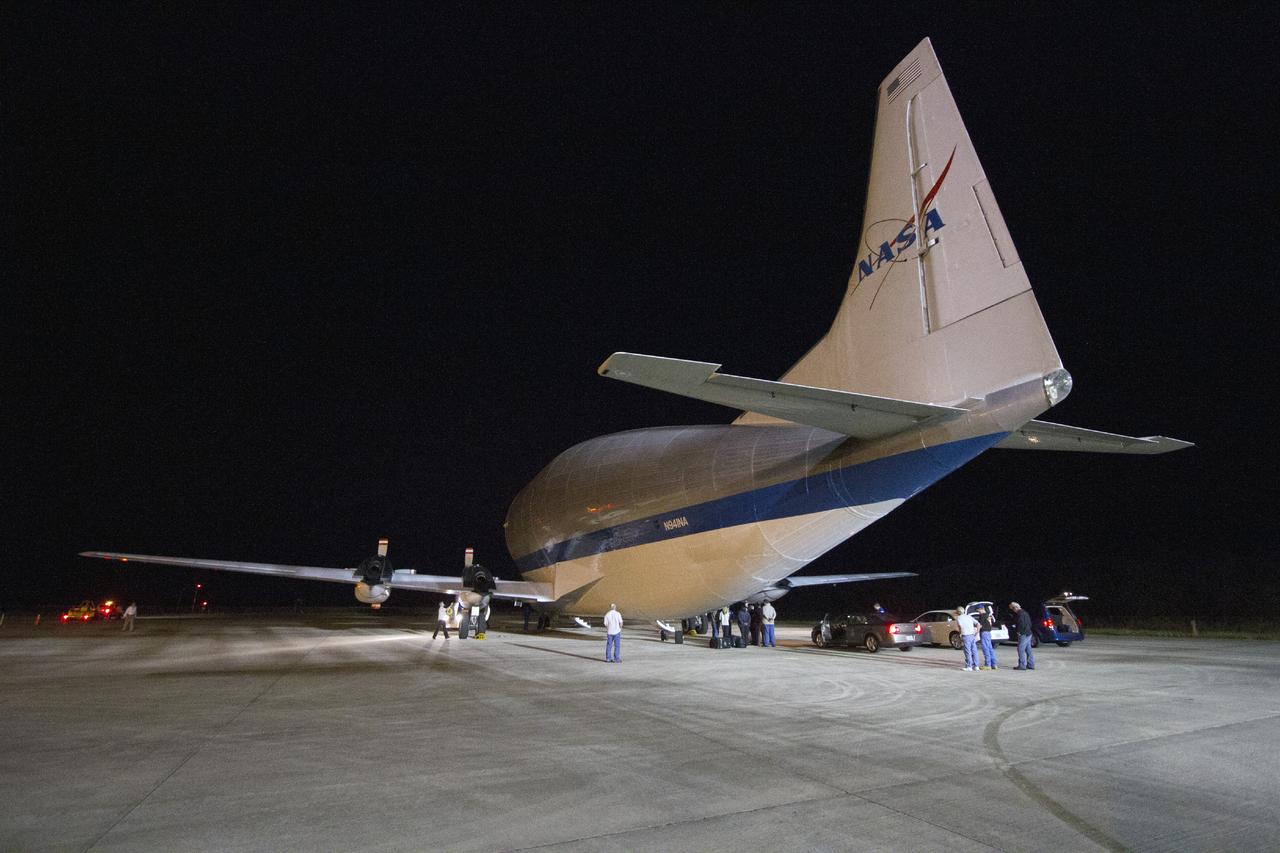
CAPE CANAVERAL, Fla. – At the Shuttle Landing Facility at NASA's Kennedy Space Center in Florida, the heat shield for the agency's Orion spacecraft arrived aboard the Super Guppy aircraft. The largest of its kind ever built, the heat shield is planned for installation on the Orion crew module in March next year. The Orion spacecraft is scheduled to make its first unpiloted flight test, Exploration Flight Test-1 EFT-1, in September 2014. The Orion spacecraft is designed to meet requirements for traveling beyond low-Earth orbit. The spacecraft will serve as the exploration vehicle that will carry crews to space, sustain the astronauts during the space travel and provide safe re-entry from deep space. For more information, visit: http://www.nasa.gov/orion Photo credit: NASA/Cory Huston
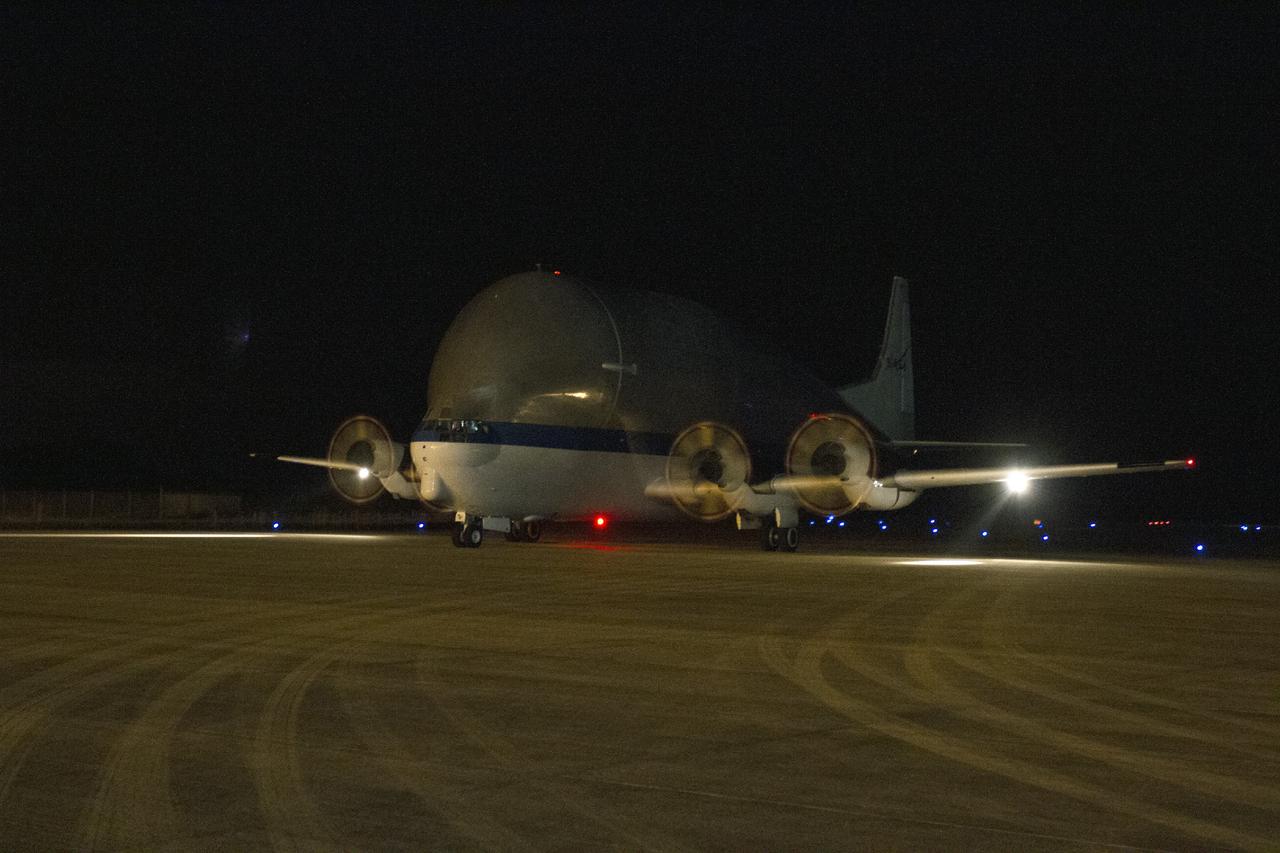
CAPE CANAVERAL, Fla. – At the Shuttle Landing Facility at NASA's Kennedy Space Center in Florida, the heat shield for the agency's Orion spacecraft arrived aboard the Super Guppy aircraft. The largest of its kind ever built, the heat shield is planned for installation on the Orion crew module in March next year. The Orion spacecraft is scheduled to make its first unpiloted flight test, Exploration Flight Test-1 EFT-1, in September 2014. The Orion spacecraft is designed to meet requirements for traveling beyond low-Earth orbit. The spacecraft will serve as the exploration vehicle that will carry crews to space, sustain the astronauts during the space travel and provide safe re-entry from deep space. For more information, visit: http://www.nasa.gov/orion Photo credit: NASA/Cory Huston
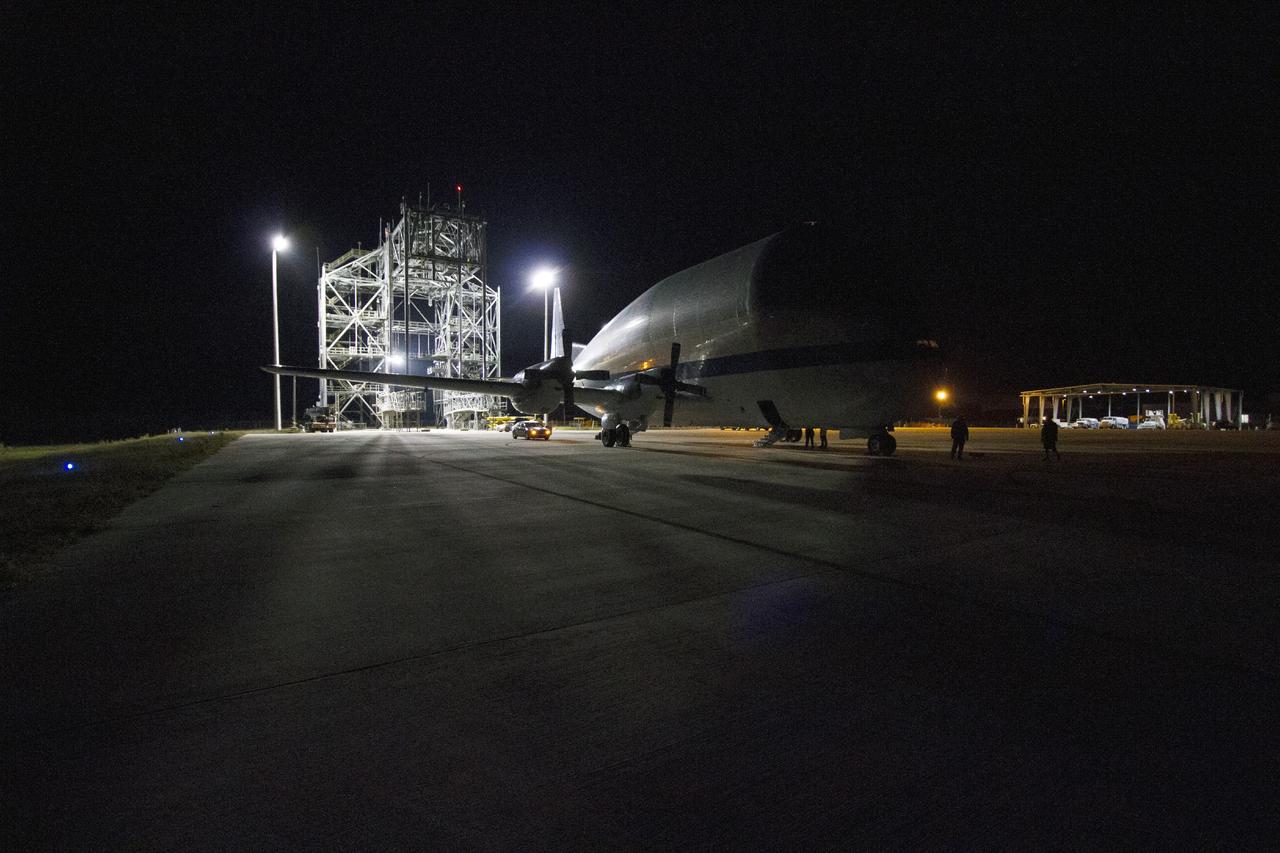
CAPE CANAVERAL, Fla. – At the Shuttle Landing Facility at NASA's Kennedy Space Center in Florida, the heat shield for the agency's Orion spacecraft arrived aboard the Super Guppy aircraft. The largest of its kind ever built, the heat shield is planned for installation on the Orion crew module in March next year. The Orion spacecraft is scheduled to make its first unpiloted flight test, Exploration Flight Test-1 EFT-1, in September 2014. The Orion spacecraft is designed to meet requirements for traveling beyond low-Earth orbit. The spacecraft will serve as the exploration vehicle that will carry crews to space, sustain the astronauts during the space travel and provide safe re-entry from deep space. For more information, visit: http://www.nasa.gov/orion Photo credit: NASA/Cory Huston
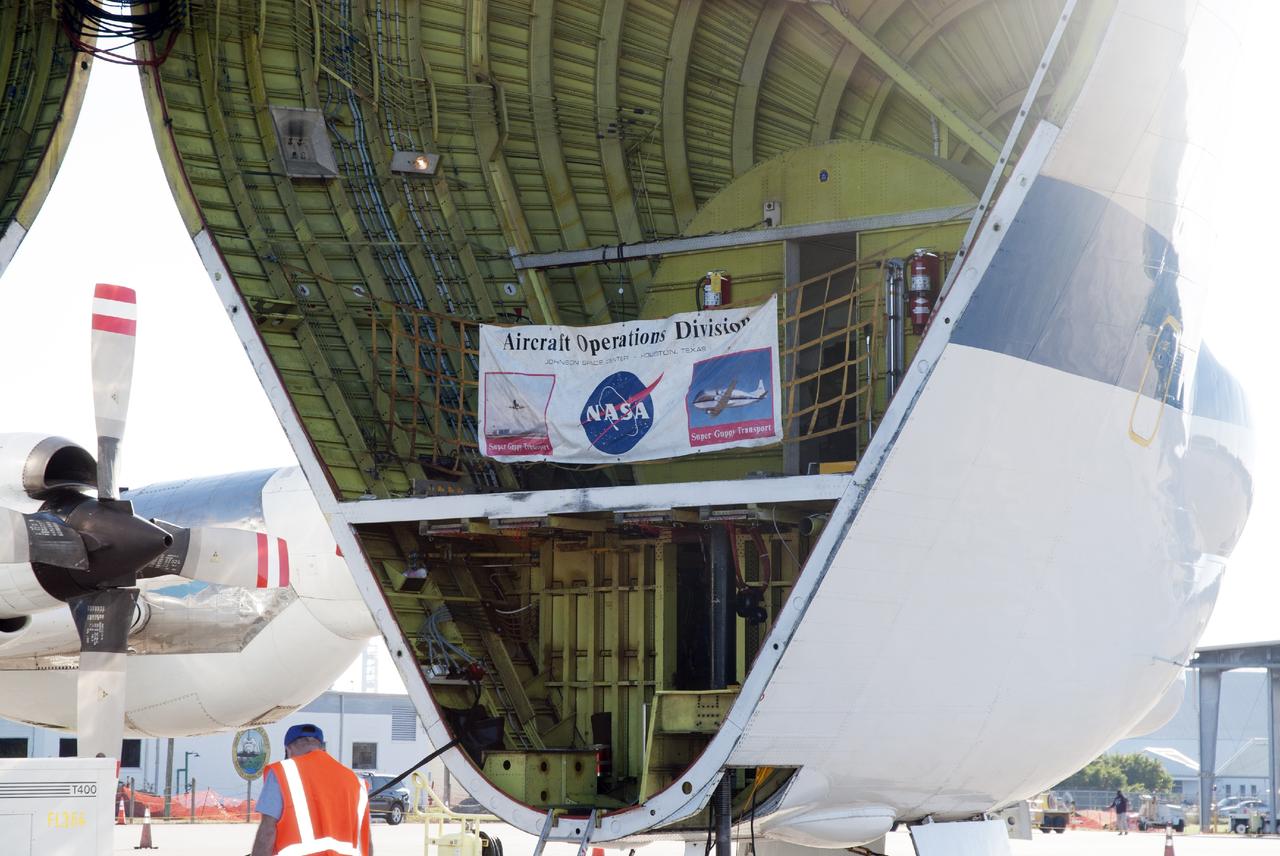
CAPE CANAVERAL, Fla. – At the Shuttle Landing Facility at NASA's Kennedy Space Center in Florida, the agency's Super Guppy aircraft is opened to offload the heat shield for the Orion spacecraft. The largest of its kind ever built, the heat shield is planned for installation on the Orion crew module in March of next year. The Orion spacecraft is scheduled to make its first unpiloted flight test, Exploration Flight Test-1 EFT-1, in September 2014. The Orion spacecraft is designed to meet requirements for traveling beyond low-Earth orbit. The spacecraft will serve as the exploration vehicle that will carry crews to space, sustain the astronauts during the space travel and provide safe re-entry from deep space. For more information, visit: http://www.nasa.gov/orion Photo credit: NASA/Charisse Nasher
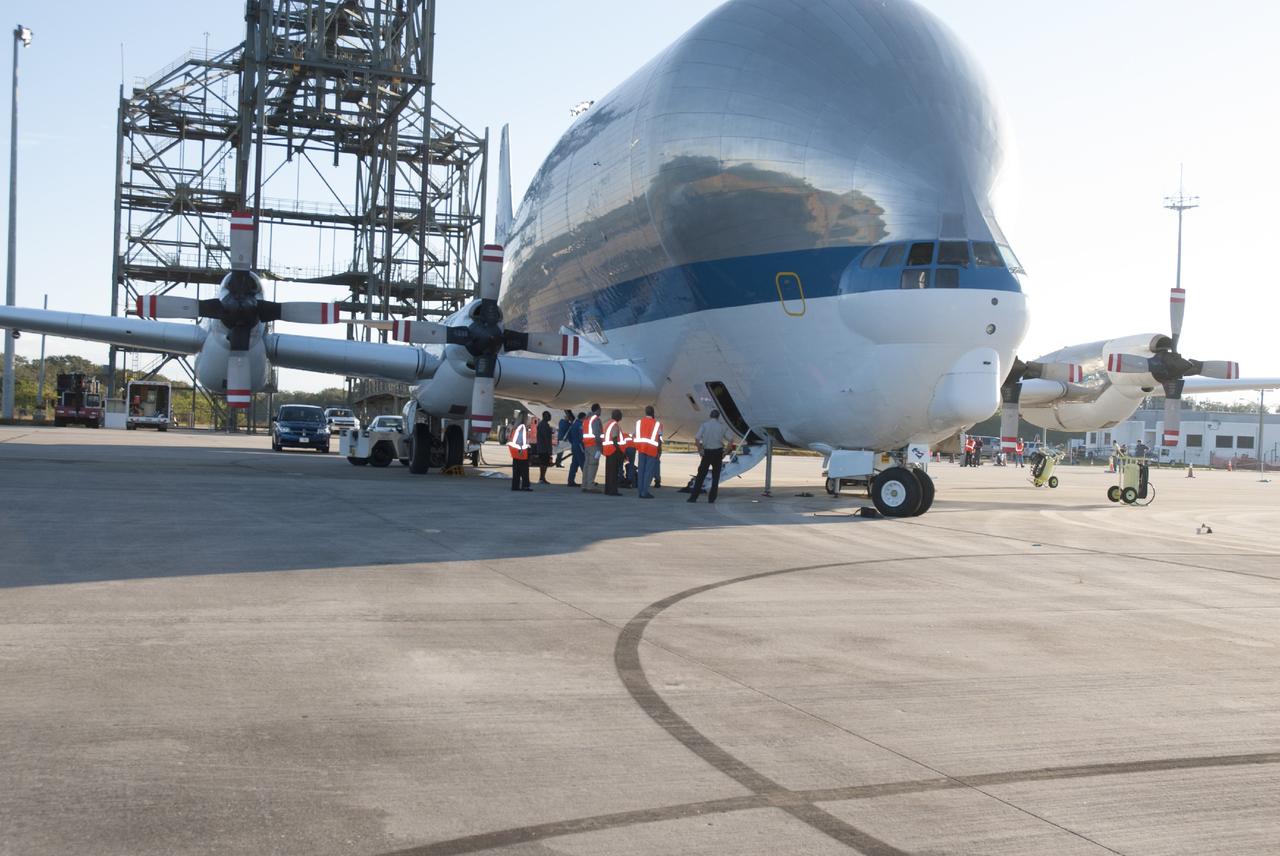
CAPE CANAVERAL, Fla. – At the Shuttle Landing Facility at NASA's Kennedy Space Center in Florida, the heat shield for the agency's Orion spacecraft arrived aboard the Super Guppy aircraft. The largest of its kind ever built, the heat shield is planned for installation on the Orion crew module in March next year. The Orion spacecraft is scheduled to make its first unpiloted flight test, Exploration Flight Test-1 EFT-1, in September 2014. The Orion spacecraft is designed to meet requirements for traveling beyond low-Earth orbit. The spacecraft will serve as the exploration vehicle that will carry crews to space, sustain the astronauts during the space travel and provide safe re-entry from deep space. For more information, visit: http://www.nasa.gov/orion Photo credit: NASA/Charisse Nasher

CAPE CANAVERAL, Fla. – The Orion Exploration Flight Test 1 crew module is undergoing proof pressure testing at the Operations and Checkout Building at NASA's Kennedy Space Center in Florida. The test incrementally pressurizes the spacecraft with breathing air and is designed to demonstrate weld strength capability and structural performance at maximum flight operating pressures. Orion is the exploration spacecraft designed to carry crews to space beyond low Earth orbit. It will provide emergency abort capability, sustain the crew during the space travel and provide safe re-entry from deep space return velocities. The first unpiloted test flight of the Orion is scheduled to launch in 2014 atop a Delta IV rocket and in 2017 on a Space Launch System rocket. For more information, visit http://www.nasa.gov/orion Photo credit: NASA/Ben Smegelsky
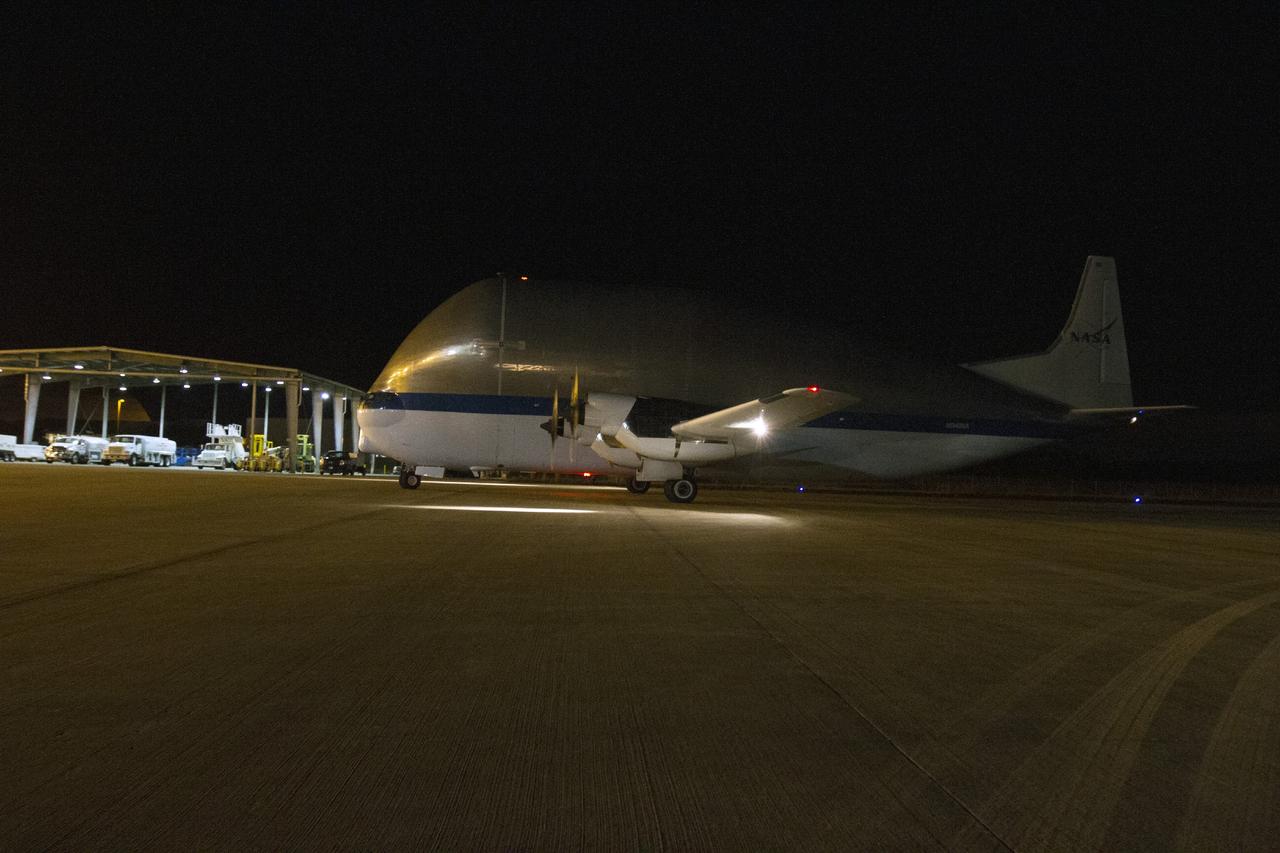
CAPE CANAVERAL, Fla. – At the Shuttle Landing Facility at NASA's Kennedy Space Center in Florida, the heat shield for the agency's Orion spacecraft arrived aboard the Super Guppy aircraft. The largest of its kind ever built, the heat shield is planned for installation on the Orion crew module in March next year. The Orion spacecraft is scheduled to make its first unpiloted flight test, Exploration Flight Test-1 EFT-1, in September 2014. The Orion spacecraft is designed to meet requirements for traveling beyond low-Earth orbit. The spacecraft will serve as the exploration vehicle that will carry crews to space, sustain the astronauts during the space travel and provide safe re-entry from deep space. For more information, visit: http://www.nasa.gov/orion Photo credit: NASA/Cory Huston
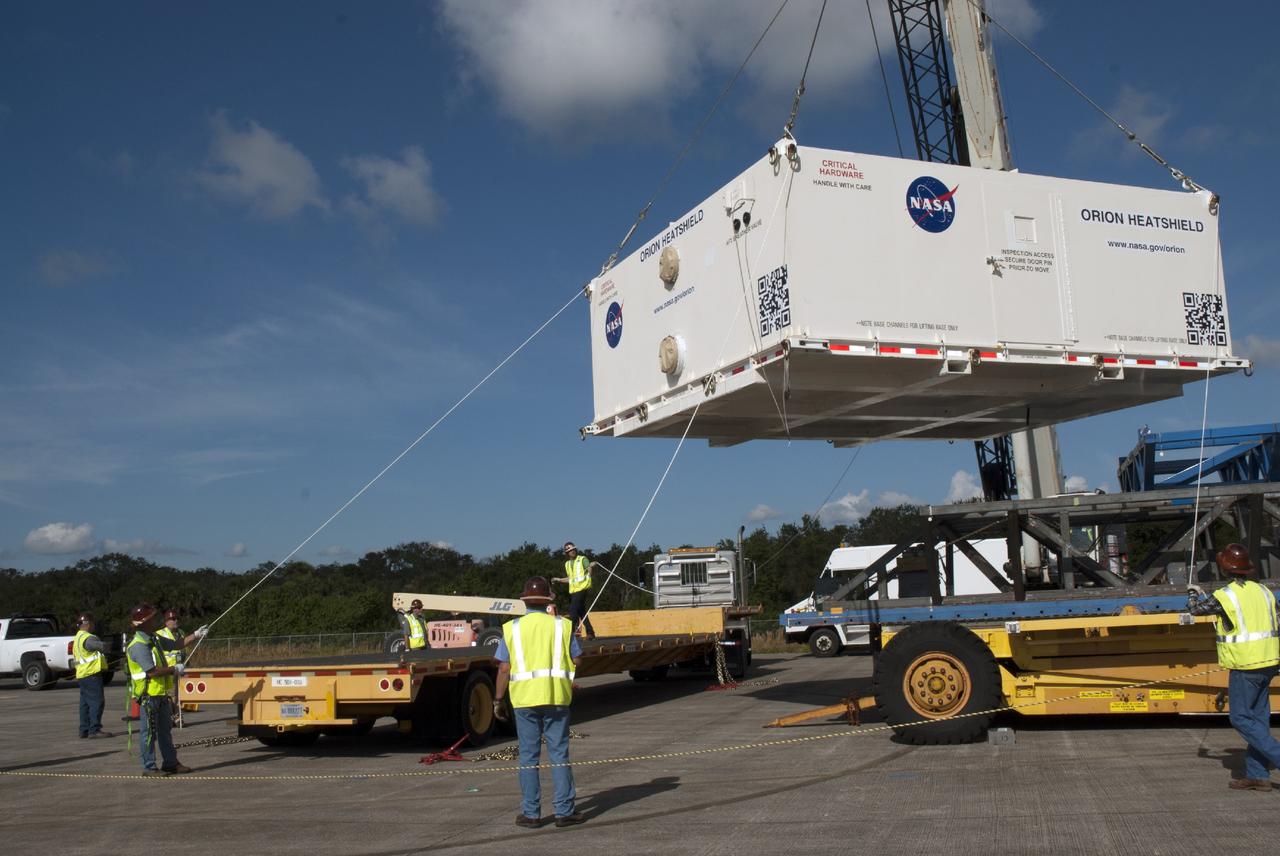
CAPE CANAVERAL, Fla. – At the Shuttle Landing Facility at NASA's Kennedy Space Center in Florida, the heat shield for the agency's Orion spacecraft has been offloaded from the Super Guppy aircraft and a crane is loading it on to a transport truck. The largest of its kind ever built, the heat shield is planned for installation on the Orion crew module in March of next year. The Orion spacecraft is scheduled to make its first unpiloted flight test, Exploration Flight Test-1 EFT-1, in September 2014. The Orion spacecraft is designed to meet requirements for traveling beyond low-Earth orbit. The spacecraft will serve as the exploration vehicle that will carry crews to space, sustain the astronauts during the space travel and provide safe re-entry from deep space. For more information, visit: http://www.nasa.gov/orion Photo credit: NASA/Charisse Nasher
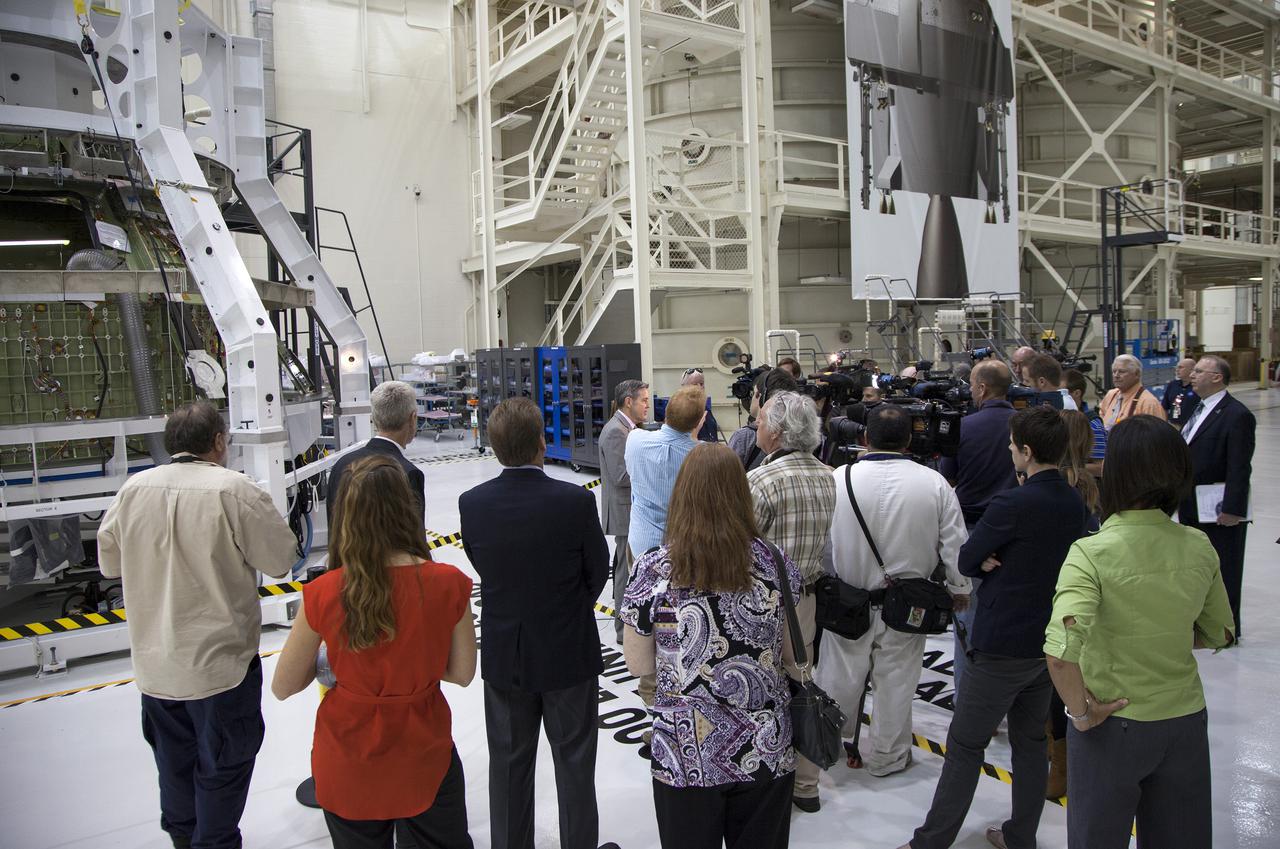
CAPE CANAVERAL, Fla. – Inside the high bay of Kennedy Space Center's Operations and Checkout Building, Kennedy Director Bob Cabana, provided members of the news media a status on the center's transformation to a multiuse government and commercial space launch and recovery complex. In the background, the Orion spacecraft is surrounded by a special pre-launch processing access fixture. Orion is the exploration spacecraft designed to carry crews to space beyond low Earth orbit. It will provide emergency abort capability, sustain the crew during the space travel and provide safe re-entry from deep space return velocities. The first unpiloted test flight of the Orion is scheduled to launch in 2014 atop a Delta IV rocket and in 2017 on a Space Launch System rocket. For more information, visit http:__www.nasa.gov_orion Photo credit: NASA_Kim Shiflett

CAPE CANAVERAL, Fla. – The Orion Exploration Flight Test 1 crew module is undergoing proof pressure testing at the Operations and Checkout Building at NASA's Kennedy Space Center in Florida. The test incrementally pressurizes the spacecraft with breathing air and is designed to demonstrate weld strength capability and structural performance at maximum flight operating pressures. Orion is the exploration spacecraft designed to carry crews to space beyond low Earth orbit. It will provide emergency abort capability, sustain the crew during the space travel and provide safe re-entry from deep space return velocities. The first unpiloted test flight of the Orion is scheduled to launch in 2014 atop a Delta IV rocket and in 2017 on a Space Launch System rocket. For more information, visit http://www.nasa.gov/orion Photo credit: NASA/Ben Smegelsky
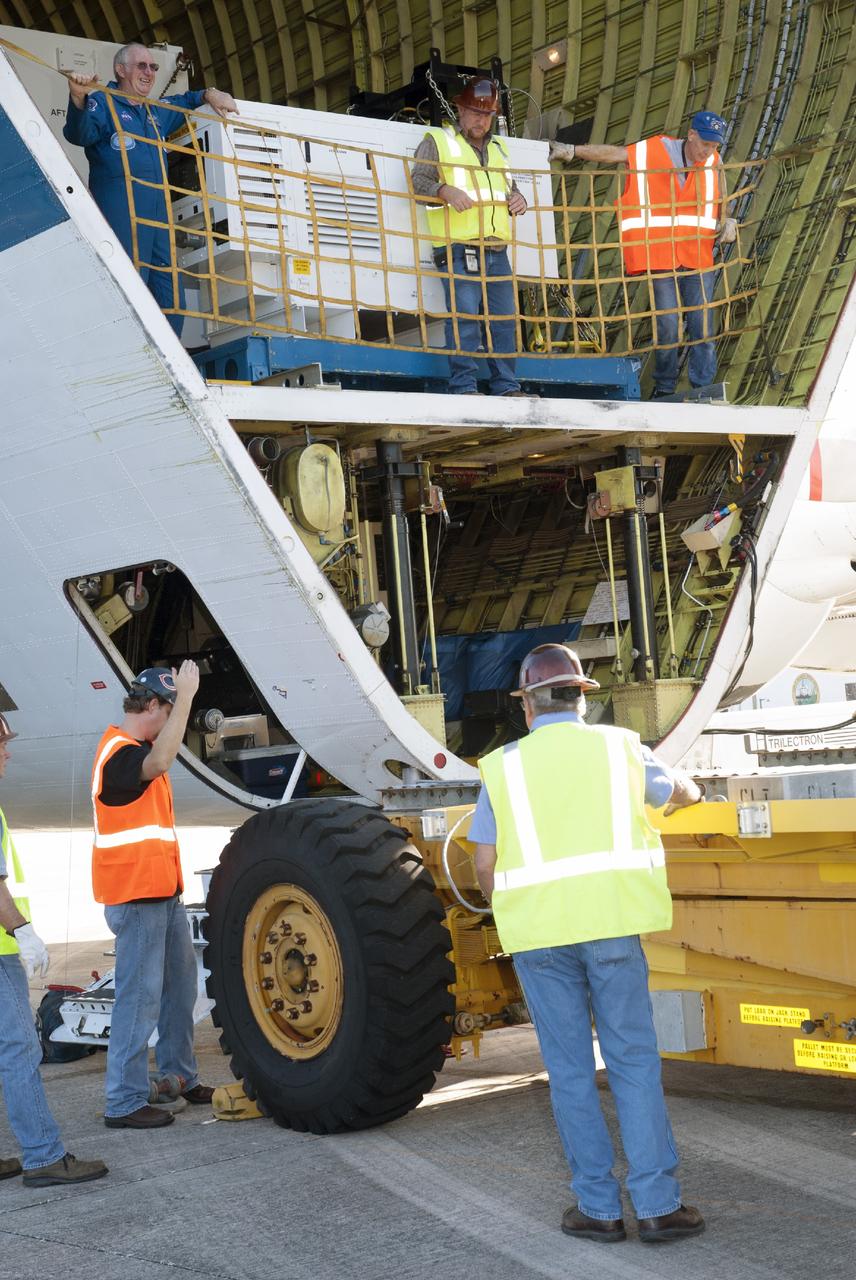
CAPE CANAVERAL, Fla. – At the Shuttle Landing Facility at NASA's Kennedy Space Center in Florida, the heat shield for the agency's Orion spacecraft is being offloaded from the Super Guppy aircraft. The largest of its kind ever built, the heat shield is planned for installation on the Orion crew module in March of next year. The Orion spacecraft is scheduled to make its first unpiloted flight test, Exploration Flight Test-1 EFT-1, in September 2014. The Orion spacecraft is designed to meet requirements for traveling beyond low-Earth orbit. The spacecraft will serve as the exploration vehicle that will carry crews to space, sustain the astronauts during the space travel and provide safe re-entry from deep space. For more information, visit: http://www.nasa.gov/orion Photo credit: NASA/Charisse Nasher
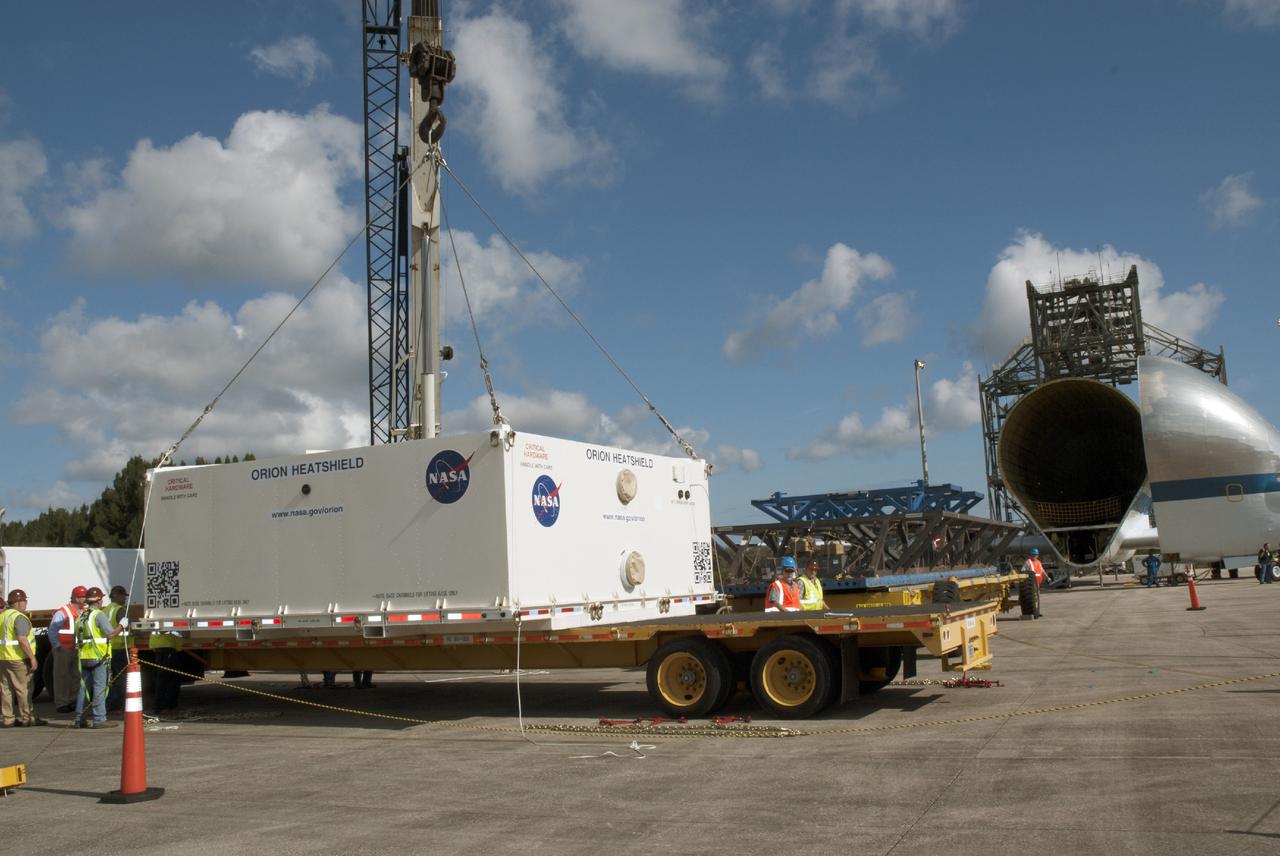
CAPE CANAVERAL, Fla. – At the Shuttle Landing Facility at NASA's Kennedy Space Center in Florida, the heat shield for the agency's Orion spacecraft has been offloaded from the Super Guppy aircraft and a crane is loading it on to a transport truck. The largest of its kind ever built, the heat shield is planned for installation on the Orion crew module in March of next year. The Orion spacecraft is scheduled to make its first unpiloted flight test, Exploration Flight Test-1 EFT-1, in September 2014. The Orion spacecraft is designed to meet requirements for traveling beyond low-Earth orbit. The spacecraft will serve as the exploration vehicle that will carry crews to space, sustain the astronauts during the space travel and provide safe re-entry from deep space. For more information, visit: http://www.nasa.gov/orion Photo credit: NASA/Charisse Nasher
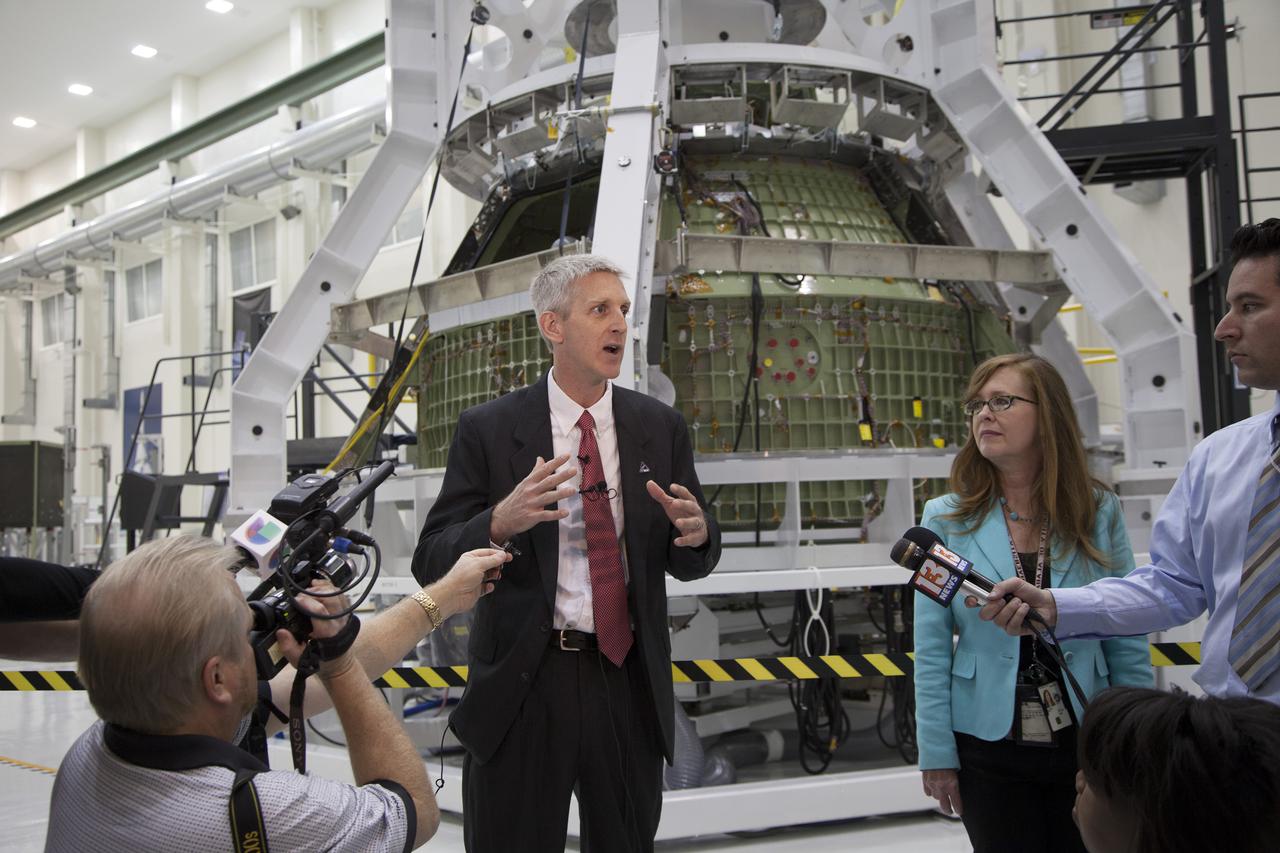
CAPE CANAVERAL, Fla. – Inside the high bay of Kennedy Space Center's Operations and Checkout Building, Scott Wilson, NASA's Orion production manager at the Florida Spaceport, briefs members of the news media about progress in preparing Orion for its first flight. In the background, the Orion spacecraft is surrounded by a special pre-launch processing access fixture. Orion is the exploration spacecraft designed to carry crews to space beyond low Earth orbit. It will provide emergency abort capability, sustain the crew during the space travel and provide safe re-entry from deep space return velocities. The first unpiloted test flight of the Orion is scheduled to launch in 2014 atop a Delta IV rocket and in 2017 on a Space Launch System rocket. For more information, visit http:__www.nasa.gov_orion Photo credit: NASA_Kim Shiflett
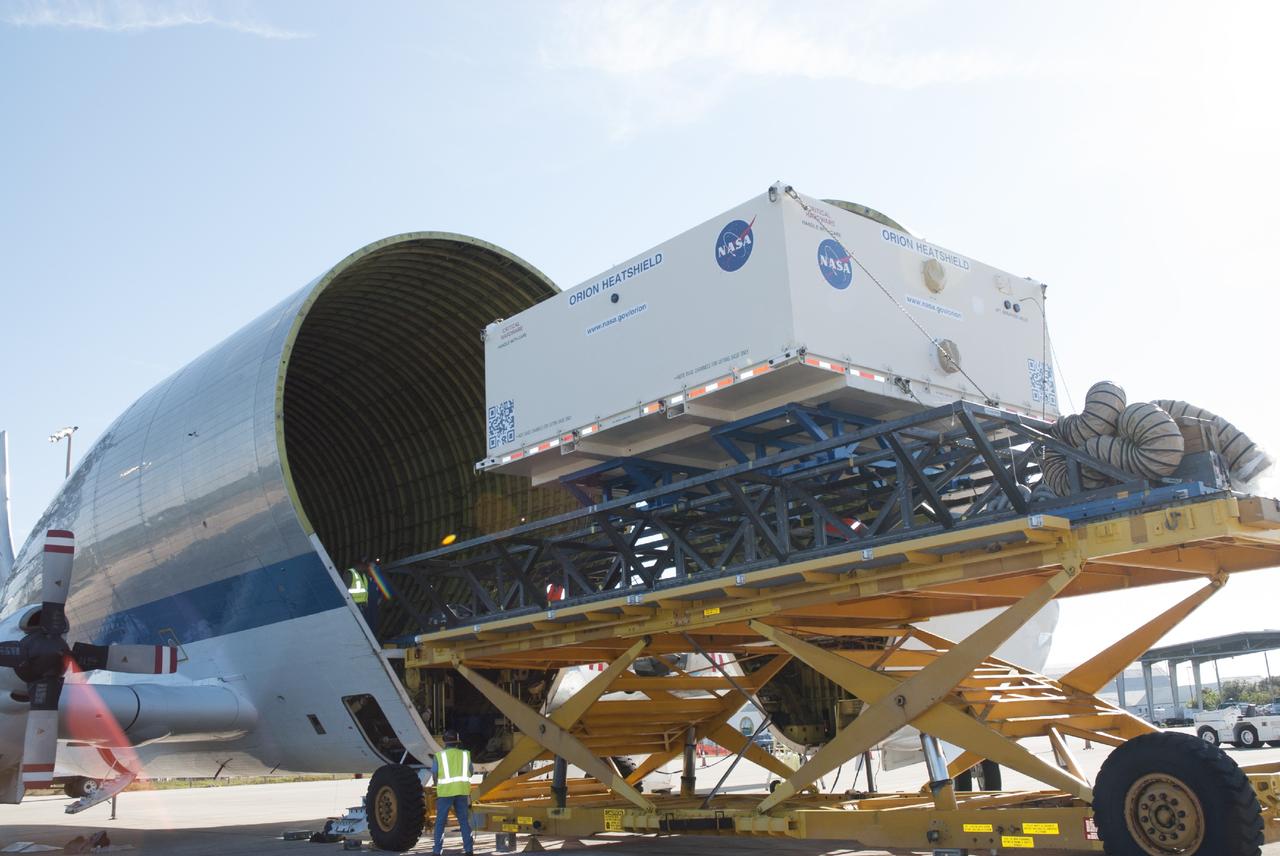
CAPE CANAVERAL, Fla. – At the Shuttle Landing Facility at NASA's Kennedy Space Center in Florida, the heat shield for the agency's Orion spacecraft is being offloaded from the Super Guppy aircraft. The largest of its kind ever built, the heat shield is planned for installation on the Orion crew module in March of next year. The Orion spacecraft is scheduled to make its first unpiloted flight test, Exploration Flight Test-1 EFT-1, in September 2014. The Orion spacecraft is designed to meet requirements for traveling beyond low-Earth orbit. The spacecraft will serve as the exploration vehicle that will carry crews to space, sustain the astronauts during the space travel and provide safe re-entry from deep space. For more information, visit: http://www.nasa.gov/orion Photo credit: NASA/Charisse Nasher
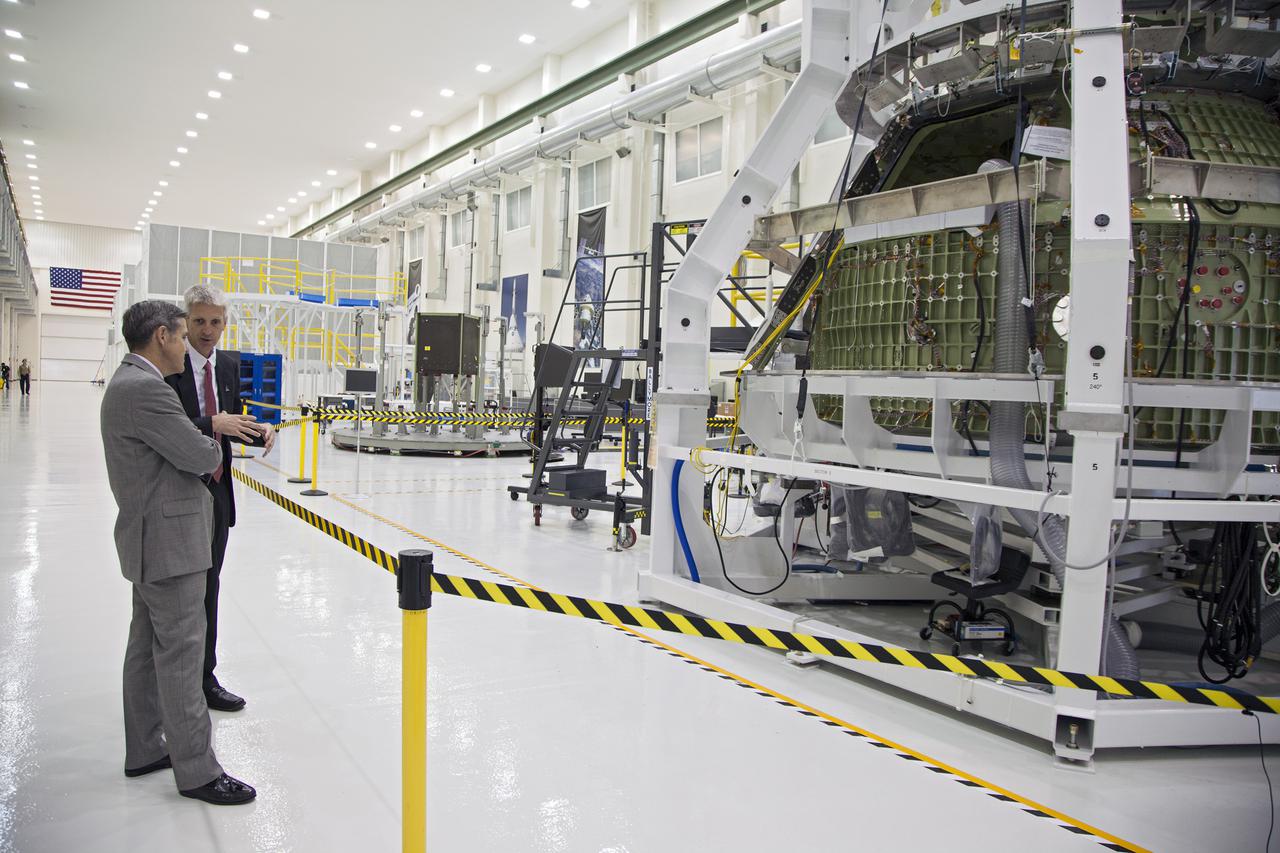
CAPE CANAVERAL, Fla. – Kennedy Space Center Director Bob Cabana, left, talks with Scott Wilson, NASA's Orion production manager at the Florida Spaceport. A special fixture surrounds the Orion spacecraft inside the high bay of Kennedy's Operations and Checkout Building. Orion is the exploration spacecraft designed to carry crews to space beyond low Earth orbit. It will provide emergency abort capability, sustain the crew during the space travel and provide safe re-entry from deep space return velocities. The first unpiloted test flight of the Orion is scheduled to launch in 2014 atop a Delta IV rocket and in 2017 on a Space Launch System rocket. For more information, visit http:__www.nasa.gov_orion Photo credit: NASA_Kim Shiflett
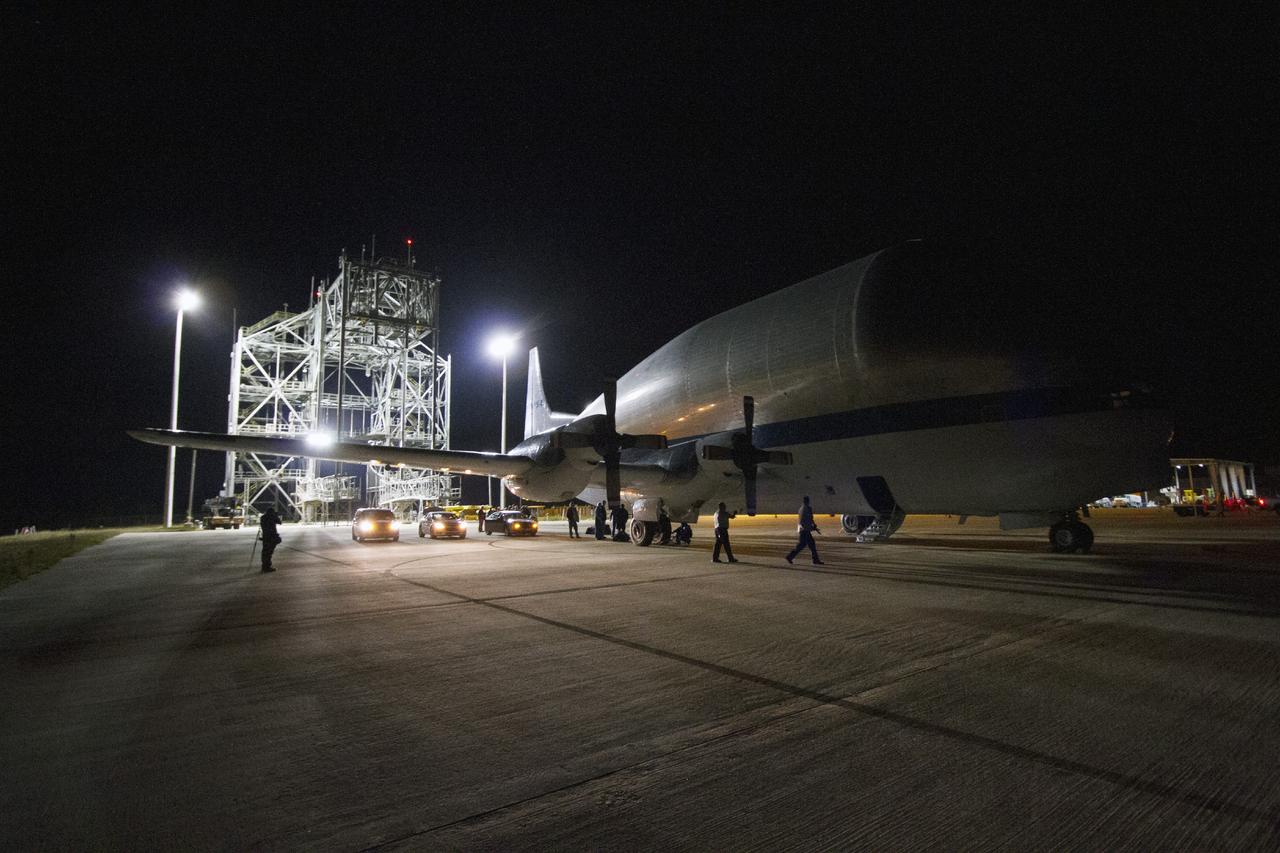
CAPE CANAVERAL, Fla. – At the Shuttle Landing Facility at NASA's Kennedy Space Center in Florida, the heat shield for the agency's Orion spacecraft arrived aboard the Super Guppy aircraft. The largest of its kind ever built, the heat shield is planned for installation on the Orion crew module in March next year. The Orion spacecraft is scheduled to make its first unpiloted flight test, Exploration Flight Test-1 EFT-1, in September 2014. The Orion spacecraft is designed to meet requirements for traveling beyond low-Earth orbit. The spacecraft will serve as the exploration vehicle that will carry crews to space, sustain the astronauts during the space travel and provide safe re-entry from deep space. For more information, visit: http://www.nasa.gov/orion Photo credit: NASA/Cory Huston
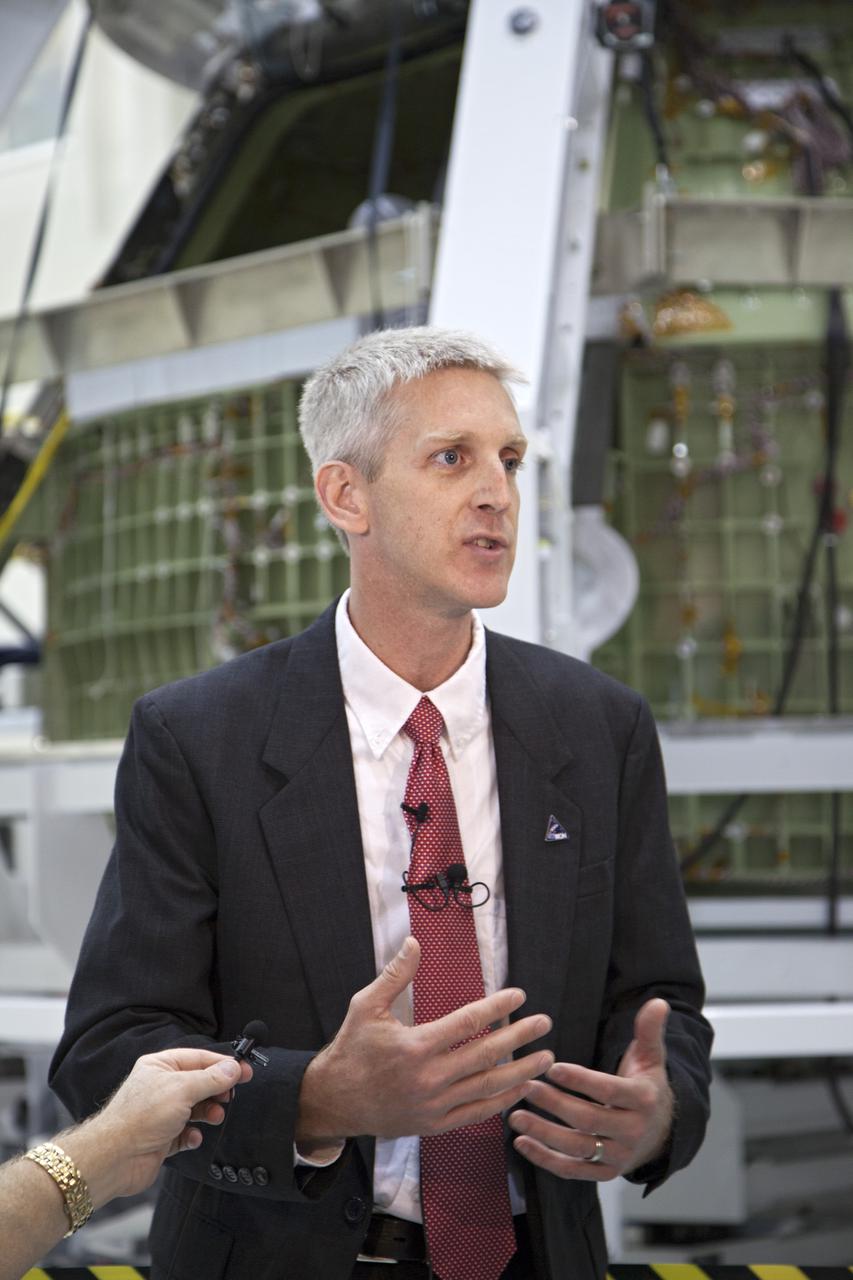
CAPE CANAVERAL, Fla. – Inside the high bay of Kennedy Space Center's Operations and Checkout Building, Scott Wilson, NASA's Orion production manager at the Florida Spaceport, briefs members of the news media about progress in preparing Orion for its first flight. In the background, the Orion spacecraft is surrounded by a special pre-launch processing access fixture. Orion is the exploration spacecraft designed to carry crews to space beyond low Earth orbit. It will provide emergency abort capability, sustain the crew during the space travel and provide safe re-entry from deep space return velocities. The first unpiloted test flight of the Orion is scheduled to launch in 2014 atop a Delta IV rocket and in 2017 on a Space Launch System rocket. For more information, visit http:__www.nasa.gov_orion Photo credit: NASA_Kim Shiflett
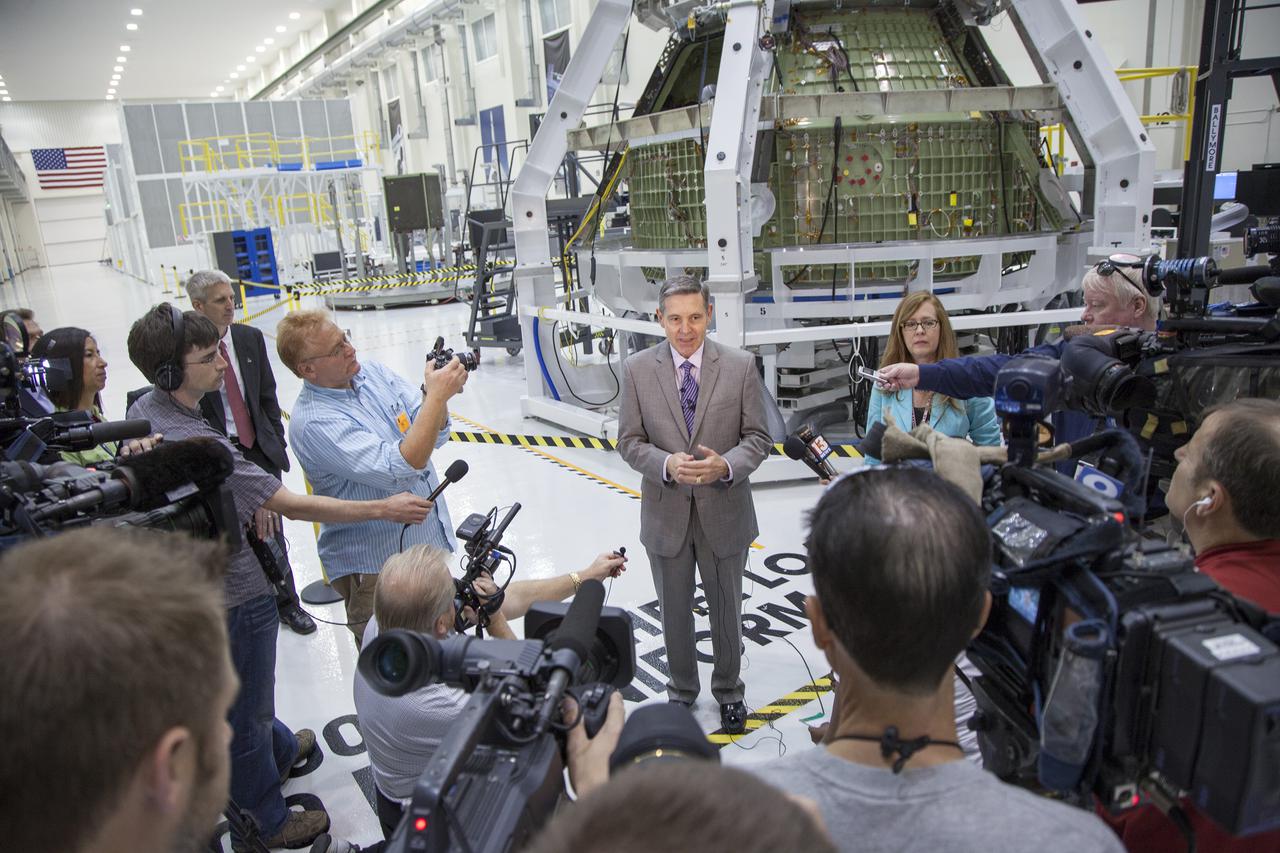
CAPE CANAVERAL, Fla. – Inside the high bay of Kennedy Space Center's Operations and Checkout Building, Kennedy Director Bob Cabana, provided members of the news media a status on the center's transformation to a multiuse government and commercial space launch and recovery complex. In the background, the Orion spacecraft is surrounded by a special pre-launch processing access fixture. Orion is the exploration spacecraft designed to carry crews to space beyond low Earth orbit. It will provide emergency abort capability, sustain the crew during the space travel and provide safe re-entry from deep space return velocities. The first unpiloted test flight of the Orion is scheduled to launch in 2014 atop a Delta IV rocket and in 2017 on a Space Launch System rocket. For more information, visit http:__www.nasa.gov_orion Photo credit: NASA_Kim Shiflett
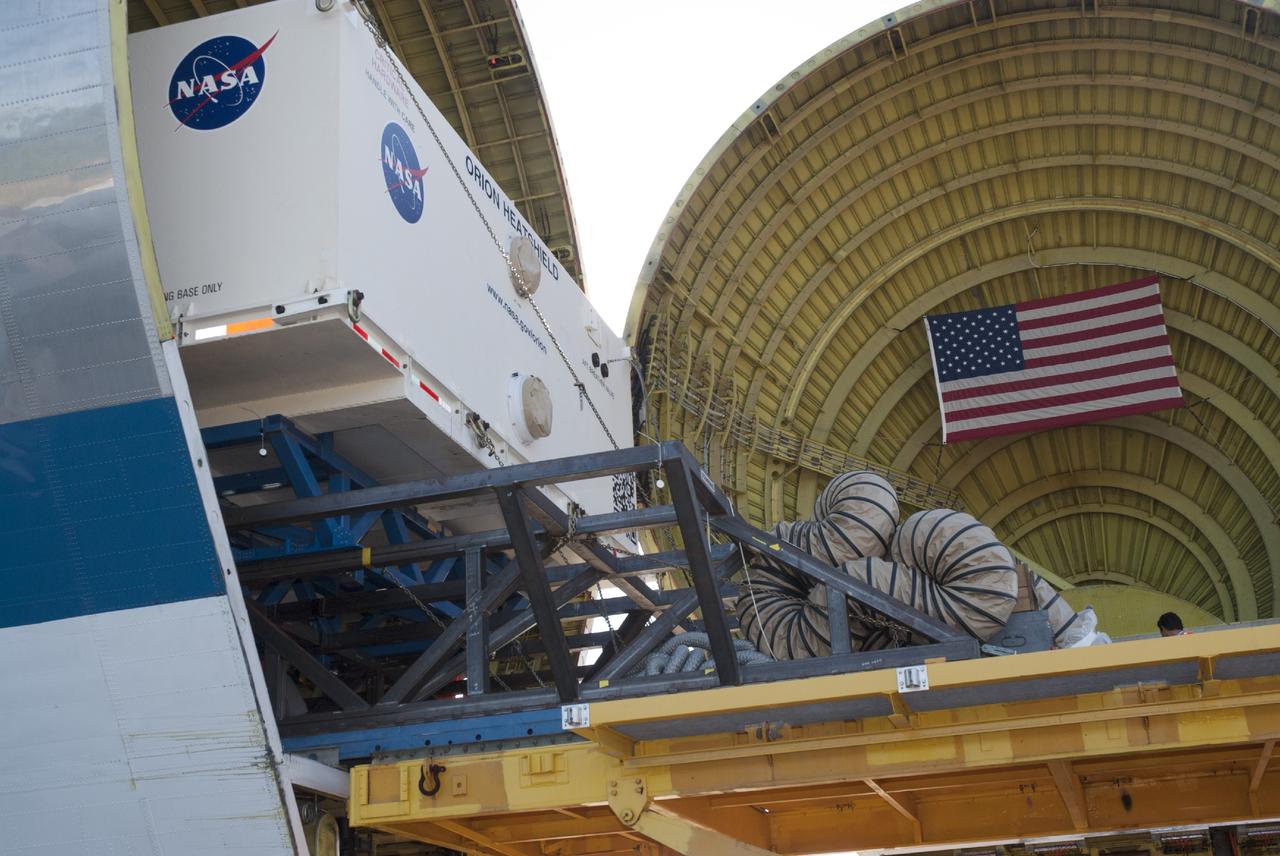
CAPE CANAVERAL, Fla. – At the Shuttle Landing Facility at NASA's Kennedy Space Center in Florida, the heat shield for the agency's Orion spacecraft is being offloaded from the Super Guppy aircraft. The largest of its kind ever built, the heat shield is planned for installation on the Orion crew module in March of next year. The Orion spacecraft is scheduled to make its first unpiloted flight test, Exploration Flight Test-1 EFT-1, in September 2014. The Orion spacecraft is designed to meet requirements for traveling beyond low-Earth orbit. The spacecraft will serve as the exploration vehicle that will carry crews to space, sustain the astronauts during the space travel and provide safe re-entry from deep space. For more information, visit: http://www.nasa.gov/orion Photo credit: NASA/Charisse Nasher
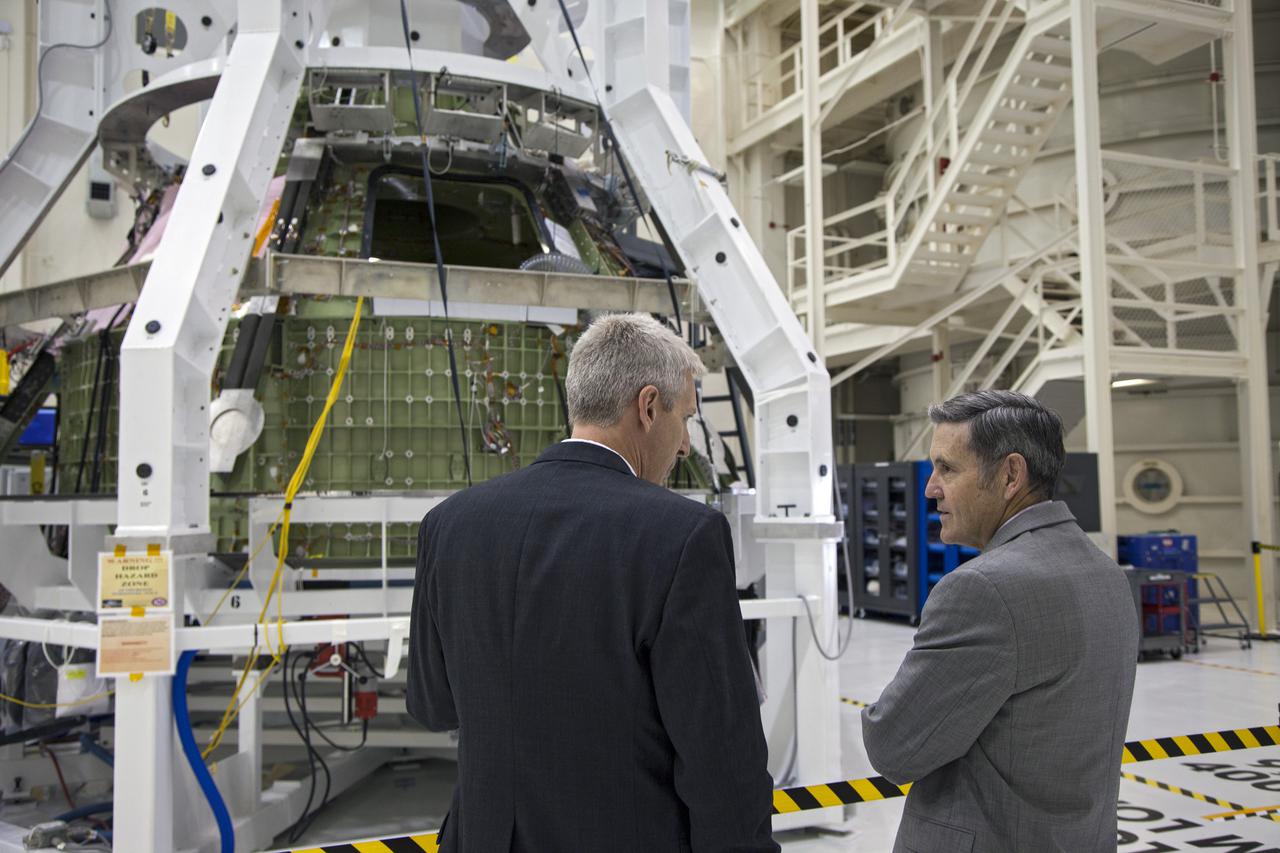
CAPE CANAVERAL, Fla. – Kennedy Space Center Director Bob Cabana, right, talks with Scott Wilson, NASA's Orion production manager at the Florida Spaceport. A special fixture surrounds the Orion spacecraft inside the high bay of Kennedy's Operations and Checkout Building. Orion is the exploration spacecraft designed to carry crews to space beyond low Earth orbit. It will provide emergency abort capability, sustain the crew during the space travel and provide safe re-entry from deep space return velocities. The first unpiloted test flight of the Orion is scheduled to launch in 2014 atop a Delta IV rocket and in 2017 on a Space Launch System rocket. For more information, visit http:__www.nasa.gov_orion Photo credit: NASA_Kim Shiflett
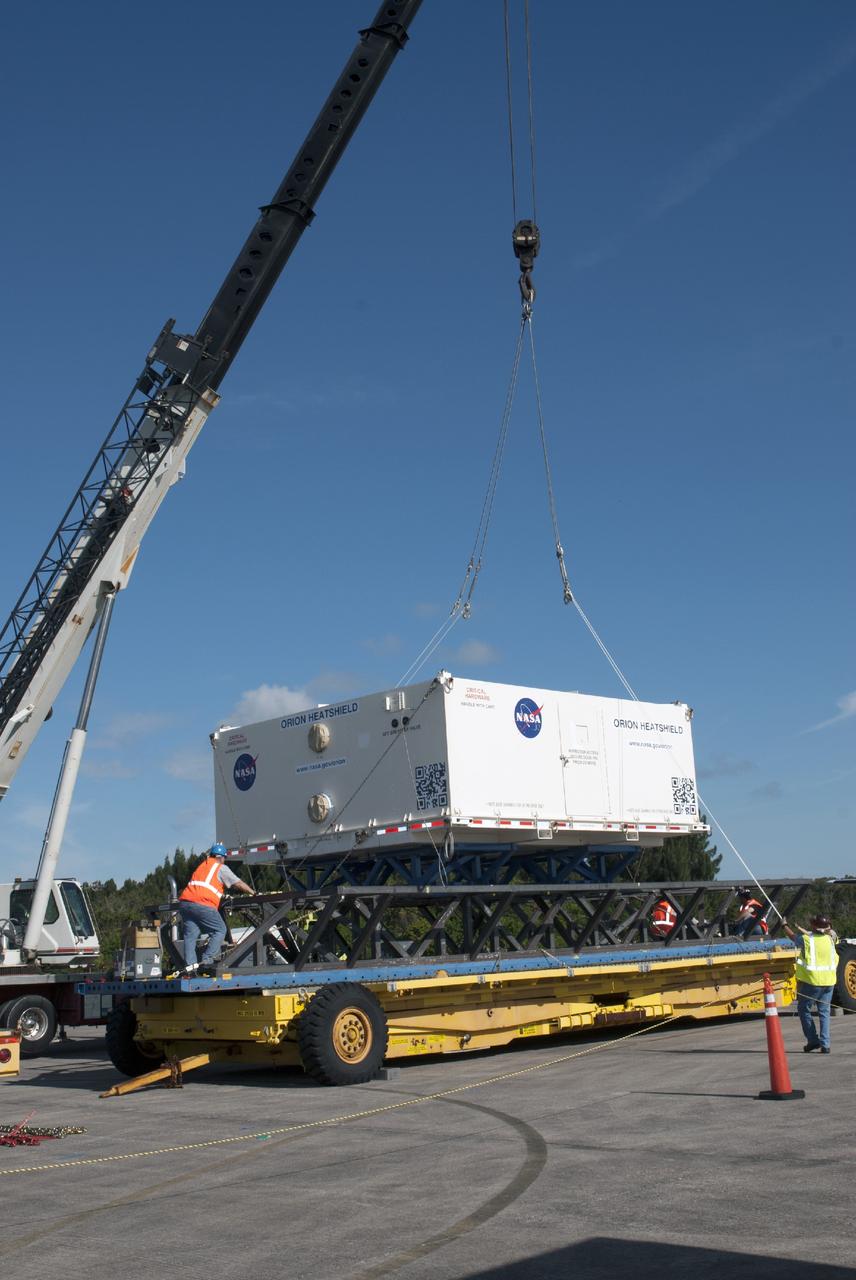
CAPE CANAVERAL, Fla. – At the Shuttle Landing Facility at NASA's Kennedy Space Center in Florida, the heat shield for the agency's Orion spacecraft has been offloaded from the Super Guppy aircraft and a crane is loading it on to a transport truck. The largest of its kind ever built, the heat shield is planned for installation on the Orion crew module in March of next year. The Orion spacecraft is scheduled to make its first unpiloted flight test, Exploration Flight Test-1 EFT-1, in September 2014. The Orion spacecraft is designed to meet requirements for traveling beyond low-Earth orbit. The spacecraft will serve as the exploration vehicle that will carry crews to space, sustain the astronauts during the space travel and provide safe re-entry from deep space. For more information, visit: http://www.nasa.gov/orion Photo credit: NASA/Charisse Nasher
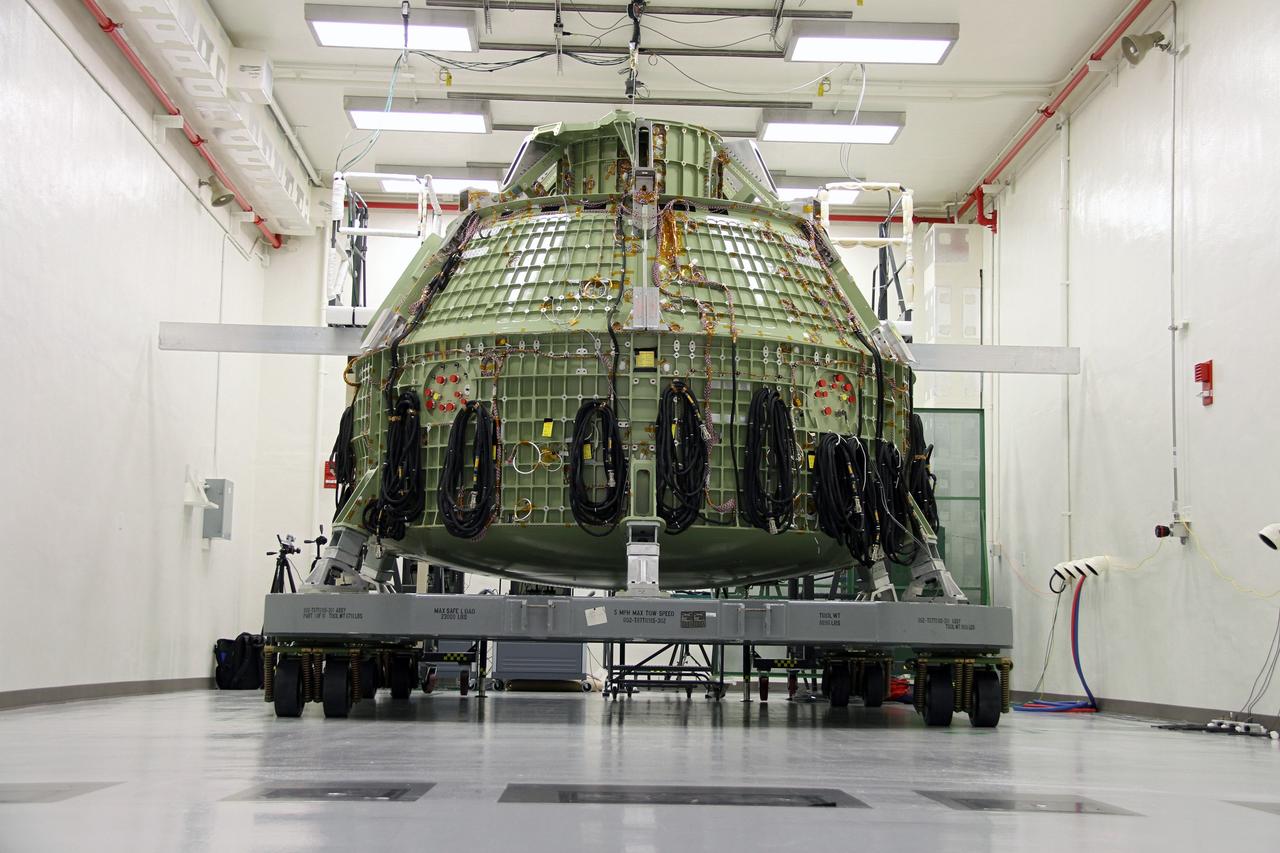
CAPE CANAVERAL, Fla. – The Orion Exploration Flight Test 1 crew module is undergoing proof pressure testing at the Operations and Checkout Building at NASA's Kennedy Space Center in Florida. The test incrementally pressurizes the spacecraft with breathing air and is designed to demonstrate weld strength capability and structural performance at maximum flight operating pressures. Orion is the exploration spacecraft designed to carry crews to space beyond low Earth orbit. It will provide emergency abort capability, sustain the crew during the space travel and provide safe re-entry from deep space return velocities. The first unpiloted test flight of the Orion is scheduled to launch in 2014 atop a Delta IV rocket and in 2017 on a Space Launch System rocket. For more information, visit http://www.nasa.gov/orion Photo credit: NASA/Ben Smegelsky
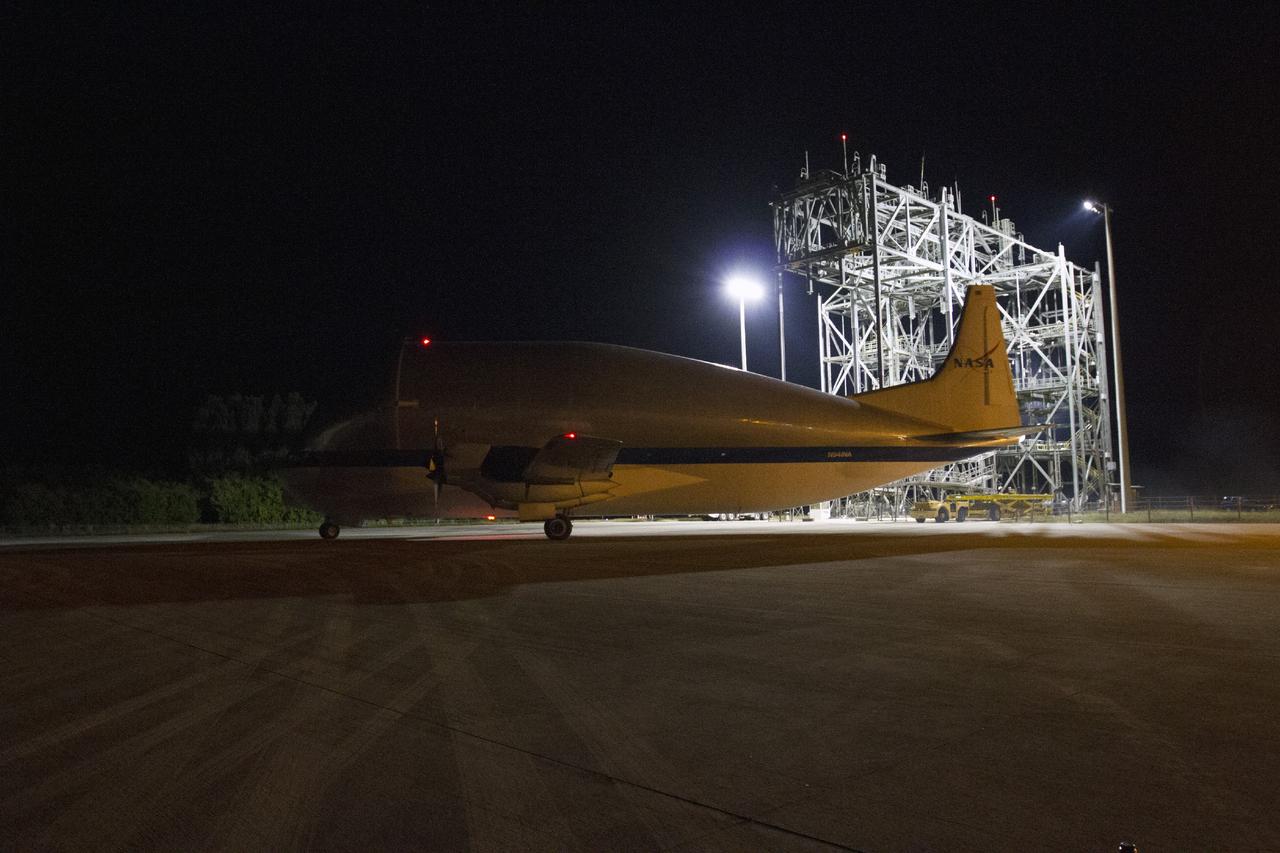
CAPE CANAVERAL, Fla. – At the Shuttle Landing Facility at NASA's Kennedy Space Center in Florida, the heat shield for the agency's Orion spacecraft arrived aboard the Super Guppy aircraft. The largest of its kind ever built, the heat shield is planned for installation on the Orion crew module in March next year. The Orion spacecraft is scheduled to make its first unpiloted flight test, Exploration Flight Test-1 EFT-1, in September 2014. The Orion spacecraft is designed to meet requirements for traveling beyond low-Earth orbit. The spacecraft will serve as the exploration vehicle that will carry crews to space, sustain the astronauts during the space travel and provide safe re-entry from deep space. For more information, visit: http://www.nasa.gov/orion Photo credit: NASA/Cory Huston
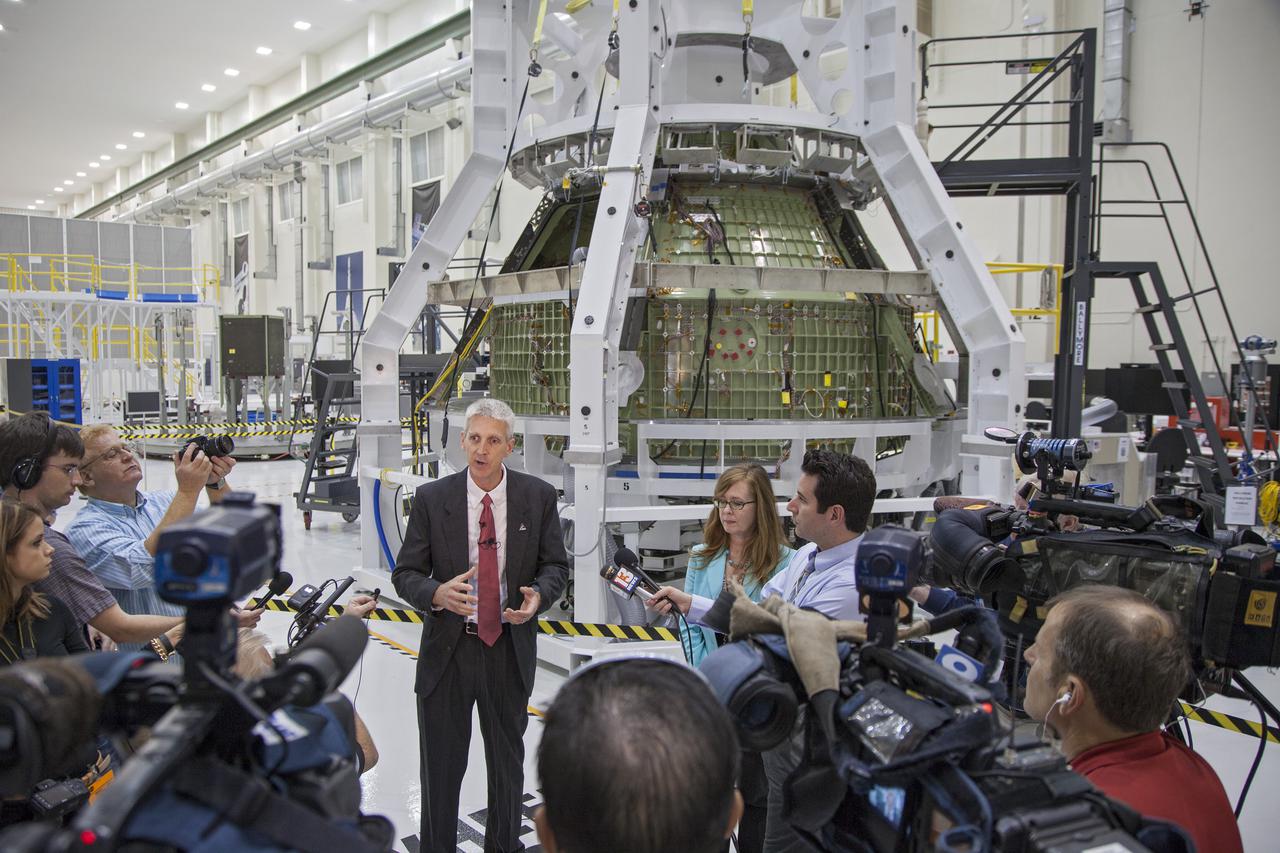
CAPE CANAVERAL, Fla. – Inside the high bay of Kennedy Space Center's Operations and Checkout Building, Scott Wilson, NASA's Orion production manager at the Florida Spaceport, briefs members of the news media about progress in preparing Orion for its first flight. In the background, the Orion spacecraft is surrounded by a special pre-launch processing access fixture. Orion is the exploration spacecraft designed to carry crews to space beyond low Earth orbit. It will provide emergency abort capability, sustain the crew during the space travel and provide safe re-entry from deep space return velocities. The first unpiloted test flight of the Orion is scheduled to launch in 2014 atop a Delta IV rocket and in 2017 on a Space Launch System rocket. For more information, visit http:__www.nasa.gov_orion Photo credit: NASA_Kim Shiflett
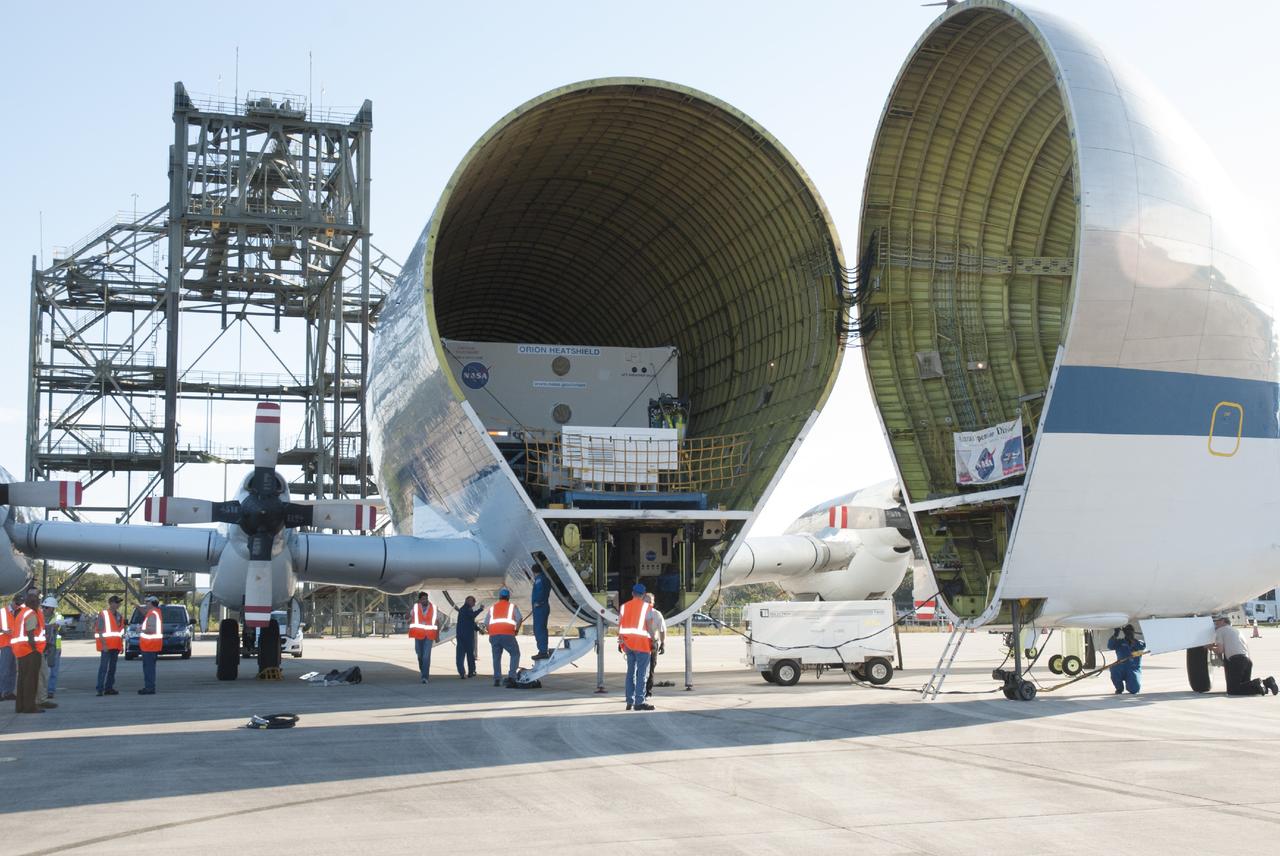
CAPE CANAVERAL, Fla. – At the Shuttle Landing Facility at NASA's Kennedy Space Center in Florida, the heat shield for the agency's Orion spacecraft is about to be offloaded from the Super Guppy aircraft. The largest of its kind ever built, the heat shield is planned for installation on the Orion crew module in March of next year. The Orion spacecraft is scheduled to make its first unpiloted flight test, Exploration Flight Test-1 EFT-1, in September 2014. The Orion spacecraft is designed to meet requirements for traveling beyond low-Earth orbit. The spacecraft will serve as the exploration vehicle that will carry crews to space, sustain the astronauts during the space travel and provide safe re-entry from deep space. For more information, visit: http://www.nasa.gov/orion Photo credit: NASA/Charisse Nasher
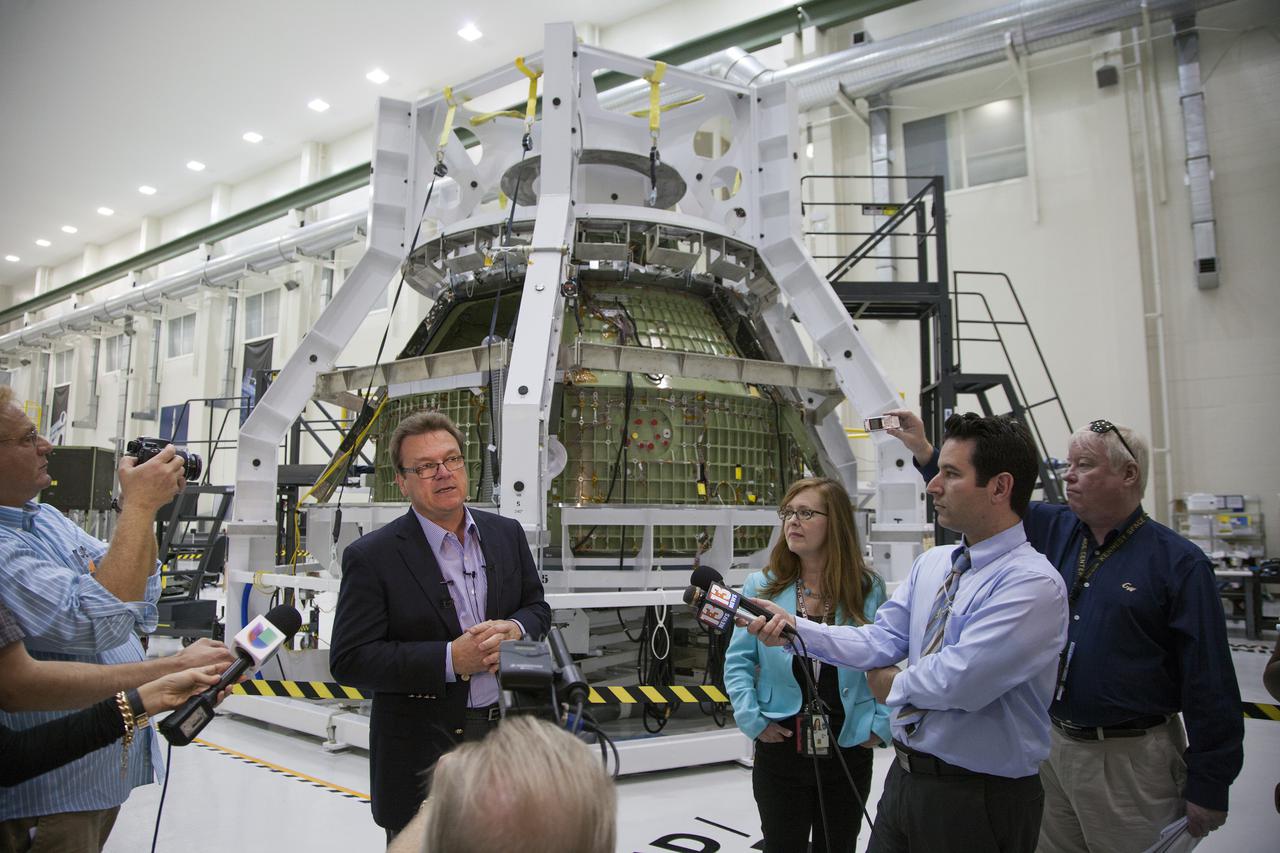
CAPE CANAVERAL, Fla. – Inside the high bay of Kennedy Space Center's Operations and Checkout Building, Jules Schnieder, Lockheed Martin's Orion production manager at the Florida Spaceport, briefs members of the news media about progress in preparing Orion for its first flight. In the background, the Orion spacecraft is surrounded by a special pre-launch processing access fixture. Lockheed Martin is NASA's prime contractor for the Orion spacecraft. Orion is the exploration spacecraft designed to carry crews to space beyond low Earth orbit. It will provide emergency abort capability, sustain the crew during the space travel and provide safe re-entry from deep space return velocities. The first unpiloted test flight of the Orion is scheduled to launch in 2014 atop a Delta IV rocket and in 2017 on a Space Launch System rocket. For more information, visit http:__www.nasa.gov_orion Photo credit: NASA_Kim Shiflett
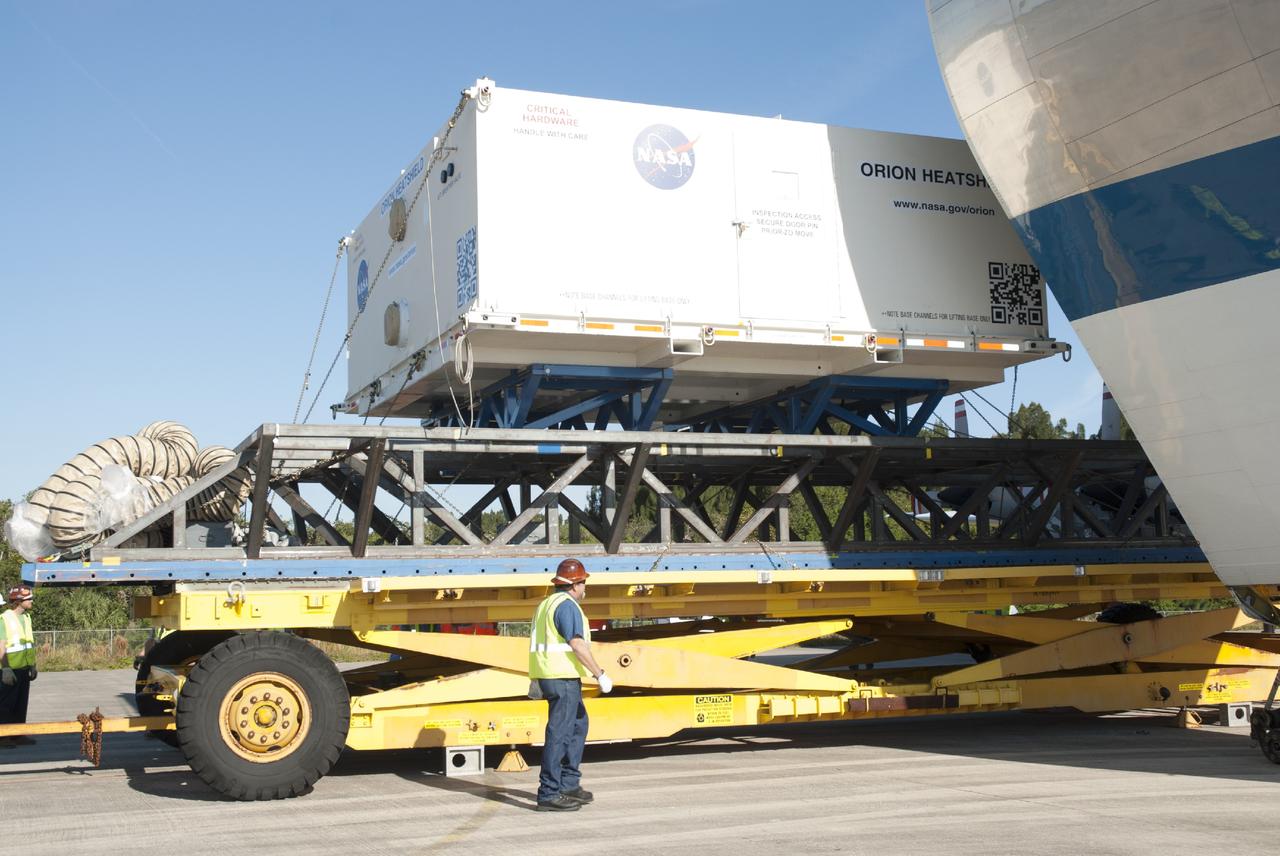
CAPE CANAVERAL, Fla. – At the Shuttle Landing Facility at NASA's Kennedy Space Center in Florida, the heat shield for the agency's Orion spacecraft is being offloaded from the Super Guppy aircraft. The largest of its kind ever built, the heat shield is planned for installation on the Orion crew module in March of next year. The Orion spacecraft is scheduled to make its first unpiloted flight test, Exploration Flight Test-1 EFT-1, in September 2014. The Orion spacecraft is designed to meet requirements for traveling beyond low-Earth orbit. The spacecraft will serve as the exploration vehicle that will carry crews to space, sustain the astronauts during the space travel and provide safe re-entry from deep space. For more information, visit: http://www.nasa.gov/orion Photo credit: NASA/Charisse Nasher
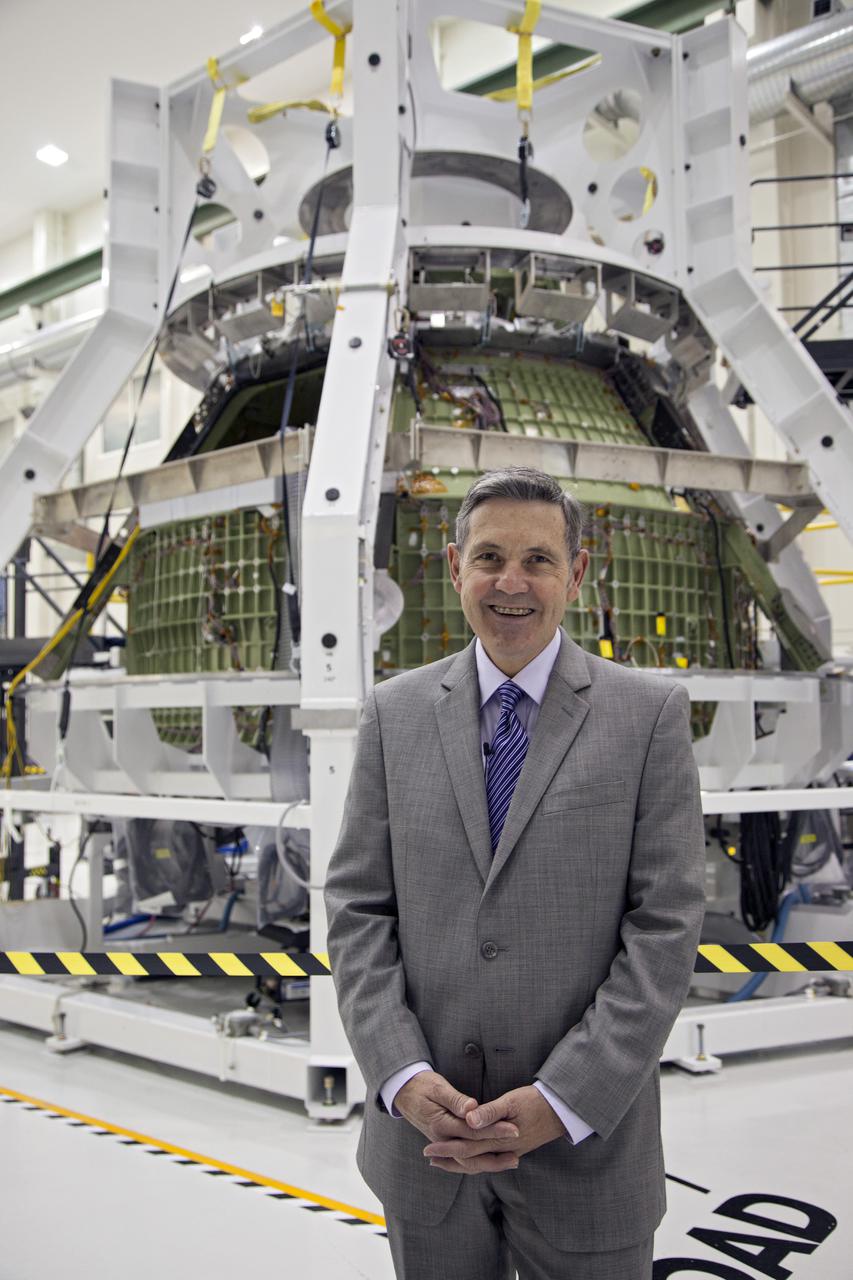
CAPE CANAVERAL, Fla. – Inside the high bay of Kennedy Space Center's Operations and Checkout Building, Kennedy Director Bob Cabana, stands in front of the Orion spacecraft which is surrounded by a special pre-launch processing access fixture. Orion is the exploration spacecraft designed to carry crews to space beyond low Earth orbit. It will provide emergency abort capability, sustain the crew during the space travel and provide safe re-entry from deep space return velocities. The first unpiloted test flight of the Orion is scheduled to launch in 2014 atop a Delta IV rocket and in 2017 on a Space Launch System rocket. For more information, visit http:__www.nasa.gov_orion Photo credit: NASA_Kim Shiflett
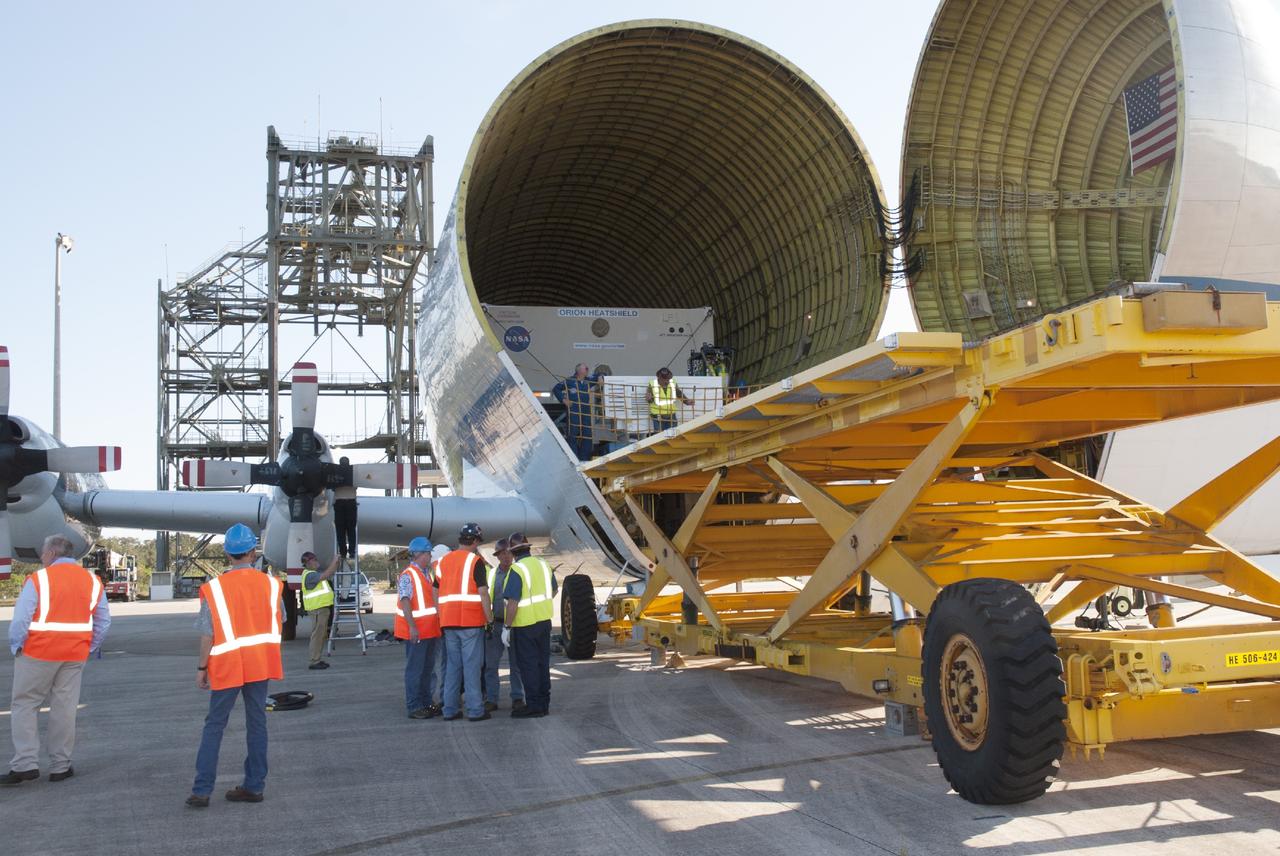
CAPE CANAVERAL, Fla. – At the Shuttle Landing Facility at NASA's Kennedy Space Center in Florida, the heat shield for the agency's Orion spacecraft is being offloaded from the Super Guppy aircraft. The largest of its kind ever built, the heat shield is planned for installation on the Orion crew module in March of next year. The Orion spacecraft is scheduled to make its first unpiloted flight test, Exploration Flight Test-1 EFT-1, in September 2014. The Orion spacecraft is designed to meet requirements for traveling beyond low-Earth orbit. The spacecraft will serve as the exploration vehicle that will carry crews to space, sustain the astronauts during the space travel and provide safe re-entry from deep space. For more information, visit: http://www.nasa.gov/orion Photo credit: NASA/Charisse Nasher
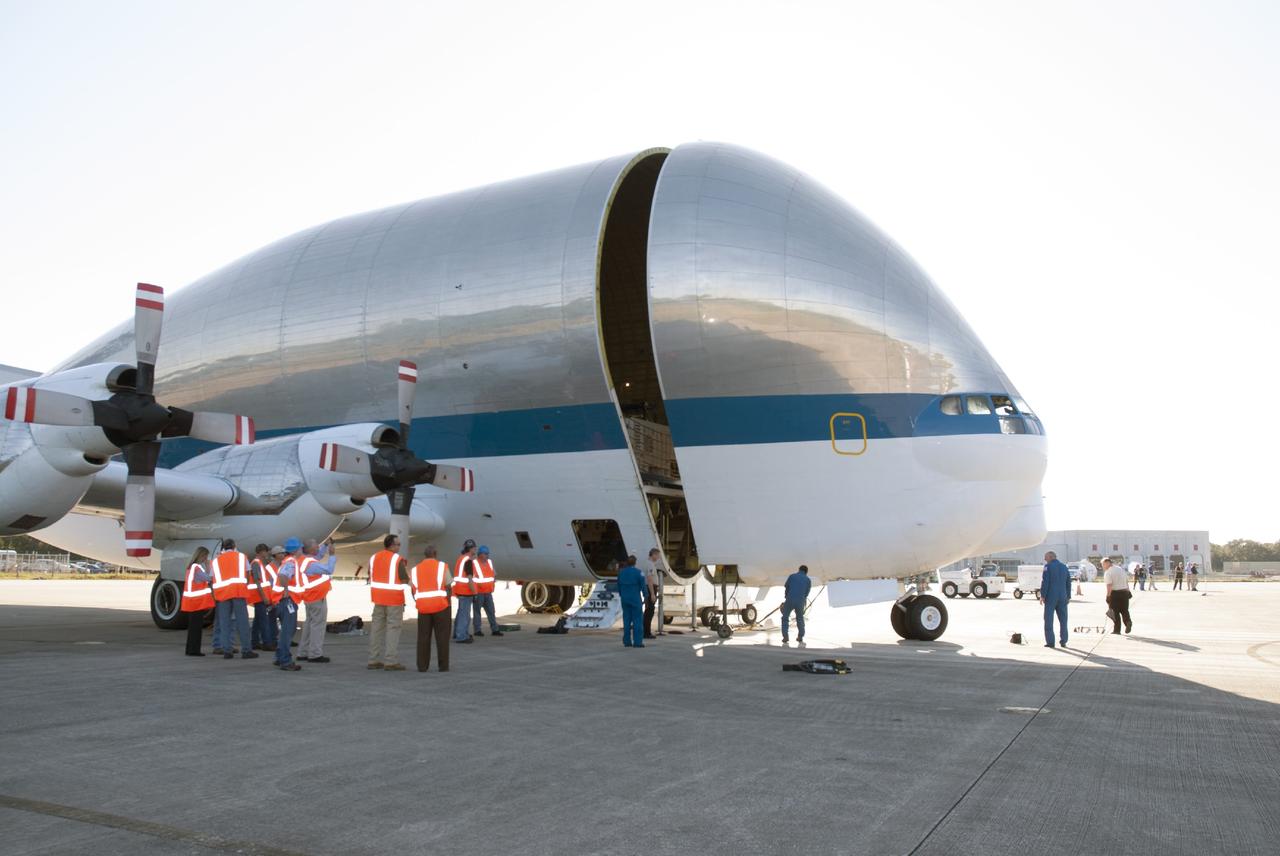
CAPE CANAVERAL, Fla. – At the Shuttle Landing Facility at NASA's Kennedy Space Center in Florida, technicians begin the process to offload the heat shield for the agency's Orion spacecraft from the Super Guppy aircraft. The largest of its kind ever built, the heat shield is planned for installation on the Orion crew module in March of next year. The Orion spacecraft is scheduled to make its first unpiloted flight test, Exploration Flight Test-1 EFT-1, in September 2014. The Orion spacecraft is designed to meet requirements for traveling beyond low-Earth orbit. The spacecraft will serve as the exploration vehicle that will carry crews to space, sustain the astronauts during the space travel and provide safe re-entry from deep space. For more information, visit: http://www.nasa.gov/orion Photo credit: NASA/Charisse Nasher
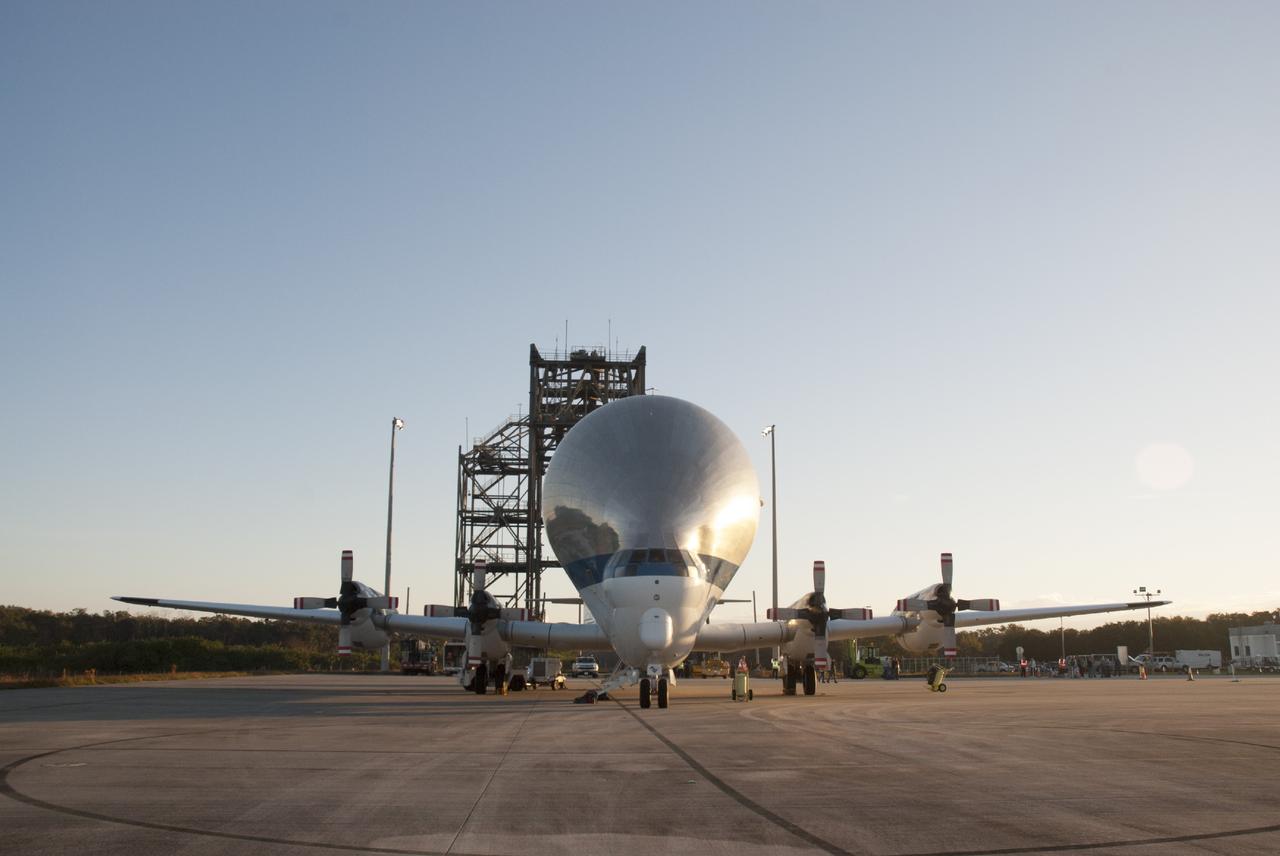
CAPE CANAVERAL, Fla. – At the Shuttle Landing Facility at NASA's Kennedy Space Center in Florida, the heat shield for the agency's Orion spacecraft arrived aboard the Super Guppy aircraft. The largest of its kind ever built, the heat shield is planned for installation on the Orion crew module in March next year. The Orion spacecraft is scheduled to make its first unpiloted flight test, Exploration Flight Test-1 EFT-1, in September 2014. The Orion spacecraft is designed to meet requirements for traveling beyond low-Earth orbit. The spacecraft will serve as the exploration vehicle that will carry crews to space, sustain the astronauts during the space travel and provide safe re-entry from deep space. For more information, visit: http://www.nasa.gov/orion Photo credit: NASA/Charisse Nasher
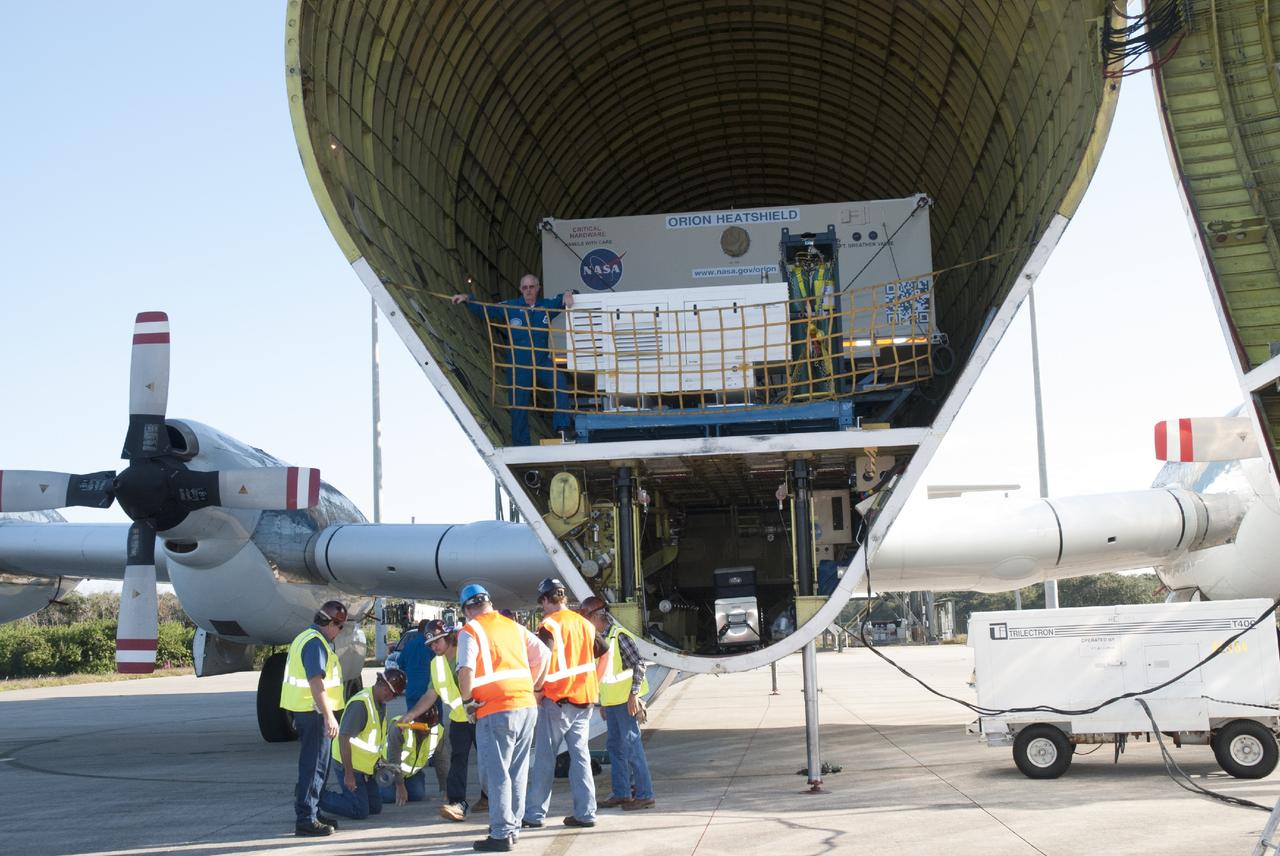
CAPE CANAVERAL, Fla. – At the Shuttle Landing Facility at NASA's Kennedy Space Center in Florida, the heat shield for the agency's Orion spacecraft is about to be offloaded from the Super Guppy aircraft. The largest of its kind ever built, the heat shield is planned for installation on the Orion crew module in March of next year. The Orion spacecraft is scheduled to make its first unpiloted flight test, Exploration Flight Test-1 EFT-1, in September 2014. The Orion spacecraft is designed to meet requirements for traveling beyond low-Earth orbit. The spacecraft will serve as the exploration vehicle that will carry crews to space, sustain the astronauts during the space travel and provide safe re-entry from deep space. For more information, visit: http://www.nasa.gov/orion Photo credit: NASA/Charisse Nasher
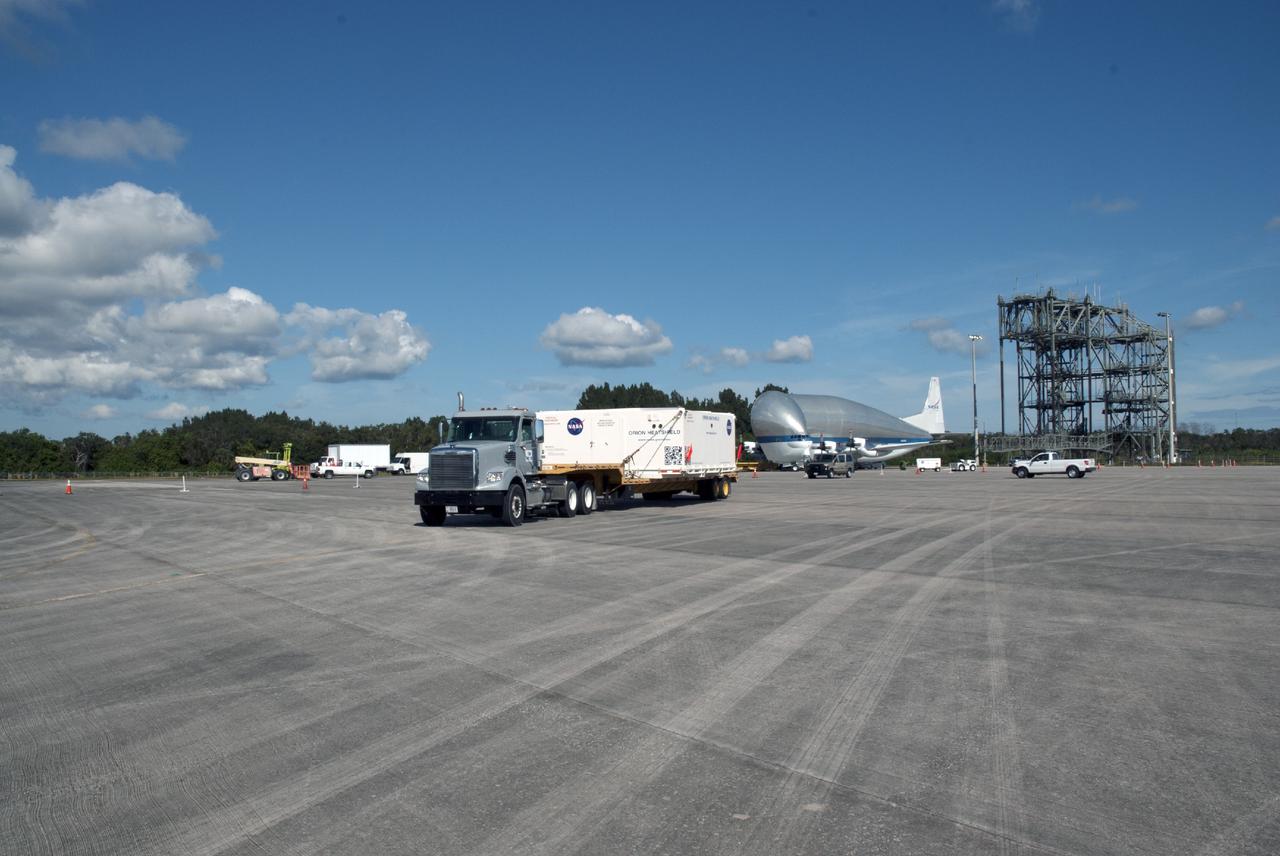
CAPE CANAVERAL, Fla. – At the Shuttle Landing Facility at NASA's Kennedy Space Center in Florida, the heat shield for the agency's Orion spacecraft has been offloaded from the Super Guppy aircraft, seen in the background. The largest of its kind ever built, the heat shield is planned for installation on the Orion crew module in March of next year. A transport truck is delivering it to Kennedy's Operations and Checkout Building where the Orion spacecraft is being prepared for its first unpiloted flight test, Exploration Flight Test-1 EFT-1, scheduled for September 2014. The Orion spacecraft is designed to meet requirements for traveling beyond low-Earth orbit. The spacecraft will serve as the exploration vehicle that will carry crews to space, sustain the astronauts during the space travel and provide safe re-entry from deep space. For more information, visit: http://www.nasa.gov/orion Photo credit: NASA/Charisse Nasher
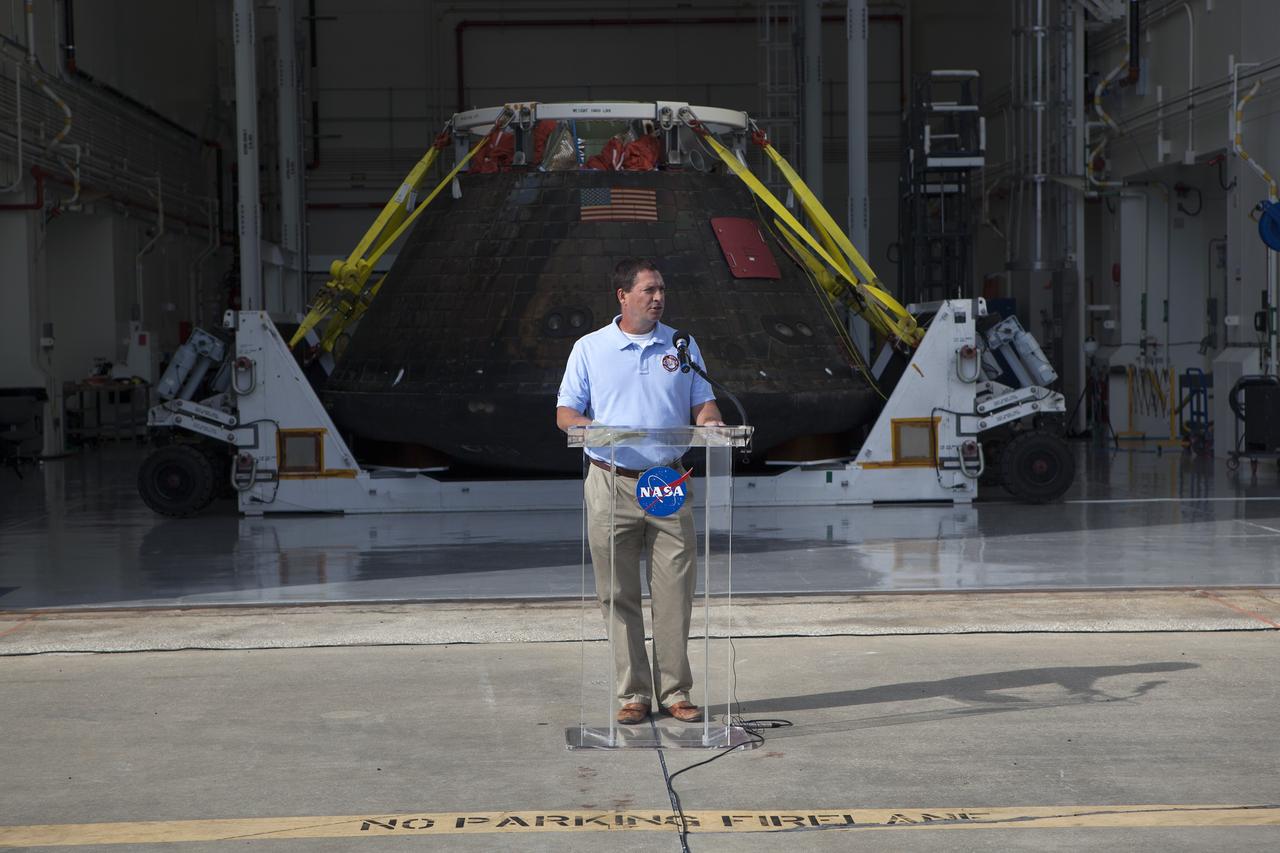
CAPE CANAVERAL, Fla. -- NASA's Orion spacecraft is viewed by members of the media at the Launch Abort System Facility at NASA's Kennedy Space Center in Florida. Lou Garcia, with the Ground Systems Development and Operations Program, or GSDO, speaks to the media during the viewing opportunity. The spacecraft's cross-country return, a 2,700 mile road trip from Naval Base San Diego to Kennedy, sets the stage for in-depth analysis of data obtained during Orion's trip to space. It will provide engineers with detailed information on how the spacecraft fared during its two-orbit, 4.5-hour flight test, completed on Dec. 5. GSDO led the recovery, offload and transportation efforts. For more information, visit www.nasa.gov/orion. Photo credit: NASA/Dimitri Gerondidakis
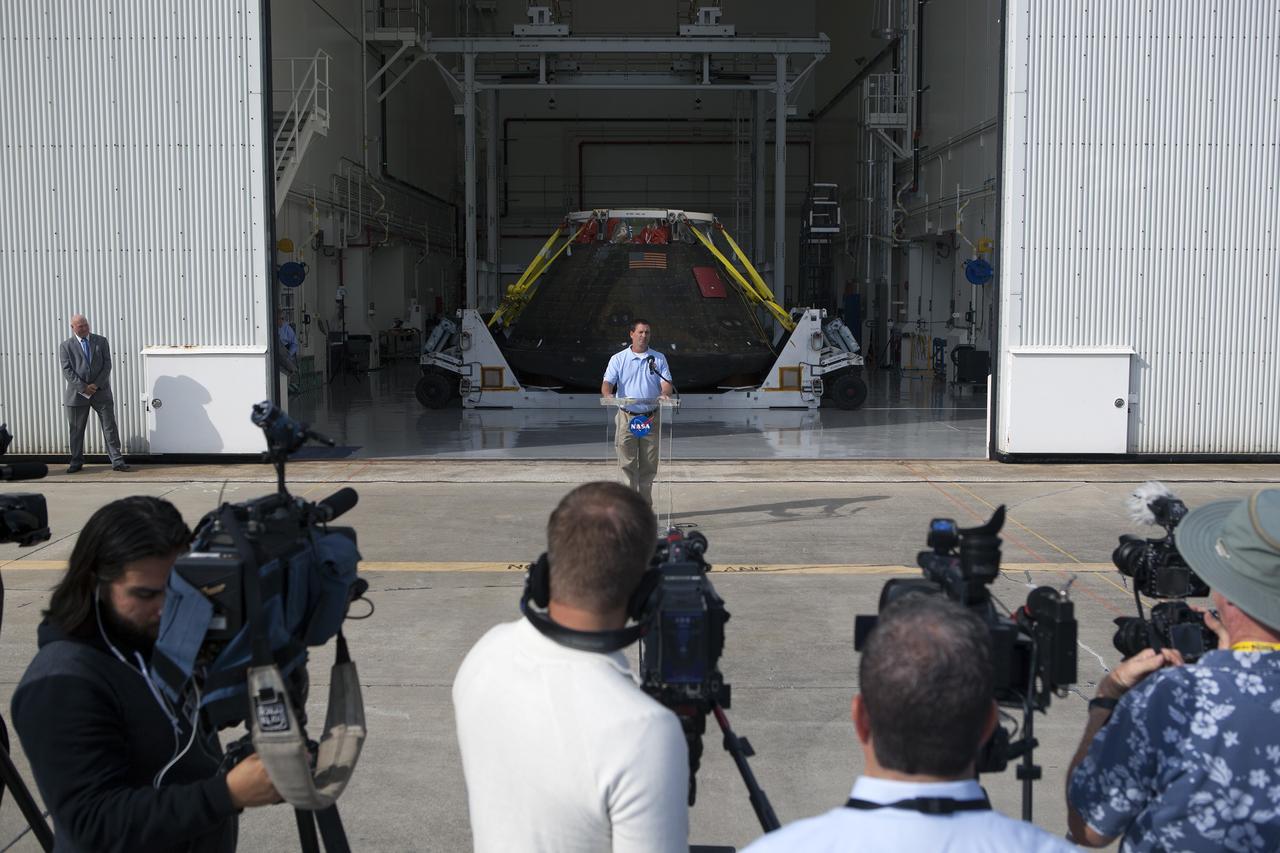
CAPE CANAVERAL, Fla. -- NASA's Orion spacecraft is viewed by members of the media at the Launch Abort System Facility at NASA's Kennedy Space Center in Florida. Lou Garcia, with the Ground Systems Development and Operations Program, or GSDO, speaks to the media during the viewing opportunity. The spacecraft's cross-country return, a 2,700 mile road trip from Naval Base San Diego to Kennedy, sets the stage for in-depth analysis of data obtained during Orion's trip to space. It will provide engineers with detailed information on how the spacecraft fared during its two-orbit, 4.5-hour flight test, completed on Dec. 5. GSDO led the recovery, offload and transportation efforts. For more information, visit www.nasa.gov/orion. Photo credit: NASA/Dimitri Gerondidakis
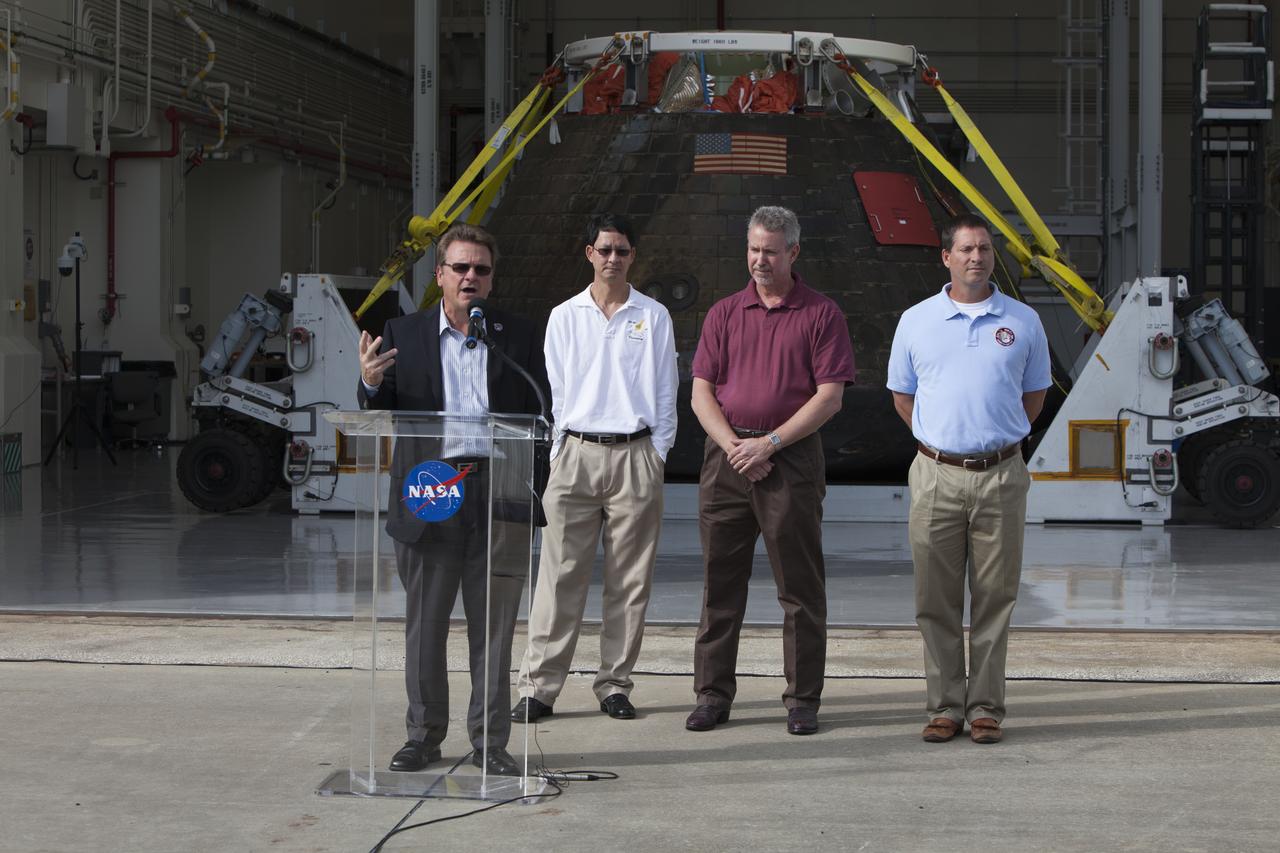
NASA's Orion spacecraft is viewed by members of the media at the Launch Abort System Facility at NASA's Kennedy Space Center in Florida. Speaking to the media during the viewing opportunity is Jules Schneider, Lockheed Martin Manager. Behind him, from left, are Glenn Chin, Orion Production Operations manager and Phil Weber and Lou Garcia, with the Ground Systems Development and Operations Program, or GSDO. Orion made the 8-day, 2,700 mile overland trip back to Kennedy from Naval Base San Diego in California. Analysis of date obtained during its two-orbit, four-and-a-half hour mission Dec. 5 will provide engineers with detailed information on how the spacecraft fared. GSDO led the recovery, offload and transportation efforts.
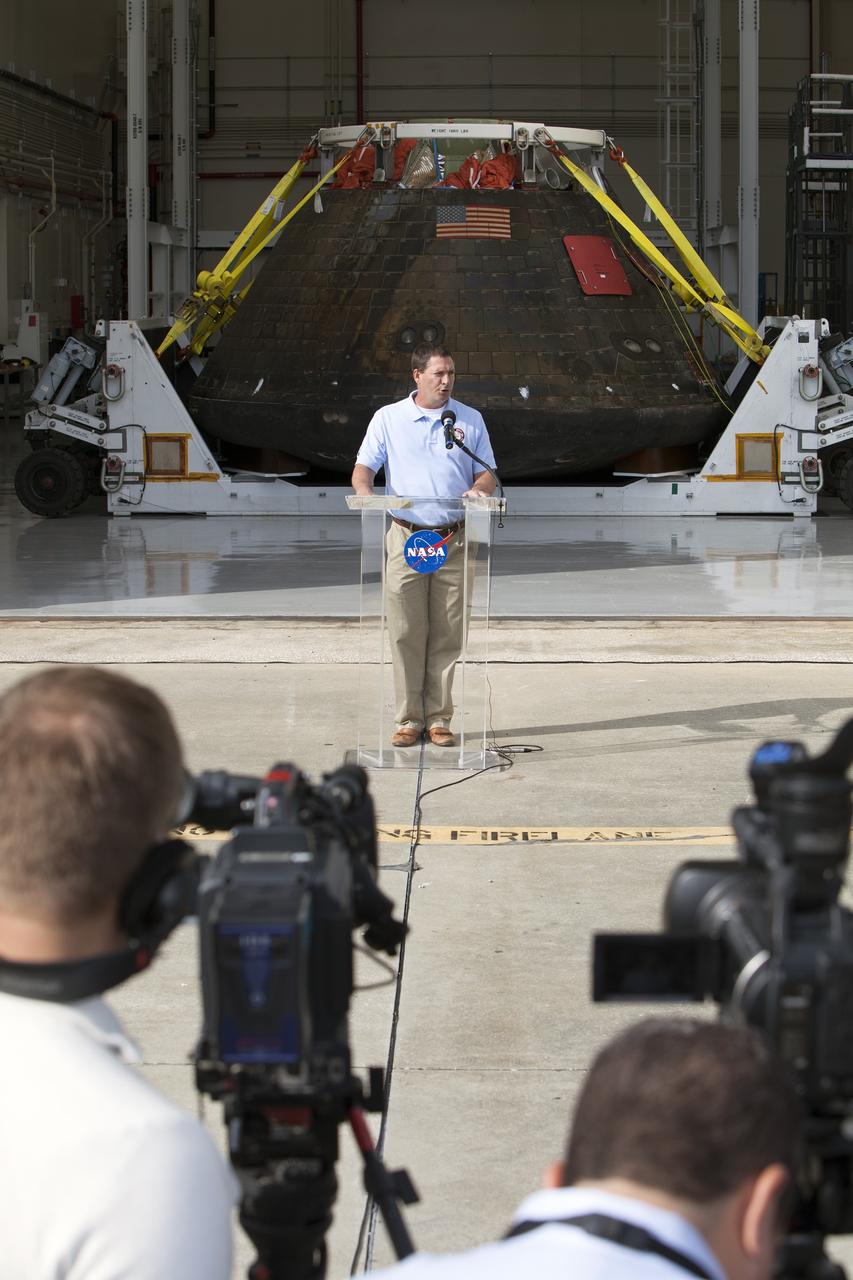
CAPE CANAVERAL, Fla. -- NASA's Orion spacecraft is viewed by members of the media at the Launch Abort System Facility at NASA's Kennedy Space Center in Florida. Lou Garcia, with the Ground Systems Development and Operations Program, or GSDO, speaks to the media during the viewing opportunity. The spacecraft's cross-country return, a 2,700 mile road trip from Naval Base San Diego to Kennedy, sets the stage for in-depth analysis of data obtained during Orion's trip to space. It will provide engineers with detailed information on how the spacecraft fared during its two-orbit, 4.5-hour flight test, completed on Dec. 5. GSDO led the recovery, offload and transportation efforts. For more information, visit www.nasa.gov/orion. Photo credit: NASA/Dimitri Gerondidakis