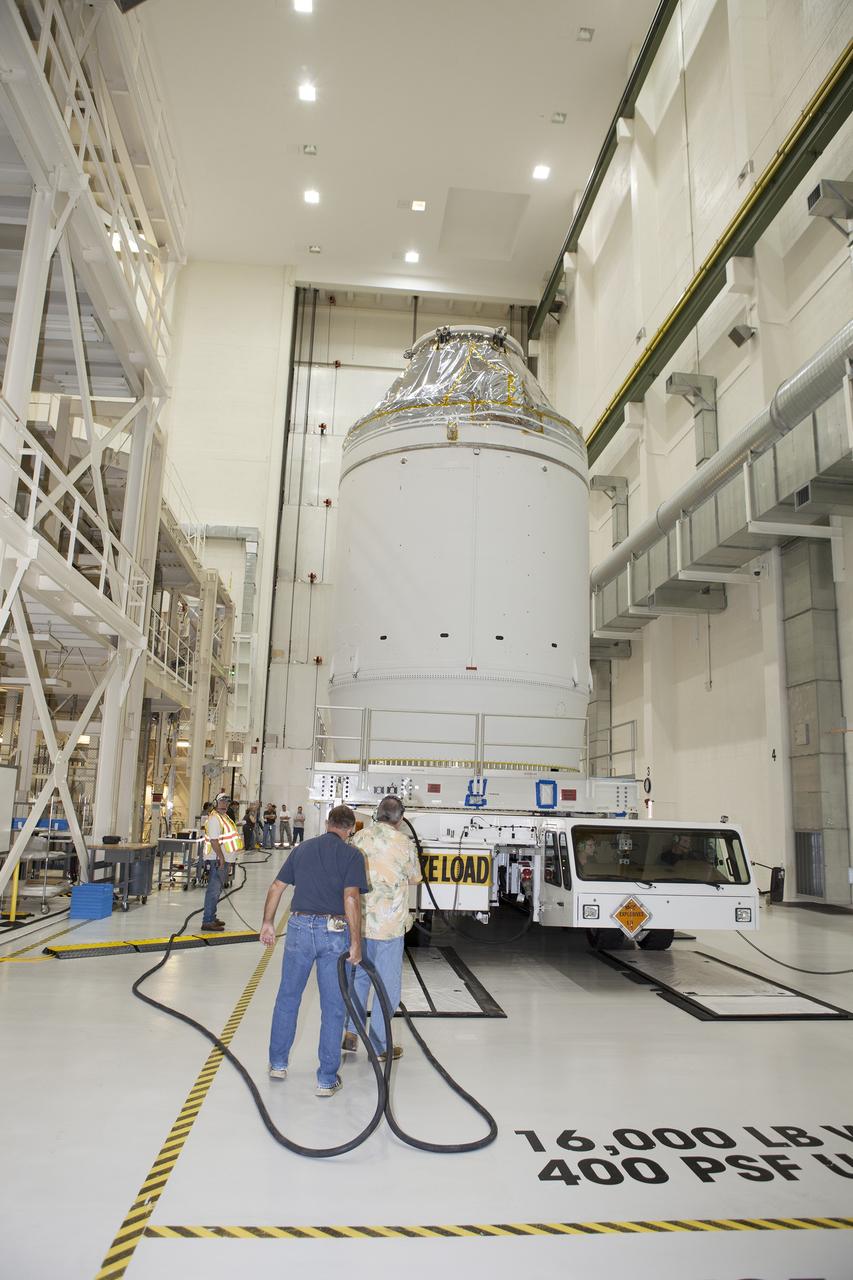
CAPE CANAVERAL, Fla. – The Orion crew module, stacked atop its service module, is being prepared for its move out of the Neil Armstrong Operations and Checkout Building high bay at NASA's Kennedy Space Center in Florida. The spacecraft for Exploration Flight Test-1 will be transported to the Payload Hazardous Servicing Facility where it will be fueled ahead of its December flight test. Orion is the exploration spacecraft designed to carry astronauts to destinations not yet explored by humans, including an asteroid and Mars. It will have emergency abort capability, sustain the crew during space travel and provide safe re-entry from deep space return velocities. The first unpiloted test flight of the Orion is scheduled to launch atop a United Launch Alliance Delta IV Heavy rocket from Cape Canaveral Air Force Station in Florida to an altitude of 3,600 miles above the Earth's surface. The two-orbit, four-hour flight test will help engineers evaluate the systems critical to crew safety including the heat shield, parachute system and launch abort system. For more information, visit http://www.nasa.gov/orion. Photo credit: NASA/Daniel Casper
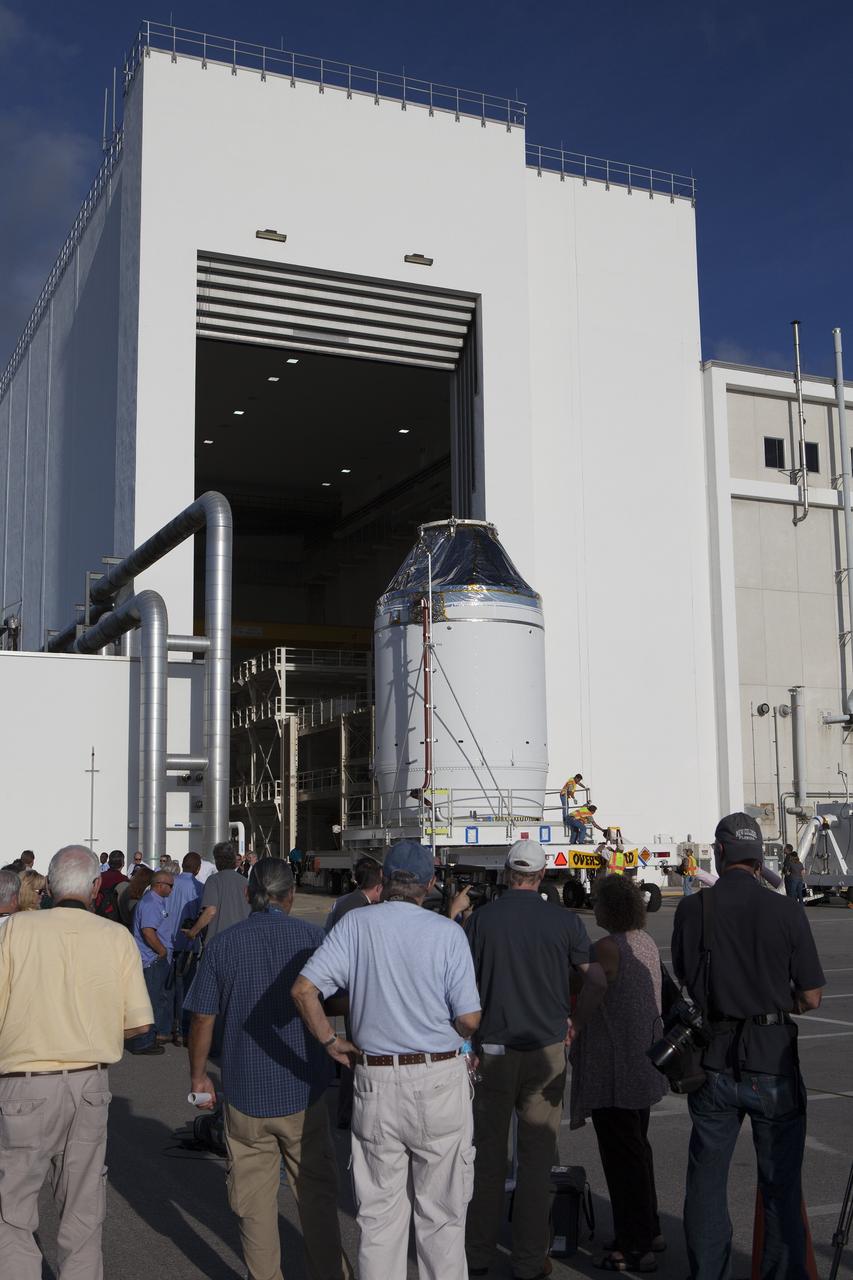
CAPE CANAVERAL, Fla. – Reporters and photographers watch as the Orion crew module, stacked atop its service module, moves out of the Neil Armstrong Operations and Checkout Building high bay at NASA's Kennedy Space Center in Florida. The spacecraft for Exploration Flight Test-1 will be transported to the Payload Hazardous Servicing Facility where it will be fueled ahead of its December flight test. Orion is the exploration spacecraft designed to carry astronauts to destinations not yet explored by humans, including an asteroid and Mars. It will have emergency abort capability, sustain the crew during space travel and provide safe re-entry from deep space return velocities. The first unpiloted test flight of the Orion is scheduled to launch atop a United Launch Alliance Delta IV Heavy rocket from Cape Canaveral Air Force Station in Florida to an altitude of 3,600 miles above the Earth's surface. The two-orbit, four-hour flight test will help engineers evaluate the systems critical to crew safety including the heat shield, parachute system and launch abort system. For more information, visit http://www.nasa.gov/orion. Photo credit: NASA/Daniel Casper
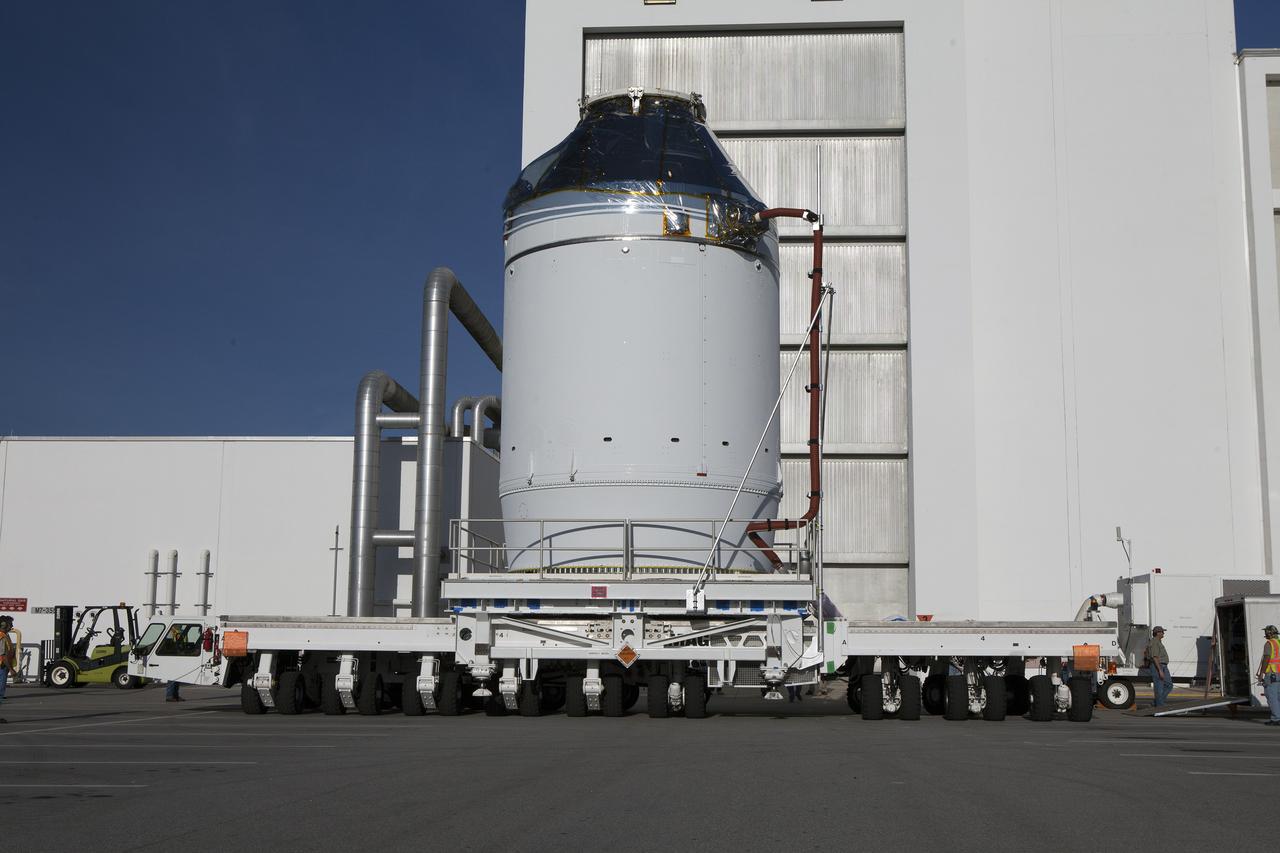
CAPE CANAVERAL, Fla. – The Orion crew module, stacked atop its service module, has moved out of the Neil Armstrong Operations and Checkout Building high bay at NASA's Kennedy Space Center in Florida. The spacecraft for Exploration Flight Test-1 will be transported to the Payload Hazardous Servicing Facility where it will be fueled ahead of its December flight test. Orion is the exploration spacecraft designed to carry astronauts to destinations not yet explored by humans, including an asteroid and Mars. It will have emergency abort capability, sustain the crew during space travel and provide safe re-entry from deep space return velocities. The first unpiloted test flight of the Orion is scheduled to launch atop a United Launch Alliance Delta IV Heavy rocket from Cape Canaveral Air Force Station in Florida to an altitude of 3,600 miles above the Earth's surface. The two-orbit, four-hour flight test will help engineers evaluate the systems critical to crew safety including the heat shield, parachute system and launch abort system. For more information, visit http://www.nasa.gov/orion. Photo credit: NASA/Daniel Casper
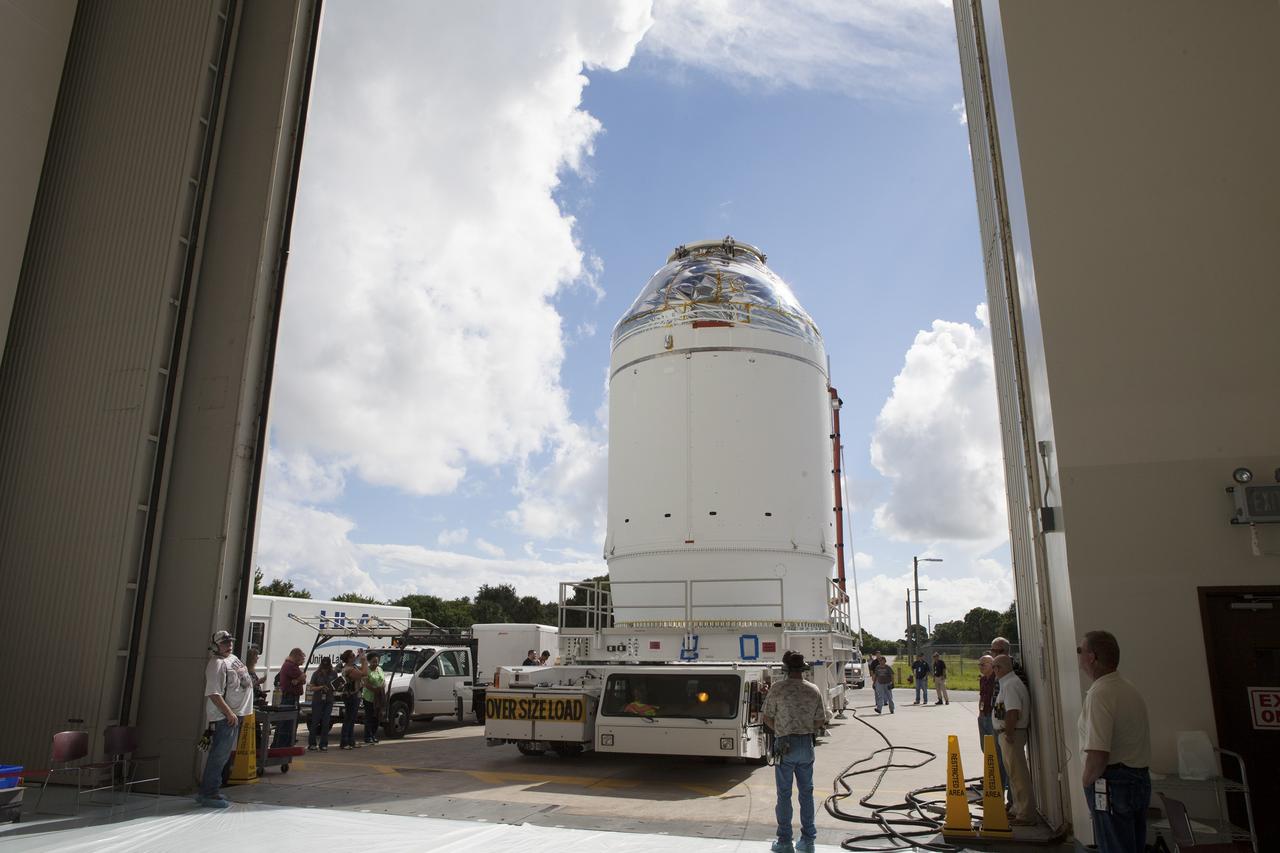
CAPE CANAVERAL, Fla. – The Orion crew module, stacked atop its service module, is transported into the Payload Hazardous Servicing Facility at NASA's Kennedy Space Center in Florida, where it will be fueled ahead of its December flight. The spacecraft for Exploration Flight Test-1 was moved out of the Neil Armstrong Operations and Checkout Building high bay. Orion is the exploration spacecraft designed to carry astronauts to destinations not yet explored by humans, including an asteroid and Mars. It will have emergency abort capability, sustain the crew during space travel and provide safe re-entry from deep space return velocities. The first unpiloted test flight of the Orion is scheduled to launch atop a United Launch Alliance Delta IV Heavy rocket from Cape Canaveral Air Force Station in Florida to an altitude of 3,600 miles above the Earth's surface. The two-orbit, four-hour flight test will help engineers evaluate the systems critical to crew safety including the heat shield, parachute system and launch abort system. For more information, visit http://www.nasa.gov/orion. Photo credit: NASA/Daniel Casper

CAPE CANAVERAL, Fla. – The Orion crew module, stacked atop its service module, is being transported to the Payload Hazardous Servicing Facility at NASA's Kennedy Space Center in Florida, where it will be fueled ahead of its December flight. The spacecraft for Exploration Flight Test-1 was moved out of the Neil Armstrong Operations and Checkout Building high bay. Orion is the exploration spacecraft designed to carry astronauts to destinations not yet explored by humans, including an asteroid and Mars. It will have emergency abort capability, sustain the crew during space travel and provide safe re-entry from deep space return velocities. The first unpiloted test flight of the Orion is scheduled to launch atop a United Launch Alliance Delta IV Heavy rocket from Cape Canaveral Air Force Station in Florida to an altitude of 3,600 miles above the Earth's surface. The two-orbit, four-hour flight test will help engineers evaluate the systems critical to crew safety including the heat shield, parachute system and launch abort system. For more information, visit http://www.nasa.gov/orion. Photo credit: NASA/Daniel Casper
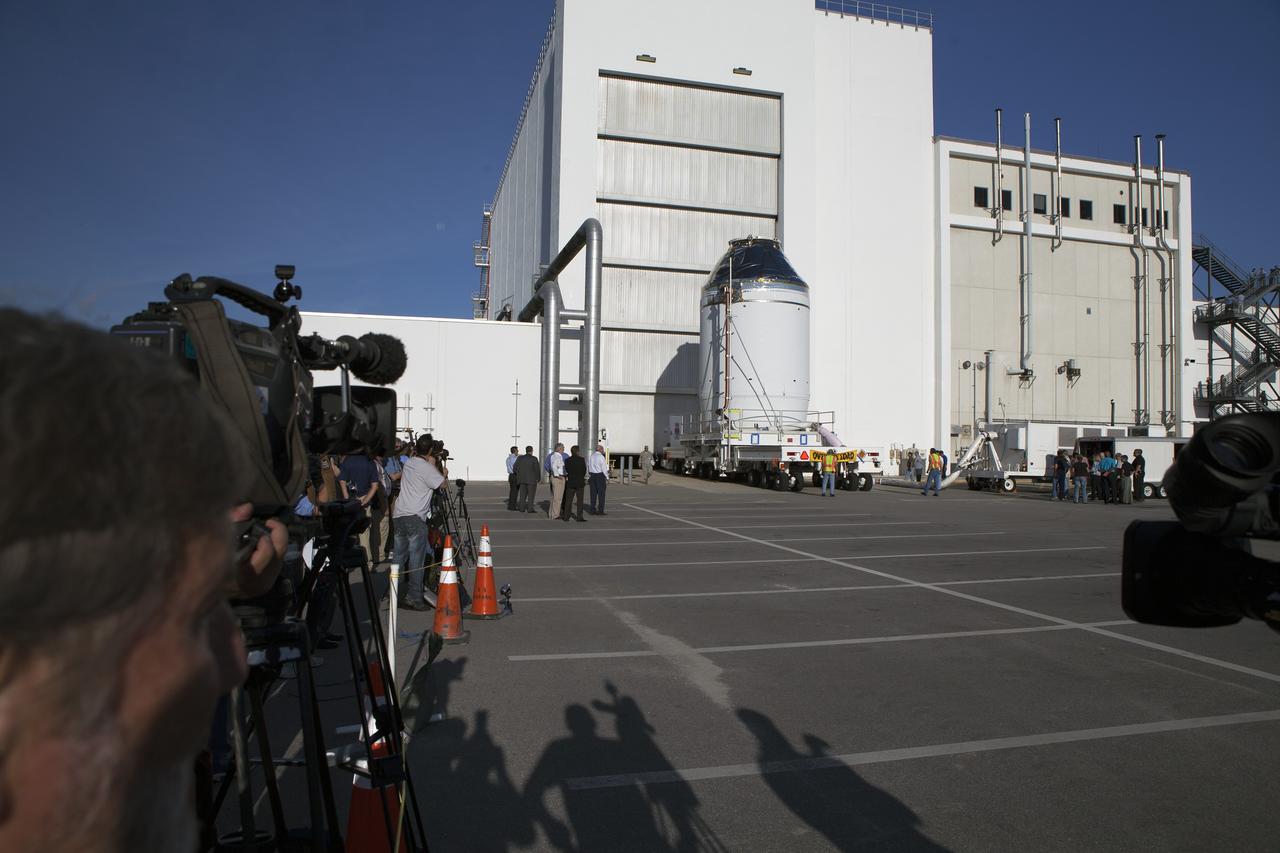
CAPE CANAVERAL, Fla. – The Orion crew module, stacked atop its service module, has moved out of the Neil Armstrong Operations and Checkout Building high bay at NASA's Kennedy Space Center in Florida. The spacecraft for Exploration Flight Test-1 will be transported to the Payload Hazardous Servicing Facility where it will be fueled ahead of its December flight test. Orion is the exploration spacecraft designed to carry astronauts to destinations not yet explored by humans, including an asteroid and Mars. It will have emergency abort capability, sustain the crew during space travel and provide safe re-entry from deep space return velocities. The first unpiloted test flight of the Orion is scheduled to launch atop a United Launch Alliance Delta IV Heavy rocket from Cape Canaveral Air Force Station in Florida to an altitude of 3,600 miles above the Earth's surface. The two-orbit, four-hour flight test will help engineers evaluate the systems critical to crew safety including the heat shield, parachute system and launch abort system. For more information, visit http://www.nasa.gov/orion. Photo credit: NASA/Daniel Casper
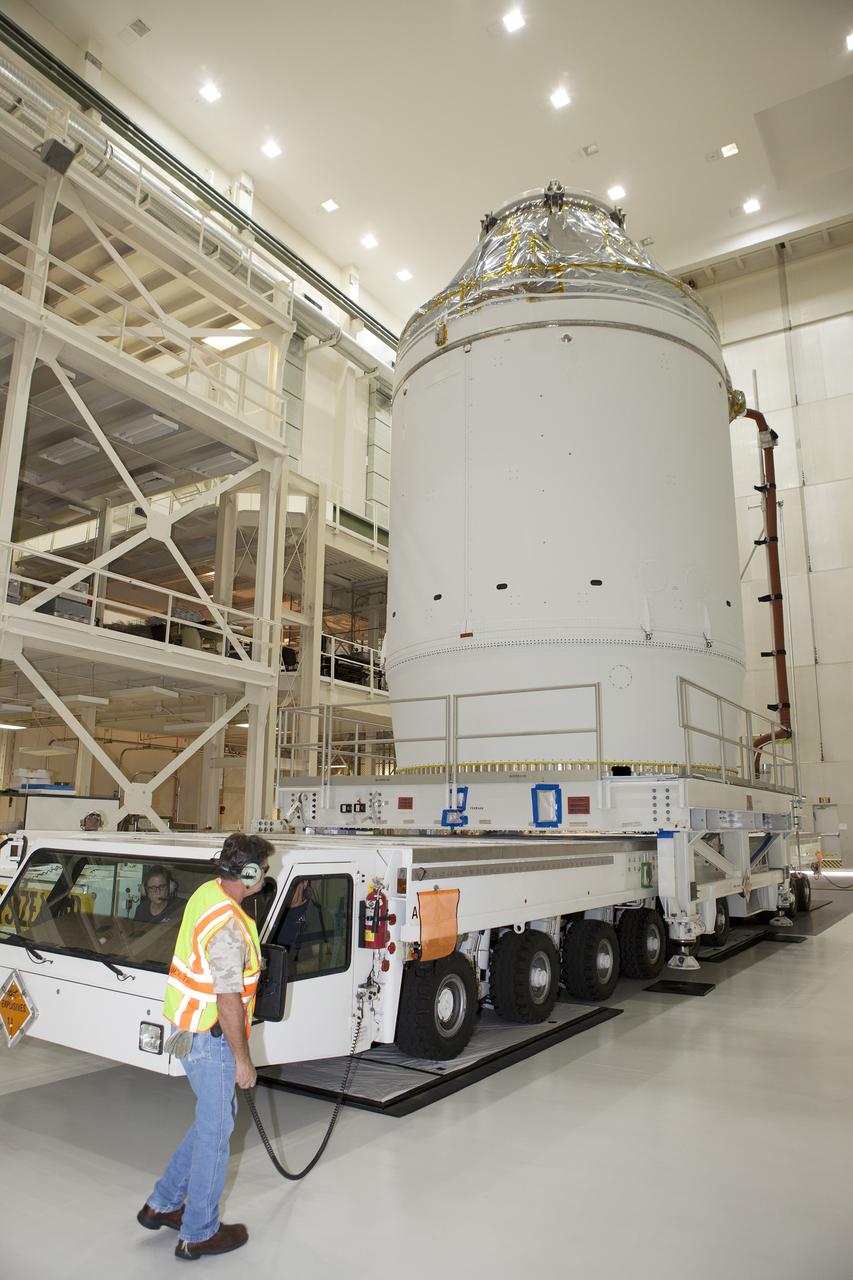
CAPE CANAVERAL, Fla. – The Orion crew module, stacked atop its service module, is being prepared for its move out of the Neil Armstrong Operations and Checkout Building high bay at NASA's Kennedy Space Center in Florida. The spacecraft for Exploration Flight Test-1 will be transported to the Payload Hazardous Servicing Facility where it will be fueled ahead of its December flight test. Orion is the exploration spacecraft designed to carry astronauts to destinations not yet explored by humans, including an asteroid and Mars. It will have emergency abort capability, sustain the crew during space travel and provide safe re-entry from deep space return velocities. The first unpiloted test flight of the Orion is scheduled to launch atop a United Launch Alliance Delta IV Heavy rocket from Cape Canaveral Air Force Station in Florida to an altitude of 3,600 miles above the Earth's surface. The two-orbit, four-hour flight test will help engineers evaluate the systems critical to crew safety including the heat shield, parachute system and launch abort system. For more information, visit http://www.nasa.gov/orion. Photo credit: NASA/Daniel Casper

CAPE CANAVERAL, Fla. – Preparations are underway at the Neil Armstrong Operations and Checkout Building at NASA's Kennedy Space Center in Florida for the move of the Orion spacecraft for Exploration Flight Test-1 out of the high bay doors. Inside the high bay, Kennedy Associate Director Kelvin Manning, at left, talks with a worker. The spacecraft will be transported to the Payload Hazardous Servicing Facility where it will be fueled ahead of its December flight test. Orion is the exploration spacecraft designed to carry astronauts to destinations not yet explored by humans, including an asteroid and Mars. It will have emergency abort capability, sustain the crew during space travel and provide safe re-entry from deep space return velocities. The first unpiloted test flight of the Orion is scheduled to launch atop a United Launch Alliance Delta IV Heavy rocket from Cape Canaveral Air Force Station in Florida to an altitude of 3,600 miles above the Earth's surface. The two-orbit, four-hour flight test will help engineers evaluate the systems critical to crew safety including the heat shield, parachute system and launch abort system. For more information, visit http://www.nasa.gov/orion. Photo credit: NASA/Daniel Casper
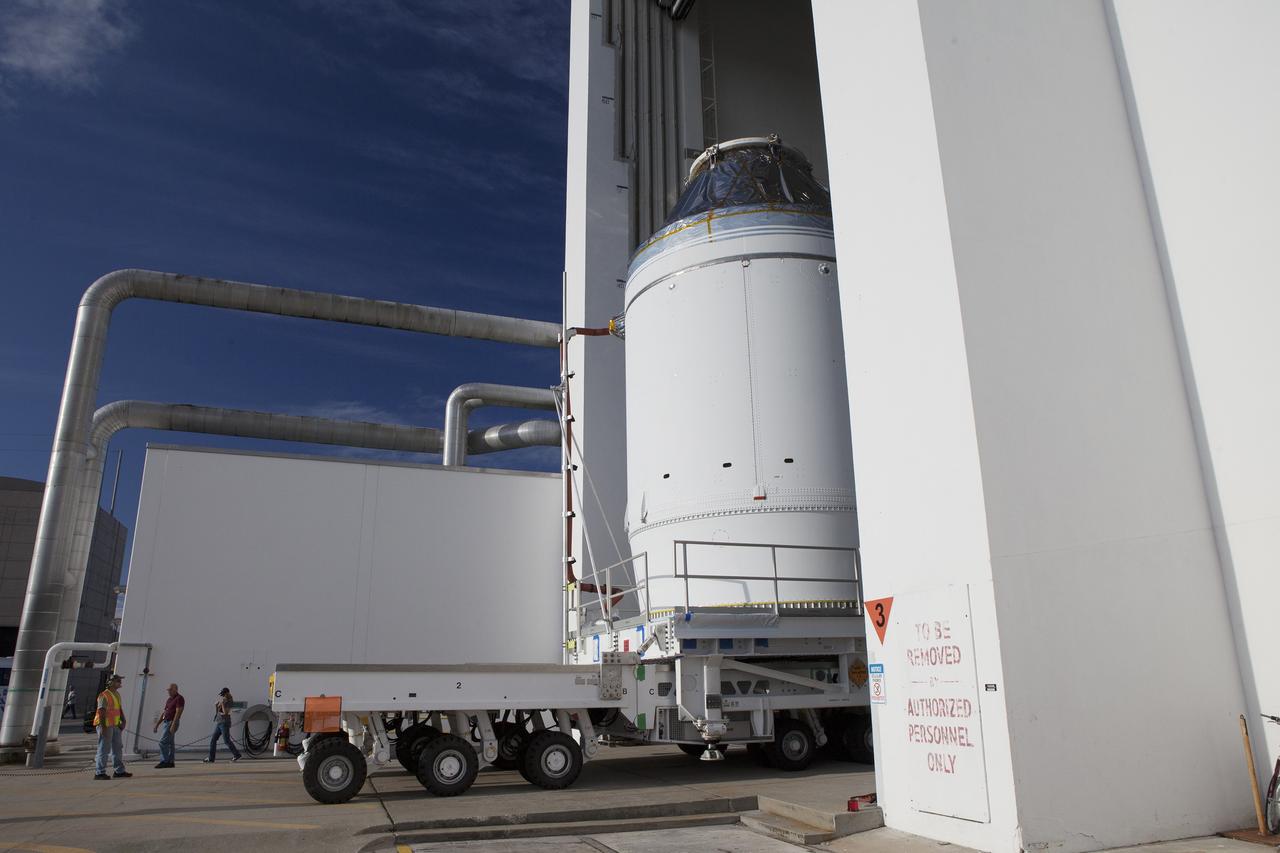
CAPE CANAVERAL, Fla. – The Orion crew module, stacked atop its service module, is slowly transported through the Neil Armstrong Operations and Checkout Building high bay door at NASA's Kennedy Space Center in Florida. The spacecraft for Exploration Flight Test-1 will be transported to the Payload Hazardous Servicing Facility where it will be fueled ahead of its December flight test. Orion is the exploration spacecraft designed to carry astronauts to destinations not yet explored by humans, including an asteroid and Mars. It will have emergency abort capability, sustain the crew during space travel and provide safe re-entry from deep space return velocities. The first unpiloted test flight of the Orion is scheduled to launch atop a United Launch Alliance Delta IV Heavy rocket from Cape Canaveral Air Force Station in Florida to an altitude of 3,600 miles above the Earth's surface. The two-orbit, four-hour flight test will help engineers evaluate the systems critical to crew safety including the heat shield, parachute system and launch abort system. For more information, visit http://www.nasa.gov/orion. Photo credit: NASA/Daniel Casper
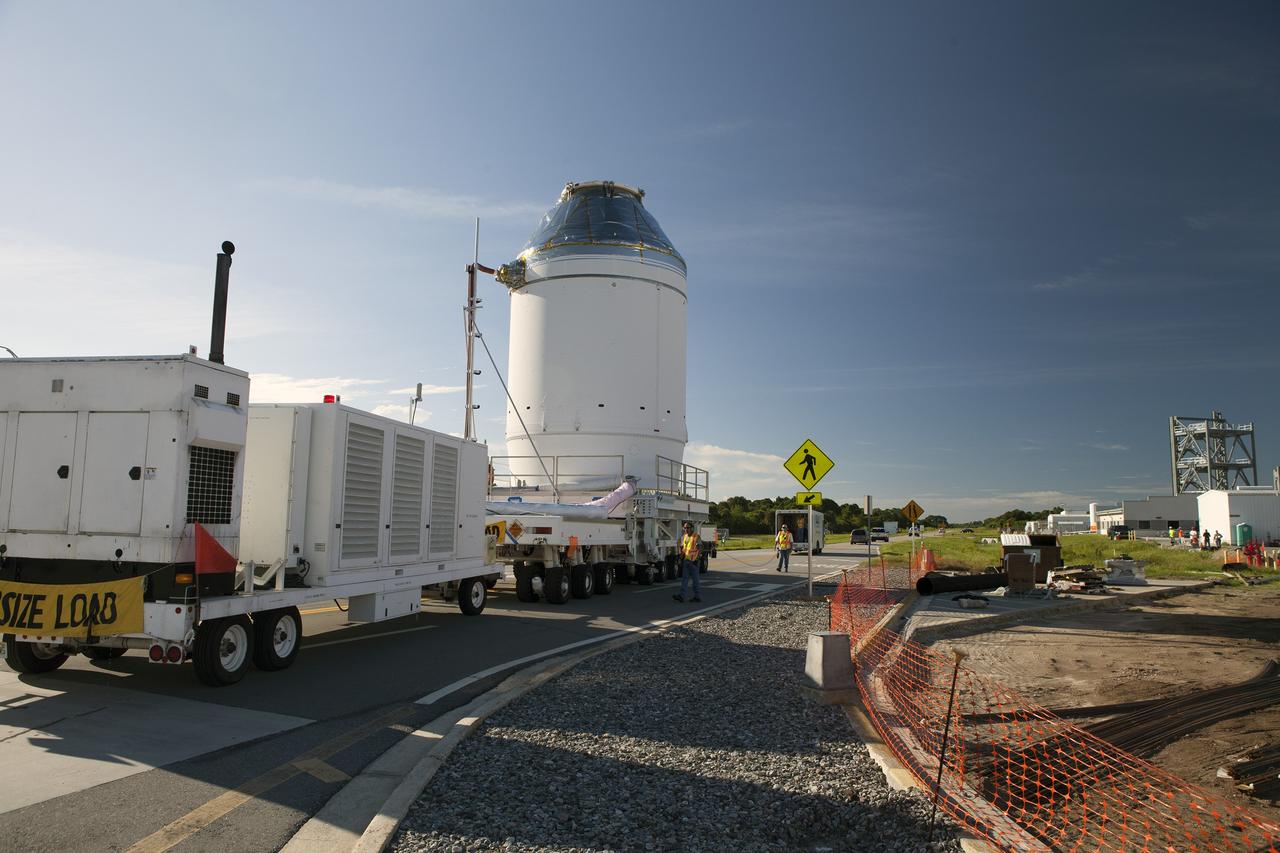
CAPE CANAVERAL, Fla. – The Orion crew module, stacked atop its service module, has moved out of the Neil Armstrong Operations and Checkout Building high bay at NASA's Kennedy Space Center in Florida. The spacecraft for Exploration Flight Test-1 is being transported to the Payload Hazardous Servicing Facility where it will be fueled ahead of its December flight test. Orion is the exploration spacecraft designed to carry astronauts to destinations not yet explored by humans, including an asteroid and Mars. It will have emergency abort capability, sustain the crew during space travel and provide safe re-entry from deep space return velocities. The first unpiloted test flight of the Orion is scheduled to launch atop a United Launch Alliance Delta IV Heavy rocket from Cape Canaveral Air Force Station in Florida to an altitude of 3,600 miles above the Earth's surface. The two-orbit, four-hour flight test will help engineers evaluate the systems critical to crew safety including the heat shield, parachute system and launch abort system. For more information, visit http://www.nasa.gov/orion. Photo credit: NASA/Daniel Casper
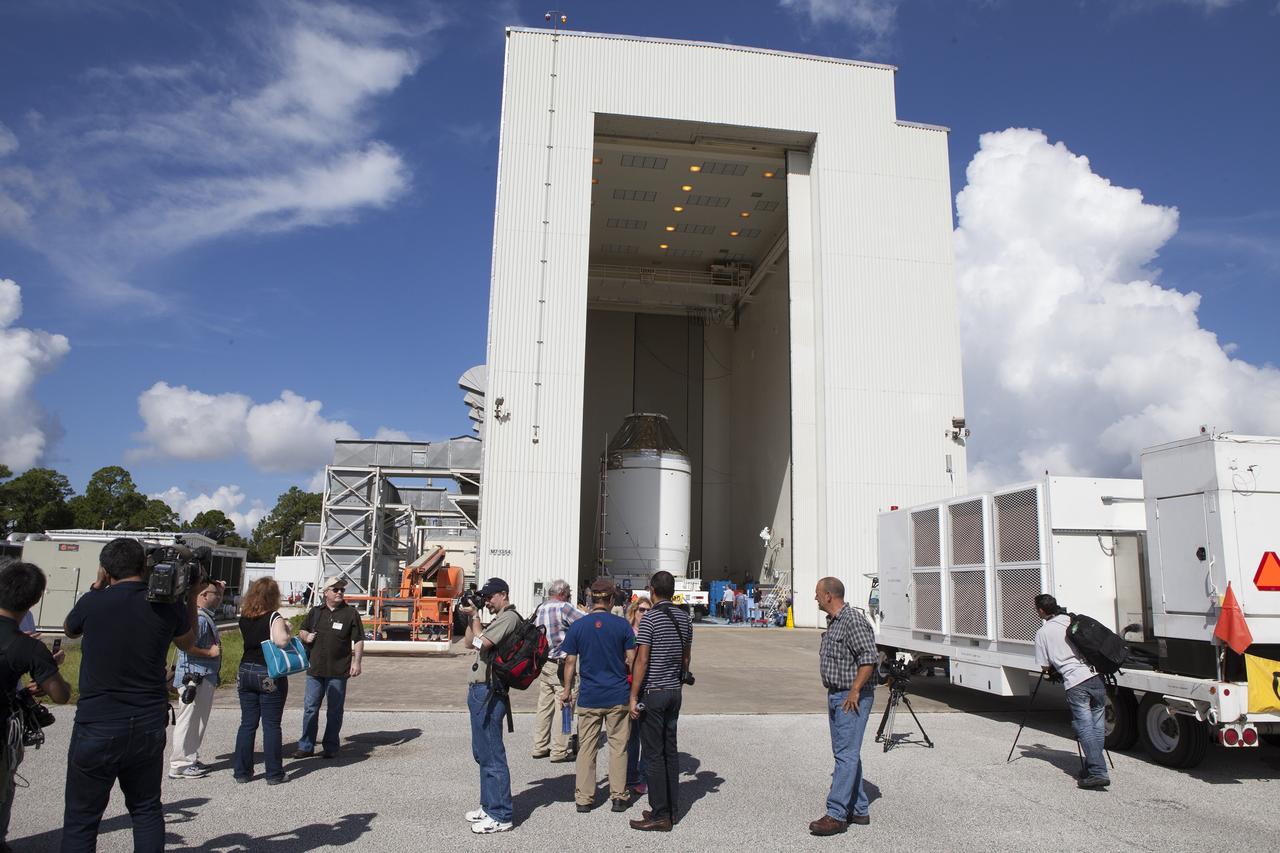
CAPE CANAVERAL, Fla. – Reporters and photographers watch as the Orion crew module, stacked atop its service module, is transported into the Payload Hazardous Servicing Facility at NASA's Kennedy Space Center in Florida, where it will be fueled ahead of its December flight. The spacecraft for Exploration Flight Test-1 was moved out of the Neil Armstrong Operations and Checkout Building high bay. Orion is the exploration spacecraft designed to carry astronauts to destinations not yet explored by humans, including an asteroid and Mars. It will have emergency abort capability, sustain the crew during space travel and provide safe re-entry from deep space return velocities. The first unpiloted test flight of the Orion is scheduled to launch atop a United Launch Alliance Delta IV Heavy rocket from Cape Canaveral Air Force Station in Florida to an altitude of 3,600 miles above the Earth's surface. The two-orbit, four-hour flight test will help engineers evaluate the systems critical to crew safety including the heat shield, parachute system and launch abort system. For more information, visit http://www.nasa.gov/orion. Photo credit: NASA/Daniel Casper
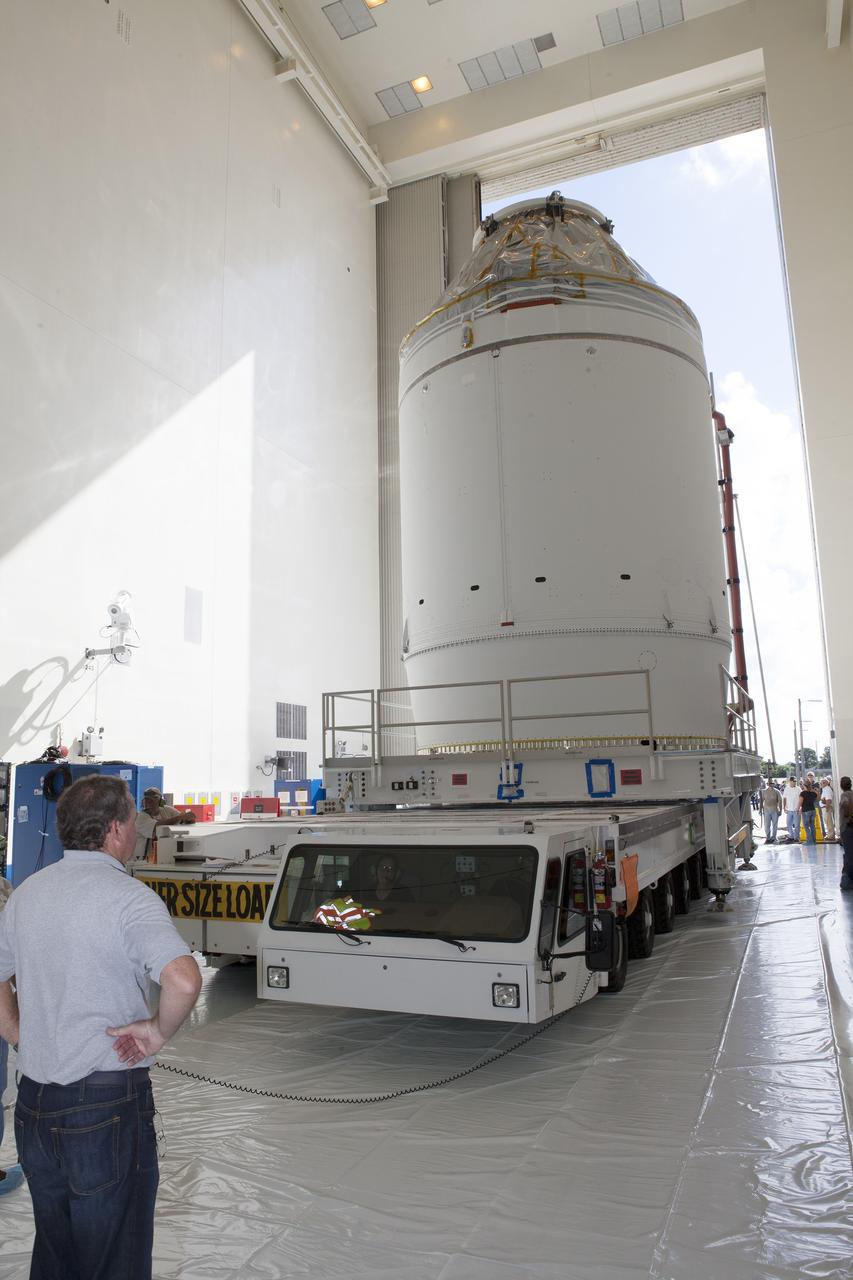
CAPE CANAVERAL, Fla. – The Orion crew module, stacked atop its service module, is transported into the Payload Hazardous Servicing Facility at NASA's Kennedy Space Center in Florida, where it will be fueled ahead of its December flight. The spacecraft for Exploration Flight Test-1 was moved out of the Neil Armstrong Operations and Checkout Building high bay. Orion is the exploration spacecraft designed to carry astronauts to destinations not yet explored by humans, including an asteroid and Mars. It will have emergency abort capability, sustain the crew during space travel and provide safe re-entry from deep space return velocities. The first unpiloted test flight of the Orion is scheduled to launch atop a United Launch Alliance Delta IV Heavy rocket from Cape Canaveral Air Force Station in Florida to an altitude of 3,600 miles above the Earth's surface. The two-orbit, four-hour flight test will help engineers evaluate the systems critical to crew safety including the heat shield, parachute system and launch abort system. For more information, visit http://www.nasa.gov/orion. Photo credit: NASA/Daniel Casper
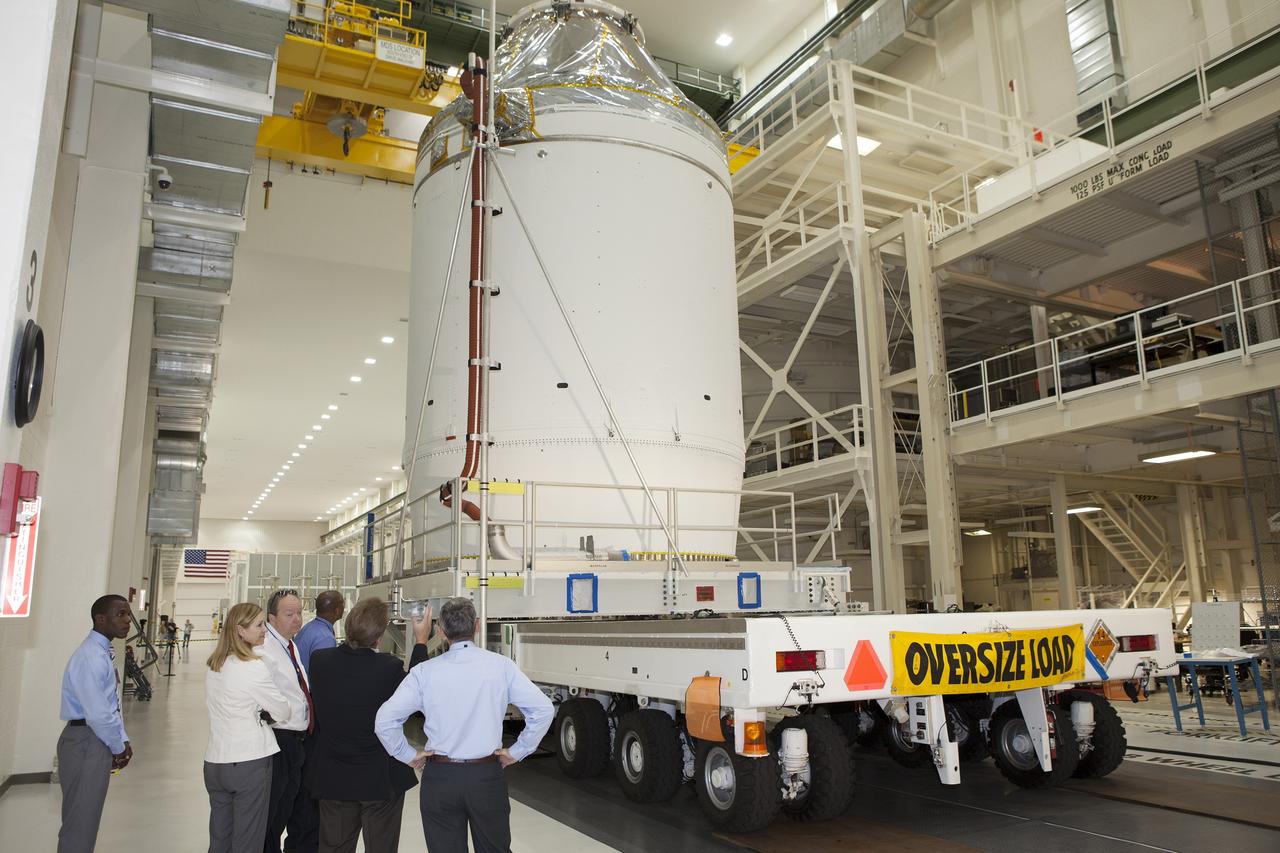
CAPE CANAVERAL, Fla. – The Orion crew module, stacked atop its service module, is being prepared for its move out of the Neil Armstrong Operations and Checkout Building high bay at NASA's Kennedy Space Center in Florida. The spacecraft for Exploration Flight Test-1 will be transported to the Payload Hazardous Servicing Facility where it will be fueled ahead of its December flight test. Orion is the exploration spacecraft designed to carry astronauts to destinations not yet explored by humans, including an asteroid and Mars. It will have emergency abort capability, sustain the crew during space travel and provide safe re-entry from deep space return velocities. The first unpiloted test flight of the Orion is scheduled to launch atop a United Launch Alliance Delta IV Heavy rocket from Cape Canaveral Air Force Station in Florida to an altitude of 3,600 miles above the Earth's surface. The two-orbit, four-hour flight test will help engineers evaluate the systems critical to crew safety including the heat shield, parachute system and launch abort system. For more information, visit http://www.nasa.gov/orion. Photo credit: NASA/Daniel Casper
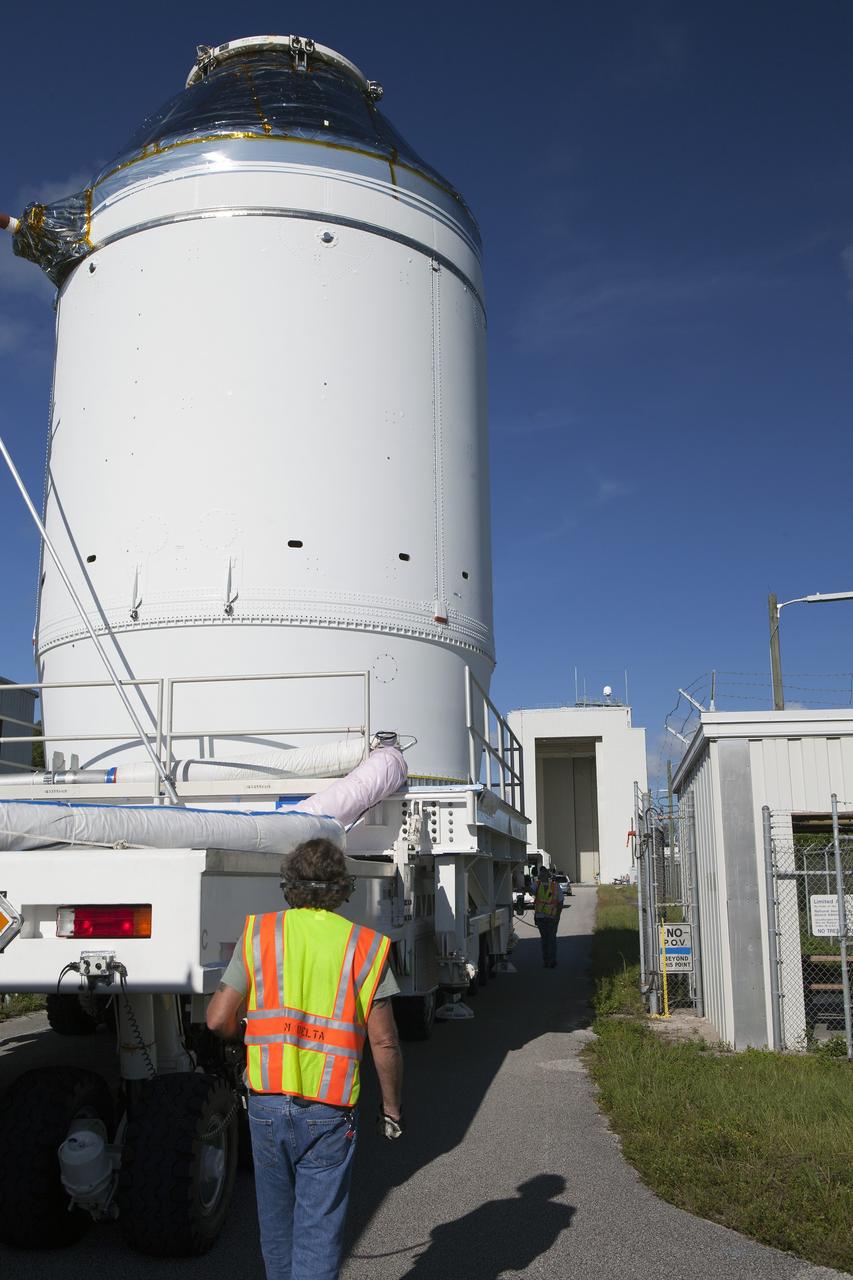
CAPE CANAVERAL, Fla. – The Orion crew module, stacked atop its service module, is being transported to the Payload Hazardous Servicing Facility at NASA's Kennedy Space Center in Florida, where it will be fueled ahead of its December flight. The spacecraft for Exploration Flight Test-1 was moved out of the Neil Armstrong Operations and Checkout Building high bay. Orion is the exploration spacecraft designed to carry astronauts to destinations not yet explored by humans, including an asteroid and Mars. It will have emergency abort capability, sustain the crew during space travel and provide safe re-entry from deep space return velocities. The first unpiloted test flight of the Orion is scheduled to launch atop a United Launch Alliance Delta IV Heavy rocket from Cape Canaveral Air Force Station in Florida to an altitude of 3,600 miles above the Earth's surface. The two-orbit, four-hour flight test will help engineers evaluate the systems critical to crew safety including the heat shield, parachute system and launch abort system. For more information, visit http://www.nasa.gov/orion. Photo credit: NASA/Daniel Casper
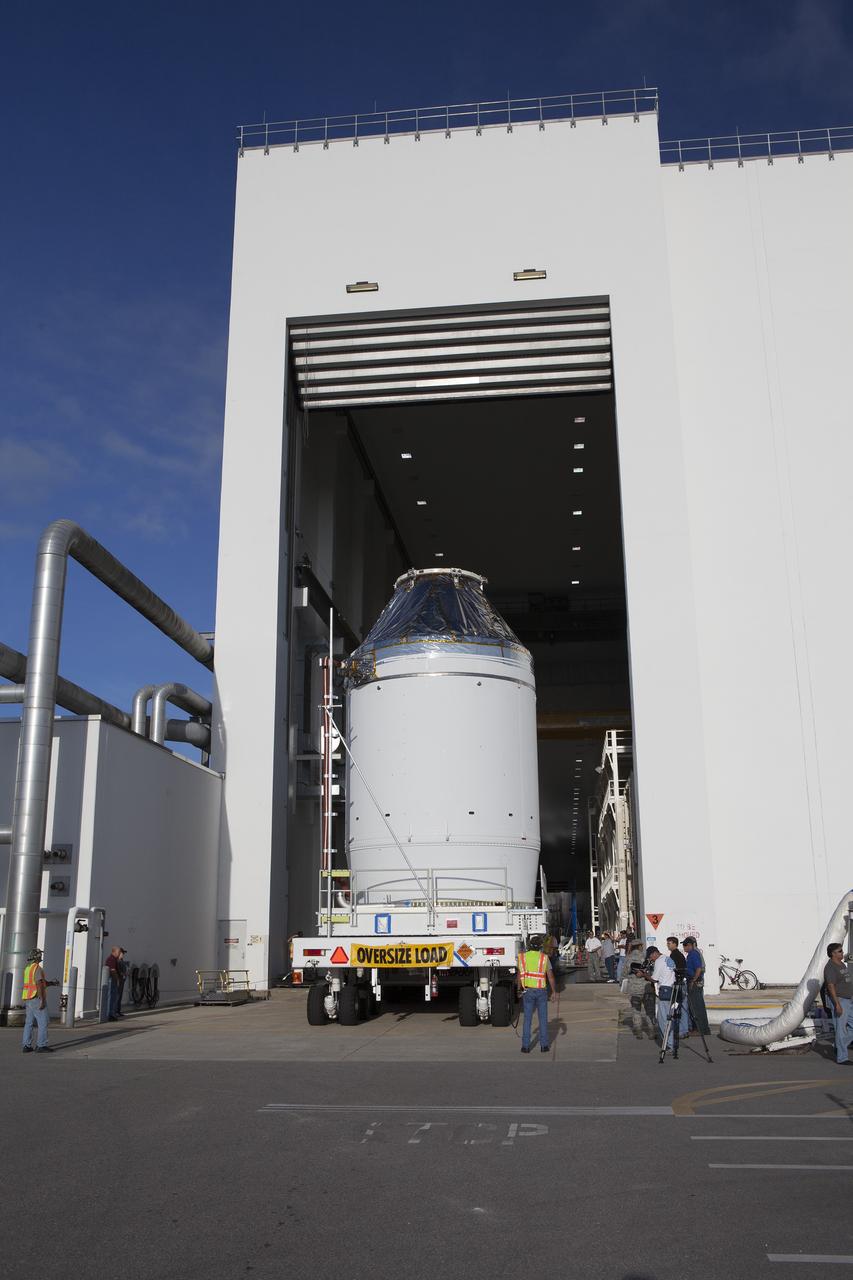
CAPE CANAVERAL, Fla. – The Orion crew module, stacked atop its service module, is slowly transported through the Neil Armstrong Operations and Checkout Building high bay door at NASA's Kennedy Space Center in Florida. The spacecraft for Exploration Flight Test-1 will be transported to the Payload Hazardous Servicing Facility where it will be fueled ahead of its December flight test. Orion is the exploration spacecraft designed to carry astronauts to destinations not yet explored by humans, including an asteroid and Mars. It will have emergency abort capability, sustain the crew during space travel and provide safe re-entry from deep space return velocities. The first unpiloted test flight of the Orion is scheduled to launch atop a United Launch Alliance Delta IV Heavy rocket from Cape Canaveral Air Force Station in Florida to an altitude of 3,600 miles above the Earth's surface. The two-orbit, four-hour flight test will help engineers evaluate the systems critical to crew safety including the heat shield, parachute system and launch abort system. For more information, visit http://www.nasa.gov/orion. Photo credit: NASA/Daniel Casper
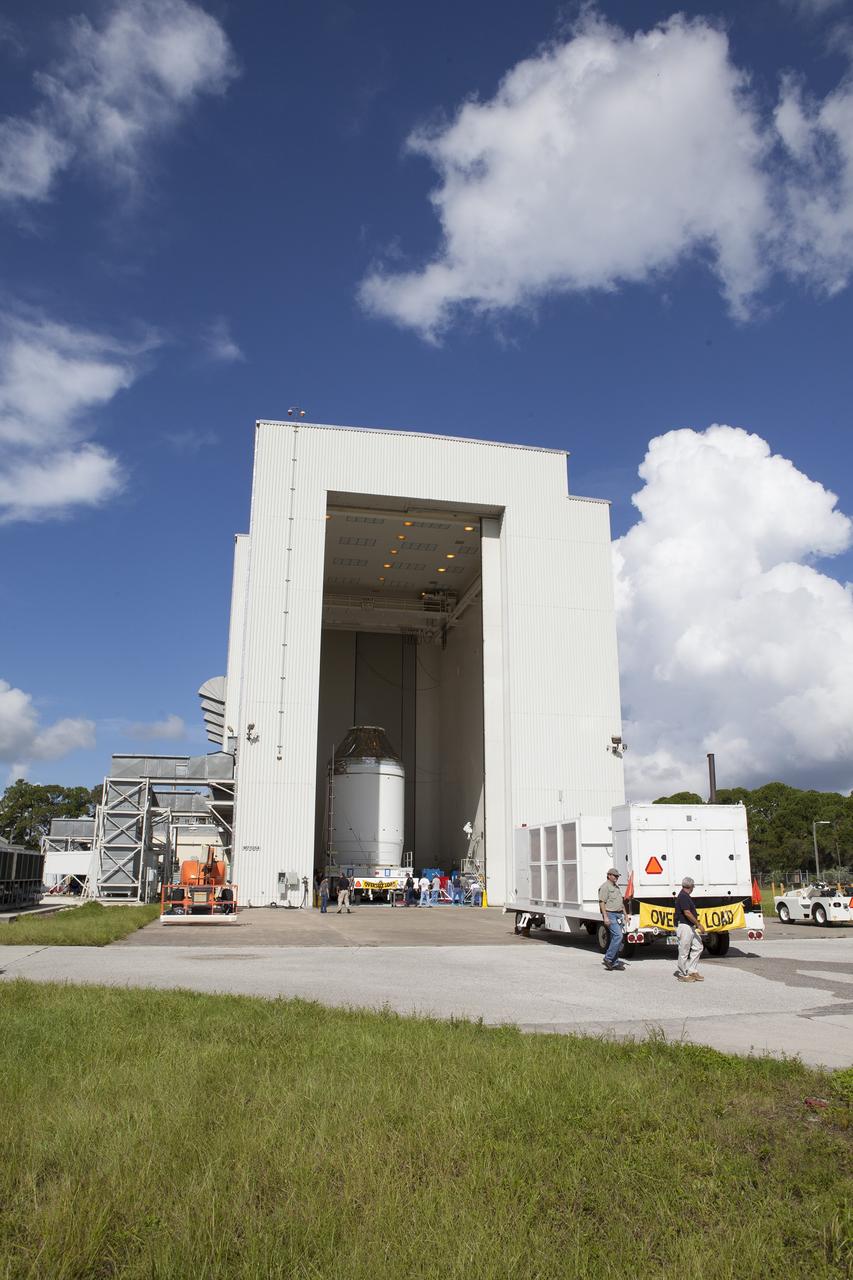
CAPE CANAVERAL, Fla. – The Orion crew module, stacked atop its service module, has been moved into the Payload Hazardous Servicing Facility at NASA's Kennedy Space Center in Florida, where it will be fueled ahead of its December flight. The spacecraft for Exploration Flight Test-1 was moved out of the Neil Armstrong Operations and Checkout Building high bay. Orion is the exploration spacecraft designed to carry astronauts to destinations not yet explored by humans, including an asteroid and Mars. It will have emergency abort capability, sustain the crew during space travel and provide safe re-entry from deep space return velocities. The first unpiloted test flight of the Orion is scheduled to launch atop a United Launch Alliance Delta IV Heavy rocket from Cape Canaveral Air Force Station in Florida to an altitude of 3,600 miles above the Earth's surface. The two-orbit, four-hour flight test will help engineers evaluate the systems critical to crew safety including the heat shield, parachute system and launch abort system. For more information, visit http://www.nasa.gov/orion. Photo credit: NASA/Daniel Casper
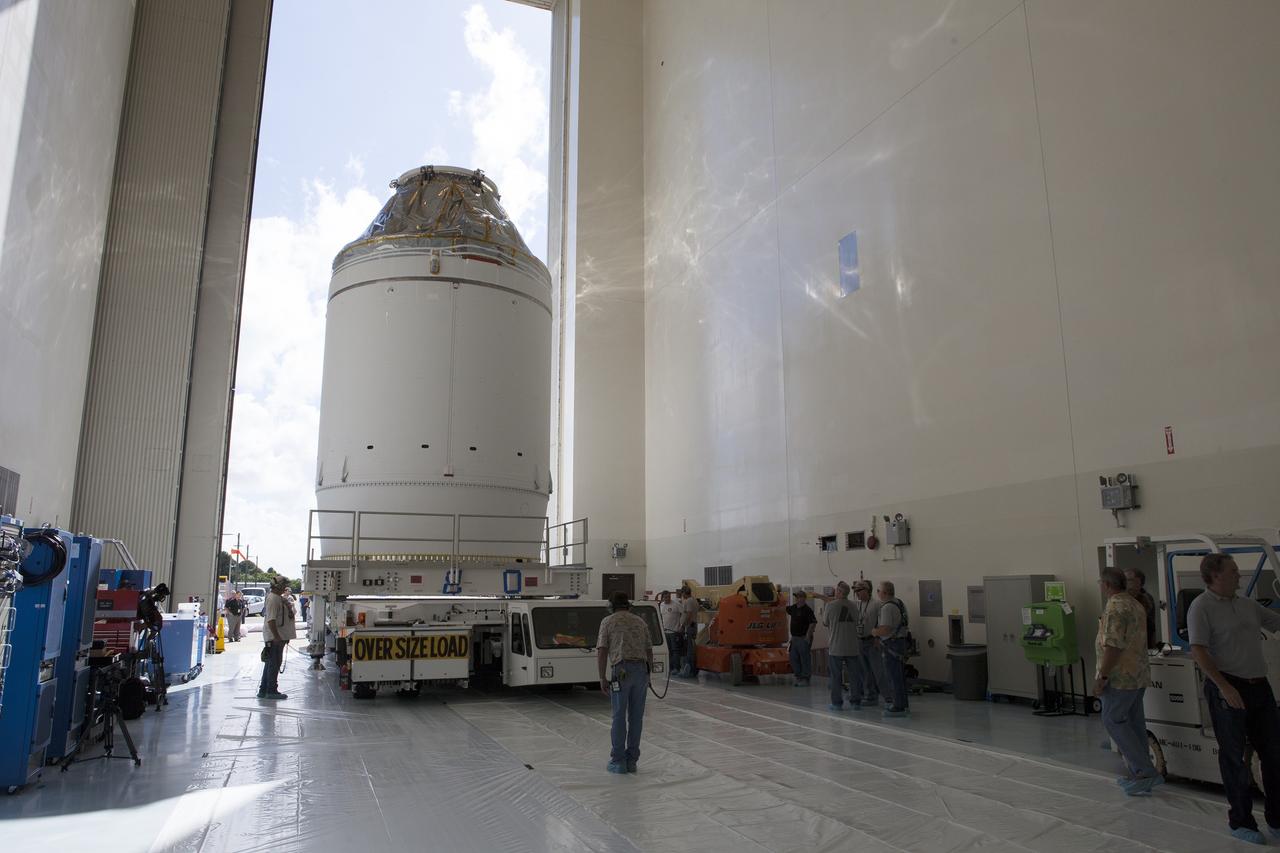
CAPE CANAVERAL, Fla. – The Orion crew module, stacked atop its service module, is transported into the Payload Hazardous Servicing Facility at NASA's Kennedy Space Center in Florida, where it will be fueled ahead of its December flight. The spacecraft for Exploration Flight Test-1 was moved out of the Neil Armstrong Operations and Checkout Building high bay. Orion is the exploration spacecraft designed to carry astronauts to destinations not yet explored by humans, including an asteroid and Mars. It will have emergency abort capability, sustain the crew during space travel and provide safe re-entry from deep space return velocities. The first unpiloted test flight of the Orion is scheduled to launch atop a United Launch Alliance Delta IV Heavy rocket from Cape Canaveral Air Force Station in Florida to an altitude of 3,600 miles above the Earth's surface. The two-orbit, four-hour flight test will help engineers evaluate the systems critical to crew safety including the heat shield, parachute system and launch abort system. For more information, visit http://www.nasa.gov/orion. Photo credit: NASA/Daniel Casper
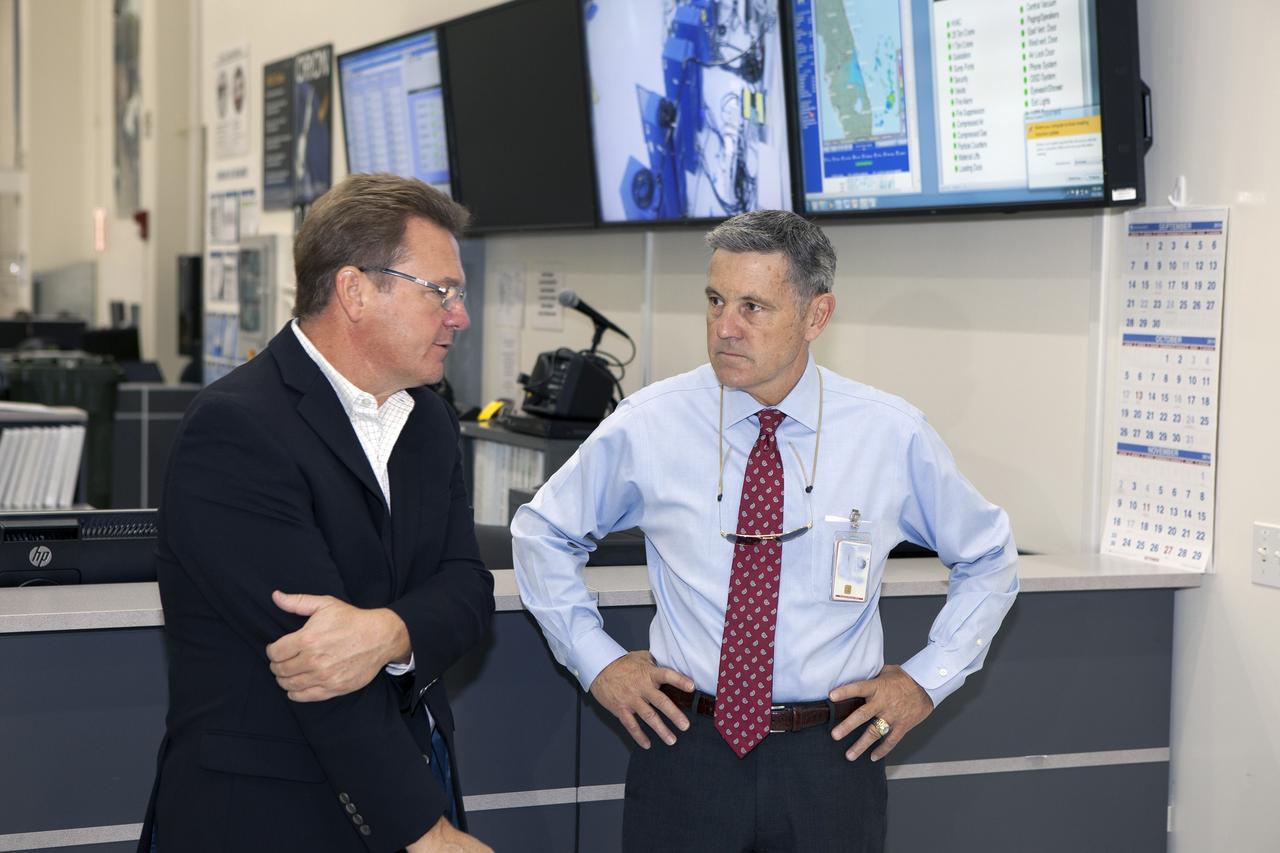
CAPE CANAVERAL, Fla. – Preparations are underway at the Neil Armstrong Operations and Checkout Building at NASA's Kennedy Space Center in Florida for the move of the Orion spacecraft for Exploration Flight Test-1 out of the high bay doors. Inside the high bay from left, are Jules Schneider, Lockheed Martin senior manager, and Kennedy Center Director Bob Cabana. The spacecraft will be transported to the Payload Hazardous Servicing Facility where it will be fueled ahead of its December flight test. Orion is the exploration spacecraft designed to carry astronauts to destinations not yet explored by humans, including an asteroid and Mars. It will have emergency abort capability, sustain the crew during space travel and provide safe re-entry from deep space return velocities. The first unpiloted test flight of the Orion is scheduled to launch atop a United Launch Alliance Delta IV Heavy rocket from Cape Canaveral Air Force Station in Florida to an altitude of 3,600 miles above the Earth's surface. The two-orbit, four-hour flight test will help engineers evaluate the systems critical to crew safety including the heat shield, parachute system and launch abort system. For more information, visit http://www.nasa.gov/orion. Photo credit: NASA/Daniel Casper
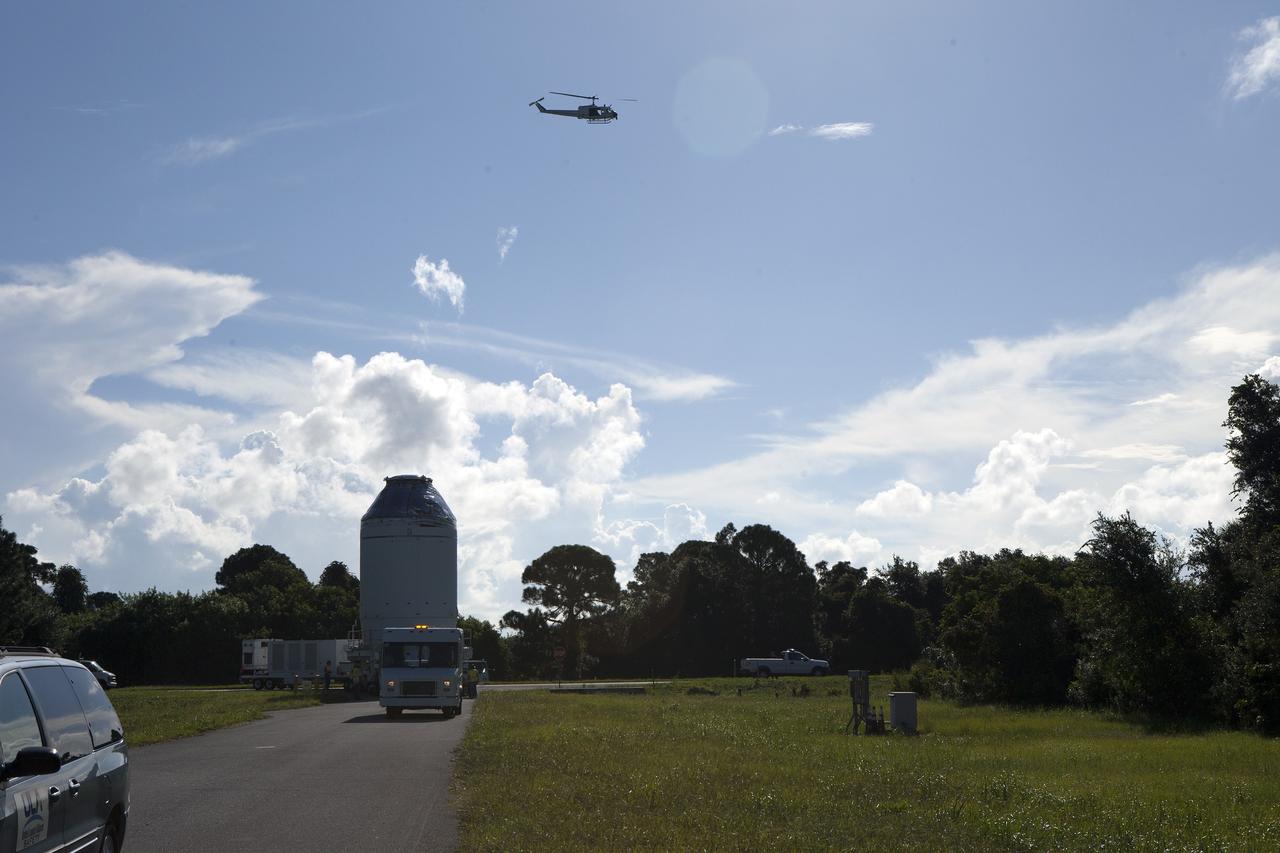
CAPE CANAVERAL, Fla. – A NASA helicopter flies overhead as the Orion crew module, stacked atop its service module, is transported to the Payload Hazardous Servicing Facility at NASA's Kennedy Space Center in Florida, where it will be fueled ahead of its December flight. The spacecraft for Exploration Flight Test-1 was moved out of the Neil Armstrong Operations and Checkout Building high bay. Orion is the exploration spacecraft designed to carry astronauts to destinations not yet explored by humans, including an asteroid and Mars. It will have emergency abort capability, sustain the crew during space travel and provide safe re-entry from deep space return velocities. The first unpiloted test flight of the Orion is scheduled to launch atop a United Launch Alliance Delta IV Heavy rocket from Cape Canaveral Air Force Station in Florida to an altitude of 3,600 miles above the Earth's surface. The two-orbit, four-hour flight test will help engineers evaluate the systems critical to crew safety including the heat shield, parachute system and launch abort system. For more information, visit http://www.nasa.gov/orion. Photo credit: NASA/Daniel Casper
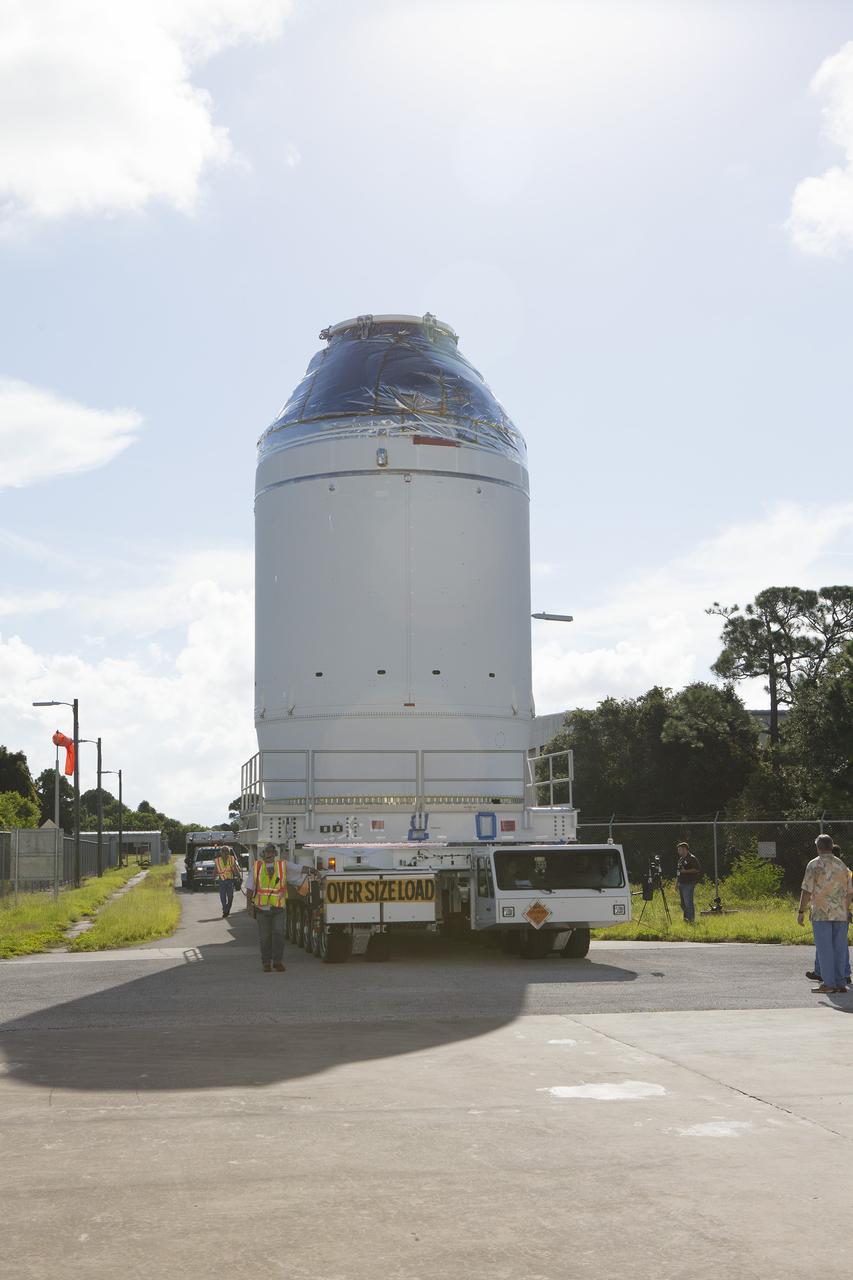
CAPE CANAVERAL, Fla. – The Orion crew module, stacked atop its service module, is being transported to the Payload Hazardous Servicing Facility at NASA's Kennedy Space Center in Florida, where it will be fueled ahead of its December flight. The spacecraft for Exploration Flight Test-1 was moved out of the Neil Armstrong Operations and Checkout Building high bay. Orion is the exploration spacecraft designed to carry astronauts to destinations not yet explored by humans, including an asteroid and Mars. It will have emergency abort capability, sustain the crew during space travel and provide safe re-entry from deep space return velocities. The first unpiloted test flight of the Orion is scheduled to launch atop a United Launch Alliance Delta IV Heavy rocket from Cape Canaveral Air Force Station in Florida to an altitude of 3,600 miles above the Earth's surface. The two-orbit, four-hour flight test will help engineers evaluate the systems critical to crew safety including the heat shield, parachute system and launch abort system. For more information, visit http://www.nasa.gov/orion. Photo credit: NASA/Daniel Casper
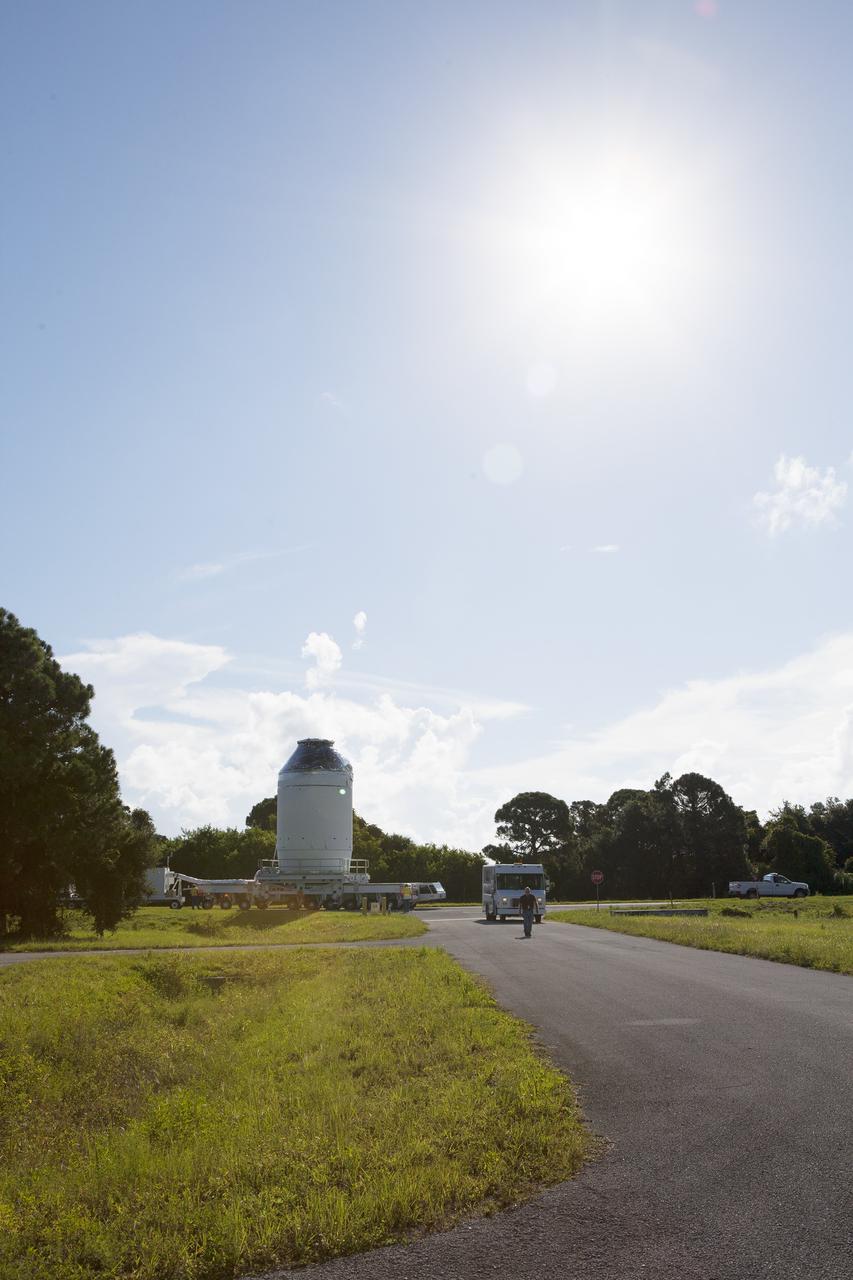
CAPE CANAVERAL, Fla. – The Orion crew module, stacked atop its service module, is being transported to the Payload Hazardous Servicing Facility at NASA's Kennedy Space Center in Florida, where it will be fueled ahead of its December flight. The spacecraft for Exploration Flight Test-1 was moved out of the Neil Armstrong Operations and Checkout Building high bay. Orion is the exploration spacecraft designed to carry astronauts to destinations not yet explored by humans, including an asteroid and Mars. It will have emergency abort capability, sustain the crew during space travel and provide safe re-entry from deep space return velocities. The first unpiloted test flight of the Orion is scheduled to launch atop a United Launch Alliance Delta IV Heavy rocket from Cape Canaveral Air Force Station in Florida to an altitude of 3,600 miles above the Earth's surface. The two-orbit, four-hour flight test will help engineers evaluate the systems critical to crew safety including the heat shield, parachute system and launch abort system. For more information, visit http://www.nasa.gov/orion. Photo credit: NASA/Daniel Casper
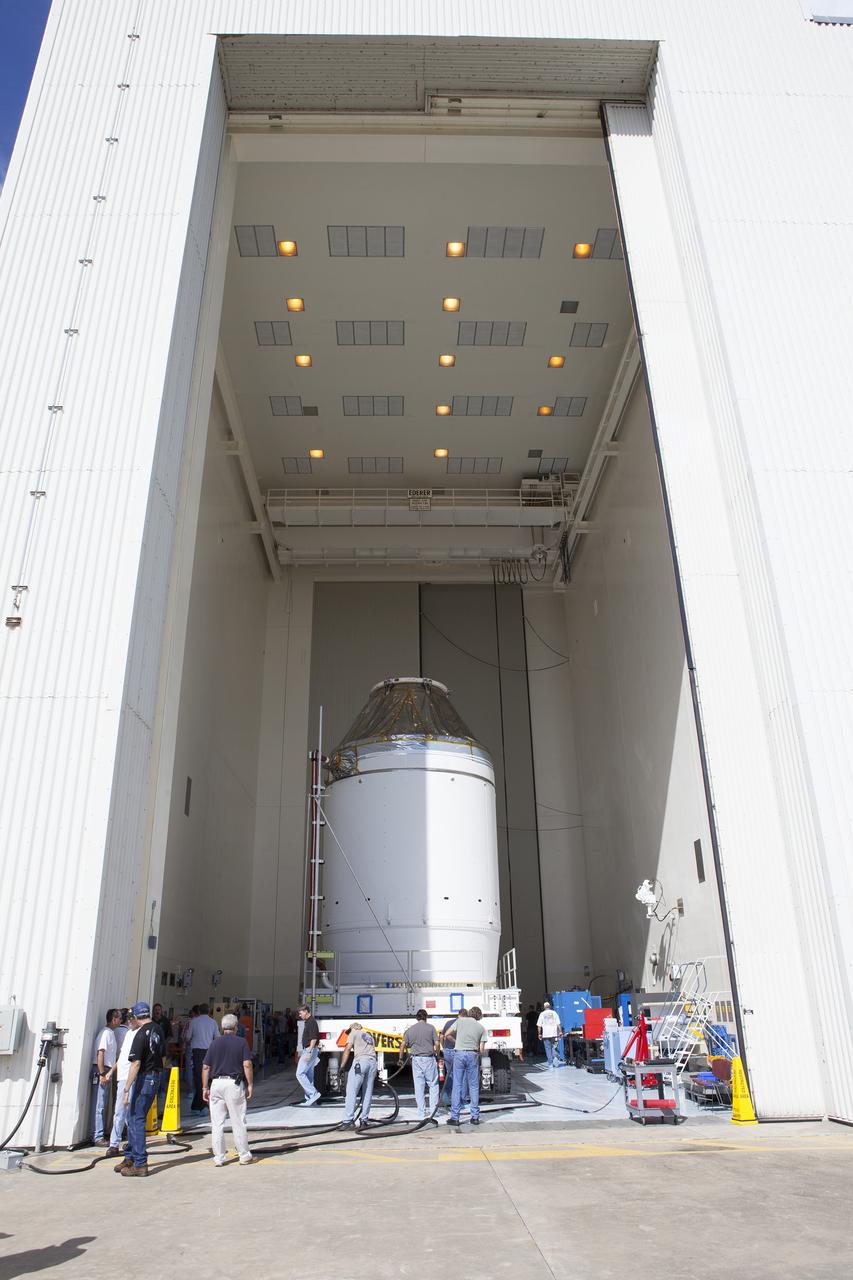
CAPE CANAVERAL, Fla. – Technicians assist as the Orion crew module, stacked atop its service module, is moved into the Payload Hazardous Servicing Facility at NASA's Kennedy Space Center in Florida, where it will be fueled ahead of its December flight. The spacecraft for Exploration Flight Test-1 was moved out of the Neil Armstrong Operations and Checkout Building high bay. Orion is the exploration spacecraft designed to carry astronauts to destinations not yet explored by humans, including an asteroid and Mars. It will have emergency abort capability, sustain the crew during space travel and provide safe re-entry from deep space return velocities. The first unpiloted test flight of the Orion is scheduled to launch atop a United Launch Alliance Delta IV Heavy rocket from Cape Canaveral Air Force Station in Florida to an altitude of 3,600 miles above the Earth's surface. The two-orbit, four-hour flight test will help engineers evaluate the systems critical to crew safety including the heat shield, parachute system and launch abort system. For more information, visit http://www.nasa.gov/orion. Photo credit: NASA/Daniel Casper
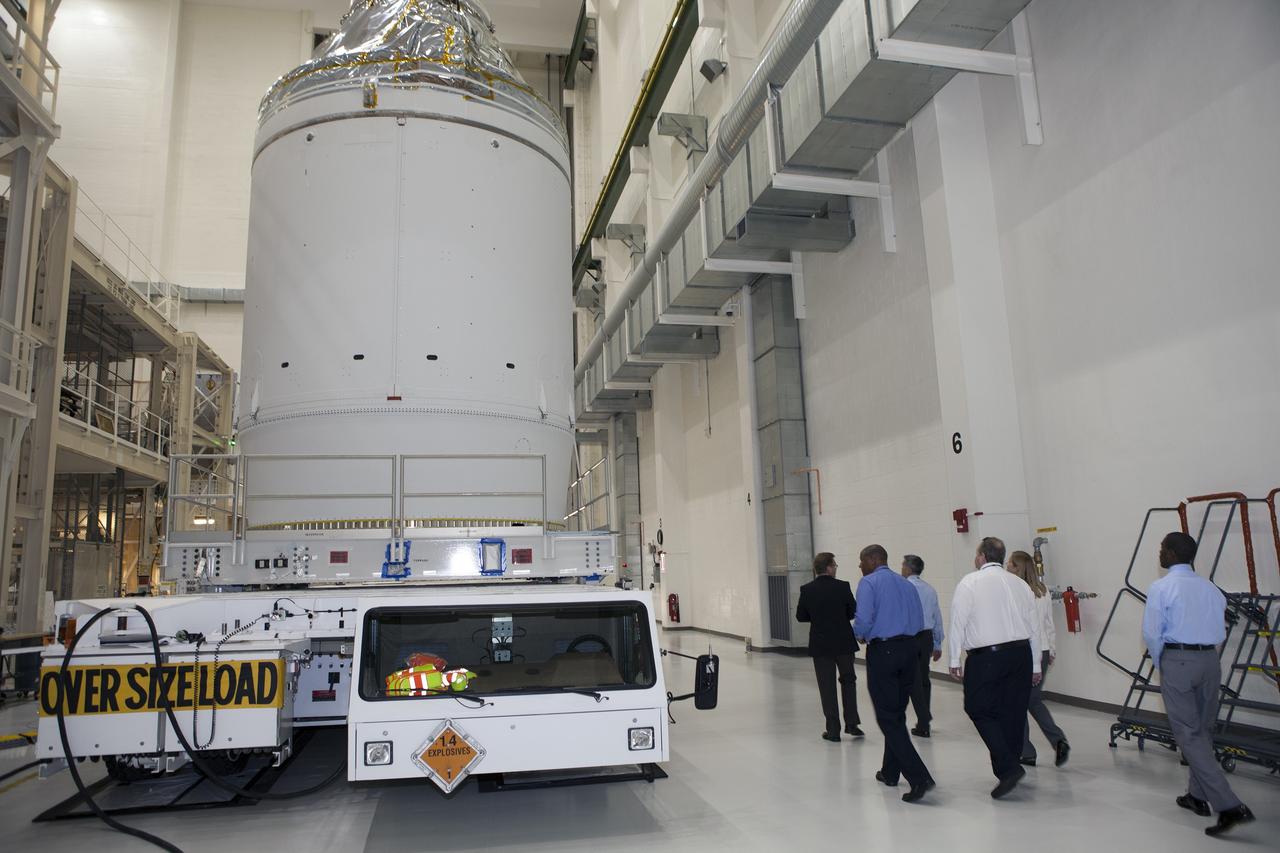
CAPE CANAVERAL, Fla. – The Orion crew module, stacked atop its service module, is being prepared for its move out of the Neil Armstrong Operations and Checkout Building high bay at NASA's Kennedy Space Center in Florida. The spacecraft for Exploration Flight Test-1 will be transported to the Payload Hazardous Servicing Facility where it will be fueled ahead of its December flight test. Orion is the exploration spacecraft designed to carry astronauts to destinations not yet explored by humans, including an asteroid and Mars. It will have emergency abort capability, sustain the crew during space travel and provide safe re-entry from deep space return velocities. The first unpiloted test flight of the Orion is scheduled to launch atop a United Launch Alliance Delta IV Heavy rocket from Cape Canaveral Air Force Station in Florida to an altitude of 3,600 miles above the Earth's surface. The two-orbit, four-hour flight test will help engineers evaluate the systems critical to crew safety including the heat shield, parachute system and launch abort system. For more information, visit http://www.nasa.gov/orion. Photo credit: NASA/Daniel Casper
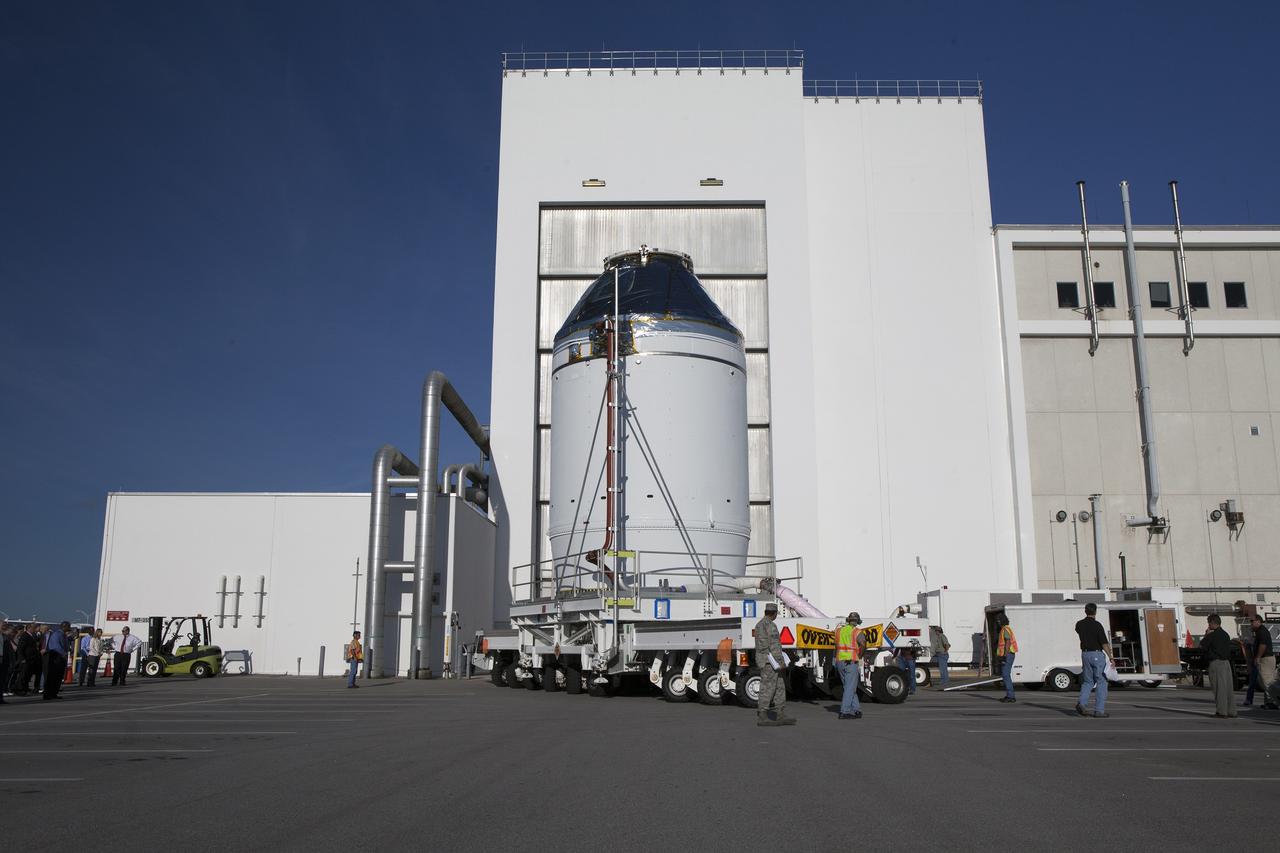
CAPE CANAVERAL, Fla. – The Orion crew module, stacked atop its service module, has moved out of the Neil Armstrong Operations and Checkout Building high bay at NASA's Kennedy Space Center in Florida. The spacecraft for Exploration Flight Test-1 will be transported to the Payload Hazardous Servicing Facility where it will be fueled ahead of its December flight test. Orion is the exploration spacecraft designed to carry astronauts to destinations not yet explored by humans, including an asteroid and Mars. It will have emergency abort capability, sustain the crew during space travel and provide safe re-entry from deep space return velocities. The first unpiloted test flight of the Orion is scheduled to launch atop a United Launch Alliance Delta IV Heavy rocket from Cape Canaveral Air Force Station in Florida to an altitude of 3,600 miles above the Earth's surface. The two-orbit, four-hour flight test will help engineers evaluate the systems critical to crew safety including the heat shield, parachute system and launch abort system. For more information, visit http://www.nasa.gov/orion. Photo credit: NASA/Daniel Casper

CAPE CANAVERAL, Fla. – Kennedy Space Center Director Bob Cabana, at left, watches with reporters and photographers as the Orion crew module, stacked atop its service module, moves out of the Neil Armstrong Operations and Checkout Building high bay at NASA's Kennedy Space Center in Florida. The spacecraft for Exploration Flight Test-1 will be transported to the Payload Hazardous Servicing Facility where it will be fueled ahead of its December flight test. Orion is the exploration spacecraft designed to carry astronauts to destinations not yet explored by humans, including an asteroid and Mars. It will have emergency abort capability, sustain the crew during space travel and provide safe re-entry from deep space return velocities. The first unpiloted test flight of the Orion is scheduled to launch atop a United Launch Alliance Delta IV Heavy rocket from Cape Canaveral Air Force Station in Florida to an altitude of 3,600 miles above the Earth's surface. The two-orbit, four-hour flight test will help engineers evaluate the systems critical to crew safety including the heat shield, parachute system and launch abort system. For more information, visit http://www.nasa.gov/orion. Photo credit: NASA/Daniel Casper
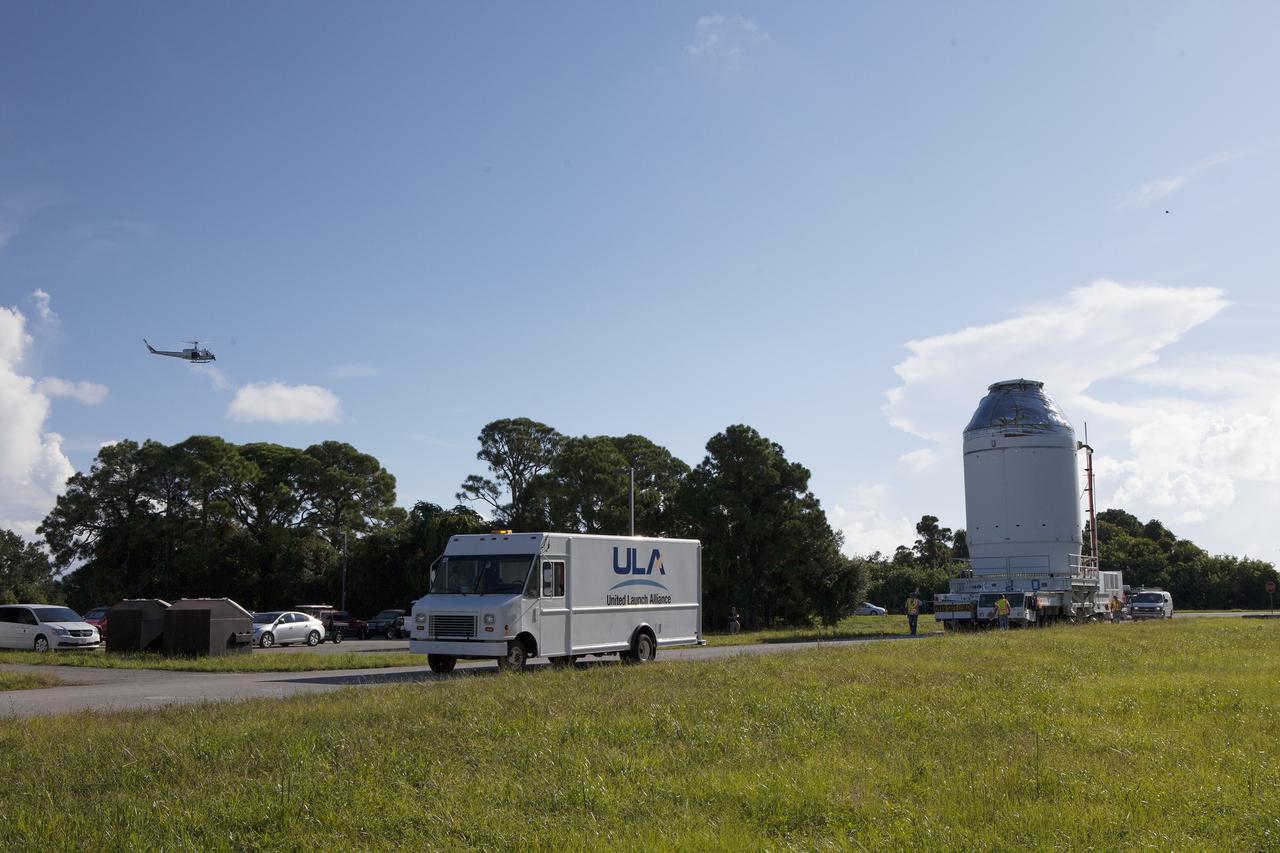
CAPE CANAVERAL, Fla. – A NASA helicopter flies overhead as the Orion crew module, stacked atop its service module, is transported to the Payload Hazardous Servicing Facility at NASA's Kennedy Space Center in Florida, where it will be fueled ahead of its December flight. The spacecraft for Exploration Flight Test-1 was moved out of the Neil Armstrong Operations and Checkout Building high bay. Orion is the exploration spacecraft designed to carry astronauts to destinations not yet explored by humans, including an asteroid and Mars. It will have emergency abort capability, sustain the crew during space travel and provide safe re-entry from deep space return velocities. The first unpiloted test flight of the Orion is scheduled to launch atop a United Launch Alliance Delta IV Heavy rocket from Cape Canaveral Air Force Station in Florida to an altitude of 3,600 miles above the Earth's surface. The two-orbit, four-hour flight test will help engineers evaluate the systems critical to crew safety including the heat shield, parachute system and launch abort system. For more information, visit http://www.nasa.gov/orion. Photo credit: NASA/Daniel Casper
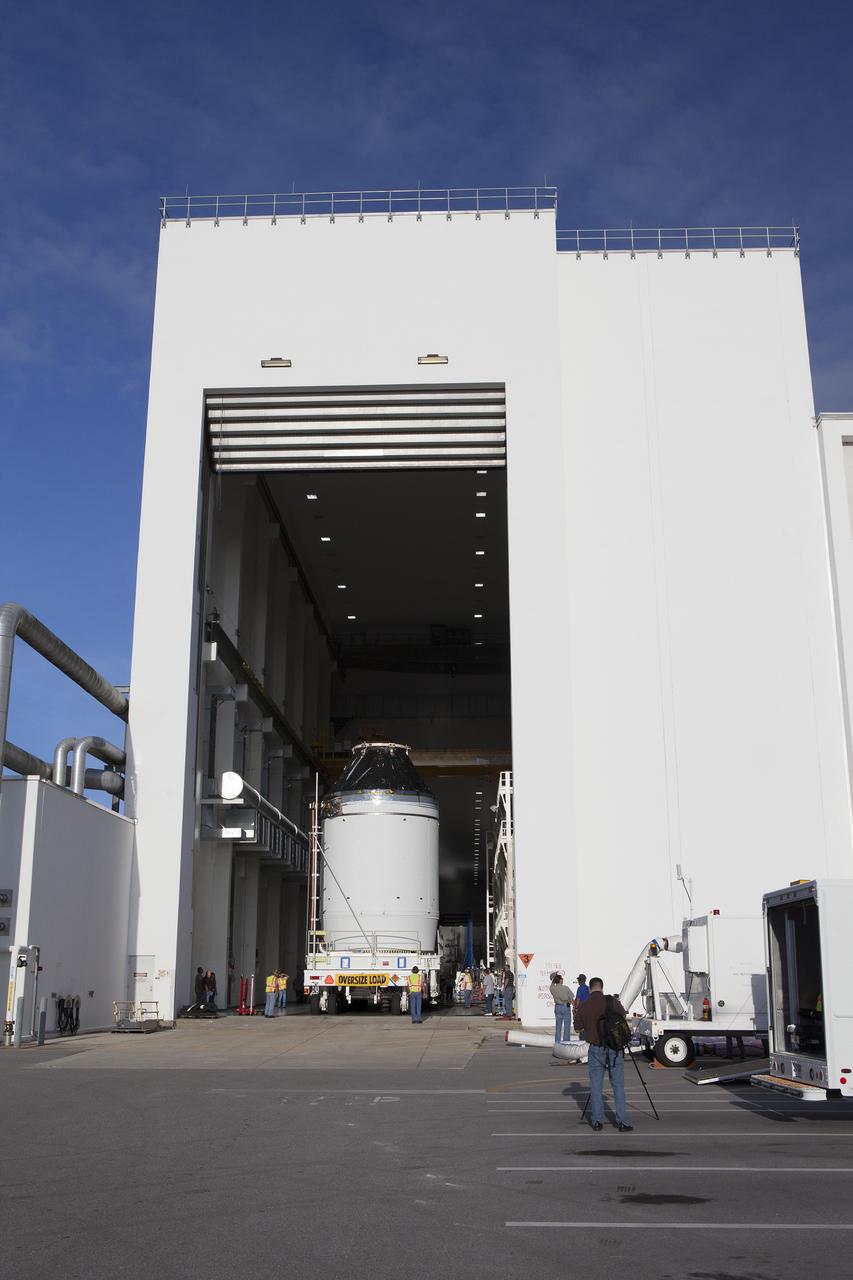
CAPE CANAVERAL, Fla. – The Orion crew module, stacked atop its service module, is moved slowly out of the Neil Armstrong Operations and Checkout Building high bay door at NASA's Kennedy Space Center in Florida. The spacecraft for Exploration Flight Test-1 will be transported to the Payload Hazardous Servicing Facility where it will be fueled ahead of its December flight test. Orion is the exploration spacecraft designed to carry astronauts to destinations not yet explored by humans, including an asteroid and Mars. It will have emergency abort capability, sustain the crew during space travel and provide safe re-entry from deep space return velocities. The first unpiloted test flight of the Orion is scheduled to launch atop a United Launch Alliance Delta IV Heavy rocket from Cape Canaveral Air Force Station in Florida to an altitude of 3,600 miles above the Earth's surface. The two-orbit, four-hour flight test will help engineers evaluate the systems critical to crew safety including the heat shield, parachute system and launch abort system. For more information, visit http://www.nasa.gov/orion. Photo credit: NASA/Daniel Casper
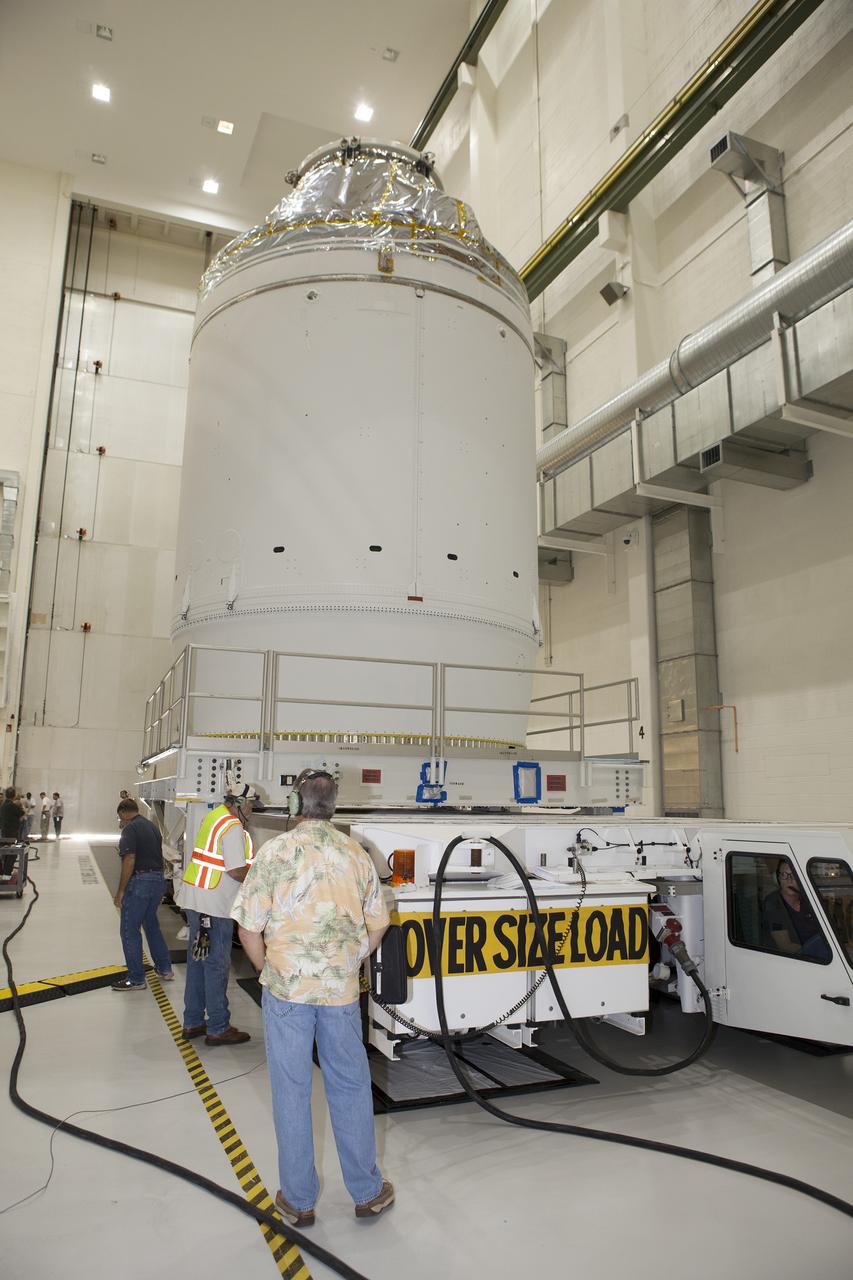
CAPE CANAVERAL, Fla. – The Orion crew module, stacked atop its service module, is being prepared for its move out of the Neil Armstrong Operations and Checkout Building high bay at NASA's Kennedy Space Center in Florida. The spacecraft for Exploration Flight Test-1 will be transported to the Payload Hazardous Servicing Facility where it will be fueled ahead of its December flight test. Orion is the exploration spacecraft designed to carry astronauts to destinations not yet explored by humans, including an asteroid and Mars. It will have emergency abort capability, sustain the crew during space travel and provide safe re-entry from deep space return velocities. The first unpiloted test flight of the Orion is scheduled to launch atop a United Launch Alliance Delta IV Heavy rocket from Cape Canaveral Air Force Station in Florida to an altitude of 3,600 miles above the Earth's surface. The two-orbit, four-hour flight test will help engineers evaluate the systems critical to crew safety including the heat shield, parachute system and launch abort system. For more information, visit http://www.nasa.gov/orion. Photo credit: NASA/Daniel Casper
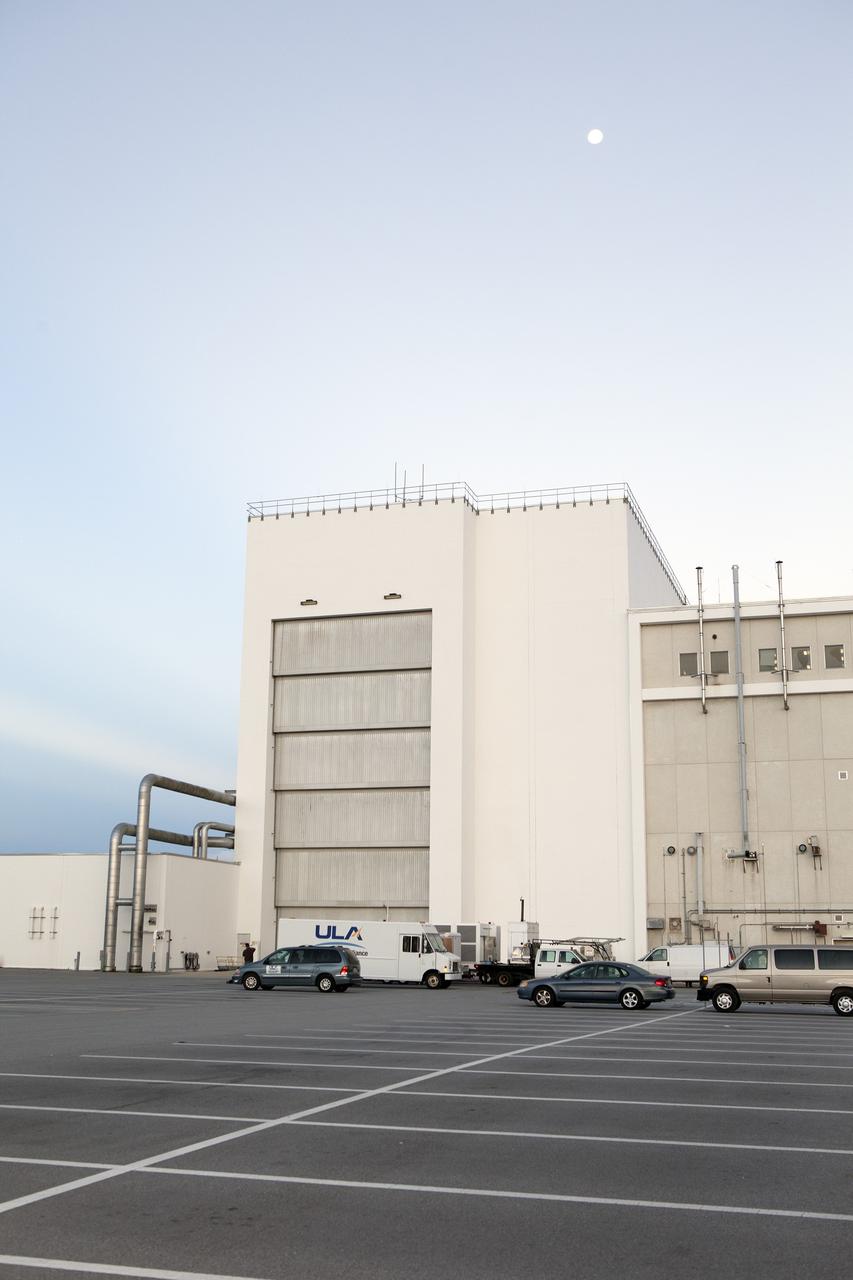
CAPE CANAVERAL, Fla. – Preparations are underway at the Neil Armstrong Operations and Checkout Building at NASA's Kennedy Space Center in Florida for the move of the Orion spacecraft for Exploration Flight Test-1 out of the high bay doors. The spacecraft will be transported to the Payload Hazardous Servicing Facility where it will be fueled ahead of its December flight test. Orion is the exploration spacecraft designed to carry astronauts to destinations not yet explored by humans, including an asteroid and Mars. It will have emergency abort capability, sustain the crew during space travel and provide safe re-entry from deep space return velocities. The first unpiloted test flight of the Orion is scheduled to launch atop a United Launch Alliance Delta IV Heavy rocket from Cape Canaveral Air Force Station in Florida to an altitude of 3,600 miles above the Earth's surface. The two-orbit, four-hour flight test will help engineers evaluate the systems critical to crew safety including the heat shield, parachute system and launch abort system. For more information, visit http://www.nasa.gov/orion. Photo credit: NASA/Daniel Casper
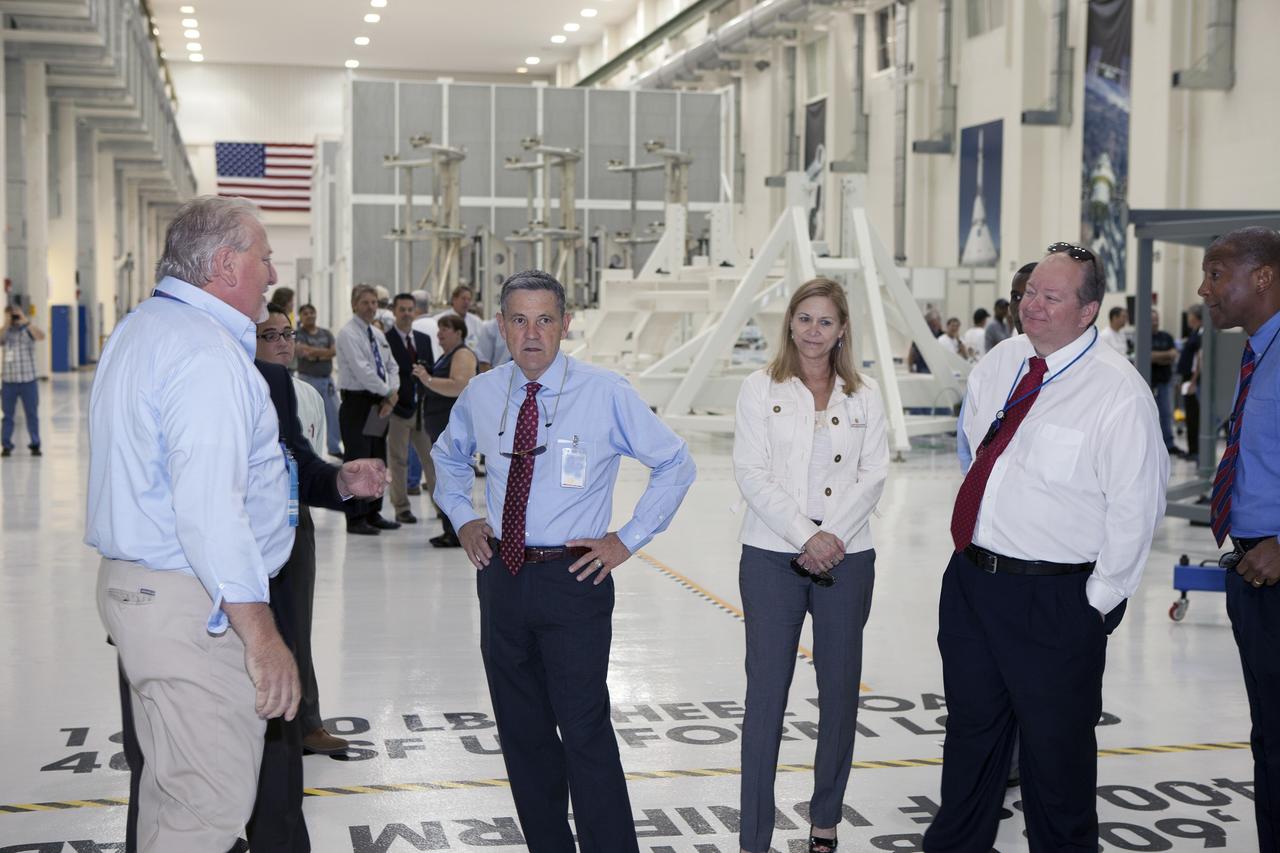
CAPE CANAVERAL, Fla. – Preparations are underway at the Neil Armstrong Operations and Checkout Building at NASA's Kennedy Space Center in Florida for the move of the Orion spacecraft for Exploration Flight Test-1 out of the high bay doors. Inside the high bay, Kennedy Center Director Bob Cabana, Deputy Center Director Janet Petro, and Burton Summerfield, NASA senior advisor for Institutional Management, talk with workers. The spacecraft will be transported to the Payload Hazardous Servicing Facility where it will be fueled ahead of its December flight test. Orion is the exploration spacecraft designed to carry astronauts to destinations not yet explored by humans, including an asteroid and Mars. It will have emergency abort capability, sustain the crew during space travel and provide safe re-entry from deep space return velocities. The first unpiloted test flight of the Orion is scheduled to launch atop a United Launch Alliance Delta IV Heavy rocket from Cape Canaveral Air Force Station in Florida to an altitude of 3,600 miles above the Earth's surface. The two-orbit, four-hour flight test will help engineers evaluate the systems critical to crew safety including the heat shield, parachute system and launch abort system. For more information, visit http://www.nasa.gov/orion. Photo credit: NASA/Daniel Casper
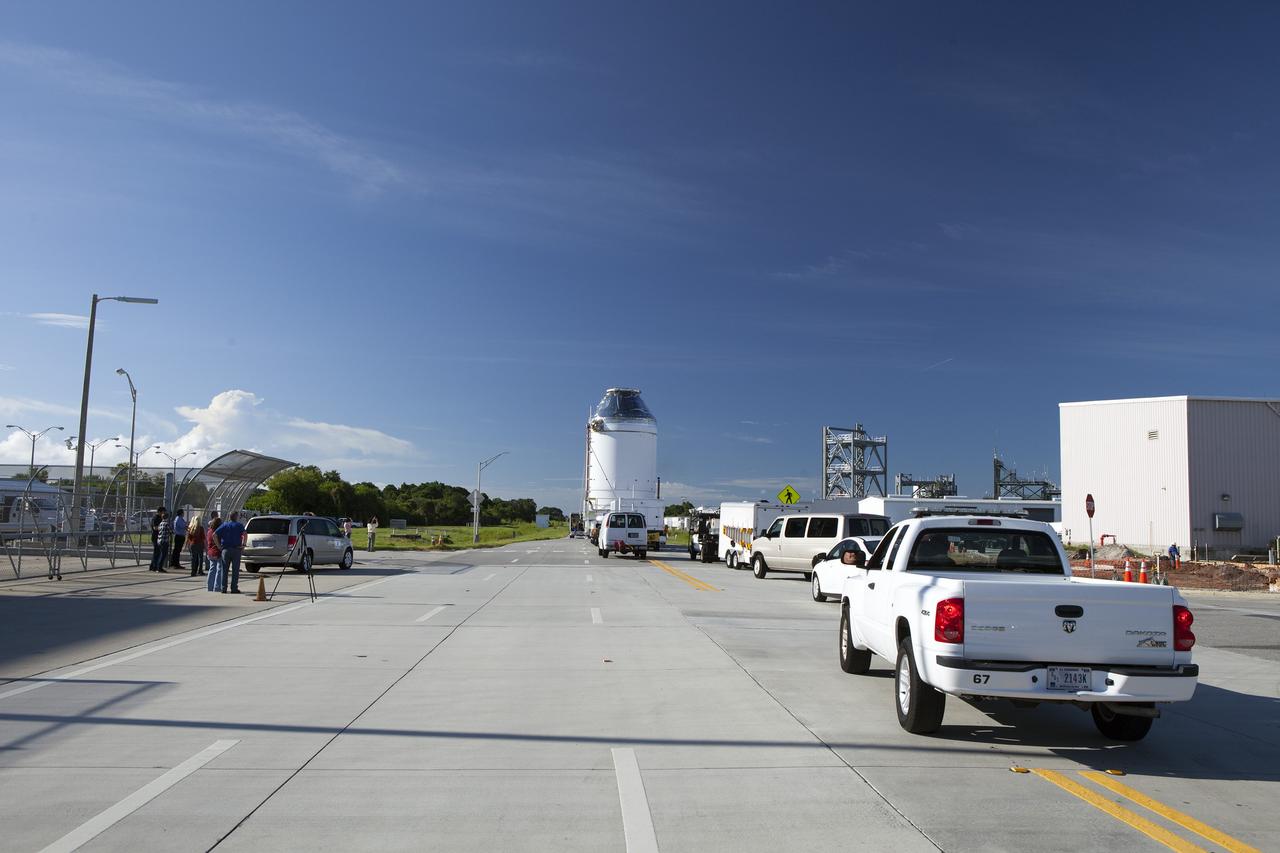
CAPE CANAVERAL, Fla. – The Orion crew module, stacked atop its service module, has moved out of the Neil Armstrong Operations and Checkout Building high bay at NASA's Kennedy Space Center in Florida. The spacecraft for Exploration Flight Test-1 is being transported to the Payload Hazardous Servicing Facility where it will be fueled ahead of its December flight test. Orion is the exploration spacecraft designed to carry astronauts to destinations not yet explored by humans, including an asteroid and Mars. It will have emergency abort capability, sustain the crew during space travel and provide safe re-entry from deep space return velocities. The first unpiloted test flight of the Orion is scheduled to launch atop a United Launch Alliance Delta IV Heavy rocket from Cape Canaveral Air Force Station in Florida to an altitude of 3,600 miles above the Earth's surface. The two-orbit, four-hour flight test will help engineers evaluate the systems critical to crew safety including the heat shield, parachute system and launch abort system. For more information, visit http://www.nasa.gov/orion. Photo credit: NASA/Daniel Casper
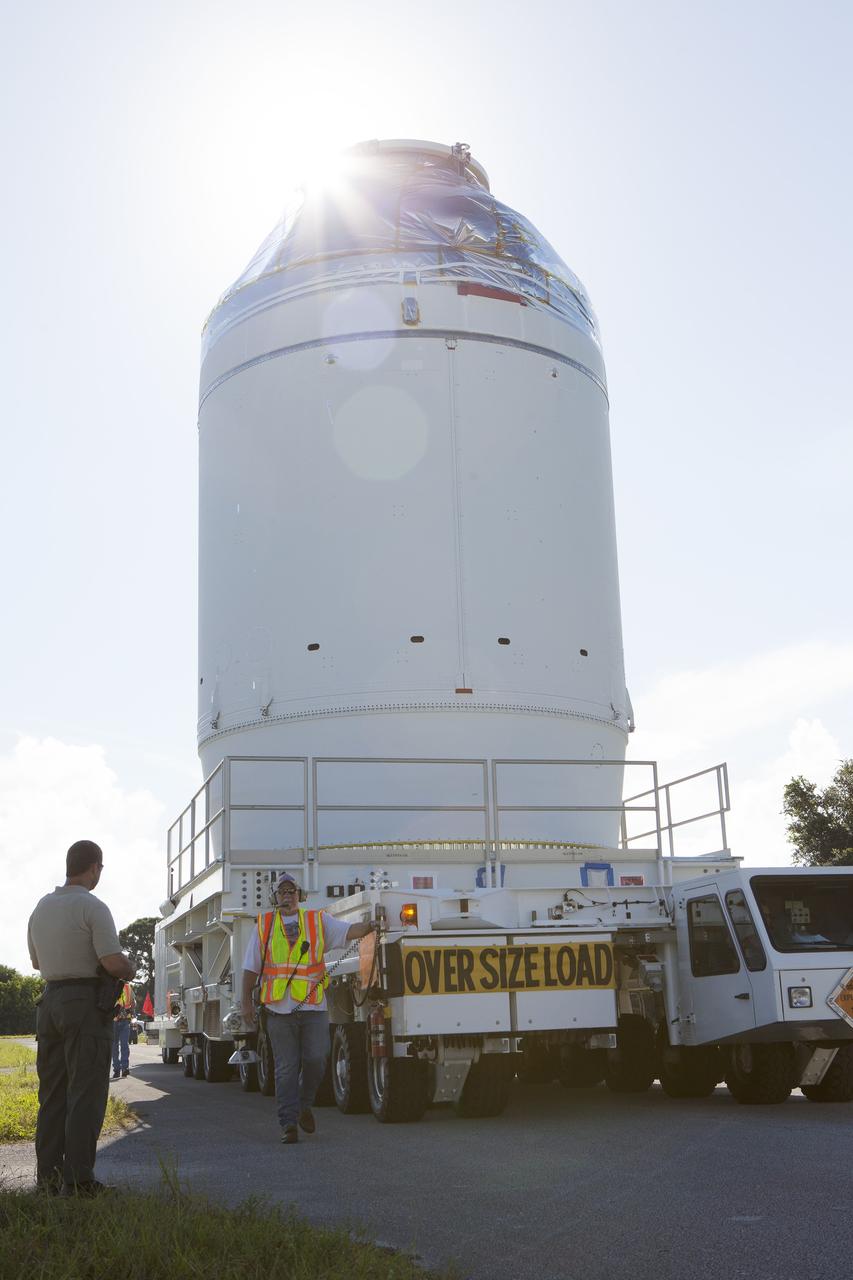
CAPE CANAVERAL, Fla. – The Orion crew module, stacked atop its service module, is being transported to the Payload Hazardous Servicing Facility at NASA's Kennedy Space Center in Florida, where it will be fueled ahead of its December flight. The spacecraft for Exploration Flight Test-1 was moved out of the Neil Armstrong Operations and Checkout Building high bay. Orion is the exploration spacecraft designed to carry astronauts to destinations not yet explored by humans, including an asteroid and Mars. It will have emergency abort capability, sustain the crew during space travel and provide safe re-entry from deep space return velocities. The first unpiloted test flight of the Orion is scheduled to launch atop a United Launch Alliance Delta IV Heavy rocket from Cape Canaveral Air Force Station in Florida to an altitude of 3,600 miles above the Earth's surface. The two-orbit, four-hour flight test will help engineers evaluate the systems critical to crew safety including the heat shield, parachute system and launch abort system. For more information, visit http://www.nasa.gov/orion. Photo credit: NASA/Daniel Casper
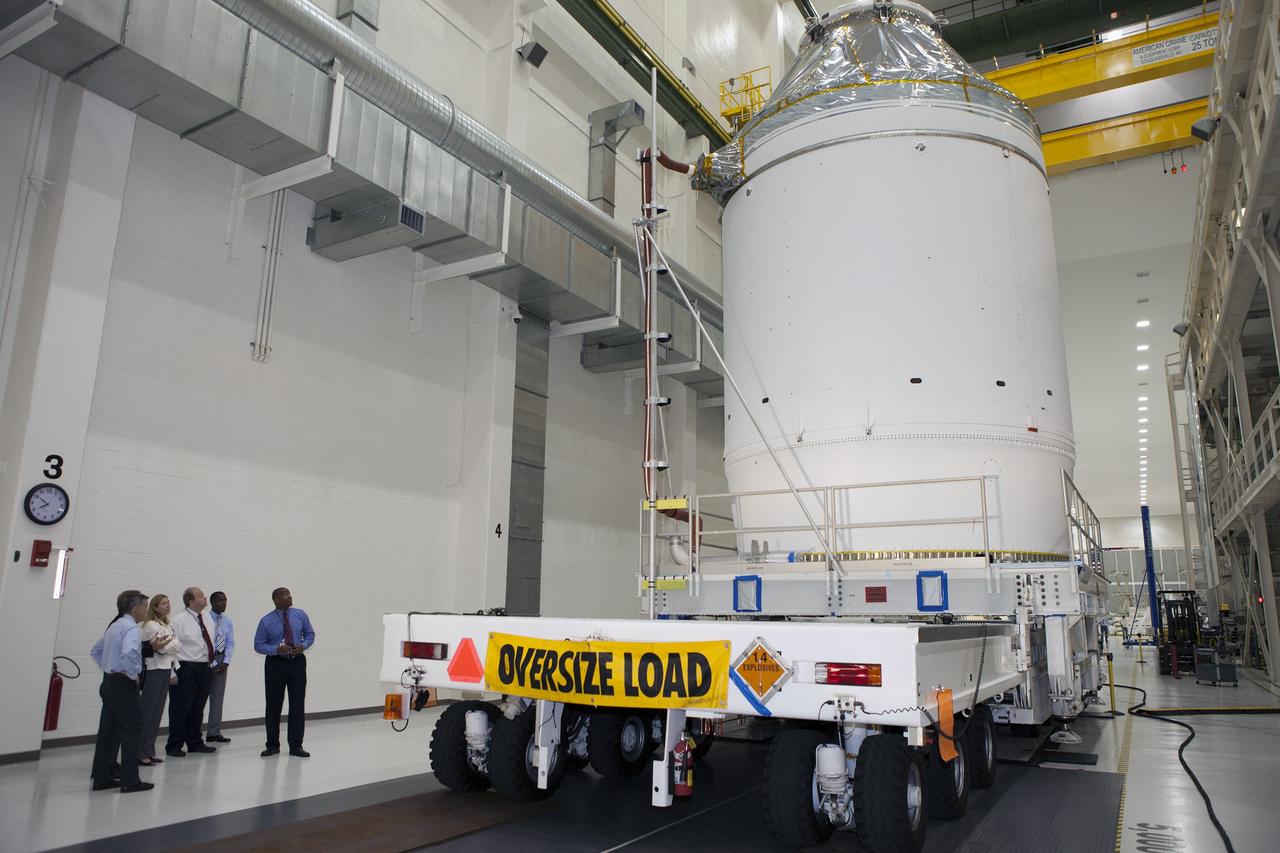
CAPE CANAVERAL, Fla. – The Orion crew module, stacked atop its service module, is being prepared for its move out of the Neil Armstrong Operations and Checkout Building high bay at NASA's Kennedy Space Center in Florida. At far left is Kennedy Center Director Bob Cabana. To Cabana's left is Kennedy Deputy Director Janet Petro, and at far right is Kennedy Associate Director Kelvin Manning. The spacecraft for Exploration Flight Test-1 will be transported to the Payload Hazardous Servicing Facility where it will be fueled ahead of its December flight test. Orion is the exploration spacecraft designed to carry astronauts to destinations not yet explored by humans, including an asteroid and Mars. It will have emergency abort capability, sustain the crew during space travel and provide safe re-entry from deep space return velocities. The first unpiloted test flight of the Orion is scheduled to launch atop a United Launch Alliance Delta IV Heavy rocket from Cape Canaveral Air Force Station in Florida to an altitude of 3,600 miles above the Earth's surface. The two-orbit, four-hour flight test will help engineers evaluate the systems critical to crew safety including the heat shield, parachute system and launch abort system. For more information, visit http://www.nasa.gov/orion. Photo credit: NASA/Daniel Casper
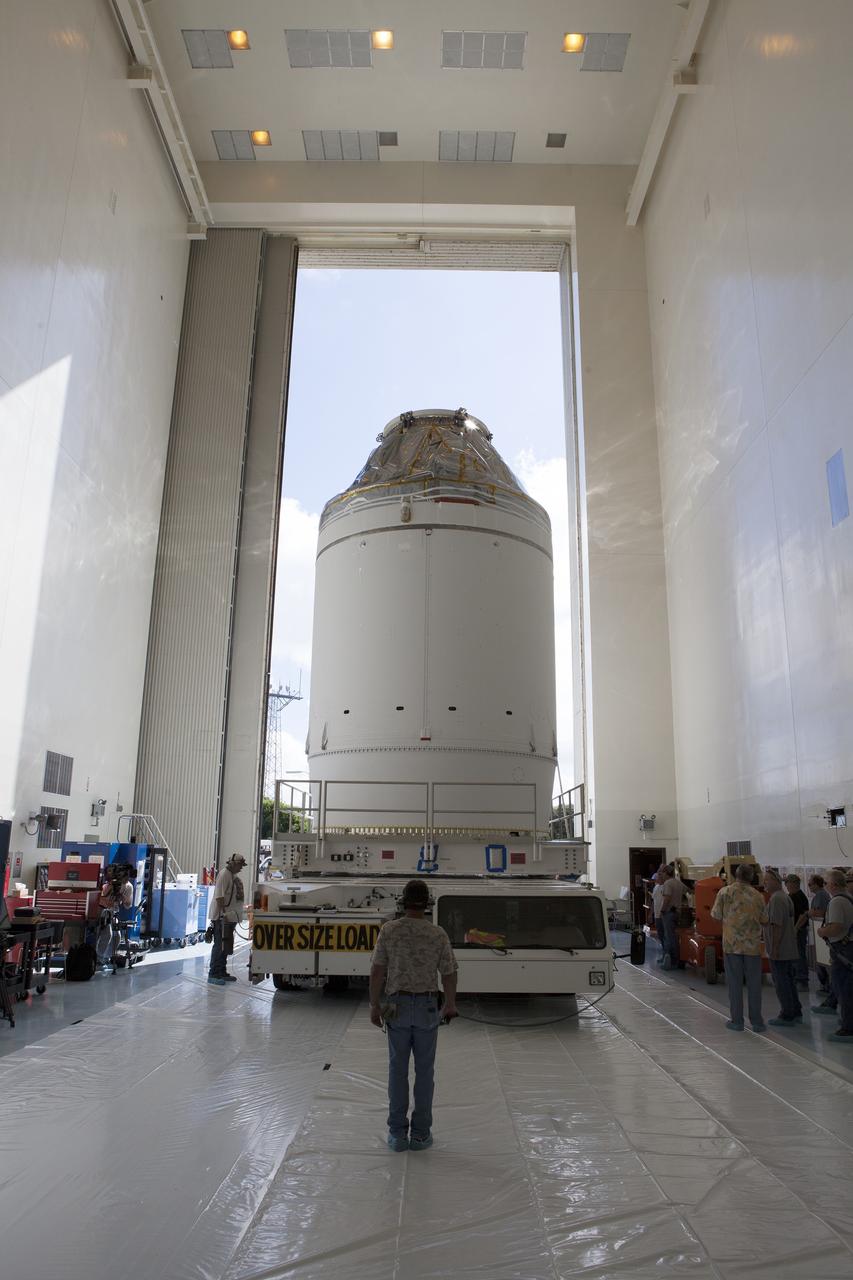
CAPE CANAVERAL, Fla. – The Orion crew module, stacked atop its service module, is transported into the Payload Hazardous Servicing Facility at NASA's Kennedy Space Center in Florida, where it will be fueled ahead of its December flight. The spacecraft for Exploration Flight Test-1 was moved out of the Neil Armstrong Operations and Checkout Building high bay. Orion is the exploration spacecraft designed to carry astronauts to destinations not yet explored by humans, including an asteroid and Mars. It will have emergency abort capability, sustain the crew during space travel and provide safe re-entry from deep space return velocities. The first unpiloted test flight of the Orion is scheduled to launch atop a United Launch Alliance Delta IV Heavy rocket from Cape Canaveral Air Force Station in Florida to an altitude of 3,600 miles above the Earth's surface. The two-orbit, four-hour flight test will help engineers evaluate the systems critical to crew safety including the heat shield, parachute system and launch abort system. For more information, visit http://www.nasa.gov/orion. Photo credit: NASA/Daniel Casper
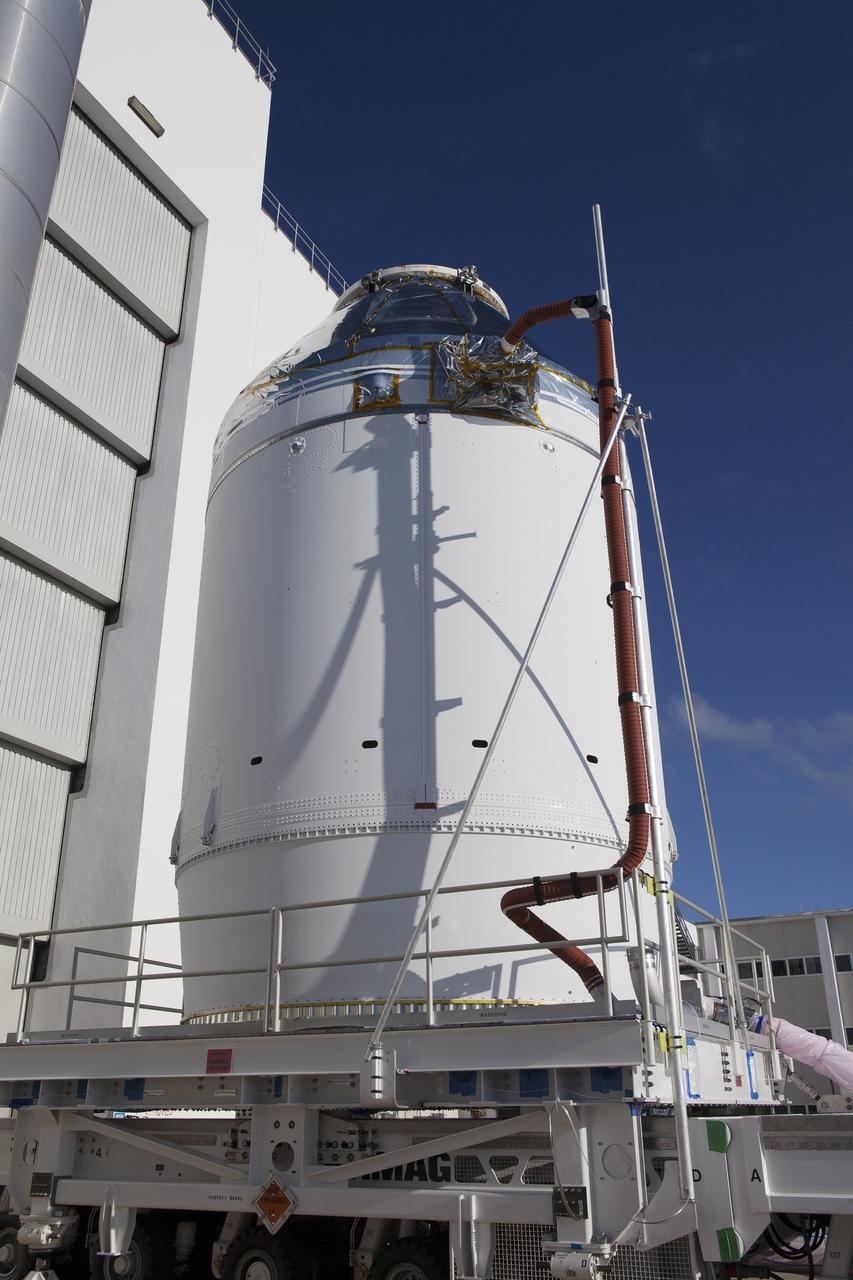
CAPE CANAVERAL, Fla. – The Orion crew module, stacked atop its service module, has moved out of the Neil Armstrong Operations and Checkout Building high bay at NASA's Kennedy Space Center in Florida. The spacecraft for Exploration Flight Test-1 will be transported to the Payload Hazardous Servicing Facility where it will be fueled ahead of its December flight test. Orion is the exploration spacecraft designed to carry astronauts to destinations not yet explored by humans, including an asteroid and Mars. It will have emergency abort capability, sustain the crew during space travel and provide safe re-entry from deep space return velocities. The first unpiloted test flight of the Orion is scheduled to launch atop a United Launch Alliance Delta IV Heavy rocket from Cape Canaveral Air Force Station in Florida to an altitude of 3,600 miles above the Earth's surface. The two-orbit, four-hour flight test will help engineers evaluate the systems critical to crew safety including the heat shield, parachute system and launch abort system. For more information, visit http://www.nasa.gov/orion. Photo credit: NASA/Daniel Casper
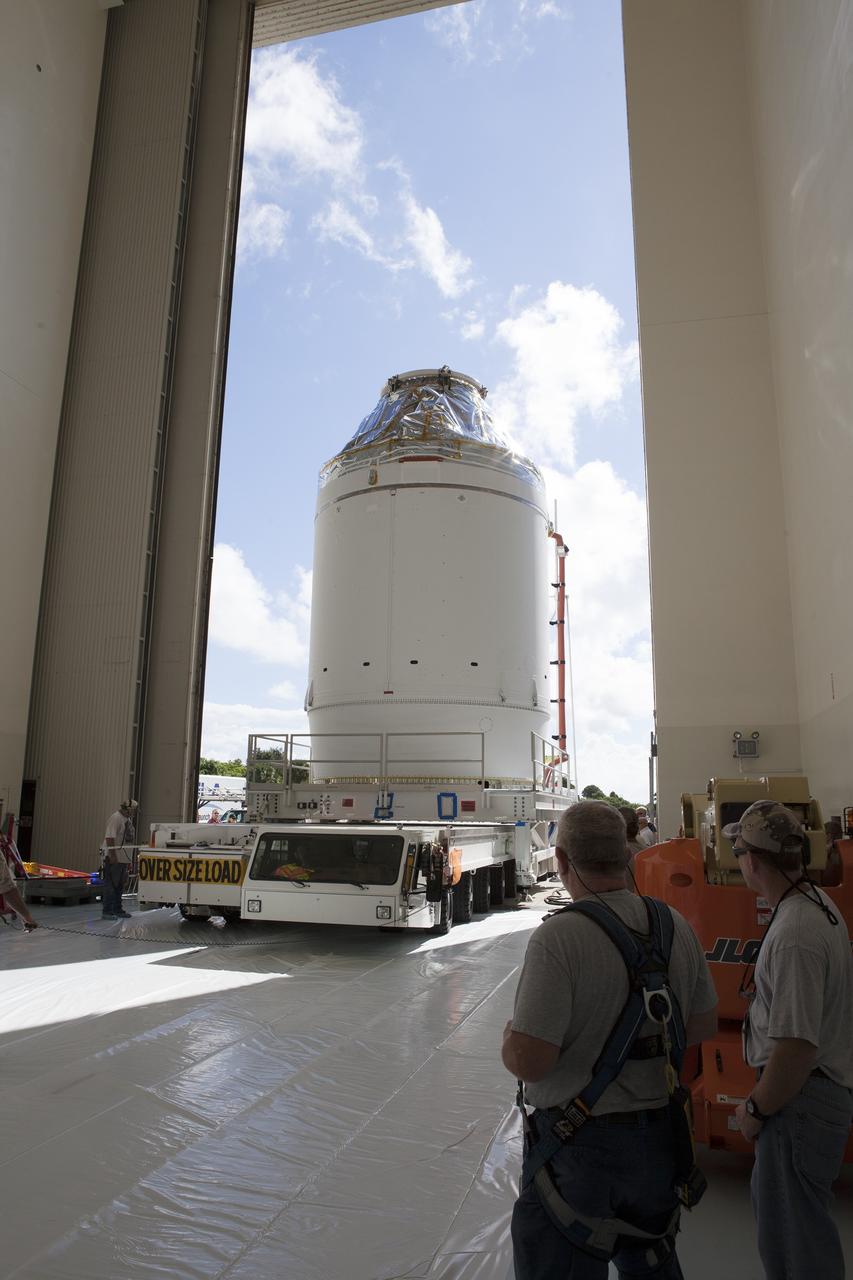
CAPE CANAVERAL, Fla. – The Orion crew module, stacked atop its service module, is transported into the Payload Hazardous Servicing Facility at NASA's Kennedy Space Center in Florida, where it will be fueled ahead of its December flight. The spacecraft for Exploration Flight Test-1 was moved out of the Neil Armstrong Operations and Checkout Building high bay. Orion is the exploration spacecraft designed to carry astronauts to destinations not yet explored by humans, including an asteroid and Mars. It will have emergency abort capability, sustain the crew during space travel and provide safe re-entry from deep space return velocities. The first unpiloted test flight of the Orion is scheduled to launch atop a United Launch Alliance Delta IV Heavy rocket from Cape Canaveral Air Force Station in Florida to an altitude of 3,600 miles above the Earth's surface. The two-orbit, four-hour flight test will help engineers evaluate the systems critical to crew safety including the heat shield, parachute system and launch abort system. For more information, visit http://www.nasa.gov/orion. Photo credit: NASA/Daniel Casper
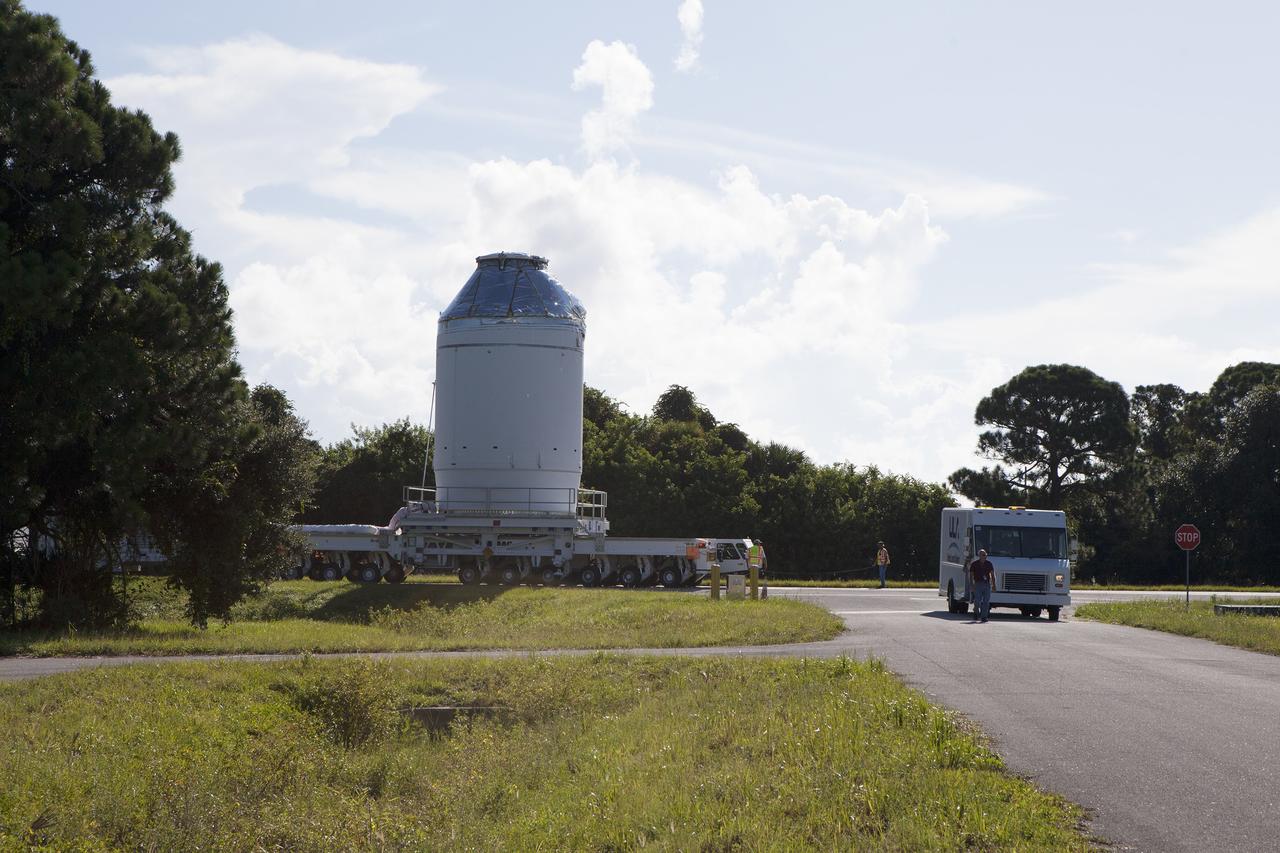
CAPE CANAVERAL, Fla. – The Orion crew module, stacked atop its service module, is being transported to the Payload Hazardous Servicing Facility at NASA's Kennedy Space Center in Florida, where it will be fueled ahead of its December flight. The spacecraft for Exploration Flight Test-1 was moved out of the Neil Armstrong Operations and Checkout Building high bay. Orion is the exploration spacecraft designed to carry astronauts to destinations not yet explored by humans, including an asteroid and Mars. It will have emergency abort capability, sustain the crew during space travel and provide safe re-entry from deep space return velocities. The first unpiloted test flight of the Orion is scheduled to launch atop a United Launch Alliance Delta IV Heavy rocket from Cape Canaveral Air Force Station in Florida to an altitude of 3,600 miles above the Earth's surface. The two-orbit, four-hour flight test will help engineers evaluate the systems critical to crew safety including the heat shield, parachute system and launch abort system. For more information, visit http://www.nasa.gov/orion. Photo credit: NASA/Daniel Casper
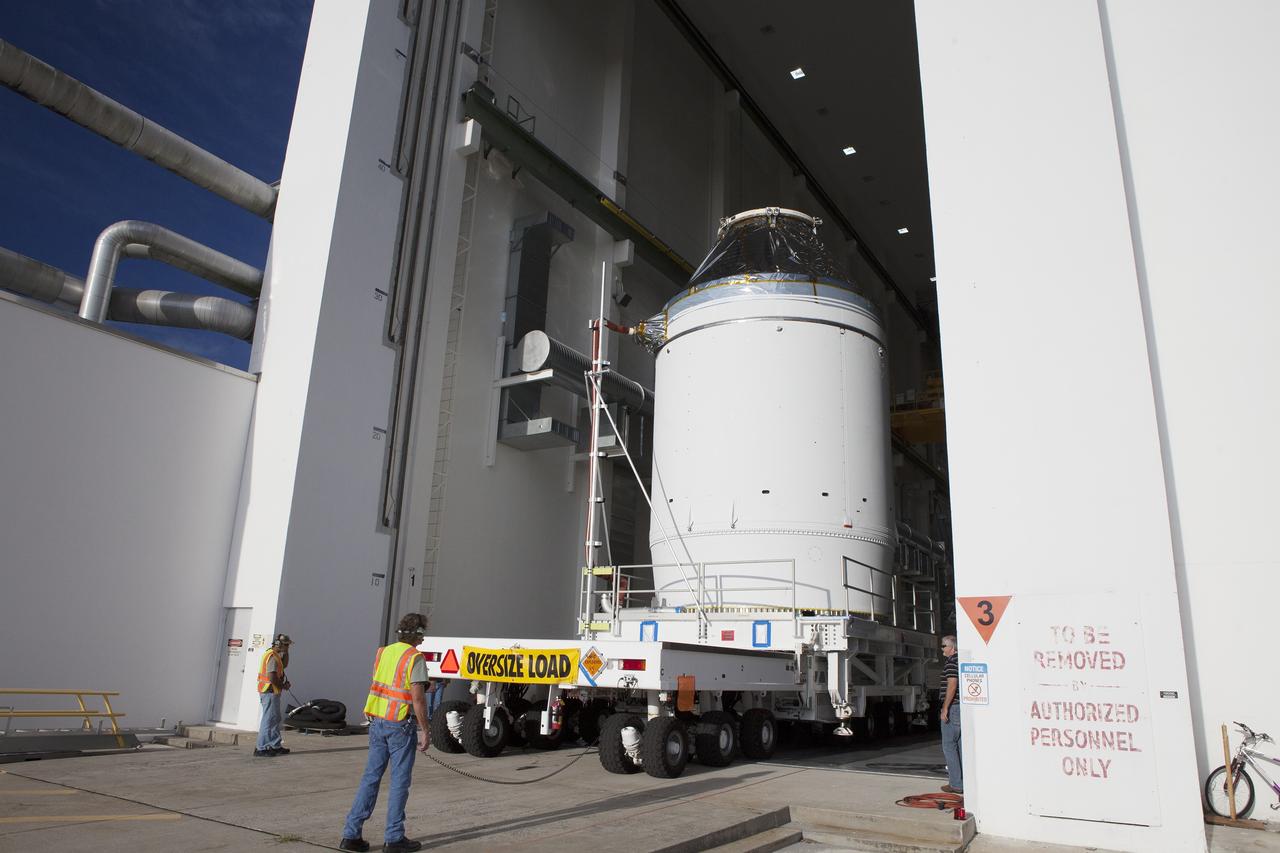
CAPE CANAVERAL, Fla. – The Orion crew module, stacked atop its service module, is moved slowly out of the Neil Armstrong Operations and Checkout Building high bay door at NASA's Kennedy Space Center in Florida. The spacecraft for Exploration Flight Test-1 will be transported to the Payload Hazardous Servicing Facility where it will be fueled ahead of its December flight test. Orion is the exploration spacecraft designed to carry astronauts to destinations not yet explored by humans, including an asteroid and Mars. It will have emergency abort capability, sustain the crew during space travel and provide safe re-entry from deep space return velocities. The first unpiloted test flight of the Orion is scheduled to launch atop a United Launch Alliance Delta IV Heavy rocket from Cape Canaveral Air Force Station in Florida to an altitude of 3,600 miles above the Earth's surface. The two-orbit, four-hour flight test will help engineers evaluate the systems critical to crew safety including the heat shield, parachute system and launch abort system. For more information, visit http://www.nasa.gov/orion. Photo credit: NASA/Daniel Casper
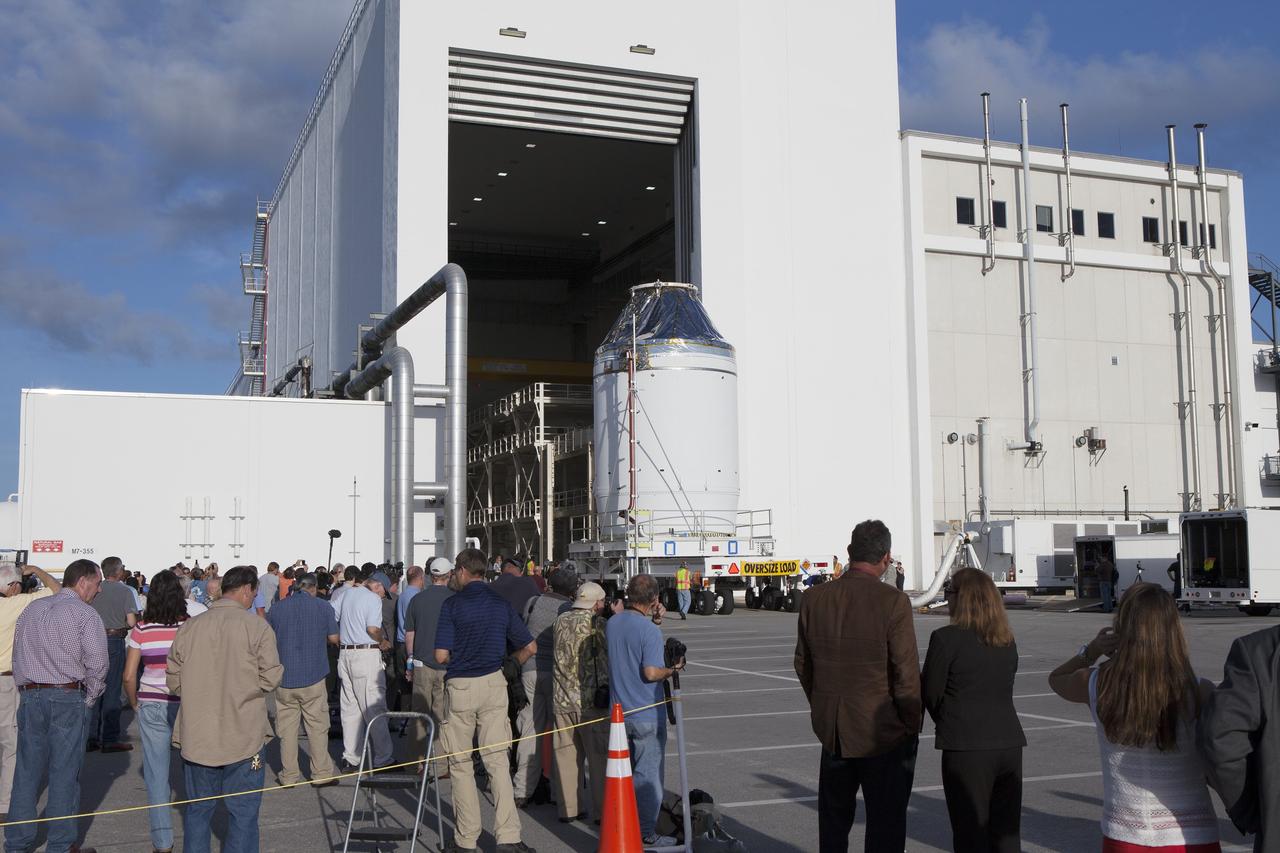
CAPE CANAVERAL, Fla. – Reporters and photographers watch as the Orion crew module, stacked atop its service module, moves out of the Neil Armstrong Operations and Checkout Building high bay at NASA's Kennedy Space Center in Florida. The spacecraft for Exploration Flight Test-1 will be transported to the Payload Hazardous Servicing Facility where it will be fueled ahead of its December flight test. Orion is the exploration spacecraft designed to carry astronauts to destinations not yet explored by humans, including an asteroid and Mars. It will have emergency abort capability, sustain the crew during space travel and provide safe re-entry from deep space return velocities. The first unpiloted test flight of the Orion is scheduled to launch atop a United Launch Alliance Delta IV Heavy rocket from Cape Canaveral Air Force Station in Florida to an altitude of 3,600 miles above the Earth's surface. The two-orbit, four-hour flight test will help engineers evaluate the systems critical to crew safety including the heat shield, parachute system and launch abort system. For more information, visit http://www.nasa.gov/orion. Photo credit: NASA/Daniel Casper
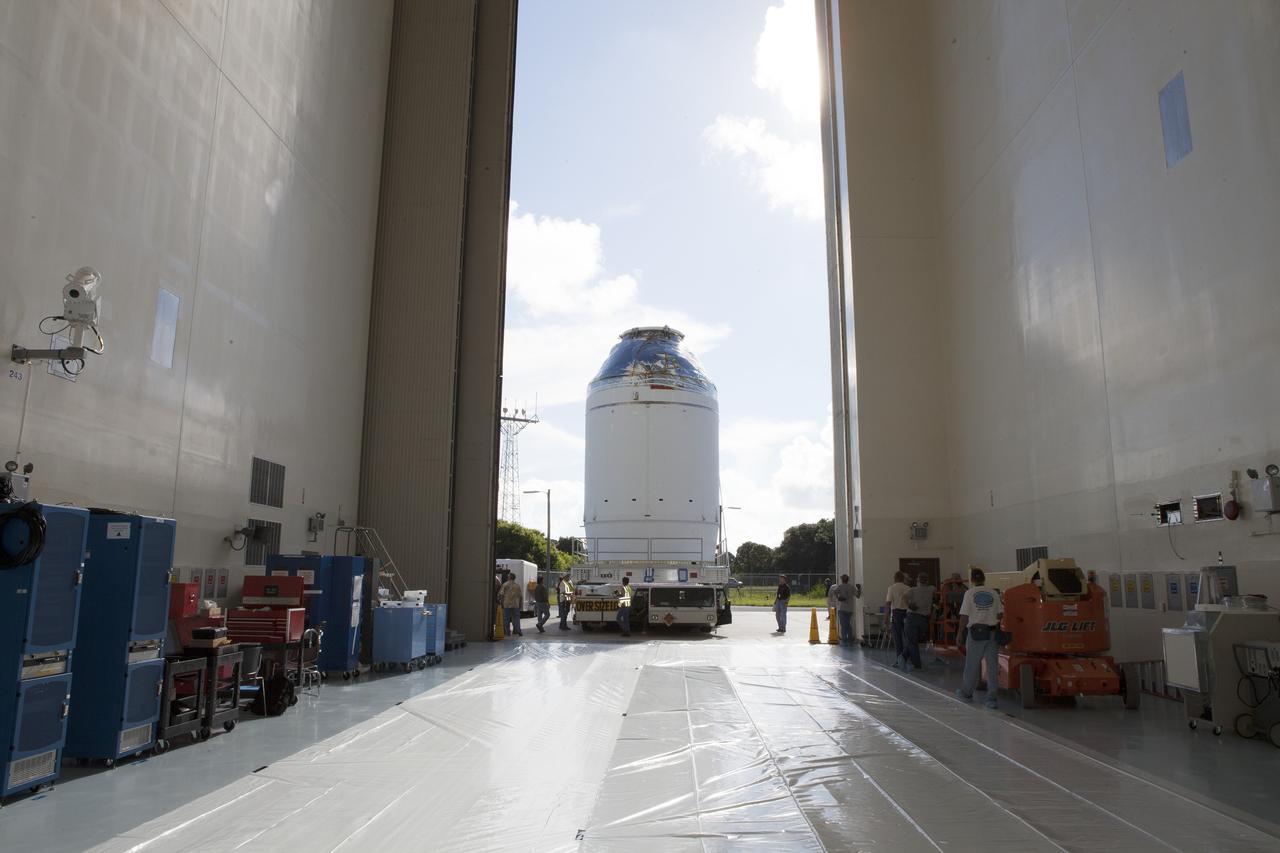
CAPE CANAVERAL, Fla. – The Orion crew module, stacked atop its service module, is transported into the Payload Hazardous Servicing Facility at NASA's Kennedy Space Center in Florida, where it will be fueled ahead of its December flight. The spacecraft for Exploration Flight Test-1 was moved out of the Neil Armstrong Operations and Checkout Building high bay. Orion is the exploration spacecraft designed to carry astronauts to destinations not yet explored by humans, including an asteroid and Mars. It will have emergency abort capability, sustain the crew during space travel and provide safe re-entry from deep space return velocities. The first unpiloted test flight of the Orion is scheduled to launch atop a United Launch Alliance Delta IV Heavy rocket from Cape Canaveral Air Force Station in Florida to an altitude of 3,600 miles above the Earth's surface. The two-orbit, four-hour flight test will help engineers evaluate the systems critical to crew safety including the heat shield, parachute system and launch abort system. For more information, visit http://www.nasa.gov/orion. Photo credit: NASA/Daniel Casper
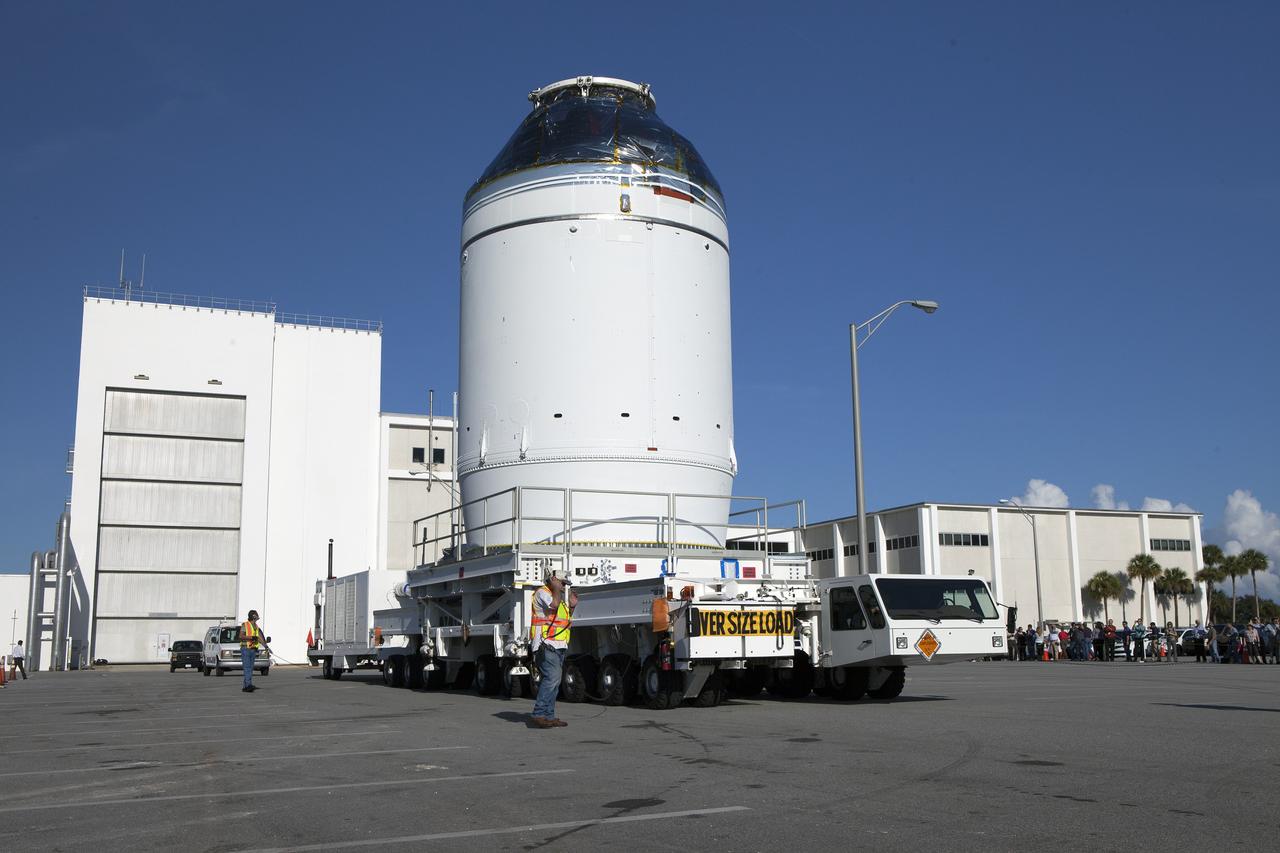
CAPE CANAVERAL, Fla. – The Orion crew module, stacked atop its service module, has moved out of the Neil Armstrong Operations and Checkout Building high bay at NASA's Kennedy Space Center in Florida. The spacecraft for Exploration Flight Test-1 will be transported to the Payload Hazardous Servicing Facility where it will be fueled ahead of its December flight test. Orion is the exploration spacecraft designed to carry astronauts to destinations not yet explored by humans, including an asteroid and Mars. It will have emergency abort capability, sustain the crew during space travel and provide safe re-entry from deep space return velocities. The first unpiloted test flight of the Orion is scheduled to launch atop a United Launch Alliance Delta IV Heavy rocket from Cape Canaveral Air Force Station in Florida to an altitude of 3,600 miles above the Earth's surface. The two-orbit, four-hour flight test will help engineers evaluate the systems critical to crew safety including the heat shield, parachute system and launch abort system. For more information, visit http://www.nasa.gov/orion. Photo credit: NASA/Daniel Casper
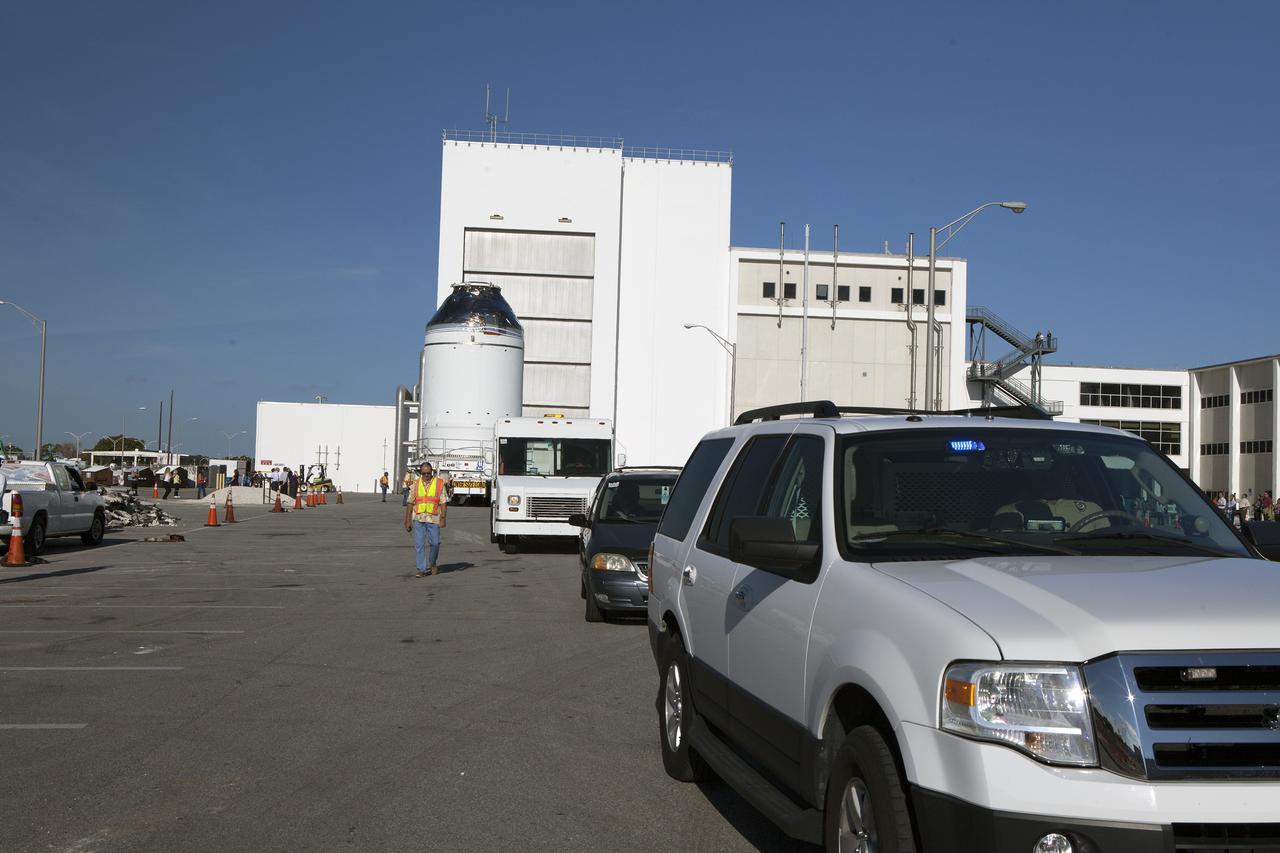
CAPE CANAVERAL, Fla. – The Orion crew module, stacked atop its service module, has moved out of the Neil Armstrong Operations and Checkout Building high bay at NASA's Kennedy Space Center in Florida. A convoy leads the way as the spacecraft for Exploration Flight Test-1 begins its trek to the Payload Hazardous Servicing Facility where it will be fueled ahead of its December flight test. Orion is the exploration spacecraft designed to carry astronauts to destinations not yet explored by humans, including an asteroid and Mars. It will have emergency abort capability, sustain the crew during space travel and provide safe re-entry from deep space return velocities. The first unpiloted test flight of the Orion is scheduled to launch atop a United Launch Alliance Delta IV Heavy rocket from Cape Canaveral Air Force Station in Florida to an altitude of 3,600 miles above the Earth's surface. The two-orbit, four-hour flight test will help engineers evaluate the systems critical to crew safety including the heat shield, parachute system and launch abort system. For more information, visit http://www.nasa.gov/orion. Photo credit: NASA/Daniel Casper
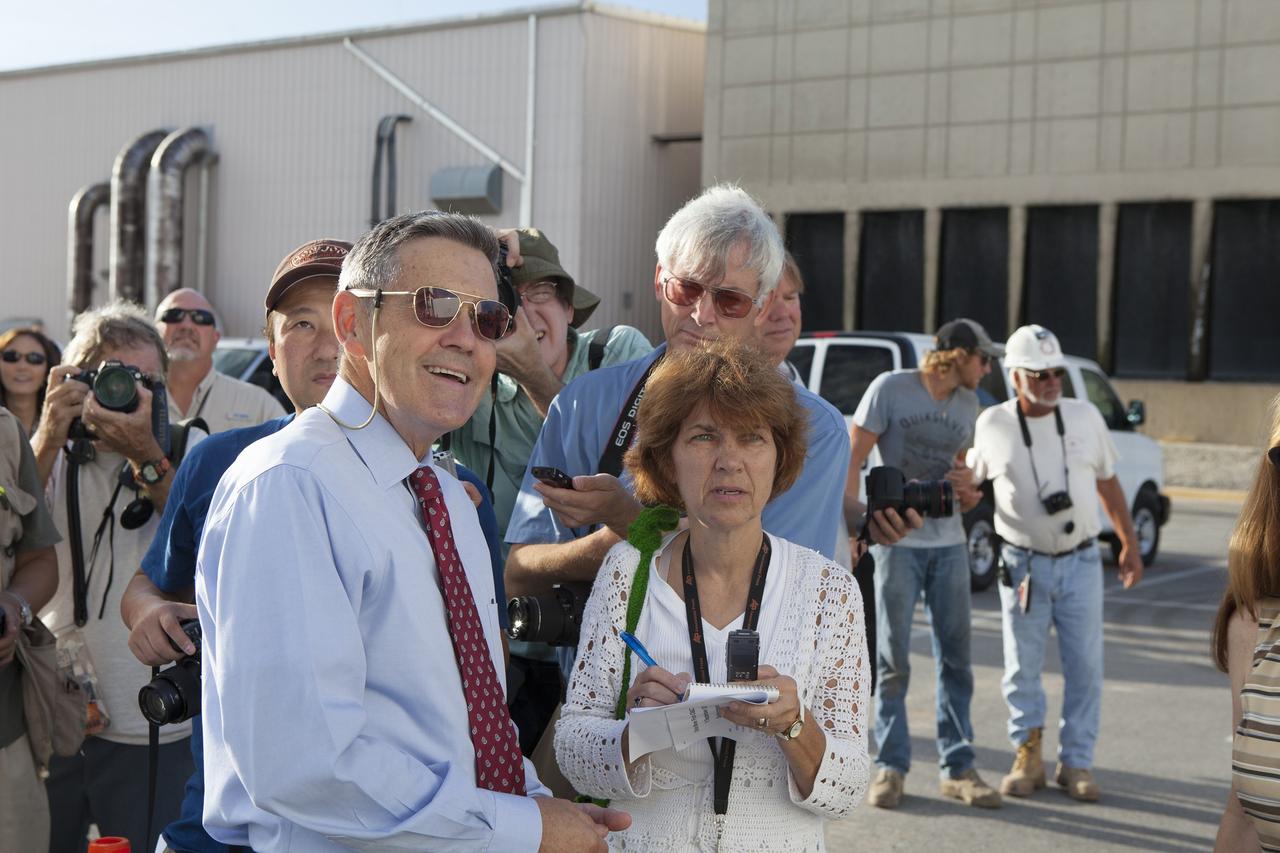
CAPE CANAVERAL, Fla. – Kennedy Space Center Director Bob Cabana, at left, watches with reporters and photographers as the Orion crew module, stacked atop its service module, moves out of the Neil Armstrong Operations and Checkout Building high bay at NASA's Kennedy Space Center in Florida. The spacecraft for Exploration Flight Test-1 will be transported to the Payload Hazardous Servicing Facility where it will be fueled ahead of its December flight test. Orion is the exploration spacecraft designed to carry astronauts to destinations not yet explored by humans, including an asteroid and Mars. It will have emergency abort capability, sustain the crew during space travel and provide safe re-entry from deep space return velocities. The first unpiloted test flight of the Orion is scheduled to launch atop a United Launch Alliance Delta IV Heavy rocket from Cape Canaveral Air Force Station in Florida to an altitude of 3,600 miles above the Earth's surface. The two-orbit, four-hour flight test will help engineers evaluate the systems critical to crew safety including the heat shield, parachute system and launch abort system. For more information, visit http://www.nasa.gov/orion. Photo credit: NASA/Daniel Casper
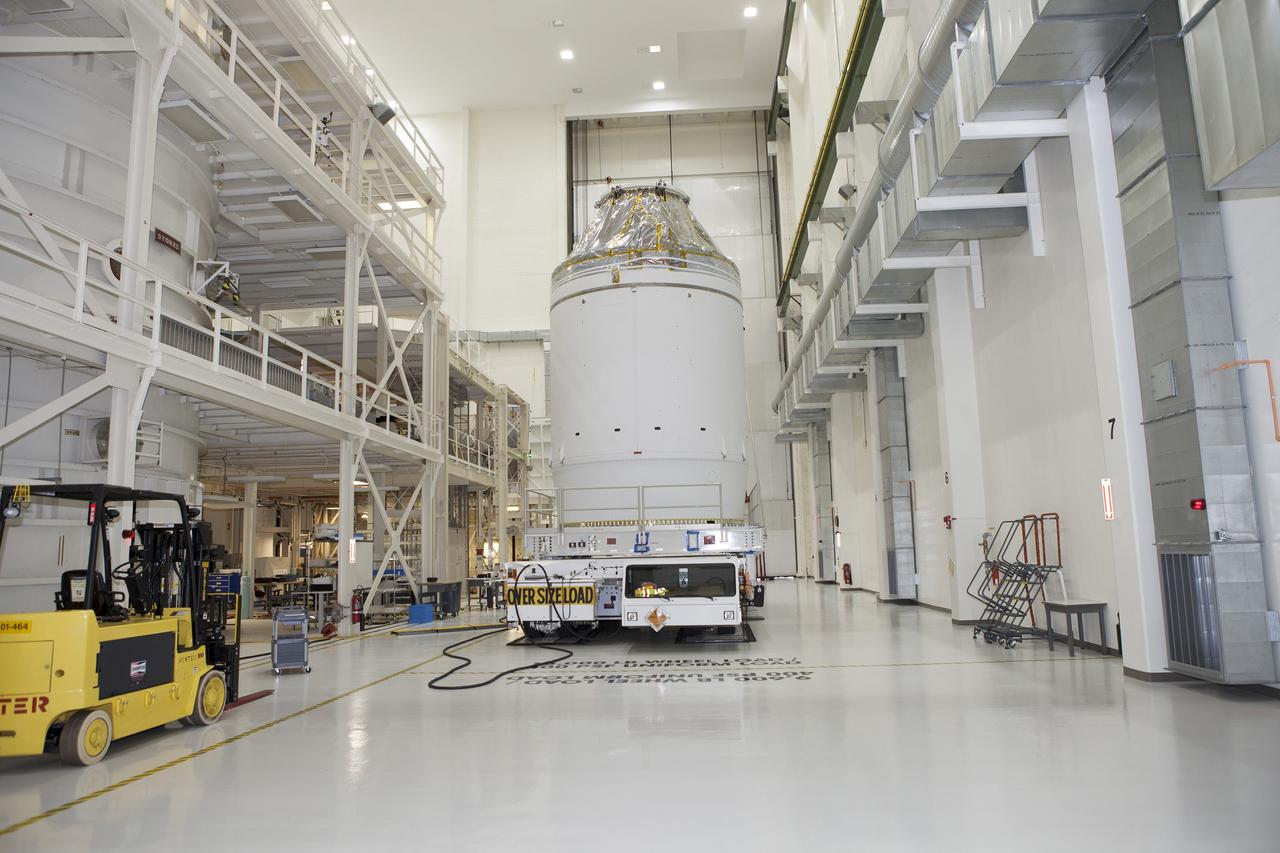
CAPE CANAVERAL, Fla. – The Orion crew module, stacked atop its service module, is being prepared for its move out of the Neil Armstrong Operations and Checkout Building high bay at NASA's Kennedy Space Center in Florida. The spacecraft for Exploration Flight Test-1 will be transported to the Payload Hazardous Servicing Facility where it will be fueled ahead of its December flight test. Orion is the exploration spacecraft designed to carry astronauts to destinations not yet explored by humans, including an asteroid and Mars. It will have emergency abort capability, sustain the crew during space travel and provide safe re-entry from deep space return velocities. The first unpiloted test flight of the Orion is scheduled to launch atop a United Launch Alliance Delta IV Heavy rocket from Cape Canaveral Air Force Station in Florida to an altitude of 3,600 miles above the Earth's surface. The two-orbit, four-hour flight test will help engineers evaluate the systems critical to crew safety including the heat shield, parachute system and launch abort system. For more information, visit http://www.nasa.gov/orion. Photo credit: NASA/Daniel Casper
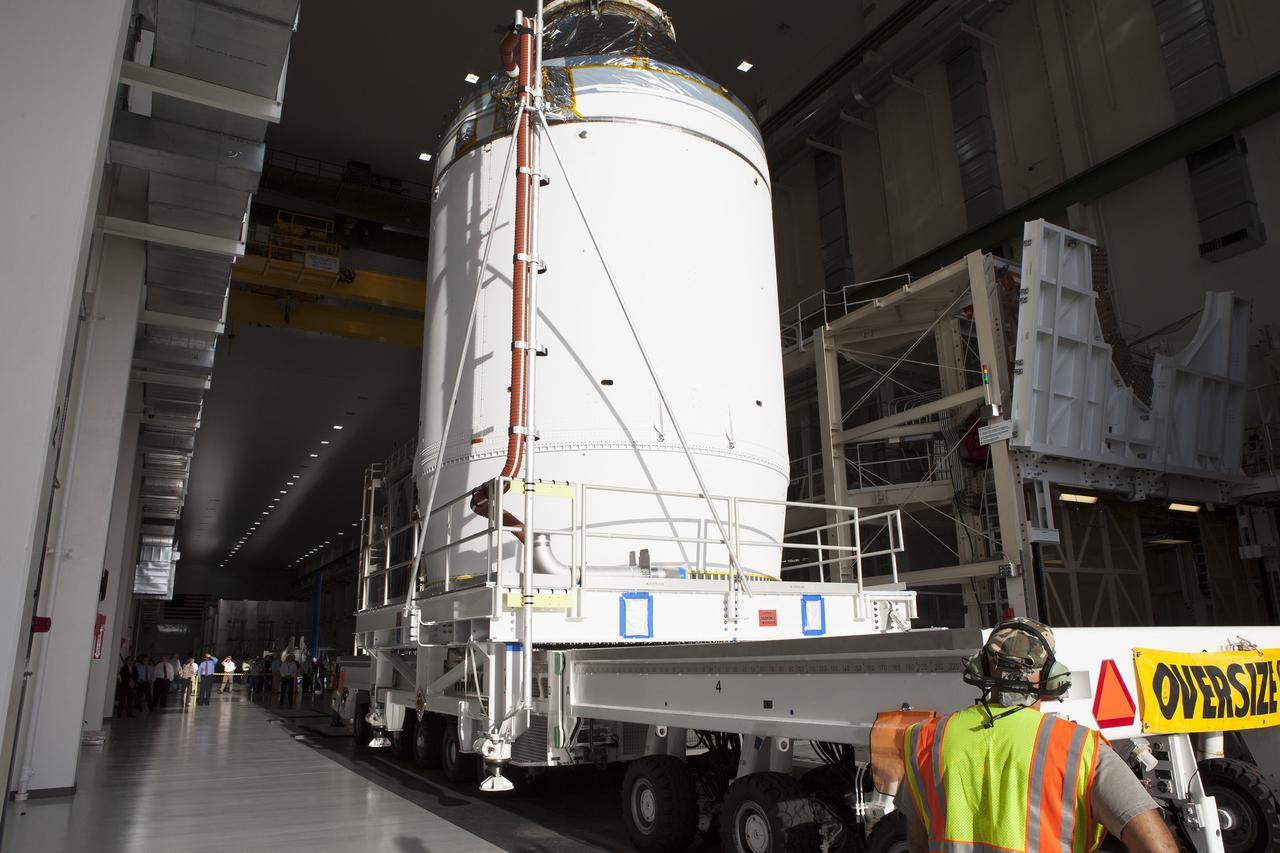
CAPE CANAVERAL, Fla. – The Orion crew module, stacked atop its service module, is moved slowly out of the Neil Armstrong Operations and Checkout Building high bay door at NASA's Kennedy Space Center in Florida. The spacecraft for Exploration Flight Test-1 will be transported to the Payload Hazardous Servicing Facility where it will be fueled ahead of its December flight test. Orion is the exploration spacecraft designed to carry astronauts to destinations not yet explored by humans, including an asteroid and Mars. It will have emergency abort capability, sustain the crew during space travel and provide safe re-entry from deep space return velocities. The first unpiloted test flight of the Orion is scheduled to launch atop a United Launch Alliance Delta IV Heavy rocket from Cape Canaveral Air Force Station in Florida to an altitude of 3,600 miles above the Earth's surface. The two-orbit, four-hour flight test will help engineers evaluate the systems critical to crew safety including the heat shield, parachute system and launch abort system. For more information, visit http://www.nasa.gov/orion. Photo credit: NASA/Daniel Casper
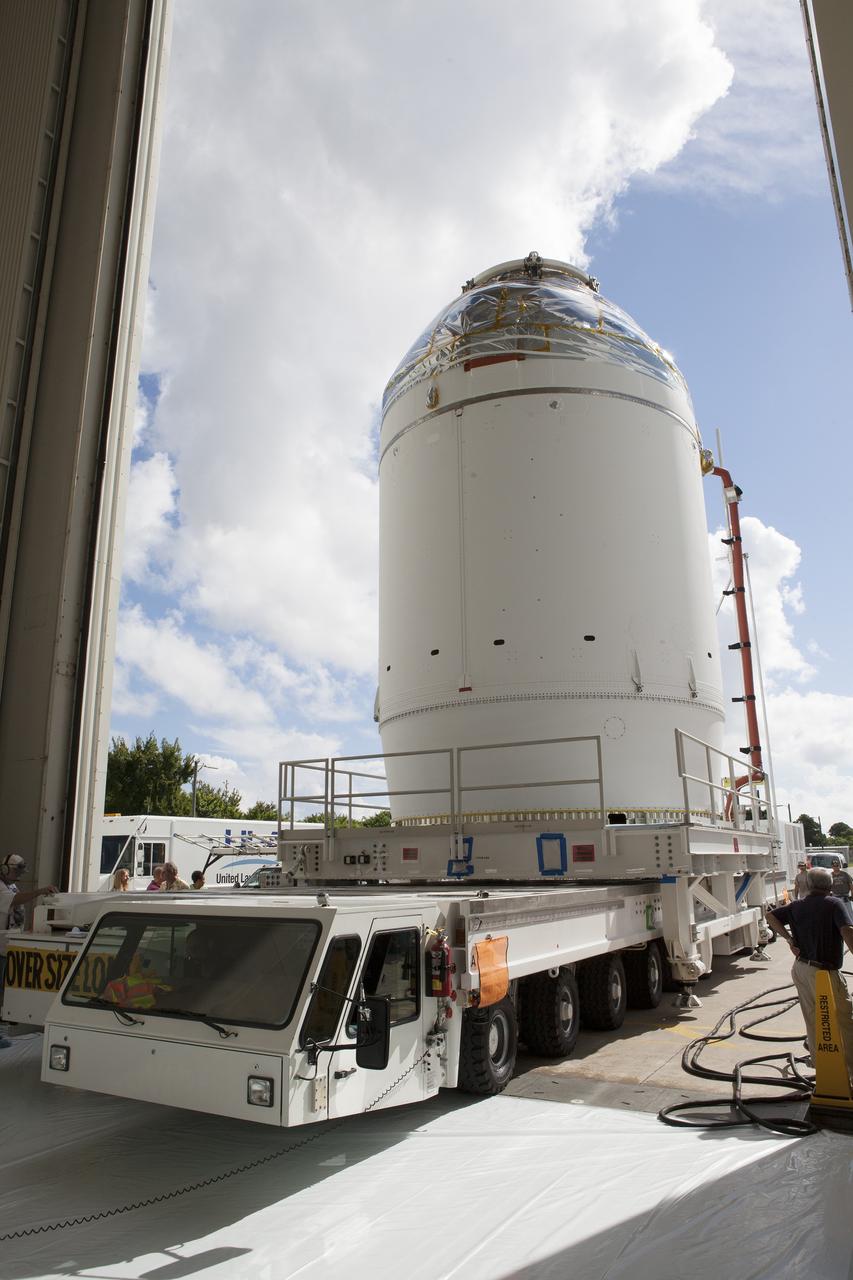
CAPE CANAVERAL, Fla. – The Orion crew module, stacked atop its service module, is transported into the Payload Hazardous Servicing Facility at NASA's Kennedy Space Center in Florida, where it will be fueled ahead of its December flight. The spacecraft for Exploration Flight Test-1 was moved out of the Neil Armstrong Operations and Checkout Building high bay. Orion is the exploration spacecraft designed to carry astronauts to destinations not yet explored by humans, including an asteroid and Mars. It will have emergency abort capability, sustain the crew during space travel and provide safe re-entry from deep space return velocities. The first unpiloted test flight of the Orion is scheduled to launch atop a United Launch Alliance Delta IV Heavy rocket from Cape Canaveral Air Force Station in Florida to an altitude of 3,600 miles above the Earth's surface. The two-orbit, four-hour flight test will help engineers evaluate the systems critical to crew safety including the heat shield, parachute system and launch abort system. For more information, visit http://www.nasa.gov/orion. Photo credit: NASA/Daniel Casper
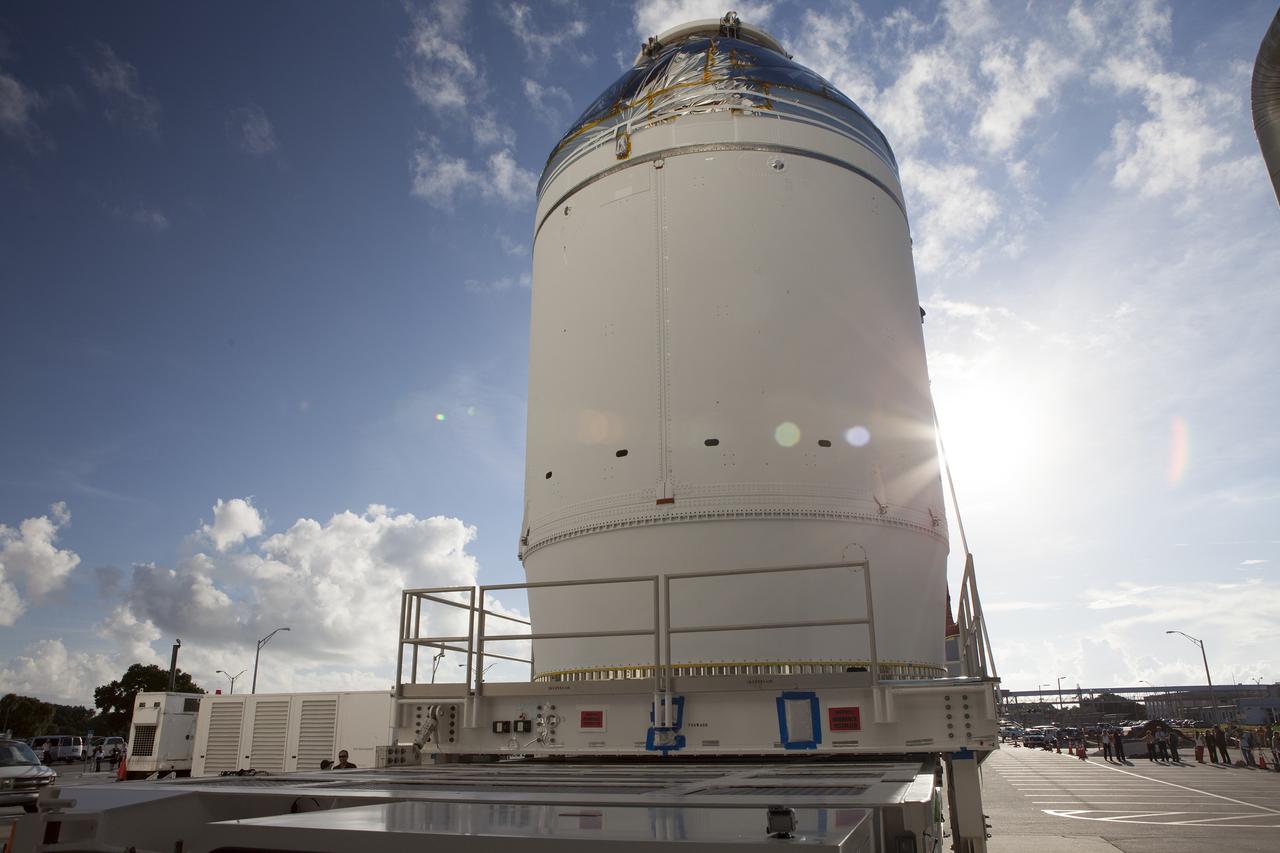
CAPE CANAVERAL, Fla. – The Orion crew module, stacked atop its service module, has moved out of the Neil Armstrong Operations and Checkout Building high bay at NASA's Kennedy Space Center in Florida. The spacecraft for Exploration Flight Test-1 will be transported to the Payload Hazardous Servicing Facility where it will be fueled ahead of its December flight test. Orion is the exploration spacecraft designed to carry astronauts to destinations not yet explored by humans, including an asteroid and Mars. It will have emergency abort capability, sustain the crew during space travel and provide safe re-entry from deep space return velocities. The first unpiloted test flight of the Orion is scheduled to launch atop a United Launch Alliance Delta IV Heavy rocket from Cape Canaveral Air Force Station in Florida to an altitude of 3,600 miles above the Earth's surface. The two-orbit, four-hour flight test will help engineers evaluate the systems critical to crew safety including the heat shield, parachute system and launch abort system. For more information, visit http://www.nasa.gov/orion. Photo credit: NASA/Daniel Casper

CAPE CANAVERAL, Fla. – The high bay door opens as the Orion crew module, stacked atop its service module, is moved slowly out of the Neil Armstrong Operations and Checkout Building high bay at NASA's Kennedy Space Center in Florida. The spacecraft for Exploration Flight Test-1 will be transported to the Payload Hazardous Servicing Facility where it will be fueled ahead of its December flight test. Orion is the exploration spacecraft designed to carry astronauts to destinations not yet explored by humans, including an asteroid and Mars. It will have emergency abort capability, sustain the crew during space travel and provide safe re-entry from deep space return velocities. The first unpiloted test flight of the Orion is scheduled to launch atop a United Launch Alliance Delta IV Heavy rocket from Cape Canaveral Air Force Station in Florida to an altitude of 3,600 miles above the Earth's surface. The two-orbit, four-hour flight test will help engineers evaluate the systems critical to crew safety including the heat shield, parachute system and launch abort system. For more information, visit http://www.nasa.gov/orion. Photo credit: NASA/Daniel Casper