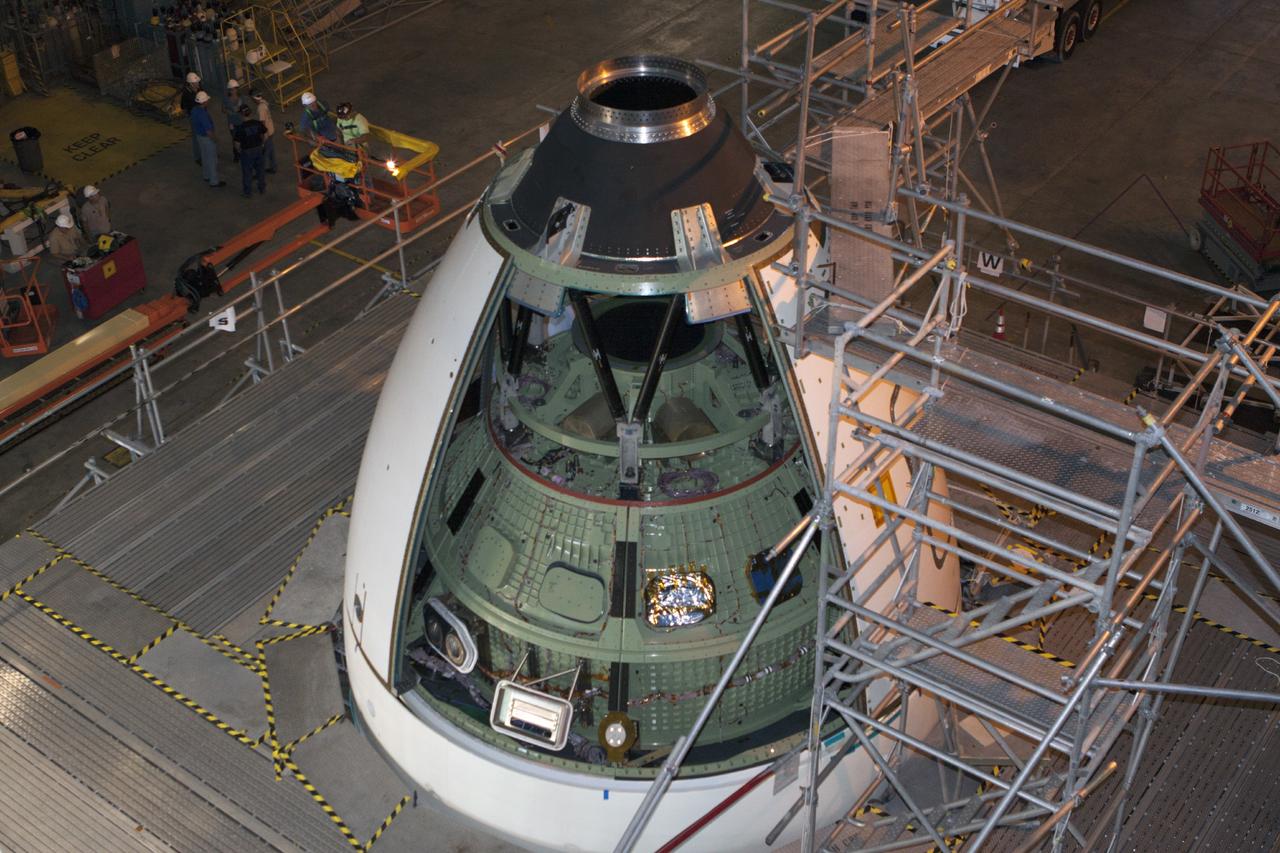
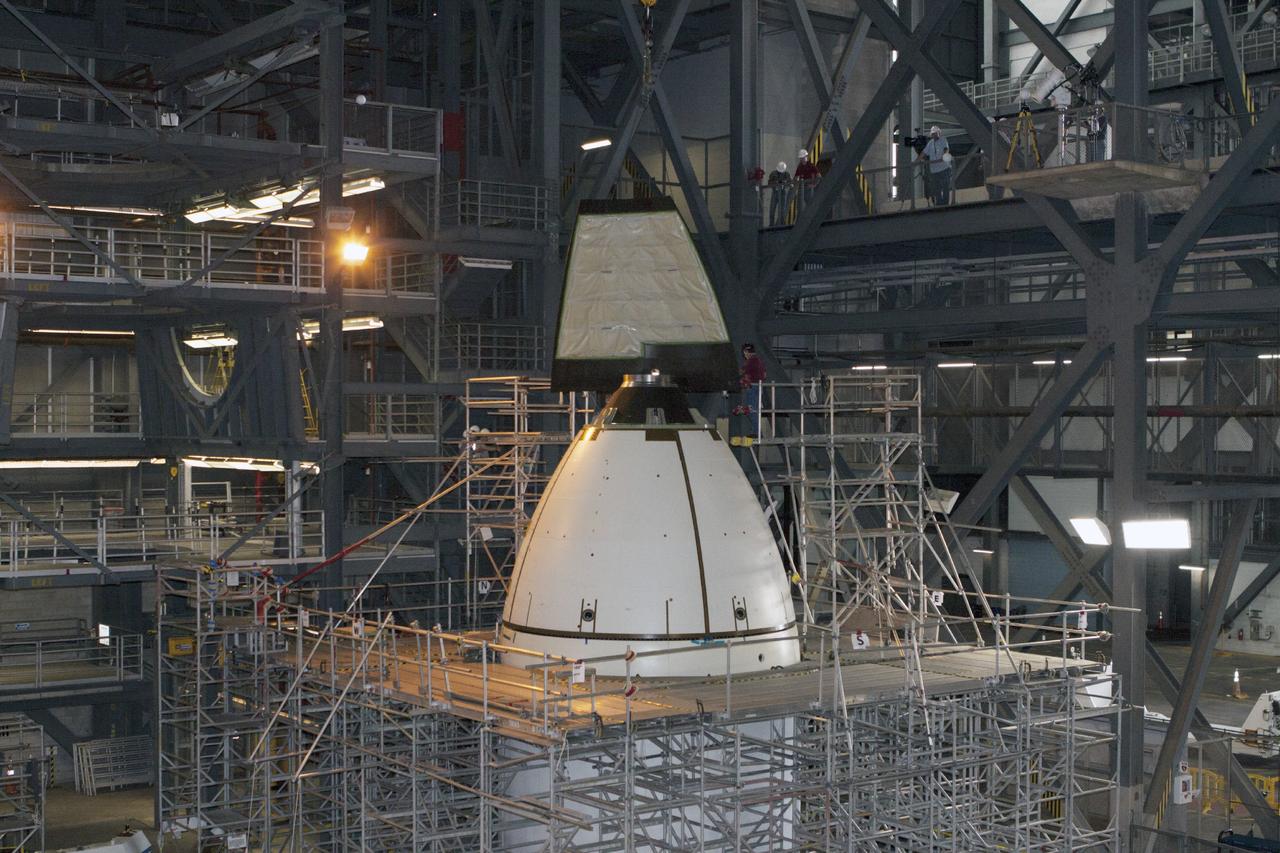
CAPE CANAVERAL, Fla. – At NASA’s Kennedy Space Center in Florida, several ogive panels have been installed on the Orion ground test vehicle in Vehicle Assembly Building high bay 4. The ogive panels enclose the Orion spacecraft and attach to the Launch Abort System. The test vehicle is being used by the Ground Systems Development and Operations Program for path finding operations, including simulated manufacturing, assembly and stacking procedures. Orion is the exploration spacecraft designed to carry astronauts to destinations not yet explored by humans, including an asteroid and Mars. It will have emergency abort capability, sustain the crew during space travel and provide safe re-entry from deep space return velocities. The first unpiloted test flight of Orion is scheduled to launch in 2014 atop a Delta IV rocket and in 2017 on NASA’s Space Launch System rocket. For more information, visit www.nasa.gov/orion. Photo credit: Kim Shiflett
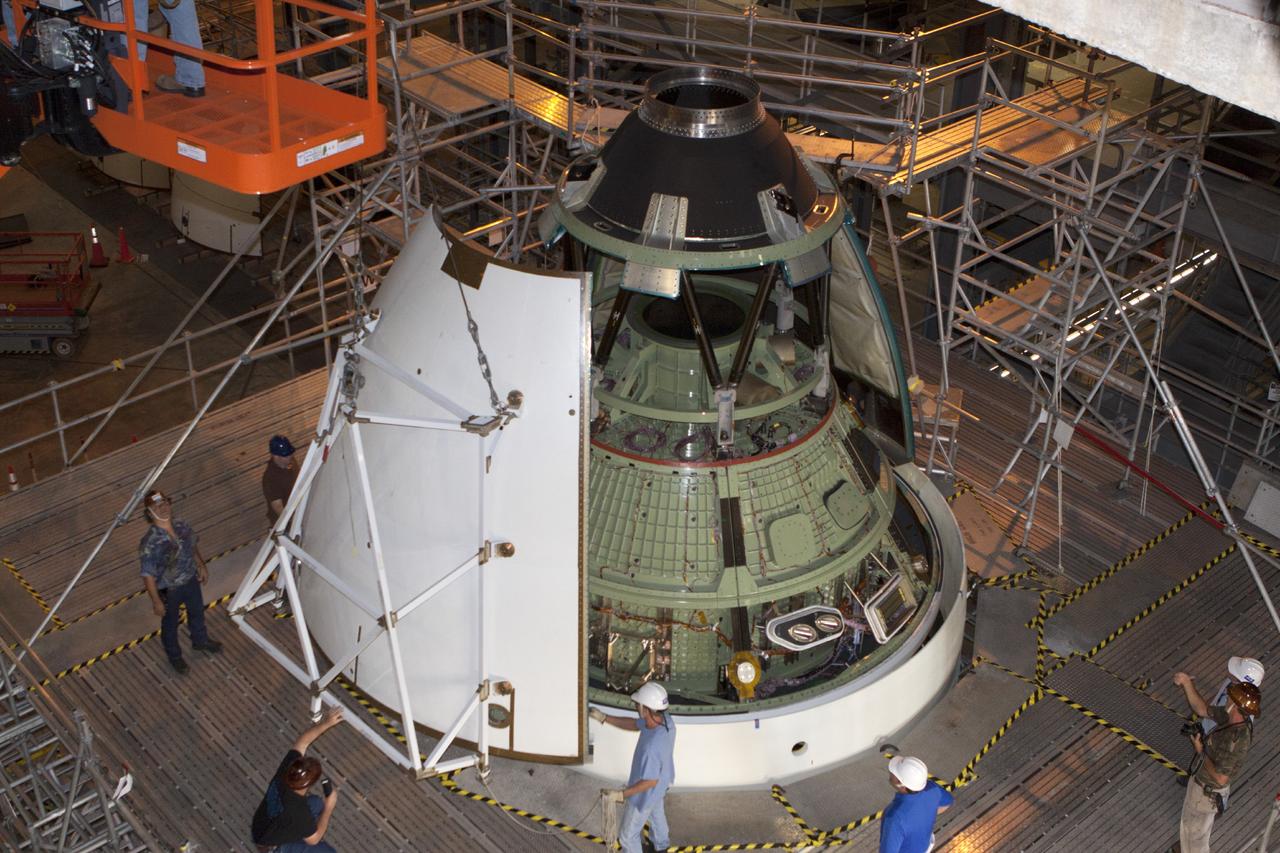
CAPE CANAVERAL, Fla. – At NASA’s Kennedy Space Center in Florida, technicians prepare to attach an ogive panel around the Orion ground test vehicle in Vehicle Assembly Building high bay 4. The ogive panels enclose the Orion spacecraft and attach to the Launch Abort System. The test vehicle is being used by the Ground Systems Development and Operations Program for path finding operations, including simulated manufacturing, assembly and stacking procedures. Orion is the exploration spacecraft designed to carry astronauts to destinations not yet explored by humans, including an asteroid and Mars. It will have emergency abort capability, sustain the crew during space travel and provide safe re-entry from deep space return velocities. The first unpiloted test flight of Orion is scheduled to launch in 2014 atop a Delta IV rocket and in 2017 on NASA’s Space Launch System rocket. For more information, visit www.nasa.gov/orion. Photo credit: Kim Shiflett
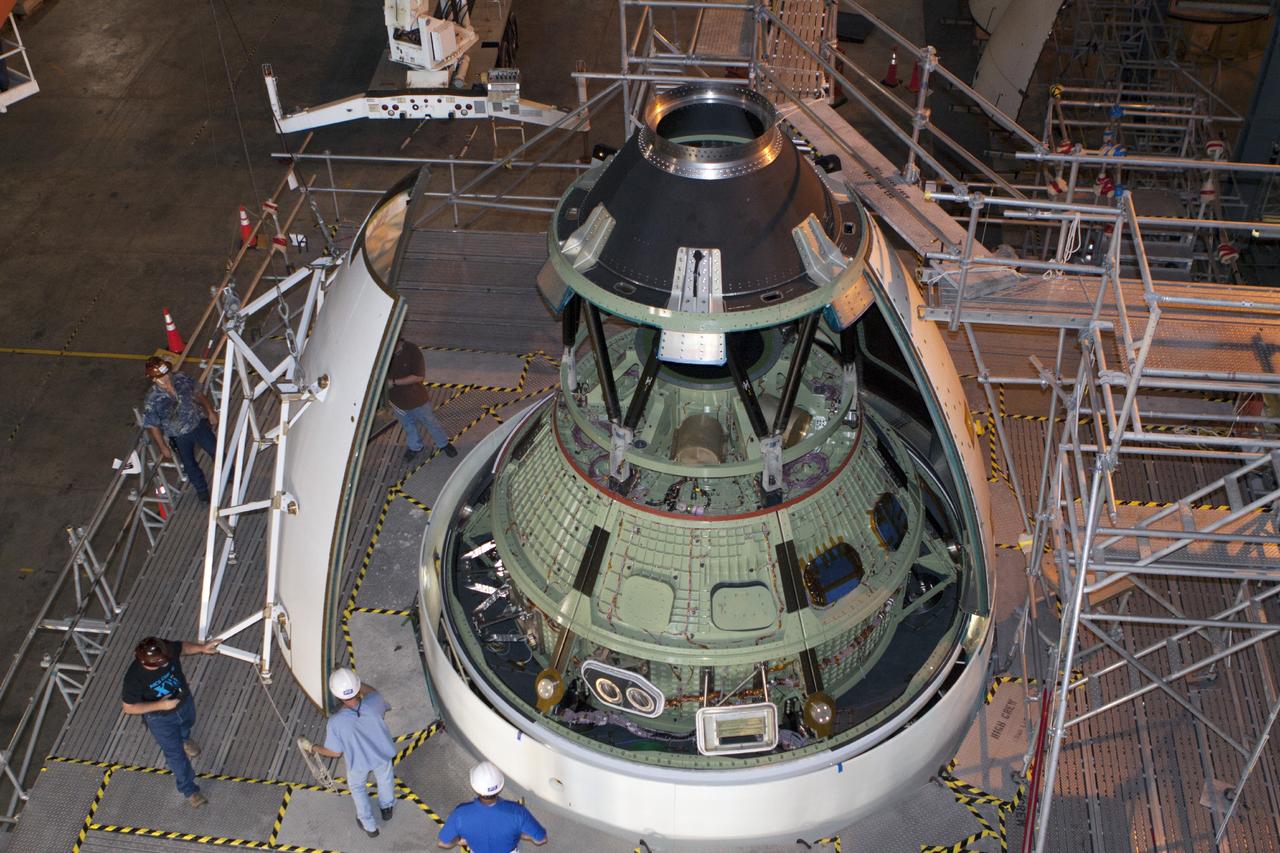
CAPE CANAVERAL, Fla. – At NASA’s Kennedy Space Center in Florida, technicians use a special handling device to bring an ogive panel closer for installation on the Orion ground test vehicle in Vehicle Assembly Building high bay 4. The ogive panels enclose the Orion spacecraft and attach to the Launch Abort System. The test vehicle is being used by the Ground Systems Development and Operations Program for path finding operations, including simulated manufacturing, assembly and stacking procedures. Orion is the exploration spacecraft designed to carry astronauts to destinations not yet explored by humans, including an asteroid and Mars. It will have emergency abort capability, sustain the crew during space travel and provide safe re-entry from deep space return velocities. The first unpiloted test flight of Orion is scheduled to launch in 2014 atop a Delta IV rocket and in 2017 on NASA’s Space Launch System rocket. For more information, visit www.nasa.gov/orion. Photo credit: Kim Shiflett
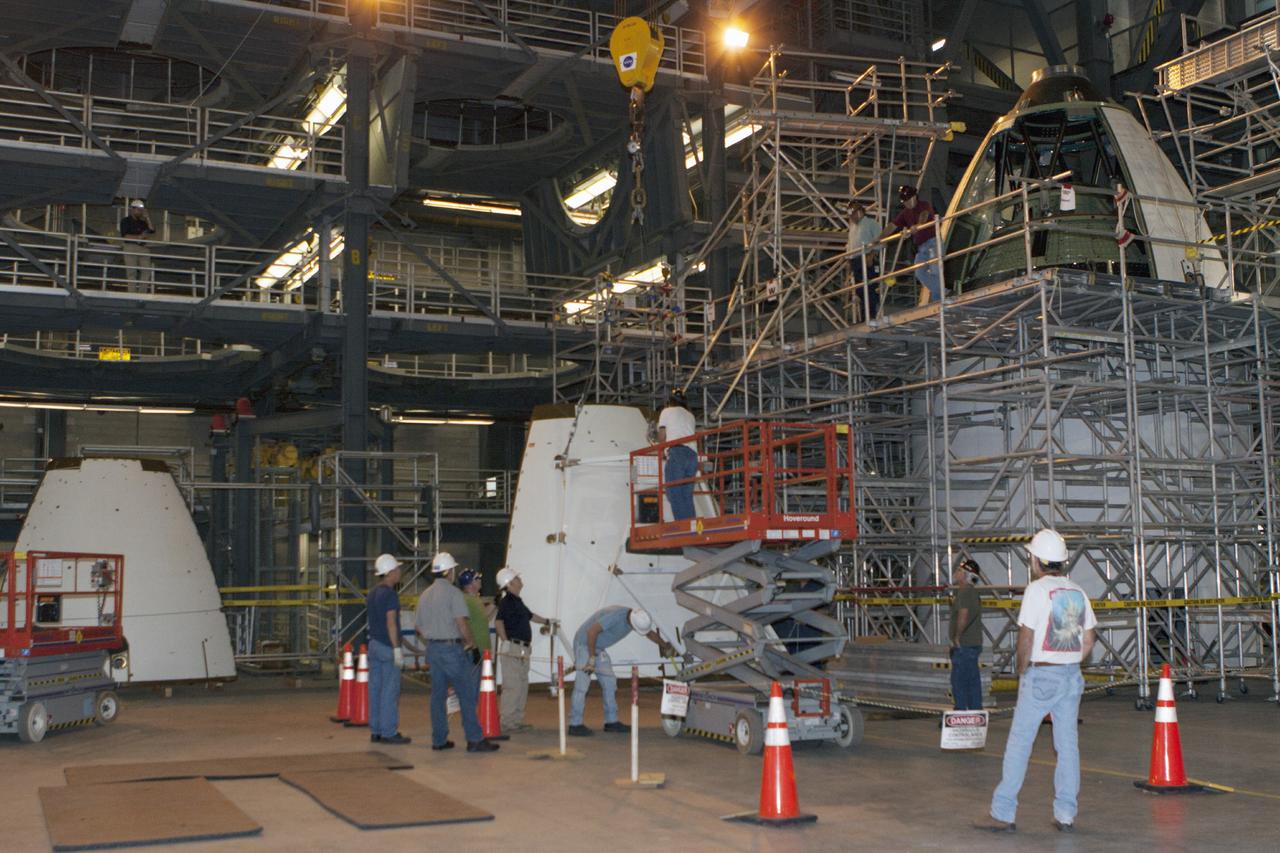
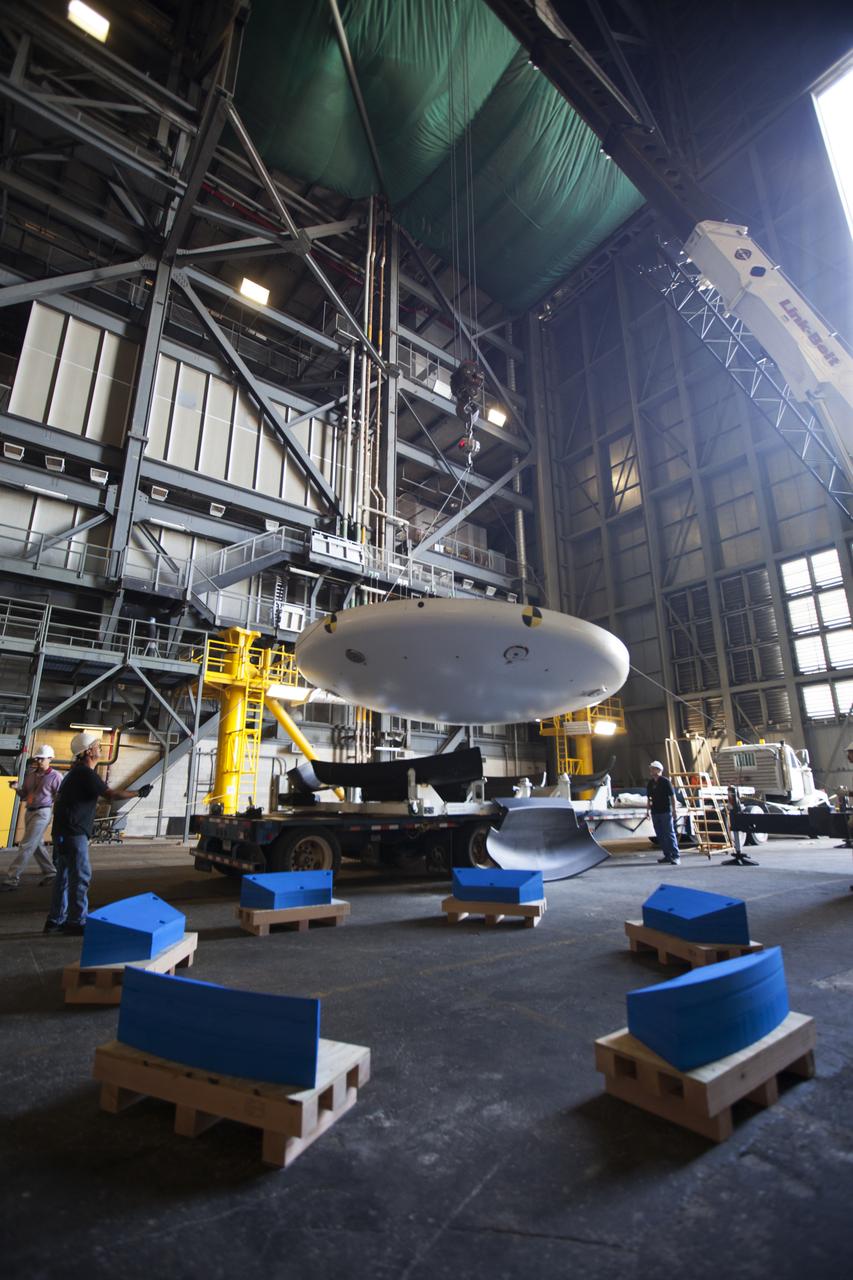
CAPE CANAVERAL, Fla. – At NASA’s Kennedy Space Center in Florida, technicians prepare an ogive panel for lifting by crane so that it can be installed on the Orion ground test vehicle in Vehicle Assembly Building high bay 4. The ogive panels enclose the Orion spacecraft and attach to the Launch Abort System. The test vehicle is being used Ground Systems Development and Operations Program for path finding operations, including simulated manufacturing, assembly and stacking procedures. Orion is the exploration spacecraft designed to carry astronauts to destinations not yet explored by humans, including an asteroid and Mars. It will have emergency abort capability, sustain the crew during space travel and provide safe re-entry from deep space return velocities. The first unpiloted test flight of Orion is scheduled to launch in 2014 atop a Delta IV rocket and in 2017 on NASA’s Space Launch System rocket. For more information, visit www.nasa.gov/orion. Photo credit: Kim Shiflett
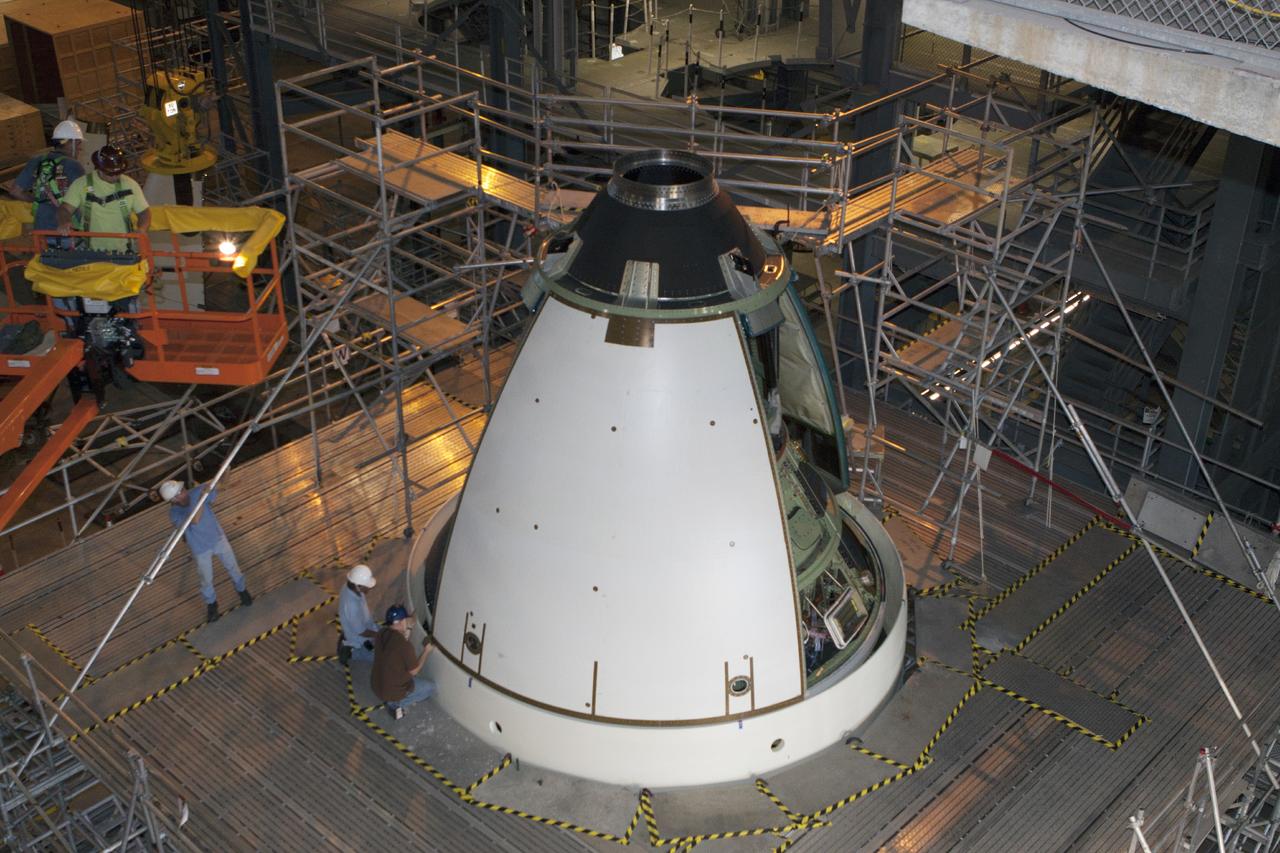
CAPE CANAVERAL, Fla. – At NASA’s Kennedy Space Center in Florida, technicians complete the installation of an ogive panel on the Orion ground test vehicle in Vehicle Assembly Building high bay 4. The ogive panels enclose the Orion spacecraft and attach to the Launch Abort System. The test vehicle is being used by the Ground Systems Development and Operations Program for path finding operations, including simulated manufacturing, assembly and stacking procedures. Orion is the exploration spacecraft designed to carry astronauts to destinations not yet explored by humans, including an asteroid and Mars. It will have emergency abort capability, sustain the crew during space travel and provide safe re-entry from deep space return velocities. The first unpiloted test flight of Orion is scheduled to launch in 2014 atop a Delta IV rocket and in 2017 on NASA’s Space Launch System rocket. For more information, visit www.nasa.gov/orion. Photo credit: Kim Shiflett
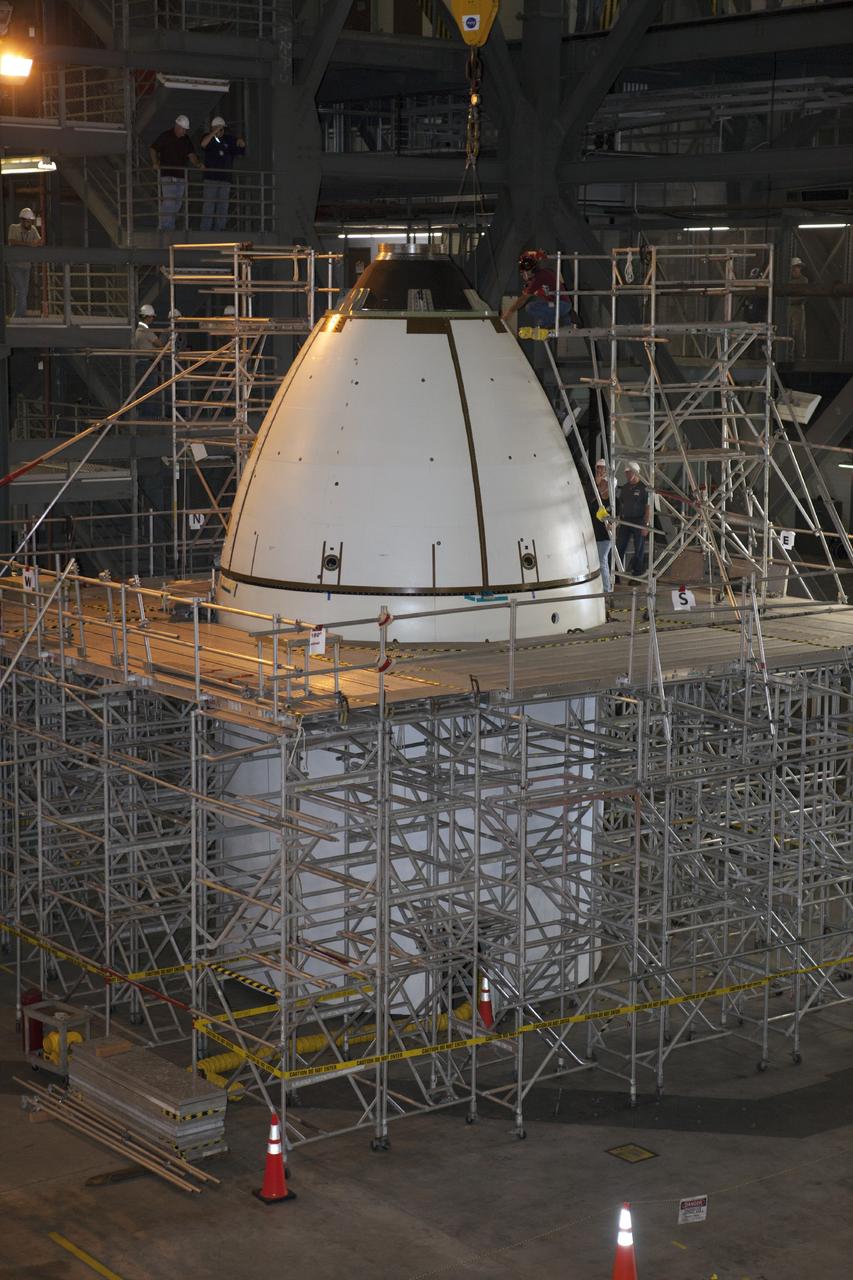
CAPE CANAVERAL, Fla. – At NASA’s Kennedy Space Center in Florida, all four ogive panels have been installed on the Orion ground test vehicle in Vehicle Assembly Building high bay 4. The ogive panels enclose and protect the Orion spacecraft and attach to the Launch Abort System. The test vehicle is being used by the Ground Systems Development and Operations Program for path finding operations, including simulated manufacturing, assembly and stacking procedures. Orion is the exploration spacecraft designed to carry astronauts to destinations not yet explored by humans, including an asteroid and Mars. It will have emergency abort capability, sustain the crew during space travel and provide safe re-entry from deep space return velocities. The first unpiloted test flight of Orion is scheduled to launch in 2014 atop a Delta IV rocket and in 2017 on NASA’s Space Launch System rocket. For more information, visit www.nasa.gov/orion. Photo credit: Kim Shiflett
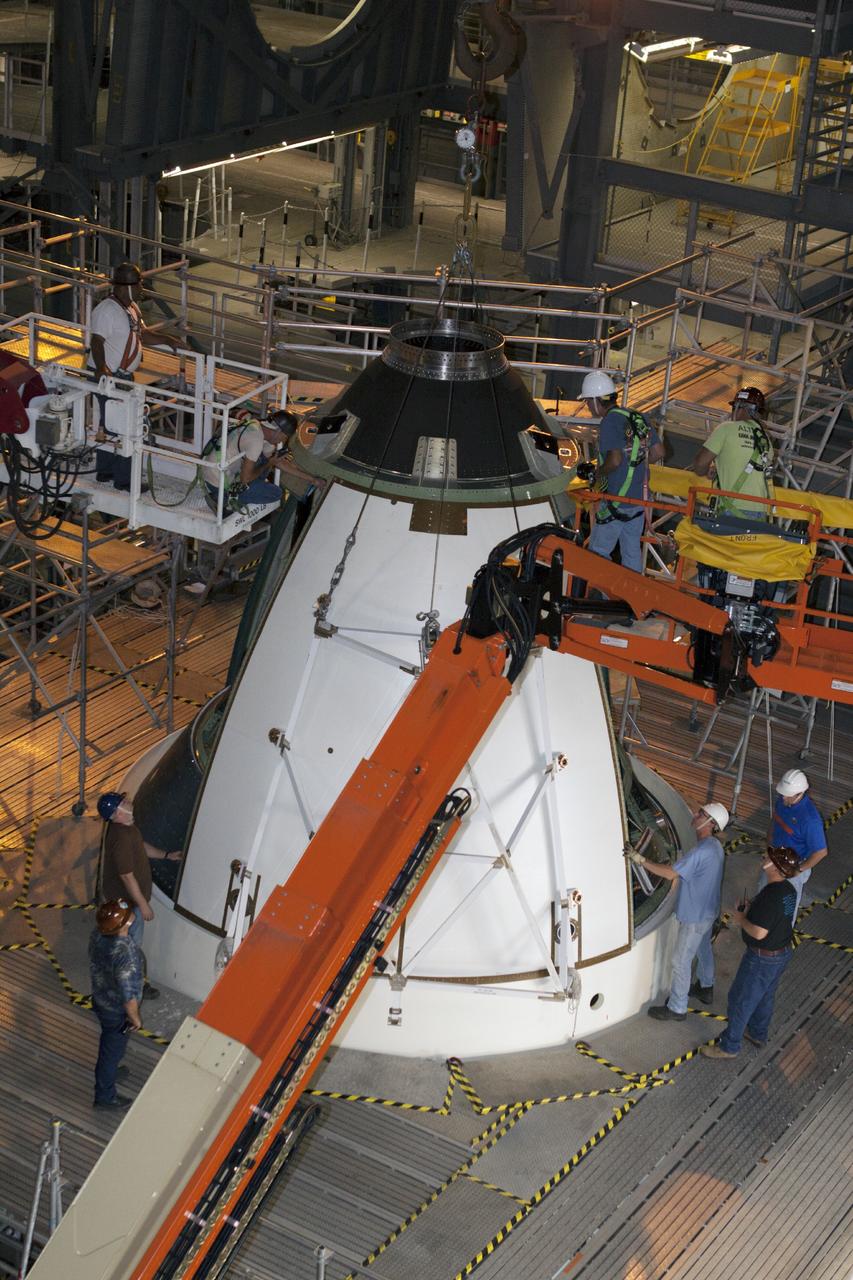
CAPE CANAVERAL, Fla. – At NASA’s Kennedy Space Center in Florida, technicians attach an ogive panel on the Orion ground test vehicle in Vehicle Assembly Building high bay 4. The ogive panels enclose the Orion spacecraft and attach to the Launch Abort System. The test vehicle is being used by the Ground Systems Development and Operations Program for path finding operations, including simulated manufacturing, assembly and stacking procedures. Orion is the exploration spacecraft designed to carry astronauts to destinations not yet explored by humans, including an asteroid and Mars. It will have emergency abort capability, sustain the crew during space travel and provide safe re-entry from deep space return velocities. The first unpiloted test flight of Orion is scheduled to launch in 2014 atop a Delta IV rocket and in 2017 on NASA’s Space Launch System rocket. For more information, visit www.nasa.gov/orion. Photo credit: Kim Shiflett
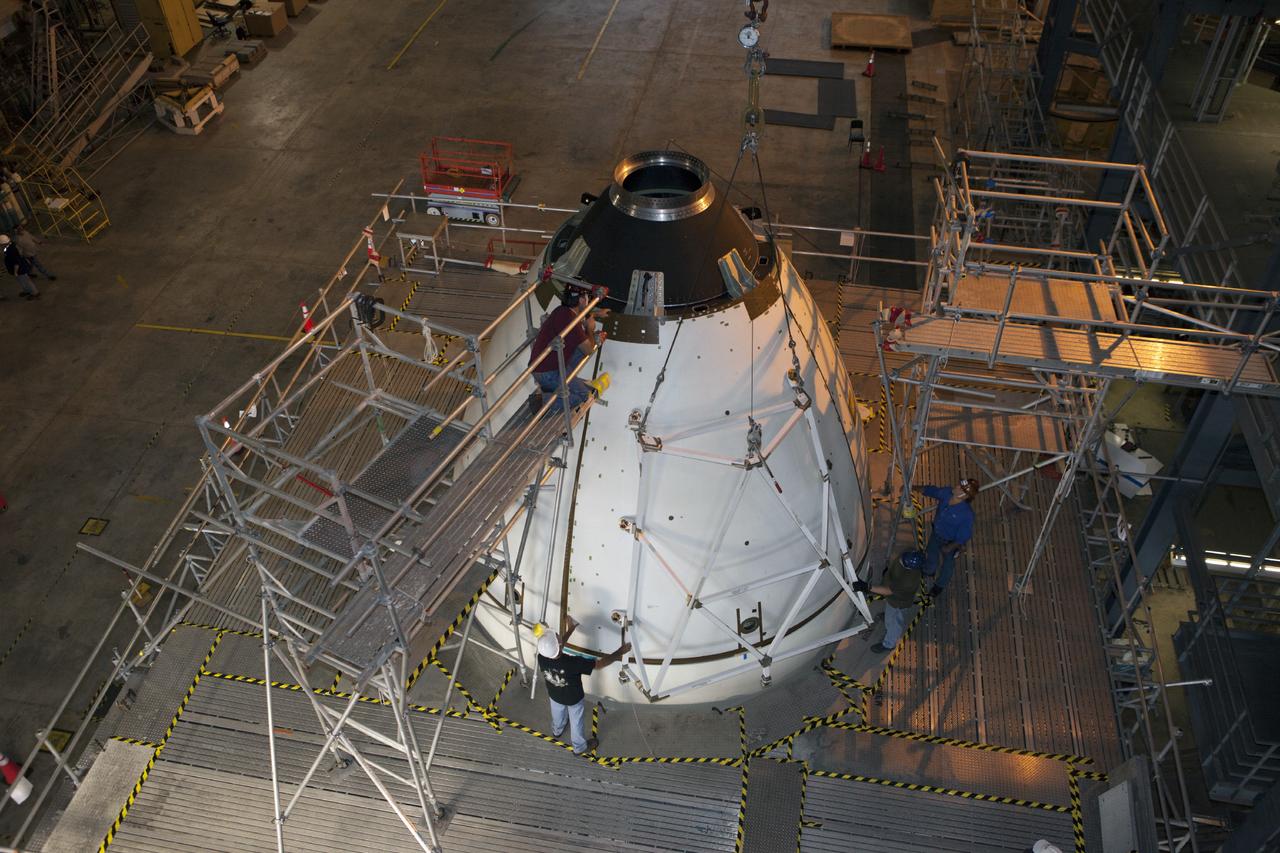
CAPE CANAVERAL, Fla. – At NASA’s Kennedy Space Center in Florida, technicians attach the fourth ogive panel on the Orion ground test vehicle in Vehicle Assembly Building high bay 4. The ogive panels enclose and protect the Orion spacecraft and attach to the Launch Abort System. The test vehicle is being used by the Ground Systems Development and Operations Program for path finding operations, including simulated manufacturing, assembly and stacking procedures. Orion is the exploration spacecraft designed to carry astronauts to destinations not yet explored by humans, including an asteroid and Mars. It will have emergency abort capability, sustain the crew during space travel and provide safe re-entry from deep space return velocities. The first unpiloted test flight of Orion is scheduled to launch in 2014 atop a Delta IV rocket and in 2017 on NASA’s Space Launch System rocket. For more information, visit www.nasa.gov/orion. Photo credit: Kim Shiflett
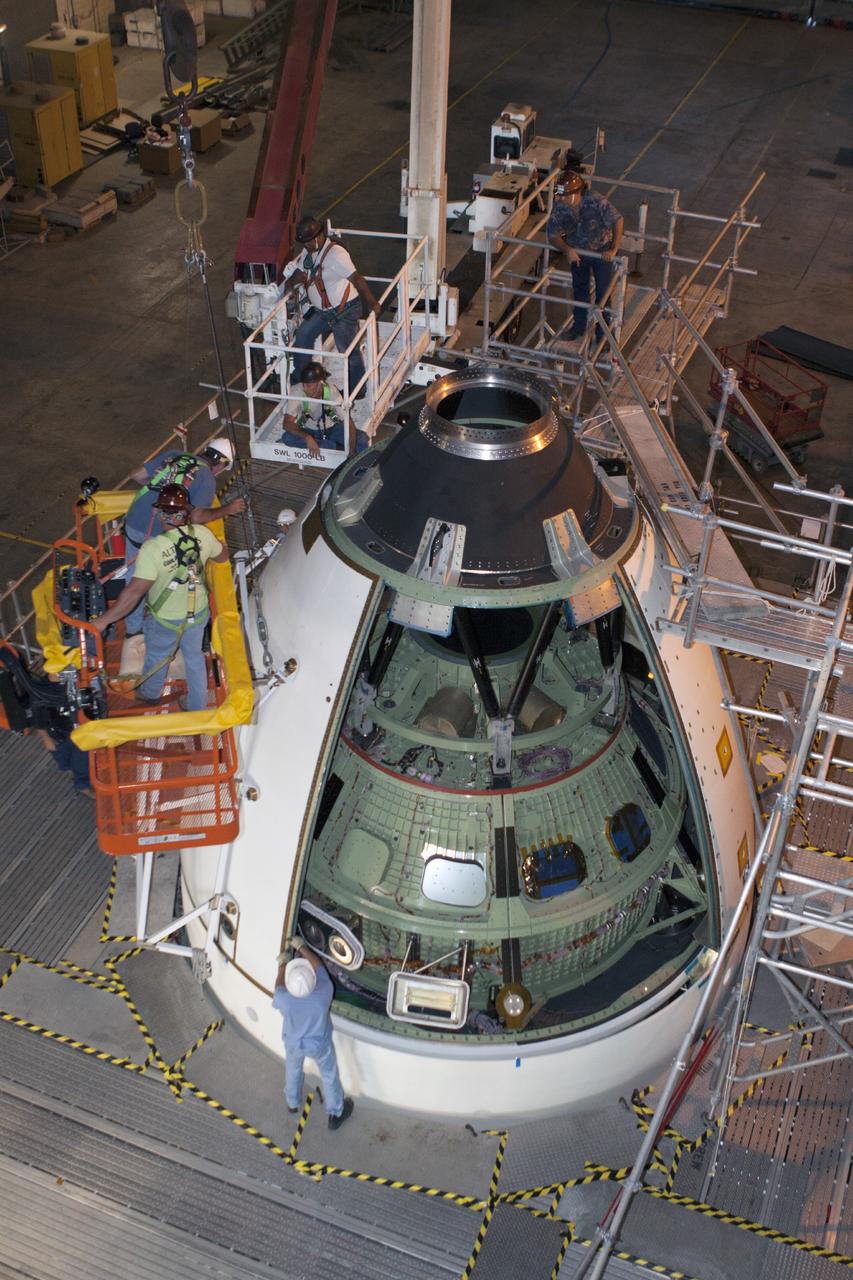
CAPE CANAVERAL, Fla. – At NASA’s Kennedy Space Center in Florida, technicians attach an ogive panel on the Orion ground test vehicle in Vehicle Assembly Building high bay 4. The ogive panels enclose the Orion spacecraft and attach to the Launch Abort System. The test vehicle is being used by the Ground Systems Development and Operations Program for path finding operations, including simulated manufacturing, assembly and stacking procedures. Orion is the exploration spacecraft designed to carry astronauts to destinations not yet explored by humans, including an asteroid and Mars. It will have emergency abort capability, sustain the crew during space travel and provide safe re-entry from deep space return velocities. The first unpiloted test flight of Orion is scheduled to launch in 2014 atop a Delta IV rocket and in 2017 on NASA’s Space Launch System rocket. For more information, visit www.nasa.gov/orion. Photo credit: Kim Shiflett
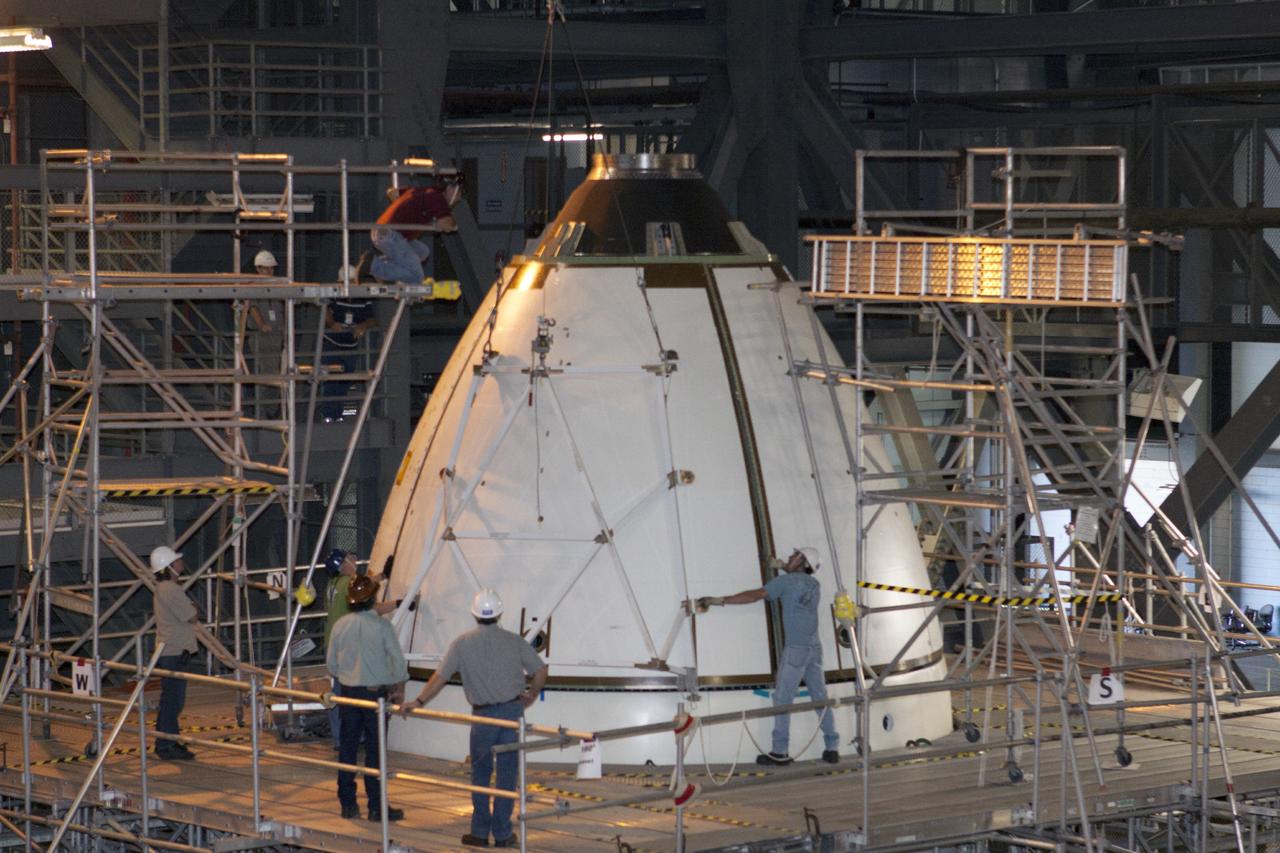
CAPE CANAVERAL, Fla. – At NASA’s Kennedy Space Center in Florida, technicians complete the installation of ogive panels on the Orion ground test vehicle in Vehicle Assembly Building high bay 4. The ogive panels enclose the Orion spacecraft and attach to the Launch Abort System. The test vehicle is being used Ground Systems Development and Operations Program for path finding operations, including simulated manufacturing, assembly and stacking procedures. Orion is the exploration spacecraft designed to carry astronauts to destinations not yet explored by humans, including an asteroid and Mars. It will have emergency abort capability, sustain the crew during space travel and provide safe re-entry from deep space return velocities. The first unpiloted test flight of Orion is scheduled to launch in 2014 atop a Delta IV rocket and in 2017 on NASA’s Space Launch System rocket. For more information, visit www.nasa.gov/orion. Photo credit: Kim Shiflett
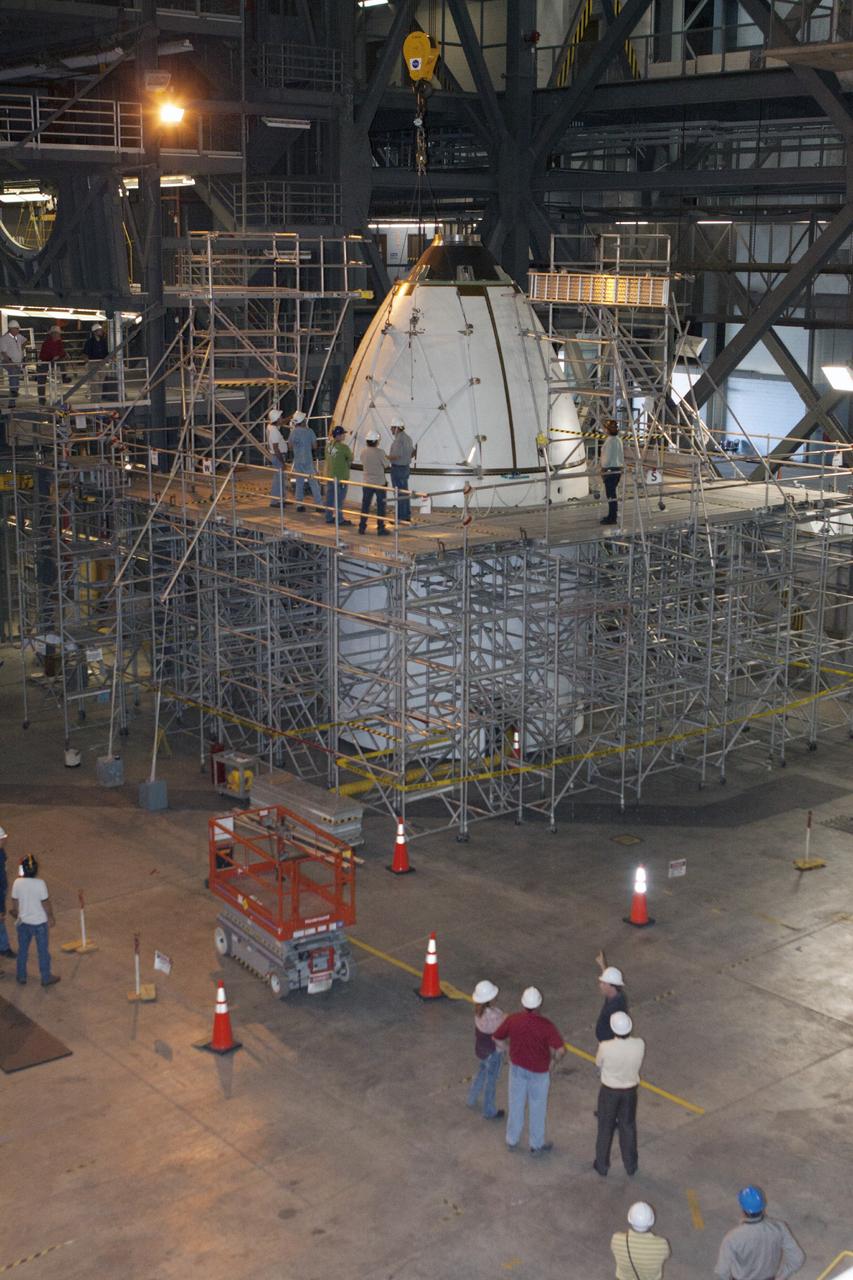
CAPE CANAVERAL, Fla. – At NASA’s Kennedy Space Center in Florida, technicians complete the installation of ogive panels on the Orion ground test vehicle in Vehicle Assembly Building high bay 4. The ogive panels enclose the Orion spacecraft and attach to the Launch Abort System. The test vehicle is being used Ground Systems Development and Operations Program for path finding operations, including simulated manufacturing, assembly and stacking procedures. Orion is the exploration spacecraft designed to carry astronauts to destinations not yet explored by humans, including an asteroid and Mars. It will have emergency abort capability, sustain the crew during space travel and provide safe re-entry from deep space return velocities. The first unpiloted test flight of Orion is scheduled to launch in 2014 atop a Delta IV rocket and in 2017 on NASA’s Space Launch System rocket. For more information, visit www.nasa.gov/orion. Photo credit: Kim Shiflett
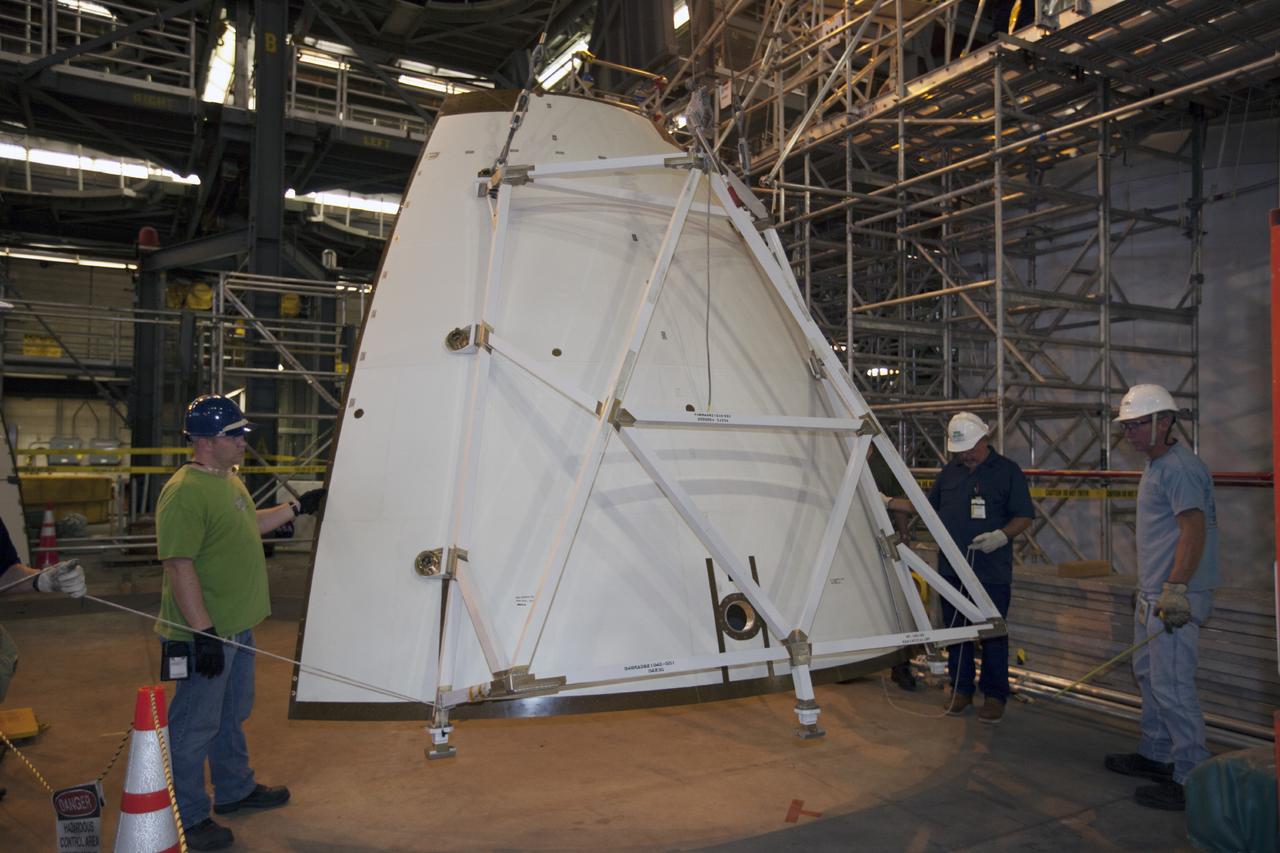
CAPE CANAVERAL, Fla. – At NASA’s Kennedy Space Center in Florida, technicians prepare an ogive panel for installation on the Orion ground test vehicle in Vehicle Assembly Building high bay 4. The ogive panels enclose the Orion spacecraft and attach to the Launch Abort System. The test vehicle is being used by the Ground Systems Development and Operations Program for path finding operations, including simulated manufacturing, assembly and stacking procedures. Orion is the exploration spacecraft designed to carry astronauts to destinations not yet explored by humans, including an asteroid and Mars. It will have emergency abort capability, sustain the crew during space travel and provide safe re-entry from deep space return velocities. The first unpiloted test flight of Orion is scheduled to launch in 2014 atop a Delta IV rocket and in 2017 on NASA’s Space Launch System rocket. For more information, visit www.nasa.gov/orion. Photo credit: Kim Shiflett
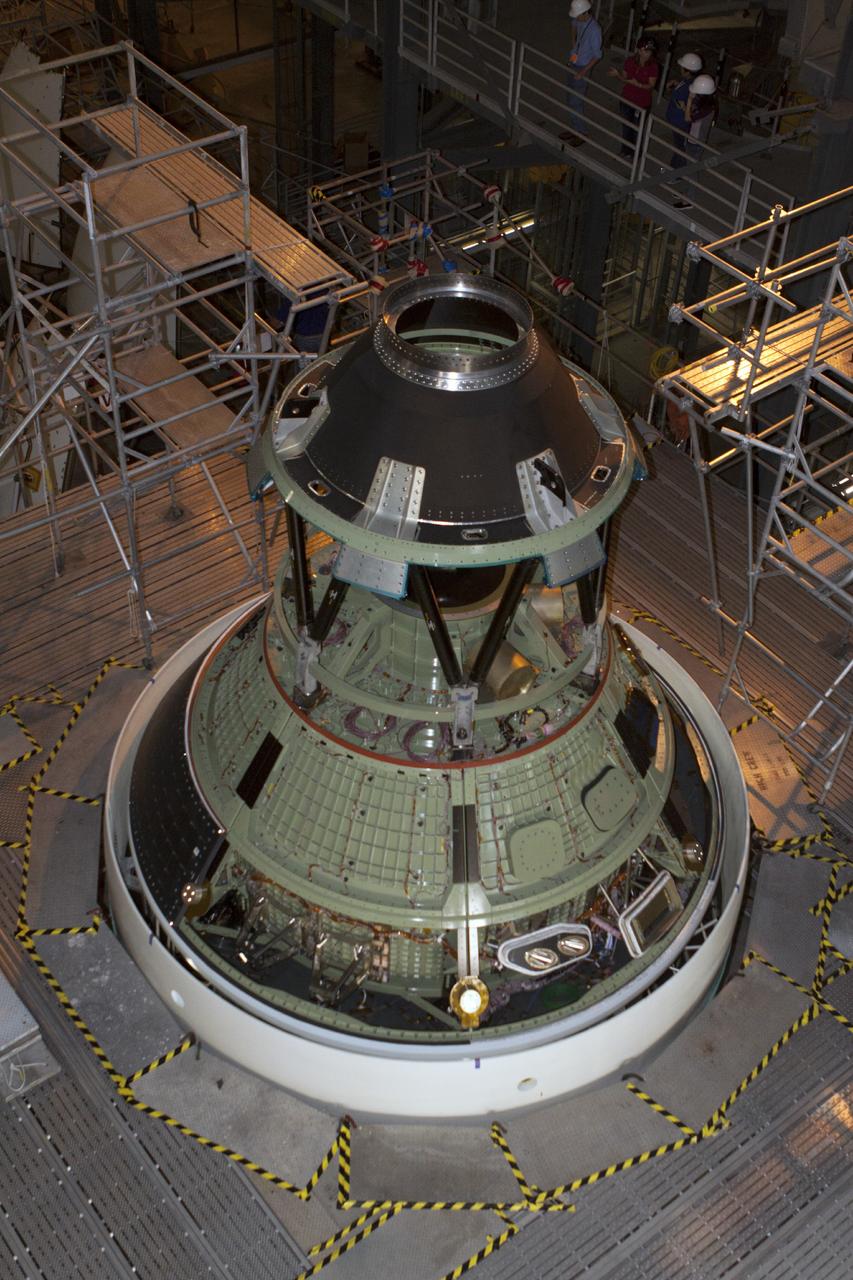
CAPE CANAVERAL, Fla. – At NASA’s Kennedy Space Center in Florida, the Orion ground test vehicle is being prepared for installation of the ogive panels in Vehicle Assembly Building high bay 4. The ogive panels enclose and protect the Orion spacecraft and attach to the Launch Abort System. The test vehicle is being used by the Ground Systems Development and Operations Program for path finding operations, including simulated manufacturing, assembly and stacking procedures. Orion is the exploration spacecraft designed to carry astronauts to destinations not yet explored by humans, including an asteroid and Mars. It will have emergency abort capability, sustain the crew during space travel and provide safe re-entry from deep space return velocities. The first unpiloted test flight of Orion is scheduled to launch in 2014 atop a Delta IV rocket and in 2017 on NASA’s Space Launch System rocket. For more information, visit www.nasa.gov/orion. Photo credit: Kim Shiflett
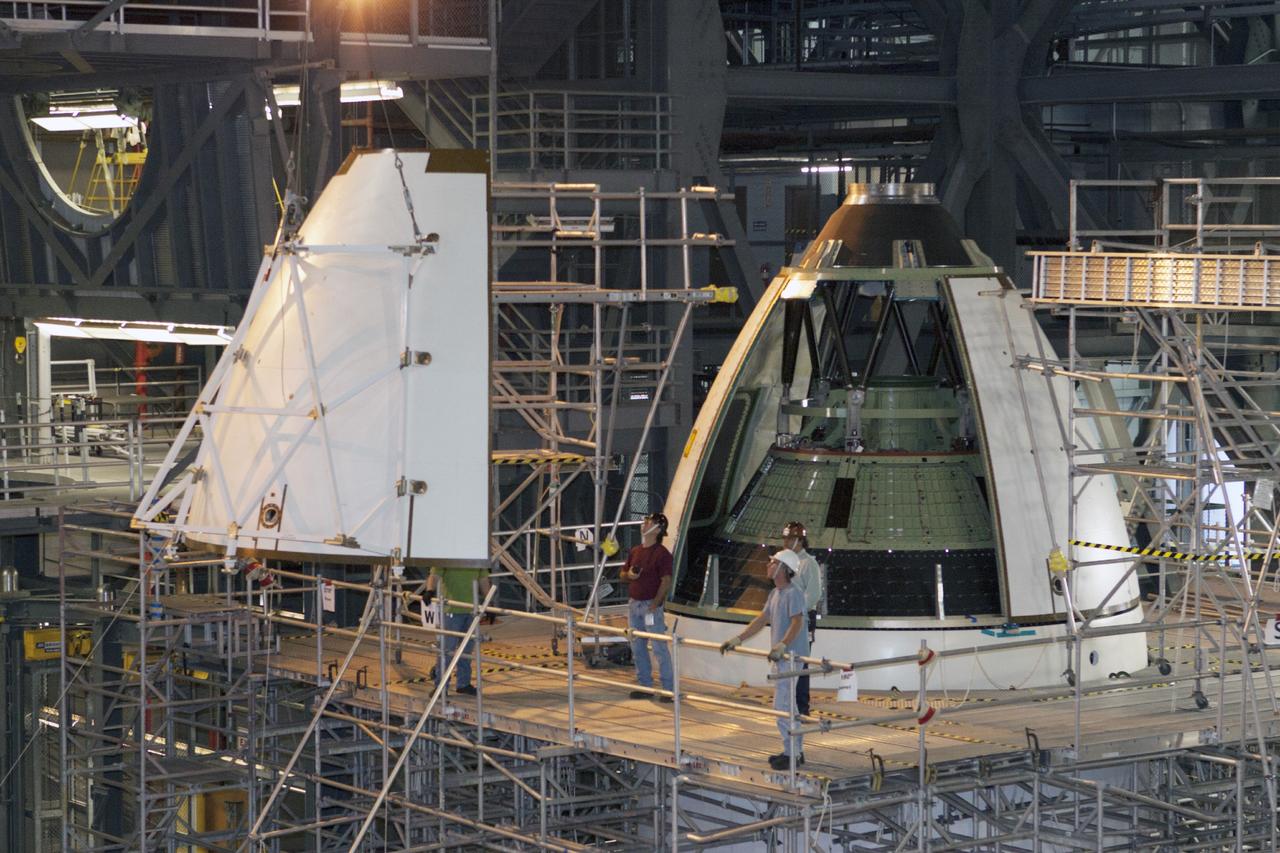
CAPE CANAVERAL, Fla. – At NASA’s Kennedy Space Center in Florida, technicians monitor the progress as a crane is used to move an ogive panel closer for installation on the Orion ground test vehicle in Vehicle Assembly Building high bay 4. The ogive panels enclose the Orion spacecraft and attach to the Launch Abort System. The test vehicle is being used Ground Systems Development and Operations Program for path finding operations, including simulated manufacturing, assembly and stacking procedures. Orion is the exploration spacecraft designed to carry astronauts to destinations not yet explored by humans, including an asteroid and Mars. It will have emergency abort capability, sustain the crew during space travel and provide safe re-entry from deep space return velocities. The first unpiloted test flight of Orion is scheduled to launch in 2014 atop a Delta IV rocket and in 2017 on NASA’s Space Launch System rocket. For more information, visit www.nasa.gov/orion. Photo credit: Kim Shiflett
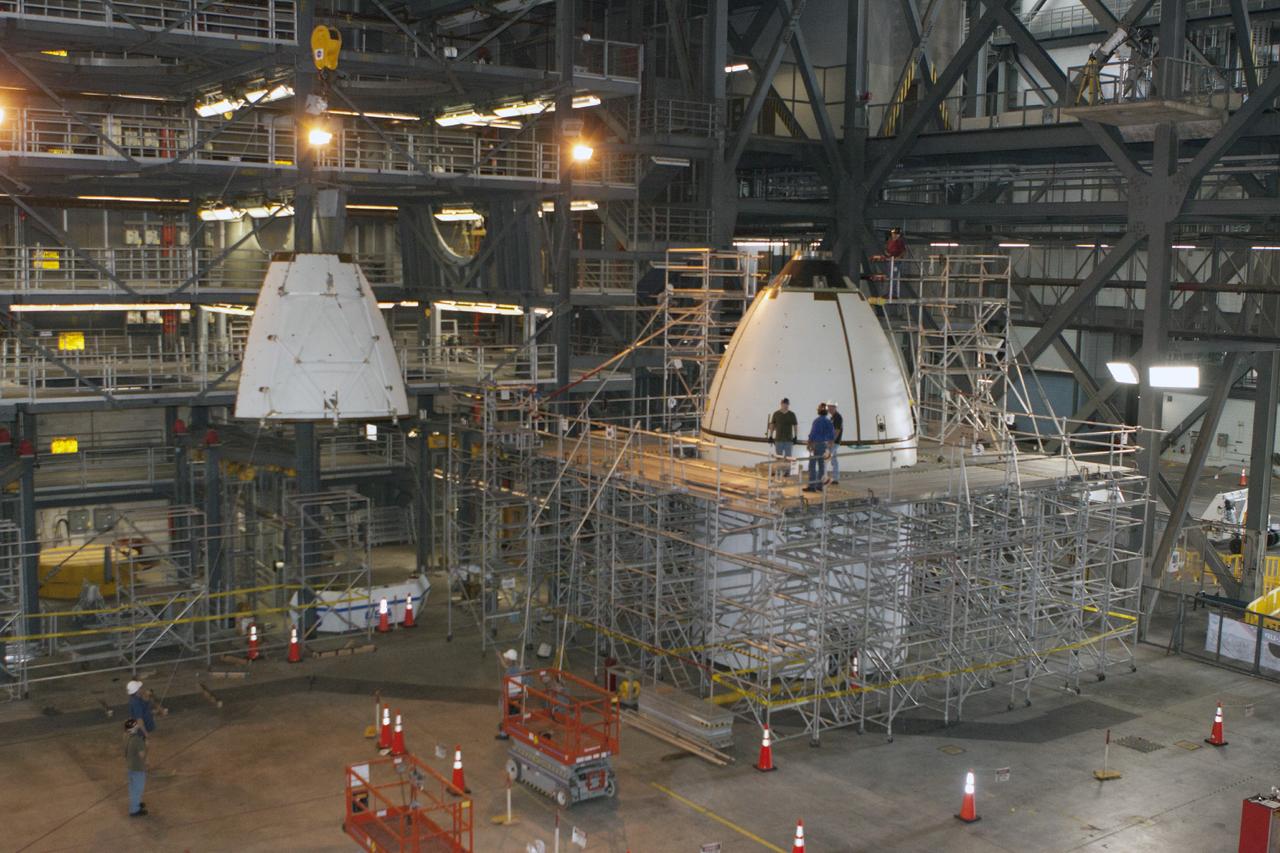
CAPE CANAVERAL, Fla. – At NASA’s Kennedy Space Center in Florida, technicians monitor the progress as the fourth ogive panel is lifted by crane so that they can be installed on the Orion ground test vehicle in Vehicle Assembly Building high bay 4. Three of the panels have already been installed on the test vehicle. The ogive panels enclose and protect the Orion spacecraft and attach to the Launch Abort System. The test vehicle is being used by the Ground Systems Development and Operations Program for path finding operations, including simulated manufacturing, assembly and stacking procedures. Orion is the exploration spacecraft designed to carry astronauts to destinations not yet explored by humans, including an asteroid and Mars. It will have emergency abort capability, sustain the crew during space travel and provide safe re-entry from deep space return velocities. The first unpiloted test flight of Orion is scheduled to launch in 2014 atop a Delta IV rocket and in 2017 on NASA’s Space Launch System rocket. For more information, visit www.nasa.gov/orion. Photo credit: Kim Shiflett
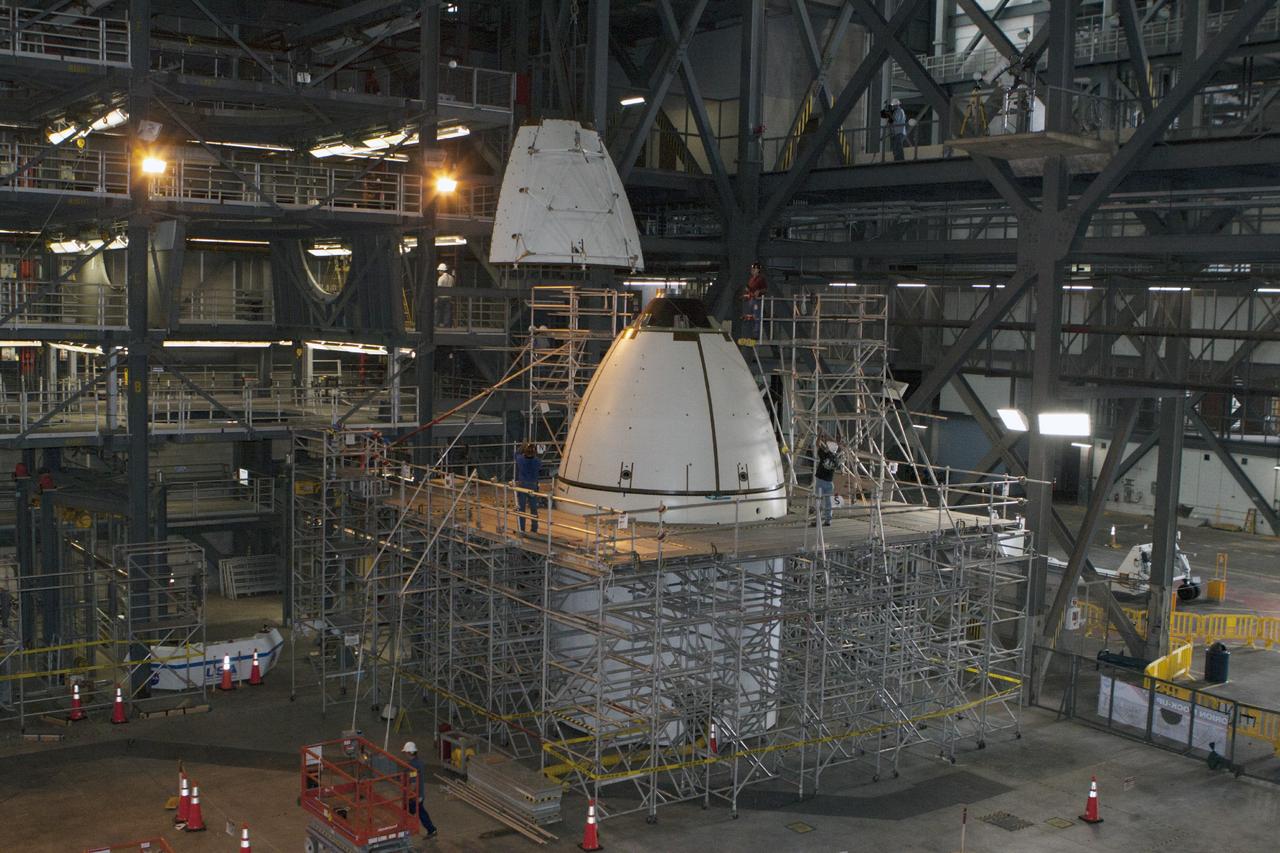
CAPE CANAVERAL, Fla. – At NASA’s Kennedy Space Center in Florida, technicians monitor the progress as the fourth ogive panel is lifted by crane so that they can be installed on the Orion ground test vehicle in Vehicle Assembly Building high bay 4. Three of the panels have already been installed on the test vehicle. The ogive panels enclose and protect the Orion spacecraft and attach to the Launch Abort System. The test vehicle is being used by the Ground Systems Development and Operations Program for path finding operations, including simulated manufacturing, assembly and stacking procedures. Orion is the exploration spacecraft designed to carry astronauts to destinations not yet explored by humans, including an asteroid and Mars. It will have emergency abort capability, sustain the crew during space travel and provide safe re-entry from deep space return velocities. The first unpiloted test flight of Orion is scheduled to launch in 2014 atop a Delta IV rocket and in 2017 on NASA’s Space Launch System rocket. For more information, visit www.nasa.gov/orion. Photo credit: Kim Shiflett
CAPE CANAVERAL, Fla. – At NASA’s Kennedy Space Center in Florida, technicians monitor the progress as the fourth ogive panel is lifted by crane so that they can be installed on the Orion ground test vehicle in Vehicle Assembly Building high bay 4. Three of the panels have already been installed on the test vehicle. The ogive panels enclose and protect the Orion spacecraft and attach to the Launch Abort System. The test vehicle is being used by the Ground Systems Development and Operations Program for path finding operations, including simulated manufacturing, assembly and stacking procedures. Orion is the exploration spacecraft designed to carry astronauts to destinations not yet explored by humans, including an asteroid and Mars. It will have emergency abort capability, sustain the crew during space travel and provide safe re-entry from deep space return velocities. The first unpiloted test flight of Orion is scheduled to launch in 2014 atop a Delta IV rocket and in 2017 on NASA’s Space Launch System rocket. For more information, visit www.nasa.gov/orion. Photo credit: Kim Shiflett
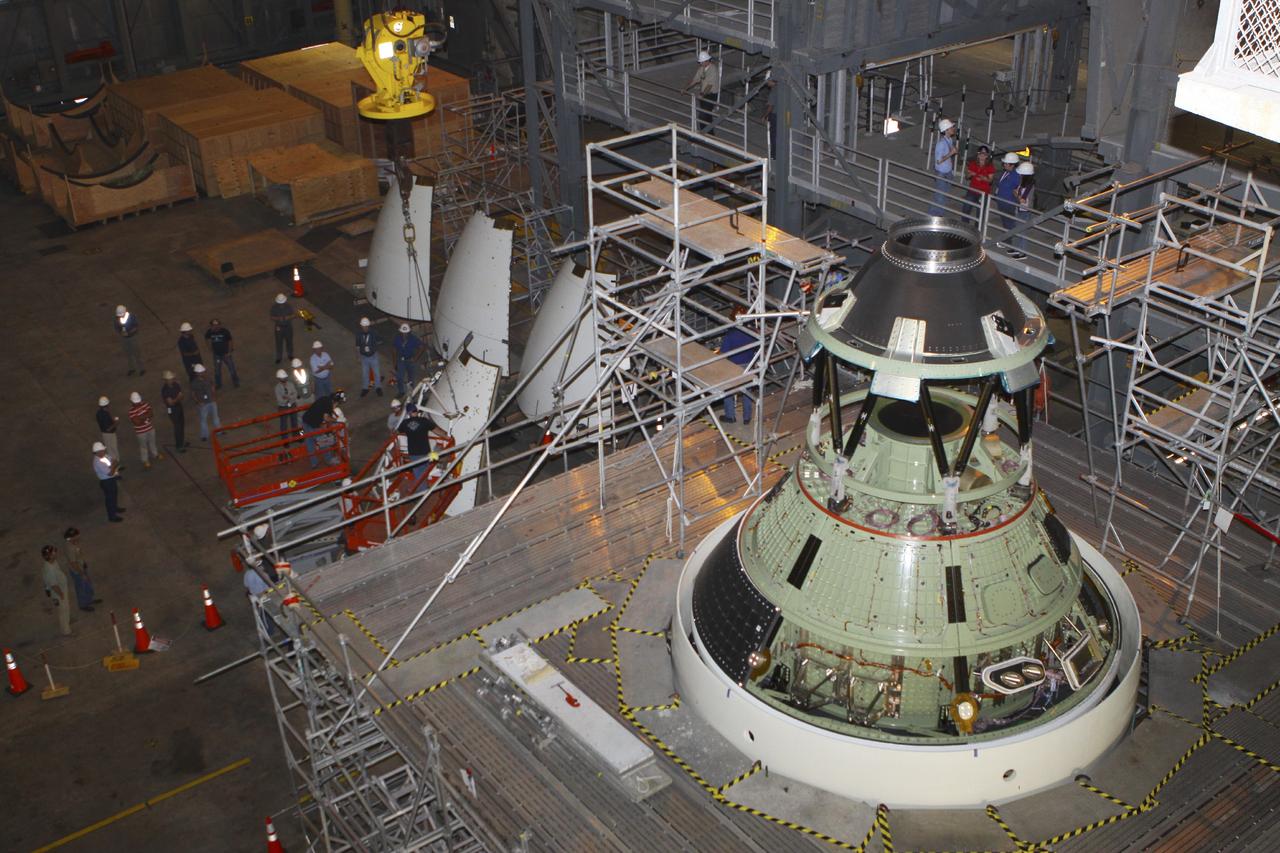
CAPE CANAVERAL, Fla. – At NASA’s Kennedy Space Center in Florida, technicians prepare the four ogive panels for lifting by crane so that they can be installed on the Orion ground test vehicle in Vehicle Assembly Building high bay 4. The ogive panels enclose and protect the Orion spacecraft and attach to the Launch Abort System. The test vehicle is being used by the Ground Systems Development and Operations Program for path finding operations, including simulated manufacturing, assembly and stacking procedures. Orion is the exploration spacecraft designed to carry astronauts to destinations not yet explored by humans, including an asteroid and Mars. It will have emergency abort capability, sustain the crew during space travel and provide safe re-entry from deep space return velocities. The first unpiloted test flight of Orion is scheduled to launch in 2014 atop a Delta IV rocket and in 2017 on NASA’s Space Launch System rocket. For more information, visit www.nasa.gov/orion. Photo credit: Kim Shiflett
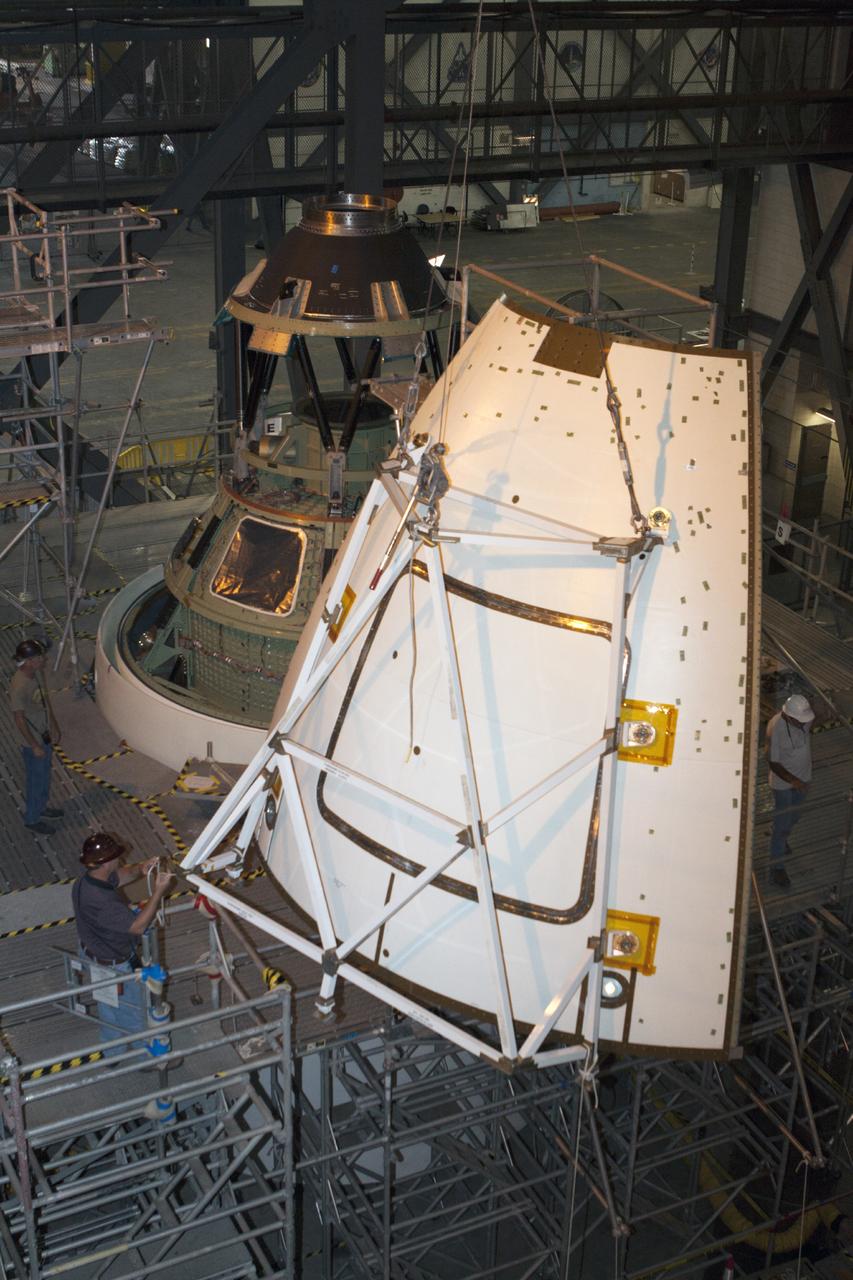
CAPE CANAVERAL, Fla. – At NASA’s Kennedy Space Center in Florida, technicians monitor the progress as a crane is used to move one of four ogive panels closer for installation on the Orion ground test vehicle in Vehicle Assembly Building high bay 4. The ogive panels enclose and protect the Orion spacecraft and attach to the Launch Abort System. The test vehicle is being used by the Ground Systems Development and Operations Program for path finding operations, including simulated manufacturing, assembly and stacking procedures. Orion is the exploration spacecraft designed to carry astronauts to destinations not yet explored by humans, including an asteroid and Mars. It will have emergency abort capability, sustain the crew during space travel and provide safe re-entry from deep space return velocities. The first unpiloted test flight of Orion is scheduled to launch in 2014 atop a Delta IV rocket and in 2017 on NASA’s Space Launch System rocket. For more information, visit www.nasa.gov/orion. Photo credit: Kim Shiflett
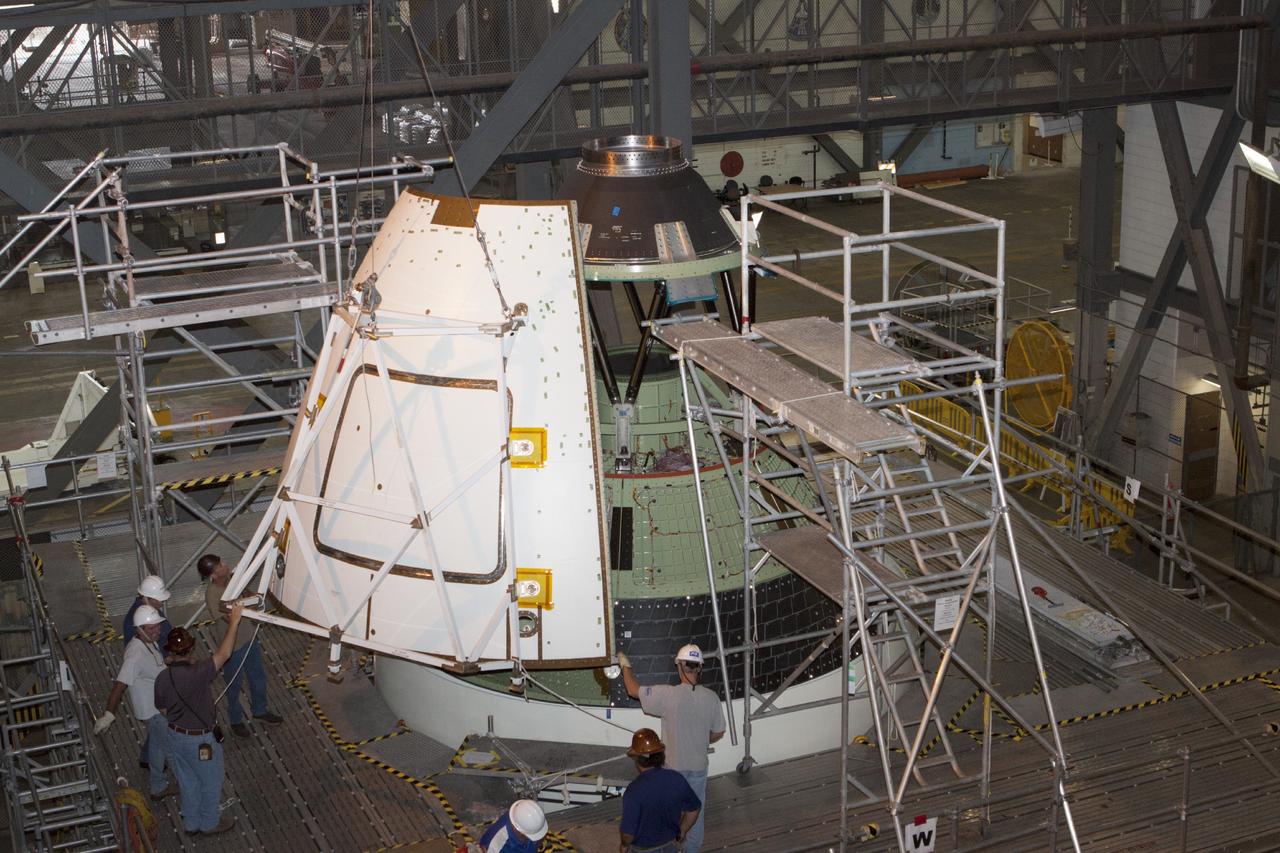
CAPE CANAVERAL, Fla. – At NASA’s Kennedy Space Center in Florida, technicians assist as a crane is used to move one of four ogive panels closer for installation on the Orion ground test vehicle in Vehicle Assembly Building high bay 4. The ogive panels enclose and protect the Orion spacecraft and attach to the Launch Abort System. The test vehicle is being used by the Ground Systems Development and Operations Program for path finding operations, including simulated manufacturing, assembly and stacking procedures. Orion is the exploration spacecraft designed to carry astronauts to destinations not yet explored by humans, including an asteroid and Mars. It will have emergency abort capability, sustain the crew during space travel and provide safe re-entry from deep space return velocities. The first unpiloted test flight of Orion is scheduled to launch in 2014 atop a Delta IV rocket and in 2017 on NASA’s Space Launch System rocket. For more information, visit www.nasa.gov/orion. Photo credit: Kim Shiflett
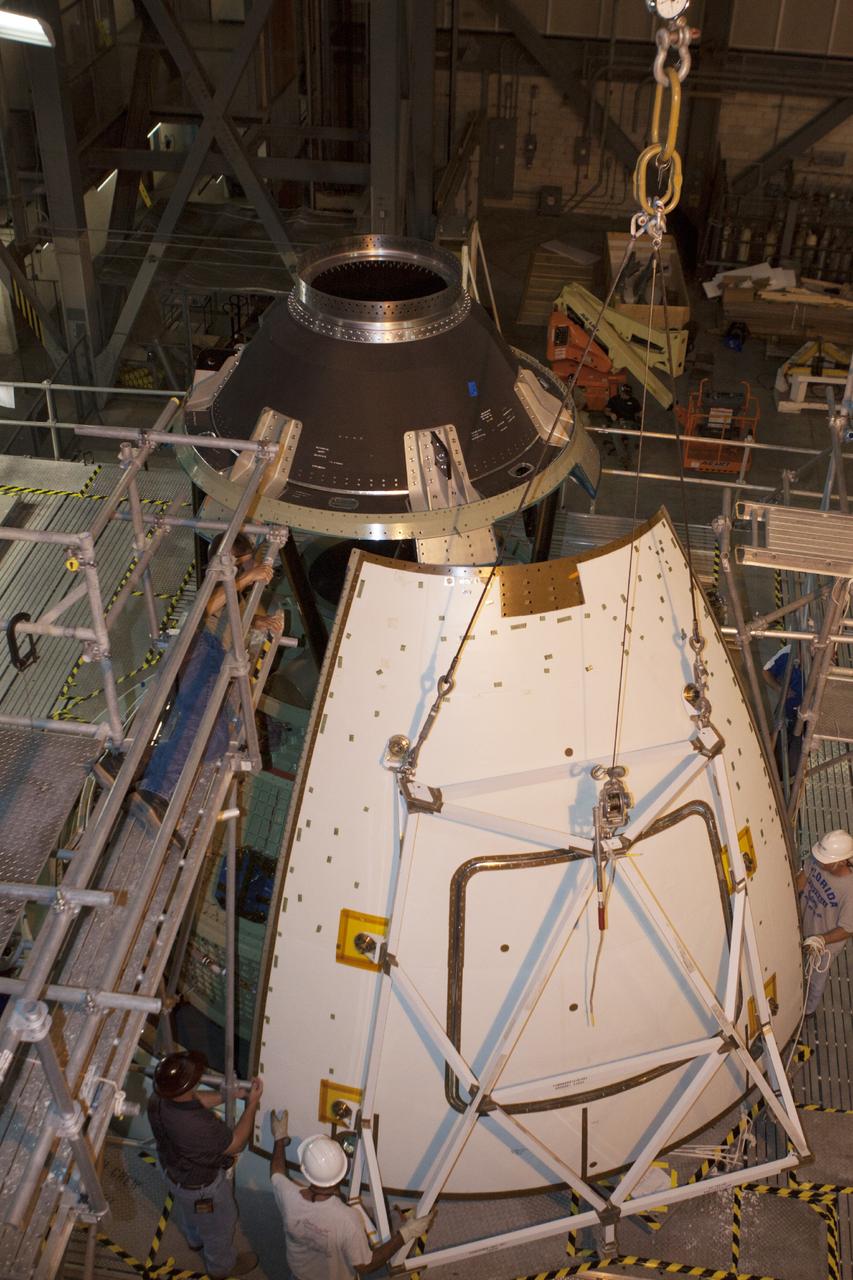
CAPE CANAVERAL, Fla. – At NASA’s Kennedy Space Center in Florida, technicians assist as a crane is used to move one of four ogive panels closer for installation on the Orion ground test vehicle in Vehicle Assembly Building high bay 4. The ogive panels enclose and protect the Orion spacecraft and attach to the Launch Abort System. The test vehicle is being used by the Ground Systems Development and Operations Program for path finding operations, including simulated manufacturing, assembly and stacking procedures. Orion is the exploration spacecraft designed to carry astronauts to destinations not yet explored by humans, including an asteroid and Mars. It will have emergency abort capability, sustain the crew during space travel and provide safe re-entry from deep space return velocities. The first unpiloted test flight of Orion is scheduled to launch in 2014 atop a Delta IV rocket and in 2017 on NASA’s Space Launch System rocket. For more information, visit www.nasa.gov/orion. Photo credit: Kim Shiflett
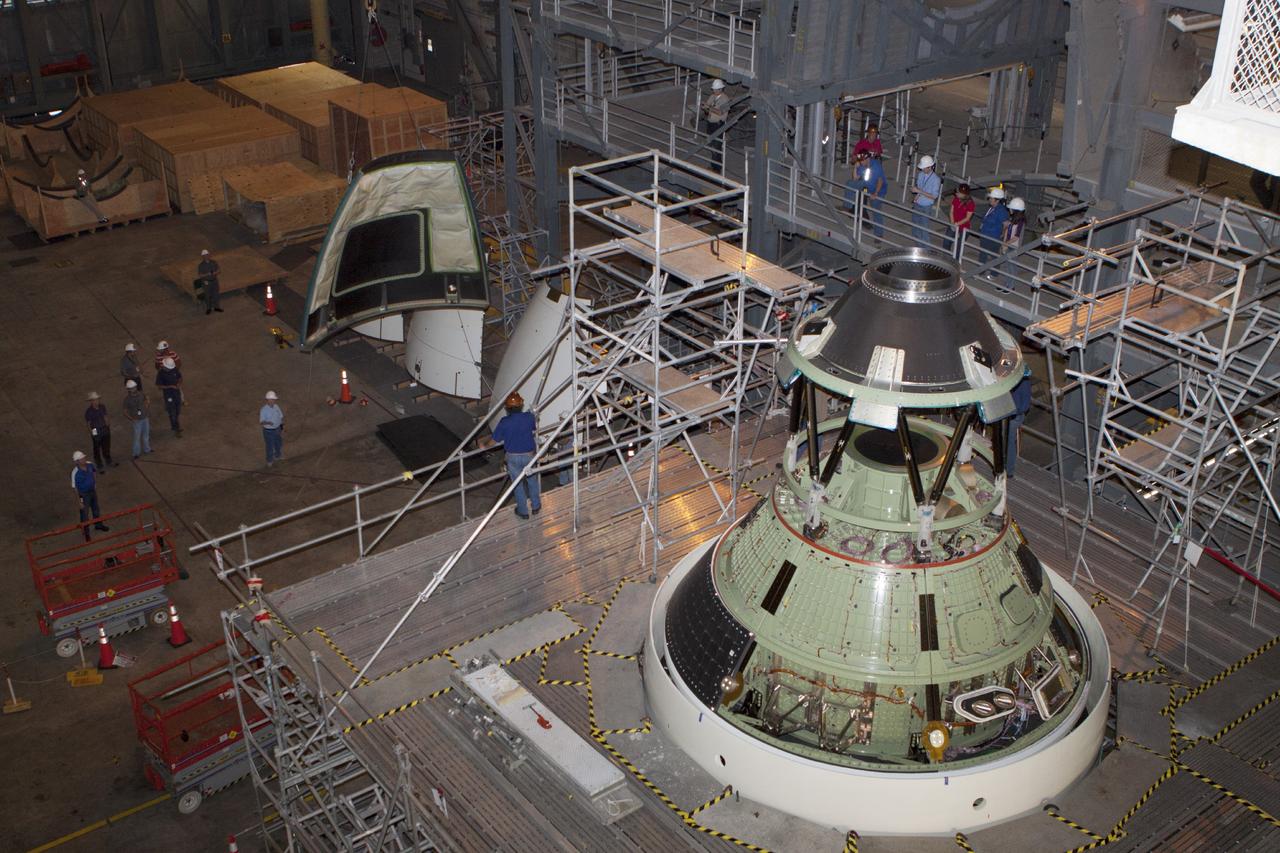
CAPE CANAVERAL, Fla. – At NASA’s Kennedy Space Center in Florida, technicians monitor the progress as a crane is used to move one of four ogive panels closer for installation on the Orion ground test vehicle in Vehicle Assembly Building high bay 4. The ogive panels enclose and protect the Orion spacecraft and attach to the Launch Abort System. The test vehicle is being used by the Ground Systems Development and Operations Program for path finding operations, including simulated manufacturing, assembly and stacking procedures. Orion is the exploration spacecraft designed to carry astronauts to destinations not yet explored by humans, including an asteroid and Mars. It will have emergency abort capability, sustain the crew during space travel and provide safe re-entry from deep space return velocities. The first unpiloted test flight of Orion is scheduled to launch in 2014 atop a Delta IV rocket and in 2017 on NASA’s Space Launch System rocket. For more information, visit www.nasa.gov/orion. Photo credit: Kim Shiflett
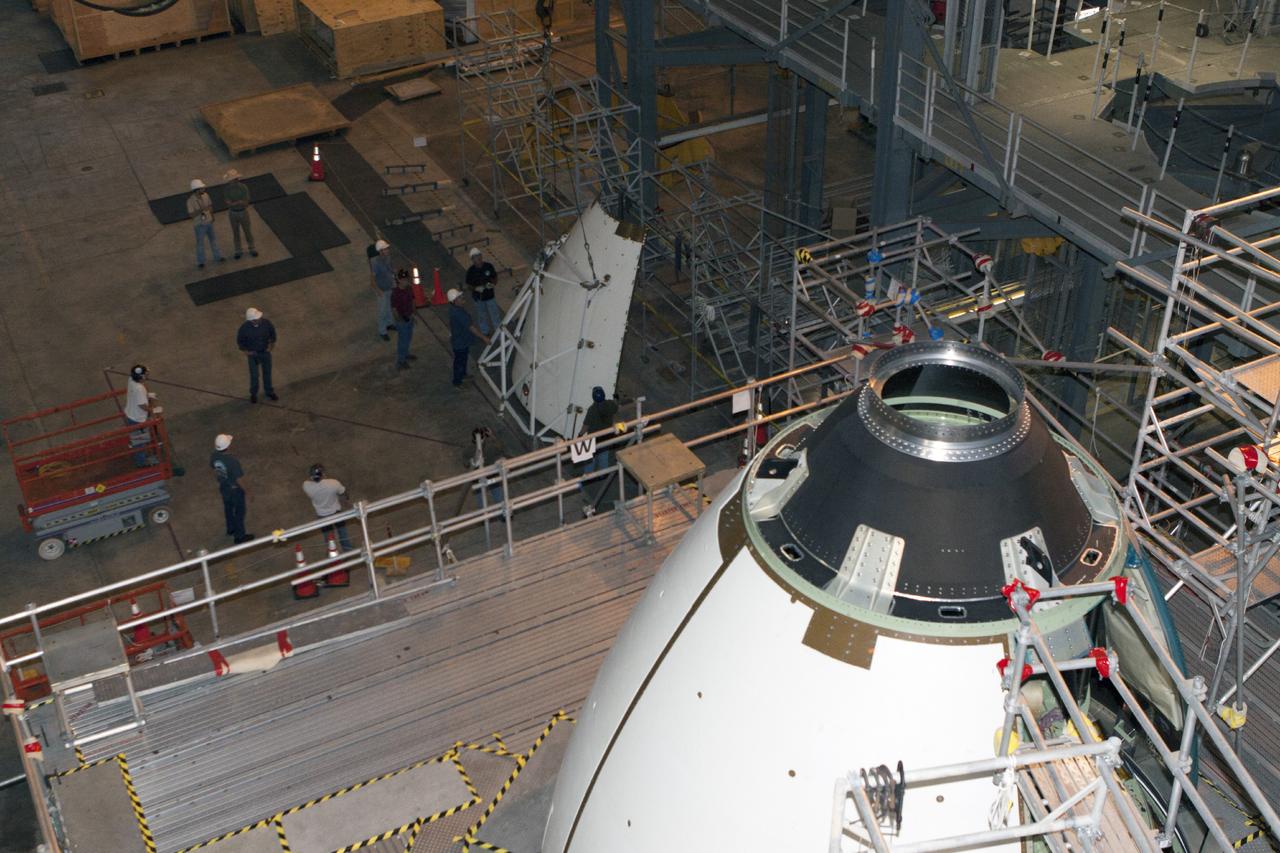
CAPE CANAVERAL, Fla. – At NASA’s Kennedy Space Center in Florida, three ogive panels have been installed on the Orion ground test vehicle in Vehicle Assembly Building high bay 4. The fourth ogive panel is being lifted by crane for installation. The ogive panels enclose and protect the Orion spacecraft and attach to the Launch Abort System. The test vehicle is being used by the Ground Systems Development and Operations Program for path finding operations, including simulated manufacturing, assembly and stacking procedures. Orion is the exploration spacecraft designed to carry astronauts to destinations not yet explored by humans, including an asteroid and Mars. It will have emergency abort capability, sustain the crew during space travel and provide safe re-entry from deep space return velocities. The first unpiloted test flight of Orion is scheduled to launch in 2014 atop a Delta IV rocket and in 2017 on NASA’s Space Launch System rocket. For more information, visit www.nasa.gov/orion. Photo credit: Kim Shiflett
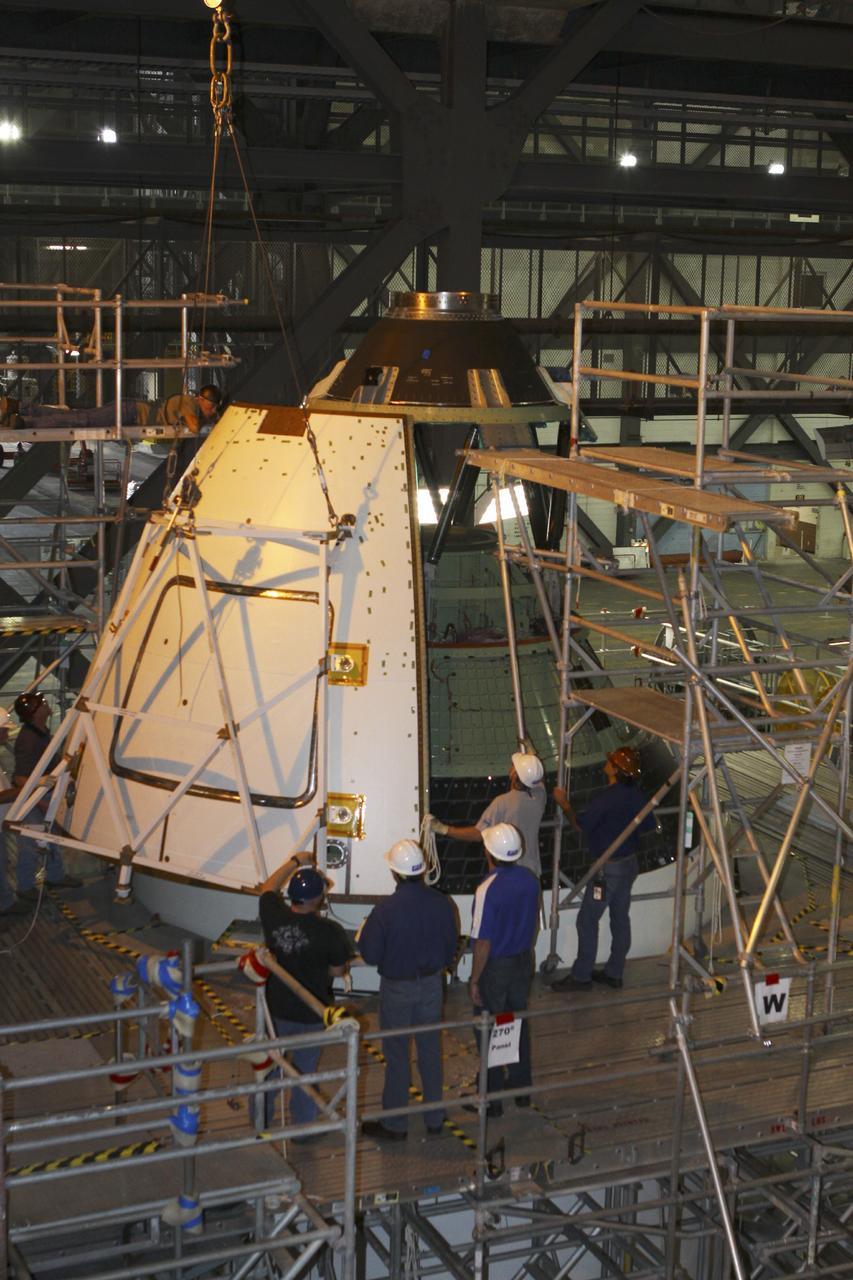
CAPE CANAVERAL, Fla. – At NASA’s Kennedy Space Center in Florida, technicians assist as a crane is used to move one of four ogive panels closer for installation on the Orion ground test vehicle in Vehicle Assembly Building high bay 4. The ogive panels enclose and protect the Orion spacecraft and attach to the Launch Abort System. The test vehicle is being used by the Ground Systems Development and Operations Program for path finding operations, including simulated manufacturing, assembly and stacking procedures. Orion is the exploration spacecraft designed to carry astronauts to destinations not yet explored by humans, including an asteroid and Mars. It will have emergency abort capability, sustain the crew during space travel and provide safe re-entry from deep space return velocities. The first unpiloted test flight of Orion is scheduled to launch in 2014 atop a Delta IV rocket and in 2017 on NASA’s Space Launch System rocket. For more information, visit www.nasa.gov/orion. Photo credit: Kim Shiflett
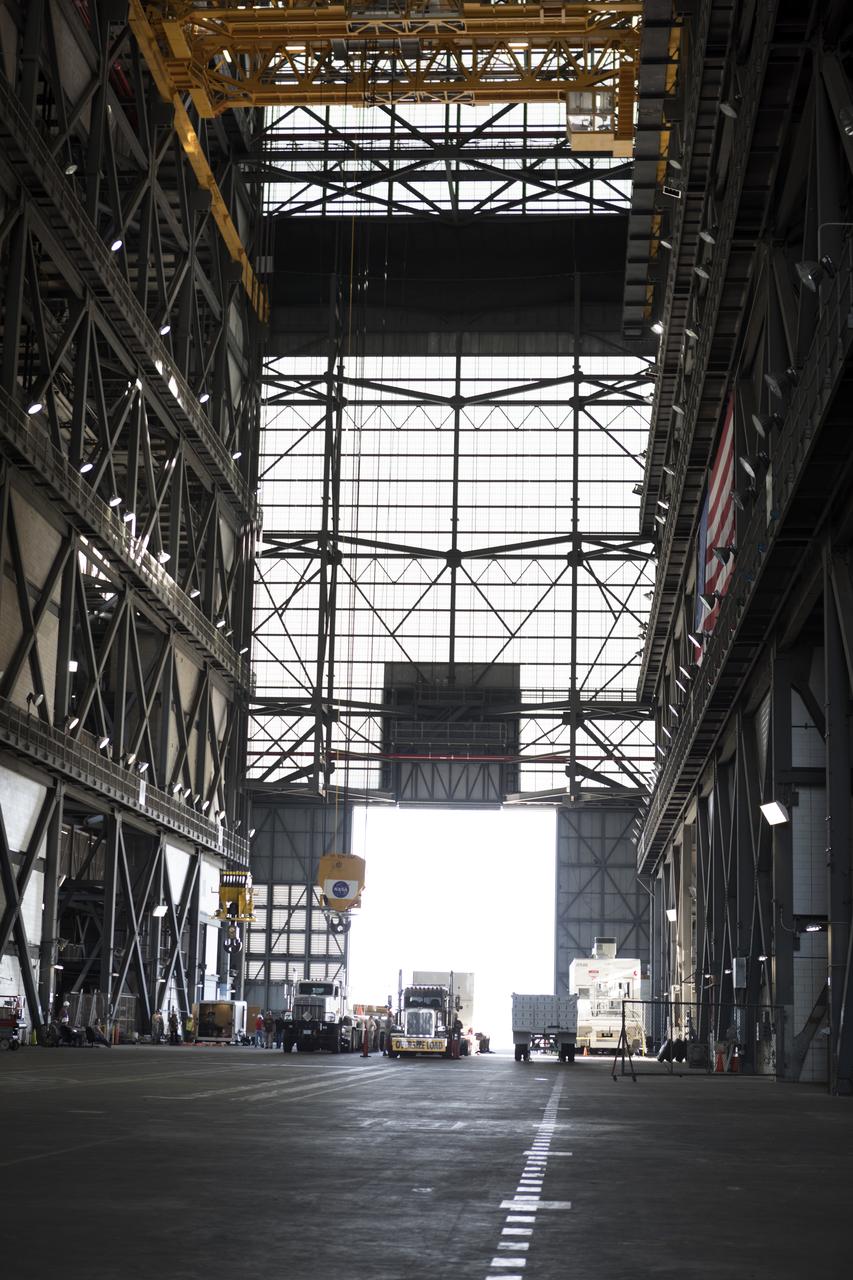
The ground test motor for Orion's Launch Abort System (LAS) arrives by flatbed truck in its shipping container in the transfer aisle of the Vehicle Assembly Building on July 20, 2018, at NASA's Kennedy Space Center in Florida. It will be transferred to the Rotation, Processing and Surge Facility where it will be inspected and prepared for transport to Space Launch Complex 46 (SLC-46) at Cape Canaveral Air Force Station for mechanical fit testing. This inert motor will not be used for flight, but will be used to certify flight hardware assembly in preparation for a full-stress test of the LAS, called Ascent Abort-2 (AA-2) flight test, scheduled for April 2019. During the test, the booster will launch from SLC 46, carrying a fully functional LAS and a 22,000-pound Orion test vehicle to an altitude of 31,000 feet and traveling at more than 1,000 miles an hour. The test will verify the LAS can steer the crew module and astronauts aboard to safety in the event of an issue with the Space Launch System (SLS) rocket when the spacecraft is under the highest aerodynamic loads it will experience during a rapid climb into space. NASA's Orion and Exploration Ground Systems programs and their contractors from Jacob's and Northrup Grumman in conjunction with the Air Force Space and Missile Center's Launch Operations branch are performing the pathfinding exercises and flight operations for AA-2.
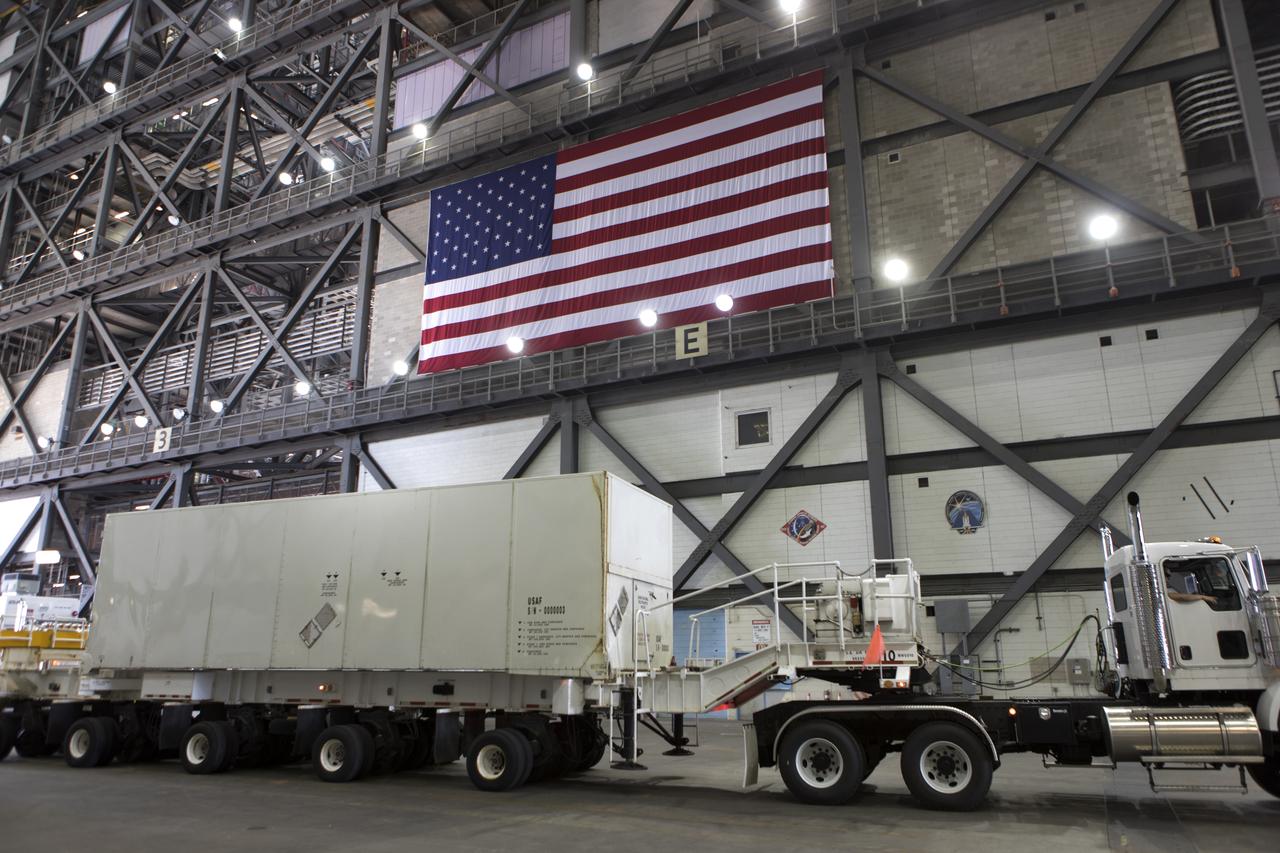
Secured on a flatbed transporter in its shipping container, the ground test motor for Orion's Launch Abort System (LAS) will be moved from the transfer aisle of the Vehicle Assembly Building to the Rotation, Processing and Surge Facility (RPSF) on July 20, 2018, at NASA's Kennedy Space Center in Florida. In the RPSF the motor will be inspected and prepared for transport to Space Launch Complex 46 (SLC-46) at Cape Canaveral Air Force Station for mechanical fit testing. This inert motor will not be used for flight, but will be used to certify flight hardware assembly in preparation for a full-stress test of the LAS, called Ascent Abort-2 (AA-2) flight test, scheduled for April 2019. During the test, the booster will launch from SLC 46, carrying a fully functional LAS and a 22,000-pound Orion test vehicle to an altitude of 31,000 feet and traveling at more than 1,000 miles an hour. The test will verify the LAS can steer the crew module and astronauts aboard to safety in the event of an issue with the Space Launch System (SLS) rocket when the spacecraft is under the highest aerodynamic loads it will experience during a rapid climb into space. NASA's Orion and Exploration Ground Systems programs and their contractors from Jacob's and Northrup Grumman in conjunction with the Air Force Space and Missile Center's Launch Operations branch SMC/LEXO, are performing the pathfinding exercises and flight operations for AA-2.
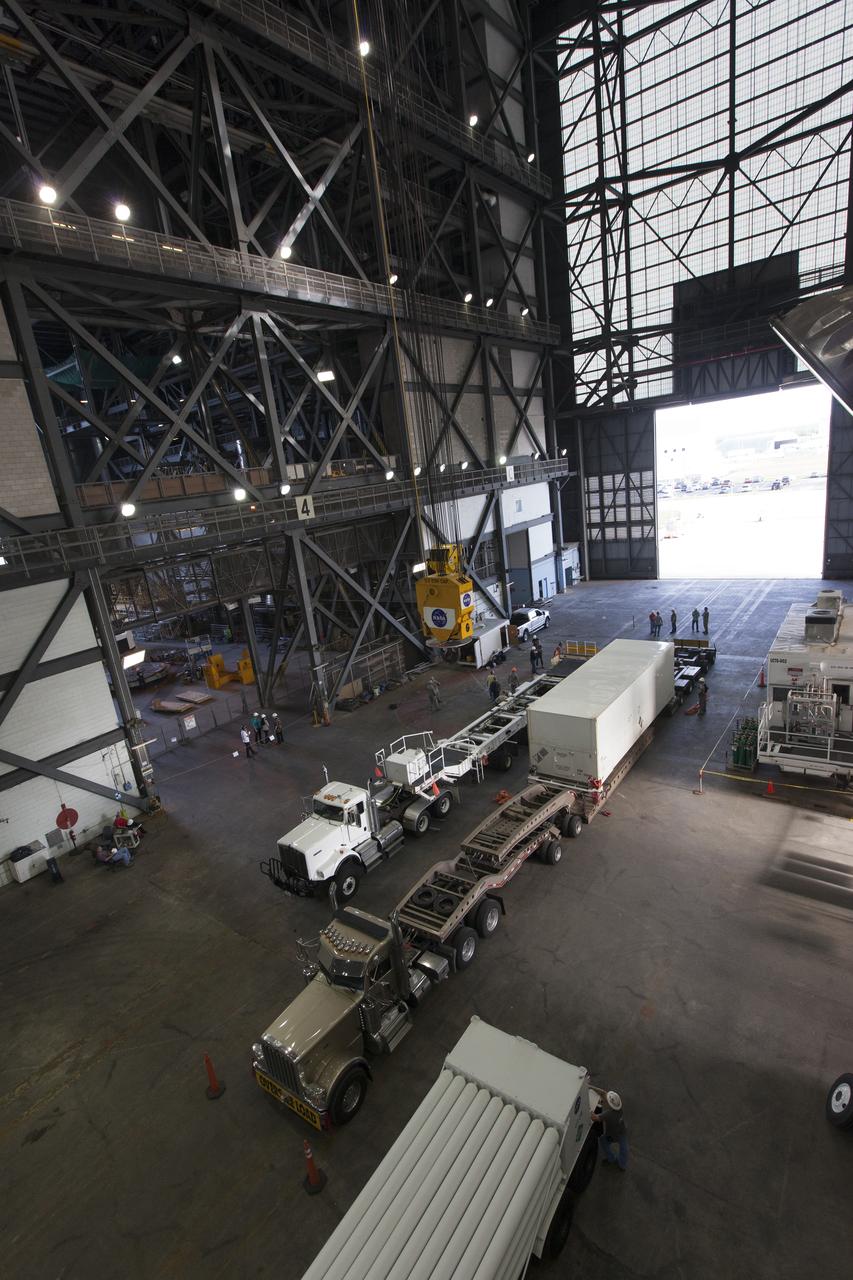
The ground test motor for Orion's Launch Abort System (LAS) arrives by flatbed truck in its shipping container in the transfer aisle of the Vehicle Assembly Building on July 20, 2018, at NASA's Kennedy Space Center in Florida. It will be transferred to the Rotation, Processing and Surge Facility where it will be inspected and prepared for transport to Space Launch Complex 46 (SLC-46) at Cape Canaveral Air Force Station for mechanical fit testing. This inert motor will not be used for flight, but will be used to certify flight hardware assembly in preparation for a full-stress test of the LAS, called Ascent Abort-2 (AA-2) flight test, scheduled for April 2019. During the test, the booster will launch from SLC 46, carrying a fully functional LAS and a 22,000-pound Orion test vehicle to an altitude of 31,000 feet and traveling at more than 1,000 miles an hour. The test will verify the LAS can steer the crew module and astronauts aboard to safety in the event of an issue with the Space Launch System (SLS) rocket when the spacecraft is under the highest aerodynamic loads it will experience during a rapid climb into space. NASA's Orion and Exploration Ground Systems programs and their contractors from Jacob's and Northrup Grumman in conjunction with the Air Force Space and Missile Center's Launch Operations branch SMC/LEXO, are performing the pathfinding exercises and flight operations for AA-2.
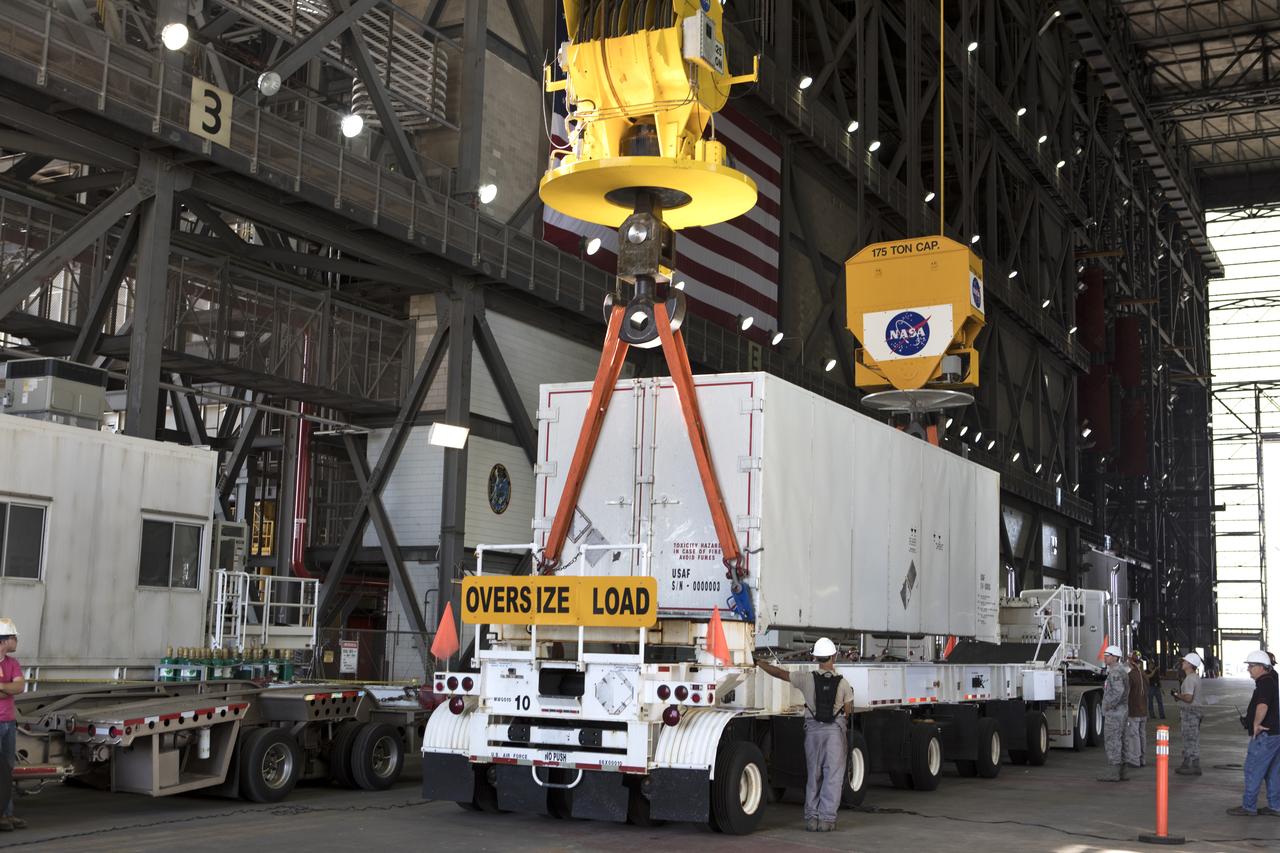
In the transfer aisle inside the Vehicle Assembly Building (VAB) at NASA's Kennedy Space Center in Florida, a crane lowers the shipping container with the ground test motor for Orion's Launch Abort System (LAS) inside onto another transporter on July 20, 2018. The container will be moved to the Rotation, Processing and Surge Facility where it will be inspected and prepared for transport to Space Launch Complex 46 (SLC-46) at Cape Canaveral Air Force Station for mechanical fit testing. This inert motor will not be used for flight, but will be used to certify flight hardware assembly in preparation for a full-stress test of the LAS, called Ascent Abort-2 (AA-2) flight test, scheduled for April 2019. During the test, the booster will launch from SLC 46, carrying a fully functional LAS and a 22,000-pound Orion test vehicle to an altitude of 31,000 feet and traveling at more than 1,000 miles an hour. The test will verify the LAS can steer the crew module and astronauts aboard to safety in the event of an issue with the Space Launch System (SLS) rocket when the spacecraft is under the highest aerodynamic loads it will experience during a rapid climb into space. NASA's Orion and Exploration Ground Systems programs and their contractors from Jacob's and Northrup Grumman in conjunction with the Air Force Space and Missile Center's Launch Operations branch SMC/LEXO, are performing the pathfinding exercises and flight operations for AA-2.
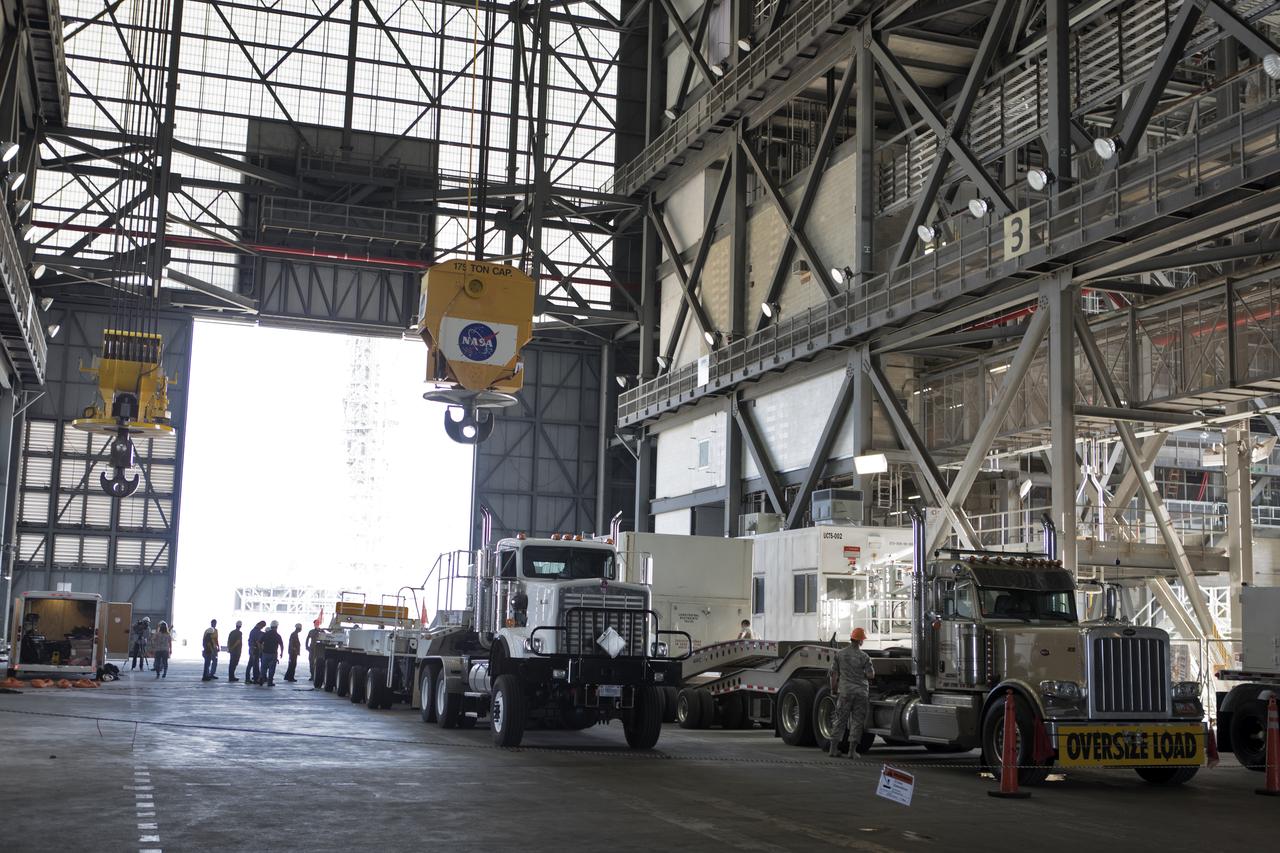
The ground test motor for Orion's Launch Abort System (LAS) arrives by flatbed truck in its shipping container in the transfer aisle of the Vehicle Assembly Building on July 20, 2018, at NASA's Kennedy Space Center in Florida. It will be transferred to the Rotation, Processing and Surge Facility where it will be inspected and prepared for transport to Space Launch Complex 46 (SLC-46) at Cape Canaveral Air Force Station for mechanical fit testing. This inert motor will not be used for flight, but will be used to certify flight hardware assembly in preparation for a full-stress test of the LAS, called Ascent Abort-2 (AA-2) flight test, scheduled for April 2019. During the test, the booster will launch from SLC 46, carrying a fully functional LAS and a 22,000-pound Orion test vehicle to an altitude of 31,000 feet and traveling at more than 1,000 miles an hour. The test will verify the LAS can steer the crew module and astronauts aboard to safety in the event of an issue with the Space Launch System (SLS) rocket when the spacecraft is under the highest aerodynamic loads it will experience during a rapid climb into space. NASA's Orion and Exploration Ground Systems programs and their contractors from Jacob's and Northrup Grumman in conjunction with the Air Force Space and Missile Center's Launch Operations branch SMC/LEXO, are performing the pathfinding exercises and flight operations for AA-2.
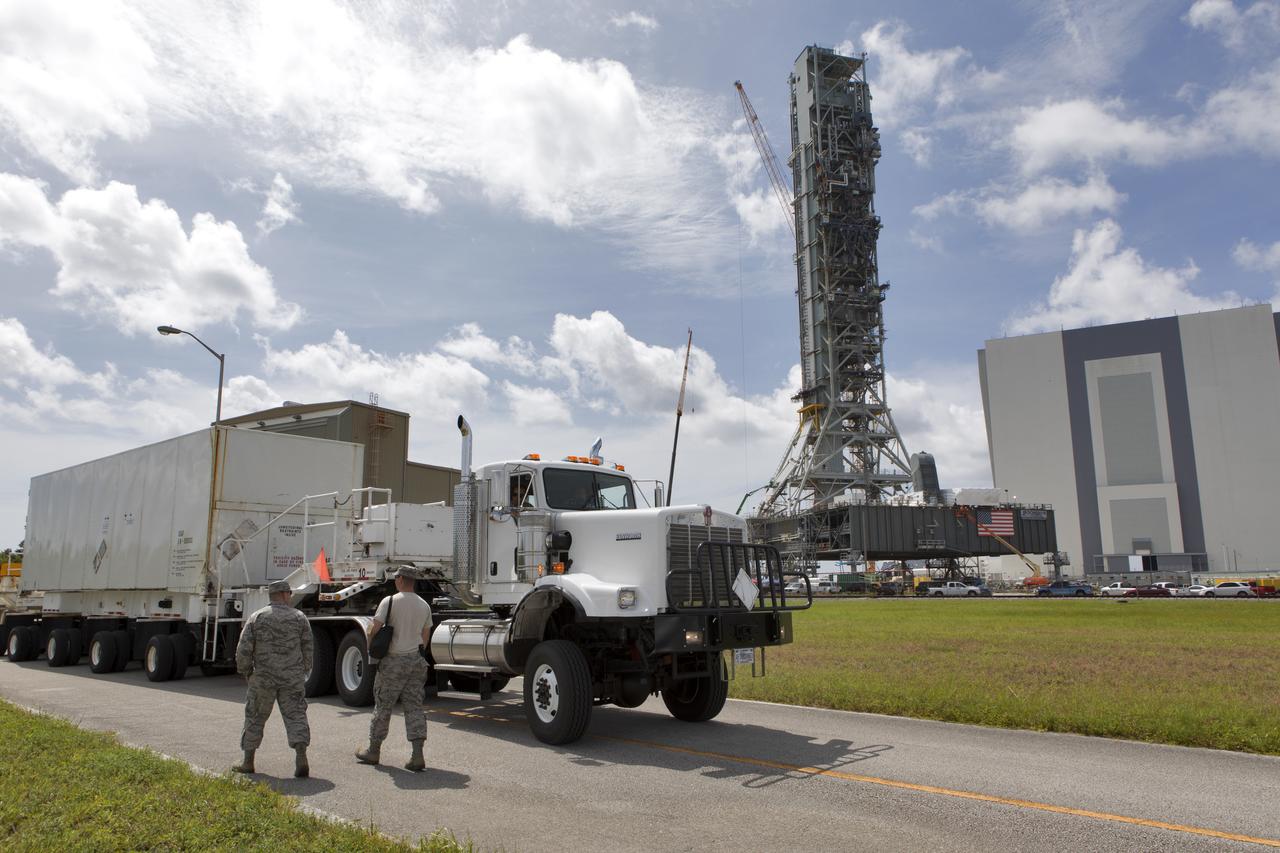
Secured on a flatbed transporter in its shipping container, the ground test motor for Orion's Launch Abort System (LAS) is moved to the Rotation, Processing and Surge Facility (RPSF) on July 20, 2018, at NASA's Kennedy Space Center in Florida. In the RPSF the motor will be inspected and prepared for transport to Space Launch Complex 46 (SLC-46) at Cape Canaveral Air Force Station for mechanical fit testing. This inert motor will not be used for flight, but will be used to certify flight hardware assembly in preparation for a full-stress test of the LAS, called Ascent Abort-2 (AA-2) flight test, scheduled for April 2019. During the test, the booster will launch from SLC 46, carrying a fully functional LAS and a 22,000-pound Orion test vehicle to an altitude of 31,000 feet and traveling at more than 1,000 miles an hour. The test will verify the LAS can steer the crew module and astronauts aboard to safety in the event of an issue with the Space Launch System (SLS) rocket when the spacecraft is under the highest aerodynamic loads it will experience during a rapid climb into space. NASA's Orion and Exploration Ground Systems programs and their contractors from Jacob's and Northrup Grumman in conjunction with the Air Force Space and Missile Center's Launch Operations branch SMC/LEXO, are performing the pathfinding exercises and flight operations for AA-2.
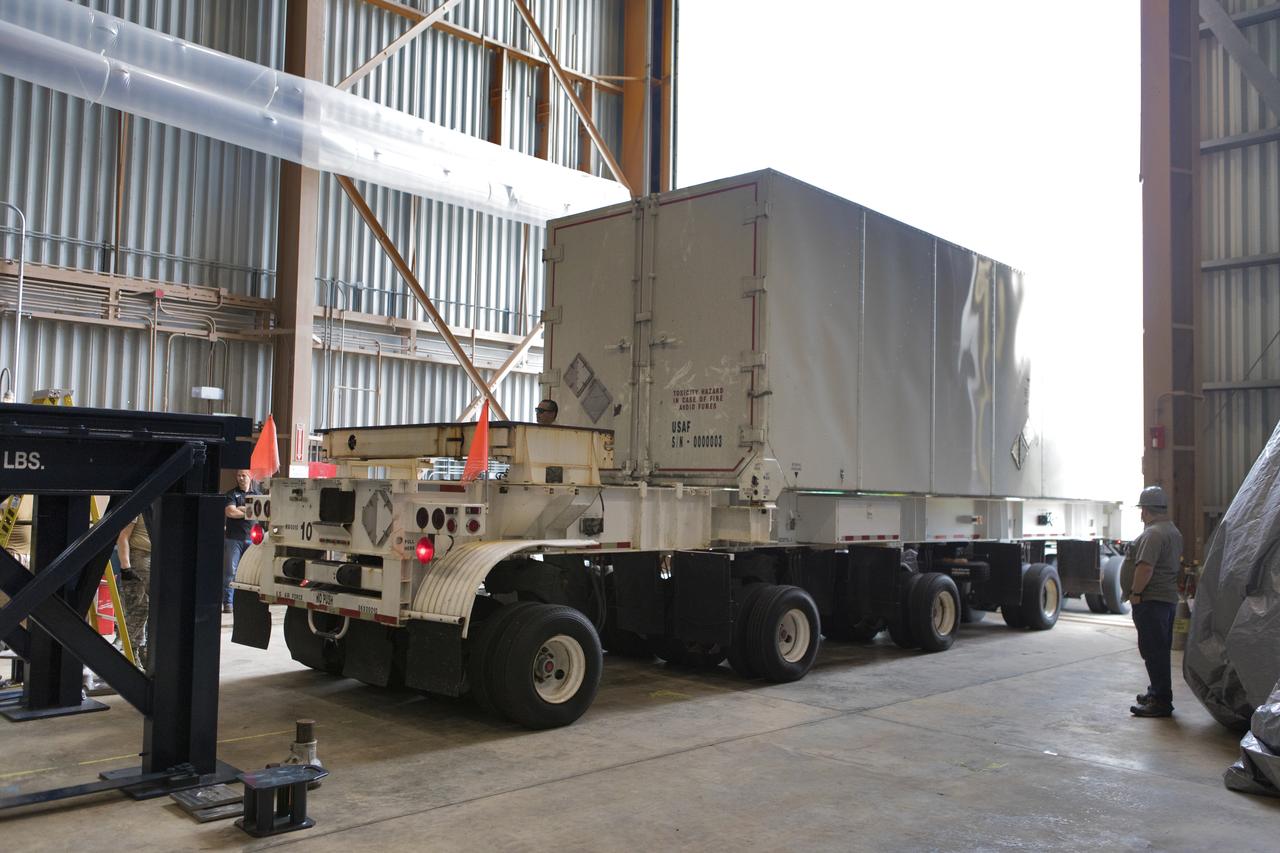
Secured on a flatbed transporter in its shipping container, the ground test motor for Orion's Launch Abort System (LAS) arrives at the Rotation, Processing and Surge Facility (RPSF) on July 20, 2018, at NASA's Kennedy Space Center in Florida. In the RPSF the motor will be inspected and prepared for transport to Space Launch Complex 46 (SLC-46) at Cape Canaveral Air Force Station for mechanical fit testing. This inert motor will not be used for flight, but will be used to certify flight hardware assembly in preparation for a full-stress test of the LAS, called Ascent Abort-2 (AA-2) flight test, scheduled for April 2019. During the test, the booster will launch from SLC 46, carrying a fully functional LAS and a 22,000-pound Orion test vehicle to an altitude of 31,000 feet and traveling at more than 1,000 miles an hour. The test will verify the LAS can steer the crew module and astronauts aboard to safety in the event of an issue with the Space Launch System (SLS) rocket when the spacecraft is under the highest aerodynamic loads it will experience during a rapid climb into space. NASA's Orion and Exploration Ground Systems programs and their contractors from Jacob's and Northrup Grumman in conjunction with the Air Force Space and Missile Center's Launch Operations branch SMC/LEXO, are performing the pathfinding exercises and flight operations for AA-2.
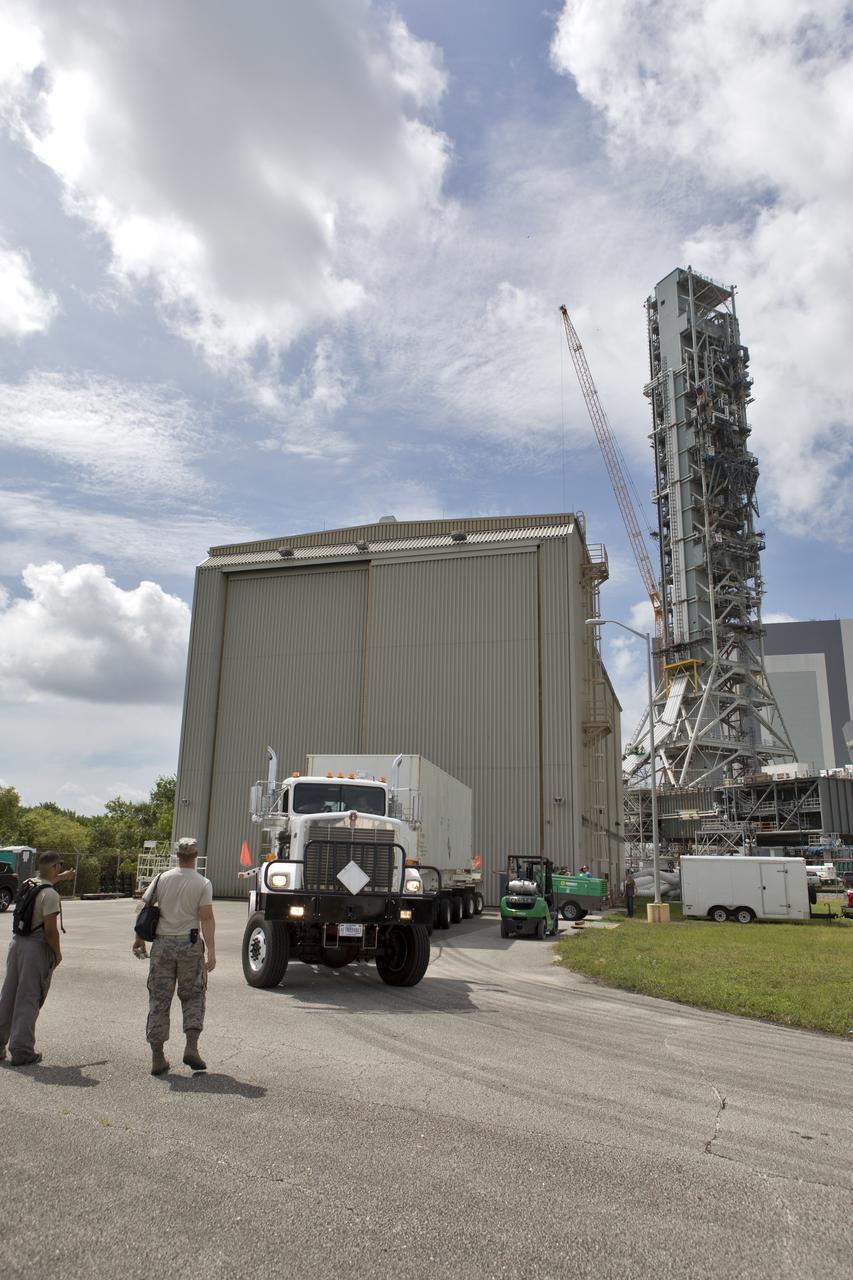
Secured on a flatbed transporter in its shipping container, the ground test motor for Orion's Launch Abort System (LAS) arrives at the Rotation, Processing and Surge Facility (RPSF) on July 20, 2018, at NASA's Kennedy Space Center in Florida. In the RPSF the motor will be inspected and prepared for transport to Space Launch Complex 46 (SLC-46) at Cape Canaveral Air Force Station for mechanical fit testing. This inert motor will not be used for flight, but will be used to certify flight hardware assembly in preparation for a full-stress test of the LAS, called Ascent Abort-2 (AA-2) flight test, scheduled for April 2019. During the test, the booster will launch from SLC 46, carrying a fully functional LAS and a 22,000-pound Orion test vehicle to an altitude of 31,000 feet and traveling at more than 1,000 miles an hour. The test will verify the LAS can steer the crew module and astronauts aboard to safety in the event of an issue with the Space Launch System (SLS) rocket when the spacecraft is under the highest aerodynamic loads it will experience during a rapid climb into space. NASA's Orion and Exploration Ground Systems programs and their contractors from Jacob's and Northrup Grumman in conjunction with the Air Force Space and Missile Center's Launch Operations branch SMC/LEXO, are performing the pathfinding exercises and flight operations for AA-2.
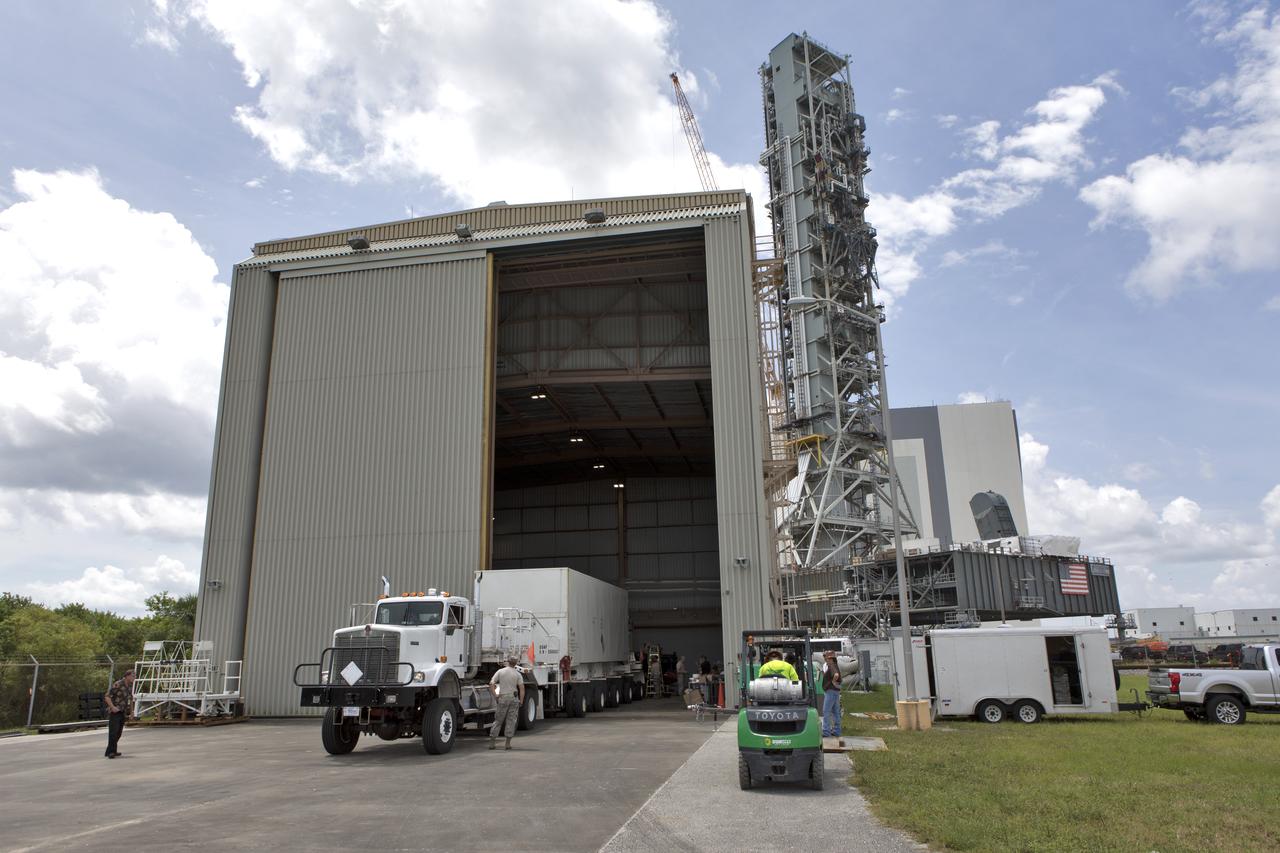
Secured on a flatbed transporter in its shipping container, the ground test motor for Orion's Launch Abort System (LAS) arrives at the Rotation, Processing and Surge Facility (RPSF) on July 20, 2018, at NASA's Kennedy Space Center in Florida. In the RPSF the motor will be inspected and prepared for transport to Space Launch Complex 46 (SLC-46) at Cape Canaveral Air Force Station for mechanical fit testing. This inert motor will not be used for flight, but will be used to certify flight hardware assembly in preparation for a full-stress test of the LAS, called Ascent Abort-2 (AA-2) flight test, scheduled for April 2019. During the test, the booster will launch from SLC 46, carrying a fully functional LAS and a 22,000-pound Orion test vehicle to an altitude of 31,000 feet and traveling at more than 1,000 miles an hour. The test will verify the LAS can steer the crew module and astronauts aboard to safety in the event of an issue with the Space Launch System (SLS) rocket when the spacecraft is under the highest aerodynamic loads it will experience during a rapid climb into space. Orion is being prepared for its first integrated uncrewed flight atop the SLS on Exploration Mission-1. NASA's Orion and Exploration Ground Systems programs and their contractors from Jacob's and Northrup Grumman in conjunction with the Air Force Space and Missile Center's Launch Operations branch SMC/LEXO, are performing the pathfinding exercises and flight operations for AA-2.
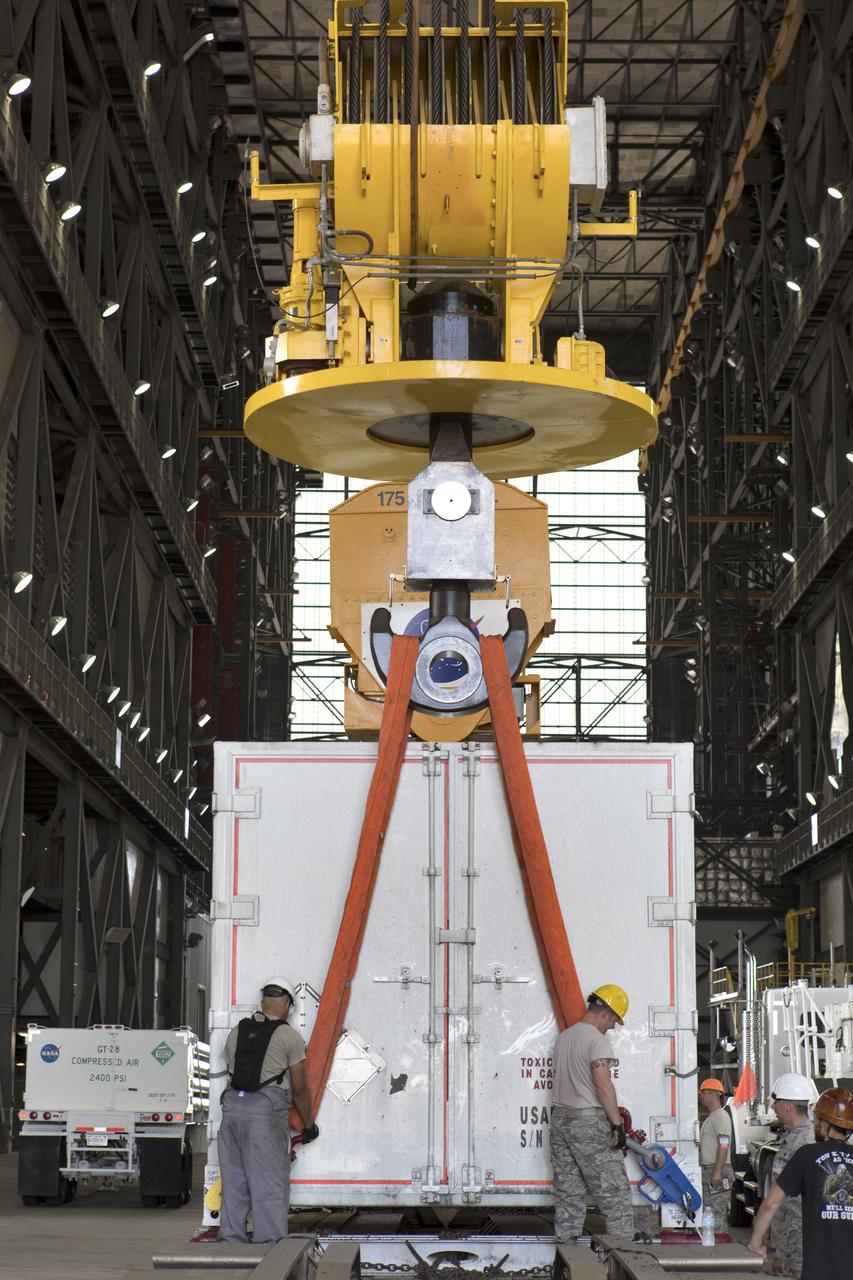
In the transfer aisle inside the Vehicle Assembly Building (VAB) at NASA's Kennedy Space Center in Florida, Jacob’s technicians on the Test Operations Support Contract attach a crane to a shipping container with the ground test motor for Orion's Launch Abort System (LAS) inside on July 20, 2018. The container will be lifted and transferred to another transporter and moved to the Rotation, Processing and Surge Facility where it will be inspected and prepared for transport to Space Launch Complex 46 (SLC-46) at Cape Canaveral Air Force Station for mechanical fit testing. This inert motor will not be used for flight, but will be used to certify flight hardware assembly in preparation for a full-stress test of the LAS, called Ascent Abort-2 (AA-2) flight test, scheduled for April 2019. During the test, the booster will launch from SLC 46, carrying a fully functional LAS and a 22,000-pound Orion test vehicle to an altitude of 31,000 feet and traveling at more than 1,000 miles an hour. The test will verify the LAS can steer the crew module and astronauts aboard to safety in the event of an issue with the Space Launch System (SLS) rocket when the spacecraft is under the highest aerodynamic loads it will experience during a rapid climb into space. NASA's Orion and Exploration Ground Systems programs and their contractors from Jacob's and Northrup Grumman in conjunction with the Air Force Space and Missile Center's Launch Operations branch SMC/LEXO, are performing the pathfinding exercises and flight operations for AA-2.
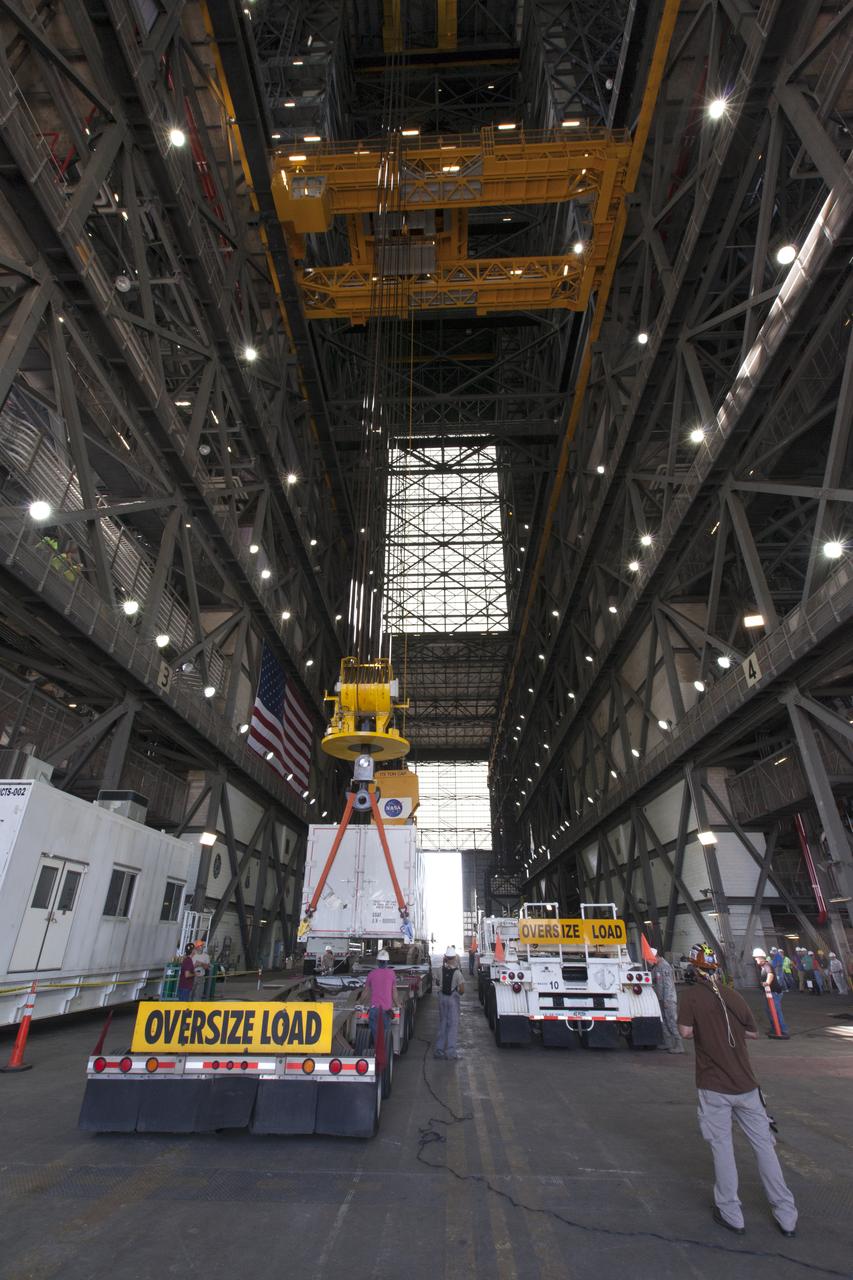
In the transfer aisle inside the Vehicle Assembly Building (VAB) at NASA's Kennedy Space Center in Florida, a crane is used to lift up a shipping container with the ground test motor for Orion's Launch Abort System (LAS) inside on July 20, 2018. The container will be lifted and transferred to another transporter and moved to the Rotation, Processing and Surge Facility where it will be inspected and prepared for transport to Space Launch Complex 46 (SLC-46) at Cape Canaveral Air Force Station for mechanical fit testing. This inert motor will not be used for flight, but will be used to certify flight hardware assembly in preparation for a full-stress test of the LAS, called Ascent Abort-2 (AA-2) flight test, scheduled for April 2019. During the test, the booster will launch from SLC 46, carrying a fully functional LAS and a 22,000-pound Orion test vehicle to an altitude of 31,000 feet and traveling at more than 1,000 miles an hour. The test will verify the LAS can steer the crew module and astronauts aboard to safety in the event of an issue with the Space Launch System (SLS) rocket when the spacecraft is under the highest aerodynamic loads it will experience during a rapid climb into space. NASA's Orion and Exploration Ground Systems programs and their contractors from Jacob's and Northrup Grumman in conjunction with the Air Force Space and Missile Center's Launch Operations branch SMC/LEXO, are performing the pathfinding exercises and flight operations for AA-2.
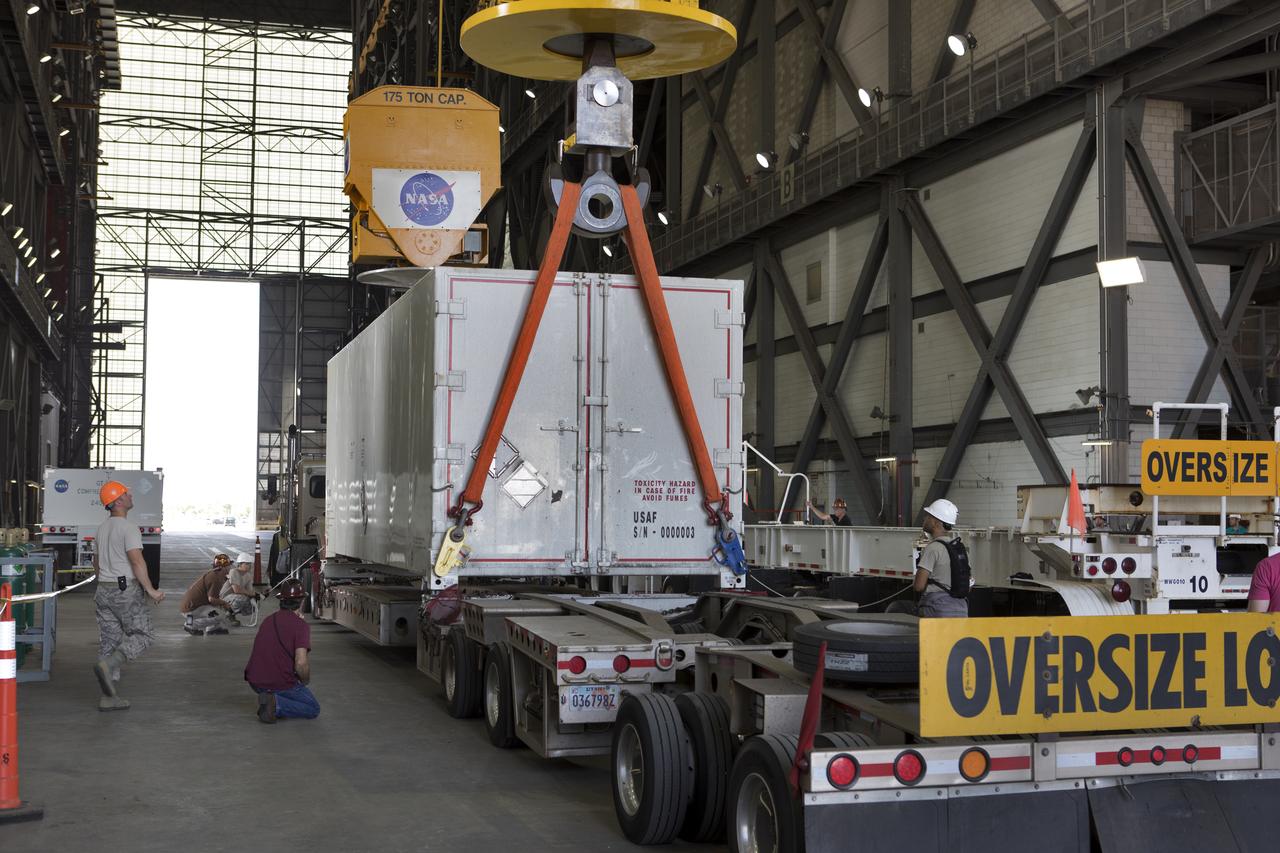
In the transfer aisle inside the Vehicle Assembly Building (VAB) at NASA's Kennedy Space Center in Florida, Jacob’s technicians attach a crane to a shipping container with the ground test motor for Orion's Launch Abort System (LAS) inside on July 20, 2018. The container will be lifted and transferred to another transporter and moved to the Rotation, Processing and Surge Facility where it will be inspected and prepared for transport to Space Launch Complex 46 (SLC-46) at Cape Canaveral Air Force Station for mechanical fit testing. This inert motor will not be used for flight, but will be used to certify flight hardware assembly in preparation for a full-stress test of the LAS, called Ascent Abort-2 (AA-2) flight test, scheduled for April 2019. During the test, the booster will launch from SLC 46, carrying a fully functional LAS and a 22,000-pound Orion test vehicle to an altitude of 31,000 feet and traveling at more than 1,000 miles an hour. The test will verify the LAS can steer the crew module and astronauts aboard to safety in the event of an issue with the Space Launch System (SLS) rocket when the spacecraft is under the highest aerodynamic loads it will experience during a rapid climb into space. NASA's Orion and Exploration Ground Systems programs and their contractors from Jacob's and Northrup Grumman in conjunction with the Air Force Space and Missile Center's Launch Operations branch SMC/LEXO, are performing the pathfinding exercises and flight operations for AA-2.
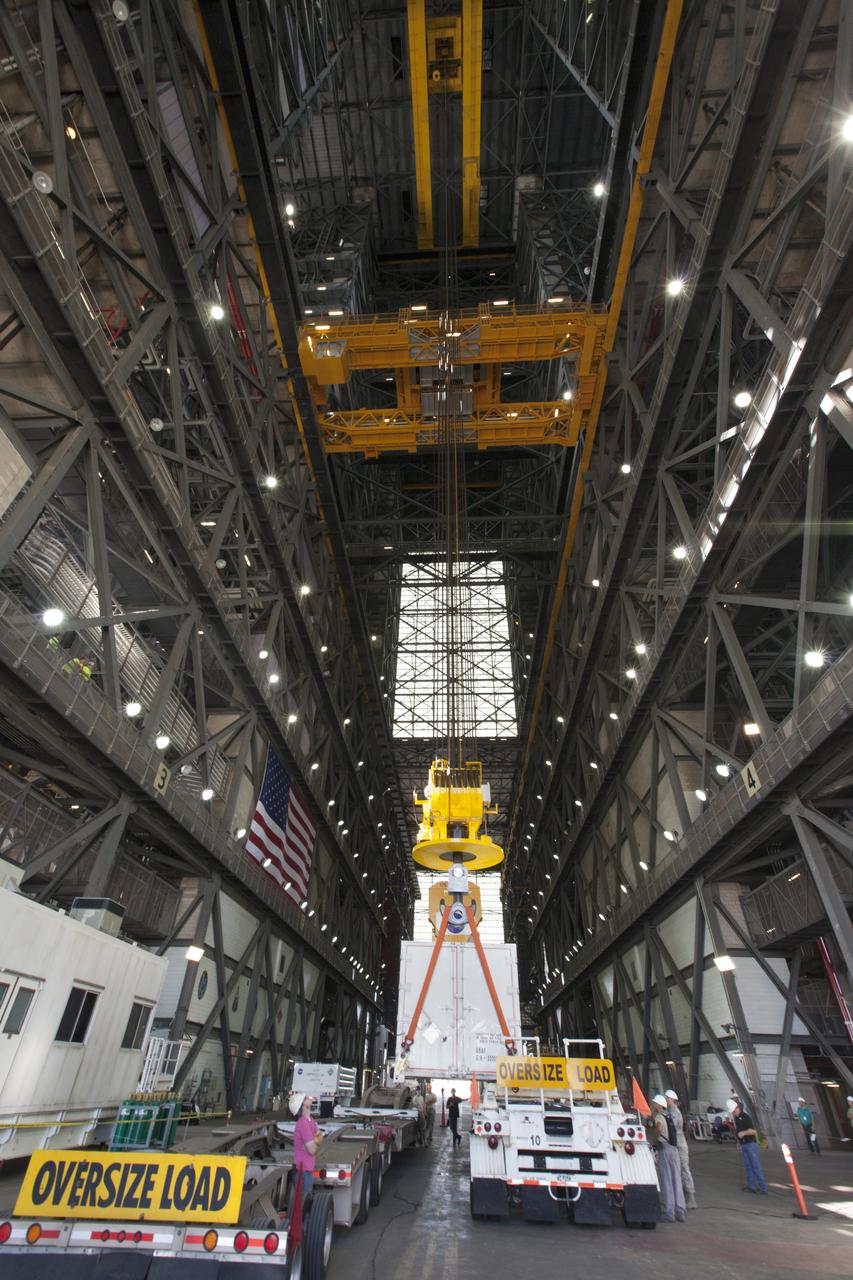
In the transfer aisle inside the Vehicle Assembly Building (VAB) at NASA's Kennedy Space Center in Florida, a crane is used to lift up the shipping container with the ground test motor for Orion's Launch Abort System (LAS) inside on July 20, 2018. The container will be lowered onto another transporter and moved to the Rotation, Processing and Surge Facility where it will be inspected and prepared for transport to Space Launch Complex 46 (SLC-46) at Cape Canaveral Air Force Station for mechanical fit testing. This inert motor will not be used for flight, but will be used to certify flight hardware assembly in preparation for a full-stress test of the LAS, called Ascent Abort-2 (AA-2) flight test, scheduled for April 2019. During the test, the booster will launch from SLC 46, carrying a fully functional LAS and a 22,000-pound Orion test vehicle to an altitude of 31,000 feet and traveling at more than 1,000 miles an hour. The test will verify the LAS can steer the crew module and astronauts aboard to safety in the event of an issue with the Space Launch System (SLS) rocket when the spacecraft is under the highest aerodynamic loads it will experience during a rapid climb into space. NASA's Orion and Exploration Ground Systems programs and their contractors from Jacob's and Northrup Grumman in conjunction with the Air Force Space and Missile Center's Launch Operations branch SMC/LEXO, are performing the pathfinding exercises and flight operations for AA-2.
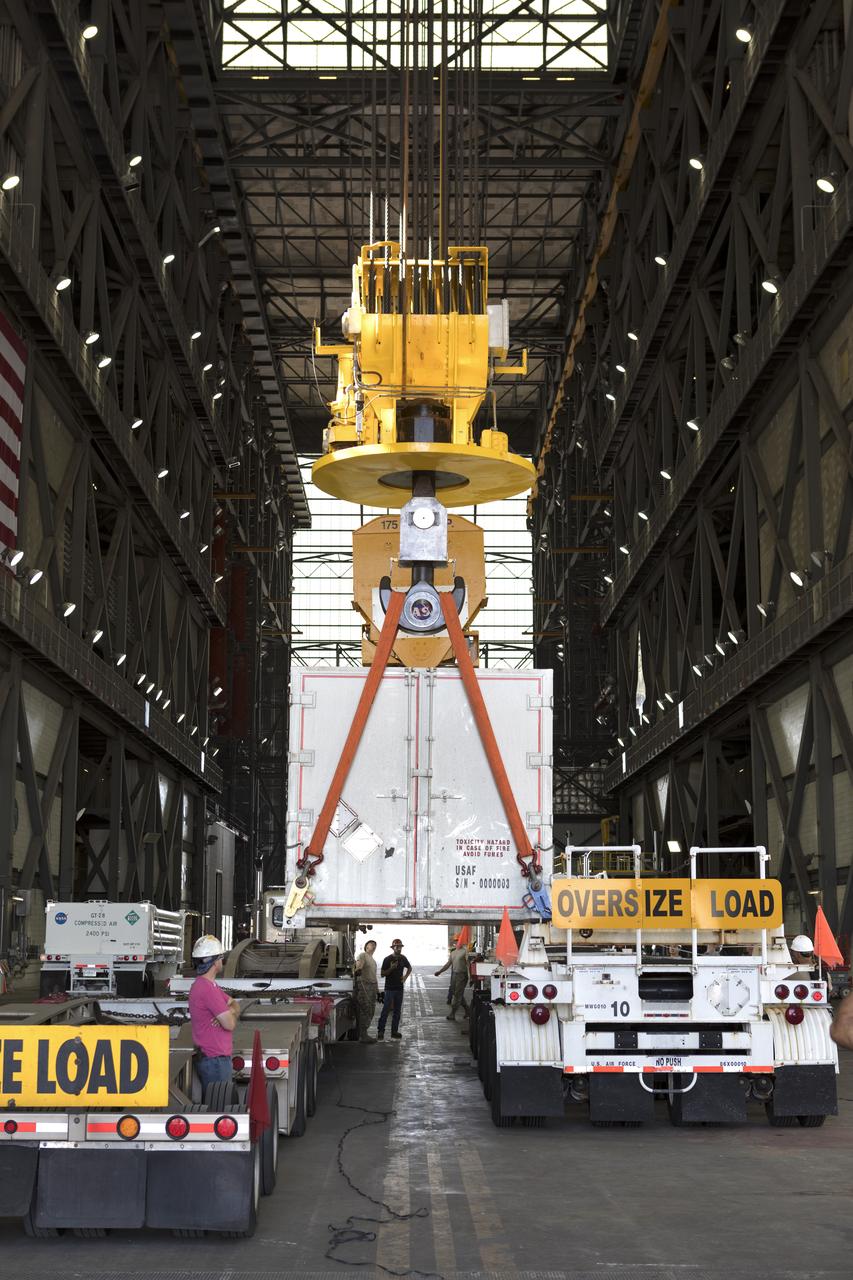
In the transfer aisle inside the Vehicle Assembly Building (VAB) at NASA's Kennedy Space Center in Florida, a crane is used to lift up the shipping container with the ground test motor for Orion's Launch Abort System (LAS) inside on July 20, 2018. The container will be lowered onto another transporter and moved to the Rotation, Processing and Surge Facility where it will be inspected and prepared for transport to Space Launch Complex 46 (SLC-46) at Cape Canaveral Air Force Station for mechanical fit testing. This inert motor will not be used for flight, but will be used to certify flight hardware assembly in preparation for a full-stress test of the LAS, called Ascent Abort-2 (AA-2) flight test, scheduled for April 2019. During the test, the booster will launch from SLC 46, carrying a fully functional LAS and a 22,000-pound Orion test vehicle to an altitude of 31,000 feet and traveling at more than 1,000 miles an hour. The test will verify the LAS can steer the crew module and astronauts aboard to safety in the event of an issue with the Space Launch System (SLS) rocket when the spacecraft is under the highest aerodynamic loads it will experience during a rapid climb into space. NASA's Orion and Exploration Ground Systems programs and their contractors from Jacob's and Northrup Grumman in conjunction with the Air Force Space and Missile Center's Launch Operations branch SMC/LEXO, are performing the pathfinding exercises and flight operations for AA-2.
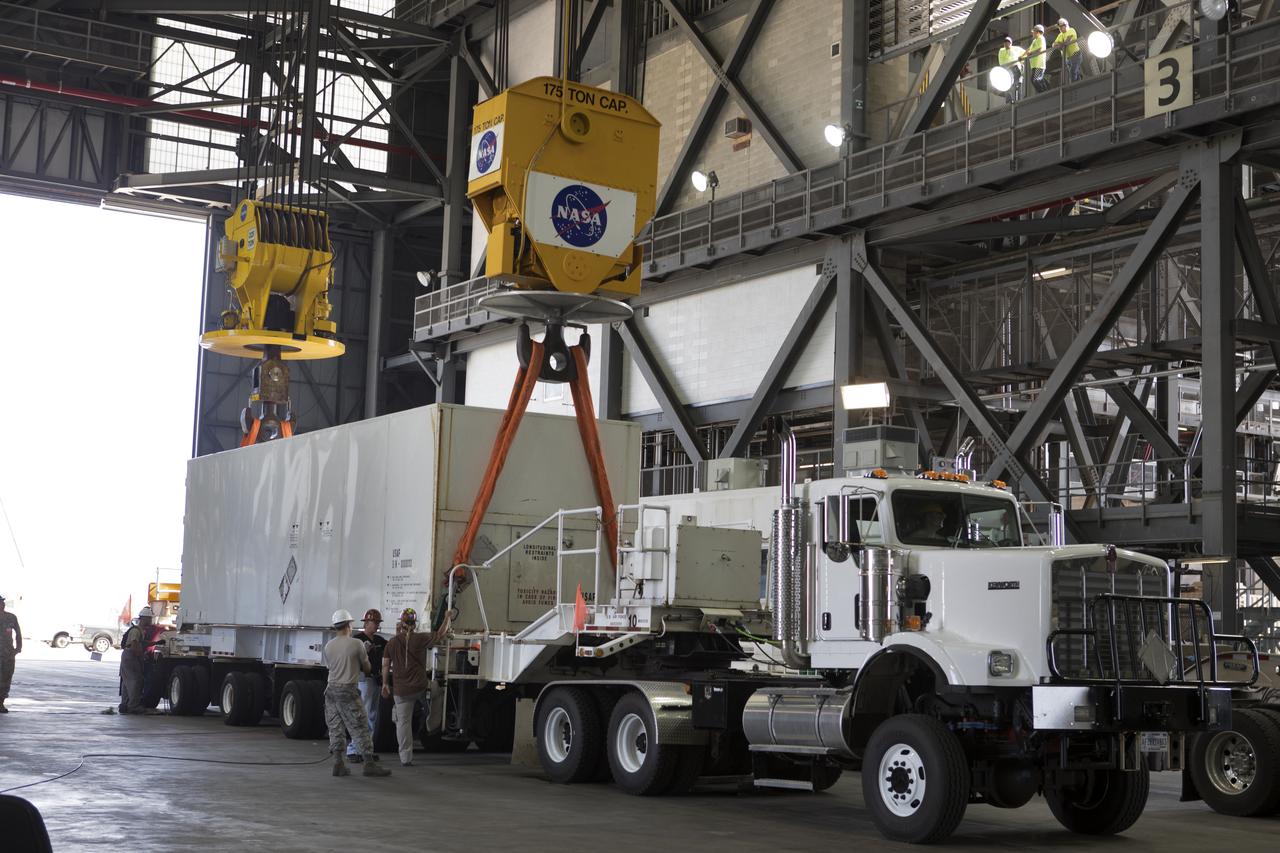
In the transfer aisle inside the Vehicle Assembly Building (VAB) at NASA's Kennedy Space Center in Florida, a crane operated by Jacob’s technicians lowers the shipping container with the ground test motor for Orion's Launch Abort System (LAS) inside onto another transporter on July 20, 2018. The container will be moved to the Rotation, Processing and Surge Facility where it will be inspected and prepared for transport to Space Launch Complex 46 (SLC-46) at Cape Canaveral Air Force Station for mechanical fit testing. This inert motor will not be used for flight, but will be used to certify flight hardware assembly in preparation for a full-stress test of the LAS, called Ascent Abort-2 (AA-2) flight test, scheduled for April 2019. During the test, the booster will launch from SLC 46, carrying a fully functional LAS and a 22,000-pound Orion test vehicle to an altitude of 31,000 feet and traveling at more than 1,000 miles an hour. The test will verify the LAS can steer the crew module and astronauts aboard to safety in the event of an issue with the Space Launch System (SLS) rocket when the spacecraft is under the highest aerodynamic loads it will experience during a rapid climb into space. NASA's Orion and Exploration Ground Systems programs and their contractors from Jacob's and Northrup Grumman in conjunction with the Air Force Space and Missile Center's Launch Operations branch SMC/LEXO, are performing the pathfinding exercises and flight operations for AA-2.
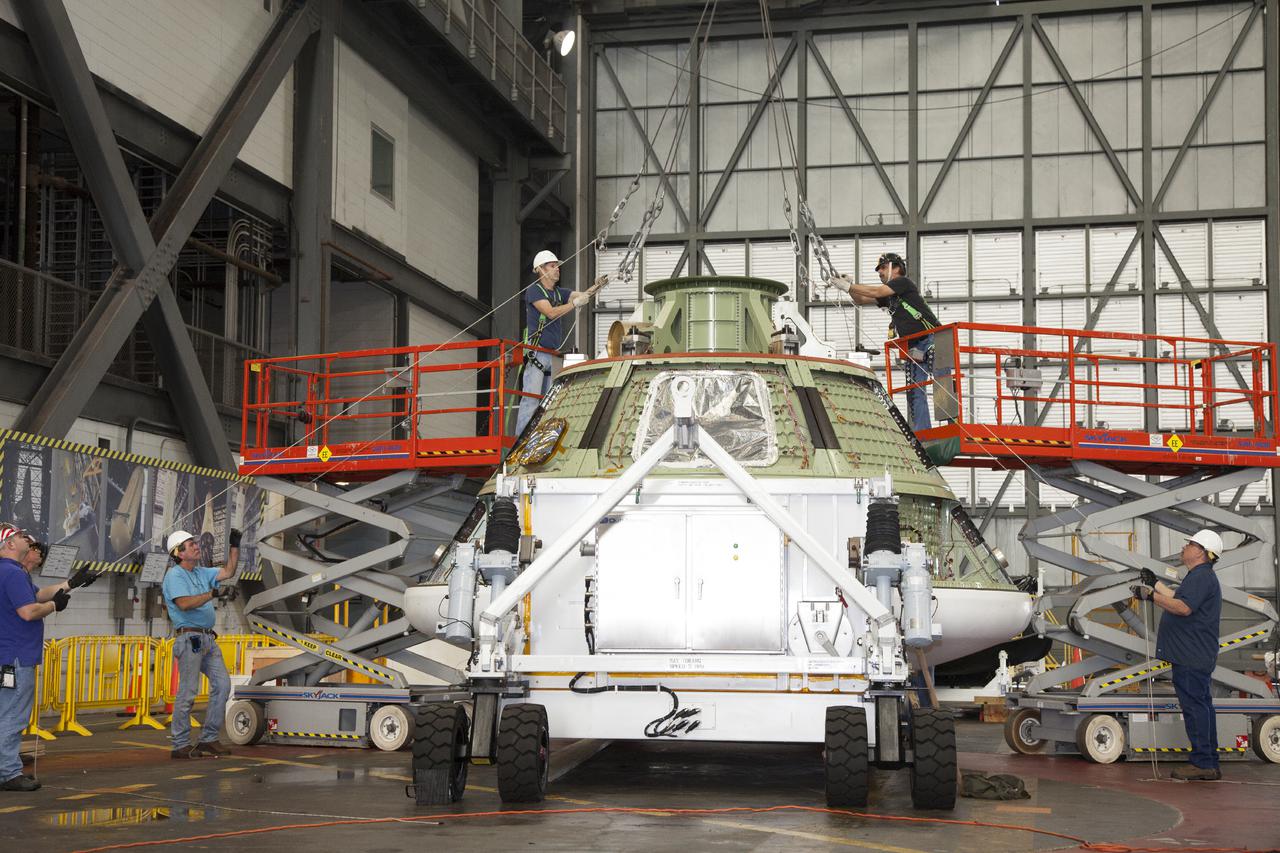
CAPE CANAVERAL, Fla. – Inside the Vehicle Assembly Building at NASA’s Kennedy Space Center in Florida, technicians on scissor lifts prepare to attach a bridge crane to the Orion ground test vehicle for heat shield removal. The ground test vehicle is being prepared for its move to Langley Research Center in Hampton, Va., for a water test. The test vehicle is being used by the Ground Systems Development and Operations Program for path finding operations, including simulated manufacturing, assembly and stacking procedures. Orion is the exploration spacecraft designed to carry astronauts to destinations not yet explored by humans. It will have emergency abort capability, sustain the crew during space travel and provide safe re-entry from deep space return velocities. The first unpiloted test flight of Orion is scheduled to launch in 2014 atop a Delta IV Heavy rocket and in 2017 on NASA’s Space Launch System rocket. For more information, visit www.nasa.gov_orion. Photo credit: Daniel Casper
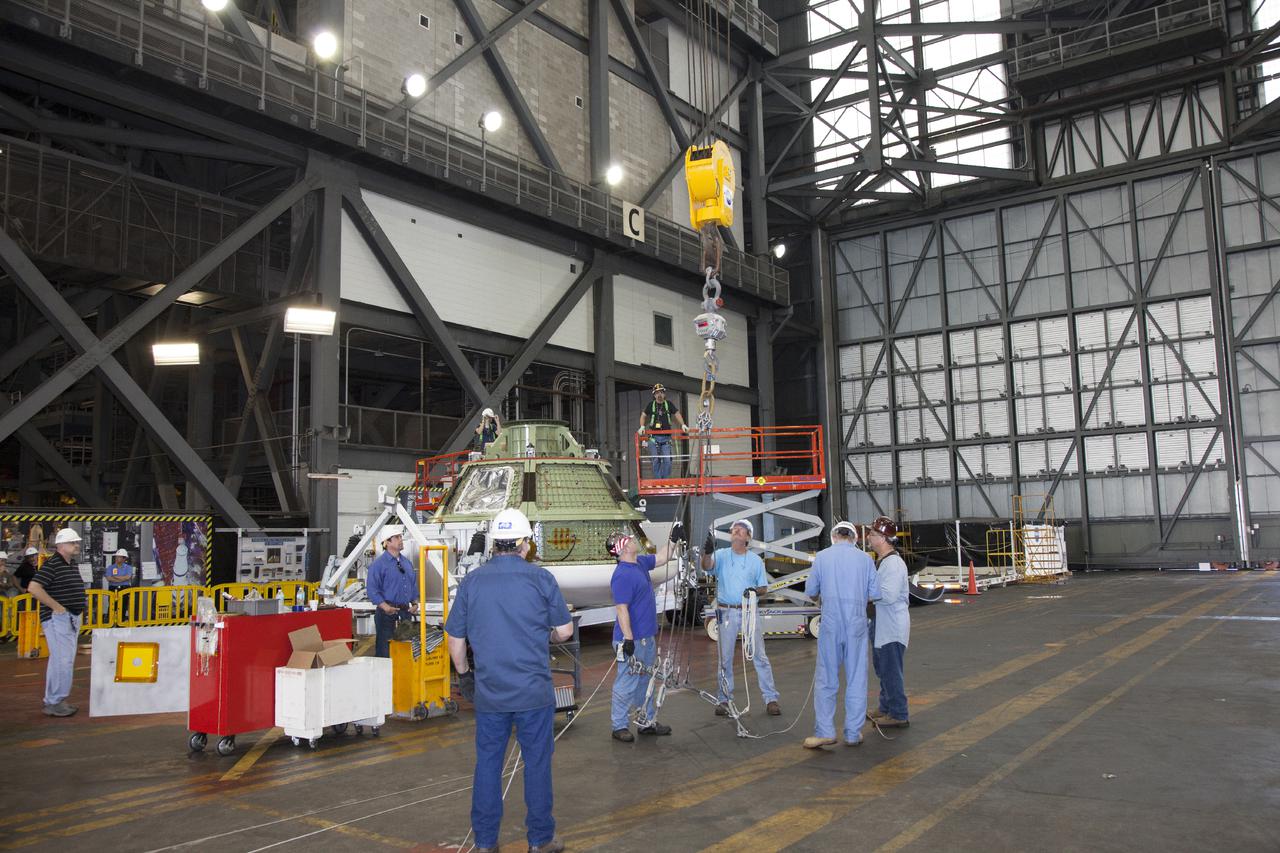
CAPE CANAVERAL, Fla. – At NASA’s Kennedy Space Center in Florida, technicians prepare to attach a bridge crane to the Orion ground test vehicle for heat shield removal inside the Vehicle Assembly Building. The ground test vehicle is being prepared for its move to Langley Research Center in Hampton, Va., for a water test. The test vehicle is being used by the Ground Systems Development and Operations Program for path finding operations, including simulated manufacturing, assembly and stacking procedures. Orion is the exploration spacecraft designed to carry astronauts to destinations not yet explored by humans. It will have emergency abort capability, sustain the crew during space travel and provide safe re-entry from deep space return velocities. The first unpiloted test flight of Orion is scheduled to launch in 2014 atop a Delta IV Heavy rocket and in 2017 on NASA’s Space Launch System rocket. For more information, visit www.nasa.gov_orion. Photo credit: Daniel Casper
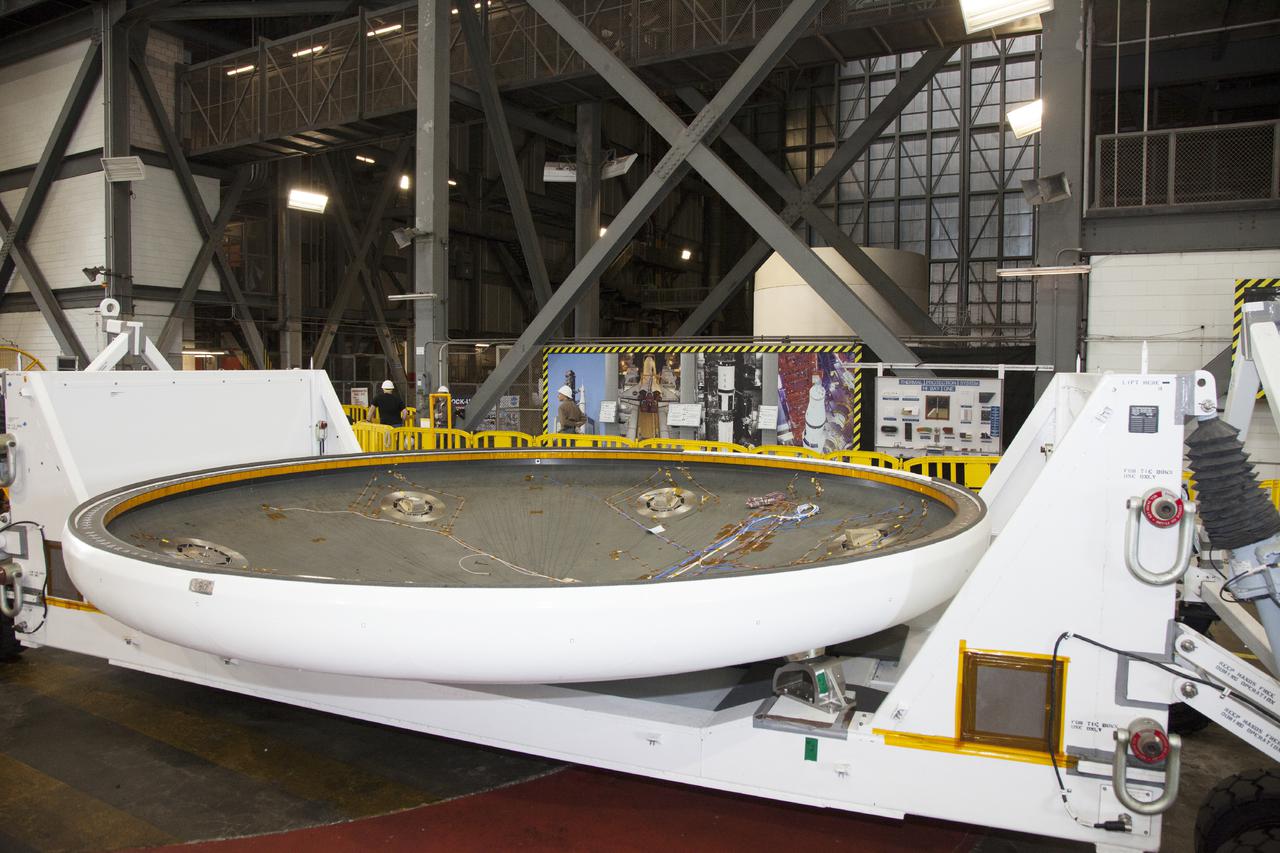
CAPE CANAVERAL, Fla. – Inside the Vehicle Assembly Building at NASA’s Kennedy Space Center in Florida, the Orion ground test vehicle has been lifted away from the heat shield. The ground test vehicle is being prepared for its move to Langley Research Center in Hampton, Va., for a water test. The test vehicle is being used by the Ground Systems Development and Operations Program for path finding operations, including simulated manufacturing, assembly and stacking procedures. Orion is the exploration spacecraft designed to carry astronauts to destinations not yet explored by humans. It will have emergency abort capability, sustain the crew during space travel and provide safe re-entry from deep space return velocities. The first unpiloted test flight of Orion is scheduled to launch in 2014 atop a Delta IV Heavy rocket and in 2017 on NASA’s Space Launch System rocket. For more information, visit www.nasa.gov_orion. Photo credit: Daniel Casper
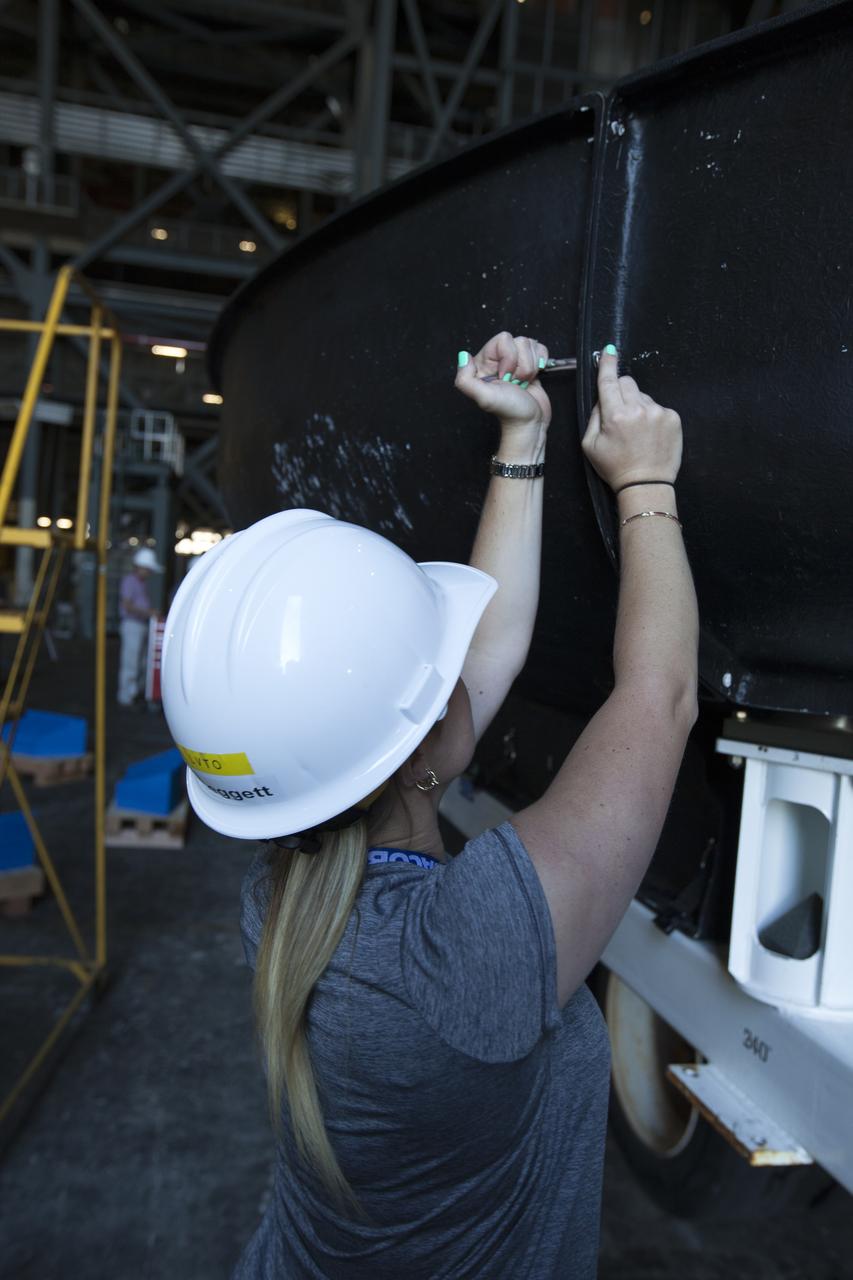
Inside High Bay 2 in the Vehicle Assembly Building (VAB) at NASA's Kennedy Space Center in Florida, a worker helps prepare the Orion heat shield from Exploration Flight Test-1 for unloading off its transporter. The heat shield is being transferred from the Orion Program to the Ground Systems Development and Operations Program, Landing and Recovery Operations. In the VAB, the heat shield will be integrated with the Orion ground test article and used for future underway recovery testing.
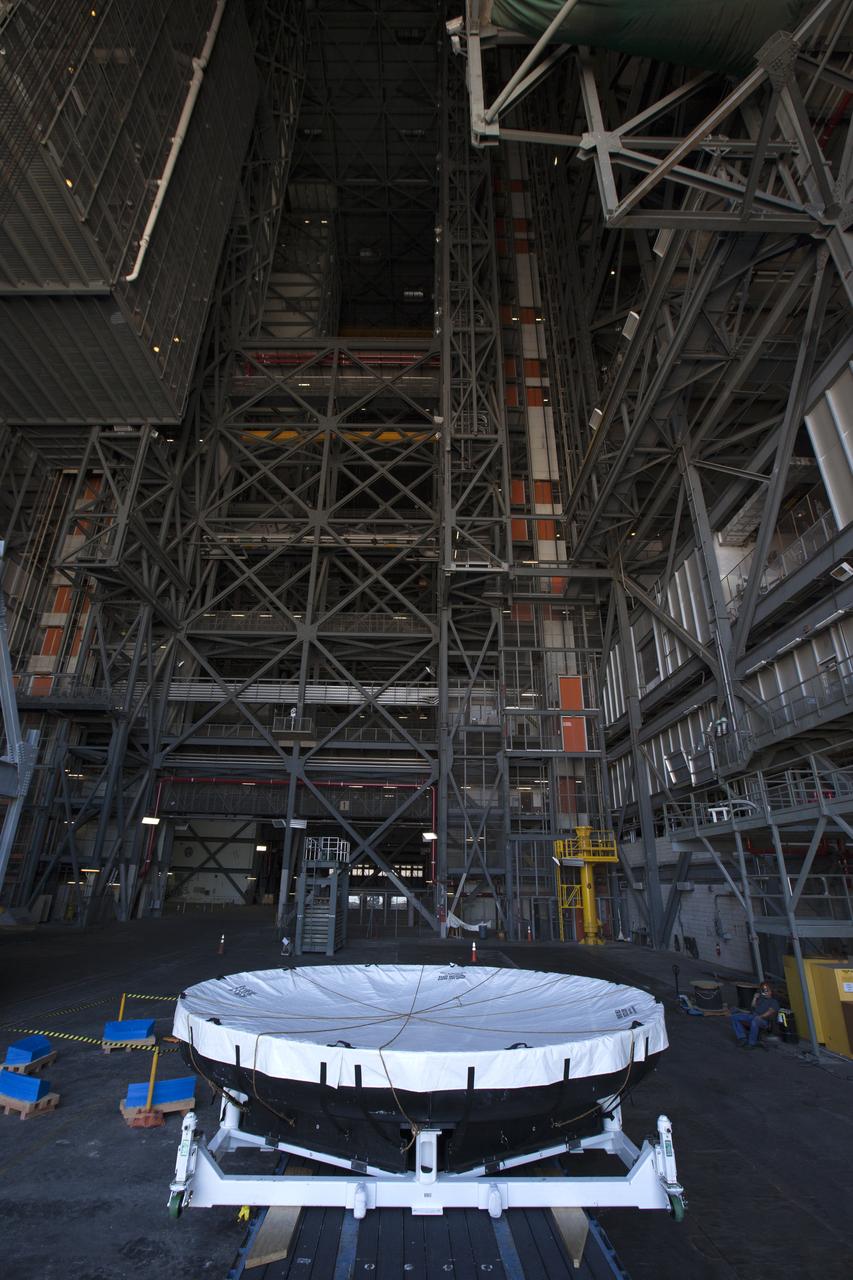
The Orion heat shield from Exploration Flight Test-1 has arrived in High Bay 2 in the Vehicle Assembly Building (VAB) at NASA's Kennedy Space Center in Florida. The heat shield was moved from the Launch Abort System Facility. The heat shield is being transferred from the Orion Program to the Ground Systems Development and Operations Program, Landing and Recovery Operations. In the VAB, the heat shield will be integrated with the Orion ground test article and used for future underway recovery testing.
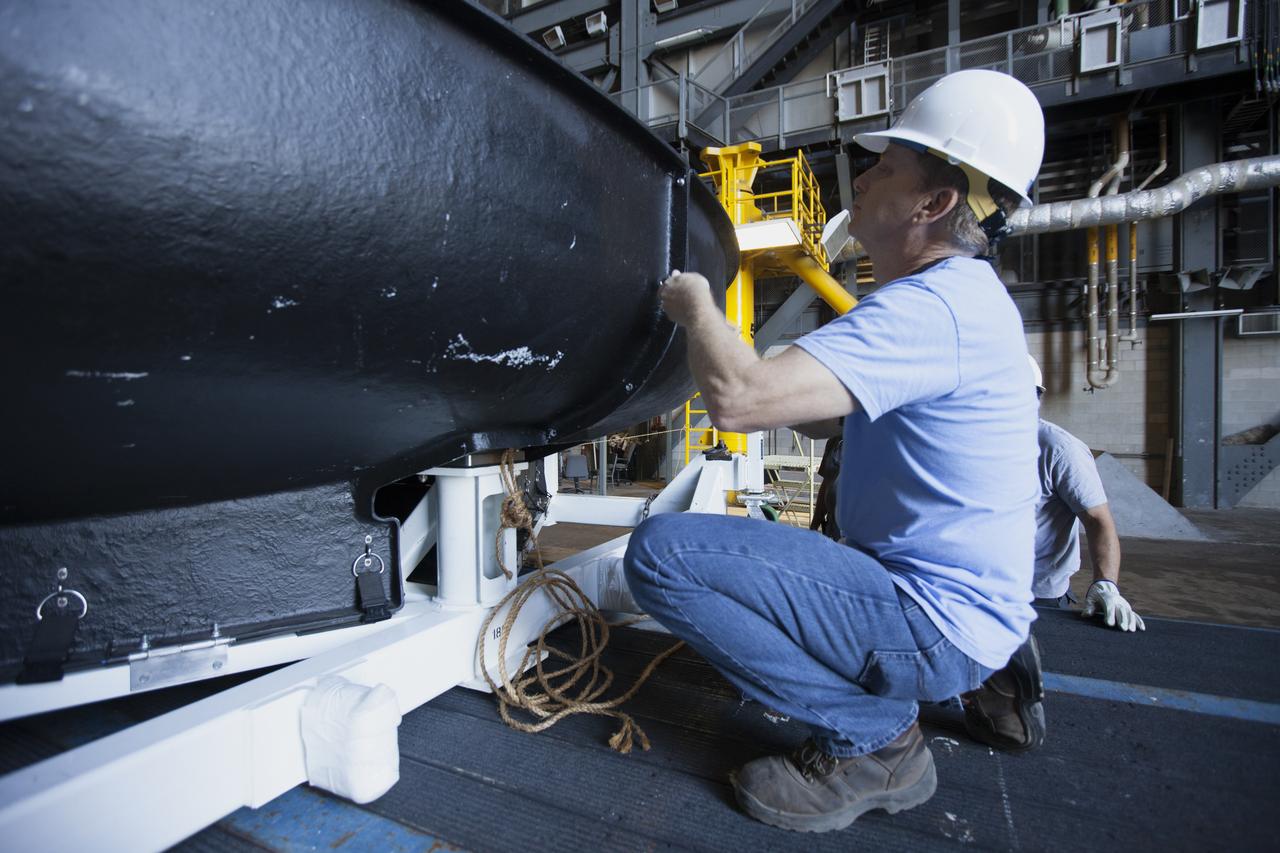
Inside High Bay 2 in the Vehicle Assembly Building (VAB) at NASA's Kennedy Space Center in Florida, workers help prepare the Orion heat shield from Exploration Flight Test-1 for unloading off its transporter. The heat shield is being transferred from the Orion Program to the Ground Systems Development and Operations Program, Landing and Recovery Operations. In the VAB, the heat shield will be integrated with the Orion ground test article and used for future underway recovery testing.
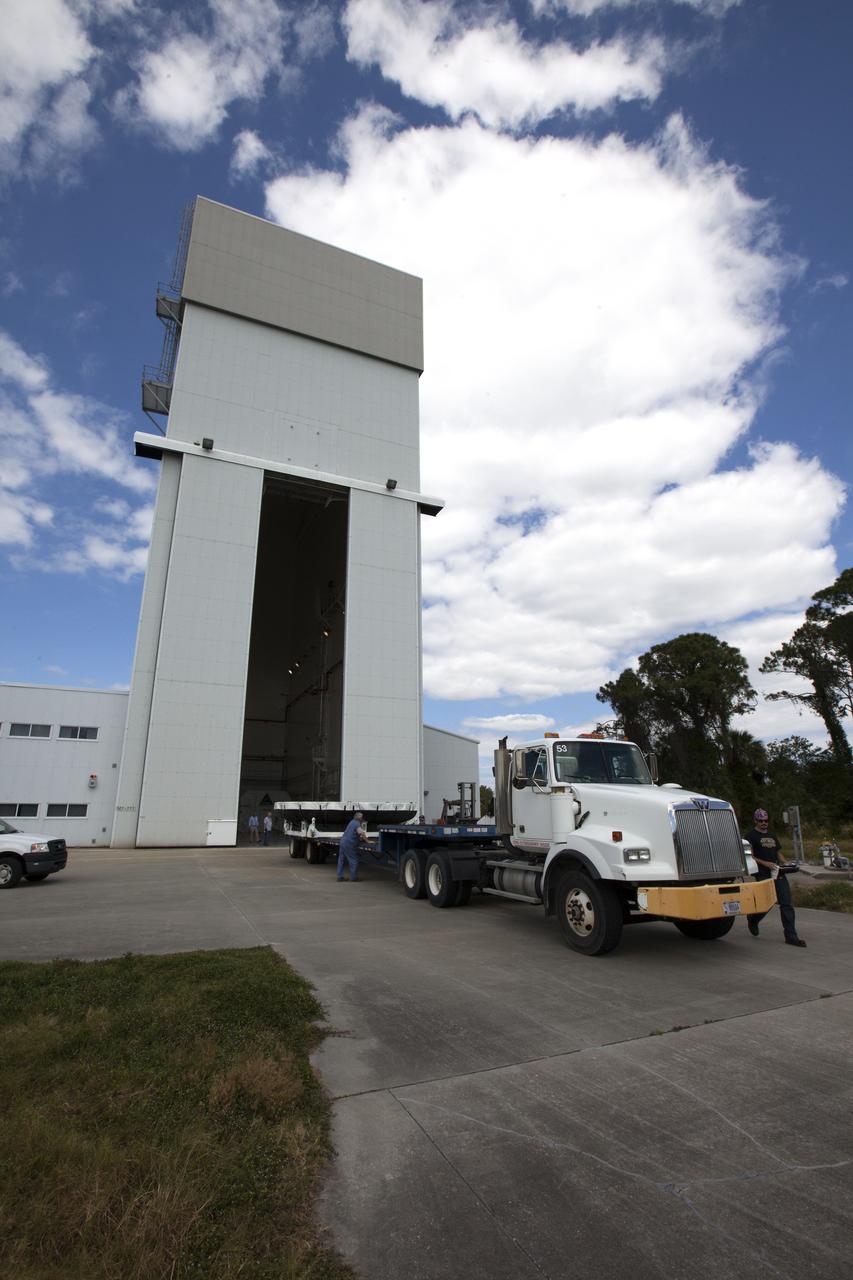
The Orion heat shield from Exploration Flight Test-1, secured on a transporter, departs the Launch Abort System Facility at NASA's Kennedy Space Center in Florida, for its move to the Vehicle Assembly Building (VAB). The heat shield is being transferred from the Orion Program to the Ground Systems Development and Operations Program, Landing and Recovery Operations. In the VAB, the heat shield will be integrated with the Orion ground test article and used for future underway recovery testing.
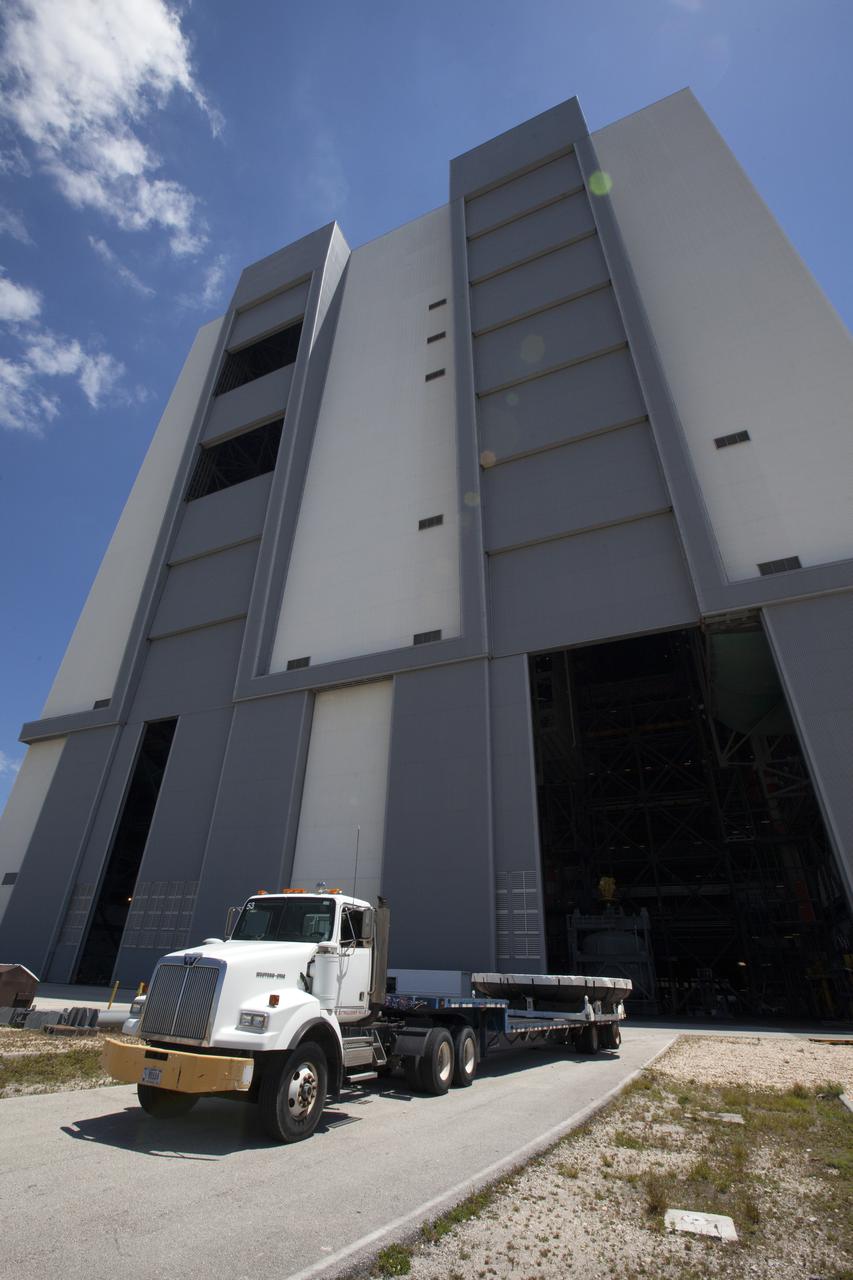
A flatbed truck carrying the Orion heat shield from Exploration Flight Test-1, prepares to back into High Bay 2 in the Vehicle Assembly Building (VAB) at NASA's Kennedy Space Center in Florida. The heat shield was moved from the Launch Abort System Facility. The heat shield is being transferred from the Orion Program to the Ground Systems Development and Operations Program, Landing and Recovery Operations. In the VAB, the heat shield will be integrated with the Orion ground test article and used for future underway recovery testing.
Inside the Launch Abort System Facility at NASA's Kennedy Space Center in Florida, the Orion heat shield from Exploration Flight Test-1 is being loaded onto a transporter for its move to the Vehicle Assembly Building (VAB). The heat shield is being transferred from the Orion Program to the Ground Systems Development and Operations Program, Landing and Recovery Operations. In the VAB, the heat shield will be integrated with the Orion ground test article and used for future underway recovery testing.
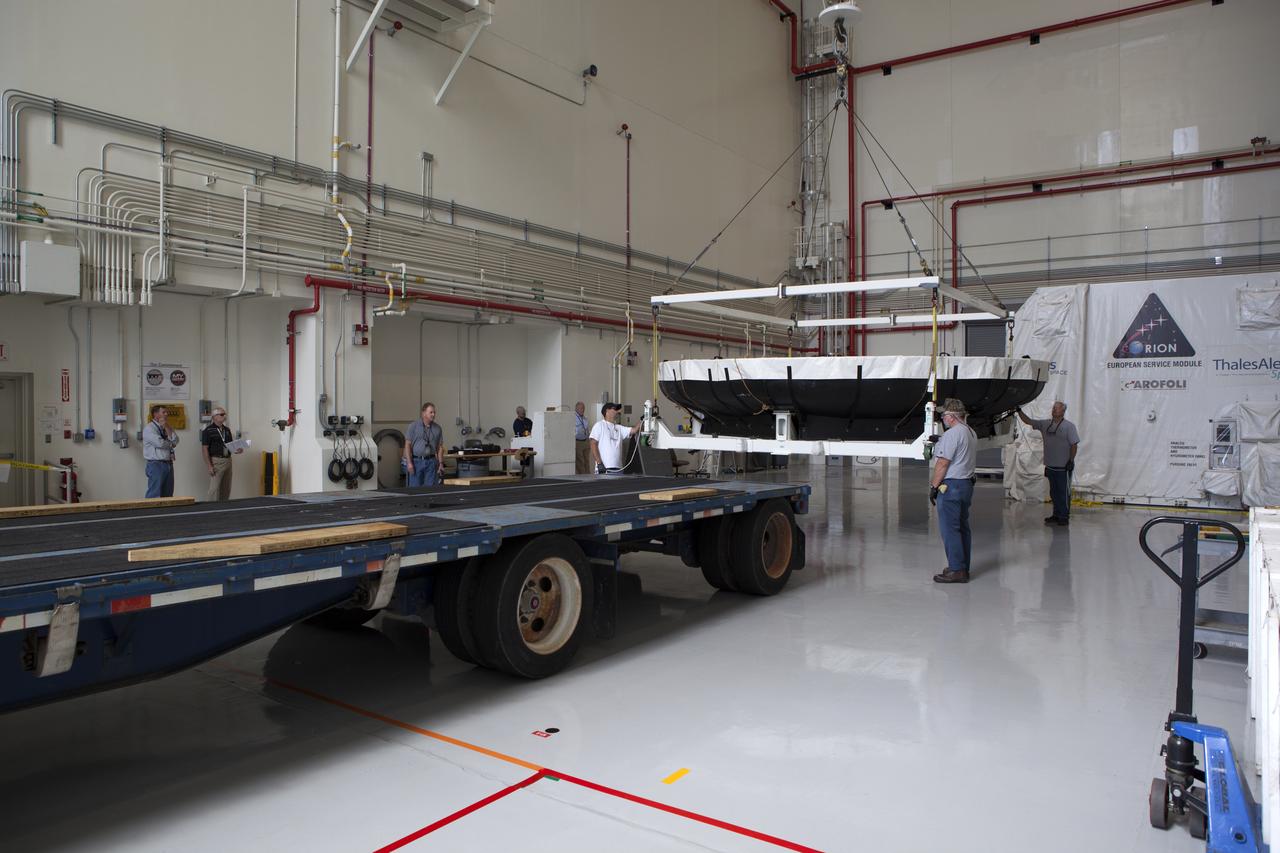
Inside the Launch Abort System Facility at NASA's Kennedy Space Center in Florida, the Orion heat shield from Exploration Flight Test-1 is being loaded onto a transporter for its move to the Vehicle Assembly Building (VAB). The heat shield is being transferred from the Orion Program to the Ground Systems Development and Operations Program, Landing and Recovery Operations. In the VAB, the heat shield will be integrated with the Orion ground test article and used for future underway recovery testing.
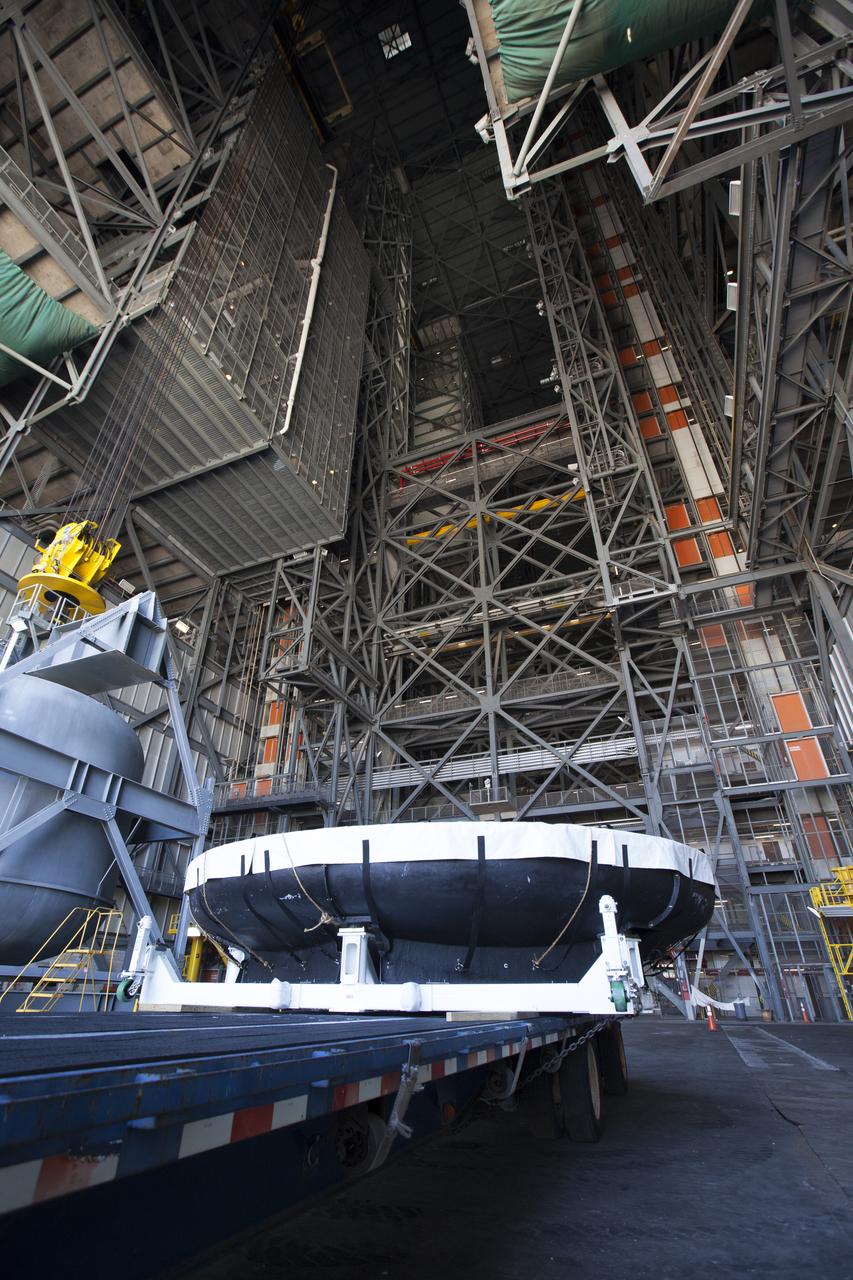
A flatbed truck carrying the Orion heat shield from Exploration Flight Test-1, backs into High Bay 2 in the Vehicle Assembly Building (VAB) at NASA's Kennedy Space Center in Florida. The heat shield was moved from the Launch Abort System Facility. The heat shield is being transferred from the Orion Program to the Ground Systems Development and Operations Program, Landing and Recovery Operations. In the VAB, the heat shield will be integrated with the Orion ground test article and used for future underway recovery testing.
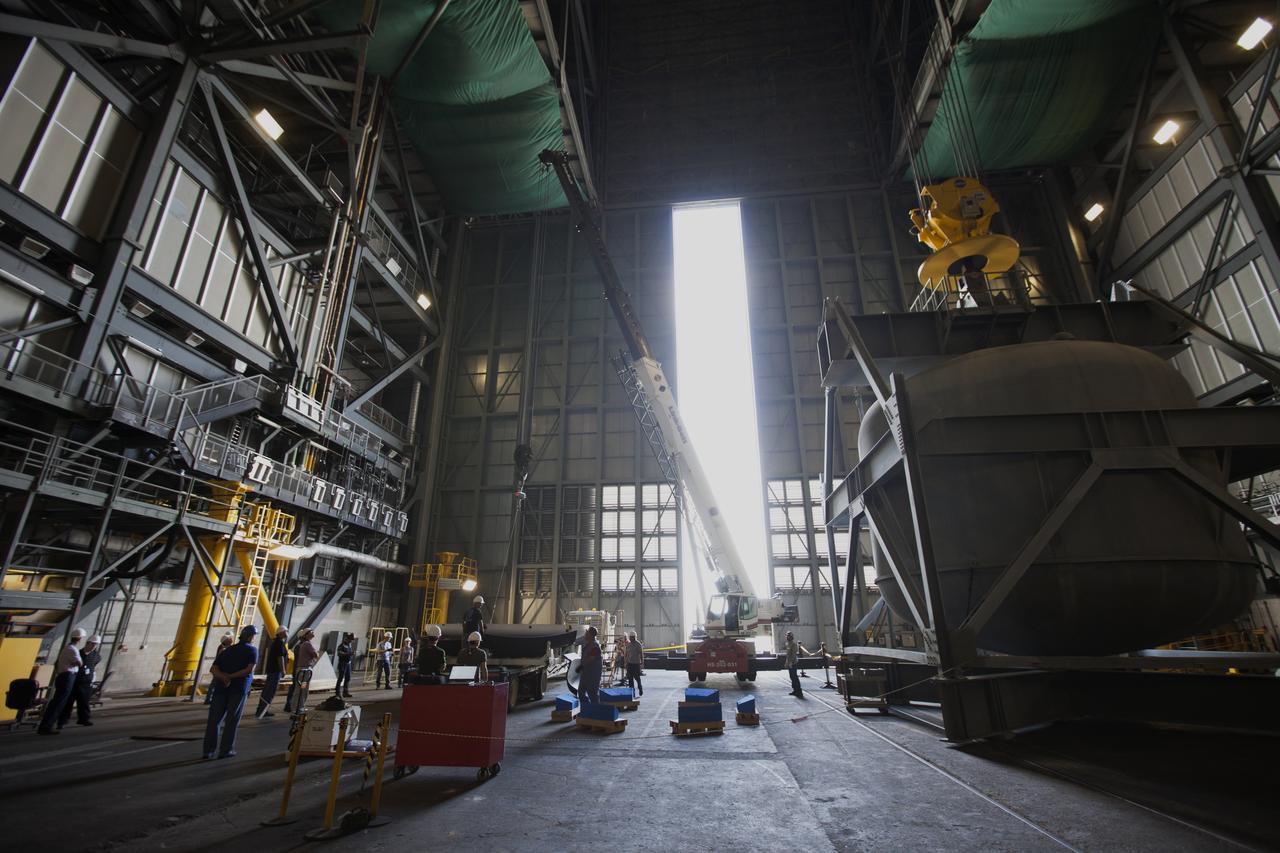
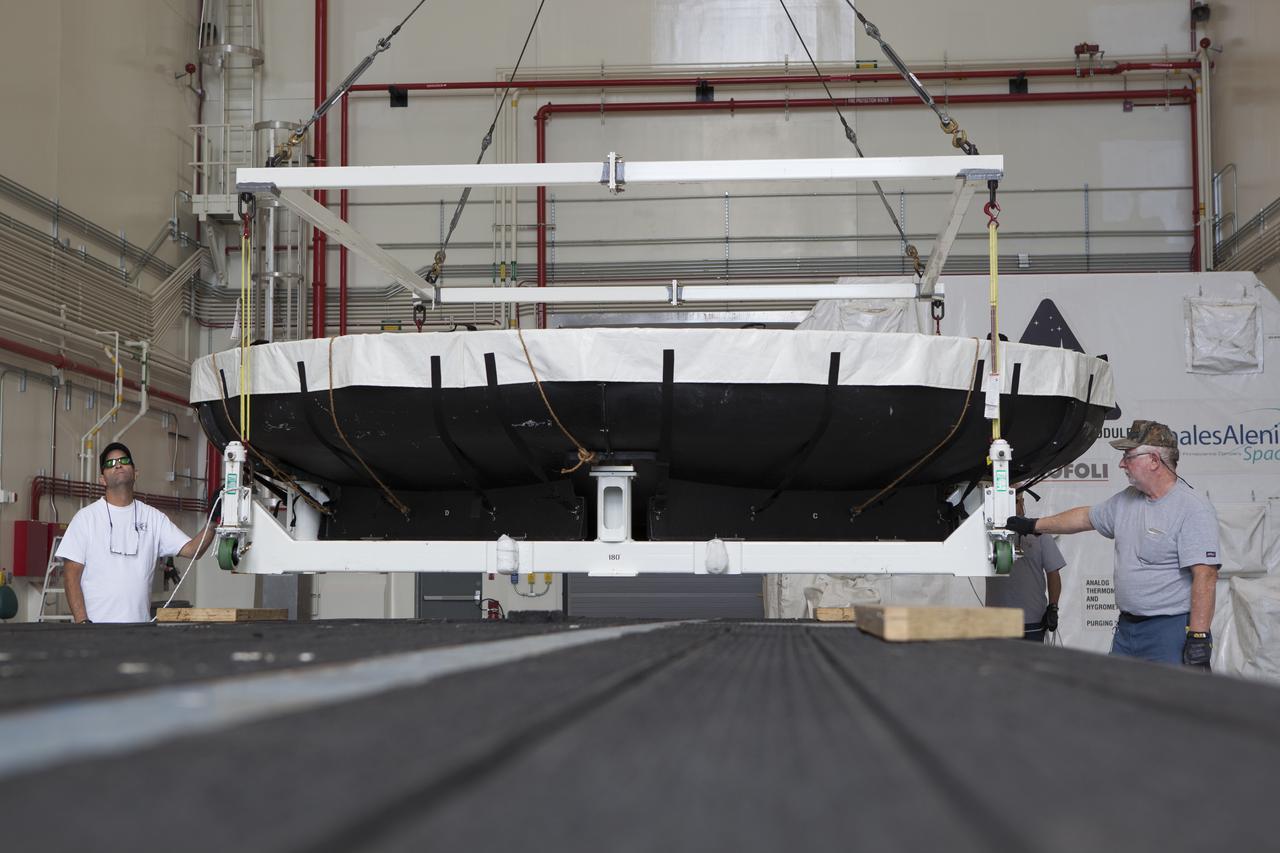
Inside High Bay 2 in the Vehicle Assembly Building (VAB) at NASA's Kennedy Space Center in Florida, a crane is attached to the Orion heat shield from Exploration Flight Test-1 for unloading off its transporter. The heat shield is being transferred from the Orion Program to the Ground Systems Development and Operations Program, Landing and Recovery Operations. In the VAB, the heat shield will be integrated with the Orion ground test article and used for future underway recovery testing.
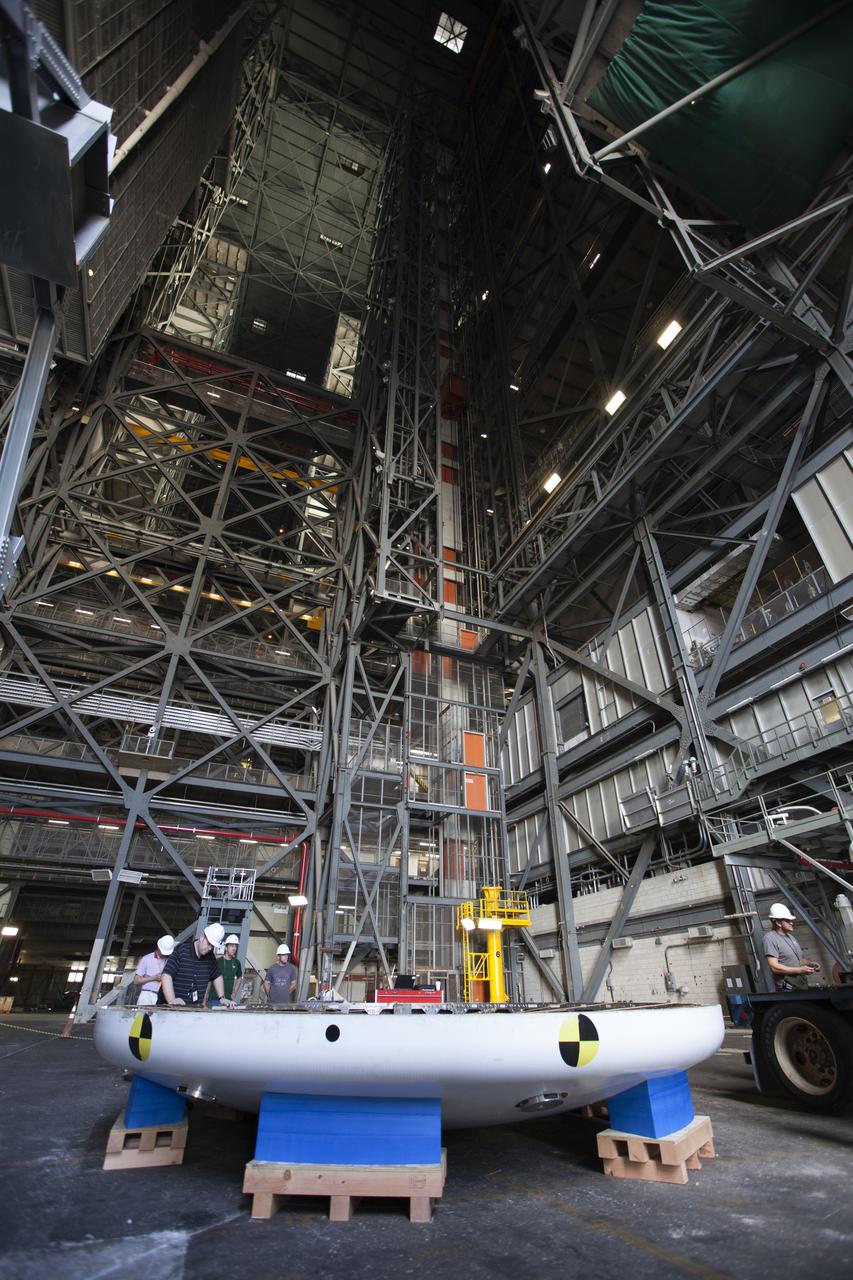
Inside High Bay 2 in the Vehicle Assembly Building (VAB) at NASA's Kennedy Space Center in Florida, the Orion heat shield from Exploration Flight Test-1 is secured on foam blocks. The heat shield is being transferred from the Orion Program to the Ground Systems Development and Operations Program, Landing and Recovery Operations. In the VAB, the heat shield will be integrated with the Orion ground test article and used for future underway recovery testing.
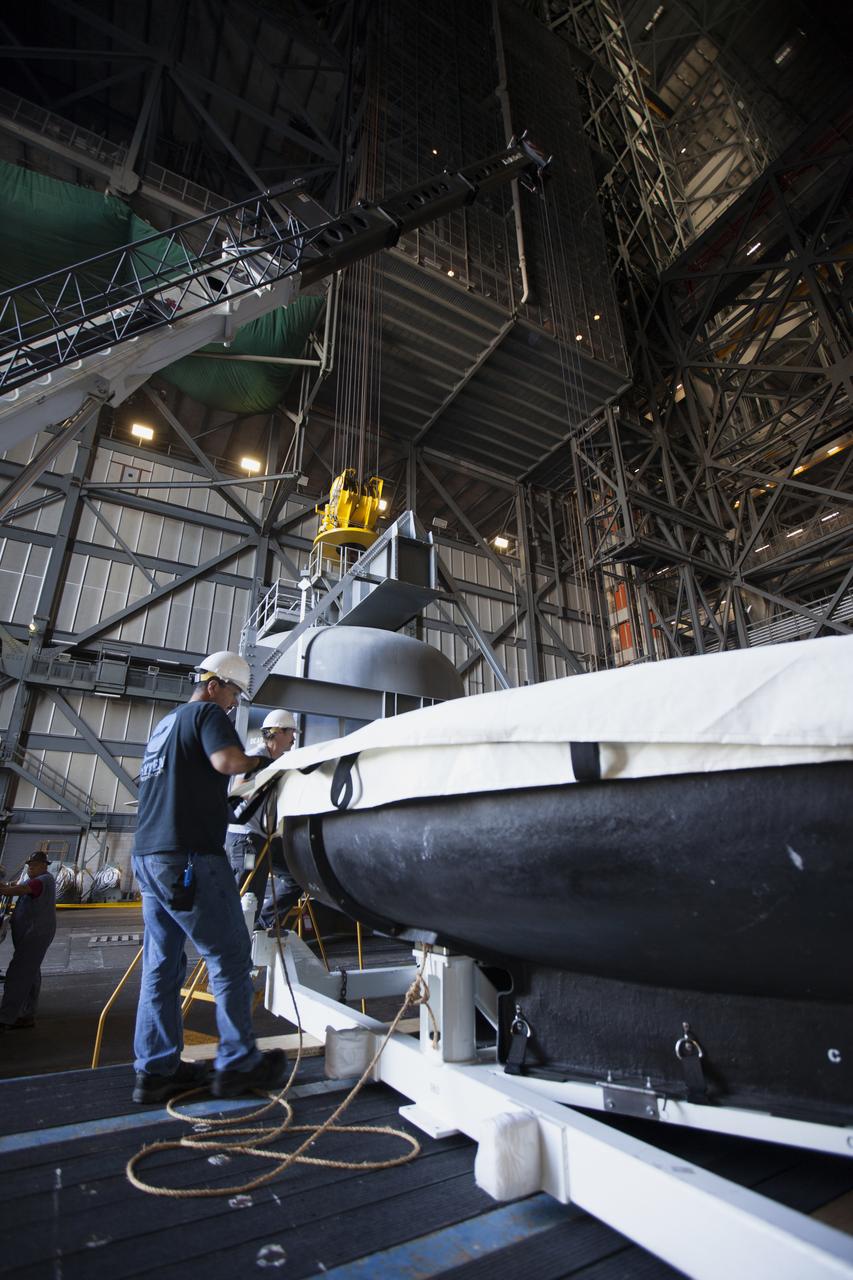
Inside High Bay 2 in the Vehicle Assembly Building (VAB) at NASA's Kennedy Space Center in Florida, workers help prepare the Orion heat shield from Exploration Flight Test-1 for unloading off its transporter. The heat shield is being transferred from the Orion Program to the Ground Systems Development and Operations Program, Landing and Recovery Operations. In the VAB, the heat shield will be integrated with the Orion ground test article and used for future underway recovery testing.
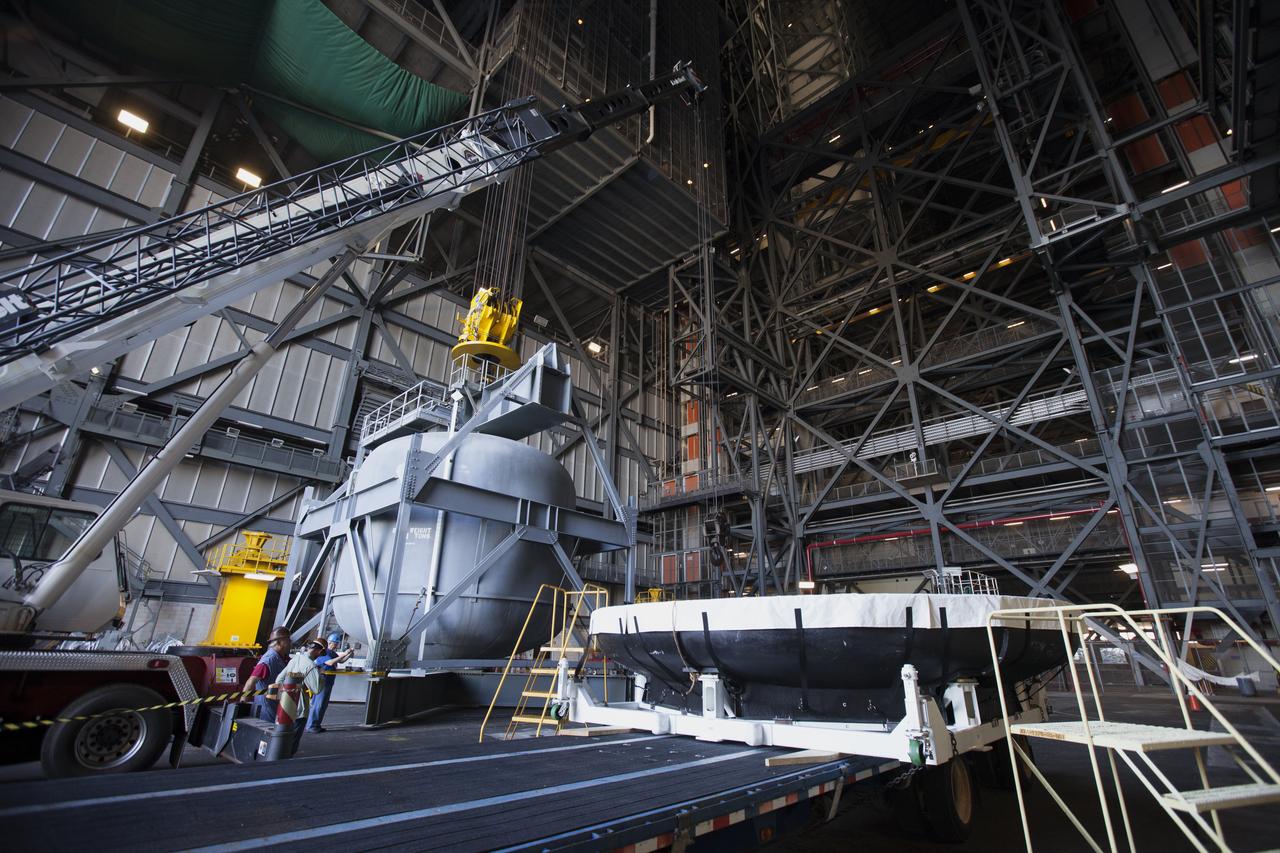
The Orion heat shield from Exploration Flight Test-1 has arrived in High Bay 2 of the Vehicle Assembly Building (VAB) at NASA's Kennedy Space Center in Florida. The heat shield is being transferred from the Orion Program to the Ground Systems Development and Operations Program, Landing and Recovery Operations. In the VAB, the heat shield will be integrated with the Orion ground test article and used for future underway recovery testing.
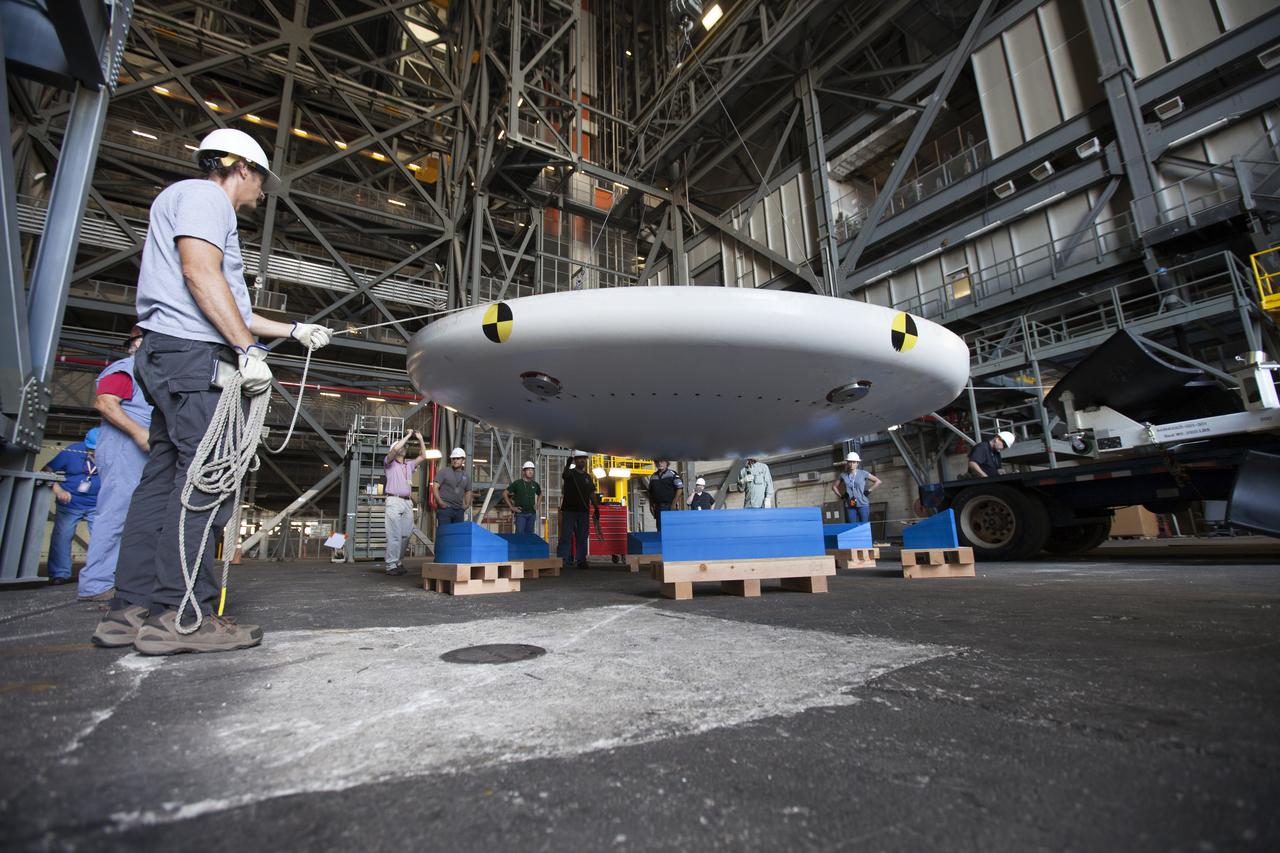
Inside High Bay 2 in the Vehicle Assembly Building (VAB) at NASA's Kennedy Space Center in Florida, workers monitor the progress as a crane lowers the Orion heat shield from Exploration Flight Test-1 onto foam blocks. The heat shield is being transferred from the Orion Program to the Ground Systems Development and Operations Program, Landing and Recovery Operations. In the VAB, the heat shield will be integrated with the Orion ground test article and used for future underway recovery testing.
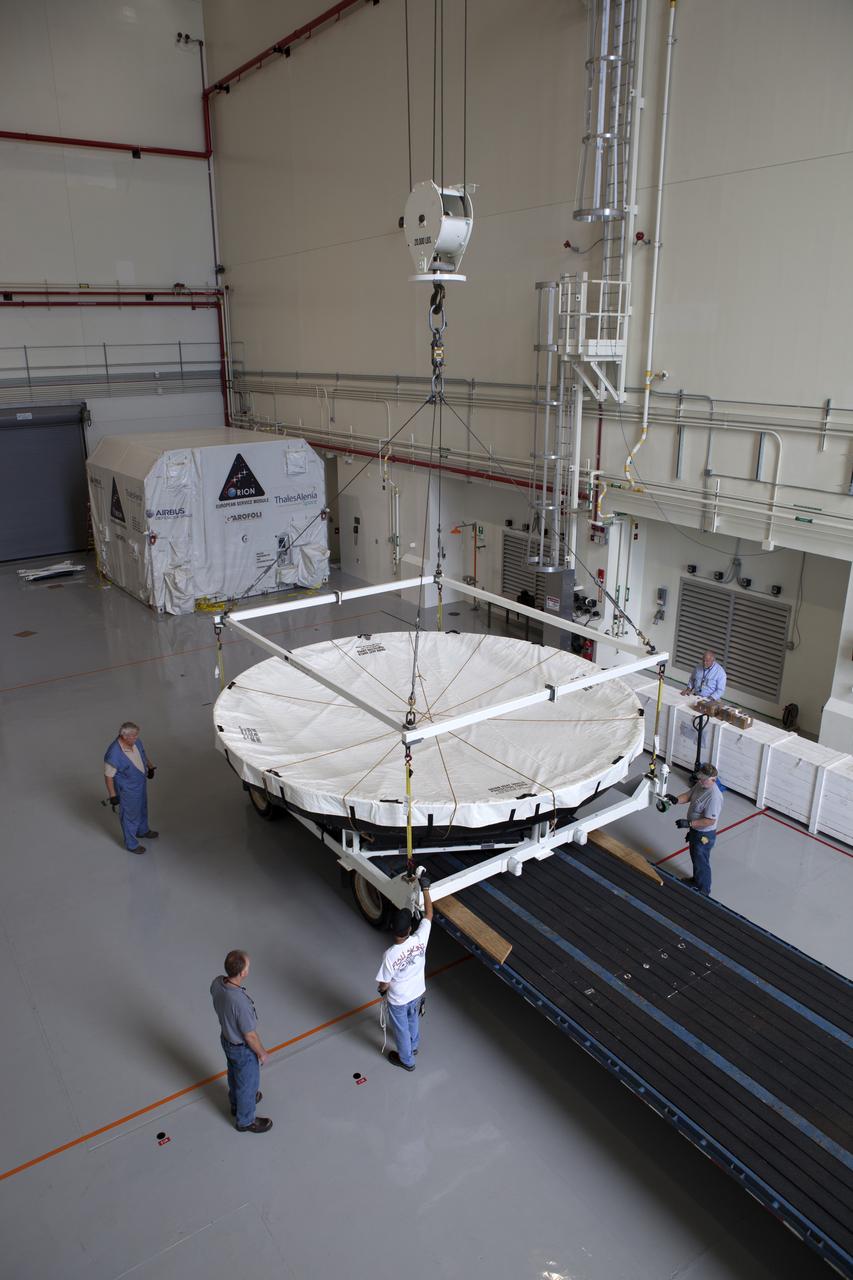
Inside the Launch Abort System Facility at NASA's Kennedy Space Center in Florida, a crane lowers the Orion heat shield from Exploration Flight Test-1 onto a transporter for its move to the Vehicle Assembly Building (VAB). The heat shield is being transferred from the Orion Program to the Ground Systems Development and Operations Program, Landing and Recovery Operations. In the VAB, the heat shield will be integrated with the Orion ground test article and used for future underway recovery testing.
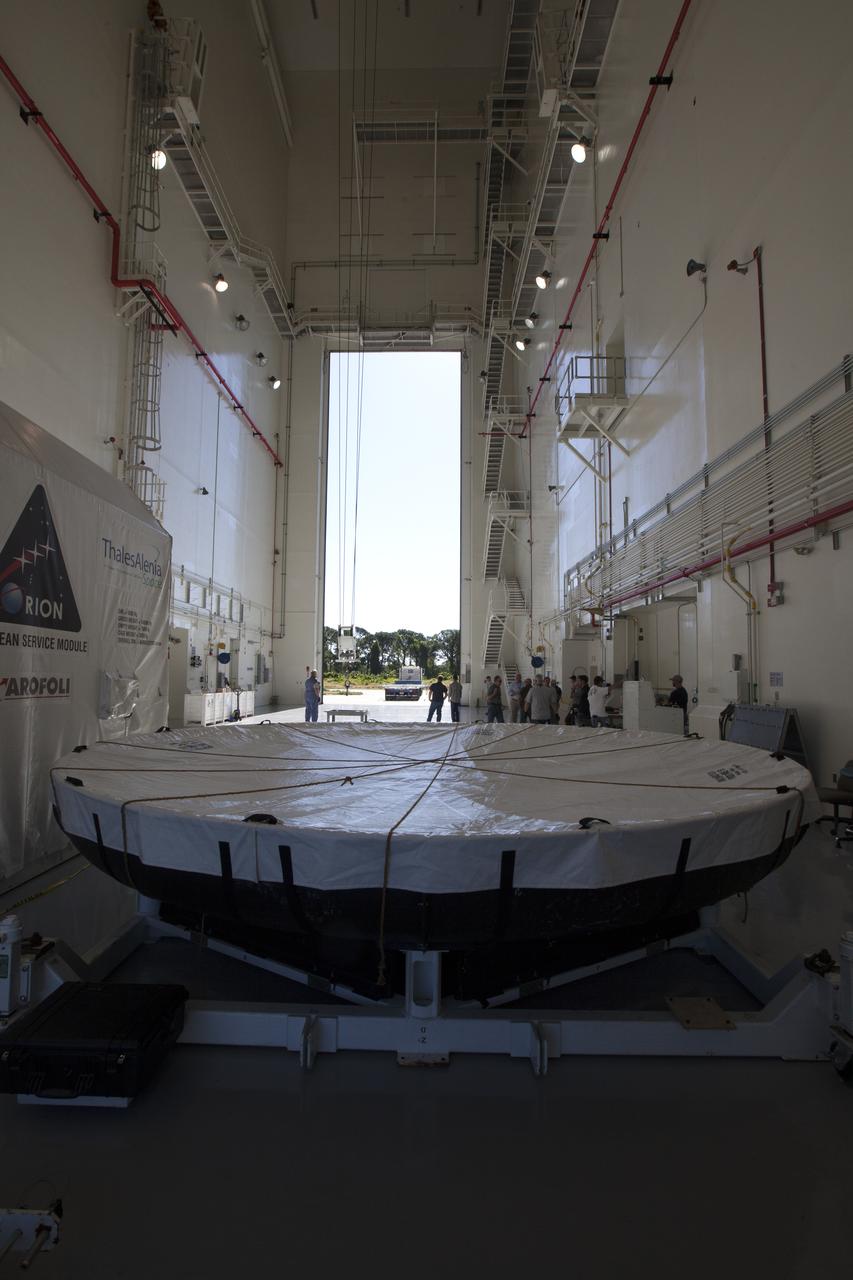
Inside the Launch Abort System Facility at NASA's Kennedy Space Center in Florida, the Orion heat shield from Exploration Flight Test-1 is being prepared for its move to the Vehicle Assembly Building (VAB). The heat shield is being transferred from the Orion Program to the Ground Systems Development and Operations Program, Landing and Recovery Operations. In the VAB, the heat shield will be integrated with the Orion ground test article and used for future underway recovery testing.
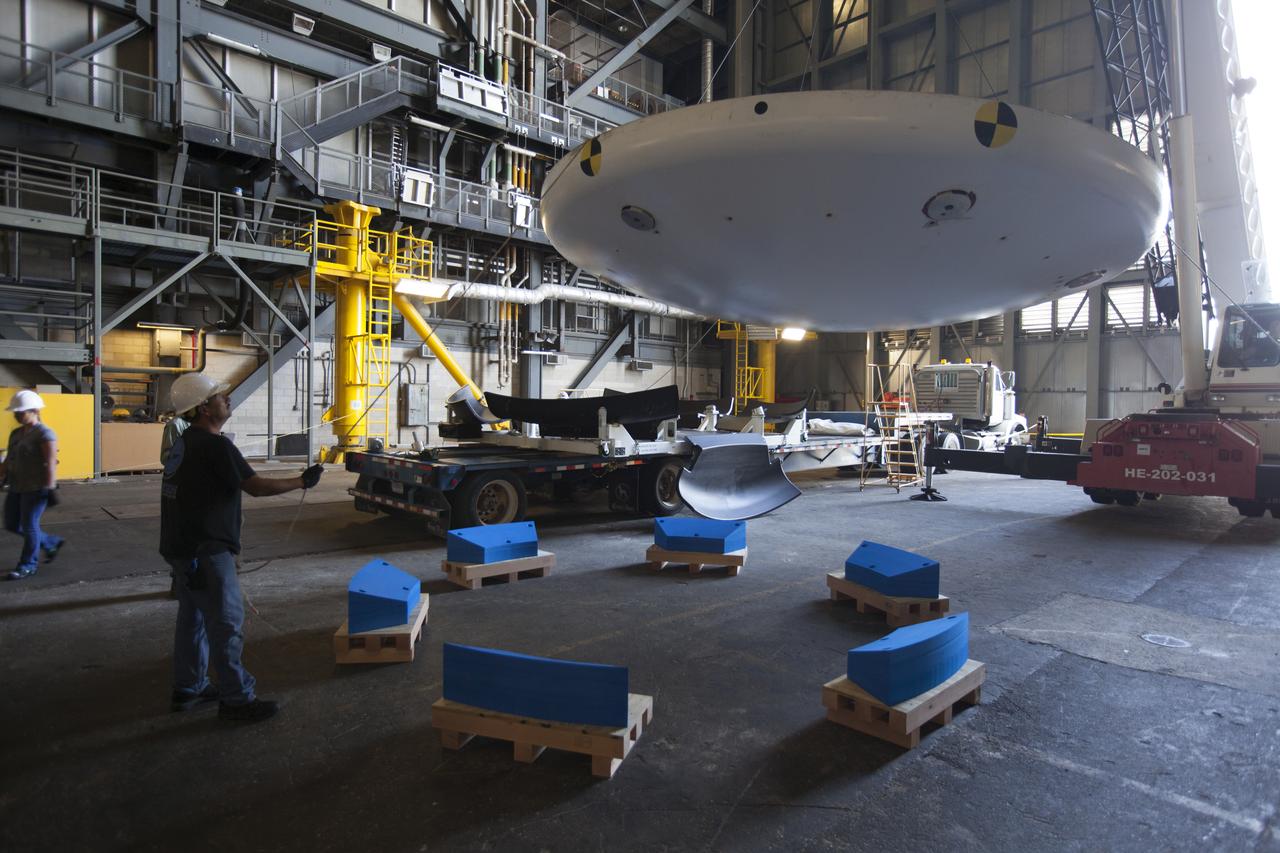
Inside High Bay 2 in the Vehicle Assembly Building (VAB) at NASA's Kennedy Space Center in Florida, a worker monitors the progress as a crane lowers the Orion heat shield from Exploration Flight Test-1 onto foam blocks. The heat shield is being transferred from the Orion Program to the Ground Systems Development and Operations Program, Landing and Recovery Operations. In the VAB, the heat shield will be integrated with the Orion ground test article and used for future underway recovery testing.
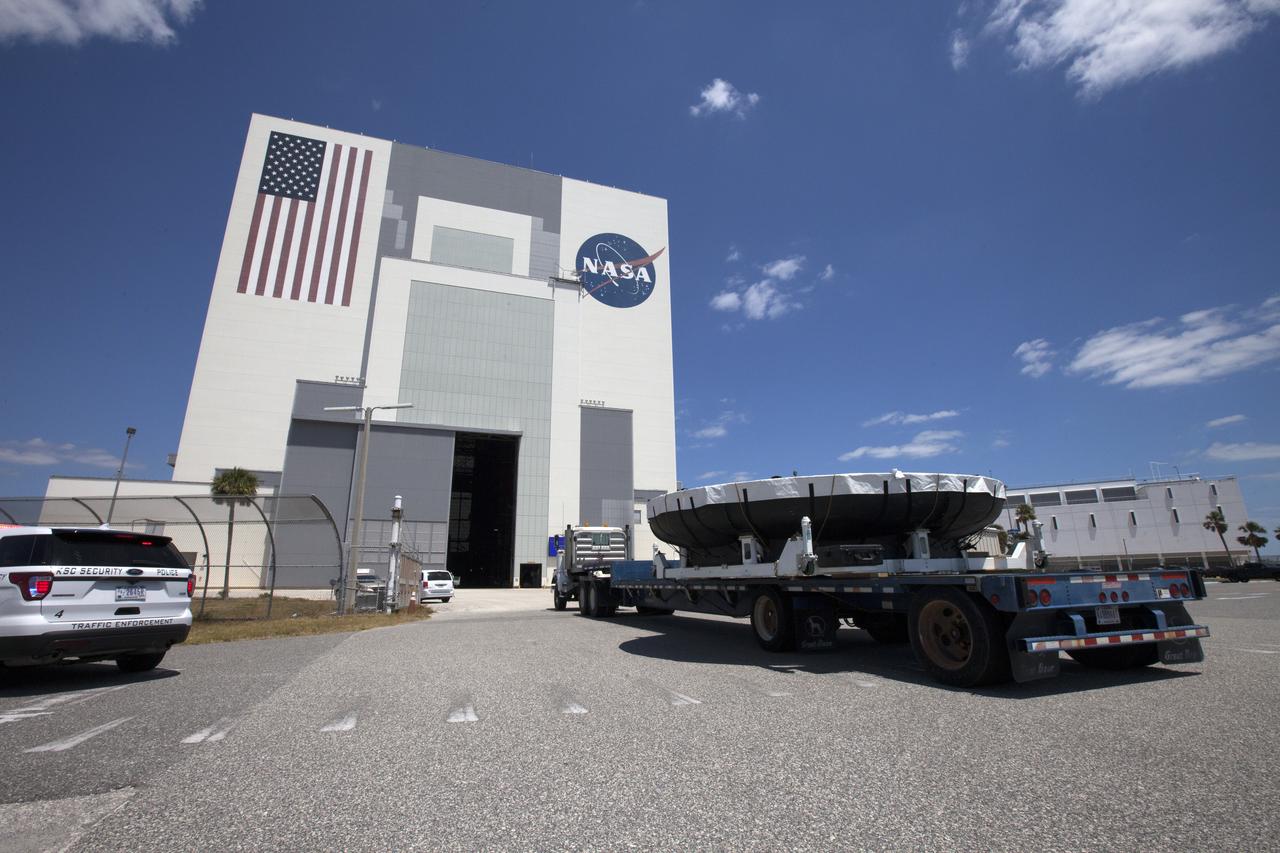
The Orion heat shield from Exploration Flight Test-1, secured on a transporter, arrives at the Vehicle Assembly Building (VAB) at NASA's Kennedy Space Center in Florida. The heat shield was moved from the Launch Abort System Facility. The heat shield is being transferred from the Orion Program to the Ground Systems Development and Operations Program, Landing and Recovery Operations. In the VAB, the heat shield will be integrated with the Orion ground test article and used for future underway recovery testing.
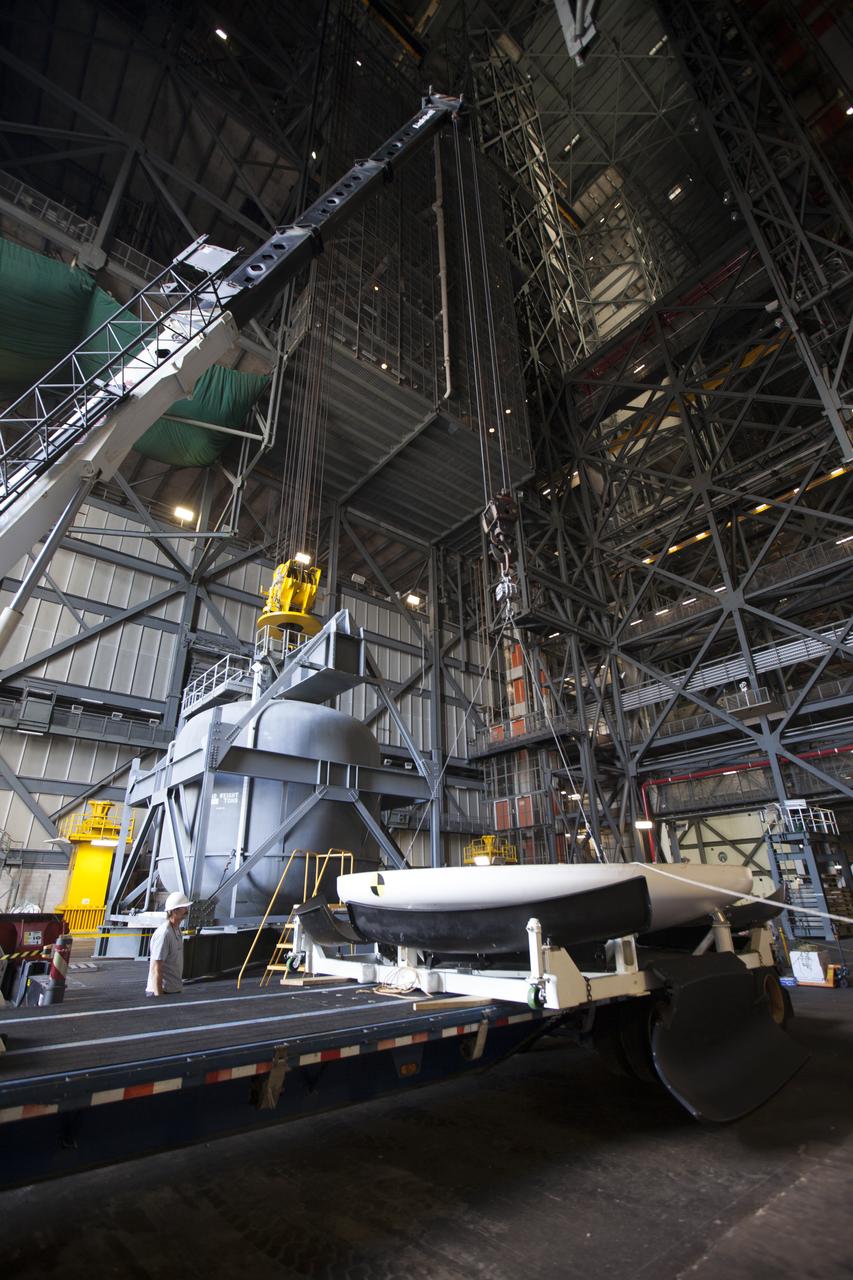
Inside High Bay 2 in the Vehicle Assembly Building (VAB) at NASA's Kennedy Space Center in Florida, a crane is attached to the Orion heat shield from Exploration Flight Test-1 for unloading off its transporter. The heat shield is being transferred from the Orion Program to the Ground Systems Development and Operations Program, Landing and Recovery Operations. In the VAB, the heat shield will be integrated with the Orion ground test article and used for future underway recovery testing.
Inside High Bay 2 in the Vehicle Assembly Building (VAB) at NASA's Kennedy Space Center in Florida, a crane lifts the Orion heat shield from Exploration Flight Test-1 up off its transporter. It will be lowered onto foam blocks. The heat shield is being transferred from the Orion Program to the Ground Systems Development and Operations Program, Landing and Recovery Operations. In the VAB, the heat shield will be integrated with the Orion ground test article and used for future underway recovery testing.
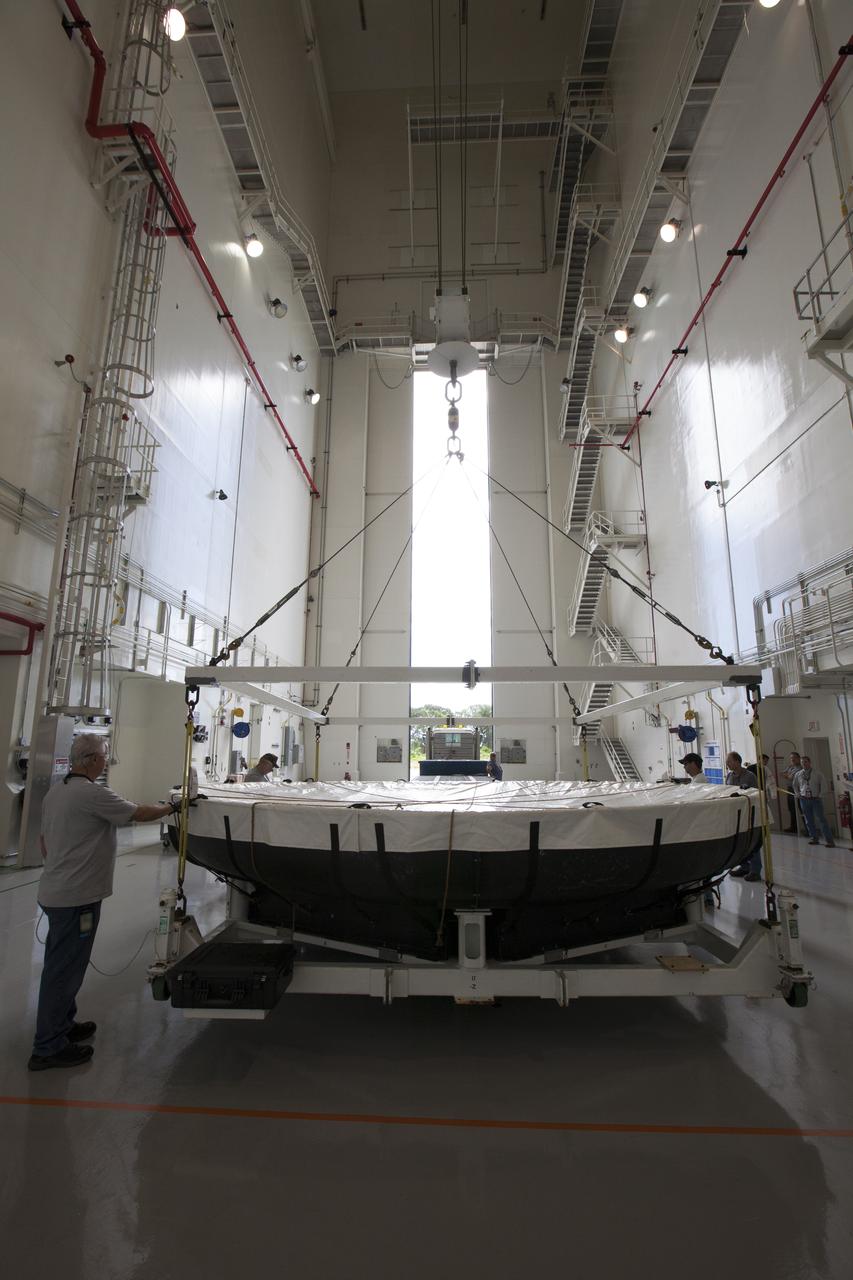
Inside the Launch Abort System Facility at NASA's Kennedy Space Center in Florida, the Orion heat shield from Exploration Flight Test-1 is secured on a transporter and ready for its move to the Vehicle Assembly Building (VAB). The heat shield is being transferred from the Orion Program to the Ground Systems Development and Operations Program, Landing and Recovery Operations. In the VAB, the heat shield will be integrated with the Orion ground test article and used for future underway recovery testing.
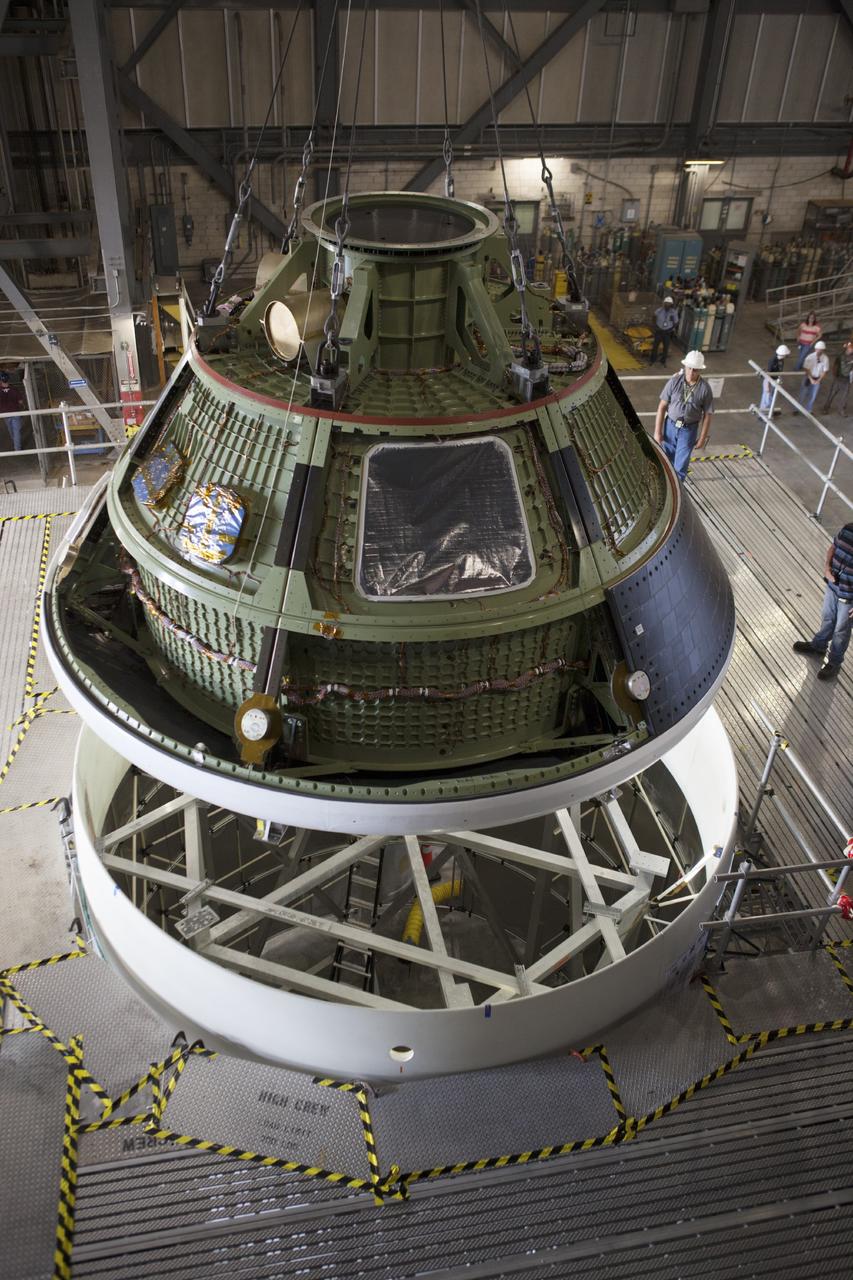
CAPE CANAVERAL, Fla. – At NASA’s Kennedy Space Center in Florida, technicians monitor the progress as the Orion ground test vehicle, or GTA, is being lowered by crane toward a mockup of the service module in high bay 4 of the Vehicle Assembly Building. The ground test vehicle is being used for path finding operations, including simulated manufacturing, assembly and stacking procedures. Orion is the exploration spacecraft designed to carry astronauts to destinations not yet explored by humans, including an asteroid and Mars. It will have emergency abort capability, sustain the crew during space travel and provide safe re-entry from deep space return velocities. The first unpiloted test flight of Orion is scheduled to launch in 2014 atop a Delta IV rocket and in 2017 on NASA’s Space Launch System rocket. For more information, visit www.nasa.gov/orion. Photo credit: Dimitri Gerondidakis
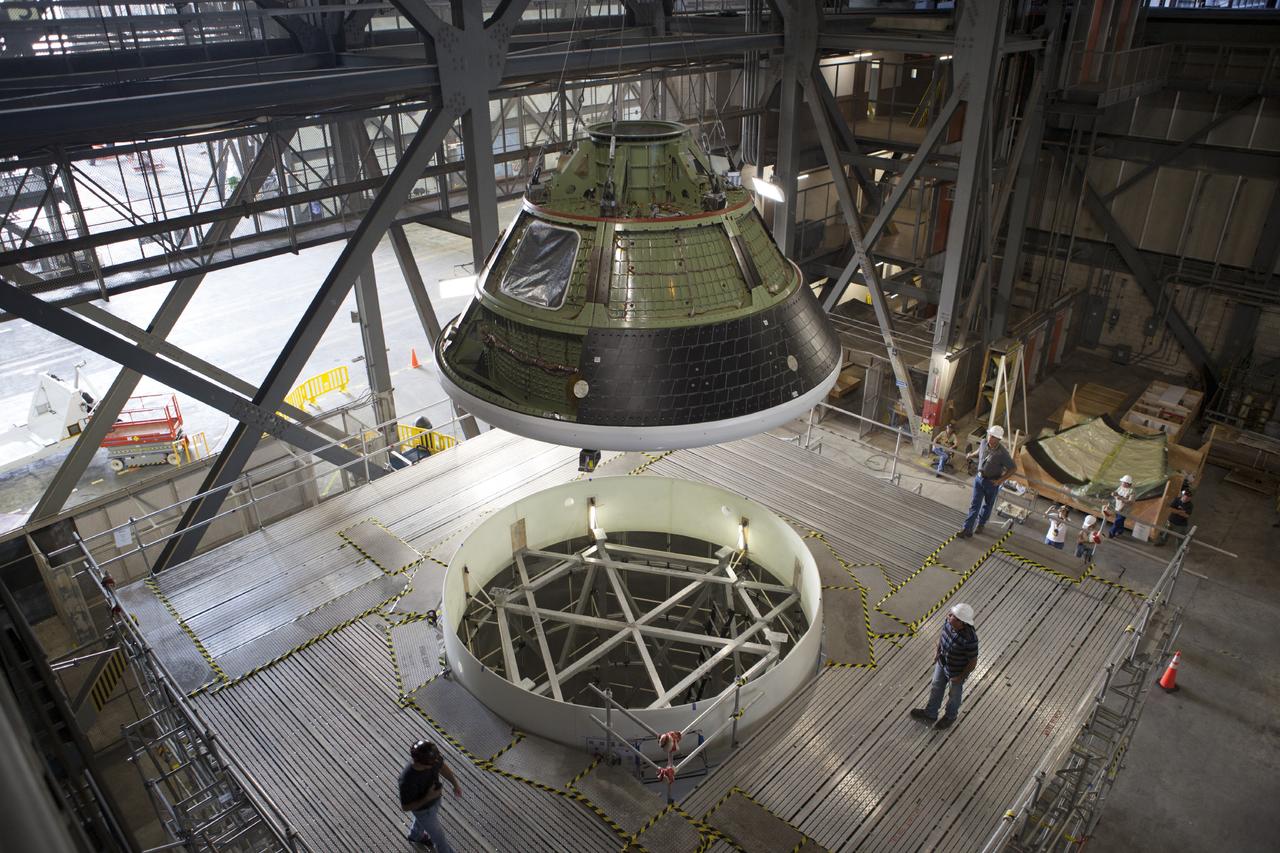
CAPE CANAVERAL, Fla. – At NASA’s Kennedy Space Center in Florida, technicians monitor the progress as the Orion ground test vehicle, or GTA, was lifted high in the air by crane in the transfer aisle of the Vehicle Assembly Building and is being lowered toward a mockup of the service module in high bay 4. The ground test vehicle is being used for path finding operations, including simulated manufacturing, assembly and stacking procedures. Orion is the exploration spacecraft designed to carry astronauts to destinations not yet explored by humans, including an asteroid and Mars. It will have emergency abort capability, sustain the crew during space travel and provide safe re-entry from deep space return velocities. The first unpiloted test flight of Orion is scheduled to launch in 2014 atop a Delta IV rocket and in 2017 on NASA’s Space Launch System rocket. For more information, visit www.nasa.gov/orion. Photo credit: Dimitri Gerondidakis
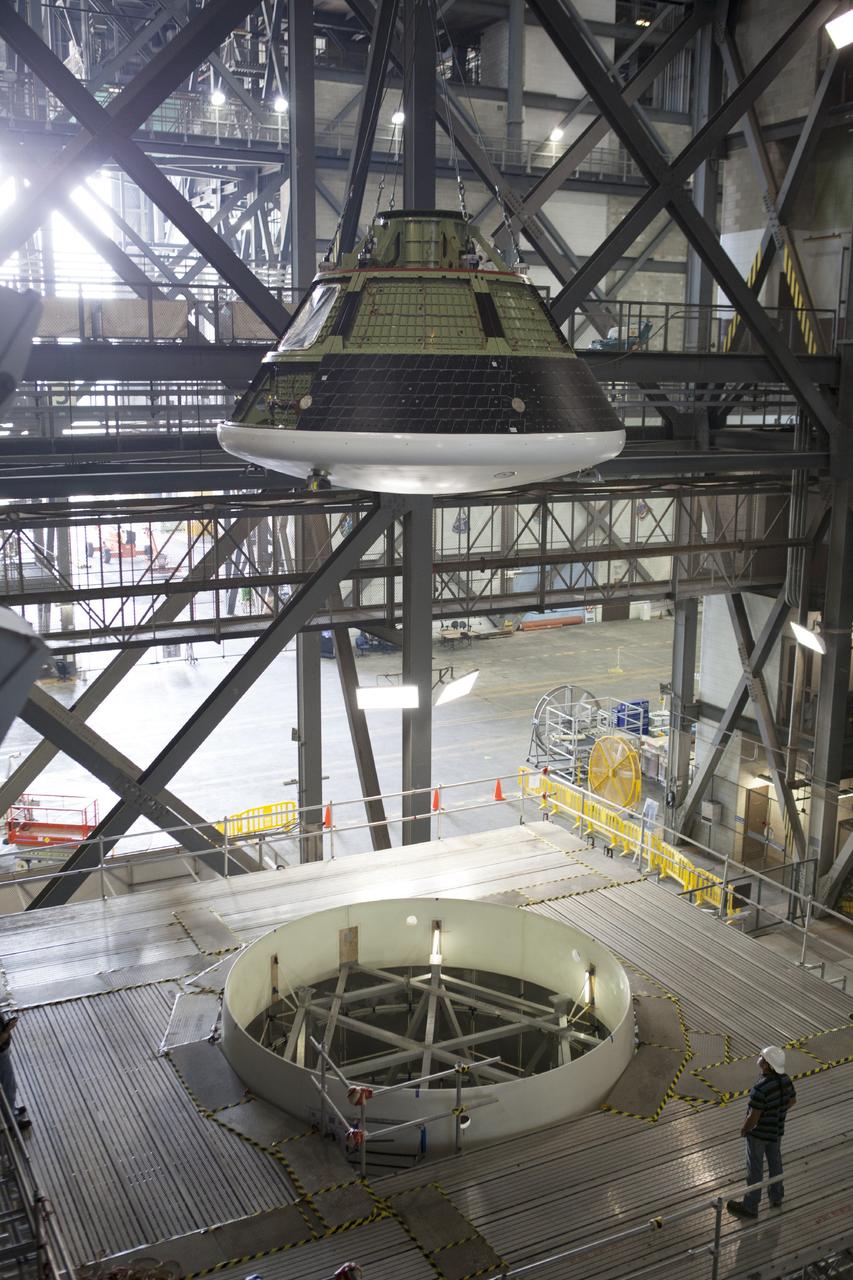
CAPE CANAVERAL, Fla. – At NASA’s Kennedy Space Center in Florida, the Orion ground test vehicle, or GTA, was lifted high in the air by crane in the transfer aisle of the Vehicle Assembly Building and is being lowered toward a mockup of the service module in high bay 4. The ground test vehicle is being used for path finding operations, including simulated manufacturing, assembly and stacking procedures. Orion is the exploration spacecraft designed to carry astronauts to destinations not yet explored by humans, including an asteroid and Mars. It will have emergency abort capability, sustain the crew during space travel and provide safe re-entry from deep space return velocities. The first unpiloted test flight of Orion is scheduled to launch in 2014 atop a Delta IV rocket and in 2017 on NASA’s Space Launch System rocket. For more information, visit www.nasa.gov/orion. Photo credit: Dimitri Gerondidakis
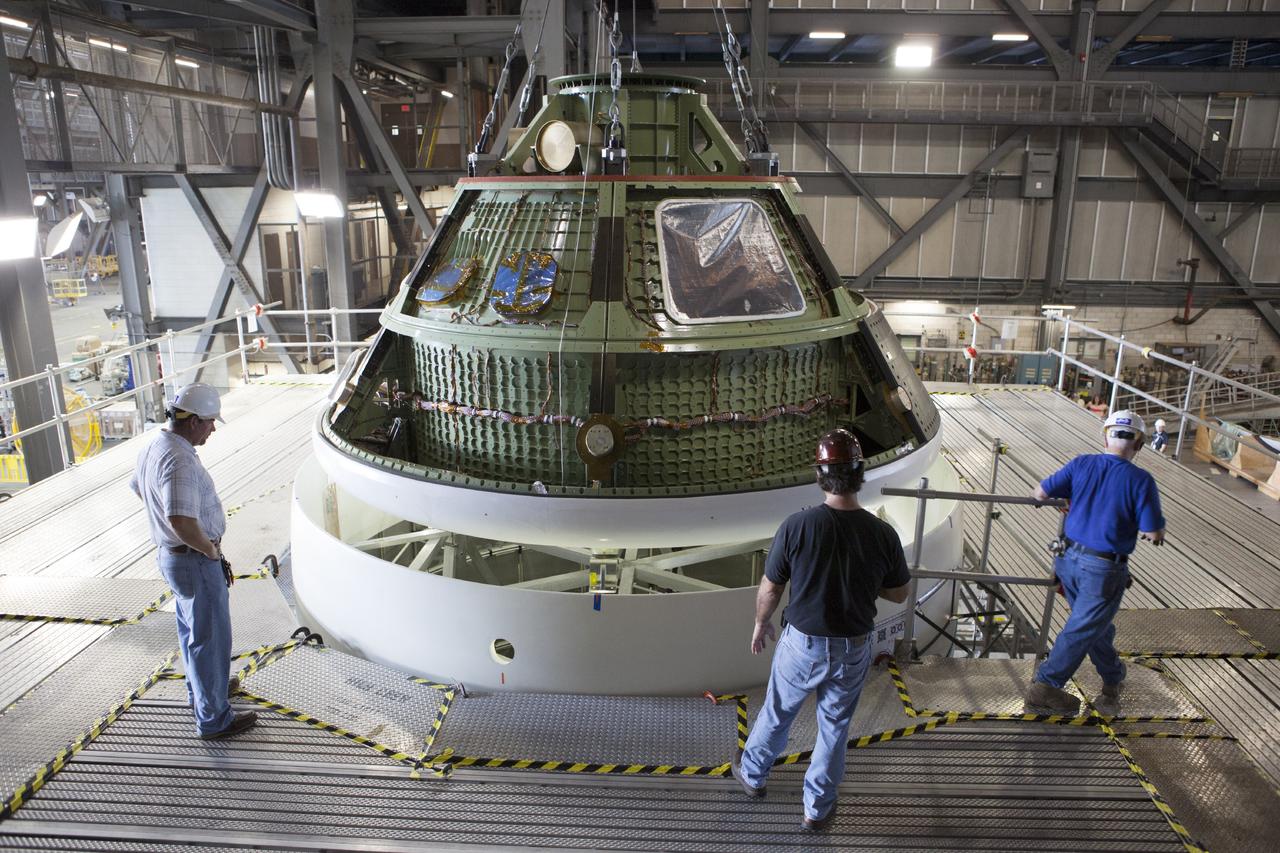
CAPE CANAVERAL, Fla. – At NASA’s Kennedy Space Center in Florida, technicians monitor the progress as the Orion ground test vehicle, or GTA, is lowered by crane toward a mockup of the service module in high bay 4 of the Vehicle Assembly Building. The ground test vehicle is being used for path finding operations, including simulated manufacturing, assembly and stacking procedures. Orion is the exploration spacecraft designed to carry astronauts to destinations not yet explored by humans, including an asteroid and Mars. It will have emergency abort capability, sustain the crew during space travel and provide safe re-entry from deep space return velocities. The first unpiloted test flight of Orion is scheduled to launch in 2014 atop a Delta IV rocket and in 2017 on NASA’s Space Launch System rocket. For more information, visit www.nasa.gov/orion. Photo credit: Dimitri Gerondidakis
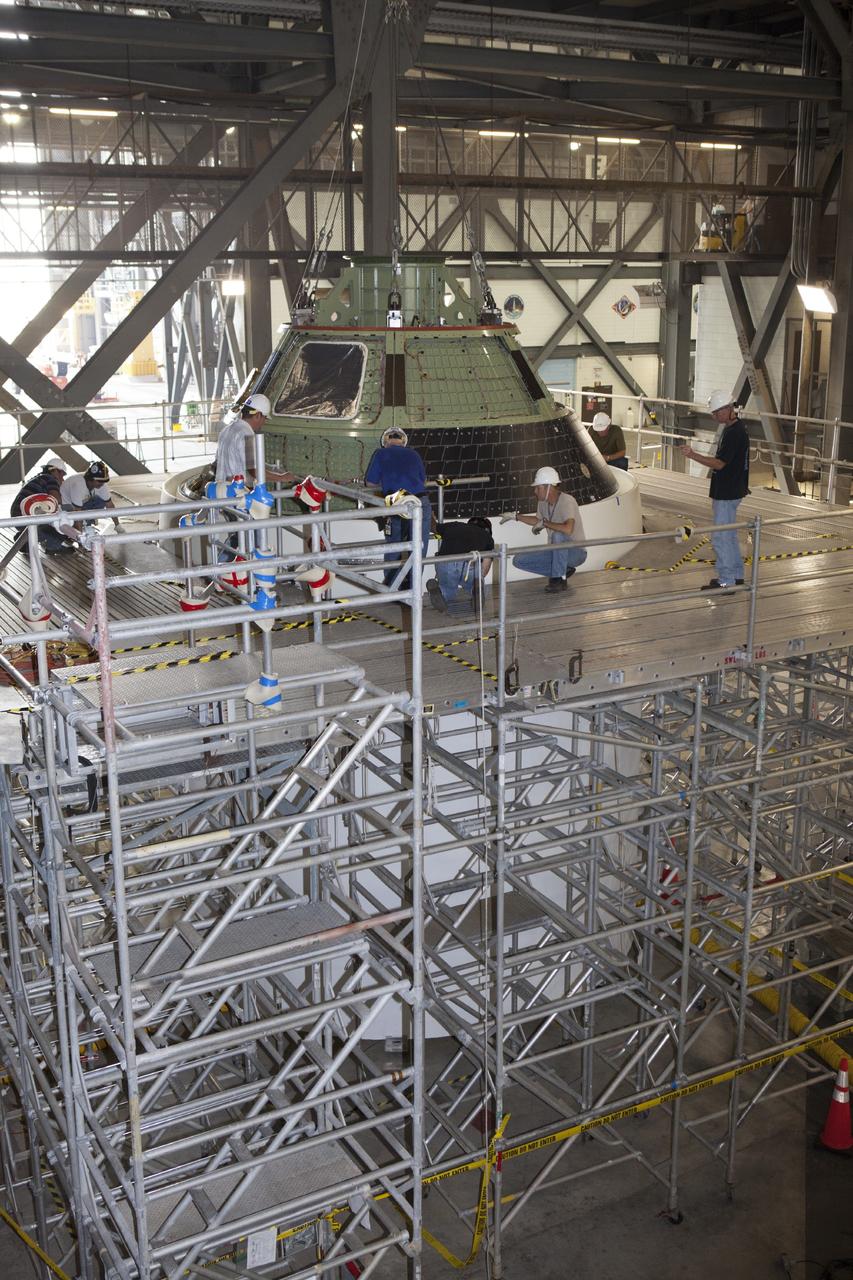
CAPE CANAVERAL, Fla. – At NASA’s Kennedy Space Center in Florida, technicians attach the Orion ground test vehicle, or GTA, to a mockup of the service module in high bay 4 of the Vehicle Assembly Building. The ground test vehicle is being used for path finding operations, including simulated manufacturing, assembly and stacking procedures. Orion is the exploration spacecraft designed to carry astronauts to destinations not yet explored by humans, including an asteroid and Mars. It will have emergency abort capability, sustain the crew during space travel and provide safe re-entry from deep space return velocities. The first unpiloted test flight of Orion is scheduled to launch in 2014 atop a Delta IV rocket and in 2017 on NASA’s Space Launch System rocket. For more information, visit www.nasa.gov/orion. Photo credit: Dimitri Gerondidakis
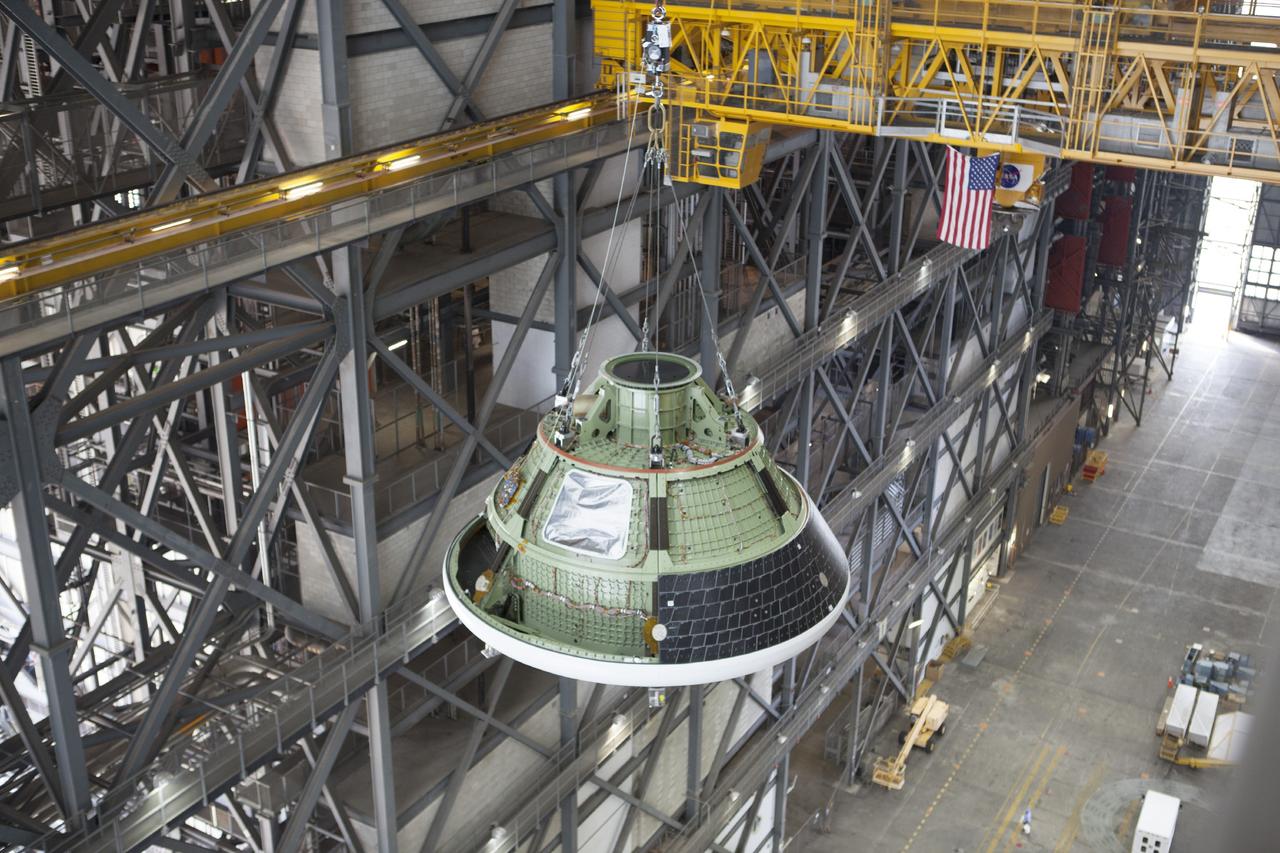
CAPE CANAVERAL, Fla. – At NASA’s Kennedy Space Center in Florida, a view from above shows the Orion ground test vehicle, or GTA, being lifted by crane in the transfer aisle of the Vehicle Assembly Building. The ground test vehicle is being used for path finding operations, including simulated manufacturing, assembly and stacking procedures. Orion is the exploration spacecraft designed to carry astronauts to destinations not yet explored by humans, including an asteroid and Mars. It will have emergency abort capability, sustain the crew during space travel and provide safe re-entry from deep space return velocities. The first unpiloted test flight of Orion is scheduled to launch in 2014 atop a Delta IV rocket and in 2017 on NASA’s Space Launch System rocket. For more information, visit www.nasa.gov/orion. Photo credit: Dimitri Gerondidakis
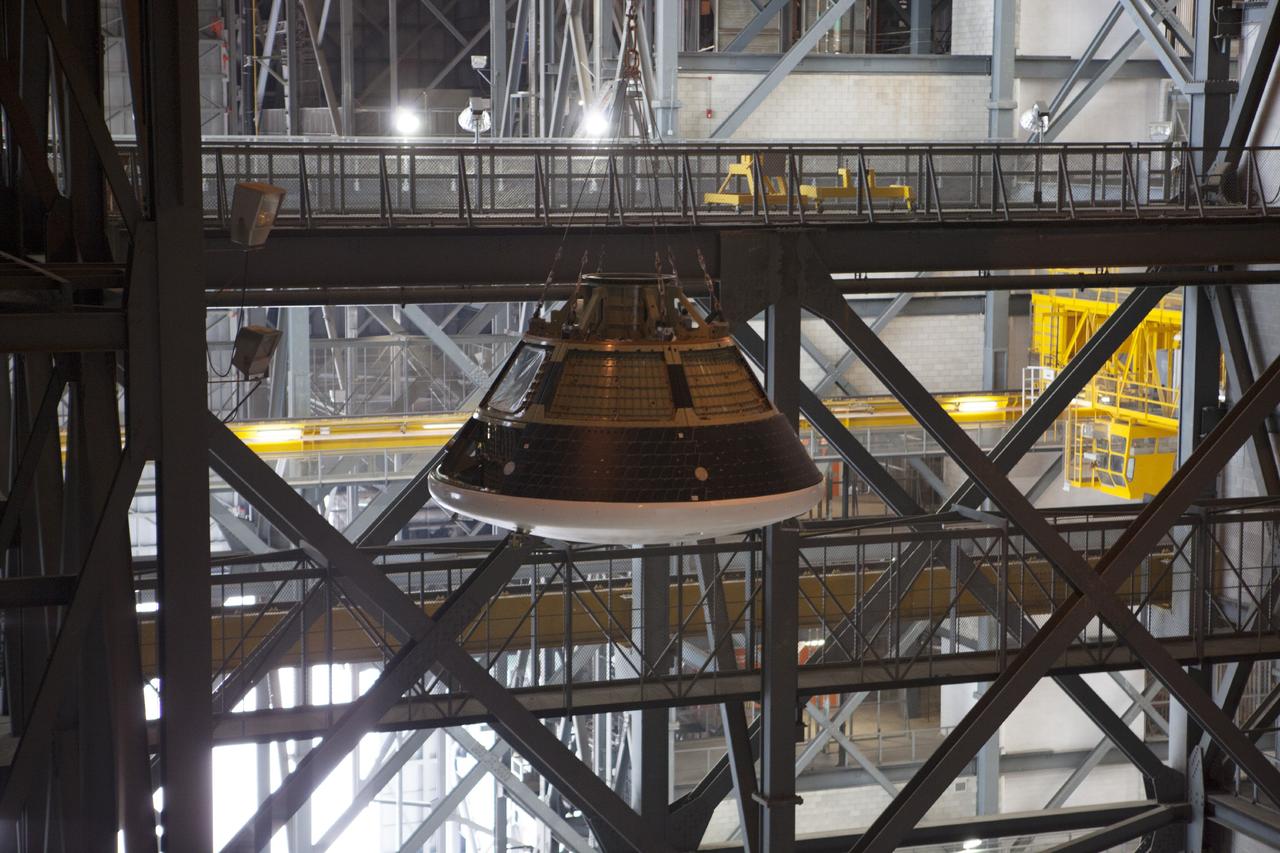
CAPE CANAVERAL, Fla. – At NASA’s Kennedy Space Center in Florida, the Orion ground test vehicle, or GTA, has been lifted high in the air by crane in the transfer aisle of the Vehicle Assembly Building and is being lowered into high bay 4. The ground test vehicle is being used for path finding operations, including simulated manufacturing, assembly and stacking procedures. Orion is the exploration spacecraft designed to carry astronauts to destinations not yet explored by humans, including an asteroid and Mars. It will have emergency abort capability, sustain the crew during space travel and provide safe re-entry from deep space return velocities. The first unpiloted test flight of Orion is scheduled to launch in 2014 atop a Delta IV rocket and in 2017 on NASA’s Space Launch System rocket. For more information, visit www.nasa.gov/orion. Photo credit: Dimitri Gerondidakis
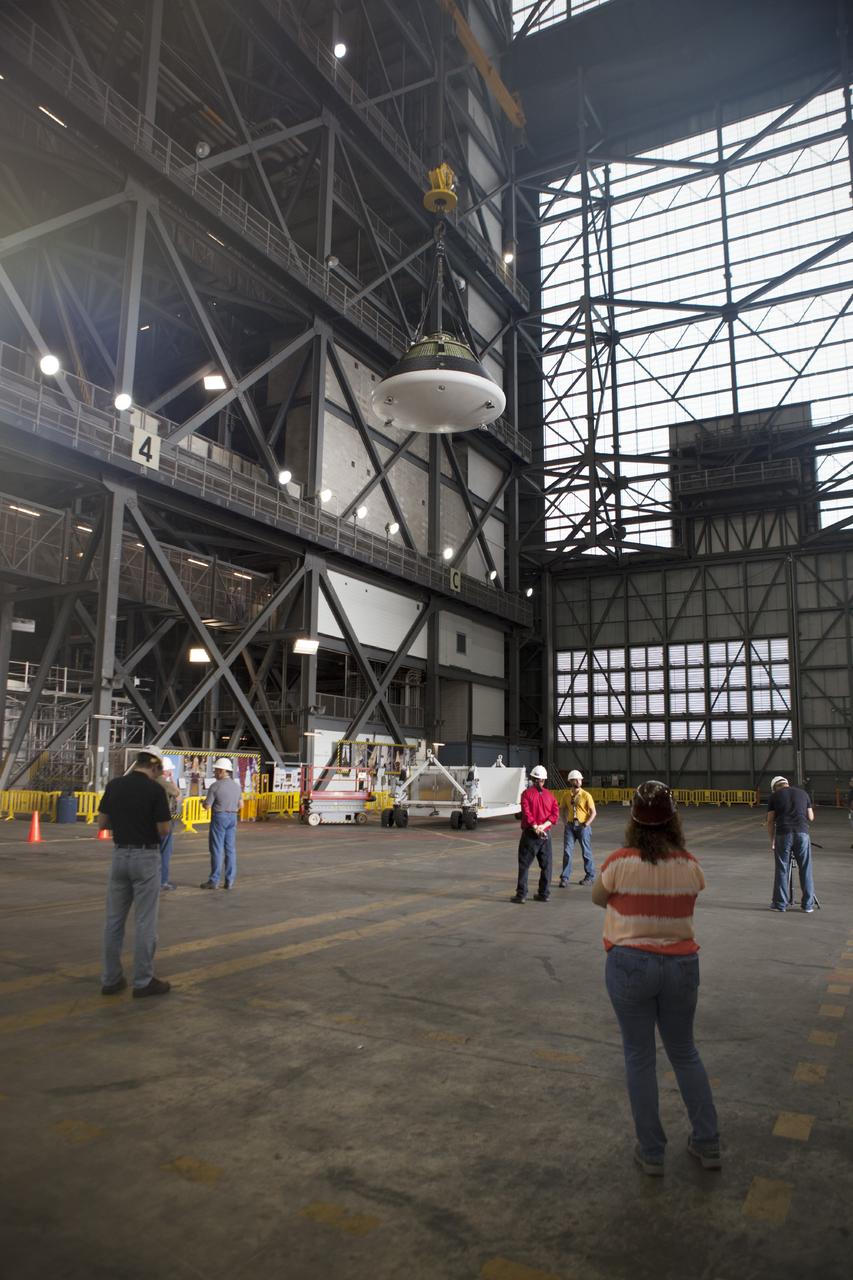
CAPE CANAVERAL, Fla. – At NASA’s Kennedy Space Center in Florida, technicians monitor the progress as the Orion ground test vehicle, or GTA, is lifted by crane in the transfer aisle of the Vehicle Assembly Building. The ground test vehicle is being used for path finding operations, including simulated manufacturing, assembly and stacking procedures. Orion is the exploration spacecraft designed to carry astronauts to destinations not yet explored by humans, including an asteroid and Mars. It will have emergency abort capability, sustain the crew during space travel and provide safe re-entry from deep space return velocities. The first unpiloted test flight of Orion is scheduled to launch in 2014 atop a Delta IV rocket and in 2017 on NASA’s Space Launch System rocket. For more information, visit www.nasa.gov/orion. Photo credit: Dimitri Gerondidakis
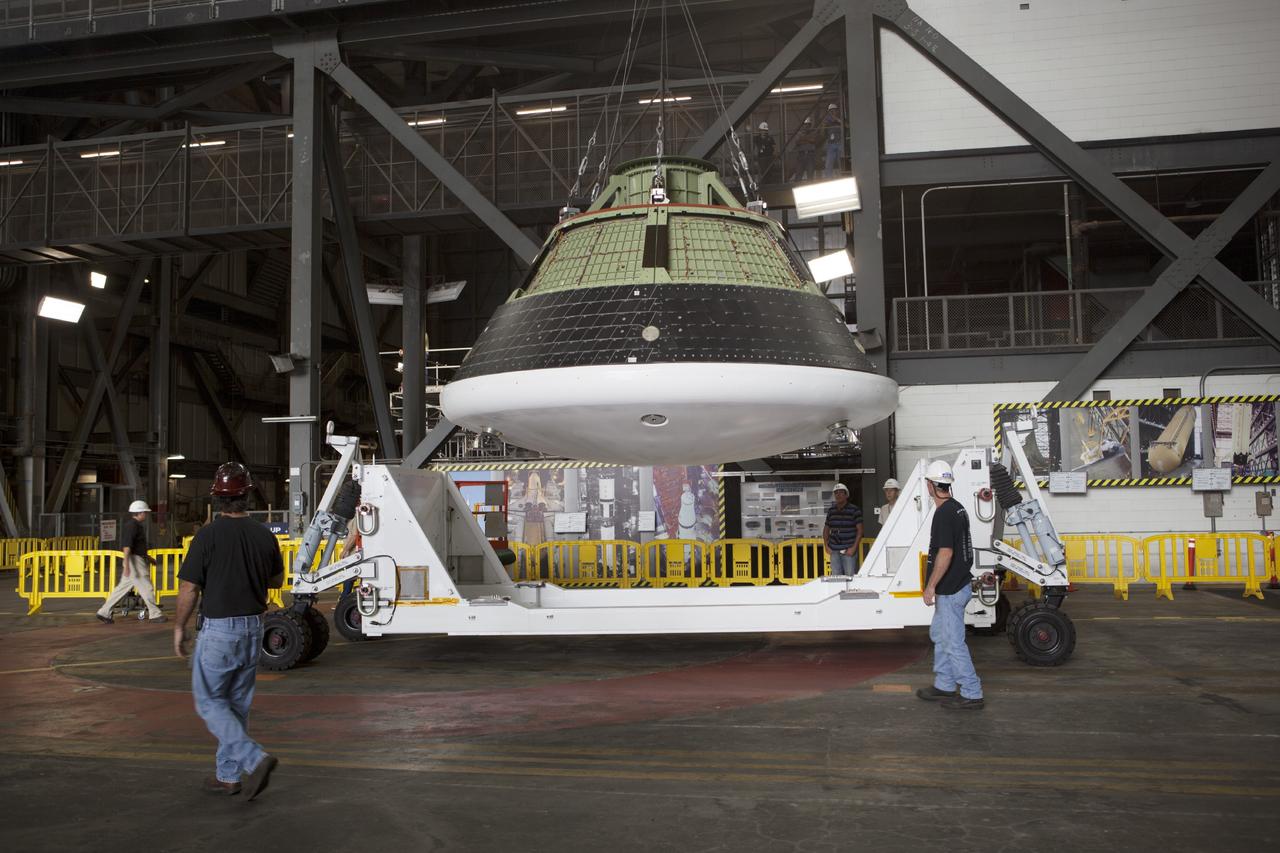
CAPE CANAVERAL, Fla. – At NASA’s Kennedy Space Center in Florida, technicians monitor the progress as the Orion ground test vehicle, or GTA, is lifted by crane in the transfer aisle of the Vehicle Assembly Building. The ground test vehicle is being used for path finding operations, including simulated manufacturing, assembly and stacking procedures. Orion is the exploration spacecraft designed to carry astronauts to destinations not yet explored by humans, including an asteroid and Mars. It will have emergency abort capability, sustain the crew during space travel and provide safe re-entry from deep space return velocities. The first unpiloted test flight of Orion is scheduled to launch in 2014 atop a Delta IV rocket and in 2017 on NASA’s Space Launch System rocket. For more information, visit www.nasa.gov/orion. Photo credit: Dimitri Gerondidakis

CAPE CANAVERAL, Fla. – At NASA’s Kennedy Space Center in Florida, the Orion ground test vehicle, or GTA, has been lifted high in the air by crane in the transfer aisle of the Vehicle Assembly Building. The ground test vehicle is being used for path finding operations, including simulated manufacturing, assembly and stacking procedures. Orion is the exploration spacecraft designed to carry astronauts to destinations not yet explored by humans, including an asteroid and Mars. It will have emergency abort capability, sustain the crew during space travel and provide safe re-entry from deep space return velocities. The first unpiloted test flight of Orion is scheduled to launch in 2014 atop a Delta IV rocket and in 2017 on NASA’s Space Launch System rocket. For more information, visit www.nasa.gov/orion. Photo credit: Dimitri Gerondidakis
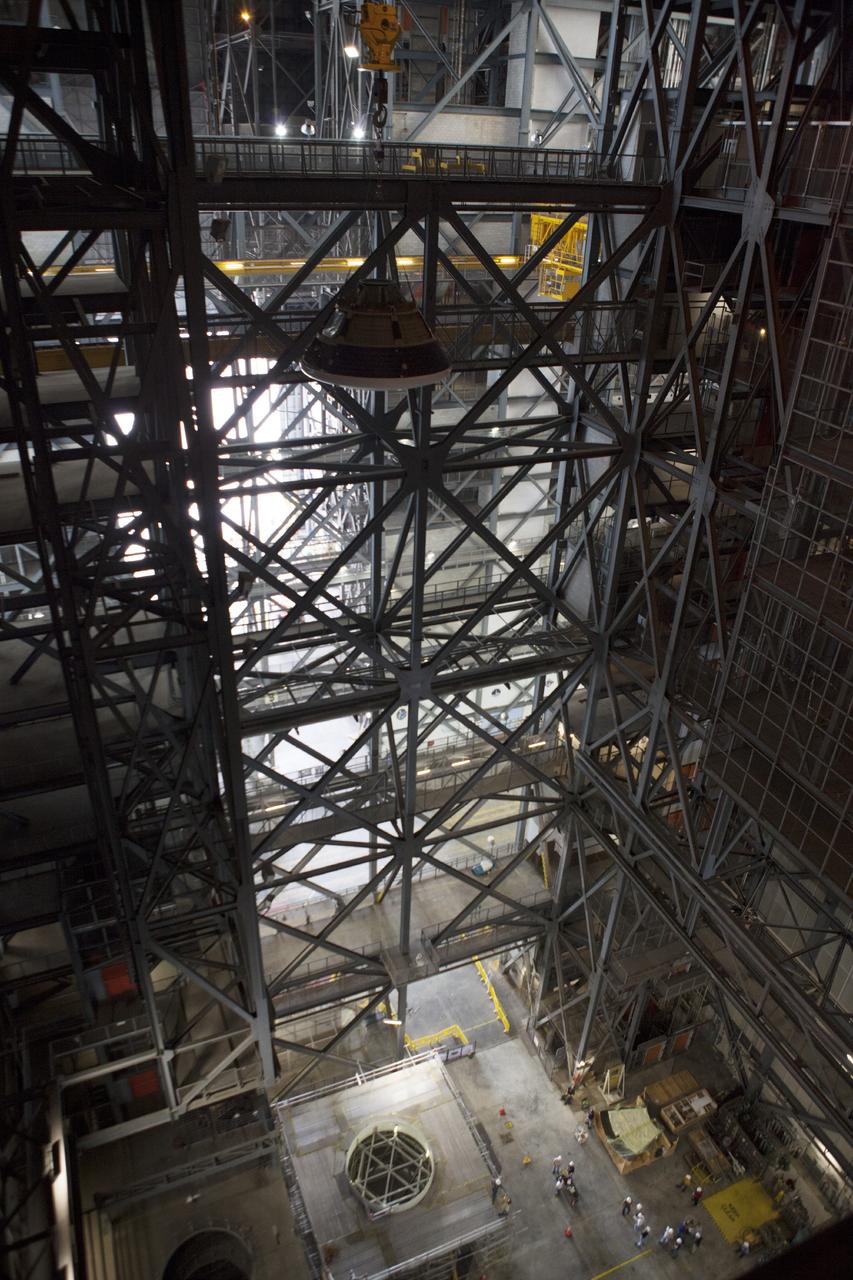
CAPE CANAVERAL, Fla. – At NASA’s Kennedy Space Center in Florida, the Orion ground test vehicle, or GTA, was lifted high in the air by crane in the transfer aisle of the Vehicle Assembly Building and is being lowered toward a mockup of the service module in high bay 4. The ground test vehicle is being used for path finding operations, including simulated manufacturing, assembly and stacking procedures. Orion is the exploration spacecraft designed to carry astronauts to destinations not yet explored by humans, including an asteroid and Mars. It will have emergency abort capability, sustain the crew during space travel and provide safe re-entry from deep space return velocities. The first unpiloted test flight of Orion is scheduled to launch in 2014 atop a Delta IV rocket and in 2017 on NASA’s Space Launch System rocket. For more information, visit www.nasa.gov/orion. Photo credit: Dimitri Gerondidakis
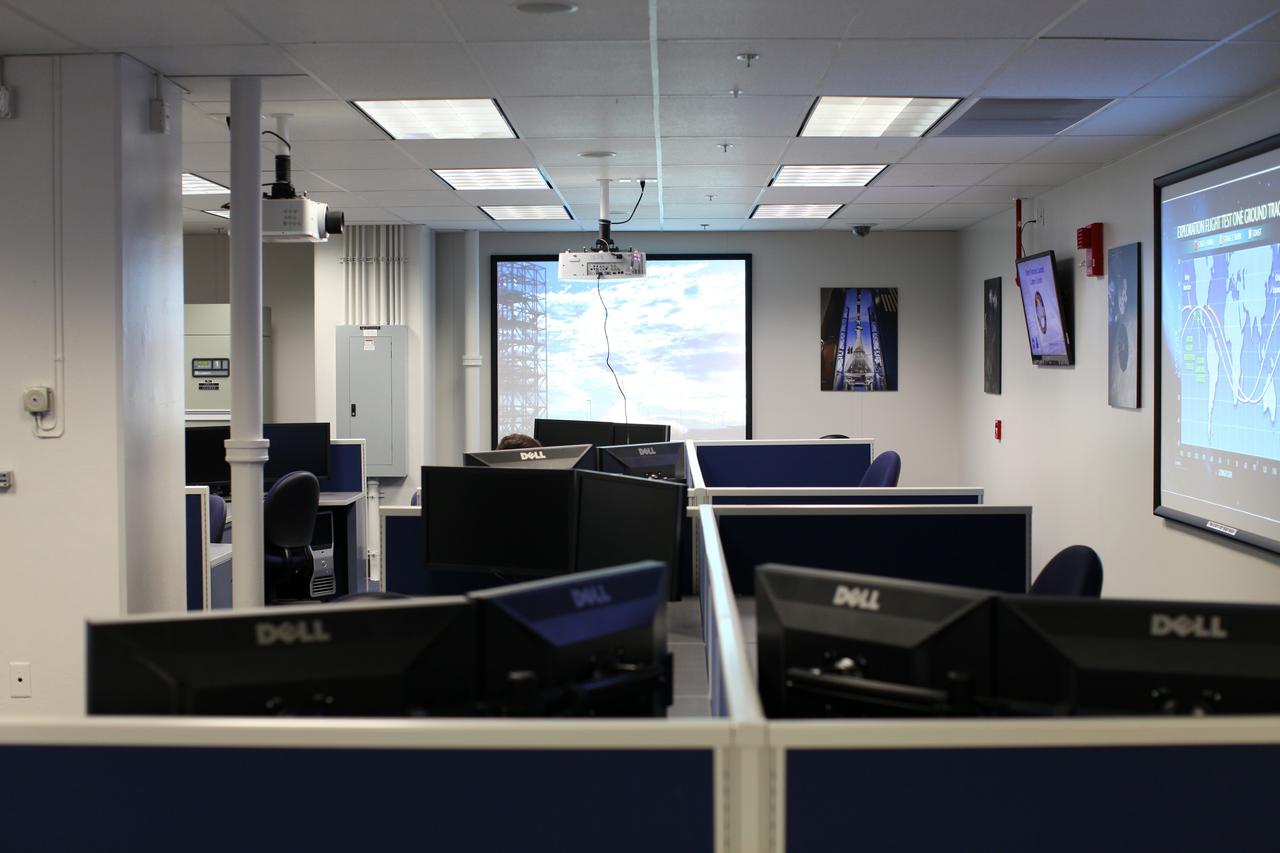
CAPE CANAVERAL, Fla. – Inside the Operations and Checkout Building at NASA’s Kennedy Space Center in Florida, media tour the new Orion Test and Launch Control Center. During a tour of the facility, media representatives viewed Orion, several processing stations, and the Orion Test and Launch Control Center. The ground test vehicle will remain at Kennedy for acoustic and modal testing. The heat shield on the bottom of the module will be removed and replaced with a more flight-like heat shield that was built by Lockheed Martin in Denver and will be shipped to Kennedy for installation. The test vehicle will then be in its vehicle configuration for the splashdown test at Langley as NASA prepares for Exploration Flight Test-1. Photo credit: NASA/Frankie Martin
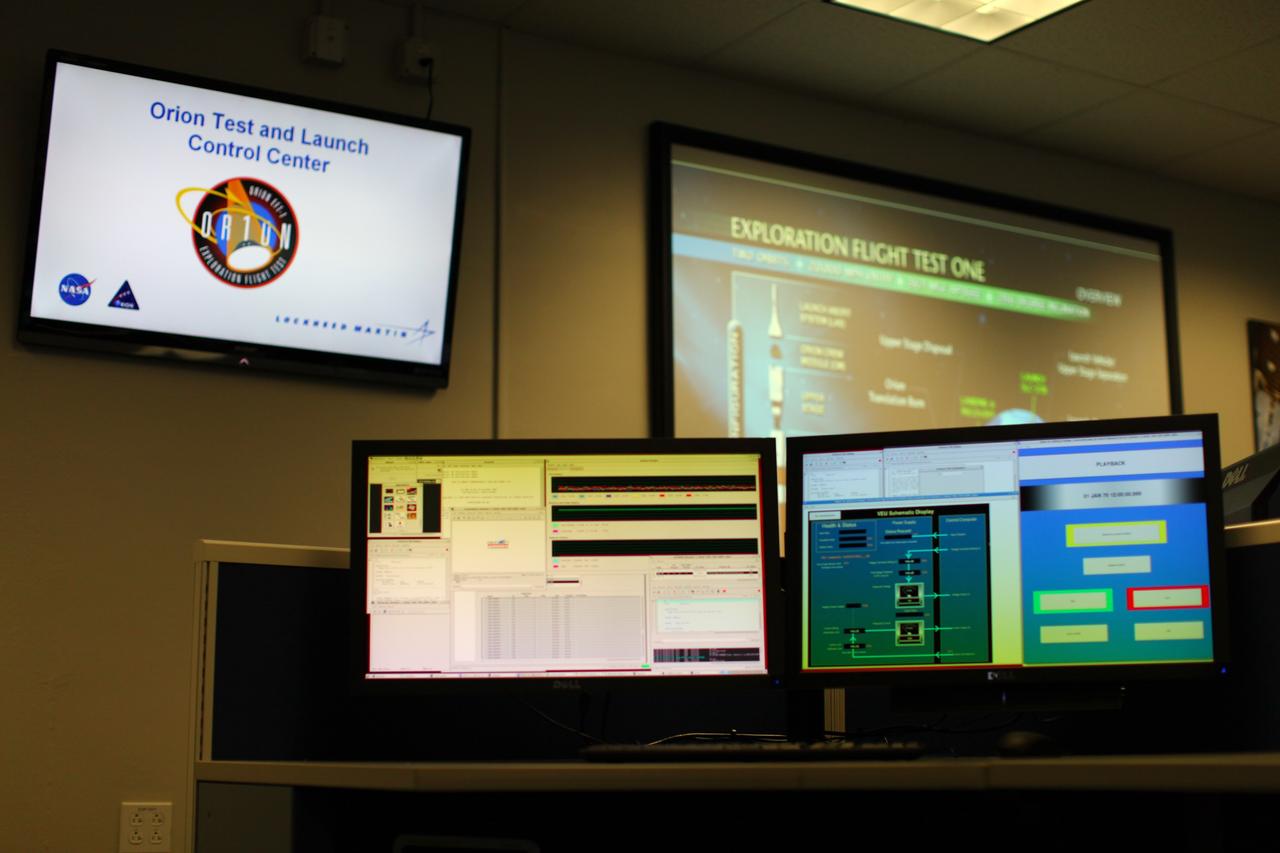
CAPE CANAVERAL, Fla. – Inside the Operations and Checkout Building at NASA’s Kennedy Space Center in Florida, media tour the new Orion Test and Launch Control Center. During a tour of the facility, media representatives viewed Orion, several processing stations, and the Orion Test and Launch Control Center. The ground test vehicle will remain at Kennedy for acoustic and modal testing. The heat shield on the bottom of the module will be removed and replaced with a more flight-like heat shield that was built by Lockheed Martin in Denver and will be shipped to Kennedy for installation. The test vehicle will then be in its vehicle configuration for the splashdown test at Langley as NASA prepares for Exploration Flight Test-1. Photo credit: NASA/Frankie Martin
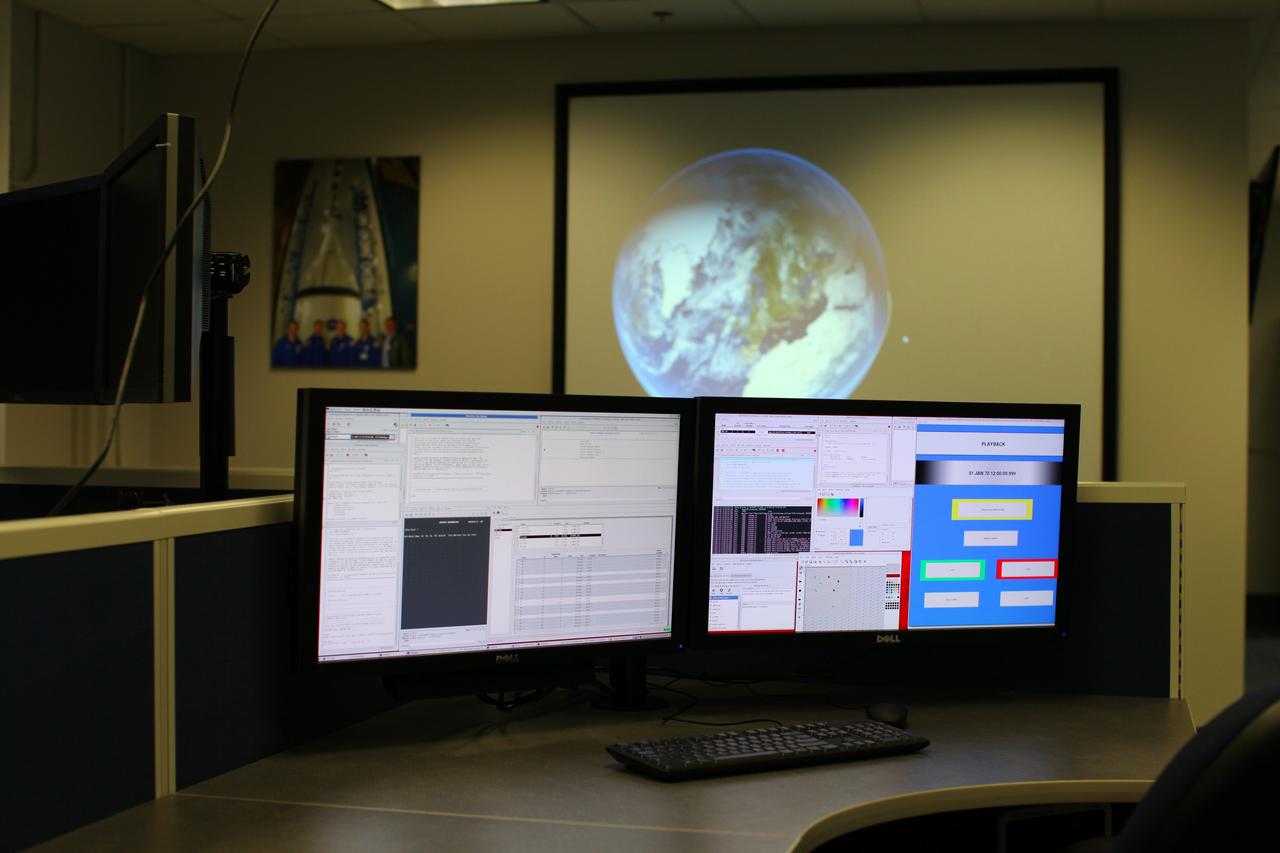
CAPE CANAVERAL, Fla. – Inside the Operations and Checkout Building at NASA’s Kennedy Space Center in Florida, media tour the new Orion Test and Launch Control Center. During a tour of the facility, media representatives viewed Orion, several processing stations, and the Orion Test and Launch Control Center. The ground test vehicle will remain at Kennedy for acoustic and modal testing. The heat shield on the bottom of the module will be removed and replaced with a more flight-like heat shield that was built by Lockheed Martin in Denver and will be shipped to Kennedy for installation. The test vehicle will then be in its vehicle configuration for the splashdown test at Langley as NASA prepares for Exploration Flight Test-1. Photo credit: NASA/Frankie Martin
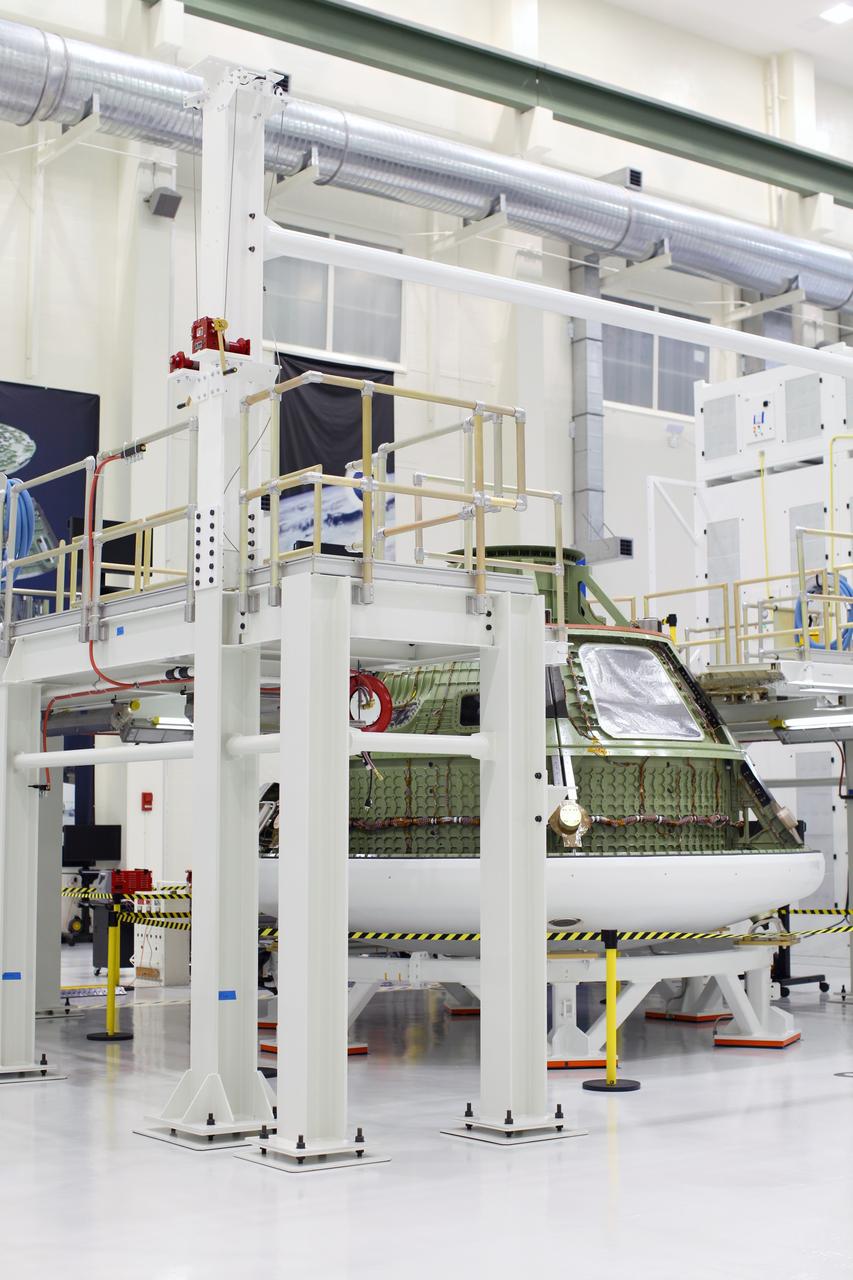
CAPE CANAVERAL, Fla. – Inside the Operations and Checkout Building high bay at NASA’s Kennedy Space Center in Florida, the Orion ground test vehicle sits in a work stand. The heat panels have been removed. During a tour of the facility, media representatives viewed Orion, several processing stations, and the Orion Test and Launch Control Center. The ground test vehicle will remain at Kennedy for acoustic and modal testing. The heat shield on the bottom of the module will be removed and replaced with a more flight-like heat shield that was built by Lockheed Martin in Denver and will be shipped to Kennedy for installation. The test vehicle will then be in its vehicle configuration for the splashdown test at Langley as NASA prepares for Exploration Flight Test-1. Photo credit: NASA/Frankie Martin

CAPE CANAVERAL, Fla. – Inside the Operations and Checkout Building high bay at NASA’s Kennedy Space Center in Florida, the Orion ground test vehicle sits in a work stand. The heat panels have been removed. During a tour of the facility, media representatives viewed Orion, several processing stations, and the Orion Test and Launch Control Center. The ground test vehicle will remain at Kennedy for acoustic and modal testing. The heat shield on the bottom of the module will be removed and replaced with a more flight-like heat shield that was built by Lockheed Martin in Denver and will be shipped to Kennedy for installation. The test vehicle will then be in its vehicle configuration for the splashdown test at Langley as NASA prepares for Exploration Flight Test-1. Photo credit: NASA/Frankie Martin
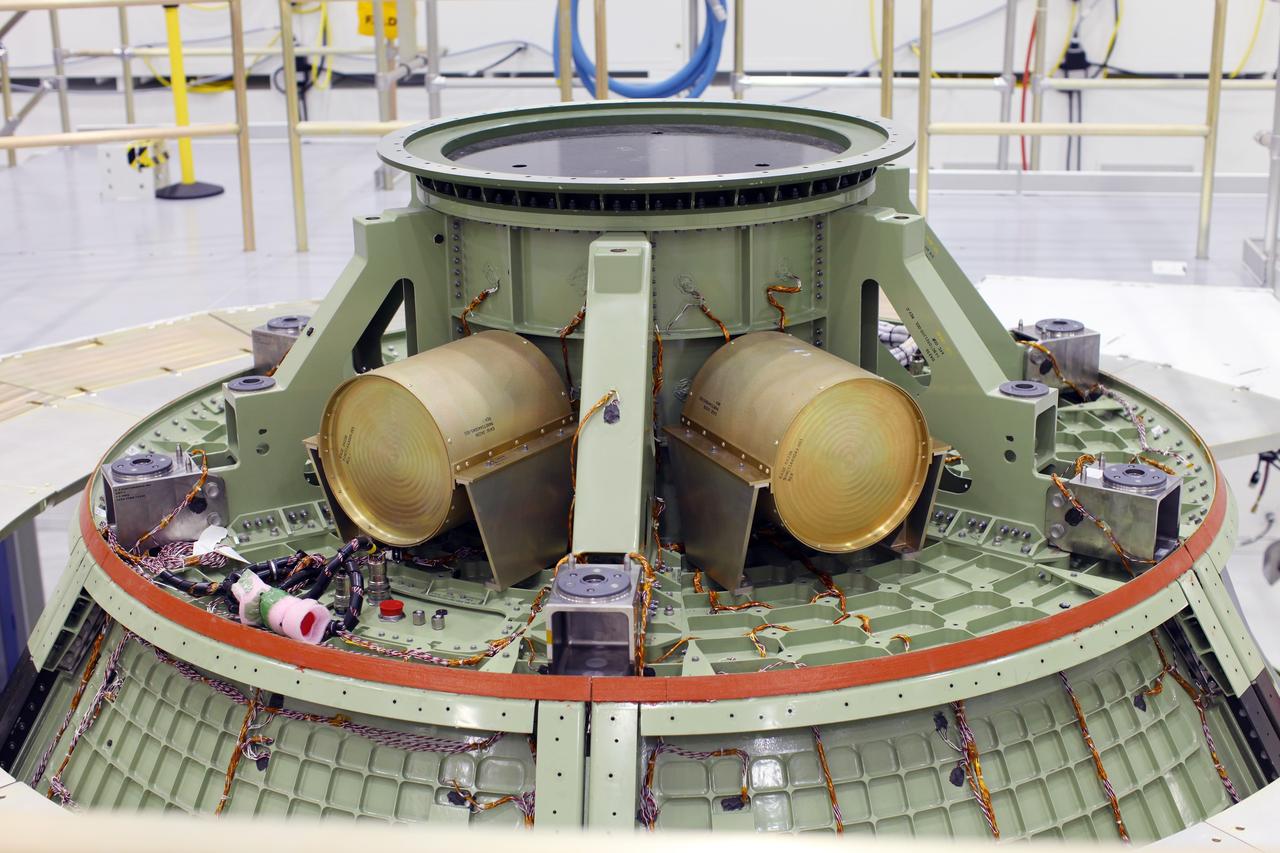
CAPE CANAVERAL, Fla. – Inside the Operations and Checkout Building high bay at NASA’s Kennedy Space Center in Florida, the Orion ground test vehicle sits in a work stand. The heat panels have been removed. During a tour of the facility, media representatives viewed Orion, several processing stations, and the Orion Test and Launch Control Center. The ground test vehicle will remain at Kennedy for acoustic and modal testing. The heat shield on the bottom of the module will be removed and replaced with a more flight-like heat shield that was built by Lockheed Martin in Denver and will be shipped to Kennedy for installation. The test vehicle will then be in its vehicle configuration for the splashdown test at Langley as NASA prepares for Exploration Flight Test-1. Photo credit: NASA/Frankie Martin
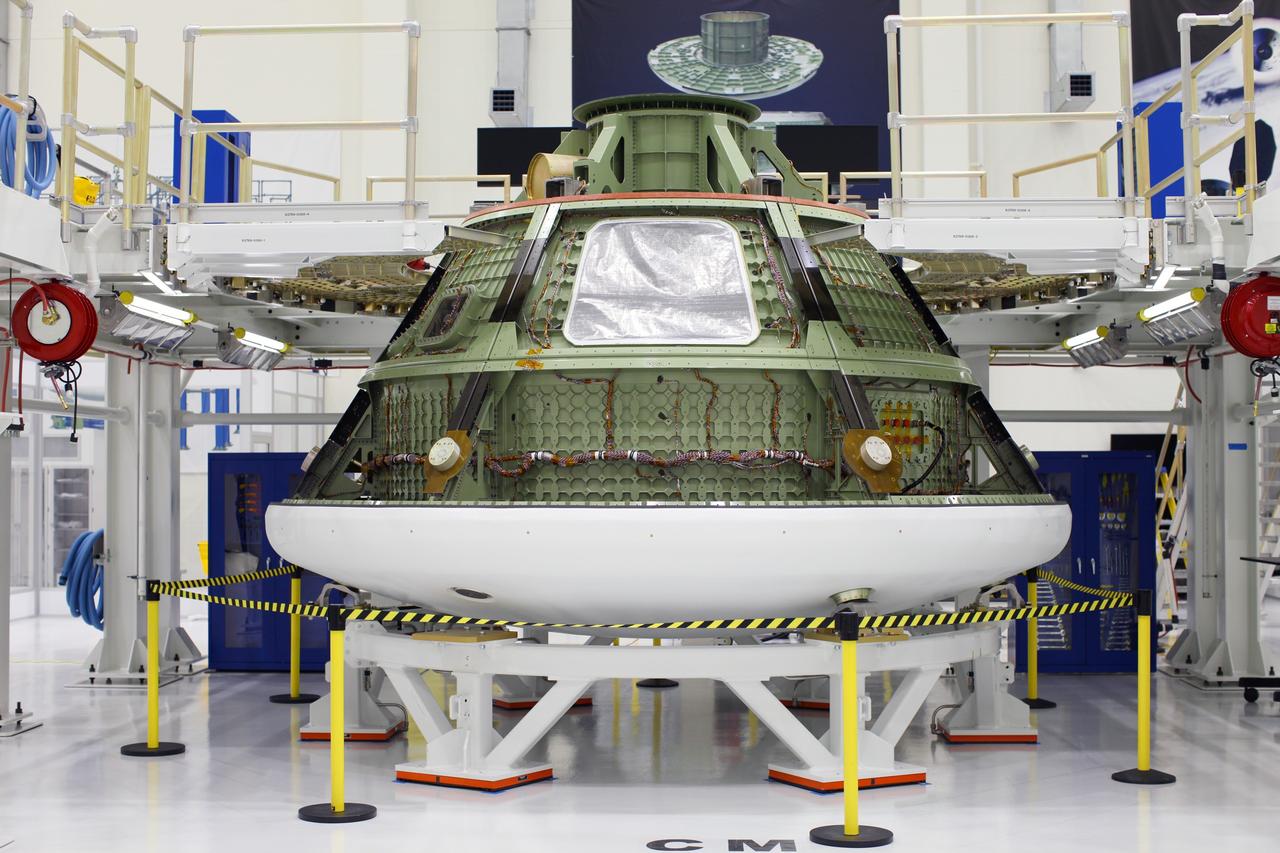
CAPE CANAVERAL, Fla. – Inside the Operations and Checkout Building high bay at NASA’s Kennedy Space Center in Florida, the Orion ground test vehicle sits in a work stand. The heat panels have been removed. During a tour of the facility, media representatives viewed Orion, several processing stations, and the Orion Test and Launch Control Center. The ground test vehicle will remain at Kennedy for acoustic and modal testing. The heat shield on the bottom of the module will be removed and replaced with a more flight-like heat shield that was built by Lockheed Martin in Denver and will be shipped to Kennedy for installation. The test vehicle will then be in its vehicle configuration for the splashdown test at Langley as NASA prepares for Exploration Flight Test-1. Photo credit: NASA/Frankie Martin

In High Bay 3 inside the Vehicle Assembly Building at NASA’s Kennedy Space Center in Florida, teams with Exploration Ground Systems and Jacobs use the Orion stage adapter structural test article and the Mass Simulator for Orion for testing on Aug. 13, 2021. They are stacked atop the Space Launch System (SLS) rocket. These test articles represent the mass and weight of the actual Orion stage adapter and Orion spacecraft that will be used for various tests. Launching in 2021, Artemis I will be an uncrewed test of the Orion spacecraft and SLS rocket as an integrated system ahead of crewed flights to the Moon. Under Artemis, NASA aims to land the first woman and first person of color on the Moon and establish sustainable lunar exploration.

In High Bay 3 inside the Vehicle Assembly Building at NASA’s Kennedy Space Center in Florida, teams with Exploration Ground Systems and Jacobs use the Orion stage adapter structural test article and the Mass Simulator for Orion for testing on Aug. 13, 2021. They are stacked atop the Space Launch System (SLS) rocket. These test articles represent the mass and weight of the actual Orion stage adapter and Orion spacecraft that will be used for various tests. Launching in 2021, Artemis I will be an uncrewed test of the Orion spacecraft and SLS rocket as an integrated system ahead of crewed flights to the Moon. Under Artemis, NASA aims to land the first woman and first person of color on the Moon and establish sustainable lunar exploration.
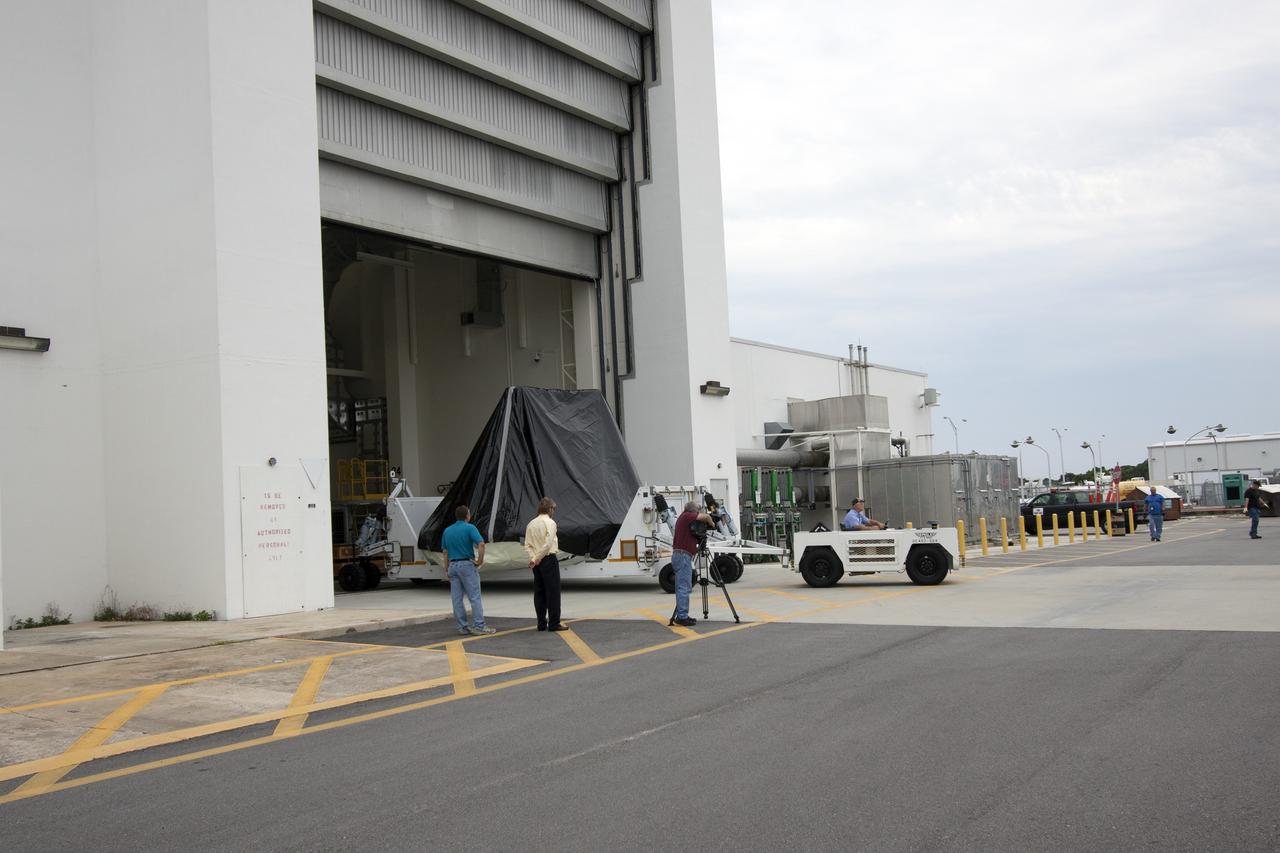
CAPE CANAVERAL, Fla. -- At NASA’s Kennedy Space Center in Florida, workers move the Orion ground test vehicle, or GTA, from the Operations and Checkout Building to the Launch Equipment Test Facility, or LETF. At the LETF, Lockheed Martin will put the GTA through a series of pyrotechnic bolt tests. The ground test vehicle is being used for path finding operations in the O&C, including simulated manufacturing and assembly procedures. Launching atop NASA's heavy-lift Space Launch System SLS, which also is under development, the Orion Multi-Purpose Crew Vehicle MPCV will serve as the exploration vehicle that will carry astronaut crews beyond low Earth orbit. It also will provide emergency abort capabilities, sustain the crew during space travel and provide safe re-entry from deep space return velocities. For more information, visit www.nasa.gov/orion. Photo credit: Jim Grossman
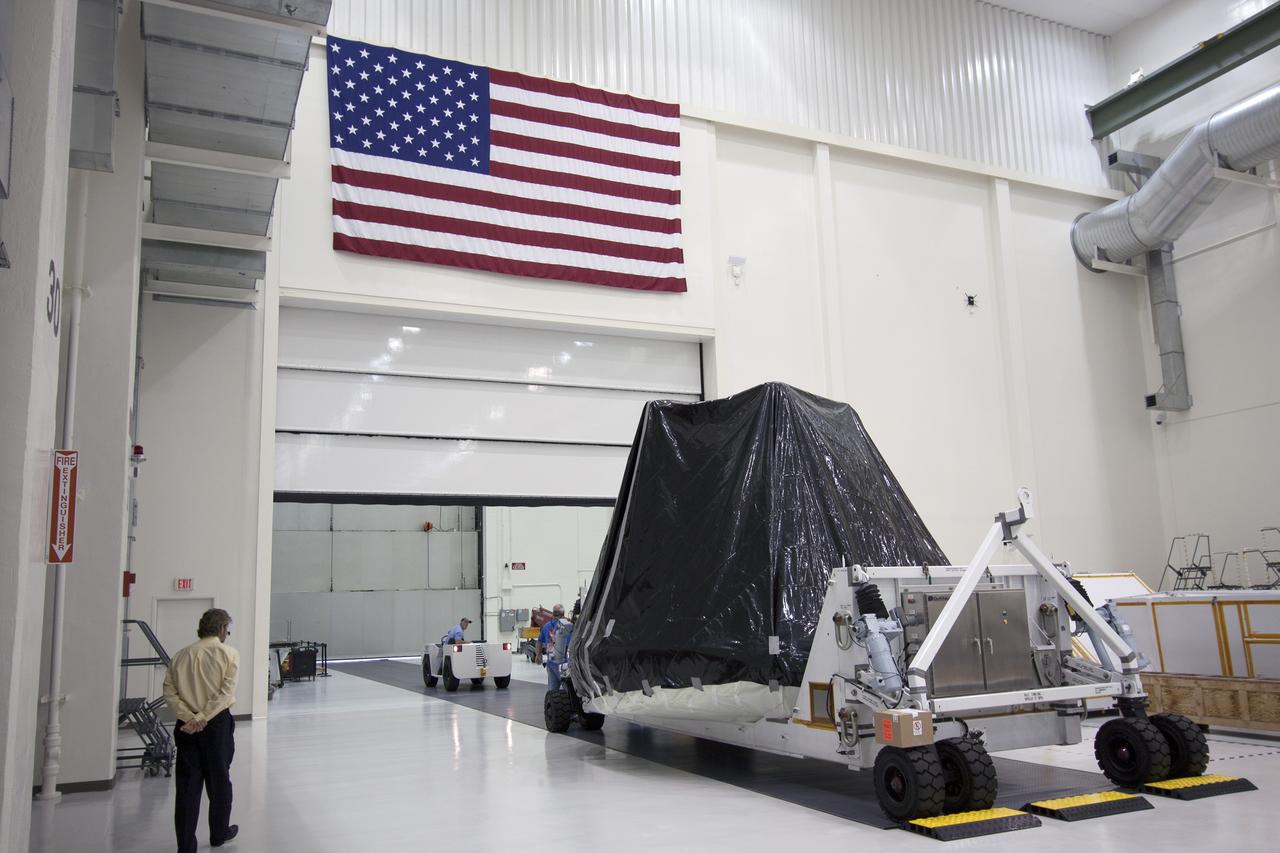
CAPE CANAVERAL, Fla. -- At NASA’s Kennedy Space Center in Florida, workers prepare to move the Orion ground test vehicle, or GTA, from the Operations and Checkout Building to the Launch Equipment Test Facility, or LETF. At the LETF, Lockheed Martin will put the GTA through a series of pyrotechnic bolt tests. The ground test vehicle is being used for path finding operations in the O&C, including simulated manufacturing and assembly procedures. Launching atop NASA's heavy-lift Space Launch System SLS, which also is under development, the Orion Multi-Purpose Crew Vehicle MPCV will serve as the exploration vehicle that will carry astronaut crews beyond low Earth orbit. It also will provide emergency abort capabilities, sustain the crew during space travel and provide safe re-entry from deep space return velocities. For more information, visit www.nasa.gov/orion. Photo credit: Jim Grossman
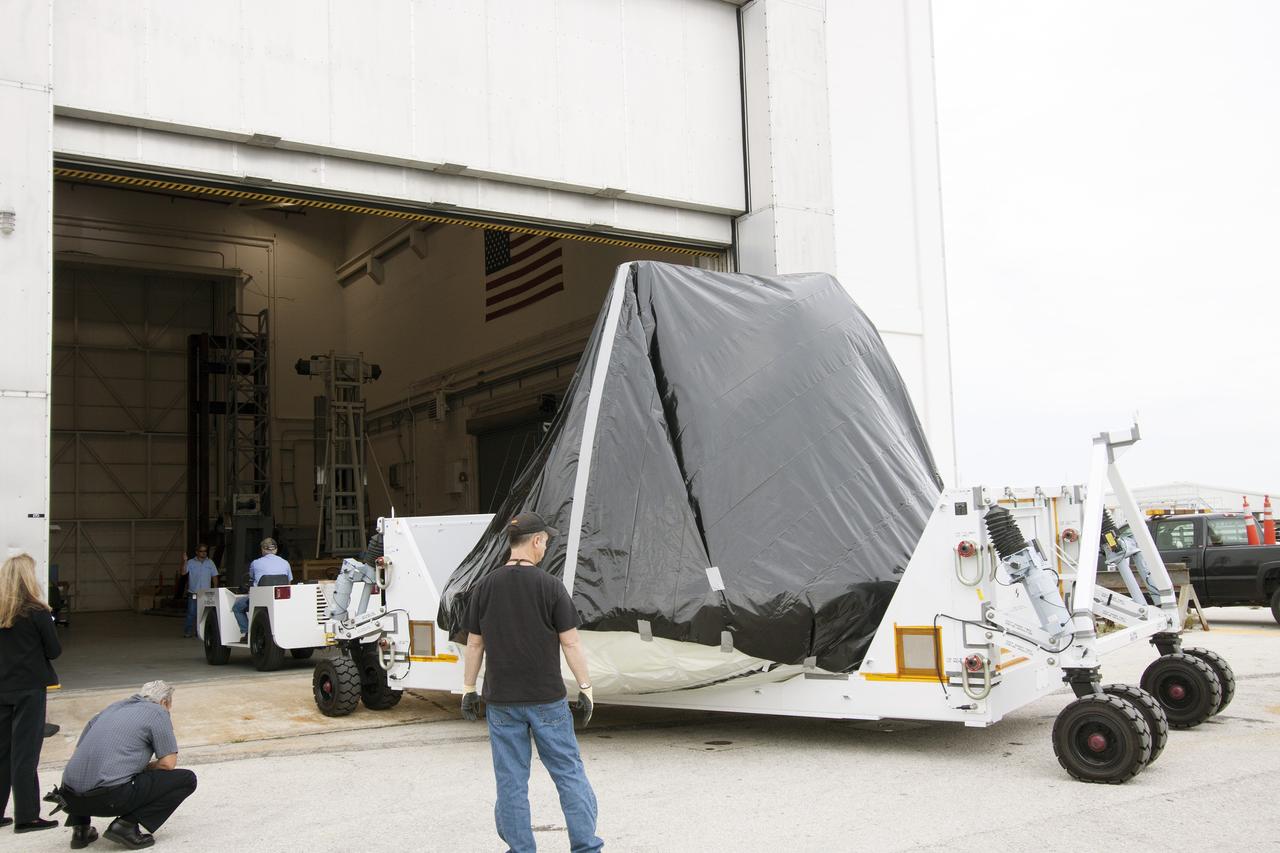
CAPE CANAVERAL, Fla. -- At NASA’s Kennedy Space Center in Florida, workers move the Orion ground test vehicle, or GTA, into the Launch Equipment Test Facility, or LETF, from the Operations and Checkout Building. At the LETF, Lockheed Martin will put the GTA through a series of pyrotechnic bolt tests. The ground test vehicle is being used for path finding operations in the O&C, including simulated manufacturing and assembly procedures. Launching atop NASA's heavy-lift Space Launch System SLS, which also is under development, the Orion Multi-Purpose Crew Vehicle MPCV will serve as the exploration vehicle that will carry astronaut crews beyond low Earth orbit. It also will provide emergency abort capabilities, sustain the crew during space travel and provide safe re-entry from deep space return velocities. For more information, visit www.nasa.gov/orion. Photo credit: Jim Grossman
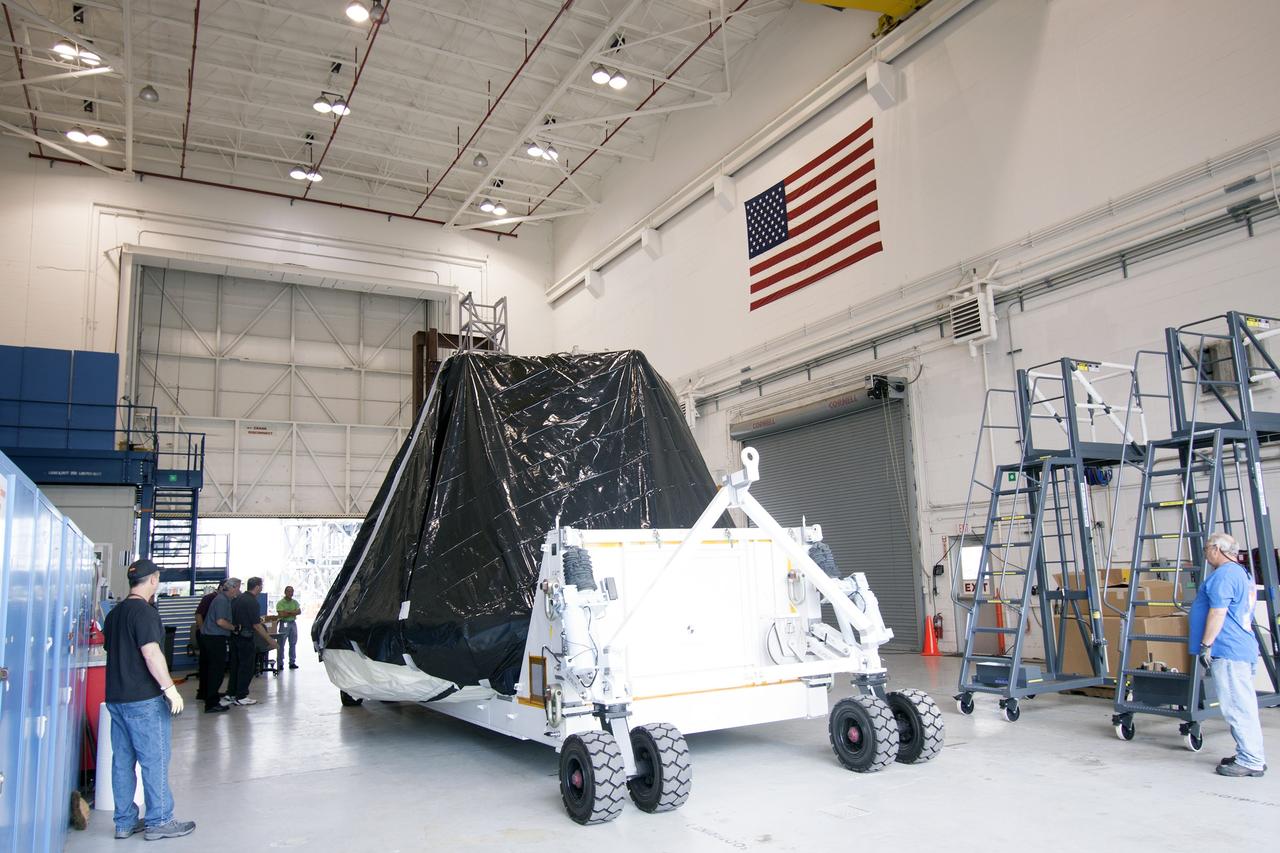
CAPE CANAVERAL, Fla. -- At NASA’s Kennedy Space Center in Florida, workers move the Orion ground test vehicle, or GTA, into the Launch Equipment Test Facility, or LETF, from the Operations and Checkout Building. At the LETF, Lockheed Martin will put the GTA through a series of pyrotechnic bolt tests. The ground test vehicle is being used for path finding operations in the O&C, including simulated manufacturing and assembly procedures. Launching atop NASA's heavy-lift Space Launch System SLS, which also is under development, the Orion Multi-Purpose Crew Vehicle MPCV will serve as the exploration vehicle that will carry astronaut crews beyond low Earth orbit. It also will provide emergency abort capabilities, sustain the crew during space travel and provide safe re-entry from deep space return velocities. For more information, visit www.nasa.gov/orion. Photo credit: Jim Grossman
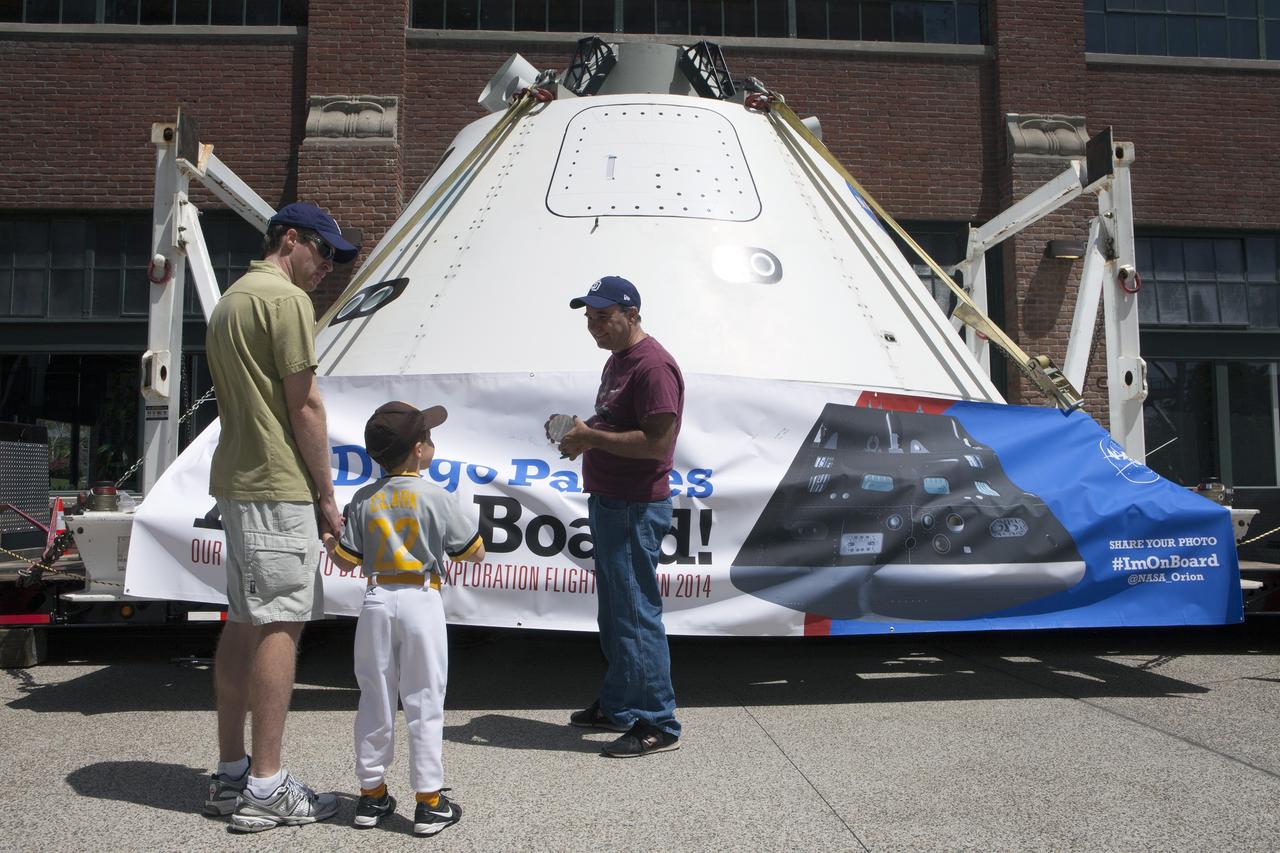
CAPE CANAVERAL, Fla. – San Diego Padres fans talk to Doug Lenhardt, Kennedy Space Center's Exploration Flight Test-1, or EFT-1, mission integration manager outside Petco Field in San Diego, California. NASA's Orion boilerplate test vehicle is on display. The boilerplate test vehicle is being prepared for an Exploration Flight Test-1, or EFT-1, pre-transportation test. The Ground Systems Development and Operations Program will run the test at the U.S. Naval Base San Diego to simulate retrieval and transportation procedures for Orion after it splashes down in the ocean and is retrieved for return to land and ground transportation back to Kennedy Space Center in Florida. Orion is the exploration spacecraft designed to carry astronauts to destinations not yet explored by humans, including an asteroid and Mars. It will have emergency abort capability, sustain the crew during space travel and provide safe re-entry from deep space return velocities. The first unpiloted test flight of the Orion is scheduled to launch later this year atop a Delta IV rocket and in 2017 on NASA’s Space Launch System rocket. For more information, visit http://www.nasa.gov/orion. Photo credit: NASA/Kim Shiflett

CAPE CANAVERAL, Fla. -- A view of one of the test stands in the Operations and Checkout O&C Facility at NASA's Kennedy Space Center in Florida where the Orion ground test vehicle has arrived. The vehicle traveled more than 1,800 miles from the company's Waterton Facility near Denver where it successfully completed a series of rigorous tests that simulated launch and spaceflight environments. The ground test vehicle will be used for pathfinding operations in the O&C, including simulated manufacturing and assembly procedures. After those operations are completed, new backshell panels will be installed on the ground test vehicle at the O&C prior to the vehicle’s trek to NASA's Langley Research Center in Virginia for splashdown testing at the agency's Hydro Impact Basin. Launching atop NASA's heavy-lift Space Launch System SLS, which also is under development, the Orion Multi-Purpose Crew Vehicle MPCV will serve as the exploration vehicle that will carry astronaut crews beyond low Earth orbit. It also will provide emergency abort capabilities, sustain the crew during space travel and provide safe re-entry from deep space return velocities. For more information, visit www.nasa.gov/orion. Photo credit: Charisse Nahser
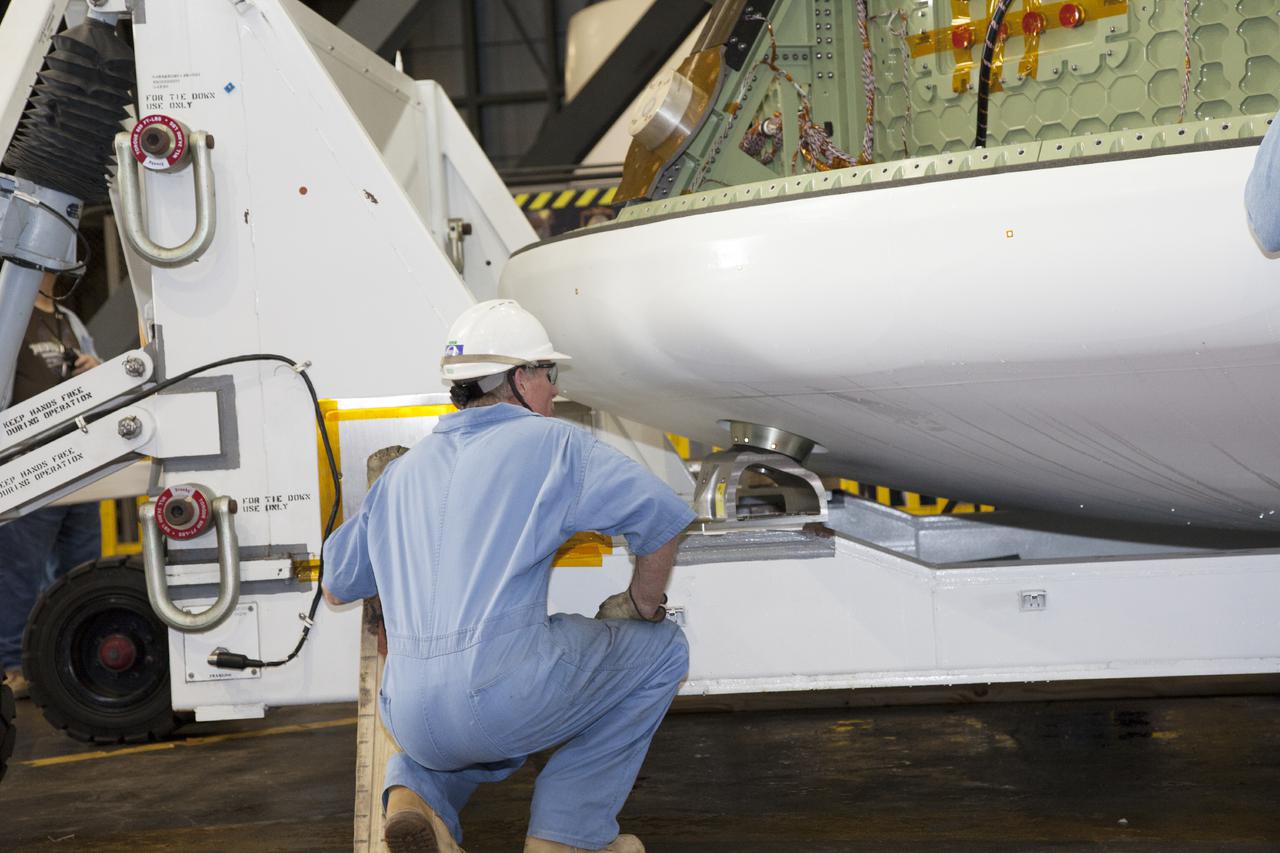
CAPE CANAVERAL, Fla. – Inside the Vehicle Assembly Building at NASA’s Kennedy Space Center in Florida, a technician monitors the progress as a bridge crane attached to the Orion ground test vehicle begins to lift it away from the heat shield. The ground test vehicle is being prepared for its move to Langley Research Center in Hampton, Va., for a water test. The test vehicle is being used by the Ground Systems Development and Operations Program for path finding operations, including simulated manufacturing, assembly and stacking procedures. Orion is the exploration spacecraft designed to carry astronauts to destinations not yet explored by humans. It will have emergency abort capability, sustain the crew during space travel and provide safe re-entry from deep space return velocities. The first unpiloted test flight of Orion is scheduled to launch in 2014 atop a Delta IV Heavy rocket and in 2017 on NASA’s Space Launch System rocket. For more information, visit www.nasa.gov_orion. Photo credit: Daniel Casper
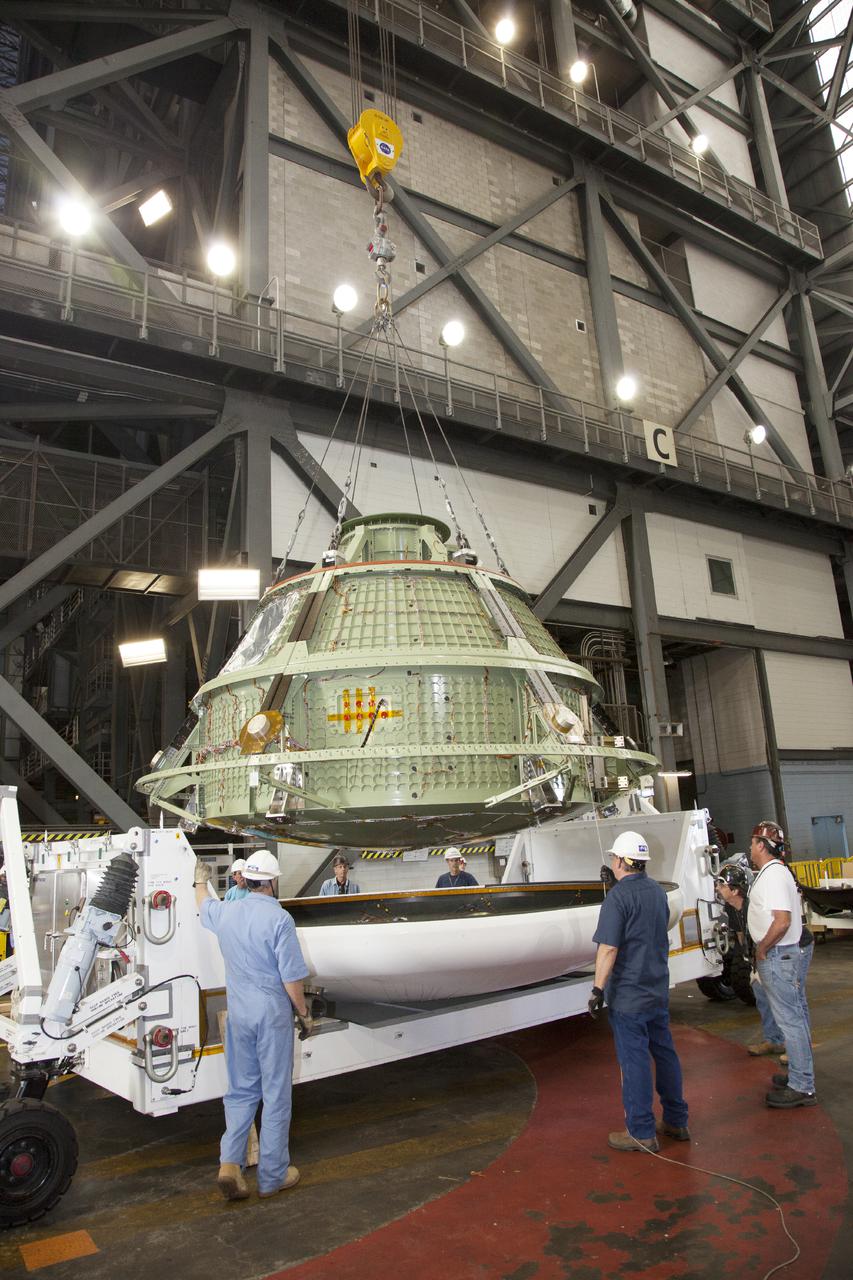
CAPE CANAVERAL, Fla. – Inside the Vehicle Assembly Building at NASA’s Kennedy Space Center in Florida, technicians monitor the progress as a bridge crane attached to the Orion ground test vehicle begins to lift it away from the heat shield. The ground test vehicle is being prepared for its move to Langley Research Center in Hampton, Va., for a water test. The test vehicle is being used by the Ground Systems Development and Operations Program for path finding operations, including simulated manufacturing, assembly and stacking procedures. Orion is the exploration spacecraft designed to carry astronauts to destinations not yet explored by humans. It will have emergency abort capability, sustain the crew during space travel and provide safe re-entry from deep space return velocities. The first unpiloted test flight of Orion is scheduled to launch in 2014 atop a Delta IV Heavy rocket and in 2017 on NASA’s Space Launch System rocket. For more information, visit www.nasa.gov_orion. Photo credit: Daniel Casper
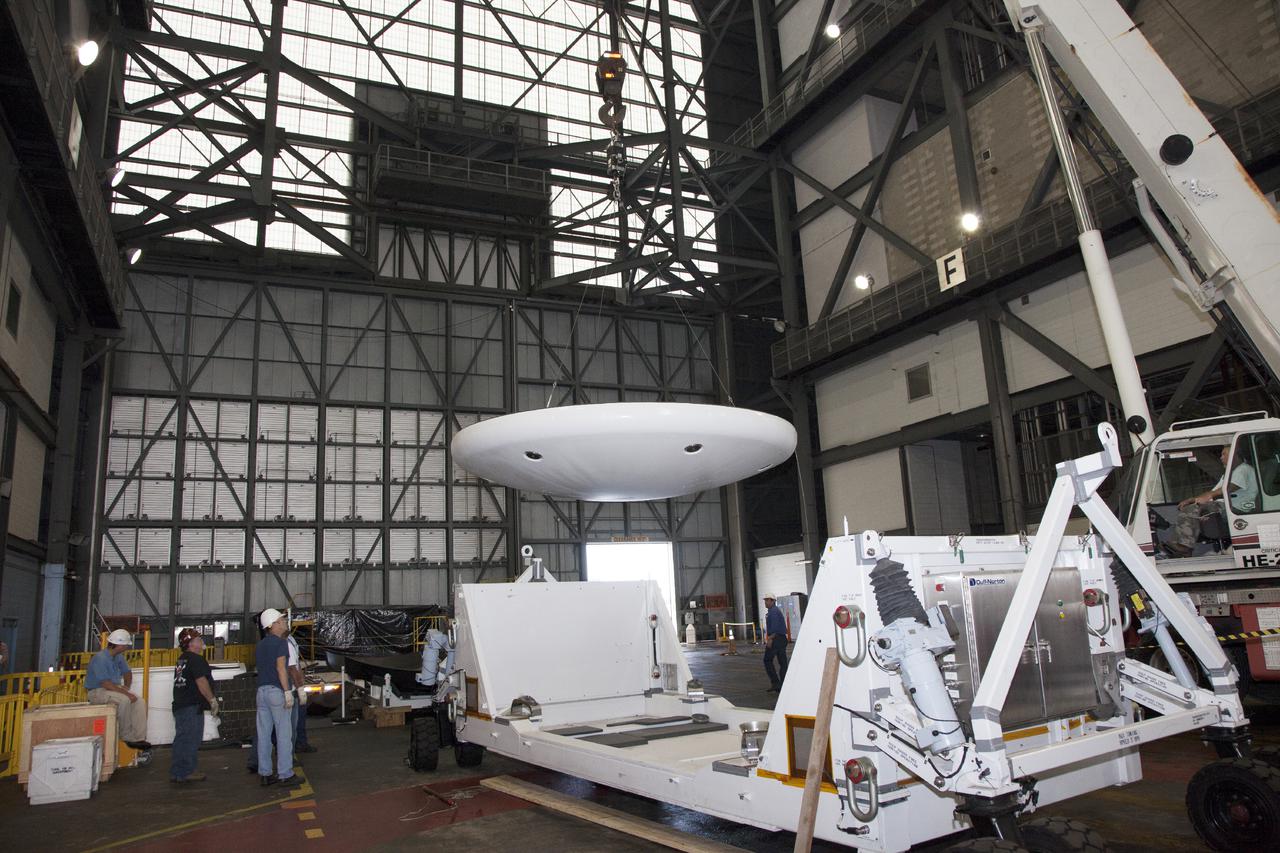
CAPE CANAVERAL, Fla. – Inside the Vehicle Assembly Building at NASA’s Kennedy Space Center in Florida, technicians monitor the progress as a crane moves the heat shield that was removed from the Orion ground test vehicle toward a special holding platform. The ground test vehicle is being prepared for its move to Langley Research Center in Hampton, Va., for a water test. The test vehicle is being used by the Ground Systems Development and Operations Program for path finding operations, including simulated manufacturing, assembly and stacking procedures. Orion is the exploration spacecraft designed to carry astronauts to destinations not yet explored by humans. It will have emergency abort capability, sustain the crew during space travel and provide safe re-entry from deep space return velocities. The first unpiloted test flight of Orion is scheduled to launch in 2014 atop a Delta IV Heavy rocket and in 2017 on NASA’s Space Launch System rocket. For more information, visit www.nasa.gov_orion. Photo credit: Daniel Casper
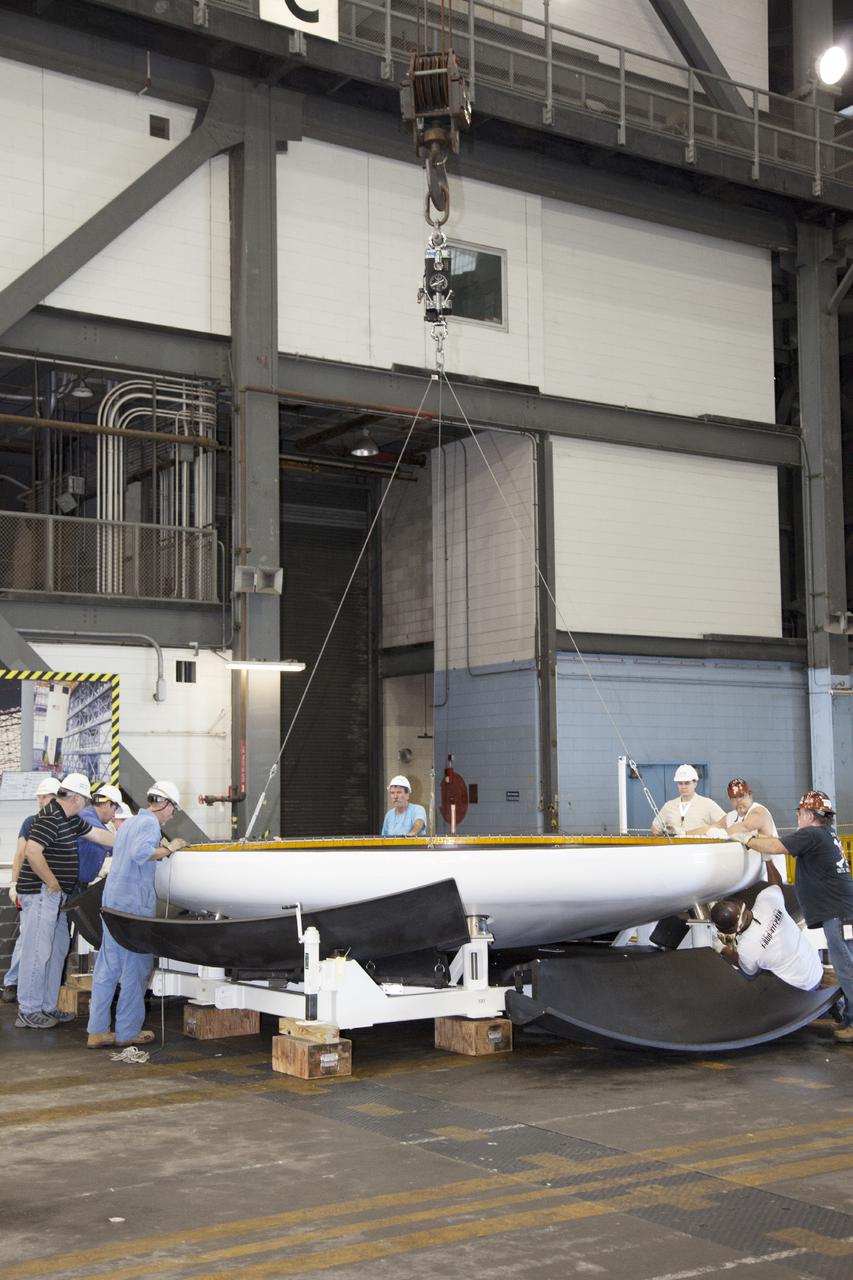
CAPE CANAVERAL, Fla. – Inside the Vehicle Assembly Building at NASA’s Kennedy Space Center in Florida, technicians help secure the heat shield that was removed from the Orion ground test vehicle onto a special holding platform. The ground test vehicle is being prepared for its move to Langley Research Center in Hampton, Va., for a water test. The test vehicle is being used by the Ground Systems Development and Operations Program for path finding operations, including simulated manufacturing, assembly and stacking procedures. Orion is the exploration spacecraft designed to carry astronauts to destinations not yet explored by humans. It will have emergency abort capability, sustain the crew during space travel and provide safe re-entry from deep space return velocities. The first unpiloted test flight of Orion is scheduled to launch in 2014 atop a Delta IV Heavy rocket and in 2017 on NASA’s Space Launch System rocket. For more information, visit www.nasa.gov_orion. Photo credit: Daniel Casper
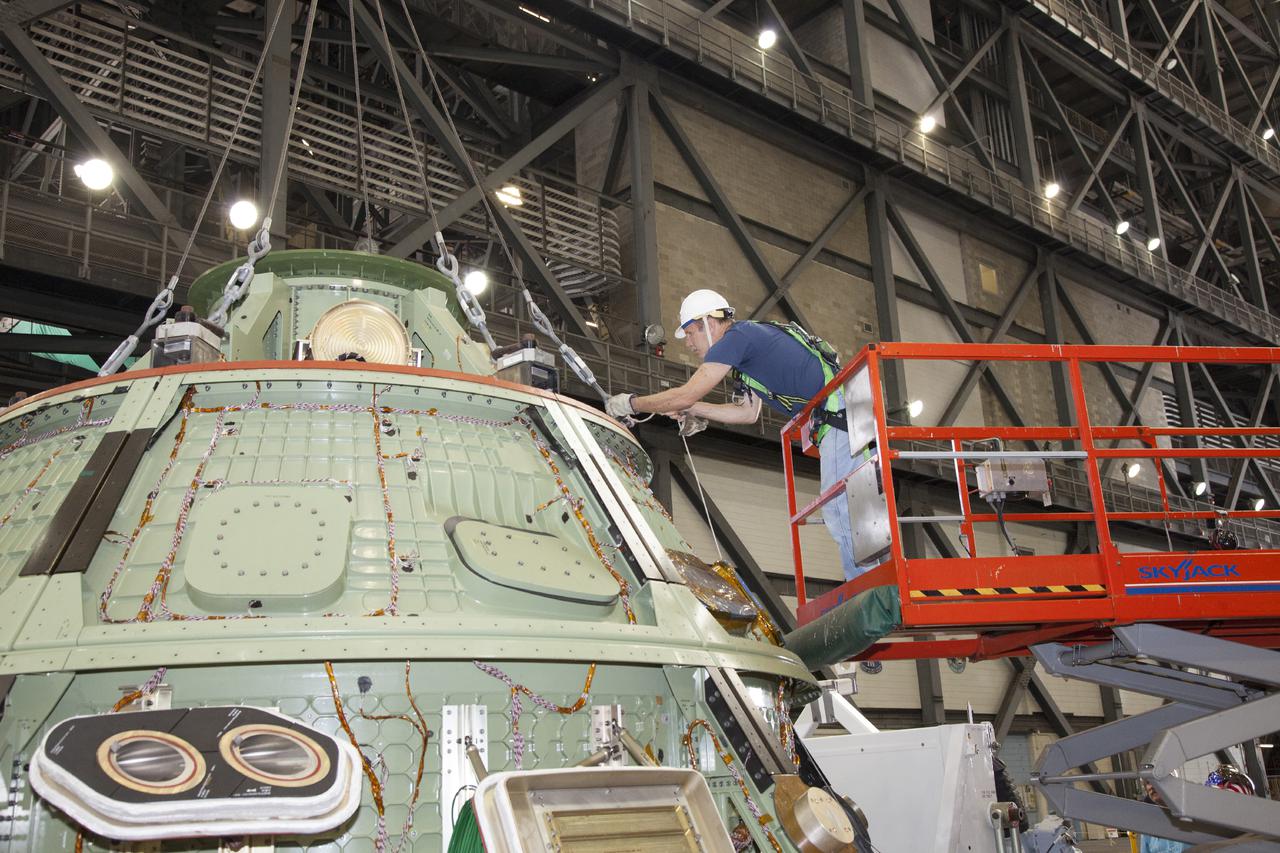
CAPE CANAVERAL, Fla. – Inside the Vehicle Assembly Building at NASA’s Kennedy Space Center in Florida, a technician on scissor lift secures the lines of a bridge crane attached to the Orion ground test vehicle for heat shield removal. The ground test vehicle is being prepared for its move to Langley Research Center in Hampton, Va., for a water test. The test vehicle is being used by the Ground Systems Development and Operations Program for path finding operations, including simulated manufacturing, assembly and stacking procedures. Orion is the exploration spacecraft designed to carry astronauts to destinations not yet explored by humans. It will have emergency abort capability, sustain the crew during space travel and provide safe re-entry from deep space return velocities. The first unpiloted test flight of Orion is scheduled to launch in 2014 atop a Delta IV Heavy rocket and in 2017 on NASA’s Space Launch System rocket. For more information, visit www.nasa.gov_orion. Photo credit: Daniel Casper
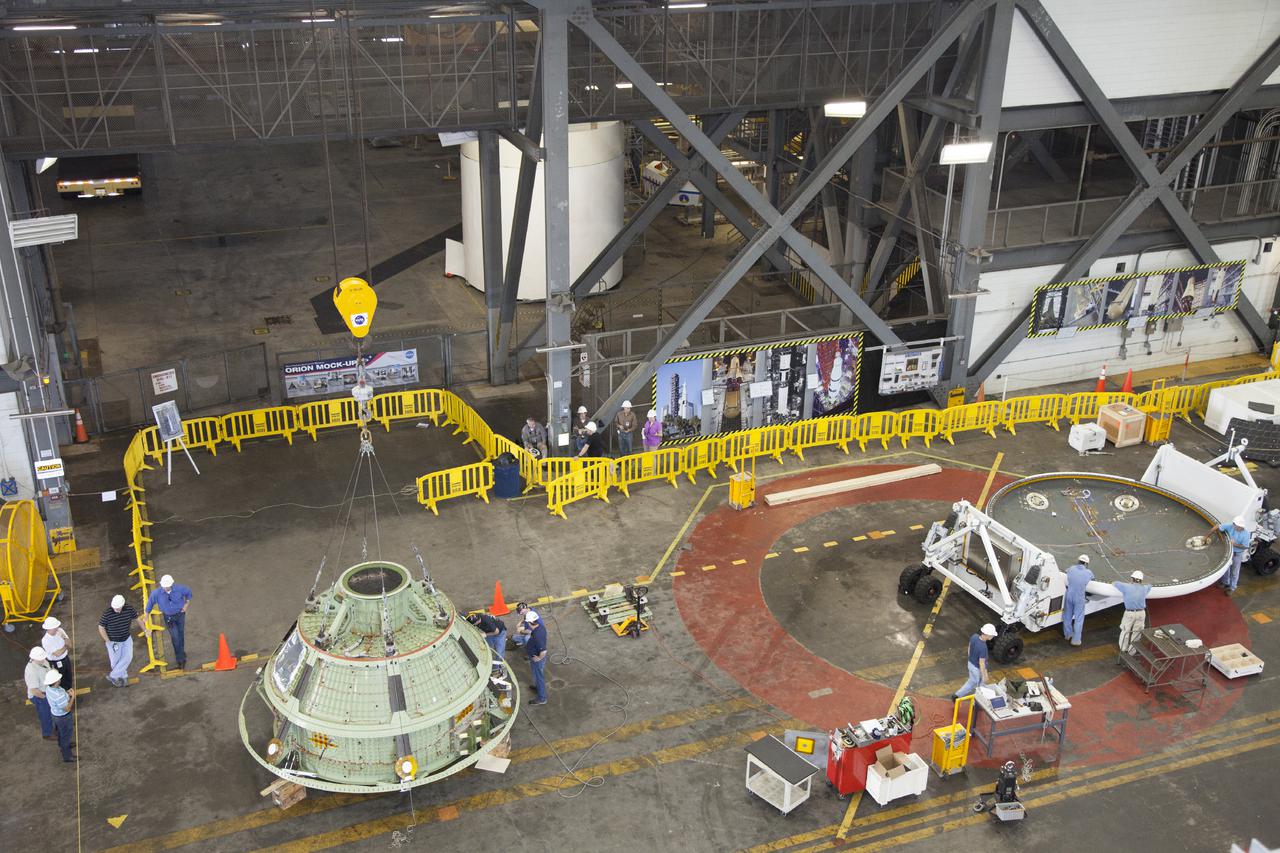
CAPE CANAVERAL, Fla. – Inside the Vehicle Assembly Building at NASA’s Kennedy Space Center in Florida, a bridge crane attached to the Orion ground test vehicle has lifted it away from the heat shield and lowered it onto a platform. The ground test vehicle is being prepared for its move to Langley Research Center in Hampton, Va., for a water test. The test vehicle is being used by the Ground Systems Development and Operations Program for path finding operations, including simulated manufacturing, assembly and stacking procedures. Orion is the exploration spacecraft designed to carry astronauts to destinations not yet explored by humans. It will have emergency abort capability, sustain the crew during space travel and provide safe re-entry from deep space return velocities. The first unpiloted test flight of Orion is scheduled to launch in 2014 atop a Delta IV Heavy rocket and in 2017 on NASA’s Space Launch System rocket. For more information, visit www.nasa.gov_orion. Photo credit: Daniel Casper
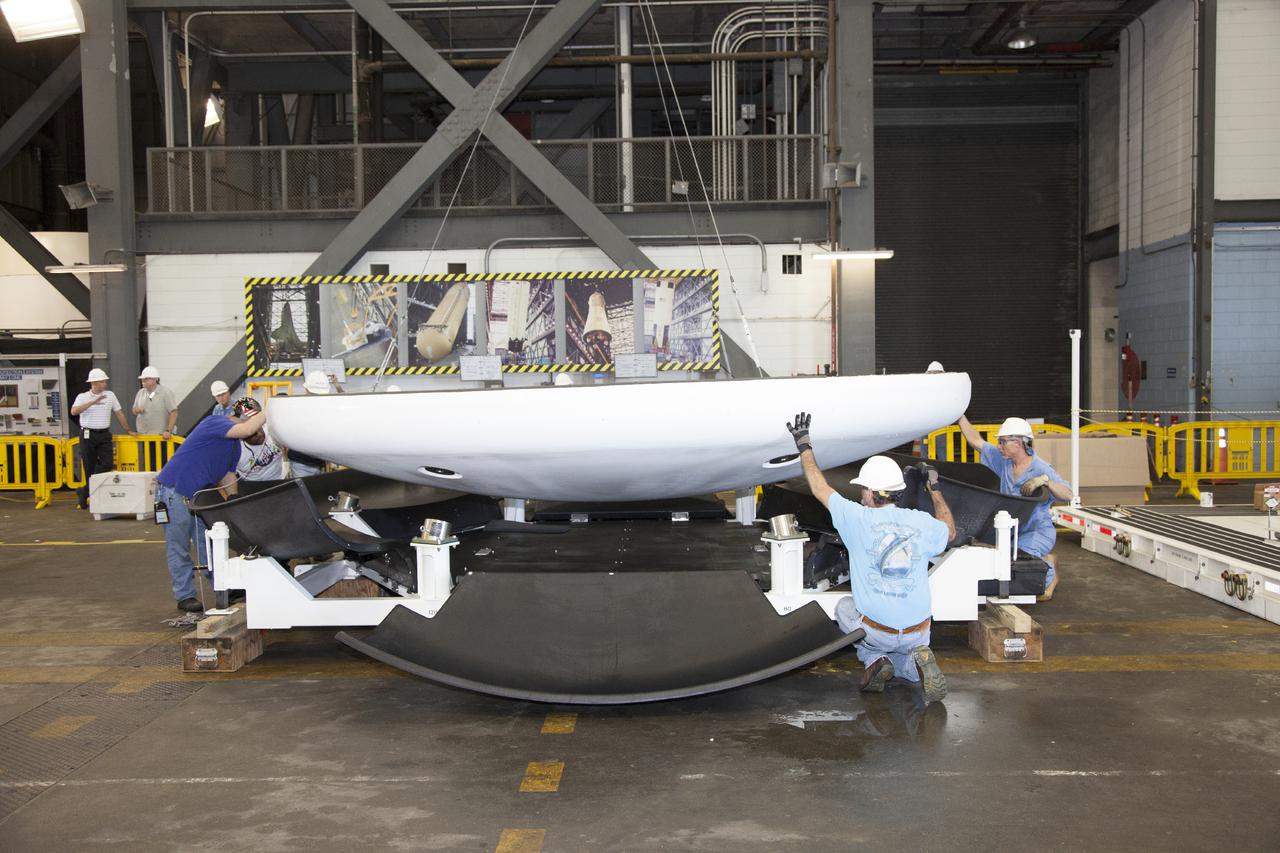
CAPE CANAVERAL, Fla. – Inside the Vehicle Assembly Building at NASA’s Kennedy Space Center in Florida, technicians assist as a crane lowers the heat shield that was removed from the Orion ground test vehicle onto a special holding platform. The ground test vehicle is being prepared for its move to Langley Research Center in Hampton, Va., for a water test. The test vehicle is being used by the Ground Systems Development and Operations Program for path finding operations, including simulated manufacturing, assembly and stacking procedures. Orion is the exploration spacecraft designed to carry astronauts to destinations not yet explored by humans. It will have emergency abort capability, sustain the crew during space travel and provide safe re-entry from deep space return velocities. The first unpiloted test flight of Orion is scheduled to launch in 2014 atop a Delta IV Heavy rocket and in 2017 on NASA’s Space Launch System rocket. For more information, visit www.nasa.gov_orion. Photo credit: Daniel Casper
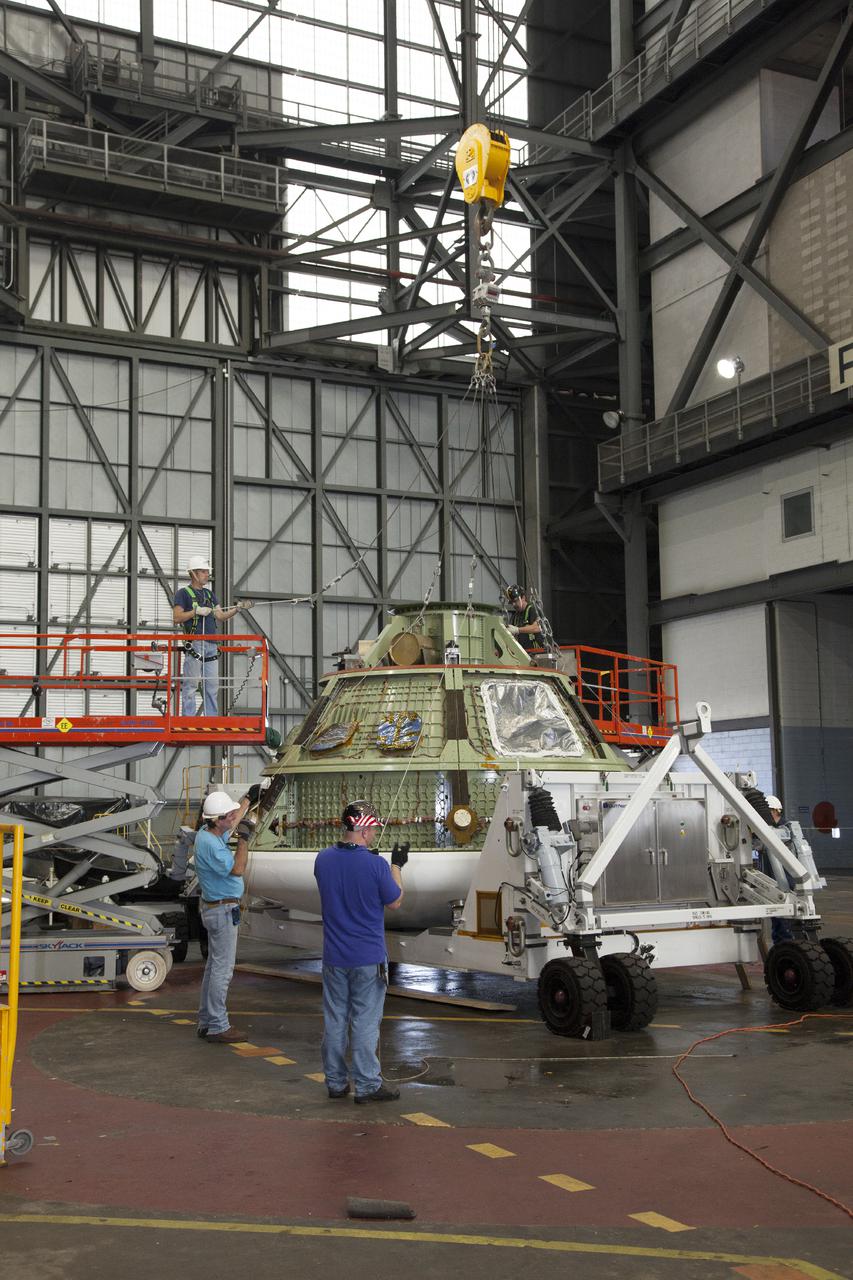
CAPE CANAVERAL, Fla. – Inside the Vehicle Assembly Building at NASA’s Kennedy Space Center in Florida, technicians on scissor lifts secure the lines of a bridge crane attached to the Orion ground test vehicle for heat shield removal. The ground test vehicle is being prepared for its move to Langley Research Center in Hampton, Va., for a water test. The test vehicle is being used by the Ground Systems Development and Operations Program for path finding operations, including simulated manufacturing, assembly and stacking procedures. Orion is the exploration spacecraft designed to carry astronauts to destinations not yet explored by humans. It will have emergency abort capability, sustain the crew during space travel and provide safe re-entry from deep space return velocities. The first unpiloted test flight of Orion is scheduled to launch in 2014 atop a Delta IV Heavy rocket and in 2017 on NASA’s Space Launch System rocket. For more information, visit www.nasa.gov_orion. Photo credit: Daniel Casper

CAPE CANAVERAL, Fla. – Inside the Vehicle Assembly Building at NASA’s Kennedy Space Center in Florida, technicians monitor the progress as a bridge crane attached to the Orion ground test vehicle moves it away from the heat shield. The ground test vehicle is being prepared for its move to Langley Research Center in Hampton, Va., for a water test. The test vehicle is being used by the Ground Systems Development and Operations Program for path finding operations, including simulated manufacturing, assembly and stacking procedures. Orion is the exploration spacecraft designed to carry astronauts to destinations not yet explored by humans. It will have emergency abort capability, sustain the crew during space travel and provide safe re-entry from deep space return velocities. The first unpiloted test flight of Orion is scheduled to launch in 2014 atop a Delta IV Heavy rocket and in 2017 on NASA’s Space Launch System rocket. For more information, visit www.nasa.gov_orion. Photo credit: Daniel Casper
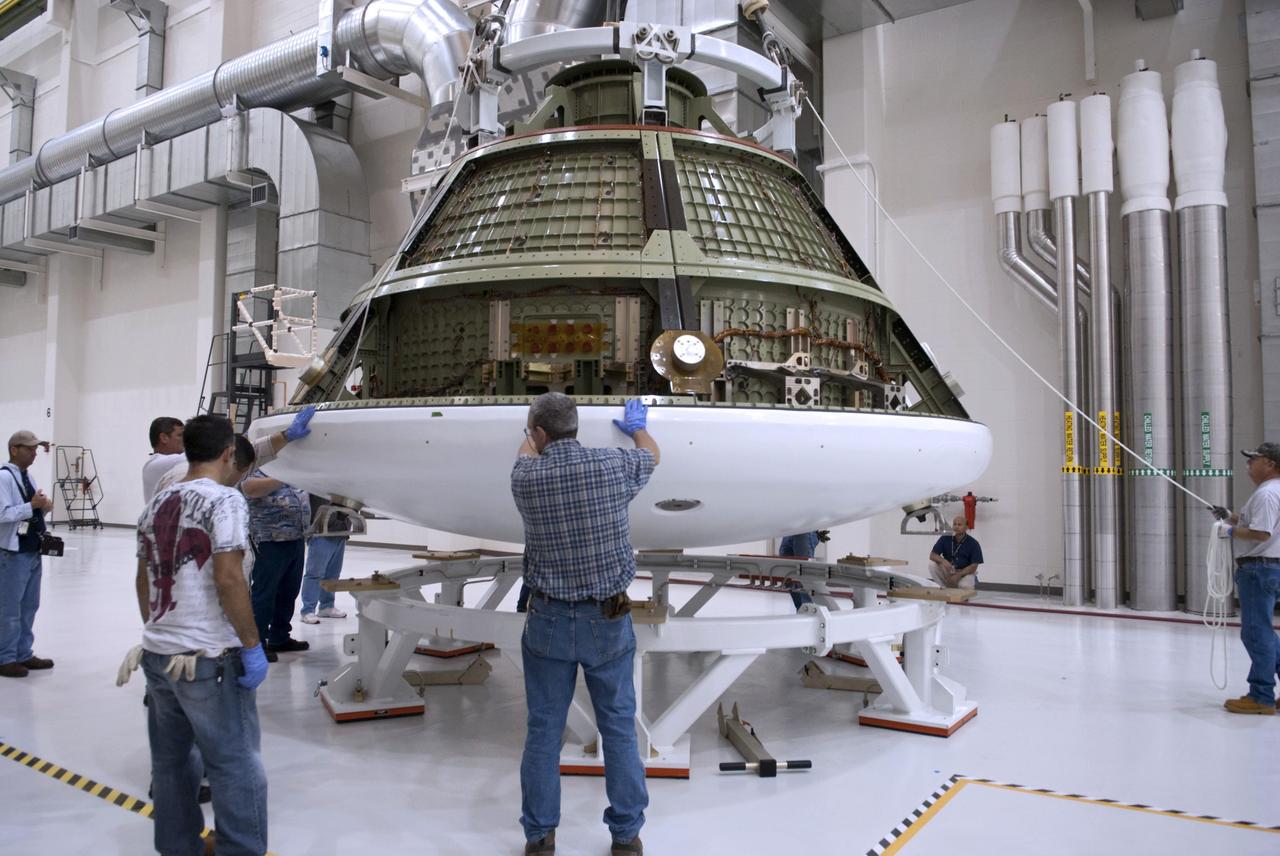
CAPE CANAVERAL, Fla. -- Lockheed Martin crews assist as a crane is used to lower the Orion ground test vehicle on to a work stand in the Operations and Checkout O&C Facility at NASA's Kennedy Space Center in Florida. The vehicle traveled more than 1,800 miles from the company's Waterton Facility near Denver where it successfully completed a series of rigorous tests that simulated launch and spaceflight environments. The ground test vehicle will be used for pathfinding operations in the O&C, including simulated manufacturing and assembly procedures. After those operations are completed, new backshell panels will be installed on the ground test vehicle at the O&C prior to the vehicle’s trek to NASA's Langley Research Center in Virginia for splashdown testing at the agency's Hydro Impact Basin. Launching atop NASA's heavy-lift Space Launch System SLS, which also is under development, the Orion Multi-Purpose Crew Vehicle MPCV will serve as the exploration vehicle that will carry astronaut crews beyond low Earth orbit. It also will provide emergency abort capabilities, sustain the crew during space travel and provide safe re-entry from deep space return velocities. For more information, visit www.nasa.gov/orion. Photo credit: Charisse Nahser
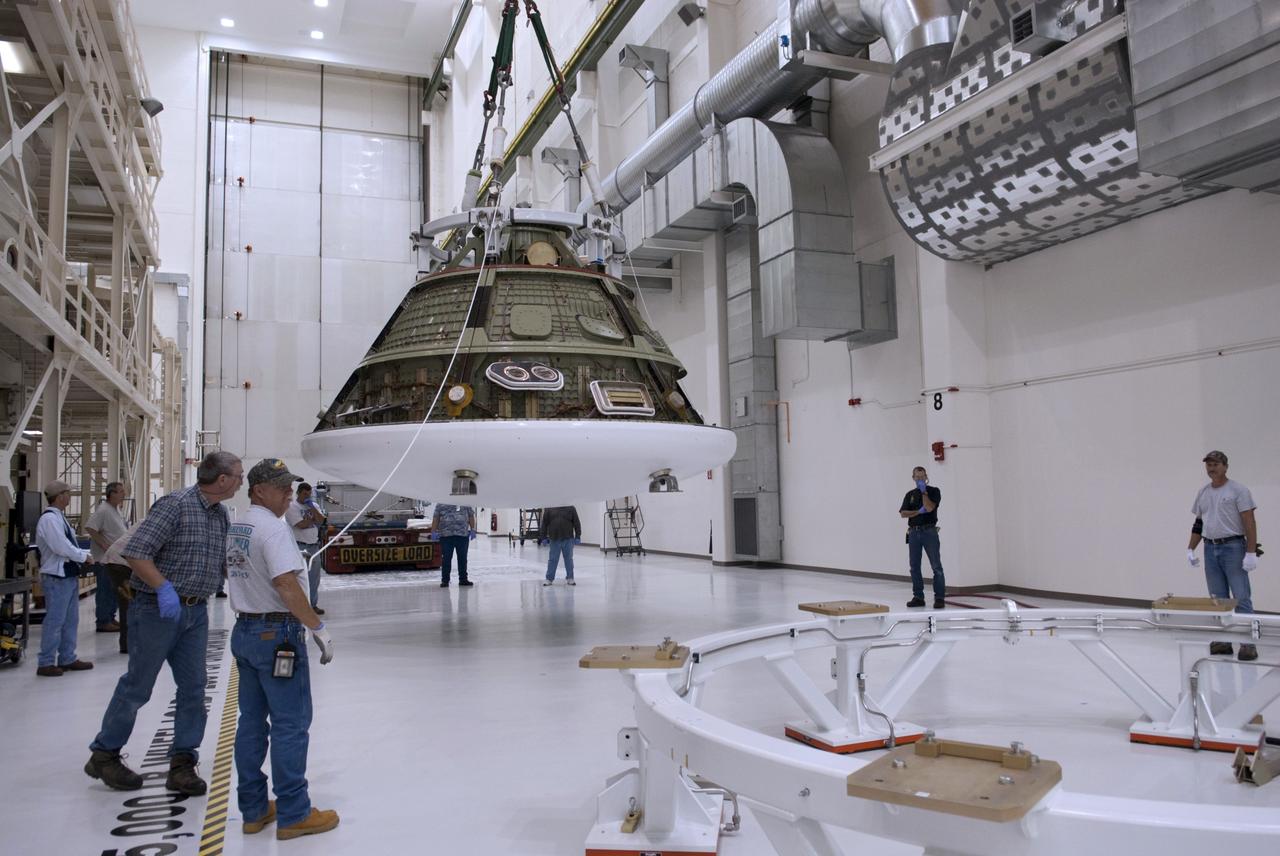
CAPE CANAVERAL, Fla. -- Lockheed Martin crews assist as a crane is used to move the Orion ground test vehicle toward a work stand in the Operations and Checkout O&C Facility at NASA's Kennedy Space Center in Florida. The vehicle traveled more than 1,800 miles from the company's Waterton Facility near Denver where it successfully completed a series of rigorous tests that simulated launch and spaceflight environments. The ground test vehicle will be used for pathfinding operations in the O&C, including simulated manufacturing and assembly procedures. After those operations are completed, new backshell panels will be installed on the ground test vehicle at the O&C prior to the vehicle’s trek to NASA's Langley Research Center in Virginia for splashdown testing at the agency's Hydro Impact Basin. Launching atop NASA's heavy-lift Space Launch System SLS, which also is under development, the Orion Multi-Purpose Crew Vehicle MPCV will serve as the exploration vehicle that will carry astronaut crews beyond low Earth orbit. It also will provide emergency abort capabilities, sustain the crew during space travel and provide safe re-entry from deep space return velocities. For more information, visit www.nasa.gov/orion. Photo credit: Charisse Nahser
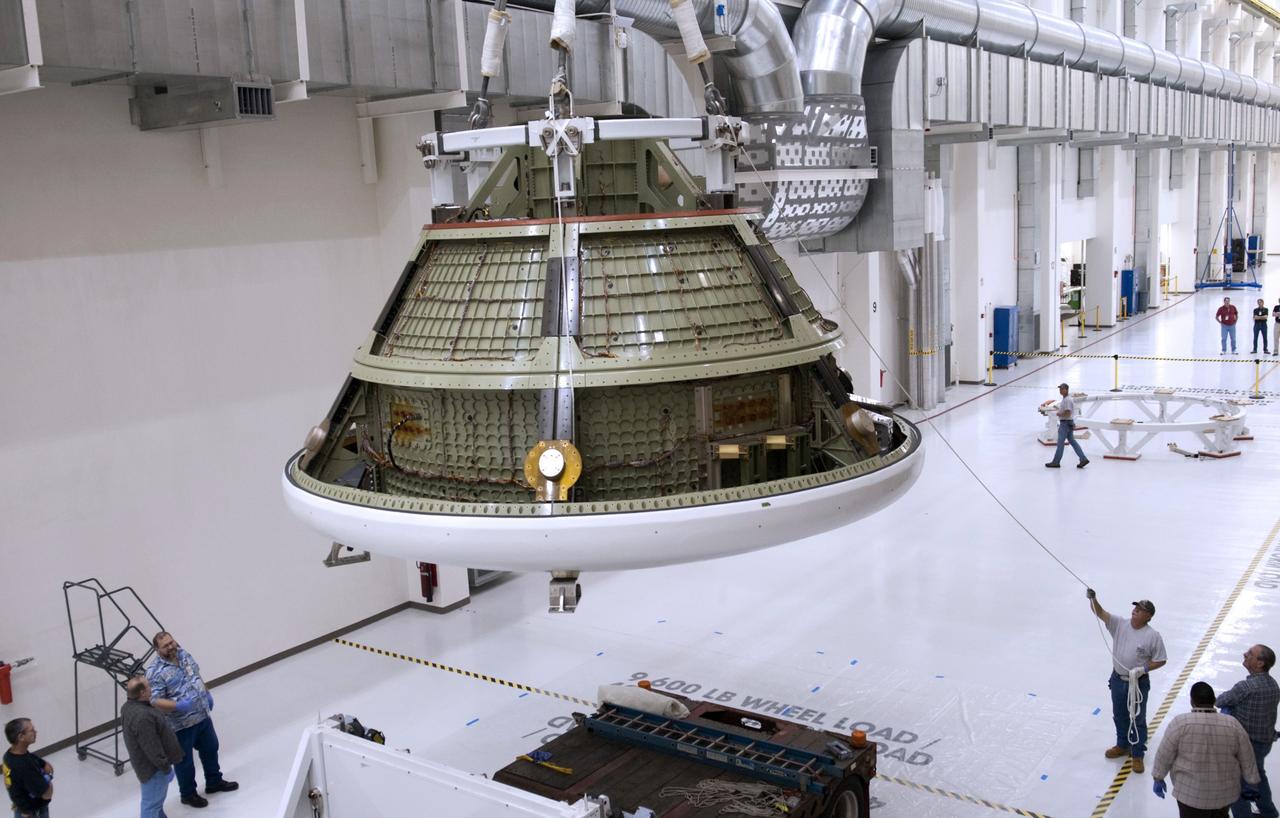
CAPE CANAVERAL, Fla. -- Lockheed Martin crews remove the Orion ground test vehicle from its packaging in the Operations and Checkout O&C Facility at NASA's Kennedy Space Center in Florida. The vehicle traveled more than 1,800 miles from the company's Waterton Facility near Denver where it successfully completed a series of rigorous tests that simulated launch and spaceflight environments. The ground test vehicle will be used for pathfinding operations in the O&C, including simulated manufacturing and assembly procedures. After those operations are completed, new backshell panels will be installed on the ground test vehicle at the O&C prior to the vehicle’s trek to NASA's Langley Research Center in Virginia for splashdown testing at the agency's Hydro Impact Basin. Launching atop NASA's heavy-lift Space Launch System SLS, which also is under development, the Orion Multi-Purpose Crew Vehicle MPCV will serve as the exploration vehicle that will carry astronaut crews beyond low Earth orbit. It also will provide emergency abort capabilities, sustain the crew during space travel and provide safe re-entry from deep space return velocities. For more information, visit www.nasa.gov/orion. Photo credit: Charisse Nahser