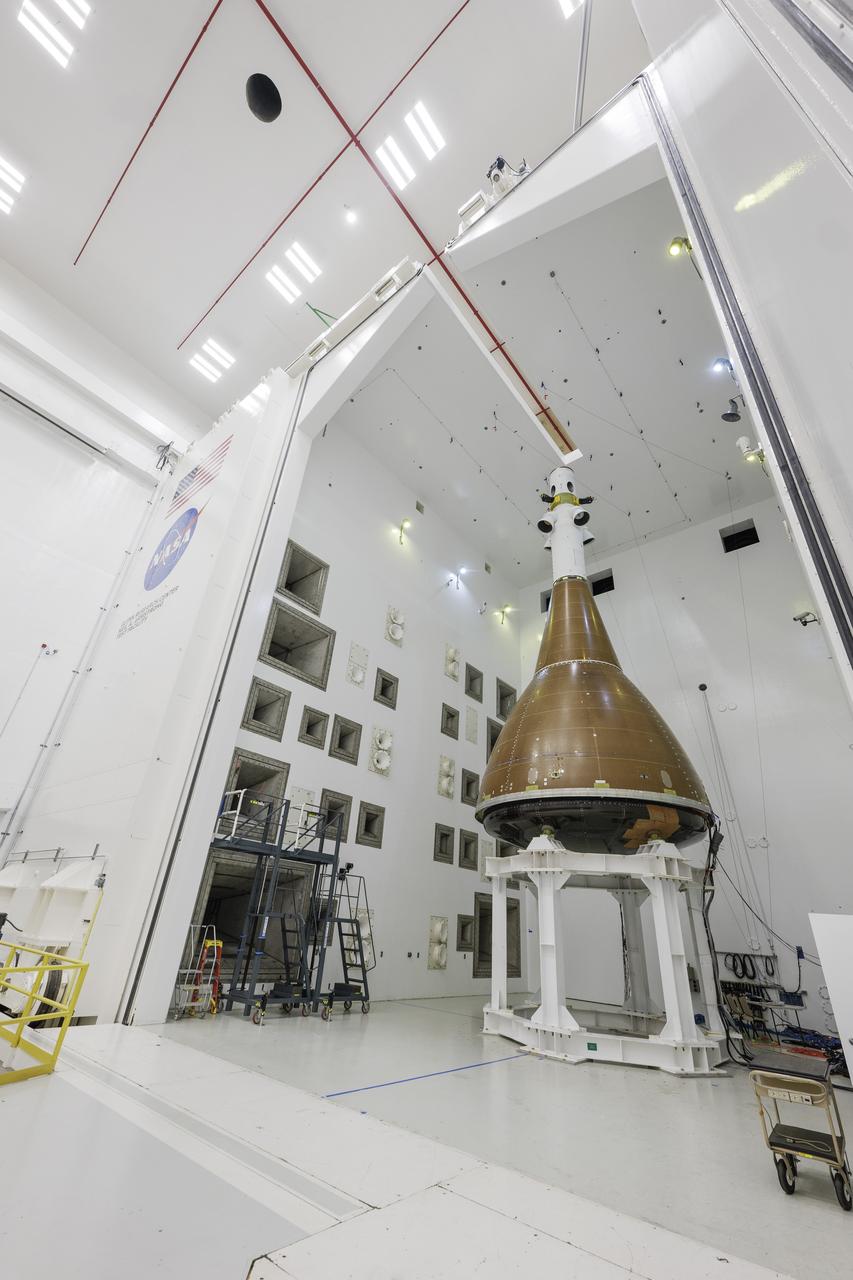
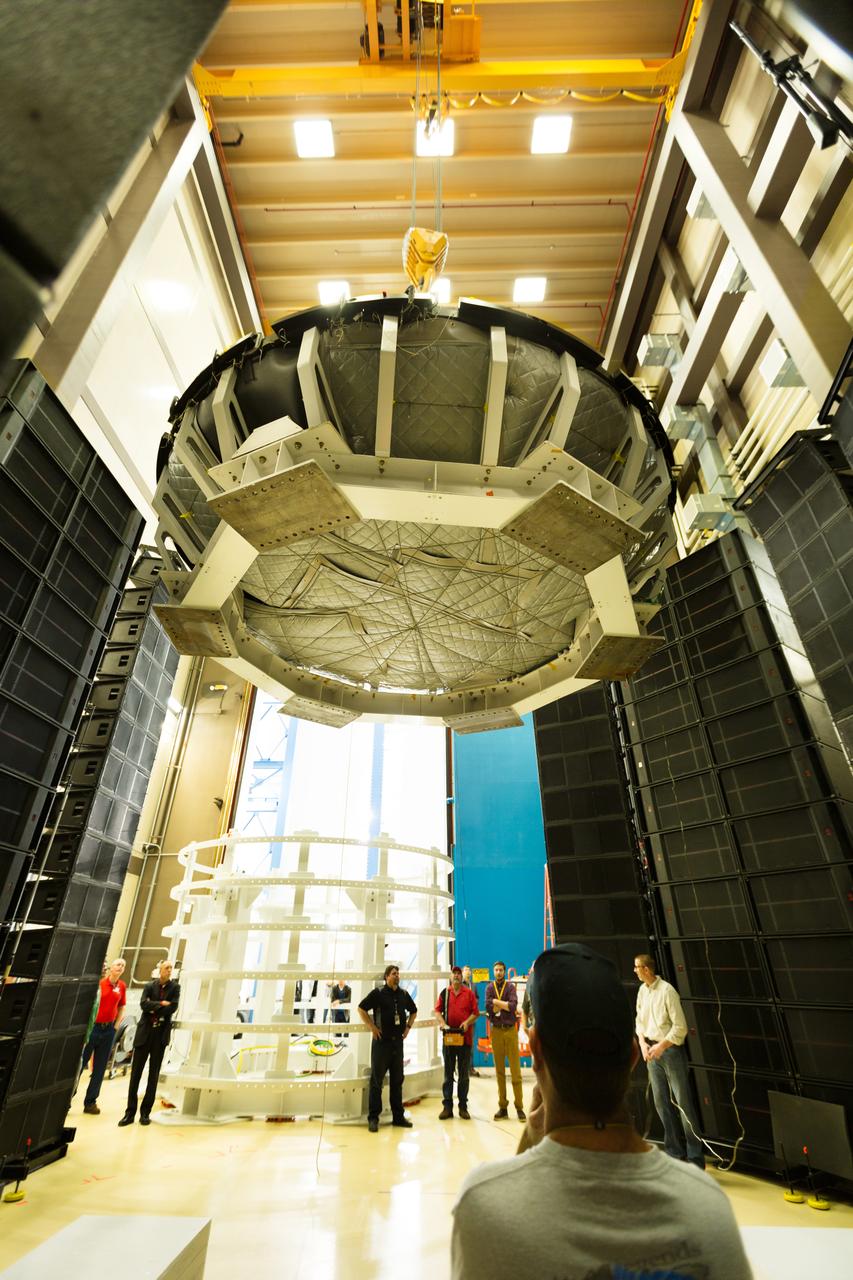
The team at NASA's Armstrong Test Facility in Sandusky, Ohio has begun vibro-acoustic testing on the Orion spacecraft that flew around the Moon on Artemis I, now known as the Environmental Test Article. The testing will help ensure the safety of future crews aboard Orion. Photo credit: NASA / Rad Sinyak
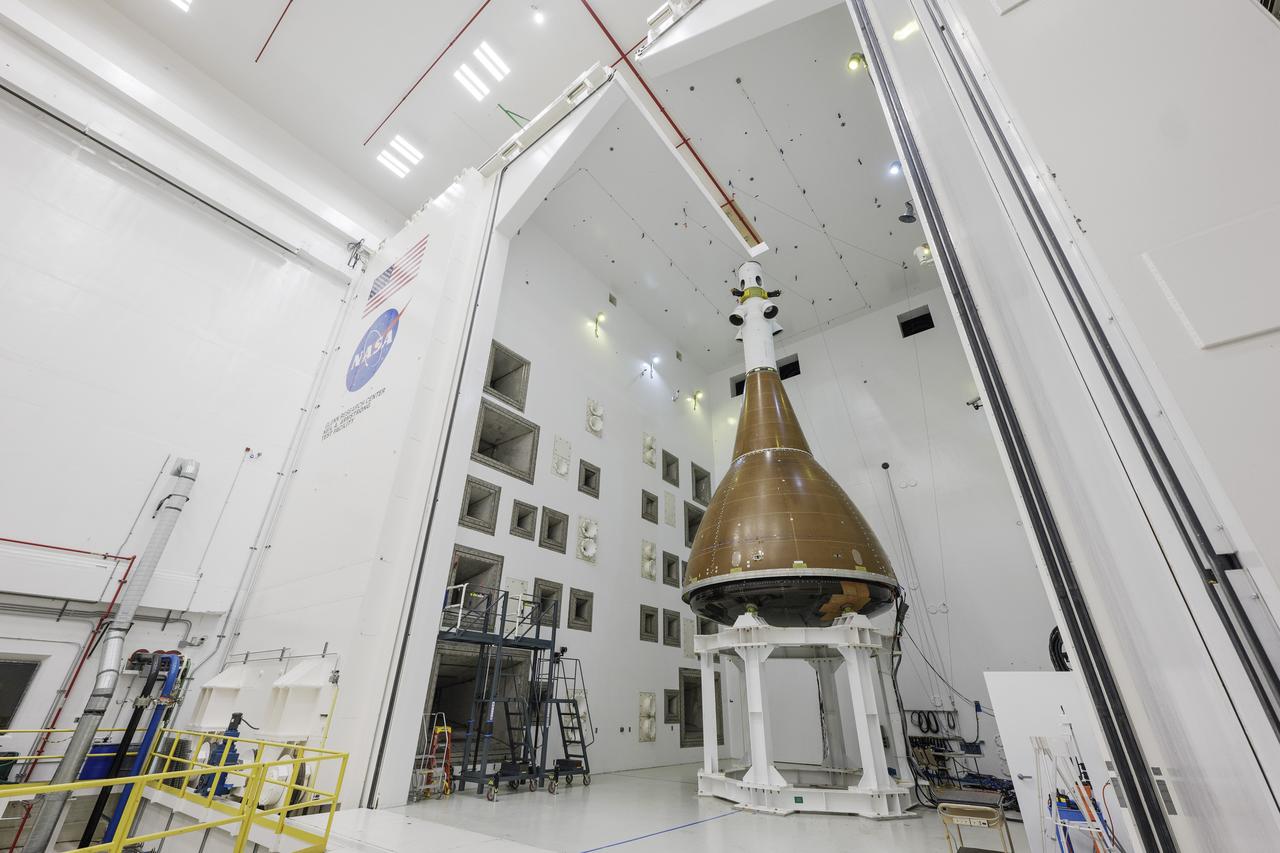
The team at NASA's Armstrong Test Facility in Sandusky, Ohio has begun vibro-acoustic testing on the Orion spacecraft that flew around the Moon on Artemis I, now known as the Environmental Test Article. The testing will help ensure the safety of future crews aboard Orion. Photo credit: NASA / Rad Sinyak
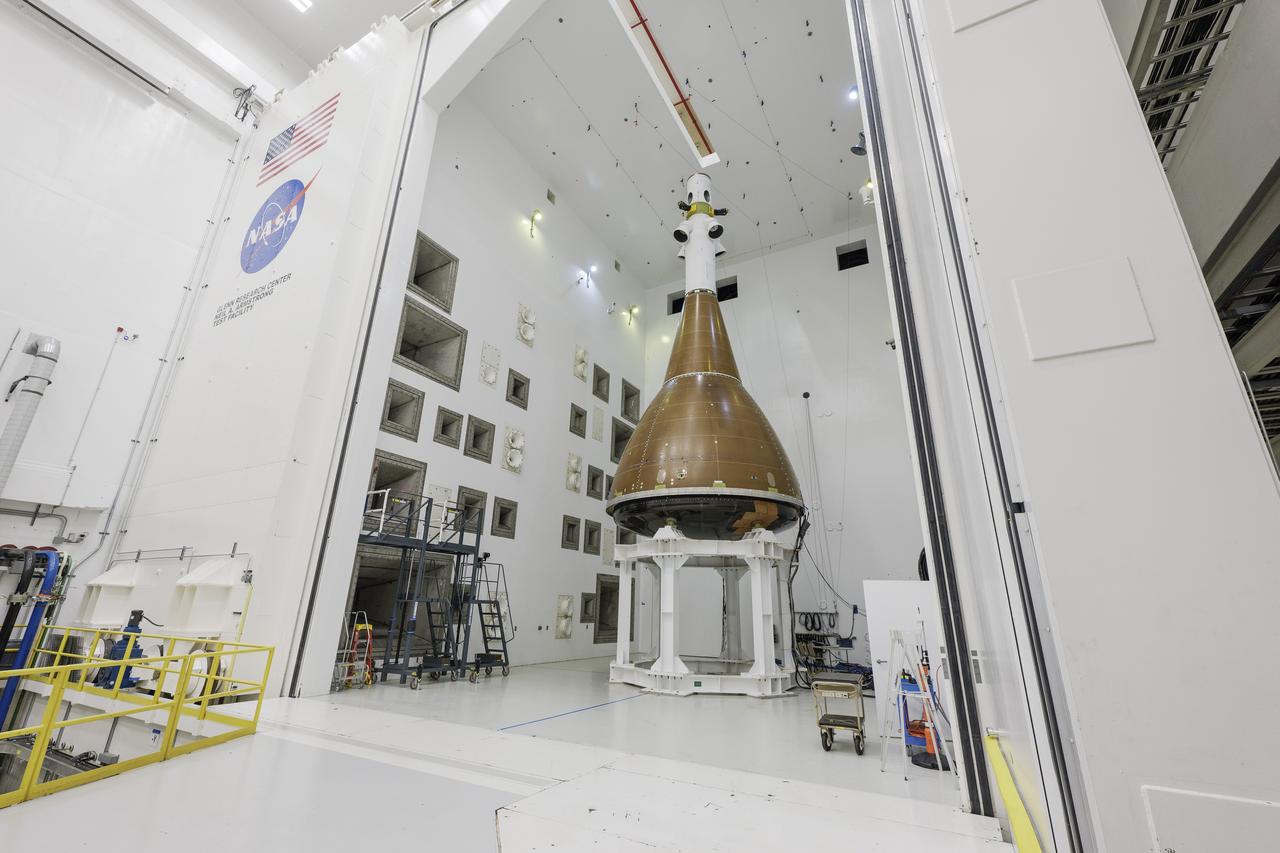
The team at NASA's Armstrong Test Facility in Sandusky, Ohio has begun vibro-acoustic testing on the Orion spacecraft that flew around the Moon on Artemis I, now known as the Environmental Test Article. The testing will help ensure the safety of future crews aboard Orion.

Vibro-acoustic testing on the Orion spacecraft that flew around the Moon on Artemis I, now known as the Environmental Test Article. The testing at Armstrong Test Facility will help ensure the safety of future crews aboard Orion. Photograph taken on September 11, 2024. Photo Credit: (NASA/Sara Lowthian-Hanna)
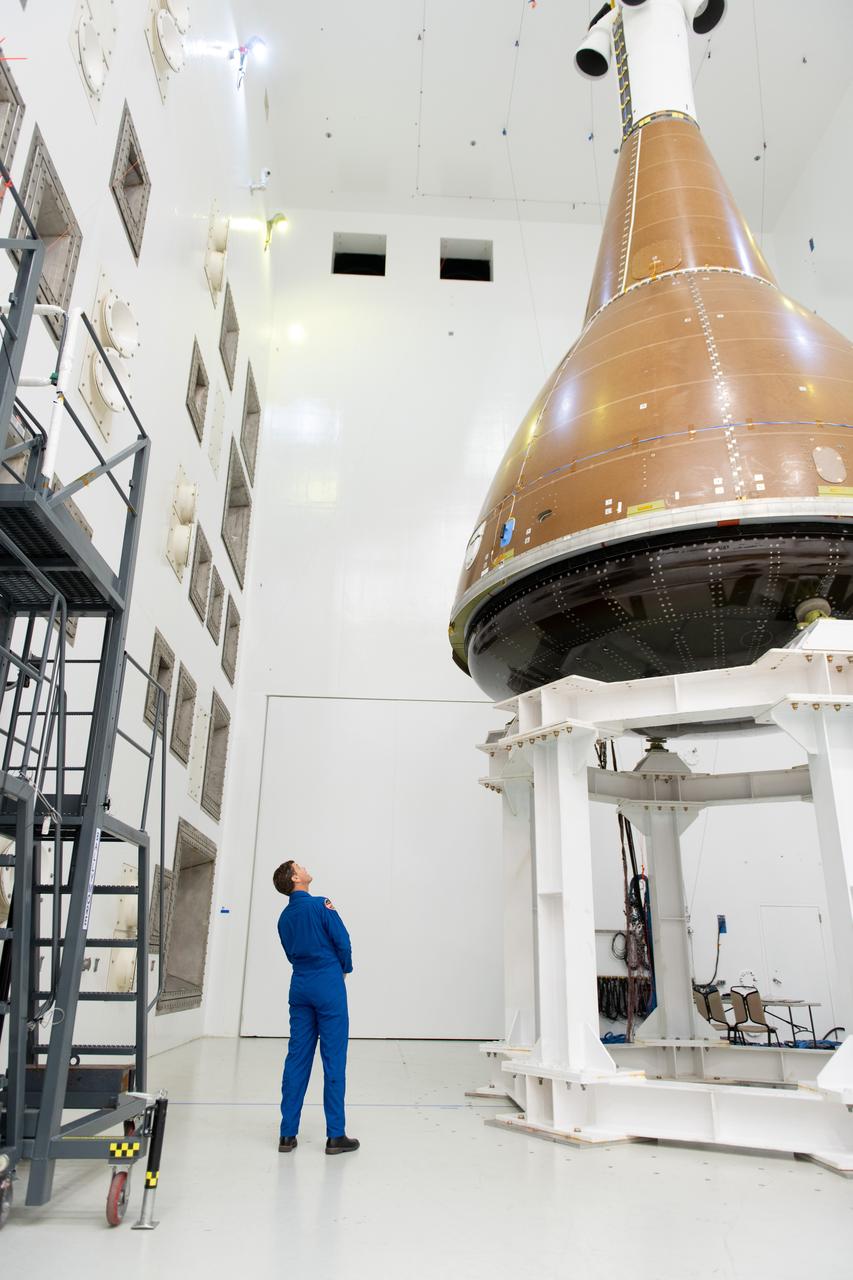
The team at NASA's Armstrong Test Facility in Sandusky, Ohio has begun vibro-acoustic testing on the Orion spacecraft that flew around the Moon on Artemis I, now known as the Environmental Test Article. The testing will help ensure the safety of future crews aboard Orion. Commander Reid Wiseman looks up at the Orion capsule during tours on September 11, 2024 of the acoustic lab. Photo Credit: (NASA/Sara Lowthian-Hanna)
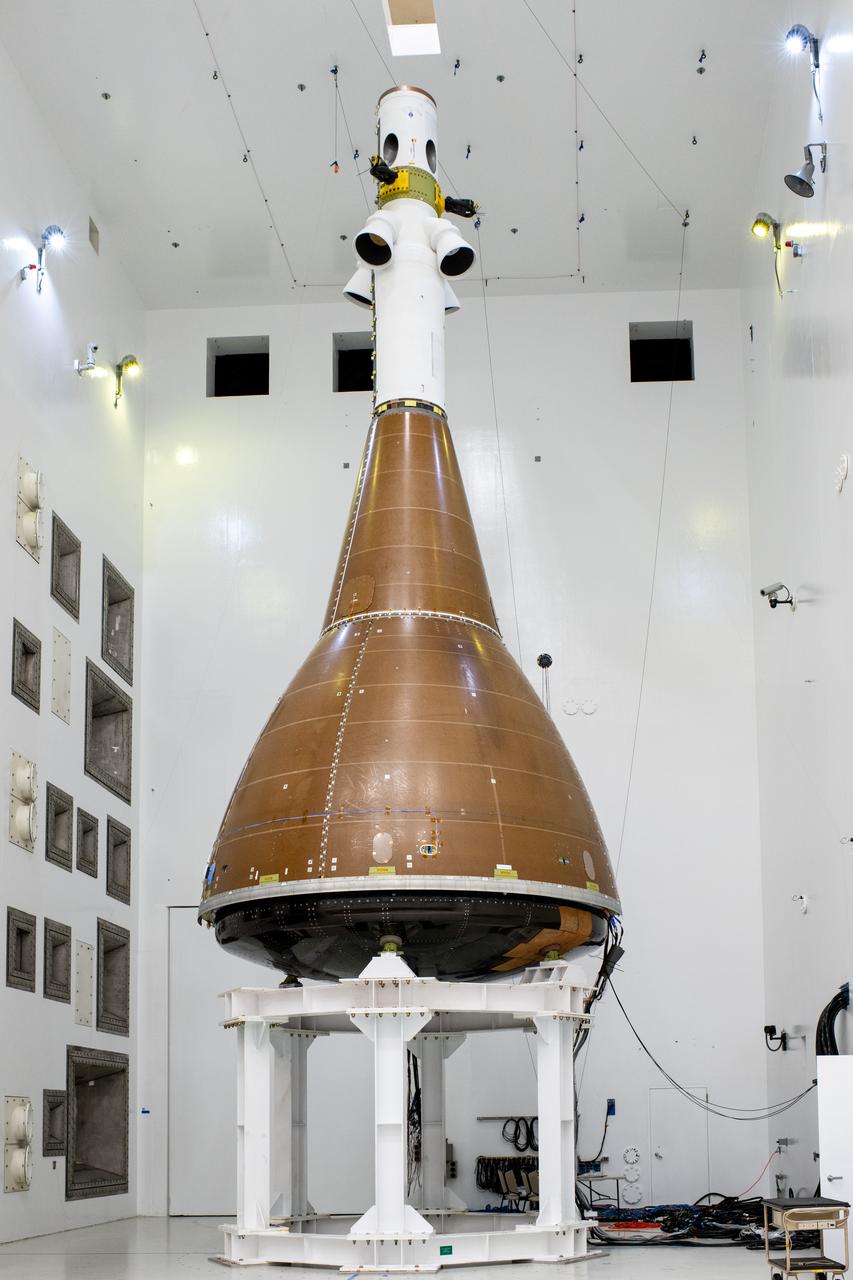
The team at NASA's Armstrong Test Facility in Sandusky, Ohio has begun vibro-acoustic testing on the Orion spacecraft that flew around the Moon on Artemis I, now known as the Environmental Test Article. The testing will help ensure the safety of future crews aboard Orion.
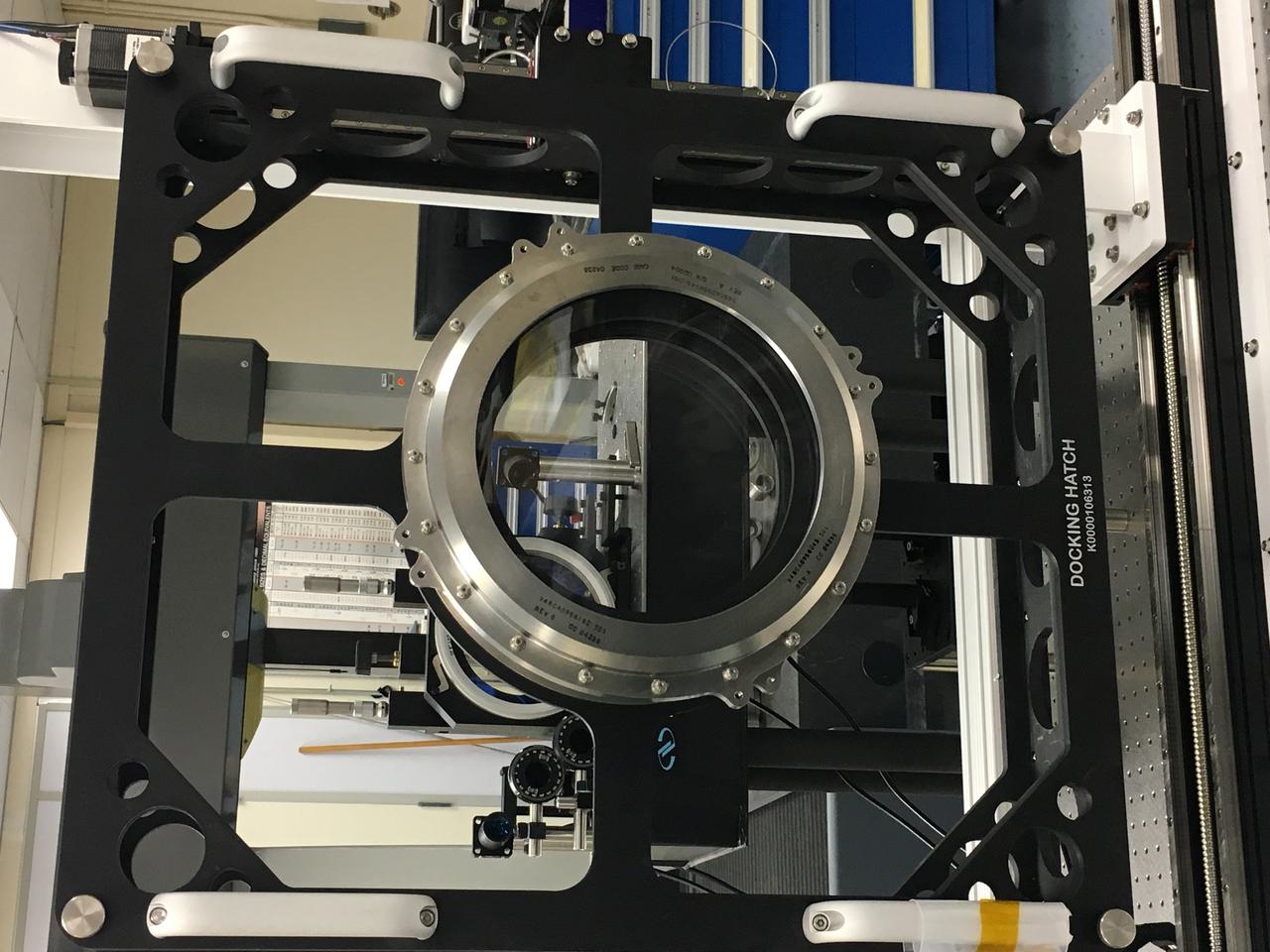
The first optical quality testing on a full window stack that is ready for installation in the docking hatch of NASA's Orion spacecraft is underway inside a laboratory in the Neil Armstrong Operations and Checkout Building at the agency's Kennedy Space Center in Florida. The test is being performed by a team from the center's Exploration Research and Technology Programs. The data from the tests will help improve the requirements for manufacturing tolerances on Orion's windows and verify how the window should perform in space. Orion is being prepared for its first integrated uncrewed flight atop NASA's Space Launch System rocket on Exploration Mission-1.
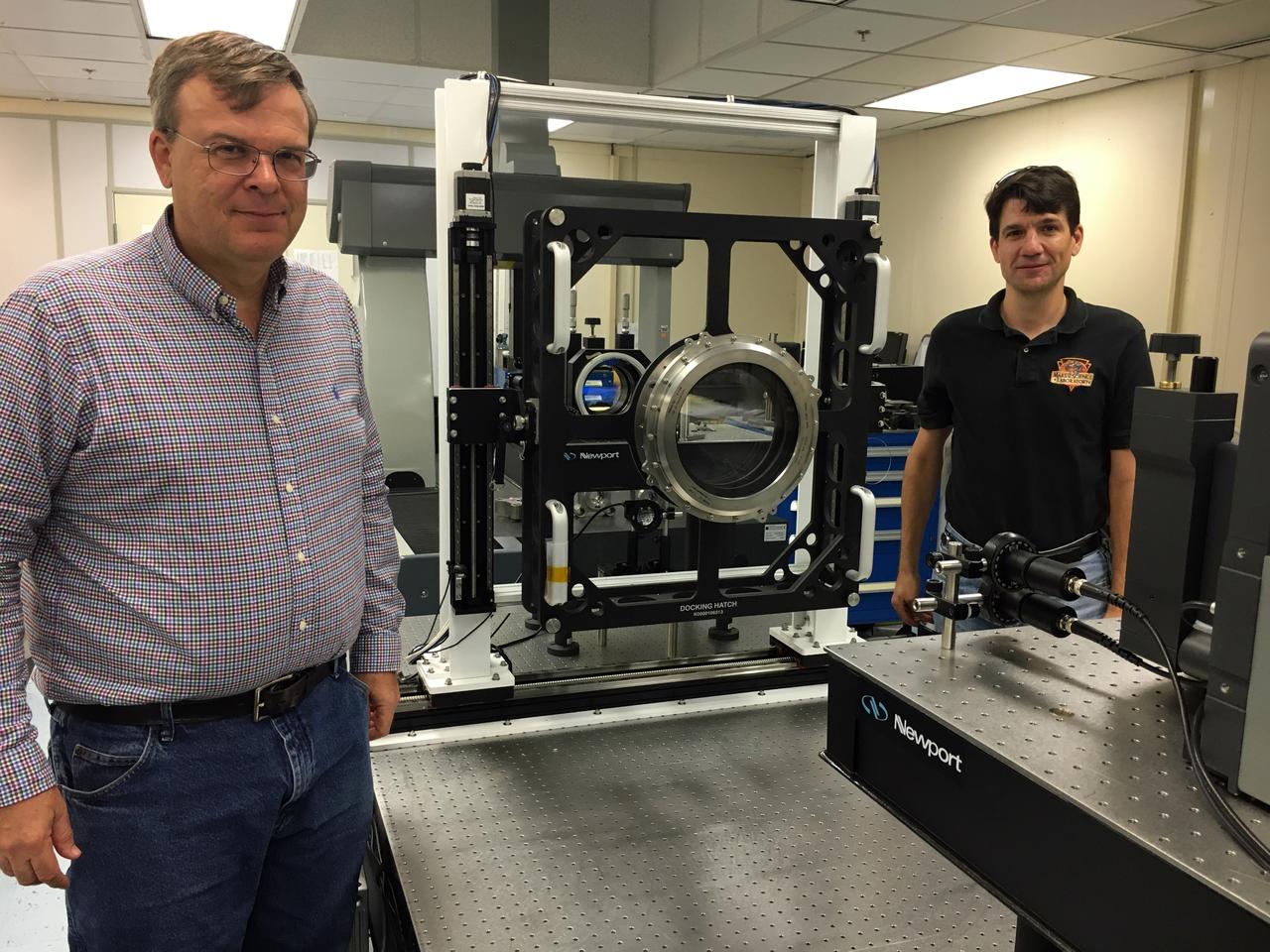
Inside a laboratory in the Neil Armstrong Operations and Checkout Building at NASA's Kennedy Space Center in Florida, Mark Nurge, Ph.D., at left, a physicist in the Applied Physics Lab with the center's Exploration Research and Technology Programs, and Bence Bartha, Ph.D., a specialist in non-destructive testing with URS Federal Services, are performing the first optical quality testing on a full window stack that is ready for installation in the docking hatch of NASA's Orion spacecraft. The data from the tests will help improve the requirements for manufacturing tolerances on Orion's windows and verify how the window should perform in space. Orion is being prepared for its first integrated uncrewed flight atop NASA's Space Launch System rocket on Exploration Mission-1.
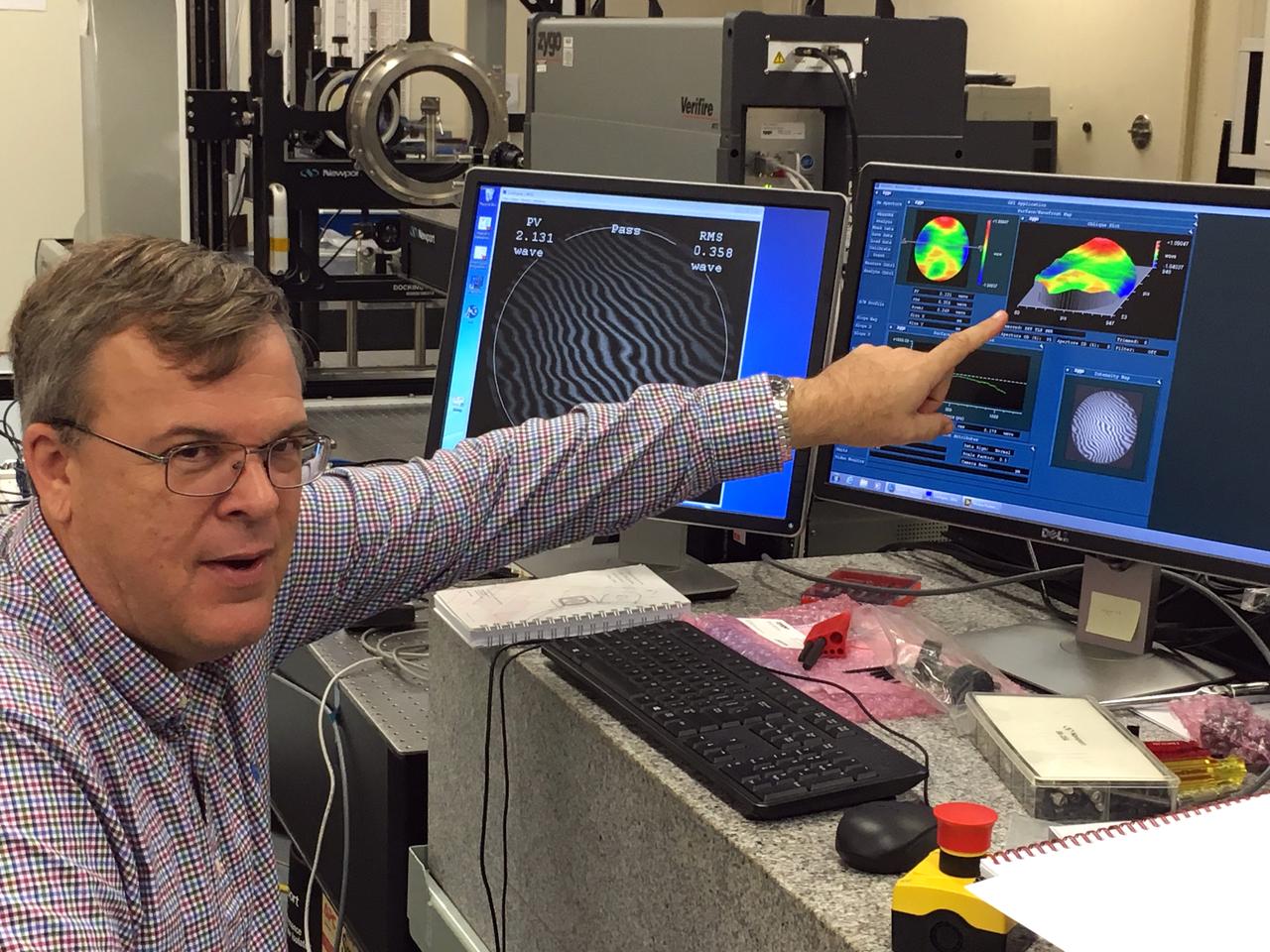
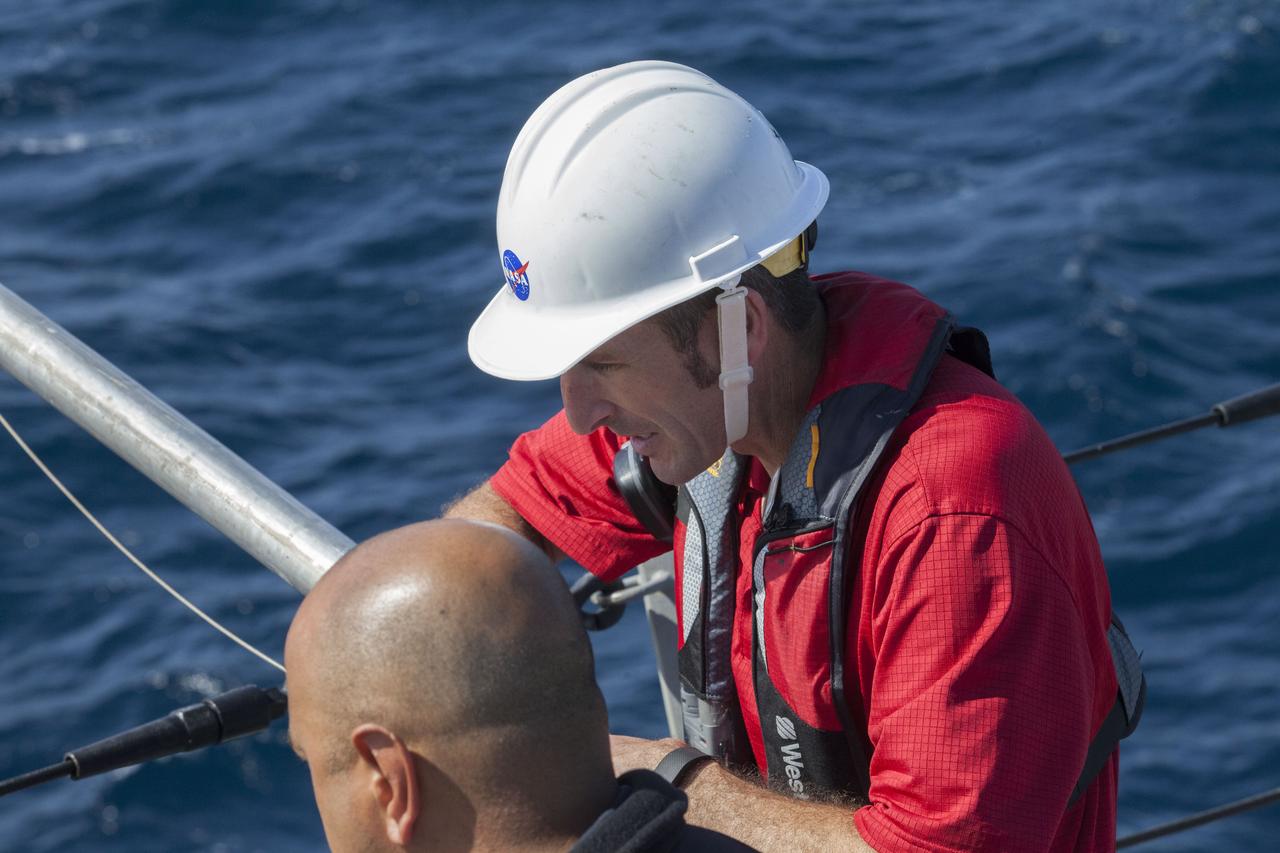
Mark Nurge, Ph.D., a physicist in the Applied Physics Lab with the Exploration Research and Technology Programs at NASA's Kennedy Space Center in Florida, looks at data during the first optical quality test on a full window stack that is ready for installation in the docking hatch of NASA's Orion spacecraft. The data from the tests will help improve the requirements for manufacturing tolerances on Orion's windows and verify how the window should perform in space. Orion is being prepared for its first integrated uncrewed flight atop NASA's Space Launch System rocket on Exploration Mission-1.
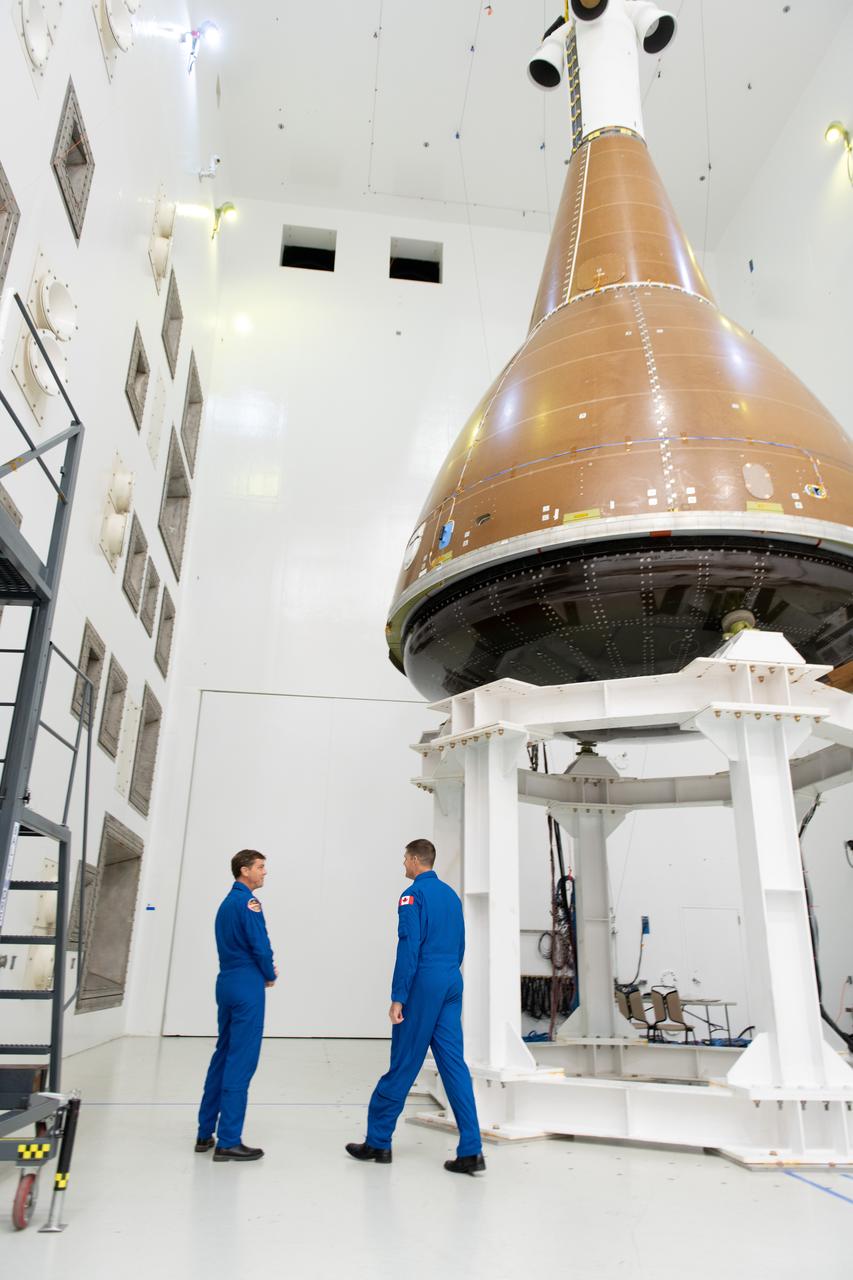
The team at NASA's Armstrong Test Facility in Sandusky, Ohio has begun vibro-acoustic testing on the Orion spacecraft that flew around the Moon on Artemis I, now known as the Environmental Test Article. The testing will help ensure the safety of future crews aboard Orion. Commander Reid Wiseman and Mission Specialist Jeremy Hansen look around during tours of the acoustic lab.
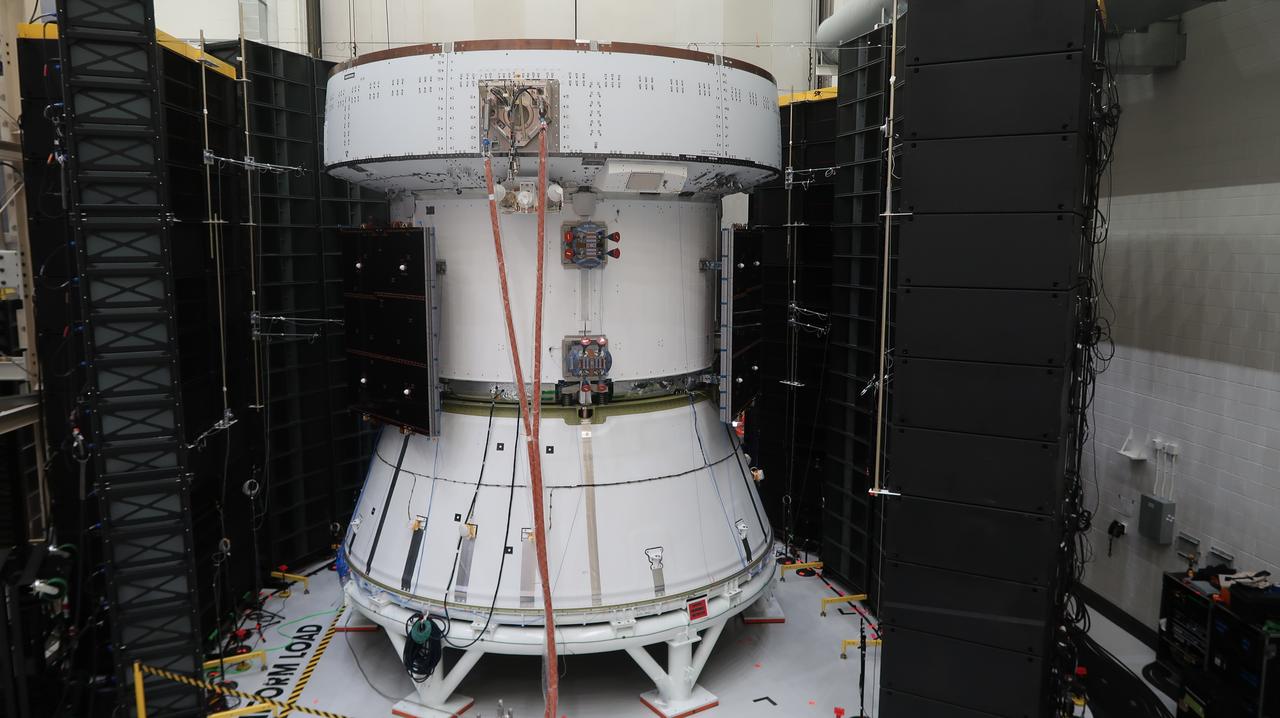
The European Service Module for the Artemis II mission is photographed inside the Neil Armstrong Operations and Checkout Building at NASA's Kennedy Space Center in Florida earlier this month. The Service Module successfully completed a round of acoustic tests to ensure it can withstand the speed and vibration it will experience during launch and throughout the mission. Artemis II will be the first crewed flight test of the Space Launch System rocket and Orion spacecraft. The service module will provide the power necessary to propel Orion on a trip around the Moon, including the in-space maneuvering capability and other commodities necessary to sustain crew for the duration of the mission.
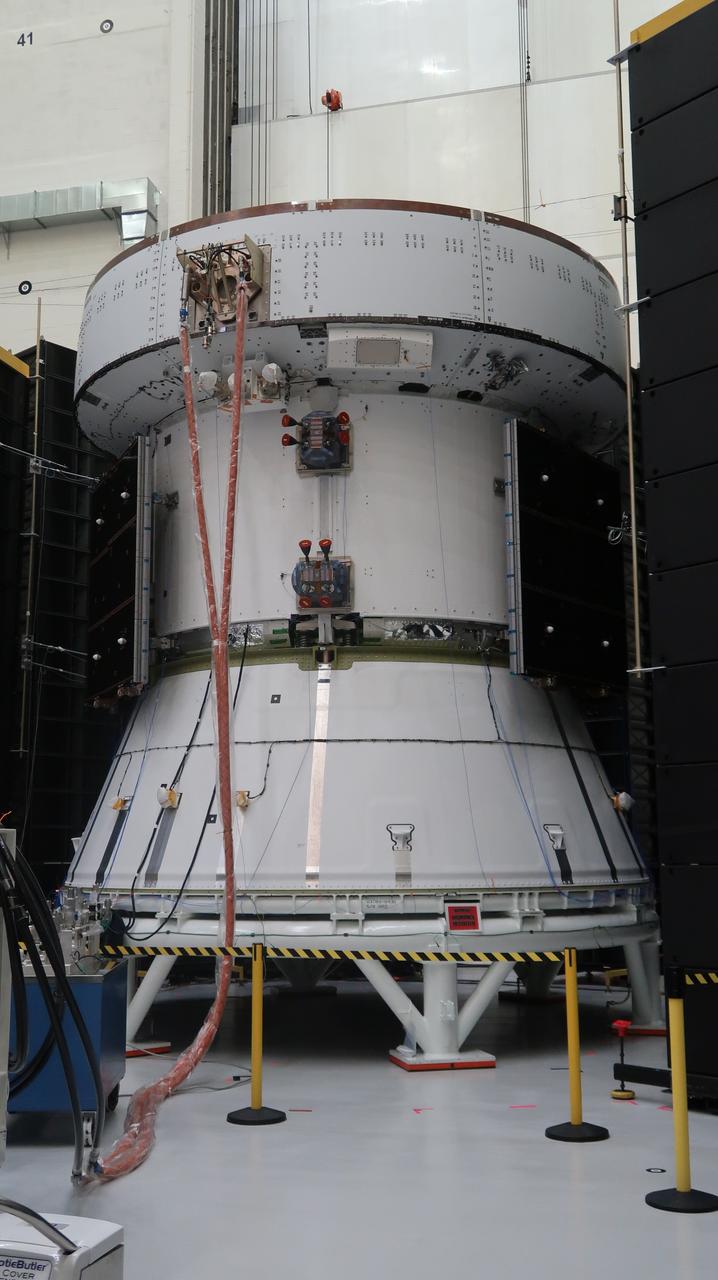
The European Service Module for the Artemis II mission is photographed inside the Neil Armstrong Operations and Checkout Building at NASA's Kennedy Space Center in Florida earlier this month. The Service Module successfully completed a round of acoustic tests to ensure it can withstand the speed and vibration it will experience during launch and throughout the mission. Artemis II will be the first crewed flight test of the Space Launch System rocket and Orion spacecraft. The service module will provide the power necessary to propel Orion on a trip around the Moon, including the in-space maneuvering capability and other commodities necessary to sustain crew for the duration of the mission.
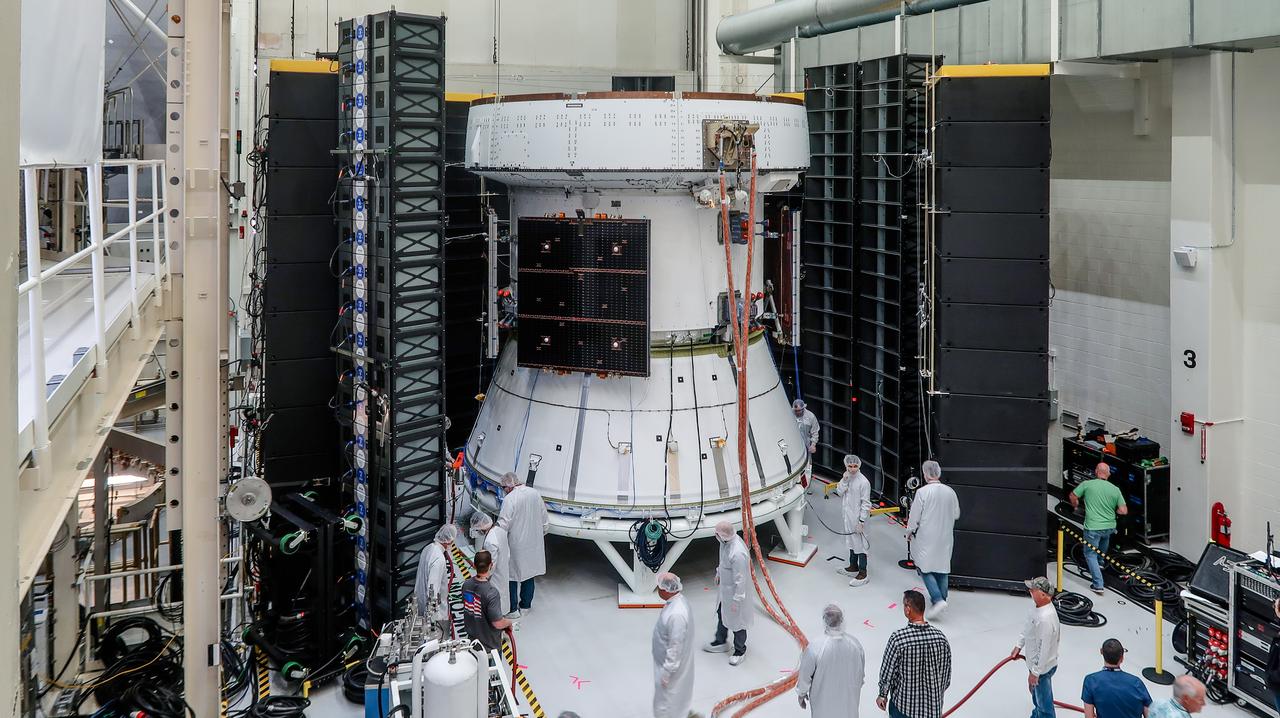
The European Service Module for the Artemis II mission is photographed inside the Neil Armstrong Operations and Checkout Building at NASA's Kennedy Space Center in Florida earlier this month. The Service Module successfully completed a round of acoustic tests to ensure it can withstand the speed and vibration it will experience during launch and throughout the mission. Artemis II will be the first crewed flight test of the Space Launch System rocket and Orion spacecraft. The service module will provide the power necessary to propel Orion on a trip around the Moon, including the in-space maneuvering capability and other commodities necessary to sustain crew for the duration of the mission.
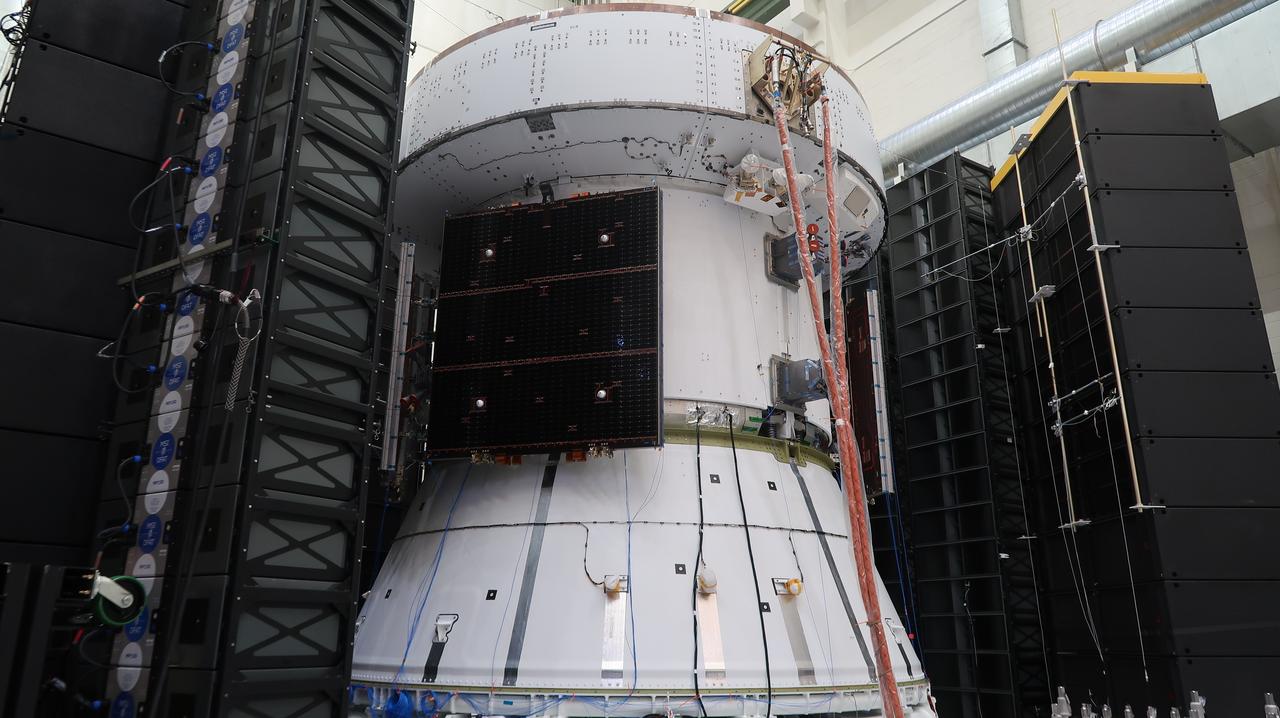
The European Service Module for the Artemis II mission is photographed inside the Neil Armstrong Operations and Checkout Building at NASA's Kennedy Space Center in Florida earlier this month. The Service Module successfully completed a round of acoustic tests to ensure it can withstand the speed and vibration it will experience during launch and throughout the mission. Artemis II will be the first crewed flight test of the Space Launch System rocket and Orion spacecraft. The service module will provide the power necessary to propel Orion on a trip around the Moon, including the in-space maneuvering capability and other commodities necessary to sustain crew for the duration of the mission.
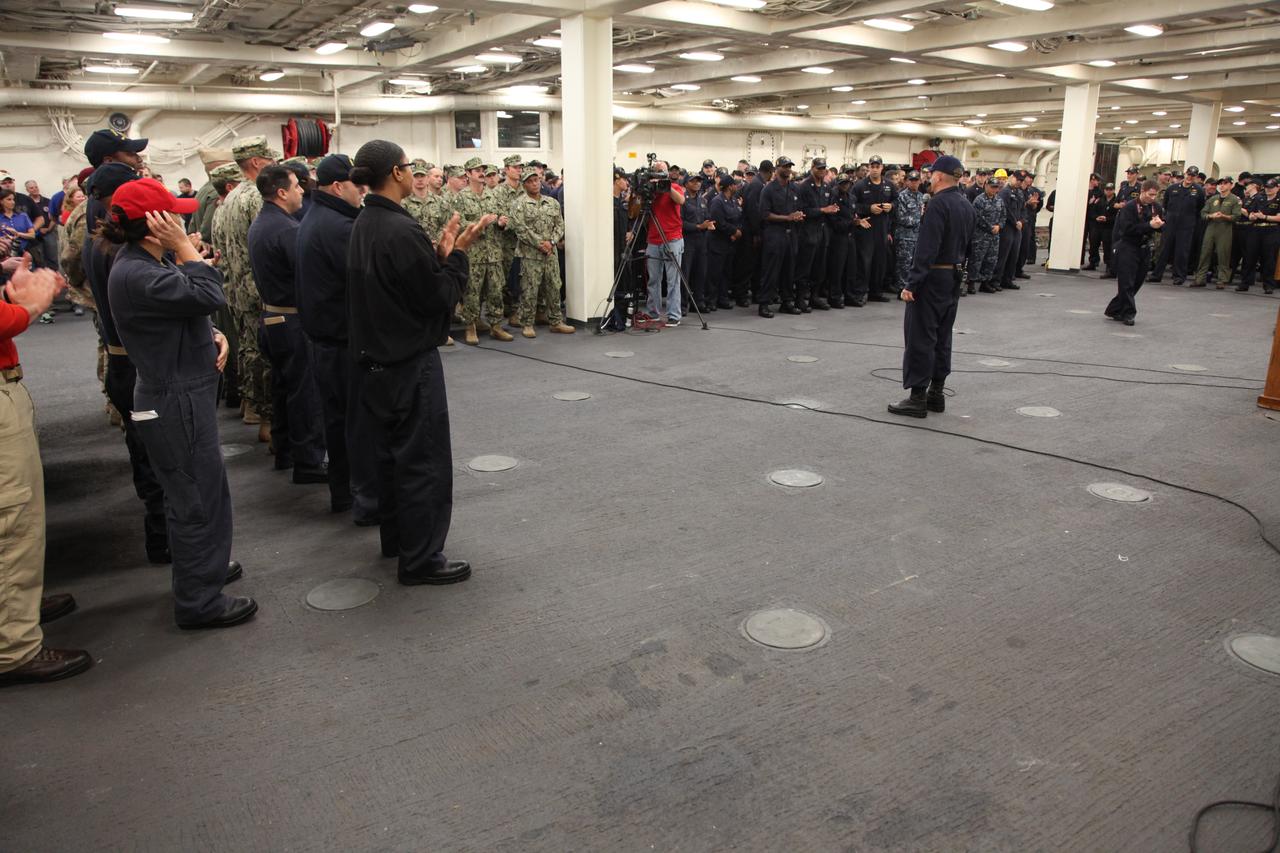
Orion Underway Recovery Test 5 team members gather in the USS San Diego during wrap up of the series of tests. NASA's Ground Systems Development and Operations Program and the U.S. Navy practiced recovery techniques in the Pacific Ocean off the coast of California over several days, using the well deck of the ship and a test version of the Orion crew module to prepare for recovery of Orion on its return from deep space missions. The testing allowed the team to demonstrate and evaluate recovery processes, procedures, hardware and personnel in open waters. Orion is the exploration spacecraft designed to carry astronauts to destinations not yet explored by humans, including an asteroid and NASA's Journey to Mars. It will have emergency abort capability, sustain the crew during space travel and provide safe re-entry from deep space return velocities. Orion is scheduled to launch on NASA's Space Launch System in late 2018. For more information, visit http://www.nasa.gov/orion.
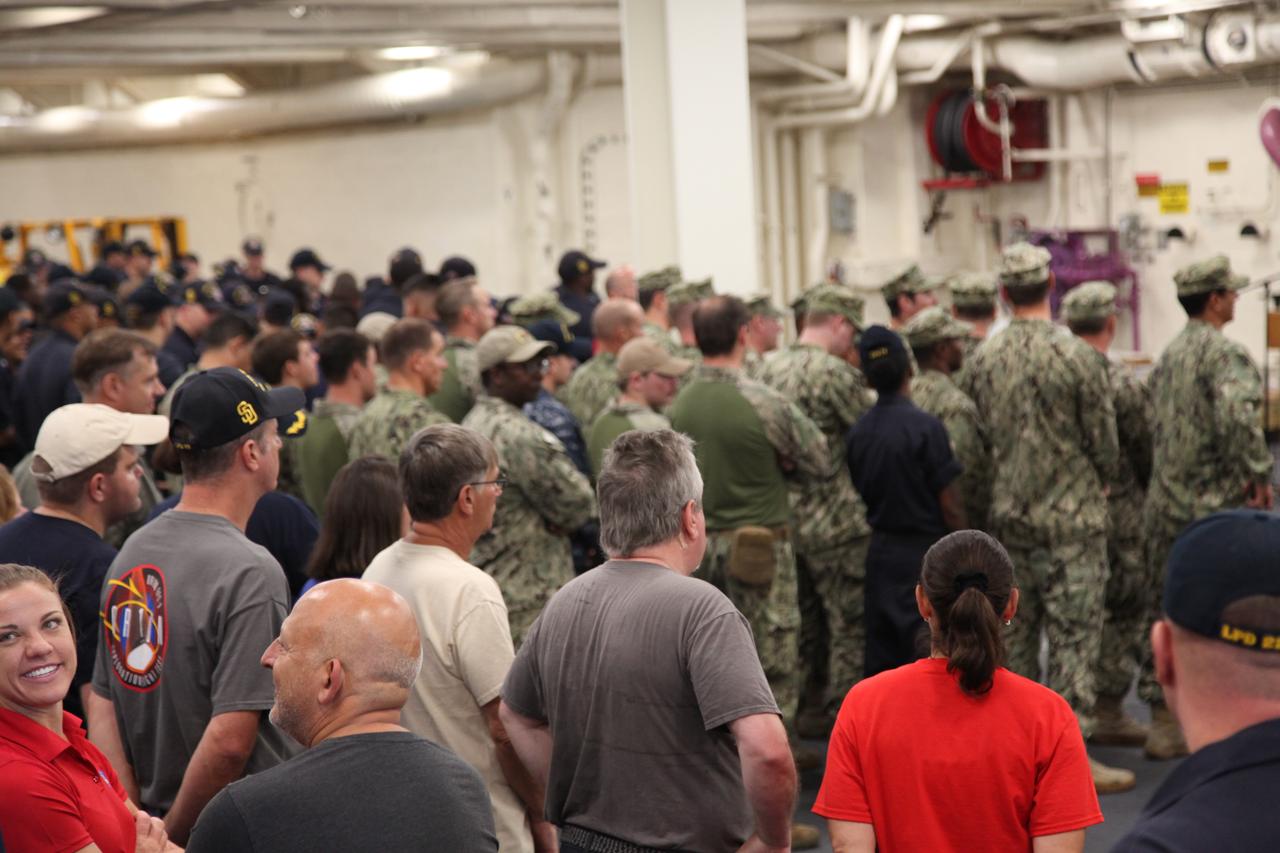
Orion Underway Recovery Test 5 team members gather in the USS San Diego at the end of a series of tests. NASA's Ground Systems Development and Operations Program and the U.S. Navy practiced recovery techniques in the Pacific Ocean off the coast of California over several days, using the well deck of the ship and a test version of the Orion crew module to prepare for recovery of Orion on its return from deep space missions. The testing allowed the team to demonstrate and evaluate recovery processes, procedures, hardware and personnel in open waters. Orion is the exploration spacecraft designed to carry astronauts to destinations not yet explored by humans, including an asteroid and NASA's Journey to Mars. It will have emergency abort capability, sustain the crew during space travel and provide safe re-entry from deep space return velocities. Orion is scheduled to launch on NASA's Space Launch System in late 2018. For more information, visit http://www.nasa.gov/orion.
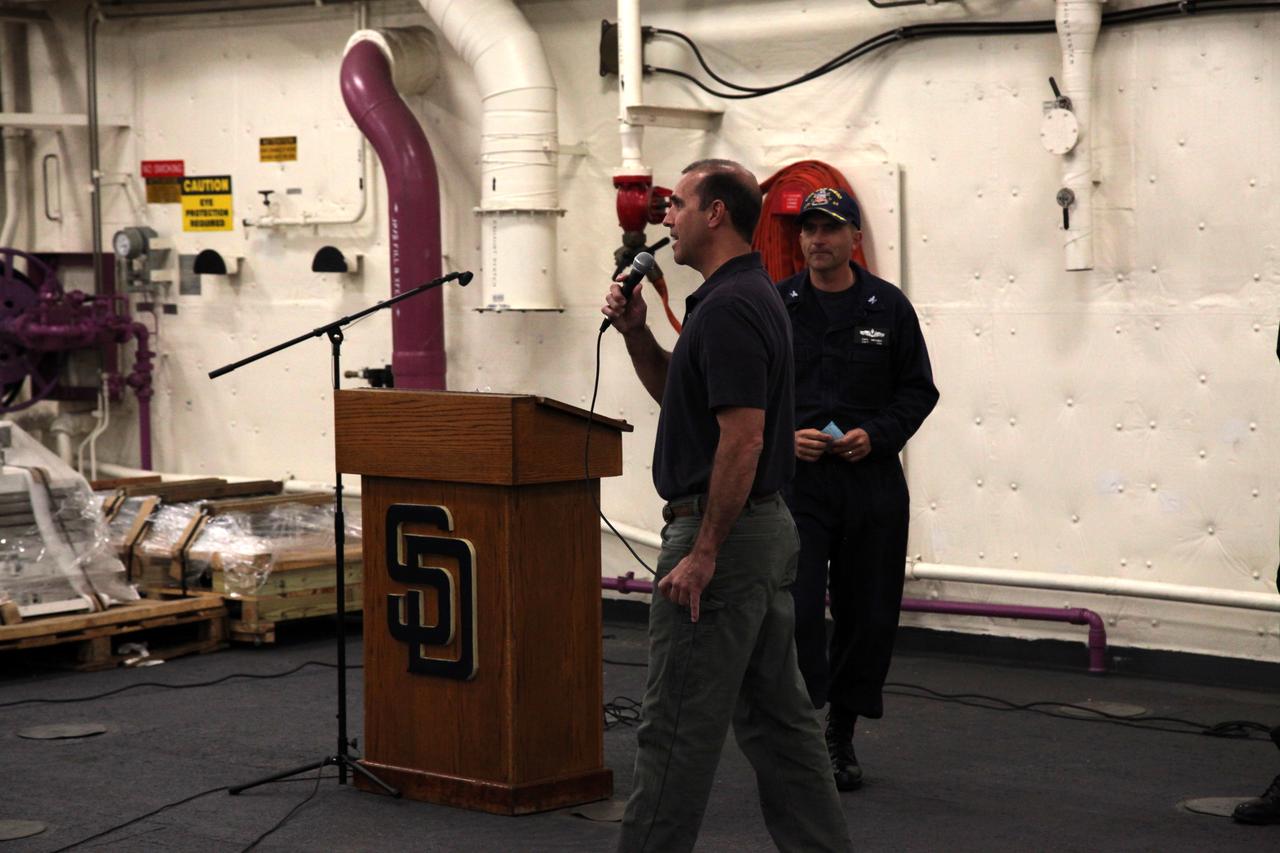
Orion Underway Recovery Test 5 team members gather in the USS San Diego during wrap up of the series of tests. NASA's Ground Systems Development and Operations Program and the U.S. Navy practiced recovery techniques in the Pacific Ocean off the coast of California over several days, using the well deck of the ship and a test version of the Orion crew module to prepare for recovery of Orion on its return from deep space missions. The testing allowed the team to demonstrate and evaluate recovery processes, procedures, hardware and personnel in open waters. Orion is the exploration spacecraft designed to carry astronauts to destinations not yet explored by humans, including an asteroid and NASA's Journey to Mars. It will have emergency abort capability, sustain the crew during space travel and provide safe re-entry from deep space return velocities. Orion is scheduled to launch on NASA's Space Launch System in late 2018. For more information, visit http://www.nasa.gov/orion.
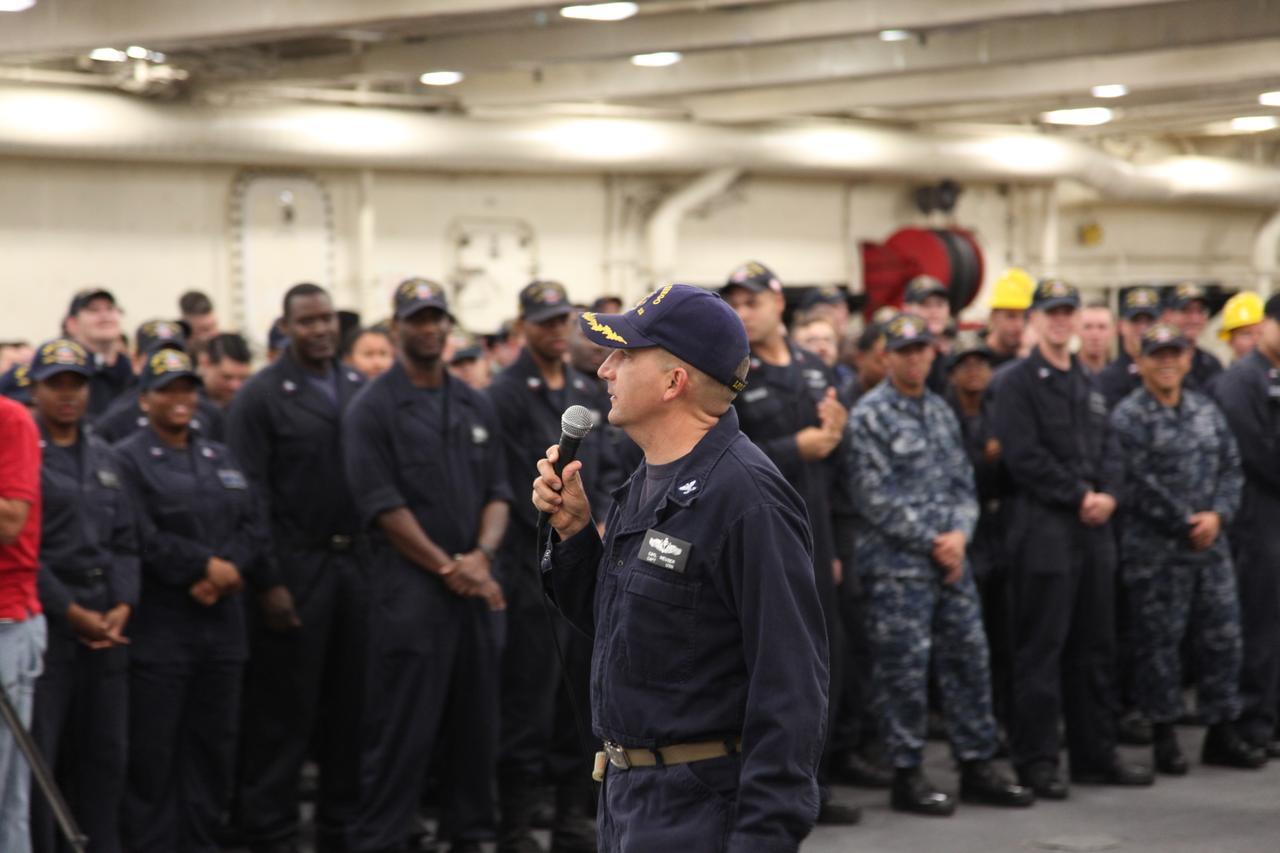
Orion Underway Recovery Test 5 team members gather in the USS San Diego during wrap up of the series of tests. NASA's Ground Systems Development and Operations Program and the U.S. Navy practiced recovery techniques in the Pacific Ocean off the coast of California over several days, using the well deck of the ship and a test version of the Orion crew module to prepare for recovery of Orion on its return from deep space missions. The testing allowed the team to demonstrate and evaluate recovery processes, procedures, hardware and personnel in open waters. Orion is the exploration spacecraft designed to carry astronauts to destinations not yet explored by humans, including an asteroid and NASA's Journey to Mars. It will have emergency abort capability, sustain the crew during space travel and provide safe re-entry from deep space return velocities. Orion is scheduled to launch on NASA's Space Launch System in late 2018. For more information, visit http://www.nasa.gov/orion.
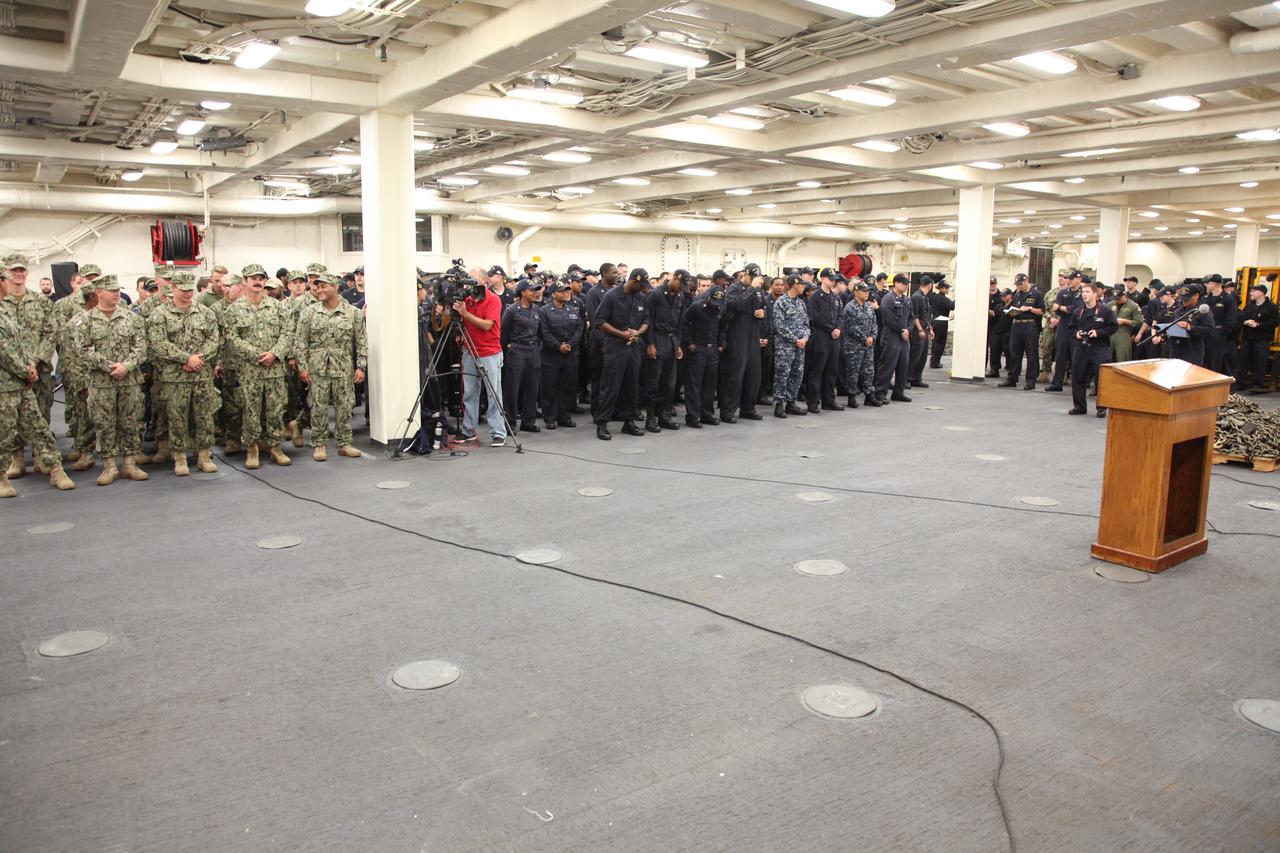
Orion Underway Recovery Test 5 team members gather in the USS San Diego at the end of a series of tests. NASA's Ground Systems Development and Operations Program and the U.S. Navy practiced recovery techniques in the Pacific Ocean off the coast of California over several days, using the well deck of the ship and a test version of the Orion crew module to prepare for recovery of Orion on its return from deep space missions. The testing allowed the team to demonstrate and evaluate recovery processes, procedures, hardware and personnel in open waters. Orion is the exploration spacecraft designed to carry astronauts to destinations not yet explored by humans, including an asteroid and NASA's Journey to Mars. It will have emergency abort capability, sustain the crew during space travel and provide safe re-entry from deep space return velocities. Orion is scheduled to launch on NASA's Space Launch System in late 2018. For more information, visit http://www.nasa.gov/orion.
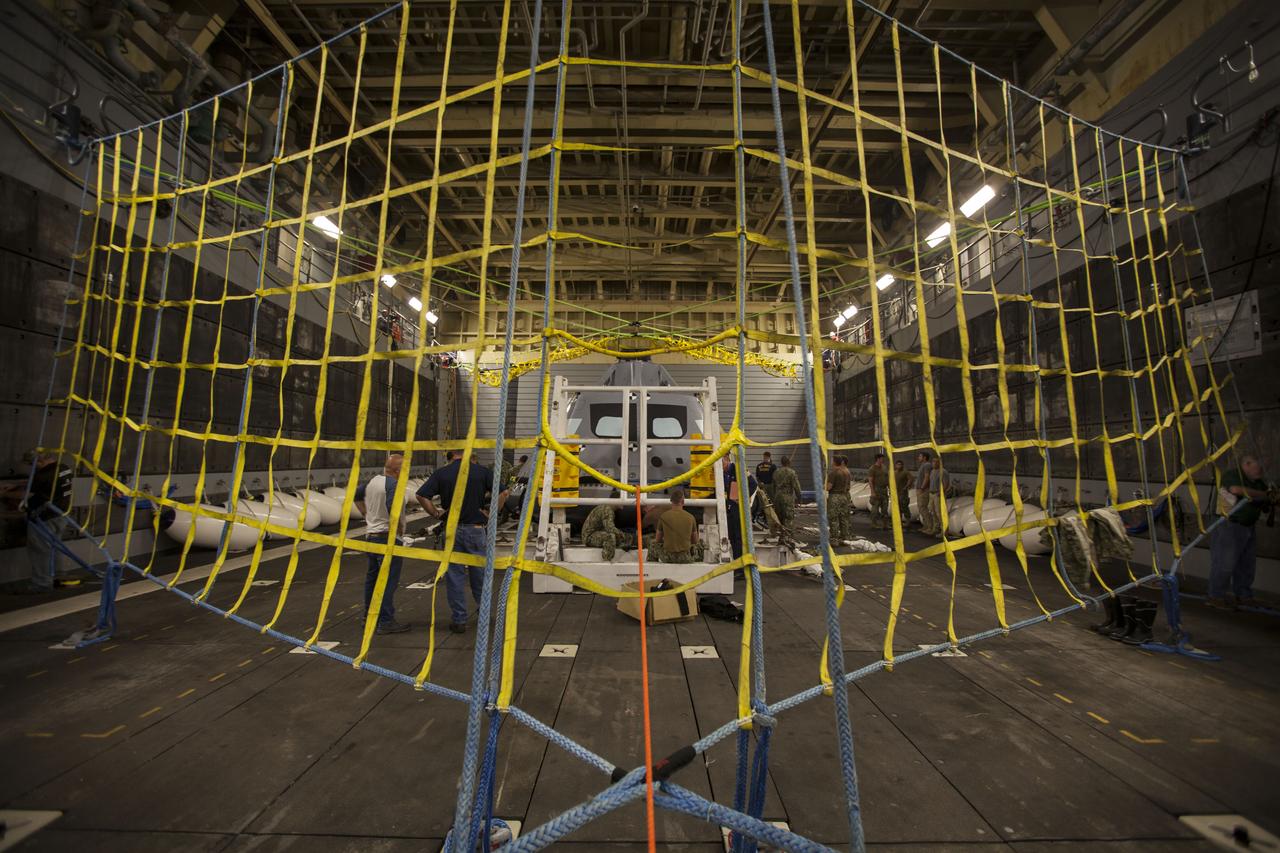
A test version of the Orion crew module is secured in the well deck of the USS San Diego for Underway Recovery Test 5. NASA's Ground Systems Development and Operations Program and the U.S. Navy will conduct a series of tests using the ship's well deck, the test module, various watercraft and equipment to prepare for recovery of Orion on its return from deep space missions. The test will allow the team to demonstrate and evaluate recovery processes, procedures, hardware and personnel in open waters. Orion is the exploration spacecraft designed to carry astronauts to destinations not yet explored by humans, including an asteroid and NASA's Journey to Mars. It will have emergency abort capability, sustain the crew during space travel and provide safe re-entry from deep space return velocities. Orion is scheduled to launch on NASA's Space Launch System in late 2018. For more information, visit http://www.nasa.gov/orion.
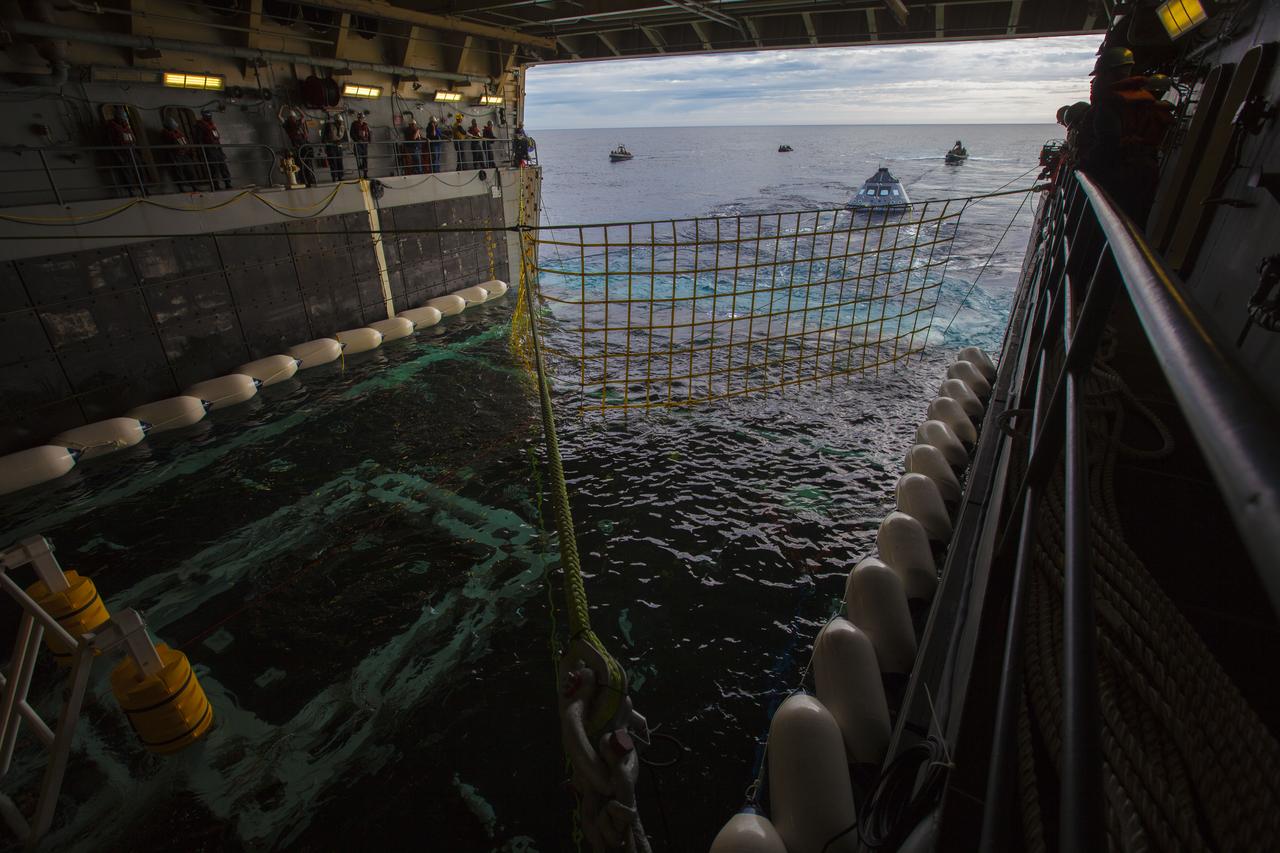
A test version of the Orion crew module is guided toward the flooded well deck of the USS San Diego during Underway Recovery Test 5. NASA's Ground Systems Development and Operations Program and the U.S. Navy are conducting a series of tests using the ship's well deck, the test module, various watercraft and equipment to prepare for recovery of Orion on its return from deep space missions. The test will allow the team to demonstrate and evaluate recovery processes, procedures, hardware and personnel in open waters. Orion is the exploration spacecraft designed to carry astronauts to destinations not yet explored by humans, including an asteroid and NASA's Journey to Mars. It will have emergency abort capability, sustain the crew during space travel and provide safe re-entry from deep space return velocities. Orion is scheduled to launch on NASA's Space Launch System in late 2018. For more information, visit http://www.nasa.gov/orion.
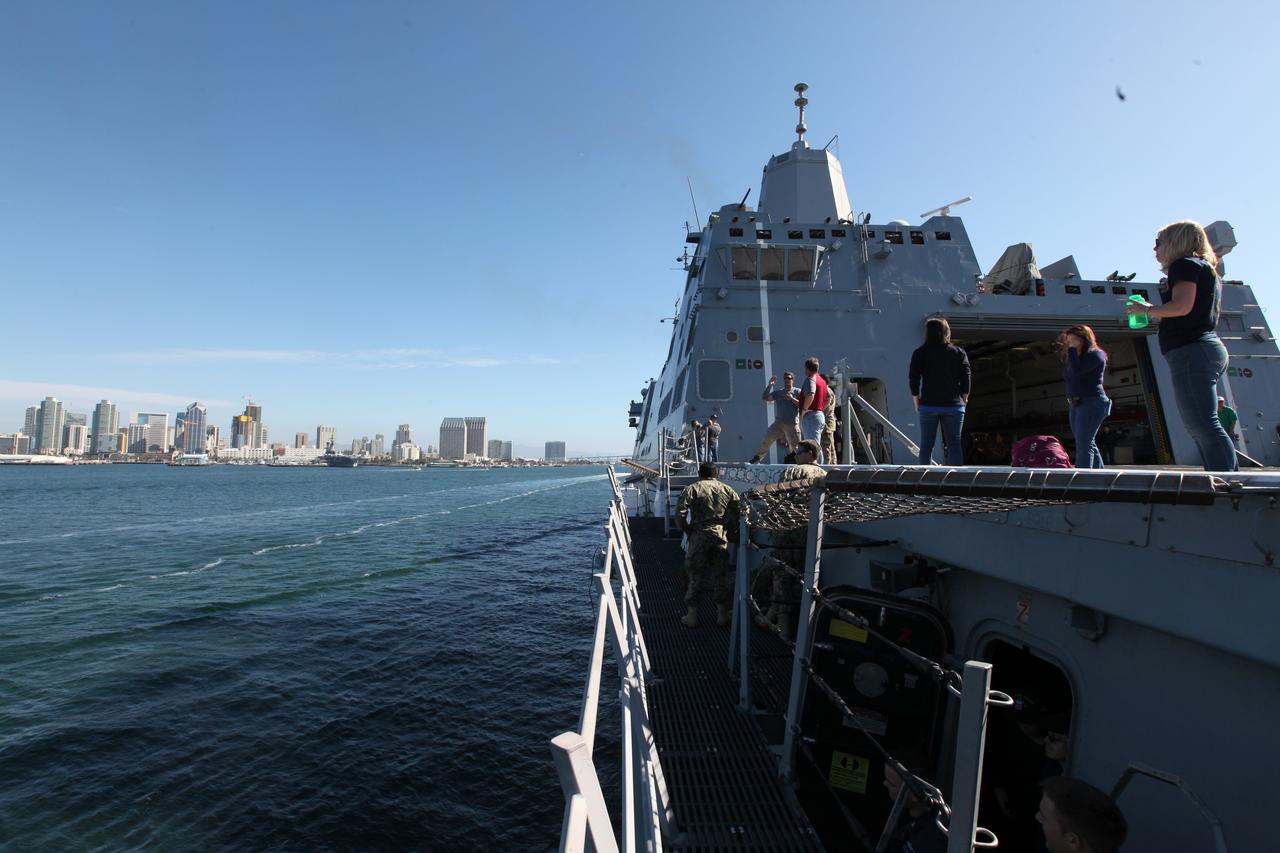
The USS San Diego approaches the coast of San Diego, California after completion of Underway Recovery Test 5 in the Pacific Ocean. NASA's Ground Systems Development and Operations Program and the U.S. Navy conducted a series of tests, called Underway Recovery Test 5, using the ship's well deck and a test version of the Orion crew module to prepare for recovery of Orion on its return from deep space missions. The testing allowed the team to demonstrate and evaluate recovery processes, procedures, hardware and personnel in open waters. Orion is the exploration spacecraft designed to carry astronauts to destinations not yet explored by humans, including an asteroid and NASA's Journey to Mars. It will have emergency abort capability, sustain the crew during space travel and provide safe re-entry from deep space return velocities. Orion is scheduled to launch on NASA's Space Launch System in late 2018. For more information, visit http://www.nasa.gov/orion.
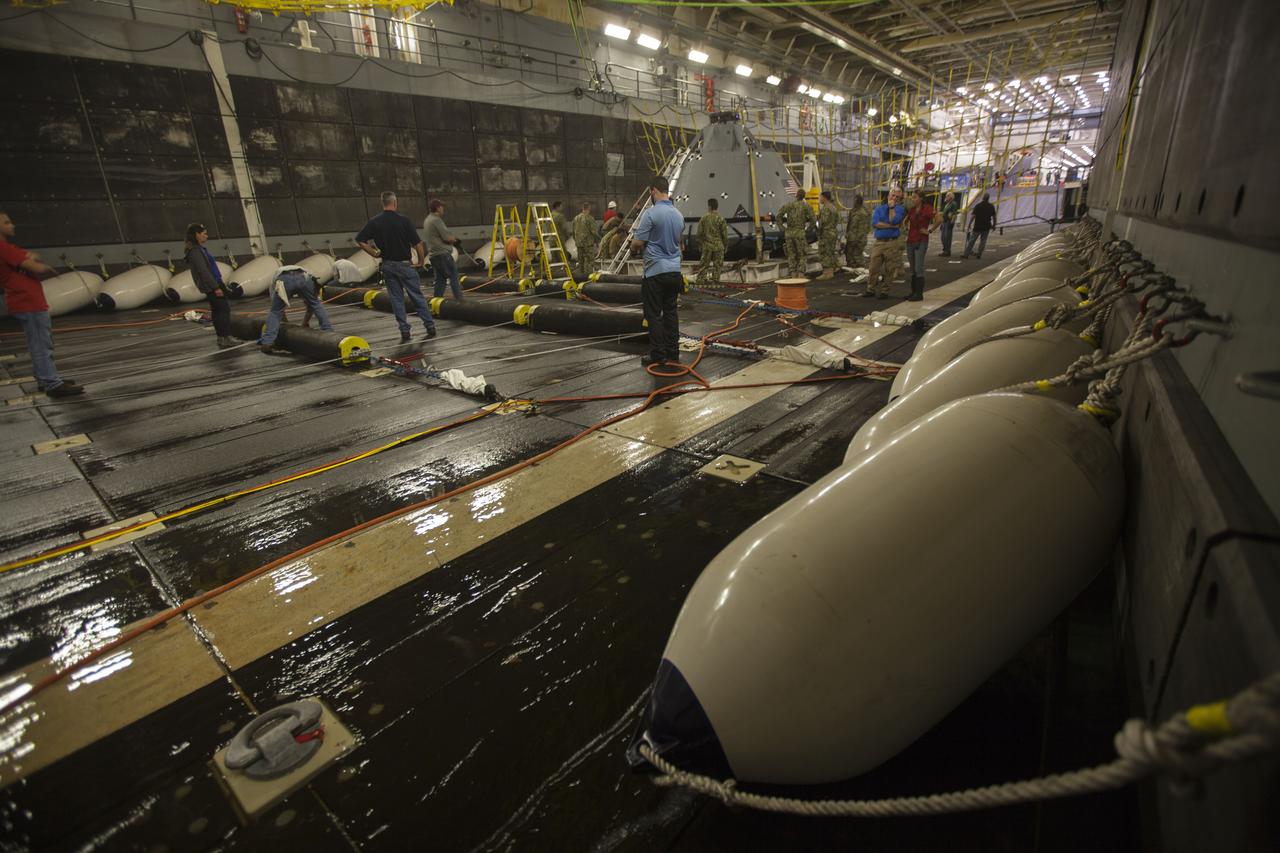
A test version of the Orion crew module is secured in the well deck of the USS San Diego and recovery team members are preparing for Underway Recovery Test 5 in the Pacific Ocean off the coast of California. NASA's Ground Systems Development and Operations Program and the U.S. Navy will conduct a series of tests using the ship's well deck, the test module, various watercraft and equipment to prepare for recovery of Orion on its return from deep space missions. The test will allow the team to demonstrate and evaluate recovery processes, procedures, hardware and personnel in open waters. Orion is the exploration spacecraft designed to carry astronauts to destinations not yet explored by humans, including an asteroid and NASA's Journey to Mars. It will have emergency abort capability, sustain the crew during space travel and provide safe re-entry from deep space return velocities. Orion is scheduled to launch on NASA's Space Launch System in late 2018. For more information, visit http://www.nasa.gov/orion.
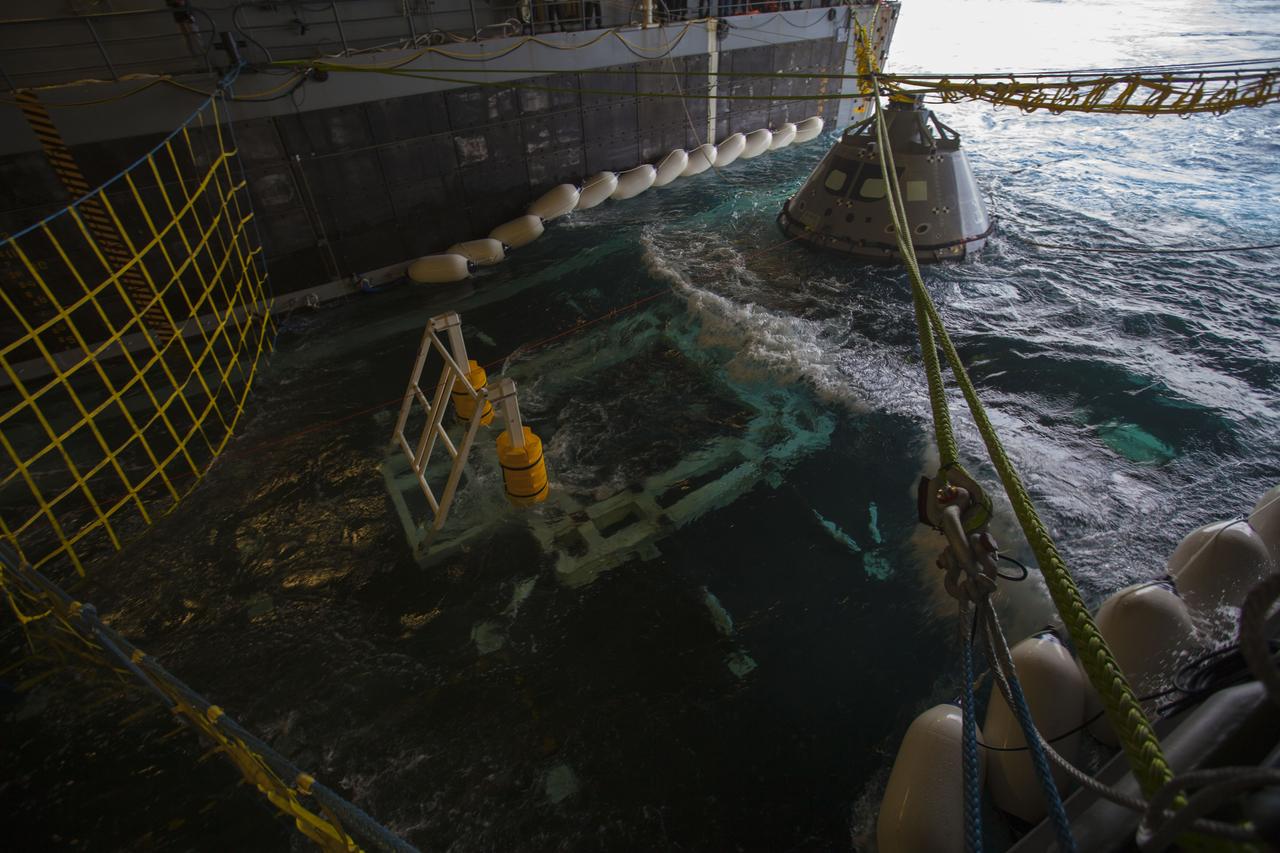
A test version of the Orion crew module is guided into the flooded well deck of the USS San Diego for Underway Recovery Test 5. NASA's Ground Systems Development and Operations Program and the U.S. Navy will conduct a series of tests using the ship's well deck, the test module, various watercraft and equipment to prepare for recovery of Orion on its return from deep space missions. The test will allow the team to demonstrate and evaluate recovery processes, procedures, hardware and personnel in open waters. Orion is the exploration spacecraft designed to carry astronauts to destinations not yet explored by humans, including an asteroid and NASA's Journey to Mars. It will have emergency abort capability, sustain the crew during space travel and provide safe re-entry from deep space return velocities. Orion is scheduled to launch on NASA's Space Launch System in late 2018. For more information, visit http://www.nasa.gov/orion.
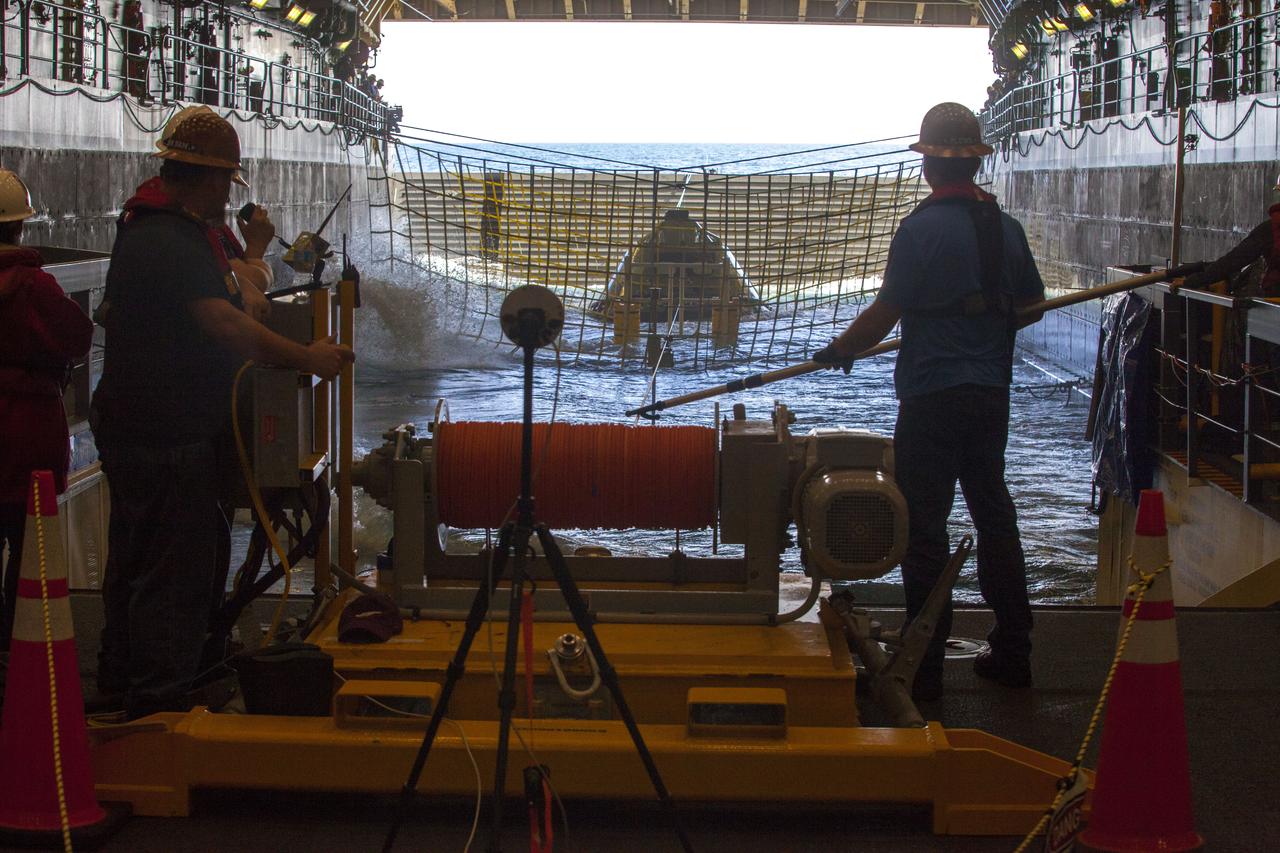
Winch team operators help guide a test version of the Orion crew module into the flooded well deck of the USS San Diego during Underway Recovery Test 5 in the Pacific Ocean off the coast of California. NASA's Ground Systems Development and Operations Program and the U.S. Navy are conducting a series of tests to prepare for recovery of Orion on its return from deep space missions. The testing will allow the team to demonstrate and evaluate recovery processes, procedures, hardware and personnel in open waters. Orion is the exploration spacecraft designed to carry astronauts to destinations not yet explored by humans, including an asteroid and NASA's Journey to Mars. It will have emergency abort capability, sustain the crew during space travel and provide safe re-entry from deep space return velocities. Orion is scheduled to launch on NASA's Space Launch System in late 2018. For more information, visit http://www.nasa.gov/orion.
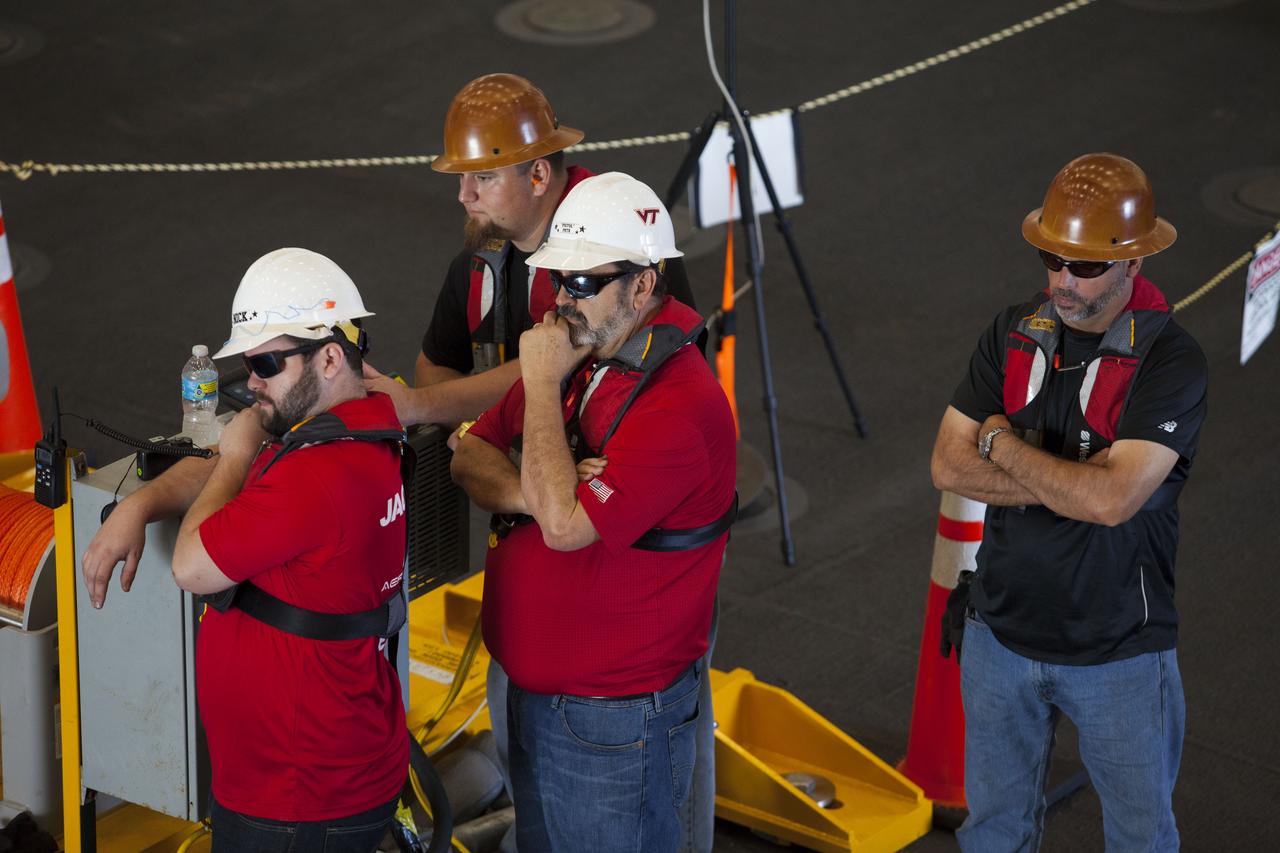
Members of the recovery team watch as a test version of the Orion crew module is secured in the flooded well deck of the USS San Diego during Underway Recovery Test 5 in the Pacific Ocean off the coast of California. NASA's Ground Systems Development and Operations Program and the U.S. Navy are conducting a series of tests to prepare for recovery of Orion on its return from deep space missions. The testing will allow the team to demonstrate and evaluate recovery processes, procedures, hardware and personnel in open waters. Orion is the exploration spacecraft designed to carry astronauts to destinations not yet explored by humans, including an asteroid and NASA's Journey to Mars. It will have emergency abort capability, sustain the crew during space travel and provide safe re-entry from deep space return velocities. Orion is scheduled to launch on NASA's Space Launch System in late 2018. For more information, visit http://www.nasa.gov/orion.

Members of the recovery team secure ropes and tether lines in the well deck of the USS San Diego during Underway Recovery Test 5 in the Pacific Ocean off the coast of California. Using a test version of the Orion crew module, NASA's Ground Systems Development and Operations Program and the U.S. Navy are conducting a series of tests to prepare for recovery of Orion on its return from deep space missions. The testing will allow the team to demonstrate and evaluate recovery processes, procedures, hardware and personnel in open waters. Orion is the exploration spacecraft designed to carry astronauts to destinations not yet explored by humans, including an asteroid and NASA's Journey to Mars. It will have emergency abort capability, sustain the crew during space travel and provide safe re-entry from deep space return velocities. Orion is scheduled to launch on NASA's Space Launch System in late 2018. For more information, visit http://www.nasa.gov/orion.
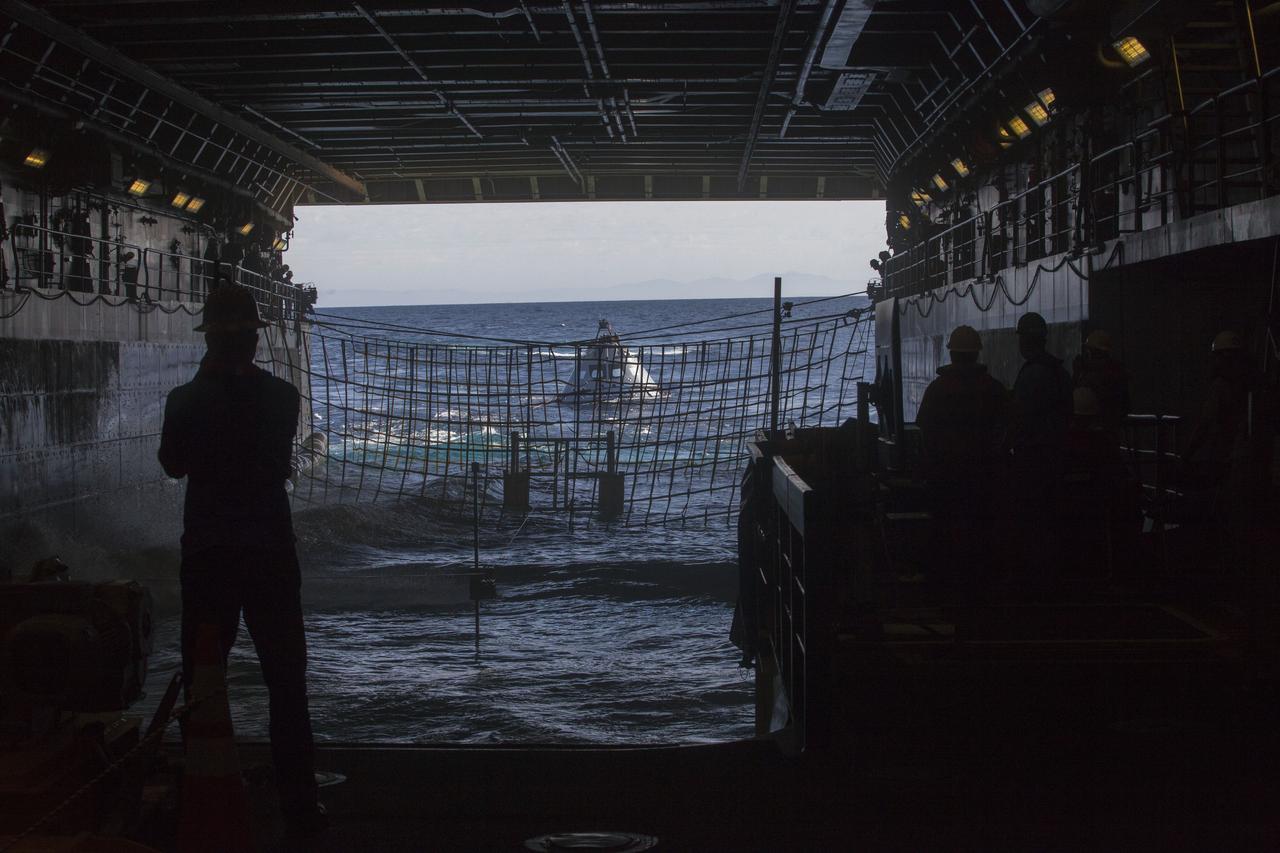
A test version of the Orion crew module floats outside the well deck of the USS San Diego during Underway Recovery Test 5 in the Pacific Ocean off the coast of California. NASA's Ground Systems Development and Operations Program and the U.S. Navy are conducting a series of tests using the ship's well deck, several watercraft, support equipment and personnel to prepare for recovery of Orion on its return from deep space missions. The testing will allow the team to demonstrate and evaluate recovery processes, procedures, hardware and personnel in open waters. Orion is the exploration spacecraft designed to carry astronauts to destinations not yet explored by humans, including an asteroid and NASA's Journey to Mars. It will have emergency abort capability, sustain the crew during space travel and provide safe re-entry from deep space return velocities. Orion is scheduled to launch on NASA's Space Launch System in late 2018. For more information, visit http://www.nasa.gov/orion.
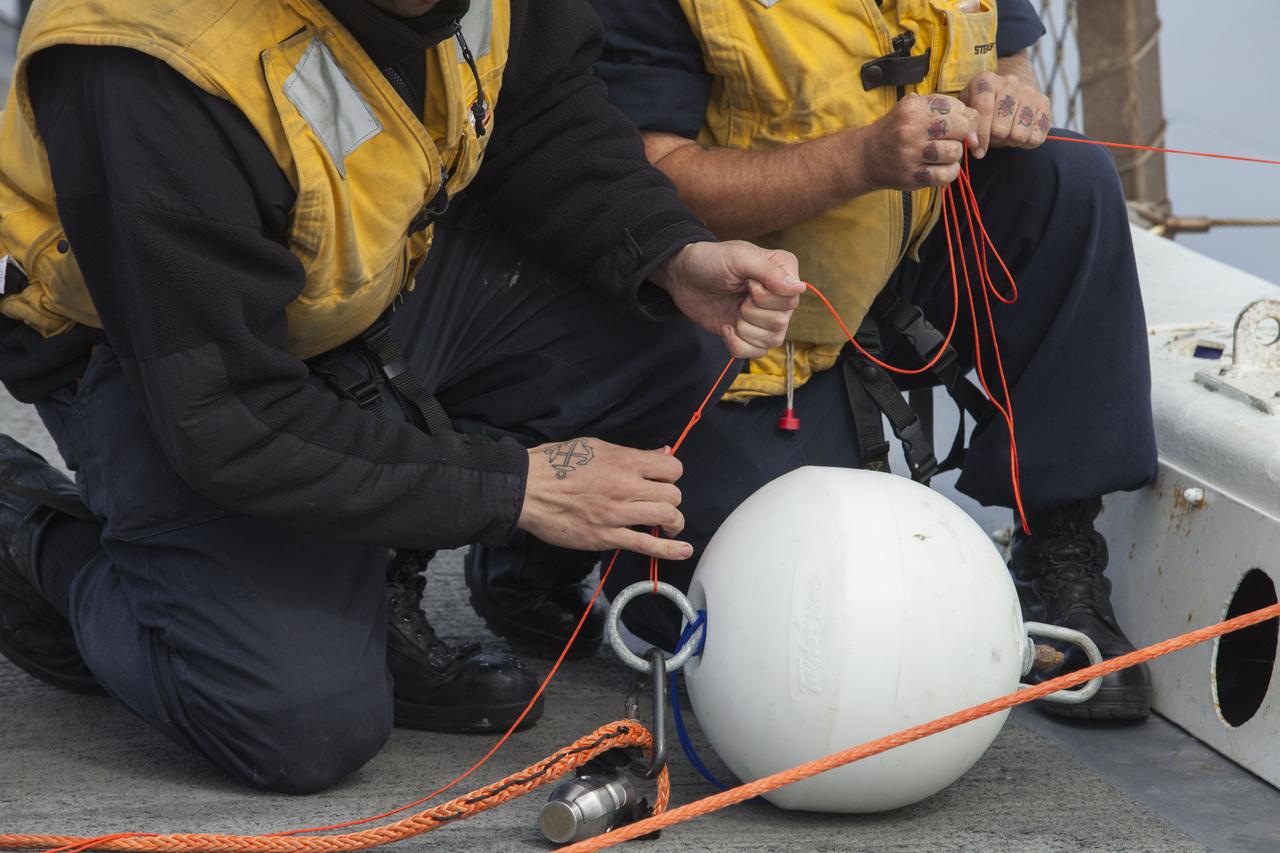
U.S. Navy personnel check tether and winch lines on the deck of the USS San Diego to prepare for Underway Recovery Test 5 in the Pacific Ocean off the coast of California. NASA's Ground Systems Development and Operations Program and the U.S. Navy are conducting a series of tests using the ship's well deck, a test version of the Orion crew module, various watercraft and equipment to prepare for recovery of Orion on its return from deep space missions. The testing will allow the team to demonstrate and evaluate recovery processes, procedures, hardware and personnel in open waters. Orion is the exploration spacecraft designed to carry astronauts to destinations not yet explored by humans, including an asteroid and NASA's Journey to Mars. It will have emergency abort capability, sustain the crew during space travel and provide safe re-entry from deep space return velocities. Orion is scheduled to launch on NASA's Space Launch System in late 2018. For more information, visit http://www.nasa.gov/orion.
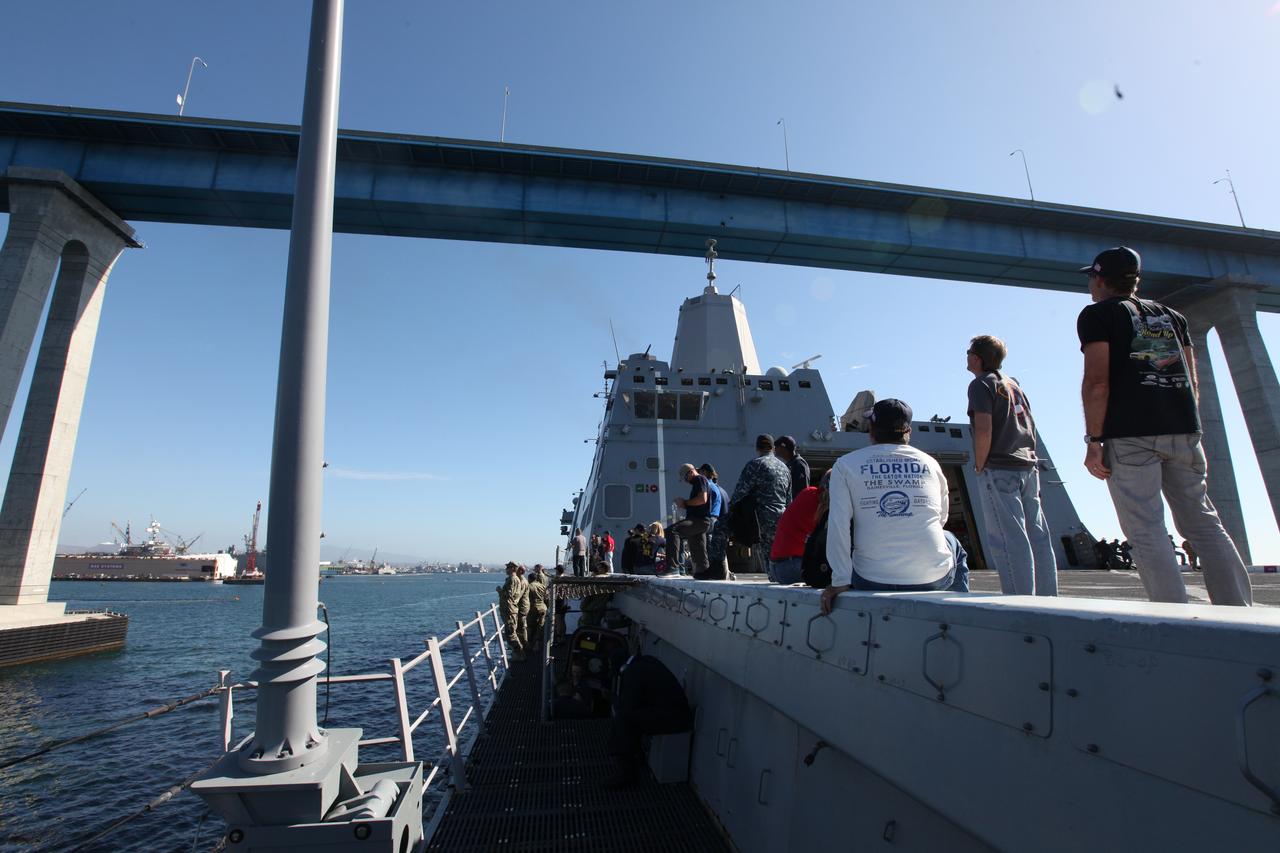
The USS San Diego approaches Naval Base San Diego in California after completion of Underway Recovery Test 5 in the Pacific Ocean. NASA's Ground Systems Development and Operations Program and the U.S. Navy conducted a series of tests using the ship's well deck and a test version of the Orion crew module to prepare for recovery of Orion on its return from deep space missions. The testing allowed the team to demonstrate and evaluate recovery processes, procedures, hardware and personnel in open waters. Orion is the exploration spacecraft designed to carry astronauts to destinations not yet explored by humans, including an asteroid and NASA's Journey to Mars. It will have emergency abort capability, sustain the crew during space travel and provide safe re-entry from deep space return velocities. Orion is scheduled to launch on NASA's Space Launch System in late 2018. For more information, visit http://www.nasa.gov/orion.
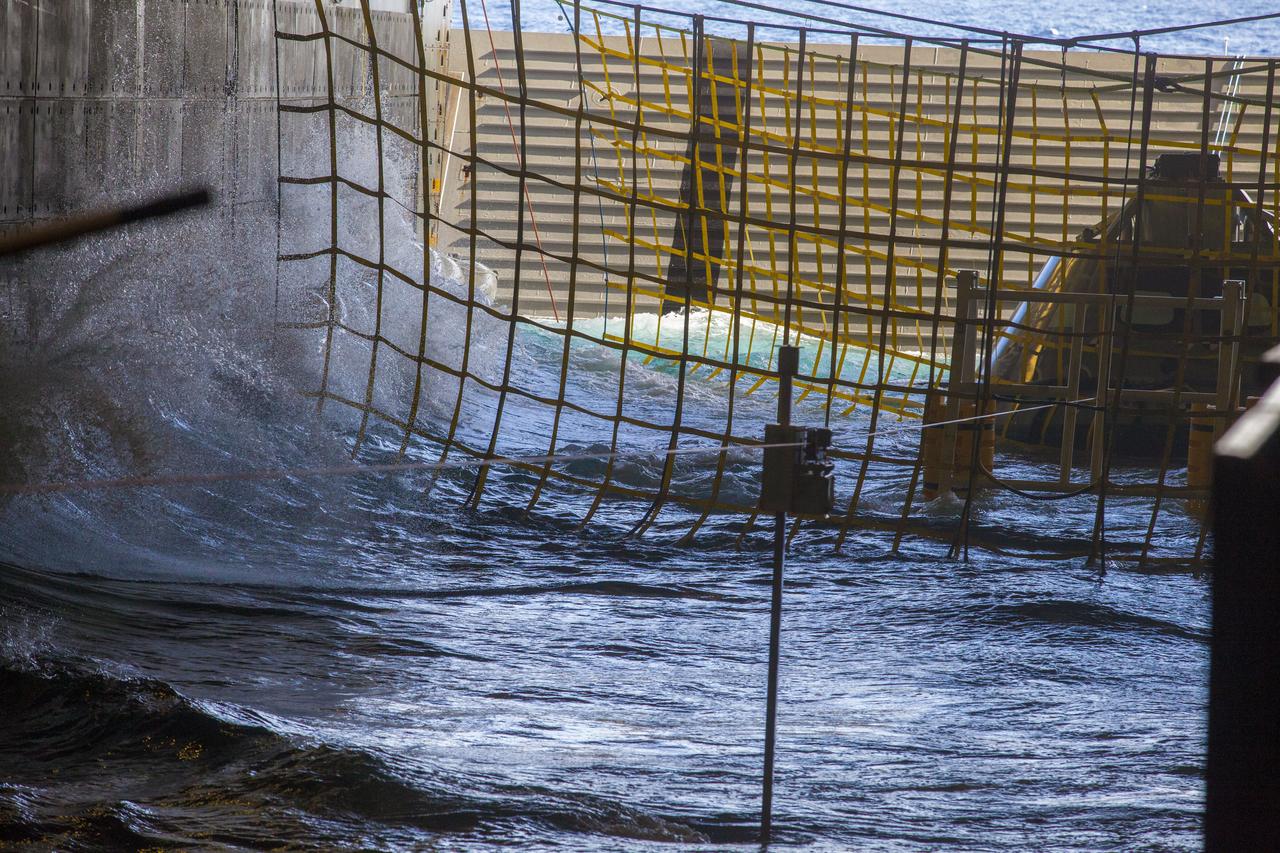
A test version of the Orion crew module, in view at far right, is in the flooded well deck of the USS San Diego during Underway Recovery Test 5 in the Pacific Ocean off the coast of California. NASA's Ground Systems Development and Operations Program and the U.S. Navy are conducting a series of tests to prepare for recovery of Orion on its return from deep space missions. The testing will allow the team to demonstrate and evaluate recovery processes, procedures, hardware and personnel in open waters. Orion is the exploration spacecraft designed to carry astronauts to destinations not yet explored by humans, including an asteroid and NASA's Journey to Mars. It will have emergency abort capability, sustain the crew during space travel and provide safe re-entry from deep space return velocities. Orion is scheduled to launch on NASA's Space Launch System in late 2018. For more information, visit http://www.nasa.gov/orion.
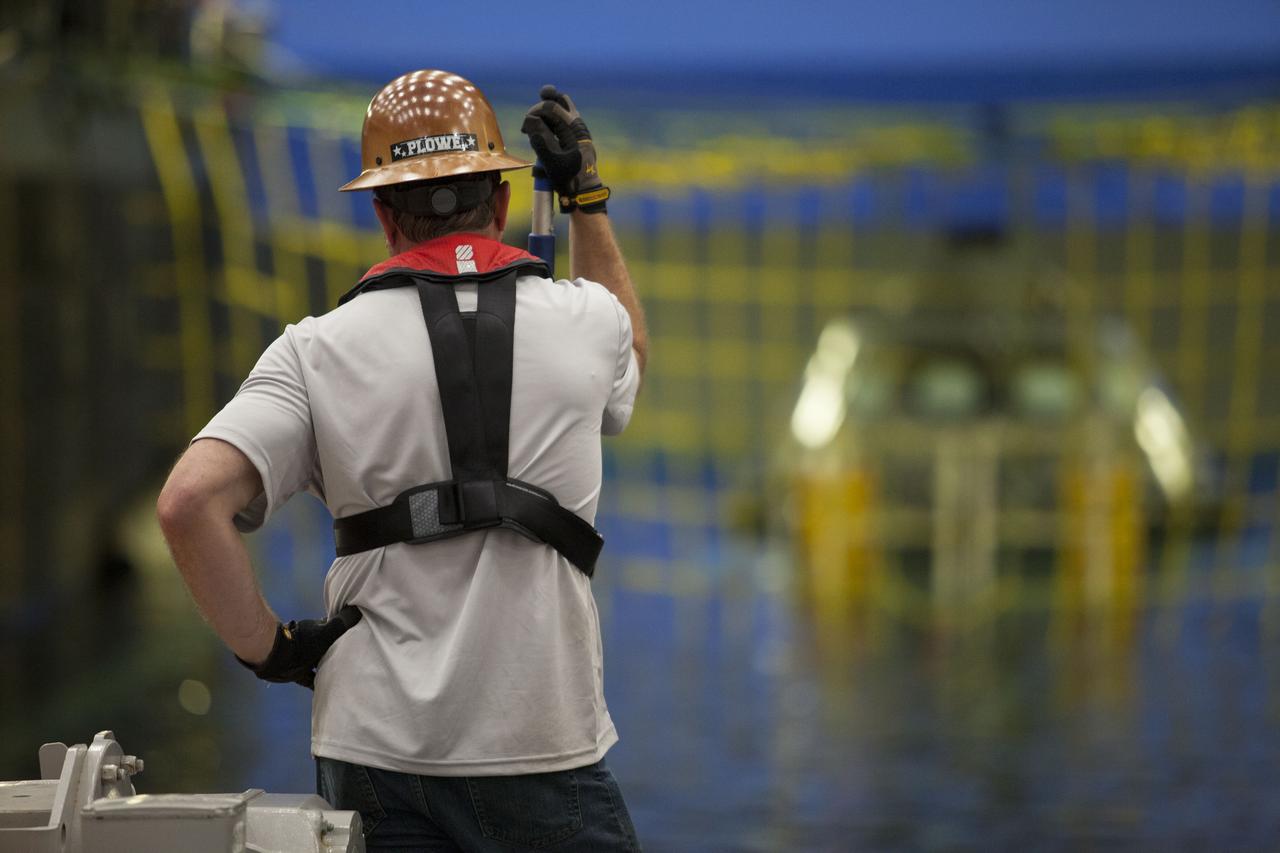
A member of the recovery team watches as a test version of the Orion crew module is secured in the flooded well deck of the USS San Diego for the start of Underway Recovery Test 5 in the Pacific Ocean off the coast of California. NASA's Ground Systems Development and Operations Program and the U.S. Navy are conducting a series of tests to prepare for recovery of Orion on its return from deep space missions. The testing will allow the team to demonstrate and evaluate recovery processes, procedures, hardware and personnel in open waters. Orion is the exploration spacecraft designed to carry astronauts to destinations not yet explored by humans, including an asteroid and NASA's Journey to Mars. It will have emergency abort capability, sustain the crew during space travel and provide safe re-entry from deep space return velocities. Orion is scheduled to launch on NASA's Space Launch System in late 2018. For more information, visit http://www.nasa.gov/orion.
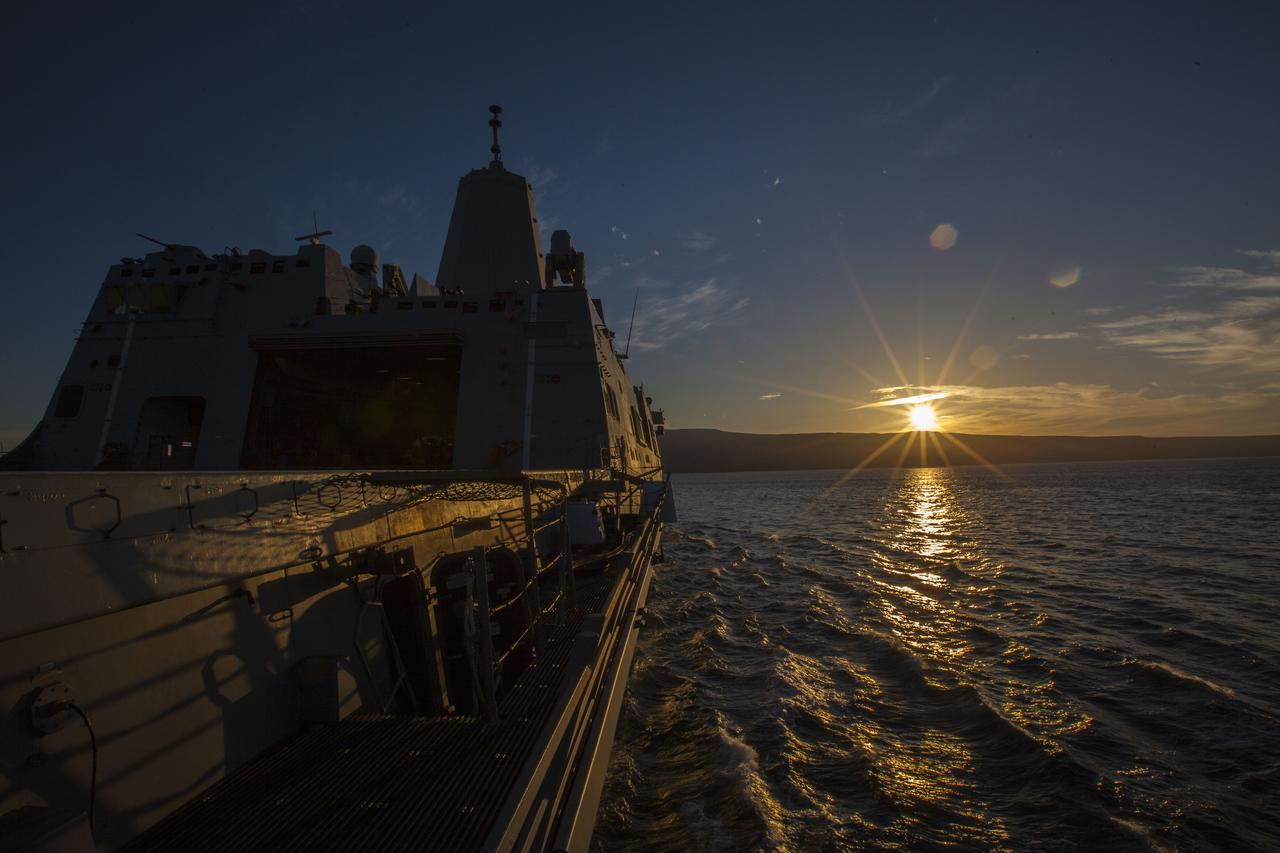
A colorful sunset illuminates the water as the USS San Diego prepares for Underway Recovery Test 5 in the Pacific Ocean off the coast of California. Using a test version of the Orion crew module, NASA's Ground Systems Development and Operations Program and the U.S. Navy will conduct a series of tests to prepare for recovery of Orion on its return from deep space missions. The testing will allow the team to demonstrate and evaluate recovery processes, procedures, hardware and personnel in open waters. Orion is the exploration spacecraft designed to carry astronauts to destinations not yet explored by humans, including an asteroid and NASA's Journey to Mars. It will have emergency abort capability, sustain the crew during space travel and provide safe re-entry from deep space return velocities. Orion is scheduled to launch on NASA's Space Launch System in late 2018. For more information, visit http://www.nasa.gov/orion.
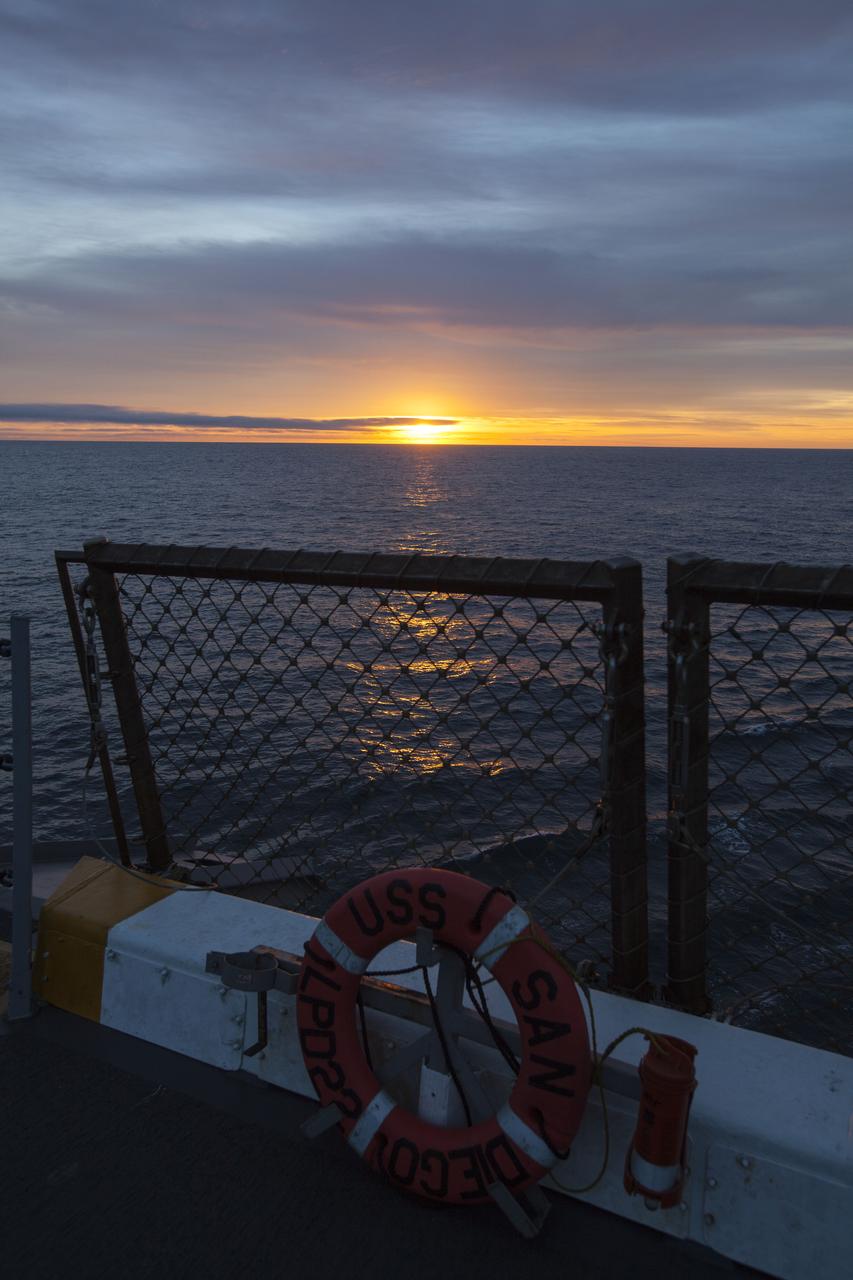
A sunrise is in view from the flight deck of the USS San Diego in the Pacific Ocean off the coast of California. NASA's Ground Systems Development and Operations Program and the U.S. Navy are conducting a series of tests, called Underway Recovery Test 5, using the ship's well deck and a test version of the Orion crew module to prepare for recovery of Orion on its return from deep space missions. The testing will allow the team to demonstrate and evaluate recovery processes, procedures, hardware and personnel in open waters. Orion is the exploration spacecraft designed to carry astronauts to destinations not yet explored by humans, including an asteroid and NASA's Journey to Mars. It will have emergency abort capability, sustain the crew during space travel and provide safe re-entry from deep space return velocities. Orion is scheduled to launch on NASA's Space Launch System in late 2018. For more information, visit http://www.nasa.gov/orion.
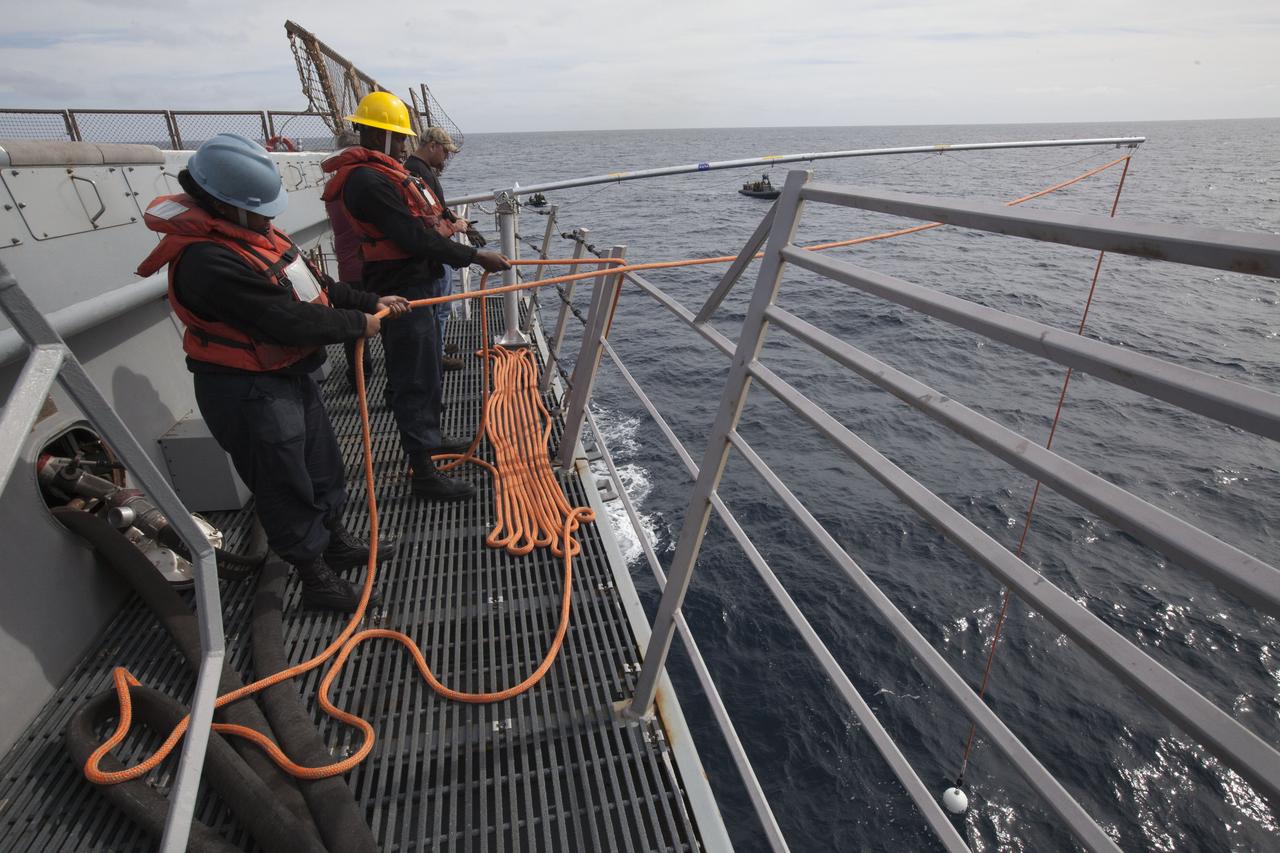
U.S. Navy personnel check tether lines and a winch line on the deck of the USS San Diego in the Pacific Ocean off the coast of California. NASA's Ground Systems Development and Operations Program and the U.S. Navy are conducting a series of tests, called Underway Recovery Test 5, using the ship's well deck and a test version of the Orion crew module to prepare for recovery of Orion on its return from deep space missions. The testing will allow the team to demonstrate and evaluate recovery processes, procedures, hardware and personnel in open waters. Orion is the exploration spacecraft designed to carry astronauts to destinations not yet explored by humans, including an asteroid and NASA's Journey to Mars. It will have emergency abort capability, sustain the crew during space travel and provide safe re-entry from deep space return velocities. Orion is scheduled to launch on NASA's Space Launch System in late 2018. For more information, visit http://www.nasa.gov/orion.
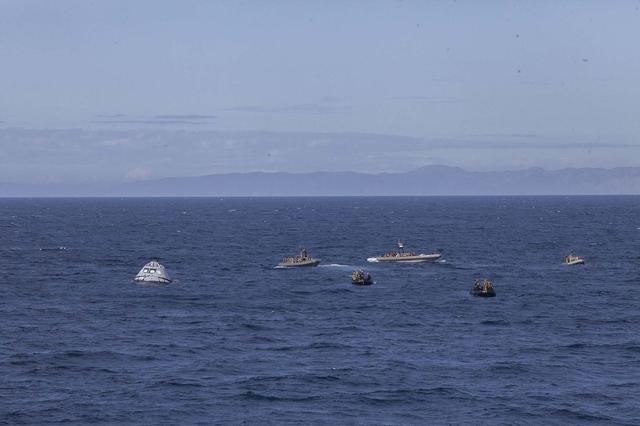
Several rigid hull and inflatable Zodiac boats are in the water near a test version of the Orion crew module during the third day of Underway Recovery Test 5 in the Pacific Ocean off the coast of California. NASA's Ground Systems Development and Operations Program and the U.S. Navy are conducting a series of tests using the USS San Diego, various watercraft and equipment to prepare for recovery of Orion on its return from deep space missions. The test will allow the team to demonstrate and evaluate recovery processes, procedures, hardware and personnel in open waters. Orion is the exploration spacecraft designed to carry astronauts to destinations not yet explored by humans, including an asteroid and NASA's Journey to Mars. It will have emergency abort capability, sustain the crew during space travel and provide safe re-entry from deep space return velocities. Orion is scheduled to launch on NASA's Space Launch System in late 2018. For more information, visit http://www.nasa.gov/orion.
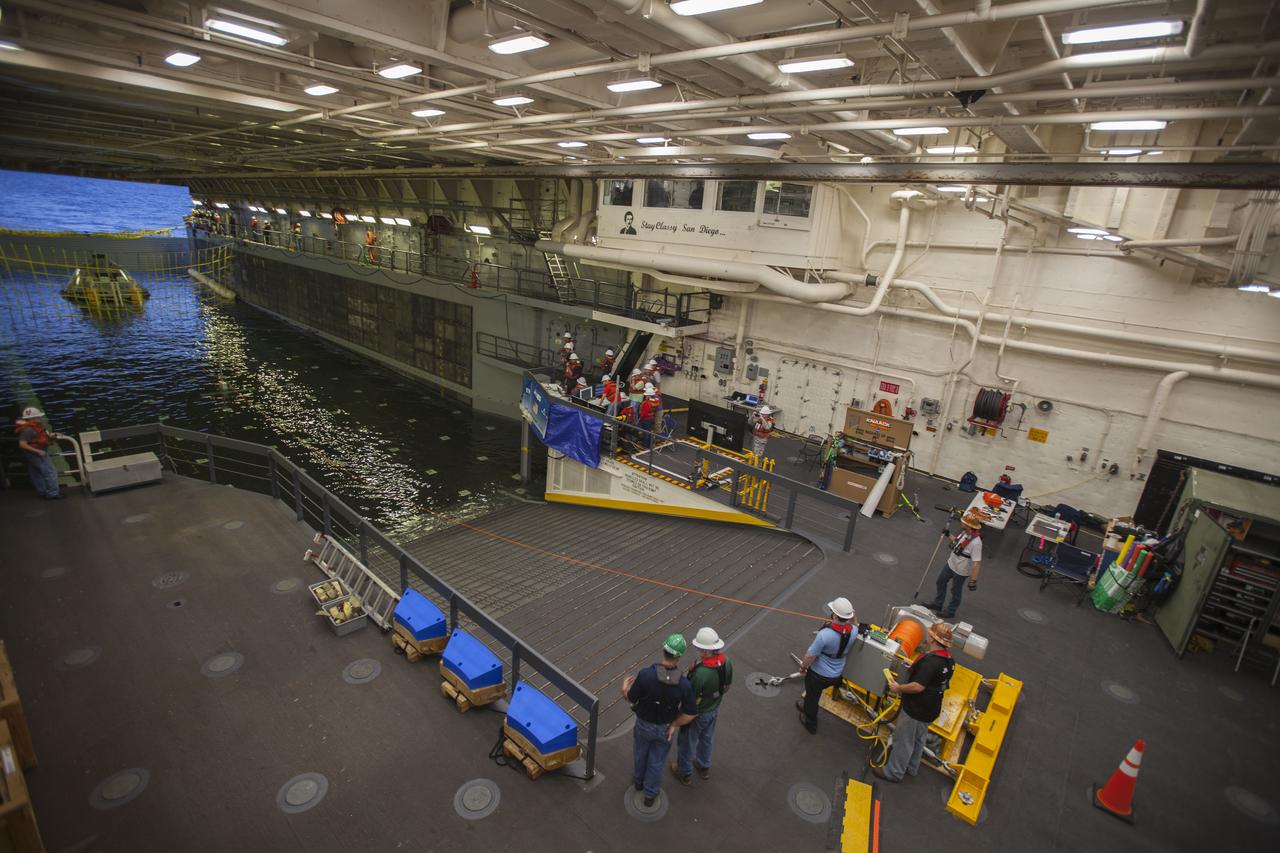
A test version of the Orion crew module attached to tether lines sits in the flooded well deck of the USS San Diego during Underway Recovery Test 5 in the Pacific Ocean off the coast of California. NASA's Ground Systems Development and Operations Program and the U.S. Navy are conducting a series of tests to prepare for recovery of Orion on its return from deep space missions. The testing will allow the team to demonstrate and evaluate recovery processes, procedures, hardware and personnel in open waters. Orion is the exploration spacecraft designed to carry astronauts to destinations not yet explored by humans, including an asteroid and NASA's Journey to Mars. It will have emergency abort capability, sustain the crew during space travel and provide safe re-entry from deep space return velocities. Orion is scheduled to launch on NASA's Space Launch System in late 2018. For more information, visit http://www.nasa.gov/orion.
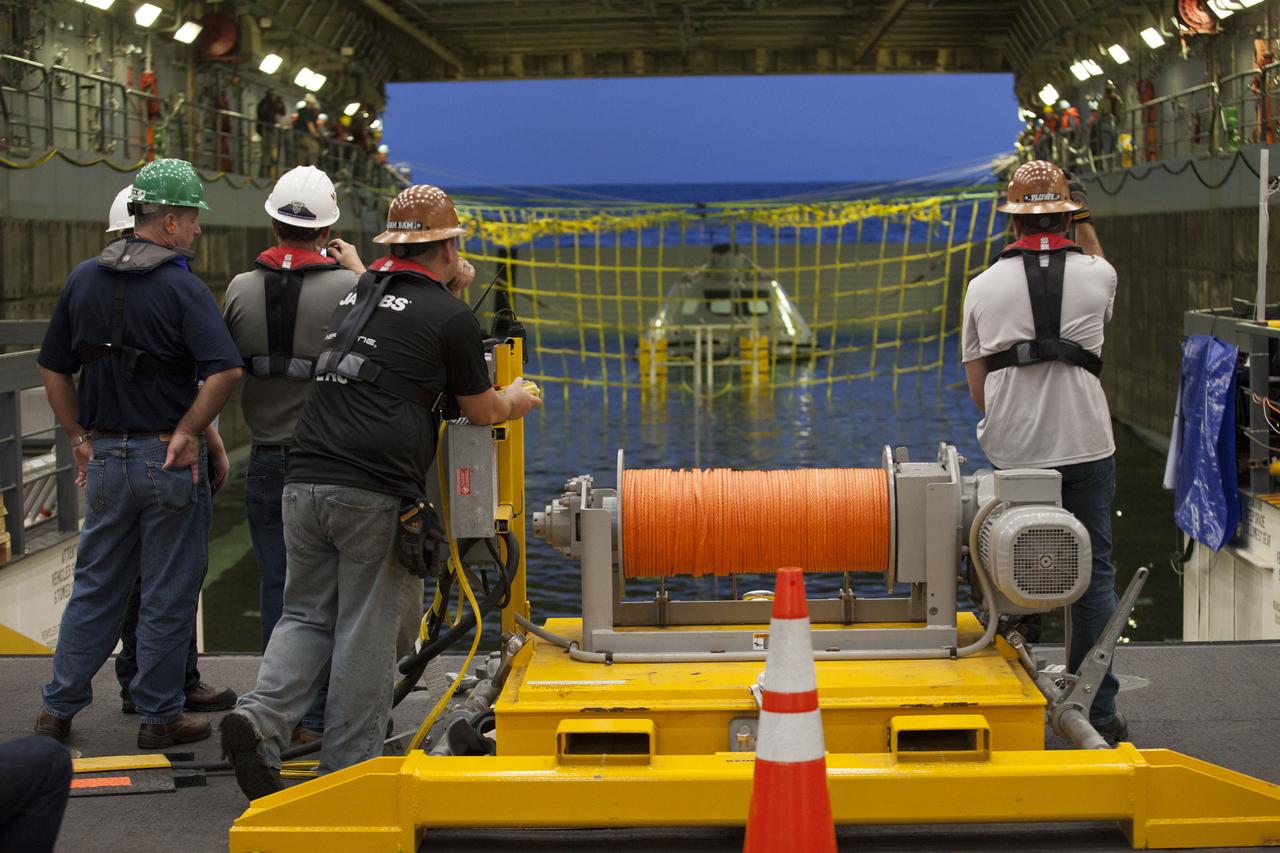
Winch operations team members watch as a test version of the Orion crew module is secured in the flooded well deck of the USS San Diego for the start of Underway Recovery Test 5 in the Pacific Ocean off the coast of California. NASA's Ground Systems Development and Operations Program and the U.S. Navy are conducting a series of tests to prepare for recovery of Orion on its return from deep space missions. The testing will allow the team to demonstrate and evaluate recovery processes, procedures, hardware and personnel in open waters. Orion is the exploration spacecraft designed to carry astronauts to destinations not yet explored by humans, including an asteroid and NASA's Journey to Mars. It will have emergency abort capability, sustain the crew during space travel and provide safe re-entry from deep space return velocities. Orion is scheduled to launch on NASA's Space Launch System in late 2018. For more information, visit http://www.nasa.gov/orion.
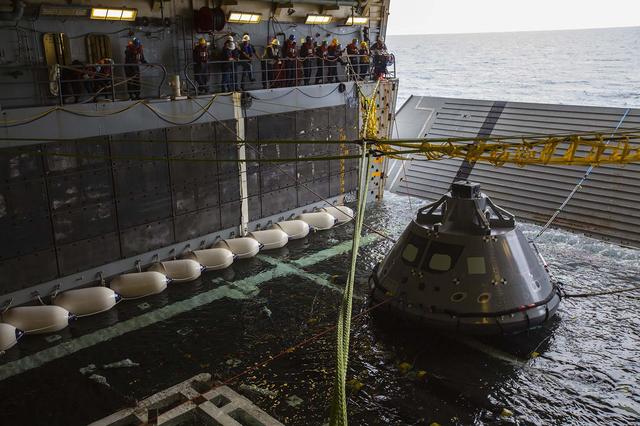
A test version of the Orion crew module has been tethered and pulled into the well deck of the USS San Diego using a winch system during the second day of Underway Recovery Test 5 in the Pacific Ocean off the coast of California. NASA's Ground Systems Development and Operations Program and the U.S. Navy are conducting a series of tests to prepare for recovery of Orion on its return from deep space missions. The testing will allow the team to demonstrate and evaluate recovery processes, procedures, hardware and personnel in open waters. Orion is the exploration spacecraft designed to carry astronauts to destinations not yet explored by humans, including an asteroid and NASA's Journey to Mars. It will have emergency abort capability, sustain the crew during space travel and provide safe re-entry from deep space return velocities. Orion is scheduled to launch on NASA's Space Launch System in late 2018. For more information, visit http://www.nasa.gov/orion.
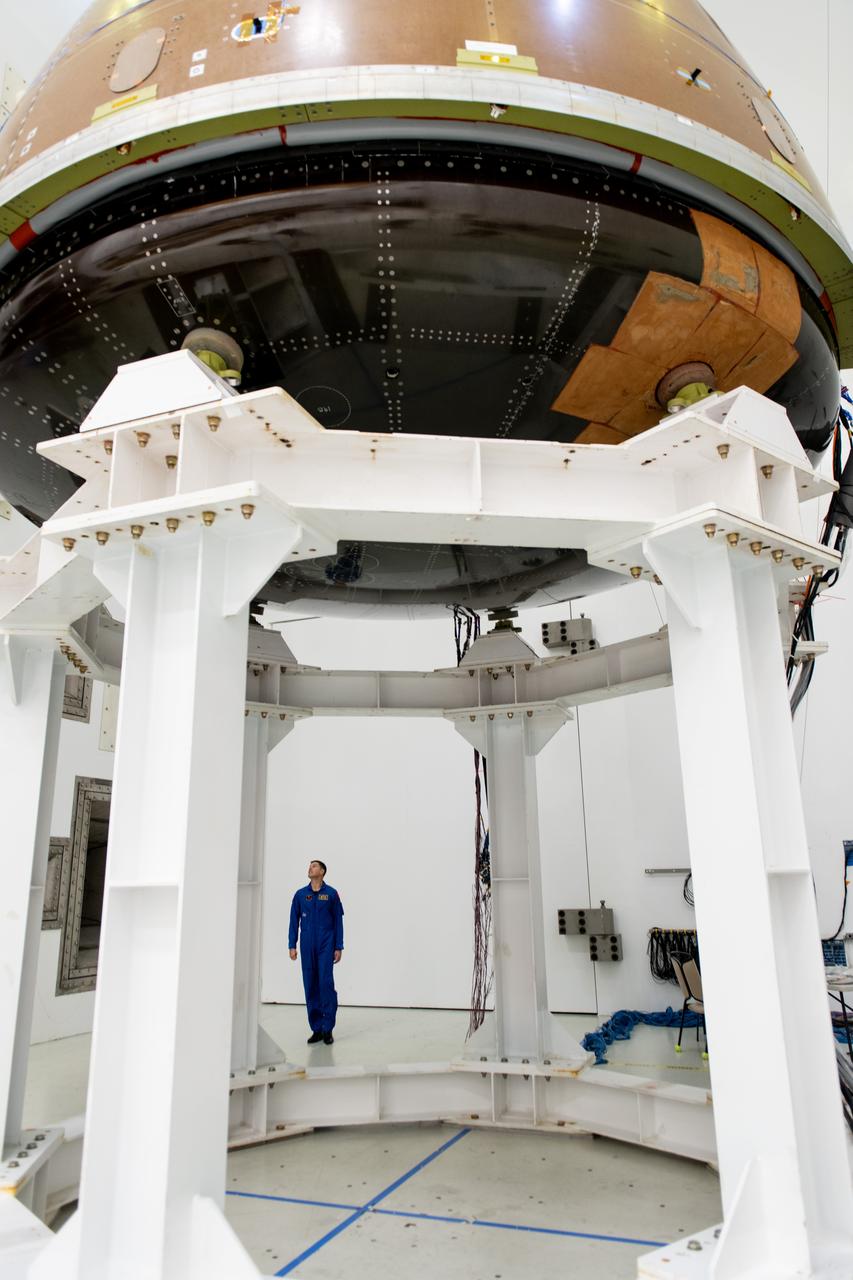
The team at NASA's Armstrong Test Facility in Sandusky, Ohio has begun vibro-acoustic testing on the Orion spacecraft that flew around the Moon on Artemis I, now known as the Environmental Test Article. The testing will help ensure the safety of future crews aboard Orion. Mission Specialis Jeremy Hansen looks up at the Orion capsule during tours of the acoustic lab.
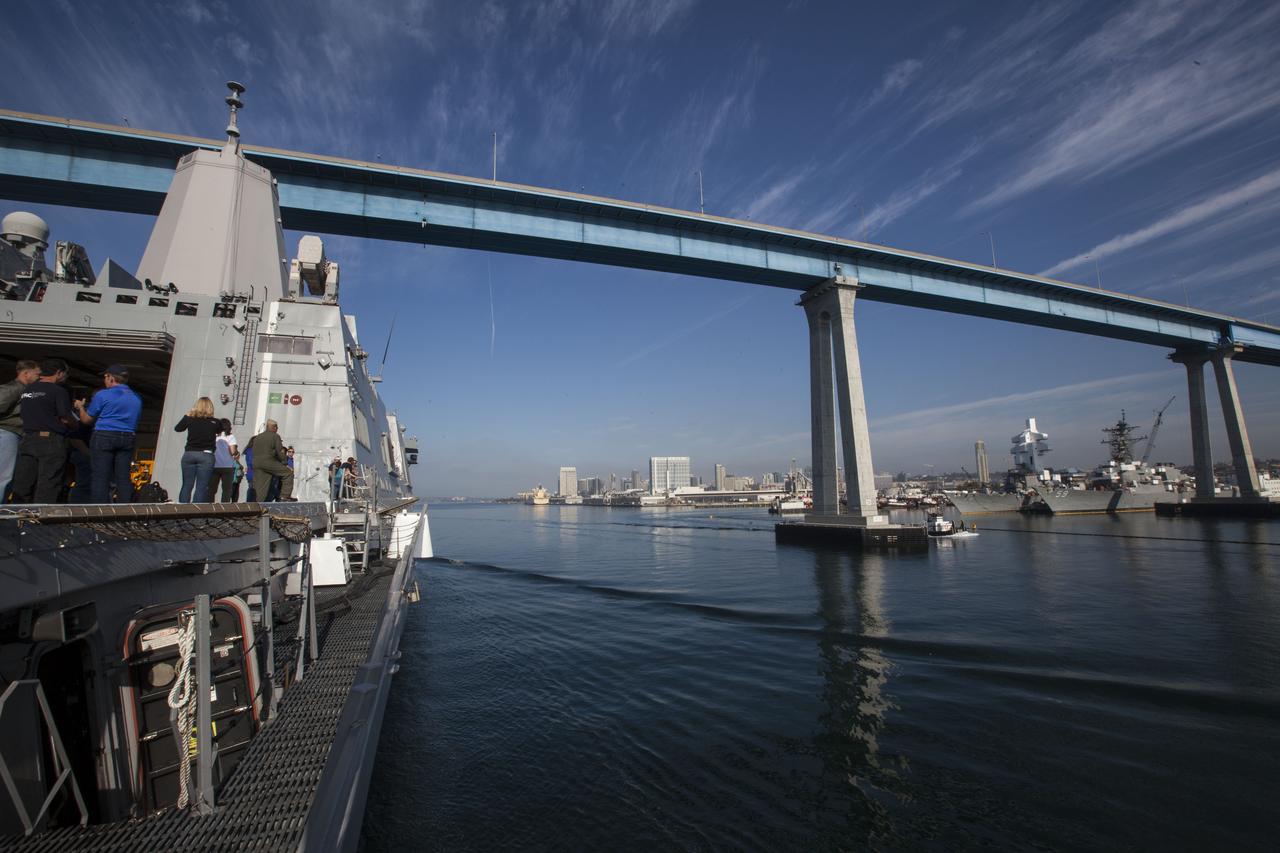
The USS San Diego departs Naval Base San Diego in California on its way out to sea in the Pacific Ocean for the Orion Underway Recovery Test 5. NASA's Ground Systems Development and Operations Program and the U.S. Navy will practice recovery techniques using the well deck of the ship and a test version of the Orion crew module to prepare for recovery of Orion on its return from deep space missions. The testing will allow the team to demonstrate and evaluate recovery processes, procedures, hardware and personnel in open waters. Orion is the exploration spacecraft designed to carry astronauts to destinations not yet explored by humans, including an asteroid and NASA's Journey to Mars. It will have emergency abort capability, sustain the crew during space travel and provide safe re-entry from deep space return velocities. Orion is scheduled to launch on NASA's Space Launch System in late 2018. For more information, visit http://www.nasa.gov/orion.
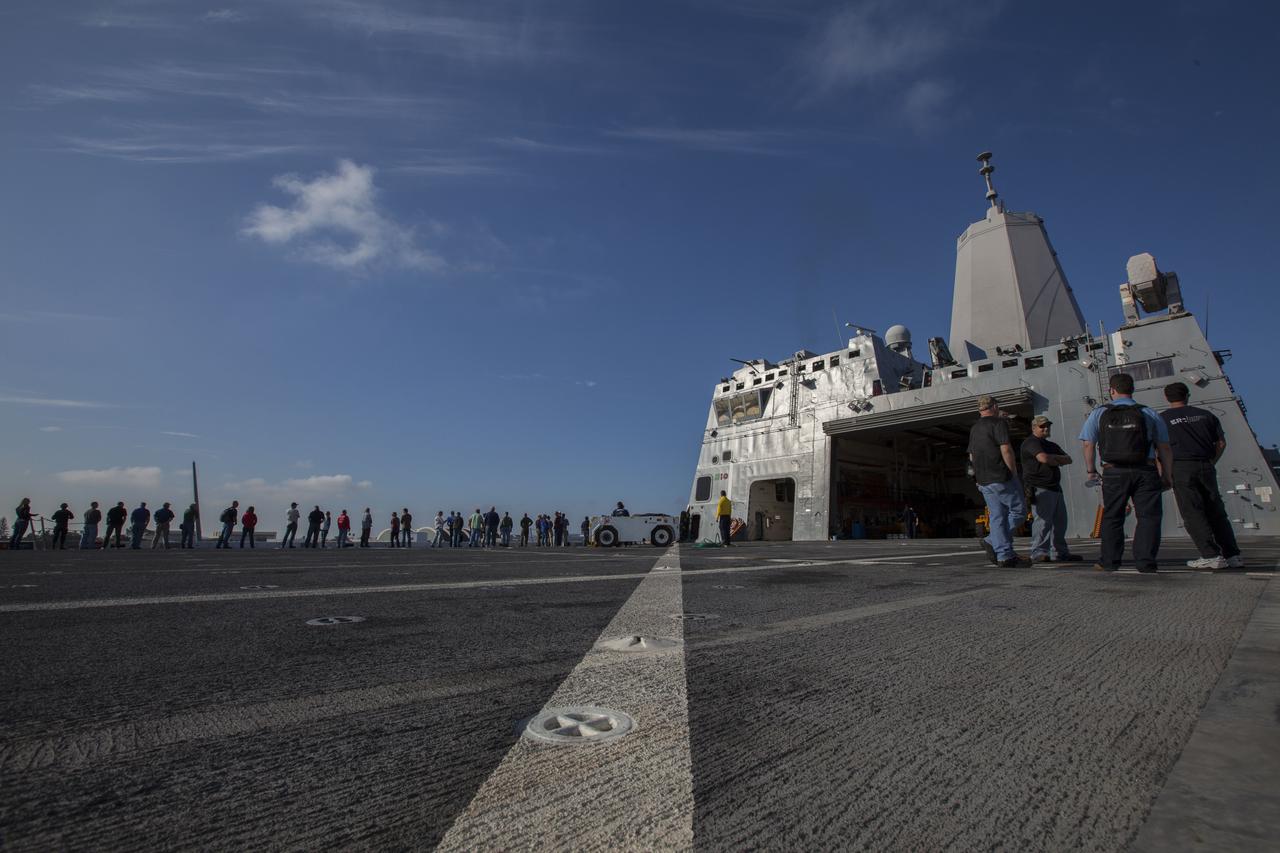
The USS San Diego departs Naval Base San Diego in California on its way out to sea in the Pacific Ocean for the Orion Underway Recovery Test 5. NASA's Ground Systems Development and Operations Program and the U.S. Navy will practice recovery techniques using the well deck of the ship and a test version of the Orion crew module to prepare for recovery of Orion on its return from deep space missions. The testing will allow the team to demonstrate and evaluate recovery processes, procedures, hardware and personnel in open waters. Orion is the exploration spacecraft designed to carry astronauts to destinations not yet explored by humans, including an asteroid and NASA's Journey to Mars. It will have emergency abort capability, sustain the crew during space travel and provide safe re-entry from deep space return velocities. Orion is scheduled to launch on NASA's Space Launch System in late 2018. For more information, visit http://www.nasa.gov/orion.
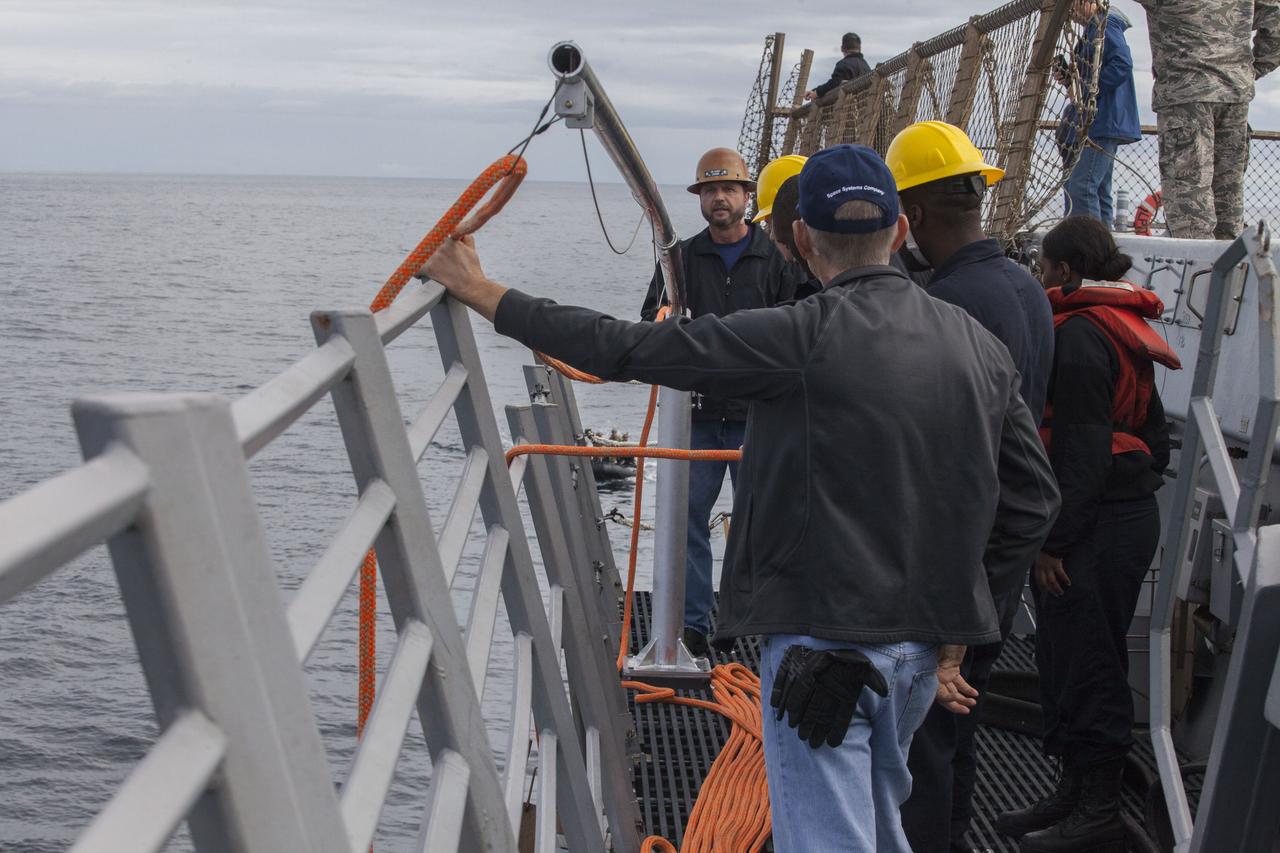
The Orion Underway Recovery Test 5 is in progress aboard the USS San Diego in the Pacific Ocean off the coast of California. Team members are reviewing procedures on the flight deck of the ship. NASA's Ground Systems Development and Operations Program and the U.S. Navy are practicing recovery techniques using the well deck of the ship and a test version of the Orion crew module to prepare for recovery of Orion on its return from deep space missions. The testing will allow the team to demonstrate and evaluate recovery processes, procedures, hardware and personnel in open waters. Orion is the exploration spacecraft designed to carry astronauts to destinations not yet explored by humans, including an asteroid and NASA's Journey to Mars. It will have emergency abort capability, sustain the crew during space travel and provide safe re-entry from deep space return velocities. Orion is scheduled to launch on NASA's Space Launch System in late 2018. For more information, visit http://www.nasa.gov/orion.
Recovery team members watch Orion Underway Recovery Test 5 activities on the flight deck of the USS San Diego in the Pacific Ocean off the coast of California. NASA's Ground Systems Development and Operations Program and the U.S. Navy are practicing recovery techniques using the well deck of the ship and a test version of the Orion crew module to prepare for recovery of Orion on its return from deep space missions. The testing will allow the team to demonstrate and evaluate recovery processes, procedures, hardware and personnel in open waters. Orion is the exploration spacecraft designed to carry astronauts to destinations not yet explored by humans, including an asteroid and NASA's Journey to Mars. It will have emergency abort capability, sustain the crew during space travel and provide safe re-entry from deep space return velocities. Orion is scheduled to launch on NASA's Space Launch System in late 2018. For more information, visit http://www.nasa.gov/orion.
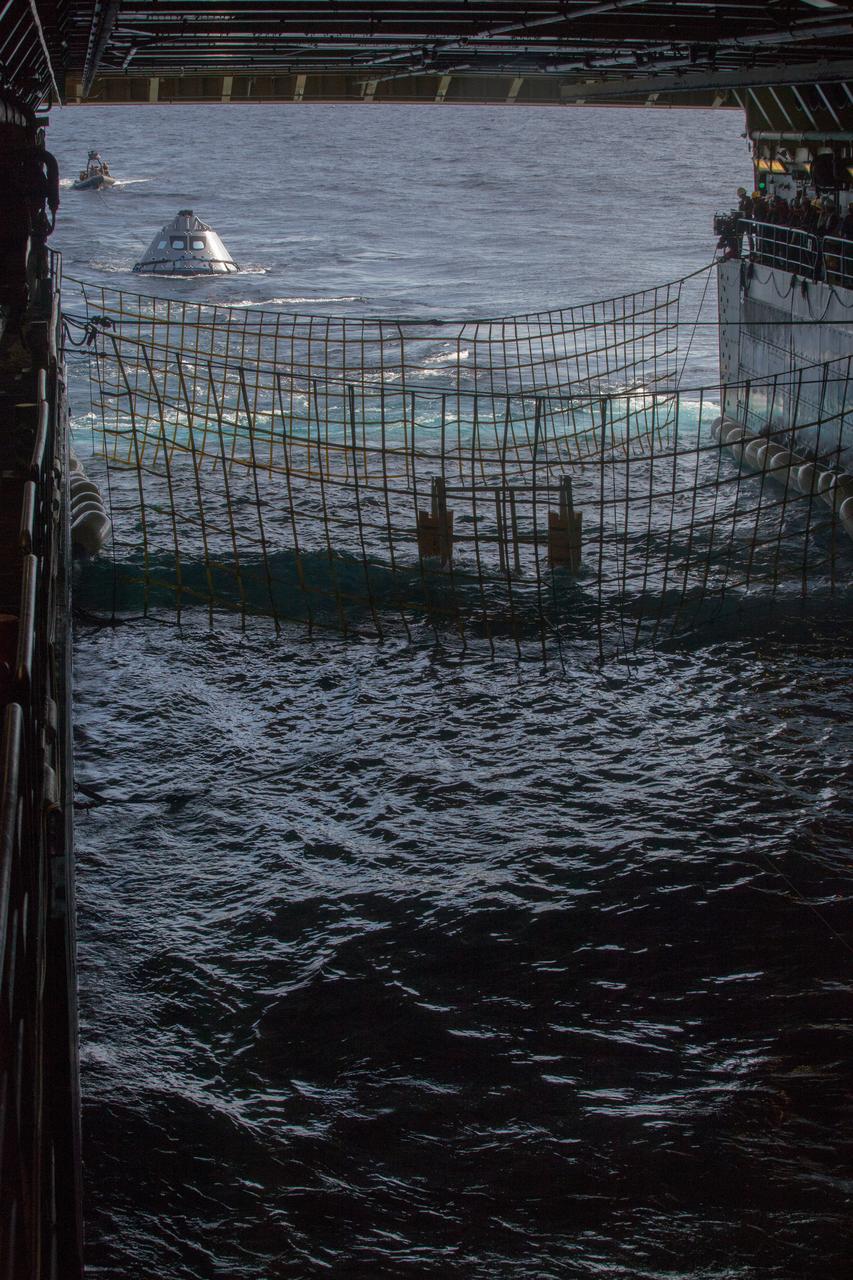
A test version of the Orion crew module floats outside the well deck of the USS San Diego during Orion Underway Recovery Test 5 in the Pacific Ocean off the coast of California on Oct. 29, 2016. In the distance are U.S. Navy divers in a rigid hull inflatable boat. NASA's Ground Systems Development and Operations Program and the U.S. Navy are practicing recovery techniques using the well deck of the ship and the test version of the crew module to prepare for recovery of Orion on its return from deep space missions. The testing will allow the team to demonstrate and evaluate recovery processes, procedures, hardware and personnel in open waters. Part of Batch images transfer from Flickr.
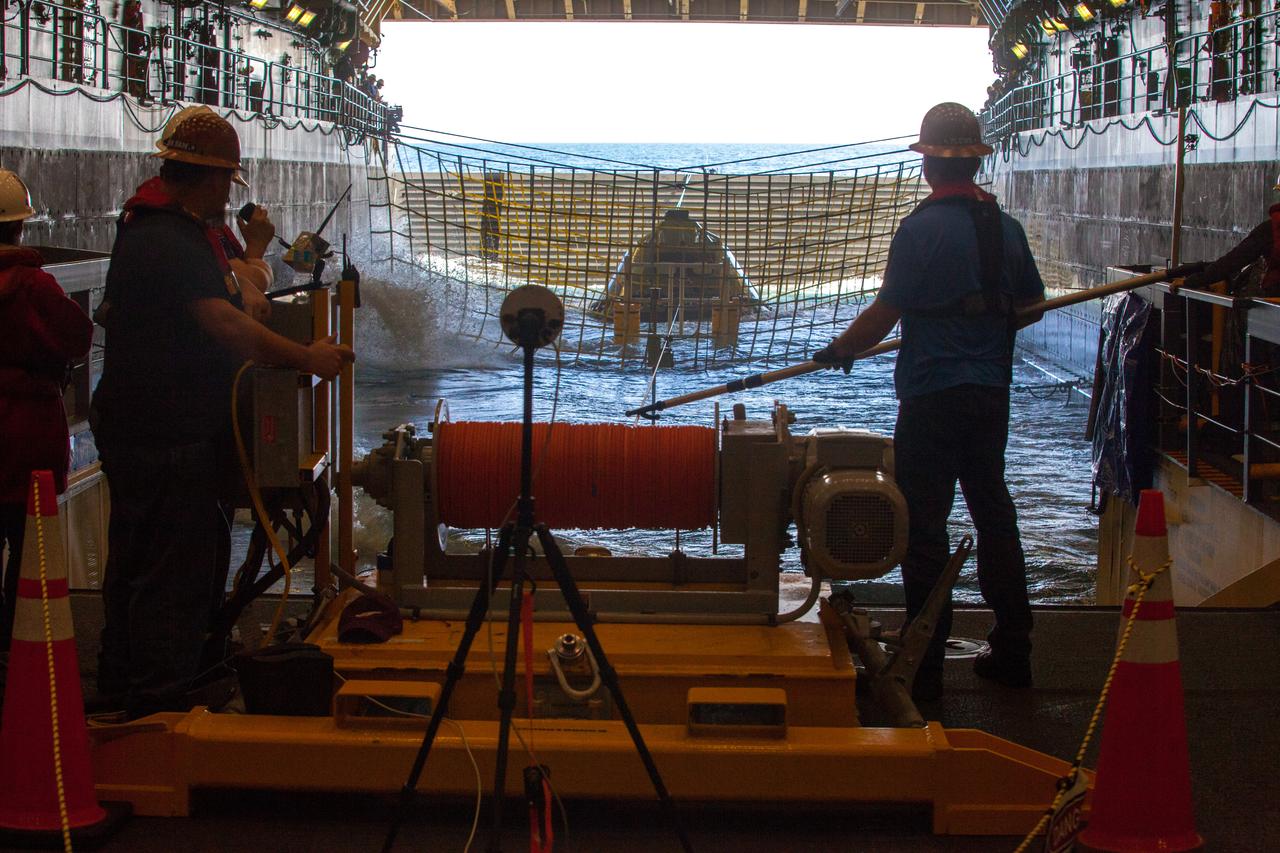
Winch team operators help guide a test version of the Orion crew module into the flooded well deck of the USS San Diego during Underway Recovery Test 5 in the Pacific Ocean off the coast of California. NASA's Ground Systems Development and Operations Program and the U.S. Navy are conducting a series of tests to prepare for recovery of Orion on its return from deep space missions. The testing will allow the team to demonstrate and evaluate recovery processes, procedures, hardware and personnel in open waters. Part of Batch images transfer from Flickr.

Melissa Jones, far right, Landing and Recovery director with the Ground Systems Development and Operations Program (GSDO), and other members of the recovery team speak to members of the media about Orion Underway Recovery Test 5. The USS San Diego is docked at Naval Base San Diego in California and the test version of the Orion crew module, secured on its handling fixture, was offloaded from the well deck of the ship. NASA's GSDO Program and the U.S. Navy completed a series of tests using the ship's well deck, the test module, various watercraft and equipment to prepare for recovery of Orion on its return from deep space missions. The testing allowed the team to demonstrate and evaluate recovery processes, procedures, hardware and personnel in open waters. Orion is the exploration spacecraft designed to carry astronauts to destinations not yet explored by humans, including an asteroid and NASA's Journey to Mars. It will have emergency abort capability, sustain the crew during space travel and provide safe re-entry from deep space return velocities. Orion is scheduled to launch on NASA's Space Launch System in late 2018. For more information, visit http://www.nasa.gov/orion.
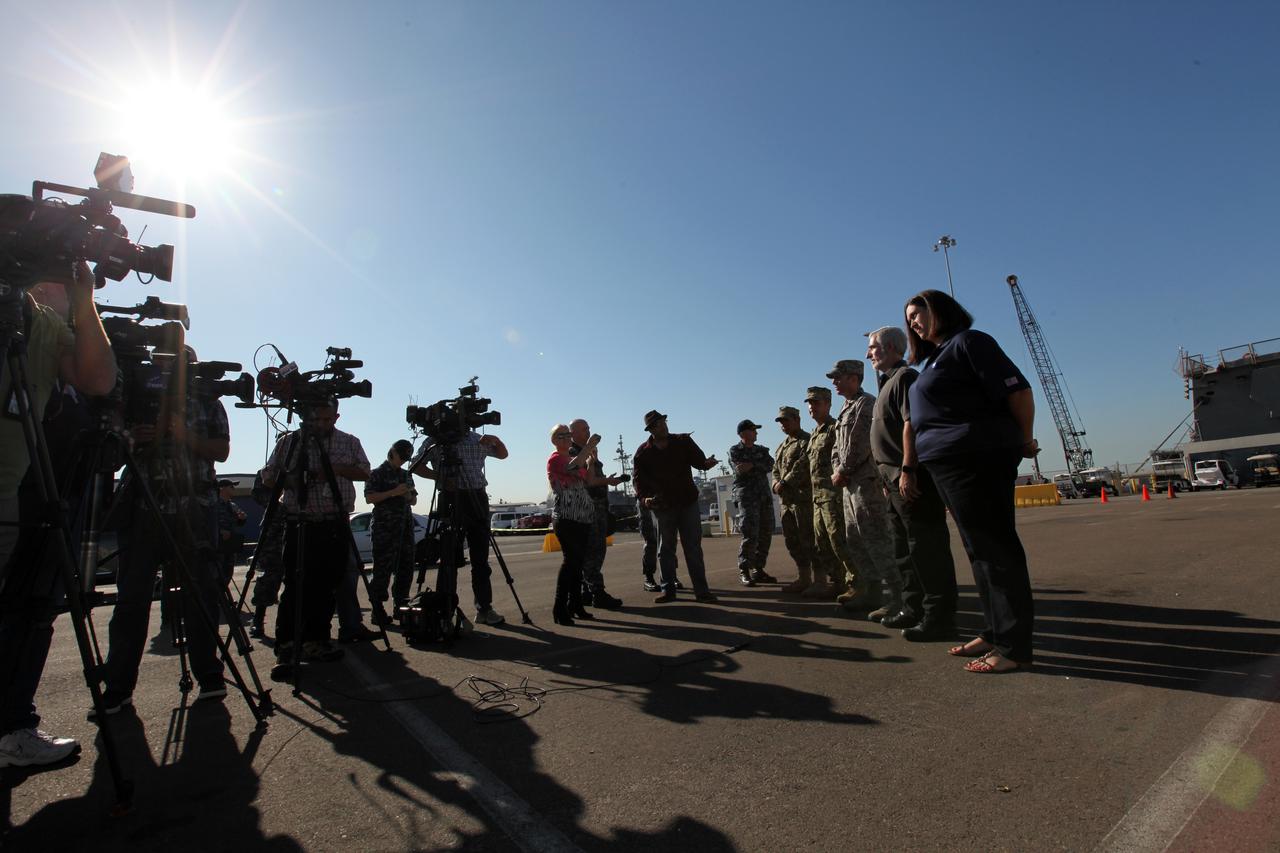
Melissa Jones, far right, Landing and Recovery director with the Ground Systems Development and Operations Program (GSDO), and other members of the recovery team speak to members of the media about Orion Underway Recovery Test 5. The USS San Diego is docked at Naval Base San Diego in California and the test version of the Orion crew module, secured on its handling fixture, was offloaded from the well deck of the ship. NASA's GSDO Program and the U.S. Navy completed a series of tests using the ship's well deck, the test module, various watercraft and equipment to prepare for recovery of Orion on its return from deep space missions. The testing allowed the team to demonstrate and evaluate recovery processes, procedures, hardware and personnel in open waters. Orion is the exploration spacecraft designed to carry astronauts to destinations not yet explored by humans, including an asteroid and NASA's Journey to Mars. It will have emergency abort capability, sustain the crew during space travel and provide safe re-entry from deep space return velocities. Orion is scheduled to launch on NASA's Space Launch System in late 2018. For more information, visit http://www.nasa.gov/orion.
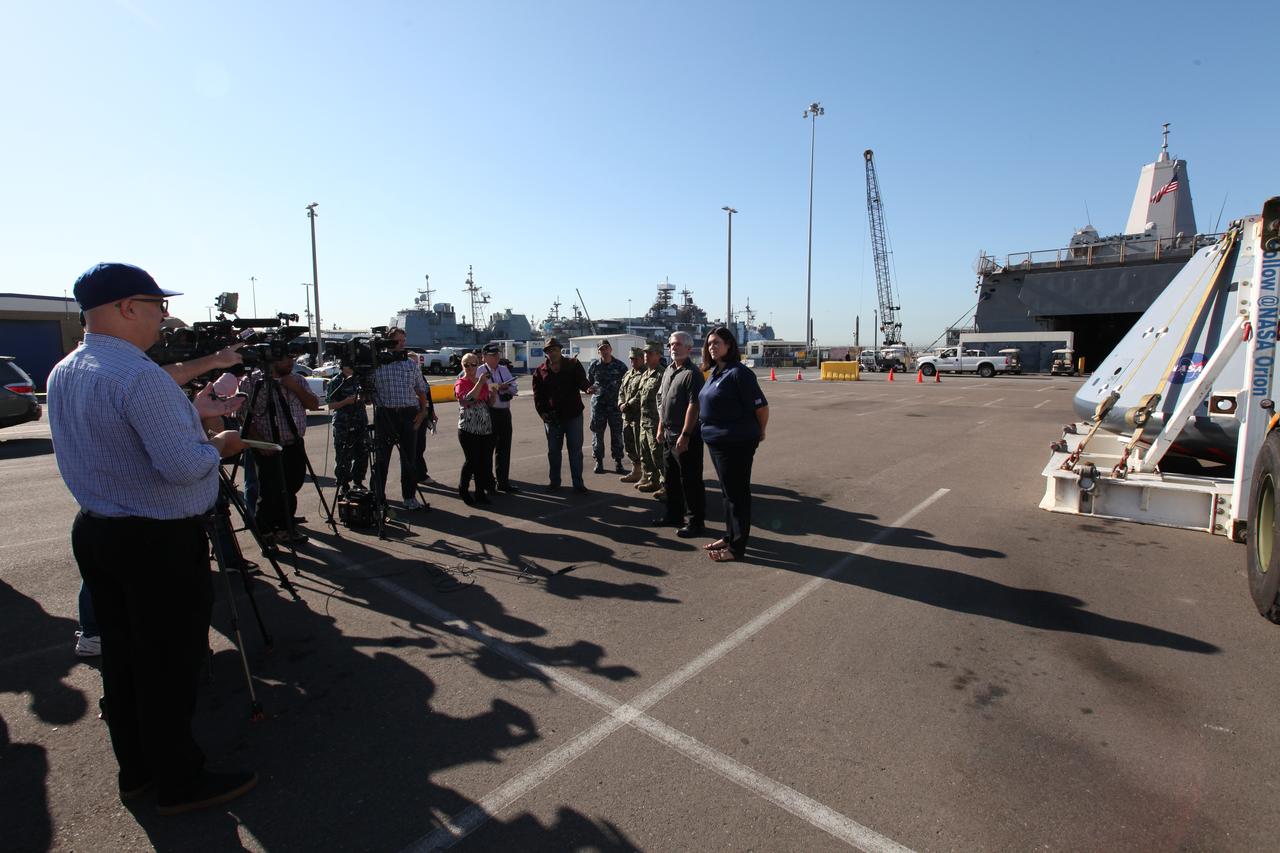
Melissa Jones, far right, Landing and Recovery director with the Ground Systems Development and Operations Program (GSDO), and other members of the recovery team speak to members of the media about Orion Underway Recovery Test 5. The USS San Diego is docked at Naval Base San Diego in California and the test version of the Orion crew module, secured on its handling fixture, was offloaded from the well deck of the ship. NASA's GSDO Program and the U.S. Navy completed a series of tests using the ship's well deck, the test module, various watercraft and equipment to prepare for recovery of Orion on its return from deep space missions. The testing allowed the team to demonstrate and evaluate recovery processes, procedures, hardware and personnel in open waters. Orion is the exploration spacecraft designed to carry astronauts to destinations not yet explored by humans, including an asteroid and NASA's Journey to Mars. It will have emergency abort capability, sustain the crew during space travel and provide safe re-entry from deep space return velocities. Orion is scheduled to launch on NASA's Space Launch System in late 2018. For more information, visit http://www.nasa.gov/orion.
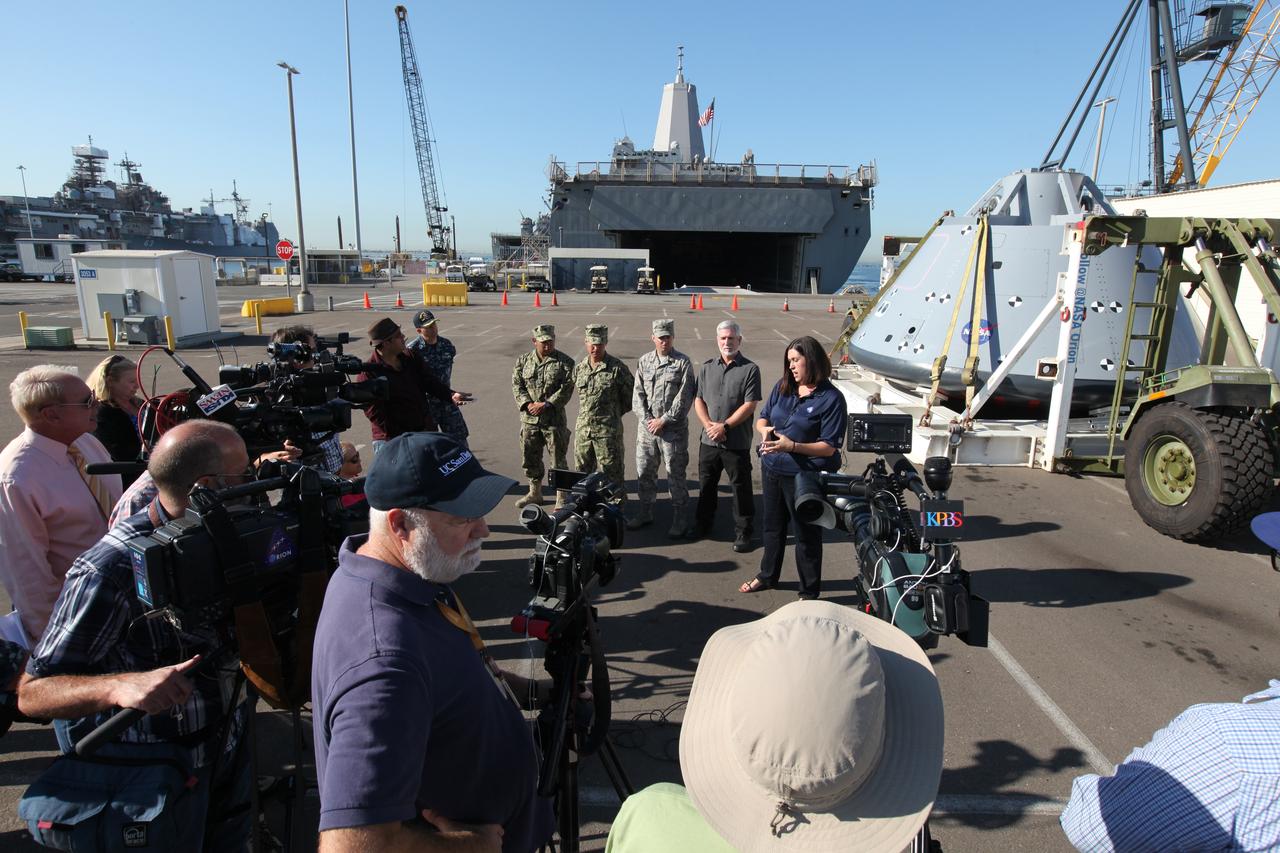
Melissa Jones, far right, Landing and Recovery director with the Ground Systems Development and Operations Program (GSDO), speaks to members of the media about Orion Underway Recovery Test 5. The USS San Diego is docked at Naval Base San Diego in California and the test version of the Orion crew module, secured on its handling fixture, was offloaded from the well deck of the ship. NASA's GSDO Program and the U.S. Navy completed a series of tests using the ship's well deck, the test module, various watercraft and equipment to prepare for recovery of Orion on its return from deep space missions. The testing allowed the team to demonstrate and evaluate recovery processes, procedures, hardware and personnel in open waters. Orion is the exploration spacecraft designed to carry astronauts to destinations not yet explored by humans, including an asteroid and NASA's Journey to Mars. It will have emergency abort capability, sustain the crew during space travel and provide safe re-entry from deep space return velocities. Orion is scheduled to launch on NASA's Space Launch System in late 2018. For more information, visit http://www.nasa.gov/orion.
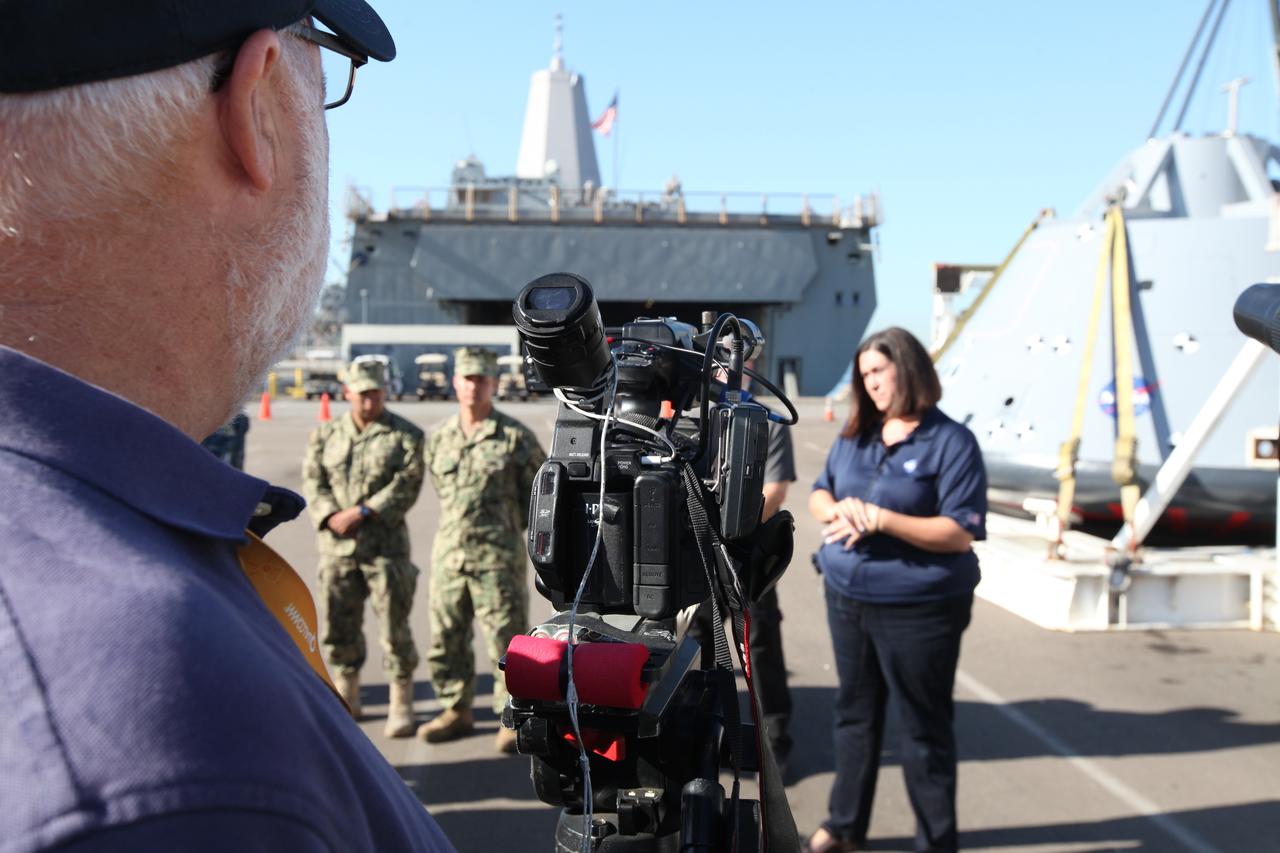
Melissa Jones, Landing and Recovery director with the Ground Systems Development and Operations Program (GSDO), speaks to members of the media about Orion Underway Recovery Test 5. The USS San Diego is docked at Naval Base San Diego in California and the test version of the Orion crew module, secured on its handling fixture, was offloaded from the well deck of the ship. NASA's GSDO Program and the U.S. Navy completed a series of tests using the ship's well deck, the test module, various watercraft and equipment to prepare for recovery of Orion on its return from deep space missions. The testing allowed the team to demonstrate and evaluate recovery processes, procedures, hardware and personnel in open waters. Orion is the exploration spacecraft designed to carry astronauts to destinations not yet explored by humans, including an asteroid and NASA's Journey to Mars. It will have emergency abort capability, sustain the crew during space travel and provide safe re-entry from deep space return velocities. Orion is scheduled to launch on NASA's Space Launch System in late 2018. For more information, visit http://www.nasa.gov/orion.
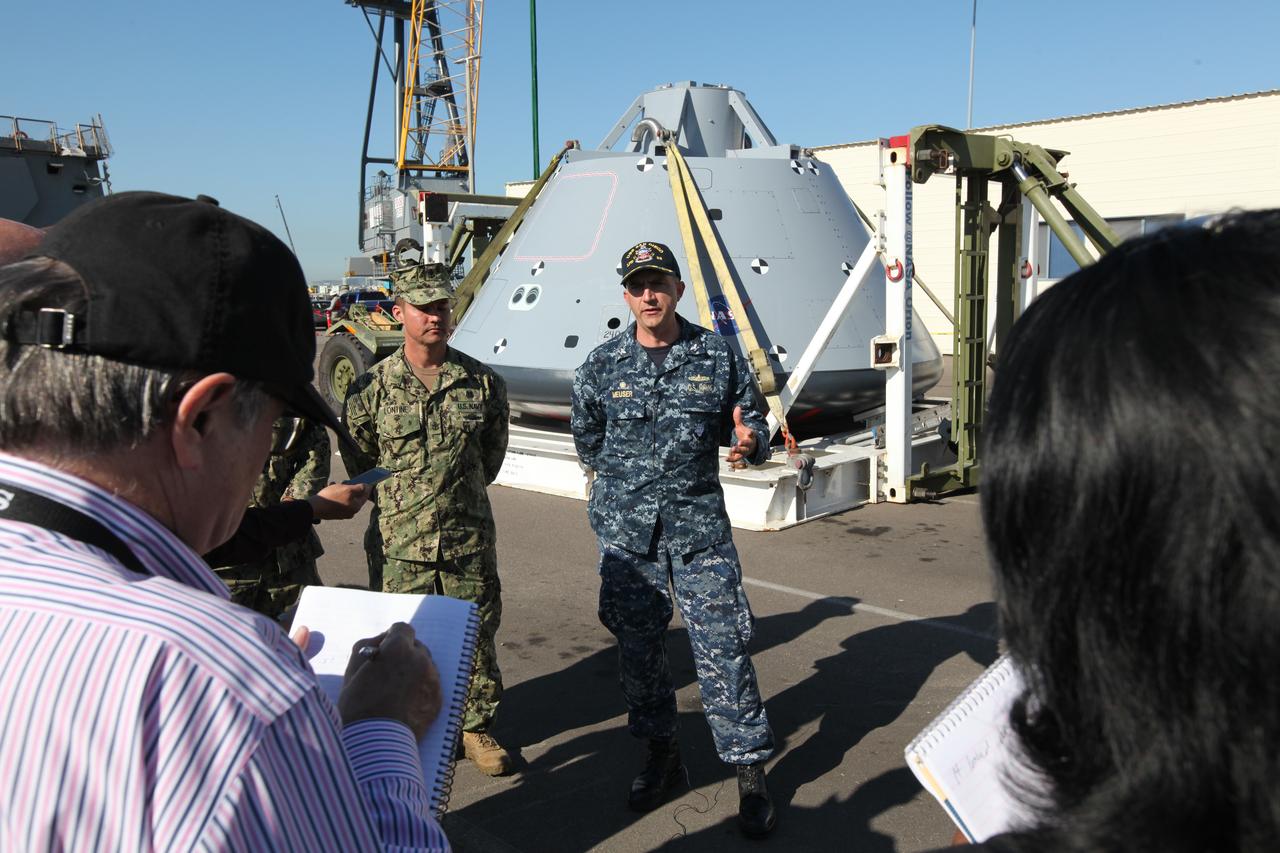
U.S. Navy recovery team members speak to members of the media about Orion Underway Recovery Test 5. The USS San Diego is docked at Naval Base San Diego in California and the test version of the Orion crew module, secured on its handling fixture, was offloaded from the well deck of the ship. NASA's GSDO Program and the U.S. Navy completed a series of tests using the ship's well deck, the test module, various watercraft and equipment to prepare for recovery of Orion on its return from deep space missions. The testing allowed the team to demonstrate and evaluate recovery processes, procedures, hardware and personnel in open waters. Orion is the exploration spacecraft designed to carry astronauts to destinations not yet explored by humans, including an asteroid and NASA's Journey to Mars. It will have emergency abort capability, sustain the crew during space travel and provide safe re-entry from deep space return velocities. Orion is scheduled to launch on NASA's Space Launch System in late 2018. For more information, visit http://www.nasa.gov/orion.
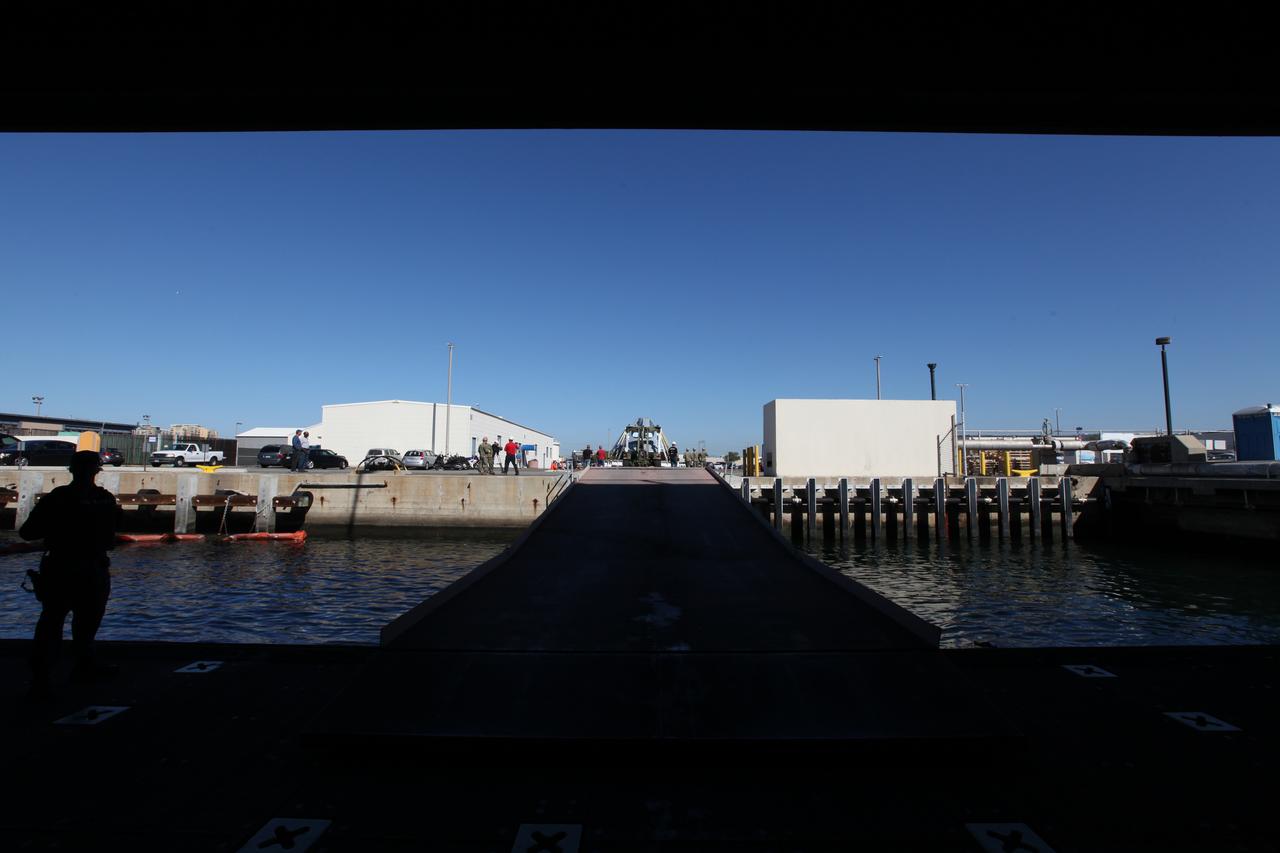
A test version of the Orion crew module has been offloaded from the USS San Diego at Naval Base San Diego in California after returning from Orion Underway Recovery Test 5 in the Pacific Ocean. NASA's Ground Systems Development and Operations Program and the U.S. Navy completed a series of tests using the ship's well deck, the test module, various watercraft and equipment to prepare for recovery of Orion on its return from deep space missions. The testing allowed the team to demonstrate and evaluate recovery processes, procedures, hardware and personnel in open waters. Orion is the exploration spacecraft designed to carry astronauts to destinations not yet explored by humans, including an asteroid and NASA's Journey to Mars. It will have emergency abort capability, sustain the crew during space travel and provide safe re-entry from deep space return velocities. Orion is scheduled to launch on NASA's Space Launch System in late 2018. For more information, visit http://www.nasa.gov/orion.
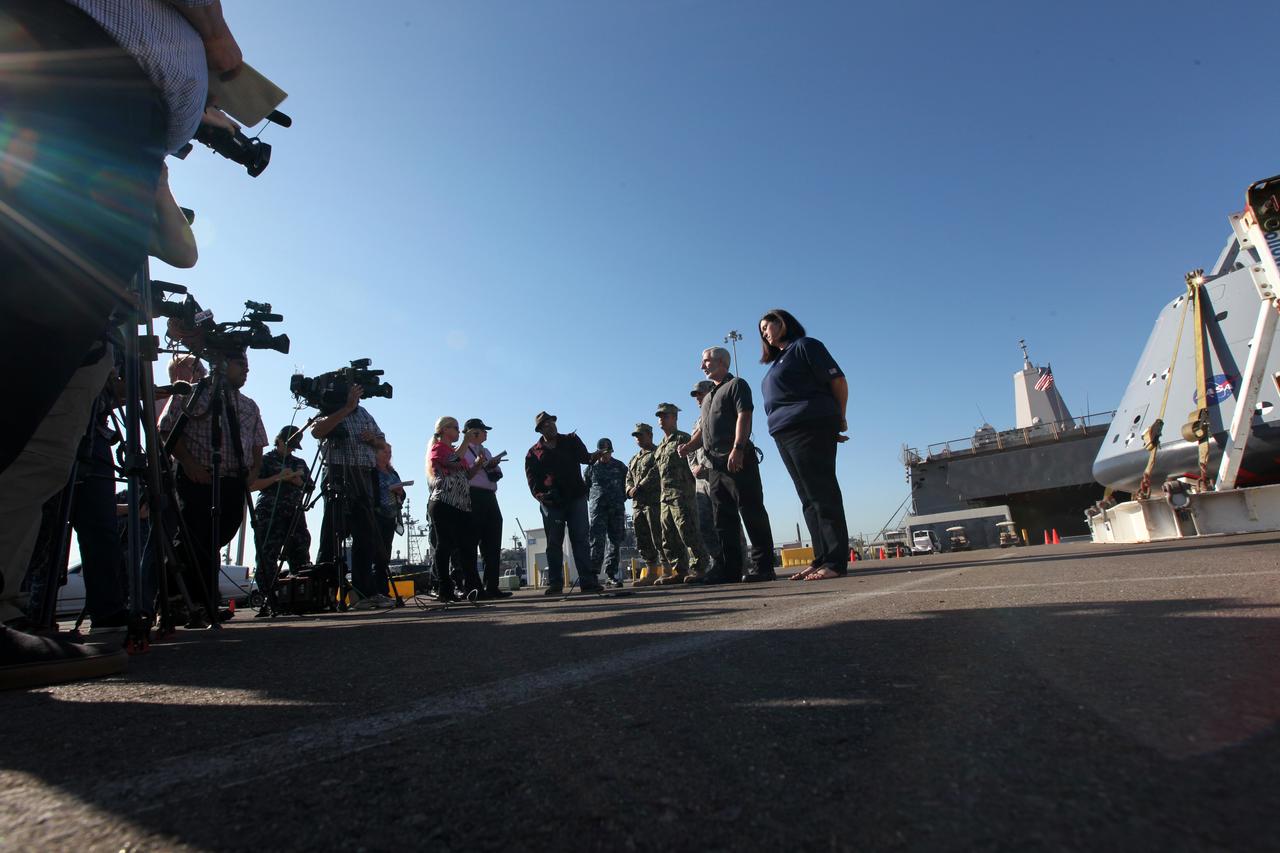
Melissa Jones, far right, Landing and Recovery director with the Ground Systems Development and Operations Program (GSDO), and other members of the recovery team speak to members of the media about Orion Underway Recovery Test 5. The USS San Diego is docked at Naval Base San Diego in California and the test version of the Orion crew module, secured on its handling fixture, was offloaded from the well deck of the ship. NASA's GSDO Program and the U.S. Navy completed a series of tests using the ship's well deck, the test module, various watercraft and equipment to prepare for recovery of Orion on its return from deep space missions. The testing allowed the team to demonstrate and evaluate recovery processes, procedures, hardware and personnel in open waters. Orion is the exploration spacecraft designed to carry astronauts to destinations not yet explored by humans, including an asteroid and NASA's Journey to Mars. It will have emergency abort capability, sustain the crew during space travel and provide safe re-entry from deep space return velocities. Orion is scheduled to launch on NASA's Space Launch System in late 2018. For more information, visit http://www.nasa.gov/orion.
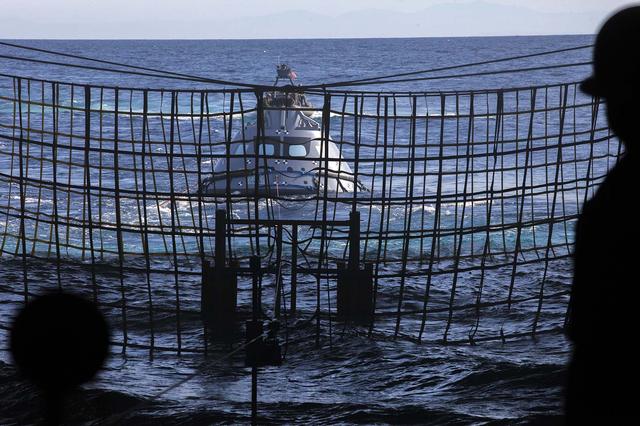
A test version of the Orion crew module floats outside the well deck of the USS San Diego on the fourth day of Underway Recovery Test 5 in the Pacific Ocean off the coast of California. NASA's Ground Systems Development and Operations Program and the U.S. Navy are practicing retrieving and securing the crew module in the well deck of the ship using tethers and a winch system to prepare for recovery of Orion on its return from deep space missions. The testing will allow the team to demonstrate and evaluate recovery processes, procedures, hardware and personnel in open waters. Orion is the exploration spacecraft designed to carry astronauts to destinations not yet explored by humans, including an asteroid and NASA's Journey to Mars. It will have emergency abort capability, sustain the crew during space travel and provide safe re-entry from deep space return velocities. Orion is scheduled to launch on NASA's Space Launch System in late 2018. For more information, visit http://www.nasa.gov/orion.
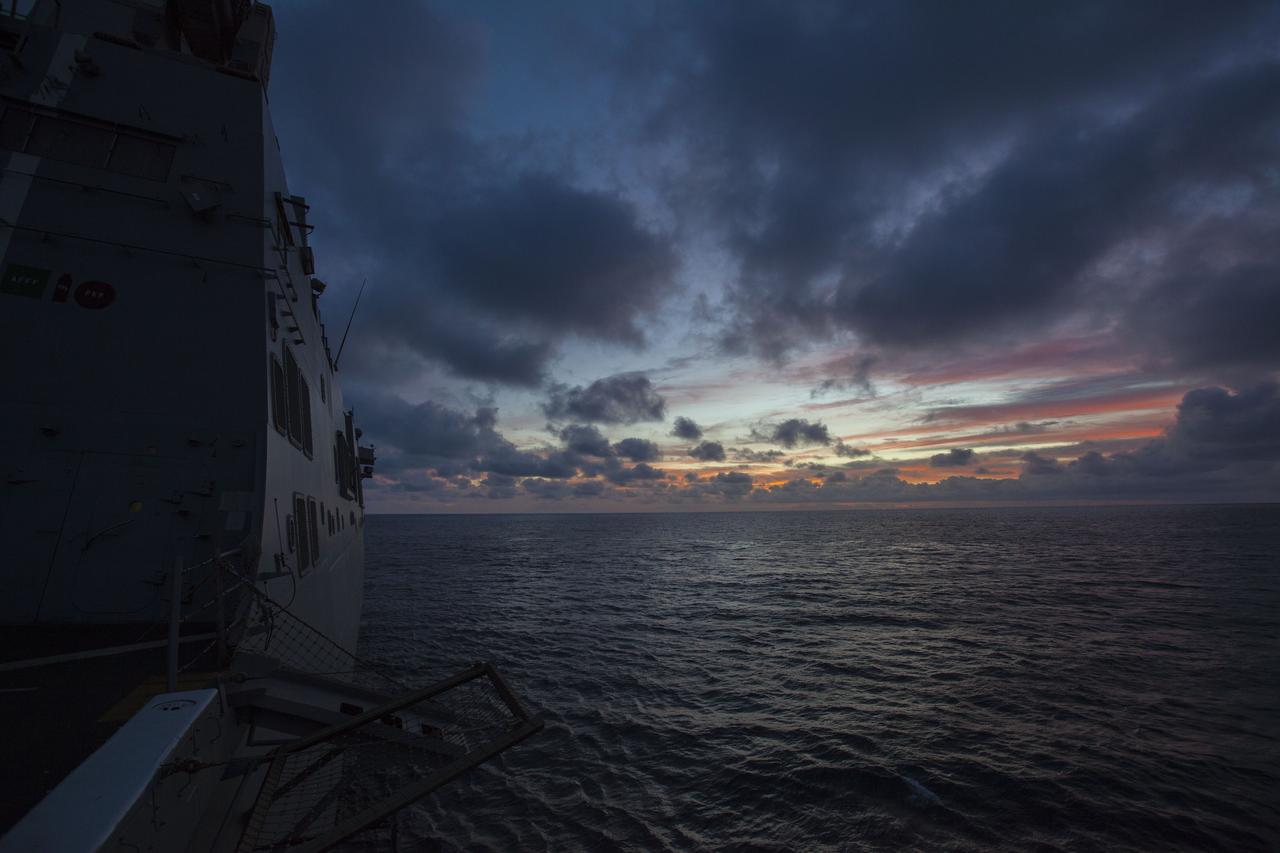
A sunrise colors the sky as another day of Underway Recovery Test 5 begins on the USS San Diego in the Pacific Ocean off the coast of California. NASA's Ground Systems Development and Operations Program and the U.S. Navy are practicing recovery techniques using the well deck of the ship and a test version of the Orion crew module to prepare for recovery of Orion on its return from deep space missions. The testing will allow the team to demonstrate and evaluate recovery processes, procedures, hardware and personnel in open waters. Orion is the exploration spacecraft designed to carry astronauts to destinations not yet explored by humans, including an asteroid and NASA's Journey to Mars. It will have emergency abort capability, sustain the crew during space travel and provide safe re-entry from deep space return velocities. Orion is scheduled to launch on NASA's Space Launch System in late 2018. For more information, visit http://www.nasa.gov/orion.
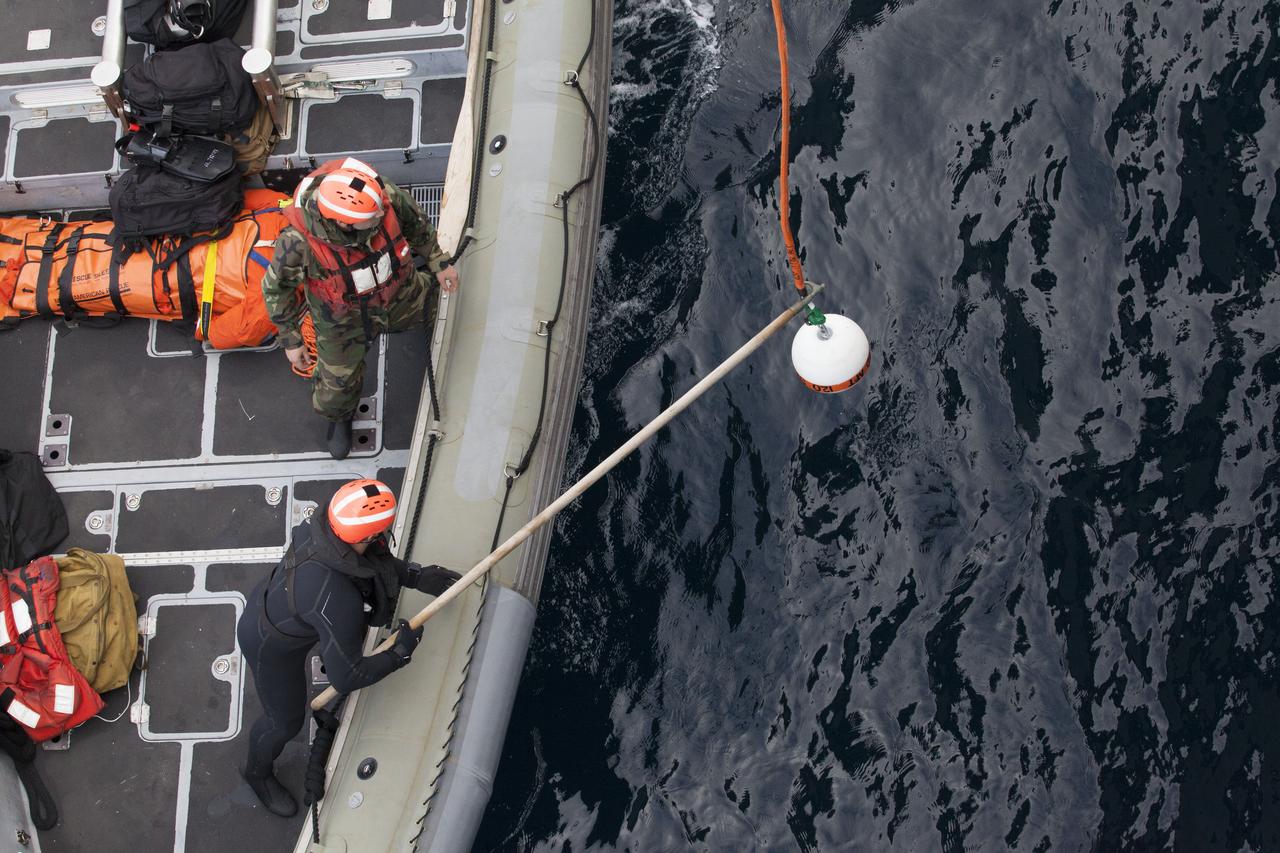
A U.S. Navy diver in a rigid hull inflatable boat uses a hook to capture a tow line during Underway Recovery Test 5 in the Pacific Ocean off the coast of California. NASA's Ground Systems Development and Operations Program and the U.S. Navy are using the well deck of the USS San Diego and a test version of the Orion crew module to practice recovery techniques to prepare for recovery of Orion on its return from deep space missions. The testing will allow the team to demonstrate and evaluate recovery processes, procedures, hardware and personnel in open waters. Orion is the exploration spacecraft designed to carry astronauts to destinations not yet explored by humans, including an asteroid and NASA's Journey to Mars. It will have emergency abort capability, sustain the crew during space travel and provide safe re-entry from deep space return velocities. Orion is scheduled to launch on NASA's Space Launch System in late 2018. For more information, visit http://www.nasa.gov/orion.
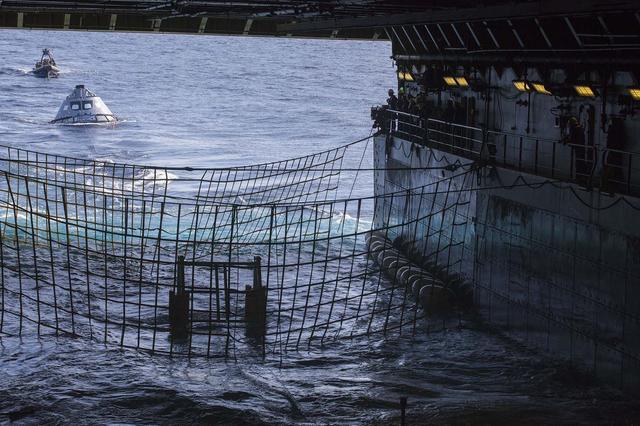
A test version of the Orion crew module floats outside the well deck of the USS San Diego on the fourth day of Underway Recovery Test 5 in the Pacific Ocean off the coast of California. NASA's Ground Systems Development and Operations Program and the U.S. Navy are practicing retrieving and securing the crew module in the well deck of the ship using tethers and a winch system to prepare for recovery of Orion on its return from deep space missions. The testing will allow the team to demonstrate and evaluate recovery processes, procedures, hardware and personnel in open waters. Orion is the exploration spacecraft designed to carry astronauts to destinations not yet explored by humans, including an asteroid and NASA's Journey to Mars. It will have emergency abort capability, sustain the crew during space travel and provide safe re-entry from deep space return velocities. Orion is scheduled to launch on NASA's Space Launch System in late 2018. For more information, visit http://www.nasa.gov/orion.
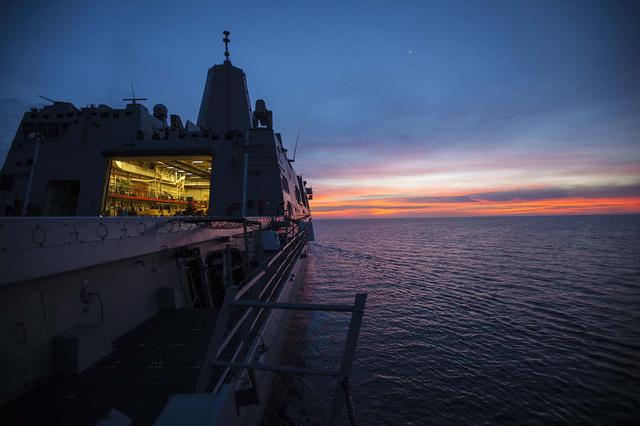
A colorful sunrise illuminates the water on the second day of Underway Recovery Test 5 in the Pacific Ocean off the coast of California. NASA's Ground Systems Development and Operations Program and the U.S. Navy will practice recovery techniques using the well deck of the USS San Diego and a test version of the Orion crew module to prepare for recovery of Orion on its return from deep space missions. The testing will allow the team to demonstrate and evaluate recovery processes, procedures, hardware and personnel in open waters. Orion is the exploration spacecraft designed to carry astronauts to destinations not yet explored by humans, including an asteroid and NASA's Journey to Mars. It will have emergency abort capability, sustain the crew during space travel and provide safe re-entry from deep space return velocities. Orion is scheduled to launch on NASA's Space Launch System in late 2018. For more information, visit http://www.nasa.gov/orion.
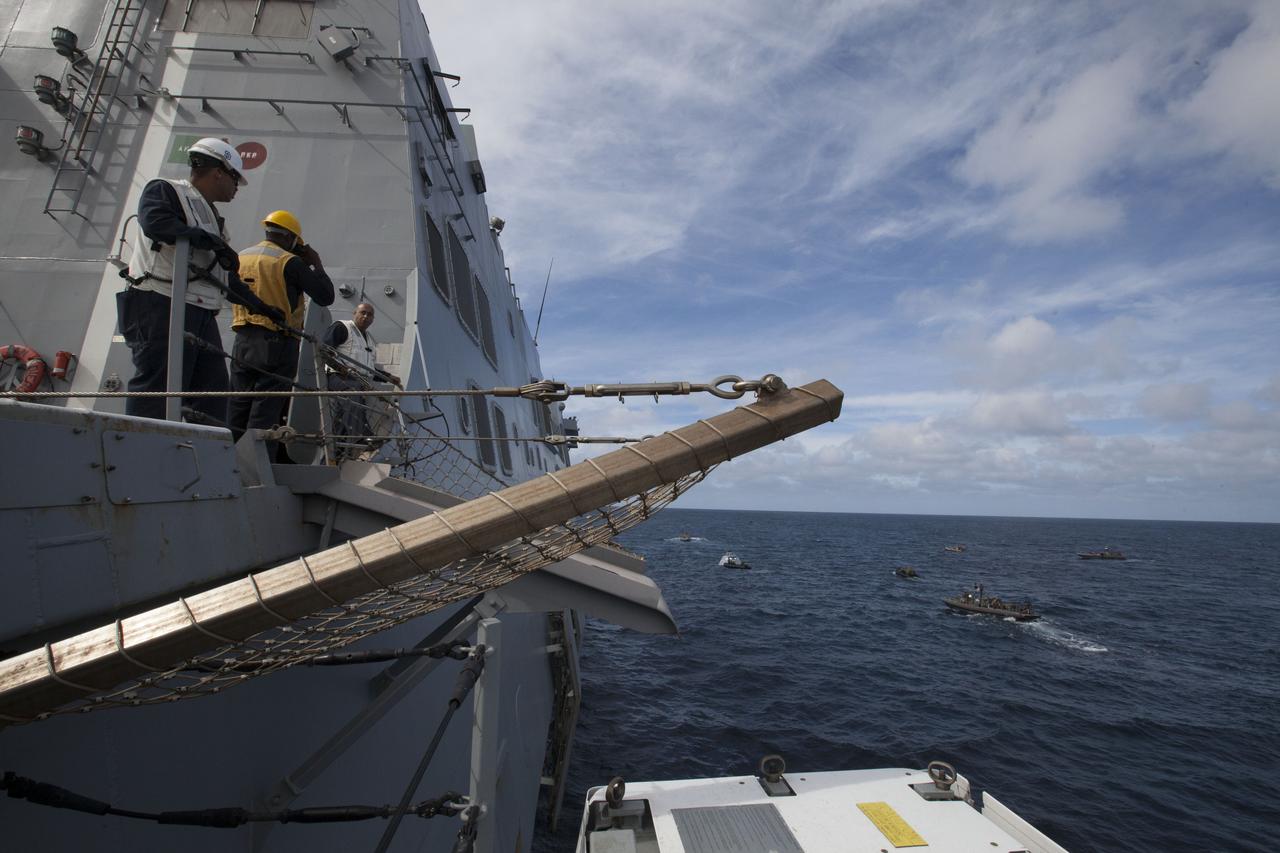
Recovery team members watch Underway Recovery Test 5 from the deck of the USS San Diego in the Pacific Ocean off the coast of California. NASA's Ground Systems Development and Operations Program and the U.S. Navy are using a test version of the Orion crew module, several rigid hull inflatable boats and support equipment to prepare to prepare for recovery of Orion on its return from deep space missions. The testing will allow the team to demonstrate and evaluate recovery processes, procedures, hardware and personnel in open waters. Orion is the exploration spacecraft designed to carry astronauts to destinations not yet explored by humans, including an asteroid and NASA's Journey to Mars. It will have emergency abort capability, sustain the crew during space travel and provide safe re-entry from deep space return velocities. Orion is scheduled to launch on NASA's Space Launch System in late 2018. For more information, visit http://www.nasa.gov/orion.
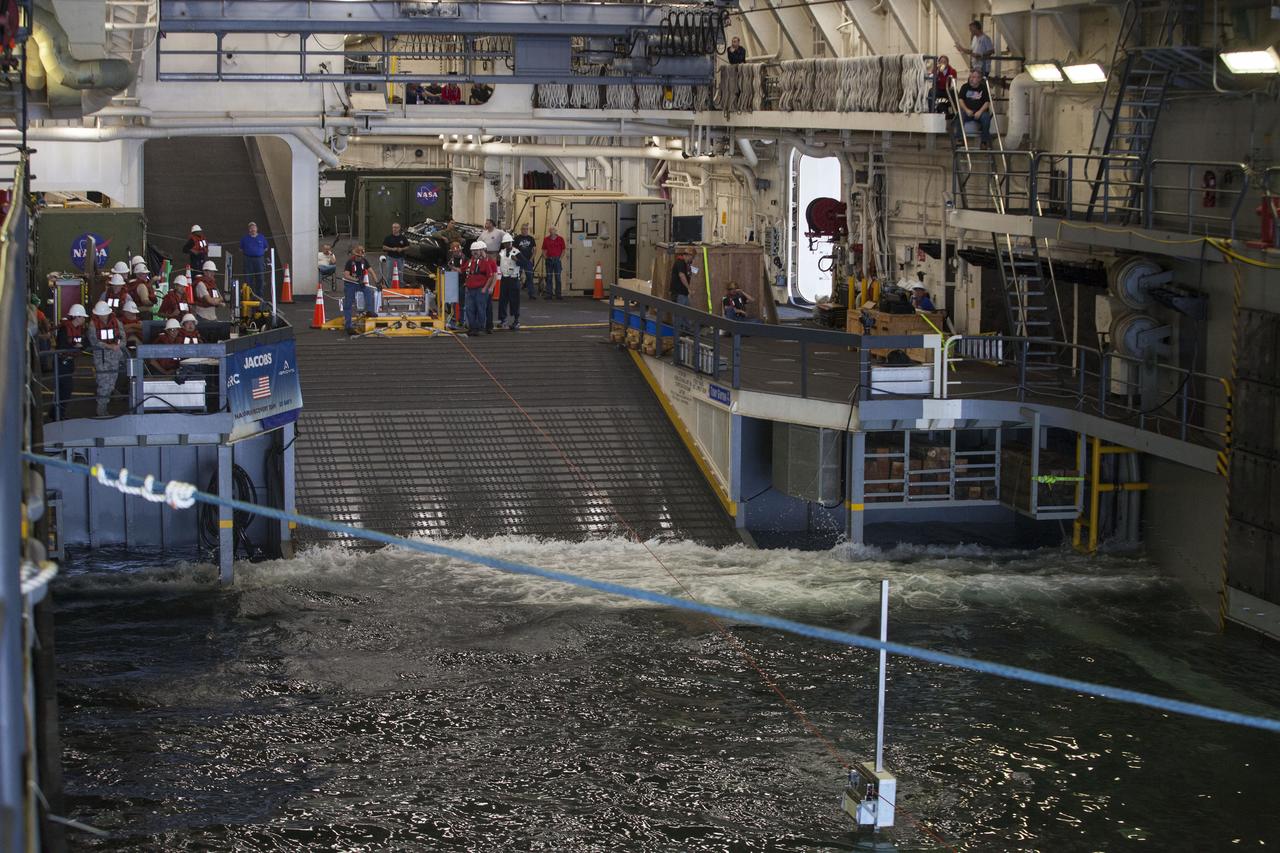
In the flooded well deck of the USS San Diego, recovery team members watch as a winch line is operated to help guide a test version of the Orion crew module into the well deck during Orion Underway Recovery Test 5 in the Pacific Ocean off the coast of California. NASA's Ground Systems Development and Operations Program and the U.S. Navy will practice recovery techniques using the well deck of the ship and a test version of the Orion crew module to prepare for recovery of Orion on its return from deep space missions. The testing will allow the team to demonstrate and evaluate recovery processes, procedures, hardware and personnel in open waters. Orion is the exploration spacecraft designed to carry astronauts to destinations not yet explored by humans, including an asteroid and NASA's Journey to Mars. It will have emergency abort capability, sustain the crew during space travel and provide safe re-entry from deep space return velocities. Orion is scheduled to launch on NASA's Space Launch System in late 2018. For more information, visit http://www.nasa.gov/orion.
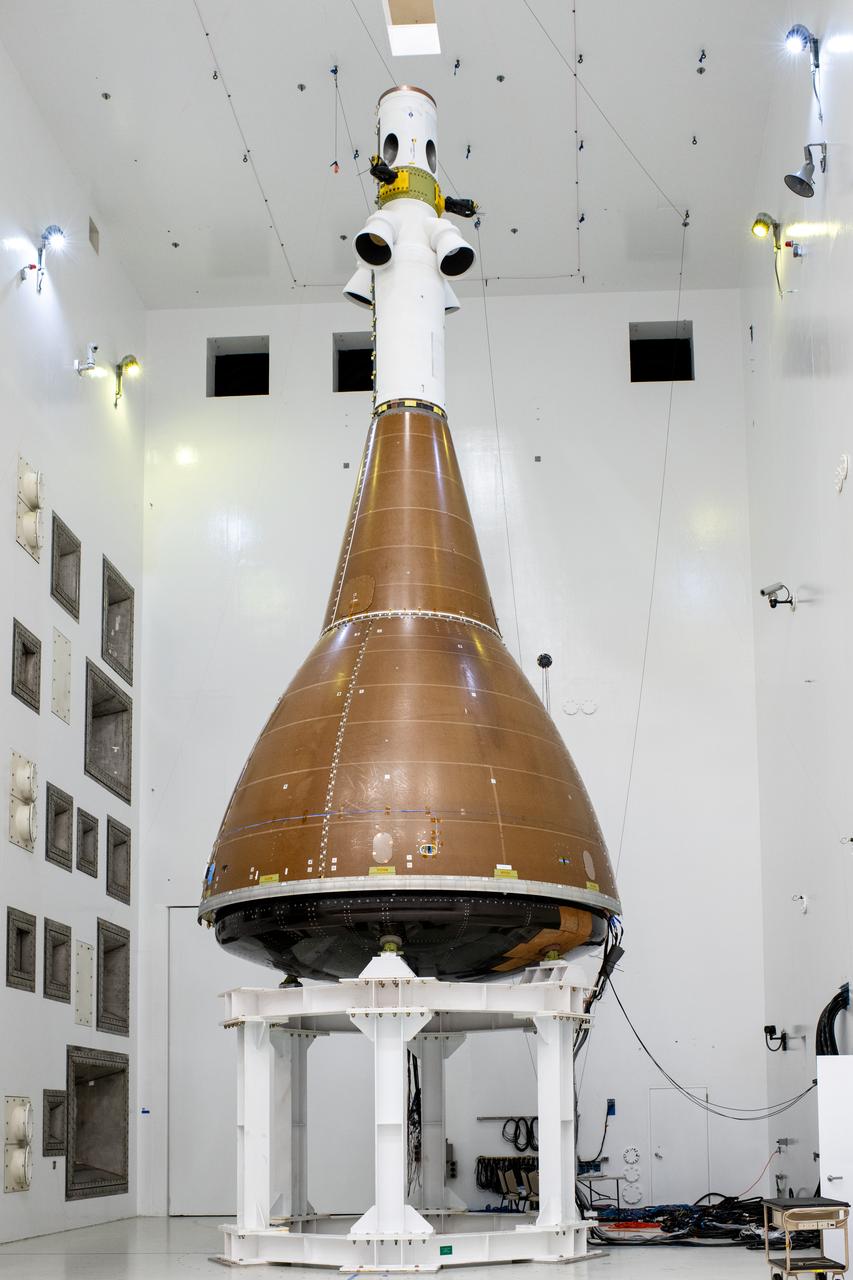
Vibro-acoustic testing on the Orion spacecraft that flew around the Moon on Artemis I, now known as the Environmental Test Article at Armstrong Test Facility in Sandusky, OH. The testing will help ensure the safety of future crews aboard Orion. Photo Credit: (NASA/Sara Lowthian-Hanna)
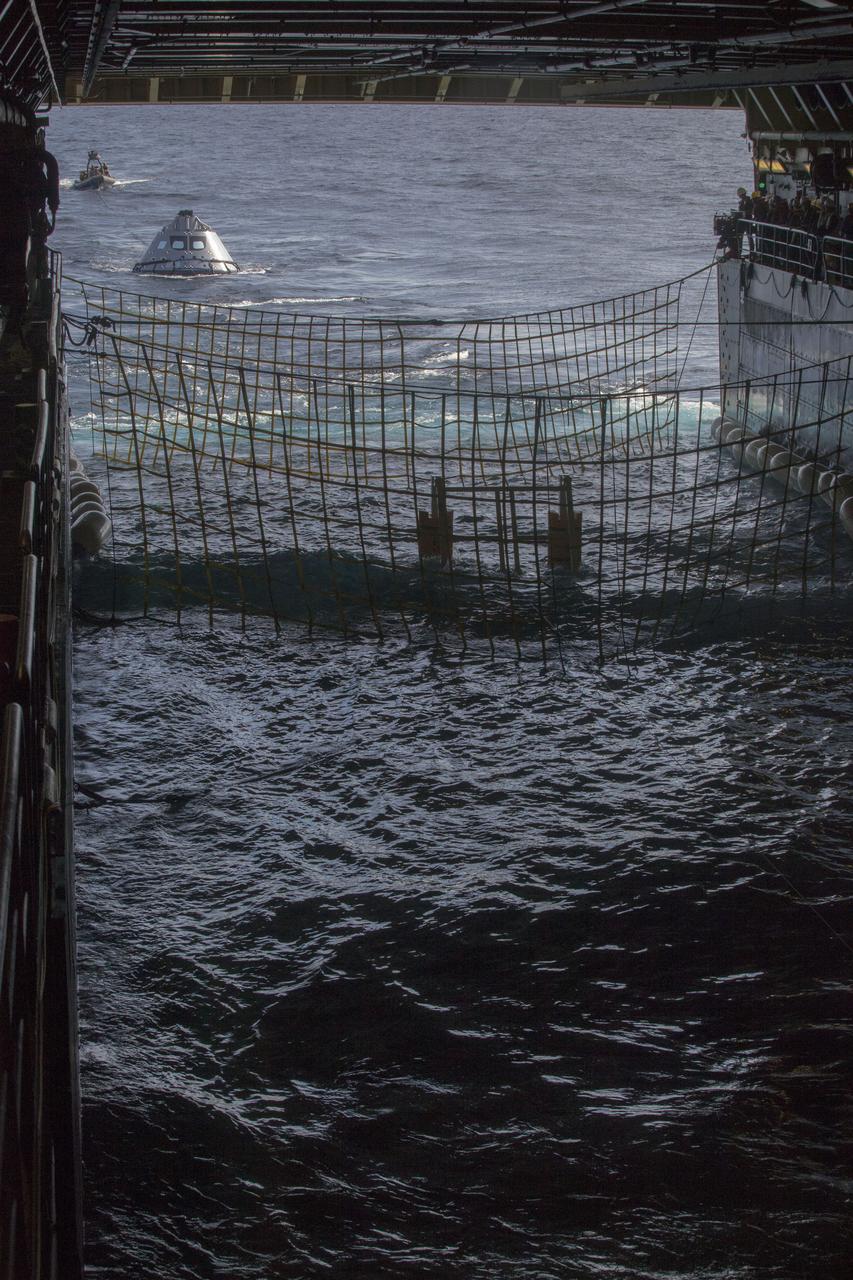
A test version of the Orion crew module floats outside the well deck of the USS San Diego during Orion Underway Recovery Test 5 in the Pacific Ocean off the coast of California. In the distance are U.S. Navy divers in a rigid hull inflatable boat. NASA's Ground Systems Development and Operations Program and the U.S. Navy are practicing recovery techniques using the well deck of the ship and the test version of the crew module to prepare for recovery of Orion on its return from deep space missions. The testing will allow the team to demonstrate and evaluate recovery processes, procedures, hardware and personnel in open waters. Orion is the exploration spacecraft designed to carry astronauts to destinations not yet explored by humans, including an asteroid and NASA's Journey to Mars. It will have emergency abort capability, sustain the crew during space travel and provide safe re-entry from deep space return velocities. Orion is scheduled to launch on NASA's Space Launch System in late 2018. For more information, visit http://www.nasa.gov/orion.
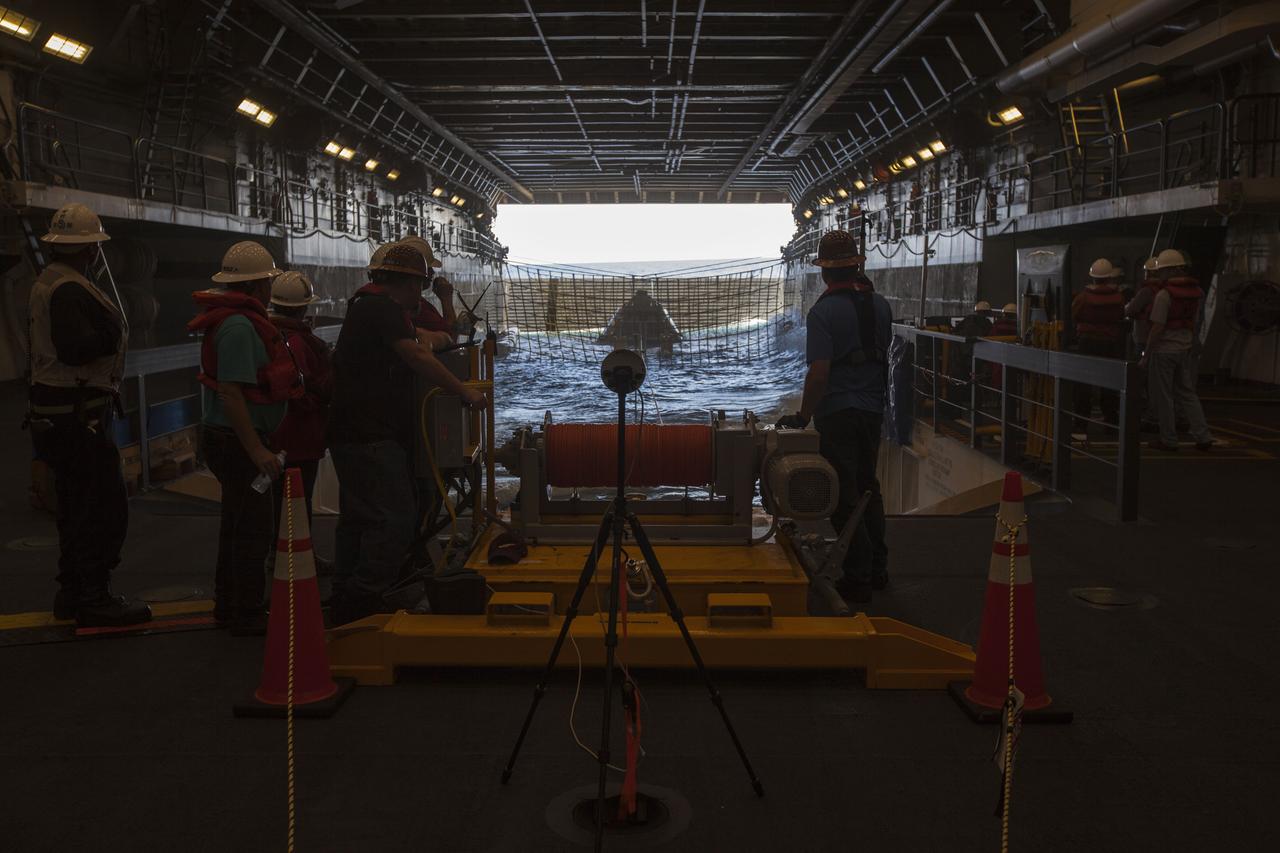
Winch team operators help guide a test version of the Orion crew module in the flooded well deck of the USS San Diego during Underway Recovery Test 5 in the Pacific Ocean off the coast of California. NASA's Ground Systems Development and Operations Program and the U.S. Navy are conducting a series of tests using the ship's well deck, the test module, various watercraft and equipment to prepare for recovery of Orion on its return from deep space missions. The testing will allow the team to demonstrate and evaluate recovery processes, procedures, hardware and personnel in open waters. Orion is the exploration spacecraft designed to carry astronauts to destinations not yet explored by humans, including an asteroid and NASA's Journey to Mars. It will have emergency abort capability, sustain the crew during space travel and provide safe re-entry from deep space return velocities. Orion is scheduled to launch on NASA's Space Launch System in late 2018. For more information, visit http://www.nasa.gov/orion.
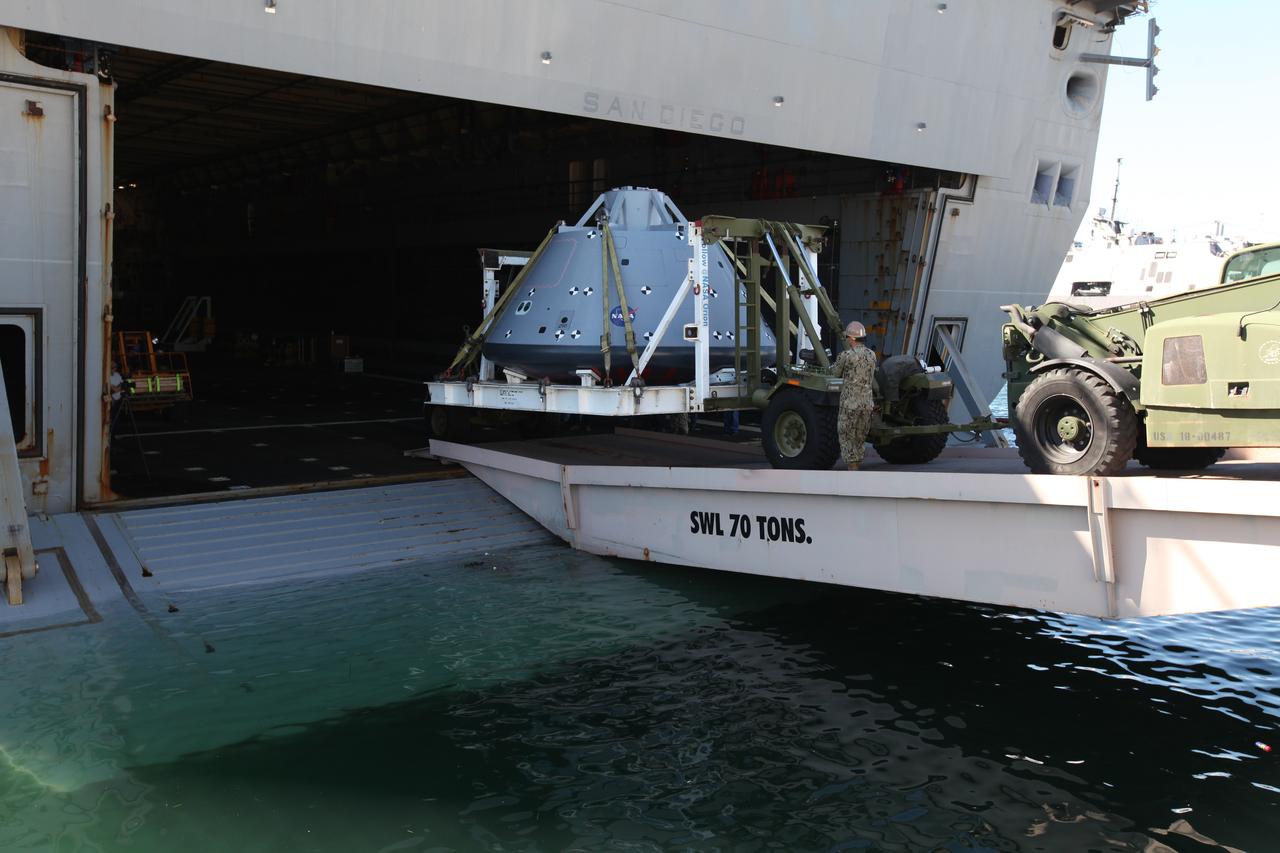
The USS San Diego is docked at Naval Base San Diego in California after returning from Underway Recovery Test 5 in the Pacific Ocean. A test version of the Orion crew module is being offloaded from the well deck of the ship. NASA's Ground Systems Development and Operations Program and the U.S. Navy completed a series of tests using the ship's well deck, the test module, various watercraft and equipment to prepare for recovery of Orion on its return from deep space missions. The testing allowed the team to demonstrate and evaluate recovery processes, procedures, hardware and personnel in open waters. Orion is the exploration spacecraft designed to carry astronauts to destinations not yet explored by humans, including an asteroid and NASA's Journey to Mars. It will have emergency abort capability, sustain the crew during space travel and provide safe re-entry from deep space return velocities. Orion is scheduled to launch on NASA's Space Launch System in late 2018. For more information, visit http://www.nasa.gov/orion.
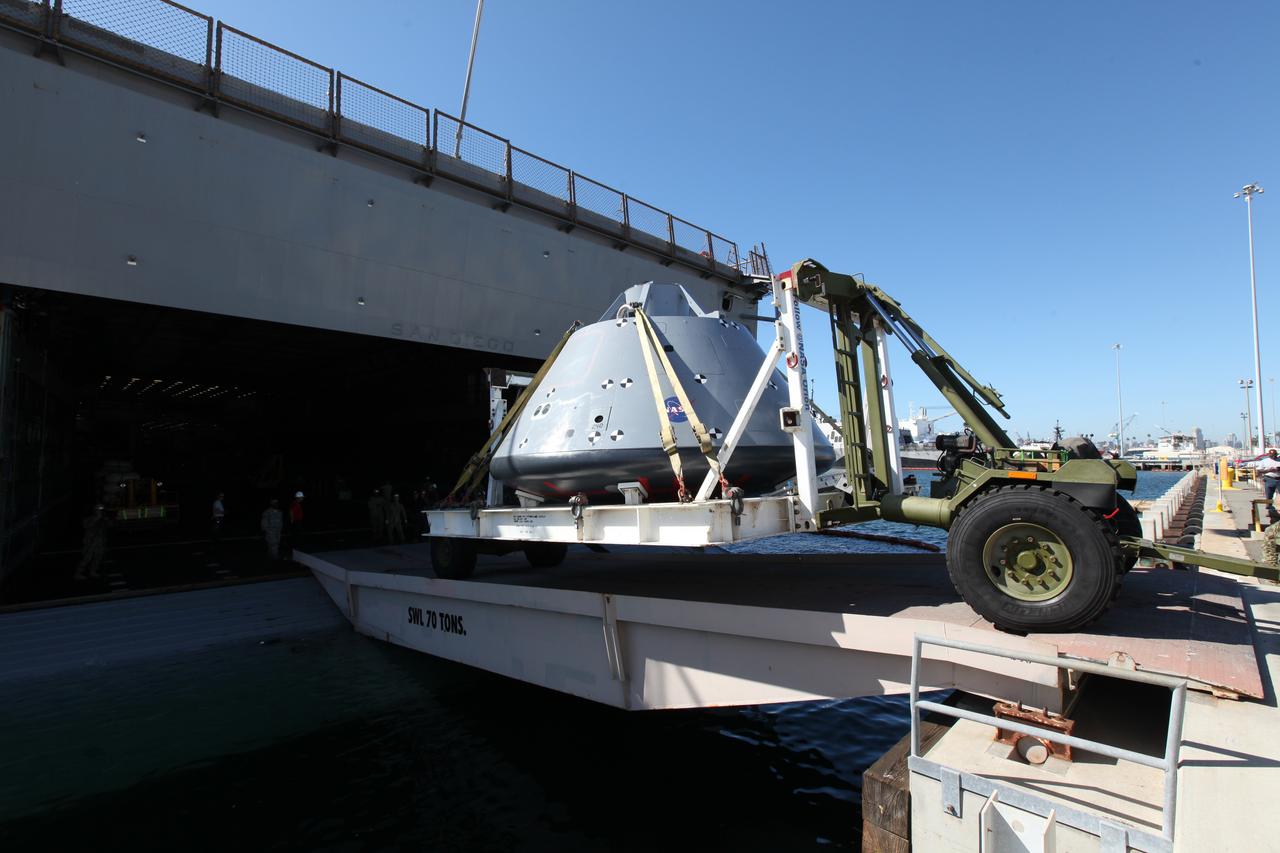
The USS San Diego is docked at Naval Base San Diego in California after returning from Underway Recovery Test 5 in the Pacific Ocean. A test version of the Orion crew module is being offloaded from the well deck of the ship. NASA's Ground Systems Development and Operations Program and the U.S. Navy completed a series of tests using the ship's well deck, the test module, various watercraft and equipment to prepare for recovery of Orion on its return from deep space missions. The testing allowed the team to demonstrate and evaluate recovery processes, procedures, hardware and personnel in open waters. Orion is the exploration spacecraft designed to carry astronauts to destinations not yet explored by humans, including an asteroid and NASA's Journey to Mars. It will have emergency abort capability, sustain the crew during space travel and provide safe re-entry from deep space return velocities. Orion is scheduled to launch on NASA's Space Launch System in late 2018. For more information, visit http://www.nasa.gov/orion.
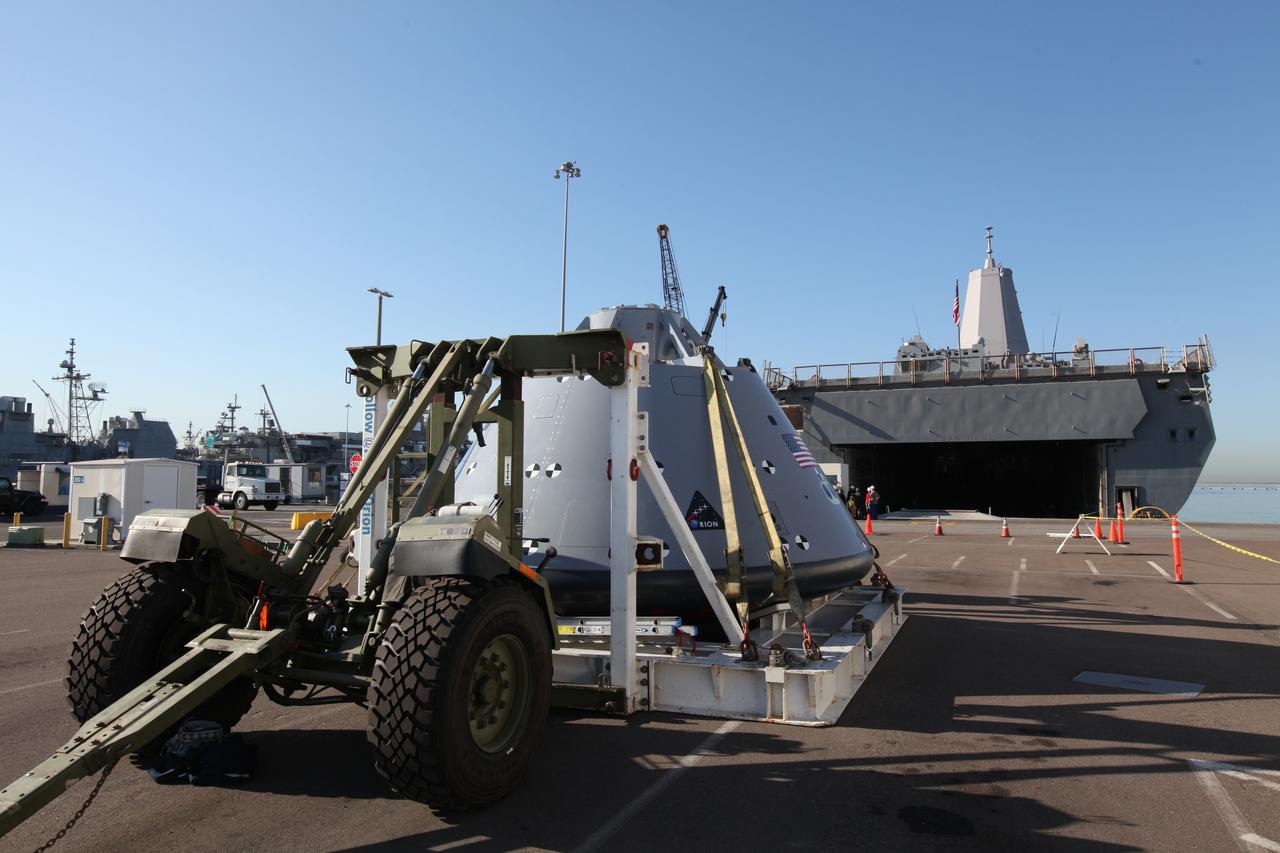
The USS San Diego is docked at Naval Base San Diego in California after returning from Underway Recovery Test 5 in the Pacific Ocean. A test version of the Orion crew module, secured on its handling fixture, was offloaded from the well deck of the ship. NASA's Ground Systems Development and Operations Program and the U.S. Navy completed a series of tests using the ship's well deck, the test module, various watercraft and equipment to prepare for recovery of Orion on its return from deep space missions. The testing allowed the team to demonstrate and evaluate recovery processes, procedures, hardware and personnel in open waters. Orion is the exploration spacecraft designed to carry astronauts to destinations not yet explored by humans, including an asteroid and NASA's Journey to Mars. It will have emergency abort capability, sustain the crew during space travel and provide safe re-entry from deep space return velocities. Orion is scheduled to launch on NASA's Space Launch System in late 2018. For more information, visit http://www.nasa.gov/orion.
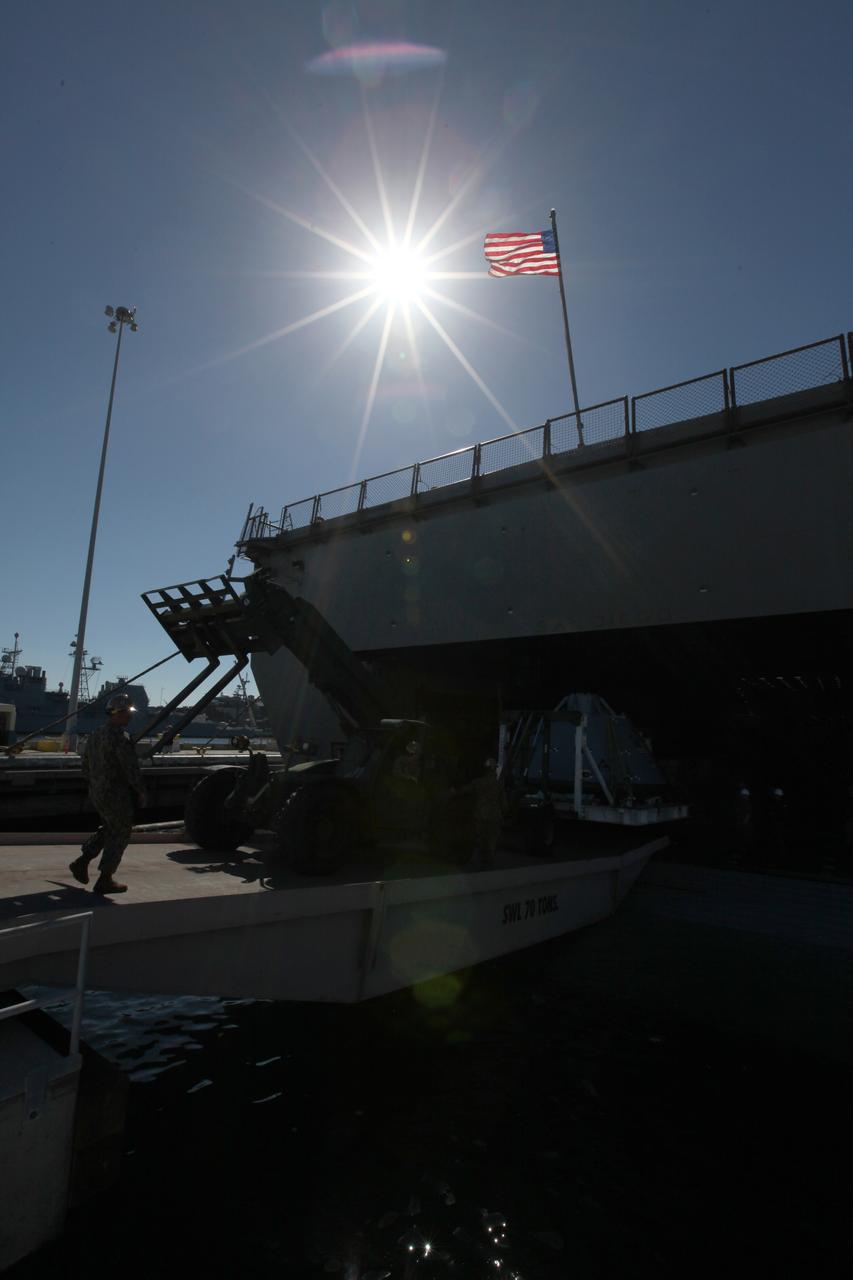
The USS San Diego is docked at Naval Base San Diego in California after returning from Underway Recovery Test 5 in the Pacific Ocean. A test version of the Orion crew module is being offloaded from the well deck of the ship. NASA's Ground Systems Development and Operations Program and the U.S. Navy completed a series of tests using the ship's well deck, the test module, various watercraft and equipment to prepare for recovery of Orion on its return from deep space missions. The testing allowed the team to demonstrate and evaluate recovery processes, procedures, hardware and personnel in open waters. Orion is the exploration spacecraft designed to carry astronauts to destinations not yet explored by humans, including an asteroid and NASA's Journey to Mars. It will have emergency abort capability, sustain the crew during space travel and provide safe re-entry from deep space return velocities. Orion is scheduled to launch on NASA's Space Launch System in late 2018. For more information, visit http://www.nasa.gov/orion.
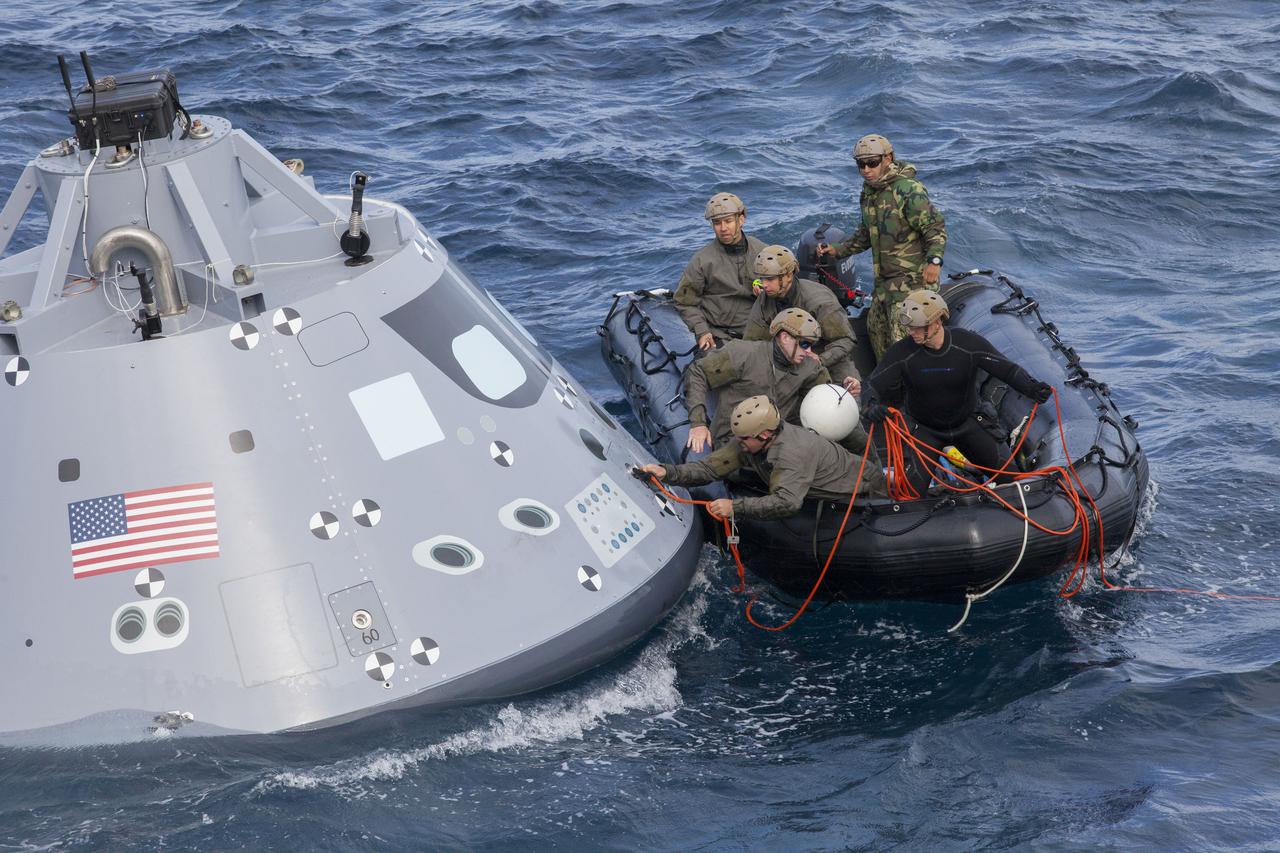
U.S. Navy divers and other personnel in a small Zodiac boat secure a tether line to an attach point on a test version of the Orion crew module during Underway Recovery Test 5 in the Pacific Ocean off the coast of California. NASA's Ground Systems Development and Operations Program and the U.S. Navy are conducting a series of tests using the USS San Diego's well deck, the test module, various watercraft and equipment to prepare for recovery of Orion on its return from deep space missions. The testing will allow the team to demonstrate and evaluate recovery processes, procedures, hardware and personnel in open waters. Orion is the exploration spacecraft designed to carry astronauts to destinations not yet explored by humans, including an asteroid and NASA's Journey to Mars. It will have emergency abort capability, sustain the crew during space travel and provide safe re-entry from deep space return velocities. Orion is scheduled to launch on NASA's Space Launch System in late 2018. For more information, visit http://www.nasa.gov/orion.
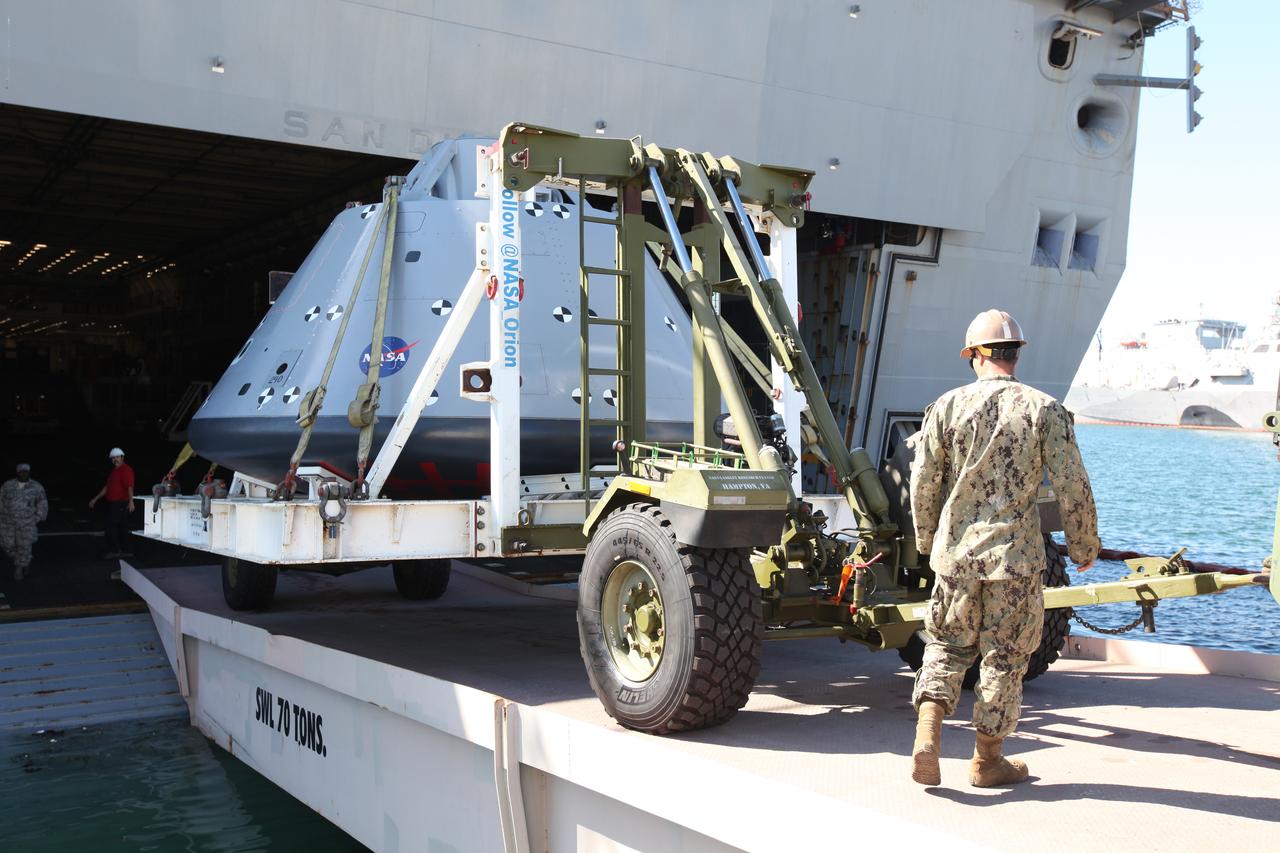
The USS San Diego is docked at Naval Base San Diego in California after returning from Underway Recovery Test 5 in the Pacific Ocean. A test version of the Orion crew module is being offloaded from the well deck of the ship. NASA's Ground Systems Development and Operations Program and the U.S. Navy completed a series of tests using the ship's well deck, the test module, various watercraft and equipment to prepare for recovery of Orion on its return from deep space missions. The testing allowed the team to demonstrate and evaluate recovery processes, procedures, hardware and personnel in open waters. Orion is the exploration spacecraft designed to carry astronauts to destinations not yet explored by humans, including an asteroid and NASA's Journey to Mars. It will have emergency abort capability, sustain the crew during space travel and provide safe re-entry from deep space return velocities. Orion is scheduled to launch on NASA's Space Launch System in late 2018. For more information, visit http://www.nasa.gov/orion.
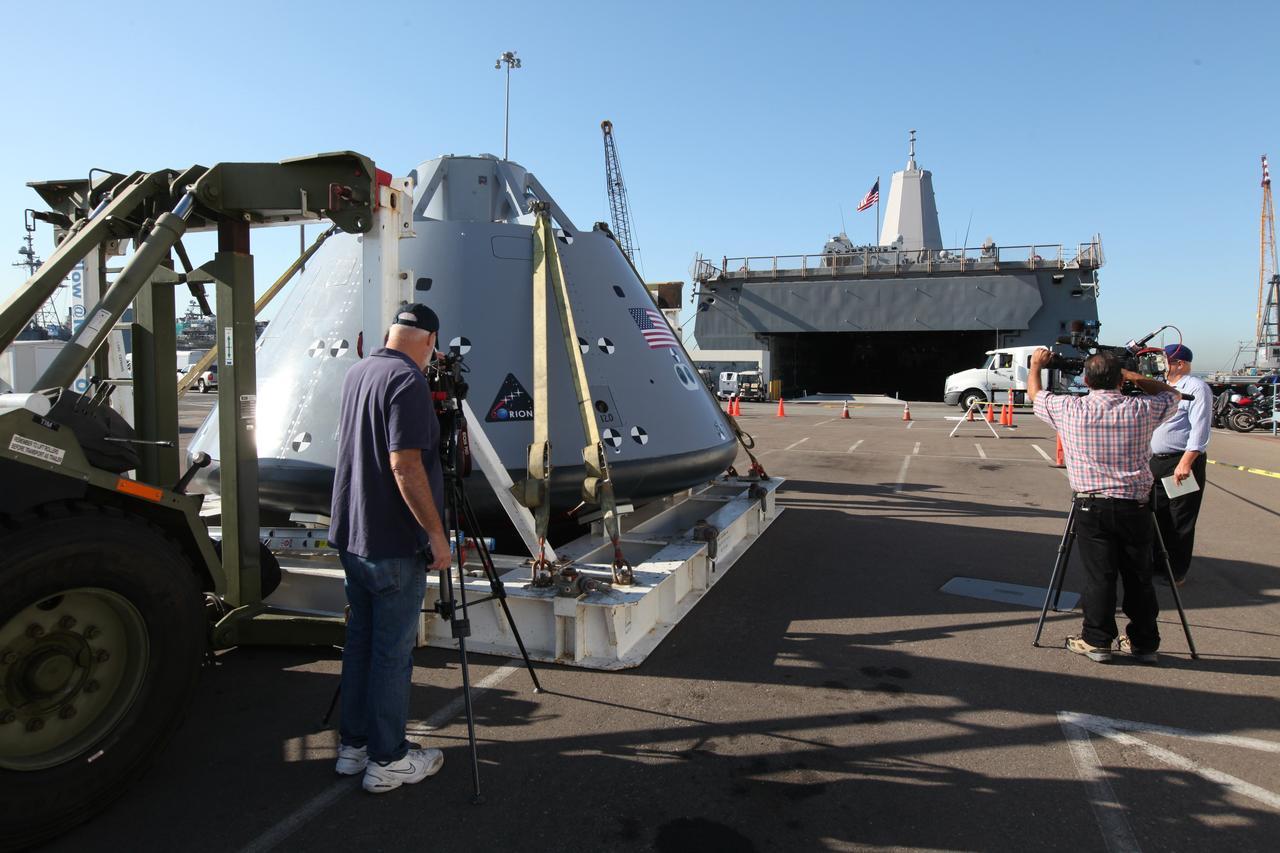
The USS San Diego is docked at Naval Base San Diego in California after returning from Underway Recovery Test 5 in the Pacific Ocean. A test version of the Orion crew module, secured on its handling fixture, was offloaded from the well deck of the ship. NASA's Ground Systems Development and Operations Program and the U.S. Navy completed a series of tests using the ship's well deck, the test module, various watercraft and equipment to prepare for recovery of Orion on its return from deep space missions. The testing allowed the team to demonstrate and evaluate recovery processes, procedures, hardware and personnel in open waters. Orion is the exploration spacecraft designed to carry astronauts to destinations not yet explored by humans, including an asteroid and NASA's Journey to Mars. It will have emergency abort capability, sustain the crew during space travel and provide safe re-entry from deep space return velocities. Orion is scheduled to launch on NASA's Space Launch System in late 2018. For more information, visit http://www.nasa.gov/orion.
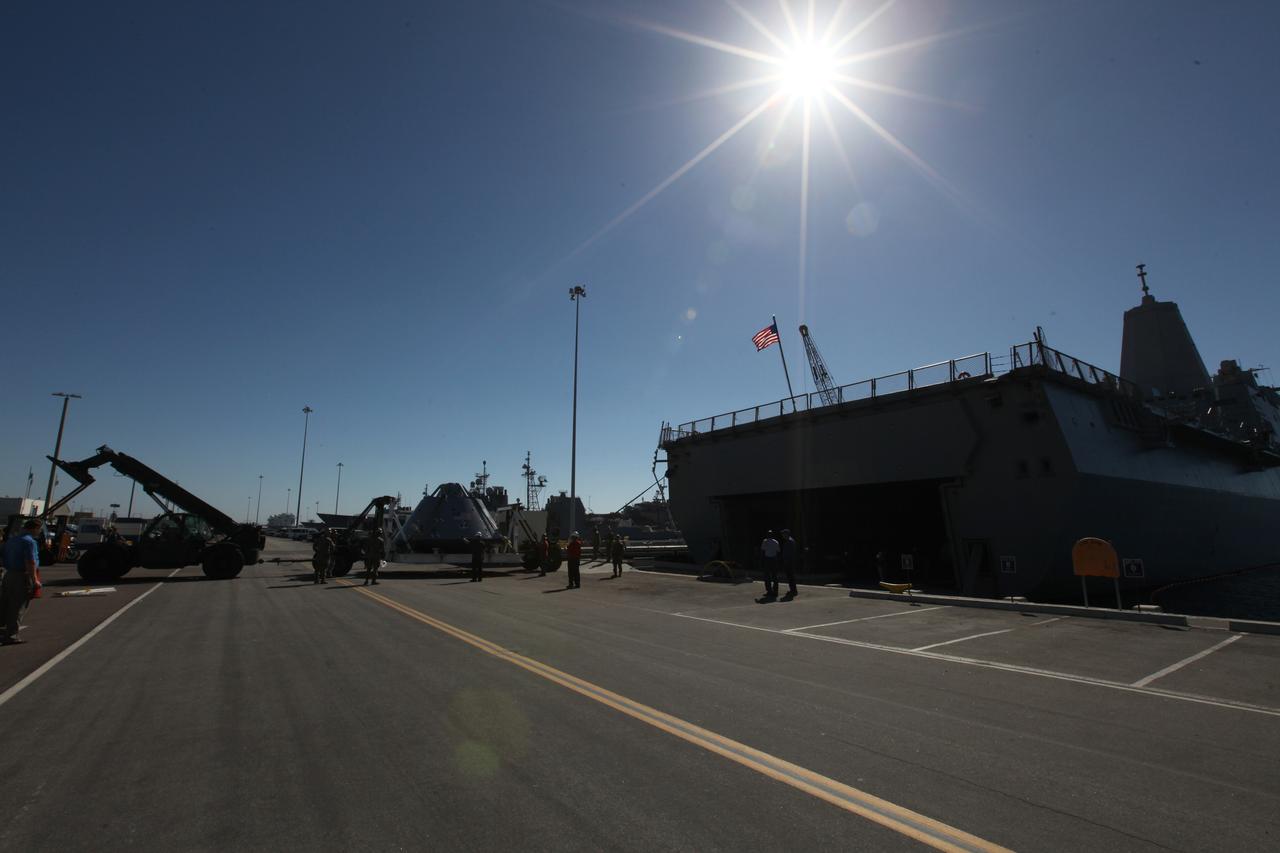
The USS San Diego is docked at Naval Base San Diego in California after returning from Underway Recovery Test 5 in the Pacific Ocean. A test version of the Orion crew module has been offloaded from the well deck of the ship. NASA's Ground Systems Development and Operations Program and the U.S. Navy completed a series of tests using the ship's well deck, the test module, various watercraft and equipment to prepare for recovery of Orion on its return from deep space missions. The testing allowed the team to demonstrate and evaluate recovery processes, procedures, hardware and personnel in open waters. Orion is the exploration spacecraft designed to carry astronauts to destinations not yet explored by humans, including an asteroid and NASA's Journey to Mars. It will have emergency abort capability, sustain the crew during space travel and provide safe re-entry from deep space return velocities. Orion is scheduled to launch on NASA's Space Launch System in late 2018. For more information, visit http://www.nasa.gov/orion.
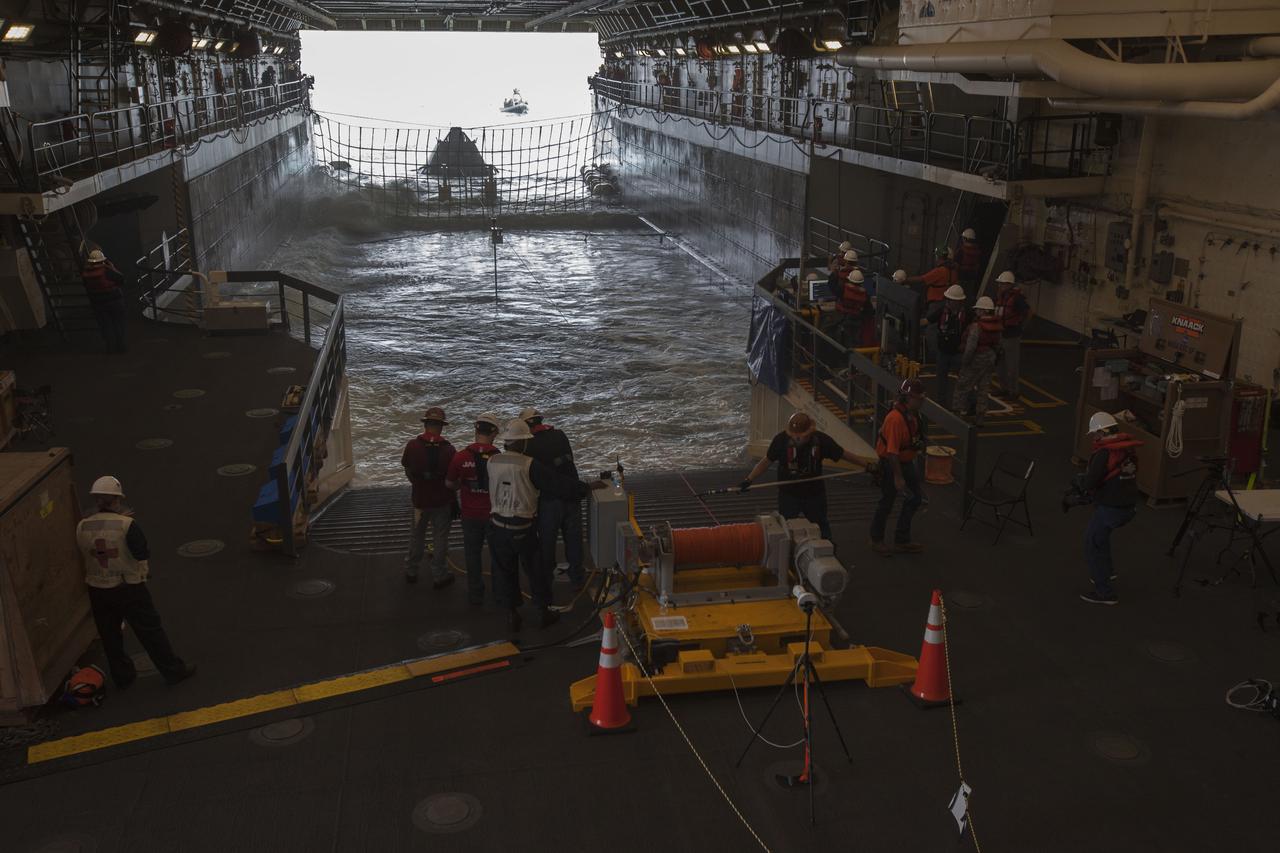
Winch team operators help guide a test version of the Orion crew module into the flooded well deck of the USS San Diego during Underway Recovery Test 5 in the Pacific Ocean off the coast of California. NASA's Ground Systems Development and Operations Program and the U.S. Navy are conducting a series of tests using the ship's well deck, the test module, various watercraft and equipment to prepare for recovery of Orion on its return from deep space missions. The testing will allow the team to demonstrate and evaluate recovery processes, procedures, hardware and personnel in open waters. Orion is the exploration spacecraft designed to carry astronauts to destinations not yet explored by humans, including an asteroid and NASA's Journey to Mars. It will have emergency abort capability, sustain the crew during space travel and provide safe re-entry from deep space return velocities. Orion is scheduled to launch on NASA's Space Launch System in late 2018. For more information, visit http://www.nasa.gov/orion.
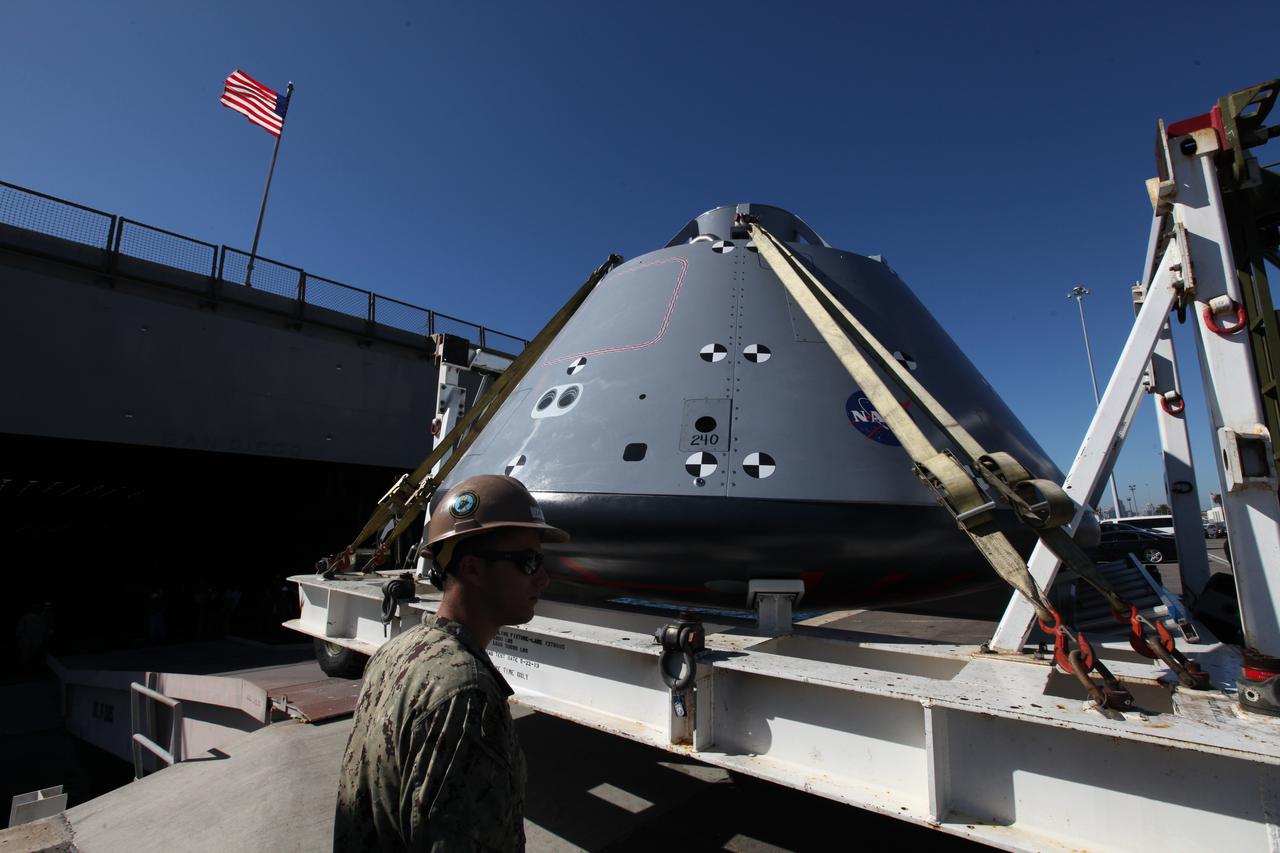
The USS San Diego is docked at Naval Base San Diego in California after returning from Underway Recovery Test 5 in the Pacific Ocean. A test version of the Orion crew module is being offloaded from the well deck of the ship. NASA's Ground Systems Development and Operations Program and the U.S. Navy completed a series of tests using the ship's well deck, the test module, various watercraft and equipment to prepare for recovery of Orion on its return from deep space missions. The testing allowed the team to demonstrate and evaluate recovery processes, procedures, hardware and personnel in open waters. Orion is the exploration spacecraft designed to carry astronauts to destinations not yet explored by humans, including an asteroid and NASA's Journey to Mars. It will have emergency abort capability, sustain the crew during space travel and provide safe re-entry from deep space return velocities. Orion is scheduled to launch on NASA's Space Launch System in late 2018. For more information, visit http://www.nasa.gov/orion.
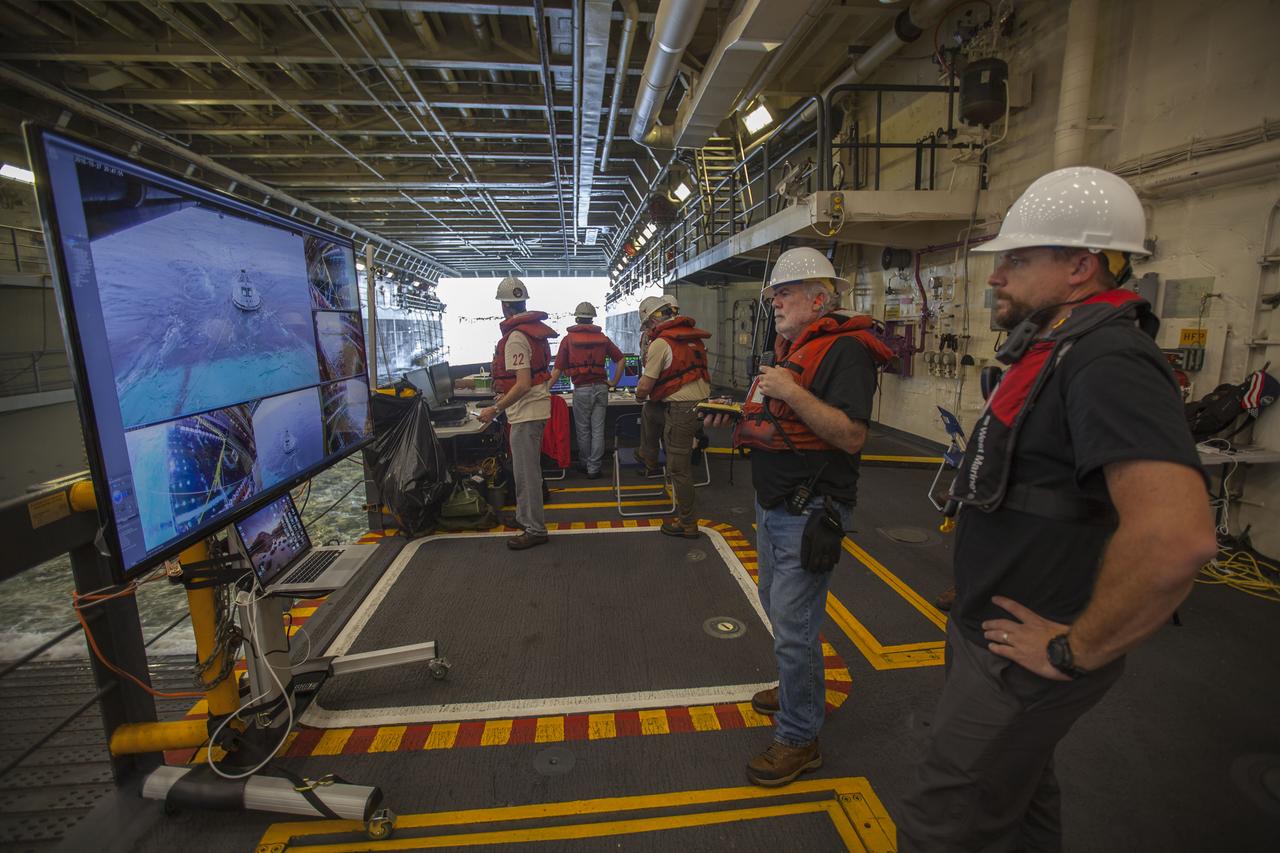
In the well deck of the USS San Diego, recovery team members monitor a portion of Underway Recovery Test 5 in the Pacific Ocean off the coast of California. A test version of the Orion crew module is floating in open waters. NASA's Ground Systems Development and Operations Program and the U.S. Navy are conducting a series of tests using the ship's well deck, the test module, various watercraft and equipment to prepare for recovery of Orion on its return from deep space missions. The test will allow the team to demonstrate and evaluate recovery processes, procedures, hardware and personnel in open waters. Orion is the exploration spacecraft designed to carry astronauts to destinations not yet explored by humans, including an asteroid and NASA's Journey to Mars. It will have emergency abort capability, sustain the crew during space travel and provide safe re-entry from deep space return velocities. Orion is scheduled to launch on NASA's Space Launch System in late 2018. For more information, visit http://www.nasa.gov/orion.
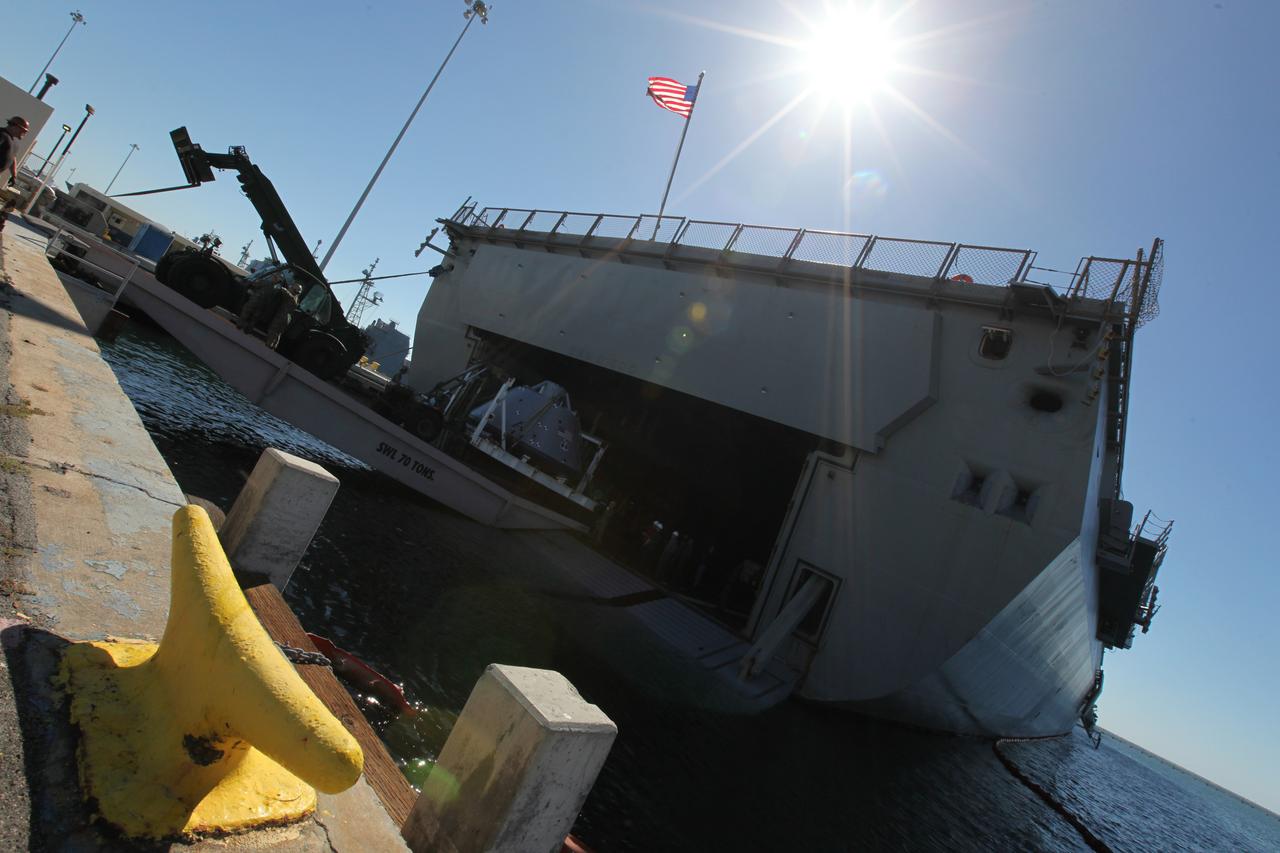
The USS San Diego is docked at Naval Base San Diego in California after returning from Underway Recovery Test 5 in the Pacific Ocean. A test version of the Orion crew module is being offloaded from the well deck of the ship. NASA's Ground Systems Development and Operations Program and the U.S. Navy completed a series of tests using the ship's well deck, the test module, various watercraft and equipment to prepare for recovery of Orion on its return from deep space missions. The testing allowed the team to demonstrate and evaluate recovery processes, procedures, hardware and personnel in open waters. Orion is the exploration spacecraft designed to carry astronauts to destinations not yet explored by humans, including an asteroid and NASA's Journey to Mars. It will have emergency abort capability, sustain the crew during space travel and provide safe re-entry from deep space return velocities. Orion is scheduled to launch on NASA's Space Launch System in late 2018. For more information, visit http://www.nasa.gov/orion.
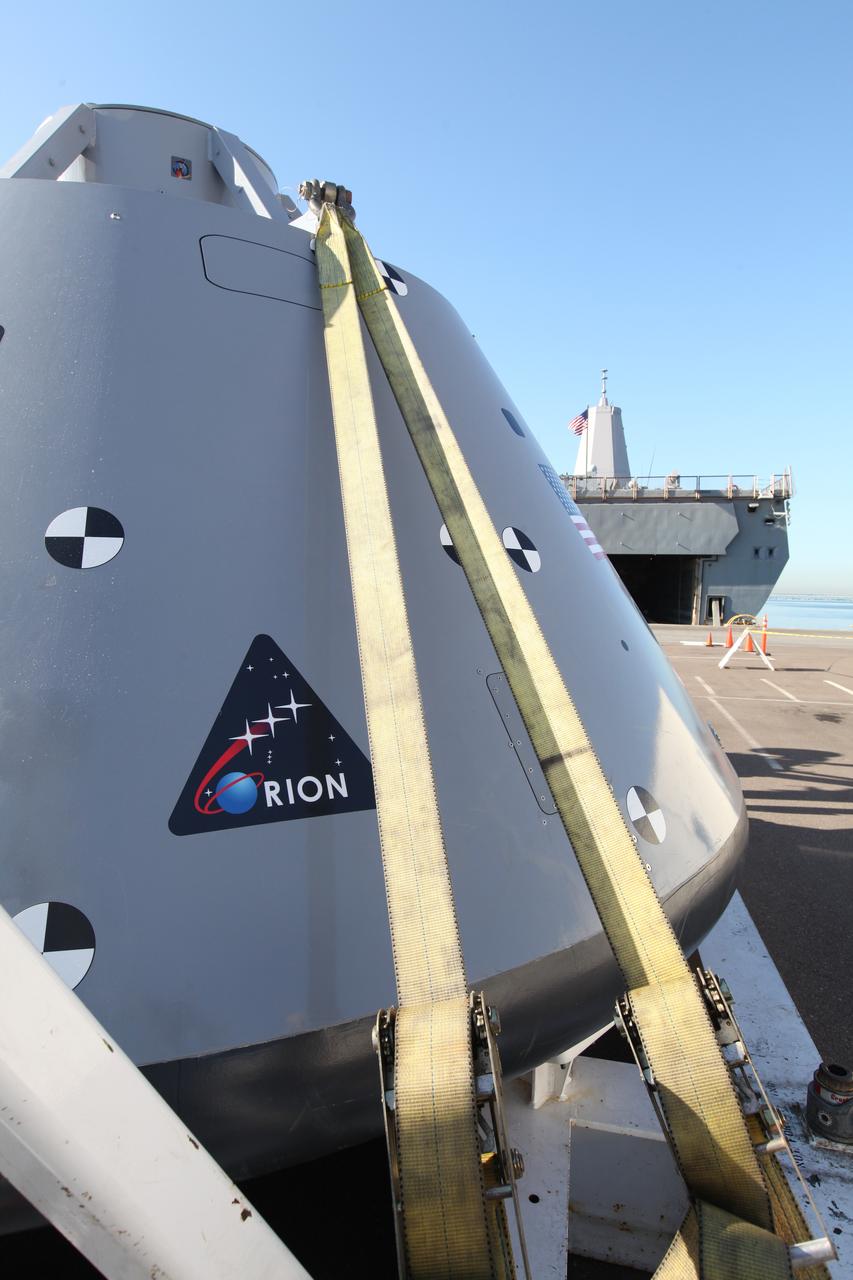
The USS San Diego is docked at Naval Base San Diego in California after returning from Underway Recovery Test 5 in the Pacific Ocean. A test version of the Orion crew module, secured on its handling fixture, was offloaded from the well deck of the ship. NASA's Ground Systems Development and Operations Program and the U.S. Navy completed a series of tests using the ship's well deck, the test module, various watercraft and equipment to prepare for recovery of Orion on its return from deep space missions. The testing allowed the team to demonstrate and evaluate recovery processes, procedures, hardware and personnel in open waters. Orion is the exploration spacecraft designed to carry astronauts to destinations not yet explored by humans, including an asteroid and NASA's Journey to Mars. It will have emergency abort capability, sustain the crew during space travel and provide safe re-entry from deep space return velocities. Orion is scheduled to launch on NASA's Space Launch System in late 2018. For more information, visit http://www.nasa.gov/orion.
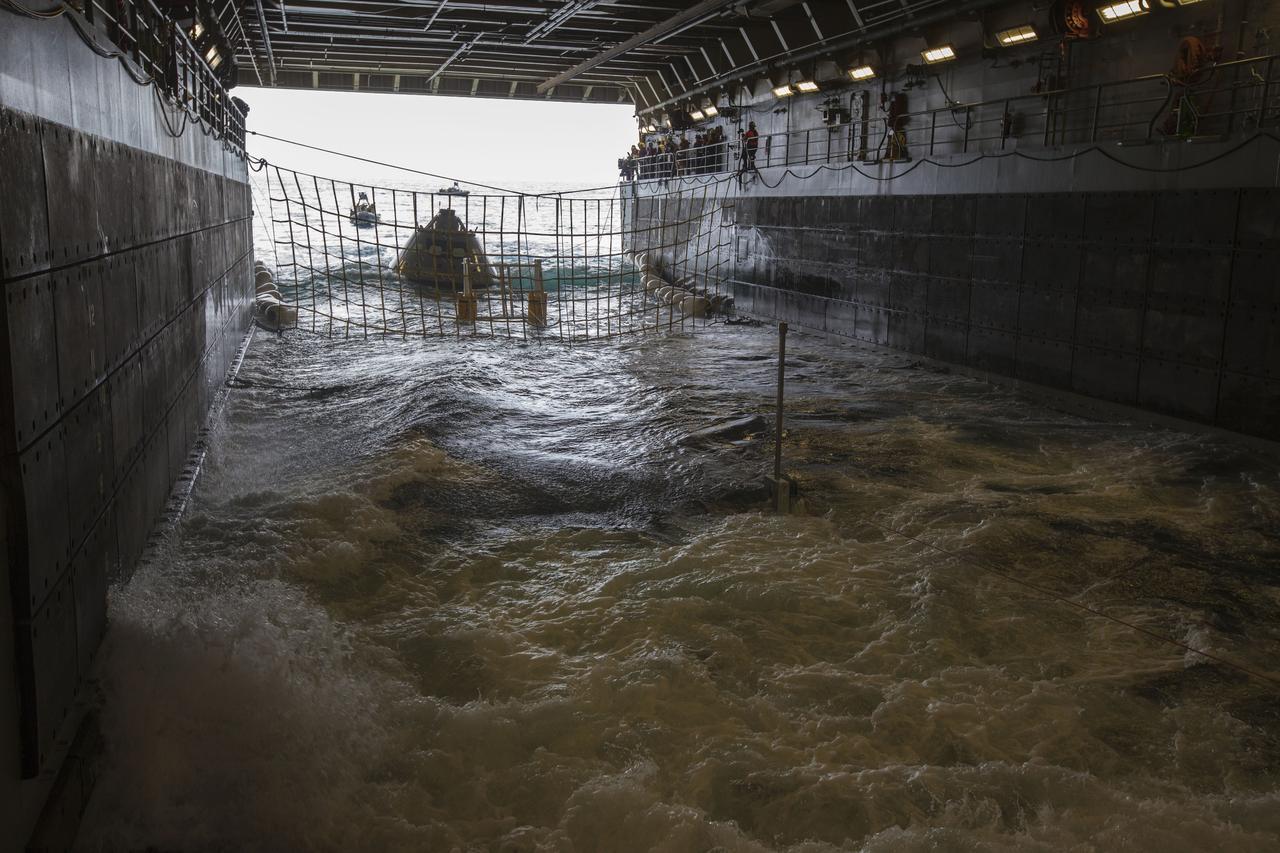
Members of the recovery team watch as the test version of the Orion crew module is guided into the flooded well deck of the USS San Diego during Underway Recovery Test 5 in the Pacific Ocean off the coast of California. NASA's Ground Systems Development and Operations Program and the U.S. Navy are conducting a series of tests using the ship's well deck, the test module, various watercraft and equipment to prepare for recovery of Orion on its return from deep space missions. The testing will allow the team to demonstrate and evaluate recovery processes, procedures, hardware and personnel in open waters. Orion is the exploration spacecraft designed to carry astronauts to destinations not yet explored by humans, including an asteroid and NASA's Journey to Mars. It will have emergency abort capability, sustain the crew during space travel and provide safe re-entry from deep space return velocities. Orion is scheduled to launch on NASA's Space Launch System in late 2018. For more information, visit http://www.nasa.gov/orion.
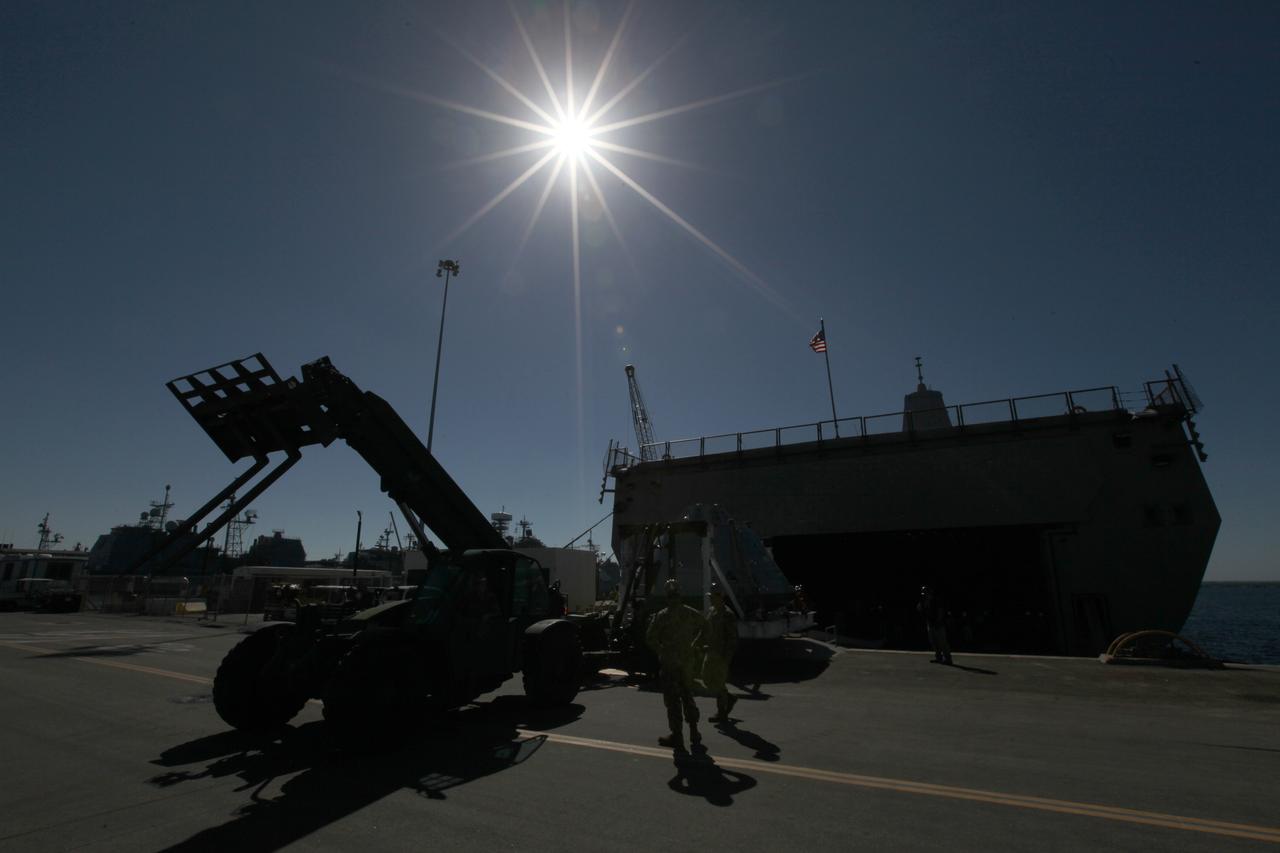
The USS San Diego is docked at Naval Base San Diego in California after returning from Underway Recovery Test 5 in the Pacific Ocean. A test version of the Orion crew module has been offloaded from the well deck of the ship. NASA's Ground Systems Development and Operations Program and the U.S. Navy completed a series of tests using the ship's well deck, the test module, various watercraft and equipment to prepare for recovery of Orion on its return from deep space missions. The testing allowed the team to demonstrate and evaluate recovery processes, procedures, hardware and personnel in open waters. Orion is the exploration spacecraft designed to carry astronauts to destinations not yet explored by humans, including an asteroid and NASA's Journey to Mars. It will have emergency abort capability, sustain the crew during space travel and provide safe re-entry from deep space return velocities. Orion is scheduled to launch on NASA's Space Launch System in late 2018. For more information, visit http://www.nasa.gov/orion.
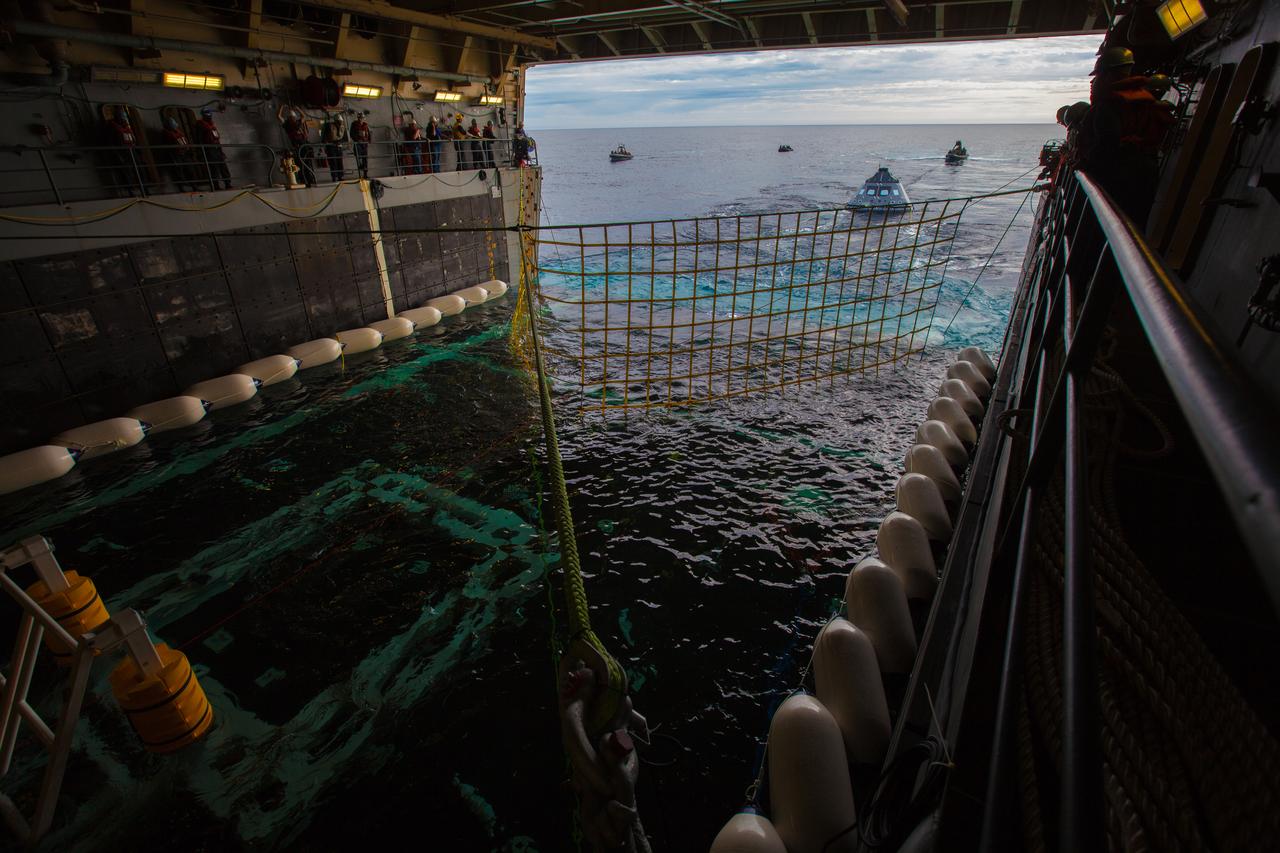
A test version of the Orion crew module is guided toward the flooded well deck of the USS San Diego during Underway Recovery Test 5 on Oct. 28, 2016. NASA's Ground Systems Development and Operations Program and the U.S. Navy are conducting a series of tests using the ship's well deck, the test module, various watercraft and equipment to prepare for recovery of Orion on its return from deep space missions. The test will allow the team to demonstrate and evaluate recovery processes, procedures, hardware and personnel in open waters. Part of Batch images transfer from Flickr.
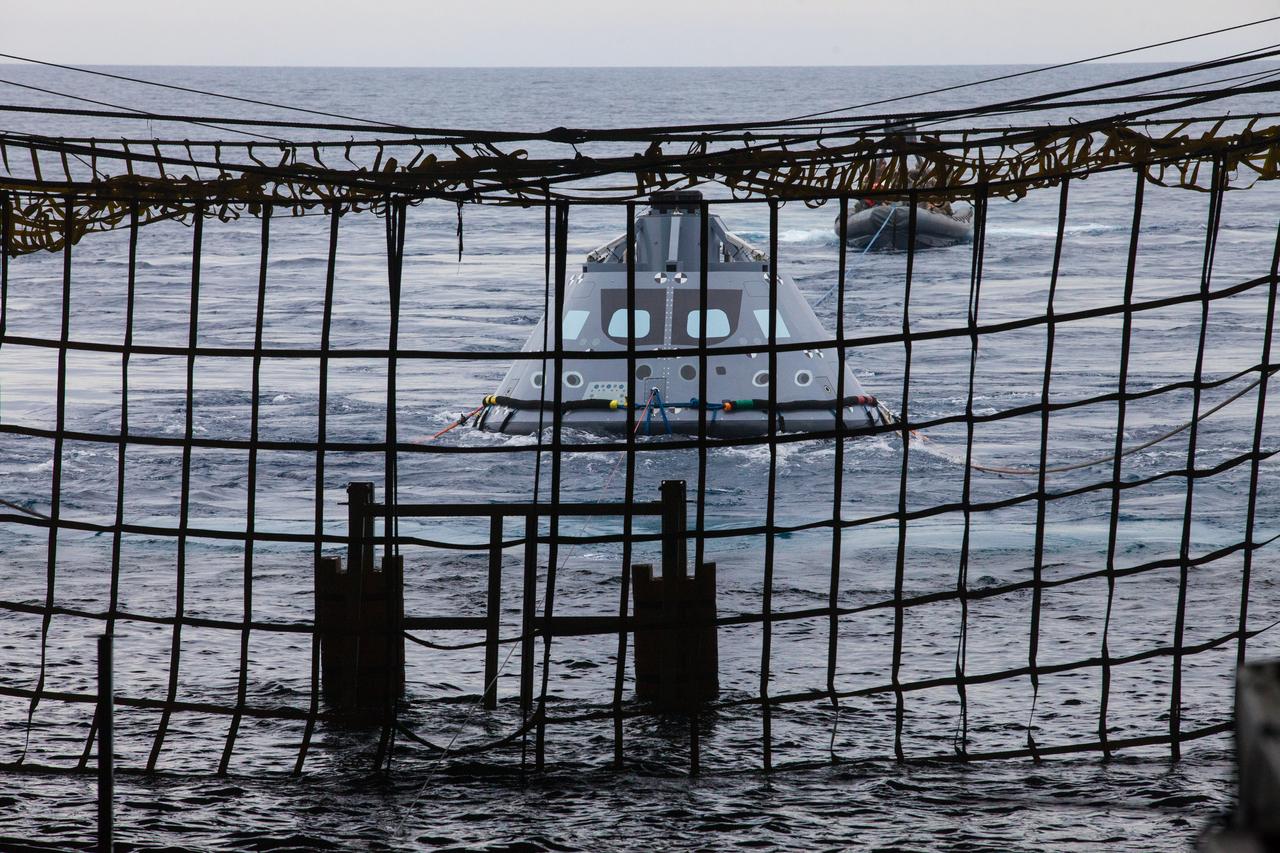
A test version of the Orion crew module is secured in the well deck of the USS San Diego for Underway Recovery Test 5 on Oct. 26, 2016. NASA's Ground Systems Development and Operations Program and the U.S. Navy will conduct a series of tests using the ship's well deck, the test module, various watercraft and equipment to prepare for recovery of Orion on its return from deep space missions. The test will allow the team to demonstrate and evaluate recovery processes, procedures, hardware and personnel in open waters. Part of Batch images transfer from Flickr.

A test version of the Orion crew module is secured in the well deck of the USS San Diego for Underway Recovery Test 5 on Oct. 26, 2016. NASA's Ground Systems Development and Operations Program and the U.S. Navy will conduct a series of tests using the ship's well deck, the test module, various watercraft and equipment to prepare for recovery of Orion on its return from deep space missions. The test will allow the team to demonstrate and evaluate recovery processes, procedures, hardware and personnel in open waters. Part of Batch images transfer from Flickr.
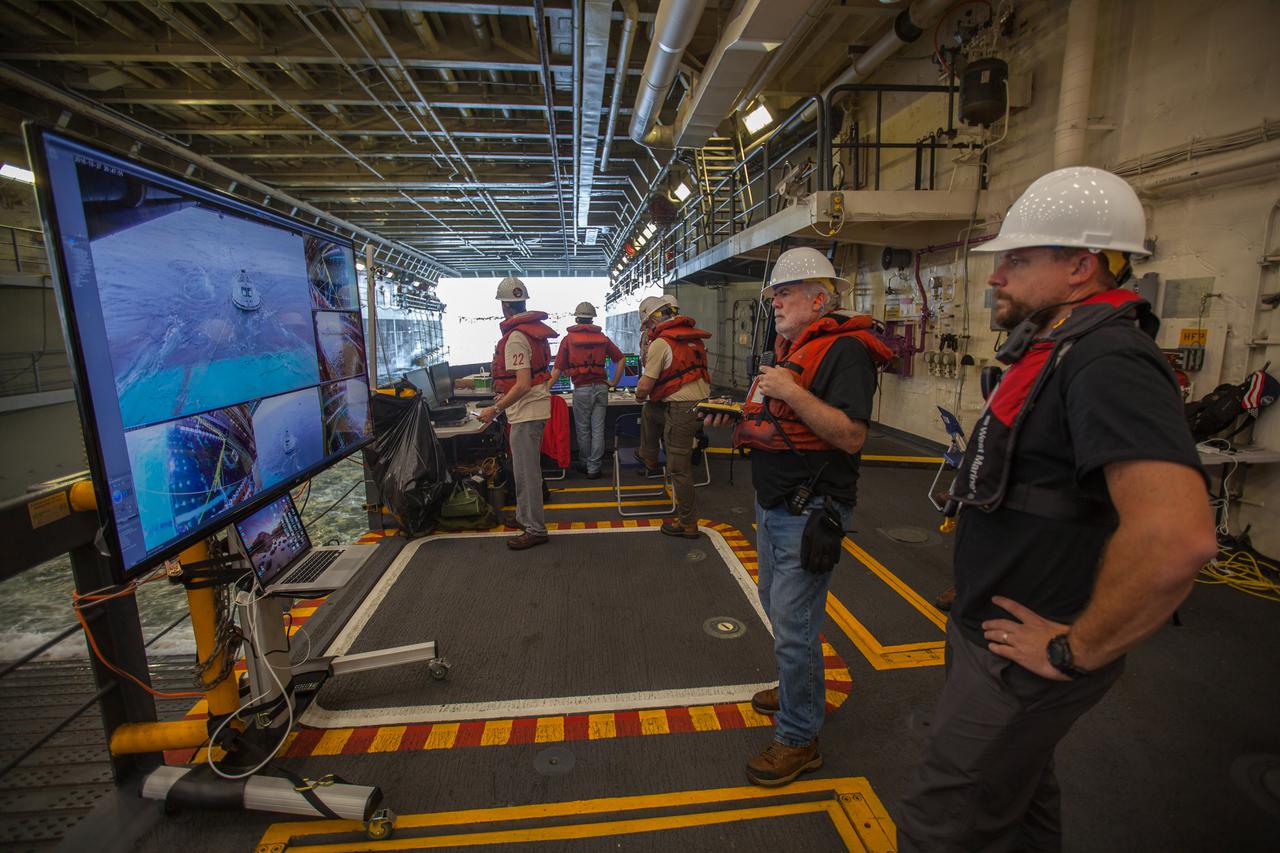
In the well deck of the USS San Diego, recovery team members monitor a portion of Underway Recovery Test 5 in the Pacific Ocean off the coast of California on Oct. 27, 2016. A test version of the Orion crew module is floating in open waters. NASA's Ground Systems Development and Operations Program and the U.S. Navy are conducting a series of tests using the ship's well deck, the test module, various watercraft and equipment to prepare for recovery of Orion on its return from deep space missions. The test will allow the team to demonstrate and evaluate recovery processes, procedures, hardware and personnel in open waters. Part of Batch images transfer from Flickr.
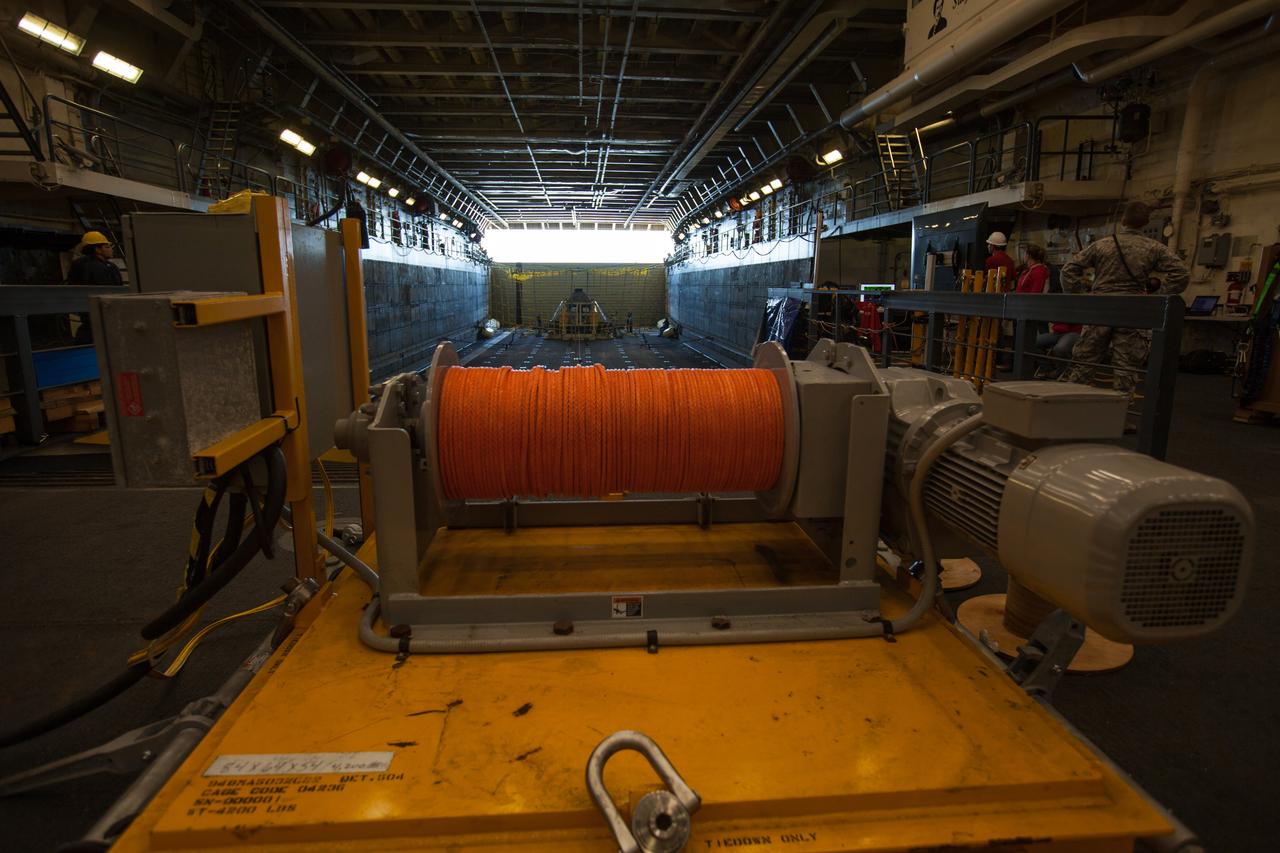
A test version of the Orion crew module is secured in the well deck of the USS San Diego for Underway Recovery Test 5 on Oct. 26, 2016. NASA's Ground Systems Development and Operations Program and the U.S. Navy will conduct a series of tests using the ship's well deck, the test module, various watercraft and equipment to prepare for recovery of Orion on its return from deep space missions. The test will allow the team to demonstrate and evaluate recovery processes, procedures, hardware and personnel in open waters. Part of Batch images transfer from Flickr.
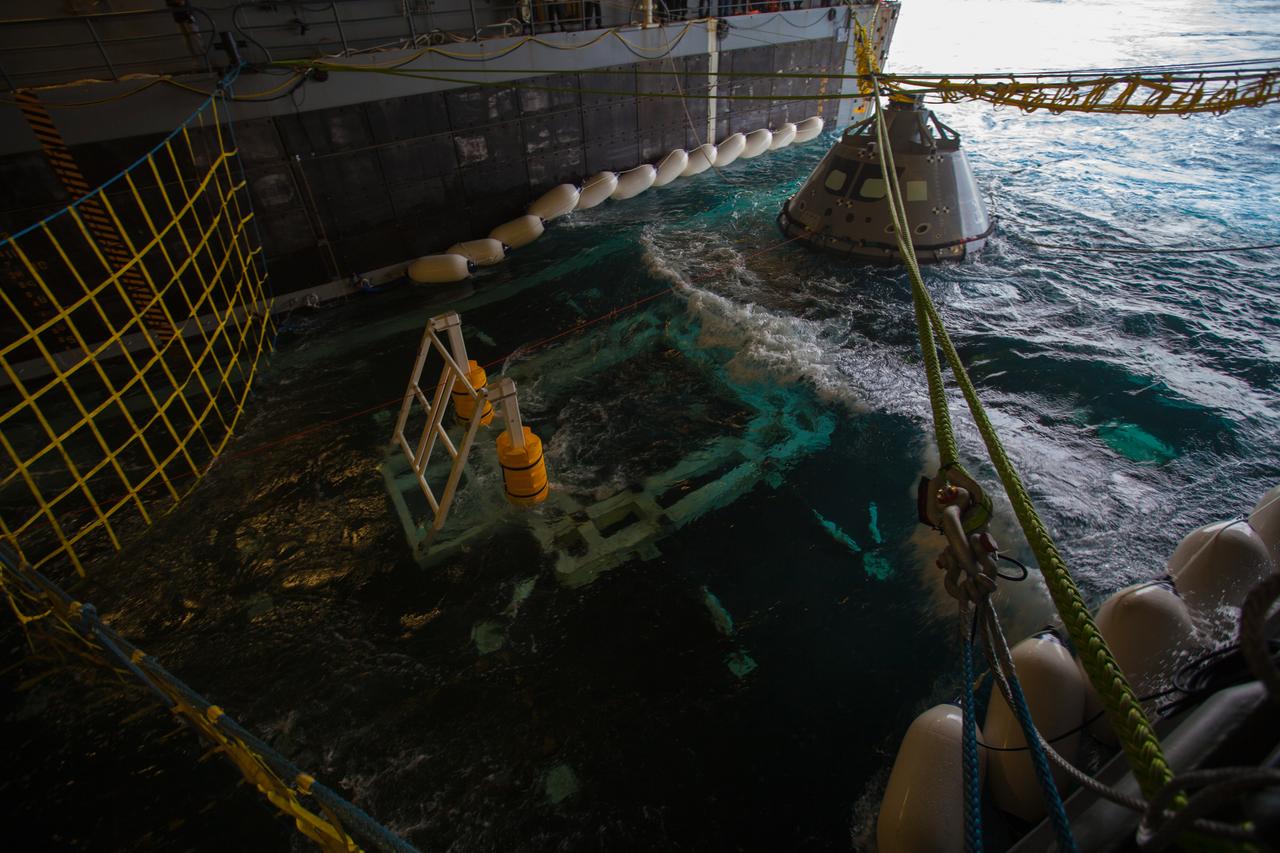
A test version of the Orion crew module is secured in the well deck of the USS San Diego for Underway Recovery Test 5 on Oct. 26, 2016. NASA's Ground Systems Development and Operations Program and the U.S. Navy will conduct a series of tests using the ship's well deck, the test module, various watercraft and equipment to prepare for recovery of Orion on its return from deep space missions. The test will allow the team to demonstrate and evaluate recovery processes, procedures, hardware and personnel in open waters. Part of Batch images transfer from Flickr.
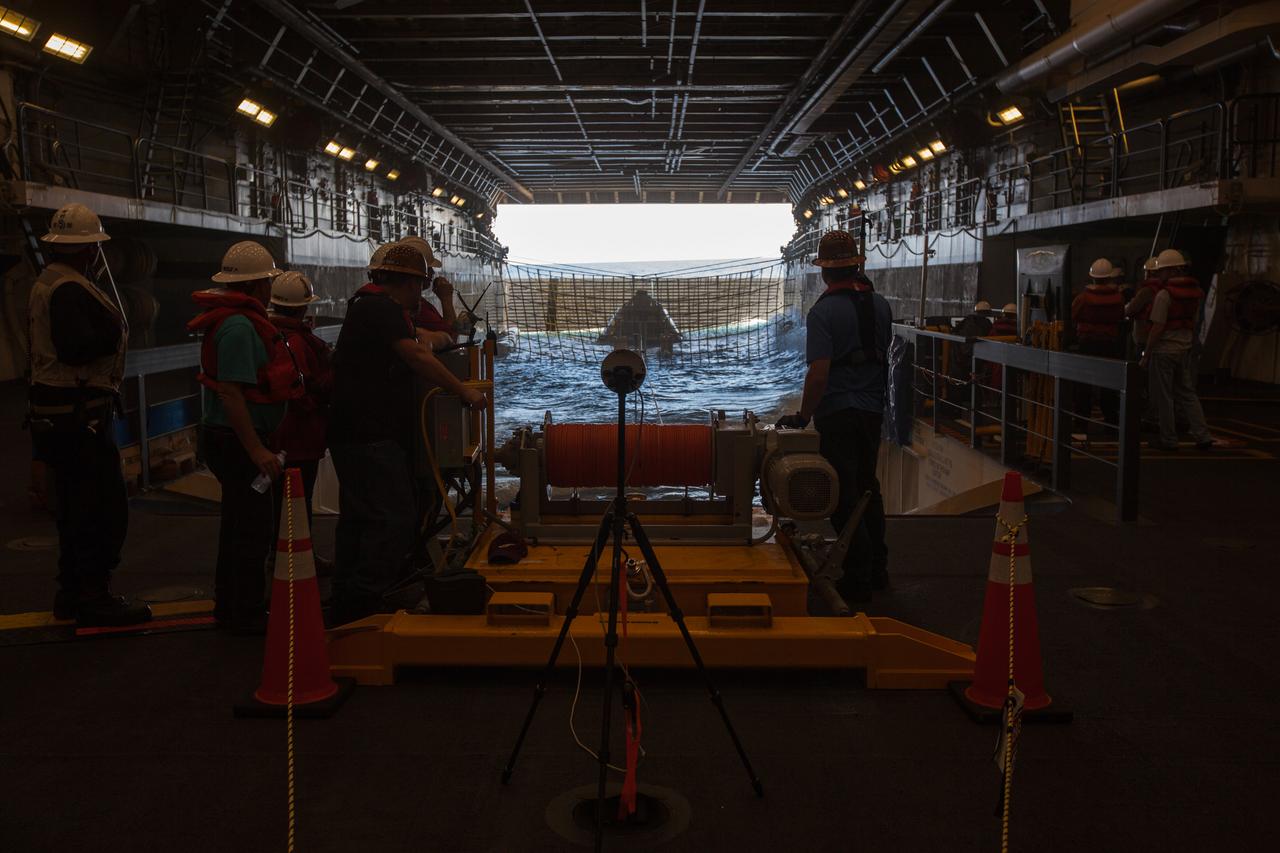
Winch team operators help guide a test version of the Orion crew module in the flooded well deck of the USS San Diego during Underway Recovery Test 5 in the Pacific Ocean off the coast of California on Oct. 29, 2016. NASA's Ground Systems Development and Operations Program and the U.S. Navy are conducting a series of tests using the ship's well deck, the test module, various watercraft and equipment to prepare for recovery of Orion on its return from deep space missions. The testing will allow the team to demonstrate and evaluate recovery processes, procedures, hardware and personnel in open waters. Part of Batch images transfer from Flickr.

Members of the recovery team watch as the test version of the Orion crew module is guided into the flooded well deck of the USS San Diego during Underway Recovery Test 5 in the Pacific Ocean off the coast of California on Oct. 30, 2016. NASA's Ground Systems Development and Operations Program and the U.S. Navy are conducting a series of tests using the ship's well deck, the test module, various watercraft and equipment to prepare for recovery of Orion on its return from deep space missions. The testing will allow the team to demonstrate and evaluate recovery processes, procedures, hardware and personnel in open waters. Part of Batch images transfer from Flickr.
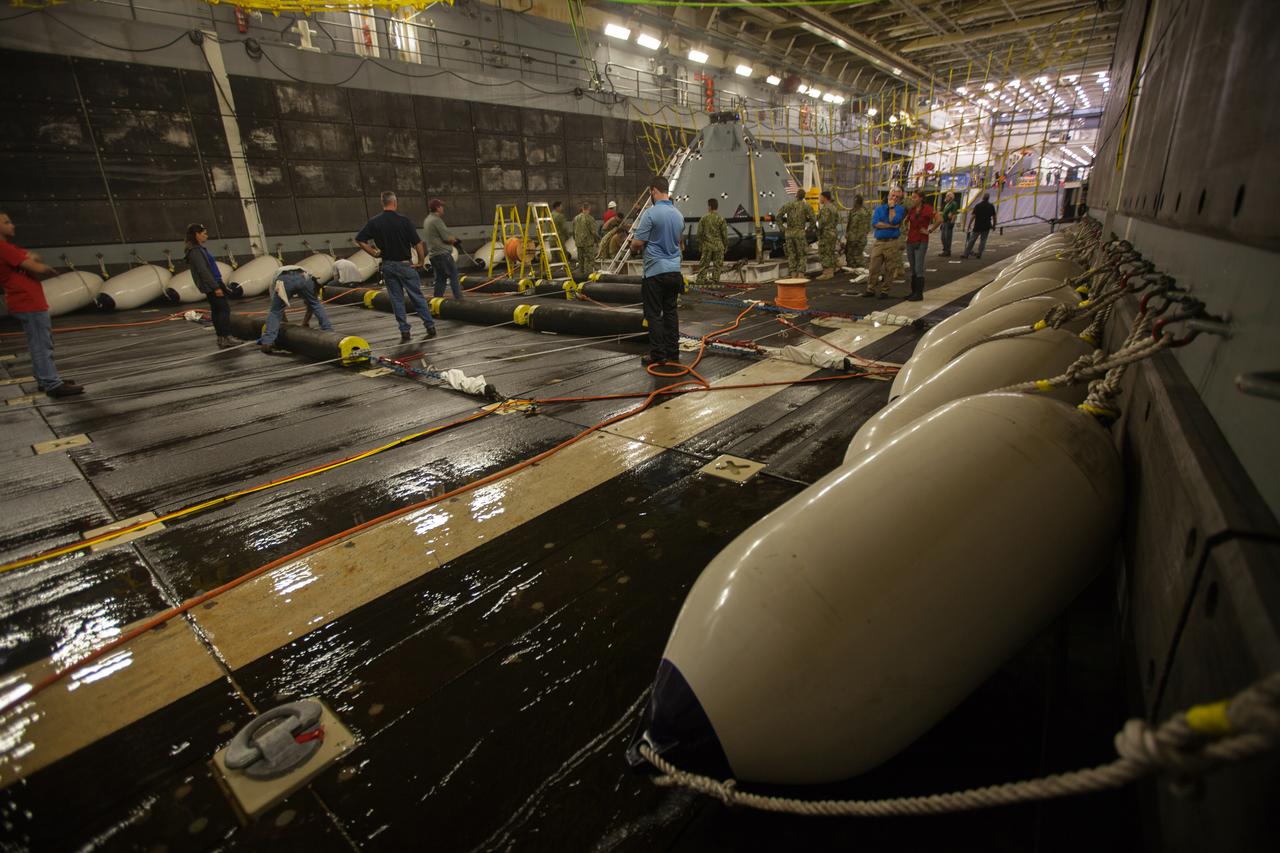
A test version of the Orion crew module is secured in the well deck of the USS San Diego for Underway Recovery Test 5 on Oct. 26, 2016. NASA's Ground Systems Development and Operations Program and the U.S. Navy will conduct a series of tests using the ship's well deck, the test module, various watercraft and equipment to prepare for recovery of Orion on its return from deep space missions. The test will allow the team to demonstrate and evaluate recovery processes, procedures, hardware and personnel in open waters. Part of Batch images transfer from Flickr.
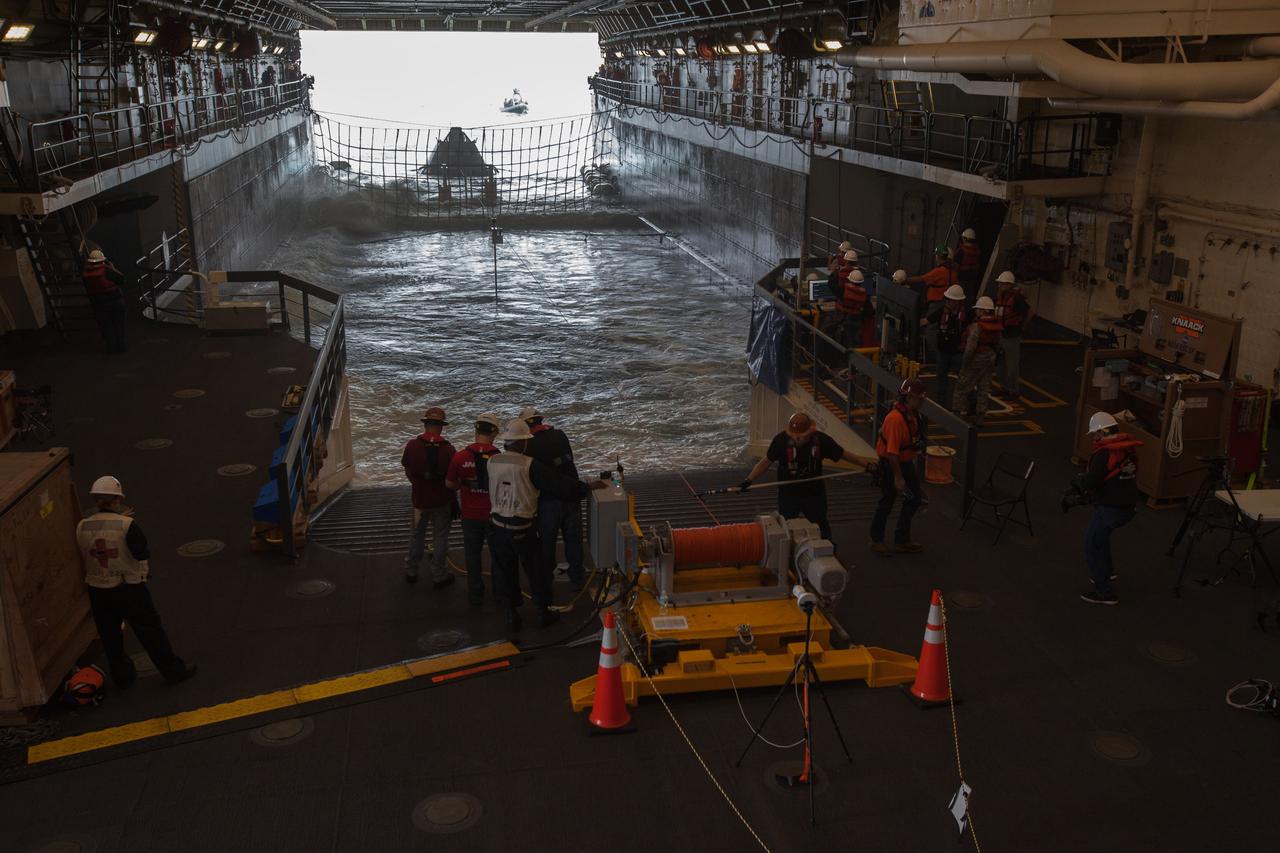
Winch team operators help guide a test version of the Orion crew module into the flooded well deck of the USS San Diego during Underway Recovery Test 5 in the Pacific Ocean off the coast of California on Oct. 30, 2016. NASA's Ground Systems Development and Operations Program and the U.S. Navy are conducting a series of tests using the ship's well deck, the test module, various watercraft and equipment to prepare for recovery of Orion on its return from deep space missions. The testing will allow the team to demonstrate and evaluate recovery processes, procedures, hardware and personnel in open waters. Part of Batch images transfer from Flickr.

Direct Field Acoustic (DFA) Testing was successfully completed on the Exploration Flight Test-1 (EFT-1) crew module at the Lockheed Martin Waterton Reverberant Acoustic Lab (RAL) on March 1, 2016. DFA Testing is an alternative method for spacecraft module acoustic qualification and acceptance verification that is being investigated for use in the Orion program. Its portability would allow testing at KSC and eliminate the transportation risks and associated cost and schedule of performing this verification activity off-site. Two configurations were tested; one representing the future reverberant acoustic comparison test and one representing the future configuration for the Artemis I crew module. A mock-up of the service module without the fairings will also be tested to gather volumetric data to decide viability of performing DFA Testing on the Static Test Article (STA) SM in the 2016 Fall. Data will be used to develop predictive algorithms for future tests.
Direct Field Acoustic (DFA) Testing was successfully completed on the Exploration Flight Test-1 (EFT-1) crew module at the Lockheed Martin Waterton Reverberant Acoustic Lab (RAL) on March 1, 2016. DFA Testing is an alternative method for spacecraft module acoustic qualification and acceptance verification that is being investigated for use in the Orion program. Its portability would allow testing at KSC and eliminate the transportation risks and associated cost and schedule of performing this verification activity off-site. Two configurations were tested; one representing the future reverberant acoustic comparison test and one representing the future configuration for the Artemis I crew module. A mock-up of the service module without the fairings will also be tested to gather volumetric data to decide viability of performing DFA Testing on the Static Test Article (STA) SM in the 2016 Fall. Data will be used to develop predictive algorithms for future tests.
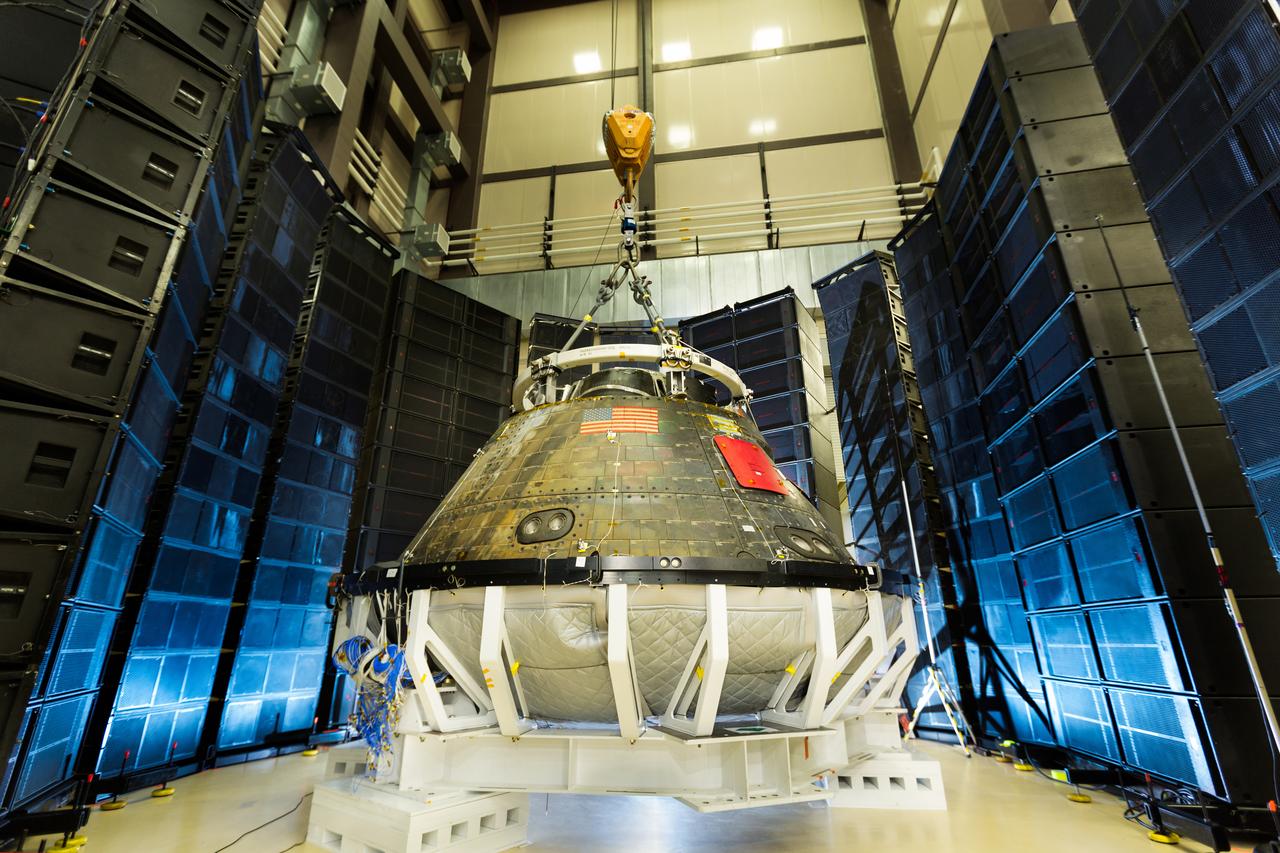
Direct Field Acoustic (DFA) Testing was successfully completed on the Exploration Flight Test-1 (EFT-1) crew module at the Lockheed Martin Waterton Reverberant Acoustic Lab (RAL) on March 1, 2016. DFA Testing is an alternative method for spacecraft module acoustic qualification and acceptance verification that is being investigated for use in the Orion program. Its portability would allow testing at KSC and eliminate the transportation risks and associated cost and schedule of performing this verification activity off-site. Two configurations were tested; one representing the future reverberant acoustic comparison test and one representing the future configuration for the Artemis I crew module. A mock-up of the service module without the fairings will also be tested to gather volumetric data to decide viability of performing DFA Testing on the Static Test Article (STA) SM in the 2016 Fall. Data will be used to develop predictive algorithms for future tests.
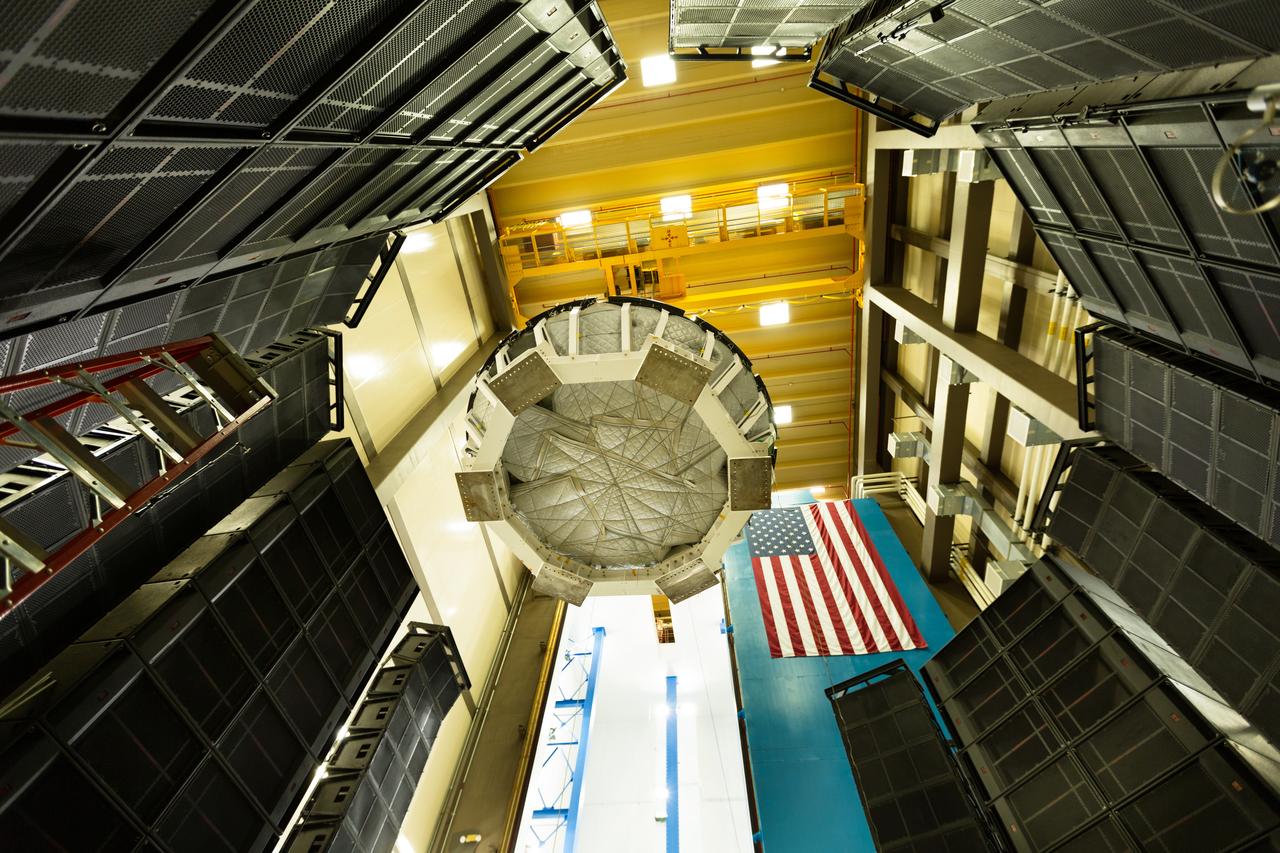
Direct Field Acoustic (DFA) Testing was successfully completed on the Exploration Flight Test-1 (EFT-1) crew module at the Lockheed Martin Waterton Reverberant Acoustic Lab (RAL) on March 1, 2016. DFA Testing is an alternative method for spacecraft module acoustic qualification and acceptance verification that is being investigated for use in the Orion program. Its portability would allow testing at KSC and eliminate the transportation risks and associated cost and schedule of performing this verification activity off-site. Two configurations were tested; one representing the future reverberant acoustic comparison test and one representing the future configuration for the Artemis I crew module. A mock-up of the service module without the fairings will also be tested to gather volumetric data to decide viability of performing DFA Testing on the Static Test Article (STA) SM in the 2016 Fall. Data will be used to develop predictive algorithms for future tests.
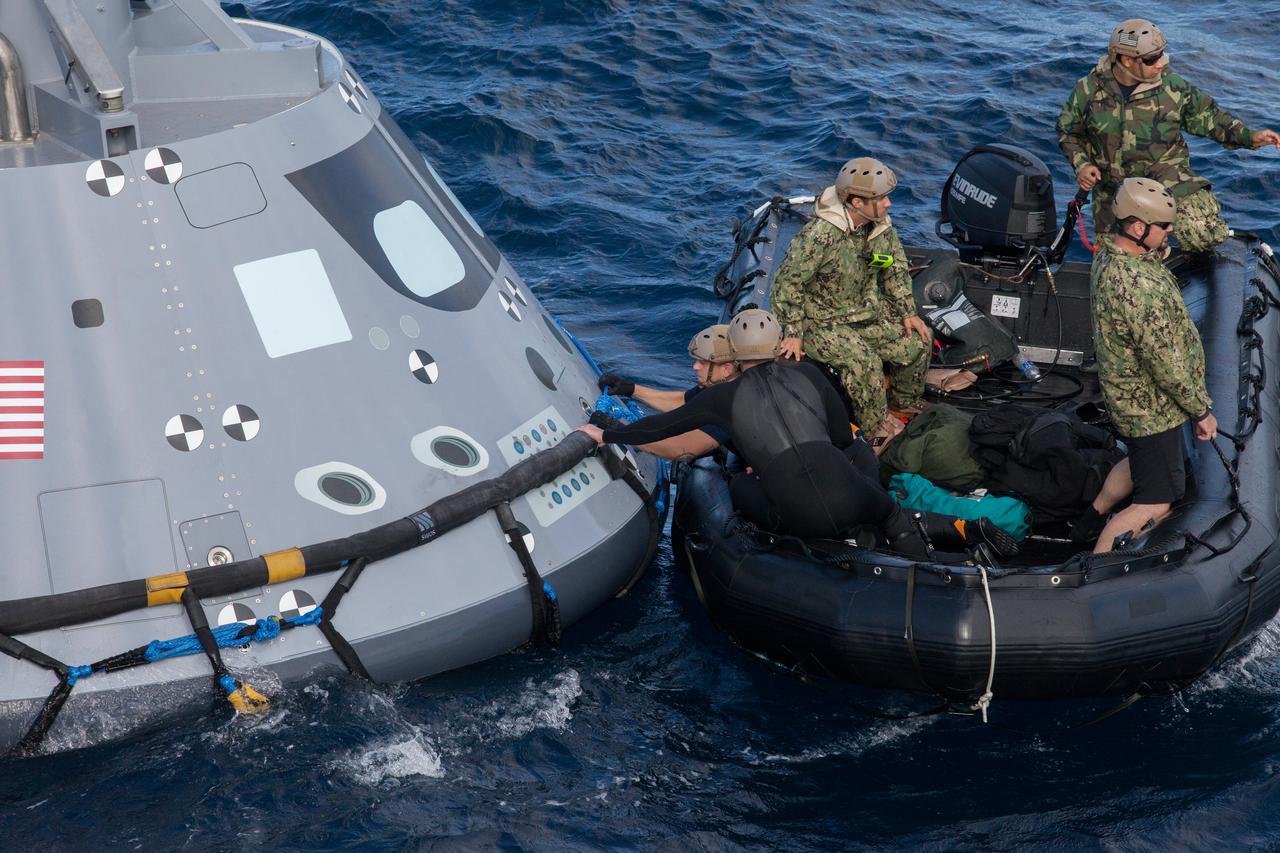
U.S. Navy divers and other personnel in a Zodiac boat secure a harness around a test version of the Orion crew module during Underway Recovery Test 5 in the Pacific Ocean off the coast of California on Oct. 28, 2016. Tether lines will be attached to the test module to help guide it back to the well deck of the USS San Diego. NASA's Ground Systems Development and Operations Program and the U.S. Navy are practicing recovery techniques to prepare for recovery of Orion on its return from deep space missions. The testing will allow the team to demonstrate and evaluate recovery processes, procedures, hardware and personnel in open waters. Part of Batch images transfer from Flickr.
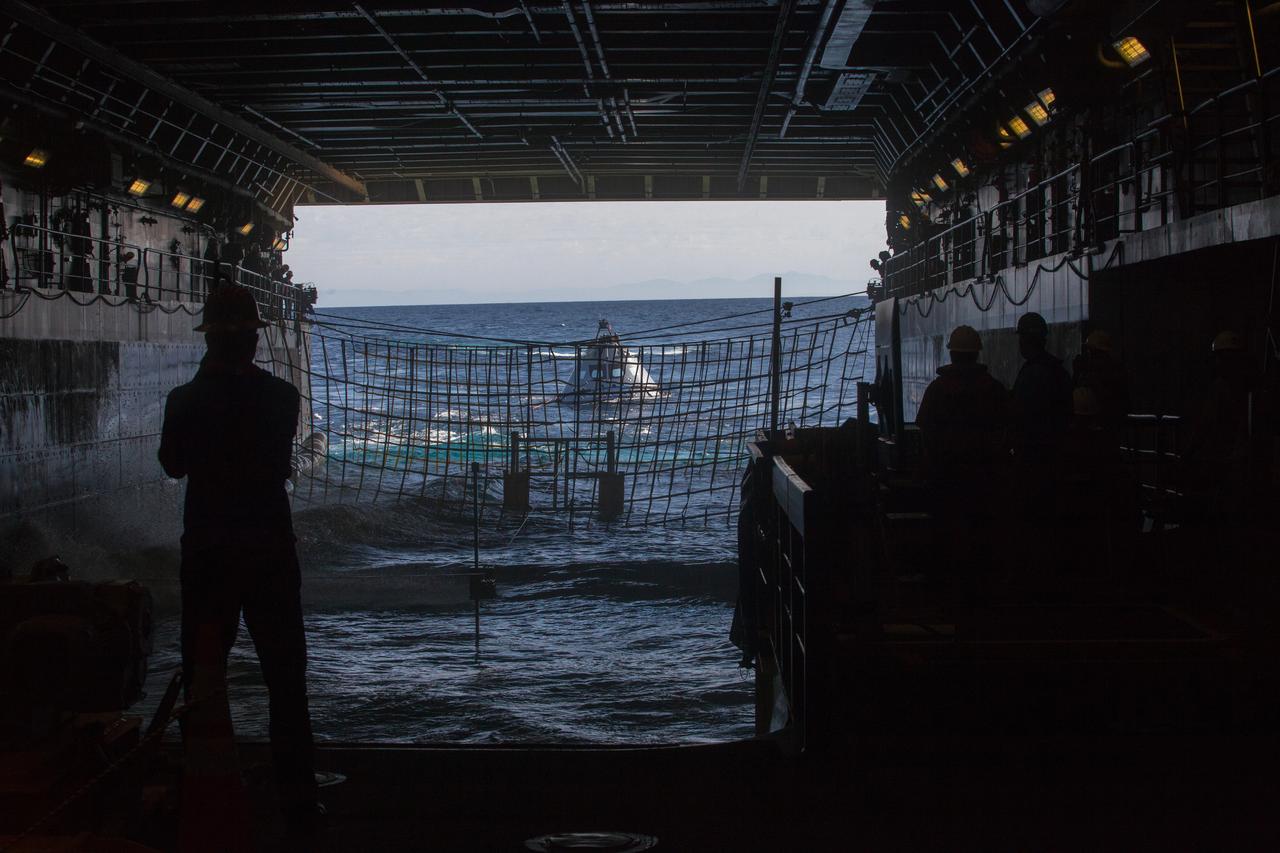
A test version of the Orion crew module floats outside the well deck of the USS San Diego during Underway Recovery Test 5 in the Pacific Ocean off the coast of California on Oct. 29, 2016. NASA's Ground Systems Development and Operations Program and the U.S. Navy are conducting a series of tests using the ship's well deck, several watercraft, support equipment and personnel to prepare for recovery of Orion on its return from deep space missions. The testing will allow the team to demonstrate and evaluate recovery processes, procedures, hardware and personnel in open waters. Part of Batch images transfer from Flickr.
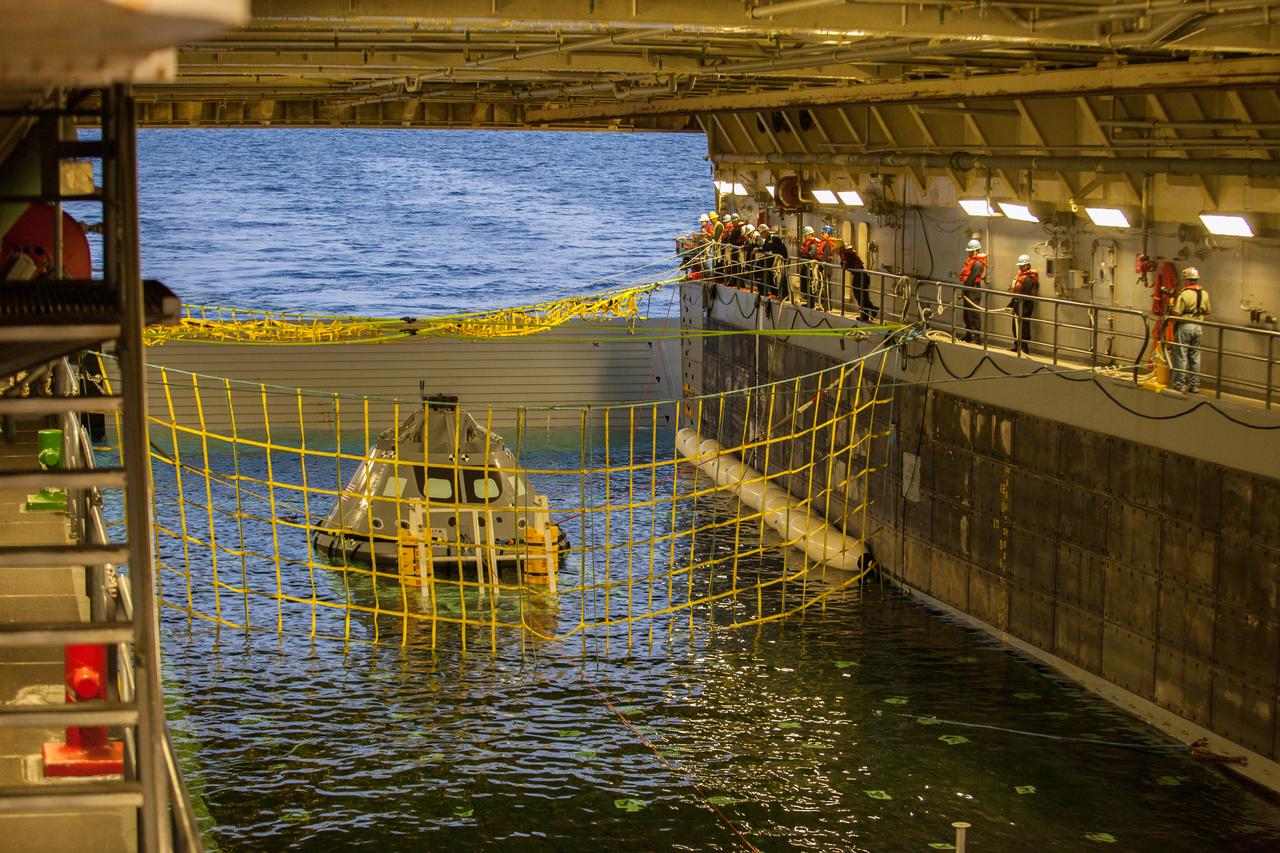
A golden sheen lights up a test version of the Orion crew module in the flooded well deck of the USS San Diego during Underway Recovery Test 5 in the Pacific Ocean off the coast of California on Oct. 26, 2016. Recovery team personnel have secured a net around the crew module. NASA's Ground Systems Development and Operations Program and the U.S. Navy will conduct a series of tests to prepare for recovery of Orion on its return from deep space missions. The testing will allow the team to demonstrate and evaluate recovery processes, procedures, hardware and personnel in open waters. Part of Batch images transfer from Flickr.
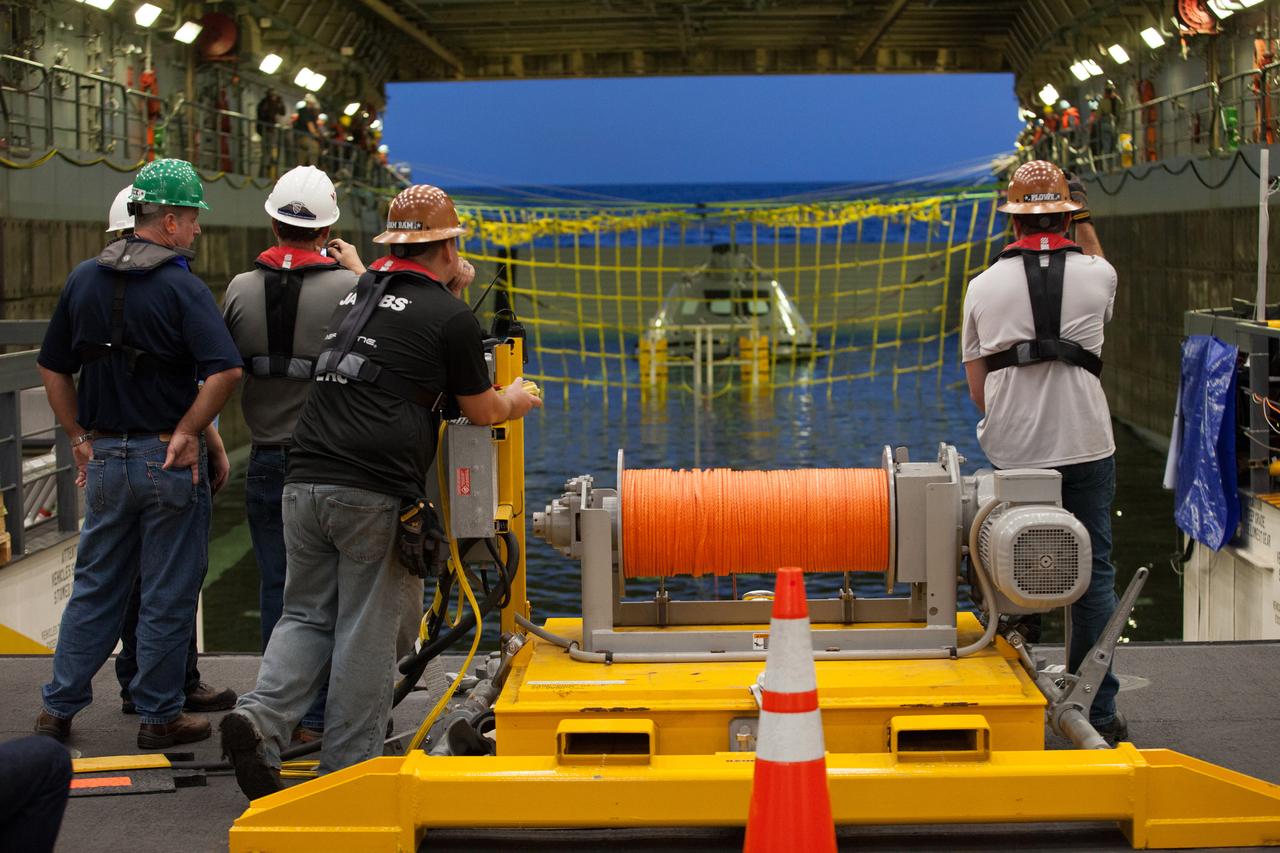
Winch operations team members watch as a test version of the Orion crew module is secured in the flooded well deck of the USS San Diego for the start of Underway Recovery Test 5 in the Pacific Ocean off the coast of California. NASA's Ground Systems Development and Operations Program and the U.S. Navy are conducting a series of tests to prepare for recovery of Orion on its return from deep space missions. The testing will allow the team to demonstrate and evaluate recovery processes, procedures, hardware and personnel in open waters. Part of Batch images transfer from Flickr.
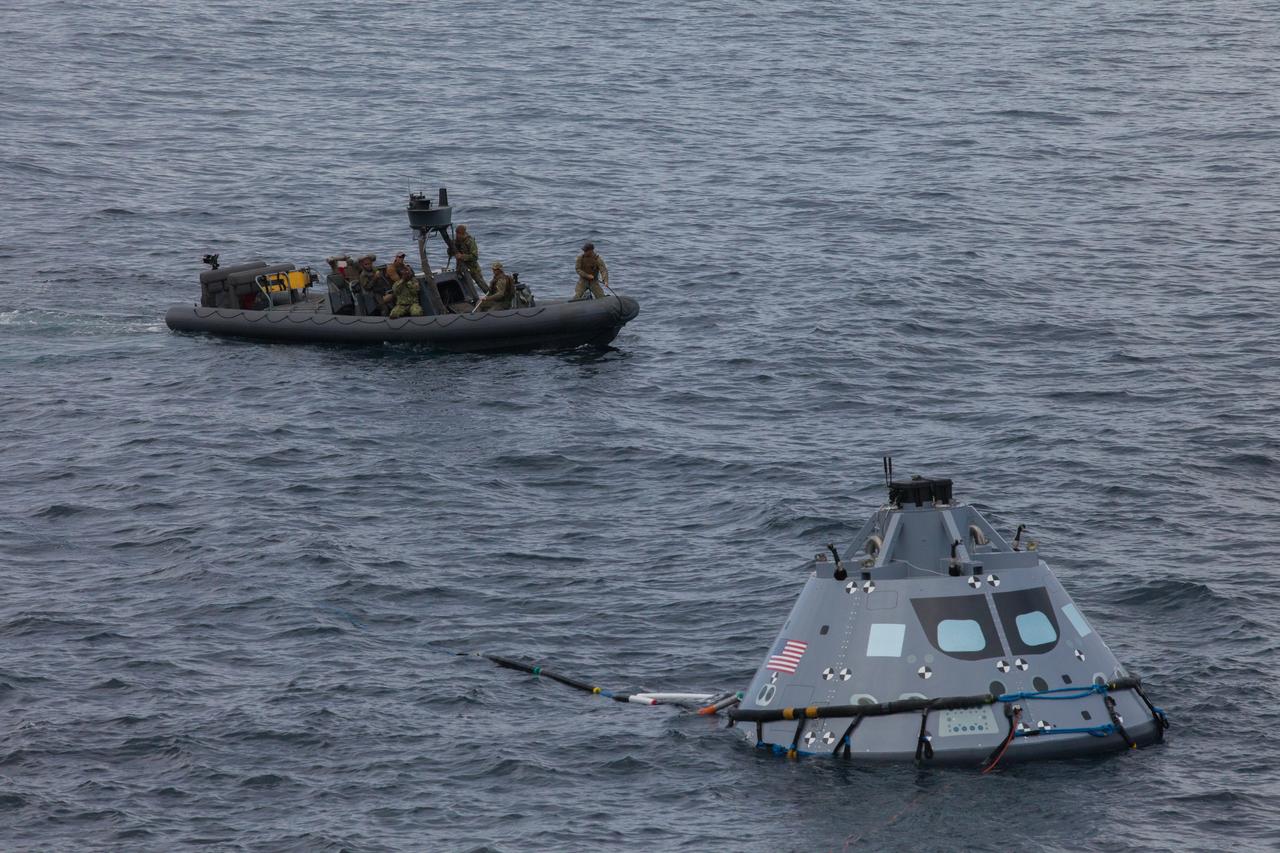
A test version of the Orion crew module floats in the Pacific Ocean during Underway Recovery Test 5 in the Pacific Ocean off the coast of California on Oct. 30, 2016. Nearby are U.S. Navy divers and other personnel in a rigid hull inflatable boat. NASA's Ground Systems Development and Operations Program and the U.S. Navy are conducting a series of tests using the well deck of the USS San Diego, several watercraft, support equipment and personnel to prepare for recovery of Orion on its return from deep space missions. The testing will allow the team to demonstrate and evaluate recovery processes, procedures, hardware and personnel in open waters. Part of Batch images transfer from Flickr.
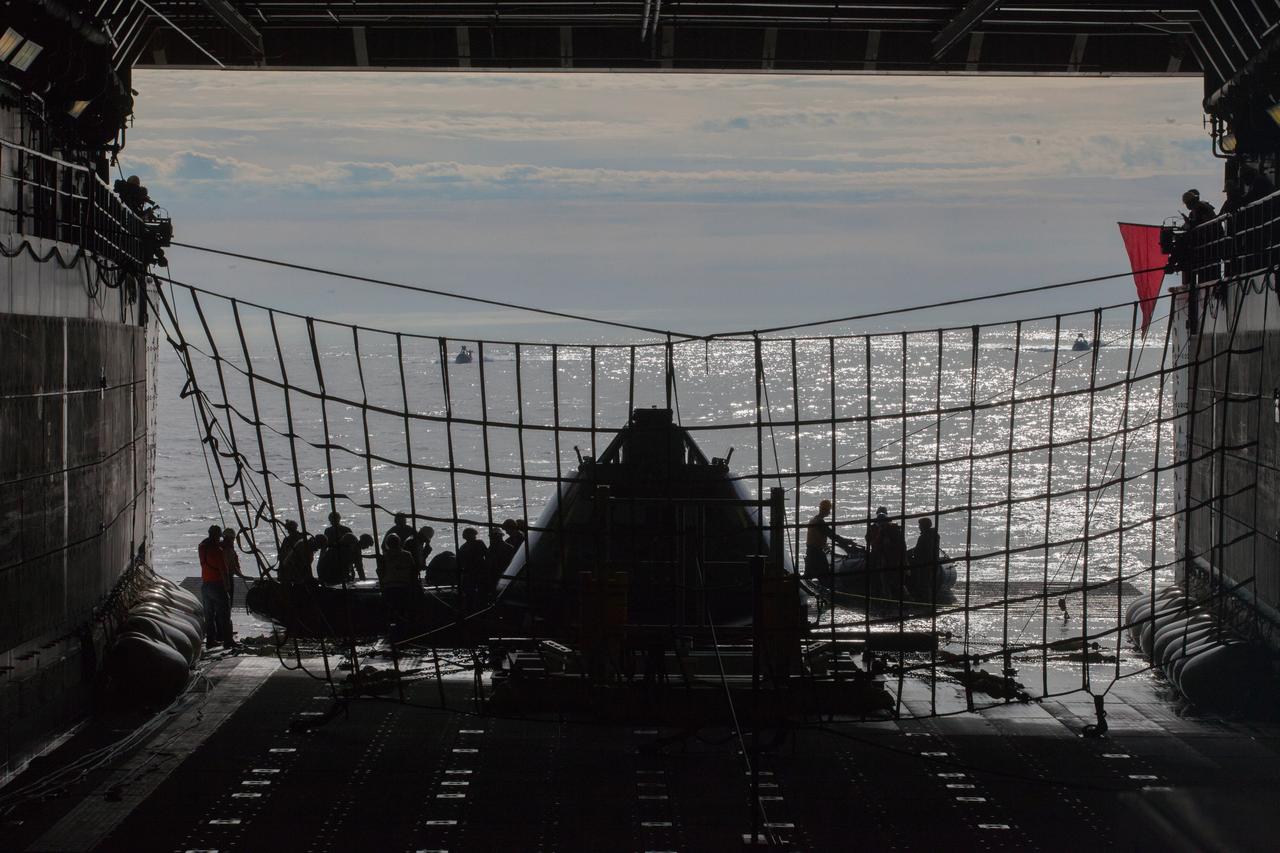
NASA's Ground Systems Development and Operations Program and the U.S. Navy prepare for another day of Underway Recovery Test 5 in the Pacific Ocean off the coast of California on Oct. 30, 2016. A test version of the Orion crew module is in the well deck of the ship, and U.S. Navy divers and other personnel are in rigid hull inflatable boats preparing to head out into the open water. The recovery team is conducting a series of tests to prepare for recovery of Orion on its return from deep space missions. The testing will allow the team to demonstrate and evaluate recovery processes, procedures, hardware and personnel in open waters. Part of Batch images transfer from Flickr.
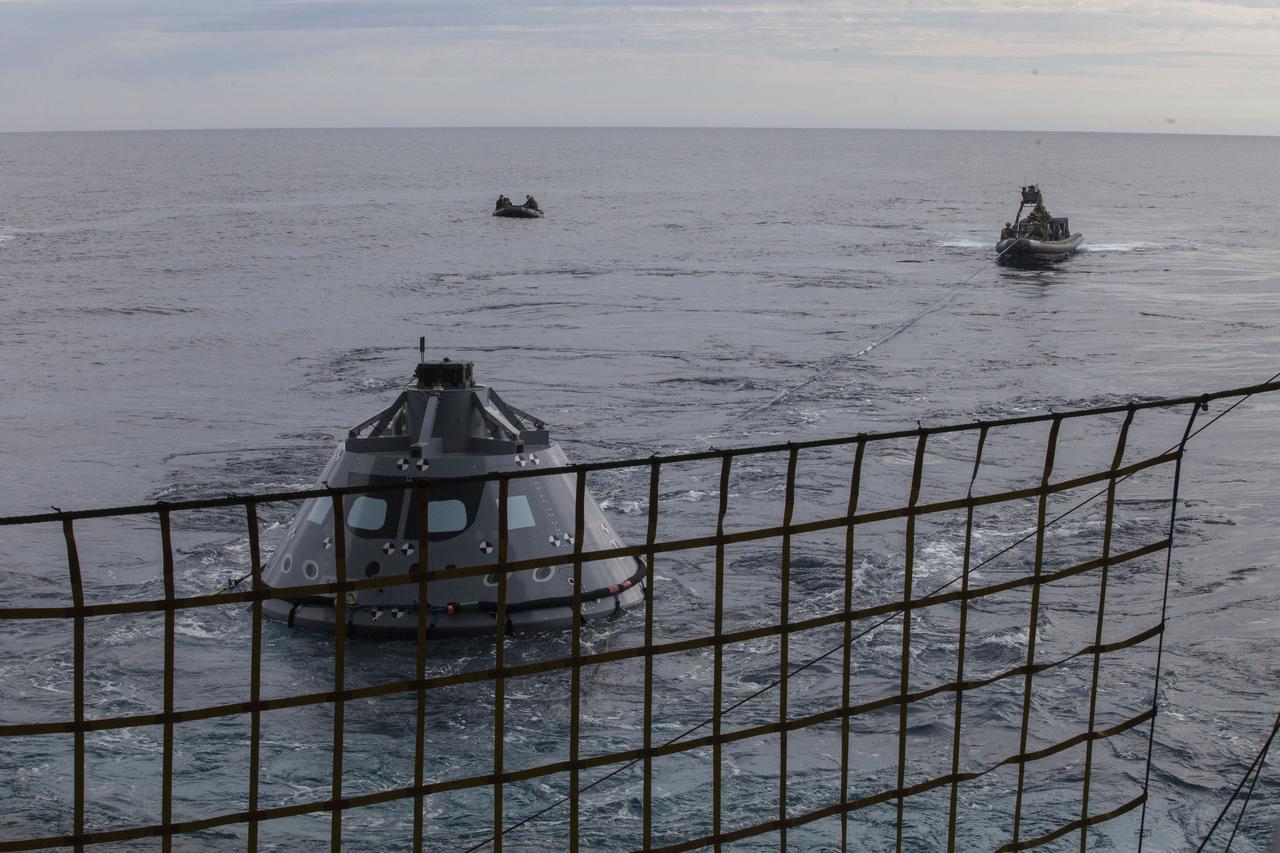
U.S. Navy divers and other personnel in a rigid hull inflatable boat are handling tether lines attached to a test version of the Orion crew module during Underway Recovery Test 5 in the Pacific Ocean off the coast of California. U.S. Navy divers in a smaller watercraft called a Zodiac boat are farther away. NASA's Ground Systems Development and Operations Program and the U.S. Navy are conducting a series of tests using the well deck of the USS San Diego, several watercraft and personnel to prepare for recovery of Orion on its return from deep space missions. The testing will allow the team to demonstrate and evaluate recovery processes, procedures, hardware and personnel in open waters. Orion is the exploration spacecraft designed to carry astronauts to destinations not yet explored by humans, including an asteroid and NASA's Journey to Mars. It will have emergency abort capability, sustain the crew during space travel and provide safe re-entry from deep space return velocities. Orion is scheduled to launch on NASA's Space Launch System in late 2018. For more information, visit http://www.nasa.gov/orion.