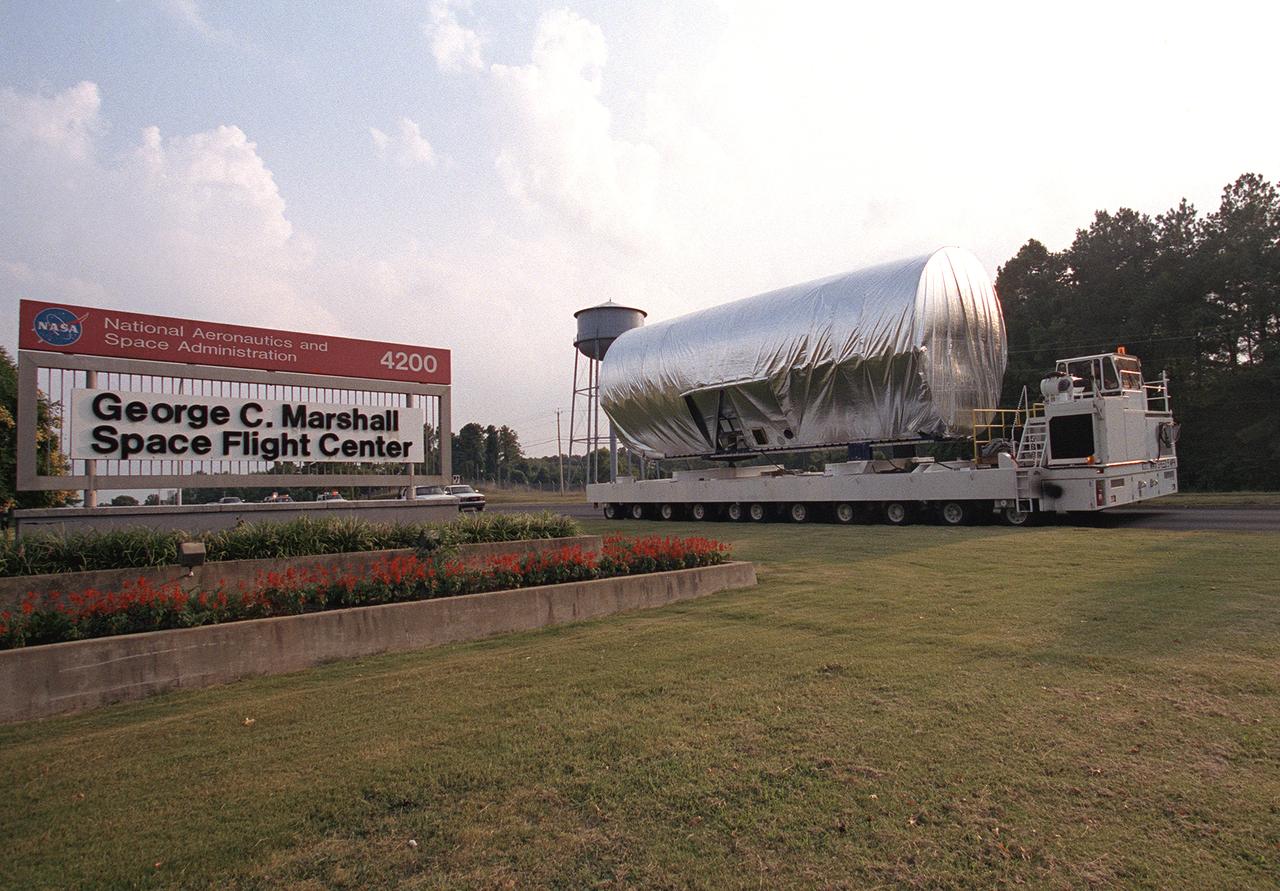
The 45-foot, port-side (P1) truss segment flight article for the International Space Station is being transported to the Redstone Airfield, Marshall Space Flight Center. The truss will be loaded aboard NASA's Super Guppy cargo plane for shipment to the Kennedy Space Center.
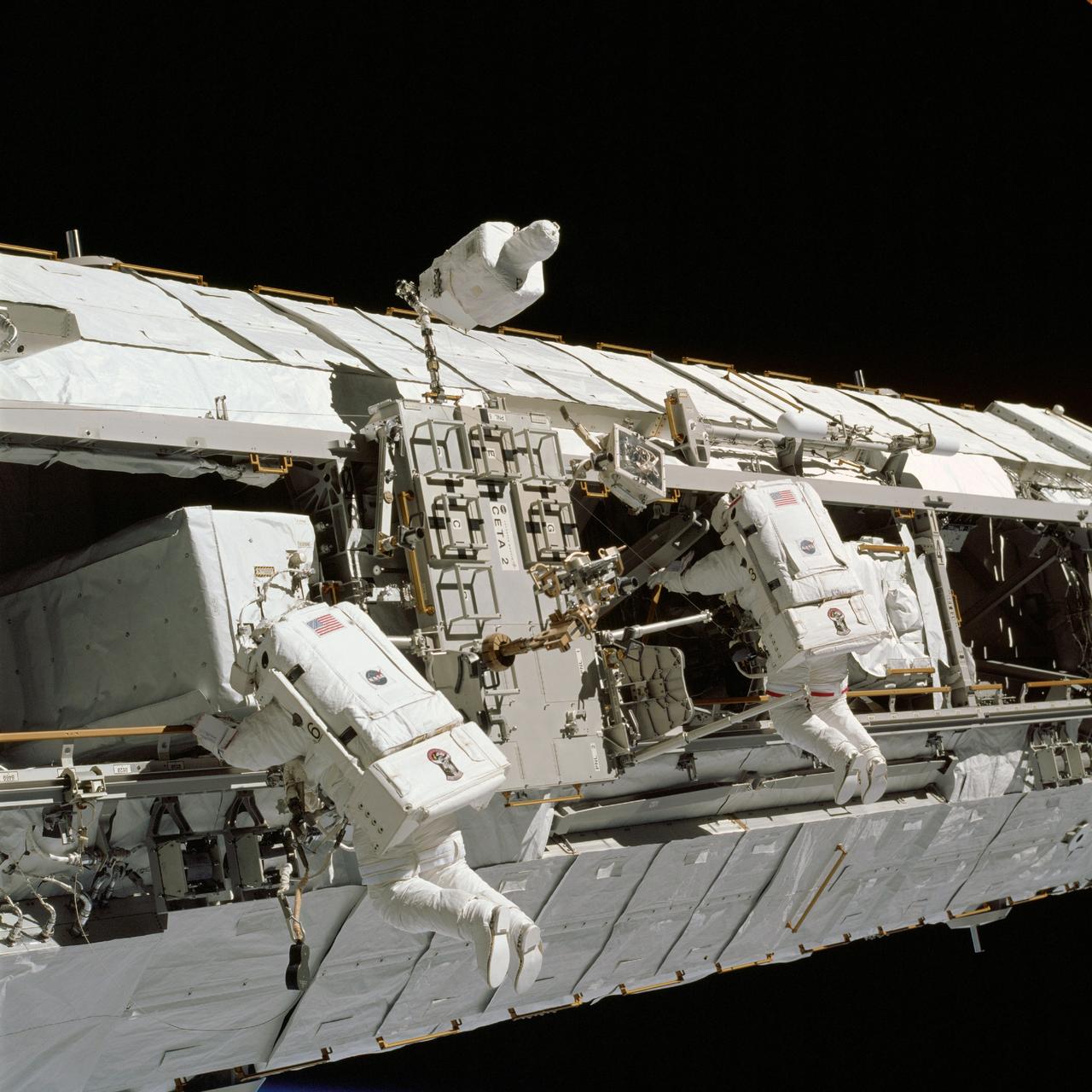
The 16th American assembly flight and 112th overall American flight to the International Space Station (ISS) launched on November 23, 2002 from Kennedy's launch pad 39A aboard the Space Shuttle Orbiter Endeavour STS-113. Mission objectives included the delivery of the Expedition Six Crew to the ISS, the return of Expedition Five crew back to Earth, the delivery of the Crew and Equipment Translation Aid (CETA) cart, and the installation and activation of the Port 1 Integrated Truss Assembly (P1). The first major component installed on the left side of the Station, the P1 truss provides an additional three External Thermal Control System radiators. Weighing in at 27,506 pounds, the P1 truss is 45 feet (13.7 meters) long, 15 feet (4.6 meters) wide, and 13 feet (4 meters) high. Three space walks, aided by the use of the Robotic Manipulator Systems of both the Shuttle and the Station, were performed in the installation of P1. In this photograph, astronauts and mission specialists John B. Herrington (left) and Michael E. Lopez-Alegria (right) work near the CETA cart on a truss on the ISS during a scheduled space walk for the mission. The final major task of the space walk was the relocation of the CETA cart from the Port One (P1) to the Starboard One (S1) Truss, which will allow the Mobile Transporter to move along the P1 to assist in upcoming assembly missions.

STS-113, the 16th American assembly flight and 112th overall American flight to the International Space Station (ISS), launched on November 23, 2002 from Kennedy's launch pad 39A aboard the Space Shuttle Orbiter Endeavour. The main mission objective was the the installation and activation of the Port 1 Integrated Truss Assembly (P1). The first major component installed on the left side of the Station, the P1 truss provides an additional three External Thermal Control System radiators. Weighing in at 27,506 pounds, the P1 truss is 45 feet (13.7 meters) long, 15 feet (4.6 meters) wide, and 13 feet (4 meters) high. Three space walks, aided by the use of the Robotic Manipulator Systems of both the Shuttle and the Station, were performed in the installation of P1. In this photograph astronaut and mission specialist John B. Herrington, (center frame), participates in the mission's third space walk. The forward section of the Space Shuttle Endeavour is in right frame.
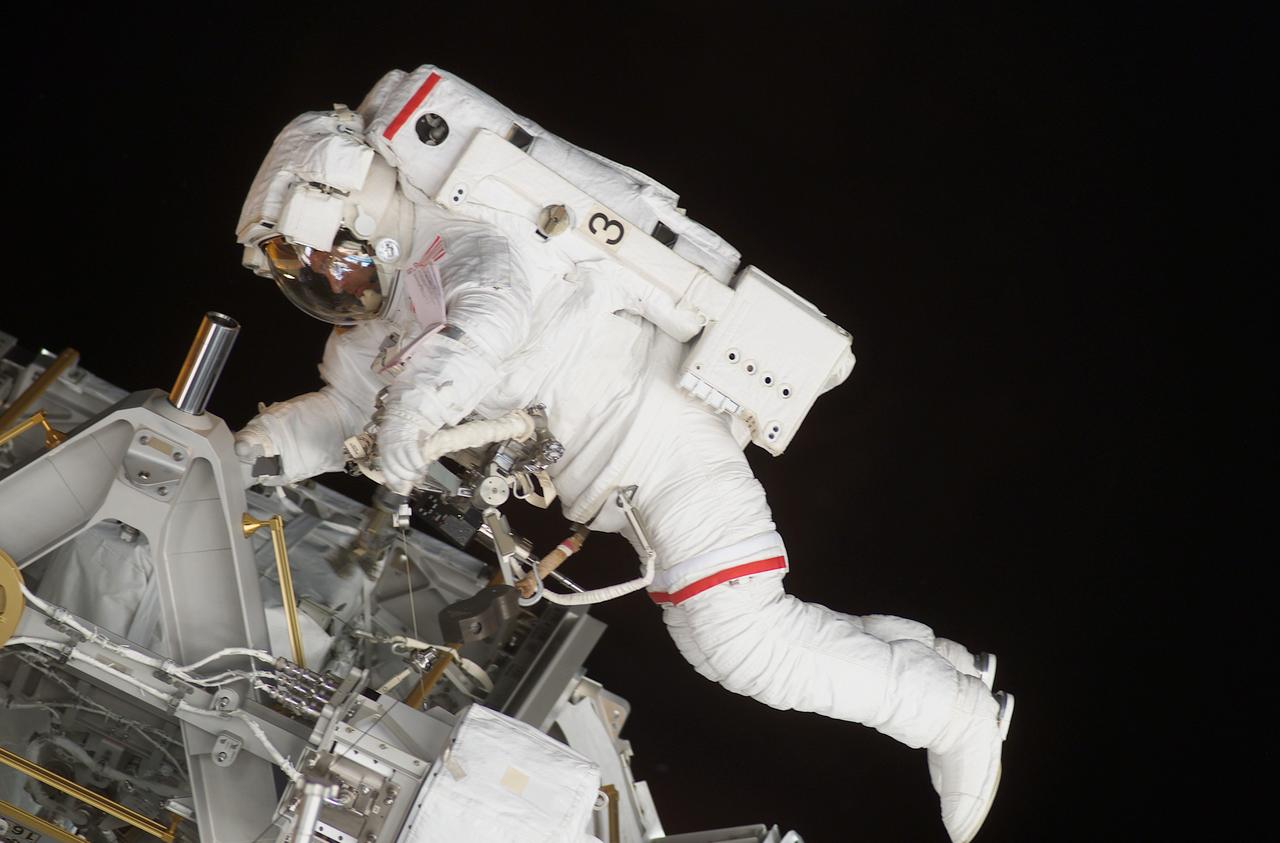
The 16th American assembly flight and 112th overall American flight to the International Space Station (ISS), launched on November 23, 2002 from Kennedy's launch pad 39A aboard the Space Shuttle Orbiter Endeavor STS-113. Mission objectives included the delivery of the Expedition Six Crew to the ISS, the return of Expedition Five crew back to Earth, and the installation and activation of the Port 1 Integrated Truss Assembly (P1). The first major component installed on the left side of the Station, the P1 truss provides an additional three External Thermal Control System radiators. Weighing in at 27,506 pounds, the P1 truss is 45 feet (13.7 meters) long, 15 feet (4.6 meters) wide, and 13 feet (4 meters) high. Three space walks, aided by the use of the Robotic Manipulator Systems of both the Shuttle and the Station, were performed in the installation of P1. In this photograph, astronaut and mission specialist Michael E. Lopez-Alegria works on the newly installed P1 truss during the mission's second scheduled session of extravehicular activity.
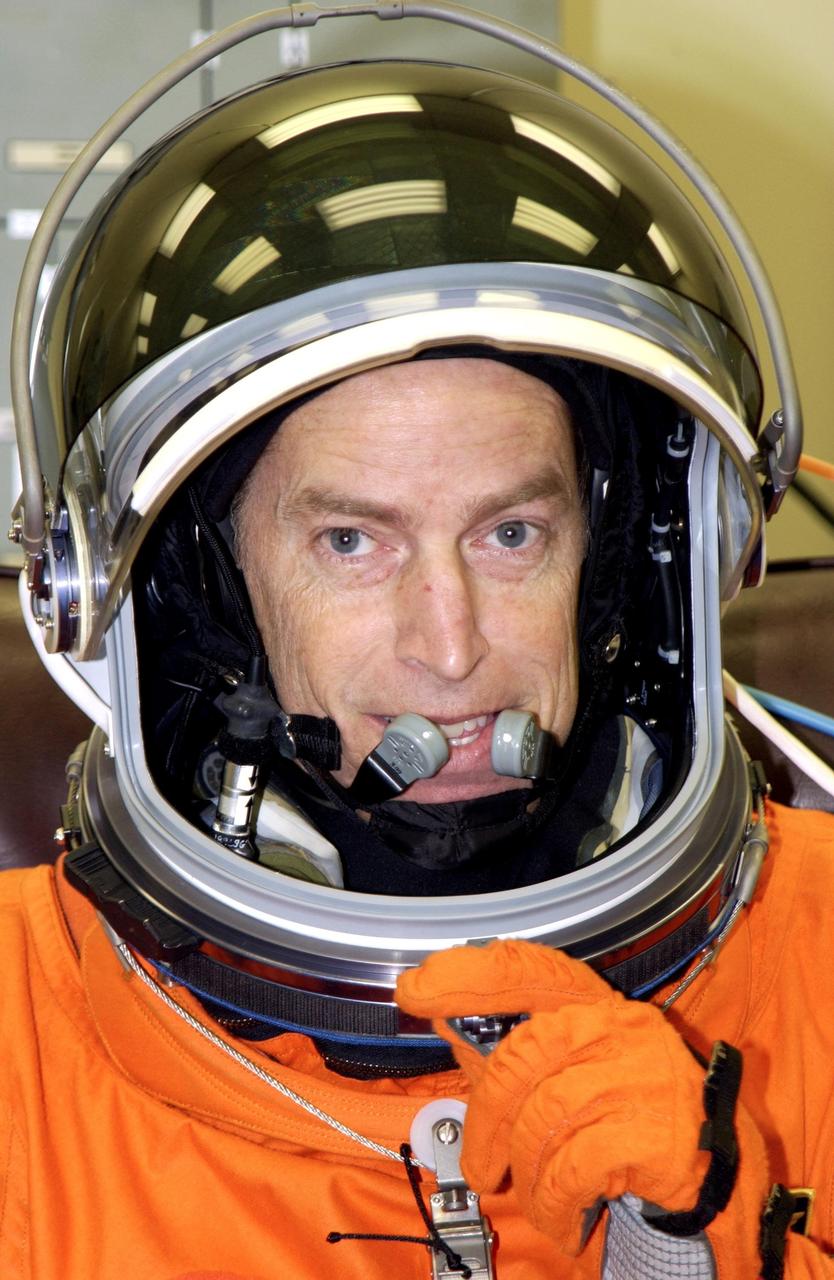
KENNEDY SPACE CENTER, FLA. -- STS-113 Commander James Wetherbee finishes suiting up before leaving for Launch Pad 39A. Wetherbee will be making his sixth Shuttle flight. The primary mission for the crew is bringing the Expedition 6 crew to the Station and returning the Expedition 5 crew to Earth. The major objective of the mission is delivery of the Port 1 (P1) Integrated Truss Assembly, which will be attached to the port side of the S0 truss. Three spacewalks are planned to install and activate the truss and its associated equipment. Launch of Space Shuttle Endeavour on mission STS-113 is scheduled for 8:15 p.m. EST.
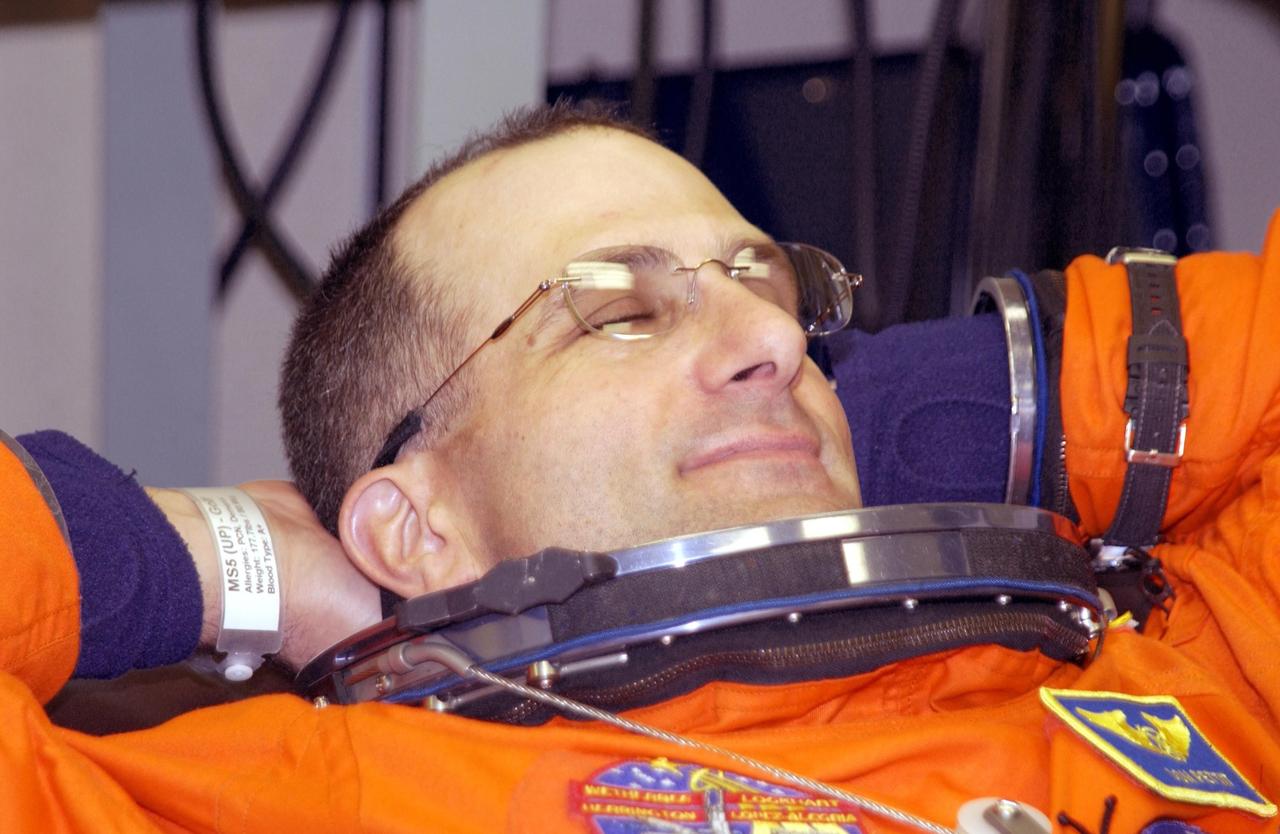
KENNEDY SPACE CENTER, FLA. -- Expedition 6 flight engineer Donald Pettit relaxes during suitup for launch. Pettit will be making his first Shuttle flight. The primary mission for the crew is bringing the Expedition 6 crew to the Station and returning the Expedition 5 crew to Earth. The major objective of the mission is delivery of the Port 1 (P1) Integrated Truss Assembly, which will be attached to the port side of the S0 truss. Three spacewalks are planned to install and activate the truss and its associated equipment. Launch of Space Shuttle Endeavour on mission STS-113 is scheduled for 8:15 p.m. EST.
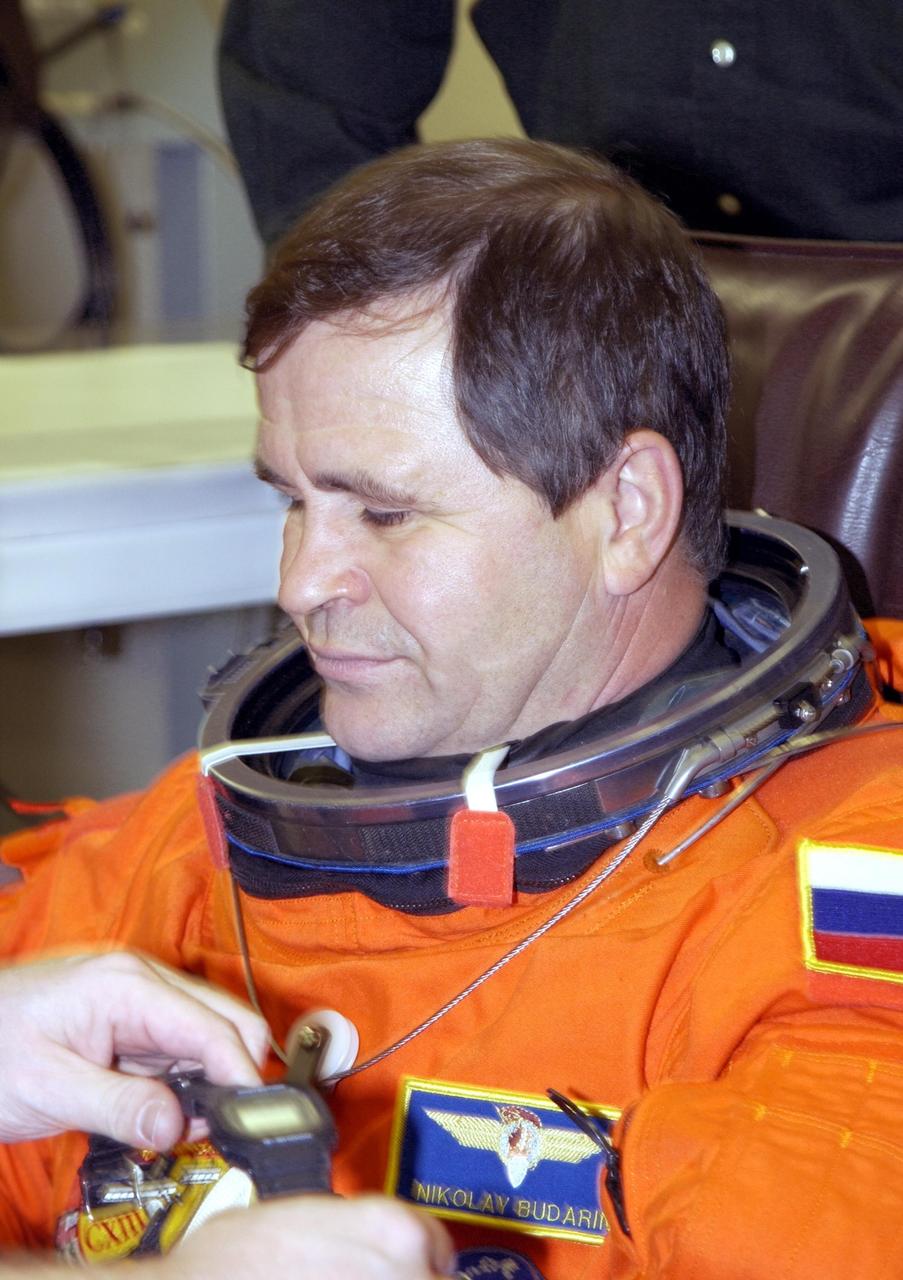
KENNEDY SPACE CENTER, FLA. - Expedition 6 flight engineer Nikolai Budarin relaxes during suitup for launch. Budarin, who is with the Russian Space Agency, will be making his second Shuttle flight. The primary mission for the crew is bringing the Expedition 6 crew to the Station and returning the Expedition 5 crew to Earth. The major objective of the mission is delivery of the Port 1 (P1) Integrated Truss Assembly, which will be attached to the port side of the S0 truss. Three spacewalks are planned to install and activate the truss and its associated equipment. Launch of Space Shuttle Endeavour on mission STS-113 is scheduled for 8:15 p.m. EST.
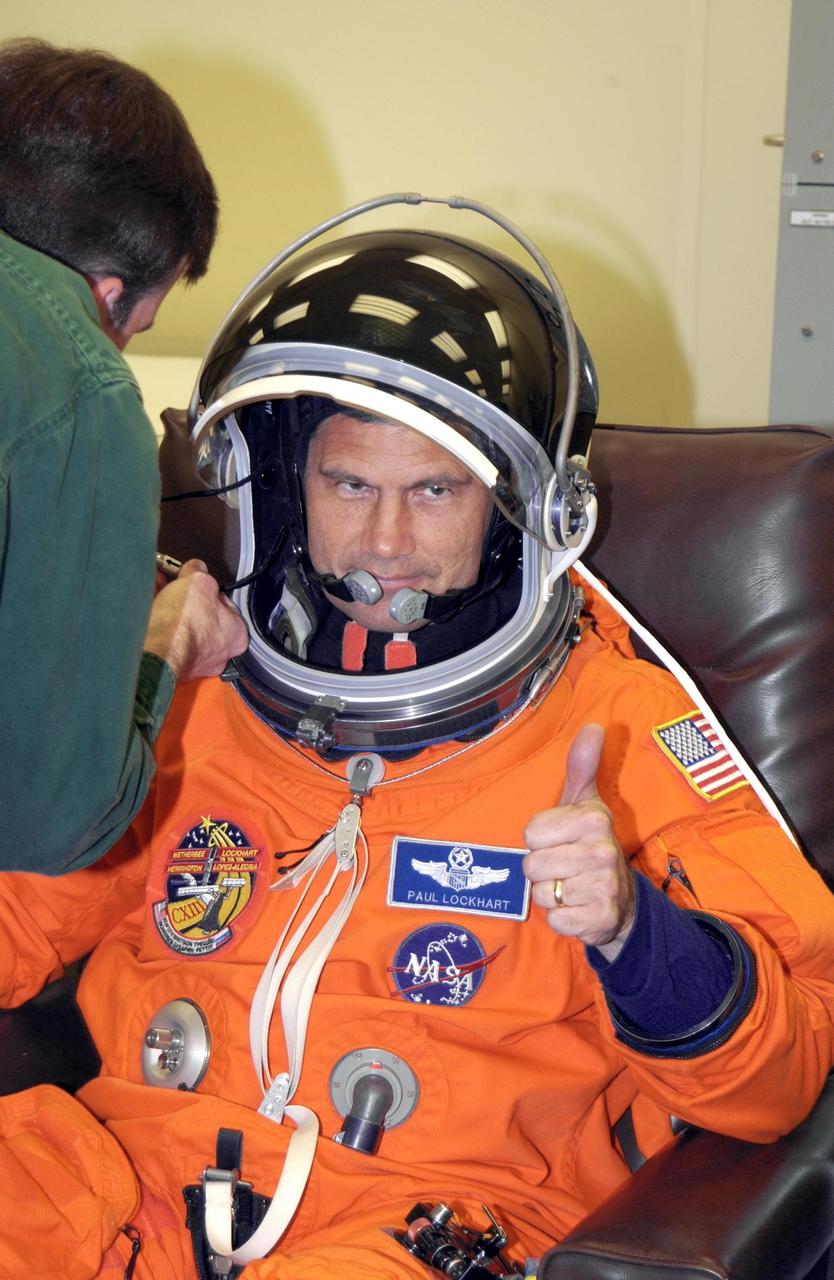
KENNEDY SPACE CENTER, FLA. -- STS-113 Pilot Paul Lockhart shows thumbs up for launch as he finishes suiting up. Lockhart will be making his second Shuttle flight. The primary mission for the crew is bringing the Expedition 6 crew to the Station and returning the Expedition 5 crew to Earth. The major objective of the mission is delivery of the Port 1 (P1) Integrated Truss Assembly, which will be attached to the port side of the S0 truss. Three spacewalks are planned to install and activate the truss and its associated equipment. Launch of Space Shuttle Endeavour on mission STS-113 is scheduled for 8:15 p.m. EST.
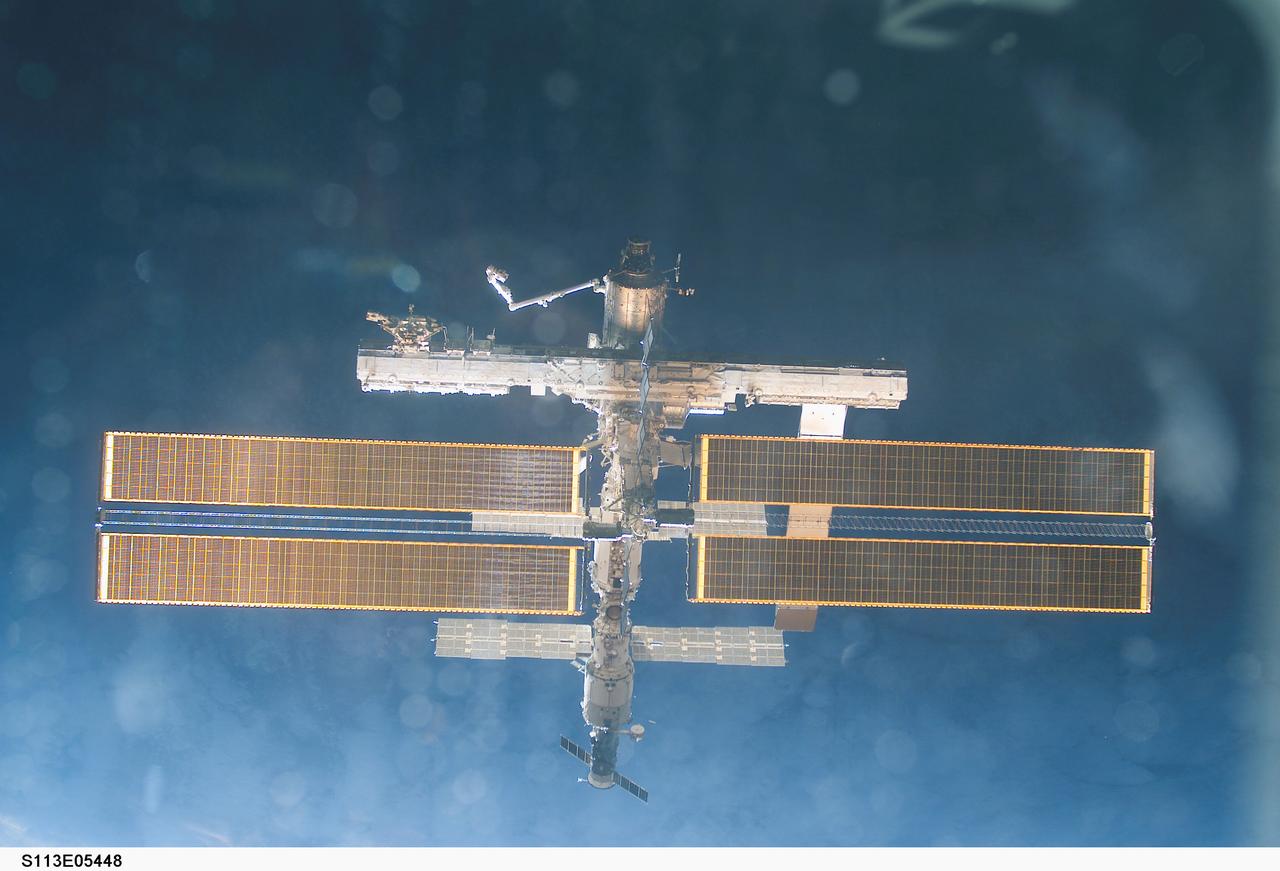
Back dropped against the blue hues of Earth, the International Space Station (ISS) sports its new Port One (P-1) Truss (center frame) as photographed by a crew member aboard the Space Shuttle Orbiter Endeavour following its undocking from the Station. Launched on November 23, 2002 from Kennedy's launch pad 39A, the STS-113 mission, the 16th American assembly flight and 112th overall American flight, installed and activated the Port 1 Integrated Truss Assembly (P1). The first major component installed on the left side of the Station, the P1 truss will provide three additional External Thermal Control System radiators. Weighing in at 27,506 pounds, the P1 truss is 45 feet (13.7 meters) long, 15 feet (4.6 meters) wide, and 13 feet (4 meters) high. Three space walks, aided by the use of the Robotic Manipulator Systems of both the Shuttle and the Station, were performed in the installation of P1. This photograph depicts the the latest completed configuration of the ISS to date.
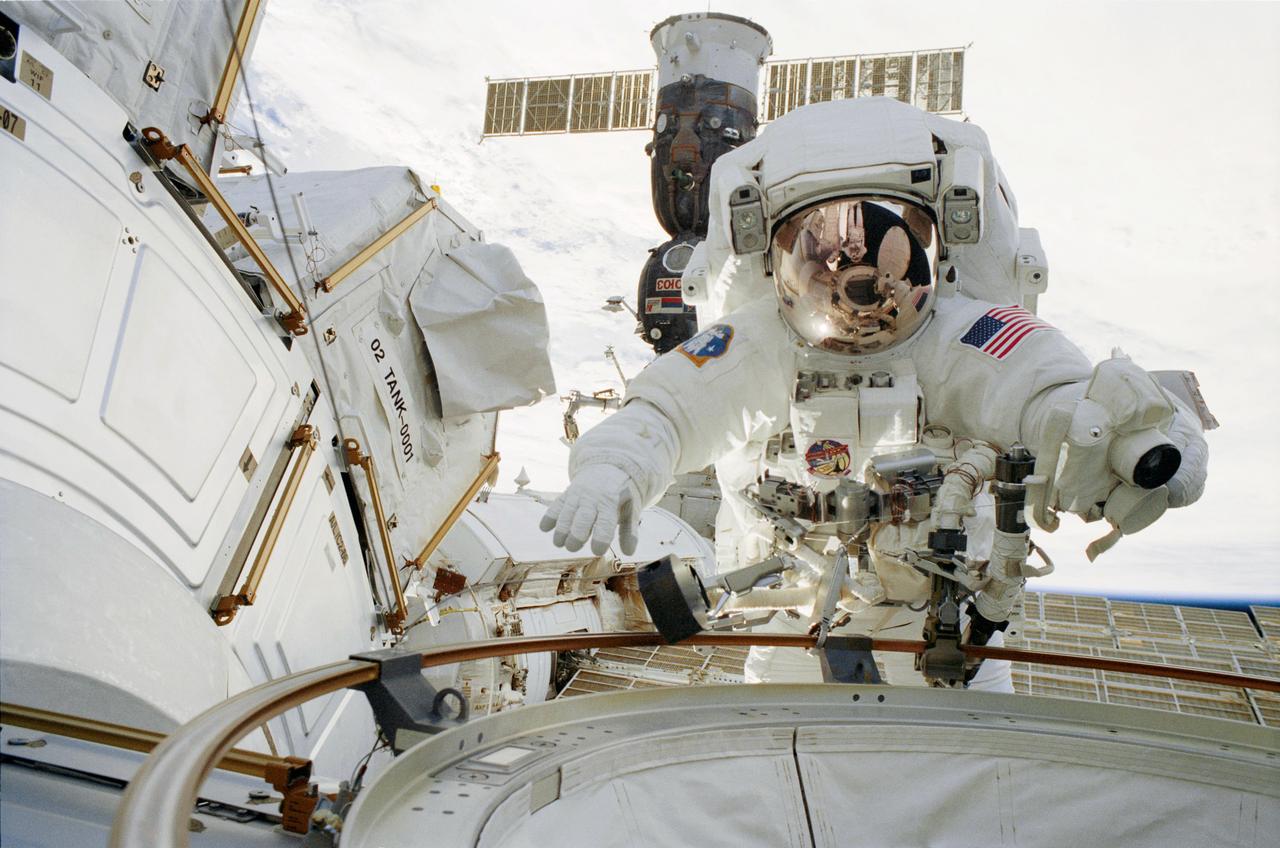
In this photograph, STS-113 astronaut and mission specialist John B. Herrington participates in the mission's first space walk. The opened hatch of the Quest Airlock can be seen reflected in Herrington's helmet visor. The airlock, located on the starboard side of the Unity Node I on the International Space Station (ISS), makes it easier to perform space walks, and allows both Russian and American space suits to be worn when the Shuttle is not docked with the ISS. American suits will not fit through Russian airlocks at the Station. STS-113, the 16th American assembly flight and 112th overall American flight to the ISS, launched on November 23, 2002 from Kennedy's launch pad 39A aboard the Space Shuttle Orbiter Endeavour. The main mission objective was the installation and activation of the Port 1 Integrated Truss Assembly (P1). The first major component installed on the left side of the Station, the P1 truss provides an additional three External Thermal Control System radiators. Weighing in at 27,506 pounds, the P1 truss is 45 feet (13.7 meters) long, 15 feet (4.6 meters) wide, and 13 feet (4 meters) high. Three space walks, aided by the use of the Robotic Manipulator Systems of both the Shuttle and the Station, were performed in the installation of P1.
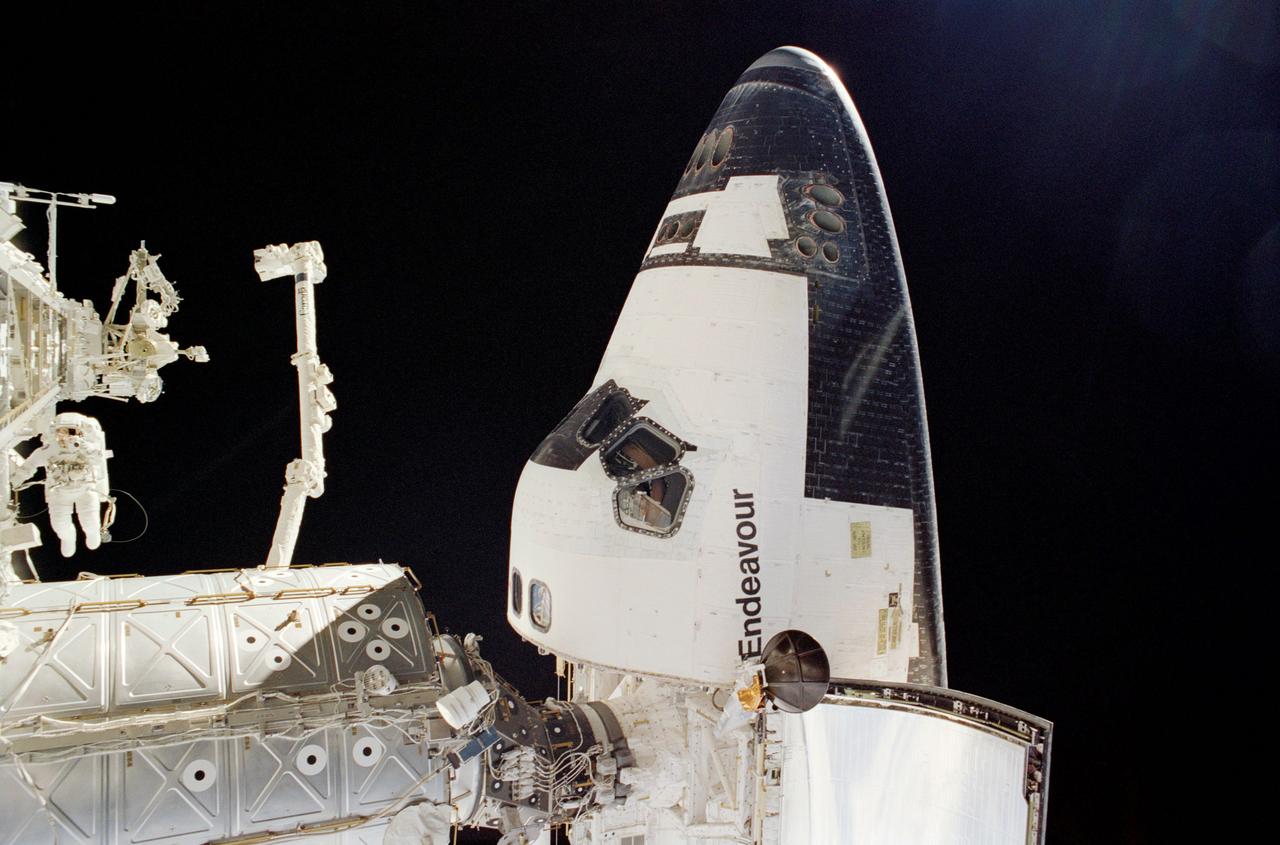
STS-113, the 16th American assembly flight and 112th overall American flight to the International Space Station (ISS), launched on November 23, 2002 from Kennedy's launch pad 39A aboard the Space Shuttle Orbiter Endeavour. The main mission objective was the the installation and activation of the Port 1 Integrated Truss Assembly (P1). The first major component installed on the left side of the Station, the P1 truss provides an additional three External Thermal Control System radiators. Weighing in at 27,506 pounds, the P1 truss is 45 feet (13.7 meters) long, 15 feet (4.6 meters) wide, and 13 feet (4 meters) high. Three space walks, aided by the use of the Robotic Manipulator Systems of both the Shuttle and the Station, were performed in the installation of P1. In this photograph astronaut and mission specialist John B. Herrington, (center left frame), participates in the mission's third space walk. The forward section of the Space Shuttle Endeavour, docked to the Pressurized Mating Adapter (PMA-2) on the ISS, is visible center frame. The station's Canadarm2 appears to stand in between the shuttle and Herrington.
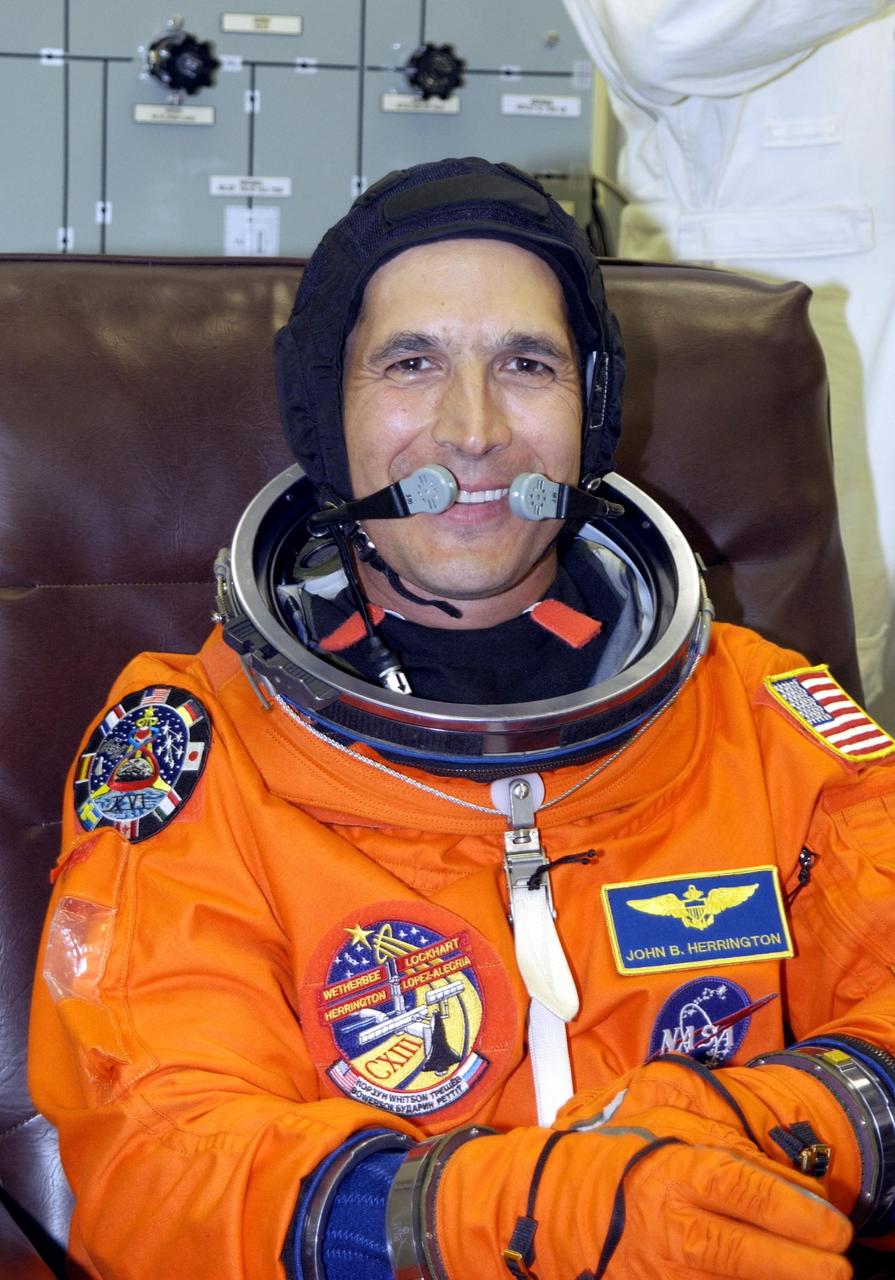
KENNEDY SPACE CENTER, FLA. -- STS-113 Mission Specialist John Herrington suits up for launch. Herrington will be making his first Shuttle flight. This is also the first launch of the first tribally enrolled Native American astronaut -- John B. Herrington -- on Space Transportation System. The primary mission for the crew is bringing the Expedition 6 crew to the Station and returning the Expedition 5 crew to Earth. The major objective of the mission is delivery of the Port 1 (P1) Integrated Truss Assembly, which will be attached to the port side of the S0 truss. Three spacewalks are planned to install and activate the truss and its associated equipment. Launch of Space Shuttle Endeavour on mission STS-113 is scheduled for 8:15 p.m. EST.
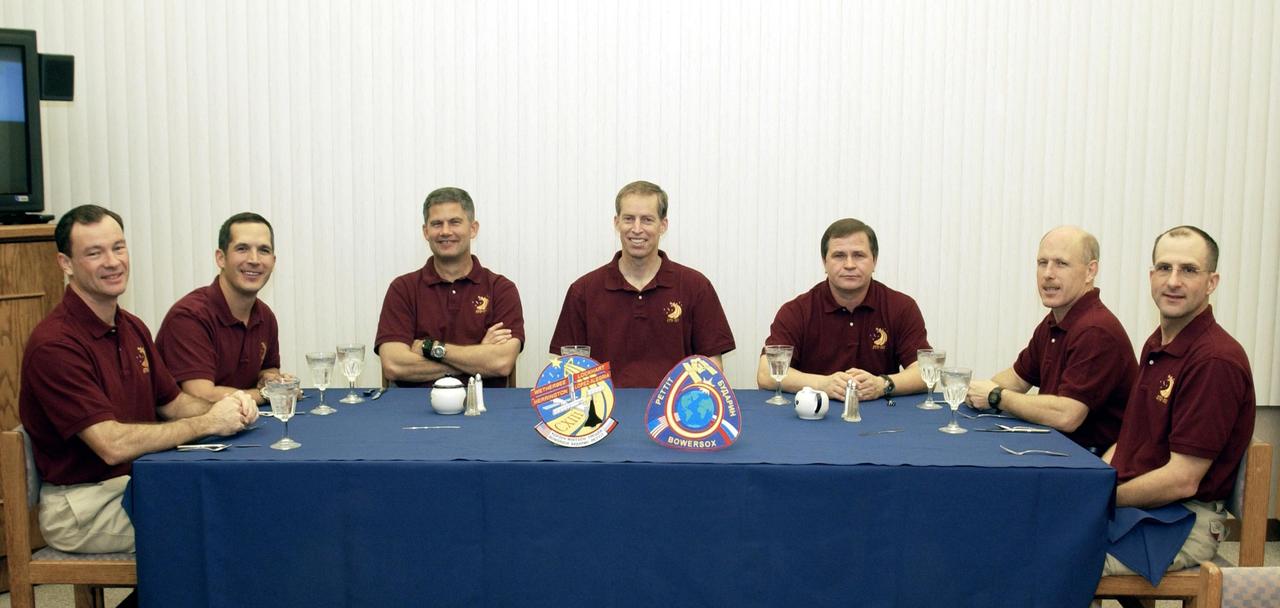
KENNEDY SPACE CENTER, FLA. -- The STS-113 crew pause after a meal for a group photo. From left are Mission Specialists Michael Lopez-Alegria and John Herrington, Pilot Paul Lockhart and Commander James Wetherbee; plus the Expedition 6 crew, Nikolai Budarin, Commander Ken Bowersox and Donald Pettit. On mission STS-113, the astronauts will deliver the Port 1 (P1) Integrated Truss Structure to the International Space Station. During the seven days Endeavour will be docked to the Station, three spacewalks will be performed dedicated to connecting the P1 truss to the port side of the S0 truss, already in place on the Station. This mission marks the 16th Shuttle flight to the International Space Station and the fifth Shuttle mission this year. Mission STS-113 is the 19th flight of the orbiter Endeavour and the 112th flight overall in NASA's Space Shuttle program.
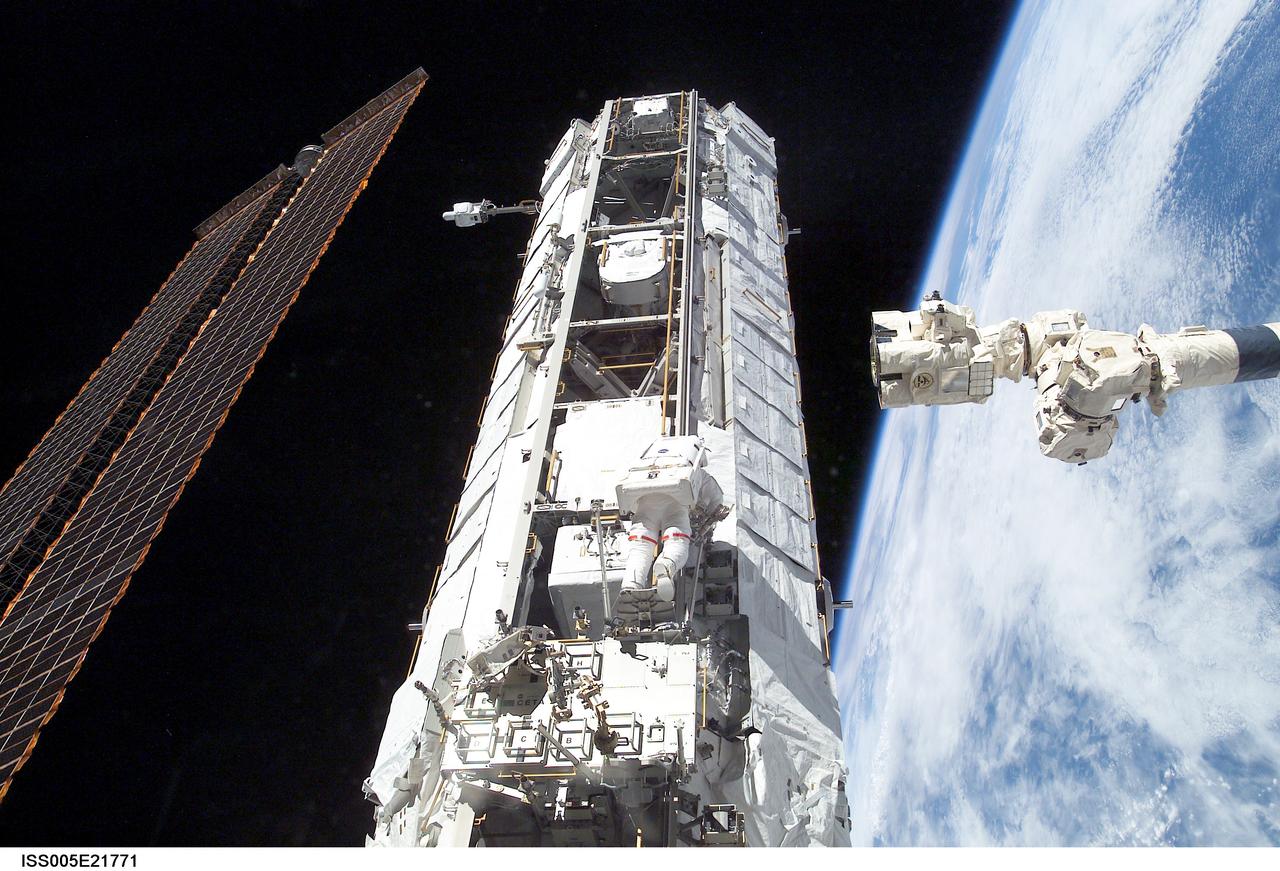
ISS005-E-21771 (28 November 2002) --- Astronaut Michael E. Lopez-Alegria, STS-113 mission specialist, works on the newly installed Port One (P1) truss on the International Space Station (ISS) during a session of extravehicular activity (EVA). The end effector of the Canadarm2 / Space Station Remote Manipulator System (SSRMS) and Earth’s horizon are visible in right frame.
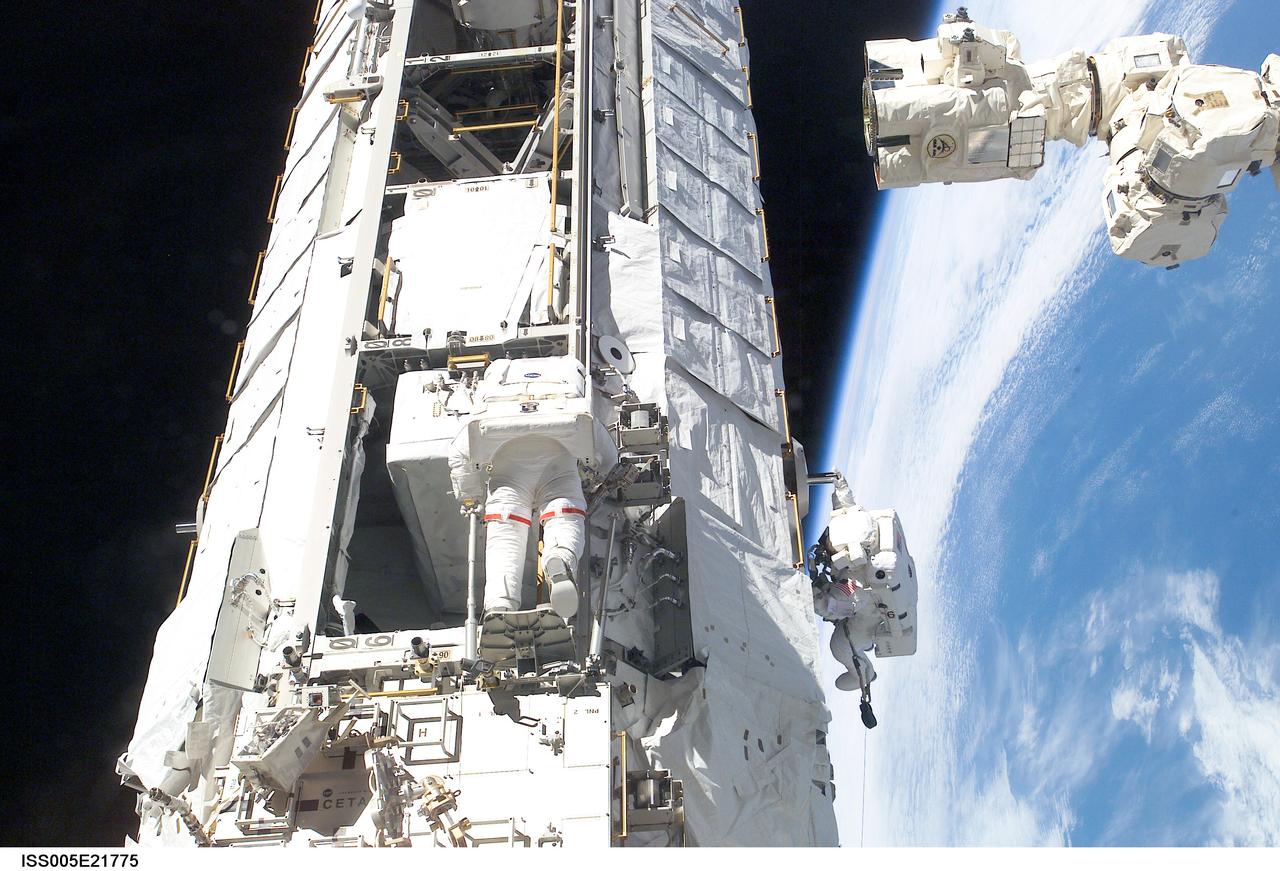
ISS005-E-21775 (28 November 2002) --- Astronauts Michael E. Lopez-Alegria (left) and John B. Herrington, STS-113 mission specialists, work on the newly installed Port One (P1) truss on the International Space Station (ISS) during a session of extravehicular activity (EVA). The end effector of the Canadarm2 / Space Station Remote Manipulator System (SSRMS) and Earth’s horizon are visible in right frame.
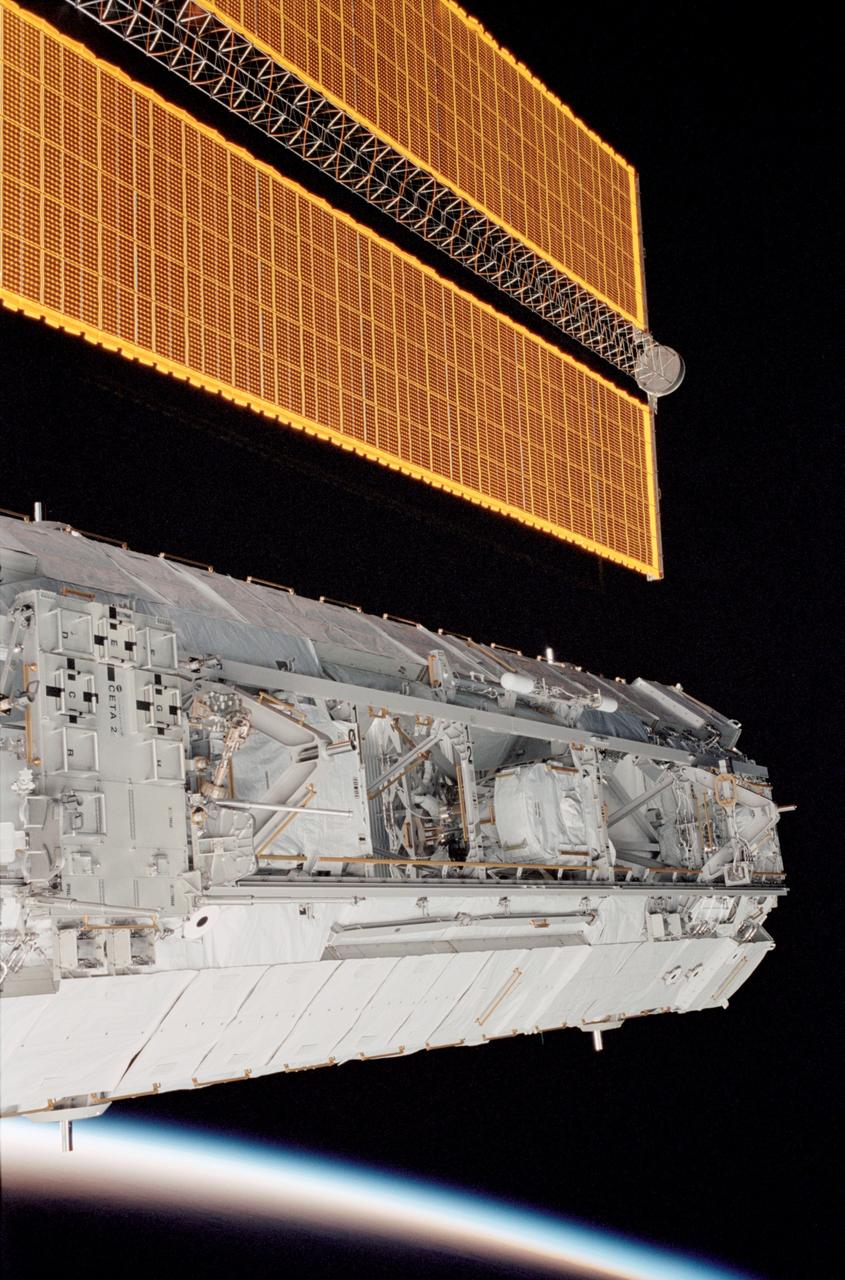
STS113-344-007 (23 November – 7 December 2002) --- View of the newly installed Port One (P1) truss on the International Space Station (ISS). One of the station’s main solar arrays is in top frame and Earth’s horizon is in bottom frame.
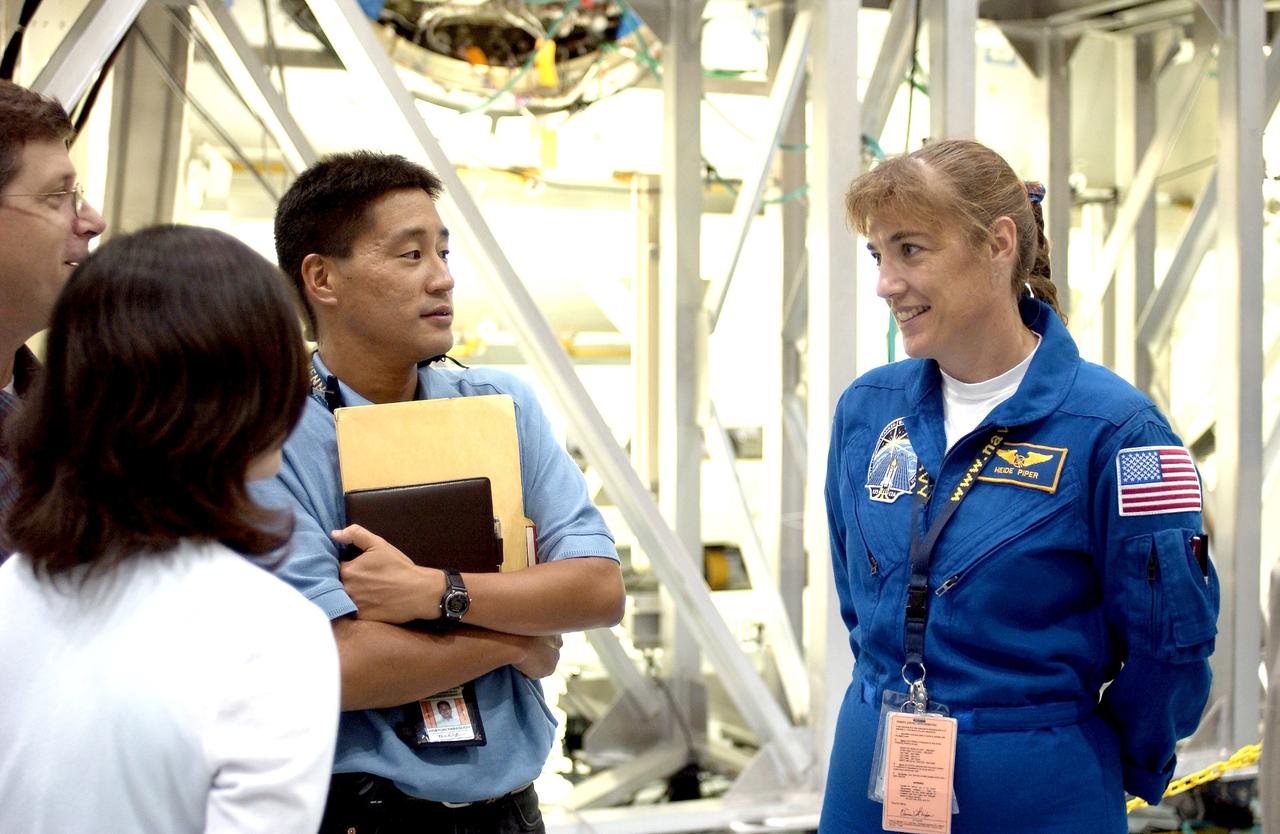
KENNEDY SPACE CENTER, FLA. - STS-115 Mission Specialist Heidemarie Stefanyshyn-Piper talks to workers in the Space Station Processing Facility. She and other crew members are at KSC for hardware familiarization. The mission will deliver the second port truss segment, the P3/P4 Truss, to attach to the first port truss segment, the P1 Truss, as well as deploy solar array sets 2A and 4A.. The crew is scheduled to activate and check out the Solar Alpha Rotary Joint (SARJ) and deploy the P4 Truss radiator.
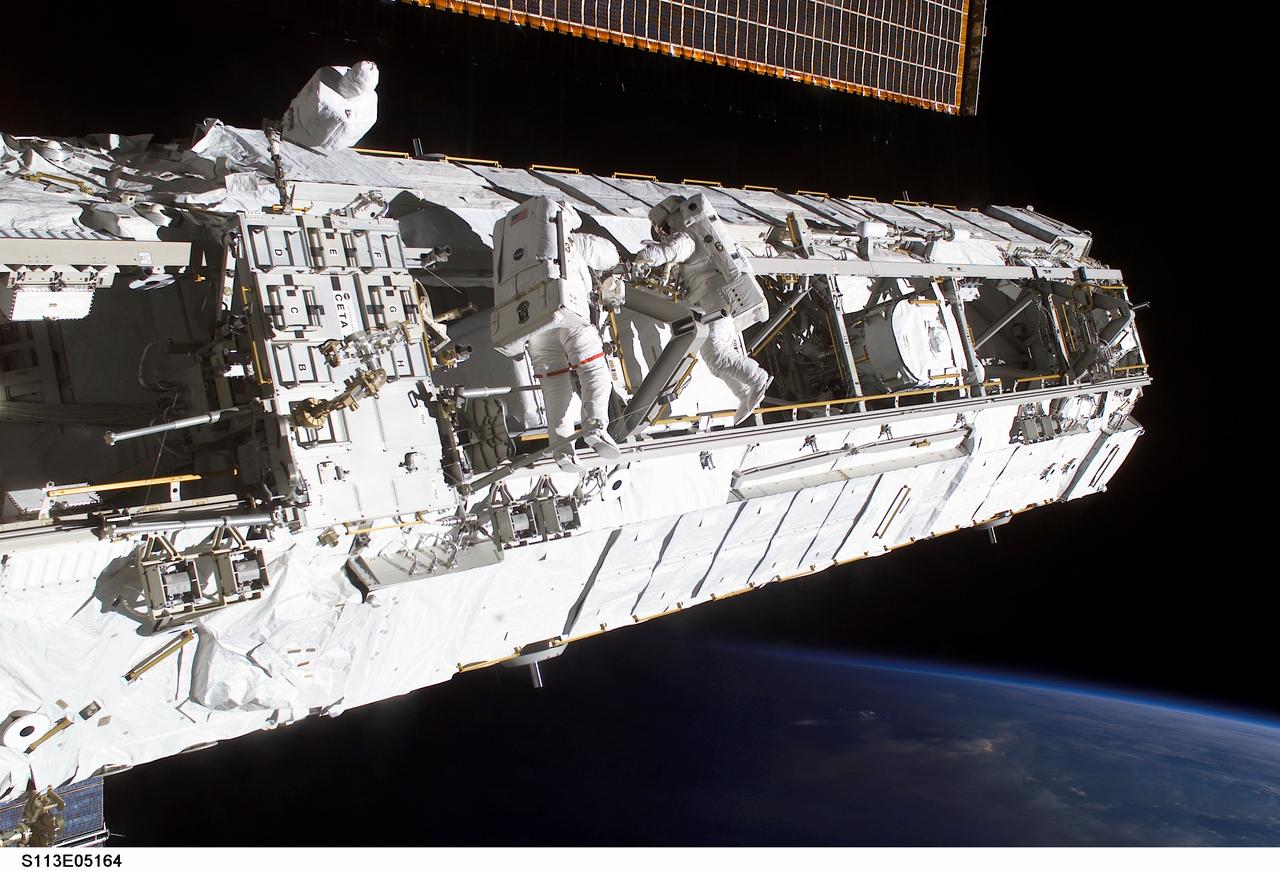
STS113-E-05164 (28 November 2002) --- Astronauts Michael E. Lopez-Alegria (left) and John B. Herrington, STS-113 mission specialists, work on the newly installed Port One (P1) truss on the International Space Station (ISS) during the mission’s second scheduled session of extravehicular activity (EVA). The spacewalk lasted 6 hours, 10 minutes.
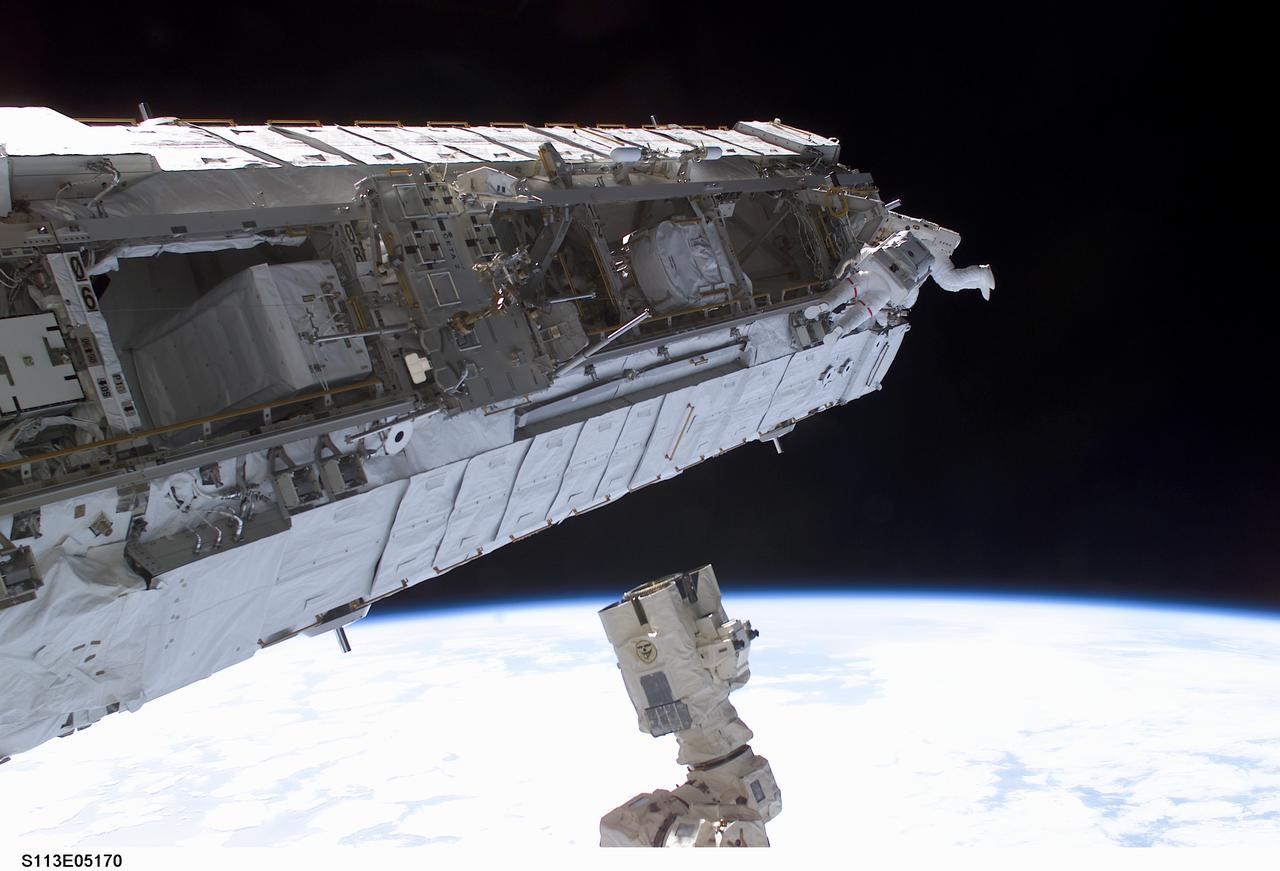
STS113-E-05170 (28 November 2002) --- Astronauts Michael E. Lopez-Alegria (red stripes) and John B. Herrington, STS-113 mission specialists, work on the newly installed Port One (P1) truss on the International Space Station (ISS) during the mission’s second scheduled session of extravehicular activity (EVA). The spacewalk lasted 6 hours, 10 minutes. The end effector of the Canadarm2 / Space Station Remote Manipulator System (SSRMS) and Earth’s horizon are visible in bottom frame.
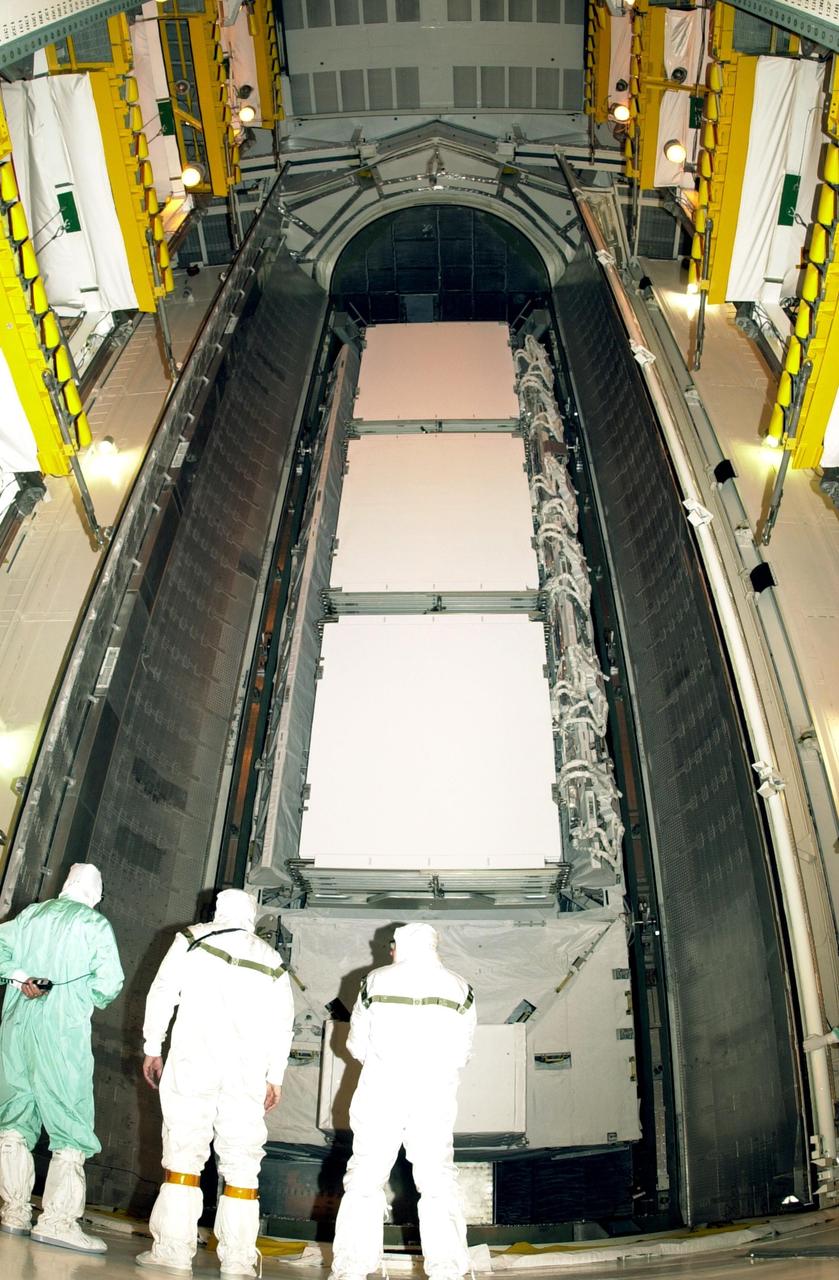
KENNEDY SPACE CENTER, FLA. -- At Launch Complex 39A, technicians in the Payload Changout Room supervise the opening of the payload canister doors for transfer of the P1 truss. The P1 truss is the primary payload for Mission STS-113 to the International Space Station. It is the first port truss segment which will be attached to the Station’s central truss segment, S0. Once delivered, the P1 truss will remain stowed until flight 12A.1. The mission will also deliver the Expedition 6 crew to the Station and return Expedition 5 to Earth. Space Shuttle Endeavour is scheduled to launch no earlier than Nov. 10 on the 11-day mission.
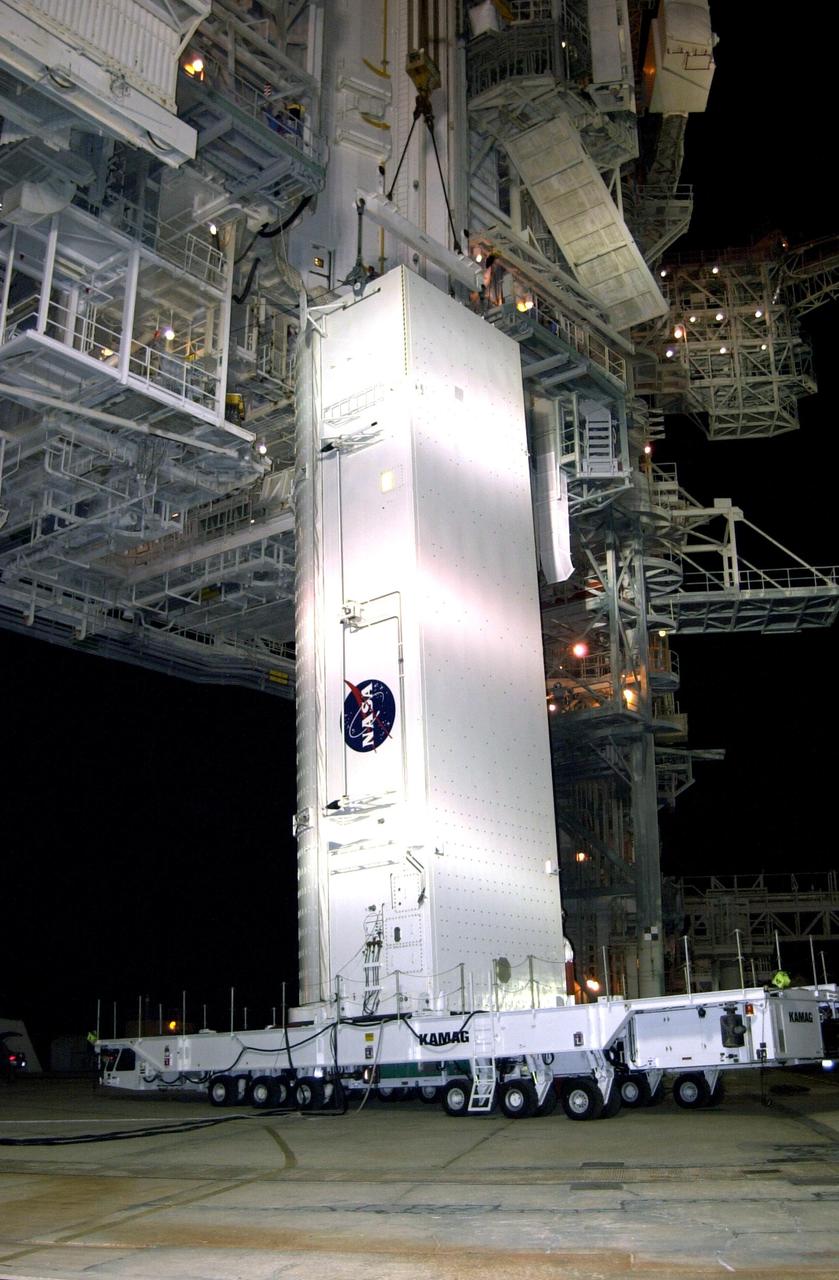
KENNEDY SPACE CENTER, FLA. -- At Launch Complex 39A, the P1 Truss Segment arrives at the pad for transfer into the Payload Changeout Room. The P1 truss is the primary payload for Mission STS-113 to the International Space Station. It is the first port truss segment which will be attached to the Station’s central truss segment, S0. Once delivered, the P1 truss will remain stowed until flight 12A.1. The mission will also deliver the Expedition 6 crew to the Station and return Expedition 5 to Earth. Space Shuttle Endeavour is scheduled to launch no earlier than Nov. 10 on the 11-day mission.
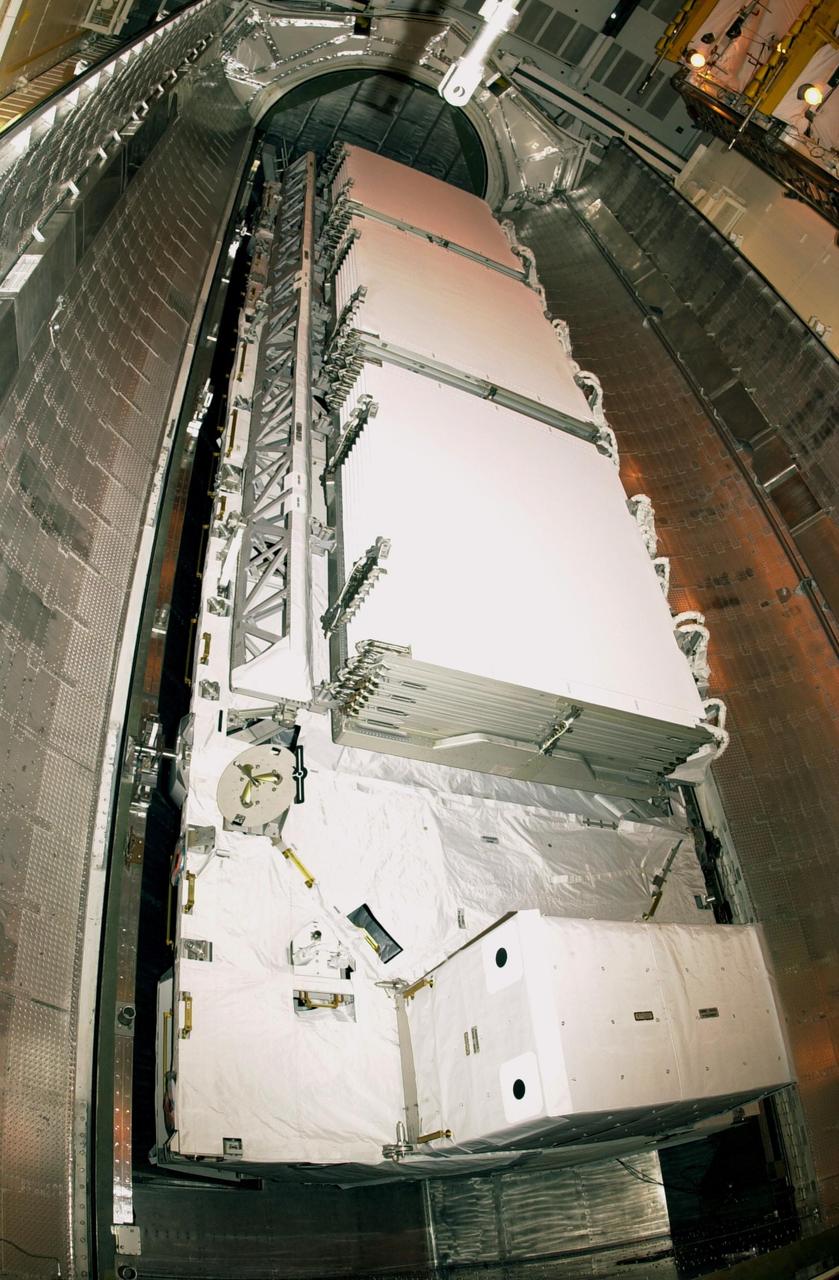
KENNEDY SPACE CENTER, FLA. -- At Launch Complex 39A, the payload canister doors are open to reveal the P1 truss before transfer to the Payload Changeout Room. The P1 truss is the primary payload for Mission STS-113 to the International Space Station. It is the first port truss segment which will be attached to the Station’s central truss segment, S0. Once delivered, the P1 truss will remain stowed until flight 12A.1. The mission will also deliver the Expedition 6 crew to the Station and return Expedition 5 to Earth. Space Shuttle Endeavour is scheduled to launch no earlier than Nov. 10 on the 11-day mission.
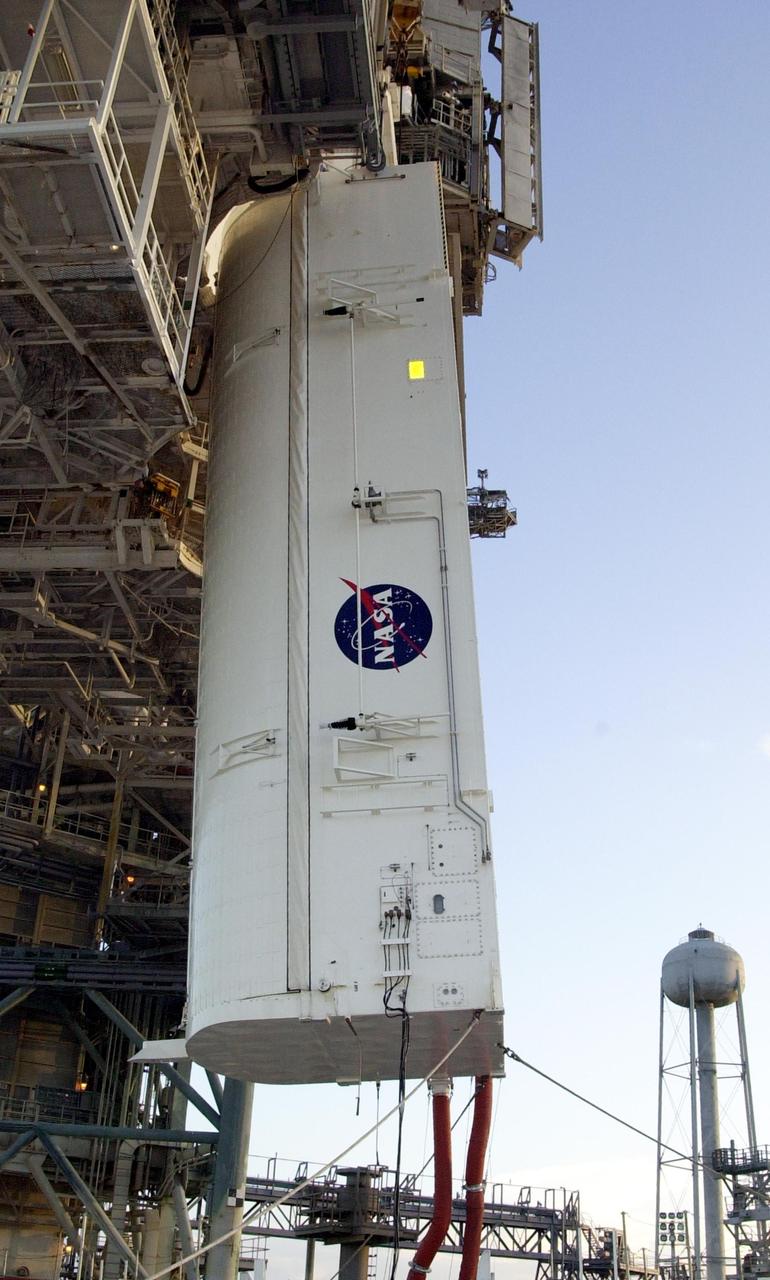
KENNEDY SPACE CENTER, FLA. -- At Launch Complex 39A, the P1 Truss Segment is lifted to the level of the Payload Changeout Room. The P1 truss is the primary payload for Mission STS-113 to the International Space Station. It is the first port truss segment which will be attached to the Station’s central truss segment, S0. Once delivered, the P1 truss will remain stowed until flight 12A.1. The mission will also deliver the Expedition 6 crew to the Station and return Expedition 5 to Earth. Space Shuttle Endeavour is scheduled to launch no earlier than Nov. 10 on the 11-day mission.
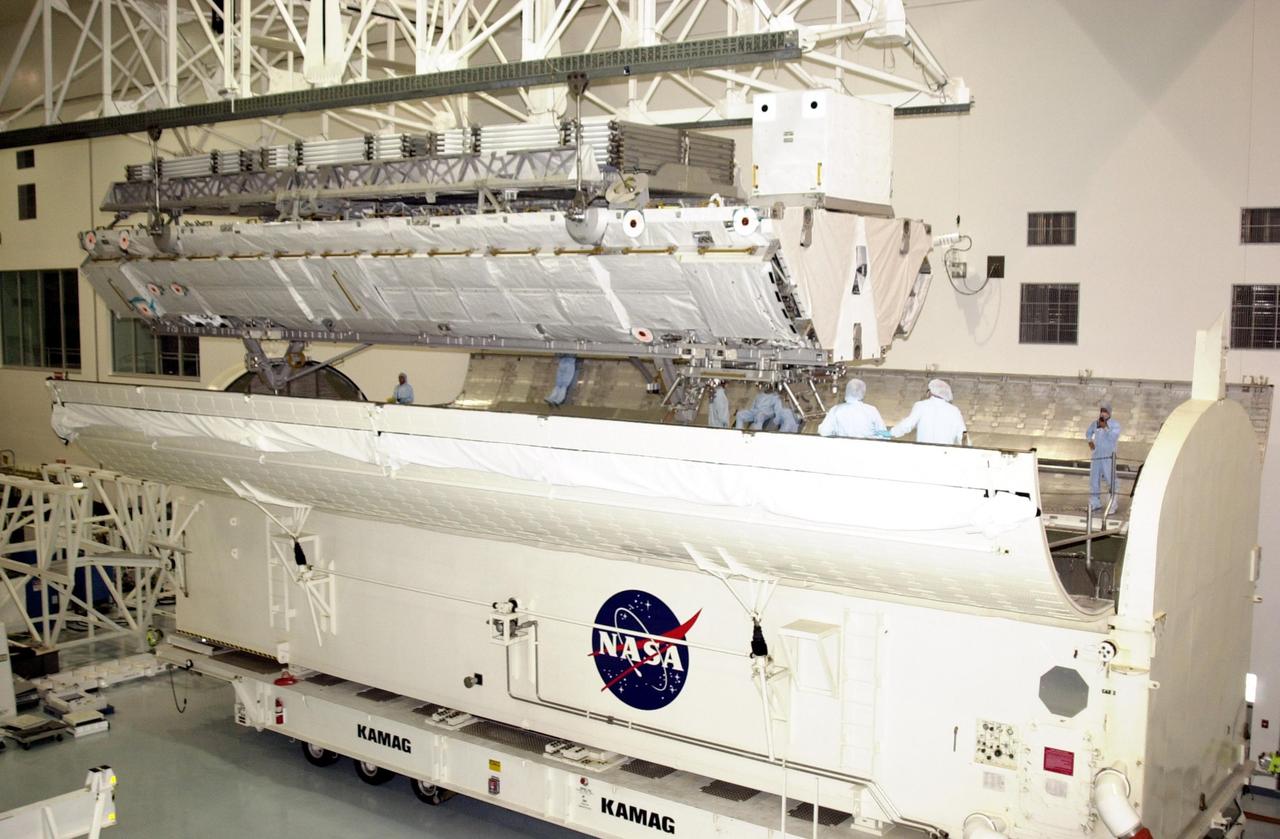
KENNEDY SPACE CENTER, FLA. -- Inside the Space Station Processing Facility, technicians use an overhead crane to lower the P1 Truss Segment into the payload canister. The P1 truss is the primary payload for Mission STS-113. It is the first port truss segment which will be attached to the Station’s central truss segment, S0. Once delivered, the P1 truss will remain stowed until flight 12A.1. The mission will also deliver the Expedition 6 crew to the Station and return Expedition 5 to Earth. Space Shuttle Endeavour is scheduled to launch no earlier than Nov. 10 on the 11-day mission.
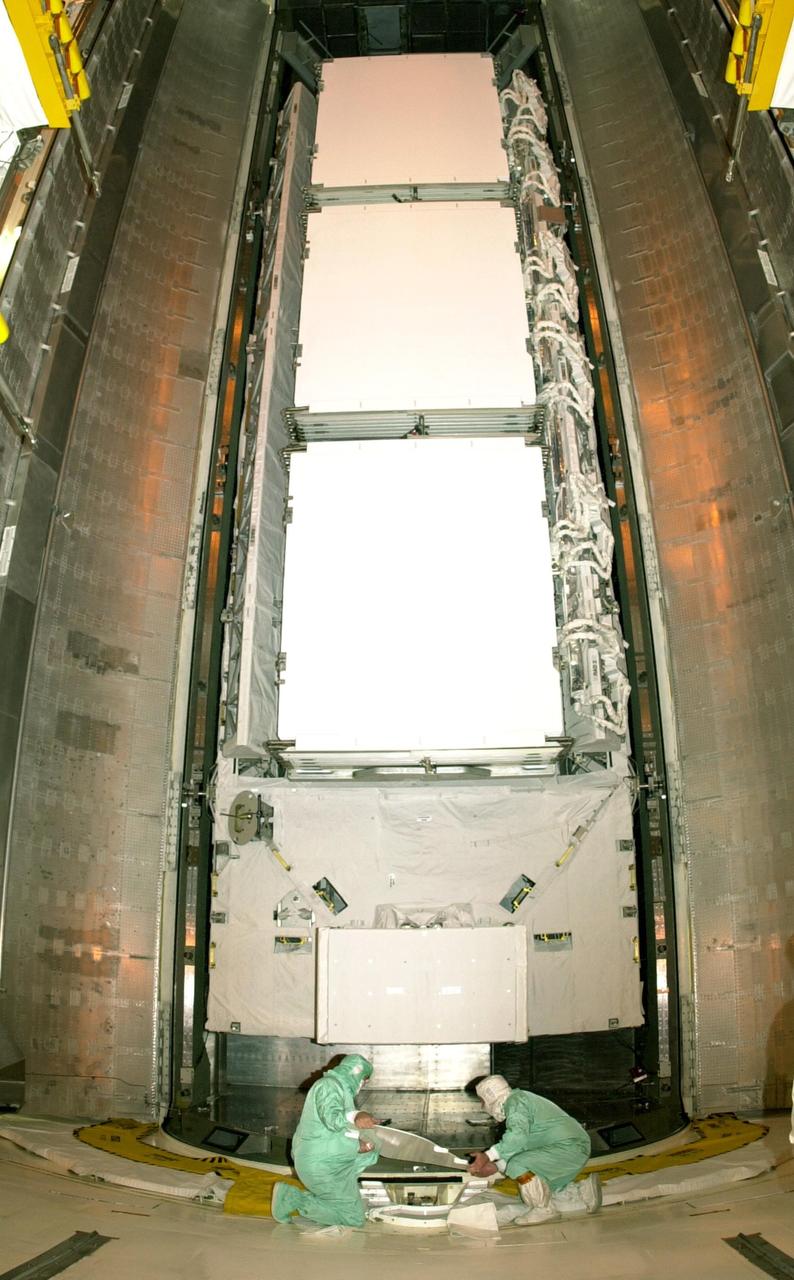
KENNEDY SPACE CENTER, FLA. -- At Launch Complex 39A, technicians prepare to move the P1 truss segment from the payload canister into the Payload Changeout Room. The P1 truss is the primary payload for Mission STS-113 to the International Space Station. It is the first port truss segment which will be attached to the Station’s central truss segment, S0. Once delivered, the P1 truss will remain stowed until flight 12A.1. The mission will also deliver the Expedition 6 crew to the Station and return Expedition 5 to Earth. Space Shuttle Endeavour is scheduled to launch no earlier than Nov. 10 on the 11-day mission.
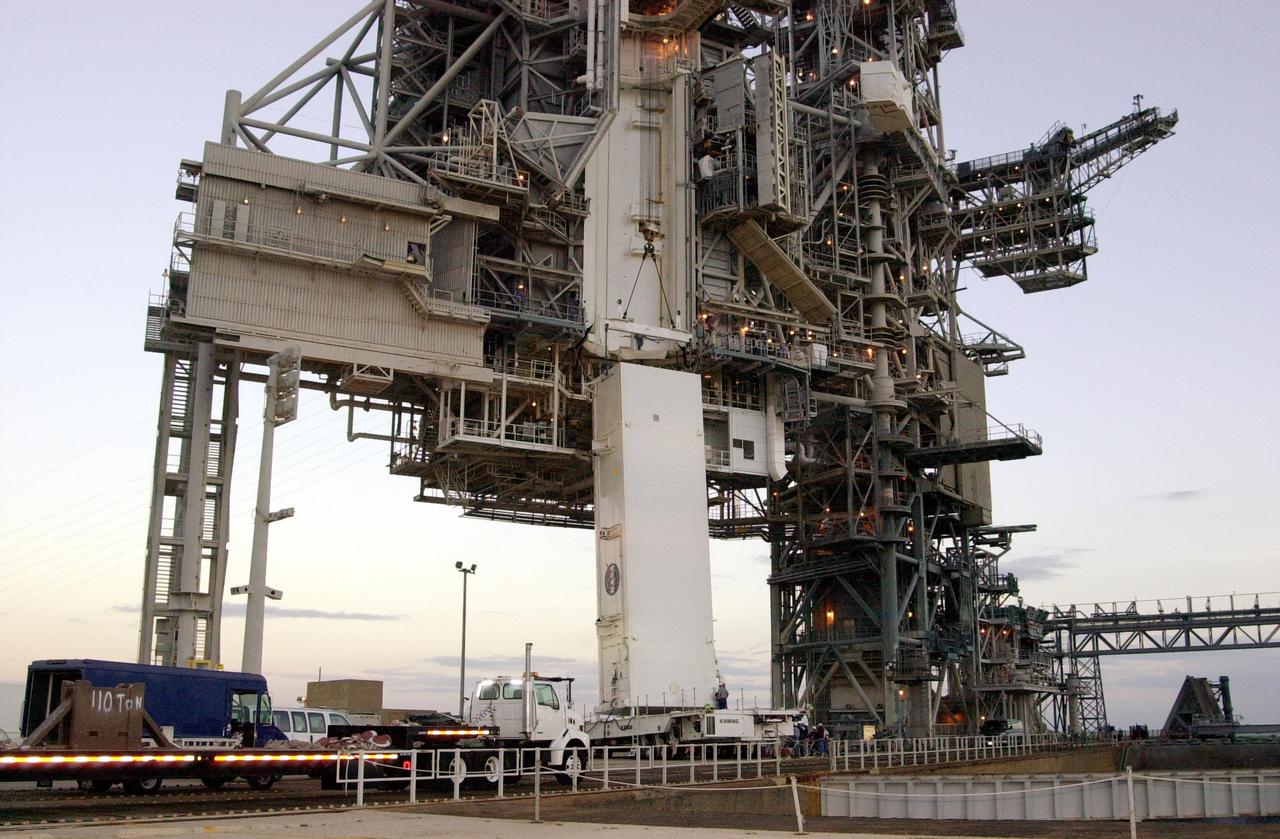
KENNEDY SPACE CENTER, FLA. -- At Launch Complex 39A, the P1 Truss Segment arrives at the pad for transfer into the Payload Changeout Room. The P1 truss is the primary payload for Mission STS-113 to the International Space Station. It is the first port truss segment which will be attached to the Station’s central truss segment, S0. Once delivered, the P1 truss will remain stowed until flight 12A.1. The mission will also deliver the Expedition 6 crew to the Station and return Expedition 5 to Earth. Space Shuttle Endeavour is scheduled to launch no earlier than Nov. 10 on the 11-day mission.

KENNEDY SPACE CENTER, FLA. -- At Launch Complex 39A, the P1 Truss Segment arrives at the Payload Changeout Room in preparation for installation into Endeavour's payload bay. The P1 truss is the primary payload for Mission STS-113 to the International Space Station. It is the first port truss segment which will be attached to the Station’s central truss segment, S0. Once delivered, the P1 truss will remain stowed until flight 12A.1. The mission will also deliver the Expedition 6 crew to the Station and return Expedition 5 to Earth. Space Shuttle Endeavour is scheduled to launch no earlier than Nov. 10 on the 11-day mission.
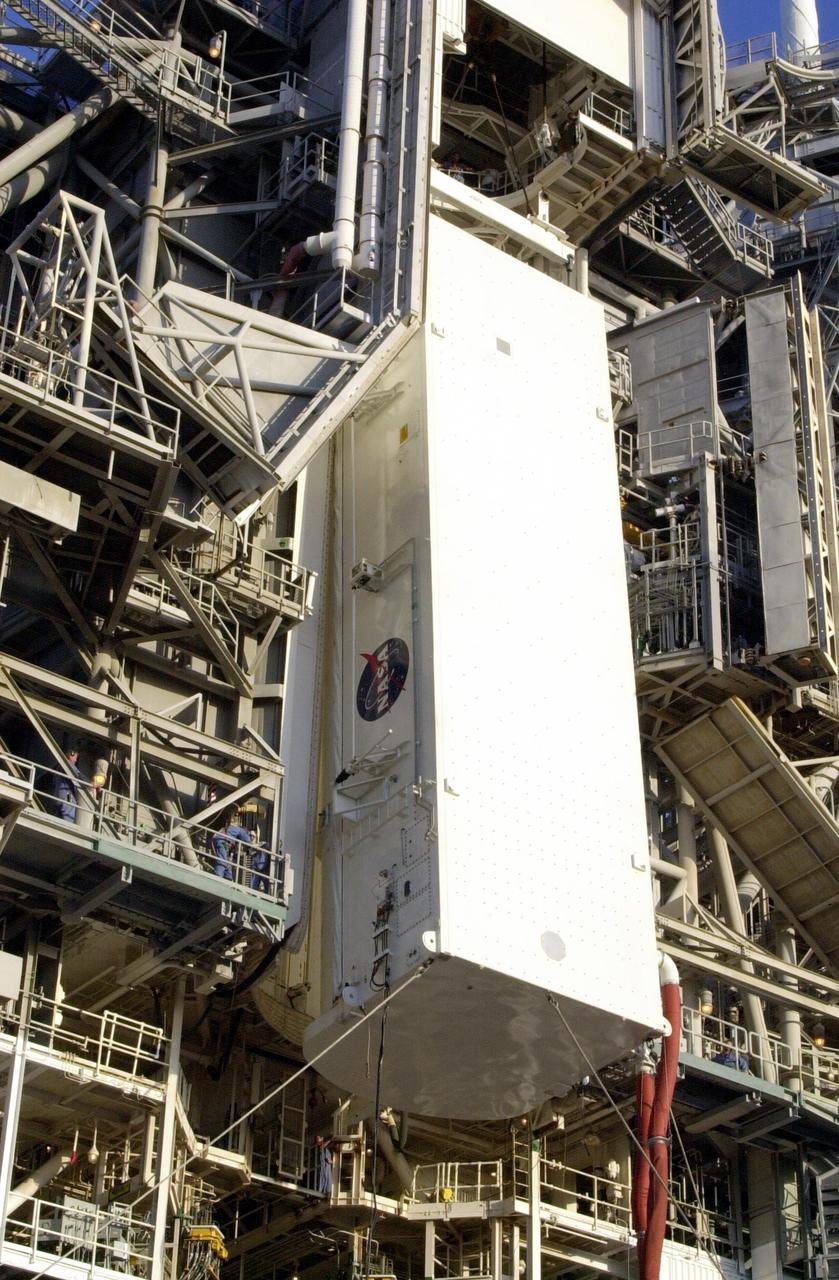
KENNEDY SPACE CENTER, FLA. -- At Launch Complex 39A, the P1 Truss Segment is lifted to the level of the Payload Changeout Room. The P1 truss is the primary payload for Mission STS-113 to the International Space Station. It is the first port truss segment which will be attached to the Station’s central truss segment, S0. Once delivered, the P1 truss will remain stowed until flight 12A.1. The mission will also deliver the Expedition 6 crew to the Station and return Expedition 5 to Earth. Space Shuttle Endeavour is scheduled to launch no earlier than Nov. 10 on the 11-day mission.
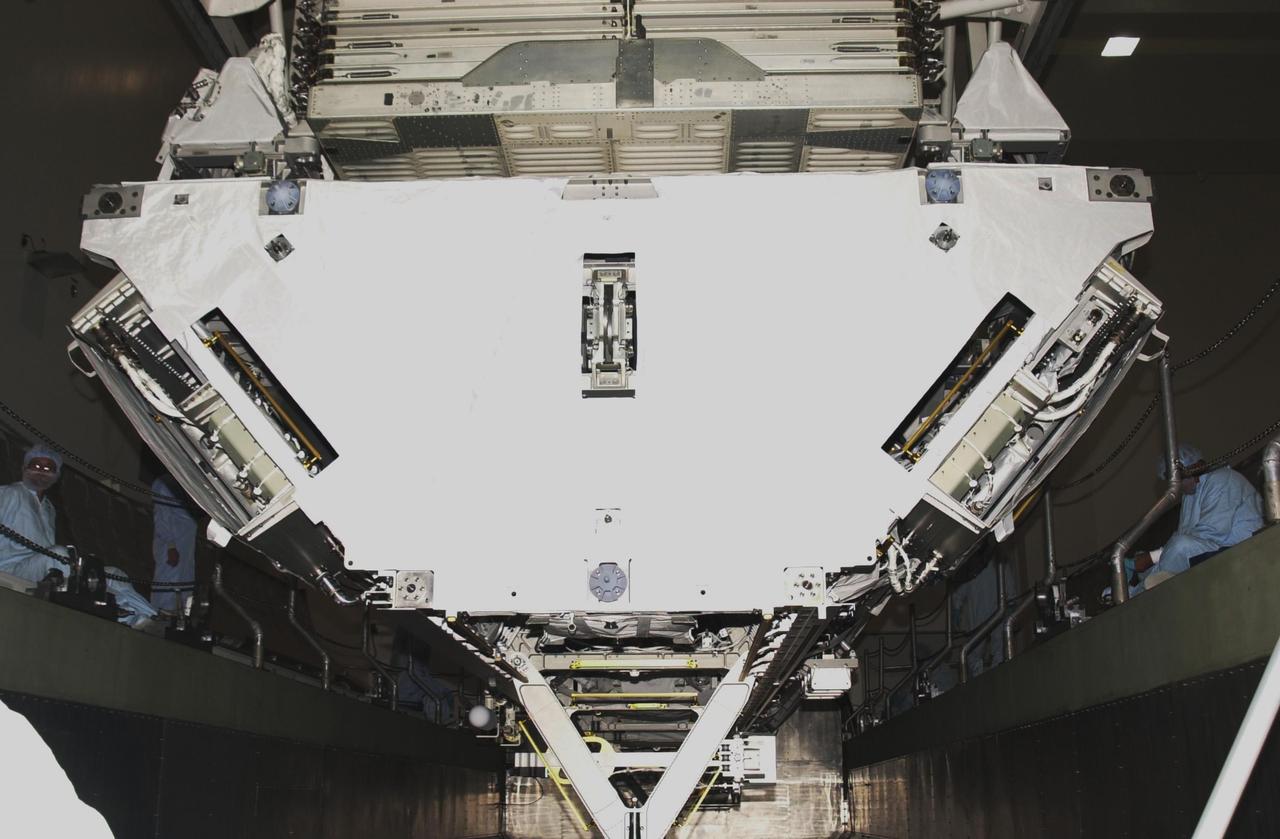
KENNEDY SPACE CENTER, FLA. -- Inside the Space Station Processing Facility, the P1 Truss Segment is lowered into the payload canister. The P1 truss is the primary payload for Mission STS-113. It is the first port truss segment which will be attached to the Station’s central truss segment, S0. Once delivered, the P1 truss will remain stowed until flight 12A.1. The mission will also deliver the Expedition 6 crew to the Station and return Expedition 5 to Earth. Space Shuttle Endeavour is scheduled to launch no earlier than Nov. 10 on the 11-day mission.
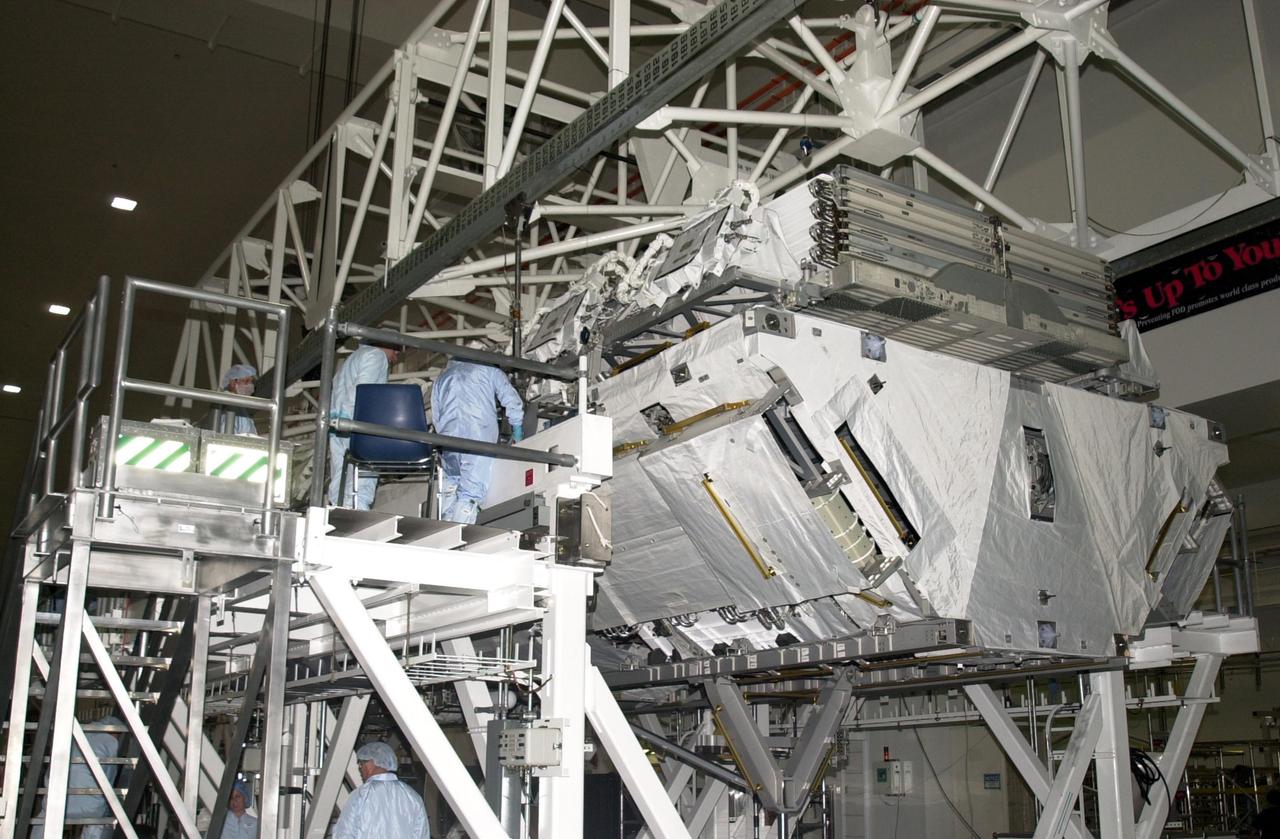
KENNEDY SPACE CENTER, FLA. -- Inside the Space Station Processing Facility, technicians prepare the P1 Truss Segment to be hooked to the overhead crane and moved toward the payload canister. The P1 truss is the primary payload for Mission STS-113. It is the first port truss segment which will be attached to the Station’s central truss segment, S0. Once delivered, the P1 truss will remain stowed until flight 12A.1. The mission will also deliver the Expedition 6 crew to the Station and return Expedition 5 to Earth. Space Shuttle Endeavour is scheduled to launch no earlier than Nov. 10 on the 11-day mission.
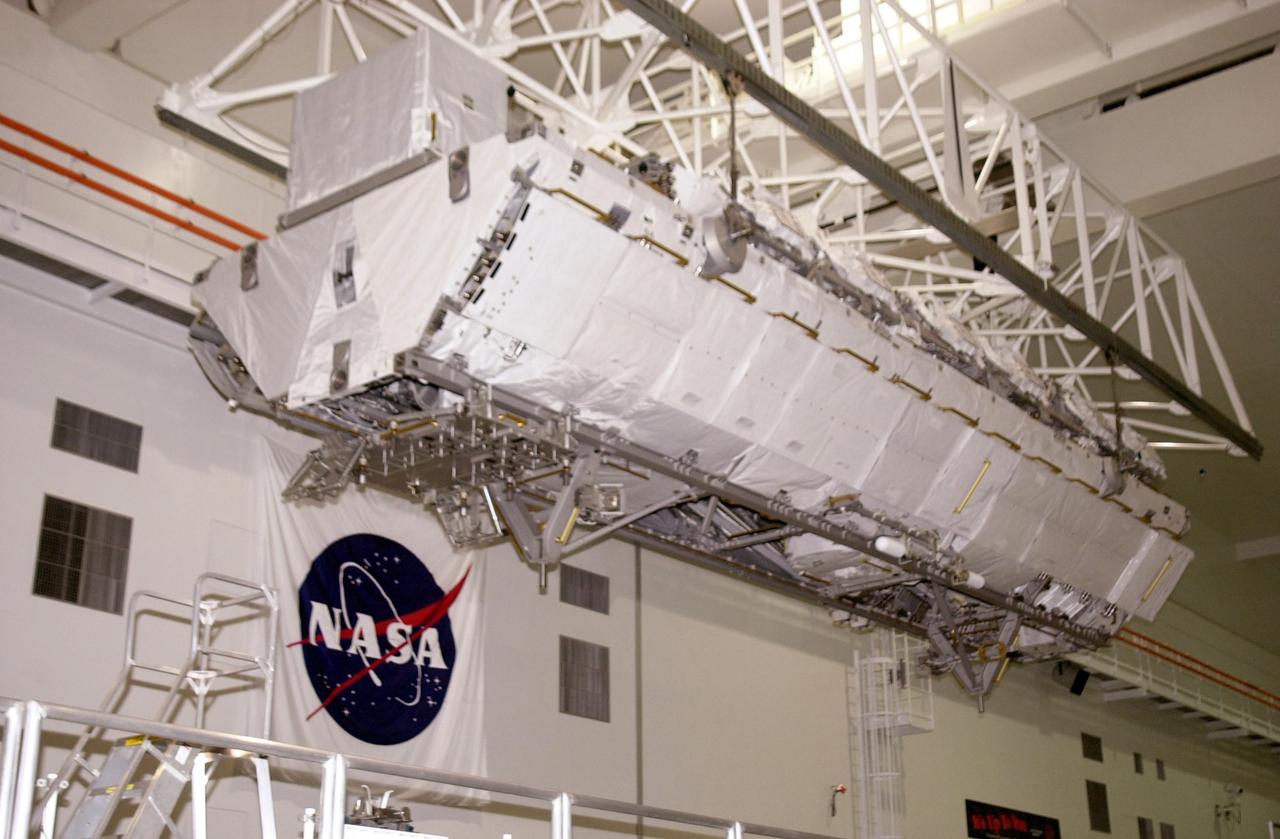
KENNEDY SPACE CENTER, FLA. -- Inside the Space Station Processing Facility, the P1 Truss Segment is moved by overhead crane through the highbay toward the payload canister. The P1 truss is the primary payload for Mission STS-113. It is the first port truss segment which will be attached to the Station’s central truss segment, S0. Once delivered, the P1 truss will remain stowed until flight 12A.1. The mission will also deliver the Expedition 6 crew to the Station and return Expedition 5 to Earth. Space Shuttle Endeavour is scheduled to launch no earlier than Nov. 10 on the 11-day mission.
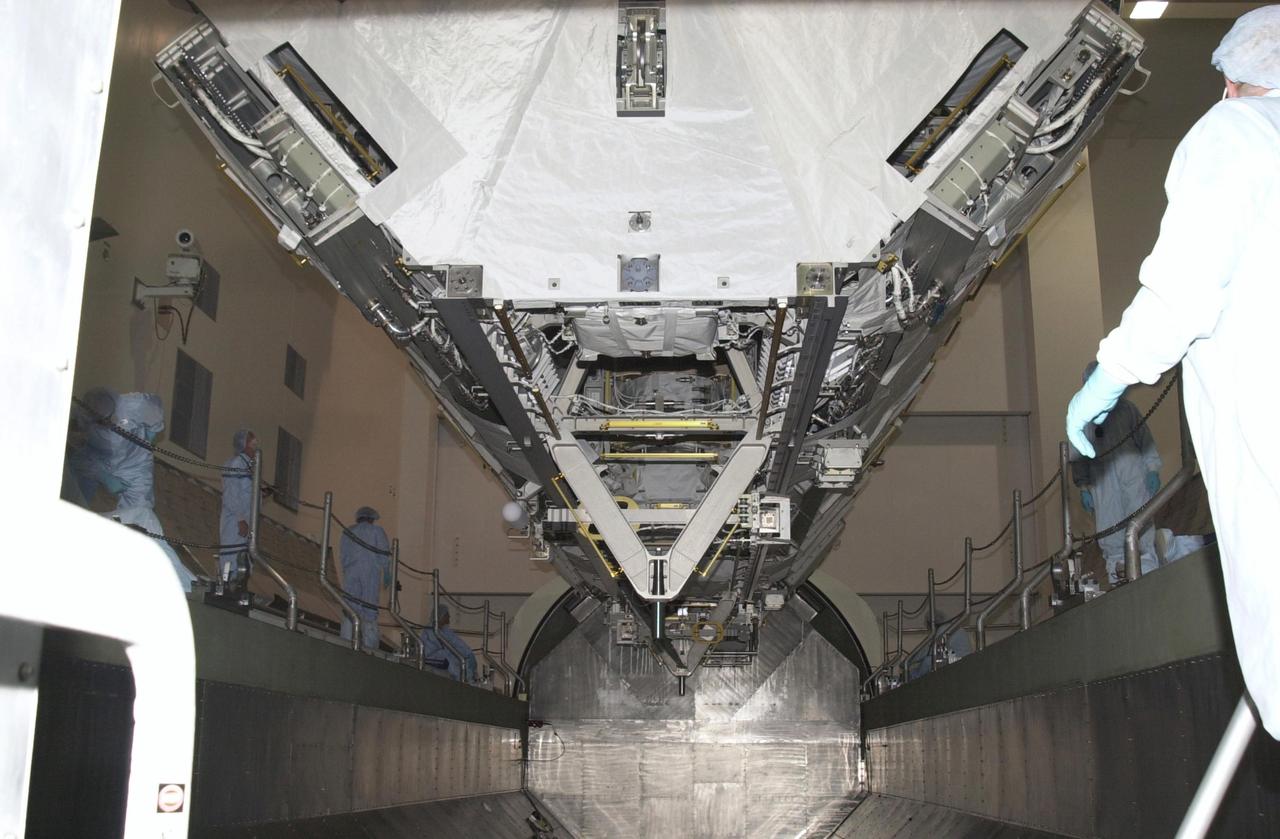
KENNEDY SPACE CENTER, FLA. -- Inside the Space Station Processing Facility, technicians use an overhead crane to lower the P1 Truss Segment into the payload canister. The P1 truss is the primary payload for Mission STS-113. It is the first port truss segment which will be attached to the Station’s central truss segment, S0. Once delivered, the P1 truss will remain stowed until flight 12A.1. The mission will also deliver the Expedition 6 crew to the Station and return Expedition 5 to Earth. Space Shuttle Endeavour is scheduled to launch no earlier than Nov. 10 on the 11-day mission.
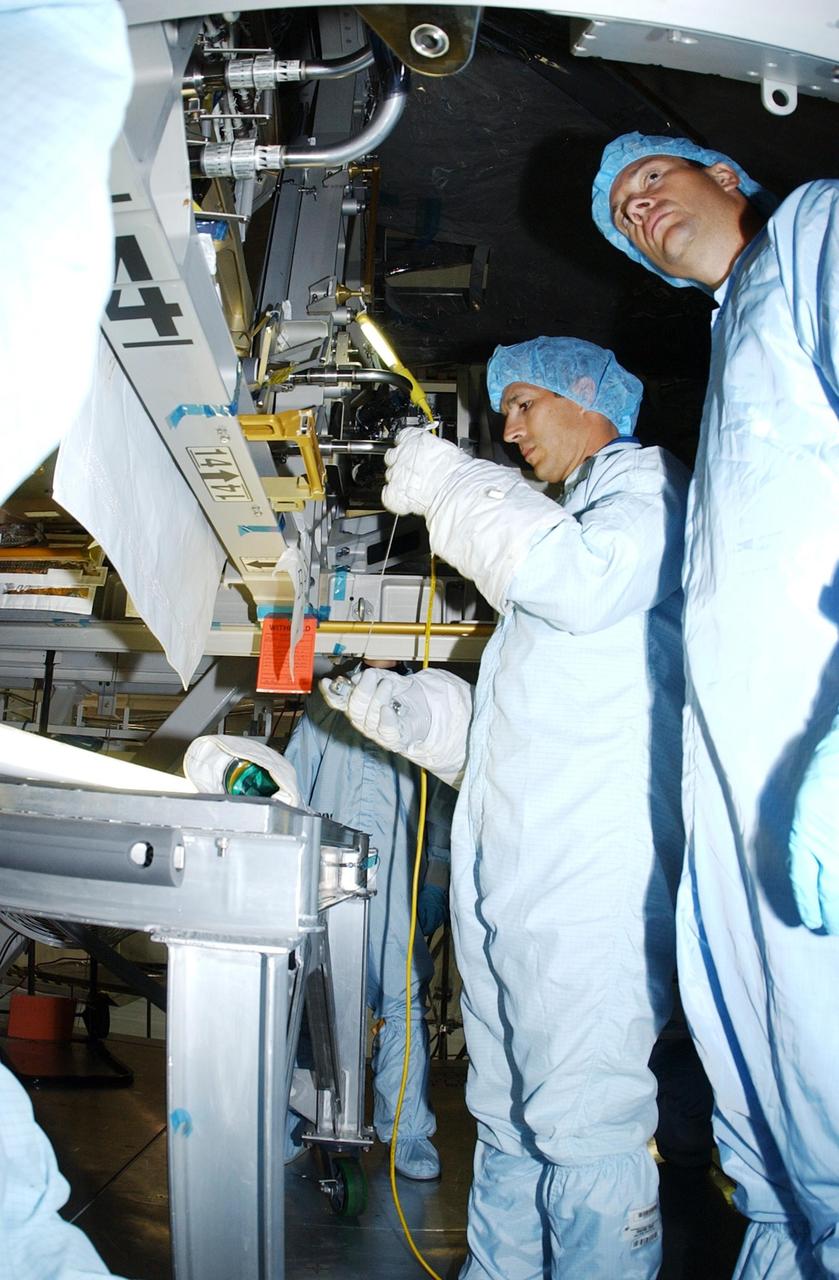
KENNEDY SPACE CENTER, FLA. - STS-113 Mission Specialists John Herrington (left) and Michael Lopez-Alegria (right) look over the P1 Integrated Truss Structure, the primary payload for the mission. The P1 truss will be attached to the central truss segment, S0 Truss, during spacewalks. The payload also includes the Crew and Equipment Translation Aid (CETA) Cart B that can be used by spacewalkers to move along the truss with equipment. STS-113 is scheduled to launch Oct. 6, 2002.
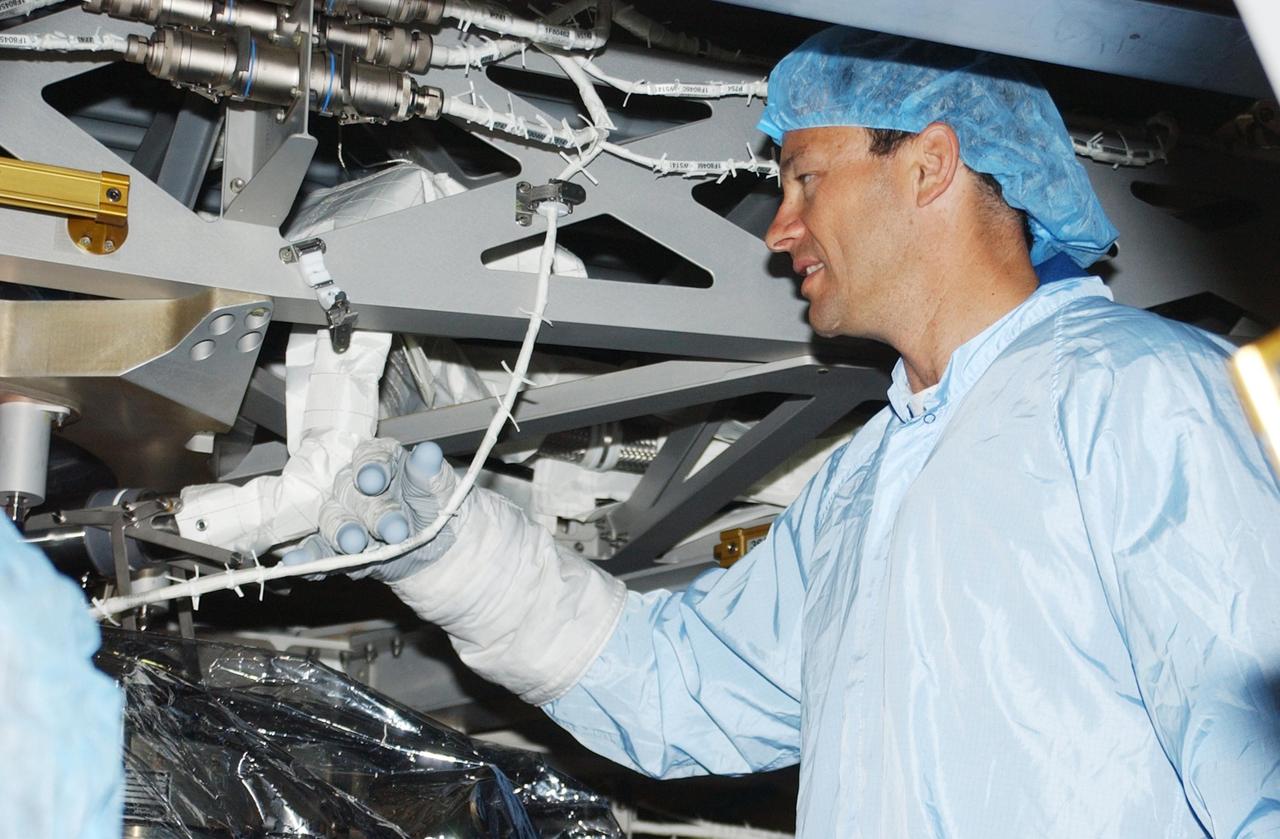
KENNEDY SPACE CENTER, FLA. -- STS-113 Mission Specialist Michael Lopez-Alegria looks over the P1 Integrated Truss Structure, the primary payload for the mission. The P1 truss will be attached to the central truss segment, S0 Truss, during spacewalks. The payload also includes the Crew and Equipment Translation Aid (CETA) Cart B that can be used by spacewalkers to move along the truss with equipment. STS-113 is scheduled to launch Oct. 6, 2002.
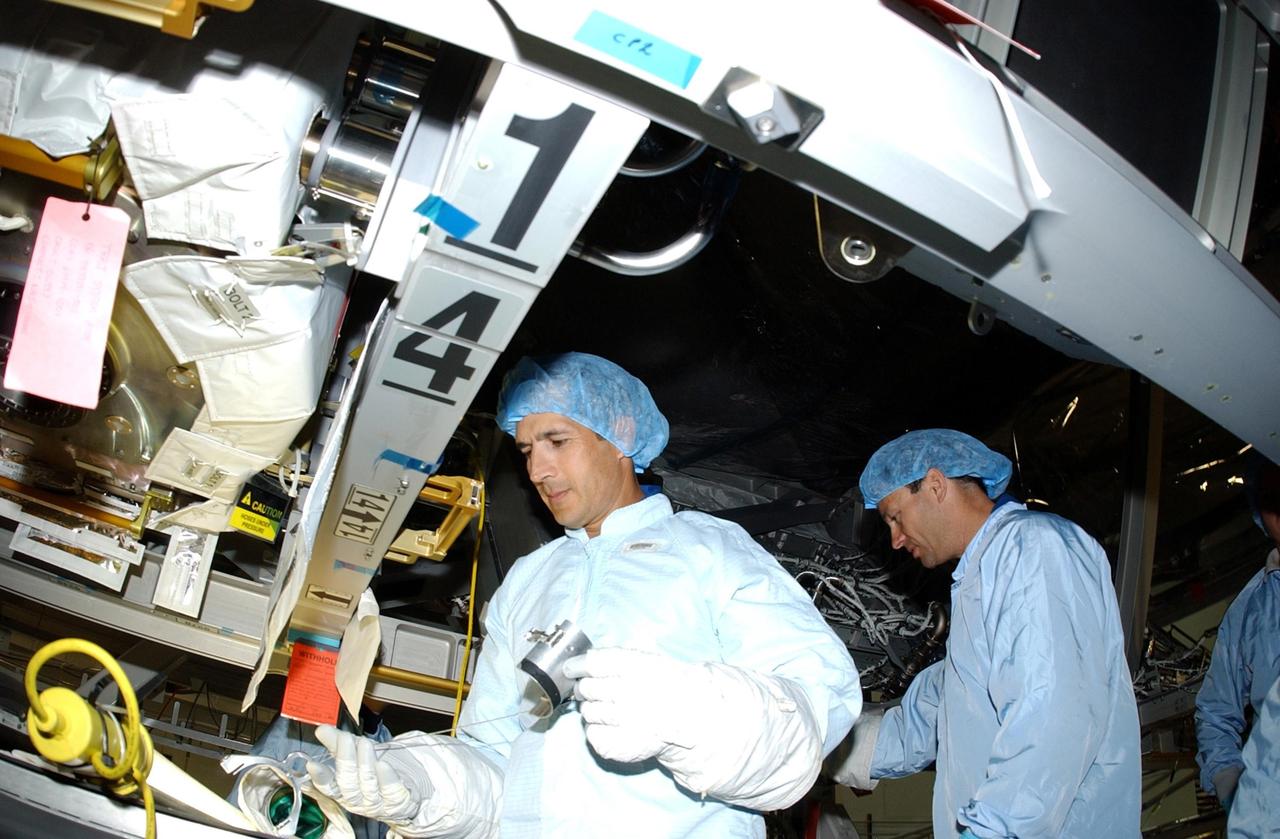
KENNEDY SPACE CENTER, FLA. -- STS-113 Mission Specialists John Herrington (left) and Michael Lopez-Alegria (right) look over the P1 Integrated Truss Structure, the primary payload for the mission. The P1 truss will be attached to the central truss segment, S0 Truss, during spacewalks. The payload also includes the Crew and Equipment Translation Aid (CETA) Cart B that can be used by spacewalkers to move along the truss with equipment. STS-113 is scheduled to launch Oct. 6, 2002
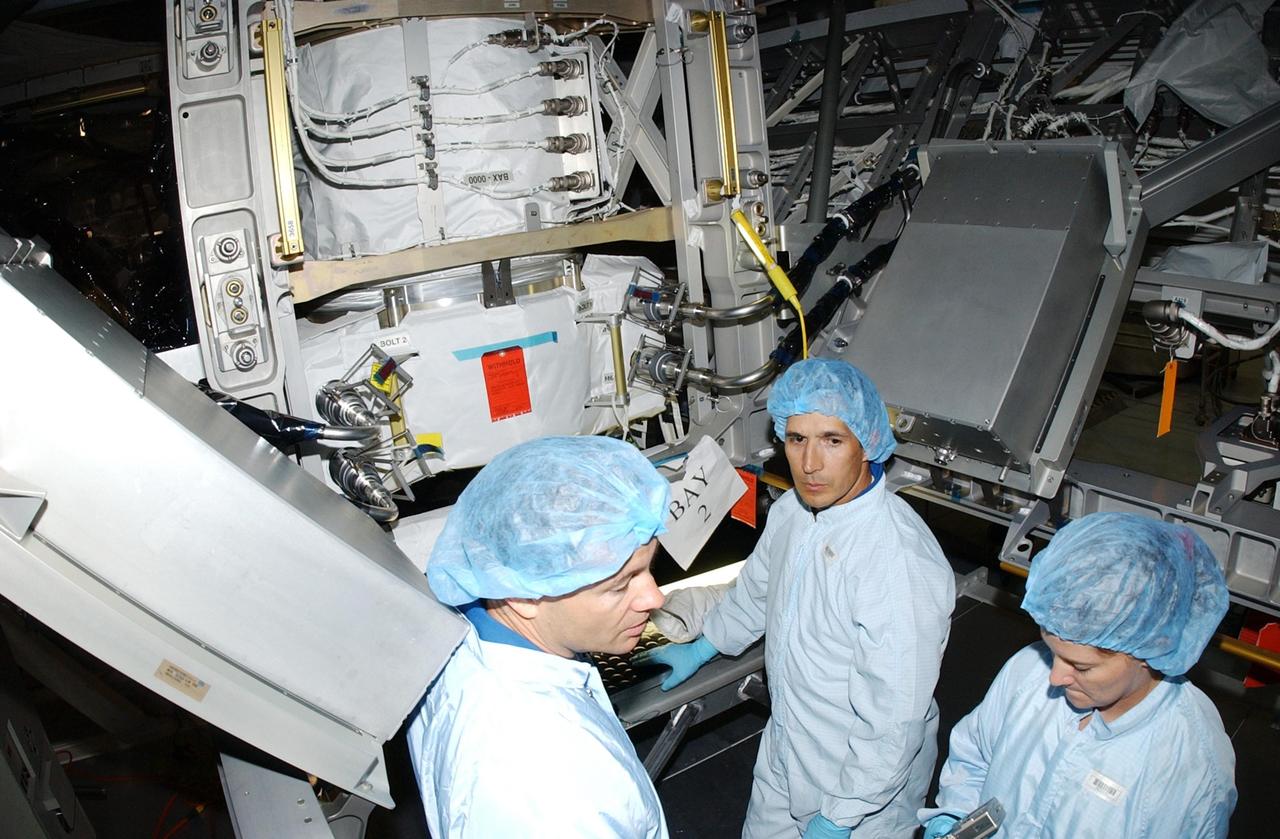
KENNEDY SPACE CENTER, FLA. - STS-113 Mission Specialists Michael Lopez-Alegria (left) and John Herrington (center) review data on the P1 Integrated Truss Structure with a technician in the Space Station Processing Facility. During the mission, the P1 truss will be attached to the central truss segment, S0 Truss, during spacewalks. The payload also includes the Crew and Equipment Translation Aid (CETA) Cart B that can be used by spacewalkers to move along the truss with equipment. STS-113 is scheduled to launch Oct. 6, 2002.

KENNEDY SPACE CENTER, FLA. -- STS-113 Mission Specialist John Herrington looks over part of the payload for the mission during Crew Equipment Interface Test activities in the Space Station Processing Facility. The mission will be carrying the first port truss segment, P1 Truss, to be attached to the central truss segment, S0, on the International Space Station. Once delivered, the P1 truss will remain stowed until flight 12A.1. Launch date for STS-113 is under review.
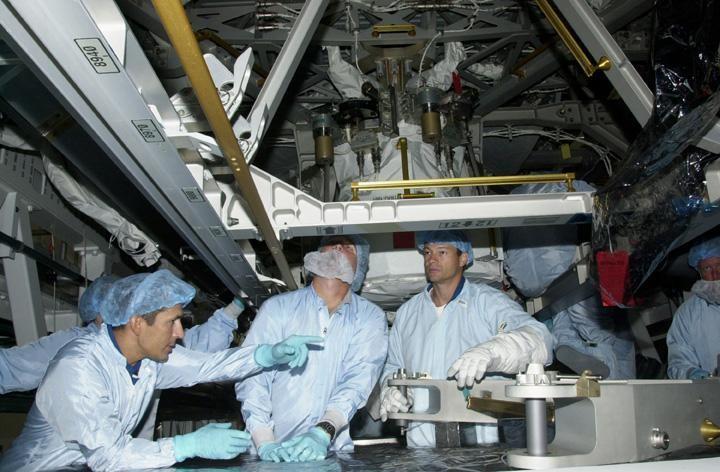
KENNEDY SPACE CENTER, FLA. - Under the eyes of a Boeing worker (center), STS-113 Mission Specialist John Herrington (left) and Mission Specialist Michael Lopez-Alegria (right) learn more about the payload for their mission. Part of the payload on mission STS-113 is the first port truss segment, P1 Truss, to be attached to the central truss segment, S0, on the International Space Station. Once delivered, the P1 truss will remain stowed until flight 12A.1. Launch date for STS-113 is under review.

KENNEDY SPACE CENTER, FLA. -- STS-113 Mission Specialists Michael Lopez-Alegria (left) and John Herrington (center) look over part of the payload for the mission during Crew Equipment Interface Test activities in the Space Station Processing Facility. The mission will be carrying the first port truss segment, P1 Truss, to be attached to the central truss segment, S0, on the International Space Station. Once delivered, the P1 truss will remain stowed until flight 12A.1. Launch date for STS-113 is under review.
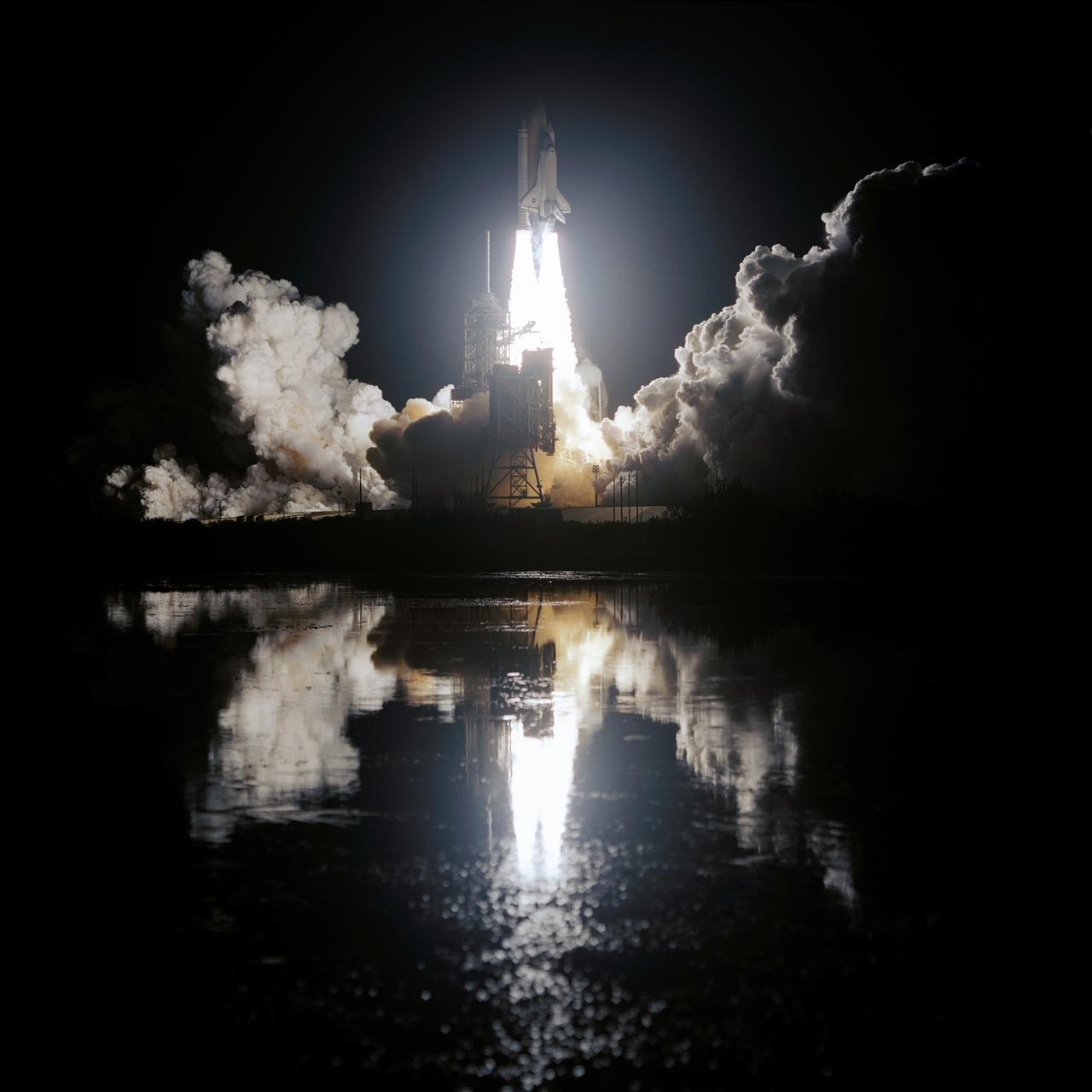
The 16th American assembly flight and 112th overall American flight to the International Space Station (ISS) launched on November 23, 2002 from Kennedy's launch pad 39A aboard the Space Shuttle Orbiter Endeavor STS-113. Mission objectives included the delivery of the Expedition Six Crew to the ISS, the return of Expedition Five crew back to Earth, and the installation and activation of the Port 1 Integrated Truss Assembly (P1). The first major component installed on the left side of the Station, the P1 truss provides an additional three External Thermal Control System radiators. Weighing in at 27,506 pounds, the P1 truss is 45 feet (13.7 meters) long, 15 feet (4.6 meters) wide, and 13 feet (4 meters) high. Three space walks, aided by the use of the Robotic Manipulator Systems of both the Shuttle and the Station, were performed in the installation of P1.
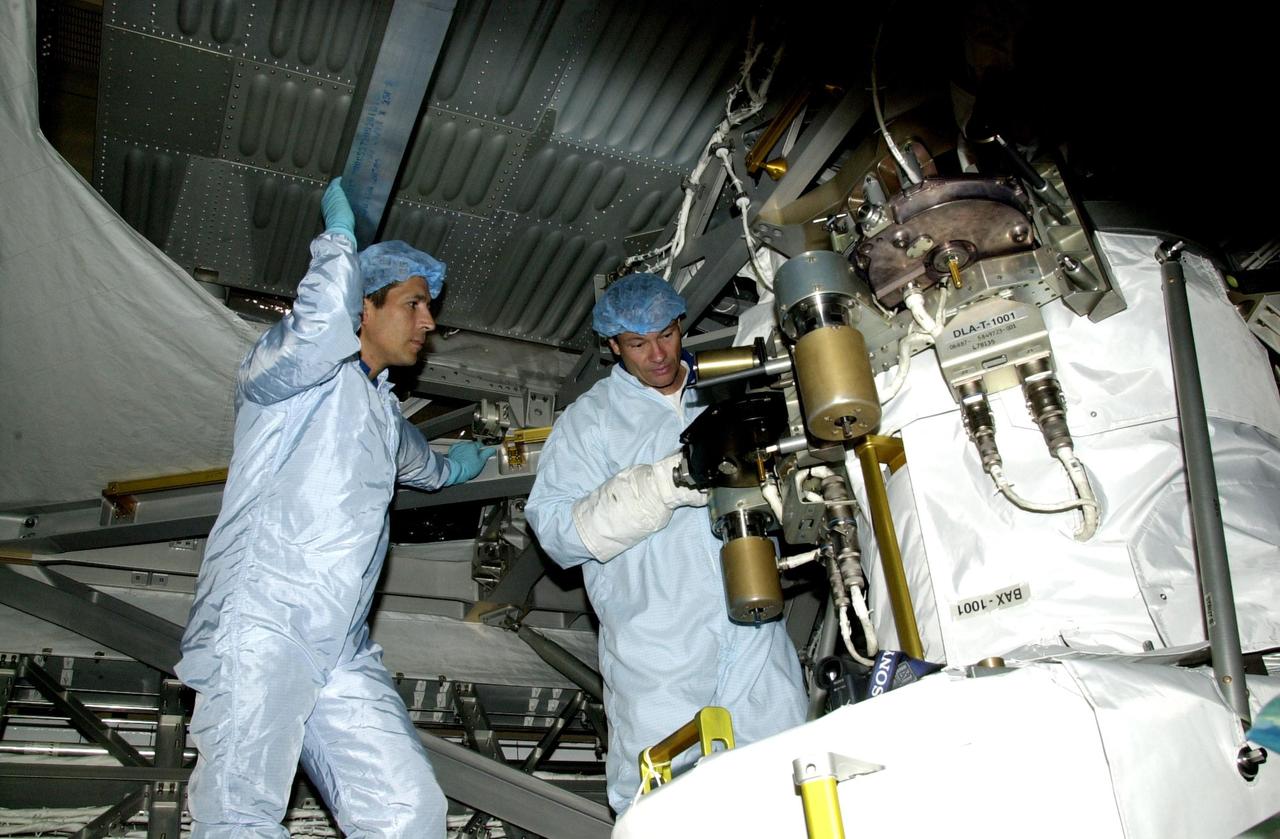
KENNEDY SPACE CENTER, FLA. -- STS-113 crew members look over equipment involved in their mission during Crew Equipment Interface Test activities in the Space Station Processing Facility. At left is Mission Specialist John Herrington; at right is Mission Specialist Michael Lopez-Alegria. Part of the payload on mission STS-113 is the first port truss segment, P1 Truss, to be attached to the central truss segment, S0, on the International Space Station. Once delivered, the P1 truss will remain stowed until flight 12A.1. Launch date for STS-113 is under review.
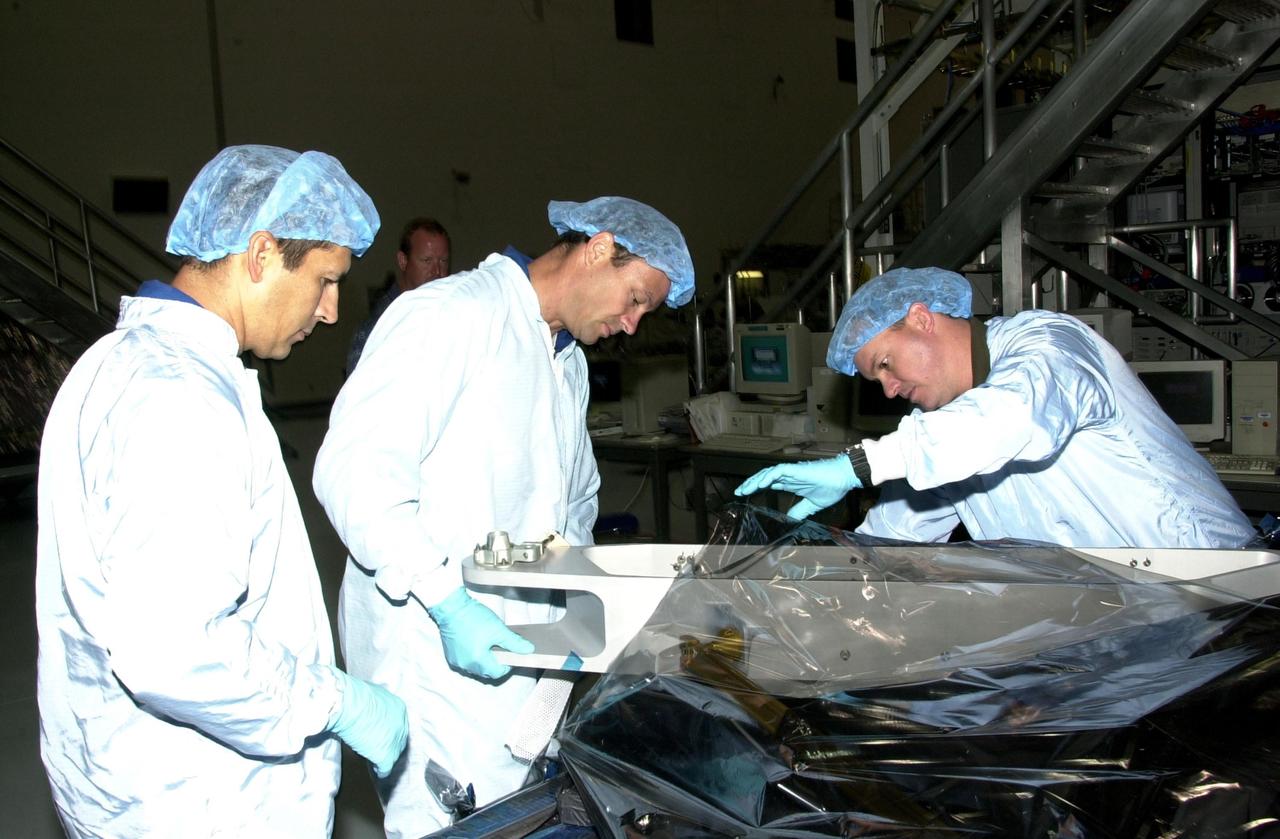
KENNEDY SPACE CENTER, FLA. --STS-113 Mission Specialists John Herrington (left) and Michael Lopez-Alegria (center) look over equipment involved in their mission during Crew Equipment Interface Test activities in the Space Station Processing Facility. Part of the payload on mission STS-113 is the first port truss segment, P1 Truss, to be attached to the central truss segment, S0, on the International Space Station. Once delivered, the P1 truss will remain stowed until flight 12A.1. Launch date for STS-113 is under review.
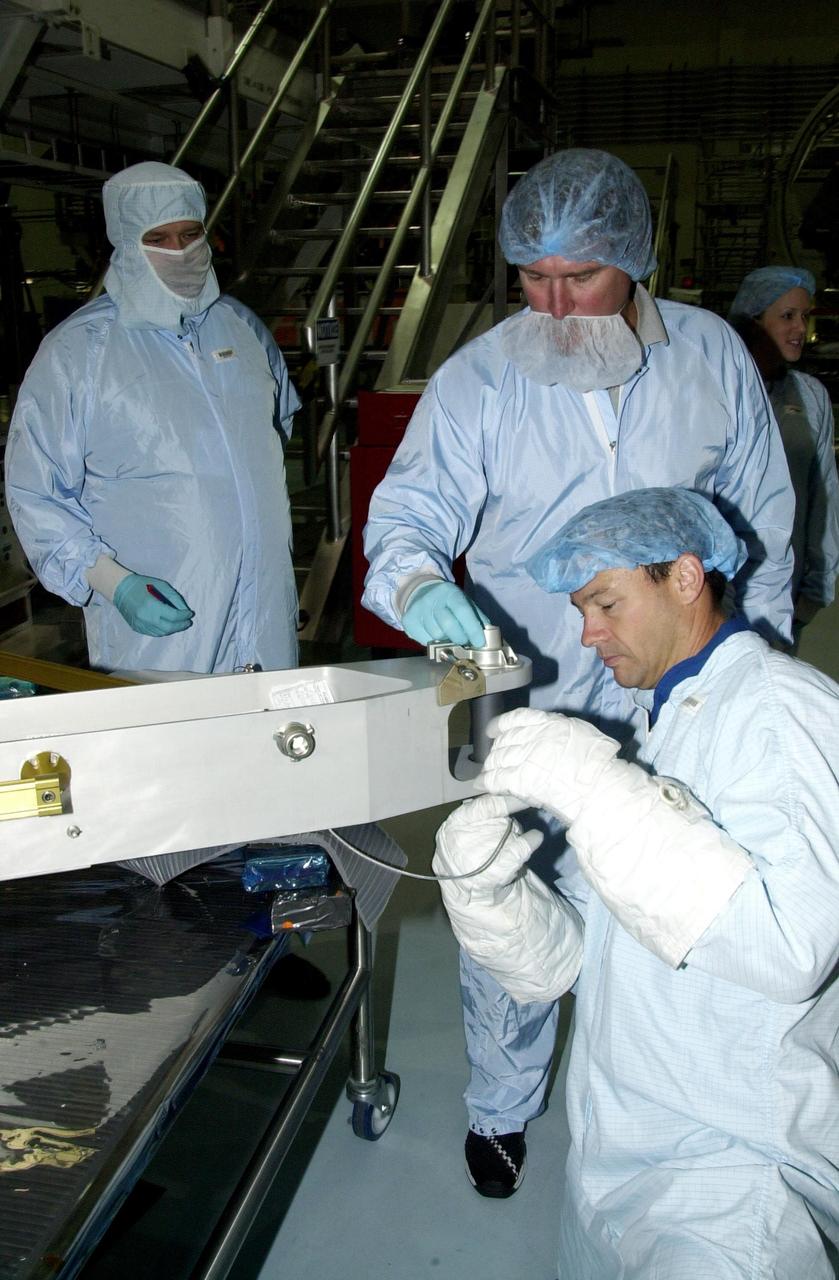
KENNEDY SPACE CENTER, FLA. -- Under the watchful eyes of Boeing workers, STS-113 Mission Specialist John Herrington practices working on equipment involved in his mission during Crew Equipment Interface Test activities in the Space Station Processing Facility. Part of the payload on mission STS-113 is the first port truss segment, P1 Truss, to be attached to the central truss segment, S0, on the International Space Station. Once delivered, the P1 truss will remain stowed until flight 12A.1. Launch date for STS-113 is under review.
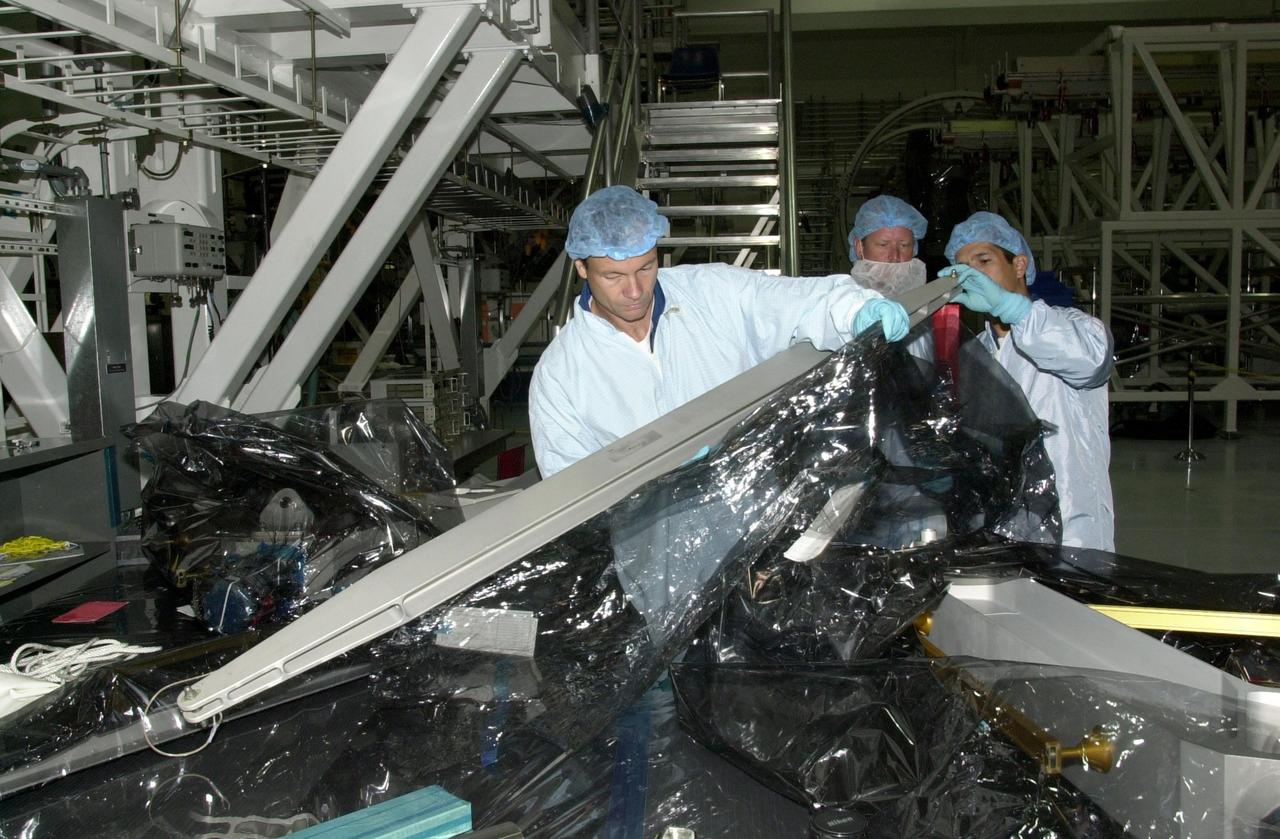
KENNEDY SPACE CENTER, FLA. -- Under the eyes of a technician (center), STS-113 crew members look over equipment involved in their mission during Crew Equipment Interface Test activities in the Space Station Processing Facility. At left is Mission Specialist Michael Lopez-Alegria; at right is Mission Specialist John Herrington. Part of the payload on mission STS-113 is the first port truss segment, P1 Truss, to be attached to the central truss segment, S0, on the International Space Station. Once delivered, the P1 truss will remain stowed until flight 12A.1. Launch date for STS-113 is under review.
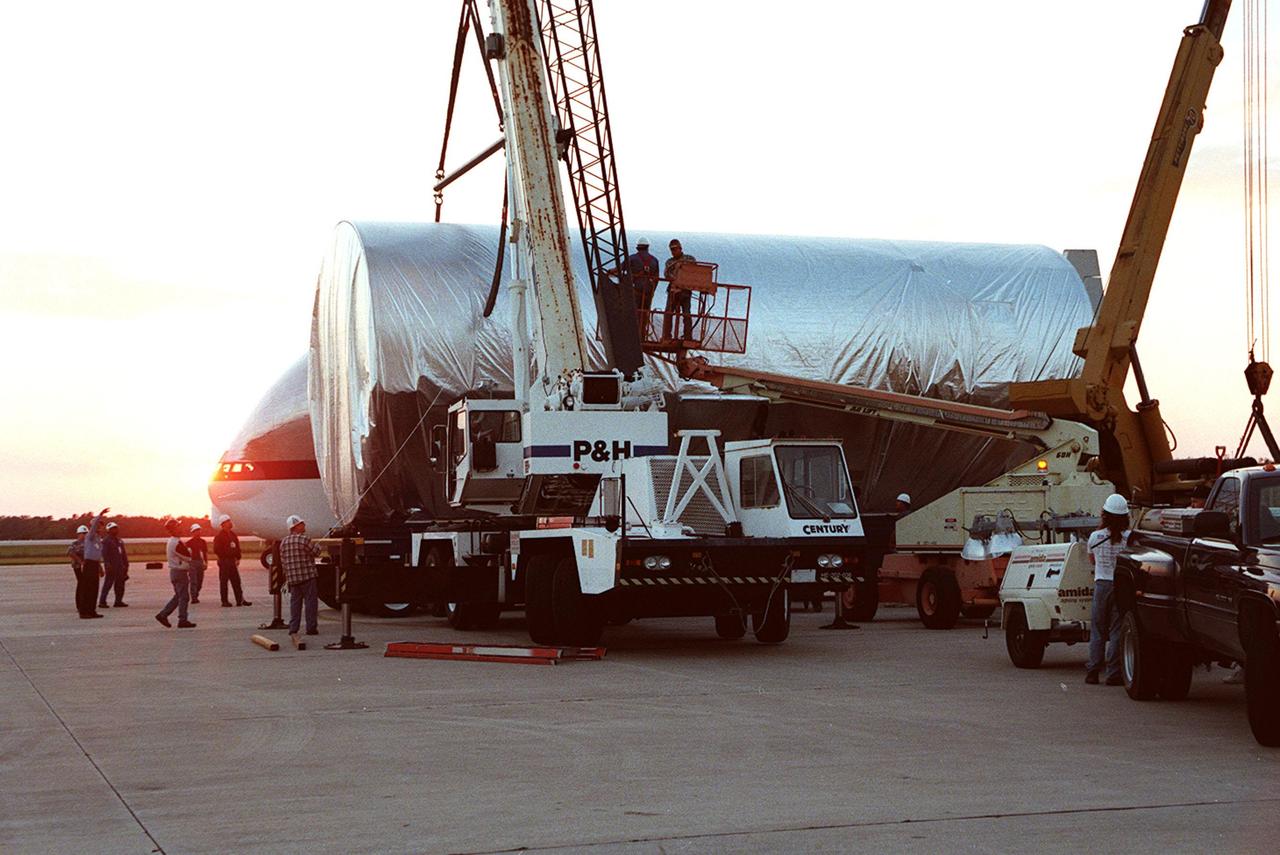
KENNEDY SPACE CENTER, FLA. -- Workers secure the P3 truss on the transporter for the trip to the Operations and Checkout Building. The second port-side truss is a segment of the International Space Station (ISS), scheduled to be added to the ISS on mission STS-115 in 2002 aboard Space Shuttle Atlantis. P3 will be attached to the first port truss segment (P1).
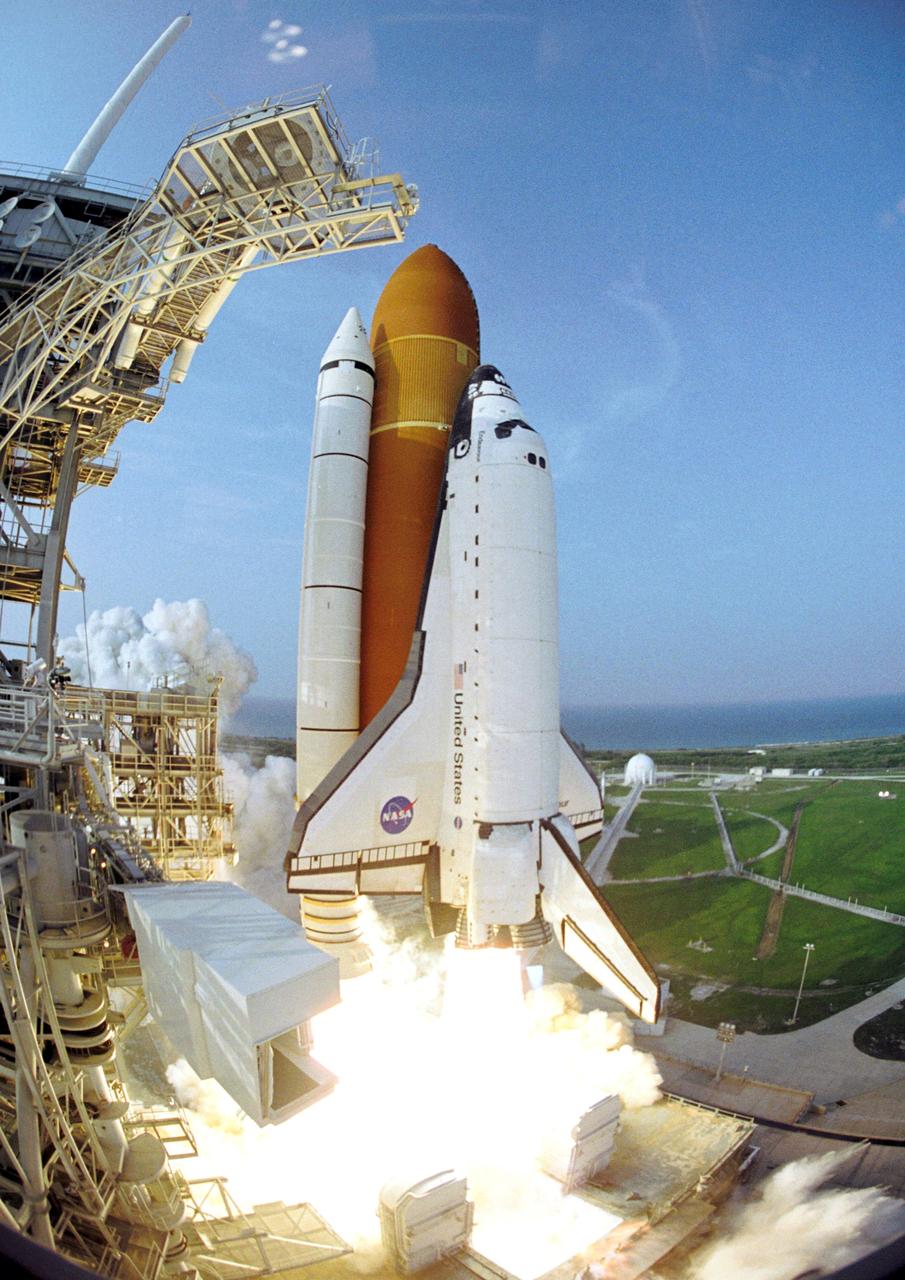
Enroute to the International Space Station (ISS), Space Shuttle Endeavor and its seven member STS-118 crew, blasted off from the launch pad at Kennedy Space Center on August 8, 2007. Construction resumed on the ISS as STS-118 mission specialists and the Expedition 15 crew completed installation of the third Starboard 5 (S-5) truss segment, removed a faulty Control Moment Gyroscope (CMG-3), installed a new CMG into the Z1 truss, relocated the S-band Antenna Sub-Assembly from the Port 6 (P6) to Port 1 (P1) truss, installed a new transponder on P1, retrieved the P6 transponder, and delivered roughly 5,000 pounds of equipment and supplies.
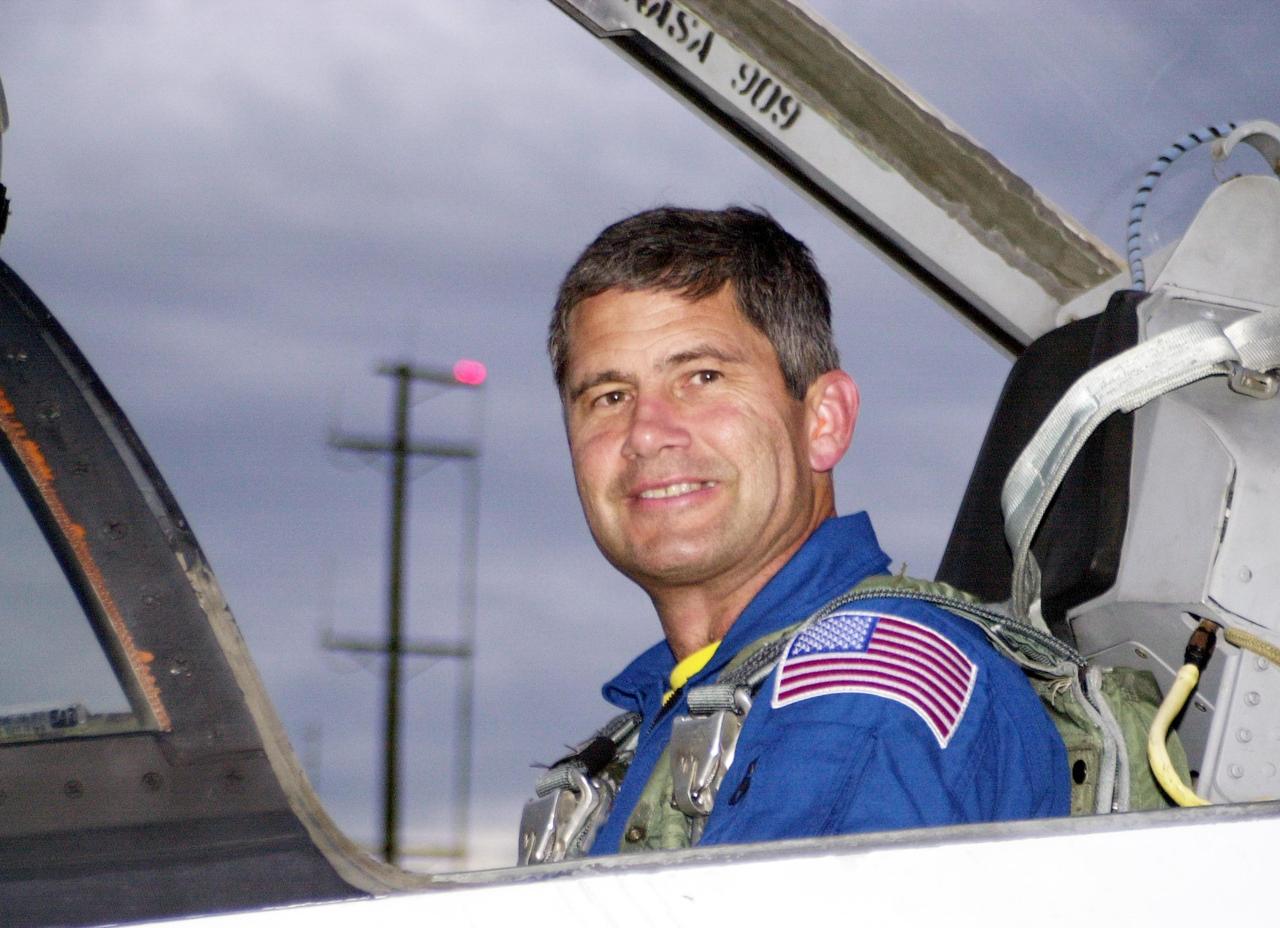
KENNEDY SPACE CENTER, FLA. -- STS-113 Pilot Paul Lockhart arrives at KSC for Terminal Countdown Demonstration Test activities, which include a simulated launch countdown. The primary payloads on mission STS-113 are the first port truss segment, P1, and the Crew and Equipment Translation Aid (CETA) Cart B. Once delivered, the P1 truss will remain stowed until flight 12A.1 in 2003 when it will be attached to the central truss segment, S0, on the Space Station. Also onboard Space Shuttle Endeavour will be the Expedition 6 crew who will replace Expedition 5, returning to Earth after 4 months. The STS-113 launch is scheduled for Nov. 10, 2002. .
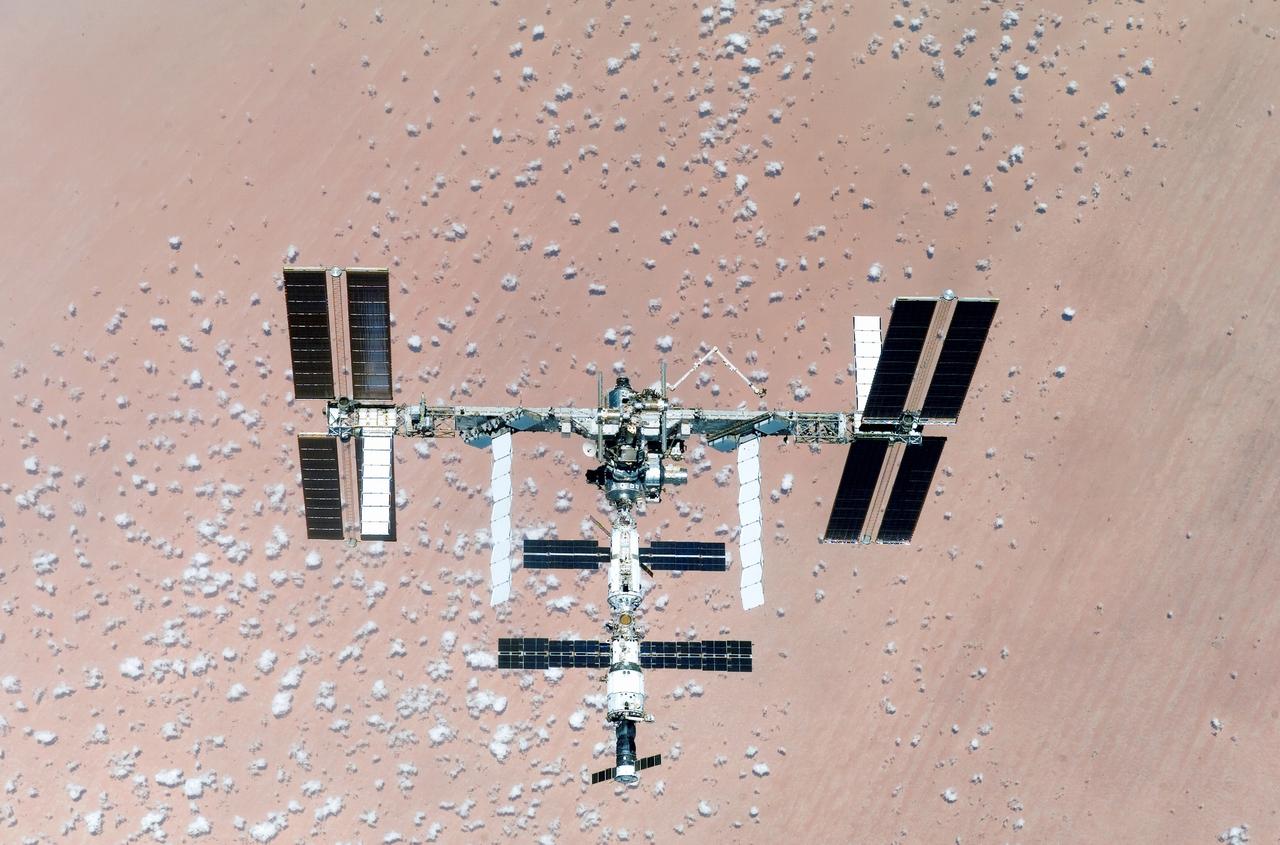
Back dropped by the colorful Earth, the International Space Station (ISS) boasts its newest configuration upon the departure of Space Shuttle Endeavor and STS-118 mission. Days earlier, construction resumed on the ISS as STS-118 mission specialists and the Expedition 15 crew completed installation of the Starboard 5 (S-5) truss segment, removed a faulty Control Moment Gyroscope (CMG-3), installed a new CMG into the Z1 truss, relocated the S-band Antenna Sub-Assembly from the Port 6 (P6) to Port 1 (P1) truss, installed a new transponder on P1, retrieved the P6 transponder, and delivered roughly 5,000 pounds of supplies.
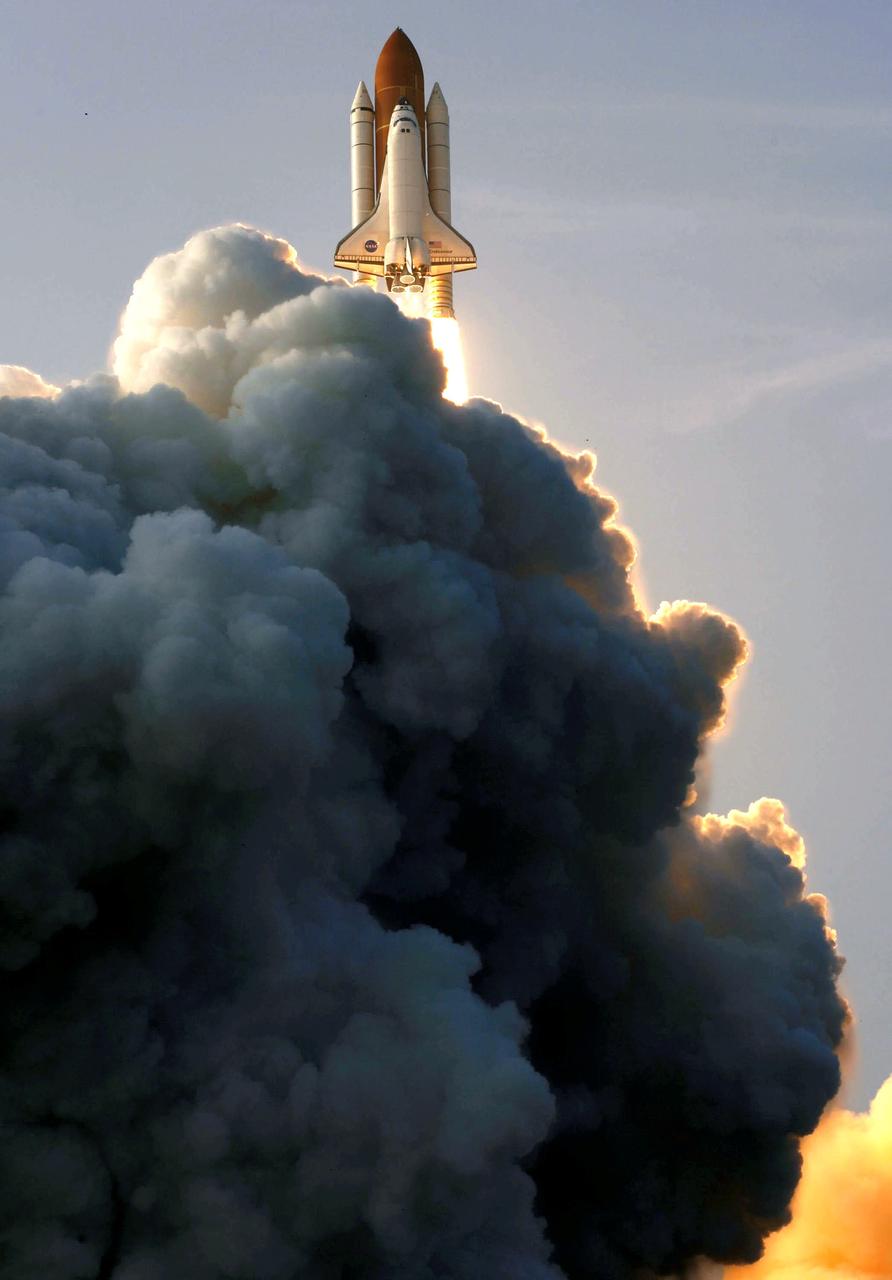
Enroute to the International Space Station (ISS), Space Shuttle Endeavor and its seven member STS-118 crew, blasted off from the launch pad at Kennedy Space Center on August 8, 2007. Construction resumed on the ISS as STS-118 mission specialists and the Expedition 15 crew completed installation of the third Starboard 5 (S-5) truss segment, removed a faulty Control Moment Gyroscope (CMG-3), installed a new CMG into the Z1 truss, relocated the S-band Antenna Sub-Assembly from the Port 6 (P6) to Port 1 (P1) truss, installed a new transponder on P1, retrieved the P6 transponder, and delivered roughly 5,000 pounds of equipment and supplies.
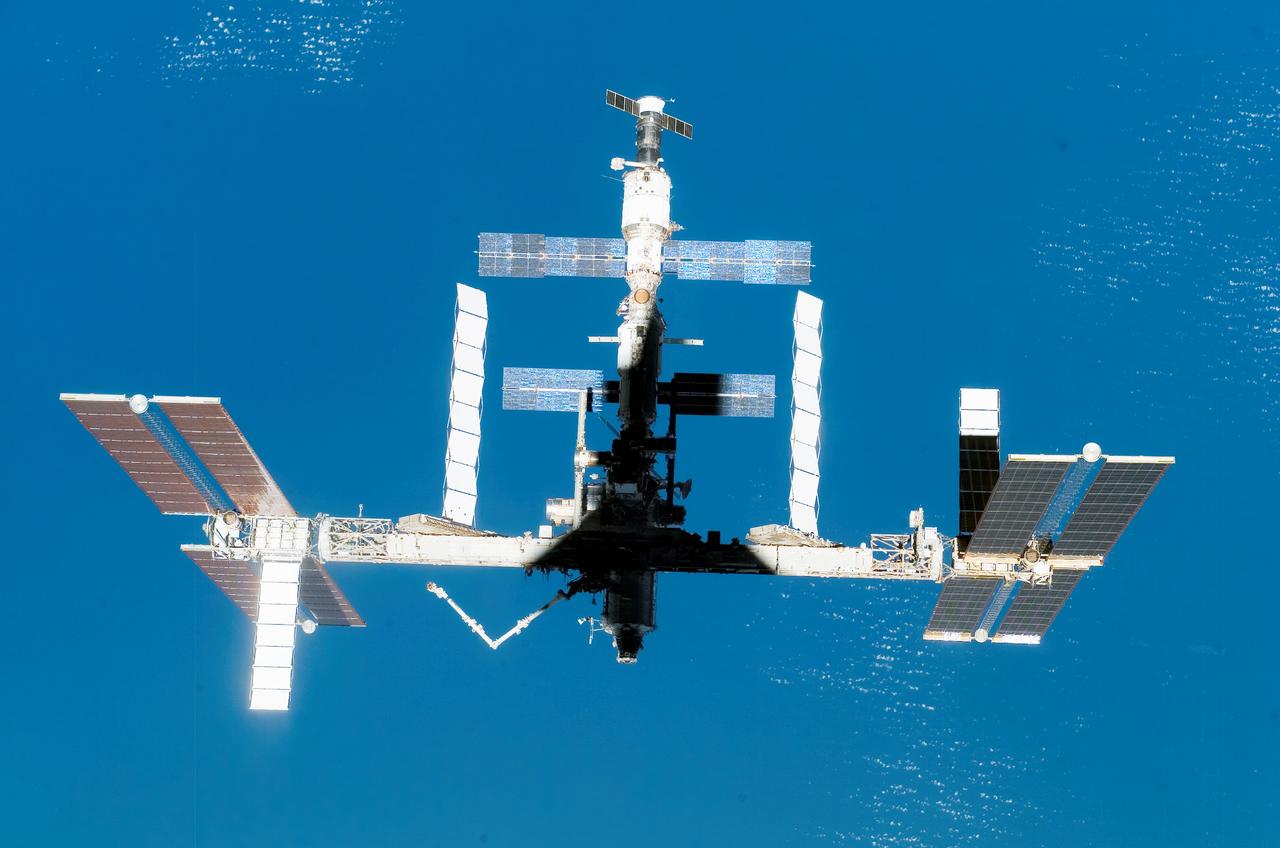
Back dropped by the blue Earth, the International Space Station (ISS) boasts its newest configuration upon the departure of Space Shuttle Endeavor and STS-118 mission. Days earlier, construction resumed on the ISS as STS-118 mission specialists and the Expedition 15 crew completed installation of the Starboard 5 (S-5) truss segment, removed a faulty Control Moment Gyroscope (CMG-3), installed a new CMG into the Z1 truss, relocated the S-band Antenna Sub-Assembly from the Port 6 (P6) to Port 1 (P1) truss, installed a new transponder on P1, retrieved the P6 transponder, and delivered roughly 5,000 pounds of equipment and supplies.
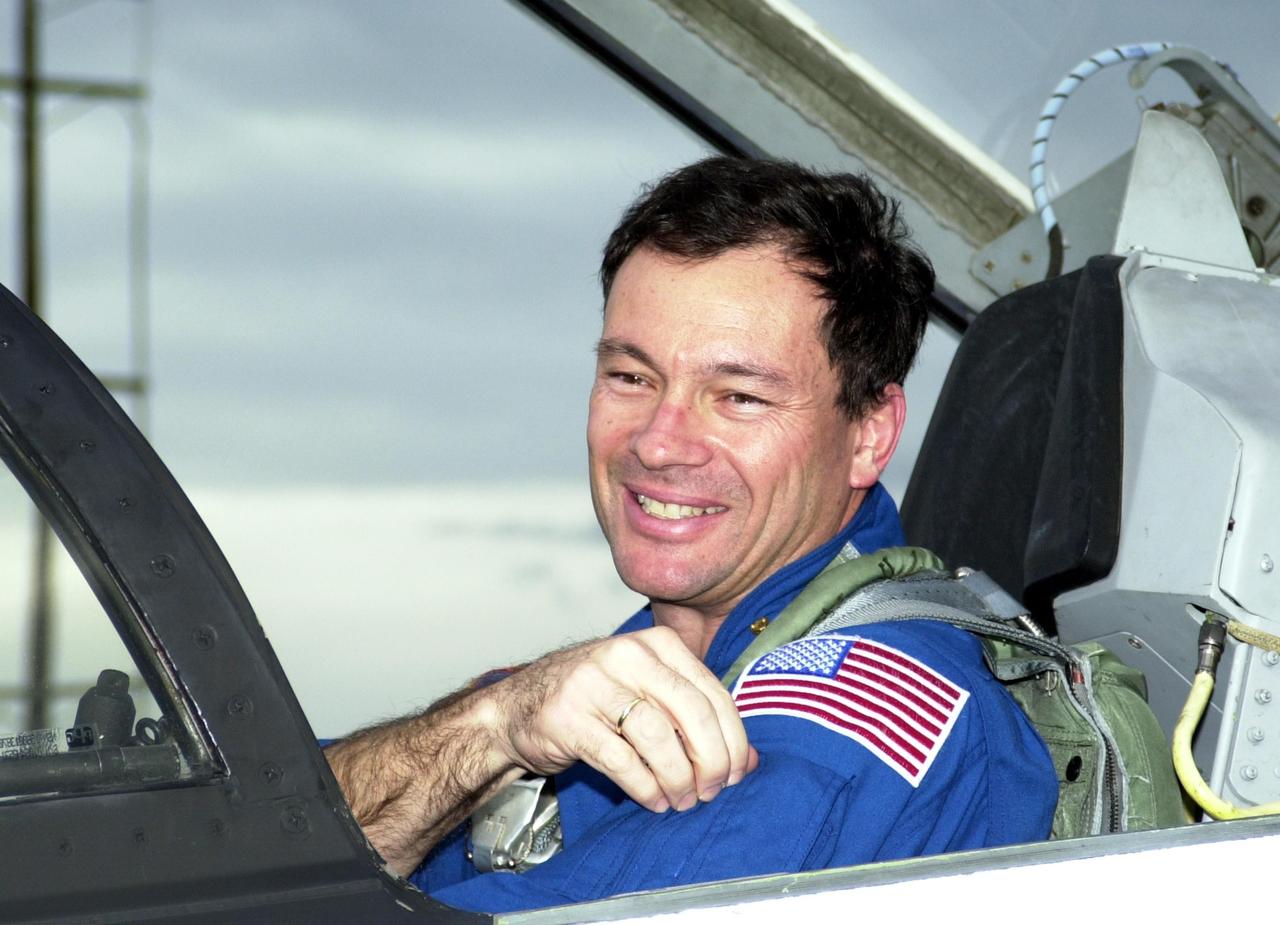
KENNEDY SPACE CENTER, FLA. -- STS-113 Mission Specialist Michael Lopez-Alegria arrives at KSC for Terminal Countdown Demonstration Test activities, which include a simulated launch countdown. The primary payloads on mission STS-113 are the first port truss segment, P1, and the Crew and Equipment Translation Aid (CETA) Cart B. Once delivered, the P1 truss will remain stowed until flight 12A.1 in 2003 when it will be attached to the central truss segment, S0, on the Space Station. Also onboard Space Shuttle Endeavour will be the Expedition 6 crew who will replace Expedition 5, returning to Earth after 4 months. The STS-113 launch is scheduled for Nov. 10, 2002.
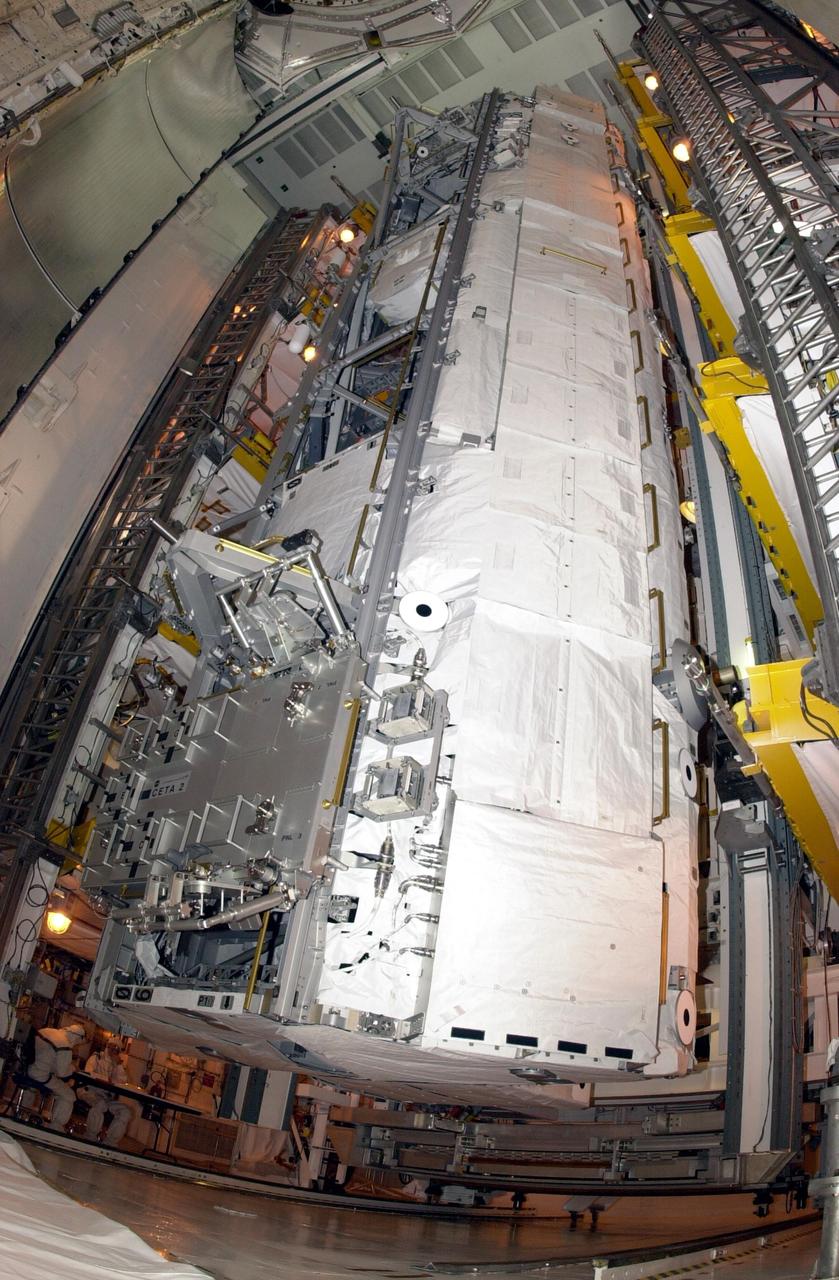
KENNEDY SPACE CENTER, FLA. - From the Payload Changeout Room on Launch Pad 39A, the P1 truss payload, plus the Crew and Equipment Translation Aid (CETA) cart B, are moved into the payload bay of Space Shuttle Endeavour. Scheduled to launch Nov. 10 on mission STS-113, Endeavour will make the 16th assembly flight to the International Space Station. Once delivered, the P1 truss will remain stowed until flight 12A.1 in 2003 when it will be attached to the central truss segment, S0, on the Space Station. The mission will also deliver the Expedition 6 crew to the Station and return Expedition 5 to Earth.
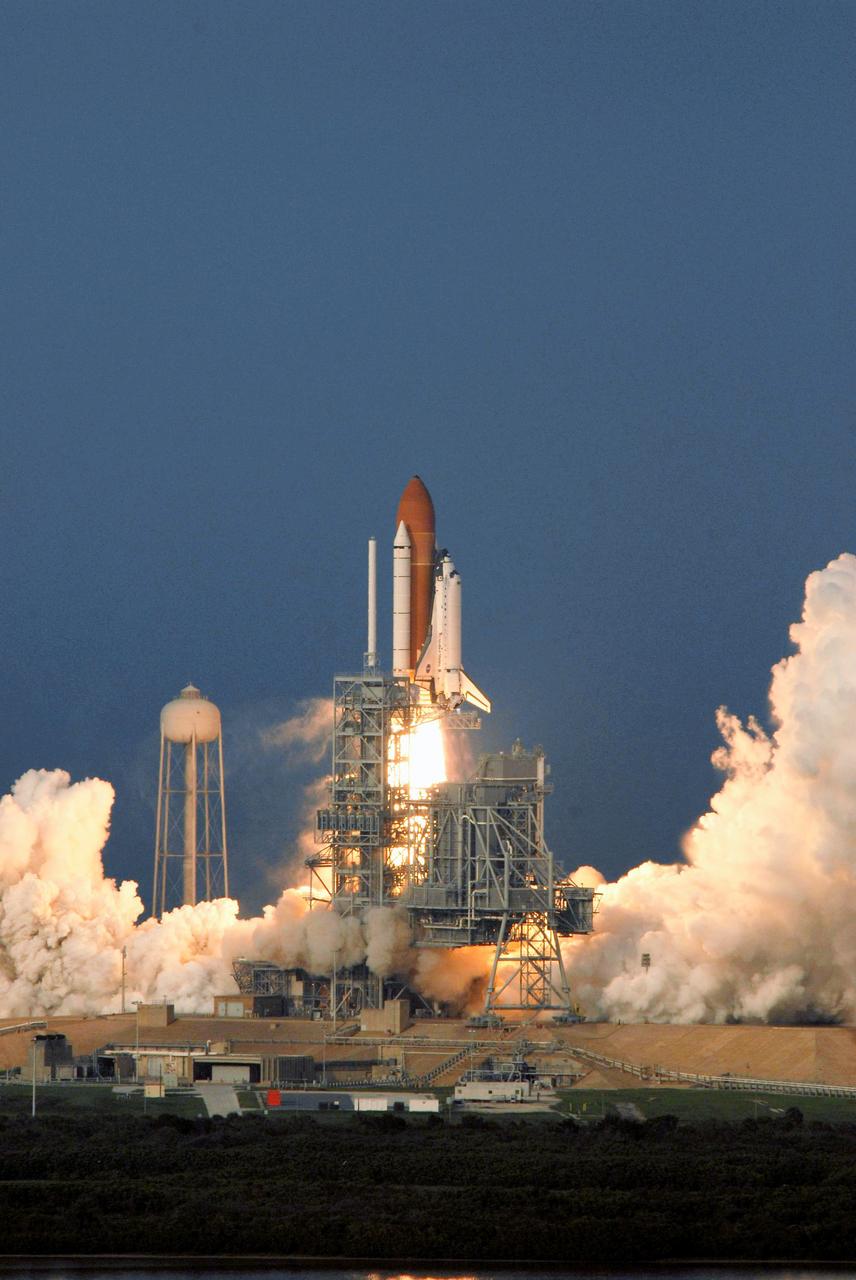
Enroute to the International Space Station (ISS), Space Shuttle Endeavor and its seven member STS-118 crew, blasted off from the launch pad at Kennedy Space Center on August 8, 2007. Construction resumed on the ISS as STS-118 mission specialists and the Expedition 15 crew completed installation of the third Starboard 5 (S-5) truss segment, removed a faulty Control Moment Gyroscope (CMG-3), installed a new CMG into the Z1 truss, relocated the S-band Antenna Sub-Assembly from the Port 6 (P6) to Port 1 (P1) truss, installed a new transponder on P1, retrieved the P6 transponder, and delivered roughly 5,000 pounds of equipment and supplies.
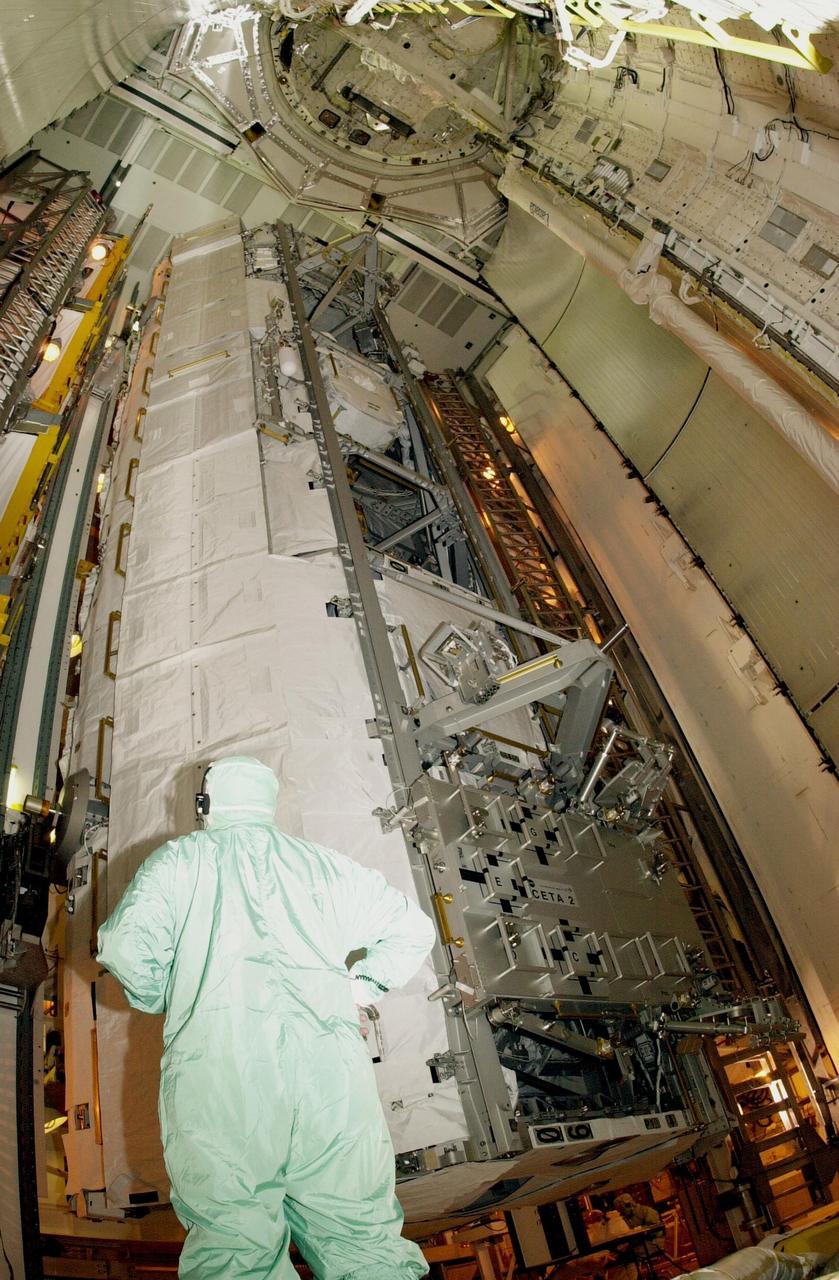
KENNEDY SPACE CENTER, FLA. -- A worker in the Payload Changeout Room on Launch Pad 39A watches as the P1 truss payload, plus the Crew and Equipment Translation Aid (CETA) cart B, move into the payload bay of Space Shuttle Endeavour. Scheduled to launch Nov. 10 on mission STS-113, Endeavour will make the 16th assembly flight to the International Space Station. Once delivered, the P1 truss will remain stowed until flight 12A.1 in 2003 when it will be attached to the central truss segment, S0, on the Space Station. The mission will also deliver the Expedition 6 crew to the Station and return Expedition 5 to Earth.

JSC2006-E-43495 (November 2002) --- Computer-generated artist's rendering of the International Space Station after flight STS-113/11A. Space Shuttle Endeavour delivered the P1 truss, the first port truss segment, which the STS-113 crew installed.
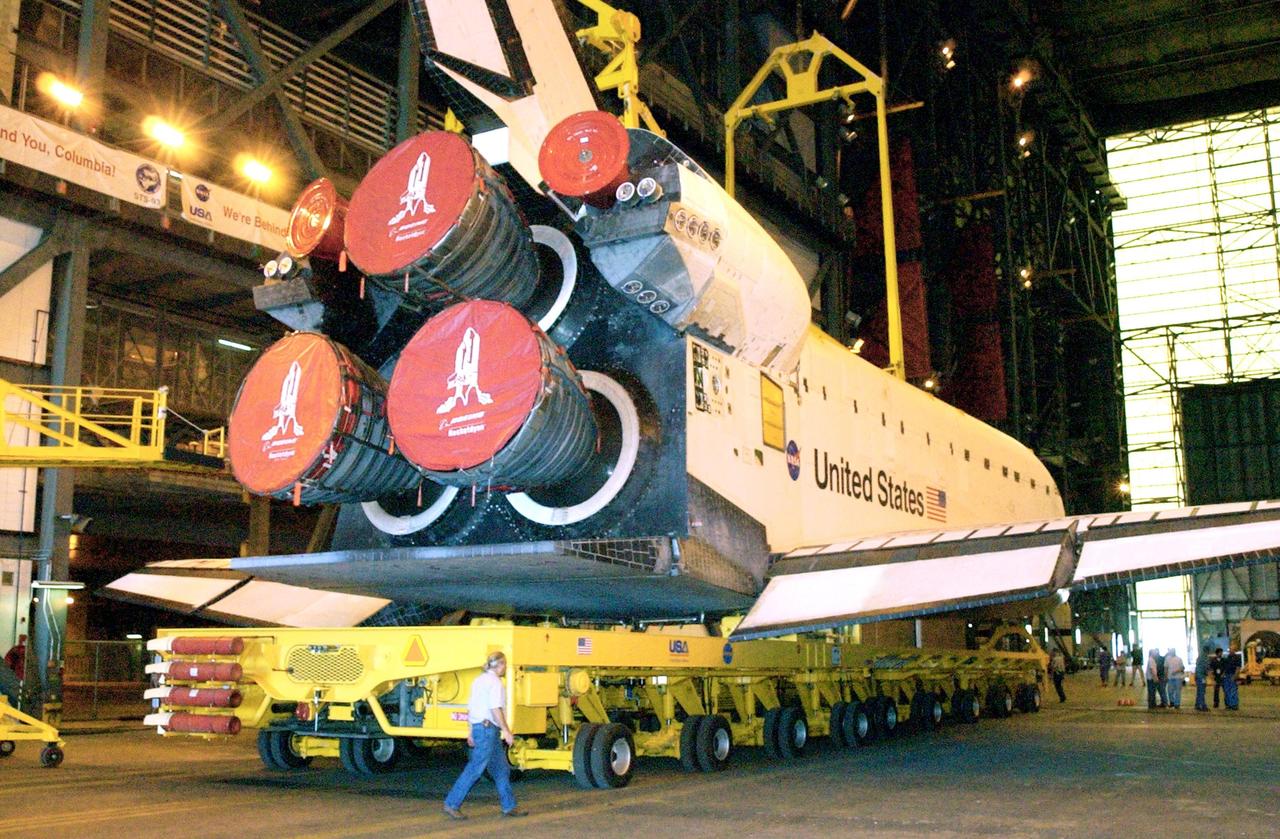
KENNEDY SPACE CENTER, FLA. -- In the transfer aisle of the Vehicle Assembly Building, overhead cranes are lowered toward orbiter Endeavour for its lift to vertical. Endeavour is scheduled to launch Nov. 10 on mission STS-113, the 16th assembly flight to the International Space Station. The primary payloads on mission STS-113 are the first port truss segment, P1 Truss and the Crew and Equipment Translation Aid (CETA) Cart B. . Once delivered, the P1 truss will remain stowed until flight 12A.1 in 2003 when it will be attached to the central truss segment, S0, on the Space Station. The CETA Cart B can be used by spacewalkers to move along the truss with equipment The mission will also deliver the Expedition 6 crew to the Station and return Expedition 5 to Earth.

KENNEDY SPACE CENTER, FLA. -- As part of Crew Equipment Interface Test activities, STS-113 Mission Specialist John Herrington looks over paperwork for equipment in Endeavour that will be carried on the mission. The primary payloads on mission STS-113 are the first port truss segment, P1 Truss, to be attached to the central truss segment, S0, on the International Space Station, and the Crew and Equipment Translation Aid (CETA) Cart B that can be used by spacewalkers to move along the truss with equipment. Once delivered, the P1 truss will remain stowed until flight 12A.1. The mission will also deliver the Expedition 6 crew to the Station and return Expedition 5 to Earth. Space Shuttle Endeavour is scheduled to launch Nov. 10 on the 11-day mission.

KENNEDY SPACE CENTER, FLA. -- As part of Crew Equipment Interface Test activities, STS-113 Mission Specialists John Herrington (left) and Michael Lopez-Alegria (center) practice working with equipment in Endeavour. The primary payloads on mission STS-113 are the first port truss segment, P1 Truss, to be attached to the central truss segment, S0, on the International Space Station, and the Crew and Equipment Translation Aid (CETA) Cart B that can be used by spacewalkers to move along the truss with equipment. Once delivered, the P1 truss will remain stowed until flight 12A.1. The mission will also deliver the Expedition 6 crew to the Station and return Expedition 5 to Earth. Space Shuttle Endeavour is scheduled to launch Nov. 10 on the 11-day mission.

KENNEDY SPACE CENTER, FLA. - Orbiter Endeavour arrives in the transfer aisle of the Vehicle Assembly Building to continue launch preparations. Endeavour is scheduled to launch Nov. 10 on mission STS-113, the 16th assembly flight to the International Space Station. The primary payloads on mission STS-113 are the first port truss segment, P1 Truss and the Crew and Equipment Translation Aid (CETA) Cart B. . Once delivered, the P1 truss will remain stowed until flight 12A.1 in 2003 when it will be attached to the central truss segment, S0, on the Space Station. The CETA Cart B can be used by spacewalkers to move along the truss with equipment The mission will also deliver the Expedition 6 crew to the Station and return Expedition 5 to Earth.
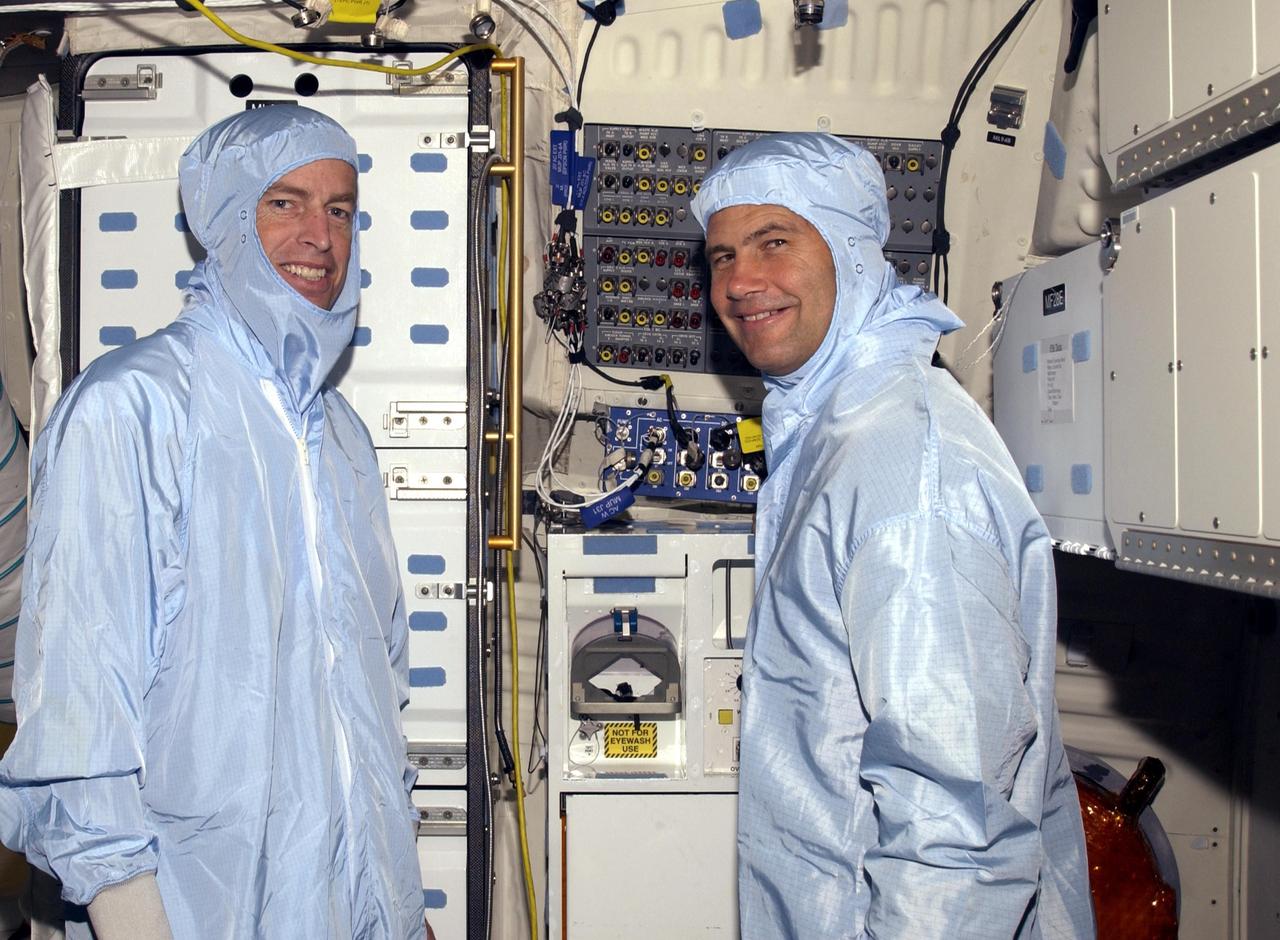
KENNEDY SPACE CENTER, FLA. - STS-113 Commander James Wetherbee (left) andPilot Paul Lockhart (right) look over equipment inside Endeavour as part of Crew Equipment Interface Test activities. The primary payloads on mission STS-113 are the first port truss segment, P1 Truss, to be attached to the central truss segment, S0, on the International Space Station, and the Crew and Equipment Translation Aid (CETA) Cart B that can be used by spacewalkers to move along the truss with equipment. Once delivered, the P1 truss will remain stowed until flight 12A.1. The mission will also deliver the Expedition 6 crew to the Station and return Expedition 5 to Earth. Space Shuttle Endeavour is scheduled to launch Nov. 10 on the 11-day mission.
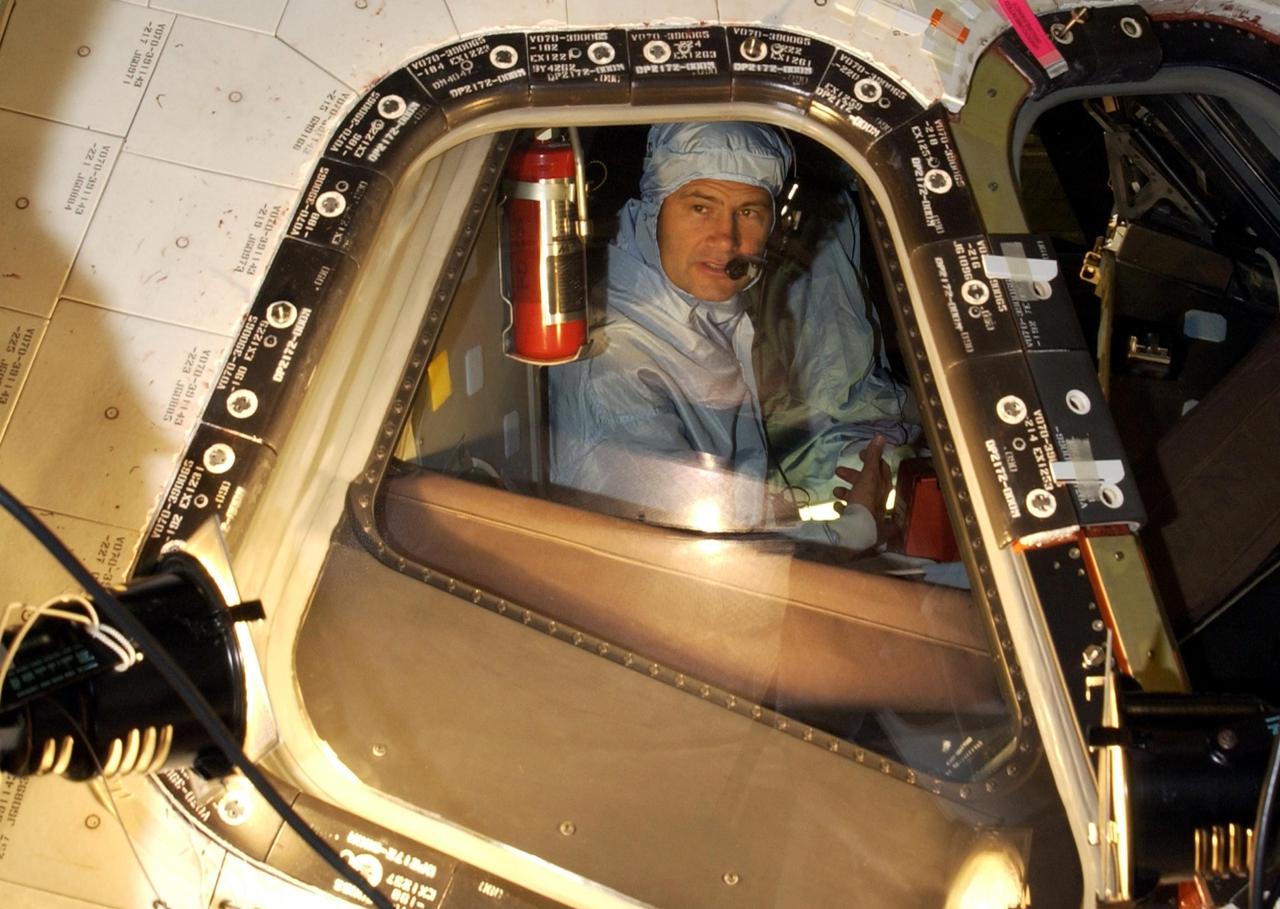
KENNEDY SPACE CENTER, FLA. -- STS-113 Pilot Paul Lockhart checks the cockpit window from inside Endeavour. The check is part of Crew Equipment Interface Test activities, which include familiarization with equipment for the mission. The primary payloads on mission STS-113 are the first port truss segment, P1 Truss, to be attached to the central truss segment, S0, on the International Space Station, and the Crew and Equipment Translation Aid (CETA) Cart B that can be used by spacewalkers to move along the truss with equipment. Once delivered, the P1 truss will remain stowed until flight 12A.1. The mission will also deliver the Expedition 6 crew to the Station and return Expedition 5 to Earth. Space Shuttle Endeavour is scheduled to launch Nov. 10 on the 11-day mission.
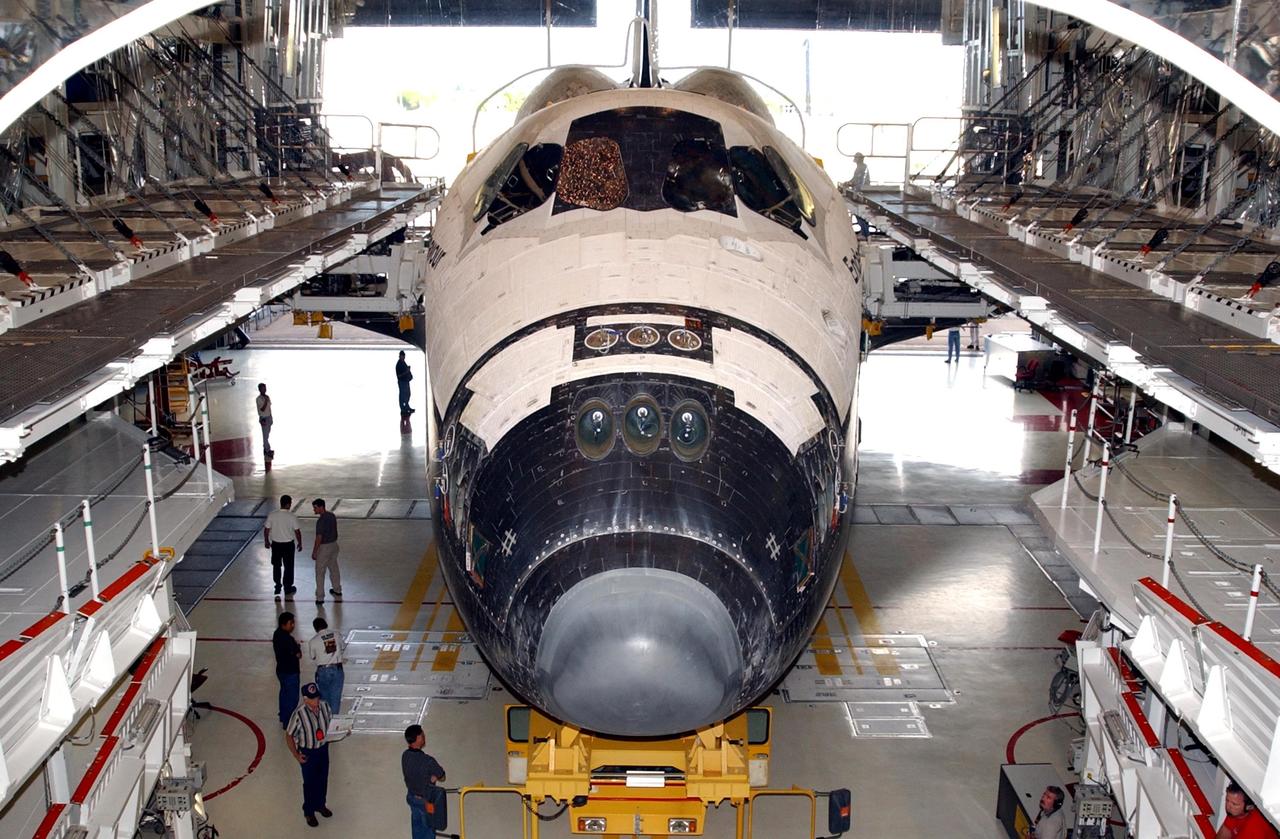
KENNEDY SPACE CENTER, FLA. -- Orbiter Endeavour is ready for rollover to the Vehicle Assembly Building for the next stage of launch preparations. Endeavour is scheduled to launch Nov. 10 on mission STS-113, the 16th assembly flight to the International Space Station. The primary payloads on mission STS-113 are the first port truss segment, P1 Truss and the Crew and Equipment Translation Aid (CETA) Cart B. . Once delivered, the P1 truss will remain stowed until flight 12A.1 in 2003 when it will be attached to the central truss segment, S0, on the Space Station. The CETA Cart B can be used by spacewalkers to move along the truss with equipment The mission will also deliver the Expedition 6 crew to the Station and return Expedition 5 to Earth.
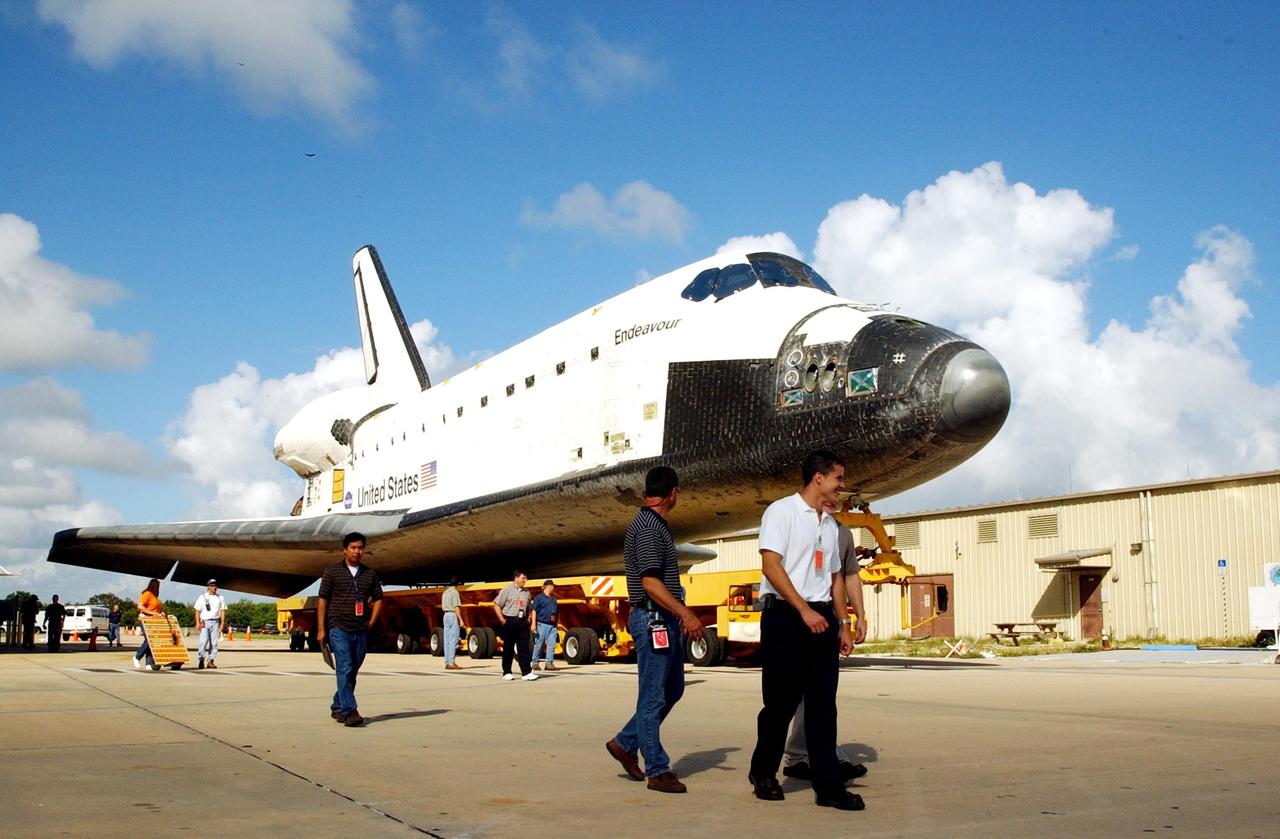
KENNEDY SPACE CENTER, FLA. - Workers walk alongside orbiter Endeavour as it rolls over to the Vehicle Assembly Building for continued launch preparations. Endeavour is scheduled to launch Nov. 10 on mission STS-113, the 16th assembly flight to the International Space Station. The primary payloads on mission STS-113 are the first port truss segment, P1 Truss and the Crew and Equipment Translation Aid (CETA) Cart B. Once delivered, the P1 truss will remain stowed until flight 12A.1 in 2003 when it will be attached to the central truss segment, S0, on the Space Station. The CETA Cart B can be used by spacewalkers to move along the truss with equipment The mission will also deliver the Expedition 6 crew to the Station and return Expedition 5 to Earth.

KENNEDY SPACE CENTER, FLA. -- A closeup of Endeavour as it rolls over to the Vehicle Assembly Building for continued launch preparations. Endeavour is scheduled to launch Nov. 10 on mission STS-113, the 16th assembly flight to the International Space Station. The primary payloads on mission STS-113 are the first port truss segment, P1 Truss and the Crew and Equipment Translation Aid (CETA) Cart B. . Once delivered, the P1 truss will remain stowed until flight 12A.1 in 2003 when it will be attached to the central truss segment, S0, on the Space Station. The CETA Cart B can be used by spacewalkers to move along the truss with equipment The mission will also deliver the Expedition 6 crew to the Station and return Expedition 5 to Earth.
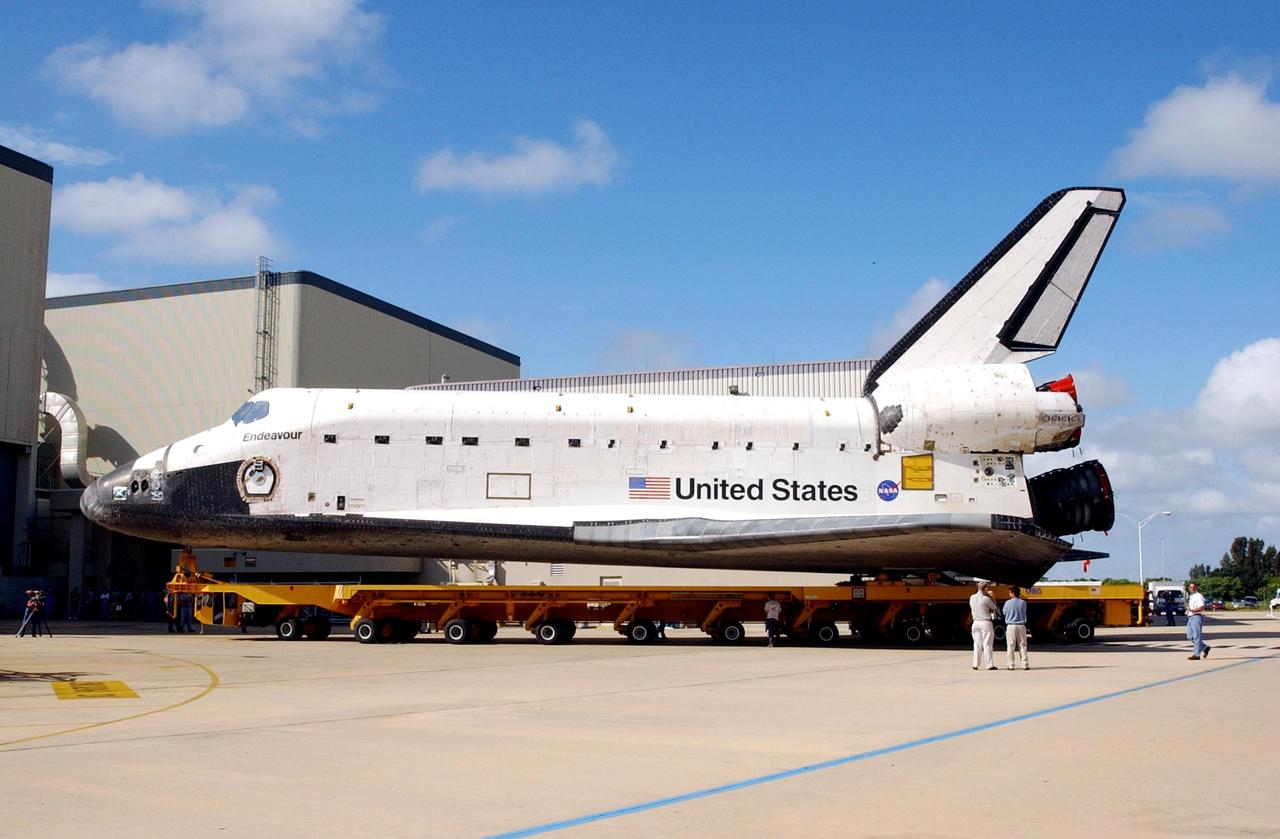
KENNEDY SPACE CENTER, FLA. - Atop its transporter, orbiter Endeavour rolls back onto the tow-way for transfer to the Vehicle Assembly Building and continued launch preparations. Endeavour is scheduled to launch Nov. 10 on mission STS-113, the 16th assembly flight to the International Space Station. The primary payloads on mission STS-113 are the first port truss segment, P1 Truss and the Crew and Equipment Translation Aid (CETA) Cart B. Once delivered, the P1 truss will remain stowed until flight 12A.1 in 2003 when it will be attached to the central truss segment, S0, on the Space Station. The CETA Cart B can be used by spacewalkers to move along the truss with equipment The mission will also deliver the Expedition 6 crew to the Station and return Expedition 5 to Earth.
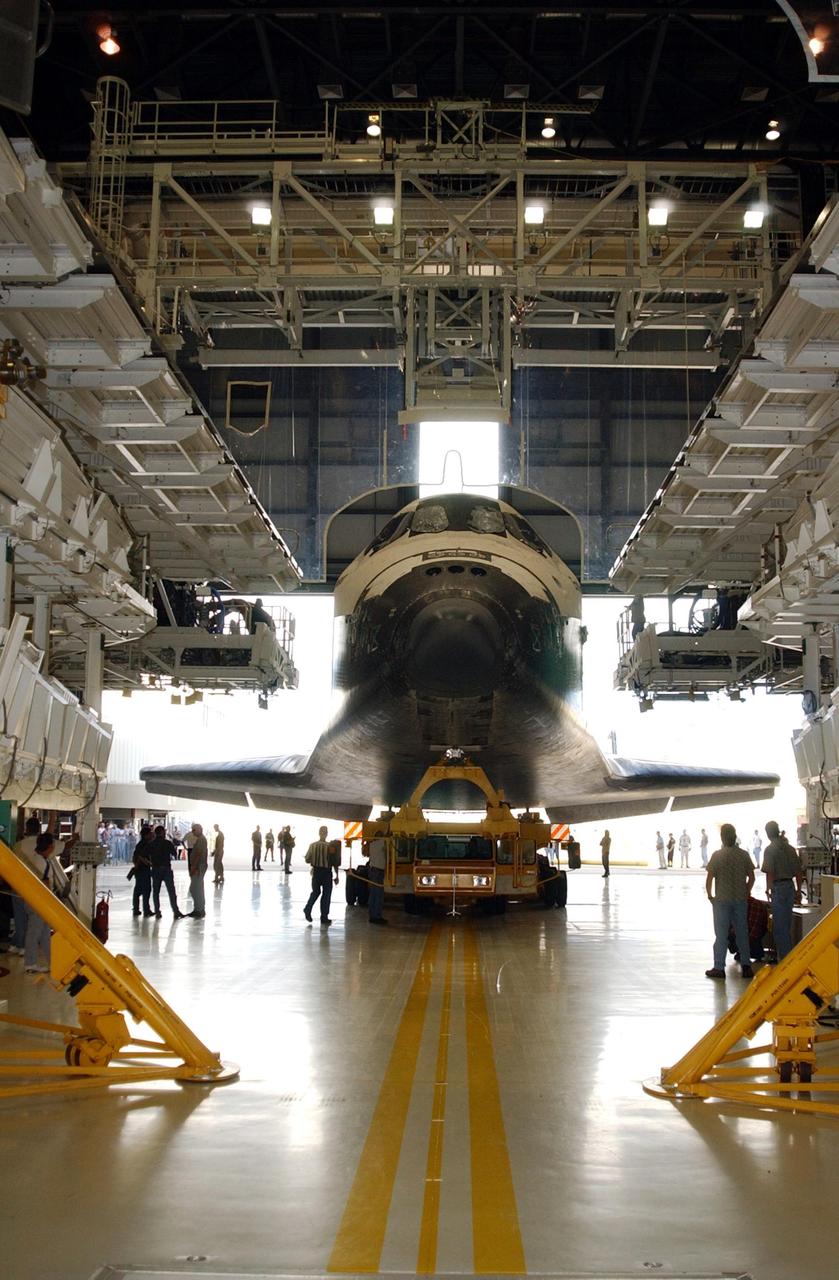
KENNEDY SPACE CENTER, FLA. -- Orbiter Endeavour begins rolling out of the Orbiter Processing Facility for its rollover to the Vehicle Assembly Building and continued launch preparations. Endeavour is scheduled to launch Nov. 10 on mission STS-113, the 16th assembly flight to the International Space Station. The primary payloads on mission STS-113 are the first port truss segment, P1 Truss and the Crew and Equipment Translation Aid (CETA) Cart B. . Once delivered, the P1 truss will remain stowed until flight 12A.1 in 2003 when it will be attached to the central truss segment, S0, on the Space Station. The CETA Cart B can be used by spacewalkers to move along the truss with equipment The mission will also deliver the Expedition 6 crew to the Station and return Expedition 5 to Earth.
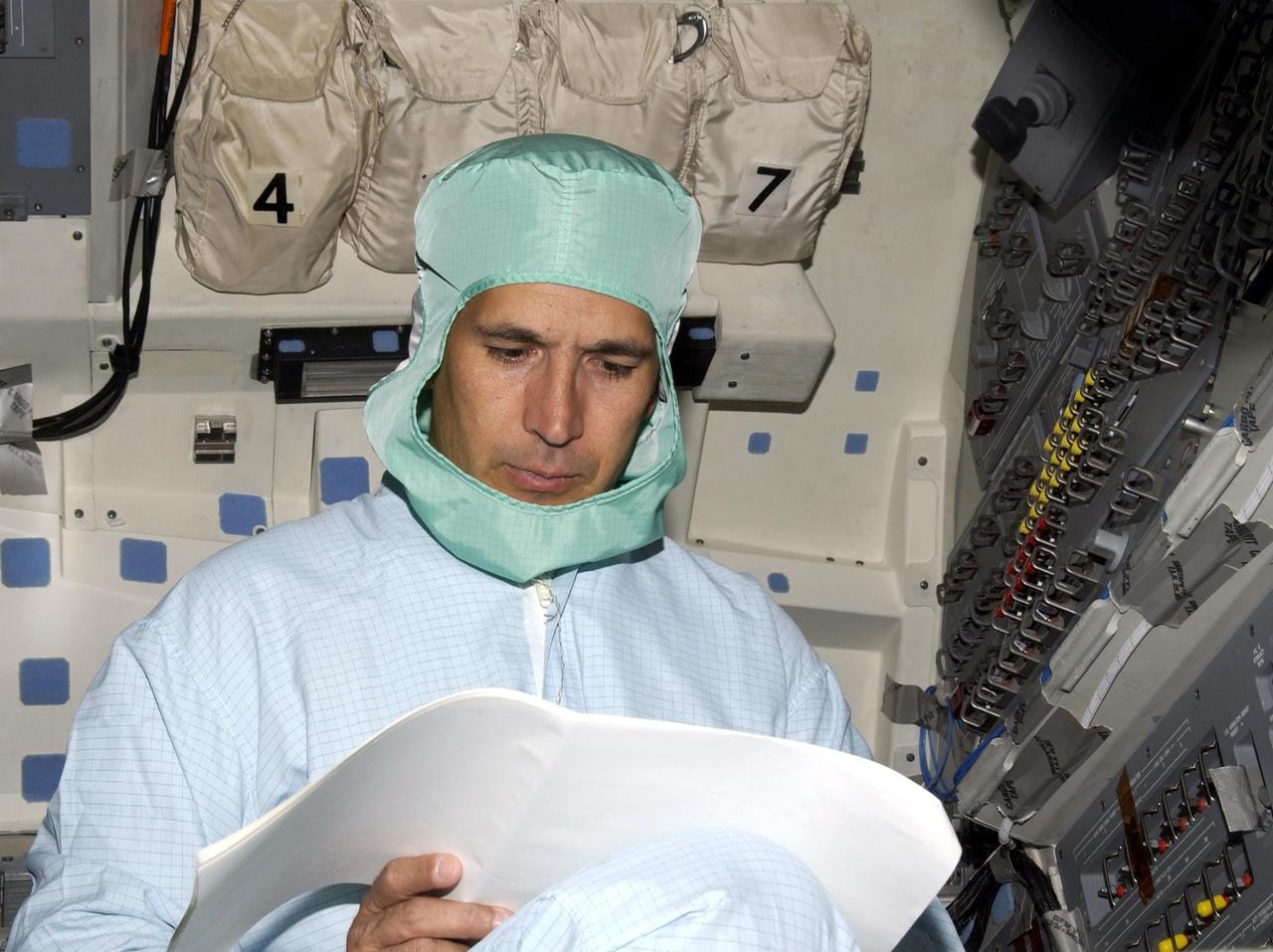
KENNEDY SPACE CENTER, FLA. - As part of Crew Equipment Interface Test activities, STS-113 Mission Specialists Michael Lopez-Alegria (left) and John Herrington (center) look over equipment that will be carried on the mission. The primary payloads on mission STS-113 are the first port truss segment, P1 Truss, to be attached to the central truss segment, S0, on the International Space Station, and the Crew and Equipment Translation Aid (CETA) Cart B that can be used by spacewalkers to move along the truss with equipment. Once delivered, the P1 truss will remain stowed until flight 12A.1. The mission will also deliver the Expedition 6 crew to the Station and return Expedition 5 to Earth. Space Shuttle Endeavour is scheduled to launch Nov. 10 on the 11-day mission.
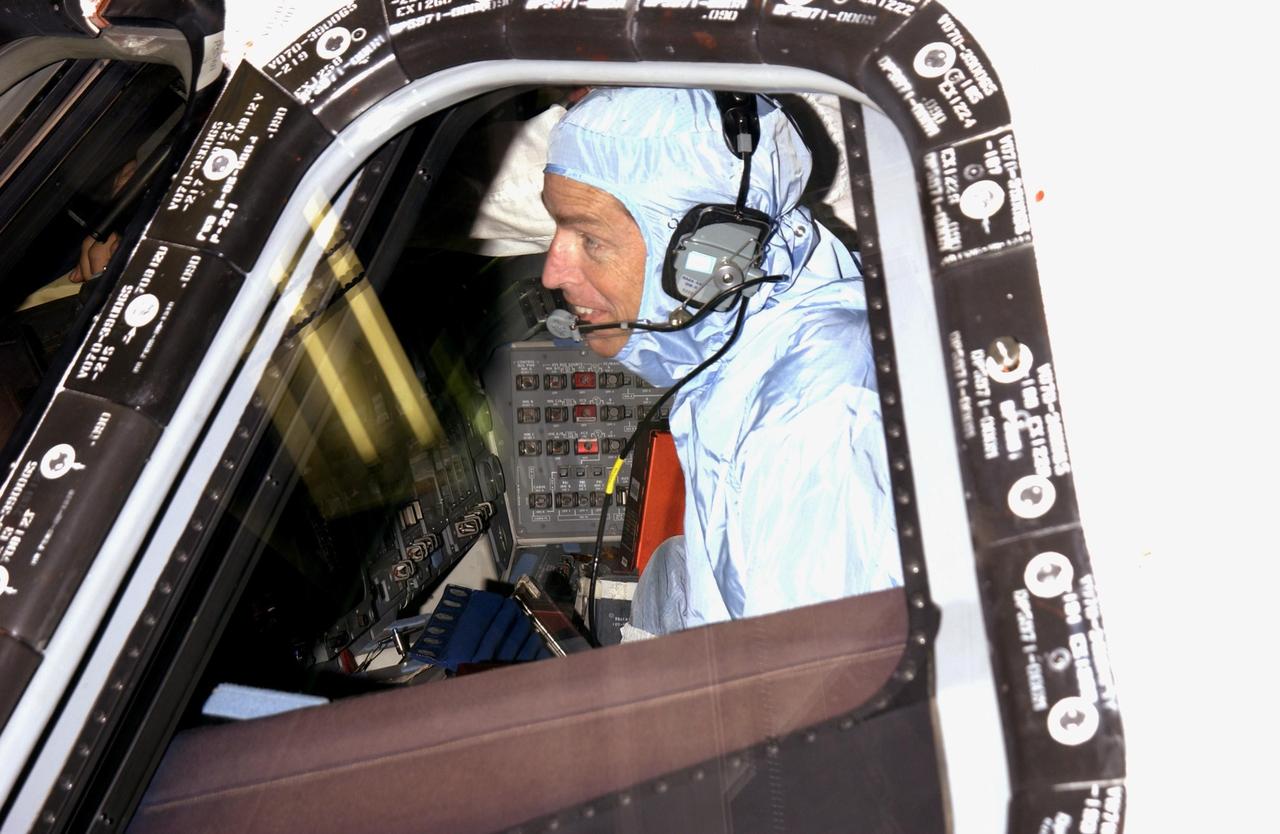
KENNEDY SPACE CENTER, FLA. -- STS-113 Commander James Wetherbee checks the cockpit window from inside Endeavour. The check is part of Crew Equipment Interface Test activities, which include familiarization with equipment for the mission. The primary payloads on mission STS-113 are the first port truss segment, P1 Truss, to be attached to the central truss segment, S0, on the International Space Station, and the Crew and Equipment Translation Aid (CETA) Cart B that can be used by spacewalkers to move along the truss with equipment. Once delivered, the P1 truss will remain stowed until flight 12A.1. The mission will also deliver the Expedition 6 crew to the Station and return Expedition 5 to Earth. Space Shuttle Endeavour is scheduled to launch Nov. 10 on the 11-day mission.
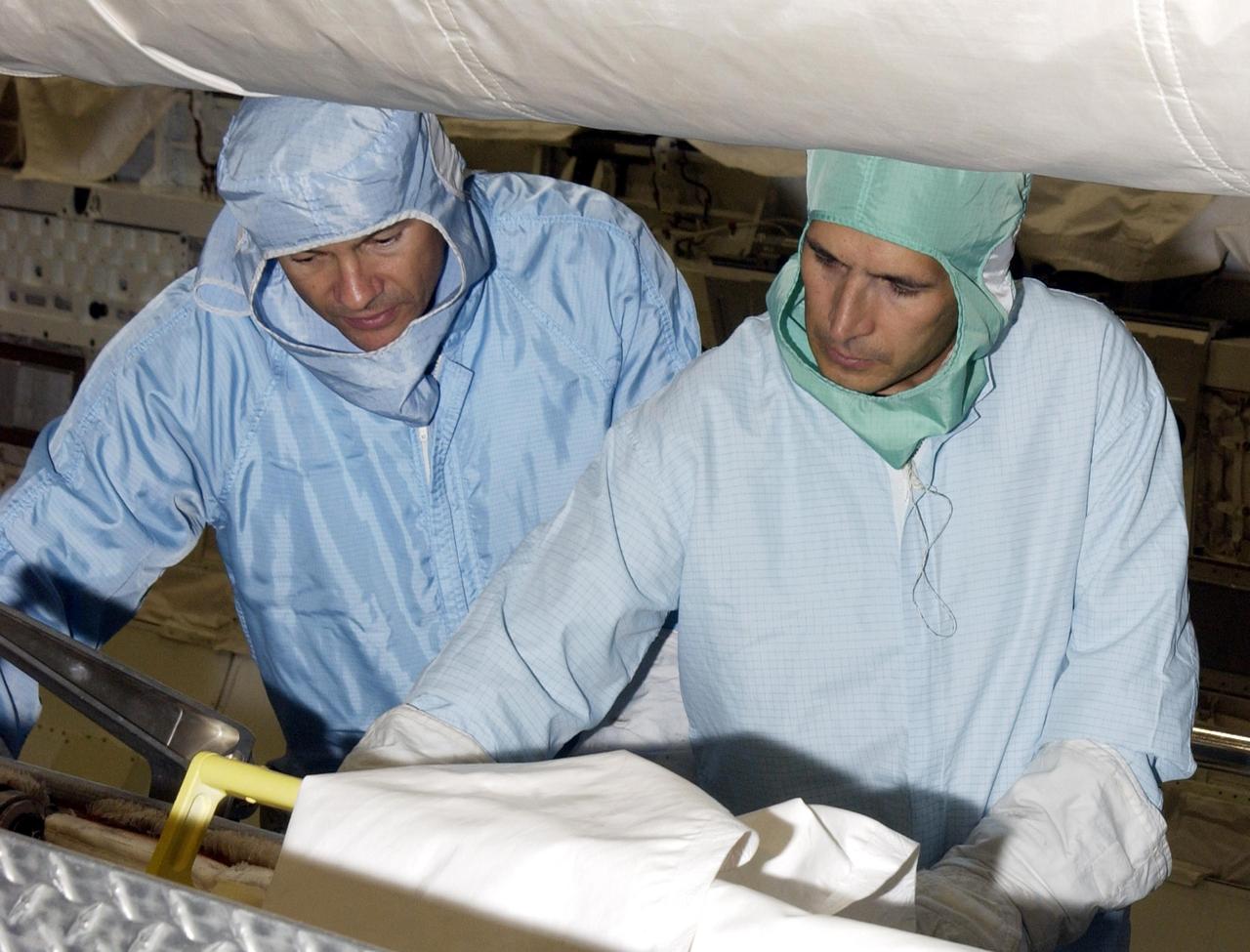
KENNEDY SPACE CENTER, FLA. -- As part of Crew Equipment Interface Test activities, STS-113 Mission Specialists Michael Lopez-Alegria (left) and John Herrington (right) practice working with flight equipment in Endeavour. The primary payloads on mission STS-113 are the first port truss segment, P1 Truss, to be attached to the central truss segment, S0, on the International Space Station, and the Crew and Equipment Translation Aid (CETA) Cart B that can be used by spacewalkers to move along the truss with equipment. Once delivered, the P1 truss will remain stowed until flight 12A.1. The mission will also deliver the Expedition 6 crew to the Station and return Expedition 5 to Earth. Space Shuttle Endeavour is scheduled to launch Nov. 10 on the 11-day mission.
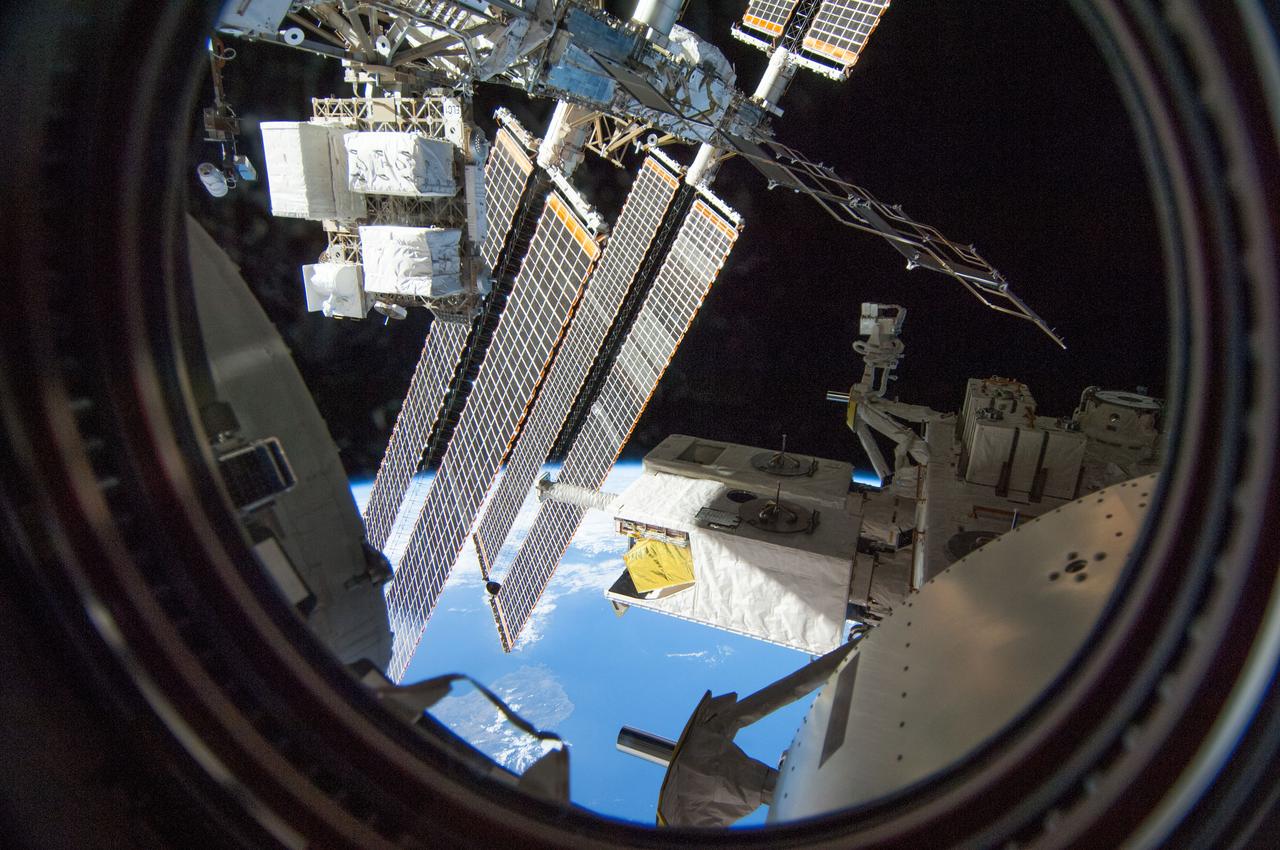
View of the Japanese Experiment Module (JEM) Exposed Facility (JEF), raidators and and part of the Express Logistics Carrier (ELC) on the P1 truss. Photo taken from the JEM window by the Expedition 40 crew.
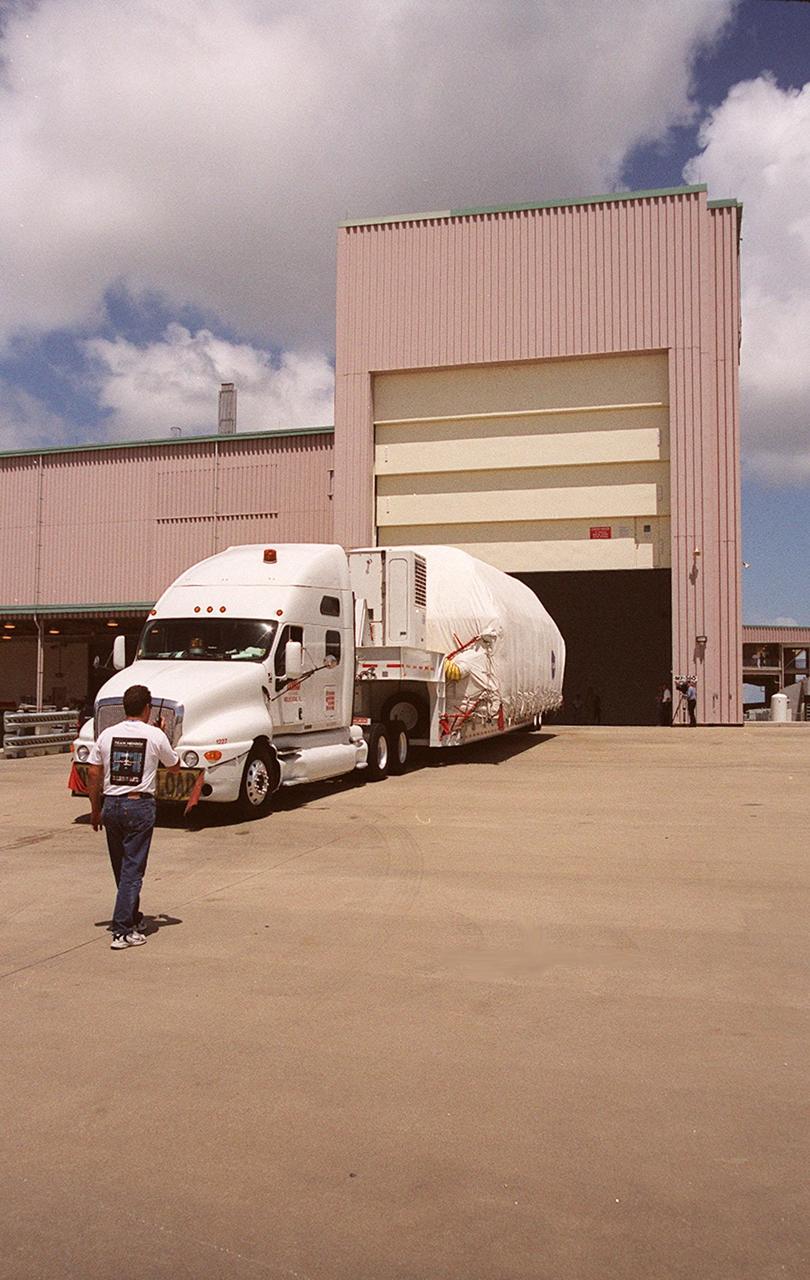
KENNEDY SPACE CENTER, FLA. -- The P4 truss, which arrived via truck from Tulsa, Okla., is backed into the Space Station Processing Facility. Part of the 10-truss, girder-like structure that will ultimately extend the length of a football field, the P4 is the second port truss segment that will attach to the first port truss segment (P1 truss). The P4 is scheduled for mission 12A in September 2002.
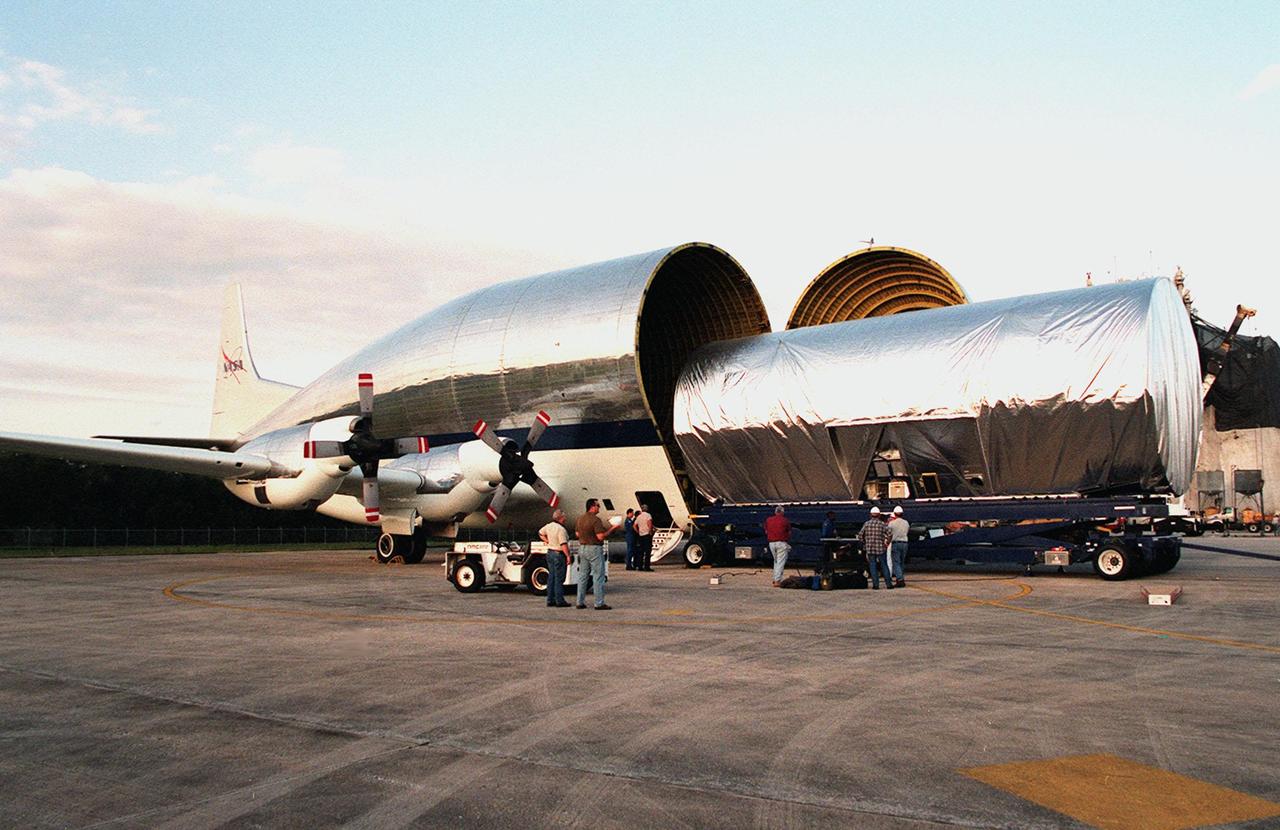
KENNEDY SPACE CENTER, FLA. -- Rolling out of NASA's Super Guppy aircraft aboard a payload transporter is a port-side P3 truss, a component for the International Space Station (ISS). The truss is scheduled to be added to the ISS on mission STS-115 in 2002 aboard Space Shuttle Atlantis. The second port truss segment, P3 will be attached to the first port truss segment (P1). The P3 truss will be taken to the Operations and Checkout Building.
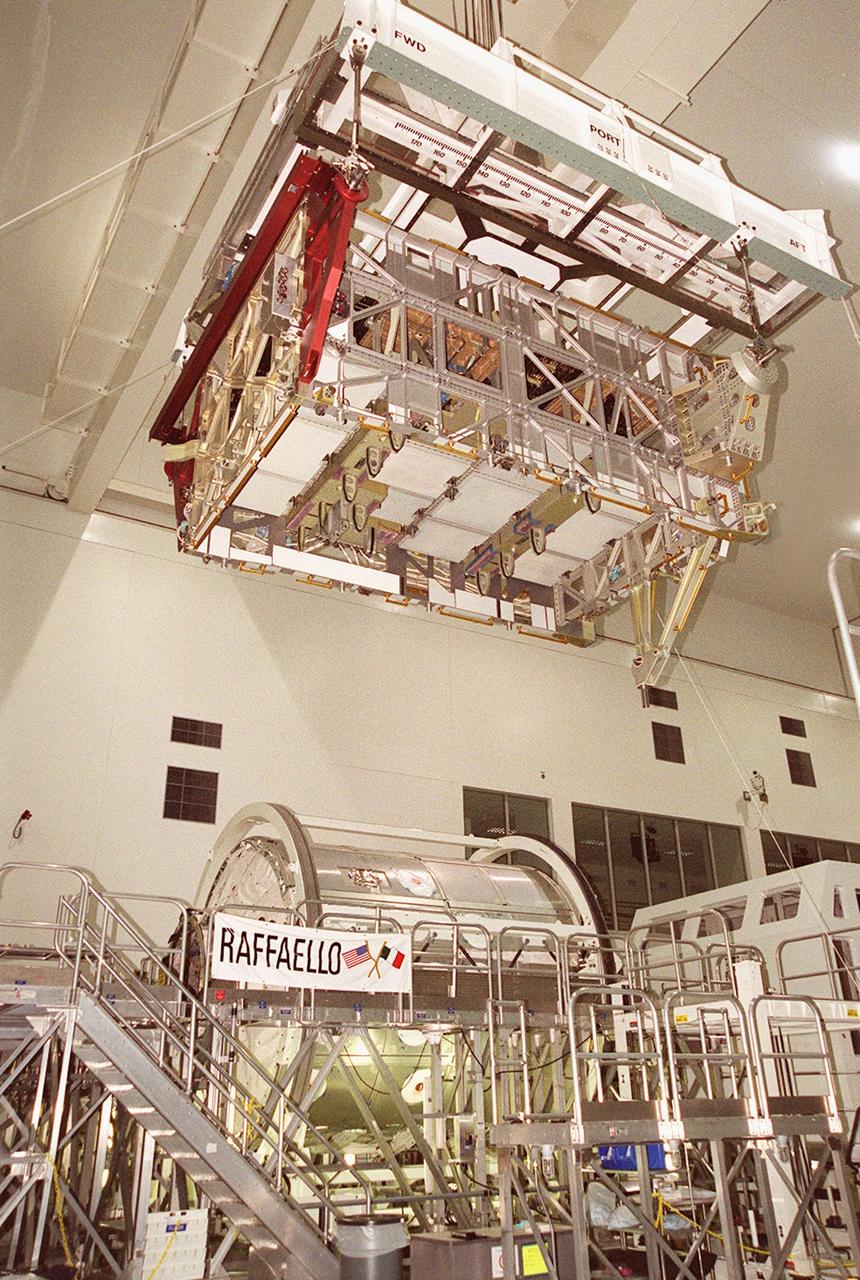
KENNEDY SPACE CENTER, FLA. -- Suspended by an overhead crane in the Space Station Processing Facility, the International Space Station’s P4 truss moves toward a workstand. Below and behind it on the floor is the Multi-Purpose Logistics Module Raffaello, another segment of the Space Station. Part of the 10-truss, girder-like structure that will ultimately extend the length of a football field, the P4 is the second port truss segment that will attach to the first port truss segment (P1 truss). The P4 is scheduled for mission 12A in September 2002.
KENNEDY SPACE CENTER, FLA. -- In the Space Station Processing Facility, an overhead crane moves the P4 truss to a workstand. Part of the 10-truss, girder-like structure that will ultimately extend the length of a football field on the International Space Station, the P4 is the second port truss segment that will attach to the first port truss segment (P1 truss). The P4 is scheduled for mission 12A in September 2002.
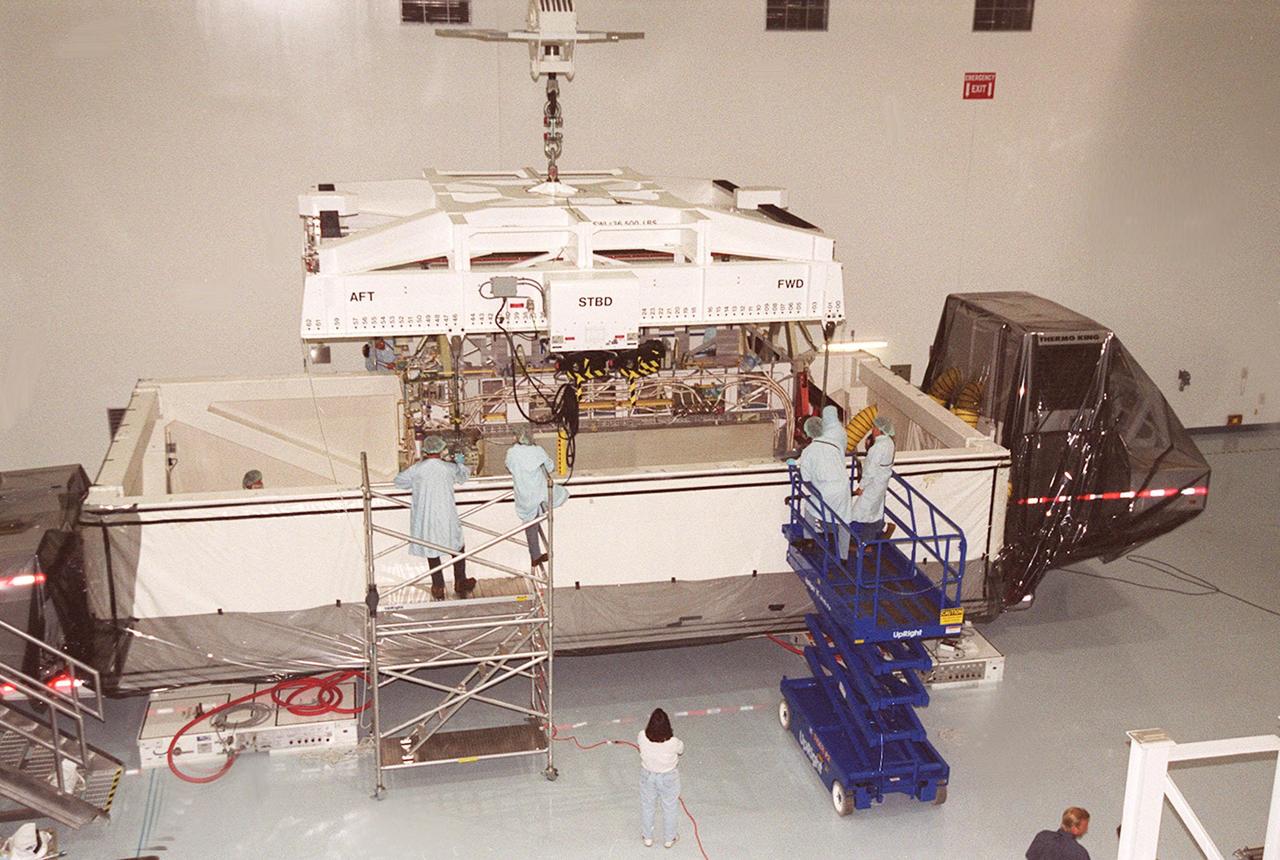
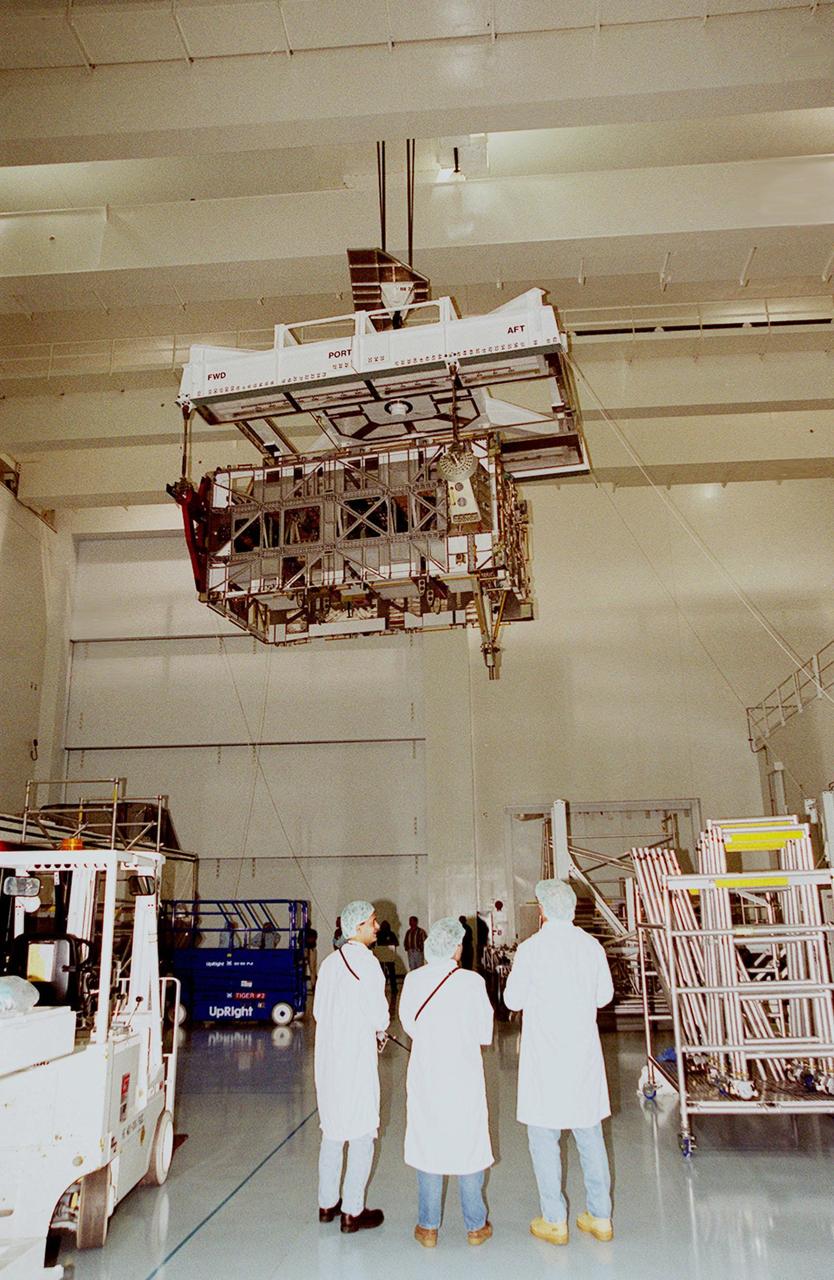
KENNEDY SPACE CENTER, FLA. -- In the Space Station Processing Facility, workers oversee the removal of the P4 truss from the truck that transported it from Tulsa, Okla. Part of the 10-truss, girder-like structure that will ultimately extend the length of a football field on the International Space Station, the P4 is the second port truss segment that will attach to the first port truss segment (P1 truss). The P4 is scheduled for mission 12A in September 2002.
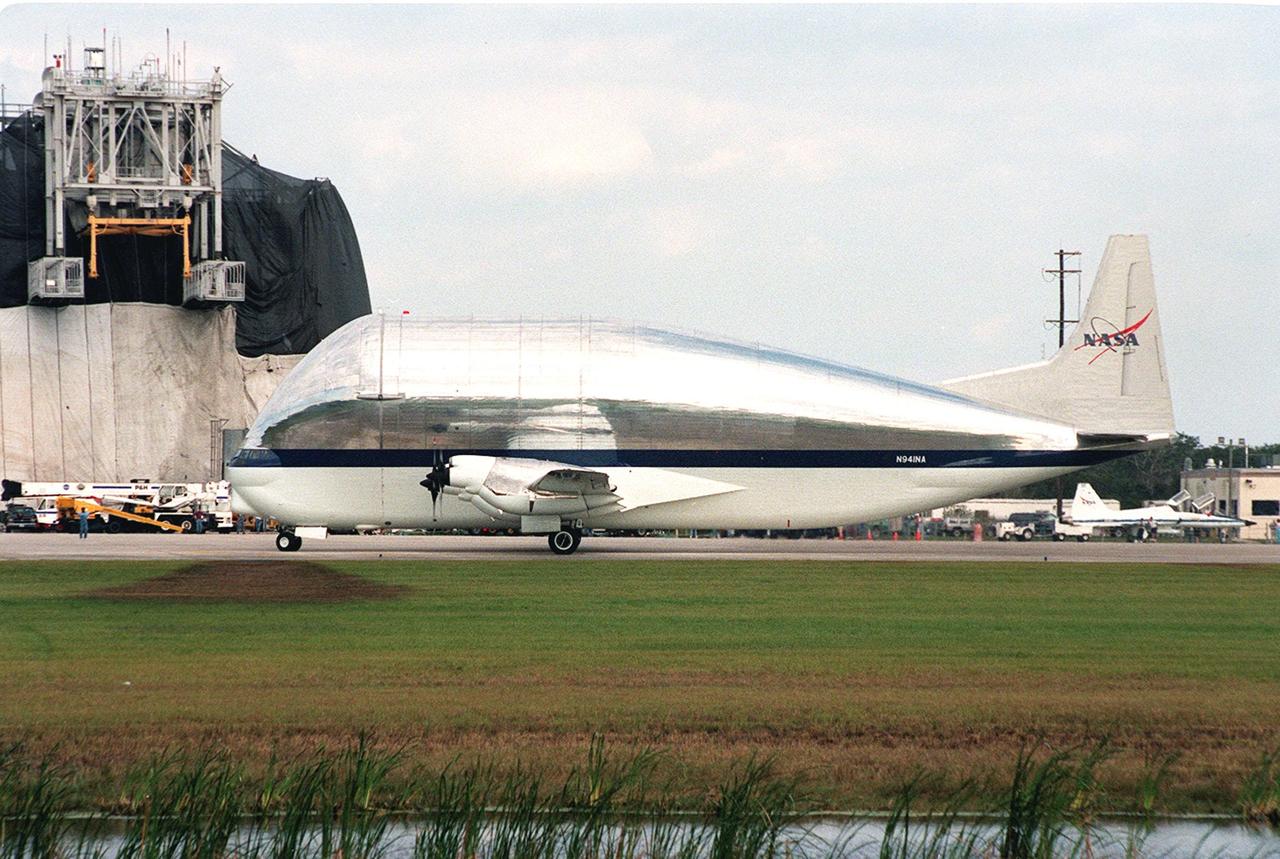
KENNEDY SPACE CENTER, FLA. -- NASA's Super Guppy aircraft arrives at Kennedy Space Center's Shuttle Landing Facility. The plane carries a component for the International Space Station (ISS), the port-side P3 truss. The truss is scheduled to be added to the ISS on mission STS-115 in 2002 aboard Space Shuttle Atlantis. The second port truss segment, P3 will be attached to the first port truss segment (P1). The P3 truss will be taken to the Operations and Checkout Building
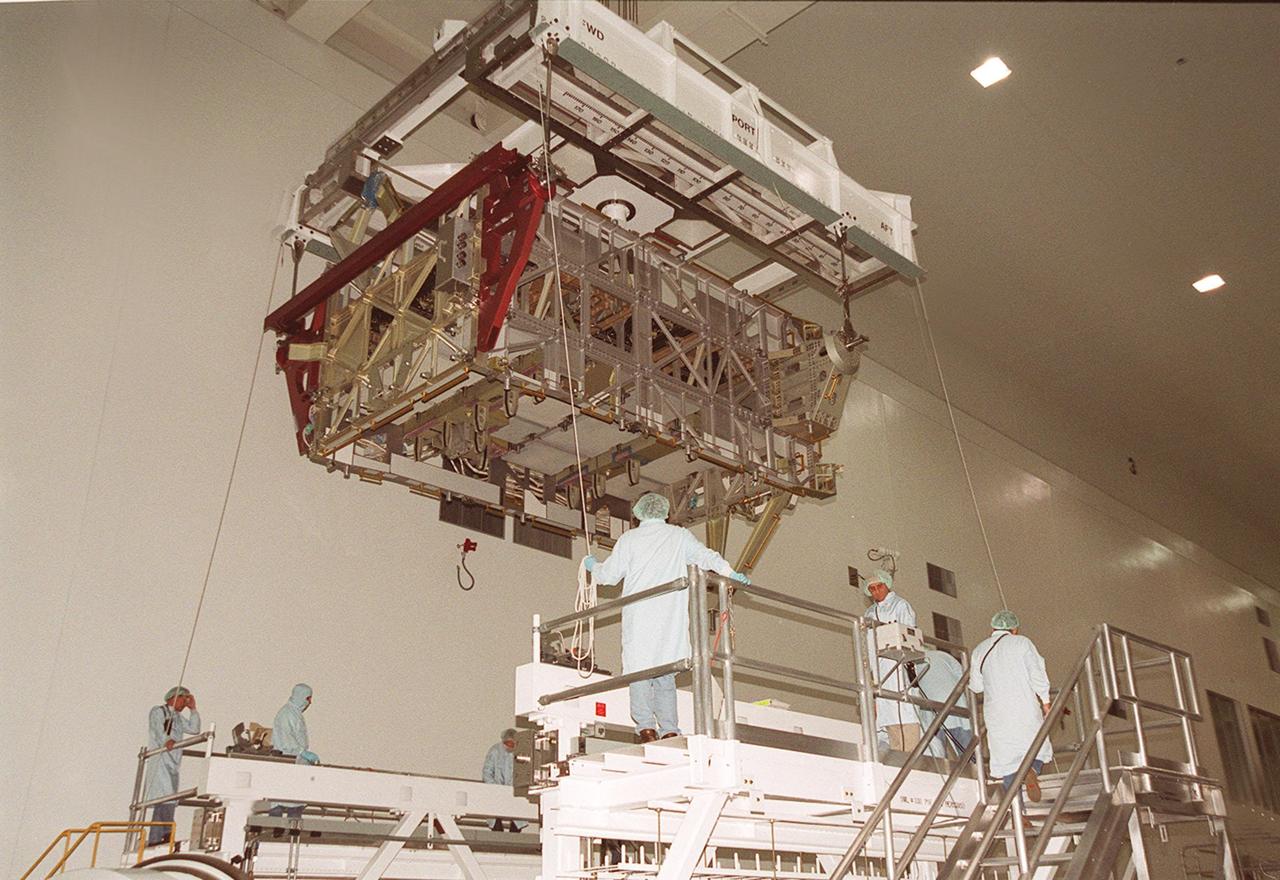
KENNEDY SPACE CENTER, FLA. -- In the Space Station Processing Facility, workers get ready to lower the International Space Station’s P4 truss onto a workstand. Part of the 10-truss, girder-like structure that will ultimately extend the length of a football field, the P4 is the second port truss segment that will attach to the first port truss segment (P1 truss). The P4 is scheduled for mission 12A in September 2002.
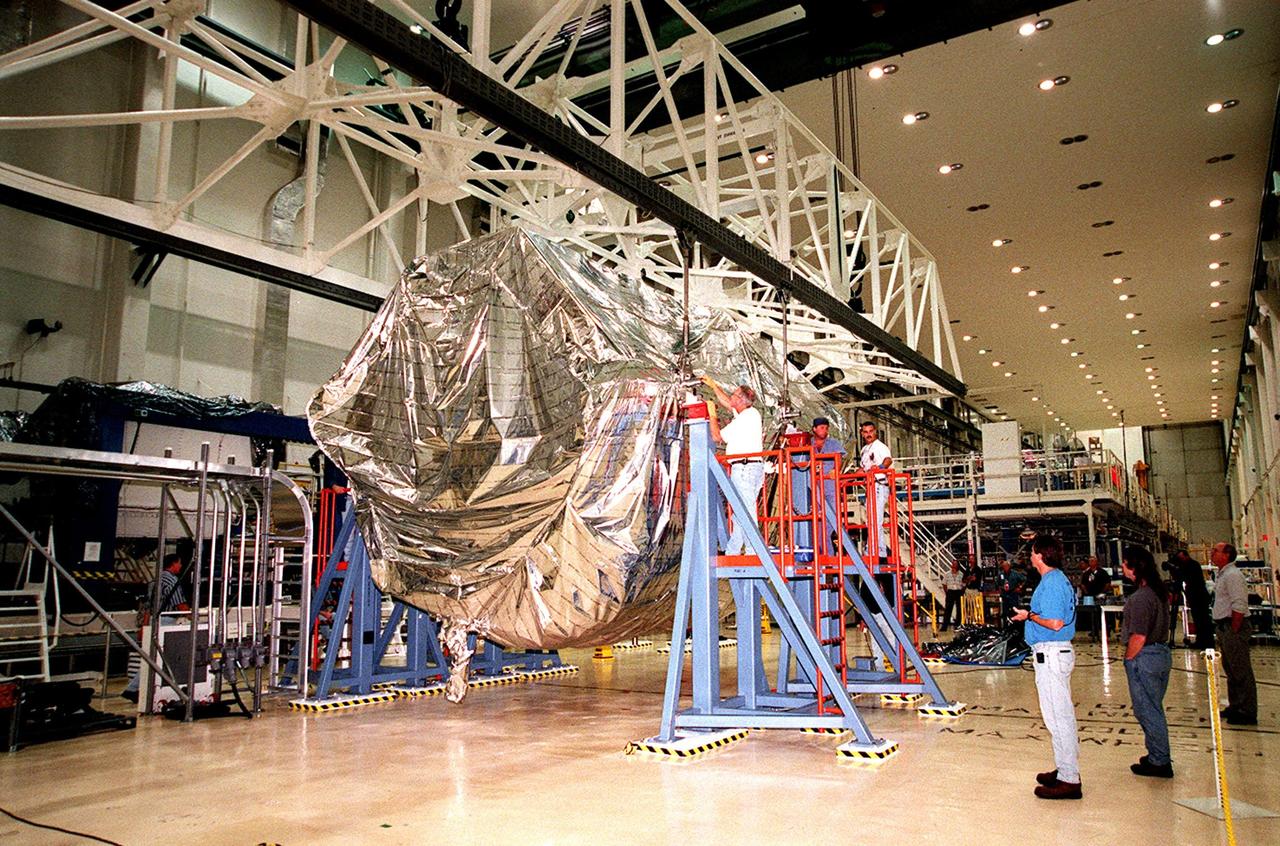
KENNEDY SPACE CENTER, FLA. -- Workers adjust connection of the port-side P3 truss on its workstand in the Operations and Checkout Building. The truss is a segment of the International Space Station (ISS), the second port truss segment, that will be attached to the first port truss segment (P1). The truss is scheduled to be added to the ISS on mission STS-115 in 2002 aboard Space Shuttle Atlantis.
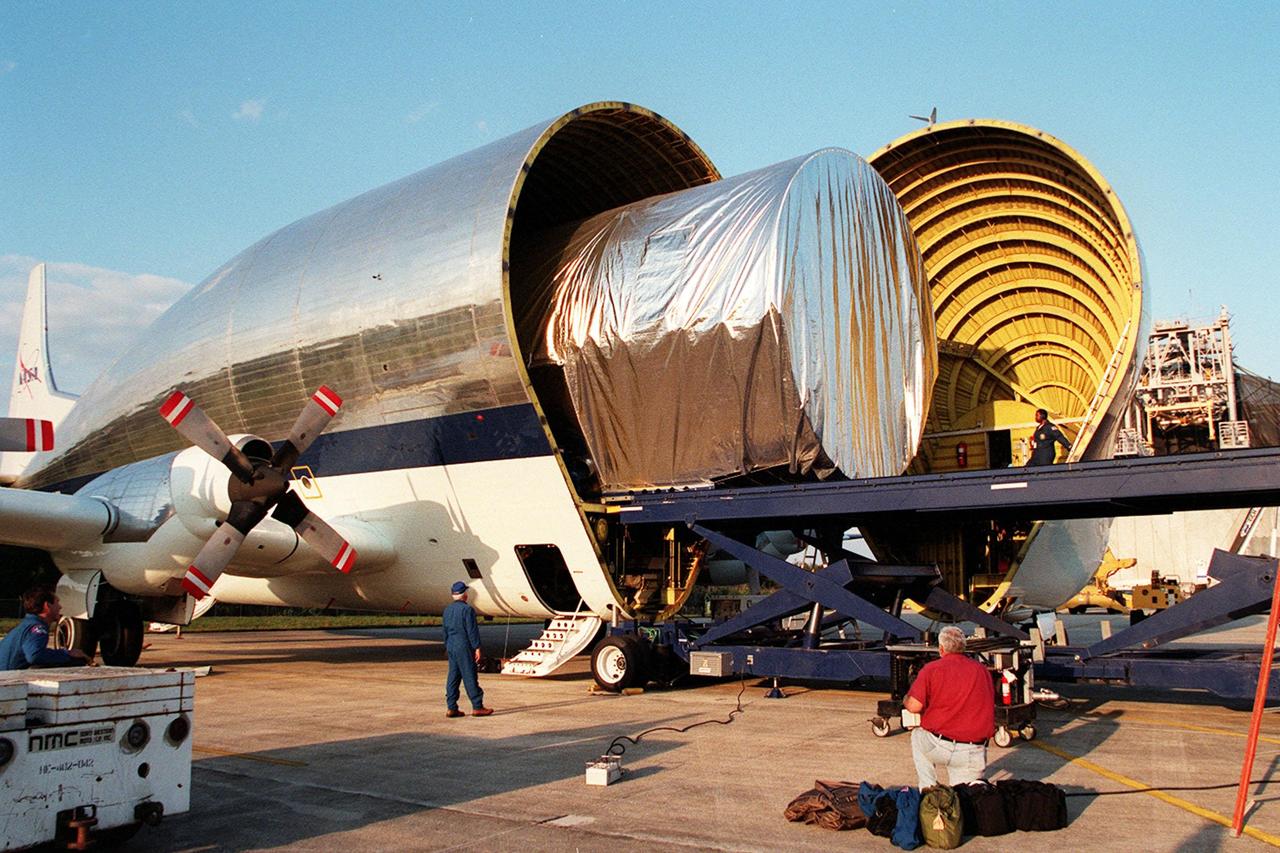
KENNEDY SPACE CENTER, FLA. -- At Kennedy Space Center's Shuttle Landing Facility, the cargo of NASA's Super Guppy aircraft begins rolling out onto a payload transporter. The cargo is a P3 port-side truss, a segment of the International Space Station (ISS). The truss is scheduled to be added to the ISS on mission STS-115 in 2002 aboard Space Shuttle Atlantis. The second port truss segment, P3 will be attached to the first port truss segment (P1). The P3 truss will be taken to the Operations and Checkout Building.
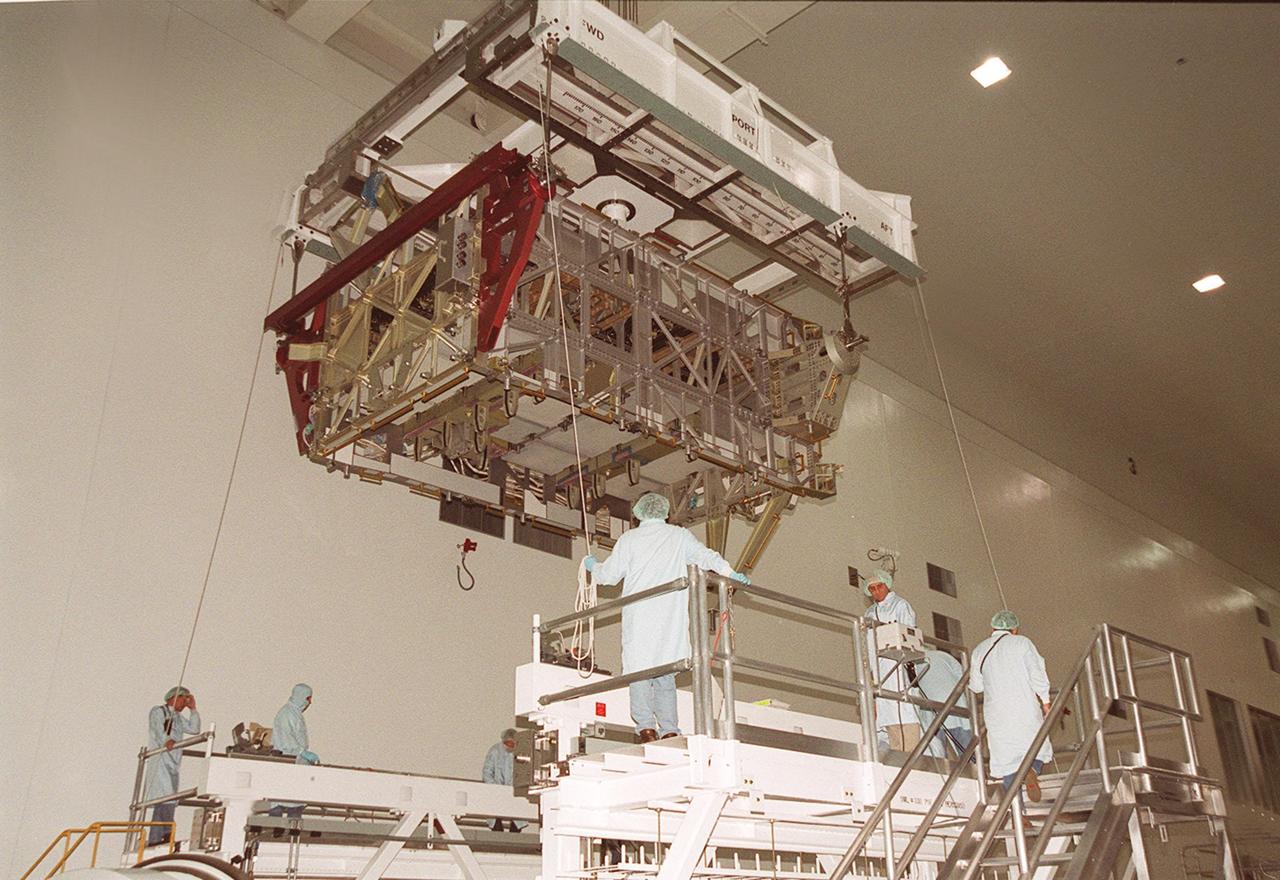
KENNEDY SPACE CENTER, FLA. -- In the Space Station Processing Facility, workers get ready to lower the International Space Station’s P4 truss onto a workstand. Part of the 10-truss, girder-like structure that will ultimately extend the length of a football field, the P4 is the second port truss segment that will attach to the first port truss segment (P1 truss). The P4 is scheduled for mission 12A in September 2002.

KENNEDY SPACE CENTER, FLA. -- The P4 truss arrives via truck from Tulsa, Okla. Part of the 10-truss, girder-like structure that will ultimately extend the length of a football field, the P4 is the second port truss segment that will attach to the first port truss segment (P1 truss). The P4 is scheduled for mission 12A in September 2002.
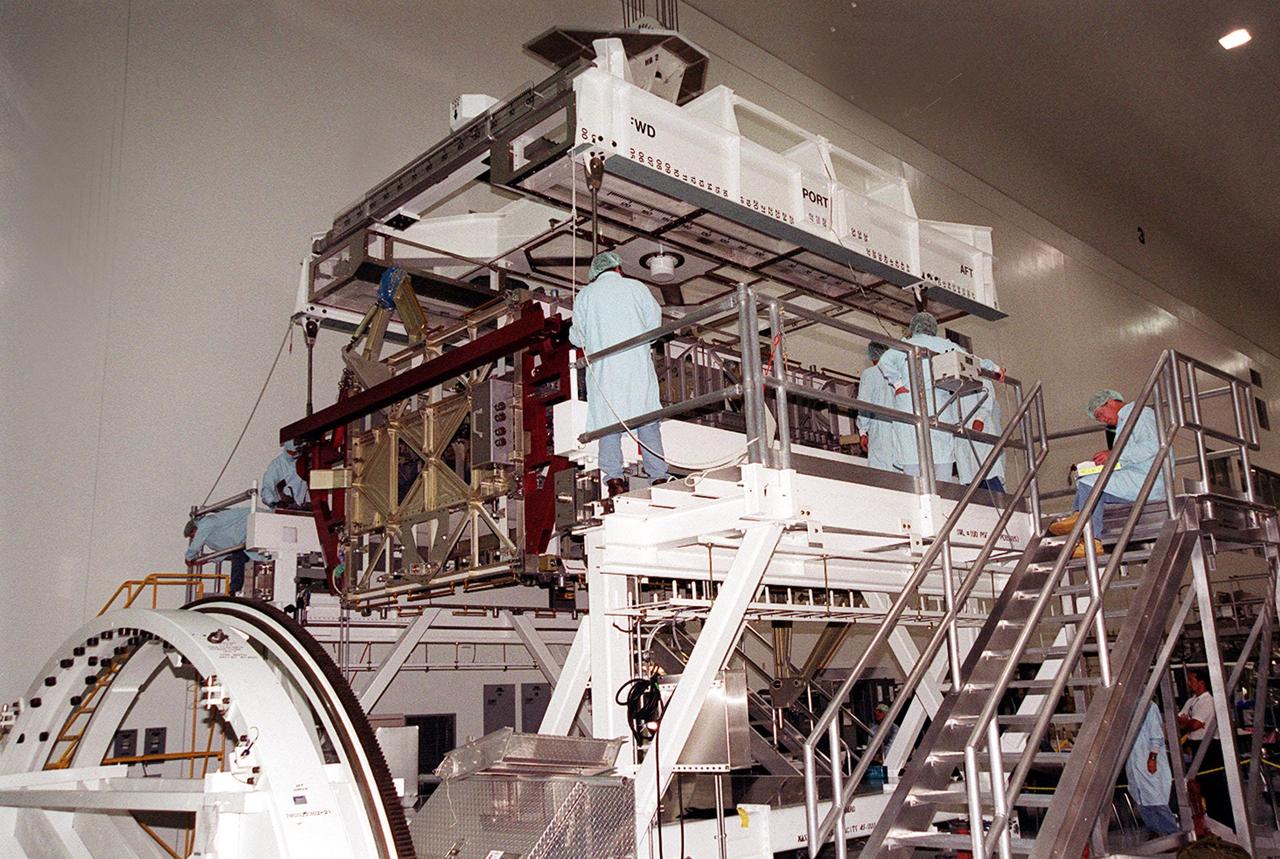
KENNEDY SPACE CENTER, FLA. -- After its move across the Space Station Processing Facility, the International Space Station’s P4 truss rests in its workstand. Part of the 10-truss, girder-like structure that will ultimately extend the length of a football field, the P4 is the second port truss segment that will attach to the first port truss segment (P1 truss). The P4 is scheduled for mission 12A in September 2002.
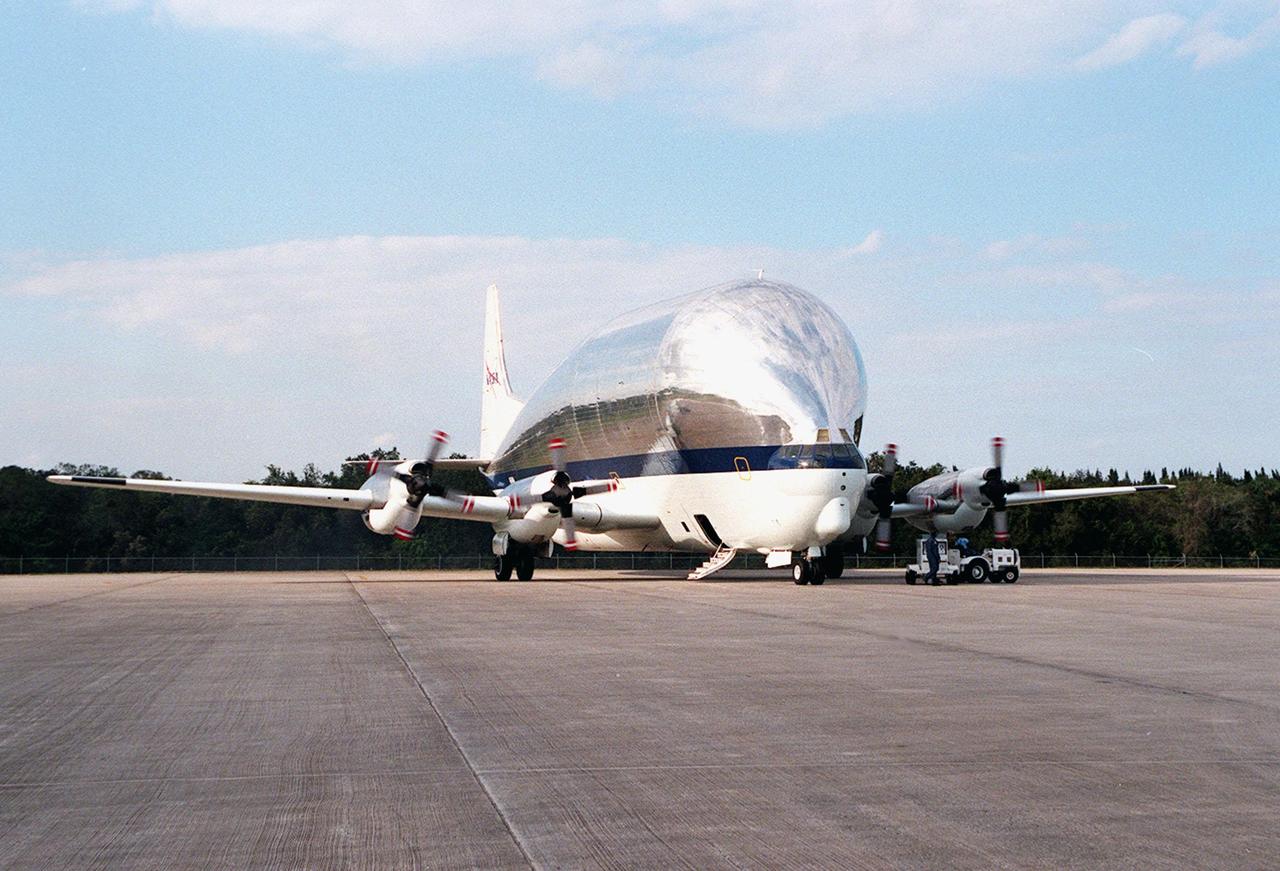
KENNEDY SPACE CENTER, FLA. -- NASA's Super Guppy aircraft arrives at Kennedy Space Center's Shuttle Landing Facility. The plane carries a component for the International Space Station (ISS), the port-side P3 truss. The truss is scheduled to be added to the ISS on mission STS-115 in 2002 aboard Space Shuttle Atlantis. The second port truss segment, P3 will be attached to the first port truss segment (P1). The P3 truss will be taken to the Operations and Checkout Building.
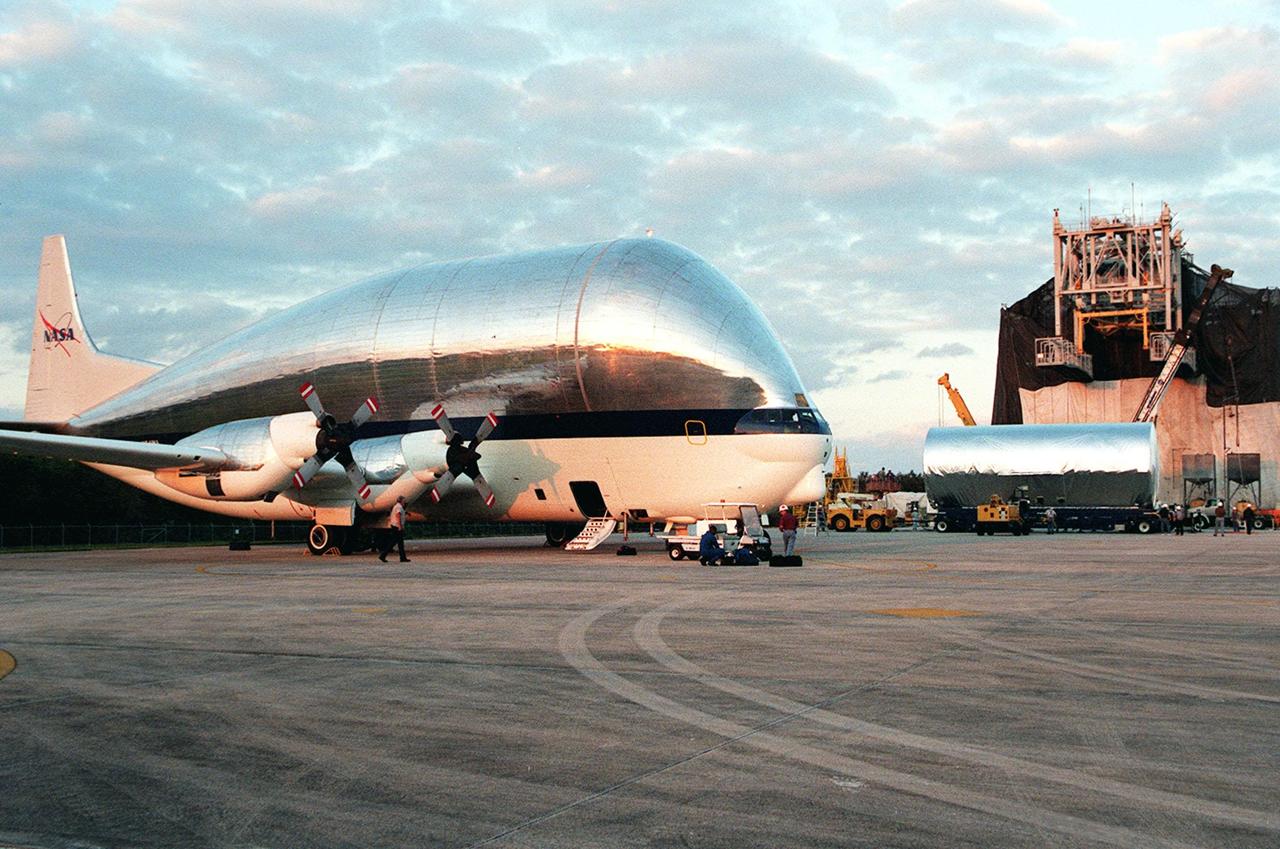
With its cargo off-loaded (background), the nose cone of the Super Guppy aircraft is closed. The cargo is a P3 port-side truss, a segment of the International Space Station (ISS). The truss is scheduled to be added to the ISS on mission STS-115 in 2002 aboard Space Shuttle Atlantis. The second port truss segment, P3 will be attached to the first port truss segment (P1). The P3 truss will be taken to the Operations and Checkout Building.
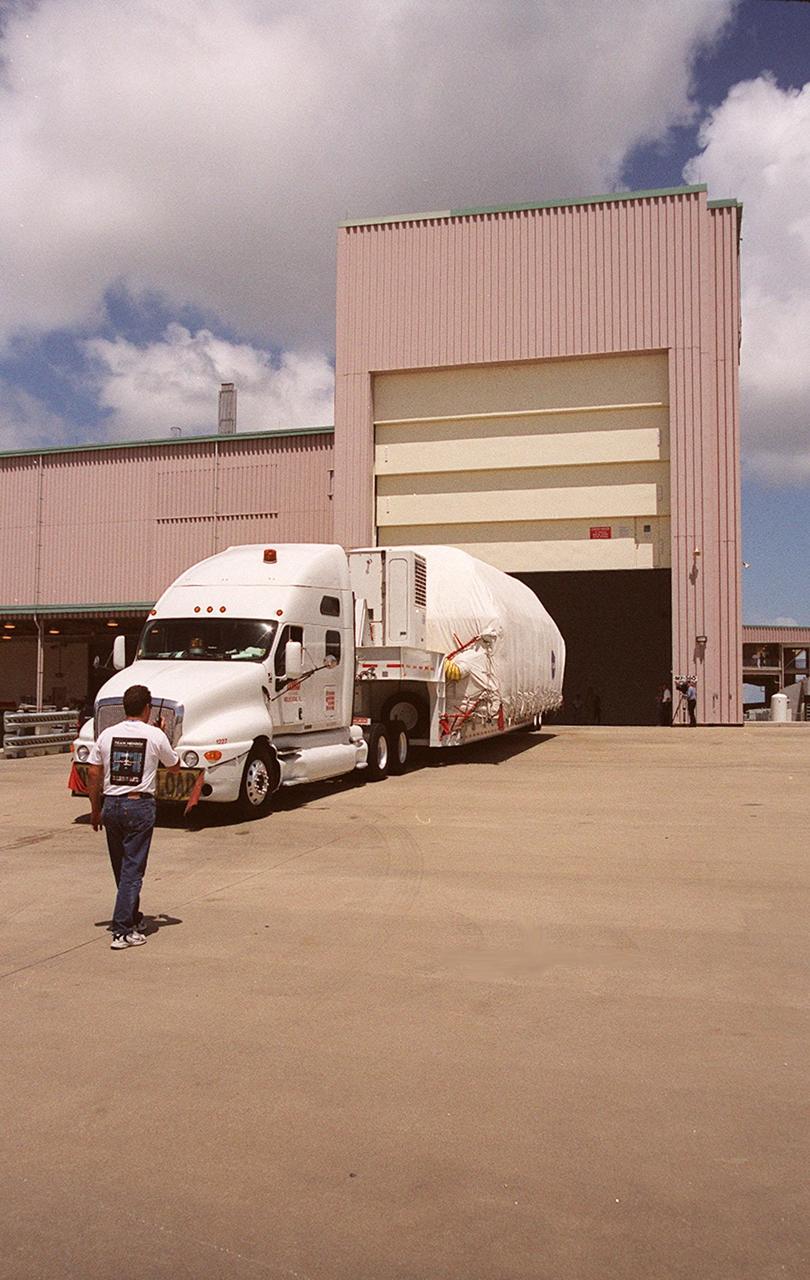
KENNEDY SPACE CENTER, FLA. -- The P4 truss, which arrived via truck from Tulsa, Okla., is backed into the Space Station Processing Facility. Part of the 10-truss, girder-like structure that will ultimately extend the length of a football field, the P4 is the second port truss segment that will attach to the first port truss segment (P1 truss). The P4 is scheduled for mission 12A in September 2002.
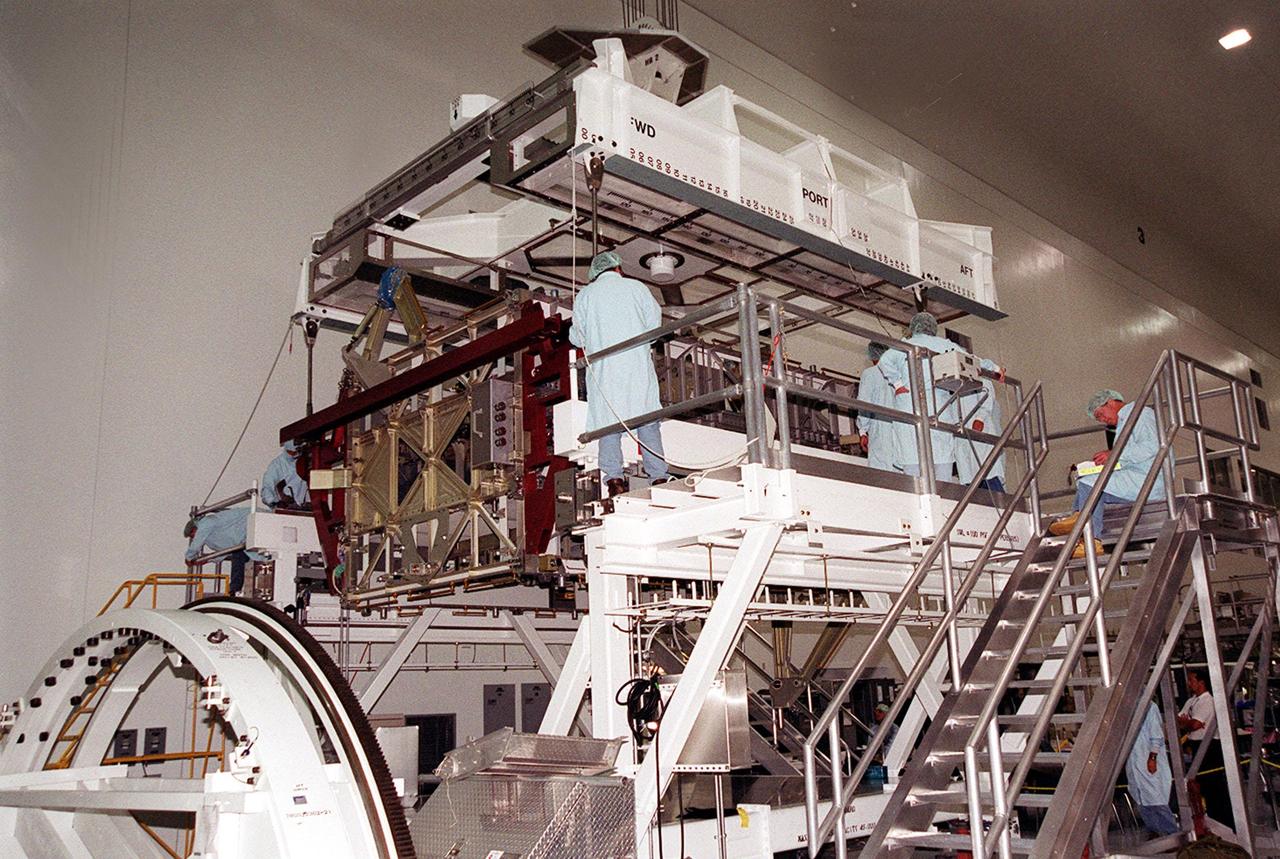
KENNEDY SPACE CENTER, FLA. -- After its move across the Space Station Processing Facility, the International Space Station’s P4 truss rests in its workstand. Part of the 10-truss, girder-like structure that will ultimately extend the length of a football field, the P4 is the second port truss segment that will attach to the first port truss segment (P1 truss). The P4 is scheduled for mission 12A in September 2002.
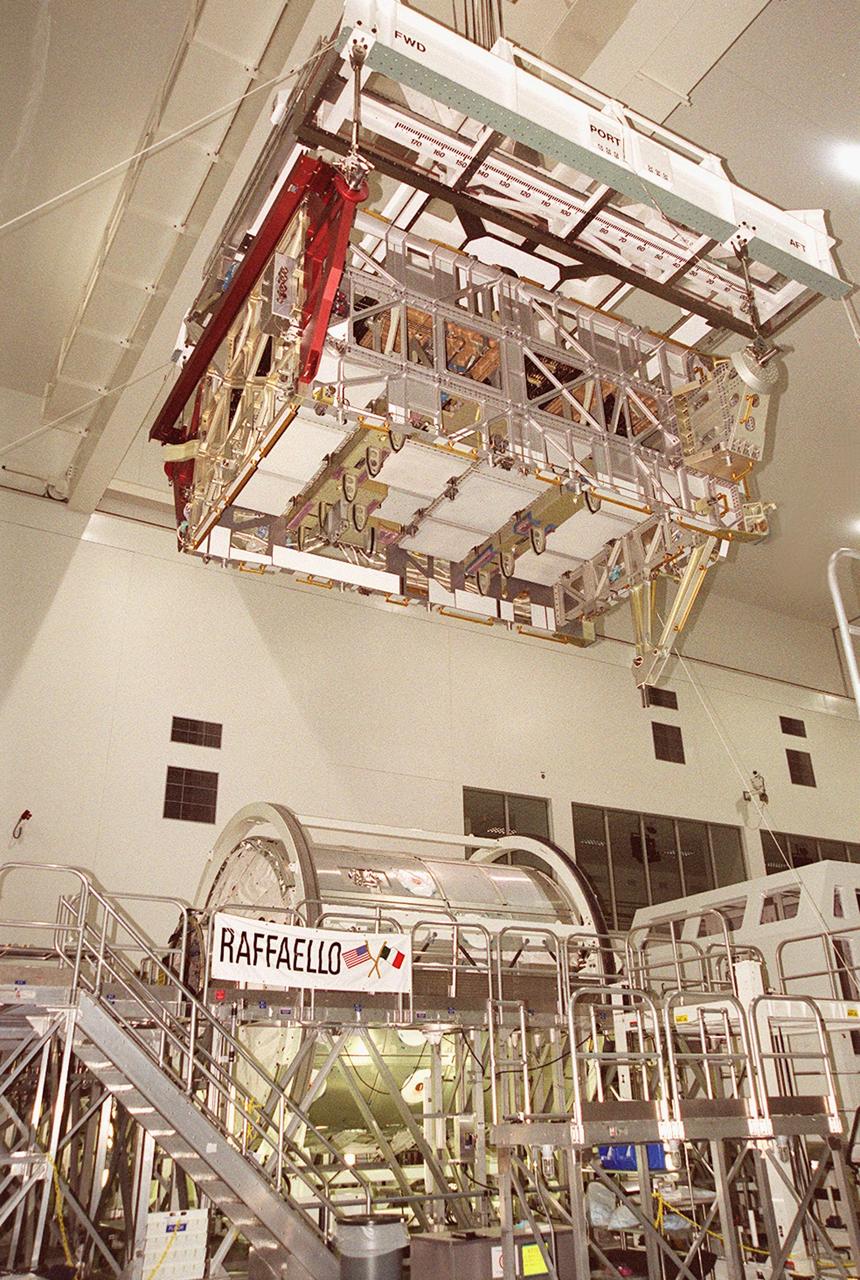
KENNEDY SPACE CENTER, FLA. -- Suspended by an overhead crane in the Space Station Processing Facility, the International Space Station’s P4 truss moves toward a workstand. Below and behind it on the floor is the Multi-Purpose Logistics Module Raffaello, another segment of the Space Station. Part of the 10-truss, girder-like structure that will ultimately extend the length of a football field, the P4 is the second port truss segment that will attach to the first port truss segment (P1 truss). The P4 is scheduled for mission 12A in September 2002.
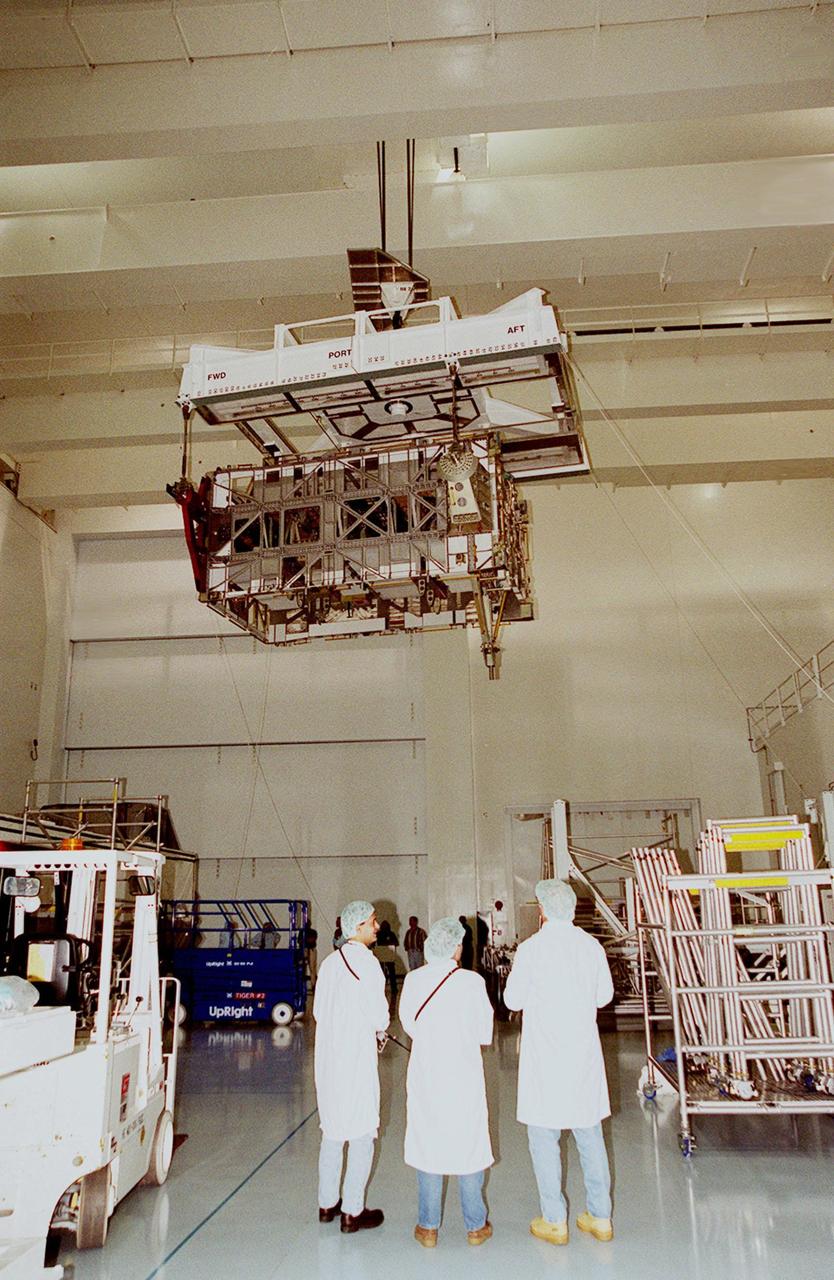
KENNEDY SPACE CENTER, FLA. -- In the Space Station Processing Facility, an overhead crane moves the P4 truss to a workstand. Part of the 10-truss, girder-like structure that will ultimately extend the length of a football field on the International Space Station, the P4 is the second port truss segment that will attach to the first port truss segment (P1 truss). The P4 is scheduled for mission 12A in September 2002.
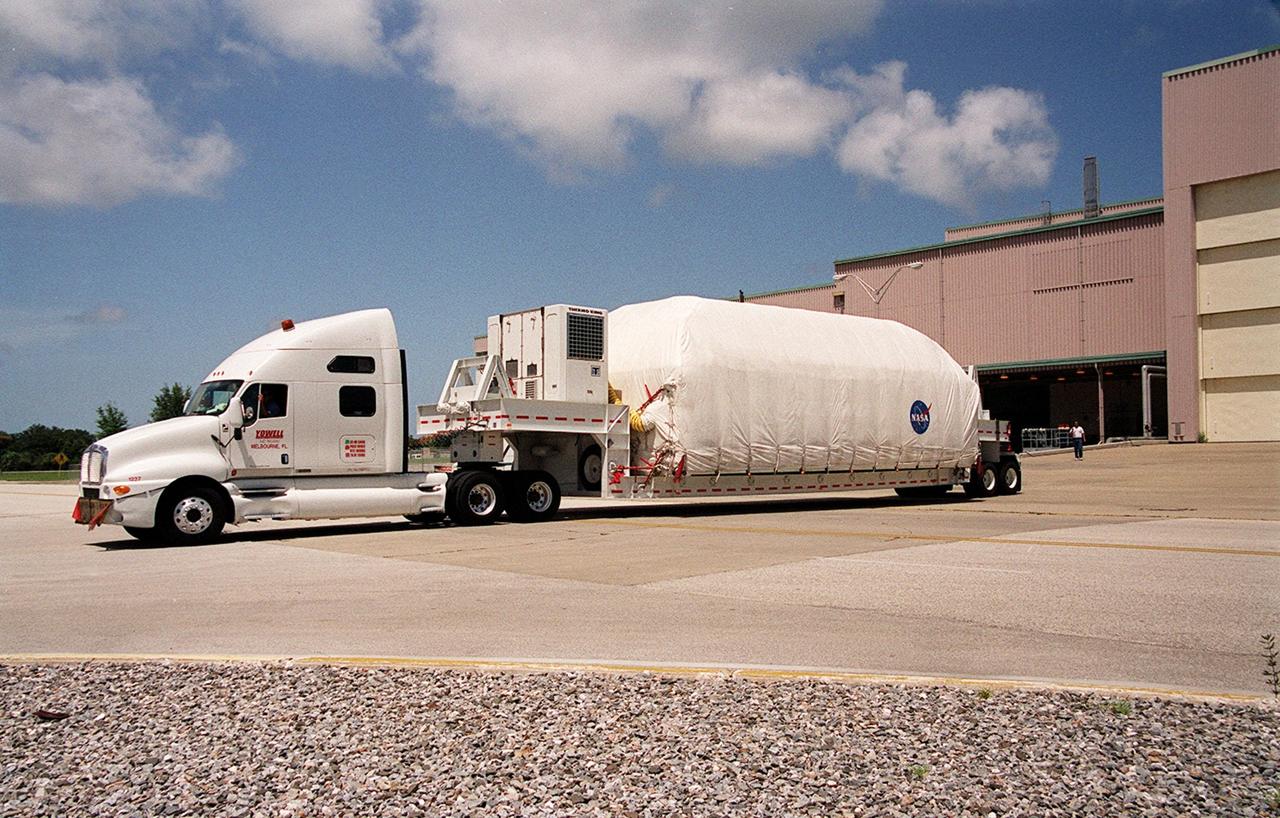
KENNEDY SPACE CENTER, FLA. -- The P4 truss arrives via truck from Tulsa, Okla. Part of the 10-truss, girder-like structure that will ultimately extend the length of a football field, the P4 is the second port truss segment that will attach to the first port truss segment (P1 truss). The P4 is scheduled for mission 12A in September 2002.
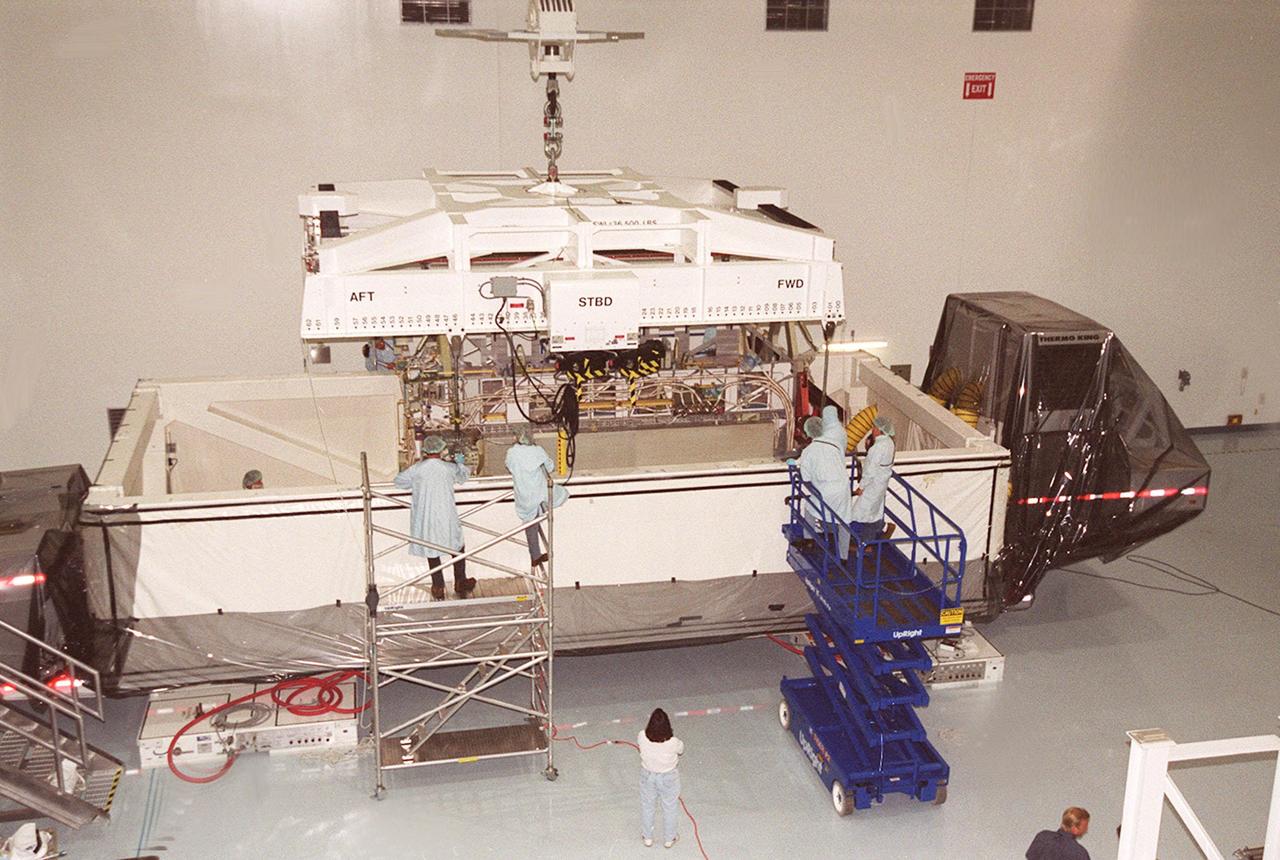
KENNEDY SPACE CENTER, FLA. -- In the Space Station Processing Facility, workers oversee the removal of the P4 truss from the truck that transported it from Tulsa, Okla. Part of the 10-truss, girder-like structure that will ultimately extend the length of a football field on the International Space Station, the P4 is the second port truss segment that will attach to the first port truss segment (P1 truss). The P4 is scheduled for mission 12A in September 2002.
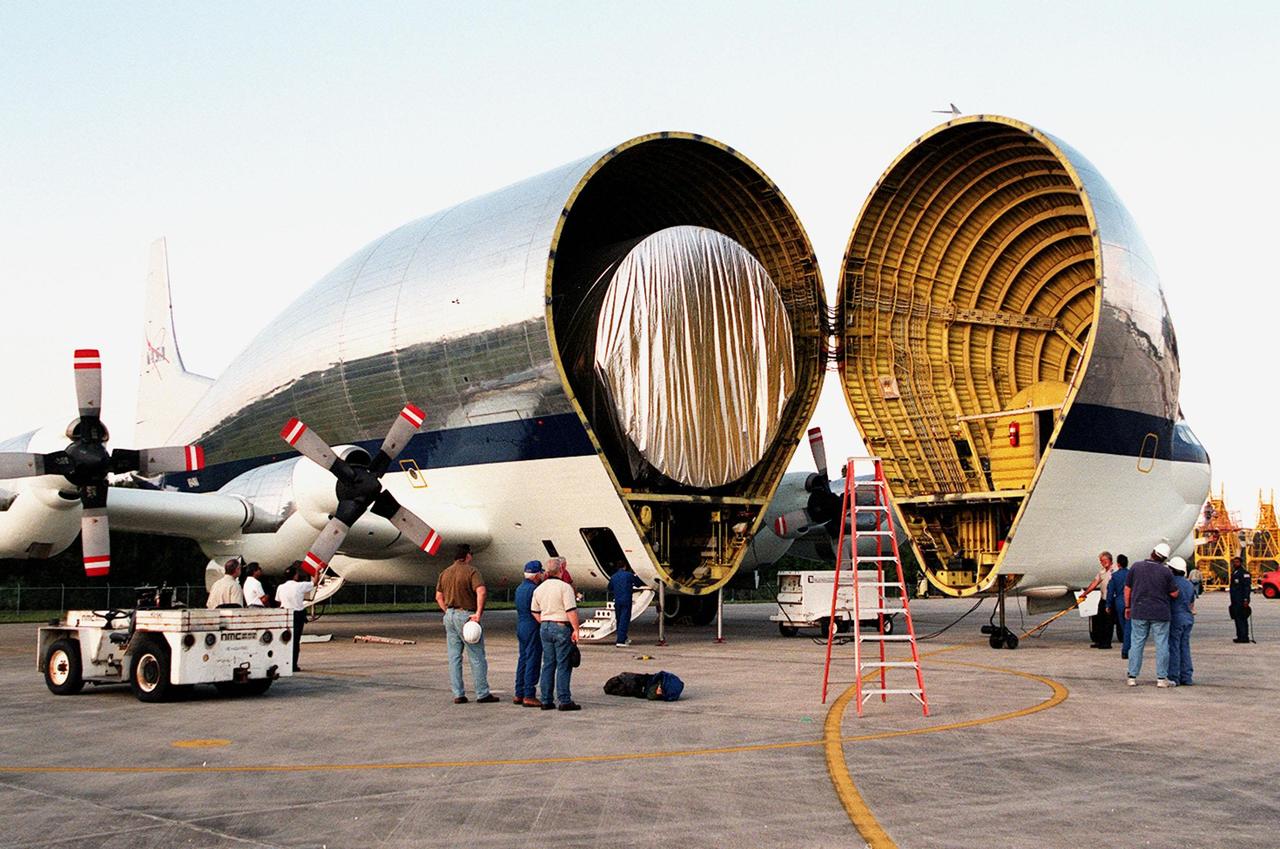
KENNEDY SPACE CENTER, FLA. -- At Kennedy Space Center's Shuttle Landing Facility, workers watch as the nose of NASA's Super Guppy aircraft opens to reveal its cargo, a component for the International Space Station (ISS), the port-side P3 truss. The truss is scheduled to be added to the ISS on mission STS-115 in 2002 aboard Space Shuttle Atlantis. The second port truss segment, P3 will be attached to the first port truss segment (P1). The P3 truss will be taken to the Operations and Checkout Building.
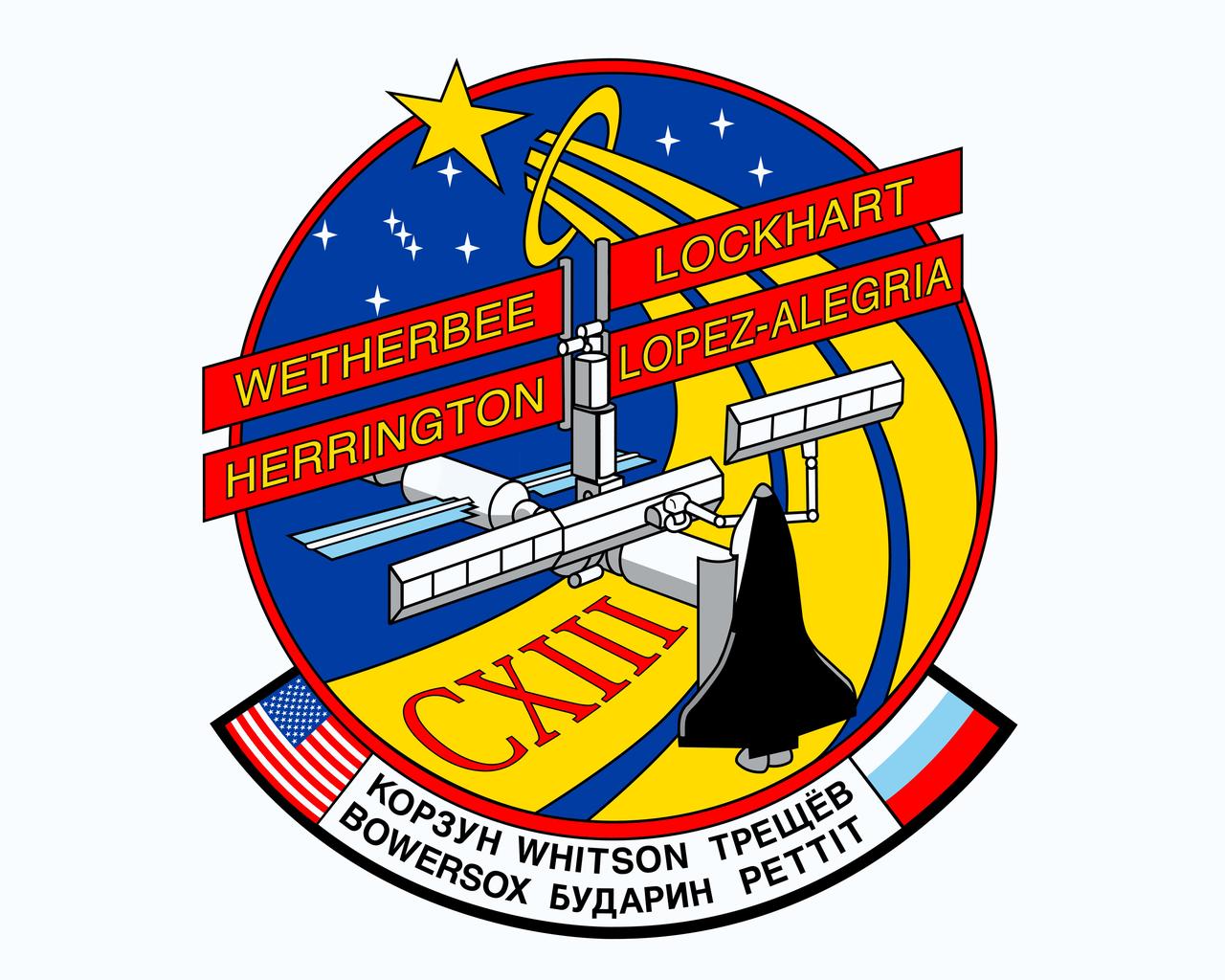
This is the crew patch for the Shuttle Endeavor STS-113 mission, the 16th American assembly flight, and 112th overall American flight to the International Space Station (ISS). STS-113 mission objectives included the delivery of the Expedition Six Crew to the ISS, the return of Expedition Five back to Earth, and the installation and activation of the Port 1 Integrated Truss Assembly (P1). The first major component installed on the left side of the Station, the P1 truss provides an additional three External Thermal Control System radiators. Three space walks, aided by the use of the Robotic Manipulator Systems of both the Shuttle and the Station, were performed in the installation of P1. Also, more than 2,500 pounds (1,134 kilograms) of cargo were transferred between the Shuttle and Station. The Space Shuttle Orbiter Endeavor launched on November 23, 2002 from Kennedy's launch pad 39A and returned 11 days later on December 4, 2002. The patch depicts the Space Shuttle Endeavour docked to the ISS during the installation of the P1 truss with the gold astronaut symbol in the background. The seven stars at the top left center of the patch are the seve brightest stars in the constellation Orion. They represent the combined seven crew members (four Shuttle and three Expedition Six). The three stars to the right of the astronaut symbol represent the returning Expedition Five crew members. The Roman Numeral CXIII represents the mission number 113.
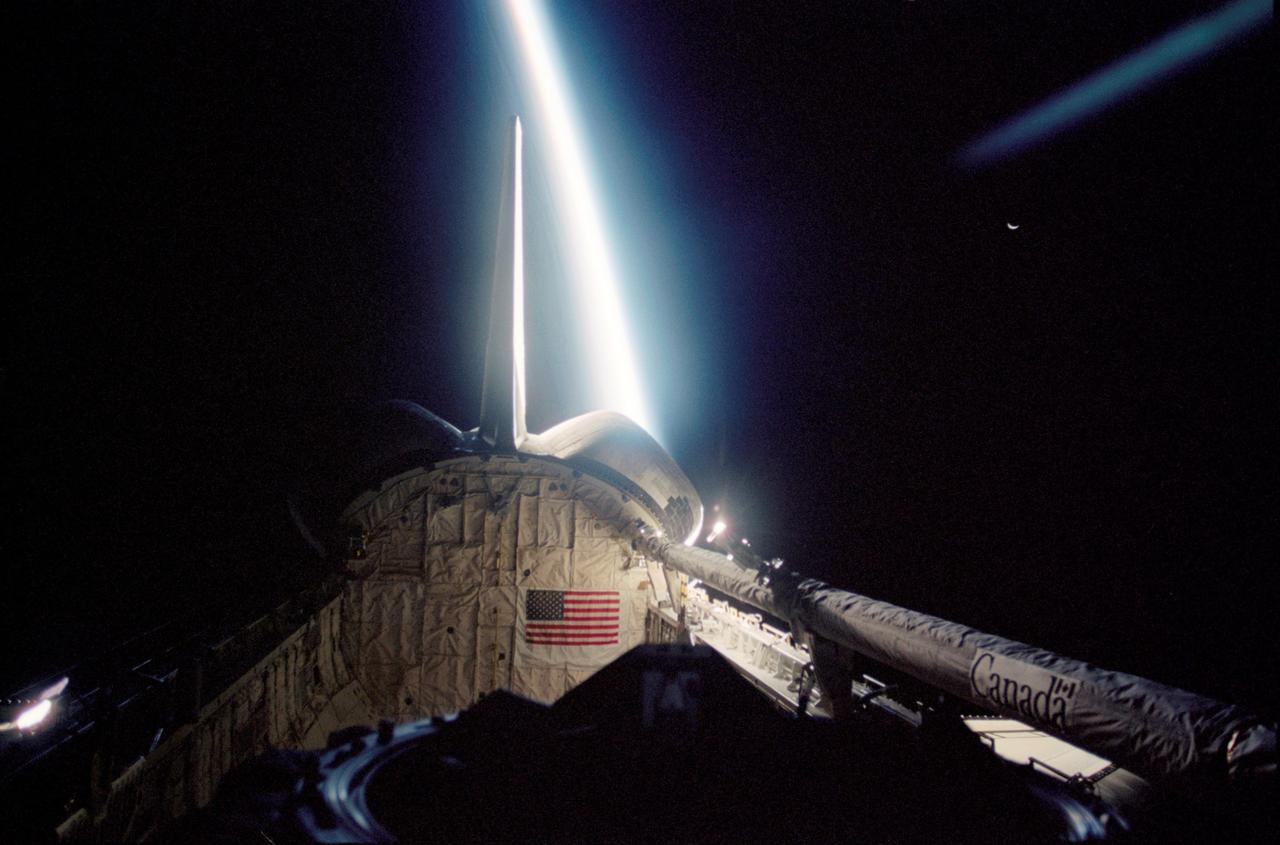
This STS-113 photograph shows an incredible view of the Space Shuttle Endeavour's payload bay. The blackness of space, Earth's moon (upper right frame), and a thin slice of Earth's horizon which runs vertically across the photograph, form the back drop for this photograph. The remote manipulator system (RMS) robotic arm is visible in lower right frame. The 16th American assembly flight and 112th overall American flight to the International Space Station (ISS) launched on November 23, 2002 from Kennedy's launch pad 39A aboard the Space Shuttle Orbiter Endeavour STS-113. Mission objectives included the installation and activation of the Port 1 Integrated Truss Assembly (P1). The first major component installed on the left side of the Station, the P1 truss provides three additional External Thermal Control System radiators. Weighing in at 27,506 pounds, the P1 truss is 45 feet (13.7 meters) long, 15 feet (4.6 meters) wide, and 13 feet (4 meters) high. Three space walks, aided by the use of the Robotic Manipulator Systems of both the Shuttle and the Station, were performed in the installation of P1.
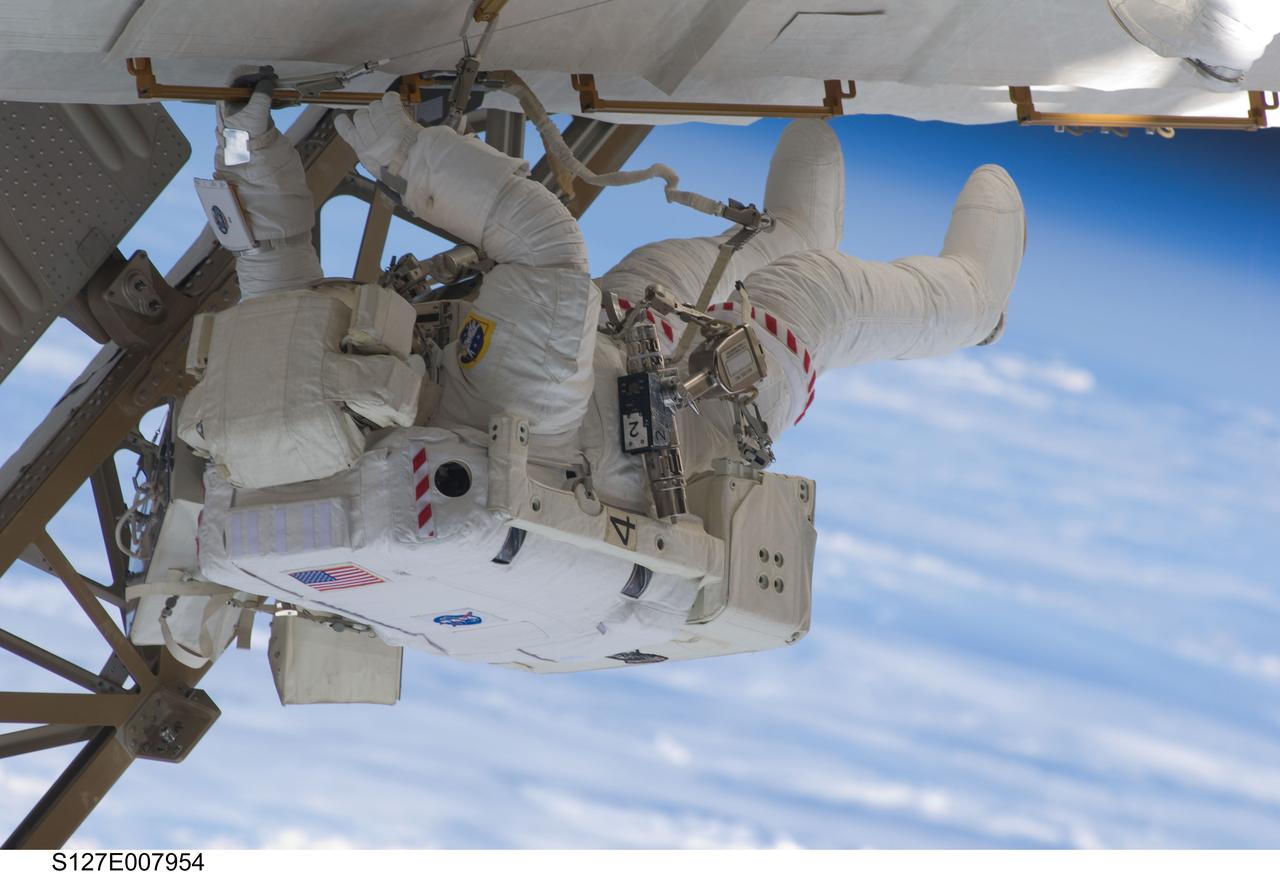
S127-E-007954 (22 July 2009) --- Astronaut Christopher Cassidy, STS-127 mission specialist, participates in Endeavour's third space walk of a scheduled five overall for this flight. This was Cassidy's first of a scheduled three sessions for him. Astronaut Dave Wolf, Cassidy's EVA colleague, is out of frame.
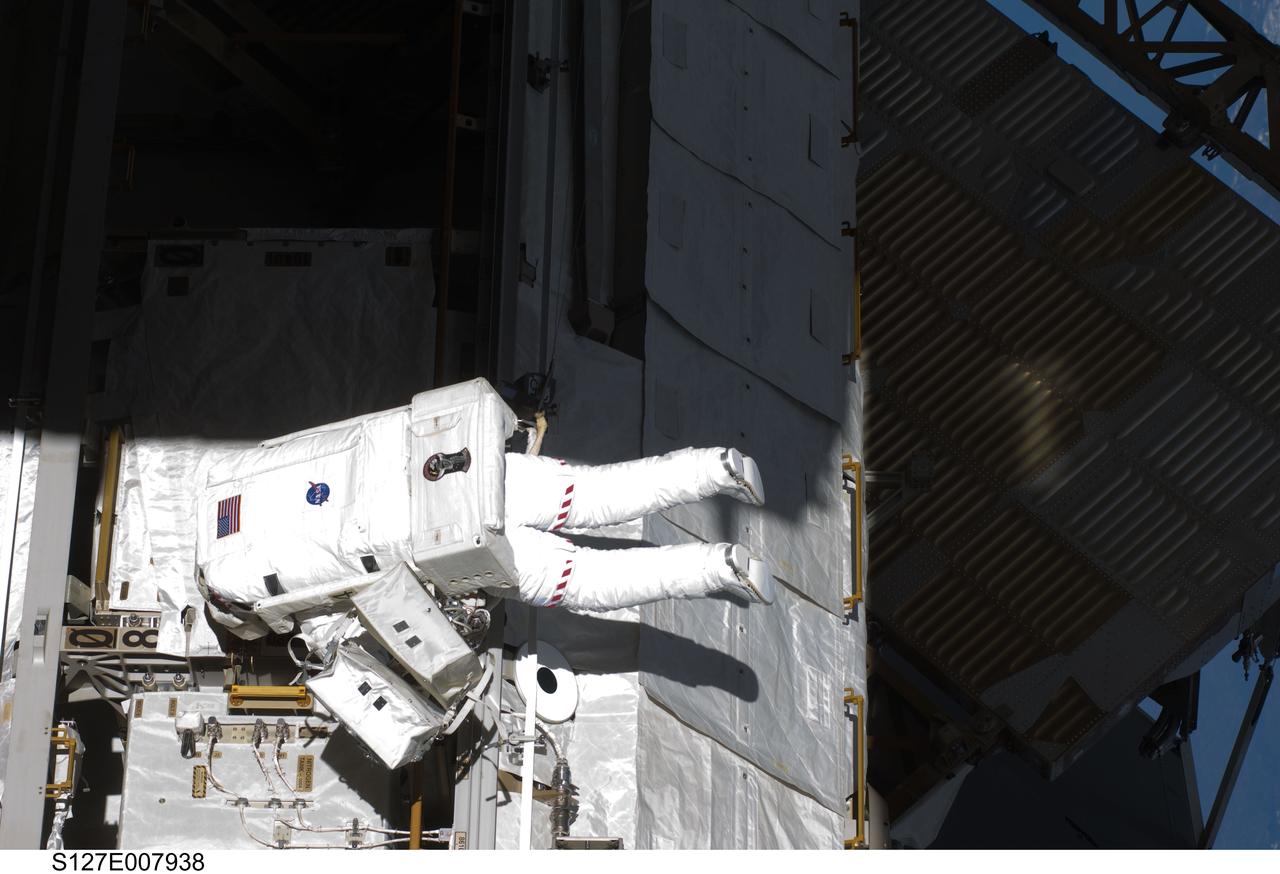
S127-E-007938 (22 July 2009) --- Astronaut Christopher Cassidy, STS-127 mission specialist, participates in Endeavour's third space walk of a scheduled five overall for this flight. This was Cassidy's first of a scheduled three sessions for him. Astronaut Dave Wolf, Cassidy's EVA colleague, is out of frame.
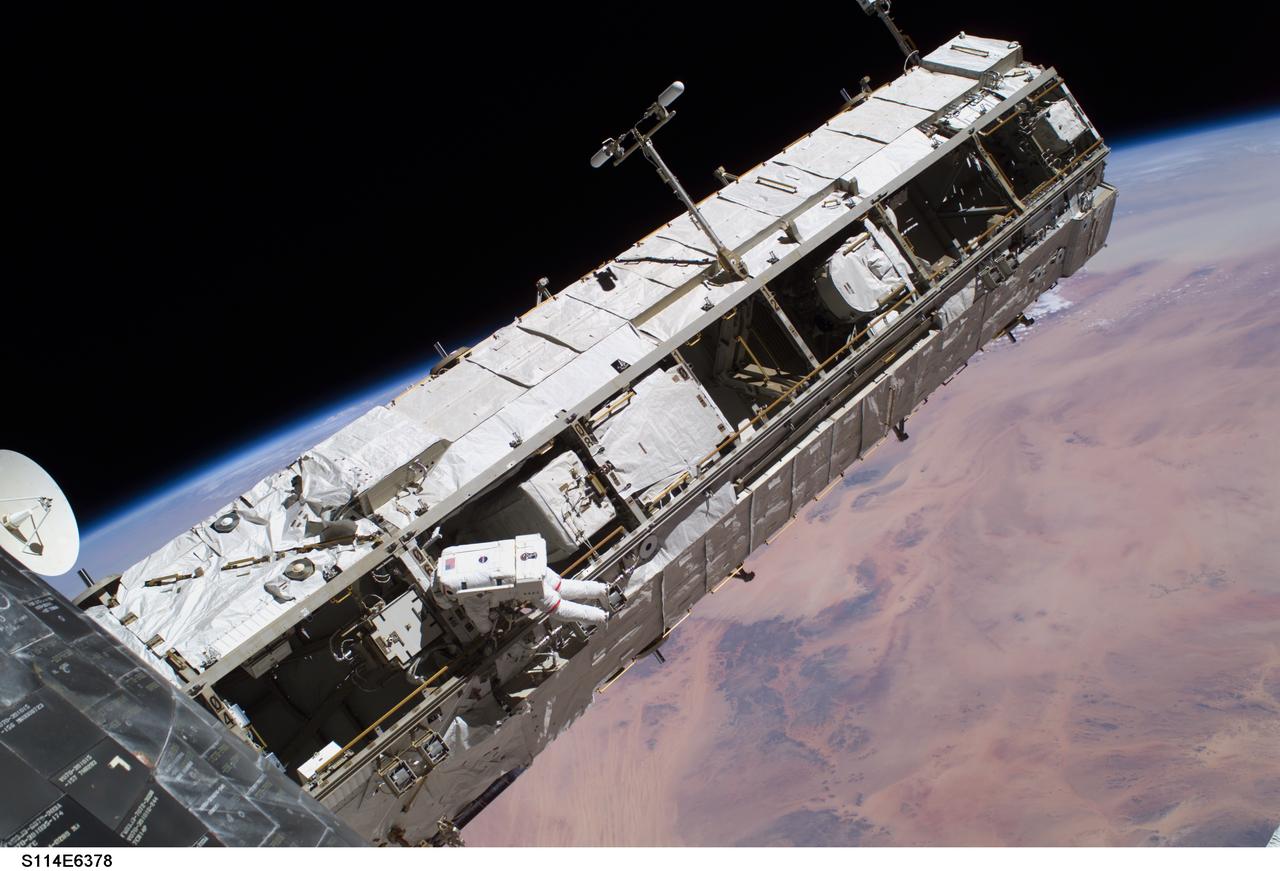
S114-E-6378 (3 August 2005) --- While perched on a Space Station truss, astronaut Soichi Noguchi, STS-114 mission specialist representing Japan Aerospace Exploration Agency (JAXA), acts as observer and communication relay station between fellow spacewalker Stephen K. Robinson (out of frame) and astronaut Andrew S. W. Thomas aboard Space Shuttle Discovery during a part of the mission’s third session of extravehicular activities (EVA). A portion of the thermal protection tiles on Discovery’s underside is visible at lower left. The image was photographed by Robinson using a digital camera.
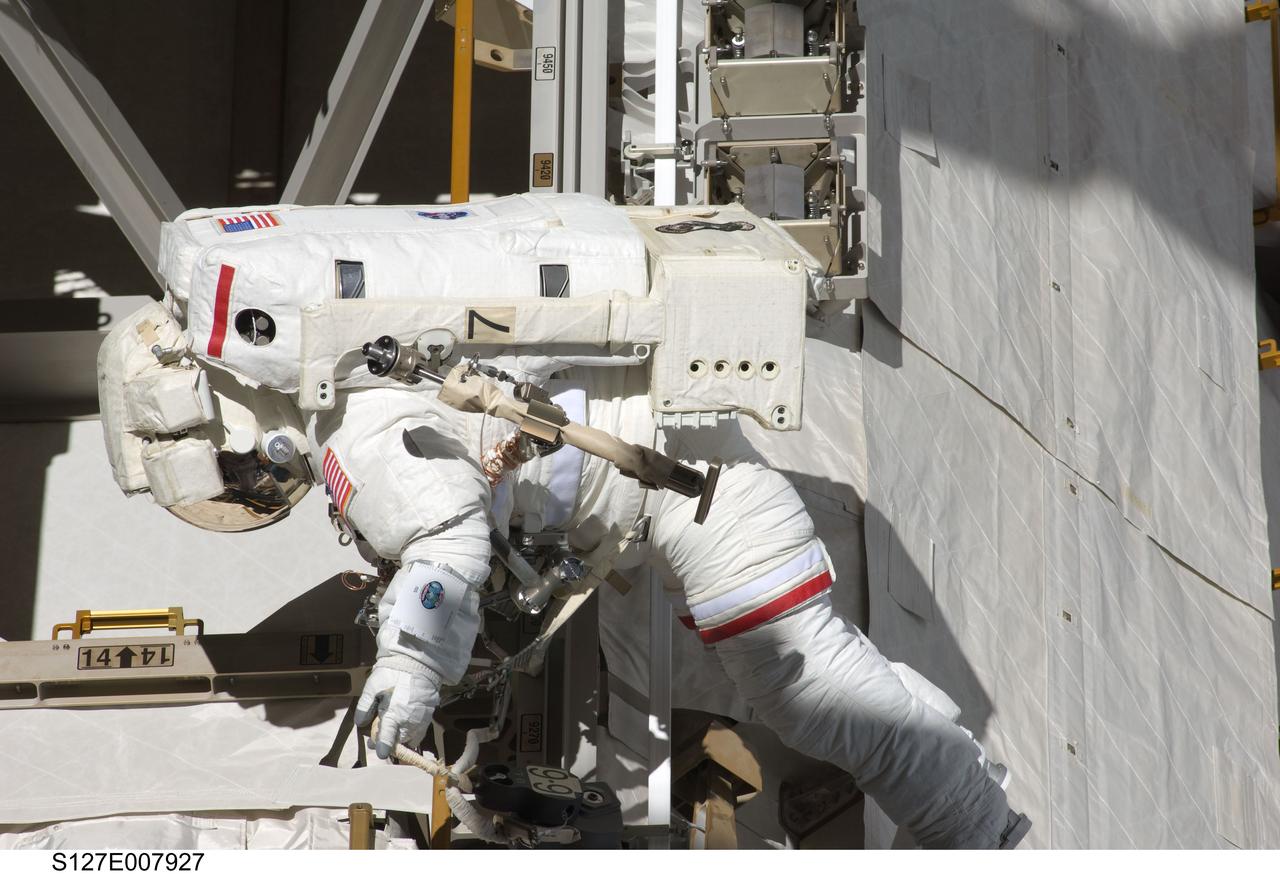
S127-e-007927 (22 July 2009) --- Astronaut Dave Wolf, mission specialist, is pictured during his third and final STS-127 session of extravehicular activity. The crew has two more spacewalks scheduled after this to continue work on the International Space Station.
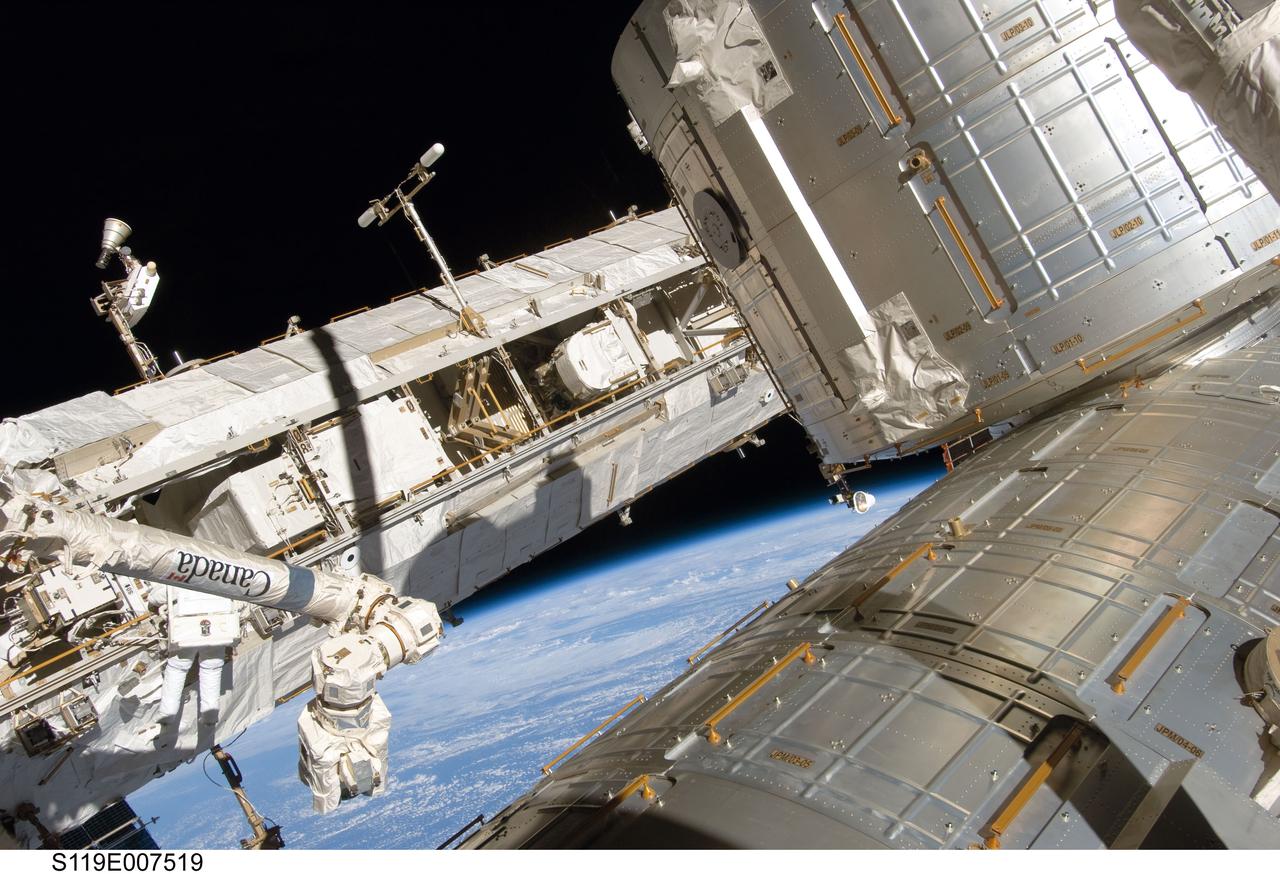
S119-E-007519 (23 March 2009) --- Astronaut Richard Arnold (lower left on port truss), STS-119 mission specialist, participates in the mission's third scheduled session of extravehicular activity (EVA) as construction and maintenance continue on the International Space Station. During the six-hour, 27-minute spacewalk, Arnold and Joseph Acaba (out of frame), mission specialist, helped robotic arm operators relocate the Crew Equipment Translation Aid (CETA) cart from the Port 1 to Starboard 1 truss segment, installed a new coupler on the CETA cart, lubricated snares on the "B" end of the space station's robotic arm and performed a few "get ahead" tasks. The Japanese Kibo laboratory is visible at right, and the station’s Canadarm2 is at left. The blackness of space and Earth’s horizon provide the backdrop for the scene.
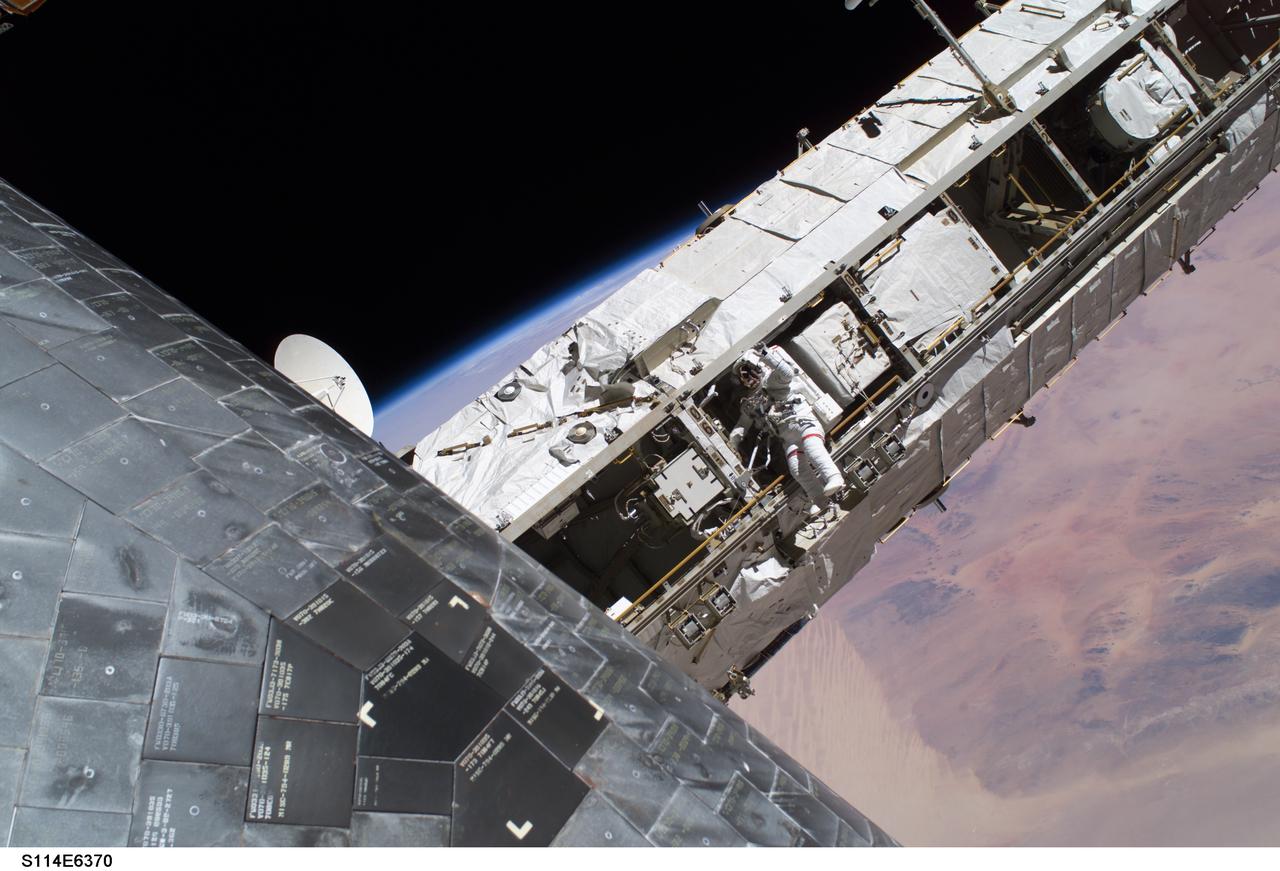
S114-E-6370 (3 August 2005) --- While perched on a Space Station truss, astronaut Soichi Noguchi, STS-114 mission specialist representing Japan Aerospace Exploration Agency (JAXA), acts as observer and communication relay station between fellow spacewalker Stephen K. Robinson (out of frame) and astronaut Andrew S. W. Thomas aboard Space Shuttle Discovery during the mission’s third session of extravehicular activities (EVA). A portion of the thermal protection tiles on Discovery’s underside is visible at lower left. The image was photographed by Robinson using a digital camera.
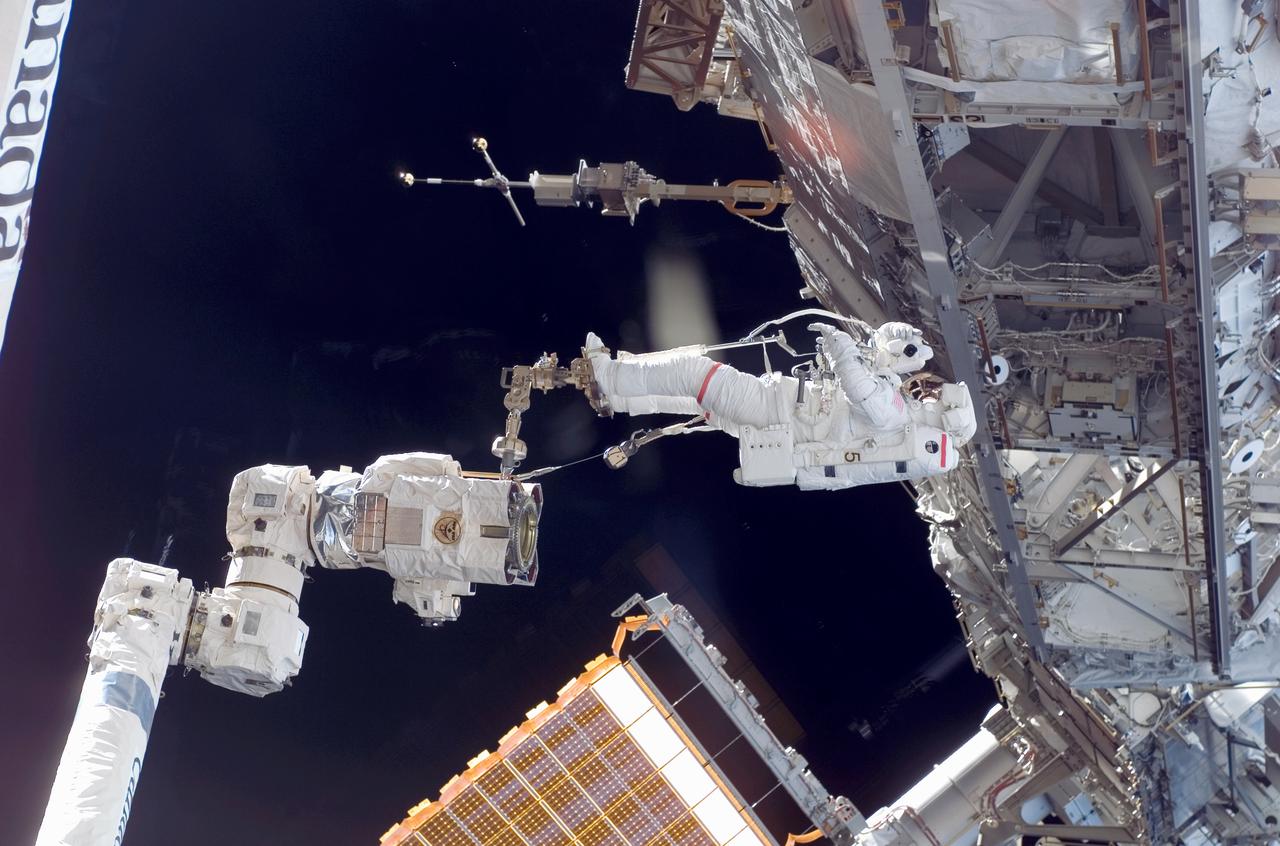
As the construction continued on the International Space Station (ISS), STS-118 astronaut and mission specialist Rick Mastracchio was anchored on the foot restraint of the Canadarm2 as he participated in the third session of Extra Vehicular Activity (EVA) for the mission. Assisting Mastracchio was Expedition 15 flight engineer Clay Anderson (out of frame). During the 5 hour, 28 minute space walk, the two relocated the S-band Antenna Sub-Assembly from the Port 6 (P6) truss to the Port 1 (P1) truss, installed a new transponder on P1 and retrieved the P6 transponder.