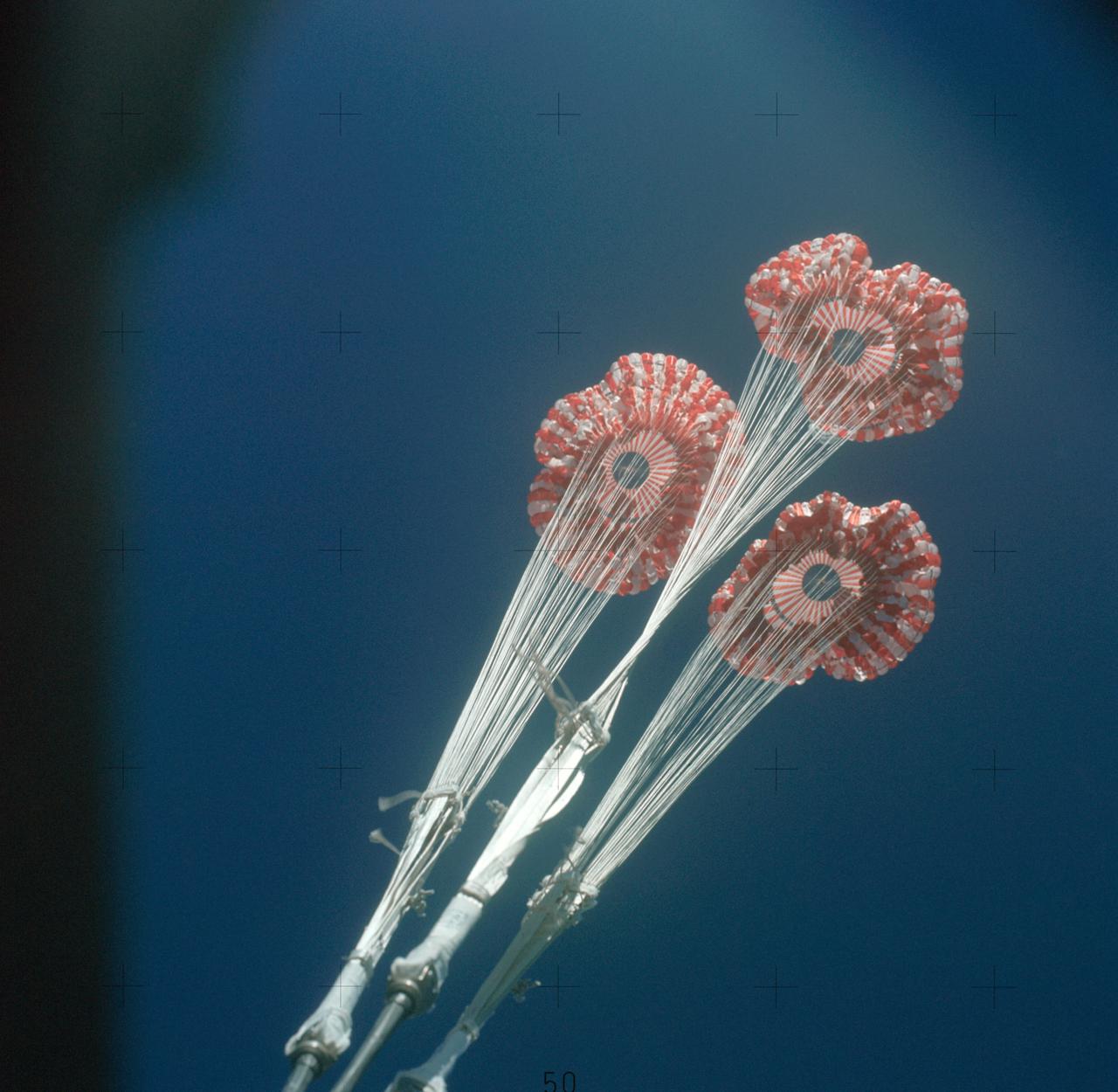
SL3-114-1760 (25 Sept. 1973) --? An excellent view of the three main ring sail parachutes of the Skylab 3 command module as they unfurl during descent to a successful splashdown in the Pacific Ocean. This picture was taken by a hand-held 70mm Hasselblad camera, looking up through a window of the command module. These parachutes open at approximately 10,000 feet altitude. Aboard the CM were astronauts Alan L. Bean, Owen K. Garriott and Jack R. Lousma, who had just completed a 59-day visit to the Skylab space station in Earth orbit. Photo credit: NASA
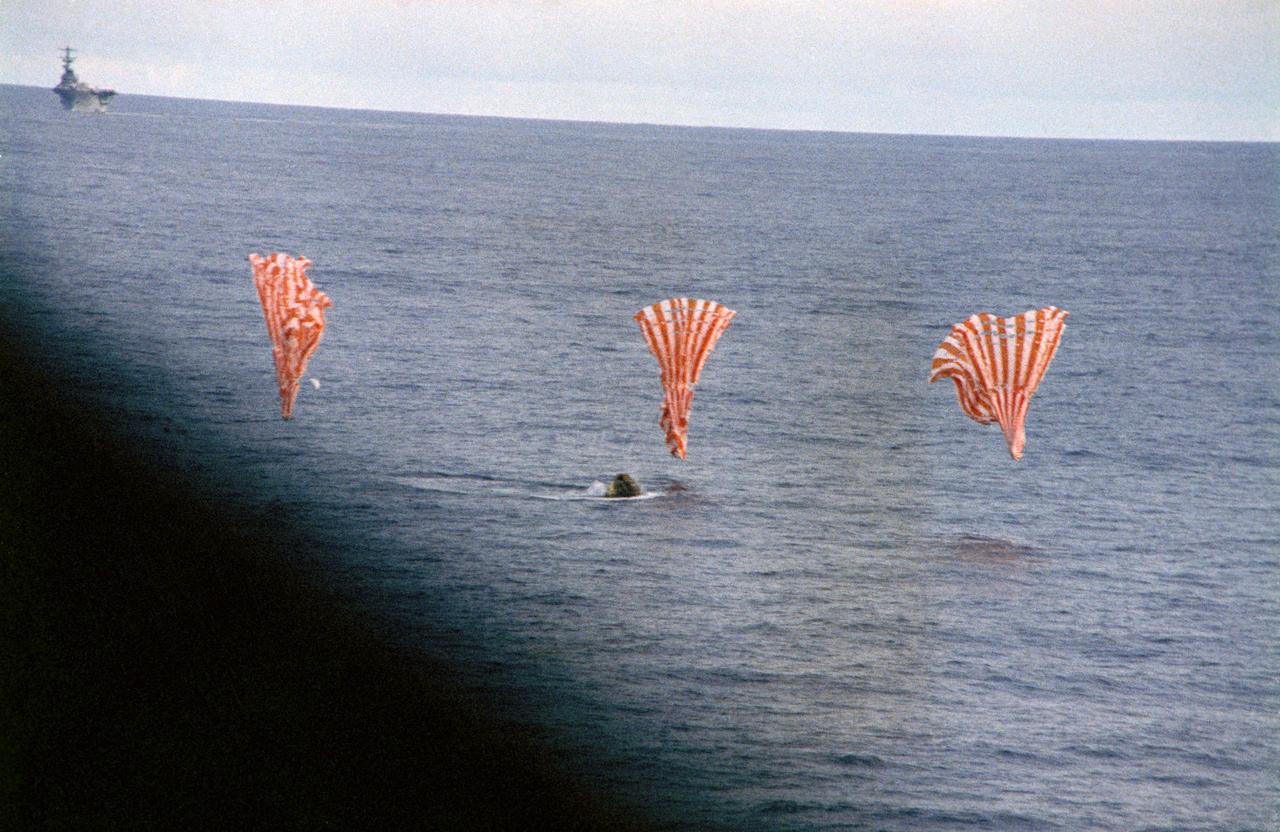
S70-35644 (17 April 1970) --- The Apollo 13 Command Module (CM) splashes down and its three main parachutes collapse, as the week-long problem-plagued Apollo 13 mission comes to a premature, but safe end. The spacecraft, with astronauts James A. Lovell Jr., commander; John L. Swigert Jr., command module pilot; and Fred W. Haise Jr., lunar module pilot, aboard splashed down at 12:07:44 p.m. (CST) April 17, 1970, in the South Pacific Ocean, only about four miles from the USS Iwo Jima, prime recovery ship.
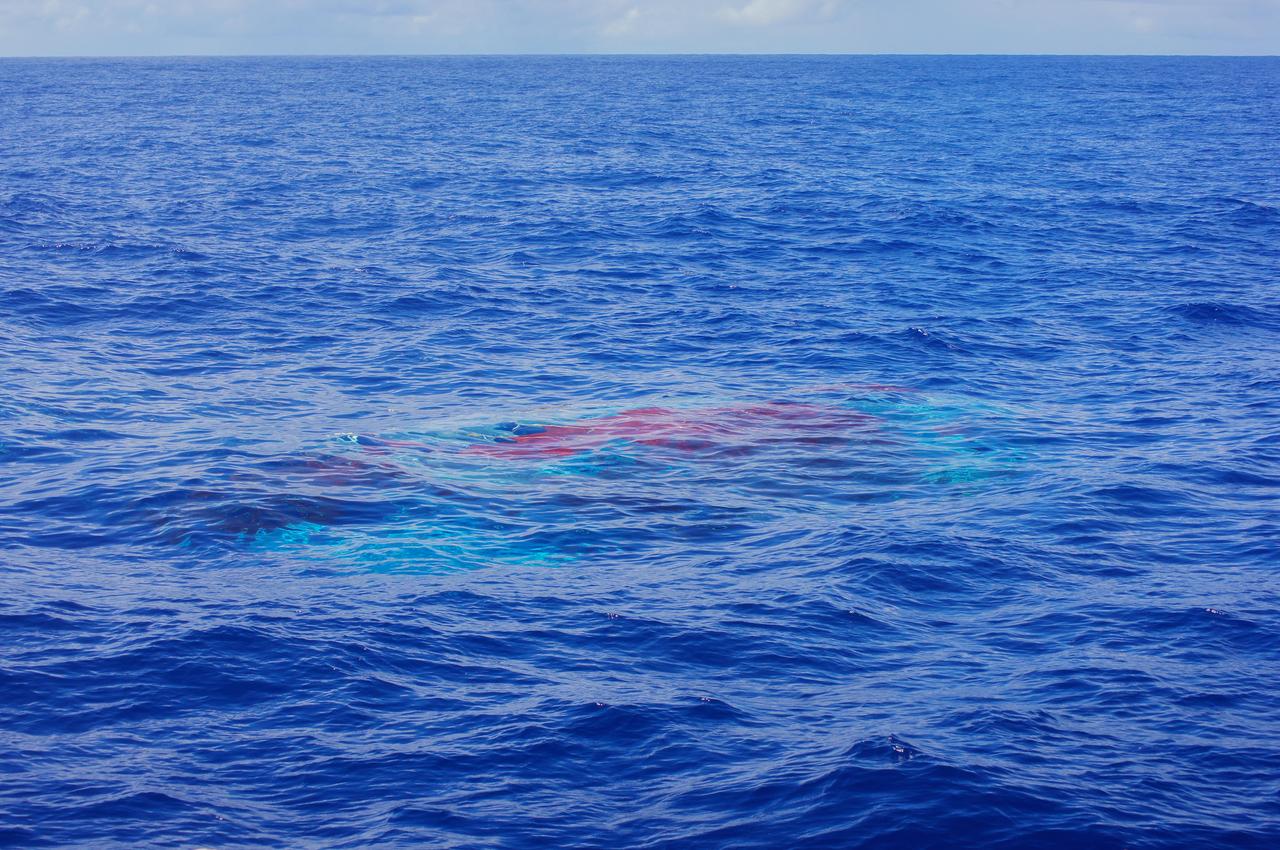
NASA Supersonic Disk Sail Parachute, one of the new technologies being developed as part of NASA Low-Density Supersonic Decelerator LDSD project, floats just below the surface of the Pacific Ocean on June 28, 2014.
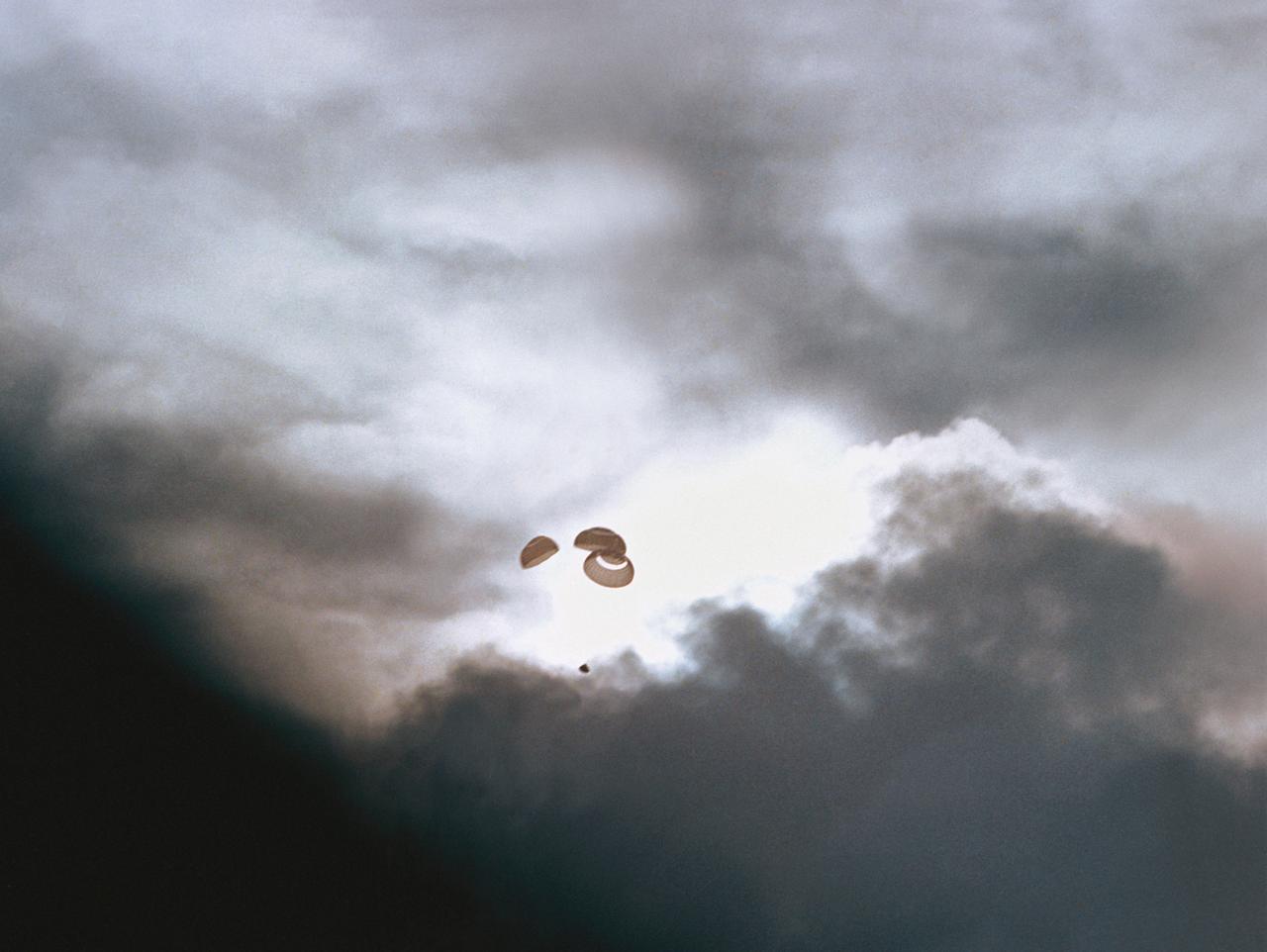
S70-35652 (17 April 1970) --- The Apollo 13 spacecraft heads toward a splashdown in the South Pacific Ocean. The Apollo 13 Command Module splashed down in the South Pacific at 12:07:44 p.m., April 17, 1970. Note the capsule and its parachutes just visible against a gap in the dark clouds.
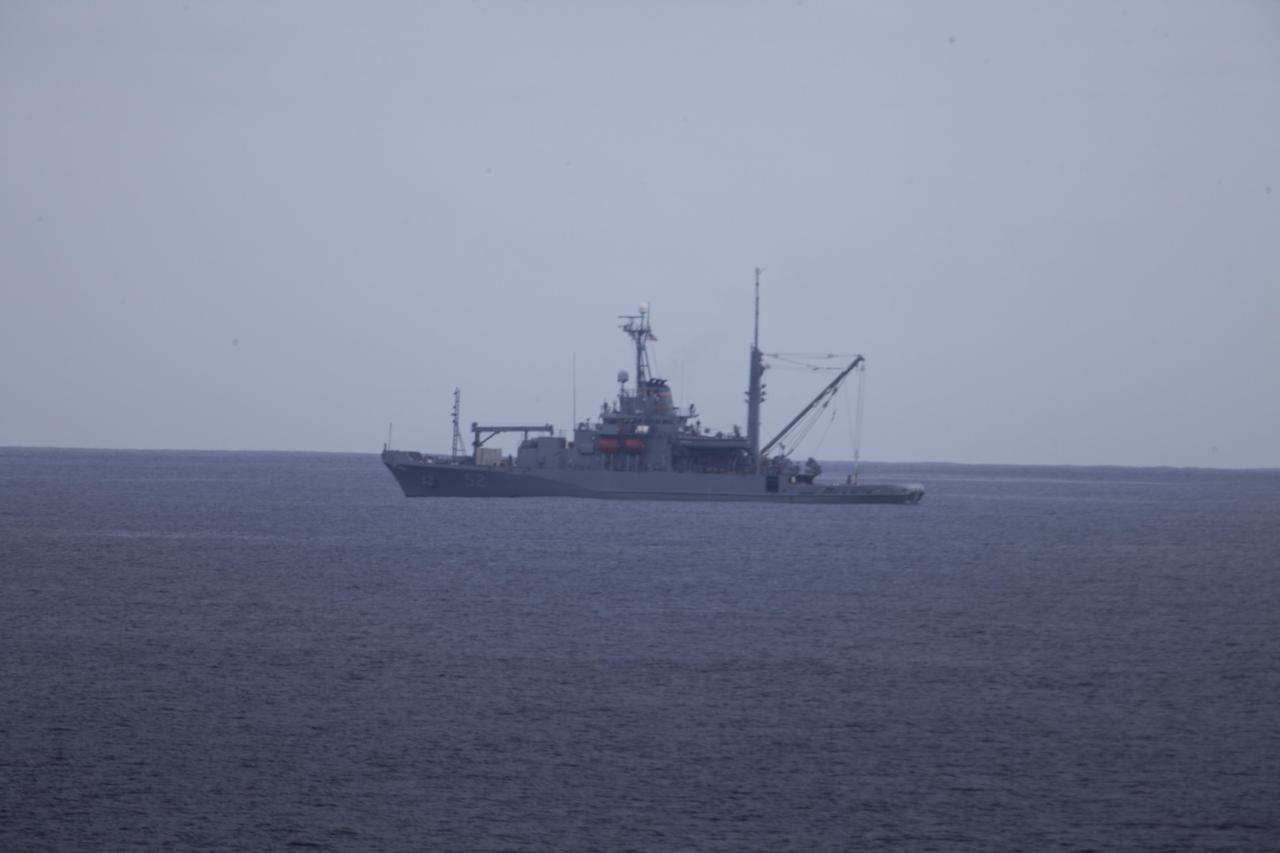
On the third day of preparations for recovery of Orion after its splashdown in the Pacific Ocean, the USNS Salvor is in the Pacific Ocean, nearby the USS Anchorage, about 600 miles off the coast of Baja, California. The Salvor will be used to recover Orion in the event that the spacecraft cannot be recovered using the well deck of the USS Anchorage. NASA, Lockheed Martin and U.S. Navy personnel are preparing for recovery of the crew module, forward bay cover and parachutes after the spacecraft's return from space and splashdown in the Pacific Ocean. The Ground Systems Development and Operations Program is leading the recovery efforts.
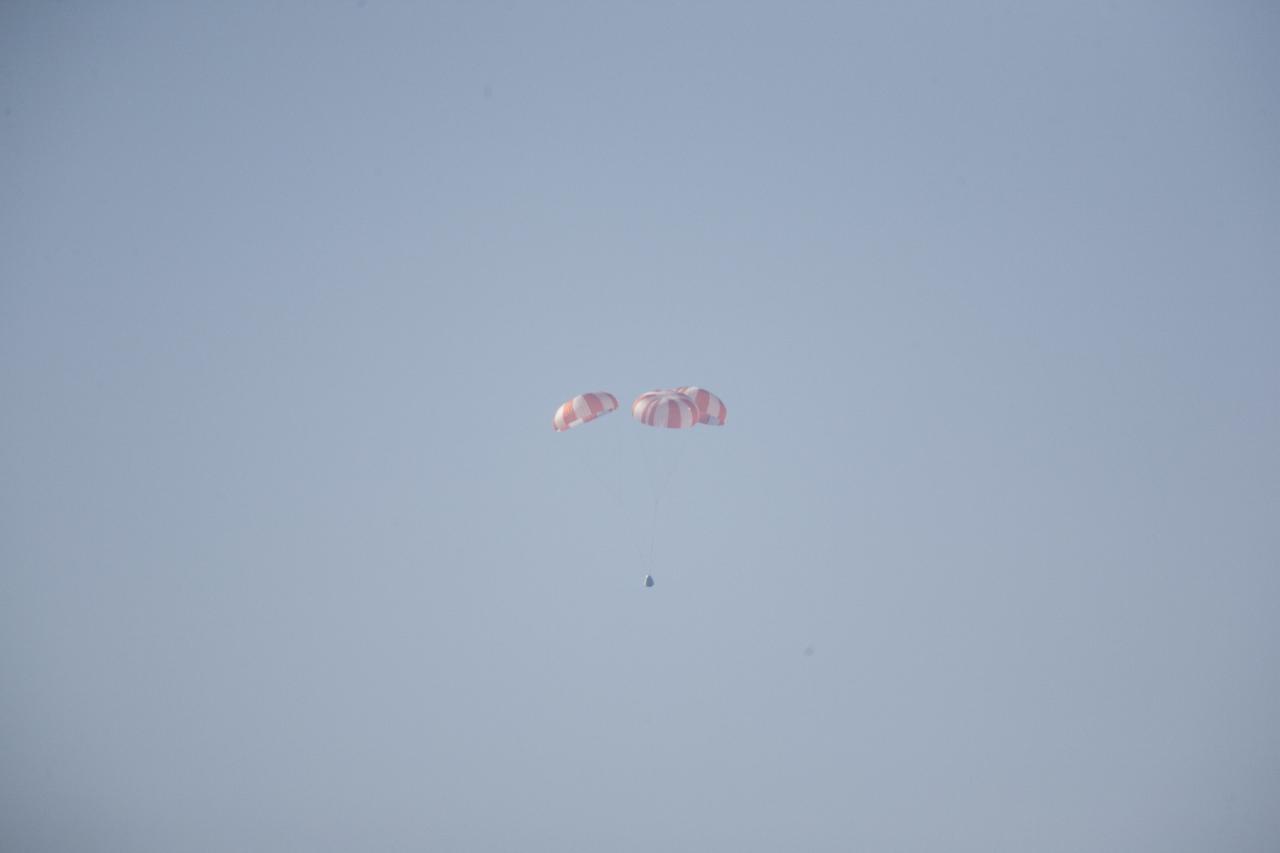
MORRO BAY, Calif. – The SpaceX main parachutes control the descent of the Dragon test article following a test over the Pacific Ocean, off the coast of Morro Bay, Calif. The test enabled SpaceX engineers to evaluate the spacecraft's parachute deployment system as part of a milestone under its Commercial Crew Integrated Capability agreement with NASA's Commercial Crew Program. The parachute test took place at Marro Bay, Calif. Photo credit: NASA/Kim Shiflett
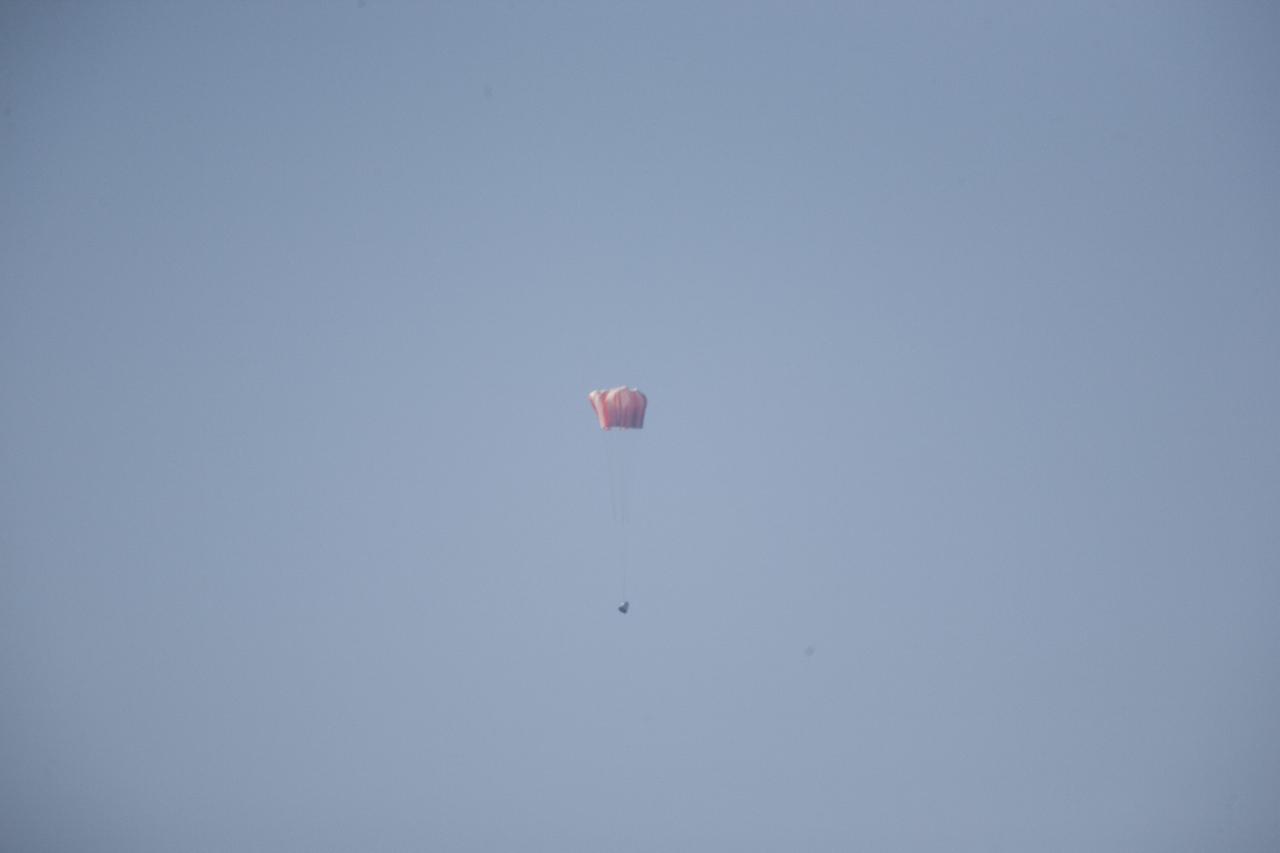
MORRO BAY, Calif. – The main parachutes open above a the Dragon test article during a test over the Pacific Ocean, off the coast of Morro Bay, Calif. The test enabled SpaceX engineers to evaluate the spacecraft's parachute deployment system as part of a milestone under its Commercial Crew Integrated Capability agreement with NASA's Commercial Crew Program. The parachute test took place at Marro Bay, Calif. Photo credit: NASA/Kim Shiflett
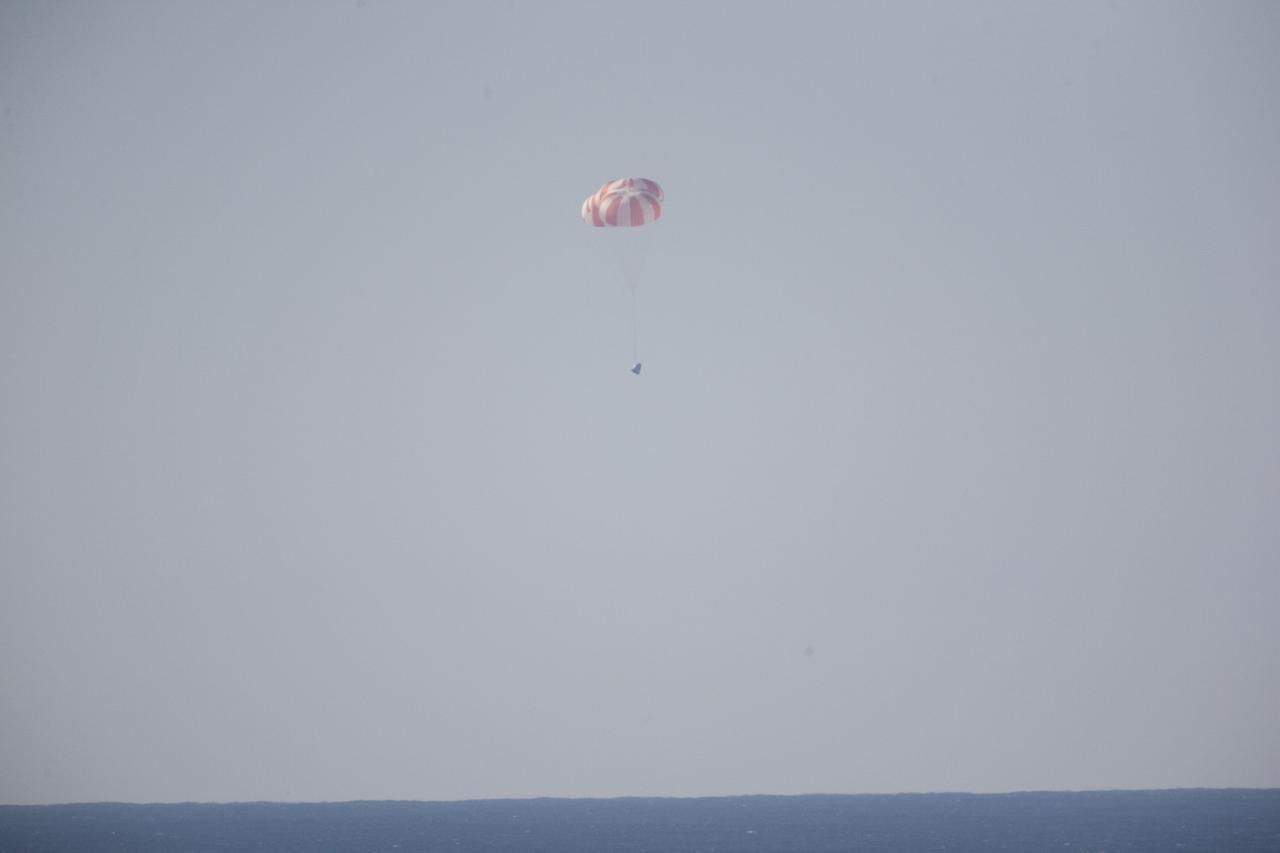
MORRO BAY, Calif. – The SpaceX main parachutes control the descent of the Dragon test article following a test over the Pacific Ocean, off the coast of Morro Bay, Calif. The test enabled SpaceX engineers to evaluate the spacecraft's parachute deployment system as part of a milestone under its Commercial Crew Integrated Capability agreement with NASA's Commercial Crew Program. The parachute test took place at Marro Bay, Calif. Photo credit: NASA/Kim Shiflett

MORRO BAY, Calif. – The SpaceX main parachutes control the descent of the Dragon test article following a test over the Pacific Ocean, off the coast of Morro Bay, Calif. The test enabled SpaceX engineers to evaluate the spacecraft's parachute deployment system as part of a milestone under its Commercial Crew Integrated Capability agreement with NASA's Commercial Crew Program. The parachute test took place at Marro Bay, Calif. Photo credit: NASA/Kim Shiflett
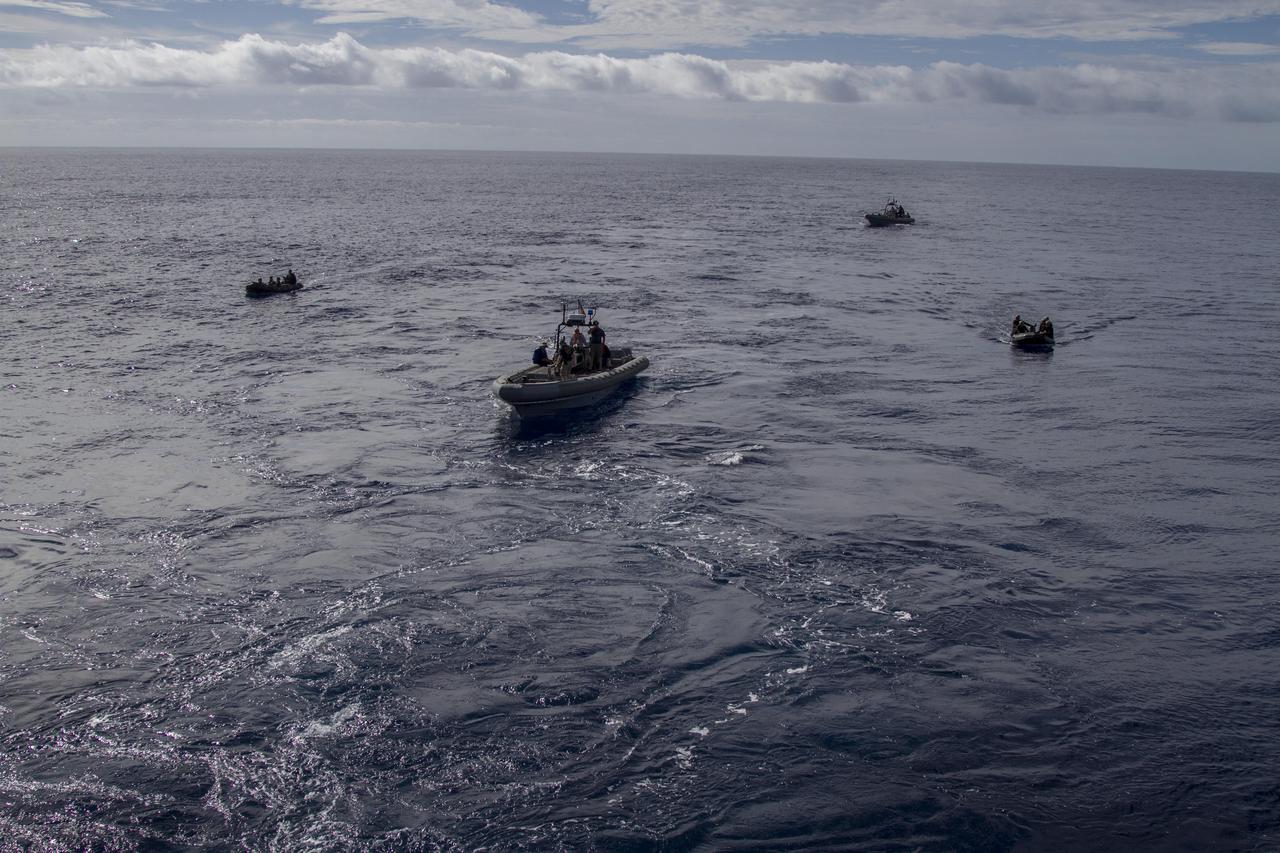
On the third day of preparations for recovery of Orion, U.S. Navy divers in two rigid hull inflatable boats and two Zodiac boats practice recovery procedures nearby the USS Anchorage in the Pacific Ocean about 600 miles off the coast of Baja, California. NASA, Lockheed Martin and U.S. Navy personnel are preparing for recovery of the Orion crew module, forward bay cover and parachutes after its return from space and splashdown in the Pacific Ocean. The Ground Systems Development and Operations Program is leading the recovery efforts.
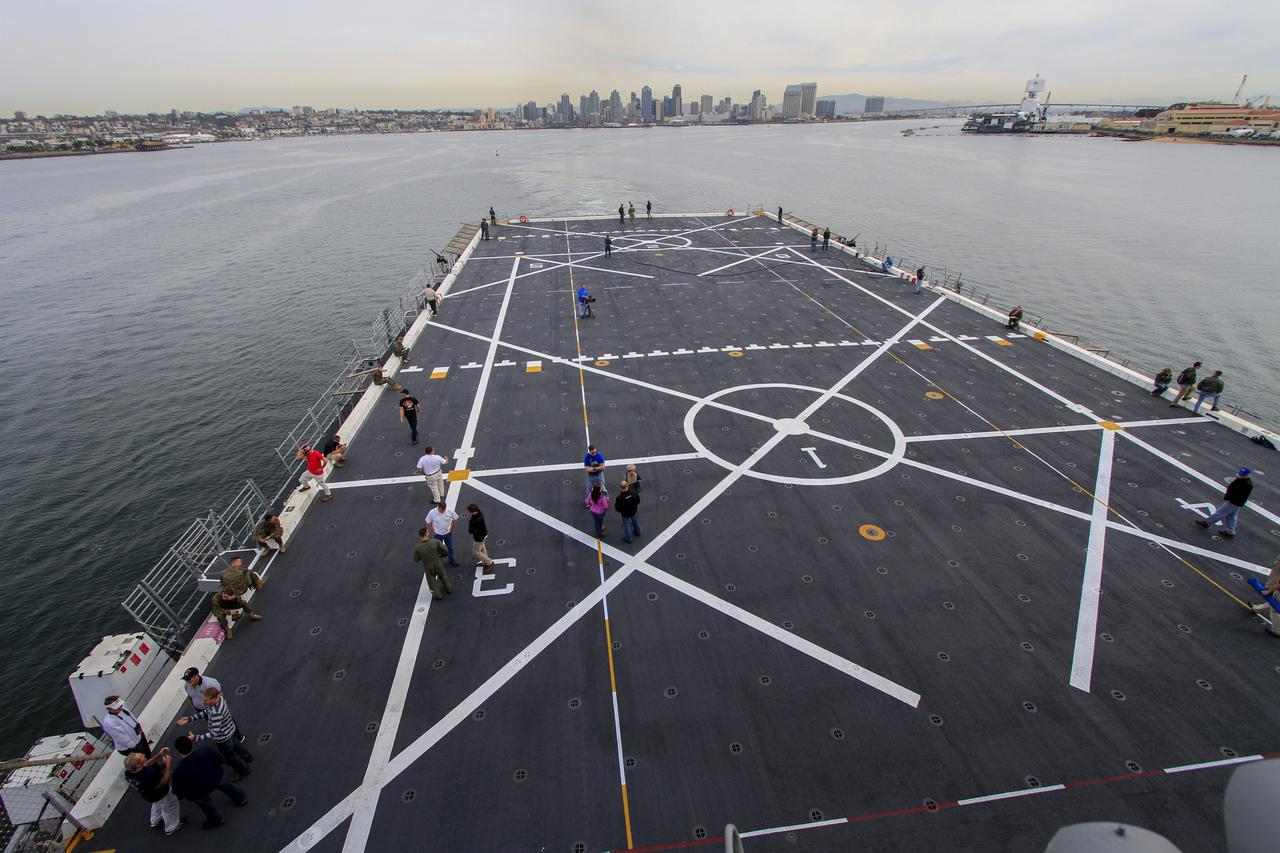
NASA and U.S. Navy personnel are on the deck of the USS Anchorage as the ship departs Naval Base San Diego and heads out to sea in the Pacific Ocean. NASA and the U.S. Navy are making preparations ahead of Orion's flight test for recovery of the crew module, forward bay cover and parachutes on its return from space and splashdown in the Pacific Ocean. The Ground Systems Development and Operations Program is leading the recovery efforts.
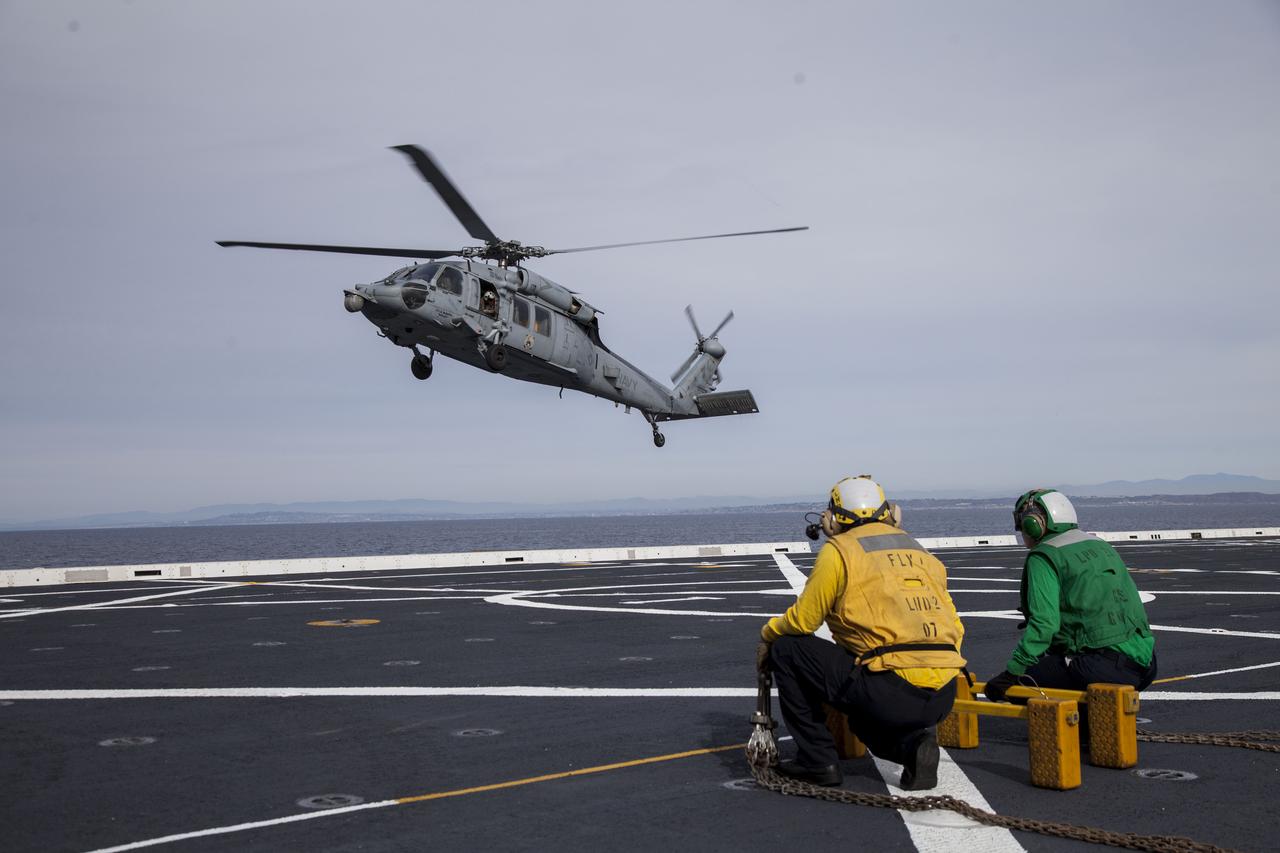
An H60-S Seahawk helicopter lands on the deck of the USS Anchorage in the Pacific Ocean off the coast of California. NASA and the U.S. Navy are heading out to sea ahead of Orion's flight test to prepare for recovery of the crew module, forward bay cover and parachutes on its return from space and splashdown in the Pacific Ocean. The Ground Systems Development and Operations Program is leading the recovery efforts.
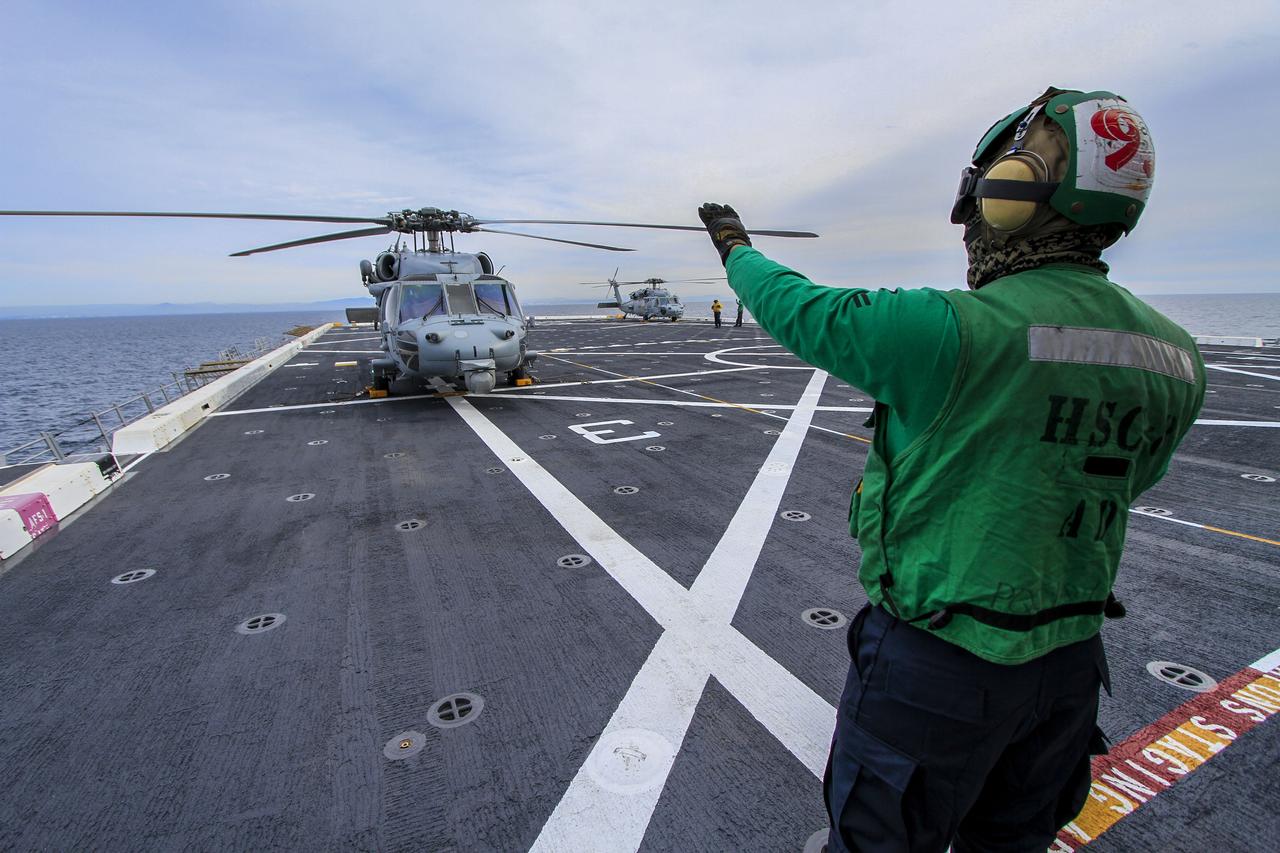
A member of the Helicopter Sea Combat Squadron 8 signals to the pilot in an H60-S Seahawk helicopter on the deck of the USS Anchorage as the ship departs Naval Base San Diego in California for the open waters of the Pacific Ocean. NASA and the U.S. Navy are making preparations ahead of Orion's flight test for recovery of the crew module, forward bay cover and parachutes on its return from space and splashdown in the Pacific Ocean. The Ground Systems Development and Operations Program is leading the recovery efforts.
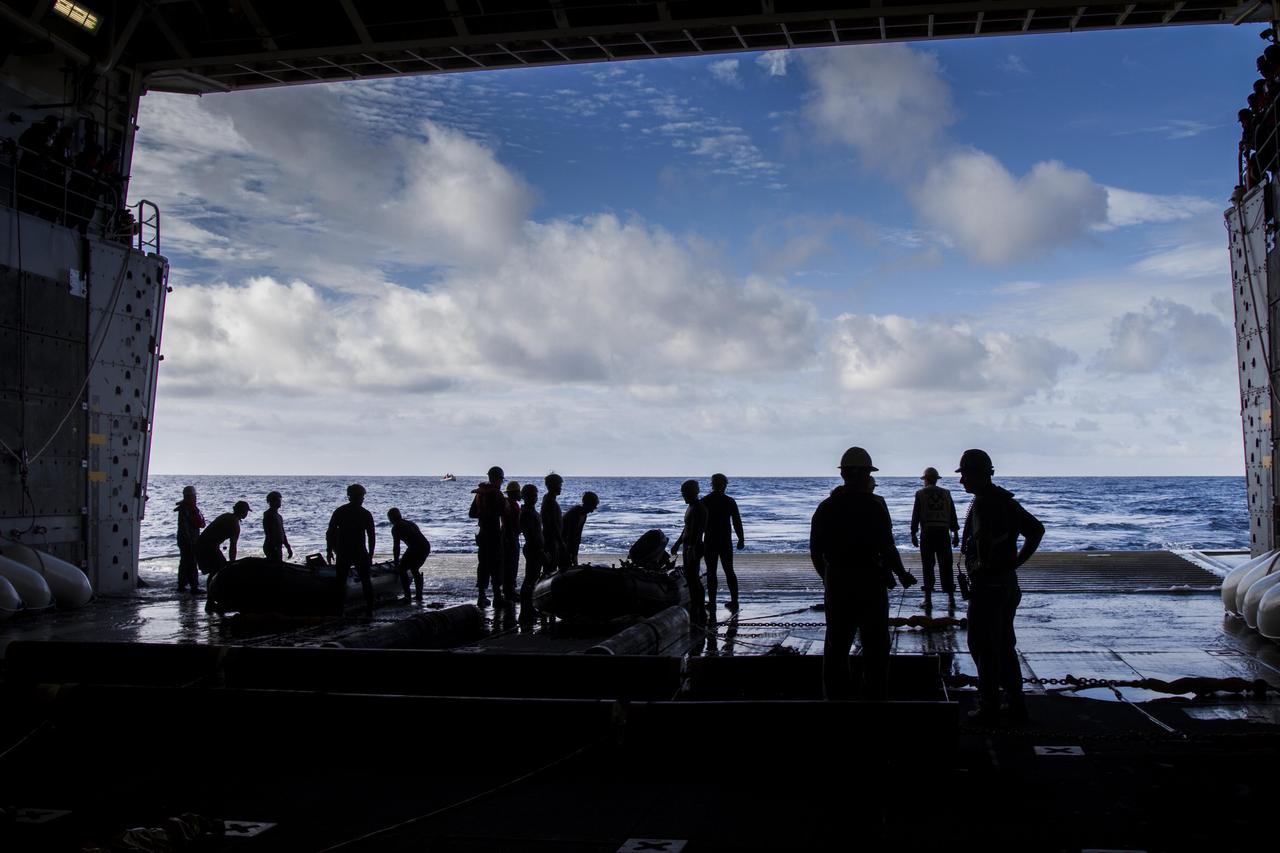
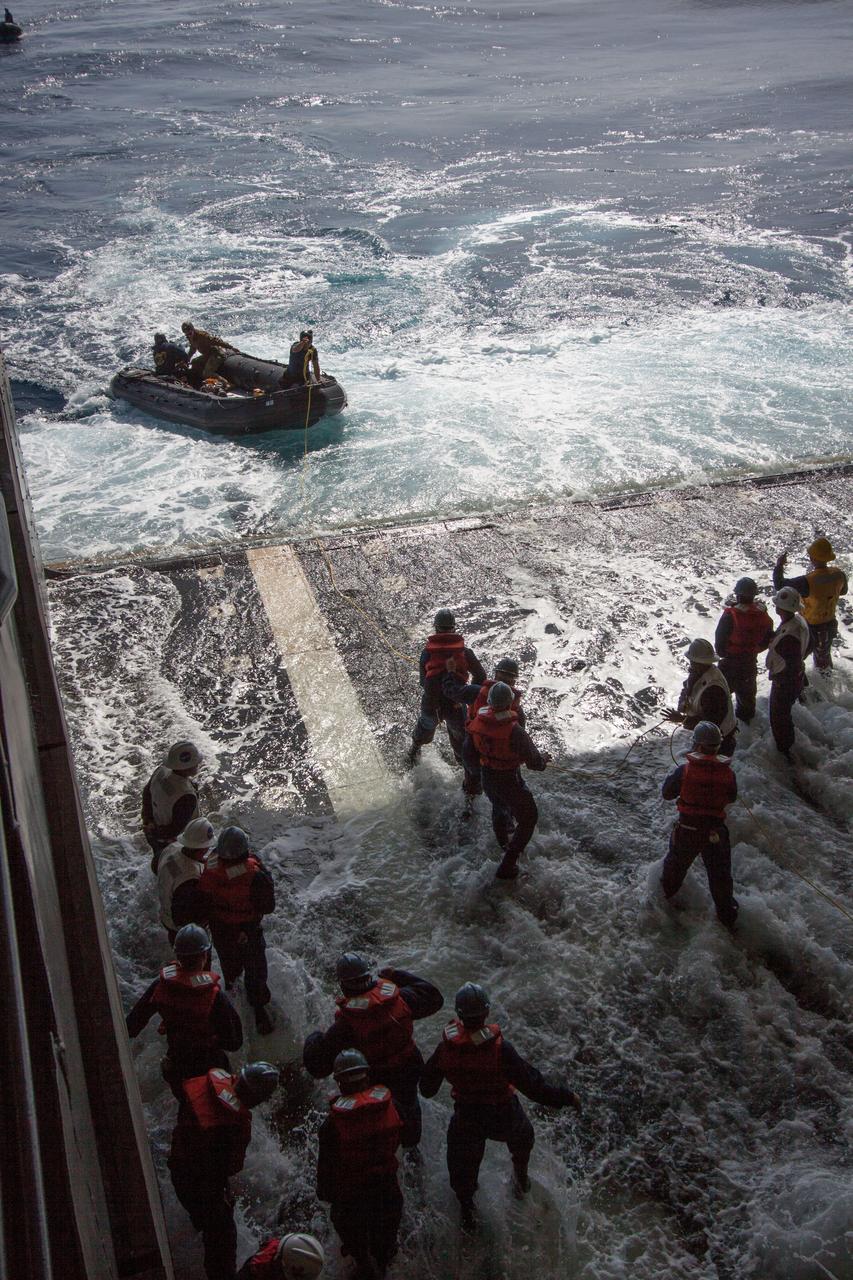
On the third day of preparations for recovery of Orion after its splashdown in the Pacific Ocean, U.S. Navy Divers prepare to embark from the well deck of the USS Anchorage in two rigid hull Zodiac boats about 600 miles off the coast of Baja, California. NASA, Lockheed Martin and U.S. Navy personnel are preparing for recovery of the crew module, forward bay cover and parachutes on its return from space and splashdown in the Pacific Ocean. The Ground Systems Development and Operations Program is leading the recovery efforts.
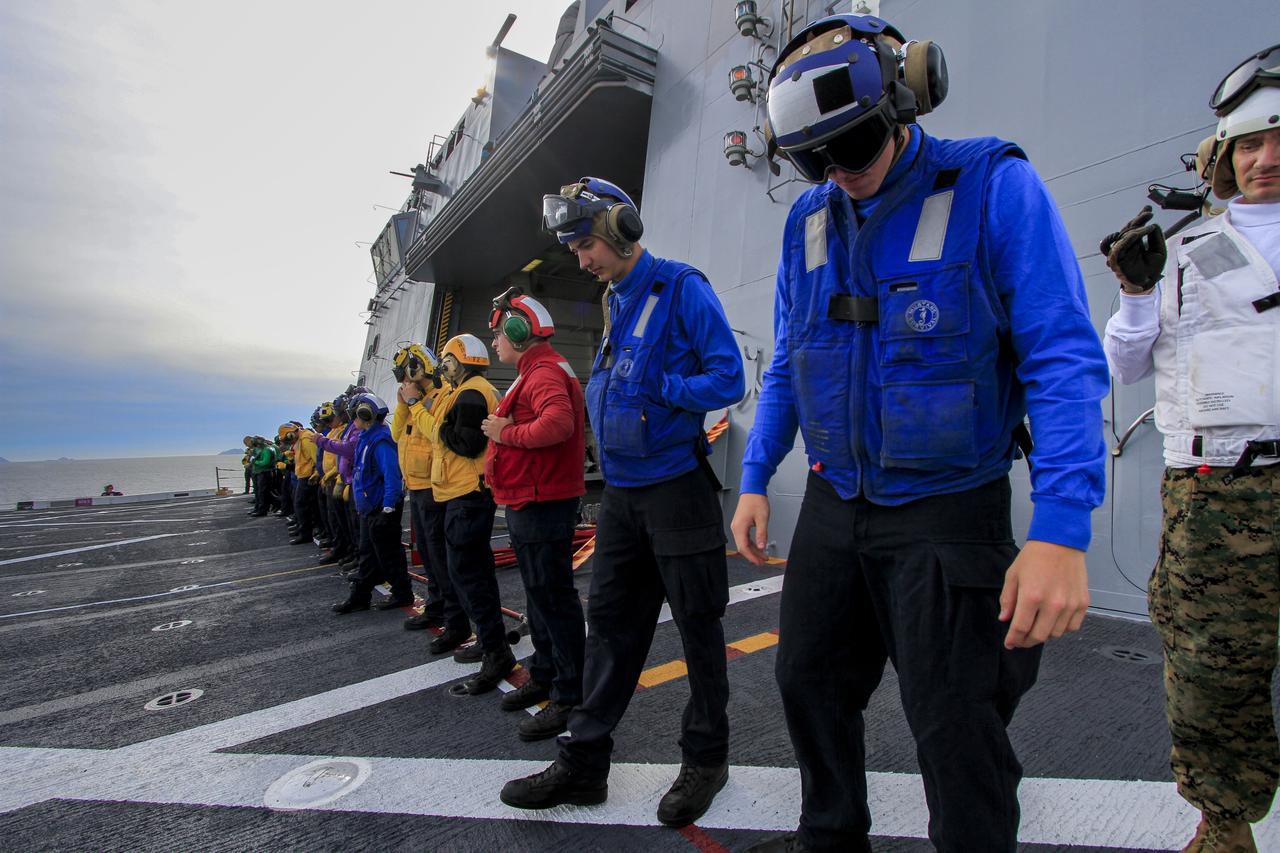
Helicopter Sea Combat Squadron 8 personnel review procedures on the deck of the USS Anchorage as the ship departs Naval Base San Diego in California for the open waters of the Pacific Ocean. NASA and the U.S. Navy are making preparations ahead of Orion's flight test for recovery of the crew module, forward bay cover and parachutes on its return from space and splashdown in the Pacific Ocean. The Ground Systems Development and Operations Program is leading the recovery efforts.
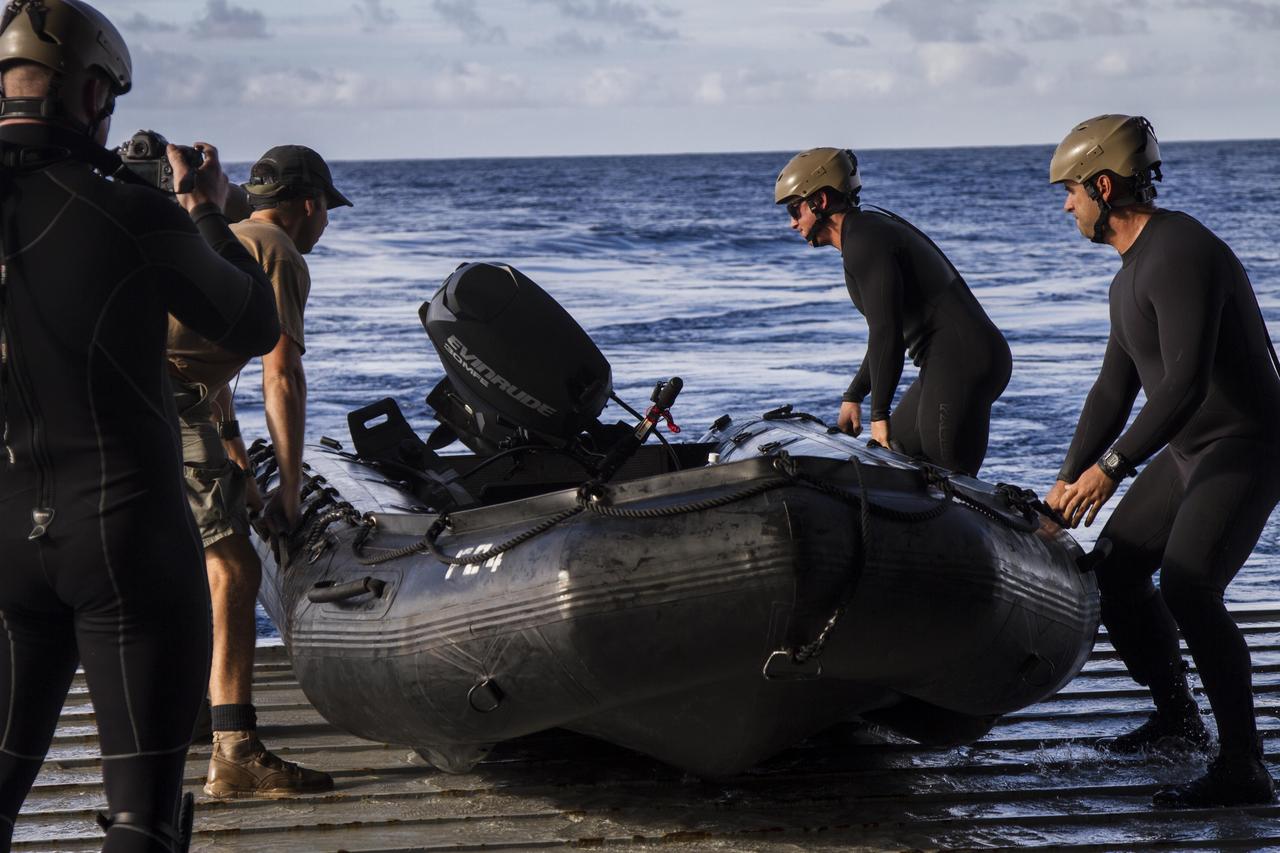
On the third day of preparations for recovery of Orion after its splashdown in the Pacific Ocean, U.S. Navy Divers prepare to embark from the well deck of the USS Anchorage in a rigid hull Zodiac boat about 600 miles off the coast of Baja, California. NASA, Lockheed Martin and U.S. Navy personnel are preparing for recovery of the crew module, forward bay cover and parachutes on its return from space and splashdown in the Pacific Ocean. The Ground Systems Development and Operations Program is leading the recovery efforts.
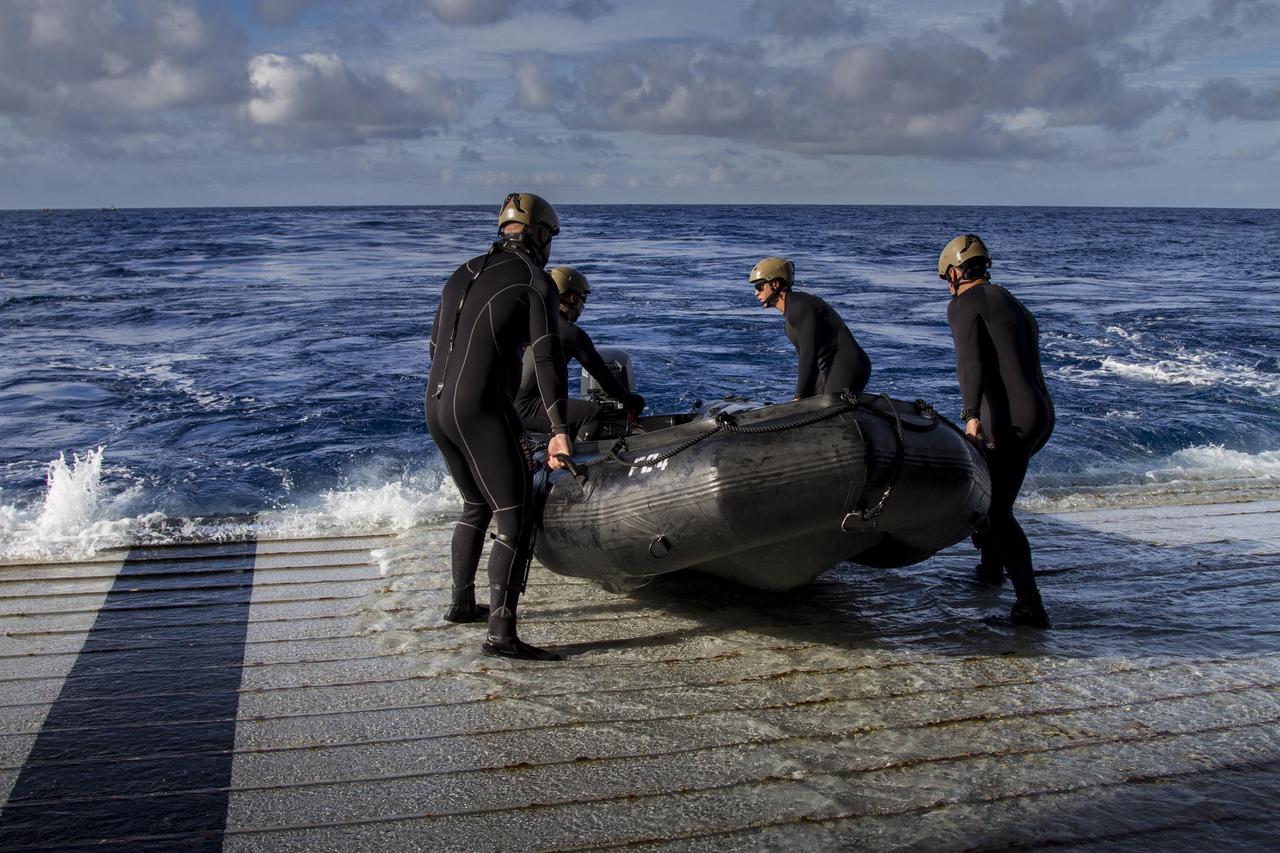
On the third day of preparations for recovery of Orion after its splashdown in the Pacific Ocean, U.S. Navy Divers prepare to embark from the well deck of the USS Anchorage in a rigid hull Zodiac boat about 600 miles off the coast of Baja, California. NASA, Lockheed Martin and U.S. Navy personnel are preparing for recovery of the crew module, forward bay cover and parachutes on its return from space and splashdown in the Pacific Ocean. The Ground Systems Development and Operations Program is leading the recovery efforts.
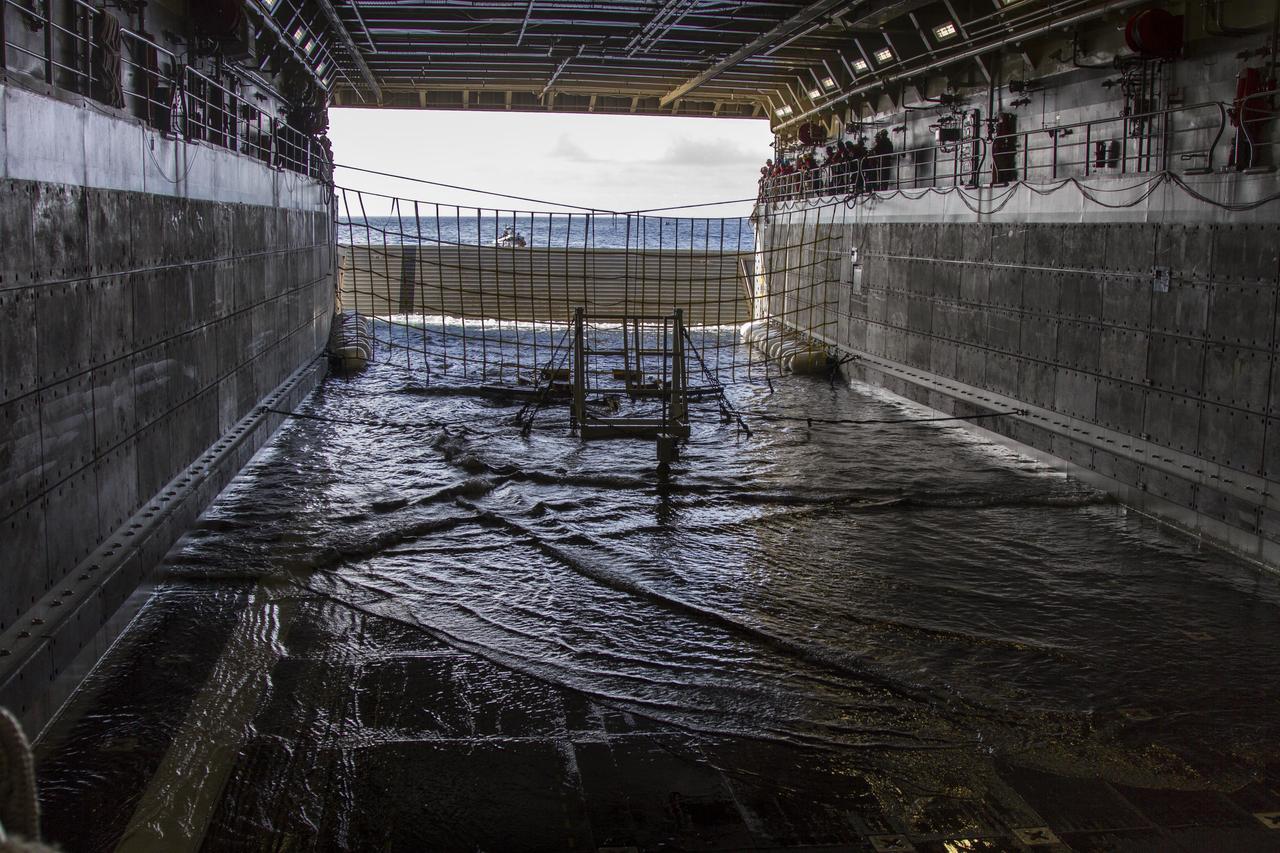
On the third day of preparations for recovery of Orion after its splashdown in the Pacific Ocean, the well deck of the USS Anchorage has been filled with water and recovery hardware is in place. The ship is about 600 miles off the coast of Baja, California. NASA, Lockheed Martin and U.S. Navy personnel are preparing for recovery of the crew module, forward bay cover and parachutes on its return from space and splashdown in the Pacific Ocean. The Ground Systems Development and Operations Program is leading the recovery efforts.

On the third day of preparations for recovery of Orion, pilots in two H60-S Seahawk helicopters practice take-off and search from the deck of the USS Anchorage in the Pacific Ocean about 600 miles off the coast of Baja, California. NASA, Lockheed Martin and U.S. Navy personnel are preparing to recover the Orion crew module, forward bay cover and parachutes after the spacecraft's return from space and splashdown in the Pacific Ocean. The Ground Systems Development and Operations Program is leading the recovery efforts.
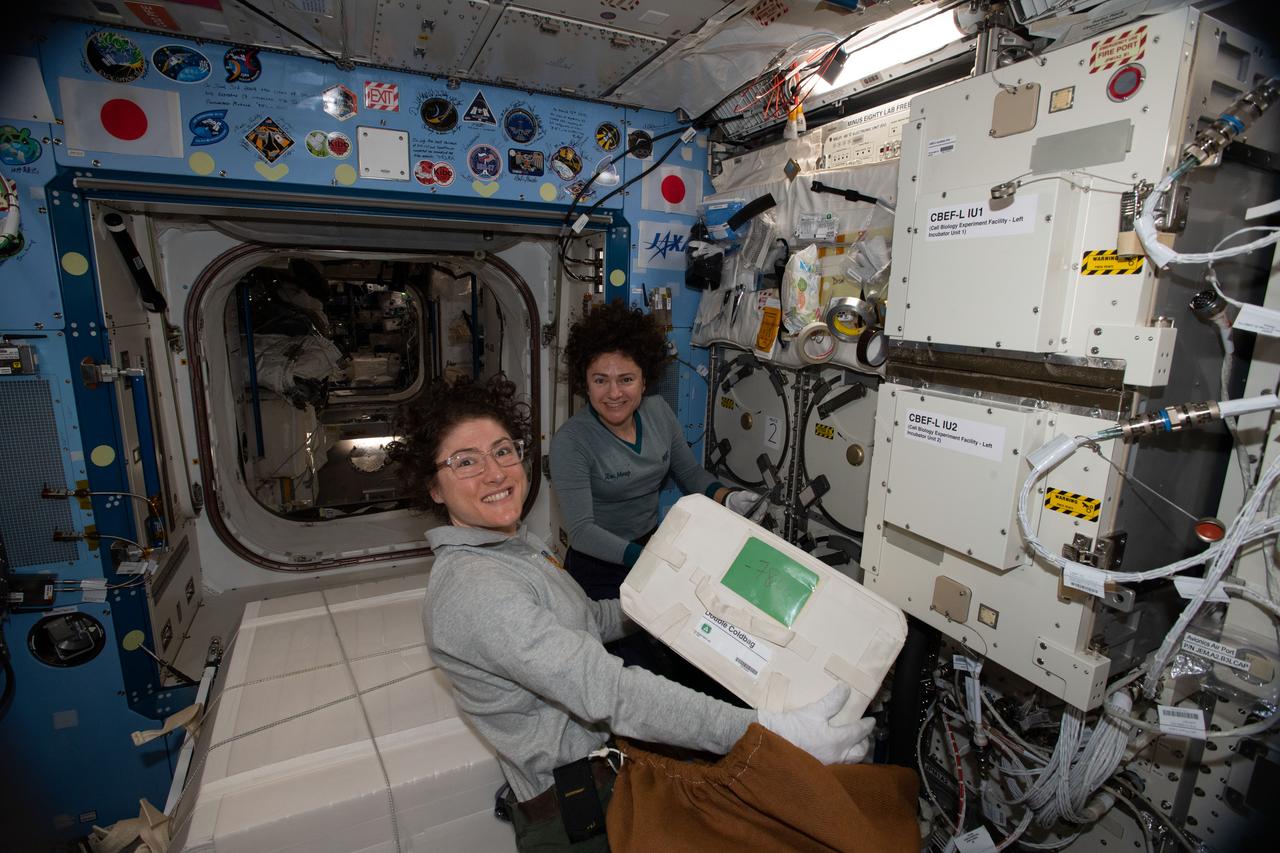
iss061e120292 (Jan. 6, 2020) --- NASA astronauts (from left) Christina Koch and Jessica Meir work inside the Kibo laboratory module collecting cold bags containing biological samples for stowage inside the SpaceX Dragon resupply ship. Dragon parachuted to a splashdown in the Pacific Ocean the following day on Jan. 7, 2020.
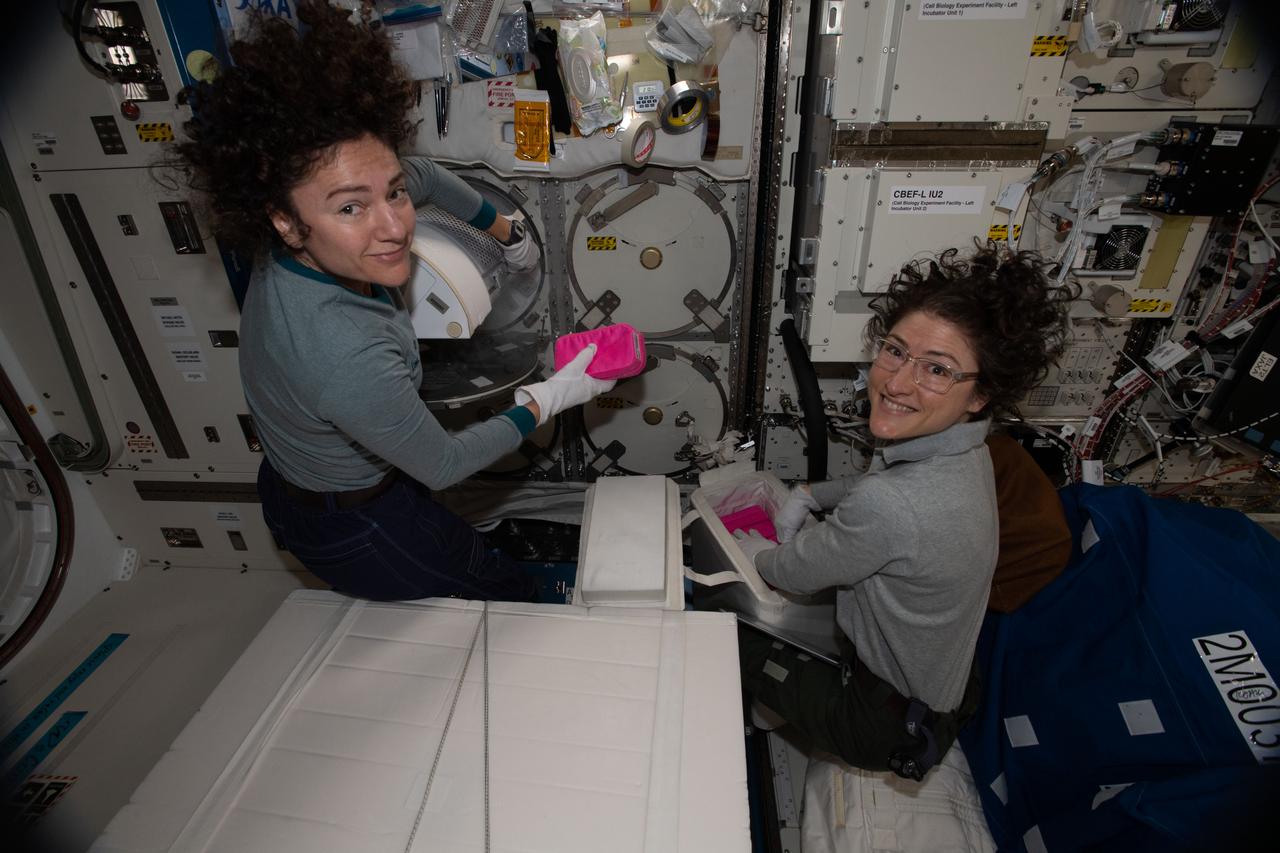
iss061e120287 (Jan. 6, 2020) --- NASA astronauts (from left) Jessica Meir and Christina Koch work inside the Kibo laboratory module collecting frozen biological samples for stowage inside the SpaceX Dragon resupply ship. Dragon parachuted to a splashdown in the Pacific Ocean the following day on Jan. 7, 2020.
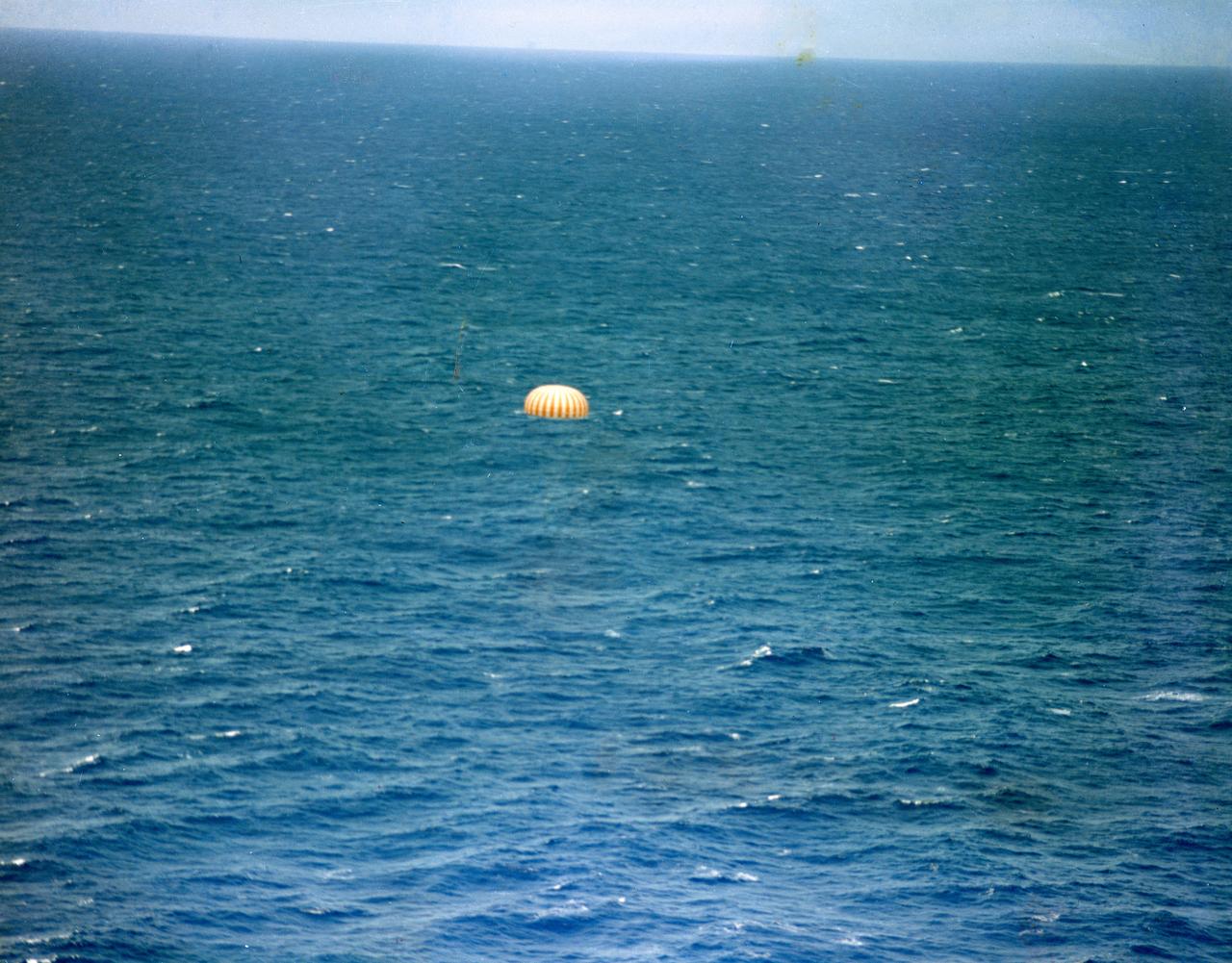
S63-09630 (16 May 1963) --- The Mercury-Atlas 9 (MA-9) "Faith 7" spacecraft, with astronaut L. Gordon Cooper Jr. aboard, nears splashdown in the Pacific Ocean to conclude a 22-orbit mission lasting 34 hours and 20.5 minutes. The capsule's parachute is fully deployed in this view. Photo credit: NASA
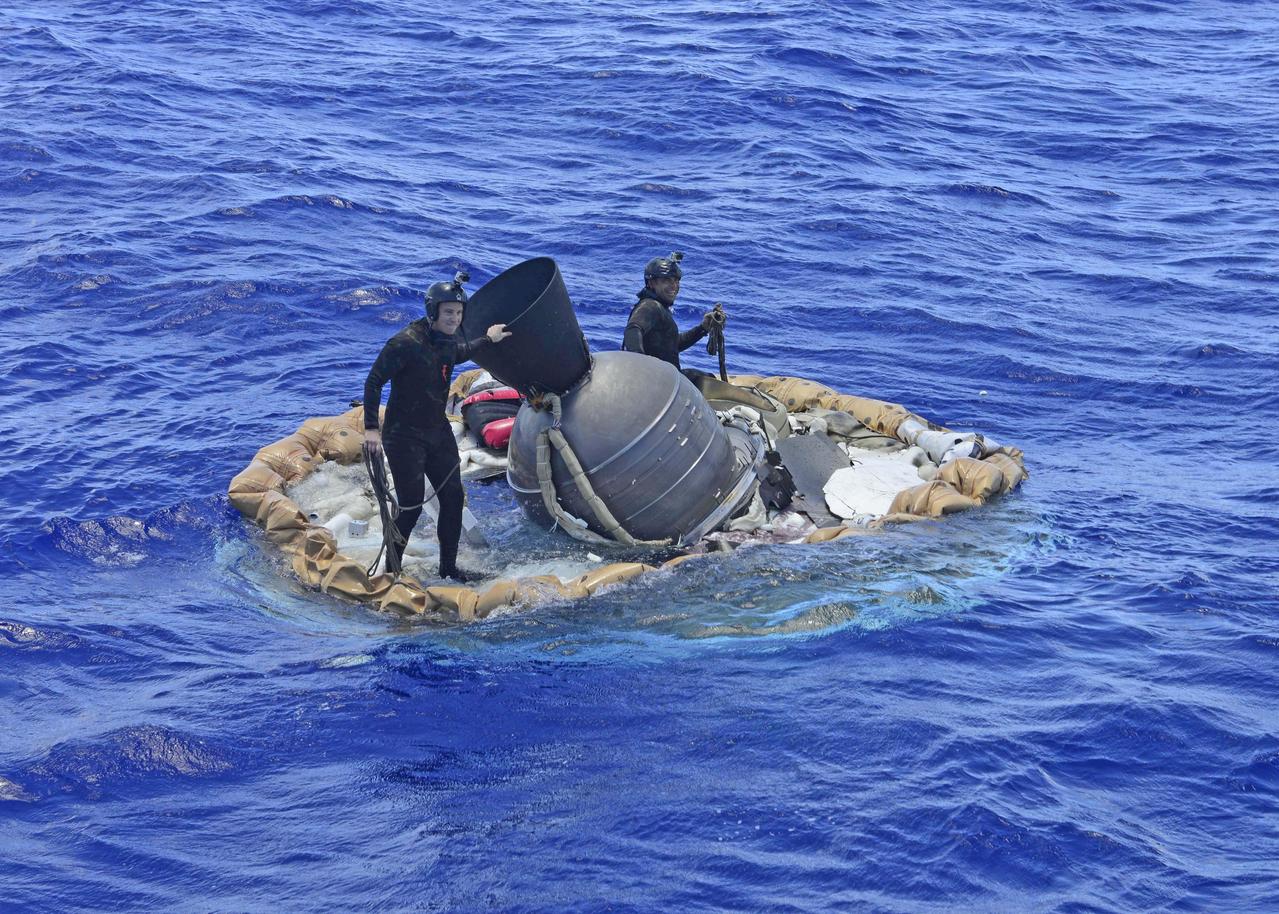
Two members of the U.S. Navy's Mobile Diving Salvage Unit (MDSU) 1 Explosive Ordnance Detachment work on recovering the test vehicle for NASA's Low-Density Supersonic Decelerator (LDSD) project. The saucer-shaped LDSD craft splashed down at 11:49 a.m. HST (2:49 PDT/5:49 p.m. EDT) Monday, June 8, 2015, in the Pacific Ocean off the west coast of the Kauai, Hawaii, after a four-hour experimental flight test that investigated new technologies for landing future robotic and human Mars missions. During the flight test, a Supersonic Inflatable Aerodynamic Decelerator (SIAD) and a supersonic parachute were deployed. The SIAD operated as expected, dramatically slowing the test vehicle's velocity. When the parachute was deployed into the supersonic slipstream, it appeared to blossom to full inflation prior to the emergence of a tear which then propagated and destroyed the parachute's canopy. As a result, the saucer's splashdown in the Pacific Ocean was hard, resulting in fracturing parts of the structure. Memory cards containing comprehensive test data -- including high-speed, high-resolution imagery recorded during the flight -- were successfully recovered. Also recovered were the test vehicle and its components, the supersonic parachute, the ballute used to deploy the parachute, and a large weather balloon that initially carried the saucer to an altitude of 120,000 feet. http://photojournal.jpl.nasa.gov/catalog/PIA19684
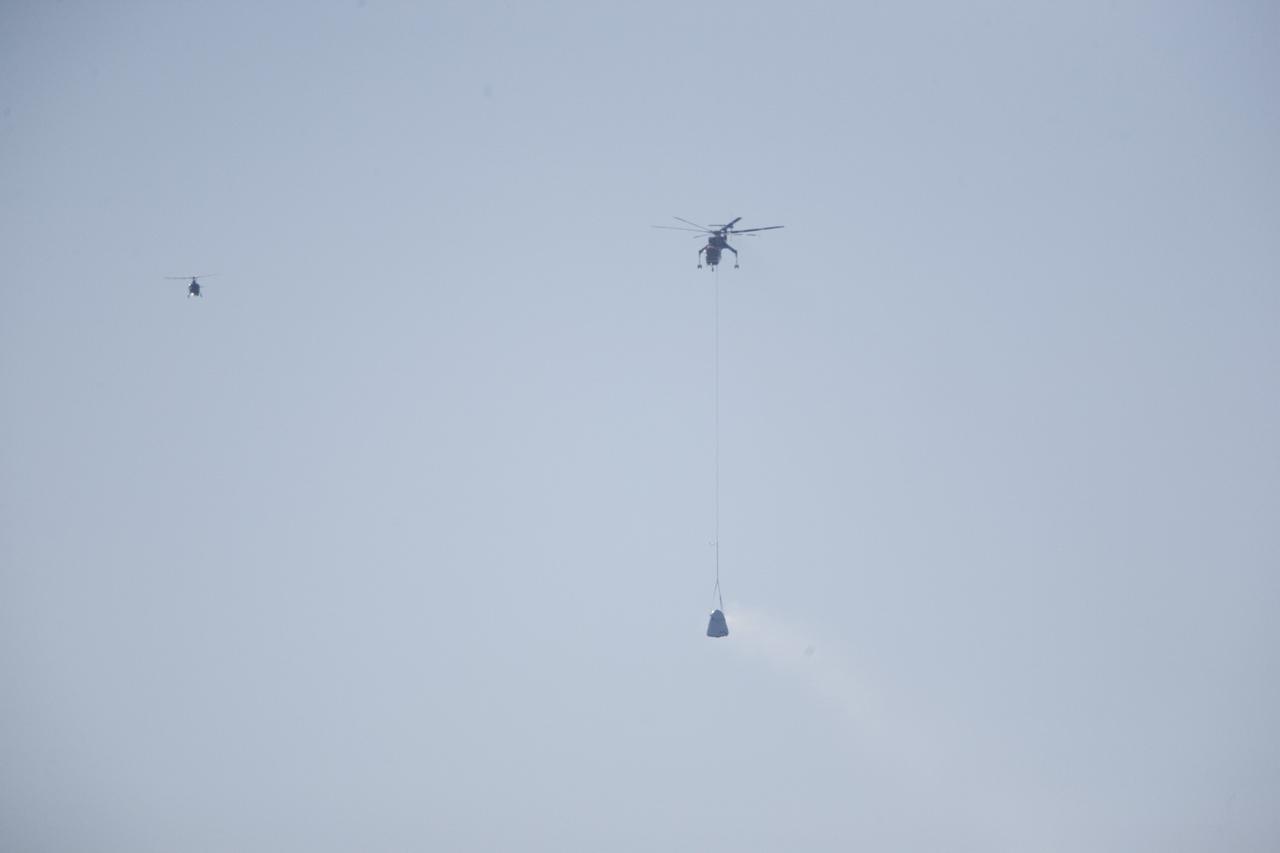
MORRO BAY, Calif. – An Erickson Sky Crane helicopter recovers the SpaceX Dragon test article following a test to evaluate the spacecraft's parachute deployment system. The test was part of a milestone under its Commercial Crew Integrated Capability agreement with NASA's Commercial Crew Program. The parachute test took place over the Pacific Ocean, off the coast of Morro Bay, Calif. Photo credit: NASA/Kim Shiflett
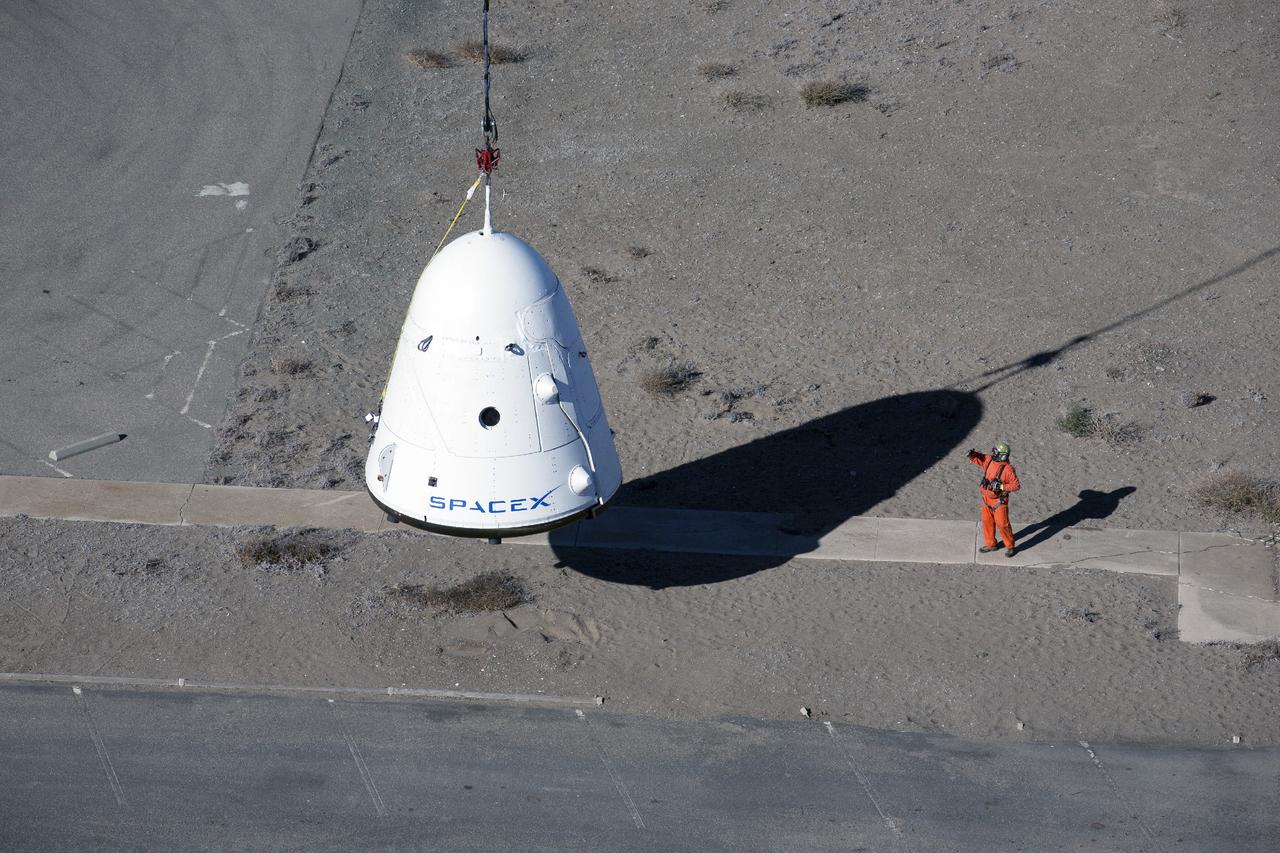
MORRO BAY, Calif. – A SpaceX Dragon test article is lifted under an Erickson Sky Crane helicopter before a test to evaluate the spacecraft's parachute deployment system as part of a milestone achievement under its Commercial Crew Integrated Capability agreement with NASA's Commercial Crew Program. The parachute test took place over the Pacific Ocean, off the coast of Morro Bay, Calif. Photo credit: NASA/Kim Shiflett
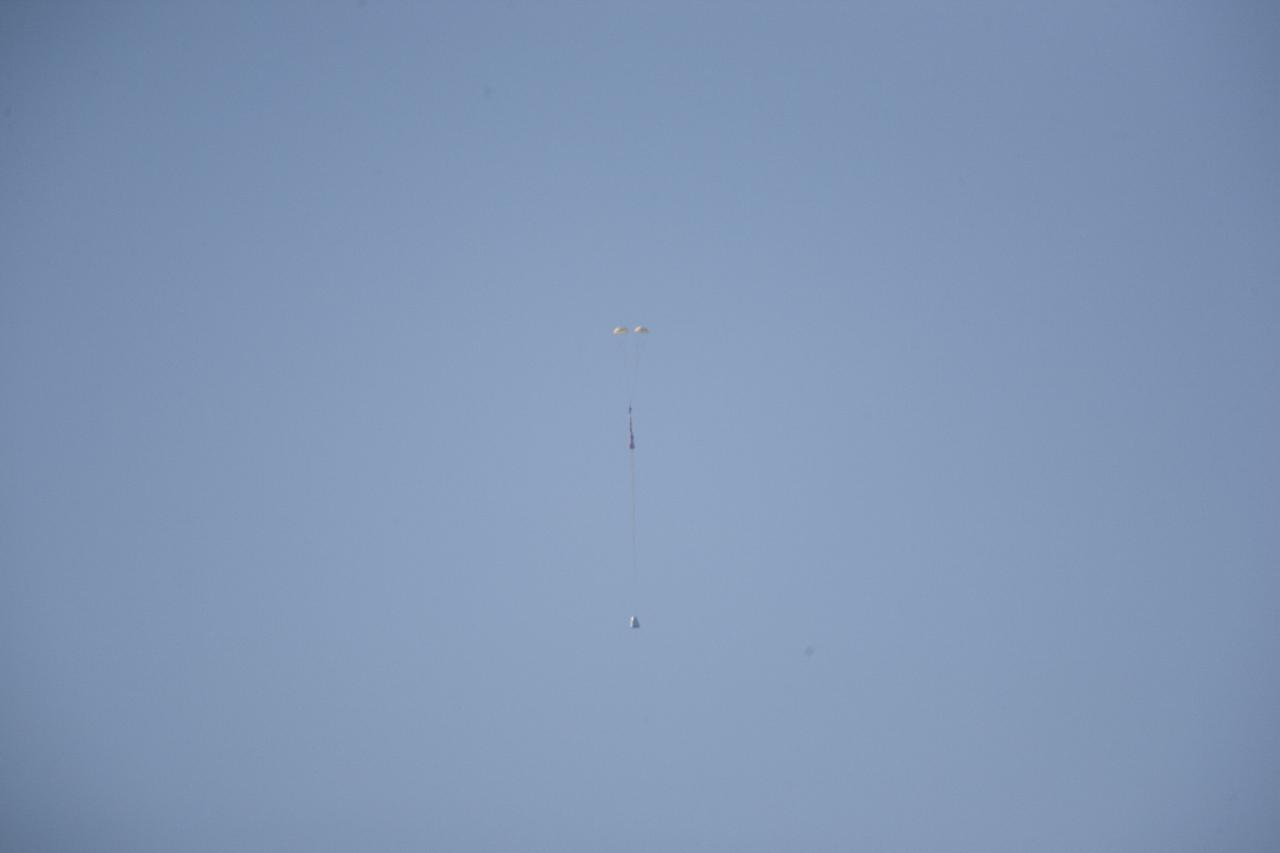
MORRO BAY, Calif. – The main parachutes begin to unfurl above mockup Dragon test article during a test over the Pacific Ocean, off the coast of Morro Bay, Calif., to evaluate the spacecraft's parachute deployment system. The test was part of a milestone under SpaceX's Commercial Crew Integrated Capability agreement with NASA's Commercial Crew Program. Photo credit: NASA/Kim Shiflett
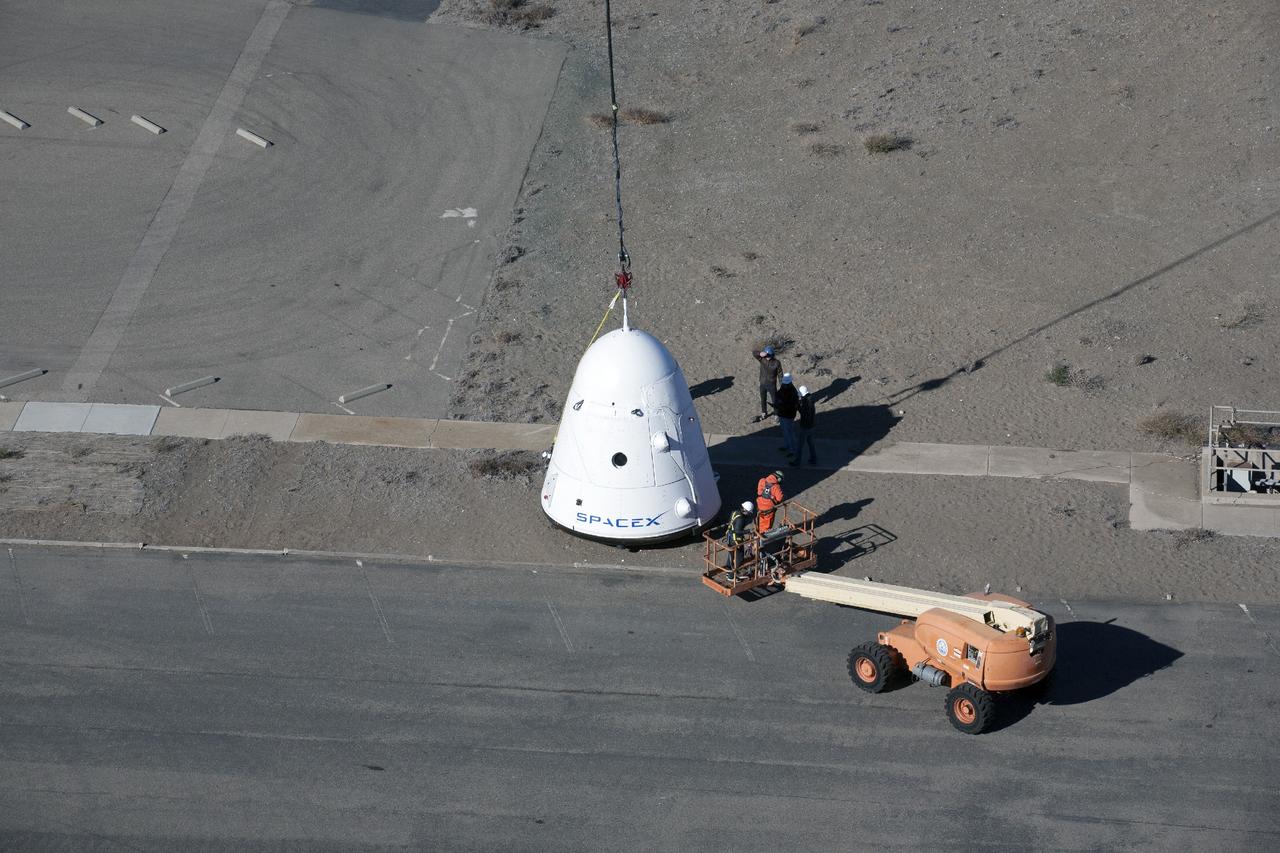
MORRO BAY, Calif. – A SpaceX Dragon test article is lifted under an Erickson Sky Crane helicopter before a test to evaluate the spacecraft's parachute deployment system as part of a milestone achievement under its Commercial Crew Integrated Capability agreement with NASA's Commercial Crew Program. The parachute test took place over the Pacific Ocean, off the coast of Morro Bay, Calif. Photo credit: NASA/Kim Shiflett
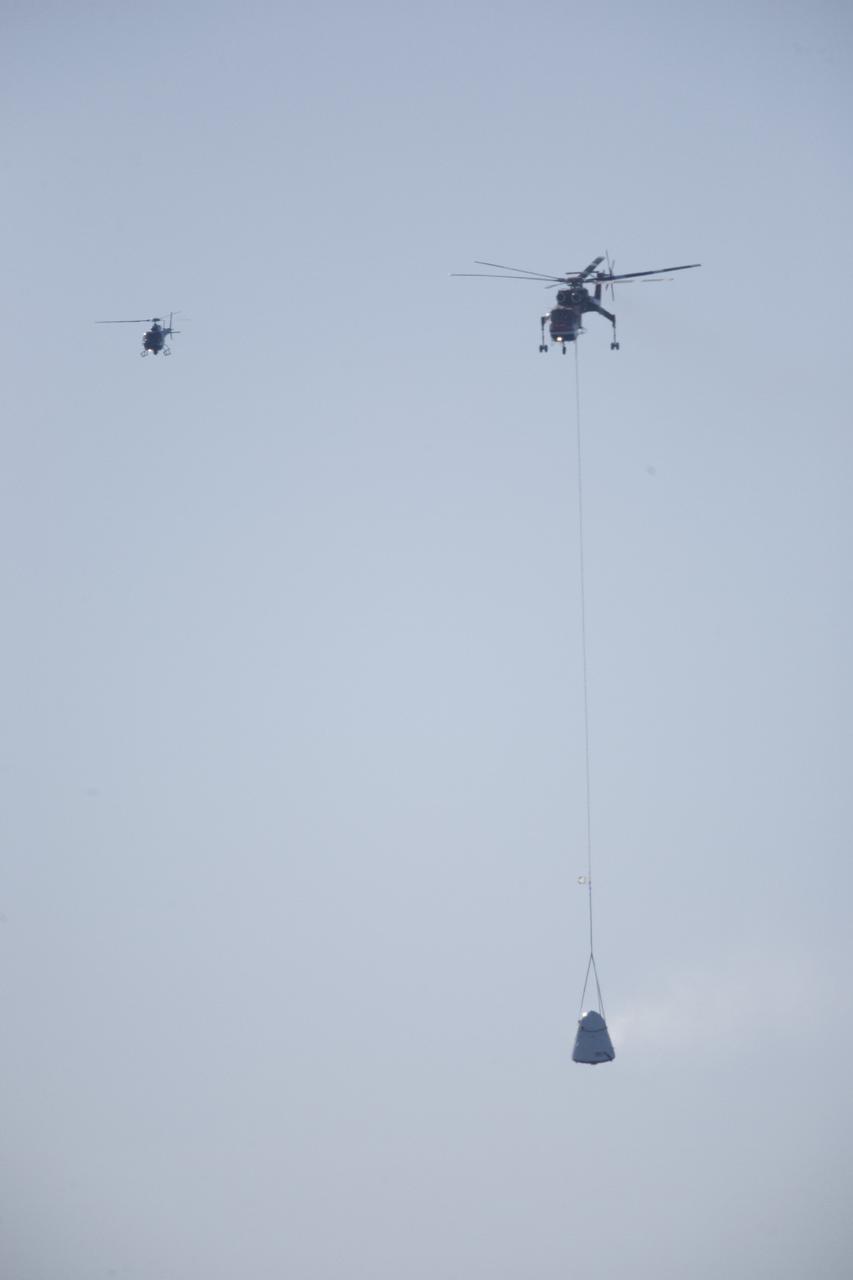
MORRO BAY, Calif. – An Erickson Sky Crane helicopter recovers the SpaceX Dragon test article following a test to evaluate the spacecraft's parachute deployment system. The test was part of a milestone under its Commercial Crew Integrated Capability agreement with NASA's Commercial Crew Program. The parachute test took place over the Pacific Ocean, off the coast of Morro Bay, Calif. Photo credit: NASA/Kim Shiflett
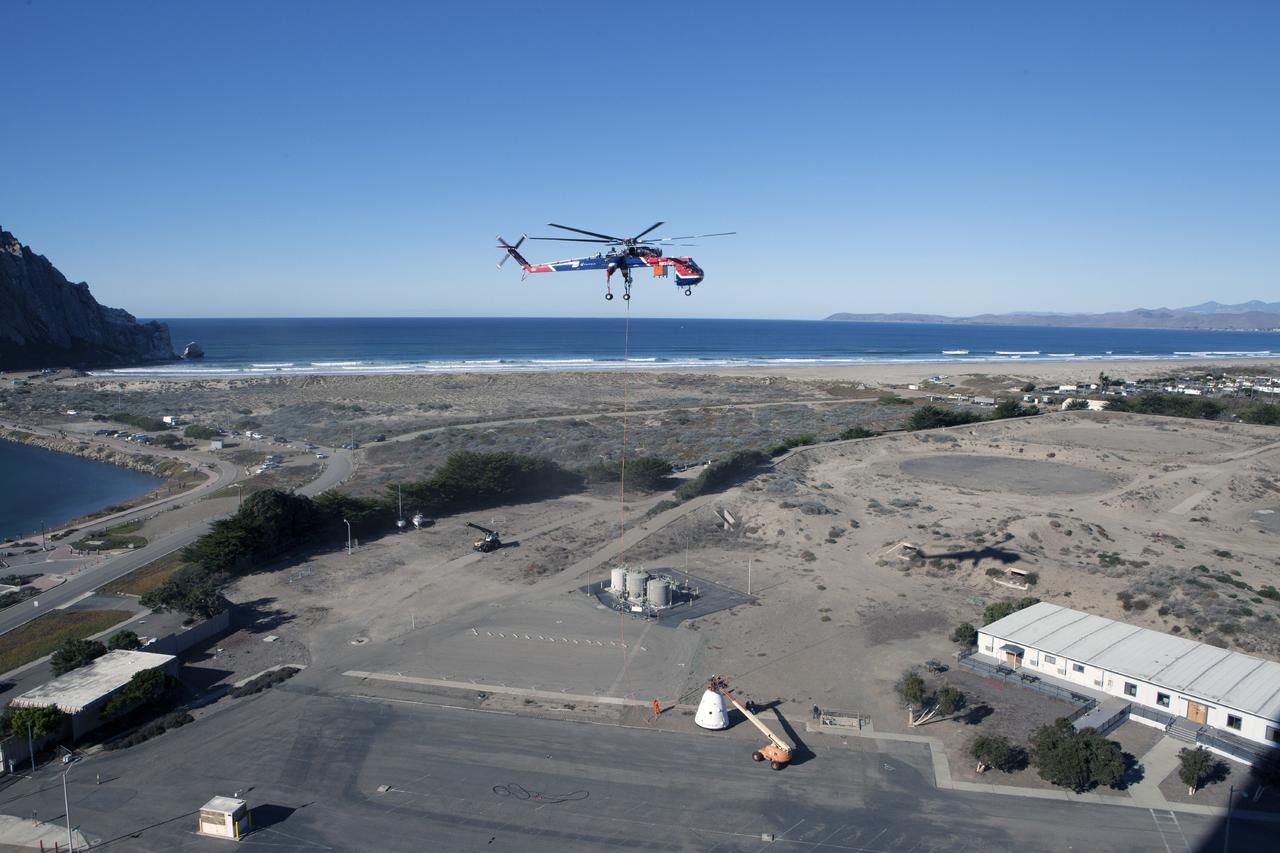
MORRO BAY, Calif. – A SpaceX Dragon test article is lifted under an Erickson Sky Crane helicopter before a test to evaluate the spacecraft's parachute deployment system as part of a milestone achievement under its Commercial Crew Integrated Capability agreement with NASA's Commercial Crew Program. The parachute test took place over the Pacific Ocean, off the coast of Morro Bay, Calif. Photo credit: NASA/Kim Shiflett

MORRO BAY, Calif. – A SpaceX Dragon test article is lifted under an Erickson Sky Crane helicopter before a test to evaluate the spacecraft's parachute deployment system as part of a milestone achievement under its Commercial Crew Integrated Capability agreement with NASA's Commercial Crew Program. The parachute test took place over the Pacific Ocean, off the coast of Morro Bay, Calif. Photo credit: NASA/Kim Shiflett
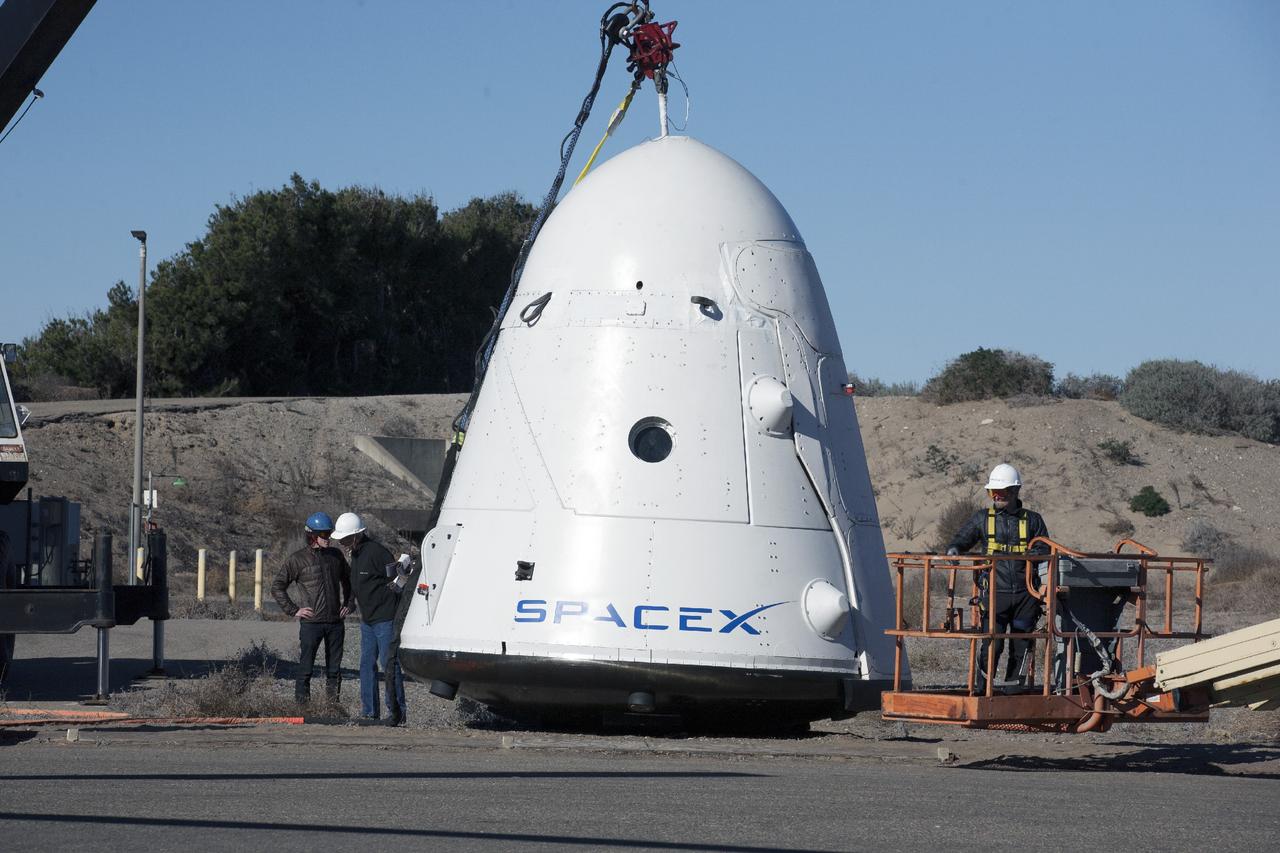
MORRO BAY, Calif. – A SpaceX Dragon test article is seen prior to a test to evaluate its parachute deployment system as part of a milestone under its Commercial Crew Integrated Capability agreement with NASA's Commercial Crew Program. The parachute test took place over the Pacific Ocean, off the coast of Morro Bay, Calif. Photo credit: NASA/Kim Shiflett
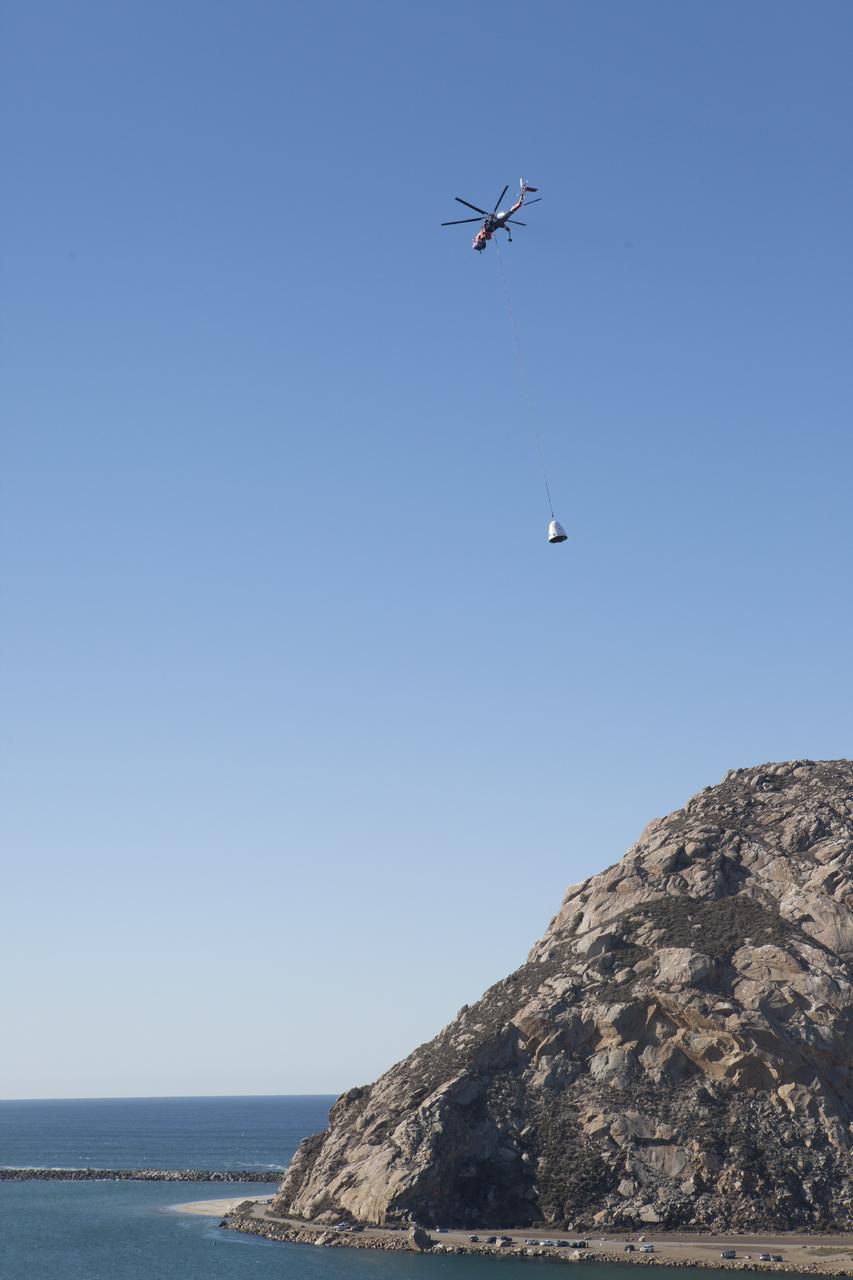
MORRO BAY, Calif. – A SpaceX Dragon test article is lifted under an Erickson Sky Crane helicopter before a test to evaluate the spacecraft's parachute deployment system as part of a milestone achievement under its Commercial Crew Integrated Capability agreement with NASA's Commercial Crew Program. The parachute test took place over the Pacific Ocean, off the coast of Morro Bay, Calif. Photo credit: NASA/Kim Shiflett
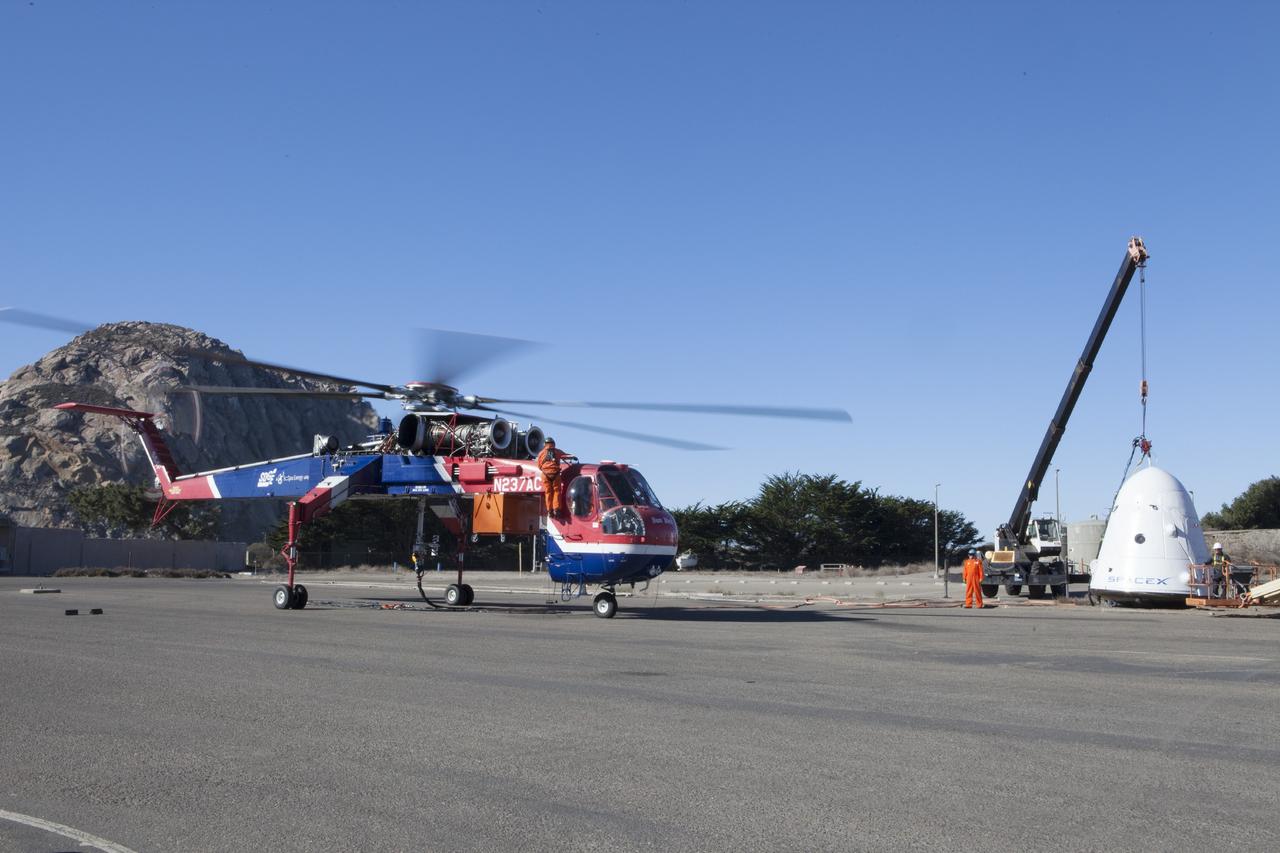
MORRO BAY, Calif. – A SpaceX Dragon test article is seen prior to a test to evaluate its parachute deployment system as part of a milestone under its Commercial Crew Integrated Capability agreement with NASA's Commercial Crew Program. The parachute test took place over the Pacific Ocean, off the coast of Morro Bay, Calif. Photo credit: NASA/Kim Shiflett
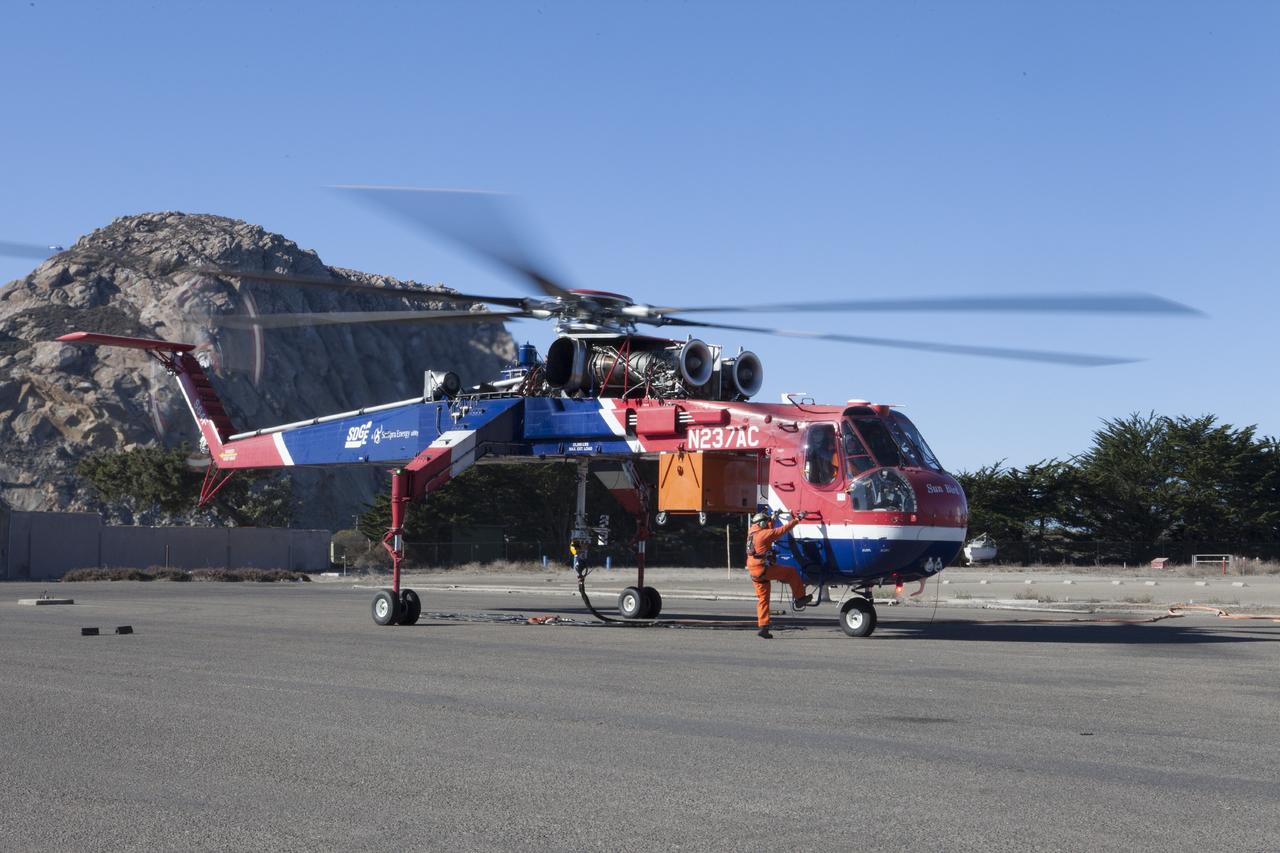
MORRO BAY, Calif. – A SpaceX Dragon test article is seen prior to a test to evaluate its parachute deployment system as part of a milestone under its Commercial Crew Integrated Capability agreement with NASA's Commercial Crew Program. The parachute test took place over the Pacific Ocean, off the coast of Morro Bay, Calif. Photo credit: NASA/Kim Shiflett
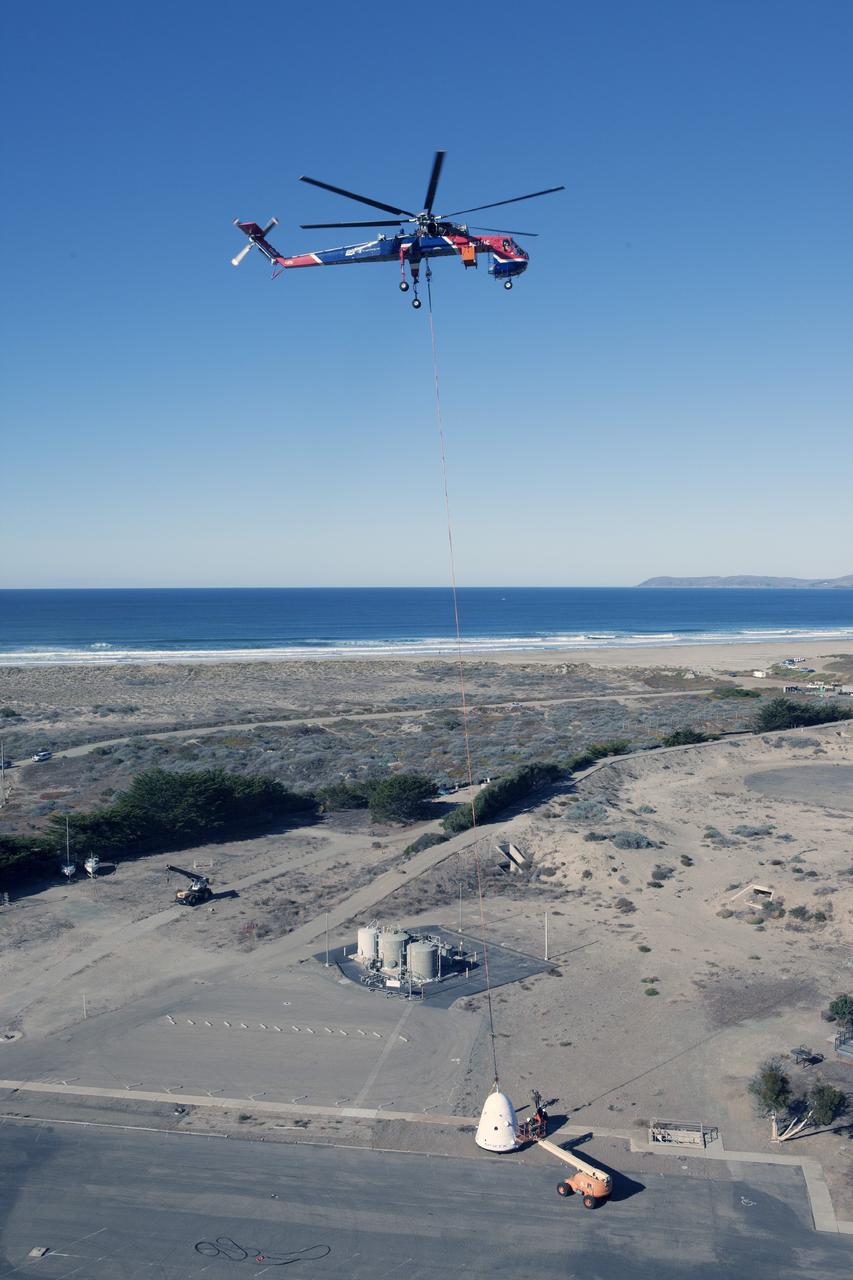
MORRO BAY, Calif. – A SpaceX Dragon test article is lifted under an Erickson Sky Crane helicopter before a test to evaluate the spacecraft's parachute deployment system as part of a milestone achievement under its Commercial Crew Integrated Capability agreement with NASA's Commercial Crew Program. The parachute test took place over the Pacific Ocean, off the coast of Morro Bay, Calif. Photo credit: NASA/Kim Shiflett
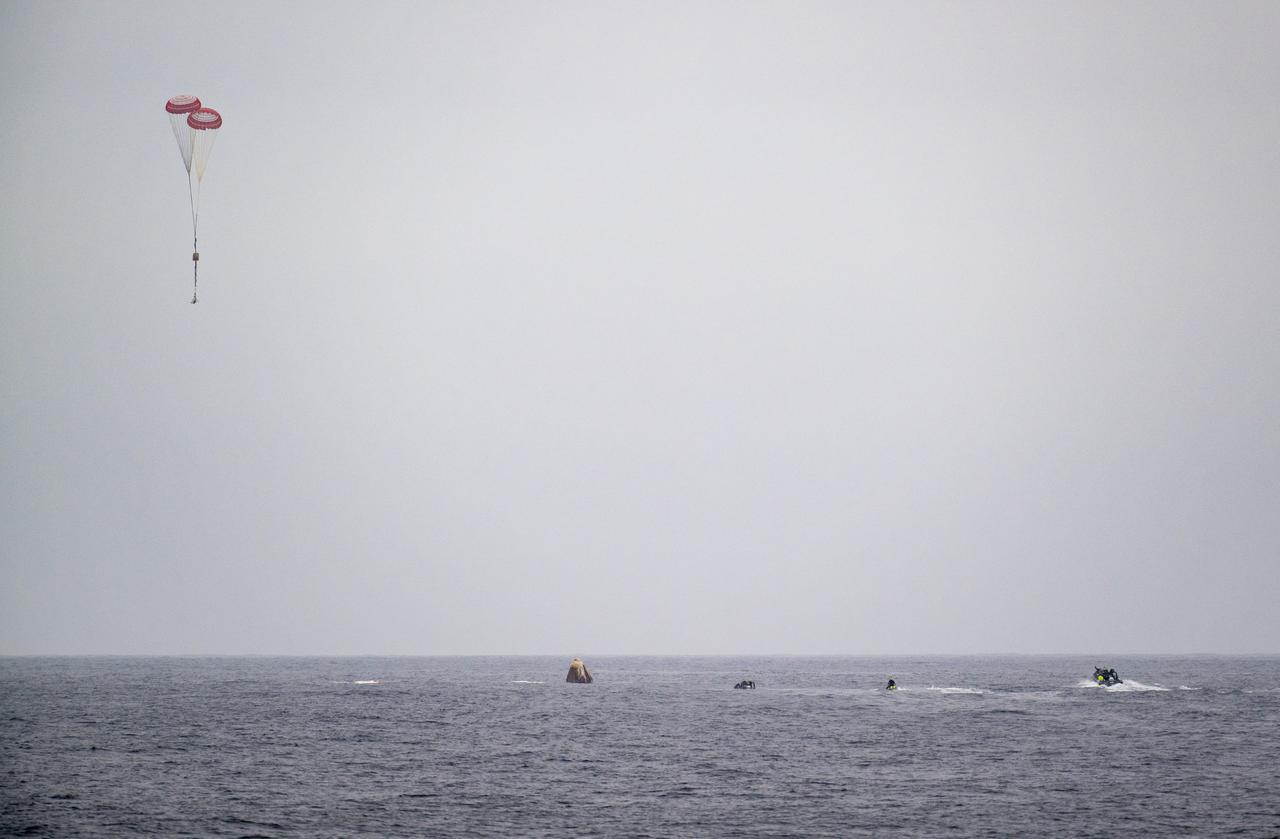
Support teams work around the SpaceX Dragon Endurance spacecraft shortly after it landed with NASA astronauts Anne McClain and Nichole Ayers, JAXA (Japan Aerospace Exploration Agency) astronaut Takuya Onishi, and Roscosmos cosmonaut Kirill Peskov aboard in the Pacific Ocean off the coast of San Diego, Calif., Saturday, Aug. 9,2025. McClain, Ayers, Onishi, and Peskov are returning after 147 days in space as part of Expedition 73 aboard the International Space Station. The drogue parachutes can also be seen in the sky behind the SpaceX Dragon Endurance spacecraft as they land in the Pacific Ocean. Photo Credit: (NASA/Keegan Barber)
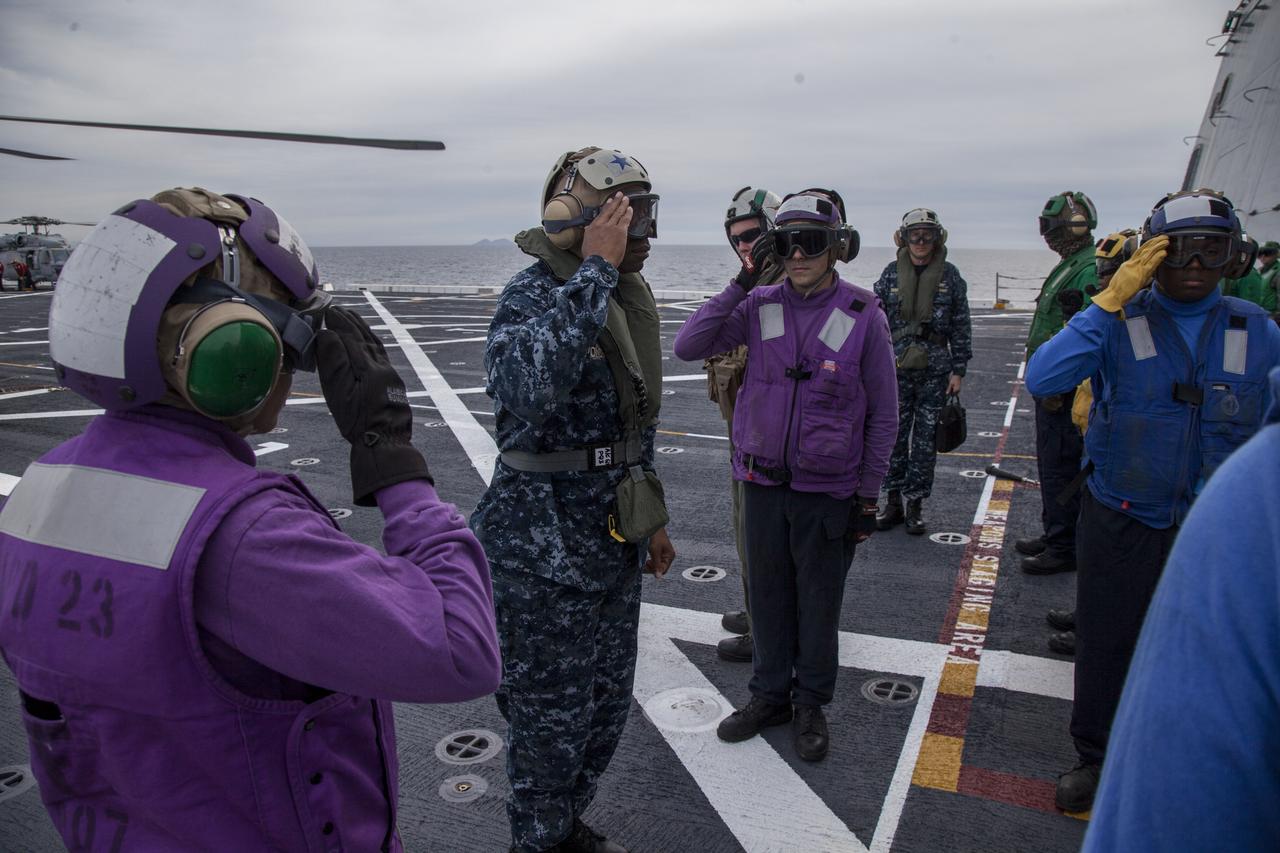
U.S. Navy and Helicopter Sea Combat Squadron 8 salute Rear Admiral Fernandez L. "Frank" Ponds, Commander, Expeditionary Strike Group 3 during his visit on the deck of the USS Anchorage near Naval Base San Diego in California. The ship is heading out to sea in the Pacific Ocean. NASA and the U.S. Navy are making preparations ahead of Orion's flight test for recovery of the crew module, forward bay cover and parachutes on its return from space and splashdown in the Pacific Ocean. The Ground Systems Development and Operations Program is leading the recovery efforts.
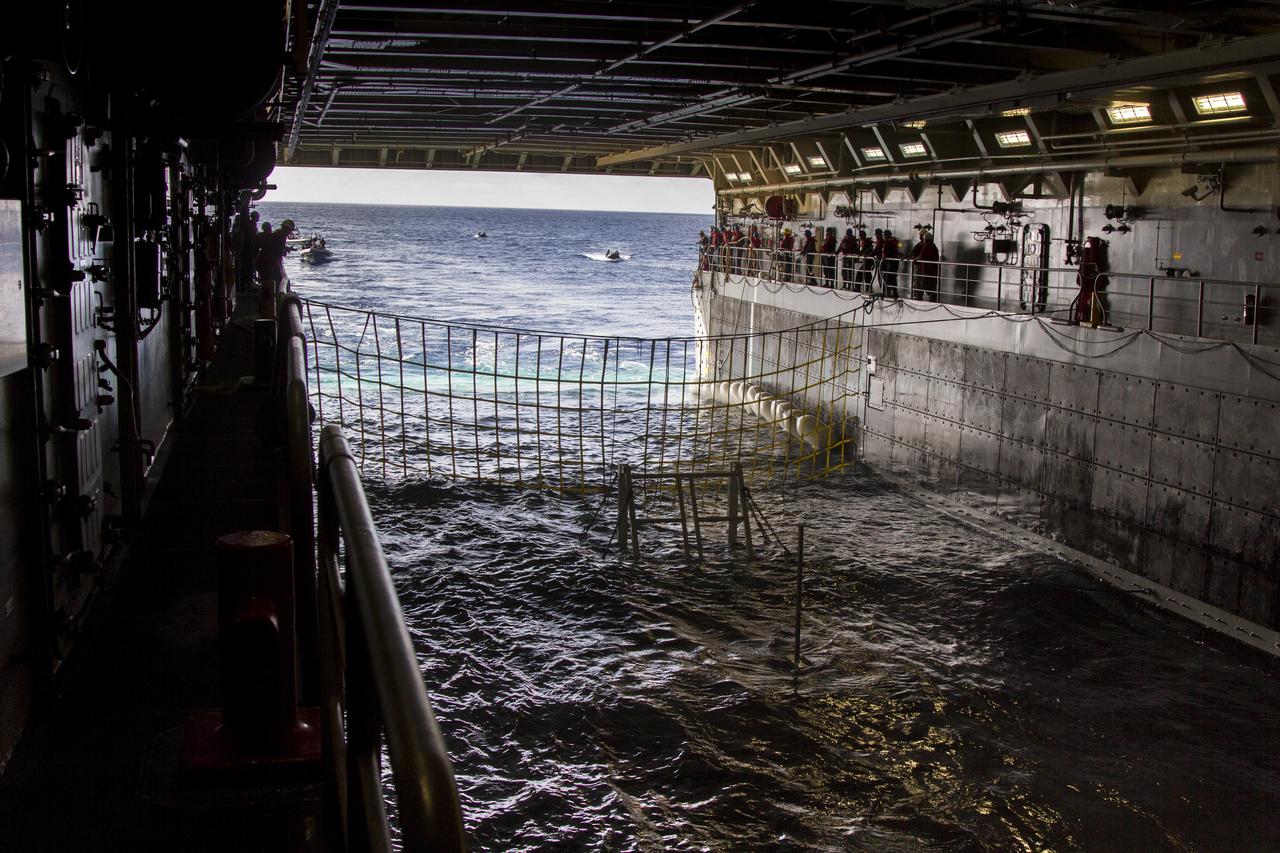
On the third day of preparations for recovery of Orion after its splashdown in the Pacific Ocean, the well deck of the USS Anchorage has been filled with water and recovery hardware is in place. U.S. Navy divers have embarked from ship to practice recovery procedures in rigid hull inflatable boats and Zodiac boats. NASA, Lockheed Martin and U.S. Navy personnel are preparing for recovery of the crew module, forward bay cover and parachutes on its return from space and splashdown in the Pacific Ocean. The Ground Systems Development and Operations Program is leading the recovery efforts.
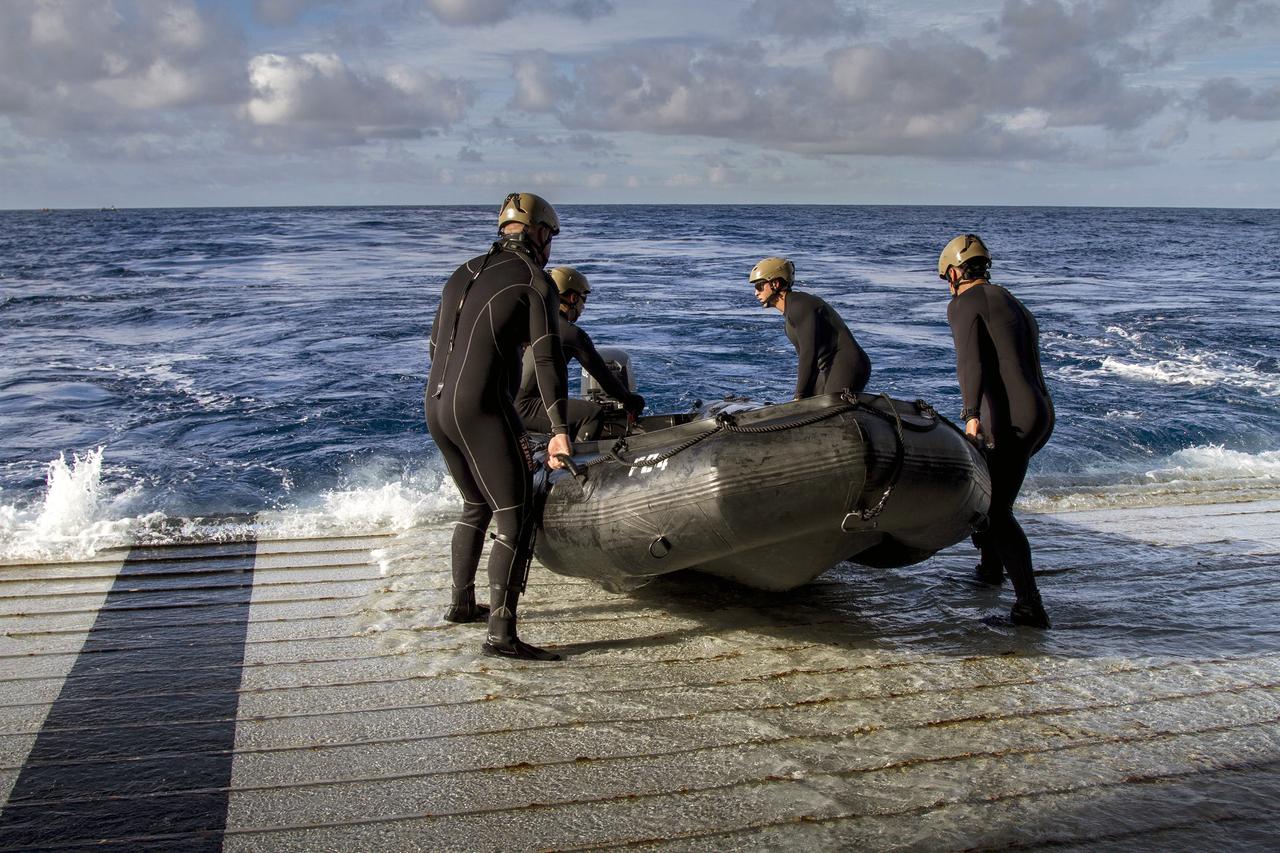
SAN DIEGO, Calif. – On the third day of preparations for recovery of Orion after its splashdown in the Pacific Ocean, U.S. Navy Divers prepare to embark from the well deck of the USS Anchorage in a rigid hull Zodiac boat about 600 miles off the coast of Baja, California. NASA, Lockheed Martin and U.S. Navy personnel are preparing for recovery of the crew module, forward bay cover and parachutes on its return from space and splashdown in the Pacific Ocean. The Ground Systems Development and Operations Program is leading the recovery efforts. The first unpiloted flight test of Orion is scheduled to launch Dec. 4 atop a United Launch Alliance Delta IV Heavy rocket. During its two-orbit, 4.5-hour flight, Orion will venture 3,600 miles in altitude and travel nearly 60,000 miles before returning to Earth for a splashdown in the Pacific Ocean. For more information, visit http://www.nasa.gov/orion. Photo credit: NASA/Cory Huston
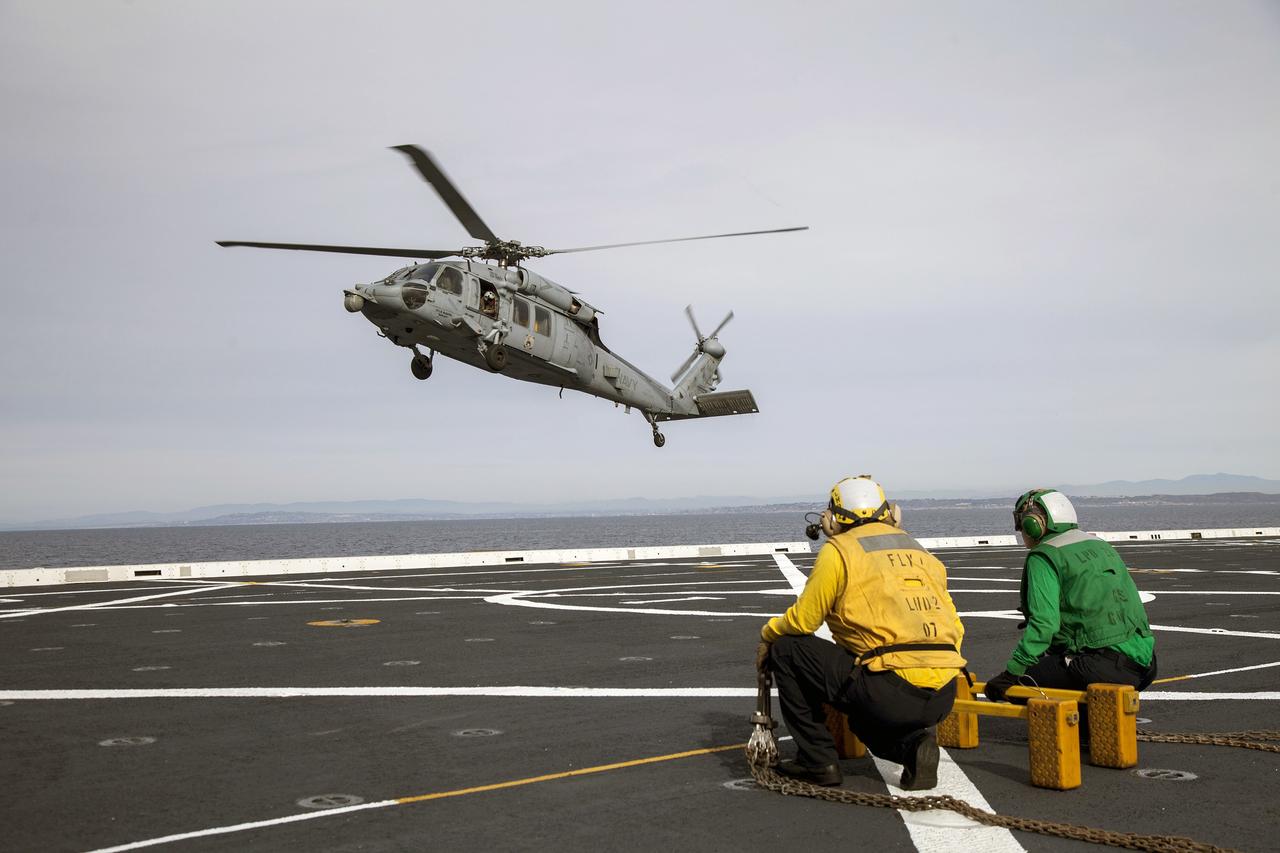
SAN DIEGO, Calif. – An H60-S Seahawk helicopter lands on the deck of the USS Anchorage in the Pacific Ocean off the coast of California. NASA and the U.S. Navy are heading out to sea ahead of Orion's flight test to prepare for recovery of the crew module, forward bay cover and parachutes on its return from space and splashdown in the Pacific Ocean. The Ground Systems Development and Operations Program is leading the recovery efforts. The first unpiloted flight test of Orion is scheduled to launch this week atop a United Launch Alliance Delta IV Heavy rocket. During its two-orbit, 4.5-hour flight, Orion will venture 3,600 miles in altitude and travel nearly 60,000 miles before returning to Earth for a splashdown in the Pacific Ocean. For more information, visit http://www.nasa.gov/orion. Photo credit: NASA/Cory Huston

SAN DIEGO, Calif. – NASA, Lockheed Martin and U.S. Navy personnel review recovery procedures on the USS Anchorage in the Pacific Ocean near the Orion recovery site ahead of the first flight test. The team is preparing for recovery of the crew module, forward bay cover and parachutes on its return from space and splashdown in the Pacific Ocean. The Ground Systems Development and Operations Program is leading the recovery efforts. The first unpiloted flight test of Orion is scheduled to launch this week atop a United Launch Alliance Delta IV Heavy rocket. During its two-orbit, 4.5-hour flight, Orion will venture 3,600 miles in altitude and travel nearly 60,000 miles before returning to Earth for a splashdown in the Pacific Ocean. For more information, visit http://www.nasa.gov/orion. Photo credit: NASA/Cory Huston
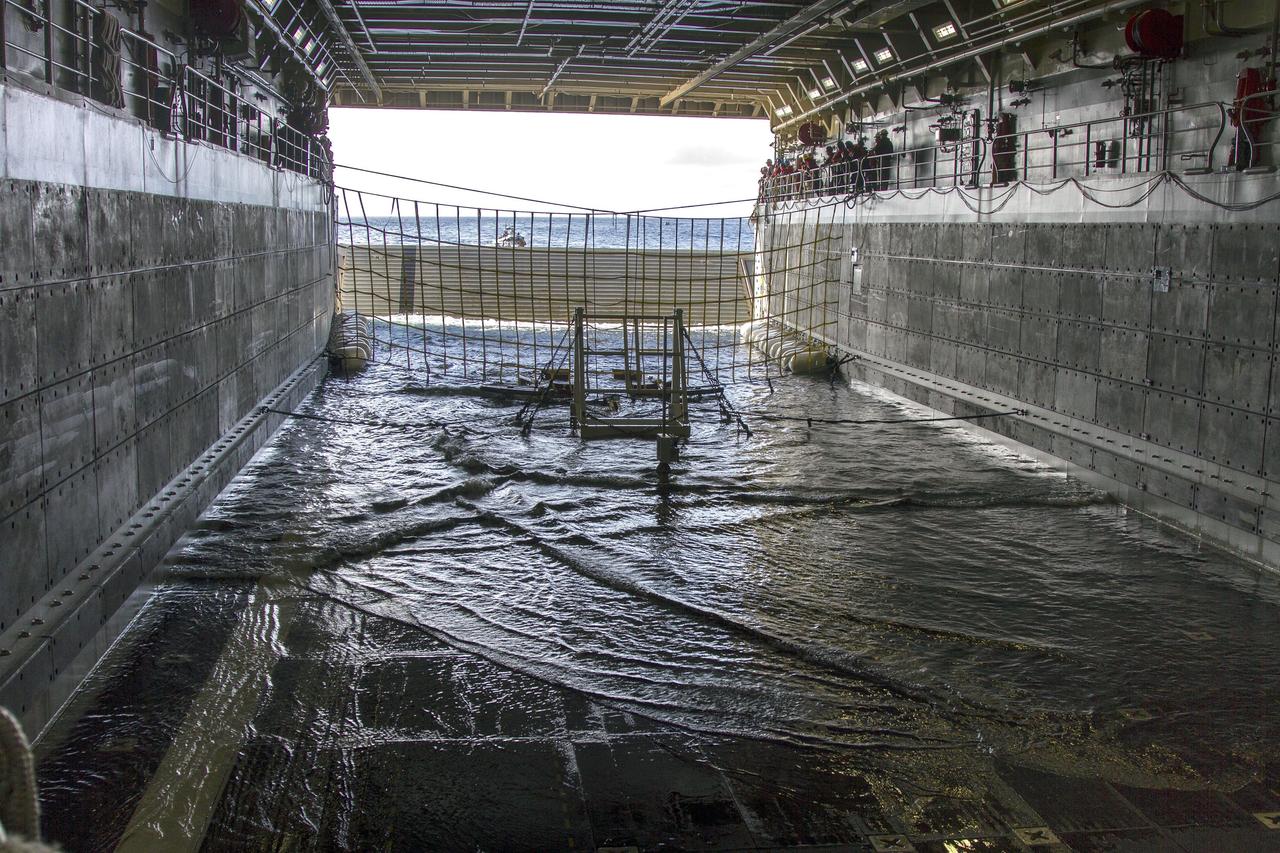
SAN DIEGO, Calif. – On the third day of preparations for recovery of Orion after its splashdown in the Pacific Ocean, the well deck of the USS Anchorage has been filled with water and recovery hardware is in place. The ship is about 600 miles off the coast of Baja, California. NASA, Lockheed Martin and U.S. Navy personnel are preparing for recovery of the crew module, forward bay cover and parachutes on its return from space and splashdown in the Pacific Ocean. The Ground Systems Development and Operations Program is leading the recovery efforts. The first unpiloted flight test of Orion is scheduled to launch Dec. 4 atop a United Launch Alliance Delta IV Heavy rocket. During its two-orbit, 4.5-hour flight, Orion will venture 3,600 miles in altitude and travel nearly 60,000 miles before returning to Earth for a splashdown in the Pacific Ocean. For more information, visit http://www.nasa.gov/orion. Photo credit: NASA/Cory Huston
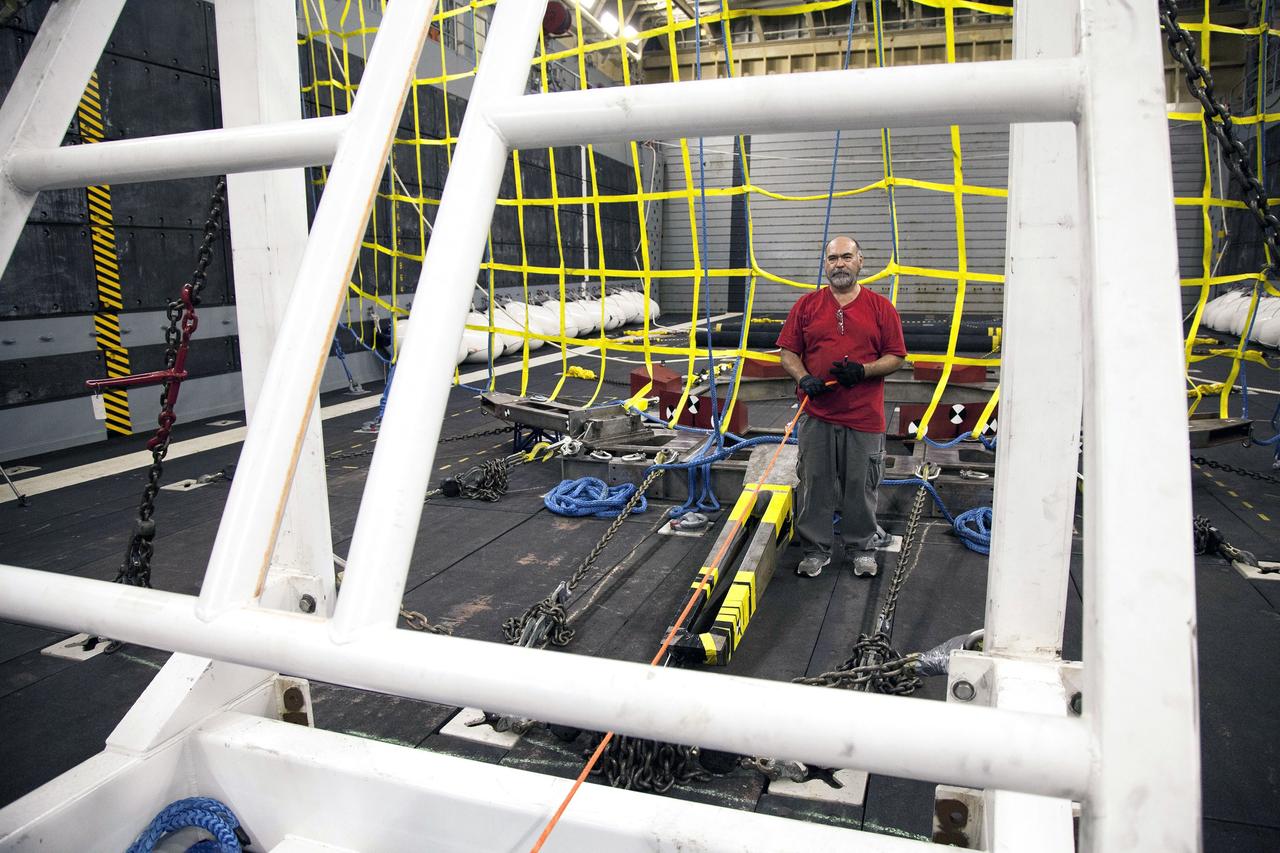
SAN DIEGO, Calif. – NASA, Lockheed Martin and U.S. Navy personnel are preparing the well deck of the USS Anchorage in the Pacific Ocean near the Orion recovery site ahead of the first flight test. The team is preparing for recovery of the crew module, forward bay cover and parachutes on its return from space and splashdown in the Pacific Ocean. The Ground Systems Development and Operations Program is leading the recovery efforts. The first unpiloted flight test of Orion is scheduled to launch this week atop a United Launch Alliance Delta IV Heavy rocket. During its two-orbit, 4.5-hour flight, Orion will venture 3,600 miles in altitude and travel nearly 60,000 miles before returning to Earth for a splashdown in the Pacific Ocean. For more information, visit http://www.nasa.gov/orion. Photo credit: NASA/Cory Huston
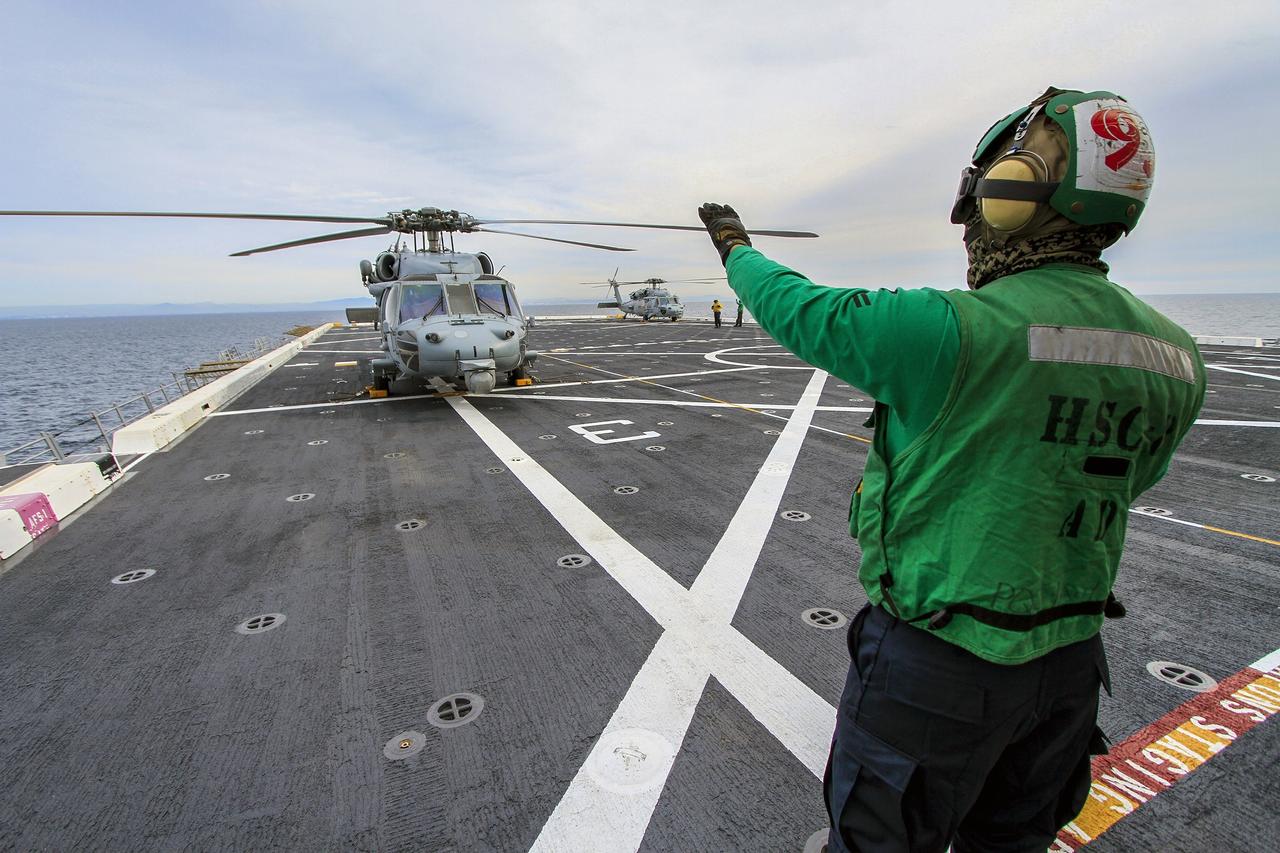
SAN DIEGO, Calif. – A member of the Helicopter Sea Combat Squadron 8 signals to the pilot in an H60-S Seahawk helicopter on the deck of the USS Anchorage as the ship departs Naval Base San Diego in California for the open waters of the Pacific Ocean. NASA and the U.S. Navy are making preparations ahead of Orion's flight test for recovery of the crew module, forward bay cover and parachutes on its return from space and splashdown in the Pacific Ocean. The Ground Systems Development and Operations Program is leading the recovery efforts. The first unpiloted flight test of Orion is scheduled to launch this week atop a United Launch Alliance Delta IV Heavy rocket. During its two-orbit, 4.5-hour flight, Orion will venture 3,600 miles in altitude and travel nearly 60,000 miles before returning to Earth for a splashdown in the Pacific Ocean. For more information, visit http://www.nasa.gov/orion. Photo credit: NASA/Cory Huston
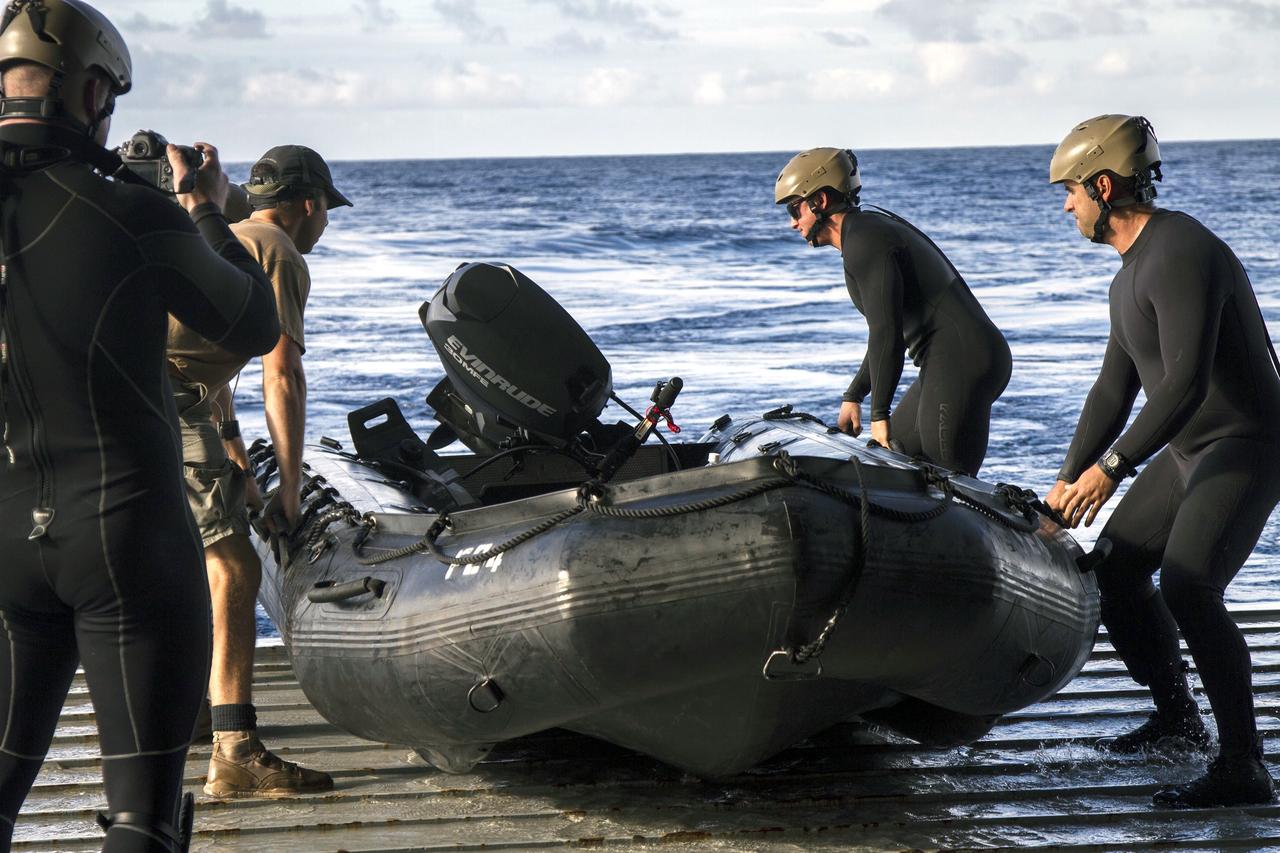
SAN DIEGO, Calif. – On the third day of preparations for recovery of Orion after its splashdown in the Pacific Ocean, U.S. Navy Divers prepare to embark from the well deck of the USS Anchorage in a rigid hull Zodiac boat about 600 miles off the coast of Baja, California. NASA, Lockheed Martin and U.S. Navy personnel are preparing for recovery of the crew module, forward bay cover and parachutes on its return from space and splashdown in the Pacific Ocean. The Ground Systems Development and Operations Program is leading the recovery efforts. The first unpiloted flight test of Orion is scheduled to launch Dec. 4 atop a United Launch Alliance Delta IV Heavy rocket. During its two-orbit, 4.5-hour flight, Orion will venture 3,600 miles in altitude and travel nearly 60,000 miles before returning to Earth for a splashdown in the Pacific Ocean. For more information, visit http://www.nasa.gov/orion. Photo credit: NASA/Cory Huston
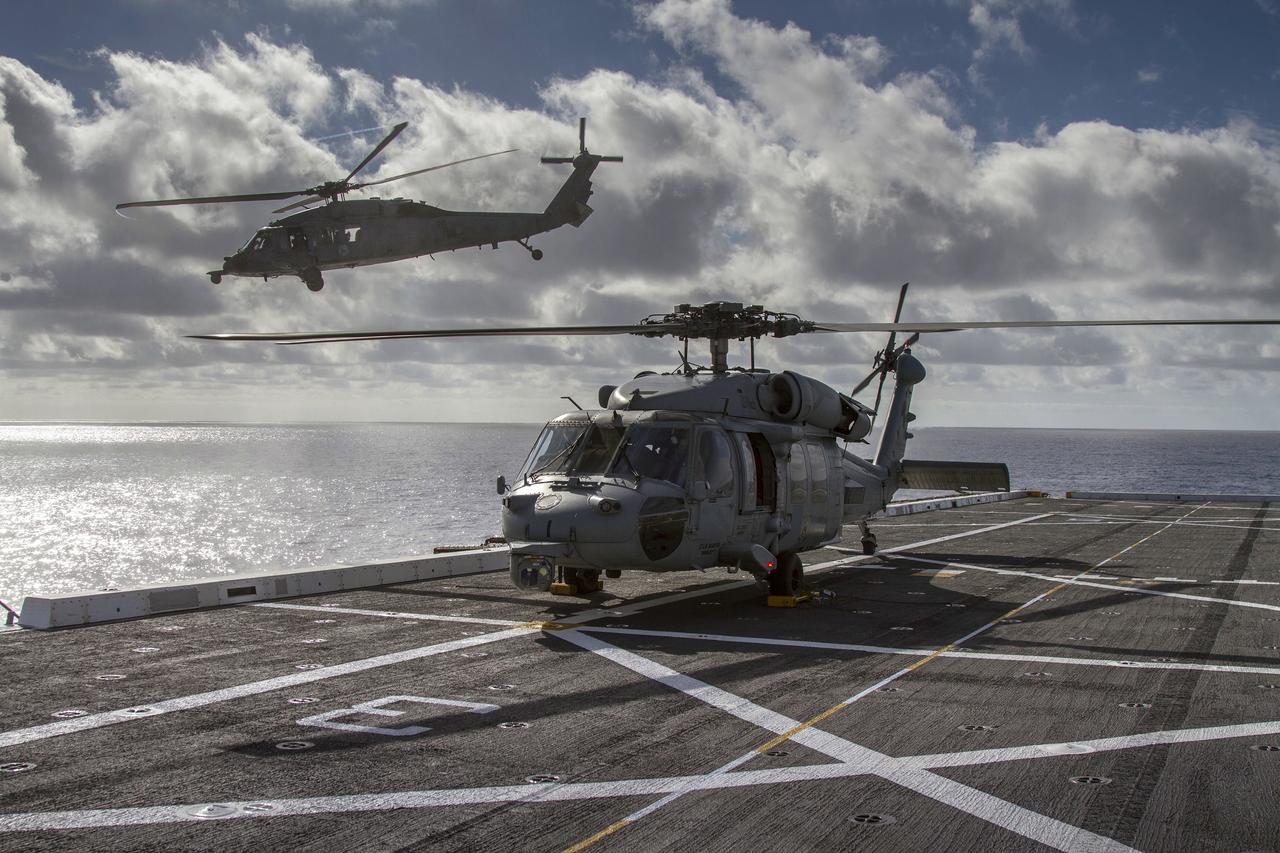
SAN DIEGO, Calif. – On the third day of preparations for recovery of Orion, pilots in two H60-S Seahawk helicopters practice take-off and search from the deck of the USS Anchorage in the Pacific Ocean about 600 miles off the coast of Baja, California. NASA, Lockheed Martin and U.S. Navy personnel are preparing to recover the Orion crew module, forward bay cover and parachutes after the spacecraft's return from space and splashdown in the Pacific Ocean. The Ground Systems Development and Operations Program is leading the recovery efforts. The first unpiloted flight test of Orion is scheduled to launch Dec. 4 atop a United Launch Alliance Delta IV Heavy rocket. During its two-orbit, 4.5-hour flight, Orion will venture 3,600 miles in altitude and travel nearly 60,000 miles before returning to Earth for a splashdown in the Pacific Ocean. For more information, visit http://www.nasa.gov/orion. Photo credit: NASA/Cory Huston
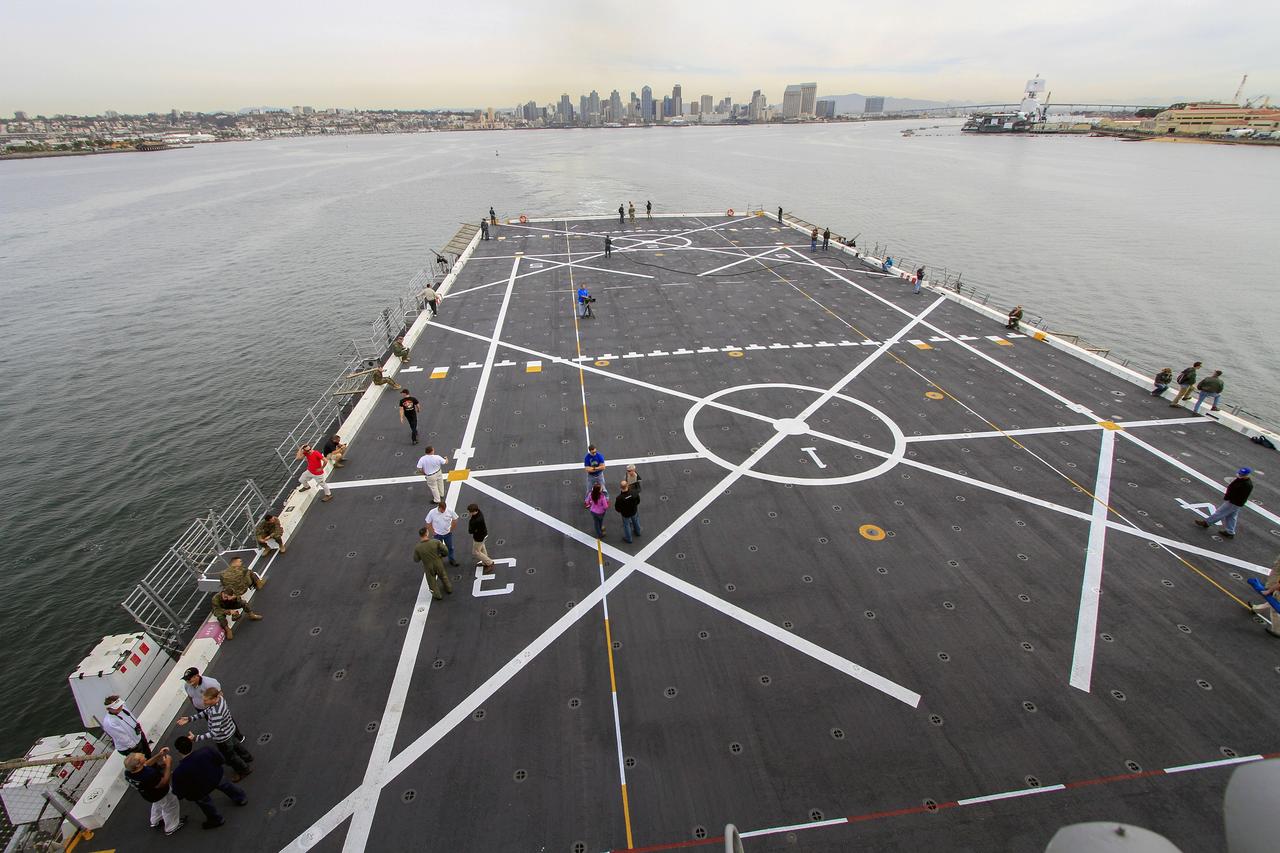
SAN DIEGO, Calif. – NASA and U.S. Navy personnel are on the deck of the USS Anchorage as the ship departs Naval Base San Diego and heads out to sea in the Pacific Ocean. NASA and the U.S. Navy are making preparations ahead of Orion's flight test for recovery of the crew module, forward bay cover and parachutes on its return from space and splashdown in the Pacific Ocean. The Ground Systems Development and Operations Program is leading the recovery efforts. The first unpiloted flight test of Orion is scheduled to launch this week atop a United Launch Alliance Delta IV Heavy rocket. During its two-orbit, 4.5-hour flight, Orion will venture 3,600 miles in altitude and travel nearly 60,000 miles before returning to Earth for a splashdown in the Pacific Ocean. For more information, visit http://www.nasa.gov/orion. Photo credit: NASA/Cory Huston
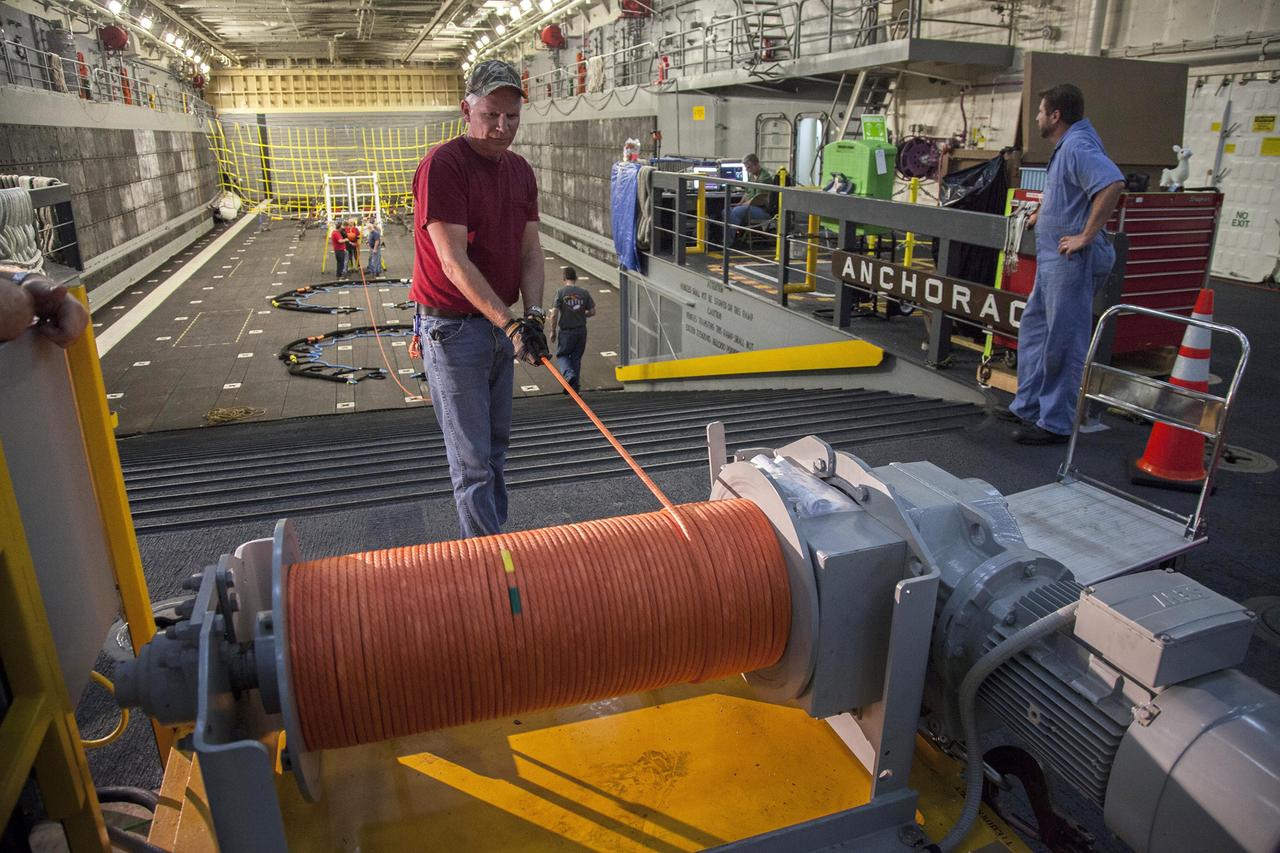
SAN DIEGO, Calif. – NASA, Lockheed Martin and U.S. Navy personnel are preparing the well deck of the USS Anchorage in the Pacific Ocean near the Orion recovery site ahead of the first flight test. The team is preparing for recovery of the crew module, forward bay cover and parachutes on its return from space and splashdown in the Pacific Ocean. The Ground Systems Development and Operations Program is leading the recovery efforts. The first unpiloted flight test of Orion is scheduled to launch this week atop a United Launch Alliance Delta IV Heavy rocket. During its two-orbit, 4.5-hour flight, Orion will venture 3,600 miles in altitude and travel nearly 60,000 miles before returning to Earth for a splashdown in the Pacific Ocean. For more information, visit http://www.nasa.gov/orion. Photo credit: NASA/Cory Huston
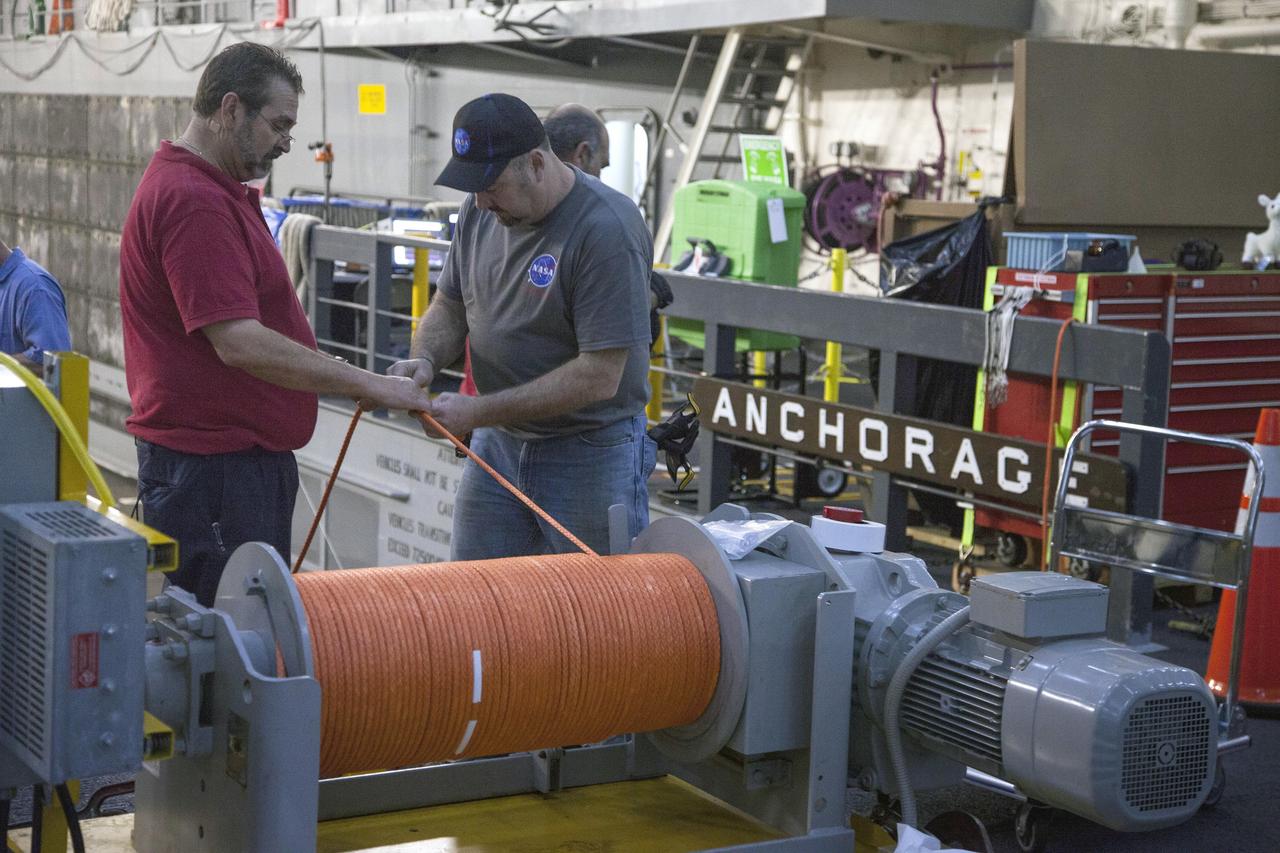
SAN DIEGO, Calif. – NASA, Lockheed Martin and U.S. Navy personnel are preparing the well deck of the USS Anchorage in the Pacific Ocean near the Orion recovery site ahead of the first flight test. The team is preparing for recovery of the crew module, forward bay cover and parachutes on its return from space and splashdown in the Pacific Ocean. The Ground Systems Development and Operations Program is leading the recovery efforts. The first unpiloted flight test of Orion is scheduled to launch this week atop a United Launch Alliance Delta IV Heavy rocket. During its two-orbit, 4.5-hour flight, Orion will venture 3,600 miles in altitude and travel nearly 60,000 miles before returning to Earth for a splashdown in the Pacific Ocean. For more information, visit http://www.nasa.gov/orion. Photo credit: NASA/Cory Huston
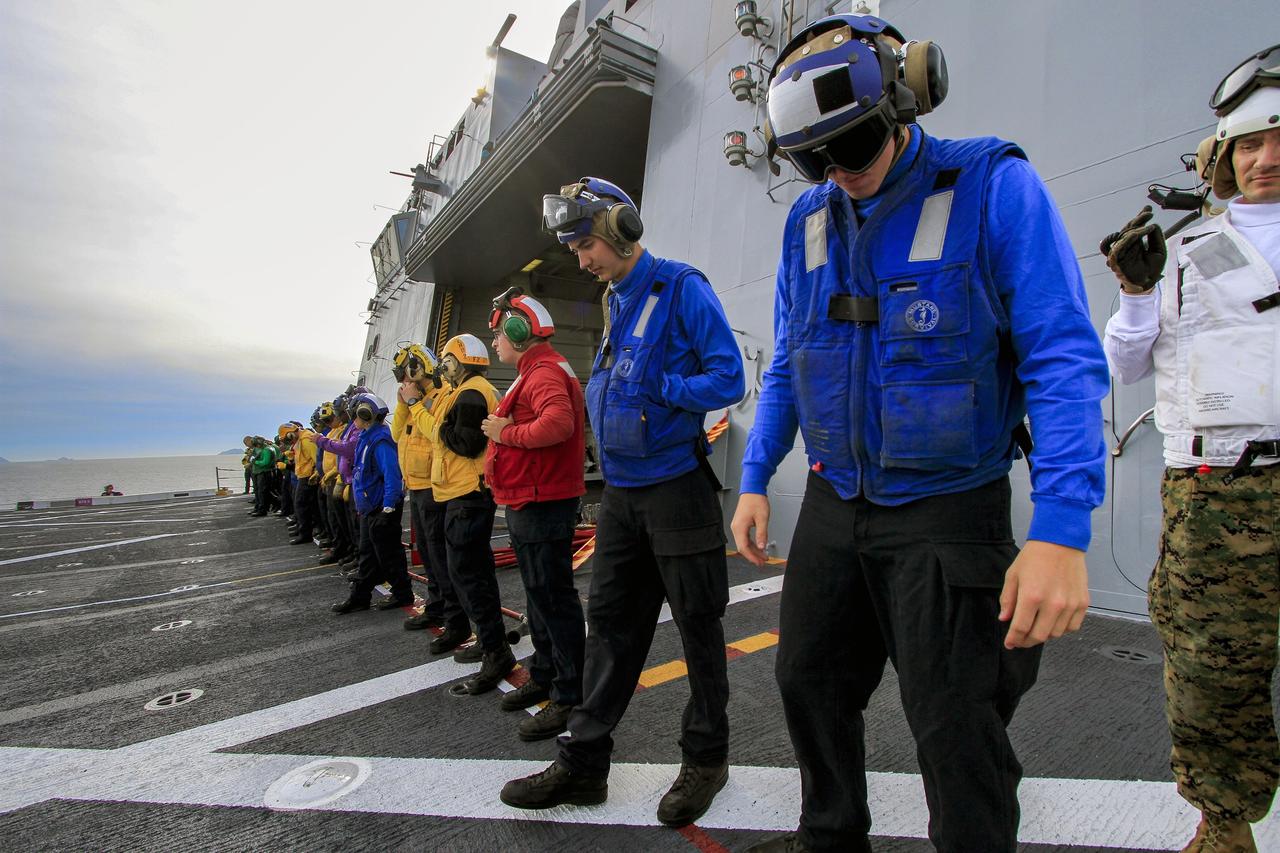
SAN DIEGO, Calif. – Helicopter Sea Combat Squadron 8 personnel review procedures on the deck of the USS Anchorage as the ship departs Naval Base San Diego in California for the open waters of the Pacific Ocean. NASA and the U.S. Navy are making preparations ahead of Orion's flight test for recovery of the crew module, forward bay cover and parachutes on its return from space and splashdown in the Pacific Ocean. The Ground Systems Development and Operations Program is leading the recovery efforts. The first unpiloted flight test of Orion is scheduled to launch this week atop a United Launch Alliance Delta IV Heavy rocket. During its two-orbit, 4.5-hour flight, Orion will venture 3,600 miles in altitude and travel nearly 60,000 miles before returning to Earth for a splashdown in the Pacific Ocean. For more information, visit http://www.nasa.gov/orion. Photo credit: NASA/Cory Huston
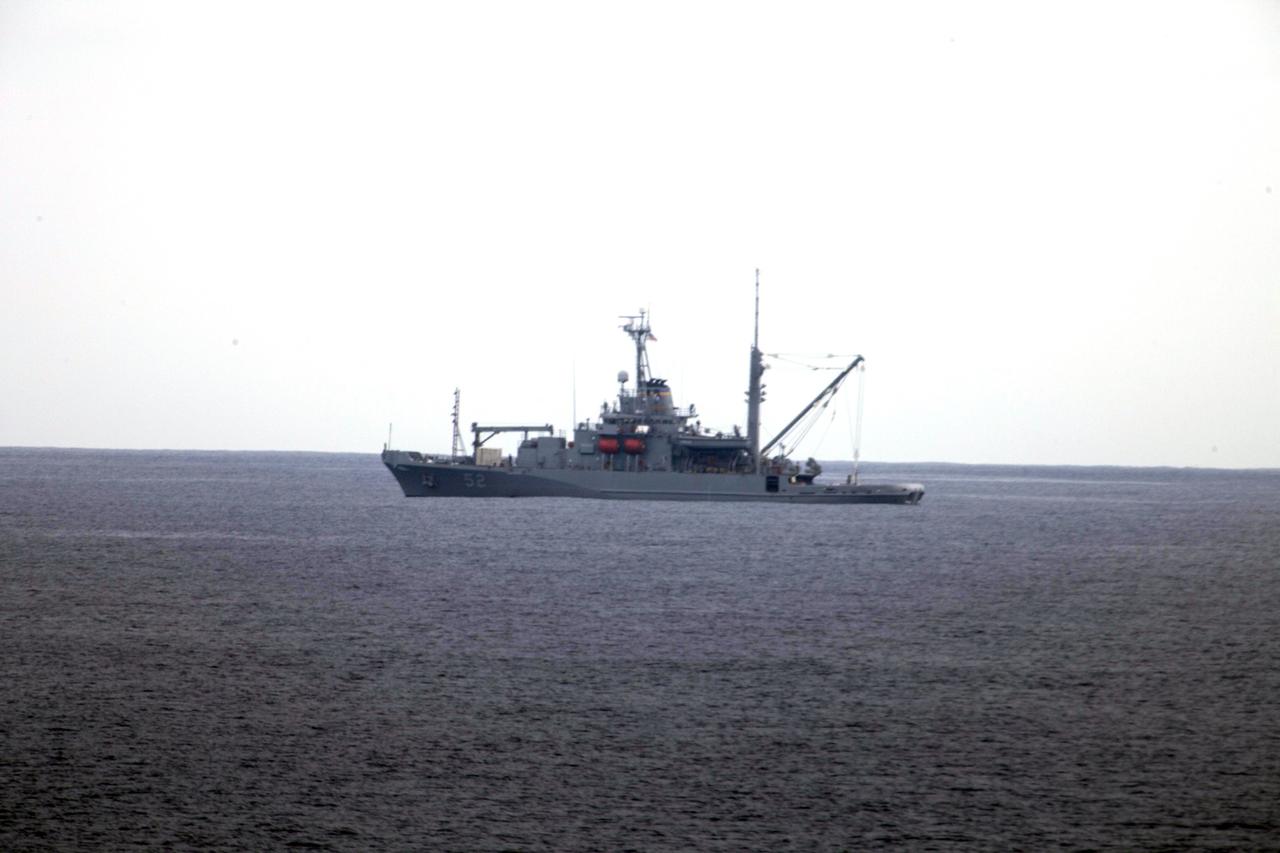
SAN DIEGO, Calif. – On the third day of preparations for recovery of Orion after its splashdown in the Pacific Ocean, the USNS Salvor is in the Pacific Ocean, nearby the USS Anchorage, about 600 miles off the coast of Baja, California. The Salvor will be used to recover Orion in the event that the spacecraft cannot be recovered using the well deck of the USS Anchorage. NASA, Lockheed Martin and U.S. Navy personnel are preparing for recovery of the crew module, forward bay cover and parachutes after the spacecraft's return from space and splashdown in the Pacific Ocean. The Ground Systems Development and Operations Program is leading the recovery efforts. The first unpiloted flight test of Orion is scheduled to launch Dec. 4 atop a United Launch Alliance Delta IV Heavy rocket. During its two-orbit, 4.5-hour flight, Orion will venture 3,600 miles in altitude and travel nearly 60,000 miles before returning to Earth for a splashdown in the Pacific Ocean. For more information, visit http://www.nasa.gov/orion. Photo credit: NASA/Cory Huston
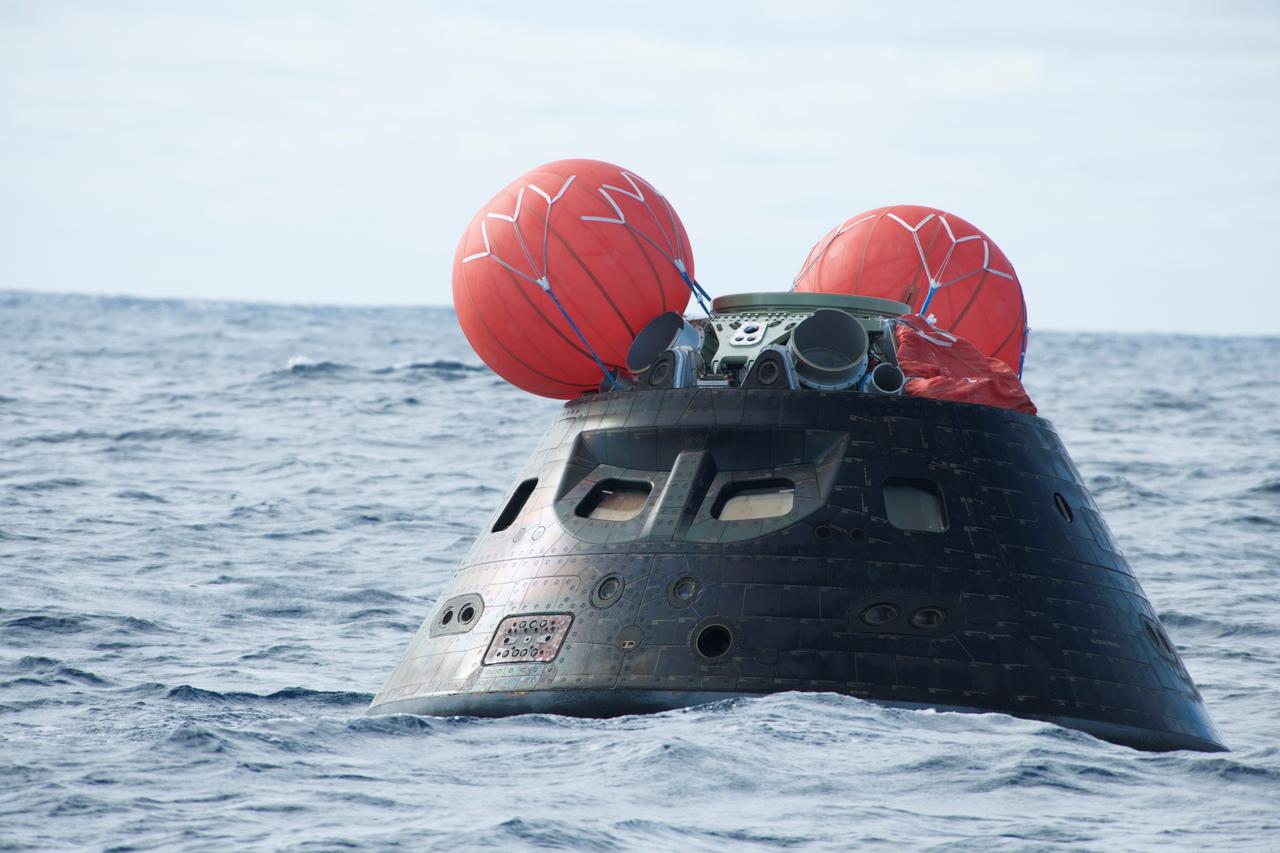
NASA's Orion spacecraft floats in the Pacific Ocean after splashdown from its first flight test in Earth orbit. The spacecraft completed a two-orbit, four-and-a-half-hour mission in Earth orbit. NASA, the U.S. Navy and Lockheed Martin are coordinating efforts to recover Orion, the forward bay cover and main parachutes. Orion will be towed in and secure in the well deck of the nearby USS Anchorage. Orion's mission tested systems critical to crew safety, including the launch abort system, the heat shield and the parachute system. The Ground Systems Development and Operations Program is leading the recovery efforts.
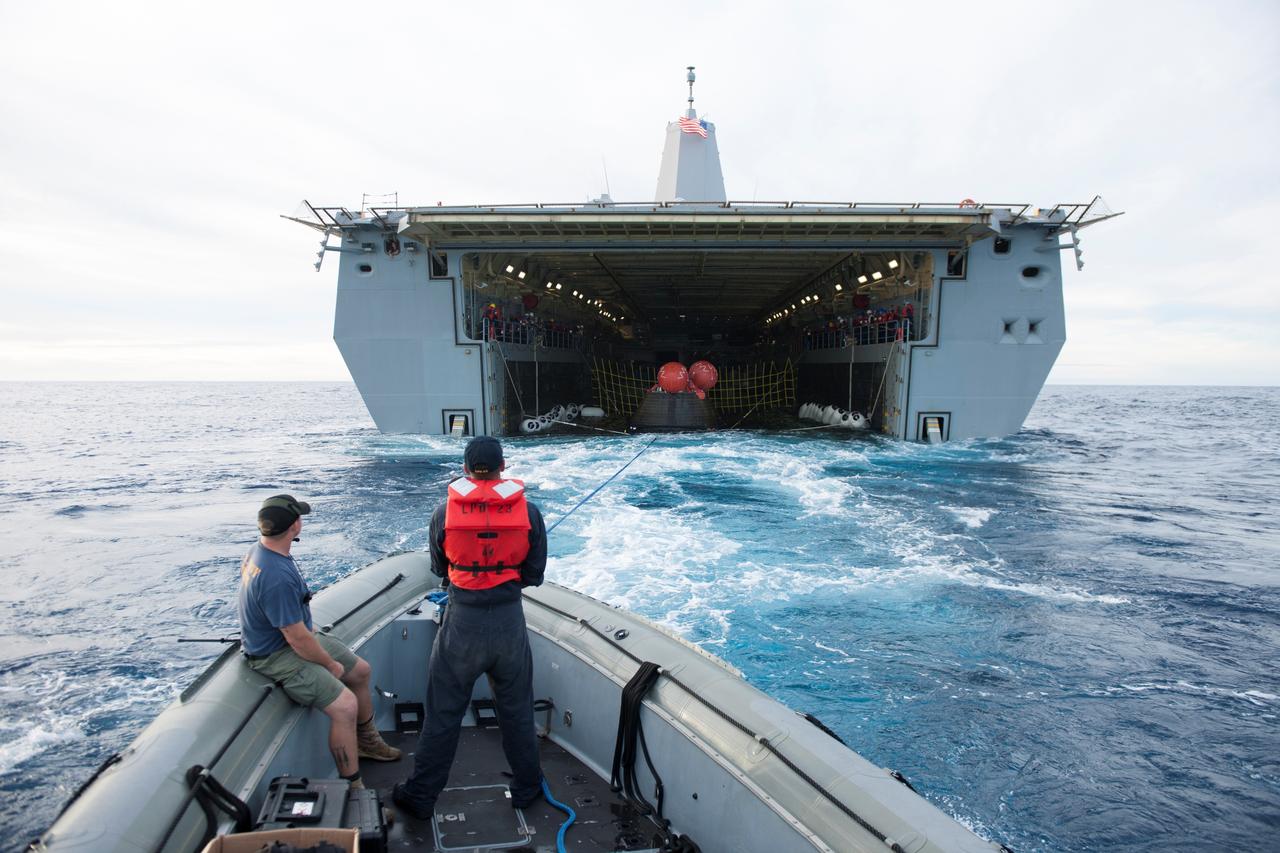
U.S. Navy personnel aboard a rigid hull inflatable boat help recover NASA's Orion spacecraft following its splashdown in the Pacific Ocean after its first flight test in Earth orbit. Orion is towed into the flooded well deck of the USS Anchorage. NASA, the U.S. Navy and Lockheed Martin coordinated efforts to recover Orion, the forward bay cover and main parachutes. Orion completed a two-orbit, four-and-a-half hour mission, to test systems critical to crew safety, including the launch abort system, the heat shield and the parachute system. The Ground Systems Development and Operations Program is leading the recovery efforts.
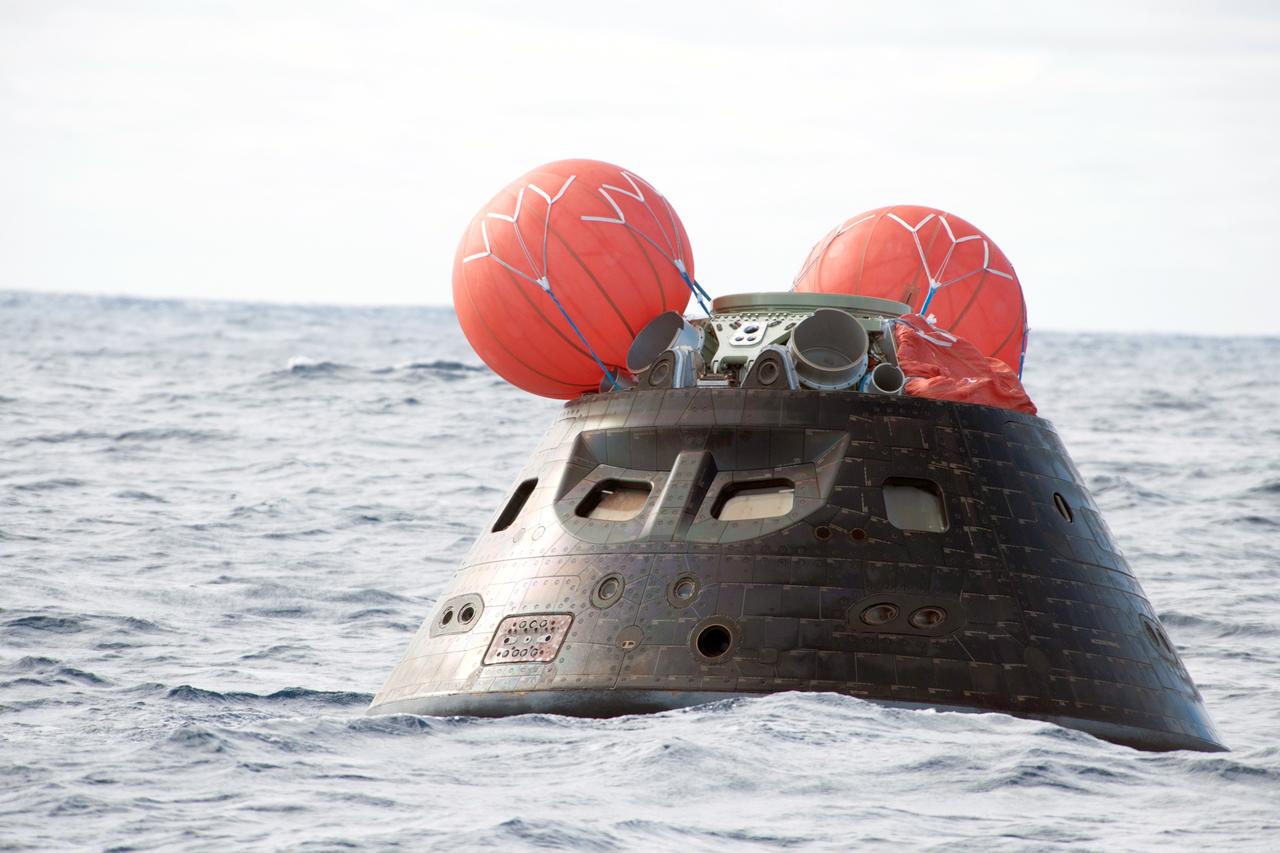
SAN DIEGO, Calif. -- NASA's Orion spacecraft floats in the Pacific Ocean after splashdown from its first flight test in Earth orbit. The spacecraft completed a two-orbit, four-and-a-half-hour mission in Earth orbit. NASA, the U.S. Navy and Lockheed Martin are coordinating efforts to recover Orion, the forward bay cover and main parachutes. Orion will be towed in and secure in the well deck of the nearby USS Anchorage. Orion's mission tested systems critical to crew safety, including the launch abort system, the heat shield and the parachute system. The Ground Systems Development and Operations Program is leading the recovery efforts. For more information, visit www.nasa.gov/orion Photo credit: NASA/Tony Gray
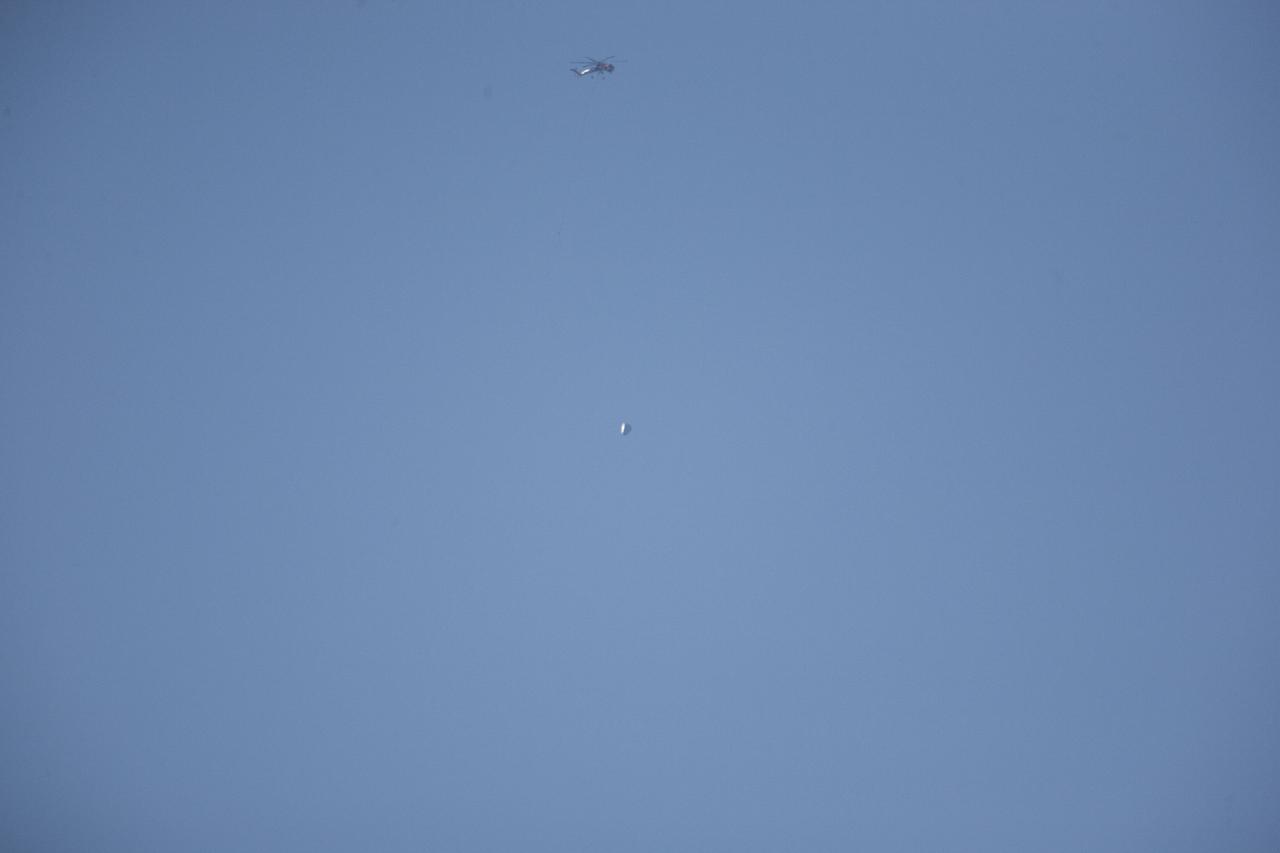
MORRO BAY, Calif. – The SpaceX Dragon test article tumbles over the Pacific Ocean, off the coast of Morro Bay, Calif., following its release for an Erickson Sky Crane helicopter. SpaceX engineers induced the tumble to evaluate the spacecraft's parachute deployment system in an emergency abort scenario. The test is part of a milestone under its Commercial Crew Integrated Capability agreement with NASA's Commercial Crew Program. Photo credit: NASA/Kim Shiflett
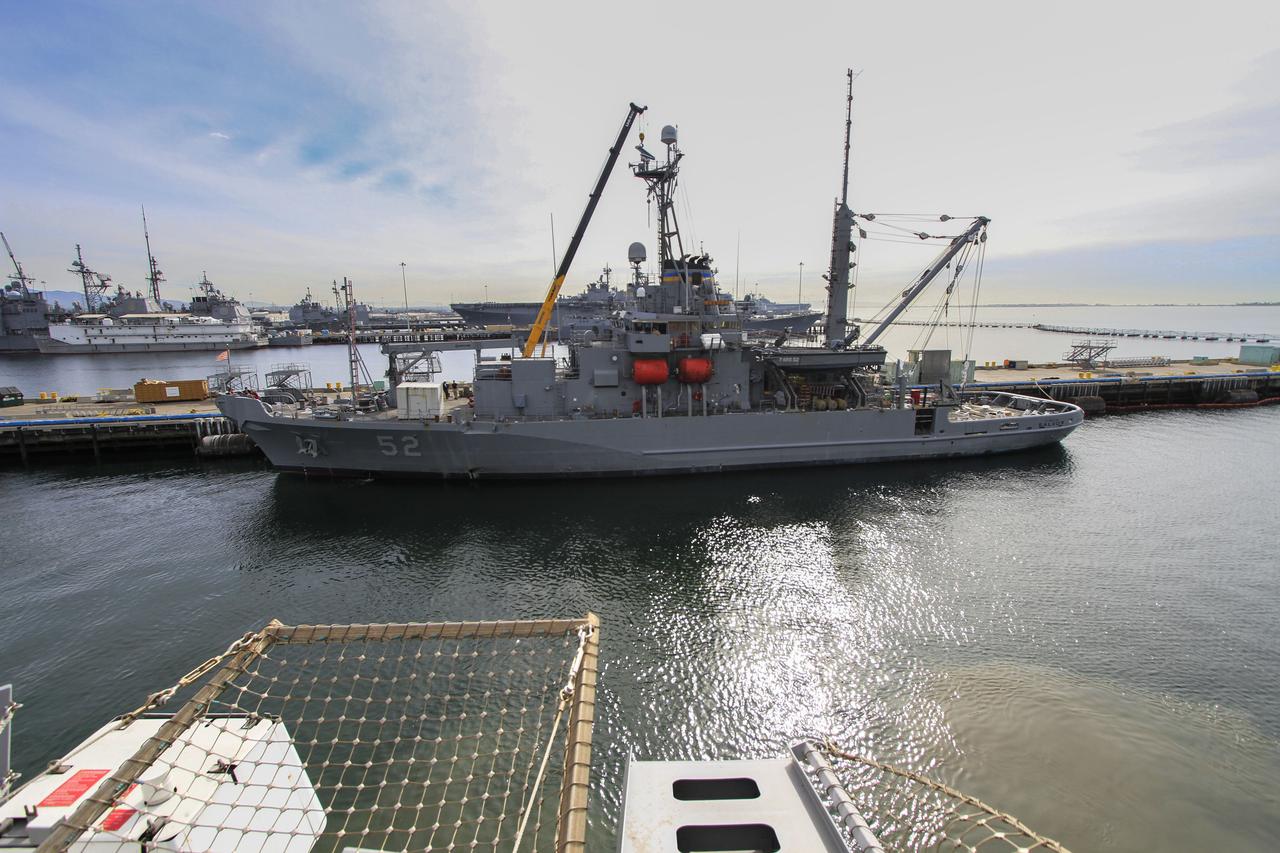
The USNS Salvor, a safeguard-class rescue and salvage ship, is docked at Naval Base San Diego in California. The ship will head out to sea along with the USS Anchorage ahead of Orion's first flight test. NASA and U.S. Navy personnel are making preparations ahead of Orion's flight test for recovery of the crew module, forward bay cover and parachutes on its return from space and splashdown in the Pacific Ocean. If needed, the Salvor would be used for an alternate recovery method. Ground Systems Development and Operations Program is leading the recovery efforts.
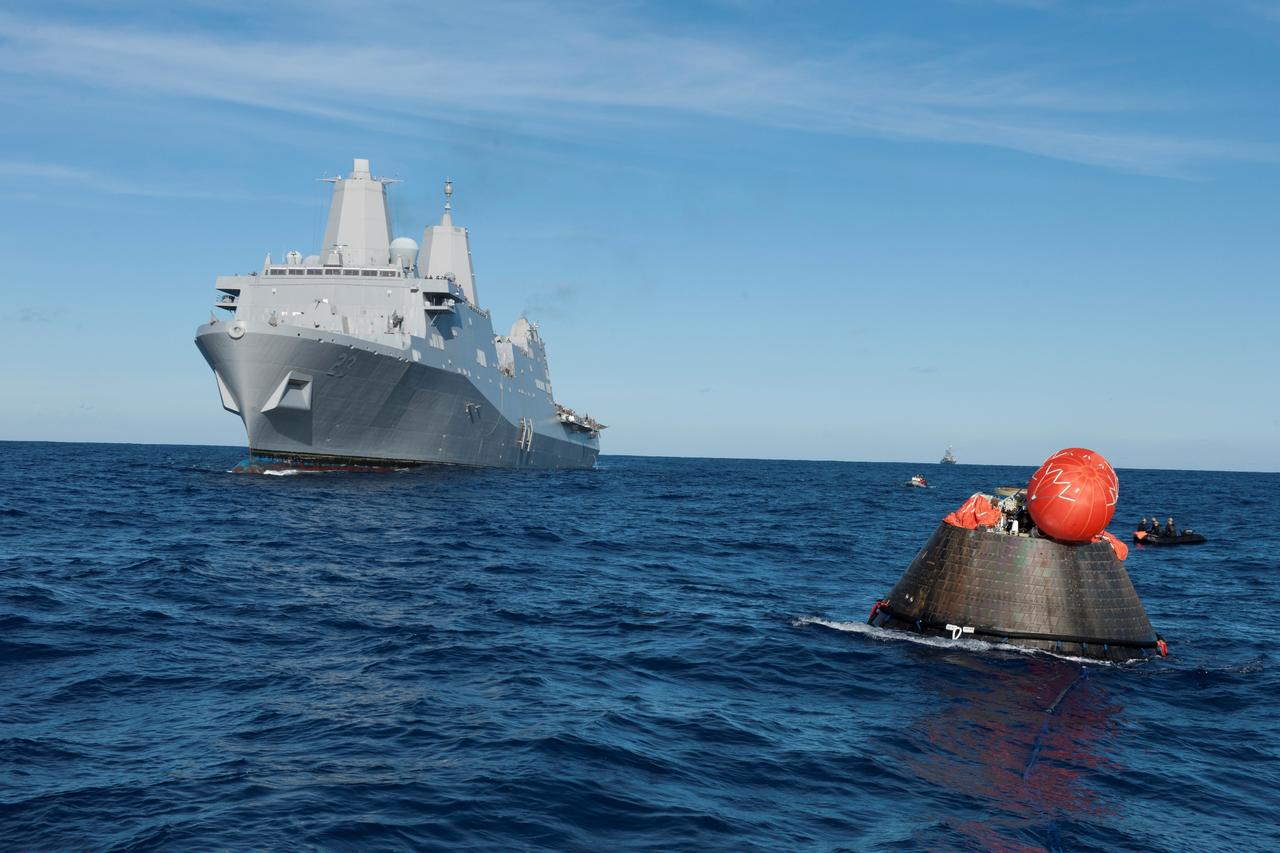
NASA's Orion spacecraft floats in the Pacific Ocean after splashdown from its first flight test in Earth orbit. The USS Anchorage is nearby. NASA, the U.S. Navy and Lockheed Martin are coordinating efforts to recover Orion and secure the spacecraft in the well deck of the USS Anchorage. Orion completed a two-orbit, four-and-a-half hour mission, to test systems critical to crew safety, including the launch abort system, the heat shield and the parachute system. The Ground Systems Development and Operations Program is leading the recovery efforts.
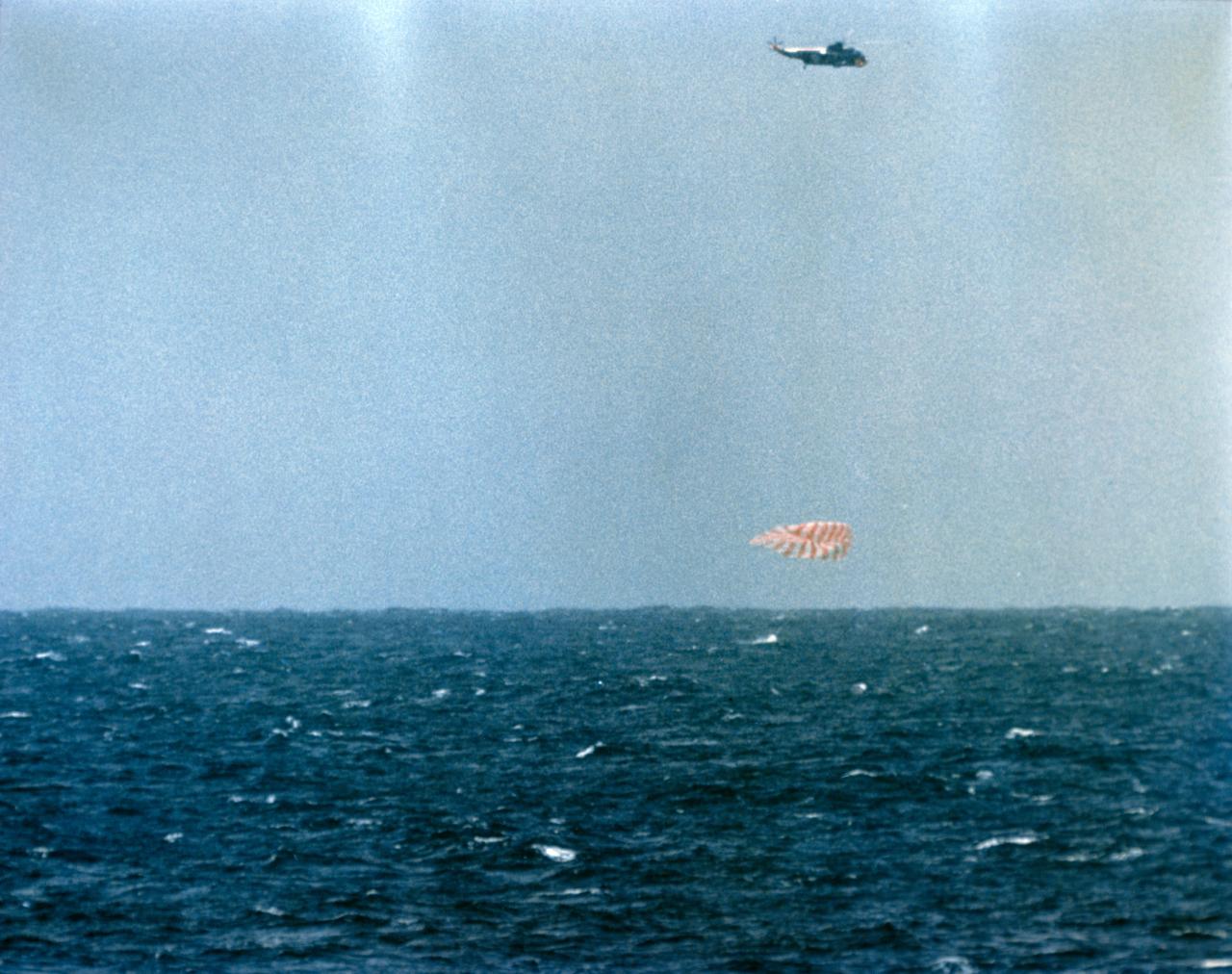
S71-24944 (16 May 1963) --- The Mercury-Atlas 9 "Faith 7" spacecraft, with astronaut L. Gordon Cooper Jr. aboard, splashes down in the Pacific Ocean to conclude a 22-orbit mission lasting 34 hours and 20.5 minutes. The capsule's parachute is fully deployed in this view. A rescue helicopter hovers overhead. Photo credit: NASA
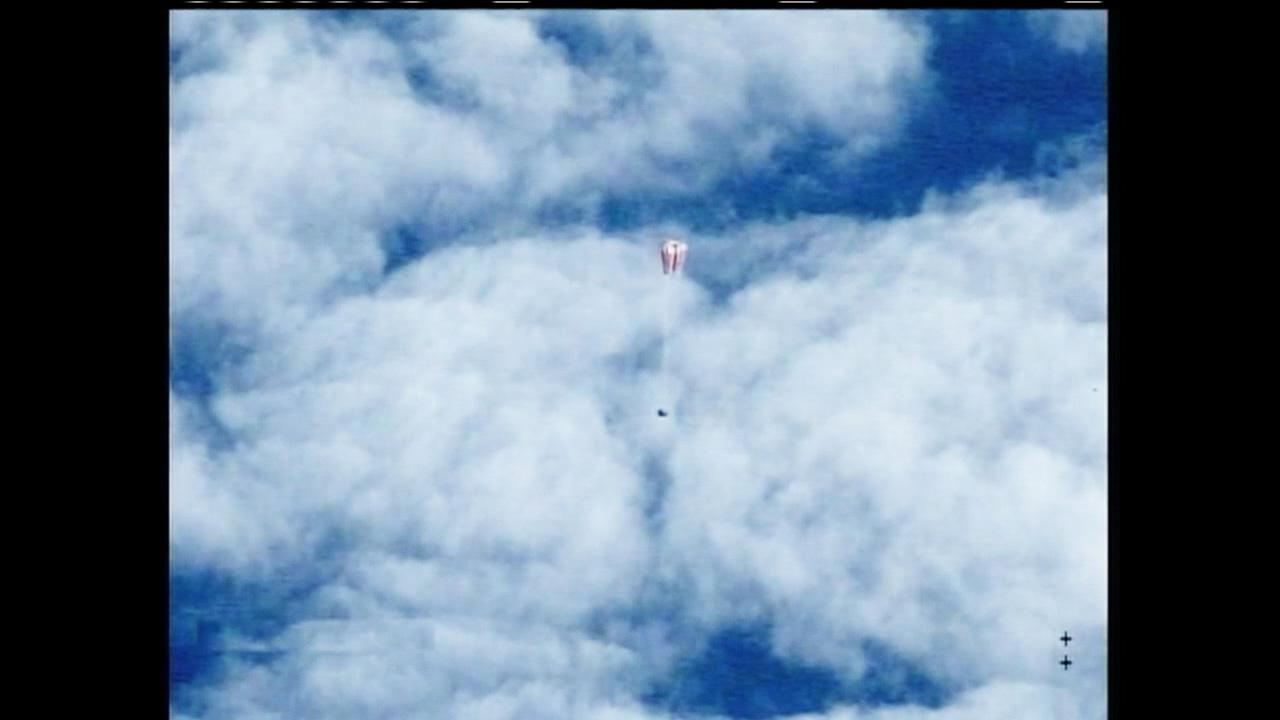
Following more than four hours in Earth orbit, NASA's Orion spacecraft is seen from an unpiloted aircraft as it descends under three massive red and white main parachutes after Exploration Flight Test-1 (EFT-1) on Dec. 5, 2014. Splashdown in the Pacific Ocean will take place at less than 20 mph. It will be recovered by the USS Anchorage, a landing platform-dock, or LPD, ship. Part of Batch image transfer from Flickr.
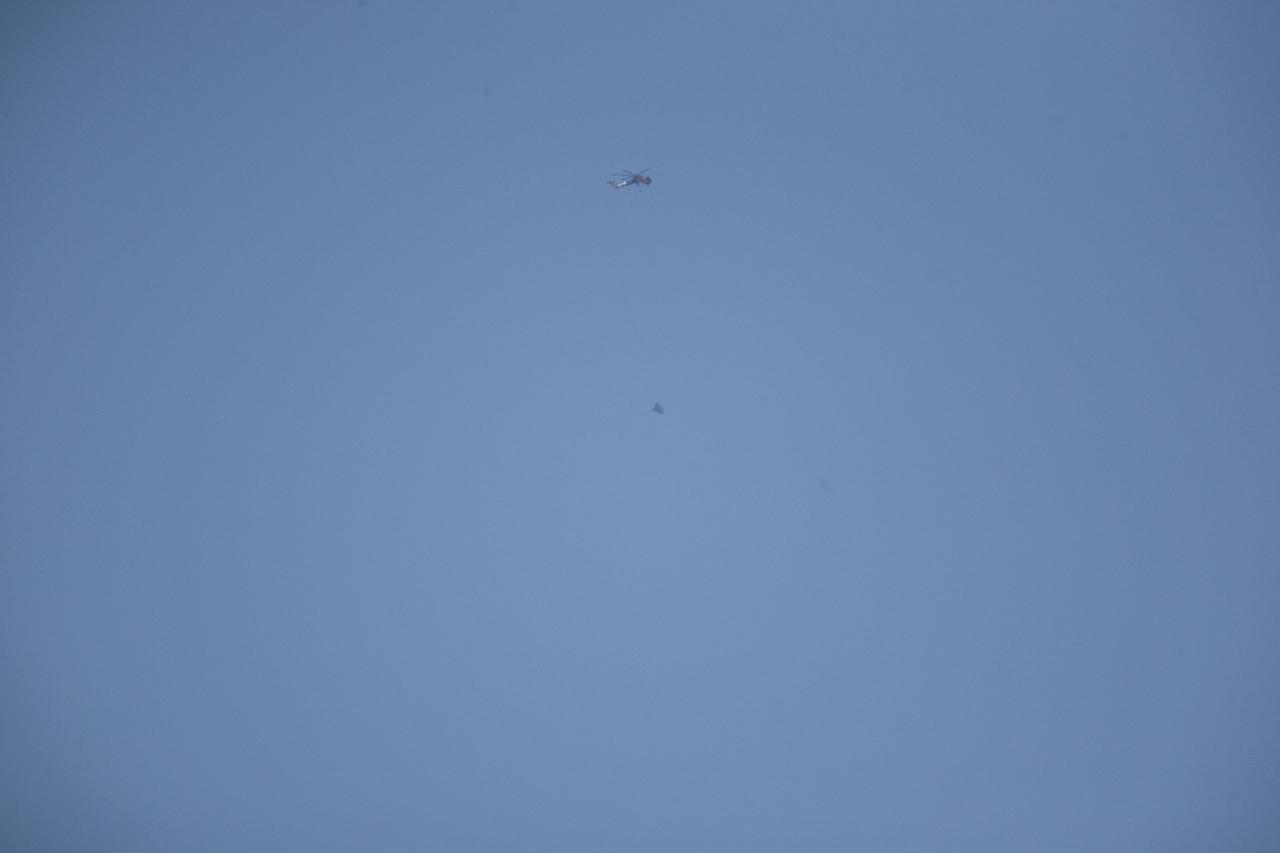
MORRO BAY, Calif. – The SpaceX Dragon test article tumbles over the Pacific Ocean, off the coast of Morro Bay, Calif., following its release for an Erickson Sky Crane helicopter. SpaceX engineers induced the tumble to evaluate the spacecraft's parachute deployment system in an emergency abort scenario. The test is part of a milestone under its Commercial Crew Integrated Capability agreement with NASA's Commercial Crew Program. Photo credit: NASA/Kim Shiflett
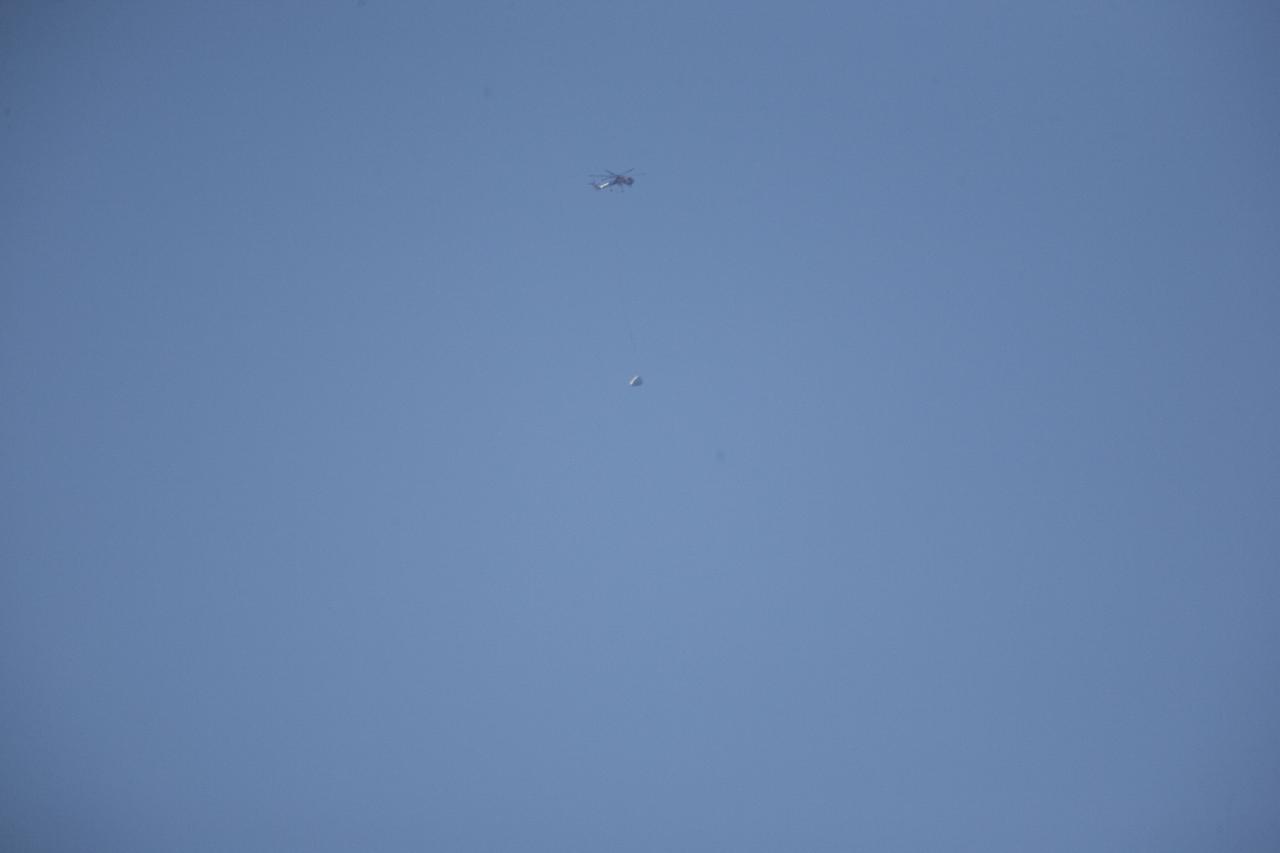
MORRO BAY, Calif. – An Erickson Sky Crane helicopter releases the SpaceX Dragon test article, inducing a tumble similar to what is expected in an emergency abort scenario, over the Pacific Ocean, off the coast of Morro Bay, Calif. The test allowed engineers to better evaluate the spacecraft's parachute deployment system as part of a milestone under its Commercial Crew Integrated Capability agreement with NASA's Commercial Crew Program. Photo credit: NASA/Kim Shiflett
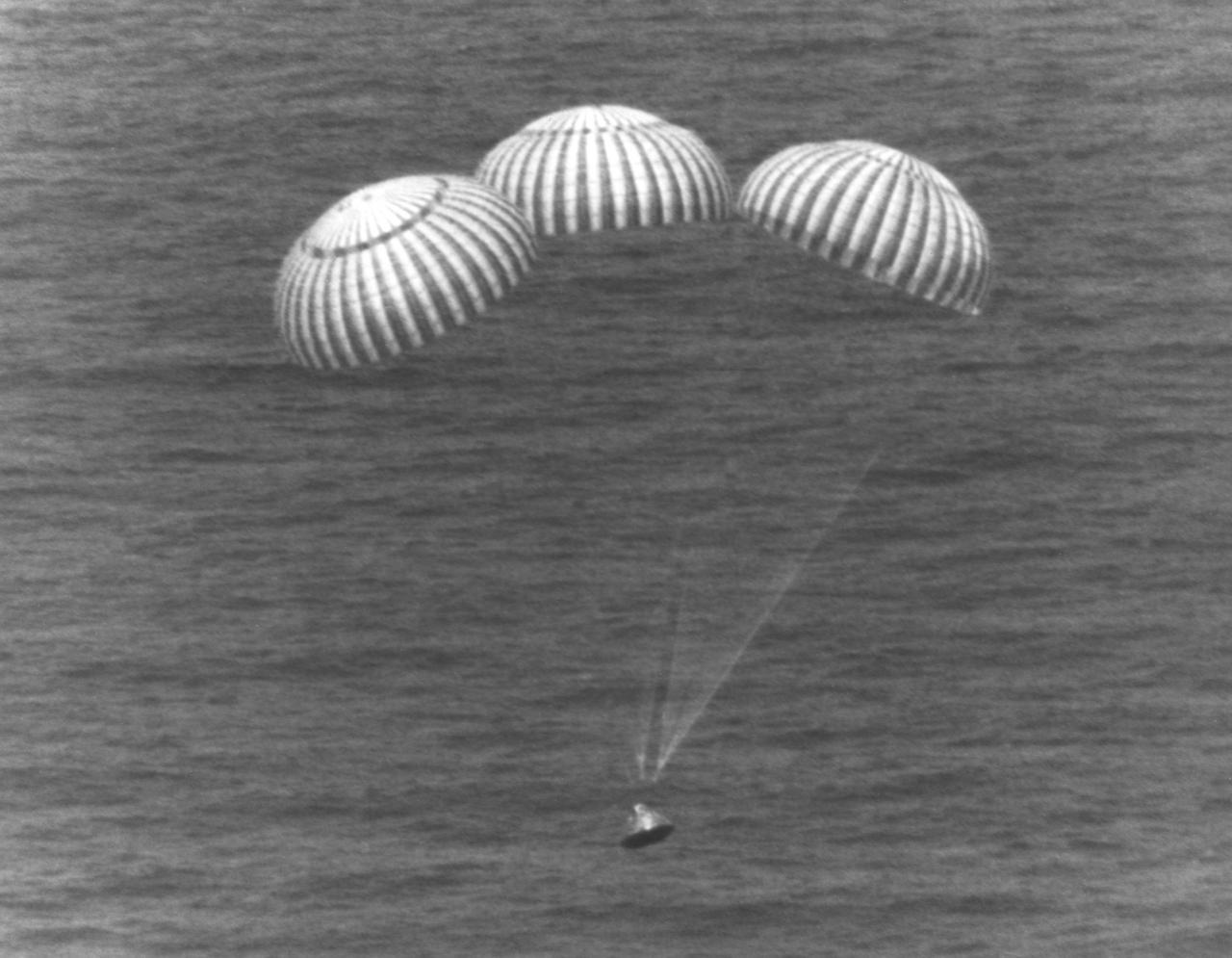
KENNEDY SPACE CENTER, FLA. -- The three main parachutes lower the ASTP Apollo Command Module into the Pacific Ocean west of Hawaii. The splashdown at 5:18 p.m. ended the nine-day mission for ASTP astronauts Thomas Stafford, Vance Brand and Donald Slayton. The Apollo was picked up by the USS New Orleans after which the crewmen participated in ceremonies on the ship's deck.
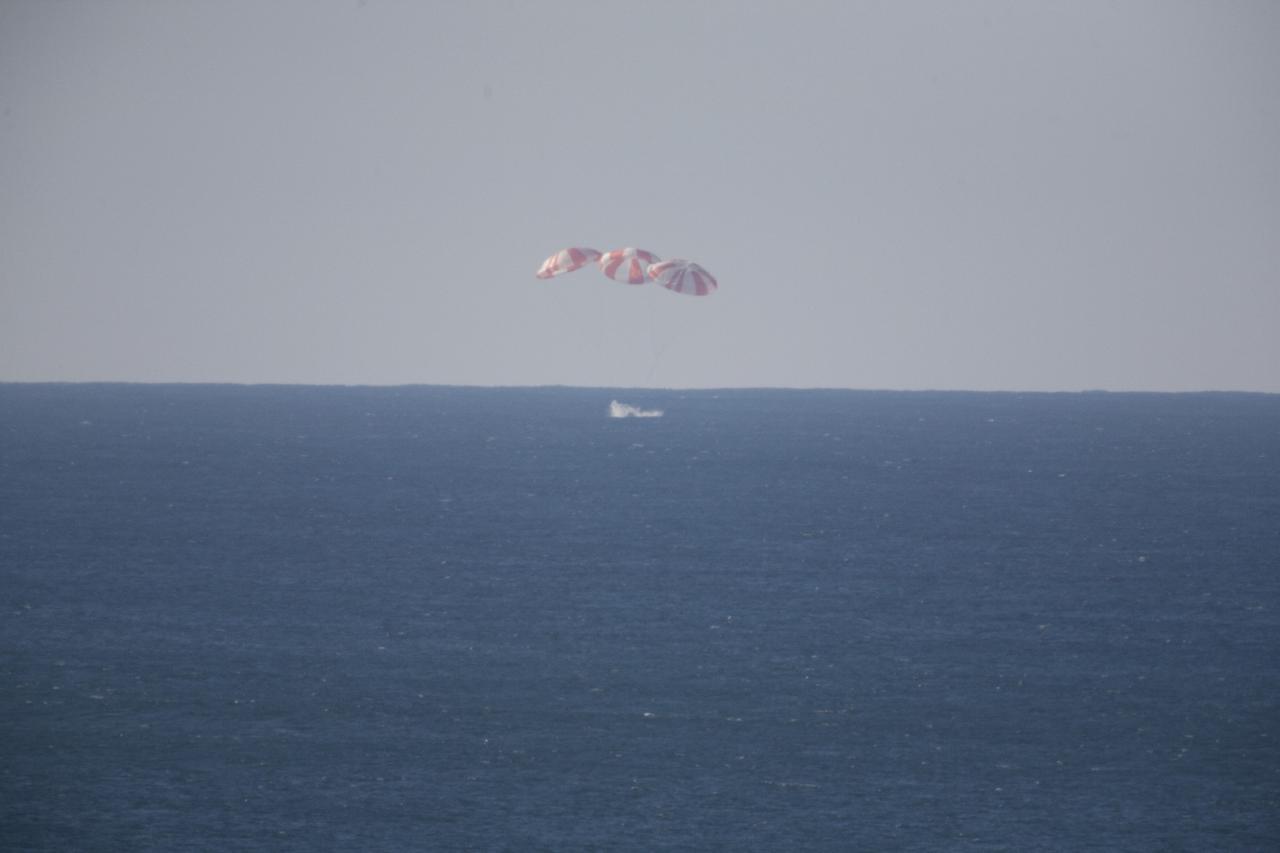
MORRO BAY, Calif. – The SpaceX Dragon test article splashes down following a test over the Pacific Ocean, off the coast of Morro Bay, Calif. The test enabled SpaceX engineers to evaluate the spacecraft's parachute deployment system as part of a milestone under its Commercial Crew Integrated Capability agreement with NASA's Commercial Crew Program. Photo credit: NASA/Kim Shiflett
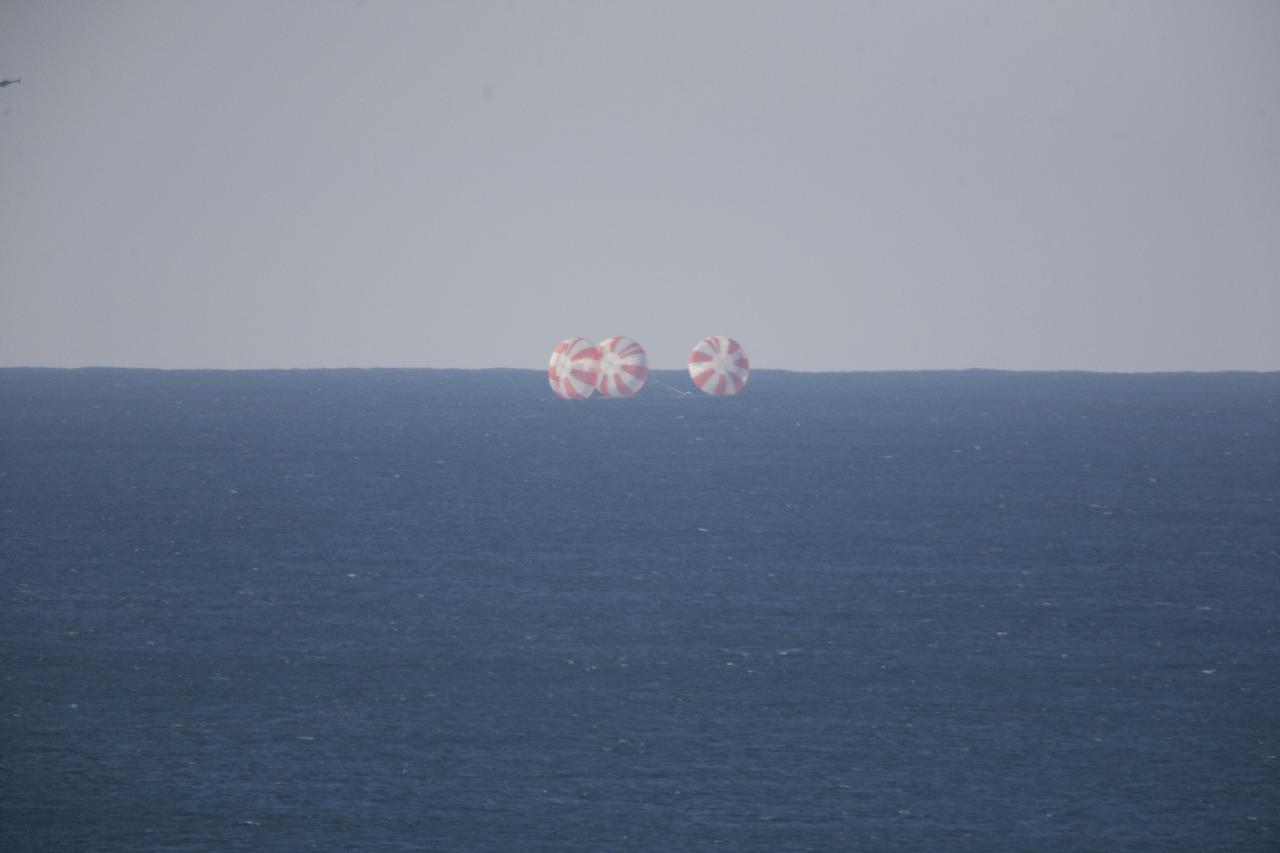
MORRO BAY, Calif. – The SpaceX Dragon test article awaits recovery from the Pacific Ocean, off the coast of Morro Bay, Calif following splash down. The test enabled SpaceX engineers to evaluate the spacecraft's parachute deployment system as part of a milestone under its Commercial Crew Integrated Capability agreement with NASA's Commercial Crew Program. Photo credit: NASA/Kim Shiflett
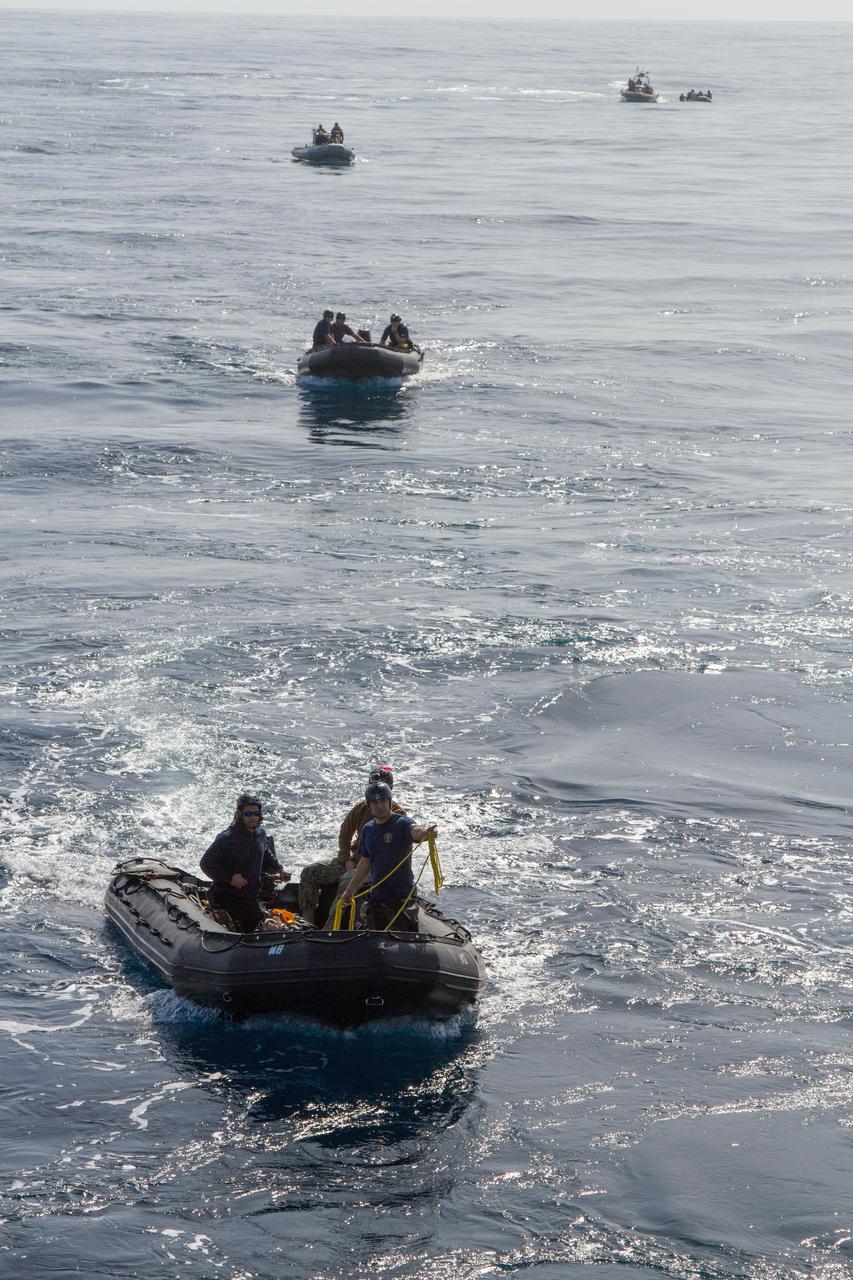
NASA and the U.S. Navy conduct a test on Feb. 20, 2014 in the Pacific Ocean, about 100 miles off the coast of San Diego, California, to prepare for the recovery of the Orion crew module, forward bay cover and parachutes on its return from a deep space mission. The underway recovery test will allow the teams to demonstrate and evaluate the recovery processes, procedures, hardware and personnel in open waters. Part of Batch image transfer from Flickr.
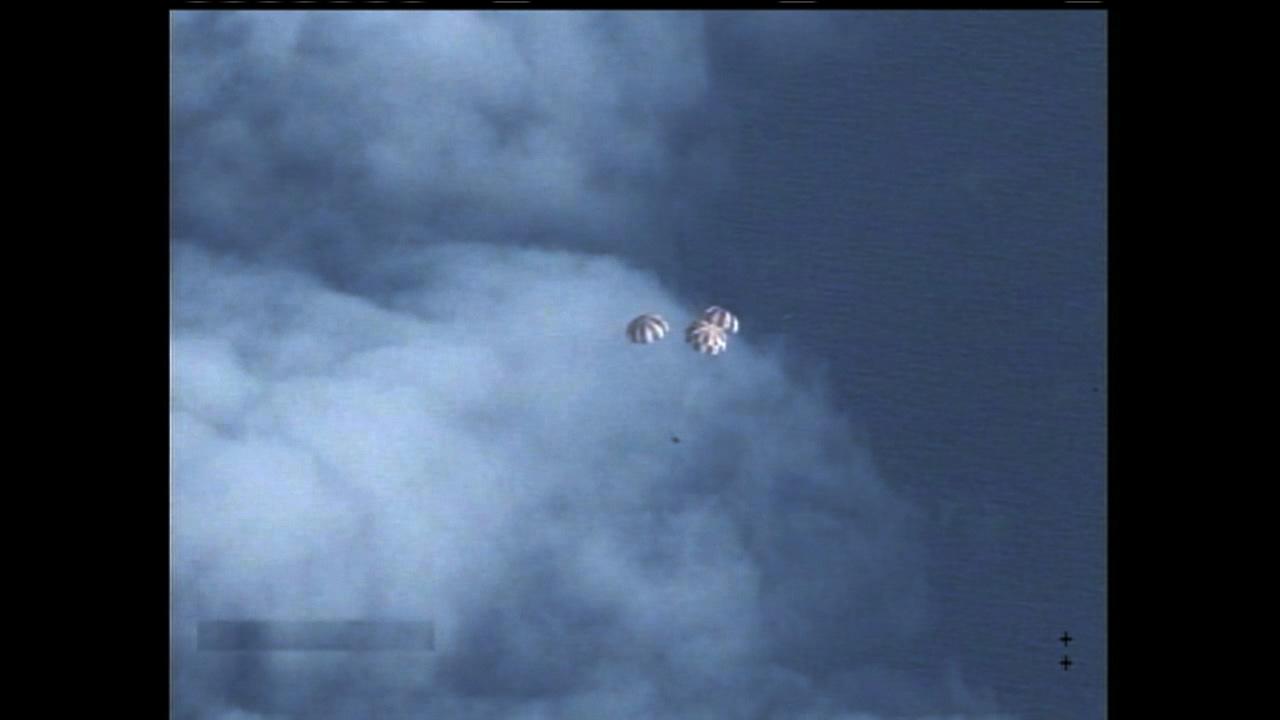
Following more than four hours in Earth orbit, NASA's Orion spacecraft is seen from an unpiloted aircraft as it descends under three massive red and white main parachutes after Exploration Flight Test-1 (EFT-1) on Dec. 5, 2014. Splashdown in the Pacific Ocean will take place at less than 20 mph. It will be recovered by the USS Anchorage, a landing platform-dock, or LPD, ship. Part of Batch image transfer from Flickr.
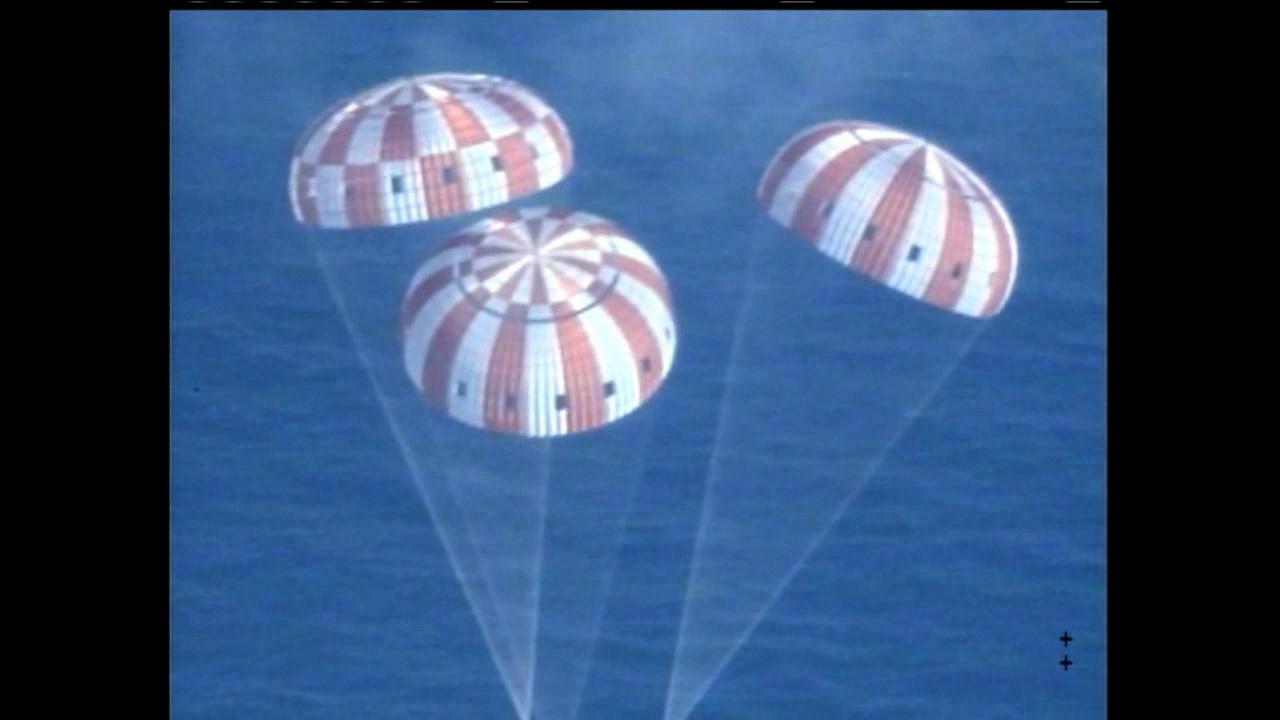
Following more than four hours in Earth orbit, NASA's Orion spacecraft is seen from an unpiloted aircraft as it descends under three massive red and white main parachutes after Exploration Flight Test-1 (EFT-1) on Dec. 5, 2014. Splashdown in the Pacific Ocean will take place at less than 20 mph. It will be recovered by the USS Anchorage, a landing platform-dock, or LPD, ship. Part of Batch image transfer from Flickr.
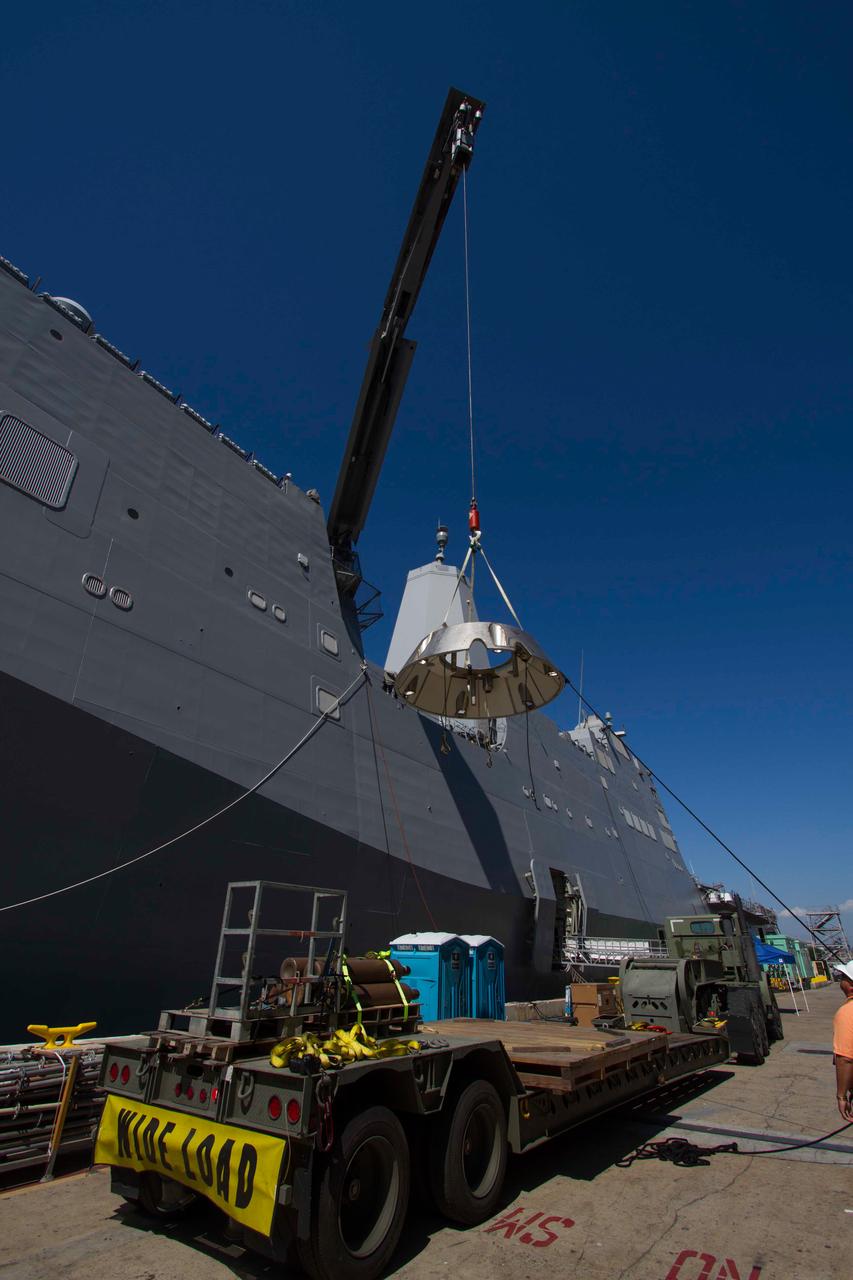
A test version of Orion's forward bay cover is loaded onto the Navy's USS Anchorage in preparation for testing Orion recovery tools and techniques in the Pacific Ocean off the coast of San Diego on Sept. 12, 2014. The forward bay cover protects the top section of Orion's crew module until the spacecraft is almost ready to land. It is jettisoned to allow Orion's parachutes to deploy and must be recovered separately from the crew module. Part of Batch image transfer from Flickr.
NASA and the U.S. Navy conduct a test on Feb. 20, 2014 in the Pacific Ocean, about 100 miles off the coast of San Diego, California, to prepare for the recovery of the Orion crew module, forward bay cover and parachutes on its return from a deep space mission. The underway recovery test will allow the teams to demonstrate and evaluate the recovery processes, procedures, hardware and personnel in open waters. Part of Batch image transfer from Flickr.
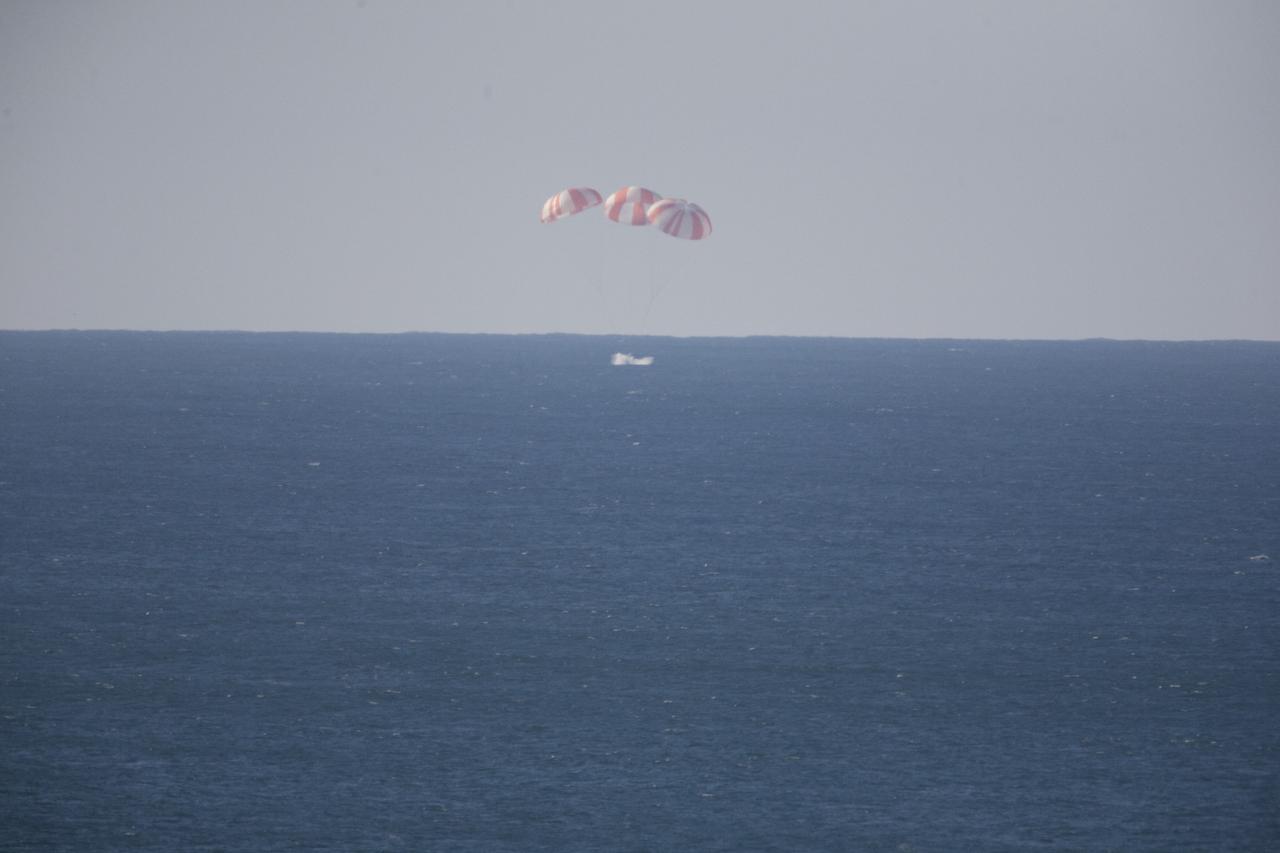
MORRO BAY, Calif. – The SpaceX Dragon test article splashes down following a test over the Pacific Ocean, off the coast of Morro Bay, Calif. The test enabled SpaceX engineers to evaluate the spacecraft's parachute deployment system as part of a milestone under its Commercial Crew Integrated Capability agreement with NASA's Commercial Crew Program. Photo credit: NASA/Kim Shiflett
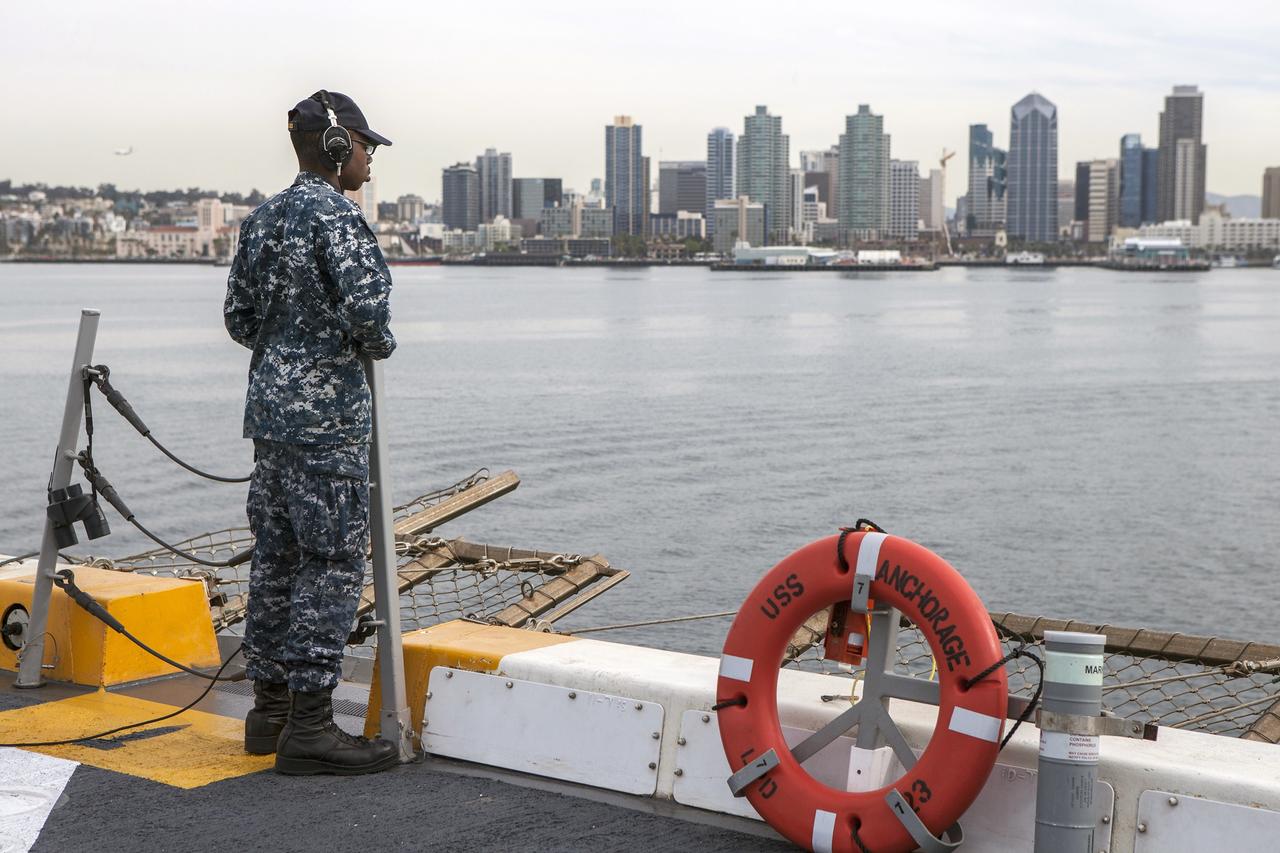
SAN DIEGO, Calif. – U.S. Navy personnel are stationed on the deck of the USS Anchorage as the ship departs Naval Base San Diego in California. NASA and the U.S. Navy are heading out to sea ahead of Orion's flight test to prepare for recovery of the crew module, forward bay cover and parachutes on its return from space and splashdown in the Pacific Ocean. The Ground Systems Development and Operations Program is leading the recovery efforts. The first unpiloted flight test of Orion is scheduled to launch this week atop a United Launch Alliance Delta IV Heavy rocket. During its two-orbit, 4.5-hour flight, Orion will venture 3,600 miles in altitude and travel nearly 60,000 miles before returning to Earth for a splashdown in the Pacific Ocean. For more information, visit http://www.nasa.gov/orion. Photo credit: NASA/Cory Huston
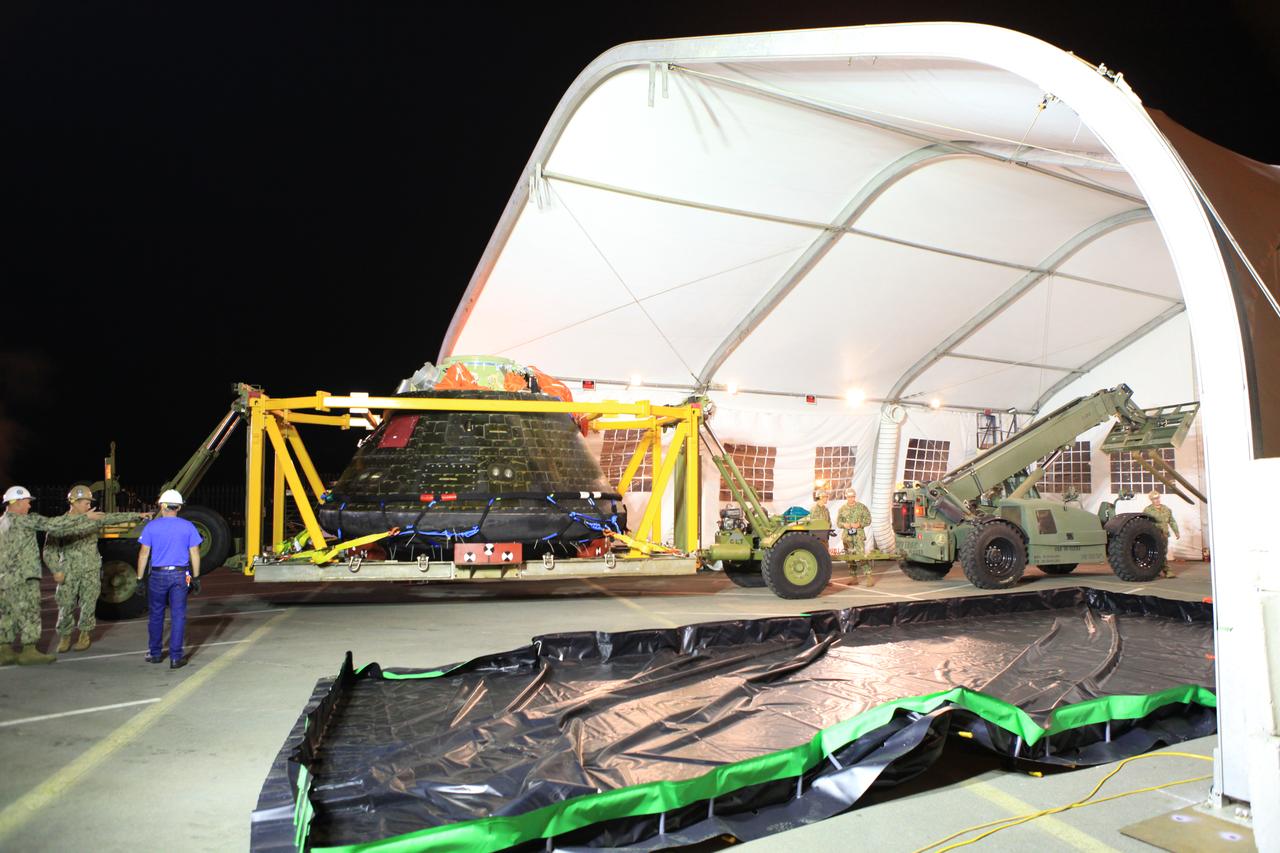
The Orion crew module is being moved into a covered structure at the Mole Pier at Naval Base San Diego in California where it will be prepared for return to NASA's Kennedy Space Center in Florida. Orion was secured on its crew module recovery cradle in the well deck of the USS Anchorage after it was recovered from the Pacific Ocean. After lifting off at 7:05 a.m. EST on Dec. 5, atop a Delta IV Heavy rocket from Space Launch Complex 37 at Cape Canaveral Air Force Station in Florida, Orion completed a two-orbit, four-and-a-half hour mission to test systems critical to crew safety, including the launch abort system, the heat shield and the parachute system. NASA, the U.S. Navy and Lockheed Martin coordinated efforts to recover Orion after splashdown in the Pacific Ocean. The Ground Systems Development and Operations Program led the recovery efforts.
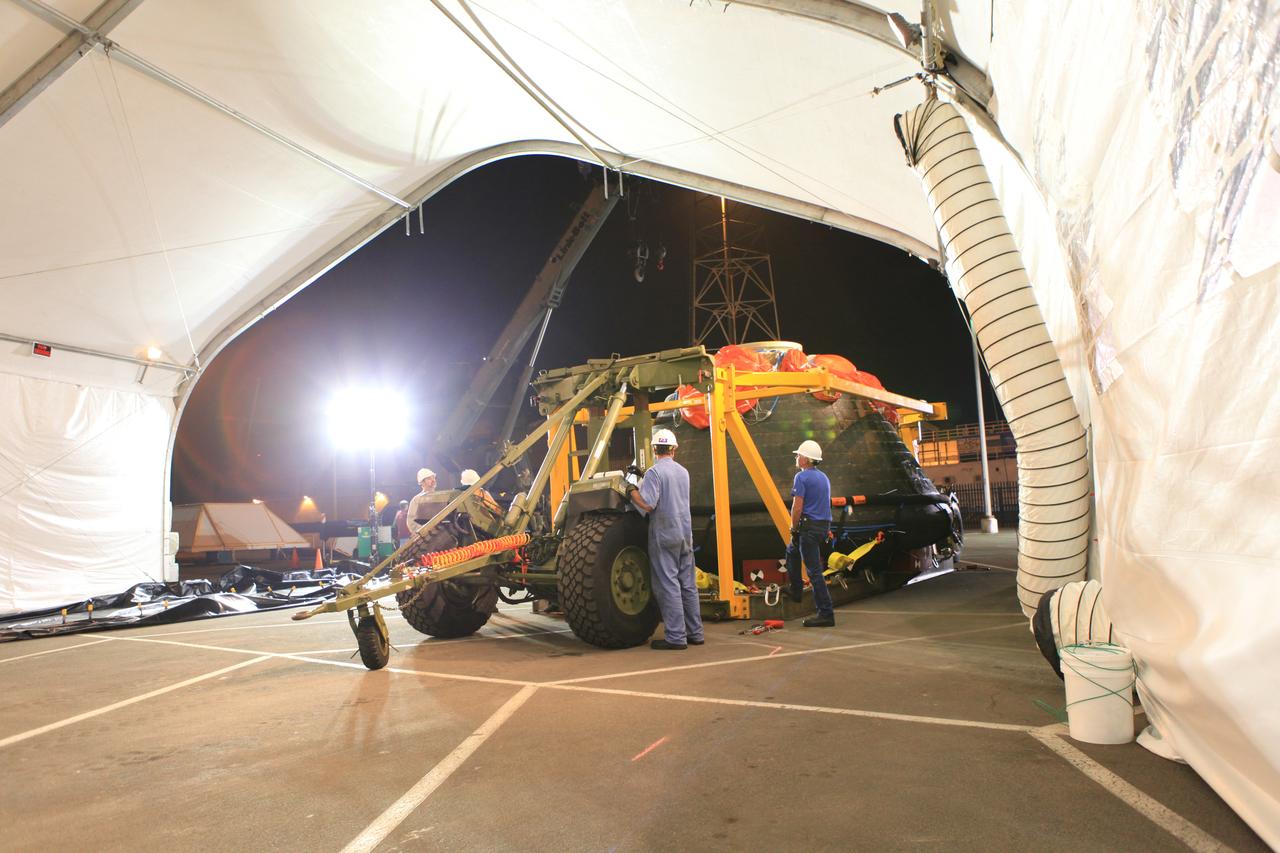
The Orion crew module is being moved into a covered structure at the Mole Pier at Naval Base San Diego in California where it will be prepared for return to NASA's Kennedy Space Center in Florida. Orion was secured on its crew module recovery cradle in the well deck of the USS Anchorage after it was recovered from the Pacific Ocean. After lifting off at 7:05 a.m. EST on Dec. 5, atop a Delta IV Heavy rocket from Space Launch Complex 37 at Cape Canaveral Air Force Station in Florida, Orion completed a two-orbit, four-and-a-half hour mission to test systems critical to crew safety, including the launch abort system, the heat shield and the parachute system. NASA, the U.S. Navy and Lockheed Martin coordinated efforts to recover Orion after splashdown in the Pacific Ocean. The Ground Systems Development and Operations Program led the recovery efforts.
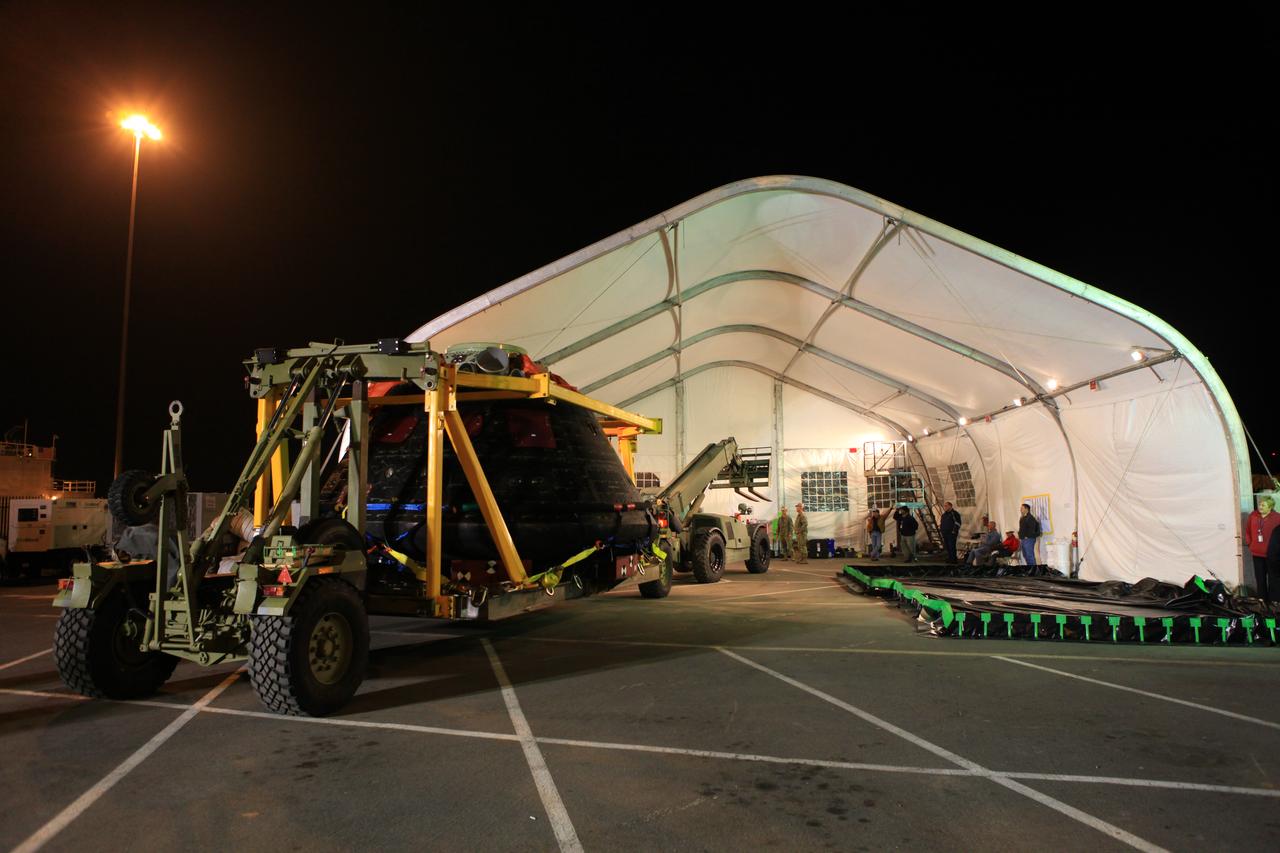
The Orion crew module is being moved into a covered structure at the Mole Pier at Naval Base San Diego in California where it will be prepared for return to NASA's Kennedy Space Center in Florida. Orion was secured on its crew module recovery cradle in the well deck of the USS Anchorage after it was recovered from the Pacific Ocean. After lifting off at 7:05 a.m. EST on Dec. 5, atop a Delta IV Heavy rocket from Space Launch Complex 37 at Cape Canaveral Air Force Station in Florida, Orion completed a two-orbit, four-and-a-half hour mission to test systems critical to crew safety, including the launch abort system, the heat shield and the parachute system. NASA, the U.S. Navy and Lockheed Martin coordinated efforts to recover Orion after splashdown in the Pacific Ocean. The Ground Systems Development and Operations Program led the recovery efforts.
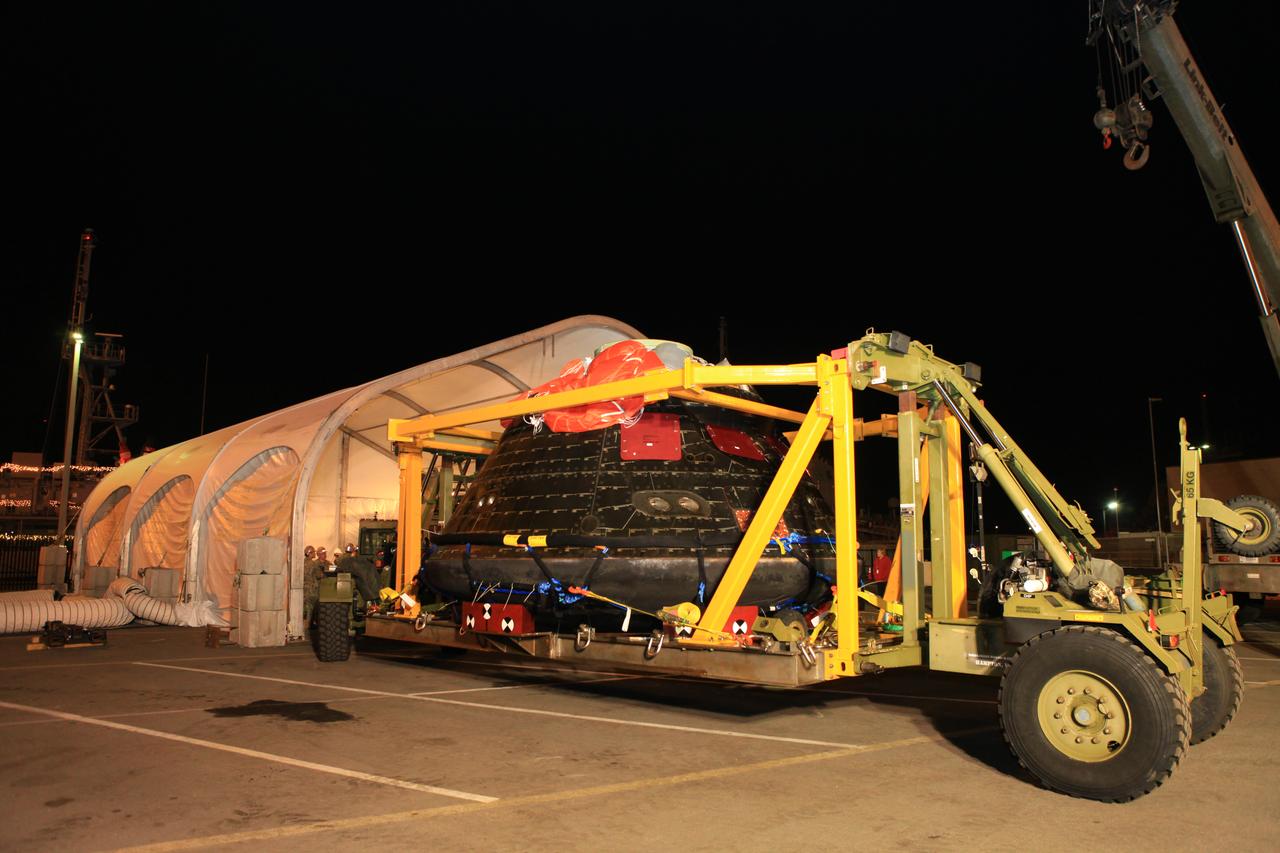
The Orion crew module has been transported to the Mole Pier at Naval Base San Diego in California where it will be prepared for return to NASA's Kennedy Space Center in Florida. Orion was secured on its crew module recovery cradle in the well deck of the USS Anchorage after it was recovered from the Pacific Ocean. After lifting off at 7:05 a.m. EST on Dec. 5, atop a Delta IV Heavy rocket from Space Launch Complex 37 at Cape Canaveral Air Force Station in Florida, Orion completed a two-orbit, four-and-a-half hour mission to test systems critical to crew safety, including the launch abort system, the heat shield and the parachute system. NASA, the U.S. Navy and Lockheed Martin coordinated efforts to recover Orion after splashdown in the Pacific Ocean. The Ground Systems Development and Operations Program led the recovery efforts.
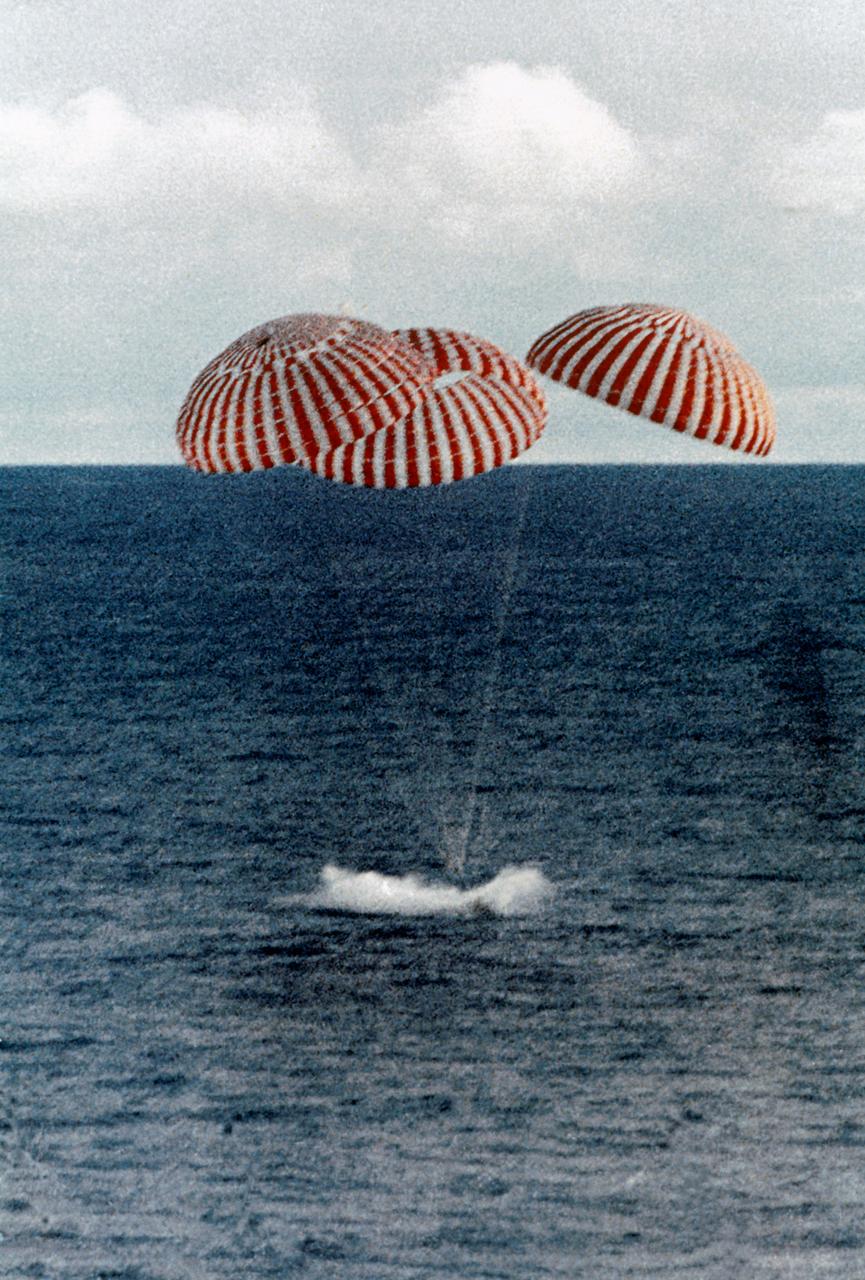
S70-35638 (17 April 1970) --- A perilous space mission comes to a smooth ending with the safe splashdown of the Apollo 13 Command Module (CM) in the South Pacific, only four miles from the prime recovery ship. The spacecraft with astronauts James A. Lovell Jr., John L. Swigert Jr., and Fred W. Haise Jr. aboard, splashed down at 12:07:44 p.m. (CST) April 17, 1970, to conclude safely the problem-plagued flight. The crewmen were transported by helicopter from the immediate recovery area to the USS Iwo Jima, prime recovery vessel.
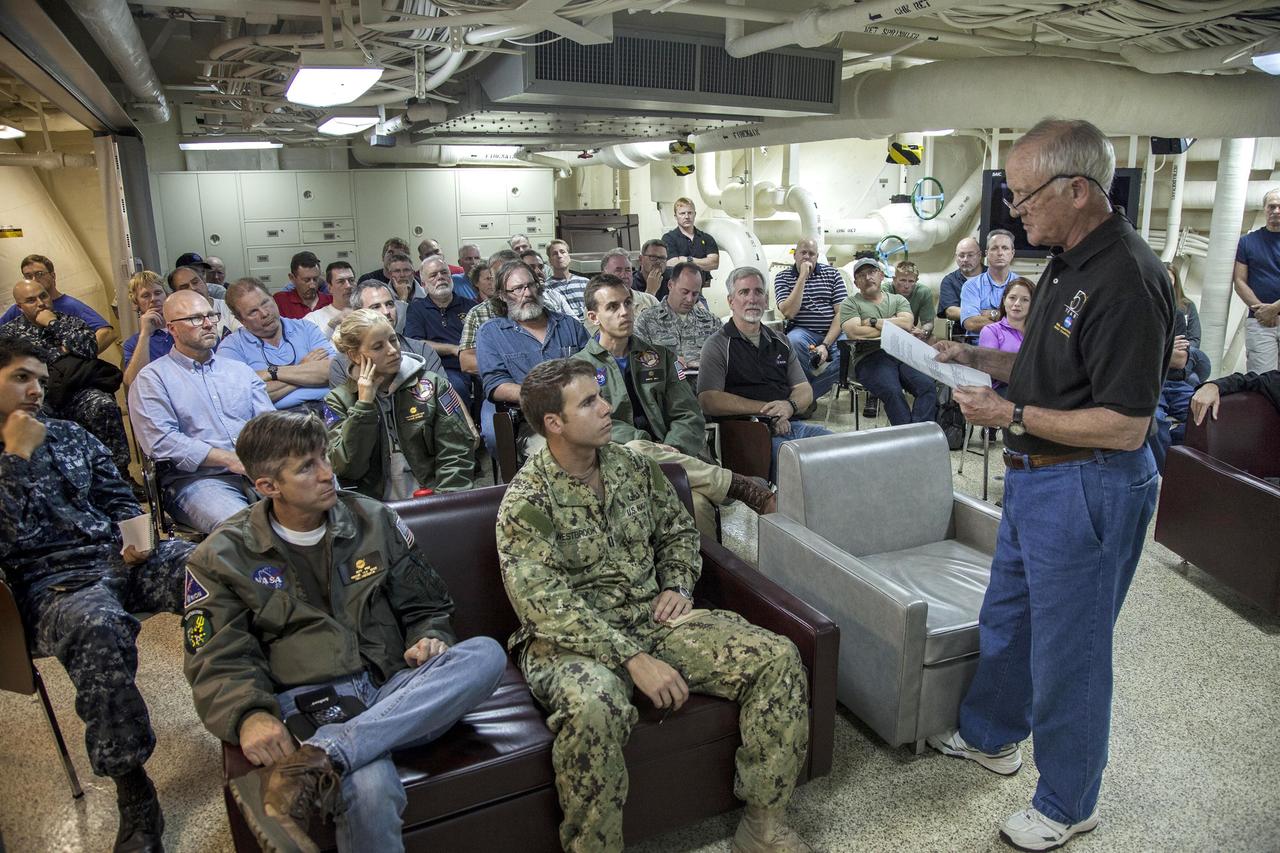
SAN DIEGO, Calif. – NASA, Lockheed Martin and U.S. Navy personnel listen to former space shuttle flight director and mission operations executive Milt Heflin during Orion recovery preparations aboard the USS Anchorage in the Pacific Ocean. Heflin was on prime recovery ships during the splashdowns and post-landing activities of Apollo 8, 10, 16 and 17, each of the three Skylab missions and the Apollo-Soyuz Test Project. NASA and the U.S. Navy are preparing for recovery of the Orion crew module, forward bay cover and parachutes on its return from space and splashdown in the Pacific Ocean. The Ground Systems Development and Operations Program is leading the recovery efforts. The first unpiloted flight test of Orion is scheduled to launch this week atop a United Launch Alliance Delta IV Heavy rocket. During its two-orbit, 4.5-hour flight, Orion will venture 3,600 miles in altitude and travel nearly 60,000 miles before returning to Earth for a splashdown in the Pacific Ocean. For more information, visit http://www.nasa.gov/orion. Photo credit: NASA/Cory Huston
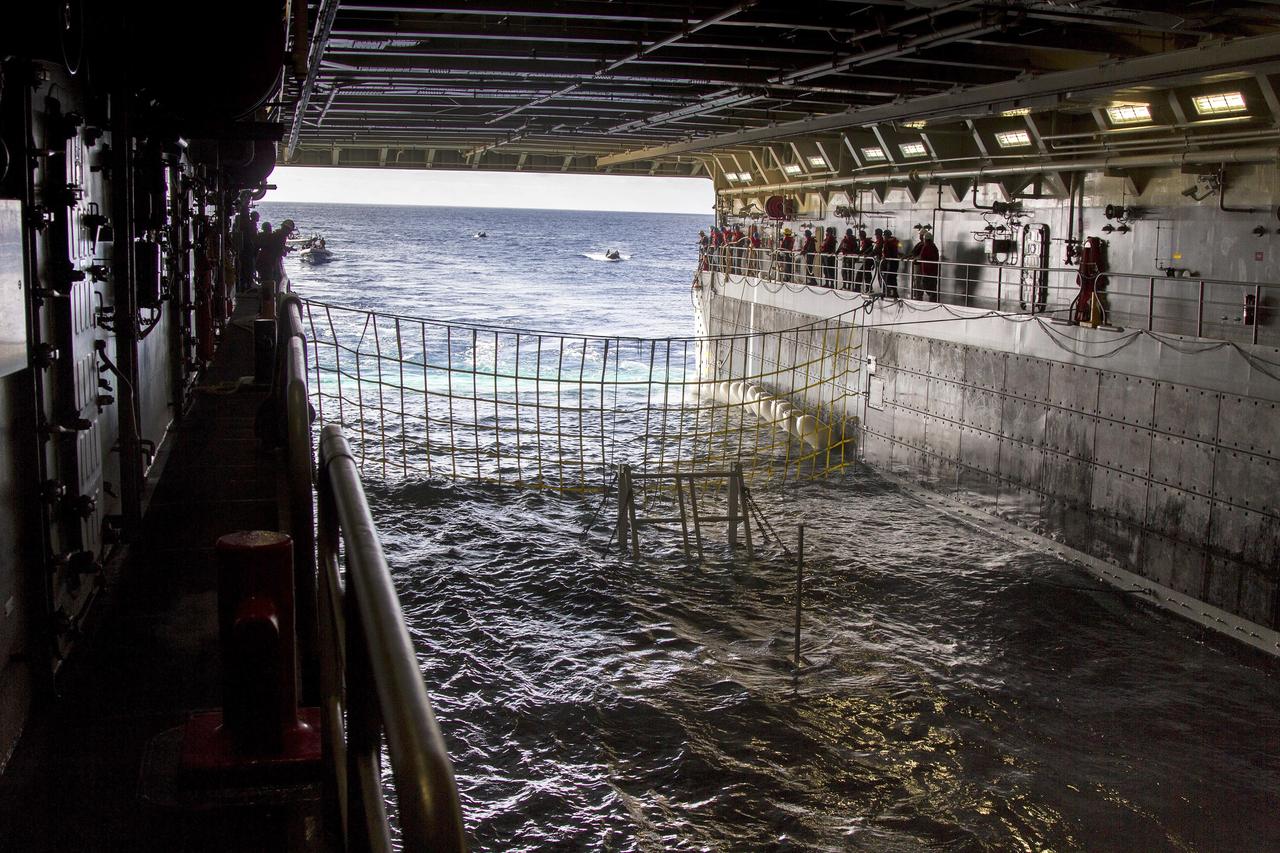
SAN DIEGO, Calif. – On the third day of preparations for recovery of Orion after its splashdown in the Pacific Ocean, the well deck of the USS Anchorage has been filled with water and recovery hardware is in place. U.S. Navy divers have embarked from ship to practice recovery procedures in rigid hull inflatable boats and Zodiac boats. NASA, Lockheed Martin and U.S. Navy personnel are preparing for recovery of the crew module, forward bay cover and parachutes on its return from space and splashdown in the Pacific Ocean. The Ground Systems Development and Operations Program is leading the recovery efforts. The first unpiloted flight test of Orion is scheduled to launch Dec. 4 atop a United Launch Alliance Delta IV Heavy rocket. During its two-orbit, 4.5-hour flight, Orion will venture 3,600 miles in altitude and travel nearly 60,000 miles before returning to Earth for a splashdown in the Pacific Ocean. For more information, visit http://www.nasa.gov/orion. Photo credit: NASA/Cory Huston
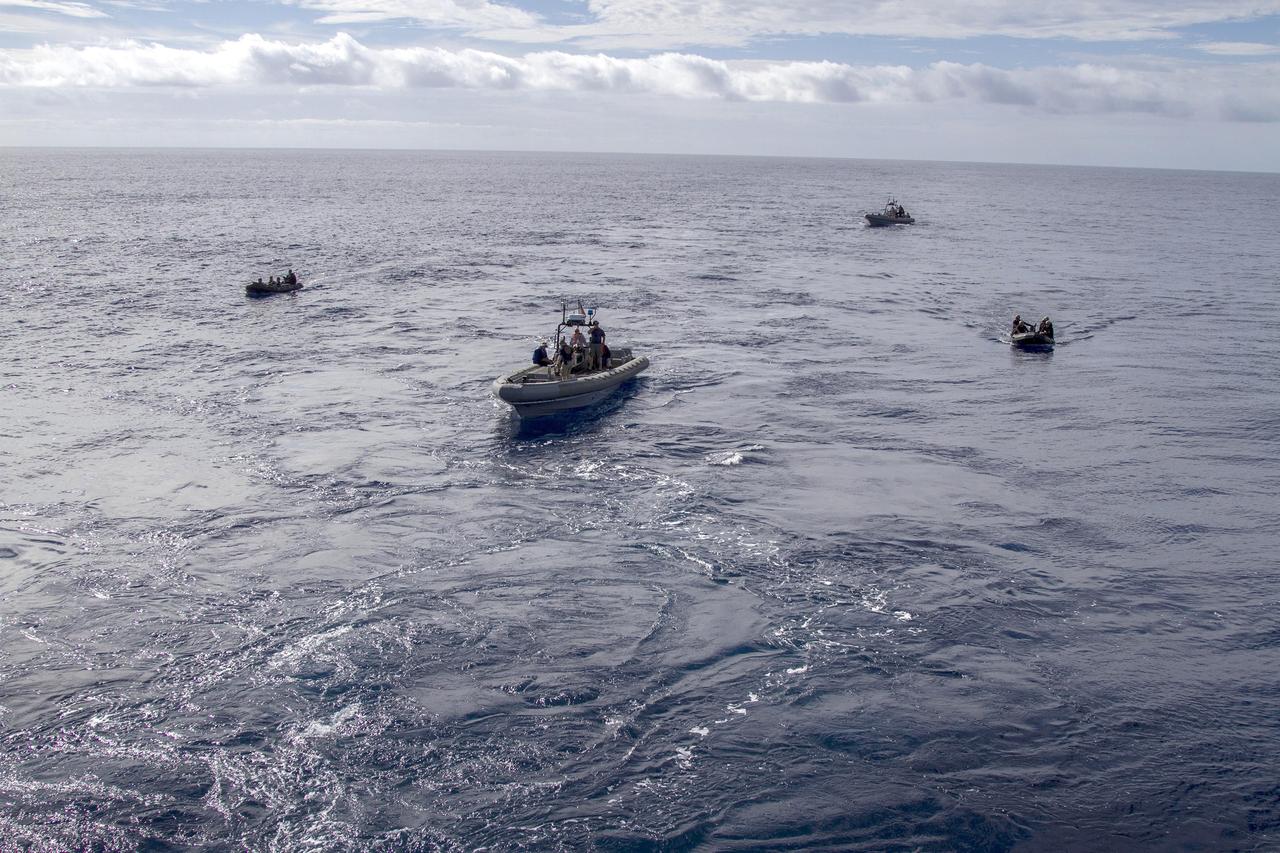
SAN DIEGO, Calif. – On the third day of preparations for recovery of Orion, U.S. Navy divers in two rigid hull inflatable boats and two Zodiac boats practice recovery procedures nearby the USS Anchorage in the Pacific Ocean about 600 miles off the coast of Baja, California. NASA, Lockheed Martin and U.S. Navy personnel are preparing for recovery of the Orion crew module, forward bay cover and parachutes after its return from space and splashdown in the Pacific Ocean. The Ground Systems Development and Operations Program is leading the recovery efforts. The first unpiloted flight test of Orion is scheduled to launch Dec. 4 atop a United Launch Alliance Delta IV Heavy rocket. During its two-orbit, 4.5-hour flight, Orion will venture 3,600 miles in altitude and travel nearly 60,000 miles before returning to Earth for a splashdown in the Pacific Ocean. For more information, visit http://www.nasa.gov/orion. Photo credit: NASA/Cory Huston
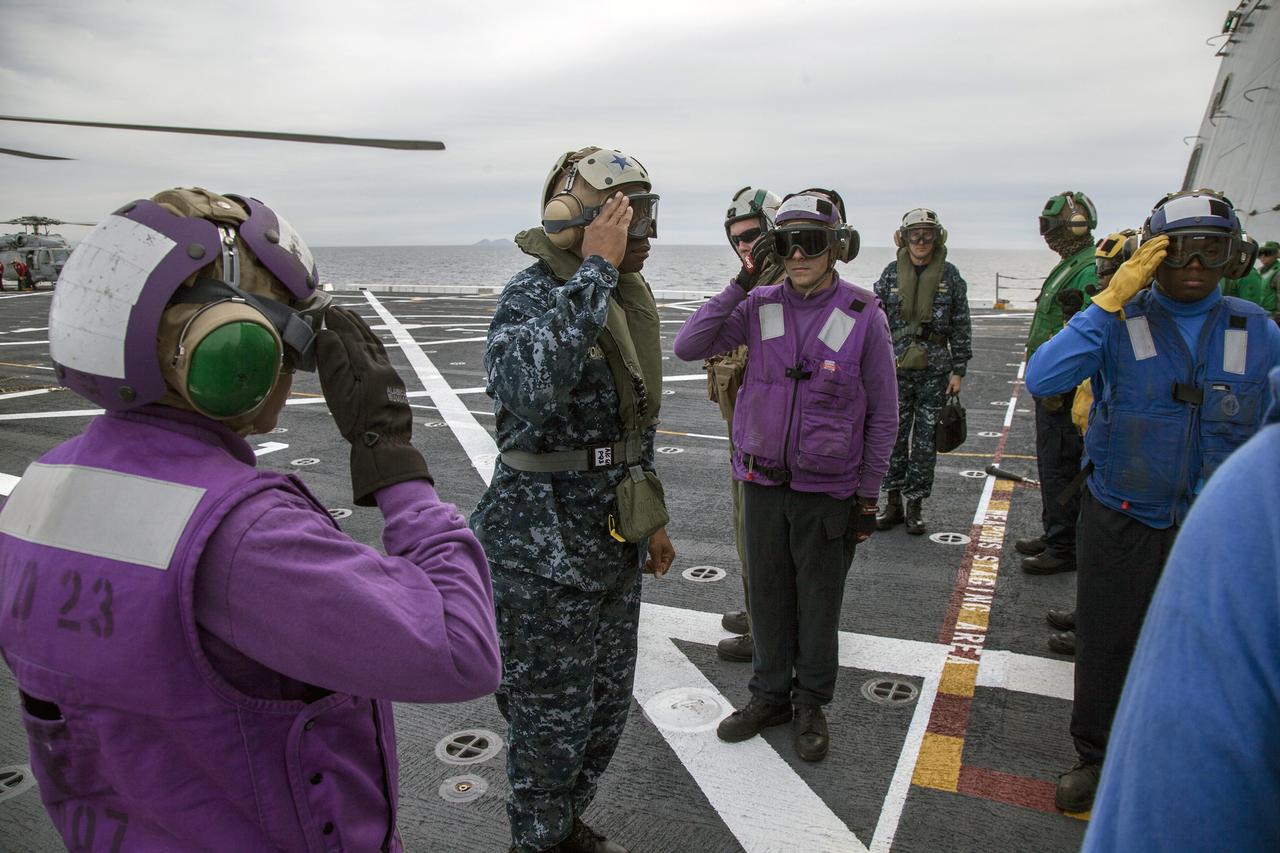
SAN DIEGO, Calif. – U.S. Navy and Helicopter Sea Combat Squadron 8 salute Rear Admiral Fernandez L. "Frank" Ponds, Commander, Expeditionary Strike Group 3, during his visit on the deck of the USS Anchorage near Naval Base San Diego in California. The ship is heading out to sea in the Pacific Ocean. NASA and the U.S. Navy are making preparations ahead of Orion's flight test for recovery of the crew module, forward bay cover and parachutes on its return from space and splashdown in the Pacific Ocean. The Ground Systems Development and Operations Program is leading the recovery efforts. The first unpiloted flight test of Orion is scheduled to launch this week atop a United Launch Alliance Delta IV Heavy rocket. During its two-orbit, 4.5-hour flight, Orion will venture 3,600 miles in altitude and travel nearly 60,000 miles before returning to Earth for a splashdown in the Pacific Ocean. For more information, visit http://www.nasa.gov/orion. Photo credit: NASA/Cory Huston
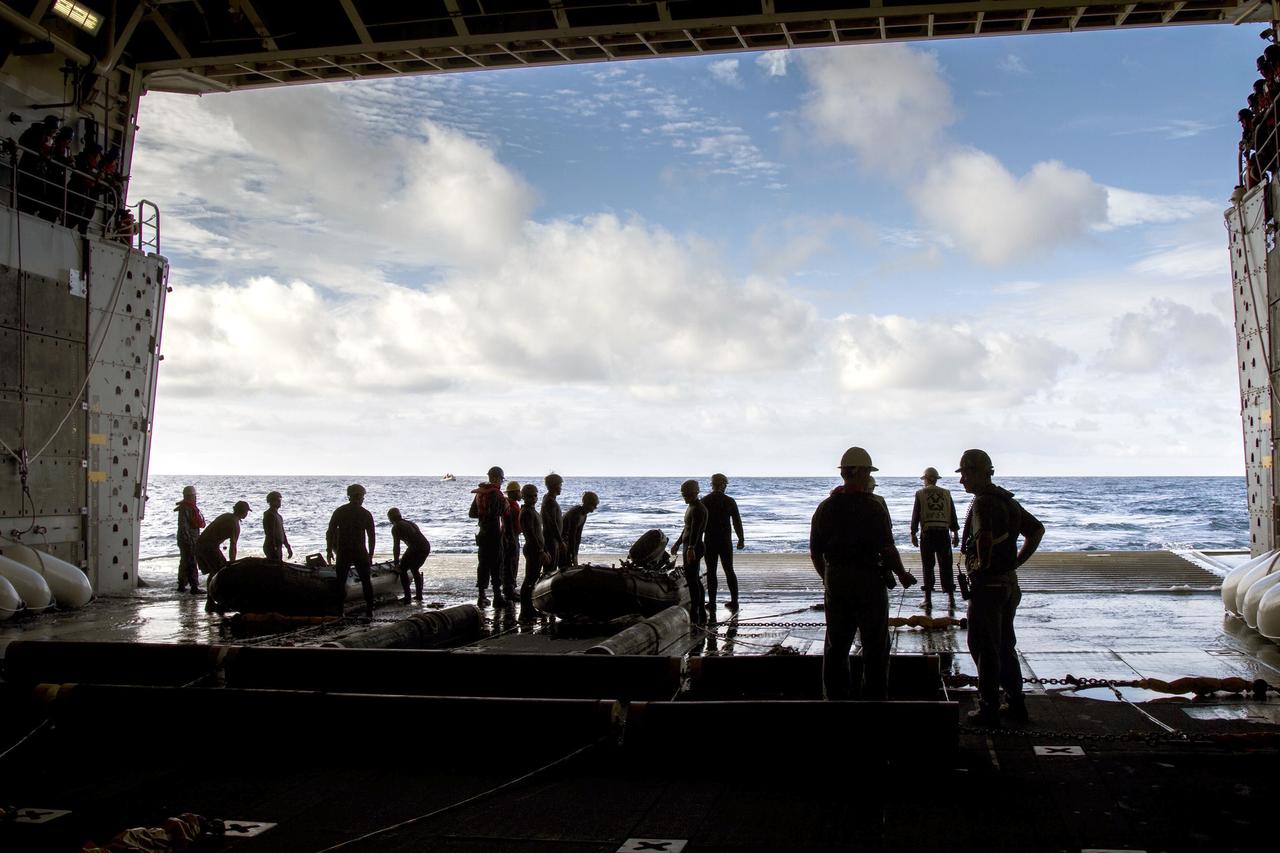
SAN DIEGO, Calif. – On the third day of preparations for recovery of Orion after its splashdown in the Pacific Ocean, U.S. Navy Divers prepare to embark from the well deck of the USS Anchorage in two rigid hull Zodiac boats about 600 miles off the coast of Baja, California. NASA, Lockheed Martin and U.S. Navy personnel are preparing for recovery of the crew module, forward bay cover and parachutes on its return from space and splashdown in the Pacific Ocean. The Ground Systems Development and Operations Program is leading the recovery efforts. The first unpiloted flight test of Orion is scheduled to launch Dec. 4 atop a United Launch Alliance Delta IV Heavy rocket. During its two-orbit, 4.5-hour flight, Orion will venture 3,600 miles in altitude and travel nearly 60,000 miles before returning to Earth for a splashdown in the Pacific Ocean. For more information, visit http://www.nasa.gov/orion. Photo credit: NASA/Cory Huston
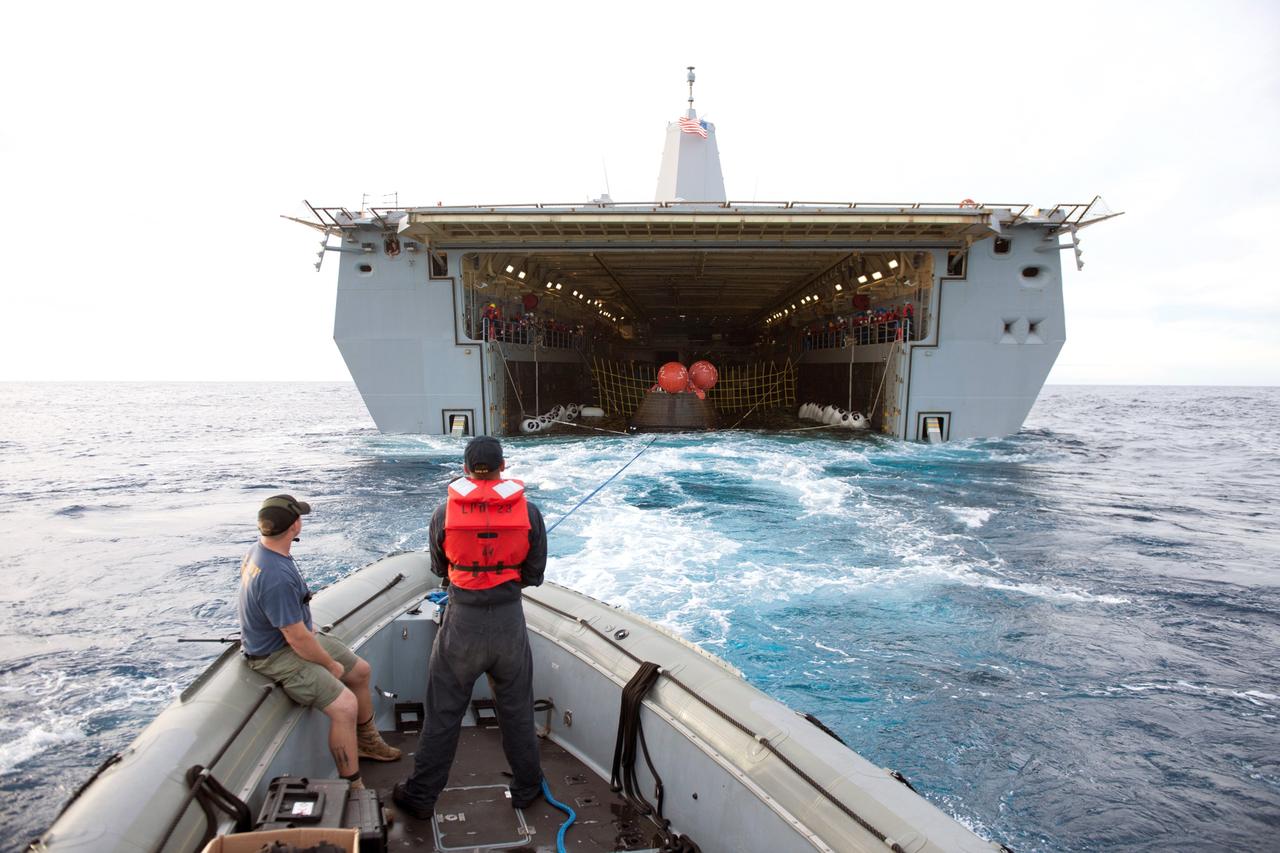
SAN DIEGO, Calif. -- U.S. Navy personnel aboard a rigid hull inflatable boat help recover NASA's Orion spacecraft following its splashdown in the Pacific Ocean after its first flight test in Earth orbit. Orion is towed into the flooded well deck of the USS Anchorage. NASA, the U.S. Navy and Lockheed Martin coordinated efforts to recover Orion, the forward bay cover and main parachutes. Orion completed a two-orbit, four-and-a-half hour mission, to test systems critical to crew safety, including the launch abort system, the heat shield and the parachute system. The Ground Systems Development and Operations Program is leading the recovery efforts. For more information, visit www.nasa.gov/orion Photo credit: NASA/Tony Gray
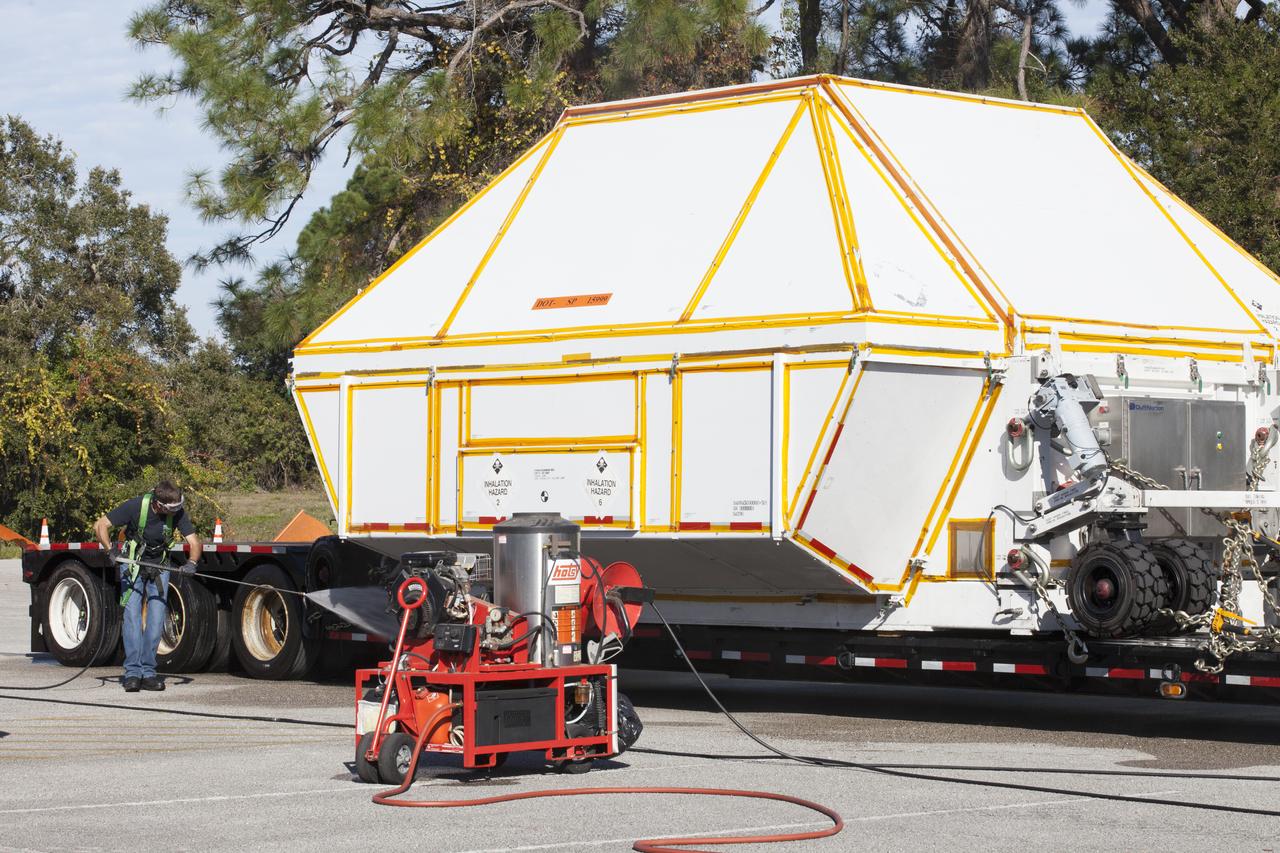
A technician washes down the crew module transportation fixture containing the Orion crew module on the back of a flatbed truck at the Multi-Operation Support Building at NASA's Kennedy Space Center in Florida. Orion was transported 2,700 miles overland from Naval Base San Diego in California. Orion was recovered from the Pacific Ocean after completing a two-orbit, four-and-a-half hour mission Dec. 5 to test systems critical to crew safety, including the launch abort system, the heat shield and the parachute system. The Ground Systems Development and Operations Program led the recovery, offload and transportation efforts.
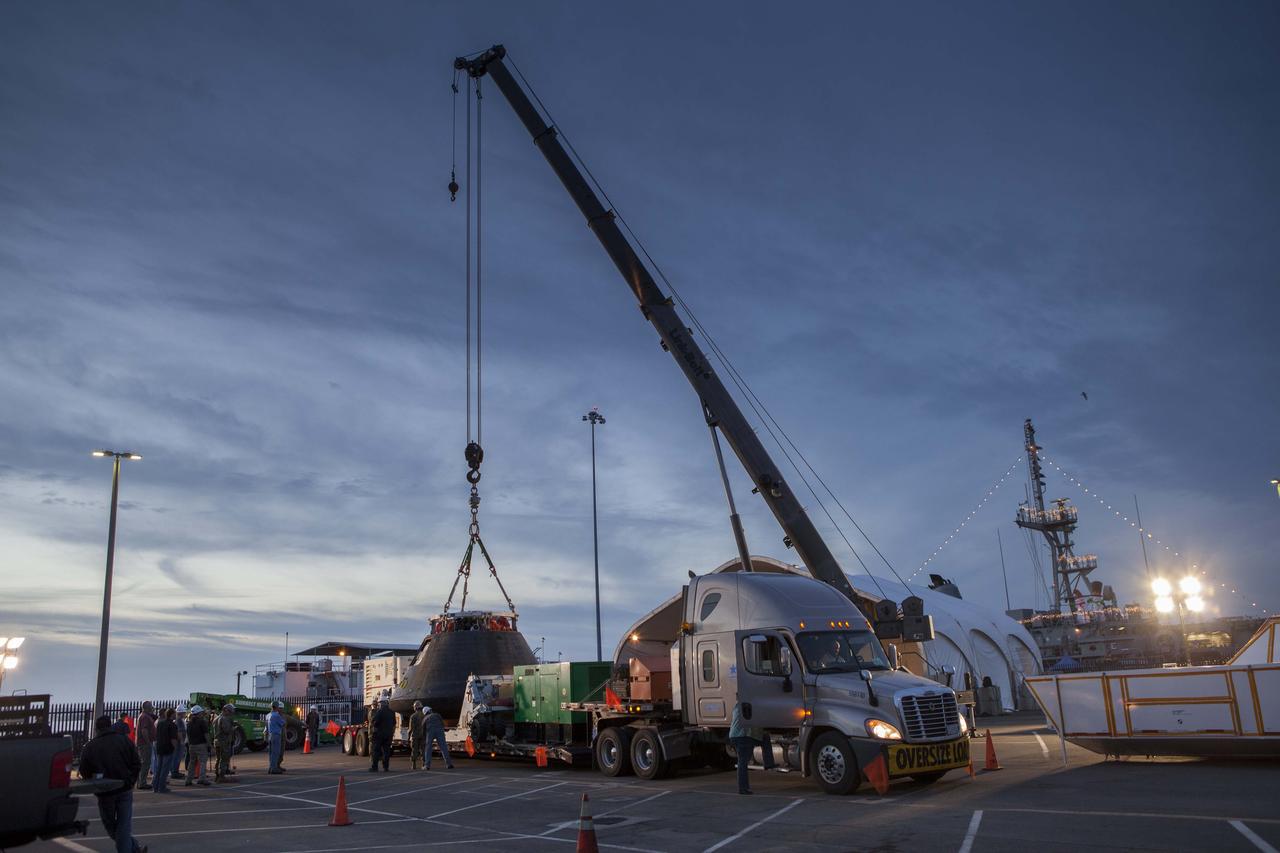
The Orion crew module is being lowered onto the crew module transportation fixture at the Mole Pier at Naval Base San Diego in California. The fixture has been secured on the back of a flatbed truck. Orion is being prepared for the overland trip back to NASA's Kennedy Space Center in Florida. Orion was recovered from the Pacific Ocean after completing a two-orbit, four-and-a-half hour mission Dec. 5 to test systems critical to crew safety, including the launch abort system, the heat shield and the parachute system. NASA, the U.S. Navy and Lockheed Martin coordinated efforts to recover Orion. The Ground Systems Development and Operations Program led the recovery, offload and pre-transportation efforts.
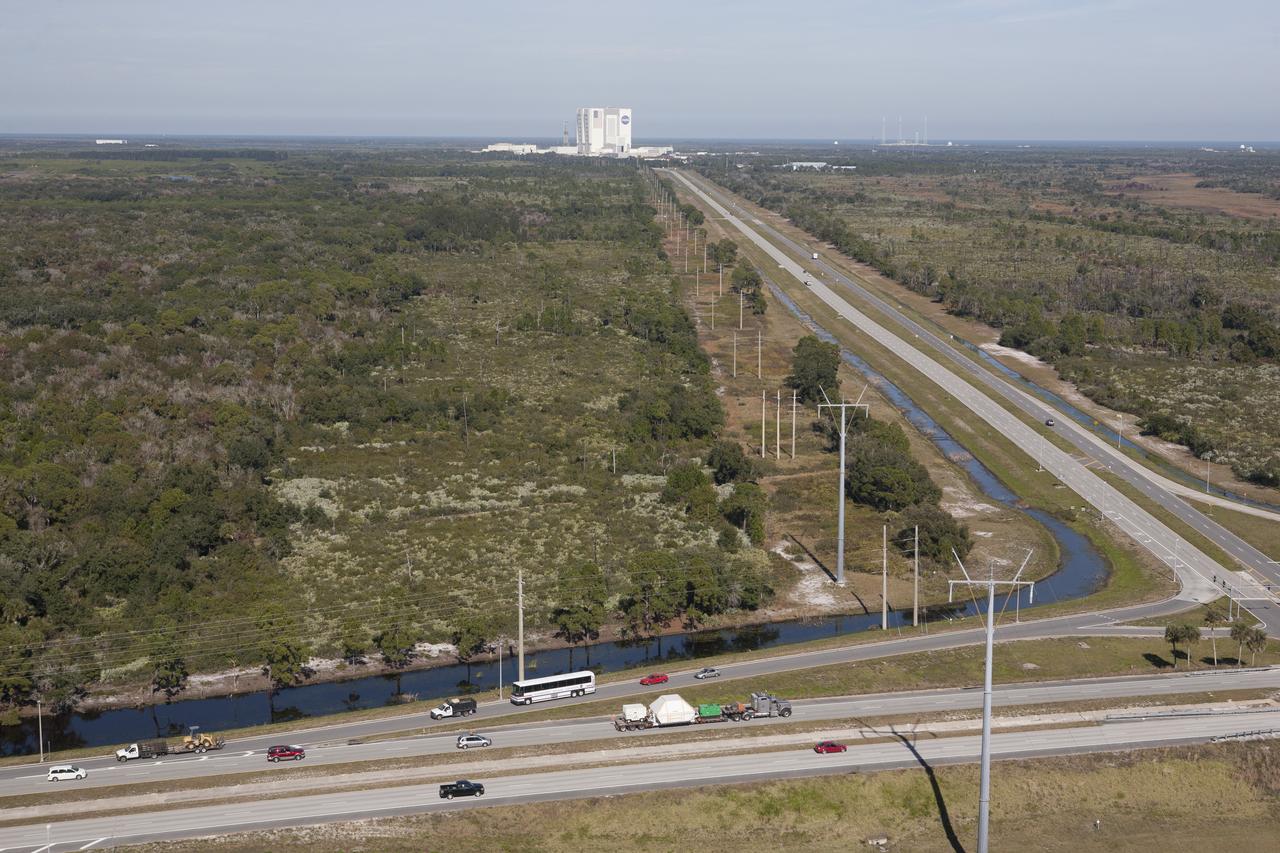
An aerial view reveals the Orion crew module, enclosed in its crew module transportation fixture and secured on a flatbed truck that is proceeding along the NASA Causeway at Kennedy Space Center in Florida. In the background is the iconic Vehicle Assembly Building. Orion made the 2,700 mile overland trip from Naval Base San Diego in California. The spacecraft was recovered from the Pacific Ocean after completing a two-orbit, four-and-a-half hour mission Dec. 5 to test systems critical to crew safety, including the launch abort system, the heat shield and the parachute system. The Ground Systems Development and Operations Program led the recovery, offload and transportation efforts.
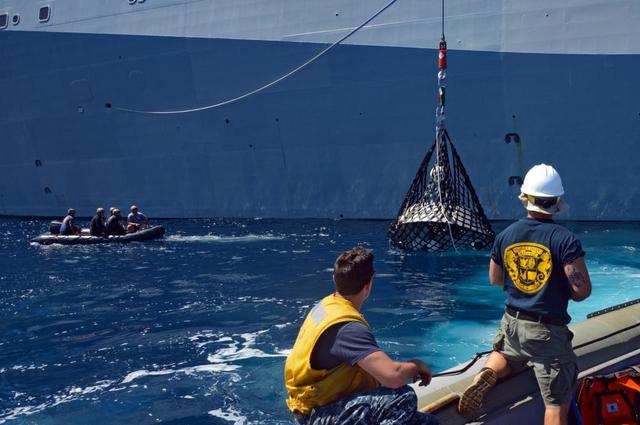
Recovery team members work to lift a test version of Orion's forward bay cover out of the Pacific Ocean using a crane on board the USS Anchorage on Sept. 16, 2014. NASA and the Navy are working together this week to test tools and techniques that will be used to retrieve the spacecraft once it splashes down following Exploration Flight Test-1 (EFT-1). The forward bay cover protects the top section of Orion's crew module until the spacecraft is almost ready to land. It is jettisoned to allow Orion's parachutes to deploy and must be recovered separately from the crew module. Part of Batch image transfer from Flickr.
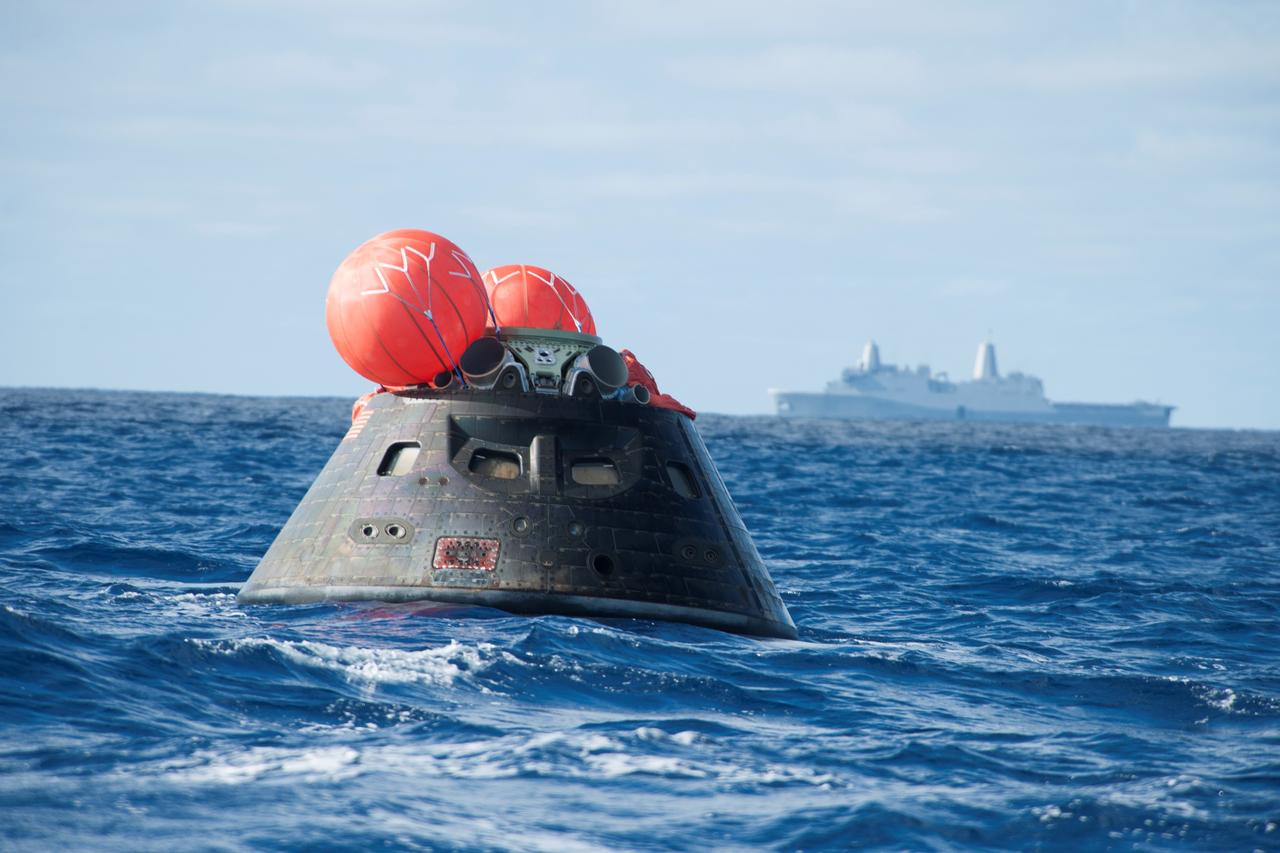
NASA's Orion spacecraft floats in the Pacific Ocean after splashdown from its first flight test in Earth orbit. An H60-S Seahawk helicopter hovers above to communicate the spacecraft's location back to the USS Anchorage. NASA, the U.S. Navy and Lockheed Martin are coordinating efforts to recover Orion and secure the spacecraft in the well deck of the USS Anchorage. Orion completed a two-orbit, four-and-a-half hour mission, to test systems critical to crew safety, including the launch abort system, the heat shield and the parachute system. The Ground Systems Development and Operations Program is leading the recovery efforts.
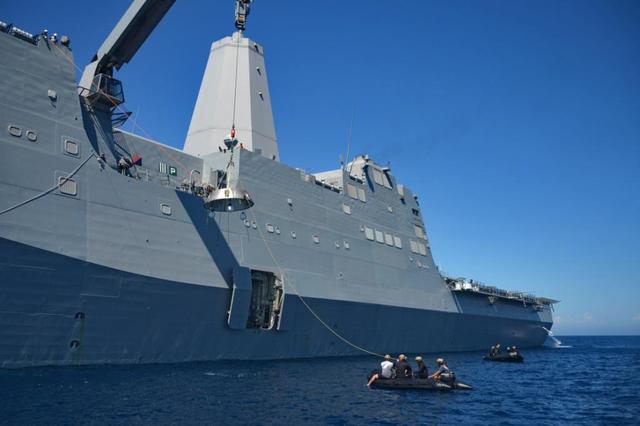
Recovery team members work to lift a test version of Orion's forward bay cover out of the Pacific Ocean using a crane on board the USS Anchorage on Sept. 16, 2014. NASA and the Navy are working together this week to test tools and techniques that will be used to retrieve the spacecraft once it splashes down following Exploration Flight Test-1 (EFT-1). The forward bay cover protects the top section of Orion's crew module until the spacecraft is almost ready to land. It is jettisoned to allow Orion's parachutes to deploy and must be recovered separately from the crew module. Part of Batch image transfer from Flickr.
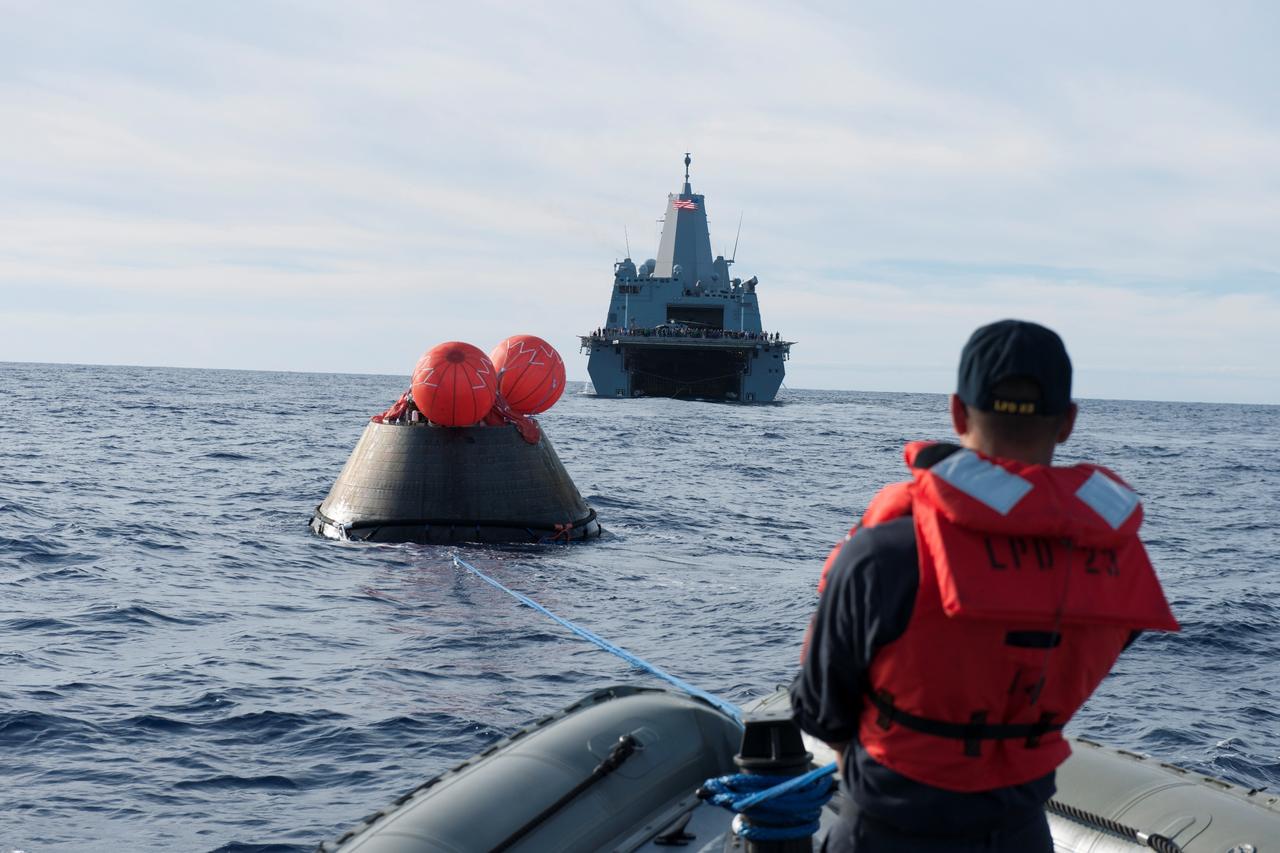
U.S. Navy personnel aboard a rigid hull inflatable boat help recover NASA's Orion spacecraft following its splashdown in the Pacific Ocean after its first flight test in Earth orbit. The USS Anchorage is in the background. NASA, the U.S. Navy and Lockheed Martin are coordinating efforts to recover Orion and secure the spacecraft in the well deck of the USS Anchorage. Orion completed a two-orbit, four-and-a-half hour mission, to test systems critical to crew safety, including the launch abort system, the heat shield and the parachute system. The Ground Systems Development and Operations Program is leading the recovery efforts.
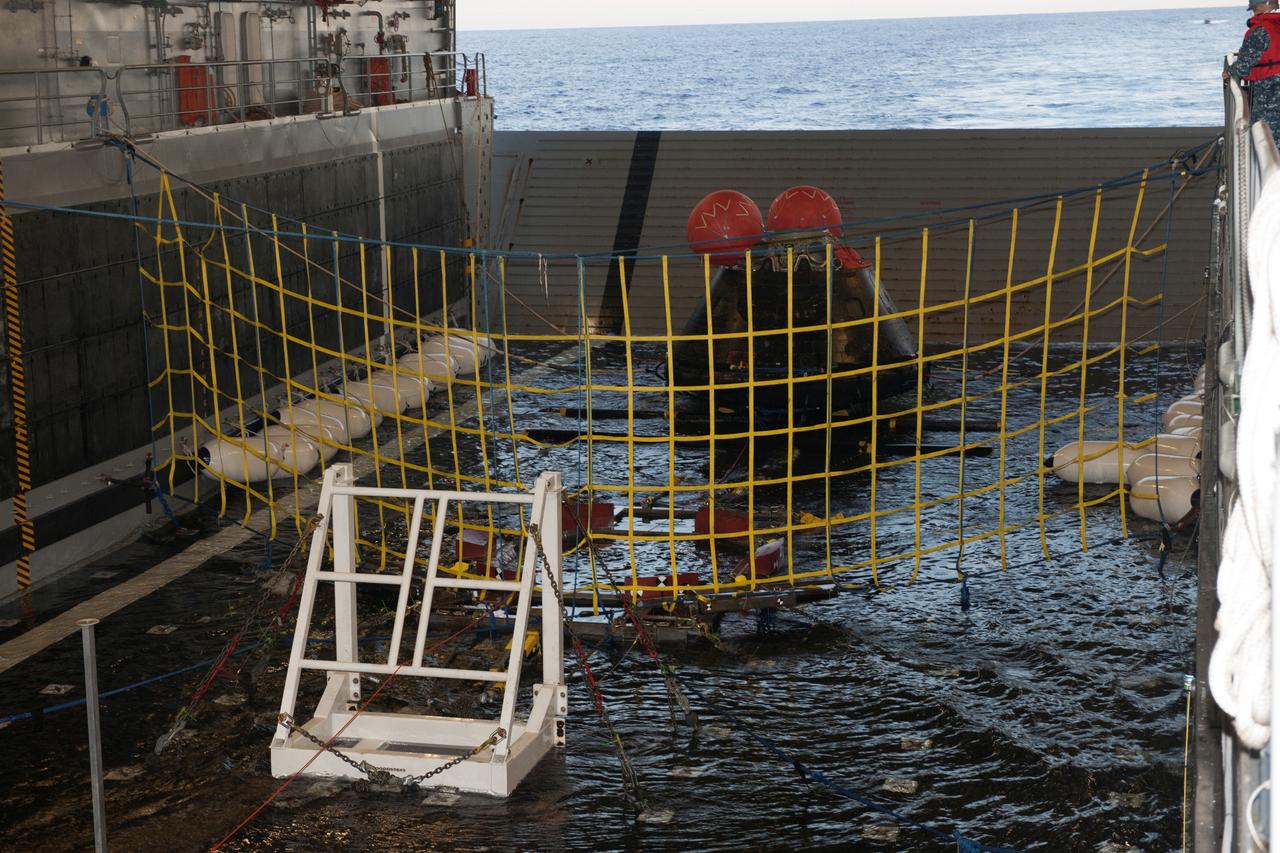
NASA's Orion spacecraft is on rubber bumpers in the flooded well deck of the USS Anchorage in the Pacific Ocean about 600 miles off the coast of San Diego, California. Orion splashed down after its first flight test in Earth orbit. NASA, the U.S. Navy and Lockheed Martin are coordinating efforts to recover Orion and secure the spacecraft in the well deck of the USS Anchorage. Orion completed a two-orbit, four-and-a-half hour mission, to test systems critical to crew safety, including the launch abort system, the heat shield and the parachute system. The Ground Systems Development and Operations Program is leading the recovery efforts.
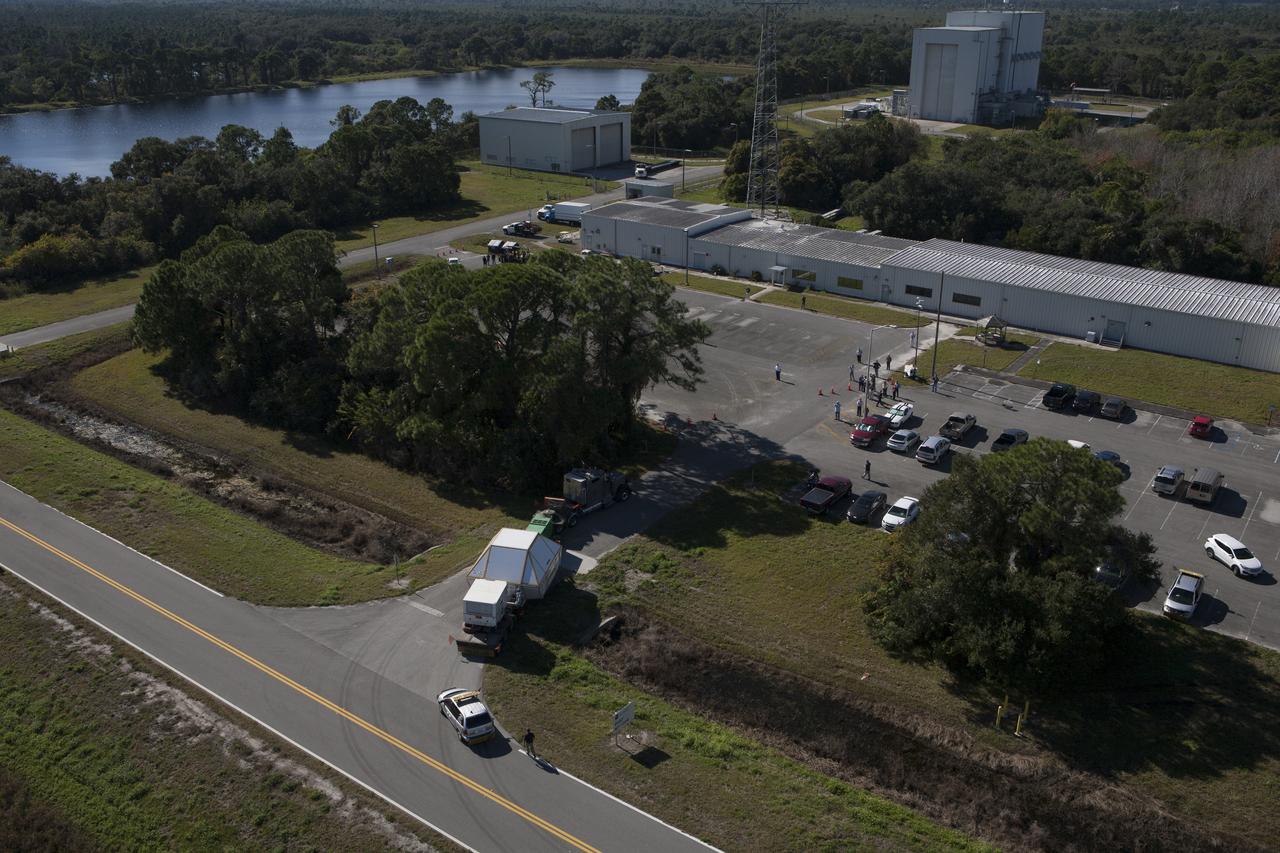
An aerial view reveals the Orion crew module, enclosed in its crew module transportation fixture and secured on a flatbed truck is proceeding to the Multi-Operation Support Building at NASA's Kennedy Space Center. Orion made the 2,700 mile overland trip from Naval Base San Diego in California. The spacecraft was recovered from the Pacific Ocean after completing a two-orbit, four-and-a-half hour mission Dec. 5 to test systems critical to crew safety, including the launch abort system, the heat shield and the parachute system. The Ground Systems Development and Operations Program led the recovery, offload and transportation efforts.
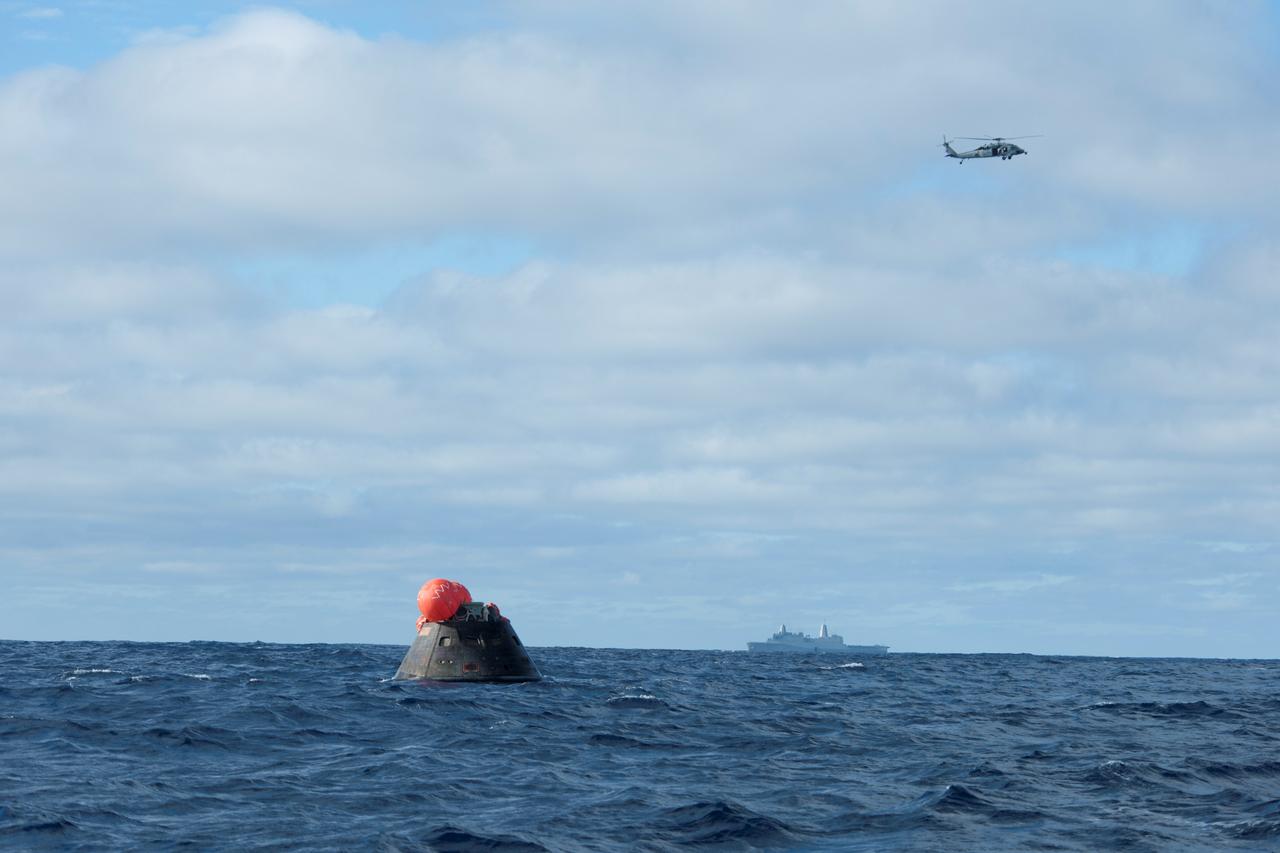
NASA's Orion spacecraft floats in the Pacific Ocean after splashdown from its first flight test in Earth orbit. An H60-S Seahawk helicopter hovers above to communicate the spacecraft's location back to the USS Anchorage, in the distance. NASA, the U.S. Navy and Lockheed Martin are coordinating efforts to recover Orion and secure the spacecraft in the well deck of the USS Anchorage. Orion completed a two-orbit, four-and-a-half hour mission, to test systems critical to crew safety, including the launch abort system, the heat shield and the parachute system. The Ground Systems Development and Operations Program is leading the recovery efforts.
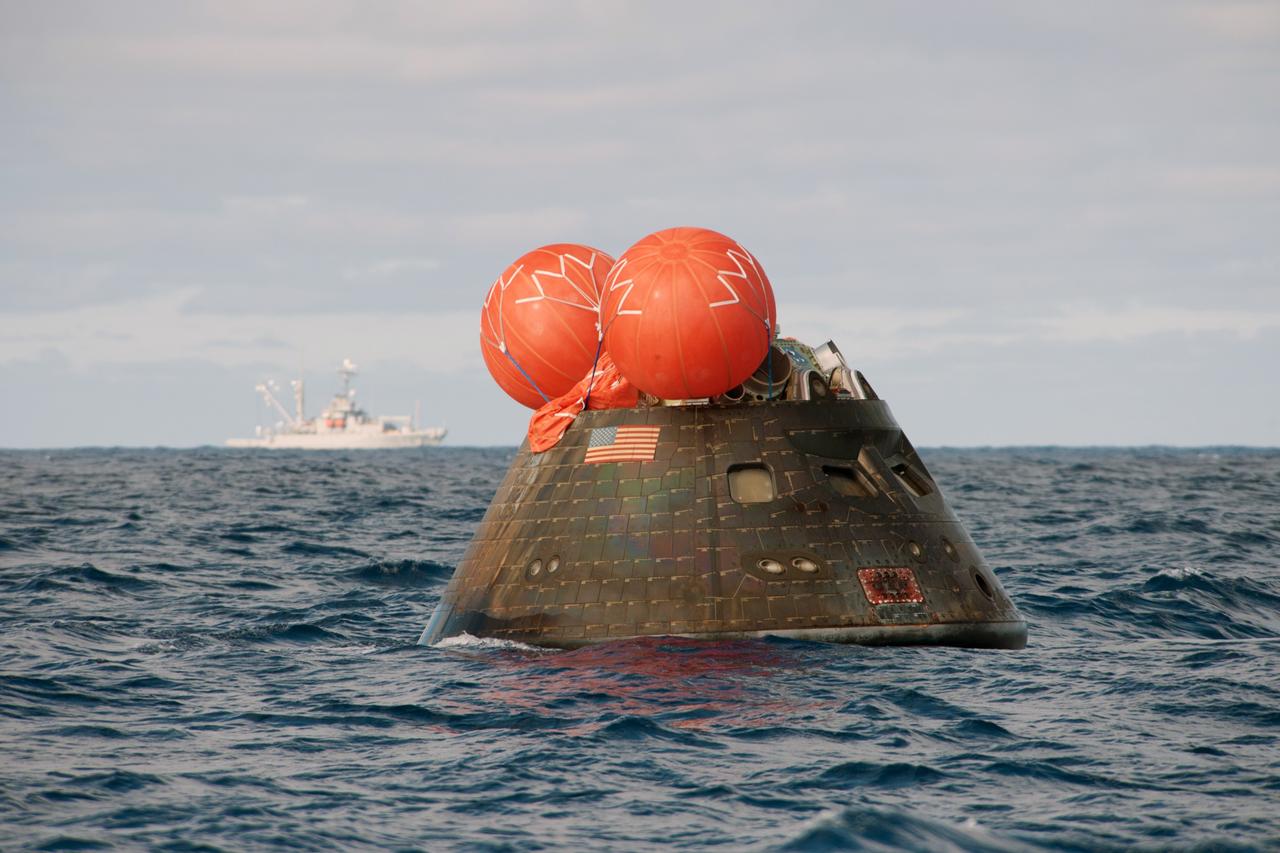
SAN DIEGO, Calif. -- NASA's Orion spacecraft floats in the Pacific Ocean after splashdown from its first flight test in Earth orbit. In the background is the USNS Salvor. This U.S. Navy salvage ship was there as a backup in case it was needed. NASA, the U.S. Navy and Lockheed Martin are coordinating efforts to recover Orion and secure the spacecraft in the well deck of the USS Anchorage. Orion completed a two-orbit, four-and-a-half hour mission, to test systems critical to crew safety, including the launch abort system, the heat shield and the parachute system. The Ground Systems Development and Operations Program is leading the recovery efforts. For more information, visit www.nasa.gov/orion Photo credit: NASA/Tony Gray
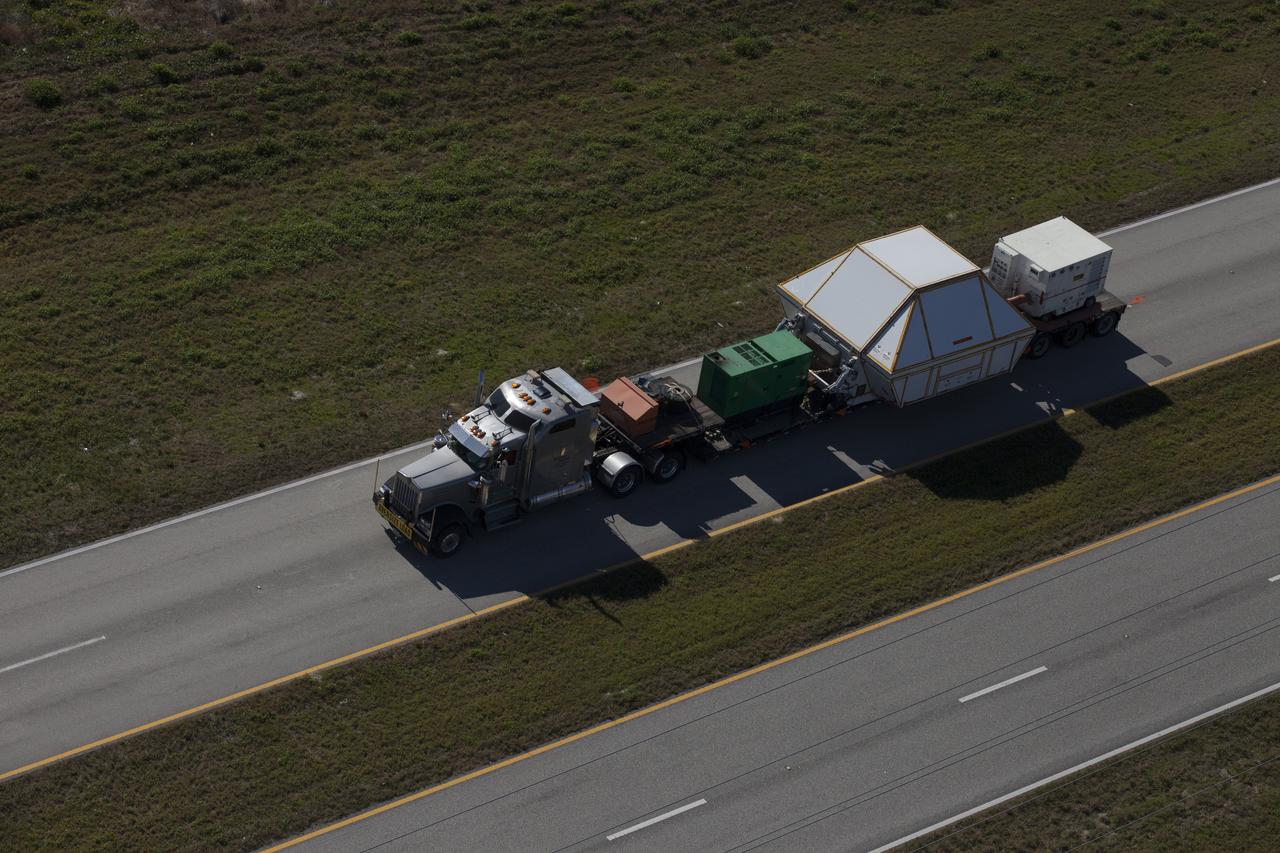
An aerial view near NASA's Kennedy Space Center Visitor Complex reveals the Orion crew module, enclosed in its crew module transportation fixture and secured on a flatbed truck that is proceeding along the NASA Causeway to the entrance gate to Kennedy Space Center in Florida. Orion made the 2,700 mile overland trip from Naval Base San Diego in California. The spacecraft was recovered from the Pacific Ocean after completing a two-orbit, four-and-a-half hour mission Dec. 5 to test systems critical to crew safety, including the launch abort system, the heat shield and the parachute system. The Ground Systems Development and Operations Program led the recovery, offload and transportation efforts.
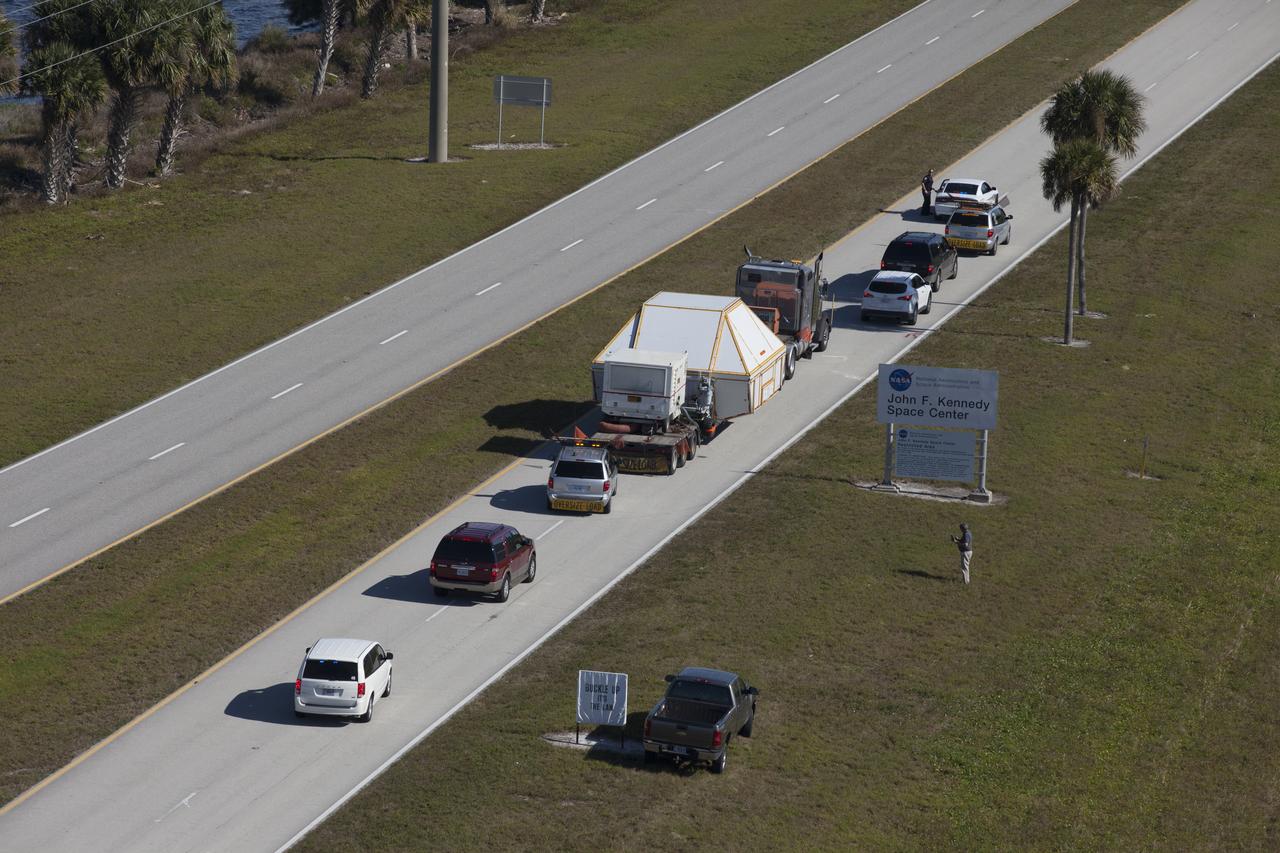
An aerial view near NASA's Kennedy Space Center Visitor Complex reveals the Orion crew module, enclosed in its crew module transportation fixture and secured on a flatbed truck on the NASA Causeway that leads to the entrance gate to Kennedy Space Center in Florida. Orion made the 2,700 mile overland trip from Naval Base San Diego in California. The spacecraft was recovered from the Pacific Ocean after completing a two-orbit, four-and-a-half hour mission Dec. 5 to test systems critical to crew safety, including the launch abort system, the heat shield and the parachute system. The Ground Systems Development and Operations Program led the recovery, offload and transportation efforts.
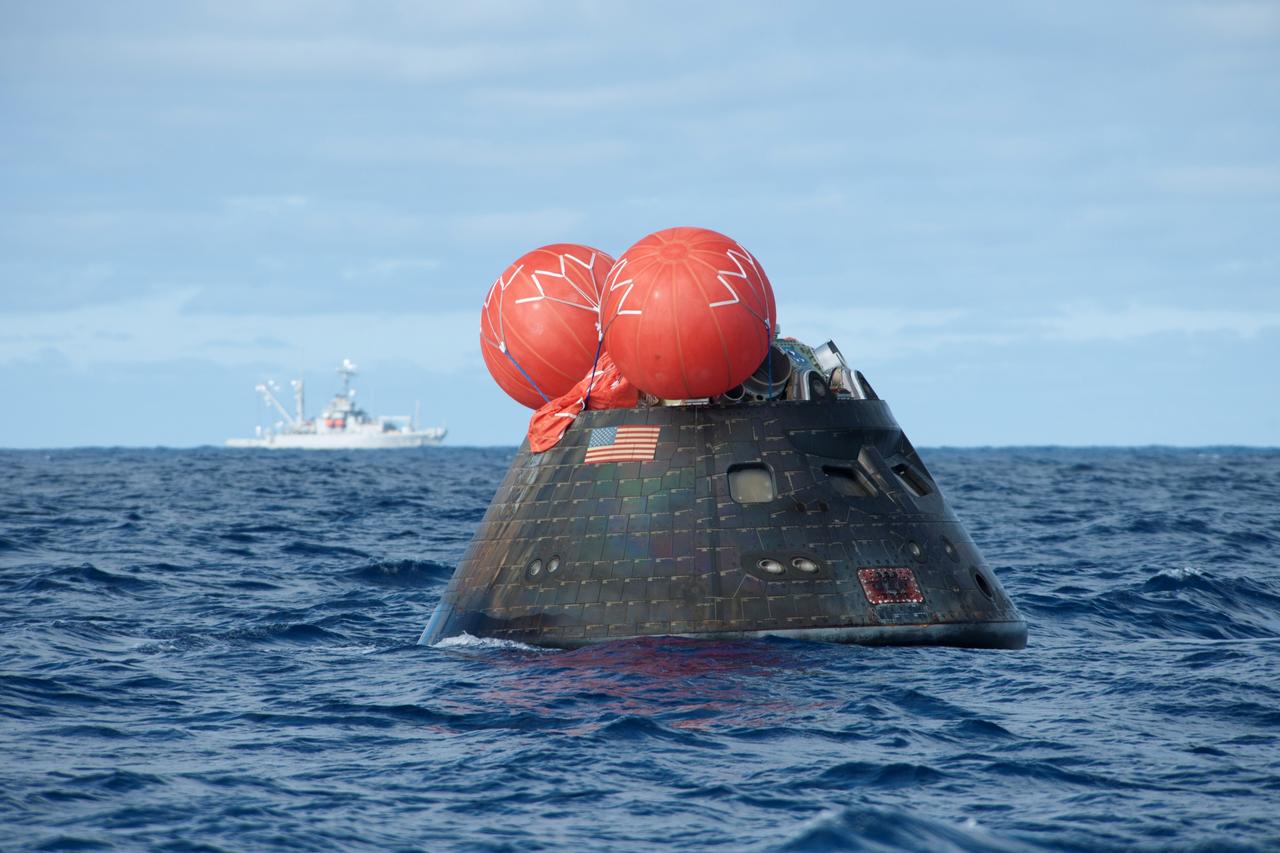
NASA's Orion spacecraft floats in the Pacific Ocean after splashdown from its first flight test in Earth orbit. In the background is the USNS Salvor. This U.S. Navy salvage ship was there as a backup in case it was needed. NASA, the U.S. Navy and Lockheed Martin are coordinating efforts to recover Orion and secure the spacecraft in the well deck of the USS Anchorage. Orion completed a two-orbit, four-and-a-half hour mission, to test systems critical to crew safety, including the launch abort system, the heat shield and the parachute system. The Ground Systems Development and Operations Program is leading the recovery efforts.
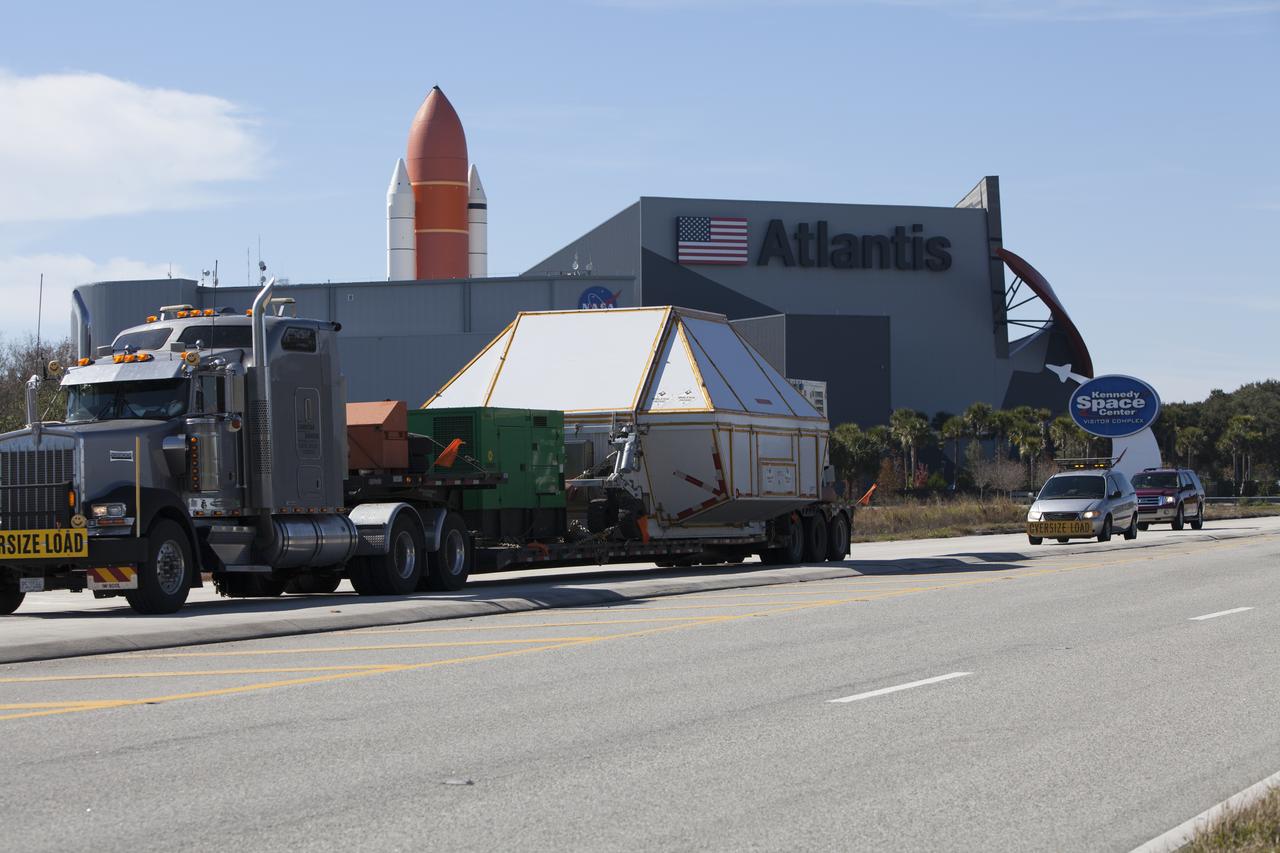
NASA's Orion crew module, enclosed in its crew module transportation fixture and secured on a flatbed truck passes by the Space Shuttle Atlantis building at the Kennedy Space Center Visitor Complex on its way to the entrance gate to Kennedy Space Center in Florida. Orion made the overland trip from Naval Base San Diego in California. Orion was recovered from the Pacific Ocean after completing a two-orbit, four-and-a-half hour mission Dec. 5 to test systems critical to crew safety, including the launch abort system, the heat shield and the parachute system. The Ground Systems Development and Operations Program led the recovery, offload and transportation efforts.
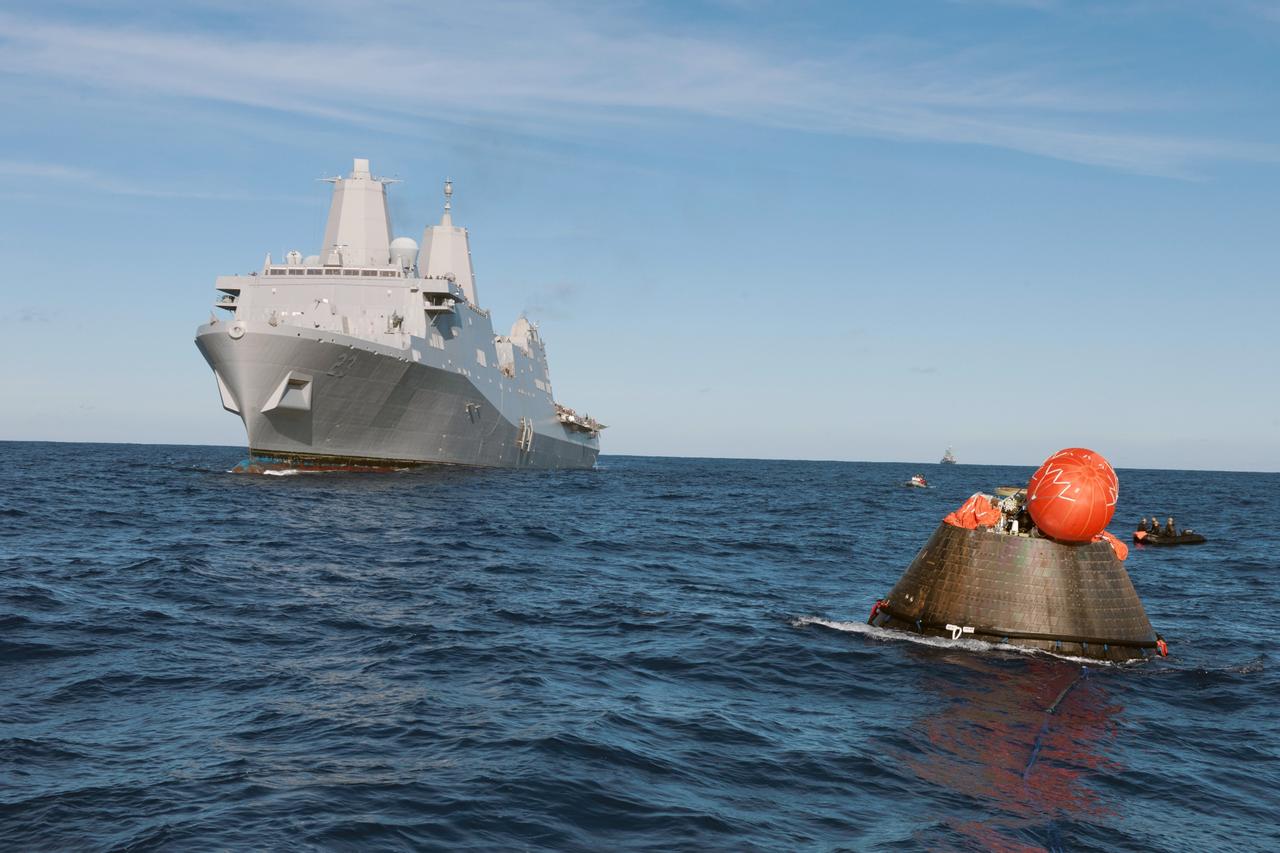
SAN DIEGO, Calif. -- NASA's Orion spacecraft floats in the Pacific Ocean after splashdown from its first flight test in Earth orbit. The USS Anchorage is nearby. NASA, the U.S. Navy and Lockheed Martin are coordinating efforts to recover Orion and secure the spacecraft in the well deck of the USS Anchorage. Orion completed a two-orbit, four-and-a-half hour mission, to test systems critical to crew safety, including the launch abort system, the heat shield and the parachute system. The Ground Systems Development and Operations Program is leading the recovery efforts. For more information, visit www.nasa.gov/orion Photo credit: NASA/Tony Gray
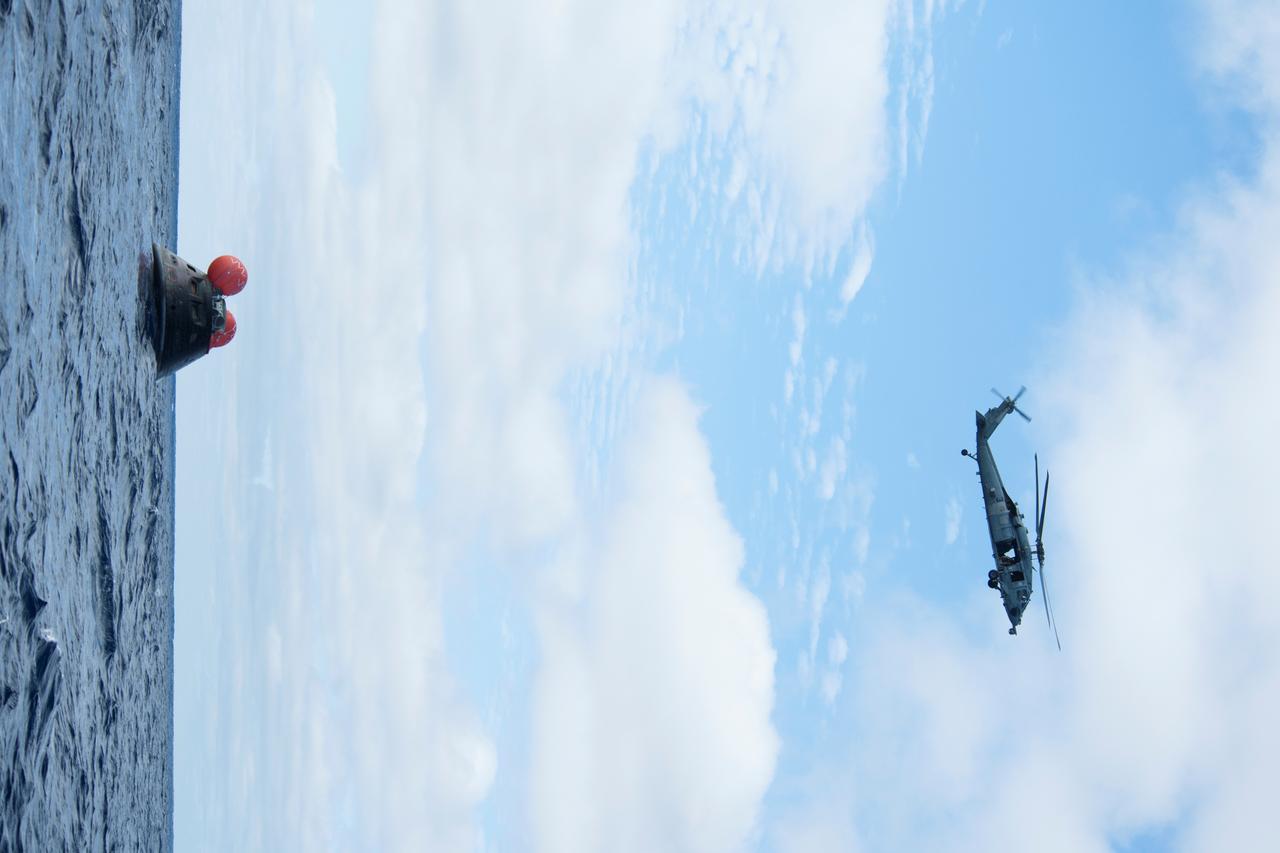
NASA's Orion spacecraft floats in the Pacific Ocean after splashdown from its first flight test in Earth orbit. An H60-S Seahawk helicopter hovers above to communicate the spacecraft's location back to the USS Anchorage. NASA, the U.S. Navy and Lockheed Martin are coordinating efforts to recover Orion and secure the spacecraft in the well deck of the USS Anchorage. Orion completed a two-orbit, four-and-a-half hour mission, to test systems critical to crew safety, including the launch abort system, the heat shield and the parachute system. The Ground Systems Development and Operations Program is leading the recovery efforts.
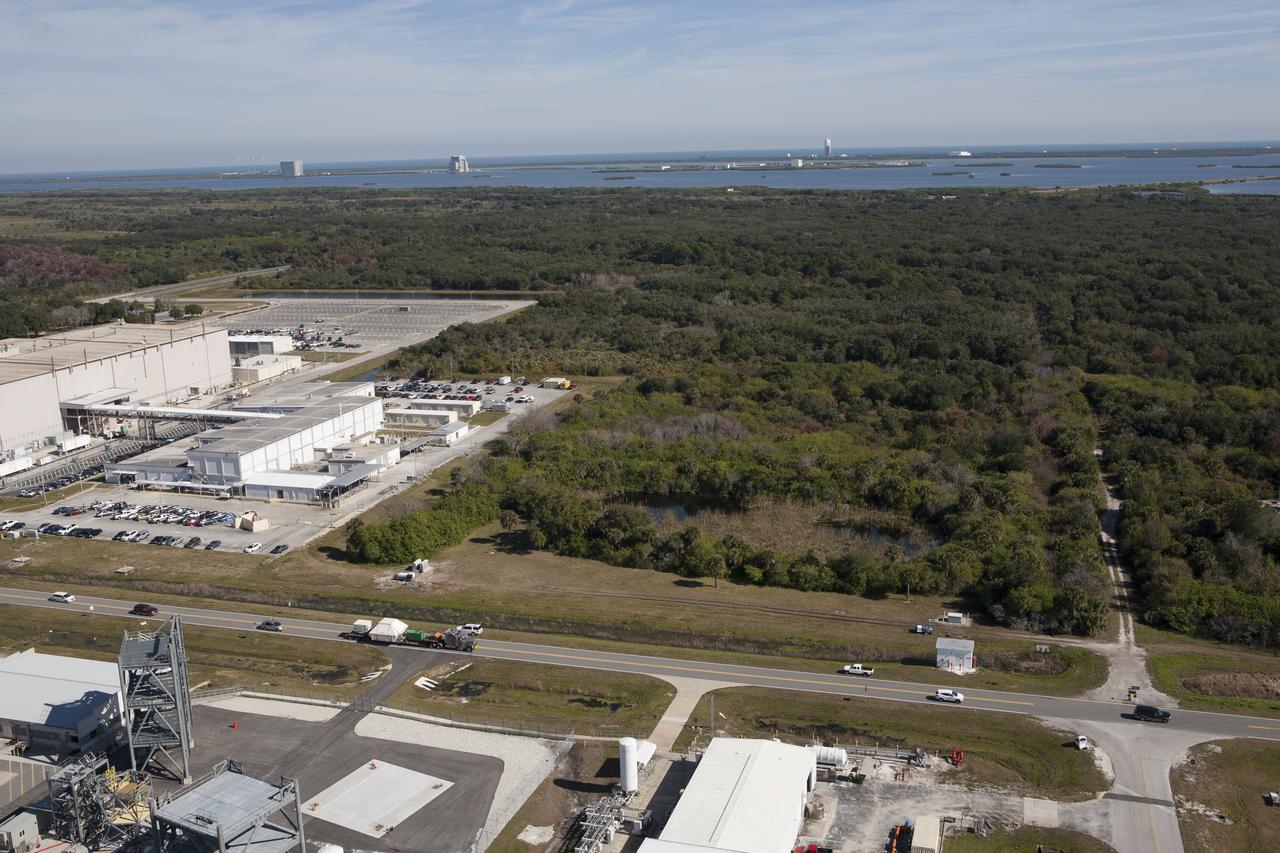
An aerial view reveals the Orion crew module, enclosed in its crew module transportation fixture and secured on a flatbed truck is passing the Space Station Processing Facility at Kennedy Space Center in Florida on its way to the Multi-Operation Support Building. Orion made the 2,700 mile overland trip from Naval Base San Diego in California. The spacecraft was recovered from the Pacific Ocean after completing a two-orbit, four-and-a-half hour mission Dec. 5 to test systems critical to crew safety, including the launch abort system, the heat shield and the parachute system. The Ground Systems Development and Operations Program led the recovery, offload and transportation efforts.