
Nathaniel Brown, a mechanical design engineer, works the structure design and interfaces for the Lunar Pallet Lander.
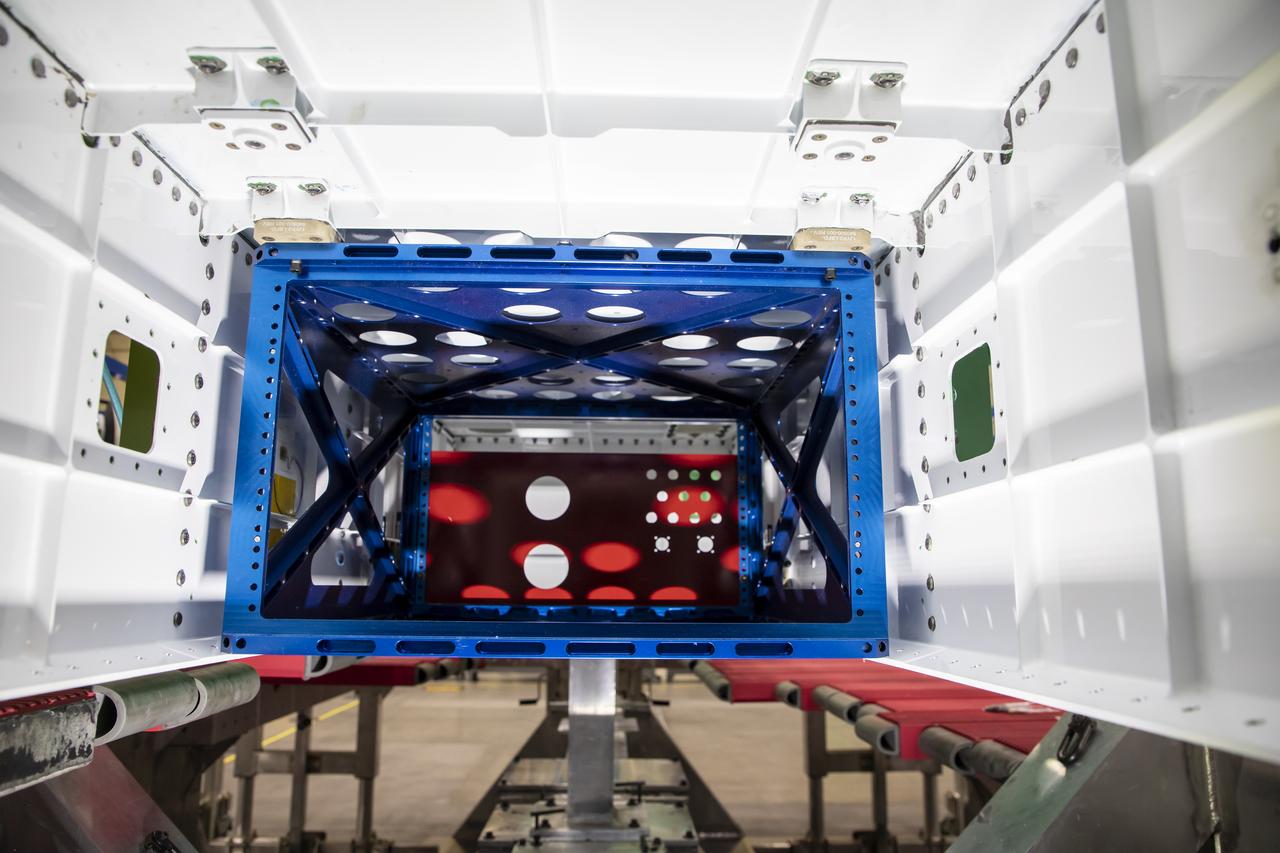
Following the successful installation of mounting brackets, technicians successfully installed the pallet for the eXternal Visibility System, or XVS, onto the X-59 Quiet SuperSonic Technology X-plane, also known as X-59 QueSST. The pallet installation marks an assembly milestone as the first NASA flight systems hardware to be installed onto the vehicle. X-59 will fly to demonstrate the ability to produce quiet thumps at supersonic speeds, instead of the typical, loud sonic booms associated with supersonic flight.
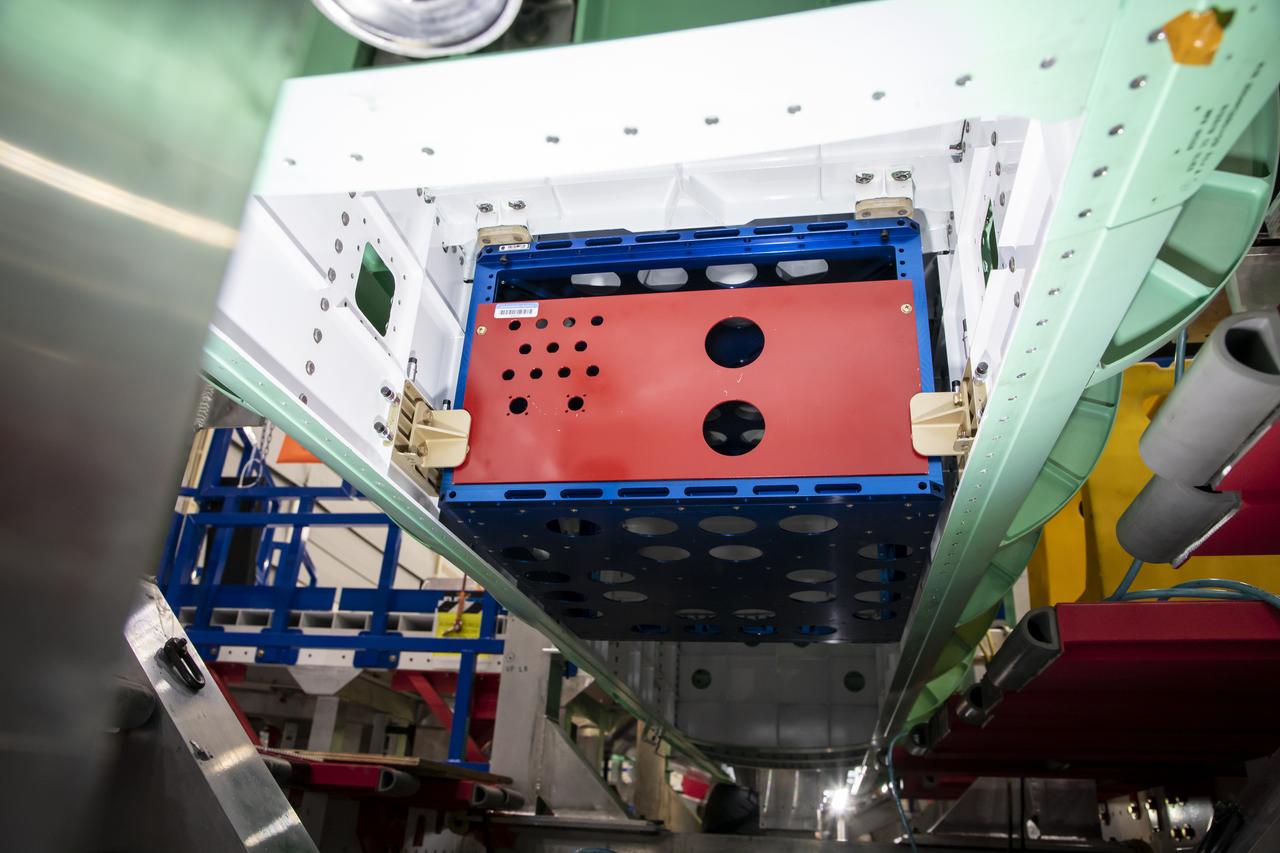
Lockheed Martin Photography By Garry Tice 1011 Lockheed Way, Palmdale, Ca. 93599 Event: NASA Payload Pallet XVS Mock-Up Date: 7/01/2020 Additional Info:
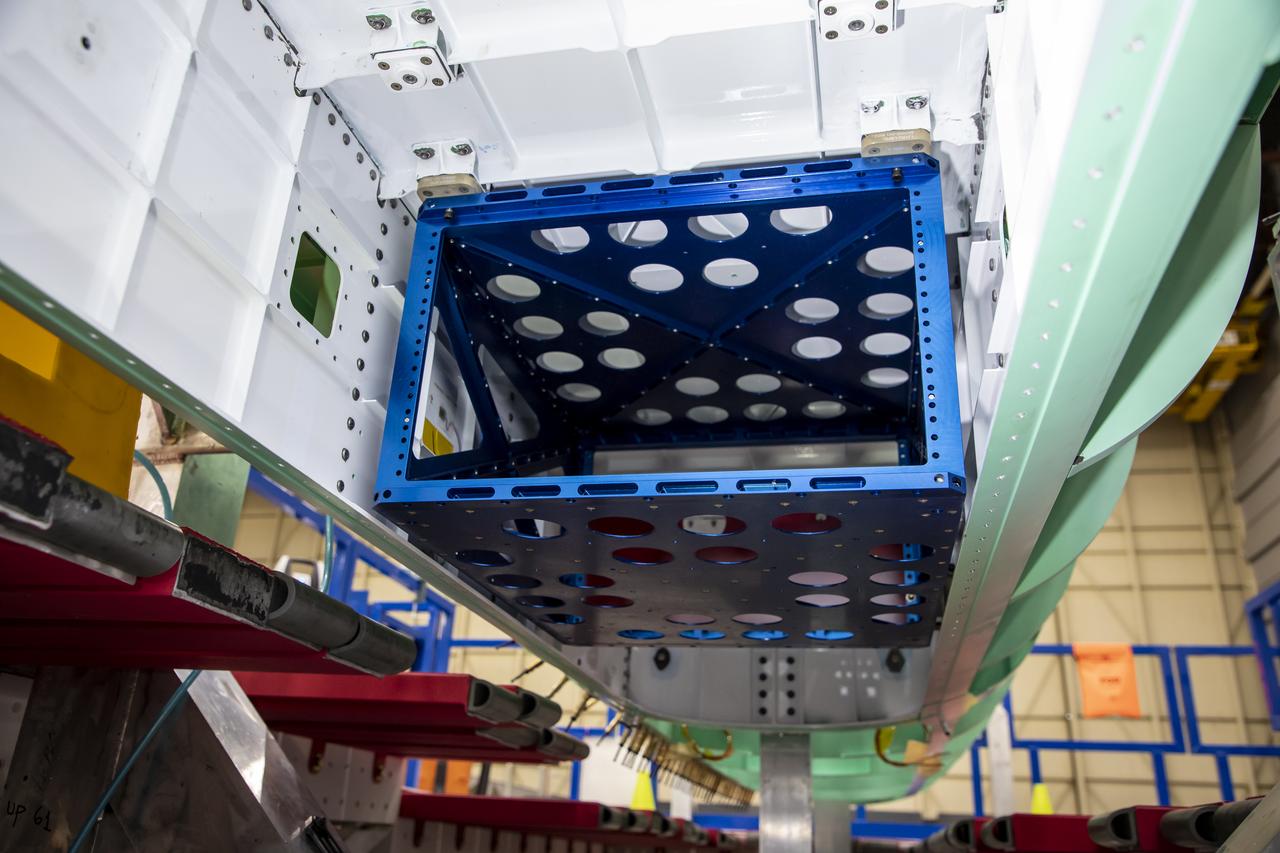
Following the successful installation of mounting brackets, technicians successfully installed the pallet for the eXternal Visibility System, or XVS, onto the X-59 Quiet SuperSonic Technology X-plane, also known as X-59 QueSST. The pallet installation marks an assembly milestone as the first NASA flight systems hardware to be installed onto the vehicle. X-59 will fly to demonstrate the ability to produce quiet thumps at supersonic speeds, instead of the typical, loud sonic booms associated with supersonic flight.
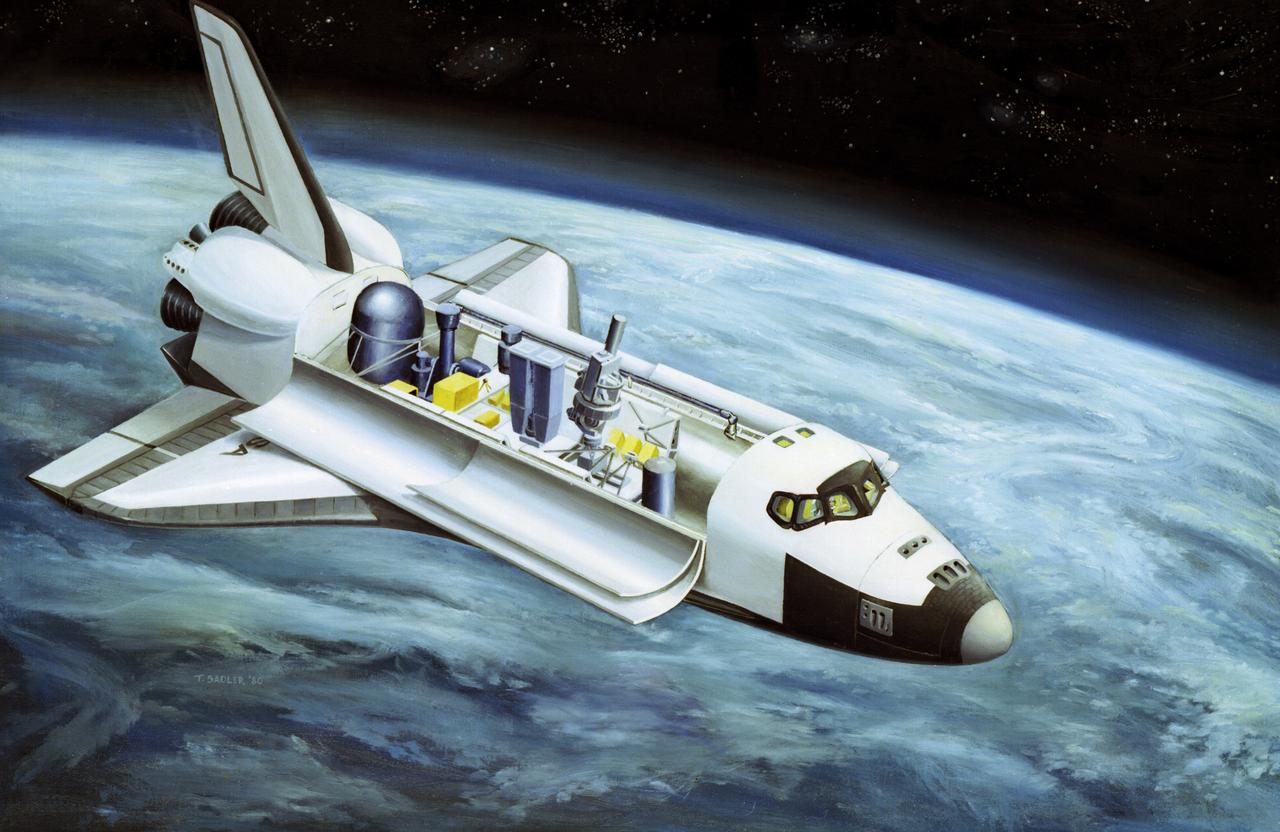
This illustration depicts the configuration of the Spacelab-2 in the cargo bay of the orbiter. Spacelab was a versatile laboratory carried in the Space Shuttle's cargo bay for scientific research flights. Each Spacelab mission had a unique design appropriate to the mission's goals. A number of Spacelab configurations could be assembled from pressurized habitation modules and exposed platforms called pallets. Spacelab-2 was the first pallet-only mission. One of the goals of the mission was to verify that the pallets' configuration was satisfactory for observations and research. Except for two biological experiments and an experiment that used ground-based instruments, the Spacelab-2 scientific instruments needed direct exposure to space. On the first pallet, three solar instruments and one atmospheric instrument were mounted on the Instrument Pointing System, which was being tested on its first flight. The second Spacelab pallet held a large double x-ray telescope and three plasma physics detectors. The last pallet supported an infrared telescope, a superfluid helium technology experiment, and a small plasma diagnostics satellite. The Spacelab-2 mission was designed to capitalize on the Shuttle-Spacelab capabilities, to launch and retrieve satellites, and to point several instruments independently with accuracy and stability. Spacelab-2 (STS-51F, 19th Shuttle mission) was launched aboard Space Shuttle Orbiter Challenger on July 29, 1985. The Marshall Space Flight Center had overall management responsibilities of the Spacelab missions.
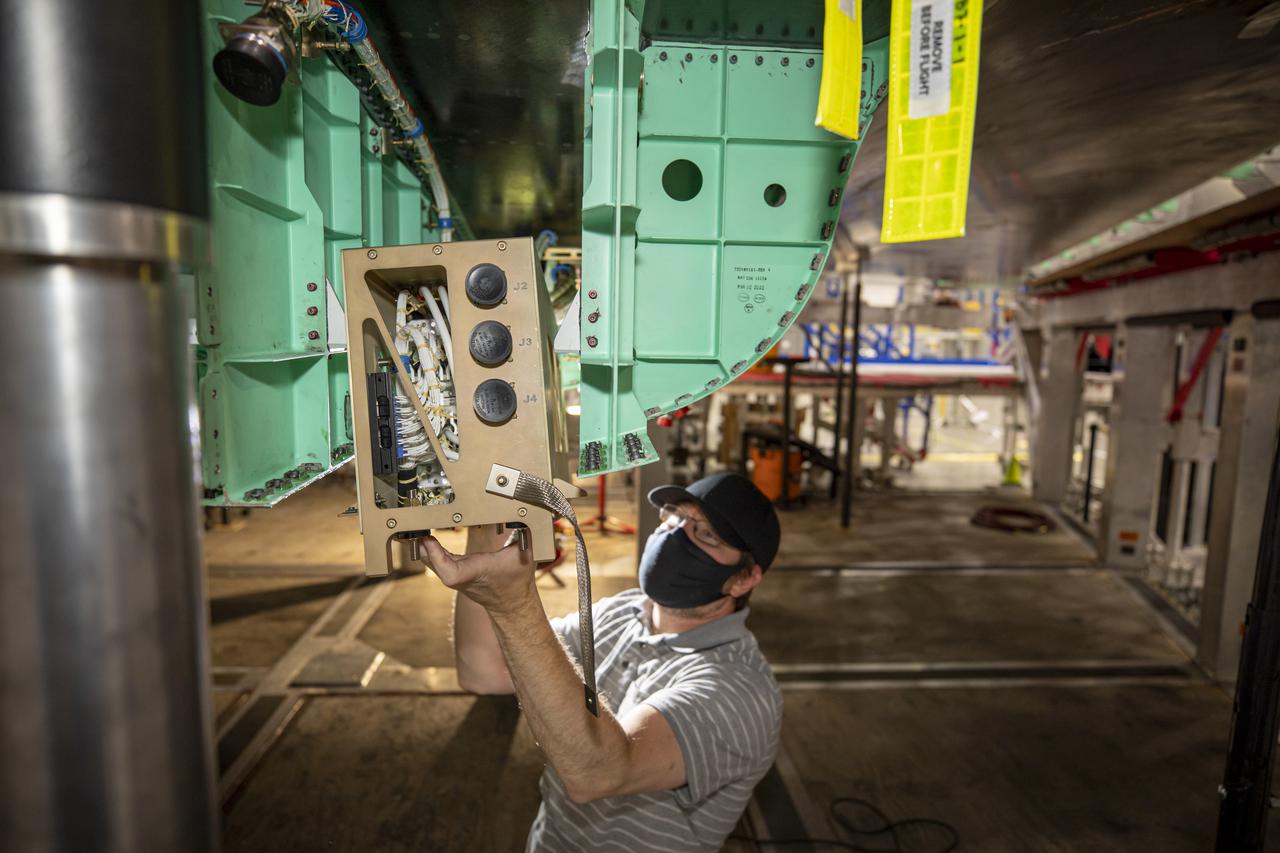
A technician works on the installation of the PDS Pallet (gold colored box that he is holding) on NASA’s X-59 Quiet SuperSonic Technology or QueSST aircraft. Lockheed Martin Photography By Garry Tice 1011 Lockheed Way, Palmdale, Ca. 93599 Event: SEG 450 Mid Bay - PDS Fit Check Date: 5/03/2021
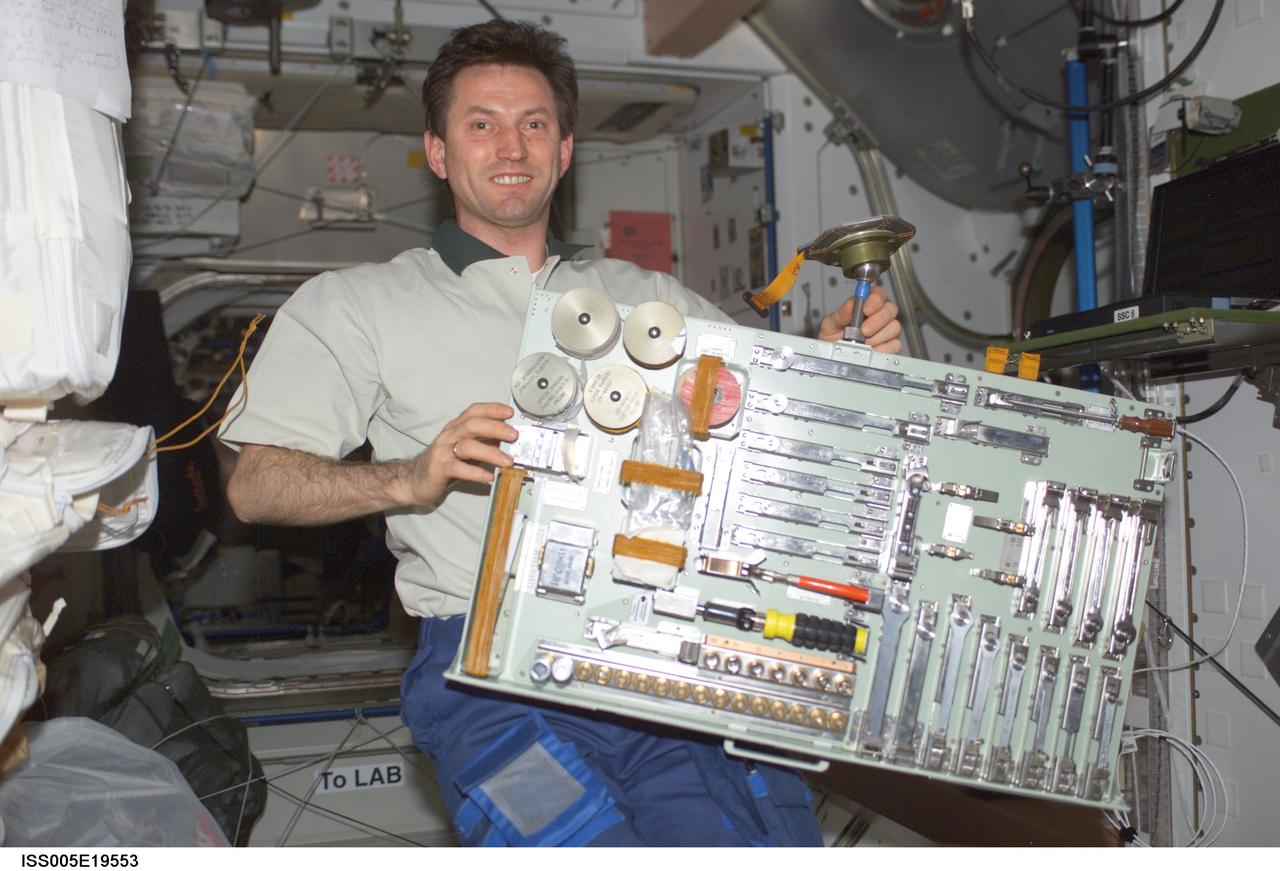
ISS005-E-19553 (2 November 2002) --- Cosmonaut Sergei Y. Treschev, Expedition Five flight engineer, holds a pallet containing various tools in the Unity node on the International Space Station (ISS). Treschev represents Rosaviakosmos.
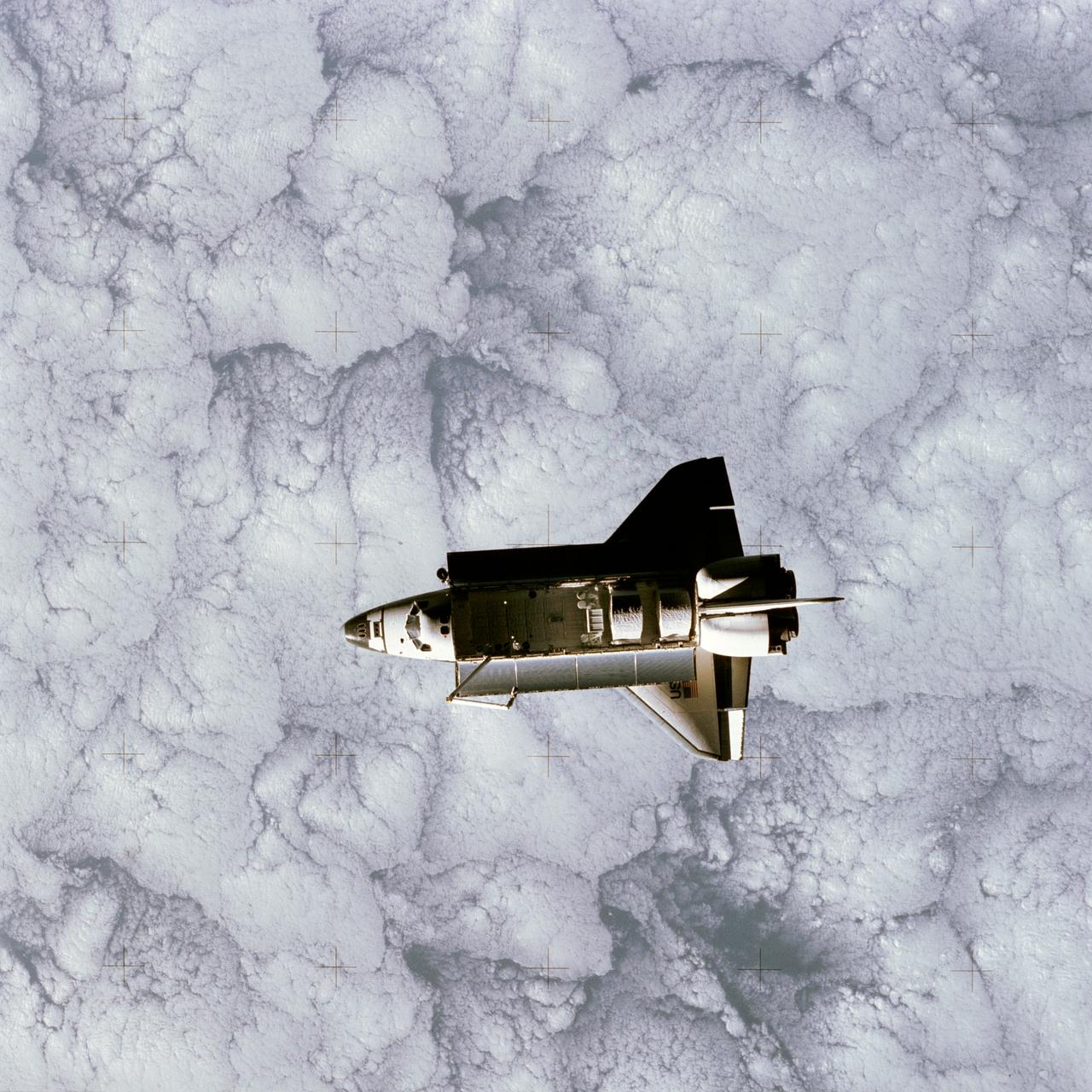
STS007-32-1667 (22 June 1983) --- The Earth-orbiting Space Shuttle Challenger over a heavily cloud-covered portion of the Earth was captured by a 70mm camera onboard the temporarily free-flying Shuttle Pallet Satellite (SPAS-01) during a busy Day 5 on the STS-7 mission. Visible in the cargo bay are the protective cradles for the now vacated Telesat Anik C2 and Palapa-B communications satellites, the pallet for the NASA Office of Space and Terrestrial Applications (OSTA-2); the Remote Manipulator System (RMS) and the KU-Band antenna. The STS-7 astronaut crew and the RMS arm later retrieved the SPAS and returned it to a stowed position in the cargo bay of the Space Shuttle Challenger for the return to Earth.
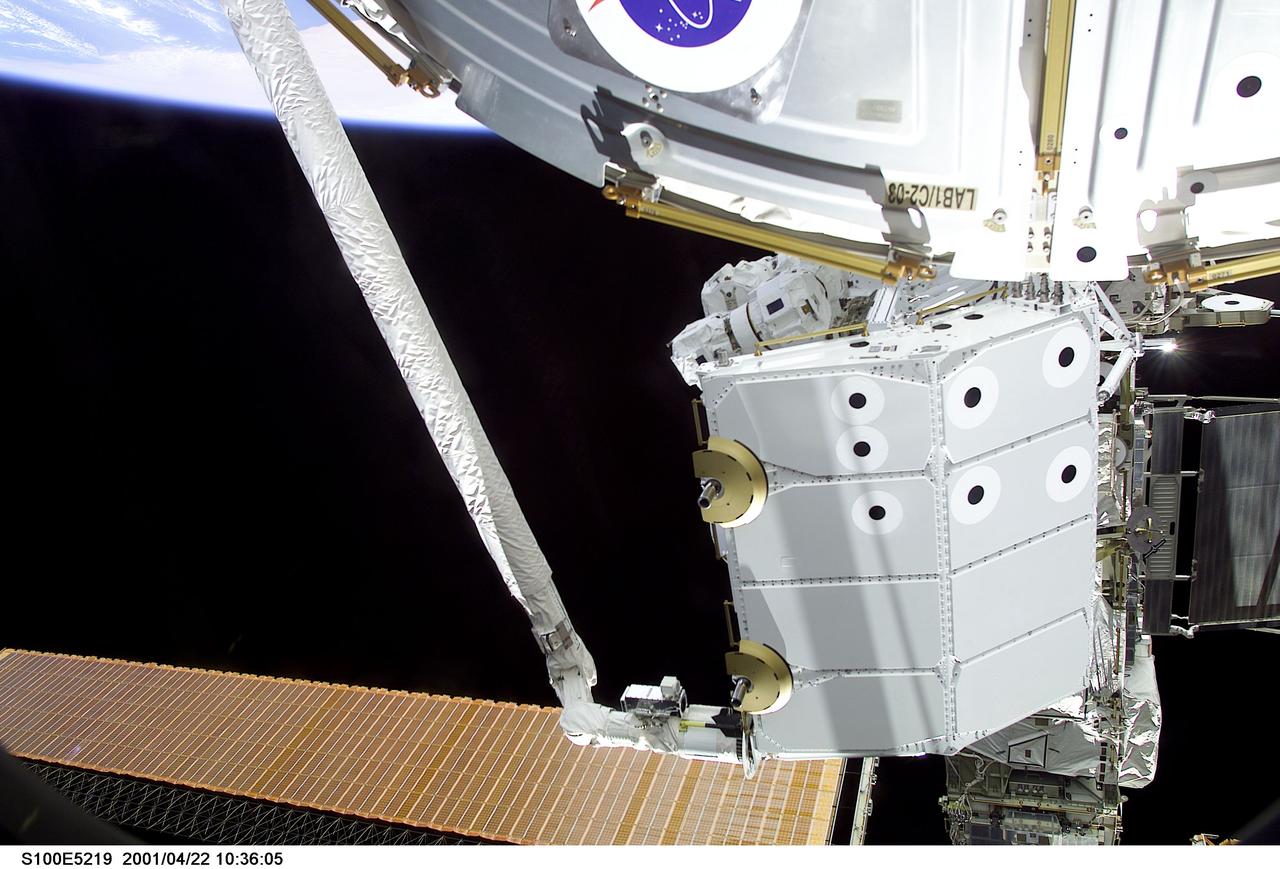
S100-E-5219 (22 April 2001) --- The Spacelab Pallet that contain Canadarm2 and the UHF antenna that are to be installed during the first scheduled space walk on STS-100 is seen in the grasp of the Canadian-built Remote Manipulator System (RMS) robot arm on the Space Shuttle Endeavour. The scene was recorded with a digital still camera.
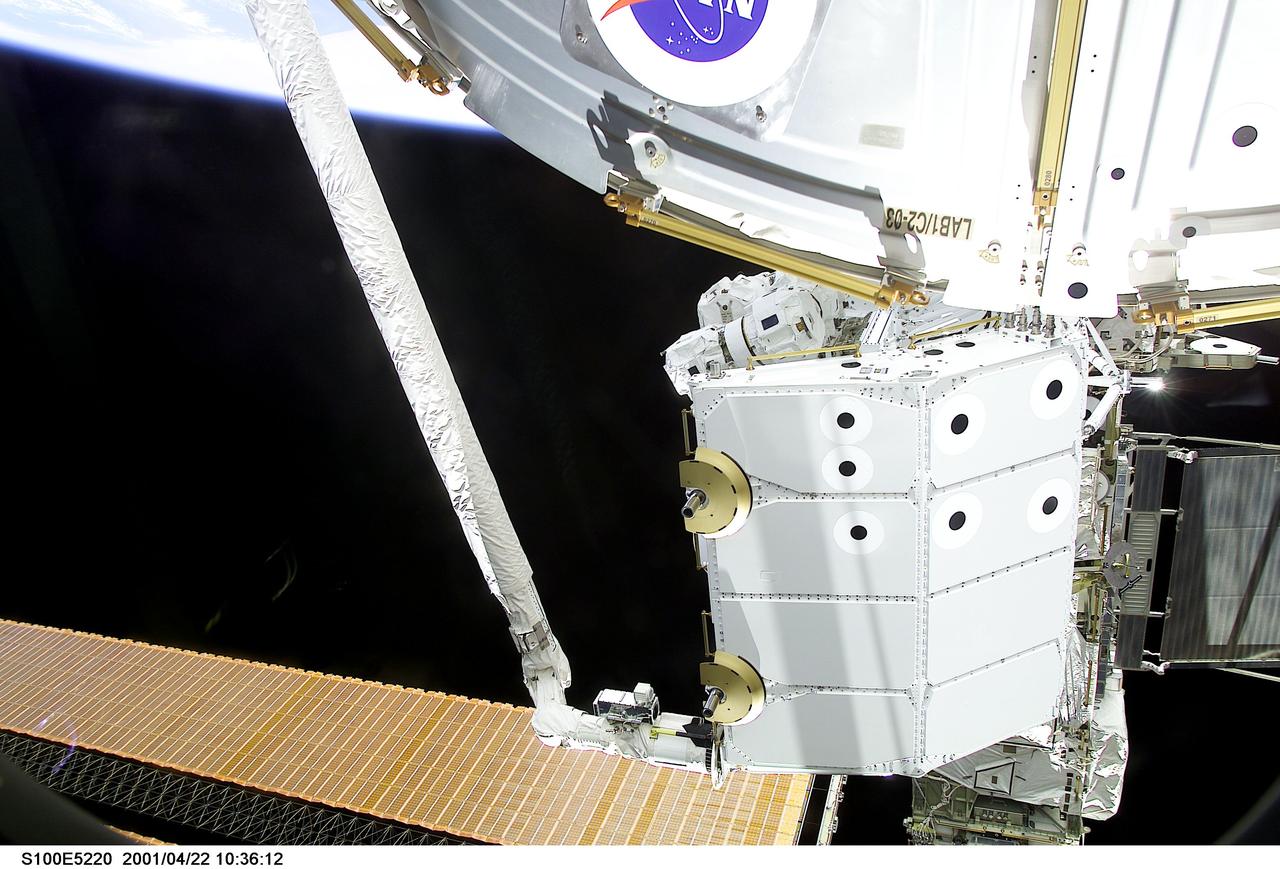
S100-E-5220 (22 April 2001) --- The pallet that contains Canadarm2 and the UHF antenna that are to be installed during the first scheduled space walk on STS-100 is seen in the grasp of the Canadian-built Remote Manipulator System (RMS) robot arm on the Space Shuttle Endeavour. The scene was recorded with a digital still camera.
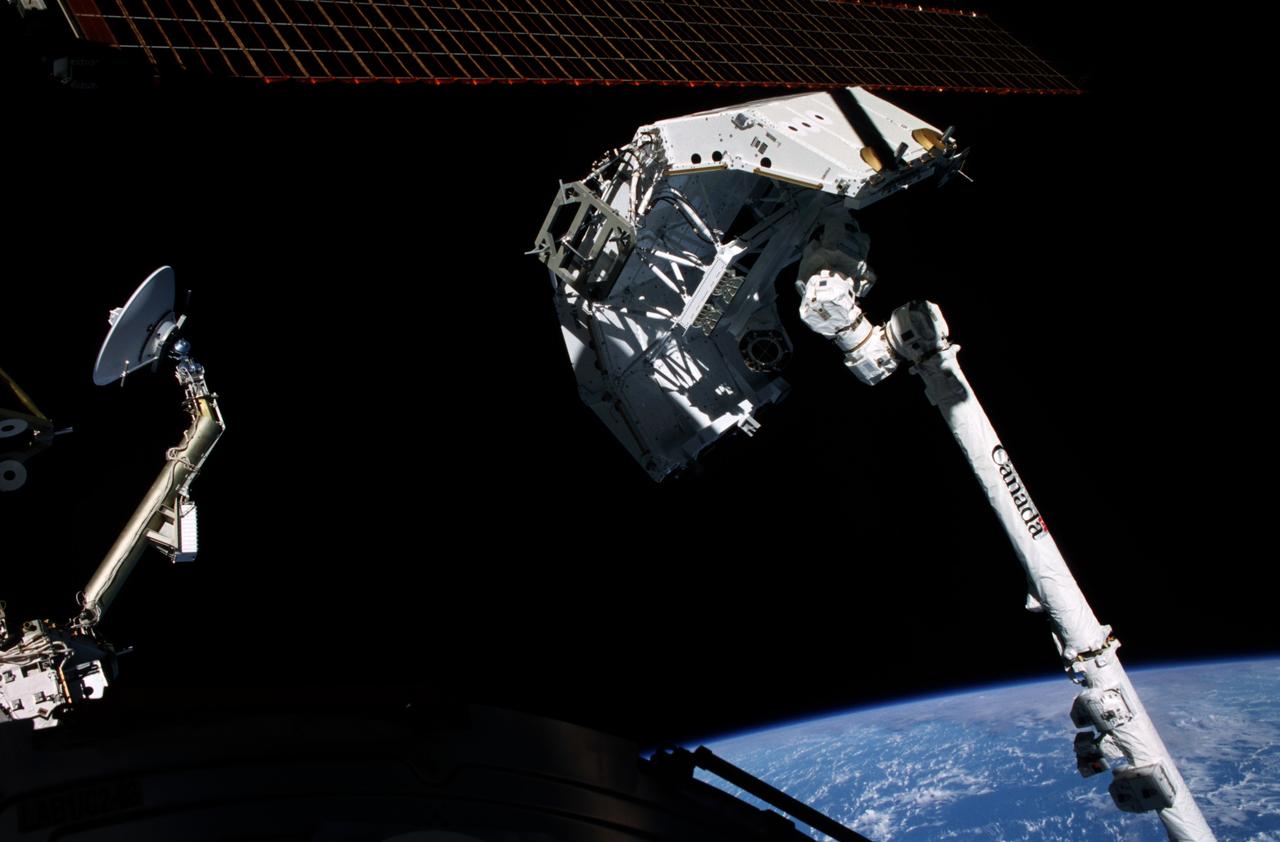
STS100-385-009 (19 April-1 May 2001) --- Extended by a crewmember on the International Space Station (ISS), the Space Station Remote Manipulator System (SSRMS) is backdropped by the blackness of space and the Earth's horizon while handling the Spacelab pallet.
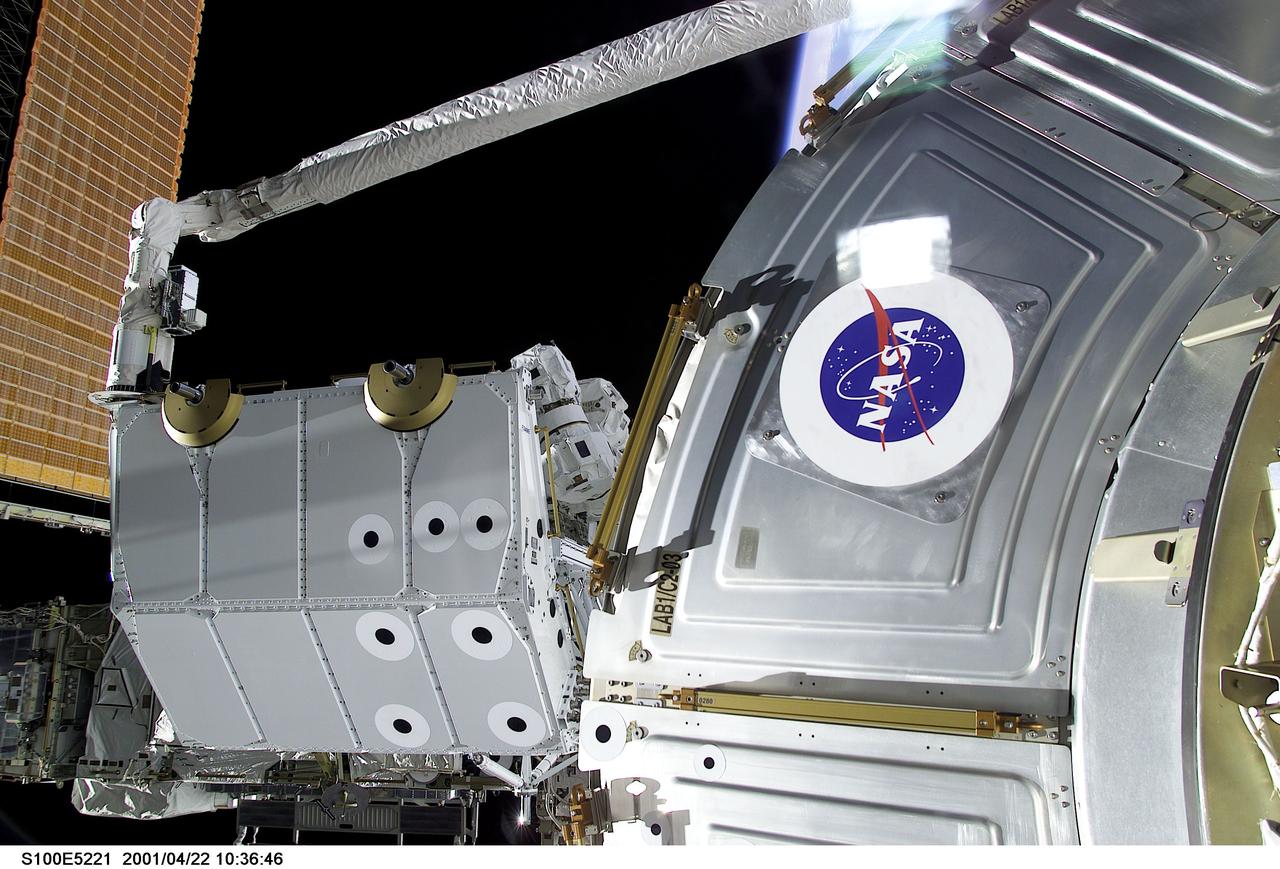
S100-E-5221 (22 April 2001) --- The pallet that contains Canadarm2 and the UHF antenna that are to be installed during the first scheduled space walk on STS-100 is seen in the grasp of the Canadian-built Remote Manipulator System (RMS) robot arm on the Space Shuttle Endeavour. The Destiny laboratory is seen in the foreground of the digital still camera's image.
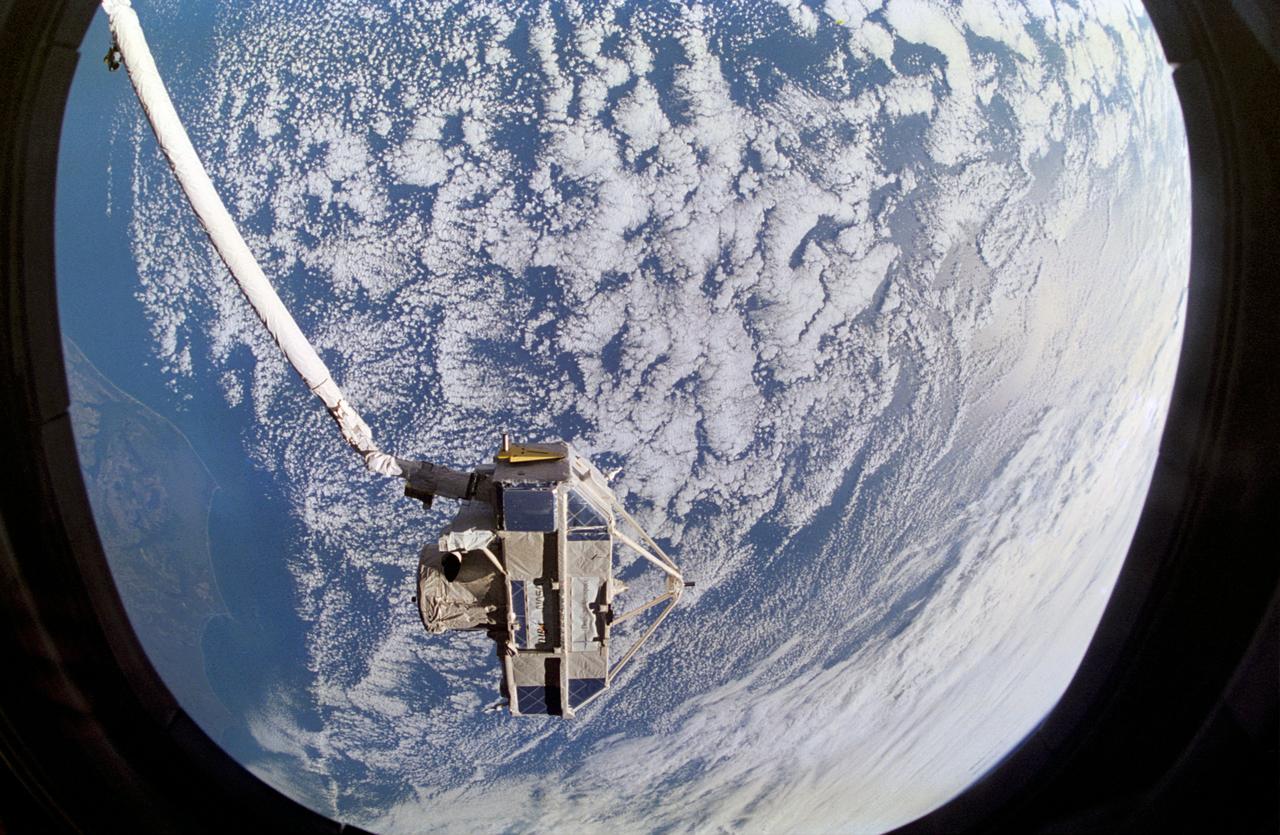
Clouds over the Atlantic Ocean serve as the backdrop for this 70mm scene of the Cryogenic Infrared Spectrometers and Telescopes for the Atmosphere (CRISTA), attached to the Shuttle Pallet System (SPAS). CRISTA-SPAS was in the grasp of the Space Shuttle Atlantis Remote Manipulator System (RMS) arm. The crew deployed the Crista-SPAS on November 4, 1994 and the tandem remained in free-flight until November 12, 1994 when it was retrieved by the Canadian-built RMS, controlled by payload commander Ellen Ochoa.
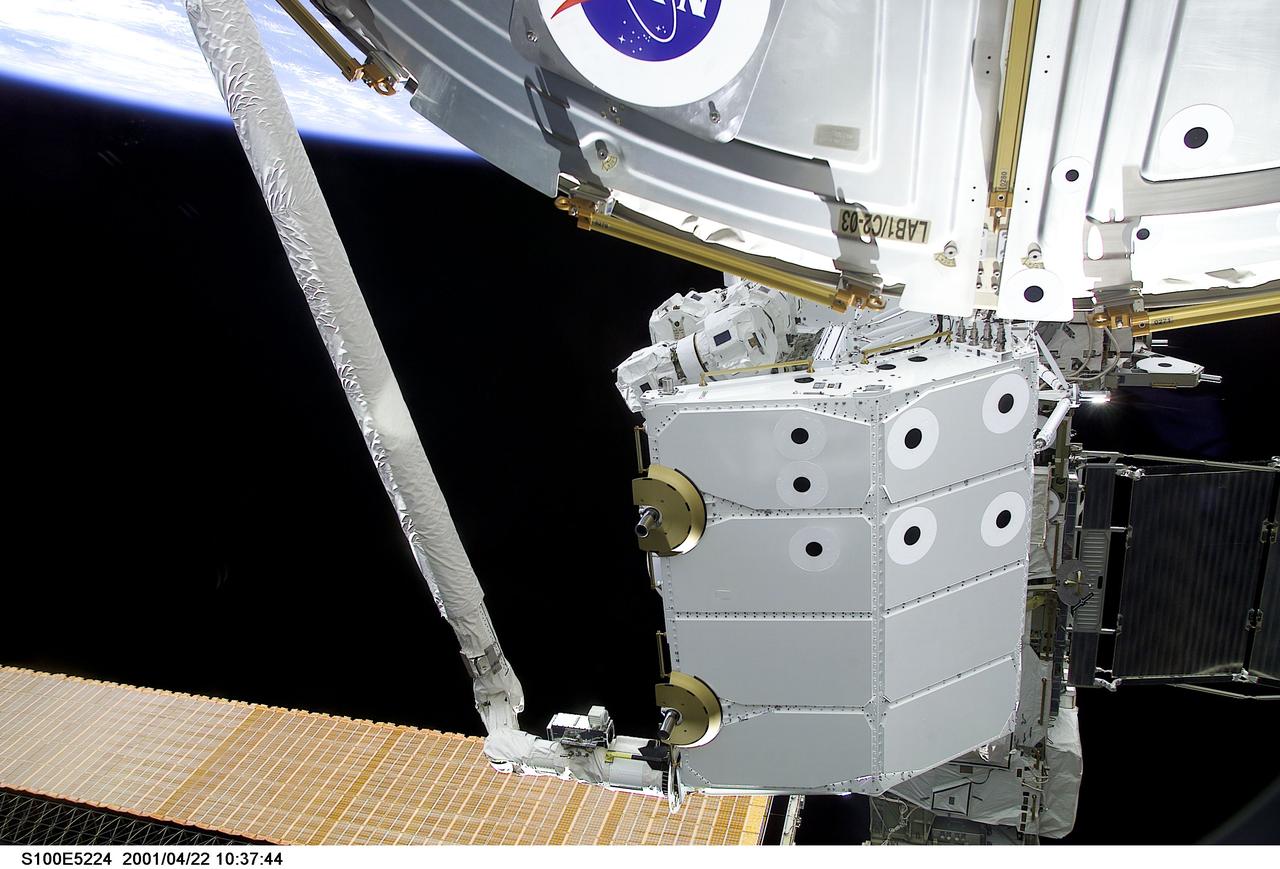
S100-E-5224 (22 April 2001) --- The pallet that contains Canadarm2 and the UHF antenna that are to be installed during the first scheduled space walk on STS-100 is seen in the grasp of the Canadian-built Remote Manipulator System (RMS) robot arm on the Space Shuttle Endeavour. Part of the Destiny laboratory can be seen in the top of the frame. The scene was recorded with a digital still camera.
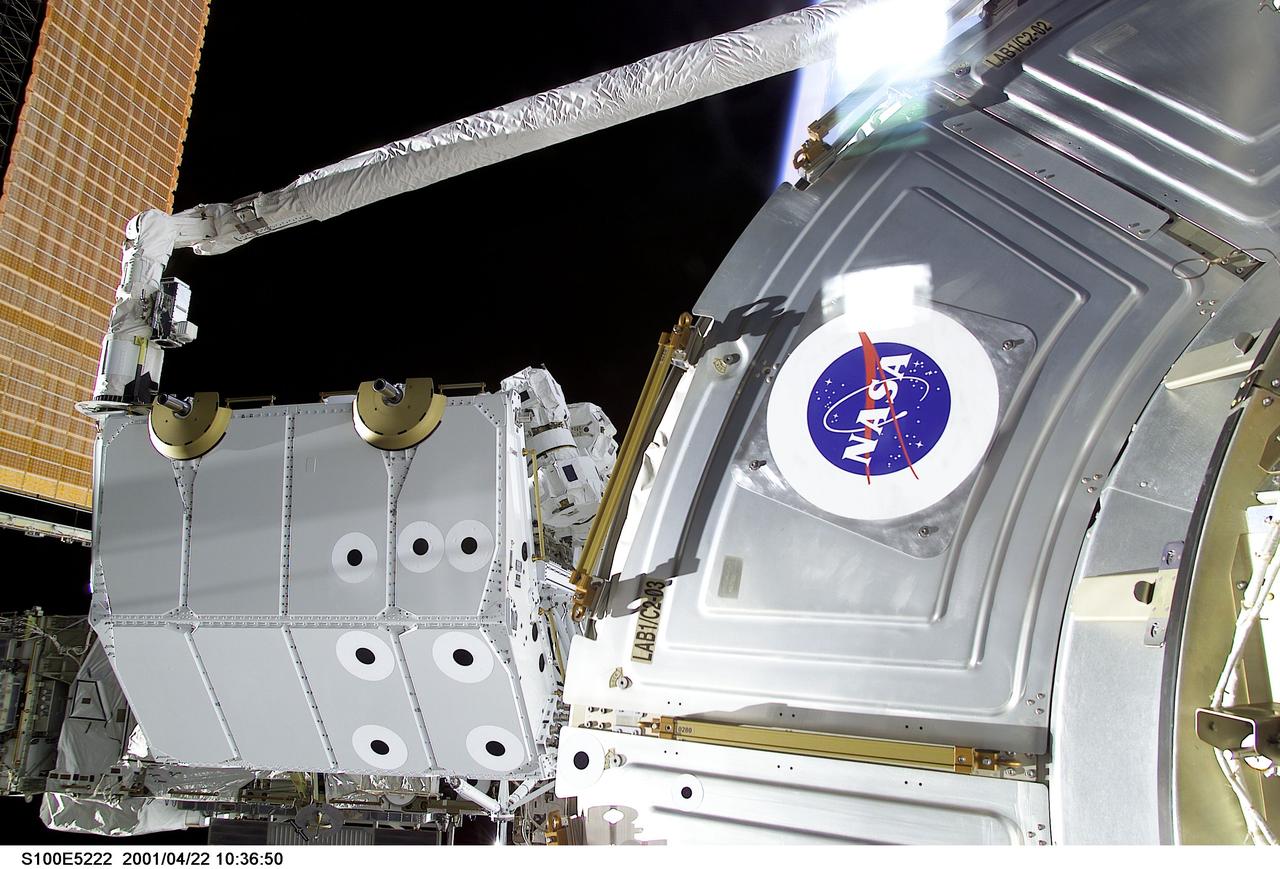
S100-E-5222 (22 April 2001) --- The pallet that contains Canadarm2 and the UHF antenna that are to be installed during the first scheduled space walk on STS-100 is seen in the grasp of the Canadian-built Remote Manipulator System (RMS) robot arm on the Space Shuttle Endeavour. The Destiny laboratory can be seen in the right foreground. The scene was recorded with a digital still camera.
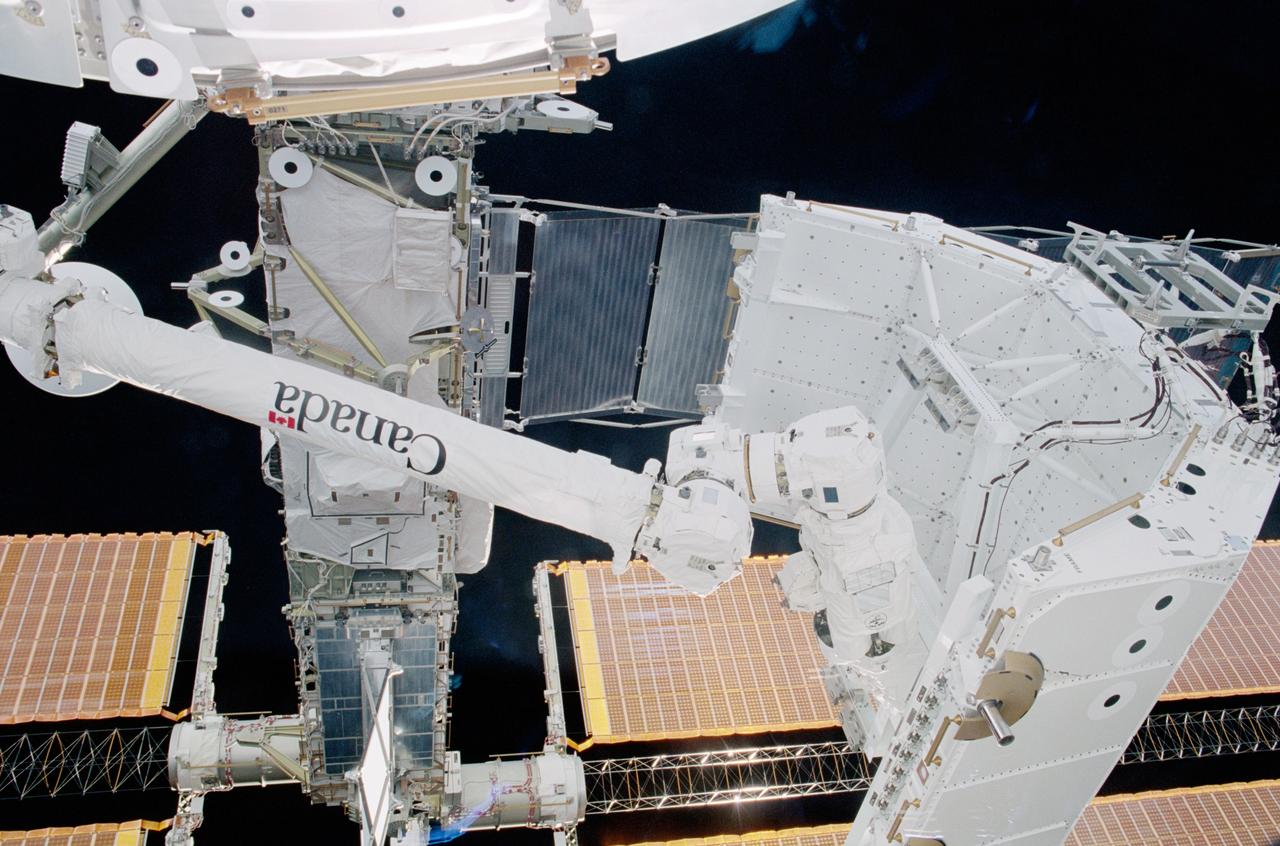
STS100-342-024 (19 April-1 May 2001) --- In the grasp of the newly installed Canadarm2, also known by its technical name, the Space Station Remote Manipulator System (SSRMS), the Spacelab pallet is carefully moved by crewmembers inside the International Space Station (ISS). Sunglint on the station's solar arrays can be seen in the background.
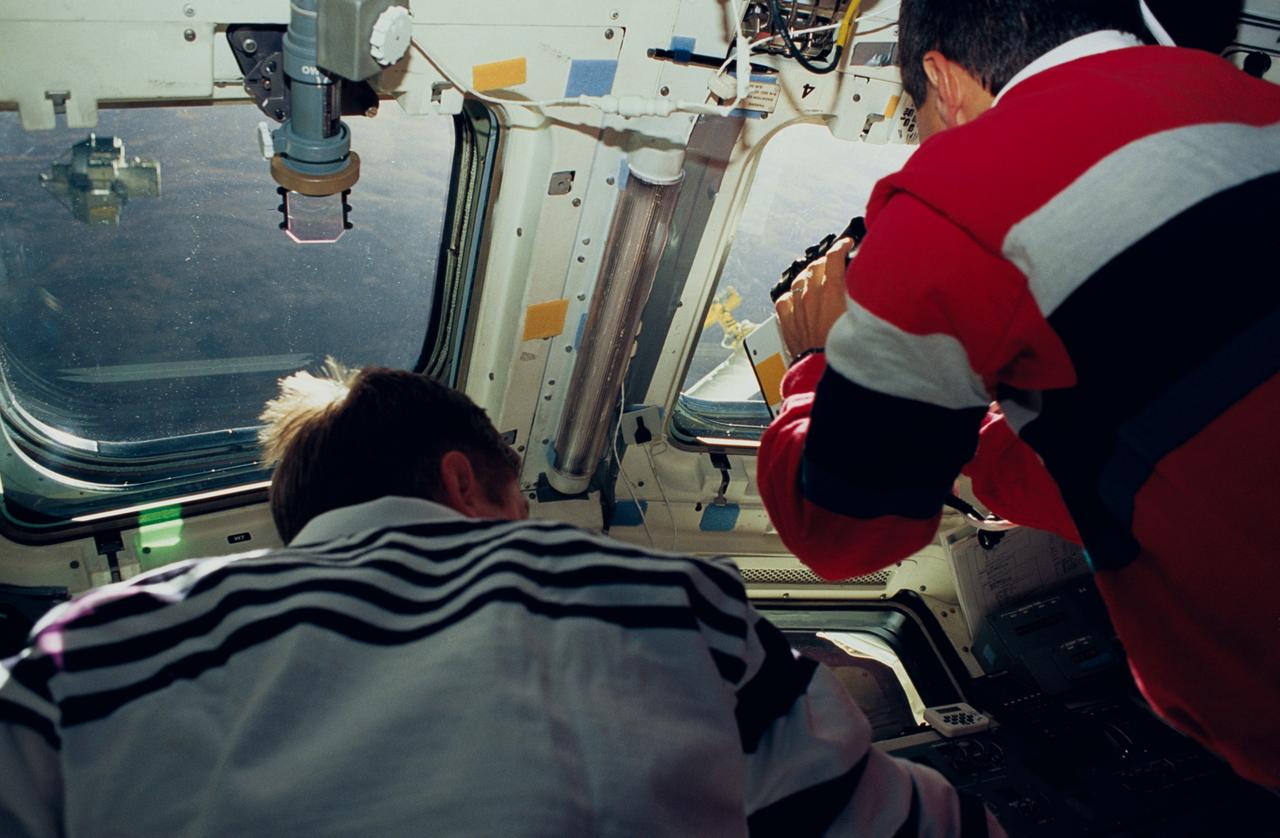
Astronauts Frank L. Culbertson Jr., STS-51 mission commander, and Daniel W. Bursch, mission specialist, are seen on Discovery's flight deck. The two were supporting operations free-flying Orbiting and Retrievable Far and Extreme Ultraviolet Spectrometer (ORFEUS) and its Shuttle Pallet Satellite (SPAS), pictured through the left window.
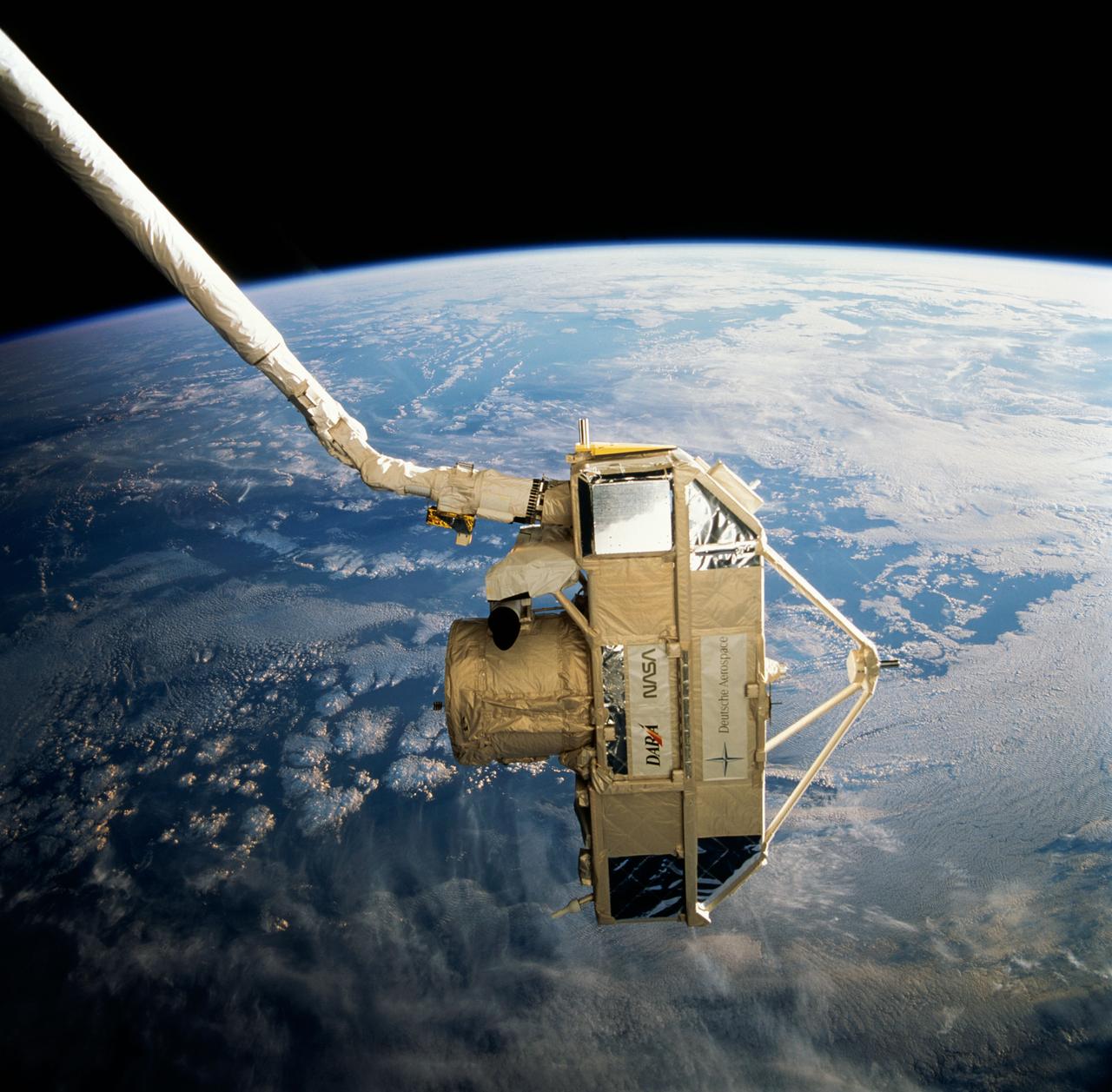
STS066-129-043 (3-14 Nov 1994) --- Clouds over the Atlantic Ocean serve as the backdrop for this 70mm scene of the Cryogenic Infrared Spectrometers and Telescopes for the Atmosphere (CRISTA), attached to the Shuttle Pallet System (SPAS). CRISTA-SPAS was in the grasp of the Space Shuttle Atlantis' Remote Manipulator System (RMS) arm. The crew deployed the CRISTA-SPAS on November 4, 1994 and the tandem remained in free-flight until November 12, 1994 when it was retrieved by the Canadian-built RMS, controlled by payload commander Ellen Ochoa. Other crew members onboard Atlantis were astronauts Donald R. McMonagle, Curtis L. Brown, Jr., Scott E. Parazynski and Joseph R. Tanner, along with Jean-François Clervoy of the European Space Agency (ESA). The six astronauts spent 11-days in Earth-orbit in support of the Atmospheric Laboratory for Applications and Science (ATLAS-3) mission.
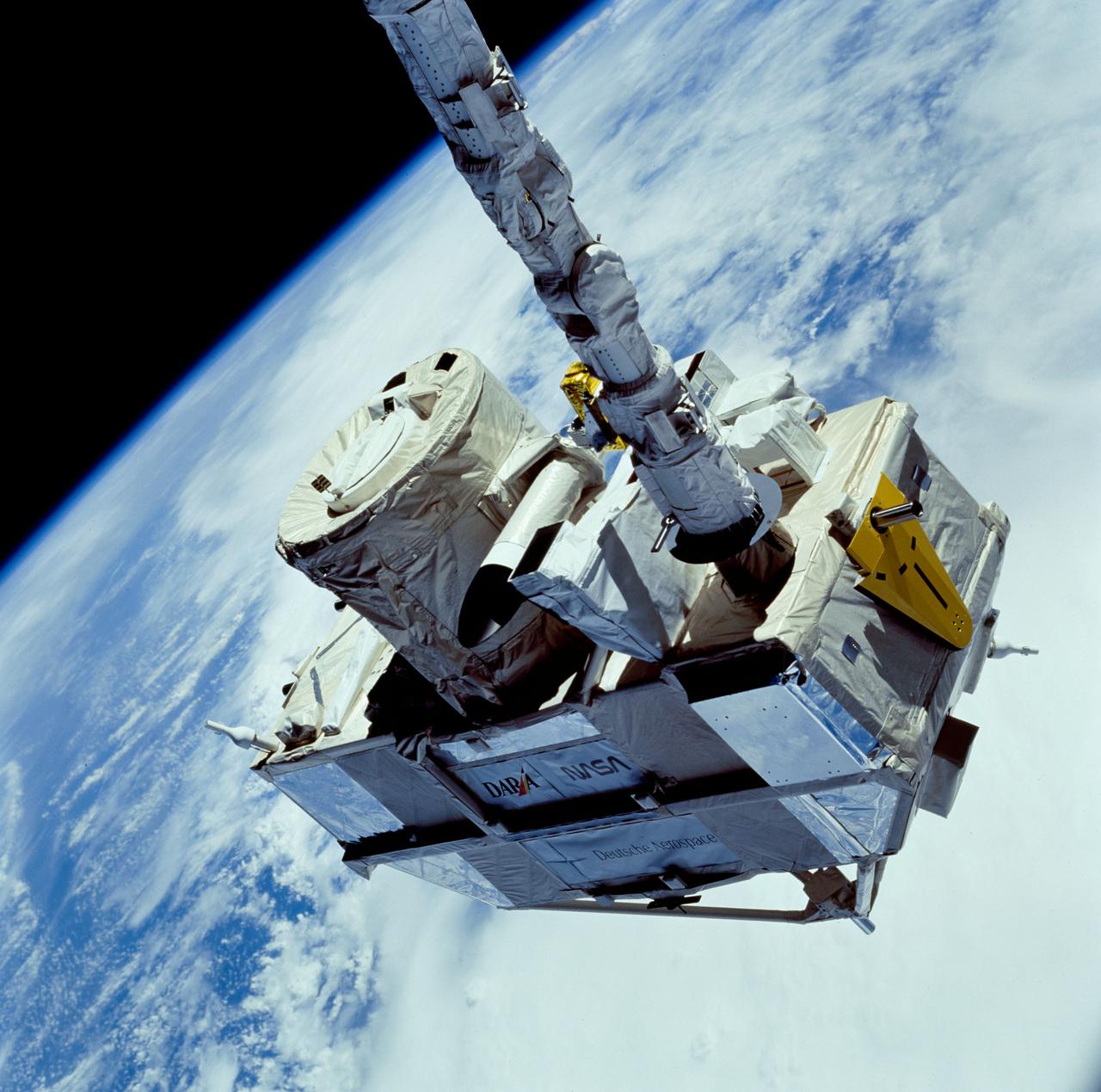
STS066-96-030 (3-14 Nov 1994) --- Masses of clouds serve as the backdrop for this close-up 70mm scene of the Cryogenic Infrared Spectrometers and Telescopes for the Atmosphere (CRISTA), attached to the Shuttle Pallet Satellite (SPAS). CRISTA-SPAS was in the grasp of the Space Shuttle Atlantis' Remote Manipulator System (RMS) arm. The crew deployed the CRISTA-SPAS on November 4, 1994 and the spacecraft remained in free-flight until November 12, 1994 when it was retrieved by the Canadian-built RMS, controlled by payload commander Ellen Ochoa. Other crew members onboard Atlantis were astronauts Donald R. McMonagle, Curtis L. Brown, Jr., Scott E. Parazynski and Joseph R. Tanner, along with Jean-Francois Clervoy of ESA. The six astronauts spent 11-days in Earth-orbit in support of the Atmospheric Laboratory for Applications and Science (ATLAS-3) mission.
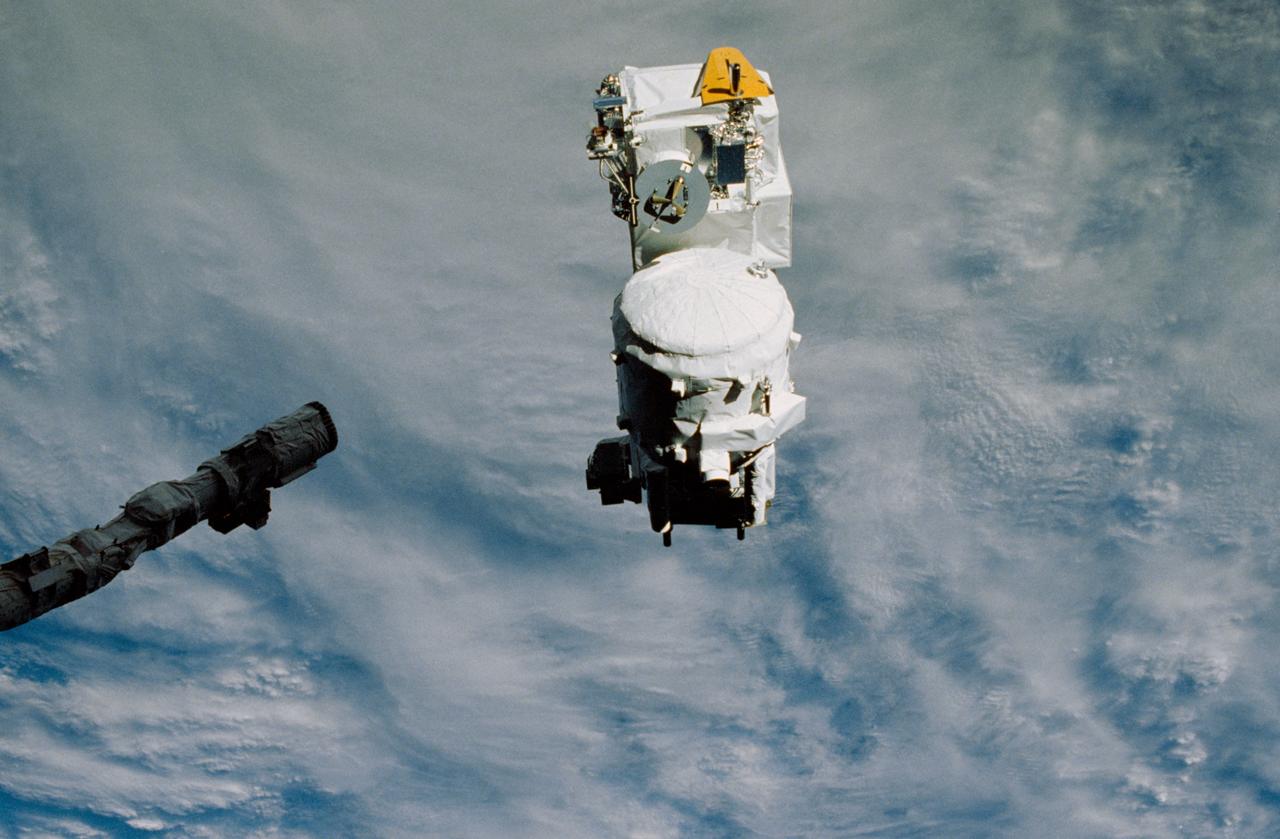
STS039-17-017 (3 May 1990) --- This STS-39 35mm scene shows the Strategic Defense Initiative Organization (SDIO) Shuttle Pallet Satellite (SPAS-II) as it approaches the remote manipulator system (RMS) end effector following a period of free-flight and data collection. During the eight-day flight, SPAS collected data in both a free-flying mode and while attached to the RMS. A huge blanket of white clouds obscures identifiable points on Earth, nearly 300 statute miles away. The target grappling apparatus on SPAS is clearly seen near bottom center of frame.
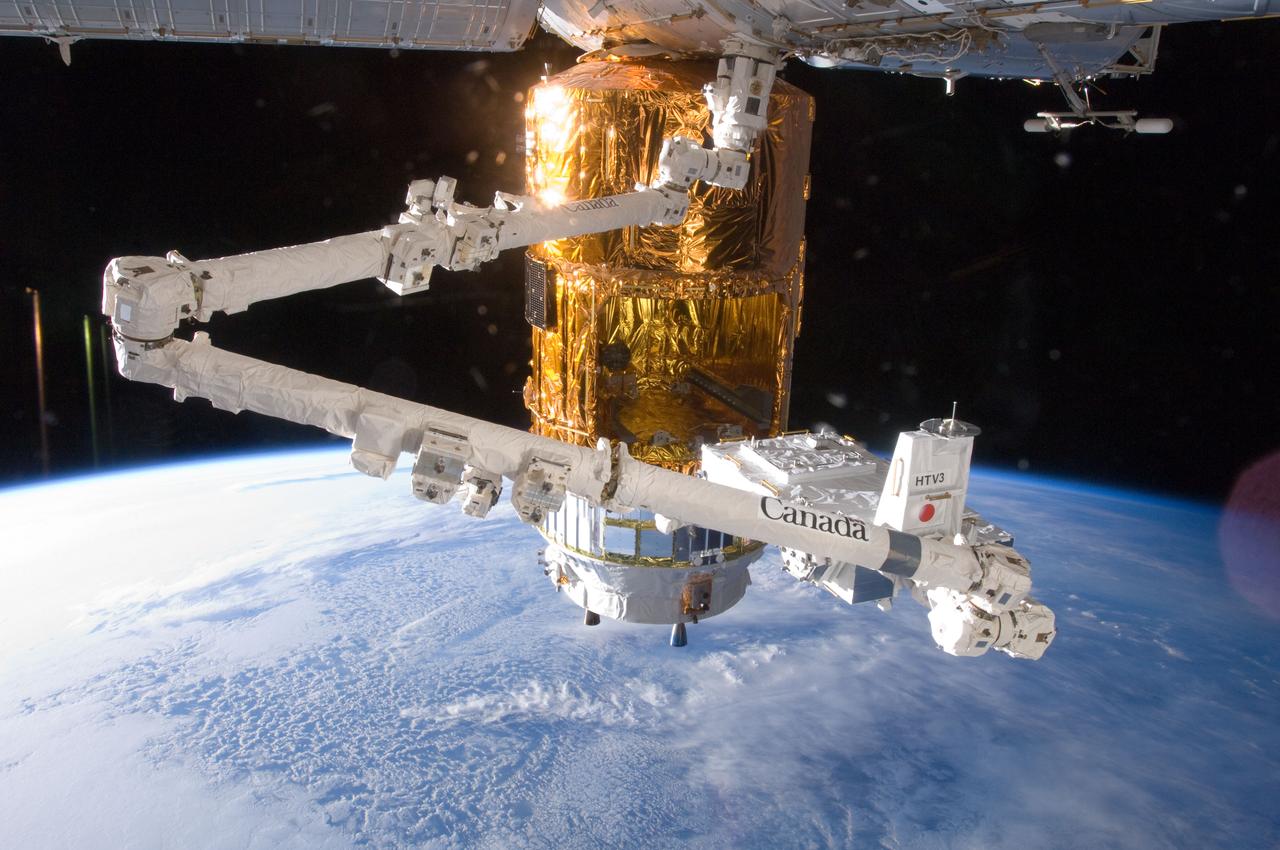
ISS032-E-016904 (10 Aug. 2012) --- In the grasp of the International Space Station?s robotic Canadarm2, the HTV-3 Exposed Pallet is moved for installation on the Japan Aerospace Exploration Agency (JAXA) H-II Transfer Vehicle (HTV-3) currently docked to the space station. Earth?s horizon and the blackness of space provide the backdrop for the scene.
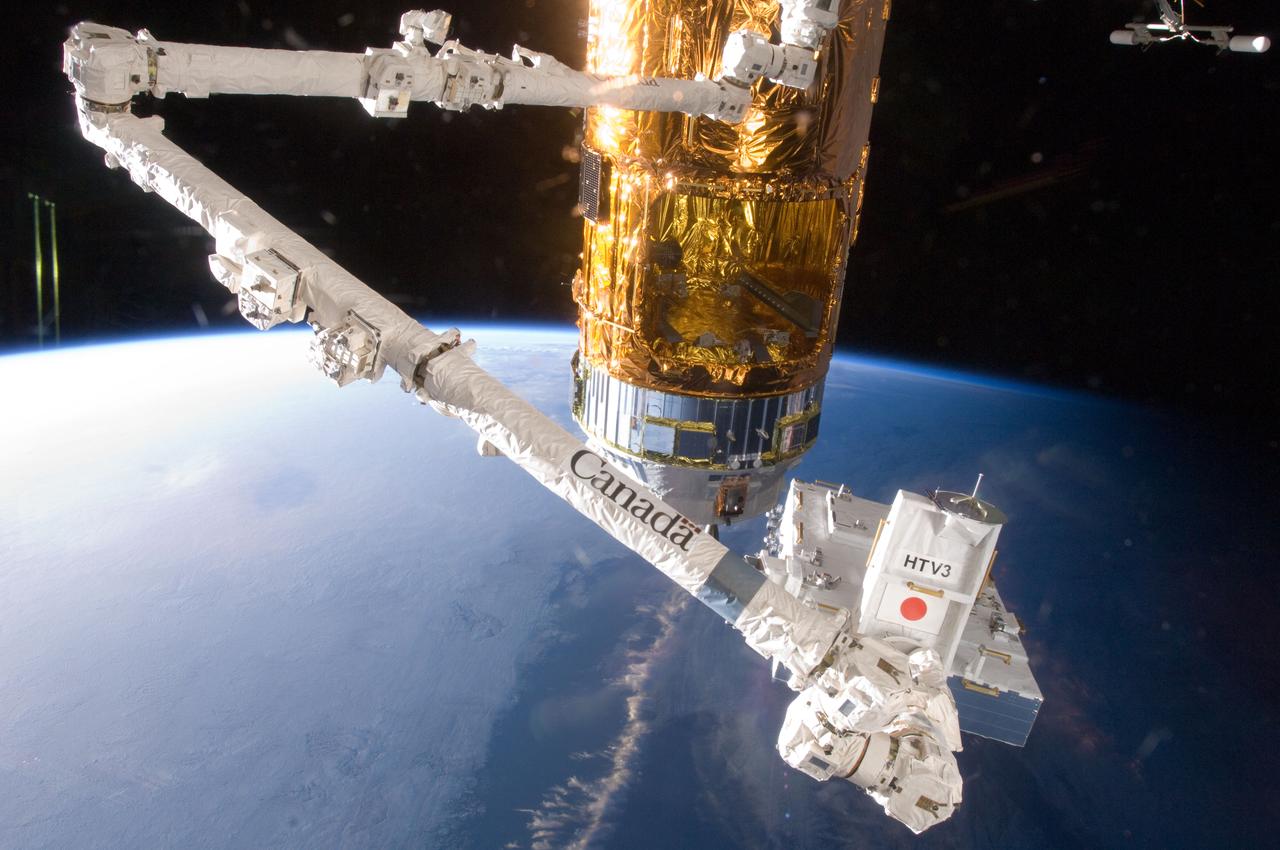
ISS032-E-016900 (10 Aug. 2012) --- In the grasp of the International Space Station?s robotic Canadarm2, the HTV-3 Exposed Pallet is moved for installation on the Japan Aerospace Exploration Agency (JAXA) H-II Transfer Vehicle (HTV-3) currently docked to the space station. Earth?s horizon and the blackness of space provide the backdrop for the scene.
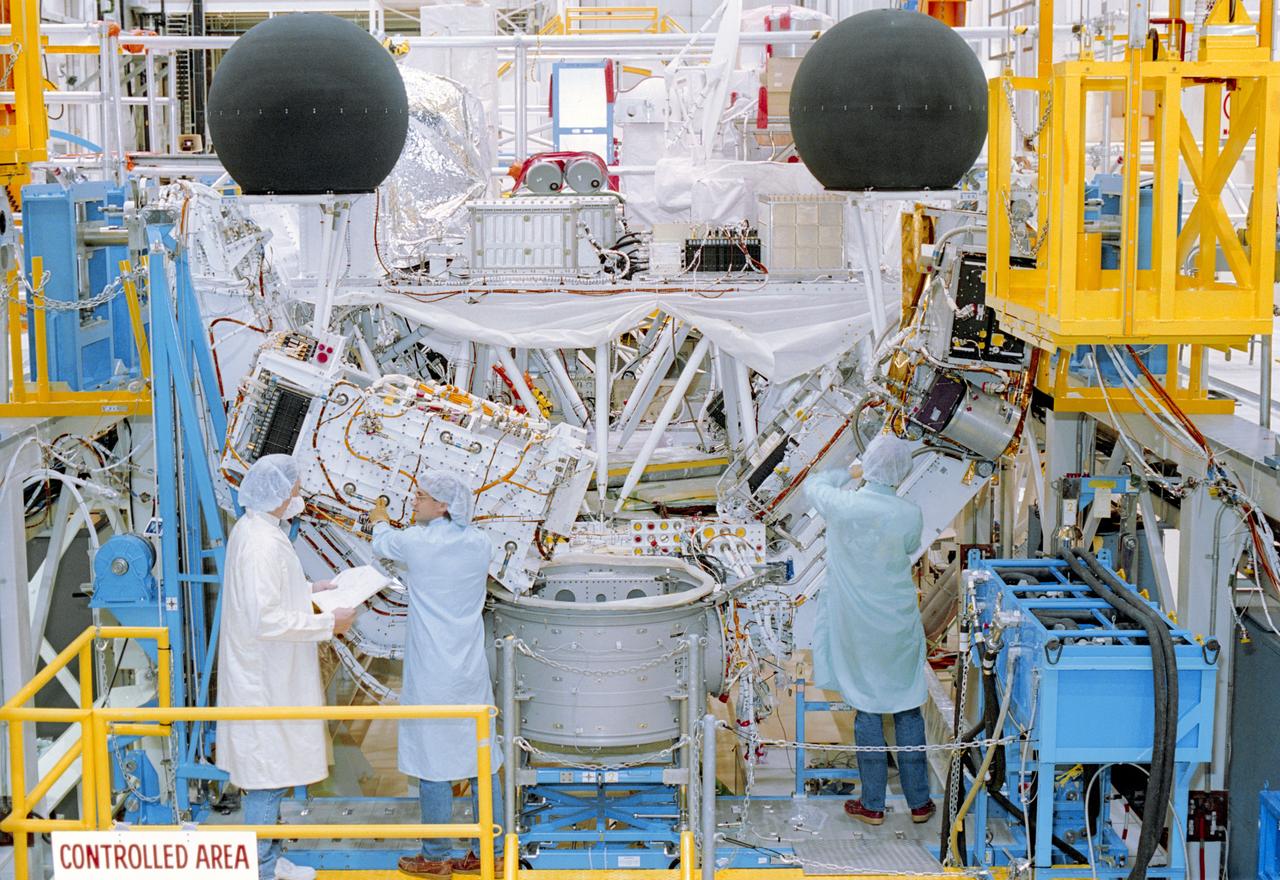
S92-27865 (23 Sept 1991) --- In test stand 3 of the Operations and Checkout Building high bay, workers complete mating of the Atmosphere Laboratory for Applications and Science-1 (ATLAS-1) pallet and Igloo power unit. Closeout activities on the ATLAS-1 payload are under way, with a systems test scheduled for later in October. The ATLAS series of missions will study solar and atmospheric physics. ATLAS-1 is scheduled to fly on Space Shuttle Mission STS-45 in 1992.
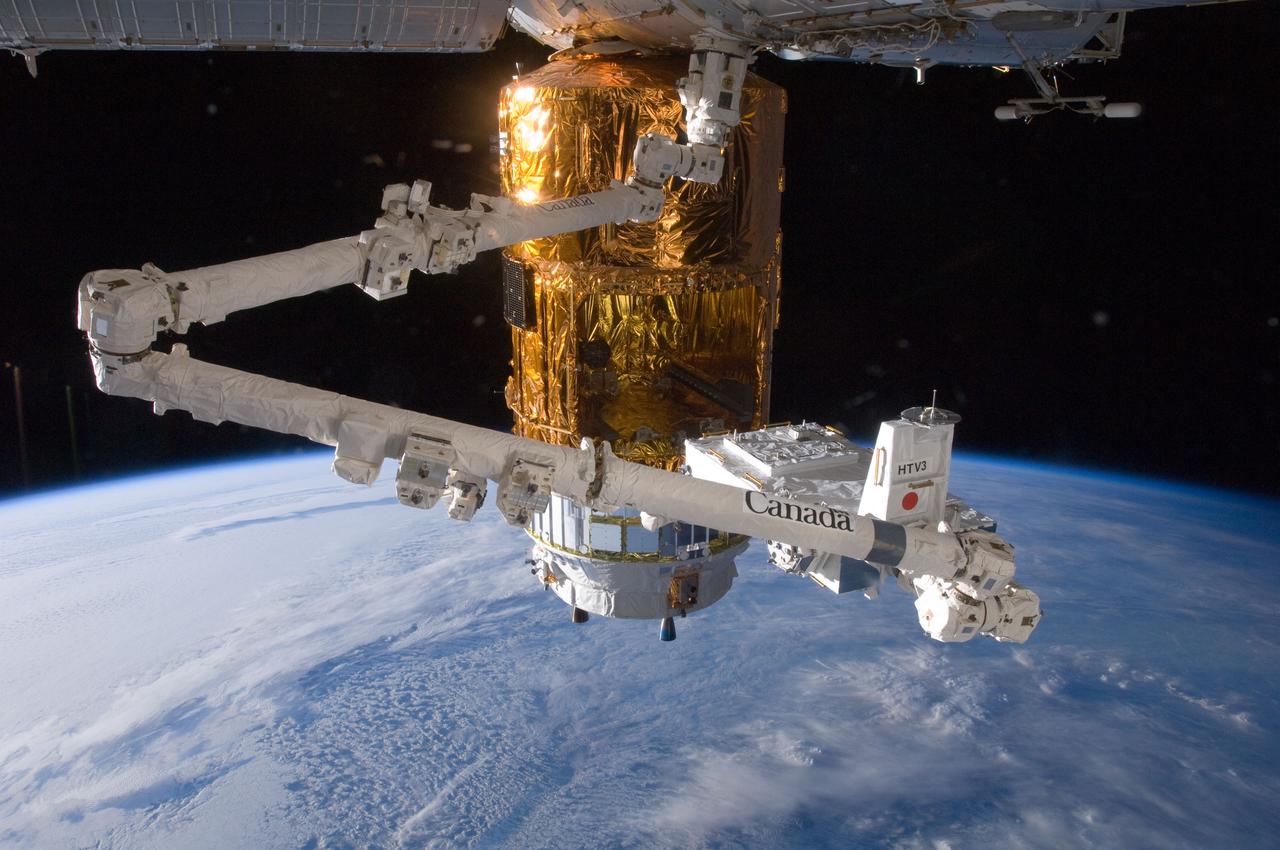
ISS032-E-016906 (10 Aug. 2012) --- In the grasp of the International Space Station?s robotic Canadarm2, the HTV-3 Exposed Pallet is moved for installation on the Japan Aerospace Exploration Agency (JAXA) H-II Transfer Vehicle (HTV-3) currently docked to the space station. Earth?s horizon and the blackness of space provide the backdrop for the scene.
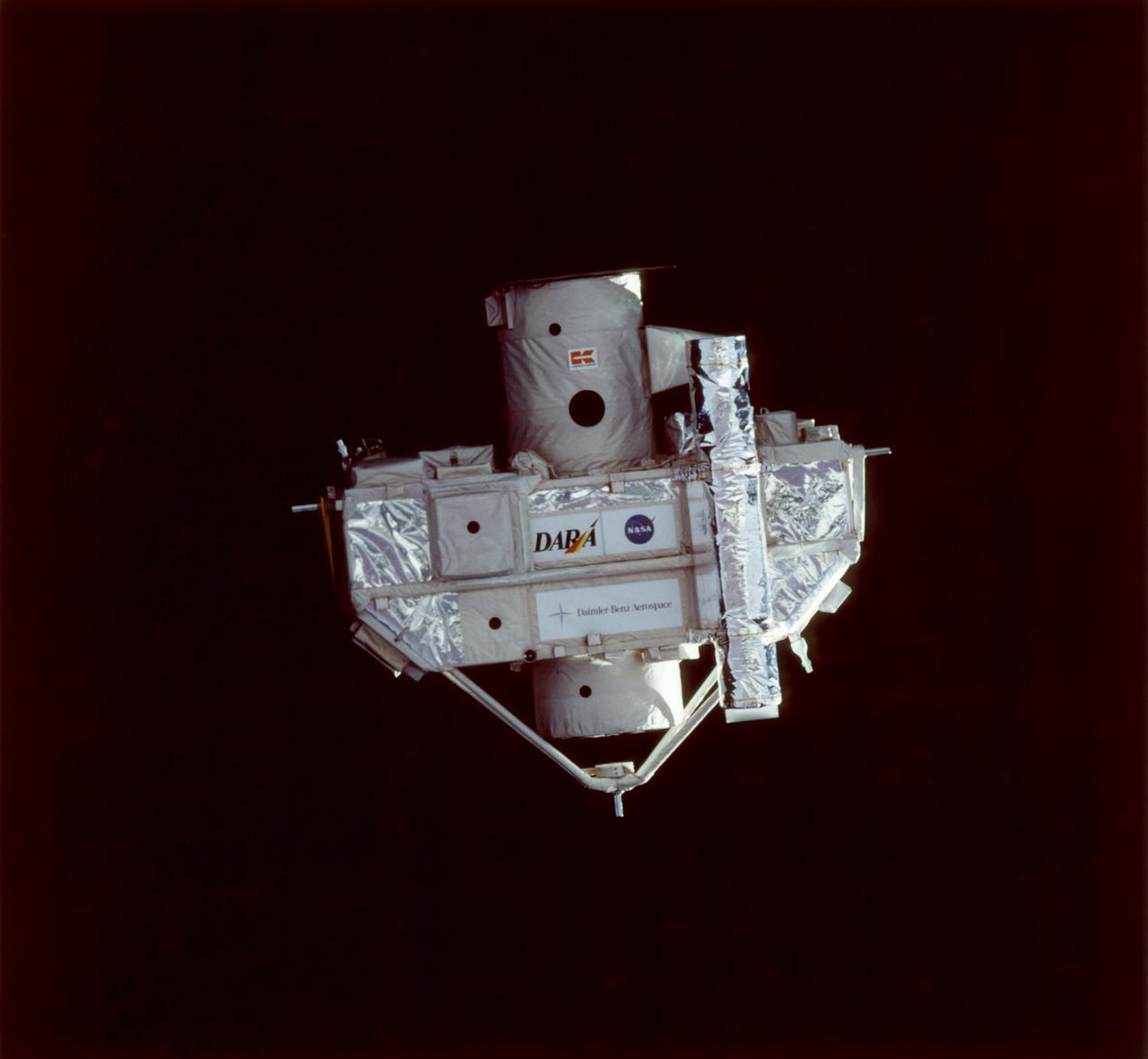
This STS-80 onboard photograph shows the Orbiting Retrievable Far and Extreme Ultraviolet Spectrometer-Shuttle Pallet Satellite II (ORFEUS-SPAS II), photographed during approach by the Space Shuttle Orbiter Columbia for retrieval. Built by the German Space Agency, DARA, the ORFEUS-SPAS II, a free-flying satellite, was dedicated to astronomical observations at very short wavelengths to: investigate the nature of hot stellar atmospheres, investigate the cooling mechanisms of white dwarf stars, determine the nature of accretion disks around collapsed stars, investigate supernova remnants, and investigate the interstellar medium and potential star-forming regions. Some 422 observations of almost 150 astronomical objects were completed, including the Moon, nearby stars, distant Milky Way stars, stars in other galaxies, active galaxies, and quasar 3C273. The STS-80 mission was launched November 19, 1996.
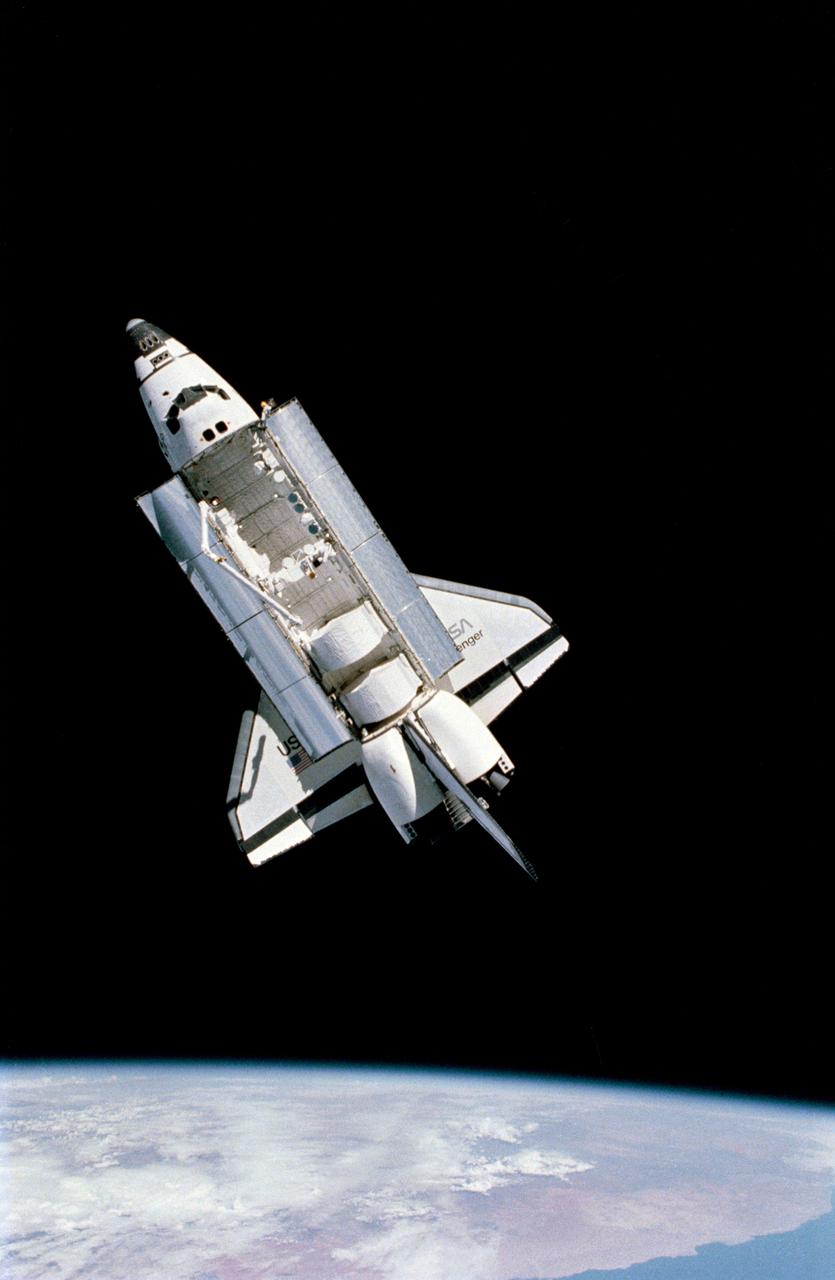
S84-27022 (7 Feb 1984) --- A 35mm frame from the February 7, 1984, extravehicular activity (EVA) photographed with a camera affixed to the gear of astronaut Bruce McCandless II. The mission specialist was equipped with the nitrogen-propelled, hand-controlled Manned Maneuvering Unit (MMU), which took him some 90 meters away from the Space Shuttle Challenger. This scene is reminiscent of views of the Challenger during the June 1983, STS-7 flight, on which the Shuttle Pallet Satellite (SPAS - seen here in the middle of the cargo bay) provided scenes of 38-meter-long reusable vehicle over the Earth.

S83-35782 (18 June 1983) --- An Orbital Maneuvering System (OMS) engine firing caused this bright glow at the aft end of the Earth-orbiting space shuttle Challenger on June 18, 1983. Also visible in the 70mm exposure are parts of the Shuttle Pallet Satellite (SPAS-01). The experiment package for NASA's Office of Space and Terrestrial Applications (OSTA-2), the protective cradles for the Indonesian Palapa-B and Telesat Canada Anik C2 satellites, some getaway special (GAS) canisters and the Canadian-built Remote Manipulator System (RMS). The firing took place less than an hour after deployment of Anik. Photo credit: NASA

NASA’s flight systems engineer, Kassidy Mclaughlin conducts environmental testing on an instrumentation pallet. The pallet was used during NASA’s National Campaign project in 2020 at NASA’s Armstrong Flight Research Center in Edwards, California.
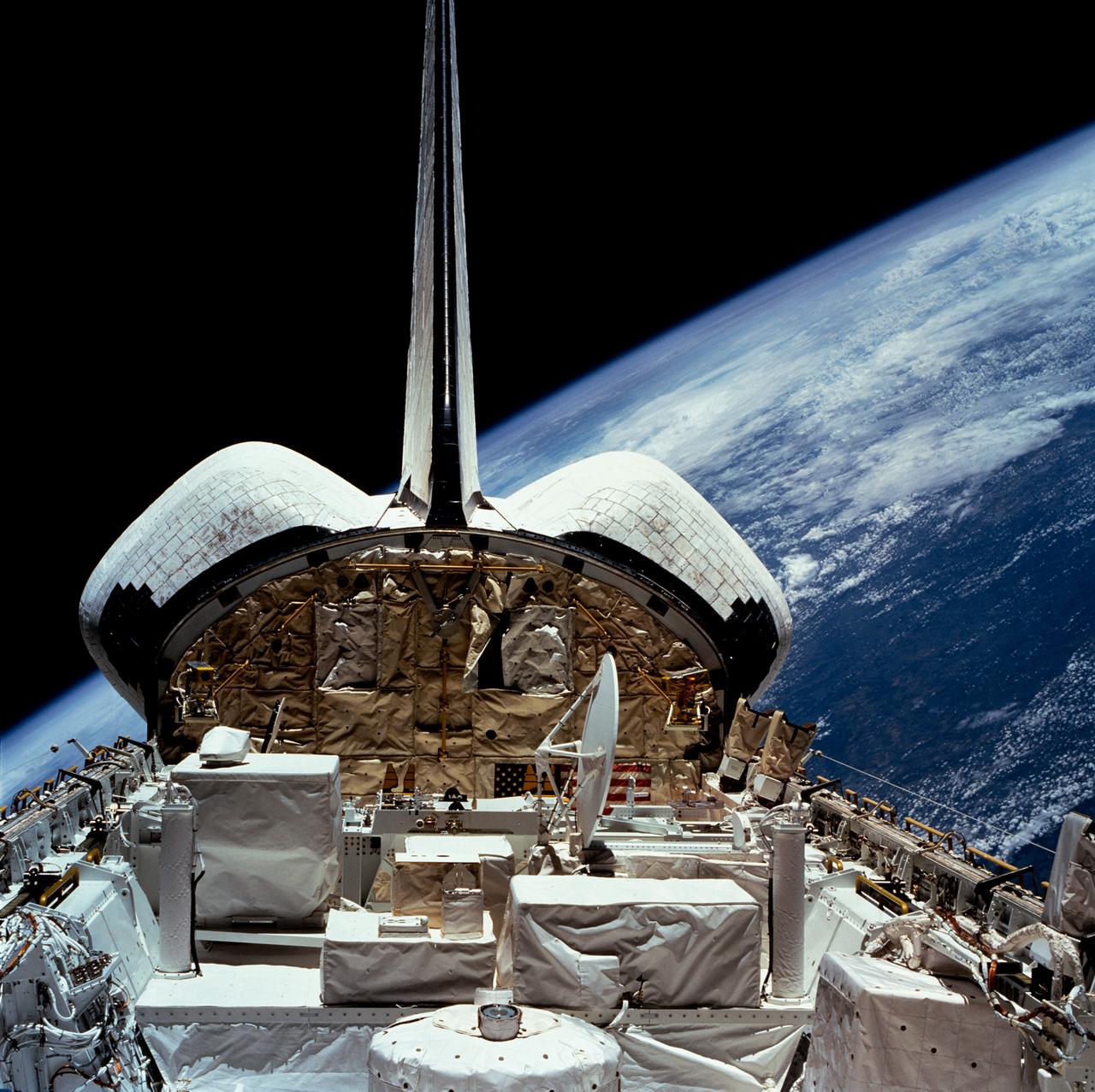
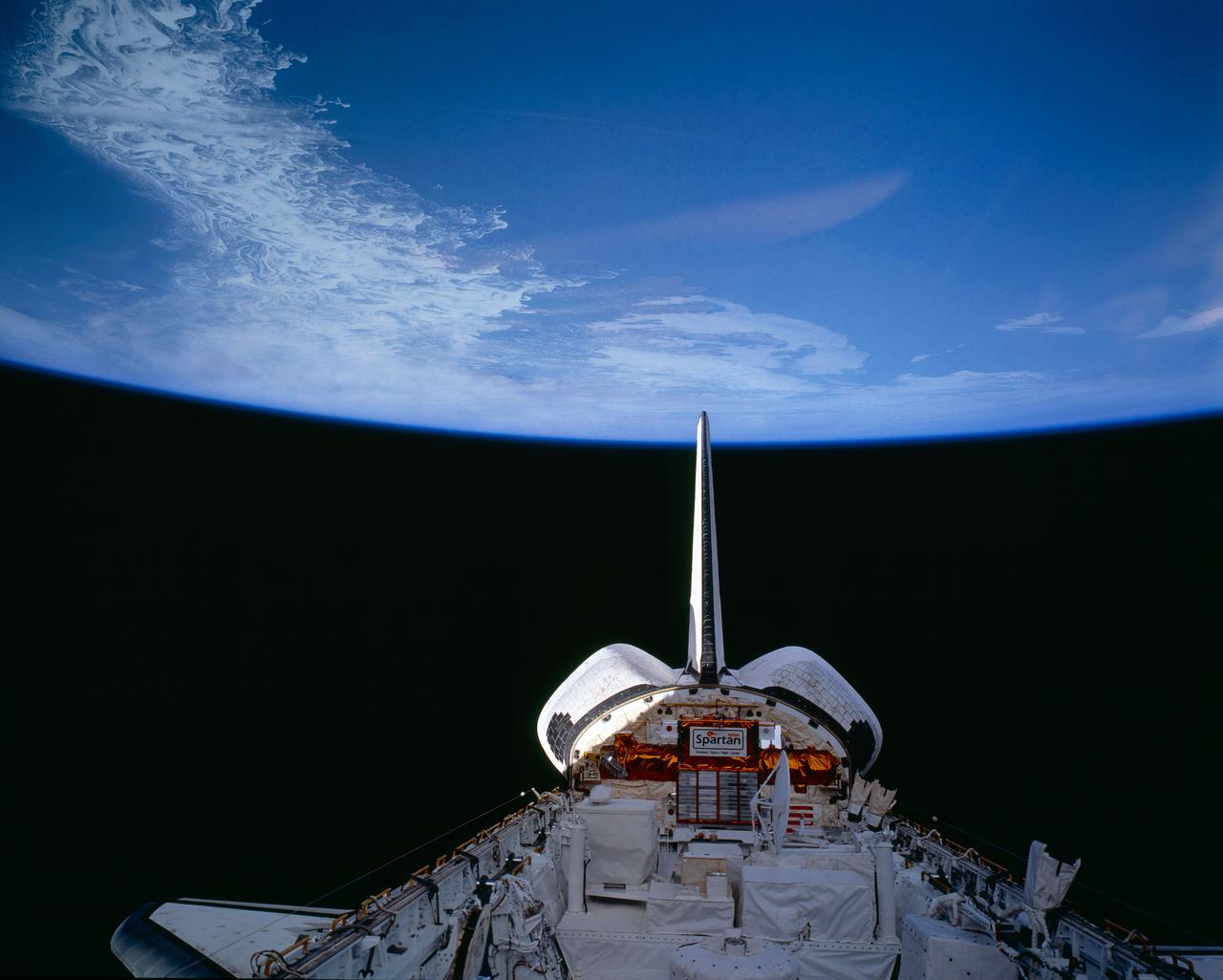
STS056-91-050 (8-17 April 1993) --- This 70mm frame shows the cargo bay of the Earth-orbiting Space Shuttle Discovery backdropped against clouds. Most of the elements of the ATLAS-2 payload can be seen, but missing is the SPARTAN-201 satellite which was in the midst of its separation from Discovery when the photo was made.
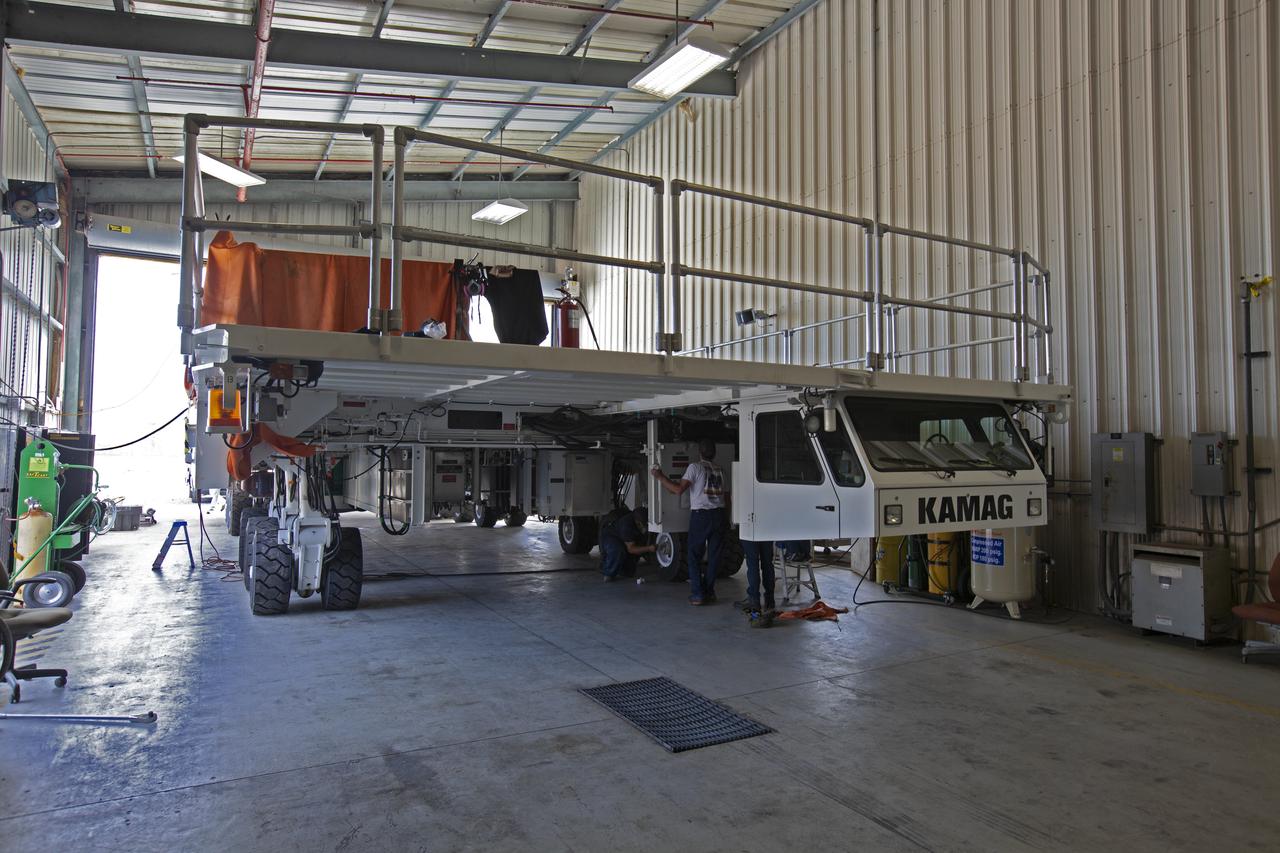
The KAMAG spacecraft transporter is inside a facility at the crawler yard at NASA's Kennedy Space Center in Florida, on Oct. 26, 2018. Jacobs technicians from the Launch Equipment Shop are welding the attach points that will hold the Orion transportation pallet in place. Testing of the pallet will be performed to support validation and verification of the attach fittings in the Multi-Payload Processing Facility. The transporter is designed to carry heavy loads, including the pallet that will contain the Orion crew module.
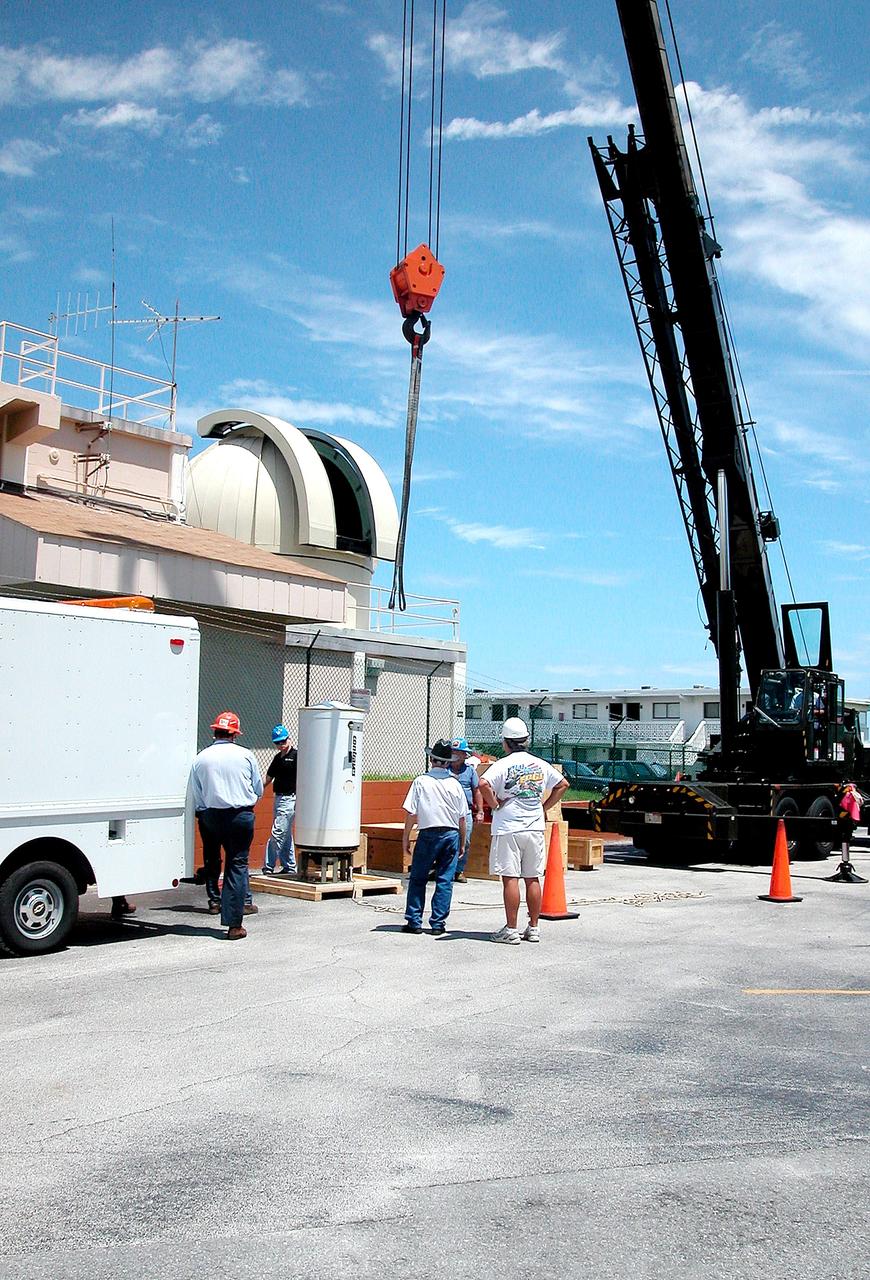
KENNEDY SPACE CENTER, FLA. - In Cocoa Beach, Fla., a new five-meter telescope sits on a pallet waiting to be lifted up to the dome above and installed. The tracking telescope is part of the Distant Object Attitude Measurement System (DOAMS) that provides optical support for launches from KSC and Cape Canaveral.

KENNEDY SPACE CENTER, FLA. - In the Orbiter Processing Facility, the nose cap from Atlantis is lowered toward a shipping pallet. The reinforced carbon-carbon (RCC) nose cap is being sent to the original manufacturing company, Vought in Ft. Worth, Texas, a subsidiary of Lockheed Martin, to undergo non-destructive testing such as CAT scan and thermography.
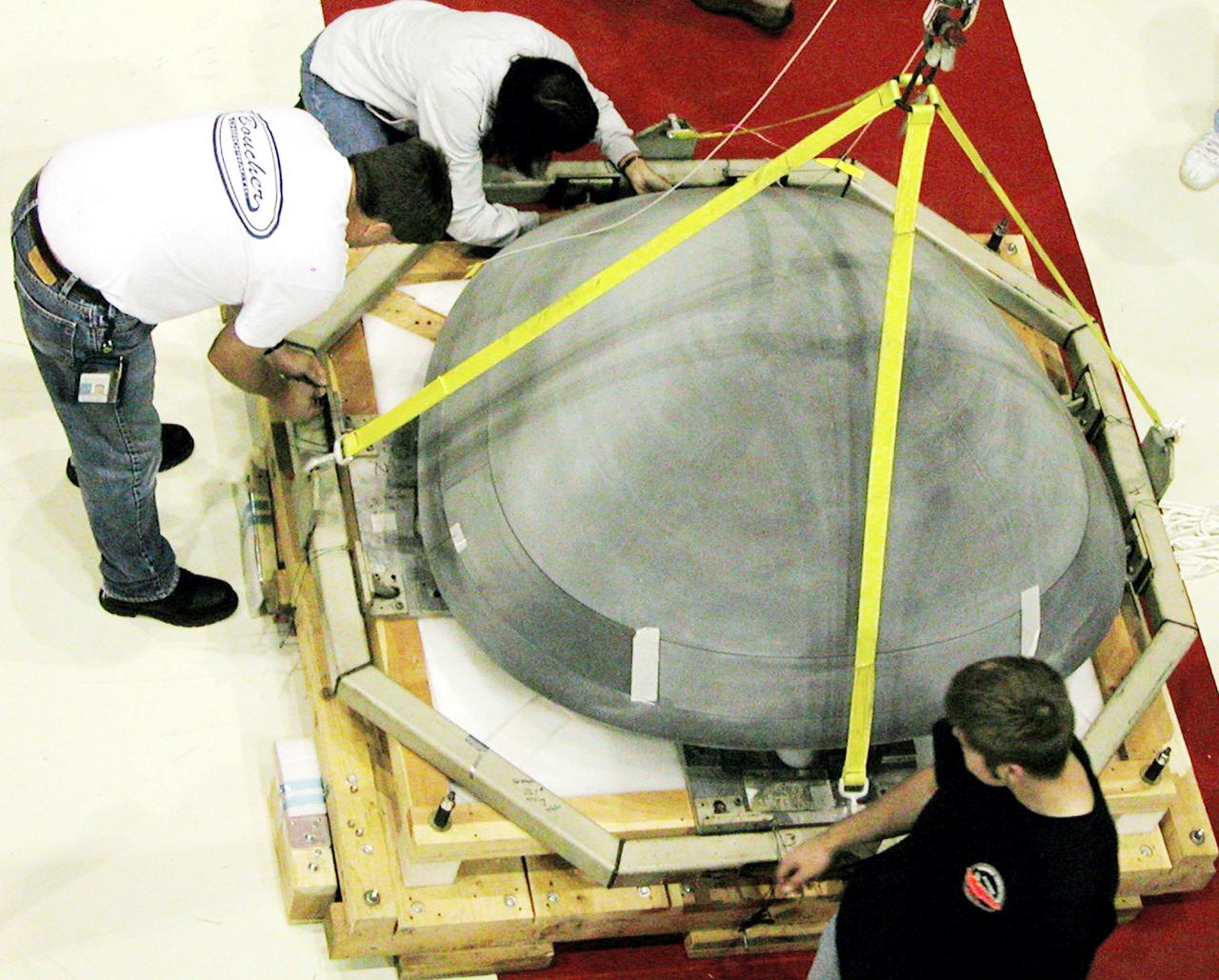
KENNEDY SPACE CENTER, FLA. - In the Orbiter Processing Facility, the nose cap from Atlantis is secured on a shipping pallet. The reinforced carbon-carbon (RCC) nose cap is being sent to the original manufacturing company, Vought in Ft. Worth, Texas, a subsidiary of Lockheed Martin, to undergo non-destructive testing such as CAT scan and thermography.
STS056-151-257 (8-17 April 1993) --- The Atlas-2 payloads are featured in this cargo bay scene aboard Discovery, backdropped against an oblique view of the Kamchatka Peninsula. The Shuttle was in an atmospheric monitoring attitude. The supportive Igloo structure is partially visible in the foreground. The canisters for the Shuttle Solar Backscatter Ultraviolet (SSBU) experiment are just out of frame on the starboard side of the bay. Between the ATLAS-2 experiment pallet and the aft firewall of the payload bay is the SPARTAN-201 satellite, which was later released from the cargo bay into a free-flying period and returned to its stowage area for return to Earth. Also visible in frame are the MAS Antenna, Active Cavity Radiometer Irradiance Monitor, SOLCON, SOLSPEC and SUSIM.
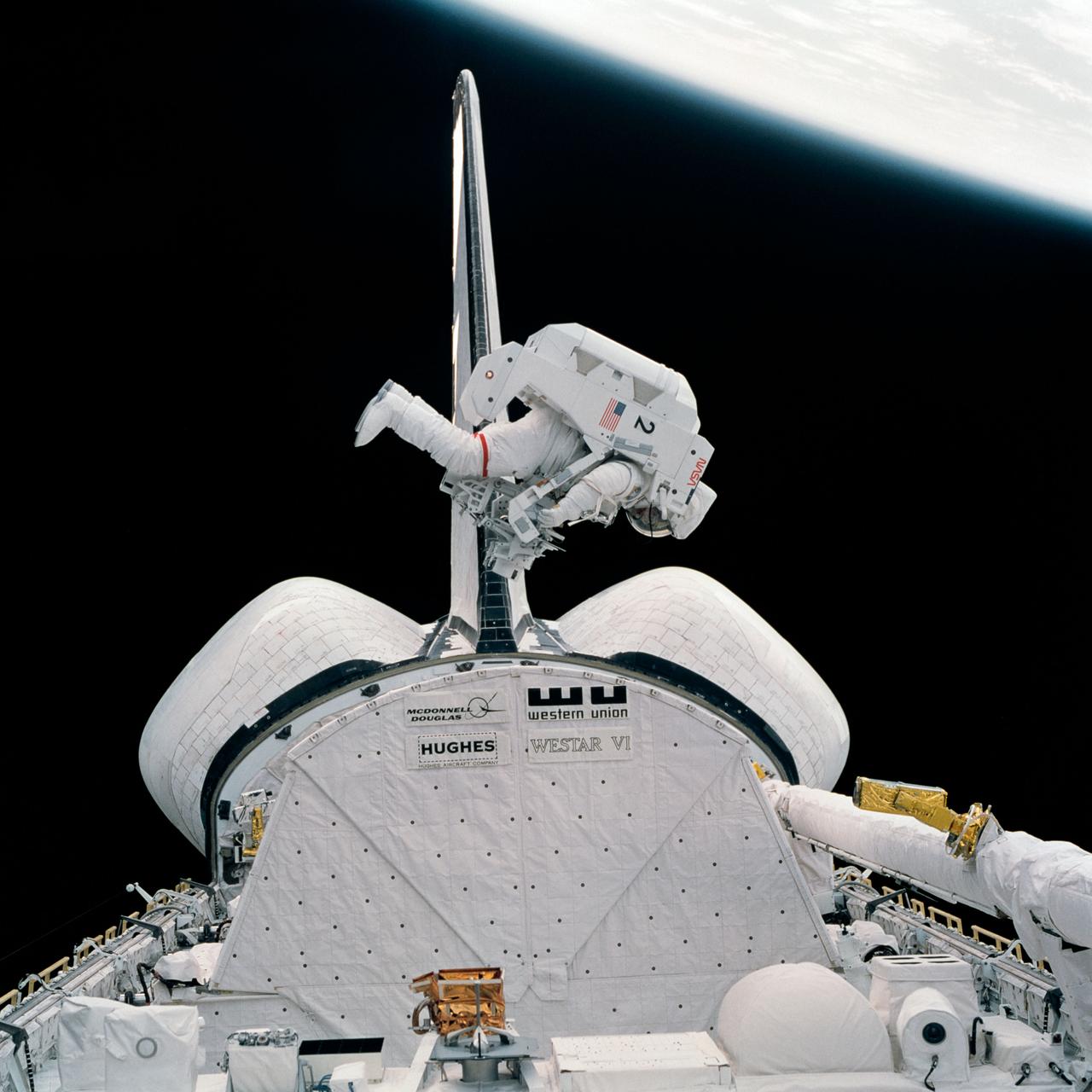
S84-27023 (7 Feb 1984) --- This 70mm frame shows astronaut Bruce McCandless II moving in to conduct a test involving the Trunion Pin Attachment Device (TPAD) he carries and the Shuttle Pallet Satellite (SPAS-01A) partially visible at bottom of frame. SPAS was a stand-in for the damaged Solar Maximum Satellite (SMS) which will be visited for repairs by the STS-41C Shuttle crew in early spring. This particular Extravehicular Activity (EVA) session was a rehearsal for the SMS visit. The test and the actual visit to the SMS both involve the use of jet-powered, hand-controlled Manned Maneuvering Unit (MMU). The one McCandless uses is the second unit to be tested on this flight. Astronaut Robert L. Stewart got a chance to work with both MMU's on the two EVA's.
S84-27020 (7 Feb 1984) --- A fixed camera on astronaut Bruce McCandless II's helmet recorded this rare scene of the Space Shuttle Challenger some 50 to 60 meters away during a history-making extravehicular activity (EVA), February 7, 1984. The Shuttle Pallet Satellite (SPAS-01A) is configured mid-cargo bay. Astronaut Robert L. Stewart, standing beneath the Remote Manipulator System (RMS) arm, later donned the same Manned Maneuvering Unit (MMU) which afforded McCandless the freedom of movement to record this image. Also visible in the cargo bay are the support stations for the two MMU back-packs, the sunshields for the Palapa B and Westar VI Satellites, KU-Band antenna and a number of Getaway Special (GAS) canisters.
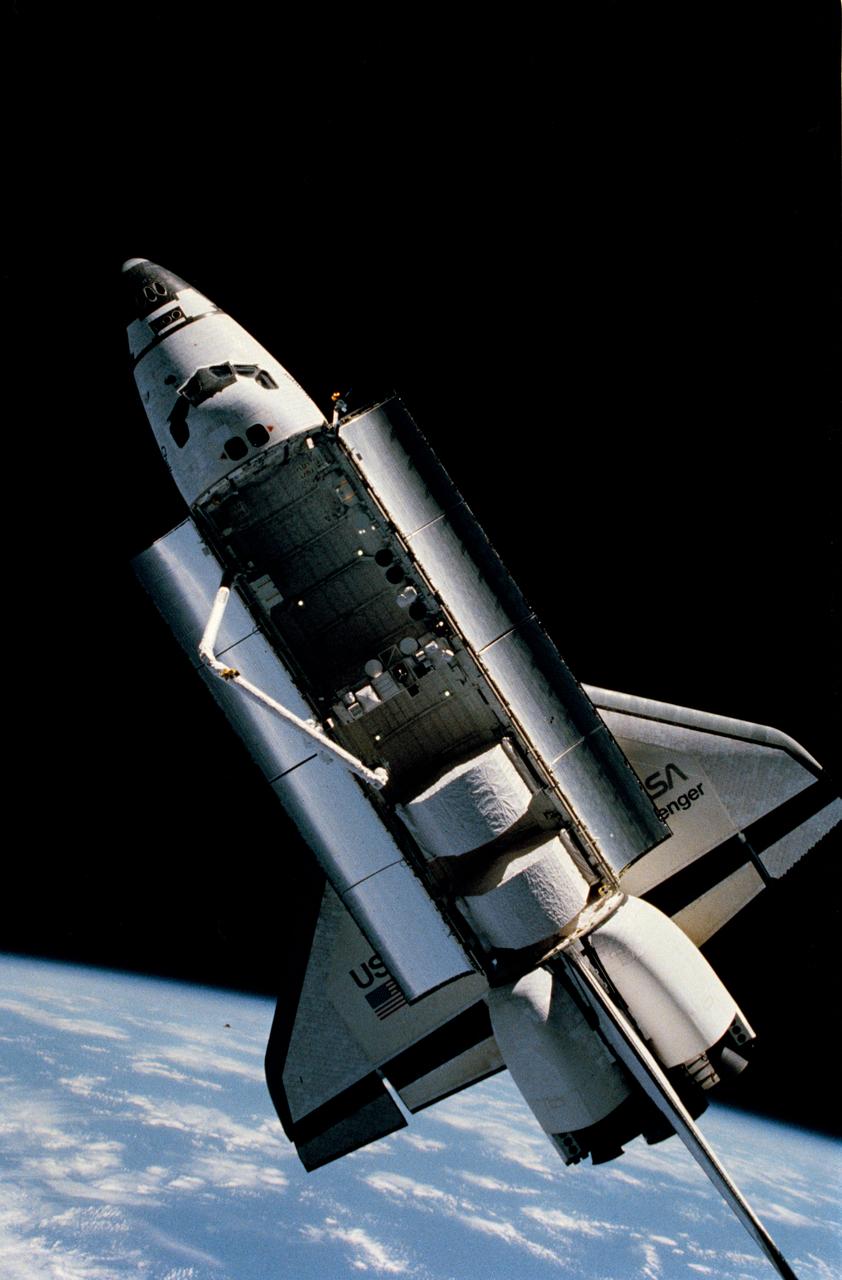
![STS-7, Orbiter Challenger in orbit, taken from camera aboard Shuttle Pallet Satellite (SPAS) [Germany]](https://images-assets.nasa.gov/image/335891/335891~medium.jpg)
STS-7, Orbiter Challenger in orbit, taken from camera aboard Shuttle Pallet Satellite (SPAS) [Germany]
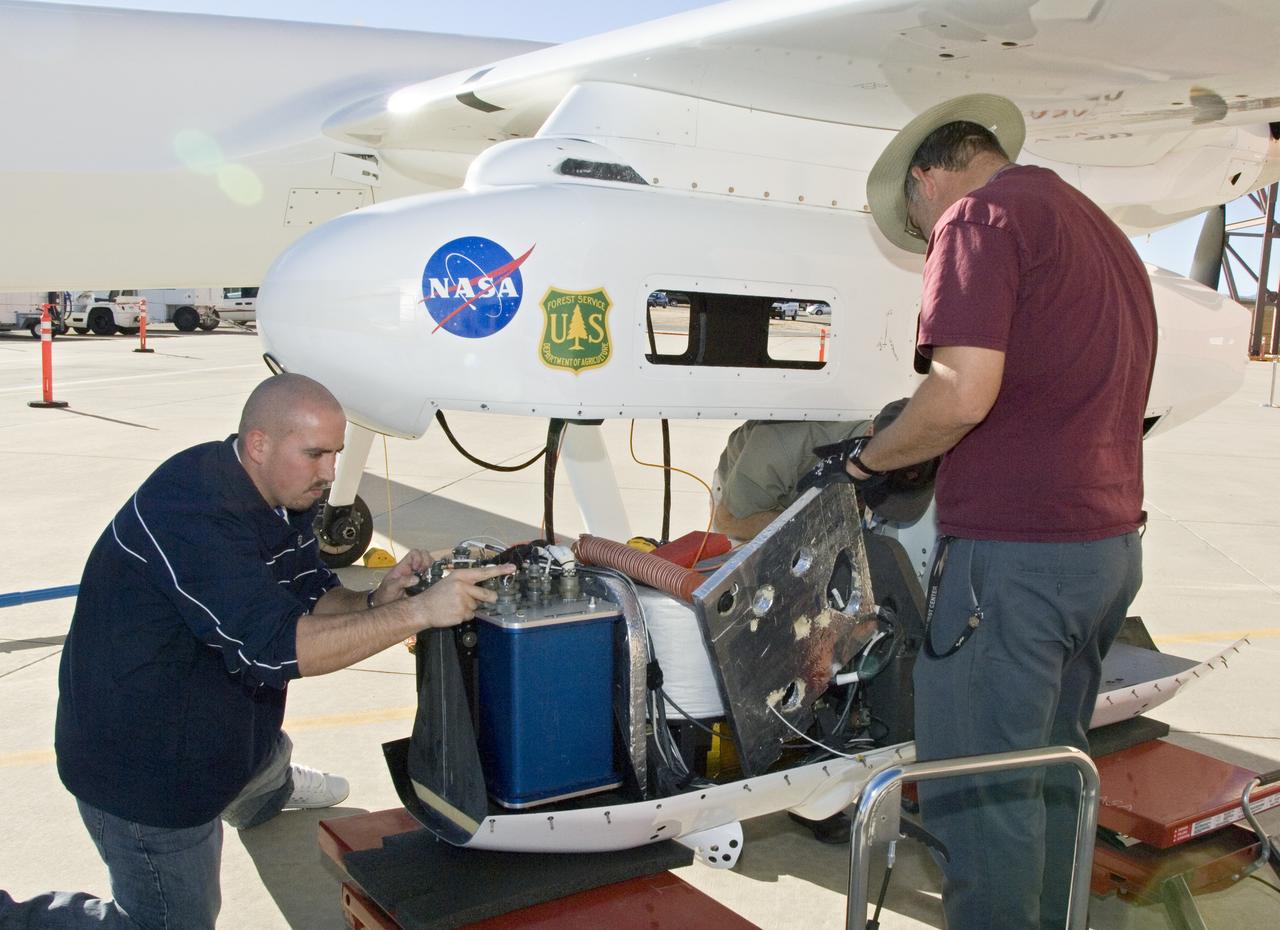
NASA Dryden's Ikhana ground crewmen Gus Carreno and James Smith load the thermal-infrared imaging scanner pallet into the Ikhana's underwing payload pod.
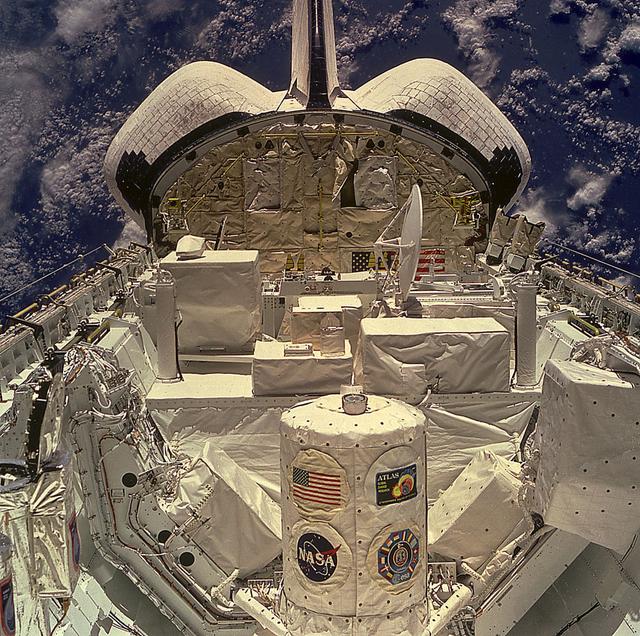
Space Shuttle Discovery (STS-56) onboard photo of the Atmospheric Laboratory for Applications and Science (ATLAS-2) payload on the pallet in the cargo bay of the orbiter.
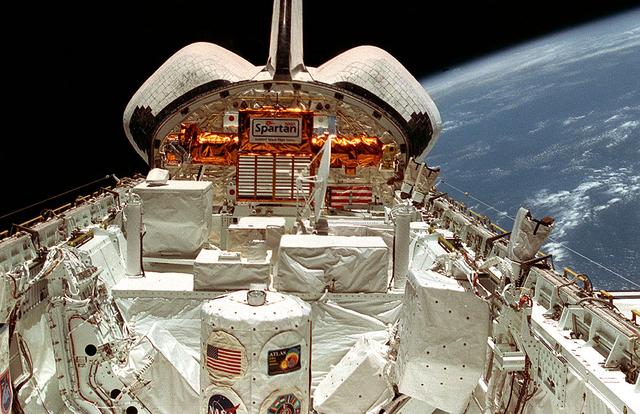
Space Shuttle Discovery (STS-56) onboard photo of the Atmospheric Laboratory for Applications and Science (ATLAS-2) payload on the pallet in the cargo bay of the orbiter.

iss064e041250 (March 11, 2021) --- An external pallet packed with old nickel-hydrogen batteries is released from the Canadarm2 robotic arm as the International Space Station orbited 260 miles above the Pacific Ocean west of Central America. Mission controllers in Houston commanded the Canadarm2 to release the external pallet into space where it will orbit Earth between two to four years before burning up harmlessly in the atmosphere. The batteries were removed during previous spacewalks and replaced with newer lithium-ion batteries to continue powering the station's systems.
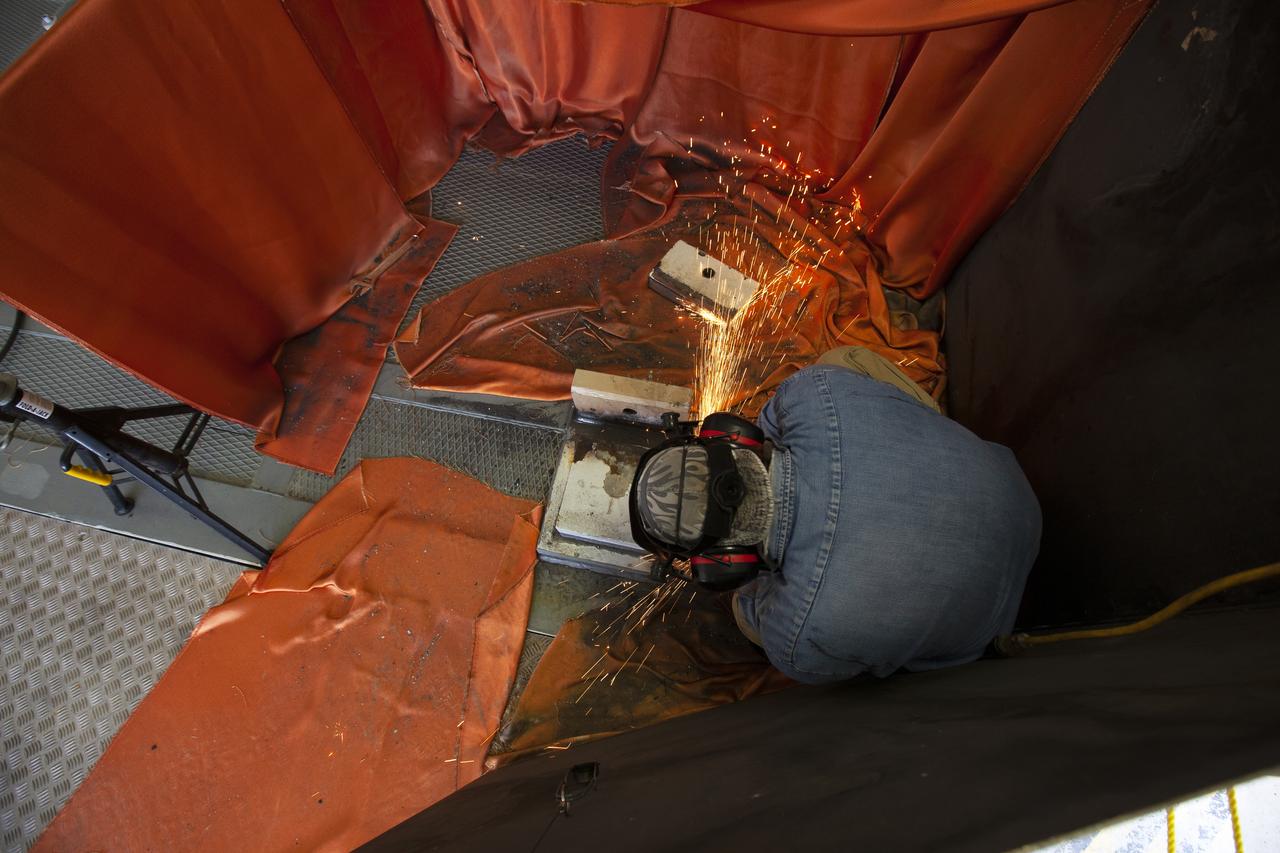
A Jacobs technician from the Launch Equipment Shop performs welding on the KAMAG spacecraft transporter on Oct. 26, 2018, inside a facility at the crawler yard at NASA’s Kennedy Space Center in Florida. The transporter is designed to carry heavy loads. Welding is being performed on the attach points that will hold the Orion transportation pallet in place. Testing of the pallet will be performed to support validation and verification of the attach fittings in the Multi-Payload Processing Facility.
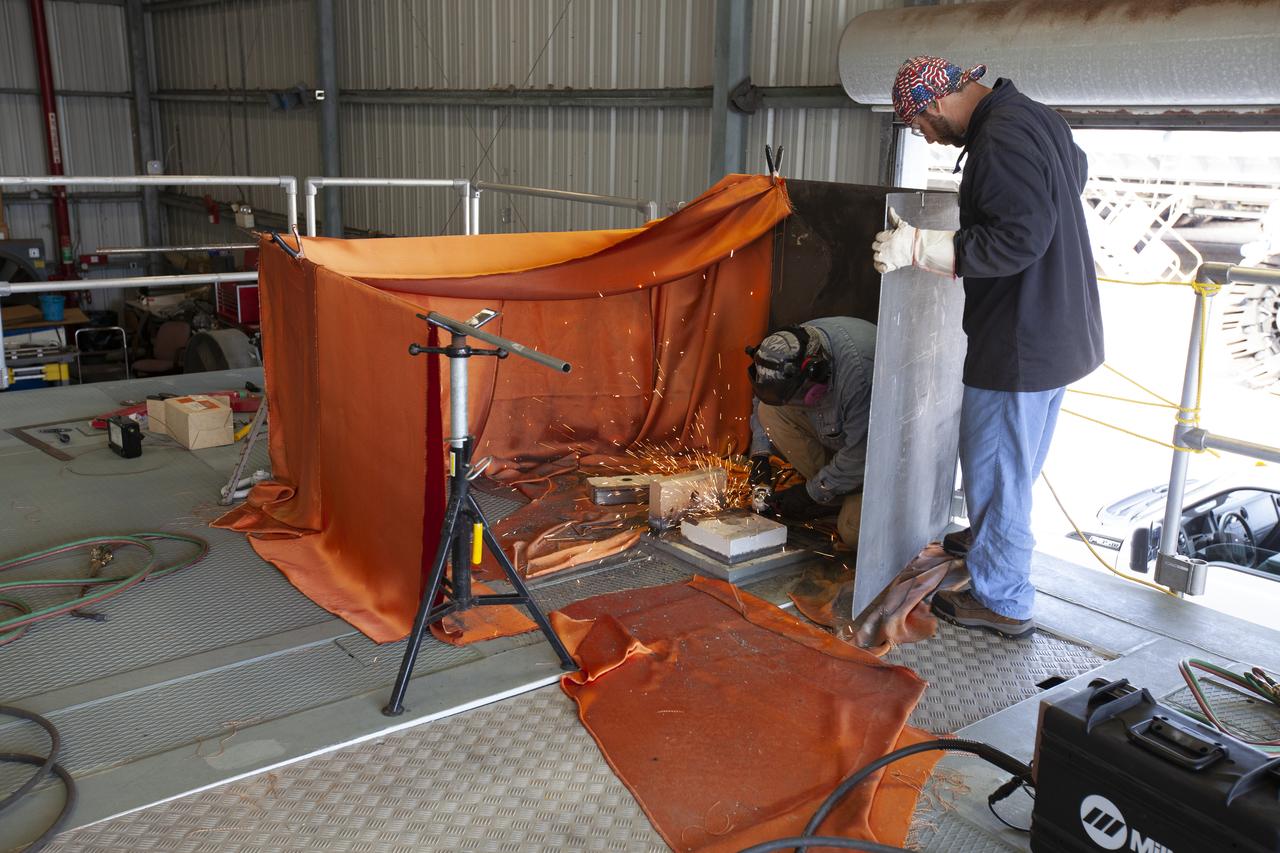
Jacobs technicians from the Launch Equipment Shop perform welding on the KAMAG spacecraft transporter on Oct. 26, 2018, inside a facility at the crawler yard at NASA’s Kennedy Space Center in Florida. The transporter is designed to carry heavy loads. Welding is being performed on the attach points that will hold the Orion transportation pallet in place. Testing of the pallet will be performed to support validation and verification of the attach fittings in the Multi-Payload Processing Facility.
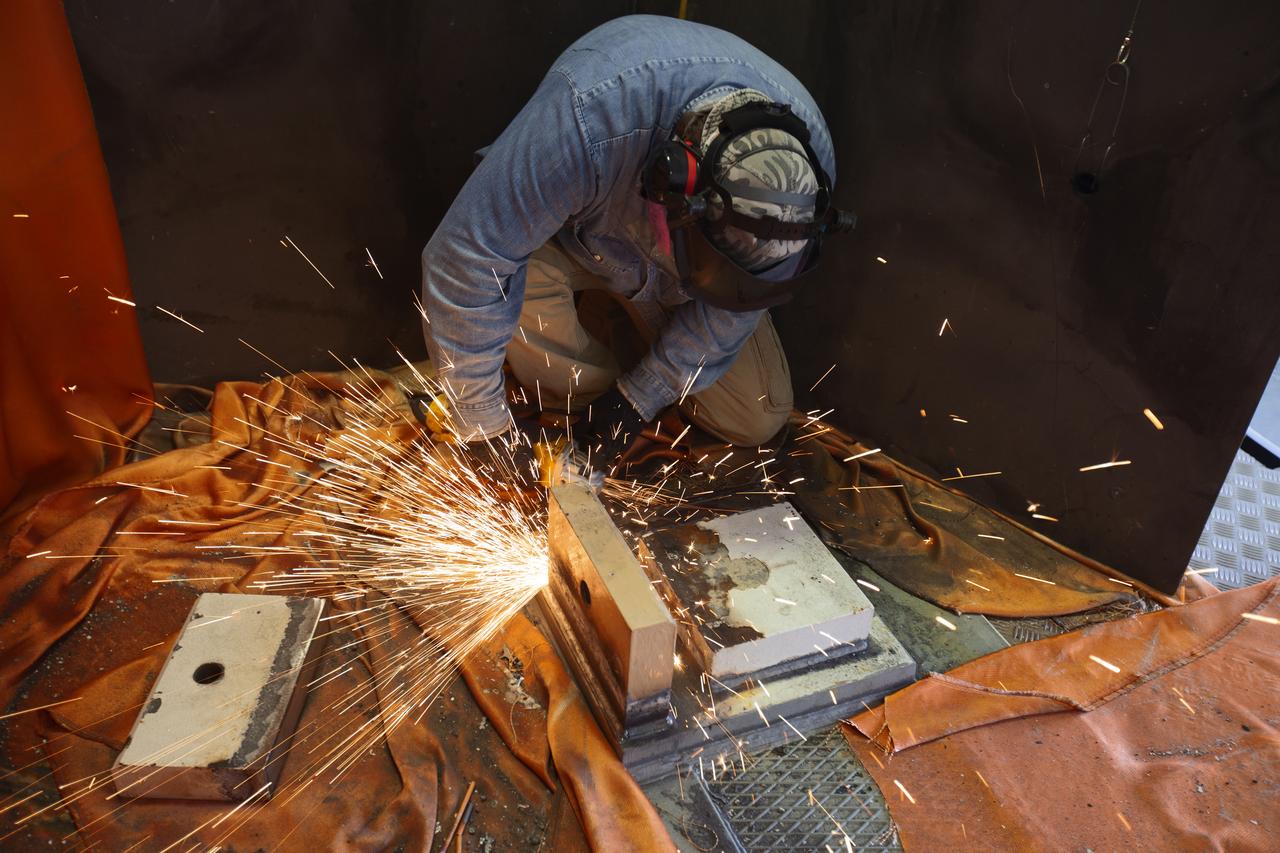
A Jacobs technician from the Launch Equipment Shop performs welding on the KAMAG spacecraft transporter on Oct. 26, 2018, inside a facility at the crawler yard at NASA’s Kennedy Space Center in Florida. The transporter is designed to carry heavy loads. Welding is being performed on the attach points that will hold the Orion transportation pallet in place. Testing of the pallet will be performed to support validation and verification of the attach fittings in the Multi-Payload Processing Facility.
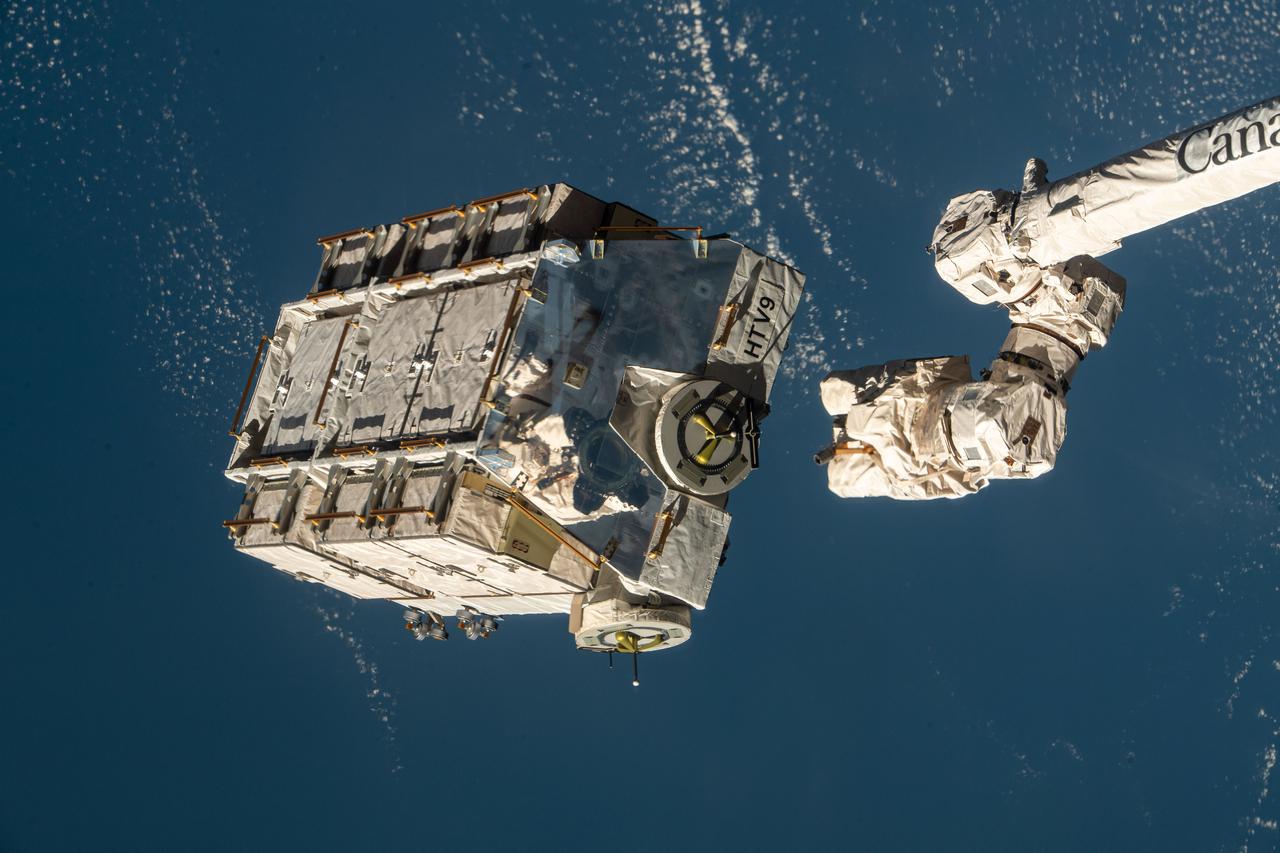
iss064e041512 (March 11, 2021) --- An external pallet packed with old nickel-hydrogen batteries is released from the Canadarm2 robotic arm as the International Space Station orbited 260 miles above the Pacific Ocean west of Central America. Mission controllers in Houston commanded the Canadarm2 to release the external pallet into space where it will orbit Earth between two to four years before burning up harmlessly in the atmosphere. The batteries were removed during previous spacewalks and replaced with newer lithium-ion batteries to continue powering the station's systems.
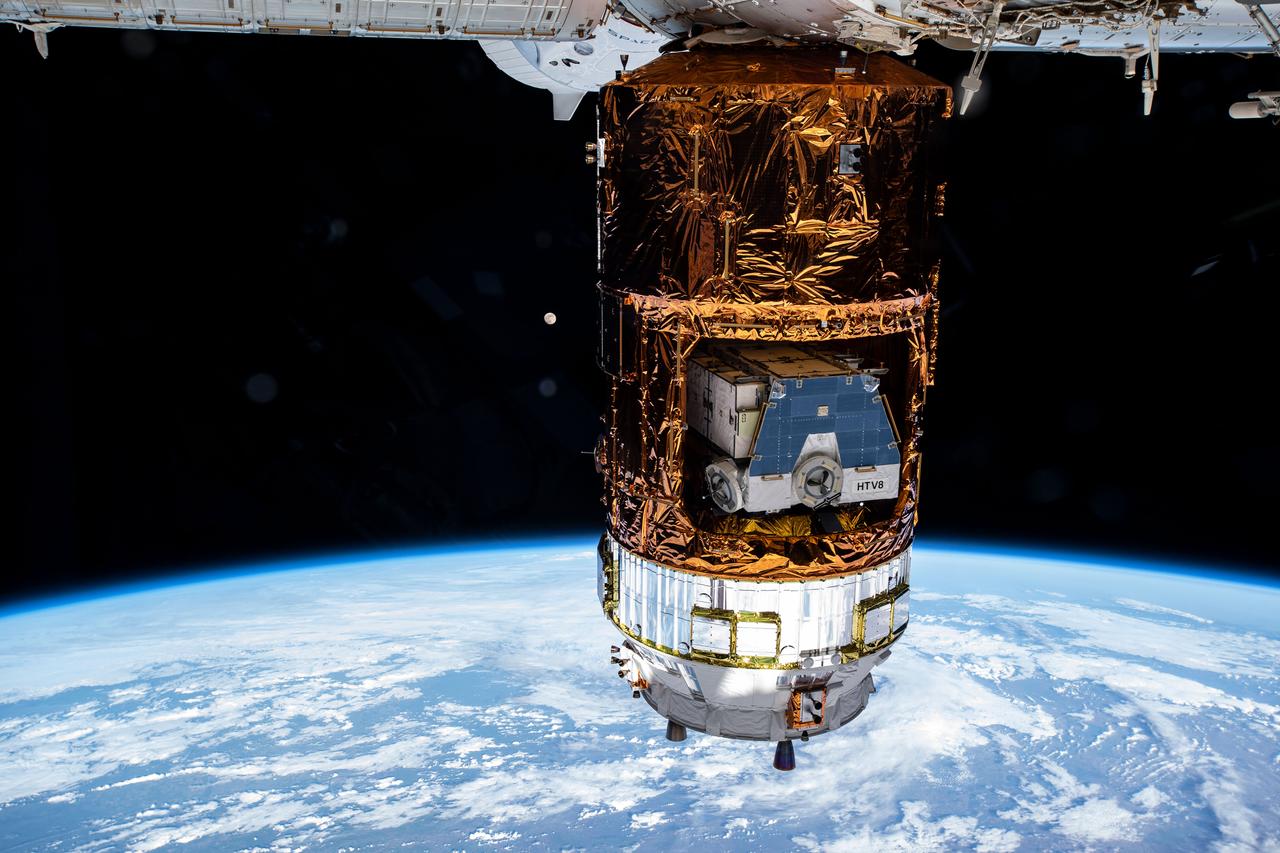
iss063e024519 (June 4, 2020) --- Japan's resupply ship, the H-II Transfer Vehicle-9 (HTV-9), is pictured attached to the International Space Station's Harmony module dwarfing the Moon behind it. Stowed inside the Japanese space freighter is the HTV-8 cargo pallet that was brought up to the station on a previous resupply mission. The pallet contains old nickel-hydrogen batteries for disposal that were disconnected from the station during a series of spacewalks at the end of 2019. Nearly hidden at the top center is the SpaceX Crew Dragon vehicle.
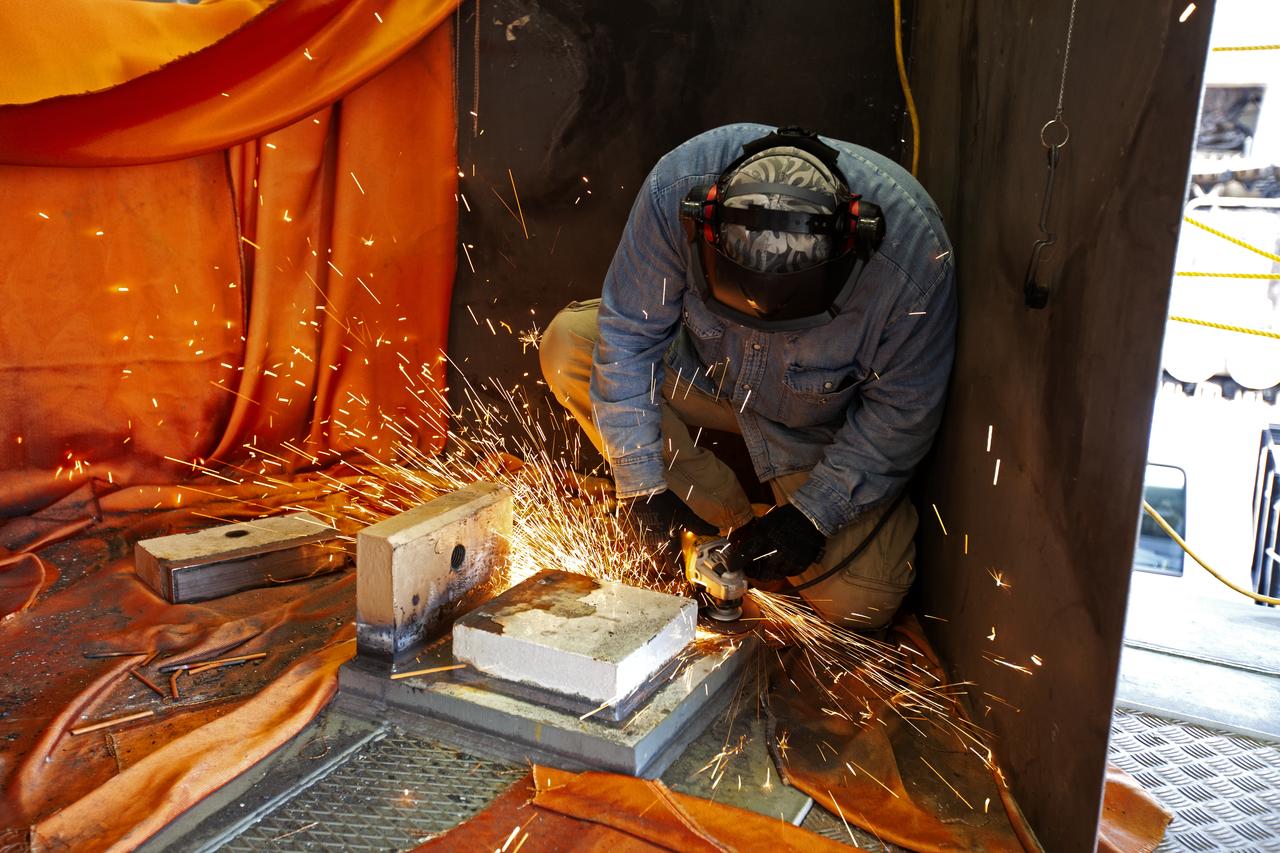
A Jacobs technician from the Launch Equipment Shop performs welding on the KAMAG spacecraft transporter on Oct. 26, 2018, inside a facility at the crawler yard at NASA’s Kennedy Space Center in Florida. The transporter is designed to carry heavy loads. Welding is being performed on the attach points that will hold the Orion transportation pallet in place. Testing of the pallet will be performed to support validation and verification of the attach fittings in the Multi-Payload Processing Facility.
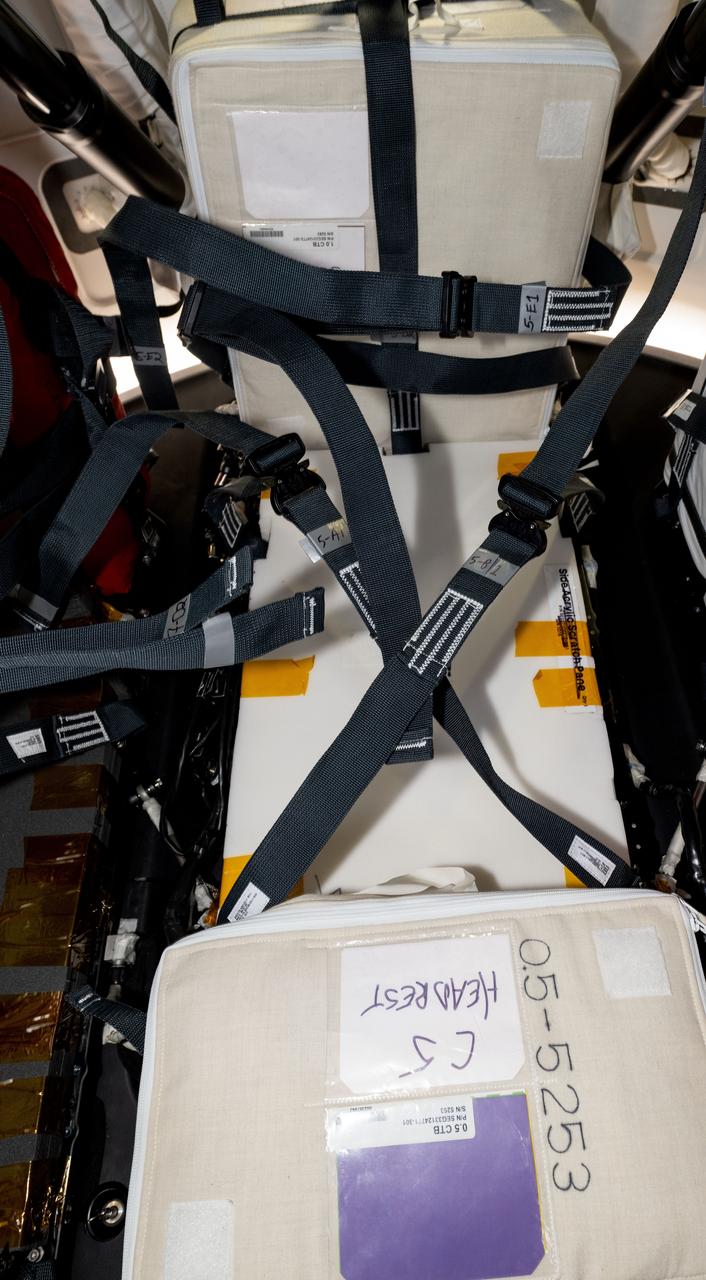
This image shows one of the temporary seat structures built and installed on the Crew-8 Dragon in cargo pallet locations C7 and C5 using foam, straps, and other station soft goods such as cushions.
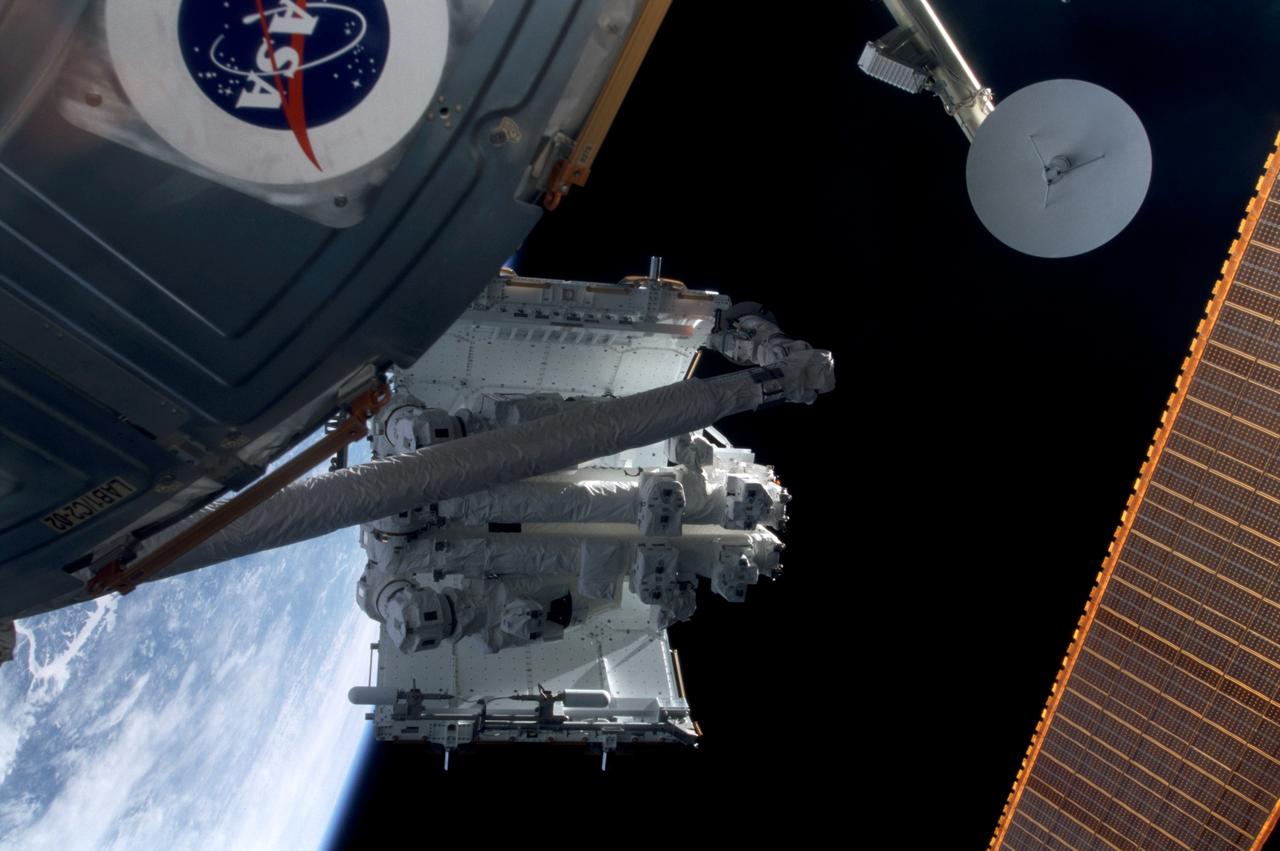
STS100-388-010 (19 April-1 May 2001) --- In the grasp of the shuttle's remote manipulator system (RMS) robot arm, the Spacelab pallet is installed on the Lab Cradle Assembly (LCA) on the International Space Station (ISS).
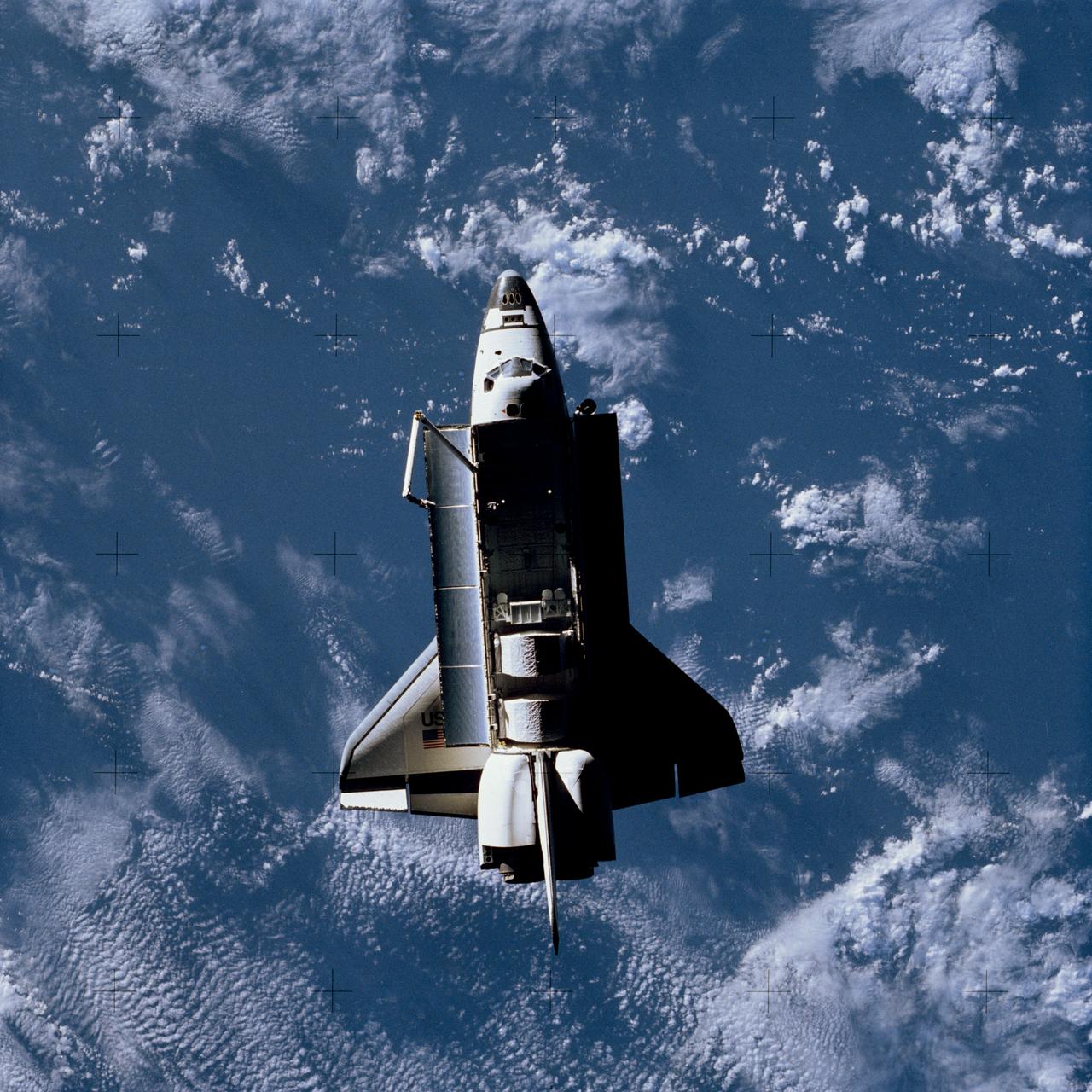
Full views of "Challenger" in Space, taken by the Shuttle Pallet Satellite (SPAS), also views of Cargo Bay and Remote Manipulator System (RMS) extended. 1. SHUTTLE - RMS (STS-7) Also available in 4x5 CN
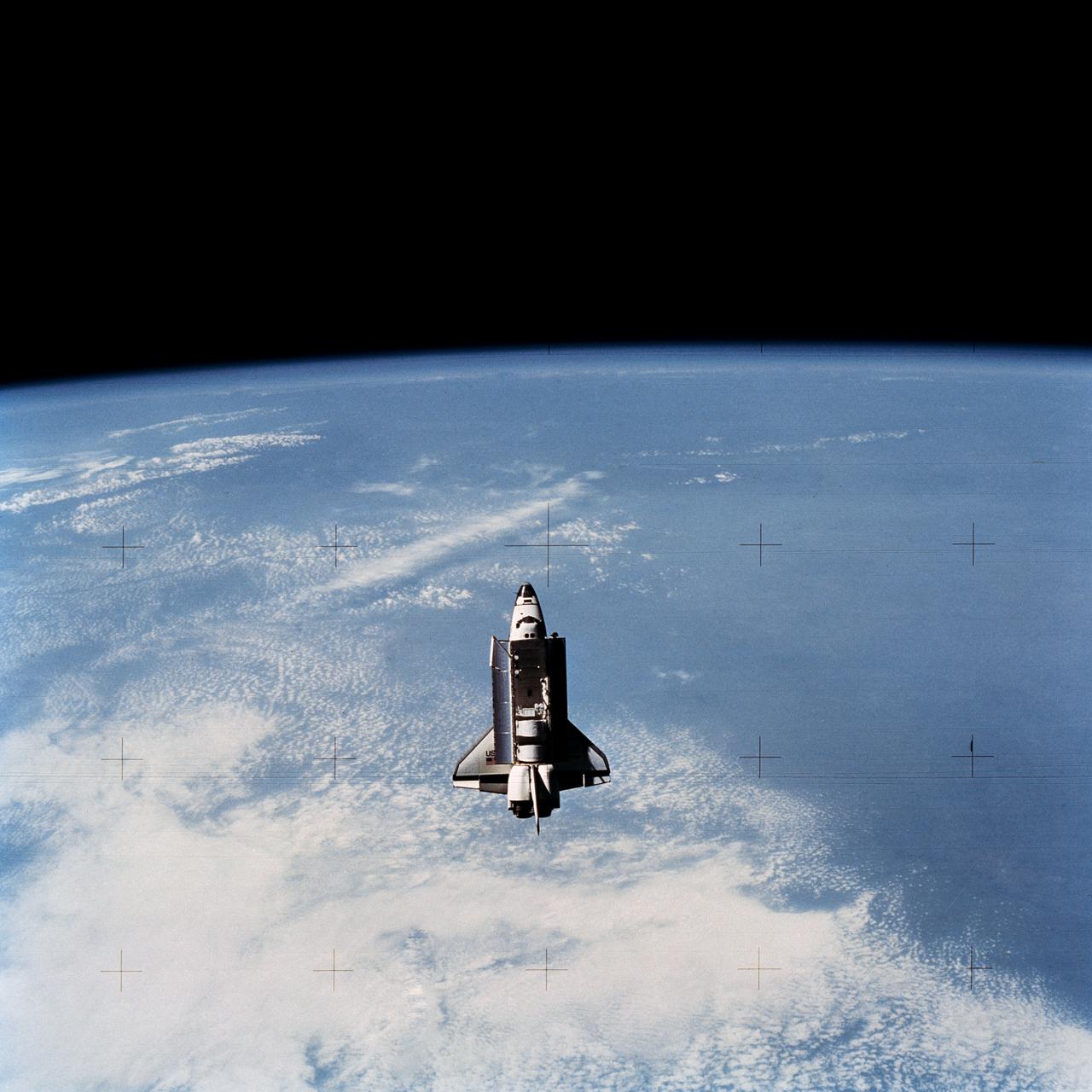
Full views of "Challenger" in Space, taken by the Shuttle Pallet Satellite (SPAS), also views of Cargo Bay and Remote Manipulator System (RMS) extended. 1. SHUTTLE - RMS (STS-7) Also available in 4x5 CN
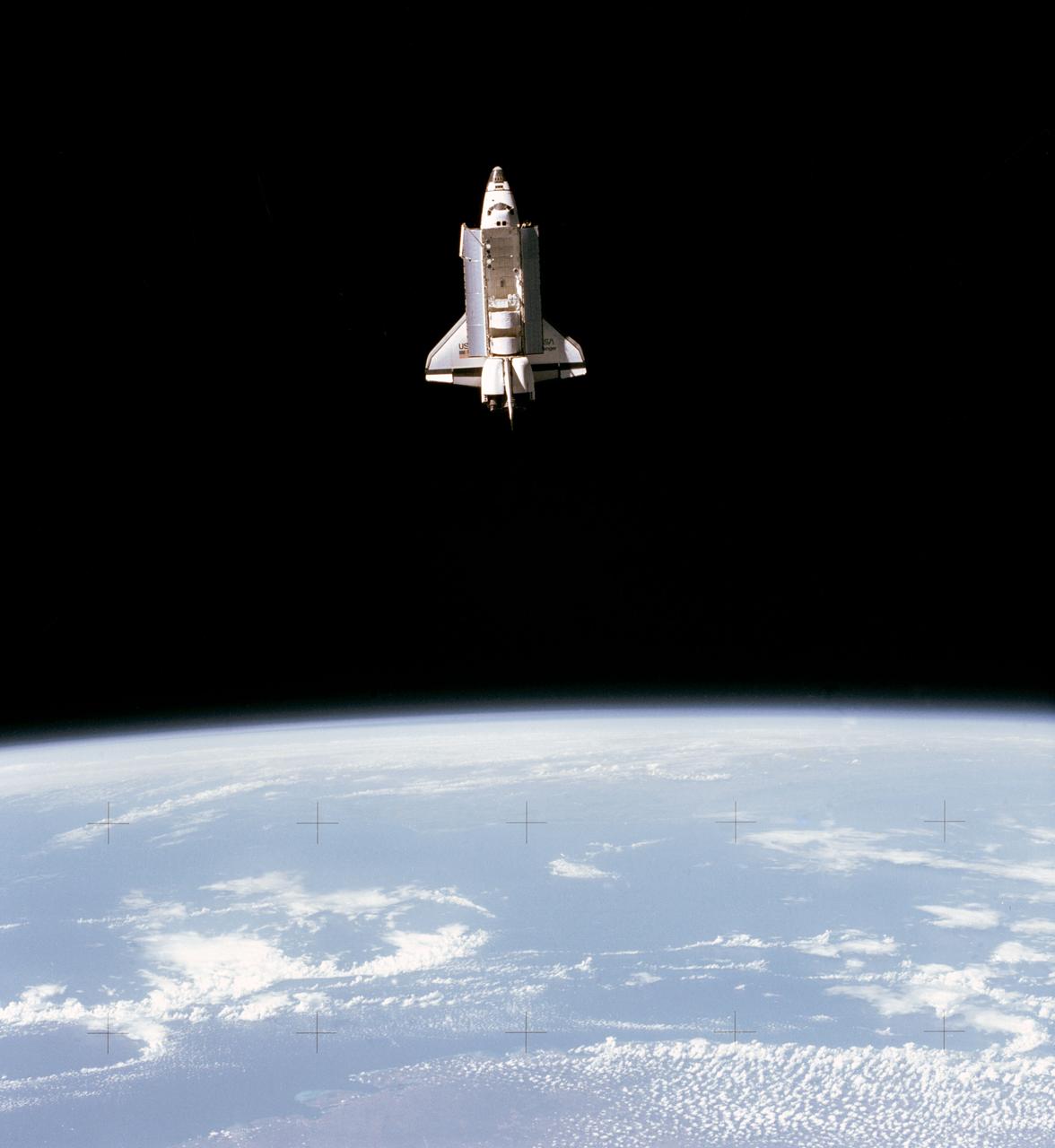
Full views of "Challenger" in Space, taken by the Shuttle Pallet Satellite (SPAS), also views of Cargo Bay and Remote Manipulator System (RMS) extended. 1. SHUTTLE - RMS (STS-7) Also available in 4x5 CN
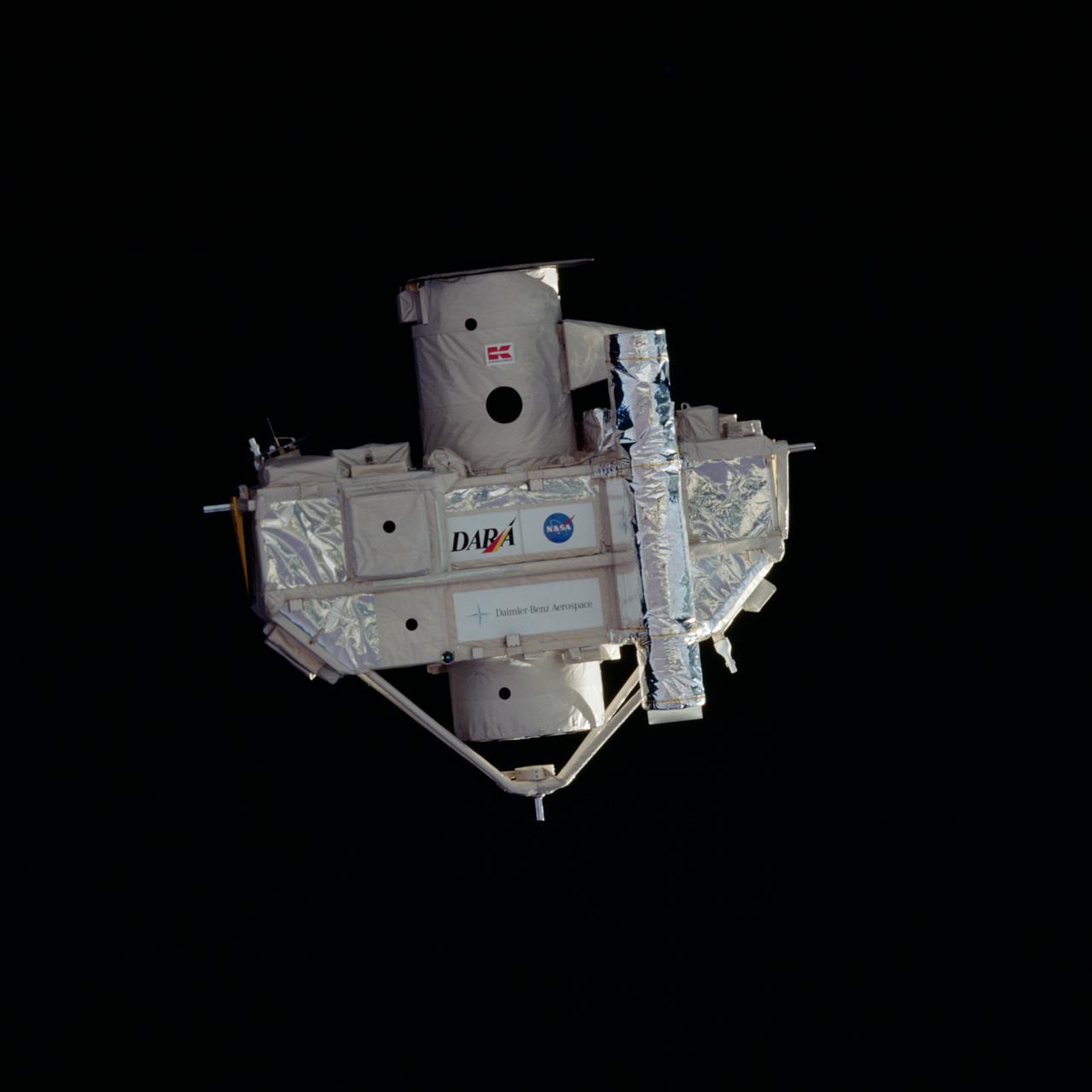
STS080-719-005 (19 Nov.-7 Dec. 1996) --- The Orbiting Retrievable Far and Extreme Ultraviolet Spectrometer-Shuttle Pallet Satellite (ORFEUS-SPAS) appears suspended in space during approach by the space shuttle Columbia.
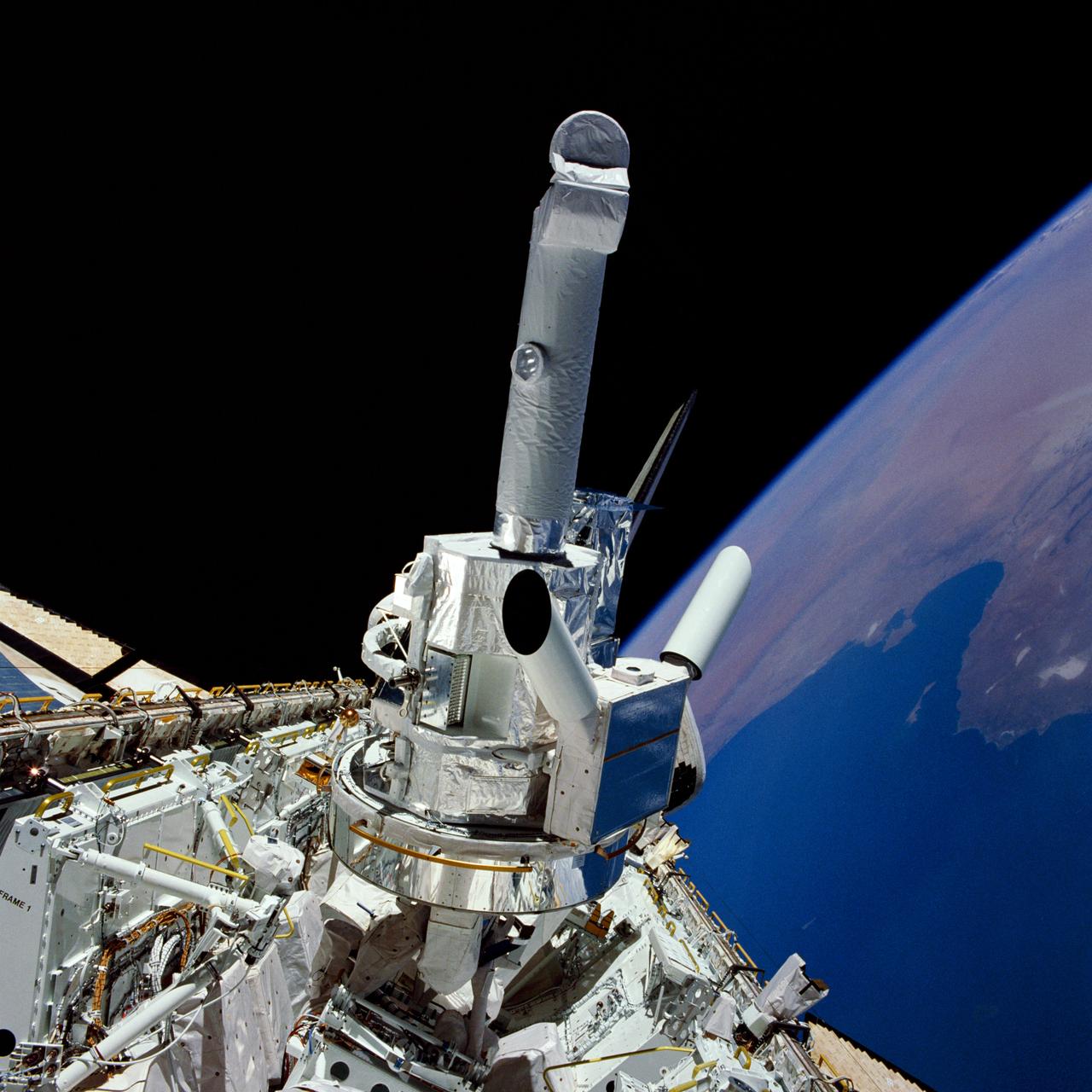
51F-33-005 (29 July - 6 August 1985) --- Experiments and the instrument pointing system (IPS) for Spacelab 2 are backdropped against the Libya/Tunisia Mediterranean coast and black space in this 70mm view photographed through the aft flight deck windows of the Space Shuttle Challenger. Also partially visible among the cluster of Spacelab 2 hardware are the solar optical universal polarimeter (SOUP) experiment and the coronal helium abundance experiment (CHASE).

iss064e041526 (March 11, 2021) --- An external pallet packed with old nickel-hydrogen batteries is pictured shortly after mission controllers in Houston commanded the Canadarm2 robotic arm to release it into space. The International Space Station was orbiting 260 miles above the Pacific Ocean west of central America at the time this photograph was taken. The external pallet will orbit Earth between two to four years before burning up harmlessly in the atmosphere. The batteries were removed during previous spacewalks and replaced with newer lithium-ion batteries to continue powering the station's systems.
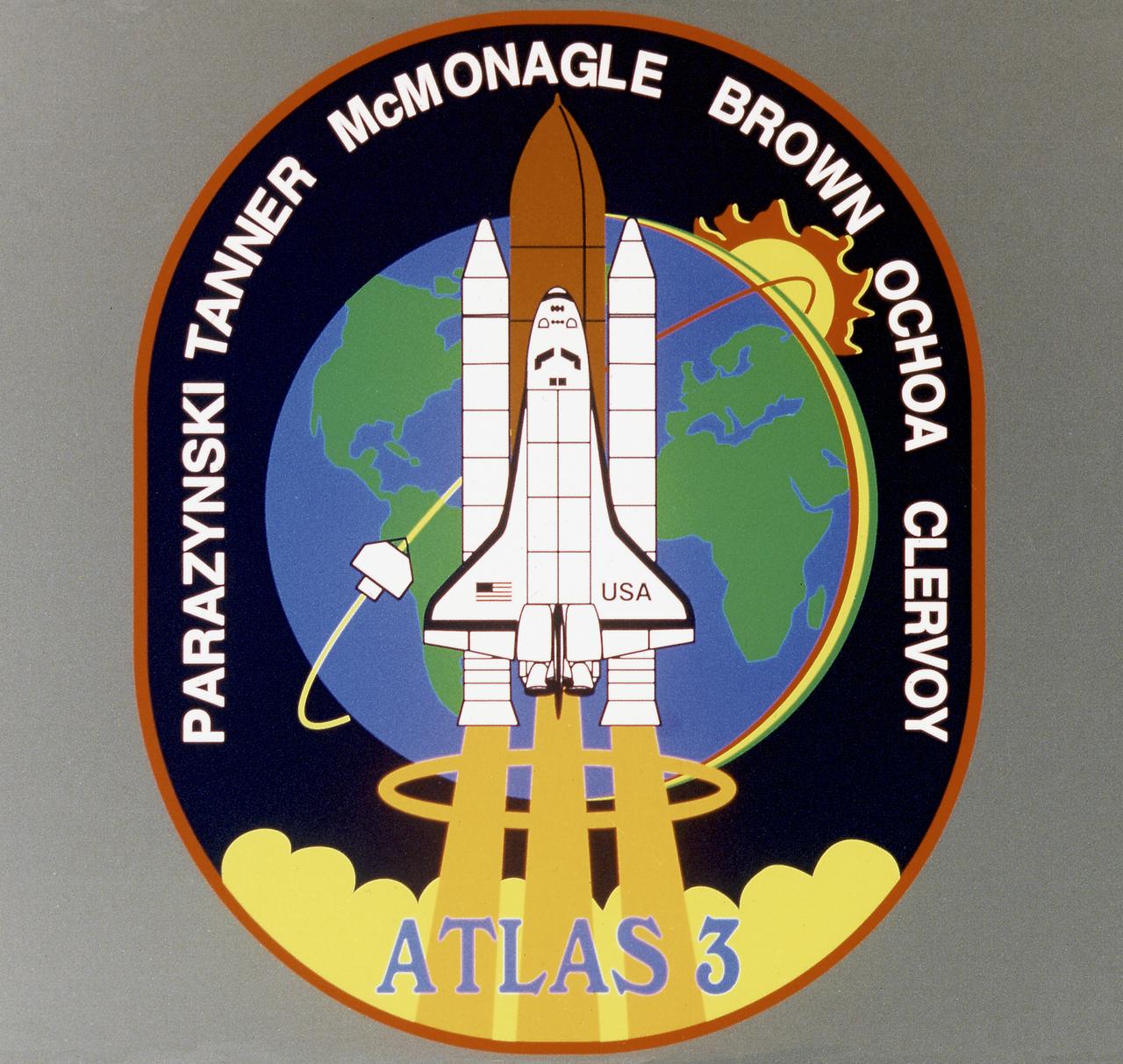
Designed by the mission crew members, the STS-66 emblem depicts the Space Shuttle Atlantis launching into Earth orbit to study global environmental change. The payload for the Atmospheric Laboratory for Applications and Science (ATLAS-3) and complementary experiments were part of a continuing study of the atmosphere and the Sun's influence on it. The Space Shuttle is trailed by gold plumes representing the astronaut symbol and is superimposed over Earth, much of which is visible from the flight's high inclination orbit. Sensitive instruments aboard the ATLAS pallet in the Shuttle payload bay and on the free-flying Cryogenic Infrared Spectrometers and Telescopes for the Atmospheric-Shuttle Pallet Satellite (CHRISTA-SPAS) that gazed down on Earth and toward the Sun, are illustrated by the stylized sunrise and visible spectrum.
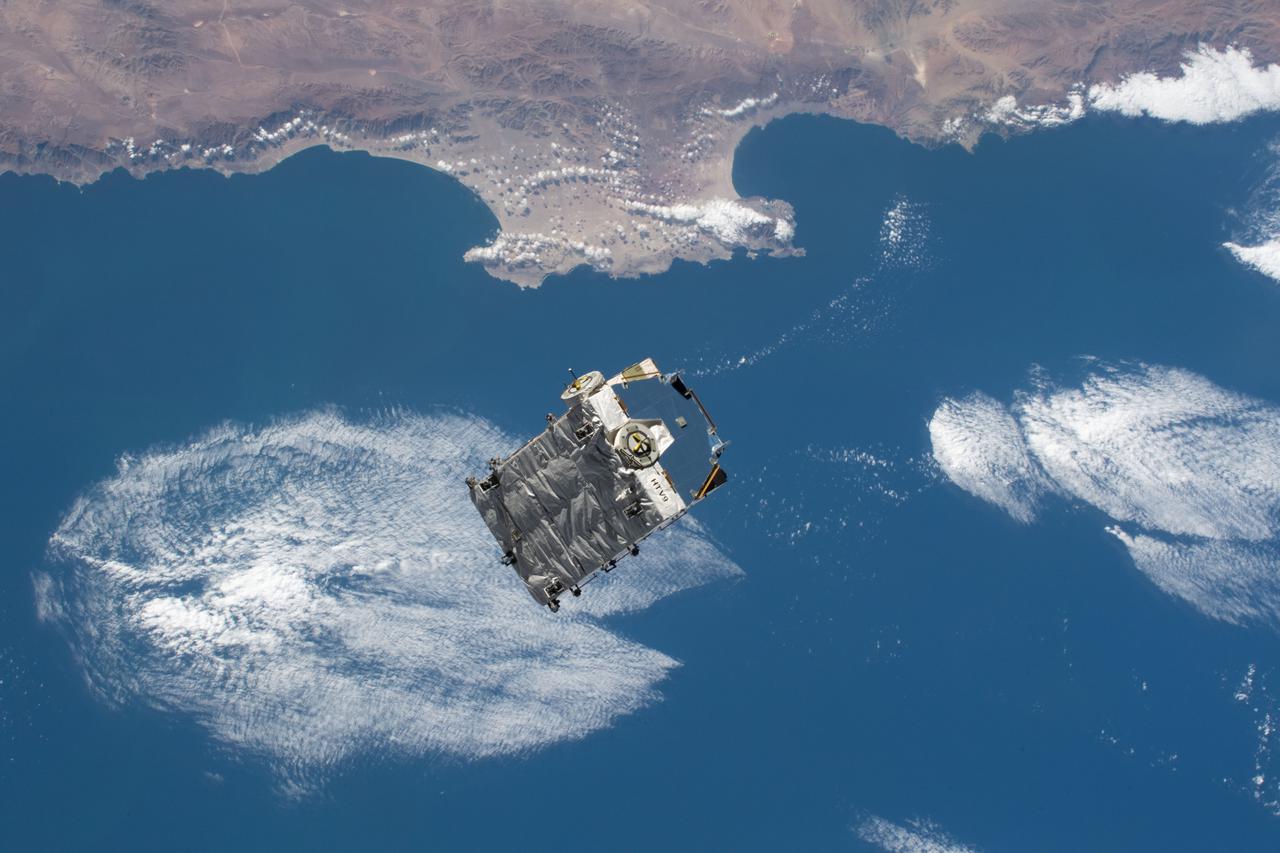
iss064e041315 (March 11, 2021) --- An external pallet packed with old nickel-hydrogen batteries is pictured shortly after mission controllers in Houston commanded the Canadarm2 robotic arm to release it into space. The International Space Station was orbiting 265 miles above the north coast of Chile in South America at the time this photograph was taken. The external pallet will orbit Earth between two to four years before burning up harmlessly in the atmosphere. The batteries were removed during previous spacewalks and replaced with newer lithium-ion batteries to continue powering the station's systems.
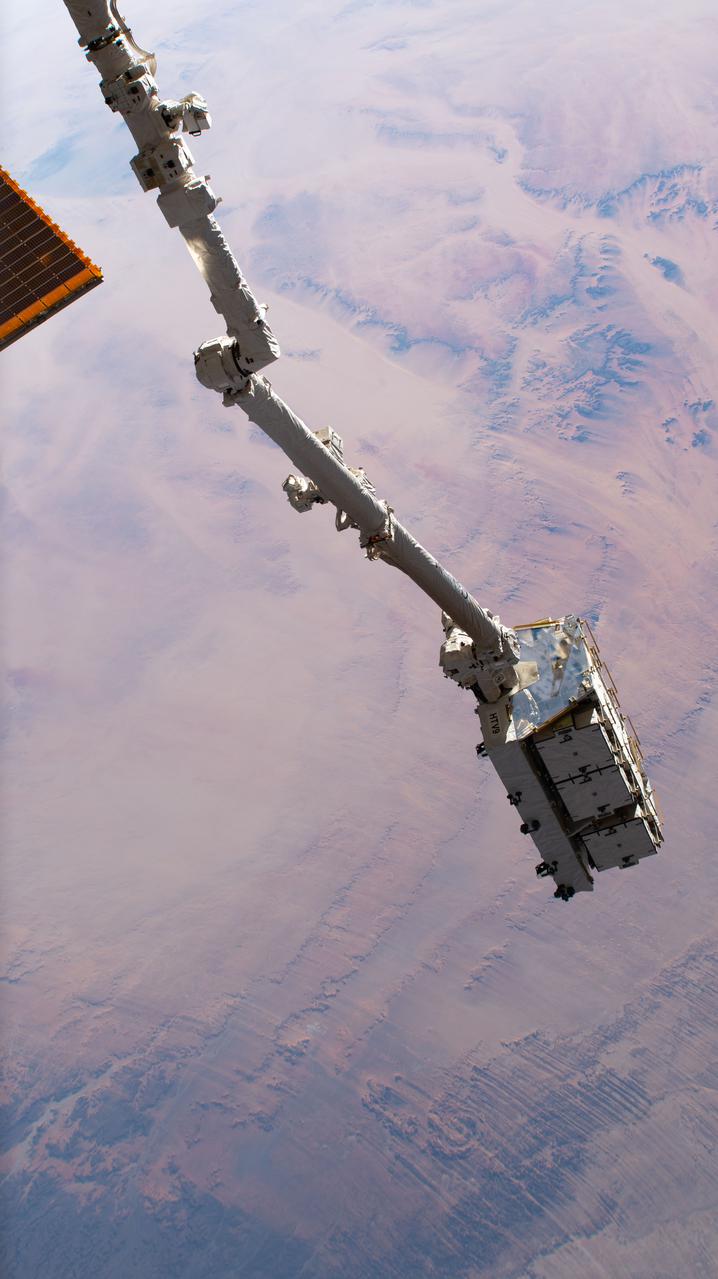
iss064e041189 (March 11, 2021) --- The Canadarm2 robotic arm, with an external pallet packed with old nickel-hydrogen batteries in its grip, is pictured as the International Space Station orbited 260 miles above the Sahara in the African nation of Chad. Mission controllers in Houston later commanded the Canadarm2 to release the external pallet into space where it will orbit Earth between two to four years before burning up harmlessly in the atmosphere. The batteries were removed during previous spacewalks and replaced with newer lithium-ion batteries to continue powering the station's systems.
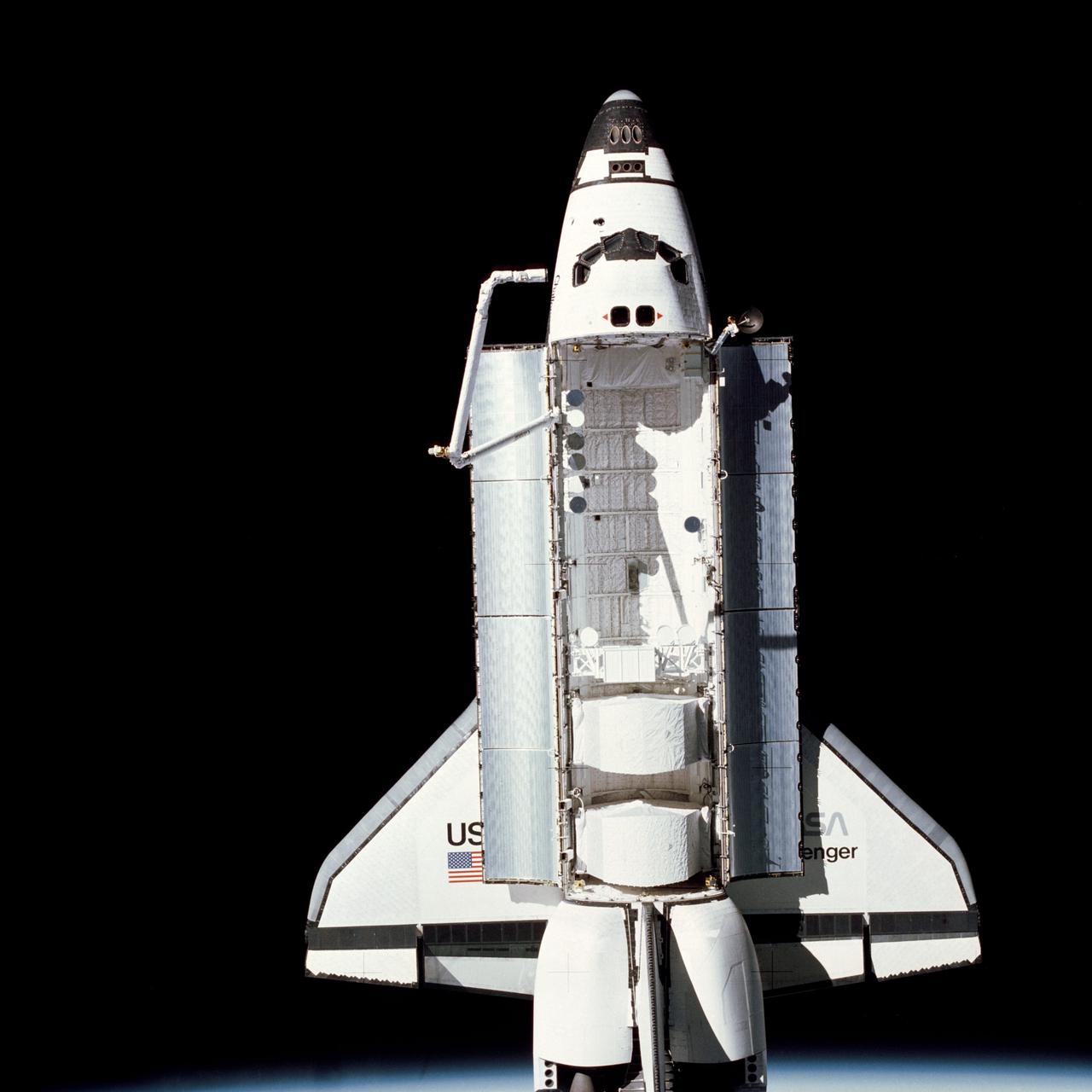
S83-35803 (22 June 1983) --- The Earth-orbiting space shuttle Challenger against the blackness of space was captured by a 70mm camera onboard the temporarily free-flying Shuttle Pallet Satellite (SPAS-01) during a busy Day 5 on the STS-7 mission. Visible in the cargo bay are the protective cradles for the now vacated Telesat Anik C2 and Palapa B communications satellites, the pallet for the NASA Office of Space and Terrestrial Applications (OSTA-2); the Remote Manipulator System (RMS) and the KU-Band antenna. The STS-7 astronaut crew with the RMS arm later retrieved the SPAS and returned it to a stowed position in the cargo bay for the return to Earth. Photo credit: NASA
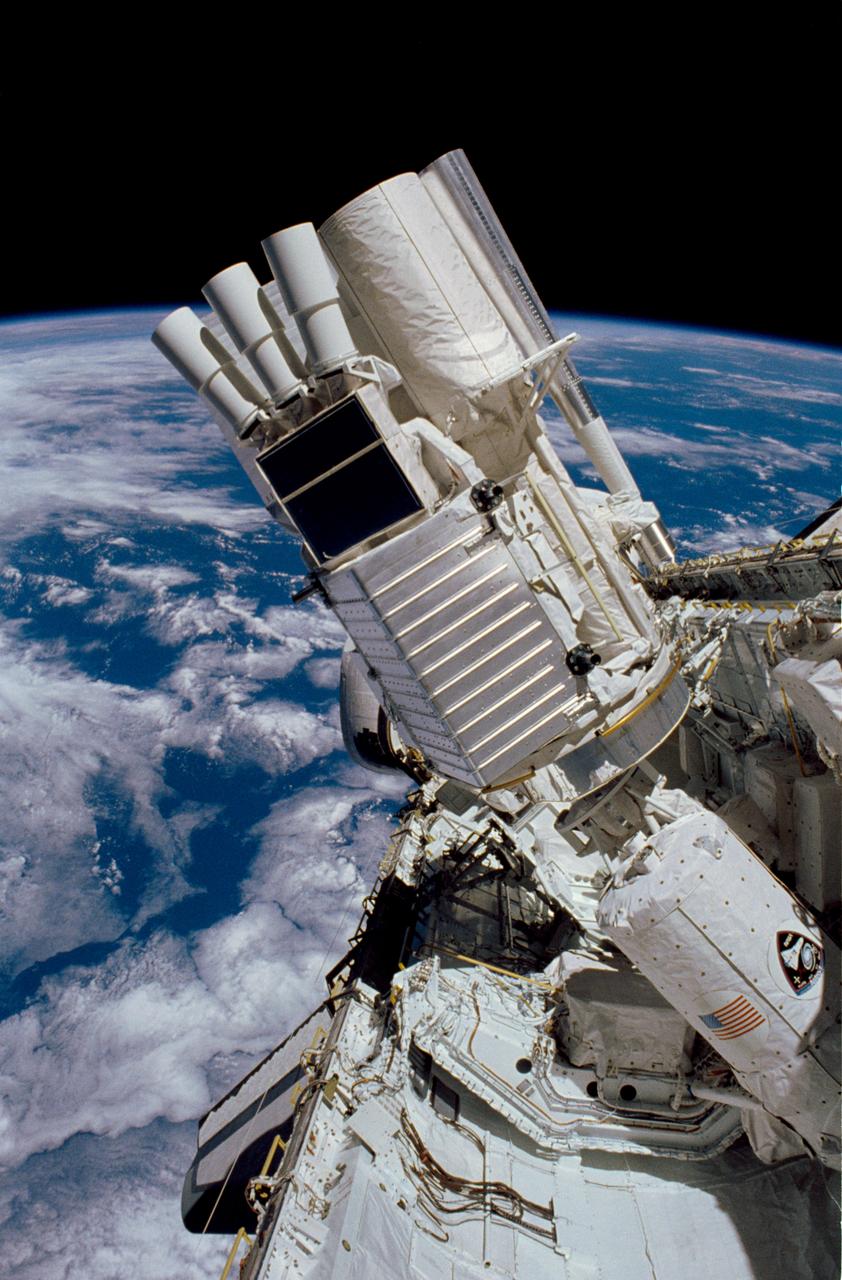
STS035-13-008 (2-10 Dec. 1990) --- The various components of the Astro-1 payload are seen backdropped against the blue and white Earth in this 35mm scene photographed through Columbia's aft flight deck windows. Parts of the Hopkins Ultraviolet Telescope (HUT), Ultraviolet Imaging Telescope (UIT) and the Wisconsin Ultraviolet Photo-Polarimeter Experiment (WUPPE) are visible on the Spacelab Pallet in the foreground. The Broad Band X-Ray Telescope (BBXRT) is behind this pallet and is not visible in this scene. The smaller cylinder in the foreground is the "Igloo," which is a pressurized container housing the Command and Data Management System, which interfaces with the in-cabin controllers to control the Instrument Pointing System (IPS) and the telescopes.
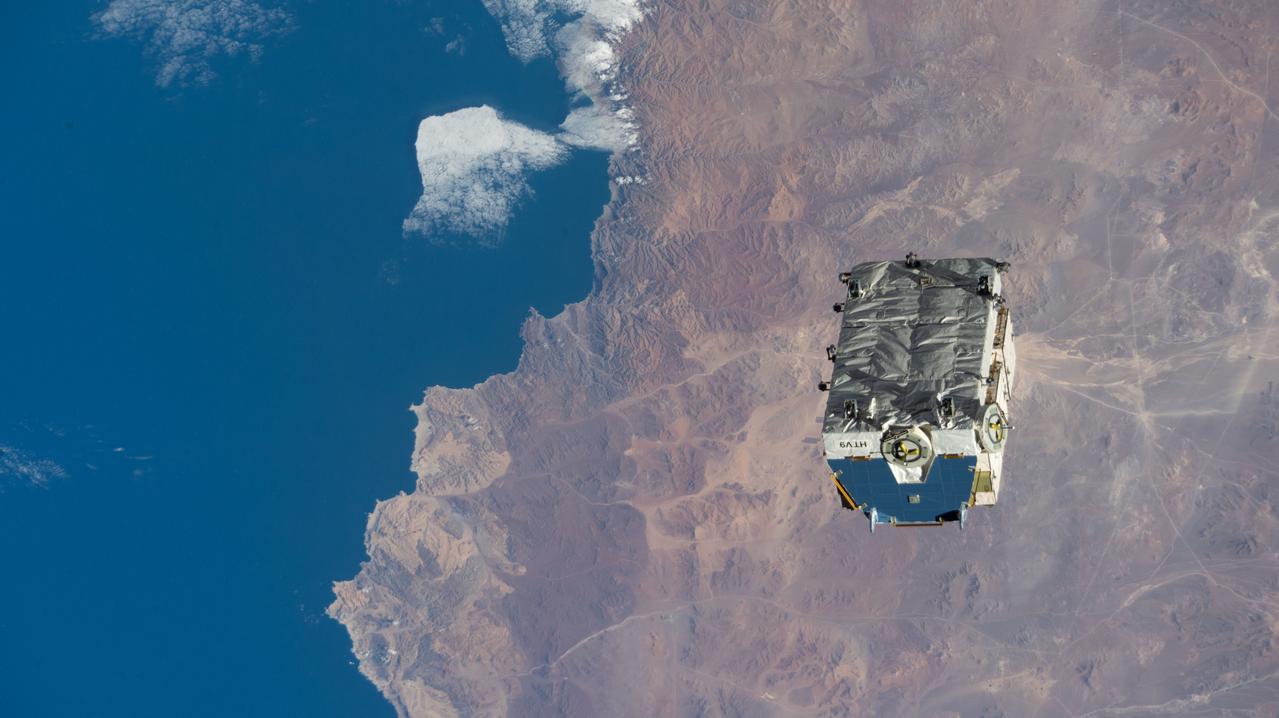
iss064e041189 (March 11, 2021) --- An external pallet packed with old nickel-hydrogen batteries is pictured shortly after mission controllers in Houston commanded the Canadarm2 robotic arm to release it into space. The International Space Station was orbiting 265 miles above the north coast of Chile in South America at the time this photograph was taken. The external pallet will orbit Earth between two to four years before burning up harmlessly in the atmosphere. The batteries were removed during previous spacewalks and replaced with newer lithium-ion batteries to continue powering the station's systems.
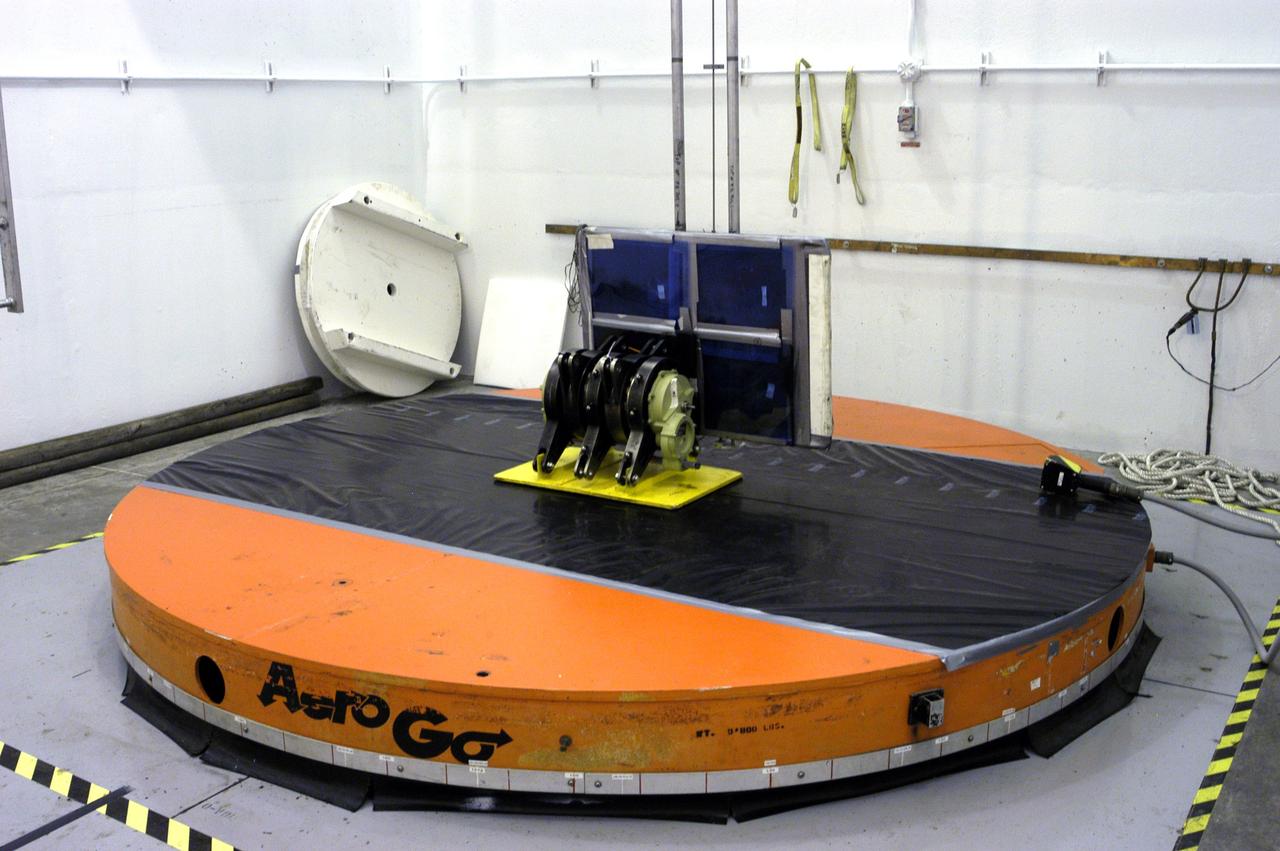
KENNEDY SPACE CENTER, FLA. - A rudder speed brake actuator sits on an air-bearing pallet to undergo X-raying. Four actuators to be installed on the orbiter Discovery are being X-rayed at the Radiographic High-Energy X-ray Facility to determine if the gears were installed correctly. Discovery has been assigned to the first Return to Flight mission, STS-114, a logistics flight to the International Space Station.
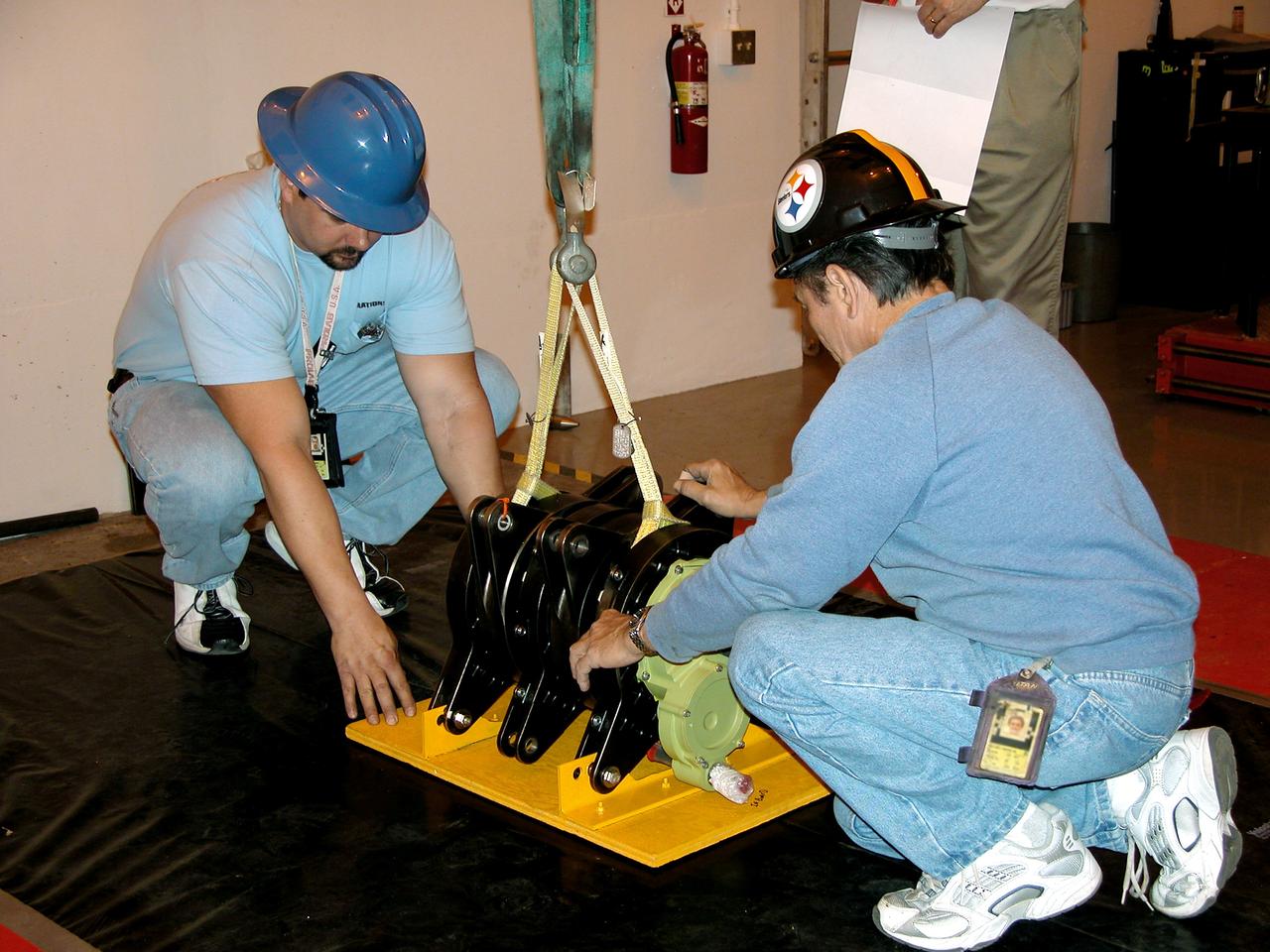
KENNEDY SPACE CENTER, FLA. - Workers at Cape Canaveral Air Force Station place one of four rudder speed brake actuators onto a pallet for X-ray. The actuators, to be installed on the orbiter Discovery, are being X-rayed at the Radiographic High-Energy X-ray Facility to determine if the gears were installed correctly. Discovery has been assigned to the first Return to Flight mission, STS-114, a logistics flight to the International Space Station.
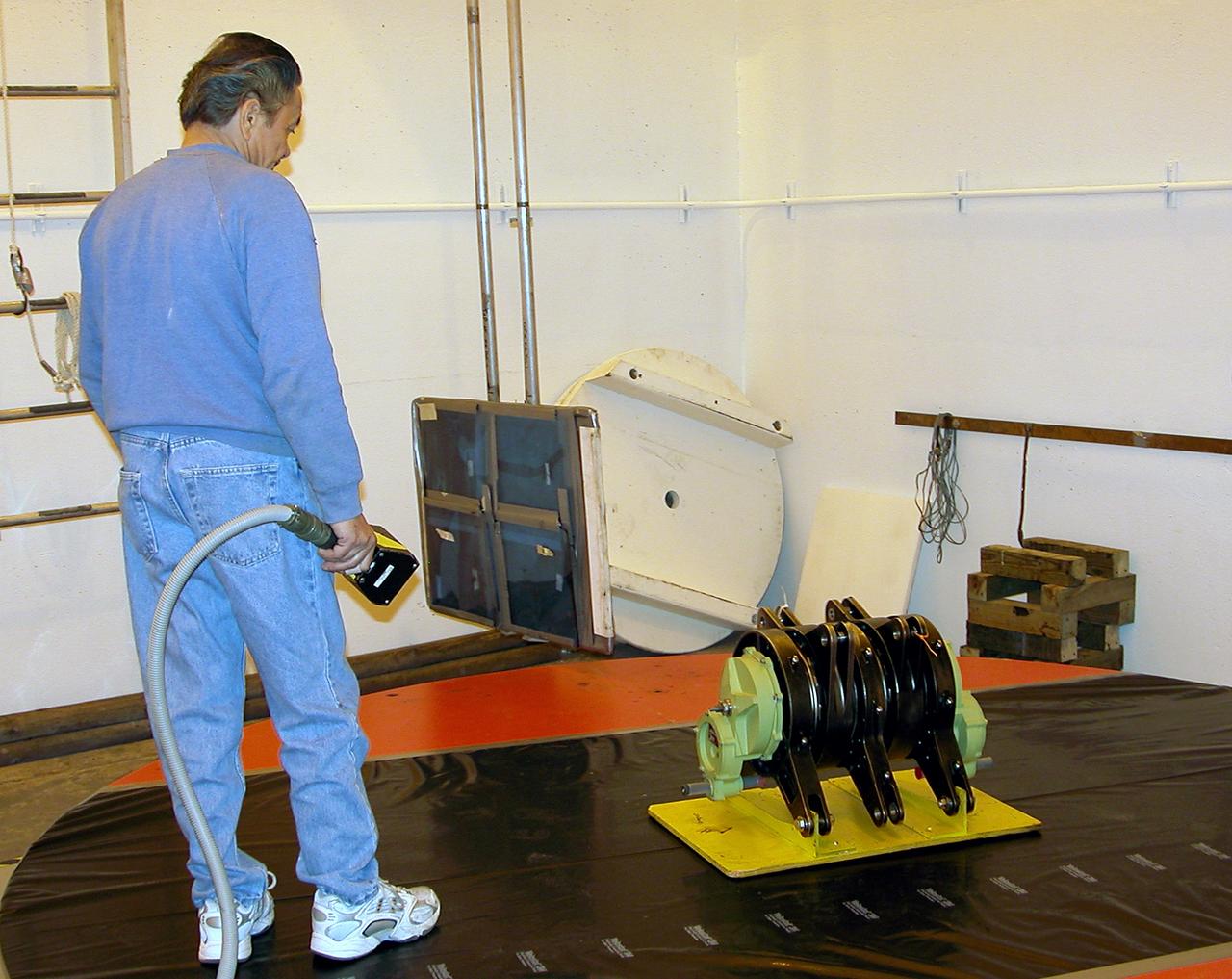
KENNEDY SPACE CENTER, FLA. - A rudder speed brake actuator sits on an air-bearing pallet to undergo X-raying. Four actuators to be installed on the orbiter Discovery are being X-rayed at the Radiographic High-Energy X-ray Facility to determine if the gears were installed correctly. Discovery has been assigned to the first Return to Flight mission, STS-114, a logistics flight to the International Space Station.
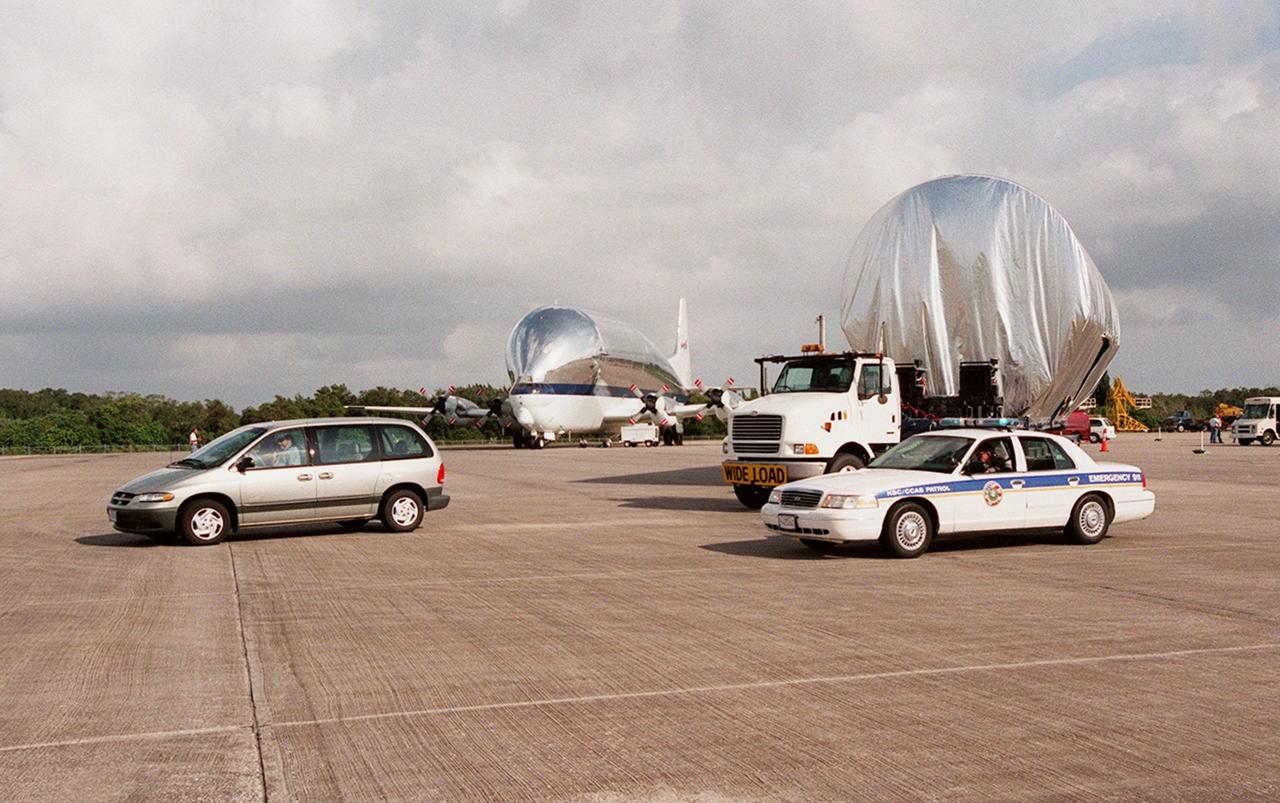
KENNEDY SPACE CENTER, FLA. -- Escort vehicles prepare to leave the Shuttle Landing Facility with the S1 truss (at right) on its trek to the Operations and Checkout Building. Manufactured by the Boeing Co. in Huntington Beach, Calif., this component of the ISS is the first starboard (right-side) truss segment, whose main job is providing structural support for the orbiting research facility's radiator panels that cool the Space Station's complex power system. The S1 truss segment also will house communications systems, external experiment positions and other subsystems. Primarily constructed of aluminum, the truss segment is 45 feet long, 15 feet wide and 6 feet tall. When fully outfitted, it will weigh 31,137 pounds. The truss is slated for flight in 2001. The truss arrived at KSC aboard NASA's Super Guppy, seen in the background. The aircraft is uniquely built with a 25-foot diameter fuselage designed to handle oversized loads and a "fold-away" nose that opens 110 degrees for cargo loading. A system of rails in the cargo compartment, used with either Guppy pallets or fixtures designed for specific cargo, makes cargo loading simple and efficient. Rollers mounted in the rails allow pallets or fixtures to be moved by an electric winch mounted beneath the cargo floor. Automatic hydraulic lock pins in each rail secure the pallet for flight
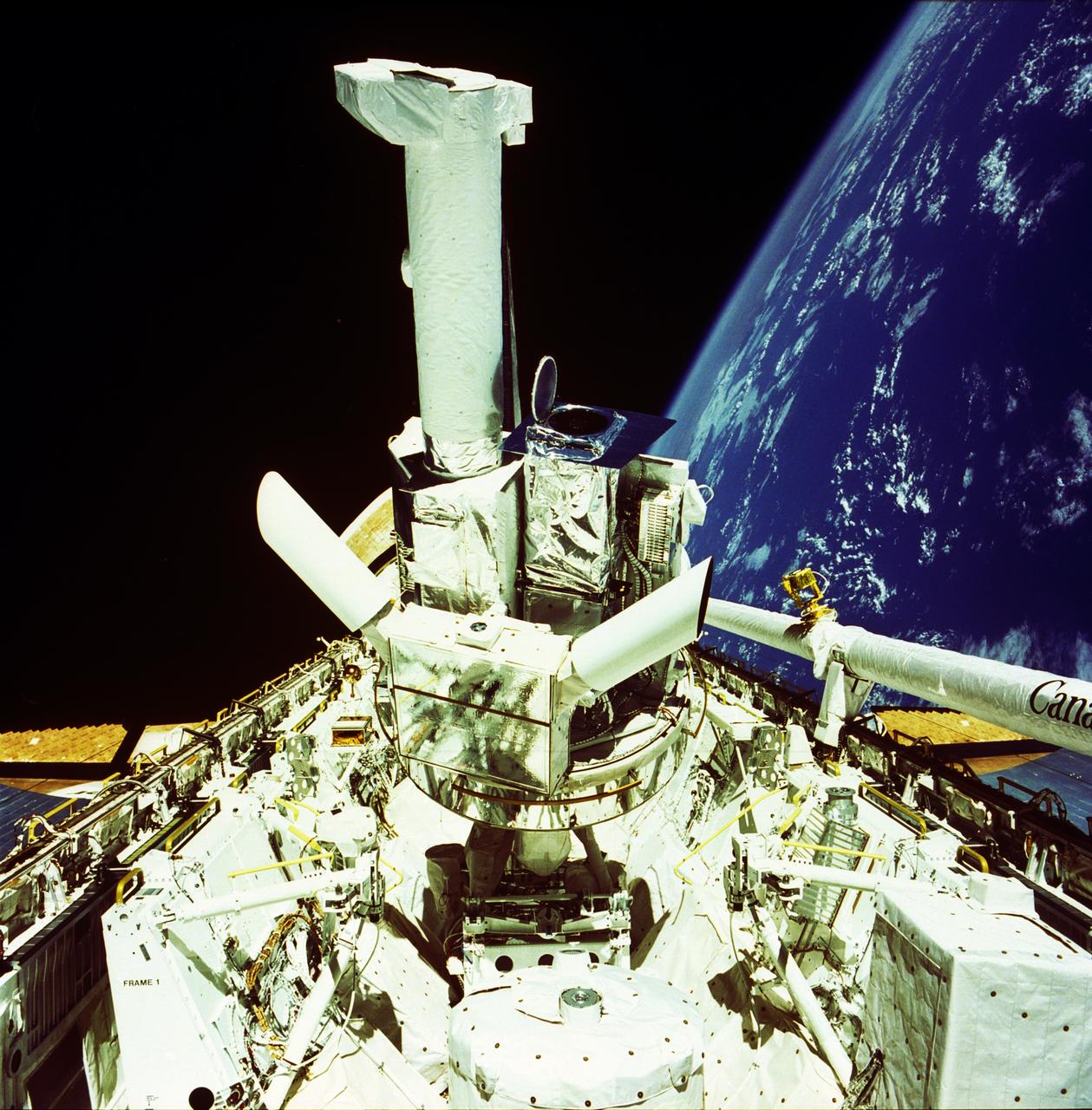
This photograph shows the Instrument Pointing System (IPS) for Spacelab-2 being deployed in the cargo bay of the Space Shuttle Orbiter Challenger. The European Space Agency (ESA) developed this irnovative pointing system for the Spacelab program. Previously, instruments were pointed toward particular celestial objects or areas by maneuvering the Shuttle to an appropriate attitude. The IPS could aim instruments more accurately than the Shuttle and kept them fixed on a target as the Shuttle moved. On the first pallet, three solar instruments and one atmospheric instrument were mounted on the IPS. Spacelab-2 was the first pallet-only mission. One of the goals of the mission was to verify that the pallets' configuration was satisfactory for observations and research. Except for two biological experiments and an experiment that uses ground-based instruments, the Spacelab-2 scientific instruments needed direct exposure to space. The Spacelab-2 mission was designed to capitalize on the Shuttle-Spacelab capabilities to carry very large instruments, launch and retrieve satellites, and point several instruments independently with accuracy and stability. Spacelab-2 (STS-51F, 19th Shuttle mission) was launched on July 29, 1985 aboard the Space Shuttle Orbiter Challenger. The Marshall Space Flight Center had overall management responsibilities of the Spacelab missions.
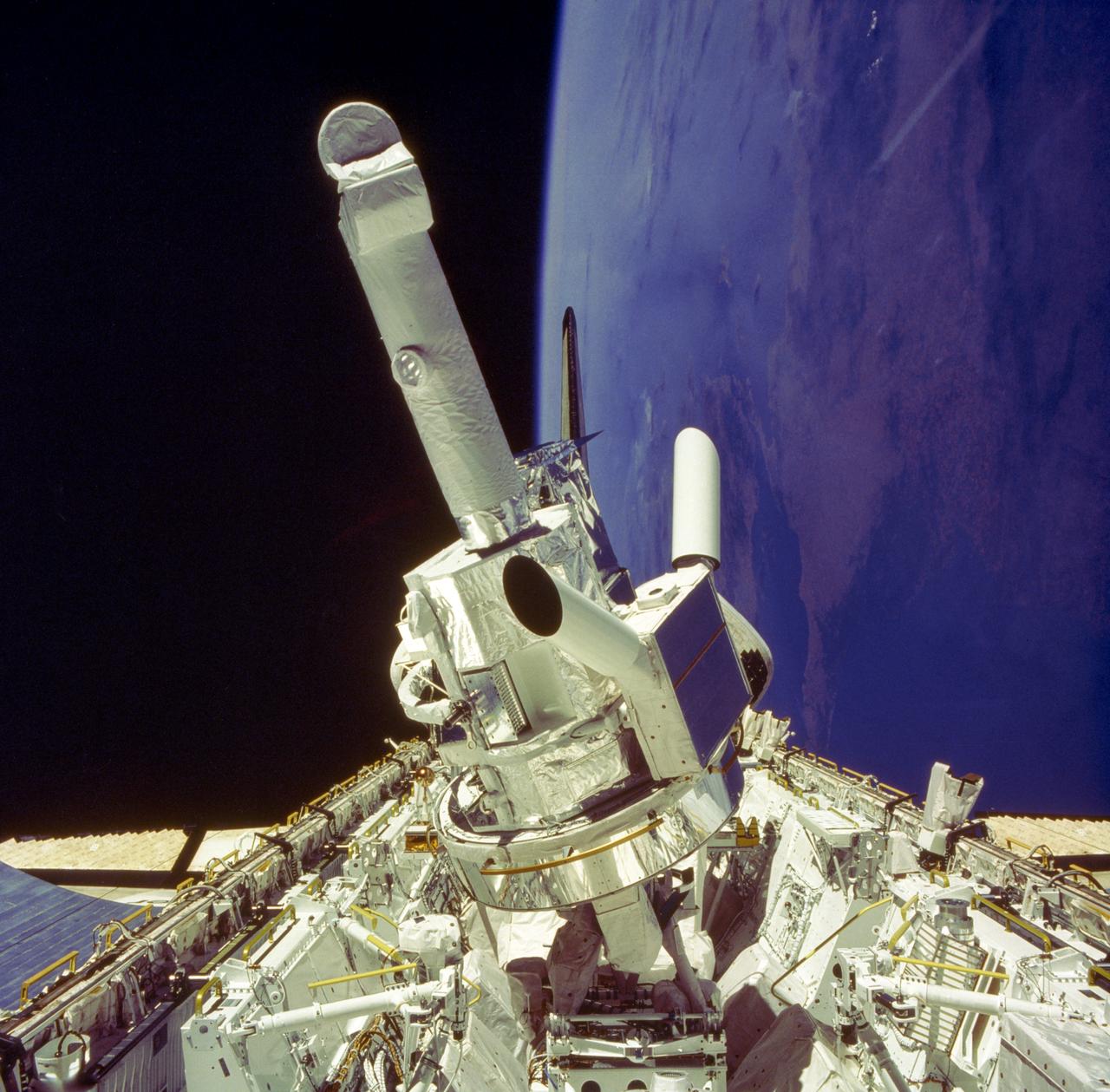
This photograph shows the Instrument Pointing System (IPS) for Spacelab-2 being deployed in the cargo bay of the Space Shuttle Orbiter Challenger. The European Space Agency (ESA) developed this irnovative pointing system for the Spacelab program. Previously, instruments were pointed toward particular celestial objects or areas by maneuvering the Shuttle to an appropriate attitude. The IPS could aim instruments more accurately than the Shuttle and kept them fixed on a target as the Shuttle moved. On the first pallet, three solar instruments and one atmospheric instrument were mounted on the IPS. Spacelab-2 was the first pallet-only mission. One of the goals of the mission was to verify that the pallets' configuration was satisfactory for observations and research. Except for two biological experiments and an experiment that used ground-based instruments, the Spacelab-2 scientific instruments needed direct exposure to space. The Spacelab-2 mission was designed to capitalize on the Shuttle-Spacelab capabilities to carry very large instruments, launch and retrieve satellites, and point several instruments independently with accuracy and stability. Spacelab-2 (STS-51F, 19th Shuttle mission) was launched on July 29, 1985 aboard the Space Shuttle Orbiter Challenger. The Marshall Space Flight Center had overall management responsibilities of the Spacelab missions.
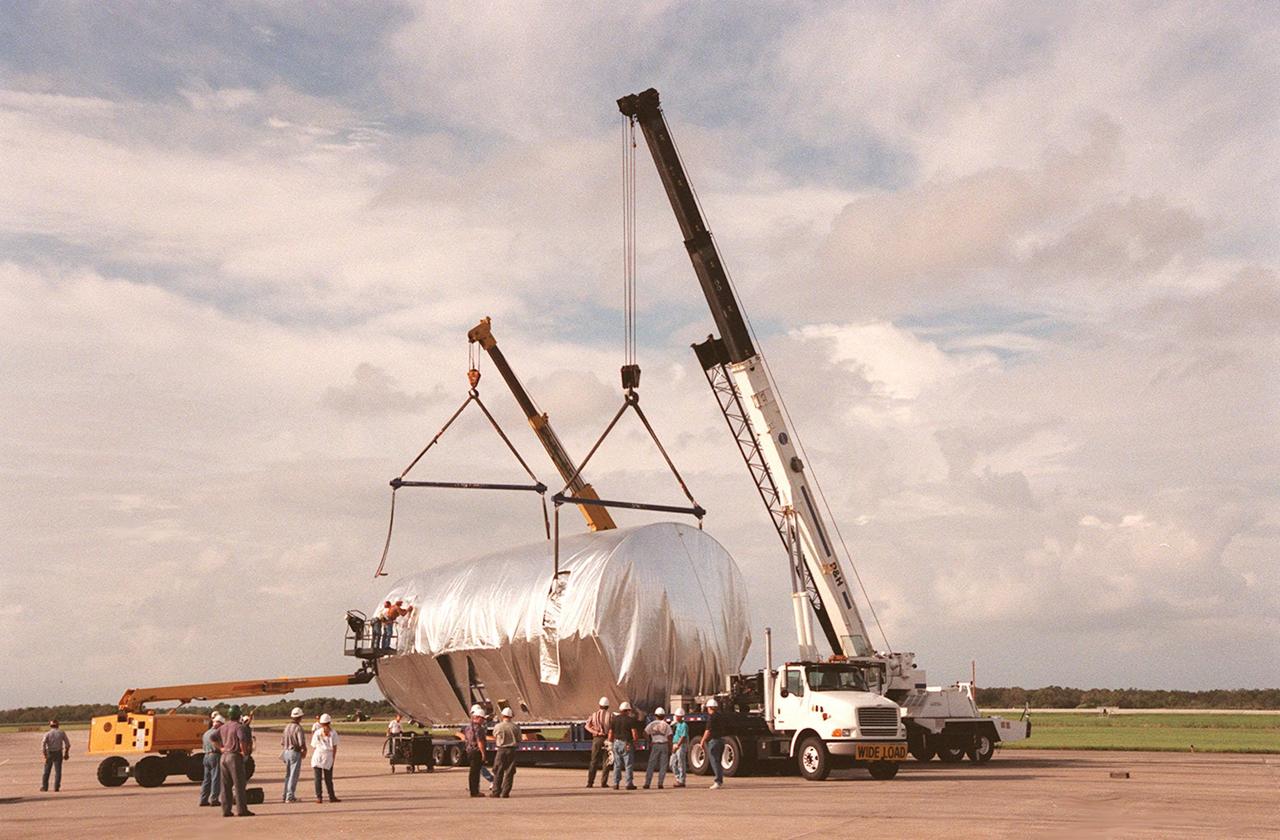
KENNEDY SPACE CENTER, FLA. -- At the Shuttle Landing Facility, workers attach cranes to the S1 truss, a segment of the International Space Station, to lift the truss to a payload transporter for its transfer to the Operations and Checkout Building. Manufactured by the Boeing Co. in Huntington Beach, Calif., this component of the ISS is the first starboard (right-side) truss segment, whose main job is providing structural support for the orbiting research facility's radiator panels that cool the Space Station's complex power system. The S1 truss segment also will house communications systems, external experiment positions and other subsystems. Primarily constructed of aluminum, the truss segment is 45 feet long, 15 feet wide and 6 feet tall. When fully outfitted, it will weigh 31,137 pounds. The truss is slated for flight in 2001. The truss arrived at KSC aboard NASA's Super Guppy, with a 25-foot diameter fuselage designed to handle oversized loads. Loading the Guppy is easy because of the unique "fold-away" nose of the aircraft that opens 110 degrees for cargo loading. A system of rails in the cargo compartment, used with either Guppy pallets or fixtures designed for specific cargo, makes cargo loading simple and efficient. Rollers mounted in the rails allow pallets or fixtures to be moved by an electric winch mounted beneath the cargo floor. Automatic hydraulic lock pins in each rail secure the pallet for flight
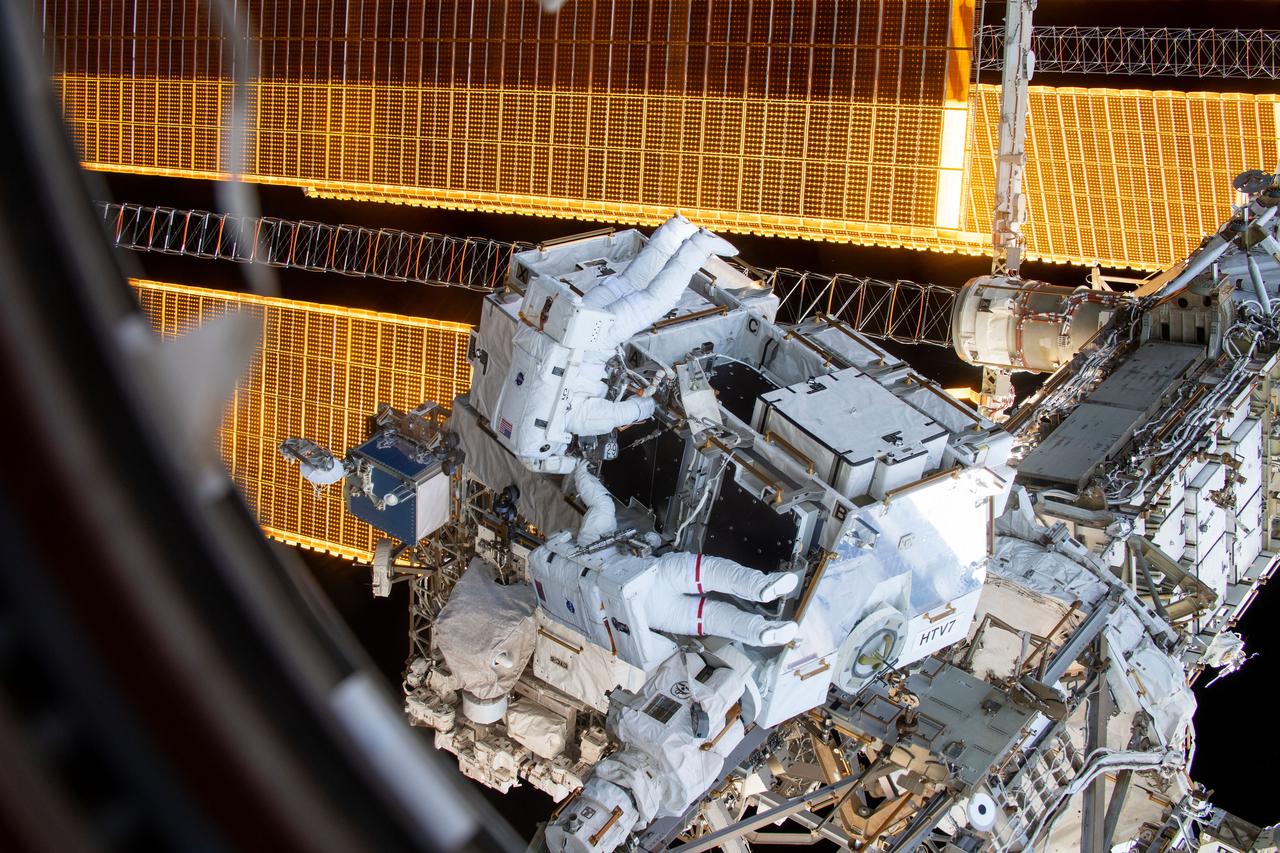
iss059e001538 (March 22, 2019) --- NASA astronauts Nick Hague (suit with no stripes) and Anne McClain (suit with red stripes) work to retrieve batteries and adapter plates from an external pallet during a spacewalk to upgrade the International Space Station's power storage capacity.
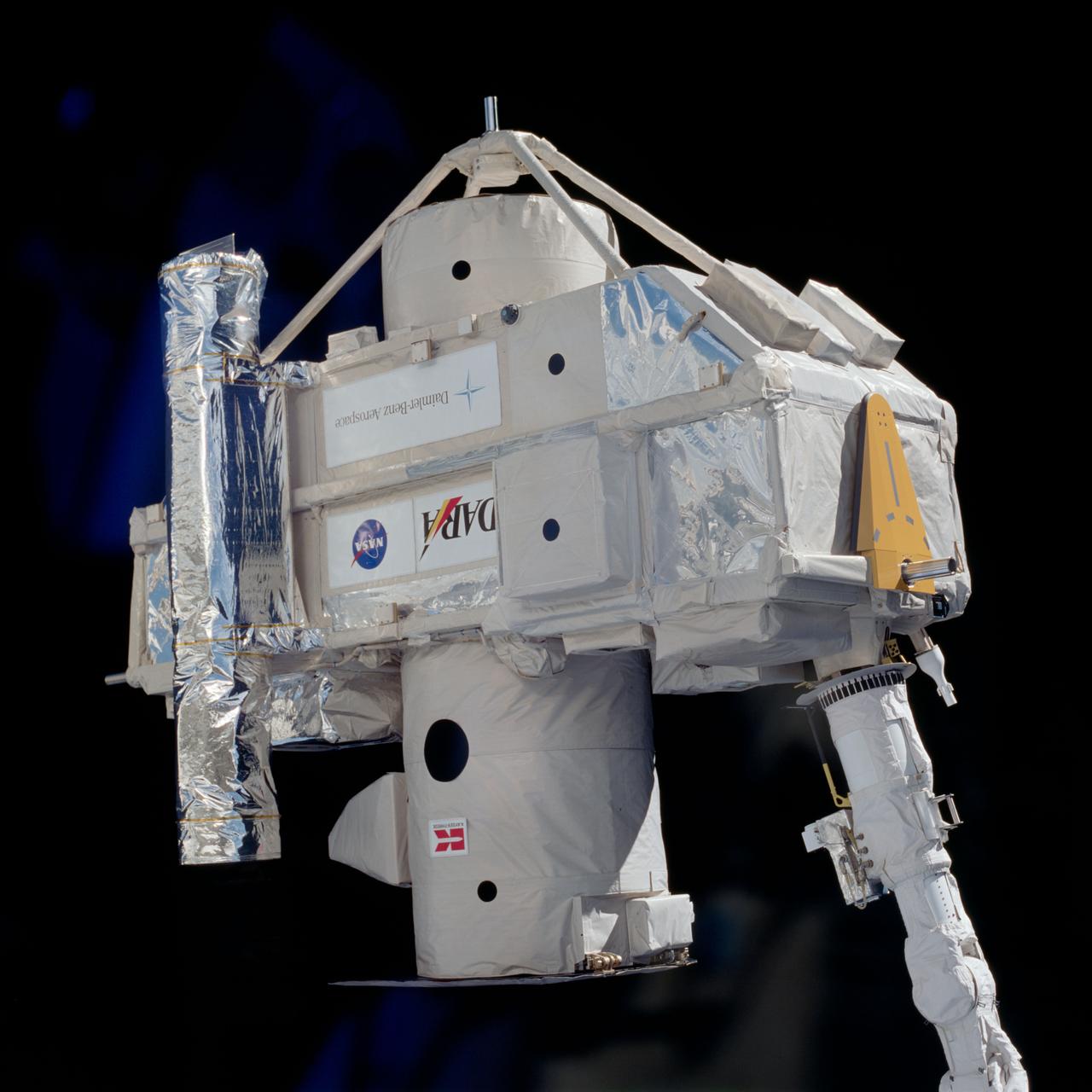
STS080-704-008 (19 Nov.-7 Dec. 1996) --- Backdropped against the blackness of space, the ORPHEUS - Shuttle Pallet Satellite (SPAS) spacecraft is held in the grasp of the space shuttle Columbia's Remote Manipulator System (RMS) during deploy operations in Earth-orbit.
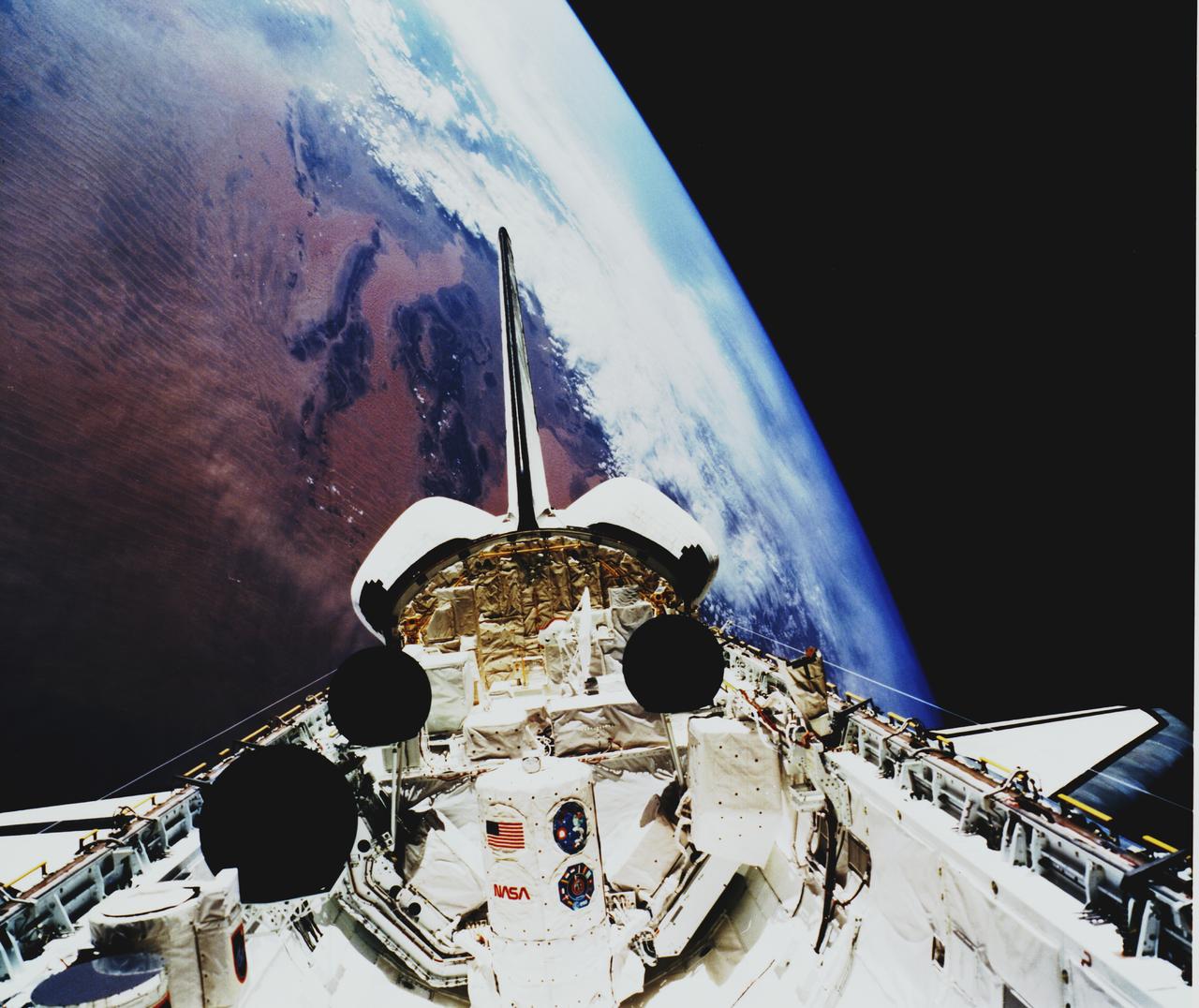
Space Shuttle Atlantis (STS-45) onboard photo of Atmospheric Laboratory for Applications and Science (Atlas-1) module in open cargo bay. Atlas-1 pallets are back dropped against the Atlas Mountains. Taken over Mali in the western Sahara, shows dunes in the Iguidi Dune Sea.

iss066e024000 (Oct. 31, 2021) --- A cloudy north Pacific Ocean south of Alaska is pictured from the International Space Station as it orbited 263 miles above. At center top, is the Kibo laboratory module's external pallet that houses a variety of experiments and hardware exposed to the harsh environment of microgravity.
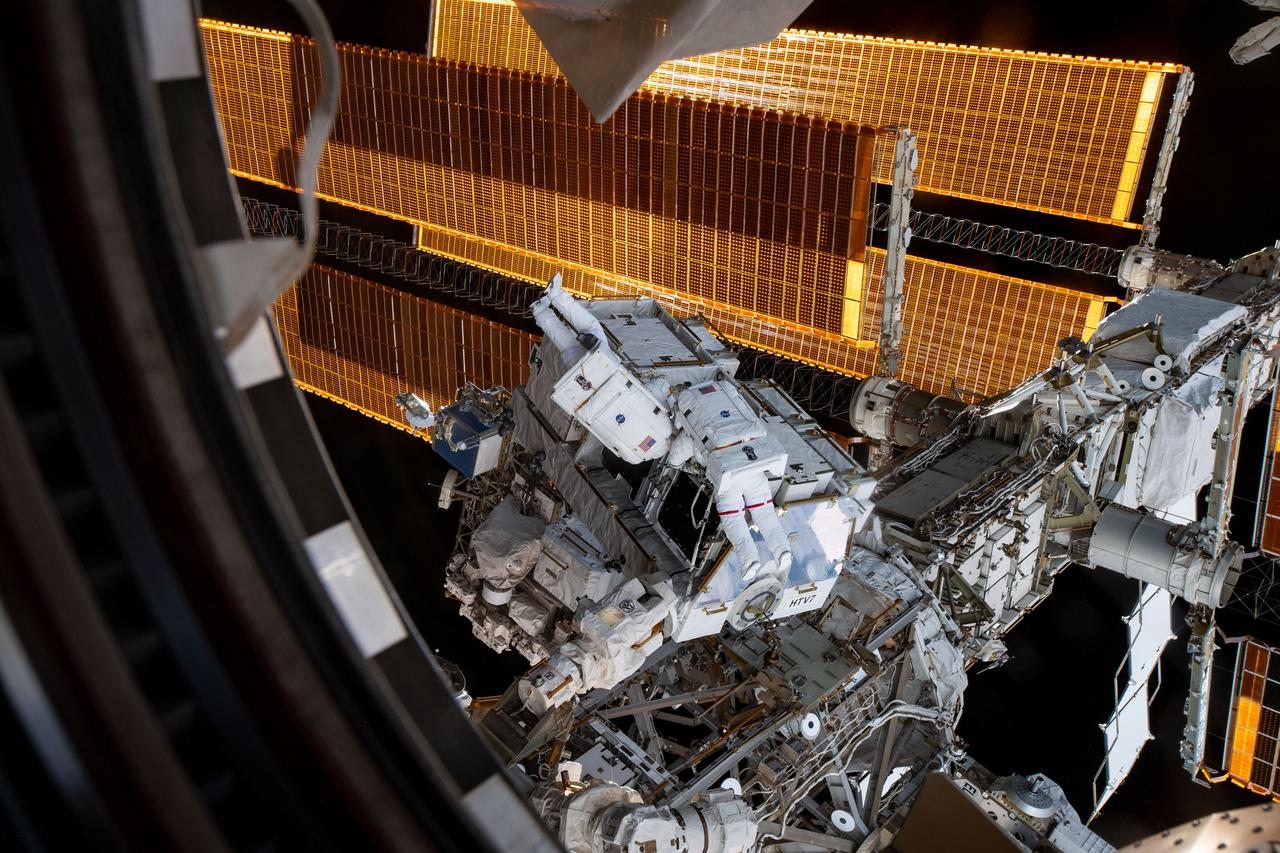
iss059e001506 (March 22, 2019) --- NASA astronauts Nick Hague (suit with no stripes) and Anne McClain (suit with red stripes) work to retrieve batteries and adapter plates from an external pallet during a spacewalk to upgrade the International Space Station's power storage capacity.
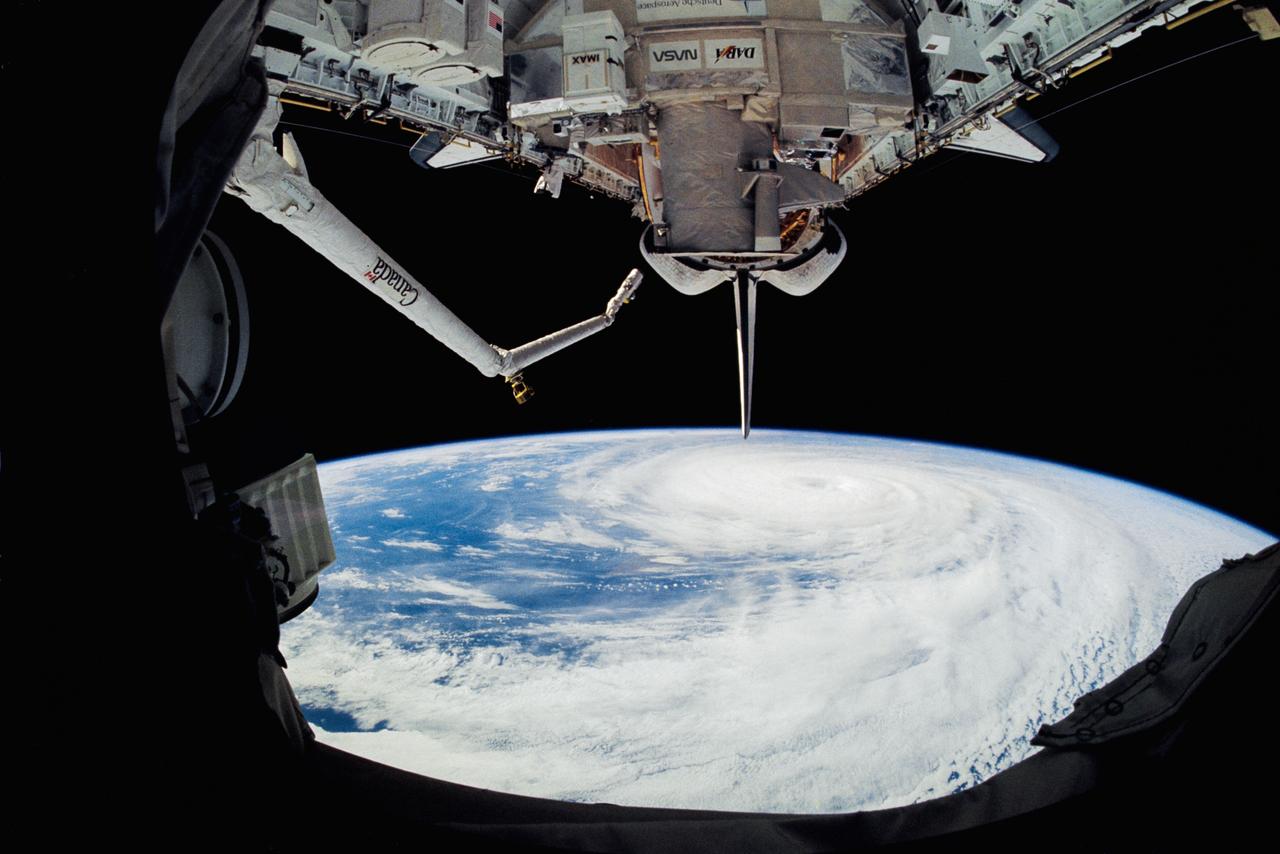
One of the STS-51 astronauts used a "fish-eye" lens on a 35mm cmaera to photograph this view of Hurricane Kenneth in the Pacific Ocean. The Orbiting Retrievable Far and Extreme Ultraviolet Spectrometer/Shuttle Pallet Satellite (ORFEUS/SPAS) is still in the cargo bay. The Remote Manipulator System (RMS) is extended towards the open payload bay.
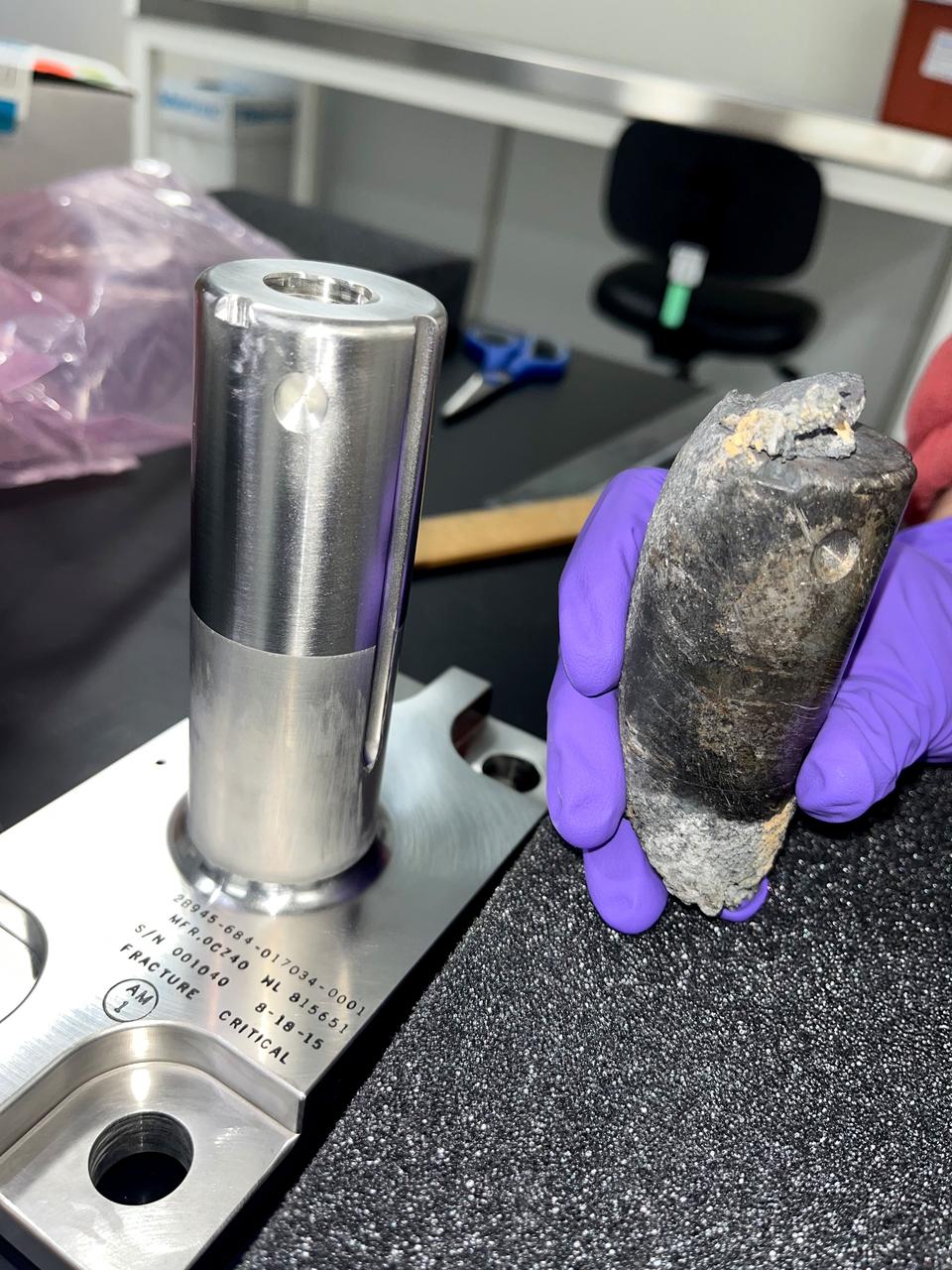
jsc2024e025649 (March 29, 2024) --- Recovered stanchion from the NASA flight support equipment used to mount International Space Station batteries on a cargo pallet. The stanchion survived re-entry through Earth’s atmosphere on March 8, 2024, and impacted a home in Naples, Florida.
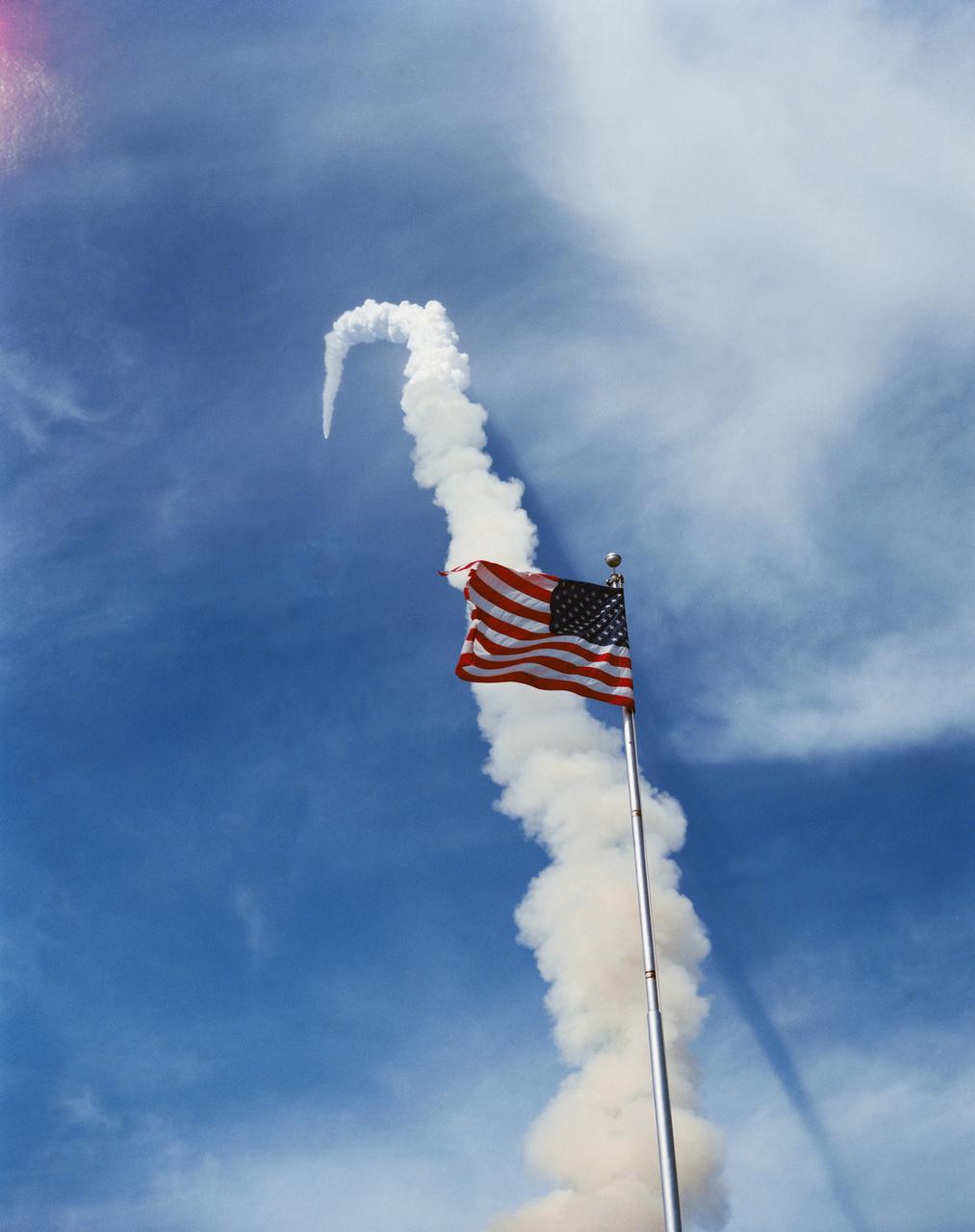
51F-S-068 (29 July 1985) --- The Space Shuttle Challenger heads toward Earth-orbit with the Spacelab-2 experiment pallet and a team of astronauts and scientists onboard. This photograph was taken by Otis Imboden of the National Geographic Society for NASA from the press site at Kennedy Space Center (KSC).
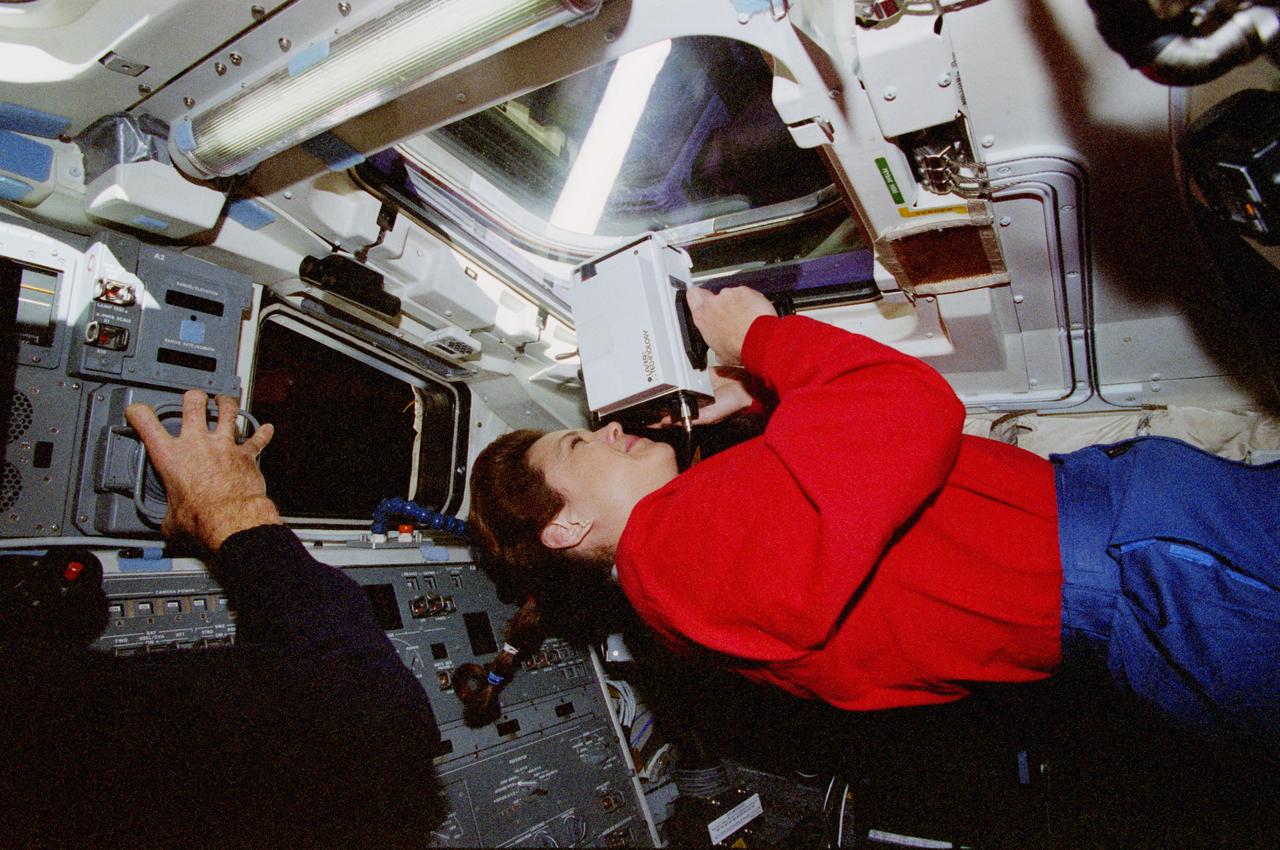
STS080-370-022 (19 Nov.-7 Dec. 1996) --- Astronaut Tamara E. Jernigan, STS-80 mission specialist, uses a laser ranging device during the space shuttle Columbia's rendezvous operations with the Orbiting Retrievable Far and Extreme Ultraviolet Spectrometer - Shuttle Pallet Satellite (ORFEUS-SPAS).
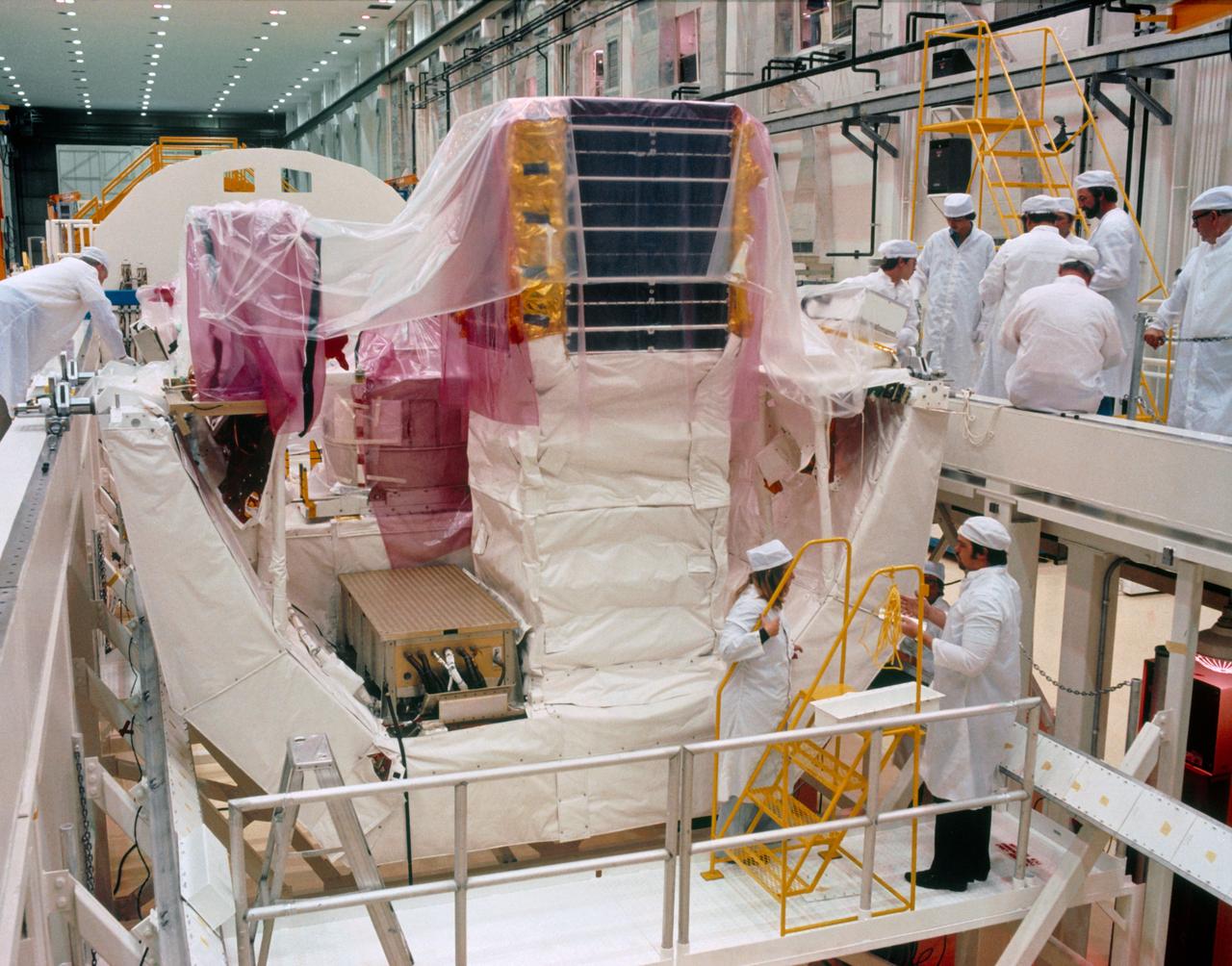
Views OSS-1 Payload Pallet, vehicle changing and potential experiment being checked out by technicians after its arrival at the Operations & Checkout (O&C) Bldg., 09/18/1981, for the STS-3 Mission 1. STS-3 - EXERIMENT (OSS-1) 2. SHUTTLE - PAYLOADS (OSS-1) KSC, FL
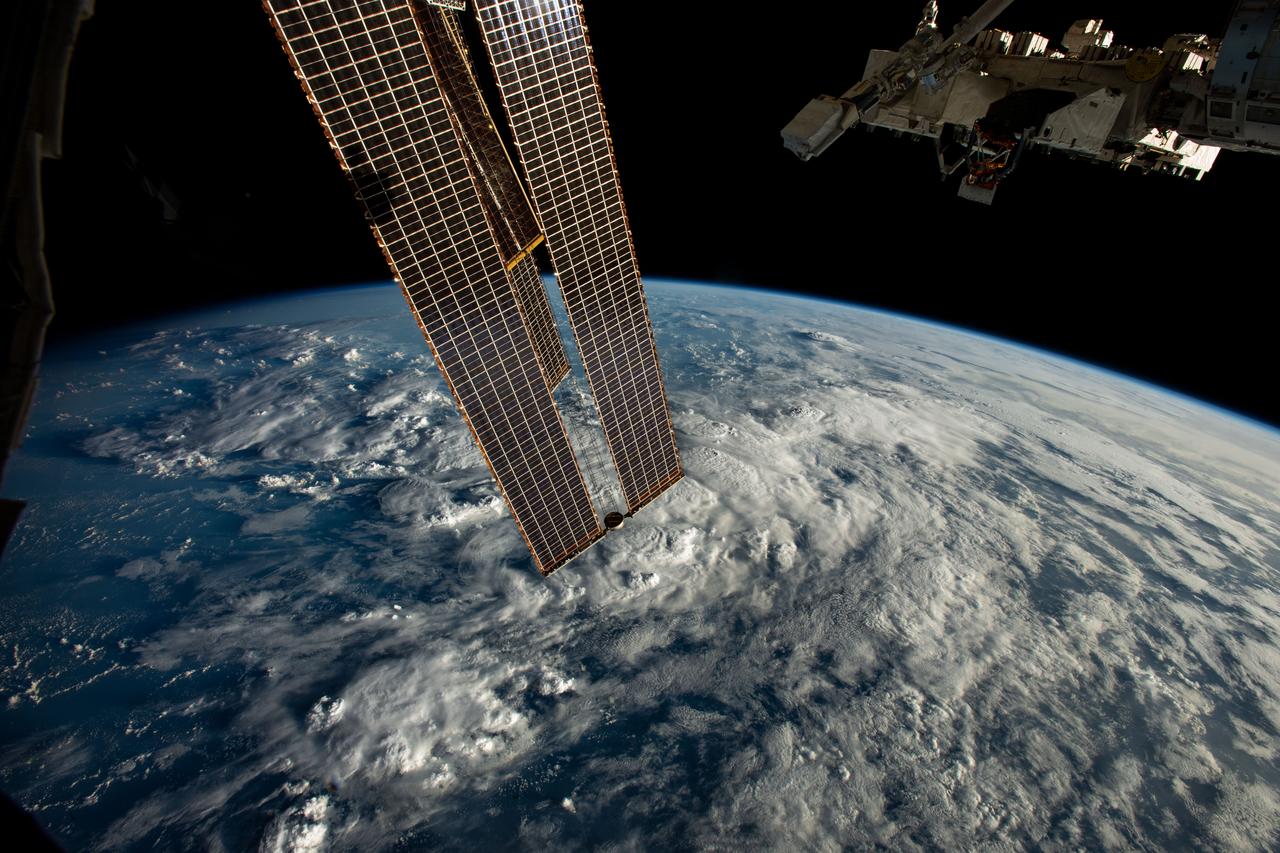
iss067e253816 (Aug. 12, 2022) --- A set of the International Space Station's main solar arrays and the Kibo laboratory module's external pallet (top right) are pictured as the orbiting lab soared 260 miles above a cloudy Atlantic Ocean off the coast of northern Brazil.

S85-E-5096 (15 August 1997) --- The Cryogenic Infrared Spectrometers and Telescopes for the Atmosphere-Shuttle Pallet Satellite-2 (CRISTA-SPAS-2) payload is backdropped against the darkness of space prior to its retrieval by Discovery's remote manipulator system (RMS) on Aug. 16.
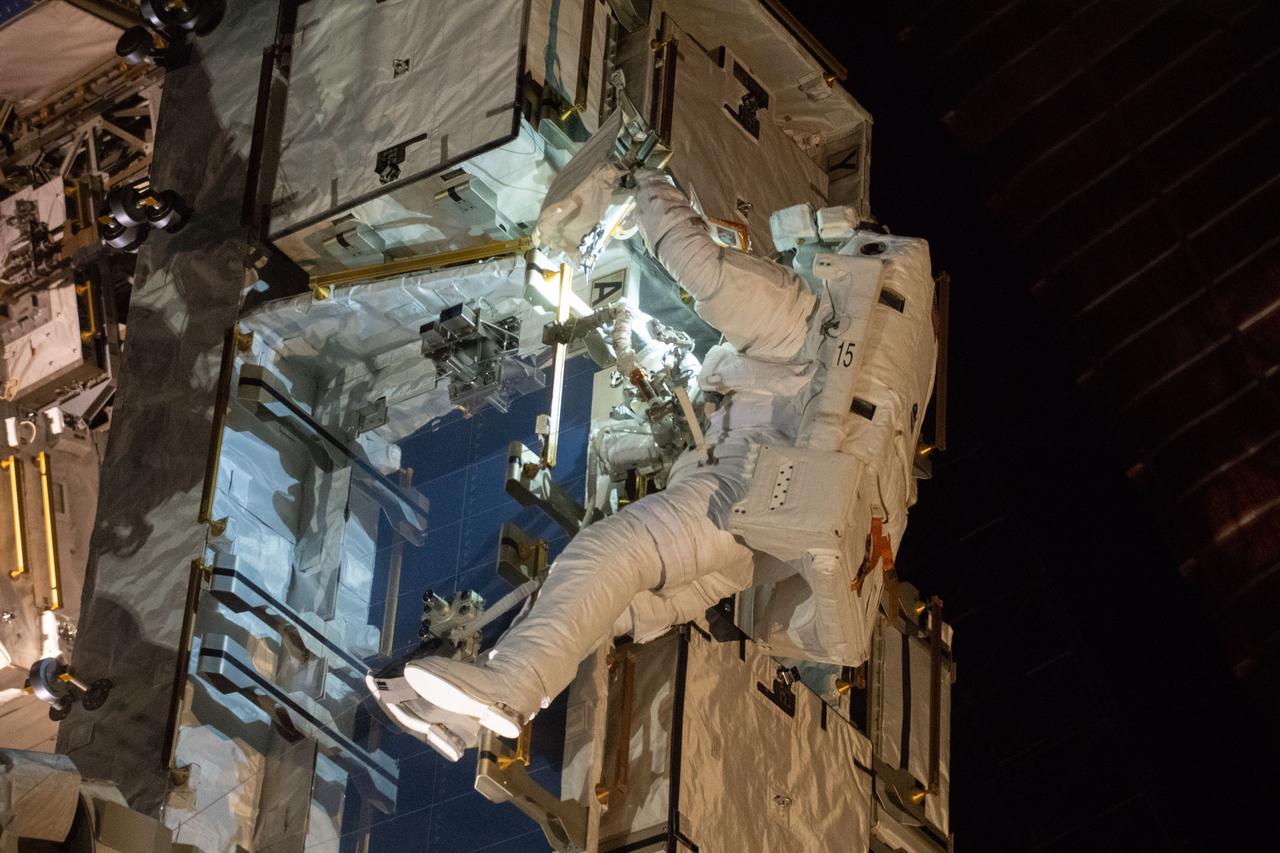
iss059e002268 (March 22, 2019) --- NASA astronaut Nick Hague works to retrieve batteries and adapter plates from an external pallet during a spacewalk to upgrade the International Space Station's power storage capacity.. This was Hague's and NASA astronaut Anne McClain's (out of frame) first spacewalk.
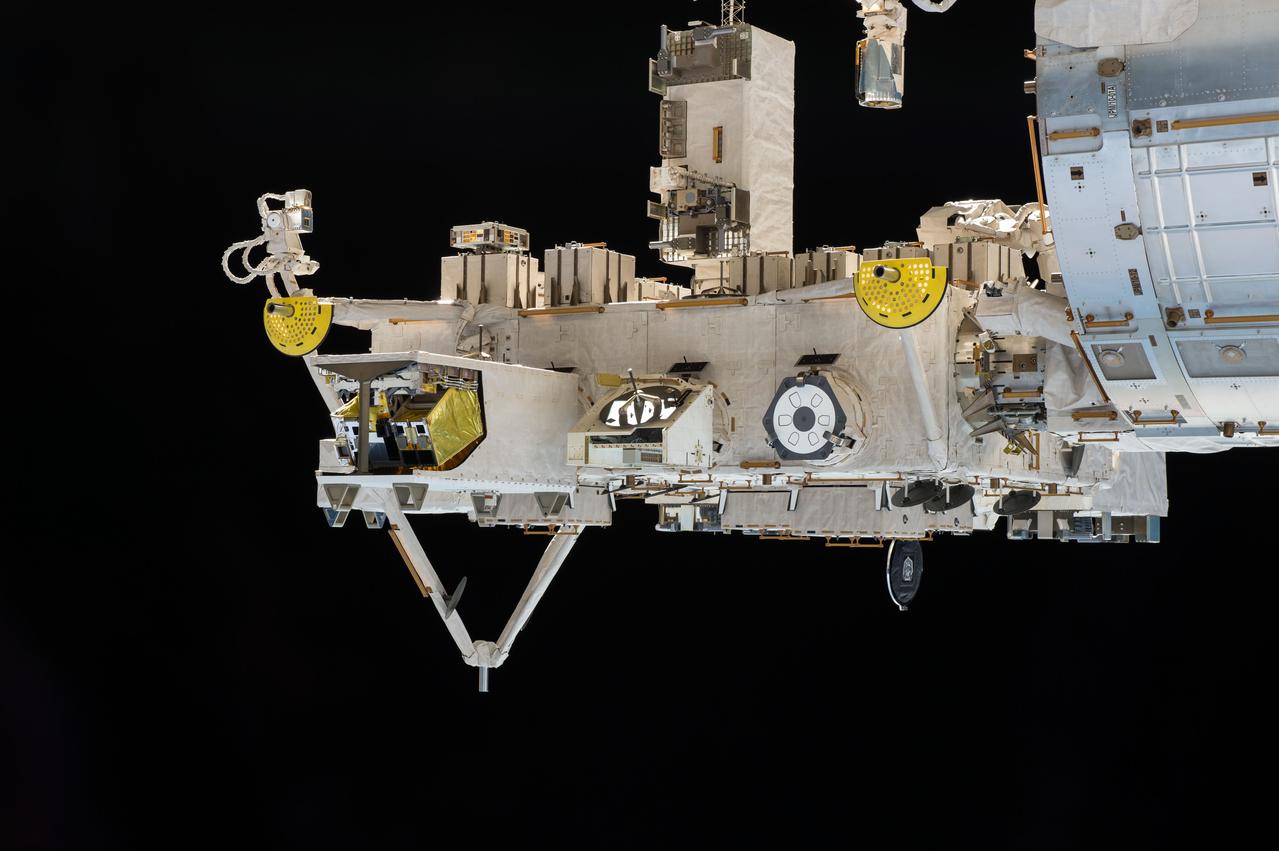
iss050e011669 (Nov. 28, 2016) --- Japanese Experiment Module - Exposed Facility (JEM-EF) and Japanese Experiment Module (JEM) Pressurized Module (JPM) (right) taken by the Expedition 50 crew. JEM-EF is an unpressurized multipurpose pallet structure attached to the outside of the International Space Station (ISS).
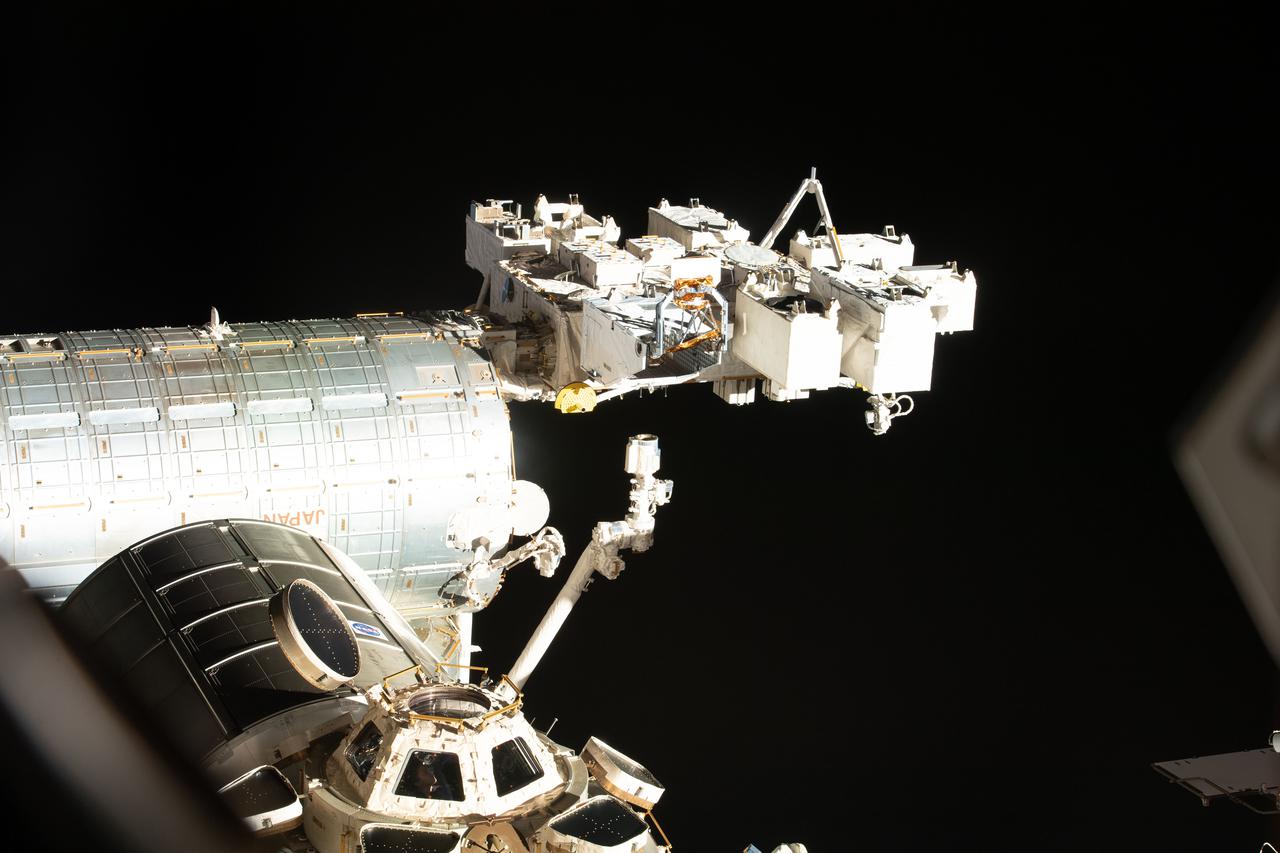
iss066e109584 (Jan. 9, 2022) --- NASA astronaut and Expedition 66 Flight Engineer Kayla Barron peers out from a window inside the cupola, the International Space Station's "window to the world." Prominent components in this photograph include the Kibo laboratory module and its external pallet, the Japanese robotic arm, and the Leonardo Permanent Multipurpose Module.
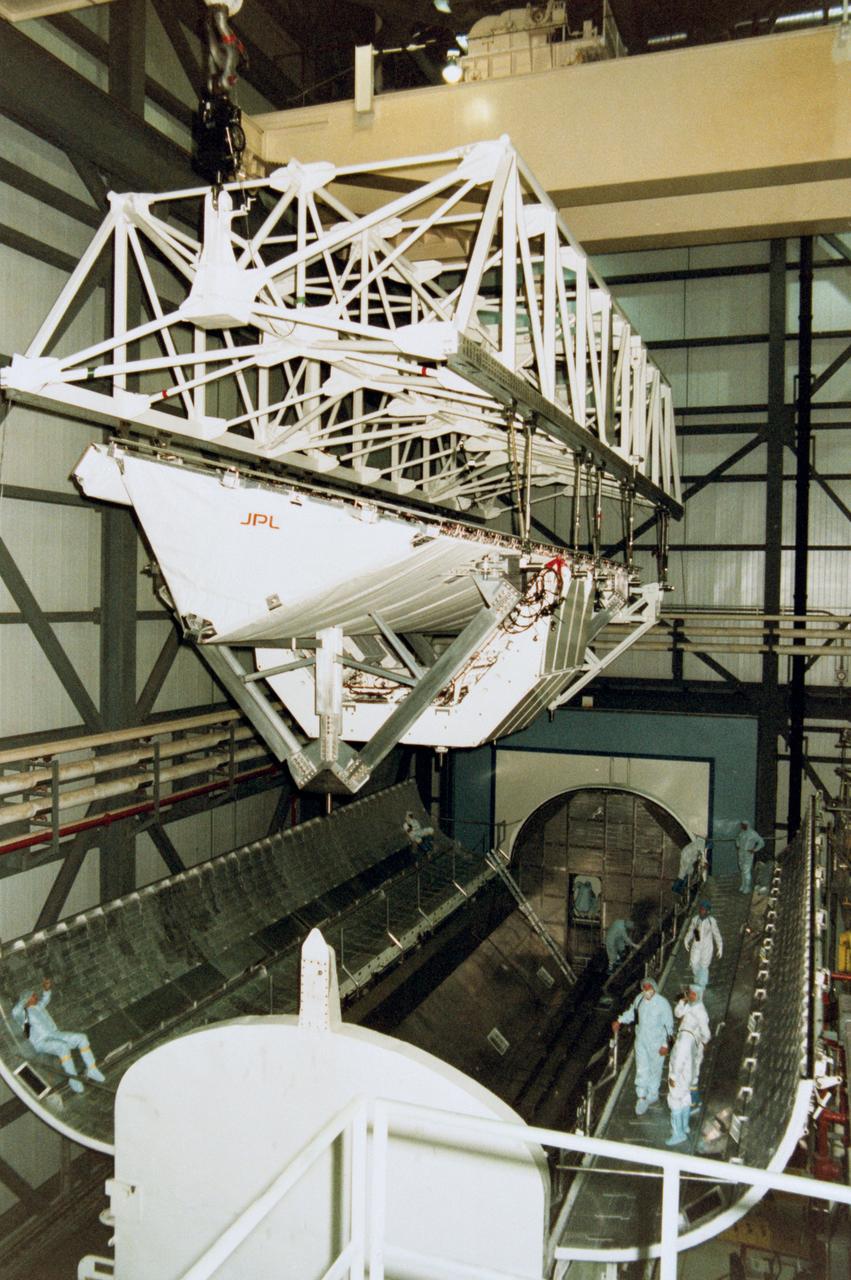
S94-30392 (16 Feb 1994) --- The Space Radar Laboratory-1 (SRL-1) is being transferred from the payload canister transporter into the payload bay of the Space Shuttle Endeavour. SRL-1 will be launched on STS-59 in April of this year.
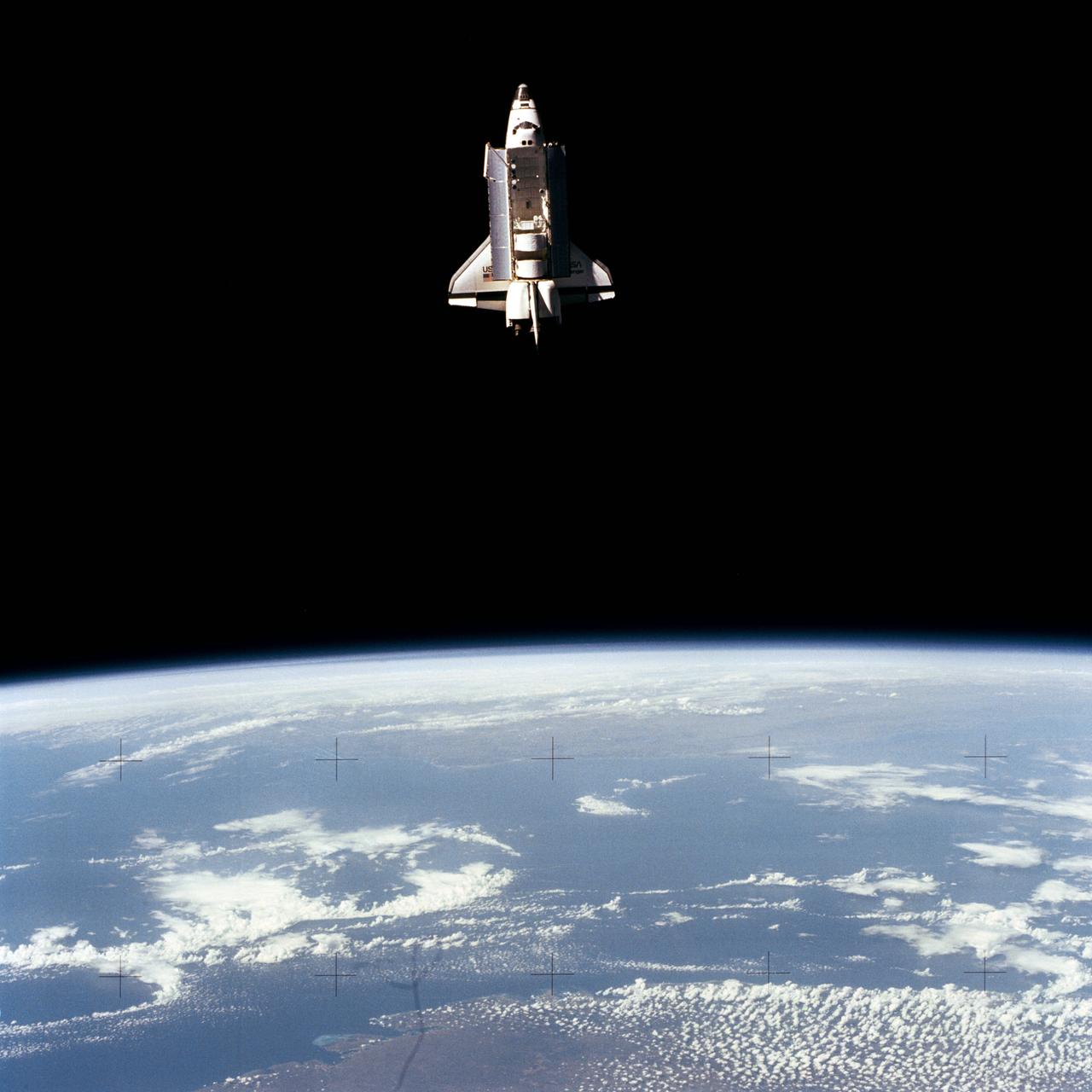
STS007-32-1702 (22 June 1983) --- The Earth-orbiting space shuttle Challenger beyond the Earth's horizon was captured by a 70mm camera onboard the unmanned, free-flying Shuttle Pallet Satellite (SPAS-01) during the busy flight day 5 of the STS-7 mission. Visible in the cargo bay are the protective cradles for the now-vacated Telesat Anik C-2 and Palapa B communications satellites, the pallet for the NASA Office of Space and Terrestrial Applications (OSTA-02), the Remote Manipulator System (RMS) and the KU-Band antenna. The STS-7 crew with the RMS later retrieved the SPAS and returned it to a stowed position in the cargo bay for return to Earth. Photo credit: NASA or National Aeronautics and Space Administration
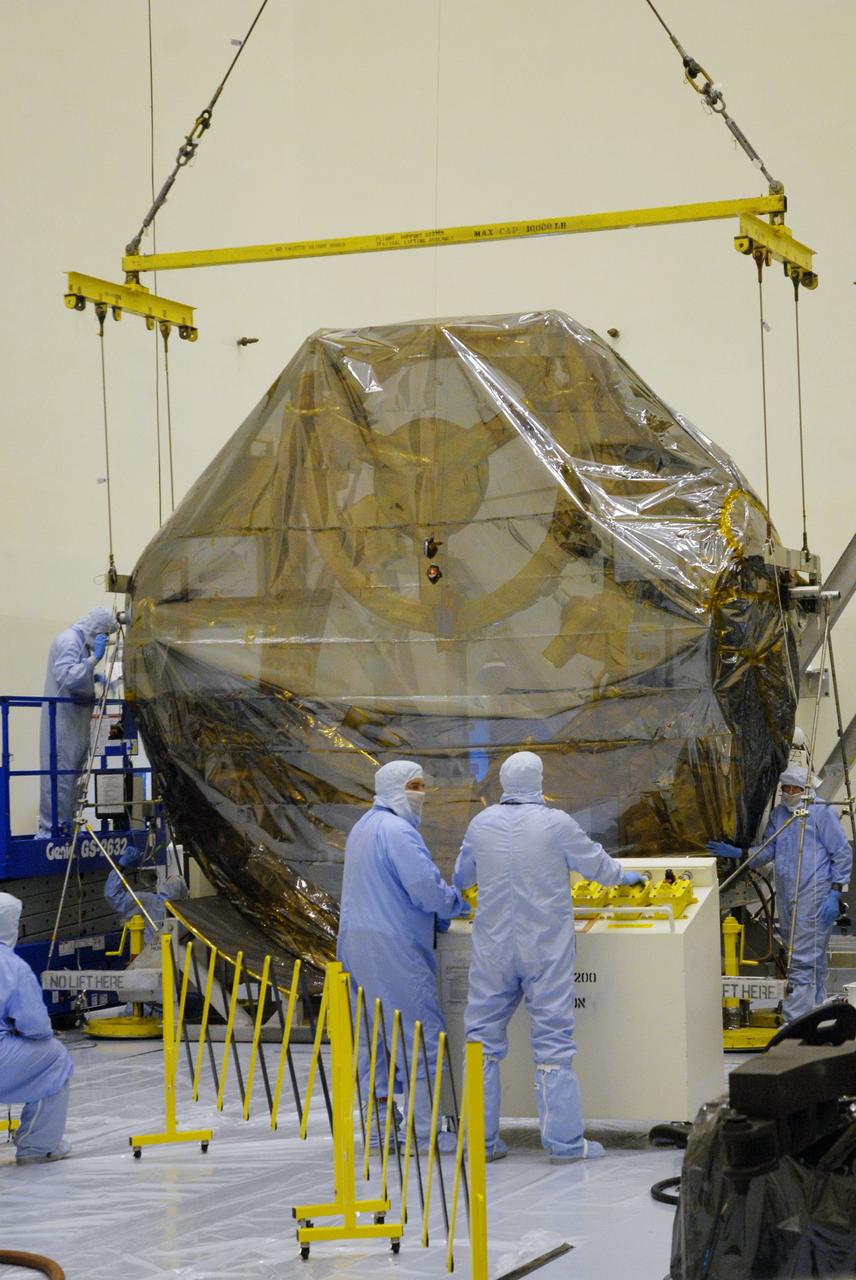
CAPE CANAVERAL, Fla. – In the Payload Hazardous Servicing Facility at NASA's Kennedy Space Center, workers get ready to release the crane that lowered the ground support equipment for the STS-125 Hubble Servicing Mission onto a work stand. The GSE are carriers, or pallets, that will hold equipment in space shuttle Atlantis’ payload bay. Under the protective covering of the carrier can be seen the soft capture mechanism. The carriers will be prepared for the integration of telescope science instruments, both internal and external replacement components, as well as the flight support equipment to be used by the astronauts during the servicing mission. The three payload carriers or pallets are the Flight Support System, the Super Lightweight Interchangeable Carrier and the Orbital Replacement Unit Carrier. At the end of July, a fourth and final carrier, the Multi-Use Lightweight Equipment carrier will join the others in the Payload Hazardous Servicing Facility where the Hubble payload is being prepared for launch. Photo credit: NASA/Cory Huston
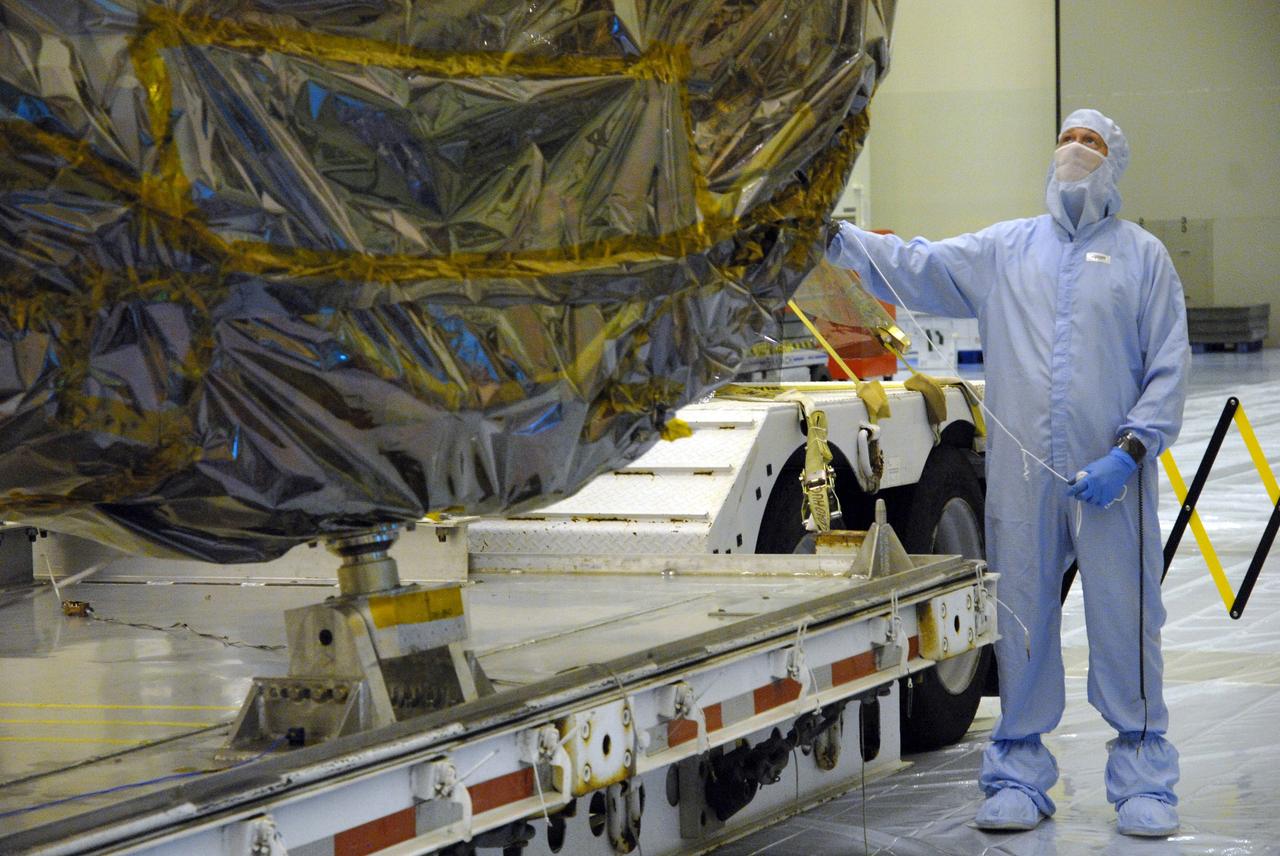
CAPE CANAVERAL, Fla. – In the Payload Hazardous Servicing Facility at NASA's Kennedy Space Center, an overhead crane lifts the newly arrived ground support equipment for the STS-125 Hubble Servicing Mission off its transporter. The GSE are carriers, or pallets, that will hold equipment in space shuttle Atlantis’ payload bay. Under the protective covering of the carrier can be seen the soft capture mechanism. This carrier will be moved to a work stand. The carriers will be prepared for the integration of telescope science instruments, both internal and external replacement components, as well as the flight support equipment to be used by the astronauts during the servicing mission. The three payload carriers or pallets are the Flight Support System, the Super Lightweight Interchangeable Carrier and the Orbital Replacement Unit Carrier. At the end of July, a fourth and final carrier, the Multi-Use Lightweight Equipment carrier will join the others in the Payload Hazardous Servicing Facility where the Hubble payload is being prepared for launch. Photo credit: NASA/Cory Huston
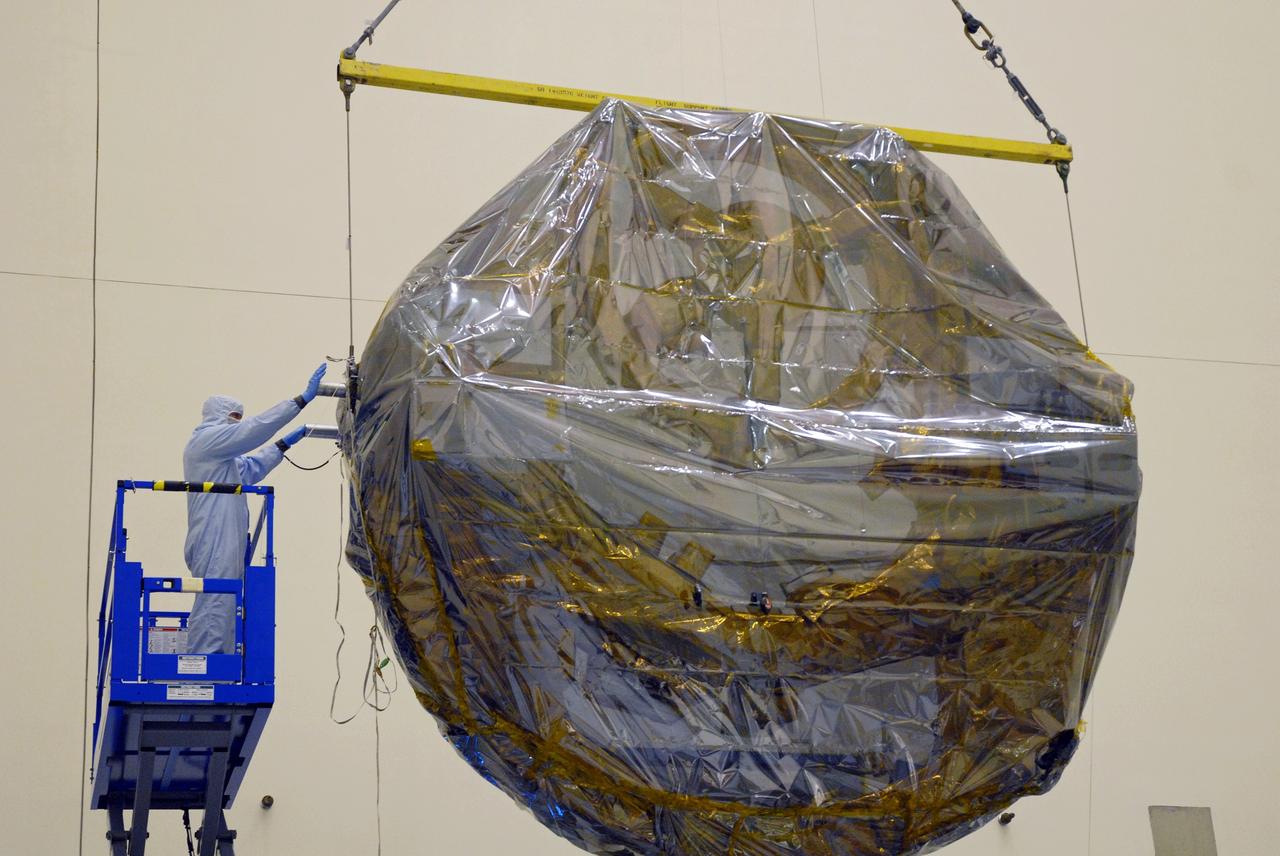
CAPE CANAVERAL, Fla. – In the Payload Hazardous Servicing Facility at NASA's Kennedy Space Center, an overhead crane lifts the newly arrived ground support equipment for the STS-125 Hubble Servicing Mission off its transporter. The GSE are carriers, or pallets, that will hold equipment in space shuttle Atlantis’ payload bay. Under the protective covering of the carrier can be seen the soft capture mechanism. This carrier will be moved to a work stand. The carriers will be prepared for the integration of telescope science instruments, both internal and external replacement components, as well as the flight support equipment to be used by the astronauts during the servicing mission. The three payload carriers or pallets are the Flight Support System, the Super Lightweight Interchangeable Carrier and the Orbital Replacement Unit Carrier. At the end of July, a fourth and final carrier, the Multi-Use Lightweight Equipment carrier will join the others in the Payload Hazardous Servicing Facility where the Hubble payload is being prepared for launch. Photo credit: NASA/Cory Huston
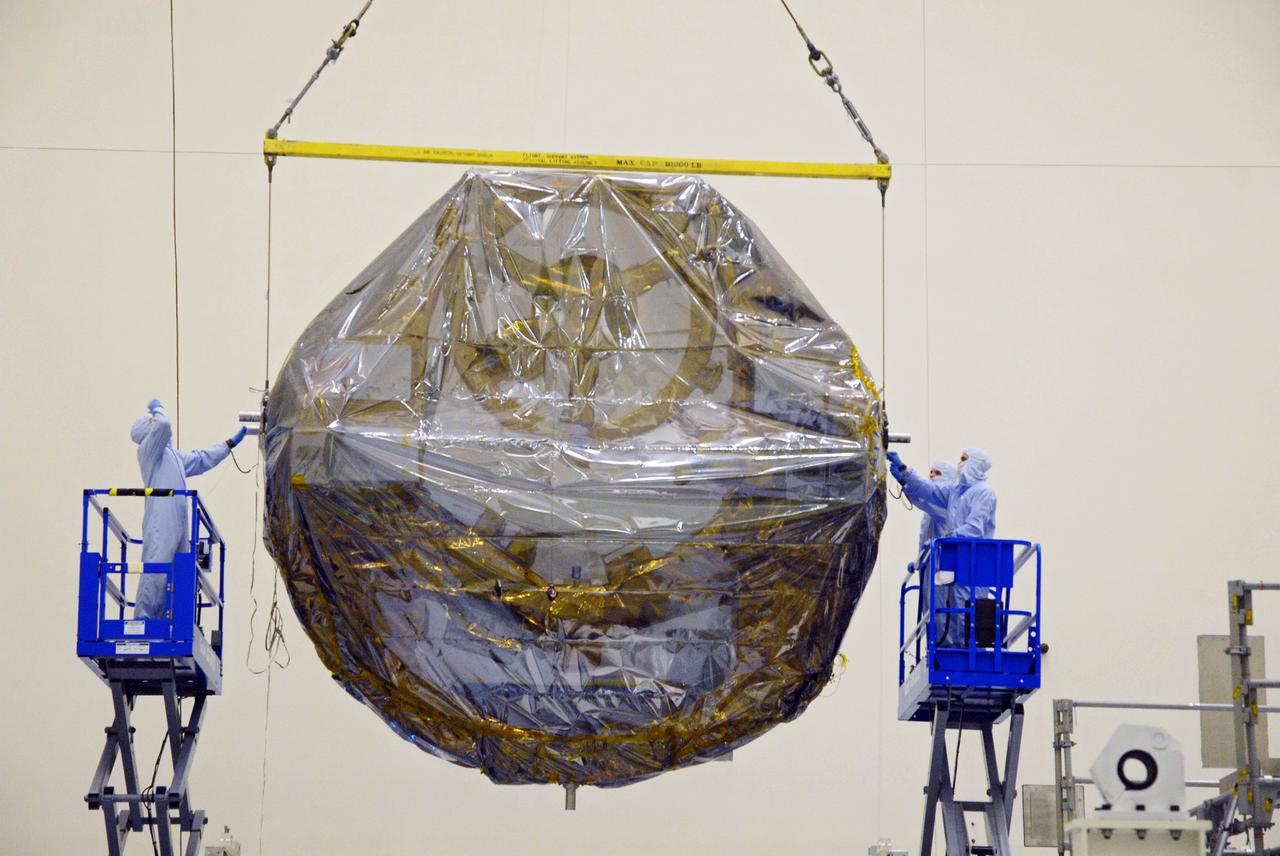
CAPE CANAVERAL, Fla. – In the Payload Hazardous Servicing Facility at NASA's Kennedy Space Center, workers check the attachments on the ground support equipment for the STS-125 Hubble Servicing Mission as it is transferred to a work stand. The GSE are carriers, or pallets, that will hold equipment in space shuttle Atlantis’ payload bay. Under the protective covering of the carrier can be seen the soft capture mechanism. The carriers will be prepared for the integration of telescope science instruments, both internal and external replacement components, as well as the flight support equipment to be used by the astronauts during the servicing mission. The three payload carriers or pallets are the Flight Support System, the Super Lightweight Interchangeable Carrier and the Orbital Replacement Unit Carrier. At the end of July, a fourth and final carrier, the Multi-Use Lightweight Equipment carrier will join the others in the Payload Hazardous Servicing Facility where the Hubble payload is being prepared for launch. Photo credit: NASA/Cory Huston
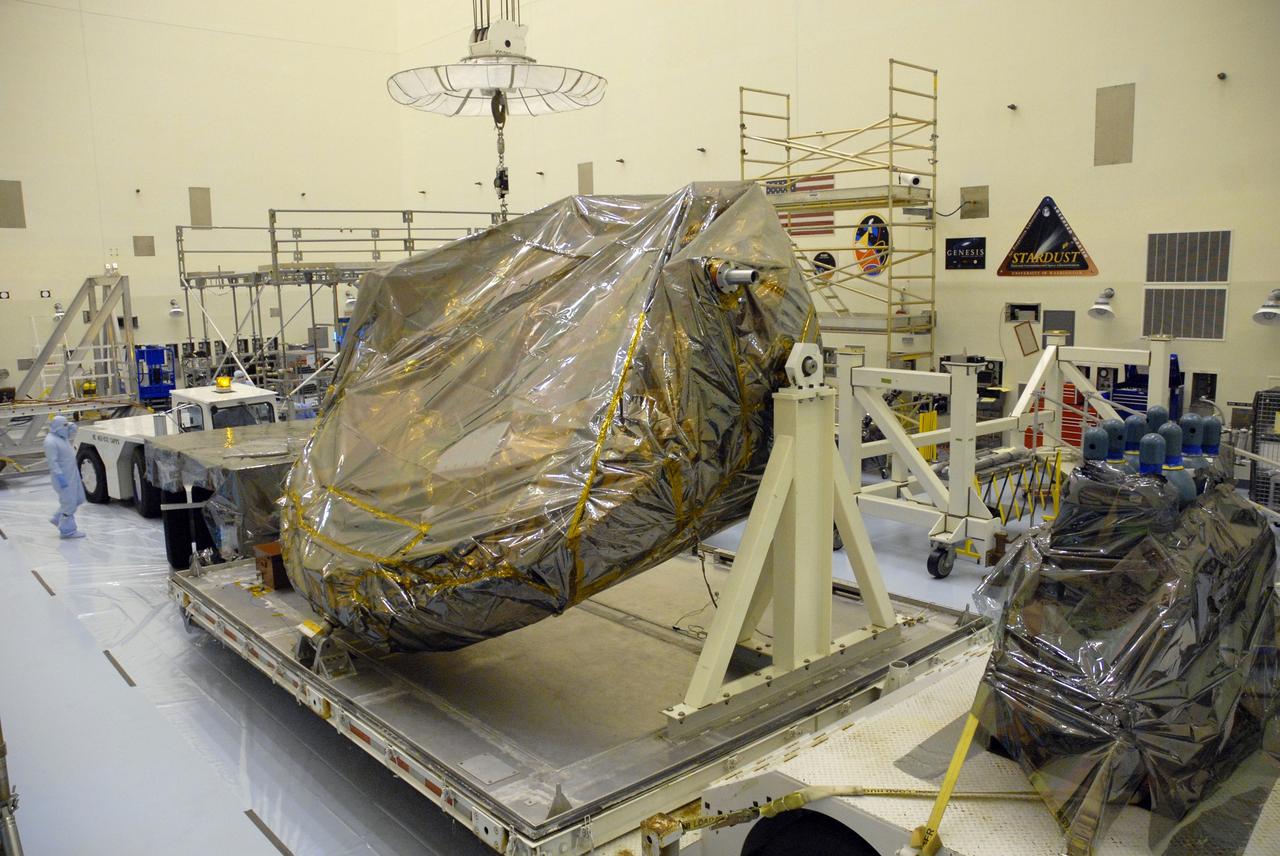
CAPE CANAVERAL, Fla. – In the Payload Hazardous Servicing Facility at NASA's Kennedy Space Center, workers begin to attach a crane to part of the ground support equipment for the STS-125 Hubble Servicing Mission. The GSE are carriers, or pallets, that will hold equipment in space shuttle Atlantis’ payload bay. This carrier will be moved to a work stand. The carriers will be prepared for the integration of telescope science instruments, both internal and external replacement components, as well as the flight support equipment to be used by the astronauts during the servicing mission. The three payload carriers or pallets are the Flight Support System, the Super Lightweight Interchangeable Carrier and the Orbital Replacement Unit Carrier. At the end of July, a fourth and final carrier, the Multi-Use Lightweight Equipment carrier will join the others in the Payload Hazardous Servicing Facility where the Hubble payload is being prepared for launch. Photo credit: NASA/Cory Huston
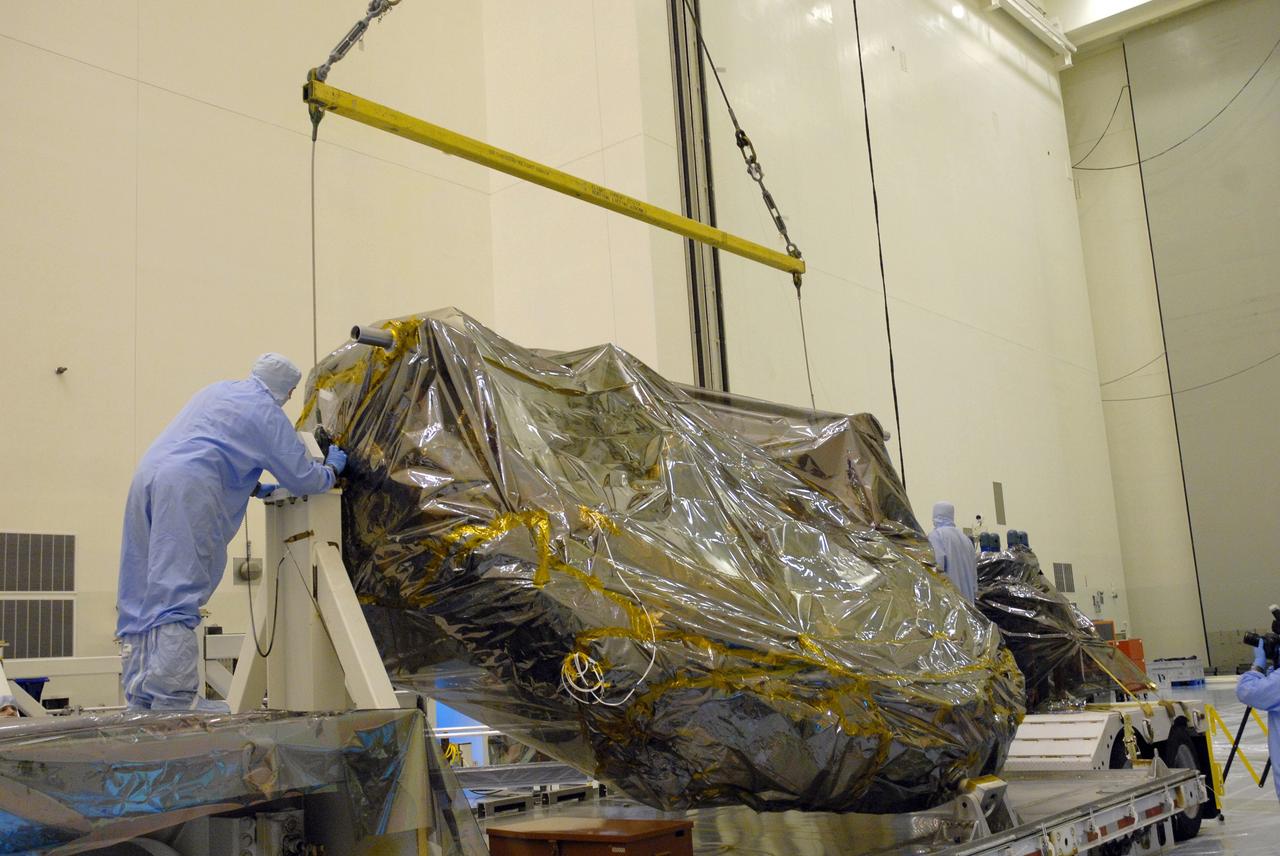
CAPE CANAVERAL, Fla. – In the Payload Hazardous Servicing Facility at NASA's Kennedy Space Center, a worker checks the position of the ground support equipment for the STS-125 Hubble Servicing Mission as it is lifted off the transporter. The GSE are carriers, or pallets, that will hold equipment in space shuttle Atlantis’ payload bay. This carrier will be moved to a work stand. The carriers will be prepared for the integration of telescope science instruments, both internal and external replacement components, as well as the flight support equipment to be used by the astronauts during the servicing mission. The three payload carriers or pallets are the Flight Support System, the Super Lightweight Interchangeable Carrier and the Orbital Replacement Unit Carrier. At the end of July, a fourth and final carrier, the Multi-Use Lightweight Equipment carrier will join the others in the Payload Hazardous Servicing Facility where the Hubble payload is being prepared for launch. Photo credit: NASA/Cory Huston
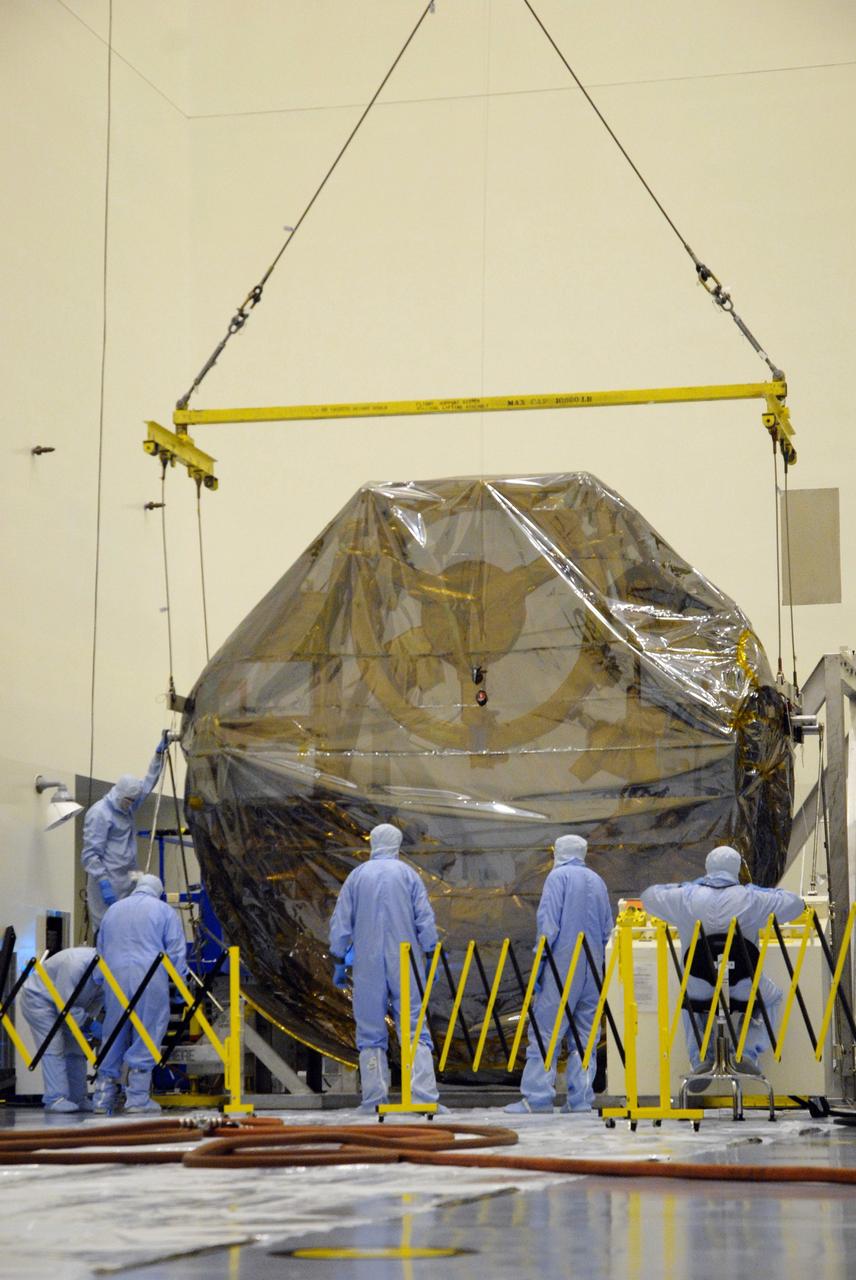
CAPE CANAVERAL, Fla. – In the Payload Hazardous Servicing Facility at NASA's Kennedy Space Center, workers get ready to release the crane that lowered the ground support equipment for the STS-125 Hubble Servicing Mission onto a work stand. The GSE are carriers, or pallets, that will hold equipment in space shuttle Atlantis’ payload bay. Under the protective covering of the carrier can be seen the soft capture mechanism. The carrier will be moved to a work stand. The carriers will be prepared for the integration of telescope science instruments, both internal and external replacement components, as well as the flight support equipment to be used by the astronauts during the servicing mission. The three payload carriers or pallets are the Flight Support System, the Super Lightweight Interchangeable Carrier and the Orbital Replacement Unit Carrier. At the end of July, a fourth and final carrier, the Multi-Use Lightweight Equipment carrier will join the others in the Payload Hazardous Servicing Facility where the Hubble payload is being prepared for launch. Photo credit: NASA/Cory Huston
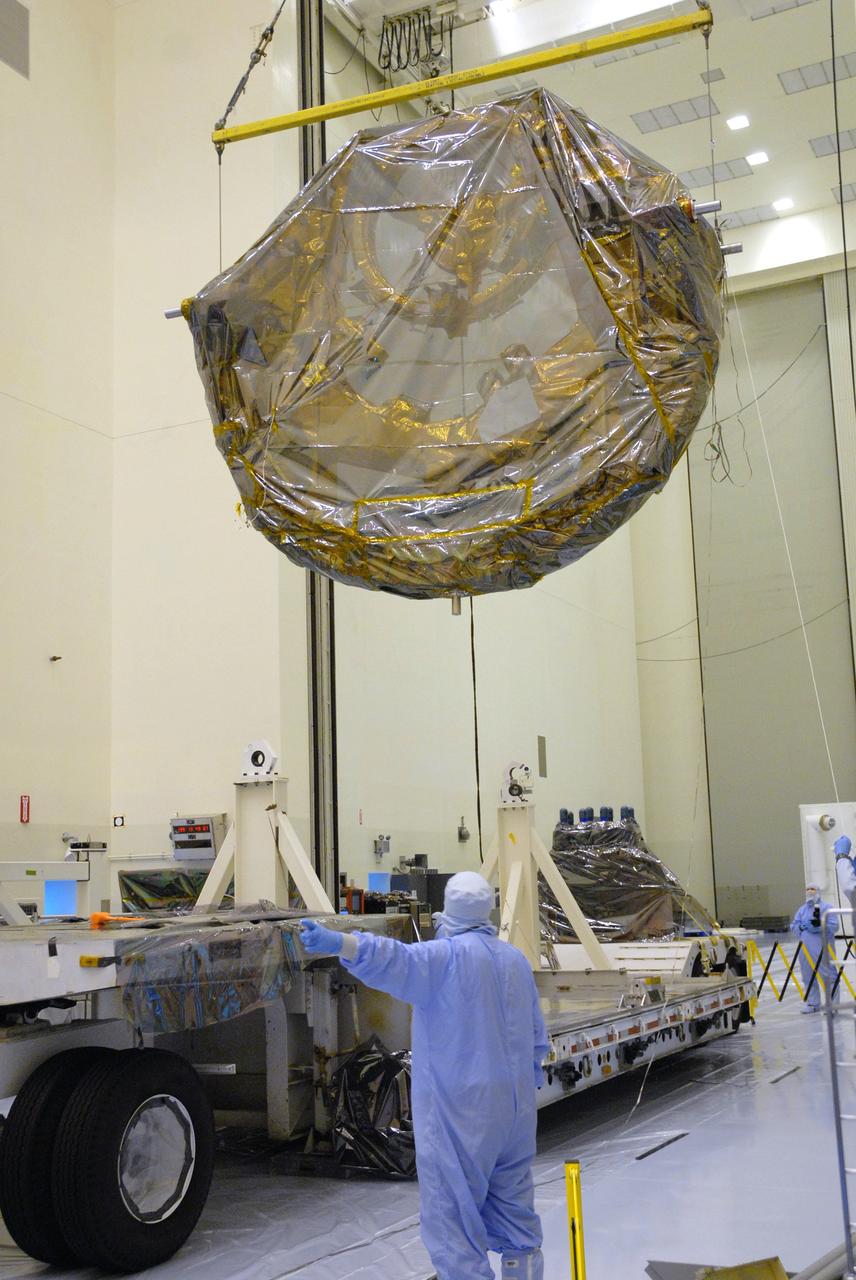
CAPE CANAVERAL, Fla. – Inside the Payload Hazardous Servicing Facility at NASA's Kennedy Space Center, the newly arrived ground support equipment for the STS-125 Hubble Servicing Mission waits to be moved to a work stand. The GSE are carriers, or pallets, that will hold equipment in space shuttle Atlantis’ payload bay. The carriers will be prepared for the integration of telescope science instruments, both internal and external replacement components, as well as the flight support equipment to be used by the astronauts during the servicing mission. The three payload carriers or pallets are the Flight Support System, the Super Lightweight Interchangeable Carrier and the Orbital Replacement Unit Carrier. At the end of July, a fourth and final carrier, the Multi-Use Lightweight Equipment carrier will join the others in the Payload Hazardous Servicing Facility where the Hubble payload is being prepared for launch. Photo credit: NASA/Cory Huston
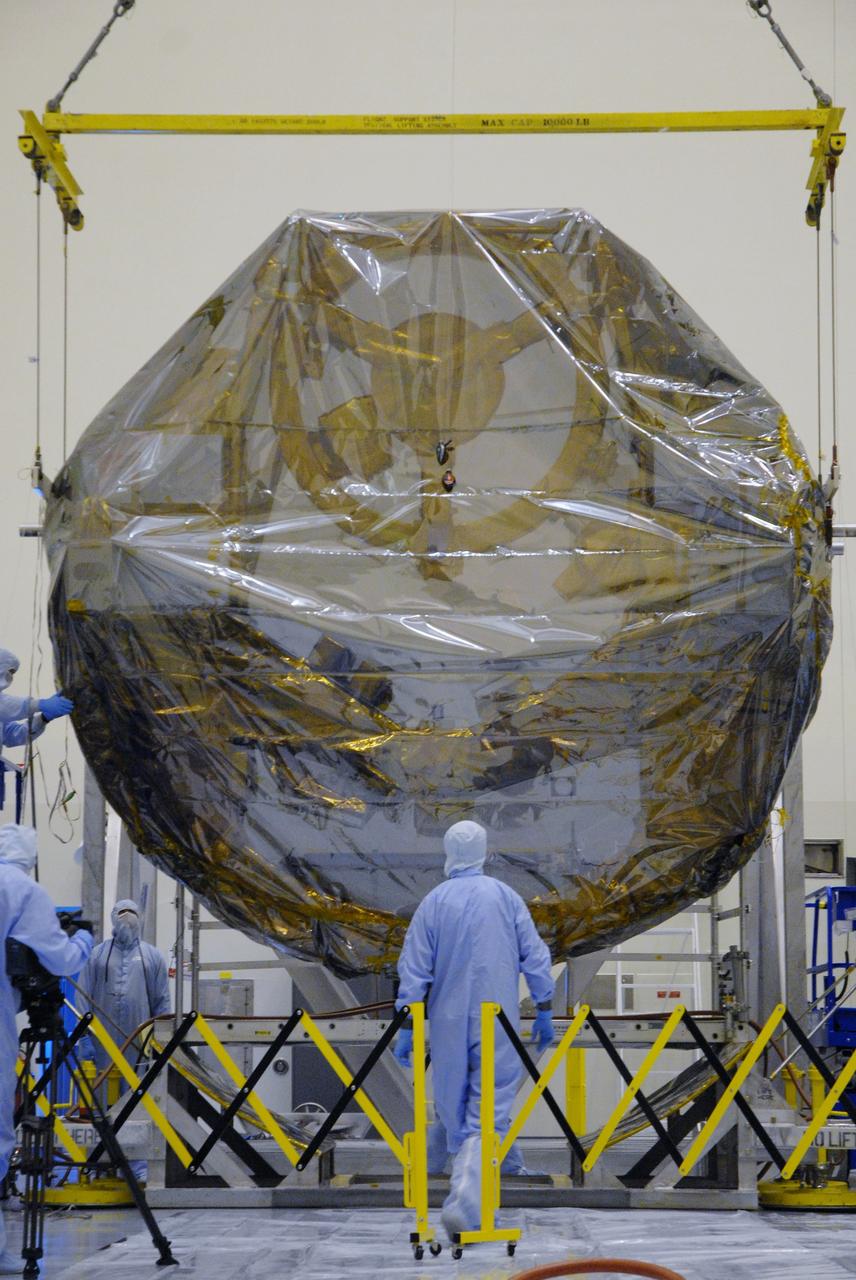
CAPE CANAVERAL, Fla. – In the Payload Hazardous Servicing Facility at NASA's Kennedy Space Center, the overhead crane lowers the ground support equipment for the STS-125 Hubble Servicing Mission toward a work stand. The GSE are carriers, or pallets, that will hold equipment in space shuttle Atlantis’ payload bay. Under the protective covering of the carrier can be seen the soft capture mechanism. The carriers will be prepared for the integration of telescope science instruments, both internal and external replacement components, as well as the flight support equipment to be used by the astronauts during the servicing mission. The three payload carriers or pallets are the Flight Support System, the Super Lightweight Interchangeable Carrier and the Orbital Replacement Unit Carrier. At the end of July, a fourth and final carrier, the Multi-Use Lightweight Equipment carrier will join the others in the Payload Hazardous Servicing Facility where the Hubble payload is being prepared for launch. Photo credit: NASA/Cory Huston
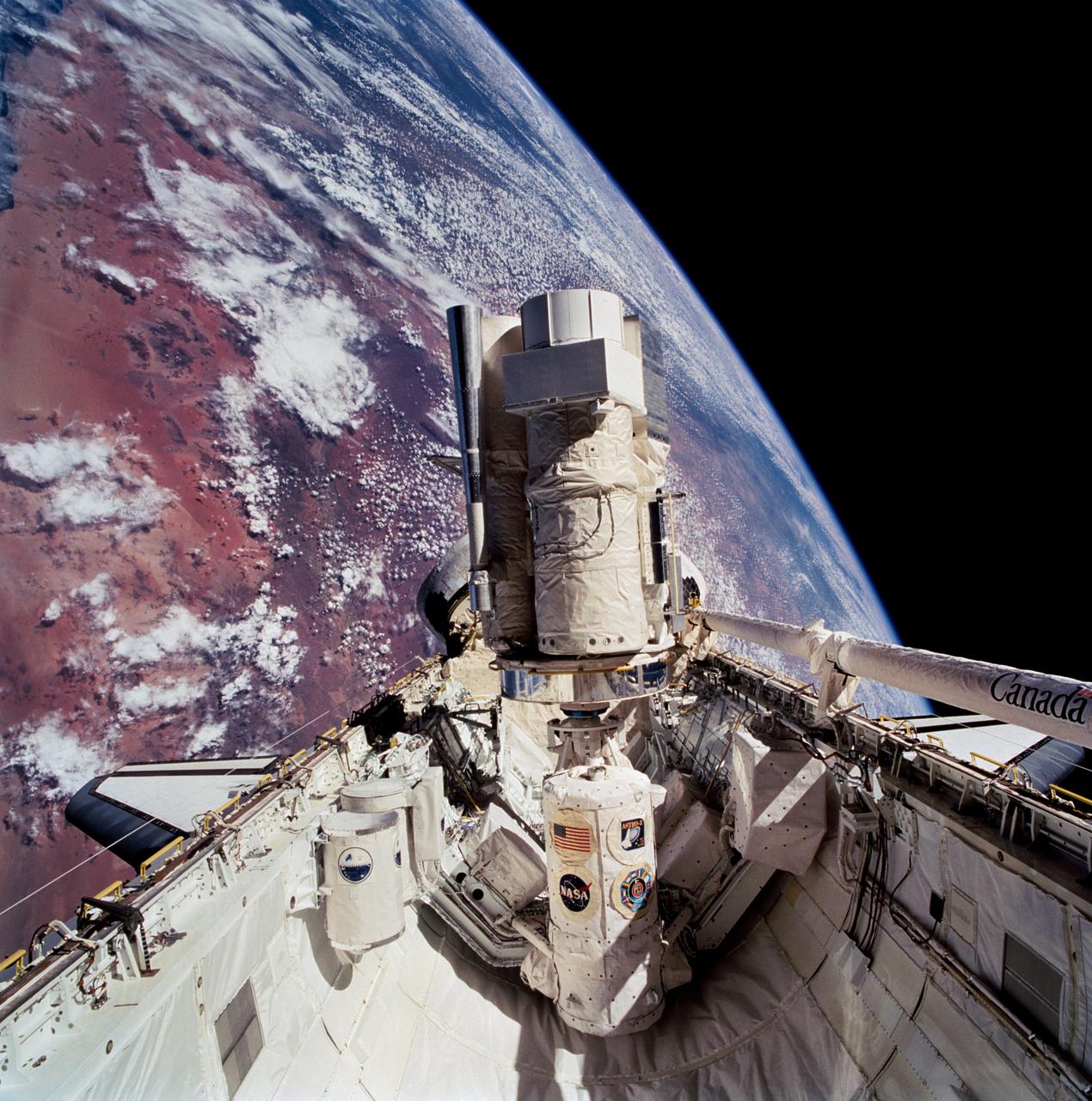
STS067-713-072 (2-18 March 1995) --- This 70mm cargo bay scene, backdropped against a desert area of Namibia, typifies the view that daily greeted the Astro-2 crew members during their almost 17-days aboard the Space Shuttle Endeavour. Positioned on the Spacelab pallet amidst other hardware, the Astro-2 payload is in its operational mode. Visible here are the Instrument Pointing System (IPS), Hopkins Ultraviolet Telescope (HUT), Star Tracker (ST), Ultraviolet Imaging Telescope (UIT), Wisconsin Ultraviolet Photo-Polarimeter Experiment (WUPPE), and Integrated Radiator System (IRS). At this angle, the Optical Sensor Package (OPS) is not seen. The Igloo, which supports the package of experiments, is in center foreground. Two Get-Away Special (GAS) canisters are in lower left foreground. The Extended Duration Orbiter (EDO) pallet, located aft of the cargo bay, is obscured by the Astro-2 payload. The Endeavour was 190 nautical miles above Earth.
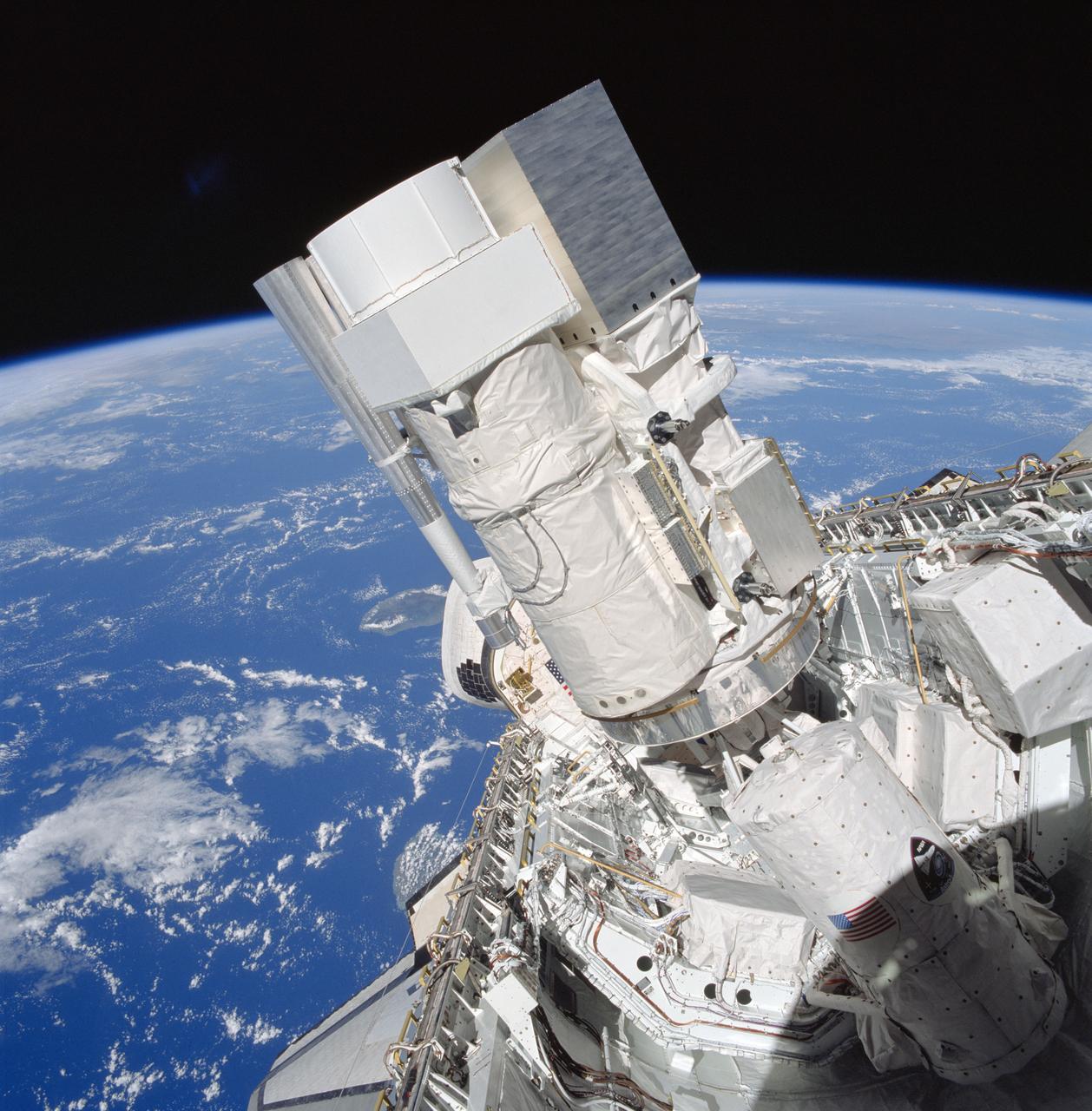
STS035-604-058 (2-10 Dec 1990) --- The various components of the Astro-1 payload are seen backdropped against the blue and white Earth in this scene photographed through Columbia's aft flight deck windows. Parts of the Hopkins Ultraviolet Telescope (HUT), Ultraviolet Imaging Telescope (UIT) and the Wisconsin Ultraviolet Photopolarimetry Experiment (WUPPE) are visible on the Spacelab pallet in the foreground. The Broad Band X-ray Telescope (BBXRT) is behind this pallet and is not visible in this scene. The smaller cylinder in the foreground is the "Igloo," which is a pressurized container housing the Command and Data Management System, which interfaces with the in-cabin controllers to control the Instrument Pointing System (IPS) and the telescopes. The photograph was made with a handheld Rolleiflex camera aimed through Columbia's aft flight deck windows.
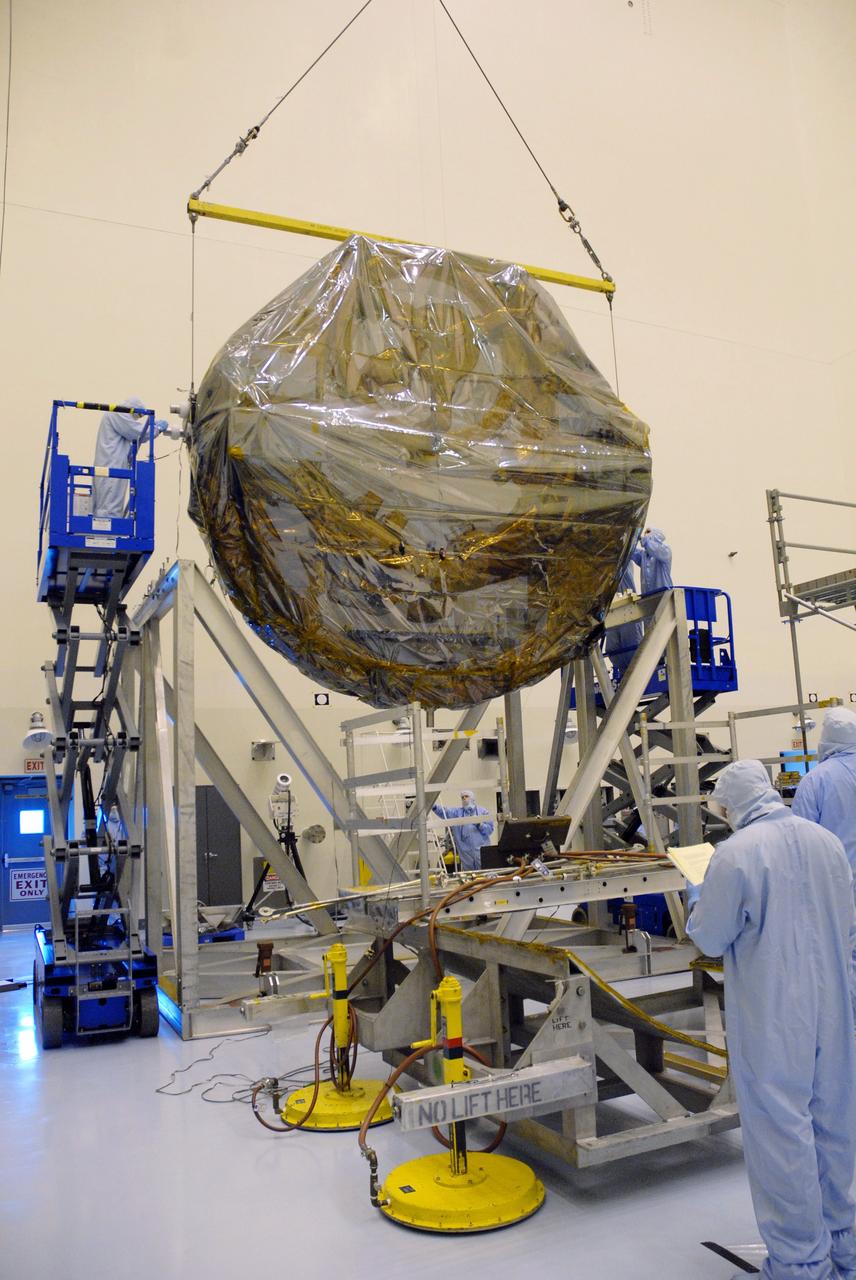
CAPE CANAVERAL, Fla. – In the Payload Hazardous Servicing Facility at NASA's Kennedy Space Center, the overhead crane lowers the newly arrived ground support equipment for the STS-125 Hubble Servicing Mission toward a thermal vacuum fixture. The GSE are carriers, or pallets, that will hold equipment in space shuttle Atlantis’ payload bay. Under the protective covering of the carrier can be seen the soft capture mechanism. The carriers will be prepared for the integration of telescope science instruments, both internal and external replacement components, as well as the flight support equipment to be used by the astronauts during the servicing mission. The three payload carriers or pallets are the Flight Support System, the Super Lightweight Interchangeable Carrier and the Orbital Replacement Unit Carrier. At the end of July, a fourth and final carrier, the Multi-Use Lightweight Equipment carrier will join the others in the Payload Hazardous Servicing Facility where the Hubble payload is being prepared for launch. Photo credit: NASA/Cory Huston
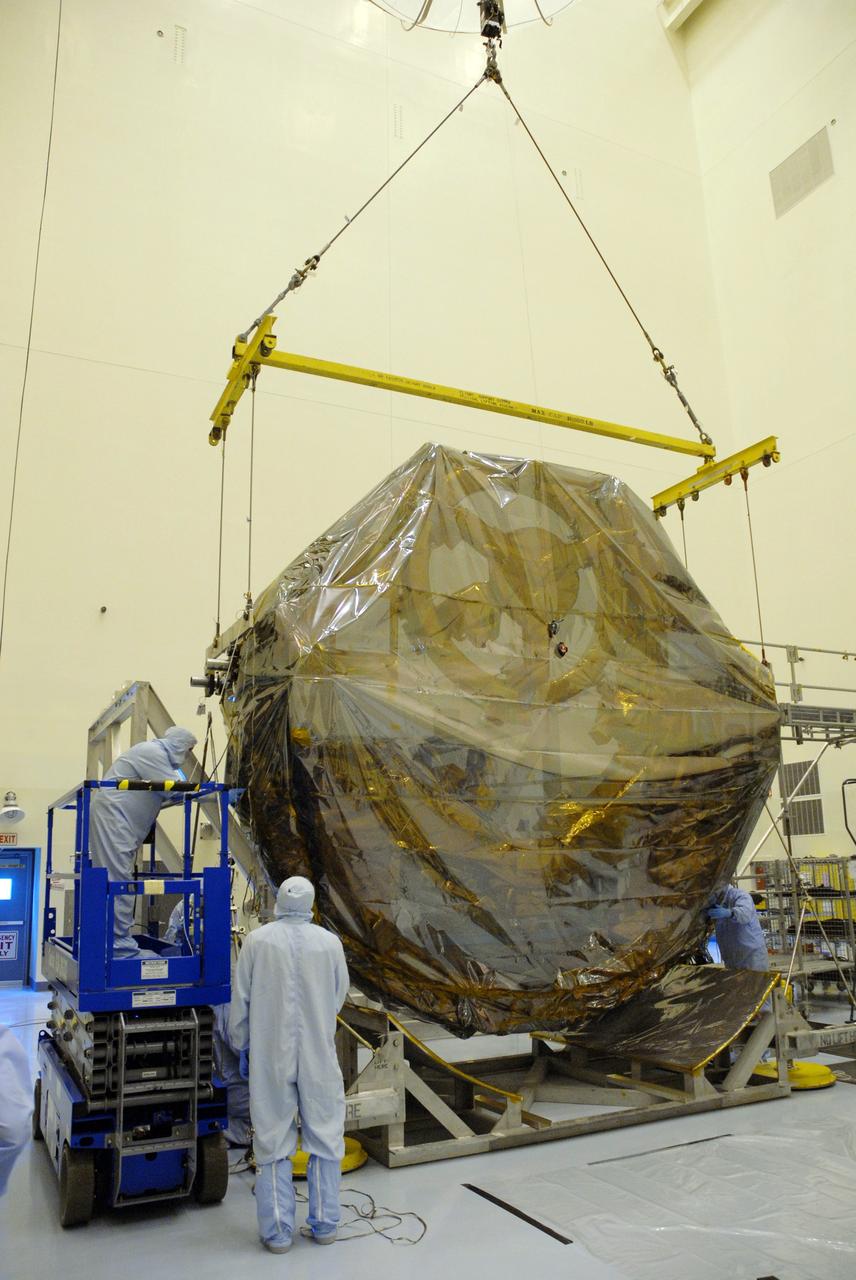
CAPE CANAVERAL, Fla. – In the Payload Hazardous Servicing Facility at NASA's Kennedy Space Center, the overhead crane lowers the ground support equipment for the STS-125 Hubble Servicing Mission onto a work stand. The GSE are carriers, or pallets, that will hold equipment in space shuttle Atlantis’ payload bay. Under the protective covering of the carrier can be seen the soft capture mechanism. The carriers will be prepared for the integration of telescope science instruments, both internal and external replacement components, as well as the flight support equipment to be used by the astronauts during the servicing mission. The three payload carriers or pallets are the Flight Support System, the Super Lightweight Interchangeable Carrier and the Orbital Replacement Unit Carrier. At the end of July, a fourth and final carrier, the Multi-Use Lightweight Equipment carrier will join the others in the Payload Hazardous Servicing Facility where the Hubble payload is being prepared for launch. Photo credit: NASA/Cory Huston
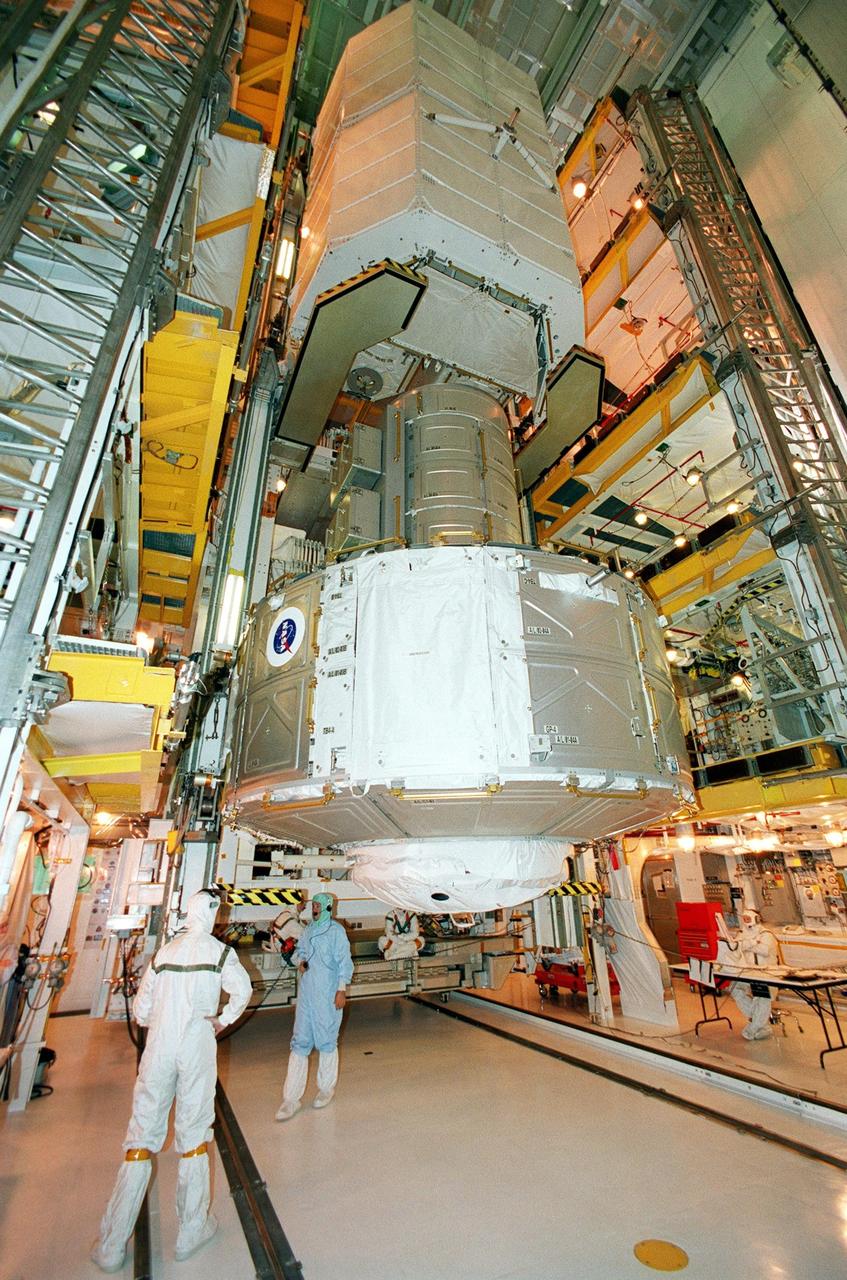
KENNEDY SPACE CENTER, Fla. -- In the Payload Changeout Room, Launch Pad 39B, the Joint Airlock Module (below) and Space Lab Double Pallet (above) are moved into the payload bay of Space Shuttle Atlantis for mission STS-104. The pallet contains two oxygen and two nitrogen High-Pressure Gas Tanks, which will be attached externally to the airlock during two of the STS-104 spacewalks. Once installed and activated, the airlock becomes the primary path for International Space Station spacewalk entry and departure using U.S. spacesuits, which are known as Extravehicular Mobility Units, or EMUs. In addition, the Joint Airlock is designed to support the Russian Orlan spacesuit for EVA activity. Launch of Atlantis is scheduled no earlier than July 12 at 5:04 a.m. EDT
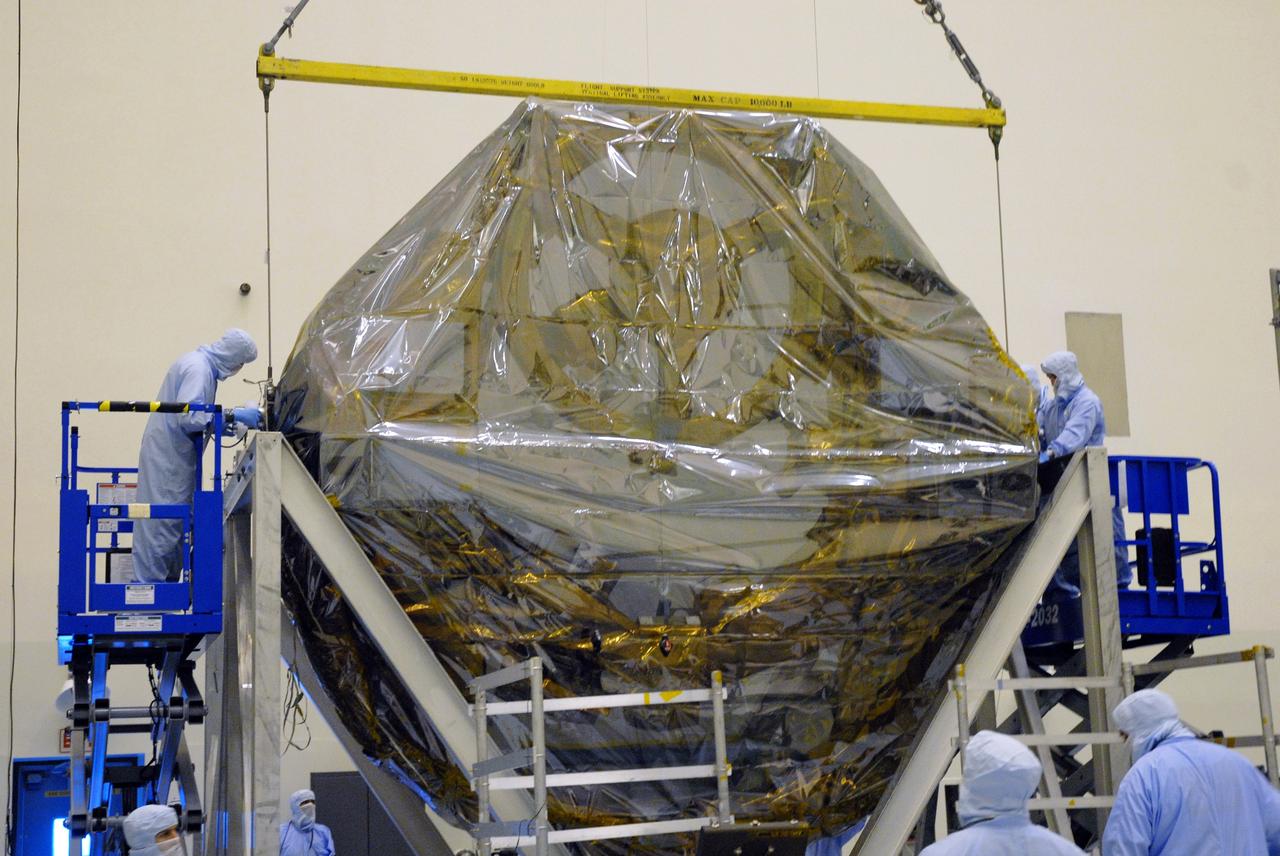
CAPE CANAVERAL, Fla. – In the Payload Hazardous Servicing Facility at NASA's Kennedy Space Center, the overhead crane lowers the ground support equipment for the STS-125 Hubble Servicing Mission into a thermal vacuum fixture. The GSE are carriers, or pallets, that will hold equipment in space shuttle Atlantis’ payload bay. Under the protective covering of the carrier can be seen the soft capture mechanism. The carriers will be prepared for the integration of telescope science instruments, both internal and external replacement components, as well as the flight support equipment to be used by the astronauts during the servicing mission. The three payload carriers or pallets are the Flight Support System, the Super Lightweight Interchangeable Carrier and the Orbital Replacement Unit Carrier. At the end of July, a fourth and final carrier, the Multi-Use Lightweight Equipment carrier will join the others in the Payload Hazardous Servicing Facility where the Hubble payload is being prepared for launch. Photo credit: NASA/Cory Huston