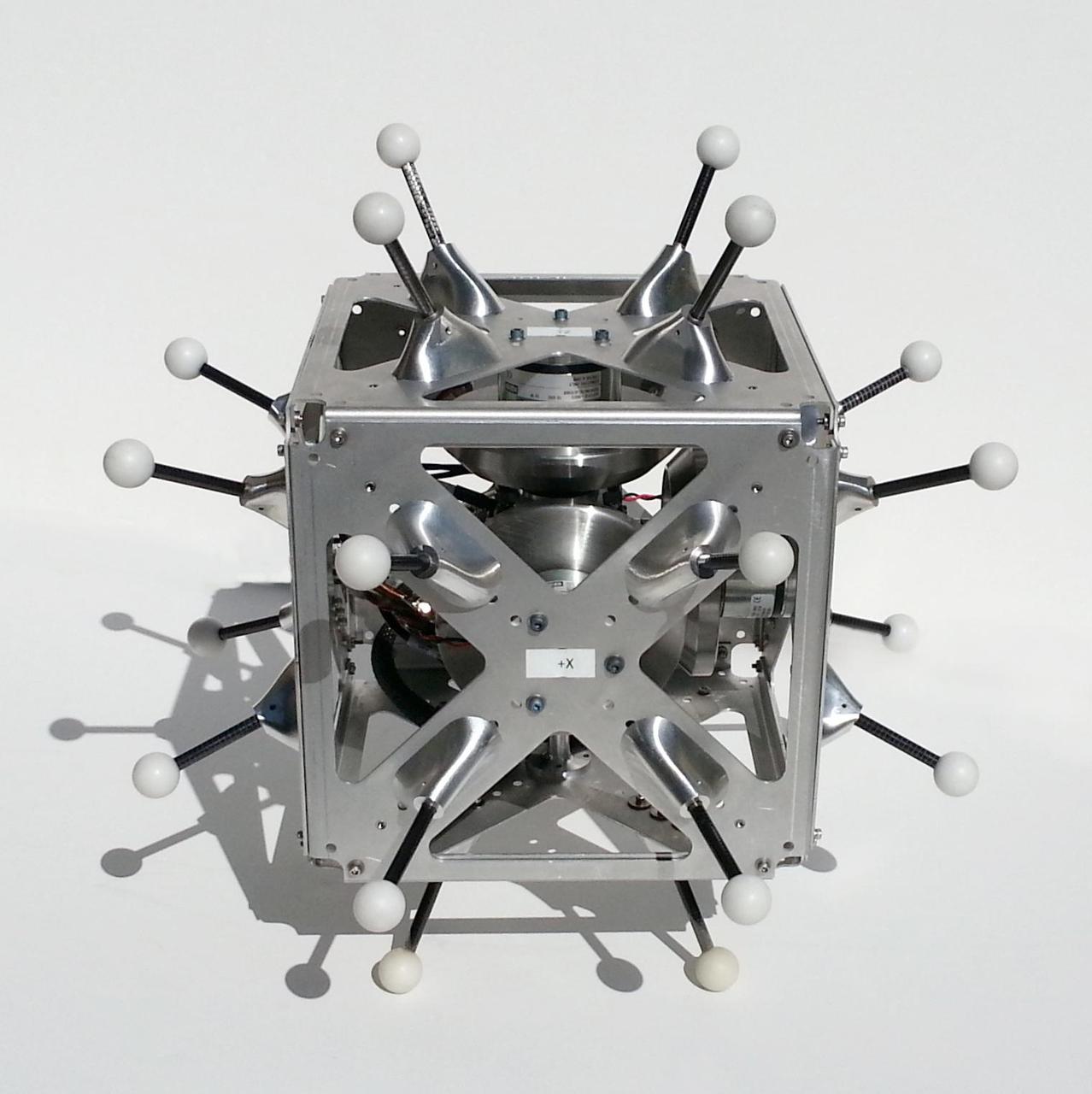
This is a hopping/tumbling robot called Hedgehog that scientists at NASA Jet Propulsion Laboratory will test on a parabolic aircraft flight.
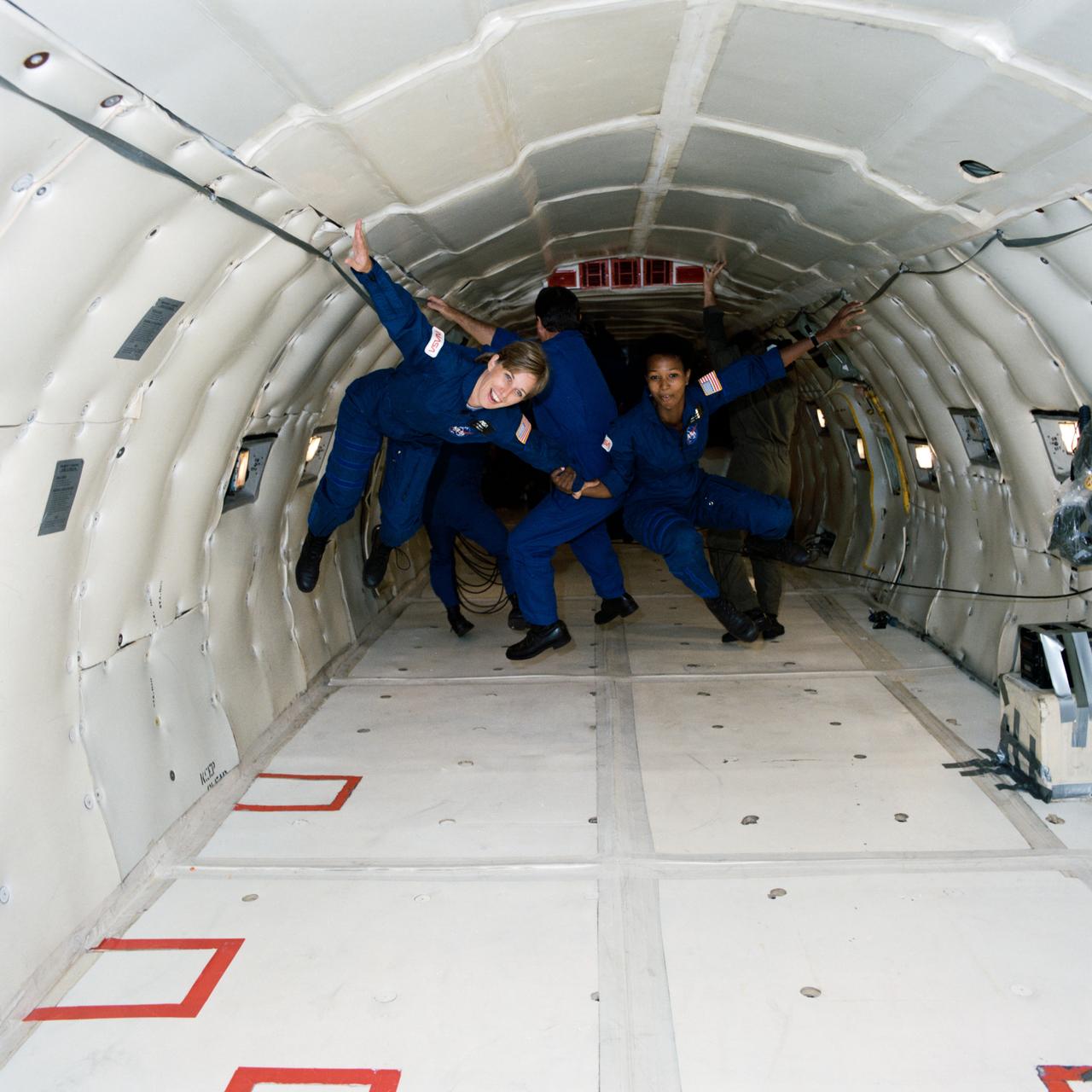
S87-44950 --- Group 12, 1987 Astronaut Class, candidates (ASCANs) N. Jan Davis (left) and Mae C. Jemison freefloat during the seconds of microgravity created aboard the KC-135 NASA 930 aircraft's parabolic flight. Davis and Jemison, two of the recently-named ASCANs, were taking a familiarization flight aboard the KC-135 "zero gravity" aircraft. Photo credit: NASA
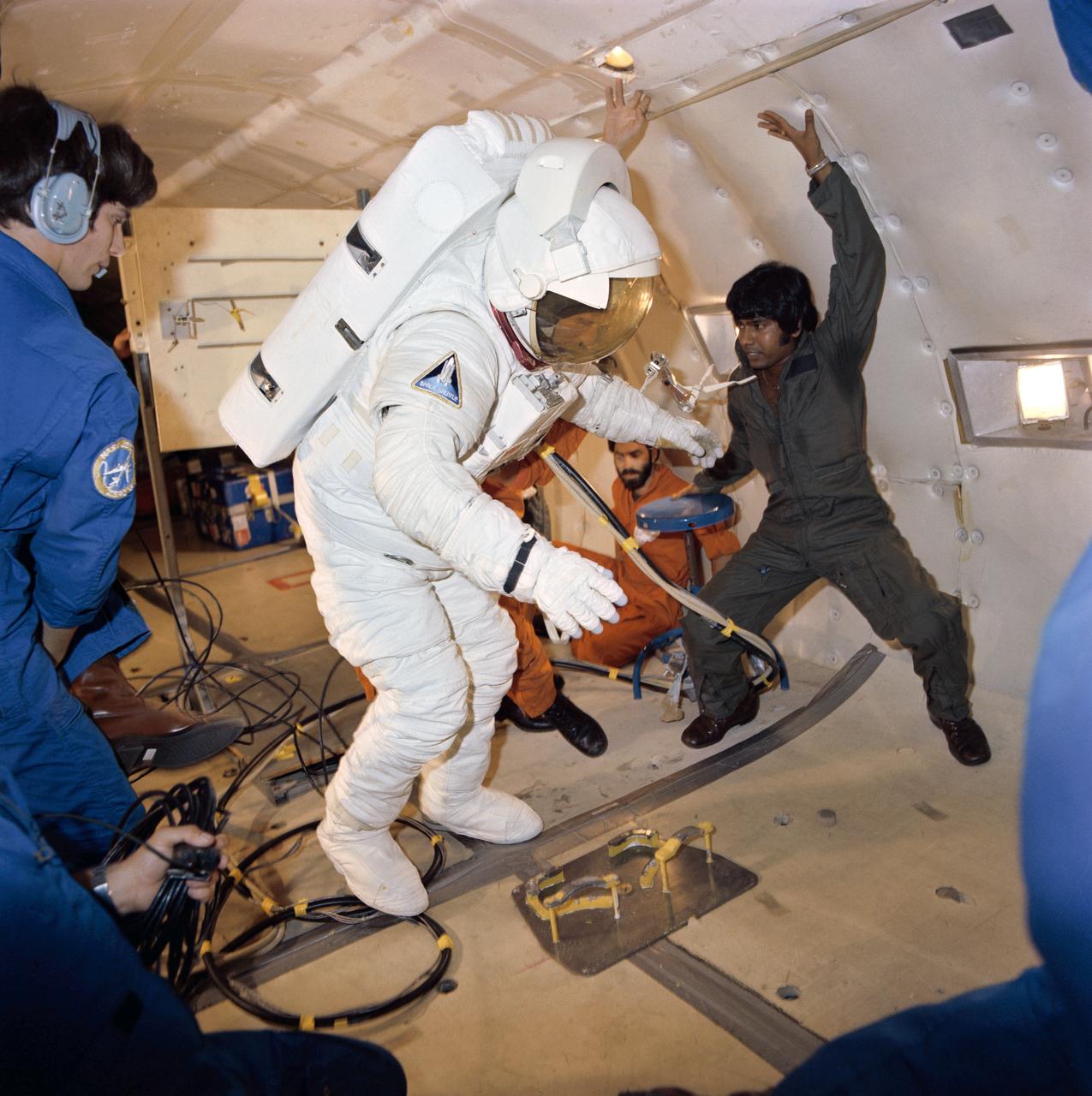
S81-34448 (July 1981) --- Astronaut C. Gordon Fullerton, STS-3 pilot, fully suited, gets a preview of what it might be like in space during a flight aboard NASA's KC-135 "zero-gravity" aircraft. A special parabolic pattern flown the aircraft provides short periods of weightlessness. Fullerton's suit is an Extravehicular Mobility Unit (EMU), used by astronauts when leaving the shirt-sleeve environment of their shuttle orbiter to go outside perform tasks in space. There are no such EVA plans on STS-3, but crew members are trained in this area in the event of the necessity to perform chores in space that for some reason or other can't be done remotely. The astronaut has just donned his suit during a parabola and now takes the opportunity to float around in the absence of gravity. Photo credit: NASA
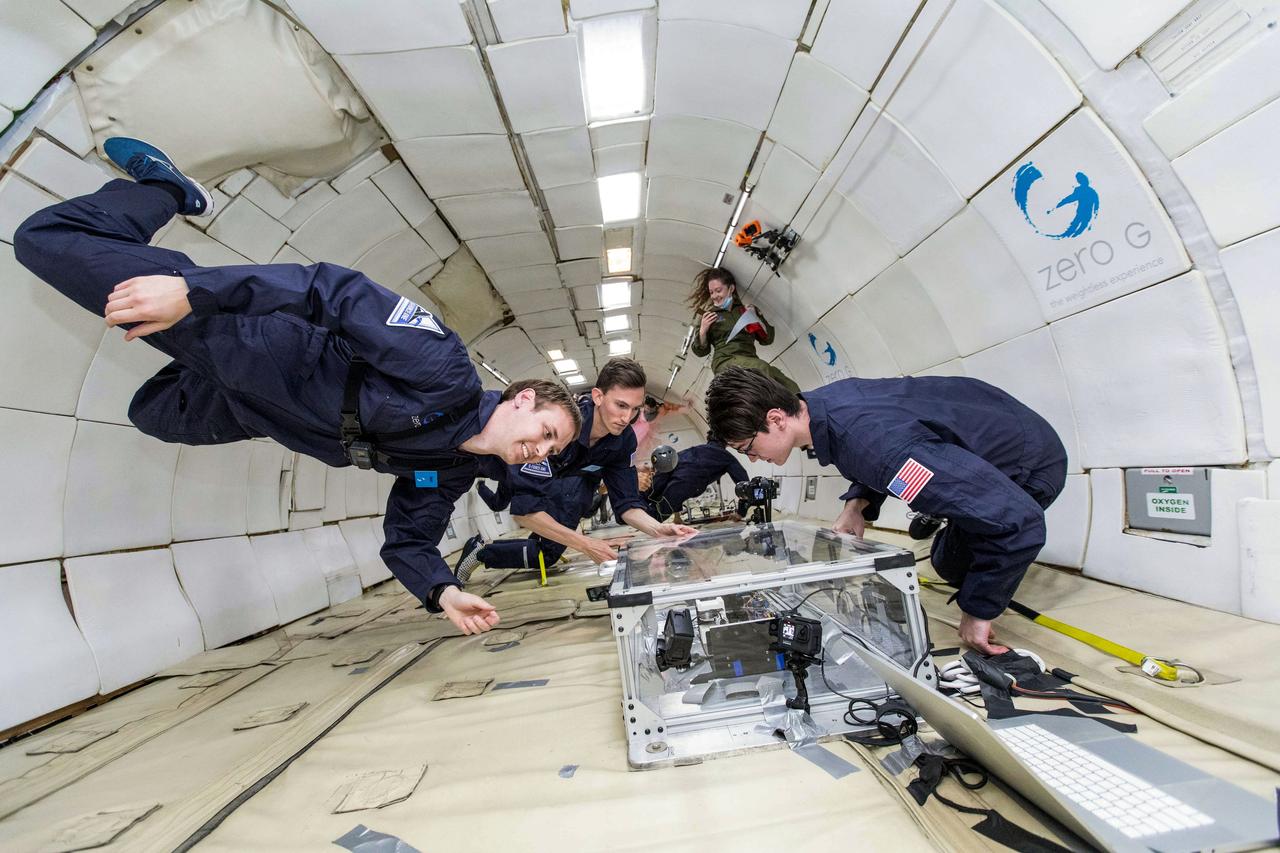
jsc2022e083566 (5/20/2022) --- The MIT Space Exploration Initiative team tests an early Extrusion payload hardware model on a parabolic flight in May 2021. Image courtesy of the MIT Space Exploration Initiative
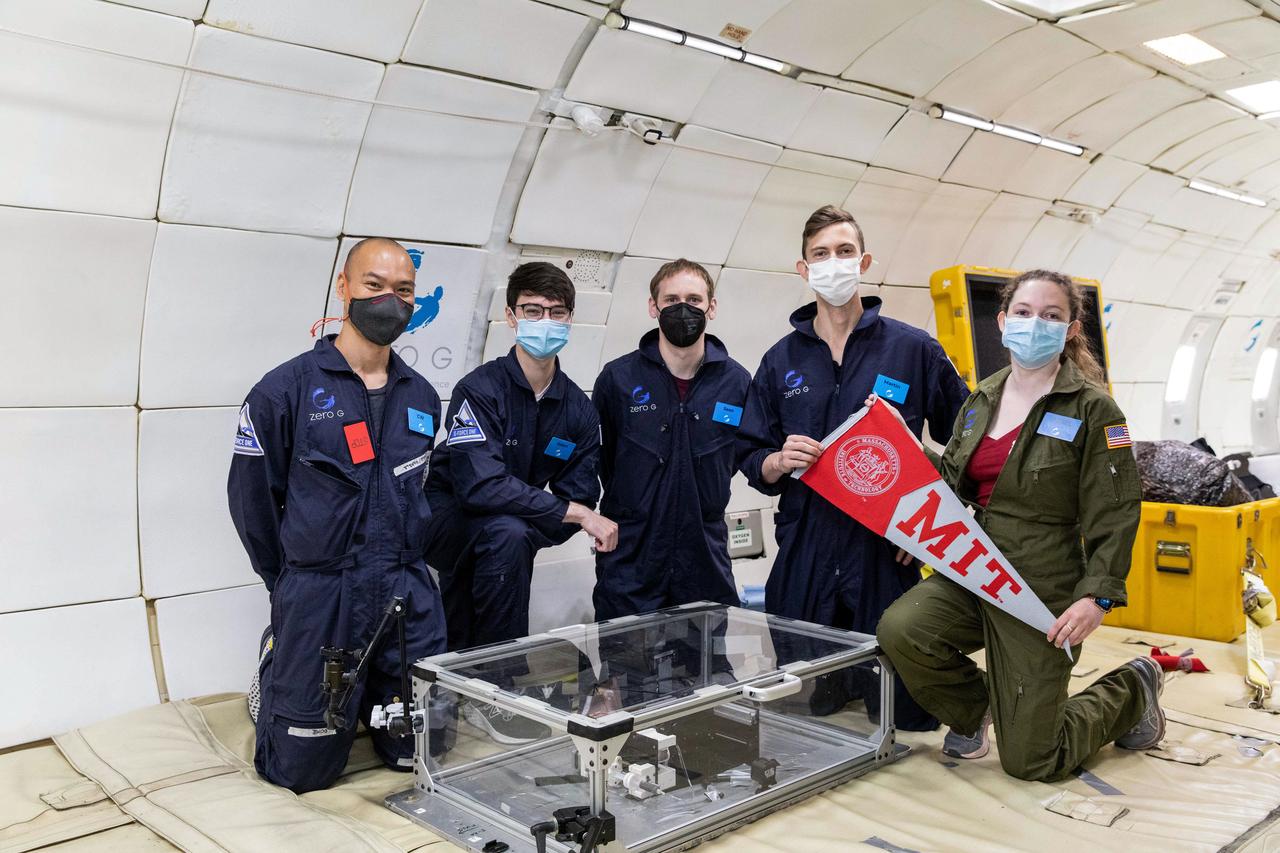
jsc2022e083565 (5/20/2022) --- The MIT Space Exploration Initiative team prior to an Extrusion payload flight test on a parabolic flight in May 2021. Left to Right: Che-Wei Wang, Aiden Padilla, Sean Auffinger, Martin Nisser, and Ariel Ekblaw. Image courtesy of the MIT Space Exploration Initiative.
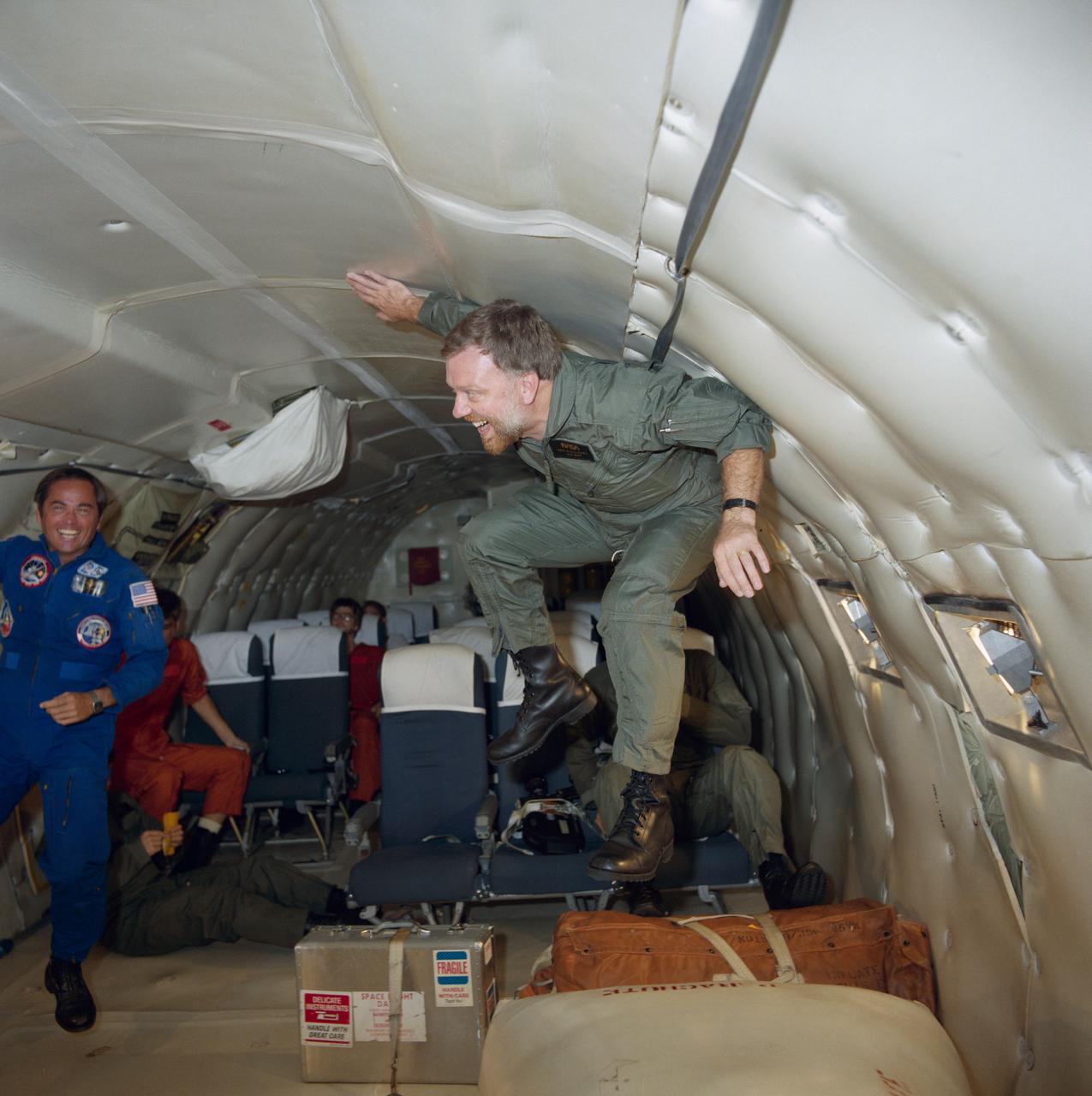
S84-37536 (18 July 1984) --- Astronaut Robert L. Crippen, left, 41-G crew commander watches as one of his fellow crewmembers gets an introduction to weightlessness aboard a KC-135, "zero-gravity" aircraft. Paul D. Scully-Power is the crew member literally floating here in the brief period of micro-gravity. Scully-Power, an oceanographer with the U.S. Navy, and Marc Garneau (partially visible in chair behind the floating Scully-Power)are payload specialists for 41-G. Garneau represents the National Research Council (Canada).
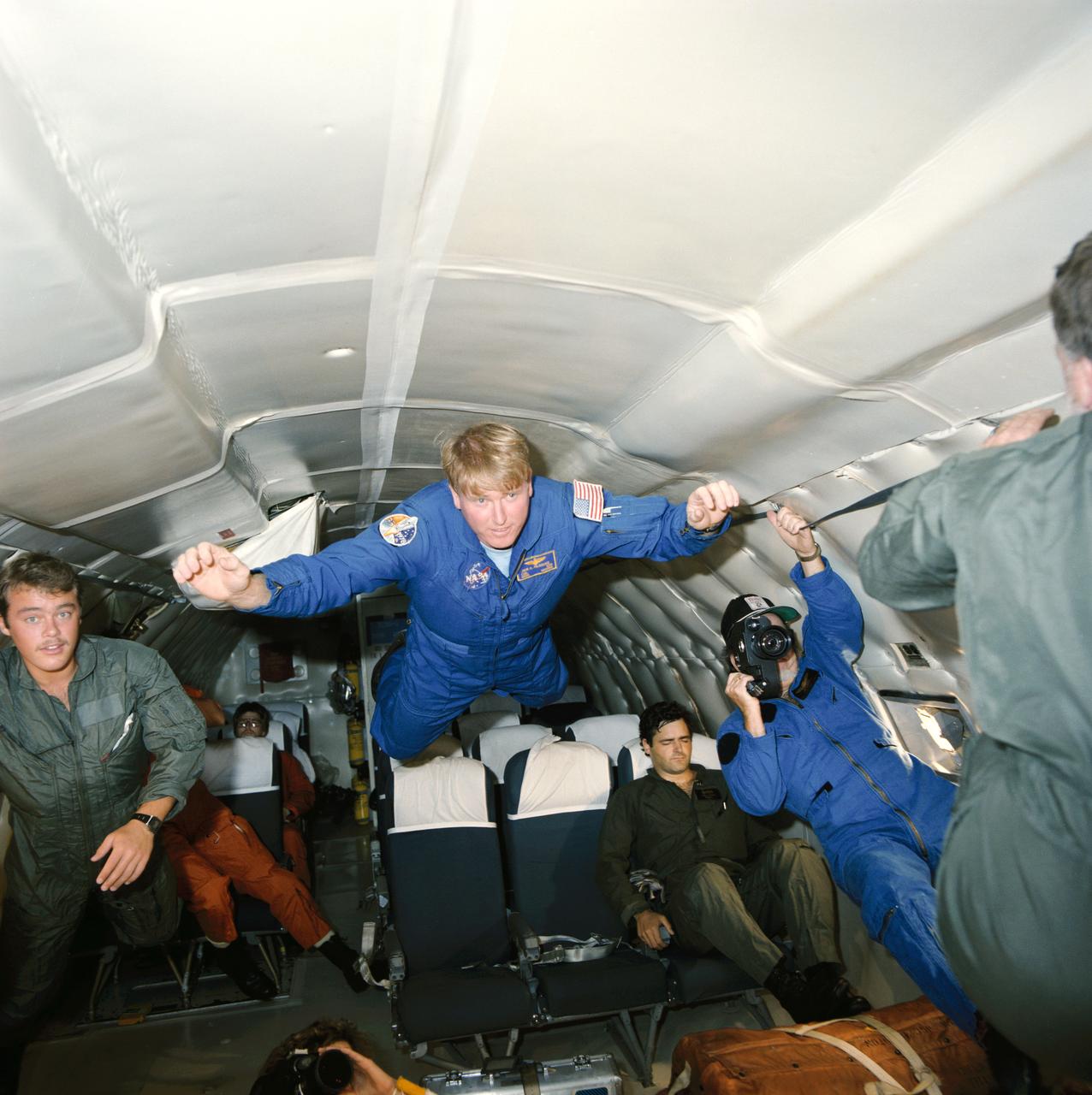
S84-37522 (18 July 1984) --- Astronaut Jon A. McBride, center, floats briefly aboard a NASA KC-135 aircraft during a flight designed as part of the training program for 41-G's seven crewmembers. McBride is pilot for that October 1984 flight. Marc Garneau, one of two payload specialists for the mission, is seated at right. Garneau represents the National Research Council of Canada.
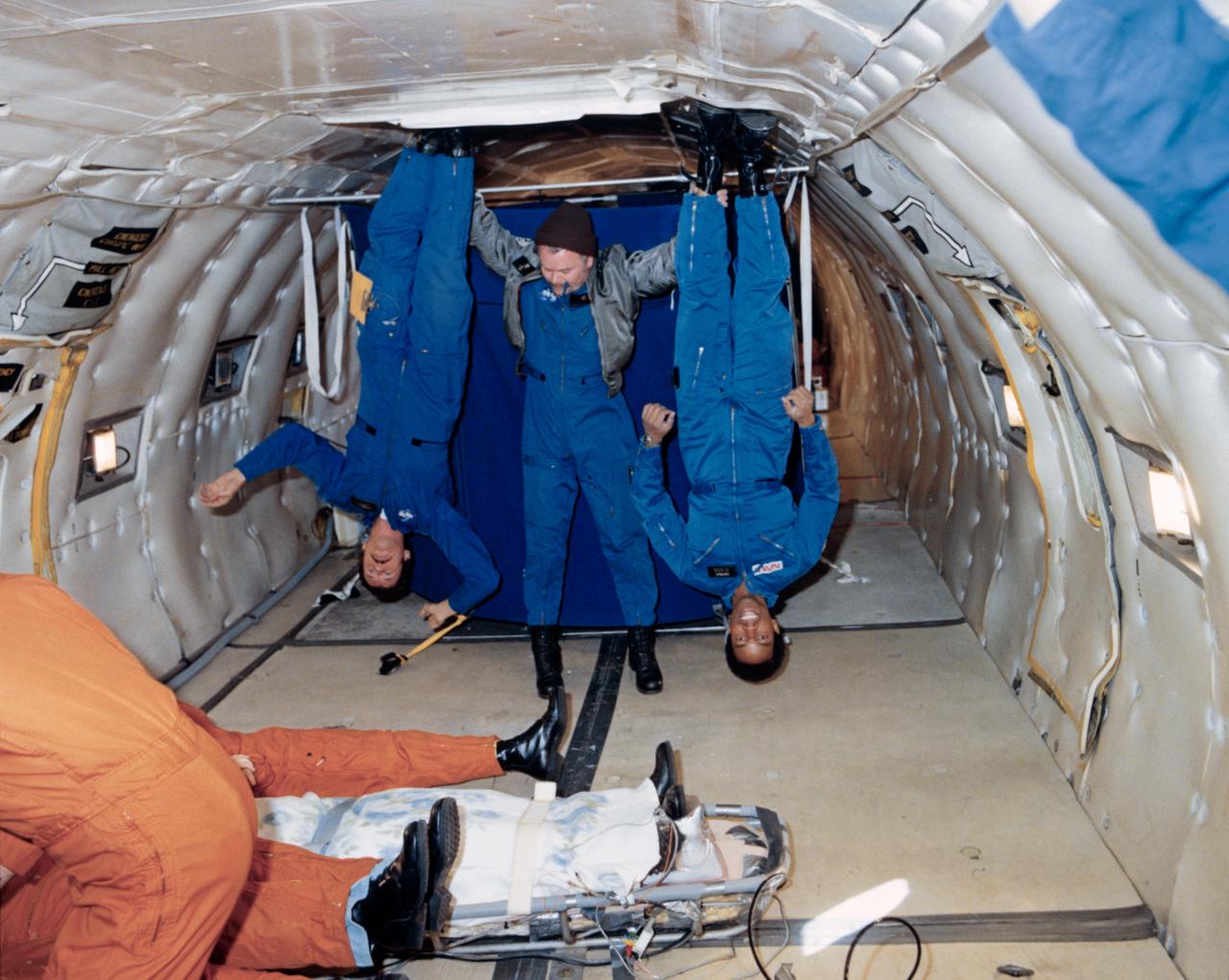
S79-28602 (2 March 1979) --- Astronaut candidate Guion S. Bluford and Aviation Safety Officer Charles F. Hayes got a unique perspective of their environment during a zero gravity flight. They are aboard a KC-135 aircraft, which flies a special pattern repeatedly to afford a series of 30-seconds-of-weightlessness sessions. Bluford and Hayes are being assisted by C. P. Stanley of the photography branch of the photographic technology division at Johnson Space Center (JSC). Some medical studies and a motion sickness experiment were conducted on this particular flight. Bluford is one of 20 scientist-astronaut candidates who began training at JSC in July of 1978. Photo credit: NASA

The Reduced-Gravity Program provides the unique weightless or zero-g environment of space flight for testing and training of human and hardware reactions. The reduced-gravity environment is obtained with a specially modified KC-135A turbojet transport which flies parabolic arcs to produce weightless periods of 20 to 25 seconds. KC-135A cargo bay test area is approximately 60 feet long, 10 feet wide, and 7 feet high. The image shows KC-135A in flight.
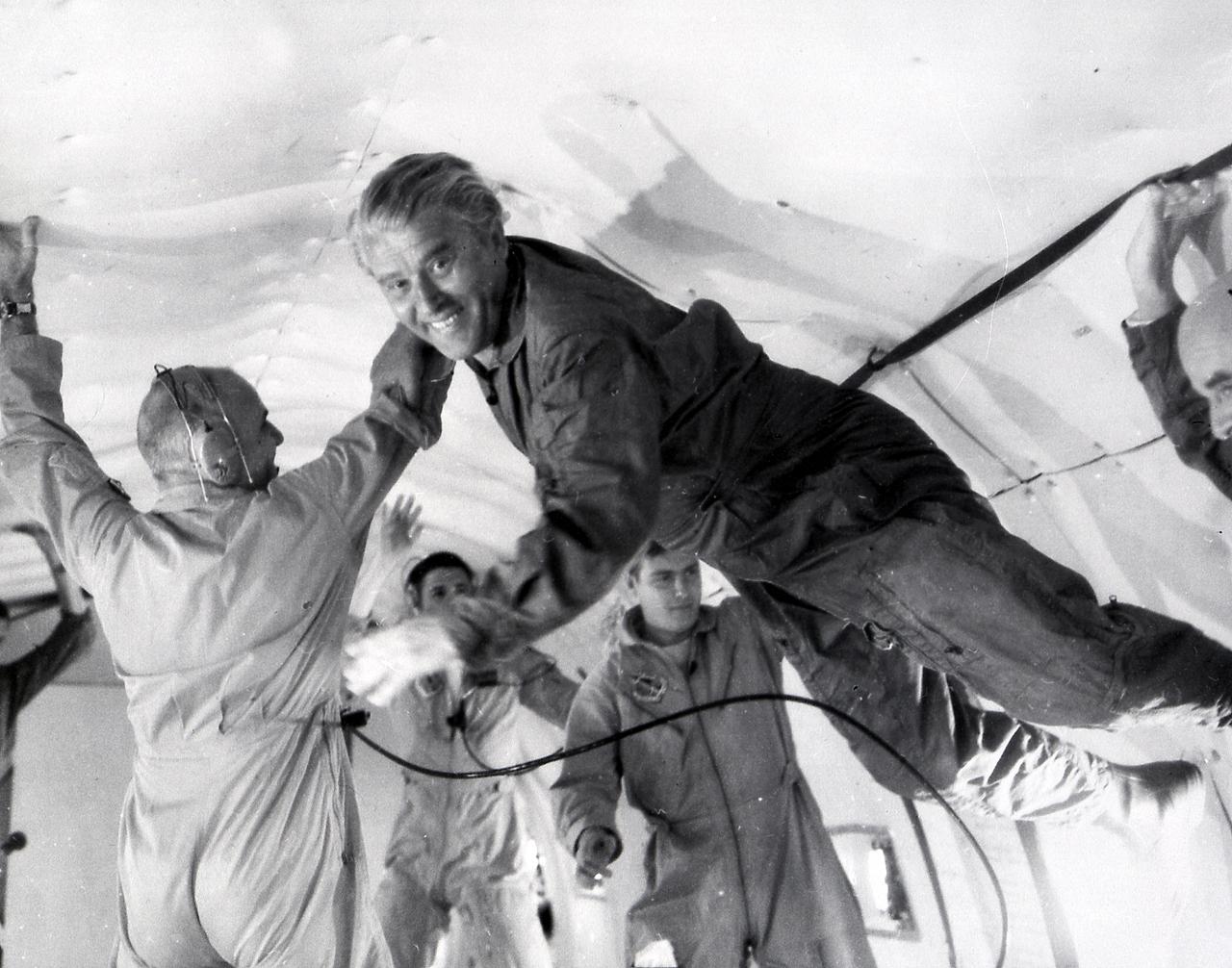
Dr. von Braun inside the KC-135 in flight. The KC-135 provide NASA's Reduced-Gravity Program the unique weightlessness or zero-g environment of space flight for testing and training of human and hardware reactions. The recent version, KC-135A, is a specially modified turbojet transport which flies parabolic arcs to produce weightlessness periods of 20 to 25 seconds and its cargo bay test area is approximately 60 feet long, 10 feet wide, and 7 feet high.
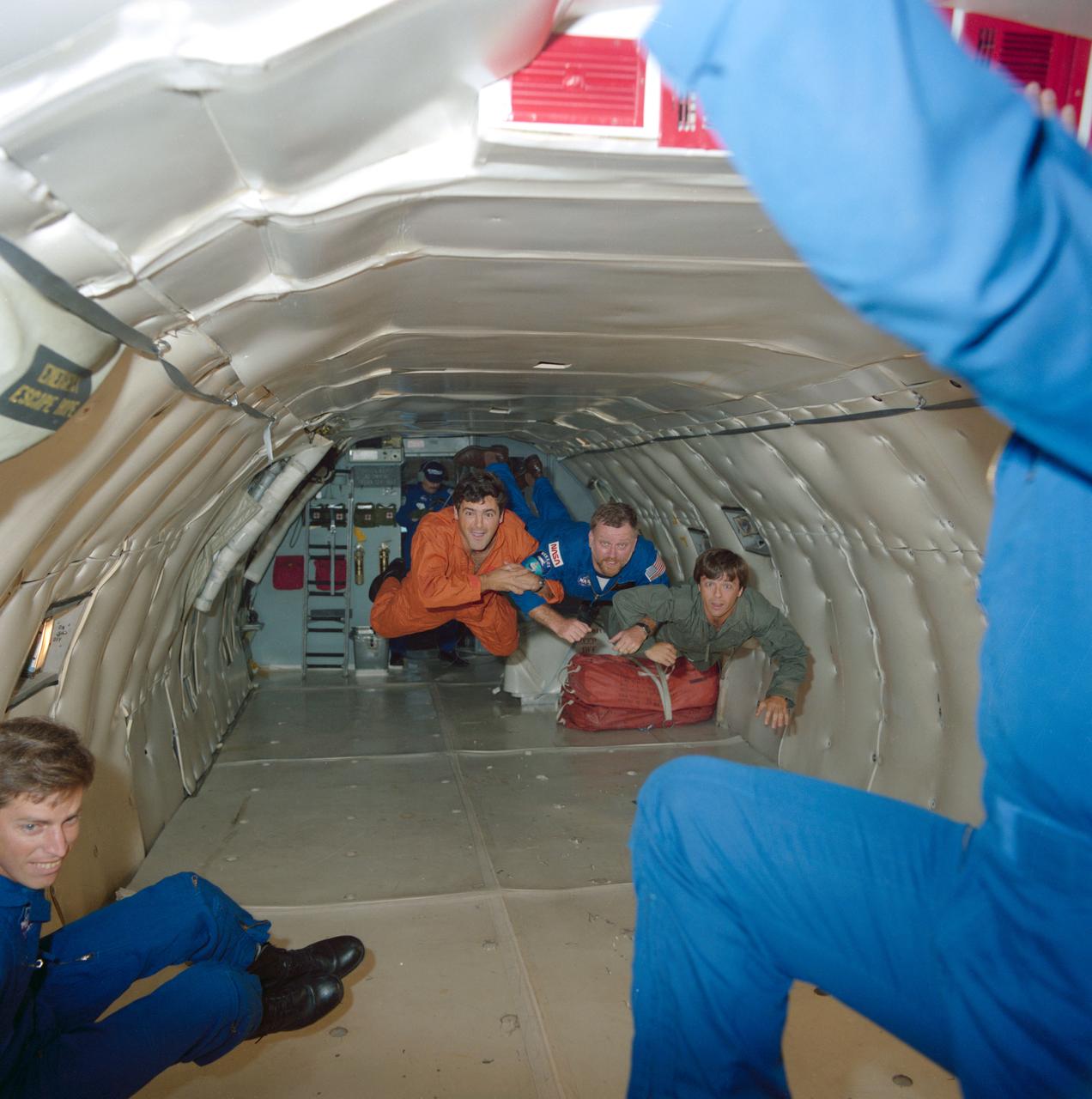
S84-40538 (24 Aug 1984) --- Two 41-G payload specialists and a backup for one of them appear to be at home in zero gravity in this scene photographed aboard a KC-135 "Zero gravity" aircraft flying one of its weightlessness opportunity parabolas. Paul D. Scully-Power, a civilian oceanographer with the U.S. Navey, is flanked by Marc Garneau (left) and Robert Thirsk, both representing the National Research Council of Canada. Thirsk is back up payload specialist for Garneau.
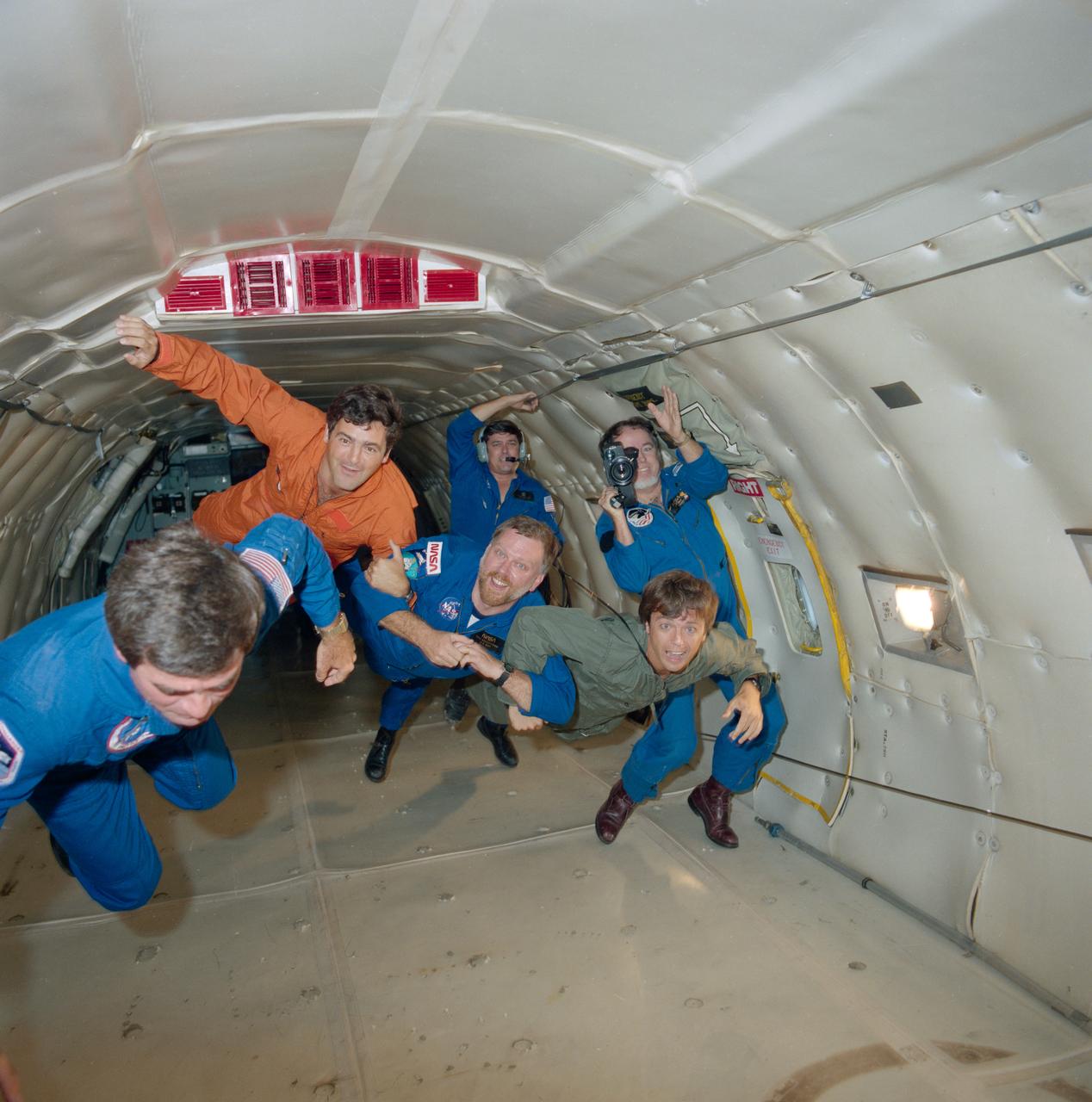
Paul Scully-Power, 41-G payload specialist, links arms with two others as they experience weightlessness in the KC-135 training aircraft. The trio appears to be flying toward the front of the aircraft while others take photos.
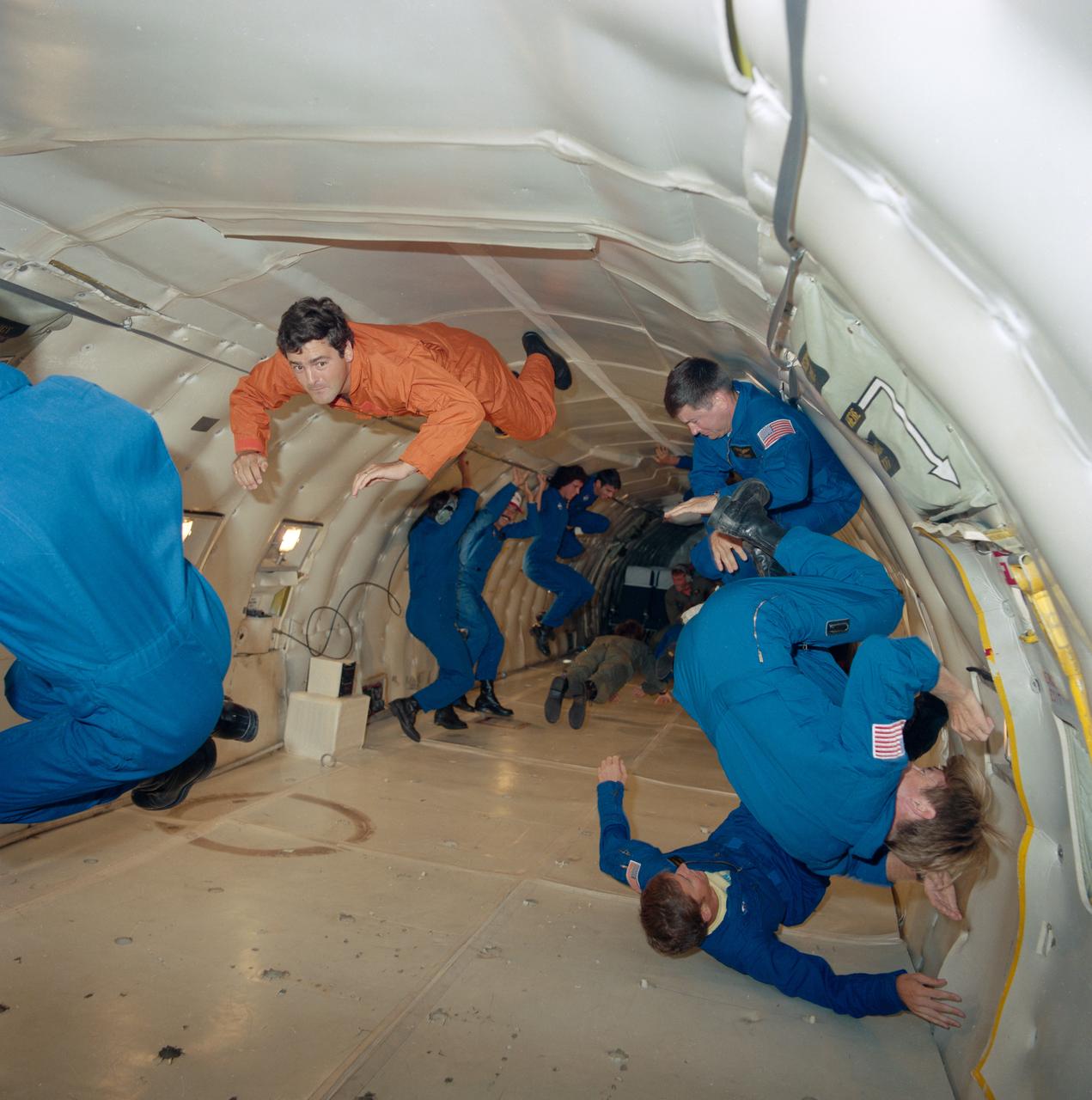
View of astronaut candidates and payload specialists during a training flight on the KC-135. The trainees are experiencing weightlessness in the hold of the aircraft.
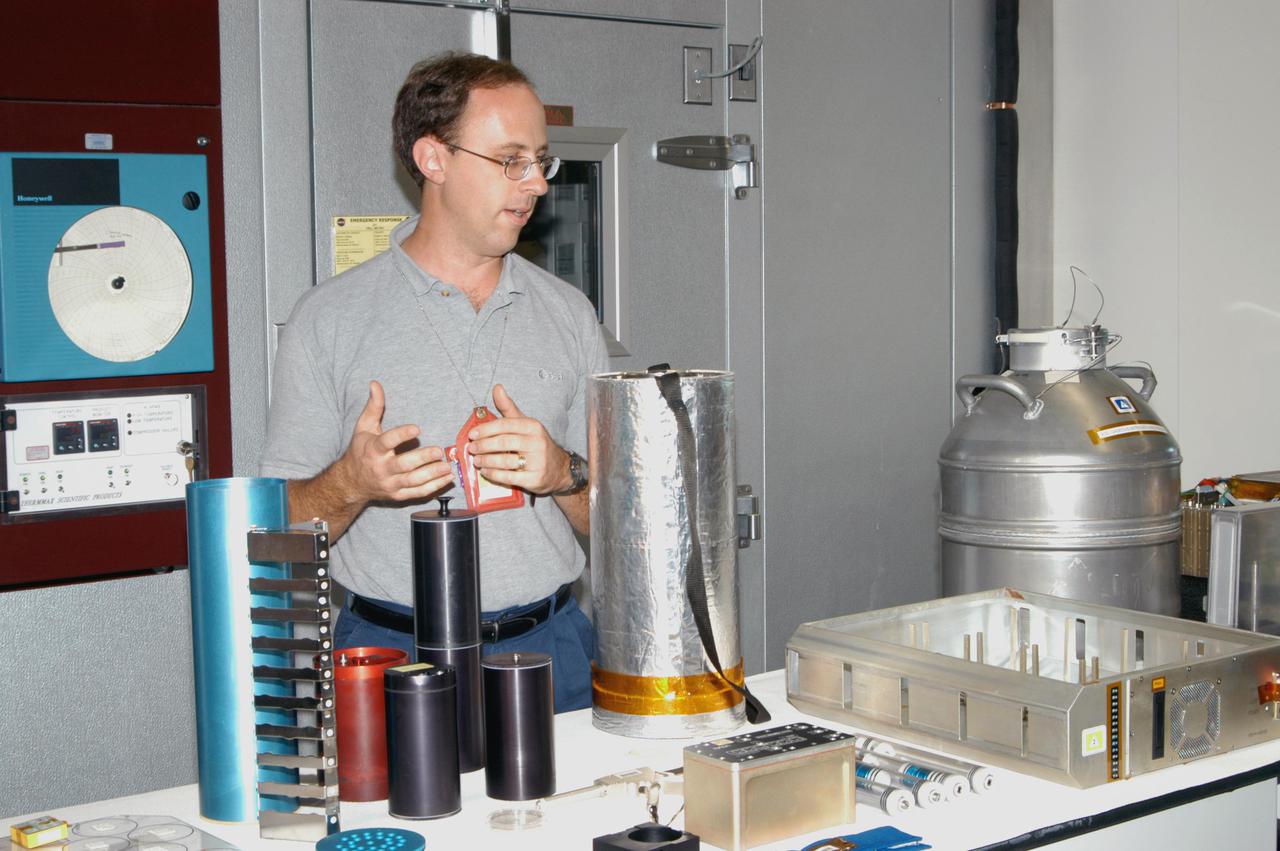
KENNEDY SPACE CENTER, FLA. - Dave Reed, a project engineer with the Bionetics Corporation, discusses the various flight hardware developed or currently being developed for future space exploration missions during a tour of the Space Life Sciences Lab for members of the news media. The Exploration Flight Development and Demonstration project provides innovative and cost effective hardware solutions focused on advancing critical technologies while reducing equivalent system mass as well as safe, thorough and efficient flight vehicle platform integration of Human System Research and Technology experiments that fly on parabolic aircraft, the Space Shuttle, and International Space Station.
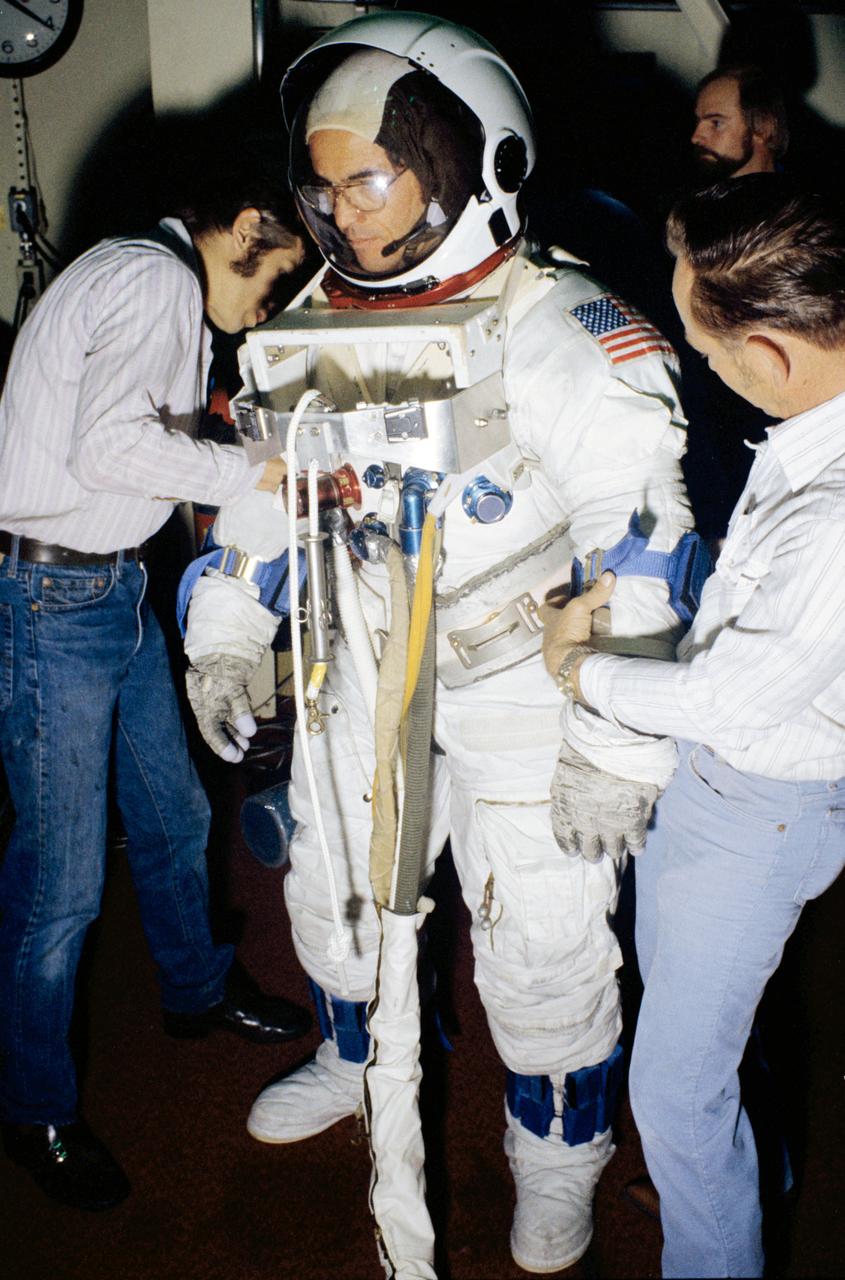
S79-25007 (13 Dec. 1978) --- Astronaut Robert L. Crippen, pilot for the first space shuttle orbital flight test (STS-1), is assisted by technicians prior to entering a water immersion facility (WIF) during a training session. The zero-gravity familiarization took place in the Johnson Space Center?s training and test center (Building 260). The WIF afford one of two ways to simulate the feeling of weightlessness experienced during space extravehicular activity (EVA), the other being inside aircraft flying a parabolic curve. Crippen will be joined by astronaut John W. Young for the STS-1 flight. Photo credit: NASA
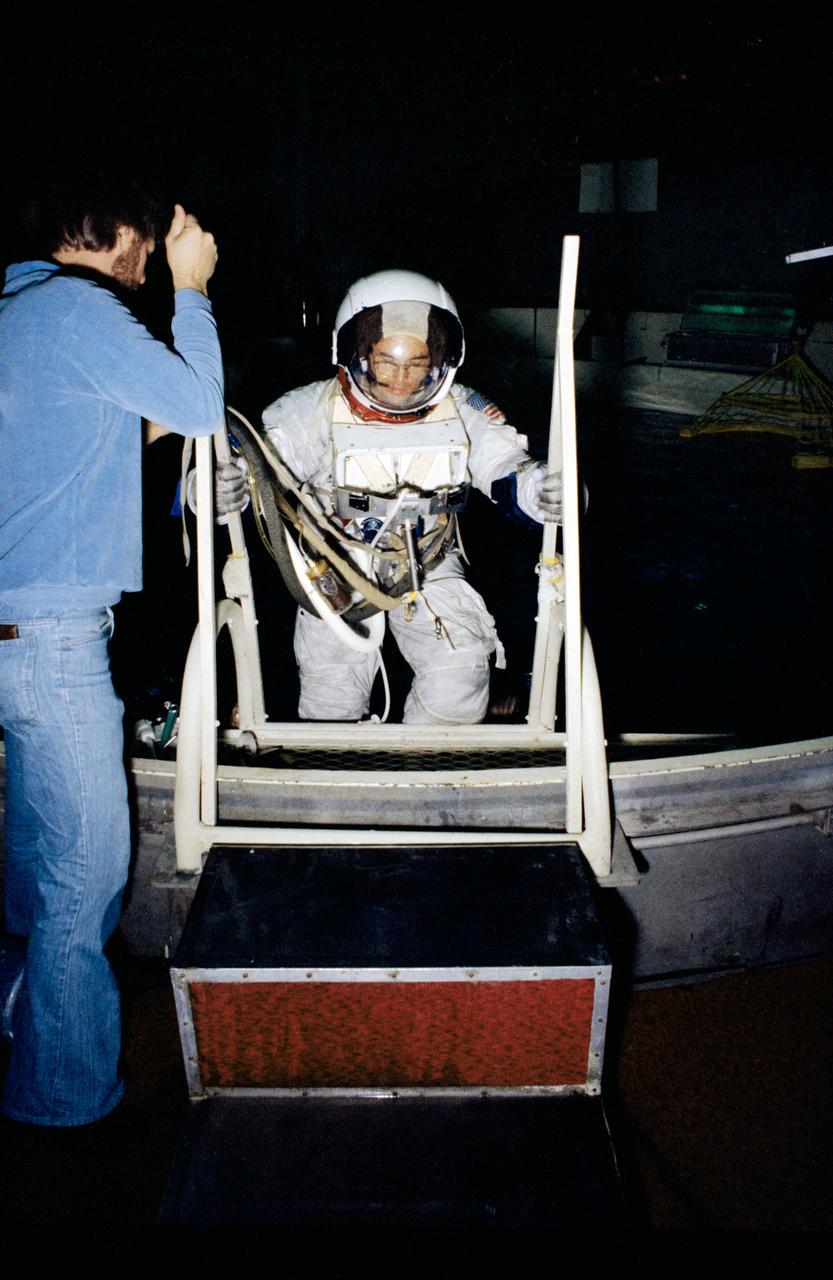
S79-25016 (13 Dec. 1978) --- Astronaut Robert L. Crippen, pilot for the first space shuttle orbital flight test, descends steps leading into the water immersion facility (WIF) during a training session in the Johnson Space Center?s training and test facility (Bldg. 260). The WIF affords one of two ways to simulate space extravehicular activity (EVA), the other being inside aircraft flying a parabolic curve. Crippen will be joined by astronaut John W. Young, commander for the first space shuttle flight (STS-1). Photo credit: NASA
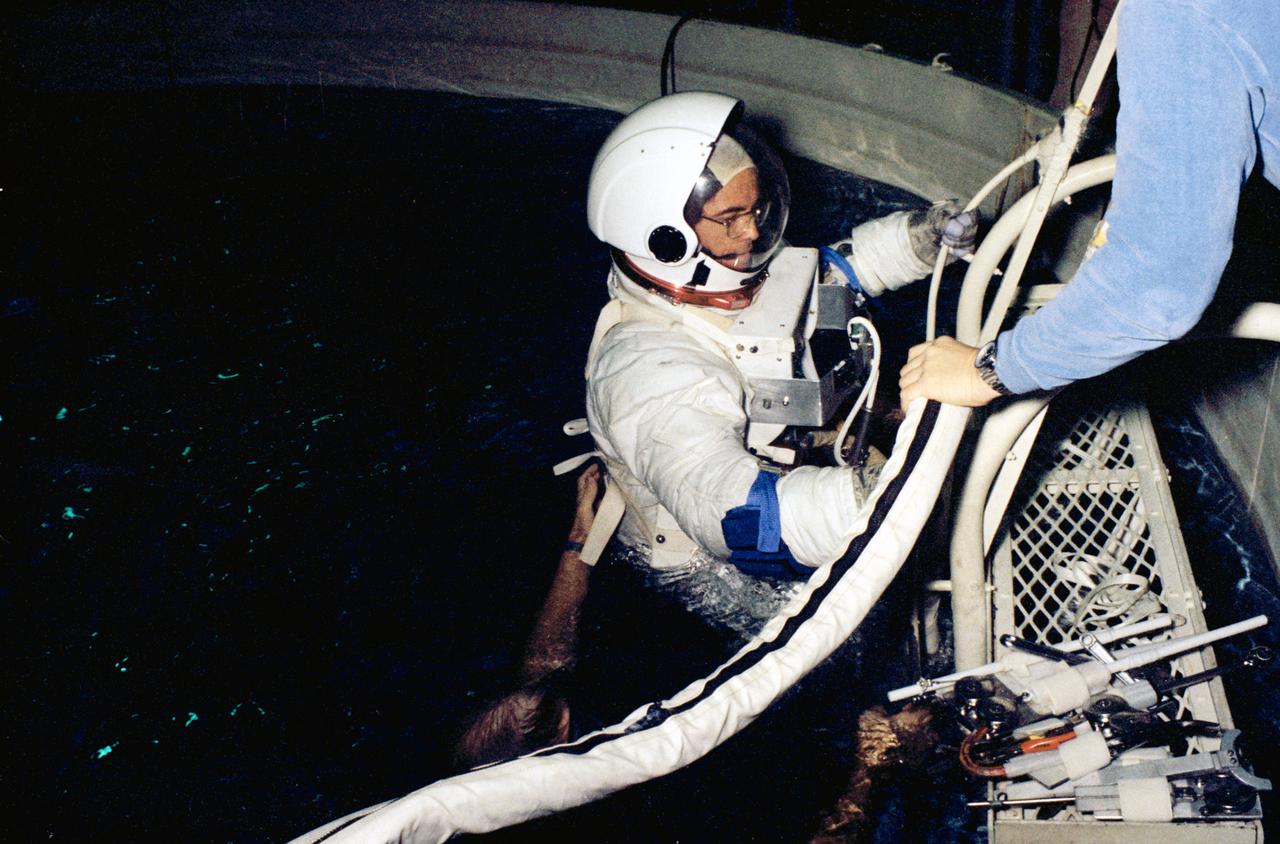
S79-25014 (13 Dec. 1978) --- Astronaut Robert L. Crippen, pilot of the first space shuttle orbital flight test (STS-1), eases into a water immersion facility (WIF) during a training session in the Johnson Space Center?s training and test facility (Bldg. 260). The WIF affords one of two ways to simulate the feeling of weightlessness experienced during space extravehicular activity (EVA), the other being inside aircraft flying a parabolic curve. Crippen will be joined by astronaut John W. Young, commander for the STS-1 flight. Photo credit: NASA
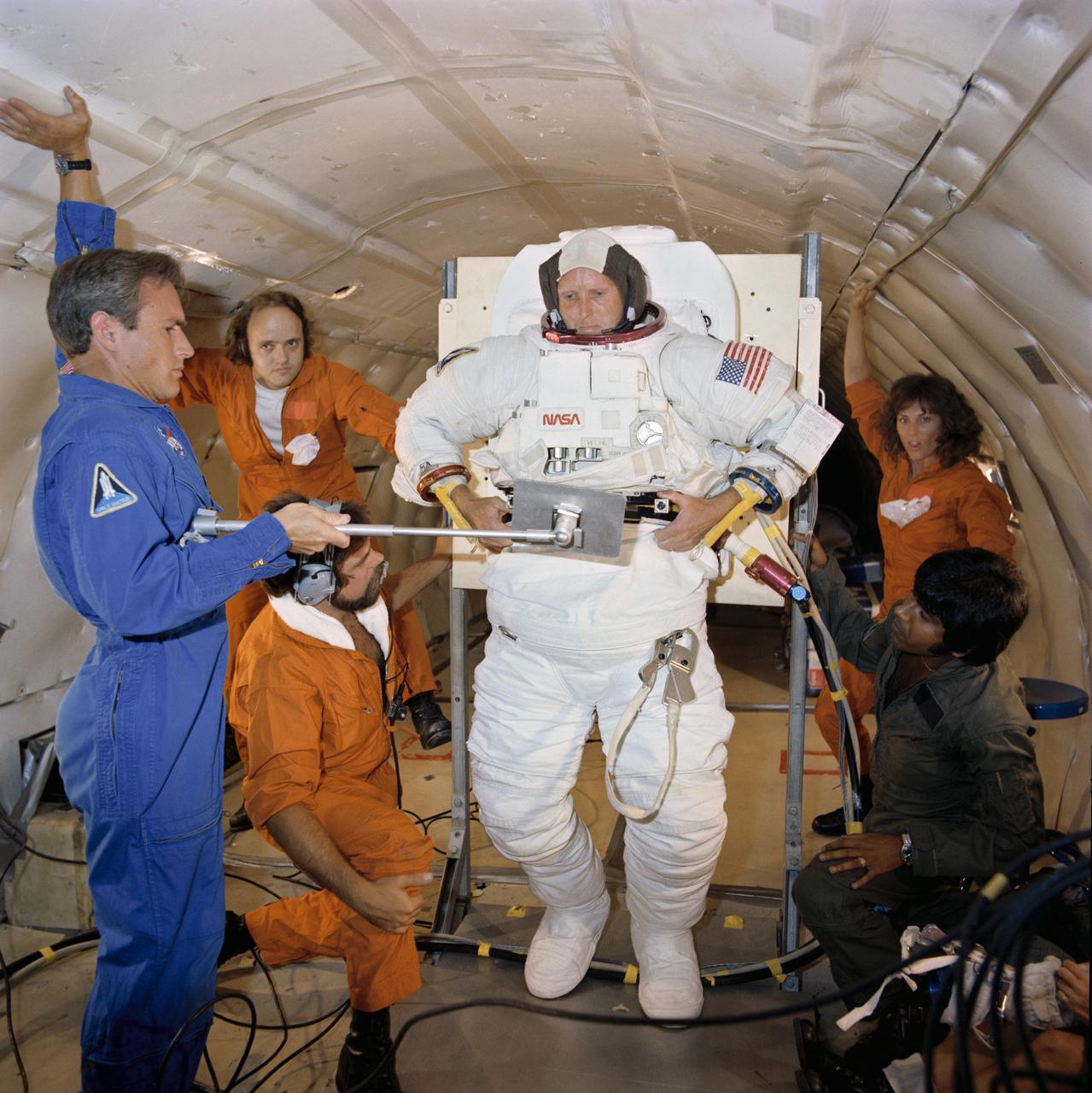
S81-34432 (July 1981) --- Astronaut C. Gordon Fullerton, STS-3 pilot, takes part in a suit donning and doffing exercise aboard a KC-135 "zero-gravity" aircraft. Mission specialist/astronaut William F. Fisher holds a mirror to assist Fullerton with hose and cable linkups to his suit. A special parabolic pattern flown by the KC-135 provides short durations of weightlessness. Fullerton's suit is an Extravehicular Mobility Unit (EMU), used by astronauts when leaving the shirt-sleeve environment of their shuttle orbiter to go outside and perform tasks in the vacuum of space. There are no such EVA plans on STS-3, but the crewmen are trained in this area in the event of a contingency. Photo credit: NASA
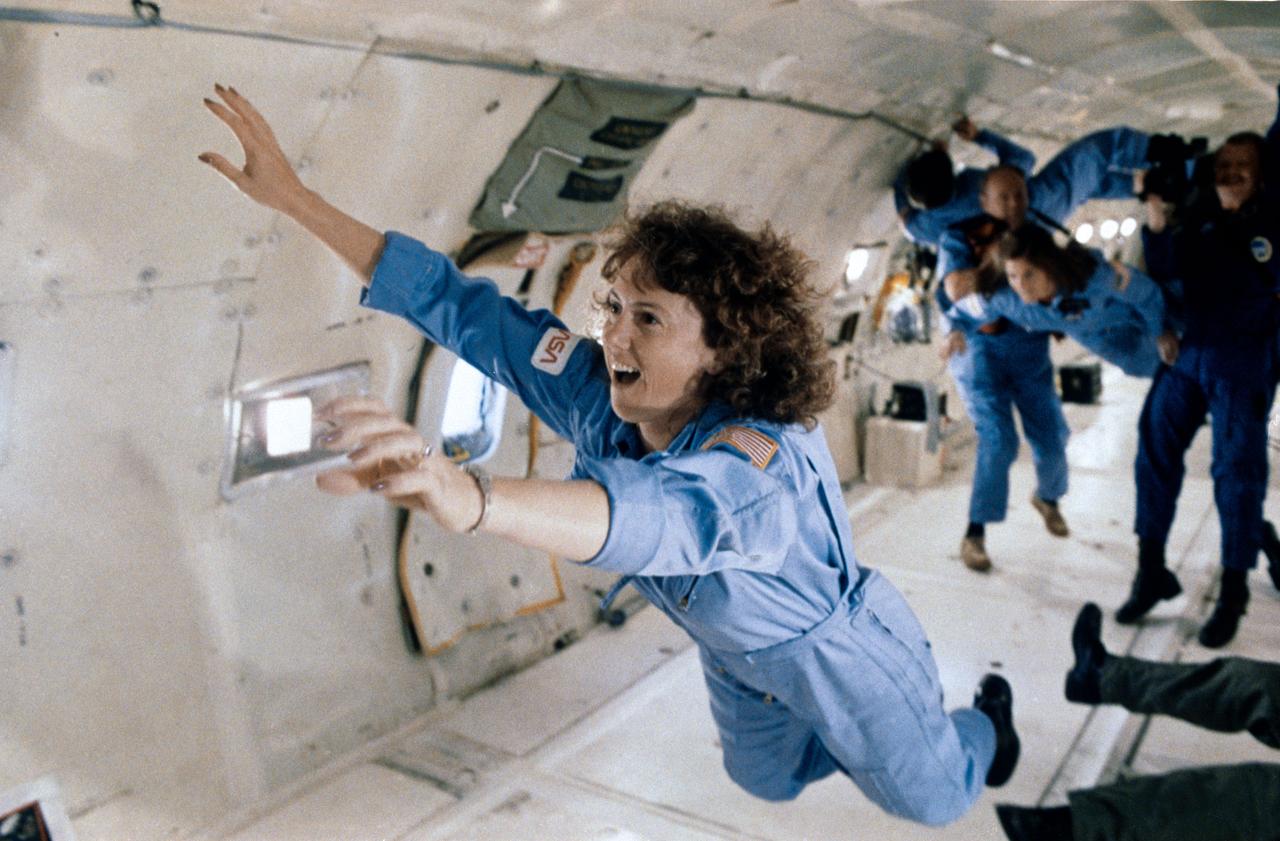
S86-25180 (October 1985) --- Sharon Christa McAuliffe, STS-51L citizen observer/payload specialist, representing the Teacher-in-Space Project, floats forward and upward during a few moments of weightlessness aboard a KC-135 aircraft. The flight is part of her training for the scheduled five-day flight aboard the Challenger in January of next year. Barbara R. Morgan, backup payload specialist for STS-51L, is partially visible in the background. The photo was taken by Keith Meyers of the New York Times. Photo credit: NASA
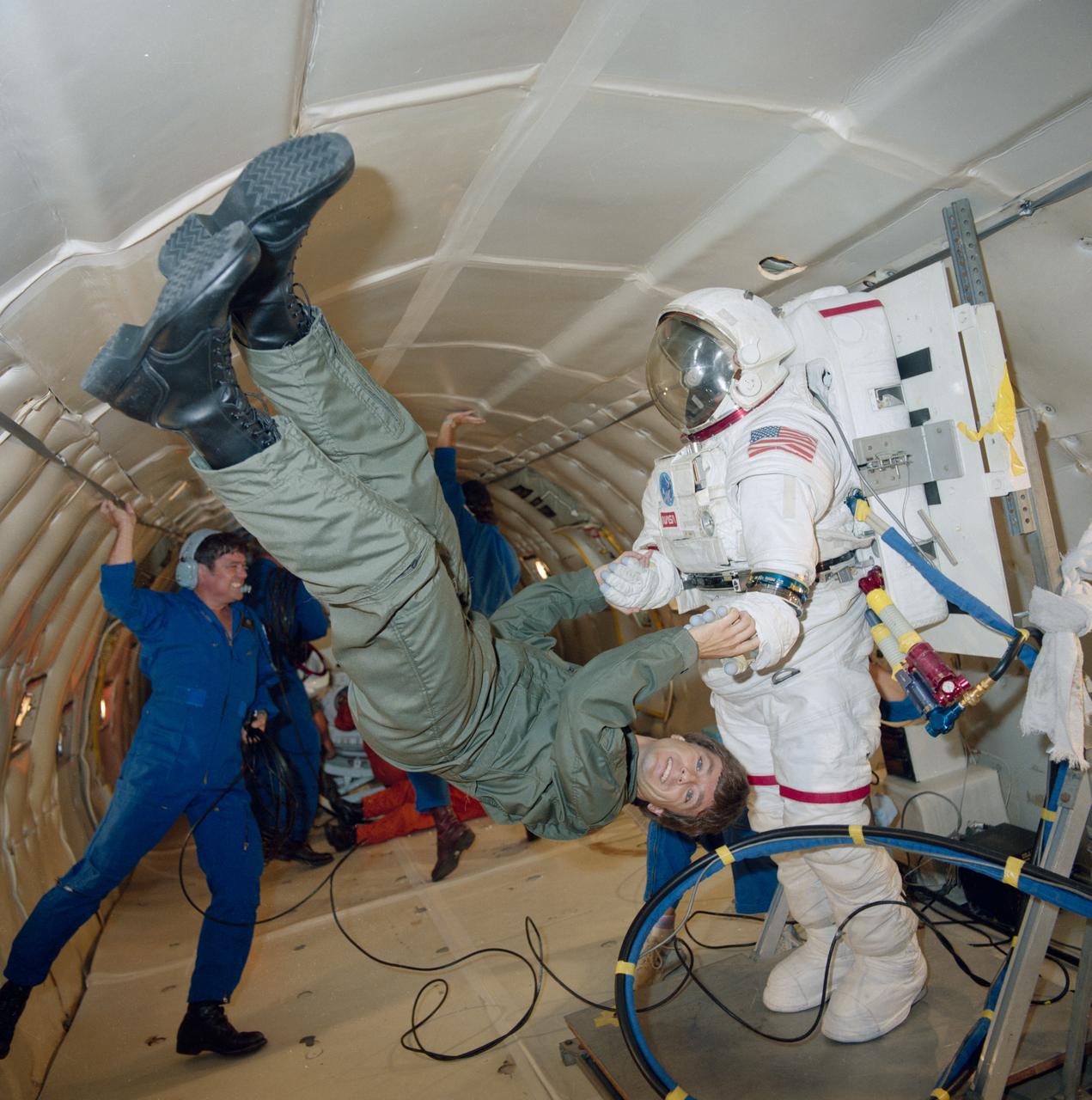
S84-37532 (18 July 1984) --? Robert B. Thirsk, backup payload specialist for 41-G appears to be shaking hands with an unoccupied extravehicular mobility unit (EMU) during a familiarization flight aboard NASA?s KC-135 aircraft. Thirsk, representing Canada?s National Research Council (NRC), serves as backup to Marc Garneau on the seven-member crew for Challenger?s October 1984 flight. This aircraft is used extensively for training and exposing Shuttle crewmembers to weightlessness as well as for evaluation of equipment and experiments scheduled for future flights.
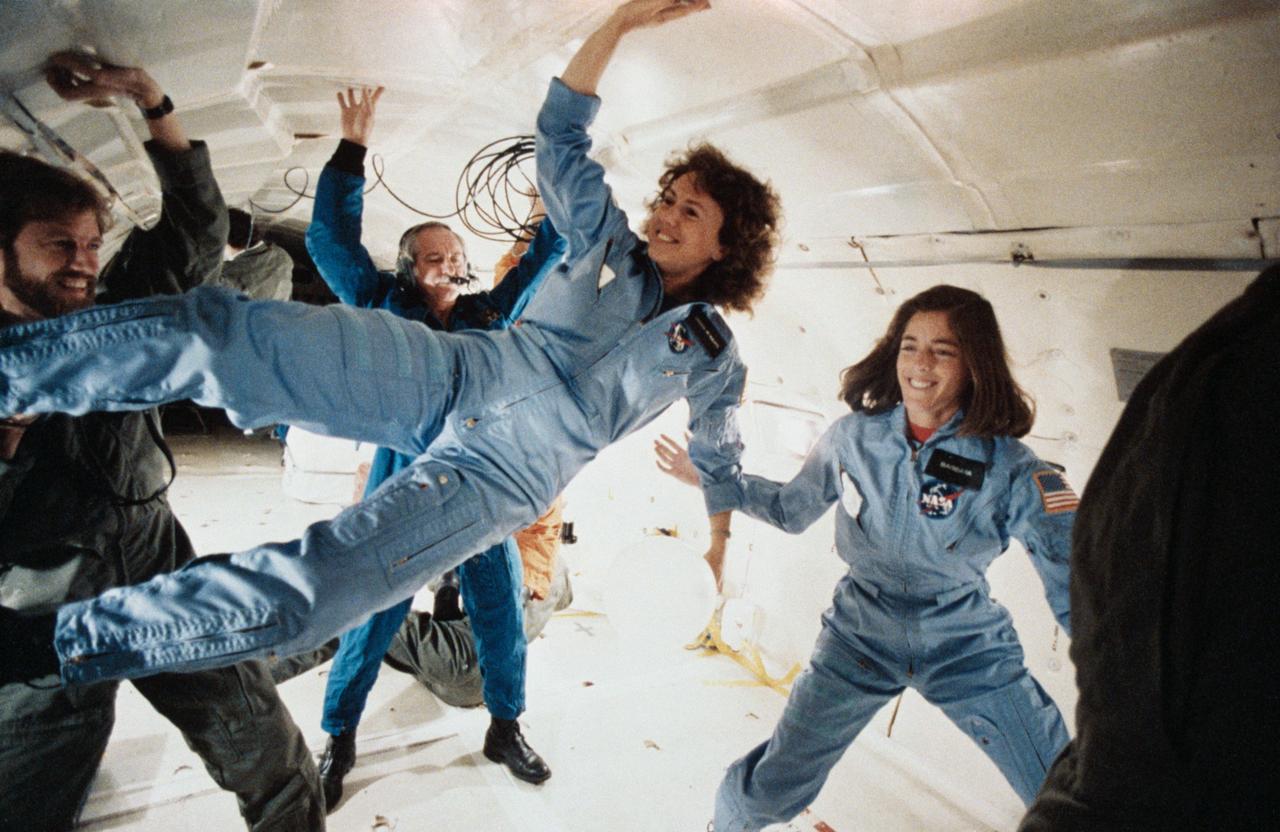
S86-25191 (for release January 1986) --- The two representatives of the Teacher-in-Space Project continue their training program at the Johnson Space Center with an additional flight aboard NASA?s KC-135 ?zero gravity? aircraft. Sharon Christa McAuliffe, left, is prime crew payload specialist, and Barbara R. Morgan is in training as backup payload specialist. The photo was taken by Keith Meyers of New York Times. Photo credit: NASA

Zero-g tests of involving Astronaut candidate Daniel C. Brandenstein. Brandenstein is shown flying in midair on the KC-135.
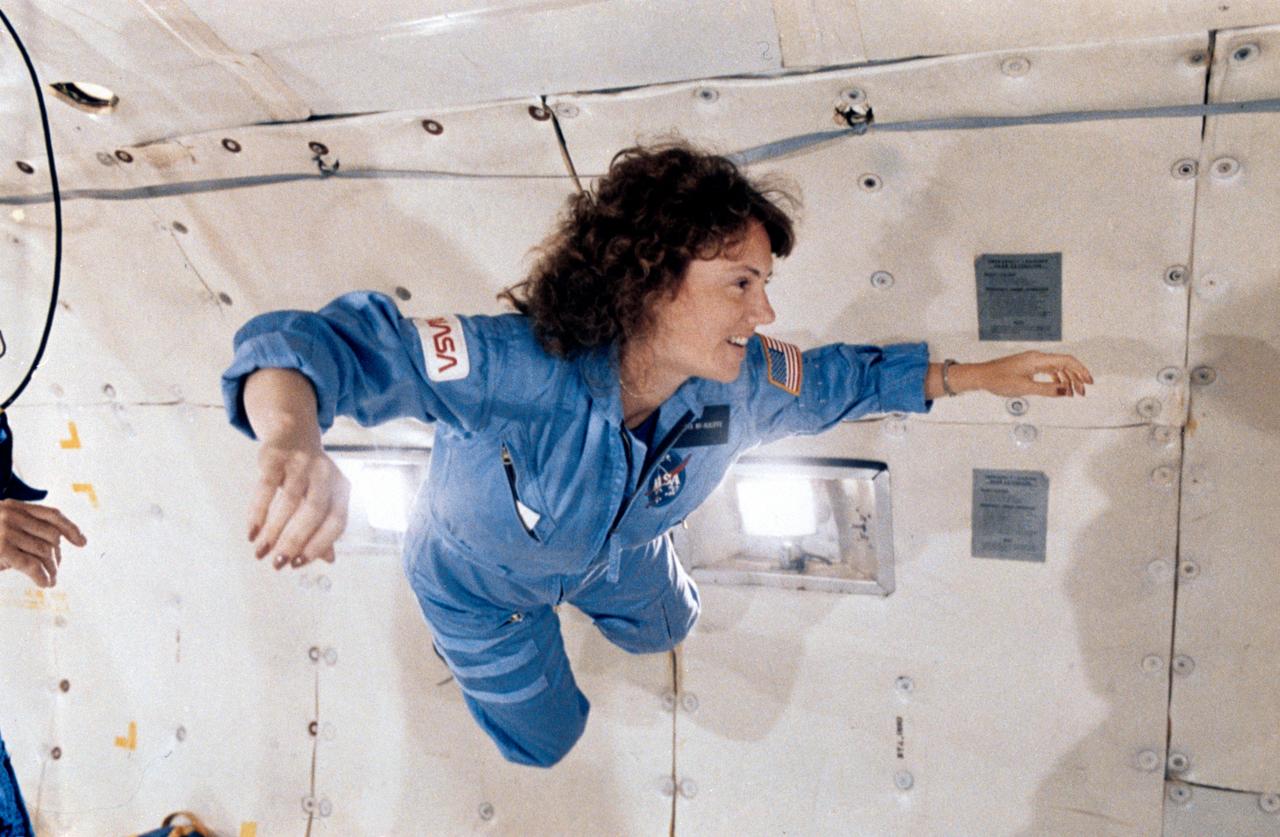
S86-25196 (January 1986) --- Sharon Christa McAuliffe, STS-51L citizen observer/payload specialist, gets a preview of microgravity during a special flight aboard NASA?s KC-135 ?zero gravity? aircraft. McAuliffe will represent the Teacher-in-Space Project aboard the space shuttle Challenger when it launches later this month. This photograph was taken by Keith Meyers of the New York Times. EDITOR?S NOTE: The STS-51L crew members lost their lives in the space shuttle Challenger accident moments after launch on Jan. 28, 1986 from the Kennedy Space Center (KSC). Photo credit: NASA

Astronaut Joe H. Engle, STS-2 commander, practices donning and doffing his extravehicular mobility unit (EMU) in the weightless environment afforded aboard a KC-135 "zero-gravity" aircraft.
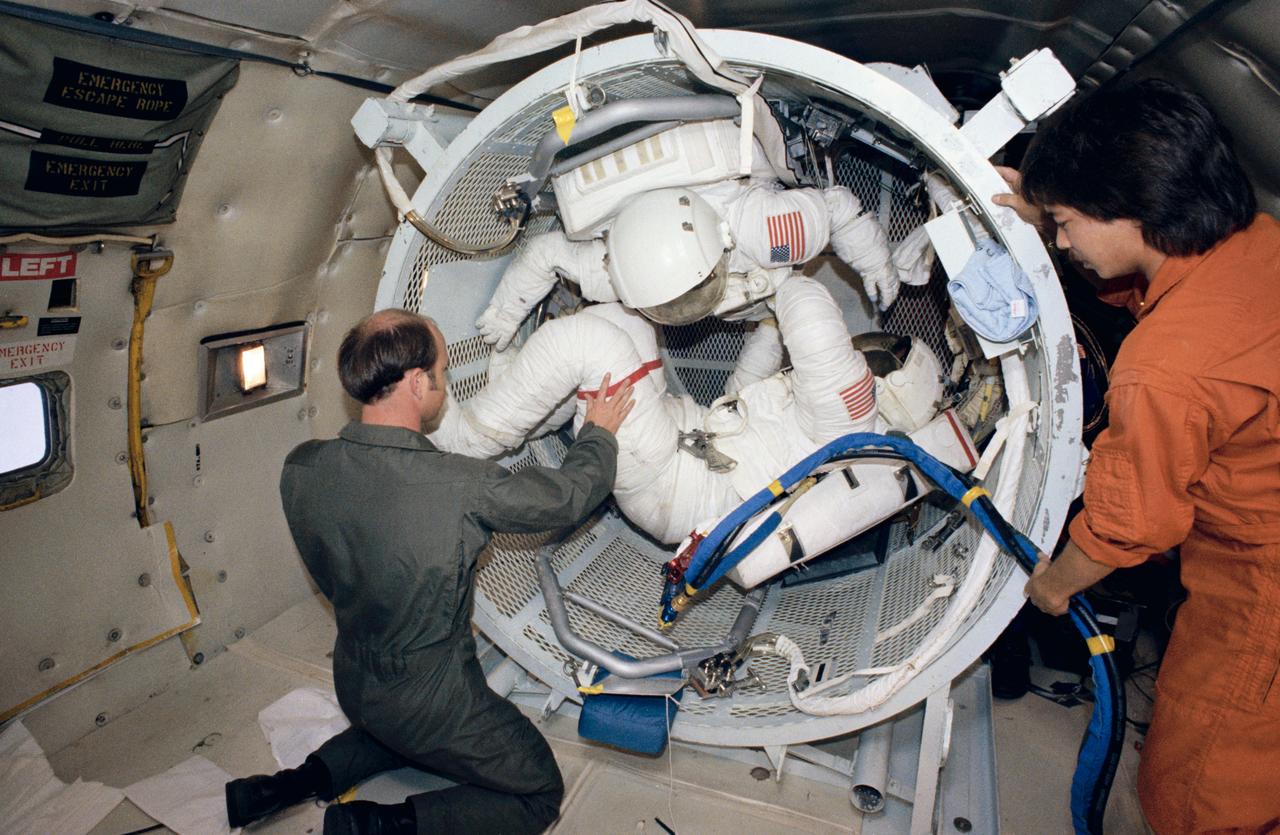
The 41-D crewmembers participate in suiting exercises in the weightless environment of the KC-135 aircraft.
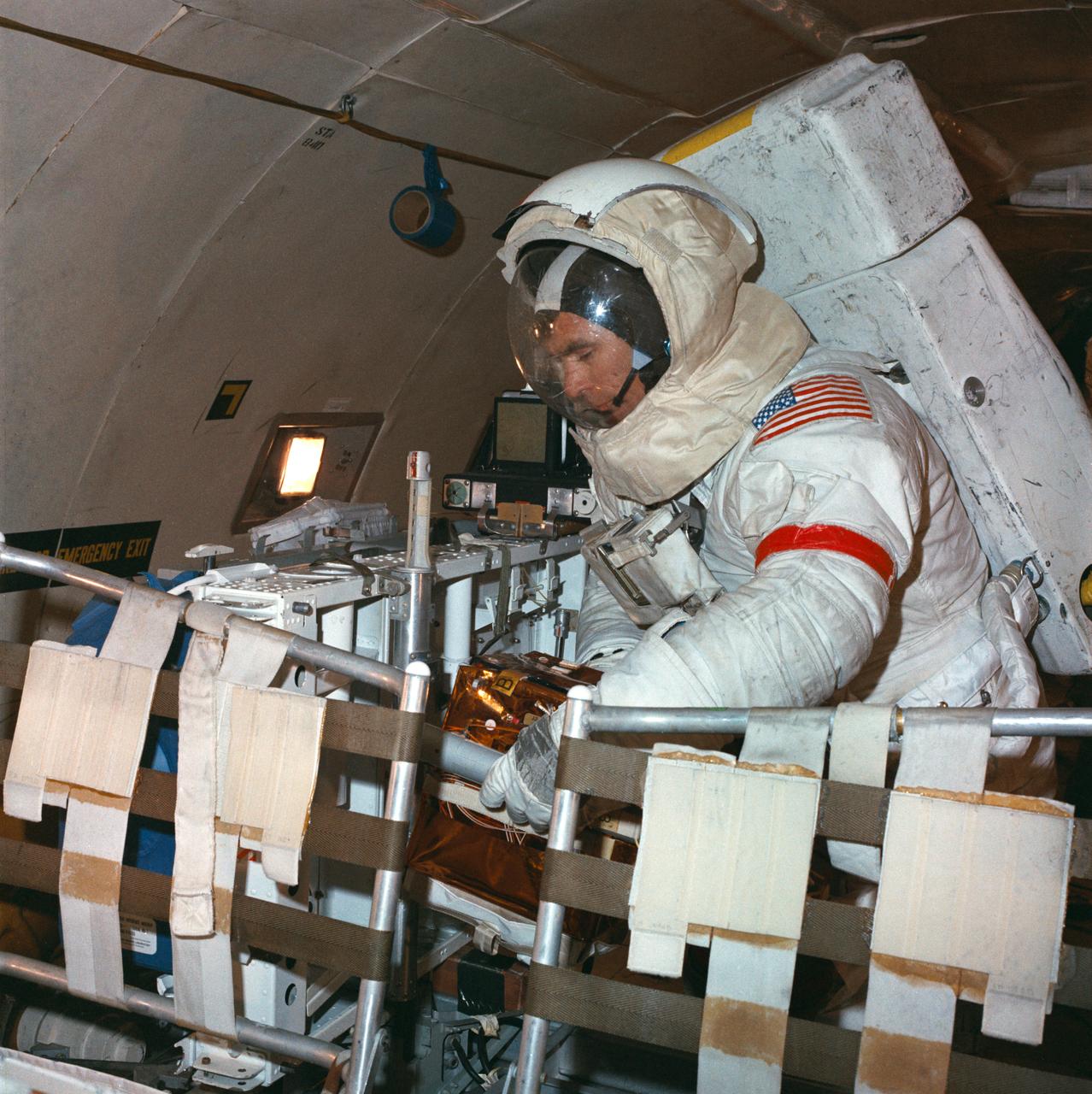
S72-50270 (September 1972) --- Astronaut Eugene A. Cernan, commander of the Apollo 17 lunar landing mission, participates in lunar surface extravehicular activity simulation training under one-sixth gravity conditions aboard a U. S. Air Force KC-135 aircraft. Here, Cernan simulates removing an experiment package from the aft end of a Lunar Roving Vehicle.

The 41-D crewmembers participate in suiting exercises in the weightless environment of the KC-135 aircraft.
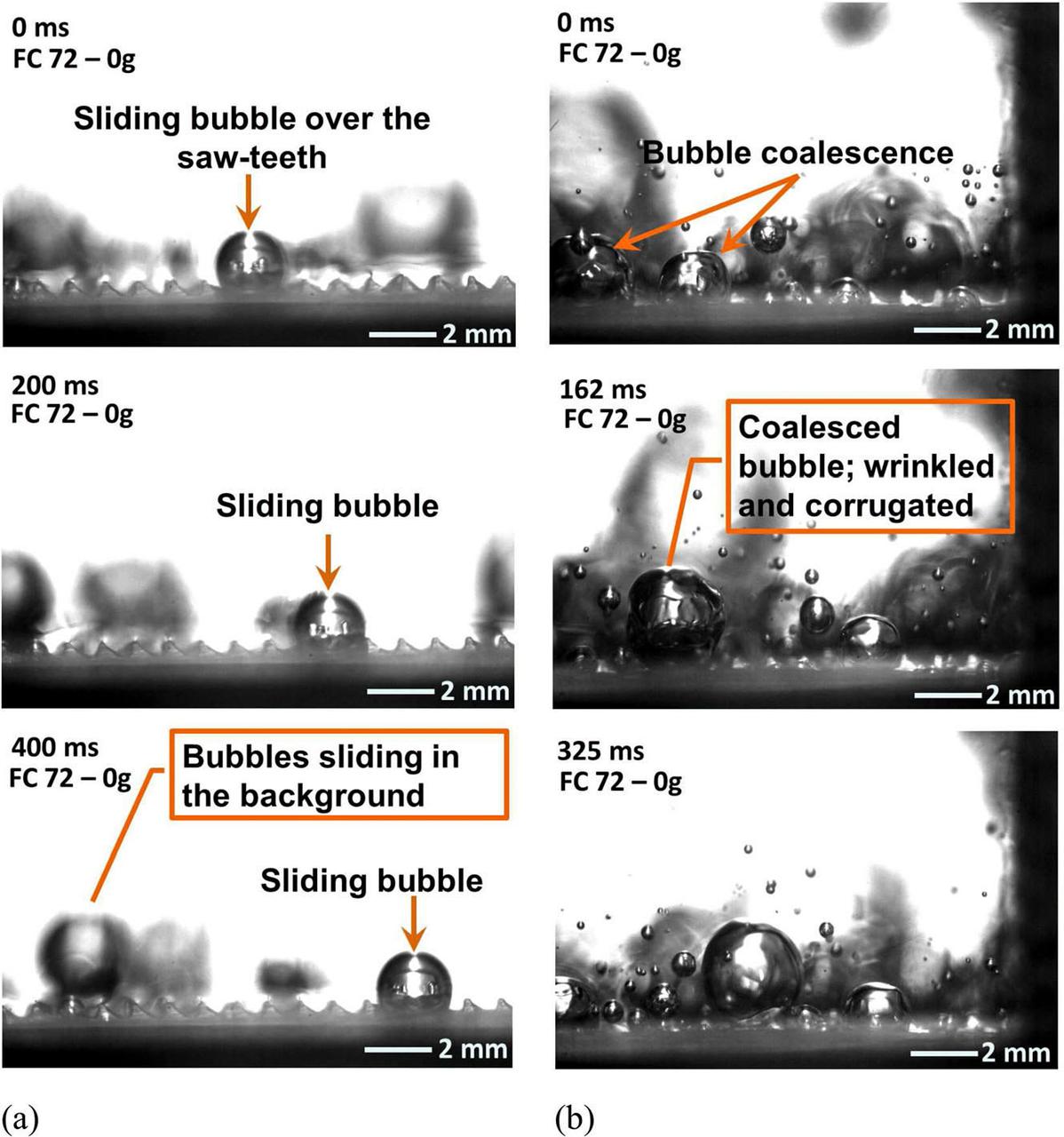
jsc2020e030483 (4/20/2020) --- A preflight image sequence from parabolic flight experiments indicating motion of vapor bubble on heated ratchet surface. Asymmetric Sawtooth and Cavity-Enhanced Nucleation-Driven Transport (PFMI-ASCENT) demonstrates a passive cooling system for electronic devices in microgravity using a microstructured surface. When fluids boil over flat heated surfaces in microgravity, vapor bubbles grow larger in size, causing poor heat transfer that can lead to damage of devices. Adding microscopic rachets on the surface may passively enable mobility of vapor bubbles and prevent this damage. (Image courtesy of: Techshot, Inc.)
/61-mr4-60(s)~medium.jpg)
KENNEDY SPACE CENTER, FLA. -- AWAITING ORDERS to proceed to the launching site for Project Mercury's second attempt to launch a man into space, Astronaut Virgil I. 'Gus' Grissom relaxes in a contour chair in the Personal Equipment Room Hangar 'S,' Cape Canaveral, Fla. A parabolic plexiglas mirror on his chest reflects the faces of two fellow Mercury pilots: Walter M. Schirra (left) and M. Scott Carpenter. The mirror, which was not included in the May 5 Shepard flight, will be used to reflect the instrument panel, bringing it into view of the pilot observer camera. MR-4, known as Liberty Bell 7, has been rescheduled for Friday, July 21. (NASA Photo
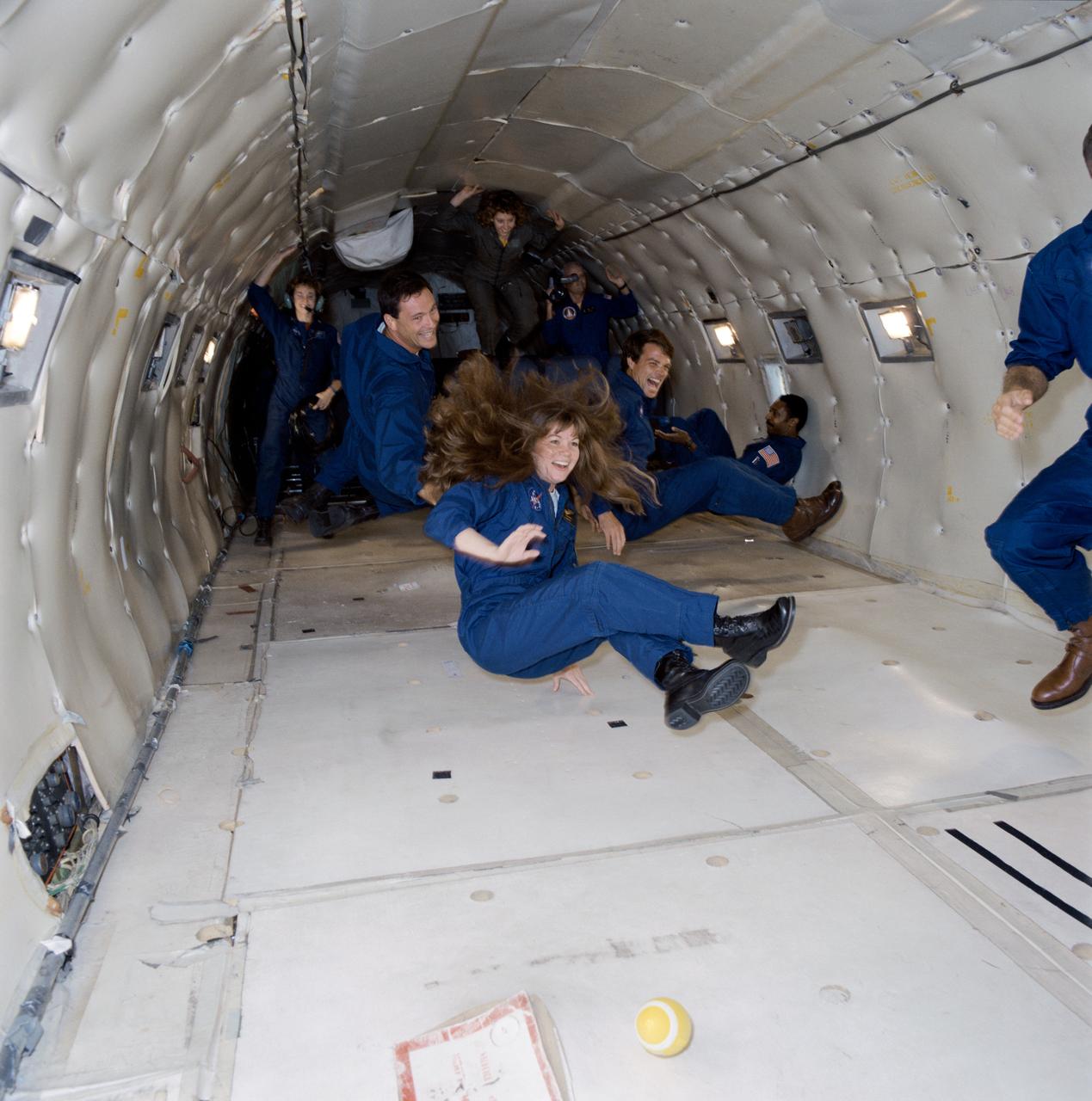
S94-26350 (10 Jan. 1994) --- Astronaut Catherine G. Coleman seems to enjoy the brief period of weightlessness she is sharing with fellow members of the 1992 class of astronauts. The weightless experience was afforded by a special parabolic pattern flown by NASA?s KC-135 ?zero gravity? aircraft. Left to right behind her are astronauts Michael E. Lopez-Alegria, Kevin R. Kregel and Winston E. Scott. EDITOR?S NOTE: Since this photograph was taken the four have been named to flights as follows: Kregel, STS-70; Scott, STS-72.
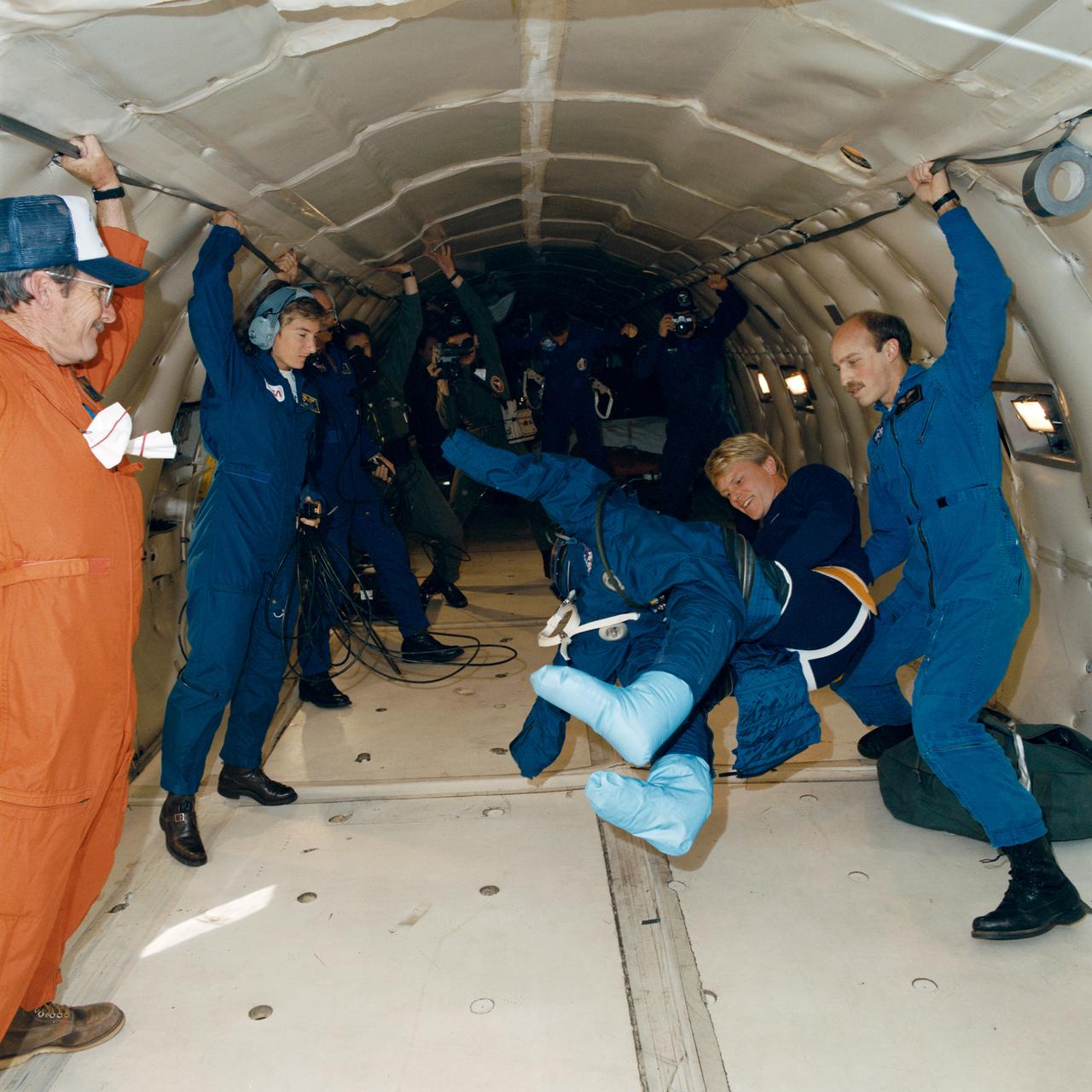
STS-26 Discovery, Orbiter Vehicle (OV) 103, Mission Specialist (MS) George D. Nelson practices donning and doffing new (navy blue) partial pressure suit (launch and entry suit (LES)) aboard KC-135 NASA 930 during zero gravity testing. Nelson is assisted by astronaut James P. Bagian as KC-135 flight crew (including Stephanie A. Wells) looks on and photographers document activities.
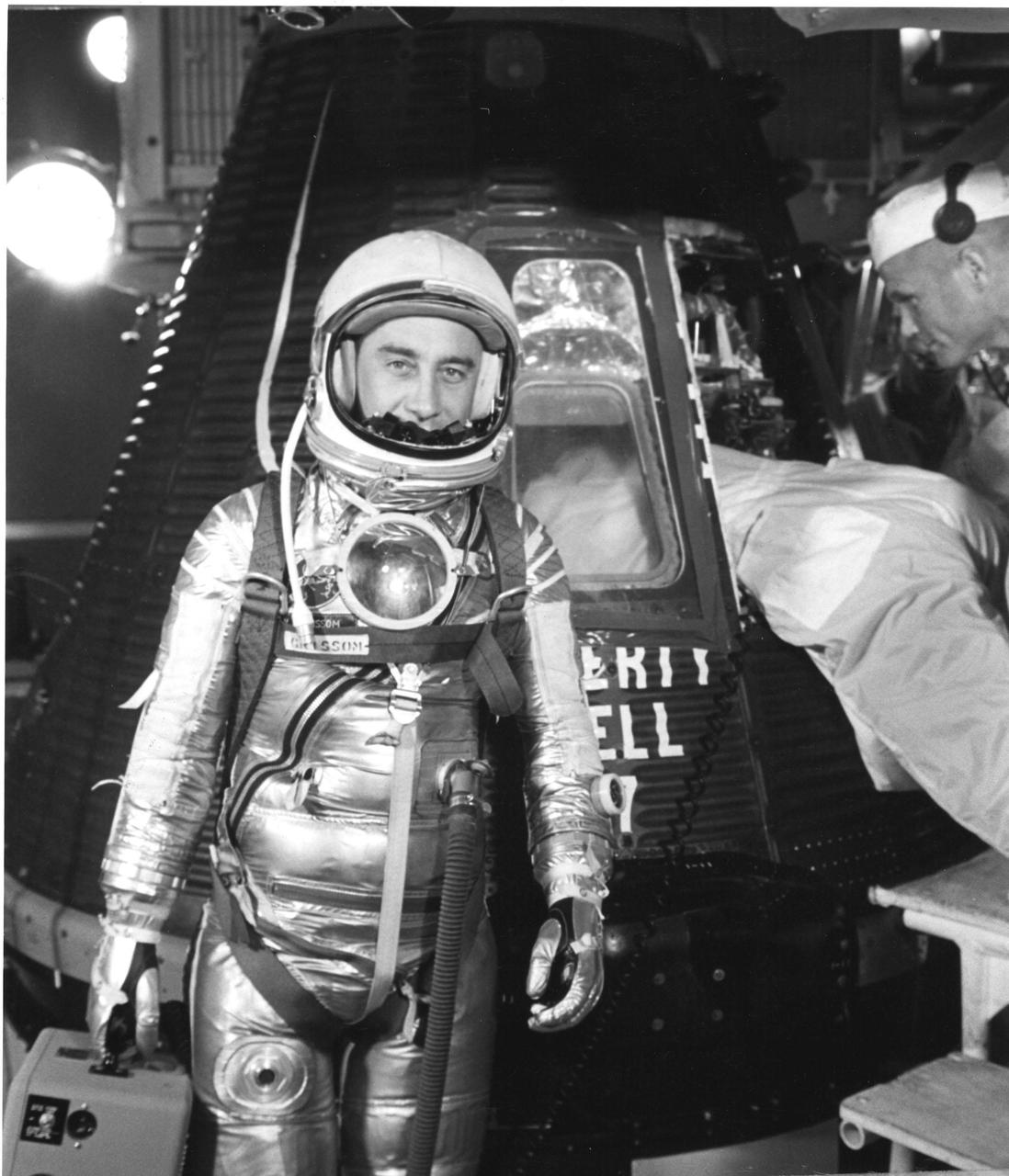
KENNEDY SPACE CENTER, FLA. -- READY FOR FLIGHT - On level three of gantry on pad 5, Project Mercury astronaut Virgil I. 'Gus' Grissom pauses briefly while a technician completes final adjustment in the Liberty Bell 7 spacecraft, which carried Grissom 118 miles into space on Friday, July 21, 1961. The craft's large trapezoidal observation window can be seen behind the pilot. The Pilot Observer Camera, which brought the astronaut's head and shoulders into view, was to reflect the lights on the flight events sequence panel through the 5-inch plexiglas parabolic mirror attached to Grissom's suit, to provide and accurately time record the pilot's voice communications, eye scan pattern and arm motions. The spacecraft sank on landing and has not been recovered. (NASA Photo)
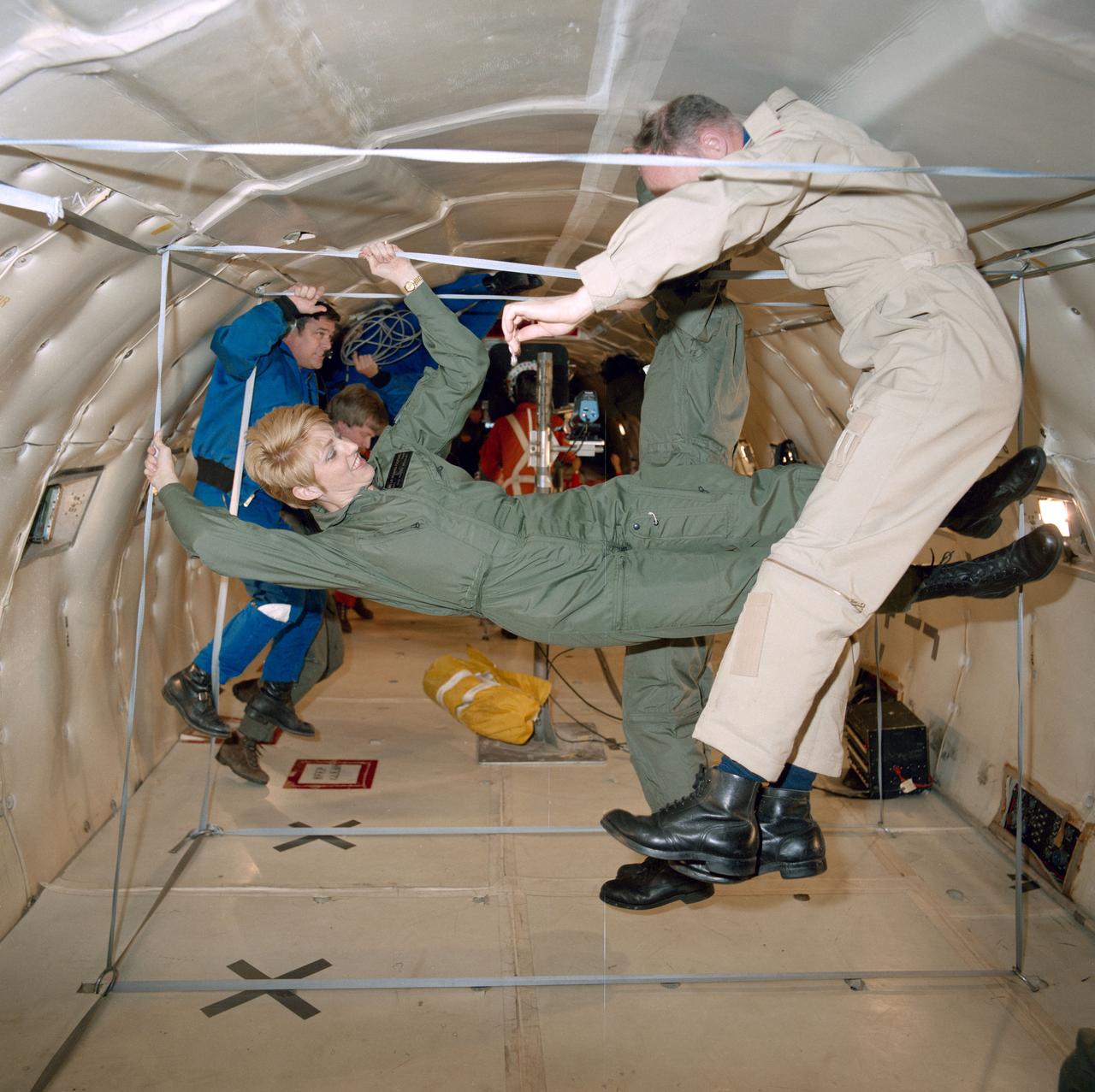
Vestibular Study testing in Zero-G flights on the KC-135. Seen in this view are Roberta Bonder and others experiencing weightlessness.
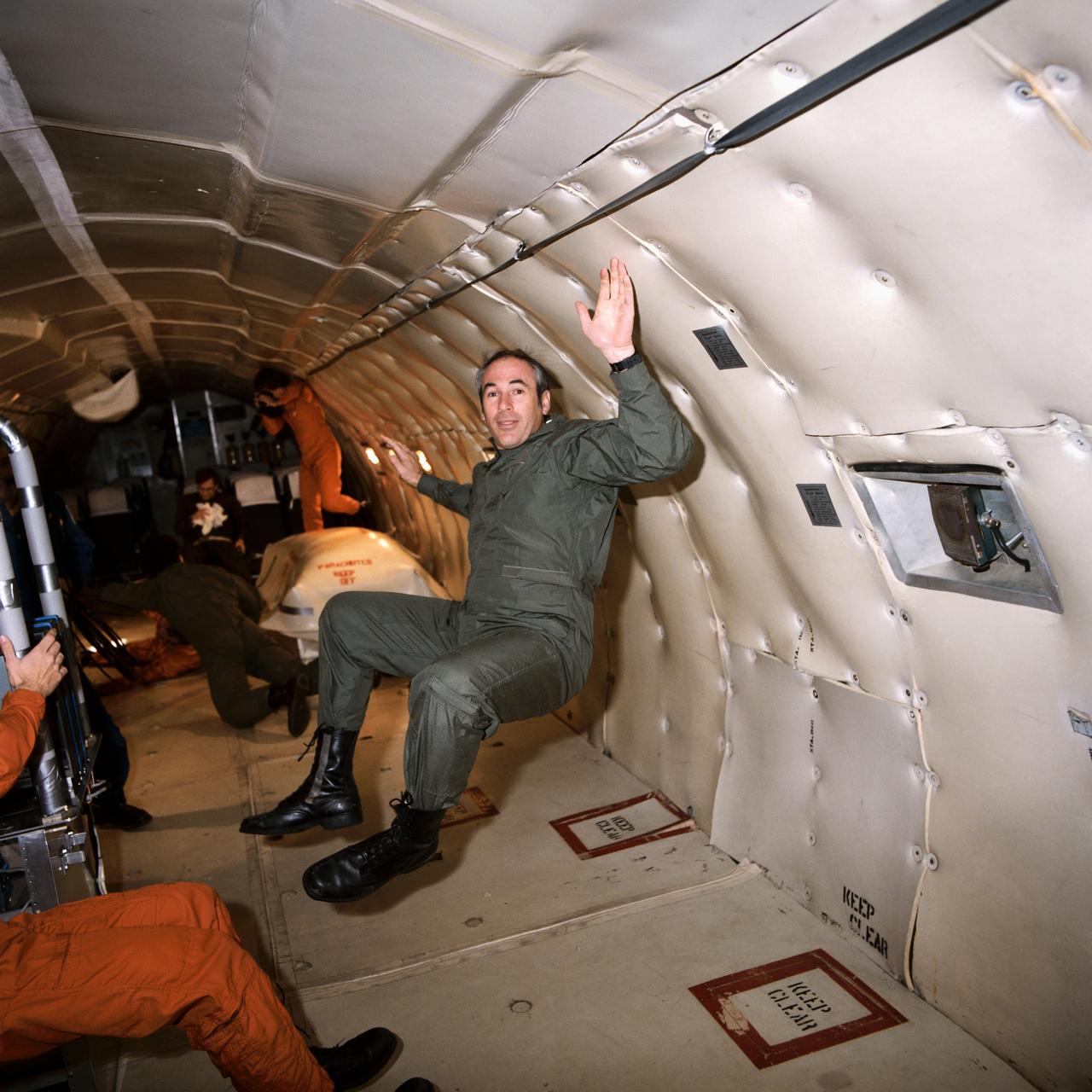
S85-26106 (25 Jan. 1985) --- Astronaut Gregory Jarvis gets a familiarization session in weightlessness aboard a KC-135 "zero gravity" aircraft. Jarvis was originally assigned as payload specialist to STS-51D but was reassigned to STS-51L. Photo credit: NASA
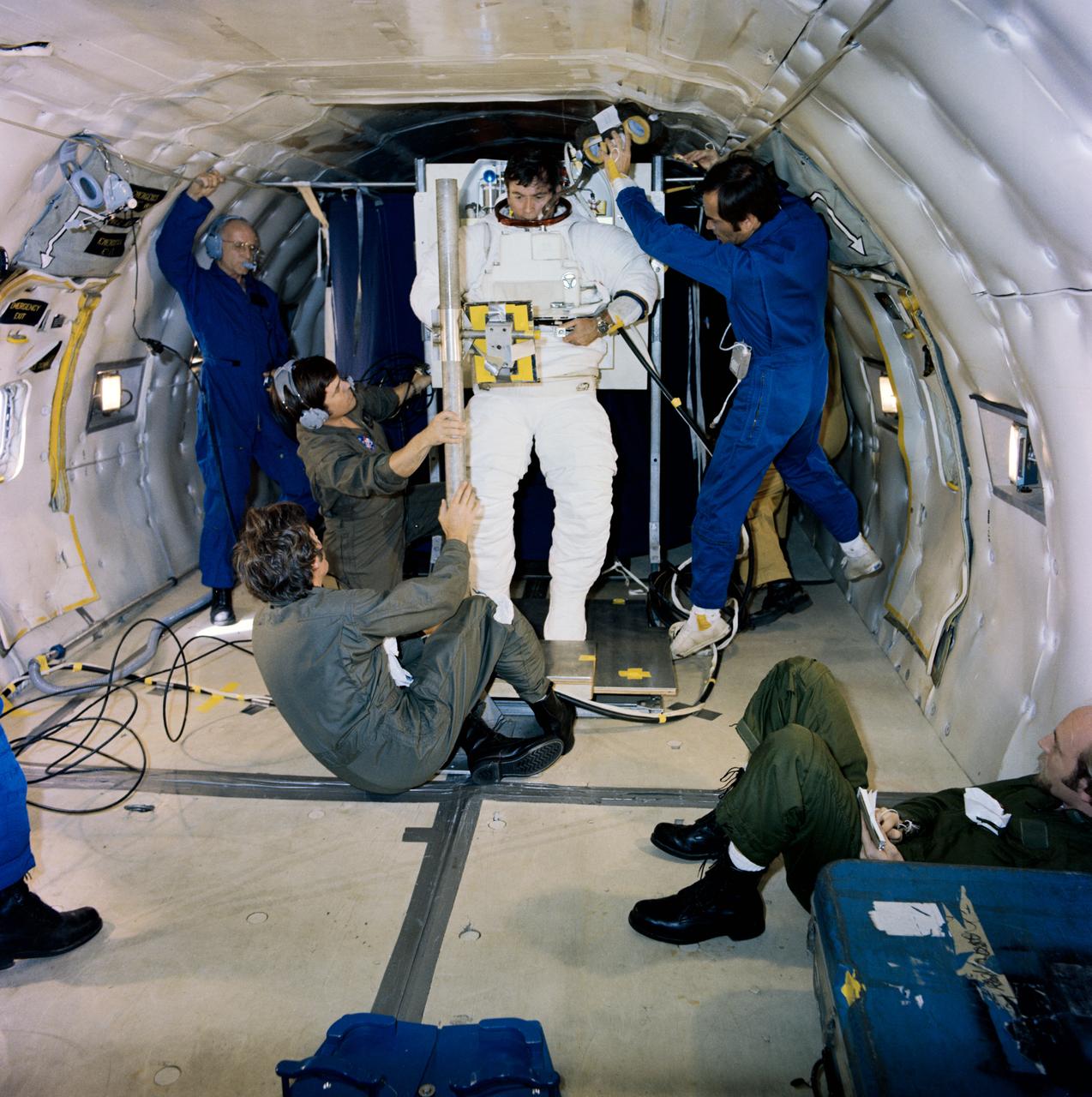
S79-30347 (31 March 1979) --- Taking advantage of a brief period of zero-gravity afforded aboard a KC-135 flying a parabolic curve, the flight crew of the first space shuttle orbital flight test (STS-1) goes through a spacesuit donning exercise. Astronaut John W. Young has just entered the hard-material torso of the shuttle spacesuit by approaching it from below. He is assisted by astronaut Robert L. Crippen. The torso is held in place by a special stand here, simulating the function provided by the airlock wall aboard the actual shuttle craft. The life support system is mated to the torso on Earth and remains so during the flight, requiring this type of donning and doffing exercise. Note Crippen?s suit is the type to be used for intravehicular activity in the shirt sleeve environment to be afforded aboard shuttle. The suit worn by Young is for extravehicular activity (EVA). Young will be STS-1 commander and Crippen, pilot. They will man the space shuttle orbiter 102 Columbia. Photo credit: NASA
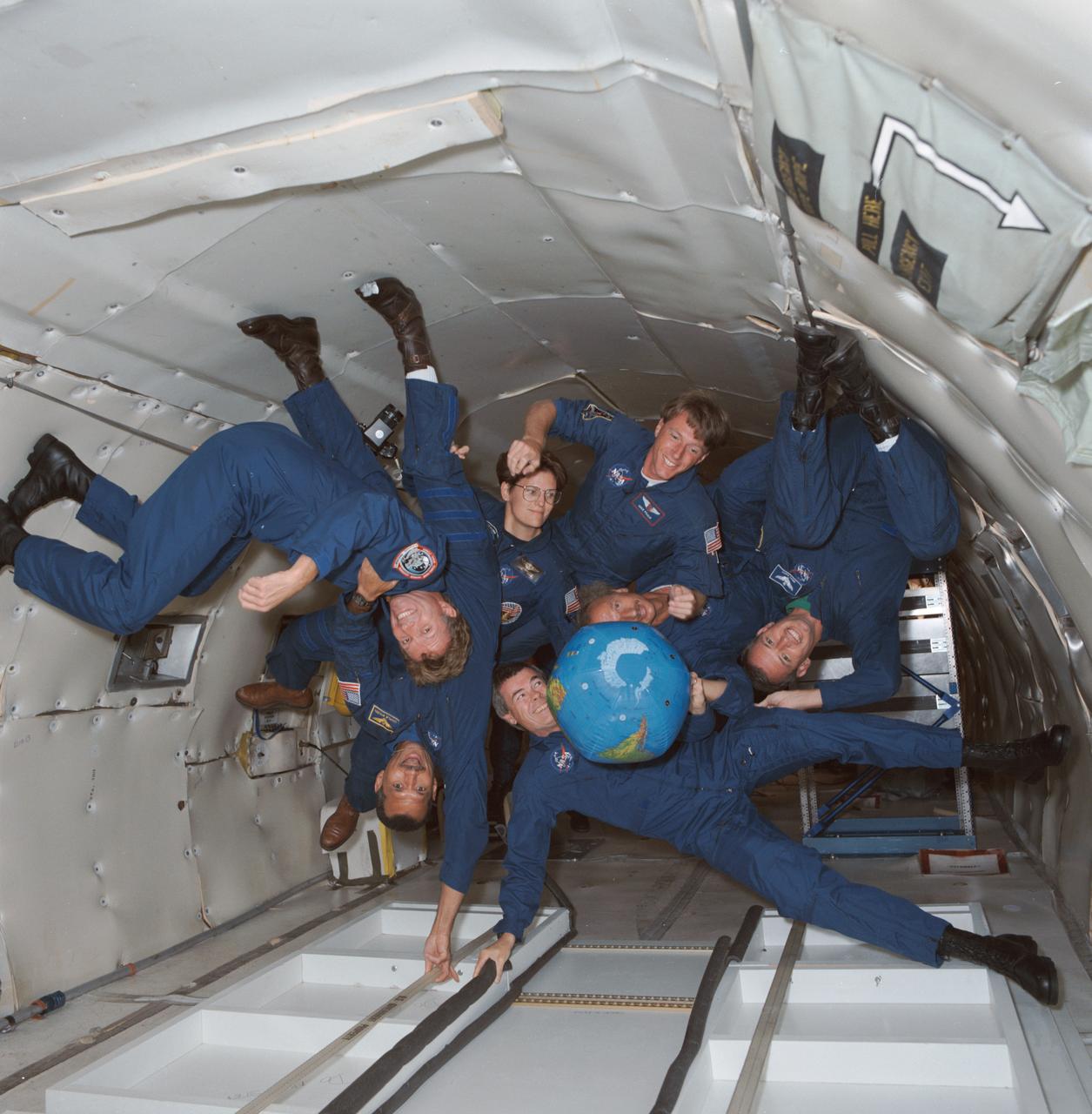
S91-44453 (21 Aug 1991) --- The crew of STS-45 is already training for its March 1992 mission, including stints on the KC-135 zero-gravity-simulating aircraft. Shown with an inflatable globe are, clockwise from the top, C. Michael Foale, mission specialist; Dirk Frimout, payload specialist; Brian Duffy, pilot; Charles R. (Rick) Chappell, backup payload specialist; Charles F. Bolden, mission commander; Byron K. Lichtenberg, payload specialist; and Kathryn D. Sullivan, payload commander.
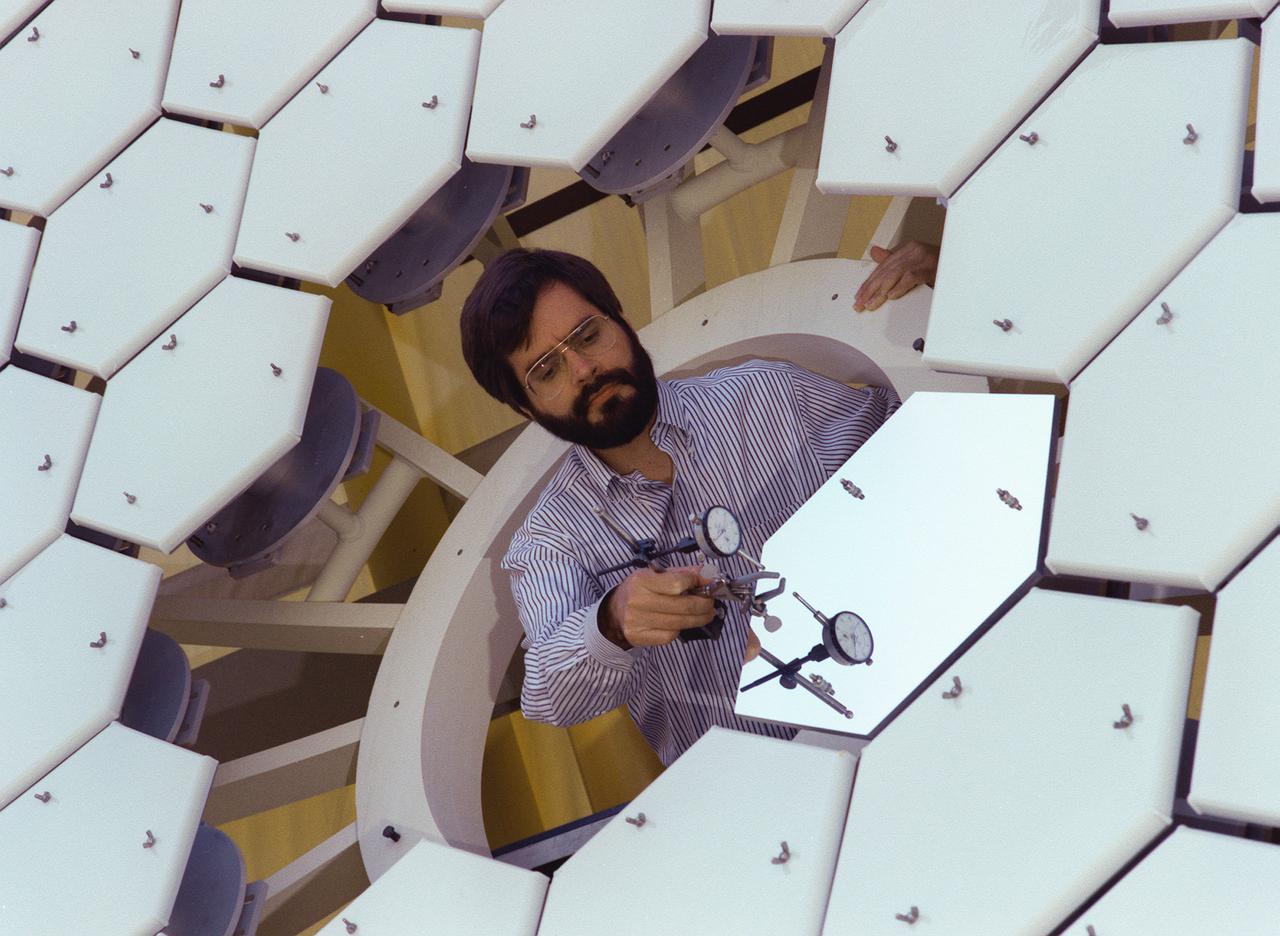
NASA's Space Optics Manufacturing Technology Center has been working to expand our view of the universe via sophisticated new telescopes. The Optics Center's goal is to develop low-cost, advanced space optics technologies for the NASA program in the 21st century, including the long-term goal of imaging Earth-like planets in distant solar systems. A segmented array of mirrors was designed by the Space Optics Manufacturing Technology Center for the solar concentrator test stand at the Marshall Space Flight Center (MSFC) for powering solar thermal propulsion engines. Each hexagon mirror has a spherical surface to approximate a parabolic concentrator when combined into the entire 18-foot diameter array. The aluminum mirrors were polished with a diamond turning machine that creates a glass-like reflective finish on metal. The precision fabrication machinery at the Space Optics Manufacturing Technology Center at MSFC can polish specialized optical elements to a world class quality of smoothness. This image shows optics physicist, Vince Huegele, examining one of the 144-segment hexagonal mirrors of the 18-foot diameter array at the MSFC solar concentrator test stand.
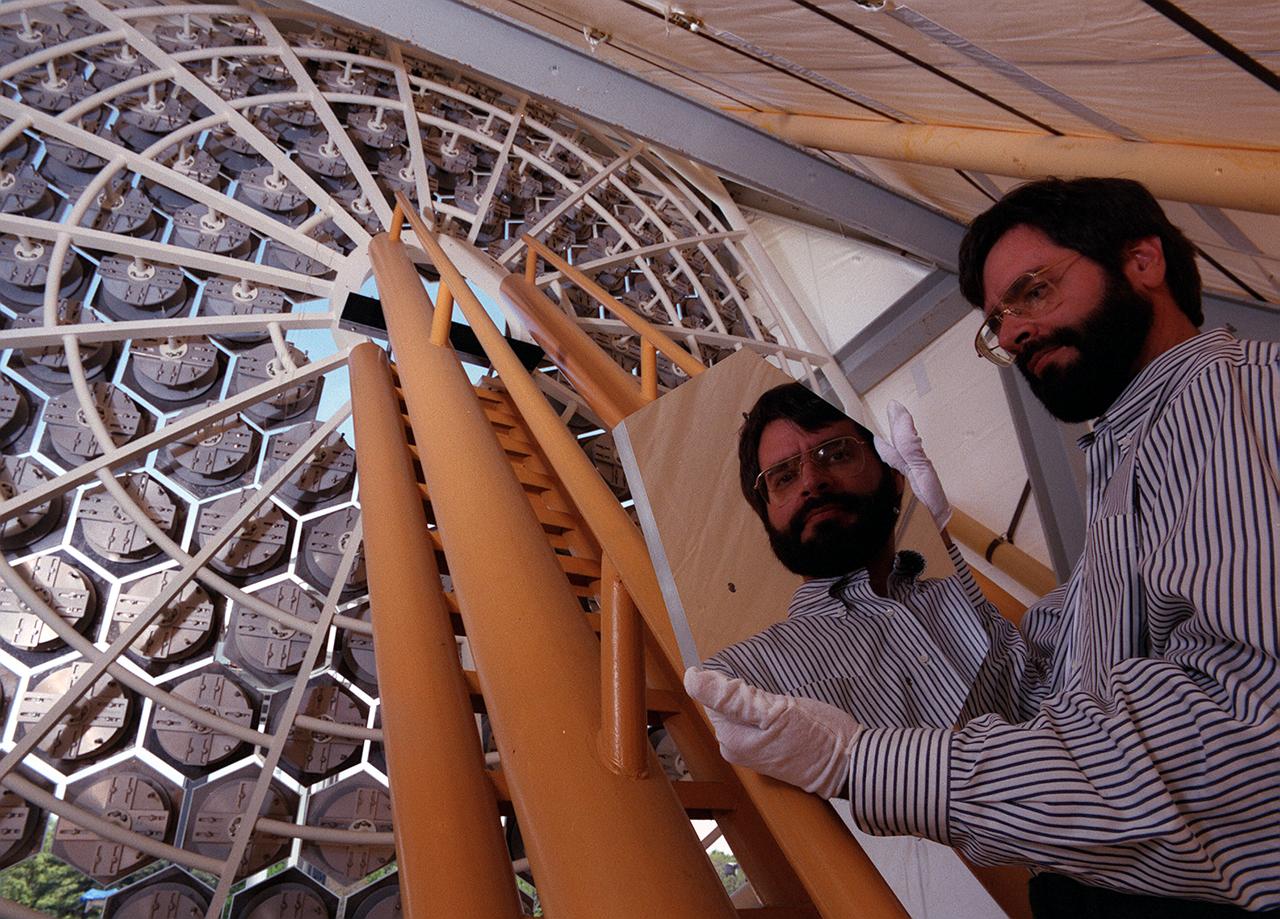
NASA's Space Optics Manufacturing Technology Center has been working to expand our view of the universe via sophisticated new telescopes. The Optics Center's goal is to develop low-cost, advanced space optics technologies for the NASA program in the 21st century, including the long-term goal of imaging Earth-like planets in distant solar systems. A segmented array of mirrors was designed by the Space Optics Manufacturing Technology Center for solar the concentrator test stand at the Marshall Space Flight Center (MSFC) for powering solar thermal propulsion engines. Each hexagon mirror has a spherical surface to approximate a parabolic concentrator when combined into the entire 18-foot diameter array. The aluminum mirrors were polished with a diamond turning machine, that creates a glass-like reflective finish on metal. The precision fabrication machinery at the Space Optics Manufacturing Technology Center at MSFC can polish specialized optical elements to a world class quality of smoothness. This image shows optics physicist, Vince Huegele, examining one of the 144-segment hexagonal mirrors of the 18-foot diameter array at the MSFC solar concentrator test stand.
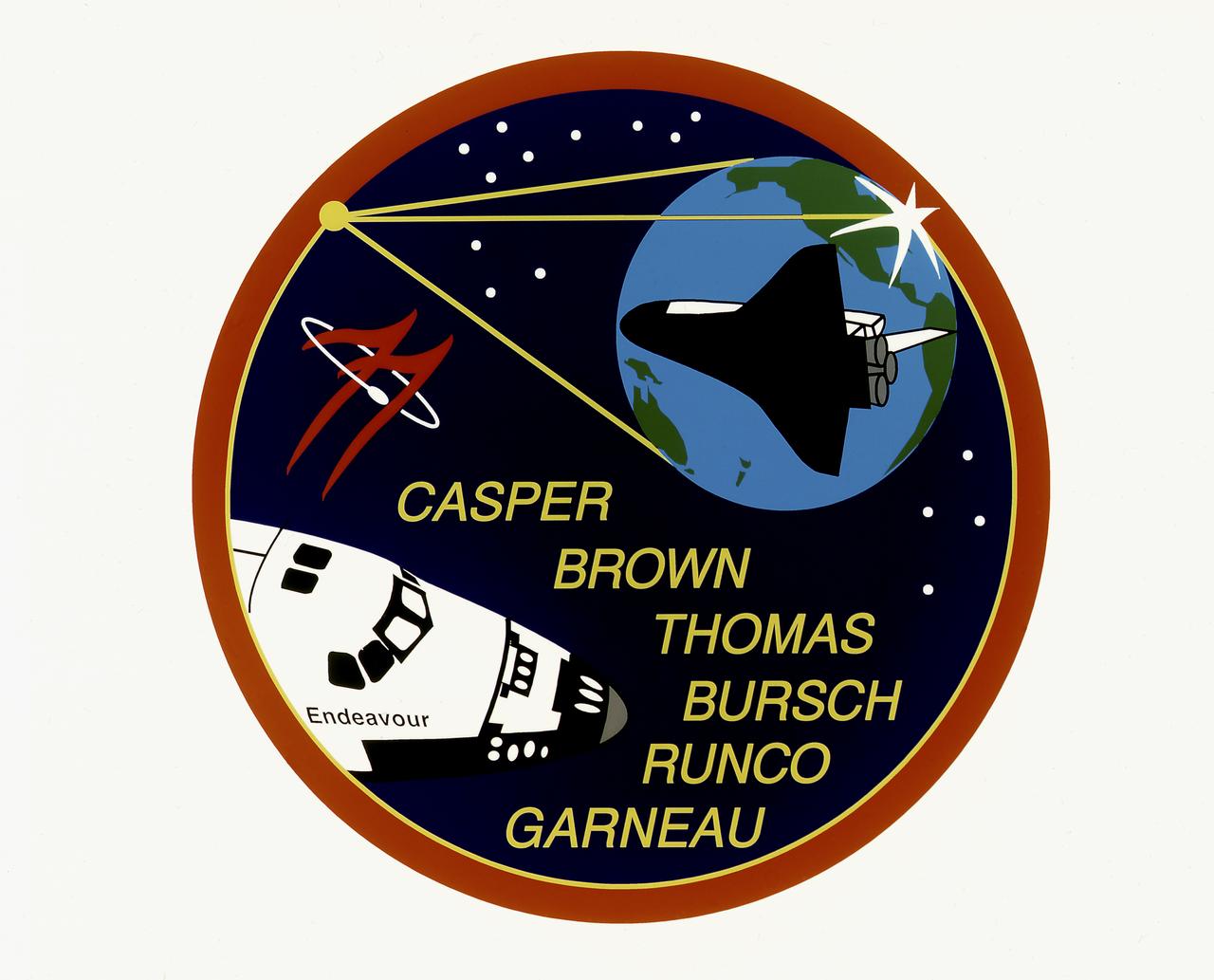
The STS-77 crew patch displays the Shuttle Endeavour in the lower left and its reflection within the tripod and concave parabolic mirror of the SPARTAN Inflatable Antenna Experiment (IAE). The center leg of the tripod also delineates the top of the Spacehab's shape, the rest of which is outlined in gold just inside the red perimeter. The Spacehab was carried in the payload bay and housed the Commercial Float Zone Furnace (CFZF). Also depicted within the confines of the IAE mirror are the mission's rendezvous operations with the Passive Aerodynamically-Stabilized Magnetically-Damped satellite (PAM/STU) appears as a bright six-pointed star-like reflection of the sun on the edge of the mirror with Endeavour in position to track it. The sunlight on the mirror's edge, which also appears as an orbital sunset, is located over Goddard Space Flight Center, the development facility for the SPARTAN/IAE and Technology Experiments Advancing Missions in Space (TEAMS) experiments. The reflection of the Earth is oriented to show the individual countries of the crew as well as the ocean which Captain Cook explored in the original Endeavour. The mission number 77 is featured as twin stylized chevrons and an orbiting satellite as adapted from NASA's logo. The stars at the top are arranged as seen in the northern sky in the vicinity of the constellation Ursa Minor. The field of 11 stars represents both the TEAMS cluster of experiments (the four antennae of GPS Attitude and Navigation Experiment (GANE), the single canister of Liquid Metal Thermal Experiment (LMTE), the three canisters of Vented Tank Resupply Experiment (VTRE), and the three canisters of PAM/STU) and the 11th flight of Endeavour. The constellation at the right shows the fourth flight of Spacehab Experiments.
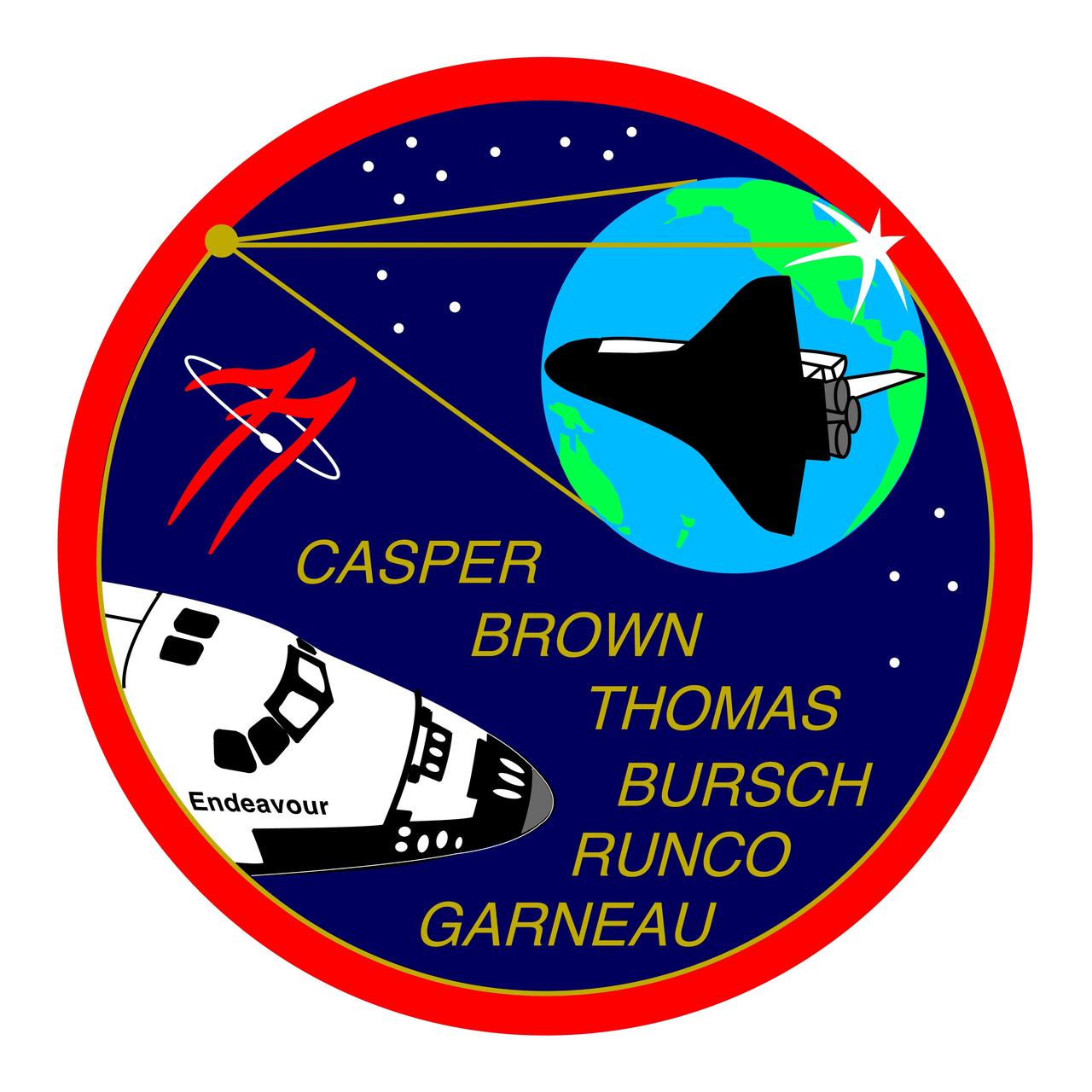
STS077-S-001 (February 1996) --- The STS-77 crew patch, designed by the crew members, displays the space shuttle Endeavour the lower left and its reflection within the tripod and concave parabolic mirror of the Shuttle Pointed Autonomous Research Tool for Astronomy (SPARTAN) Inflatable Antenna Experiment (IAE). The center leg of the tripod also delineates the top of the Spacehab?s shape, the rest of which is outlined in gold just inside the red perimeter. The Spacehab is carried in the payload bay and houses the Commercial Float Zone Furnace (CFZF) and Space Experiment Facility (SEF) experiments. Also depicted within the confines the IAE mirror are the mission?s rendezvous operations with the Passive Aerodynamically Stabilized Magnetically Damped Satellite/Satellite Test Unit (PAM/STU) satellite and a reflection of Earth. The PAM/STU satellite appears as a bright six-pointed star-like reflection of the sun on the edge of the mirror with the space shuttle Endeavour in position to track it. The sunglint on the mirror?s edge, which also appears as an orbital sunset, is located over Goddard Space Flight Center (GSFC), the development facility for the SPARTAN/IAE and Technology Experiments Advancing Missions in Space (TEAMS) experiments. The reflection of Earth is oriented to show the individual countries of the crew as well as the ocean which Captain Cook explored in the original Endeavour. The mission number ?77? is featured as twin stylized chevrons and an orbiting satellite as adapted from NASA?s logo. The stars at the top are arranged as seen in the northern sky in the vicinity of the constellation Ursa Minor. The field of 11 stars represents both the TEAMS cluster of experiments (the four antennae of Global Positioning System Attitude and Navigation Experiment (GANE), the single canister of Liquid Metal Thermal Experiment (LMTE), the three canisters of Vented Tank Resupply Experiment (VTRE), and the canisters of PAM/STU, and the 11th flight of the Endeavour. The constellation at the right shows the four stars of the Southern Cross for the fourth flight of Spacehab. The NASA insignia design for space shuttle flights is reserved for use by the astronauts and for other official use as the NASA Administrator may authorize. Public availability has been approved only in the forms of illustrations by the various news media. When and if there is any change in this policy, which is not anticipated, the change will be publicly announced. Photo credit: NASA