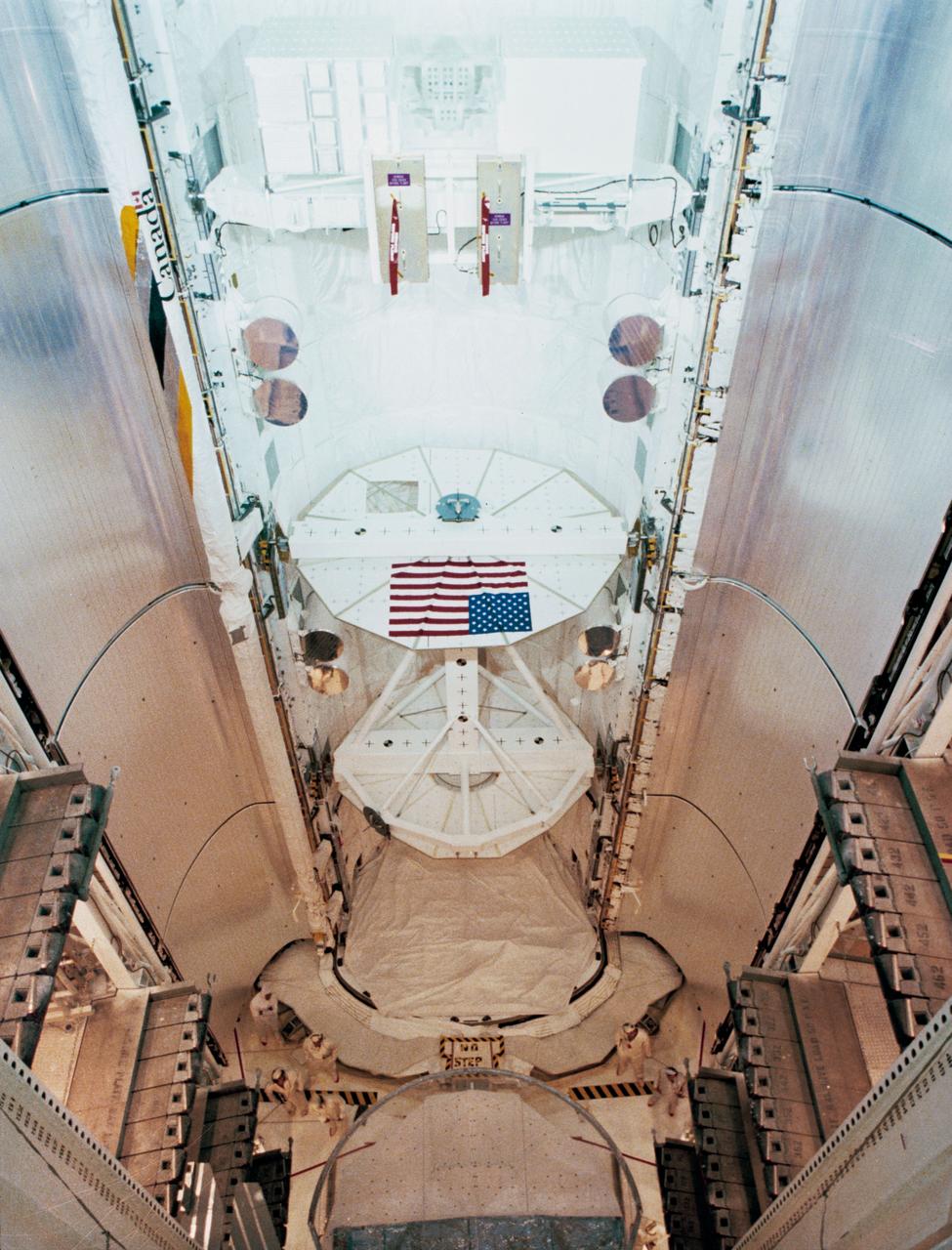
View of the Payload Flight Test Article (PFTA) installed into Challenger's cargo bay in the Payload Changeout Room at Pad 39A at the Kennedy Space Center (KSC). The American flag is visible on one side of the PFTA in the cargo bay. The Kennedy Space Center alternative photo number is KSC-108-83PC-566.
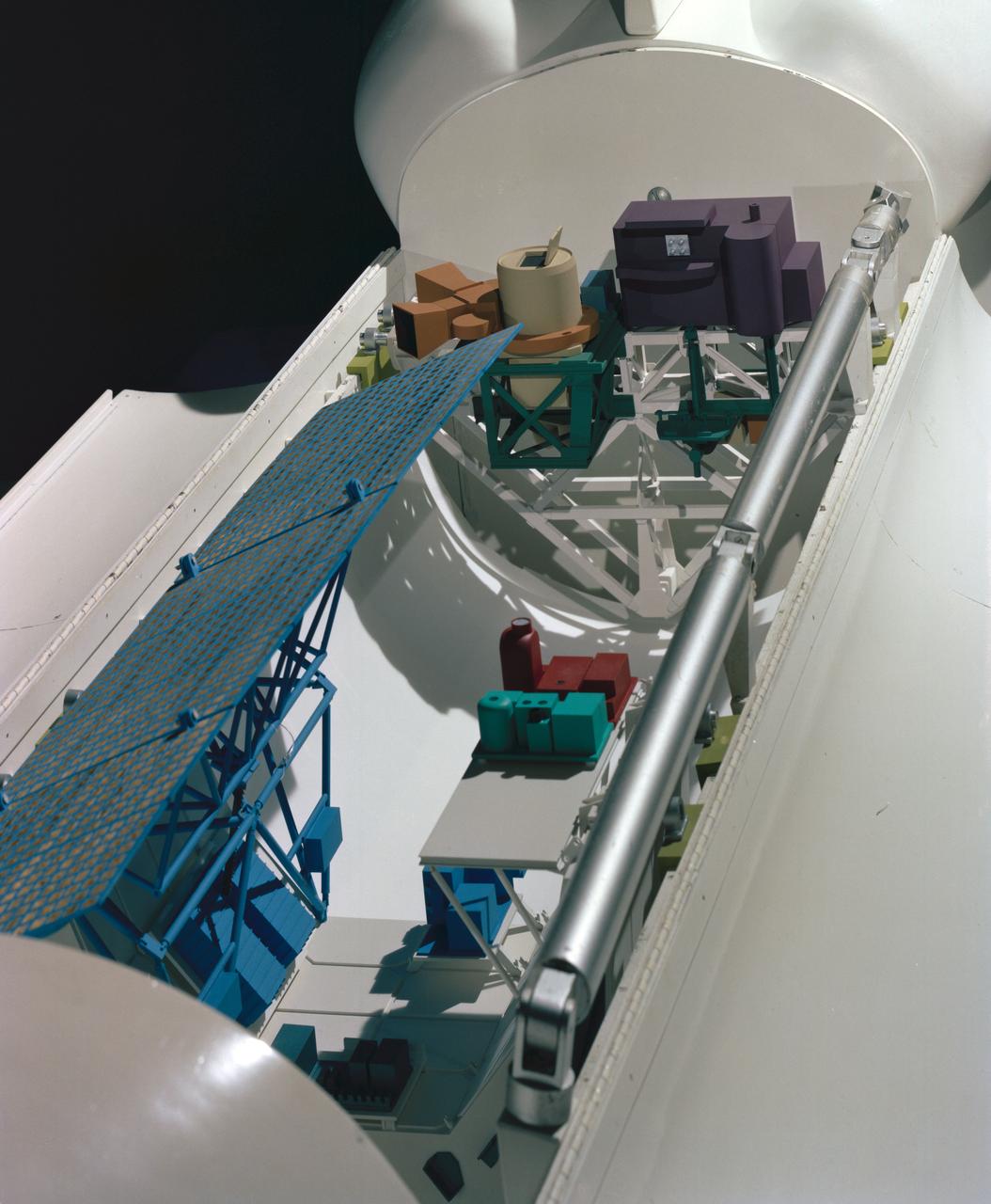
Model showing OSTA-3 and other payloads in the open shuttle orbiter cargo bay.
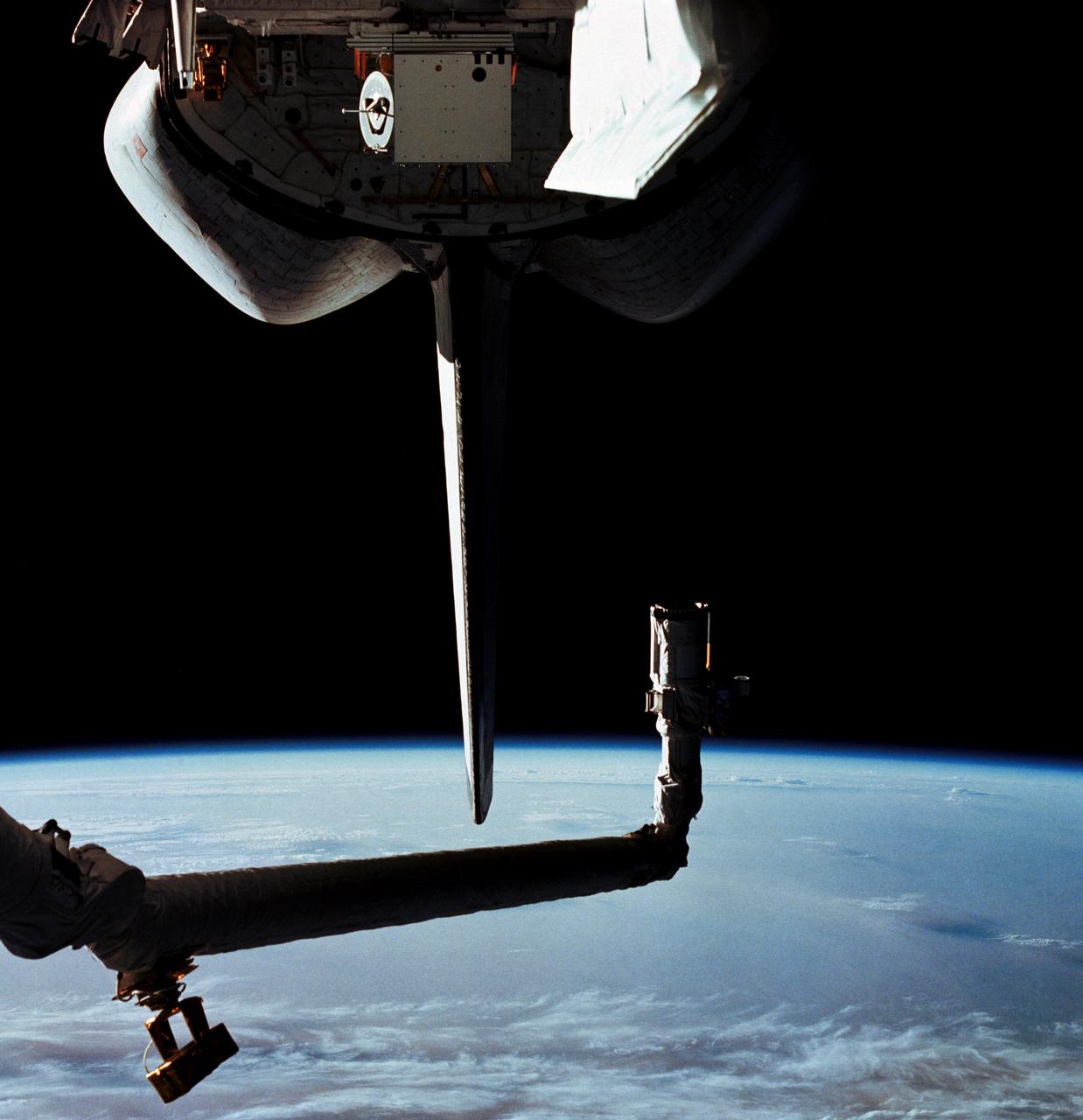
STS002-12-833 (13 Nov. 1981) --- Clouds over Earth and black sky form the background for this unique photograph from the space shuttle Columbia in Earth orbit. The photograph was shot through the aft flight deck windows viewing the cargo bay. Part of the scientific payload of the Office of Space and Terrestrial Applications (OSTA-1) is visible in the open cargo bay. The astronauts inside Columbia's cabin were remotely operating the Canadian-built remote manipulator system (RMS). Note television cameras on its elbow and wrist pieces. Photo credit: NASA

STS066-129-005 (3-14 Nov 1994) --- Clouds over the Atlantic Ocean serve as the backdrop for this 70mm scene of the Atmospheric Laboratory for Applications and Science (ATLAS-3) payload in the cargo bay of the Earth-orbiting Space Shuttle Atlantis. Crew members onboard Atlantis were astronauts Donald R. McMonagle, Curtis L. Brown, Jr., Ellen Ochoa, Scott E. Parazynski and Joseph R. Tanner, along with Jean-François Clervoy of the European Space Agency (ESA). The six astronauts spent 11-days in Earth-orbit in support of the Atmospheric Laboratory for Applications and Science (ATLAS-3) mission.
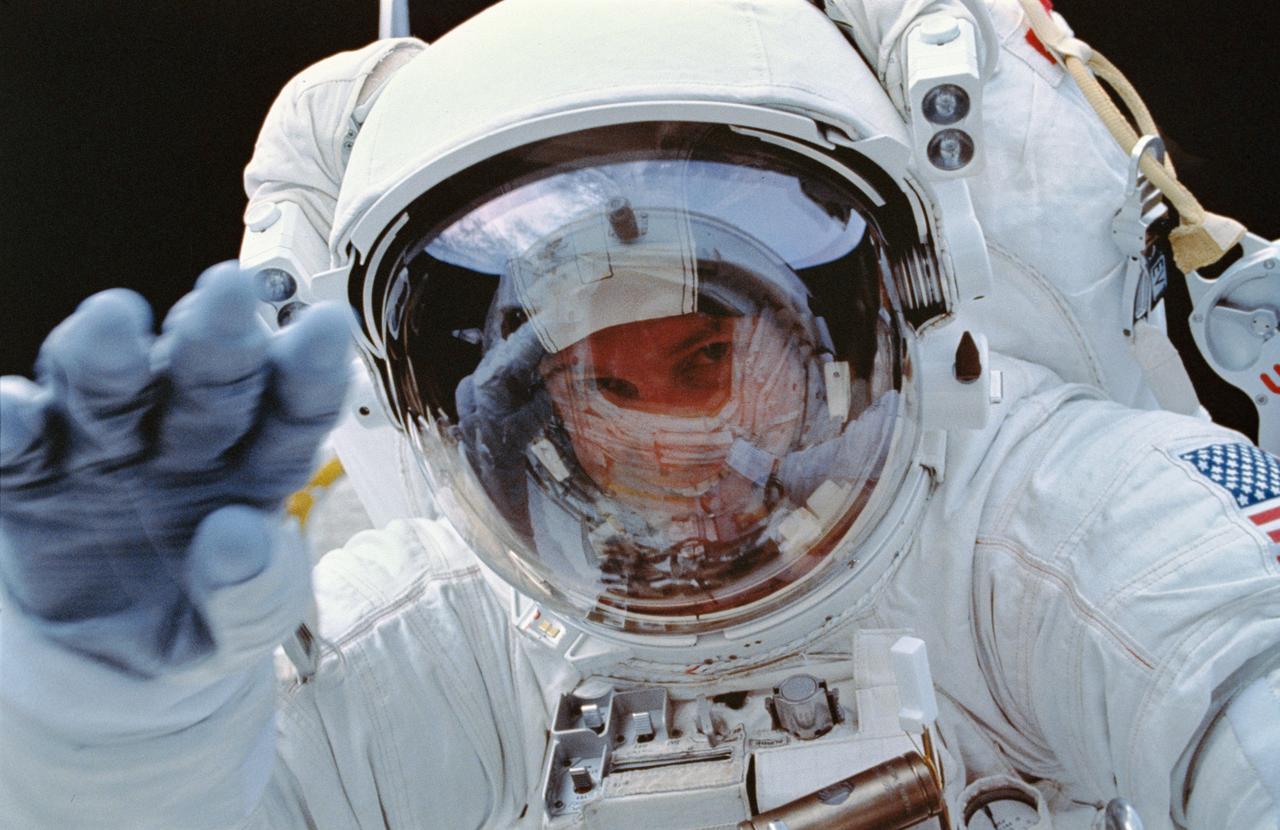
STS054-31-031 (17 Jan 1993) --- Astronaut Gregory J. Harbaugh, mission specialist, waves to fellow crew members on Endeavour's aft flight deck from the payload bay during the four-plus hours extravehicular activity (EVA). Harbaugh was joined on the EVA by astronaut Mario Runco Jr., mission specialist.
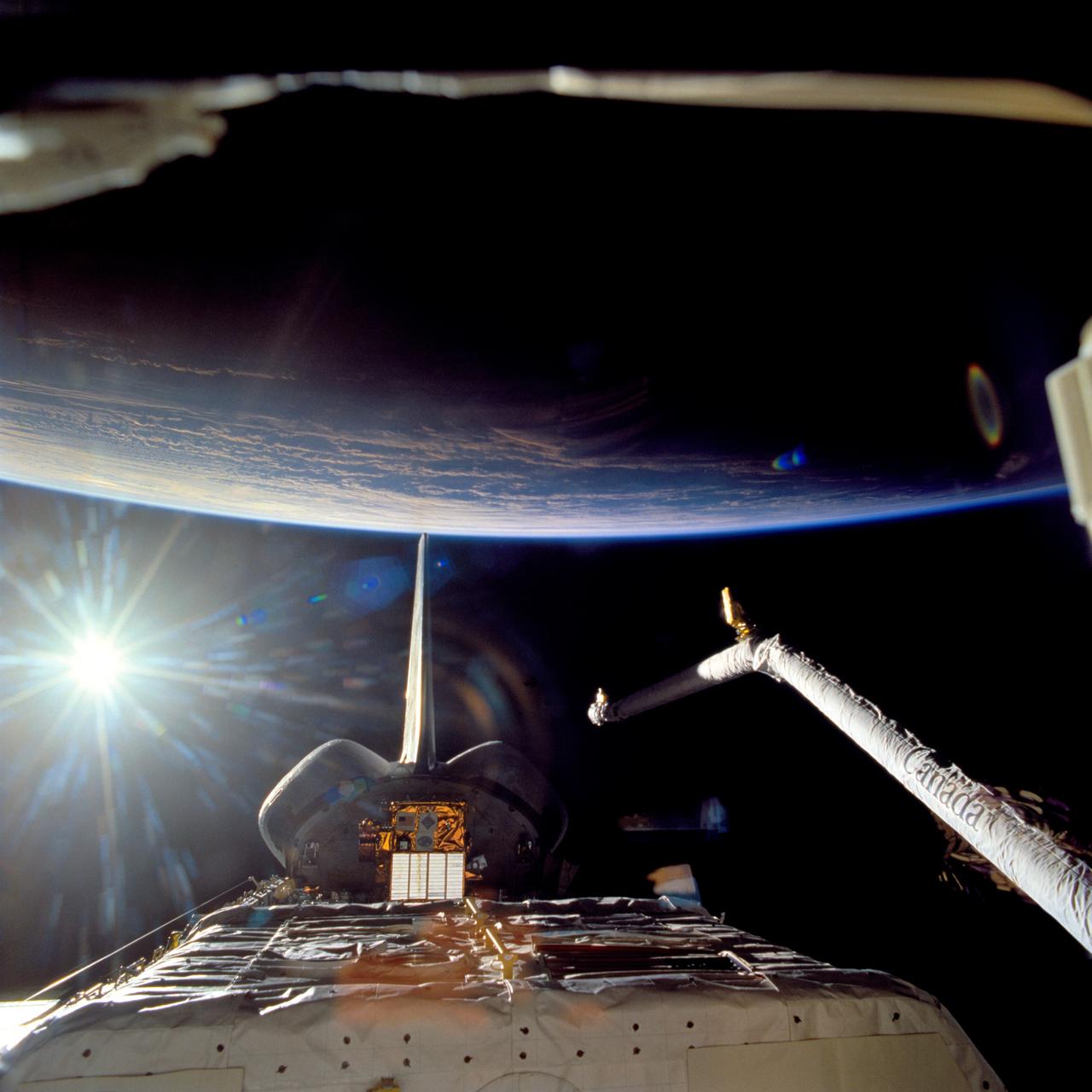
STS063-716-025 (9 Feb. 1995) --- In tail-to Earth mode, the Space Shuttle Discovery is backdropped against dark space, Sunburst and massive clouds over the ocean. The Spartan 204 is visible in the cargo bay. This is one of 16 still photographs released by the NASA Johnson Space Center (JSC) Public Affairs Office (PAO) on February 14, 1995. Onboard Discovery were astronauts James D. Wetherbee, mission commander; Eileen M. Collins, pilot; Bernard A. Harris, Jr., payload commander; mission specialists C. Michael Foale, Janice E. Voss, and cosmonaut Vladimir G. Titov.
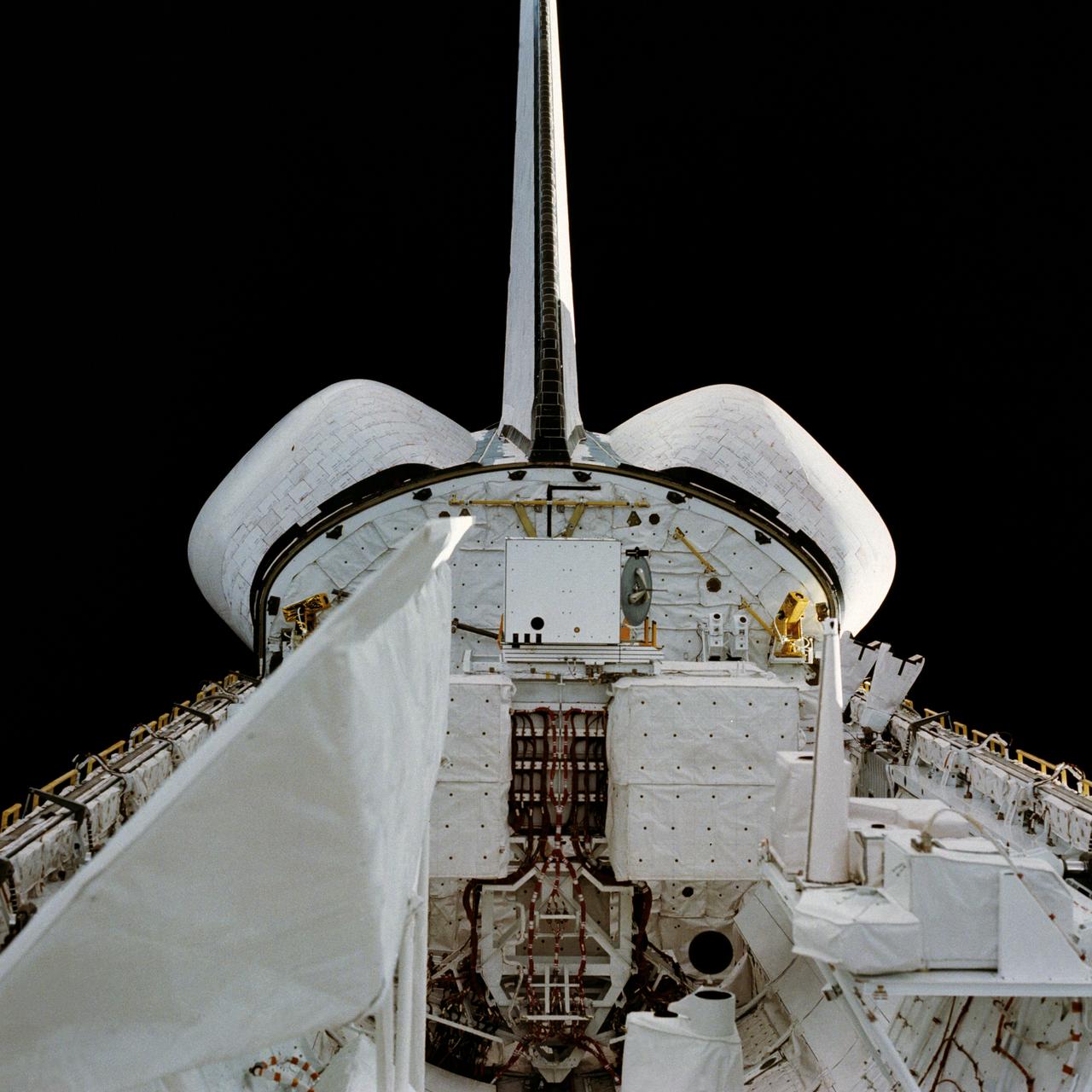
STS002-13-208 (12-14 Nov. 1981) --- This clear view of the aft section of the Earth-orbiting space shuttle Columbia's cargo bay and some of its cargo was photographed through the flight deck's aft windows. Visible in the center of the photo are the twin orbital maneuvering system (OMS) pods. The vertical stabilizer or tail splits the top part of the image in half. The Induced Environment Contamination Monitor (IECM) Location experiment is located in the back center of the cargo bay, near the top. There is a grapple fixture attached to the side of the IECM. Various components of the Office of Space Terrestrial Applications (OSTA-1) payload are seen near the aft section of the cargo bay, such as the Feature Identification and Location Experiment (FILE) (the long cone shaped object on the right back), the Shuttle Multispectral Infrared Radiometer (SMIRR) (on pallet base) and the SIR-A recorder in the right foreground. In the left foreground the Shuttle Imaging Radar-A (SIR-A) antenna can be seen. Photo credit: NASA
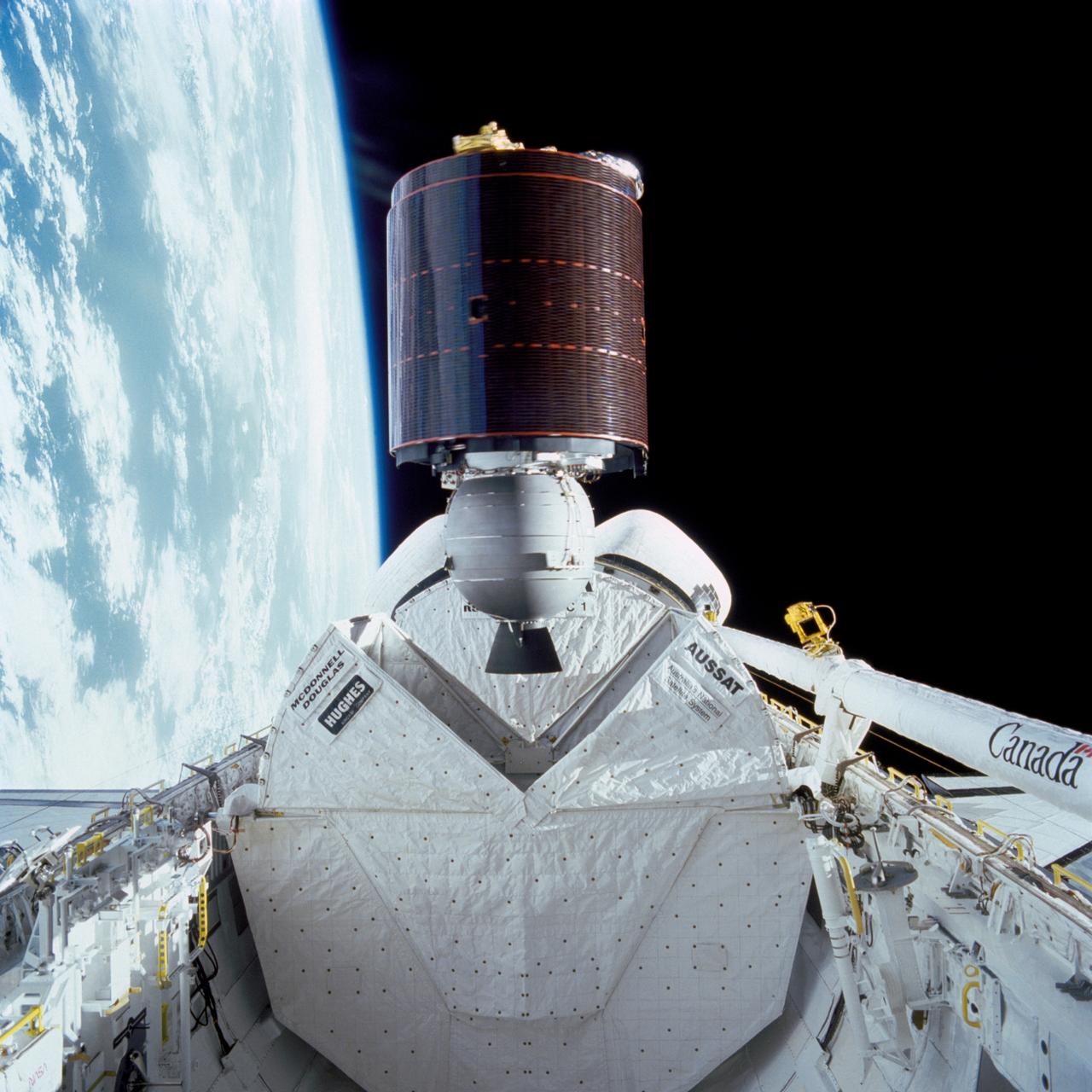
51I-32-023 (27 Aug. 1985) --- Australia's AUSSAT communications satellite is deployed from the payload bay of the space shuttle Discovery on flight day one. A portion of the cloudy surface of Earth can be seen to the left of the frame. Photo credit: NASA
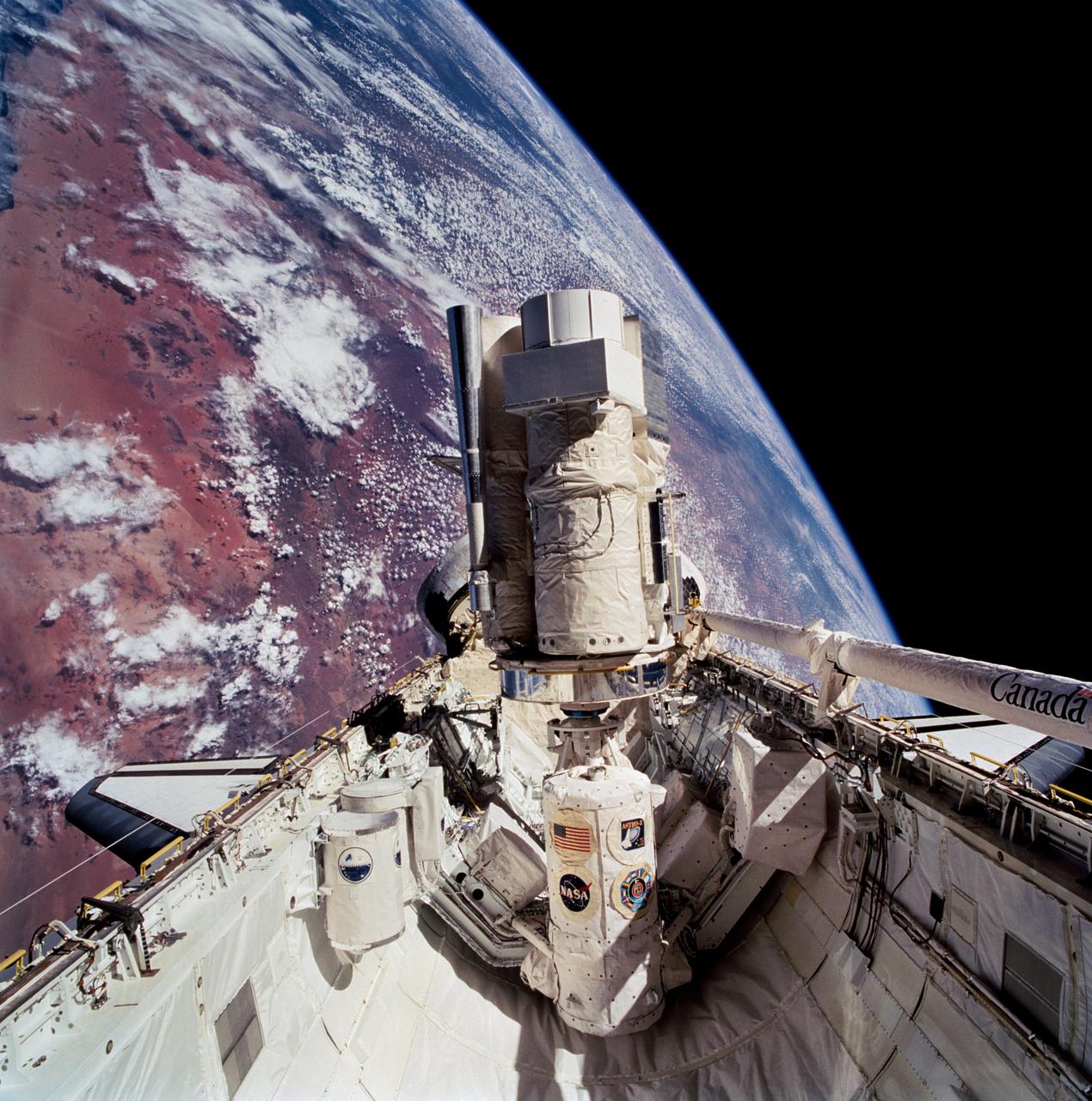
STS067-713-072 (2-18 March 1995) --- This 70mm cargo bay scene, backdropped against a desert area of Namibia, typifies the view that daily greeted the Astro-2 crew members during their almost 17-days aboard the Space Shuttle Endeavour. Positioned on the Spacelab pallet amidst other hardware, the Astro-2 payload is in its operational mode. Visible here are the Instrument Pointing System (IPS), Hopkins Ultraviolet Telescope (HUT), Star Tracker (ST), Ultraviolet Imaging Telescope (UIT), Wisconsin Ultraviolet Photo-Polarimeter Experiment (WUPPE), and Integrated Radiator System (IRS). At this angle, the Optical Sensor Package (OPS) is not seen. The Igloo, which supports the package of experiments, is in center foreground. Two Get-Away Special (GAS) canisters are in lower left foreground. The Extended Duration Orbiter (EDO) pallet, located aft of the cargo bay, is obscured by the Astro-2 payload. The Endeavour was 190 nautical miles above Earth.
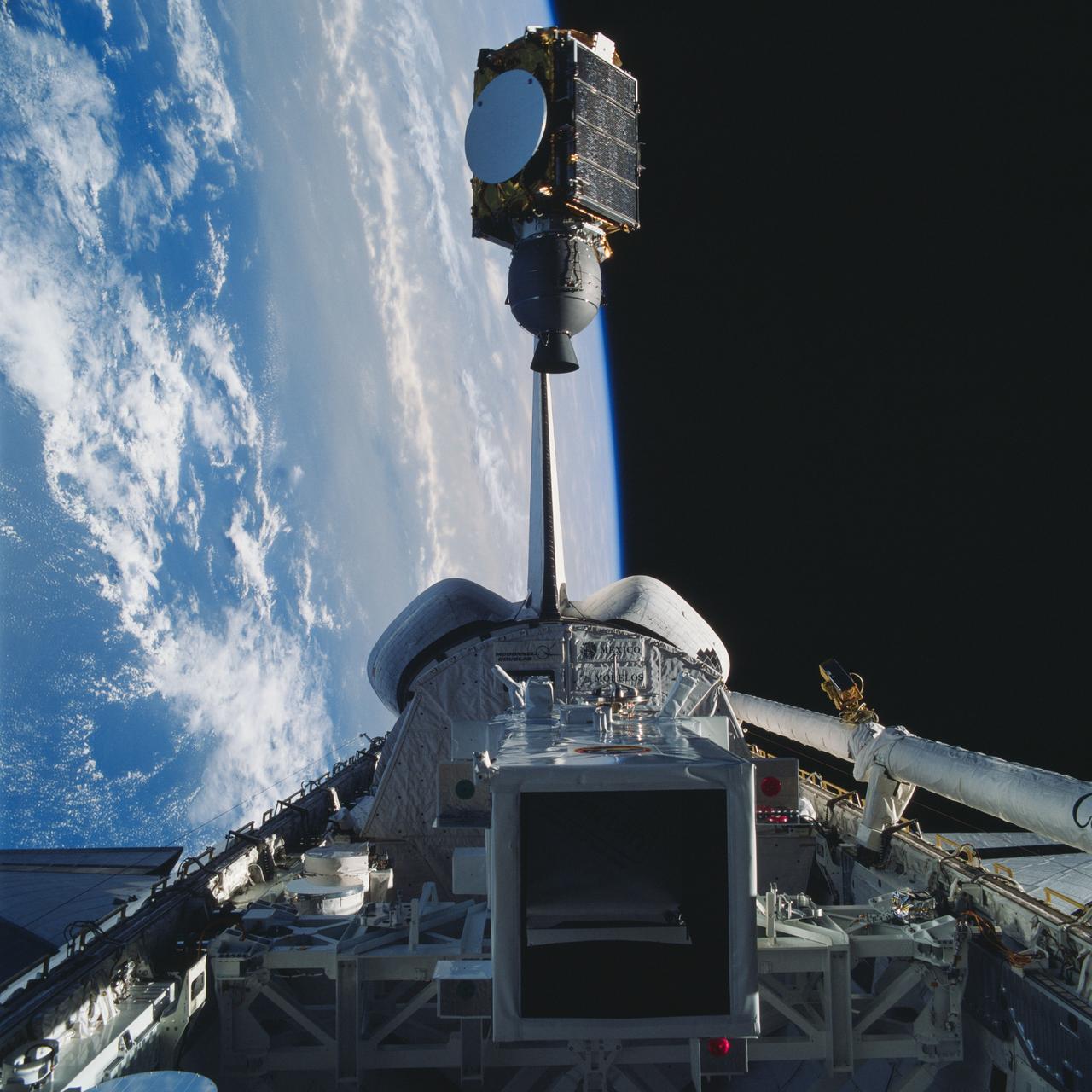
Arabsat communications satellite deploying from Discovery's payload bay. Cloudy Earth's surface can be seen to the left of the frame.
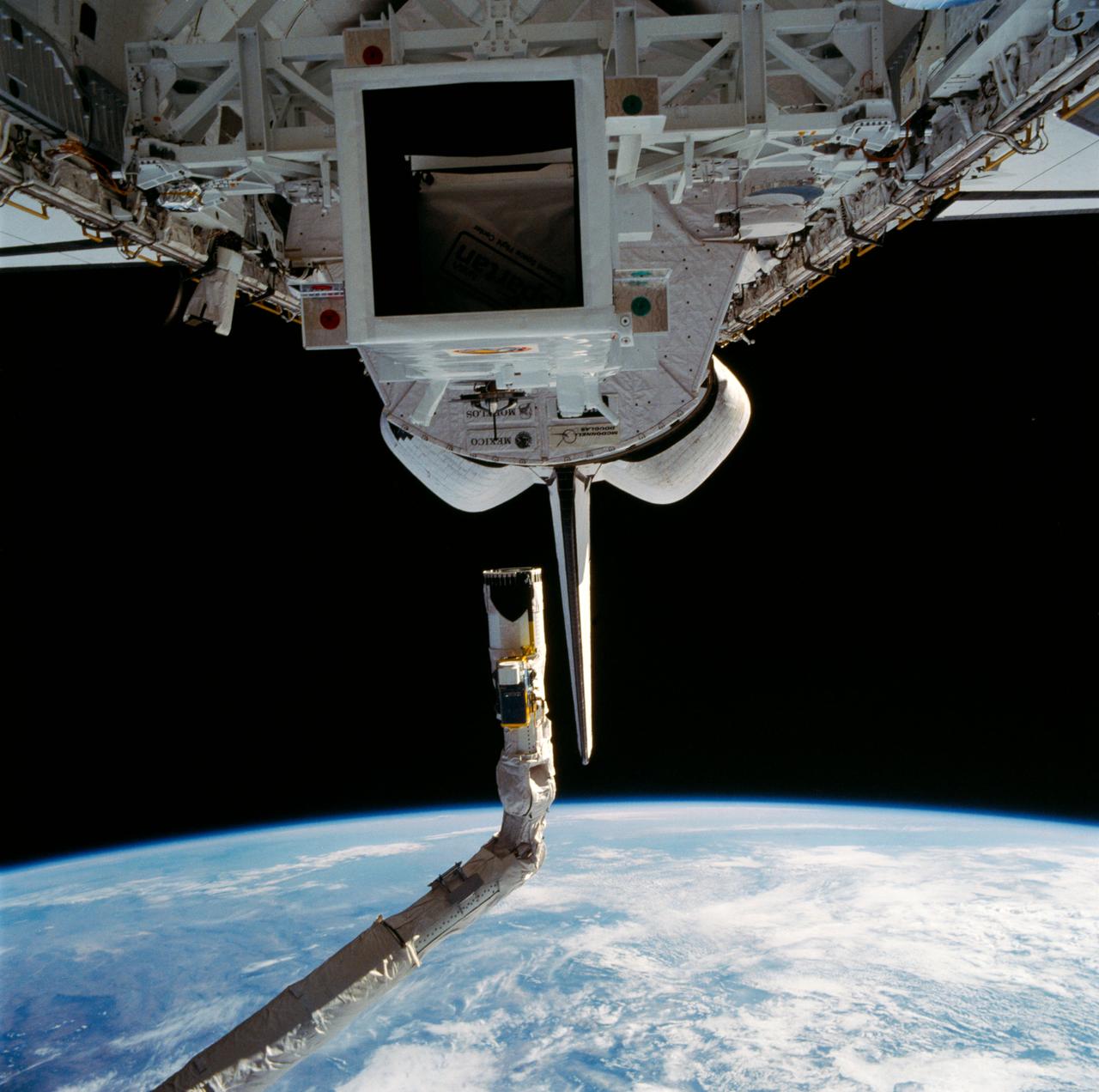
Spartan I satellte sits in the Discovery's payload bay prior to being deployed. Above it can be seen the remote manipulator system (RMS) arm and end effector. The Earth's horizon can also be seen above the orbiter.
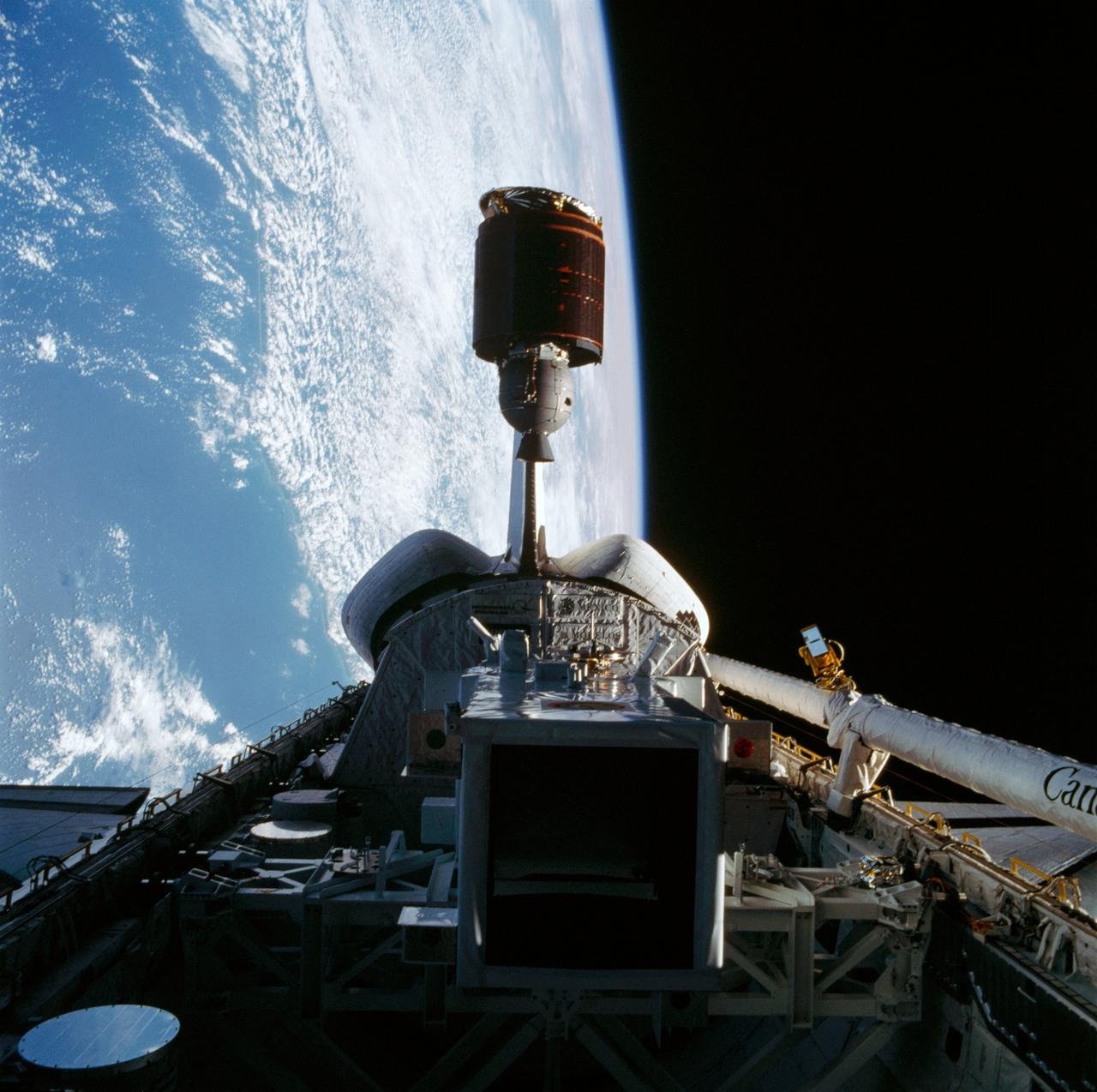
Telstar 3-D communications satellite deploying from Discovery's payload bay. Cloudy Earth's surface can be seen to the left of the frame.
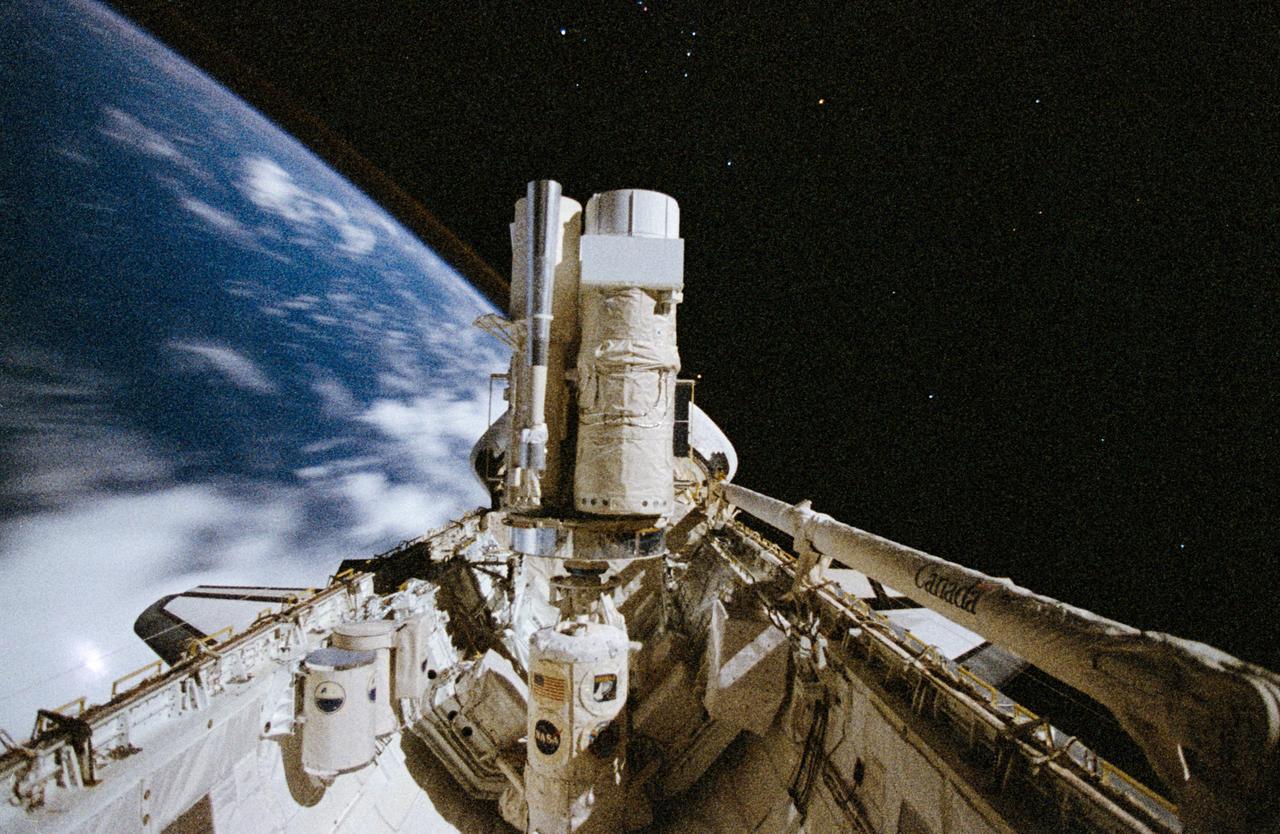
STS067-371-028 (2-18 March 1995) --- This 35mm lunar-illuminated scene of the Astro-2 payload in the Space Shuttle Endeavour's cargo bay was recorded by one of by the seven crew members during one of the many night passes of the almost 17-day mission. The cluster of telescopes and the Instrument Pointing System (IPS) are backdropped against the blue and white Earth and the darkness of space. What is believed to be the Constellation Orion is visible at upper center.
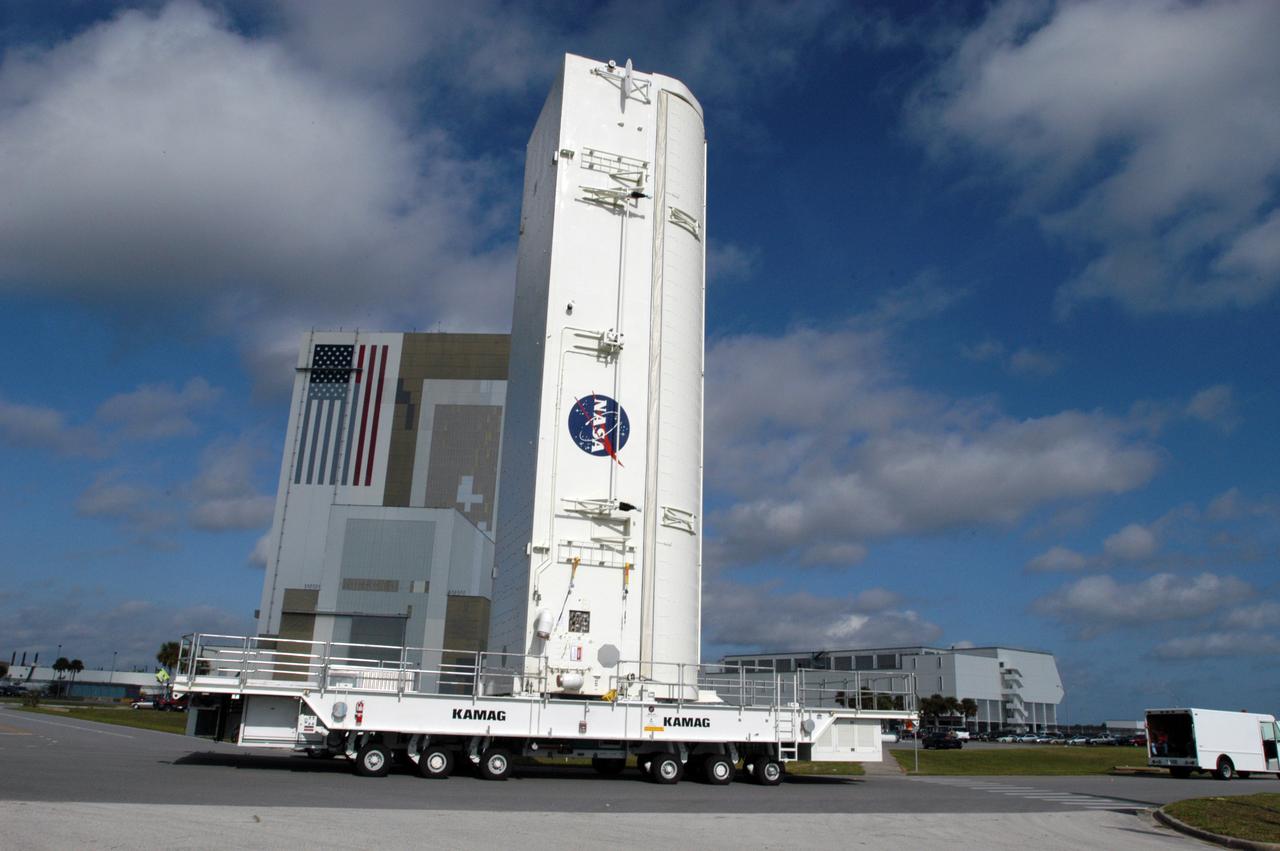
This payload canister is being transported to Launch Pad 39A for a "fit check." At a later date, the canister will be used to transport to the pad the S3/S4 solar arrays that are the payload for mission STS-117. The mission will launch on Space Shuttle Atlantis for the 21st flight to the International Space Station, and the crew of six will continue the construction of station with the installation of the arrays. The launch of Atlantis is targeted for March 16.
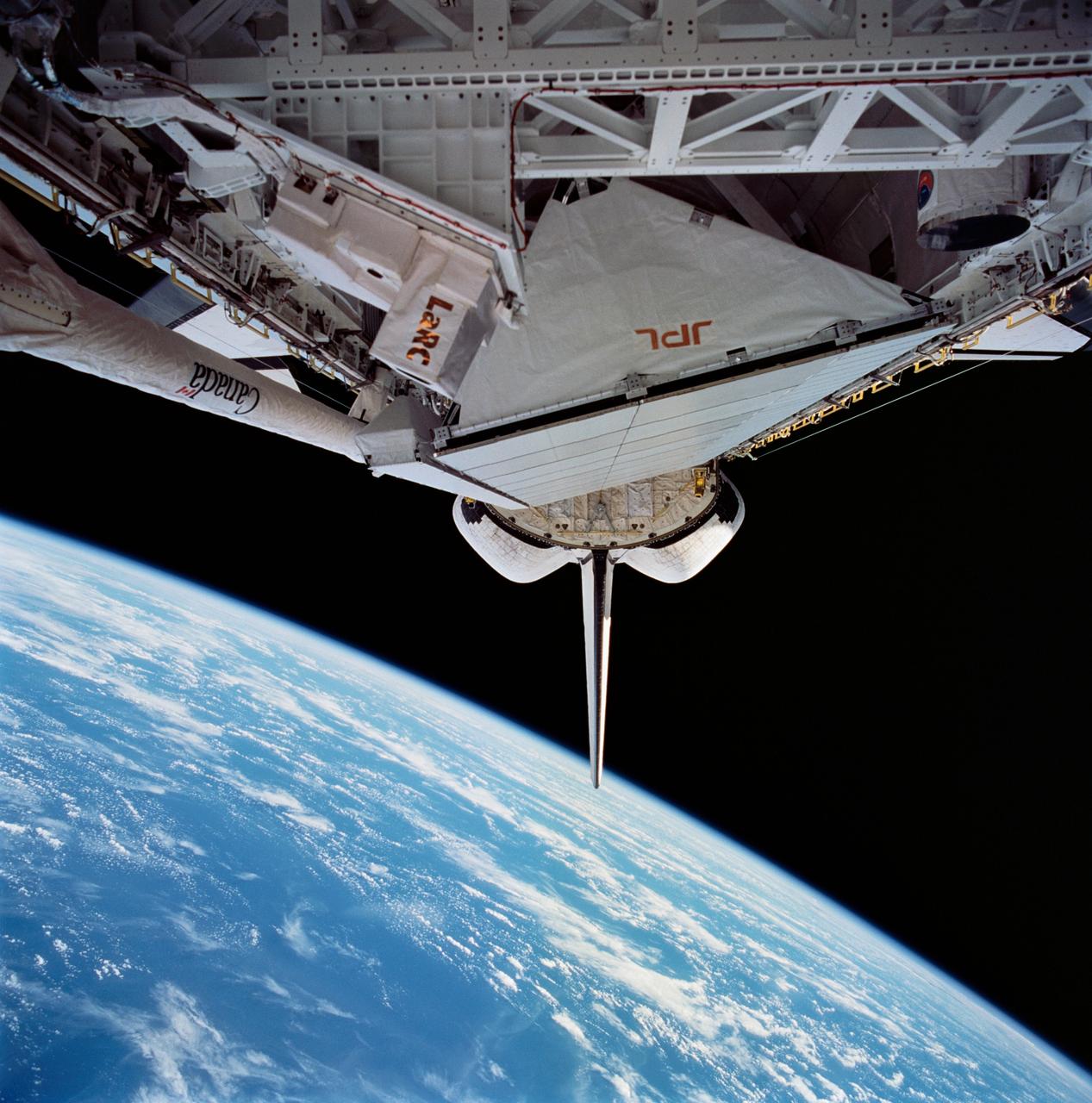
STS59-215-022 (12 April 1994) --- This 70mm frame, photographed through the aft flight deck windows of the Space Shuttle Endeavour, features the Space Radar Laboratory (SRL) payload in the cargo bay. An area of the Pacific Ocean northeast of Hawaii forms the backdrop for the image. Six NASA astronauts spent a week and a half in Earth orbit in support of the SRL mission.
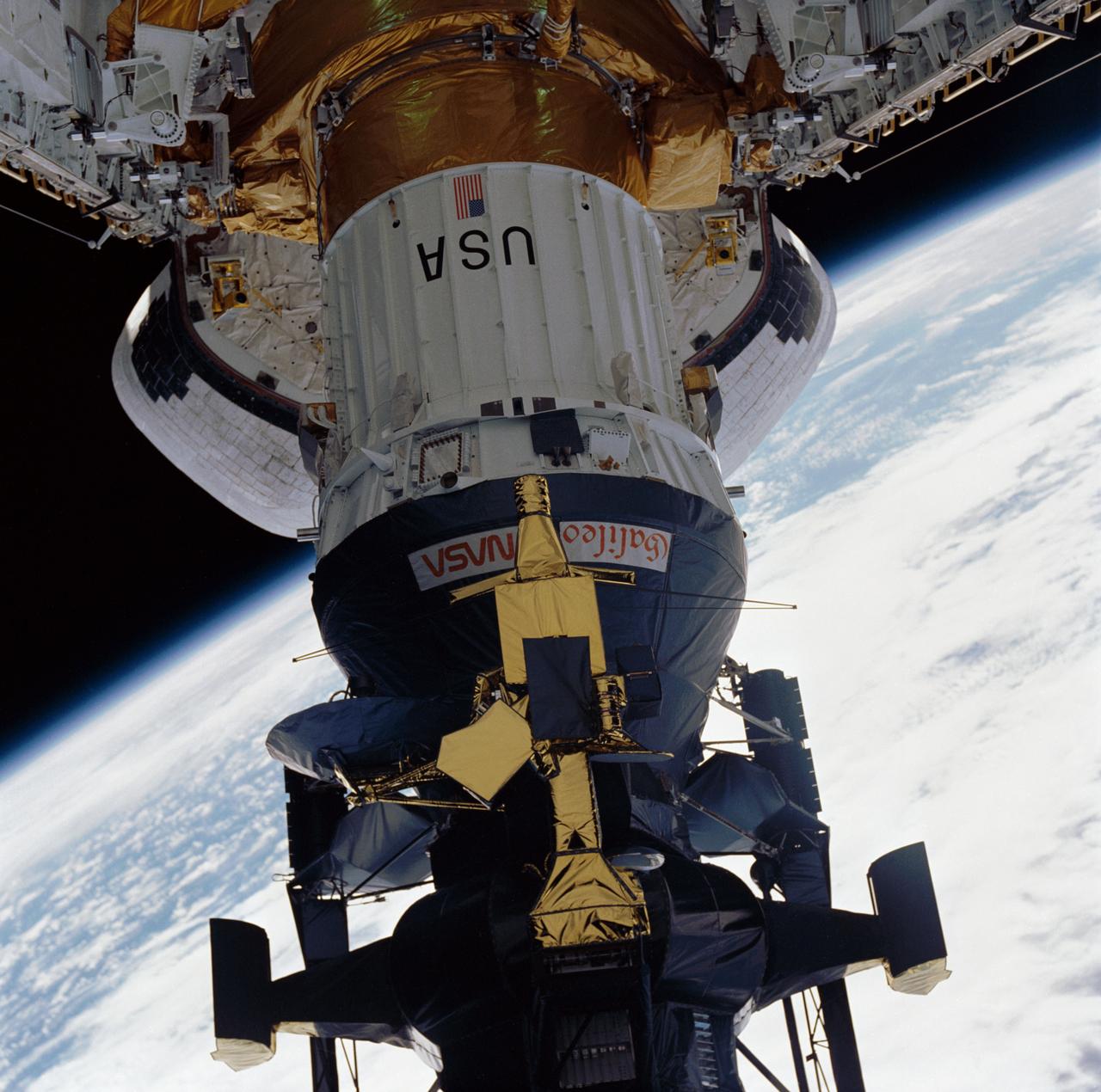
During STS-34 mission, the Galileo spacecraft mounted atop the inertial upper stage (IUS) is tilted to a 58-degree deployment position by the airborne support equipment (ASE) aft frame tilt actuator (AFTA) table in Atlantis', Orbiter Vehicle (OV) 104's, payload bay (PLB). Visible in the foreground is the ASE forward cradle and the umbilical boom which has fallen away from the IUS. OV-104's orbital maneuvering system (OMS) pods and the Earth's limb appear in the background.
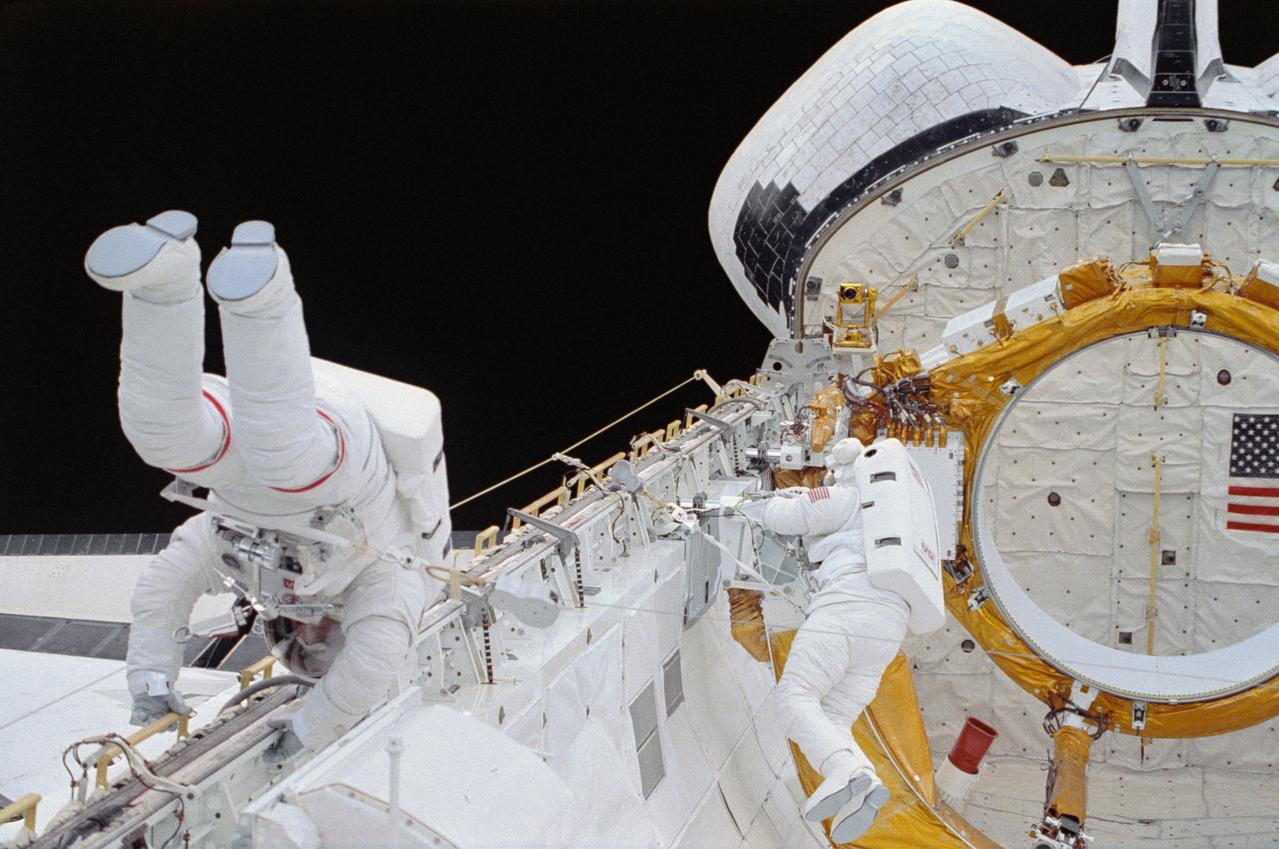
STS054-33-030 (17 Jan. 1993) --- Astronaut Gregory J. Harbaugh (left) translates along the starboard longeron in space shuttle Endeavour's cargo bay while astronaut Mario Runco Jr. prepares to work on a restraint device near the aft cargo bay firewall. The two mission specialists spent four-plus hours on the extravehicular activity (EVA) on Jan. 17, 1993. Others onboard NASA's newest shuttle for the six-day mission were astronauts John H. Casper, mission commander; Donald R. McMonagle, pilot; and Susan J. Helms, mission specialist. The photograph was taken with a 35mm camera. Photo credit: NASA
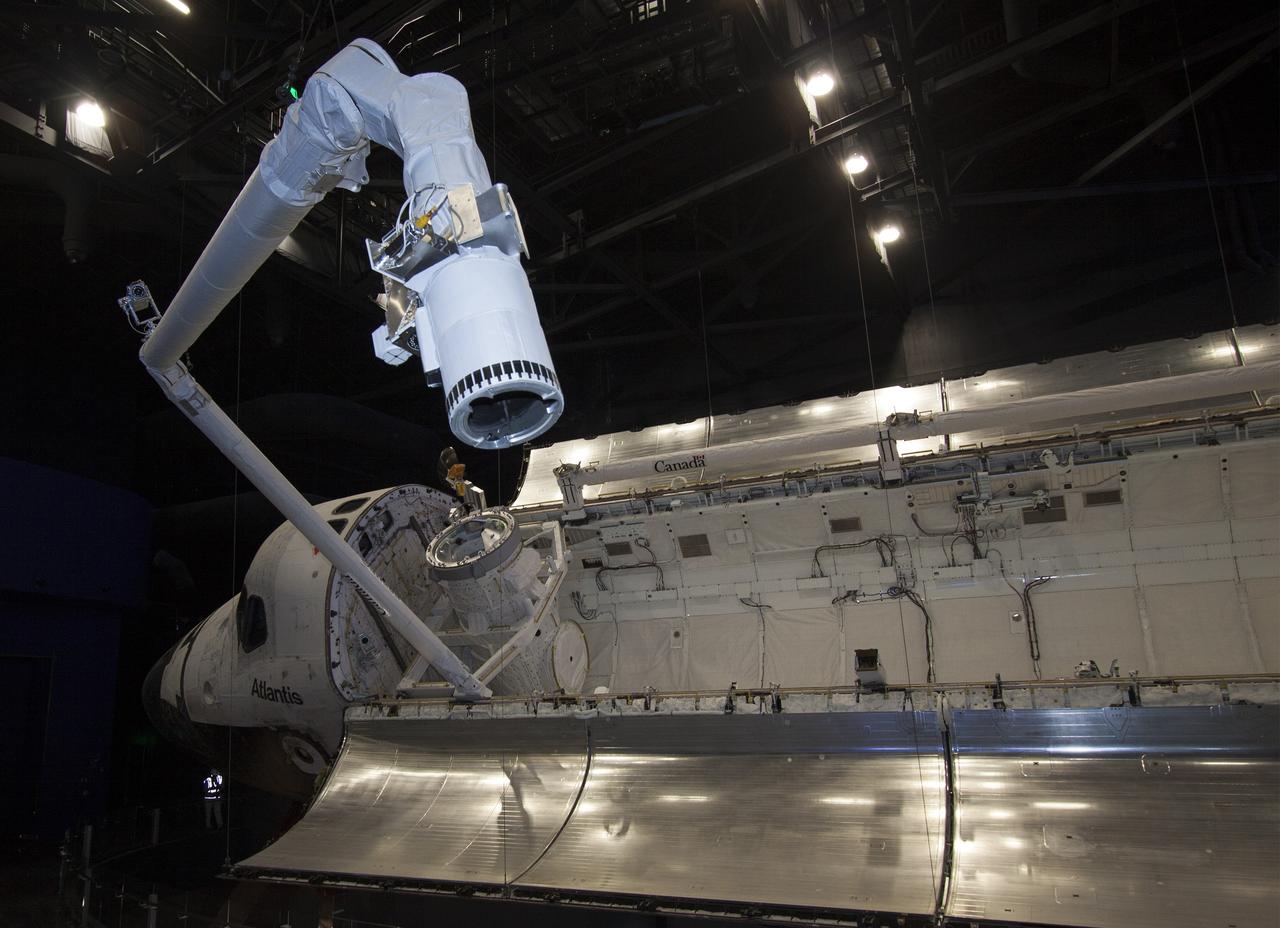
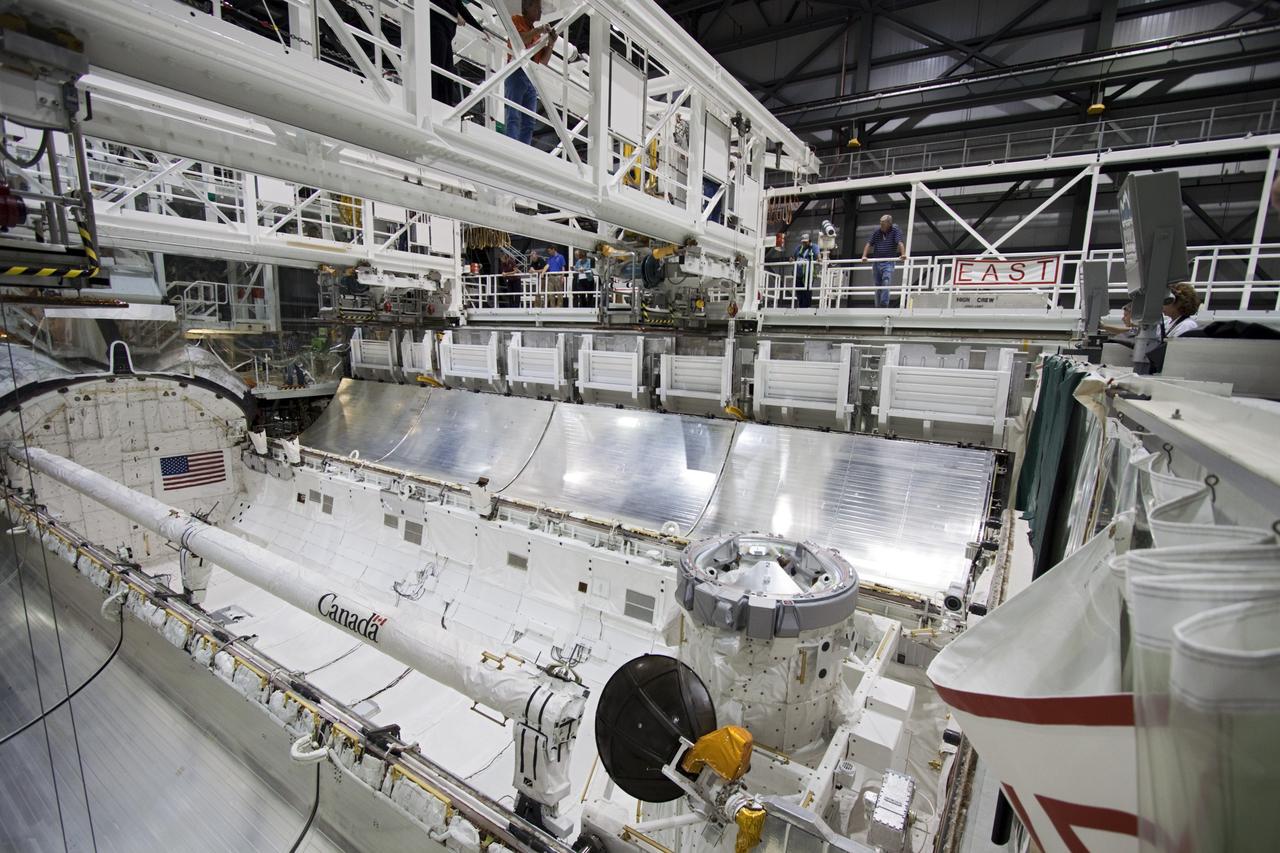
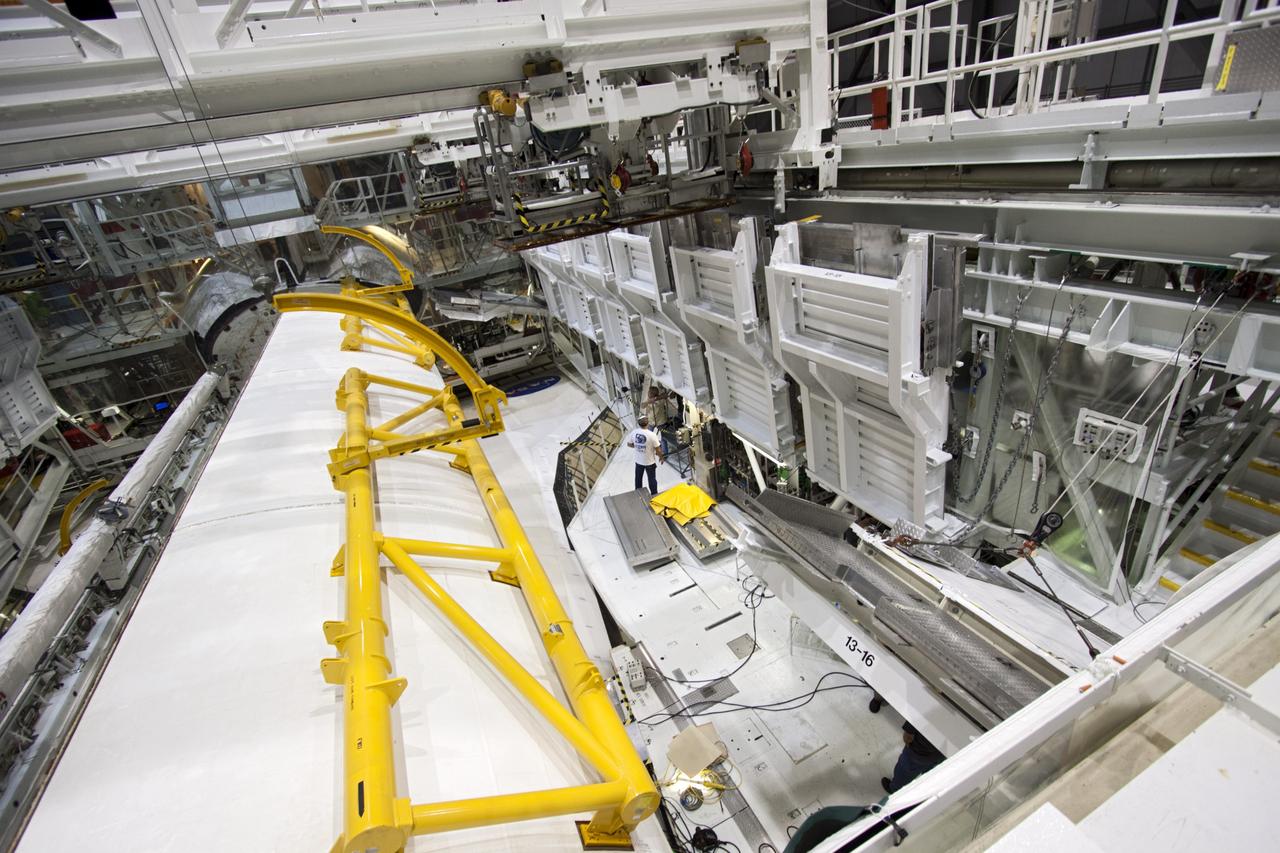
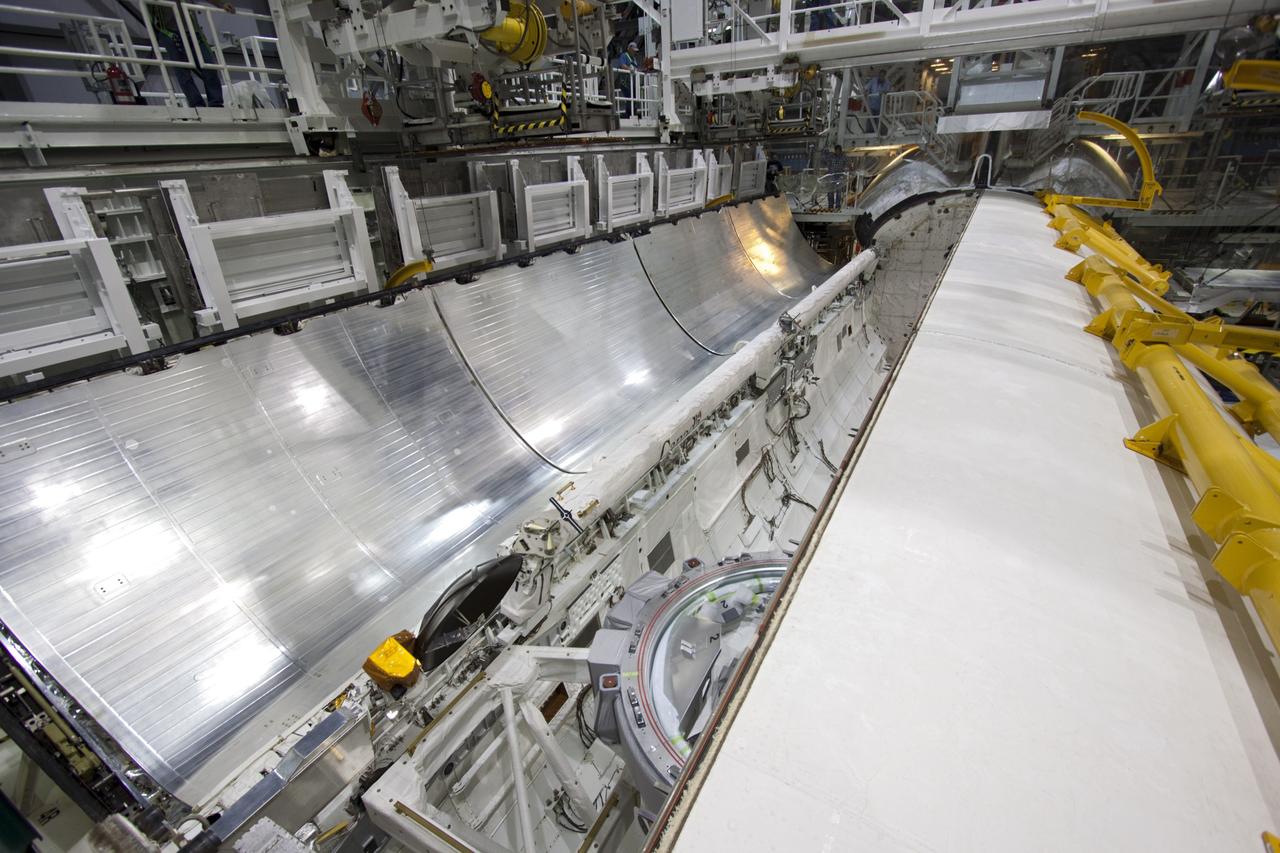
CAPE CANAVERAL, Fla. – At the Kennedy Space Center Visitor Complex in Florida, space shuttle Atlantis’ payload bay doors are open and the robotic arm has been installed in the payload bay. Atlantis is being prepared for display in the “Space Shuttle Atlantis” exhibit, a 90,000-square-foot facility, scheduled to open June 29, 2013. The new $100 million facility will include interactive exhibits that tell the story of the 30-year Space Shuttle Program and highlight the future of space exploration. Visitors to the exhibit will get an up close look at Atlantis with its payload bay doors open, similar to how it looked in space. Photo credit: NASA/Jim Grossmann
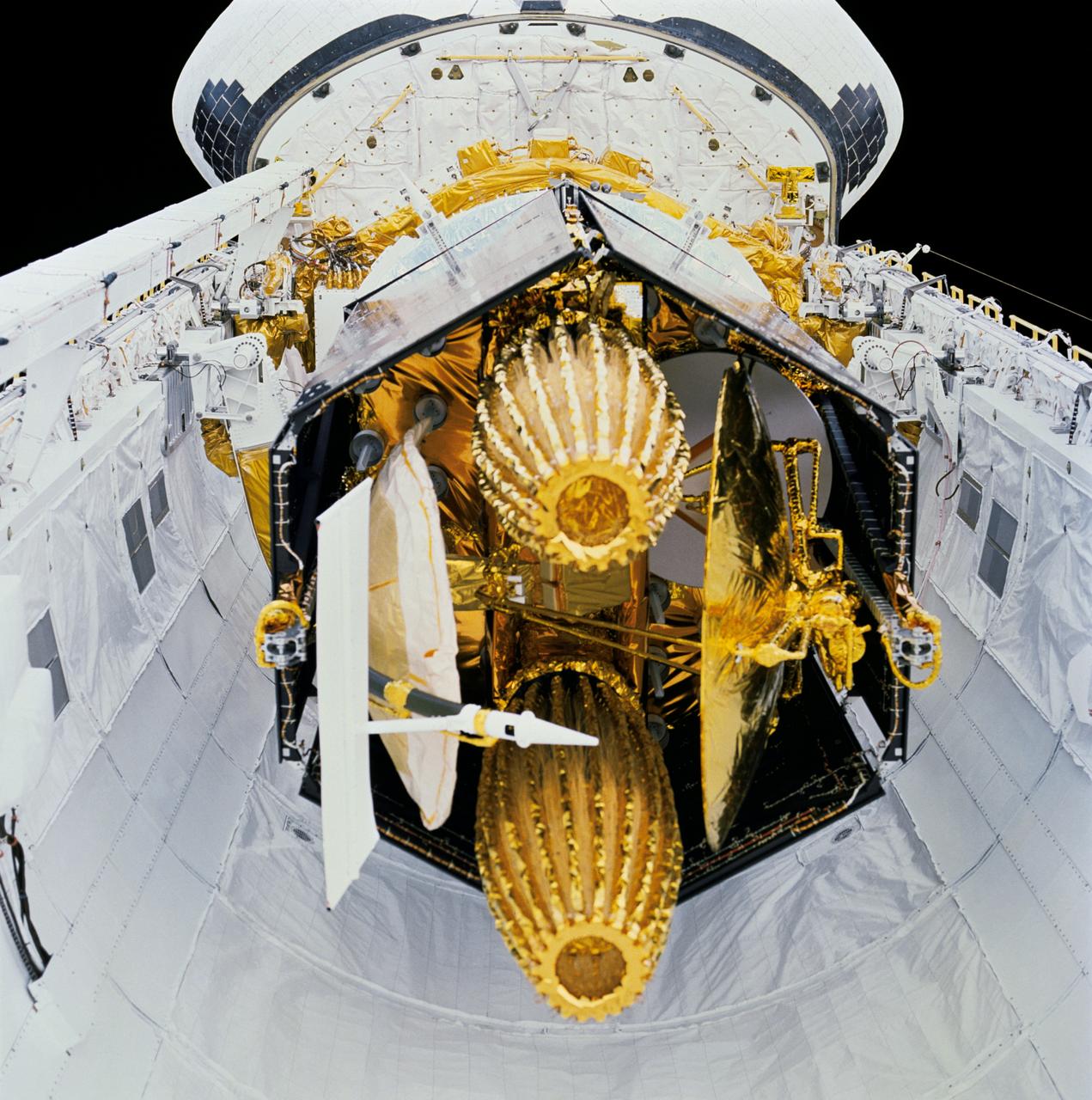
STS029-71-000AE (13-18 March 1989) --- STS-29 onboard view shows Space Shuttle Discovery's payload bay with tracking and data relay satellite D (TDRS-D) in stowed, pre-deployment position. In this head-on view, TDRS-D stowed components including single access #1 and #2, solar cell panels, SGL, S-Band omni antenna, and C-Band antenna are visible. TDRS-D rests in airborne support equipment (ASE) forward cradle and aft frame tilt actuator (AFTA). Discovery's aft bulkhead and orbital maneuvering system (OMS) pods are visible in the background.
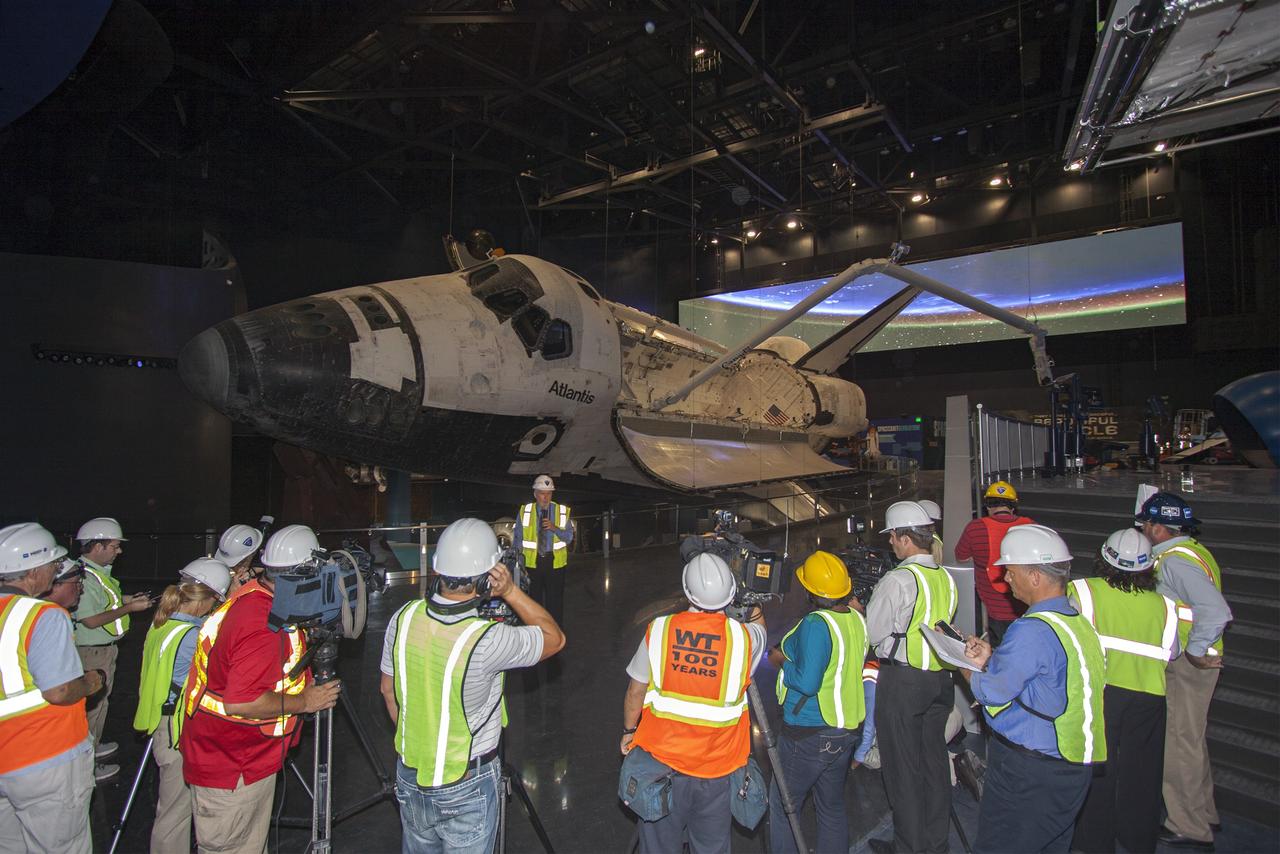
CAPE CANAVERAL, Fla. – At the Kennedy Space Center Visitor Complex in Florida, Bill Moore, chief operating officer with Delaware North Companies Parks & Resorts, speaks to members of the media during a tour of the new “Space Shuttle Atlantis” exhibit, a 90,000-square-foot facility, scheduled to open June 29, 2013. Behind Moore, space shuttle Atlantis’ payload bay doors are open and the orbiter has been tilted at a 43.21 angle to the portside and supported by special jacks to elevate it 26 feet from the ground. The robotic arm has been installed in the payload bay. The new $100 million facility will include interactive exhibits that tell the story of the 30-year Space Shuttle Program and highlight the future of space exploration. Visitors to the exhibit will get an up close look at Atlantis with its payload bay doors open, similar to how it looked in space. Photo credit: NASA/Jim Grossmann
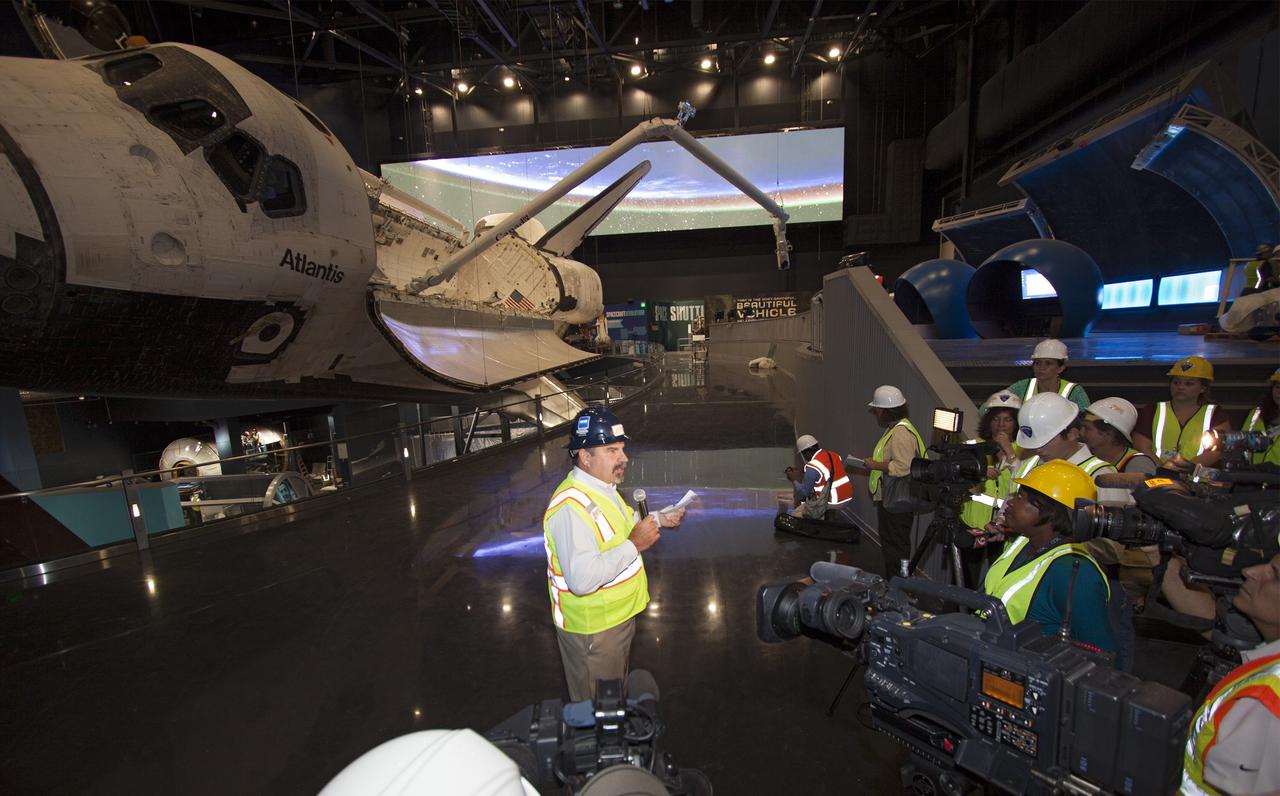
CAPE CANAVERAL, Fla. – At the Kennedy Space Center Visitor Complex in Florida, Tim Macy, the director of project development and construction for Delaware North Companies Parks & Resorts, speaks to members of the media during a tour of the new “Space Shuttle Atlantis” exhibit, a 90,000-square-foot facility, scheduled to open June 29, 2013. Behind Moore, space shuttle Atlantis’ payload bay doors are open and the orbiter has been tilted at a 43.21 angle to the portside and supported by special jacks to elevate it 26 feet from the ground. The robotic arm has been installed in the payload bay. The new $100 million facility will include interactive exhibits that tell the story of the 30-year Space Shuttle Program and highlight the future of space exploration. Visitors to the exhibit will get an up close look at Atlantis with its payload bay doors open, similar to how it looked in space. Photo credit: NASA/Jim Grossmann
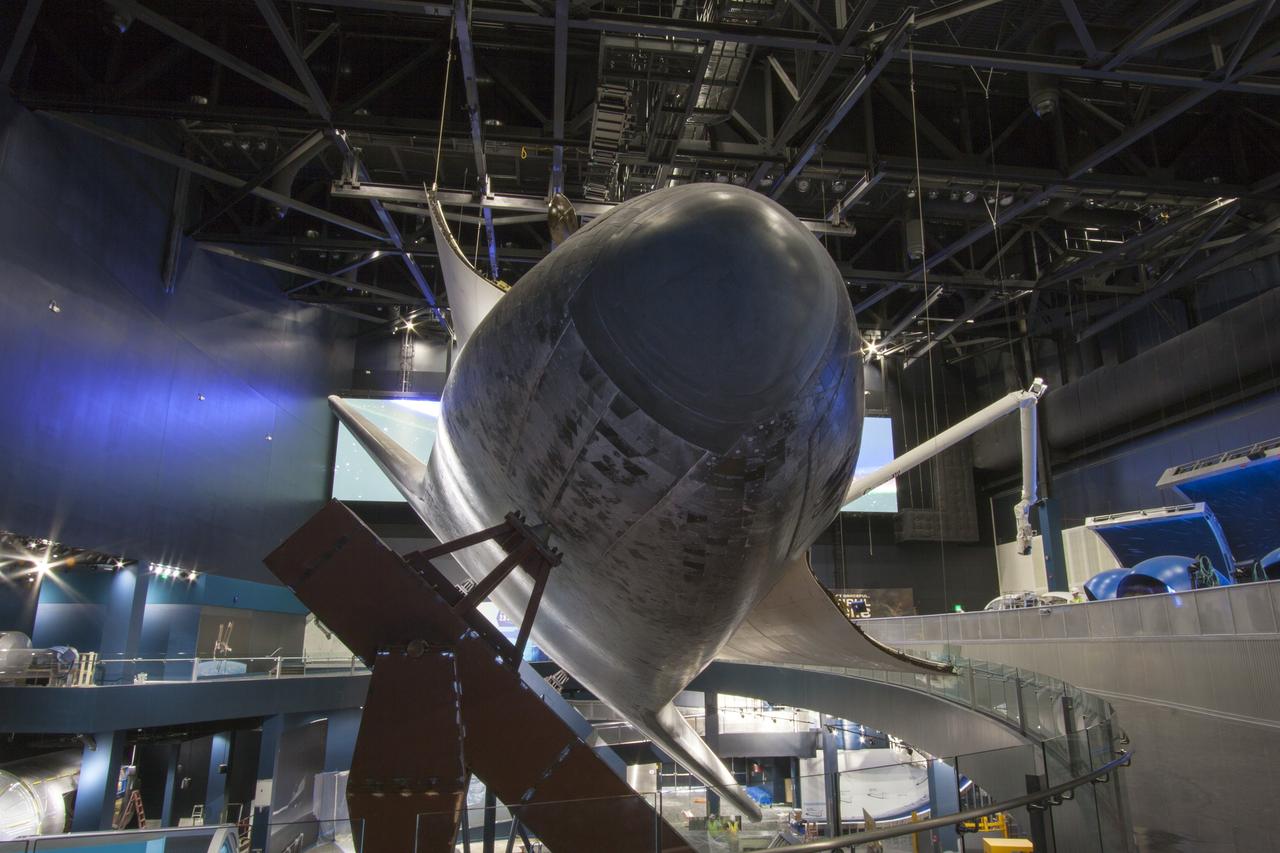
CAPE CANAVERAL, Fla. – At the Kennedy Space Center Visitor Complex in Florida, space shuttle Atlantis’ payload bay doors are open and the orbiter has been tilted at a 43.21 angle to the portside and supported by special jacks to elevate it 26 feet from the ground. The robotic arm has been installed in the payload bay. The new “Space Shuttle Atlantis” exhibit, a 90,000-square-foot facility, is scheduled to open June 29, 2013. The new $100 million facility will include interactive exhibits that tell the story of the 30-year Space Shuttle Program and highlight the future of space exploration. Visitors to the exhibit will get an up close look at Atlantis with its payload bay doors open, similar to how it looked in space. Photo credit: NASA/Jim Grossmann
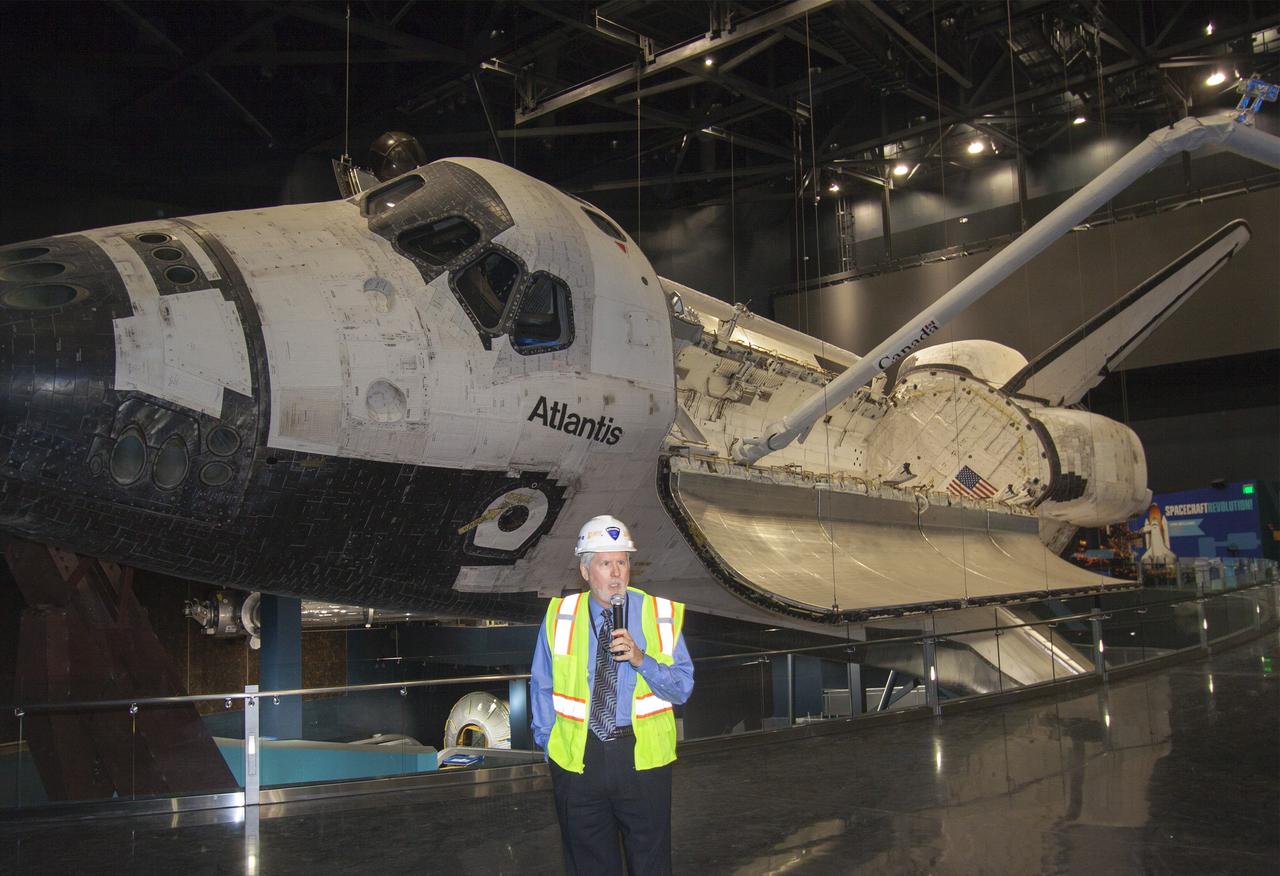
CAPE CANAVERAL, Fla. – At the Kennedy Space Center Visitor Complex in Florida, Bill Moore, chief operating officer with Delaware North Companies Parks & Resorts, speaks to members of the media during a tour of the new “Space Shuttle Atlantis” exhibit, a 90,000-square-foot facility, scheduled to open June 29, 2013. Behind Moore, space shuttle Atlantis’ payload bay doors are open and the orbiter has been tilted at a 43.21 angle to the portside and supported by special jacks to elevate it 26 feet from the ground. The robotic arm has been installed in the payload bay. The new $100 million facility will include interactive exhibits that tell the story of the 30-year Space Shuttle Program and highlight the future of space exploration. Visitors to the exhibit will get an up close look at Atlantis with its payload bay doors open, similar to how it looked in space. Photo credit: NASA/Jim Grossmann
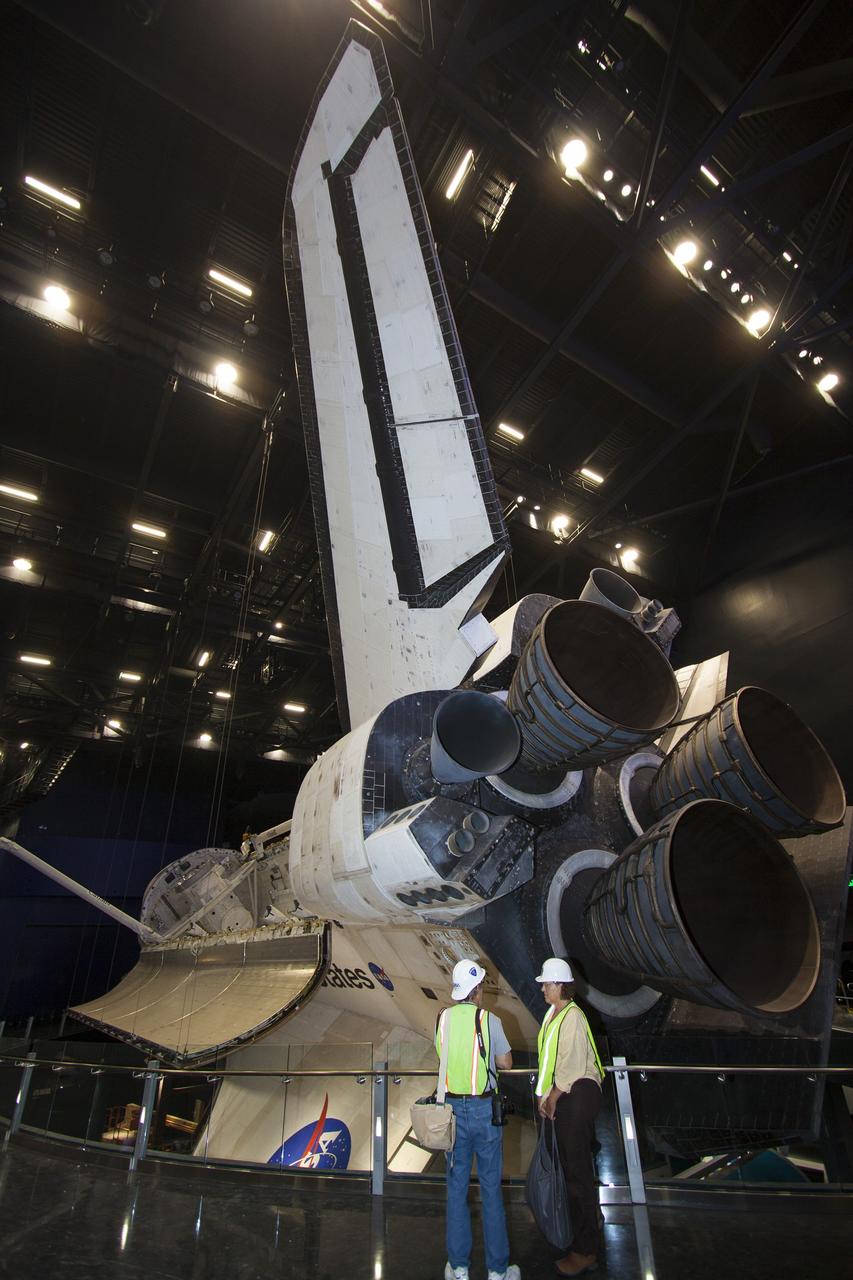
CAPE CANAVERAL, Fla. – At the Kennedy Space Center Visitor Complex in Florida, members of the media tour the new “Space Shuttle Atlantis” exhibit, a 90,000-square-foot facility, scheduled to open June 29, 2013. Space shuttle Atlantis’ payload bay doors are open and the orbiter has been tilted at a 43.21 angle to the portside and supported by special jacks to elevate it 26 feet from the ground. The robotic arm has been installed in the payload bay. The new $100 million facility will include interactive exhibits that tell the story of the 30-year Space Shuttle Program and highlight the future of space exploration. Visitors to the exhibit will get an up close look at Atlantis with its payload bay doors open, similar to how it looked in space. Photo credit: NASA/Jim Grossmann
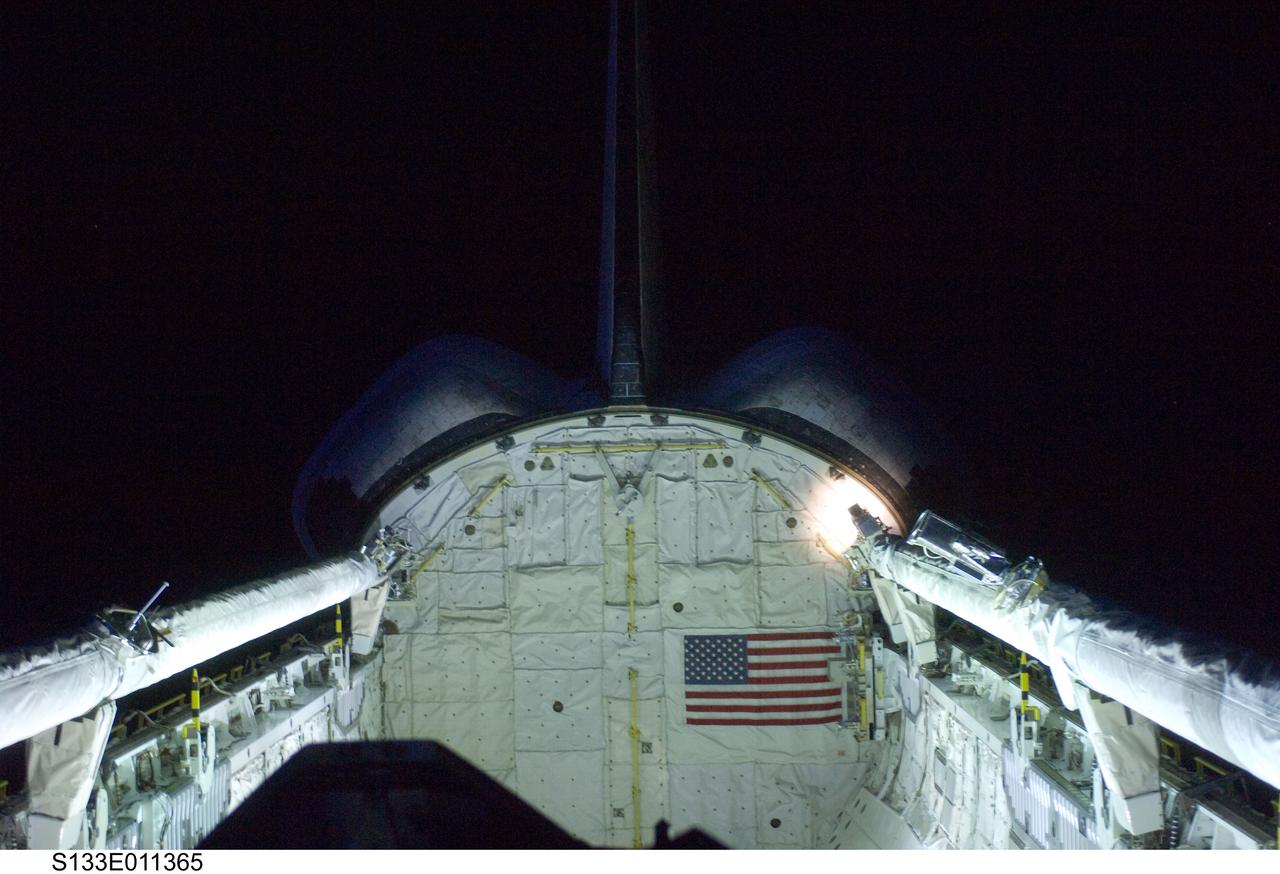
S133-E-011365 (7 March 2011) --- Space shuttle Discovery’s vertical stabilizer, orbital maneuvering system (OMS) pods, remote manipulator system/orbiter boom sensor system (RMS/OBSS) and payload bay are featured in this image photographed by an STS-133 crew member on the shuttle during flight day 12 activities. Photo credit: NASA or National Aeronautics and Space Administration
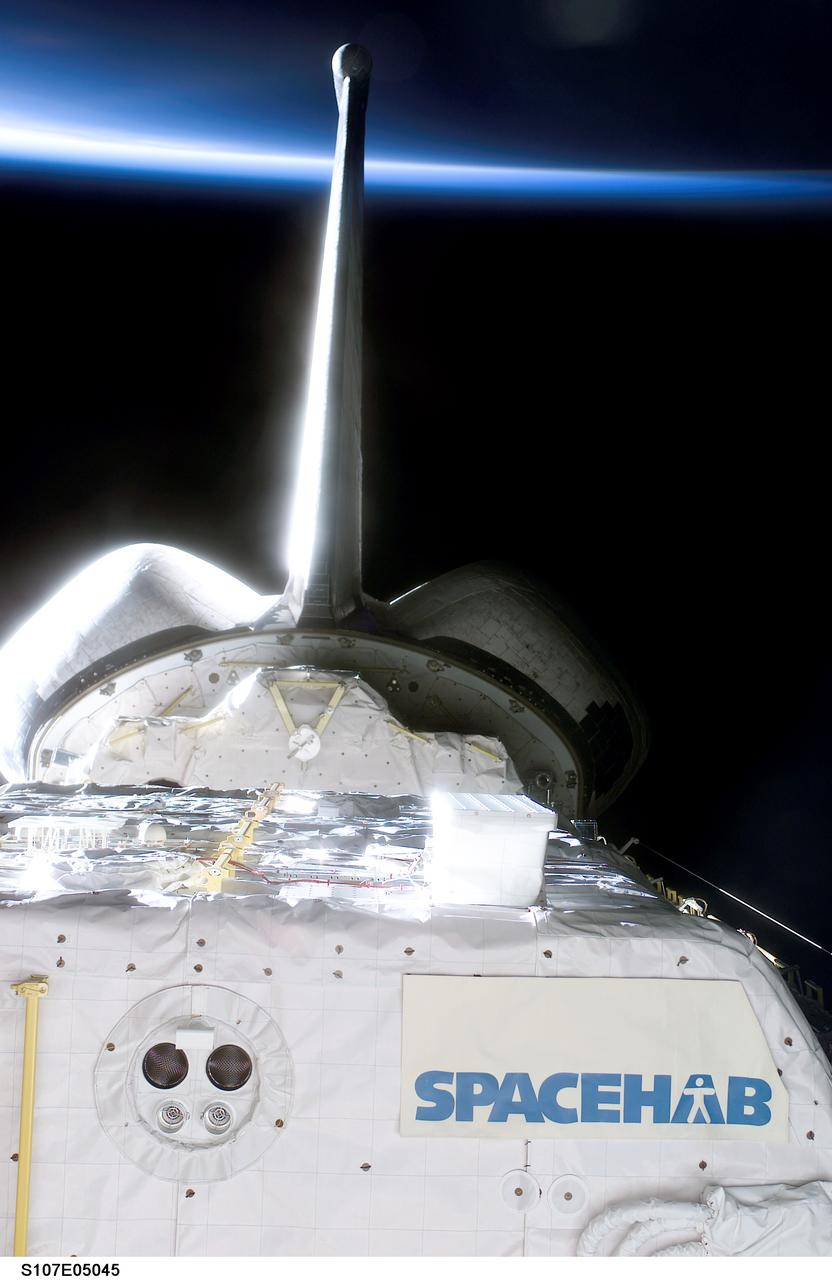
STS107-E-05045 (18 January 2003) --- The SPACEHAB Research Double Module in the Space Shuttle Columbia’s payload bay and vertical stabilizer are backdropped by the blackness of space and a thin slice of Earth’s horizon.
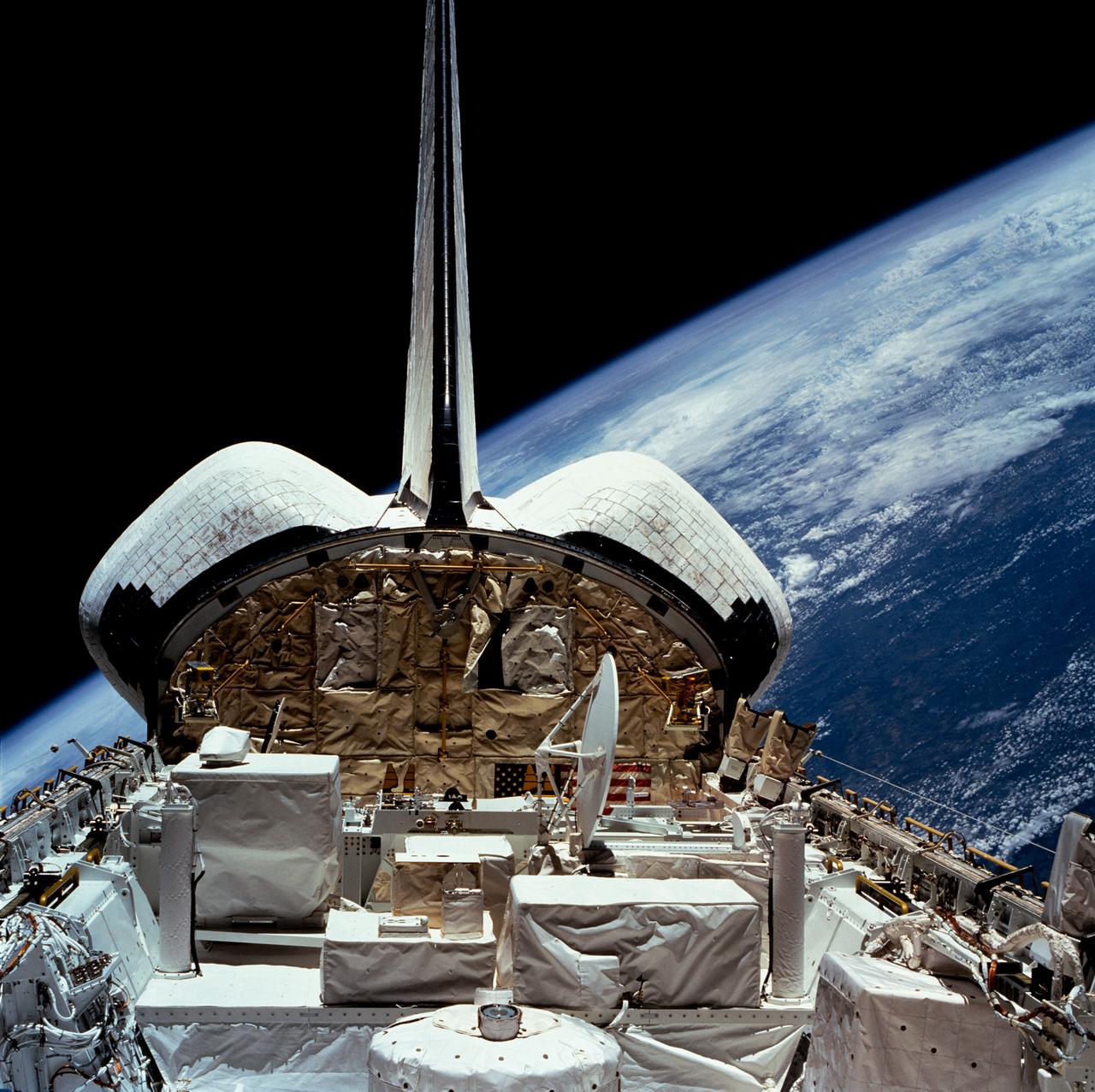
STS056-91-050 (8-17 April 1993) --- This 70mm frame shows the cargo bay of the Earth-orbiting Space Shuttle Discovery backdropped against clouds. Most of the elements of the ATLAS-2 payload can be seen, but missing is the SPARTAN-201 satellite which was in the midst of its separation from Discovery when the photo was made.
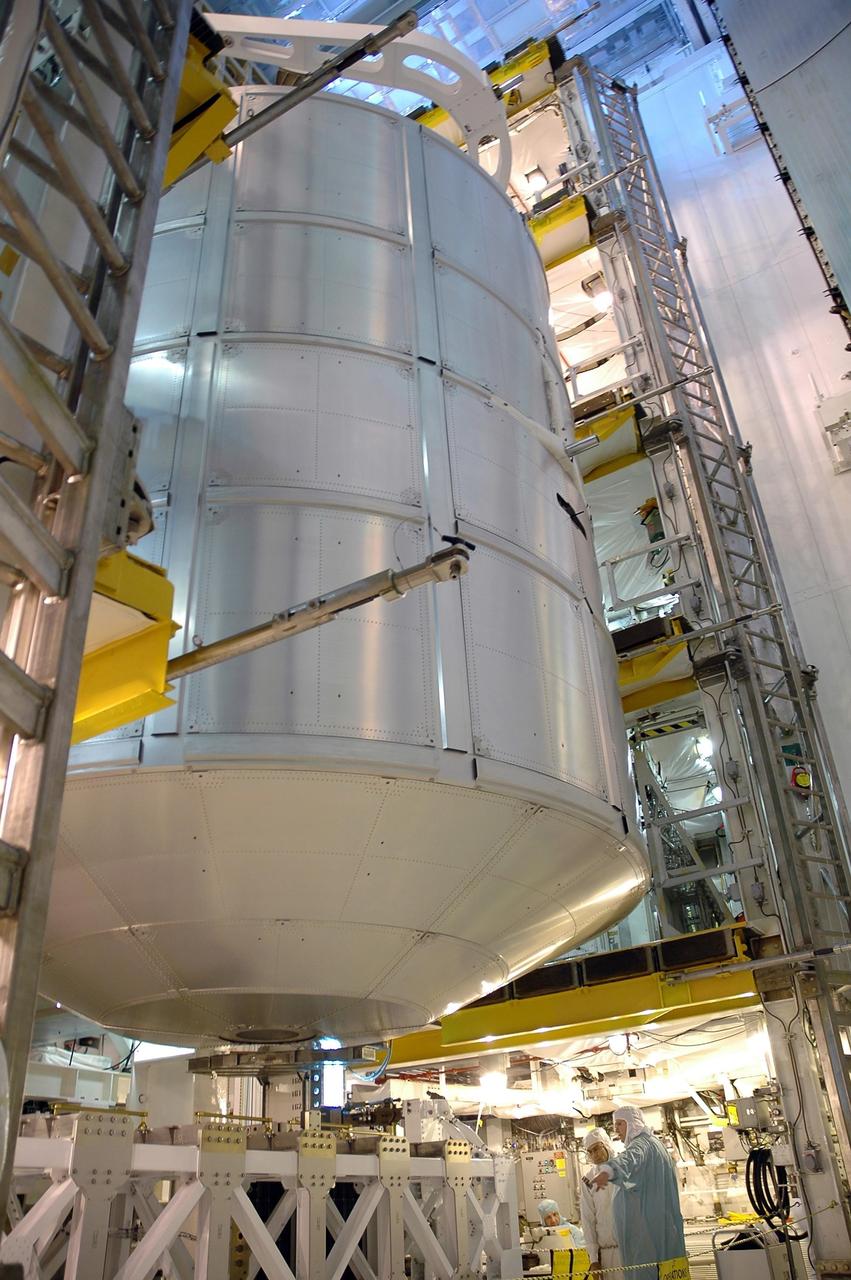
KENNEDY SPACE CENTER, FLA. -- From inside the payload changeout room on the rotating service structure on Launch Pad 39B, the multi-purpose logistics module Leonardo is being moved into Space Shuttle Discovery's payload bay. The payload ground-handling mechanism (PGHM) is used to transfer the module into the payload bay. Leonardo is a reusable logistics carrier. It is the primary delivery system used to resupply and return station cargo requiring a pressurized environment. Leonardo is part of the payload on mission STS-121. Other payloads include the integrated cargo carrier with the mobile transporter reel assembly and a spare pump module, and the lightweight multi-purpose experiment support structure carrier. Discovery is scheduled to launch in a window extending from July 1 through July 19. Photo credit: NASA/Jack Pfaller
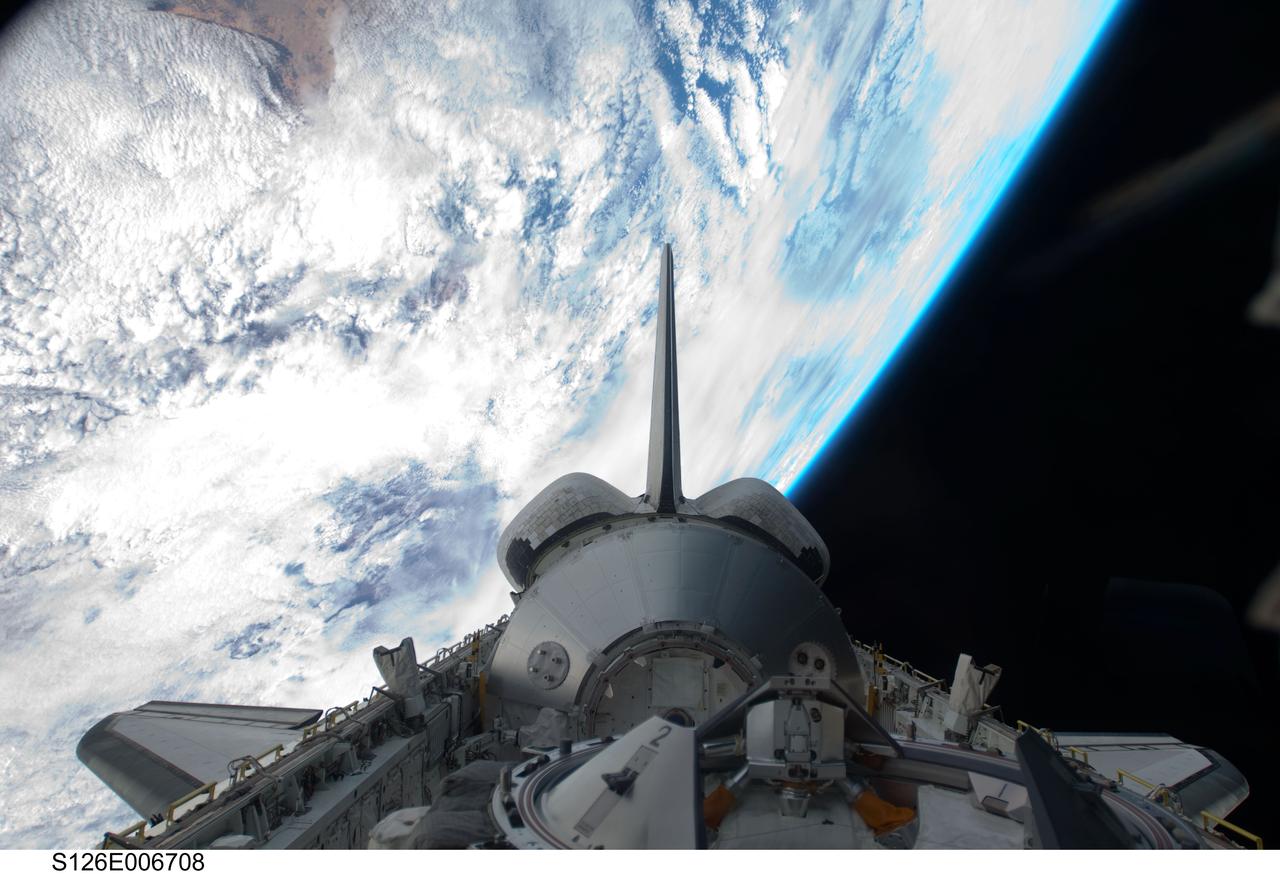
S126-E-006708 (15 Nov. 2008) --- Backdropped by a colorful Earth and the blackness of space, the Leonardo Multi-Purpose Logistics Module visible in Space Shuttle Endeavour's payload bay, vertical stabilizer, orbital maneuvering system (OMS) pods and docking mechanism are featured in this image photographed by a STS-126 crewmember.
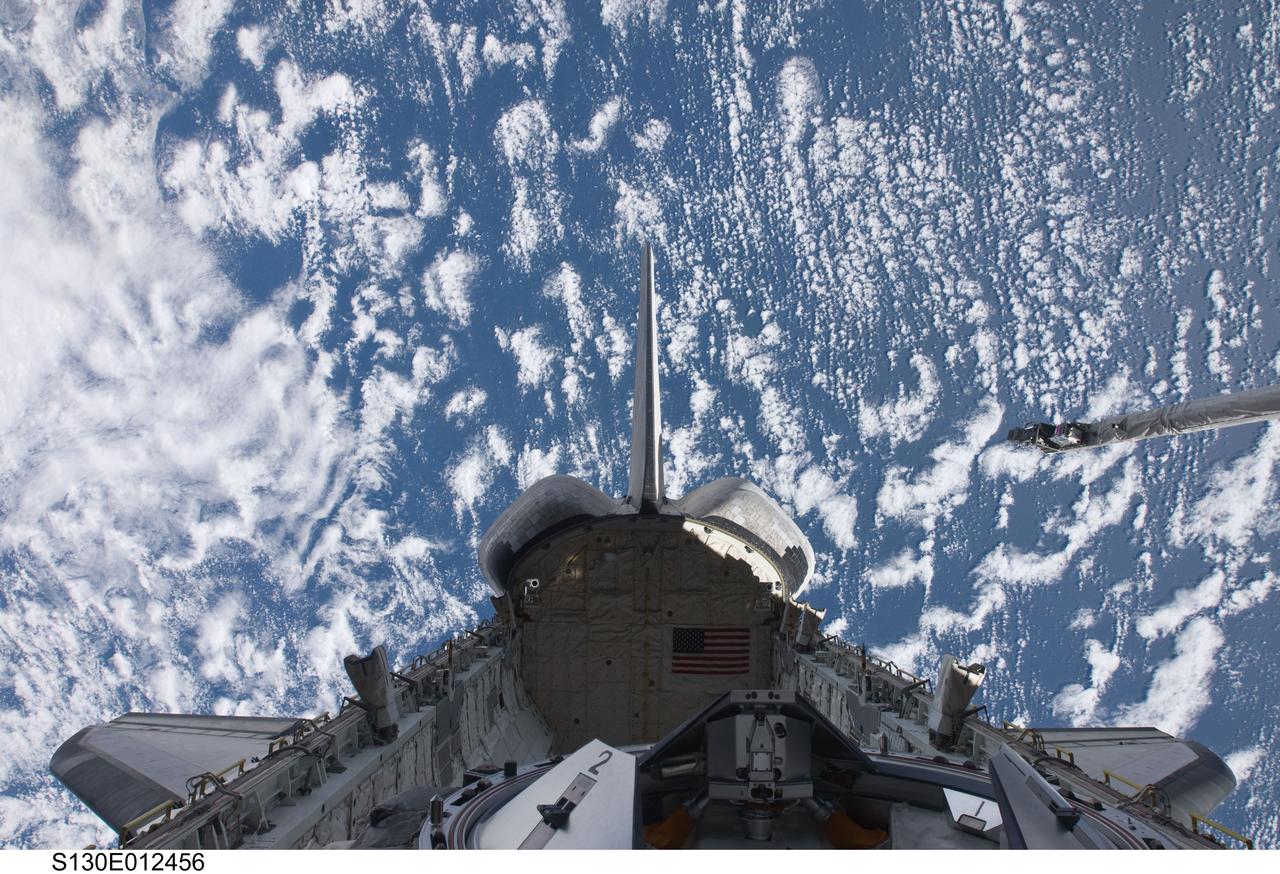
S130-E-012456 (20 Feb. 2010) --- Backdropped by a blue and white part of Earth, a partial view of space shuttle Endeavour's payload bay, vertical stabilizer, orbital maneuvering system (OMS) pods and docking mechanism are featured in this image photographed by an STS-130 crew member from an aft flight deck window.
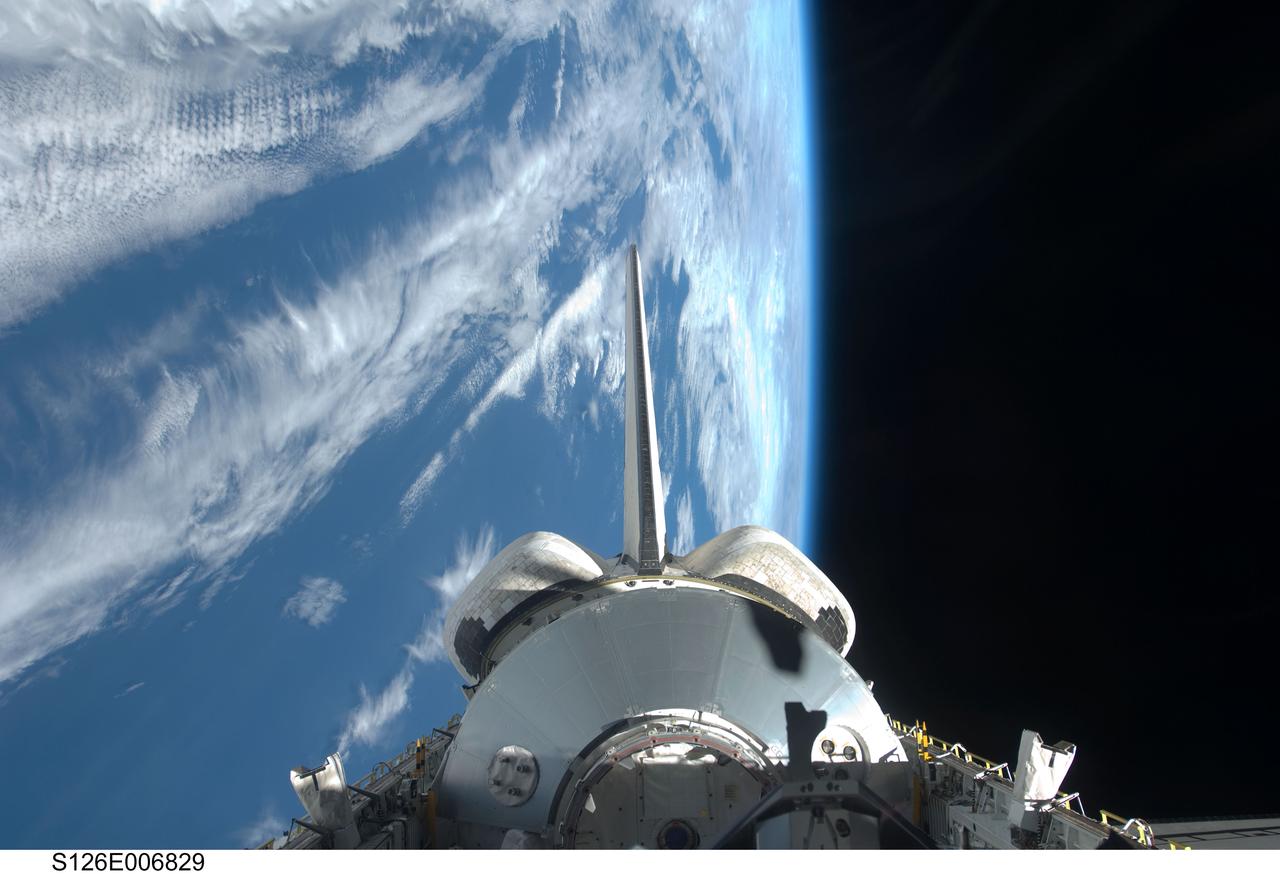
S126-E-006829 (15 Nov. 2008) --- Backdropped by a blue and white Earth and the blackness of space, the Leonardo Multi-Purpose Logistics Module visible in Space Shuttle Endeavour's payload bay, vertical stabilizer and orbital maneuvering system (OMS) pods are featured in this image photographed by a STS-126 crewmember.
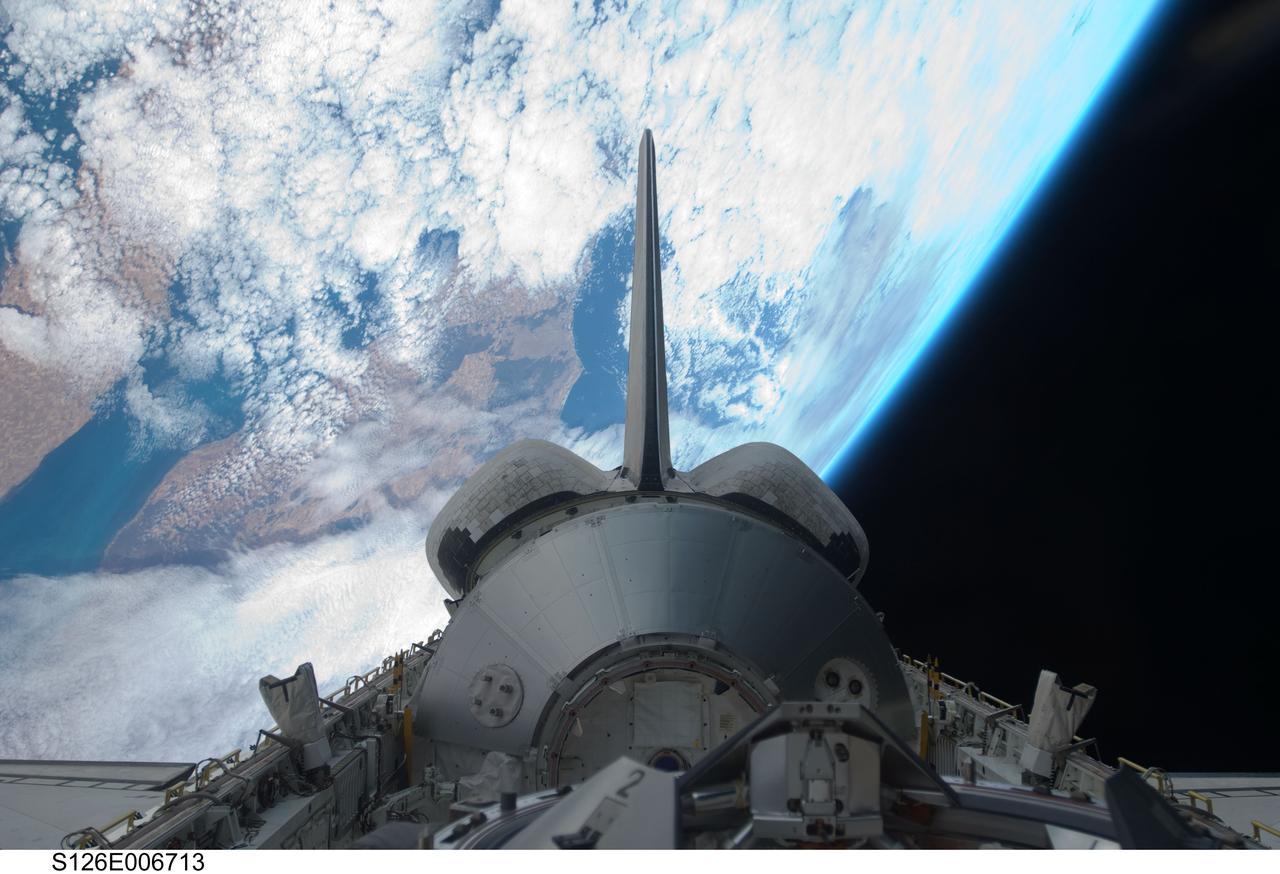
S126-E-006713 (15 Nov. 2008) --- Backdropped by a colorful Earth and the blackness of space, the Leonardo Multi-Purpose Logistics Module visible in Space Shuttle Endeavour's payload bay, vertical stabilizer, orbital maneuvering system (OMS) pods and docking mechanism are featured in this image photographed by a STS-126 crewmember.
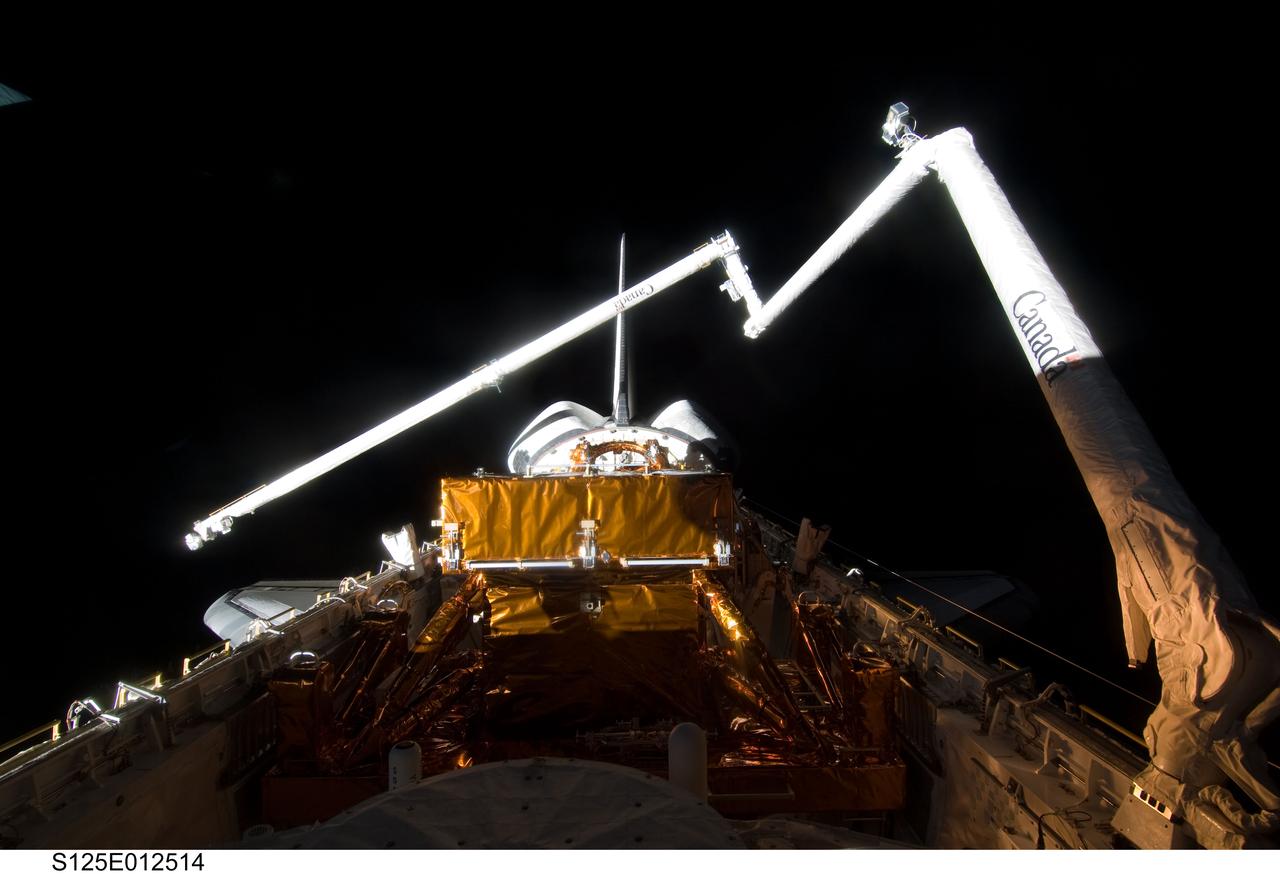
S125-E-012514 (19 May 2009) --- Space Shuttle Atlantis? payload bay, Canadian-built remote manipulator system (RMS) robotic arm, vertical stabilizer and orbital maneuvering system (OMS) pods are featured in this image photographed by an STS-125 crewmember on flight day nine.
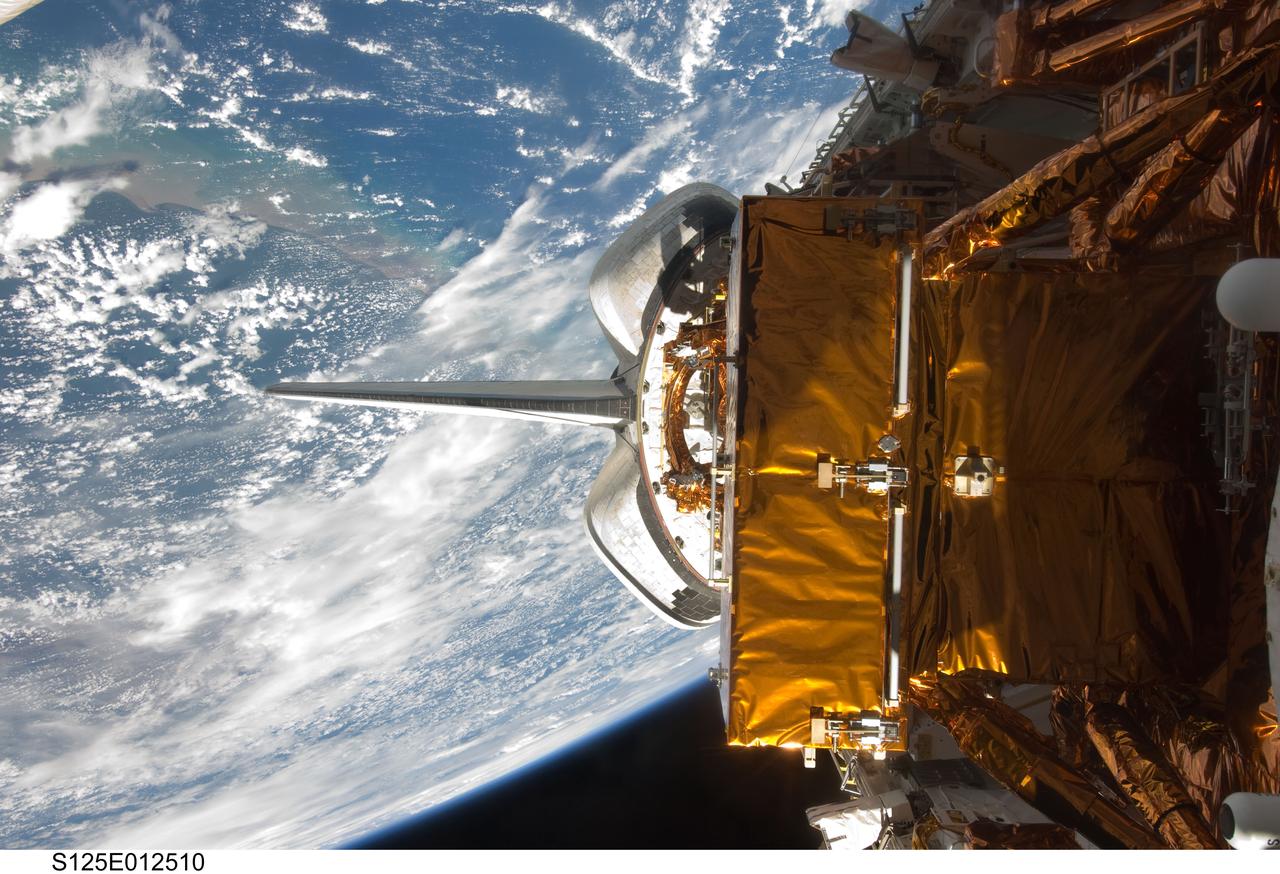
S125-E-012510 (19 May 2009) --- Backdropped by a blue and white Earth, Space Shuttle Atlantis? payload bay, vertical stabilizer and orbital maneuvering system (OMS) pods are featured in this image photographed by an STS-125 crewmember on flight day nine.
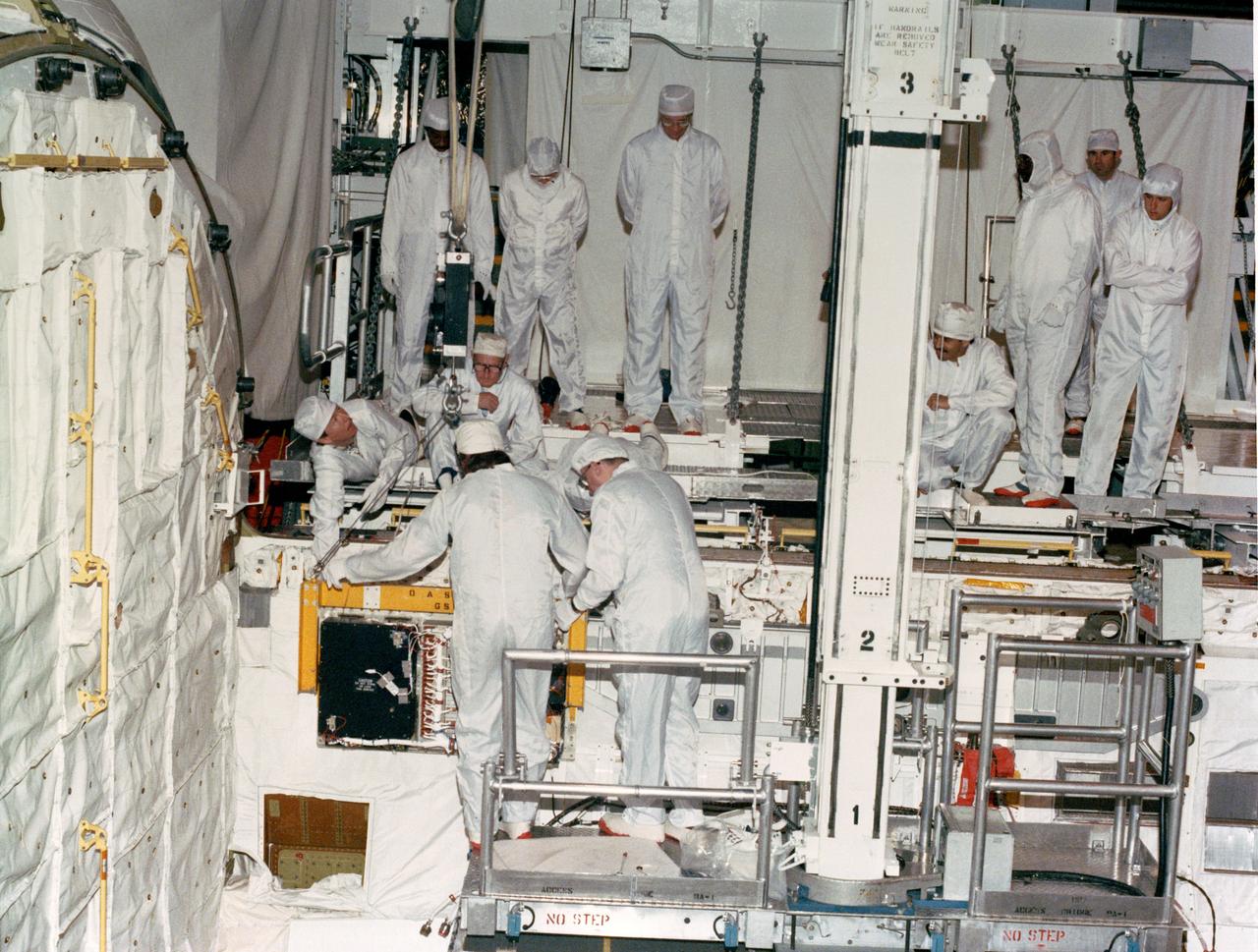
S88-37764 (18 April 1988) --- OASIS, instrumentation which will record the environment experienced by Discovery during the STS-26 Space Shuttle mission, is lowered into position for attachment to the orbiter's aft port sill. Instrumentation sensors in the payload bay which are connected to the tape recorder module will document a variety of environmental measurements during various phases of the flight including temperature, pressure, vibration, sounds, acceleration, stress, and strain. OASIS will also record data during the Flight Readiness Firing. NASA is flying OASIS aboard Discovery in support of the Inertial Upper Stage (IUS) program office of the Air Force Space Division. The system was developed by Lockheed under a NASA contract, funded by the Air Force.
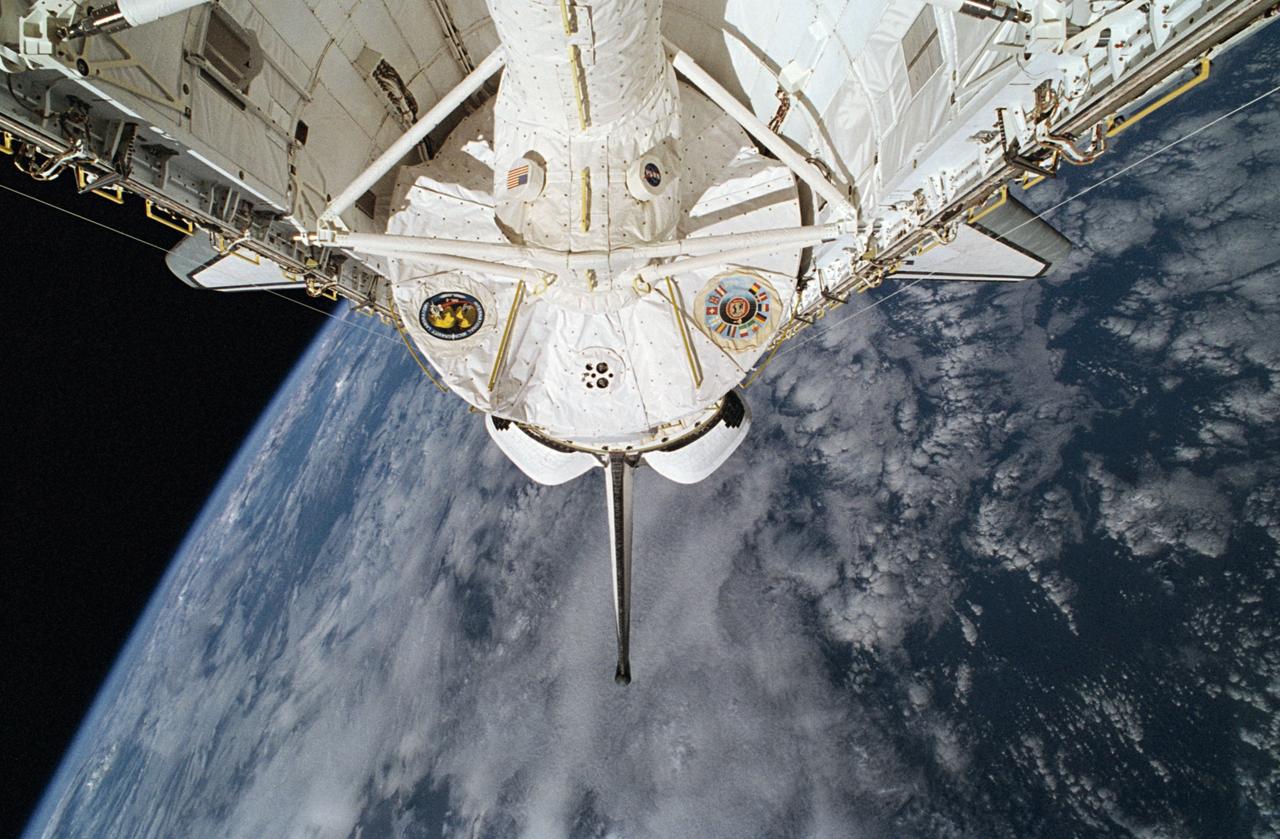
STS065-34-016 (8-23 July 1994) --- Clouds over the ocean form the backdrop for this scene of the International Microgravity Laboratory (IML-2) science module in the Space Shuttle Columbia's cargo bay during the two-week mission. Part of the tunnel that served as passageway for the seven crew members to and from the lab is seen in center foreground. Onboard Columbia were astronauts Robert D. Cabana, James D. Halsell, Jr., Richard J. Hieb, Carl E. Walz, Donald A. Thomas and Leroy Chiao, along with (NASDA) Japanese payload specialist Dr. Chiaki Naito-Mukai.
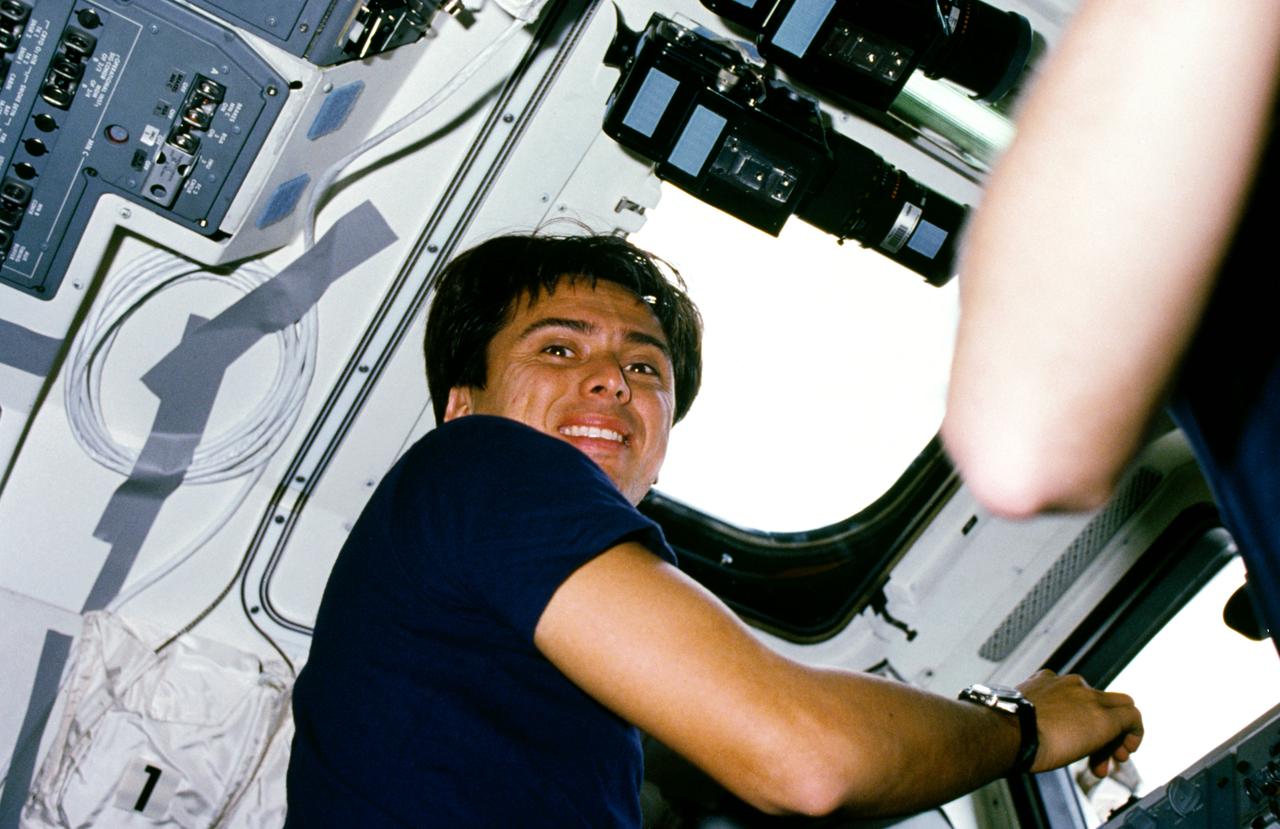
61C-02-032 (12-18 Jan. 1986) --- Astronaut Franklin R. Chang-Diaz, STS-61C mission specialist, while checking cargo in the space shuttle Columbia's payload bay, turns to smile at a fellow crew member using a 35mm camera. Some of the prolific camera gear onboard the spacecraft is affixed above the mission specialist's right shoulder.
CAPE CANAVERAL, Fla. – Inside Orbiter Processing Facility-2 at NASA’s Kennedy Space Center in Florida, workers watch as the left payload bay door begins to close on space shuttle Atlantis. Both payload bay doors will be closed for the final time. The orbiter is undergoing final preparations for its transfer to the Kennedy Space Center Visitor complex targeted for November. The work is part of Transition and Retirement of the remaining shuttle. Atlantis is being prepared for public display at the visitor complex. Over the course of its 26-year career, Atlantis spent 293 days in space during 33 missions. For more information, visit http://www.nasa.gov/transition. Photo credit: NASA/Jim Grossmann
CAPE CANAVERAL, Fla. – Inside Orbiter Processing Facility-2 at NASA’s Kennedy Space Center in Florida, space shuttle Atlantis’ left payload bay door has been closed. Both payload bay doors will be closed for the final time. The orbiter is undergoing final preparations for its transfer to the Kennedy Space Center Visitor complex targeted for November. The work is part of Transition and Retirement of the remaining shuttle. Atlantis is being prepared for public display at the visitor complex. Over the course of its 26-year career, Atlantis spent 293 days in space during 33 missions. For more information, visit http://www.nasa.gov/transition. Photo credit: NASA/Jim Grossmann

CAPE CANAVERAL, Fla. – Inside Orbiter Processing Facility-2 at NASA’s Kennedy Space Center in Florida, the right payload bay door closes on space shuttle Atlantis. Both payload bay doors will be closed for the final time. The orbiter is undergoing final preparations for its transfer to the Kennedy Space Center Visitor complex targeted for November. The work is part of Transition and Retirement of the remaining shuttle. Atlantis is being prepared for public display at the visitor complex. Over the course of its 26-year career, Atlantis spent 293 days in space during 33 missions. For more information, visit http://www.nasa.gov/transition. Photo credit: NASA/Jim Grossmann
CAPE CANAVERAL, Fla. – Inside Orbiter Processing Facility-2 at NASA’s Kennedy Space Center in Florida, technicians begin to close Atlantis’ right payload bay door. Both payload bay doors will be closed for the final time. The orbiter is undergoing final preparations for its transfer to the Kennedy Space Center Visitor complex targeted for November. The work is part of Transition and Retirement of the remaining shuttle. Atlantis is being prepared for public display at the visitor complex. Over the course of its 26-year career, Atlantis spent 293 days in space during 33 missions. For more information, visit http://www.nasa.gov/transition. Photo credit: NASA/Jim Grossmann
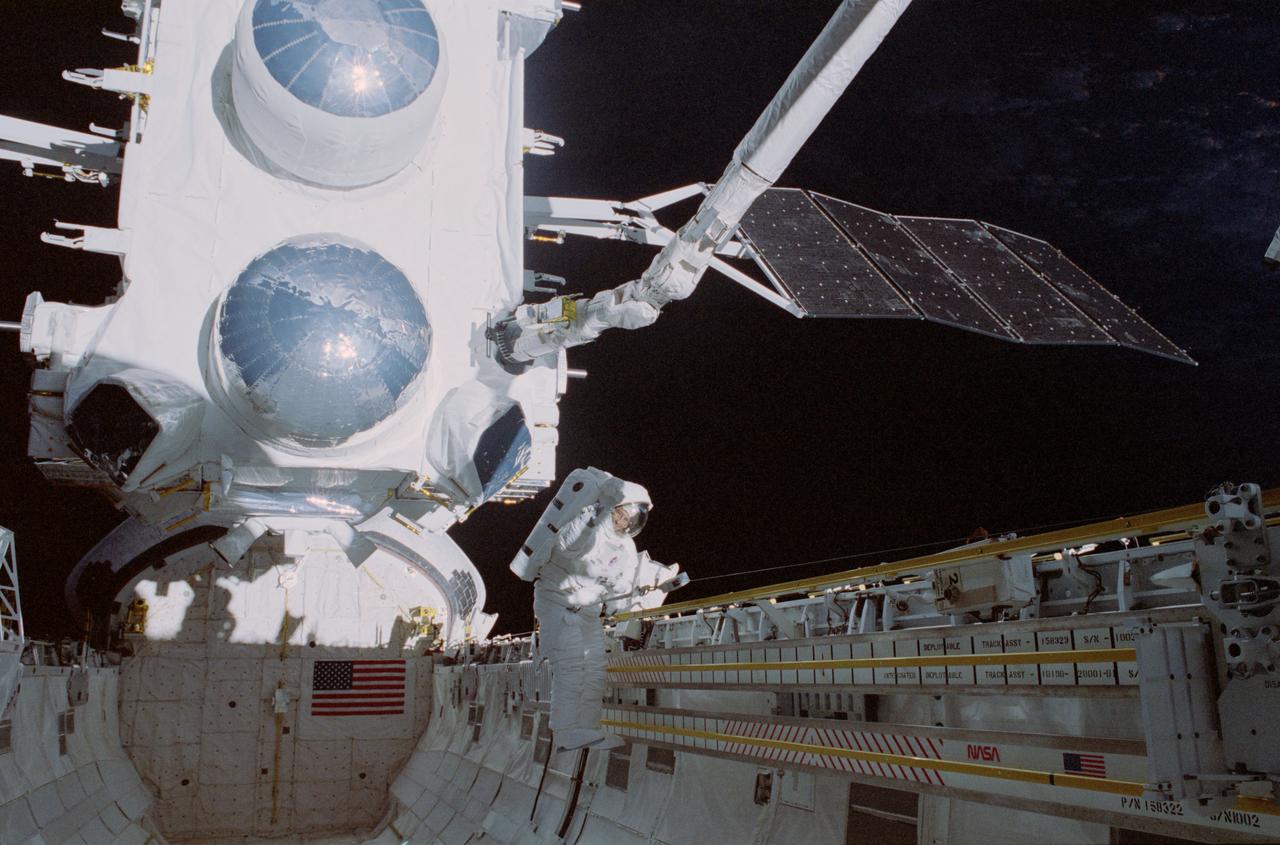
Photographic documentation showing activities in the payload bay of the orbiter Atlantis during STS-37. View include: Gamma Ray Observatory (GRO) on end of Remote Manipulator System (RMS), with Mission Specialist Jay Apt below on the port side of the payload bay.
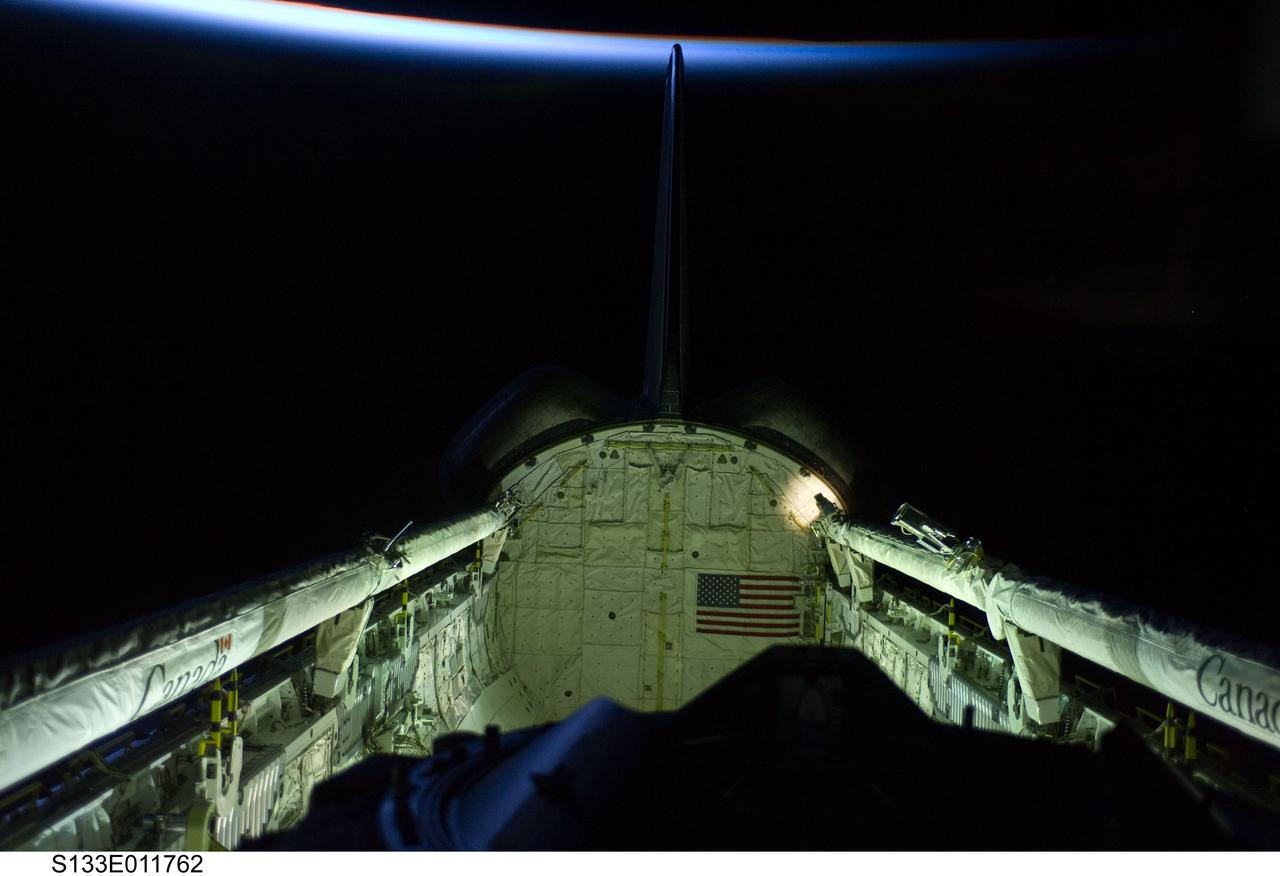
S133-E-011762 (7 March 2011) --- Space shuttle Discovery’s vertical stabilizer, orbital maneuvering system (OMS) pods, docking mechanism, remote manipulator system/orbiter boom sensor system (RMS/OBSS) and payload bay are featured in this image photographed by an STS-133 crew member on the shuttle during flight day 12 activities. The thin line of Earth’s atmosphere is at top. Photo credit: NASA or National Aeronautics and Space Administration
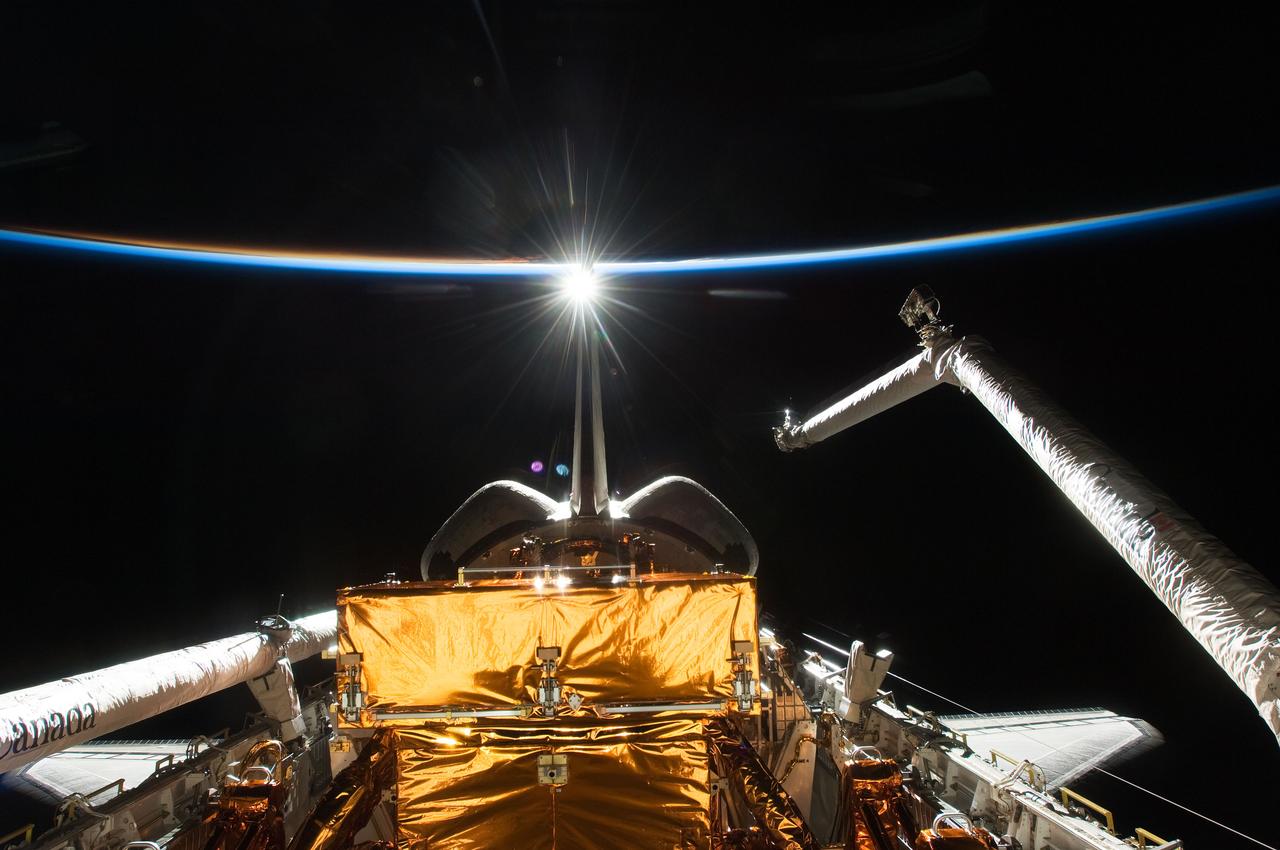
S125-E-012372 (20 May 2009) --- Backdropped by the blackness of space and the thin line of Earth?s atmosphere, Space Shuttle Atlantis? payload bay, Canadian-built remote manipulator system (RMS) robotic arm, vertical stabilizer and orbital maneuvering system (OMS) pods are featured in this image photographed by an STS-125 crewmember on flight day 10.
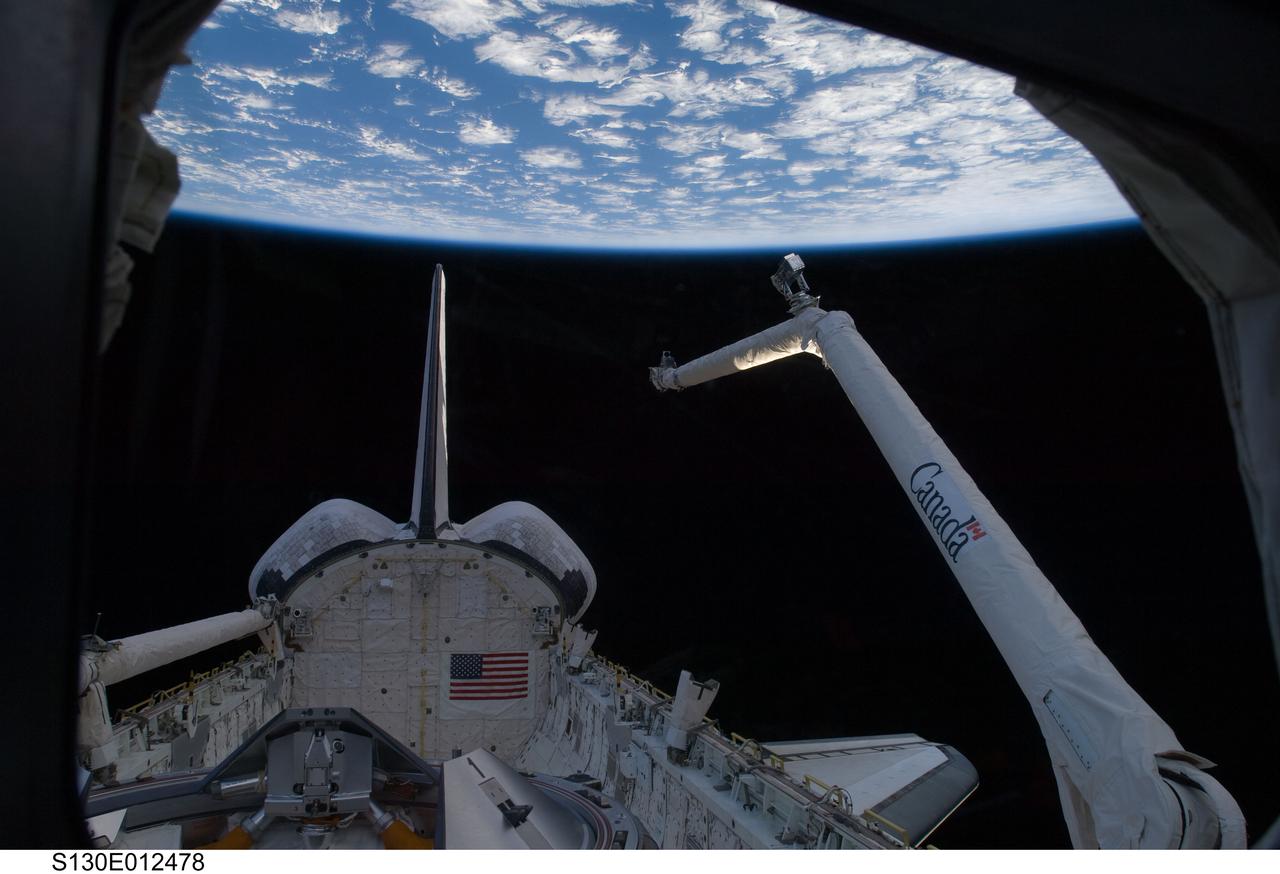
S130-E-012478 (20 Feb. 2010) --- Backdropped by Earth?s horizon and the blackness of space, a partial view of space shuttle Endeavour's payload bay, vertical stabilizer, orbital maneuvering system (OMS) pods, Remote Manipulator System/Orbiter Boom Sensor System (RMS/OBSS) and docking mechanism are featured in this image photographed by an STS-130 crew member from an aft flight deck window.
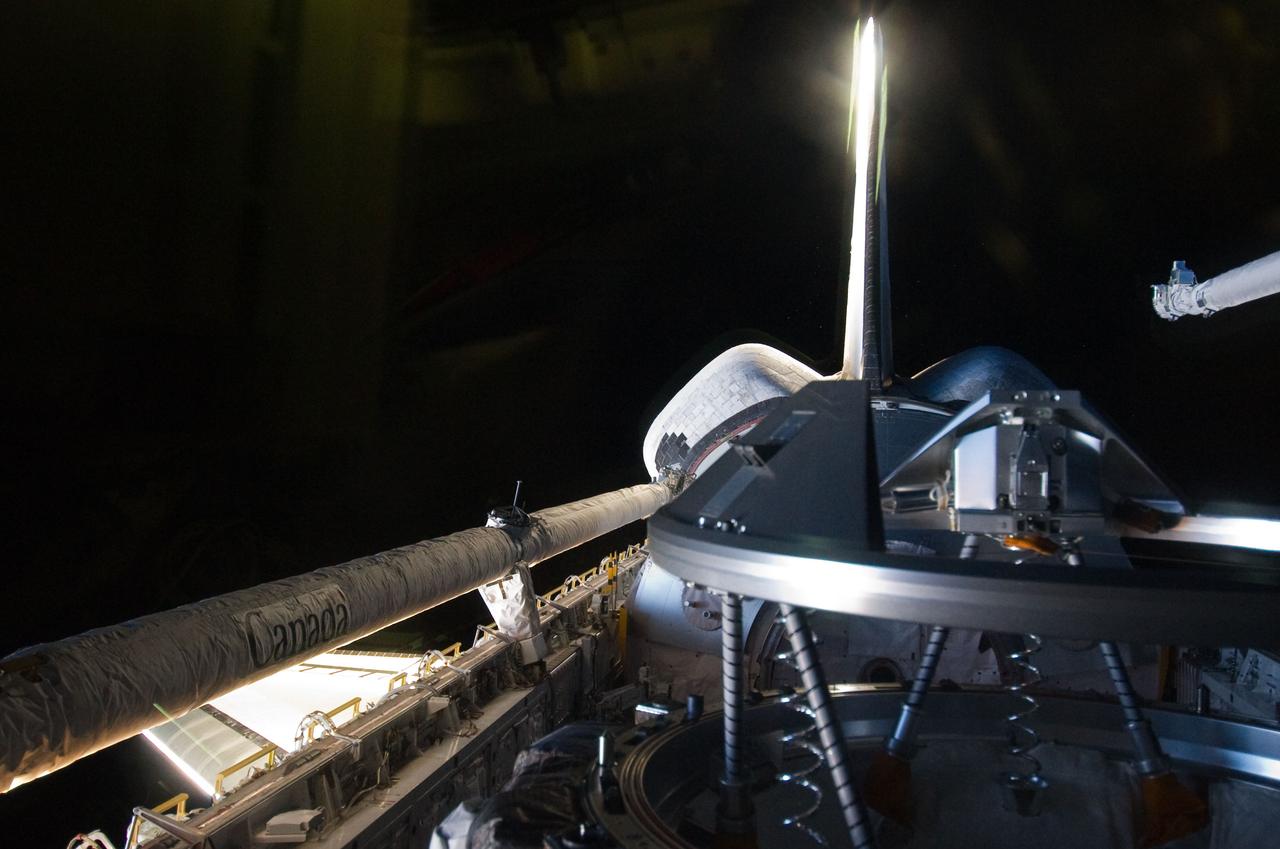
S135-E-007101 (10 July 2011) --- This picture of Atlantis' payload bay, focusing on the docking mechanism, was photographed by one of four STS-135 crewmembers inside the crew cabin. The orbiter boom sensor system and a portion of the remote manipulator system's robot arm are visible in the frame, exposed during a busy third day in space for the astronauts. The photo was made shortly before the shuttle docked with the International Space Station. Photo credit: NASA
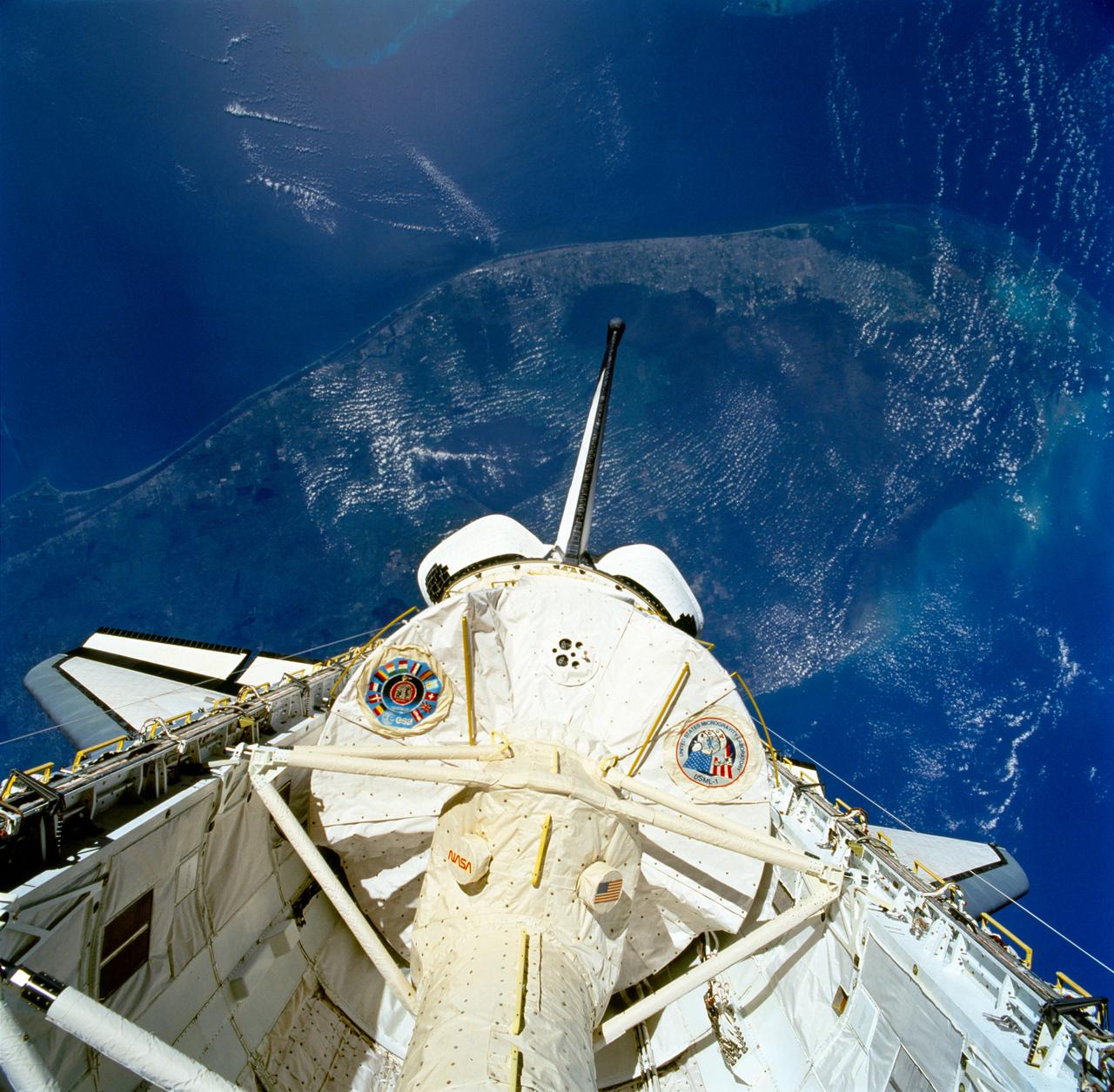
STS050-81-027 (25 June-9 July 1992) --- The first United States Microgravity Laboratory 1 (USML-1) module is pictured in the payload bay of the Earth-orbiting Space Shuttle Columbia in this scene over the southern two-thirds of the Florida peninsula. The Kennedy Space Center (KSC), where the mission began, can be seen just above Columbia's starboard wing. (Hold photo with number at left.)
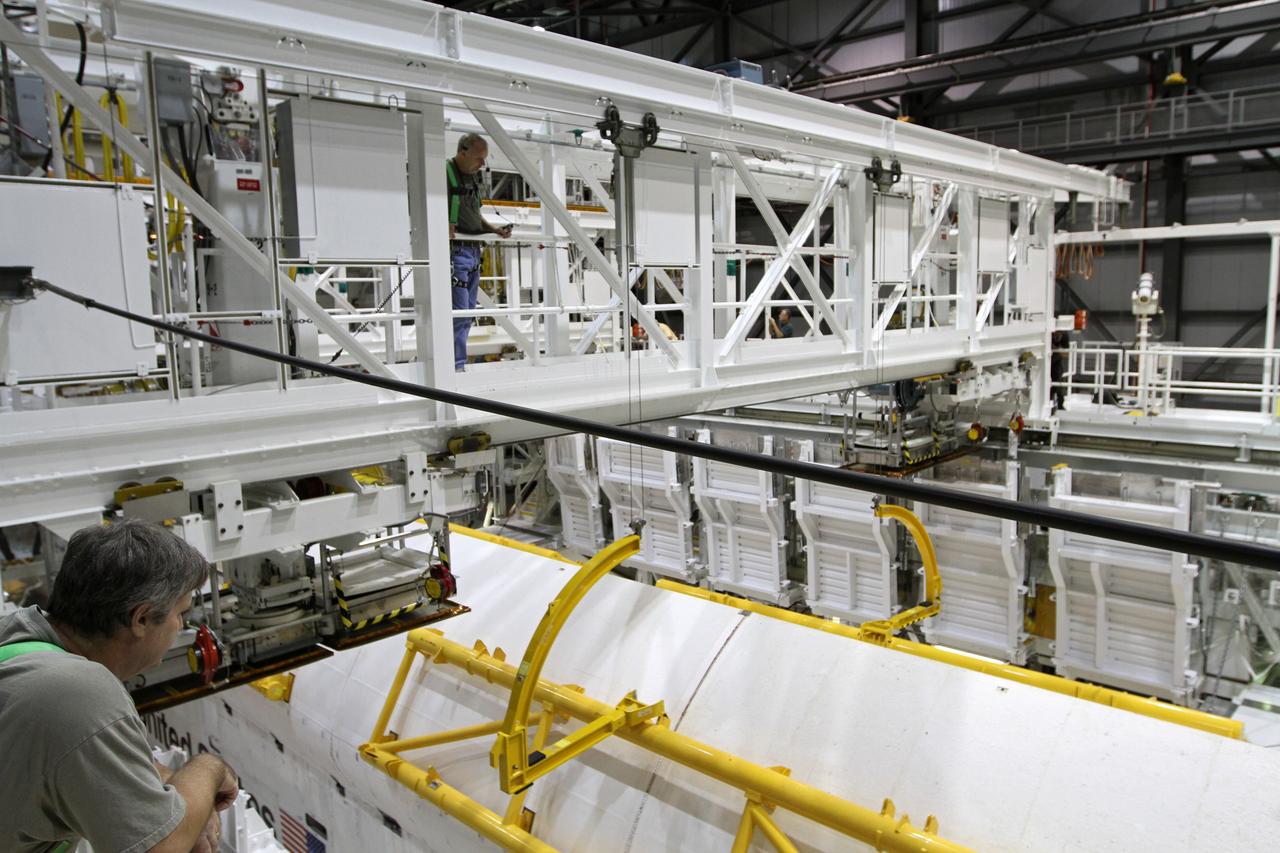
CAPE CANAVERAL, Fla. – Inside Orbiter Processing Facility-2 at NASA’s Kennedy Space Center in Florida, one of space shuttle Endeavour’s payload bay doors is closed as United Space Alliance technicians monitor the progress of the second door’s closure. Endeavour’s payload bay doors are being closed for the final time. The work is part of Transition and Retirement of the remaining space shuttles, Endeavour and Atlantis. Endeavour is being prepared for public display at the California Science Center in Los Angeles. Its ferry flight to California is targeted for mid-September. Endeavour was the last space shuttle added to NASA’s orbiter fleet. Over the course of its 19-year career, Endeavour spent 299 days in space during 25 missions. For more information, visit http://www.nasa.gov/shuttle. Photo credit: NASA/Kim Shiflett
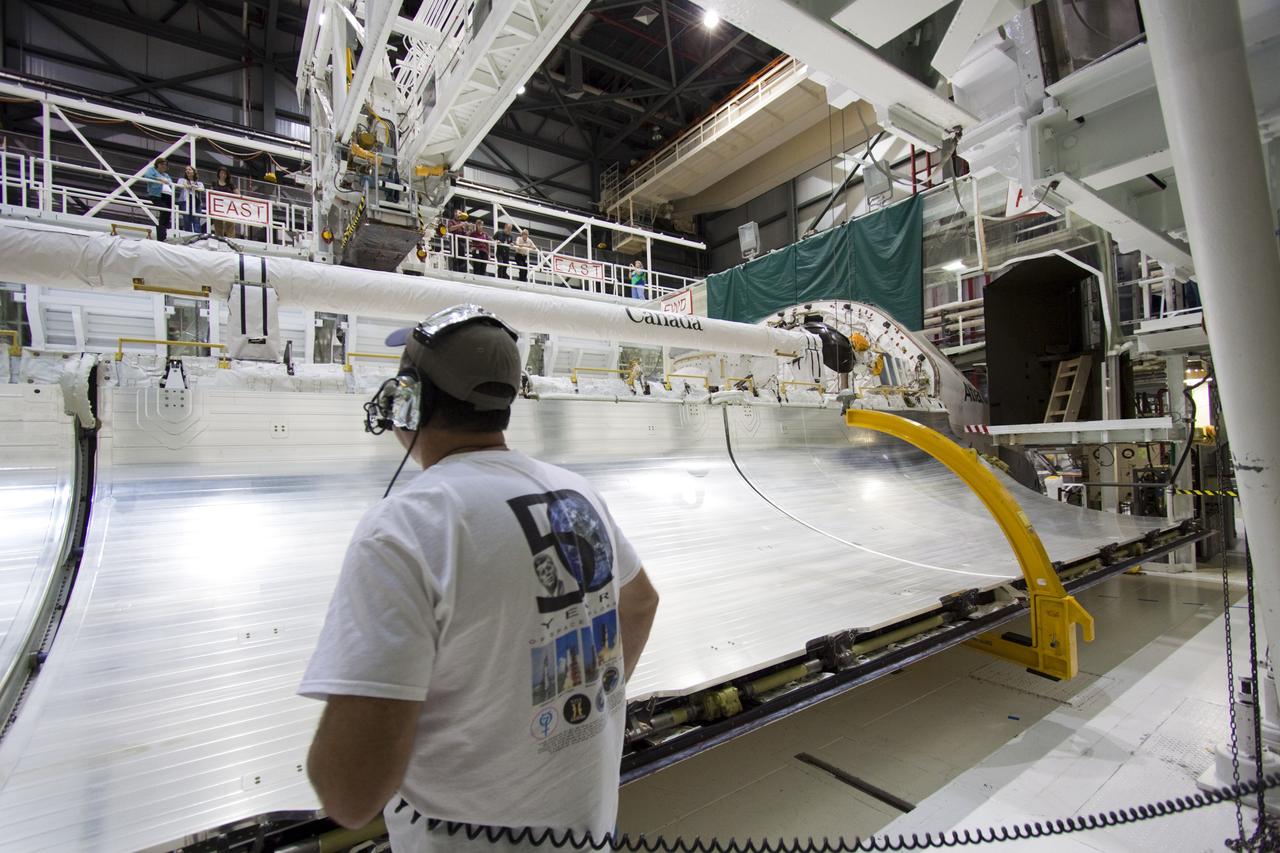
CAPE CANAVERAL, Fla. – Inside Orbiter Processing Facility-2 at NASA’s Kennedy Space Center in Florida, United Space Alliance Mid-body Mechanical Lead Tim Keyser, monitors space shuttle Atlantis’ left payload bay door as it begins to close. Both payload bay doors will be closed for the final time. The orbiter is undergoing final preparations for its transfer to the Kennedy Space Center Visitor complex targeted for November. The work is part of Transition and Retirement of the remaining shuttle. Atlantis is being prepared for public display at the visitor complex. Over the course of its 26-year career, Atlantis spent 293 days in space during 33 missions. For more information, visit http://www.nasa.gov/transition. Photo credit: NASA/Jim Grossmann
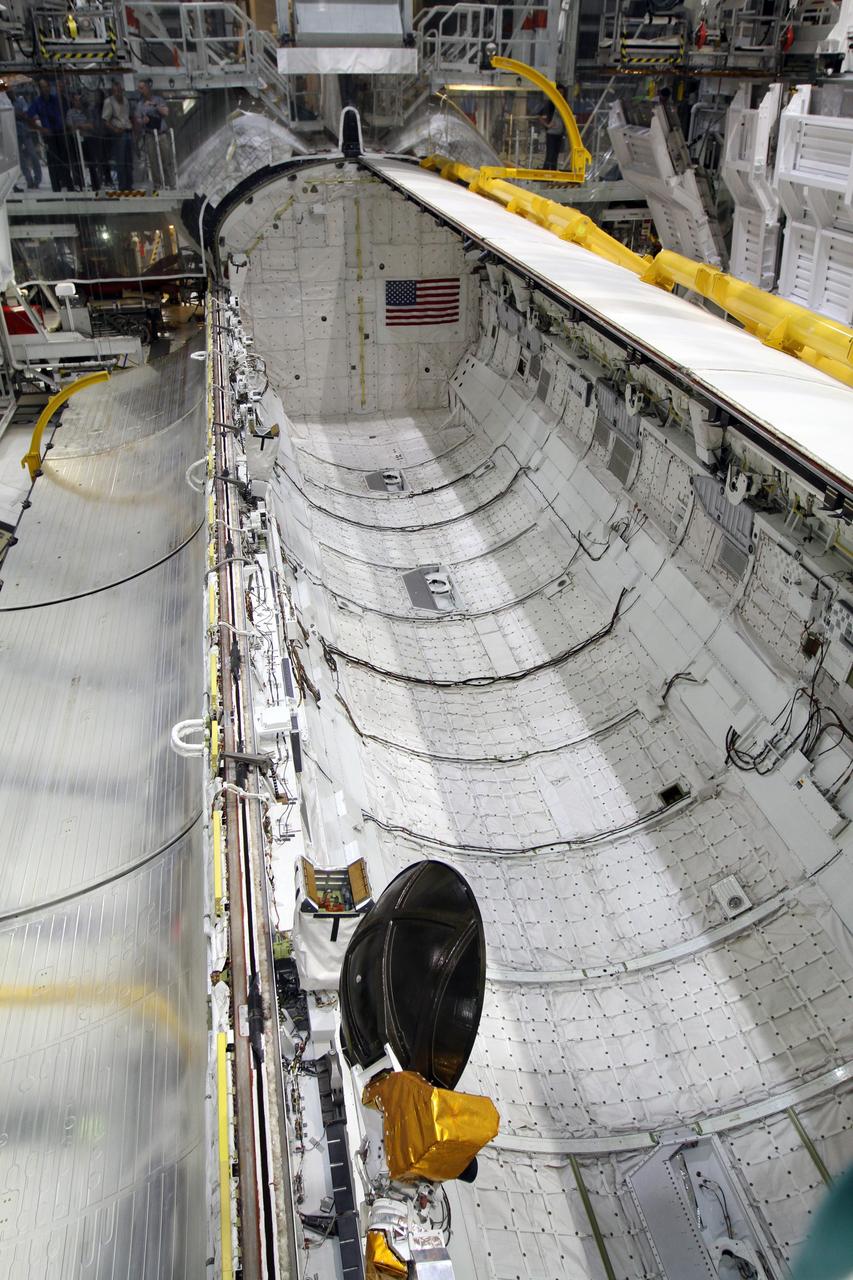
CAPE CANAVERAL, Fla. – Inside Orbiter Processing Facility-2 at NASA’s Kennedy Space Center in Florida, one of space shuttle Endeavour’s payload bay doors is closed. Endeavour’s payload bay doors will be closed for the final time. The work is part of Transition and Retirement of the remaining space shuttles, Endeavour and Atlantis. Endeavour is being prepared for public display at the California Science Center in Los Angeles. Its ferry flight to California is targeted for mid-September. Endeavour was the last space shuttle added to NASA’s orbiter fleet. Over the course of its 19-year career, Endeavour spent 299 days in space during 25 missions. For more information, visit http://www.nasa.gov/shuttle. Photo credit: NASA/Kim Shiflett
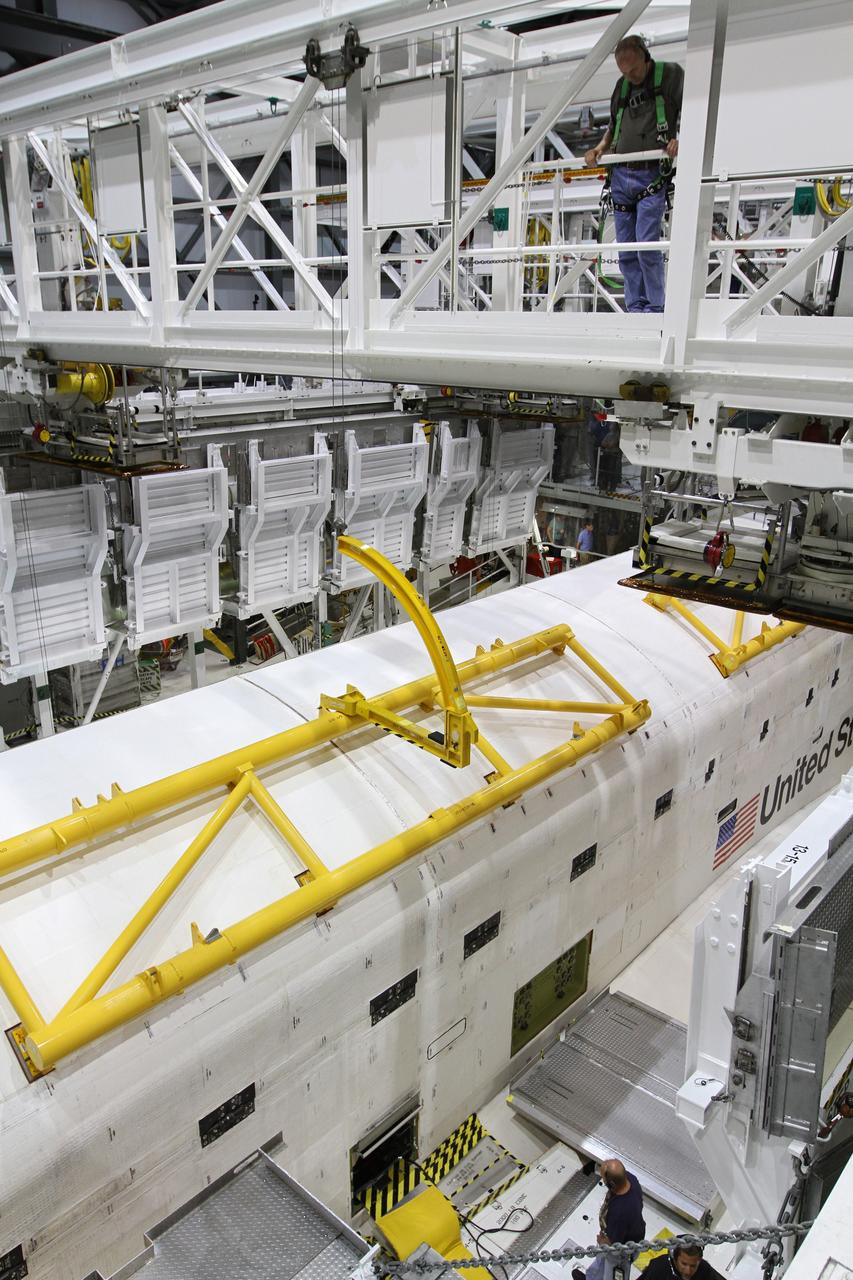
CAPE CANAVERAL, Fla. – Inside Orbiter Processing Facility-2 at NASA’s Kennedy Space Center in Florida, one of space shuttle Endeavour’s payload bay doors is closed as a United Space Alliance technician monitors the progress of the second door’s closure. Endeavour’s payload bay doors are being closed for the final time. The work is part of Transition and Retirement of the remaining space shuttles, Endeavour and Atlantis. Endeavour is being prepared for public display at the California Science Center in Los Angeles. Its ferry flight to California is targeted for mid-September. Endeavour was the last space shuttle added to NASA’s orbiter fleet. Over the course of its 19-year career, Endeavour spent 299 days in space during 25 missions. For more information, visit http://www.nasa.gov/shuttle. Photo credit: NASA/Kim Shiflett
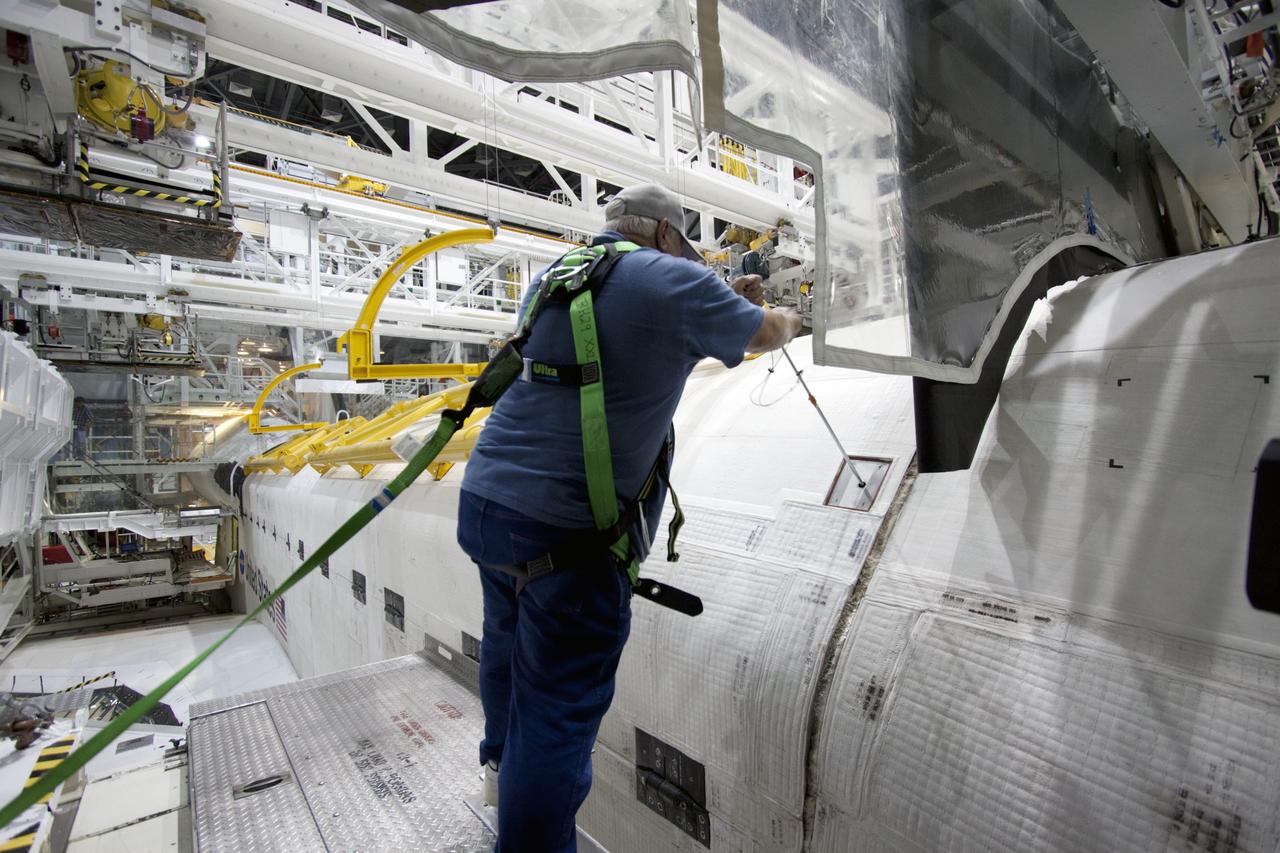
CAPE CANAVERAL, Fla. – Inside Orbiter Processing Facility-2 at NASA’s Kennedy Space Center in Florida, United Space Alliance technician Jim Reed uses a speed wrench in a gear box to lock the left payload bay door in place after it was closed. Both payload bay doors will be closed for the final time. The orbiter is undergoing final preparations for its transfer to the Kennedy Space Center Visitor complex targeted for November. The work is part of Transition and Retirement of the remaining shuttle. Atlantis is being prepared for public display at the visitor complex. Over the course of its 26-year career, Atlantis spent 293 days in space during 33 missions. For more information, visit http://www.nasa.gov/transition. Photo credit: NASA/Jim Grossmann
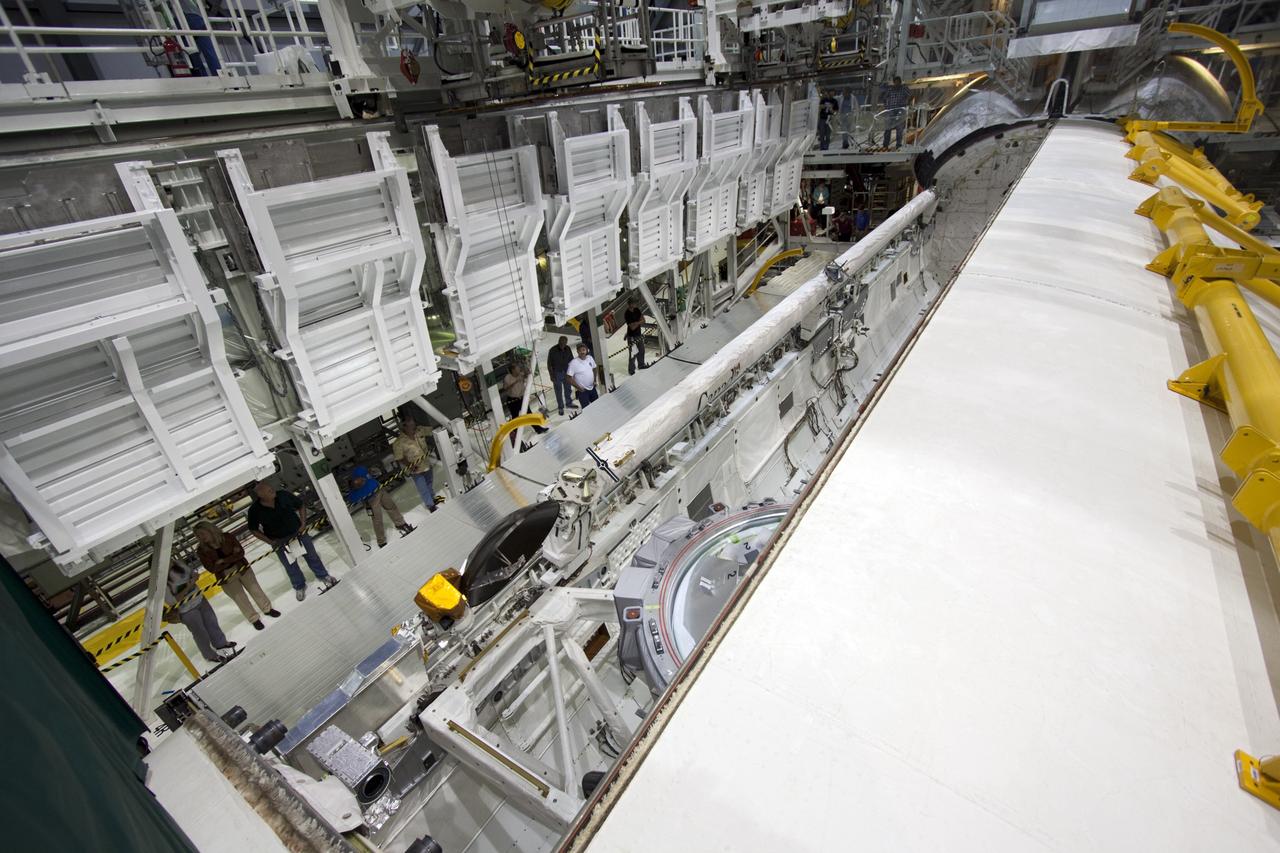
CAPE CANAVERAL, Fla. – Inside Orbiter Processing Facility-2 at NASA’s Kennedy Space Center in Florida, United Space Alliance technicians monitor the progress as space shuttle Atlantis’ left payload bay door is closed. Both payload bay doors will be closed for the final time. The orbiter is undergoing final preparations for its transfer to the Kennedy Space Center Visitor complex targeted for November. The work is part of Transition and Retirement of the remaining shuttle. Atlantis is being prepared for public display at the visitor complex. Over the course of its 26-year career, Atlantis spent 293 days in space during 33 missions. For more information, visit http://www.nasa.gov/transition. Photo credit: NASA/Jim Grossmann

CAPE CANAVERAL, Fla. – Inside Orbiter Processing Facility-2 at NASA’s Kennedy Space Center in Florida, one of space shuttle Endeavour’s payload bay doors is closed. Endeavour’s payload bay doors will be closed for the final time. The work is part of Transition and Retirement of the remaining space shuttles, Endeavour and Atlantis. Endeavour is being prepared for public display at the California Science Center in Los Angeles. Its ferry flight to California is targeted for mid-September. Endeavour was the last space shuttle added to NASA’s orbiter fleet. Over the course of its 19-year career, Endeavour spent 299 days in space during 25 missions. For more information, visit http://www.nasa.gov/shuttle. Photo credit: NASA/Kim Shiflett
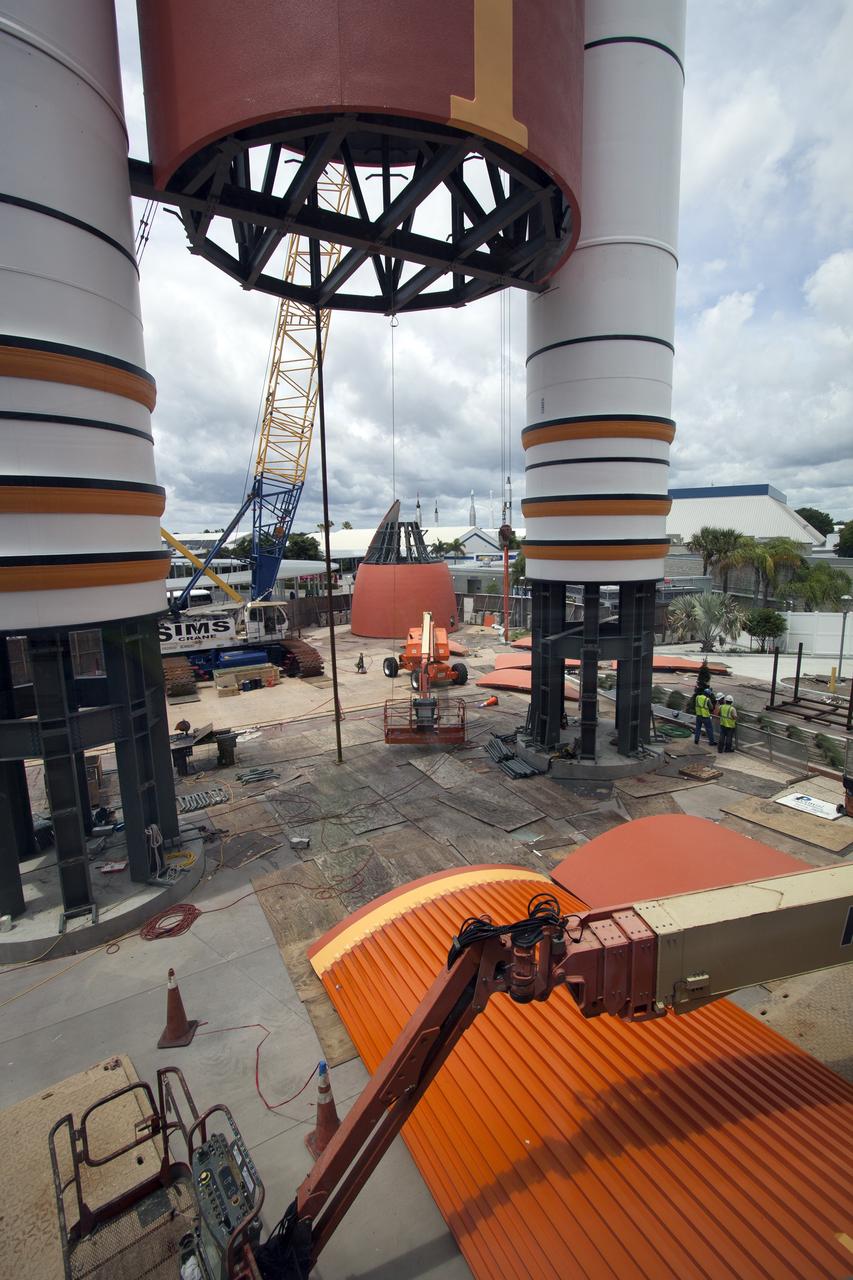
CAPE CANAVERAL, Fla. – At the Kennedy Space Center Visitor Complex in Florida, the buildup of the replica solid rocket boosters and external fuel tank are nearly complete in front of the entrance to the new “Space Shuttle Atlantis” exhibit. Atlantis is being prepared for display in the 90,000-square-foot facility, scheduled to open June 29, 2013. The new $100 million facility will include interactive exhibits that tell the story of the 30-year Space Shuttle Program and highlight the future of space exploration. Visitors to the exhibit will get an up close look at Atlantis with its payload bay doors open, similar to how it looked in space. Photo credit: NASA/Jim Grossmann
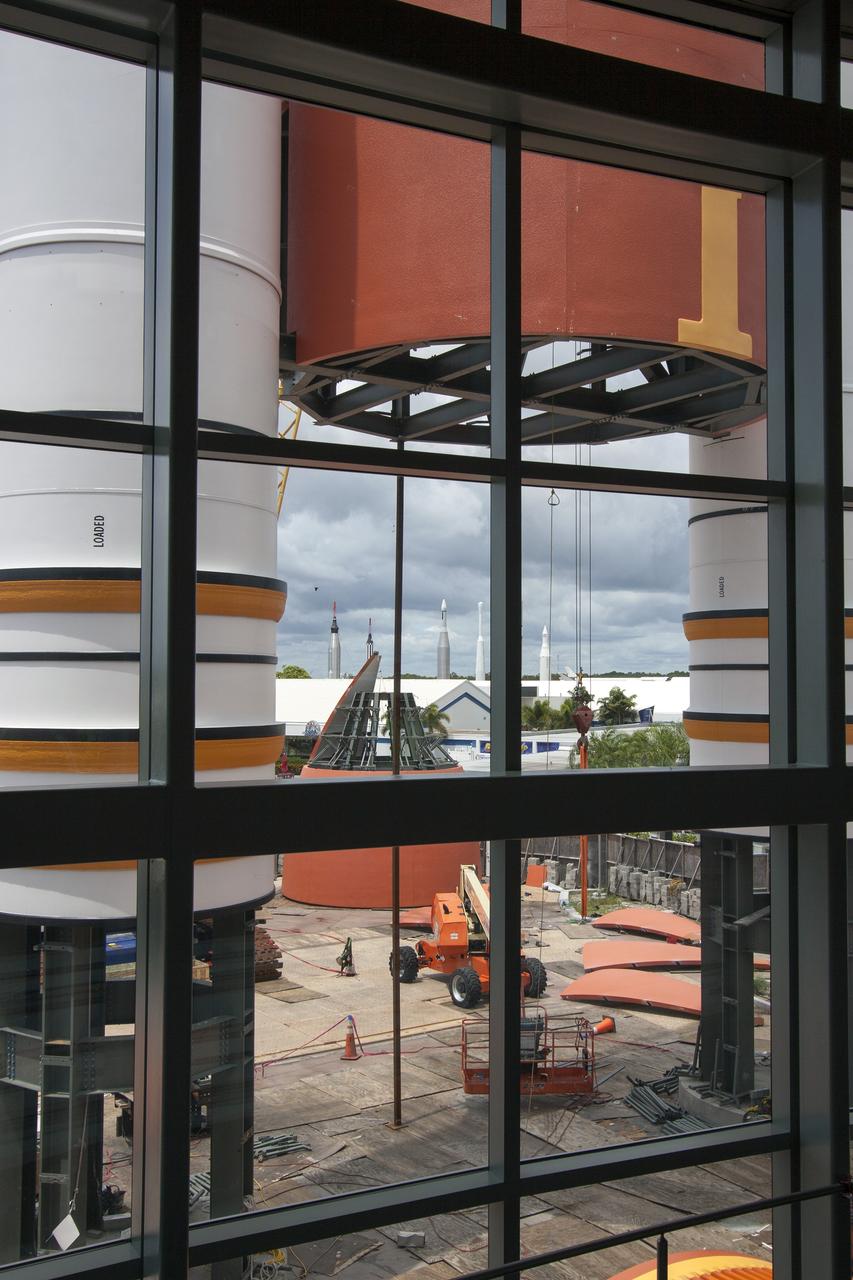
CAPE CANAVERAL, Fla. – A view from inside the new “Space Shuttle Atlantis” exhibit at the Kennedy Space Center Visitor Complex in Florida, shows the buildup of the replica solid rocket boosters and external fuel tank are nearly complete near the entrance. Atlantis is being prepared for display in the 90,000-square-foot facility, scheduled to open June 29, 2013. The new $100 million facility will include interactive exhibits that tell the story of the 30-year Space Shuttle Program and highlight the future of space exploration. Visitors to the exhibit will get an up close look at Atlantis with its payload bay doors open, similar to how it looked in space. Photo credit: NASA/Jim Grossmann
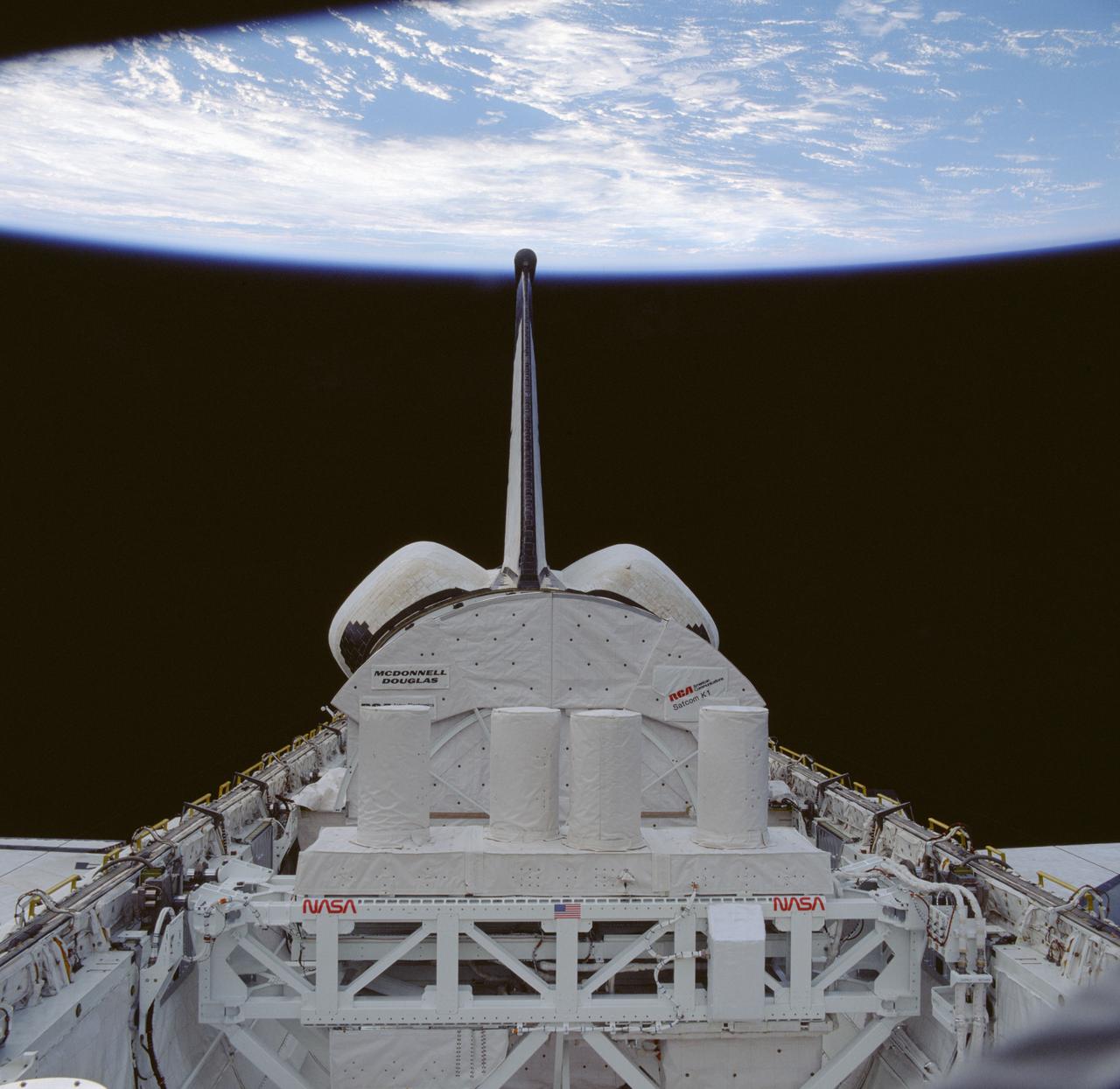
61C-39-002 (12-17 Jan 1986) --- This view of the cargo bay of the Earth-orbiting Space Shuttle Columbia reveals some of the STS 61-C mission payloads. The materials science laboratory (MSL-2), sponsored by the Marshall Space Flight Center (MSFC), is in the foreground. A small portion of the first Hitchhiker payload, sponsored by the Goddard Space Flight Center (GSFC), is in the immediate foreground, mounted to the spacecraft's starboard side. The closed sun shield for the now-vacated RCA SATCOM K-1 communications satellite is behind the MSL. Completely out of view, behind the shield, are 13 getaway specials in canisters. Clouds over ocean and the blackness of space share the backdrop for the 70mm camera's frame.
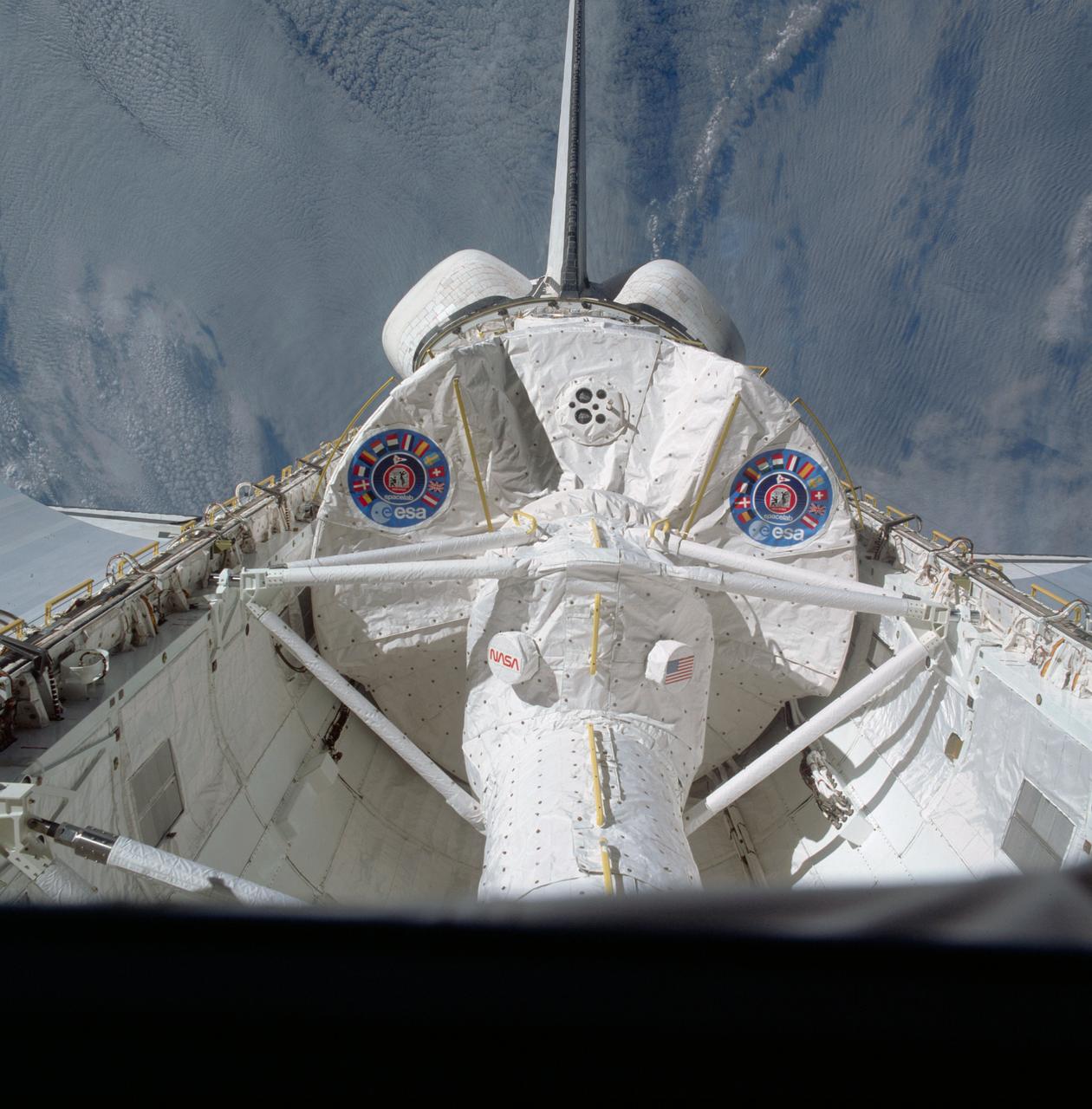
STS009-32-1112 (28 Nov-8 Dec 1983) --- A handheld Hasselblad camera was aimed through the aft windows on the flight deck of Columbia for this initially released scene of the active Spacelab module in the cargo bay. The docking tunnel, leading from the shirt-sleeve environment of the orbiter to the equally comfortable environment of Spacelab, is in the foreground.
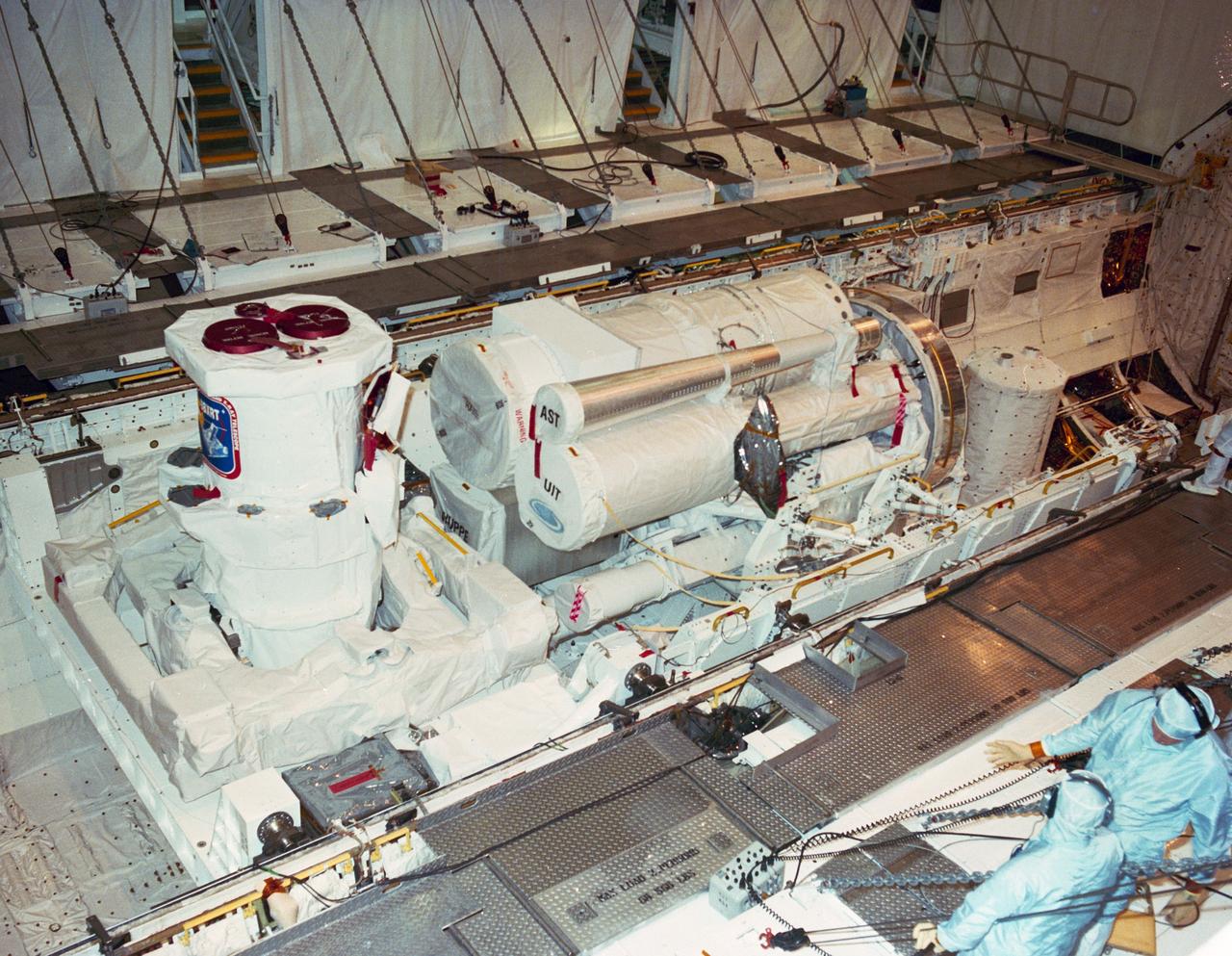
STS-35 Astronomy Laboratory 1 (ASTRO-1) is installed in Columbia's, Orbiter Vehicle (OV) 102's, payload bay (PLB) at the Kennedy Space Center (KSC) Orbiter Processing Facility (OPF). On the left, in the aft PLB is the Broad Band X Ray Telescope (BBXRT) mounted on the two axis pointing system (TAPS). In the center, the three ultraviolet telescopes - Wisconsin Ultraviolet Photo-Polarimeter Experiment (WUPPE), the Hopkins Ultraviolet Telescope (HUT), and the Ultraviolet Imaging Telescope (UIT) - are mounted on the instrument pointing system (IPS) and are in stowed position. At the far right is the Spacelab Pallet System (SPS) igloo. View provided by KSC with alternate number KSSC-90PC-421.
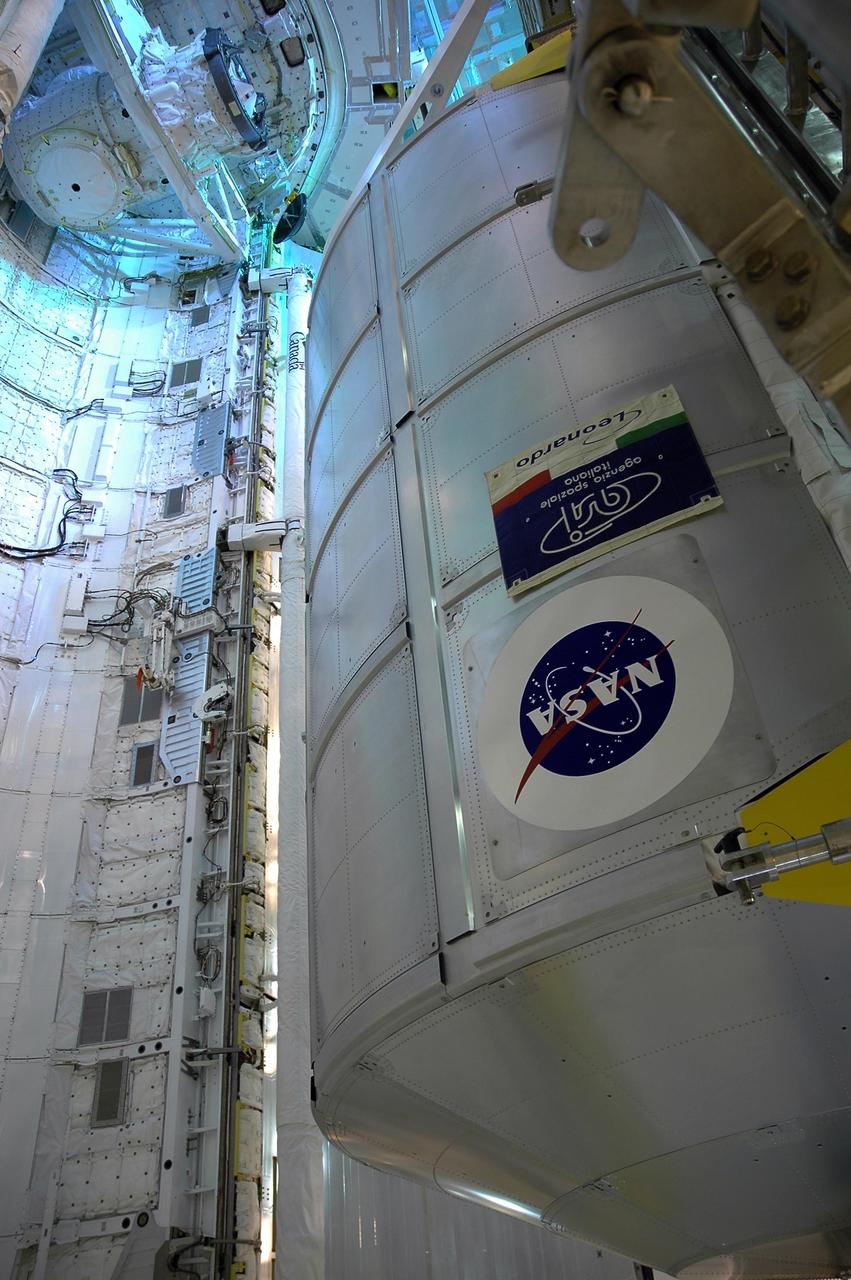
KENNEDY SPACE CENTER, FLA. -- From inside the payload changeout room on the rotating service structure on Launch Pad 39B, the multi-purpose logistics module Leonardo is being moved into Space Shuttle Discovery's payload bay (at left). The payload ground-handling mechanism (PGHM) is used to transfer the module into the payload bay. Leonardo is a reusable logistics carrier. It is the primary delivery system used to resupply and return station cargo requiring a pressurized environment. Leonardo is part of the payload on mission STS-121. Other payloads include the integrated cargo carrier with the mobile transporter reel assembly and a spare pump module, and the lightweight multi-purpose experiment support structure carrier. Discovery is scheduled to launch in a window extending from July 1 through July 19. Photo credit: NASA/Jack Pfaller
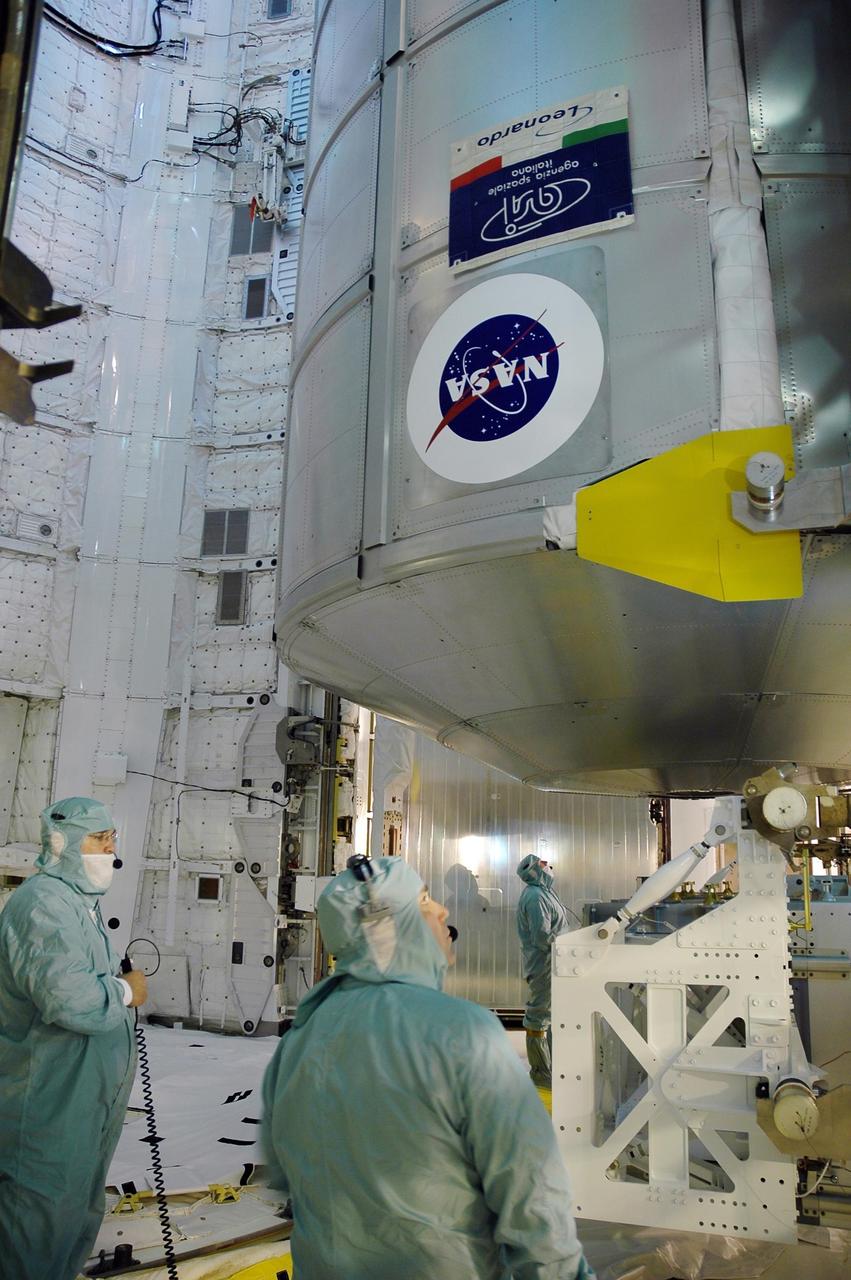
KENNEDY SPACE CENTER, FLA. -- From inside the payload changeout room on the rotating service structure on Launch Pad 39B, workers maneuver the multi-purpose logistics module Leonardo into Space Shuttle Discovery's payload bay (at left). The payload ground-handling mechanism (PGHM) is used to transfer the module into the payload bay. Leonardo is a reusable logistics carrier. It is the primary delivery system used to resupply and return station cargo requiring a pressurized environment. Leonardo is part of the payload on mission STS-121. Other payloads include the integrated cargo carrier with the mobile transporter reel assembly and a spare pump module, and the lightweight multi-purpose experiment support structure carrier. Discovery is scheduled to launch in a window extending from July 1 through July 19. Photo credit: NASA/Jack Pfaller
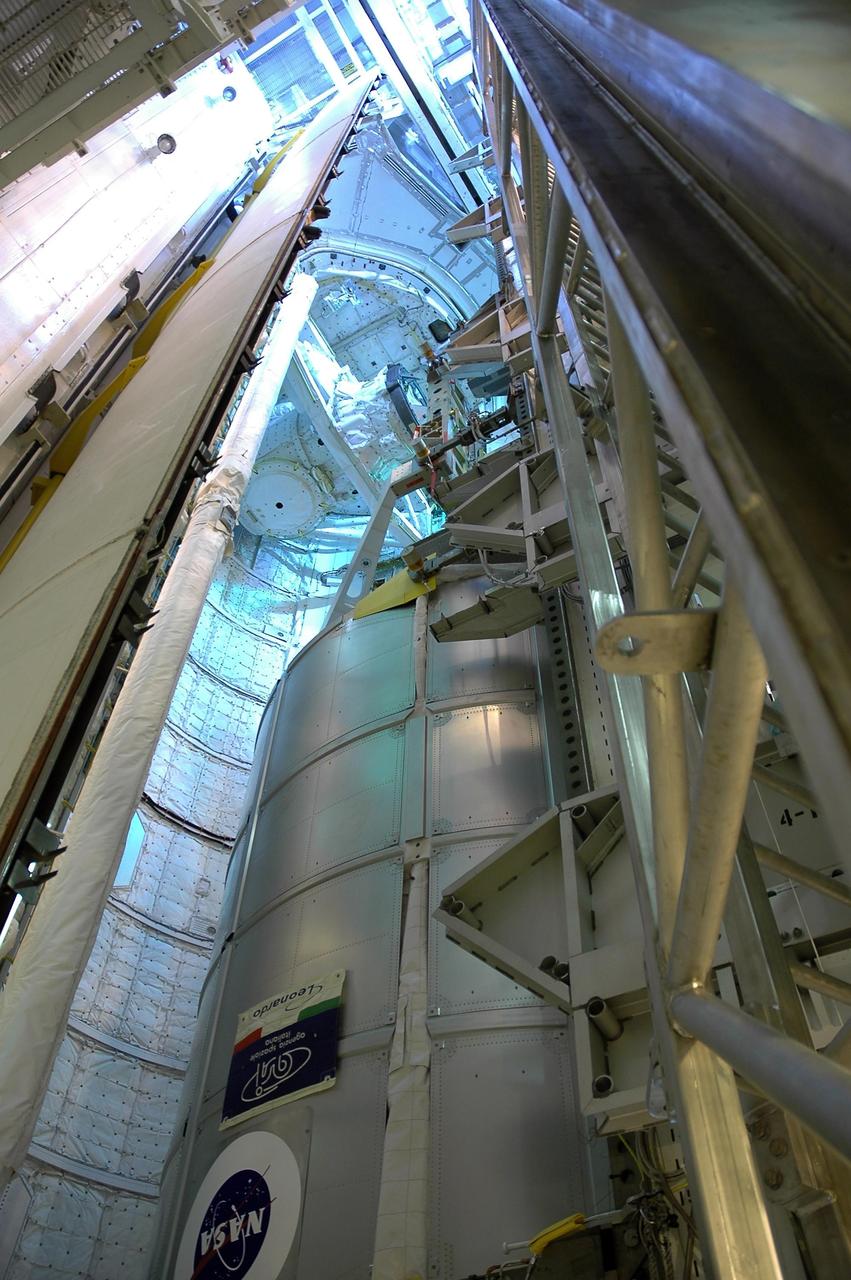
KENNEDY SPACE CENTER, FLA. -- From inside the payload changeout room on the rotating service structure on Launch Pad 39B, the multi-purpose logistics module Leonardo is lowered into Space Shuttle Discovery's payload bay. The payload ground-handling mechanism (PGHM) is used to transfer the module into the payload bay. Leonardo is a reusable logistics carrier. It is the primary delivery system used to resupply and return station cargo requiring a pressurized environment. Leonardo is part of the payload on mission STS-121. Other payloads include the integrated cargo carrier with the mobile transporter reel assembly and a spare pump module, and the lightweight multi-purpose experiment support structure carrier. Discovery is scheduled to launch in a window extending from July 1 through July 19. Photo credit: NASA/Jack Pfaller
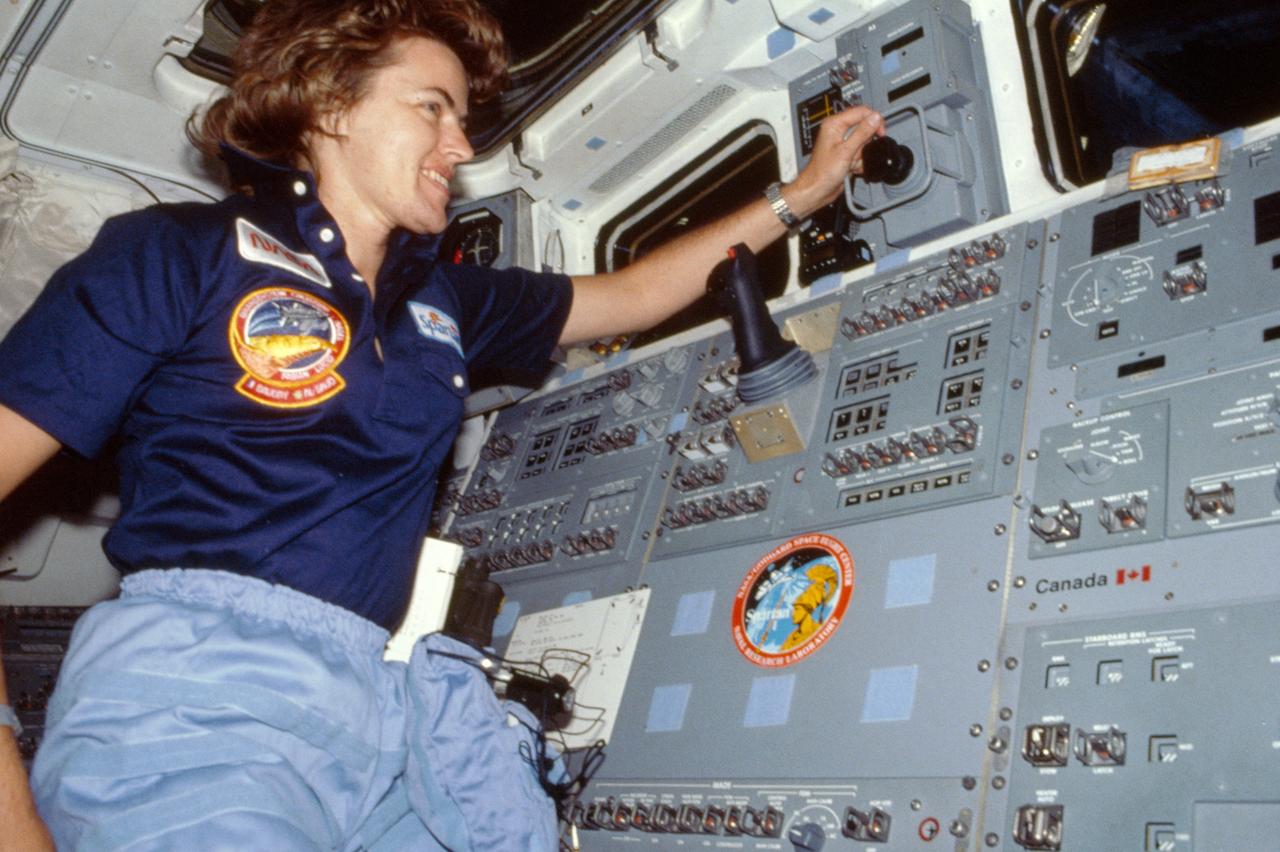
51G-04-010 (17-24 June 1985) --- Astronaut Shannon W. Lucid monitors cargo bay activities with one of the satellite payloads aboard.
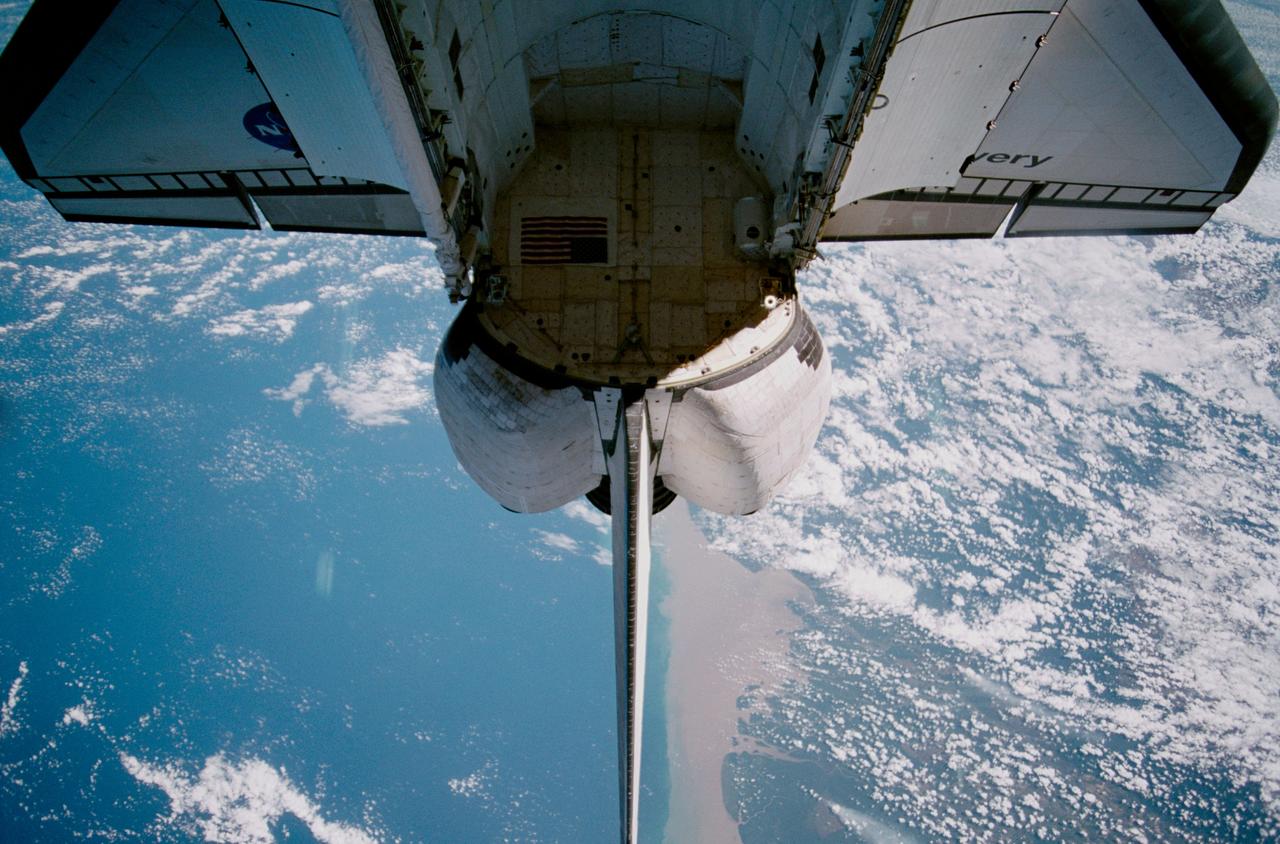
STS102-328-028 (13 March 2001) --- The Space Shuttle Discovery's payload bay and vertical stabilizer are backdropped over Southeast Asia in this 35mm scene.
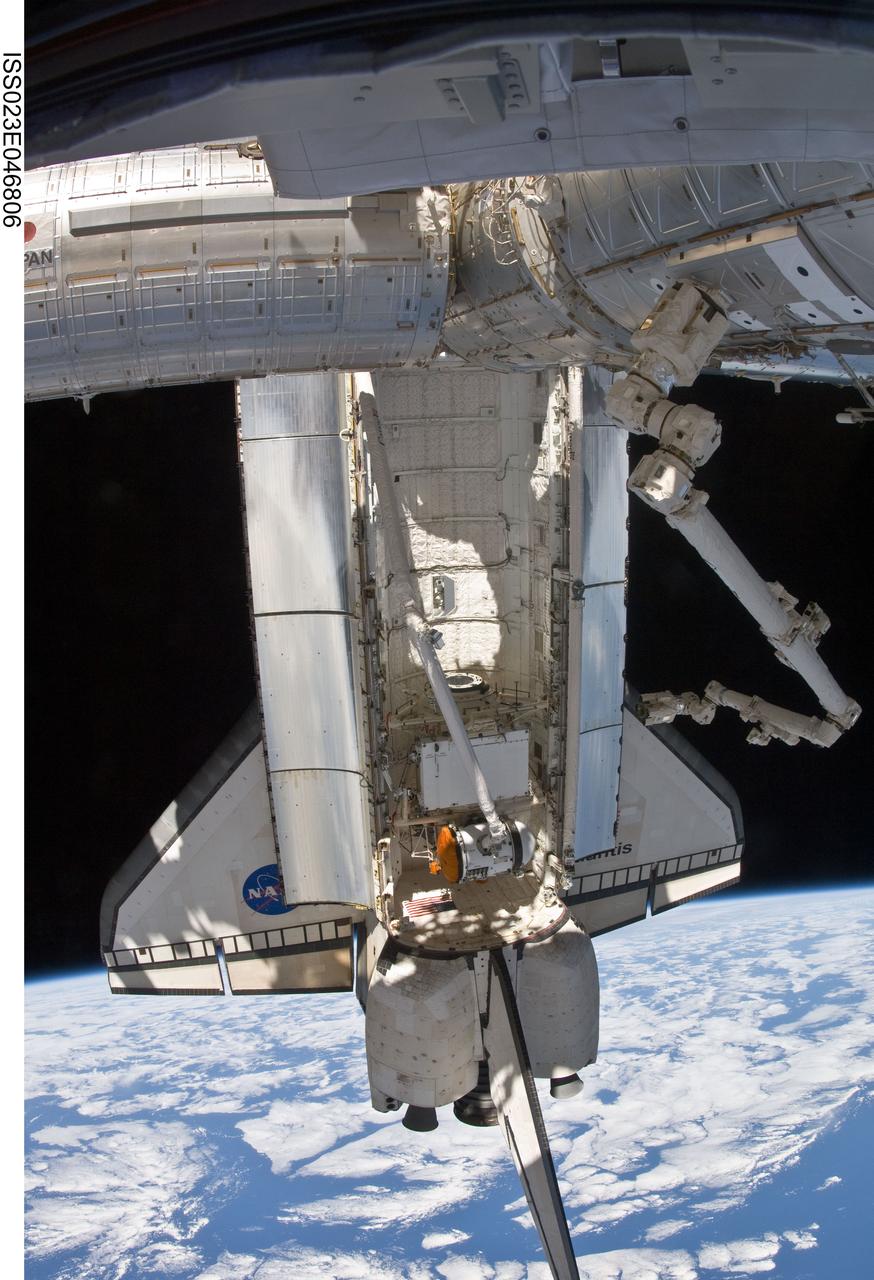
ISS023-E-046806 (18 May 2010) --- Backdropped by Earth?s horizon and the blackness of space, the docked space shuttle Atlantis is featured in this image photographed by an Expedition 23 crew member on the International Space Station. The Russian-built Mini-Research Module 1 (MRM-1) is visible in the payload bay as the shuttle robotic arm prepares to unberth the module from Atlantis and position it for handoff to the station robotic arm (visible at right). Named Rassvet, Russian for "dawn," the module is the second in a series of new pressurized components for Russia and will be permanently attached to the Earth-facing port of the Zarya Functional Cargo Block (FGB). Rassvet will be used for cargo storage and will provide an additional docking port to the station.
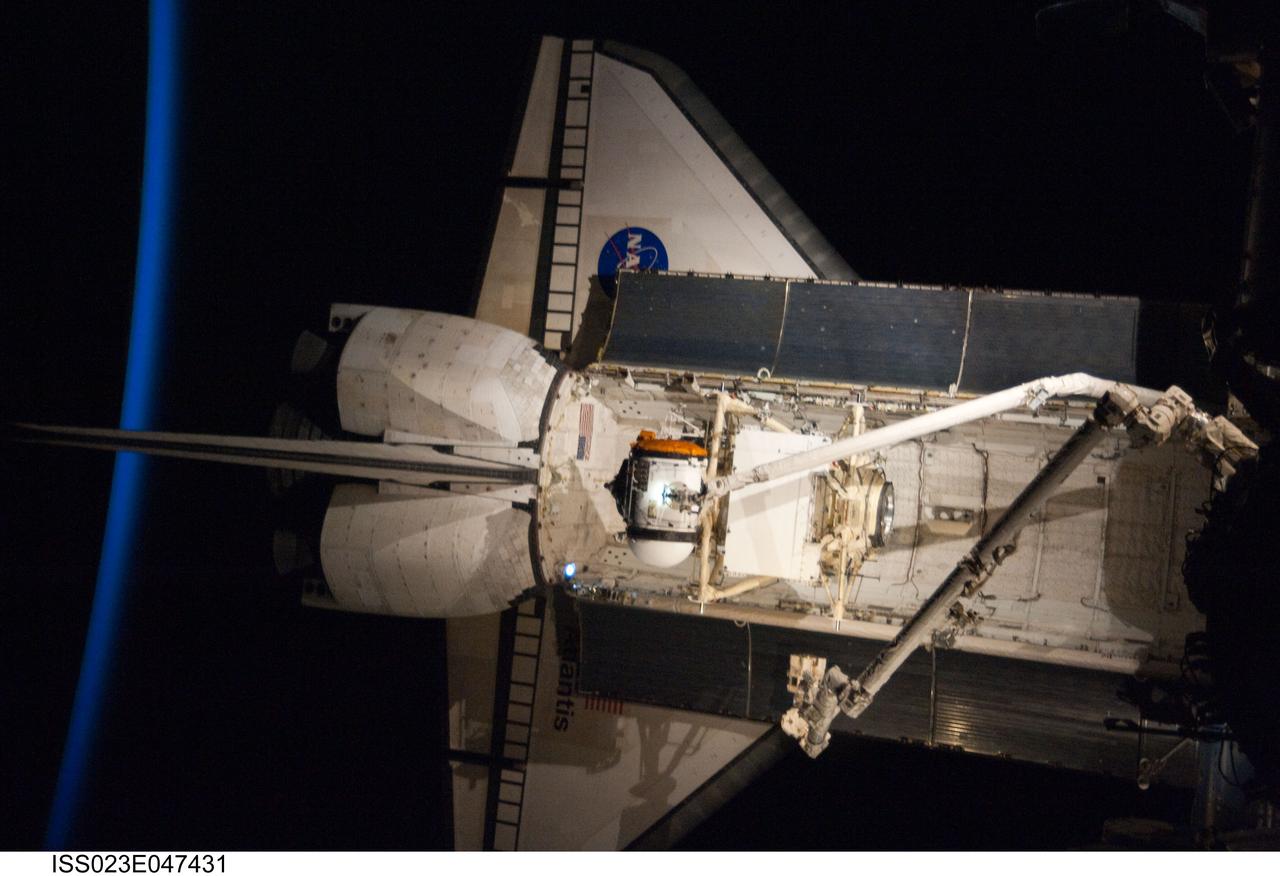
ISS023-E-047431 (18 May 2010) --- Intersecting the thin line of Earth's atmosphere, the docked space shuttle Atlantis is featured in this image photographed by an Expedition 23 crew member on the International Space Station. The Russian-built Mini-Research Module 1 (MRM-1) is visible in the payload bay as the shuttle robotic arm prepares to unberth the module from Atlantis and position it for handoff to the station robotic arm. Named Rassvet, Russian for "dawn," the module is the second in a series of new pressurized components for Russia and will be permanently attached to the Earth-facing port of the Zarya Functional Cargo Block (FGB). Rassvet will be used for cargo storage and will provide an additional docking port to the station.
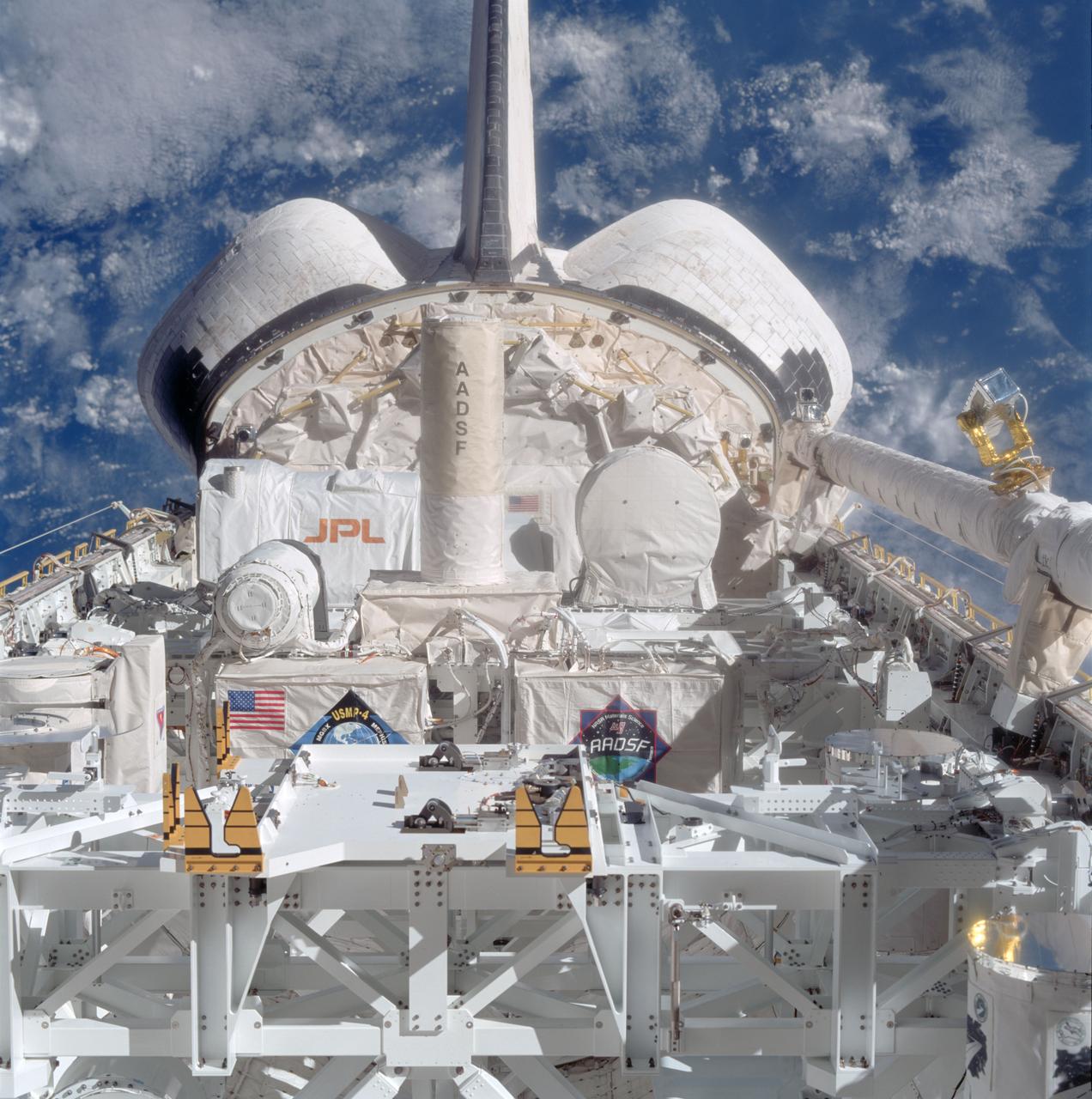
STS087-706-022 (19 November - 5 December 1997) --- This picture of the Space Shuttle Columbia's cargo bay, taken through the aft flight deck windows with a handheld 70mm camera, shows the United States Microgravity Payload 4 (USMP-4) mission's payloads.
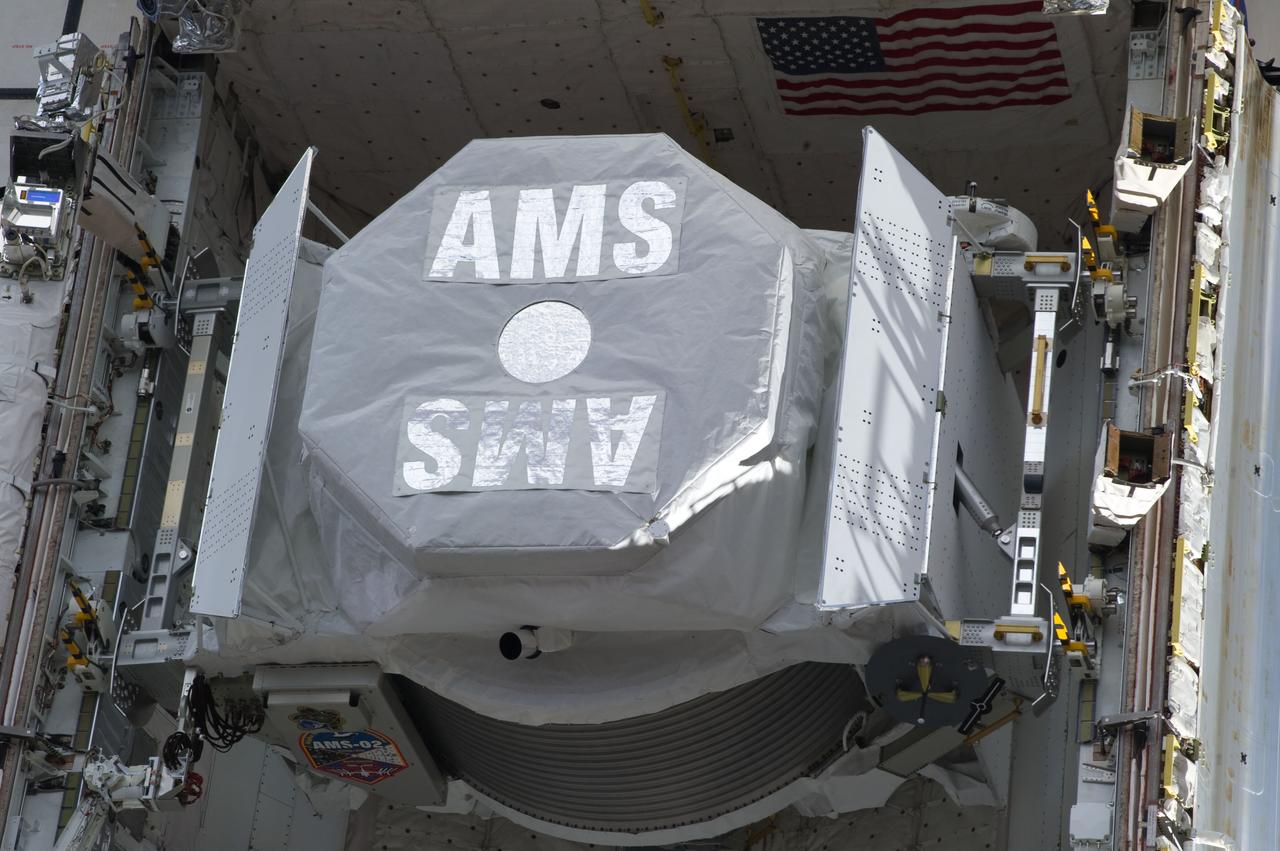
S134-E-007381 (19 May 2011) --- The Alpha Magnetic Spectrometer-2 (AMS) in the space shuttle Endeavour?s payload bay is featured in this image photographed by an STS-134 crew member while docked with the International Space Station. Shortly after this image was taken, the AMS was moved from the payload bay to the station?s starboard truss. Photo credit: NASA
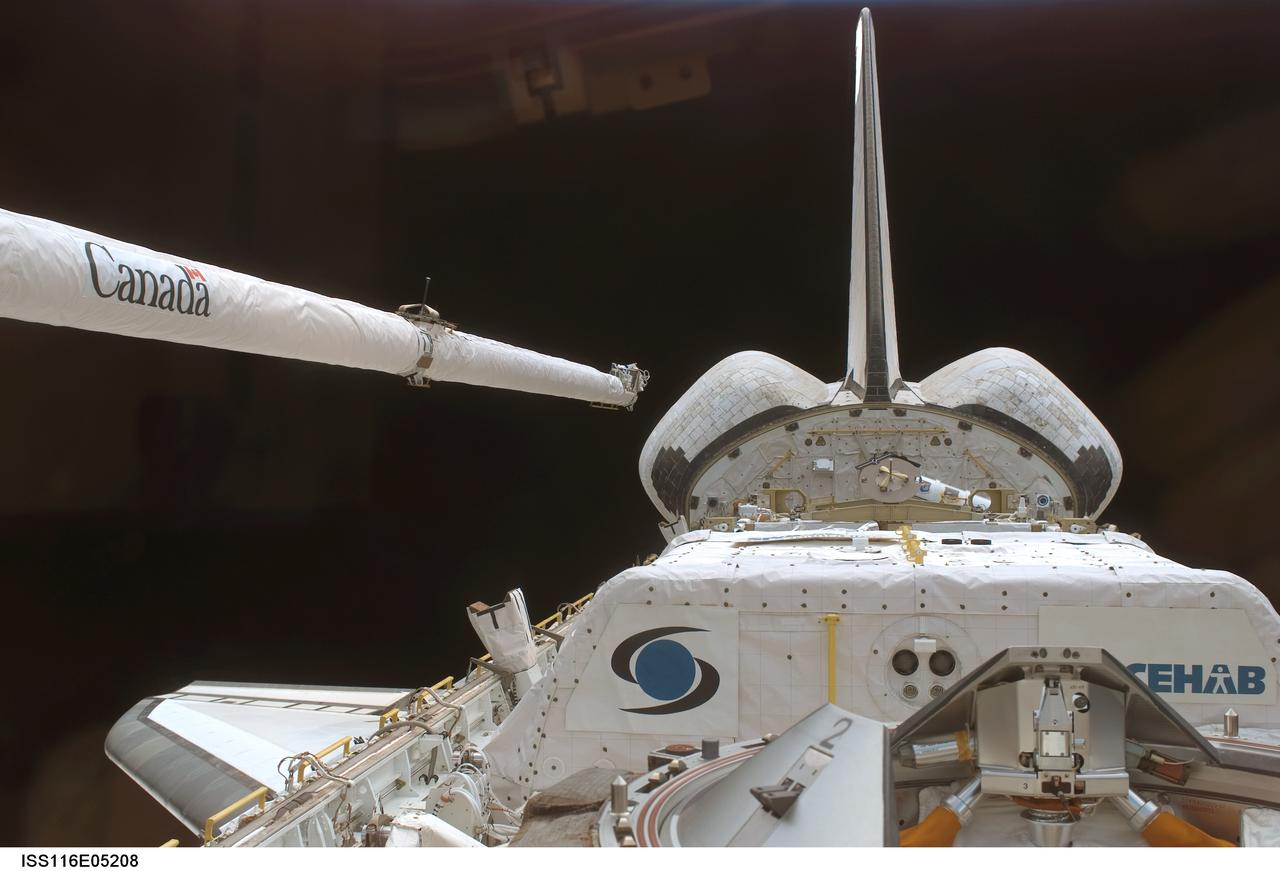
S116-E-05208 (10 Dec. 2006) --- As seen through windows on the aft flight deck of Space Shuttle Discovery, the payload bay is featured in this image photographed by a STS-116 crewmember during flight day two activities. Pictured in the payload bay is the Spacehab module and the Canadian-built Remote Manipulator System/Orbiter Boom Sensor System (RMS/OBSS) is at left. The shuttle's docking mechanism is visible in the foreground.
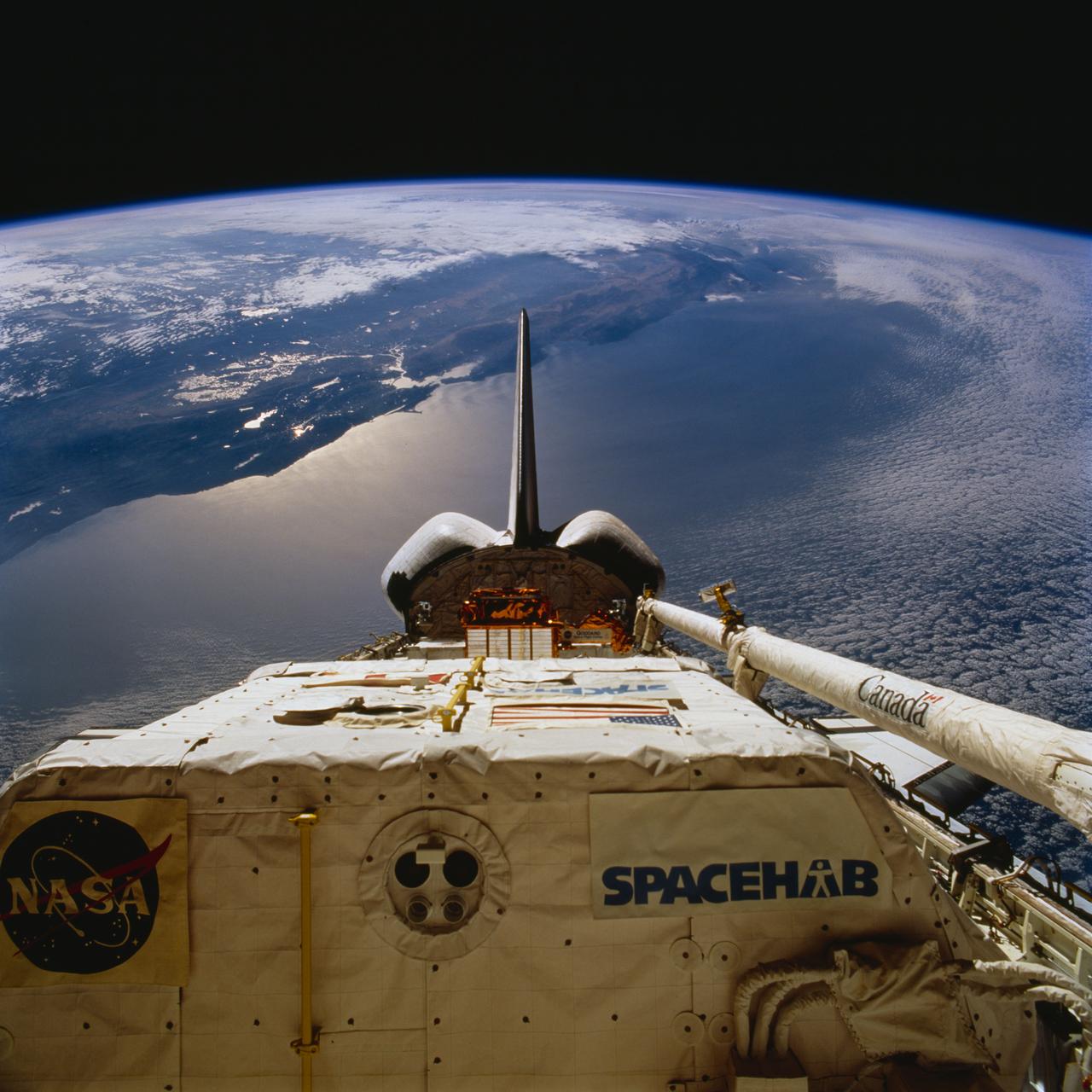
STS077-716-050 (19-29 May 1996) --- With part of the Pacific Ocean and almost the entire state of California as a backdrop, this scene of the Space Shuttle Endeavour’s cargo bay was photographed by a crew member on the aft flight deck. Spacehab-4’s module is in the foreground, flanked by the Canadian-built Remote Manipulator System (RMS) arm and the Spartan-207 payload, both in stowed position. Sunglint on the Earth scene accentuates the bay area of San Francisco. The San Andreas Fault can also easily be traced not far inalnd from the coastline.
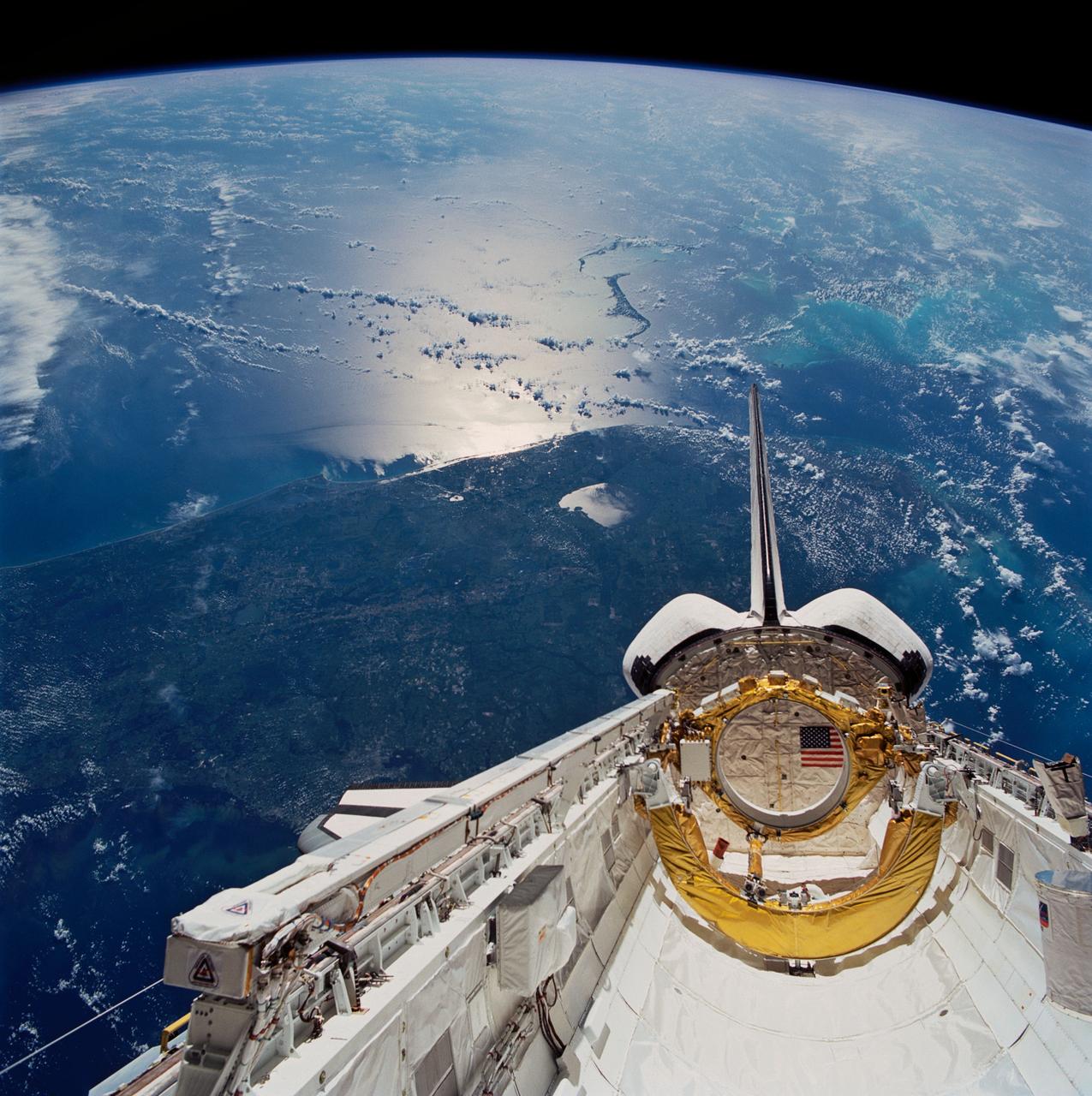
STS043-83-082 (2-11 Aug 1991) --- Having bade farewell to its Tracking and Data Relay Satellite/IUS payload, Atlantis' cargo bay appears somewhat vacant in this scene, backdropped over the southern two-thirds of the Florida peninsula. Important activity in the payload bay continues, however, with the operation of Space Station Heat Pipe Advanced Radiator Element (SHARE II), an experiment carried on the starboard side (lower left quadrant of frame). Purpose of the SHARE experiment is to demonstrate microgravity thermal vacuum performance of a heat pipe radiator for heat rejection as a prelude to development of a Space Station heat rejection system. The foil covered ring and horseshoe shaped objects aft in the payload bay served as restraint devices for the TDRS-E prior to its deployment six hours after Atlantis lifted off from Kennedy Space Center's Launch Pad 39A.
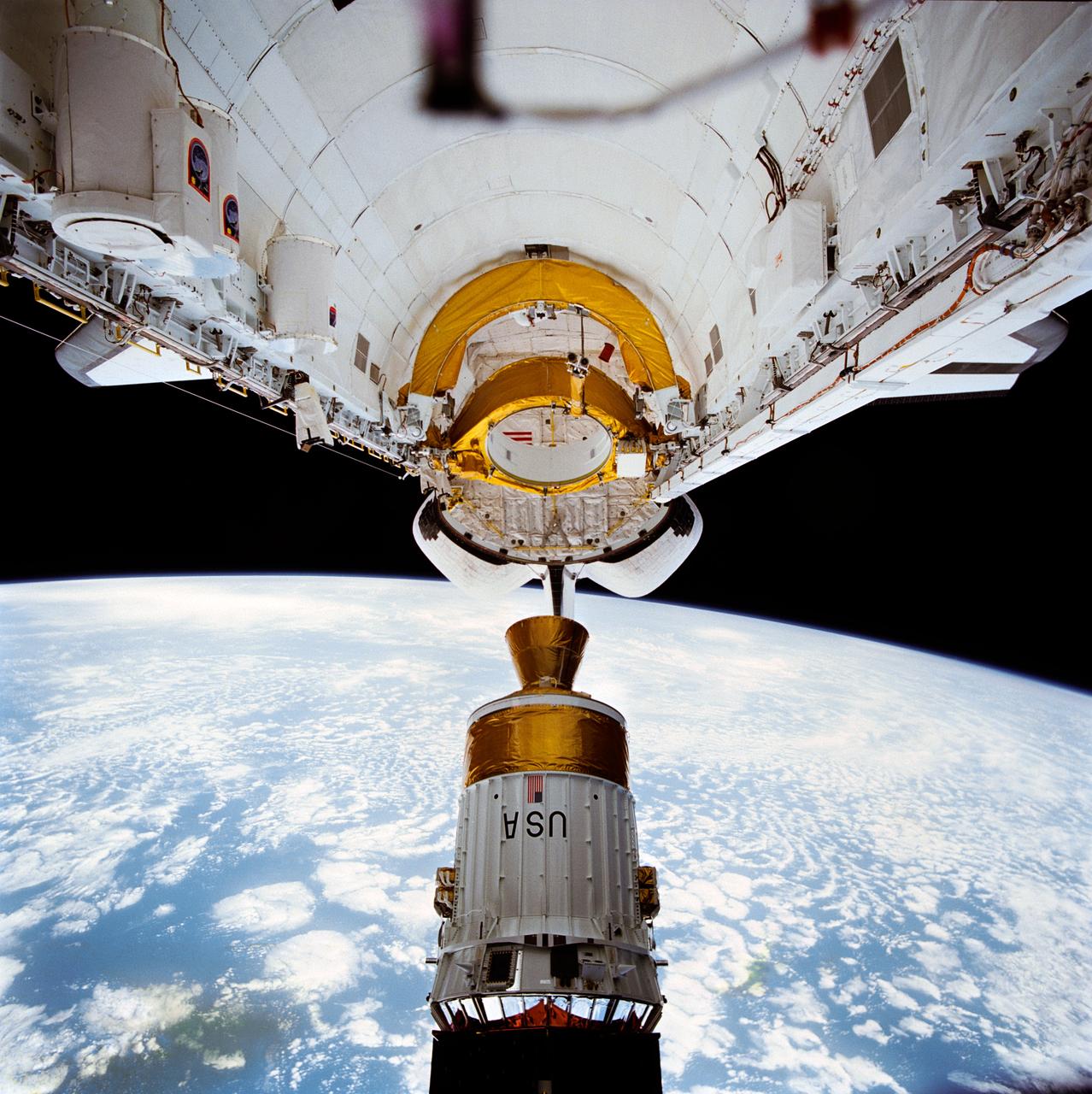
STS043-72-059 (2 Aug 1991) --- The Tracking and Data Relay Satellite (TDRS-E), leaves the payload bay of the earth-orbiting Atlantis a mere six hours after the Space Shuttle was launched from Pad 39A at Kennedy Space Center, Florida. TDRS, built by TRW, will be placed in a geosynchronous orbit and after on-orbit testing, which requires several weeks, will be designated TDRS-5. The communications satellite will replace TDRS-3 at 174 degrees West longitude. The backbone of NASA's space-to-ground communications, the Tracking and Data Relay satellites have increased NASA's ability to send and receive data to spacecraft in low-earth orbit to more than 85 percent of the time. The five astronauts of the STS 43 mission are John E. Blaha, mission commander, Michael A. Baker, pilot, and Shannon W. Lucid, G. David Low, and James C. Adamson, all mission specialists.
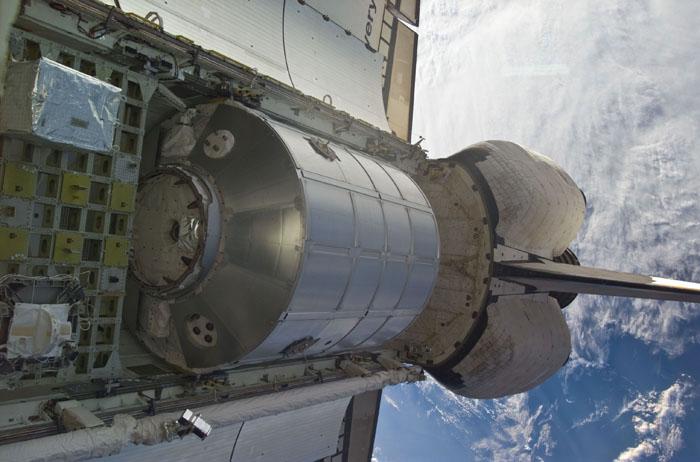
STS102-E-5095 (10 March 2001) --- The Leonardo Multi Purpose Logistics Module rests in Discovery's payload bay in this view taken from the station by a crew member using a digital still camera.
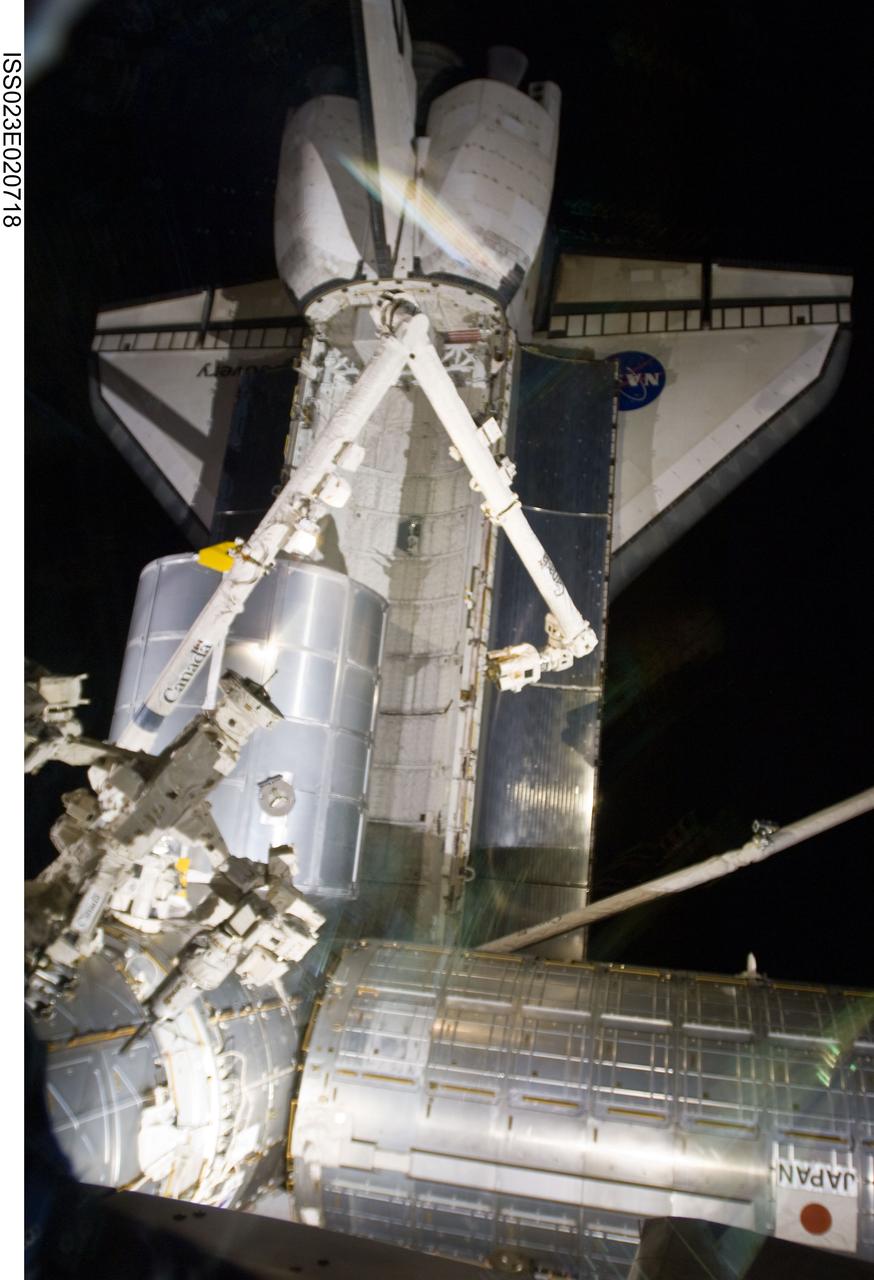
ISS023-E-020718 (8 April 2010) --- The station’s robotic Canadarm2 relocates the Leonardo Multi-purpose Logistics Module (MPLM) from space shuttle Discovery’s payload bay to a port on the Harmony node of the International Space Station.
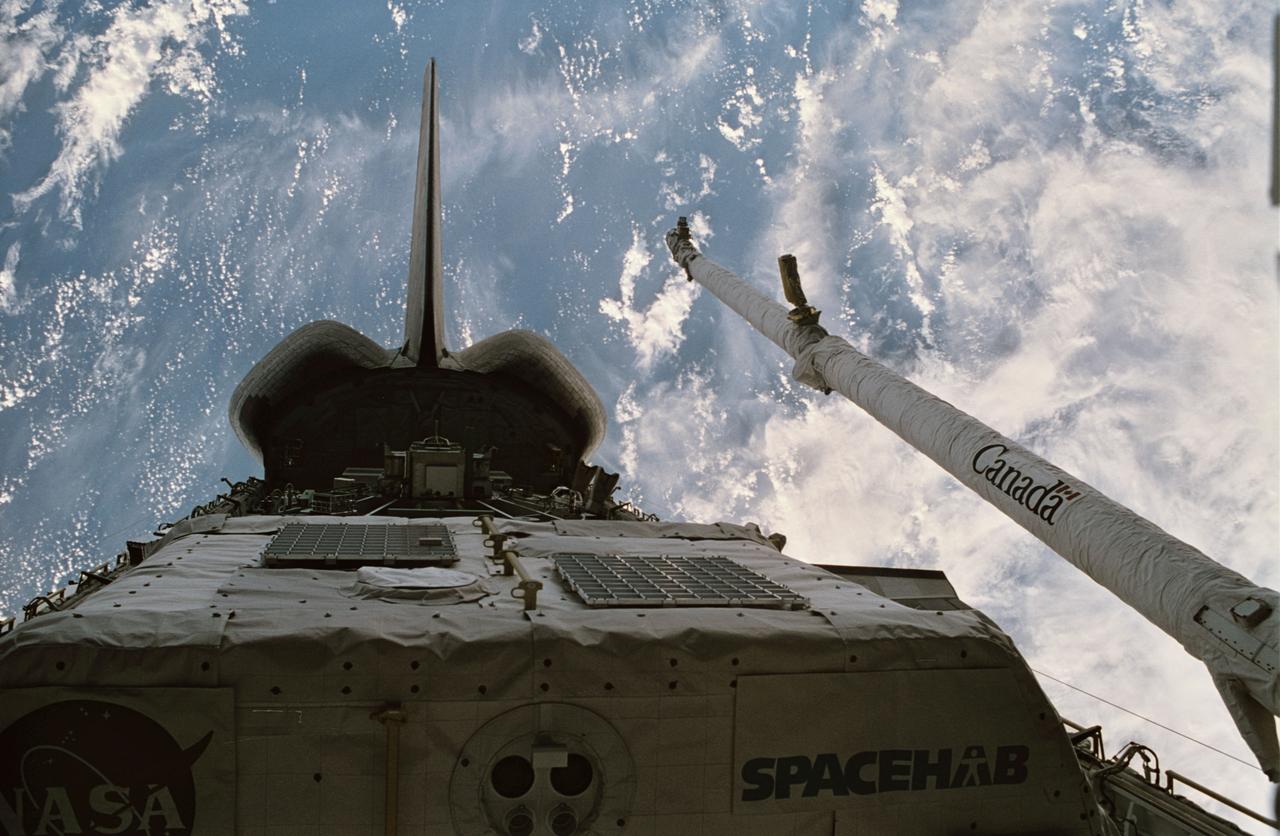
STS060-15-003 (3-11 Feb 1994) --- This 35mm frame shows the major payloads of the Space Shuttle Discovery's STS-60 mission, backdropped against clouds over the Atlantic Ocean. In the foreground is the SPACEHAB module, with the Wake Shield Facility (WSF) partially visible in its berthed position near the Orbital Maneuvering System (OMS) pods and the vertical stabilizer. Television cameras on the Remote Manipulator System (RMS) were being used for a survey of the cargo. Five NASA astronauts and a Russian cosmonaut went on to spend eight days in Earth orbit in support of the mission.
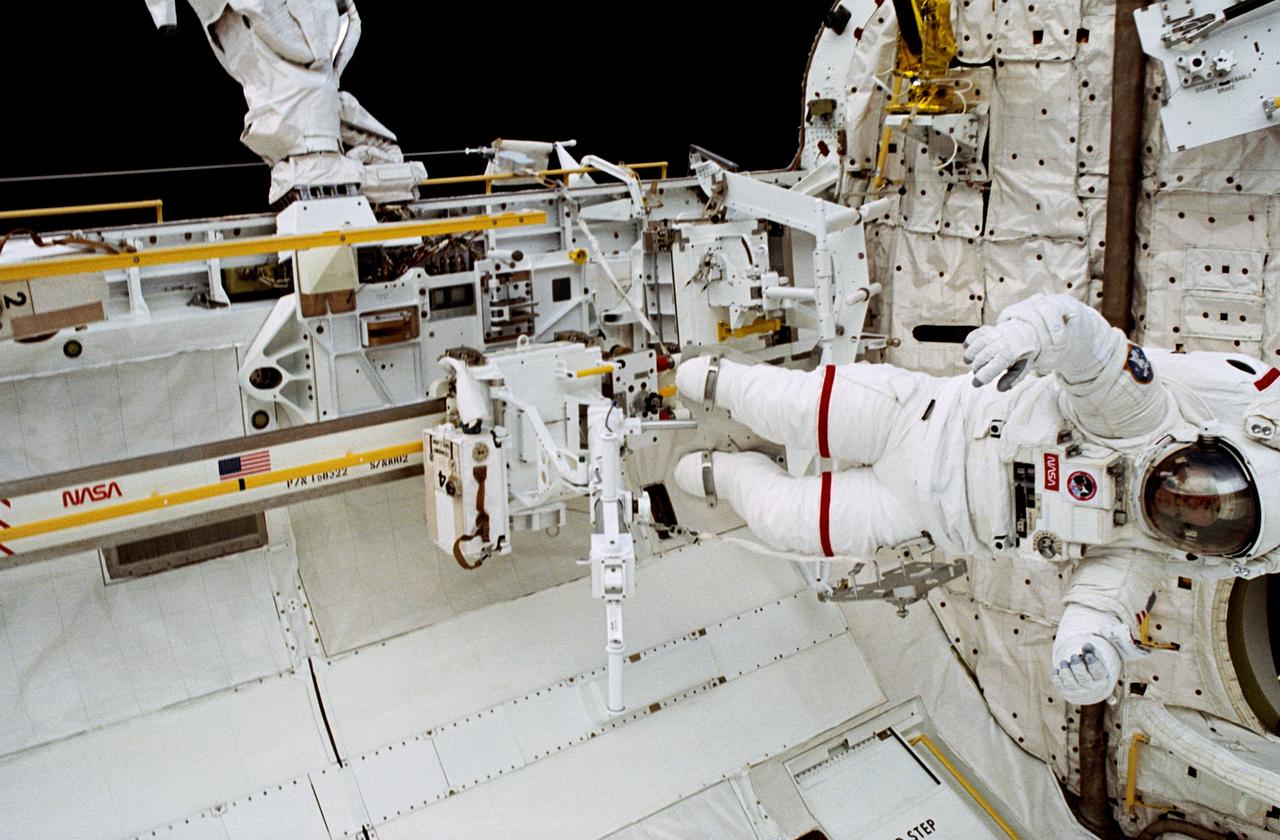
S37-52-008 (April 1999) --- STS-37 Mission Specialist Jerry L. Ross, attired in an extravehicular mobility unit (EMU) with red stripes, can be seen with the crew and equipment transport aid (CETA) just below the base of the remote manipulator system arm on the port side of the payload bay of the space shuttle Atlantis. Photo credit: NASA

STS073-736-018 (29 October 1995) --- The Kalahari Desert in Namibia, Africa, forms the backdrop for this scene. Five NASA astronauts and two guest researchers spent almost 16 days of research in this science module affixed in the payload bay of the Space Shuttle Columbia in Earth-orbit. The tunnel in bottom foreground served as the busy passageway for the seven crew members, who split their forces into two shifts. The Nosob and Olifants Rivers can be delineated in the terrain below.
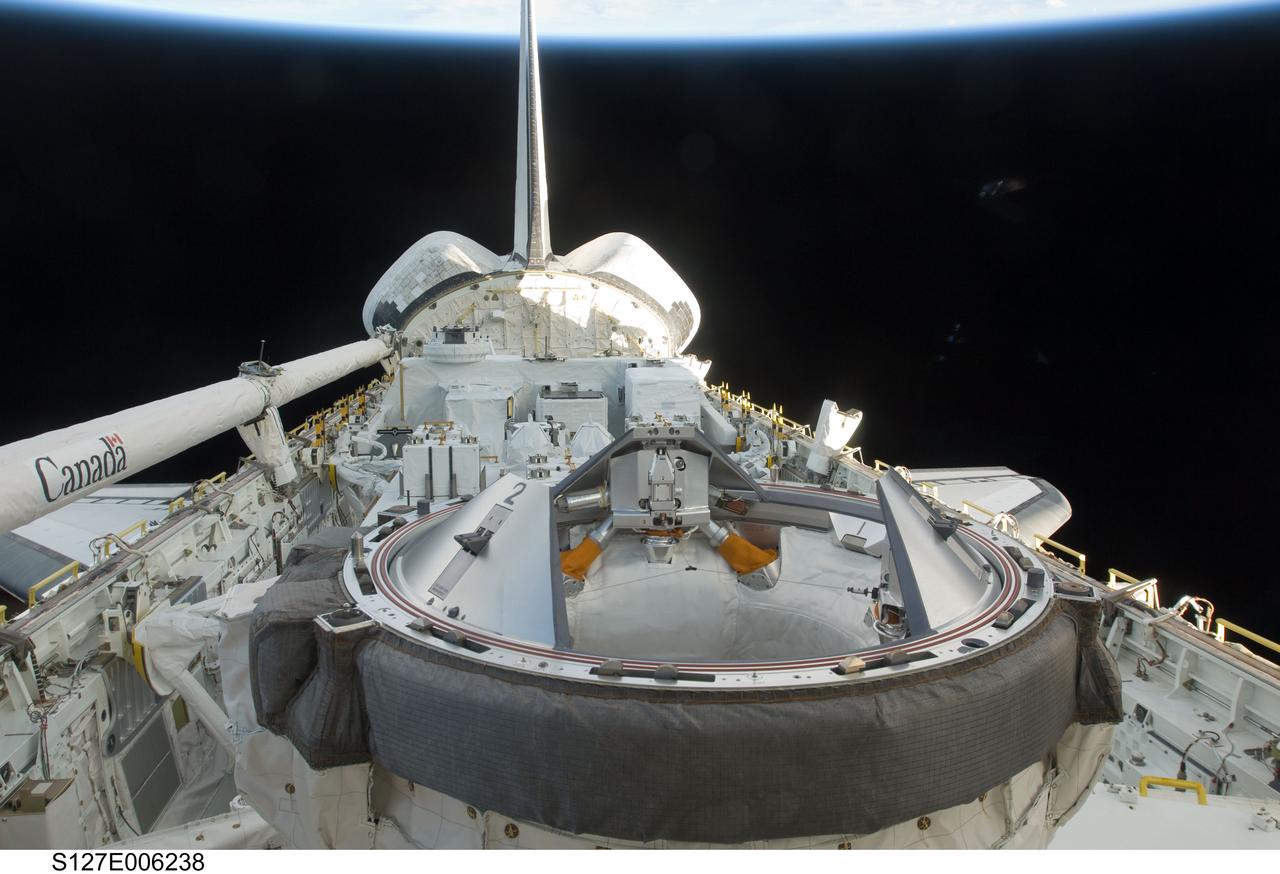
S127-E-006238 (16 July 2009) --- Backdropped by the blackness of space, the Japanese Experiment Module's Exposed Facility and the Experiment Logistics Module-Exposed Section, visible in Space Shuttle Endeavour?s payload bay, vertical stabilizer (intersecting Earth?s horizon) and orbital maneuvering system (OMS) pods, the shuttle?s remote manipulator system (RMS) and docking mechanism are featured in this image photographed by a STS-127 crew member from an aft flight deck window.
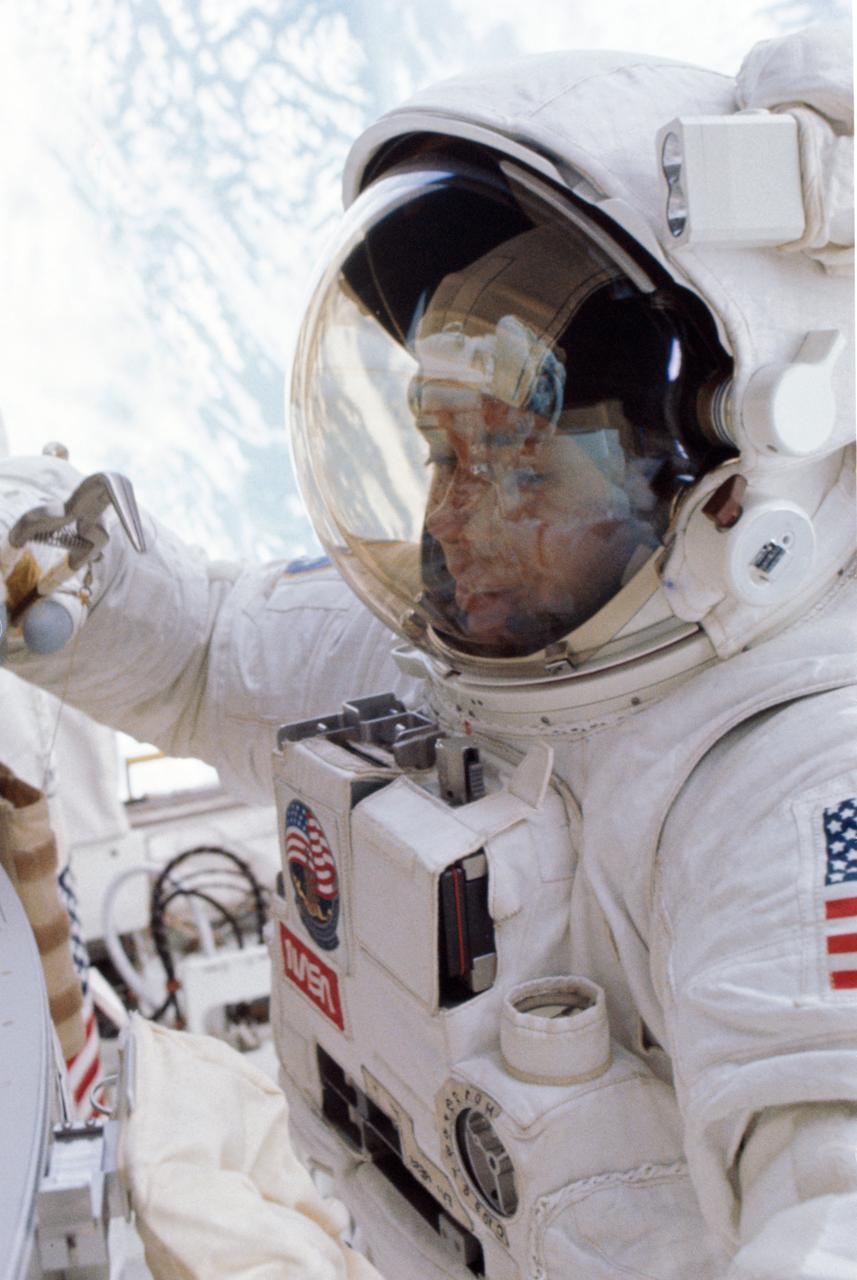
41G-101-013 (14 Oct 1984) --- Astronaut David C. Leestma works at the Orbital Refueling System (ORS) on the Mission Peculiar Support Structure (MPESS) in the aft end of the cargo bay of the Space Shuttle Challenger. Astronaut Kathryn D. Sullivan, America's first woman to perform an extravehicular activity (EVA) with the logging of this busy day, exposed this frame witha 35mm camera. The crew consisted of astronauts Robert L. Crippen, commander; Jon A. McBride, pilot; mission specialist's Kathryn D. Sullivan, Sally K. Ride, and David D. Leestma; Canadian astronaut Marc Garneau; and Paul D. Scully-Power, payload specialist. EDITOR'S NOTE: The STS-41G mission had the first American female EVA (Sullivan); first seven-person crew; first orbital fuel transfer; and the first Canadian (Garneau).
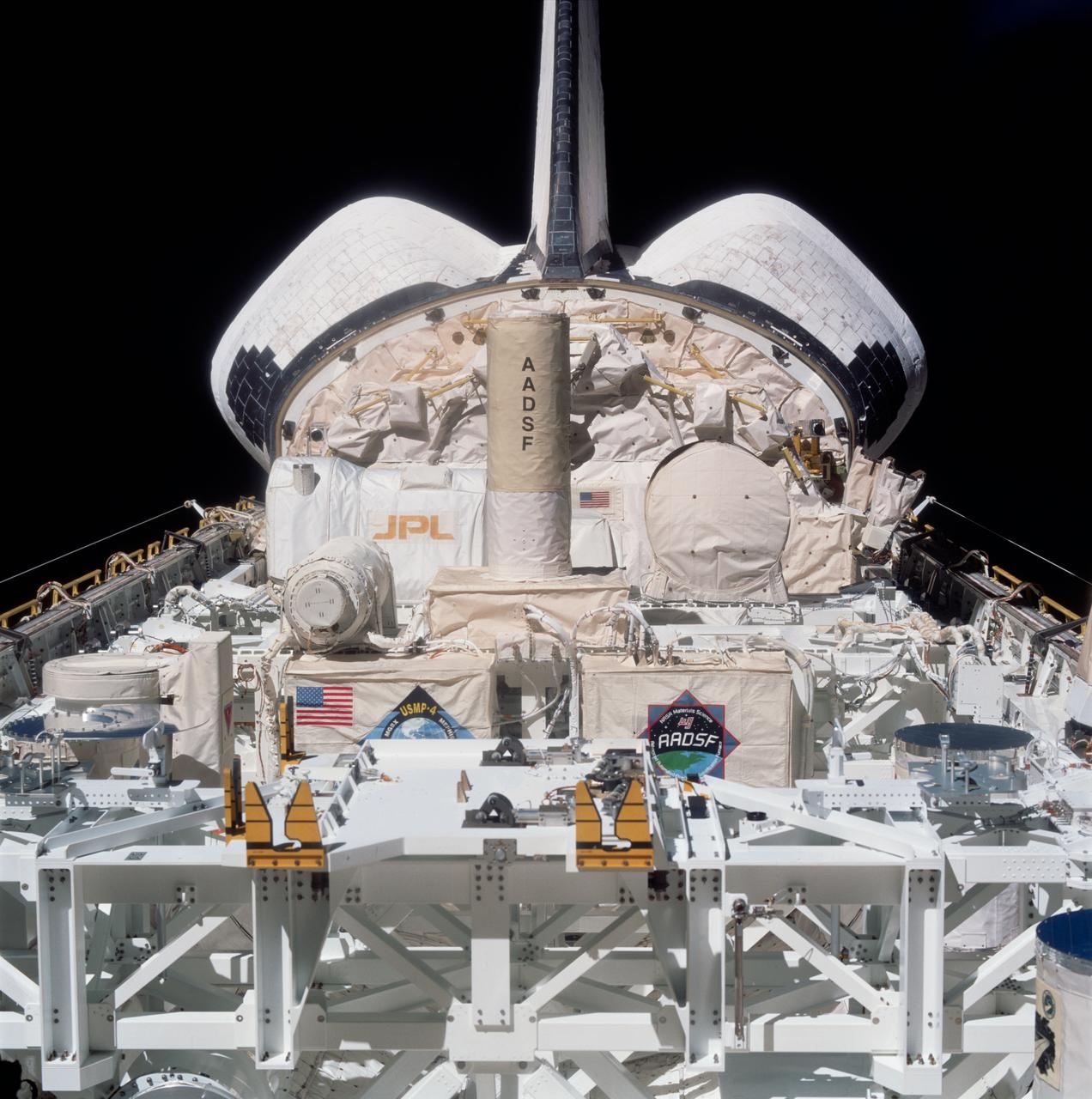
STS087-752-023 (19 November – 5 December 1997) --- This picture of Columbia's cargo bay, taken through the aft flight deck windows with a handheld 70mm camera, shows the U.S. Microgravity Payload (USMP-4) mission's cargo.
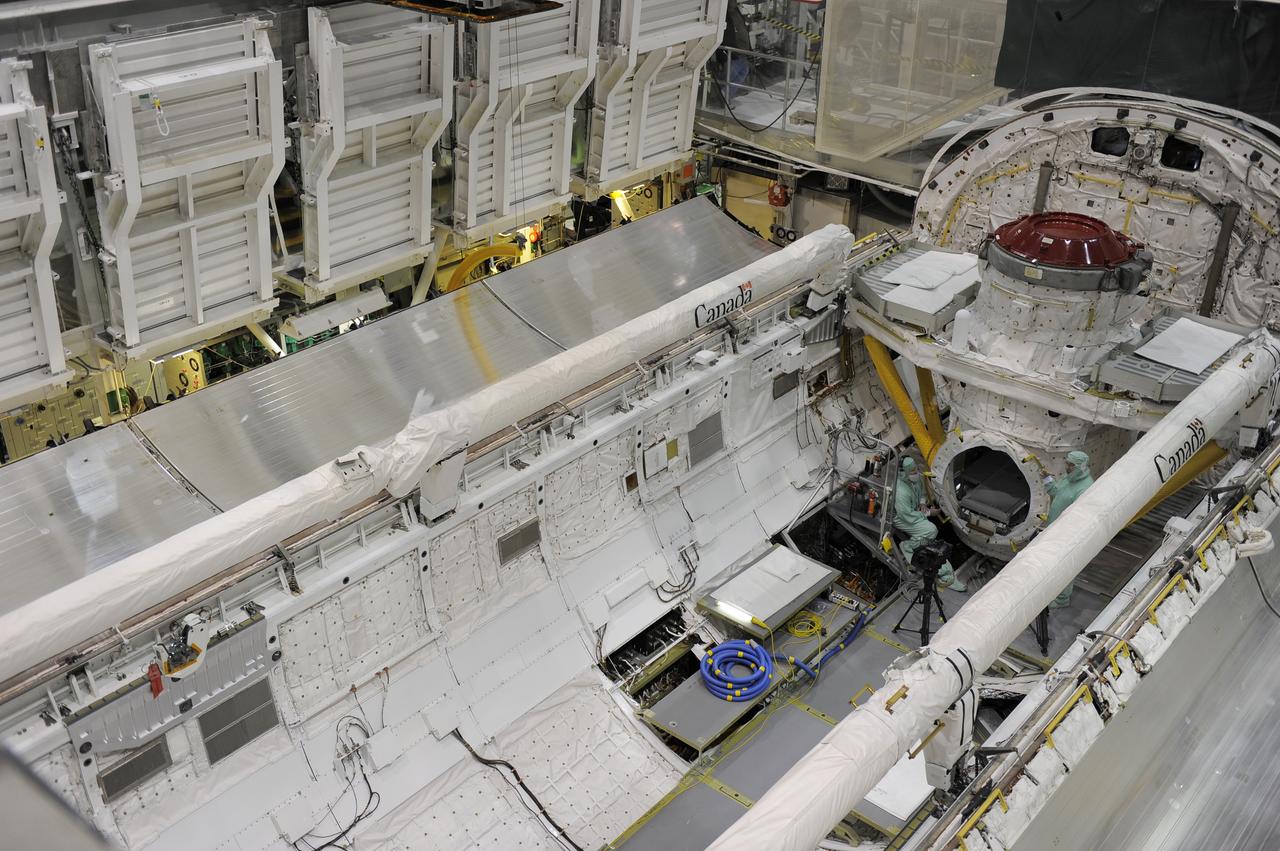
STS-335 Atlantis Payload Bay Door Closure for Holiday
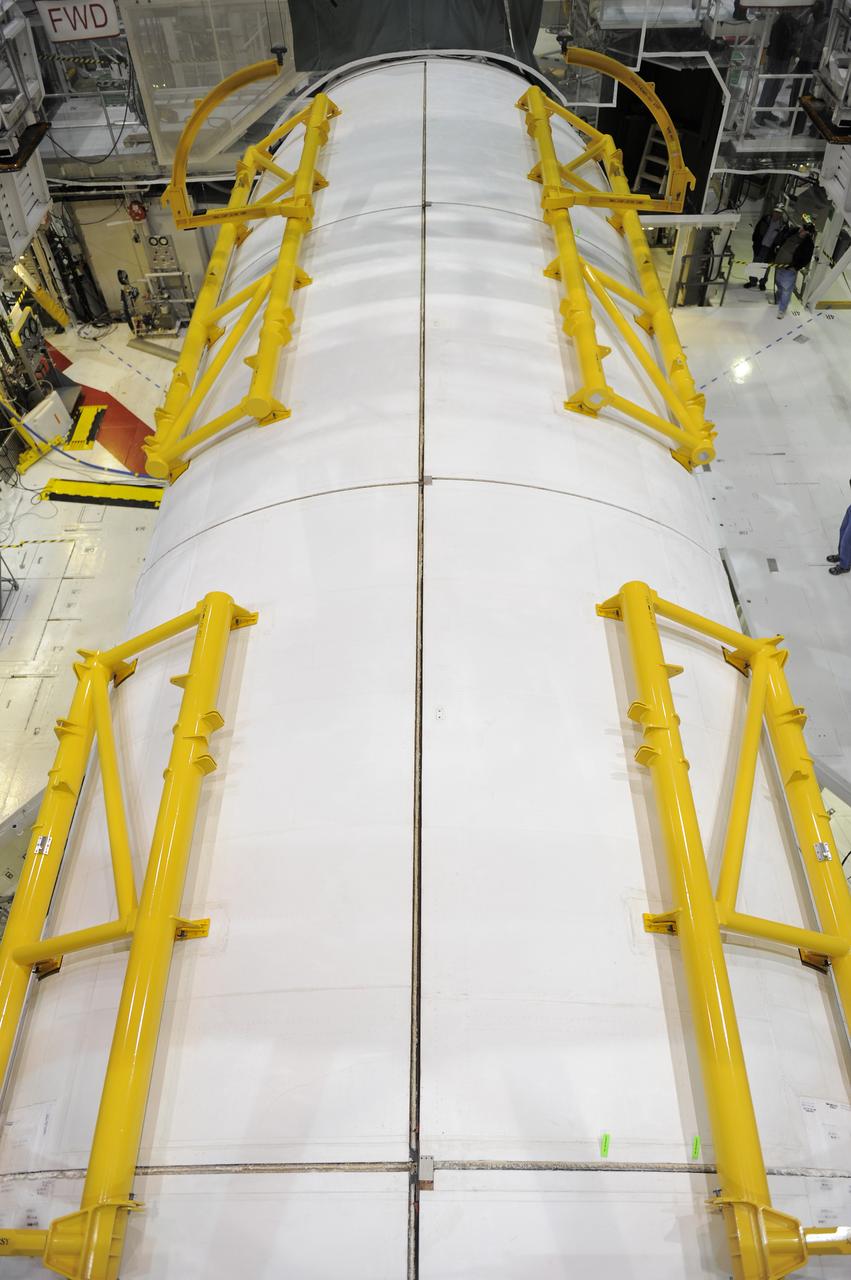
STS-335 Atlantis Payload Bay Door Closure for Holiday
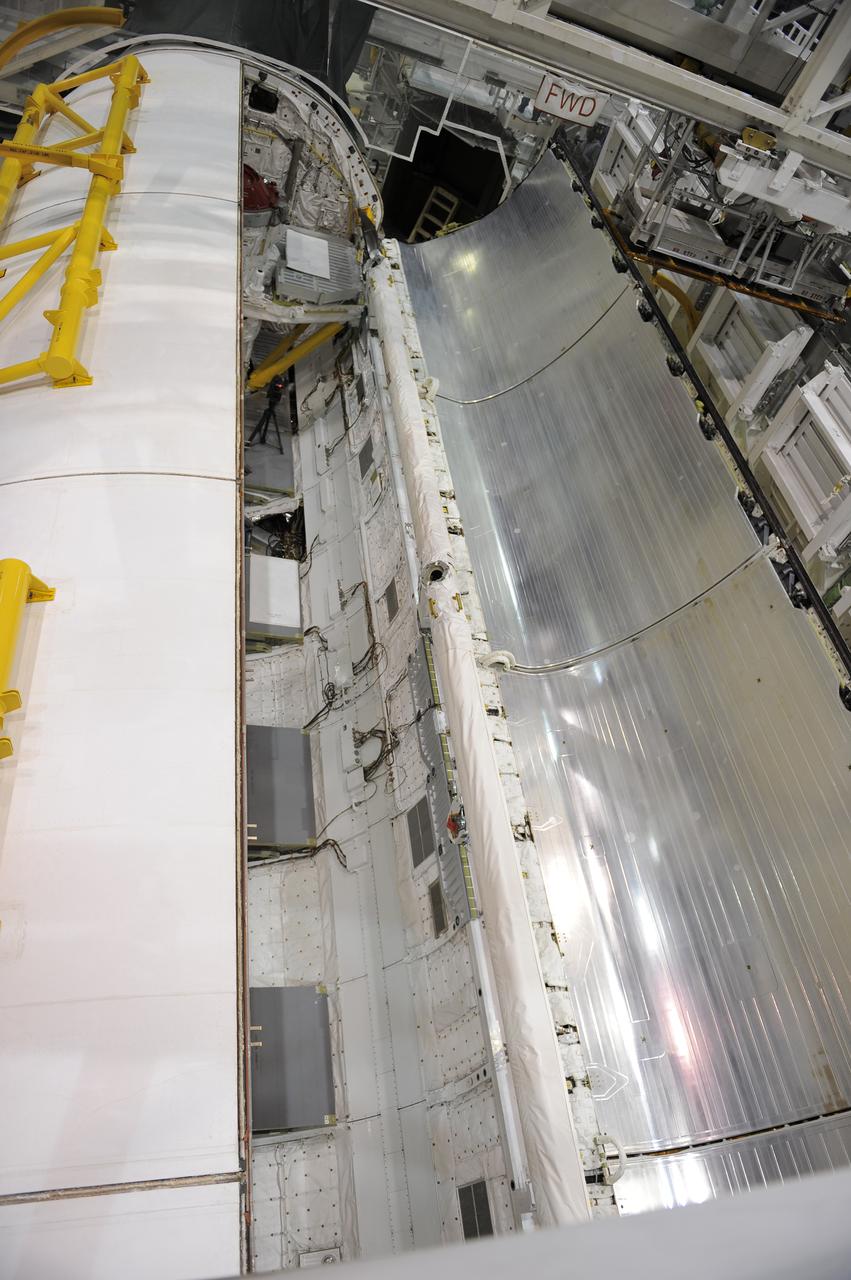
STS-335 Atlantis Payload Bay Door Closure for Holiday
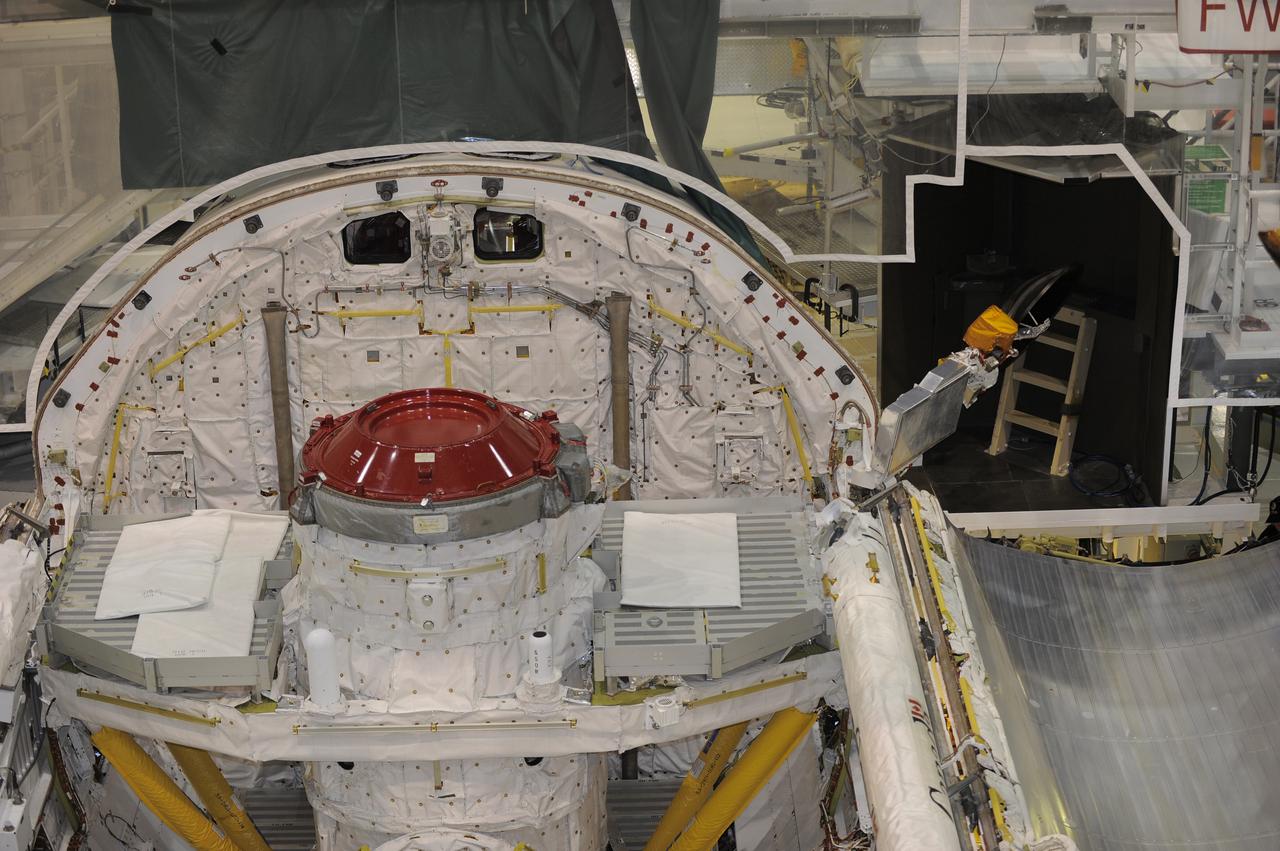
STS-335 Atlantis Payload Bay Door Closure for Holiday
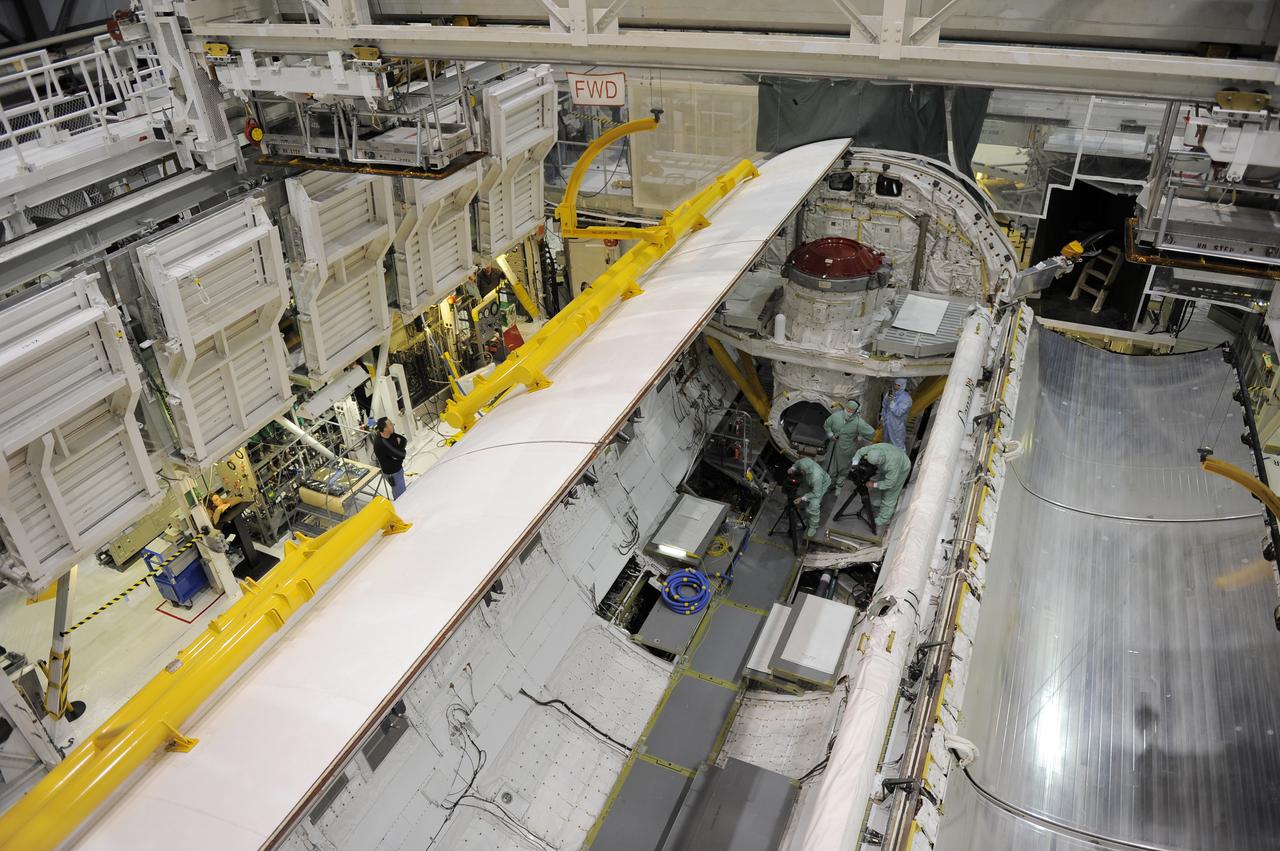
STS-335 Atlantis Payload Bay Door Closure for Holiday
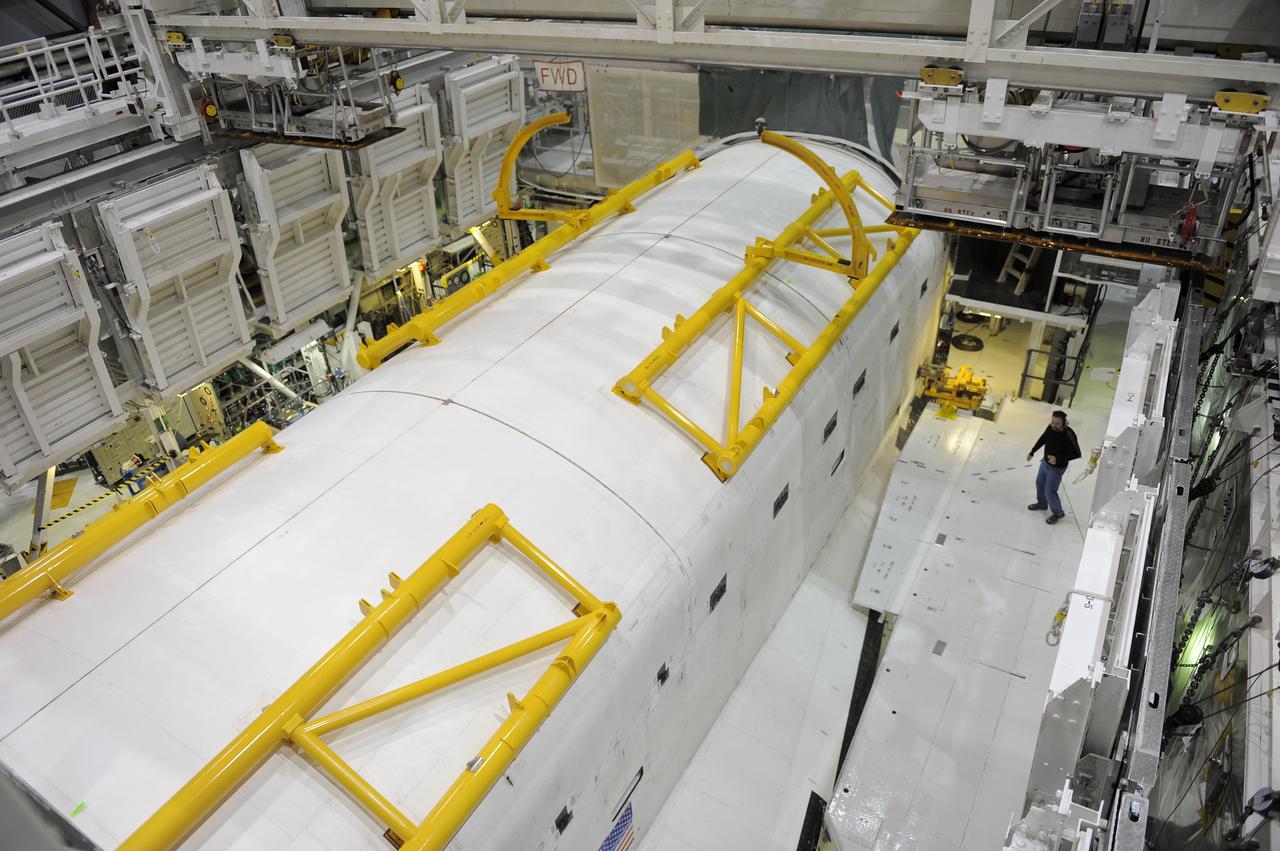
STS-335 Atlantis Payload Bay Door Closure for Holiday
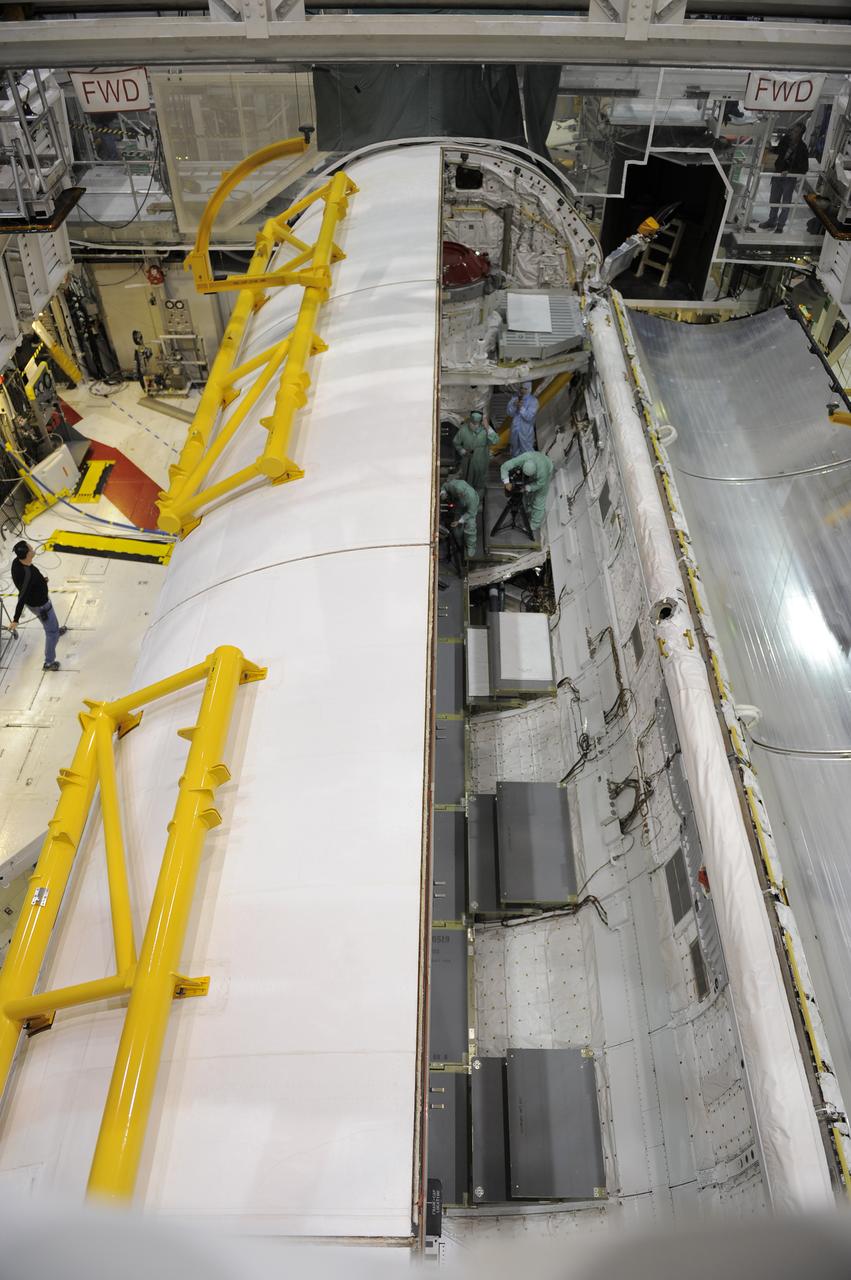
STS-335 Atlantis Payload Bay Door Closure for Holiday
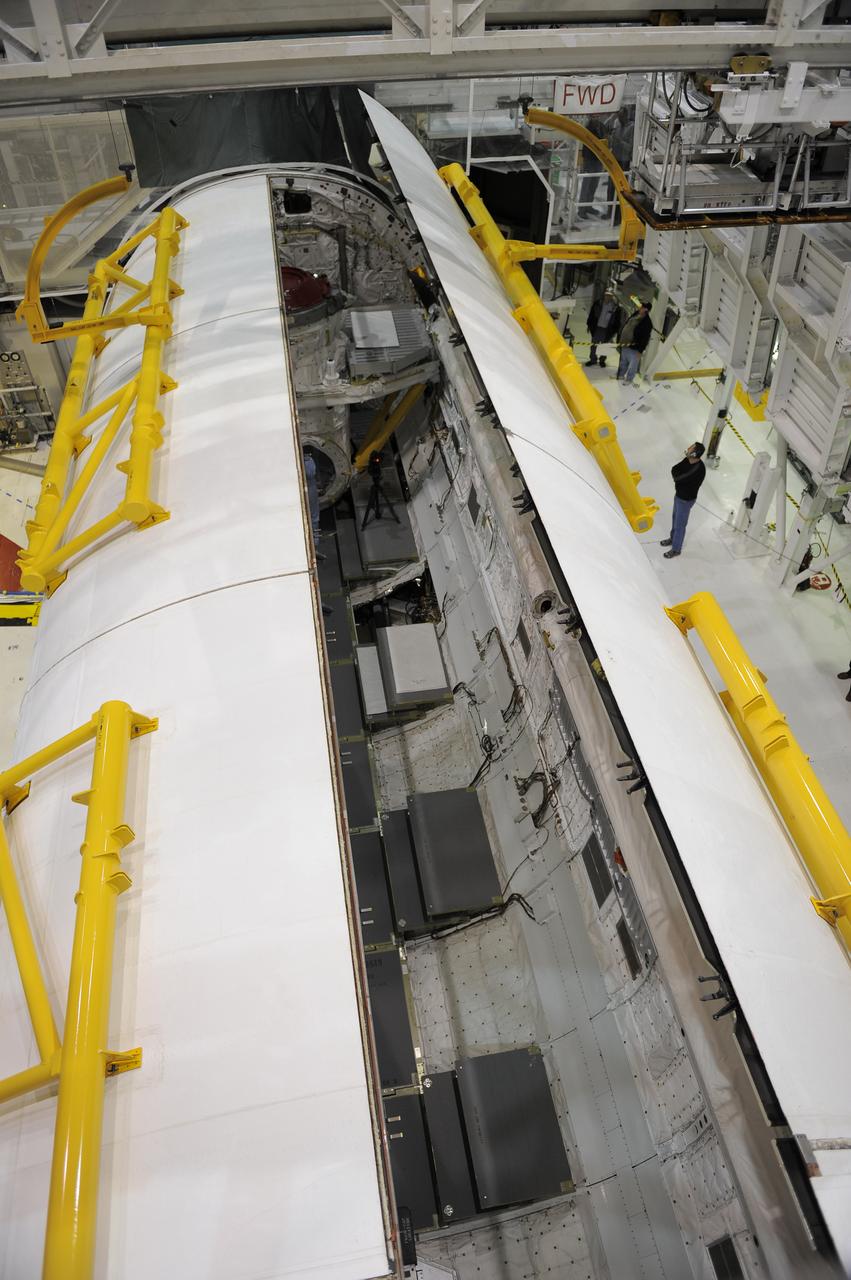
STS-335 Atlantis Payload Bay Door Closure for Holiday
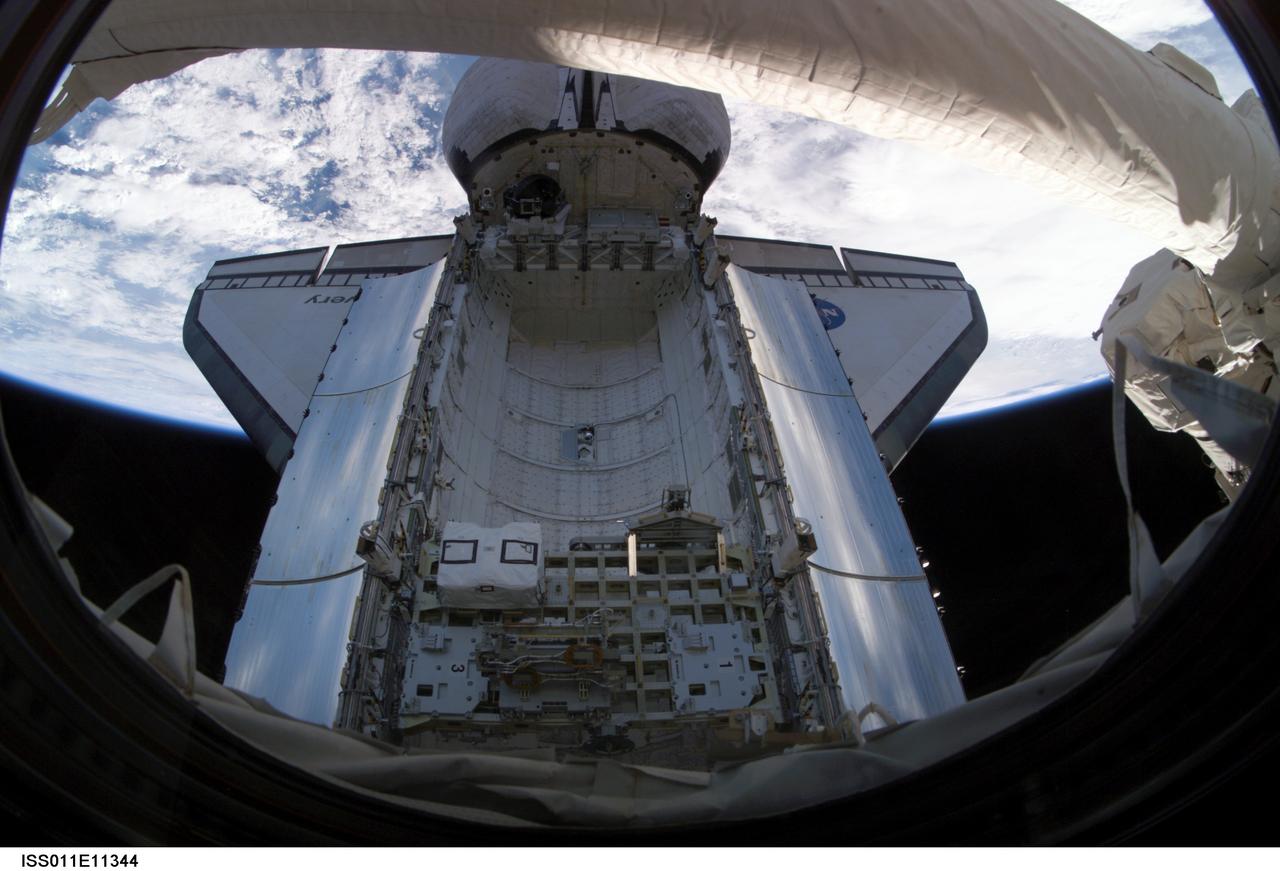
ISS011-E-11344 (30 July 2005) --- This image of the cargo bay of the Space Shuttle Discovery was taken with a digital still camera onboard the International Space Station, to which the orbiter will continue to be docked for several days. There is a vacancy in the payload bay, as the Multi-Purpose Logistics Module Raffaello temporarily has been docked with the orbital outpost's Unity Node in order to accommodate the transfer of a large amount of supplies.
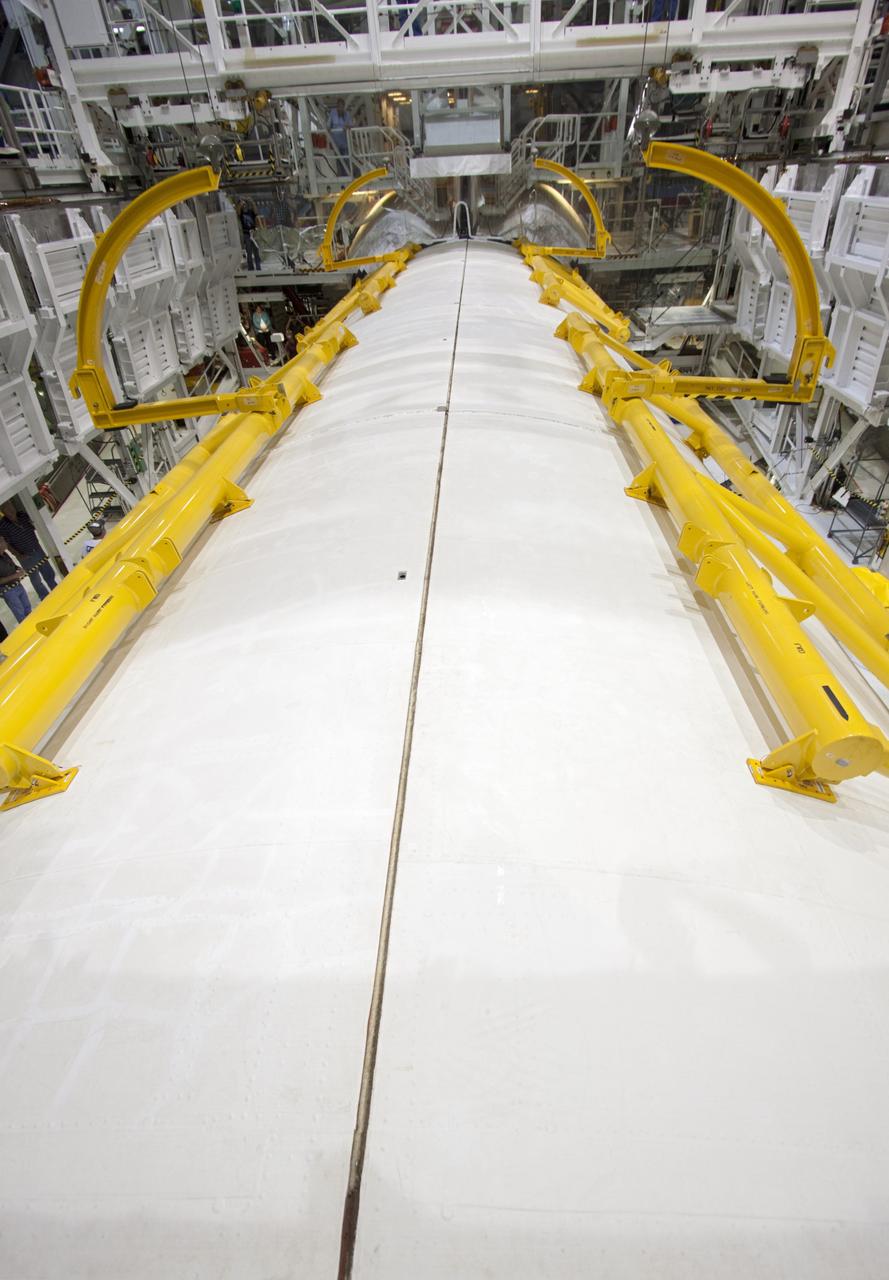
CAPE CANAVERAL, Fla. – Inside Orbiter Processing Facility-2 at NASA’s Kennedy Space Center in Florida, space shuttle Atlantis’ payload bay doors are closed for the final time. The orbiter is undergoing final preparations for its transfer to the Kennedy Space Center Visitor complex targeted for November. The work is part of Transition and Retirement of the remaining shuttle. Atlantis is being prepared for public display at the visitor complex. Over the course of its 26-year career, Atlantis spent 293 days in space during 33 missions. For more information, visit http://www.nasa.gov/transition. Photo credit: NASA/Jim Grossmann
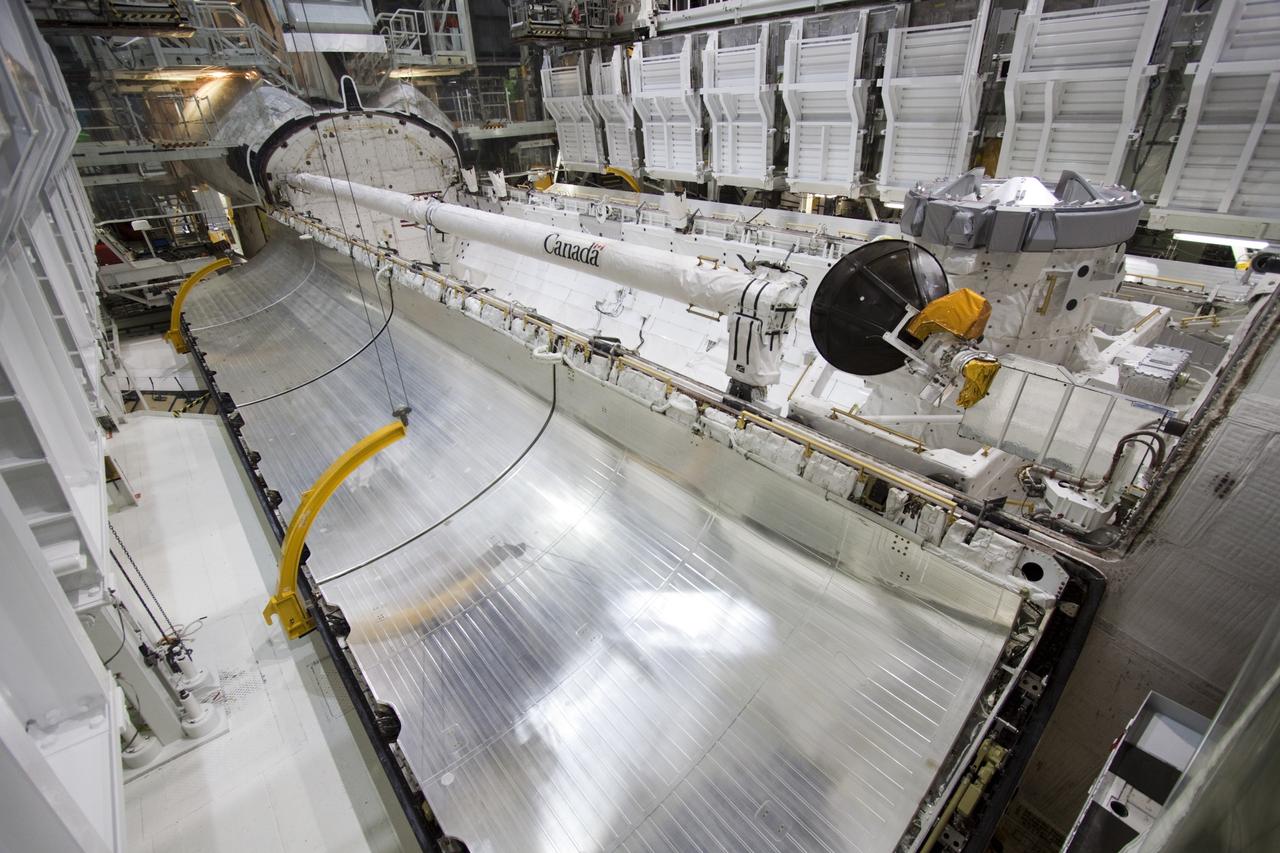
CAPE CANAVERAL, Fla. – Inside Orbiter Processing Facility-2 at NASA’s Kennedy Space Center in Florida, work will begin soon to close space shuttle Atlantis’ payload bay doors for the final time. The orbiter is undergoing final preparations for its transfer to the Kennedy Space Center Visitor complex targeted for November. The work is part of Transition and Retirement of the remaining shuttle. Atlantis is being prepared for public display at the visitor complex. Over the course of its 26-year career, Atlantis spent 293 days in space during 33 missions. For more information, visit http://www.nasa.gov/transition. Photo credit: NASA/Jim Grossmann
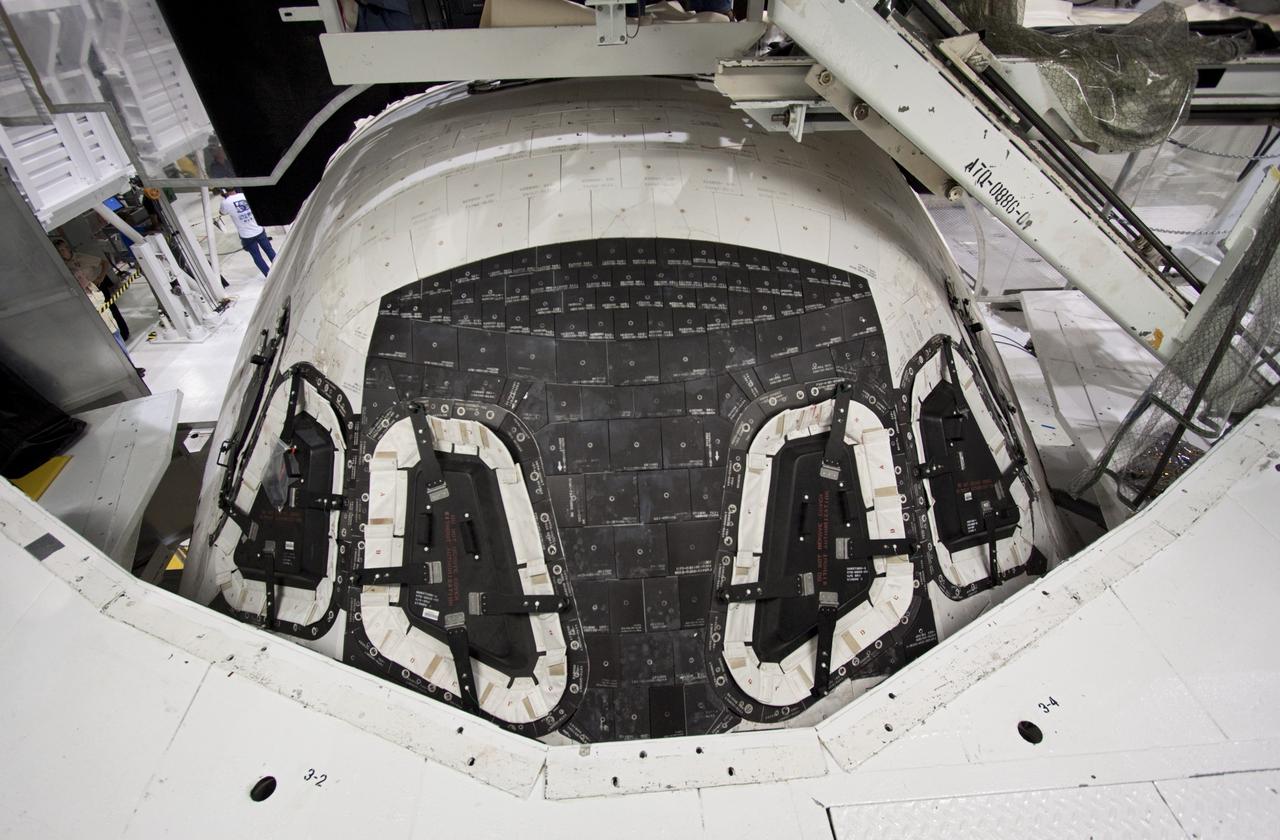
CAPE CANAVERAL, Fla. – Inside Orbiter Processing Facility-2 at NASA’s Kennedy Space Center in Florida, a view of space shuttle Atlantis’ nose cone is shown as the payload bay doors are closed for the final time. The orbiter is undergoing final preparations for its transfer to the Kennedy Space Center Visitor complex targeted for November. The work is part of Transition and Retirement of the remaining shuttle. Atlantis is being prepared for public display at the visitor complex. Over the course of its 26-year career, Atlantis spent 293 days in space during 33 missions. For more information, visit http://www.nasa.gov/transition. Photo credit: NASA/Jim Grossmann
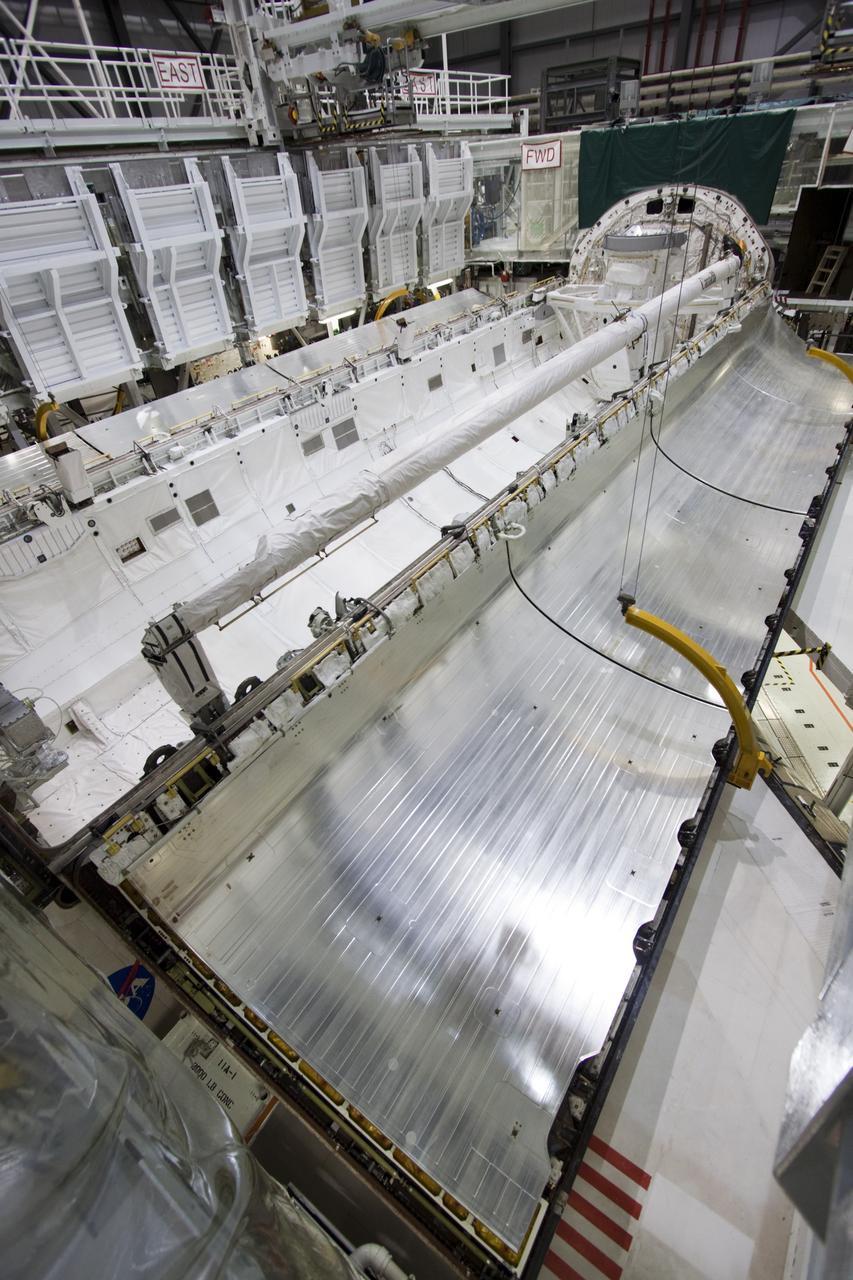
CAPE CANAVERAL, Fla. – Inside Orbiter Processing Facility-2 at NASA’s Kennedy Space Center in Florida, work will begin soon to close space shuttle Atlantis’ payload bay doors for the final time. The orbiter is undergoing final preparations for its transfer to the Kennedy Space Center Visitor complex targeted for November. The work is part of Transition and Retirement of the remaining shuttle. Atlantis is being prepared for public display at the visitor complex. Over the course of its 26-year career, Atlantis spent 293 days in space during 33 missions. For more information, visit http://www.nasa.gov/transition. Photo credit: NASA/Jim Grossmann
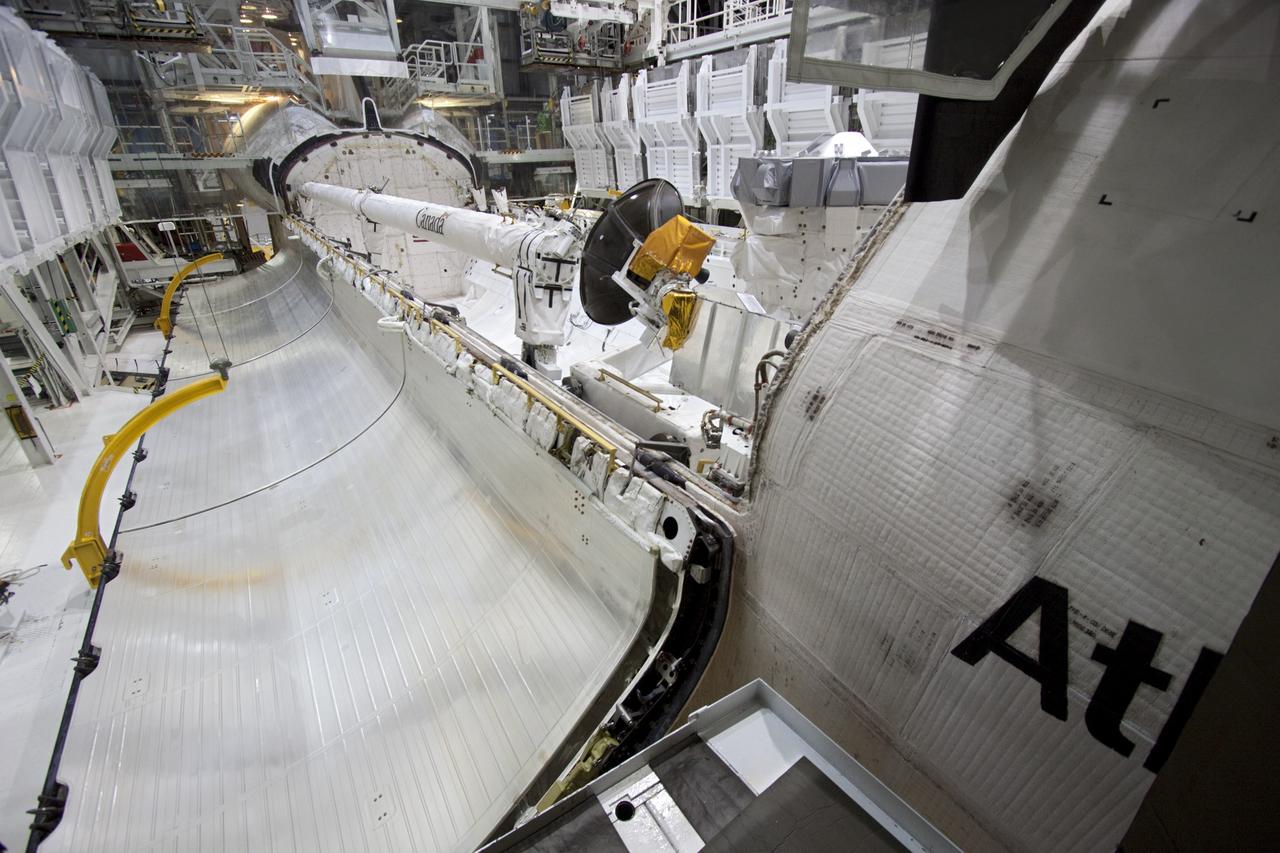
CAPE CANAVERAL, Fla. – Inside Orbiter Processing Facility-2 at NASA’s Kennedy Space Center in Florida, work will begin soon to close space shuttle Atlantis’ payload bay doors for the final time. The orbiter is undergoing final preparations for its transfer to the Kennedy Space Center Visitor complex targeted for November. The work is part of Transition and Retirement of the remaining shuttle. Atlantis is being prepared for public display at the visitor complex. Over the course of its 26-year career, Atlantis spent 293 days in space during 33 missions. For more information, visit http://www.nasa.gov/transition. Photo credit: NASA/Jim Grossmann
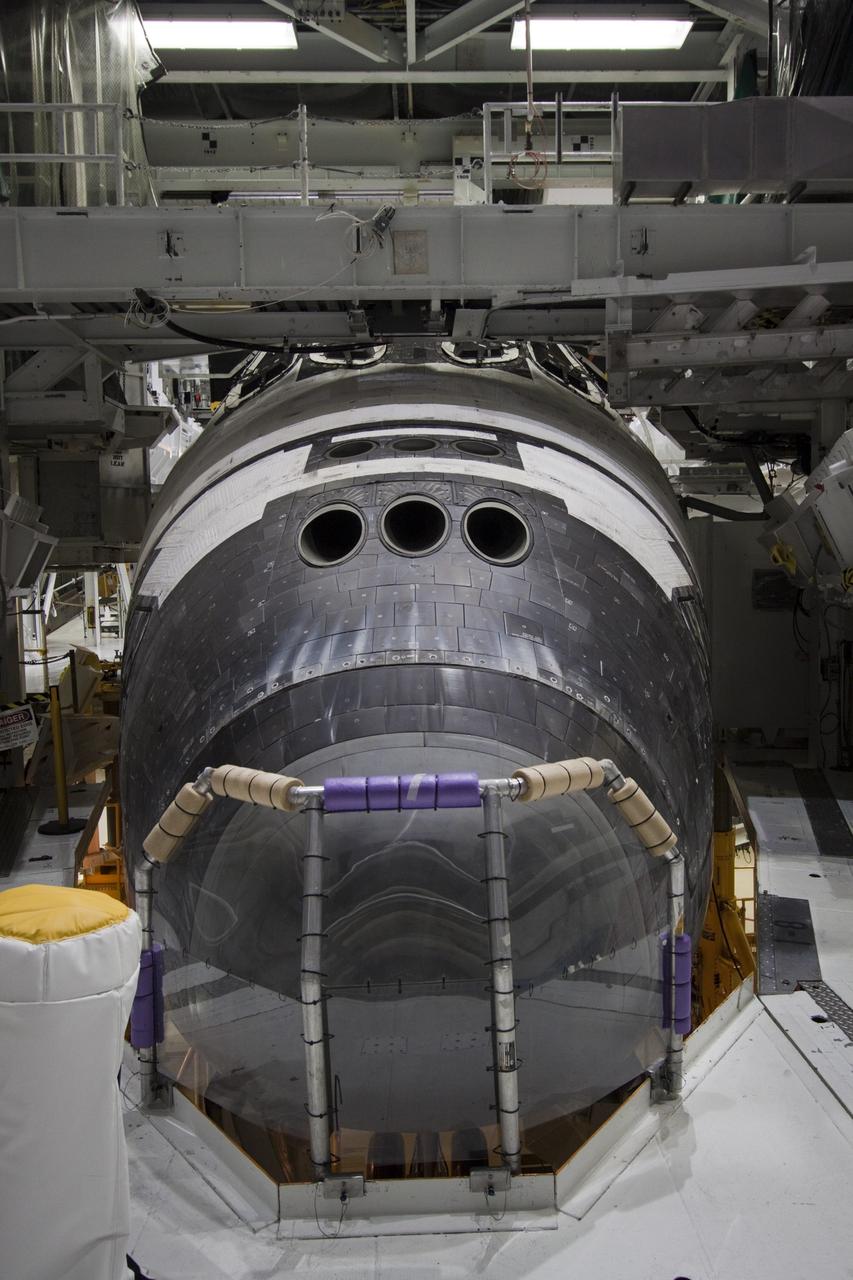
CAPE CANAVERAL, Fla. – Inside Orbiter Processing Facility-2 at NASA’s Kennedy Space Center in Florida, a view of space shuttle Atlantis’ nose cone is shown as the payload bay doors are closed for the final time. The orbiter is undergoing final preparations for its transfer to the Kennedy Space Center Visitor complex targeted for November. The work is part of Transition and Retirement of the remaining shuttle. Atlantis is being prepared for public display at the visitor complex. Over the course of its 26-year career, Atlantis spent 293 days in space during 33 missions. For more information, visit http://www.nasa.gov/transition. Photo credit: NASA/Jim Grossmann
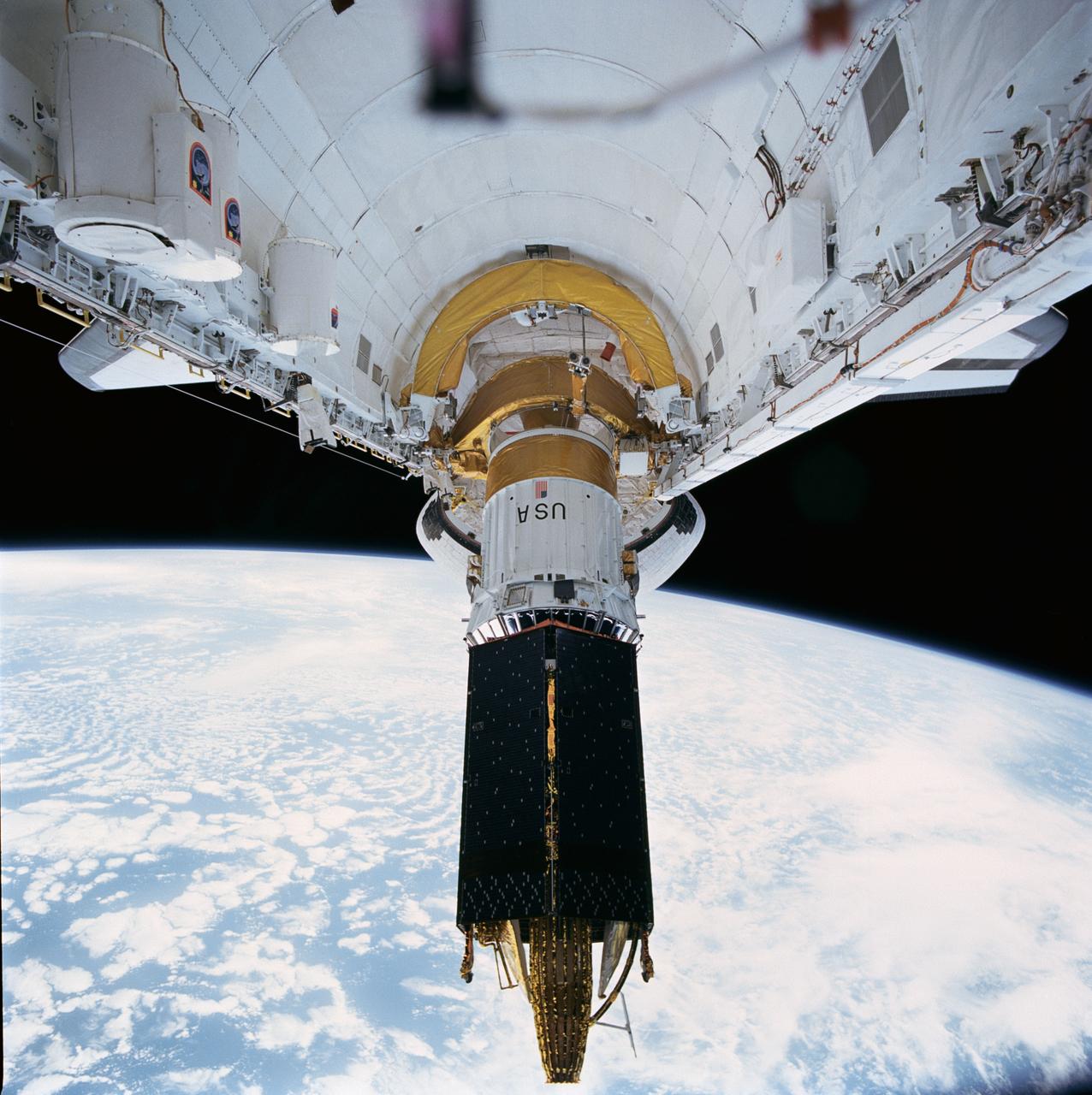
STS043-72-020 (2 Aug 1991) --- The Tracking and Data Relay Satellite (TDRS-E), is loosened from its restraint device and begins to leave the payload bay of the earth-orbiting Atlantis. The deployment came a mere six hours after the Space Shuttle was launched from Pad 39A at Kennedy Space Center, Florida. TDRS, built by TRW, will be placed in a geosynchronous orbit and after on-orbit testing, which requires several weeks, will be designated TDRS-5. The communications satellite will replace TDRS-3 at 174 degrees West longitude. The backbone of NASA's space-to-ground communications, the Tracking and Data Relay satellites have increased NASA's ability to send and receive data to spacecraft in low-earth orbit to more than 85 percent of the time. The five astronauts of the STS 43 mission are John E. Blaha, mission commander, Michael A. Baker, pilot, and Shannon W. Lucid, G. David Low, and James C. Adamson, all mission specialists.
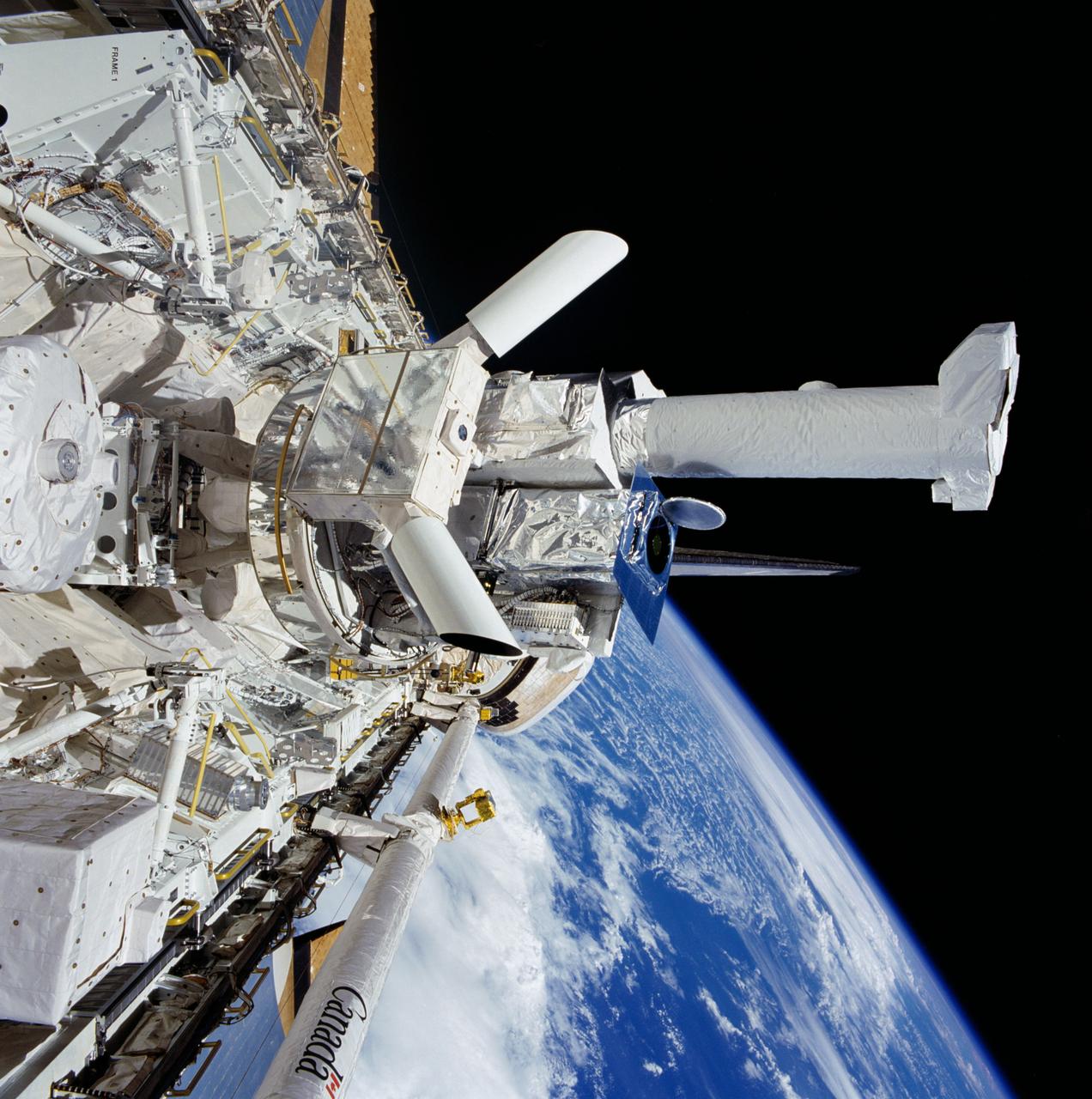
51F-42-069 (29 July-6 Aug 1985) --- The solar optical universal polarimeter (SOUP) experiment is visible among the cluster of Spacelab 2 hardware in the cargo bay of the Earth-orbiting Space Shuttle Challenger, backdropped against a curtain of white clouds over ocean waters. Various components of the instrument positioning system (IPS) are conspicuous at the center of the frame. Now resting, the remote manipulator system (RMS) was used at various points during the mission with the plasma diagnostics package (PDP) and as a support service structure for television cameras covering various activities of the busy science-oriented Spacelab 2 mission.
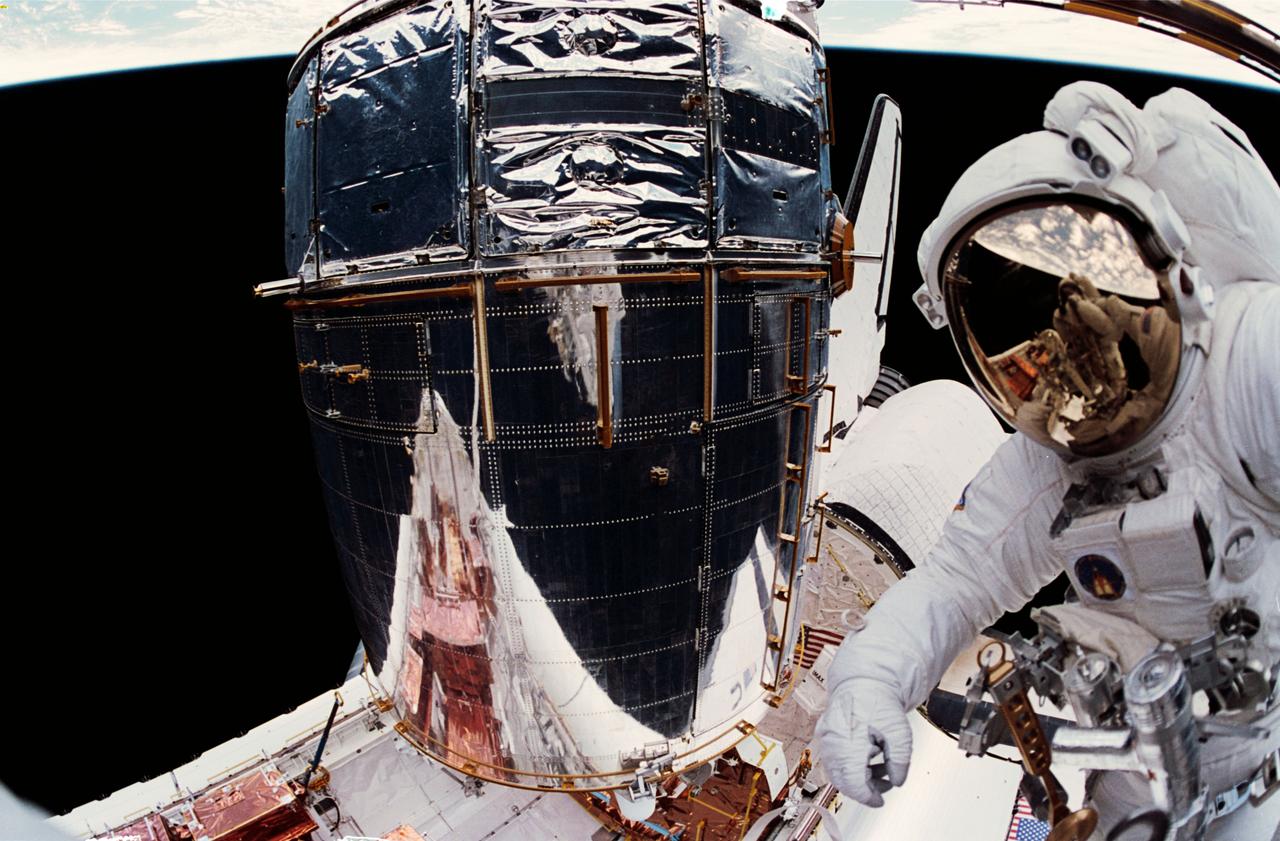
STS061-65-009 (2-13 Dec 1993) --- Astronaut Jeffrey A. Hoffman is reflected in the helmet visor of F. Story Musgrave as he photographs the veteran astronaut during one of the pair's three-shared extravehicular activity?s (EVA).
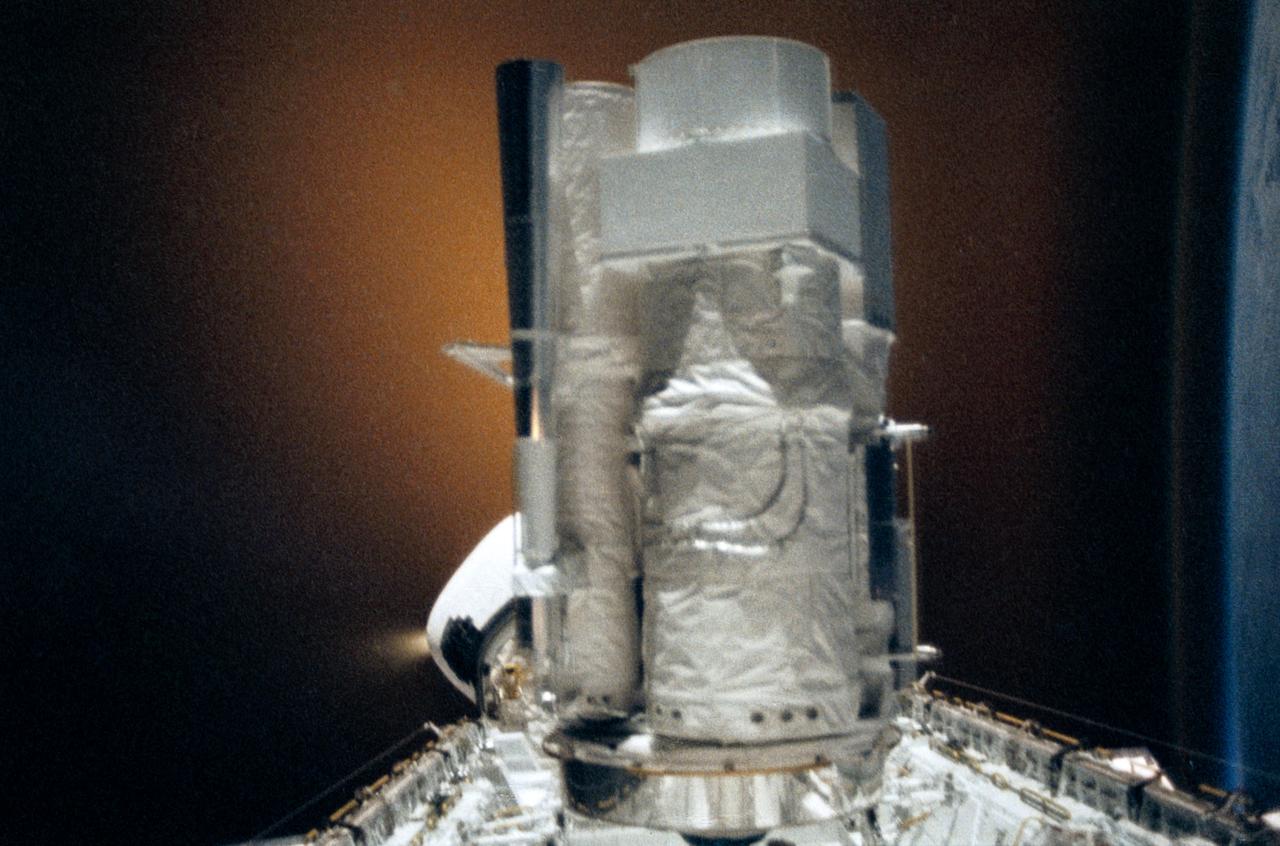
STS035-28-006 (2-10 Dec 1990) --- STS-35 Astronomy Laboratory 1 (ASTRO-1) telescopes, in on-orbit operating position in the payload bay (PLB), are silhouetted against an reaction control system (RCS) right thruster firing. Three ultraviolet telescopes are mounted and precisely co-aligned on a common structure, called the cruciform, that is attached to the instrument pointing system (IPS). Here the IPS holds the telescopes in a position that is parallel to the Earth's limb below. Visible on the cruciform are the star tracker (S TRK) (silver cone at the top), the Ultraviolet Imaging Telescope (UIT) (behind S TRK), and the Hopkins Ultraviolet Telescope(HUT).
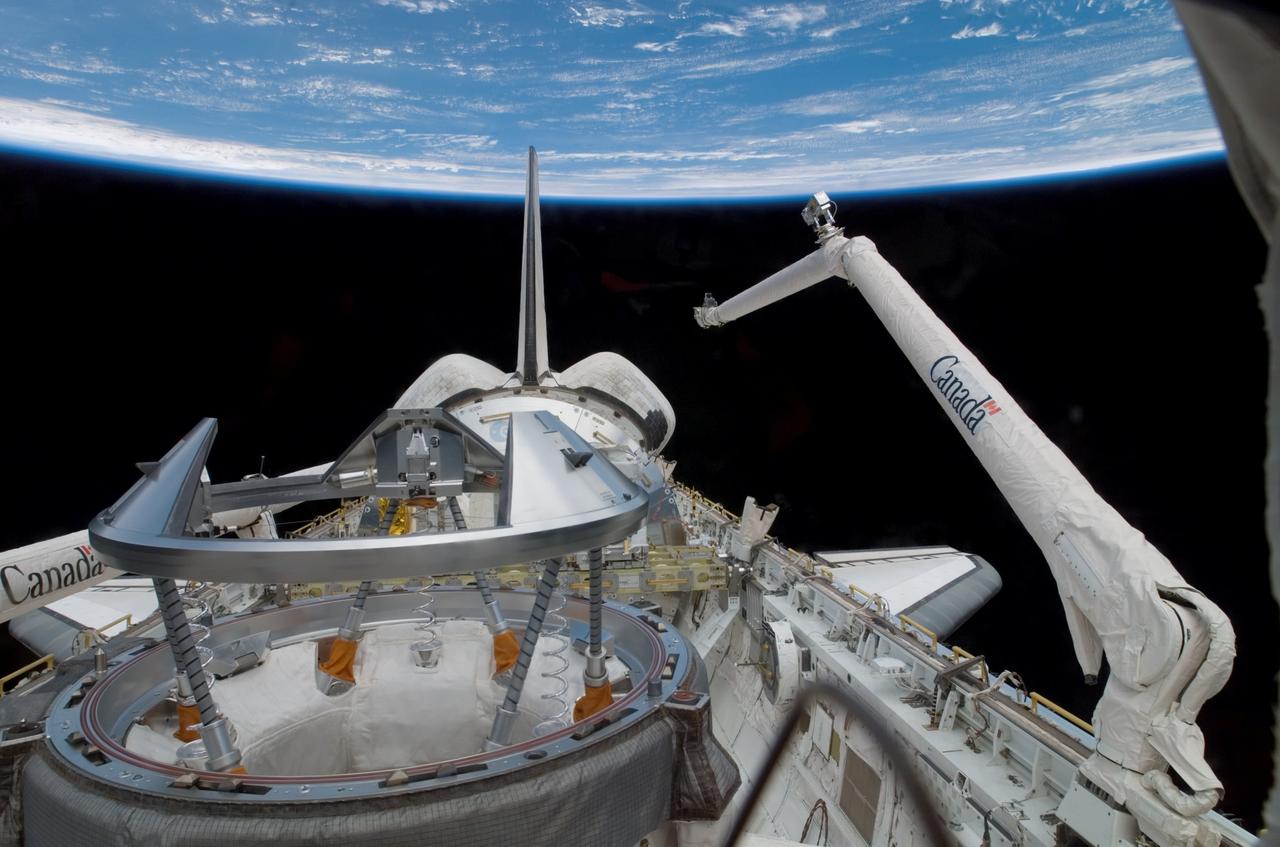
S122-E-006381 (8 Feb. 2008) --- Backdropped by the blackness of space and Earth's horizon, Atlantis' orbiter docking system (foreground) and the Canadarm Remote Manipulator System (RMS) in the payload bay are featured in this image photographed by a STS-122 crewmember during flight day two activities.