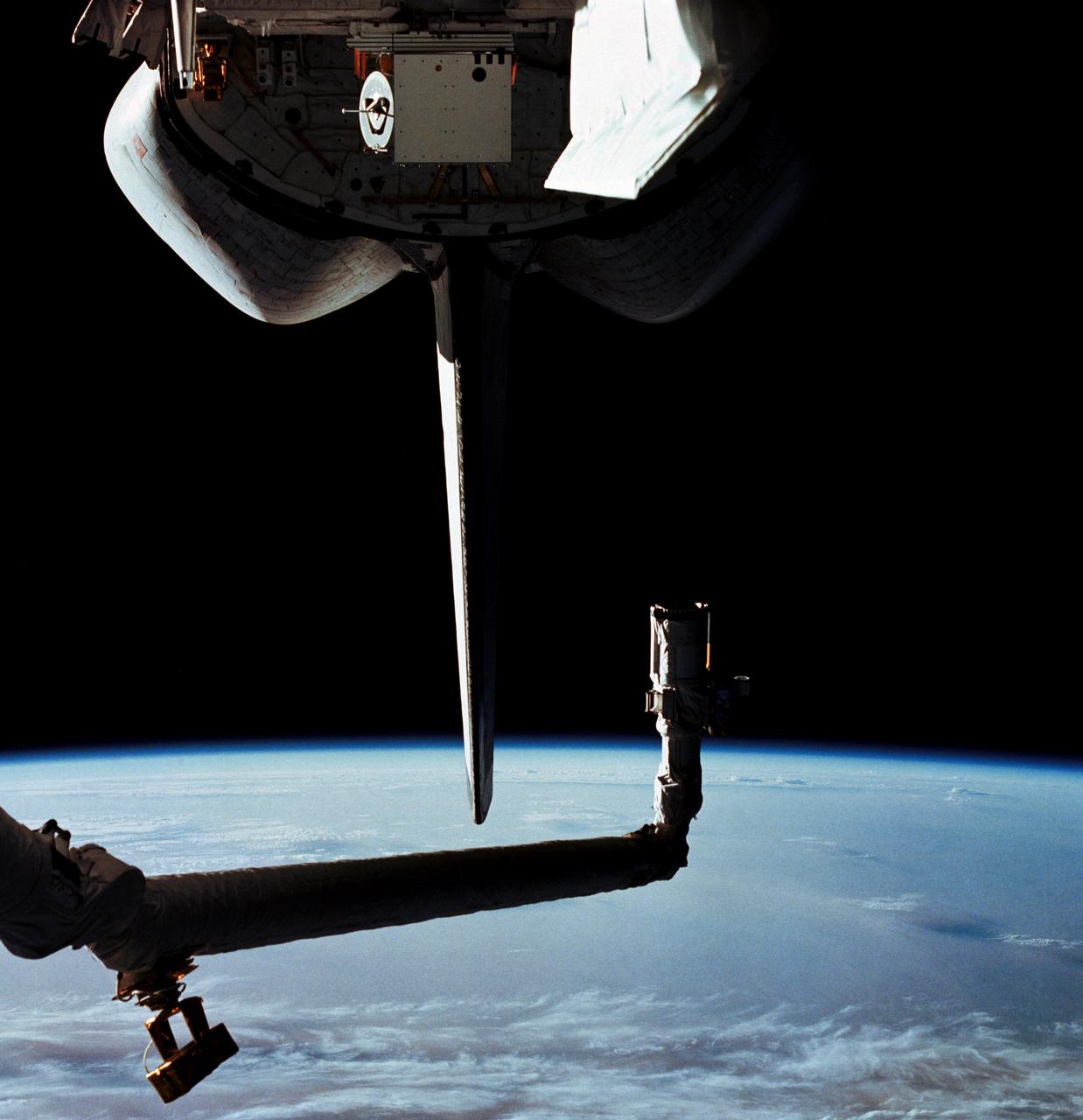
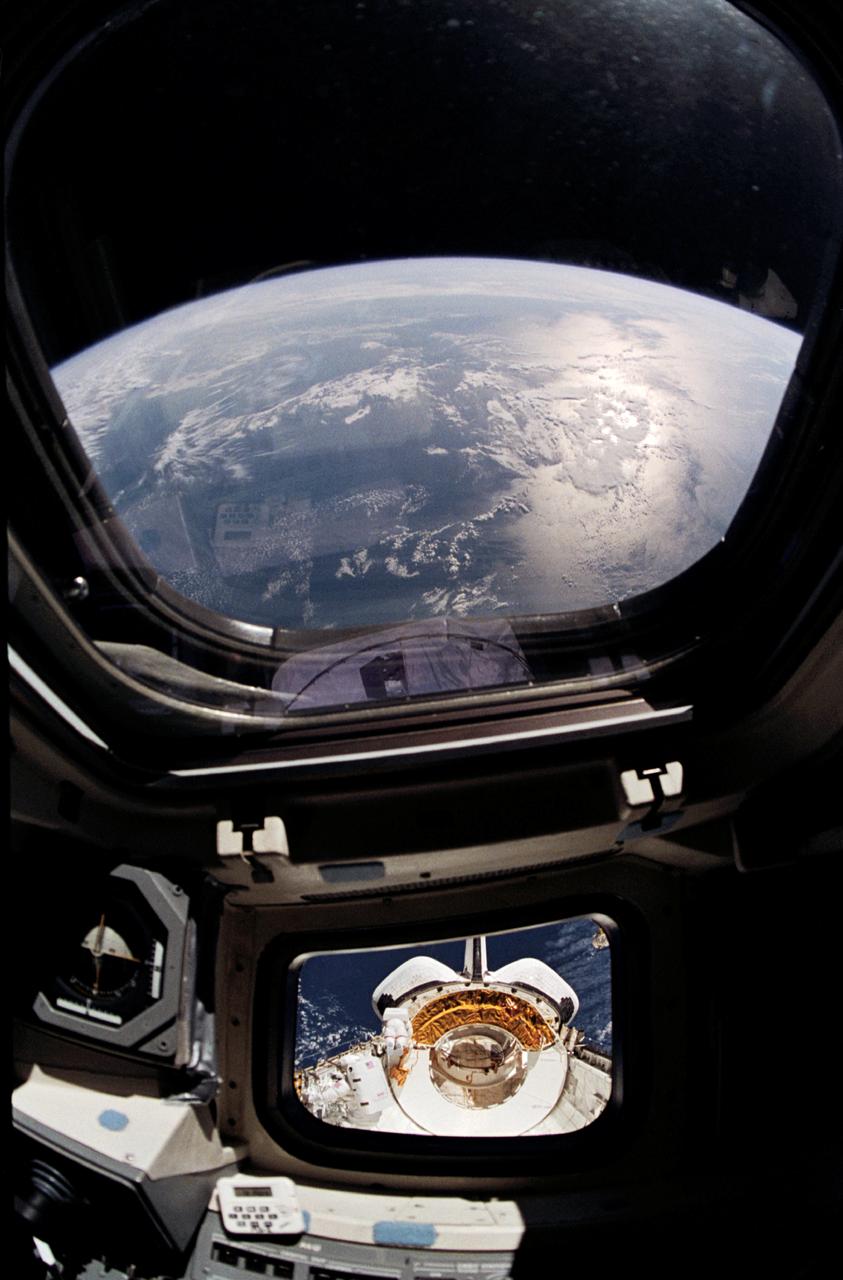
STS002-12-833 (13 Nov. 1981) --- Clouds over Earth and black sky form the background for this unique photograph from the space shuttle Columbia in Earth orbit. The photograph was shot through the aft flight deck windows viewing the cargo bay. Part of the scientific payload of the Office of Space and Terrestrial Applications (OSTA-1) is visible in the open cargo bay. The astronauts inside Columbia's cabin were remotely operating the Canadian-built remote manipulator system (RMS). Note television cameras on its elbow and wrist pieces. Photo credit: NASA
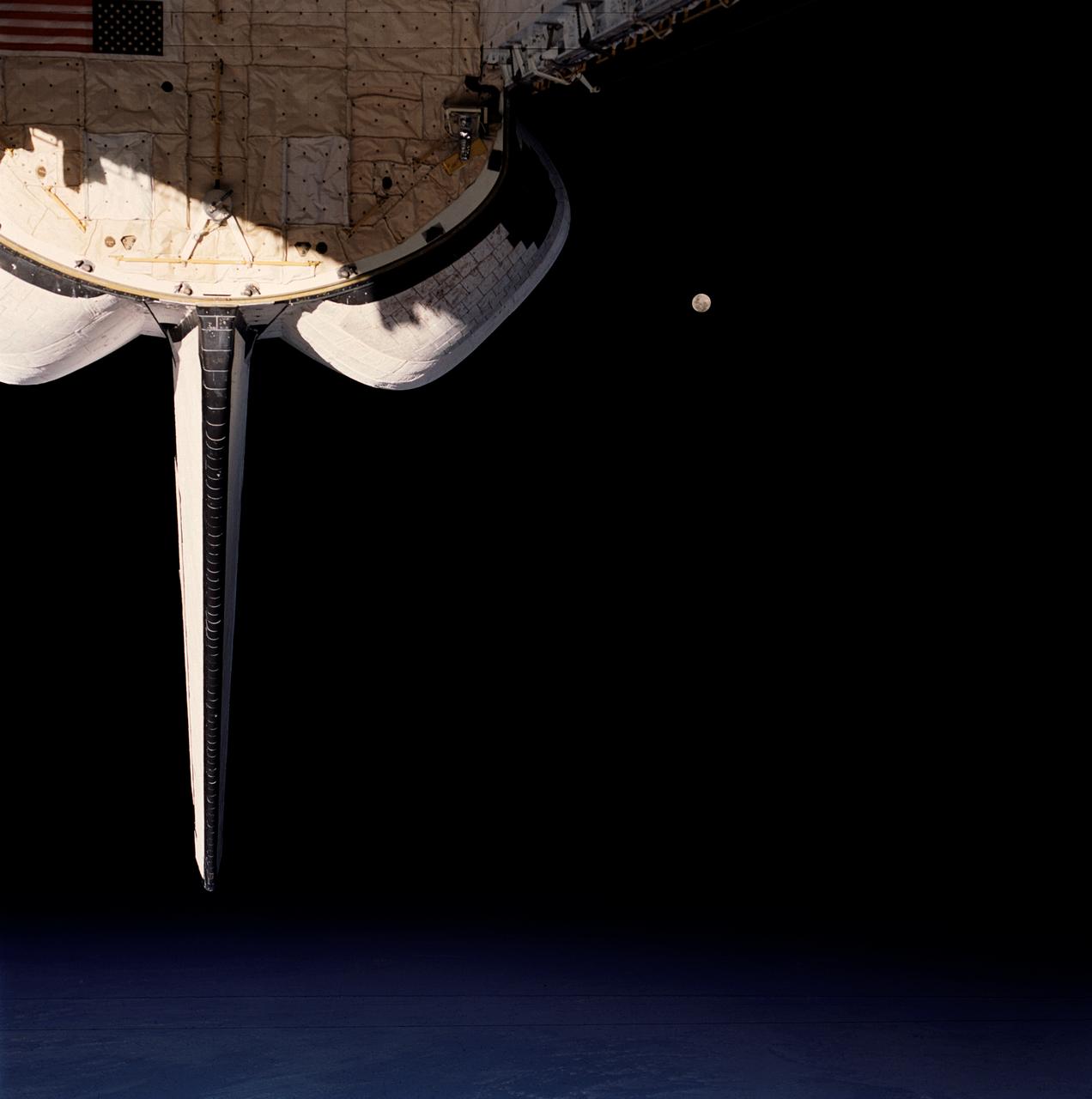
STS053-105-002 (2-9 Dec. 1992) --- A crew member onboard the space shuttle Discovery used a 70mm camera to capture this scene of a full Moon backdropped against the blackness of space. Part of Discovery's aft cargo bay and clouds over an ocean complete the scene.
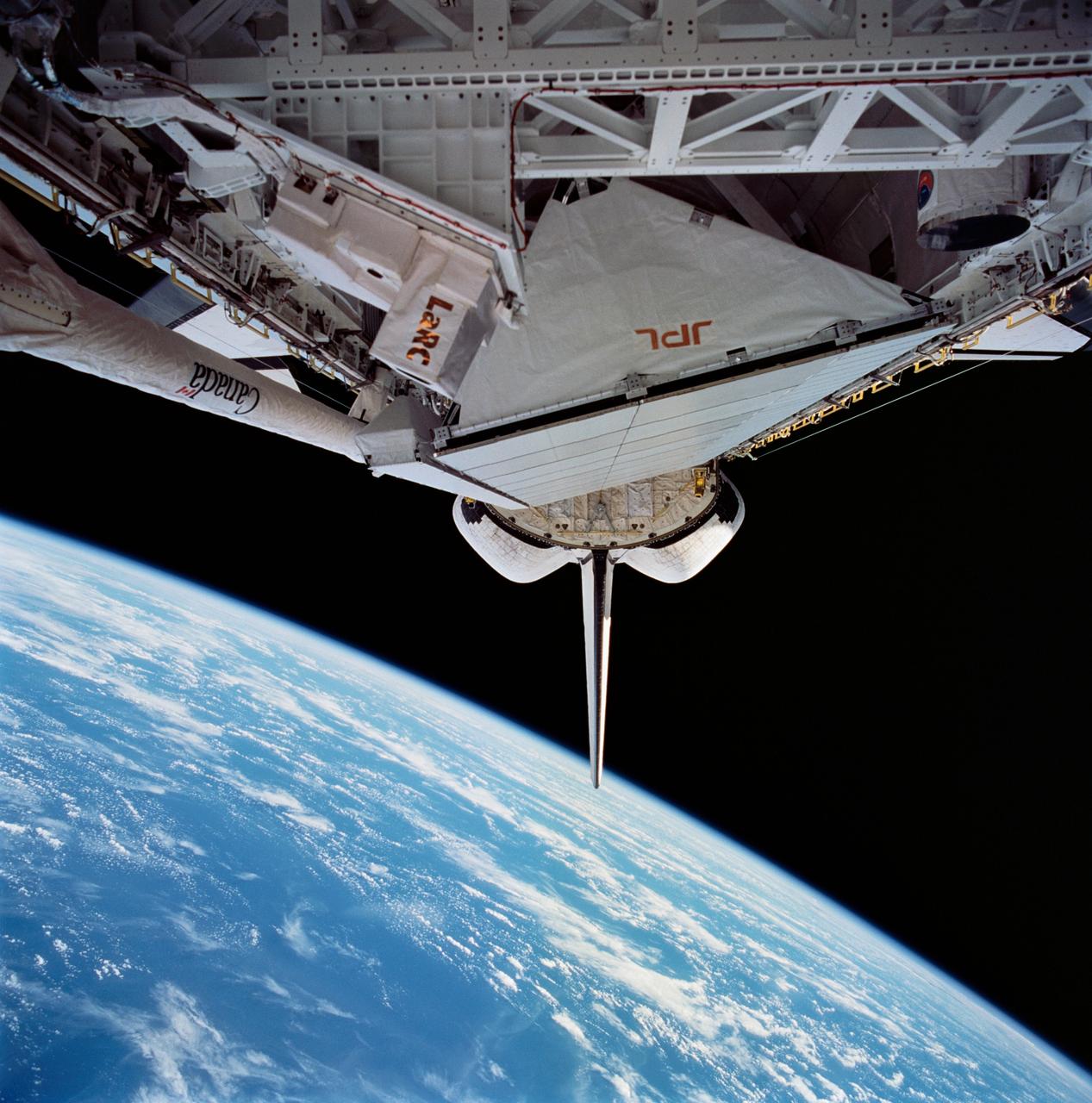
STS59-215-022 (12 April 1994) --- This 70mm frame, photographed through the aft flight deck windows of the Space Shuttle Endeavour, features the Space Radar Laboratory (SRL) payload in the cargo bay. An area of the Pacific Ocean northeast of Hawaii forms the backdrop for the image. Six NASA astronauts spent a week and a half in Earth orbit in support of the SRL mission.
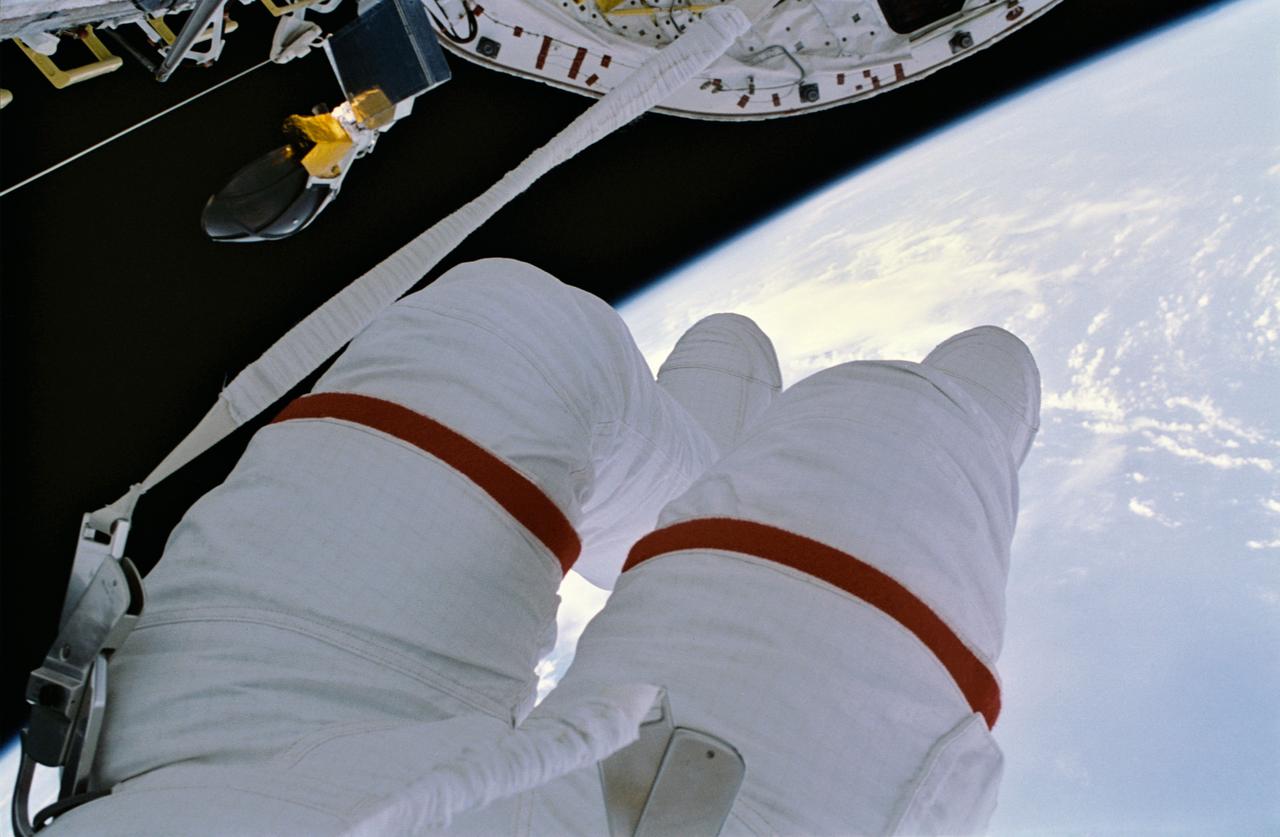
STS054-29-028 (17 Jan 1993) --- Astronaut Gregory J. Harbaugh, mission specialist, used a 35mm camera to photograph his legs and feet during the four-plus hours extravehicular activity (EVA) to depict the vast void below. Harbaugh was joined on the EVA by astronaut Mario Runco Jr., mission specialist.
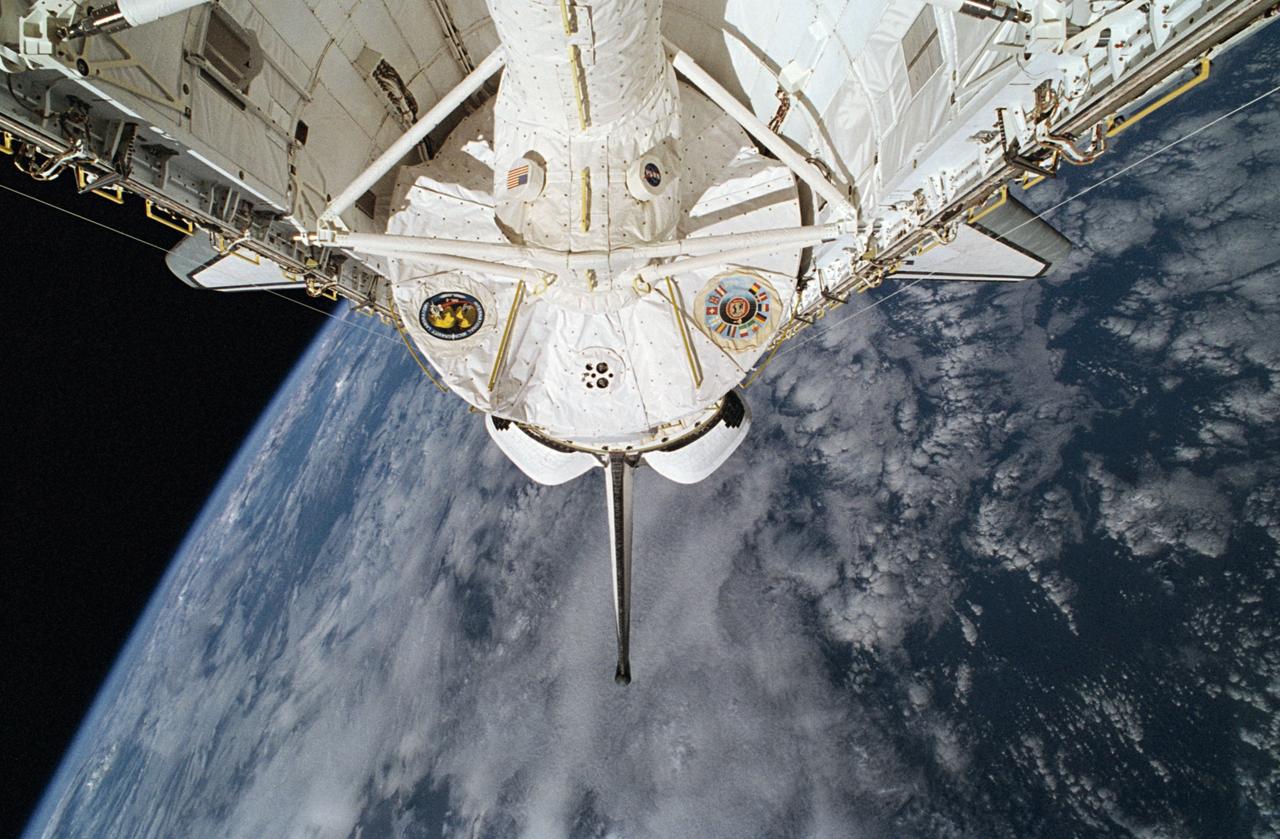
STS065-34-016 (8-23 July 1994) --- Clouds over the ocean form the backdrop for this scene of the International Microgravity Laboratory (IML-2) science module in the Space Shuttle Columbia's cargo bay during the two-week mission. Part of the tunnel that served as passageway for the seven crew members to and from the lab is seen in center foreground. Onboard Columbia were astronauts Robert D. Cabana, James D. Halsell, Jr., Richard J. Hieb, Carl E. Walz, Donald A. Thomas and Leroy Chiao, along with (NASDA) Japanese payload specialist Dr. Chiaki Naito-Mukai.
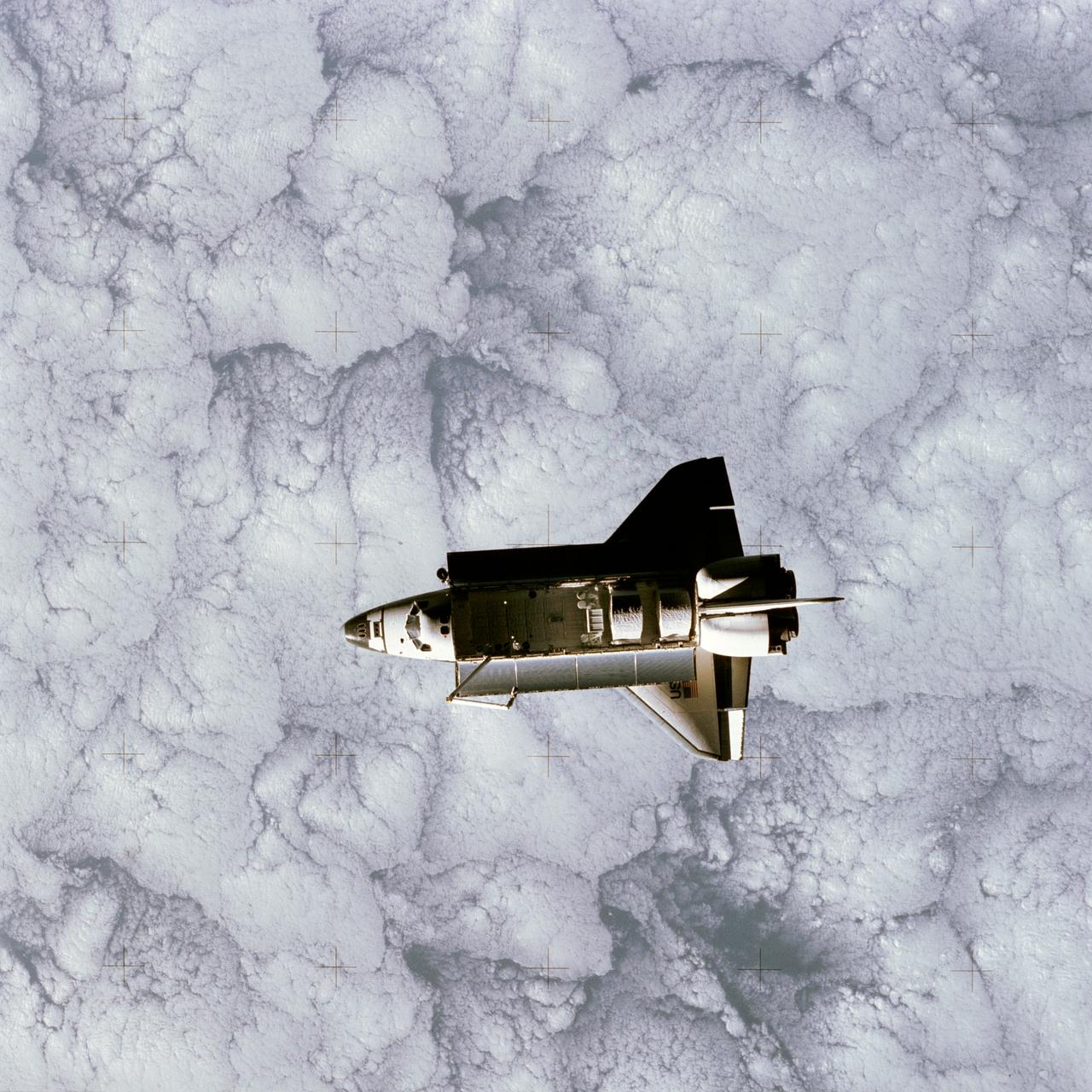
STS007-32-1667 (22 June 1983) --- The Earth-orbiting Space Shuttle Challenger over a heavily cloud-covered portion of the Earth was captured by a 70mm camera onboard the temporarily free-flying Shuttle Pallet Satellite (SPAS-01) during a busy Day 5 on the STS-7 mission. Visible in the cargo bay are the protective cradles for the now vacated Telesat Anik C2 and Palapa-B communications satellites, the pallet for the NASA Office of Space and Terrestrial Applications (OSTA-2); the Remote Manipulator System (RMS) and the KU-Band antenna. The STS-7 astronaut crew and the RMS arm later retrieved the SPAS and returned it to a stowed position in the cargo bay of the Space Shuttle Challenger for the return to Earth.
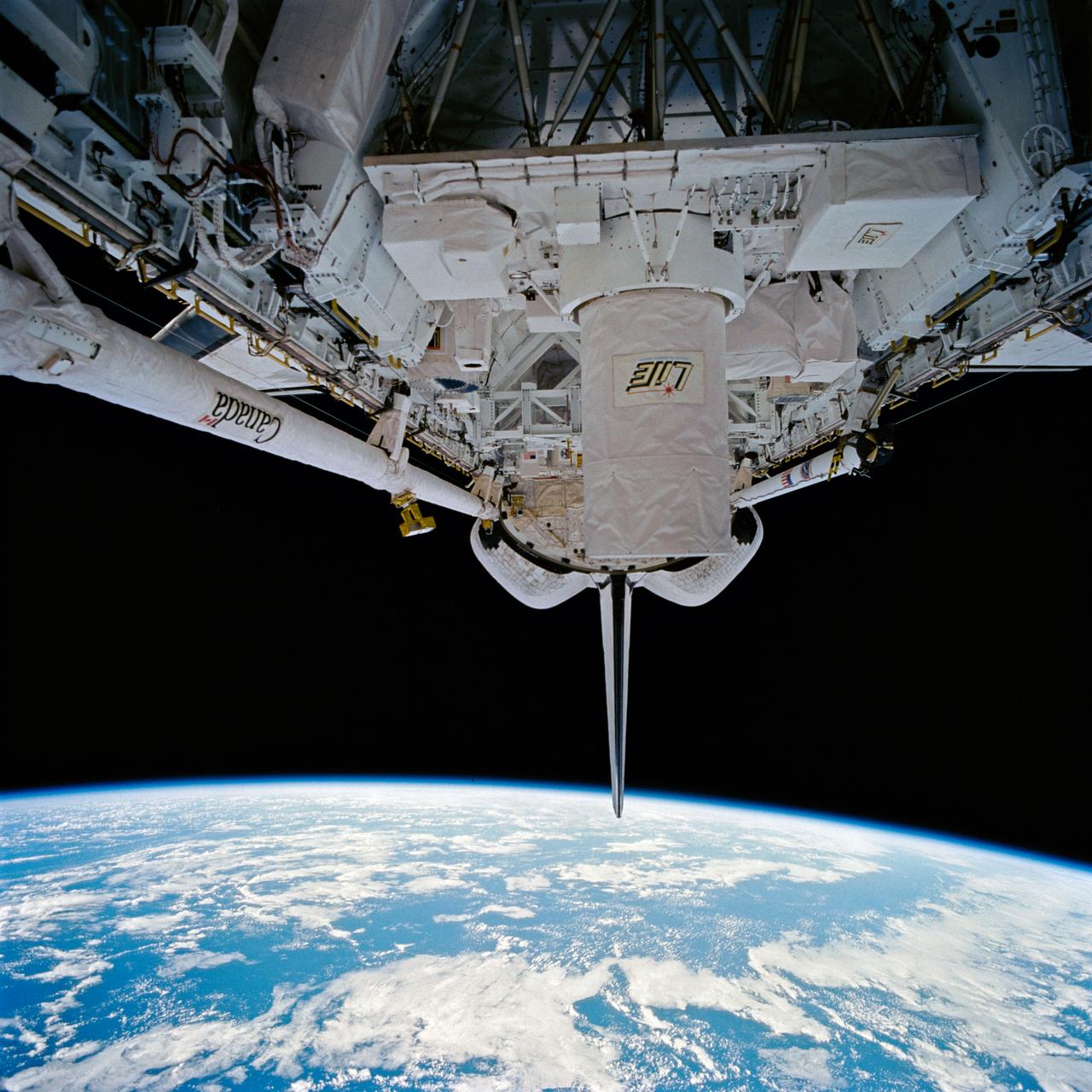
STS064-90-031 (9-20 Sept. 1994) --- Backdropped against the darkness of space beneath Earth's horizon 130 nautical miles away, the cargo bay of the space shuttle Discovery and its related payloads were captured on 70mm film by one of the six cabin-bound astronauts. In the foreground is the Lidar In-space Technology Experiment (LITE). The robot arm portion of the Remote Manipulator System (RMS), busy throughout much of the almost 11-day mission, is in a stowed position on Discovery's port side. Photo credit: NASA or National Aeronautics and Space Administration
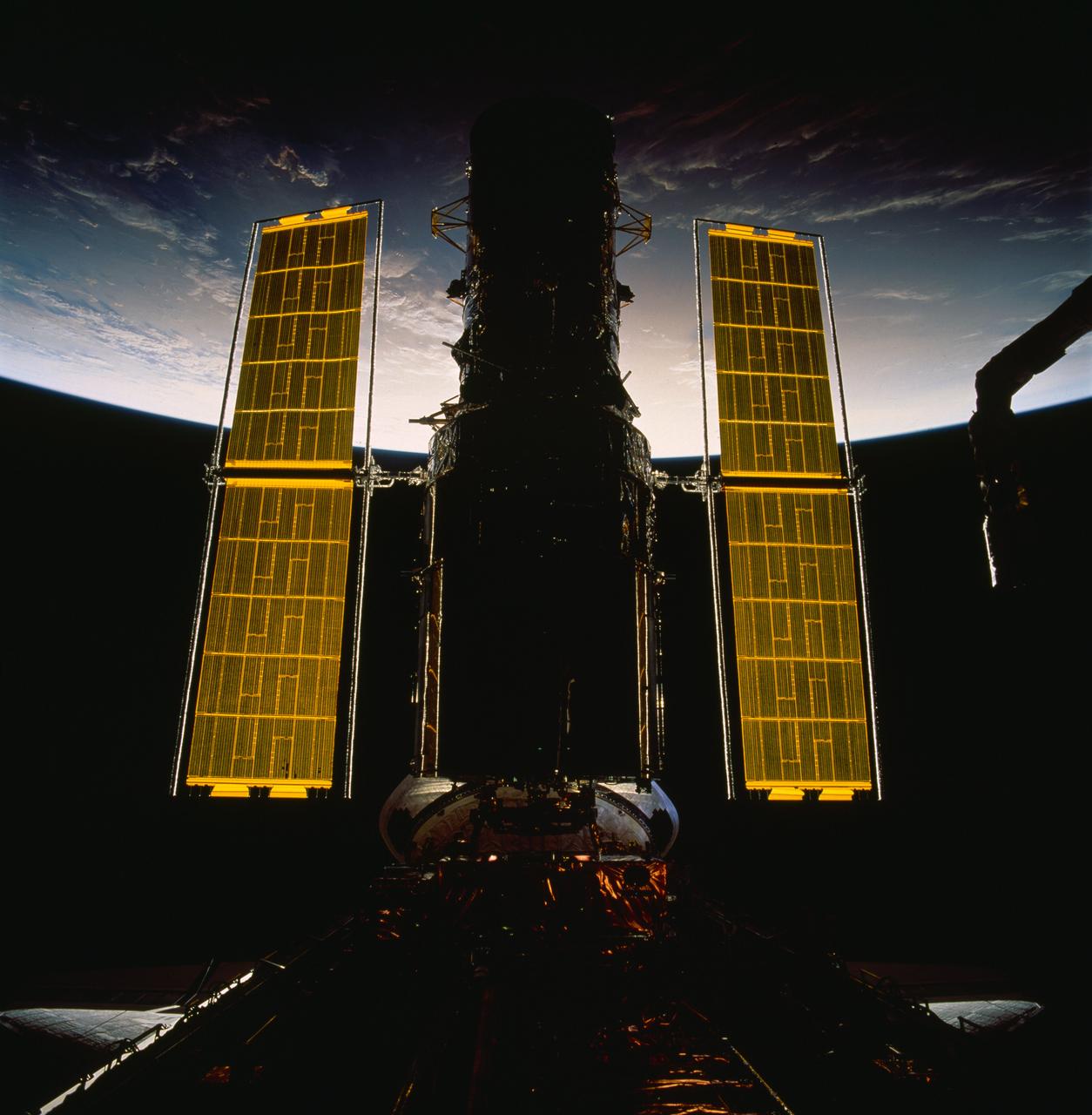
STS061-99-002 (2-13 Dec 1993) --- The new set of solar array panels deployed on the Hubble Space Telescope (HST) is backdropped against the blackness of space and a widely cloud-covered area on Earth. The 70mm frame was exposed by one of the Space Shuttle Endeavour's seven crew members on the aft flight deck.
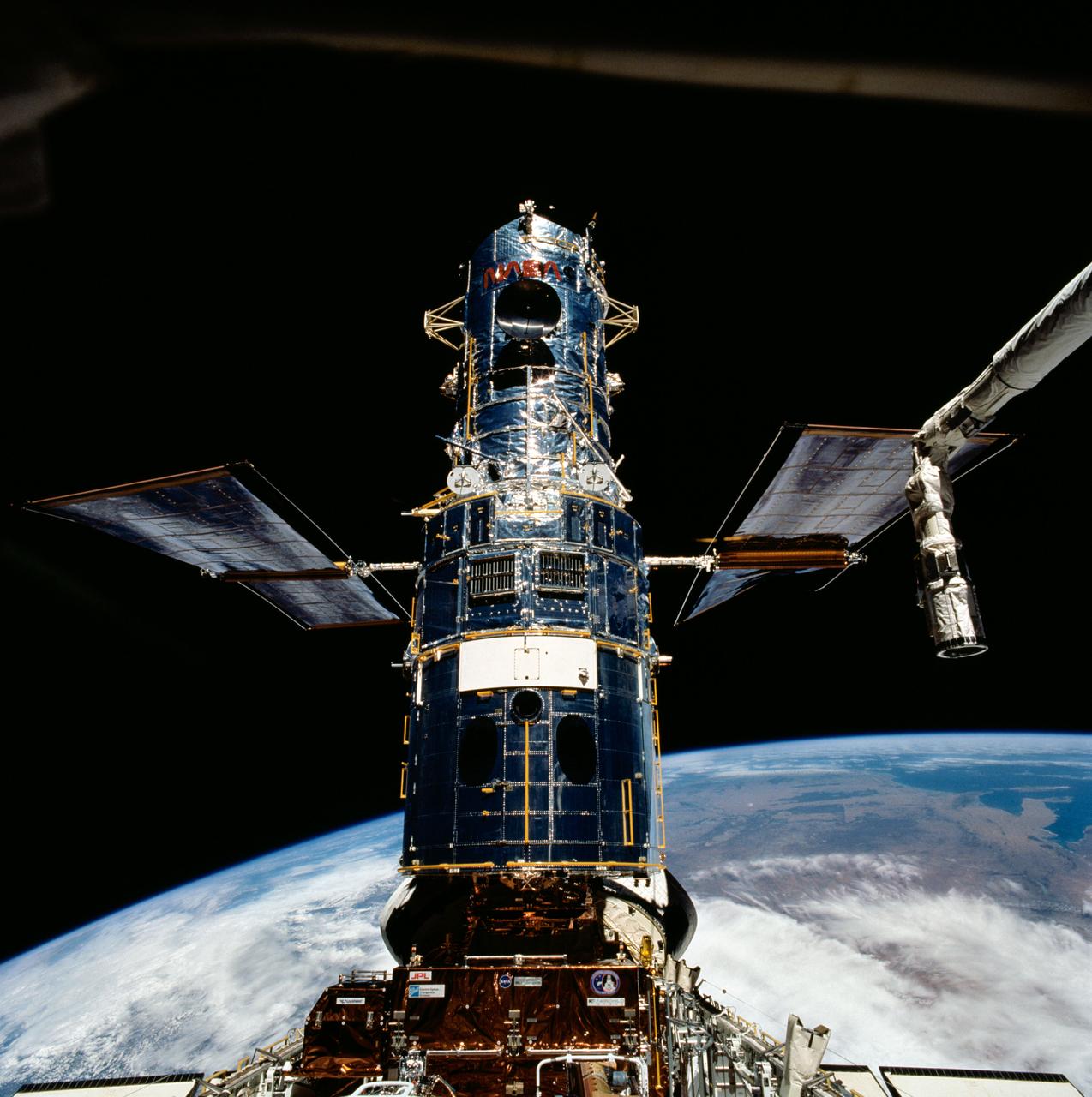
STS061-86-030 (4 Dec 1993) --- The Hubble Space Telescope (HST) is pictured in the Space Shuttle Endeavour's cargo bay following its capture and berthing early in the eleven-day STS-61 mission. The Remote Manipulator System (RMS) arm, with television cameras mounted on it, was maneuvered from inside the cabin in order to survey HST. Five days of space walks followed, during which a variety of servicing tasks were performed by four crew members.
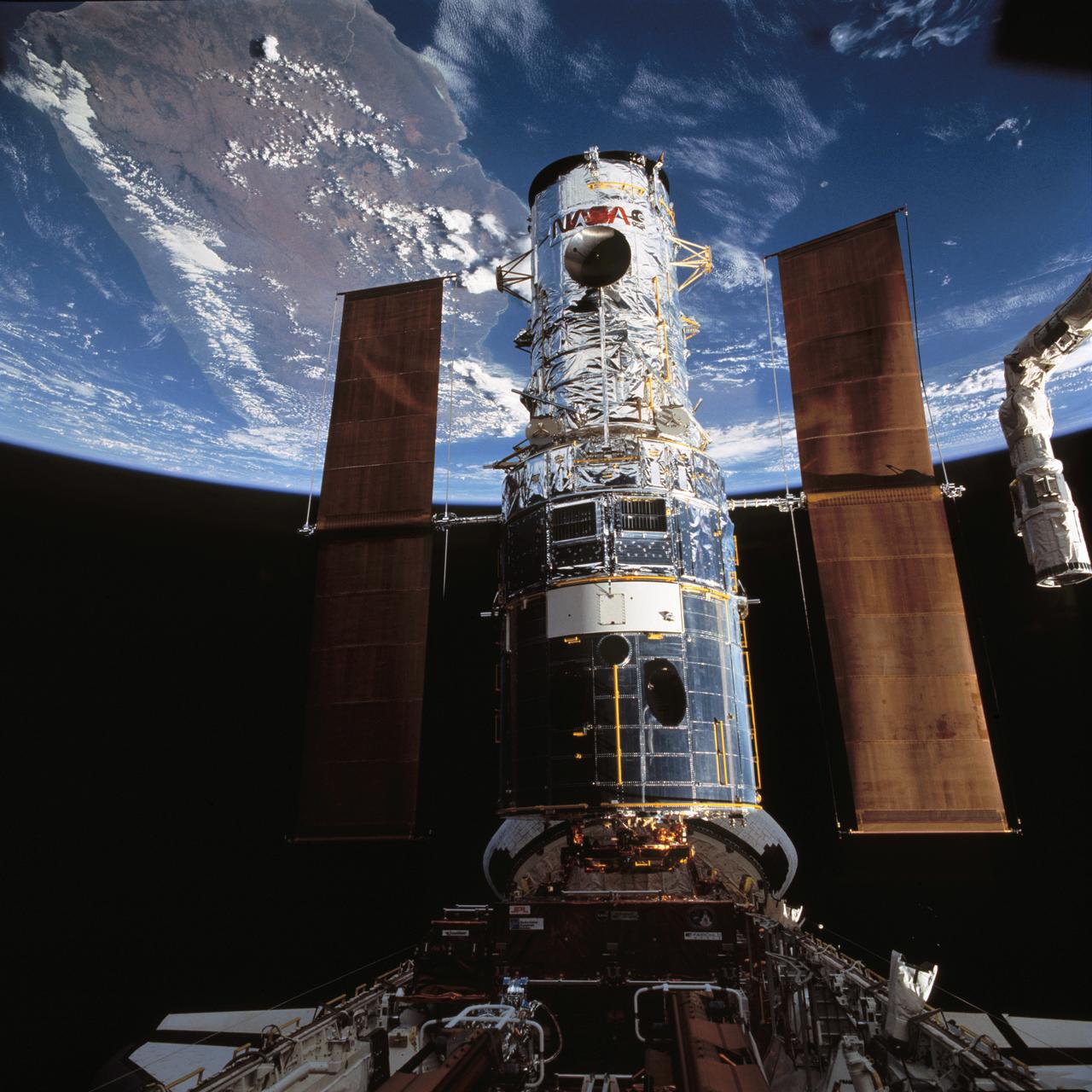
STS061-79-087 (4 Dec. 1993) --- The Hubble Space Telescope (HST), backdropped over Madagascar, is berthed in the space shuttle Endeavour's cargo bay following its capture by the STS-61 astronauts. The crew used TV cameras to survey the spacecraft before sending out four astronauts on five separate sessions of extravehicular activity (EVA) to perform a variety of servicing tasks. Photo credit: NASA

S77-E-5065 (21 May 1996) --- With a cloudy horizon scene as a backdrop, the Spartan 207 free-flyer is held in the grasp of the Space Shuttle Endeavour's Remote Manipulator System (RMS) following its re-capture on May 21, 1996. The view was captured with an onboard Electronic Still Camera (ESC). The six-member crew has spent a portion of the early stages of the mission in various activities involving the Spartan 207 and the related Inflatable Antenna Experiment (IAE). The Spartan project is managed by NASA's Goddard Space Flight Center (GSFC) for NASA's Office of Space Science, Washington, D.C.
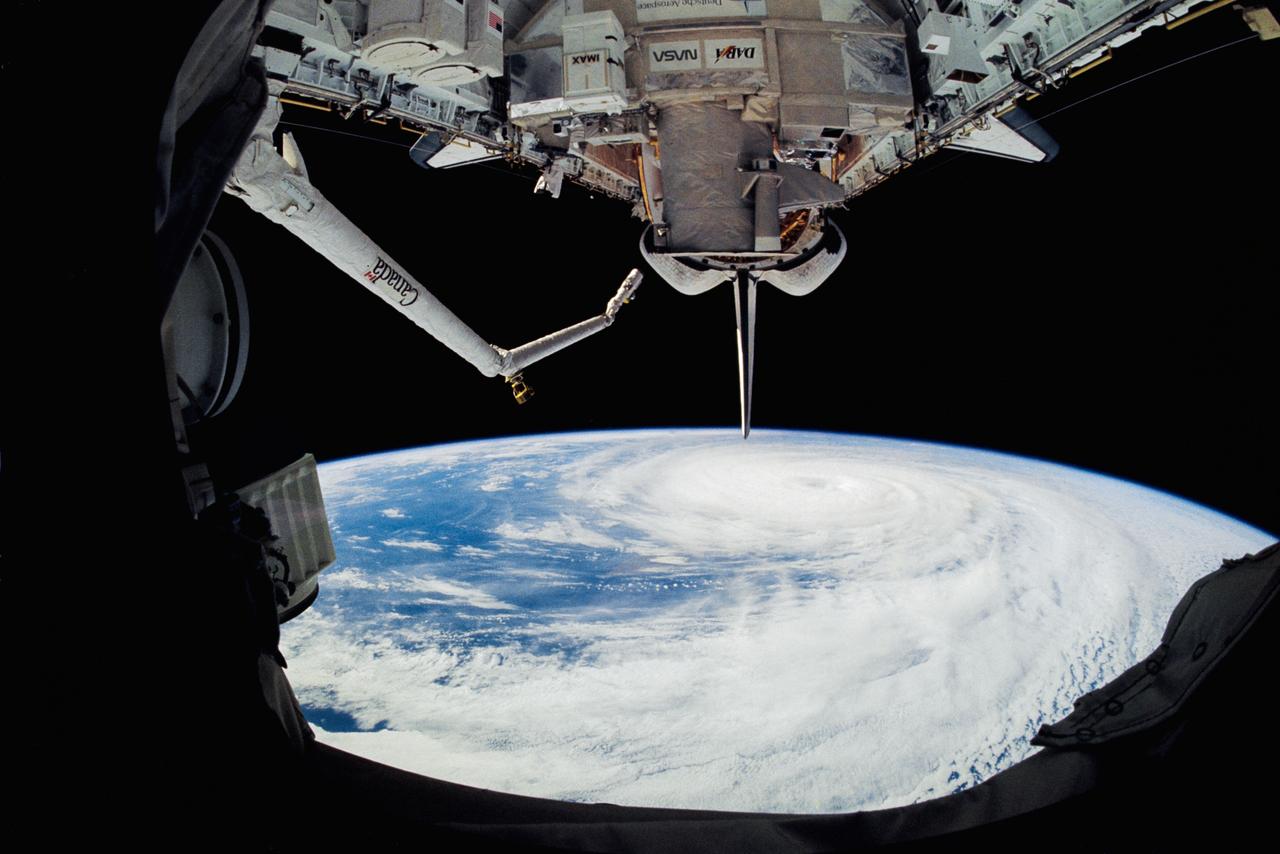
One of the STS-51 astronauts used a "fish-eye" lens on a 35mm cmaera to photograph this view of Hurricane Kenneth in the Pacific Ocean. The Orbiting Retrievable Far and Extreme Ultraviolet Spectrometer/Shuttle Pallet Satellite (ORFEUS/SPAS) is still in the cargo bay. The Remote Manipulator System (RMS) is extended towards the open payload bay.
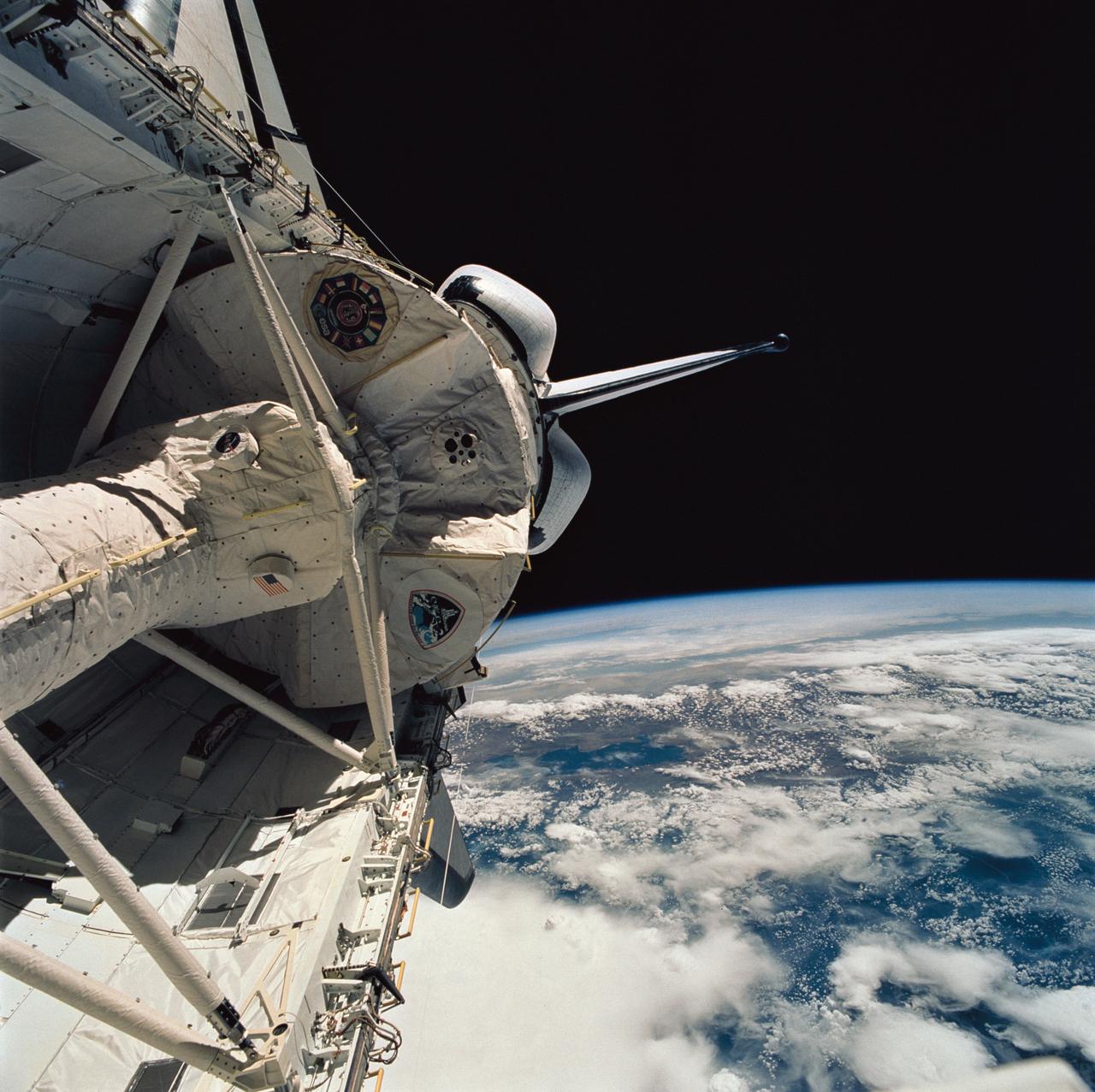
STS058-76-041 (18 Oct-1 Nov 1993) --- Backdropped against the Peru-Bolivia border and part of the Amazon basin, the Spacelab Life Sciences (SLS-2) laboratory module was captured with a 70mm camera, by one of the seven crew members inside the Space Shuttle Columbia's cabin. Part of the tunnel-like passageway is visible in the foreground. Six NASA astronauts and a veterinarian from the private sector spent two weeks devoted to medical research in Earth-orbit. Lake Titicaca, the largest high-altitude lake in the world lies in the Altiplano of Bolivia and Peru. Space Shuttle photography has been used to document fluctuations of several meters of the level of Lake Titicaca during the past decade, as well as to document the eutrophication of the north end of the lake, which is primarily due to increased population in the Peruvian shoreline areas. This view shows the effect of abnormally heavy precipitation of the region for the third successive year. Meteorologists feel this precipitation increase, which may portend another increase of the lake level, is due to the third successive El Nino - Southern Oscillation phenomenon in the 1993 - 94 southern hemisphere summertime. This global phenomenon is now resulting in major weather disturbances in Indonesia, California, Texas and elsewhere.
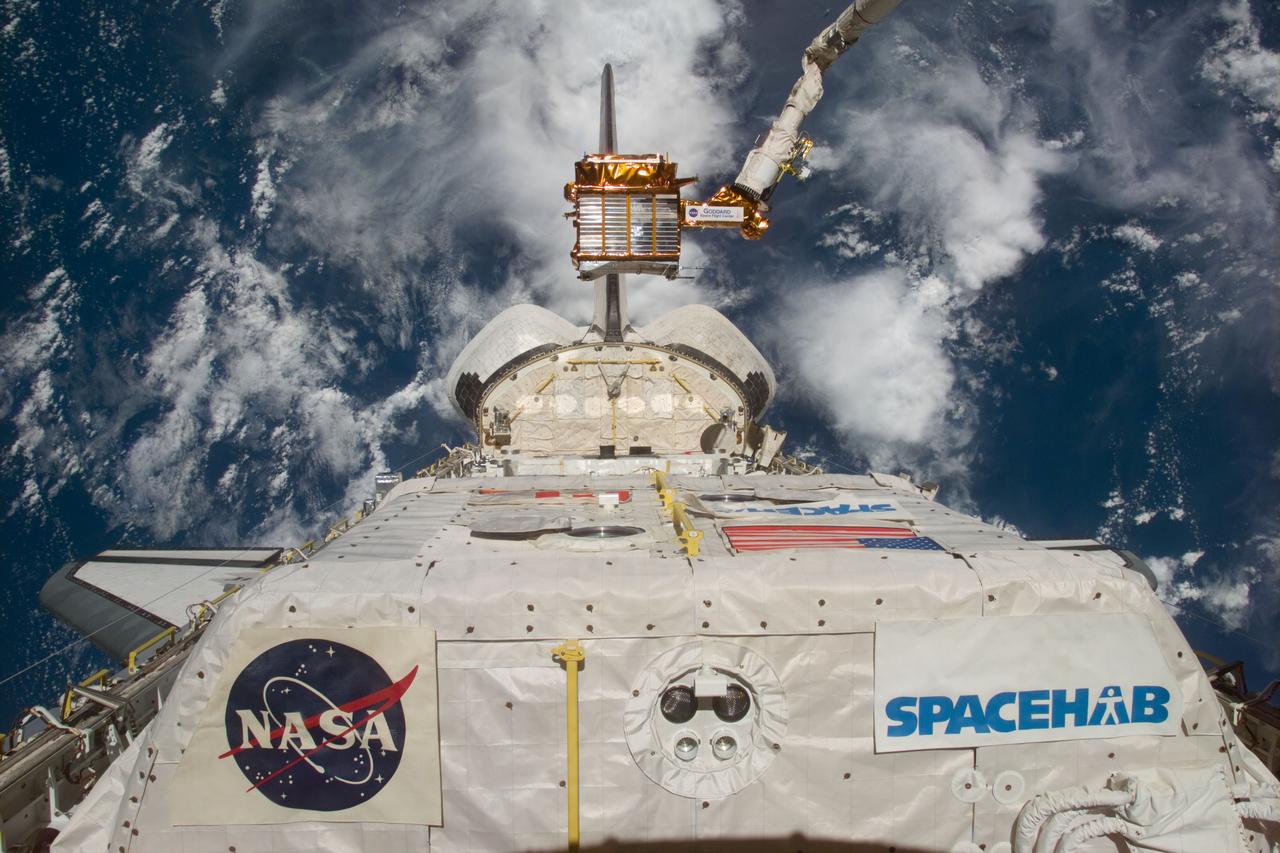
S77-E-5053 (21 May 1996) --- The Spartan 207 free-flyer is held in a low-hover mode above its berth in the Space Shuttle Endeavour's cargo bay in the grasp of the Remote Manipulator System (RMS). The Spacehab module can be seen in the foreground. The free-flyer was re-captured by the six crew members on May 21, 1996. The crew has spent a portion of the early stages of the mission in various activities involving the Spartan 207 and the related Inflatable Antenna Experiment (IAE). The Spartan project is managed by NASA's Goddard Space Flight Center (GSFC) for NASA's Office of Space Science, Washington, D.C.
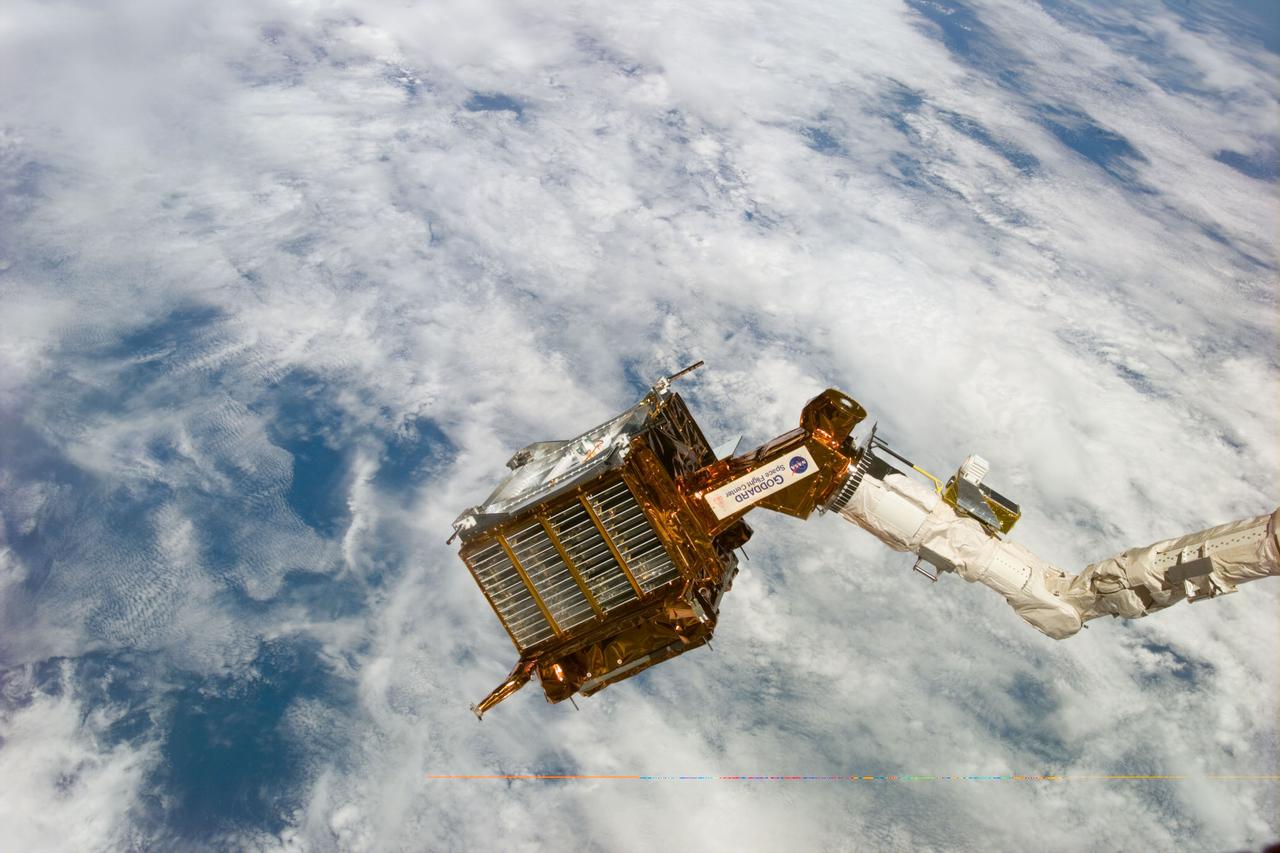
S77-E-5064 (21 May 1996)--- In this medium close-up view, captured by an Electronic Still Camera (ESC), the Spartan 207 free-flyer is held in the grasp of the Space Shuttle Endeavour's Remote Manipulator System (RMS) following its re-capture on May 21, 1996. The six-member crew has spent a portion of the early stages of the mission in various activities involving the Spartan 207 and the related Inflatable Antenna Experiment (IAE). The Spartan project is managed by NASA's Goddard Space Flight Center (GSFC) for NASA's Office of Space Science, Washington, D.C.
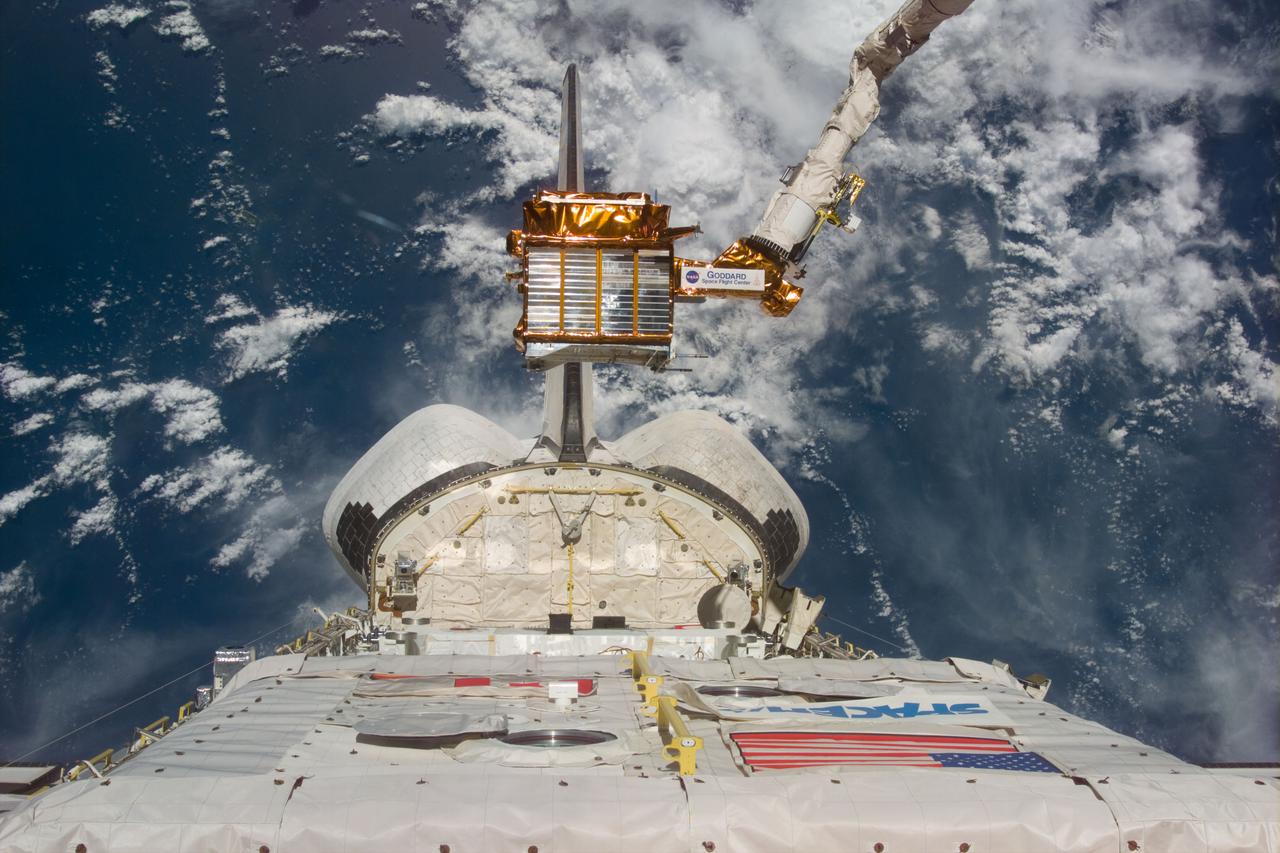
S77-E-5052 (21 May 1996) --- The Spartan 207 free-flyer is held in a low-hover mode above its berth in the Space Shuttle Endeavour's cargo bay in the grasp of the Remote Manipulator System (RMS). The free-flyer was re-captured by the six crew members on May 21, 1996. The crew has spent a portion of the early stages of the mission in various activities involving the Spartan 207 and the related Inflatable Antenna Experiment (IAE). The Spartan project is managed by NASA's Goddard Space Flight Center (GSFC) for NASA's Office of Space Science, Washington, D.C.
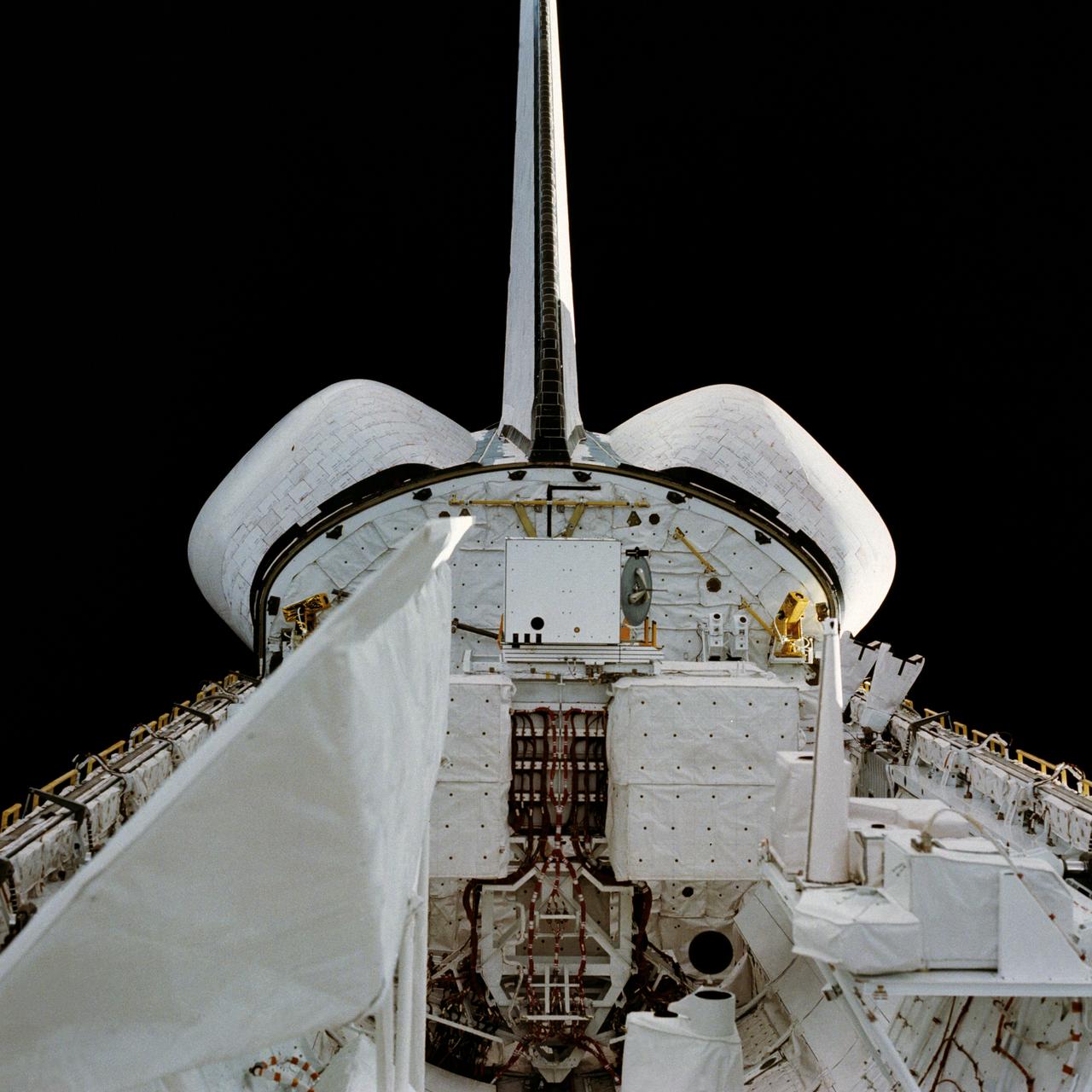
STS002-13-208 (12-14 Nov. 1981) --- This clear view of the aft section of the Earth-orbiting space shuttle Columbia's cargo bay and some of its cargo was photographed through the flight deck's aft windows. Visible in the center of the photo are the twin orbital maneuvering system (OMS) pods. The vertical stabilizer or tail splits the top part of the image in half. The Induced Environment Contamination Monitor (IECM) Location experiment is located in the back center of the cargo bay, near the top. There is a grapple fixture attached to the side of the IECM. Various components of the Office of Space Terrestrial Applications (OSTA-1) payload are seen near the aft section of the cargo bay, such as the Feature Identification and Location Experiment (FILE) (the long cone shaped object on the right back), the Shuttle Multispectral Infrared Radiometer (SMIRR) (on pallet base) and the SIR-A recorder in the right foreground. In the left foreground the Shuttle Imaging Radar-A (SIR-A) antenna can be seen. Photo credit: NASA
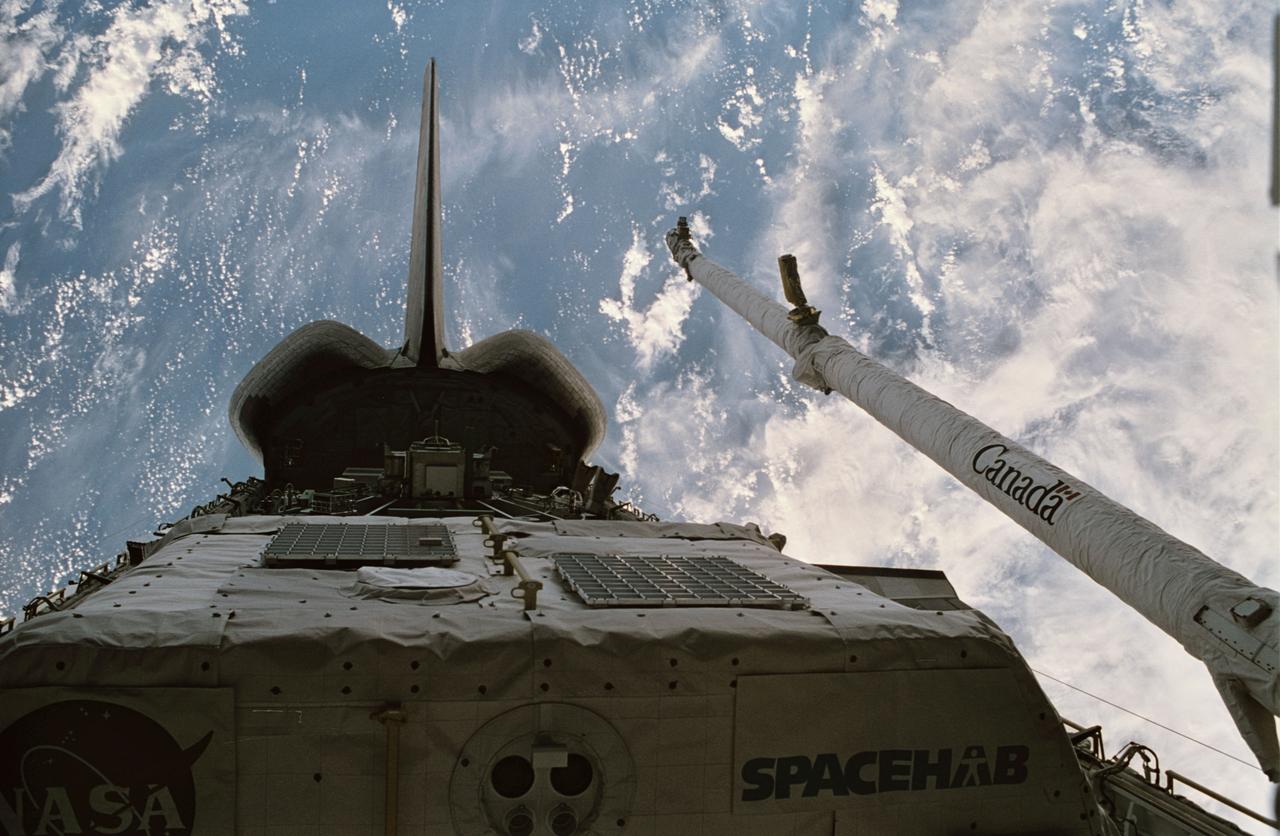
STS060-15-003 (3-11 Feb 1994) --- This 35mm frame shows the major payloads of the Space Shuttle Discovery's STS-60 mission, backdropped against clouds over the Atlantic Ocean. In the foreground is the SPACEHAB module, with the Wake Shield Facility (WSF) partially visible in its berthed position near the Orbital Maneuvering System (OMS) pods and the vertical stabilizer. Television cameras on the Remote Manipulator System (RMS) were being used for a survey of the cargo. Five NASA astronauts and a Russian cosmonaut went on to spend eight days in Earth orbit in support of the mission.
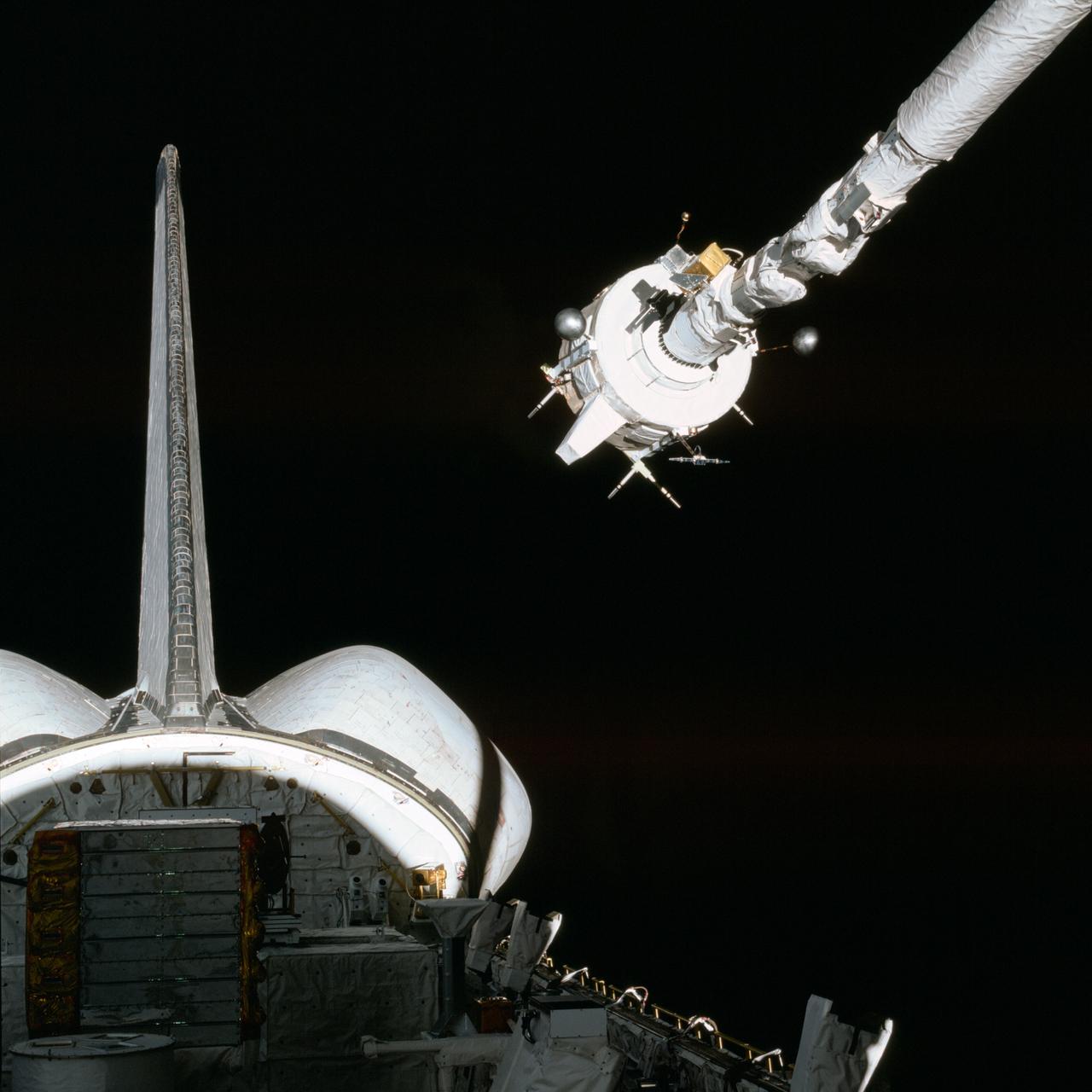
STS003-09-444 (22-30 March 1982) --- The darkness of space provides the backdrop for this scene of the plasma diagnostics package (PDR) experiment in the grasp of the end effector or ?hand? of the remote manipulator system (RMS) arm, and other components of the Office of Space Sciences (OSS-1) package in the aft section of the Columbia?s cargo hold. The PDP is a compact, comprehensive assembly of electromagnetic and particle sensors that will be used to study the interaction of the orbiter with its surrounding environment; to test the capabilities of the shuttle?s remote manipulator system; and to carry out experiments in conjunction with the fast pulse electron generator of the vehicle charging and potential experiment, another experiment on the OSS-1 payload pallet. This photograph was exposed with a 70mm handheld camera by the astronaut crew of STS-3, with a handheld camera aimed through the flight deck?s aft window. Photo credit: NASA
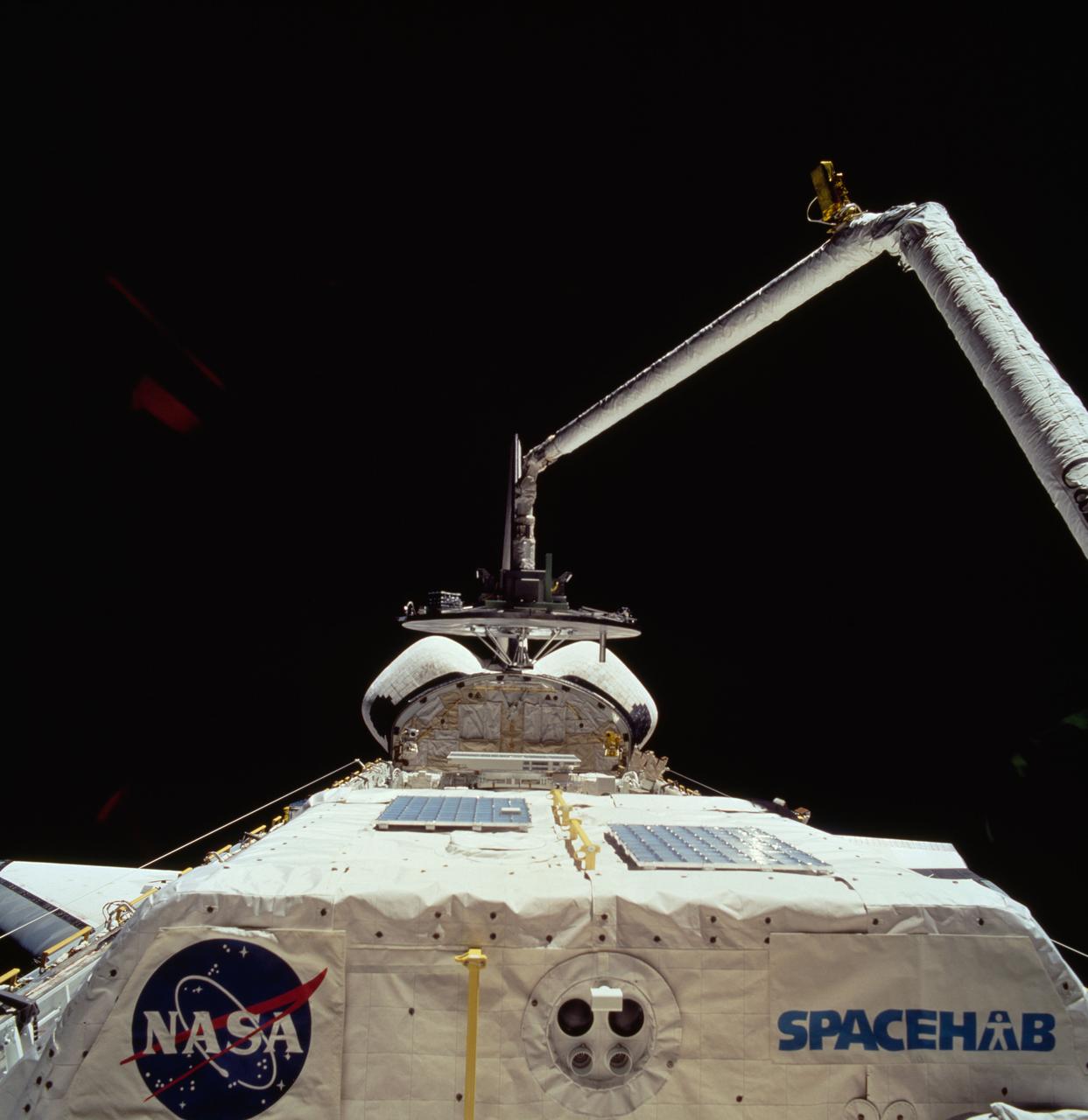
STS060-74-054 (3-11 Feb 1994) --- The Wake Shield Facility (WSF) is held in the grasp of Discovery's Remote Manipulator System (RMS). The 70mm image, backdropped against the blackness of space, also shows the SPACEHAB module in the forward cargo area.
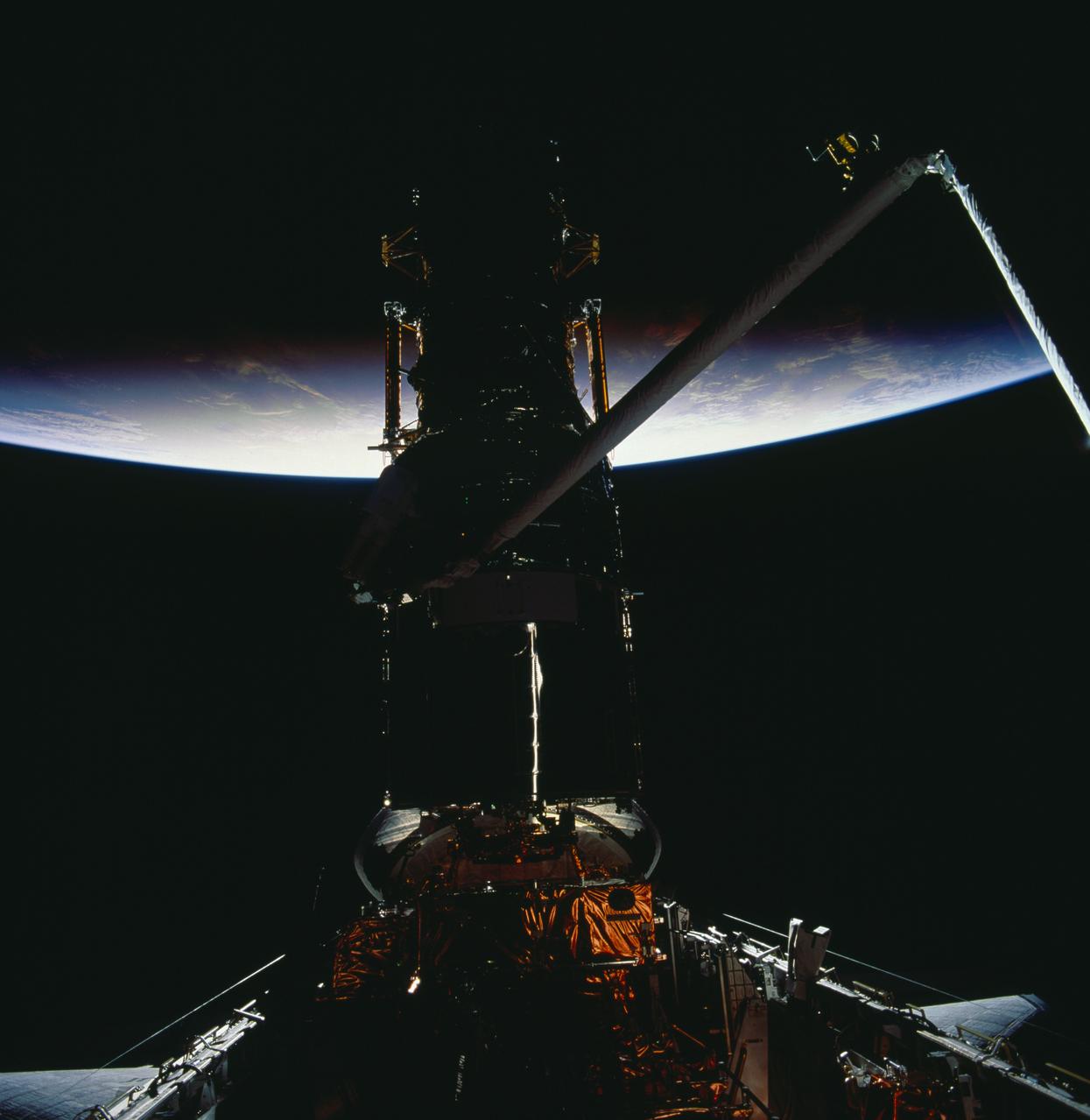
STS061-98-0AR (8 Dec 1993) --- Earth is partially illuminated but the Hubble Space Telescope (HST) and the Space Shuttle Endeavour are still mostly in darkness, in this 70mm frame photographed during the fourth of five space walks. Astronaut Kathryn C. Thornton, barely visible above left center in the frame, works to install the Corrective Optics Space Telescope Axial Replacement (COSTAR).
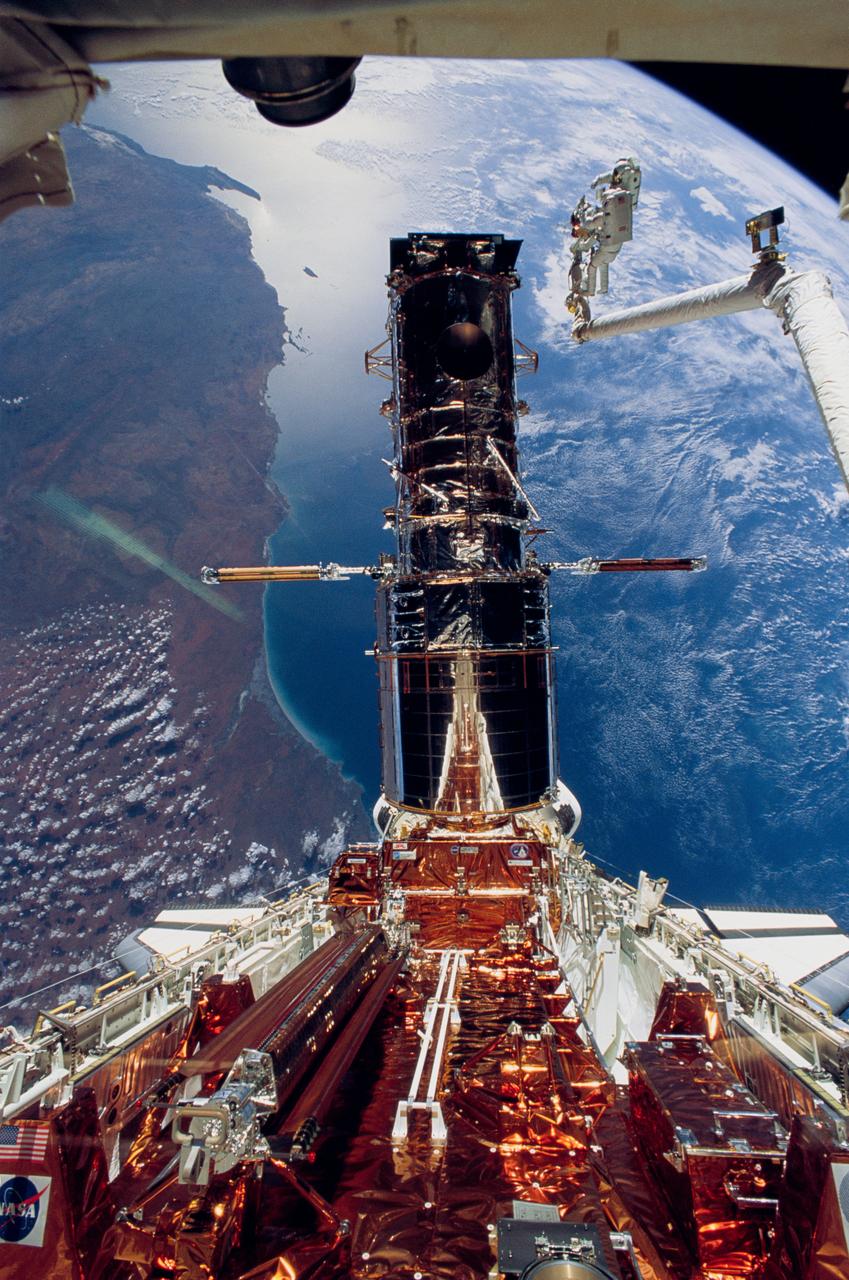
STS061-48-001 (9 Dec 1993) --- Orbiting Earth at an altitude of 356 nautical miles perched atop a foot restraint on the Space Shuttle Endeavour's Remote Manipulator System (RMS) arm, astronauts F. Story Musgrave (top) and Jeffrey A. Hoffman wrap up the final of five Extravehicular Activities (EVA). The west coast of Australia forms the backdrop for the 35mm frame.
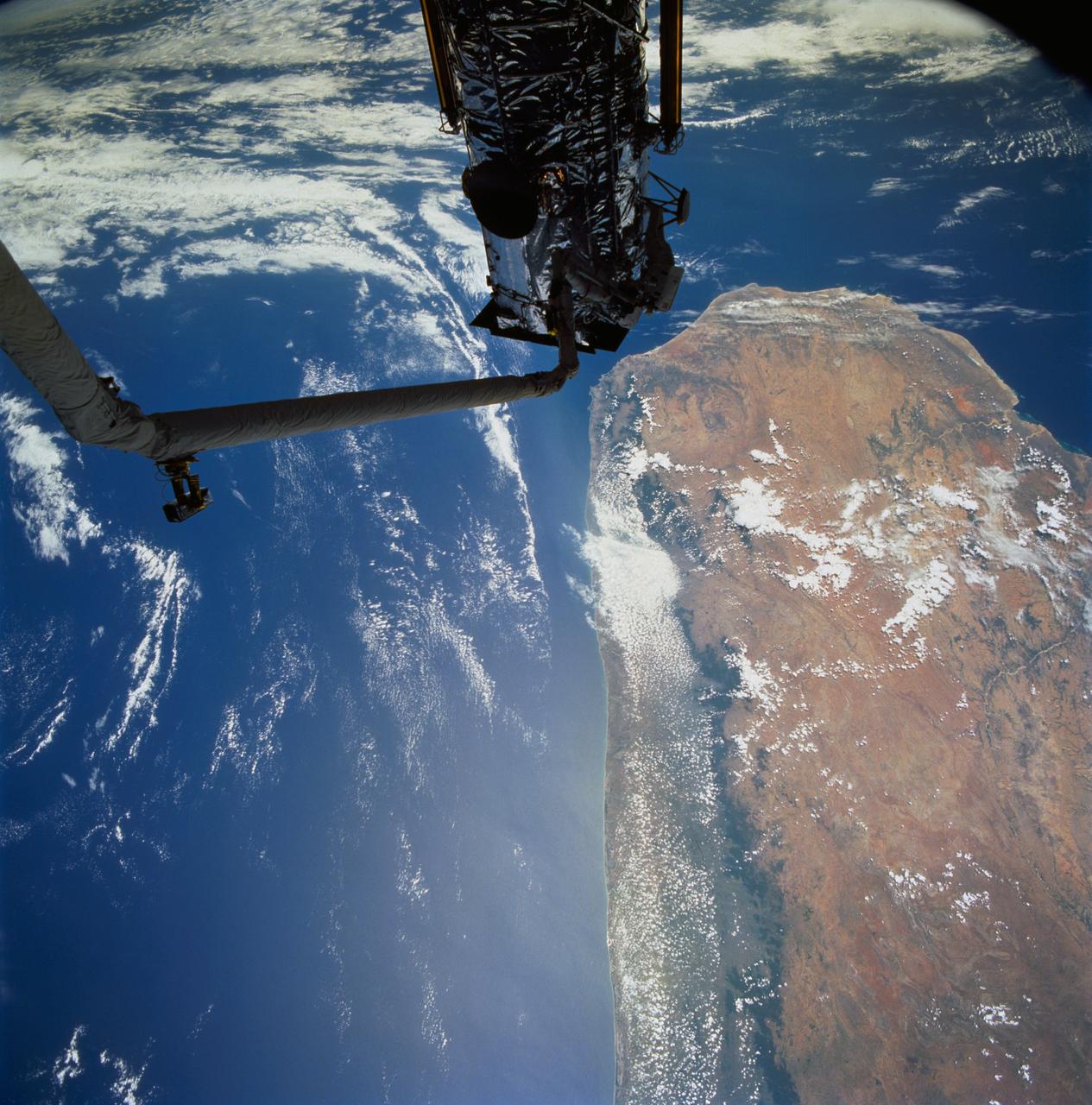
STS061-77-102 (7 Dec 1993) --- Astronauts Jeffrey A. Hoffman (left) and F. Story Musgrave are partially silhouetted against the Indian Ocean as they work to install the Magnetic Sensing System (MSS) on the Hubble Space Telescope (HST). Musgrave is anchored to the end of the Space Shuttle Endeavour's Remote Manipulator System (RMS) arm. The HST is positioned along the southern end of Madagascar, 325 nautical miles away. Visible on the western coast are the sediment laden Onilahy and Fiherenana Rivers which empty into Saint Augustin Bay. North of Fiherenana River is the Mangoky River. The circular feature on the southern end of Madagascar and to the right of HST is the L'ivakoany Mountains. The eastern coast is relatively straight compared to the western coast.
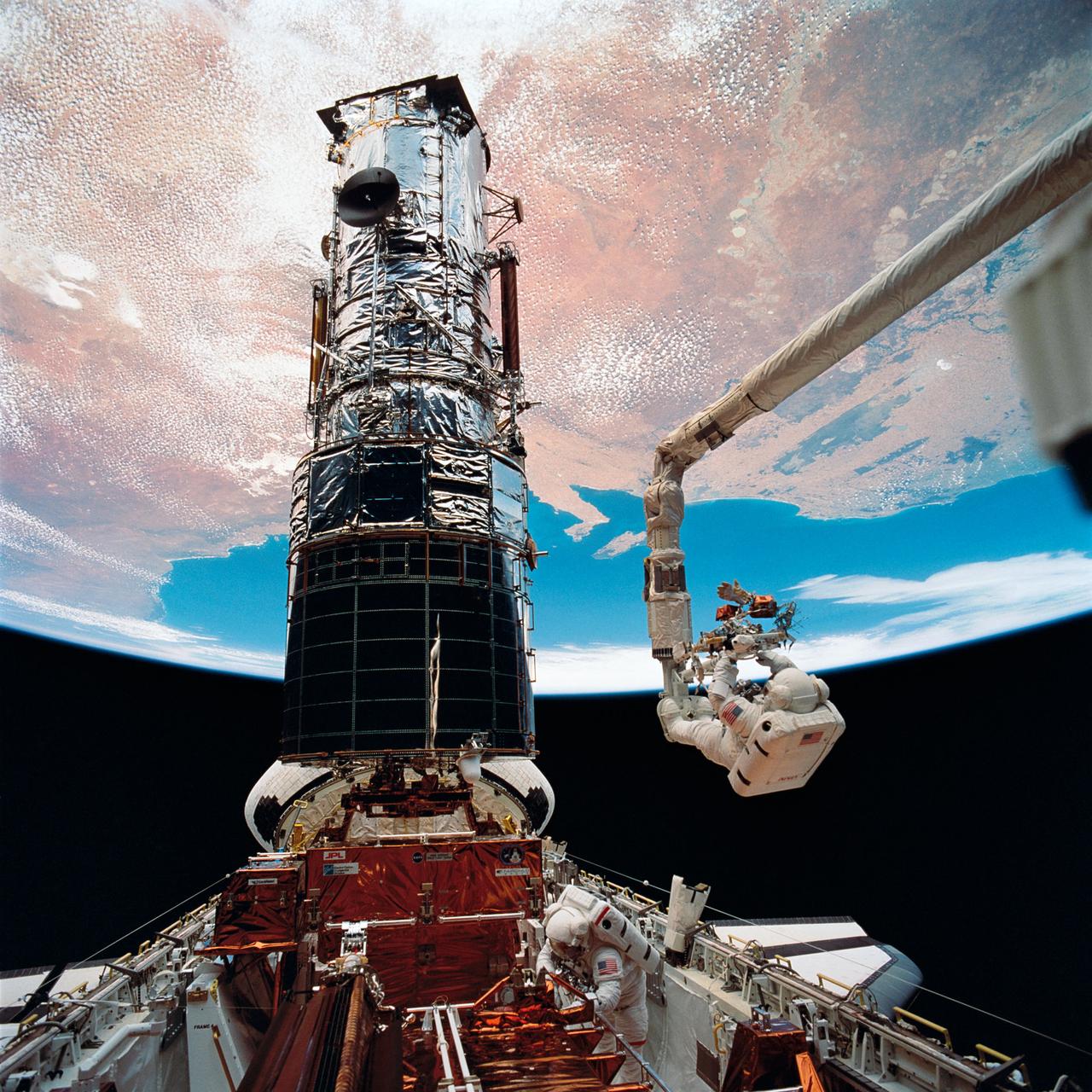
STS061-98-050 (9 Dec 1993) --- Astronaut F. Story Musgrave, anchored on the end of the Remote Manipulator System (RMS) arm, prepares to be elevated to the top of the towering Hubble Space Telescope (HST) to install protective covers on magnetometers. Astronaut Jeffrey A. Hoffman (bottom of frame) assisted Musgrave with final servicing tasks on the telescope, wrapping up five days of extravehicular activities (EVA).
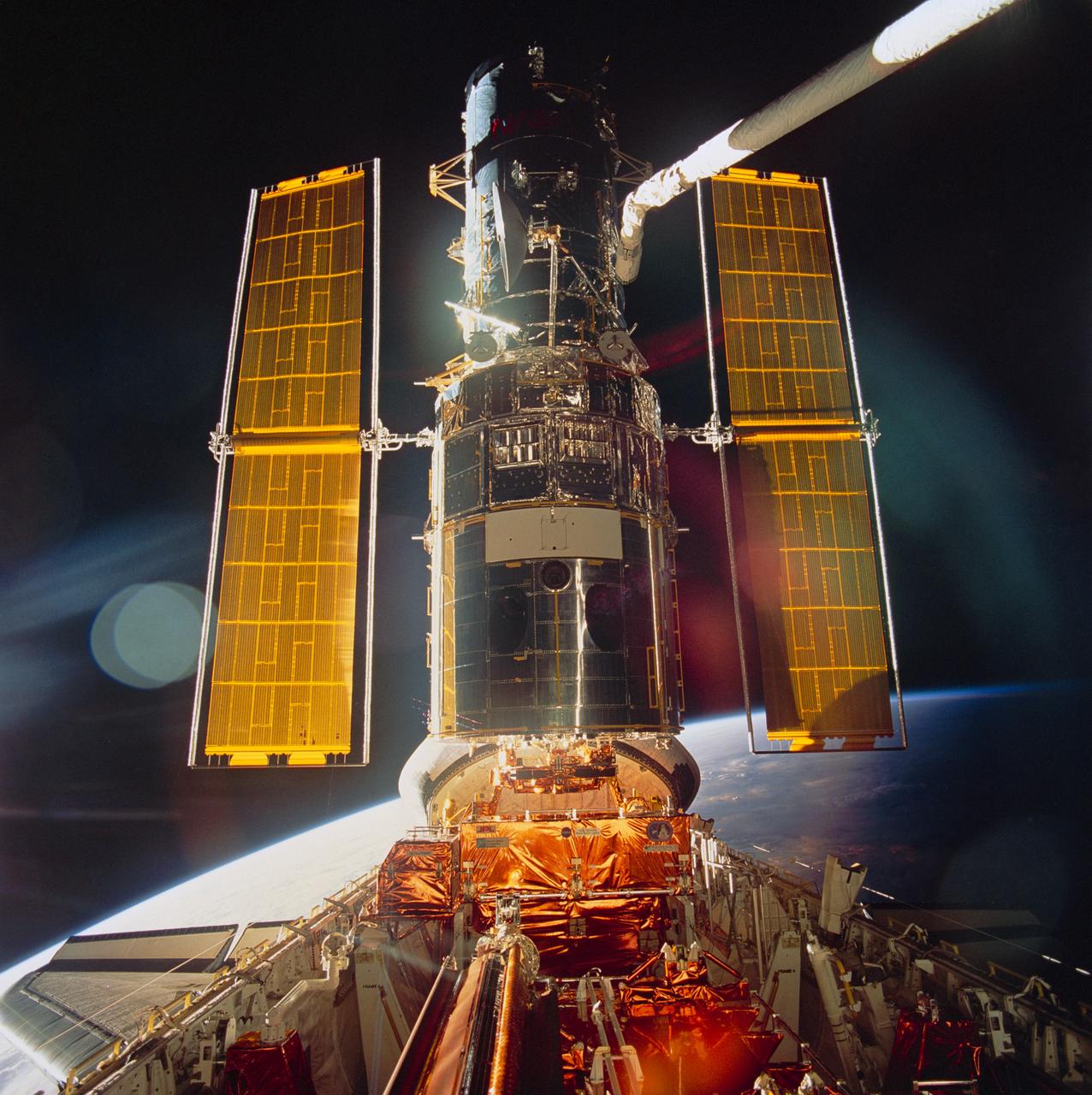
STS061-99-009 (9 Dec 1993) --- Sunlight reflects off the Space Shuttle Endeavour's aft windows and the shiny Hubble Space Telescope (HST) prior to its post-servicing deployment near the end of the eleven-day mission. A handheld Hasselblad camera was used inside Endeavour's cabin to record the image.
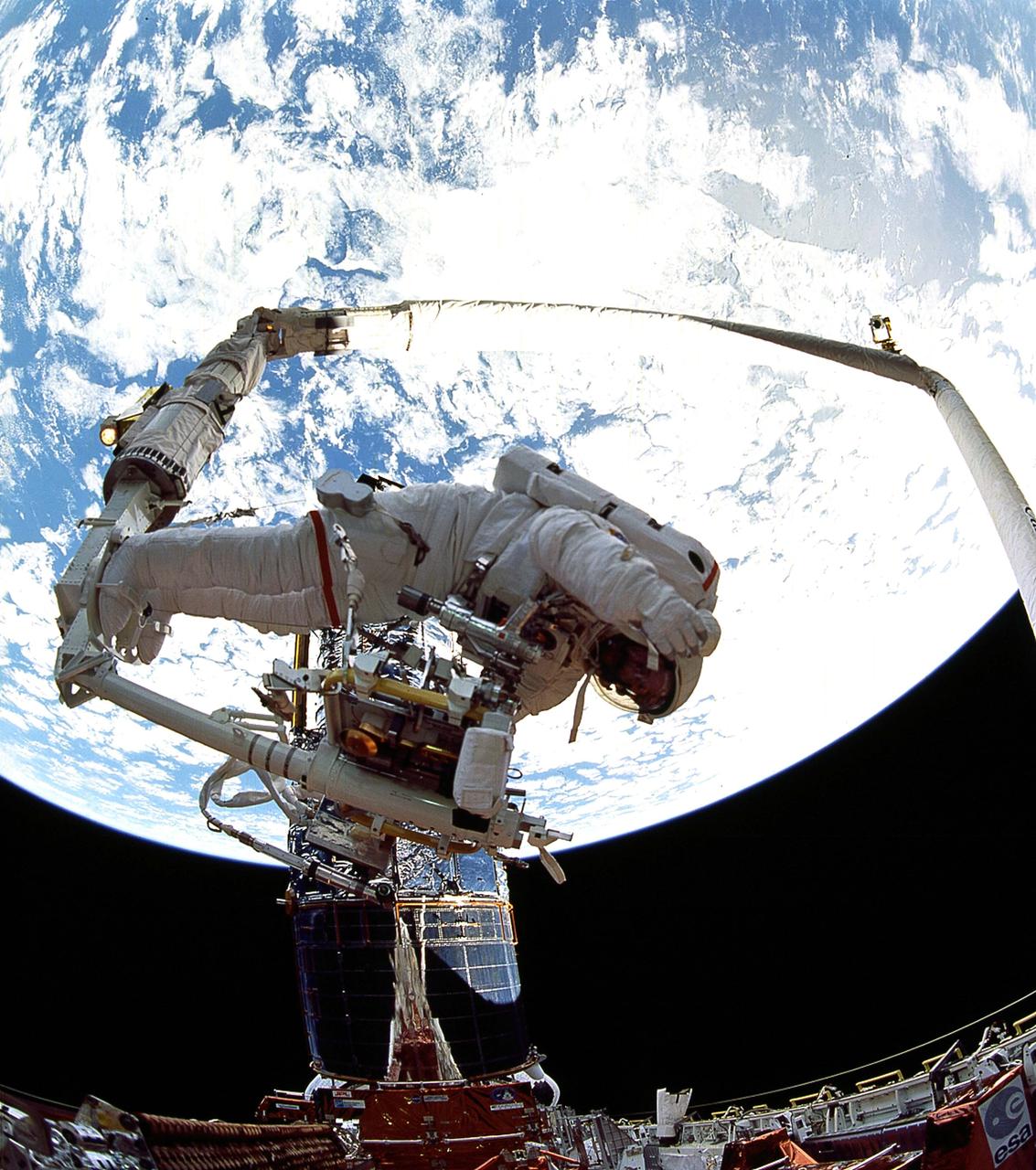
STS061-105-026 (7 Dec. 1993) --- Astronaut Jeffrey A. Hoffman signals directions to European Space Agency (ESA) astronaut Claude Nicollier, as the latter controls the Remote Manipulator System (RMS) arm during the third of five Extravehicular Activities (EVA) on the Hubble Space Telescope (HST) servicing mission. Astronauts Hoffman and F. Story Musgrave earlier changed out the Wide Field\Planetary Camera (WF\PC).
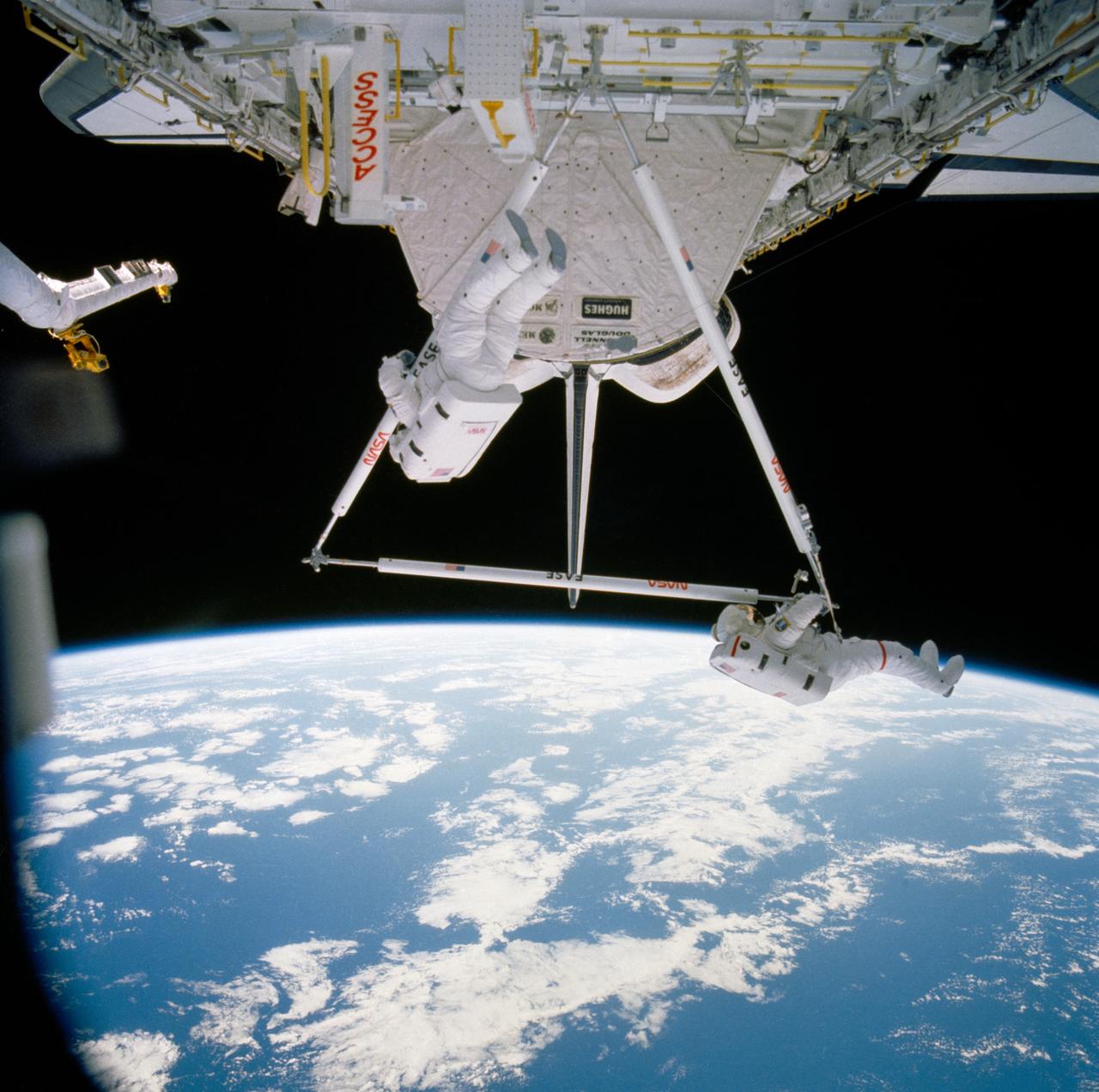
Astronauts Jerry L. Ross (left) and Sherwood C. (Woody) Spring are photographed as they assemble pieces of the Experimental Assembly of Structures in Extravehicular Activities (EASE) device in the open payload bay. The Canadian-built remote manipulator system (RMS) arm (partially obscured in the right portion of the frame) is in position to allow television cameras to record the activity.
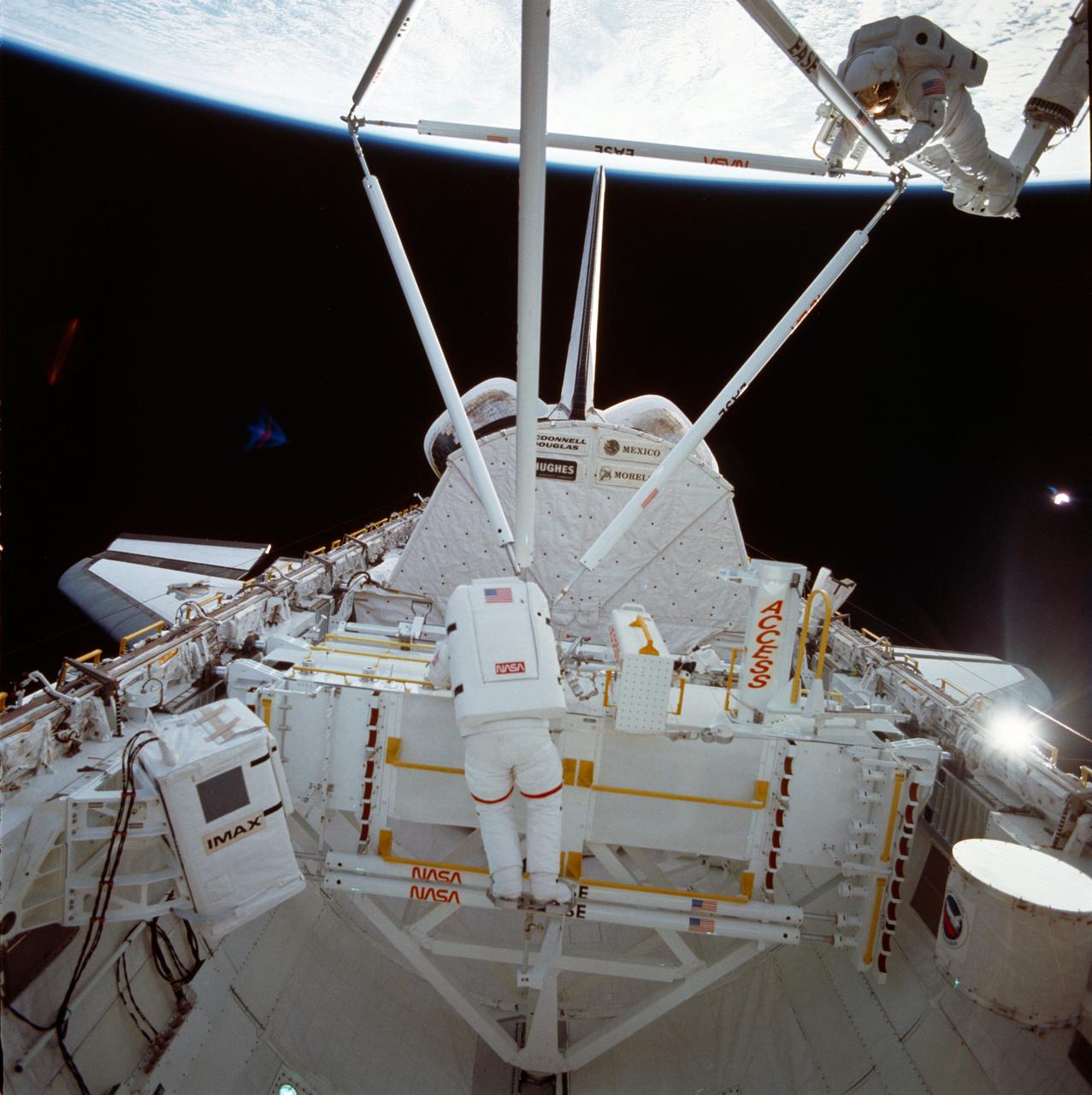
61B-41-047 (1 Dec 1985) --- Astronauts Jerry L. Ross (left) and Sherwood C. (Woody) Spring are photographed by Astronaut Bryan D. O'Connor as they continue to assemble more pieces of the EASE (Experimental Assembly of Structures in Extravehicular Activities) device during the week-long STS 61-B mission. This frame is one of a series covering the structure's build-up.
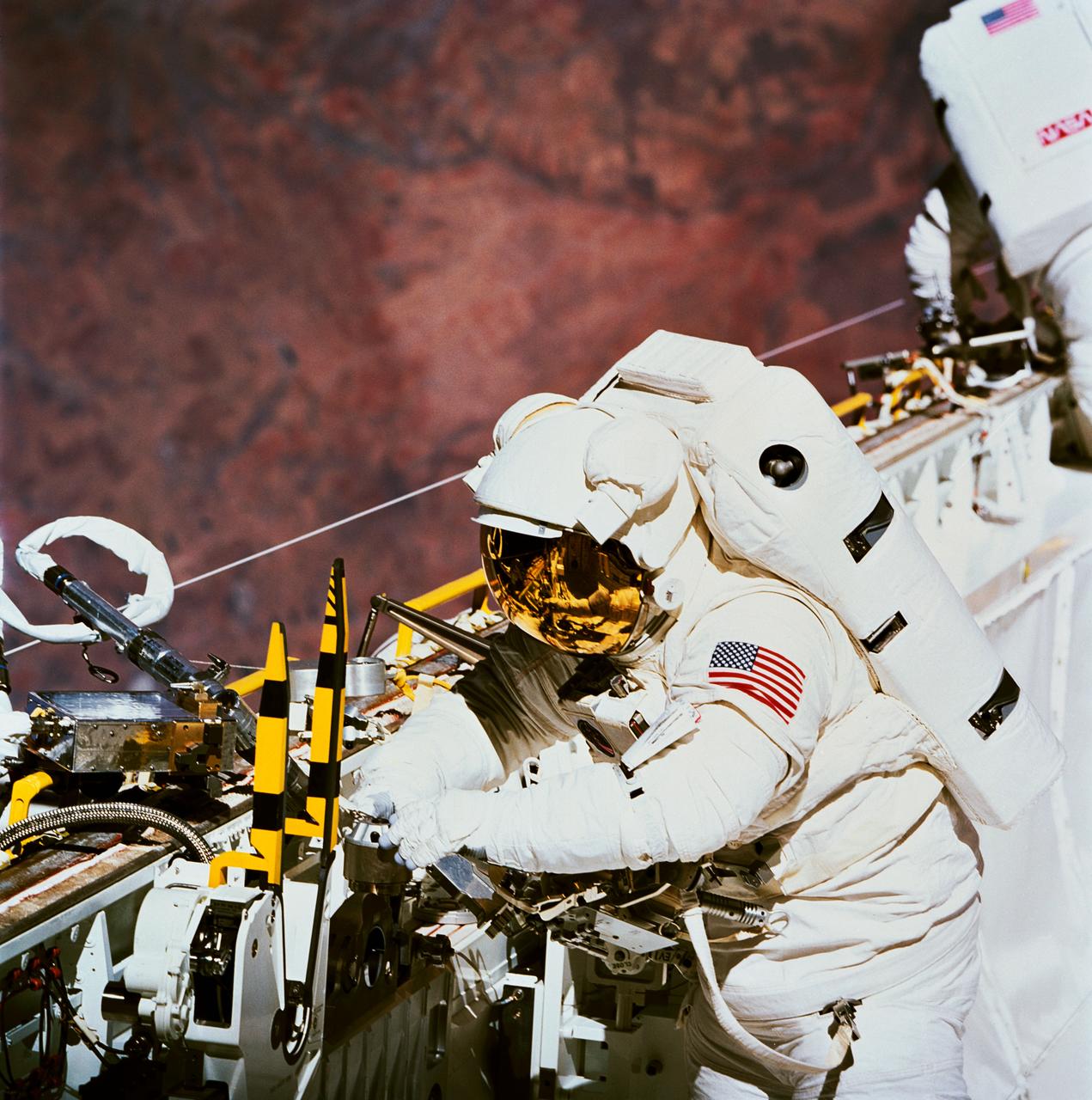
In Discovery's cargo bay, astronaut James H. Newman works with the power ratchet tool (PRT). Astronaut Carl E. Walz, who joined Newman for the lengthy period of extravehicular activity (EVA), is partially visible in the background. The two mission specialists devoted part of their EVA to evaluating tools and equipment expected to be used in the Hubble Space Telescope servicing. A desert area in Africa forms the backdrop for the 70mm scene.
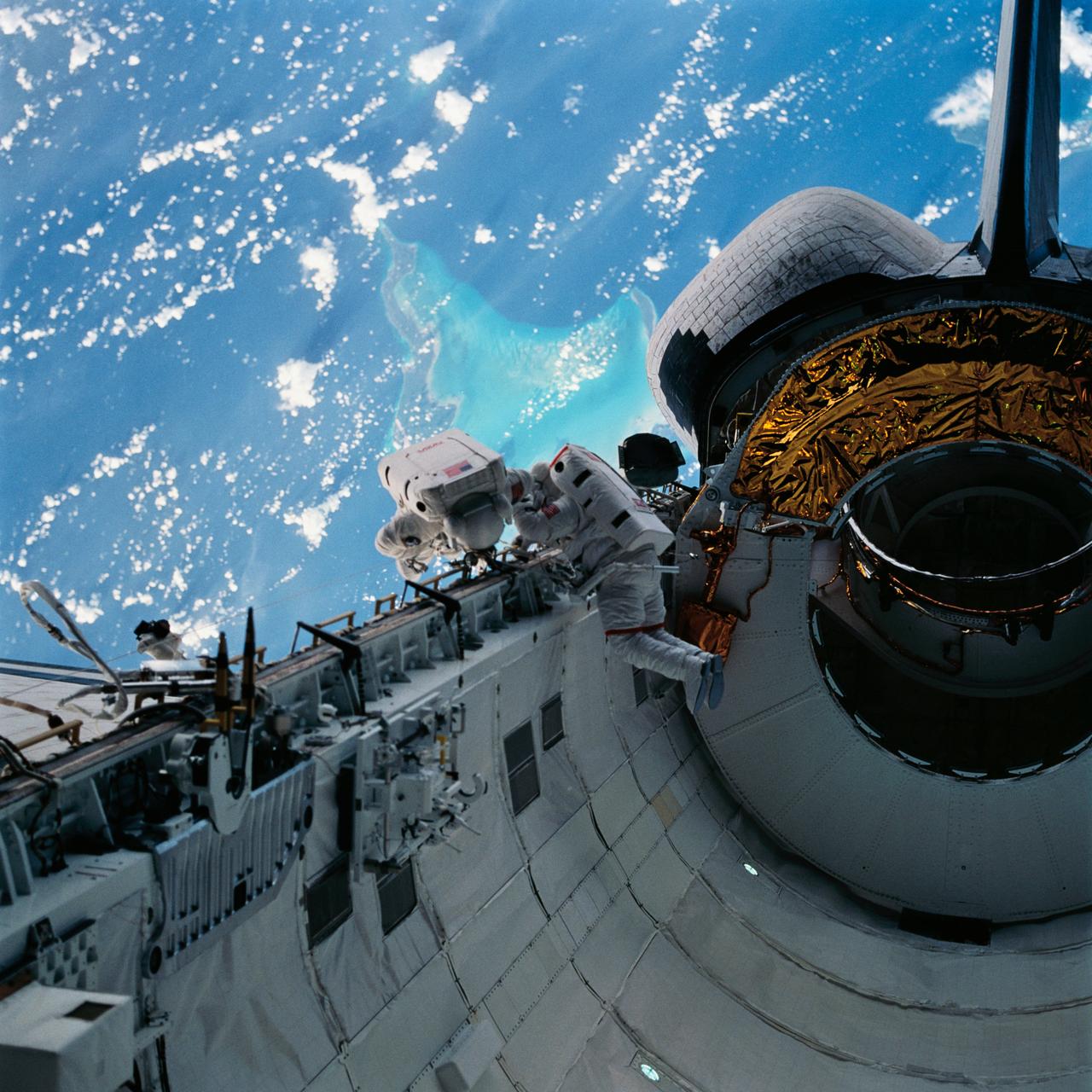
With the Caribbean Sea and part of the Bahama Islands chain as a backdrop, two STS-51 crewmembers evaluate procedures and gear to be used on the upcoming Hubble Space Telescope (HST)-servicing mission. Sharing the lengthy extravehicular activity in and around Discovery's cargo bay were astronauts James H. Newman (left), and Carl E. Walz, mission specialists.
STS051-34-028 (16 Sept. 1993) --- This unusual scene of Extravehicular Activity (EVA) was captured on 35mm film by one of the supportive in-cabin crew members. Astronaut James H. Newman, working on the Space Shuttle Discovery's starboard side, is nearer the camera, with astronaut Carl E. Walz traversing near the aft firewall and the Airborne Support Equipment (ASE).
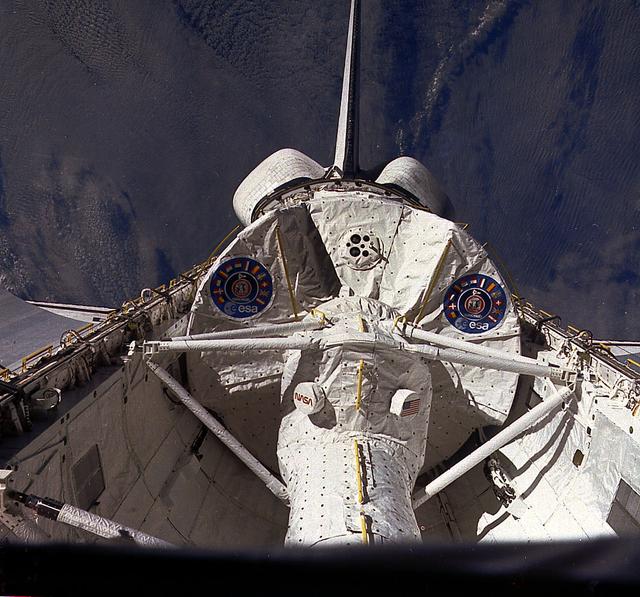
A Space Shuttle mission STS-9 onboard view show's Spacelab-1 (SL-1) module in orbiter Columbia's payload bay. Spacelab-1 was a cooperative venture of NASA and the European Space Agency. Scientists from eleven European nations plus Canada, Japan and the U.S. provided instruments and experimental procedures for over 70 different investigations in five research areas of disciplines: astronomy and solar physics, space plasma physics, atmospheric physics and Earth observations, life sciences and materials science.
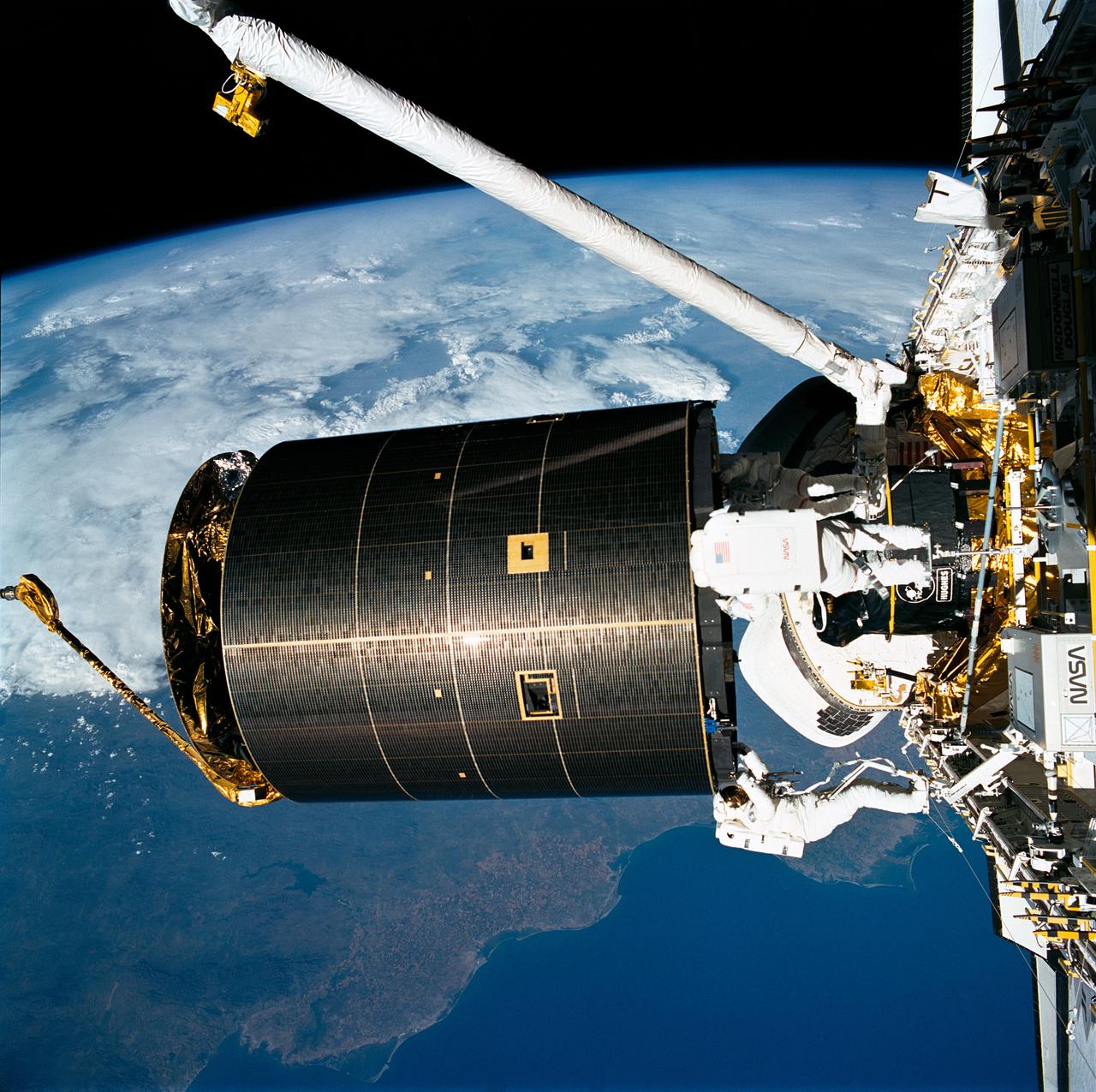
STS049-91-020 (13 May 1992) --- The successful capture of Intelsat VI satellite is recorded over Mexico on this 70mm frame, from inside the Space Shuttle Endeavour's cabin. Left to right, astronauts Richard J. Hieb, Thomas D. Akers and Pierre J. Thuot have handholds on the satellite. Ground coverage in the frame includes an area from Hermosillo, Sonara to Los Mochis in the state of Sinaloa. The nine-day mission accomplished the capture of the Intelsat, subsequent mating of the satellite to a booster and its eventual deployment, as well as a Space Station Freedom preview Extravehicular Activity (EVA). Endeavour's crew members were astronauts Daniel C. Brandenstein, mission commander; Kevin P. Chilton, pilot; and Thomas D. Akers, Richard J. Hieb, Bruce E. Melnick, Kathryn C. Thornton and Pierre J. Thuot, all mission specialists.
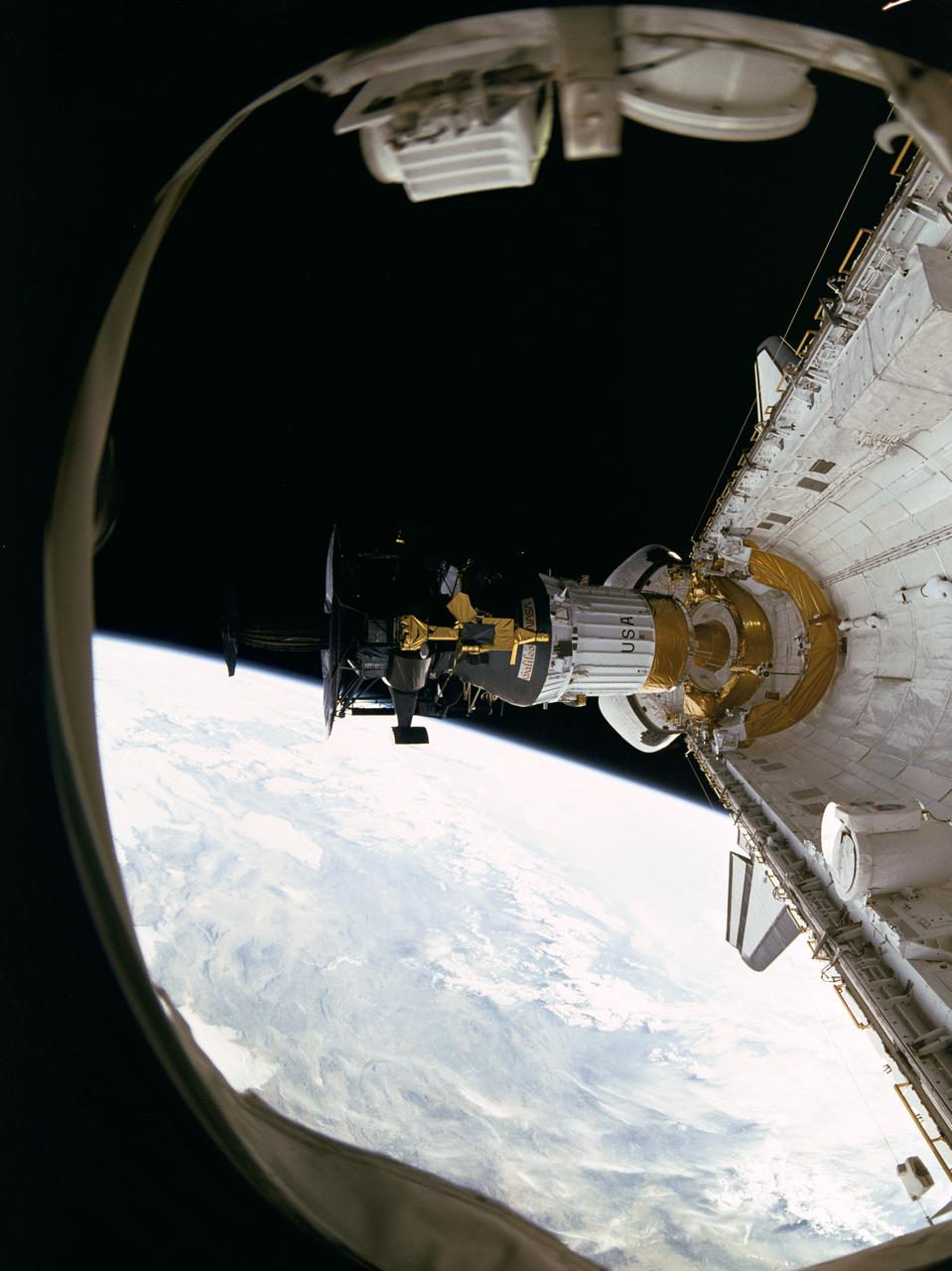
S89-48714 (18 Oct 1989) --- This photograph was taken by the STS-34 crew aboard the Space Shuttle Atlantis and shows the Galileo spacecraft being deployed on Oct. 18, 1989 from the payload bay. Galileo is a scientific craft that will go into orbit around the planet Jupiter and drop a probe into its atmosphere in search of primordial solar system material believed to be present there. The 70mm motion picture film will be used in the forthcoming "Blue Planet," which will address Earth's environmental problems from the perspective of space-based observation and solar system exploration. The film is being produced by IMAX Space Technology Inc. for the sponsor, the Smithsonian Institution, with funding provided by the Lockheed Corporation. PHOTO CREDIT: NASA/Smithsonian Institution
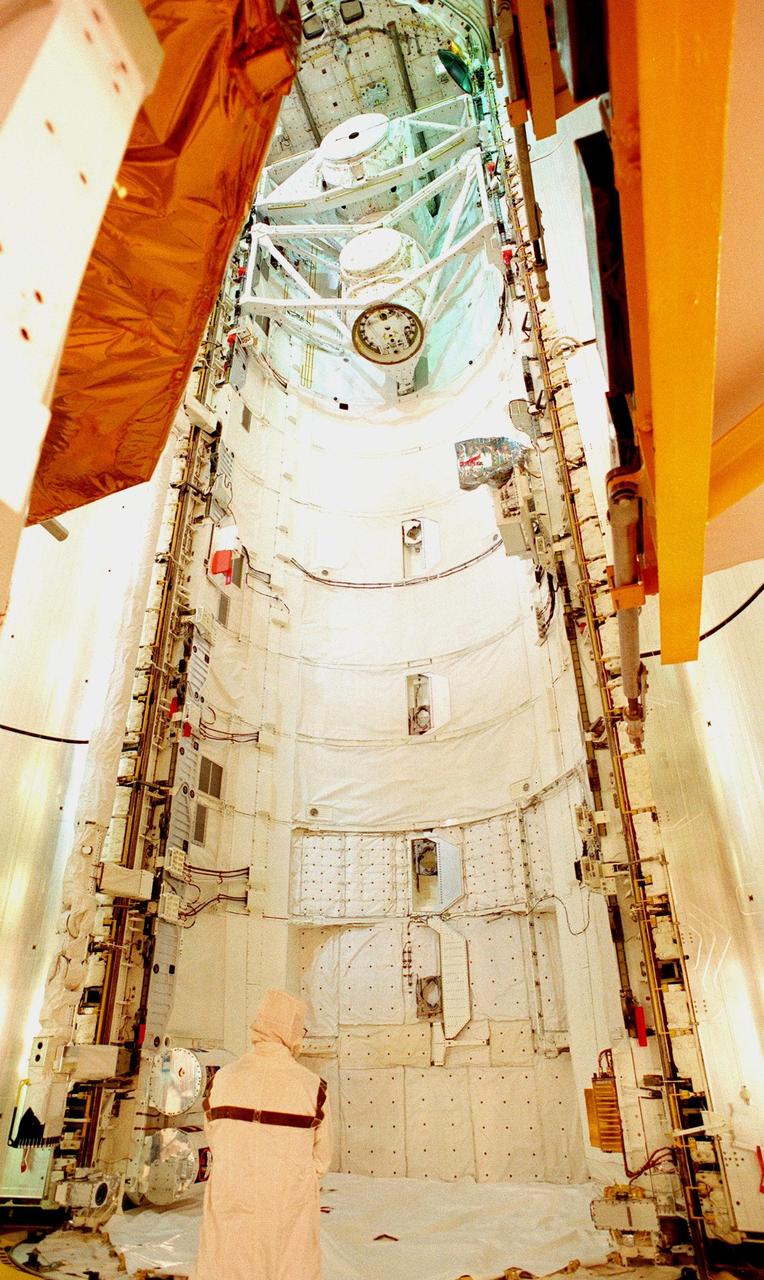
The open doors of the payload bay on Space Shuttle Discovery await the transfer of four of the payloads on mission STS-95: the SPACEHAB single module, Spartan, the Hubble Space Telescope Orbiting Systems Test Platform (HOST), and the International Extreme Ultraviolet Hitchhiker (IEH-3). At the top of bay are the airlock (used for depressurization and repressurization during extravehicular activity and transfer to Mir) and the tunnel adapter (enables the flight crew members to transfer from the pressurized middeck crew compartment to Spacelab's pressurized shirt-sleeve environment). SPACEHAB involves experiments on space flight and the aging process. Spartan is a solar physics spacecraft designed to perform remote sensing of the hot outer layers of the sun's atmosphere or corona. HOST carries four experiments to validate components planned for installation during the third Hubble Space Telescope servicing mission and to evaluate new technologies in an Earth-orbiting environment. IEH-3 comprises several experiments that will study the Jovian planetary system, hot stars, planetary and reflection nebulae, other stellar objects and their environments through remote observation of EUV/FUV emissions; study spacecraft interactions, Shuttle glow, thruster firings, and contamination; and measure the solar constant and identify variations in the value during a solar cycle. Discovery is scheduled to launch on Oct. 29, 1998
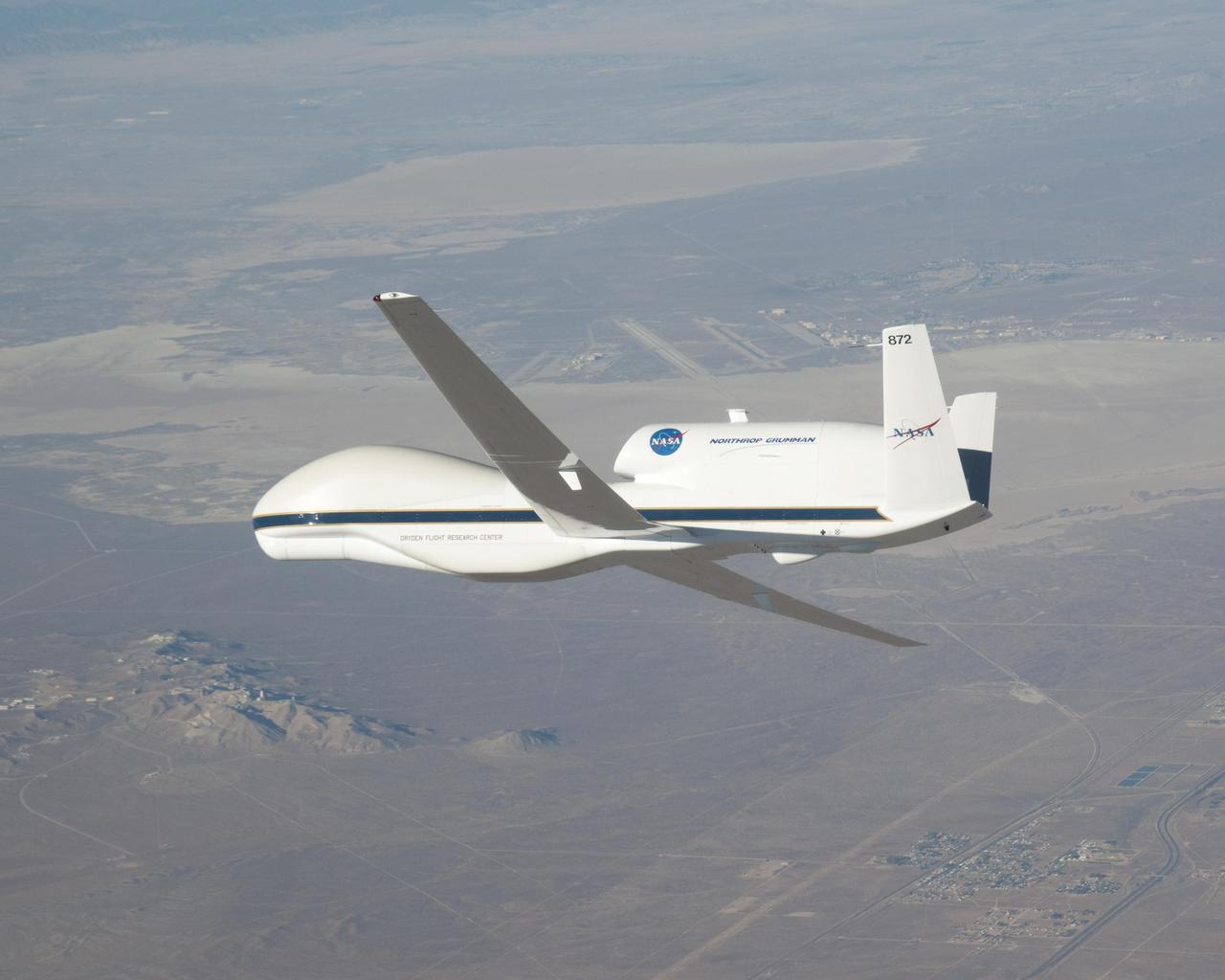
NASA image acquired October 23, 2009. At NASA’s Dryden Research Center in California, a group of engineers, scientists, and aviation technicians have set up camp in a noisy, chilly hangar on Edwards Air Force base. For the past two weeks, they have been working to mount equipment—from HD video cameras to ozone sensors—onto NASA’s Global Hawk, a remote-controlled airplane that can fly for up to 30 hours at altitudes up to 65,000 feet. The team is gearing up for the Global Hawk Pacific campaign, a series of four or five scientific research flights that will take the Global Hawk over the Pacific Ocean and Arctic regions. The 44-foot-long aircraft, with its comically large nose and 116-foot wingspan is pictured in the photograph above, banking for landing over Rogers Dry Lake in California at the end of a test flight on October 23, 2009. The long wings carry the plane’s fuel, and the bulbous nose is one of the payload bays, which house the science instruments. For the Global Hawk Pacific campaign, the robotic aircraft will carry ten science instruments that will sample the chemical composition of air in the troposphere (the atmospheric layer closest to Earth) and the stratosphere (the layer above the troposphere). The mission will also observe clouds and aerosol particles in the troposphere. The primary purpose of the mission is to collect observations that can be used to check the accuracy of simultaneous observations collected by NASA’s Aura satellite. Co-lead scientist Paul Newman from Goddard Space Flight Center is writing about the ground-breaking mission for the Earth Observatory’s Notes from the Field blog. NASA Photograph by Carla Thomas. <b><a href="http://www.nasa.gov/centers/goddard/home/index.html" rel="nofollow">NASA Goddard Space Flight Center</a></b> is home to the nation's largest organization of combined scientists, engineers and technologists that build spacecraft, instruments and new technology to study the Earth, the sun, our solar system, and the universe. To learn more about this image go to: <a href="http://earthobservatory.nasa.gov/IOTD/view.php?id=43291" rel="nofollow">earthobservatory.nasa.gov/IOTD/view.php?id=43291</a>

This photograph was taken during the integration of the Astro-1 mission payloads at the Kennedy Space Center on March 20, 1990, showing the Broad Band X-Ray Telescope (BBXRT) at the left, as three telescopes for the Astro-1 Observatory are settled into the Orbiter Columbia payload bay. Above Earth's atmospheric interference, Astro-1 would make precise measurements of objects such as planets, stars, and galaxies in relatively small fields of view and would observe and measure ultraviolet radiation from celestial objects. The Astro-1 used a Spacelab pallet system with an instrument pointing system and a cruciform structure for bearing the three ultraviolet instruments mounted in a parallel configuration. The three instruments were: The Hopkins Ultraviolet Telescope (HUT), which was designed to obtain far-ultraviolet spectroscopic data from white dwarfs, emission nebulae, active galaxies, and quasars; the Wisconsin Ultraviolet Photo-Polarimeter Experiment (WUPPE) which was to study polarized ultraviolet light from magnetic white dwarfs, binary stars, reflection nebulae, and active galaxies; and the Ultraviolet Imaging Telescope (UIT), which was to record photographic images in ultraviolet light of galaxies, star clusters, and nebulae. The star trackers that supported the instrument pointing system, were also mounted on the cruciform. Also in the payload bay was the Broad Band X-Ray Telescope (BBXRT), which was designed to obtain high-resolution x-ray spectra from stellar corona, x-ray binary stars, active galactic nuclei, and galaxy clusters. Managed by the Marshall Space Flight Center, the Astro-1 observatory was launched aboard the Space Shuttle Orbiter Columbia (STS-35) on December 2, 1990.
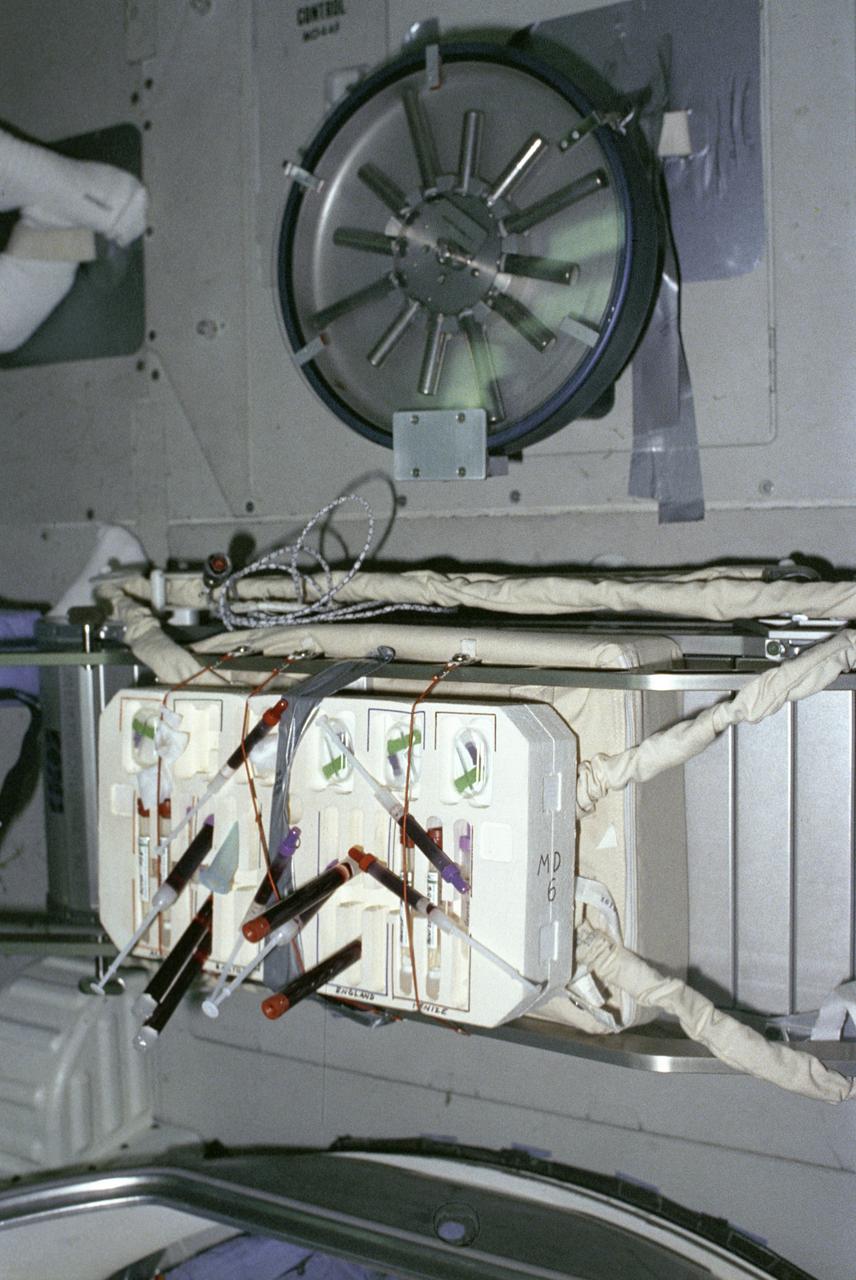
While instruments on the pallets in the payload bay observed the universe, biological experiments were performed in the middeck of the Shuttle Orbiter Challenger. Studying life processes in a microgravity environment can shed new light on the functioning of biological systems on Earth. These investigations can also help us understand how living organisms react to prolonged weightlessness. One such experiment was the vitamin D metabolites and bone demineralization experiment. This investigation measured the vitamin d metabolite levels of crew members to gain information on the cause of bone demineralization and mineral imbalance that occur during prolonged spaceflight as well as on Earth. Research into the biochemical nature of vitamin D has shown that the D-metabolites play a major role in regulating the body's calcium and phosphorus levels. One major function of the most biologically active vitamin D metabolite is to regulate the amount of calcium absorbed from the diet and taken out of bones. This investigation had two phases. The first was the developmental phase, which included extensive testing before flight, and the second, or final phase, involved the postflight analysis of the crew's blood samples. This photograph shows a blood draw test kit and centrifuge used for the experiment aboard the Spacelab-2. Marshall Space Flight Center had management responsibilities of all Spacelab missions.
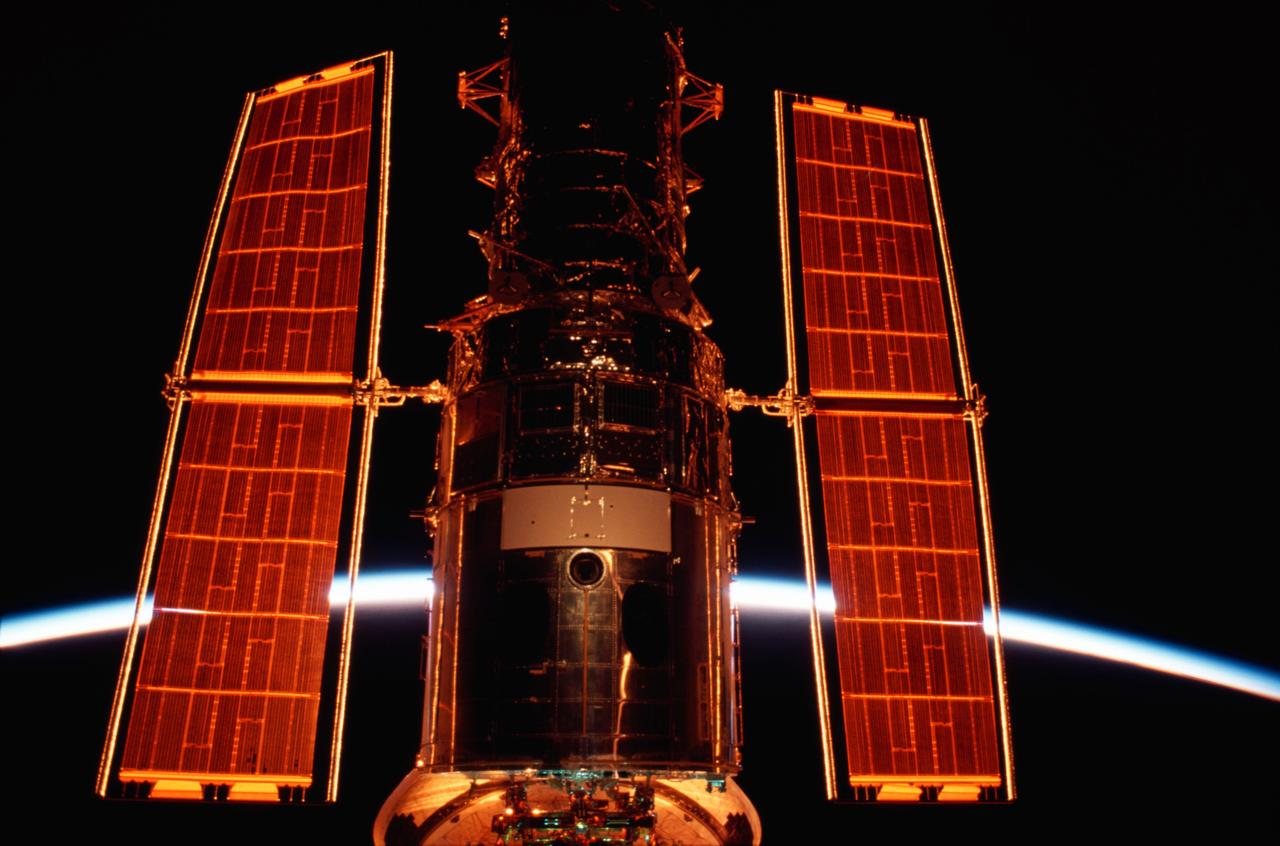
This is a photo of the Hubble Space Telescope (HST),in its origianl configuration, berthed in the cargo bay of the Space Shuttle Columbia during the STS-109 mission silhouetted against the airglow of the Earth's horizon. The telescope was captured and secured on a work stand in Columbia's payload bay using Columbia's robotic arm, where 4 of the 7-member crew performed 5 spacewalks completing system upgrades to the HST. Included in those upgrades were: replacement of the solar array panels; replacement of the power control unit (PCU); replacement of the Faint Object Camera (FOC) with a new advanced camera for Surveys (ACS); and installation of the experimental cooling system for the Hubble's Near-Infrared Camera and Multi-object Spectrometer (NICMOS), which had been dormant since January 1999 when its original coolant ran out. The Marshall Space Flight Center had the responsibility for the design, development, and construction of the the HST, which is the most complex and sensitive optical telescope ever made, to study the cosmos from a low-Earth orbit. The HST detects objects 25 times fainter than the dimmest objects seen from Earth and provides astronomers with an observable universe 250 times larger than is visible from ground-based telescopes, perhaps as far away as 14 billion light-years. The HST views galaxies, stars, planets, comets, possibly other solar systems, and even unusual phenomena such as quasars, with 10 times the clarity of ground-based telescopes. Launched March 1, 2002 the STS-109 HST servicing mission lasted 10 days, 22 hours, and 11 minutes. It was the 108th flight overall in NASA's Space Shuttle Program.
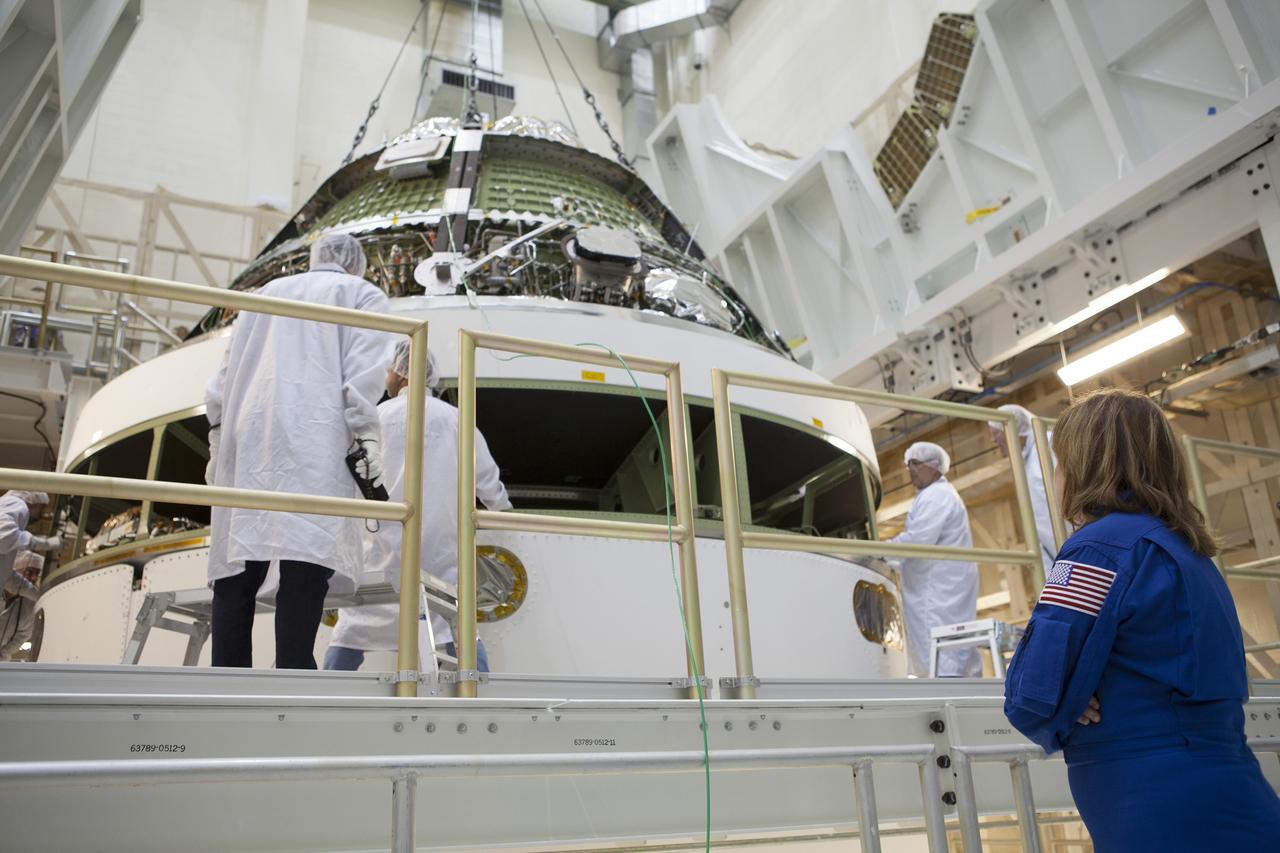
CAPE CANAVERAL, Fla. – Inside the Operations and Checkout Building high bay at NASA's Kennedy Space Center in Florida, Lockheed Martin technicians monitor the progress as a crane lowers the Orion crew module for stacking on the service module. The modules will be mated and then put through their final system tests before they are transported to the Payload Hazardous Servicing Facility for fueling. In the foreground, observing the processing, is NASA astronaut Anna Fisher. Orion is the exploration spacecraft designed to carry astronauts to destinations not yet explored by humans, including an asteroid and Mars. It will have emergency abort capability, sustain the crew during space travel and provide safe re-entry from deep space return velocities. Orion's first flight test is scheduled to launch in December atop a Delta IV Heavy rocket from Cape Canaveral Air Force Station in Florida to an altitude of 3,600 miles above the Earth's surface. The two-orbit, four-hour flight test will help engineers evaluate the systems critical to crew safety including the heat shield, parachute system and launch abort system. For more information, visit http://www.nasa.gov/orion. Photo credit: NASA/Dimitri Gerondidakis

CAPE CANAVERAL, Fla. – Inside the Operations and Checkout Building high bay at NASA's Kennedy Space Center in Florida, Lockheed Martin technicians monitor the progress as a crane lowers the Orion crew module for stacking on the service module. The modules will be mated and then put through their final system tests before they are transported to the Payload Hazardous Servicing Facility for fueling. In the foreground, observing the processing, is NASA astronaut Anna Fisher. Orion is the exploration spacecraft designed to carry astronauts to destinations not yet explored by humans, including an asteroid and Mars. It will have emergency abort capability, sustain the crew during space travel and provide safe re-entry from deep space return velocities. Orion's first flight test is scheduled to launch in December atop a Delta IV Heavy rocket from Cape Canaveral Air Force Station in Florida to an altitude of 3,600 miles above the Earth's surface. The two-orbit, four-hour flight test will help engineers evaluate the systems critical to crew safety including the heat shield, parachute system and launch abort system. For more information, visit http://www.nasa.gov/orion. Photo credit: NASA/Dimitri Gerondidakis
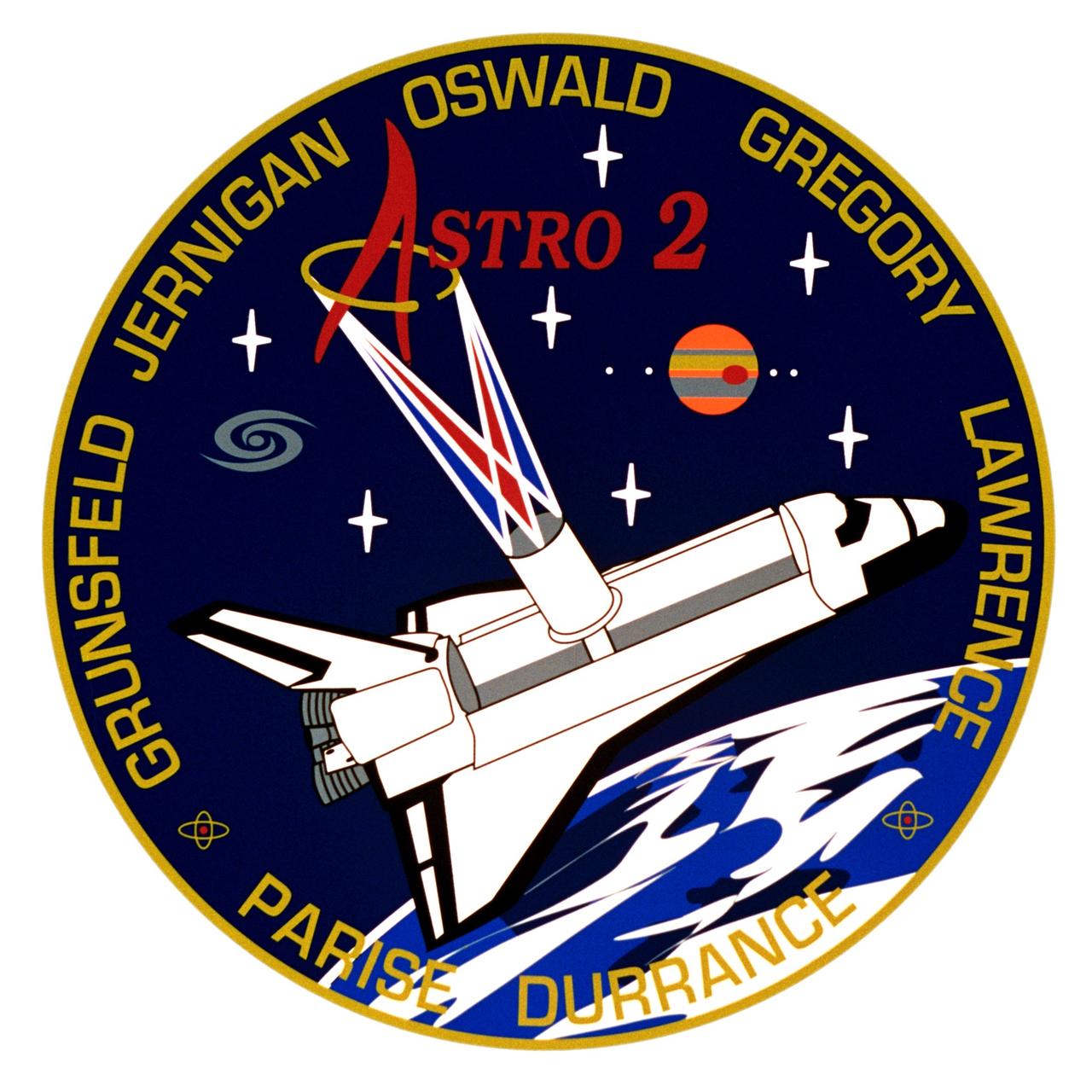
STS067-S-001 (October 1994) --- Observation and remote exploration of the Universe in the ultraviolet wavelengths of light are the focus of the STS-67/ASTRO-2 mission, as depicted in the crew patch designed by the crew members. The insignia shows the ASTRO-2 telescopes in the space shuttle Endeavour's payload bay, orbiting high above Earth's atmosphere. The three sets of rays, diverging from the telescope on the patch atop the Instrument Pointing System (IPS), correspond to the three ASTRO-2 telescopes -- the Hopkins Ultraviolet Telescope (HUT), the Ultraviolet Imaging Telescope (UIT), and the Wisconsin Ultraviolet Photo-Polarimeter Experiment (WUPPE). The telescopes are co-aligned to simultaneously view the same astronomical object, as shown by the convergence of rays on the NASA symbol. This symbol also represents the excellence of the union of the NASA teams and universality's in the exploration of the universe through astronomy. The celestial targets of ASTRO-2 include the observation of planets, stars and galaxies shown in the design. The two small atoms represent the search in the ultraviolet spectrum for the signature of primordial helium in intergalactic space left over from the Big Bang. The observations performed on ASTRO-2 will contribute to man's knowledge and understanding of the vast universe, from the planets in out system to the farthest reaches of space. The NASA insignia design for space shuttle flights is reserved for use by the astronauts and for other official use as the NASA Administrator may authorize. Public availability has been approved only in the forms of illustrations by the various news media. When and if there is any change in this policy, which is not anticipated, the change will be publicly announced. Photo credit: NASA
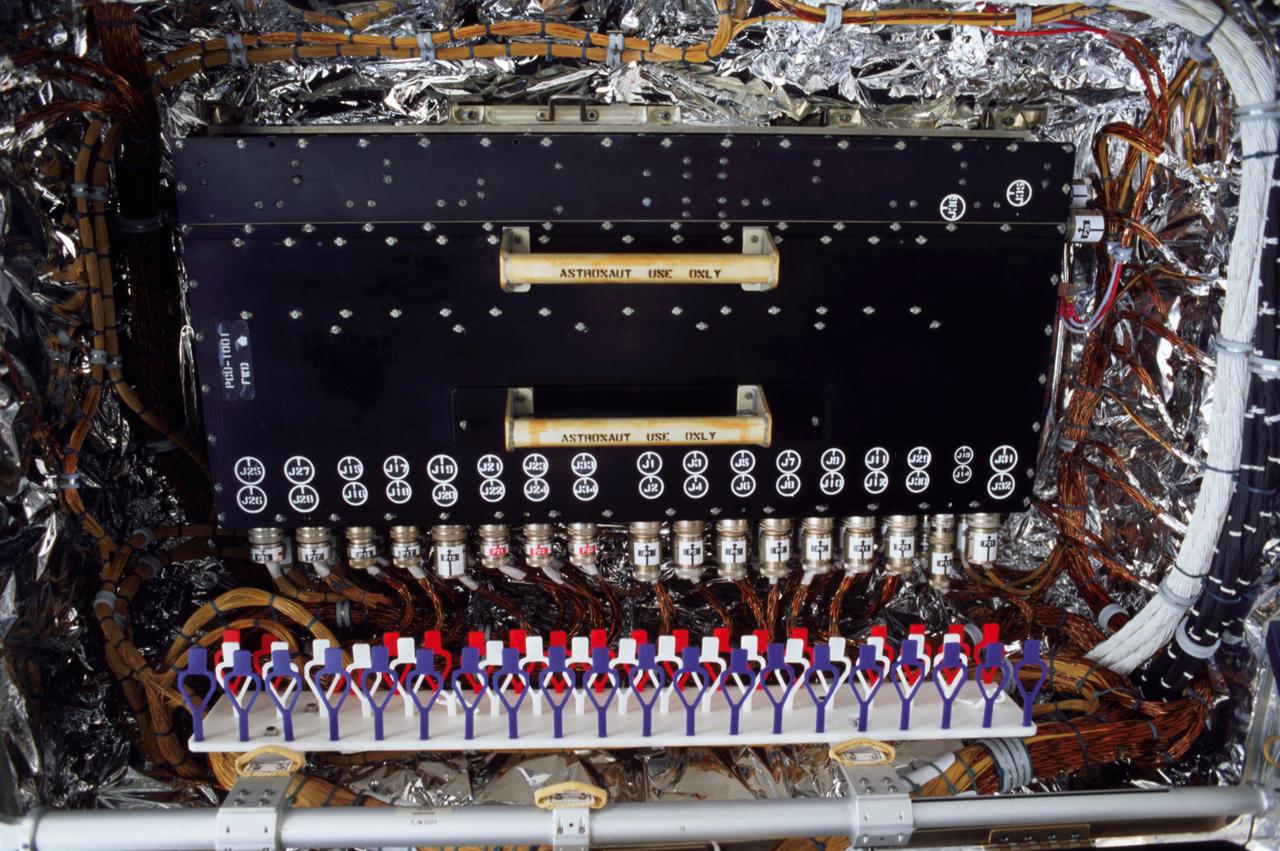
This is an onboard photo of the Hubble Space Telescope (HST) power control unit (PCU), the heart of the HST's power system. STS-109 payload commander John M. Grunsfeld, joined by Astronaut Richard M. Lirnehan, turned off the telescope in order to replace its PCU while participating in the third of five spacewalks dedicated to servicing and upgrading the HST. Other upgrades performed were: replacement of the solar array panels; replacement of the Faint Object Camera (FOC) with a new advanced camera for Surveys (ACS); and installation of the experimental cooling system for the Hubble's Near-Infrared Camera and Multi-Object Spectrometer (NICMOS), which had been dormant since January 1999 when its original coolant ran out. The telescope was captured and secured on a work stand in Columbia's payload bay using Columbia's robotic arm, where crew members completed the system upgrades. The Marshall Space Flight Center had the responsibility for the design, development, and construction of the HST, which is the most complex and sensitive optical telescope ever made, to study the cosmos from a low-Earth orbit. The HST detects objects 25 times fainter than the dimmest objects seen from Earth and provides astronomers with an observable universe 250 times larger than is visible from ground-based telescopes, perhaps as far away as 14 billion light-years. Launched March 1, 2002 the STS-109 HST servicing mission lasted 10 days, 22 hours, and 11 minutes. It was the 108th flight overall in NASA's Space Shuttle Program.
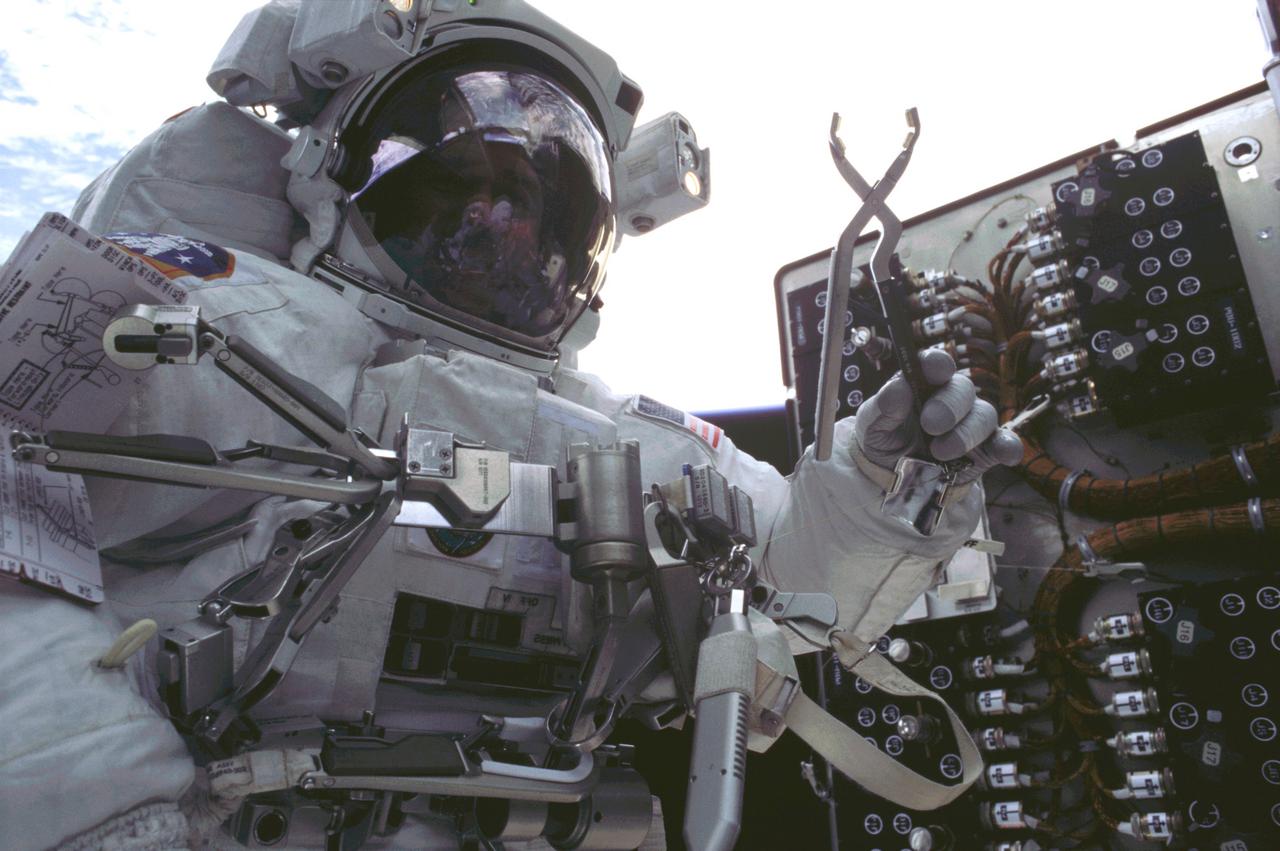
This is an onboard photo of Astronaut John M. Grunsfield, STS-109 payload commander, participating in the third of five spacewalks to perform work on the Hubble Space Telescope (HST). On this particular walk, Grunsfield, joined by Astronaut Richard M. Lirnehan, turned off the telescope in order to replace its power control unit (PCU), the heart of the HST's power system. The telescope was captured and secured on a work stand in Columbia's payload bay using Columbia's robotic arm, where crew members completed system upgrades to the HST. Included in those upgrades were: replacement of the solar array panels; replacement of the power control unit (PCU); replacement of the Faint Object Camera (FOC) with a new advanced camera for Surveys (ACS); and installation of the experimental cooling system for the Hubble's Near-Infrared Camera and Multi-object Spectrometer (NICMOS), which had been dormant since January 1999 when its original coolant ran out. The Marshall Space Flight Center had the responsibility for the design, development, and construction of the HST, which is the most complex and sensitive optical telescope ever made, to study the cosmos from a low-Earth orbit. The HST detects objects 25 times fainter than the dimmest objects seen from Earth and provides astronomers with an observable universe 250 times larger than is visible from ground-based telescopes, perhaps as far away as 14 billion light-years. The HST views galaxies, stars, planets, comets, possibly other solar systems, and even unusual phenomena such as quasars, with 10 times the clarity of ground-based telescopes. Launched March 1, 2002 the STS-109 HST servicing mission lasted 10 days, 22 hours, and 11 minutes. It was the 108th flight overall in NASA's Space Shuttle Program.
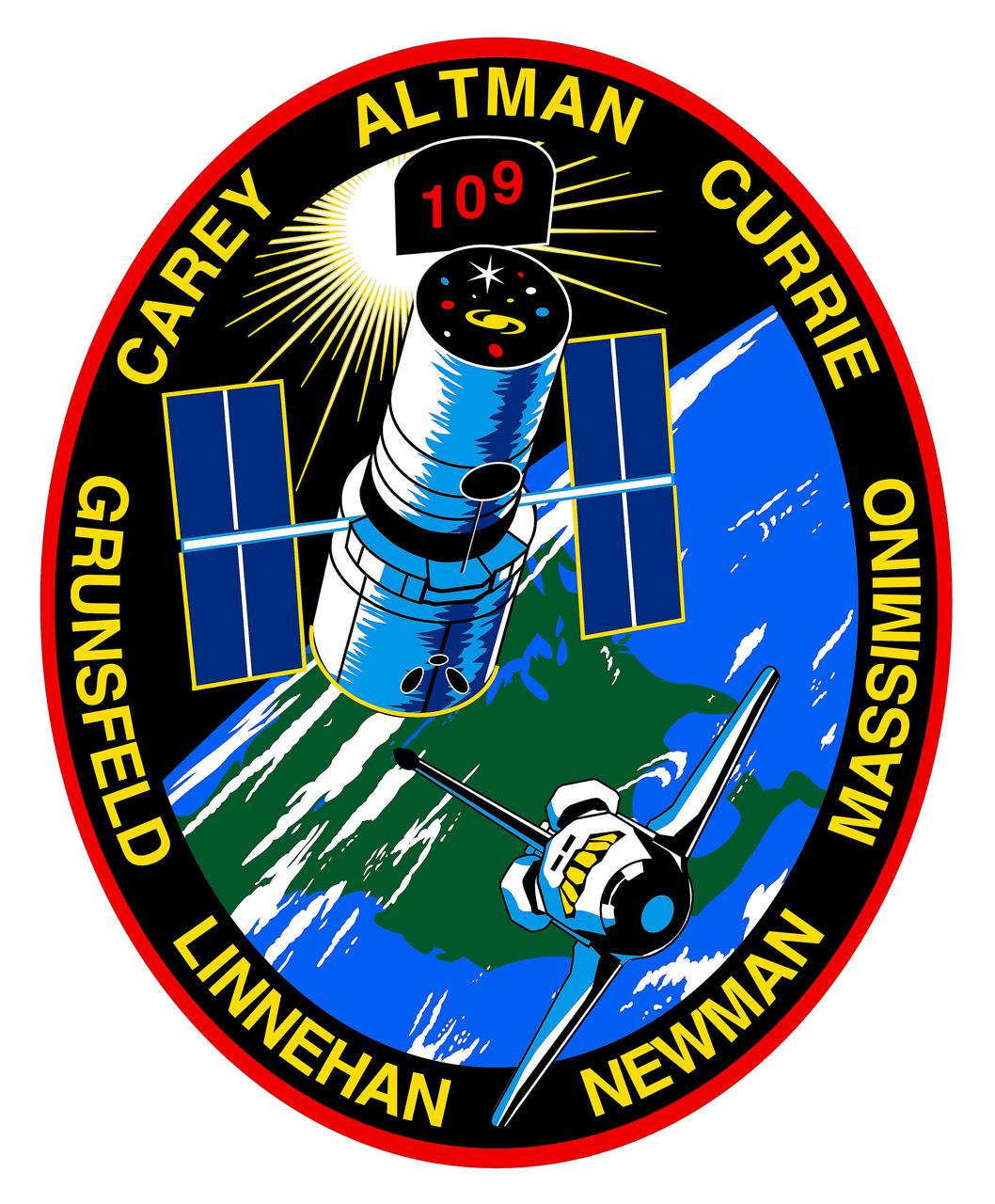
This is the insignia of the STS-109 Space Shuttle mission. Carrying a crew of seven, the Space Shuttle Orbiter Columbia was launched with goals of maintenance and upgrades to the Hubble Space Telescope (HST). The Marshall Space Flight Center had the responsibility for the design, development, and construction of the HST, which is the most complex and sensitive optical telescope ever made, to study the cosmos from a low-Earth orbit. The HST detects objects 25 times fainter than the dimmest objects seen from Earth and provides astronomers with an observable universe 250 times larger than is visible from ground-based telescopes, perhaps as far away as 14 billion light-years. The HST views galaxies, stars, planets, comets, possibly other solar systems, and even unusual phenomena such as quasars, with 10 times the clarity of ground-based telescopes. During the STS-109 mission, the telescope was captured and secured on a work stand in Columbia's payload bay using Columbia's robotic arm where four members of the crew performed five spacewalks completing system upgrades to the HST. Included in those upgrades were: The replacement of the solar array panels; replacement of the power control unit (PCU); replacement of the Faint Object Camera (FOC) with a new advanced camera for Surveys (ACS); and installation of the experimental cooling system for the Hubble's Near-Infrared Camera and Multi-object Spectrometer (NICMOS), which had been dormant since January 1999 when it original coolant ran out. Lasting 10 days, 22 hours, and 11 minutes, the STS-109 mission was the 27th flight of the Orbiter Columbia and the 108th flight overall in NASA's Space Shuttle Program.
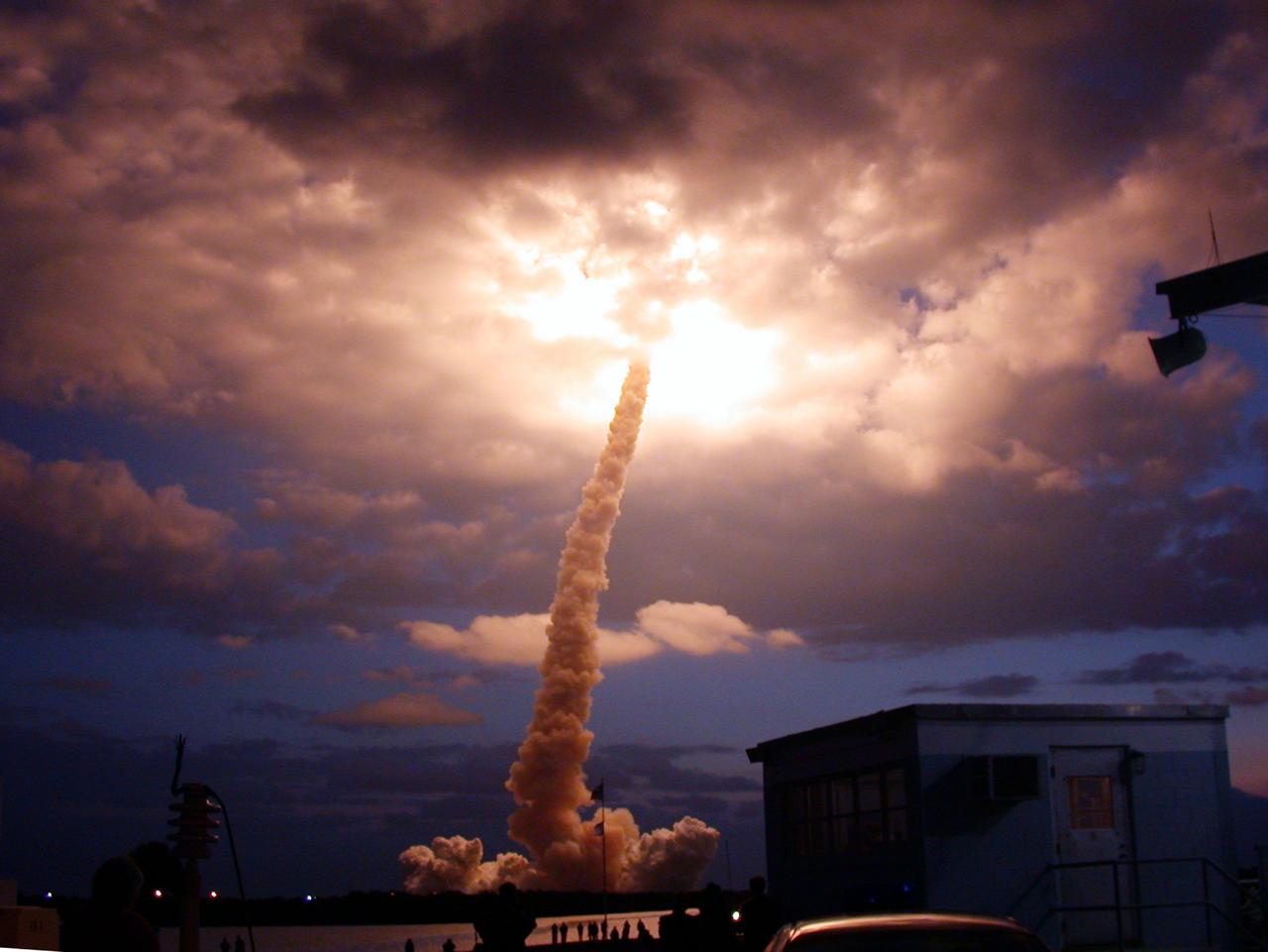
Carrying a crew of seven, the Space Shuttle Orbiter Columbia soared through some pre-dawn clouds into the sky as it began its 27th flight, STS-109. Launched March 1, 2002, the goal of the mission was the maintenance and upgrade of the Hubble Space Telescope (HST). The Marshall Space Flight Center had the responsibility for the design, development, and construction of the HST, which is the most complex and sensitive optical telescope ever made, to study the cosmos from a low-Earth orbit. The HST detects objects 25 times fainter than the dimmest objects seen from Earth and provides astronomers with an observable universe 250 times larger than is visible from ground-based telescopes, perhaps as far away as 14 billion light-years. The HST views galaxies, stars, planets, comets, possibly other solar systems, and even unusual phenomena such as quasars, with 10 times the clarity of ground-based telescopes. During the STS-109 mission, the telescope was captured and secured on a work stand in Columbia's payload bay using Columbia's robotic arm. Here four members of the crew performed five spacewalks completing system upgrades to the HST. Included in those upgrades were: replacement of the solar array panels; replacement of the power control unit (PCU); replacement of the Faint Object Camera (FOC) with a new advanced camera for Surveys (ACS); and installation of the experimental cooling system for the Hubble's Near-Infrared Camera and Multi-object Spectrometer (NICMOS), which had been dormant since January 1999 when it original coolant ran out. Lasting 10 days, 22 hours, and 11 minutes, the STS-109 mission was the 108th flight overall in NASA's Space Shuttle Program.