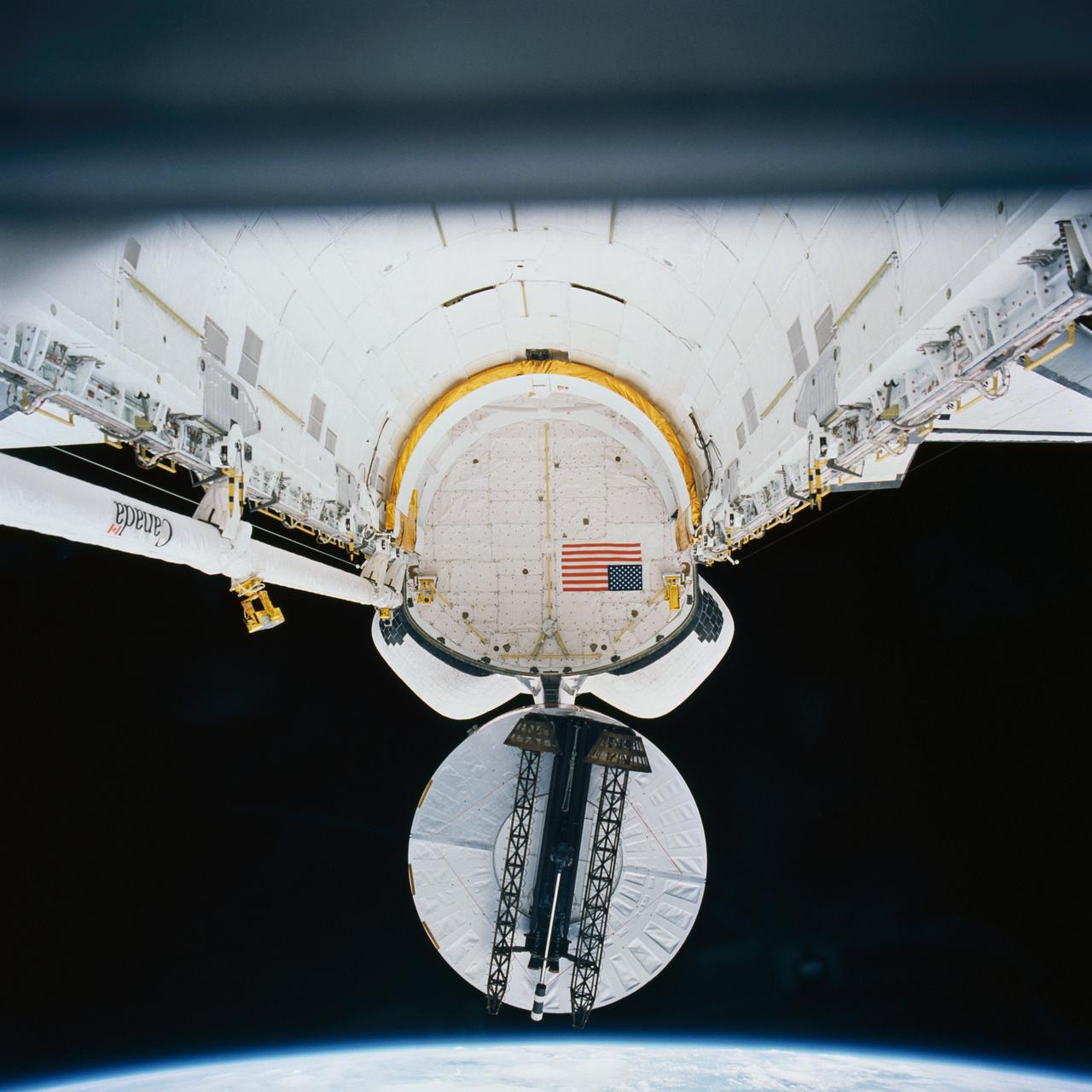
STS032-87-030 (10 Jan 1990) --- The Syncom IV-5 communications satellite leaves the cargo bay of Columbia, as crewmembers aboard the record-setting Space Shuttle successfully complete the first of two major tasks for STS-32. Two days later, the five astronauts successfully captured the Long Duration Exposure Facility (LDEF). The Syncom satellite, also called Leasat, is to be leased to the U.S. Navy by Hughes Aircraft Co. The crew went on to spend 11 days aboard Columbia before a successful landing at Edwards Air Force Base.
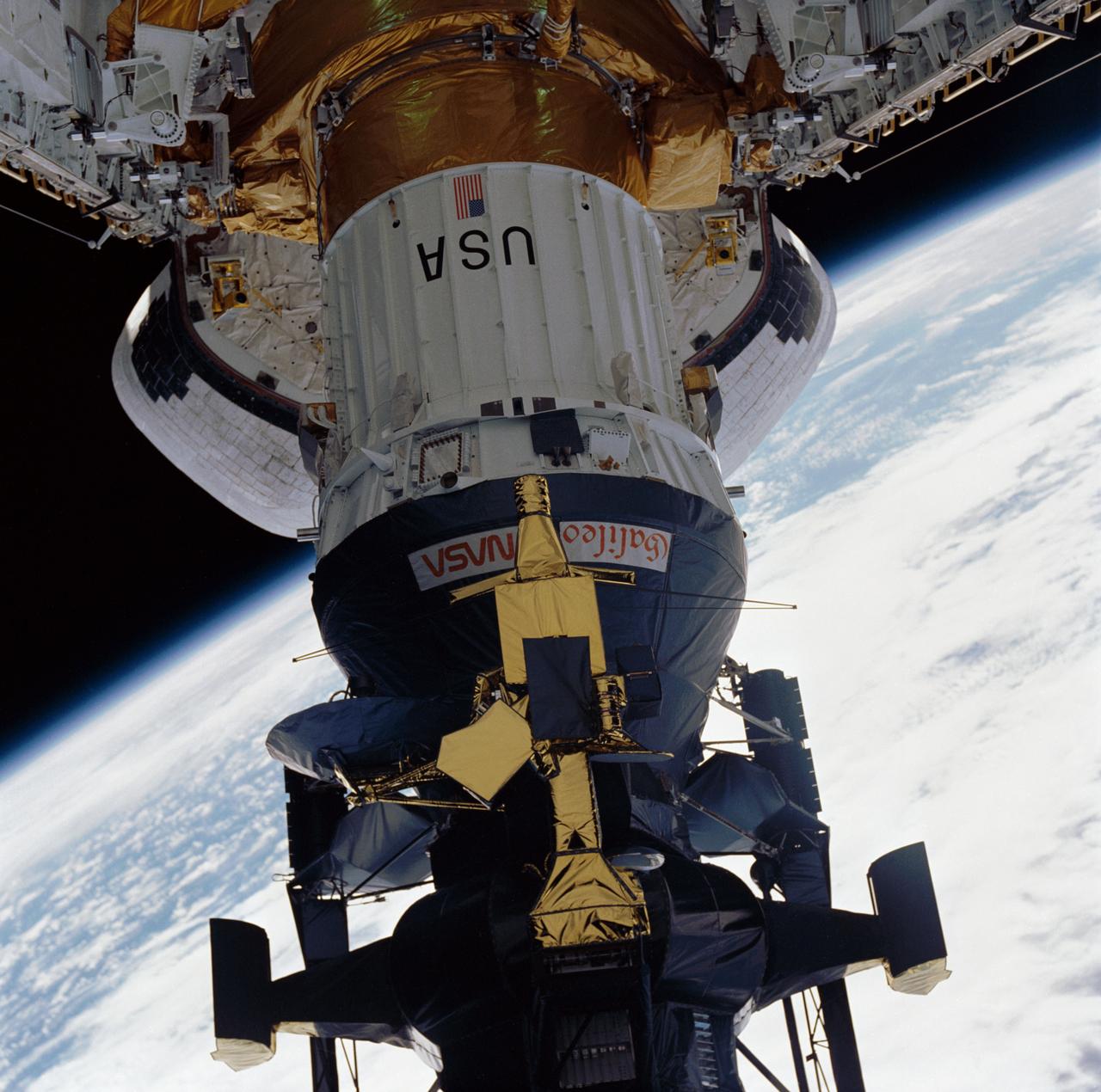
During STS-34 mission, the Galileo spacecraft mounted atop the inertial upper stage (IUS) is tilted to a 58-degree deployment position by the airborne support equipment (ASE) aft frame tilt actuator (AFTA) table in Atlantis', Orbiter Vehicle (OV) 104's, payload bay (PLB). Visible in the foreground is the ASE forward cradle and the umbilical boom which has fallen away from the IUS. OV-104's orbital maneuvering system (OMS) pods and the Earth's limb appear in the background.
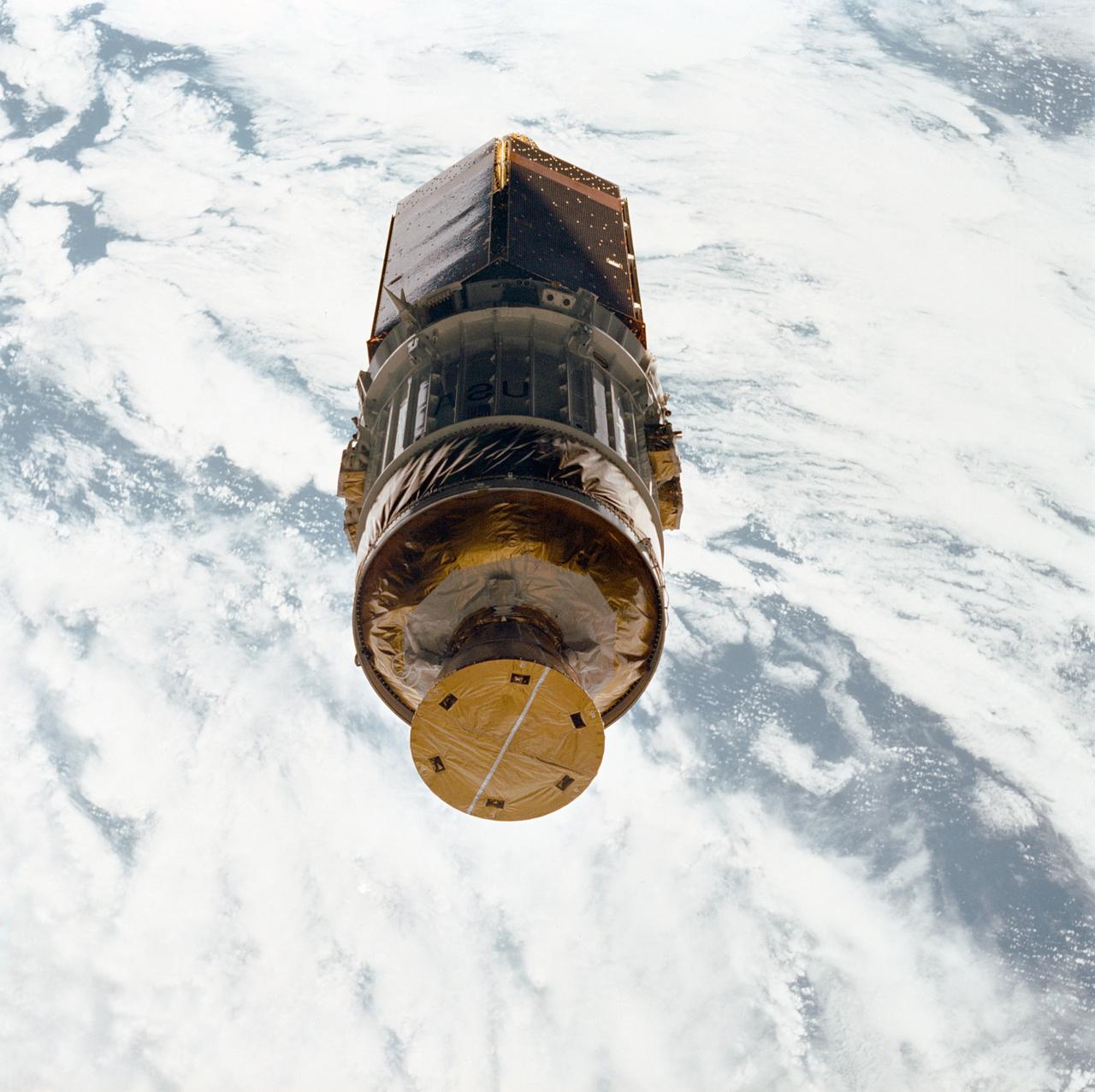
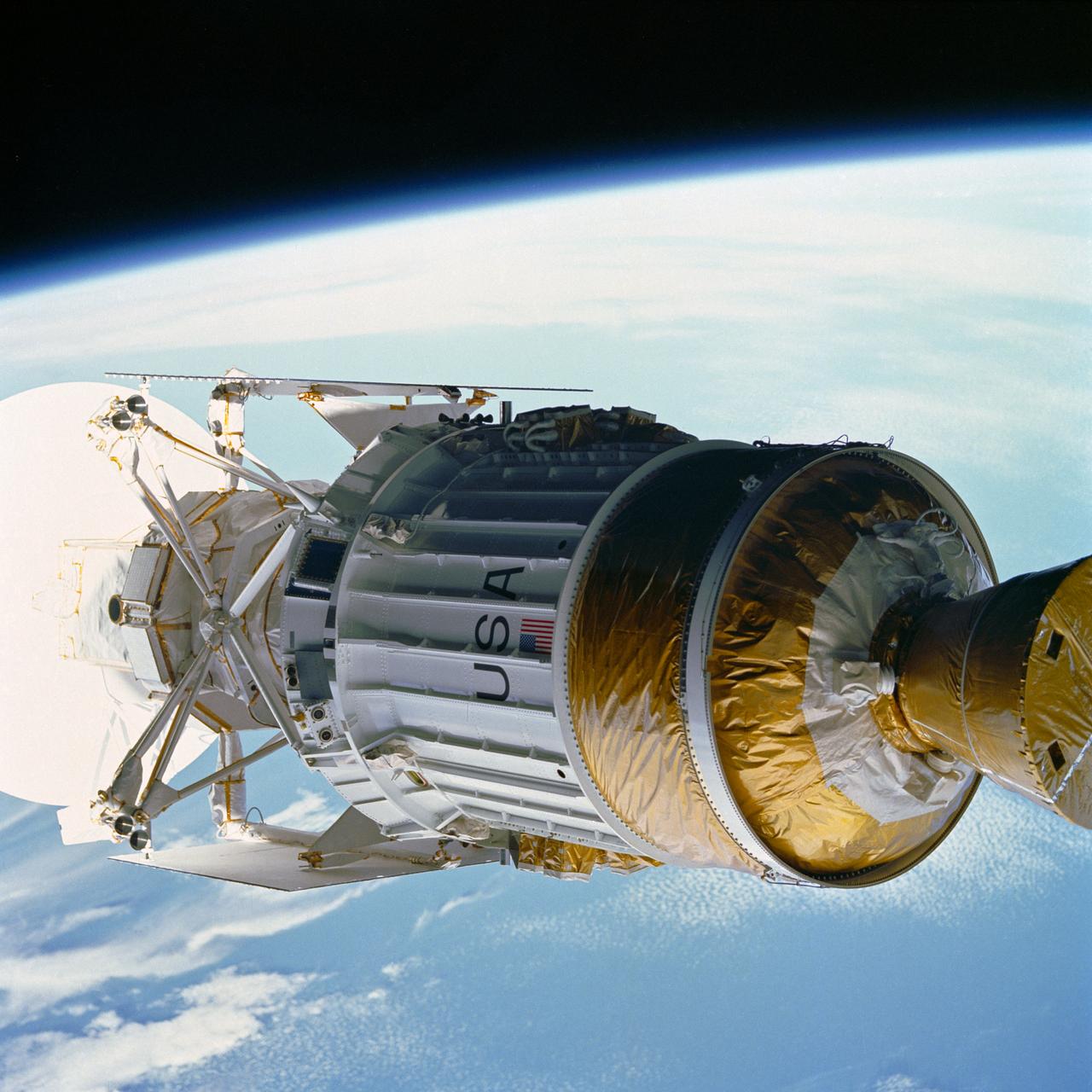
STS026-31-071 (3 Oct 1988) --- After deployment from Discovery, Orbiter Vehicle (OV) 103, the inertial upper stage (IUS) with the tracking and data relay satellite C (TDRS-C) drifts above the cloud-covered Earth surface. TDRS-C, in stowed configuration (solar array panels visible), is mounted atop the IUS with the interstage and solid rocket motor and nozzle seen in the foreground.
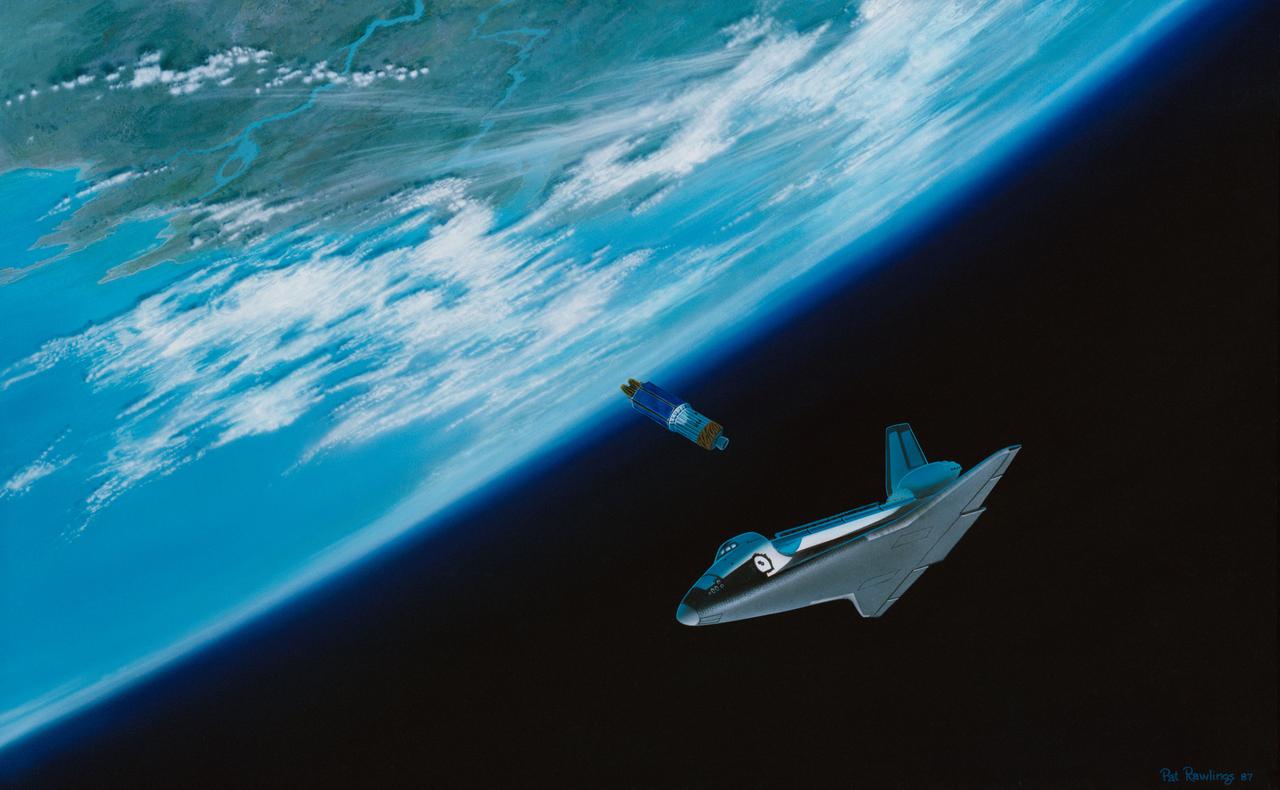
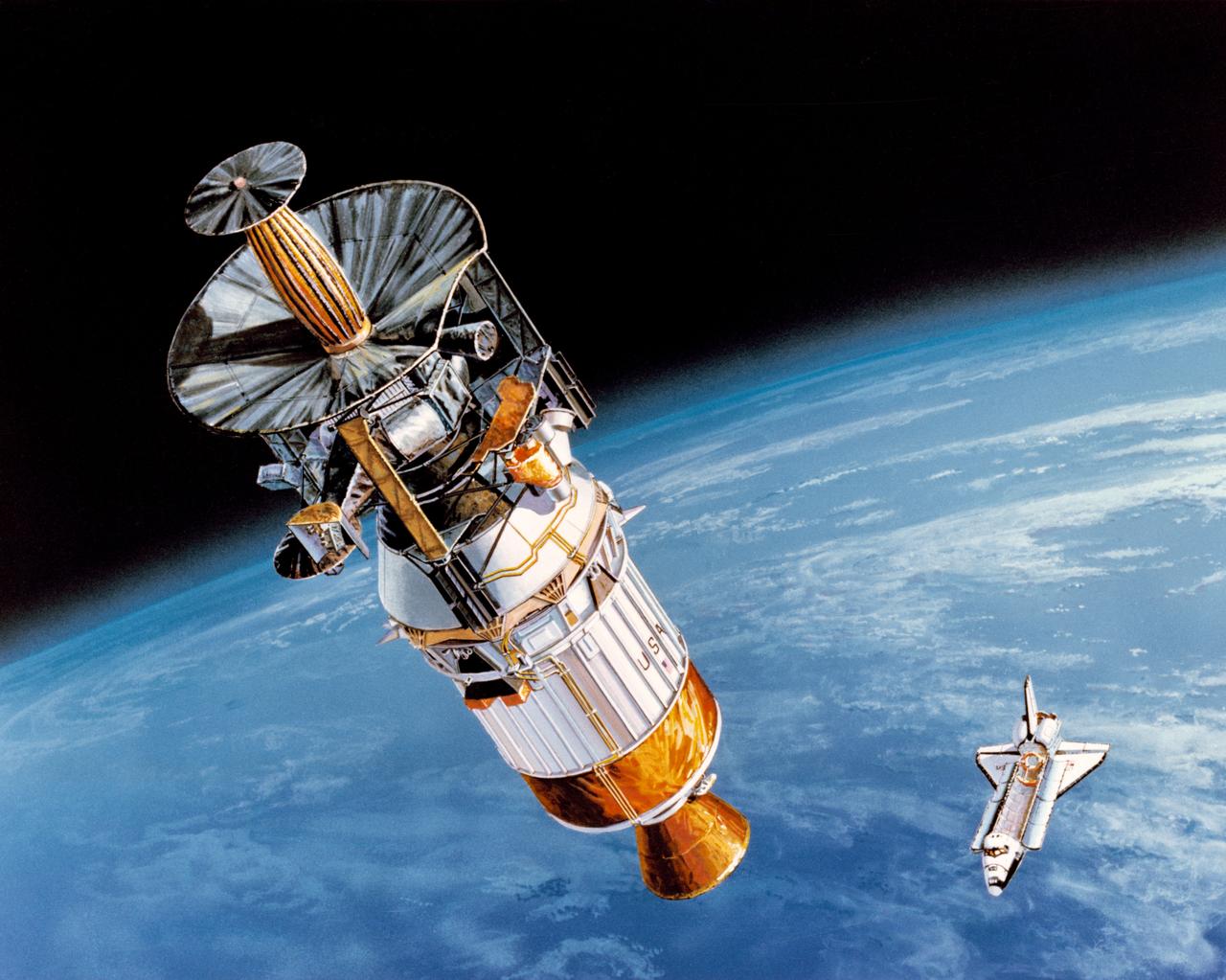
STS-26 Discovery, Orbiter Vehicle (OV) 103, artwork depicts tracking and data relay satellite C (TDRS-C) deployment. OV-103 orbits above Earth in bottom-to-sun attitude, moments after TDRS-C's release into space. TDRS-C is seen just below open payload bay (PLB). Artwork was done by Pat Rawlings of Eagle Engineering.
STS030-71-052 (4 May 1989) --- In the early evening hours of the Space Shuttle Atlantis' first day in space for the four-day mission, the Magellan spacecraft begins its long journey to the planet Venus for an extensive radar mapping mission. The scene was photographed through Atlantis' aft flight deck windows with a handheld 70mm camera.
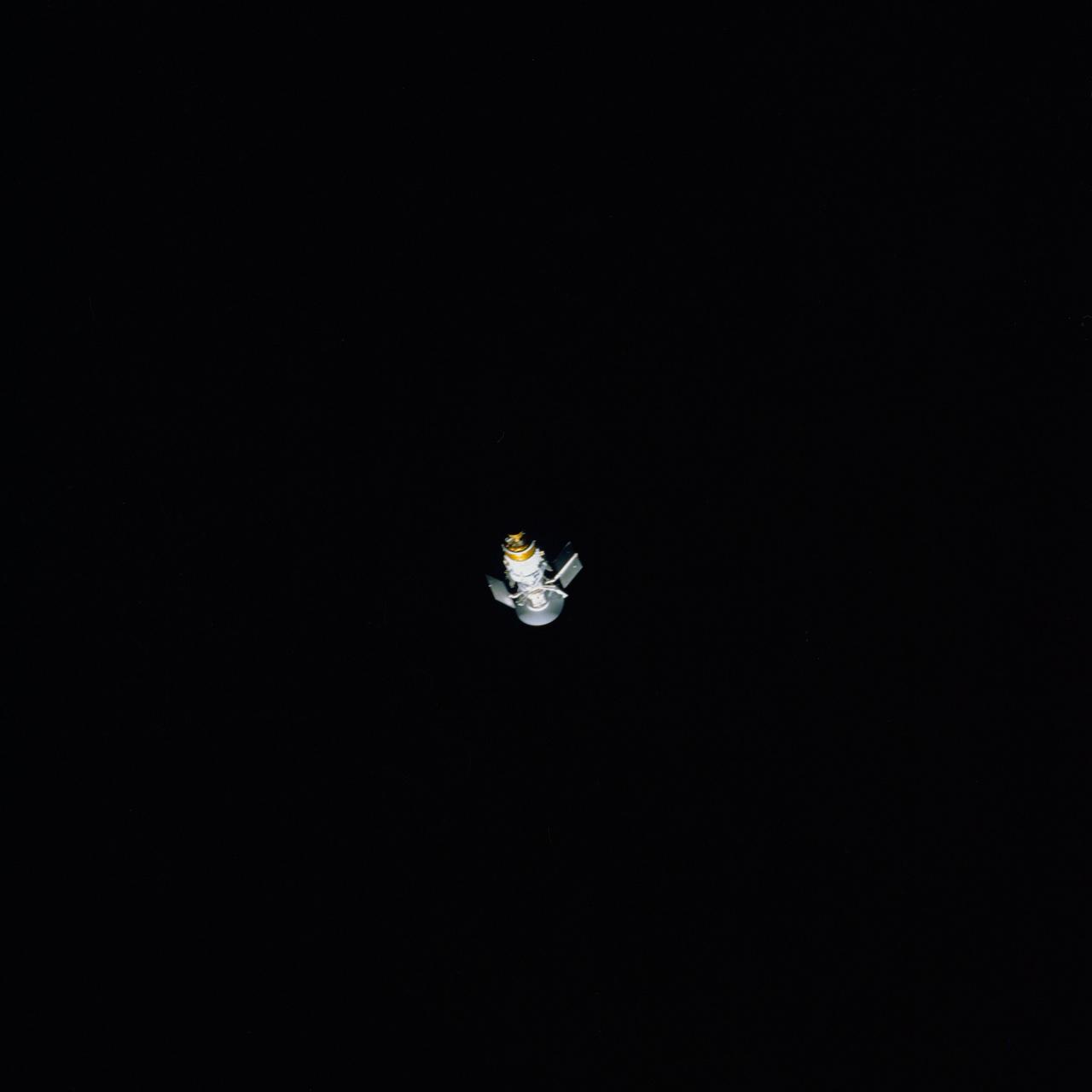
STS030-71-063 (4 May 1989) --- This scene is one of two released by NASA showing the process of solar array panel deployment on the Magellan spacecraft. Panels are not fully extended in this frame. The spacecraft had earlier been released by the STS-30 crewmembers to begin its long journey to the planet Venus for an extensive radar mapping mission. The frame was photographed through Atlantis? aft flight deck windows with a handheld 70mm camera. The complementary photograph is STS030-71-070.
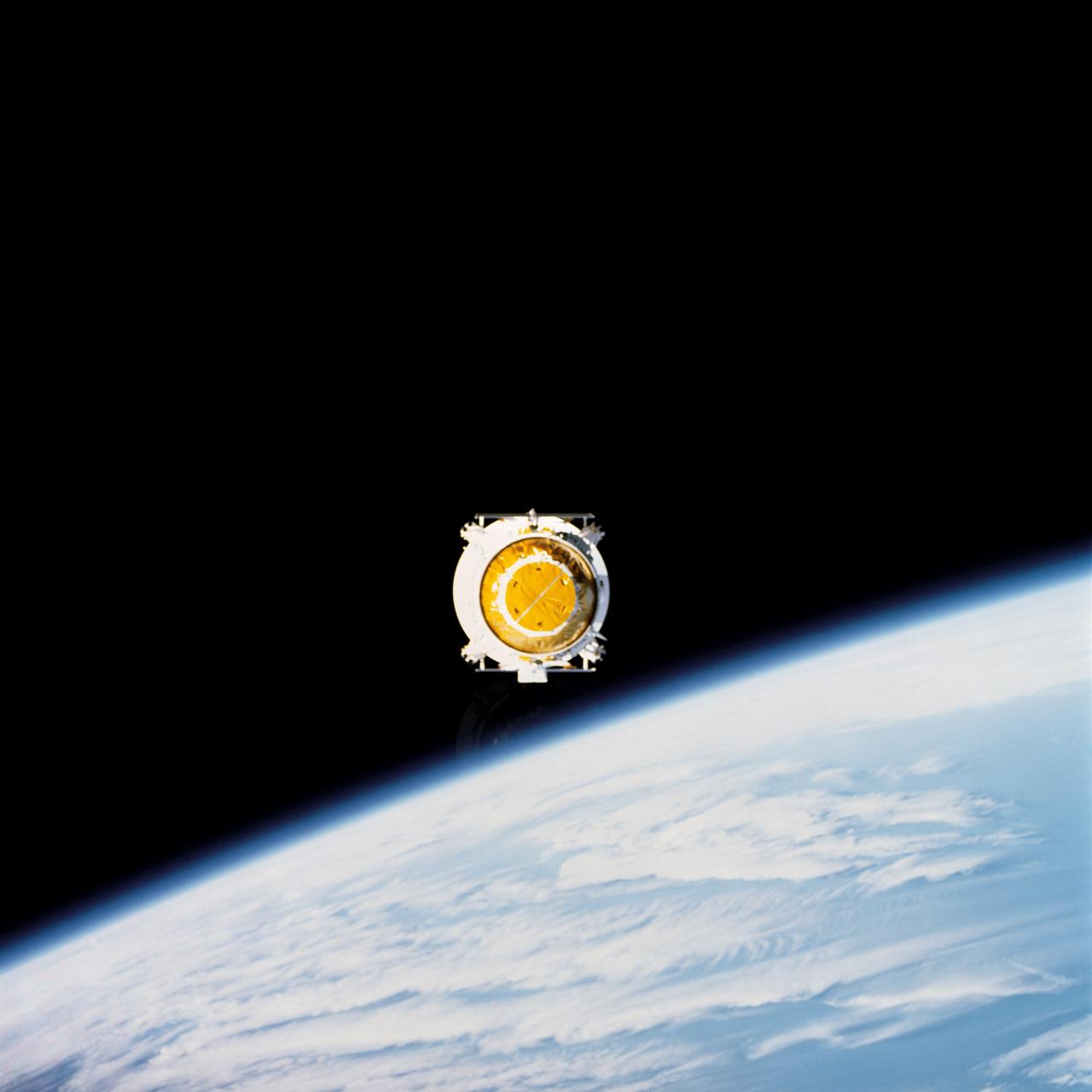
STS030-71-053 (4 May 1989) --- In the early evening hours of Space Shuttle Atlantis’ first day in space for the four-day STS-30 mission, the Magellan spacecraft is released into space to begin its long journey to the planet Venus for an extensive radar mapping mission. The scene was photographed through Atlantis’ aft flight deck windows with a handheld 70mm camera.
S89-42940 (April 1989) --- In this artist's rendition, the Galileo spacecraft is being boosted into its inter-planetary trajectory by the Inertial Upper Stage (IUS) rocket. The Space Shuttle Atlantis, which is scheduled to take Galileo and the IUS from Earth's surface into space, is depicted against the curve of Earth. Galileo will be placed on a trajectory to Venus, from which it will return to Earth at higher velocity and then gain still more energy in two gravity-assist passes, until it has enough velocity to reach Jupiter. Passing Venus, it will take scientific data using instruments designed for observing Jupiter; later, it will make measurements at Earth and the moon, crossing above the moon's north pole in the second pass. Between the two Earth passes, it will edge into the asteroid belt, beyond Mars' orbit; there, the first close-up observation of an asteroid is planned. Crossing the belt later, another asteroid flyby is possible.
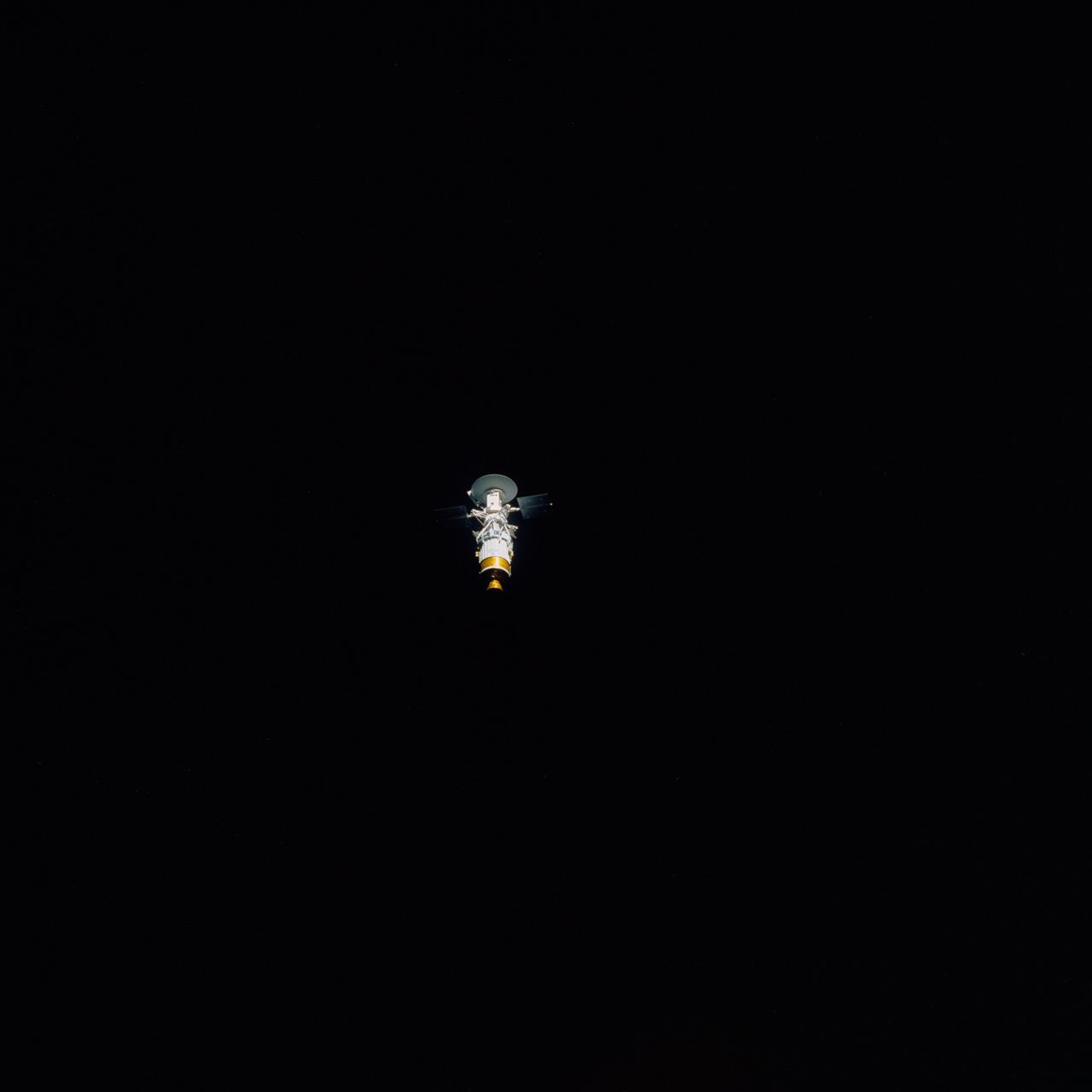
STS030-71-070 (4 May 1989) --- This scene is one of two released by NASA showing the process of solar array panel deployment on the Magellan spacecraft. Though partially blended into the backdrop of the blackness of space, it appears the two panels are fully extended in this frame. The spacecraft had earlier been released by the STS-30 crewmembers to begin its long journey to the planet Venus for an extensive radar mapping mission. The frame was photographed through Atlantis' aft flight deck windows with a handheld 70mm camera. The complementary photograph is STS030-71-063.
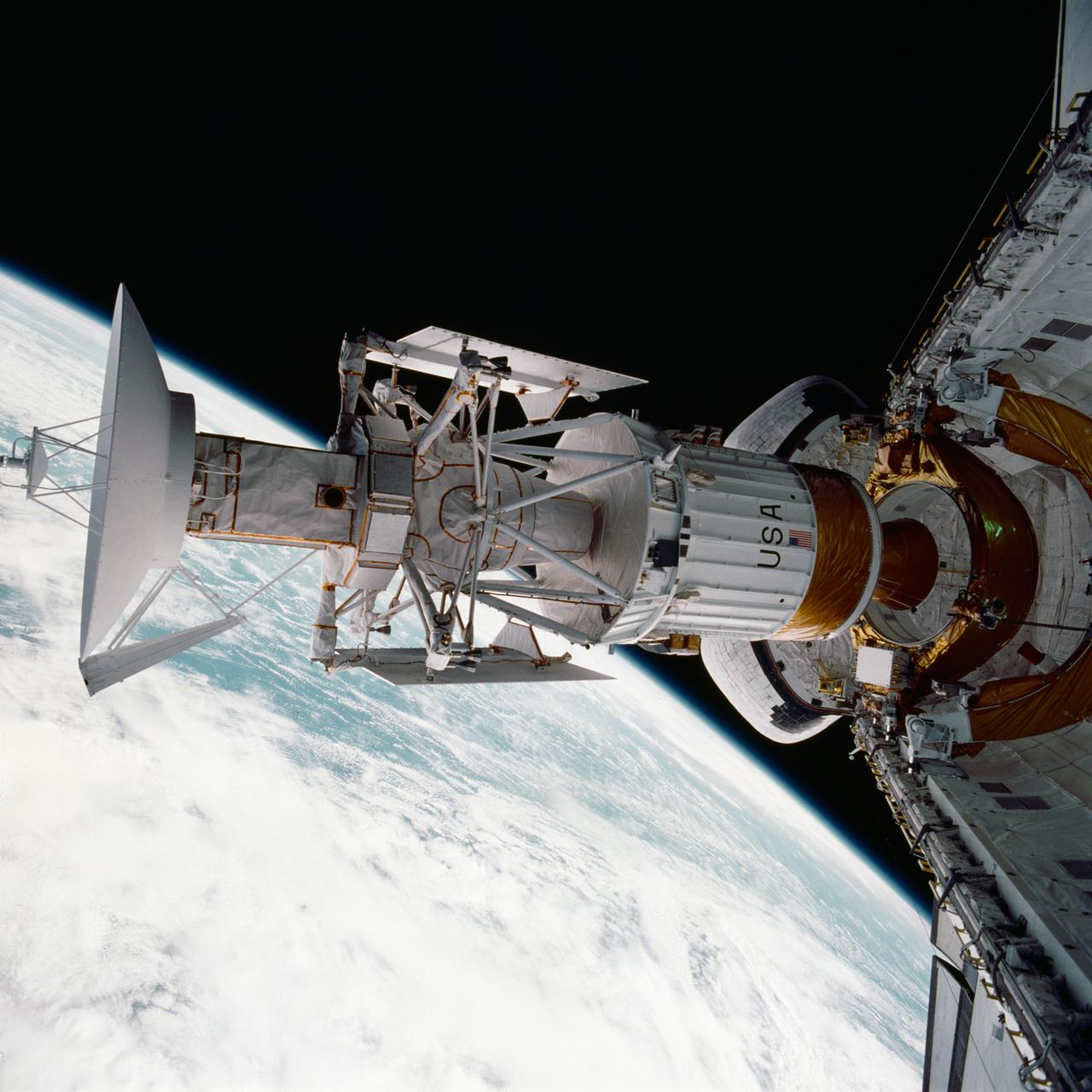
STS030-72-047 (4 May 1989) --- In the early evening hours of Atlantis?s first day in space for the four-day STS-30 mission, the Magellan spacecraft is released into space to begin its long journey to the planet Venus for an extensive radar mapping mission. The scene was photographed through Atlantis?s aft flight deck windows with a handheld 70mm camera.
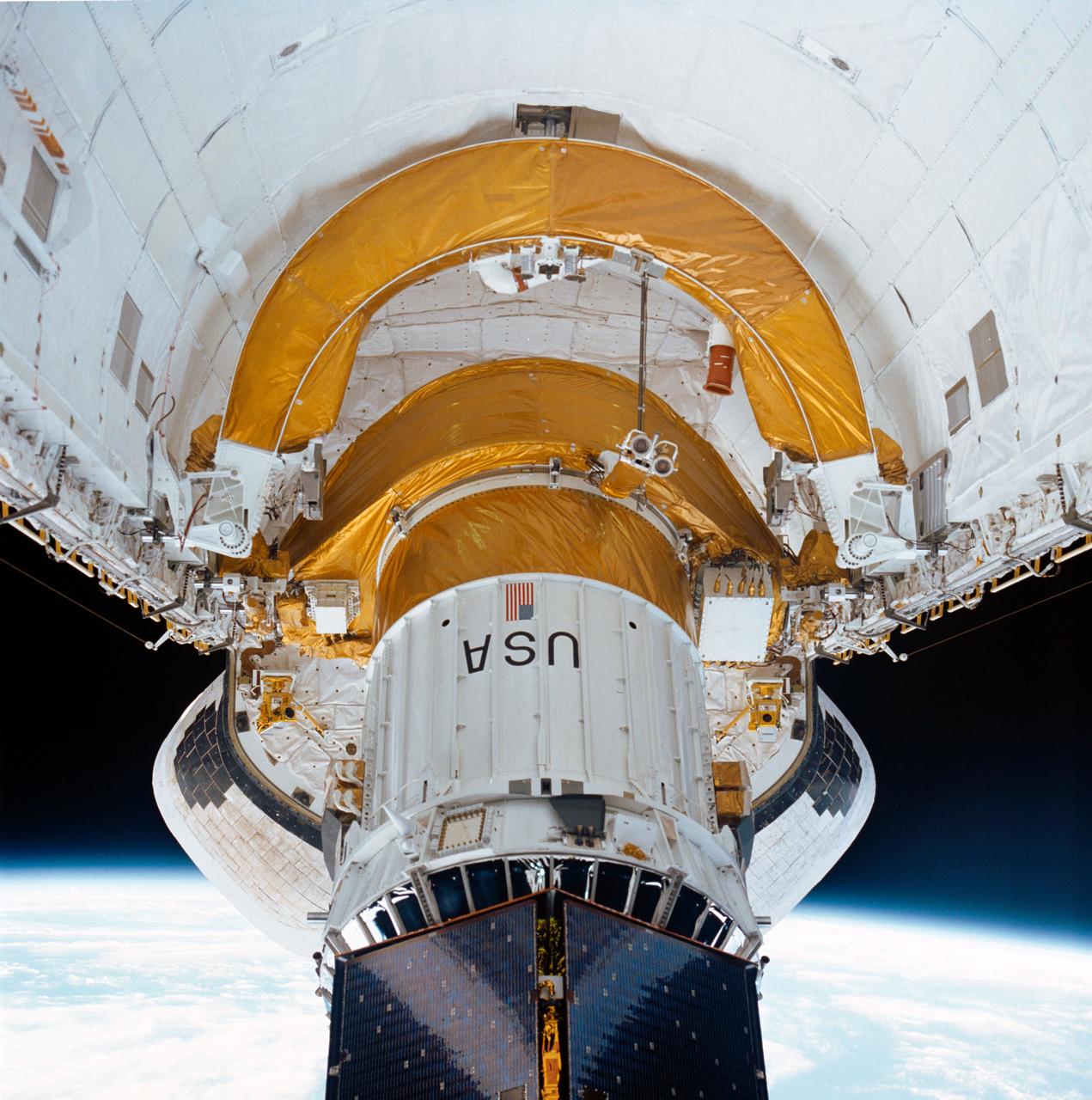
During STS-26, inertial upper stage (IUS) with the tracking and data relay satellite C (TDRS-C) located in the payload bay (PLB) of Discovery, Orbiter Vehicle (OV) 103, is raised into deployment attitude (an angle of 50 degrees) by the airborne support equipment (ASE). ASE aft frame tilt actuator (AFTA) table supports the IUS as it is positioned in the PLB and the ASE umbilical boom drifts away from IUS toward ASE forward cradle. TDRS-C solar array panels (in stowed configuration) are visible on top of the IUS. In the background are the orbital maneuvering system (OMS) pods and the Earth's limb.
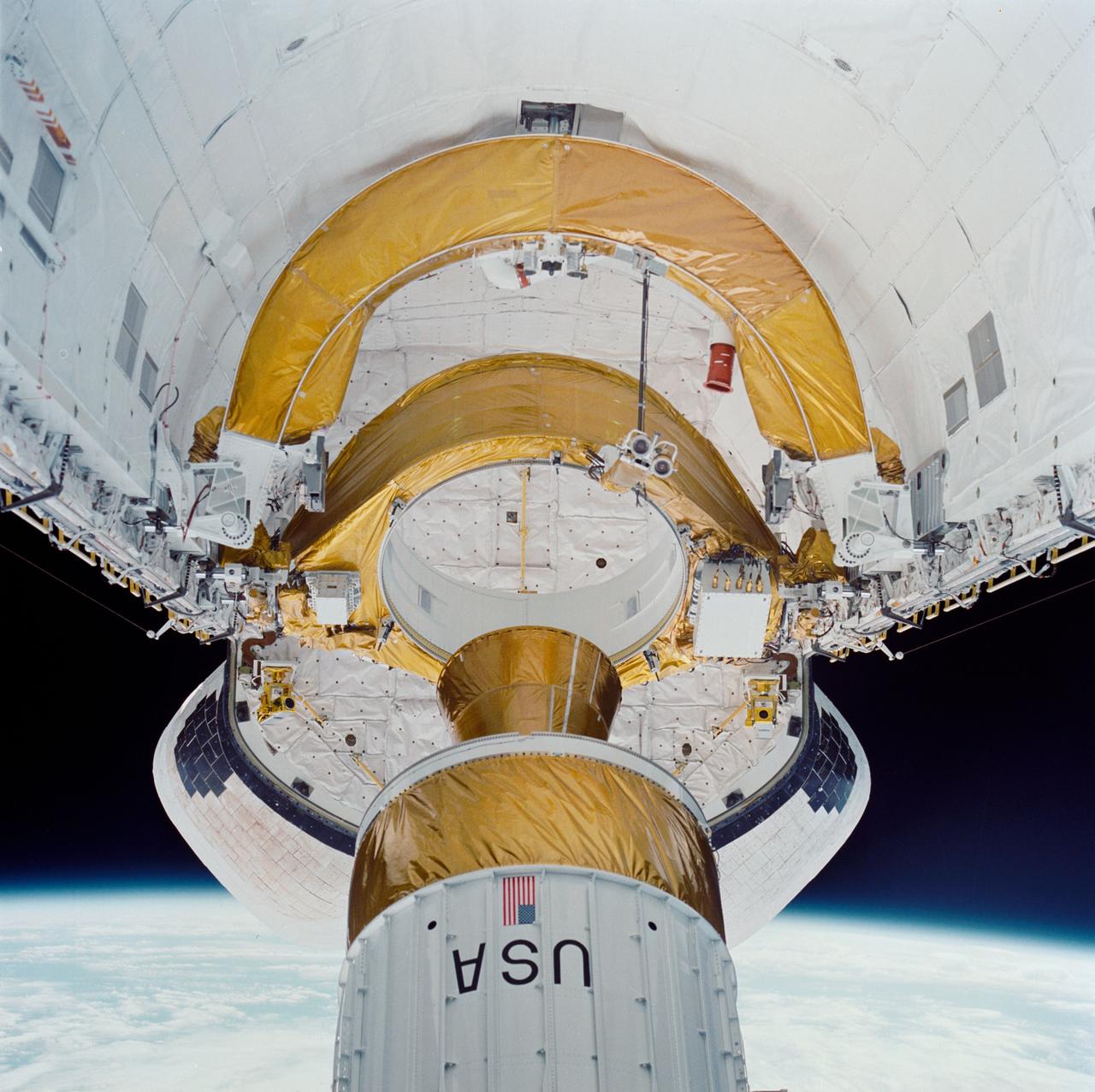
During STS-26, inertial upper stage (IUS) with the tracking and data relay satellite C (TDRS-C) drifts above Discovery, Orbiter Vehicle (OV) 103, payload bay (PLB) after being positioned in deployment attitude (an angle of 50 degrees) by the airborne support equipment (ASE). IUS vacates the ASE aft frame tilt actuator (AFTA) table in the PLB while the disconnected ASE umbilical boom floats above ASE forward cradle. IUS first stage rocket motor and nozzle and the interstage are visible as the IUS is deployed. In the background are the orbital maneuvering system (OMS) pods and the Earth's limb.
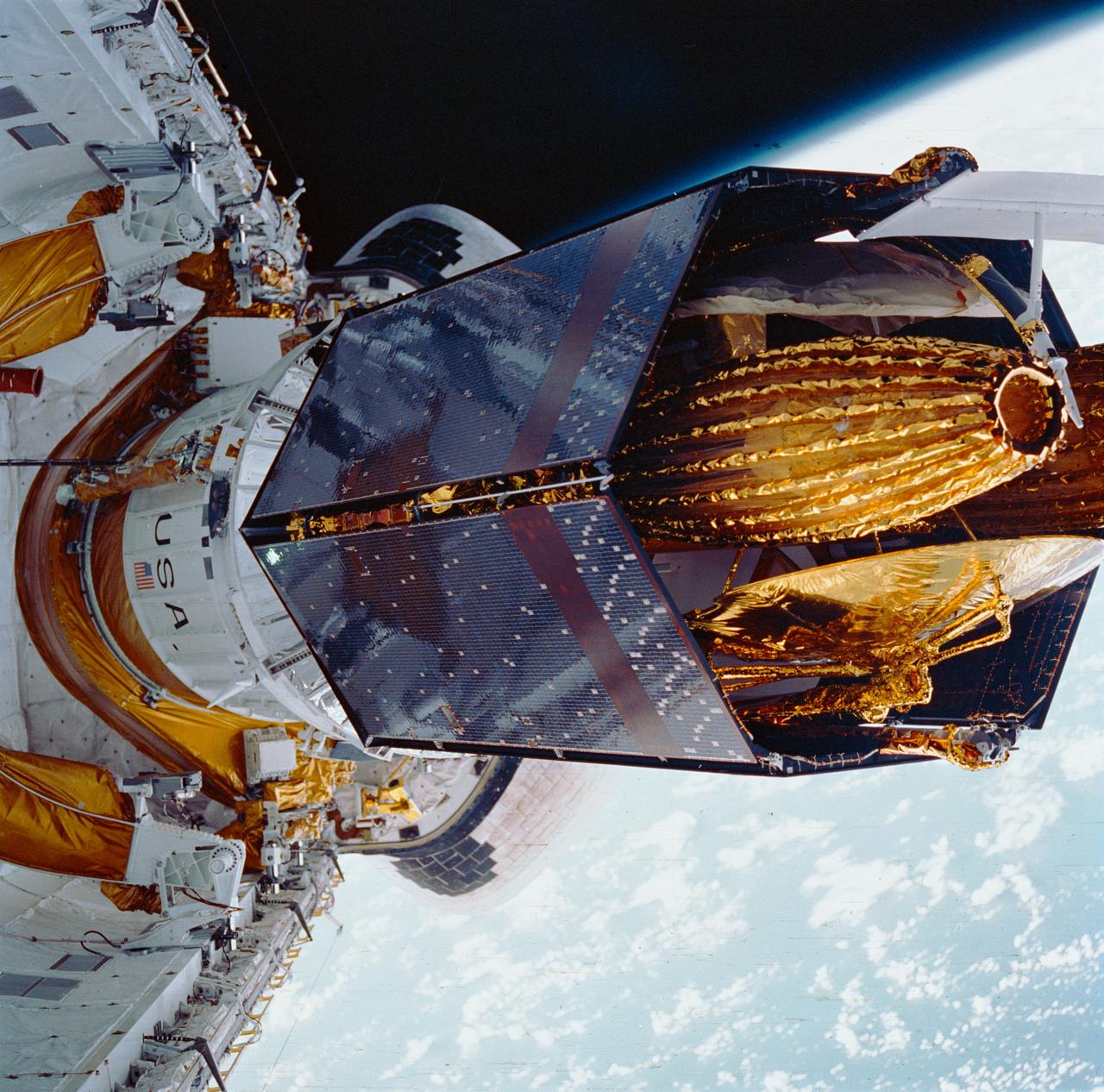
During STS-26, inertial upper stage (IUS) with tracking and data relay satellite C (TDRS-C) located in the payload bay (PLB) of Discovery, Orbiter Vehicle (OV) 103, is positioned into its proper deployment attitude (an angle of 50 degrees) by the airborne support equipment (ASE). In the foreground, the ASE forward cradle is visible. The IUS is mounted in the ASE aft frame tilt actuator (AFTA) table. TDRS-C components in stowed configuration include solar array panels, TDRS single access #1 and #2, TDRS SGL, and S-Band omni antenna. In the background are the orbital maneuvering system (OMS) pods, the Earth's cloud-covered surface, and the Earth's limb.
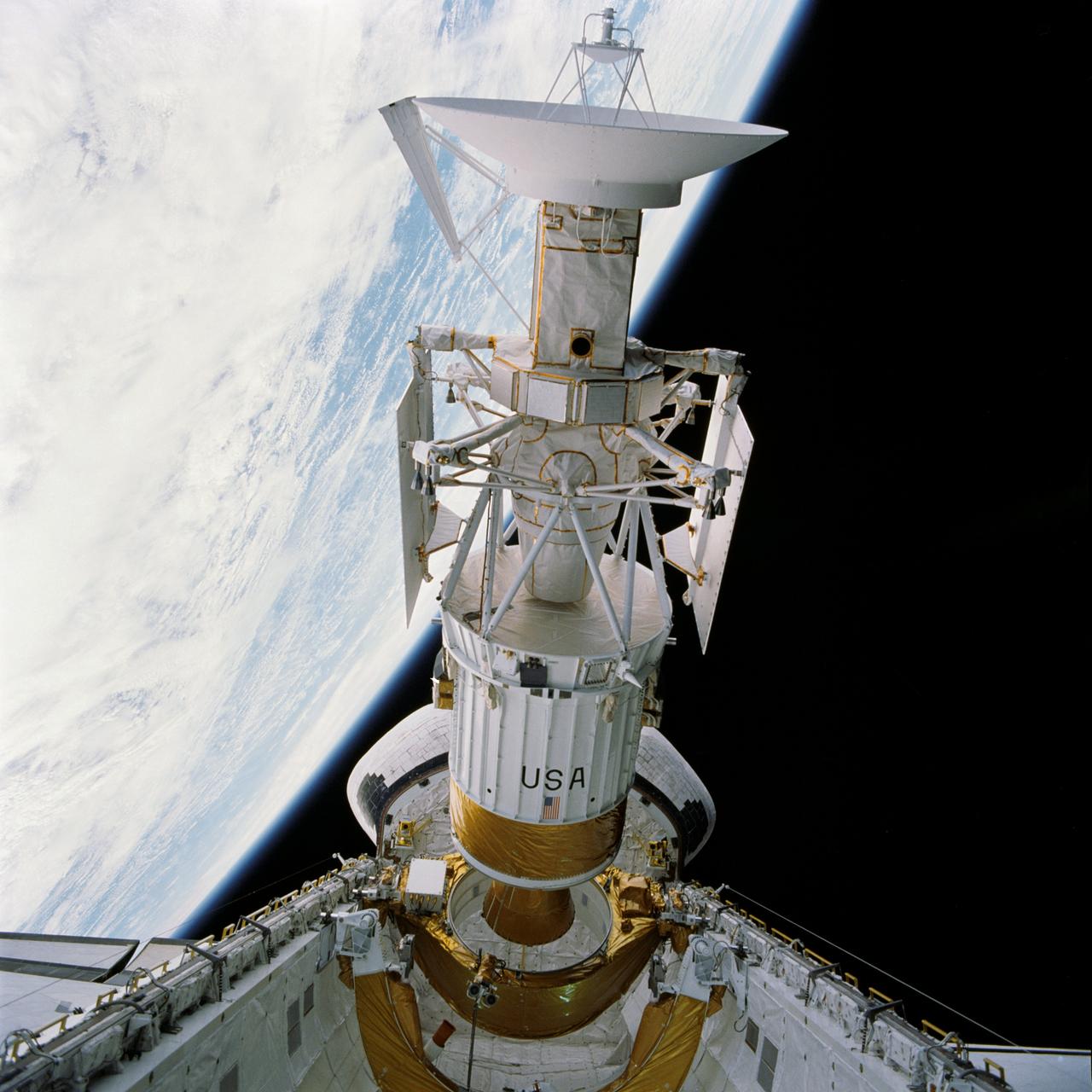
STS030-72-046 (4 May 1989) --- In the early evening hours of the Space Shuttle Atlantis' first day in space for the four-day STS-30 mission, the Magellan spacecraft is released into space to begin its long journey to the planet Venus for an extensive radar mapping mission. The scene was photographed through Atlantis' aft flight deck windows with a handheld 70mm camera.
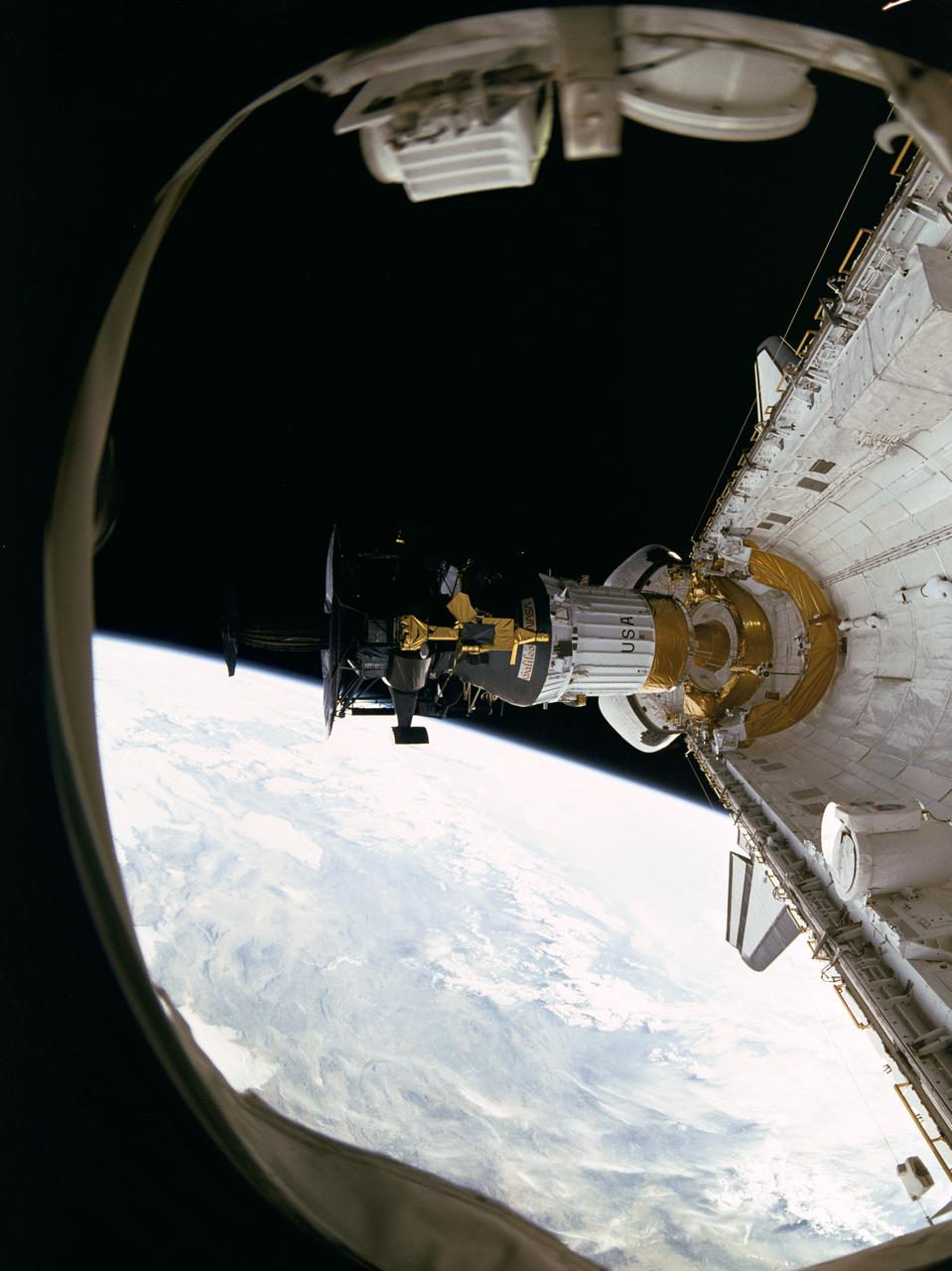
S89-48714 (18 Oct 1989) --- This photograph was taken by the STS-34 crew aboard the Space Shuttle Atlantis and shows the Galileo spacecraft being deployed on Oct. 18, 1989 from the payload bay. Galileo is a scientific craft that will go into orbit around the planet Jupiter and drop a probe into its atmosphere in search of primordial solar system material believed to be present there. The 70mm motion picture film will be used in the forthcoming "Blue Planet," which will address Earth's environmental problems from the perspective of space-based observation and solar system exploration. The film is being produced by IMAX Space Technology Inc. for the sponsor, the Smithsonian Institution, with funding provided by the Lockheed Corporation. PHOTO CREDIT: NASA/Smithsonian Institution
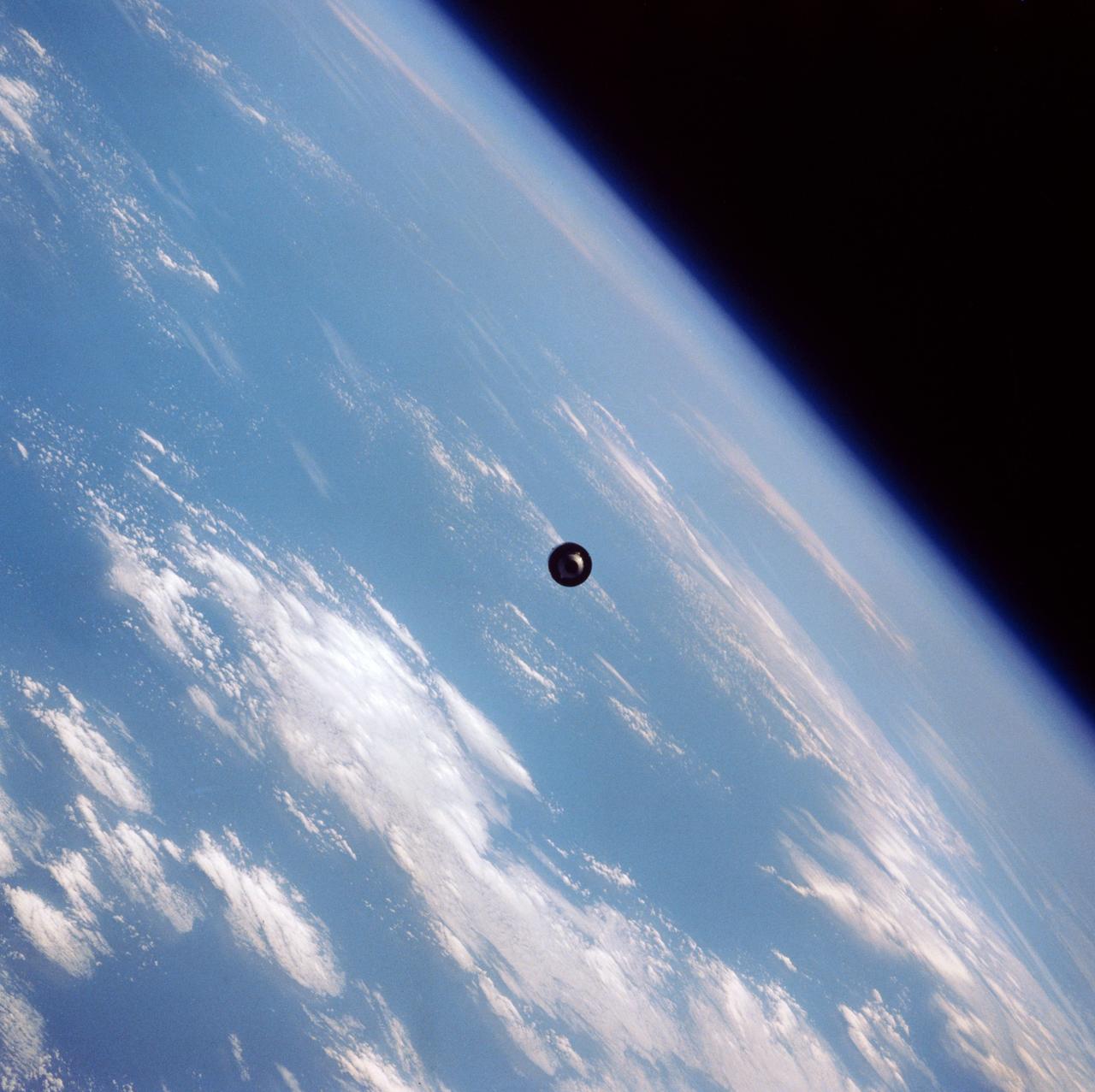
41D-39-068 (1 Sept 1984) --- Quickly moving away from the Space Shuttle Discovery is the Telstar 3 communications satellite, deployed September 1, 1984. The 41-D crew successfully completed three satellite placements, of which this was the last. Telstar was the second 41-D deployed satellite to be equipped with a payload assist module (PAM-D). The frame was exposed with a 70mm camera.
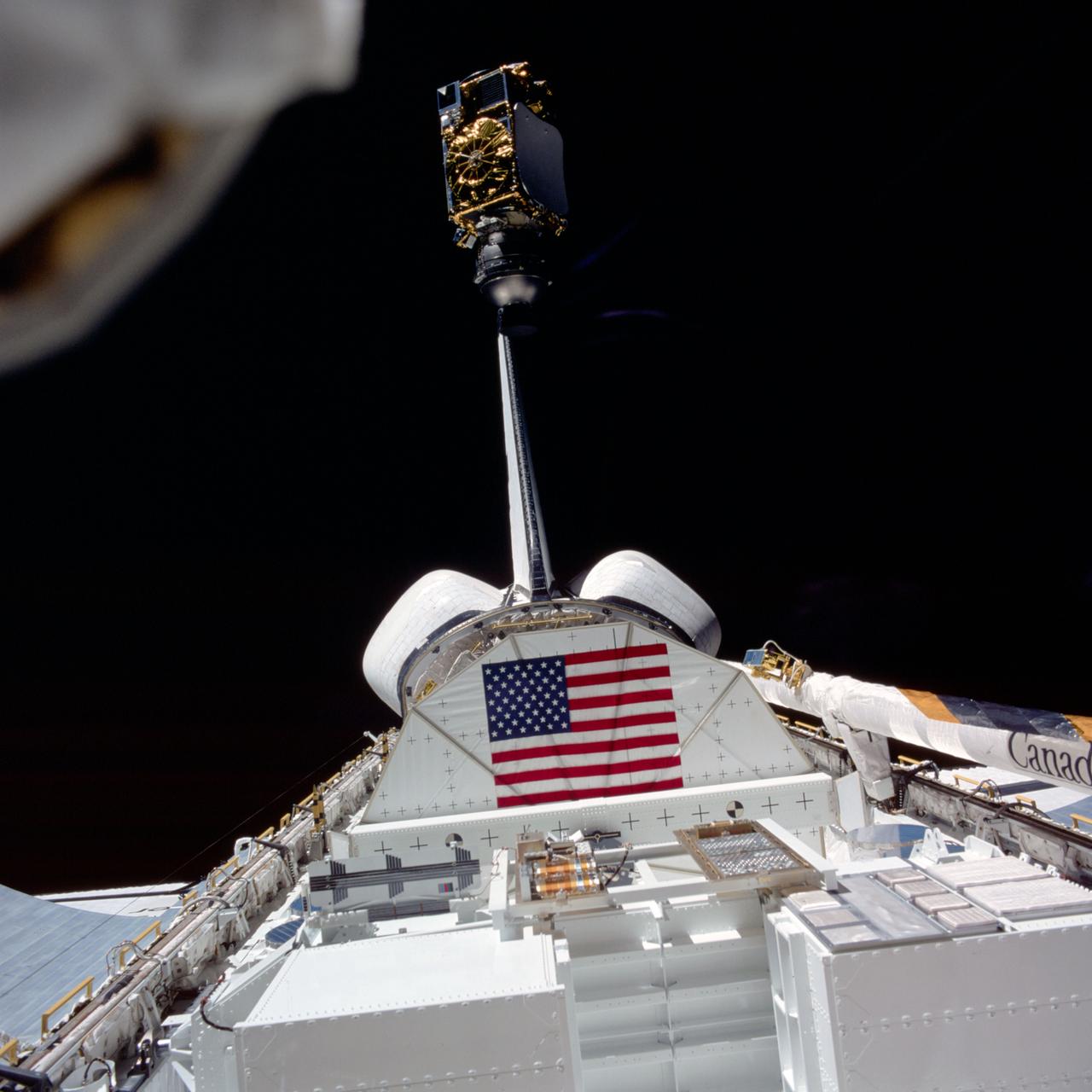
STS008-49-1724 (31 Aug 1983) --- The Indian National Satellite (INSAT) is about to clear the vertical stabilizer of the Earth-orbiting Space Shuttle Challenger and on its way to a higher orbit. The STS-8 mission's Payload Flight Test Article (PFTA) displays the U.S. flag in the middle of the cargo bay, as the Canadian built Remote Manipulator System (RMS) appears to be waiting for its busy agenda of activity with the barbell-shaped test device. This 70mm frame was exposed by a crewmember using a handheld Hasselblad inside Challenger's cabin.
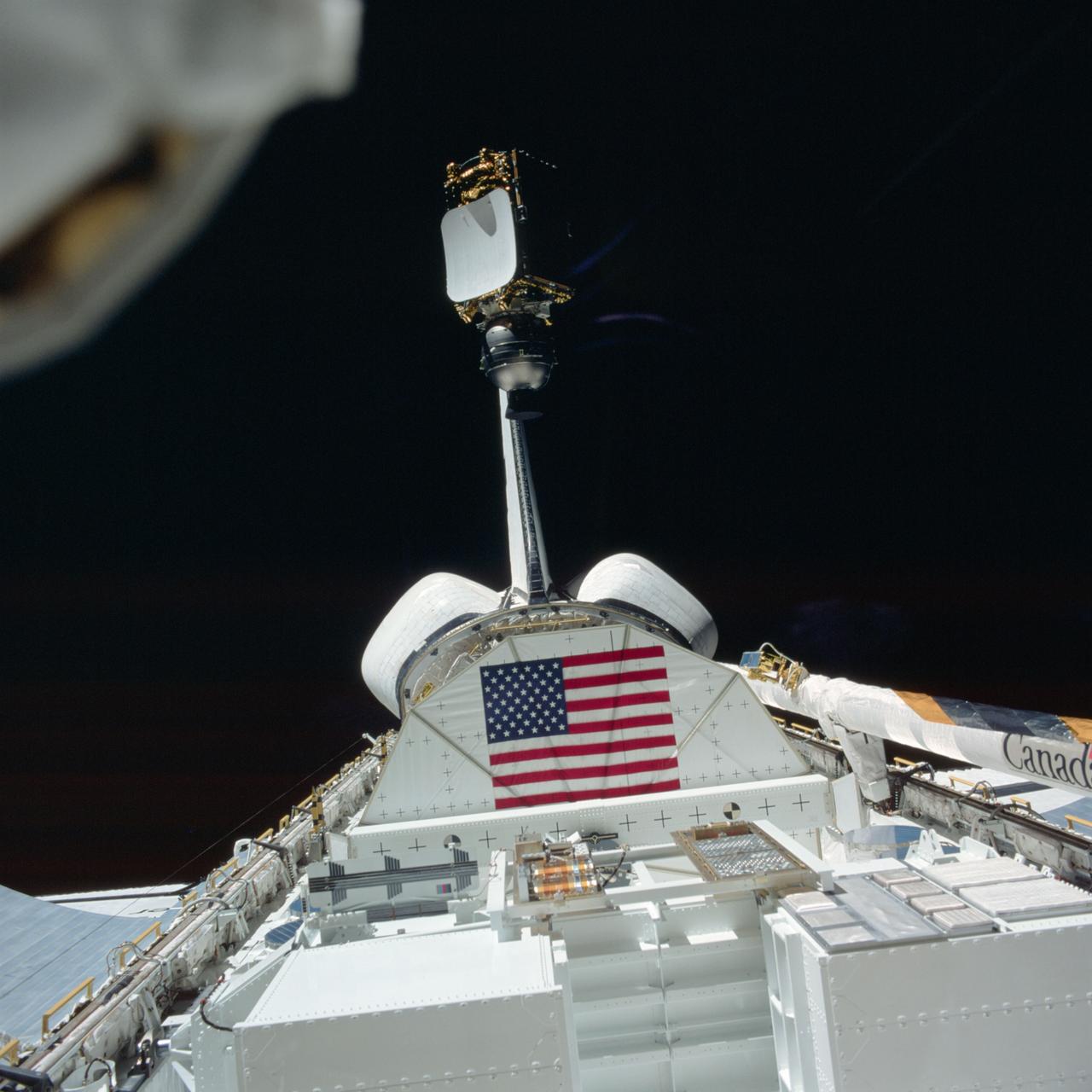
STS008-49-1722 (30 Aug-5 Sept 1983) --- The Indian National Satellite (INSAT) is about to clear the Earth-orbiting Space Shuttle Challenger this 70mm frame exposed with a handheld camera from the aft flight deck. The Payload Flight Test Article (PFTA) displays the United States flag in the middle of the cargo bay and the Canadian built Remote Manipulator System (RMS) appears to be waiting for its busy agenda of activity with the barbell-shaped test device.
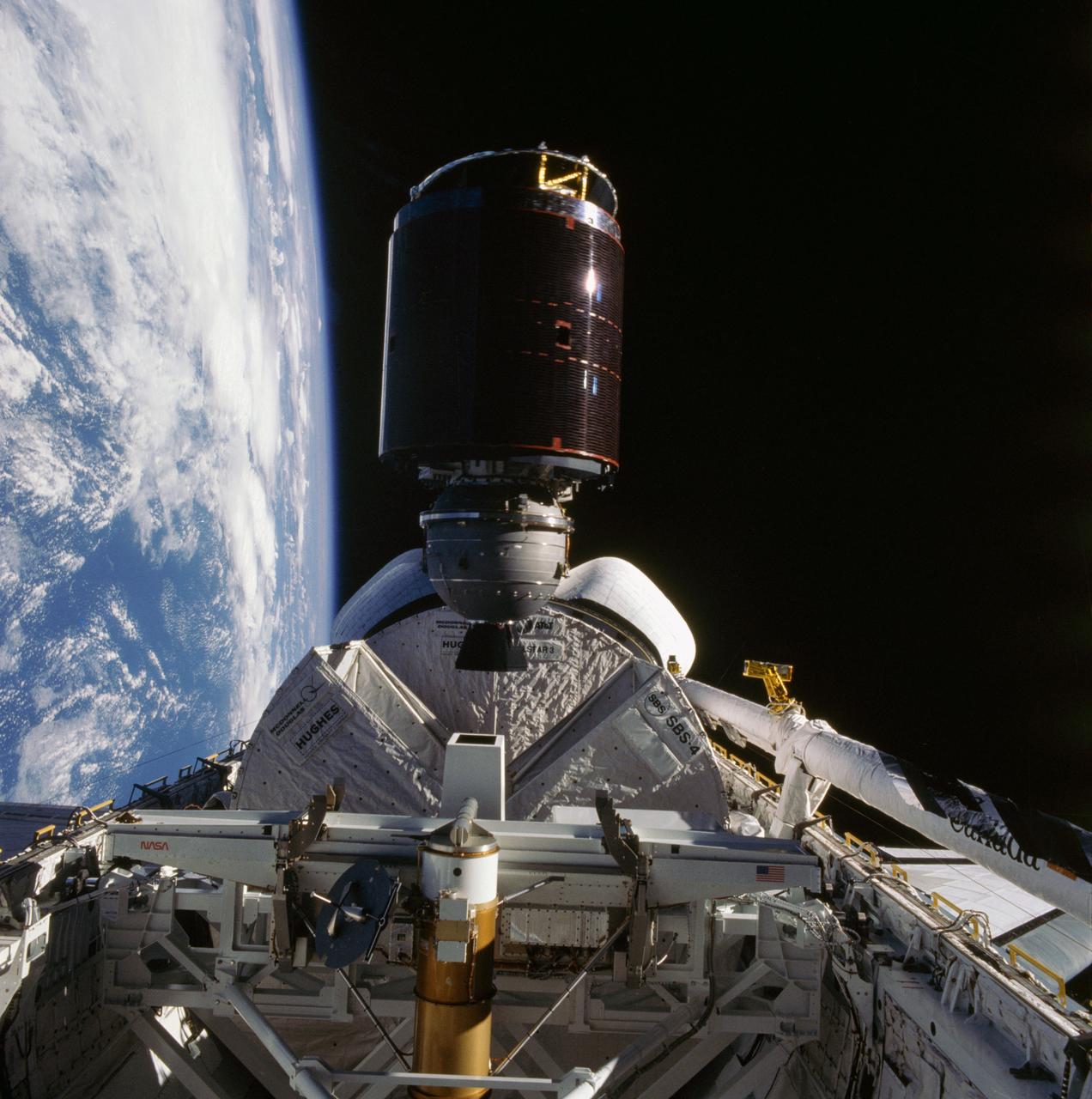
41D-36-034 (30 Aug 1984) --- Less than nine hours after the first launch of the Discovery, its astronaut crewmembers photographed deployment of the SBS-4 communications satellite. The cylindrical spacecraft spins and rises from its cradle-like protective shield to begin life in space. A number of maneuvers will place it in its desired orbit. A 70mm camera, aimed through the spacecraft’s aft flight deck windows, was used to expose the frame.
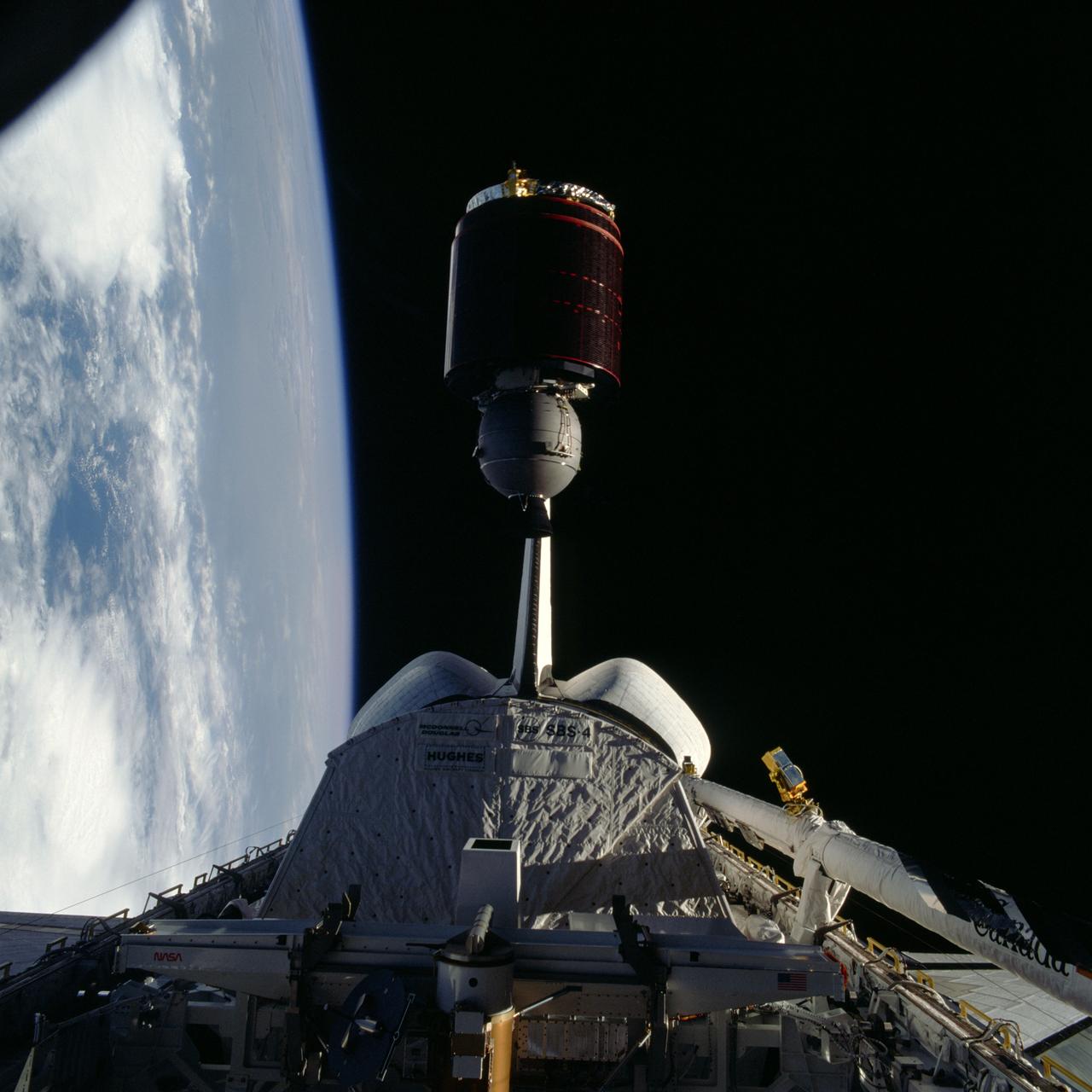
41D-37-050 (1 Sept 1984) --- Telstar, the third of three satellites to be placed into space via the Earth-orbiting Discovery, departs from the cargo bay of the manned vehicle during 41-D's third day in space. The scene was photographed at 9:35 a.m. (CDT), Sept. 1, 1984, with a 70mm handheld hasselblad camera aimed through the windows on the flight deck. Heavy clouds cover much of the water and land mass of Earth in the background.
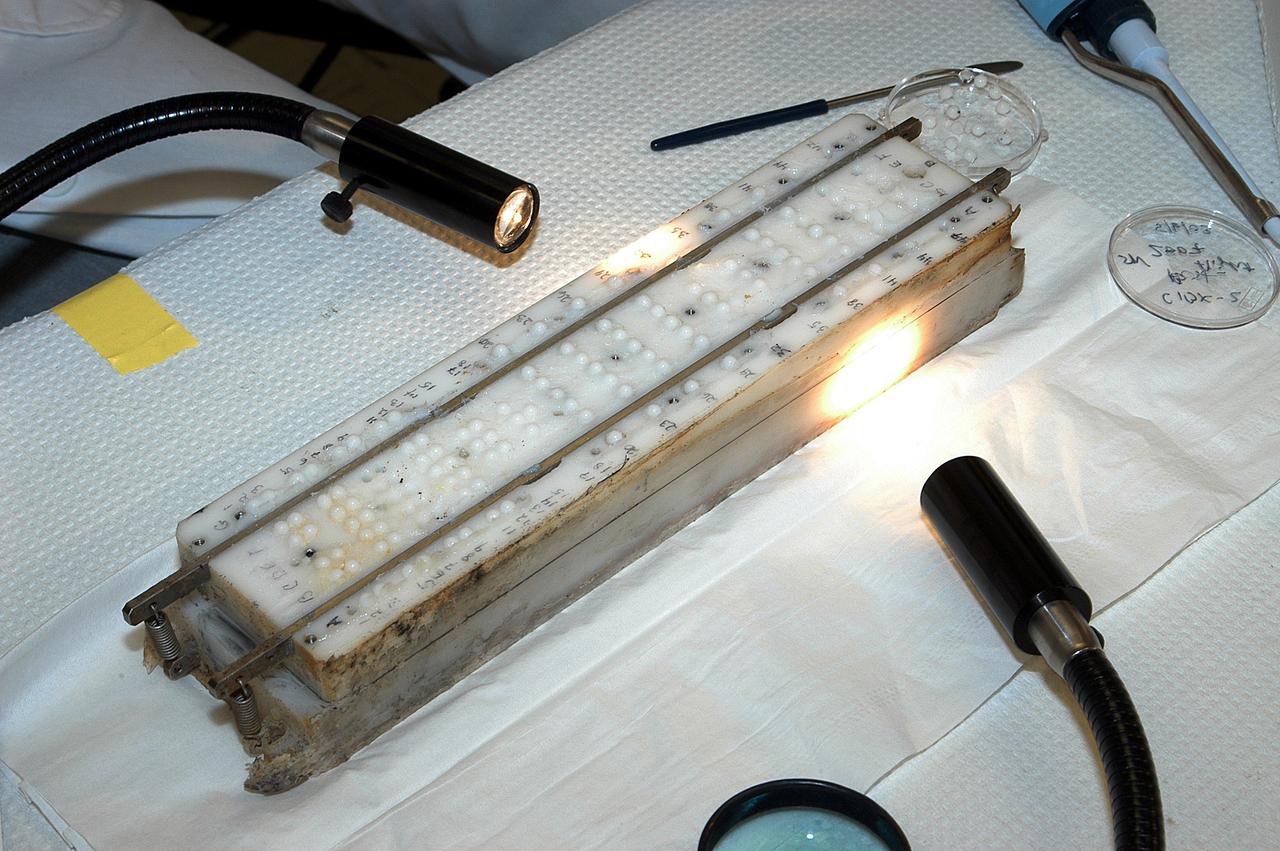
KENNEDY SPACE CENTER, FLA. - The apparatus shown was designed to hold microcapsules for research on mission STS-107. It is one over several included in the Commercial ITA Biomedical Experiments payload. The box was recently recovered during the search for Columbia debris. The drug delivery system and spaceflight hardware was developed jointly by JSC, the Institute for Research Inc. and Instrumentation Technology Associates Inc. to conduct microencapsulation experiments under microgravity conditions.

KENNEDY SPACE CENTER, FLA. -- Workers in the Payload Changeout Room check the movement of the U.S. Lab Destiny, which is being transferred to the orbiter’s payload bay. The PCR is the enclosed, environmentally controlled portion of the rotating service structure that supports payload delivery at the launch pad and vertical installation in the orbiter payload bay. Destiny, a key element in the construction of the International Space Station is designed for space science experiments and already has five system racks installed inside. STS-98 is the seventh construction flight to the ISS. Launch of STS-98 is scheduled for Jan. 19 at 2:11 a.m. EST

In the payload changeout room on the Rotating Service Structure, Launch Pad 39B, workers move the Multi-Purpose Logistics Module Leonardo out of the payload canister. From the PCR Leonardo then will be transferred into Space Shuttle Discovery’s payload bay. One of Italy’s major contributions to the International Space Station program, Leonardo is a reusable logistics carrier. It is the primary delivery system used to resupply and return Station cargo requiring a pressurized environment. Leonardo is the primary payload on mission STS-102 and will deliver up to 10 tons of laboratory racks filled with equipment, experiments and supplies for outfitting the newly installed U.S. Laboratory Destiny. STS-102 is scheduled to launch March 8 at 6:45 a.m. EST
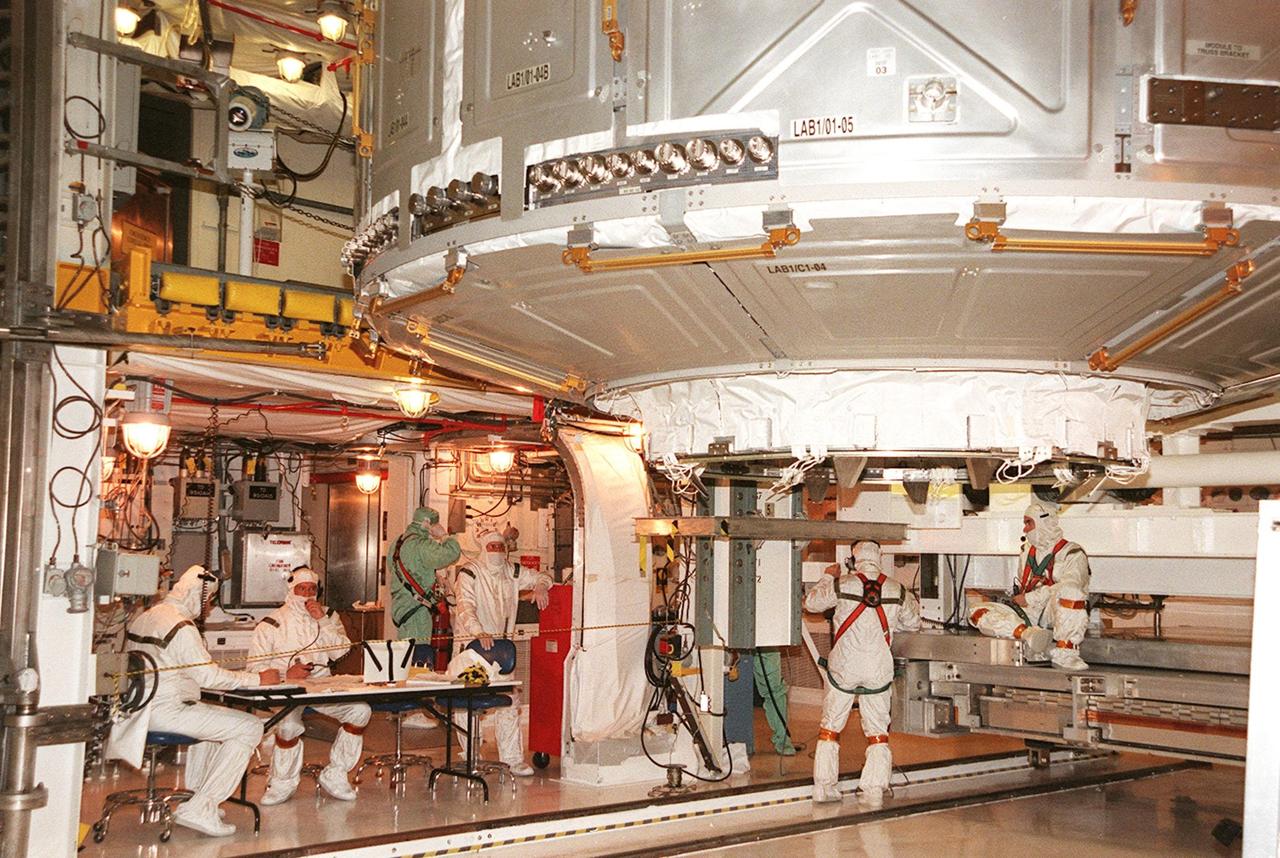
KENNEDY SPACE CENTER, FLA. -- Technicians in the Payload Changeout Room oversee the transfer of the U.S. Lab Destiny to the orbiter’s payload bay. The PCR is the enclosed, environmentally controlled portion of the rotating service structure that supports payload delivery at the launch pad and vertical installation in the orbiter payload bay. Destiny, a key element in the construction of the International Space Station is designed for space science experiments and already has five system racks installed inside. STS-98 is the seventh construction flight to the ISS. Launch of STS-98 is scheduled for Jan. 19 at 2:11 a.m. EST
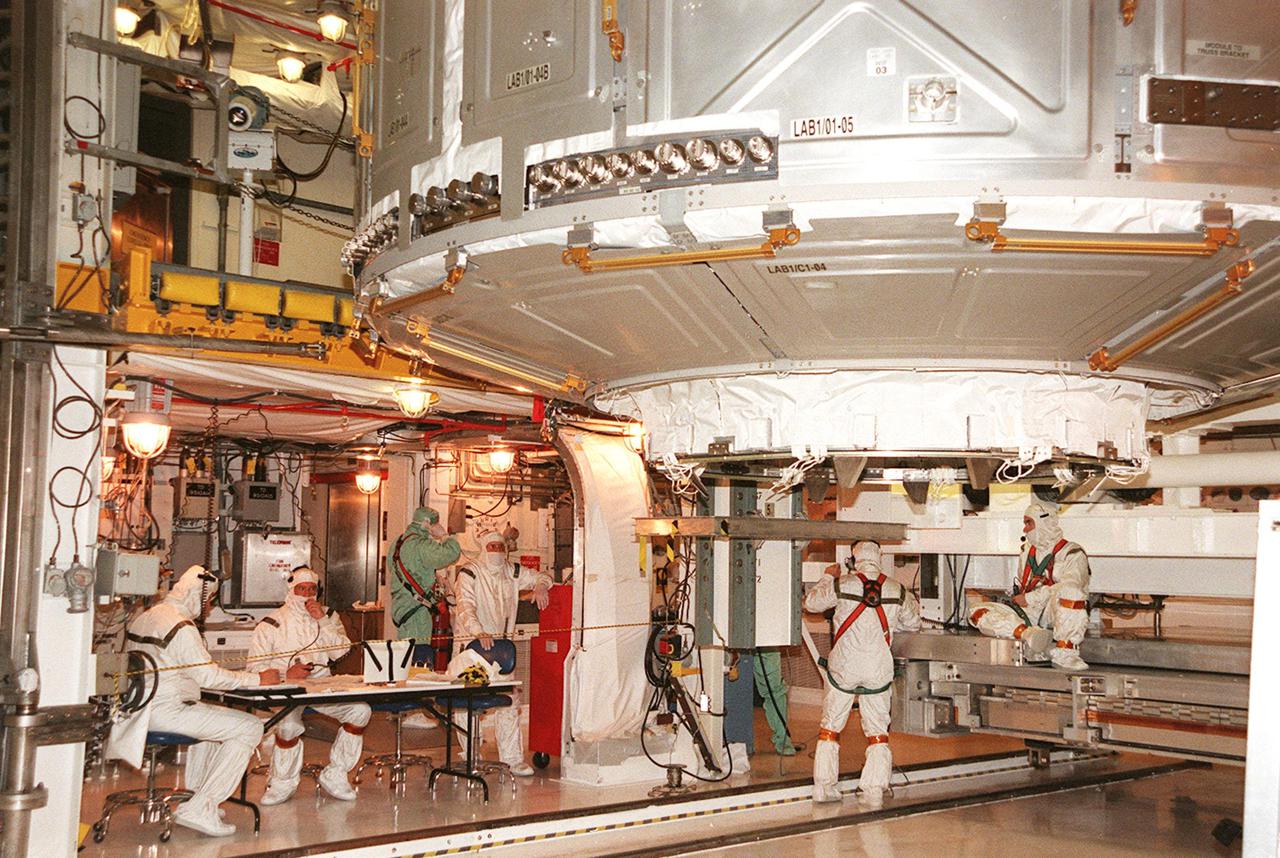
KENNEDY SPACE CENTER, FLA. -- Technicians in the Payload Changeout Room oversee the transfer of the U.S. Lab Destiny to the orbiter’s payload bay. The PCR is the enclosed, environmentally controlled portion of the rotating service structure that supports payload delivery at the launch pad and vertical installation in the orbiter payload bay. Destiny, a key element in the construction of the International Space Station is designed for space science experiments and already has five system racks installed inside. STS-98 is the seventh construction flight to the ISS. Launch of STS-98 is scheduled for Jan. 19 at 2:11 a.m. EST
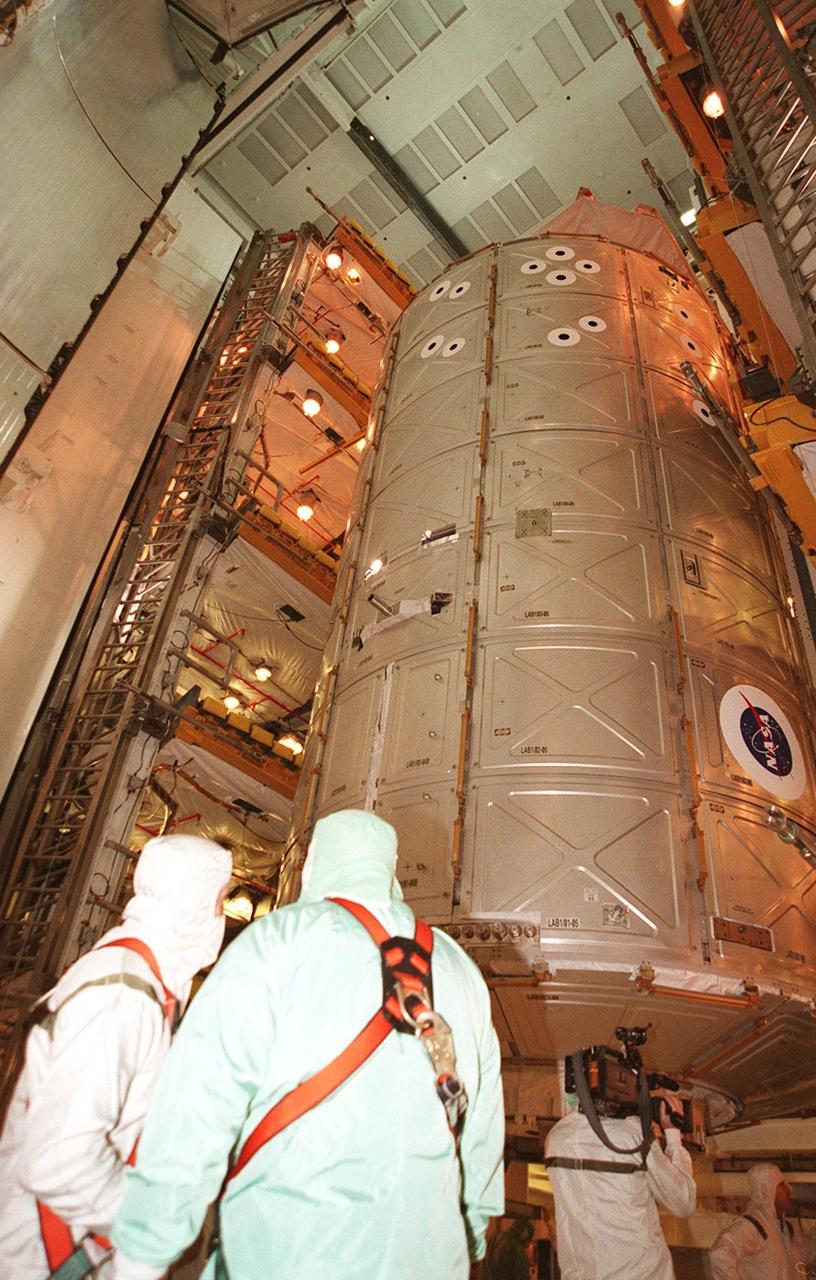
KENNEDY SPACE CENTER, FLA. -- The U.S. Lab Destiny is ready to move into the orbiter’s payload bay from the Payload Changeout Room. The PCR is the enclosed, environmentally controlled portion of the rotating service structure that supports payload delivery at the launch pad and vertical installation in the orbiter payload bay. Destiny, a key element in the construction of the International Space Station is designed for space science experiments and already has five system racks installed inside. STS-98 is the seventh construction flight to the ISS. Launch of STS-98 is scheduled for Jan. 19 at 2:11 a.m. EST
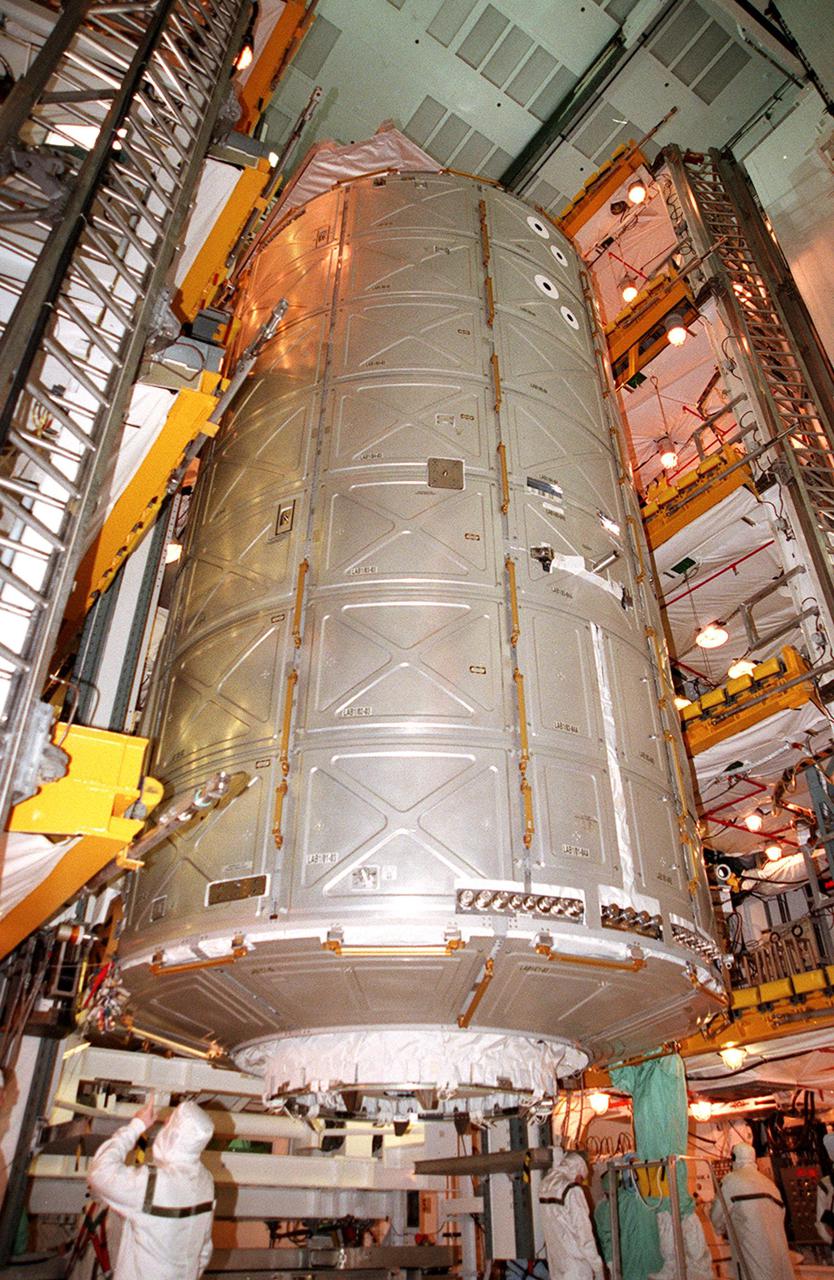
KENNEDY SPACE CENTER, FLA. -- Workers in the Payload Changeout Room check the movement of the U.S. Lab Destiny, which is being transferred to the orbiter’s payload bay. The PCR is the enclosed, environmentally controlled portion of the rotating service structure that supports payload delivery at the launch pad and vertical installation in the orbiter payload bay. Destiny, a key element in the construction of the International Space Station is designed for space science experiments and already has five system racks installed inside. STS-98 is the seventh construction flight to the ISS. Launch of STS-98 is scheduled for Jan. 19 at 2:11 a.m. EST
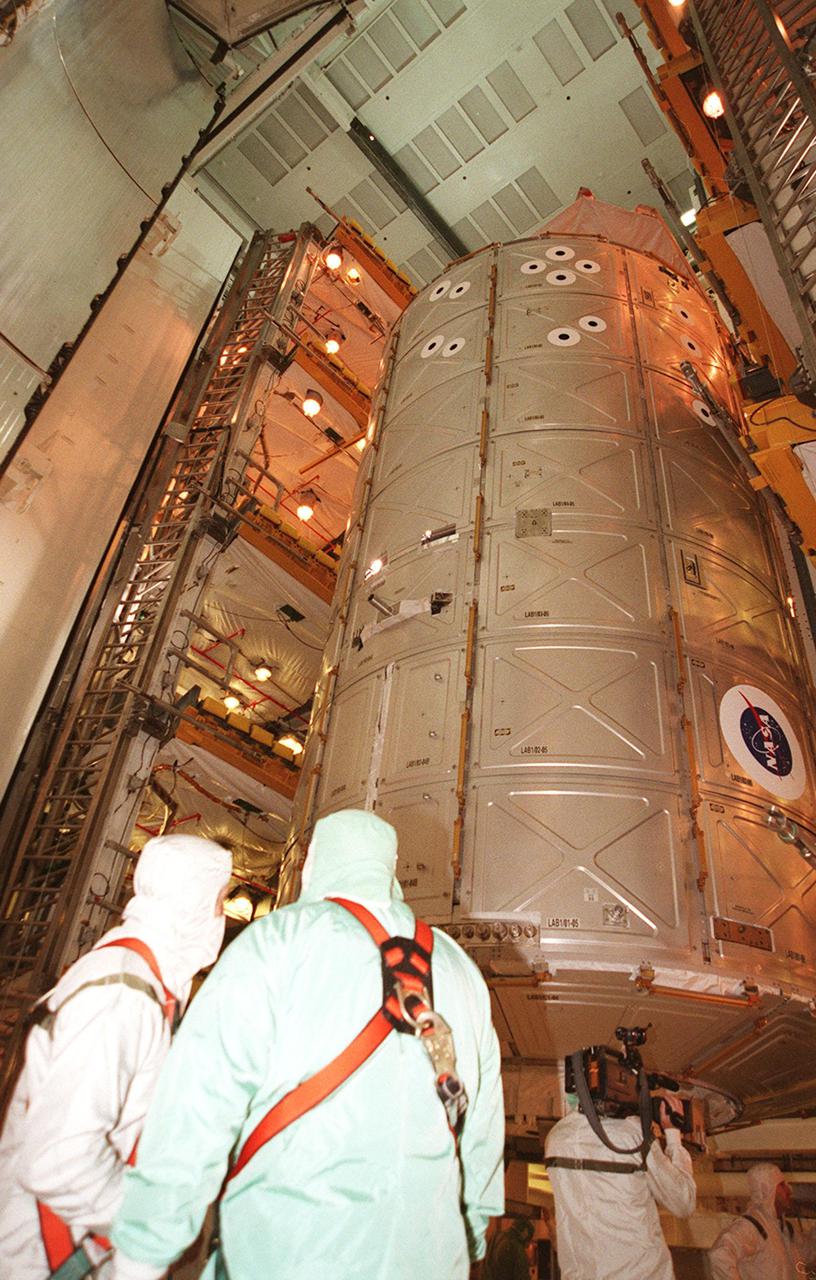
KENNEDY SPACE CENTER, FLA. -- The U.S. Lab Destiny is ready to move into the orbiter’s payload bay from the Payload Changeout Room. The PCR is the enclosed, environmentally controlled portion of the rotating service structure that supports payload delivery at the launch pad and vertical installation in the orbiter payload bay. Destiny, a key element in the construction of the International Space Station is designed for space science experiments and already has five system racks installed inside. STS-98 is the seventh construction flight to the ISS. Launch of STS-98 is scheduled for Jan. 19 at 2:11 a.m. EST
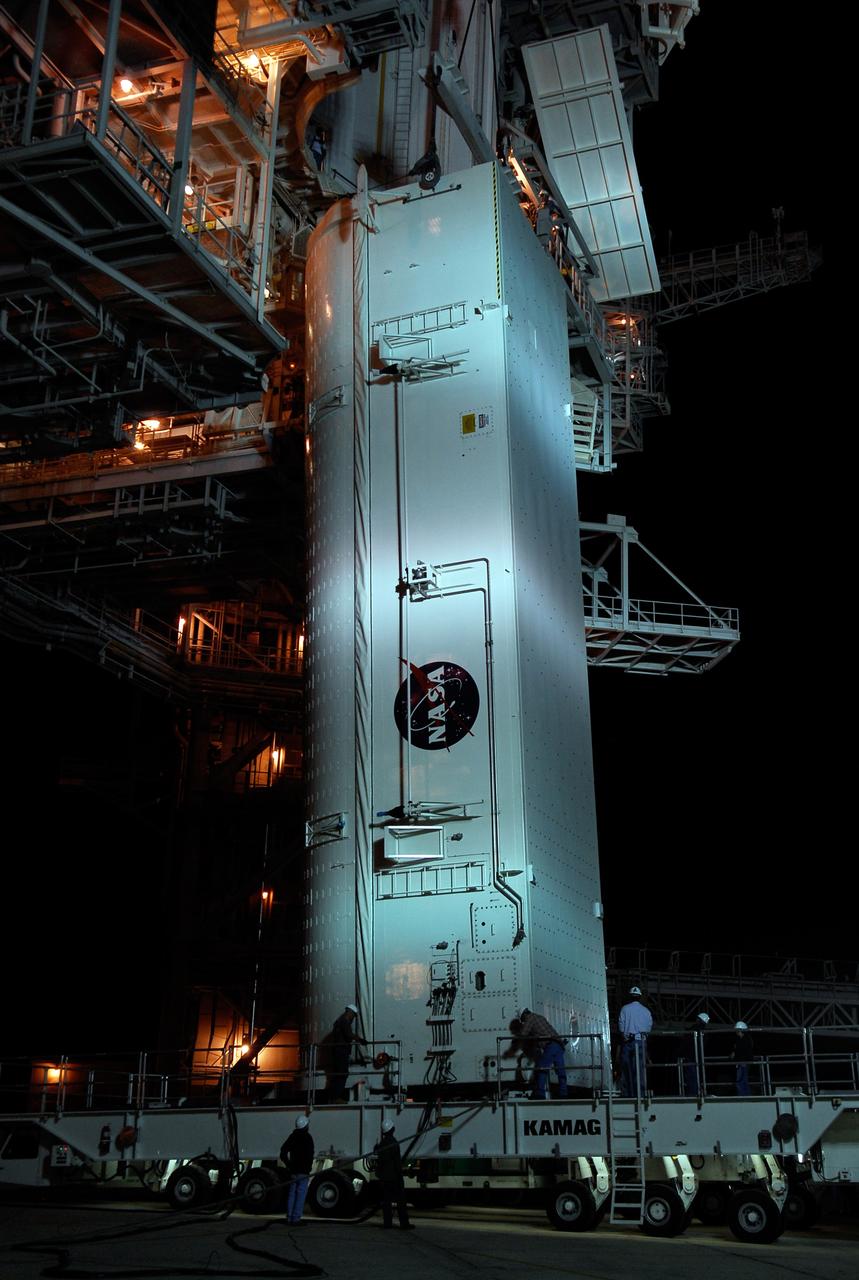
CAPE CANAVERAL, Fla. – On Launch Pad 39A at NASA's Kennedy Space Center, workers on the payload canister transporter prepare for the lifting of the payload canister to the waiting payload changeout room above. Inside the canister are the Japanese Experiment Module - Pressurized Module and the Japanese Remote Manipulator System, or RMS, for the STS-124 mission. The changeout room is the enclosed, environmentally controlled portion of the service structure that supports cargo delivery to the pad and subsequent vertical installation into an orbiter's payload bay. From the payload changeout room, the pressurized module and RMS then will be transferred into space shuttle Discovery’s payload bay. Launch is targeted for May 31. Photo credit: NASA/Kim Shiflett

KENNEDY SPACE CENTER, FLA. -- A worker in the payload changeout room (PCR) on Launch Pad 39A monitors the payload ground-handling mechanism that is used to transfer the payload into the PCR and the shuttle's payload bay. The PCR is the enclosed, environmentally controlled portion of the rotating service structure that supports cargo delivery to the pad and subsequent vertical installation into the orbiter payload bay. The truss is the payload for Space Shuttle Atlantis on mission STS-117 to the International Space Station. The Atlantis crew will install the new truss segment, retract a set of solar arrays and unfold a new set on the starboard side of the station. Launch is targeted for March 15. Photo credit: NASA/Jack Pfaller
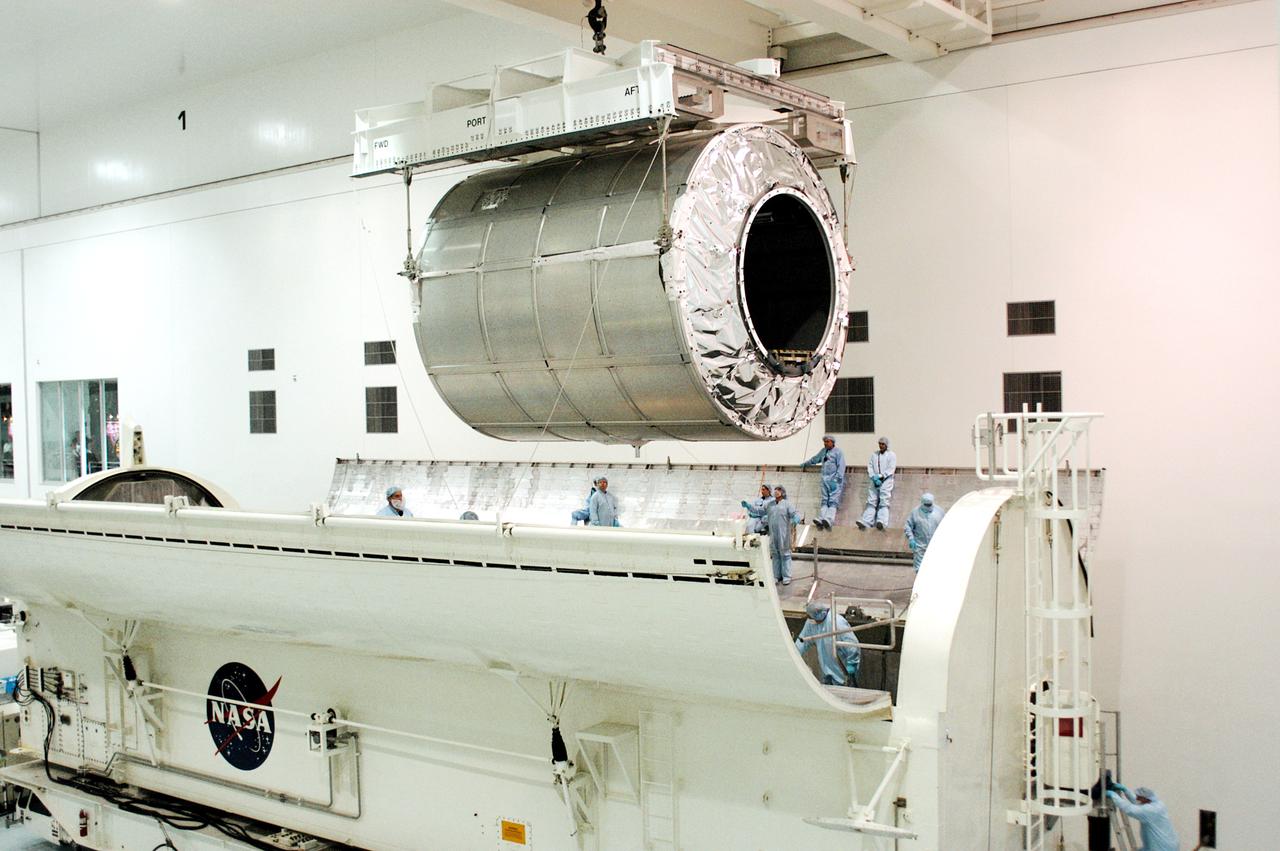
KENNEDY SPACE CENTER, FLA. - The Multi-Purpose Logistics Module Donatello is suspended by cables over the payload canister in the Space Station Processing Facility. Previously housed in the Operations and Checkout Building, Donatello was brought into the SSPF for routine testing. This is the first time all three MPLMs (Donatello, Raffaello and Leonardo) are in the SSPF. The MPLMs were built by the Italian Space Agency, to serve as reusable logistics carriers and the primary delivery system to resupply and return station cargo requiring a pressurized environment. The third MPLM, Raffaello is scheduled to fly on Space Shuttle Atlantis on mission STS-114.
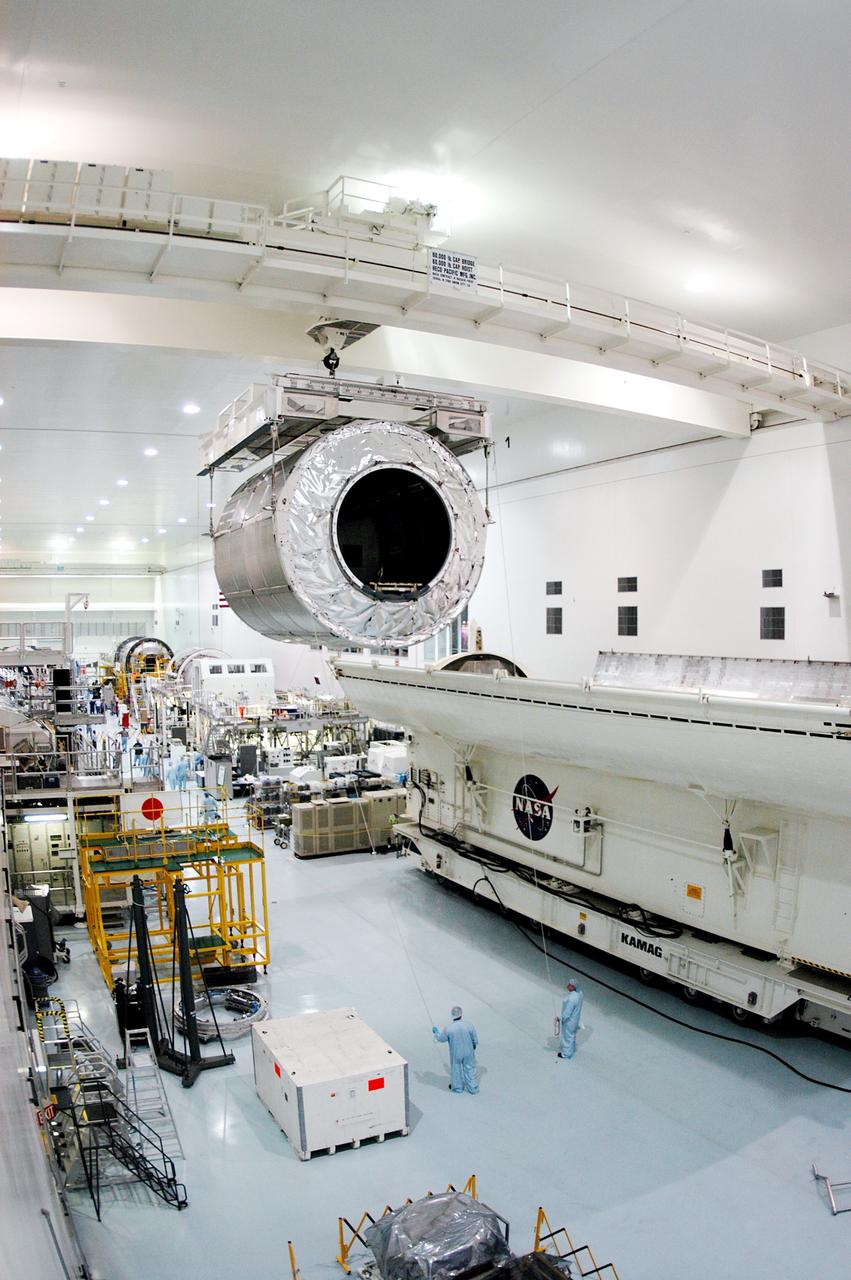
KENNEDY SPACE CENTER, FLA. - Overhead cables carry the Multi-Purpose Logistics Module Donatello from the payload canister (lower right) to a work stand in the Space Station Processing Facility. Previously housed in the Operations and Checkout Building, Donatello was brought into the SSPF for routine testing. This is the first time all three MPLMs (Donatello, Raffaello and Leonardo) are in the SSPF. The MPLMs were built by the Italian Space Agency, to serve as reusable logistics carriers and the primary delivery system to resupply and return station cargo requiring a pressurized environment. The third MPLM, Raffaello is scheduled to fly on Space Shuttle Atlantis on mission STS-114.
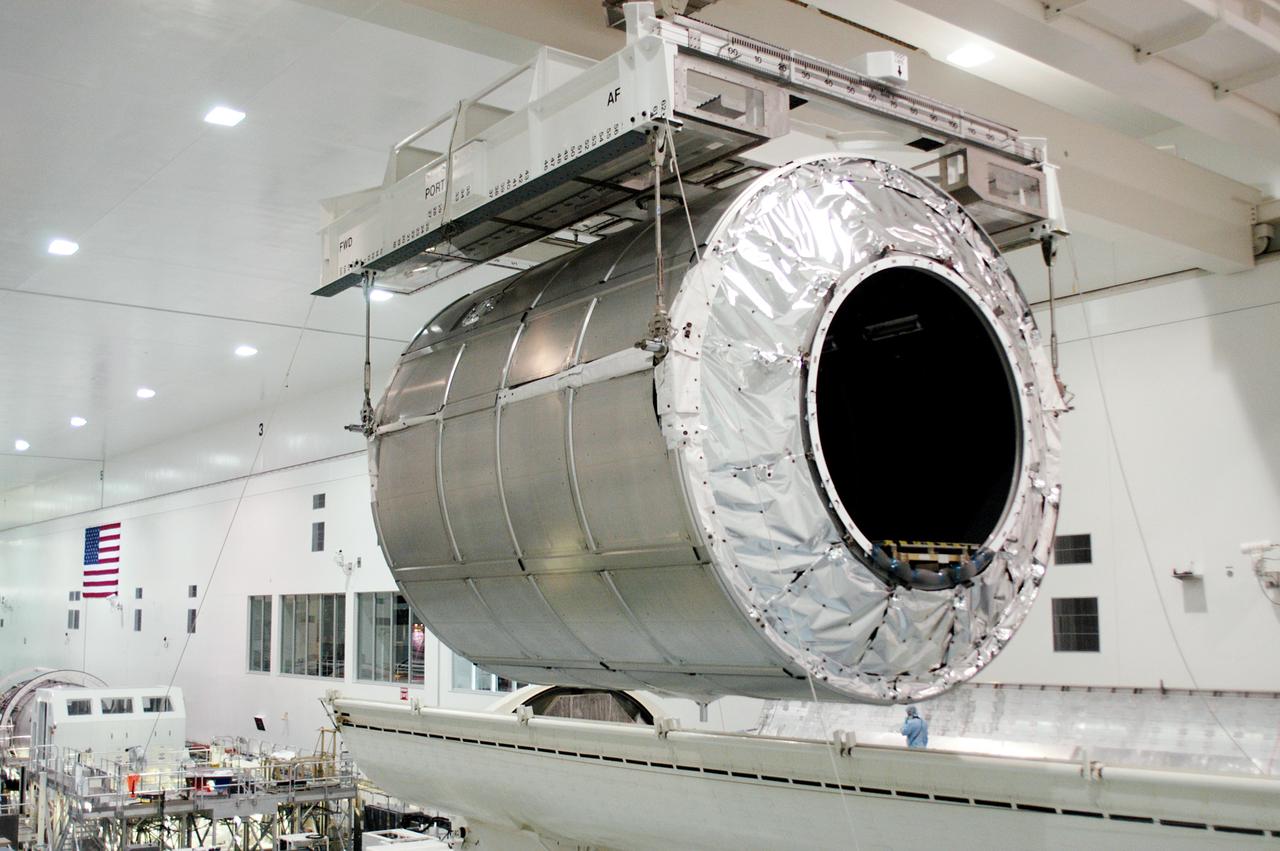
KENNEDY SPACE CENTER, FLA. - The Multi-Purpose Logistics Module Donatello is moved away from the payload canister in the Space Station Processing Facility. Previously housed in the Operations and Checkout Building, Donatello was brought into the SSPF for routine testing. This is the first time all three MPLMs (Donatello, Raffaello and Leonardo) are in the SSPF. The MPLMs were built by the Italian Space Agency, to serve as reusable logistics carriers and the primary delivery system to resupply and return station cargo requiring a pressurized environment. The third MPLM, Raffaello is scheduled to fly on Space Shuttle Atlantis on mission STS-114.
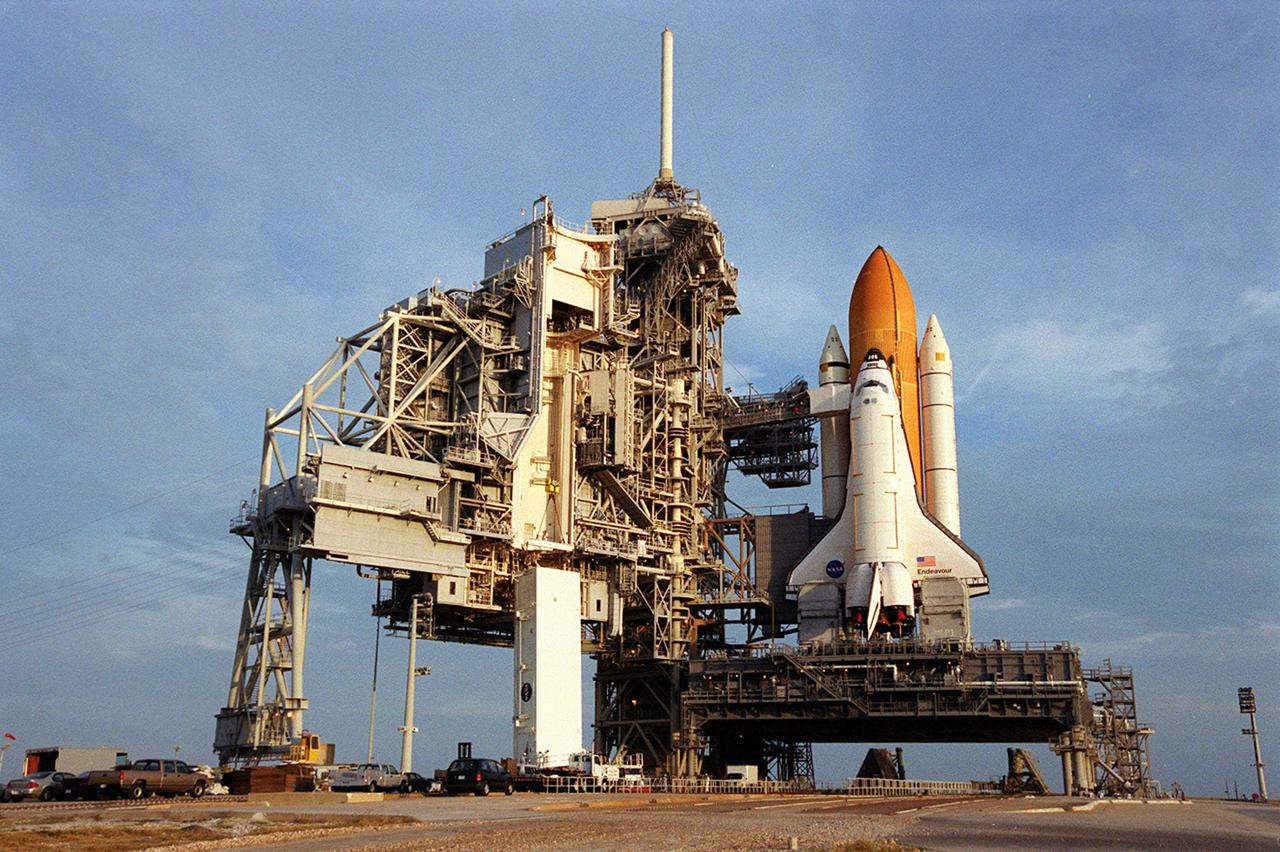
KENNEDY SPACE CENTER, FLA. -- On Launch Pad 39B, the payload transport canister waits at the base of the Rotating Service Structure (RSS) with the P6 integrated truss segment inside. The canister will be lifted up to the payload changeout room (PCR) where the P6 will be removed for transfer to Space Shuttle Endeavour’s payload bay. The PCR is the enclosed, environmentally controlled portion of the RSS that supports payload delivery at the pad and subsequent vertical installation in the orbiter payload bay. The P6, payload on mission STS-97, comprises Solar Array Wing-3 and the Integrated Electronic Assembly, to be installed on the International Space Station. The Station’s electrical power system will use eight photovoltaic solar arrays, each 112 feet long by 39 feet wide, to convert sunlight to electricity. The solar arrays are mounted on a “blanket” that can be folded like an accordion for delivery. Once in orbit, astronauts will deploy the blankets to their full size. Gimbals will be used to rotate the arrays so that they will face the Sun to provide maximum power to the Space Station. Launch of STS-97 is scheduled for Nov. 30 at 10:06 p.m. EST
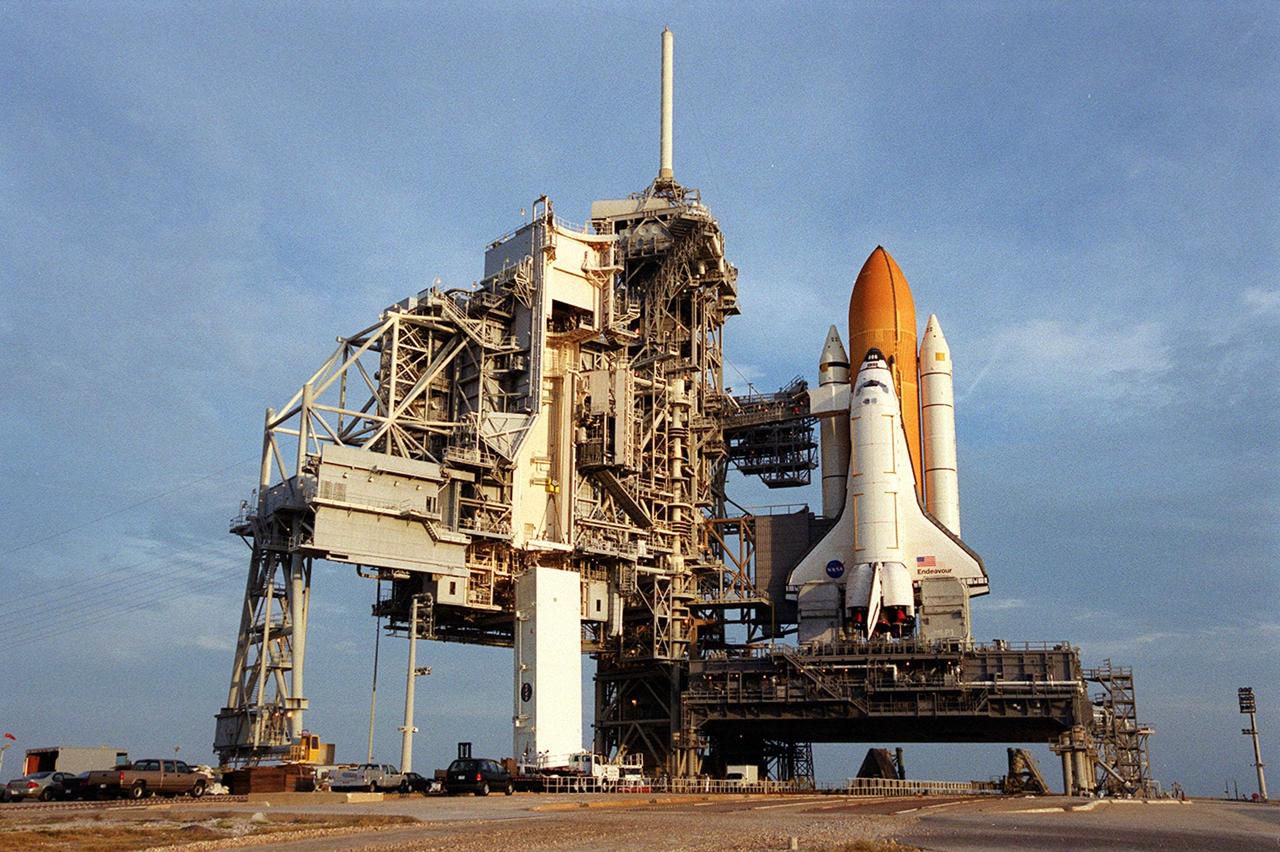
KENNEDY SPACE CENTER, FLA. -- On Launch Pad 39B, the payload transport canister waits at the base of the Rotating Service Structure (RSS) with the P6 integrated truss segment inside. The canister will be lifted up to the payload changeout room (PCR) where the P6 will be removed for transfer to Space Shuttle Endeavour’s payload bay. The PCR is the enclosed, environmentally controlled portion of the RSS that supports payload delivery at the pad and subsequent vertical installation in the orbiter payload bay. The P6, payload on mission STS-97, comprises Solar Array Wing-3 and the Integrated Electronic Assembly, to be installed on the International Space Station. The Station’s electrical power system will use eight photovoltaic solar arrays, each 112 feet long by 39 feet wide, to convert sunlight to electricity. The solar arrays are mounted on a “blanket” that can be folded like an accordion for delivery. Once in orbit, astronauts will deploy the blankets to their full size. Gimbals will be used to rotate the arrays so that they will face the Sun to provide maximum power to the Space Station. Launch of STS-97 is scheduled for Nov. 30 at 10:06 p.m. EST
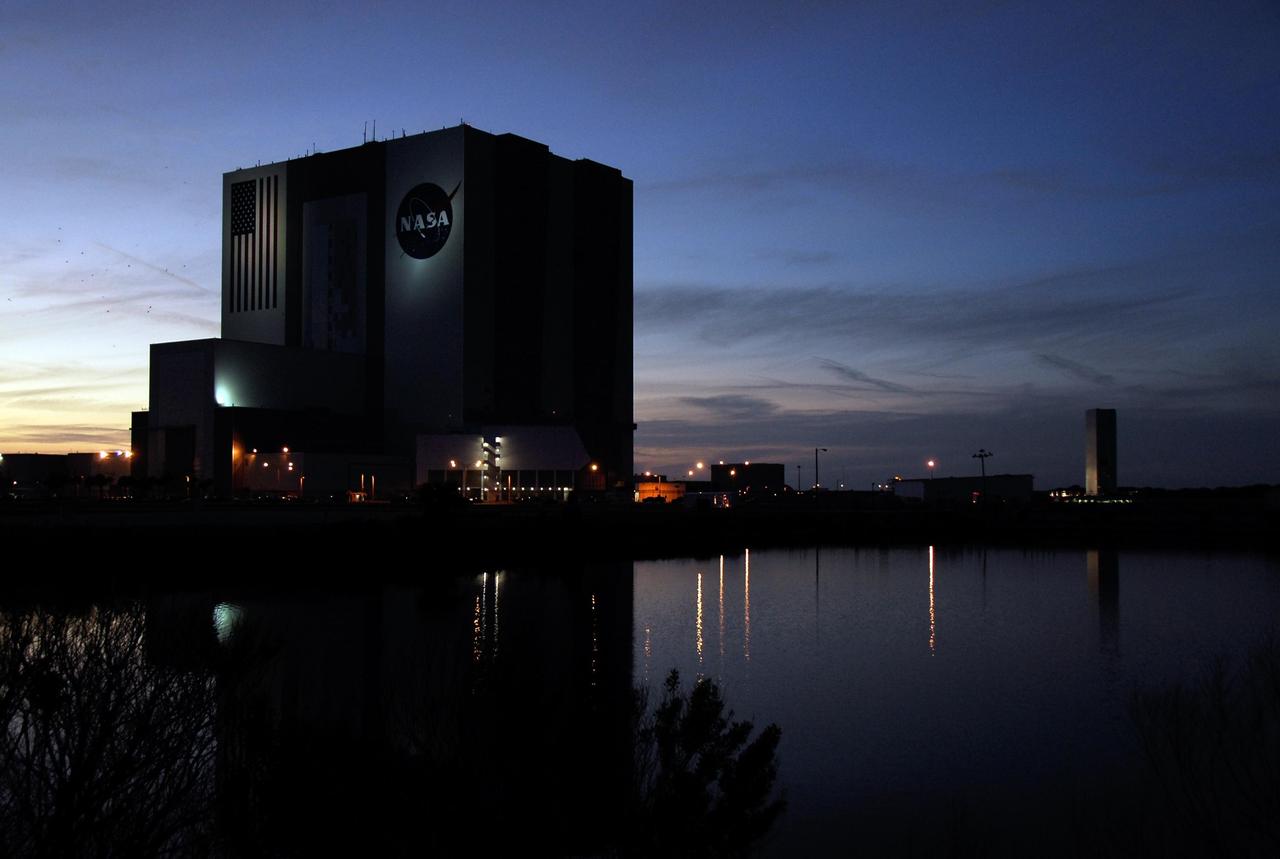
KENNEDY SPACE CENTER, FLA. -- Under a darkening sky, the payload canister (center, far right) containing the first section of the Japan Aerospace Exploration Agency's Kibo laboratory and the Canadian Space Agency's two-armed robotic system, Dextre, slowly moves toward Launch Pad 39A at NASA's Kennedy Space Center. At the pad the payload will be transferred to the payload changeout room, part of the rotating service structure. The changeout room is the enclosed, environmentally controlled portion of the rotating service structure that supports cargo delivery to the pad and subsequent vertical installation into an orbiter's payload bay. The payload will be installed into Endeavour for launch on the STS-123 mission targeted for March 11. Photo credit: NASA/Kim Shiflett
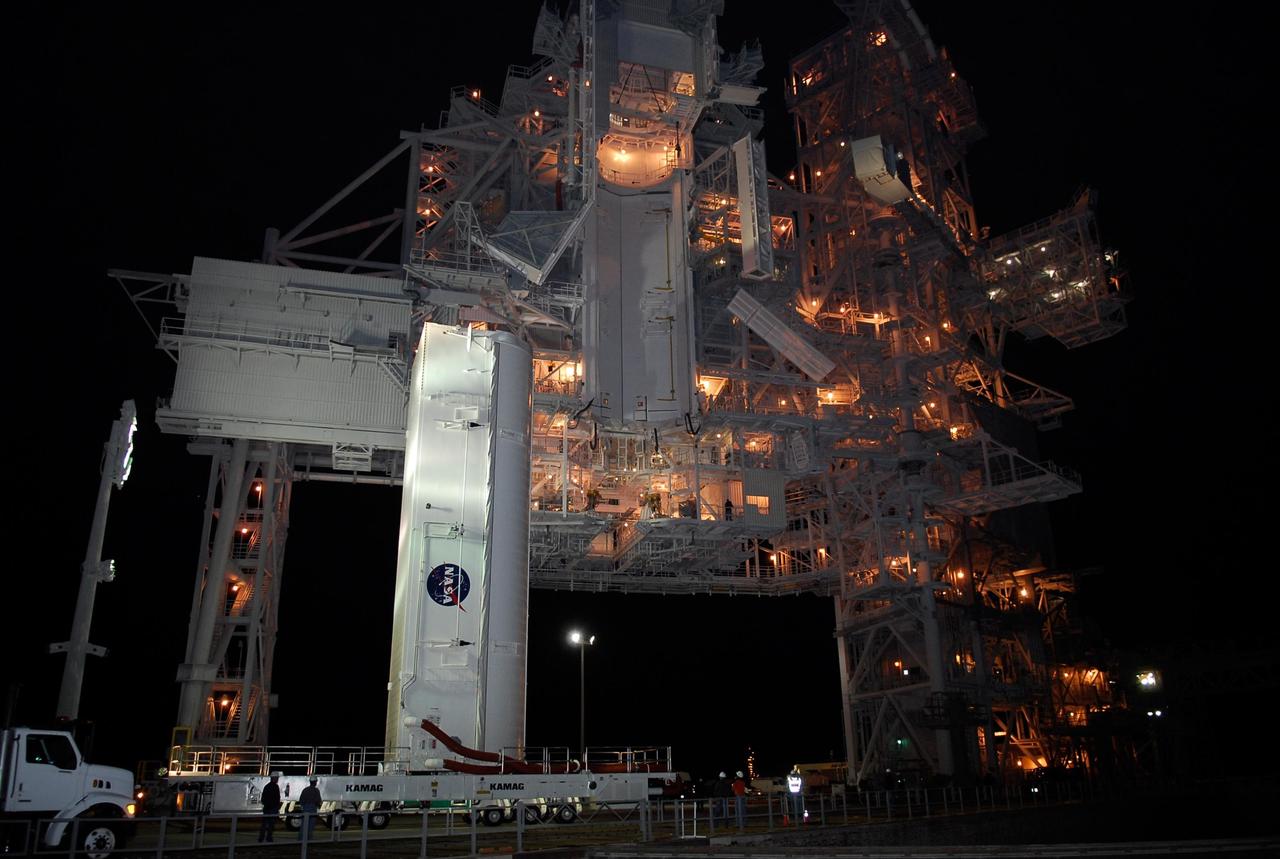
KENNEDY SPACE CENTER, FLA. -- The payload canister containing the first section of the Japan Aerospace Exploration Agency's Kibo laboratory and the Canadian Space Agency's two-armed robotic system, Dextre, nears the rotating service structure on Launch Pad 39A at NASA's Kennedy Space Center. The payload will be transferred to the payload changeout room on the service structure. The changeout room is the enclosed, environmentally controlled portion of the rotating service structure that supports cargo delivery to the pad and subsequent vertical installation into an orbiter's payload bay. The payload will be installed into Endeavour for launch on the STS-123 mission targeted for March 11. Photo credit: NASA/Kim Shiflett
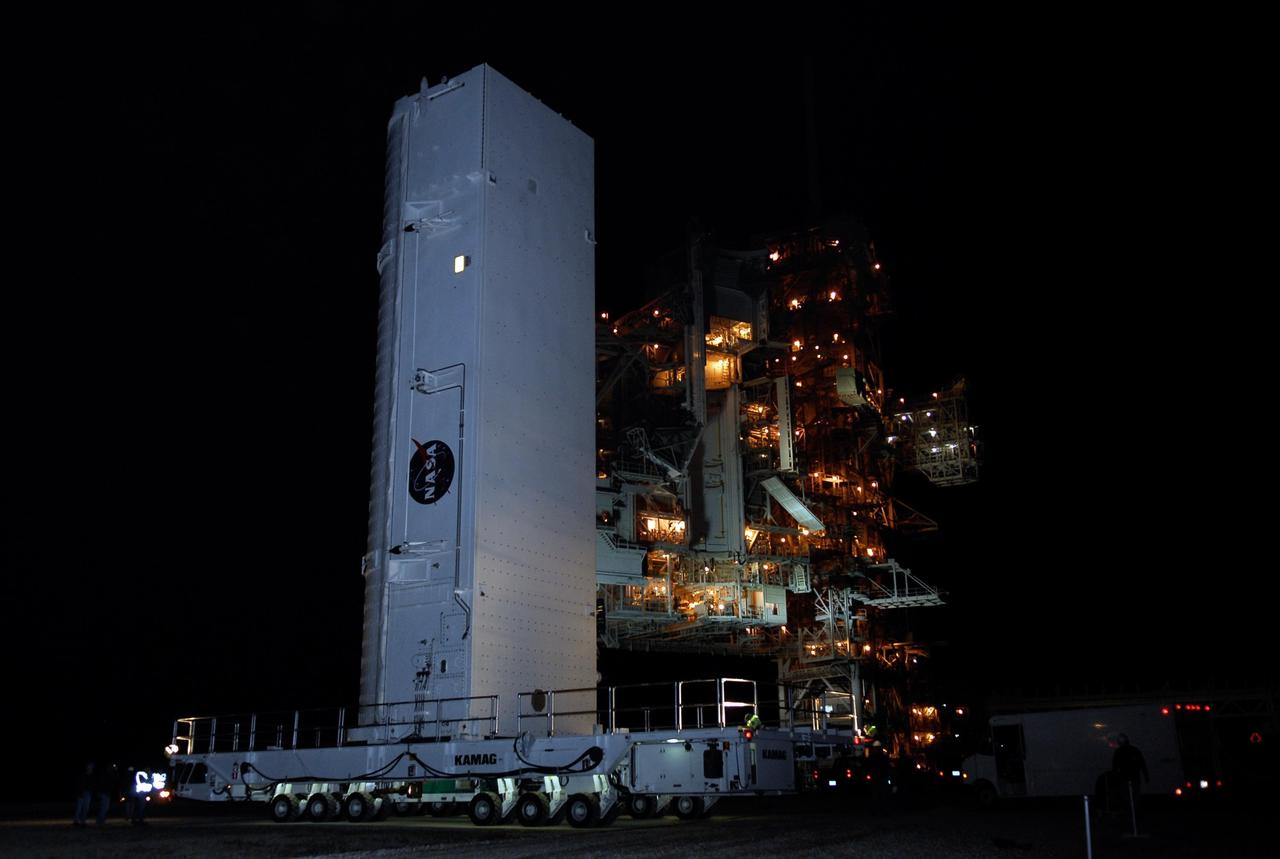
KENNEDY SPACE CENTER, FLA. -- The payload canister containing the first section of the Japan Aerospace Exploration Agency's Kibo laboratory and the Canadian Space Agency's two-armed robotic system, Dextre, nears the rotating service structure on Launch Pad 39A at NASA's Kennedy Space Center. The payload will be transferred to the payload changeout room on the service structure. The changeout room is the enclosed, environmentally controlled portion of the rotating service structure that supports cargo delivery to the pad and subsequent vertical installation into an orbiter's payload bay. The payload will be installed into Endeavour for launch on the STS-123 mission targeted for March 11. Photo credit: NASA/Kim Shiflett
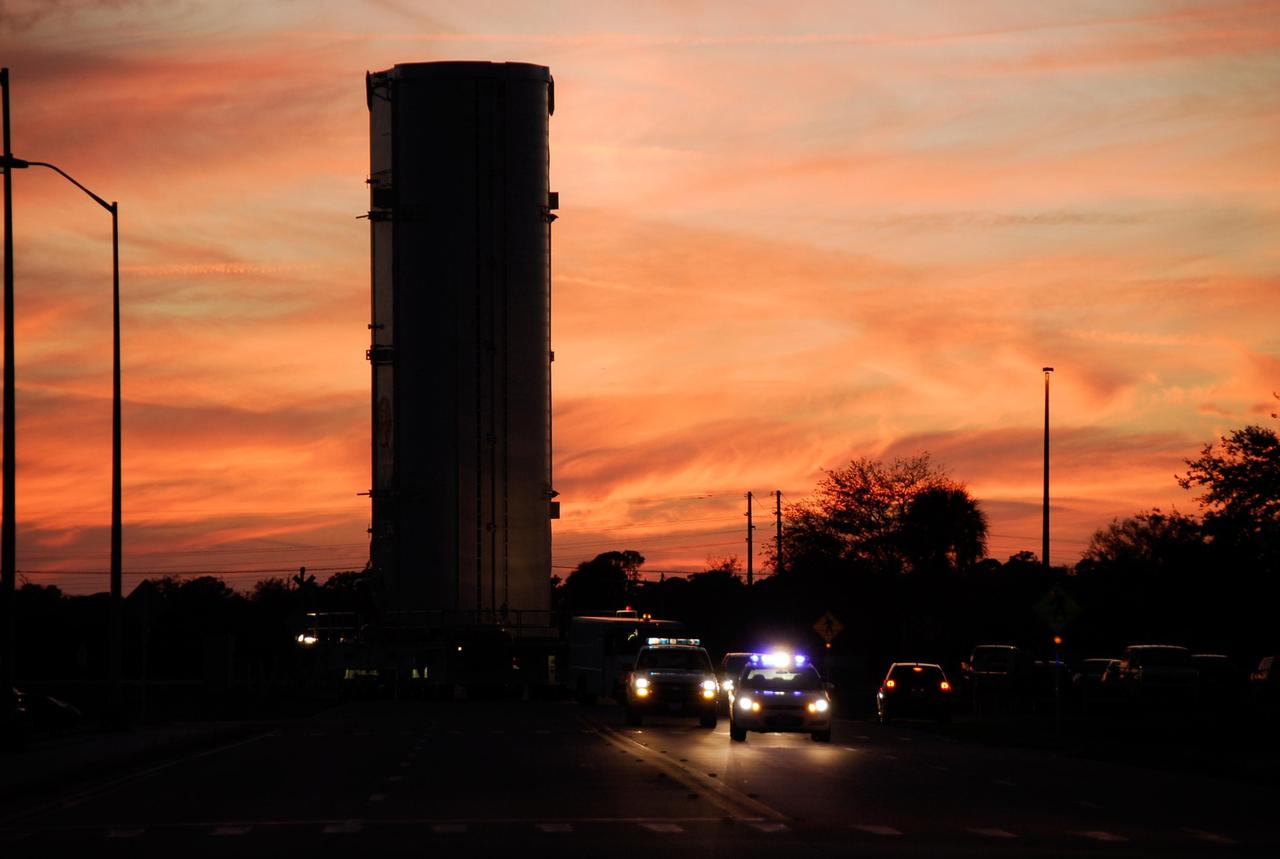
KENNEDY SPACE CENTER, FLA. -- At sunset, the payload canister containing the first section of the Japan Aerospace Exploration Agency's Kibo laboratory and the Canadian Space Agency's two-armed robotic system, Dextre, slowly moves toward Launch Pad 39A at NASA's Kennedy Space Center. At the pad the payload will be transferred to the payload changeout room, part of the rotating service structure. The changeout room is the enclosed, environmentally controlled portion of the rotating service structure that supports cargo delivery to the pad and subsequent vertical installation into an orbiter's payload bay. The payload will be installed into Endeavour for launch on the STS-123 mission targeted for March 11. Photo credit: NASA/Kim Shiflett
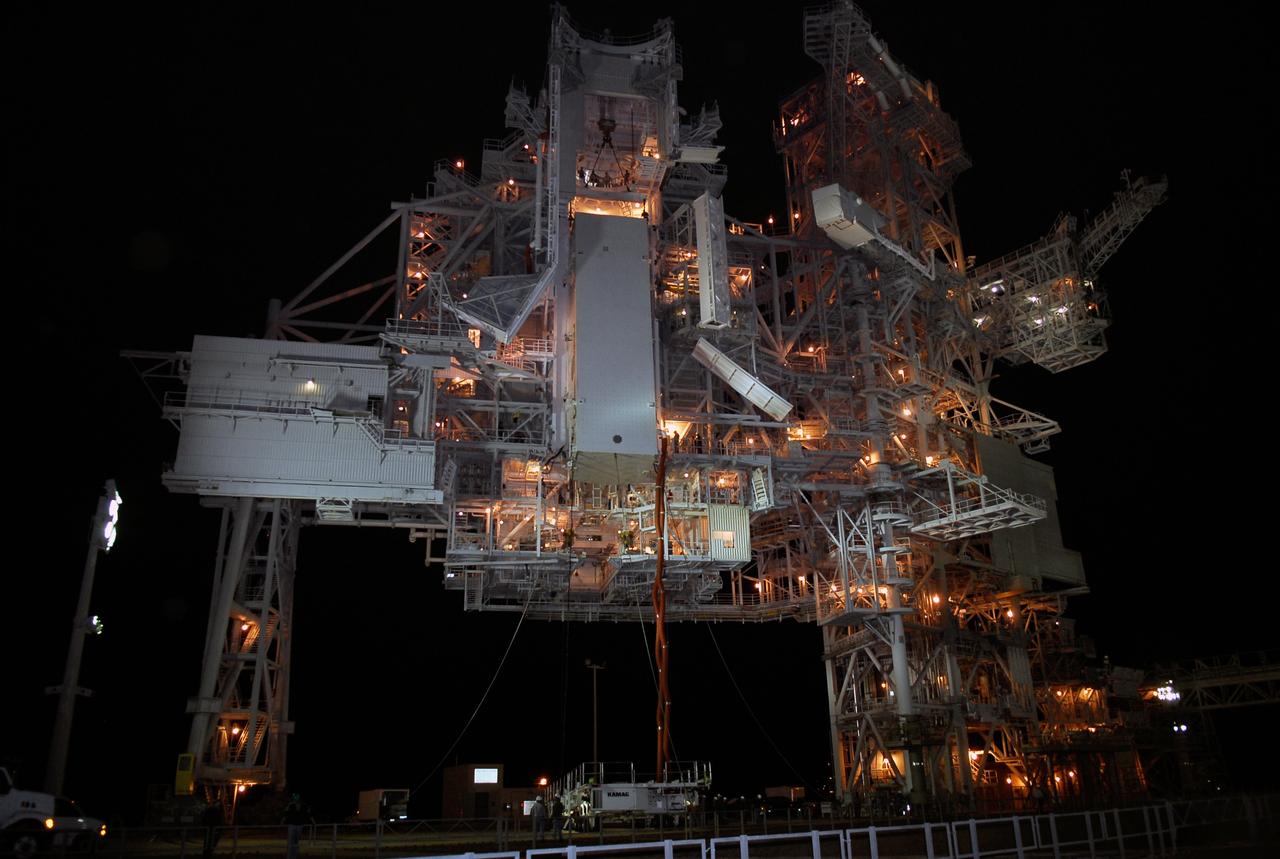
CAPE CANAVERAL, Fla. – On Launch Pad 39A at NASA's Kennedy Space Center, the payload canister has been lifted up to the payload changeout room for transfer of its cargo. Inside the canister are the Japanese Experiment Module - Pressurized Module and the Japanese Remote Manipulator System, or RMS, for the STS-124 mission. The changeout room is the enclosed, environmentally controlled portion of the service structure that supports cargo delivery to the pad and subsequent vertical installation into an orbiter's payload bay. From the payload changeout room, the pressurized module and RMS then will be transferred into space shuttle Discovery’s payload bay. Launch is targeted for May 31. Photo credit: NASA/Kim Shiflett
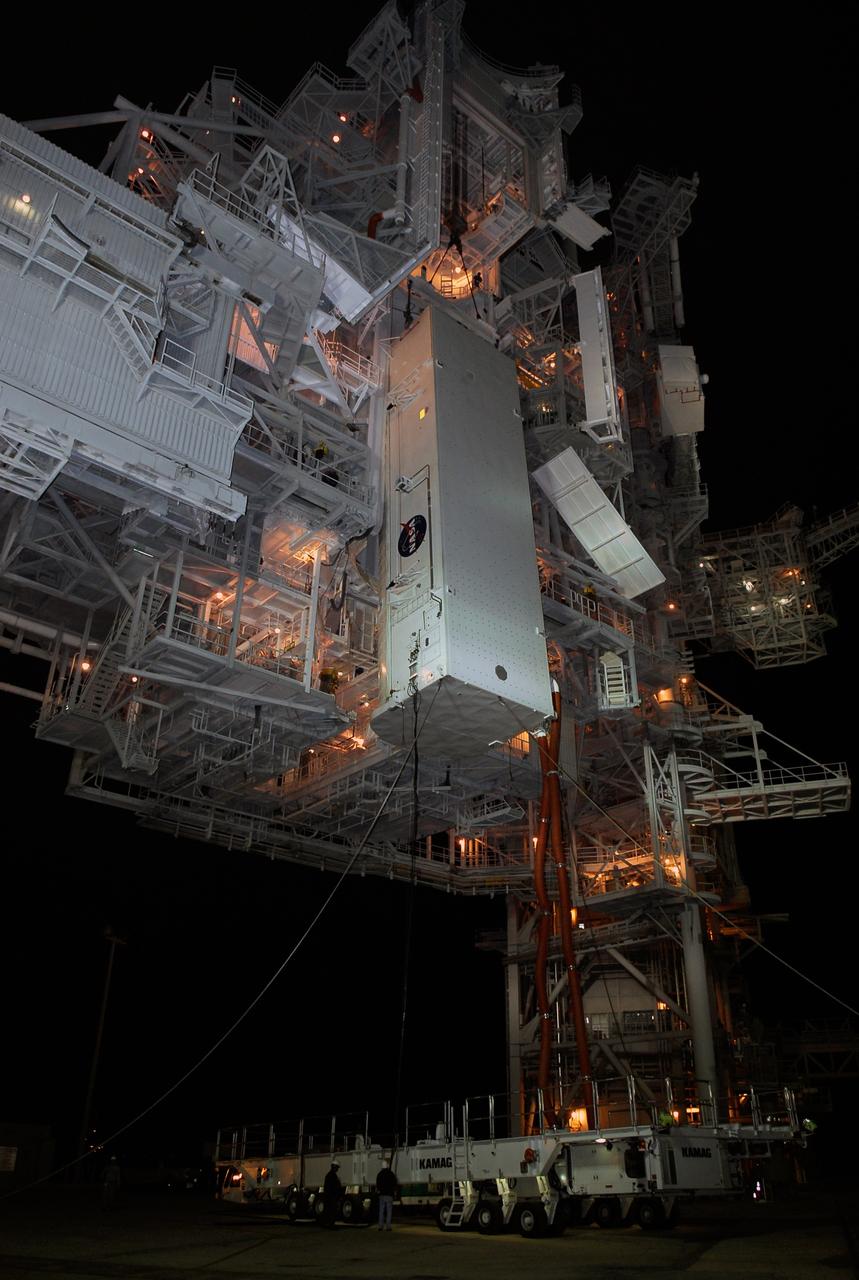
CAPE CANAVERAL, Fla. – On Launch Pad 39A at NASA's Kennedy Space Center, the payload canister has been lifted up to the payload changeout room for transfer of its cargo. Inside the canister are the Japanese Experiment Module - Pressurized Module and the Japanese Remote Manipulator System, or RMS, for the STS-124 mission. The changeout room is the enclosed, environmentally controlled portion of the service structure that supports cargo delivery to the pad and subsequent vertical installation into an orbiter's payload bay. From the payload changeout room, the pressurized module and RMS then will be transferred into space shuttle Discovery’s payload bay. Launch is targeted for May 31. Photo credit: NASA/Kim Shiflett
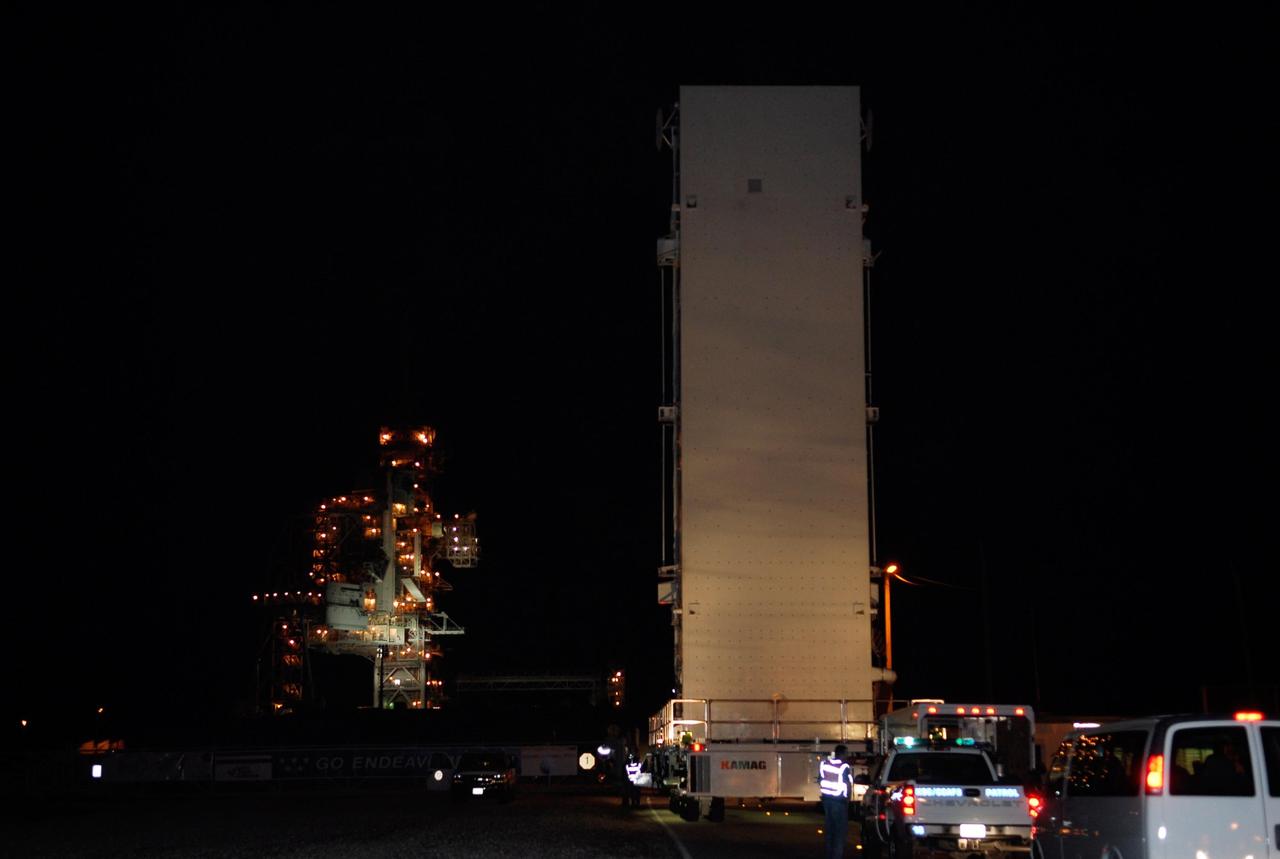
KENNEDY SPACE CENTER, FLA. -- The payload canister containing the first section of the Japan Aerospace Exploration Agency's Kibo laboratory and the Canadian Space Agency's two-armed robotic system, Dextre, moves toward Launch Pad 39A at NASA's Kennedy Space Center. At the pad the payload will be transferred to the payload changeout room, part of the rotating service structure. The changeout room is the enclosed, environmentally controlled portion of the rotating service structure that supports cargo delivery to the pad and subsequent vertical installation into an orbiter's payload bay. The payload will be installed into Endeavour for launch on the STS-123 mission targeted for March 11. Photo credit: NASA/Kim Shiflett
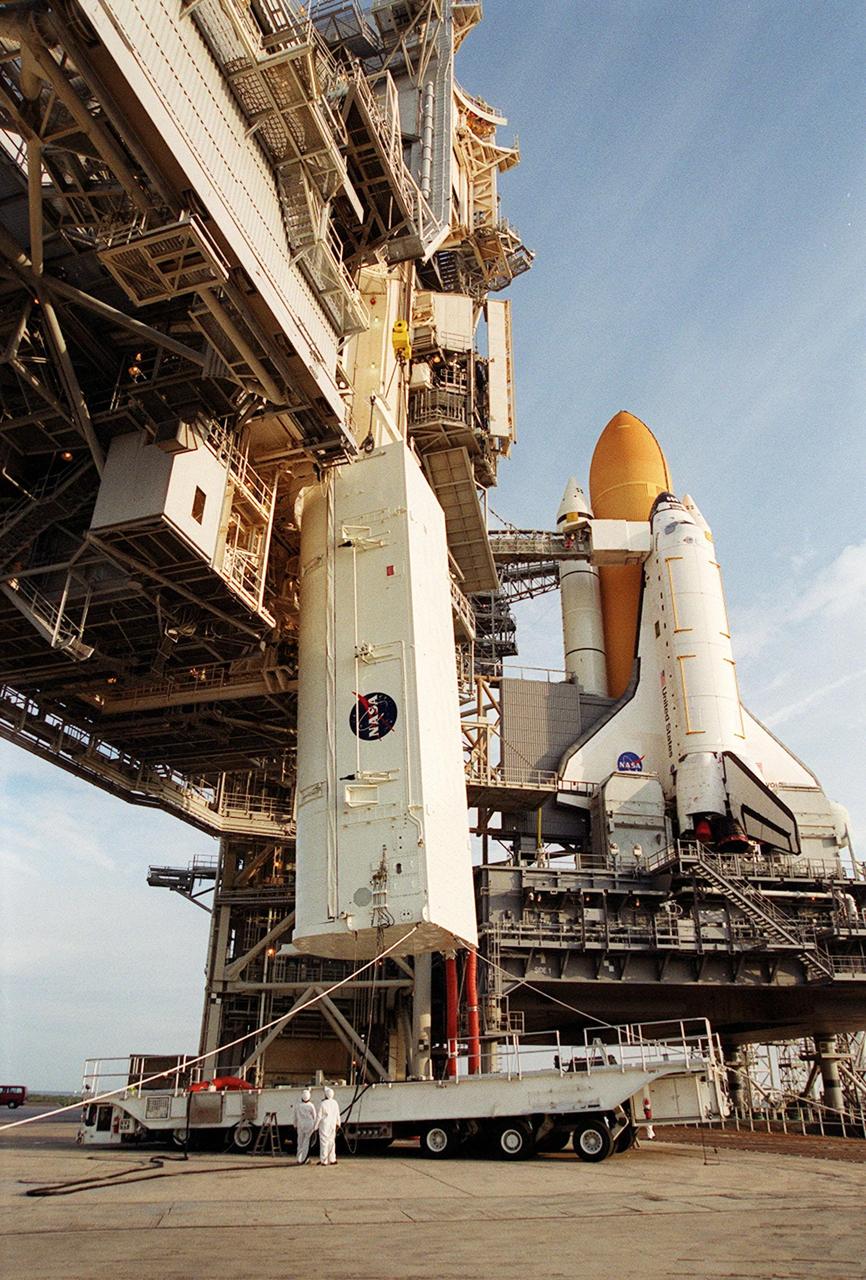
KENNEDY SPACE CENTER, FLA. -- On Launch Pad 39B, the payload transport canister, with the P6 integrated truss segment inside, is lifted toward the payload changeout room (PCR). The PCR is the enclosed, environmentally controlled portion of the Rotating Service Structure (RSS) (on the left) that supports payload delivery at the pad. At right is Space Shuttle Endeavour with its orange external tank and one solid rocket booster showing behind it. When the RSS is closed around Endeavour, the P6 truss will be able to be moved into the orbiter’s payload bay. The P6, payload on mission STS-97, comprises Solar Array Wing-3 and the Integrated Electronic Assembly, to be installed on the International Space Station. The Station’s electrical power system will use eight photovoltaic solar arrays, each 112 feet long by 39 feet wide, to convert sunlight to electricity. The solar arrays are mounted on a “blanket” that can be folded like an accordion for delivery. Once in orbit, astronauts will deploy the blankets to their full size. Gimbals will be used to rotate the arrays so that they will face the Sun to provide maximum power to the Space Station. Launch of STS-97 is scheduled for Nov. 30 at 10:06 p.m. EST
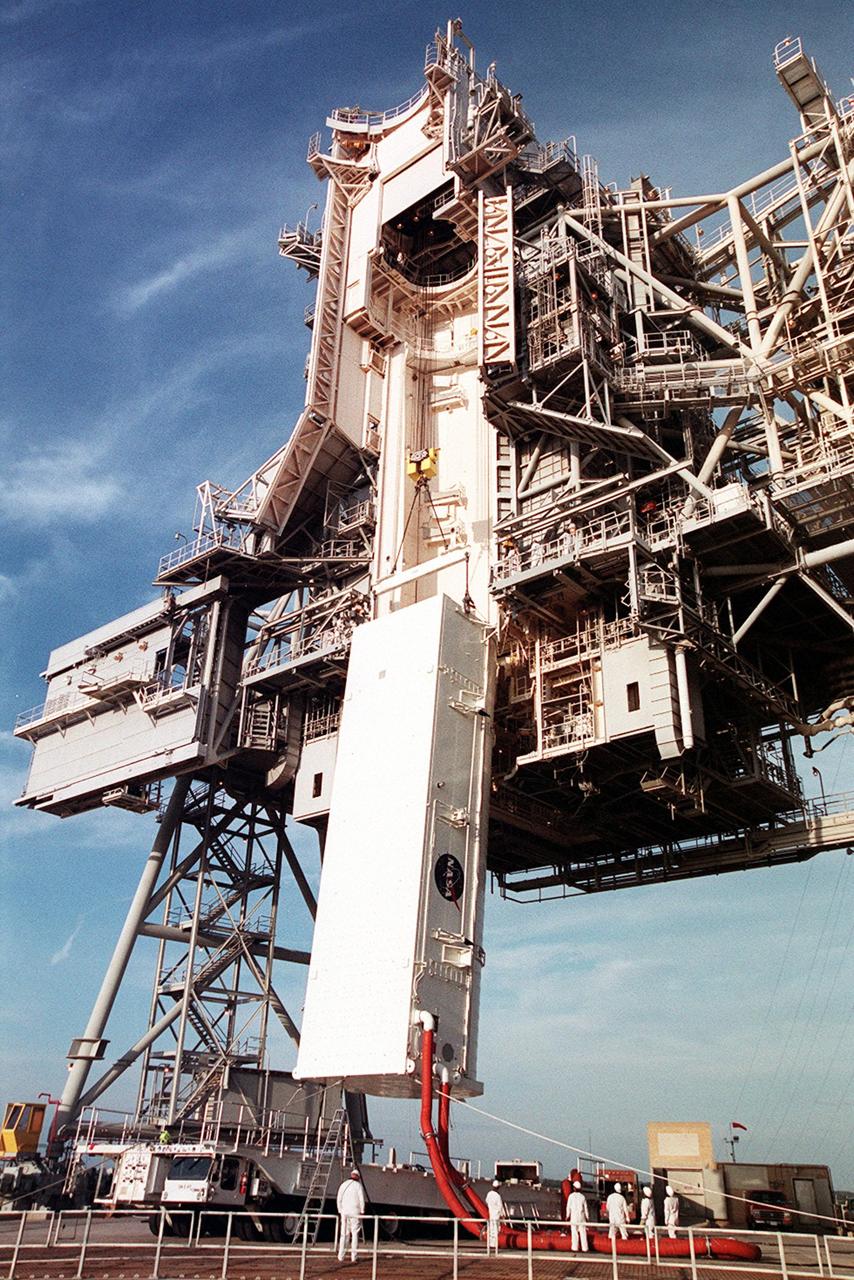
KENNEDY SPACE CENTER, FLA. -- On Launch Pad 39B, the payload transport canister, with the P6 integrated truss segment inside, is lifted toward the payload changeout room (PCR). The PCR is the enclosed, environmentally controlled portion of the Rotating Service Structure that supports payload delivery at the pad and subsequent vertical installation in the orbiter payload bay. Attached to the canister are the red umbilical lines that maintain the controlled environment inside. The P6, payload on mission STS-97, comprises Solar Array Wing-3 and the Integrated Electronic Assembly, to be installed on the International Space Station. The Station’s electrical power system will use eight photovoltaic solar arrays, each 112 feet long by 39 feet wide, to convert sunlight to electricity. The solar arrays are mounted on a “blanket” that can be folded like an accordion for delivery. Once in orbit, astronauts will deploy the blankets to their full size. Gimbals will be used to rotate the arrays so that they will face the Sun to provide maximum power to the Space Station. Launch of STS-97 is scheduled for Nov. 30 at 10:06 p.m. EST
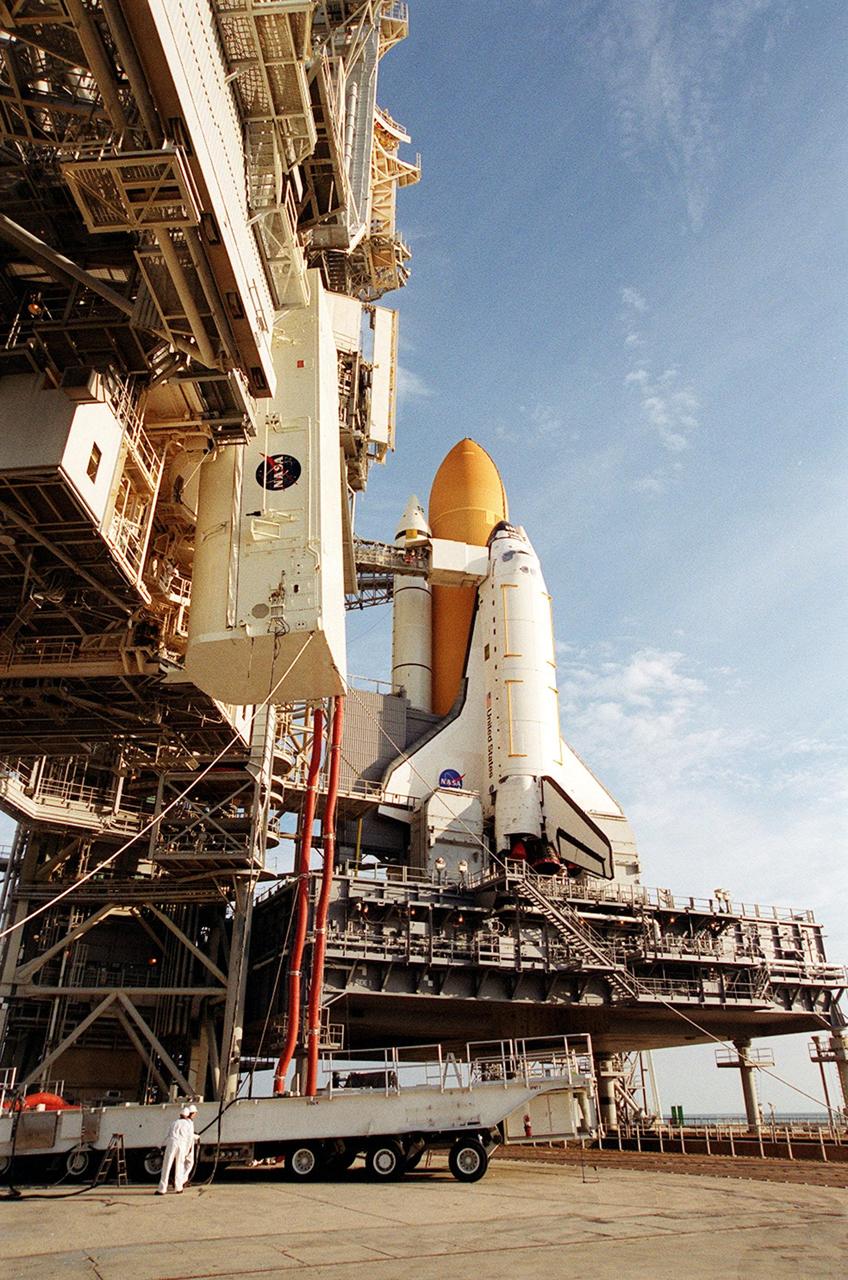
KENNEDY SPACE CENTER, FLA. -- On Launch Pad 39B, the payload transport canister, with the P6 integrated truss segment inside, is lifted higher toward the payload changeout room (PCR) above it. The PCR is the enclosed, environmentally controlled portion of the Rotating Service Structure (RSS) (at left) that supports payload delivery at the pad. At right is Space Shuttle Endeavour with its orange external tank and one solid rocket booster showing behind it. When the RSS is closed around Endeavour, the P6 truss will be moved into the orbiter’s payload bay. The P6, payload on mission STS-97, comprises Solar Array Wing-3 and the Integrated Electronic Assembly, to be installed on the International Space Station. The Station’s electrical power system will use eight photovoltaic solar arrays, each 112 feet long by 39 feet wide, to convert sunlight to electricity. The solar arrays are mounted on a “blanket” that can be folded like an accordion for delivery. Once in orbit, astronauts will deploy the blankets to their full size. Gimbals will be used to rotate the arrays so that they will face the Sun to provide maximum power to the Space Station. Launch of STS-97 is scheduled for Nov. 30 at 10:06 p.m. EST
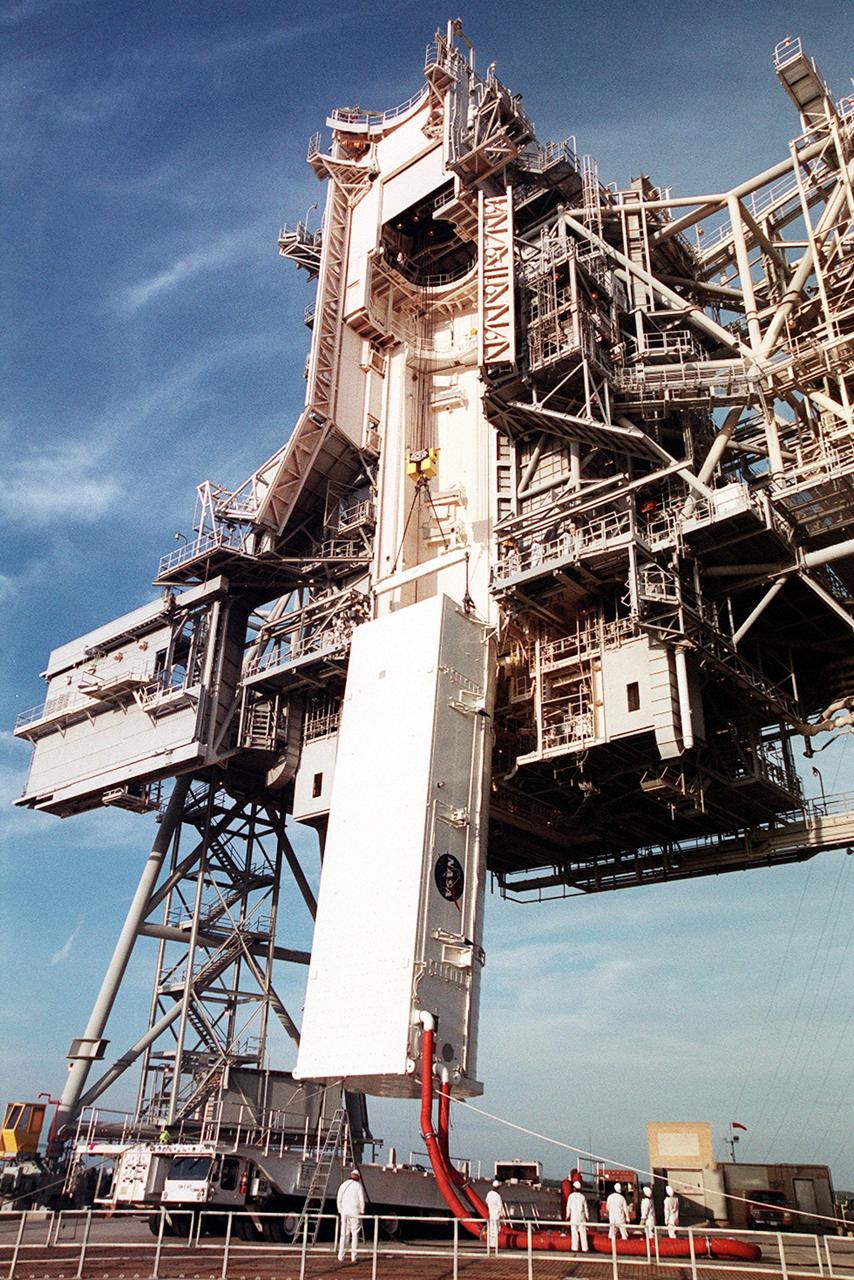
KENNEDY SPACE CENTER, FLA. -- On Launch Pad 39B, the payload transport canister, with the P6 integrated truss segment inside, is lifted toward the payload changeout room (PCR). The PCR is the enclosed, environmentally controlled portion of the Rotating Service Structure that supports payload delivery at the pad and subsequent vertical installation in the orbiter payload bay. Attached to the canister are the red umbilical lines that maintain the controlled environment inside. The P6, payload on mission STS-97, comprises Solar Array Wing-3 and the Integrated Electronic Assembly, to be installed on the International Space Station. The Station’s electrical power system will use eight photovoltaic solar arrays, each 112 feet long by 39 feet wide, to convert sunlight to electricity. The solar arrays are mounted on a “blanket” that can be folded like an accordion for delivery. Once in orbit, astronauts will deploy the blankets to their full size. Gimbals will be used to rotate the arrays so that they will face the Sun to provide maximum power to the Space Station. Launch of STS-97 is scheduled for Nov. 30 at 10:06 p.m. EST
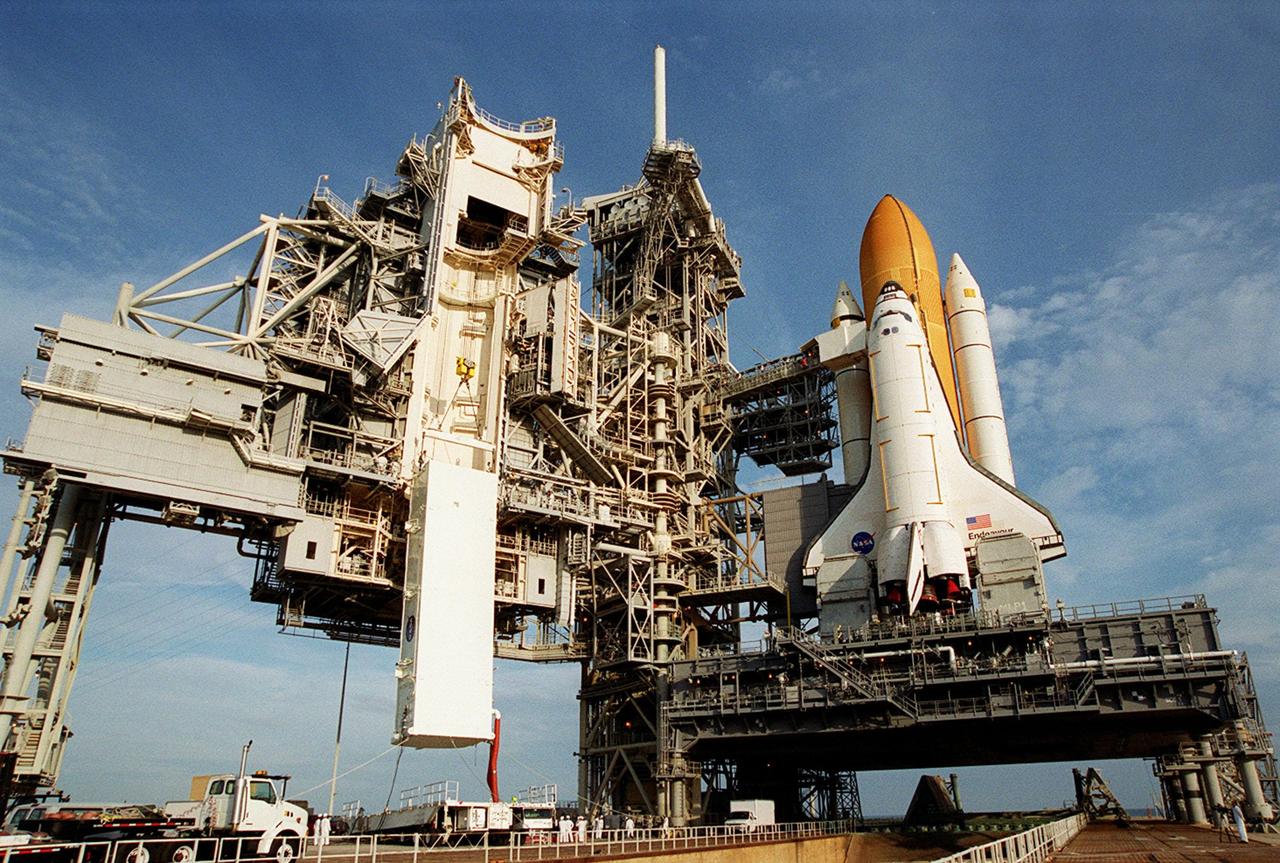
KENNEDY SPACE CENTER, FLA. -- On Launch Pad 39B, the payload transport canister, with the P6 integrated truss segment inside, moves higher toward the payload changeout room (PCR). The PCR is the enclosed, environmentally controlled portion of the Rotating Service Structure (RSS) (at left) that supports payload delivery at the pad. At right is Space Shuttle Endeavour with its orange external tank and solid rocket boosters showing behind it. When the RSS is closed around Endeavour, the P6 truss will be able to be moved into the orbiter’s payload bay. The P6, payload on mission STS-97, comprises Solar Array Wing-3 and the Integrated Electronic Assembly, to be installed on the International Space Station. The Station’s electrical power system will use eight photovoltaic solar arrays, each 112 feet long by 39 feet wide, to convert sunlight to electricity. The solar arrays are mounted on a “blanket” that can be folded like an accordion for delivery. Once in orbit, astronauts will deploy the blankets to their full size. Gimbals will be used to rotate the arrays so that they will face the Sun to provide maximum power to the Space Station. Launch of STS-97 is scheduled for Nov. 30 at 10:06 p.m. EST
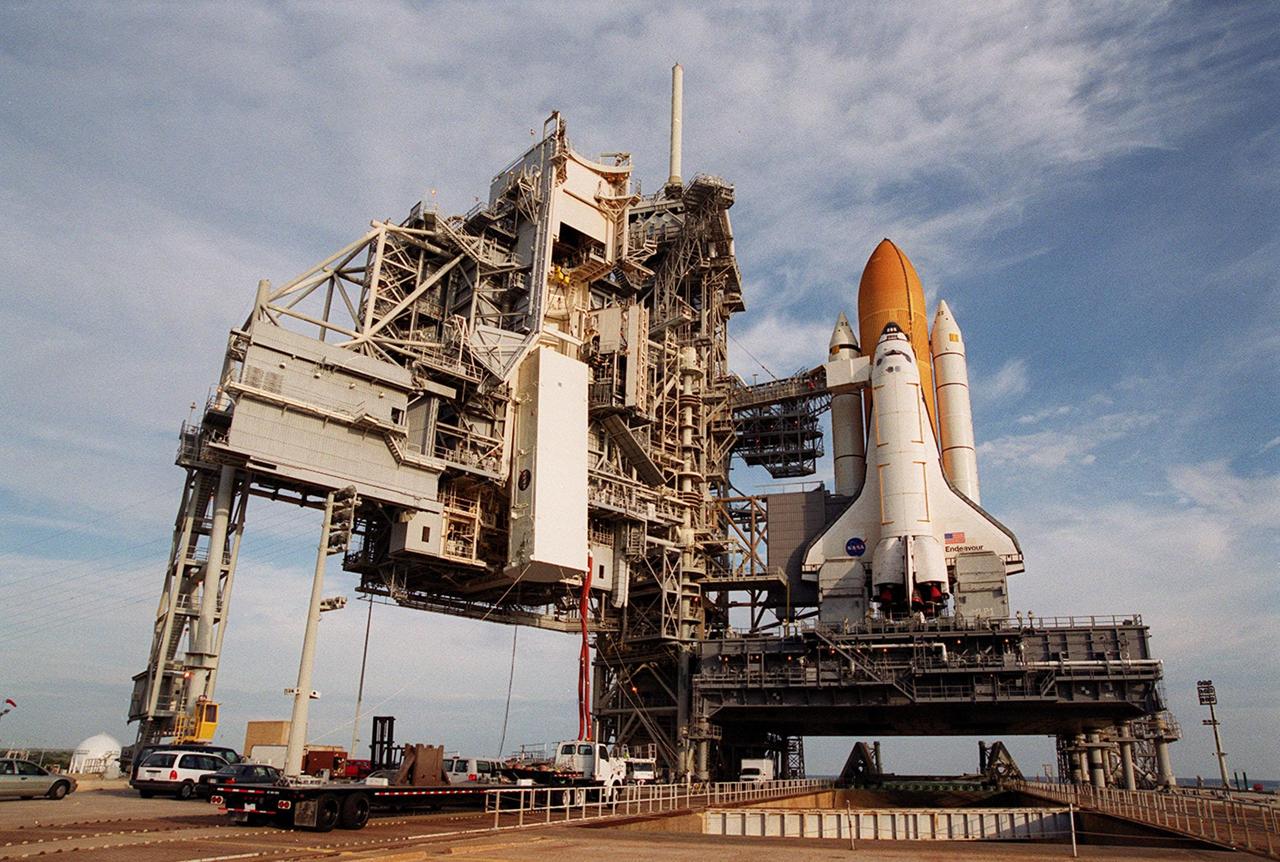
KENNEDY SPACE CENTER, FLA. -- The payload transport canister, with the P6 integrated truss segment inside, is close to the payload changeout room on the Rotating Service Structure (RSS) at left. The PCR is the enclosed, environmentally controlled portion of the RSS that supports payload delivery at the pad. At right is Space Shuttle Endeavour with its orange external tank and one solid rocket booster showing behind it. When the RSS is closed around Endeavour, the P6 truss will be moved into the orbiter’s payload bay. The P6, payload on mission STS-97, comprises Solar Array Wing-3 and the Integrated Electronic Assembly, to be installed on the International Space Station. The Station’s electrical power system will use eight photovoltaic solar arrays, each 112 feet long by 39 feet wide, to convert sunlight to electricity. The solar arrays are mounted on a “blanket” that can be folded like an accordion for delivery. Once in orbit, astronauts will deploy the blankets to their full size. Gimbals will be used to rotate the arrays so that they will face the Sun to provide maximum power to the Space Station. Launch of STS-97 is scheduled for Nov. 30 at 10:06 p.m. EST
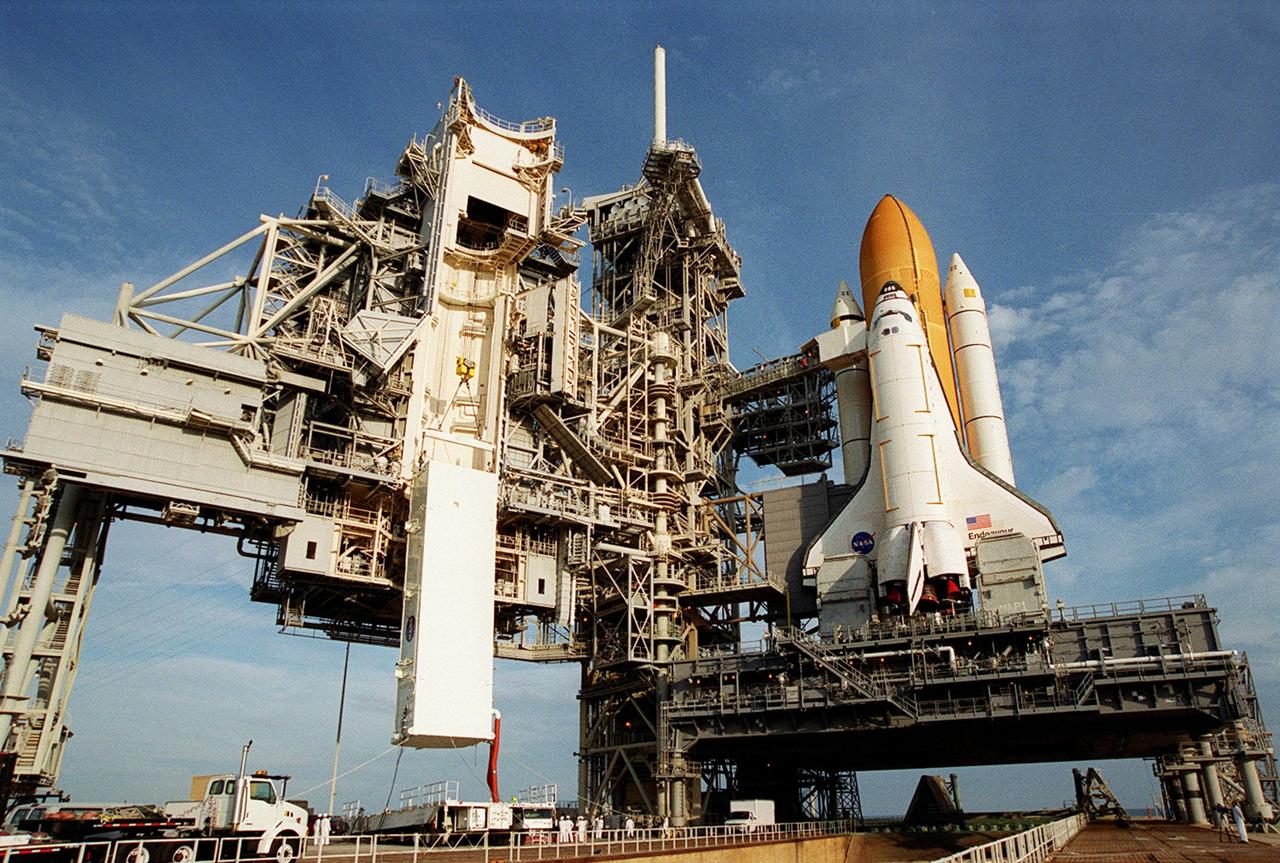
KENNEDY SPACE CENTER, FLA. -- On Launch Pad 39B, the payload transport canister, with the P6 integrated truss segment inside, moves higher toward the payload changeout room (PCR). The PCR is the enclosed, environmentally controlled portion of the Rotating Service Structure (RSS) (at left) that supports payload delivery at the pad. At right is Space Shuttle Endeavour with its orange external tank and solid rocket boosters showing behind it. When the RSS is closed around Endeavour, the P6 truss will be able to be moved into the orbiter’s payload bay. The P6, payload on mission STS-97, comprises Solar Array Wing-3 and the Integrated Electronic Assembly, to be installed on the International Space Station. The Station’s electrical power system will use eight photovoltaic solar arrays, each 112 feet long by 39 feet wide, to convert sunlight to electricity. The solar arrays are mounted on a “blanket” that can be folded like an accordion for delivery. Once in orbit, astronauts will deploy the blankets to their full size. Gimbals will be used to rotate the arrays so that they will face the Sun to provide maximum power to the Space Station. Launch of STS-97 is scheduled for Nov. 30 at 10:06 p.m. EST
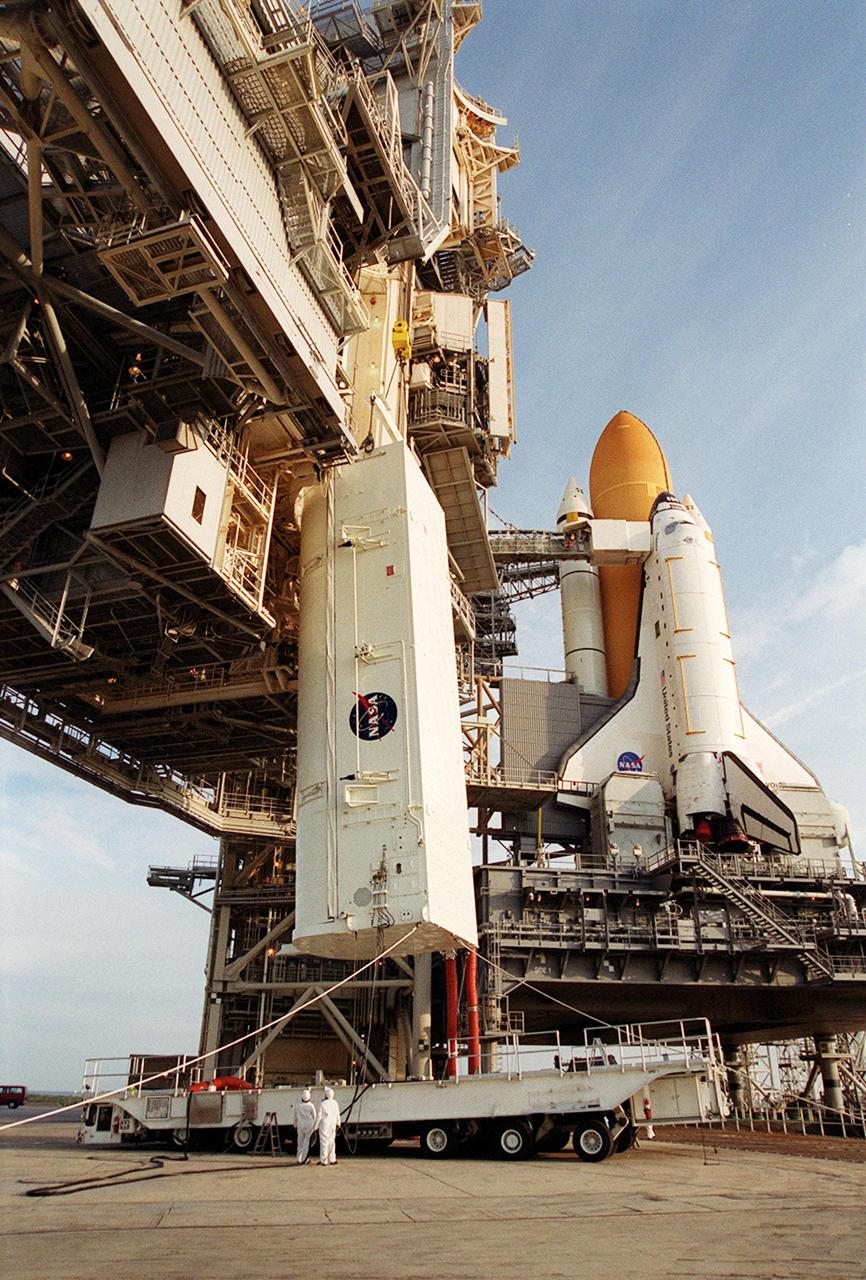
KENNEDY SPACE CENTER, FLA. -- On Launch Pad 39B, the payload transport canister, with the P6 integrated truss segment inside, is lifted toward the payload changeout room (PCR). The PCR is the enclosed, environmentally controlled portion of the Rotating Service Structure (RSS) (on the left) that supports payload delivery at the pad. At right is Space Shuttle Endeavour with its orange external tank and one solid rocket booster showing behind it. When the RSS is closed around Endeavour, the P6 truss will be able to be moved into the orbiter’s payload bay. The P6, payload on mission STS-97, comprises Solar Array Wing-3 and the Integrated Electronic Assembly, to be installed on the International Space Station. The Station’s electrical power system will use eight photovoltaic solar arrays, each 112 feet long by 39 feet wide, to convert sunlight to electricity. The solar arrays are mounted on a “blanket” that can be folded like an accordion for delivery. Once in orbit, astronauts will deploy the blankets to their full size. Gimbals will be used to rotate the arrays so that they will face the Sun to provide maximum power to the Space Station. Launch of STS-97 is scheduled for Nov. 30 at 10:06 p.m. EST
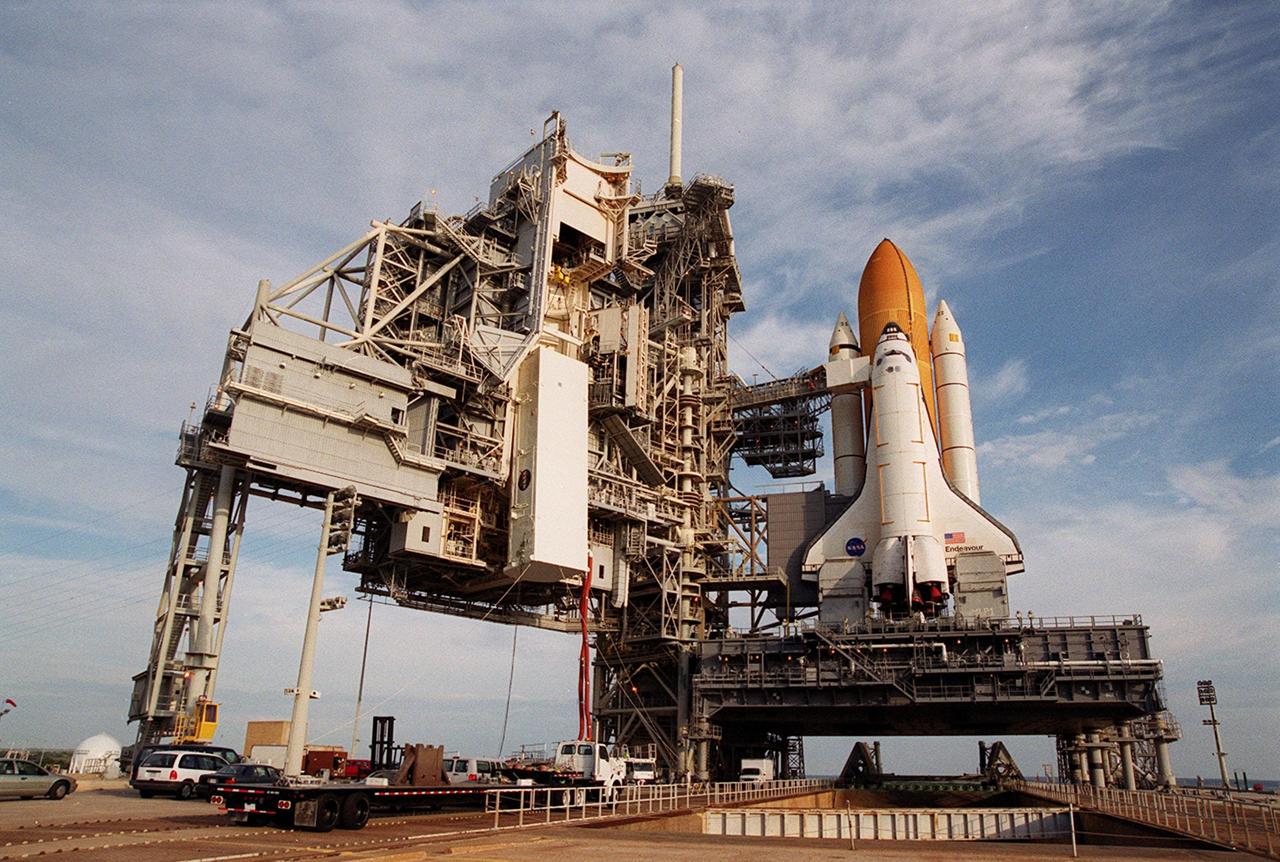
KENNEDY SPACE CENTER, FLA. -- The payload transport canister, with the P6 integrated truss segment inside, is close to the payload changeout room on the Rotating Service Structure (RSS) at left. The PCR is the enclosed, environmentally controlled portion of the RSS that supports payload delivery at the pad. At right is Space Shuttle Endeavour with its orange external tank and one solid rocket booster showing behind it. When the RSS is closed around Endeavour, the P6 truss will be moved into the orbiter’s payload bay. The P6, payload on mission STS-97, comprises Solar Array Wing-3 and the Integrated Electronic Assembly, to be installed on the International Space Station. The Station’s electrical power system will use eight photovoltaic solar arrays, each 112 feet long by 39 feet wide, to convert sunlight to electricity. The solar arrays are mounted on a “blanket” that can be folded like an accordion for delivery. Once in orbit, astronauts will deploy the blankets to their full size. Gimbals will be used to rotate the arrays so that they will face the Sun to provide maximum power to the Space Station. Launch of STS-97 is scheduled for Nov. 30 at 10:06 p.m. EST
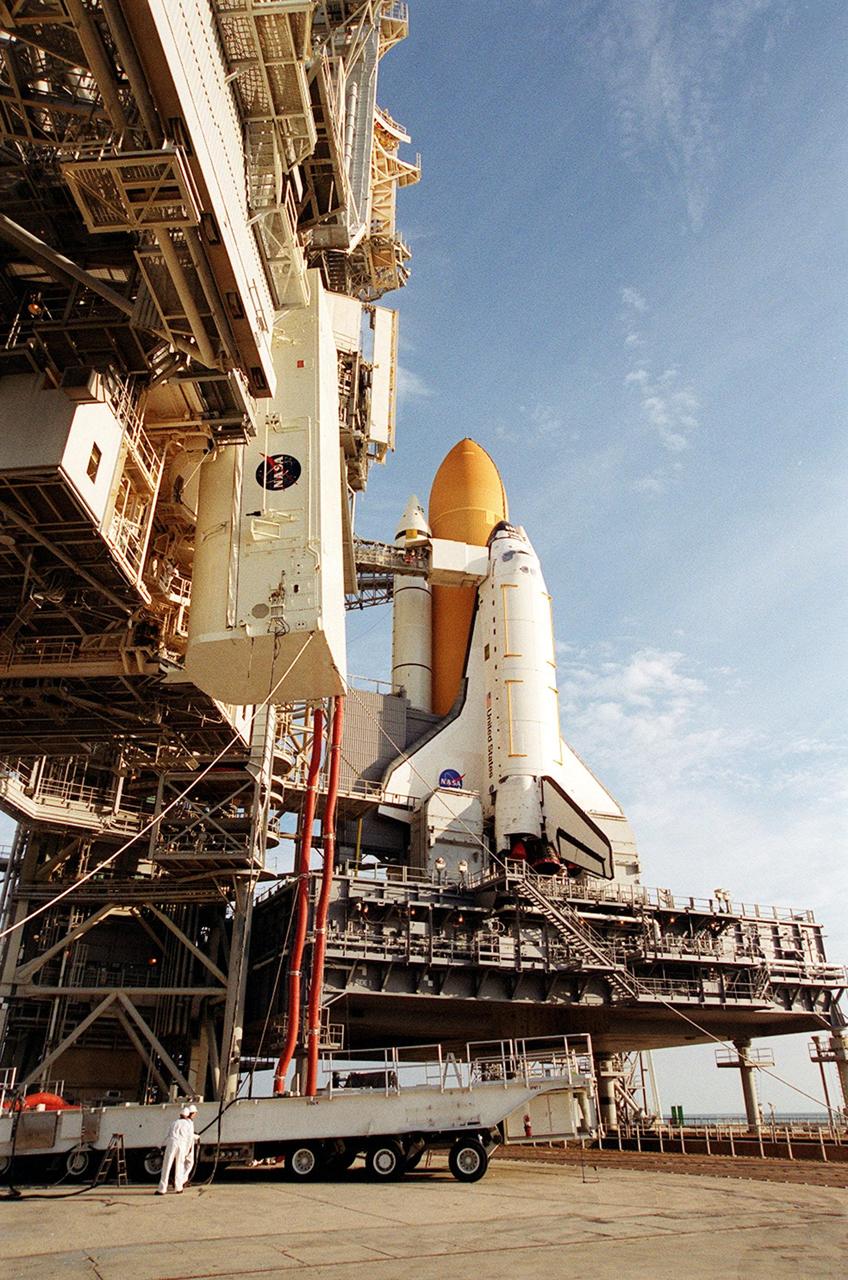
KENNEDY SPACE CENTER, FLA. -- On Launch Pad 39B, the payload transport canister, with the P6 integrated truss segment inside, is lifted higher toward the payload changeout room (PCR) above it. The PCR is the enclosed, environmentally controlled portion of the Rotating Service Structure (RSS) (at left) that supports payload delivery at the pad. At right is Space Shuttle Endeavour with its orange external tank and one solid rocket booster showing behind it. When the RSS is closed around Endeavour, the P6 truss will be moved into the orbiter’s payload bay. The P6, payload on mission STS-97, comprises Solar Array Wing-3 and the Integrated Electronic Assembly, to be installed on the International Space Station. The Station’s electrical power system will use eight photovoltaic solar arrays, each 112 feet long by 39 feet wide, to convert sunlight to electricity. The solar arrays are mounted on a “blanket” that can be folded like an accordion for delivery. Once in orbit, astronauts will deploy the blankets to their full size. Gimbals will be used to rotate the arrays so that they will face the Sun to provide maximum power to the Space Station. Launch of STS-97 is scheduled for Nov. 30 at 10:06 p.m. EST
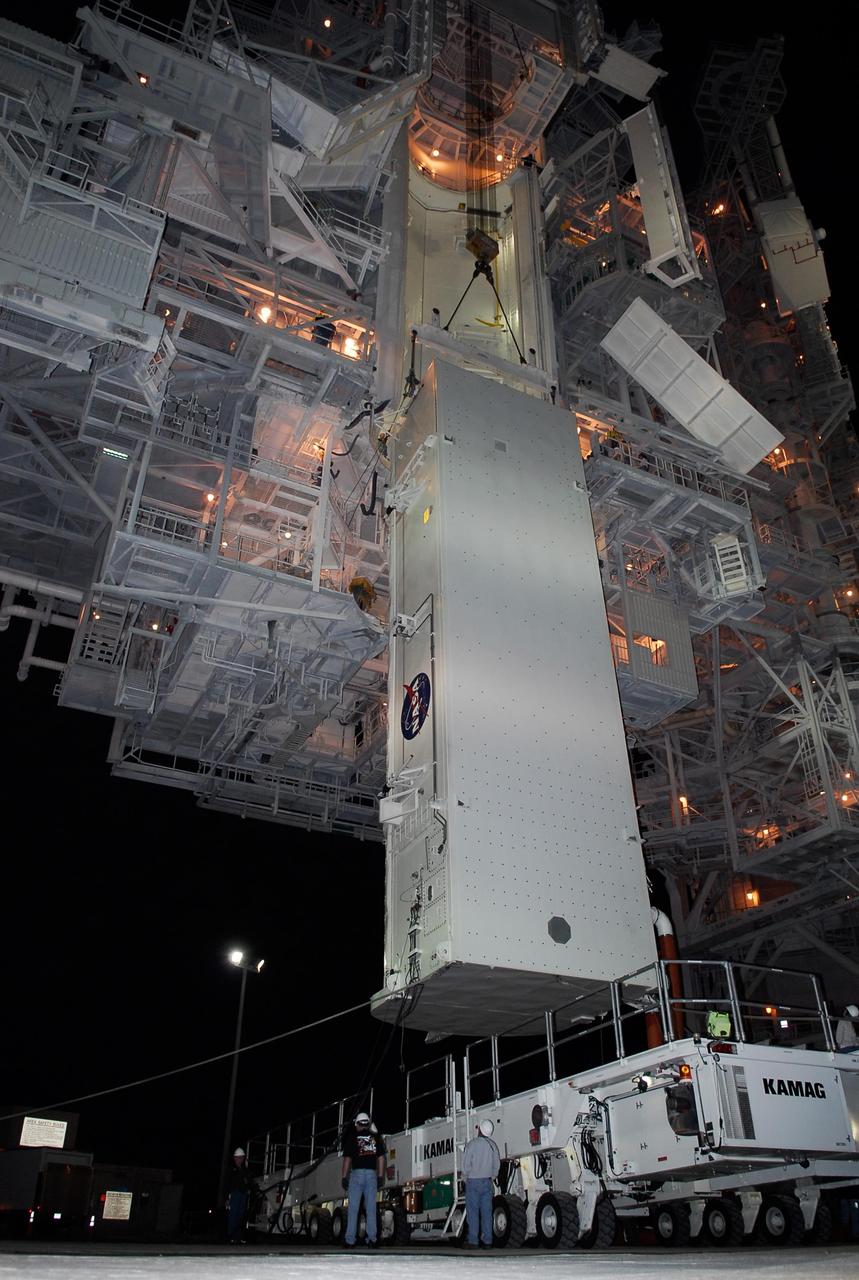
KENNEDY SPACE CENTER, FLA. -- On Launch Pad 39A at NASA's Kennedy Space Center, the payload canister containing the first section of the Japan Aerospace Exploration Agency's Kibo laboratory and the Canadian Space Agency's two-armed robotic system, Dextre, is lifted up toward the payload changeout room in the rotating service structure. The changeout room is the enclosed, environmentally controlled portion of the rotating service structure that supports cargo delivery to the pad and subsequent vertical installation into an orbiter's payload bay. The payload will be installed into Endeavour for launch on the STS-123 mission targeted for March 11. Photo credit: NASA/Kim Shiflett
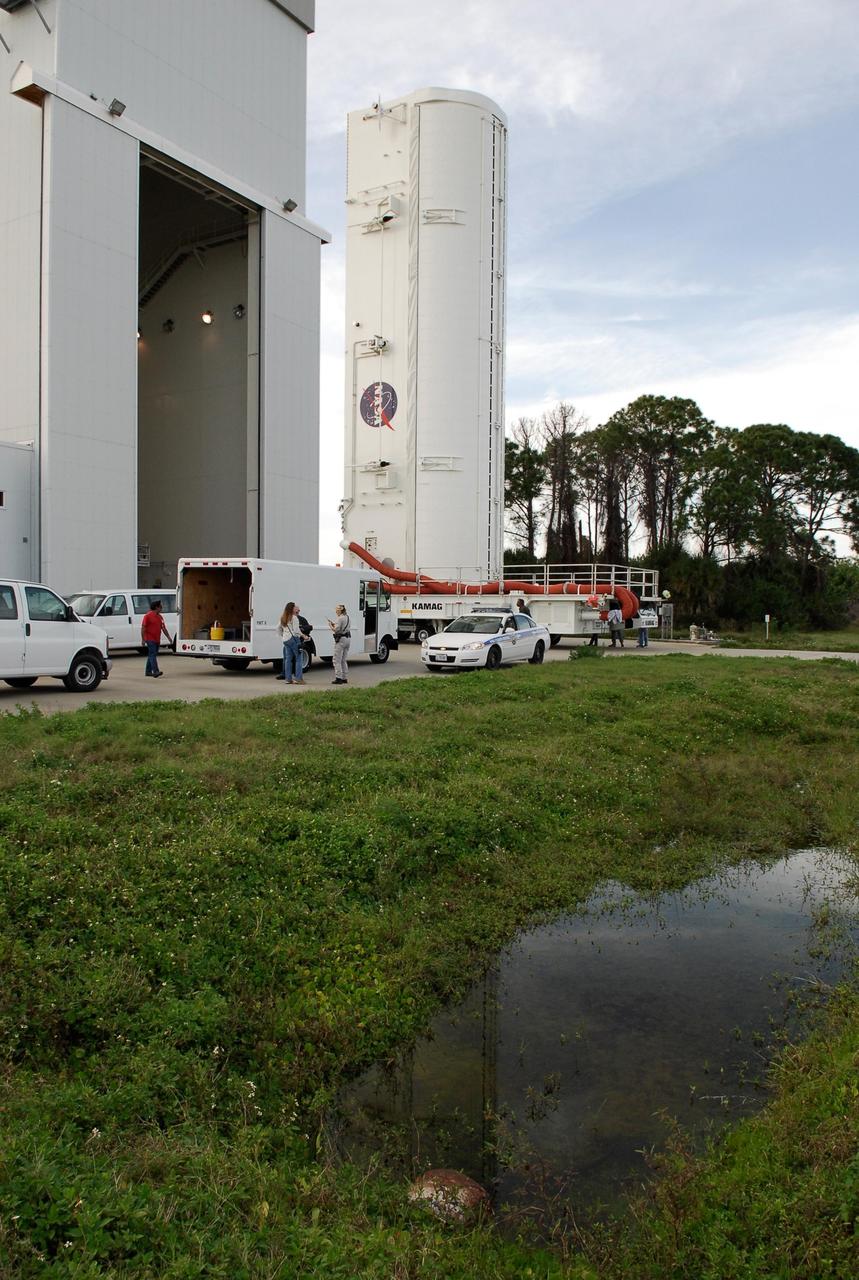
KENNEDY SPACE CENTER, FLA. -- The payload canister moves out of the Vertical Processing Facility, on its way to Launch Pad 39A at NASA's Kennedy Space Center. The canister is transferring the first section of the Japan Aerospace Exploration Agency's Kibo laboratory and the Canadian Space Agency's two-armed robotic system, Dextre, to the payload changeout room, part of the rotating service structure. The changeout room is the enclosed, environmentally controlled portion of the rotating service structure that supports cargo delivery to the pad and subsequent vertical installation into an orbiter's payload bay. The payload will be installed into Endeavour for launch on the STS-123 mission targeted for March 11. Photo credit: NASA/Kim Shiflett
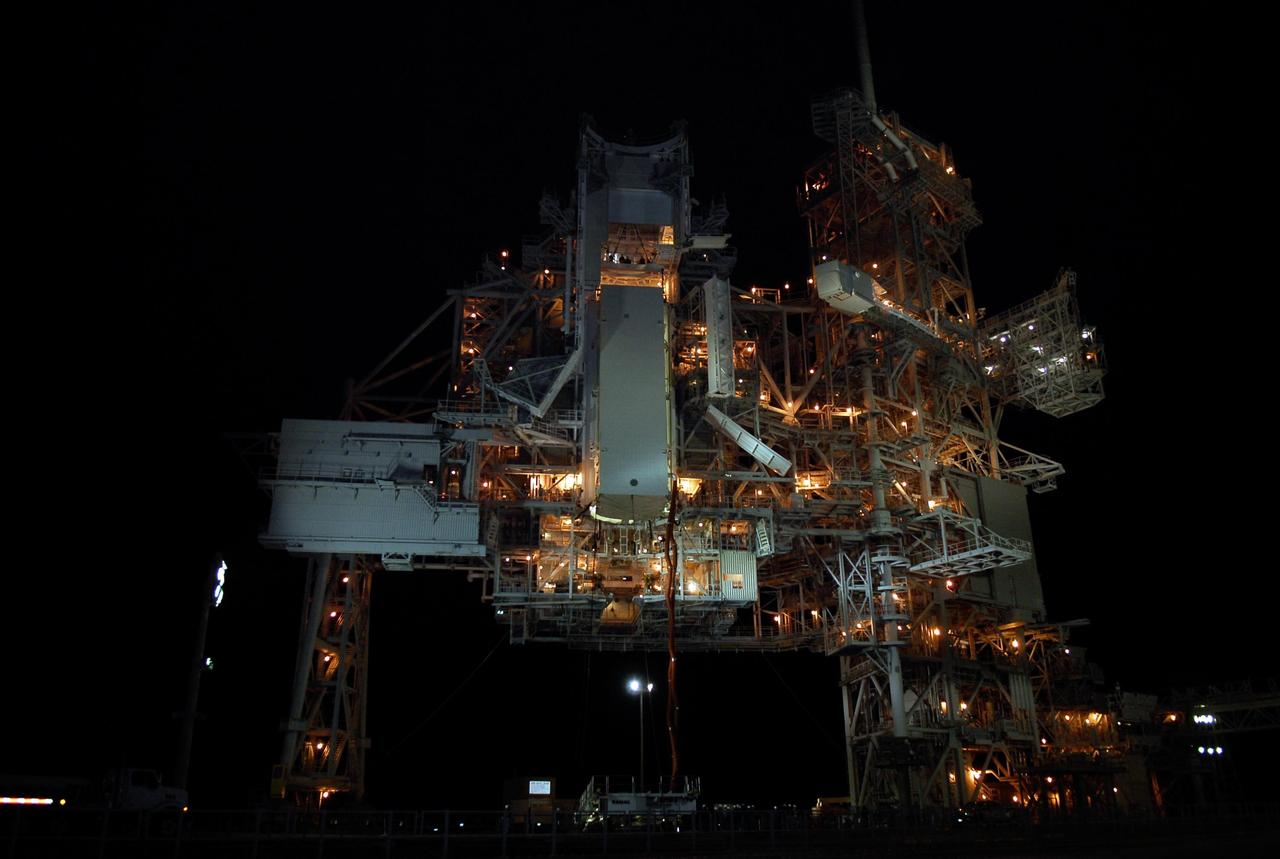
KENNEDY SPACE CENTER, FLA. -- On Launch Pad 39A at NASA's Kennedy Space Center, the payload canister containing the first section of the Japan Aerospace Exploration Agency's Kibo laboratory and the Canadian Space Agency's two-armed robotic system, Dextre, is lifted up toward the payload changeout room in the rotating service structure. Umbilical lines are still attached. The changeout room is the enclosed, environmentally controlled portion of the rotating service structure that supports cargo delivery to the pad and subsequent vertical installation into an orbiter's payload bay. The payload will be installed into Endeavour for launch on the STS-123 mission targeted for March 11. Photo credit: NASA/Kim Shiflett
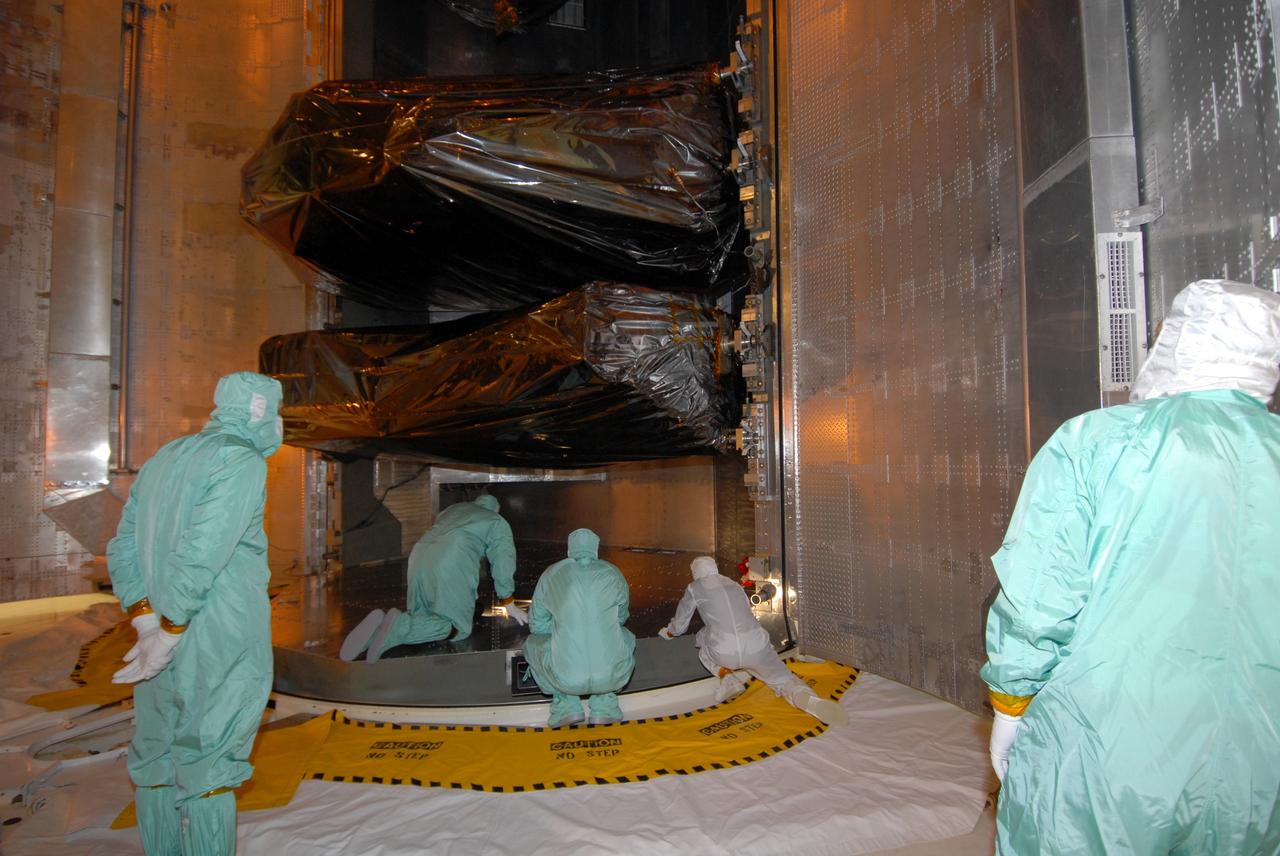
CAPE CANAVERAL, Fla. - Inside the payload changeout room, or PCR, at NASA's Kennedy Space Center Launch Pad 39A, workers prepare for the transfer of the payload from the canister into the PCR. The payload comprises four carriers holding various equipment for the STS-125 mission aboard space shuttle Atlantis to service NASA’s Hubble Space Telescope. The PCR is the enclosed, environmentally controlled portion of the rotating service structure that supports cargo delivery to the pad and subsequent vertical installation into the shuttle’s payload bay. Launch of Atlantis is targeted for Oct. 10. Photo credit: NASA/Jack Pfaller
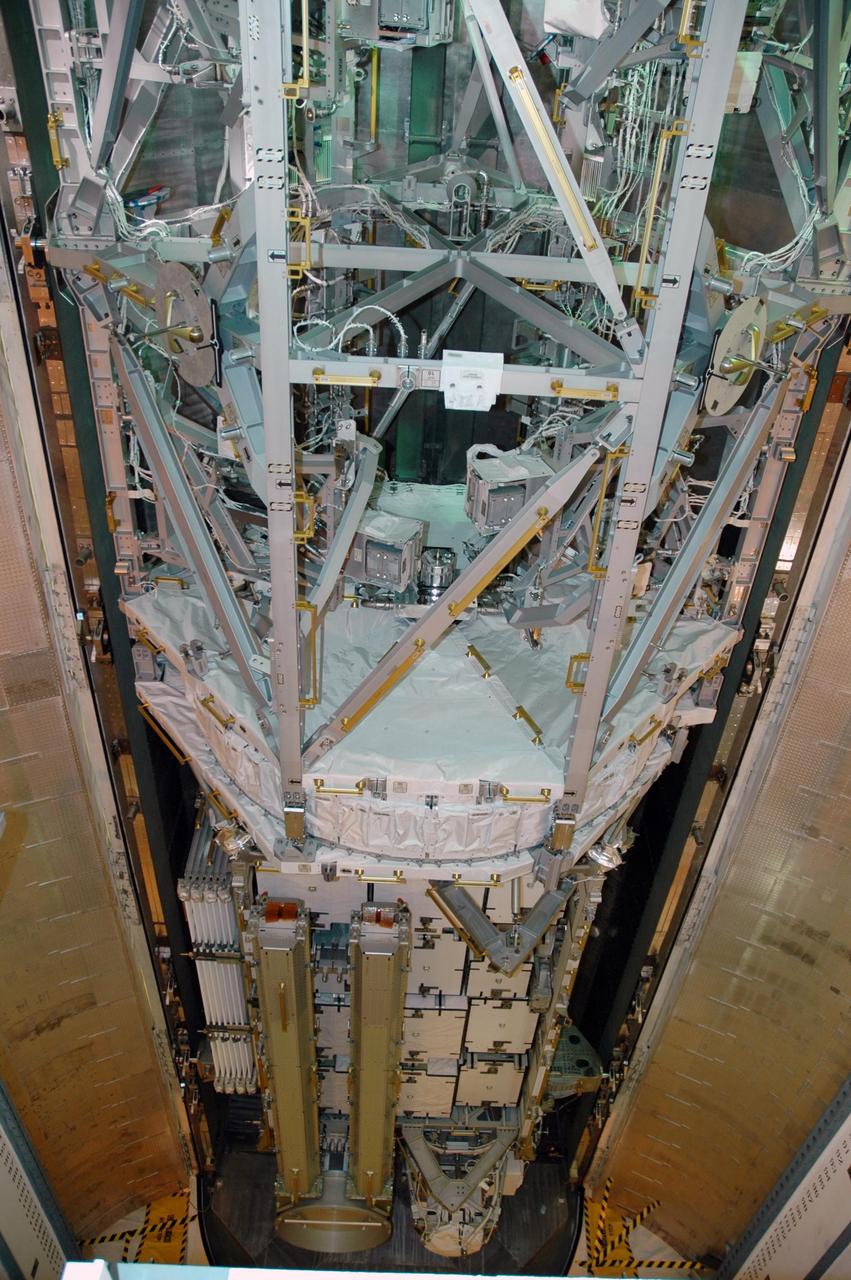
KENNEDY SPACE CENTER, FLA. -- In the payload changeout room (PCR) on Launch Pad 39A, the S3/S4 integrated truss is being moved out of the payload canister. The PCR is the enclosed, environmentally controlled portion of the rotating service structure that supports cargo delivery to the pad and subsequent vertical installation into the orbiter payload bay. The truss is the payload for Space Shuttle Atlantis on mission STS-117 to the International Space Station. The Atlantis crew will install the new truss segment, retract a set of solar arrays and unfold a new set on the starboard side of the station. Launch is targeted for March 15. Photo credit: NASA/Jack Pfaller
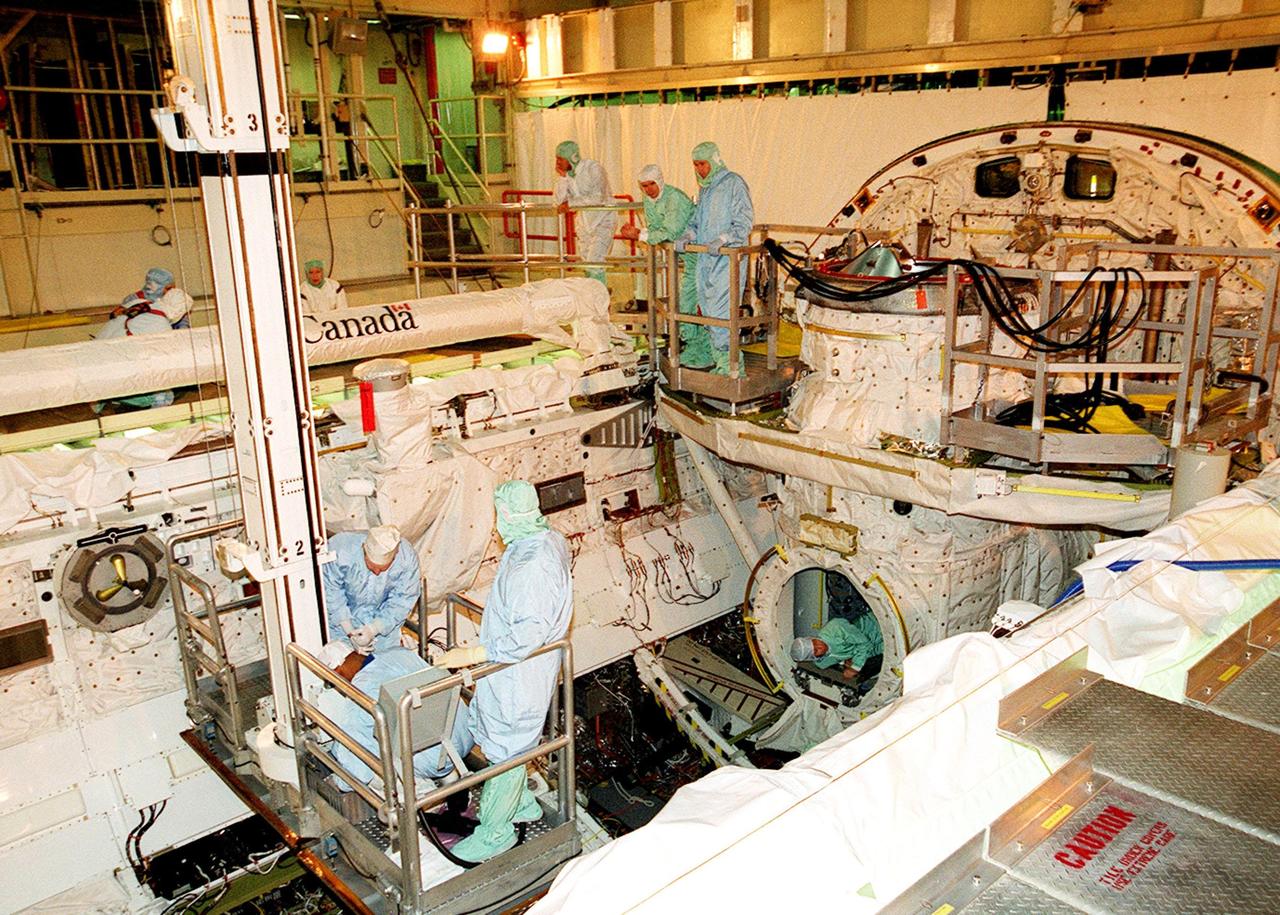
KENNEDY SPACE CENTER, FLA. -- The STS-98 crew looks over components of the equipment already installed in the payload bay of orbiter Atlantis, which is in the Orbiter Processing Facility bay 3. The crew is at KSC for Crew Equipment Interface Test activities. Launch on mission STS-98 is scheduled for Jan. 18, 2001. It will be transporting the U.S. Lab, Destiny, to the International Space Station with five system racks already installed inside of the module. After delivery of electronics in the lab, electrically powered attitude control for Control Moment Gyroscopes will be activated
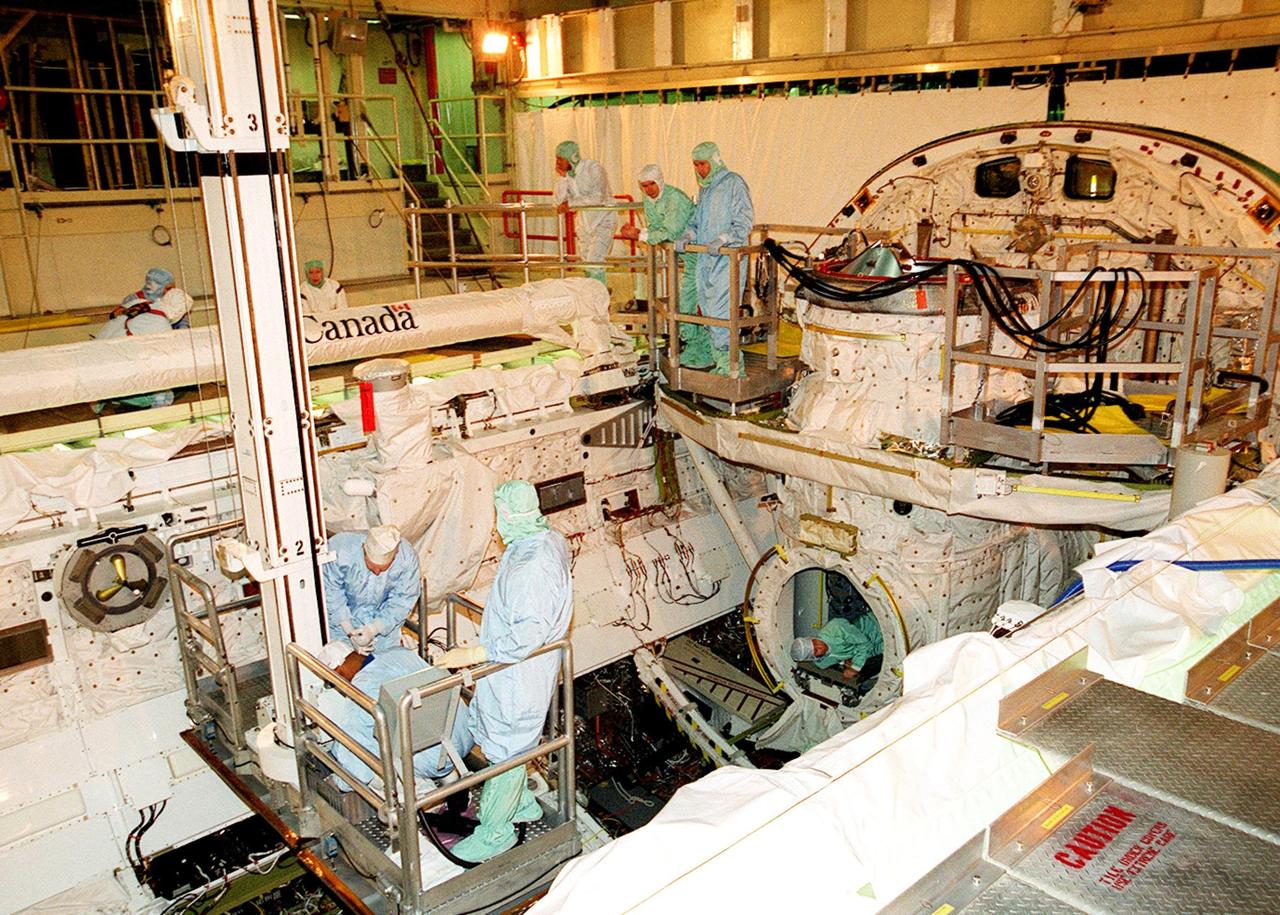
KENNEDY SPACE CENTER, FLA. -- The STS-98 crew looks over components of the equipment already installed in the payload bay of orbiter Atlantis, which is in the Orbiter Processing Facility bay 3. The crew is at KSC for Crew Equipment Interface Test activities. Launch on mission STS-98 is scheduled for Jan. 18, 2001. It will be transporting the U.S. Lab, Destiny, to the International Space Station with five system racks already installed inside of the module. After delivery of electronics in the lab, electrically powered attitude control for Control Moment Gyroscopes will be activated
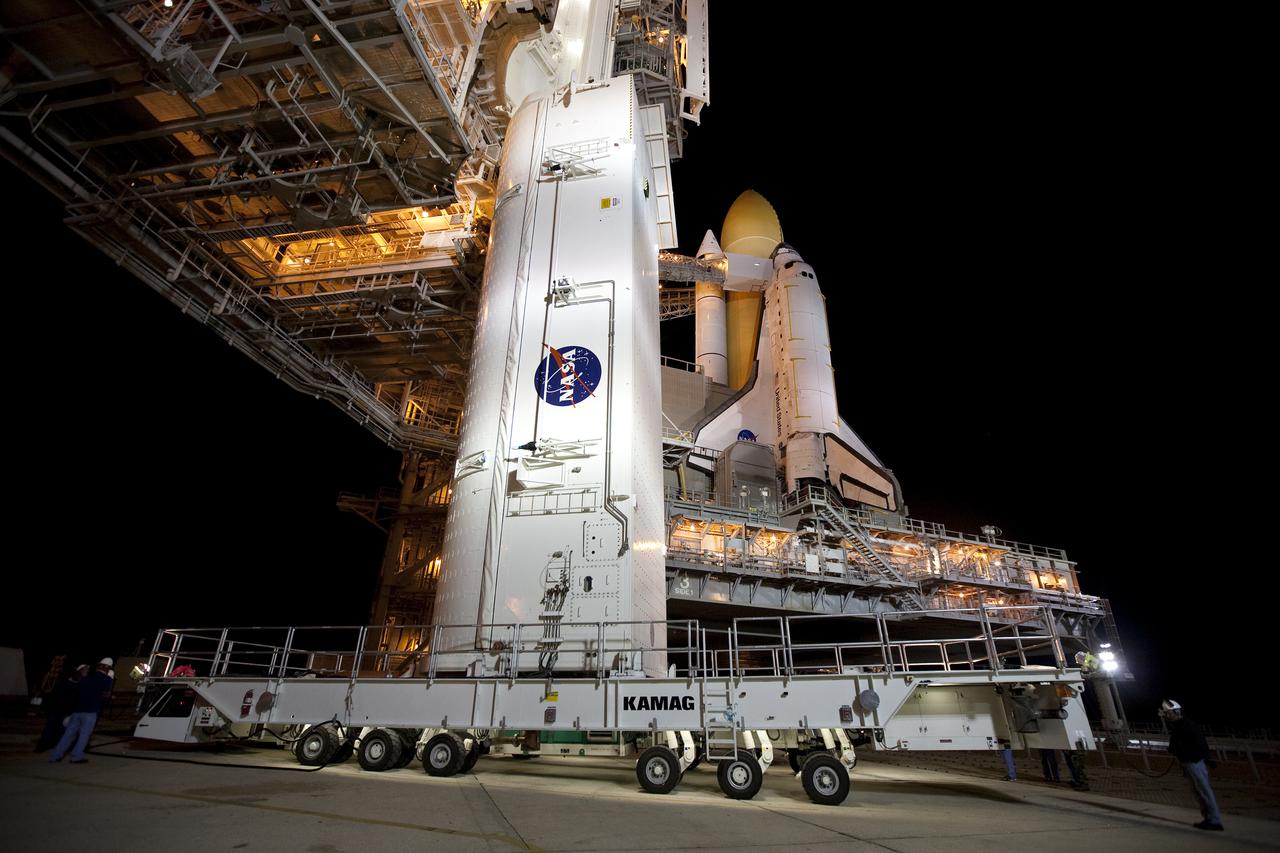
CAPE CANAVERAL, Fla. - At Launch Pad 39A at NASA's Kennedy Space Center in Florida, preparations are under way to lift the payload canister containing the multi-purpose logistics module Leonardo, standing vertically on a transporter, into the pad's payload changout room. Located on the pad's rotating service structure, the room is an enclosed, environmentally controlled area that supports payload delivery and servicing at the pad and attaches to the shuttle's cargo bay for vertical payload installation. The contents of the canister, including Leonardo, is set to be transferred into space shuttle Discovery's cargo bay on March 24. The seven-member STS-131 crew will deliver Leonardo, filled with resupply stowage platforms and racks, to the International Space Station. STS-131 will be the 33rd shuttle mission to the station and the 131st shuttle mission overall. Launch is targeted for April 5. For information on the STS-131 mission and crew, visit http:__www.nasa.gov_mission_pages_shuttle_shuttlemissions_sts131_index.html. Photo credit: NASA_Amanda Diller
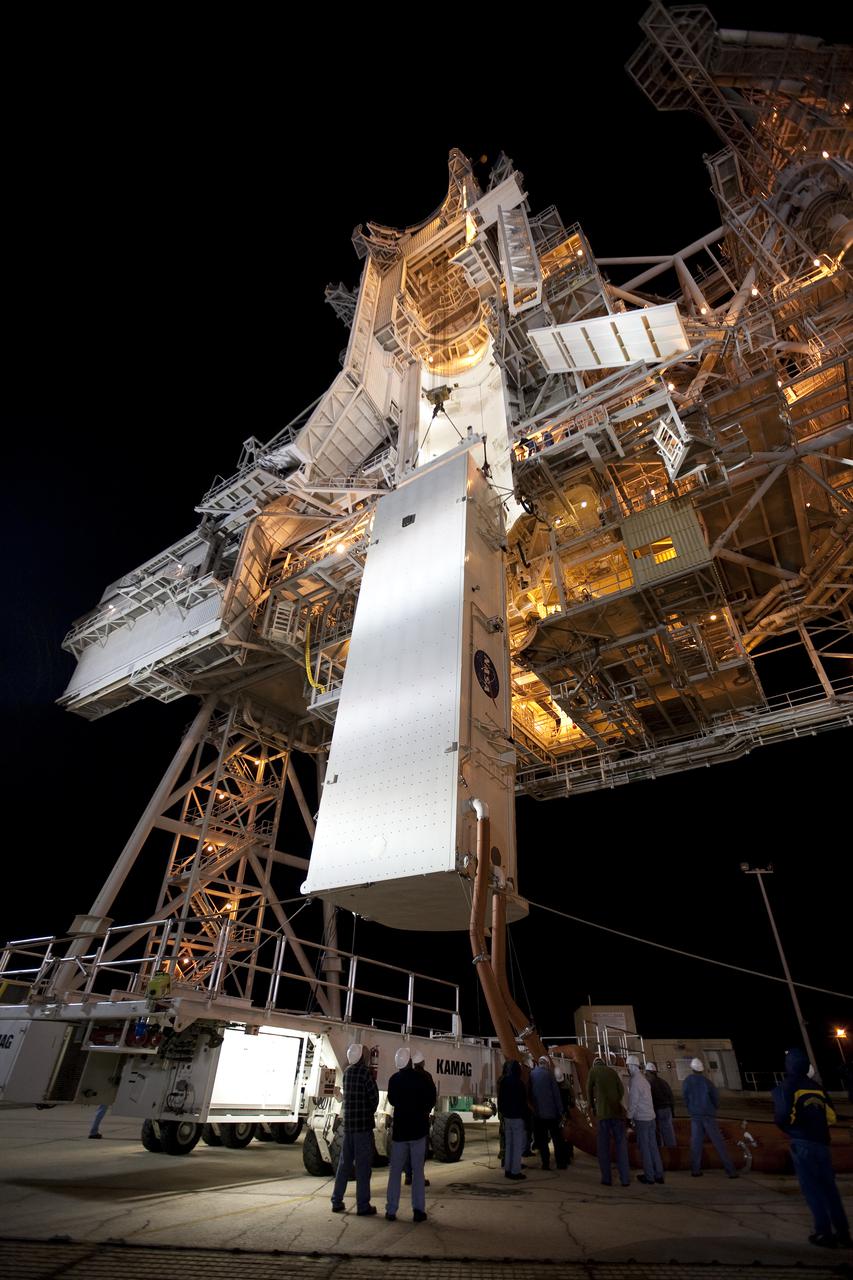
CAPE CANAVERAL, Fla. - At Launch Pad 39A at NASA's Kennedy Space Center in Florida, the payload canister containing the multi-purpose logistics module Leonardo is lifted into the pad's payload changout room. Located on the pad's rotating service structure, the room is an enclosed, environmentally controlled area that supports payload delivery and servicing at the pad and attaches to the shuttle's cargo bay for vertical payload installation. The contents of the canister, including Leonardo, is set to be transferred into space shuttle Discovery's cargo bay on March 24. The seven-member STS-131 crew will deliver Leonardo, filled with resupply stowage platforms and racks, to the International Space Station. STS-131 will be the 33rd shuttle mission to the station and the 131st shuttle mission overall. Launch is targeted for April 5. For information on the STS-131 mission and crew, visit http:__www.nasa.gov_mission_pages_shuttle_shuttlemissions_sts131_index.html. Photo credit: NASA_Amanda Diller
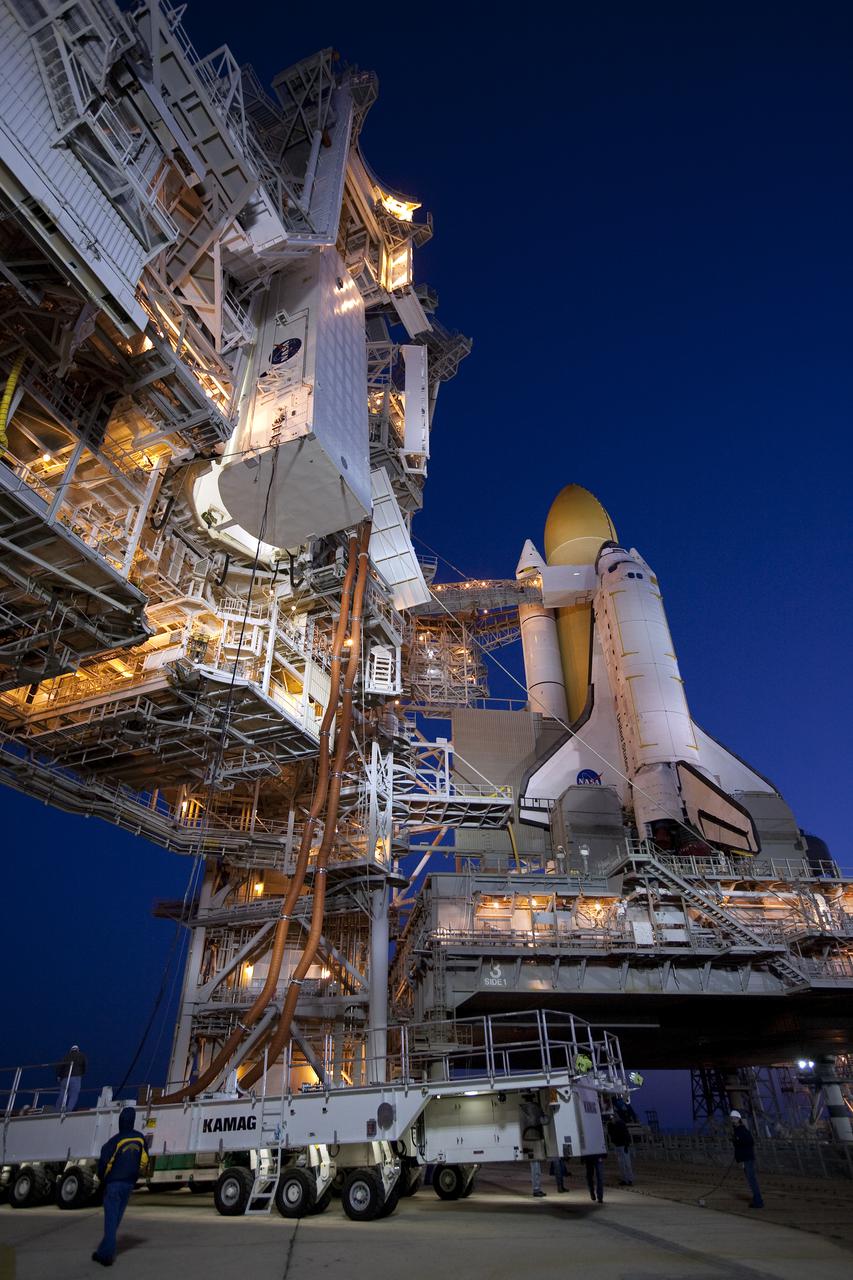
CAPE CANAVERAL, Fla. - Dawn over Launch Pad 39A at NASA's Kennedy Space Center in Florida finds the payload canister containing the multi-purpose logistics module Leonardo being lifted into the pad's payload changeout room. Located on the pad's rotating service structure, the room is an enclosed, environmentally controlled area that supports payload delivery and servicing at the pad and attaches to the shuttle's cargo bay for vertical payload installation. The contents of the canister, including Leonardo, is set to be transferred into space shuttle Discovery's cargo bay on March 24. The seven-member STS-131 crew will deliver Leonardo, filled with resupply stowage platforms and racks, to the International Space Station. STS-131 will be the 33rd shuttle mission to the station and the 131st shuttle mission overall. Launch is targeted for April 5. For information on the STS-131 mission and crew, visit http:__www.nasa.gov_mission_pages_shuttle_shuttlemissions_sts131_index.html. Photo credit: NASA_Amanda Diller
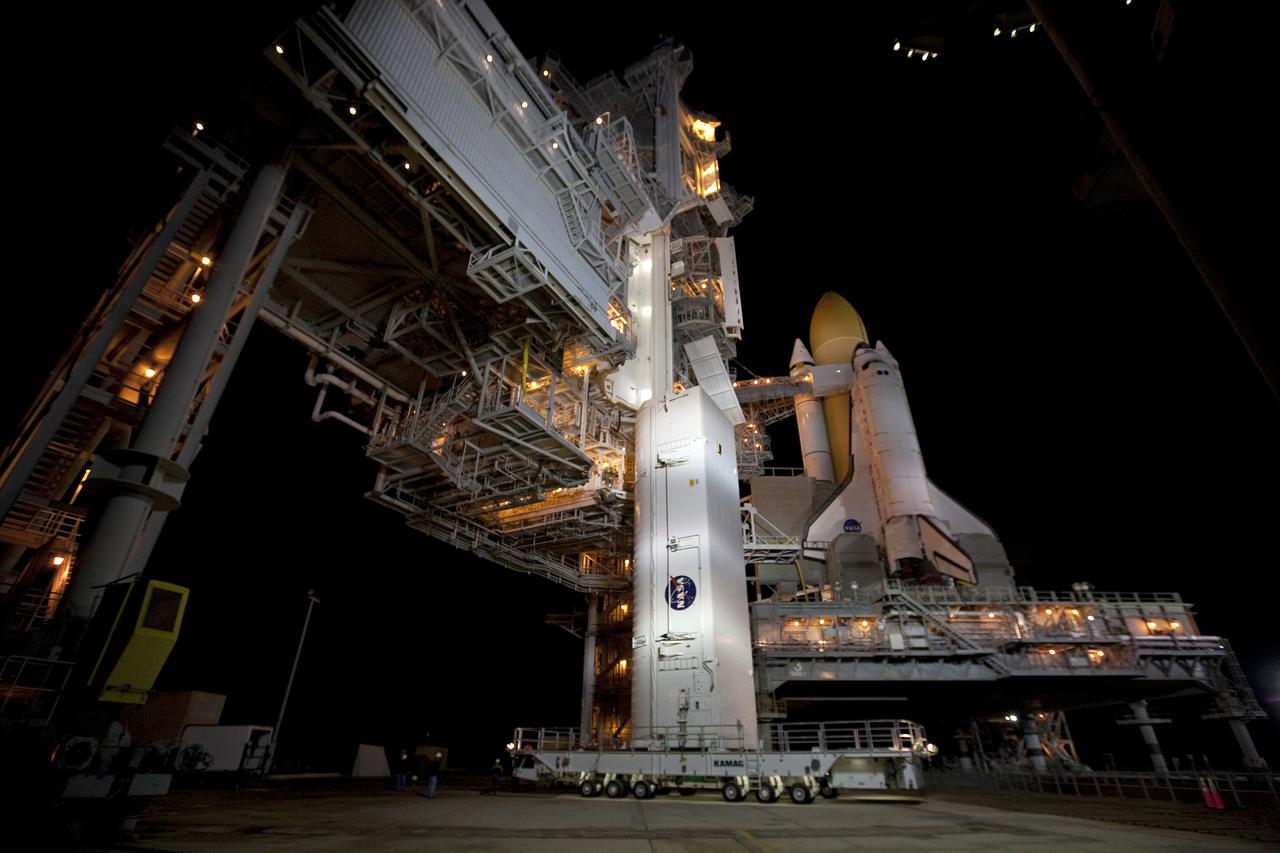
CAPE CANAVERAL, Fla. - At NASA's Kennedy Space Center in Florida, the payload canister containing the multi-purpose logistics module Leonardo, standing vertically on a transporter, arrives at Launch Pad 39A. The canister next will be lifted into the pad's payload changout room. Located on the pad's rotating service structure, the room is an enclosed, environmentally controlled area that supports payload delivery and servicing at the pad and attaches to the shuttle's cargo bay for vertical payload installation. The contents of the canister, including Leonardo, is set to be transferred into space shuttle Discovery's cargo bay on March 24. The seven-member STS-131 crew will deliver Leonardo, filled with resupply stowage platforms and racks, to the International Space Station. STS-131 will be the 33rd shuttle mission to the station and the 131st shuttle mission overall. Launch is targeted for April 5. For information on the STS-131 mission and crew, visit http:__www.nasa.gov_mission_pages_shuttle_shuttlemissions_sts131_index.html. Photo credit: NASA_Amanda Diller
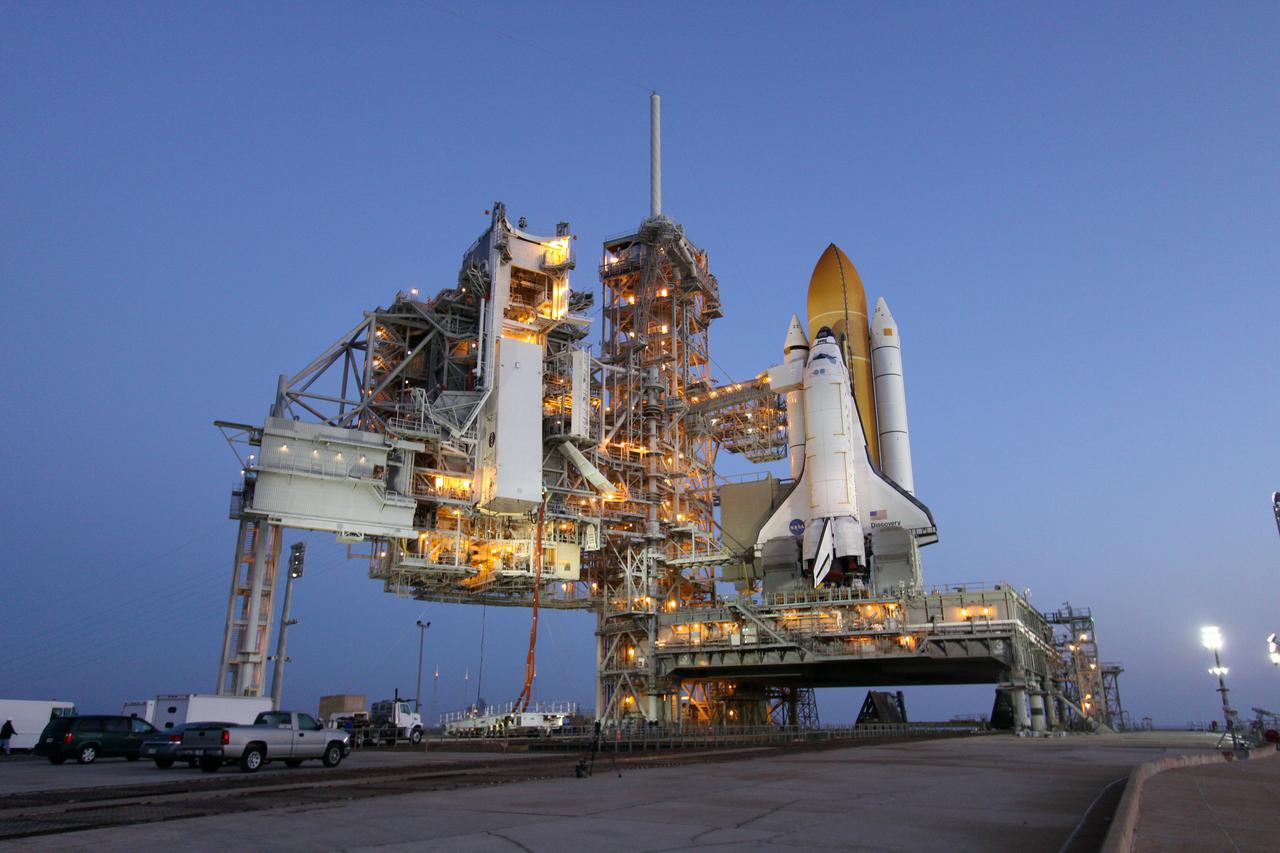
CAPE CANAVERAL, Fla. - At NASA's Kennedy Space Center in Florida, the payload canister containing the multi-purpose logistics module Leonardo is nestled in the payload changeout room at Launch Pad 39A. Located on the pad's rotating service structure, the room is an enclosed, environmentally controlled area that supports payload delivery and servicing at the pad and attaches to the shuttle's cargo bay for vertical payload installation. The contents of the canister, including Leonardo, is set to be transferred into space shuttle Discovery's cargo bay on March 24. The seven-member STS-131 crew will deliver Leonardo, filled with resupply stowage platforms and racks, to the International Space Station. STS-131 will be the 33rd shuttle mission to the station and the 131st shuttle mission overall. Launch is targeted for April 5. For information on the STS-131 mission and crew, visit http:__www.nasa.gov_mission_pages_shuttle_shuttlemissions_sts131_index.html. Photo credit: NASA_Troy Cryder
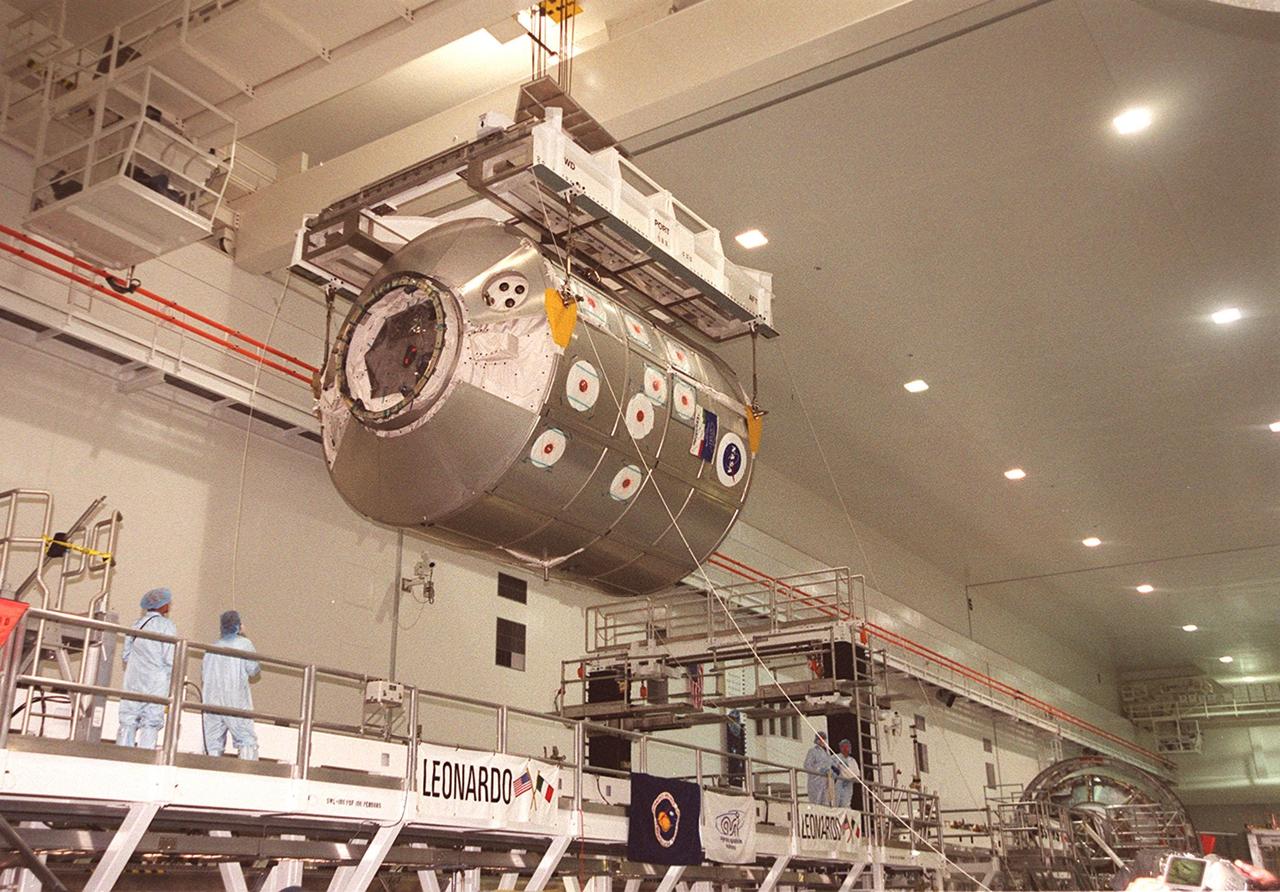
In the Space Station Processing Facility, the Multi-Purpose Logistics Module Leonardo, suspended from an overhead crane, glides across the room to a payload canister for transfer to Launch Pad 39B and installation in Space Shuttle Discovery. The Leonardo, one of Italy’s major contributions to the International Space Station program, is a reusable logistics carrier. It is the primary delivery system used to resupply and return Station cargo requiring a pressurized environment. Leonardo is the primary payload on mission STS-102 and will deliver up to 10 tons of laboratory racks filled with equipment, experiments and supplies for outfitting the newly installed U.S. Laboratory Destiny. STS-102 is scheduled to launch March 8 at 6:45 a.m. EST
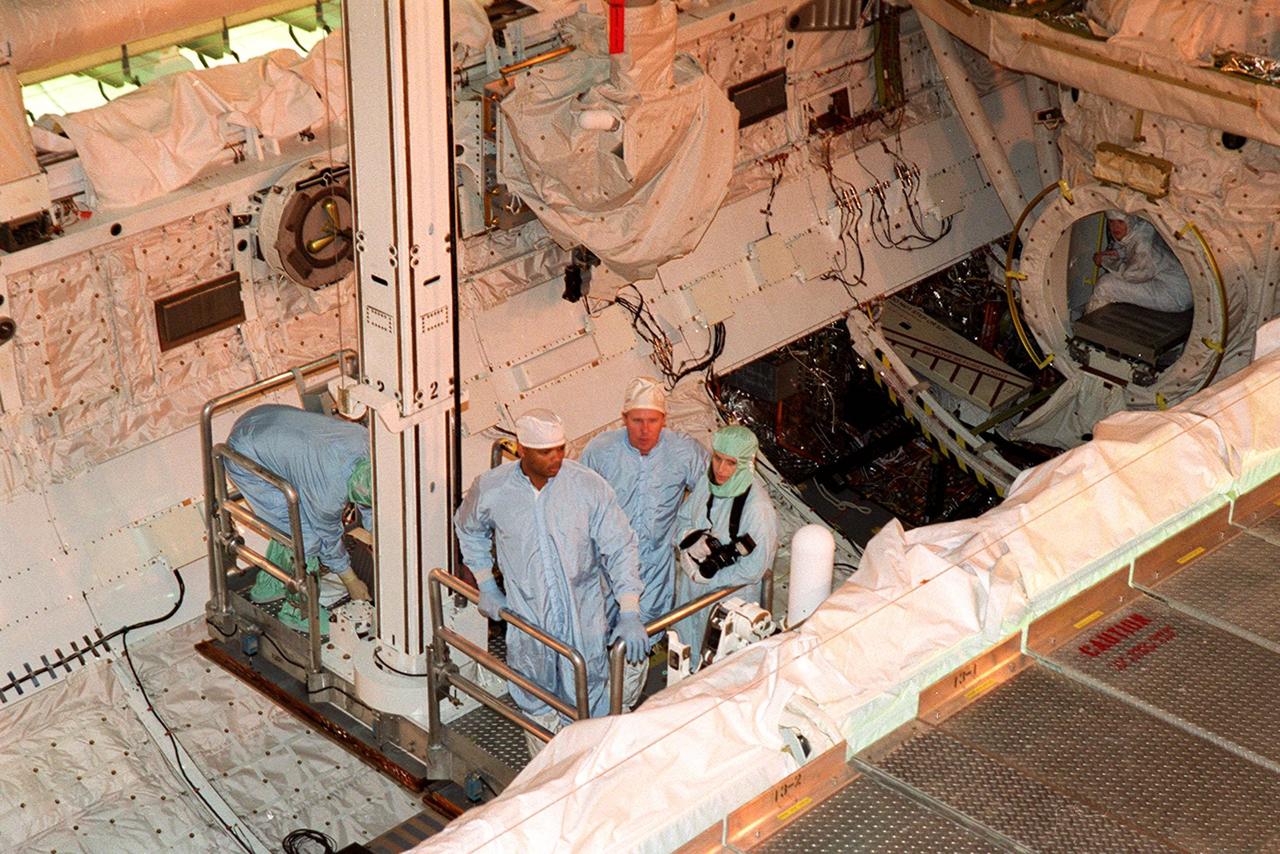
KENNEDY SPACE CENTER, FLA. -- Lowered into the payload bay of the orbiter Atlantis, some of the STS-98 crew (center of the photo) look over part of the payload. From left are Mission Specialists Robert Curbeam, Tom Jones and Marsha Ivins. They and the rest of the crew are at KSC for Crew Equipment Interface Test activities. Launch on mission STS-98 is scheduled for Jan. 18, 2001. It will be transporting the U.S. Lab, Destiny, to the International Space Station with five system racks already installed inside of the module. After delivery of electronics in the lab, electrically powered attitude control for Control Moment Gyroscopes will be activated
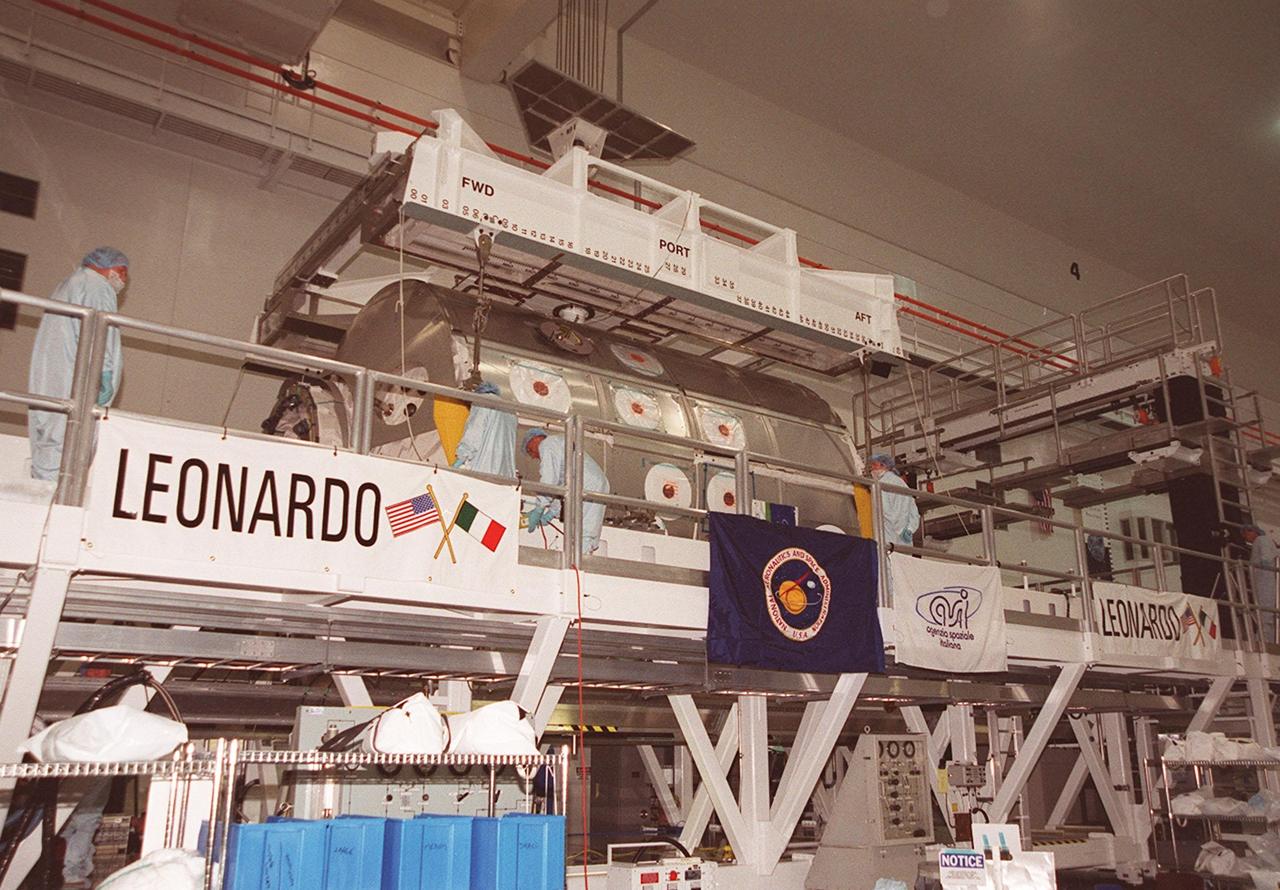
In the Space Station Processing Facility, workers attach an overhead crane to the Multi-Purpose Logistics Module Leonardo. The MPLM is being moved to the payload canister for transfer to Launch Pad 39B and installation in Space Shuttle Discovery. The Leonardo, one of Italy’s major contributions to the International Space Station program, is a reusable logistics carrier. It is the primary delivery system used to resupply and return Station cargo requiring a pressurized environment. Leonardo is the primary payload on mission STS-102 and will deliver up to 10 tons of laboratory racks filled with equipment, experiments and supplies for outfitting the newly installed U.S. Laboratory Destiny. STS-102 is scheduled to launch March 8 at 6:45 a.m. EST
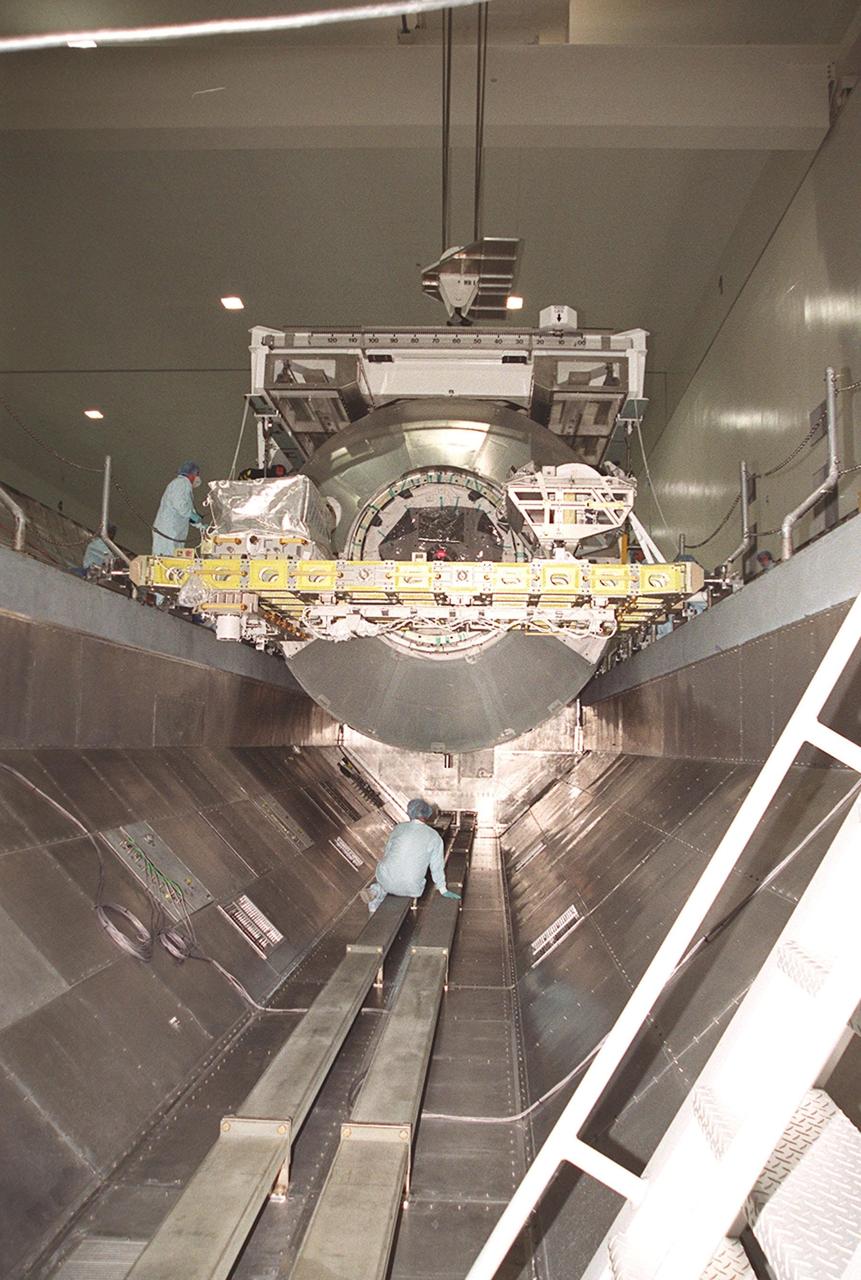
The Multi-Purpose Logistics Module Leonardo is placed inside the payload canister while workers below and on the side check its progress. The MPLM is being transferred to Launch Pad 39B for installation in Space Shuttle Discovery. Leonardo, one of Italy’s major contributions to the International Space Station program, is a reusable logistics carrier. It is the primary delivery system used to resupply and return Station cargo requiring a pressurized environment. Leonardo is the primary payload on mission STS-102 and will deliver up to 10 tons of laboratory racks filled with equipment, experiments and supplies for outfitting the newly installed U.S. Laboratory Destiny. STS-102 is scheduled to launch March 8 at 6:45 a.m. EST
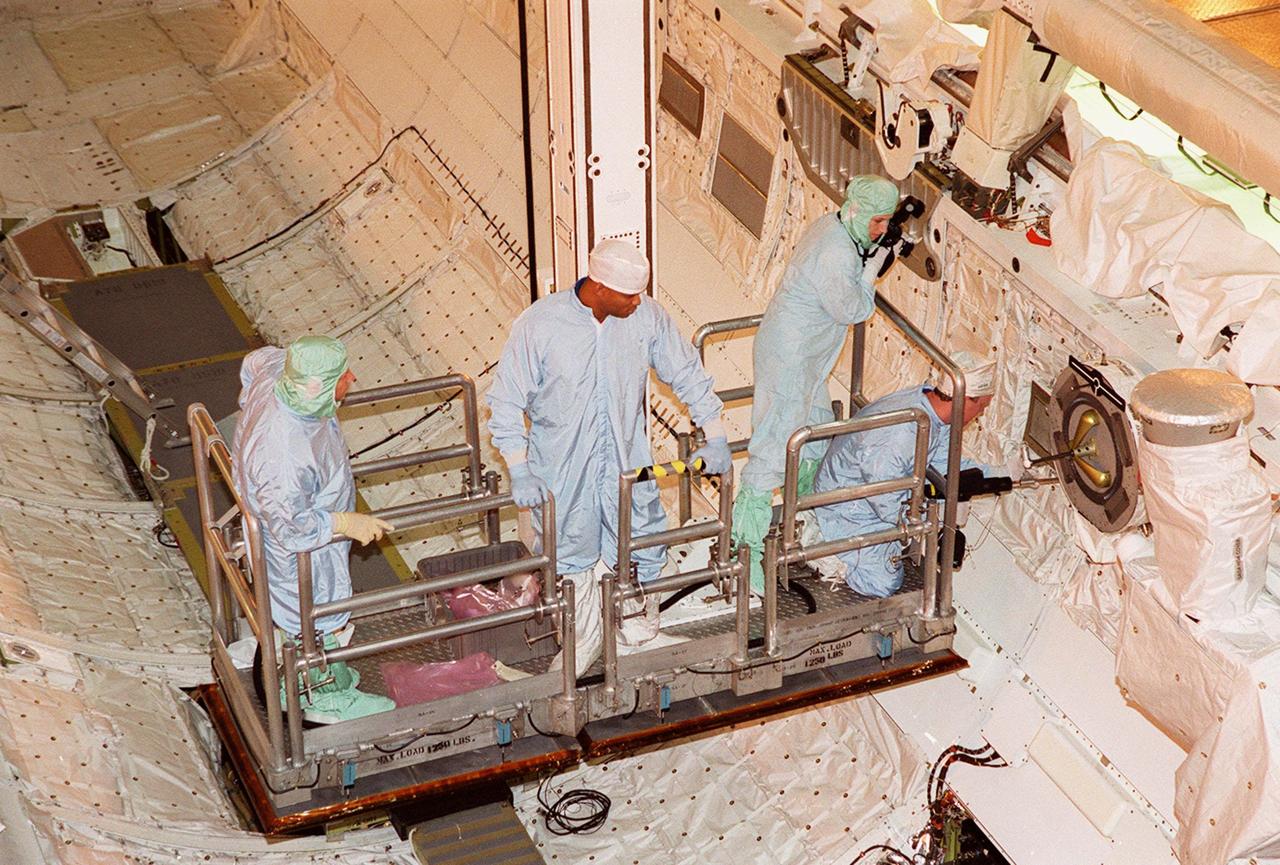
KENNEDY SPACE CENTER, FLA. -- Lowered into the payload bay of the orbiter Atlantis, some of the STS-98 crew look over part of the payload. At center is Mission Specialist Robert Curbeam; at right are Mission Specialists Marsha Ivins (standing) and Tom Jones (kneeling). They and the rest of the crew are at KSC for Crew Equipment Interface Test activities. Launch on mission STS-98 is scheduled for Jan. 18, 2001. It will be transporting the U.S. Lab, Destiny, to the International Space Station with five system racks already installed inside of the module. After delivery of electronics in the lab, electrically powered attitude control for Control Moment Gyroscopes will be activated
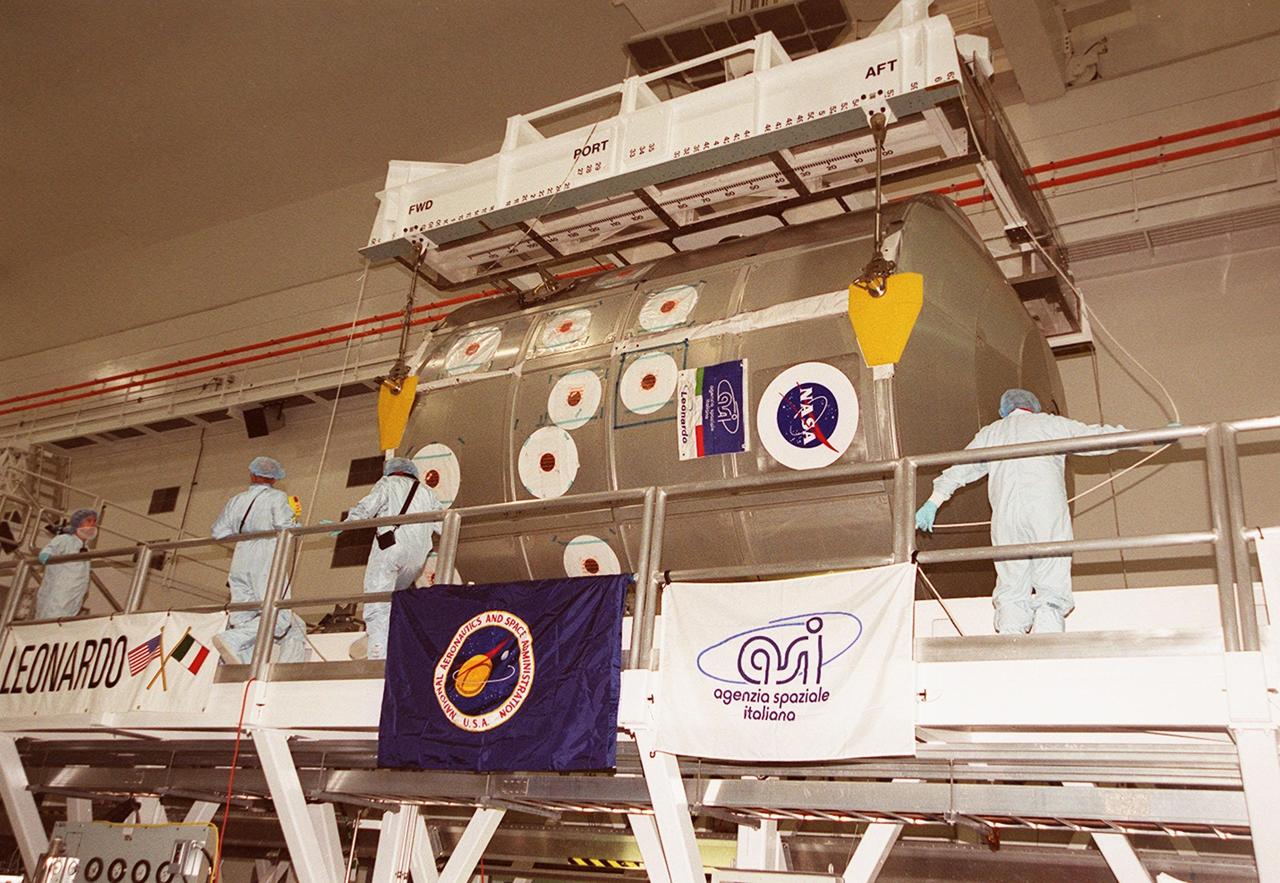
In the Space Station Processing Facility, an overhead crane begins lifting the Multi-Purpose Logistics Module Leonardo. The MPLM is being moved to the payload canister for transfer to Launch Pad 39B and installation in Space Shuttle Discovery. The Leonardo, one of Italy’s major contributions to the International Space Station program, is a reusable logistics carrier. It is the primary delivery system used to resupply and return Station cargo requiring a pressurized environment. Leonardo is the primary payload on mission STS-102 and will deliver up to 10 tons of laboratory racks filled with equipment, experiments and supplies for outfitting the newly installed U.S. Laboratory Destiny. STS-102 is scheduled to launch March 8 at 6:45 a.m. EST
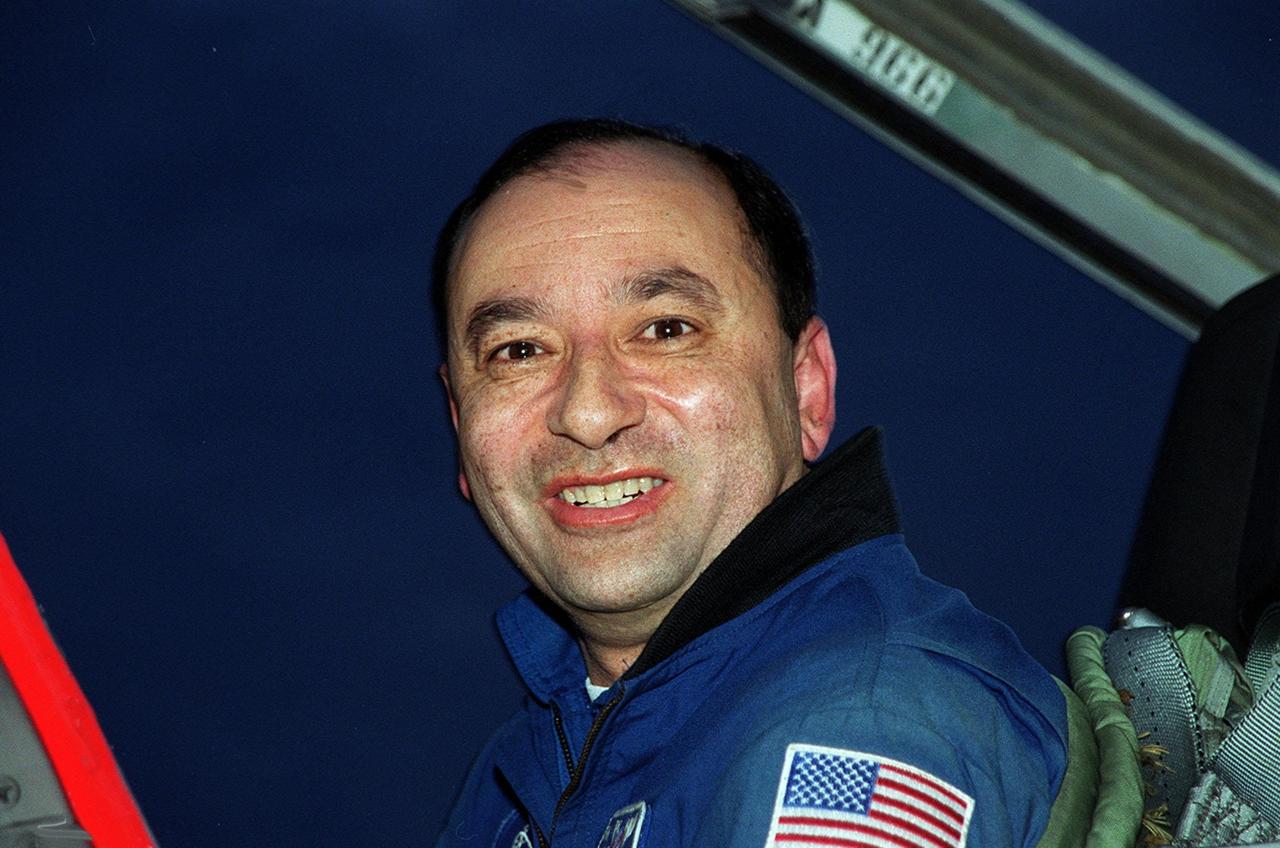
STS-98 Pilot Mark Polansky is pleased to arrive at KSC’s Shuttle Landing Facility for Terminal Countdown Test Activities. In preparation for the Jan. 19 launch, he and the rest of the crew Commander Ken Cockrell and Mission Specialists Robert Curbeam, Thomas Jones and Marsha Ivins will be training in emergency procedures from the pad, checking the payload and taking part in a simulated countdown. The payload for the mission is the U.S. Lab Destiny, a key element in the construction of the International Space Station. The lab has five system racks already installed inside the module. After delivery of electronics in the lab, electrically powered attitude control for Control Moment Gyroscopes will be activated. STS-98 is the seventh construction flight to the ISS.<br
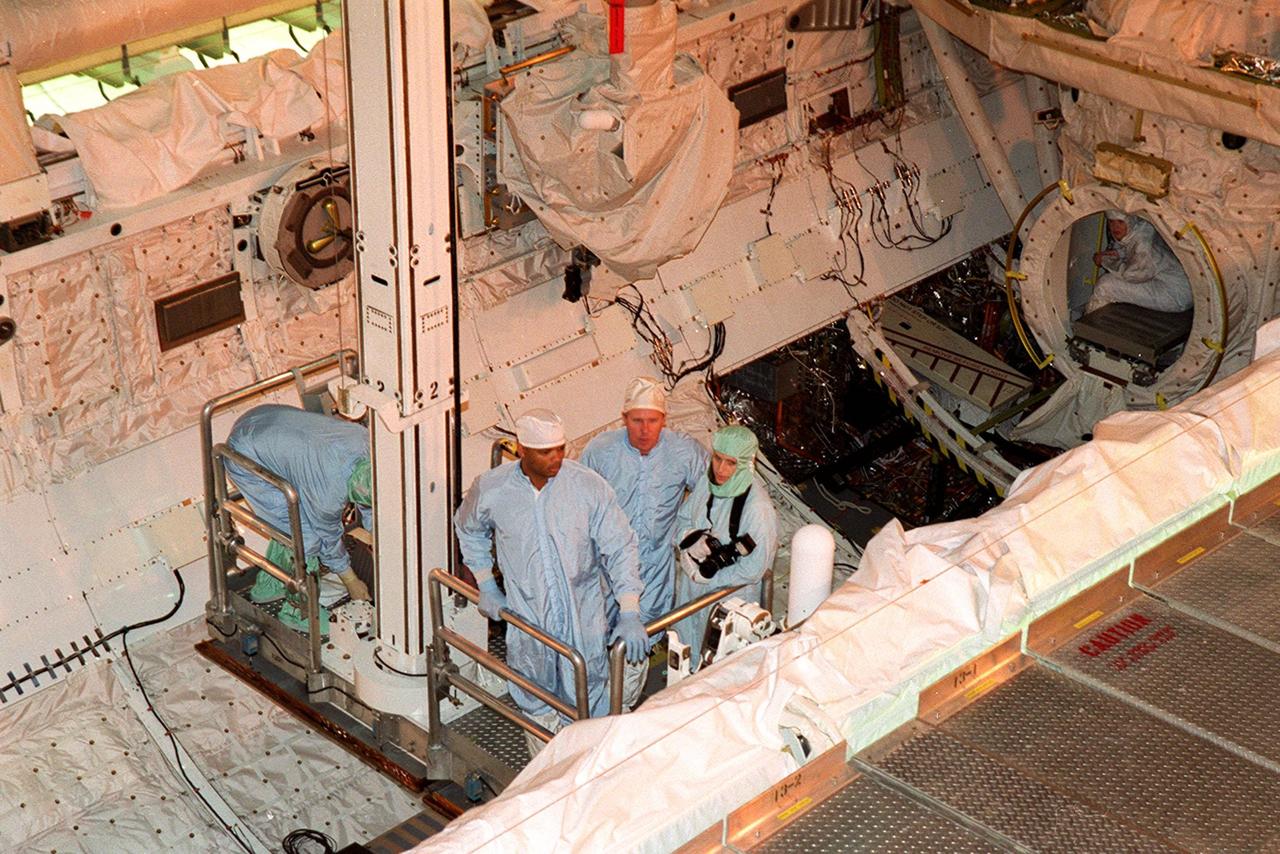
KENNEDY SPACE CENTER, FLA. -- Lowered into the payload bay of the orbiter Atlantis, some of the STS-98 crew (center of the photo) look over part of the payload. From left are Mission Specialists Robert Curbeam, Tom Jones and Marsha Ivins. They and the rest of the crew are at KSC for Crew Equipment Interface Test activities. Launch on mission STS-98 is scheduled for Jan. 18, 2001. It will be transporting the U.S. Lab, Destiny, to the International Space Station with five system racks already installed inside of the module. After delivery of electronics in the lab, electrically powered attitude control for Control Moment Gyroscopes will be activated
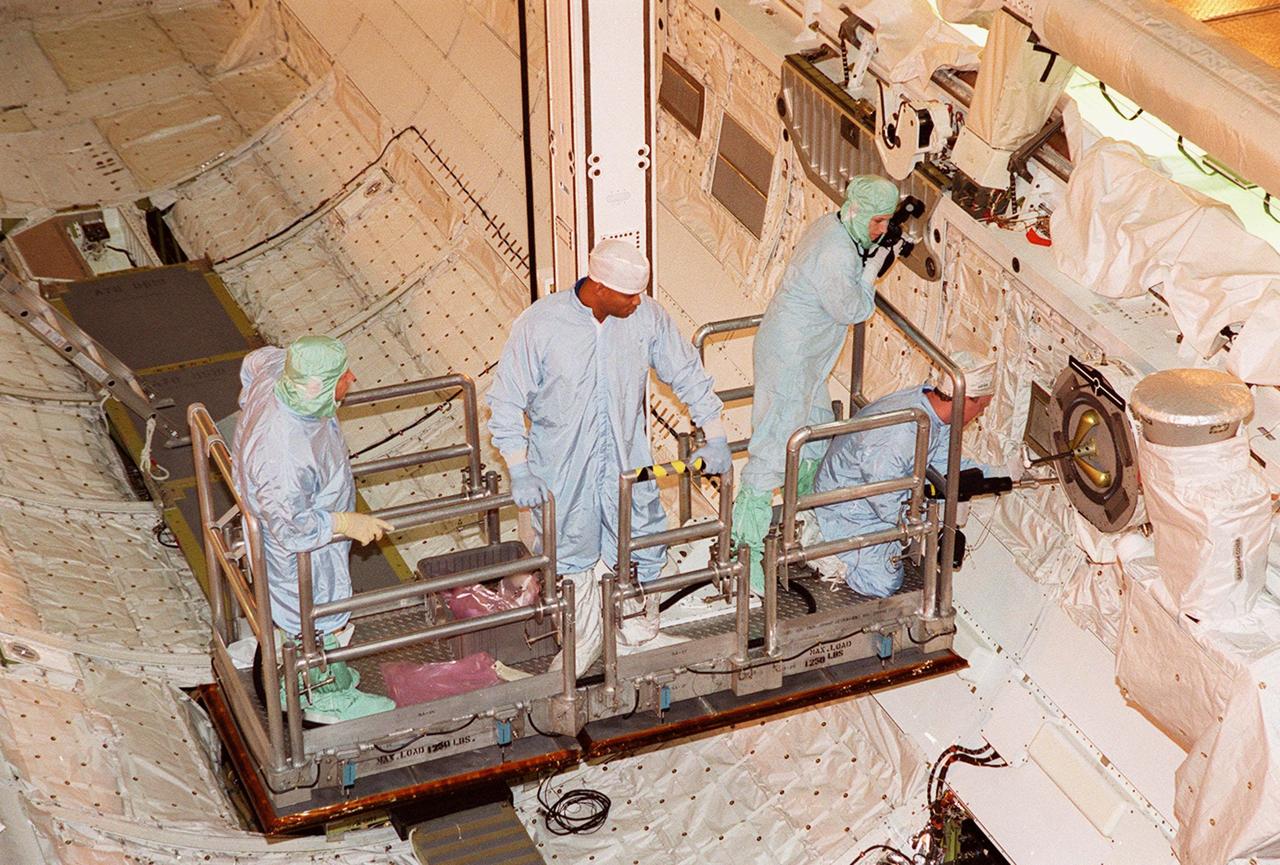
KENNEDY SPACE CENTER, FLA. -- Lowered into the payload bay of the orbiter Atlantis, some of the STS-98 crew look over part of the payload. At center is Mission Specialist Robert Curbeam; at right are Mission Specialists Marsha Ivins (standing) and Tom Jones (kneeling). They and the rest of the crew are at KSC for Crew Equipment Interface Test activities. Launch on mission STS-98 is scheduled for Jan. 18, 2001. It will be transporting the U.S. Lab, Destiny, to the International Space Station with five system racks already installed inside of the module. After delivery of electronics in the lab, electrically powered attitude control for Control Moment Gyroscopes will be activated
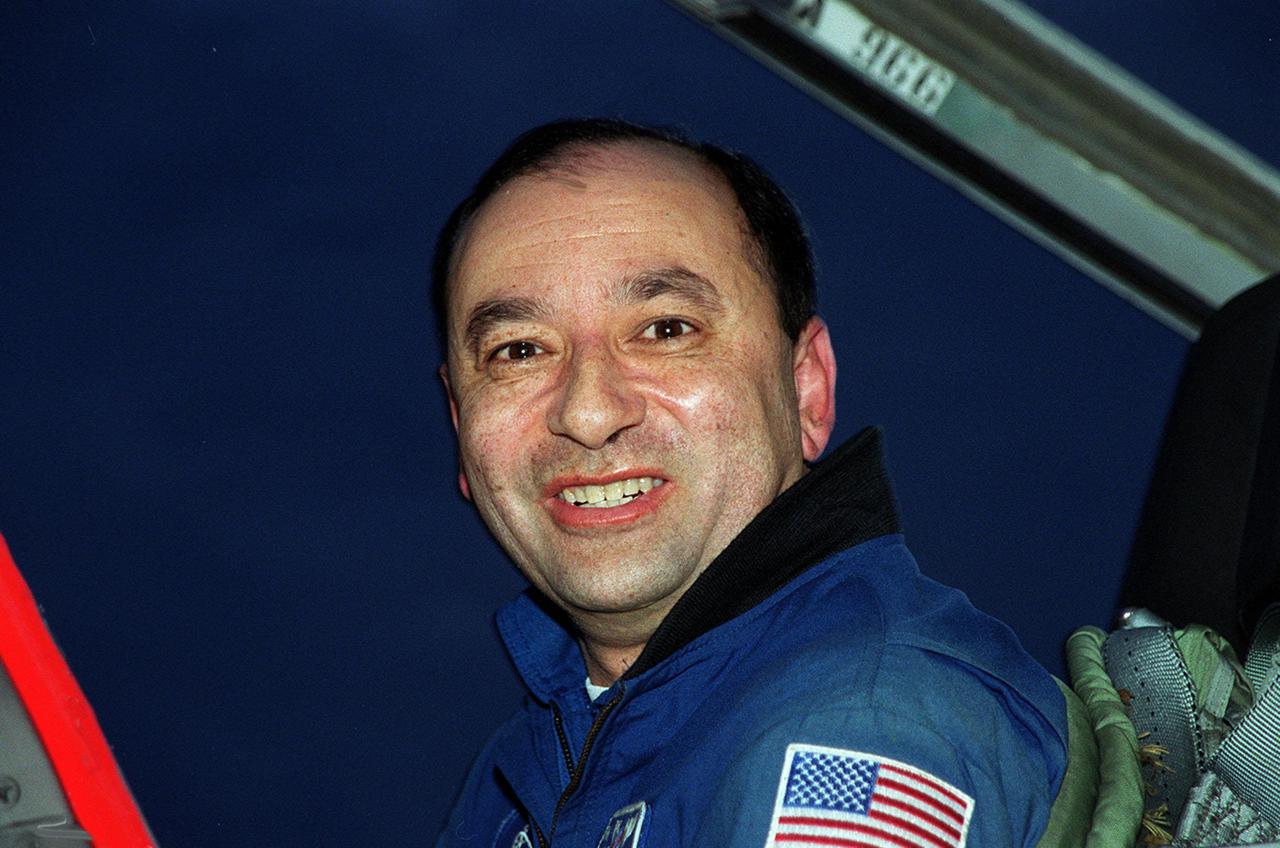
STS-98 Pilot Mark Polansky is pleased to arrive at KSC’s Shuttle Landing Facility for Terminal Countdown Test Activities. In preparation for the Jan. 19 launch, he and the rest of the crew Commander Ken Cockrell and Mission Specialists Robert Curbeam, Thomas Jones and Marsha Ivins will be training in emergency procedures from the pad, checking the payload and taking part in a simulated countdown. The payload for the mission is the U.S. Lab Destiny, a key element in the construction of the International Space Station. The lab has five system racks already installed inside the module. After delivery of electronics in the lab, electrically powered attitude control for Control Moment Gyroscopes will be activated. STS-98 is the seventh construction flight to the ISS.<br
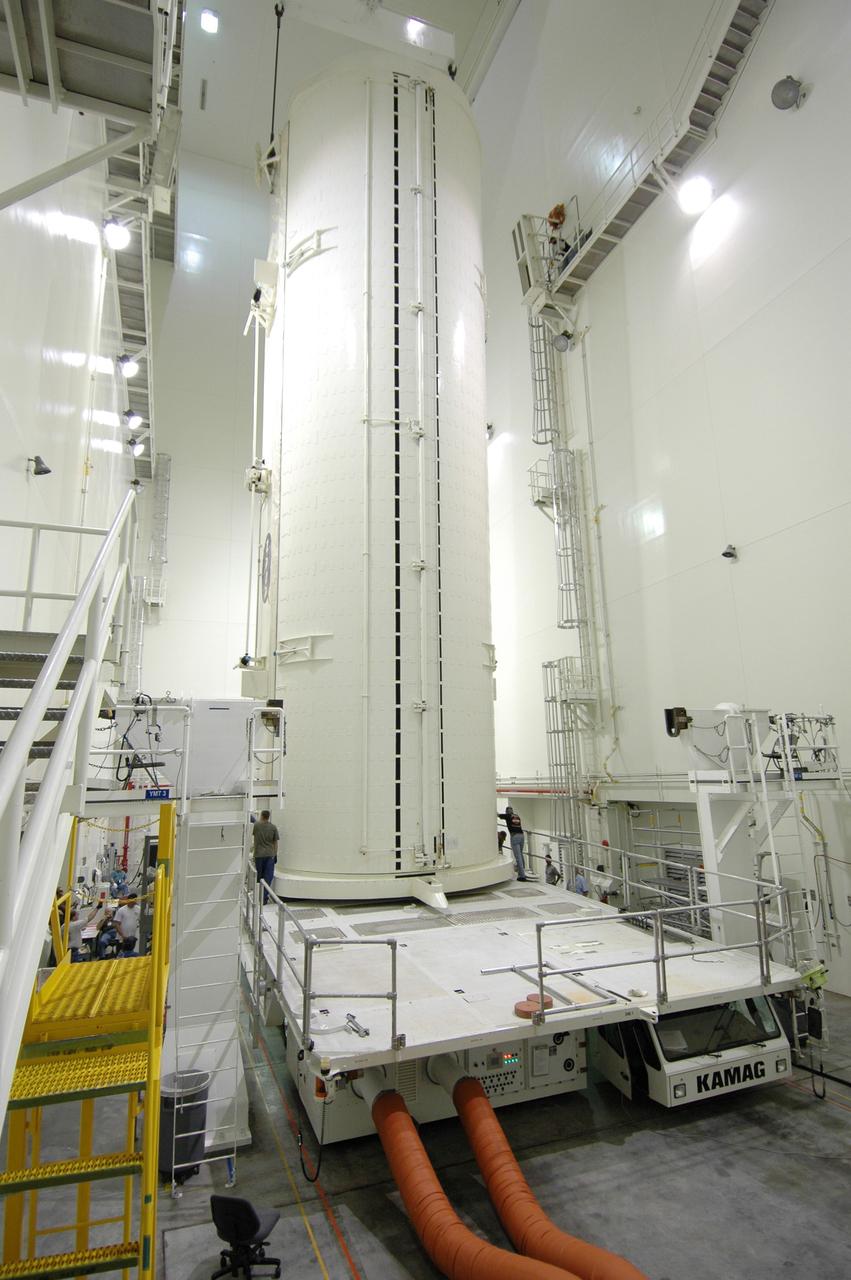
CAPE CANAVERAL, Fla. -- In the Vertical Integration Facility at NASA's Kennedy Space Center, workers check the placement of the payload canister after it was lowered onto the payload canister transporter. The canister contains the Japanese Experiment Module -Pressurized Module, which will be transported to Launch Pad 39A for space shuttle Discovery’s STS-124 mission. At the pad, the payload will be transferred from the canister into the payload changeout room on the rotating service structure. The changeout room is the enclosed, environmentally controlled portion of the service structure that supports cargo delivery to the pad and subsequent vertical installation into an orbiter's payload bay. On the mission, the STS-124 crew will transport the JEM as well as the Japanese Remote Manipulator System to the International Space Station. The launch of Discovery is targeted for May 31. Photo credit: NASA/Jim Grossmann
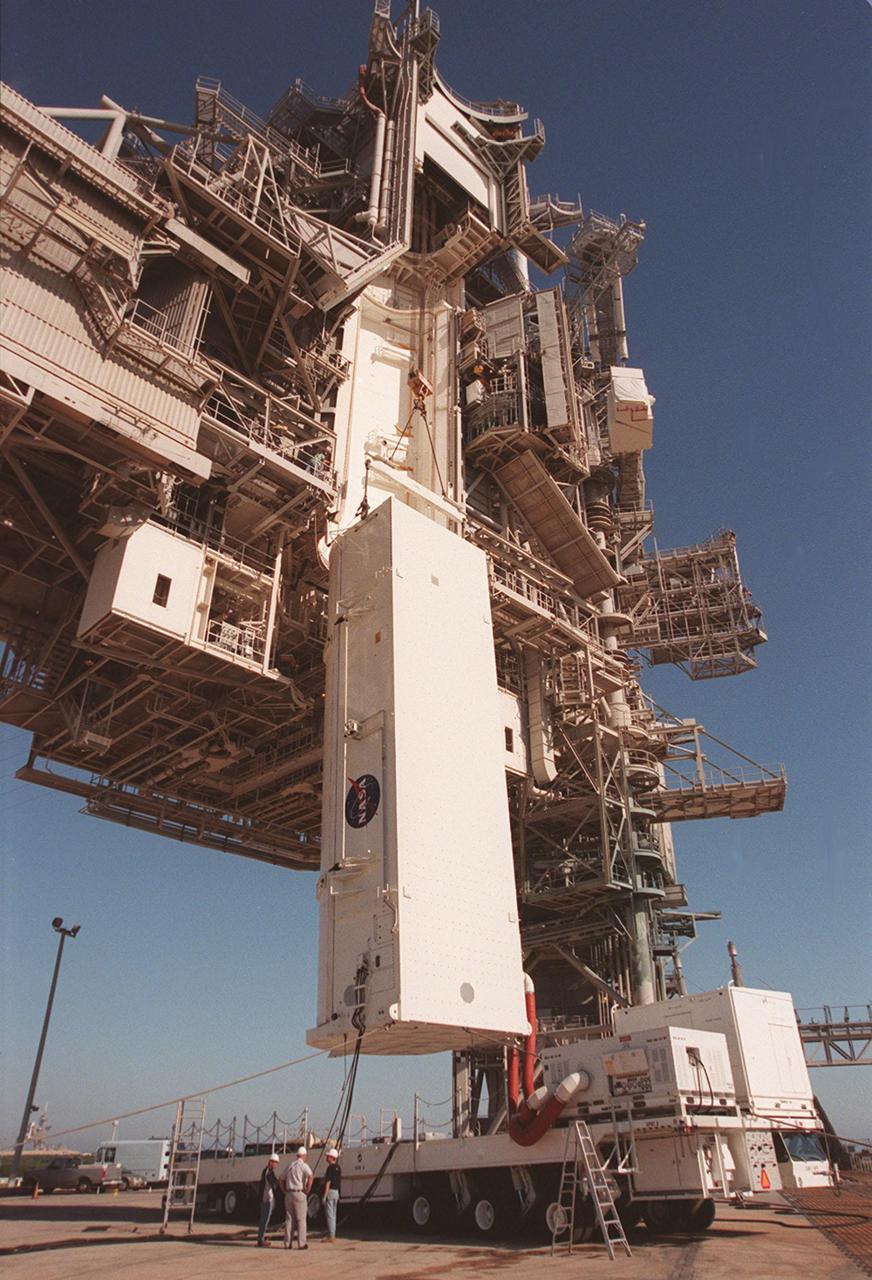
KENNEDY SPACE CENTER, FLA. -- At Launch Pad 39B the payload canister, with the Multi-Purpose Logistics Module Leonardo inside, is lifted to the payload changeout room on the Rotating Service Structure. Umbilical hoses, maintaining a controlled environment for the cargo, are still attached to the lower end of the canister. At the PCR, the payload ground-handling mechanism (PGHM) will be used to transfer Leonardo out of the canister and then into Space Shuttle Discovery’s payload bay. One of Italy’s major contributions to the International Space Station program, Leonardo is a reusable logistics carrier. It is the primary delivery system used to resupply and return Station cargo requiring a pressurized environment. Leonardo is the primary payload on mission STS-102 and will deliver up to 10 tons of laboratory racks filled with equipment, experiments and supplies for outfitting the newly installed U.S. Laboratory Destiny. STS-102 is scheduled to launch March 8 at 6:45 a.m. EST
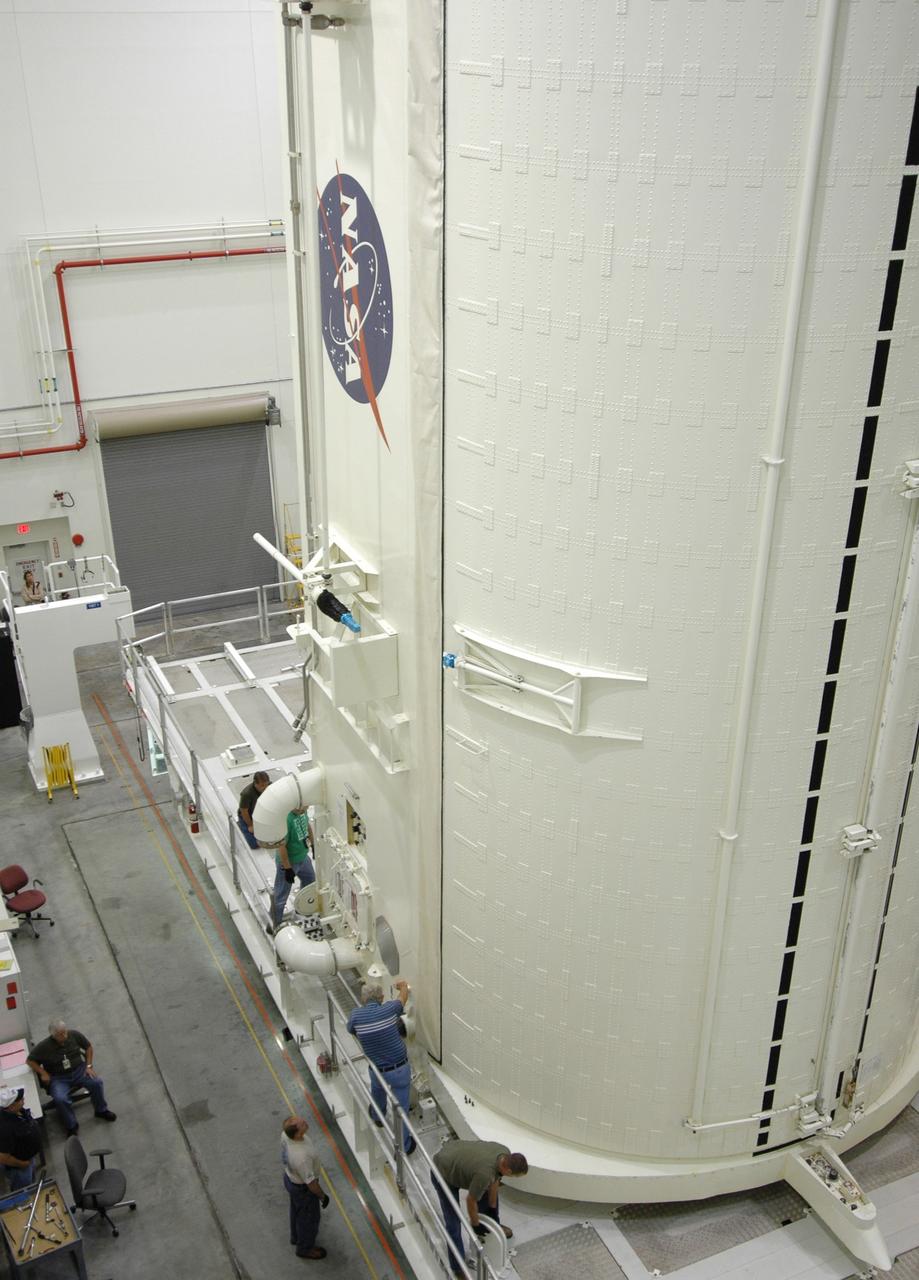
CAPE CANAVERAL, Fla. -- In the Vertical Integration Facility at NASA's Kennedy Space Center, workers check the placement of the payload canister after it was lowered onto the payload canister transporter. The canister contains the Japanese Experiment Module -Pressurized Module, which will be transported to Launch Pad 39A for space shuttle Discovery’s STS-124 mission. At the pad, the payload will be transferred from the canister into the payload changeout room on the rotating service structure. The changeout room is the enclosed, environmentally controlled portion of the service structure that supports cargo delivery to the pad and subsequent vertical installation into an orbiter's payload bay. On the mission, the STS-124 crew will transport the JEM as well as the Japanese Remote Manipulator System to the International Space Station. The launch of Discovery is targeted for May 31. Photo credit: NASA/Jim Grossmann
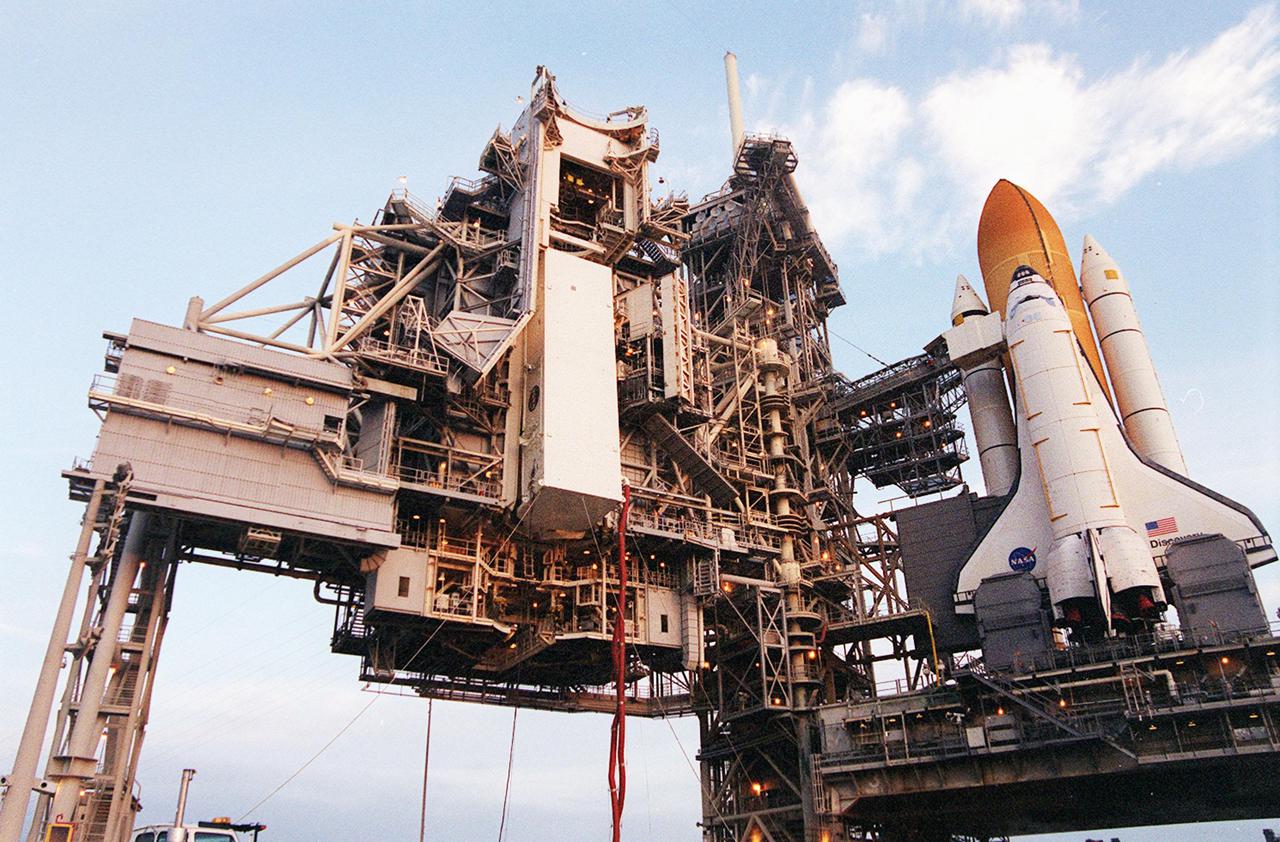
KENNEDY SPACE CENTER, FLA. -- At Launch Pad 39A, the payload canister with the SPACEHAB Double Module and the Integrated Cargo Carrier (ICC) inside is lifted off the payload transporter toward the Payload Changeout Room (PCR) on the Rotating Service Structure (RSS). The PCR is an environmentally controlled facility supporting cargo delivery to the pad and vertical installation in the orbiter cargo bay. At right of the RSS is the Fixed Service Structure. The primary payloads on mission STS-101, the module and ICC contain internal logistics and resupply cargo for restoring full redundancy to the International Space Station power system in preparation for the arrival of the next pressurized module, the Russian-built Zvezda. The payloads will be transferred to Space Shuttle Atlantis after Atlantis rolls out to the pad. Launch of Atlantis on mission STS-101 is scheduled no earlier than April 17, 2000
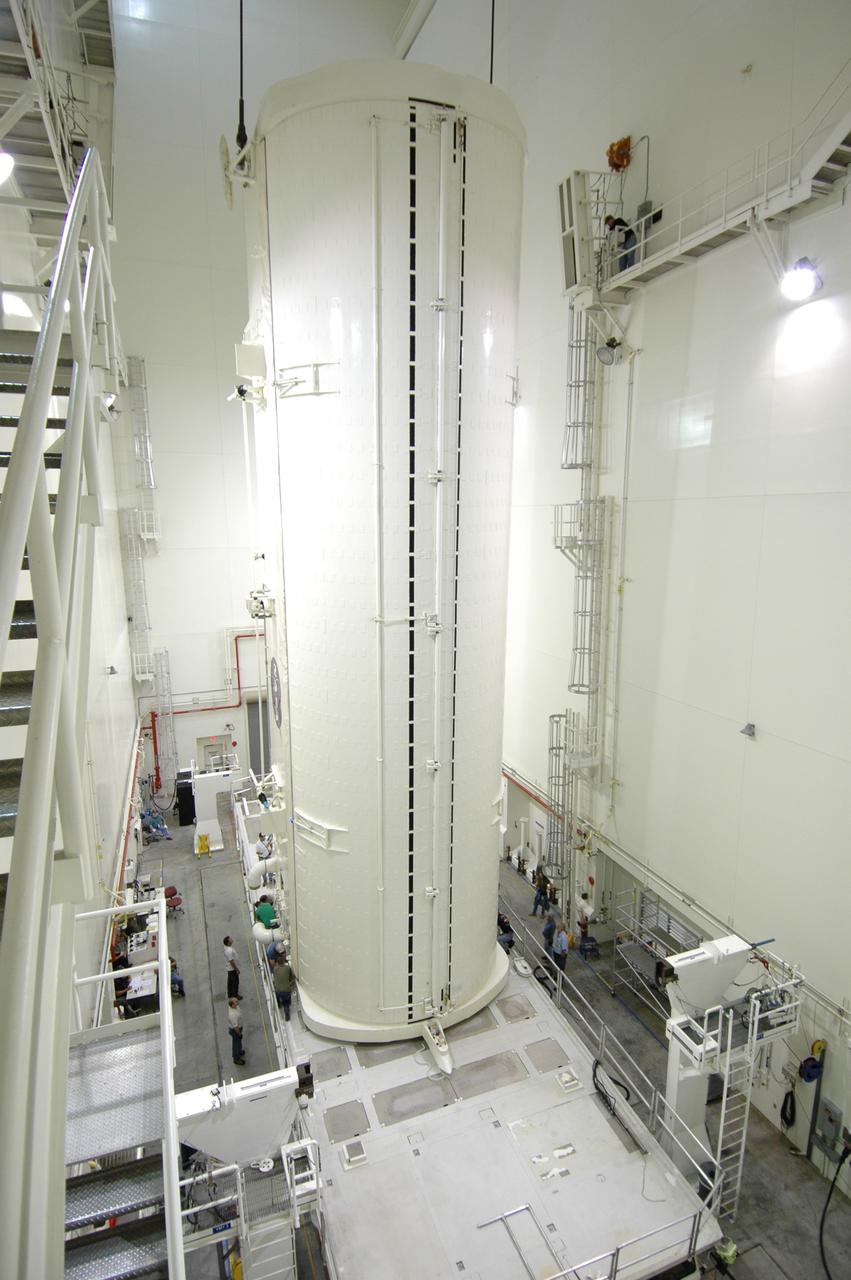
CAPE CANAVERAL, Fla. -- In the Vertical Integration Facility at NASA's Kennedy Space Center, workers check the placement of the payload canister after it was lowered onto the payload canister transporter. The canister contains the Japanese Experiment Module -Pressurized Module, which will be transported to Launch Pad 39A for space shuttle Discovery’s STS-124 mission. At the pad, the payload will be transferred from the canister into the payload changeout room on the rotating service structure. The changeout room is the enclosed, environmentally controlled portion of the service structure that supports cargo delivery to the pad and subsequent vertical installation into an orbiter's payload bay. On the mission, the STS-124 crew will transport the JEM as well as the Japanese Remote Manipulator System to the International Space Station. The launch of Discovery is targeted for May 31. Photo credit: NASA/Jim Grossmann
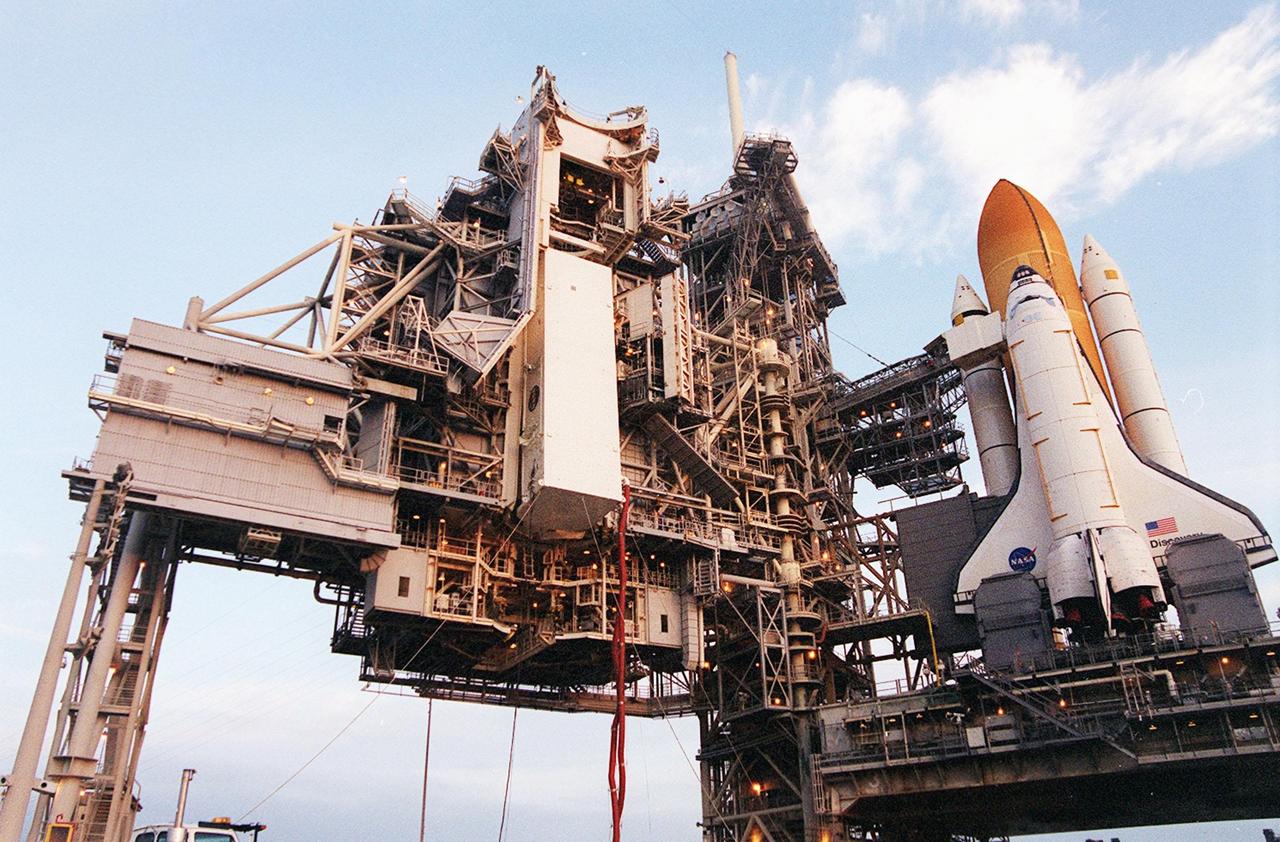
KENNEDY SPACE CENTER, FLA. -- At Launch Pad 39B the payload canister, with the Multi-Purpose Logistics Module Leonardo inside, is lifted to the payload changeout room on the Rotating Service Structure. Umbilical hoses, maintaining a controlled environment for the cargo, are still attached to the lower end of the canister. At the PCR, the payload ground-handling mechanism (PGHM) will be used to transfer Leonardo out of the canister and then into Space Shuttle Discovery’s payload bay. One of Italy’s major contributions to the International Space Station program, Leonardo is a reusable logistics carrier. It is the primary delivery system used to resupply and return Station cargo requiring a pressurized environment. Leonardo is the primary payload on mission STS-102 and will deliver up to 10 tons of laboratory racks filled with equipment, experiments and supplies for outfitting the newly installed U.S. Laboratory Destiny. STS-102 is scheduled to launch March 8 at 6:45 a.m. EST
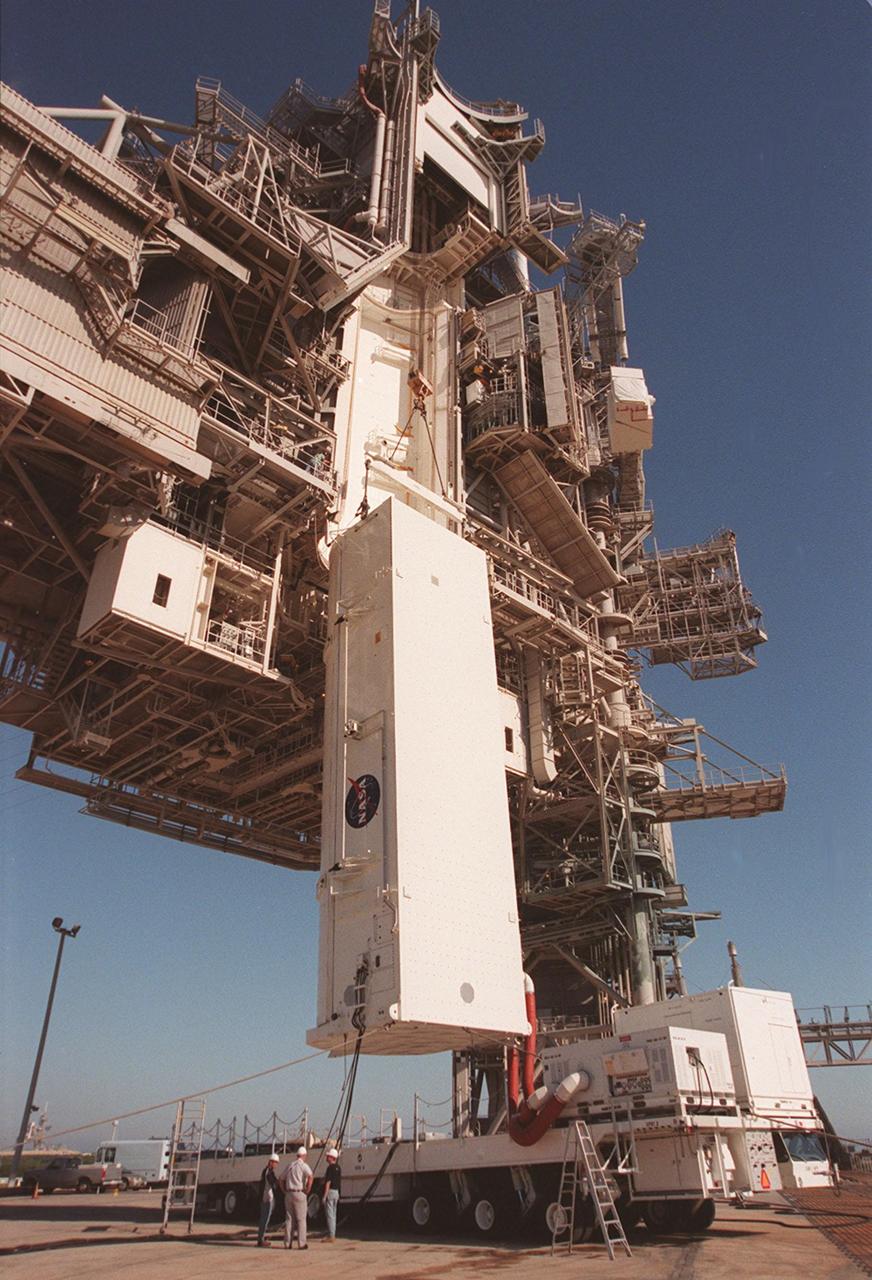
KENNEDY SPACE CENTER, FLA. -- At Launch Pad 39A, the payload canister with the SPACEHAB Double Module and the Integrated Cargo Carrier (ICC) inside is lifted off the payload transporter toward the Payload Changeout Room (PCR) on the Rotating Service Structure (RSS). The PCR is an environmentally controlled facility supporting cargo delivery to the pad and vertical installation in the orbiter cargo bay. At right of the RSS is the Fixed Service Structure. The primary payloads on mission STS-101, the module and ICC contain internal logistics and resupply cargo for restoring full redundancy to the International Space Station power system in preparation for the arrival of the next pressurized module, the Russian-built Zvezda. The payloads will be transferred to Space Shuttle Atlantis after Atlantis rolls out to the pad. Launch of Atlantis on mission STS-101 is scheduled no earlier than April 17, 2000
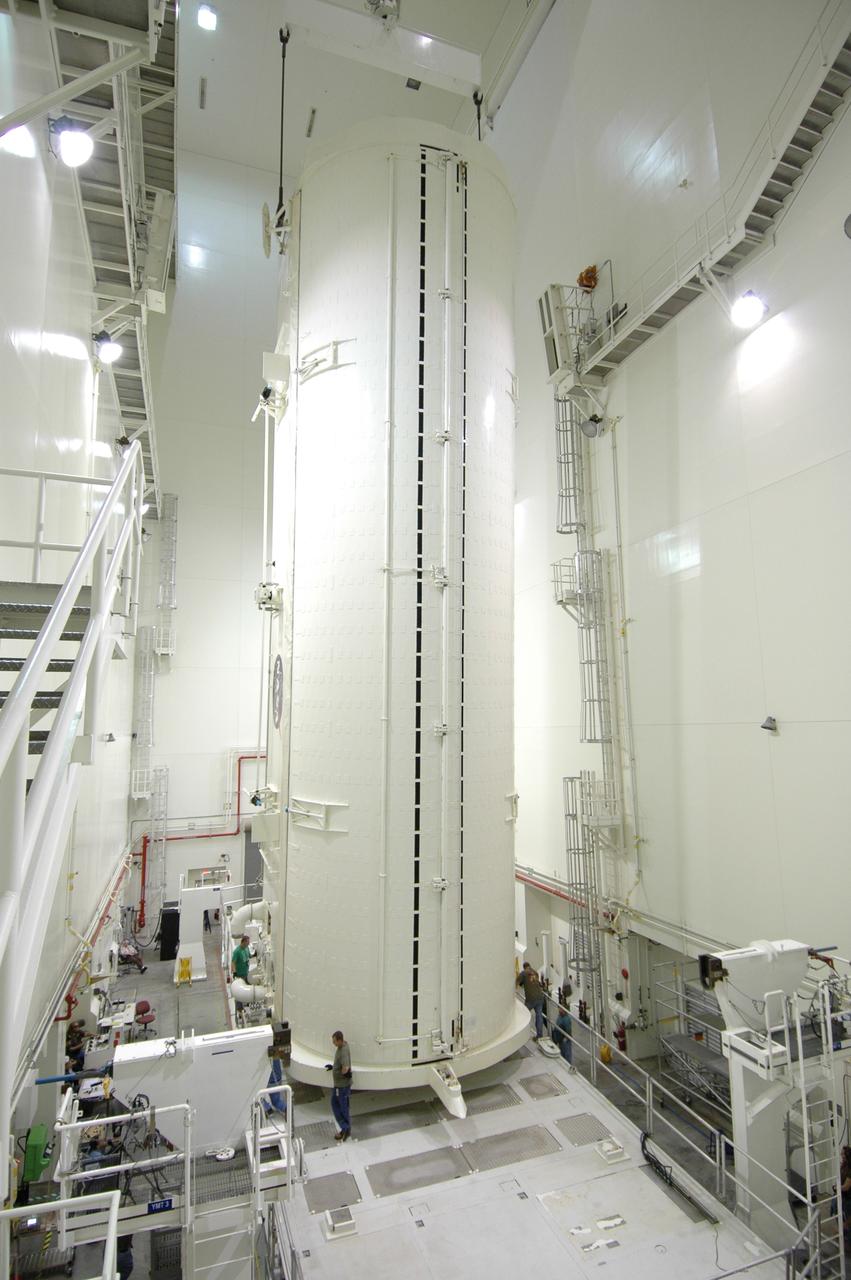
CAPE CANAVERAL, Fla. -- After rotation in the Vertical Integration Facility at NASA's Kennedy Space Center, the payload canister is lowered vertically onto the payload canister transporter. The canister contains the Japanese Experiment Module -Pressurized Module, which will be transported to Launch Pad 39A for space shuttle Discovery’s STS-124 mission. At the pad, the payload will be transferred from the canister into the payload changeout room on the rotating service structure. The changeout room is the enclosed, environmentally controlled portion of the service structure that supports cargo delivery to the pad and subsequent vertical installation into an orbiter's payload bay. On the mission, the STS-124 crew will transport the JEM as well as the Japanese Remote Manipulator System to the International Space Station. The launch of Discovery is targeted for May 31. Photo credit: NASA/Jim Grossmann
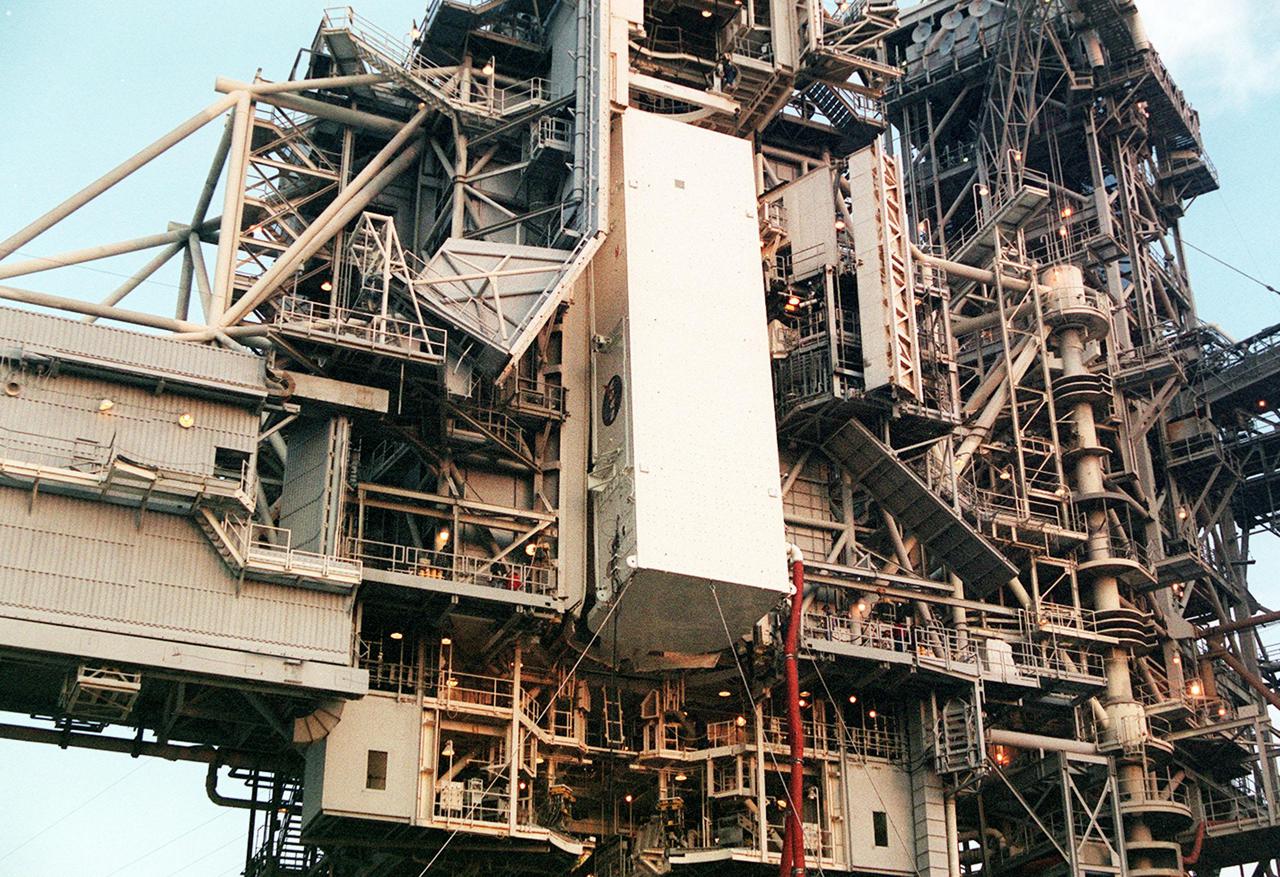
KENNEDY SPACE CENTER, FLA. -- At Launch Pad 39B the payload canister, with the Multi-Purpose Logistics Module Leonardo inside, nears the payload changeout room on the Rotating Service Structure. Umbilical hoses, maintaining a controlled environment for the cargo, are still attached to the lower end of the canister. At the PCR, the payload ground-handling mechanism (PGHM) will be used to transfer Leonardo out of the canister and then into Space Shuttle Discovery’s payload bay. One of Italy’s major contributions to the International Space Station program, Leonardo is a reusable logistics carrier. It is the primary delivery system used to resupply and return Station cargo requiring a pressurized environment. Leonardo is the primary payload on mission STS-102 and will deliver up to 10 tons of laboratory racks filled with equipment, experiments and supplies for outfitting the newly installed U.S. Laboratory Destiny. STS-102 is scheduled to launch March 8 at 6:45 a.m. EST
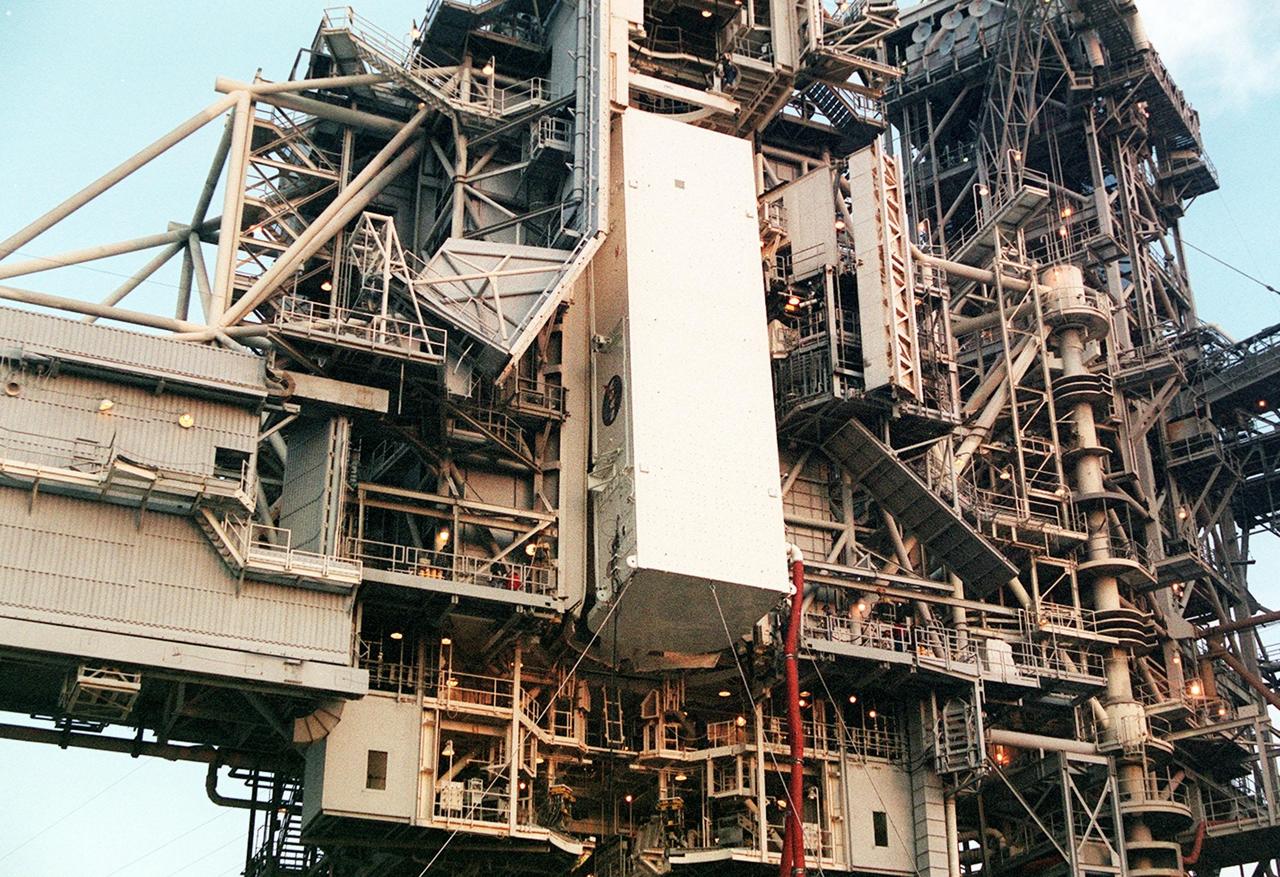
KENNEDY SPACE CENTER, FLA. -- At Launch Pad 39B the payload canister, with the Multi-Purpose Logistics Module Leonardo inside, nears the payload changeout room on the Rotating Service Structure. Umbilical hoses, maintaining a controlled environment for the cargo, are still attached to the lower end of the canister. At the PCR, the payload ground-handling mechanism (PGHM) will be used to transfer Leonardo out of the canister and then into Space Shuttle Discovery’s payload bay. One of Italy’s major contributions to the International Space Station program, Leonardo is a reusable logistics carrier. It is the primary delivery system used to resupply and return Station cargo requiring a pressurized environment. Leonardo is the primary payload on mission STS-102 and will deliver up to 10 tons of laboratory racks filled with equipment, experiments and supplies for outfitting the newly installed U.S. Laboratory Destiny. STS-102 is scheduled to launch March 8 at 6:45 a.m. EST

CAPE CANAVERAL, Fla. - On Launch Pad 39A at NASA's Kennedy Space Center, the payload canister is ready to be lifted to the payload changeout room above. The canister contains four carriers holding various equipment for the STS-125 mission aboard space shuttle Atlantis to service NASA’s Hubble Space Telescope. At right is Atlantis atop the mobile launcher platform. The changeout room is the enclosed, environmentally controlled portion of the rotating service structure that supports cargo delivery to the pad and subsequent vertical installation into the shuttle’s payload bay. Launch of Atlantis is targeted for Oct. 10. Photo credit: NASA/Jack Pfaller
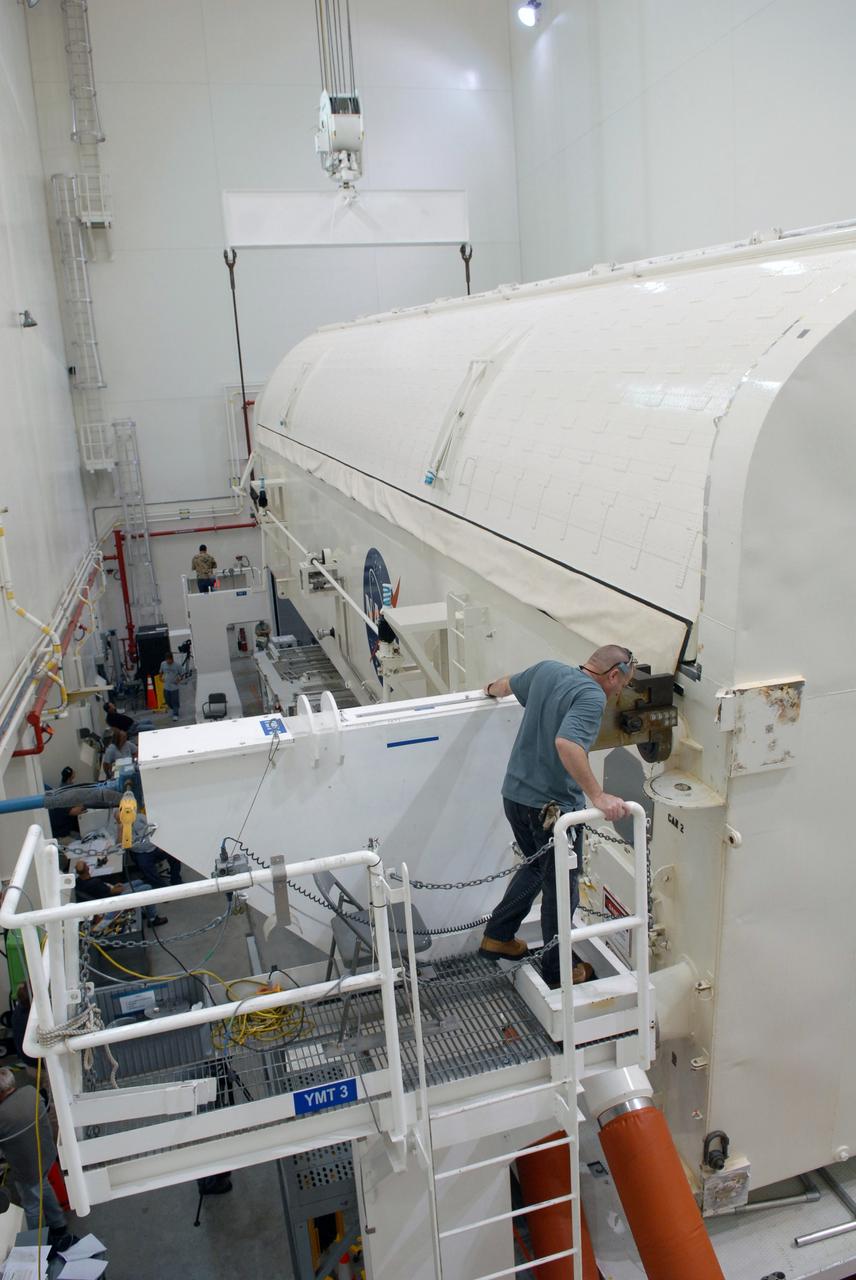
CAPE CANAVERAL, Fla. - In the Canister Rotation Facility at NASA's Kennedy Space Center, workers get ready to lift the payload canister to a vertical position for the trip to Launch Pad 39A. The canister’s cargo consists of four carriers holding various equipment for the STS-125 mission aboard space shuttle Atlantis to service NASA’s Hubble Space Telescope. At the pad, the cargo will be moved into the Payload Changeout Room. The changeout room is the enclosed, environmentally controlled portion of the rotating service structure that supports cargo delivery to the pad and subsequent vertical installation into the shuttle’s payload bay. Launch of Atlantis is targeted for Oct. 10. Photo credit: NASA/Jack Pfaller
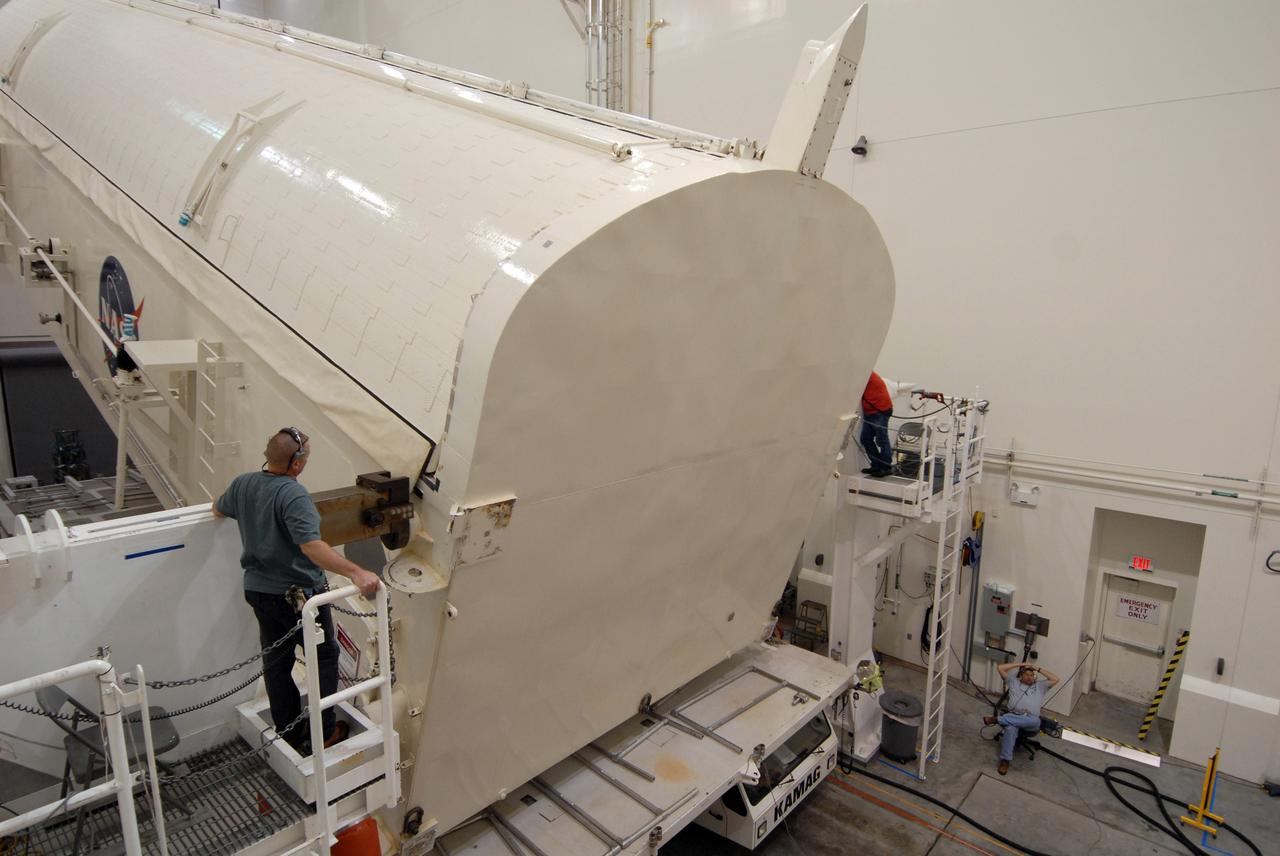
CAPE CANAVERAL, Fla. - In the Canister Rotation Facility at NASA's Kennedy Space Center, the payload canister is lifted toward a vertical position for the trip to Launch Pad 39A. The canister’s cargo consists of four carriers holding various equipment for the STS-125 mission aboard space shuttle Atlantis to service NASA’s Hubble Space Telescope. At the pad, the cargo will be moved into the Payload Changeout Room. The changeout room is the enclosed, environmentally controlled portion of the rotating service structure that supports cargo delivery to the pad and subsequent vertical installation into the shuttle’s payload bay. Launch of Atlantis is targeted for Oct. 10. Photo credit: NASA/Jack Pfaller
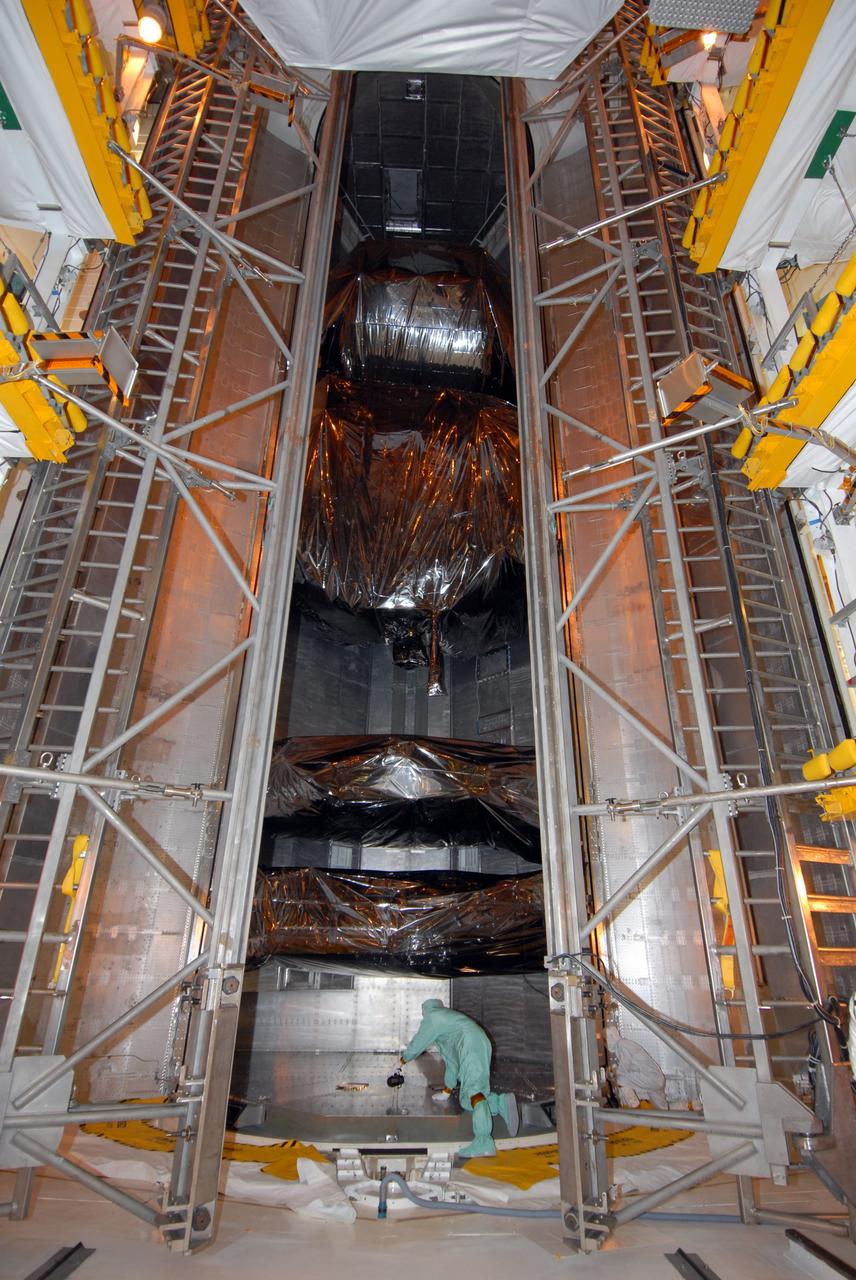
CAPE CANAVERAL, Fla. - Inside the payload changeout room, or PCR, at NASA's Kennedy Space Center Launch Pad 39A, the doors of the payload canister are open. Inside are four carriers holding various equipment for the STS-125 mission aboard space shuttle Atlantis to service NASA’s Hubble Space Telescope. The PCR is the enclosed, environmentally controlled portion of the rotating service structure that supports cargo delivery to the pad and subsequent vertical installation into the shuttle’s payload bay. Launch of Atlantis is targeted for Oct. 10. Photo credit: NASA/Jack Pfaller
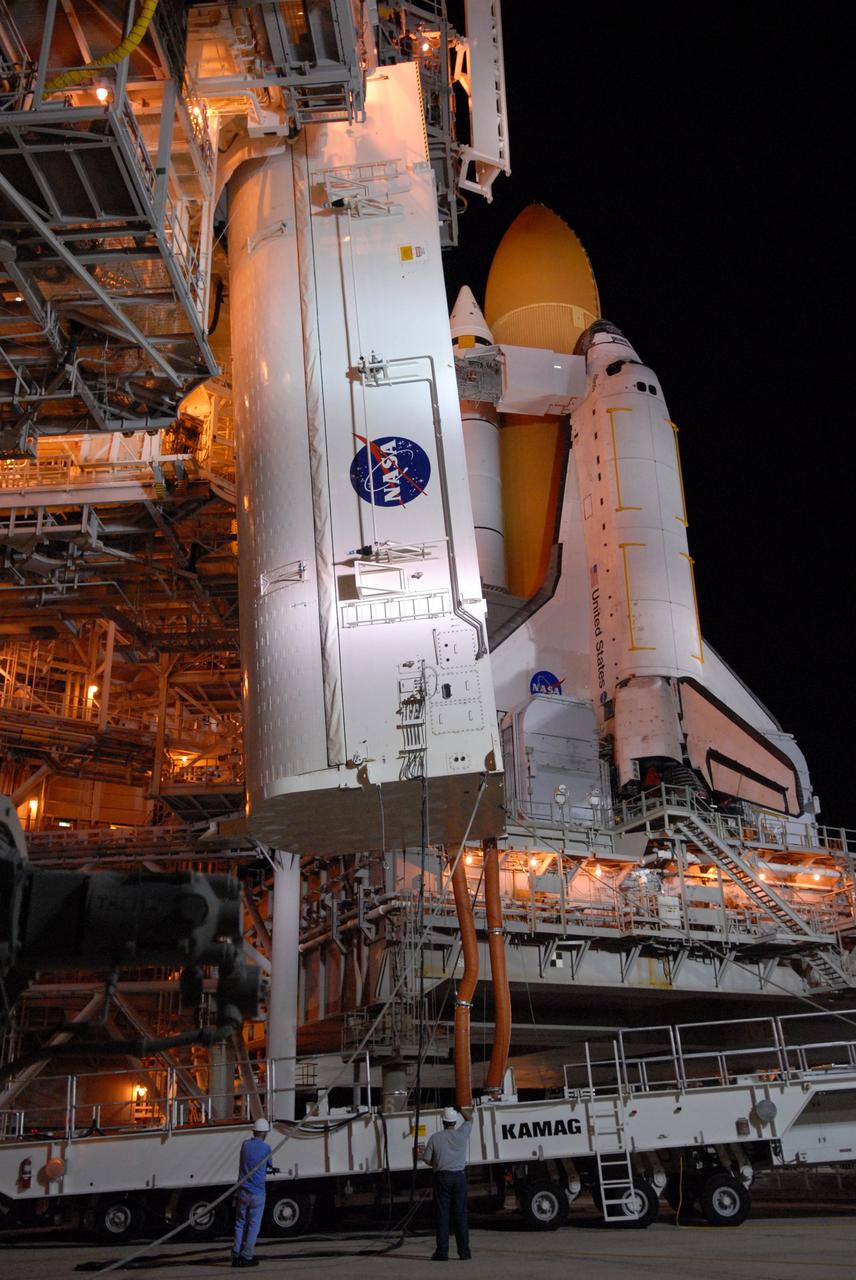
CAPE CANAVERAL, Fla. - On Launch Pad 39A at NASA's Kennedy Space Center, the payload canister is lifted toward the payload changeout room above. The canister contains four carriers holding various equipment for the STS-125 mission aboard space shuttle Atlantis to service NASA’s Hubble Space Telescope. The changeout room is the enclosed, environmentally controlled portion of the rotating service structure that supports cargo delivery to the pad and subsequent vertical installation into the shuttle’s payload bay. Launch of Atlantis is targeted for Oct. 10. Photo credit: NASA/Jack Pfaller
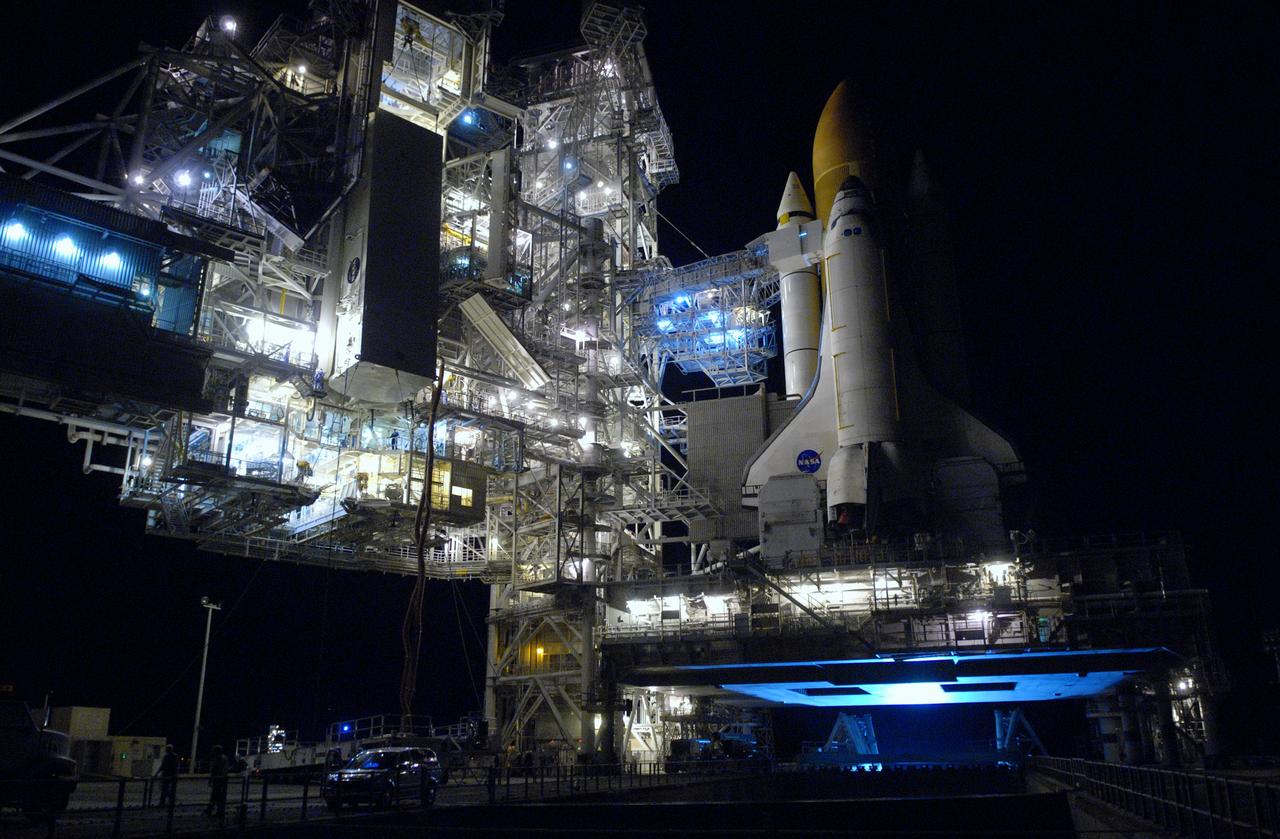
CAPE CANAVERAL, Fla. - On Launch Pad 39A at NASA's Kennedy Space Center, the payload canister is in place at the payload changeout room on the rotating service structure. The canister contains four carriers holding various equipment for the STS-125 mission aboard space shuttle Atlantis to service NASA’s Hubble Space Telescope. At right is Atlantis, atop the mobile launcher platform. The changeout room is the enclosed, environmentally controlled portion of the rotating service structure that supports cargo delivery to the pad and subsequent vertical installation into the shuttle’s payload bay. Launch of Atlantis is targeted for Oct. 10. Photo credit: NASA/Jack Pfaller
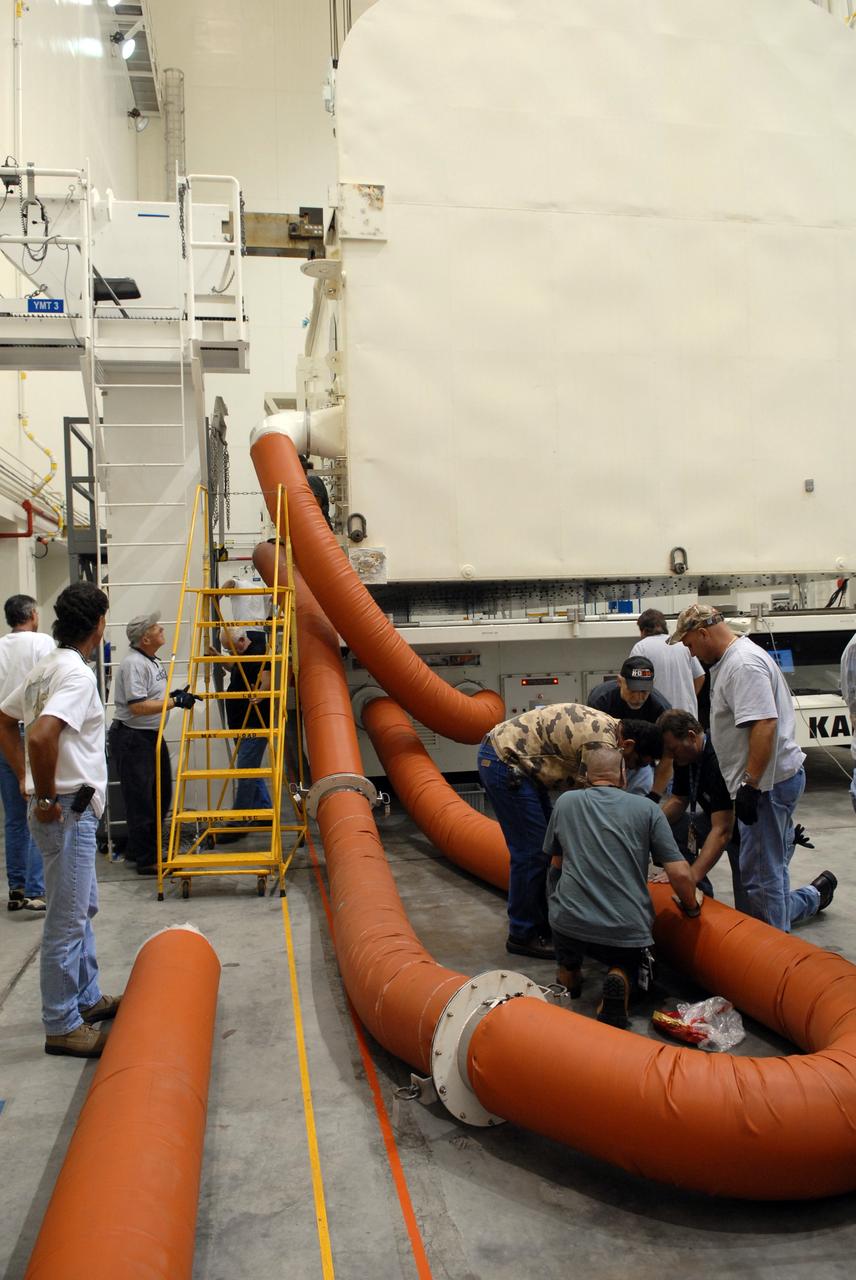
CAPE CANAVERAL, Fla. - At NASA's Kennedy Space Center, the payload canister is in the Canister Rotation Facility where it will be lifted to a vertical position. Workers check the umbilical lines that keep a controlled environment in the canister. The canister’s cargo consists of four carriers holding various equipment for the STS-125 mission aboard space shuttle Atlantis to service NASA’s Hubble Space Telescope. At the pad, the cargo will be moved into the Payload Changeout Room. The changeout room is the enclosed, environmentally controlled portion of the rotating service structure that supports cargo delivery to the pad and subsequent vertical installation into the shuttle’s payload bay. Launch of Atlantis is targeted for Oct. 10. Photo credit: NASA/Jack Pfaller

KENNEDY SPACE CENTER, FLA. -- The Multi-Purpose Logistics Module Leonardo rests in Space Shuttle Discovery’s payload bay after being transferred from the Payload Changeout Room, Launch Pad 39B. Behind it is the Integrated Cargo Carrier, holding several smaller payloads. Discovery is scheduled to launch March 8 at 6:42 a.m. EST on mission STS-102, the eighth construction flight to the International Space Station. The primary delivery system used to resupply and return Station cargo requiring a pressurized environment, Leonardo will deliver up to 10 tons of laboratory racks filled with equipment, experiments and supplies for outfitting the newly installed U.S. Laboratory Destiny
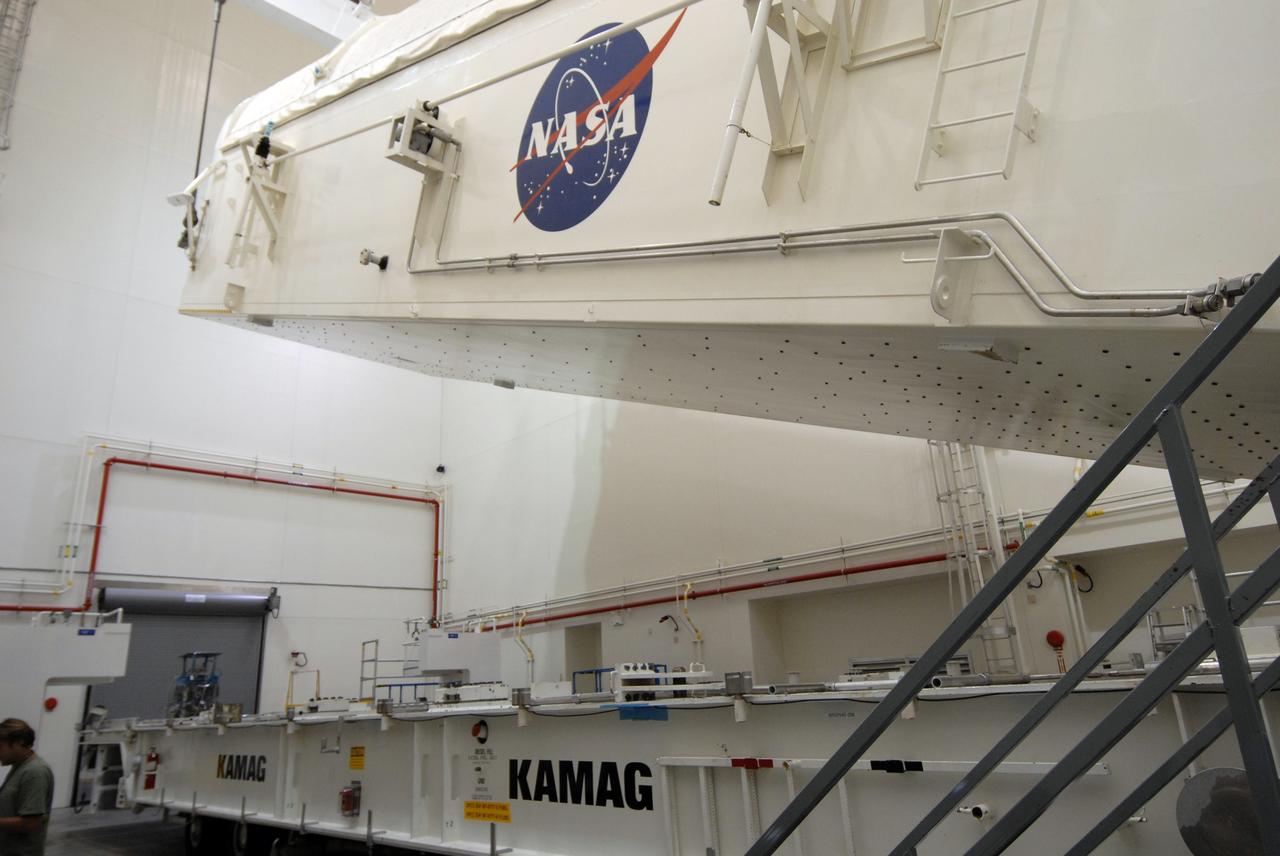
CAPE CANAVERAL, Fla. - In the Canister Rotation Facility at NASA's Kennedy Space Center, the payload canister is lifted toward a vertical position for the trip to Launch Pad 39A. The canister’s cargo consists of four carriers holding various equipment for the STS-125 mission aboard space shuttle Atlantis to service NASA’s Hubble Space Telescope. At the pad, the cargo will be moved into the Payload Changeout Room. The changeout room is the enclosed, environmentally controlled portion of the rotating service structure that supports cargo delivery to the pad and subsequent vertical installation into the shuttle’s payload bay. Launch of Atlantis is targeted for Oct. 10. Photo credit: NASA/Jack Pfaller
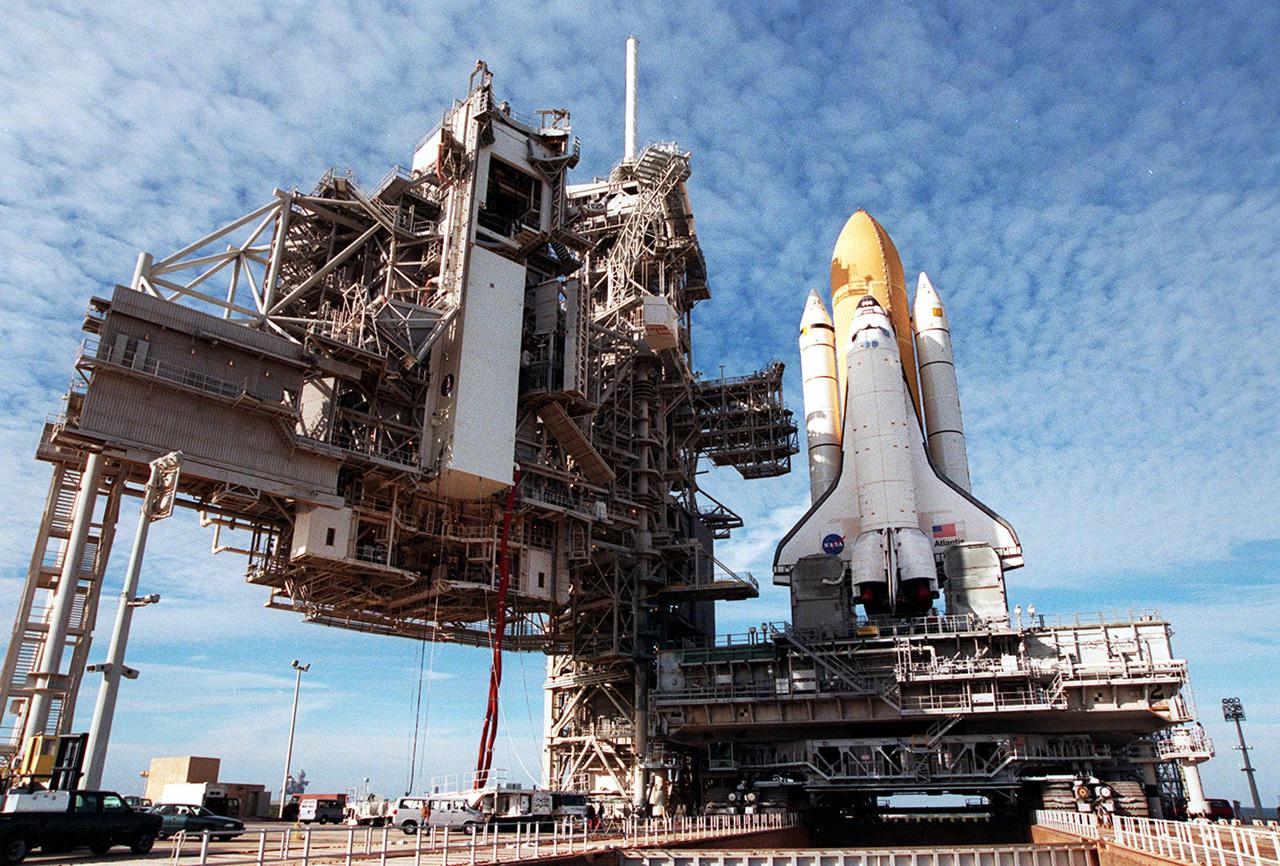
KENNEDY SPACE CENTER, Fla. -- Space Shuttle Atlantis reaches its destination, Launch Pad 39A, for liftoff no earlier than Jan. 19 on mission STS-98. To its immediate left is the Fixed Service Structure, with its 80-foot-tall white lighting mast on top. Further to the left is the Rotating Service Structure, where the white payload canister is being lifted to the Payload Changeout Room. The payload for the mission is the U.S. Lab Destiny, a key element in the construction of the International Space Station. The lab has five system racks for experiments already installed inside the module. After delivery of electronics in the lab, electrically powered attitude control for Control Moment Gyroscopes will be activated
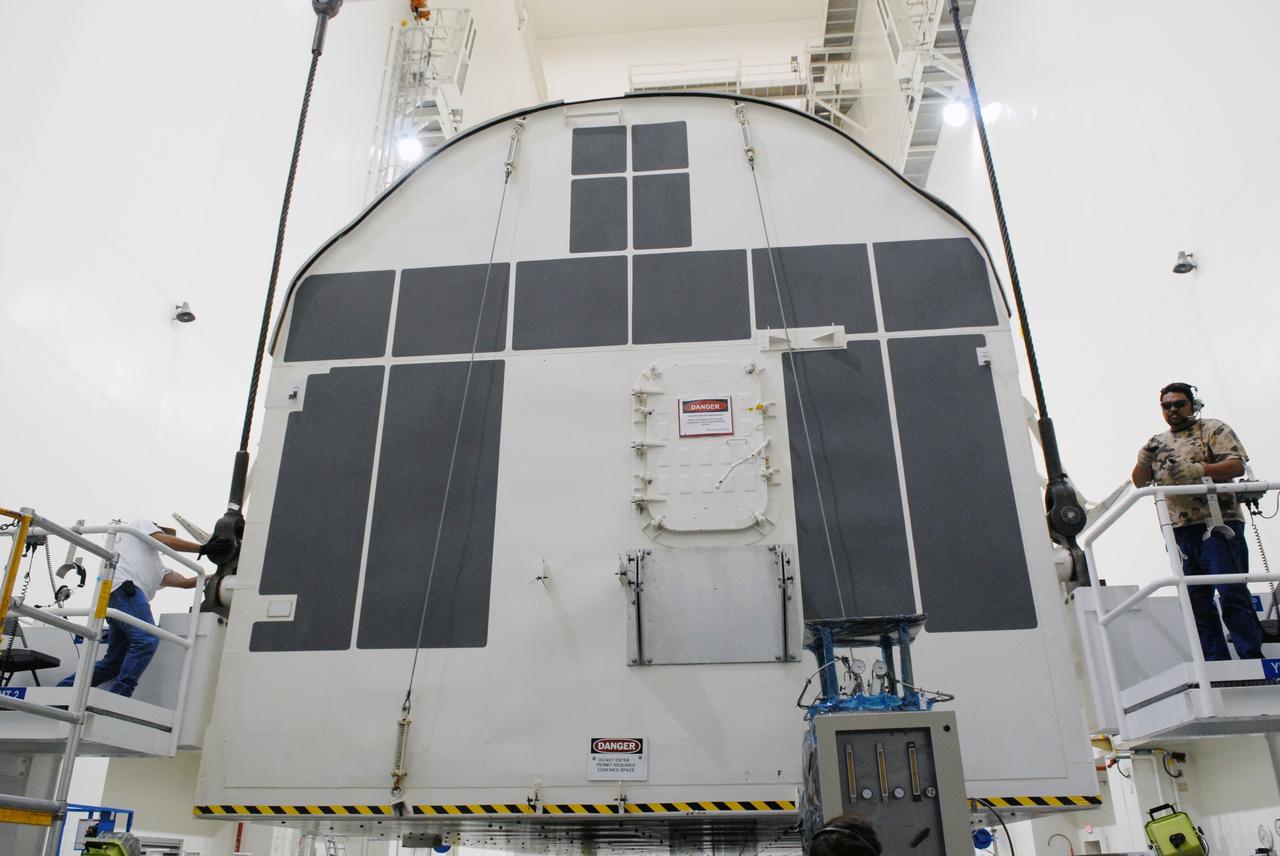
CAPE CANAVERAL, Fla. - In the Canister Rotation Facility at NASA's Kennedy Space Center, workers check cable fittings that will lift the payload canister to a vertical position for the trip to Launch Pad 39A. The canister’s cargo consists of four carriers holding various equipment for the STS-125 mission aboard space shuttle Atlantis to service NASA’s Hubble Space Telescope. At the pad, the cargo will be moved into the Payload Changeout Room. The changeout room is the enclosed, environmentally controlled portion of the rotating service structure that supports cargo delivery to the pad and subsequent vertical installation into the shuttle’s payload bay. Launch of Atlantis is targeted for Oct. 10. Photo credit: NASA/Jack Pfaller
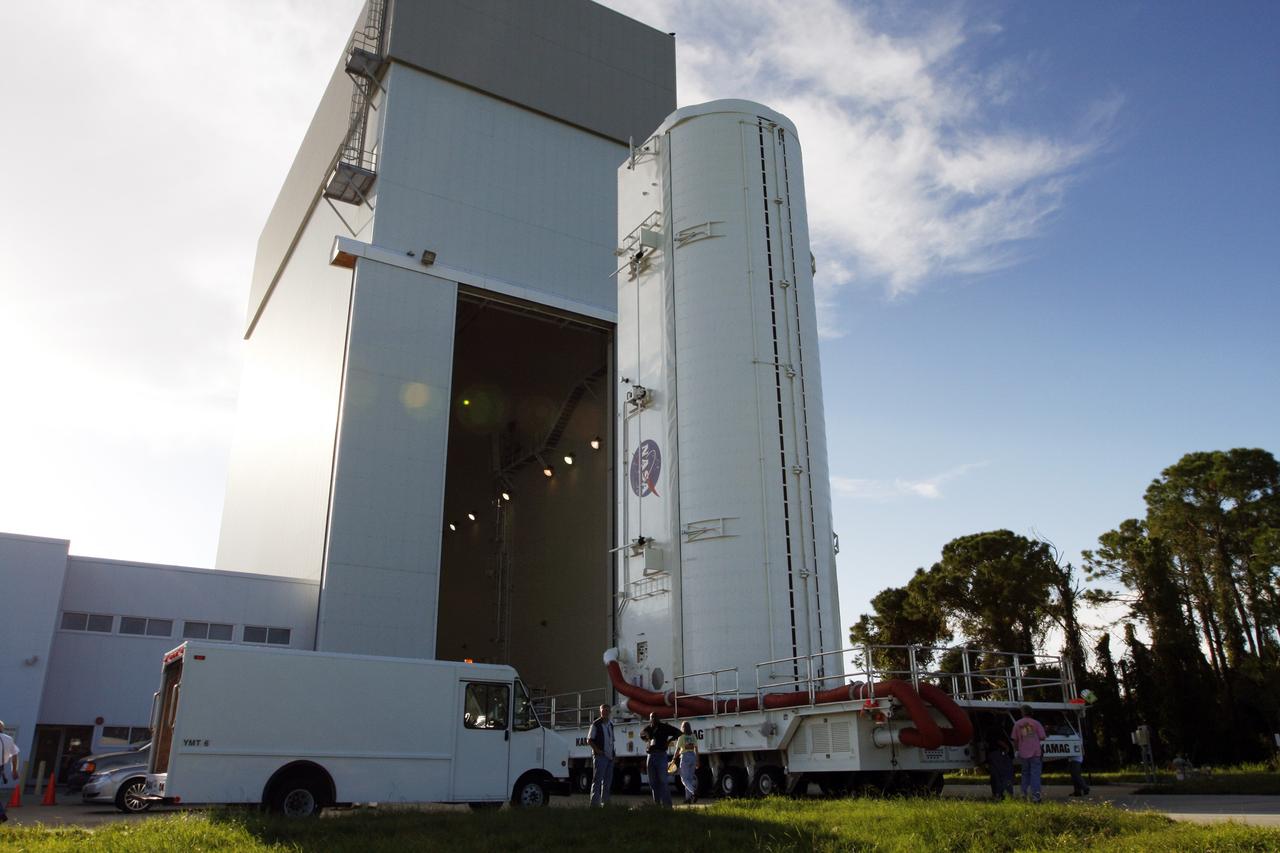
CAPE CANAVERAL, Fla. - The payload canister moves out of the Canister Rotation Facility at NASA's Kennedy Space Center in Florida heading for Launch Pad 39A. It carries a cargo of four carriers holding various equipment for the STS-125 mission aboard space shuttle Atlantis to service NASA’s Hubble Space Telescope. At the pad, the cargo will be moved into the Payload Changeout Room. The changeout room is the enclosed, environmentally controlled portion of the rotating service structure that supports cargo delivery to the pad and subsequent vertical installation into the shuttle’s payload bay. Launch of Atlantis is targeted for Oct. 10. Photo credit: NASA/Troy Cryder
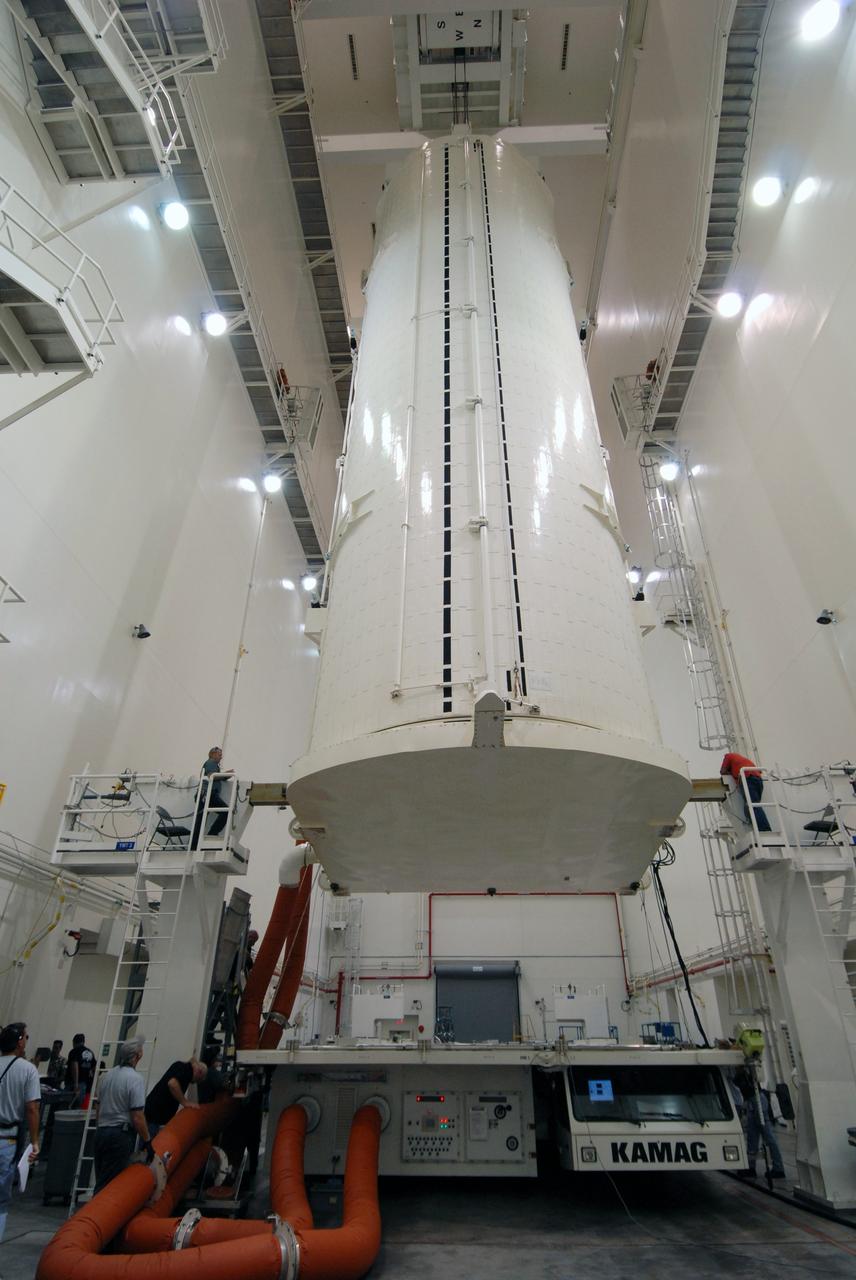
CAPE CANAVERAL, Fla. - In the Canister Rotation Facility at NASA's Kennedy Space Center, the payload canister is lifted to a vertical position for the trip to Launch Pad 39A. The canister’s cargo consists of four carriers holding various equipment for the STS-125 mission aboard space shuttle Atlantis to service NASA’s Hubble Space Telescope. At the pad, the cargo will be moved into the Payload Changeout Room. The changeout room is the enclosed, environmentally controlled portion of the rotating service structure that supports cargo delivery to the pad and subsequent vertical installation into the shuttle’s payload bay. Launch of Atlantis is targeted for Oct. 10. Photo credit: NASA/Jack Pfaller
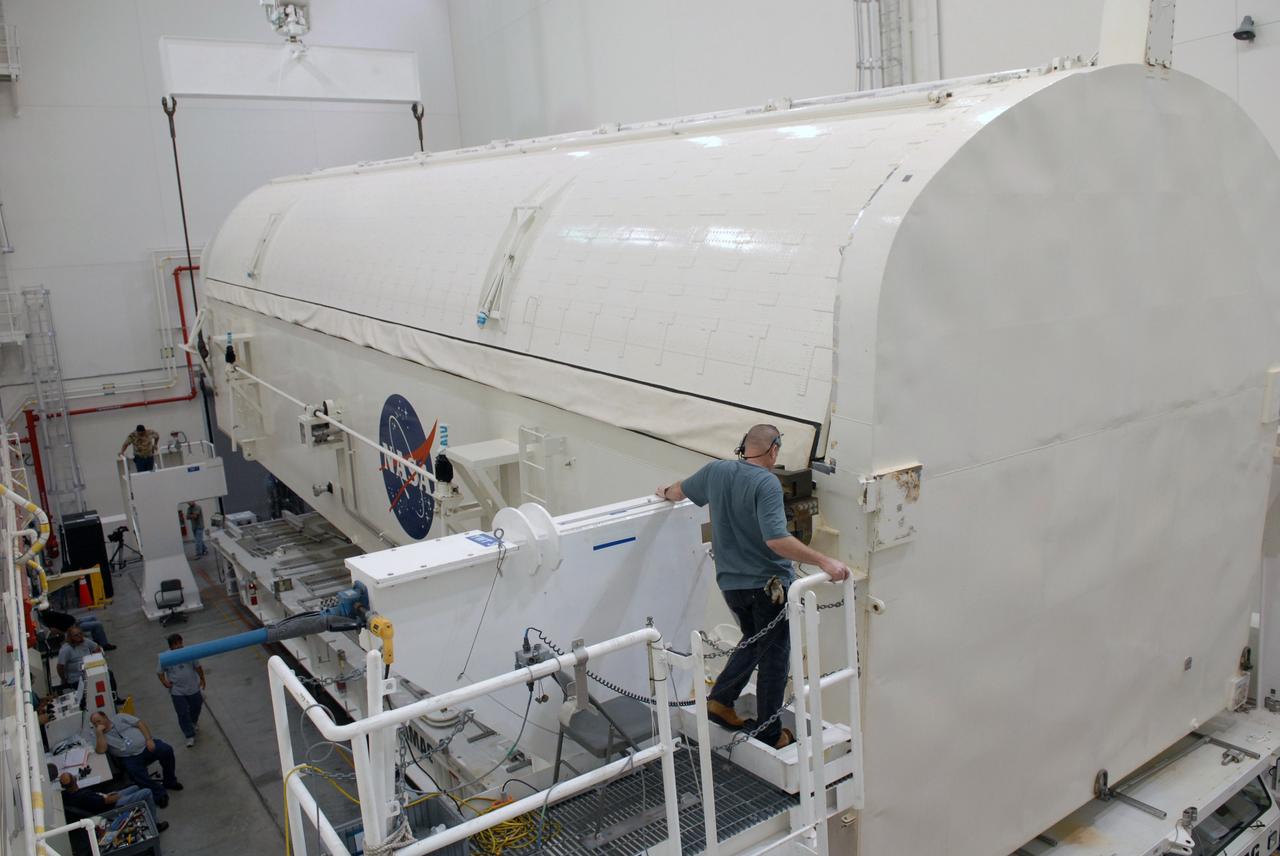
CAPE CANAVERAL, Fla. - In the Canister Rotation Facility at NASA's Kennedy Space Center, workers get ready to lift the payload canister to a vertical position for the trip to Launch Pad 39A. The canister’s cargo consists of four carriers holding various equipment for the STS-125 mission aboard space shuttle Atlantis to service NASA’s Hubble Space Telescope. At the pad, the cargo will be moved into the Payload Changeout Room. The changeout room is the enclosed, environmentally controlled portion of the rotating service structure that supports cargo delivery to the pad and subsequent vertical installation into the shuttle’s payload bay. Launch of Atlantis is targeted for Oct. 10. Photo credit: NASA/Jack Pfaller
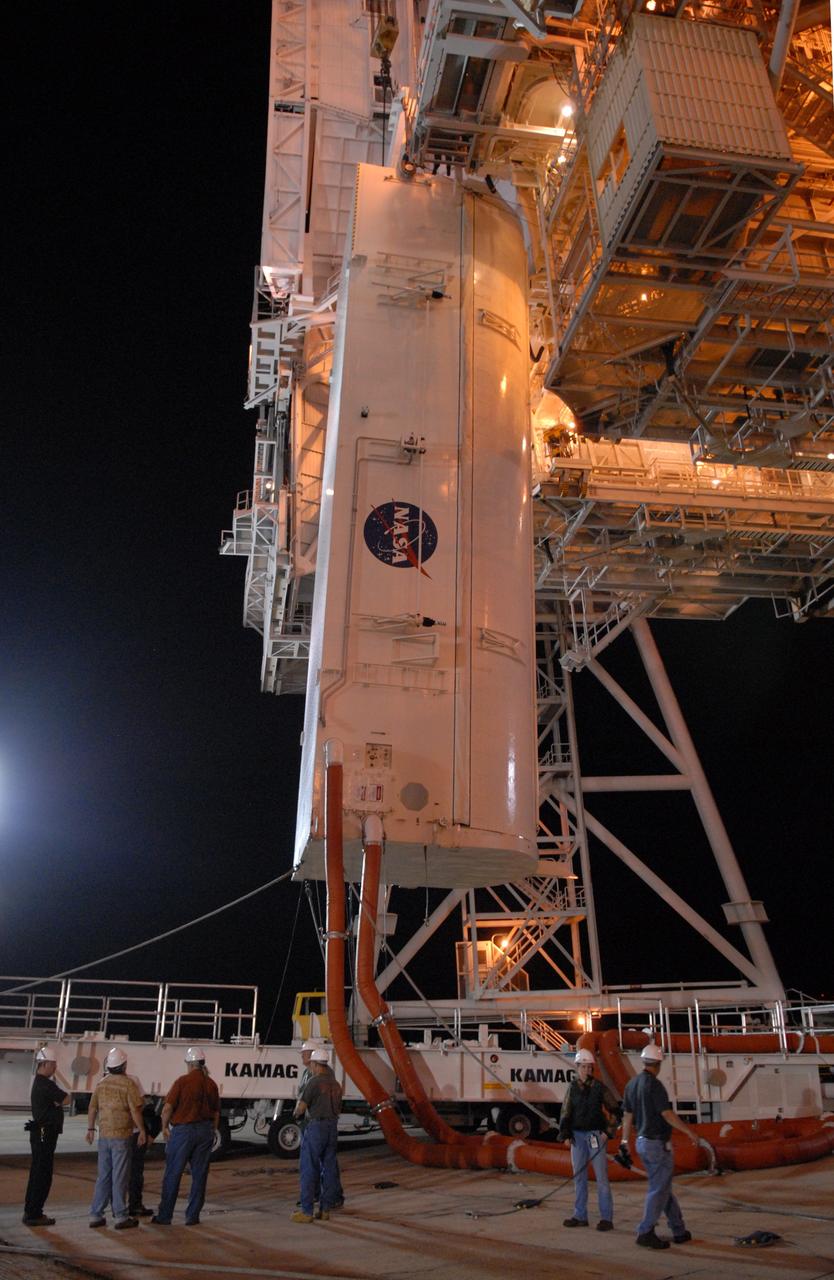
CAPE CANAVERAL, Fla. - On Launch Pad 39A at NASA's Kennedy Space Center, the payload canister is lifted toward the payload changeout room above. The canister contains four carriers holding various equipment for the STS-125 mission aboard space shuttle Atlantis to service NASA’s Hubble Space Telescope. The changeout room is the enclosed, environmentally controlled portion of the rotating service structure that supports cargo delivery to the pad and subsequent vertical installation into the shuttle’s payload bay. Launch of Atlantis is targeted for Oct. 10. Photo credit: NASA/Jack Pfaller
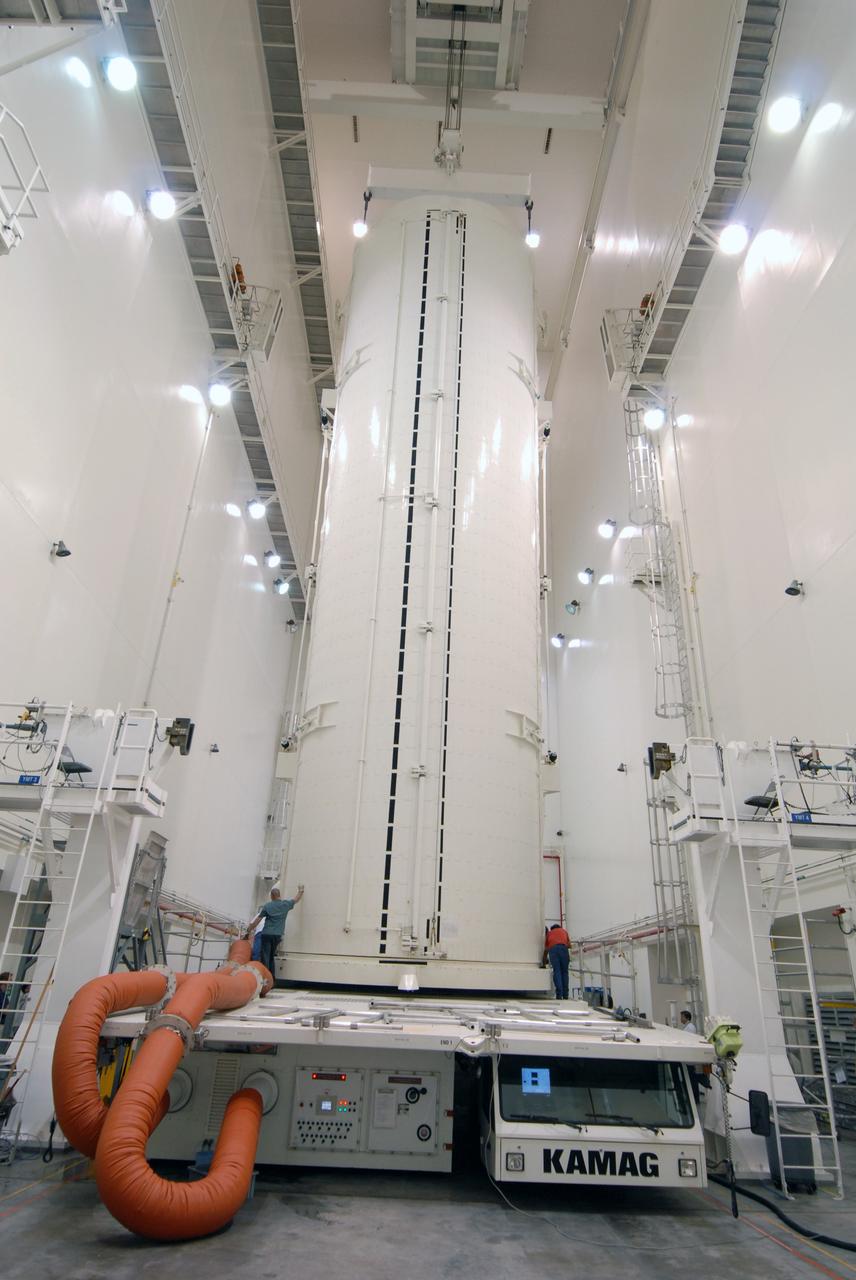
CAPE CANAVERAL, Fla. - In the Canister Rotation Facility at NASA's Kennedy Space Center, the payload canister is in a vertical position for the trip to Launch Pad 39A. The canister’s cargo consists of four carriers holding various equipment for the STS-125 mission aboard space shuttle Atlantis to service NASA’s Hubble Space Telescope. At the pad, the cargo will be moved into the Payload Changeout Room. The changeout room is the enclosed, environmentally controlled portion of the rotating service structure that supports cargo delivery to the pad and subsequent vertical installation into the shuttle’s payload bay. Launch of Atlantis is targeted for Oct. 10. Photo credit: NASA/Jack Pfaller