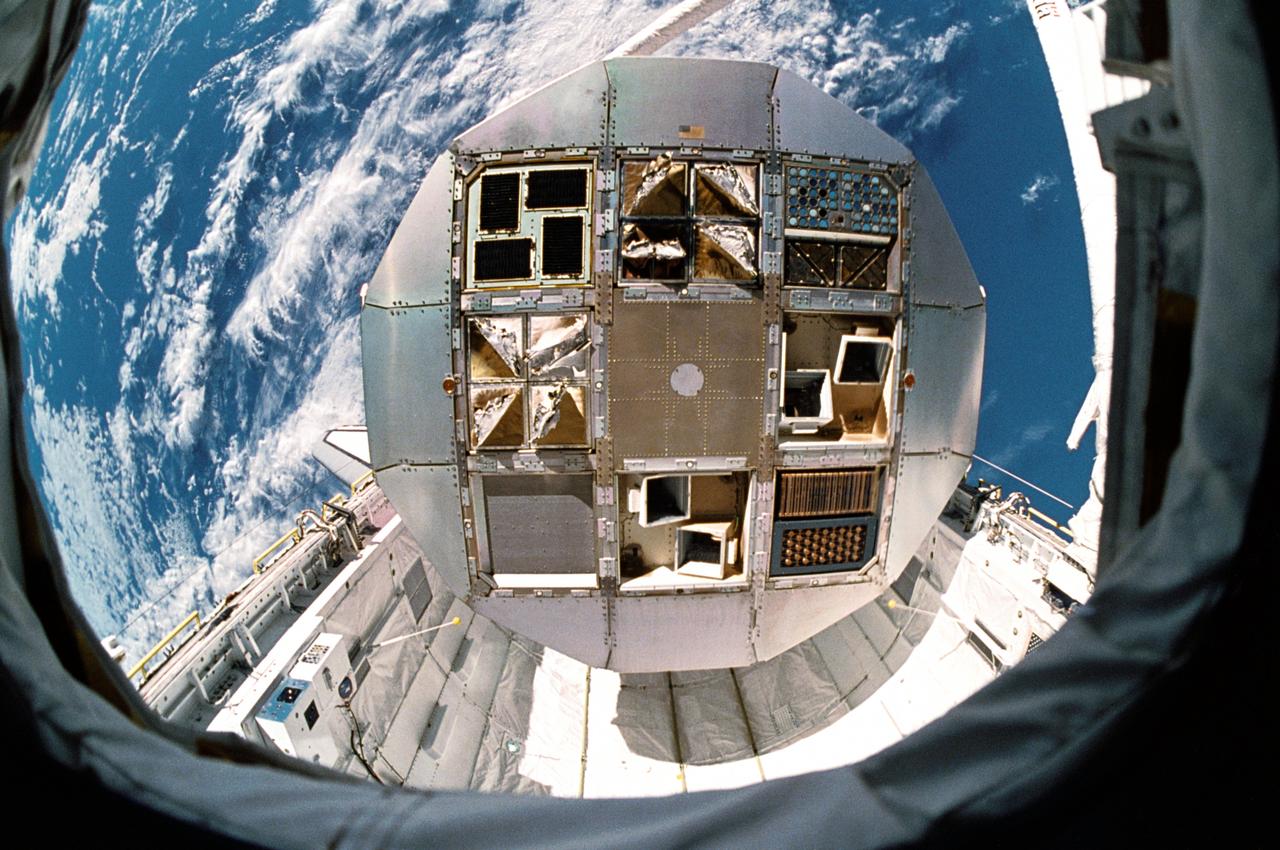
STS032-541-018 (12 Jan 1990) --- One of a number of frames photographed by the STS-32 crew as part of a detailed supplementary objective on documentary still photography. The DSO was monitored by Astronaut Marsha S. Ivins, mission specialist. STS032-541-018 Kodak Ektar 25 negative film. 35mm frame of LDEF suspended just over its resting place in cargo bay. White clouds and blue ocean in foreground.
STS008-35-1239 (30 Aug.-5 Sept. 1983) --- The space shuttle Challenger?s payload flight test article (PFTA) is lifted from the cargo bay and held over clouds and water on Earth. The 70mm frame was photographed by one of the five STS-8 crew members with a free hand during the busy RMS/PFTA agenda. Photo credit: NASA
STS064-76-035 (15 Sept. 1994) --- Backdropped against the darkness of space, the Shuttle Pointed Autonomous Research Tool for Astronomy 201 (SPARTAN-201) satellite is lined up with the space shuttle Discovery's Remote Manipulator System (RMS) arm for re-capture. The free-flying spacecraft had remained some 40 miles away from Discovery for over two days. Photo credit: NASA or National Aeronautics and Space Administration
STS007-18-770 (18-24 June 1983) --- Telesat-F communications satellite is just about to clear the vertical stabilizer of the Earth-orbiting Space Shuttle Challenger to begin its way toward its Earth-orbital destination.
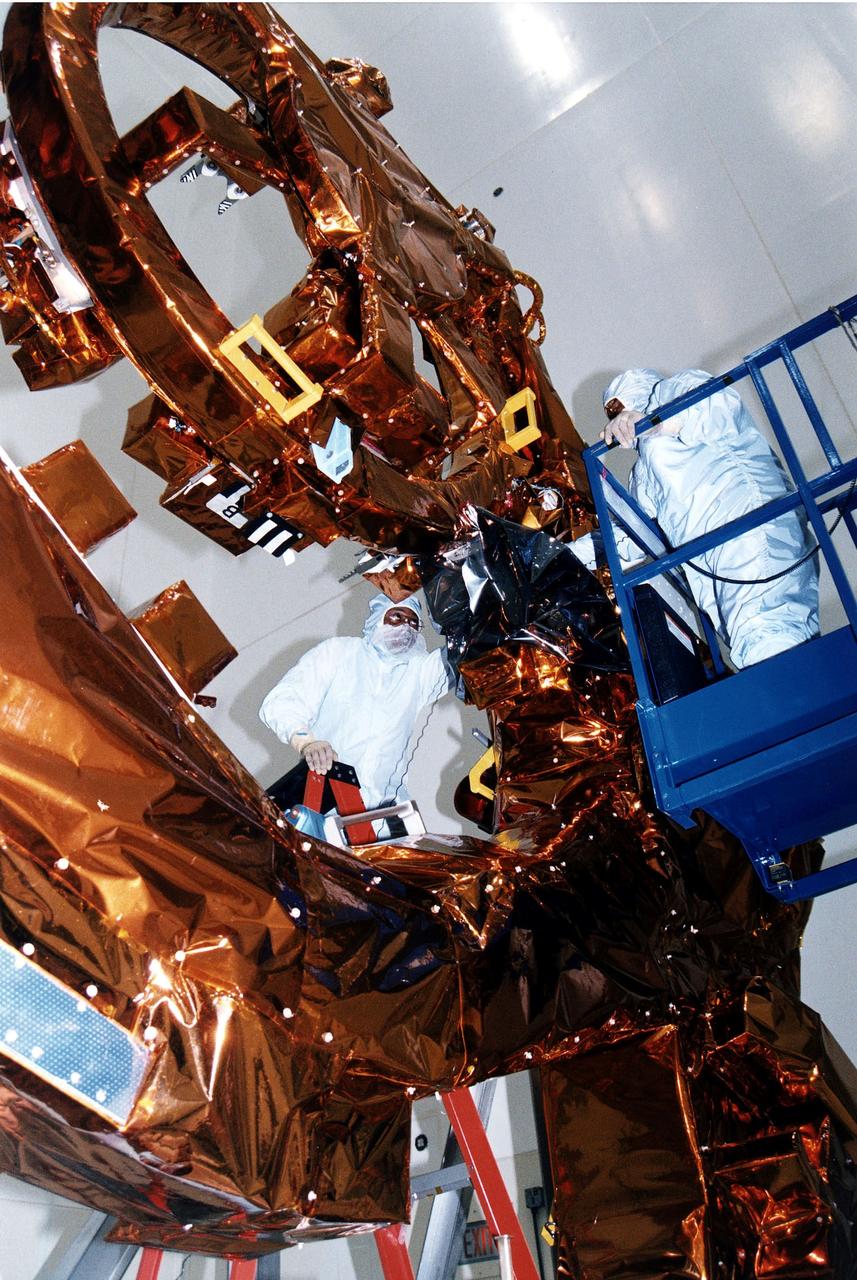
KENNEDY SPACE CENTER, FLA. - Workers in KSC's Vertical Processing Facility make final adjustments to the Flight Support System (FSS) for STS-82, the second Hubble Space Telescope servicing mission. The FSS is reusable flight hardware that provides the mechanical, structural and electrical interfaces between HST, the space support equipment and the orbiter for payload retrieval and on-orbit servicing. Liftoff aboard Discovery is targeted Feb. 11 with a crew of seven.
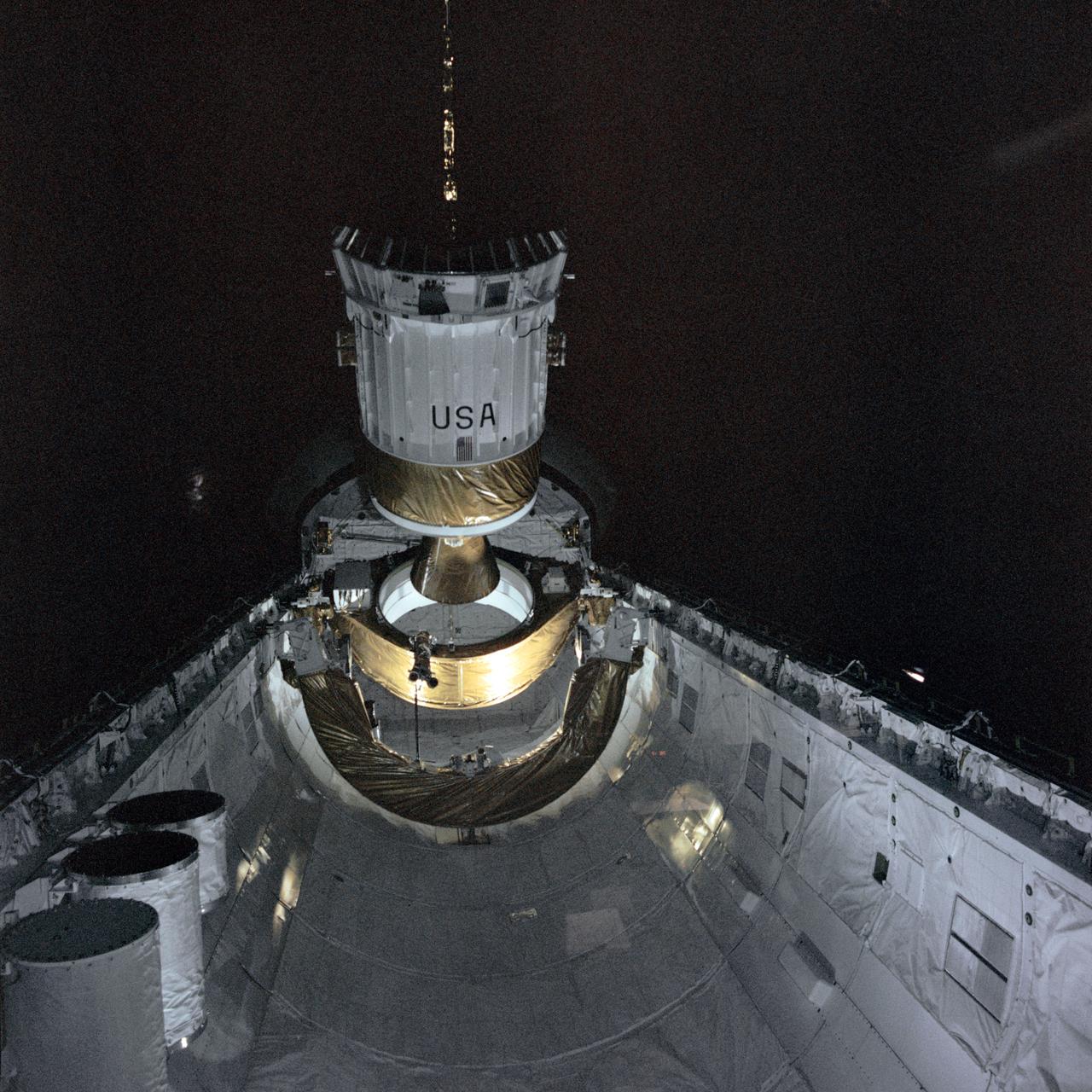
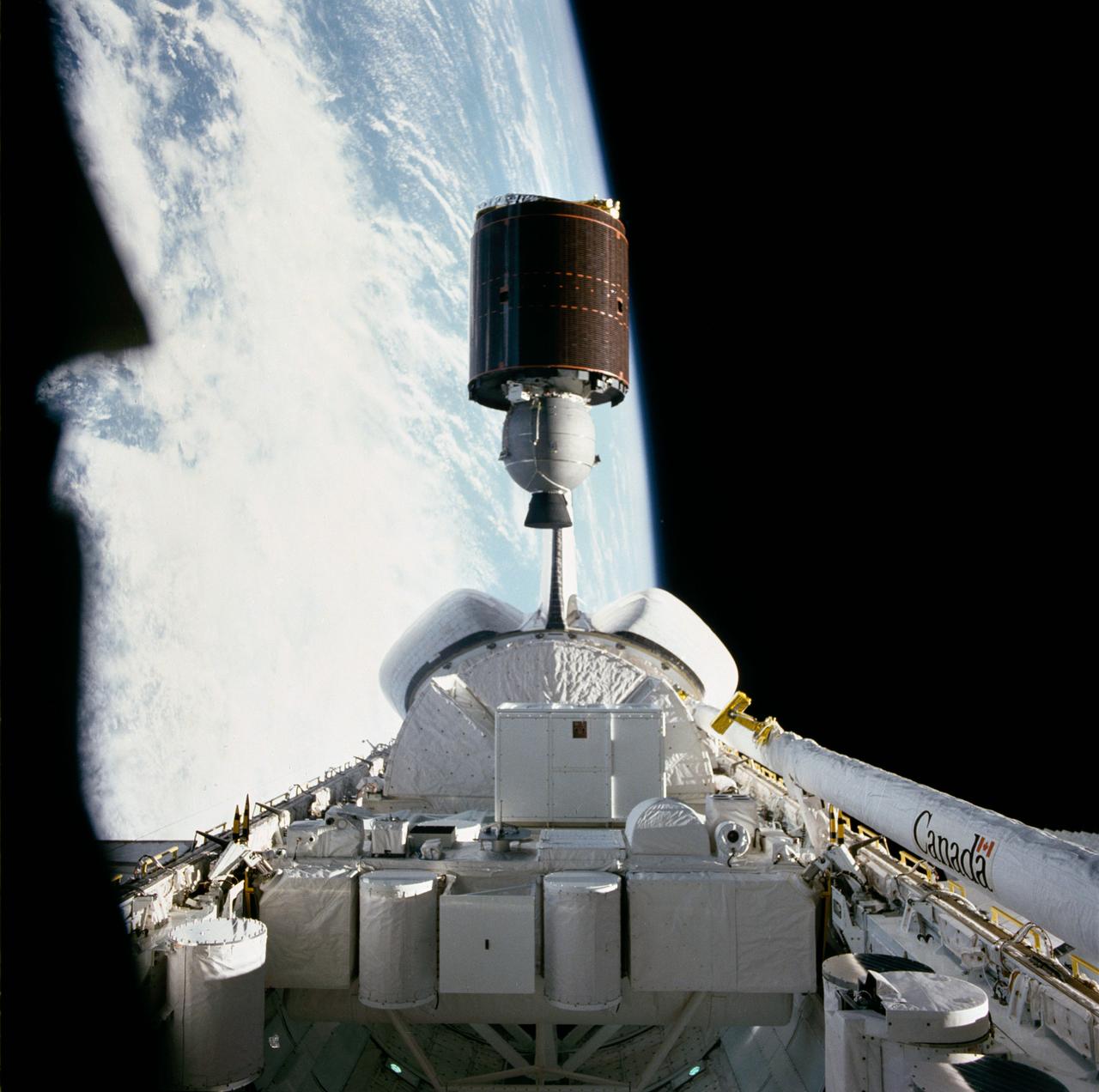
STS006-38-894 (4 April 1983) --- The tracking and data relay satellite (TDRS) leaves the 18-meter (60-ft) long cargo bay of the Earth-orbiting space shuttle Challenger about ten hours following launch of NASA’s second reusable space vehicle. The inertial upper stage (IUS) which gives power necessary to place the TDRS in its desired orbit is clearly seen in this view, photographed with a 70mm camera aimed through the aft flight deck windows of the Challenger. The cylindrical canisters in the left foreground contain scientific experiments from subscribers to NASA’s getaway special (GAS) program. Photo credit: NASA
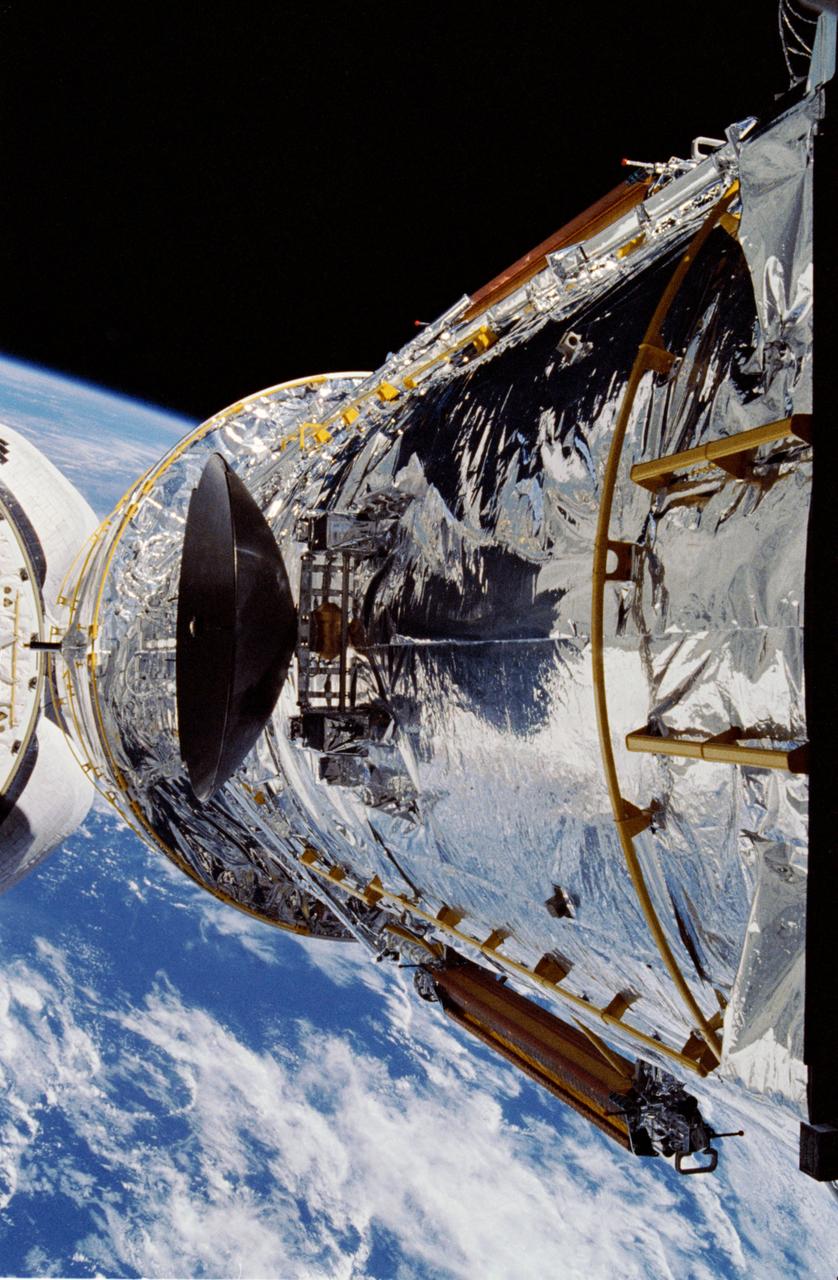
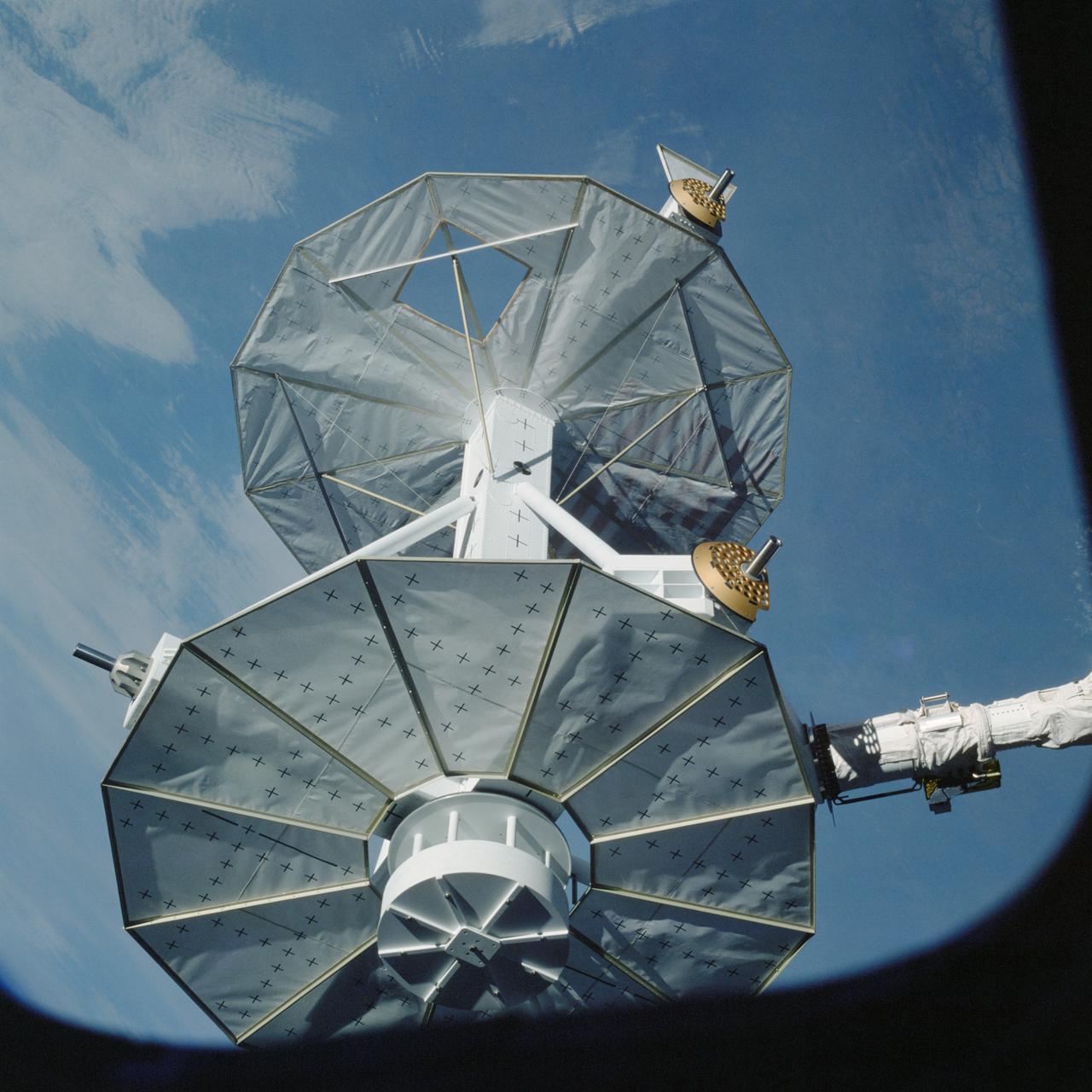
The Hubble Space Telescope (HST) is raised above the payload bay (PLB) in low hover position during STS-31 checkout and pre-deployment procedures aboard Discovery, Orbiter Vehicle (OV) 103. Stowed along the HST Support System Module (SSM) are the high gain antenna (HGA) (center) and the two solar arrays (one either side). In the background are the orbital maneuvering system (OMS) pods and the Earth's surface.
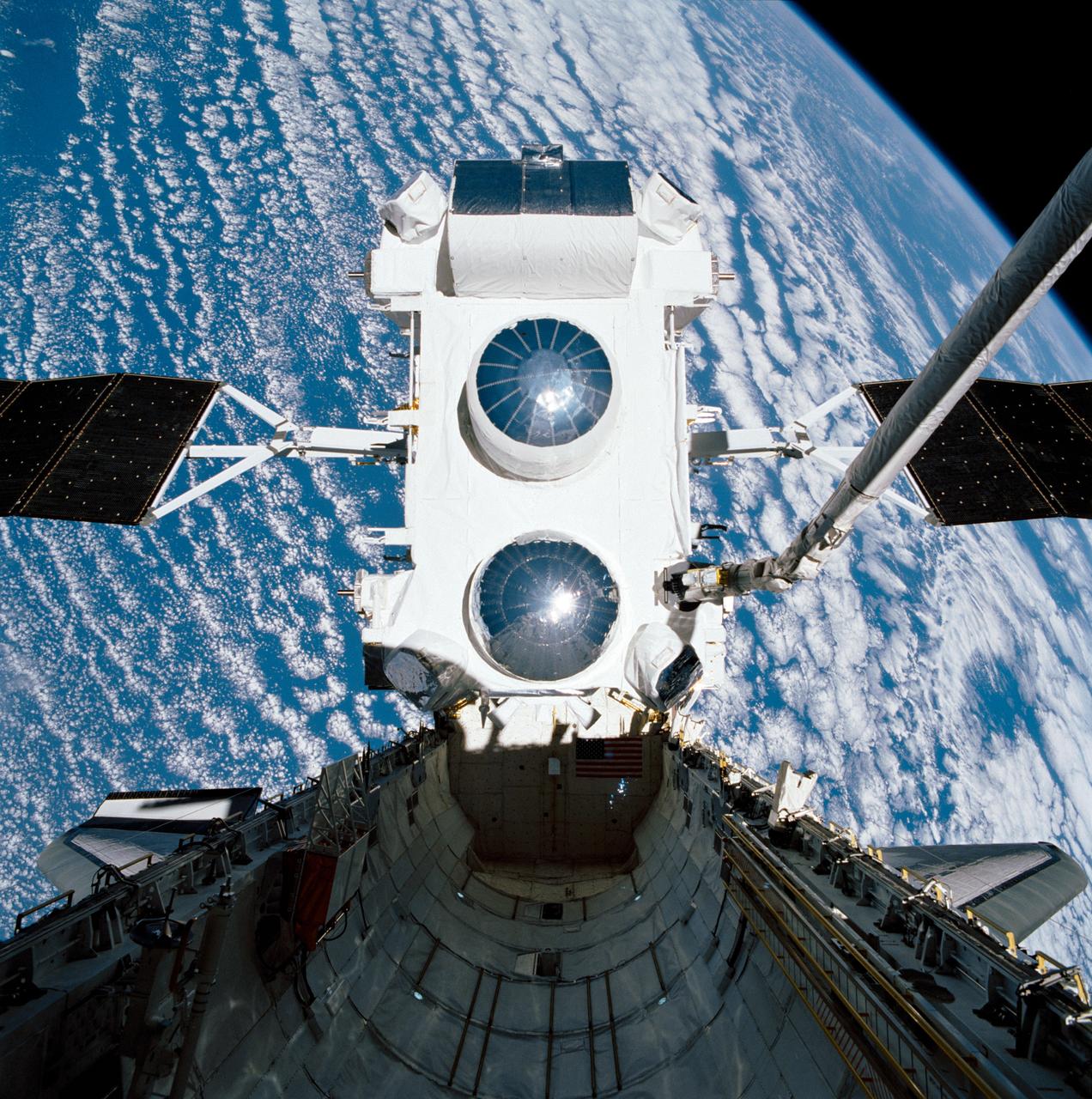
STS037-99-098 (7 April 1991) --- Backdropped against clouds over water, the Gamma Ray Observatory (GRO) is still in the grasp of the Space Shuttle Atlantis' Remote Manipulator System (RMS) in this 70mm scene. A special Extravehicular Activity (EVA) was required by astronauts Jerry L. Ross and Jerome (Jay) Apt to manually extend the high-gain antenna on GRO. The five-member crew capped off a busy Flight Day 3 by releasing the heavy payload.
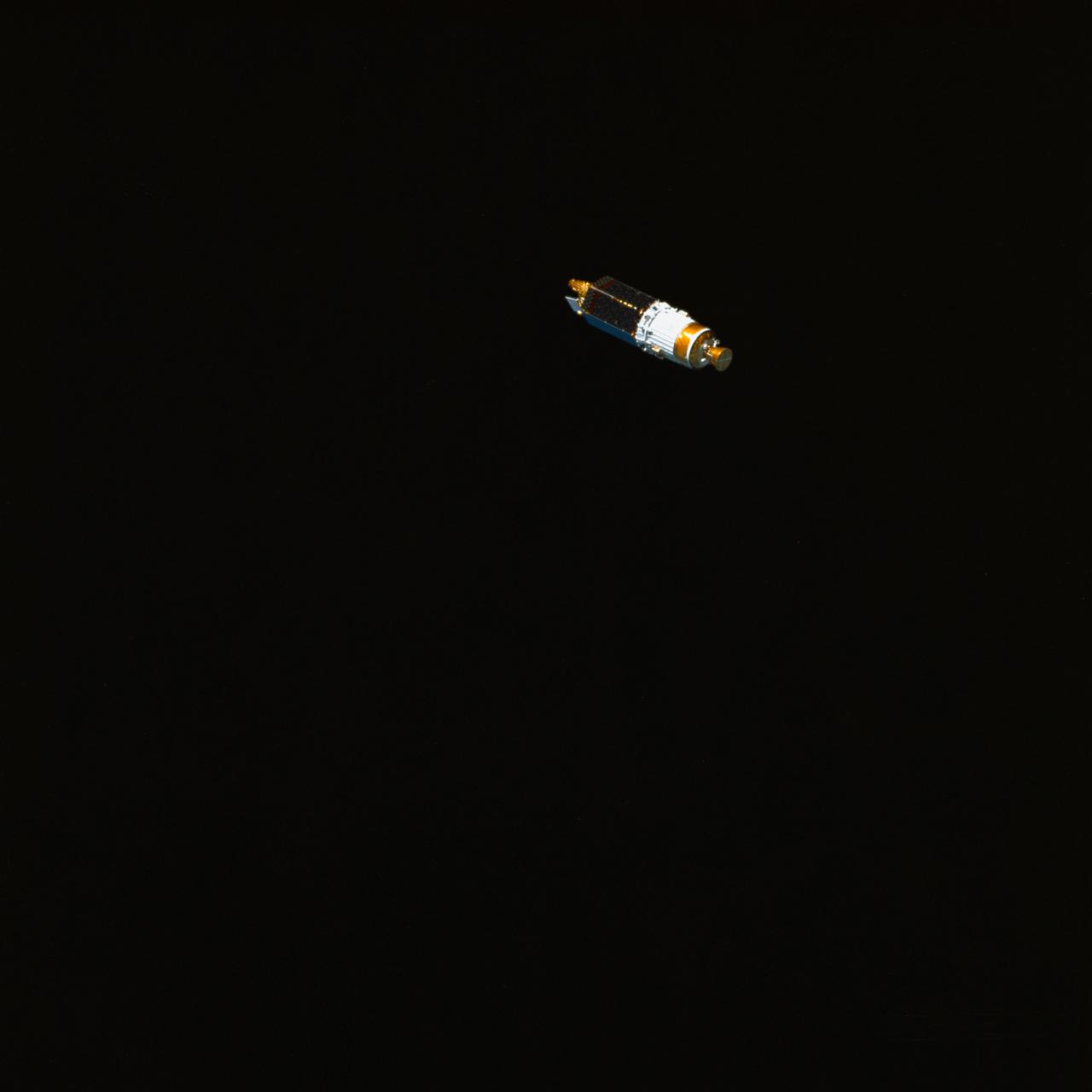
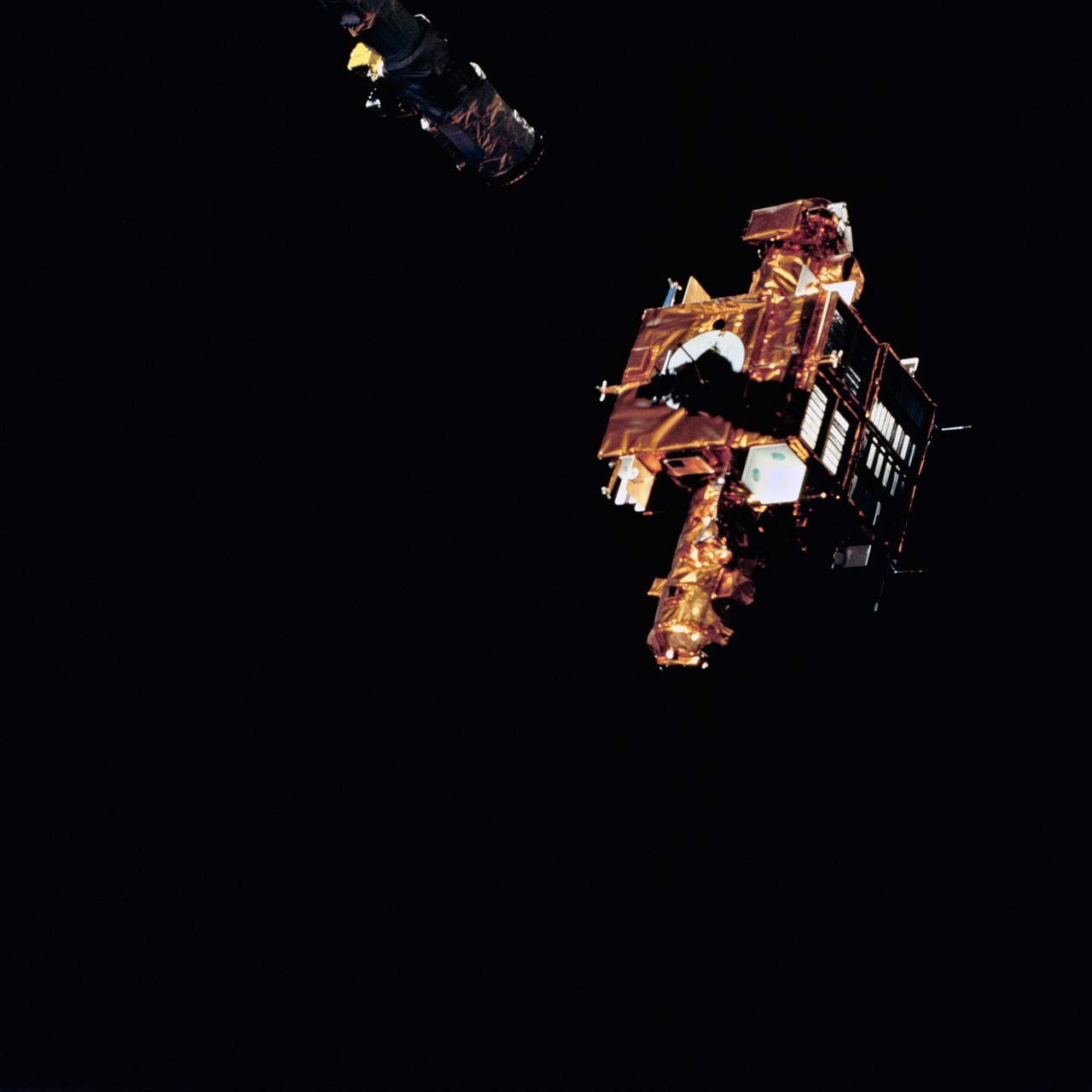
STS029-78-019 (13 March 1989) --- Headed on its way to a much higher orbit is another Tracking and Data Relay Satellite (TDRS-D), as photographed with a 70mm camera from inside Discovery's cabin. Moments earlier, the STS-29 crewmembers released the cylindrical form into space from Discovery's cargo bay. When at its final destination high above Earth, TDRS-D will no longer maintain its cylindrical form, having transformed into an operational satellite with antenna spanned out in various directions and its Interim Upper Stage (IUS), covered with gold foil and forward-most in this frame, discarded.
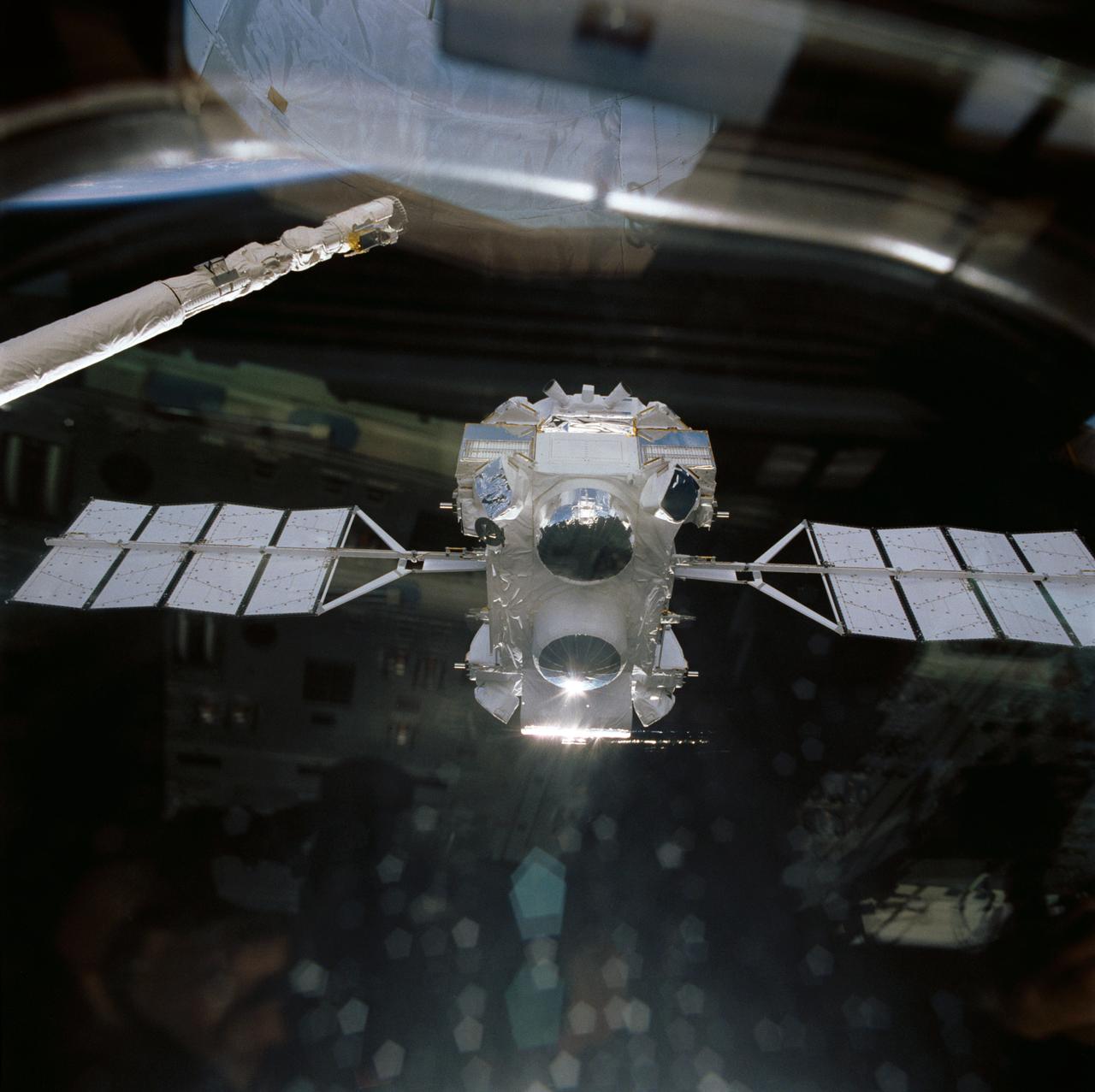
Atlantis', Orbiter Vehicle (OV) 104's, remote manipulator system (RMS) releases Gamma Ray Observatory (GRO) during STS-37 deployment. Visible on the GRO as it drifts away from the RMS end effector are the four complement instruments: the Energetic Gamma Ray Experiment (bottom); Imaging Compton Telescope (COMPTEL) (center); Oriented Scintillation Spectrometer Experiment (OSSE) (top); and Burst and Transient Source Experiment (BATSE) (at four corners). GRO's solar array (SA) panels are extended and are in orbit configuration. View was taken through aft flight deck window which reflects some of the crew compartment interior.
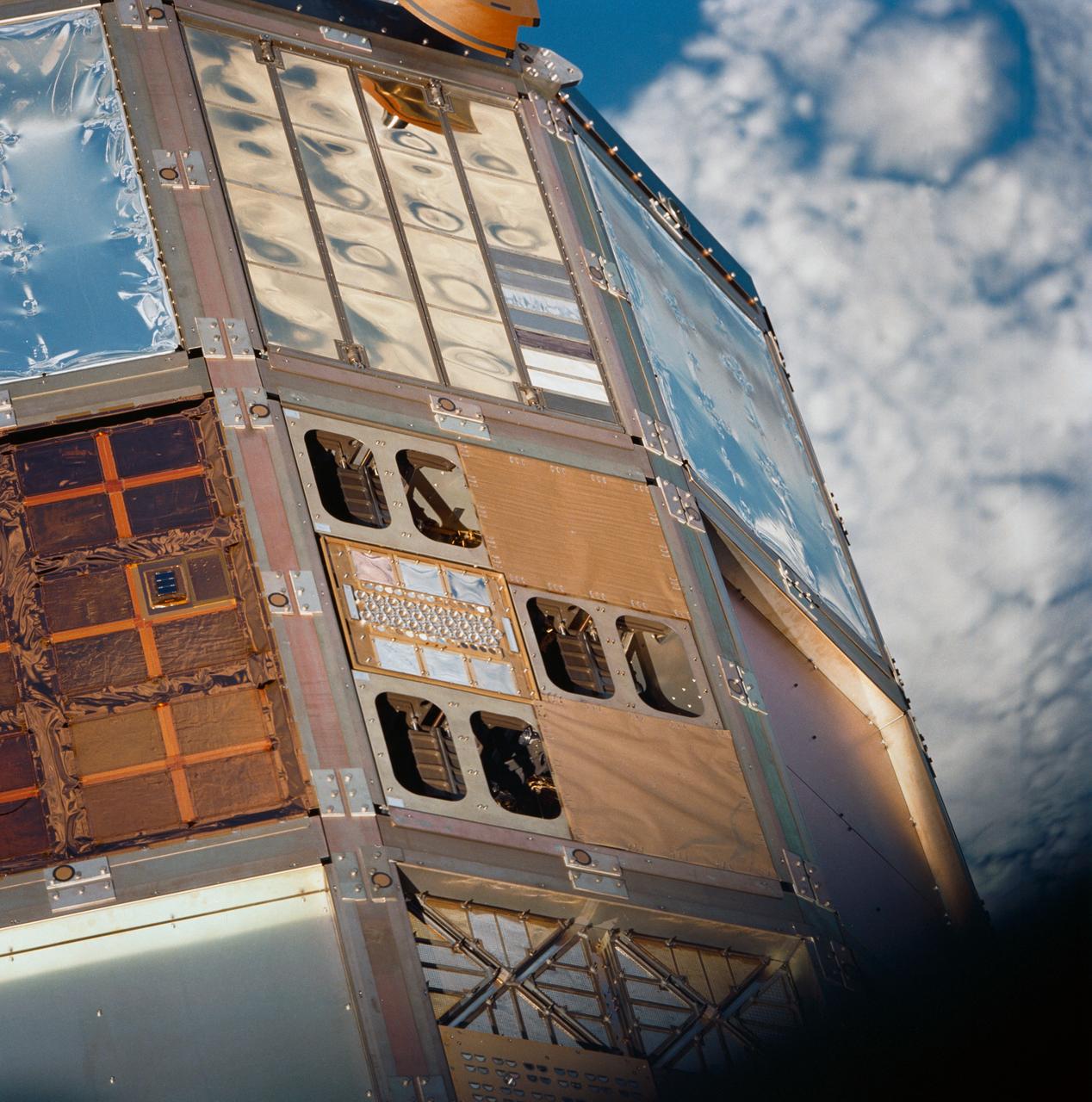
Closeup of Long Duration Exposure Facility (LDEF) experiment trays is documented during STS-32 retrieval activity and photo survey conducted by crewmembers onboard Columbia, Orbiter Vehicle (OV) 102. Partially visible is the Polymer Matrix Composite Materials Experiment. In the background is the surface of the Earth.

The European Retrievable Carrier 1L (EURECA-1L) spacecraft, with solar array panels extended, drifts above the Earth after deployment from the payload bay of Atlantis, Orbiter Vehicle (OV) 104, during STS-46. EURECA's onboard propulsion unit will boost it to an operational altitude of 270 nautical miles.
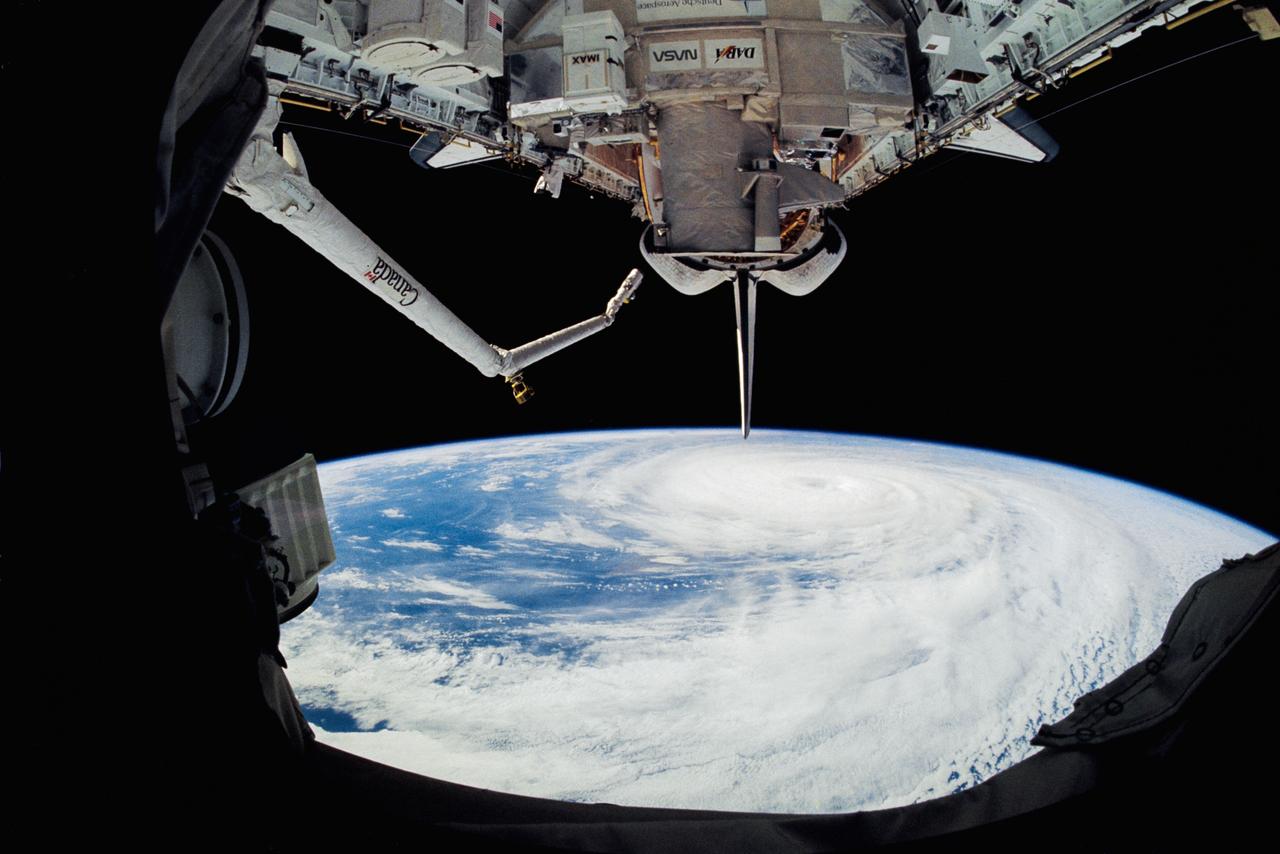
One of the STS-51 astronauts used a "fish-eye" lens on a 35mm cmaera to photograph this view of Hurricane Kenneth in the Pacific Ocean. The Orbiting Retrievable Far and Extreme Ultraviolet Spectrometer/Shuttle Pallet Satellite (ORFEUS/SPAS) is still in the cargo bay. The Remote Manipulator System (RMS) is extended towards the open payload bay.
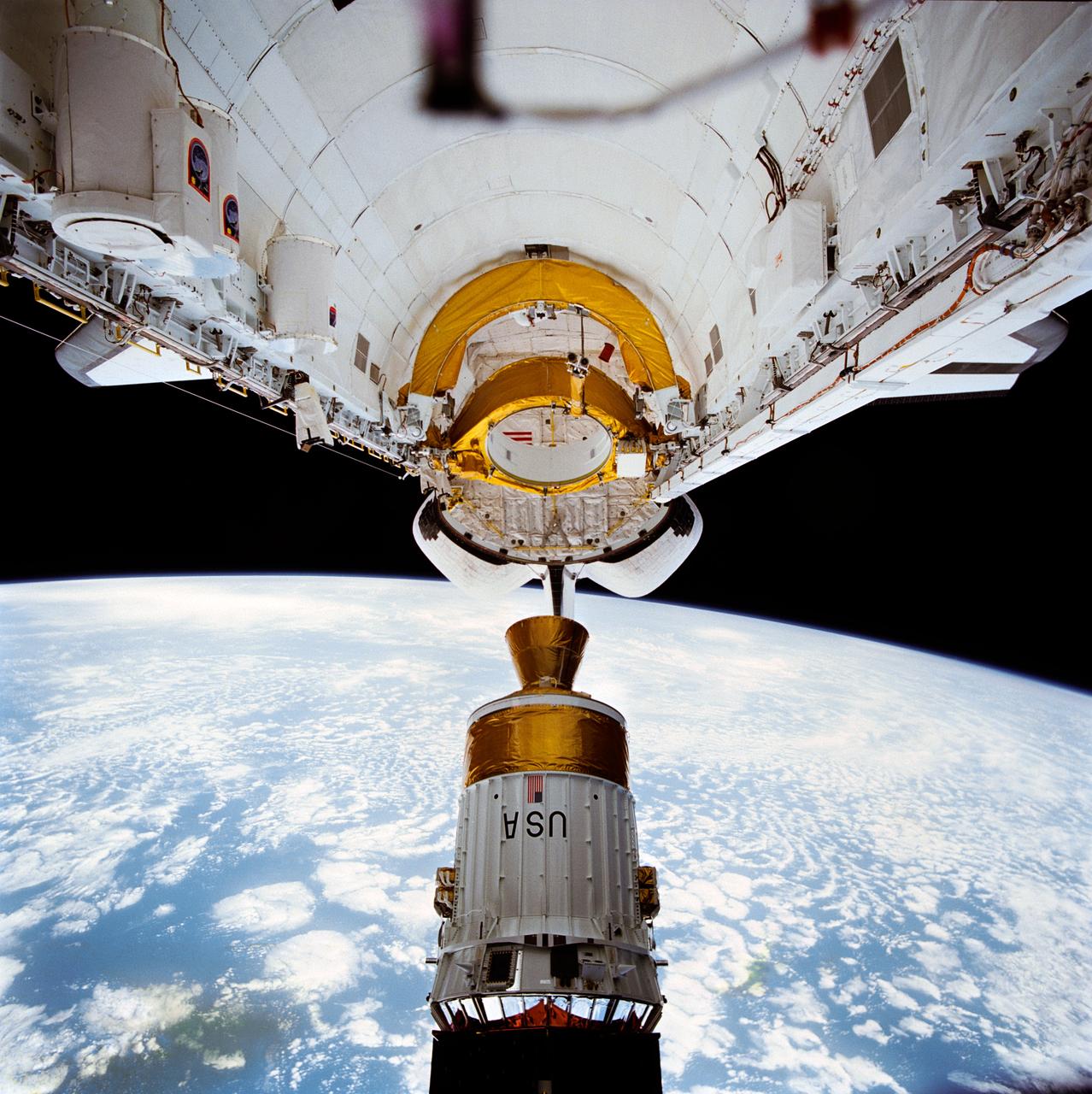
STS043-72-059 (2 Aug 1991) --- The Tracking and Data Relay Satellite (TDRS-E), leaves the payload bay of the earth-orbiting Atlantis a mere six hours after the Space Shuttle was launched from Pad 39A at Kennedy Space Center, Florida. TDRS, built by TRW, will be placed in a geosynchronous orbit and after on-orbit testing, which requires several weeks, will be designated TDRS-5. The communications satellite will replace TDRS-3 at 174 degrees West longitude. The backbone of NASA's space-to-ground communications, the Tracking and Data Relay satellites have increased NASA's ability to send and receive data to spacecraft in low-earth orbit to more than 85 percent of the time. The five astronauts of the STS 43 mission are John E. Blaha, mission commander, Michael A. Baker, pilot, and Shannon W. Lucid, G. David Low, and James C. Adamson, all mission specialists.
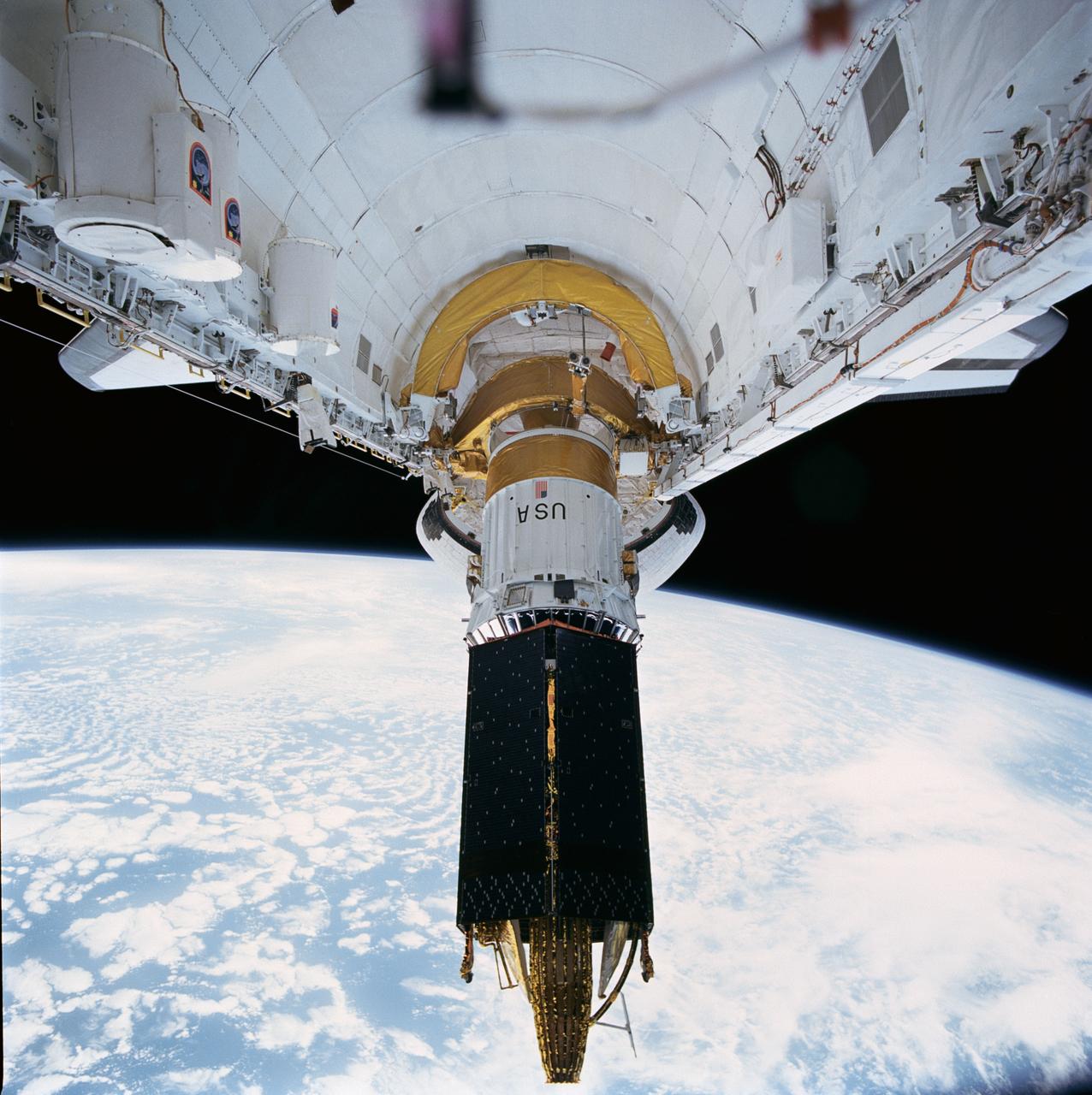
STS043-72-020 (2 Aug 1991) --- The Tracking and Data Relay Satellite (TDRS-E), is loosened from its restraint device and begins to leave the payload bay of the earth-orbiting Atlantis. The deployment came a mere six hours after the Space Shuttle was launched from Pad 39A at Kennedy Space Center, Florida. TDRS, built by TRW, will be placed in a geosynchronous orbit and after on-orbit testing, which requires several weeks, will be designated TDRS-5. The communications satellite will replace TDRS-3 at 174 degrees West longitude. The backbone of NASA's space-to-ground communications, the Tracking and Data Relay satellites have increased NASA's ability to send and receive data to spacecraft in low-earth orbit to more than 85 percent of the time. The five astronauts of the STS 43 mission are John E. Blaha, mission commander, Michael A. Baker, pilot, and Shannon W. Lucid, G. David Low, and James C. Adamson, all mission specialists.
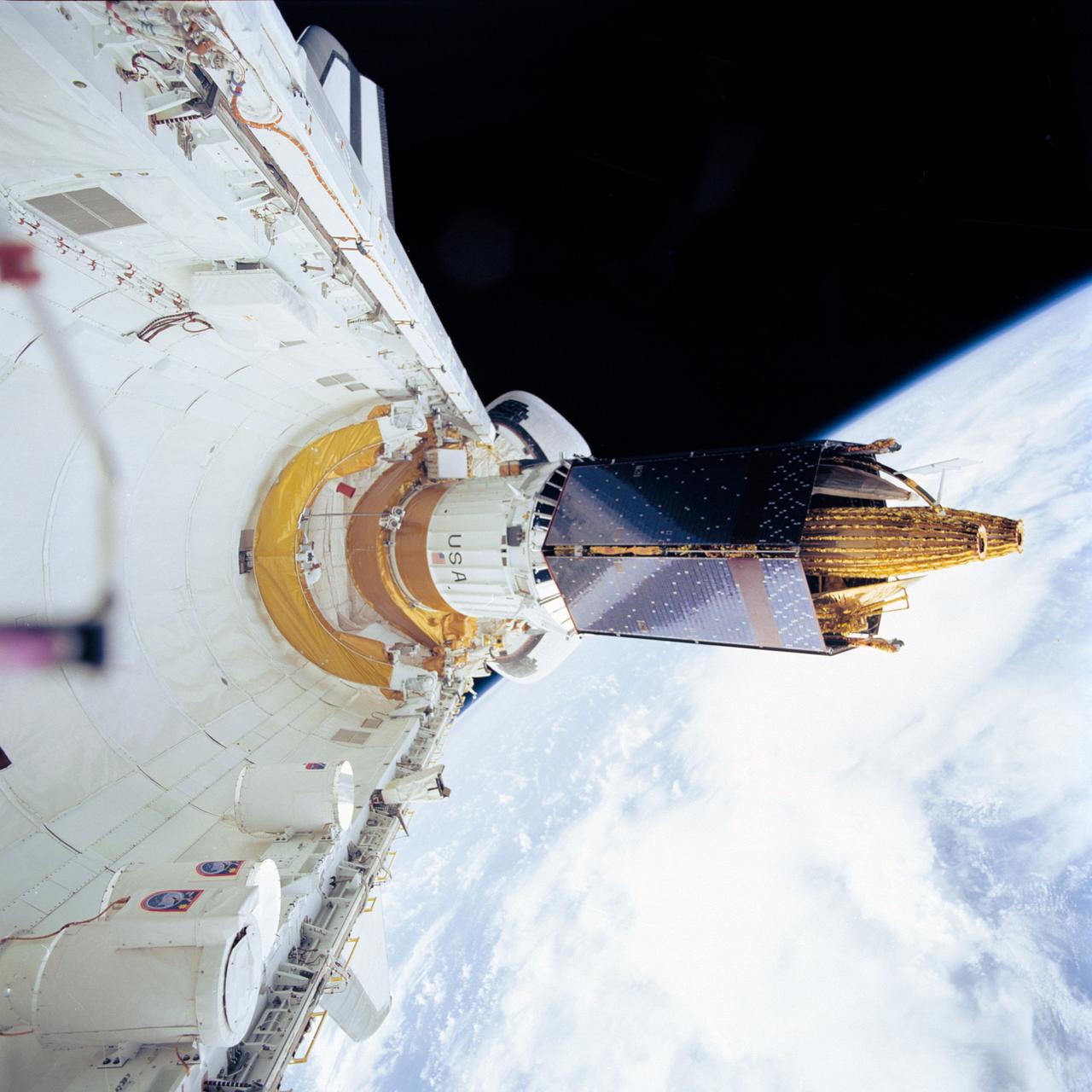
STS043-72-002 (2 Aug 1991) --- The Tracking and Data Relay Satellite (TDRS-E), leaves the payload bay of the earth-orbiting Atlantis a mere six hours after the Space Shuttle was launched from Pad 39A at Kennedy Space Center, Florida. TDRS, built by TRW, will be placed in a geosynchronous orbit and after on-orbit testing, which requires several weeks, will be designated TDRS-5. The communications satellite will replace TDRS-3 at 174 degrees West longitude. The backbone of NASA's space-to-ground communications, the Tracking and Data Relay satellites have increased NASA's ability to send and receive data to spacecraft in low-earth orbit to more than 85 percent of the time. The five astronauts of the STS 43 mission are John E. Blaha, mission commander, Michael A. Baker, pilot, and Shannon W. Lucid, G. David Low, and James C. Adamson, all mission specialists.
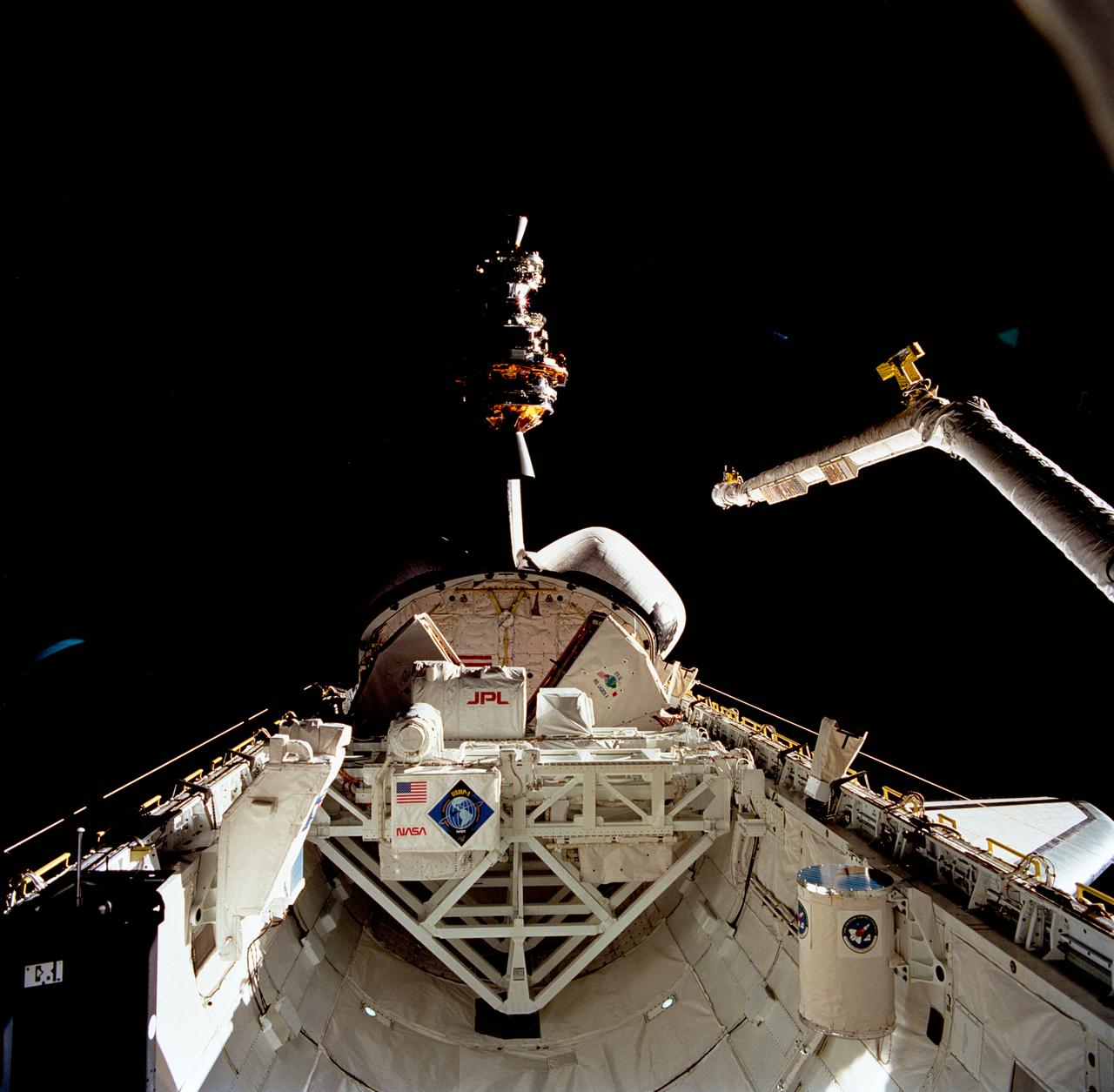
STS052-80-030 (23 Oct 1992) --- One of a series of three views of the deployment of the Laser Geodynamic Satellite (LAGEOS). The photograph was taken with a 70mm handheld camera aimed through the aft flight deck windows of the Earth-orbiting Space Shuttle Columbia. A crew of five NASA astronauts and a Canadian payload specialist spent ten days aboard Columbia for the STS-52 mission.
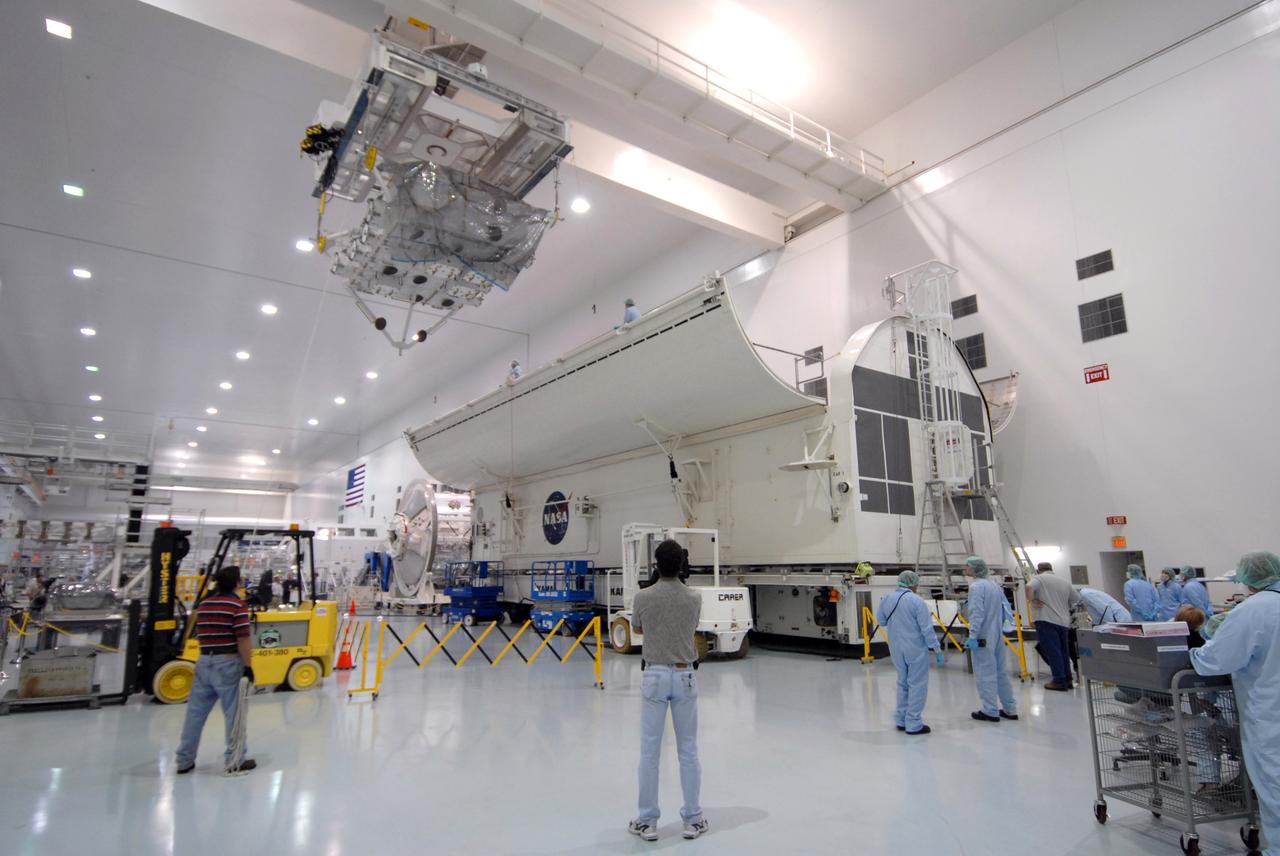
CAPE CANAVERAL, Fla. – In the Space Station Processing Facility at NASA's Kennedy Space Center in Florida, an overhead crane moves the Japan Aerospace Exploration Agency's Kibo Exposed Facility, or EF, part of the payload for the STS-127 mission, to the payload canister, at right. The EF, along with the Experiment Logistics Module Exposed Section, will be carried aboard space shuttle Endeavour on the STS-127 mission targeted for launch June 13. When the EF is installed on the Kibo laboratory, it will provide a multipurpose platform where science experiments can be deployed and operated in the exposed environment. The payloads attached to the EF can be exchanged or retrieved by Kibo's robotic arm, the JEM Remote Manipulator. Photo credit: NASA/Jack Pfaller
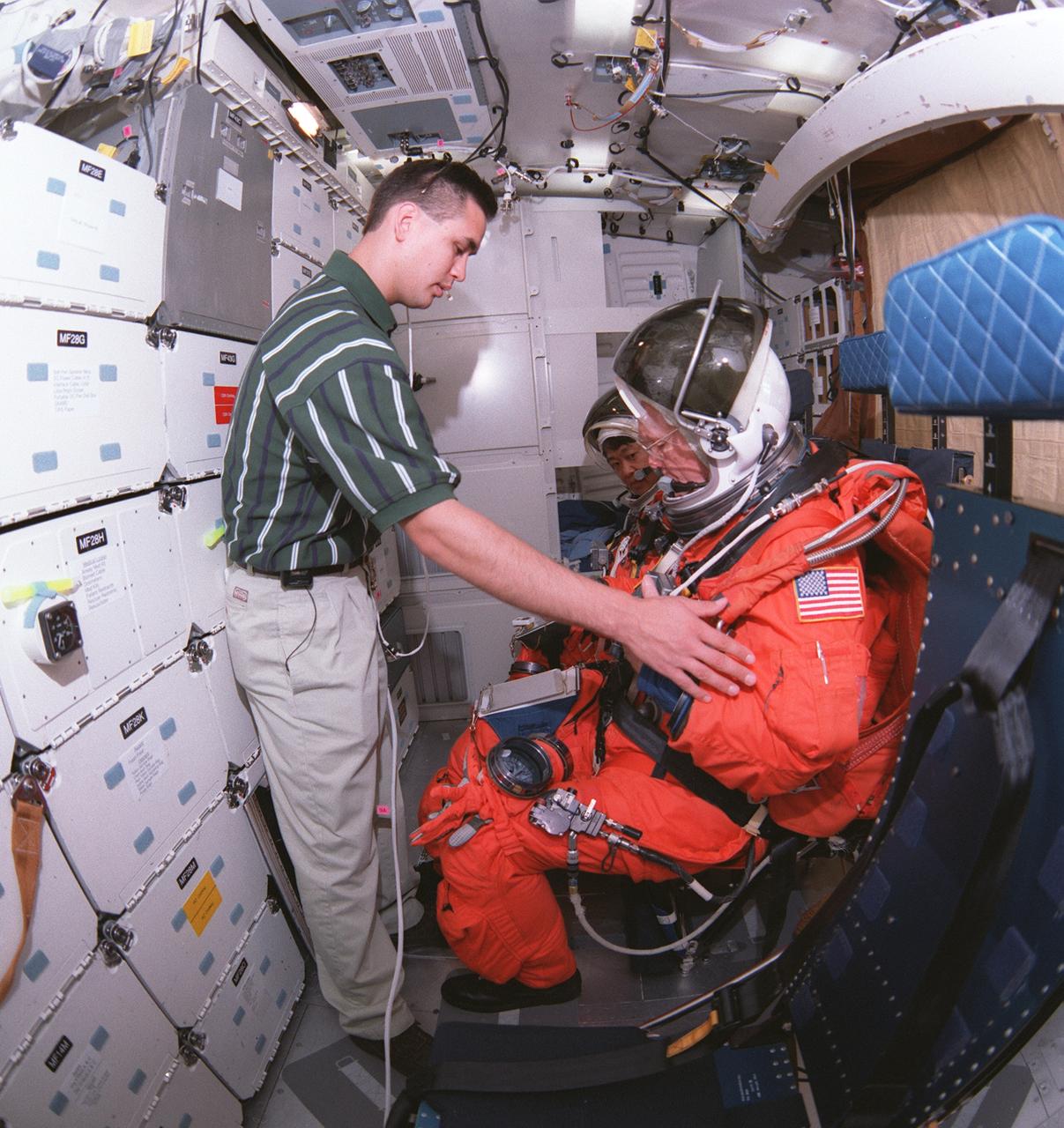
S98-07969 (5 June 1998) --- Crew trainer Adam Flagan (left) checks out STS-95 payload specialists Chiaki Naito-Mukai and John H. Glenn Jr. as they practice launch and entry procedures on the middeck of one of the training mockups in the Johnson Space Center's Space Vehicle Mockup Facility. The STS-95 mission, tentatively scheduled for launch on Oct. 29, will involve a variety of science experiments being carried in the pressurized Spacehab module, deployment and retrieval of the Spartan free-flyer payload, and operations with the HST Orbiting Systems Test and the International Extreme Ultraviolet Hitchhiker payloads.
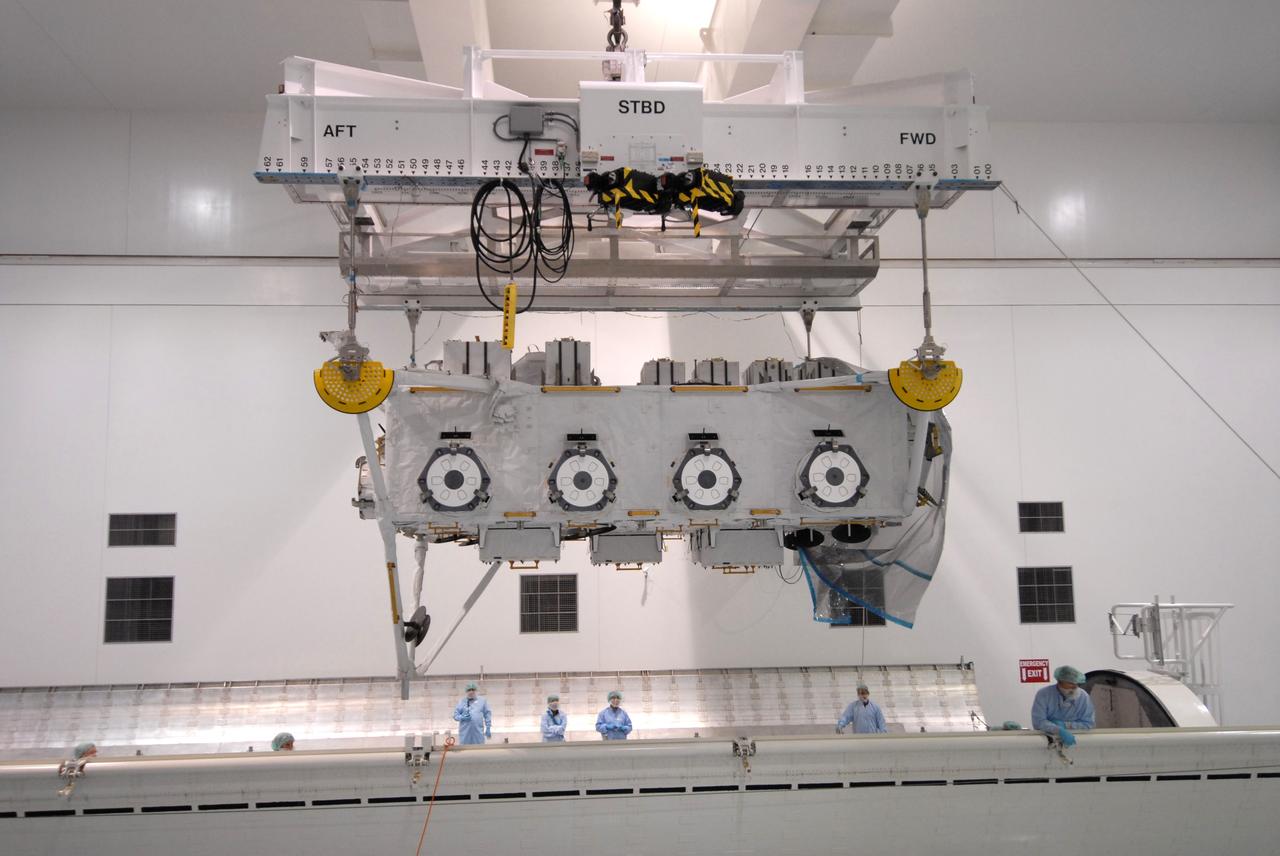
CAPE CANAVERAL, Fla. – In the Space Station Processing Facility at NASA's Kennedy Space Center in Florida, an overhead crane lowers the Japan Aerospace Exploration Agency's Kibo Exposed Facility, or EF, part of the payload for the STS-127 mission, toward the payload canister. The EF, along with the Experiment Logistics Module Exposed Section, will be carried aboard space shuttle Endeavour on the STS-127 mission targeted for launch June 13. When the EF is installed on the Kibo laboratory, it will provide a multipurpose platform where science experiments can be deployed and operated in the exposed environment. The payloads attached to the EF can be exchanged or retrieved by Kibo's robotic arm, the JEM Remote Manipulator. Photo credit: NASA/Jack Pfaller
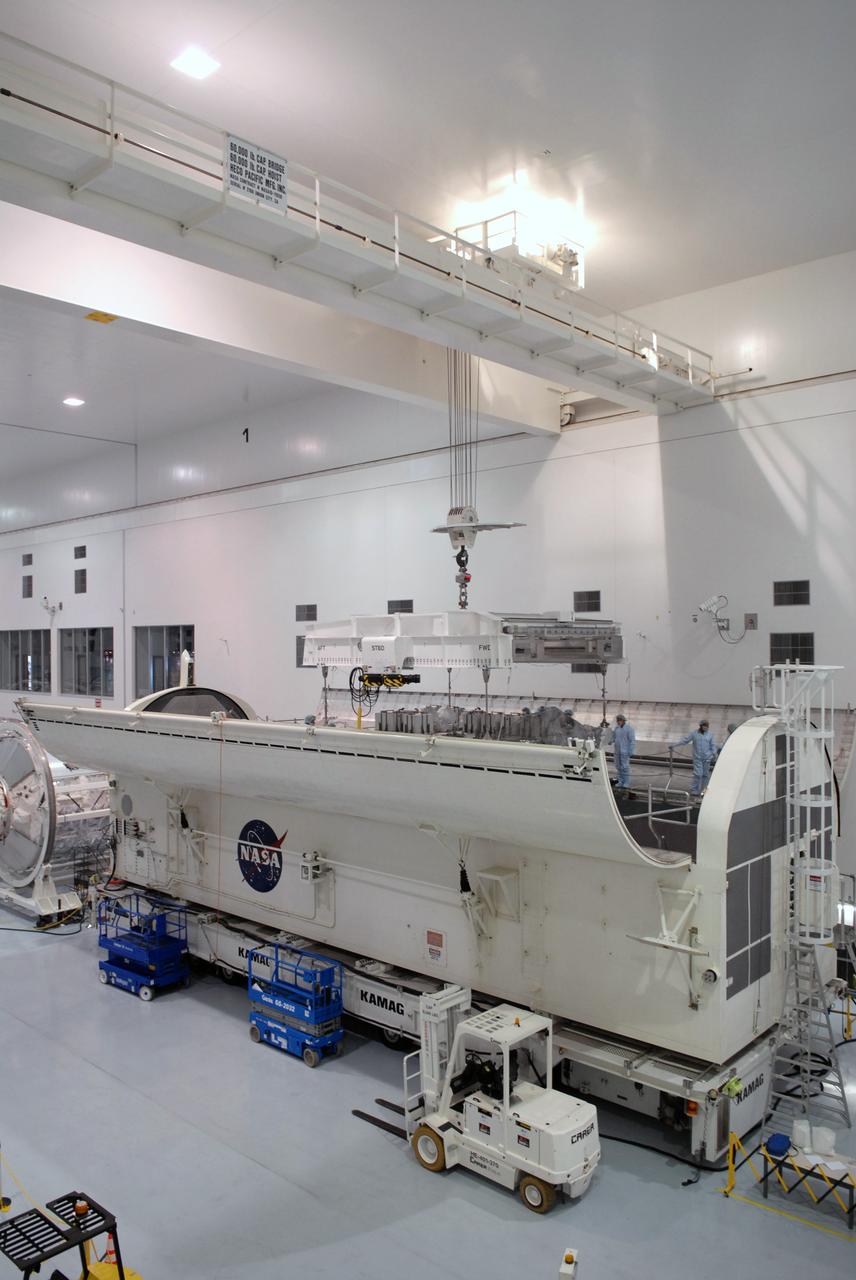
CAPE CANAVERAL, Fla. – In the Space Station Processing Facility at NASA's Kennedy Space Center in Florida, an overhead crane lowers the the Japan Aerospace Exploration Agency's Kibo Exposed Facility, or EF, part of the payload for the STS-127 mission, into the payload canister. The EF, along with the Experiment Logistics Module Exposed Section, will be carried aboard space shuttle Endeavour on the STS-127 mission targeted for launch June 13. When the EF is installed on the Kibo laboratory, it will provide a multipurpose platform where science experiments can be deployed and operated in the exposed environment. The payloads attached to the EF can be exchanged or retrieved by Kibo's robotic arm, the JEM Remote Manipulator. Photo credit: NASA/Jack Pfaller
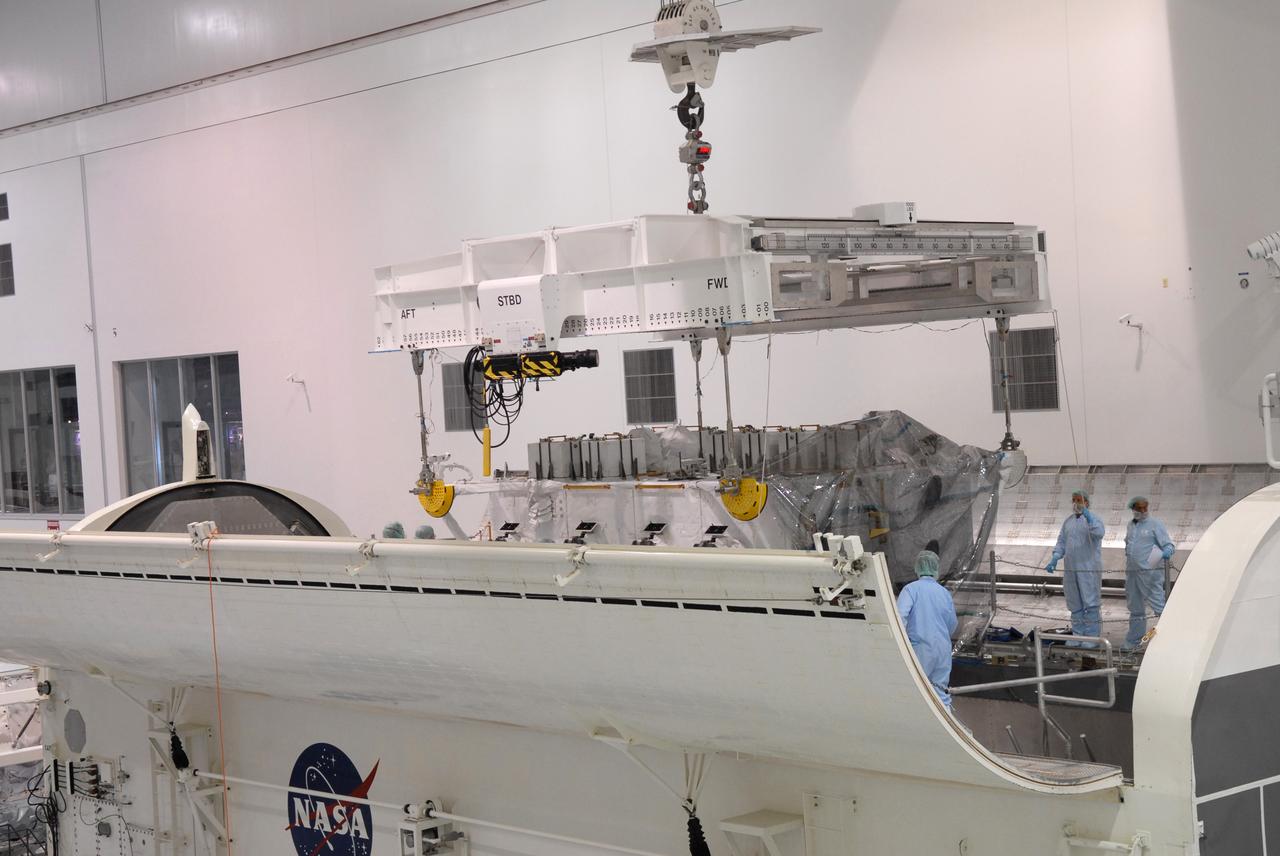
CAPE CANAVERAL, Fla. – In the Space Station Processing Facility at NASA's Kennedy Space Center in Florida, an overhead crane lowers the the Japan Aerospace Exploration Agency's Kibo Exposed Facility, or EF, part of the payload for the STS-127 mission, into the payload canister. The EF, along with the Experiment Logistics Module Exposed Section, will be carried aboard space shuttle Endeavour on the STS-127 mission targeted for launch June 13. When the EF is installed on the Kibo laboratory, it will provide a multipurpose platform where science experiments can be deployed and operated in the exposed environment. The payloads attached to the EF can be exchanged or retrieved by Kibo's robotic arm, the JEM Remote Manipulator. Photo credit: NASA/Jack Pfaller

CAPE CANAVERAL, Fla. – In the Space Station Processing Facility at NASA's Kennedy Space Center in Florida, an overhead crane lowers the Japan Aerospace Exploration Agency's Kibo Exposed Facility, or EF, part of the payload for the STS-127 mission, into the payload canister. The EF, along with the Experiment Logistics Module Exposed Section, will be carried aboard space shuttle Endeavour on the STS-127 mission targeted for launch June 13. When the EF is installed on the Kibo laboratory, it will provide a multipurpose platform where science experiments can be deployed and operated in the exposed environment. The payloads attached to the EF can be exchanged or retrieved by Kibo's robotic arm, the JEM Remote Manipulator. Photo credit: NASA/Jack Pfaller
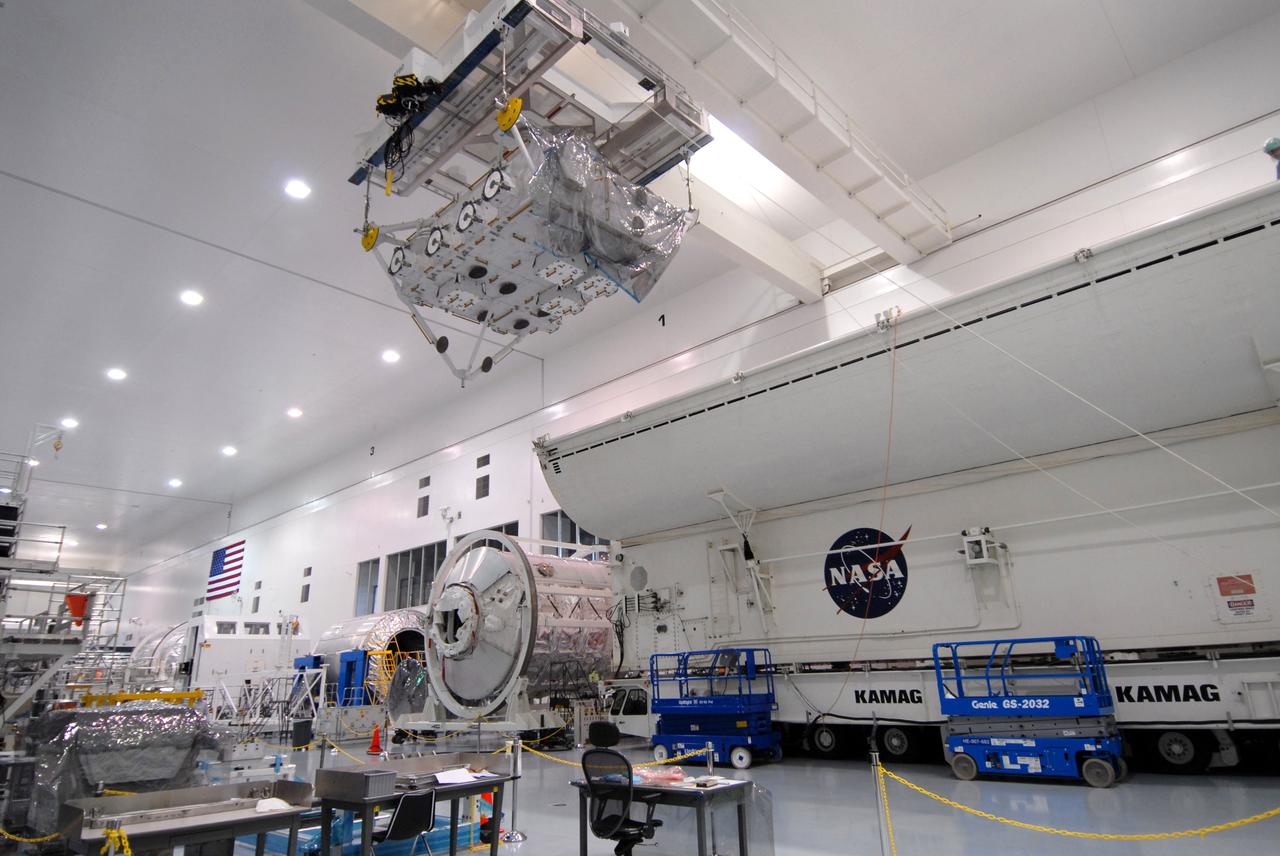
CAPE CANAVERAL, Fla. – In the Space Station Processing Facility at NASA's Kennedy Space Center in Florida, an overhead crane moves the the Japan Aerospace Exploration Agency's Kibo Exposed Facility, or EF, part of the payload for the STS-127 mission, to the payload canister, at right. The EF, along with the Experiment Logistics Module Exposed Section, will be carried aboard space shuttle Endeavour on the STS-127 mission targeted for launch June 13. When the EF is installed on the Kibo laboratory, it will provide a multipurpose platform where science experiments can be deployed and operated in the exposed environment. The payloads attached to the EF can be exchanged or retrieved by Kibo's robotic arm, the JEM Remote Manipulator. Photo credit: NASA/Jack Pfaller
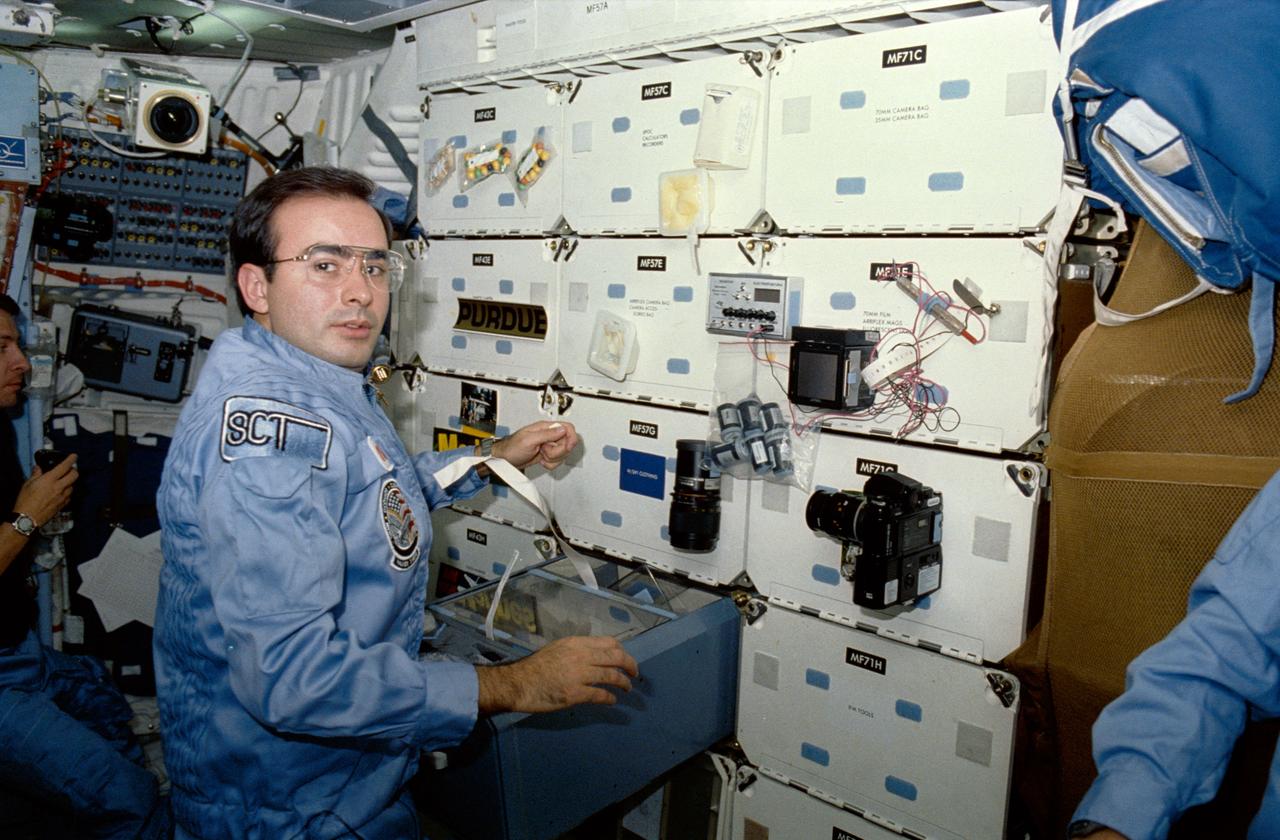
61B-05-021 (26 Nov-3 Dec 1985) --- Payload Specialist Rodolfo Neri, representing Mexico on the STS-61B space mission aboard the Atlantis, prepares to begin one of the experiments for Mexico. Neri used a nearby 35mm camera to record plants and bacteria for various prescribed testing. Here the payload specialist has opened a stowage drawer to retrieve components of one of the tests.
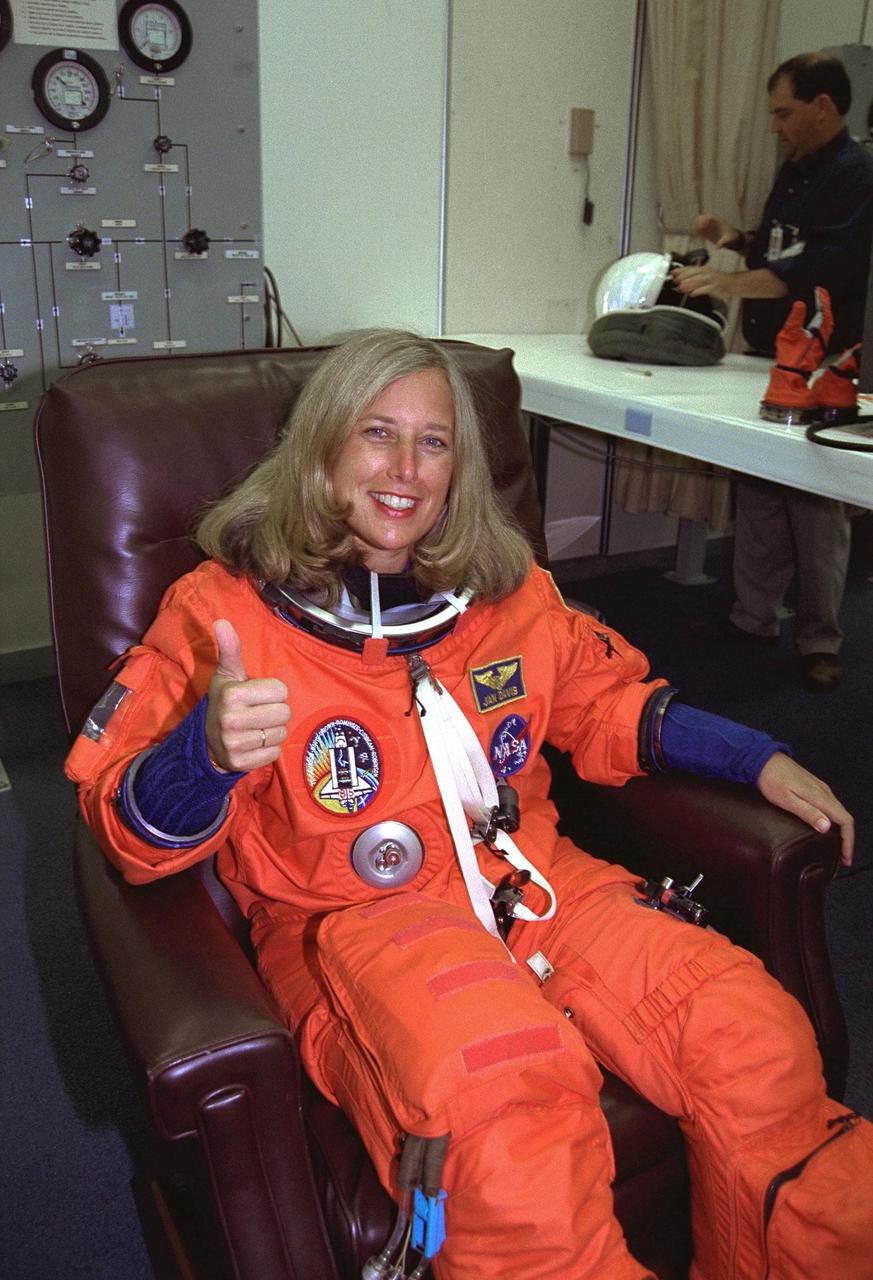
STS-85 Payload Commander N. Jan Davis gives a thumbs up as she is assisted with her ascent/reentry flight suit in the Operations and Checkout (O&C) Building. She has logged nearly 400 hours in space on the STS-47 and STS-60 missions and holds a doctorate in mechanical engineering. Davis will have overall responsibility for the experiments conducted on STS-85. She will also deploy and retrieve the Cryogenic Infrared Spectrometers and Telescopes for the AtmosphereShuttle Pallet Satellite-2 (CRISTA-SPAS-2) free-flyer and operate the prototype Japanese robotic arm. The primary payload aboard the Space Shuttle orbiter Discovery is the CRISTA-SPAS-2. Other payloads on the 11-day mission include the Manipulator Flight Demonstration (MFD), and Technology Applications and Science-1 (TAS-1) and International Extreme Ultraviolet Hitchhiker-2 (IEH-2) experiments
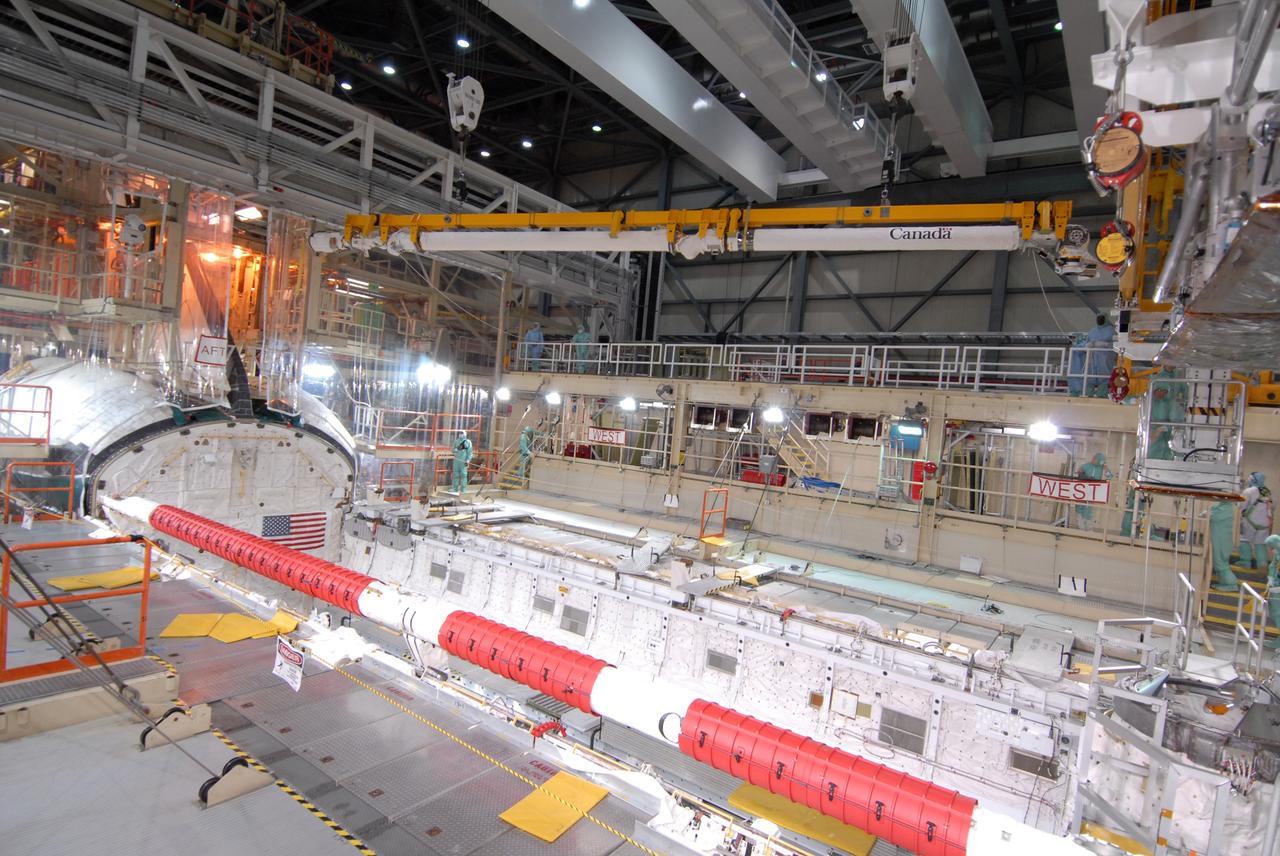
CAPE CANAVERAL, Fla. – In Orbiter Processing Facility bay 3 at NASA's Kennedy Space Center in Florida, the remote manipulator system, or RMS, arm is lifted out of space shuttle Discovery's payload bay. The RMS is used to grab, or grapple, the payload as well as retrieve, repair and deploy satellites; provide a mobile extension ladder for spacewalking crewmembers; and be used as an inspection aid to allow flight crew members to view the orbiter’s or payload’s surfaces through a TV camera on the arm. Discovery is targeted to launch Aug. 6 on the STS-128 mission. Photo credit: NASA/Jack Pfaller
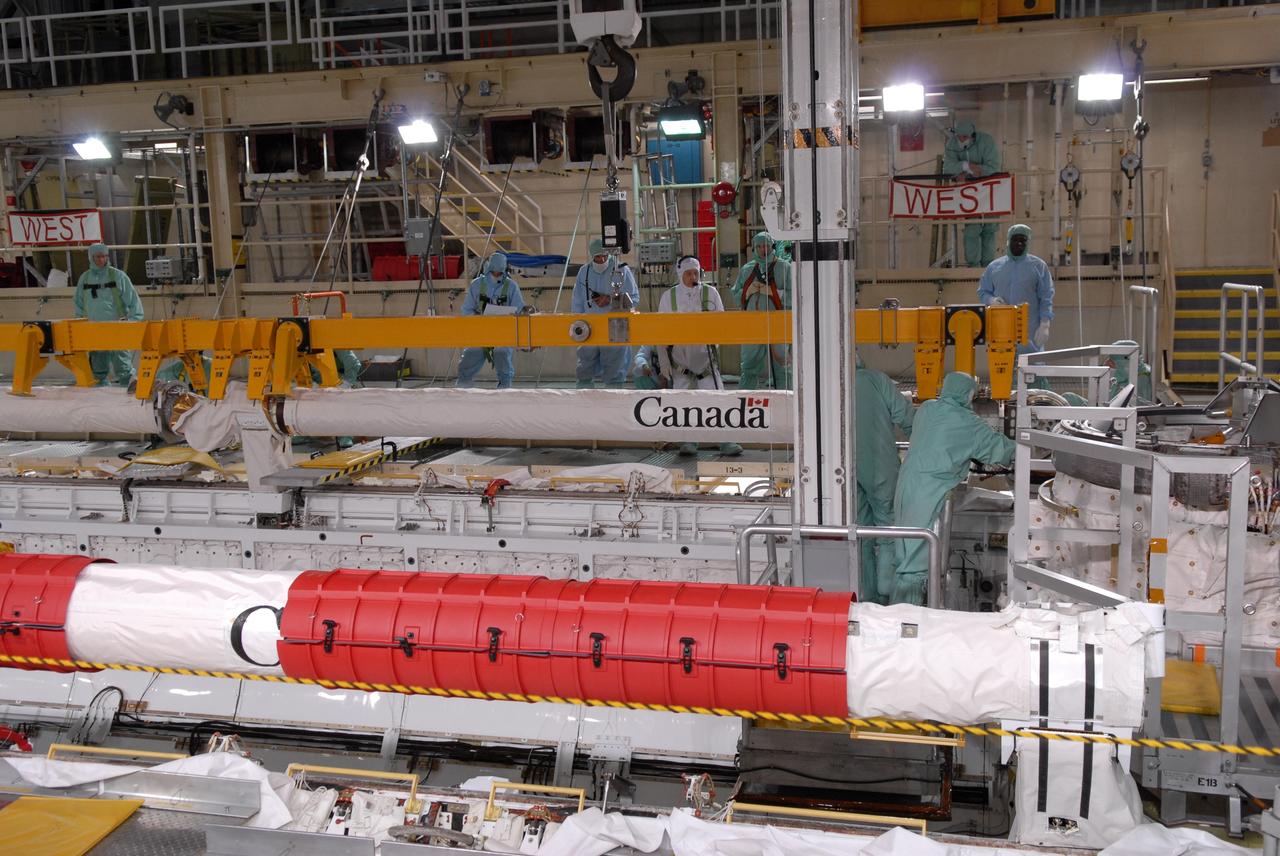
CAPE CANAVERAL, Fla. – In Orbiter Processing Facility bay 3 at NASA's Kennedy Space Center in Florida, technicians prepare to remove the remote manipulator system, or RMS, arm in the payload bay of space shuttle Discovery. The RMS is used to grab, or grapple, the payload as well as retrieve, repair and deploy satellites; provide a mobile extension ladder for spacewalking crewmembers; and be used as an inspection aid to allow flight crew members to view the orbiter’s or payload’s surfaces through a TV camera on the arm. Discovery is targeted to launch Aug. 6 on the STS-128 mission. Photo credit: NASA/Jack Pfaller
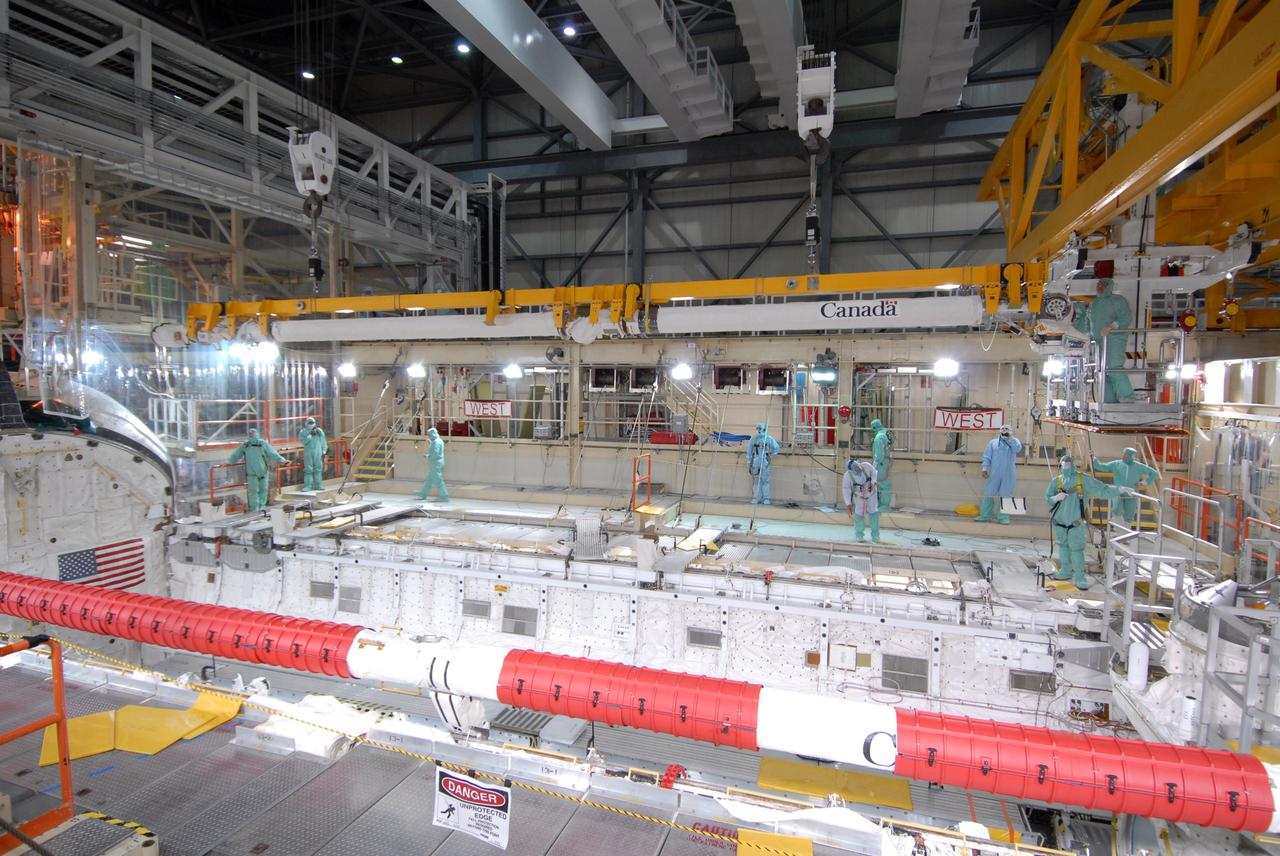
CAPE CANAVERAL, Fla. – In Orbiter Processing Facility bay 3 at NASA's Kennedy Space Center in Florida, the remote manipulator system, or RMS, arm is lifted away from the payload bay of space shuttle Discovery. The RMS is used to grab, or grapple, the payload as well as retrieve, repair and deploy satellites; provide a mobile extension ladder for spacewalking crewmembers; and be used as an inspection aid to allow flight crew members to view the orbiter’s or payload’s surfaces through a TV camera on the arm. Discovery is targeted to launch Aug. 6 on the STS-128 mission. Photo credit: NASA/Jack Pfaller
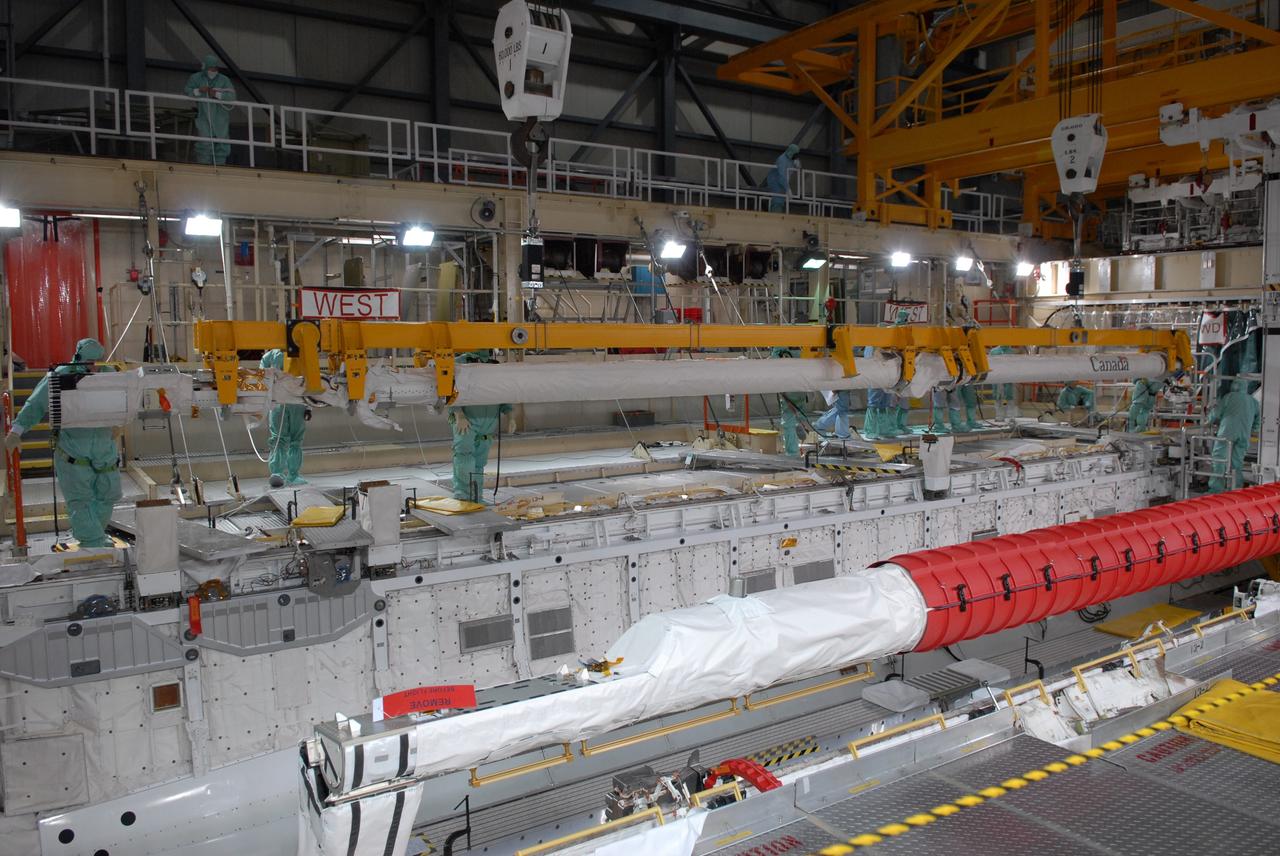
CAPE CANAVERAL, Fla. – In Orbiter Processing Facility bay 3 at NASA's Kennedy Space Center in Florida, remote manipulator system, or RMS, arm is lifted out of the payload bay of space shuttle Discovery. The RMS is used to grab, or grapple, the payload as well as retrieve, repair and deploy satellites; provide a mobile extension ladder for spacewalking crewmembers; and be used as an inspection aid to allow flight crew members to view the orbiter’s or payload’s surfaces through a TV camera on the arm. Discovery is targeted to launch Aug. 6 on the STS-128 mission. Photo credit: NASA/Jack Pfaller
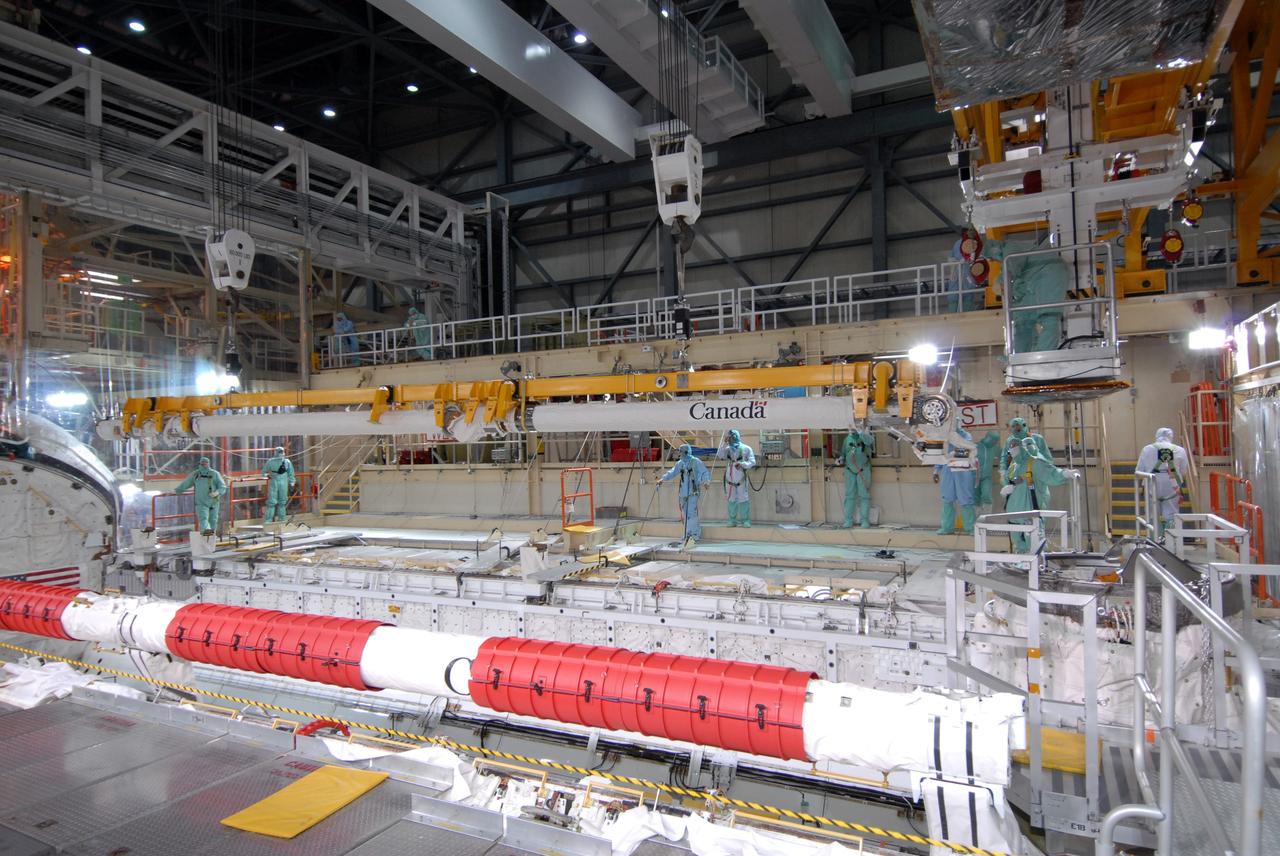
CAPE CANAVERAL, Fla. – In Orbiter Processing Facility bay 3 at NASA's Kennedy Space Center in Florida, the remote manipulator system, or RMS, arm is moved out of the payload bay of space shuttle Discovery. The RMS is used to grab, or grapple, the payload as well as retrieve, repair and deploy satellites; provide a mobile extension ladder for spacewalking crewmembers; and be used as an inspection aid to allow flight crew members to view the orbiter’s or payload’s surfaces through a TV camera on the arm. Discovery is targeted to launch Aug. 6 on the STS-128 mission. Photo credit: NASA/Jack Pfaller
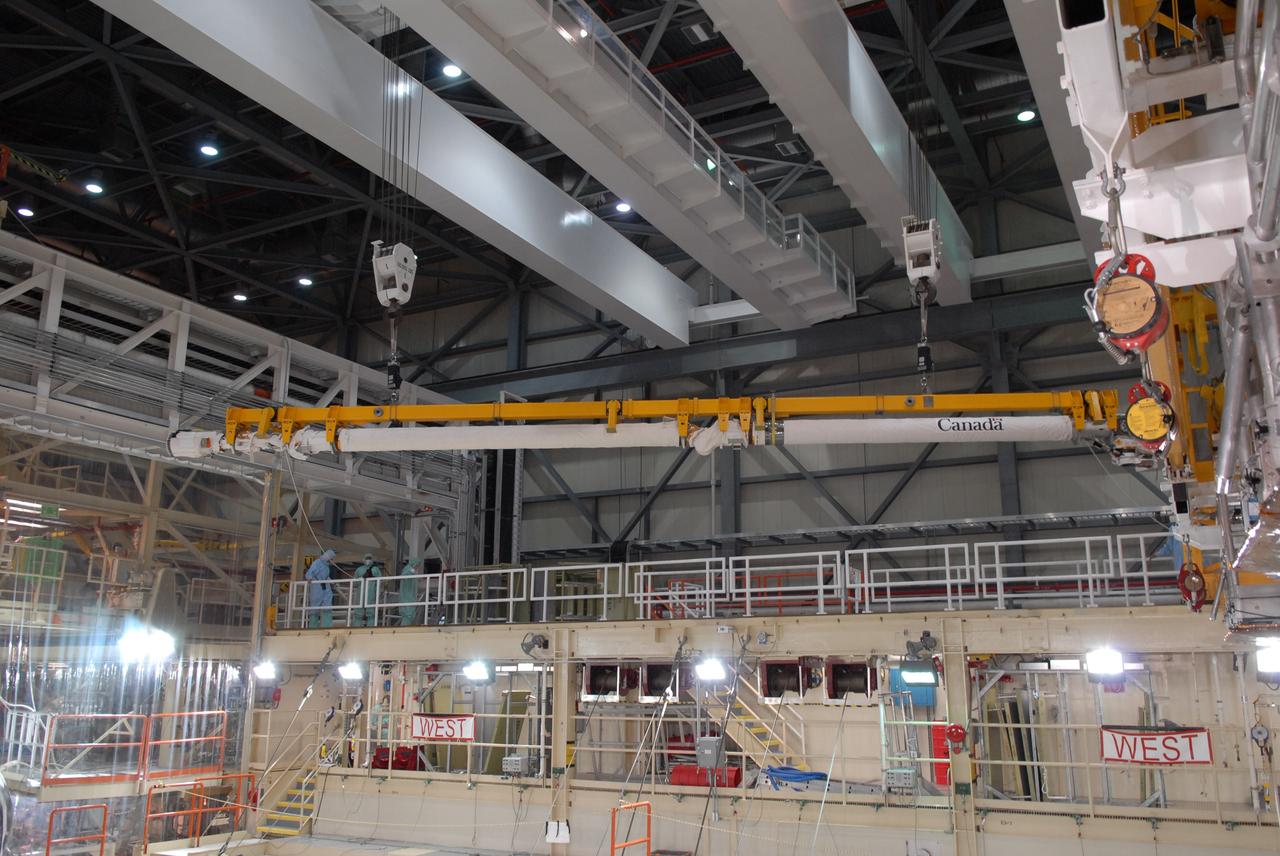
CAPE CANAVERAL, Fla. – In Orbiter Processing Facility bay 3 at NASA's Kennedy Space Center in Florida, the remote manipulator system, or RMS, arm is lifted away from space shuttle Discovery's payload bay. The RMS is used to grab, or grapple, the payload as well as retrieve, repair and deploy satellites; provide a mobile extension ladder for spacewalking crewmembers; and be used as an inspection aid to allow flight crew members to view the orbiter’s or payload’s surfaces through a TV camera on the arm. Discovery is targeted to launch Aug. 6 on the STS-128 mission. Photo credit: NASA/Jack Pfaller
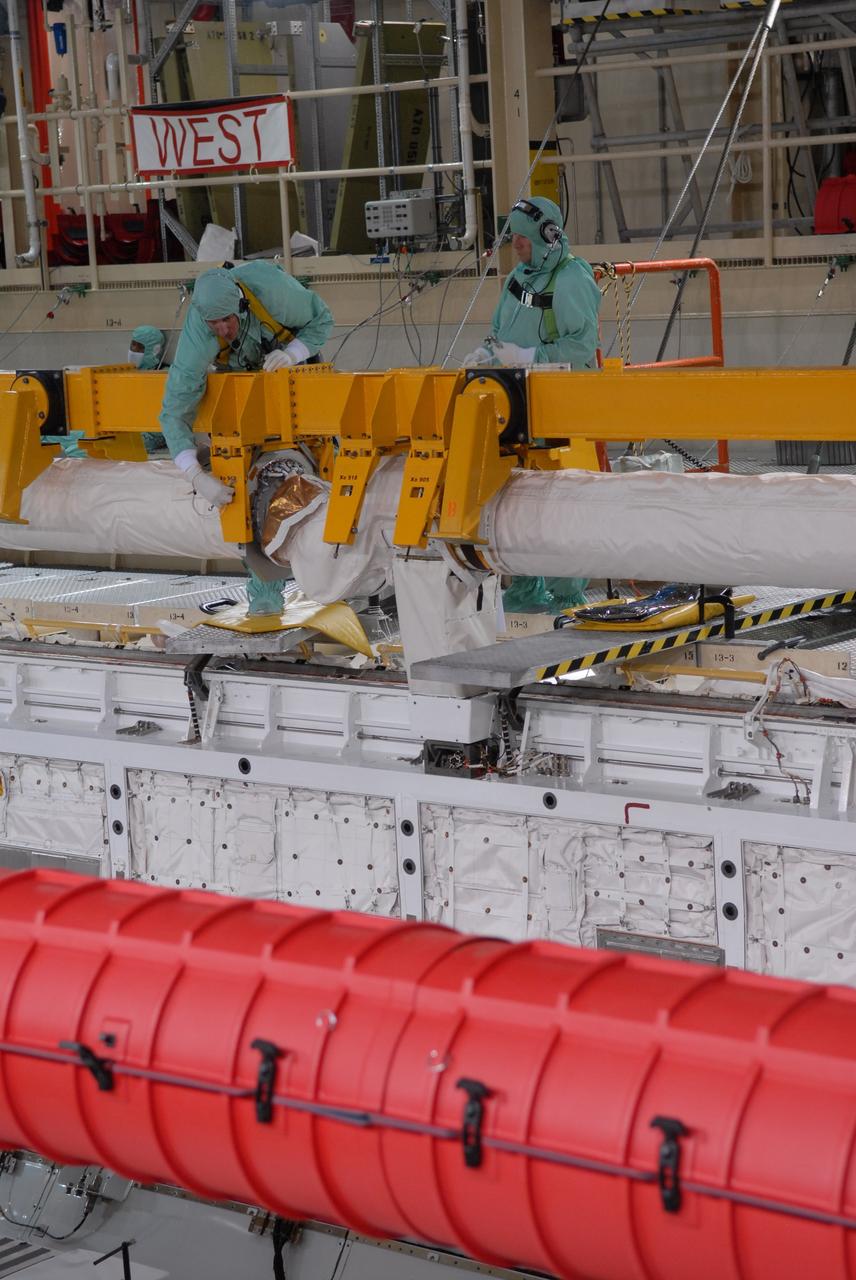
CAPE CANAVERAL, Fla. – In Orbiter Processing Facility bay 3 at NASA's Kennedy Space Center in Florida, technicians prepare to remove remote manipulator system, or RMS, arm in the payload bay of space shuttle Discovery. The RMS is used to grab, or grapple, the payload as well as retrieve, repair and deploy satellites; provide a mobile extension ladder for spacewalking crewmembers; and be used as an inspection aid to allow flight crew members to view the orbiter’s or payload’s surfaces through a TV camera on the arm. Discovery is targeted to launch Aug. 6 on the STS-128 mission. Photo credit: NASA/Jack Pfaller
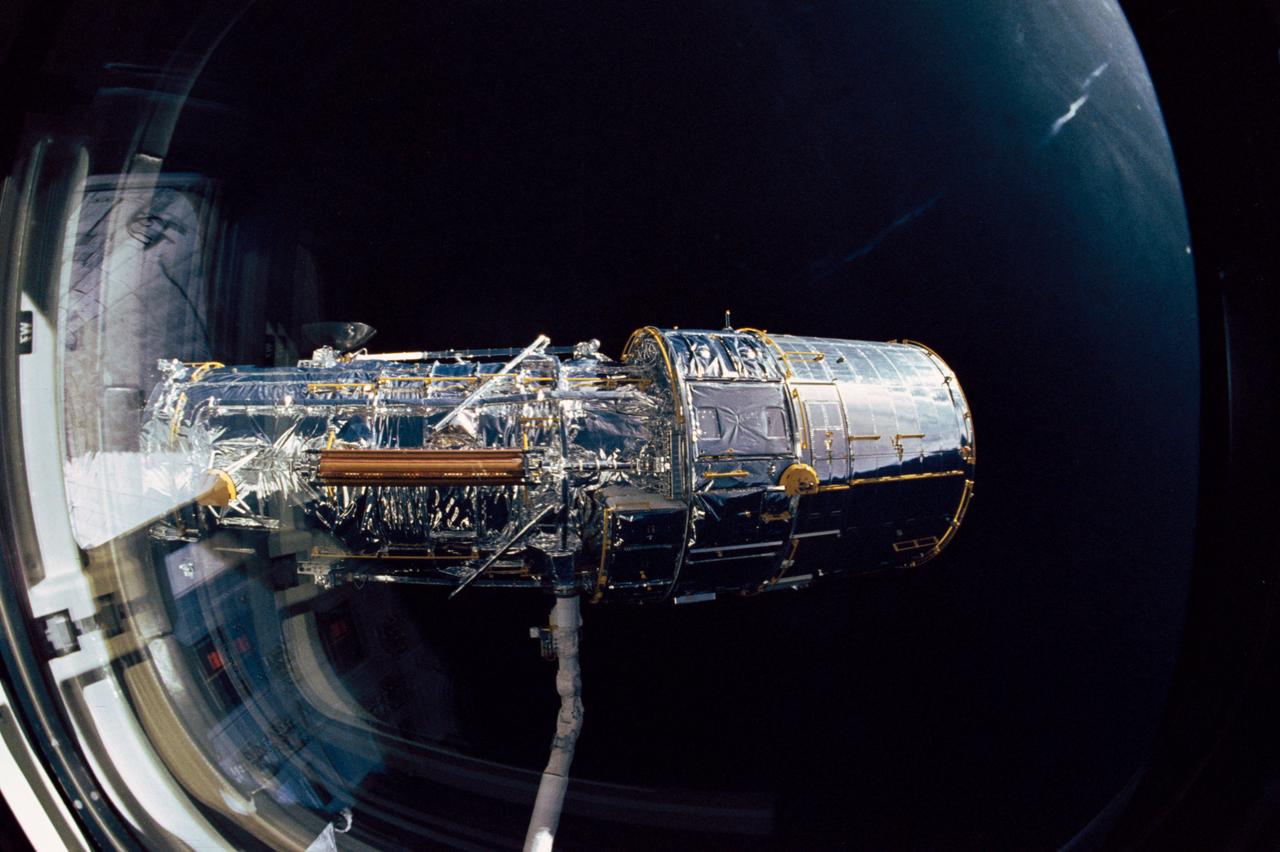
The Hubble Space Telescope (HST), grappled by Discovery's, Orbiter Vehicle (OV) 103's, remote manipulator system (RMS), is held in a pre-deployment position. During STS-31 checkout procedures, the solar array (SA) panels and the high gain antennae (HGA) will be deployed. The starboard SA (center) and the two HGA are stowed along side the Support System Module (SSM) forward shell. The sun highlights HST against the blackness of space.
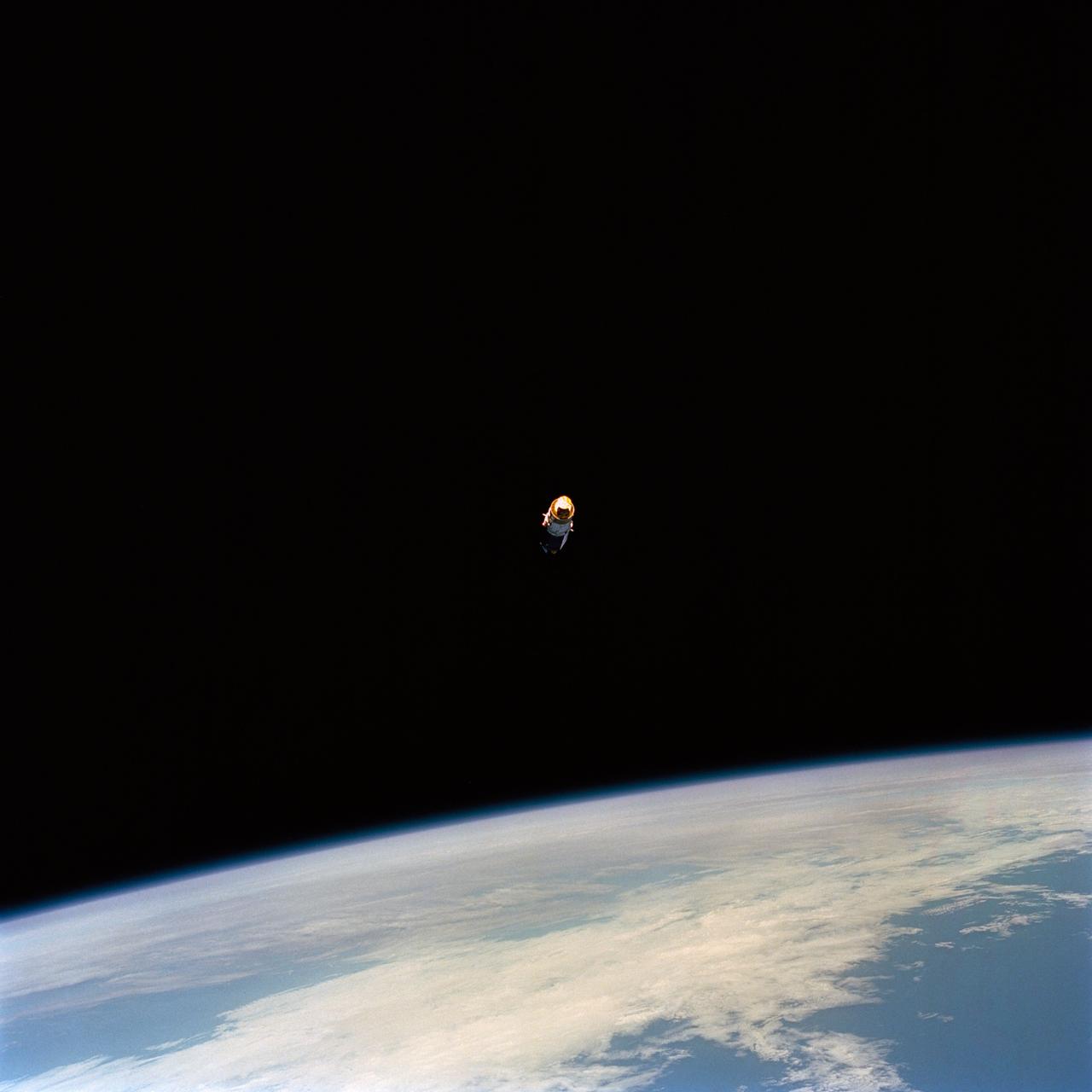
STS054-71-087 (13 Jan 1993) --- The Tracking and Data Relay Satellite (TDRS) is backdropped against the blackness of space, minutes after its release from the Space Shuttle Endeavour. Onboard NASA's newest Shuttle for the six-day mission are astronauts John H. Casper, mission commander; Donald R. McMonagle, pilot; and Mario Runco Jr., Gregory J. Harbaugh and Susan J. Helms, mission specialists. The photograph was taken with a 70mm camera.
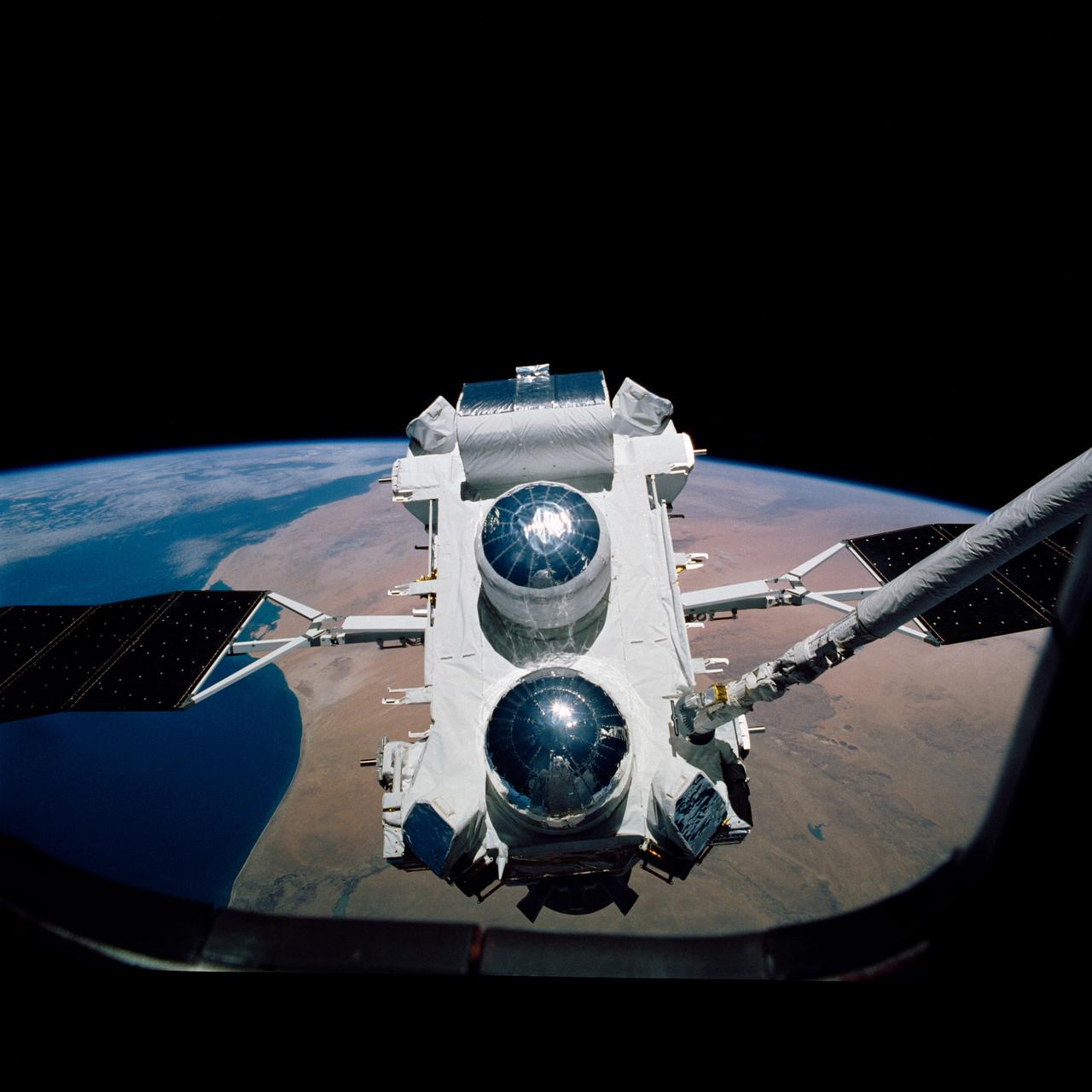
Backdropped against the Earth's surface, the Gamma Ray Observatory (GRO) with its solar array (SA) panels deployed is grappled by the remote manipulator system (RMS) during STS-37 systems checkout. GRO's four complement instruments are visible: the Energetic Gamma Ray Experiment Telescope (EGRET) (at the bottom); the Imaging Compton Telescope (COMPTEL) (center); the Oriented Scintillation Spectrometer Experiment (OSSE) (top); and Burst and Transient Source Experiment (BATSE) (on four corners). The view was taken by STS-37 crew through an aft flight deck overhead window.
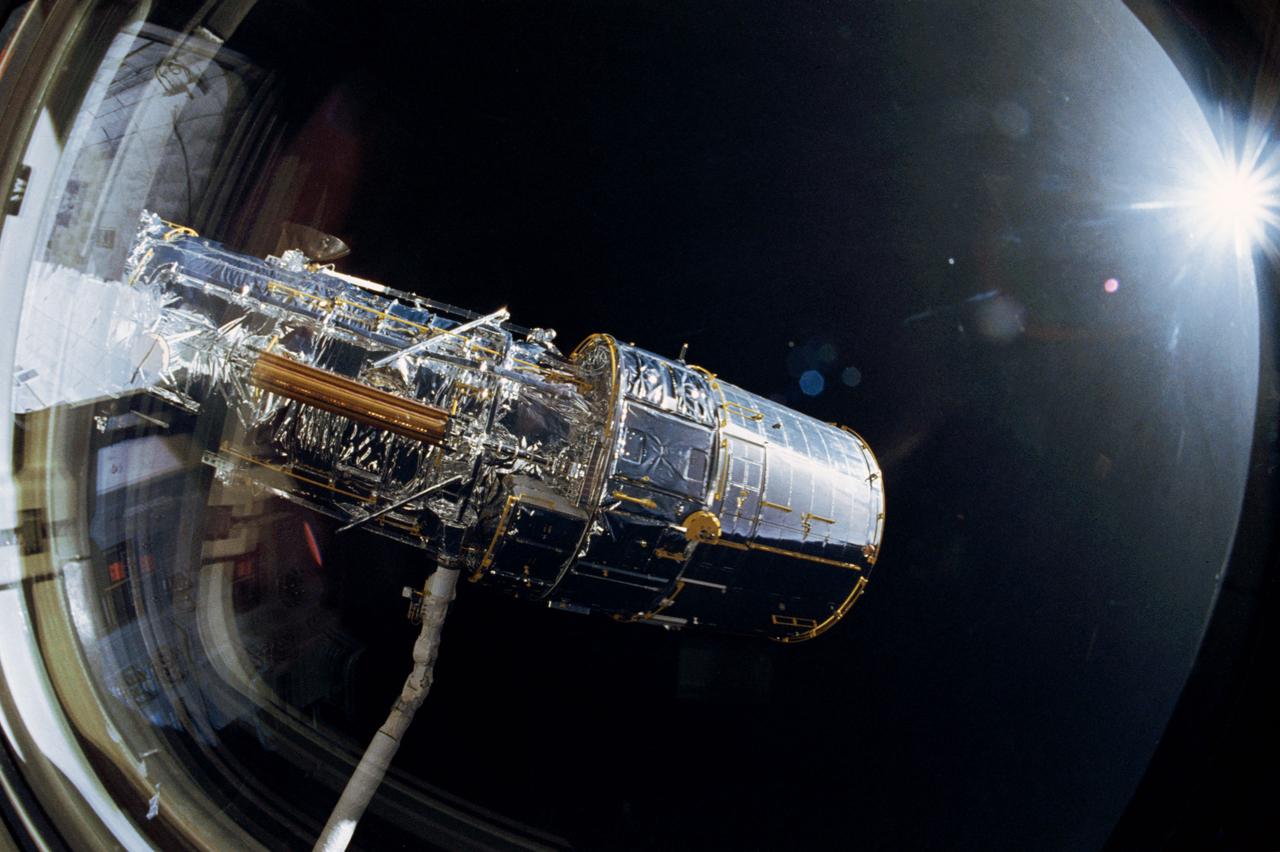
The Hubble Space Telescope (HST), grappled by Discovery's, Orbiter Vehicle (OV) 103's, remote manipulator system (RMS), is oriented in a 90 degree pitch position during STS-31 pre-deployment checkout procedures. The solar array (SA) panel (center) and high gain antennae (HGA) (on either side) are stowed along the Support System Module (SSM) forward shell prior to deployment. The sun highlights HST against the blackness of space.
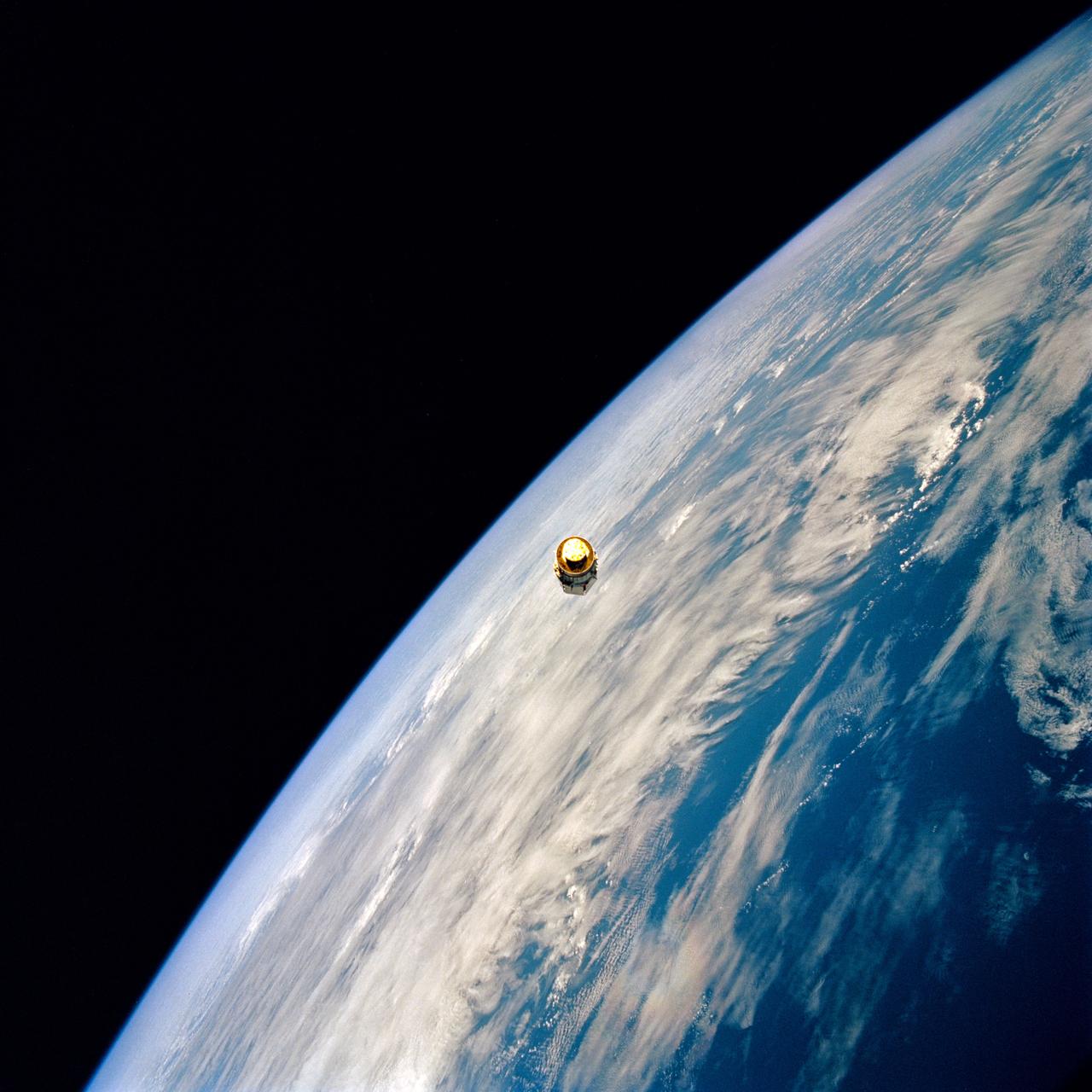
STS054-71-077 (13 Jan 1993) --- The Tracking and Data Relay Satellite (TDRS) quickly moves away from the Space Shuttle Endeavour following deployment on the first day of the six-day mission. Onboard NASA's newest Shuttle for the six-day mission are astronauts John H. Casper, mission commander; Donald R. McMonagle, pilot; and Mario Runco Jr., Gregory J. Harbaugh and Susan J. Helms, mission specialists. The photograph was taken with a 70mm camera.
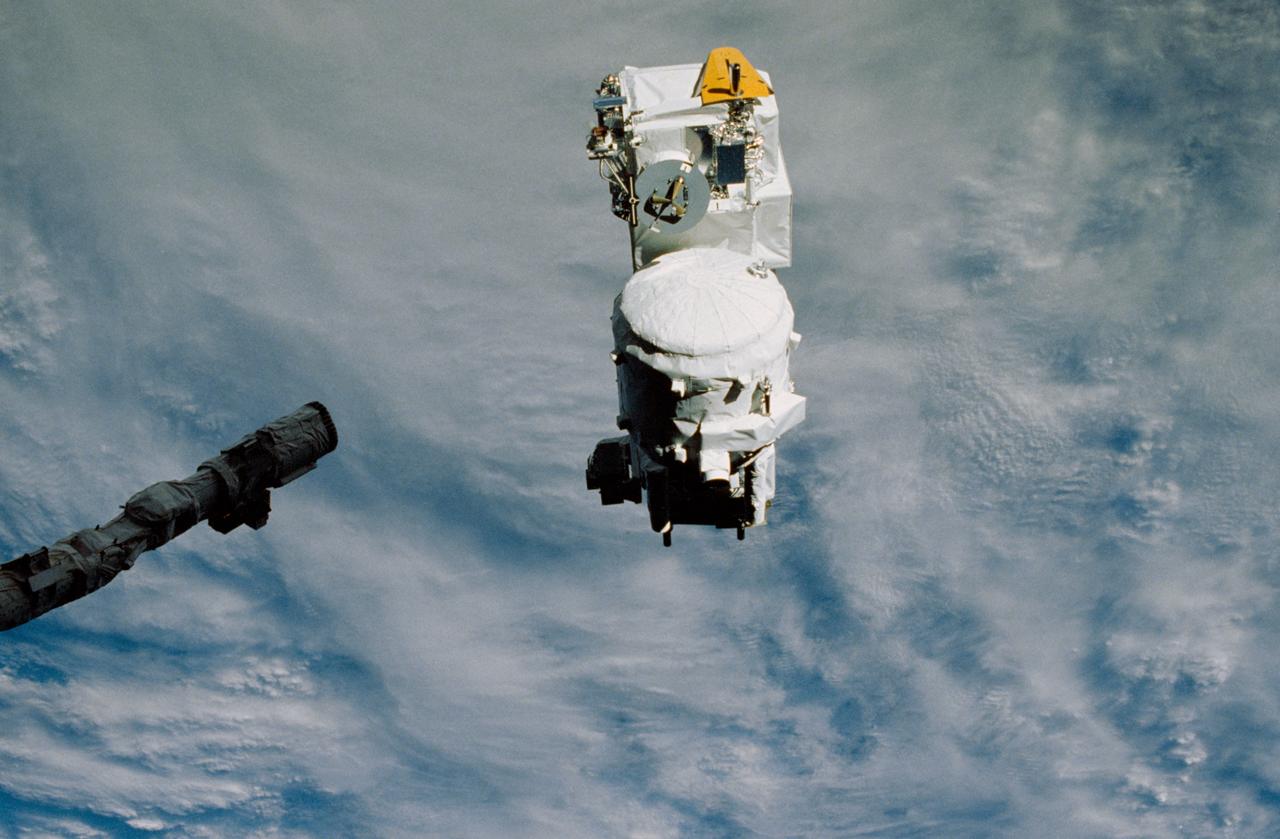
STS039-17-017 (3 May 1990) --- This STS-39 35mm scene shows the Strategic Defense Initiative Organization (SDIO) Shuttle Pallet Satellite (SPAS-II) as it approaches the remote manipulator system (RMS) end effector following a period of free-flight and data collection. During the eight-day flight, SPAS collected data in both a free-flying mode and while attached to the RMS. A huge blanket of white clouds obscures identifiable points on Earth, nearly 300 statute miles away. The target grappling apparatus on SPAS is clearly seen near bottom center of frame.
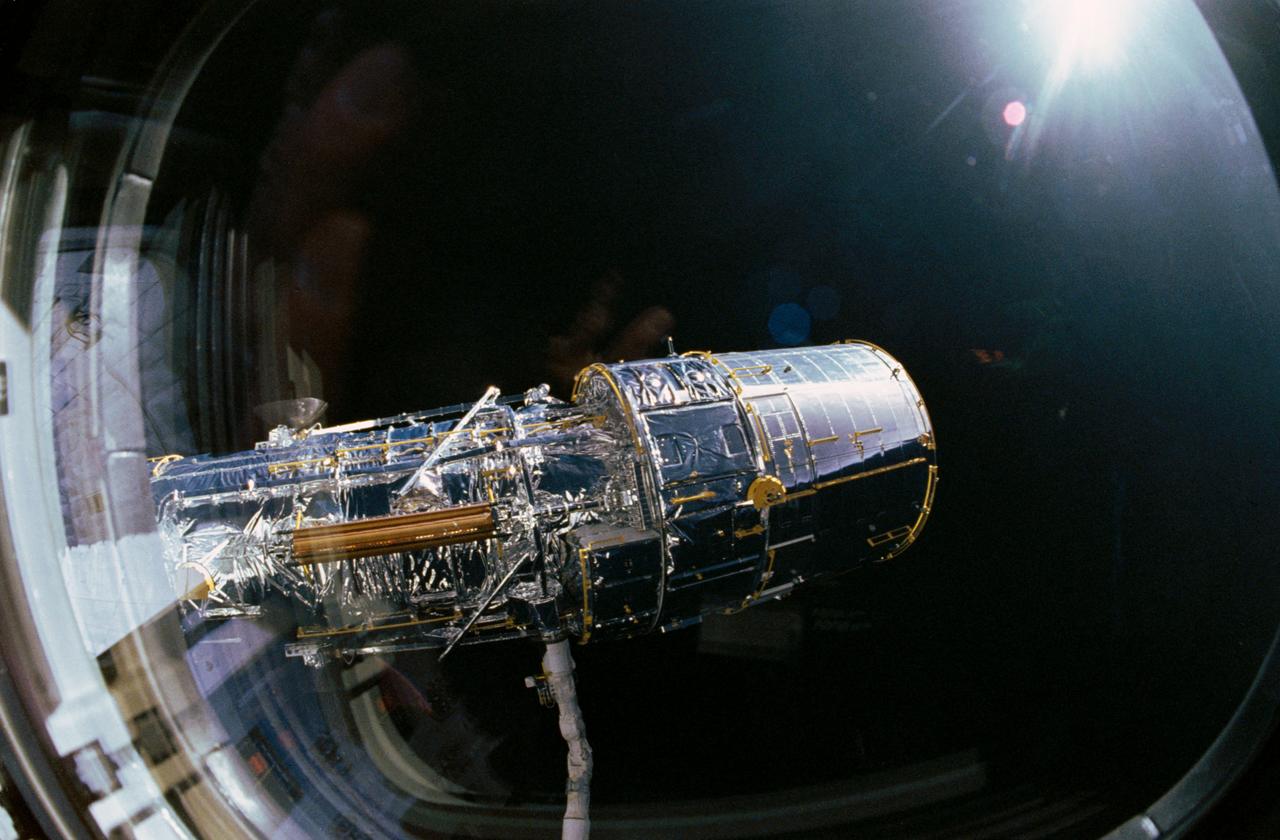
View taken through overhead window W7 aboard Discovery, Orbiter Vehicle (OV) 103, shows the Hubble Space Telescope (HST) grappled by the remote manipulator system (RMS) and held in a 90 degree pitch position against the blackness of space. The solar array (SA) panel (center) and the high gain antennae (HGA) (on either side) are visible along the Support System Module (SSM) forward shell prior to deployment during STS-31.
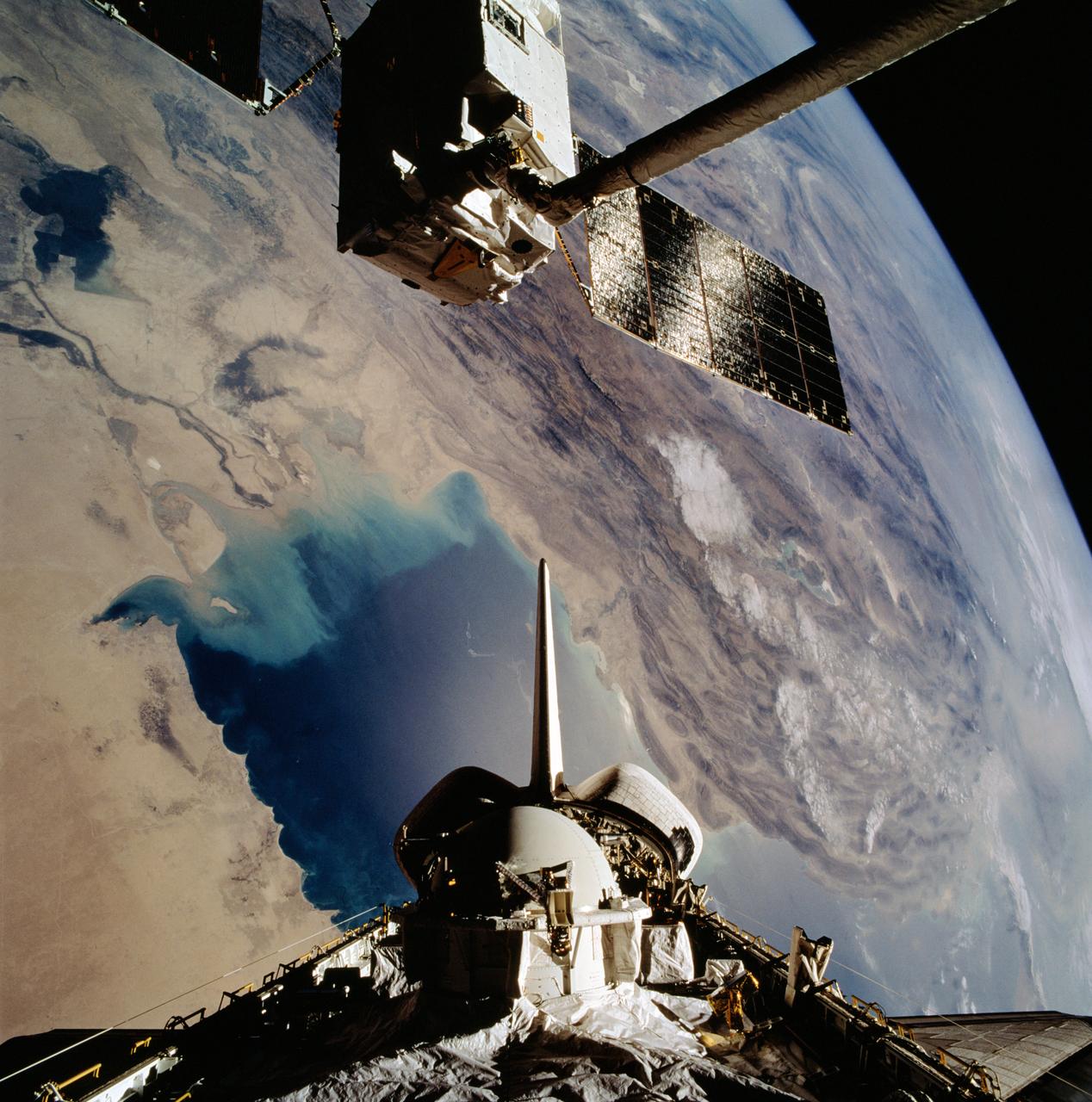
STS046-102-021 (1 Aug 1992) --- The European Space Agency's (ESA) EURECA satellite remains in the grasp of the Space Shuttle Atlantis' Remote Manipulator System (RMS) as the Space Shuttle passes over the Persian Gulf. Most of the theater of the recent war is visible in the frame. Parts of Kuwait, Iraq, Iran and Saudi Arabia can be delineated. The Tethered Satellite System (TSS) remains stowed in the aft cargo bay of Atlantis.
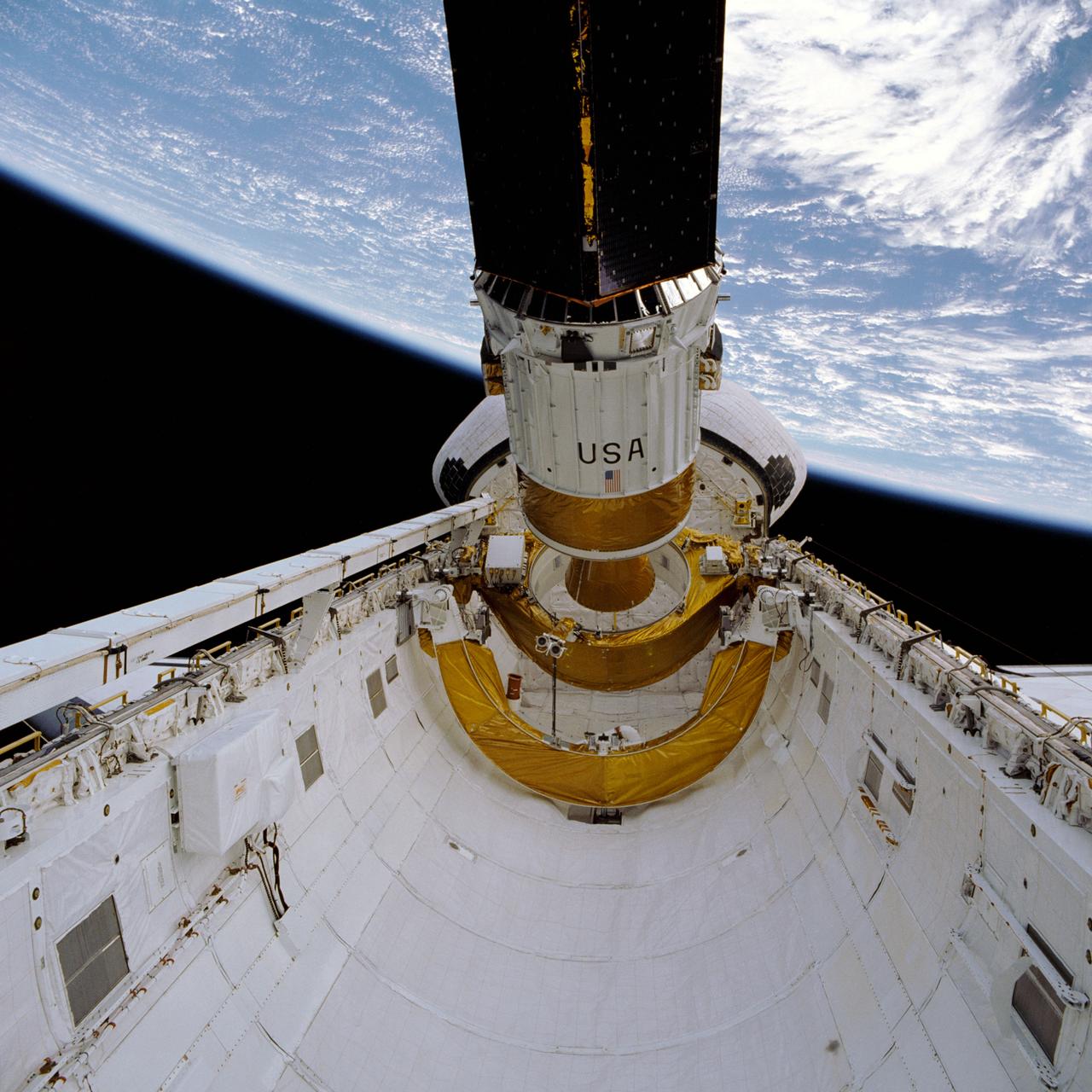
STS029-71-026 (13 March 1989) --- The Tracking and Data Relay Satellite (TDRS-D) is tilted in the cargo bay prior to its release via a remote system on Discovery's flight deck. This photographic frame was among NASA's third STS-29 photo release. Monday, March 20, 1989. Crewmembers were Astronauts Michael L. Coats, John E. Blaha, James F. Buchli, Robert C. Springer and James P. Bagian.
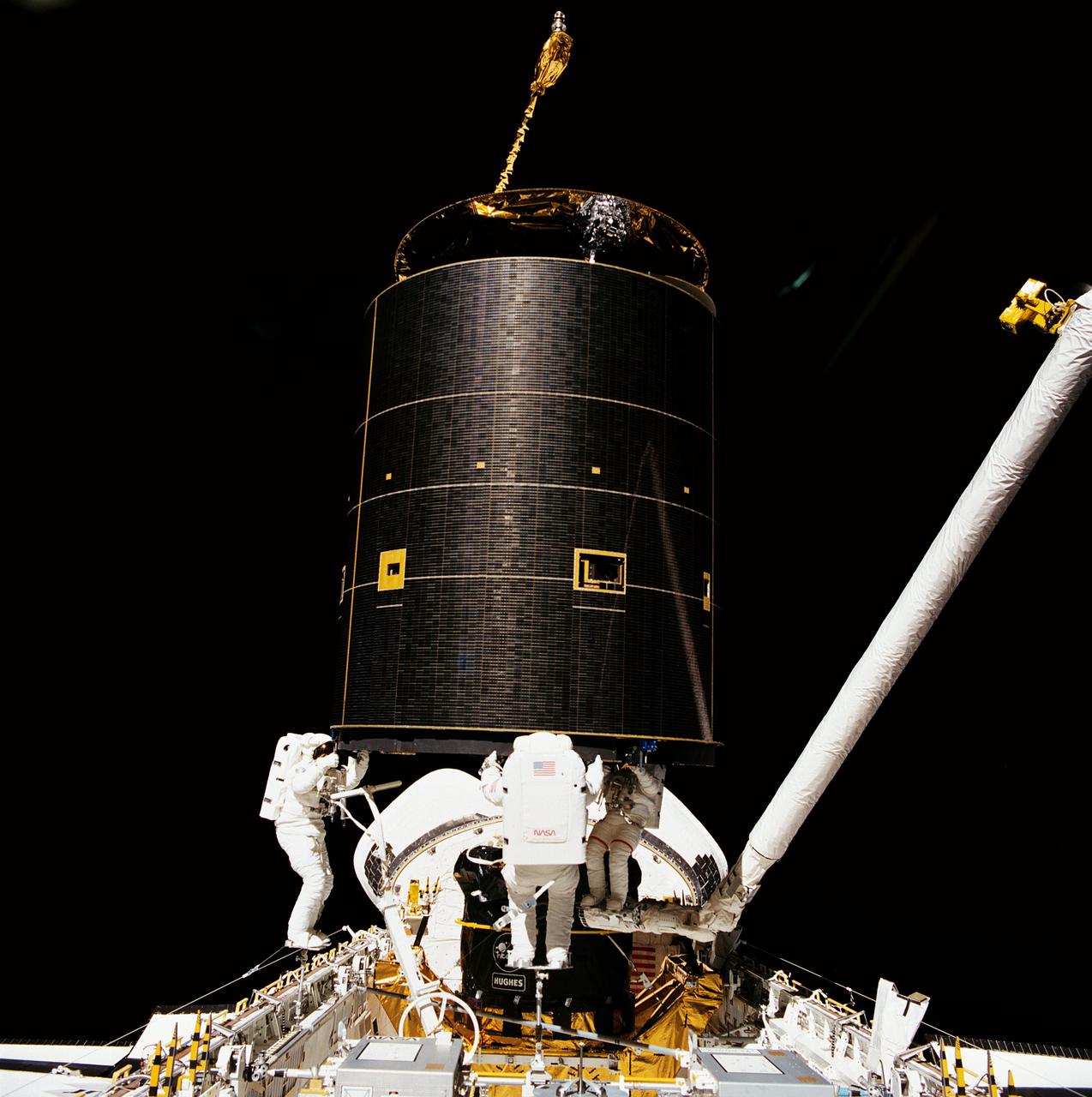
STS049-91-026 (13 May 1992) --- Three astronauts hold onto the 4.5-ton Intelsat VI satellite after a six-handed "capture" was made minutes earlier. Left to right are astronauts Richard J. Hieb, Thomas D. Akers and Pierre J. Thuot. Thuot stands on the end of the remote manipulator system arm, from which he had made two earlier unsuccessful grapple attempts on two-person extravehicular activity sessions. Ground controllers and crew members agreed that a third attempt, using three mission specialists in the cargo bay of the space shuttle Endeavour, was the effort needed to accomplish the capture feat.
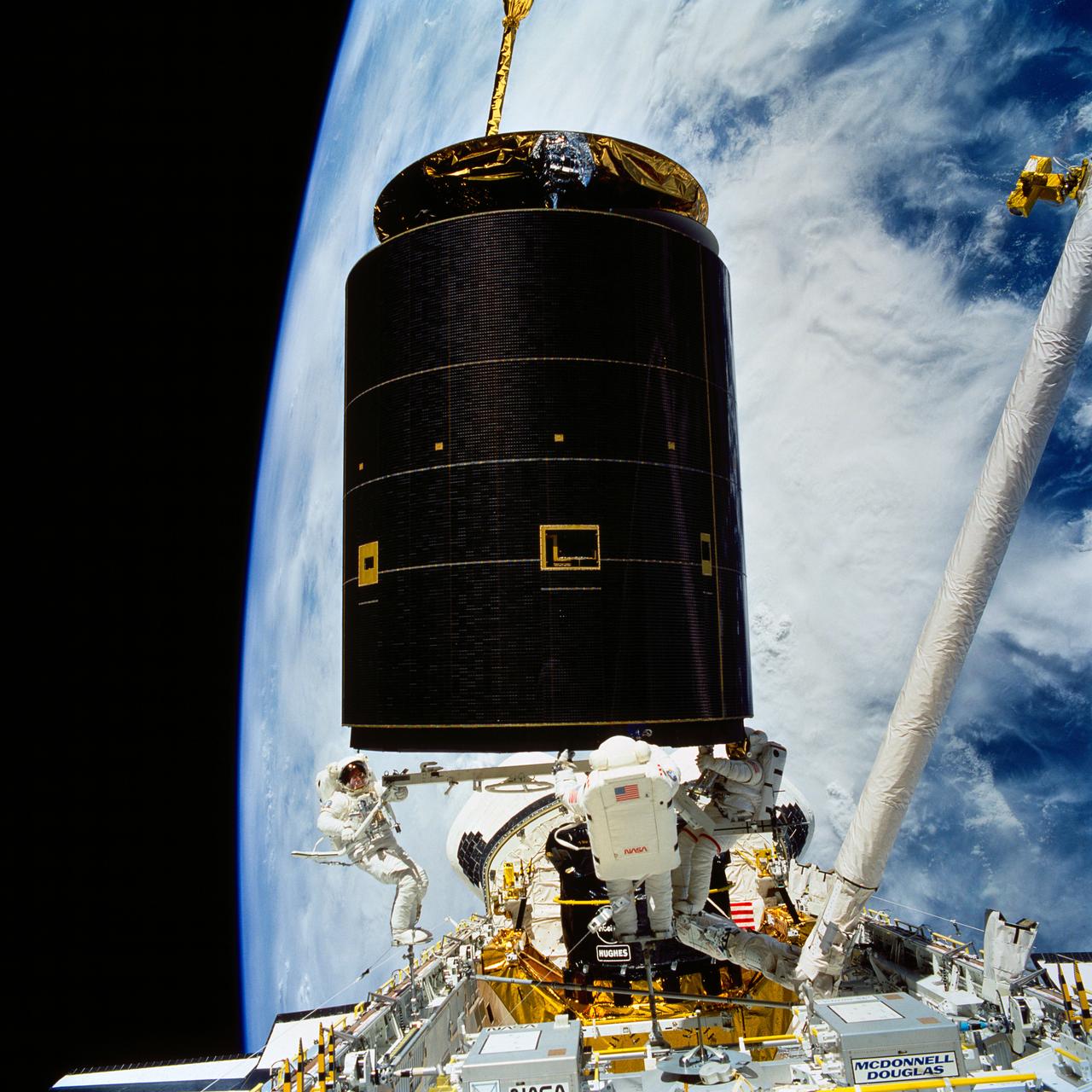
STS049-91-029 (13 May 1992) --- Following the successful capture of Intelsat VI satellite, three astronauts continue their chores toward moving the 4.5 ton communications satellite into the space shuttle Endeavour's cargo bay. A fellow crew member recorded this 70mm still frame from inside Endeavour's cabin. Left to right, astronauts Richard J. Hieb, Thomas D. Akers and Pierre J. Thuot, cooperate on the effort to attach a specially designed grapple bar underneath the satellite. Thuot stands on the end of the Remote Manipulator System's (RMS) arm while Hieb and Akers are on Portable Foot Restraints (PFR) affixed to Endeavour's portside and the Multipurpose Support Structure (MPESS), respectively. The sections of Earth which form the backdrop for the scene are blanketed with thousands of square miles of clouds. Photo credit: NASA

STS095-E-5166 (2 Nov. 1998) --- Astronaut Curtis L. Brown Jr. (left), STS-95 commander, and U.S. Sen. John H. Glenn Jr., payload specialist, are seen on the middeck of the Space Shuttle Discovery during Flight Day three activity. Brown has retrieved an experiment from a stowage locker and Glenn works out on the ergometer device. The photo was taken with an electronic still camera (ESC) at 05:55:42 GMT, Nov. 2.
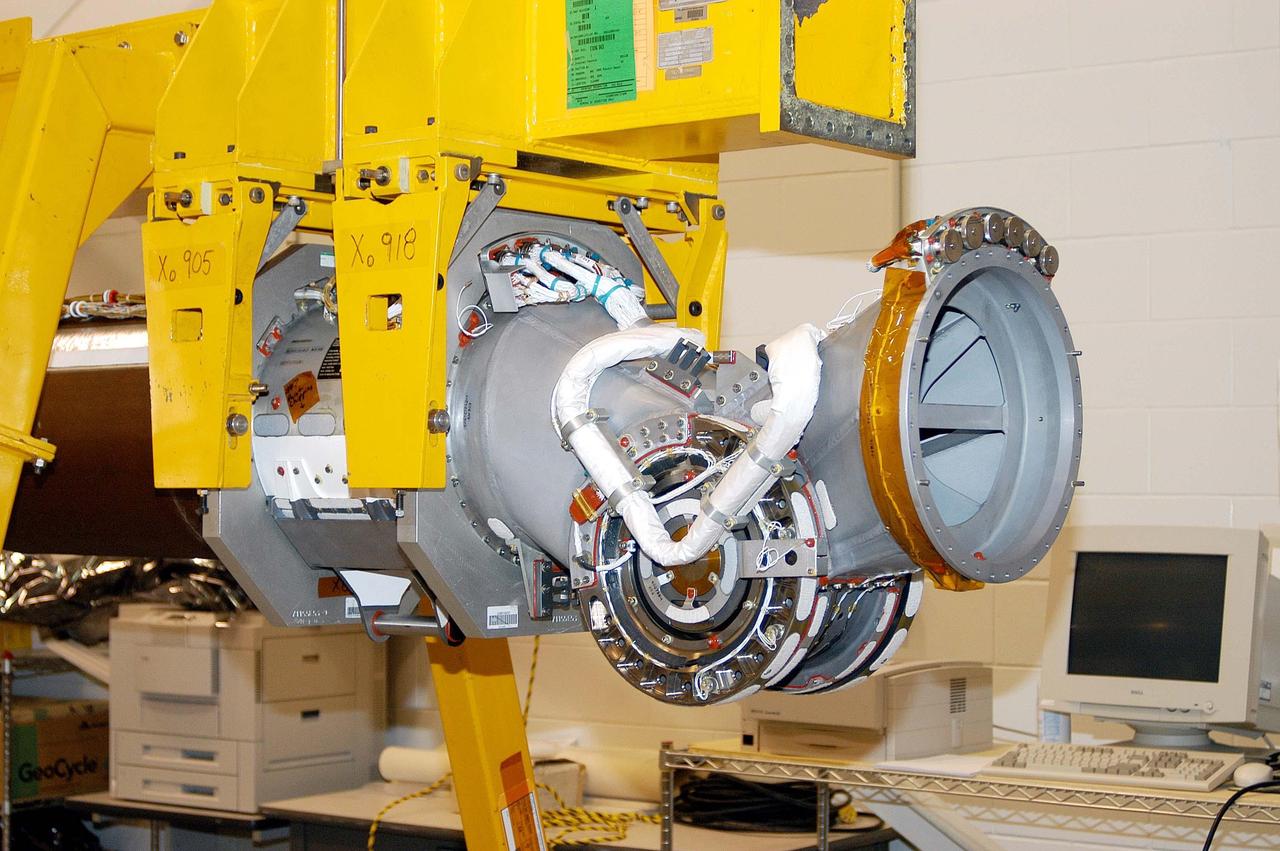
KENNEDY SPACE CENTER, FLA. - The Remote Manipulator System (RMS), also known as the Canadian robotic arm, for the orbiter Discovery has arrived at KSC’s Vehicle Assembly Building Lab. The part seen on the end is one of the joints that allow the basic structure of the arm to maneuver similar to a human arm. The RMS is used to deploy and retrieve payloads, provide a mobile extension ladder or foot restraints for crew members during extravehicular activities; and to aid the flight crew members in viewing surfaces of the orbiter or payloads through a television camera on the RMS. The arm The RMS is used to deploy and retrieve payloads, provide a mobile extension ladder or foot restraints for crew members during extravehicular activities; and to aid the flight crew members in viewing surfaces of the orbiter or payloads through a television camera on the RMS. The arm is also serving as the base for the new Orbiter Boom Sensor System (OBSS), one of the safety measures for Return to Flight, equipping the Shuttle with cameras and laser systems to inspect the Shuttle’s Thermal Protection System while in space. Discovery is scheduled for a launch planning window of March 2005 on mission STS-114.
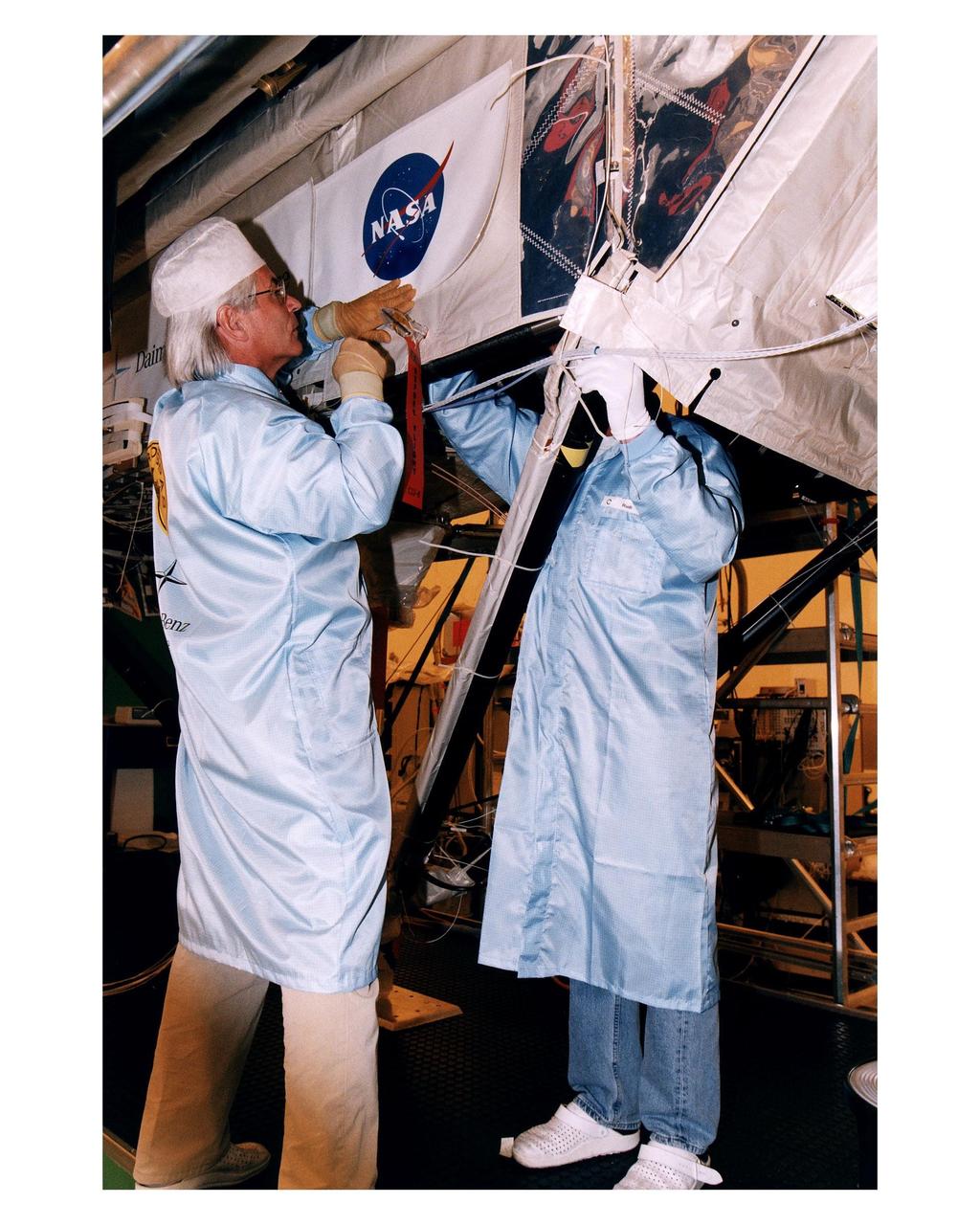
Employees of Daimler-Benz Aerospace in the Multi-Payload Processing Facility install insulation on the Cryogenic Infrared Spectro-meters and Telescopes for the Atmosphere-Shuttle Pallet Satellite-2 (CRISTA-SPAS-2) payload for the STS-85 mission. The CRISTA is a system of three telescopes and four spectrometers to measure infrared radiation emitted by the Earth’s middle atmosphere. During the 11- day mission, the CRISTA-SPAS-2 free-flying satellite will be deployed from the Space Shuttle Discovery and retrieved later in the flight. Also onboard the satellite will be the Middle Atmosphere High Resolution Spectrograph Investigation (MAHRSI) to measure ultraviolet radiation emitted and scattered by the Earth’s atmosphere
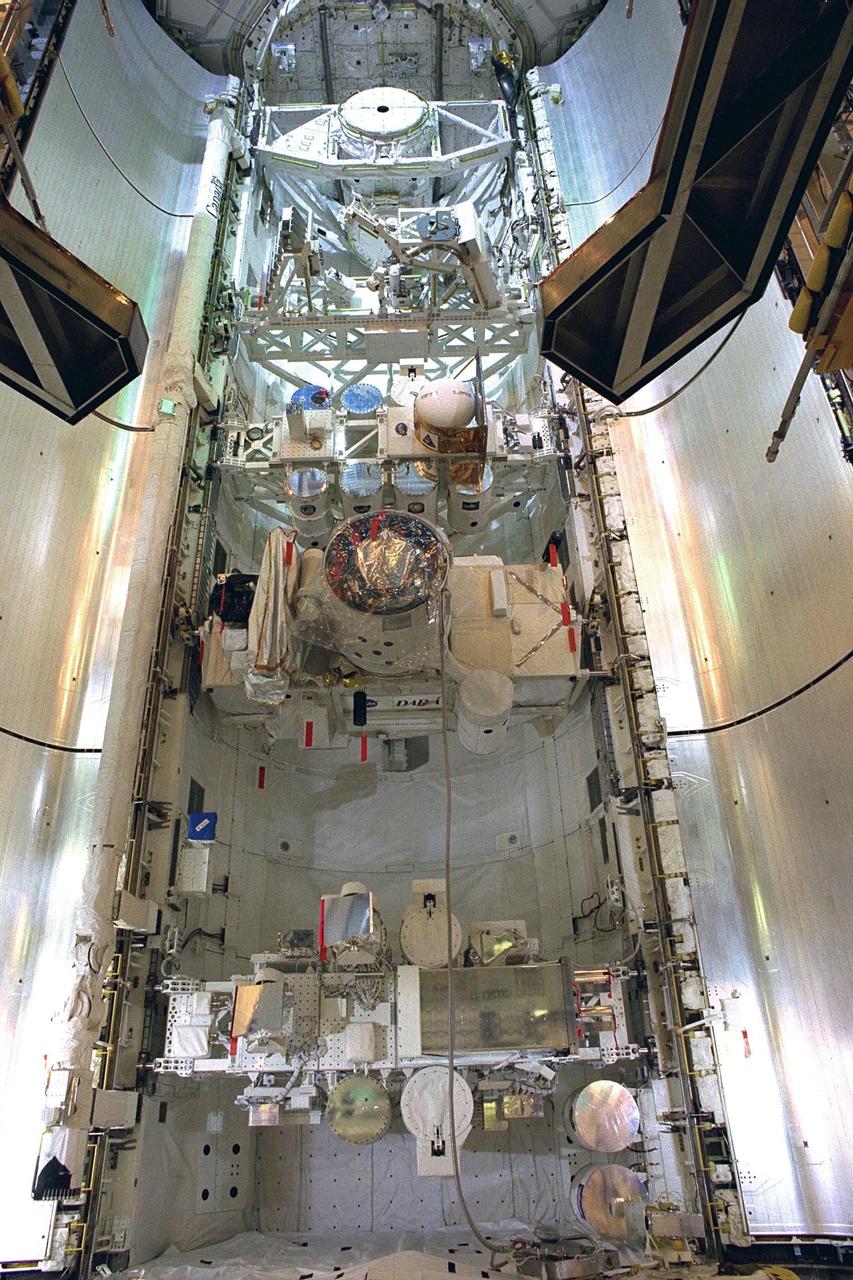
KENNEDY SPACE CENTER, FLA. -- Space Shuttle orbiter Discovery's payload bay doors are closed in preparation for the flight of mission STS-85. The payload includes the Cryogenic Infrared Spectrometers and Telescopes for the Atmosphere-Shuttle Pallet Satellite-2 (CRISTA-SPAS-2). The CRISTA is a system of three telescopes and four spectrometers to measure infrared radiation emitted by the Earth’s middle atmosphere. During the 11-day mission, the CRISTA-SPAS-2 free-flying satellite will be deployed from Discovery and retrieved later in the flight. Also onboard the satellite will be the Middle Atmosphere High Resolution Spectrograph Investigation (MAHRSI) to measure ultraviolet radiation emitted and scattered by the Earth’s atmosphere.
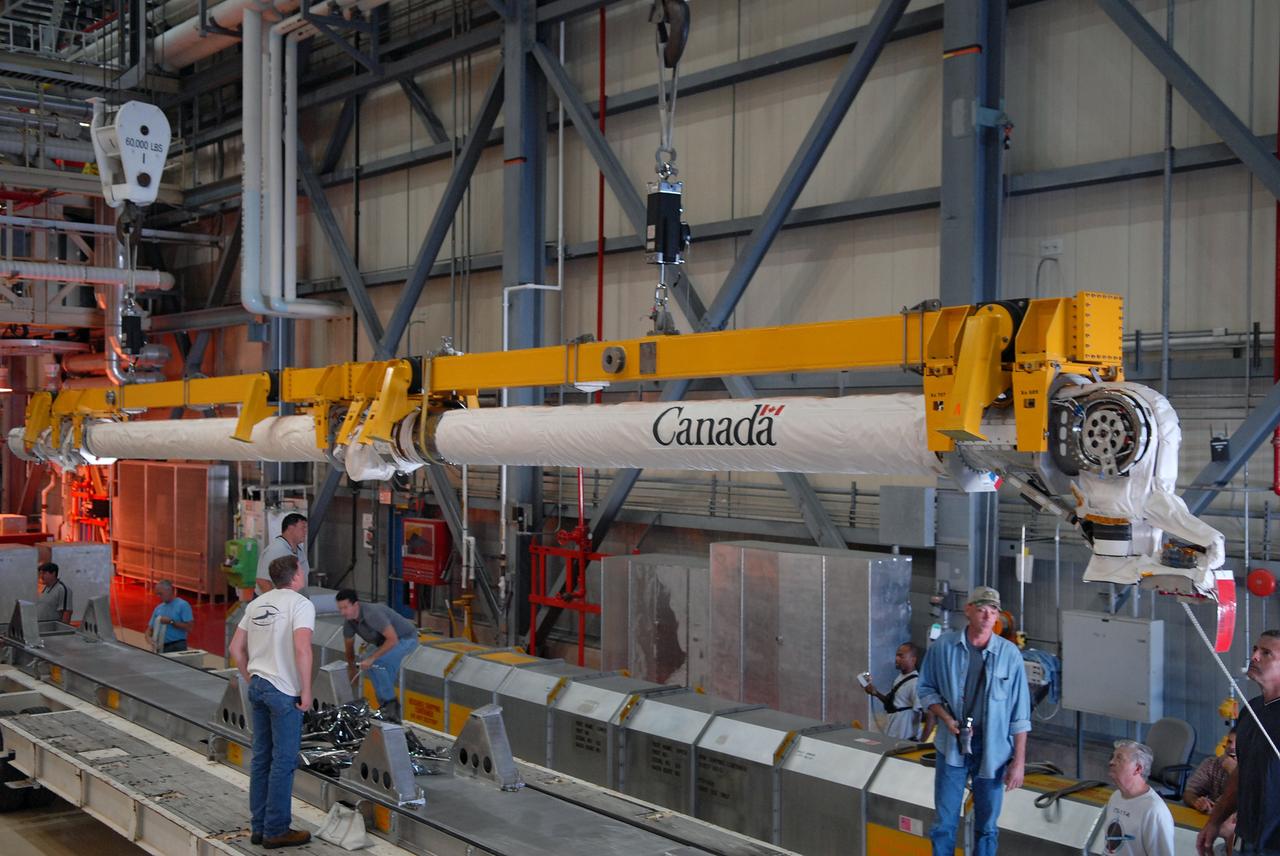
CAPE CANAVERAL, Fla. – In Orbiter Processing Facility bay 3 at NASA's Kennedy Space Center in Florida, the remote manipulator system, or RMS, removed from space shuttle Discovery is lowered toward a storage platform. The RMS is used to grab, or grapple, the payload as well as retrieve, repair and deploy satellites; provide a mobile extension ladder for spacewalking crewmembers; and be used as an inspection aid to allow flight crew members to view the orbiter’s or payload’s surfaces through a TV camera on the arm. Discovery is targeted to launch Aug. 6 on the STS-128 mission. Photo credit: NASA/Jack Pfaller
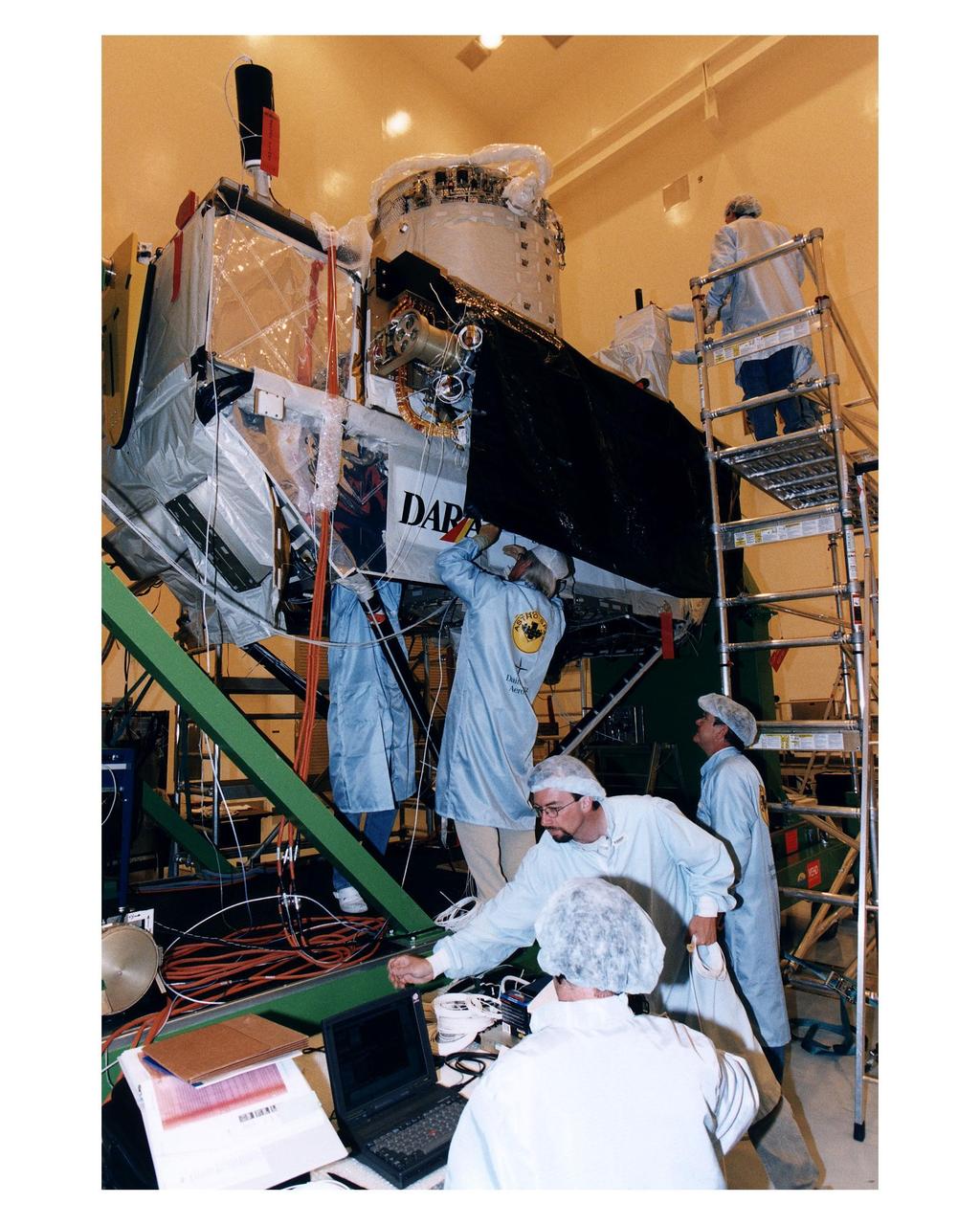
Employees of Daimler-Benz Aerospace in the Multi-Payload Processing Facility install insulation on the Cryogenic Infrared Spectro-meters and Telescopes for the Atmosphere-Shuttle Pallet Satellite-2 (CRISTA-SPAS-2) payload for the STS-85 mission. The CRISTA is a system of three telescopes and four spectrometers to measure infrared radiation emitted by the Earth’s middle atmosphere. During the 11- day mission, the CRISTA-SPAS-2 free-flying satellite will be deployed from the Space Shuttle Discovery and retrieved later in the flight. Also onboard the satellite will be the Middle Atmosphere High Resolution Spectrograph Investigation (MAHRSI) to measure ultraviolet radiation emitted and scattered by the Earth’s atmosphere
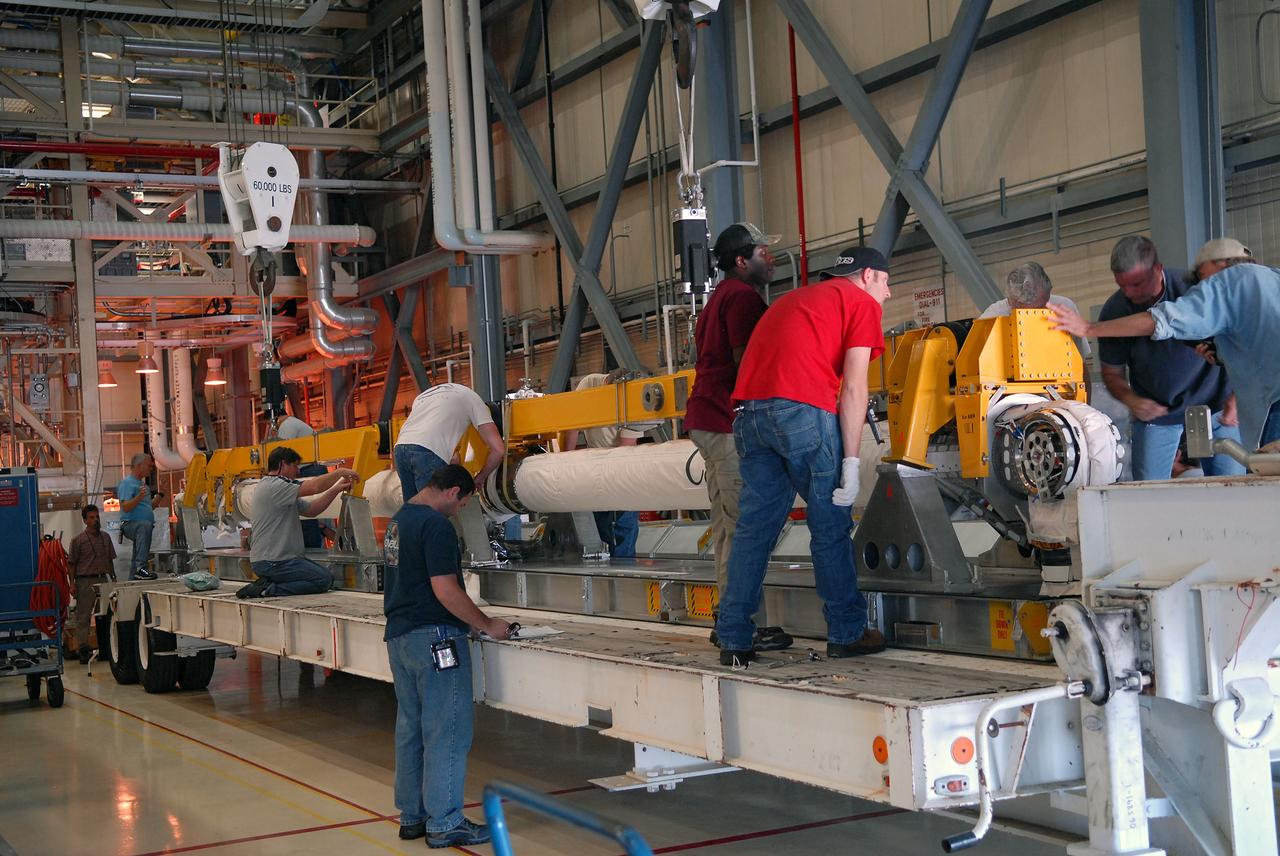
CAPE CANAVERAL, Fla. – In Orbiter Processing Facility bay 3 at NASA's Kennedy Space Center in Florida, technicians secure the remote manipulator system, or RMS, removed from space shuttle Discovery onto a storage platform. The RMS is used to grab, or grapple, the payload as well as retrieve, repair and deploy satellites; provide a mobile extension ladder for spacewalking crewmembers; and be used as an inspection aid to allow flight crew members to view the orbiter’s or payload’s surfaces through a TV camera on the arm. Discovery is targeted to launch Aug. 6 on the STS-128 mission. Photo credit: NASA/Jack Pfaller
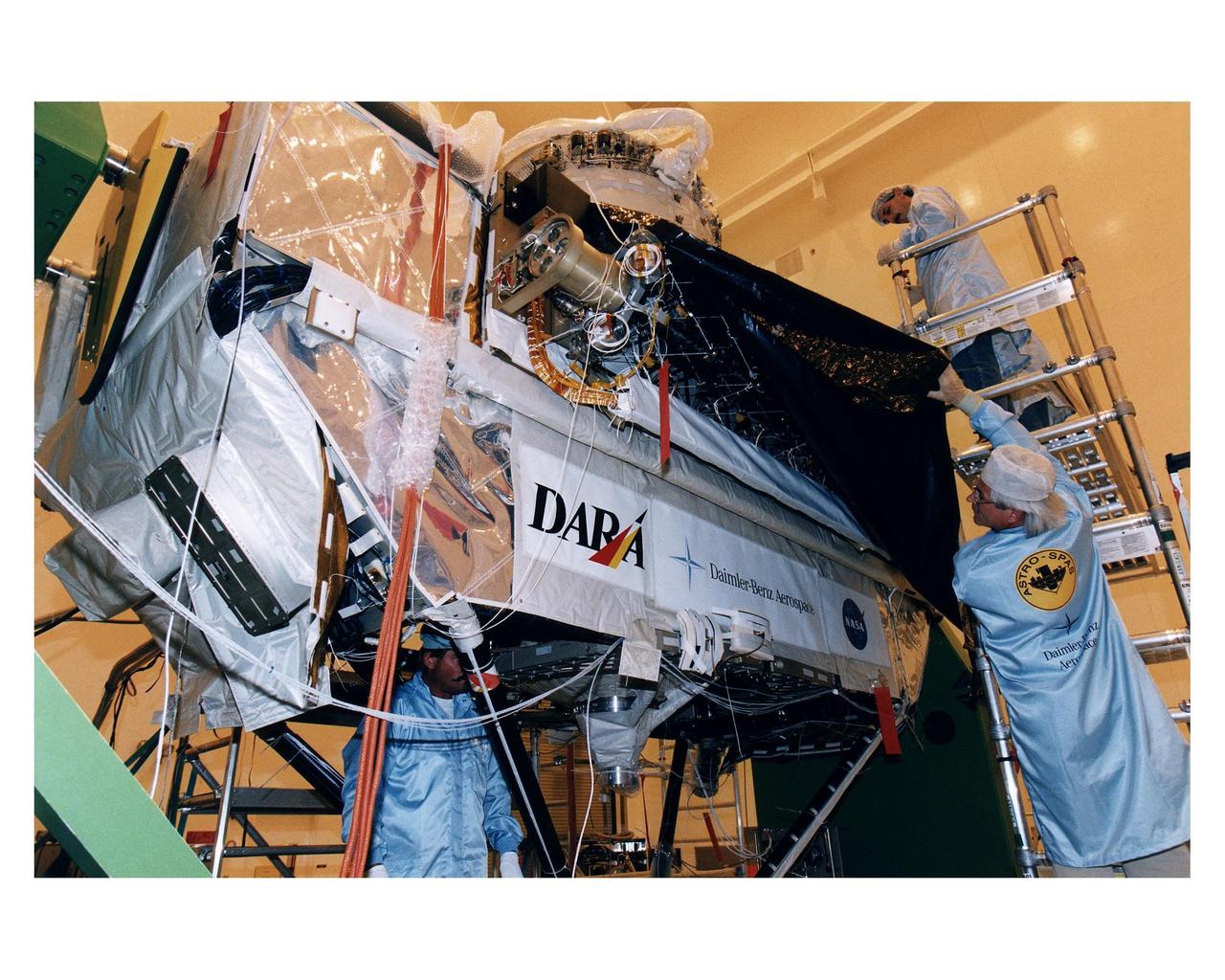
Employees of Daimler-Benz Aerospace in the Multi-Payload Processing Facility install insulation on the Cryogenic Infrared Spectro-meters and Telescopes for the Atmosphere-Shuttle Pallet Satellite-2 (CRISTA-SPAS-2) payload for the STS-85 mission. The CRISTA is a system of three telescopes and four spectrometers to measure infrared radiation emitted by the Earth’s middle atmosphere. During the 11- day mission, the CRISTA-SPAS-2 free-flying satellite will be deployed from the Space Shuttle Discovery and retrieved later in the flight. Also onboard the satellite will be the Middle Atmosphere High Resolution Spectrograph Investigation (MAHRSI) to measure ultraviolet radiation emitted and scattered by the Earth’s atmosphere
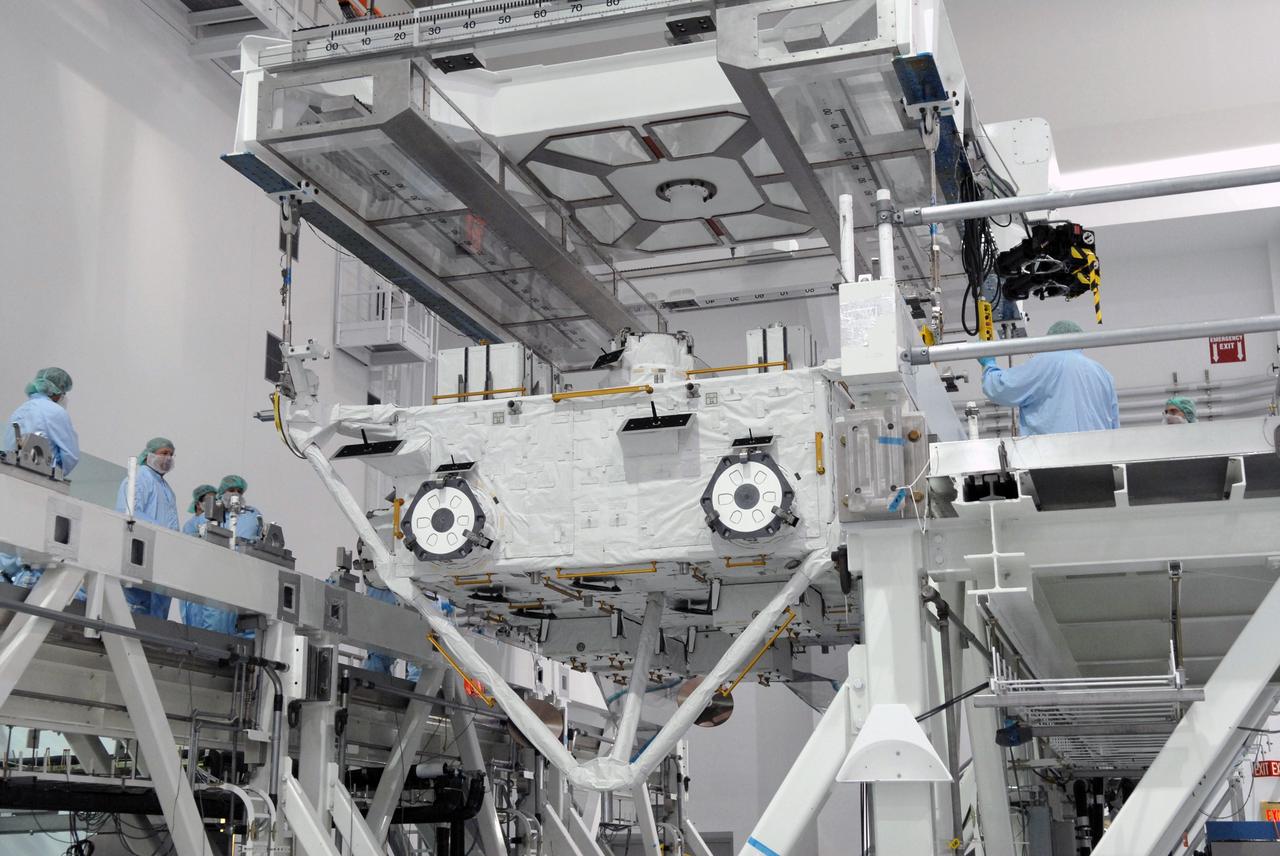
CAPE CANAVERAL, Fla. – In the Space Station Processing Facility at NASA's Kennedy Space Center in Florida, an overhead crane is attached to the Japan Aerospace Exploration Agency's Kibo Exposed Facility, or EF, part of the payload for the STS-127 mission. The module will be transferred to the payload canister. The EF, along with the Experiment Logistics Module Exposed Section, will be carried aboard space shuttle Endeavour on the STS-127 mission targeted for launch June 13. When the EF is installed on the Kibo laboratory, it will provide a multipurpose platform where science experiments can be deployed and operated in the exposed environment. The payloads attached to the EF can be exchanged or retrieved by Kibo's robotic arm, the JEM Remote Manipulator. Photo credit: NASA/Jack Pfaller
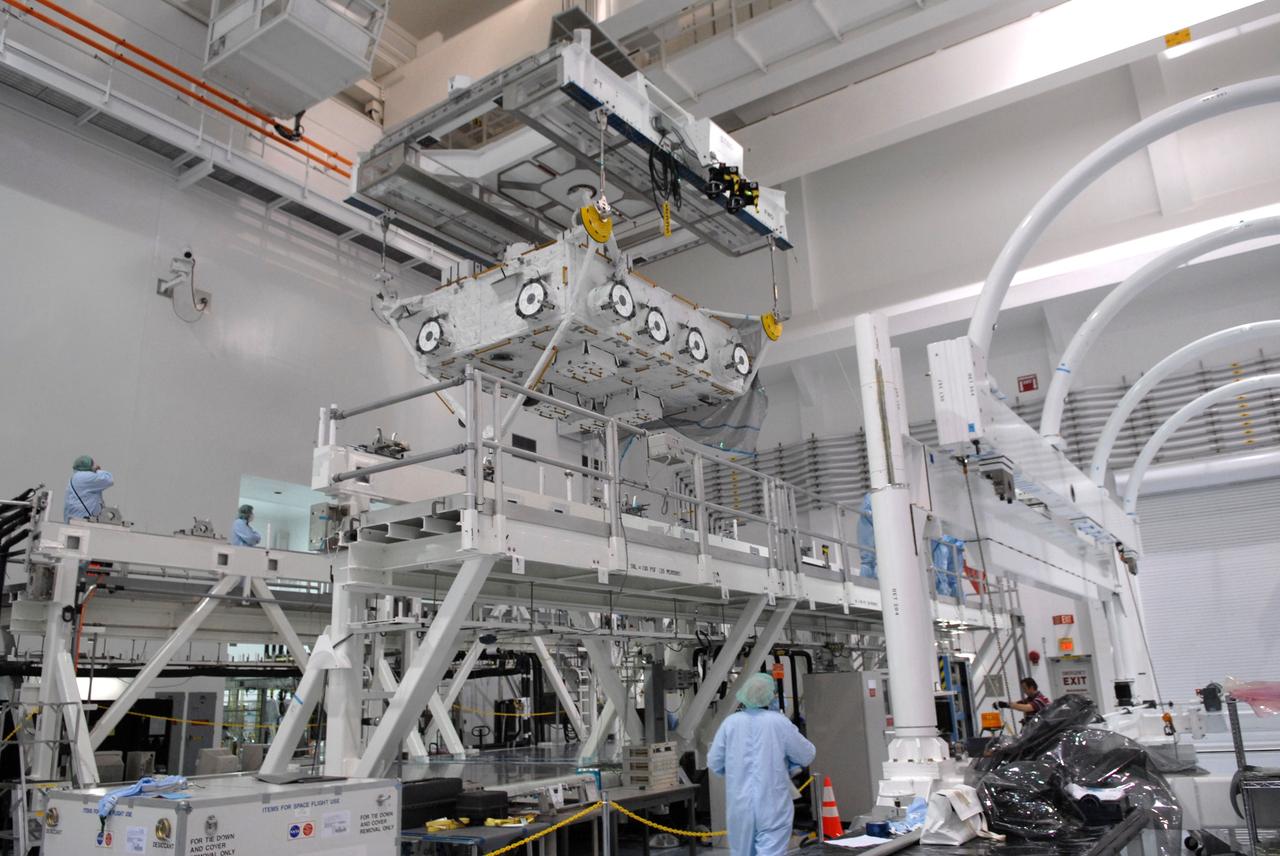
CAPE CANAVERAL, Fla. – In the Space Station Processing Facility at NASA's Kennedy Space Center in Florida, an overhead crane lifts the the Japan Aerospace Exploration Agency's Kibo Exposed Facility, or EF, part of the payload for the STS-127 mission, from its stand. The module will be transferred to the payload canister. The EF, along with the Experiment Logistics Module Exposed Section, will be carried aboard space shuttle Endeavour on the STS-127 mission targeted for launch June 13. When the EF is installed on the Kibo laboratory, it will provide a multipurpose platform where science experiments can be deployed and operated in the exposed environment. The payloads attached to the EF can be exchanged or retrieved by Kibo's robotic arm, the JEM Remote Manipulator. Photo credit: NASA/Jack Pfaller
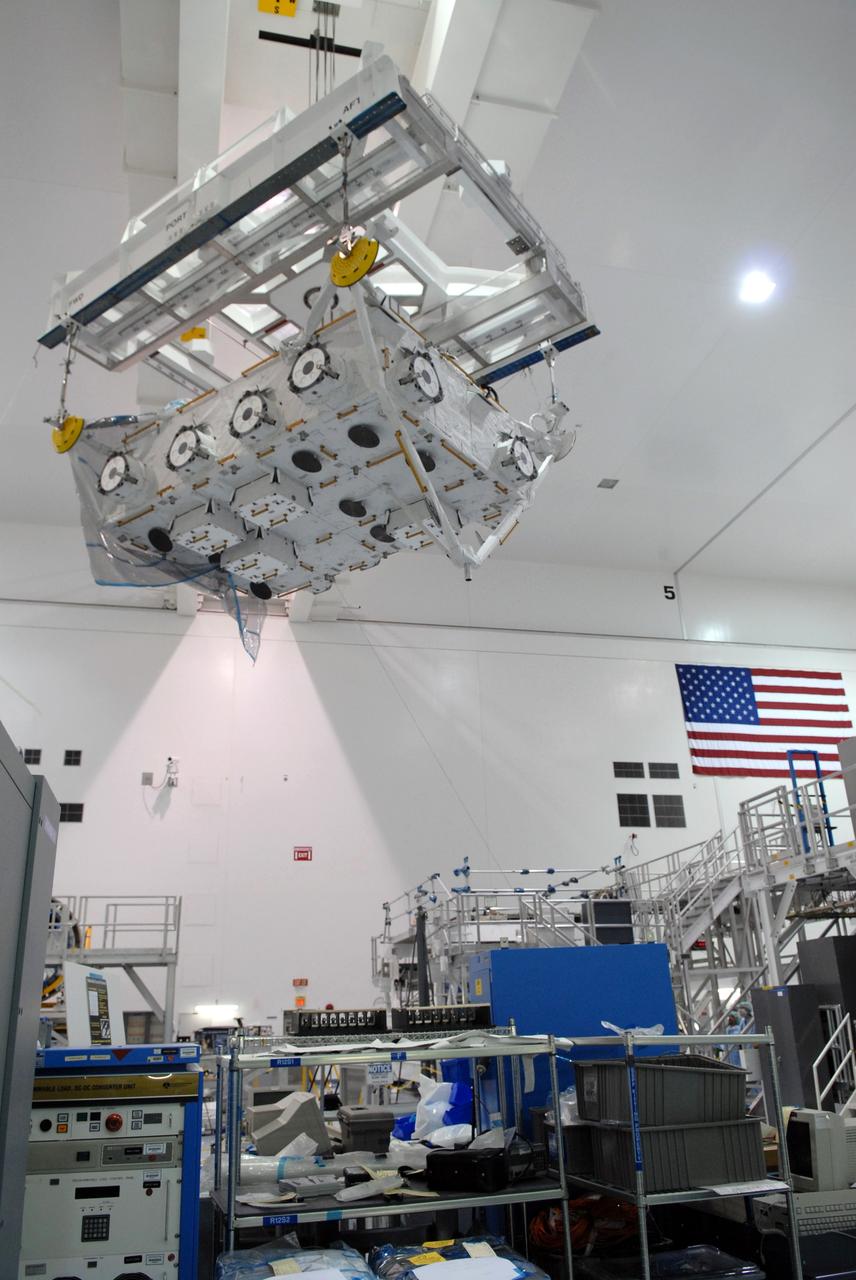
CAPE CANAVERAL, Fla. – In the Space Station Processing Facility at NASA's Kennedy Space Center in Florida, an overhead crane moves the the Japan Aerospace Exploration Agency's Kibo Exposed Facility, or EF, part of the payload for the STS-127 mission, across the floor toward the payload canister. The EF, along with the Experiment Logistics Module Exposed Section, will be carried aboard space shuttle Endeavour on the STS-127 mission targeted for launch June 13. When the EF is installed on the Kibo laboratory, it will provide a multipurpose platform where science experiments can be deployed and operated in the exposed environment. The payloads attached to the EF can be exchanged or retrieved by Kibo's robotic arm, the JEM Remote Manipulator. Photo credit: NASA/Jack Pfaller
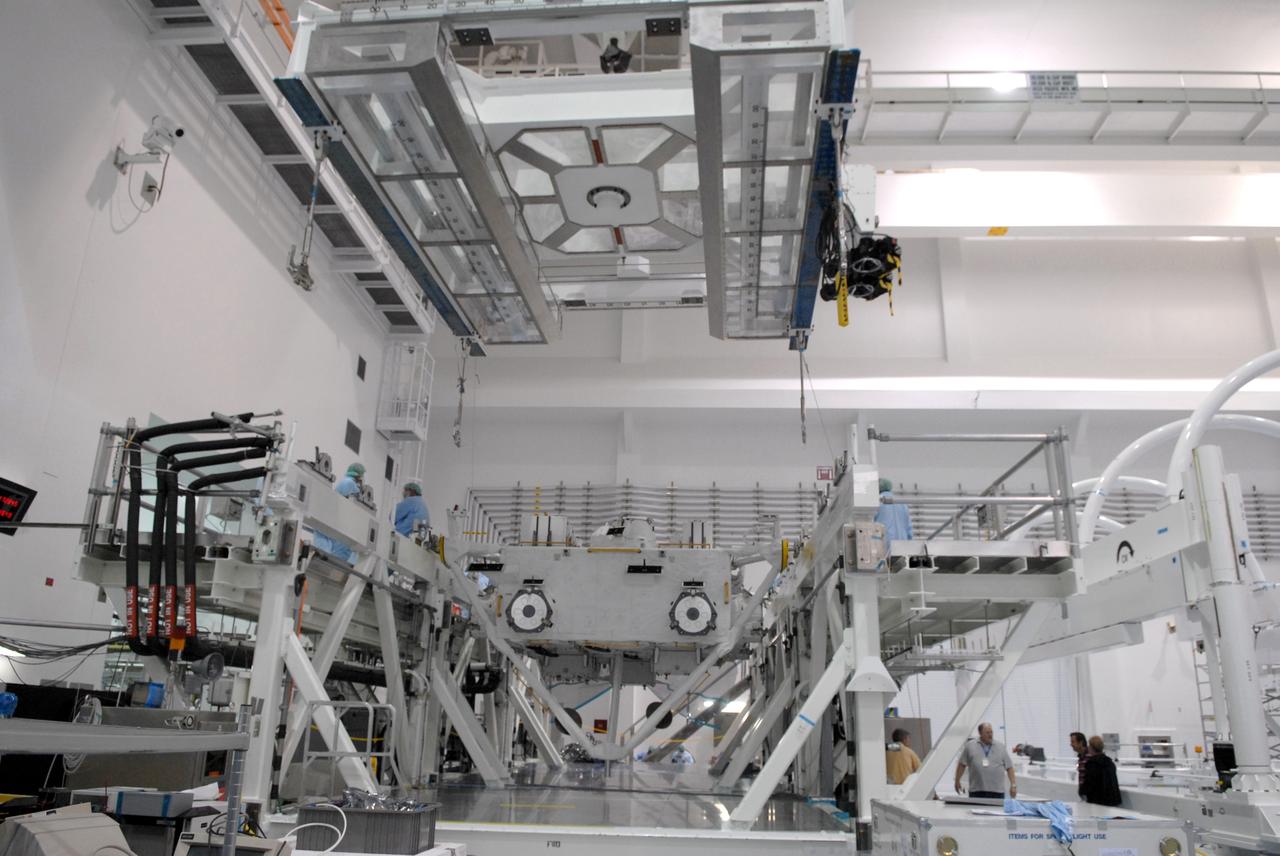
CAPE CANAVERAL, Fla. – In the Space Station Processing Facility at NASA's Kennedy Space Center in Florida, an overhead crane is moved into position above the Japan Aerospace Exploration Agency's Kibo Exposed Facility, or EF, part of the payload for the STS-127 mission. The module will be transferred to the payload canister. The EF, along with the Experiment Logistics Module Exposed Section, will be carried aboard space shuttle Endeavour on the STS-127 mission targeted for launch June 13. When the EF is installed on the Kibo laboratory, it will provide a multipurpose platform where science experiments can be deployed and operated in the exposed environment. The payloads attached to the EF can be exchanged or retrieved by Kibo's robotic arm, the JEM Remote Manipulator. Photo credit: NASA/Jack Pfaller
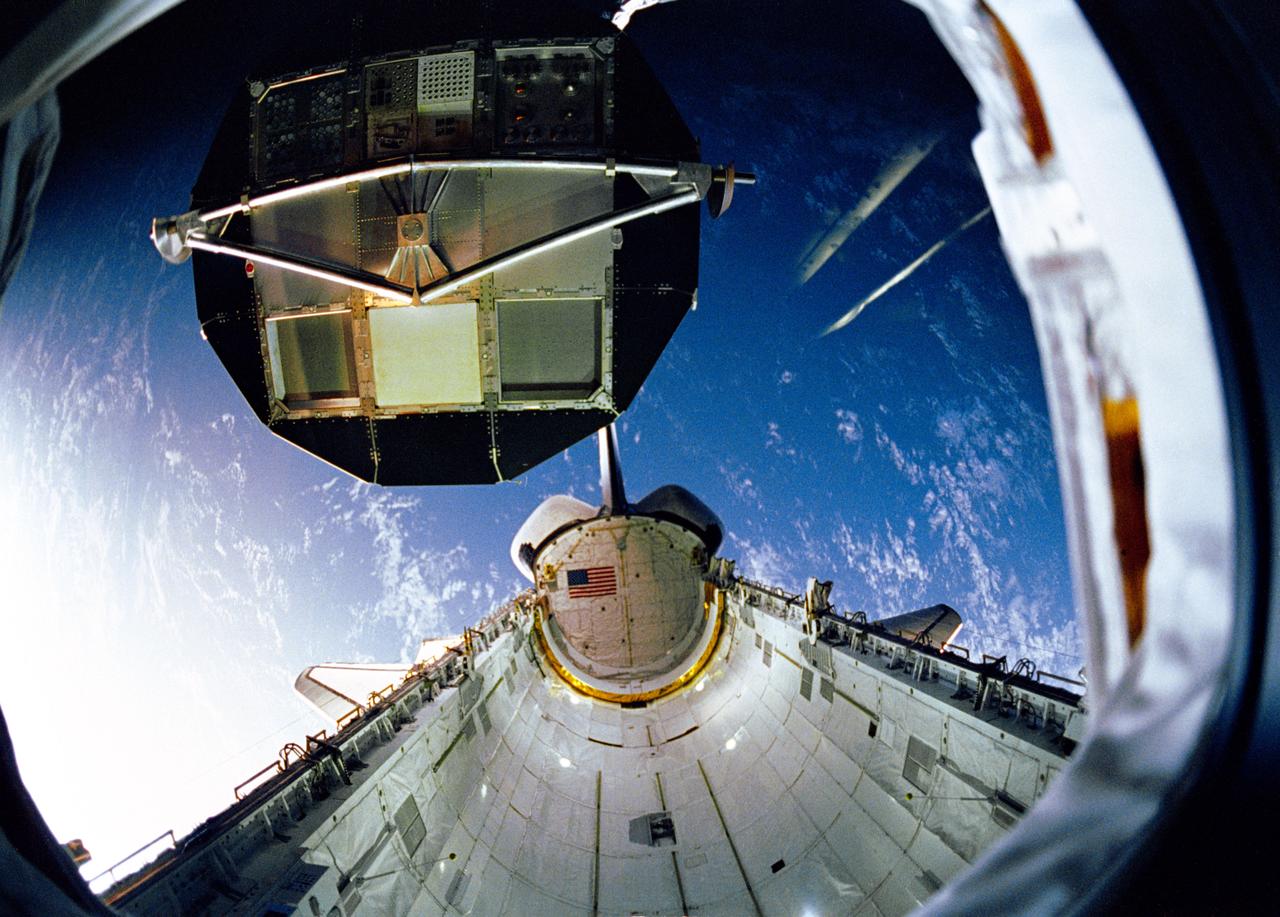
STS032-544-010 (12 Jan 1990) --- Canadian-built RMS suspends LDEF over cargo bay during extensive in-space survey.
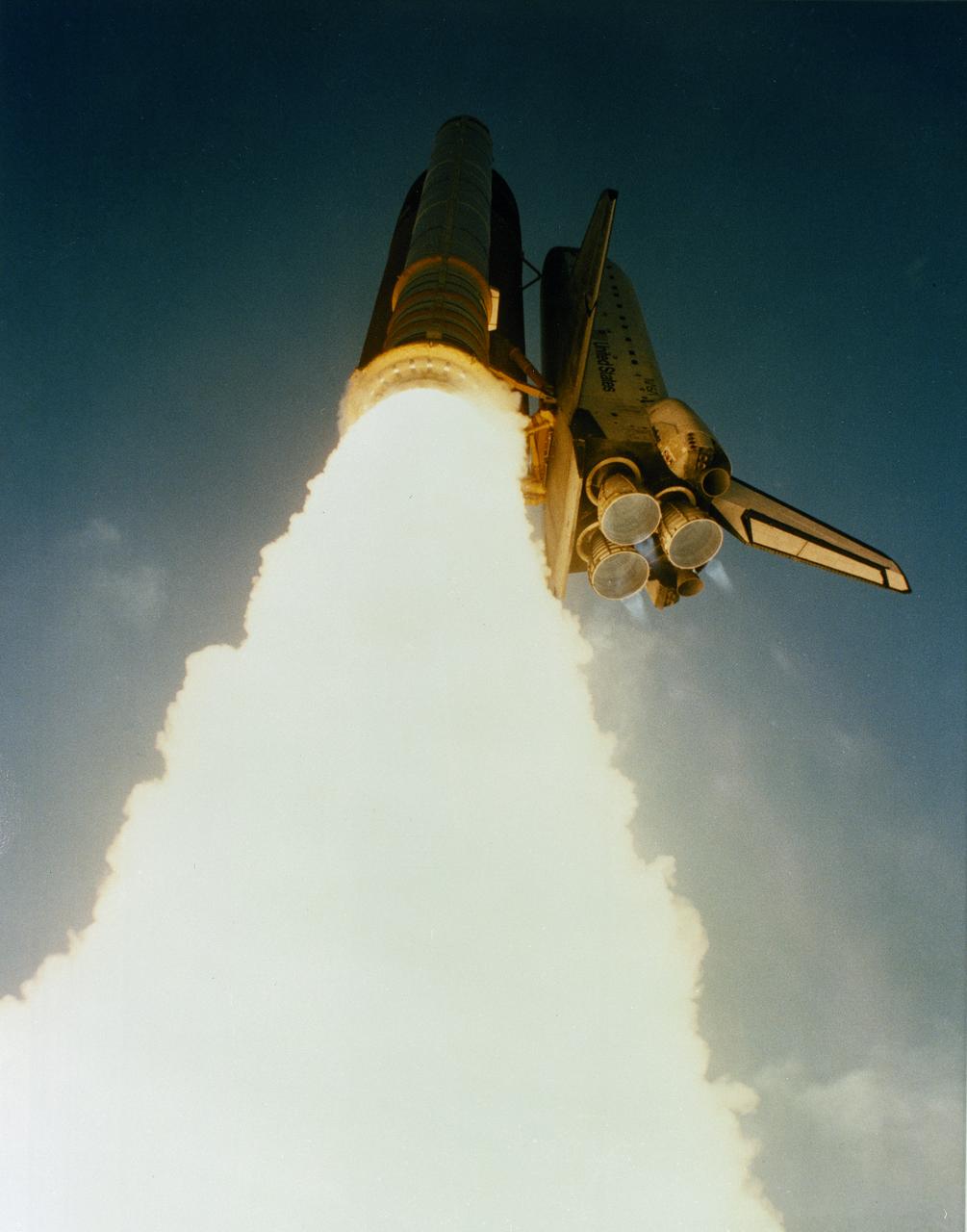
Launched aboard the Space Shuttle Atlantis on July 31, 1992 at 9:56:48 am (EDT), the STS-46 mission’s primary objectives included the deployment of the European Space Agency’s European Retrievable Carrier (EURECA) and operation of the joint NASA/Italian Space Agency Tethered Satellite System (TSS). The STS-46 crew of seven included: Loren J. Shriver, commander; Andrew M. Allen, pilot; Jeffrey A. Hoffman, mission specialist 1; Franklin R. Chang-Diaz, mission specialist 2; Claude Nicollier, mission specialist 3; Marsha S. Ivins, mission specialist 4; and Franco Malerba, payload specialist 1.
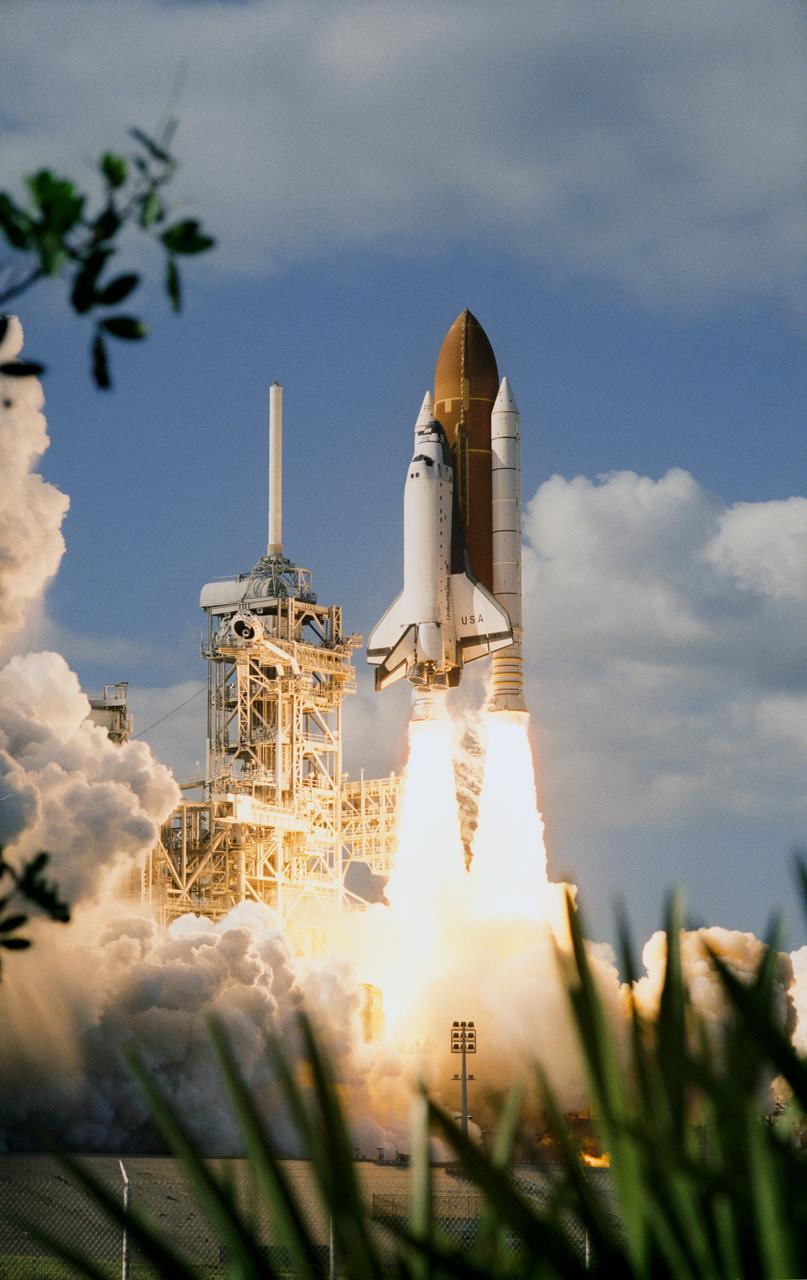
STS080-S-004 (19 Nov. 1996) --- The space shuttle Columbia lifts off from the Kennedy Space Center's (KSC) Launch Pad 39B at 2:55:47 p.m. (EST), Nov. 19, 1996. Onboard are astronauts Kenneth D. Cockrell, STS-80 mission commander; Kent V. Rominger, pilot; along with Story Musgrave, Tamara E. Jernigan and Thomas D. Jones, all mission specialists. The two primary payloads for STS-80 stowed in Columbia's cargo bay for later deployment and testing are the Wake Shield Facility (WSF-3) and the Orbiting and Retrievable Far and Extreme Ultraviolet Spectrometer (ORFEUS) with its associated Shuttle Pallet Satellite (SPAS).
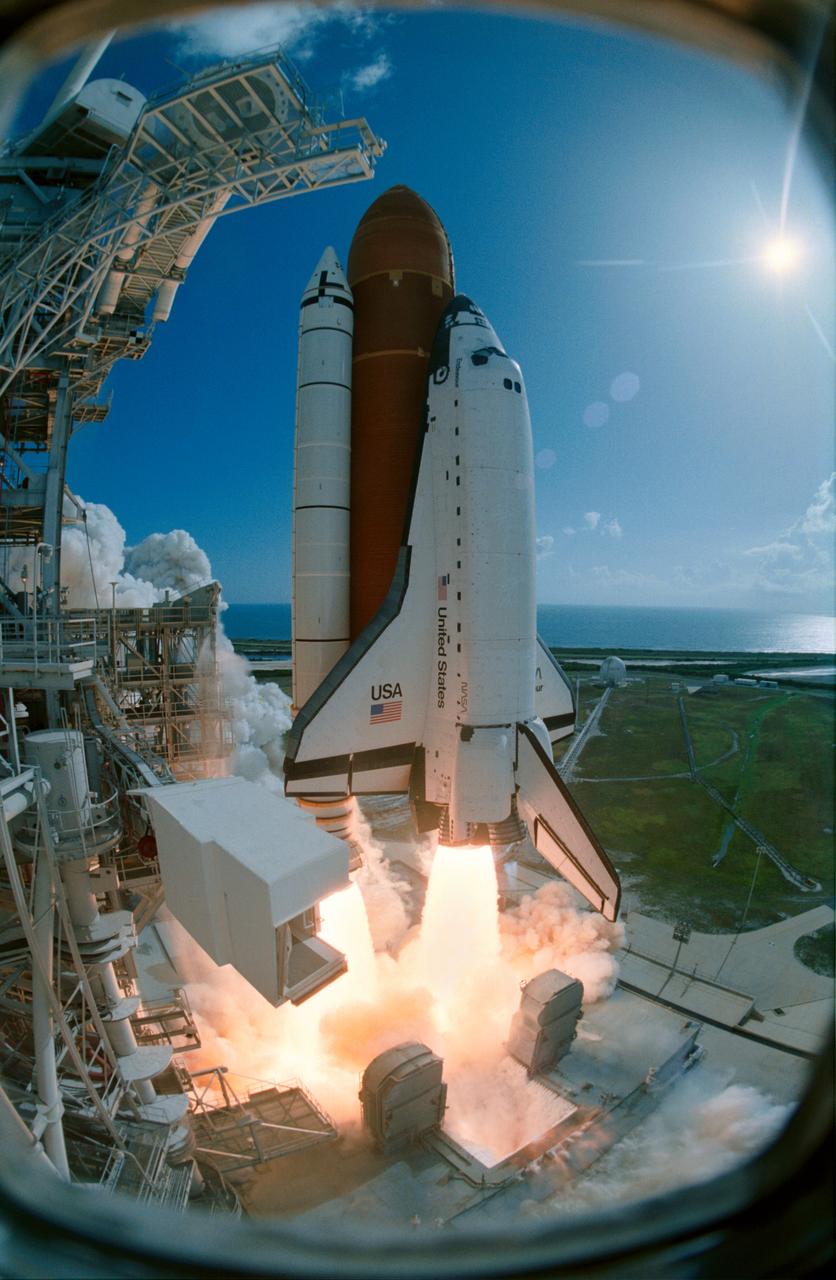
STS057-S-053 (21 June 1993) --- The Space Shuttle Endeavour lifts off Launch Pad 39B as captured on film by an audio-activated camera positioned at the 270-feet level on the Rotating Service Structure (RSS) at Launch Pad 39B. STS-57 launch occurred at 9:07:22 a.m. (EDT), June 21, 1993. The mission represents the first flight of the commercially developed SpaceHab laboratory module and also will feature a retrieval of the European Retrievable Carrier (EURECA). Onboard for Endeavour's fourth flight are a crew of six NASA astronauts; Ronald J. Grabe, mission commander; Brian Duffy, pilot; G. David Low, payload commander; and Nancy J. Sherlock, Peter J. K. (Jeff) Wisoff and Janice E. Voss, all mission specialists. An earlier launch attempt was scrubbed due to unacceptable weather conditions both at the Kennedy Space Center (KSC) and the overseas contingency landing sites.
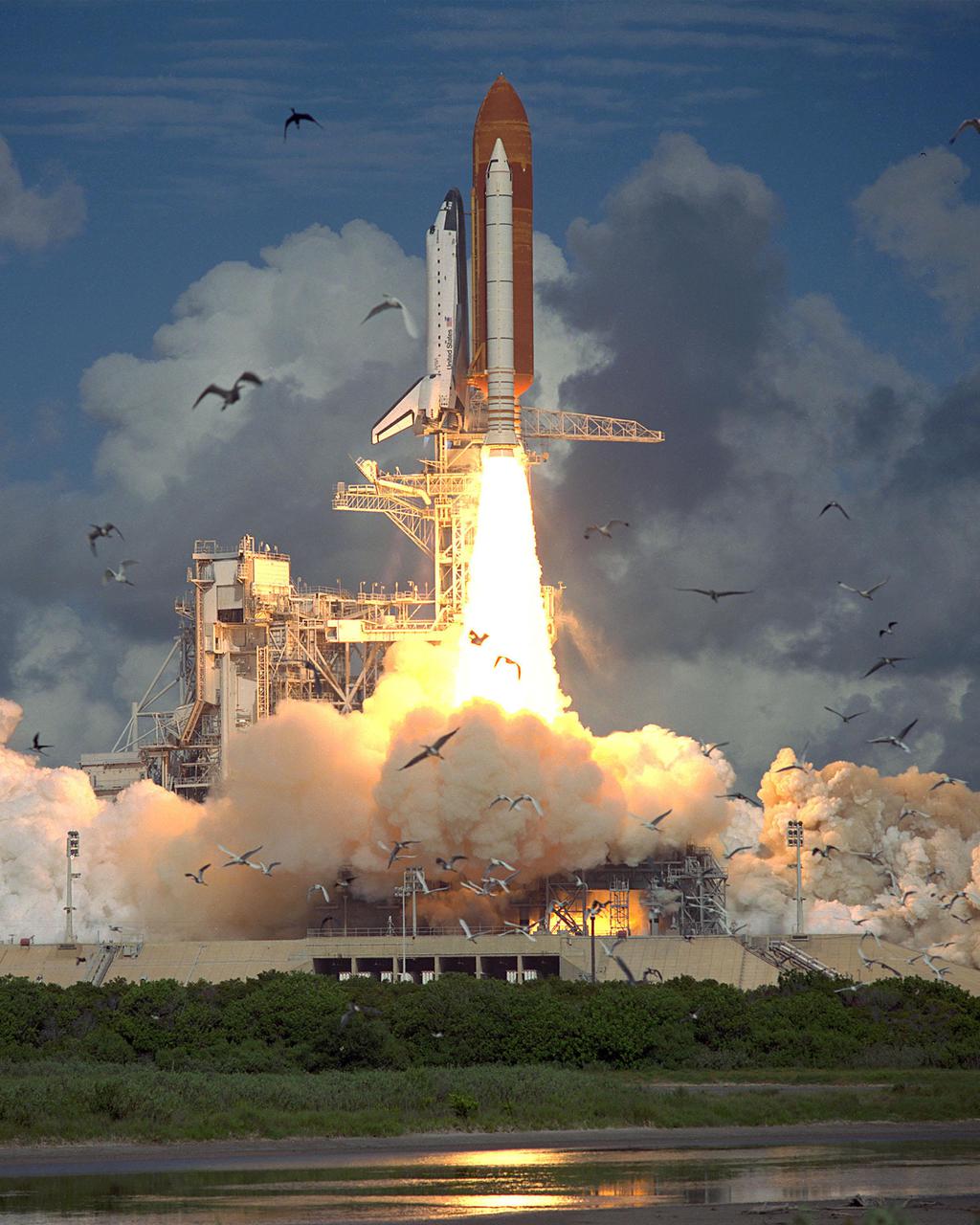
KENNEDY SPACE CENTER, FLA. -- The first flight of the commercially developed SPACEHAB laboratory module begins with the flawless liftoff of the Space Shuttle Endeavour from Launch Pad 39B at 9:07:22 a.m. EDT, June 21. Also planned for the eight-day flight of Mission STS-57 is the retrieval of the European Retrievable Carrier (EURECA). Onboard for the fourth flight of Endeavour are a crew of six: Mission Commander Ronald J. Grabe, Pilot Brian Duffy, Payload Commander G. David Low, and Mission Specialists Nancy Jane Sherlock, Peter J.K. 'Jeff' Wisoff, and Janice E. Voss. A first launch attempt on June 20 was scrubbed due to unacceptable weather conditions both at KSC and the overseas contingency landing sites.
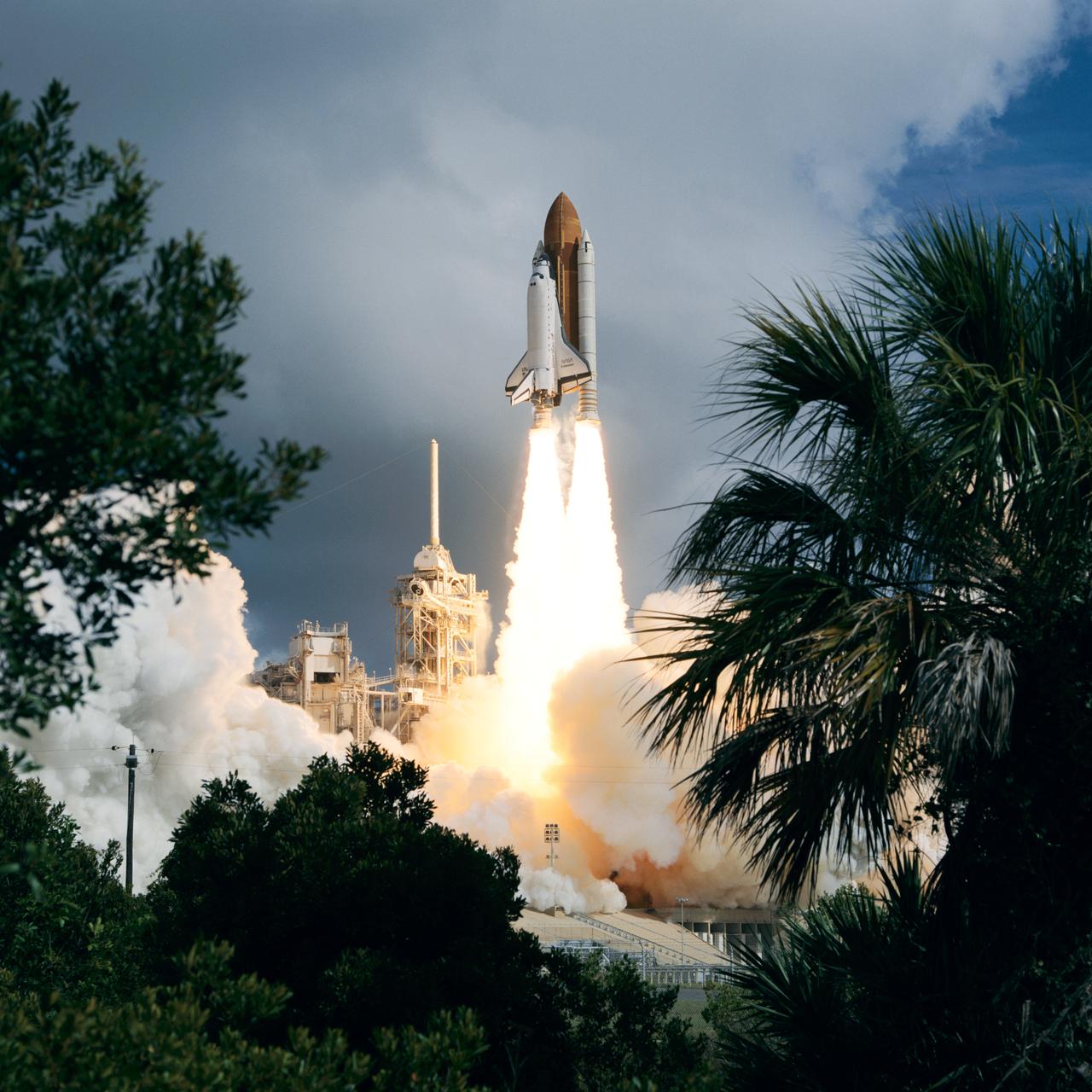
STS057-S-055 (21 June 1993) --- Framed by a variety of flora types, the Space Shuttle Endeavour lifts off Launch Pad 39B to begin the STS-57 mission. Launch occurred at 9:07:22 a.m. (EDT), June 21, 1993. The mission represents the first flight of the commercially developed SPACEHAB laboratory module and also will feature a retrieval of the European Retrievable Carrier (EURECA). Onboard for Endeavour's fourth flight are a crew of six - Ronald J. Grabe, mission commander; Brian Duffy, pilot; G. David Low, payload commander; and Nancy J. Sherlock, Peter J.K. (Jeff) Wisoff and Janice E. Voss, all mission specialists. An earlier launch attempt was scrubbed due to unacceptable weather conditions both at KSC and the overseas contingency landing sites.
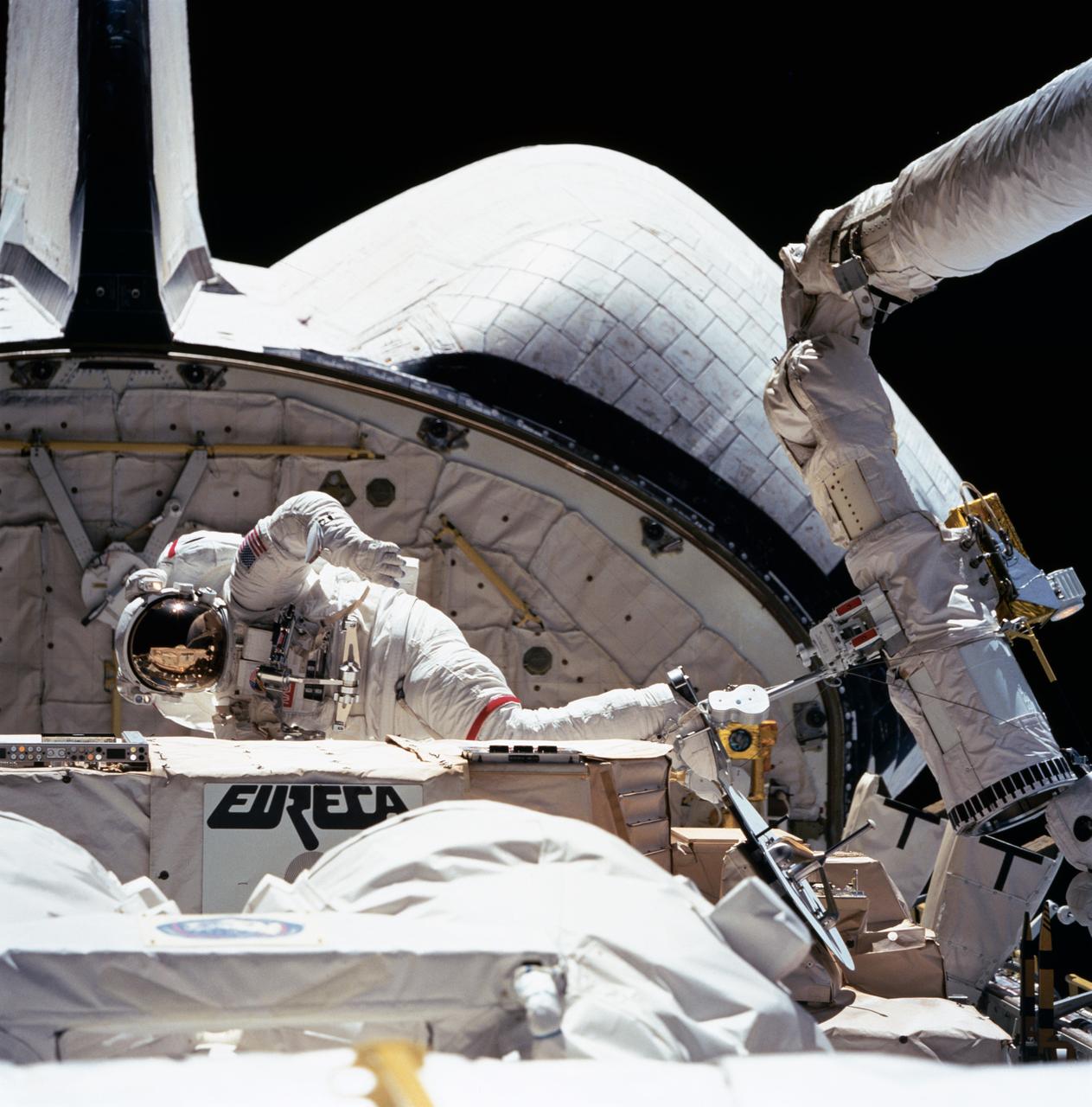
The darkness of space forms the backdrop for this extravehicular activity (EVA) scene captured by one of the STS-57 crewmembers in Endeavour's, Orbiter Vehicle (OV) 105's, crew cabin. Pictured near the recently "captured" European Retrievable Carrier (EURECA) at frame center is Mission Specialist (MS) and Payload Commander (PLC) G. David Low. Suited in an extravehicular mobility unit (EMU), Low, anchored to the remote manipulator system (RMS) via a portable foot restraint (PFR) (manipulator foot restraint (MFR)), is conducting Detailed Test Objective (DTO) 1210 procedures. Specifically, this activity will assist in refining several procedures being developed to service the Hubble Space Telescope (HST) on mission STS-61 in December 1993. The PFR is attached to the RMS end effector via a PFR attachment device (PAD). Partially visible in the foreground is the Superfluid Helium Onorbit Transfer (SHOOT) payload.
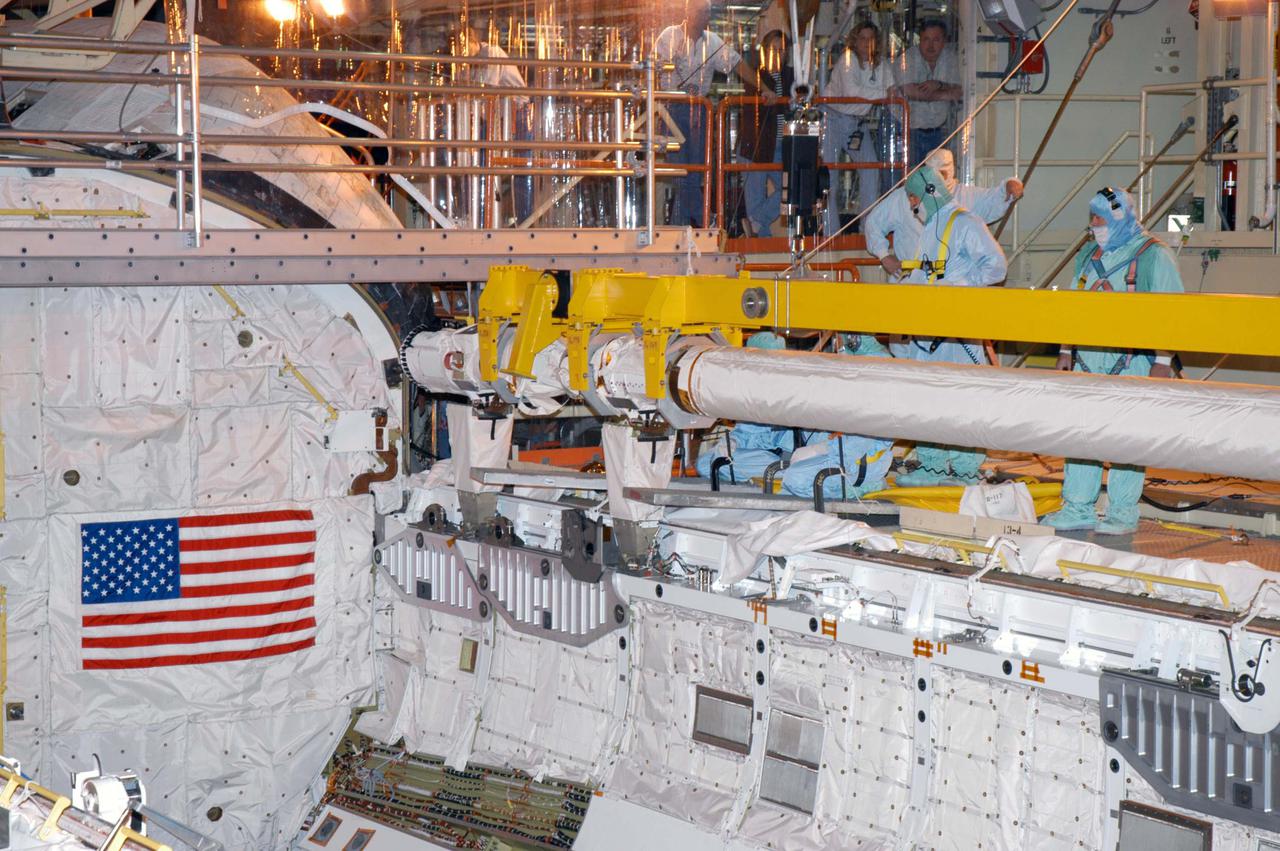
KENNEDY SPACE CENTER, FLA. - In the Orbiter Processing Facility, the Remote Manipulator System (RMS), also known as the Canadian robotic arm, is being installed in Discovery’s payload bay. The RMS is used to deploy and retrieve payloads, provide a mobile extension ladder or foot restraints for crew members during extravehicular activities; and to aid the flight crew members in viewing surfaces of the orbiter or payloads through a television camera on the RMS. The arm is also serving as the base for the new Orbiter Boom Sensor System (OBSS), one of the safety measures for Return to Flight, equipping the Shuttle with cameras and laser systems to inspect the Shuttle’s Thermal Protection System while in space. Discovery is scheduled for a launch planning window of May 2005 on Return to Flight mission STS-114.
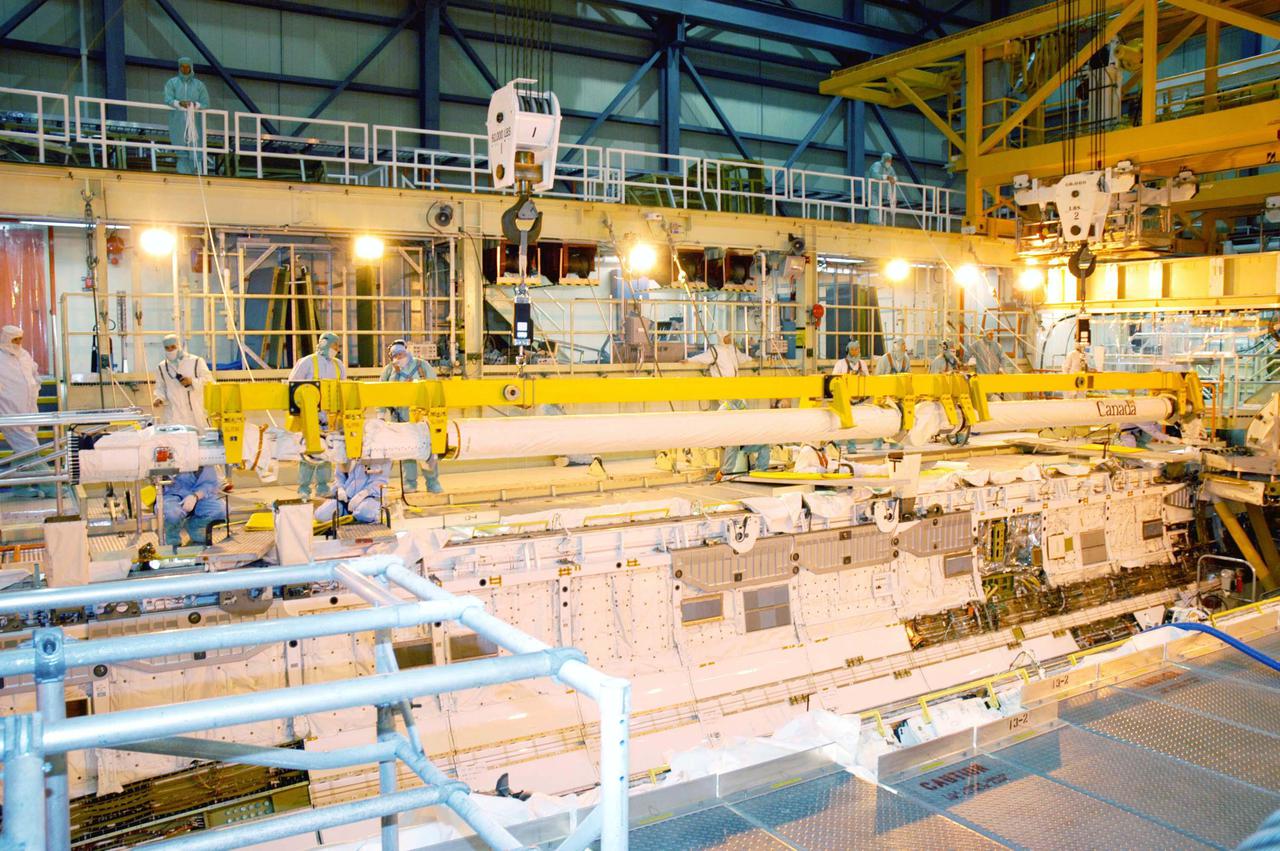
KENNEDY SPACE CENTER, FLA. - In the Orbiter Processing Facility, the Remote Manipulator System (RMS), also known as the Canadian robotic arm, is moved toward Discovery’s payload bay for installation. The RMS is used to deploy and retrieve payloads, provide a mobile extension ladder or foot restraints for crew members during extravehicular activities; and to aid the flight crew members in viewing surfaces of the orbiter or payloads through a television camera on the RMS. The arm is also serving as the base for the new Orbiter Boom Sensor System (OBSS), one of the safety measures for Return to Flight, equipping the Shuttle with cameras and laser systems to inspect the Shuttle’s Thermal Protection System while in space. Discovery is scheduled for a launch planning window of May 2005 on Return to Flight mission STS-114.
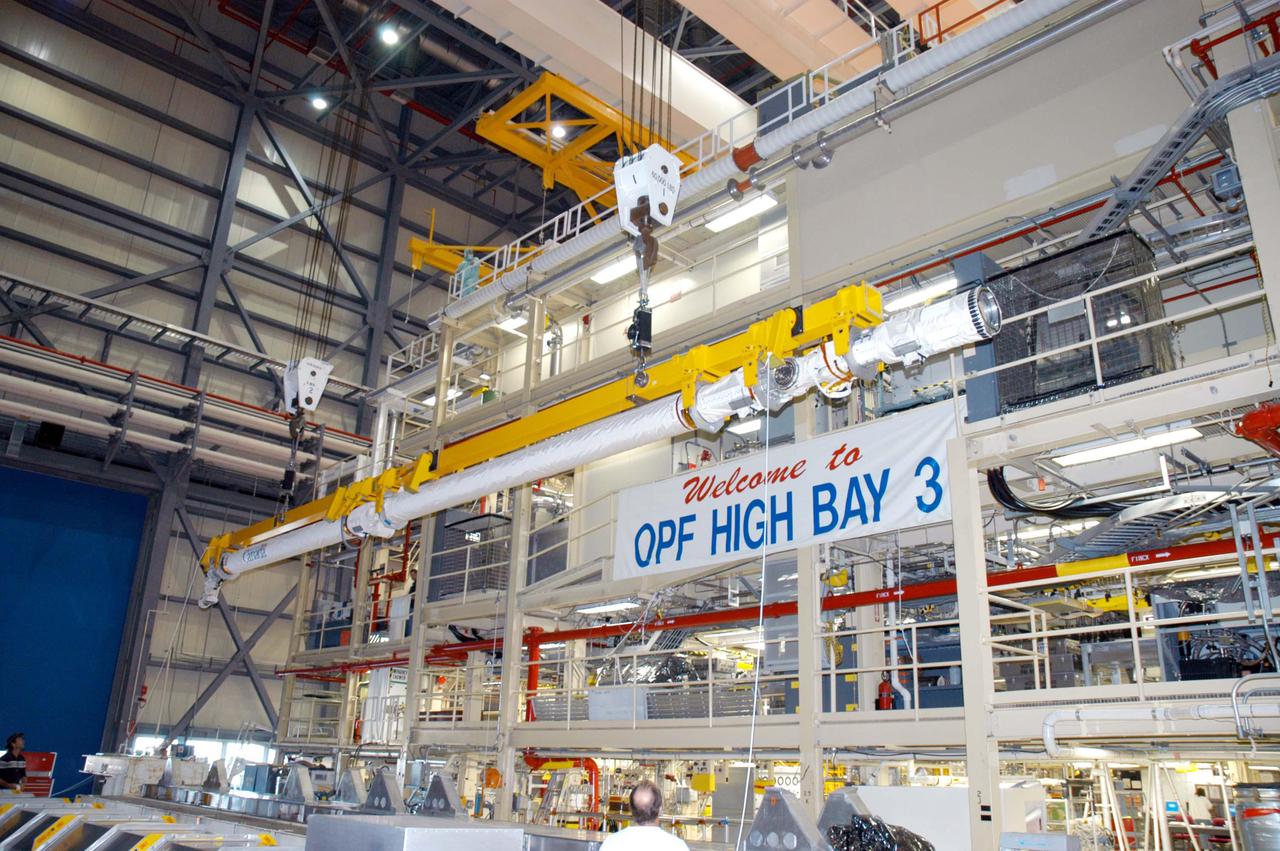
KENNEDY SPACE CENTER, FLA. - The Remote Manipulator System (RMS), also known as the Canadian robotic arm, is moved in the Orbiter Processing Facility for installation in Discovery’s payload bay. The RMS is used to deploy and retrieve payloads, provide a mobile extension ladder or foot restraints for crew members during extravehicular activities; and to aid the flight crew members in viewing surfaces of the orbiter or payloads through a television camera on the RMS. The arm is also serving as the base for the new Orbiter Boom Sensor System (OBSS), one of the safety measures for Return to Flight, equipping the Shuttle with cameras and laser systems to inspect the Shuttle’s Thermal Protection System while in space. Discovery is scheduled for a launch planning window of May 2005 on Return to Flight mission STS-114.
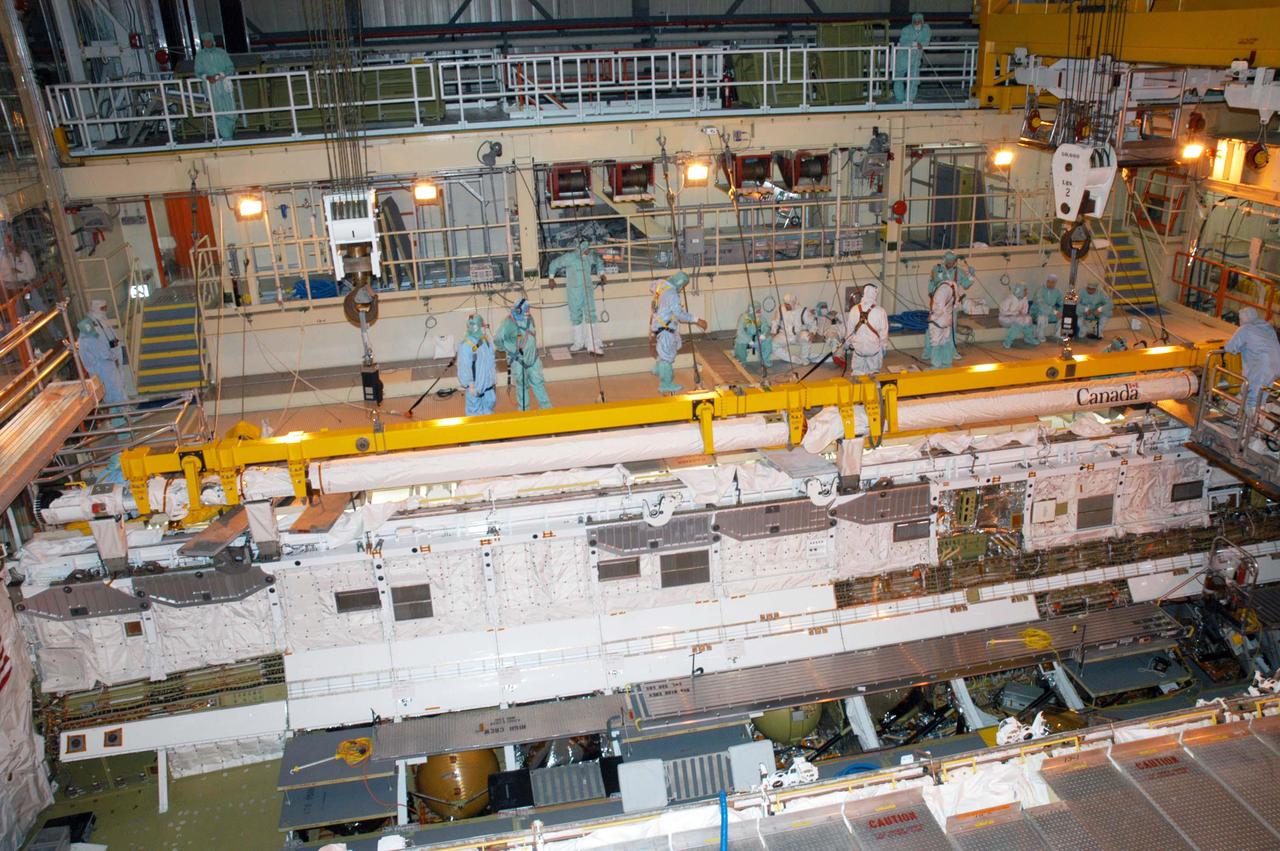
KENNEDY SPACE CENTER, FLA. - Technicians in the Orbiter Processing Facility work to install the Remote Manipulator System (RMS), also known as the Canadian robotic arm, in Discovery’s payload bay. The RMS is used to deploy and retrieve payloads, provide a mobile extension ladder or foot restraints for crew members during extravehicular activities; and to aid the flight crew members in viewing surfaces of the orbiter or payloads through a television camera on the RMS. The arm is also serving as the base for the new Orbiter Boom Sensor System (OBSS), one of the safety measures for Return to Flight, equipping the Shuttle with cameras and laser systems to inspect the Shuttle’s Thermal Protection System while in space. Discovery is scheduled for a launch planning window of May 2005 on Return to Flight mission STS-114.
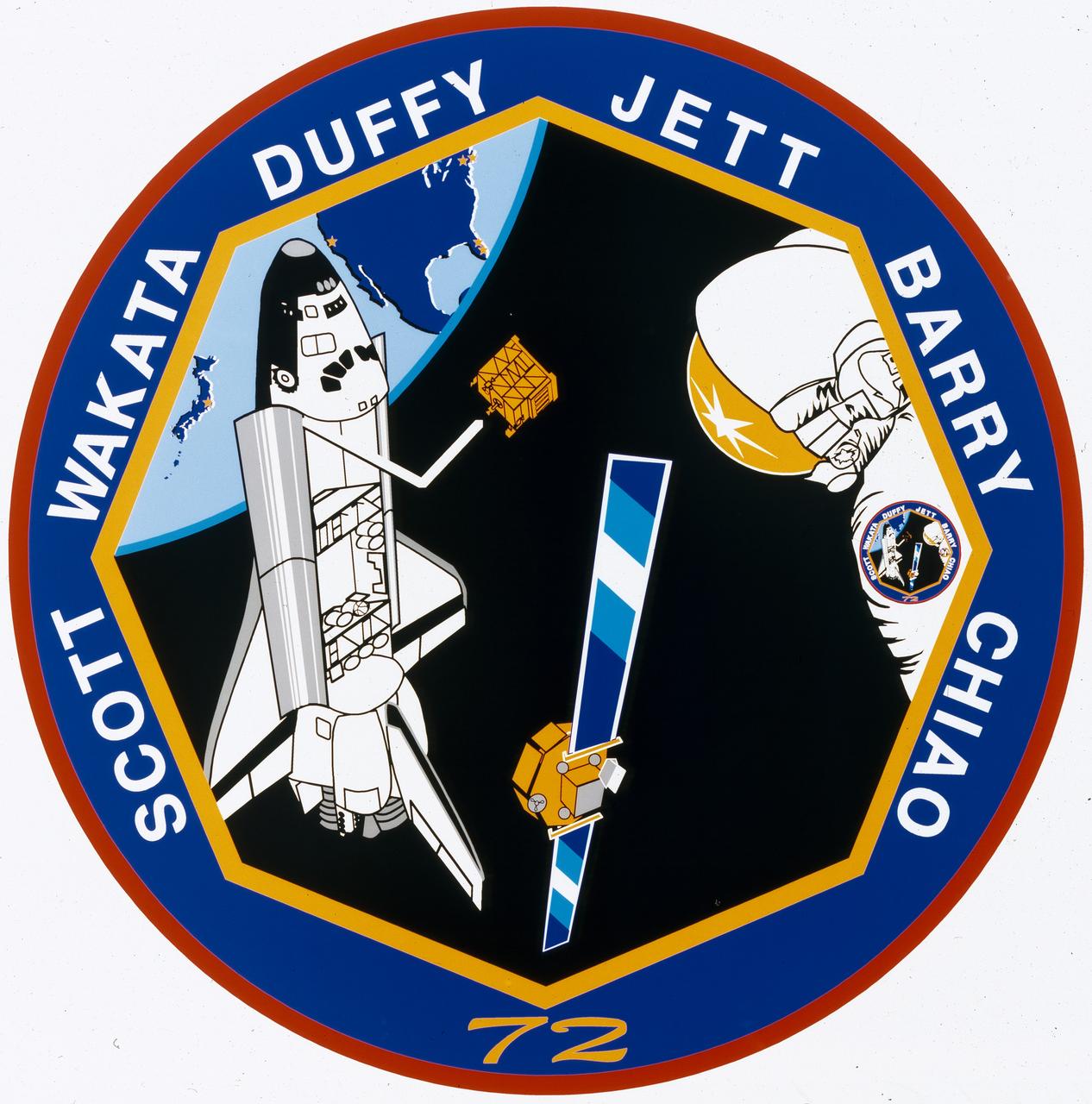
The crew patch of STS-72 depicts the Space Shuttle Endeavour and some of the payloads on the flight. The Japanese satellite, Space Flyer Unit (SFU) is shown in a free-flying configuration with the solar array panels deployed. The inner gold border of the patch represents the SFU's distinct octagonal shape. Endeavour’s rendezvous with and retrieval of SFU at an altitude of approximately 250 nautical miles. The Office of Aeronautics and Space Technology's (OAST) flyer satellite is shown just after release from the Remote Manipulator System (RMS). The OAST satellite was deployed at an altitude of 165 nautical miles. The payload bay contains equipment for the secondary payloads - the Shuttle Laser Altimeter (SLA) and the Shuttle Solar Backscatter Ultraviolet Instrument (SSBUV). There were two space walks planned to test hardware for assembly of the International Space Station. The stars represent the hometowns of the crew members in the United States and Japan.
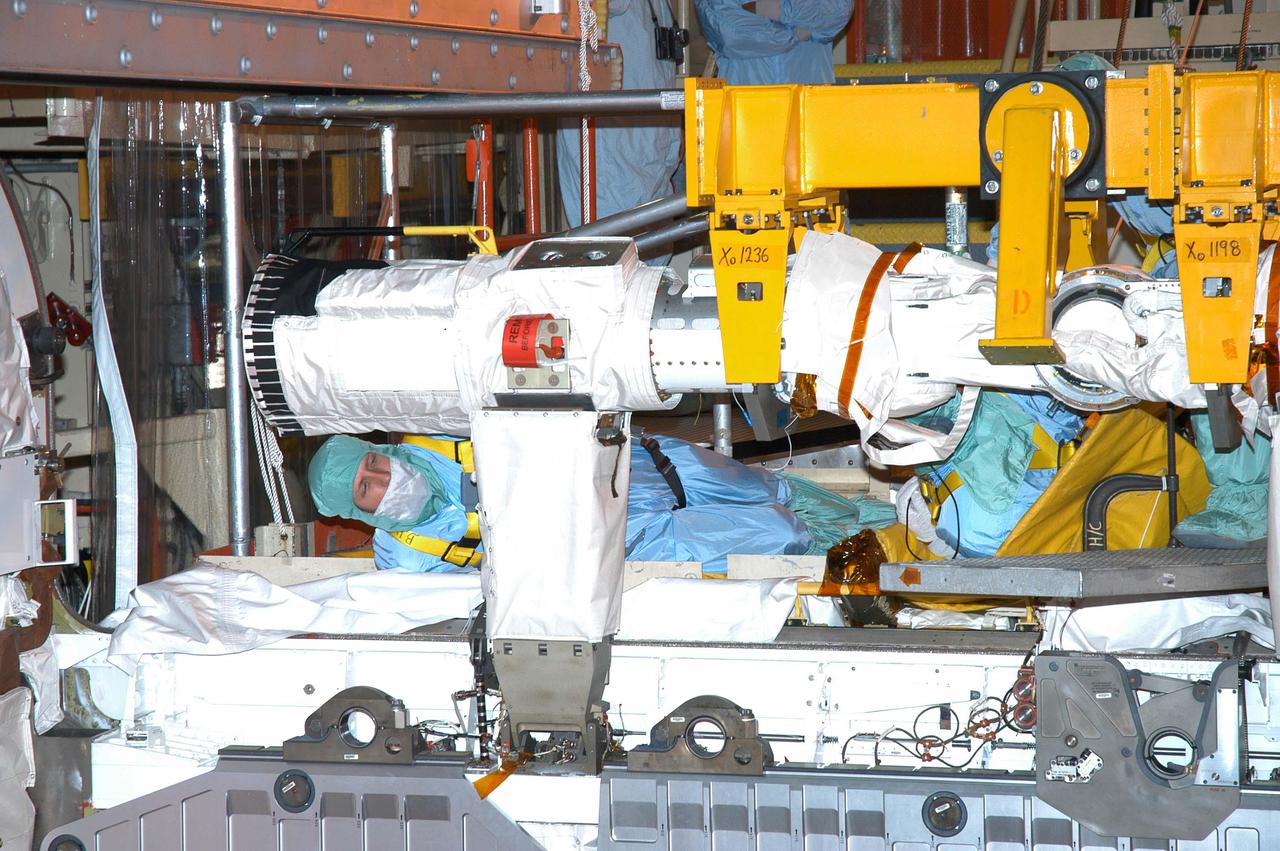
KENNEDY SPACE CENTER, FLA. - Technicians in the Orbiter Processing Facility work to install the Remote Manipulator System (RMS), also known as the Canadian robotic arm, in Discovery’s payload bay. The RMS is used to deploy and retrieve payloads, provide a mobile extension ladder or foot restraints for crew members during extravehicular activities; and to aid the flight crew members in viewing surfaces of the orbiter or payloads through a television camera on the RMS. The arm is also serving as the base for the new Orbiter Boom Sensor System (OBSS), one of the safety measures for Return to Flight, equipping the Shuttle with cameras and laser systems to inspect the Shuttle’s Thermal Protection System while in space. Discovery is scheduled for a launch planning window of May 2005 on Return to Flight mission STS-114.
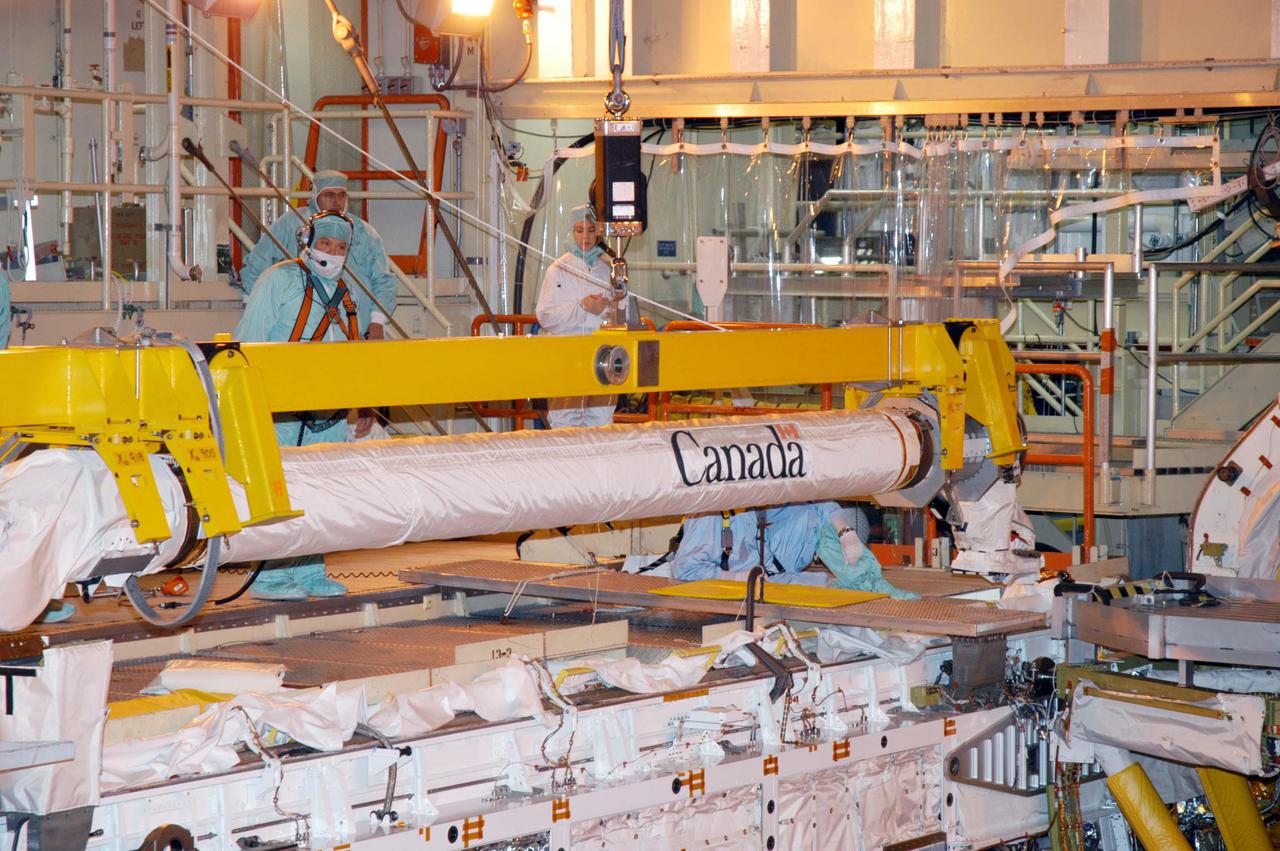
KENNEDY SPACE CENTER, FLA. - In the Orbiter Processing Facility, the Remote Manipulator System (RMS), also known as the Canadian robotic arm, is lowered toward Discovery’s payload bay for installation. The RMS is used to deploy and retrieve payloads, provide a mobile extension ladder or foot restraints for crew members during extravehicular activities; and to aid the flight crew members in viewing surfaces of the orbiter or payloads through a television camera on the RMS. The arm is also serving as the base for the new Orbiter Boom Sensor System (OBSS), one of the safety measures for Return to Flight, equipping the Shuttle with cameras and laser systems to inspect the Shuttle’s Thermal Protection System while in space. Discovery is scheduled for a launch planning window of May 2005 on Return to Flight mission STS-114.
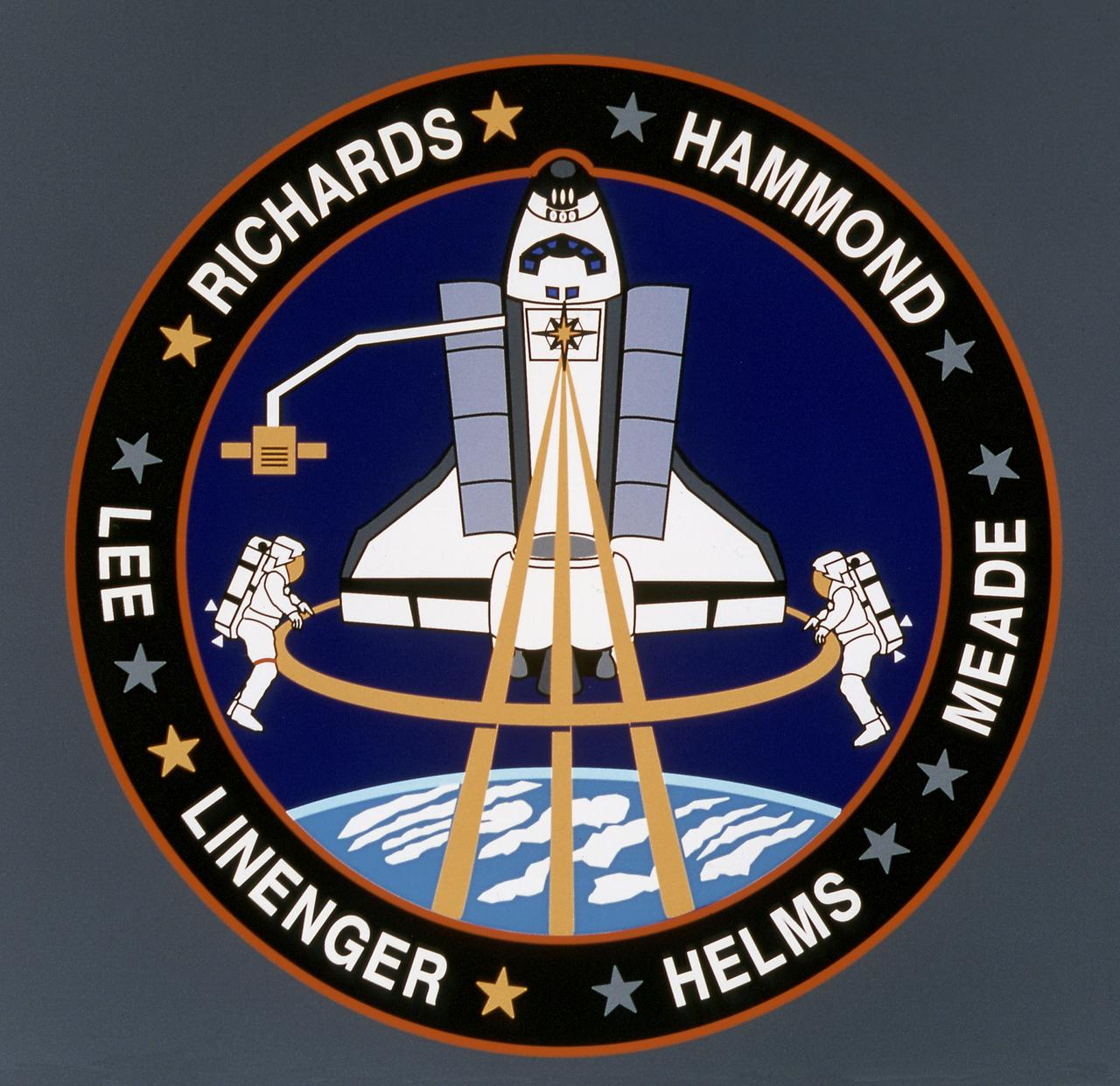
The STS-64 patch depicts the Space Shuttle Discovery in a payload-bay-to-Earth attitude with its primary payload, Lidar In-Space Technology Experiment (LITE-1) operating in support of Mission to Planet Earth. LITE-1 is a lidar system that uses a three-wavelength laser, symbolized by the three gold rays emanating from the star in the payload bay that form part of the astronaut symbol. The major objective of the LITE-1 is to gather data about the Earth's troposphere and stratosphere, represented by the clouds and dual-colored Earth limb. A secondary payload on STS-64 is the free-flier SPARTAN 201 satellite shown on the Remote Manipulator System (RMS) arm post-retrieval. The RMS also operated another payload, Shuttle Plume Impingement Flight Experiment (SPIFEX). A newly tested extravehicular activity (EVA) maneuvering device, Simplified Aid for EVA Rescue (SAFER), represented symbolically by the two small nozzles on the backpacks of the two untethered EVA crew men. The names of the crew members encircle the patch: Astronauts Richard N. Richards, L. Blaine Hammond, Jr., Jerry M. Linenger, Susan J. Helms, Carl J. Meade and Mark C. Lee. The gold or silver stars by each name represent that person's parent service.
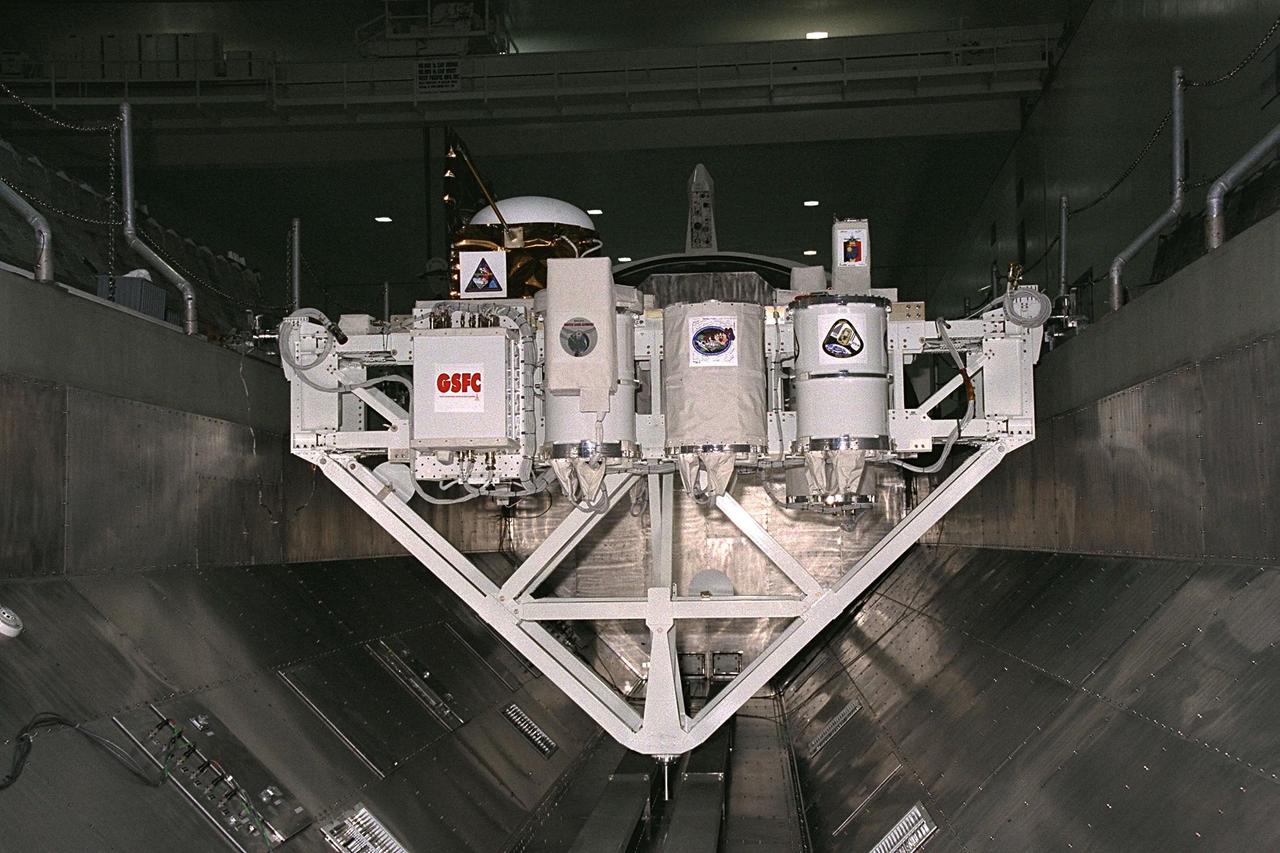
The Technology Applications and Science-1 (TAS-1) payload for the STS-85 mission rests in a payload canister in the Space Station Processing Facility prior to its trip out to Launch Pad 39A for installation into the payload bay of the Space Shuttle Orbiter Discovery. The TAS-1 holds seven separate experiments that will provide data on the Earth’s topography and atmosphere, study the sun’s energy, and test new thermal control devices, as well as several student-developed experiments. Other STS-85 payloads include the Cryogenic Infrared Spectrometers and Telescopes for the Atmosphere-Shuttle Pallet Satellite-2 (CRISTA-SPAS-2). The CRISTA is a system of three telescopes and four spectrometers to measure infrared radiation emitted by the Earth’s middle atmosphere. During the 11-day mission, the CRISTA-SPAS-2 free-flying satellite will be deployed from Discovery and retrieved later in the flight. Also onboard the satellite will be the Middle Atmosphere High Resolution Spectrograph Investigation (MAHRSI) to measure ultraviolet radiation emitted and scattered by the Earth’s atmosphere. The International Extreme Ultraviolet Hitchhiker-2 (IEH-2) will also be in the payload bay. The IEH-2 experiments will study ultraviolet radiation from stars, the sun and in the solar system
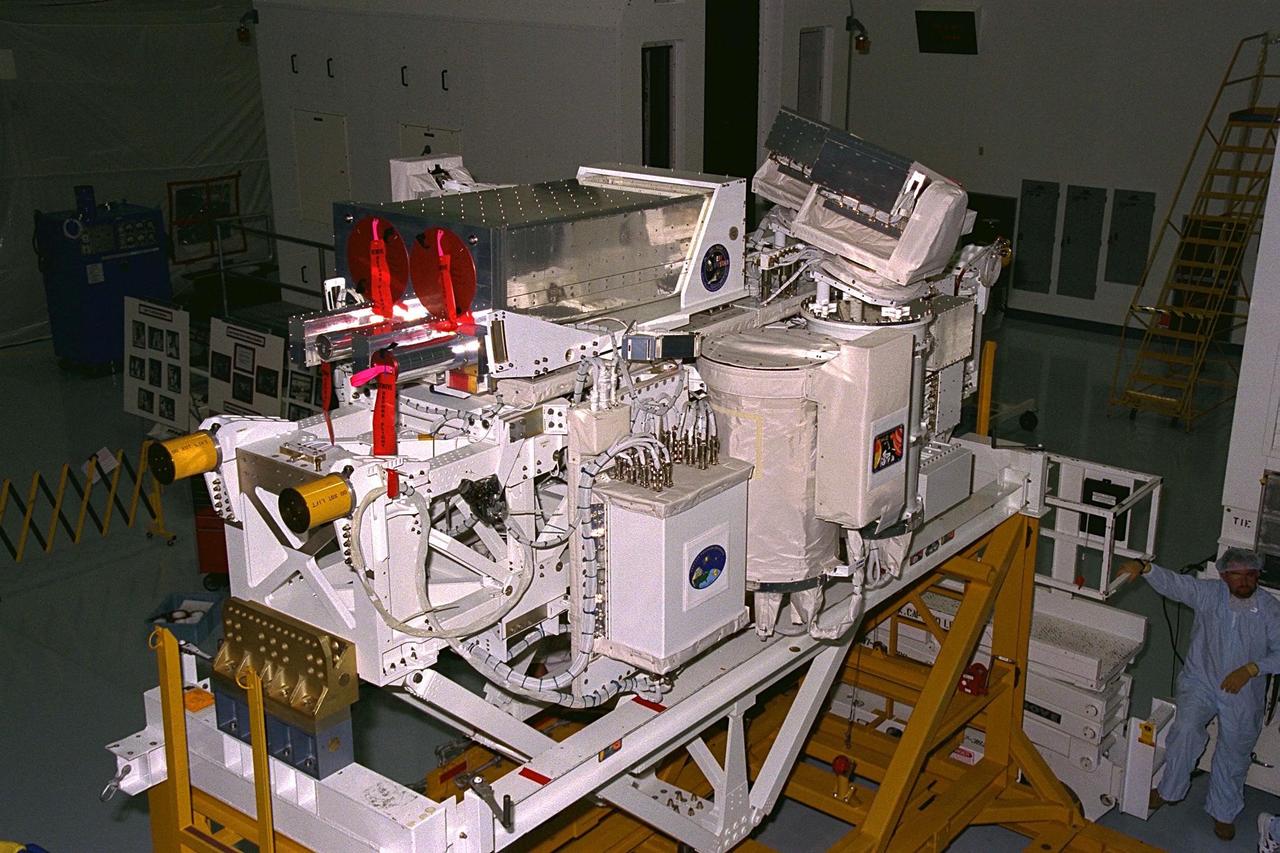
The International Extreme Ultraviolet Hitchhiker-2 (IEH-2) payload rests in a work stand in the Space Station Processing Facility prior to its trip out to Launch Pad 39A for installation into the payload bay of the Space Shuttle Orbiter Discovery for the STS-85 mission. The IEH-2 experiments will study ultraviolet radiation from stars, the sun and in the solar system. The Technology Applications and Science-1 (TAS-1) payload is another series of experiments that will be conducted during the 11-day mission in Discovery’s payload bay. The TAS-1 holds seven separate experiments that will provide data on the Earth’s topography and atmosphere, study the sun’s energy, and test new thermal control devices, as well as several student-developed experiments. Other STS-85 payloads include the Cryogenic Infrared Spectrometers and Telescopes for the Atmosphere-Shuttle Pallet Satellite-2 (CRISTA-SPAS-2). The CRISTA is a system of three telescopes and four spectrometers to measure infrared radiation emitted by the Earth’s middle atmosphere. The CRISTA-SPAS-2 free-flying satellite will be deployed from Discovery and retrieved later in the flight. Also onboard the satellite will be the Middle Atmosphere High Resolution Spectrograph Investigation (MAHRSI) to measure ultraviolet radiation emitted and scattered by the Earth’s atmosphere
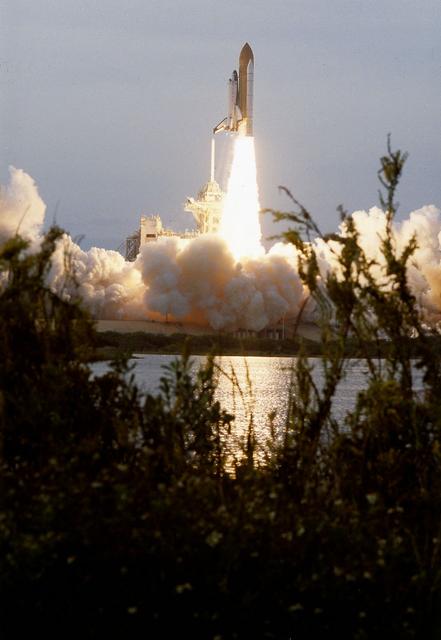
Like a rising sun lighting up the afternoon sky, the Space Shuttle Columbia (STS-87) soared from Launch Pad 39B on the fourth flight of the United States Microgravity Payload (USMP-4) and Spartan-201 satellite which were managed by scientists and engineers from the Marshall Space Flight Center. During the 16-day mission, the crew oversaw experiments in microgravity; deployed and retrieved a solar satellite; and tested a new experimental camera, the AERCam Sprint. Two crew members, Dr. Takao Doi and Winston Scott also performed a spacewalk to practice International Space Station maneuvers.
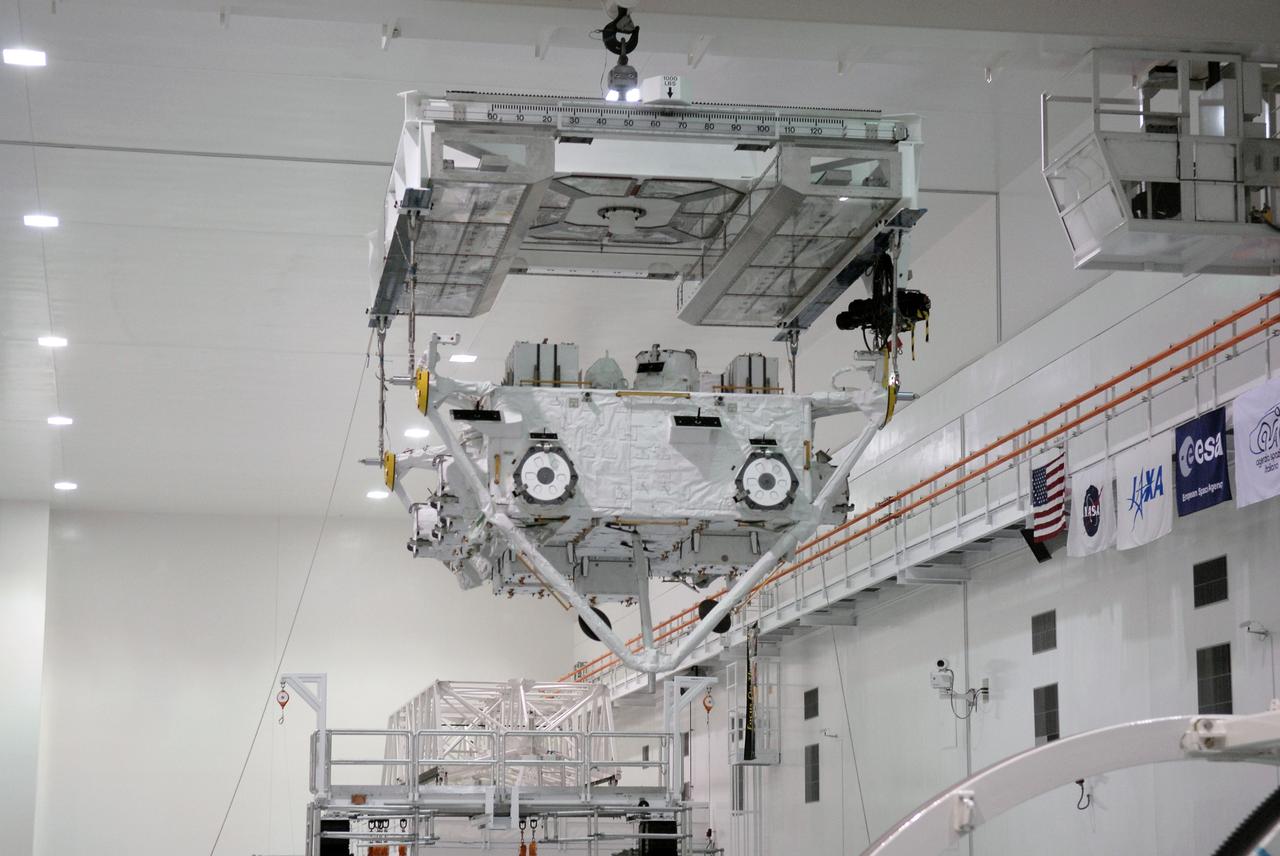
CAPE CANAVERAL, Fla. –– In the Space Station Processing Facility at NASA's Kennedy Space Center in Florida, the Japan Aerospace Exploration Agency's Kibo Exposed Facility, or EF, is moved across the room to transfer it to a workstand. When it is installed on the Kibo laboratory, the EF will provide a multipurpose platform where science experiments can be deployed and operated in the exposed environment. The payloads attached to the EF can be exchanged or retrieved by Kibo's robotic arm, the JEM Remote Manipulator System. The EF, along with the Experiment Logistics Module Exposed Section, will be carried aboard space shuttle Endeavour on the STS-127 mission targeted for launch June 13, 2009. Photo credit: NASA/Kim Shiflett
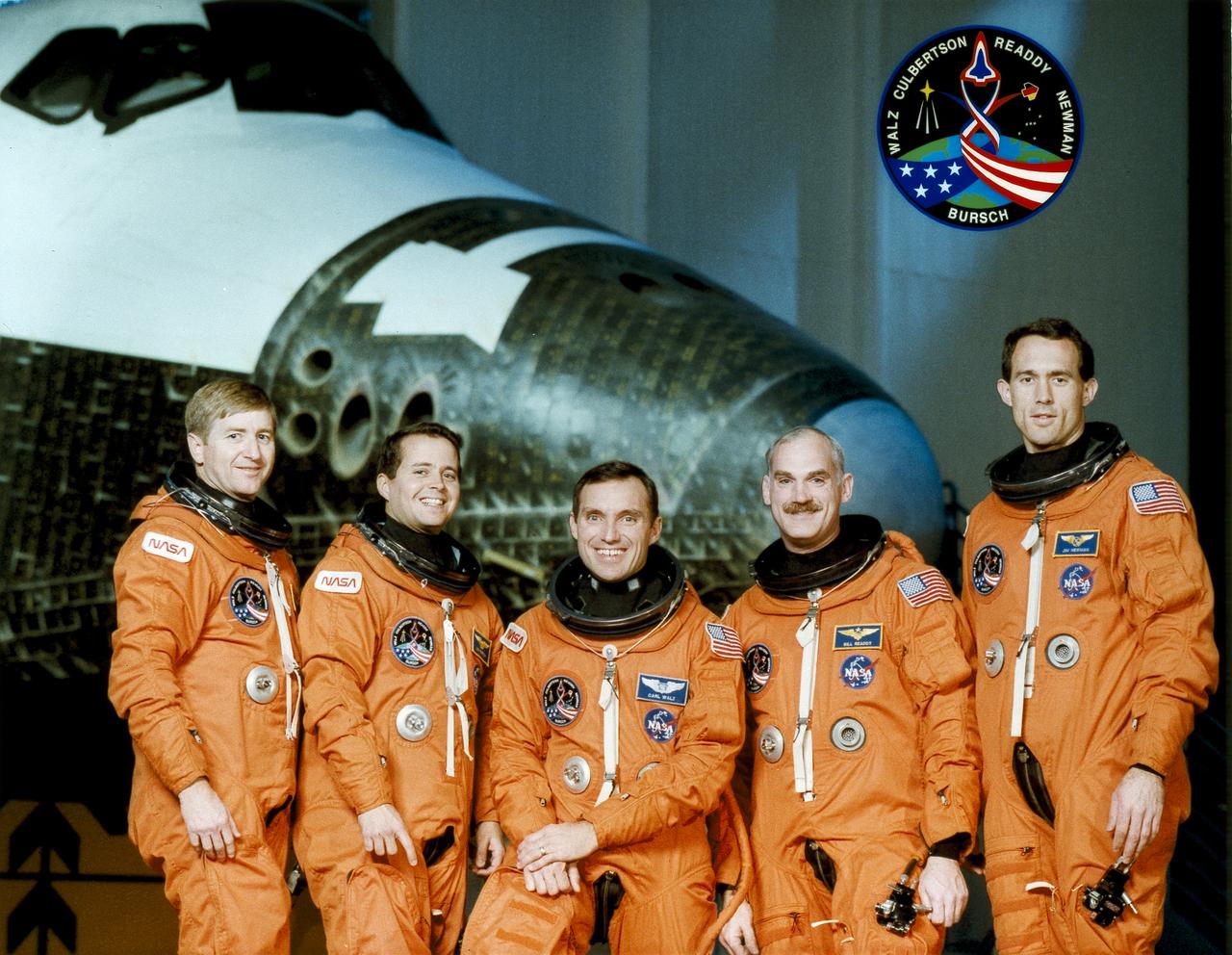
The STS-51 crew portrait features (left to right): Frank L. Culbertson, commander; Daniel W. Bursch, mission specialist; Carl E. Walz, mission specialist; William F. Readdy, pilot; and James H. Newman, mission specialist. The crew of five launched aboard the Space Shuttle Discovery on September 12, 1993 at 7:45:00 am (EDT). Two primary payloads included the Advanced Communications Technology Satellite (ACTS), and the Orbiting and Retrievable Far and Extreme Ultraviolet Spectrograph Shuttle Pallet Satellite (OERFEUS-SPAS).
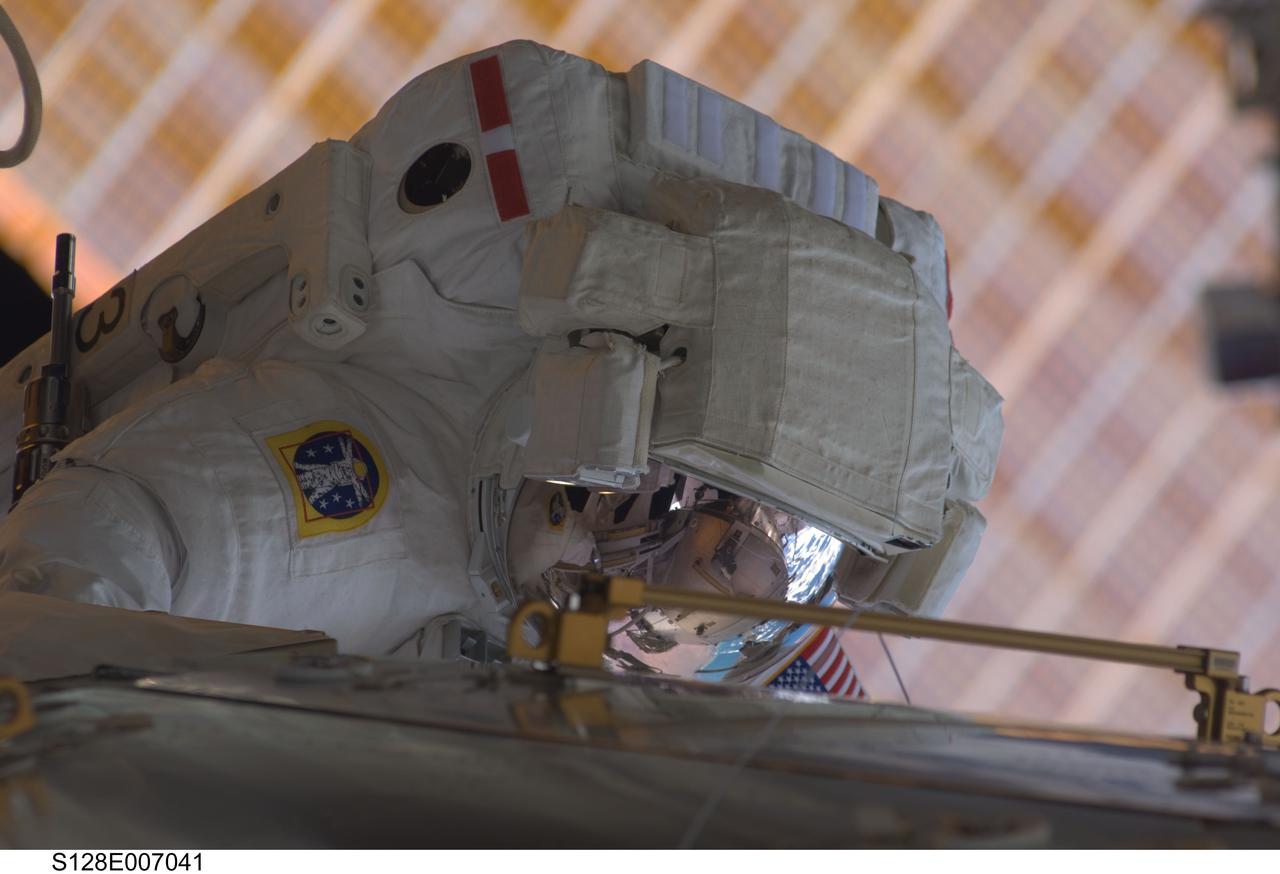
S128-E-007041 (1 Sept. 2009) --- Astronaut Nicole Stott, Expedition 20 flight engineer, participates in the STS-128 mission's first session of extravehicular activity (EVA) as construction and maintenance continue on the International Space Station. During the six-hour, 35-minute spacewalk, Stott and astronaut John “Danny” Olivas (out of frame), mission specialist, removed an empty ammonia tank from the station’s truss and temporarily stowed it on the station’s robotic arm. Olivas and Stott also retrieved the European Technology Exposure Facility (EuTEF) and Materials International Space Station Experiment (MISSE) from the Columbus laboratory module and installed them on Discovery’s payload bay for return.
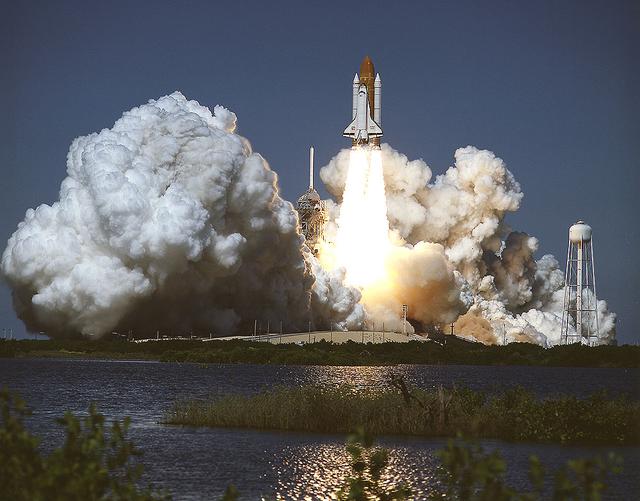
The 66th Space Shuttle flight began with a nearly on-time liftoff of the Orbiter Atlantis (STS-66) into the clear Florida skies. Atlantis returned to space after a nearly two year absence. The plarned 11-day flight will continue NASA's Mission to Planet Earth, a comprehensive international collaboration to study how Earth's environment is changing and how human beings affect that change. Primary payloads on this flight included the Atmospheric Laboratory for Applications and Science (ATLAS-3), making its third flight, and the German-built Cryogenic Infrared Spectrometers and Telescopes for the Atmosphere-Shuttle Pallet Satellite (CRISTA-SPAS), which was deployed and retrieved during the mission.
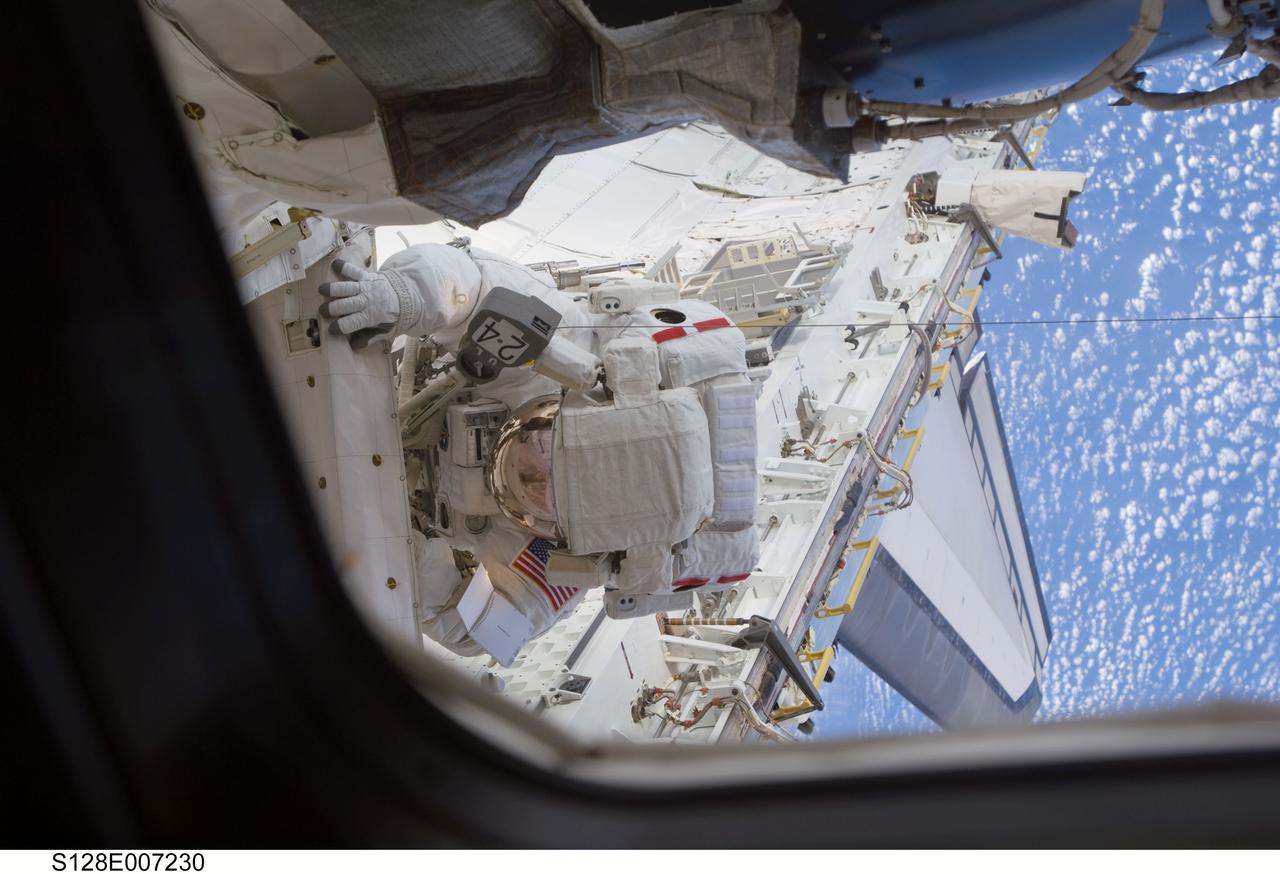
S128-E-007230 (1 Sept. 2009) --- Astronaut Nicole Stott, Expedition 20 flight engineer, participates in the STS-128 mission's first session of extravehicular activity (EVA) as construction and maintenance continue on the International Space Station. During the six-hour, 35-minute spacewalk, Stott and astronaut John “Danny” Olivas (out of frame), mission specialist, removed an empty ammonia tank from the station’s truss and temporarily stowed it on the station’s robotic arm. Olivas and Stott also retrieved the European Technology Exposure Facility (EuTEF) and Materials International Space Station Experiment (MISSE) from the Columbus laboratory module and installed them on Discovery’s payload bay for return.

CAPE CANAVERAL, Fla. –– In the Space Station Processing Facility at NASA's Kennedy Space Center in Florida, the suspended Japan Aerospace Exploration Agency's Kibo Exposed Facility, or EF, is lowered into a workstand. When it is installed on the Kibo laboratory, the EF will provide a multipurpose platform where science experiments can be deployed and operated in the exposed environment. The payloads attached to the EF can be exchanged or retrieved by Kibo's robotic arm, the JEM Remote Manipulator System. The EF, along with the Experiment Logistics Module Exposed Section, will be carried aboard space shuttle Endeavour on the STS-127 mission targeted for launch June 13, 2009. Photo credit: NASA/Kim Shiflett
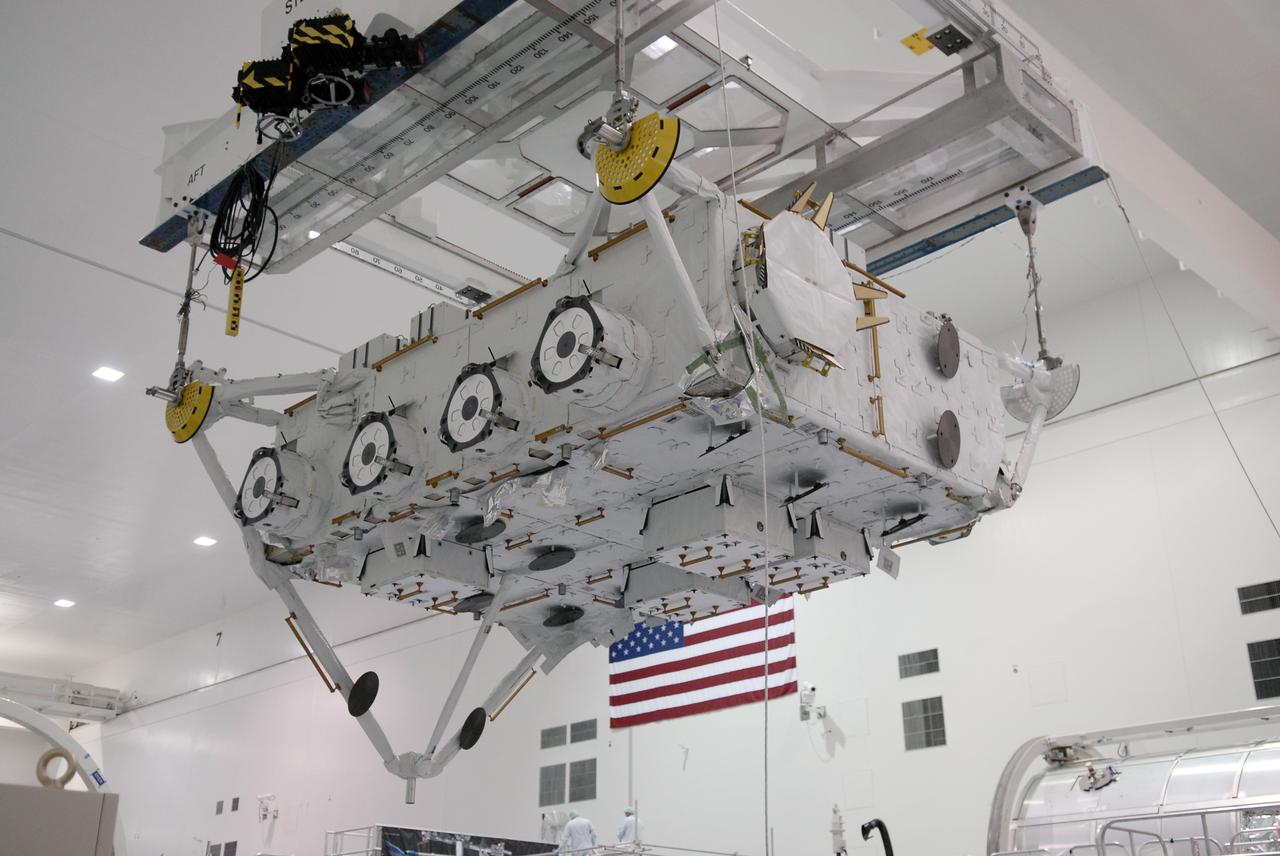
CAPE CANAVERAL, Fla. –– In the Space Station Processing Facility at NASA's Kennedy Space Center in Florida, the Japan Aerospace Exploration Agency's Kibo Exposed Facility, or EF, is lifted for transfer to a workstand. When it is installed on the Kibo laboratory, the EF will provide a multipurpose platform where science experiments can be deployed and operated in the exposed environment. The payloads attached to the EF can be exchanged or retrieved by Kibo's robotic arm, the JEM Remote Manipulator System. The EF, along with the Experiment Logistics Module Exposed Section, will be carried aboard space shuttle Endeavour on the STS-127 mission targeted for launch June 13, 2009. Photo credit: NASA/Kim Shiflett
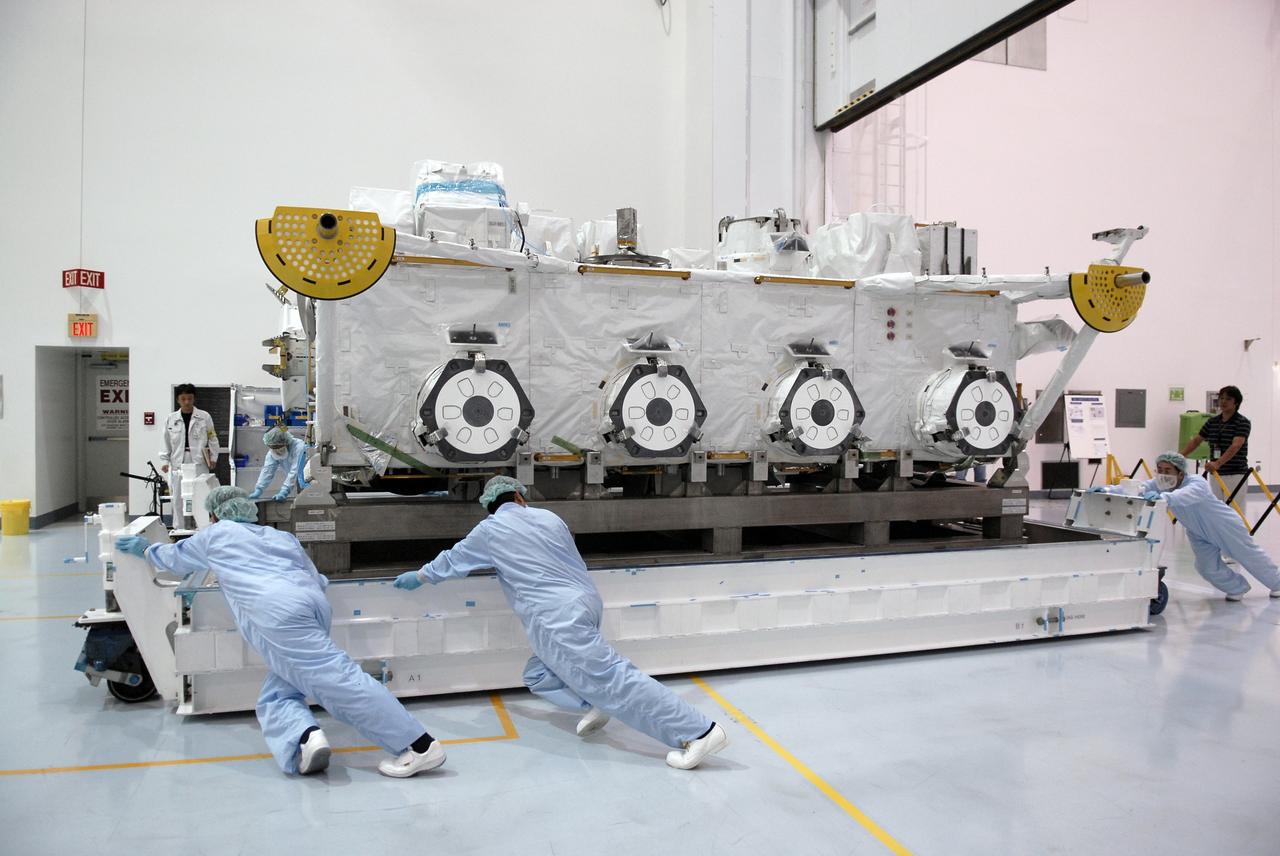
CAPE CANAVERAL, Fla. - After its shipping cover was removed, the Japan Aerospace Exploration Agency's Kibo Exposed Facility is moved to a high bay in the Space Station Processing Facility, or EF, at NASA's Kennedy Space Center in Florida. When it is installed on the Kibo laboratory, the EF will provide a multipurpose platform where science experiments can be deployed and operated in the exposed environment. The payloads attached to the EF can be exchanged or retrieved by Kibo's robotic arm, the JEM Remote Manipulator System. The EF, along with the Experiment Logistics Module Exposed Section, will be carried aboard space shuttle Endeavour on the STS-127 mission targeted for launch May 15, 2009. Photo credit: NASA/Kim Shiflett
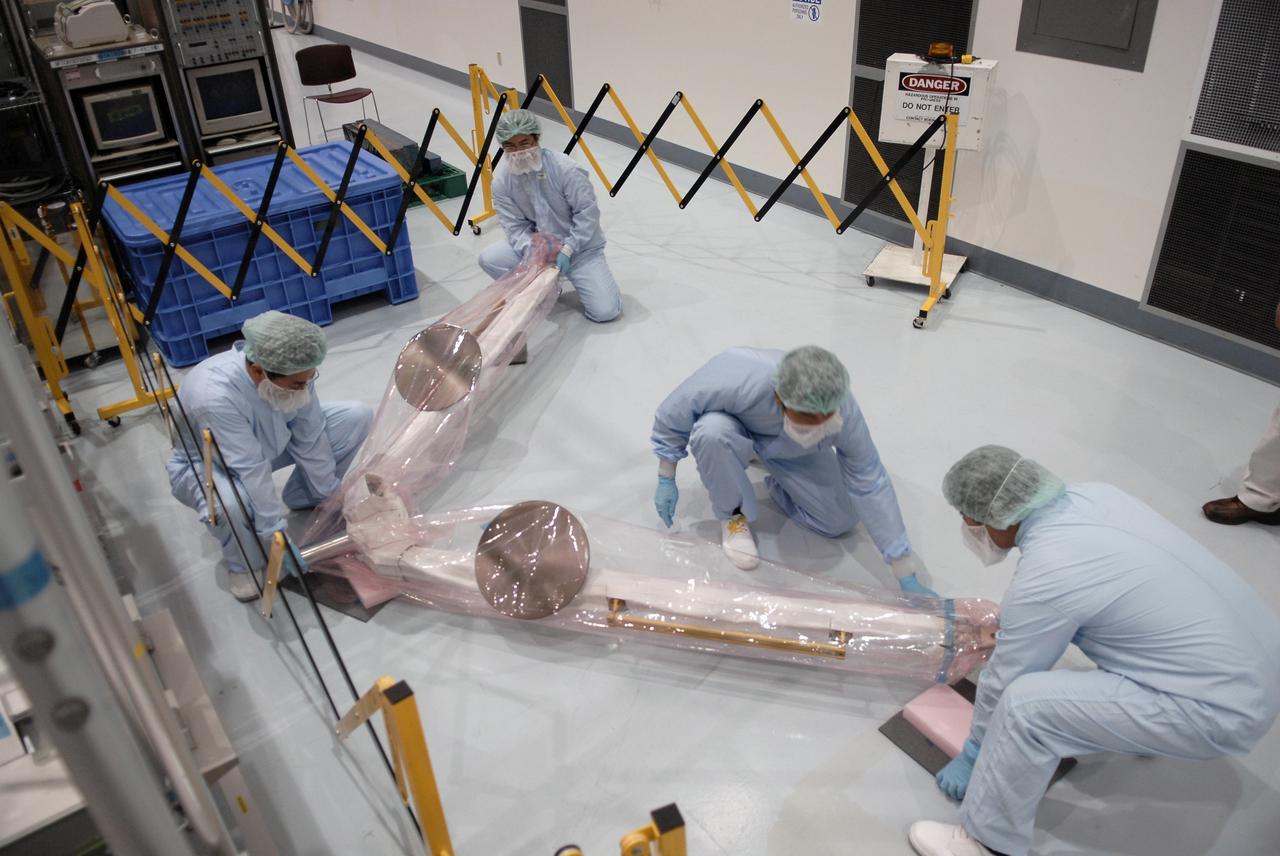
CAPE CANAVERAL, Fla. - In the Space Station Processing Facility at NASA's Kennedy Space Center in Florida, workers place an element of the Japan Aerospace Exploration Agency's Kibo Exposed Facility, or EF, on the floor of the high bay. When it is installed on the Kibo laboratory, the EF will provide a multipurpose platform where science experiments can be deployed and operated in the exposed environment. The payloads attached to the EF can be exchanged or retrieved by Kibo's robotic arm, the JEM Remote Manipulator System. The EF, along with the Experiment Logistics Module Exposed Section, will be carried aboard space shuttle Endeavour on the STS-127 mission targeted for launch May 15, 2009. Photo credit: NASA/Kim Shiflett

S128-E-007029 (1 Sept. 2009) --- Astronaut John “Danny” Olivas, STS-128 mission specialist, participates in the mission's first session of extravehicular activity (EVA) as construction and maintenance continue on the International Space Station. During the six-hour, 35-minute spacewalk, Olivas and astronaut Nicole Stott (out of frame), mission specialist, removed an empty ammonia tank from the station’s truss and temporarily stowed it on the station’s robotic arm. Olivas and Stott also retrieved the European Technology Exposure Facility (EuTEF) and Materials International Space Station Experiment (MISSE) from the Columbus laboratory module and installed them on Discovery’s payload bay for return.
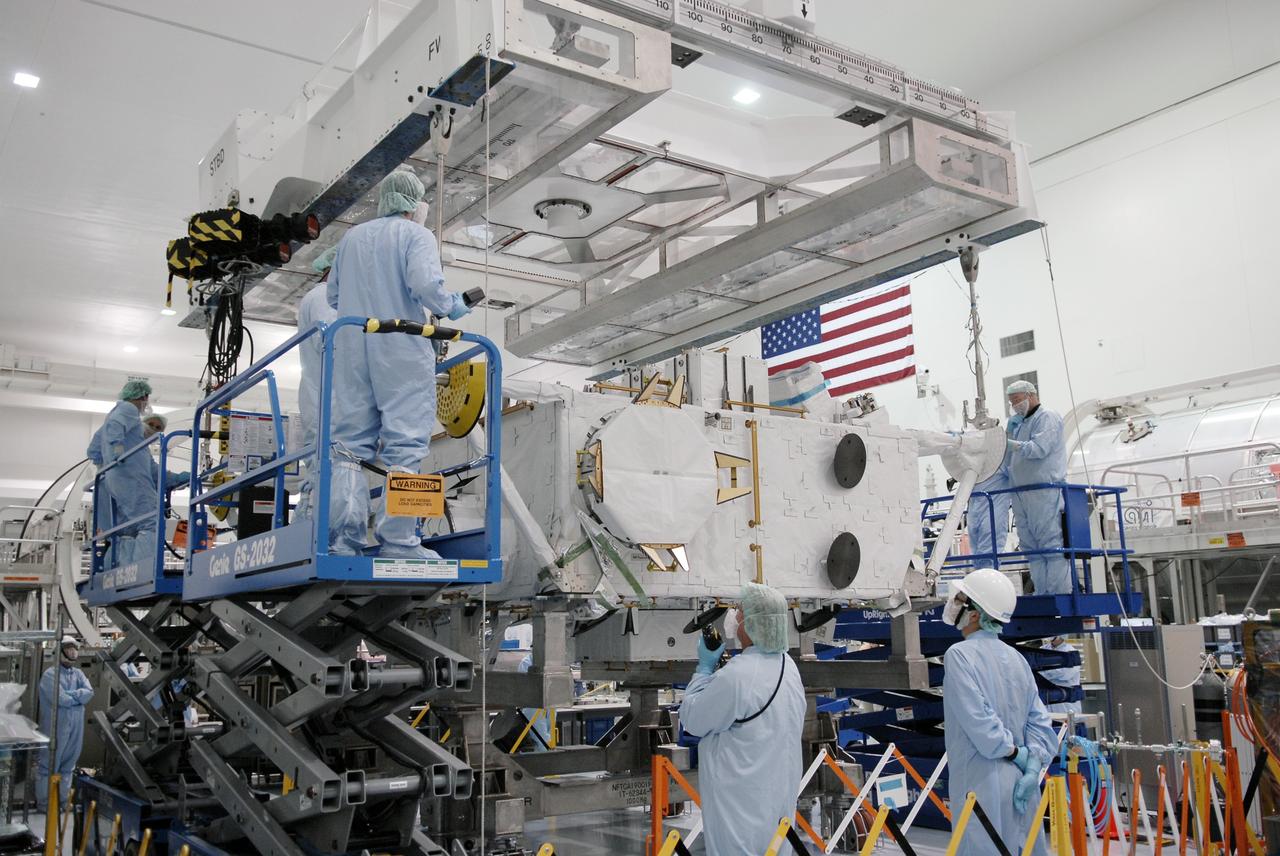
CAPE CANAVERAL, Fla. –– In the Space Station Processing Facility at NASA's Kennedy Space Center in Florida, the Japan Aerospace Exploration Agency's Kibo Exposed Facility, or EF, is being transferred to a workstand. When it is installed on the Kibo laboratory, the EF will provide a multipurpose platform where science experiments can be deployed and operated in the exposed environment. The payloads attached to the EF can be exchanged or retrieved by Kibo's robotic arm, the JEM Remote Manipulator System. The EF, along with the Experiment Logistics Module Exposed Section, will be carried aboard space shuttle Endeavour on the STS-127 mission targeted for launch June 13, 2009. Photo credit: NASA/Kim Shiflett
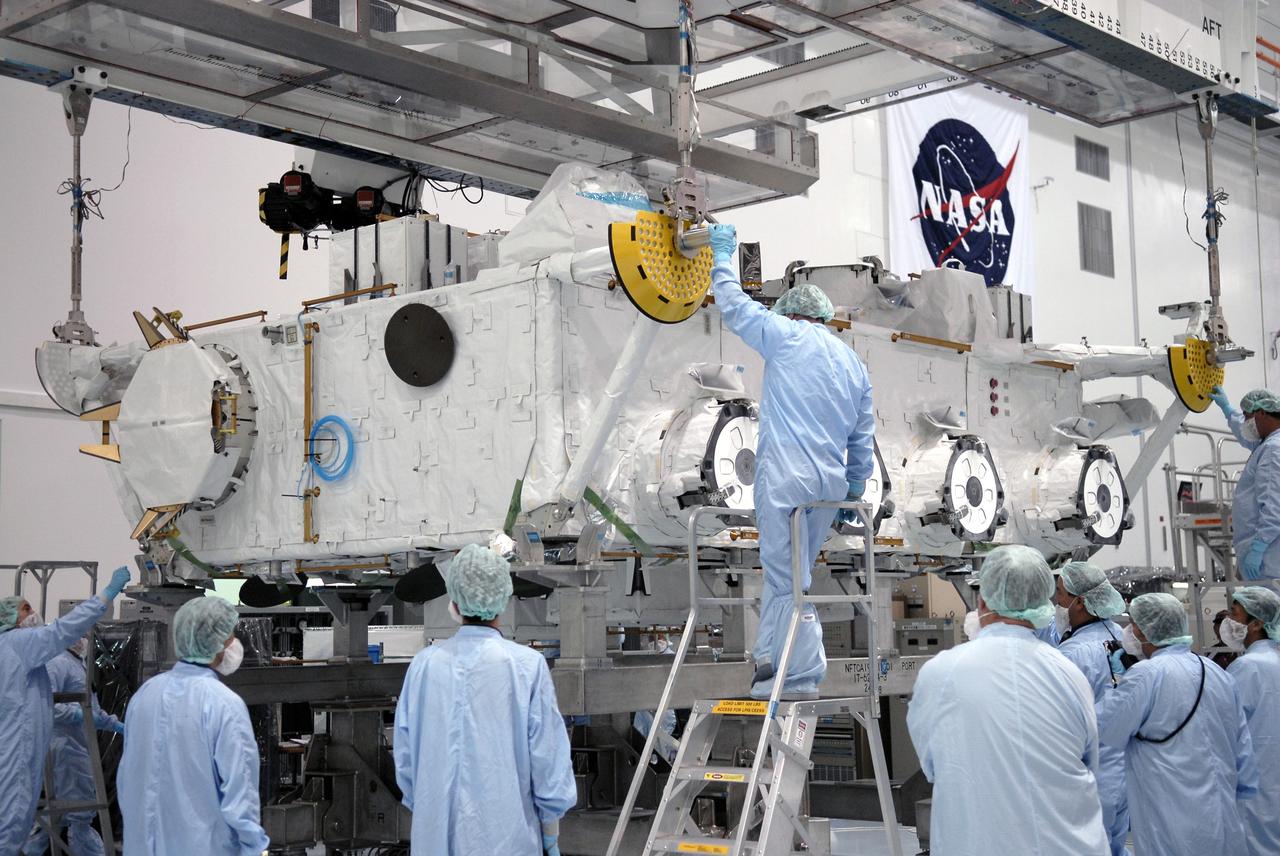
CAPE CANAVERAL, Fla. – In the Space Station Processing Facility at NASA's Kennedy Space Center in Florida, workers check the placement of the Japan Aerospace Exploration Agency's Kibo Exposed Facility, or EF, on the stand. The EF, along with the Experiment Logistics Module Exposed Section, will be carried aboard space shuttle Endeavour on the STS-127 mission to the International Space Station targeted for launch May 15, 2009. When it is installed on the Kibo laboratory,the EF will provide a multipurpose platform where science experiments can be deployed and operated in the exposed environment. The payloads attached to the EF can be exchanged or retrieved by Kibo's robotic arm, the JEM Remote Manipulator System. Photo credit: NASA/Kim Shiflett
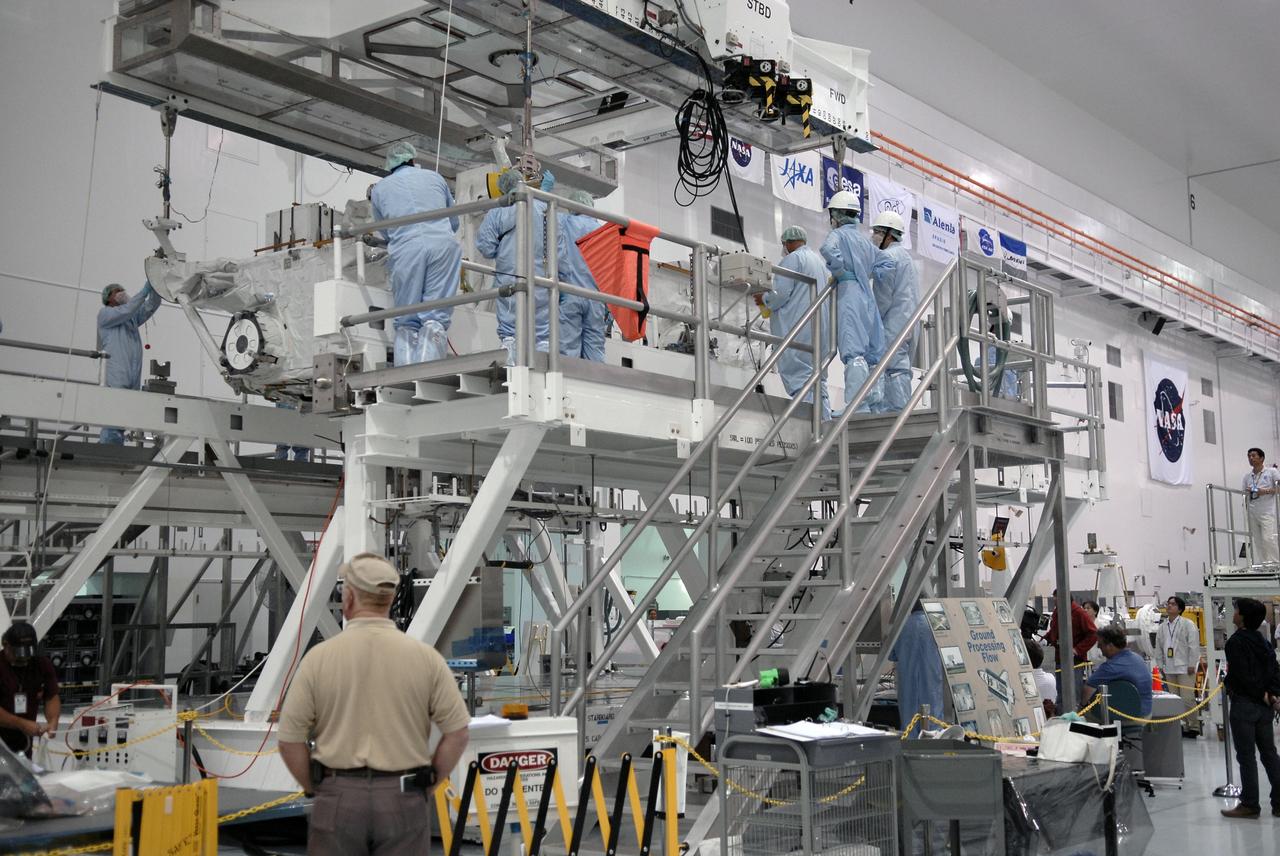
CAPE CANAVERAL, Fla. – In the Space Station Processing Facility at NASA's Kennedy Space Center in Florida, the Japan Aerospace Exploration Agency's Kibo Exposed Facility, or EF, is moved across the room to another stand. The EF, along with the Experiment Logistics Module Exposed Section, will be carried aboard space shuttle Endeavour on the STS-127 mission to the International Space Station targeted for launch May 15, 2009. When it is installed on the Kibo laboratory,the EF will provide a multipurpose platform where science experiments can be deployed and operated in the exposed environment. The payloads attached to the EF can be exchanged or retrieved by Kibo's robotic arm, the JEM Remote Manipulator System. Photo credit: NASA/Kim Shiflett
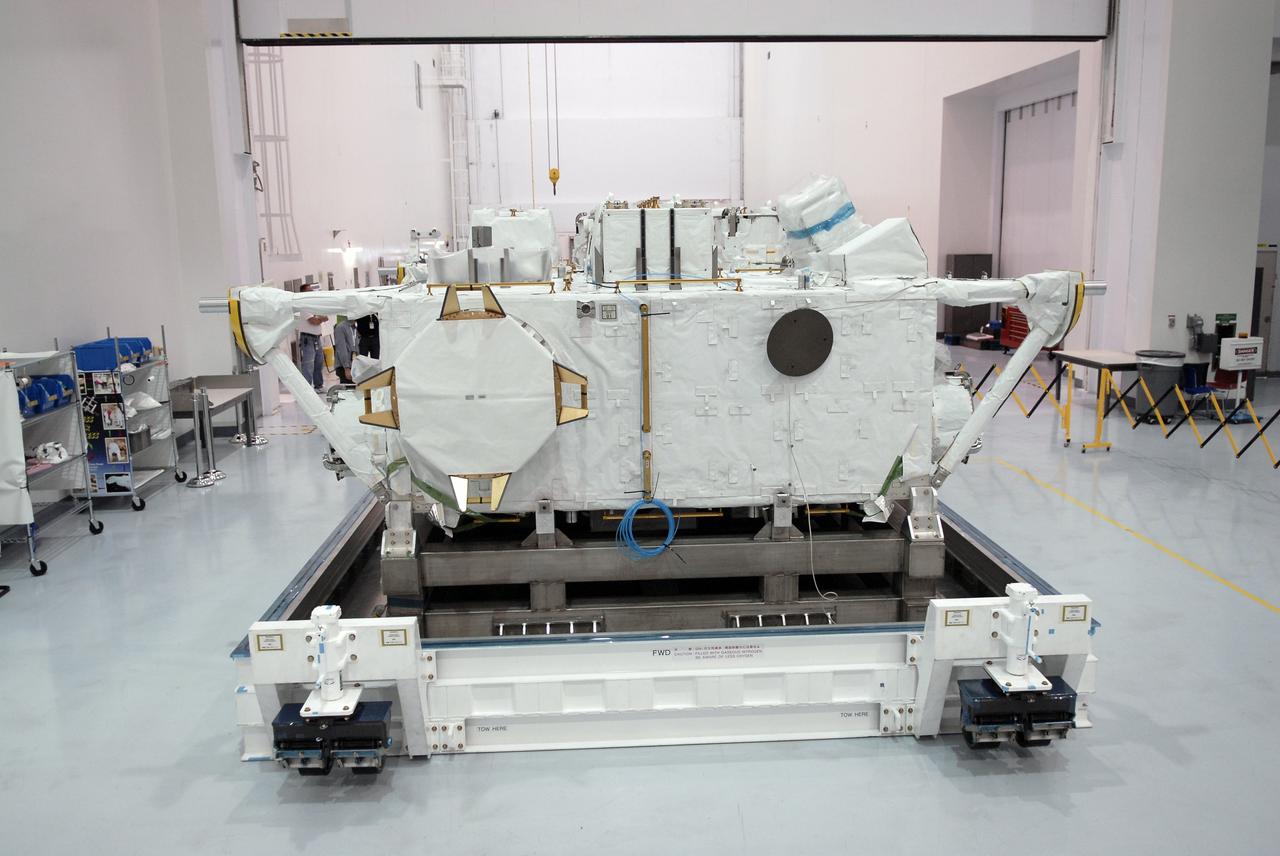
CAPE CANAVERAL, Fla. - In the Space Station Processing Facility at NASA's Kennedy Space Center in Florida, the Japan Aerospace Exploration Agency's Kibo Exposed Facility, or EF, rests in the high bay. When it is installed on the Kibo laboratory, the EF will provide a multipurpose platform where science experiments can be deployed and operated in the exposed environment. The payloads attached to the EF can be exchanged or retrieved by Kibo's robotic arm, the JEM Remote Manipulator System. The EF, along with the Experiment Logistics Module Exposed Section, will be carried aboard space shuttle Endeavour on the STS-127 mission targeted for launch May 15, 2009. Photo credit: NASA/Kim Shiflett
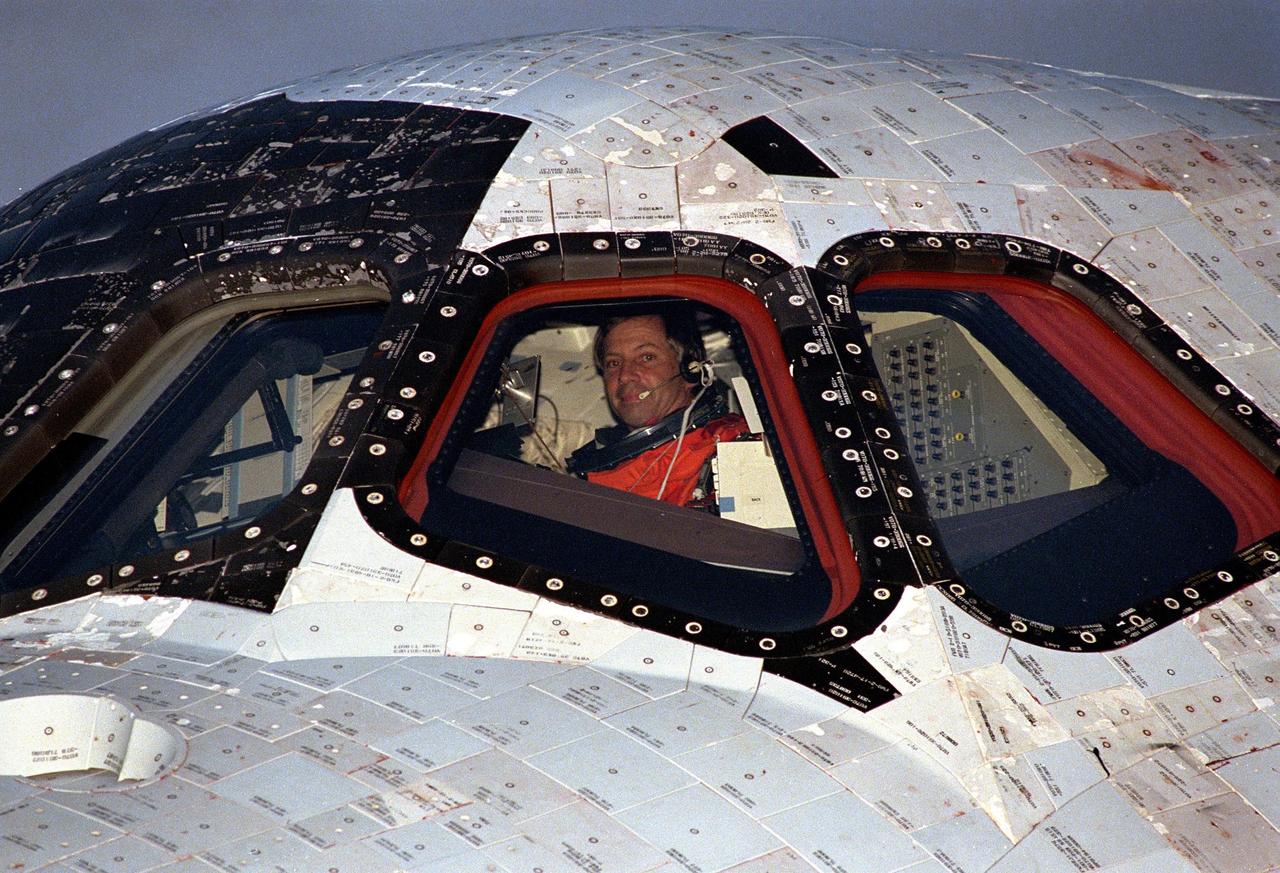
KENNEDY SPACE CENTER, FLA. -- STS-80 Commander Kenneth D. Cockrell peers out the window of the orbiter Columbia minutes after guiding the spacecraft to a successful landing on KSC’s Runway 33. Main gear touchdown occurred at 6:49:04 a.m. EST, Dec. 7. On board with Cockrell are four fellow crew members, Pilot Kent V. Rominger, and Mission Specialists Story Musgrave, Thomas D. Jones, and Tamara E. Jernigan, and the two primary payloads of the mission, the Wake Shield Facility-3 (WSF-3) and the Orbiting and Retrievable Far and Extreme Ultraviolet Spectrometer-Shuttle Pallet Satellite II (ORFEUS-SPAS II).
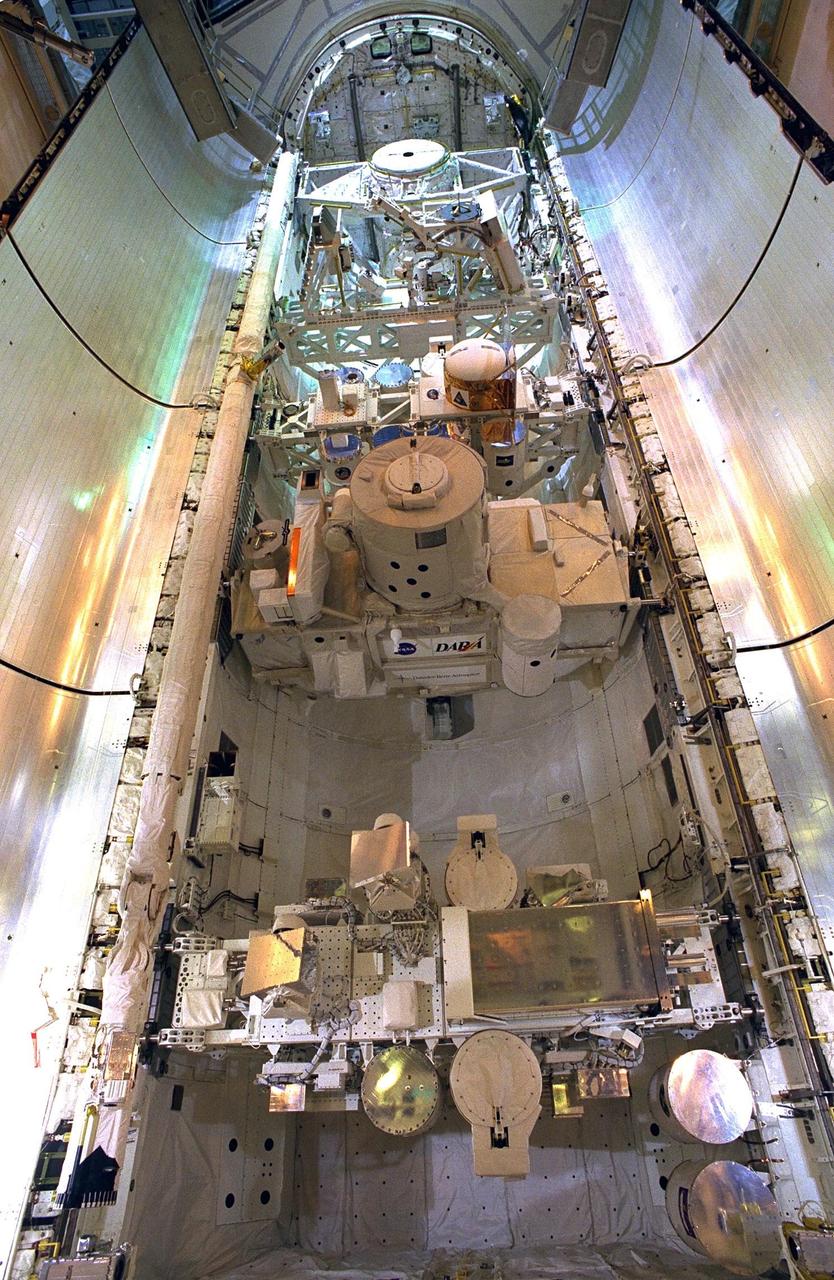
KENNEDY SPACE CENTER, FLA. -- The final tasks to prepare the Cryogenic Infrared Spectrometers and Telescopes for the Atmosphere-Shuttle Pallet Satellite-2 (CRISTA-SPAS-2) payload for the STS-85 mission are completed aboard Discovery at Launch Complex 39A. The CRISTA is a system of three telescopes and four spectrometers to measure infrared radiation emitted by the Earth’s middle atmosphere. During the 11-day mission, the CRISTA-SPAS-2 free-flying satellite will be deployed from Discovery and retrieved later in the flight. Also onboard the satellite will be the Middle Atmosphere High Resolution Spectrograph Investigation (MAHRSI) to measure ultraviolet radiation emitted and scattered by the Earth’s atmosphere.
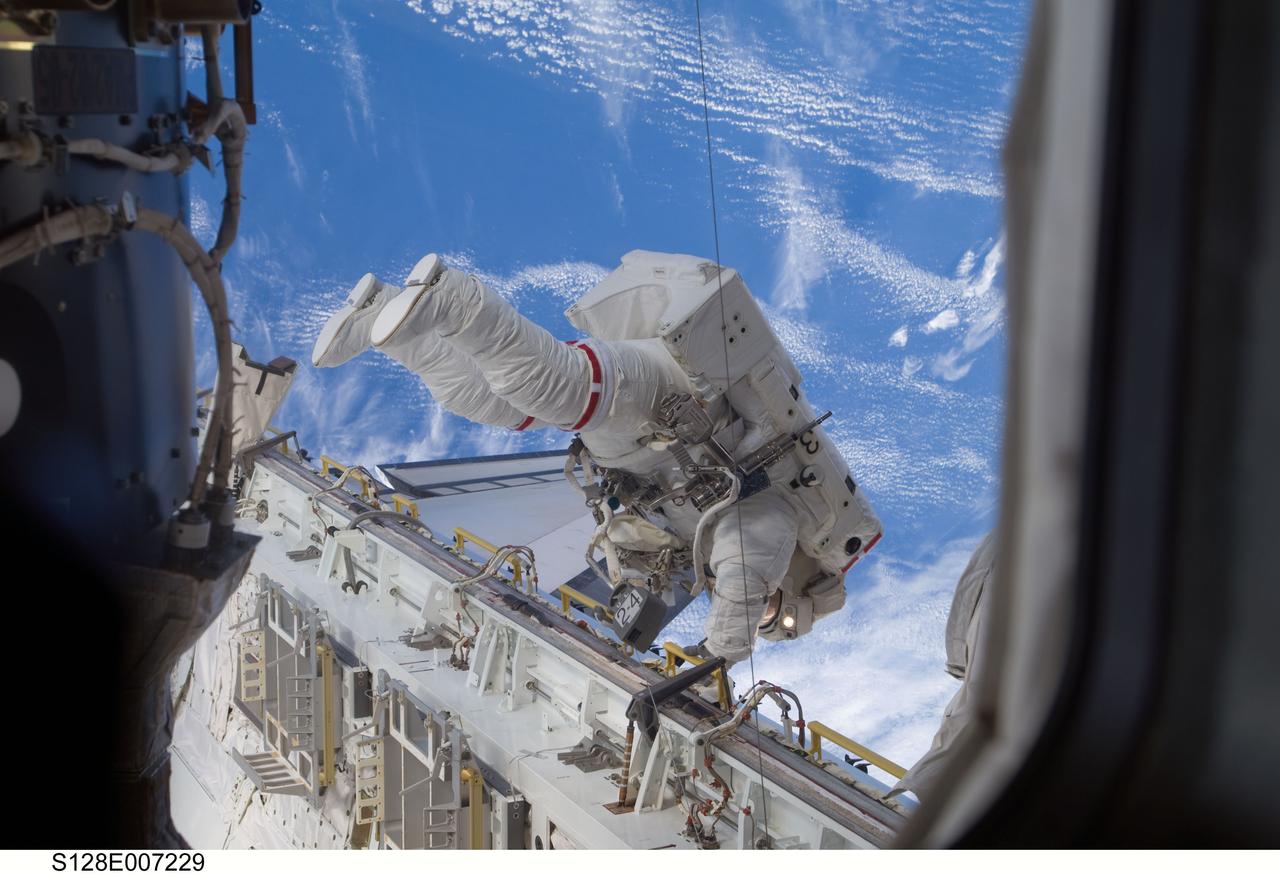
S128-E-007229 (1 Sept. 2009) --- Astronaut Nicole Stott, Expedition 20 flight engineer, participates in the STS-128 mission's first session of extravehicular activity (EVA) as construction and maintenance continue on the International Space Station. During the six-hour, 35-minute spacewalk, Stott and astronaut John “Danny” Olivas (out of frame), mission specialist, removed an empty ammonia tank from the station’s truss and temporarily stowed it on the station’s robotic arm. Olivas and Stott also retrieved the European Technology Exposure Facility (EuTEF) and Materials International Space Station Experiment (MISSE) from the Columbus laboratory module and installed them on Discovery’s payload bay for return.
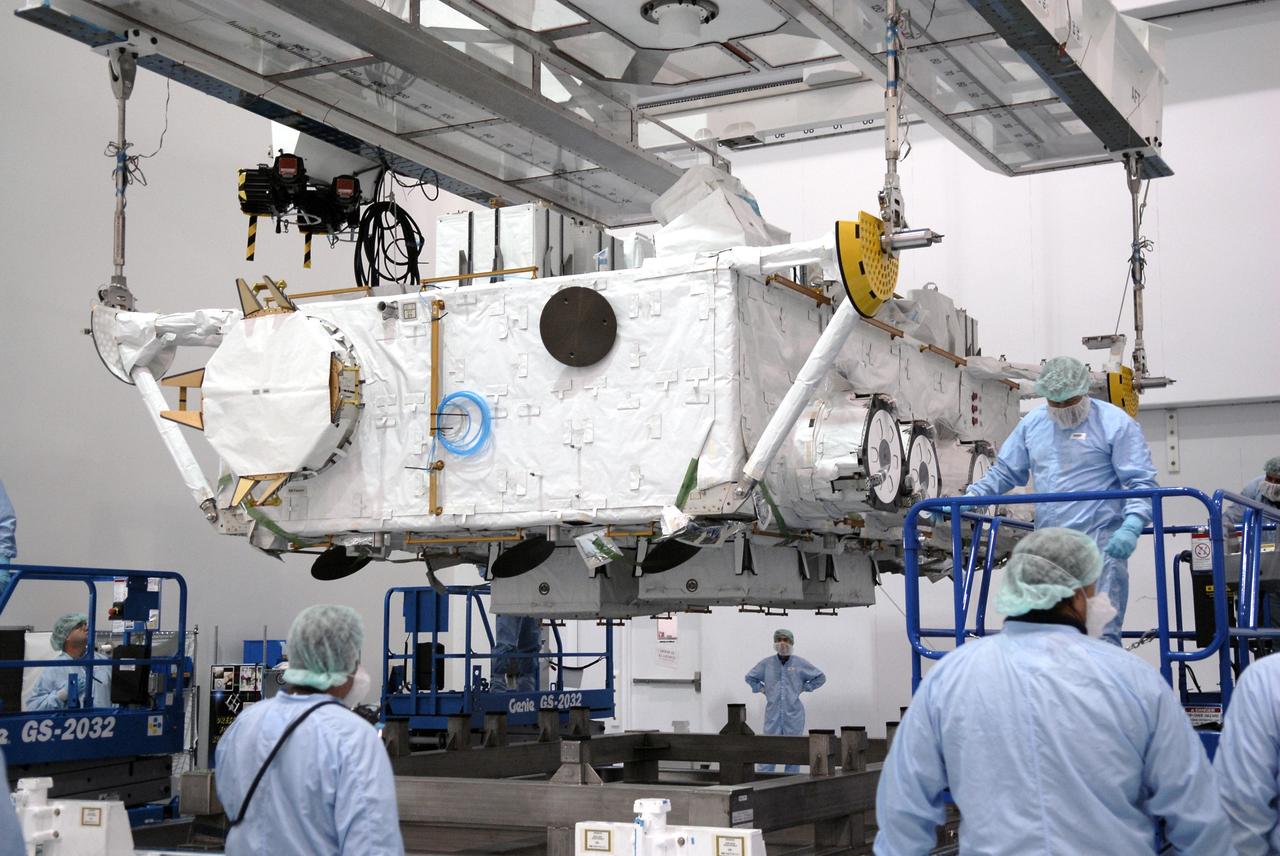
CAPE CANAVERAL, Fla. – In the Space Station Processing Facility at NASA's Kennedy Space Center in Florida, the Japan Aerospace Exploration Agency's Kibo Exposed Facility, or EF, is lifted for a move to another stand. The EF, along with the Experiment Logistics Module Exposed Section, will be carried aboard space shuttle Endeavour on the STS-127 mission to the International Space Station targeted for launch May 15, 2009. When it is installed on the Kibo laboratory,the EF will provide a multipurpose platform where science experiments can be deployed and operated in the exposed environment. The payloads attached to the EF can be exchanged or retrieved by Kibo's robotic arm, the JEM Remote Manipulator System. Photo credit: NASA/Kim Shiflett
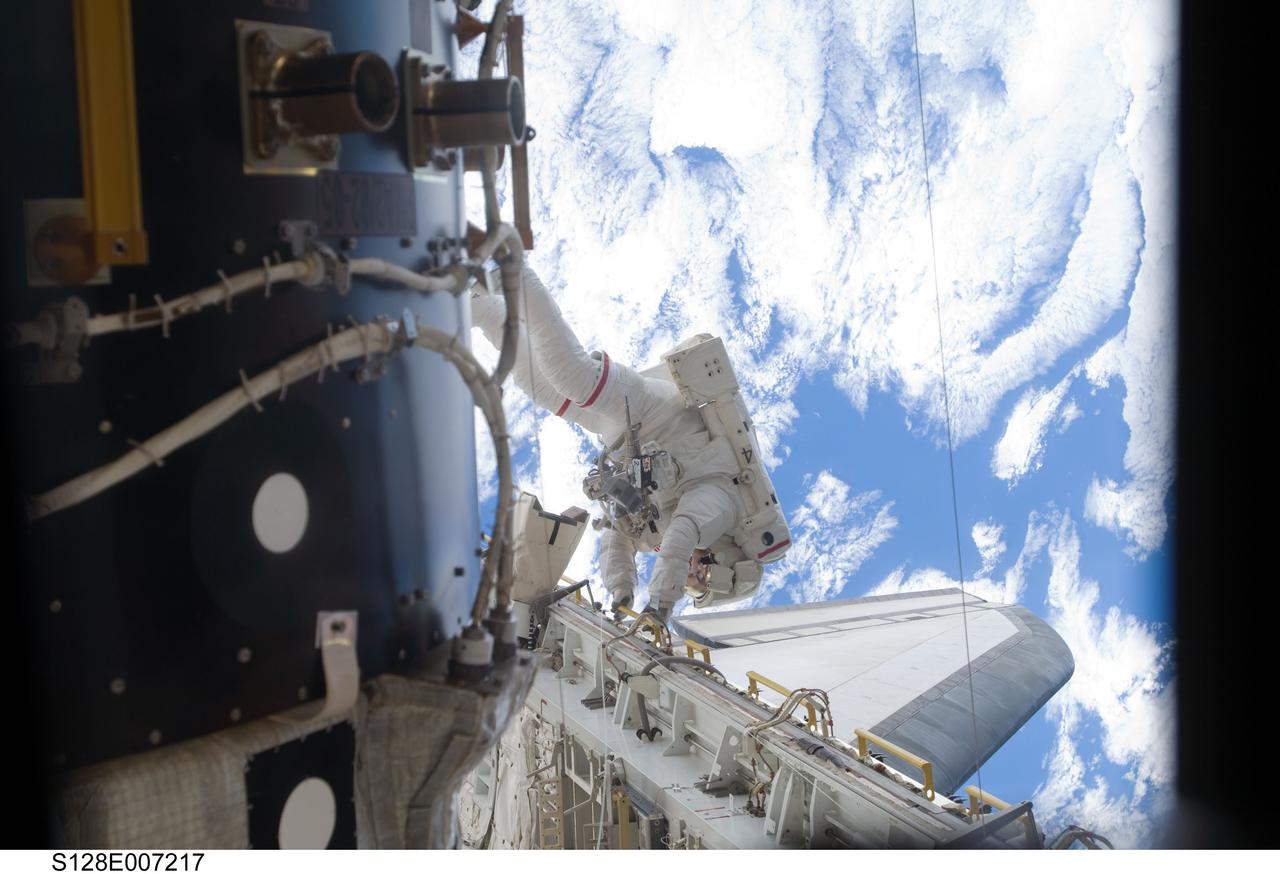
S128-E-007217 (1 Sept. 2009) --- Astronaut John “Danny” Olivas, STS-128 mission specialist, participates in the mission's first session of extravehicular activity (EVA) as construction and maintenance continue on the International Space Station. During the six-hour, 35-minute spacewalk, Olivas and astronaut Nicole Stott (out of frame), mission specialist, removed an empty ammonia tank from the station’s truss and temporarily stowed it on the station’s robotic arm. Olivas and Stott also retrieved the European Technology Exposure Facility (EuTEF) and Materials International Space Station Experiment (MISSE) from the Columbus laboratory module and installed them on Discovery’s payload bay for return.
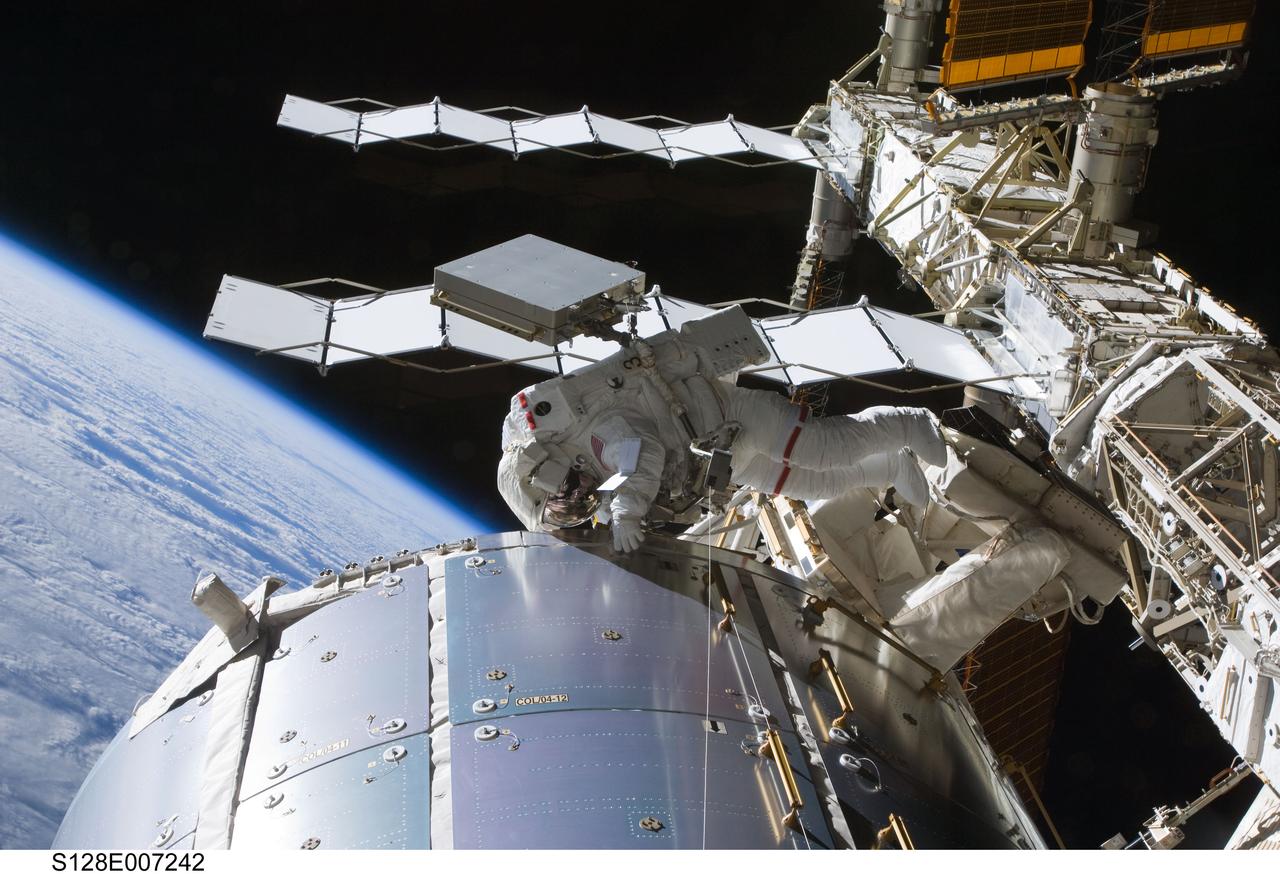
S128-E-007242 (1 Sept. 2009) --- Astronaut Nicole Stott, Expedition 20 flight engineer, participates in the STS-128 mission's first session of extravehicular activity (EVA) as construction and maintenance continue on the International Space Station. During the six-hour, 35-minute spacewalk, Stott and astronaut John “Danny” Olivas (out of frame), mission specialist, removed an empty ammonia tank from the station’s truss and temporarily stowed it on the station’s robotic arm. Olivas and Stott also retrieved the European Technology Exposure Facility (EuTEF) and Materials International Space Station Experiment (MISSE) from the Columbus laboratory module and installed them on Discovery’s payload bay for return.
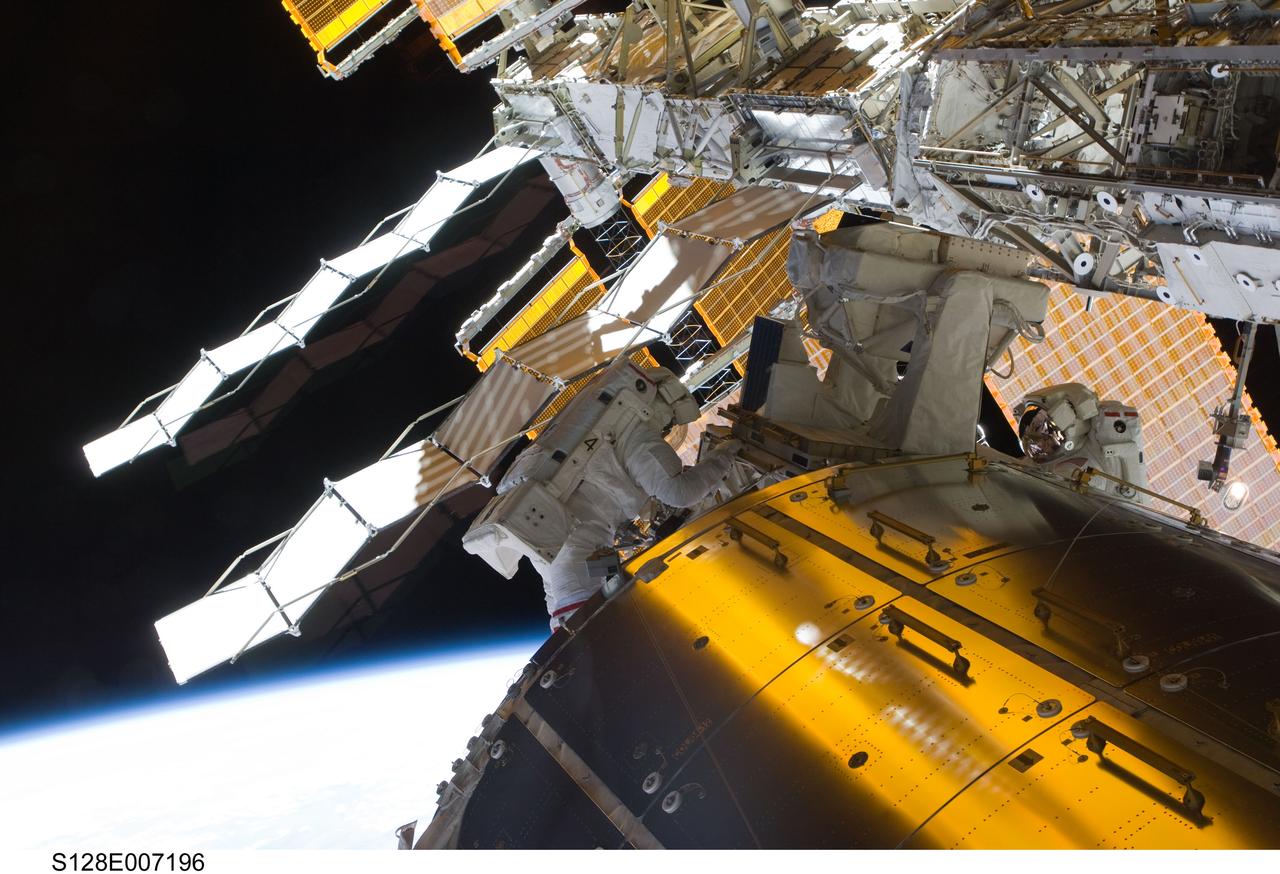
S128-E-007196 (1 Sept. 2009) --- Astronauts John “Danny” Olivas and Nicole Stott (right), both STS-128 mission specialists, participate in the mission's first session of extravehicular activity (EVA) as construction and maintenance continue on the International Space Station. During the six-hour, 35-minute spacewalk, Olivas and Stott removed an empty ammonia tank from the station’s truss and temporarily stowed it on the station’s robotic arm. Olivas and Stott also retrieved the European Technology Exposure Facility (EuTEF) and Materials International Space Station Experiment (MISSE) from the Columbus laboratory module and installed them on Discovery’s payload bay for return.
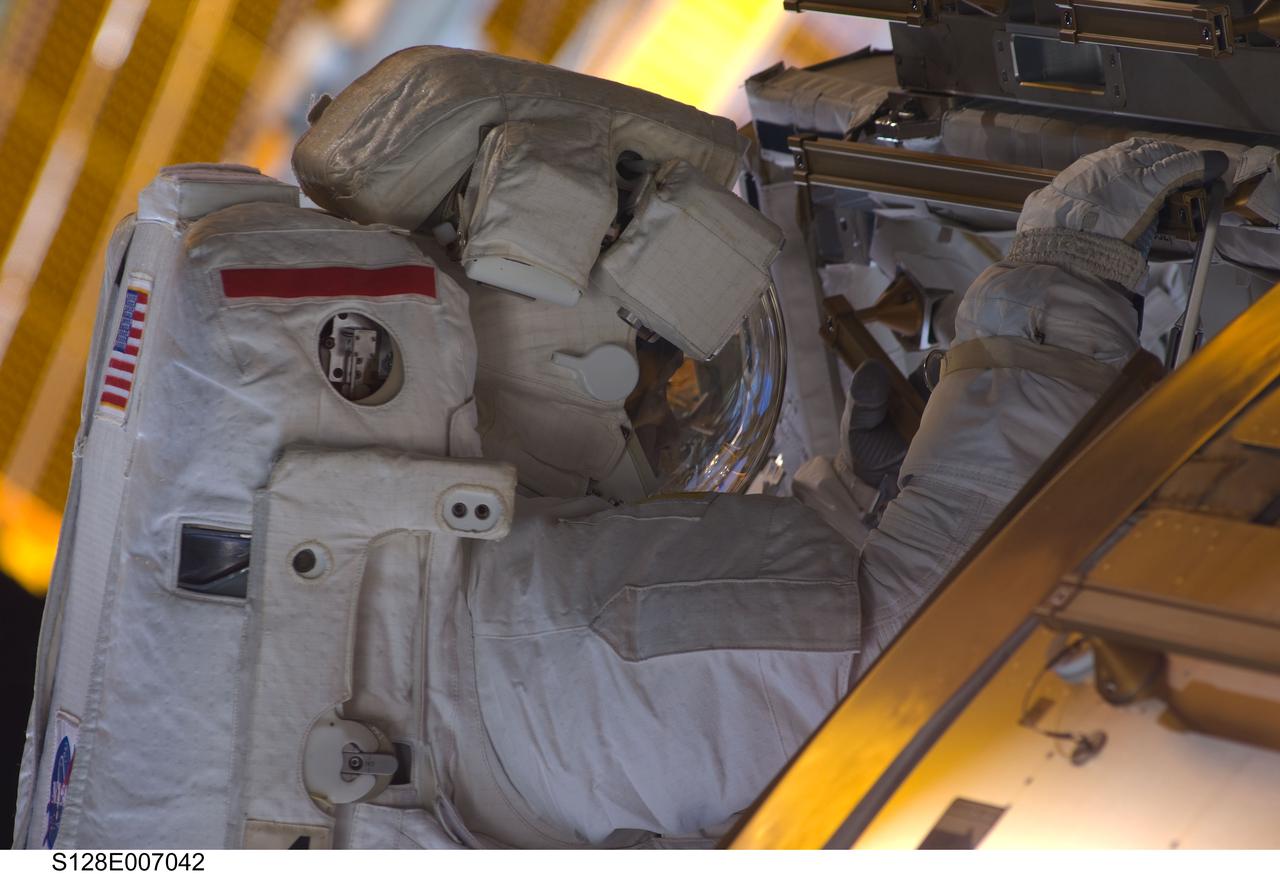
S128-E-007042 (1 Sept. 2009) --- Astronaut John “Danny” Olivas, STS-128 mission specialist, participates in the mission's first session of extravehicular activity (EVA) as construction and maintenance continue on the International Space Station. During the six-hour, 35-minute spacewalk, Olivas and astronaut Nicole Stott (out of frame), mission specialist, removed an empty ammonia tank from the station’s truss and temporarily stowed it on the station’s robotic arm. Olivas and Stott also retrieved the European Technology Exposure Facility (EuTEF) and Materials International Space Station Experiment (MISSE) from the Columbus laboratory module and installed them on Discovery’s payload bay for return.
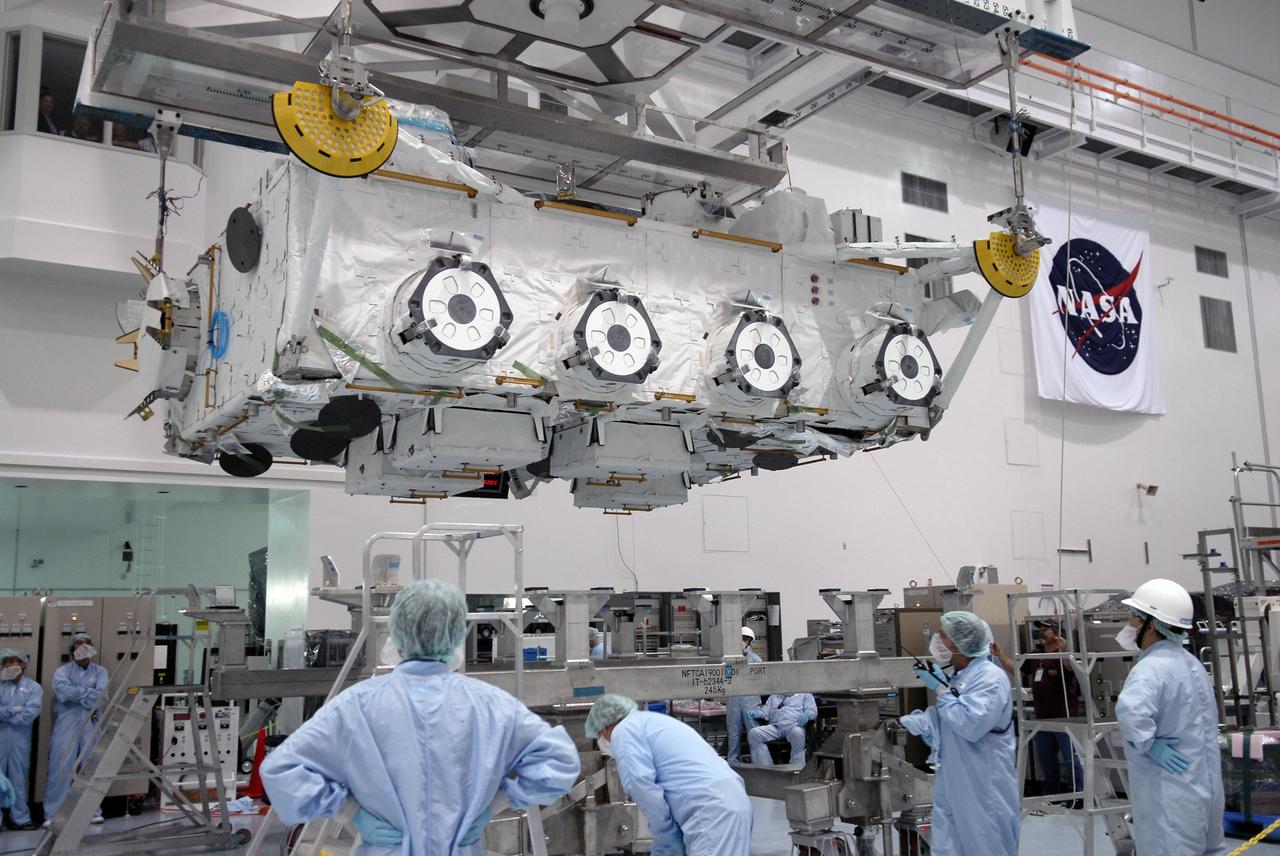
CAPE CANAVERAL, Fla. – In the Space Station Processing Facility at NASA's Kennedy Space Center in Florida, workers observe the movement of the Japan Aerospace Exploration Agency's Kibo Exposed Facility, or EF, as it is lowered toward a stand. The EF, along with the Experiment Logistics Module Exposed Section, will be carried aboard space shuttle Endeavour on the STS-127 mission to the International Space Station targeted for launch May 15, 2009. When it is installed on the Kibo laboratory,the EF will provide a multipurpose platform where science experiments can be deployed and operated in the exposed environment. The payloads attached to the EF can be exchanged or retrieved by Kibo's robotic arm, the JEM Remote Manipulator System. Photo credit: NASA/Kim Shiflett
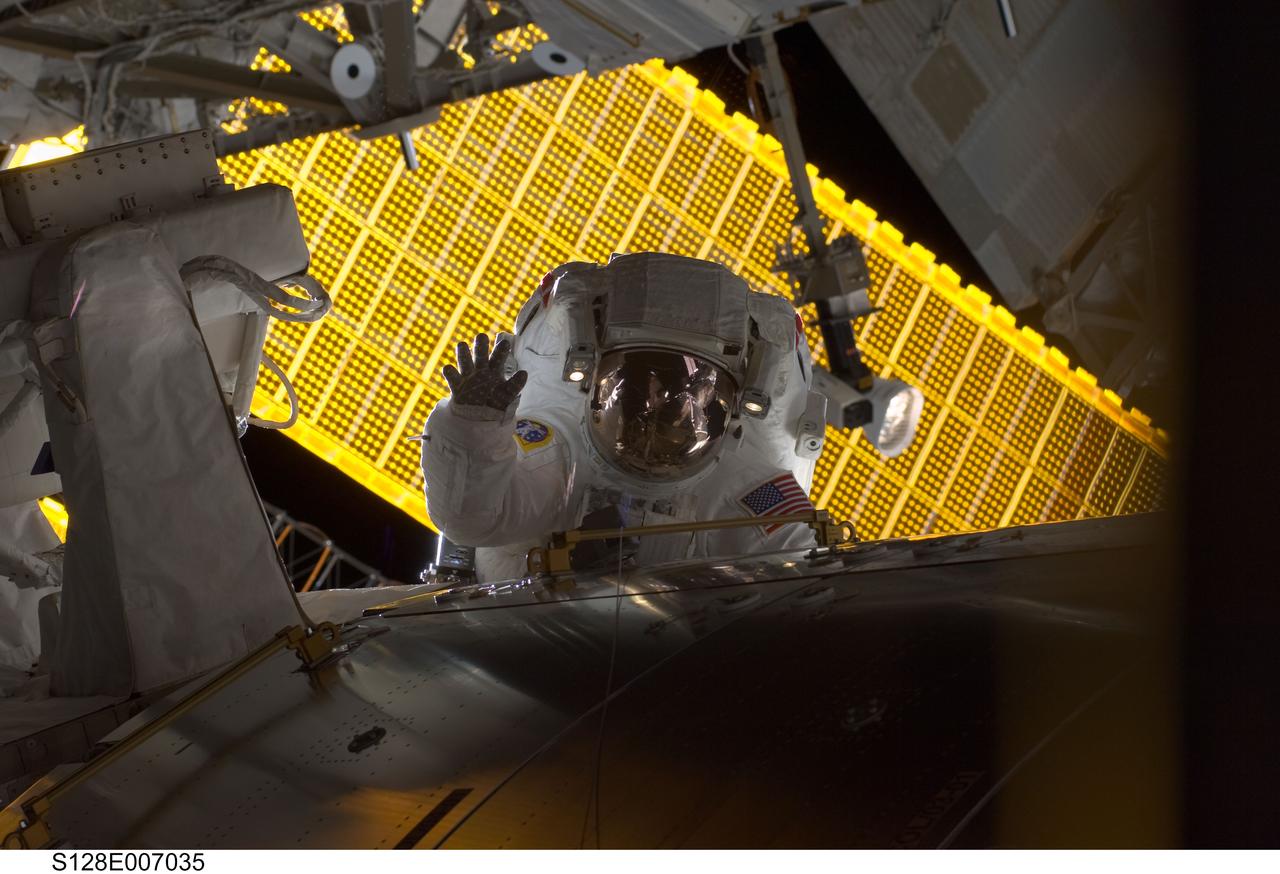
S128-E-007035 (1 Sept. 2009) --- Astronaut Nicole Stott, Expedition 20 flight engineer, participates in the STS-128 mission's first session of extravehicular activity (EVA) as construction and maintenance continue on the International Space Station. During the six-hour, 35-minute spacewalk, Stott and astronaut John “Danny” Olivas (out of frame), mission specialist, removed an empty ammonia tank from the station’s truss and temporarily stowed it on the station’s robotic arm. Olivas and Stott also retrieved the European Technology Exposure Facility (EuTEF) and Materials International Space Station Experiment (MISSE) from the Columbus laboratory module and installed them on Discovery’s payload bay for return.
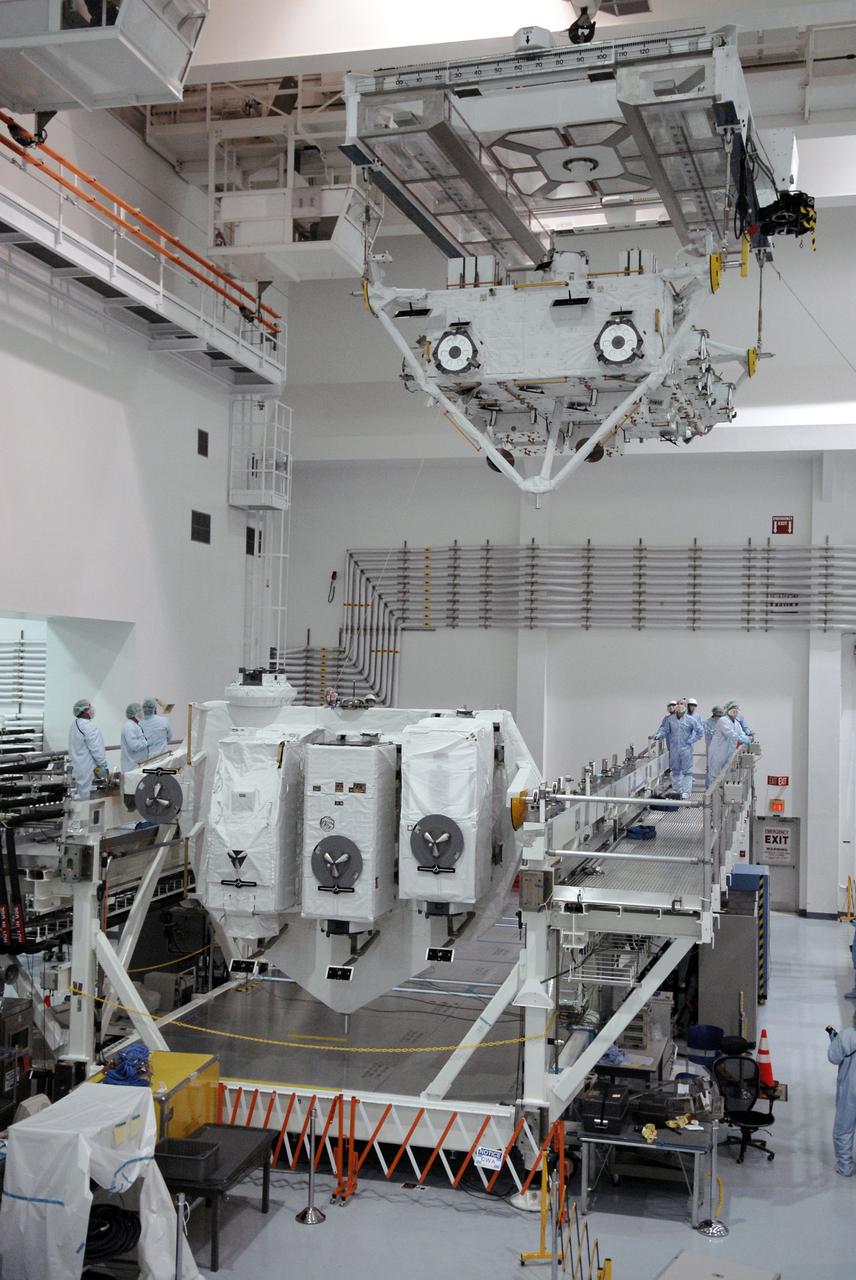
CAPE CANAVERAL, Fla. –– In the Space Station Processing Facility at NASA's Kennedy Space Center in Florida, the suspended Japan Aerospace Exploration Agency's Kibo Exposed Facility, or EF, is moved over a workstand. When it is installed on the Kibo laboratory, the EF will provide a multipurpose platform where science experiments can be deployed and operated in the exposed environment. The payloads attached to the EF can be exchanged or retrieved by Kibo's robotic arm, the JEM Remote Manipulator System. The EF, along with the Experiment Logistics Module Exposed Section, will be carried aboard space shuttle Endeavour on the STS-127 mission targeted for launch June 13, 2009. Photo credit: NASA/Kim Shiflett
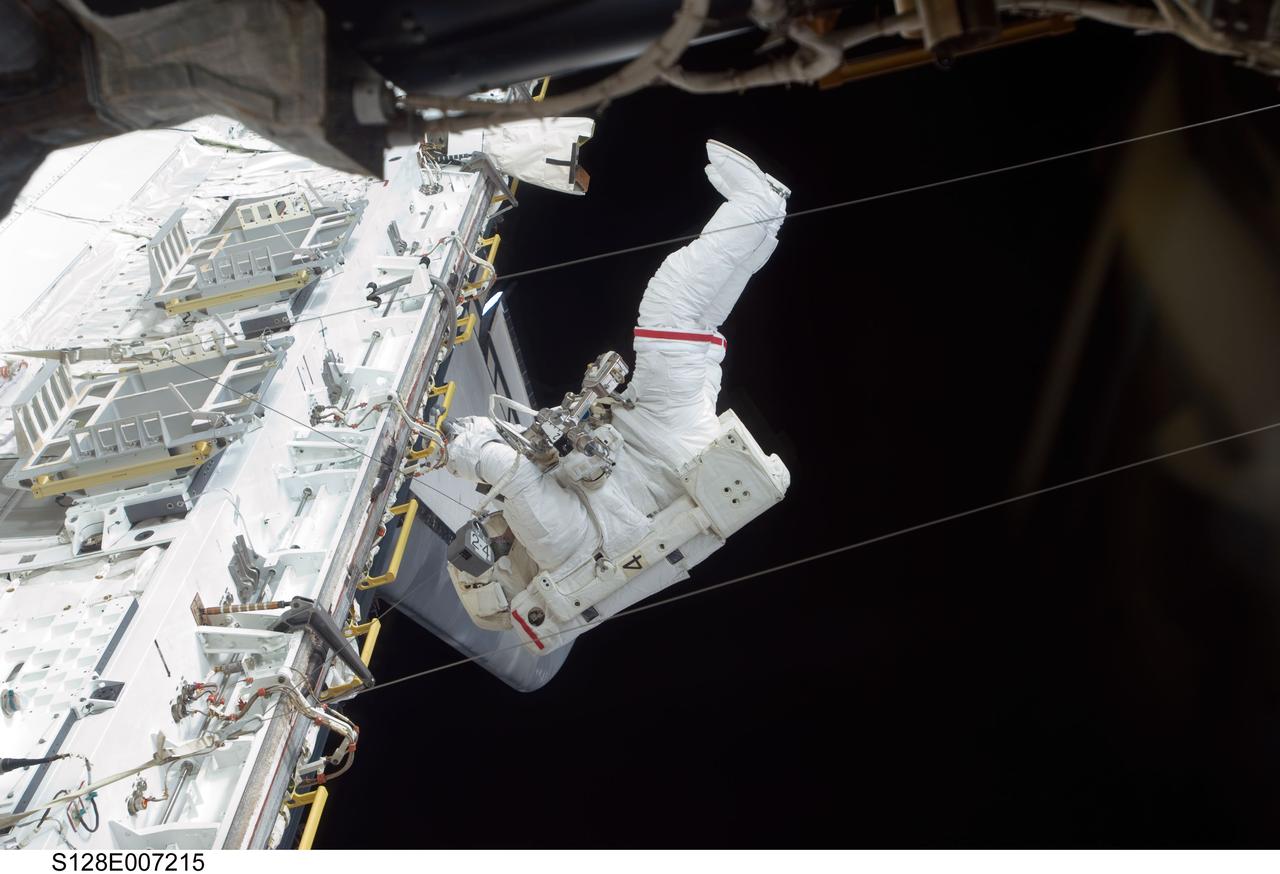
S128-E-007215 (1 Sept. 2009) --- Astronaut John “Danny” Olivas, STS-128 mission specialist, participates in the mission's first session of extravehicular activity (EVA) as construction and maintenance continue on the International Space Station. During the six-hour, 35-minute spacewalk, Olivas and astronaut Nicole Stott (out of frame), mission specialist, removed an empty ammonia tank from the station’s truss and temporarily stowed it on the station’s robotic arm. Olivas and Stott also retrieved the European Technology Exposure Facility (EuTEF) and Materials International Space Station Experiment (MISSE) from the Columbus laboratory module and installed them on Discovery’s payload bay for return.