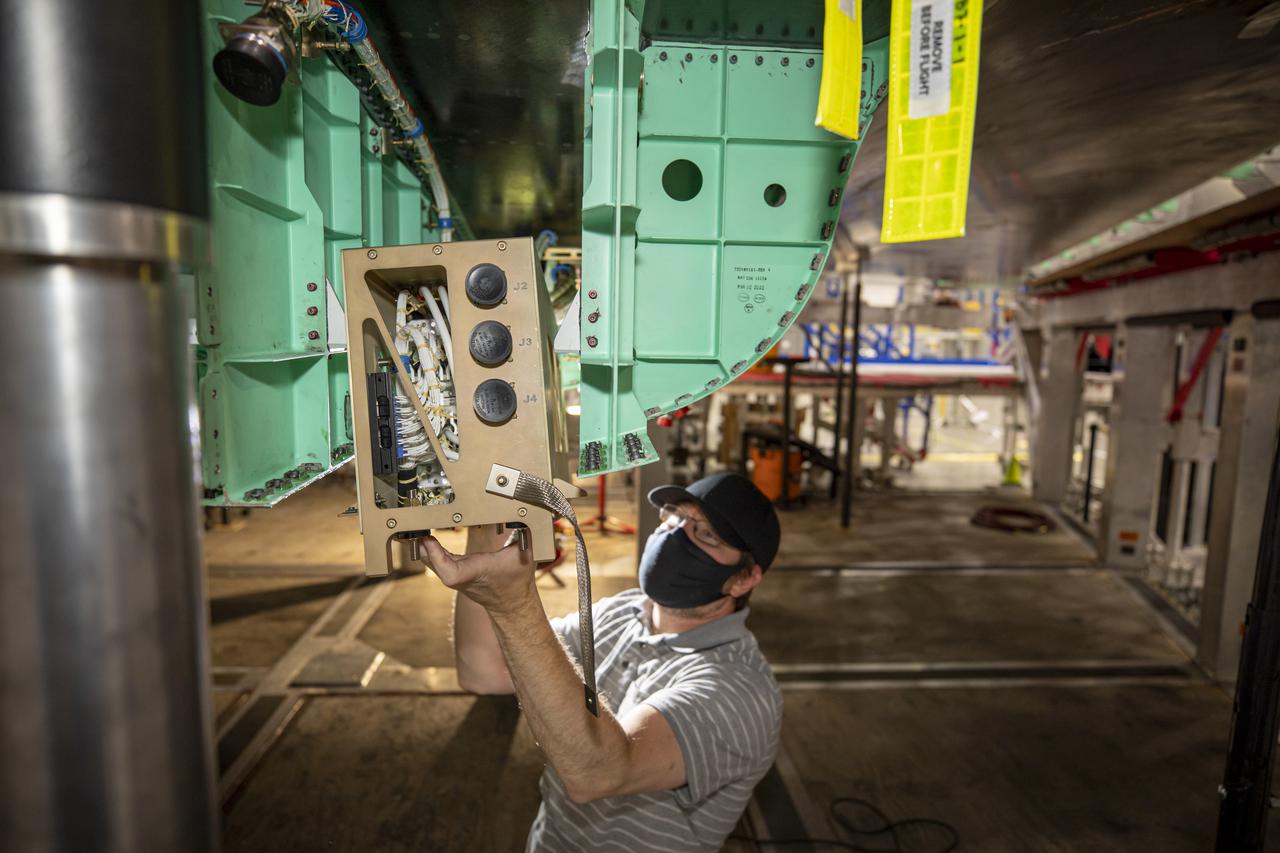
A technician works on the installation of the PDS Pallet (gold colored box that he is holding) on NASA’s X-59 Quiet SuperSonic Technology or QueSST aircraft. Lockheed Martin Photography By Garry Tice 1011 Lockheed Way, Palmdale, Ca. 93599 Event: SEG 450 Mid Bay - PDS Fit Check Date: 5/03/2021
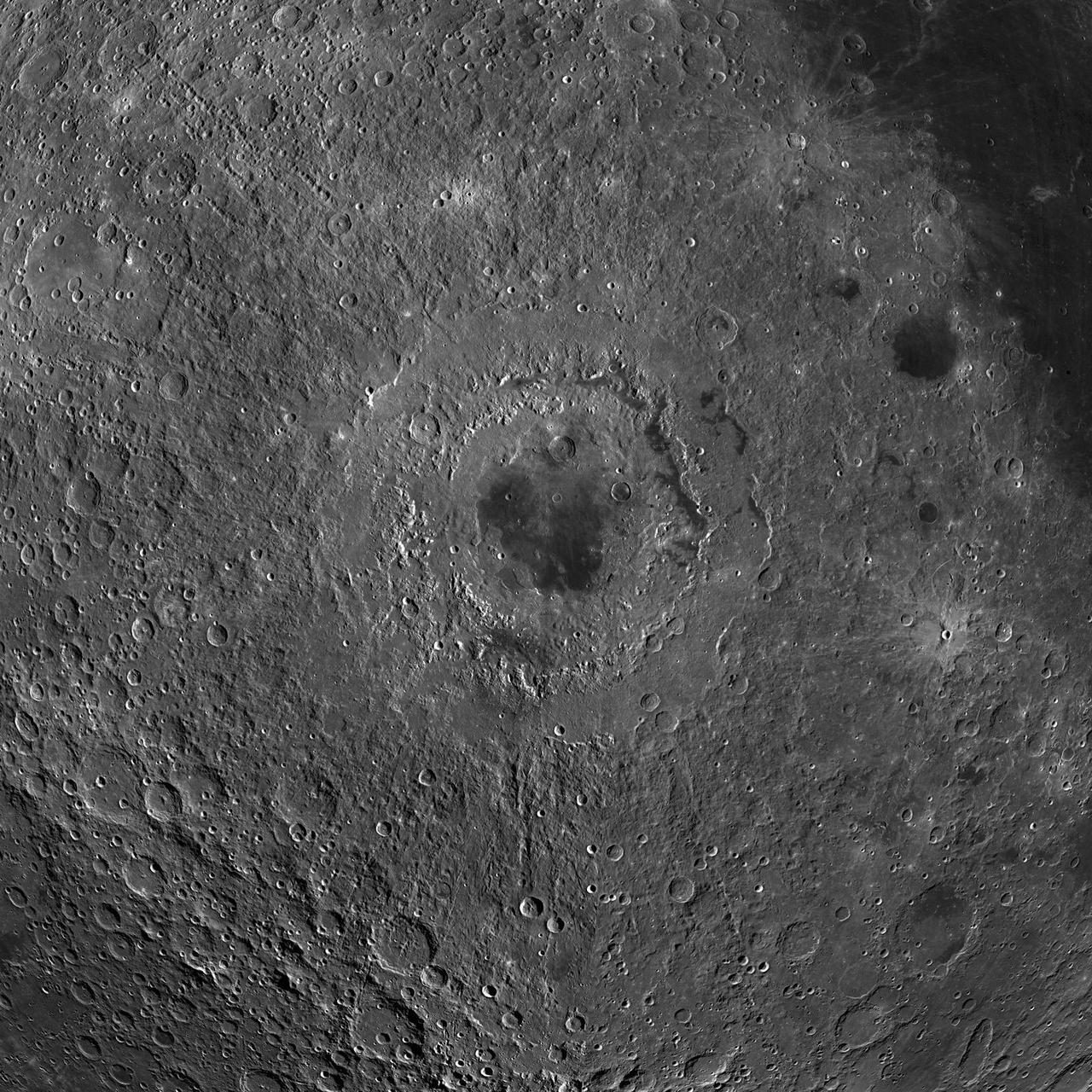
LROC PDS Release Number 5
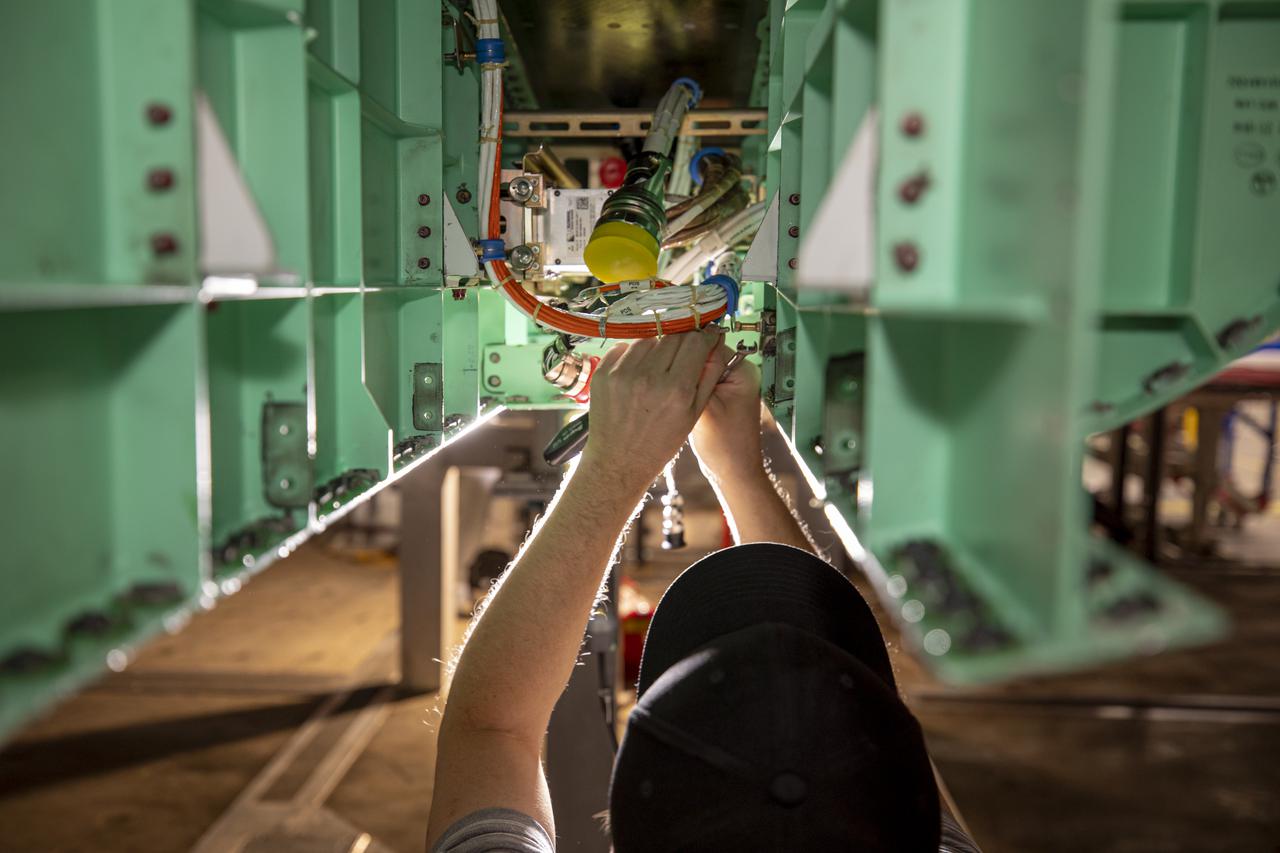
A technician is shown working on the underside of the X-59. The aircraft, under construction at Lockheed Martin Skunk Works in Palmdale, California, will fly to demonstrate the ability to fly supersonic while reducing the loud sonic boom to a quiet sonic thump. Lockheed Martin Photography By Garry Tice 1011 Lockheed Way, Palmdale, Ca. 93599 Event: SEG 450 Mid Bay - PDS Fit Check Date: 5/03/2021
![ISS007-E-17848 (23 October 2003) --- Cosmonaut Alexander Y. Kaleri (right), Expedition 8 flight engineer, uses a camera to film a scientific experiment performed by European Space Agency (ESA) astronaut Pedro Duque of Spain in the Zvezda Service Module on the International Space Station (ISS). Kaleri represents Rosaviakosmos. Duque and Kaleri performed the European educational VIDEO-2 (VID-01) experiment, which uses the Russian DSR PD-150P digital video camcorder for recording demos of several basic physical phenomena, viz., Isaac Newton's three motion laws, with narration. [The demo made use of a sealed bag containing coffee and a syringe to fill one of two hollow balls with the brown liquid (to provide "mass", as opposed to the other, "mass-less" ball).]](https://images-assets.nasa.gov/image/iss007e17848/iss007e17848~medium.jpg)
ISS007-E-17848 (23 October 2003) --- Cosmonaut Alexander Y. Kaleri (right), Expedition 8 flight engineer, uses a camera to film a scientific experiment performed by European Space Agency (ESA) astronaut Pedro Duque of Spain in the Zvezda Service Module on the International Space Station (ISS). Kaleri represents Rosaviakosmos. Duque and Kaleri performed the European educational VIDEO-2 (VID-01) experiment, which uses the Russian DSR PD-150P digital video camcorder for recording demos of several basic physical phenomena, viz., Isaac Newton's three motion laws, with narration. [The demo made use of a sealed bag containing coffee and a syringe to fill one of two hollow balls with the brown liquid (to provide "mass", as opposed to the other, "mass-less" ball).]
![ISS007-E-17842 (23 October 2003) --- European Space Agency (ESA) astronaut Pedro Duque (left) of Spain and cosmonaut Alexander Y. Kaleri, Expedition 8 flight engineer representing Rosaviakosmos, work with a scientific experiment in the Zvezda Service Module on the International Space Station (ISS). Duque and Kaleri performed the European educational VIDEO-2 (VID-01) experiment, which uses the Russian DSR PD-150P digital video camcorder for recording demos of several basic physical phenomena, viz., Isaac Newton's three motion laws, with narration. [The demo made use of a sealed bag containing coffee and a syringe to fill one of two hollow balls with the brown liquid (to provide "mass", as opposed to the other, "mass-less" ball).]](https://images-assets.nasa.gov/image/iss007e17842/iss007e17842~medium.jpg)
ISS007-E-17842 (23 October 2003) --- European Space Agency (ESA) astronaut Pedro Duque (left) of Spain and cosmonaut Alexander Y. Kaleri, Expedition 8 flight engineer representing Rosaviakosmos, work with a scientific experiment in the Zvezda Service Module on the International Space Station (ISS). Duque and Kaleri performed the European educational VIDEO-2 (VID-01) experiment, which uses the Russian DSR PD-150P digital video camcorder for recording demos of several basic physical phenomena, viz., Isaac Newton's three motion laws, with narration. [The demo made use of a sealed bag containing coffee and a syringe to fill one of two hollow balls with the brown liquid (to provide "mass", as opposed to the other, "mass-less" ball).]
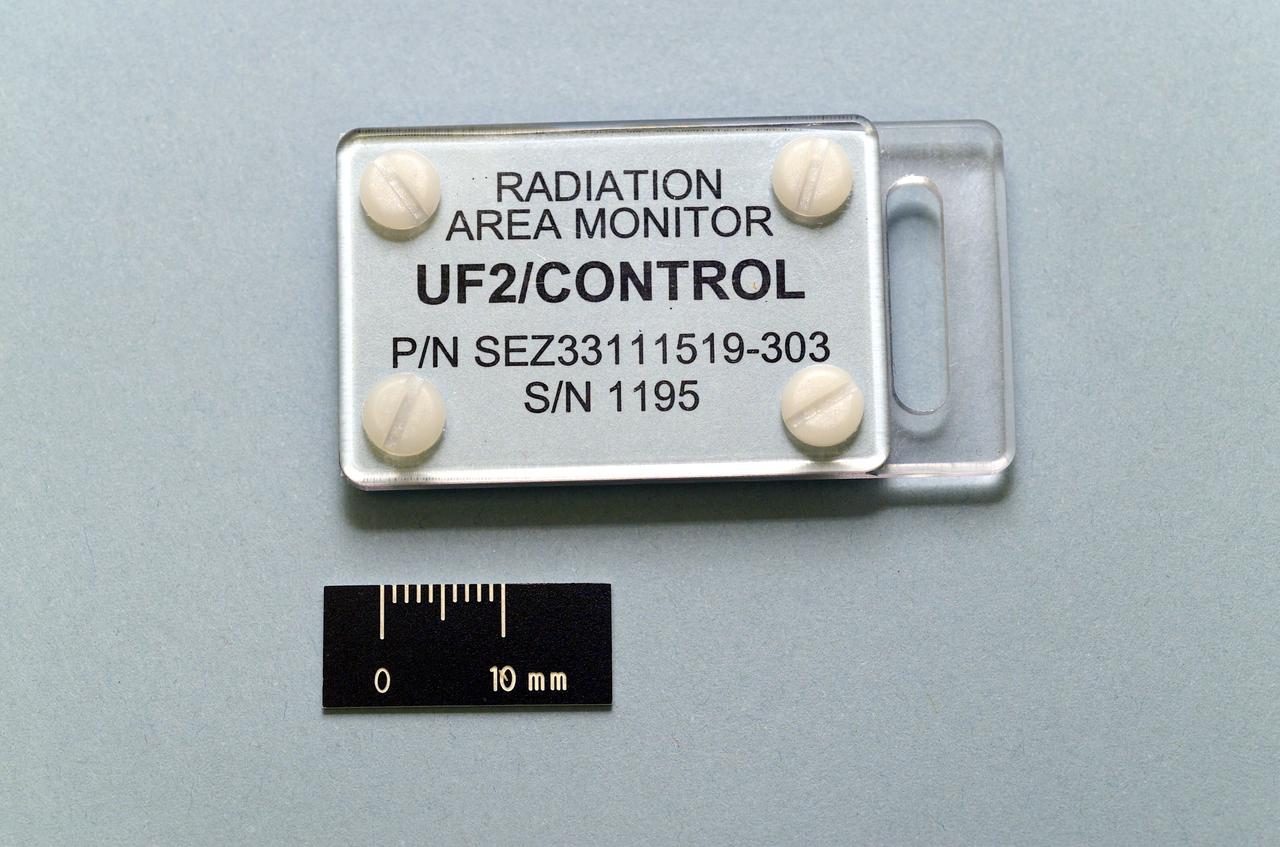
jsc2002e20491 (7/10/2015) --- View of Label side, front, on a Radiation Area Monitor (RAM) Control Dosimeter as part of the Radiation Area Subpack Assemblies for the Passive Dosimetry System. The Radiation Area Monitor (RAM) is a small set of thermoluminescent detectors encased in Lexan plastic that respond to radiation; the amount of radiation they absorb can be revealed by applying heat and measuring the amount of visible light released. The RAM is used to monitor dose and dose equivalent within the habitable volume of the International space Station (ISS) as a function of location, due to its predicted low sensitivity to high-Linear Energy Transfer radiation (neutrons and alpha particles).

NASA image release March 11, 2011 Caption: The lunar farside as never seen before! LROC WAC orthographic projection centered at 180° longitude, 0° latitude. Credit: NASA/Goddard/Arizona State University. Because the moon is tidally locked (meaning the same side always faces Earth), it was not until 1959 that the farside was first imaged by the Soviet Luna 3 spacecraft (hence the Russian names for prominent farside features, such as Mare Moscoviense). And what a surprise - unlike the widespread maria on the nearside, basaltic volcanism was restricted to a relatively few, smaller regions on the farside, and the battered highlands crust dominated. A different world from what we saw from Earth. Of course, the cause of the farside/nearside asymmetry is an interesting scientific question. Past studies have shown that the crust on the farside is thicker, likely making it more difficult for magmas to erupt on the surface, limiting the amount of farside mare basalts. Why is the farside crust thicker? That is still up for debate, and in fact several presentations at this week's Lunar and Planetary Science Conference attempt to answer this question. The Clementine mission obtained beautiful mosaics with the sun high in the sky (low phase angles), but did not have the opportunity to observe the farside at sun angles favorable for seeing surface topography. This WAC mosaic provides the most complete look at the morphology of the farside to date, and will provide a valuable resource for the scientific community. And it's simply a spectacular sight! The Lunar Reconnaissance Orbiter Camera (LROC) Wide Angle Camera (WAC) is a push-frame camera that captures seven color bands (321, 360, 415, 566, 604, 643, and 689 nm) with a 57-km swath (105-km swath in monochrome mode) from a 50 km orbit. One of the primary objectives of LROC is to provide a global 100 m/pixel monochrome (643 nm) base map with incidence angles between 55°-70° at the equator, lighting that is favorable for morphological interpretations. Each month, the WAC provides nearly complete coverage of the Moon under unique lighting. As an added bonus, the orbit-to-orbit image overlap provides stereo coverage. Reducing all these stereo images into a global topographic map is a big job, and is being led by LROC Team Members from the German Aerospace Center (Deutsches Zentrum für Luft- und Raumfahrt; DLR). Several preliminary WAC topographic products have appeared in LROC featured images over the past year (Orientale basin, Sinus Iridum). For a sneak preview of the WAC global DEM with the WAC global mosaic, view a rotating composite moon (70 MB video from ASU's LROC website). The WAC topographic dataset will be completed and released later this year. The global mosaic released today is comprised of over 15,000 WAC images acquired between November 2009 and February 2011. The non-polar images were map projected onto the GLD100 shape model (WAC derived 100 m/pixel DTM), while polar images were map projected on the LOLA shape model. In addition, the LOLA derived crossover corrected ephemeris, and an improved camera pointing, provide accurate positioning (better than 100 m) of each WAC image. As part of the March 2011 PDS release, the LROC team posted the global map in ten regional tiles. Eight of the tiles are equirectangular projections that encompass 60° latitude by 90° longitude. In addition, two polar stereographic projections are available for each pole from ±60° to the pole. These reduced data records (RDR) products will be available for download on March 15, 2011. As the mission progresses, and our knowledge of the lunar photometric function increases, improved and new mosaics will be released! Work your way around the moon with these six orthographic projections constructed from WAC mosaics. The nearside view linked below is different from that released on 21 February. To read more con't here: <a href="http://www.nasa.gov/mission_pages/LRO/news/lro-farside.html" rel="nofollow">www.nasa.gov/mission_pages/LRO/news/lro-farside.html</a> <b><a href="http://www.nasa.gov/centers/goddard/home/index.html" rel="nofollow">NASA Goddard Space Flight Center</a></b> enables NASA’s mission through four scientific endeavors: Earth Science, Heliophysics, Solar System Exploration, and Astrophysics. Goddard plays a leading role in NASA’s accomplishments by contributing compelling scientific knowledge to advance the Agency’s mission. <b>Follow us on <a href="http://twitter.com/NASA_GoddardPix" rel="nofollow">Twitter</a></b> <b>Join us on <a href="http://www.facebook.com/pages/Greenbelt-MD/NASA-Goddard/395013845897?ref=tsd" rel="nofollow">Facebook</a></b>