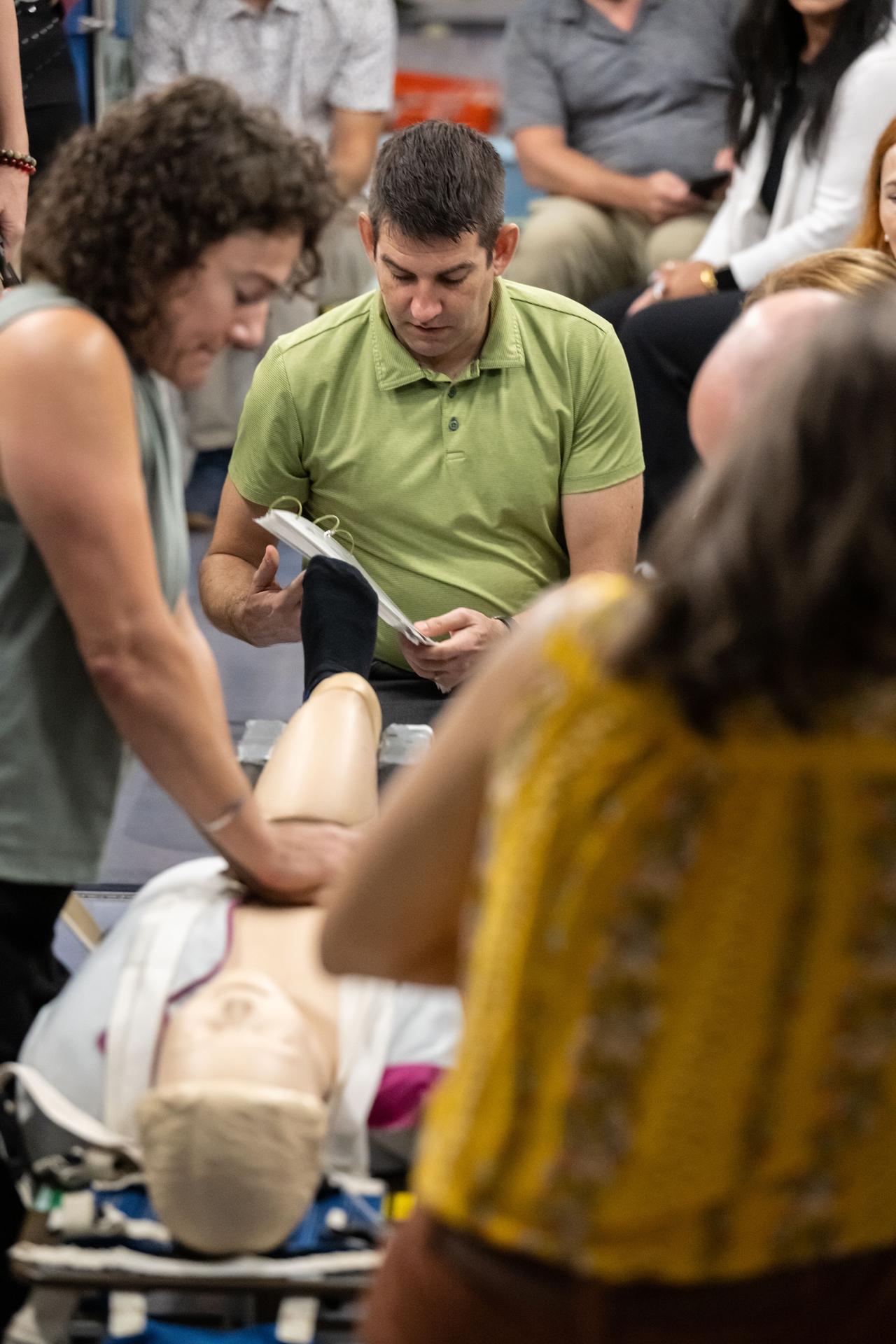
jsc2025e070045 (Aug. 21, 2025) --- NASA's SpaceX Crew-12 members Jessica Meir and Jack Hathaway, both NASA astronauts, practice cardiopulmonary resuscitation (CPR) during a medical emergency simulation as part of their training for mission to the International Space Station. Surrounding Meir and Hathaway are various training support personnel at NASA's Johnson Space Center in Houston, Texas. Credit: NASA/Bill Stafford
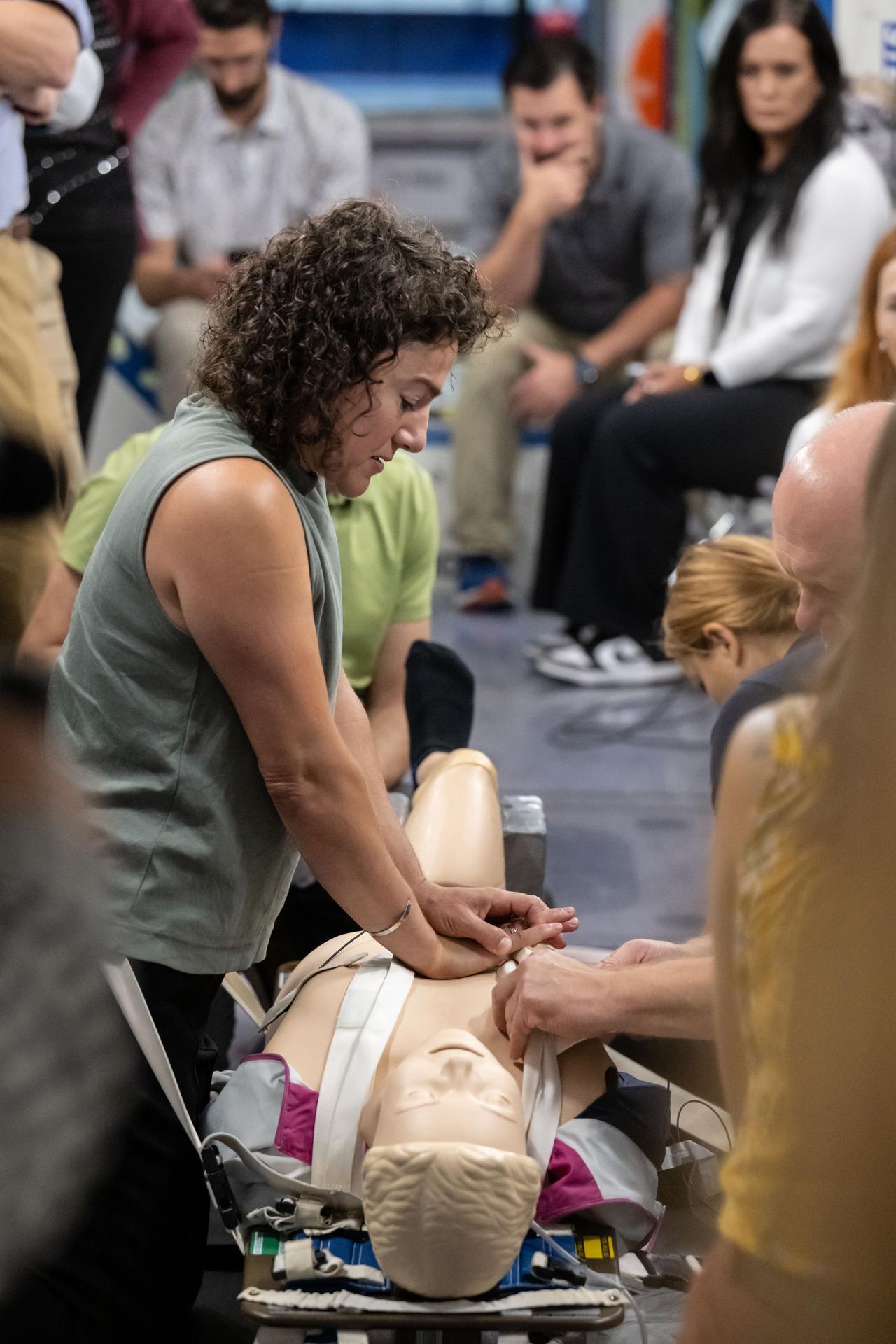
jsc2025e070047 (Aug. 21, 2025) --- NASA astronaut Jessica Meir practices cardiopulmonary resuscitation (CPR) during a medical emergency simulation as part of her training for NASA's SpaceX Crew-12 mission to the International Space Station. Surrounding Meir are various training support personnel at NASA's Johnson Space Center in Houston, Texas. Credit: NASA/Bill Stafford
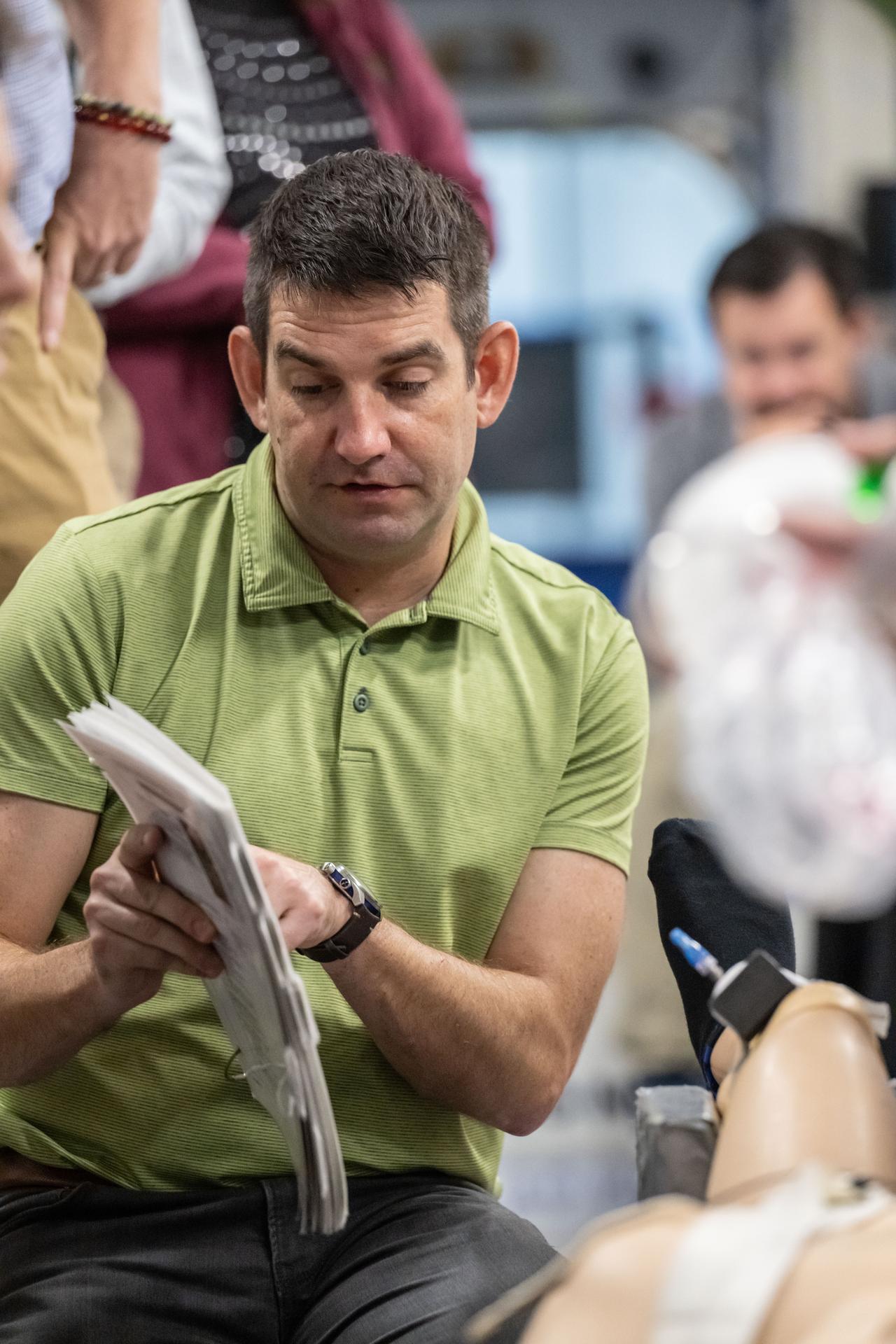
jsc2025e070056 (Aug. 21, 2025) --- NASA astronaut Jack Hathaway reviews cardiopulmonary resuscitation (CPR) techniques during a medical emergency simulation as part of his training for NASA's SpaceX Crew-12 mission to the International Space Station. Surrounding Hathaway are various training support personnel at NASA's Johnson Space Center in Houston, Texas. Credit: NASA/Bill Stafford
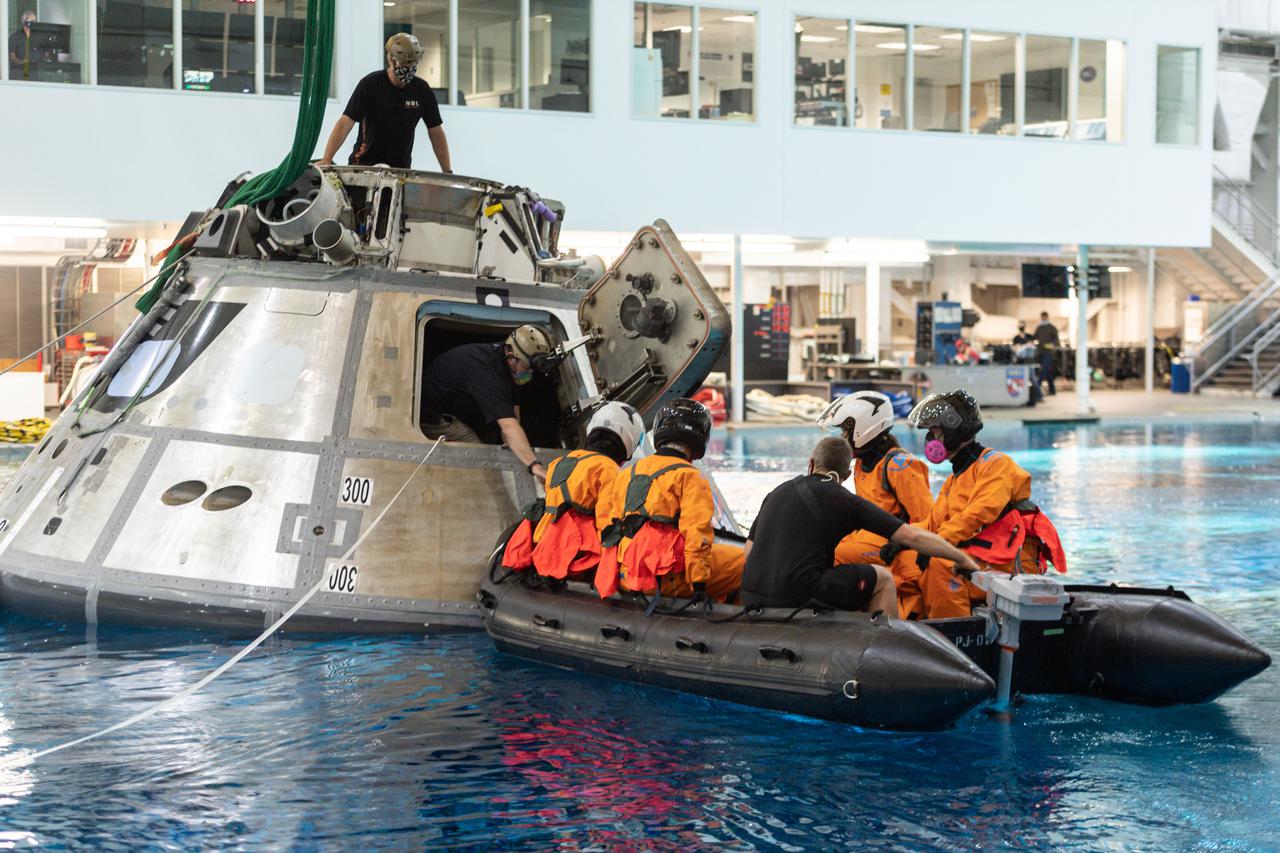
jsc2021e017168 (April 30, 2021) --- The SpaceX Crew-3 astronauts and support personnel participate in water survival training at the Neutral Buoyancy Laboratory at NASA's Johnson Space Center in Houston, Texas.
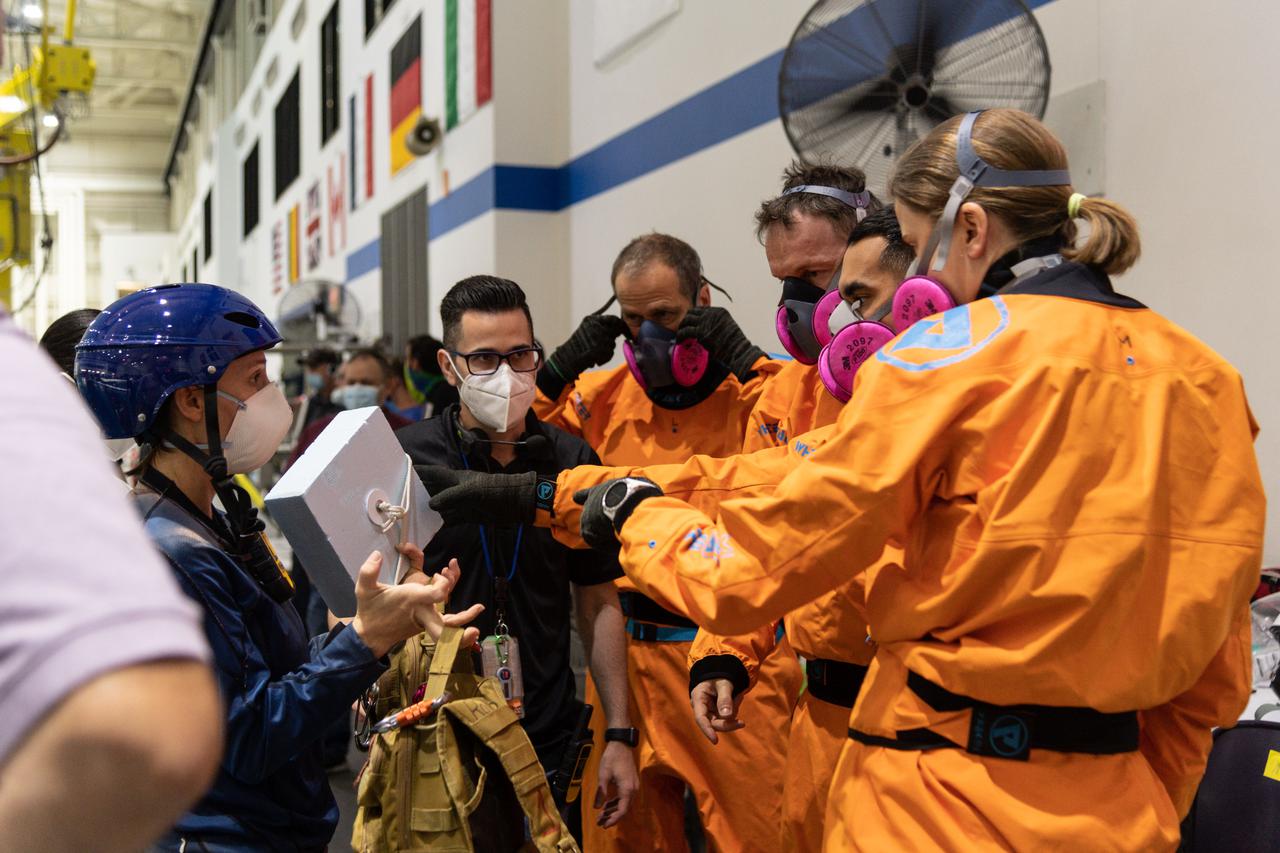
jsc2021e017099 (April 30, 2021) --- The SpaceX Crew-3 astronauts and support personnel participate in water survival training at the Neutral Buoyancy Laboratory at NASA's Johnson Space Center in Houston, Texas.
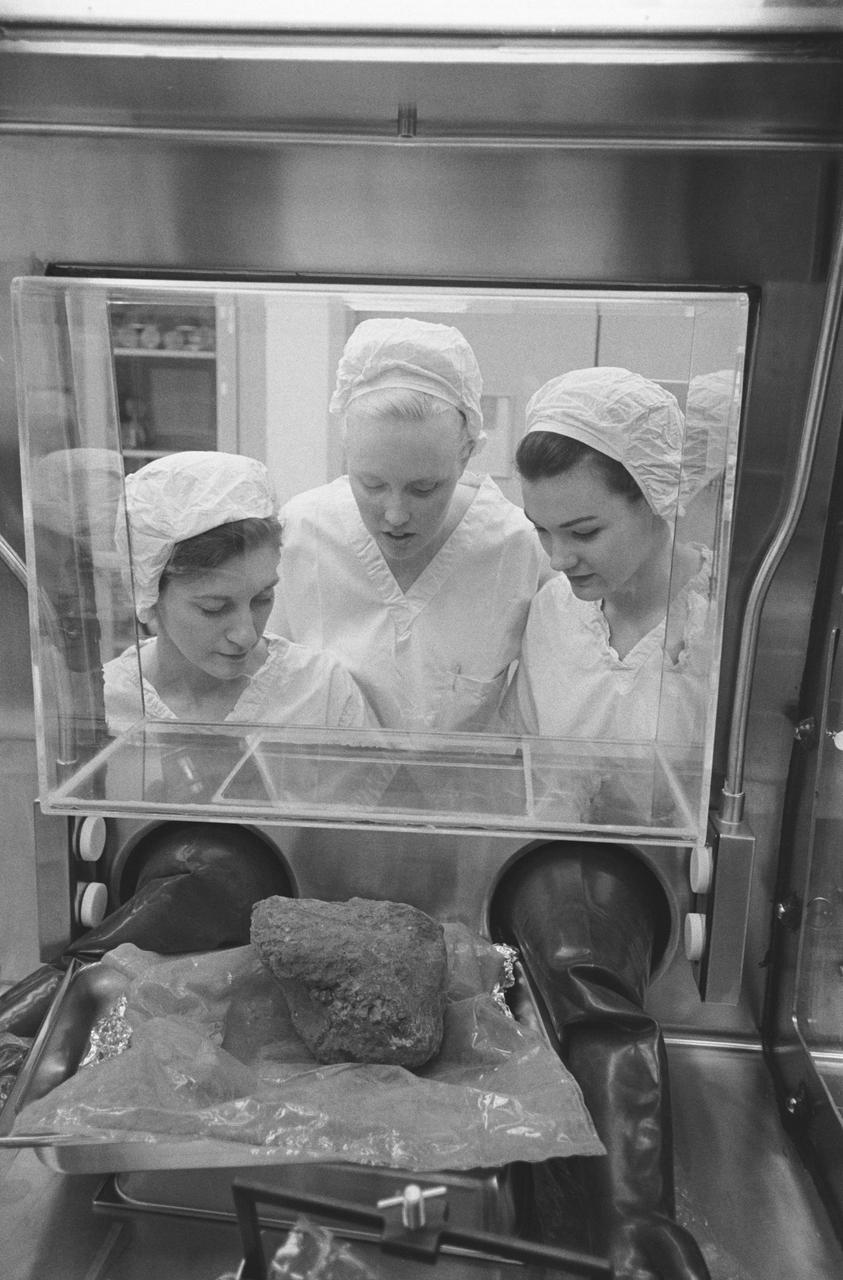
S71-21244 (24 Feb. 1971) --- Three Brown and Root/Northrop technicians in the Nonsterile Nitrogen Laboratory in the Lunar Receiving Laboratory (LRL) peer through glass at the much-discussed basketball size rock which Apollo 14 crewmen brought back from the Fra Mauro area of the moon. They are, left to right, Linda Tyler, Nancy L. Trent and Sandra Richards.
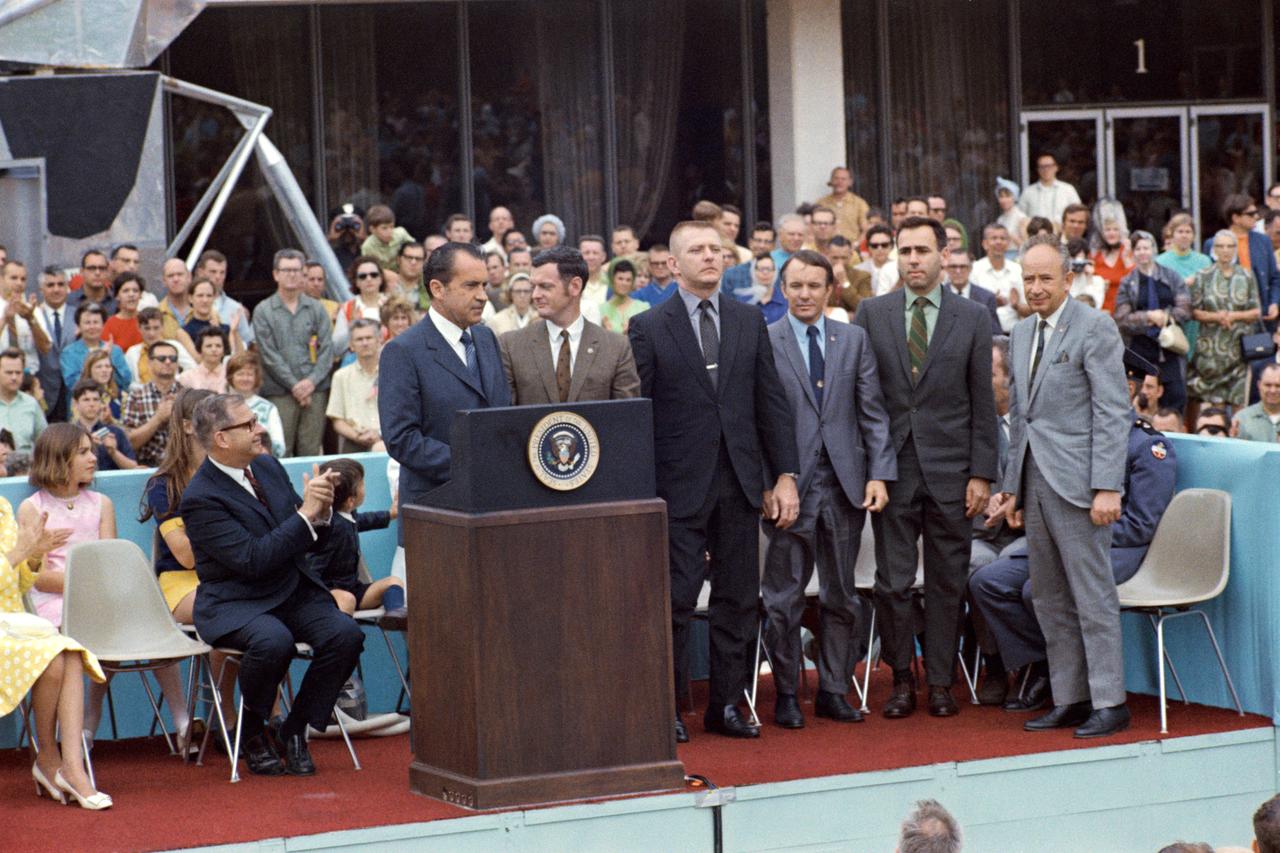
S70-35600 (18 April 1970) --- President Richard M. Nixon introduces Sigurd A. Sjoberg (far right), director of Flight Operations at Manned Spacecraft Center, and the four Apollo 13 flight directors during the President?s post-mission visit to the Manned Spacecraft Center. The flight directors are, from left to right, Glynn S. Lunney, Eugene A. Kranz, Gerald D. Griffin and Milton L. Windler. Dr. Thomas O. Paine, Administrator, National Aeronautics and Space Administration, is seated at left. President Nixon was on the site to present the Presidential Medal of Freedom - the nation?s highest civilian honor -to the Apollo 13 Mission Operations Team.
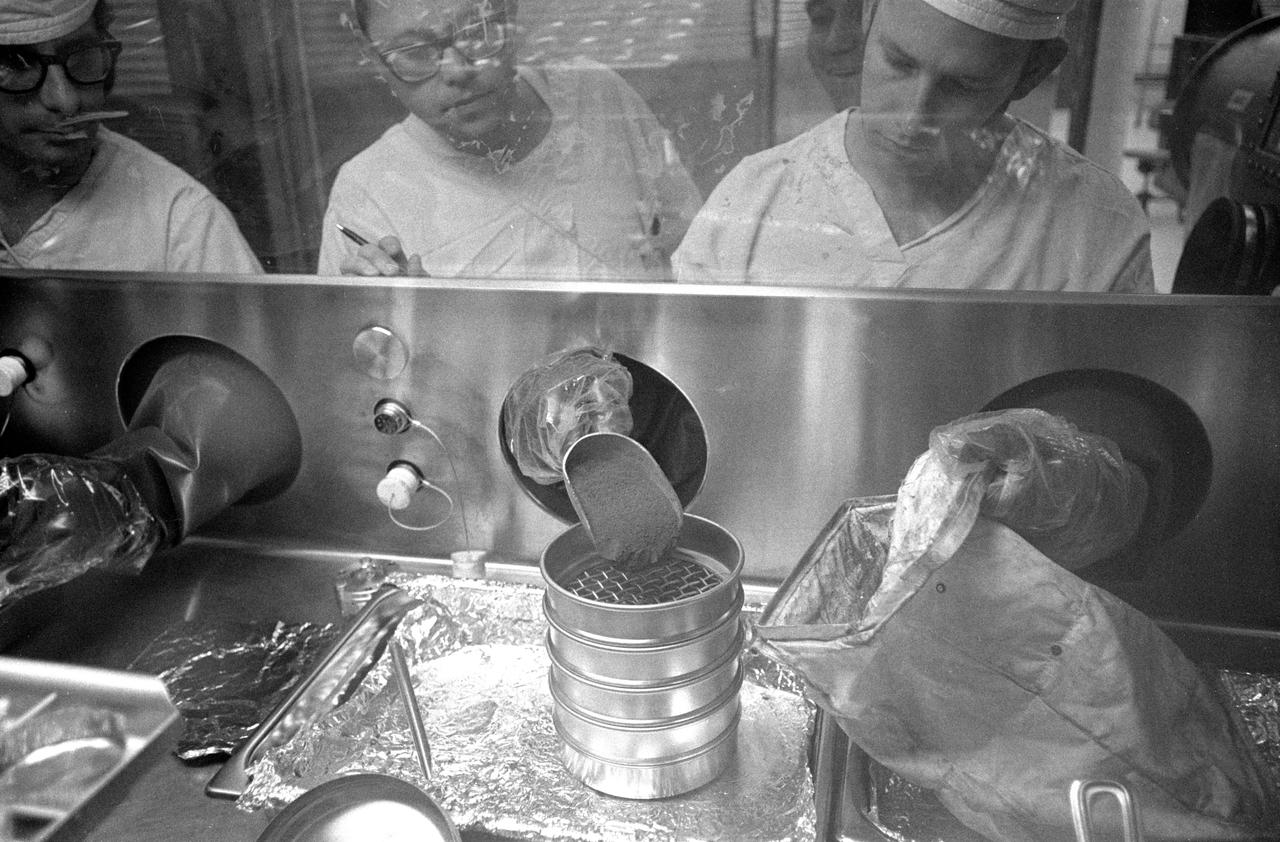
S71-19489 (18 Feb. 1971) --- Glove handlers work with freshly opened Apollo 14 lunar sample material in modularized cabinets in the Lunar Receiving Laboratory at the Manned Spacecraft Center. The glove operator on the right starts to pour fine lunar material which he has just taken from a tote bag. The powdery sample was among the last to be revealed of the 90-odd pounds of material brought back to Earth by the Apollo 14 crew members.
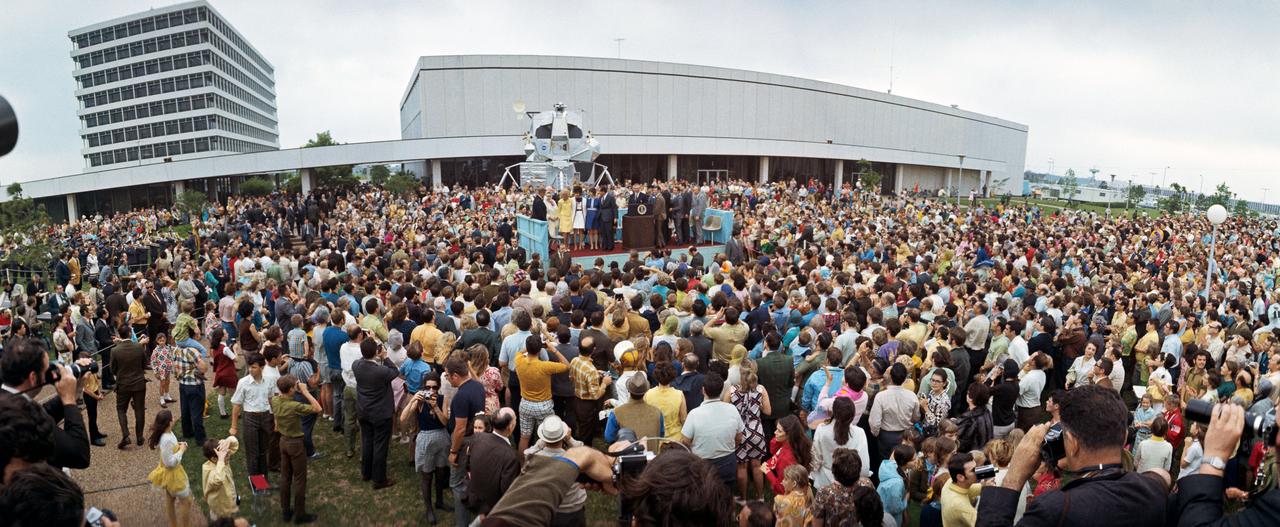
S70-35601 (18 April 1970) --- A wide-angle, overall view of the large crowd of people who were on hand to see President Richard M. Nixon present the Presidential Medal of Freedom to the Apollo 13 Mission Operations Team. The honor is the nation's highest civilian award. A temporary speaker's platform was erected beside Building 1 for the occasion.
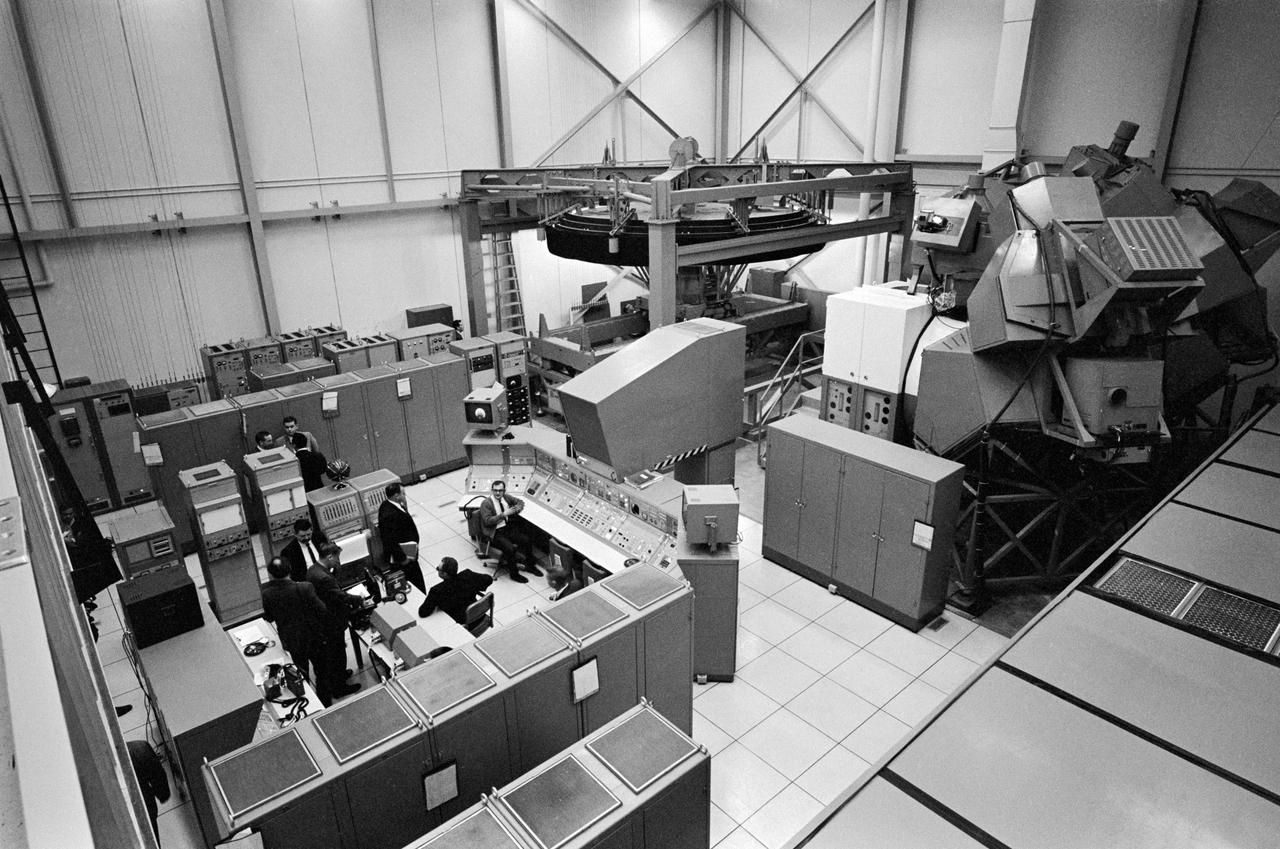
Overall view of the Lunar Module Mission Simulator, an astronaut training facility located in bldg 5.
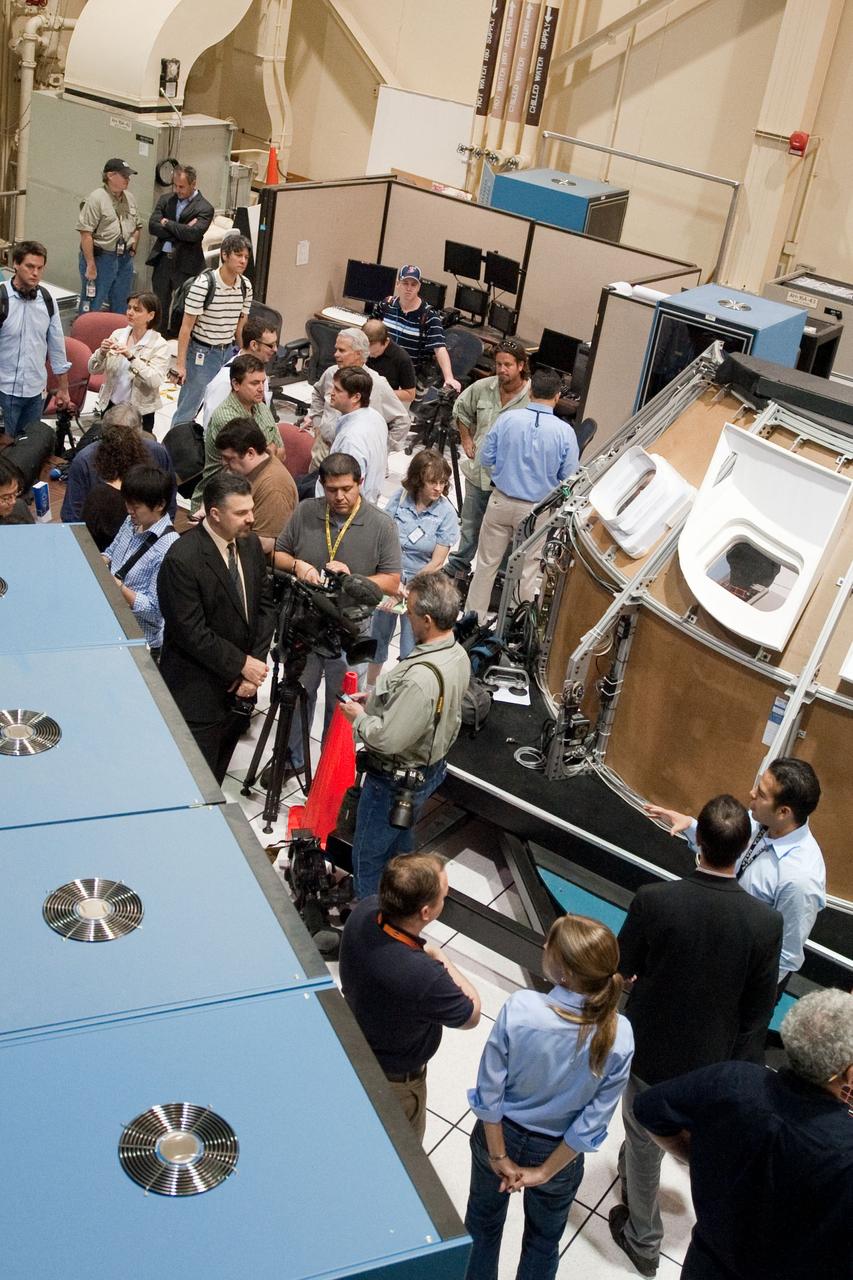
JSC2011-E-028128 (23 March 2011) --- News media representatives and NASA personnel are pictured during an STS-135 media day event in the Avionics Systems Laboratory at NASA's Johnson Space Center. Photo credit: NASA or National Aeronautics and Space Administration

JSC2011-E-028124 (23 March 2011) --- News media representatives and NASA personnel are pictured during an STS-135 media day event in the Avionics Systems Laboratory at NASA's Johnson Space Center. Photo credit: NASA or National Aeronautics and Space Administration
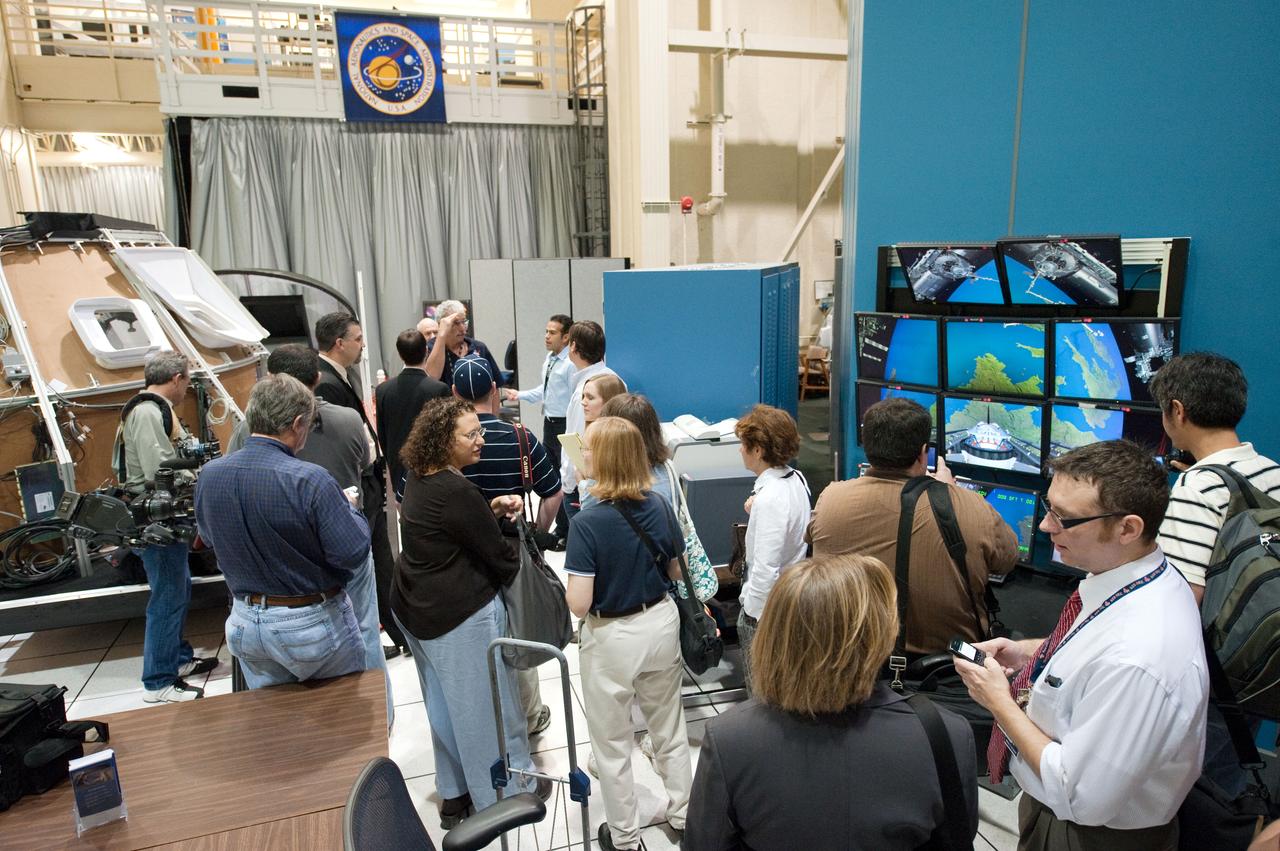
JSC2011-E-028125 (23 March 2011) --- News media representatives and NASA personnel are pictured during an STS-135 media day event in the Avionics Systems Laboratory at NASA's Johnson Space Center. Photo credit: NASA or National Aeronautics and Space Administration
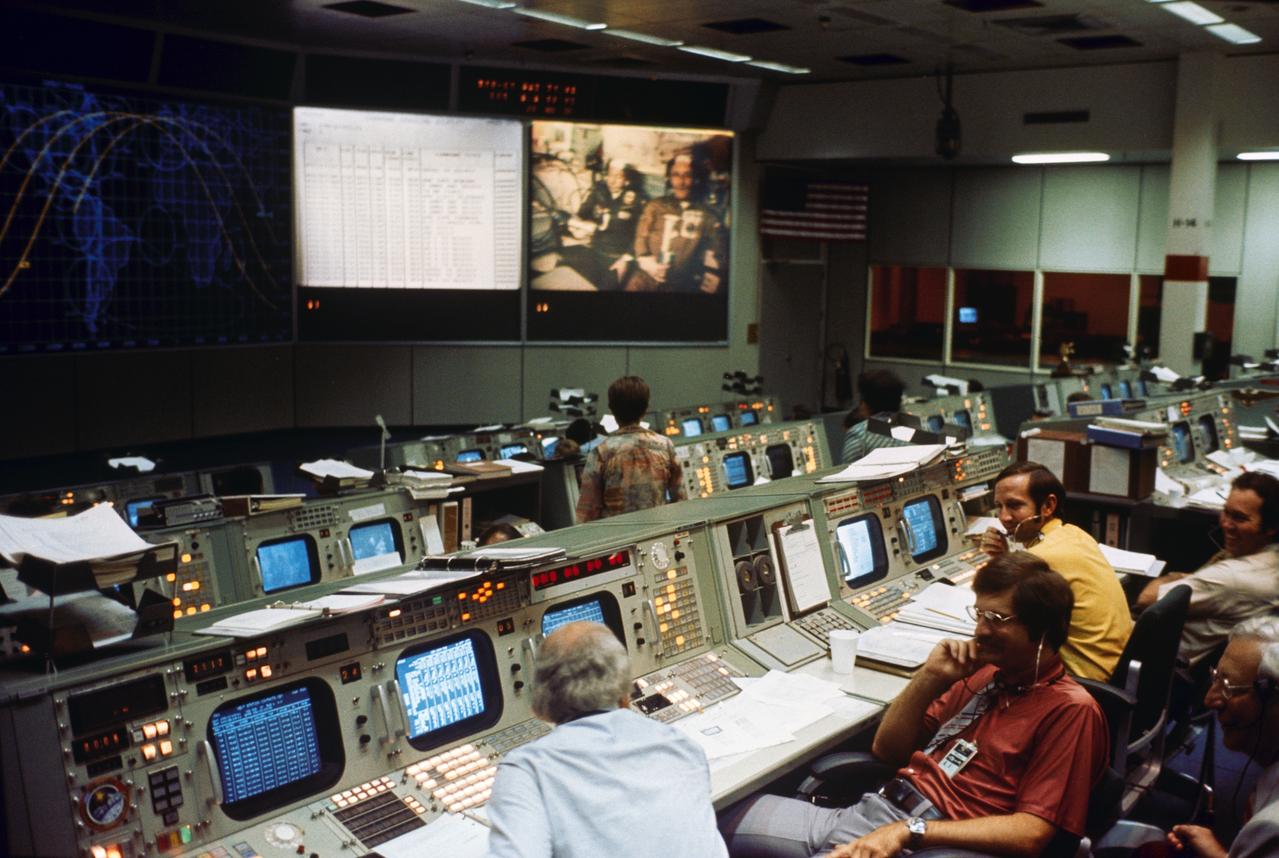
S75-28685 (17 July 1975) --- An overall view of activity in the Mission Operations Control Room in the Mission Control Center during joint U.S.-USSR Apollo Soyuz Test Project (ASTP) docking mission in Earth orbit. The large television monitor shows an interior view of the Soyuz Orbital Module with astronaut Thomas P. Stafford (in front) visiting with cosmonaut Aleksey A. Leonov. Neil B. Hutchinson (right hand to chin) is the flight director for this shift.
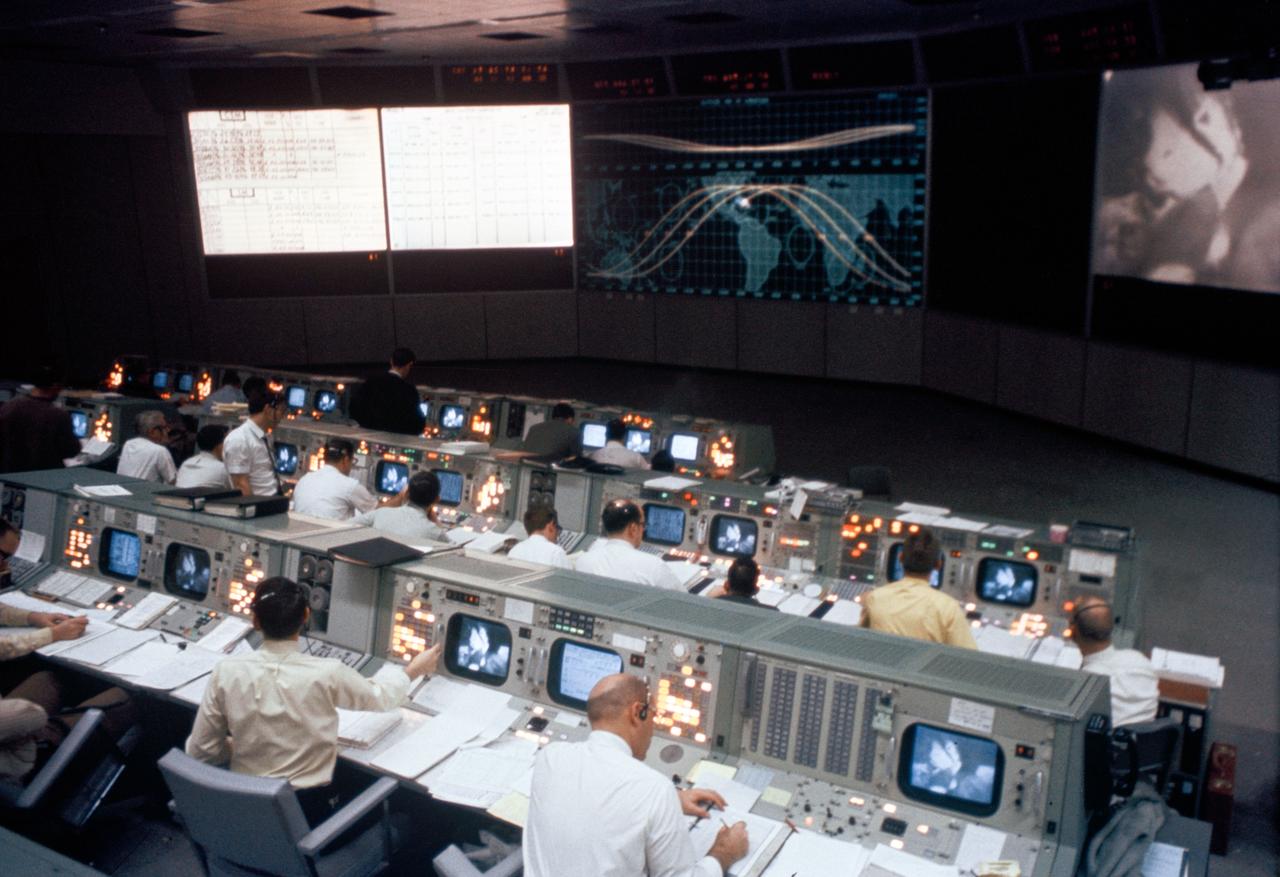
S69-26301 (March 1969) --- Overall view of the Mission Operations Control Room in the Mission Control Center, Building 30, during the Apollo 9 Earth-orbital mission. When this photograph was taken a live television transmission was being received from Apollo 9 as it orbited Earth.
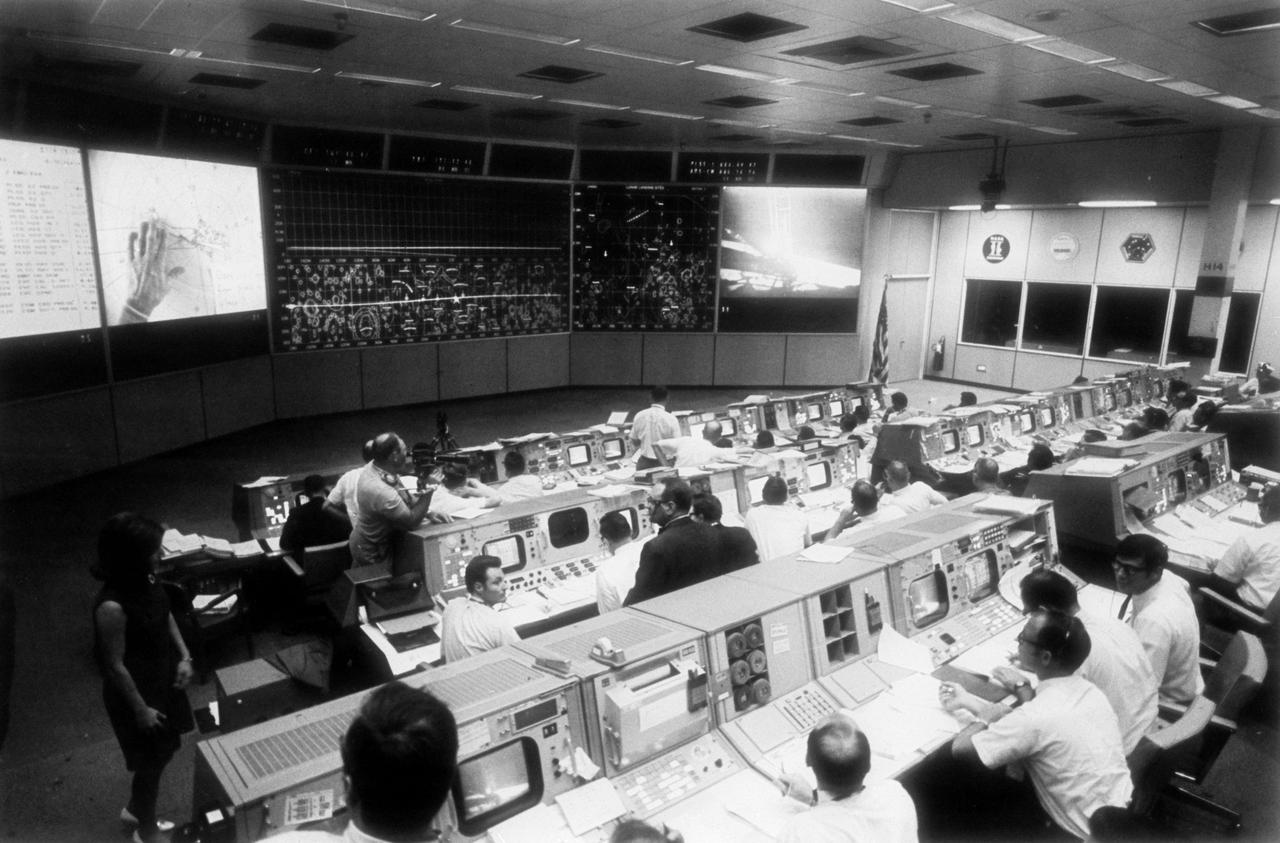
Overall view of the Mission Operations Control Room in the Mission Control Center, bldg 30, during the lunar surface extravehicular activity (EVA) of Apollo 11 Astronauts Neil A. Armstrong and Edwin E. Aldrin Jr.
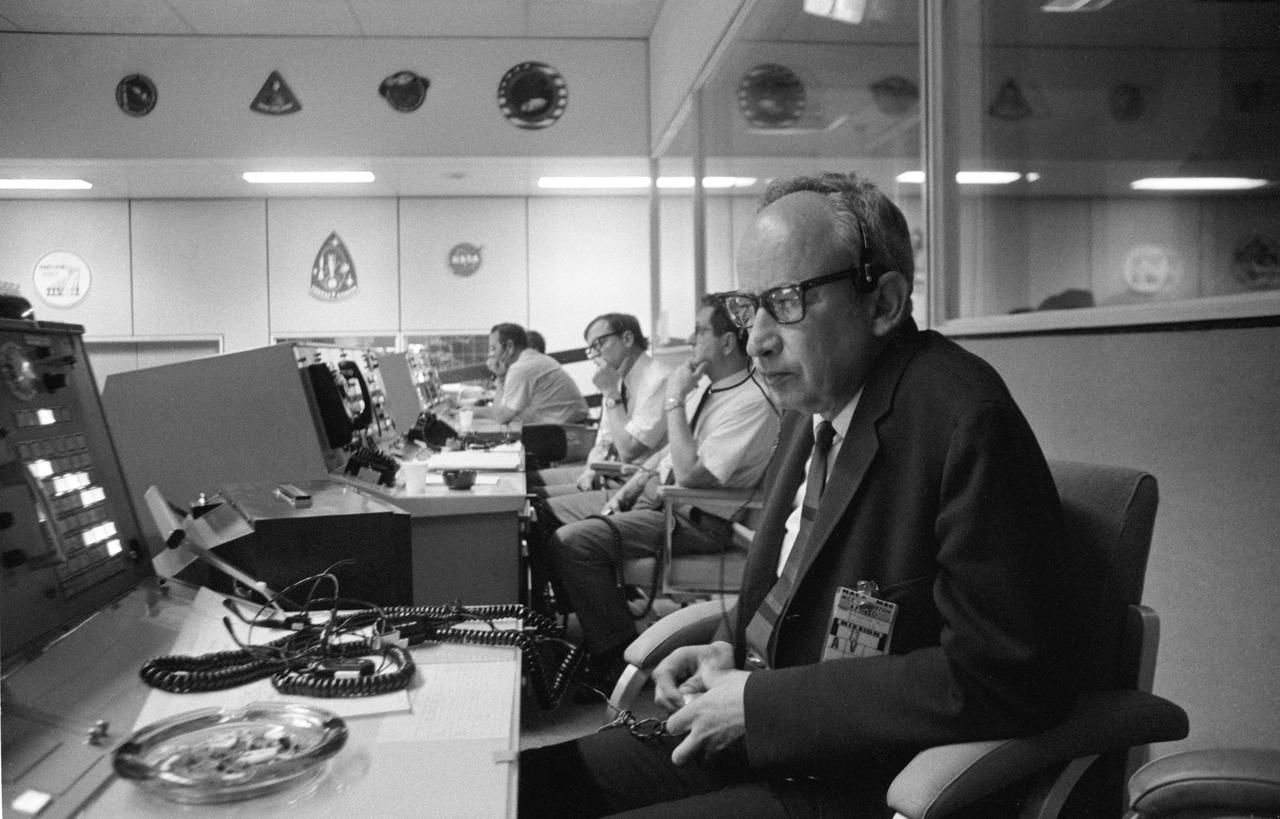
S70-34627 (11 April 1970) --- Sigurd A. Sjoberg, director of flight operations, at the Manned Spacecraft Center (MSC), views the Apollo 13 liftoff from a console in the MSC Mission Control Center (MCC), Building 30. Apollo 13 lifted off at 1:13 p.m. (CST) April 11, 1970. Photo credit: NASA
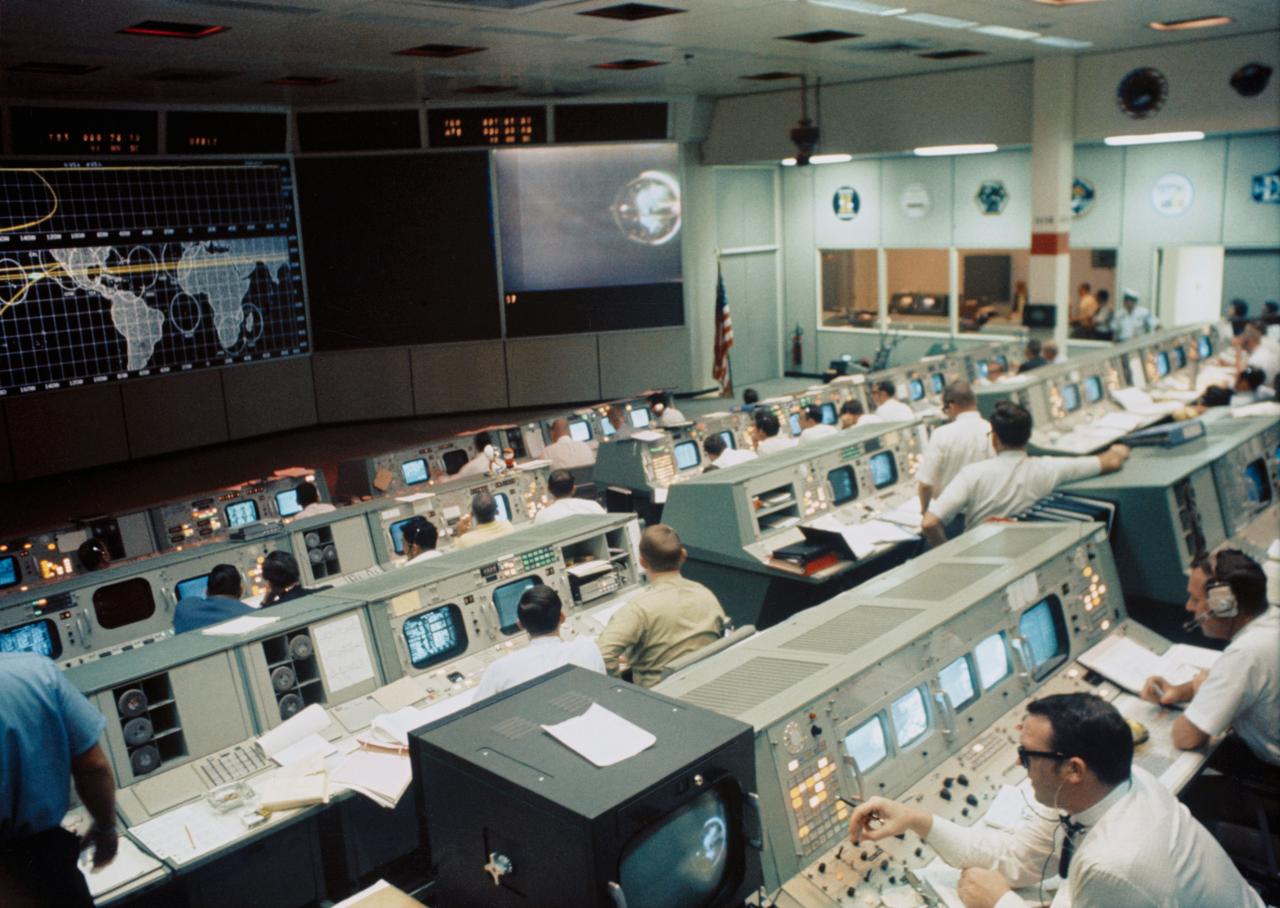
S69-34316 (18 May 1969) --- Overall view of the Mission Operations Control Room in the Mission Control Center, Building 30, on the first day of the Apollo 10 lunar orbit mission. A color television transmission was being received from Apollo 10. This picture was made following Command and Service Module/Lunar Module/Saturn IVB (CSM/LM-S-IVB) separation and prior to LM extraction from the S-IVB. The CSM were making the docking approach to the LM/S-IVB.
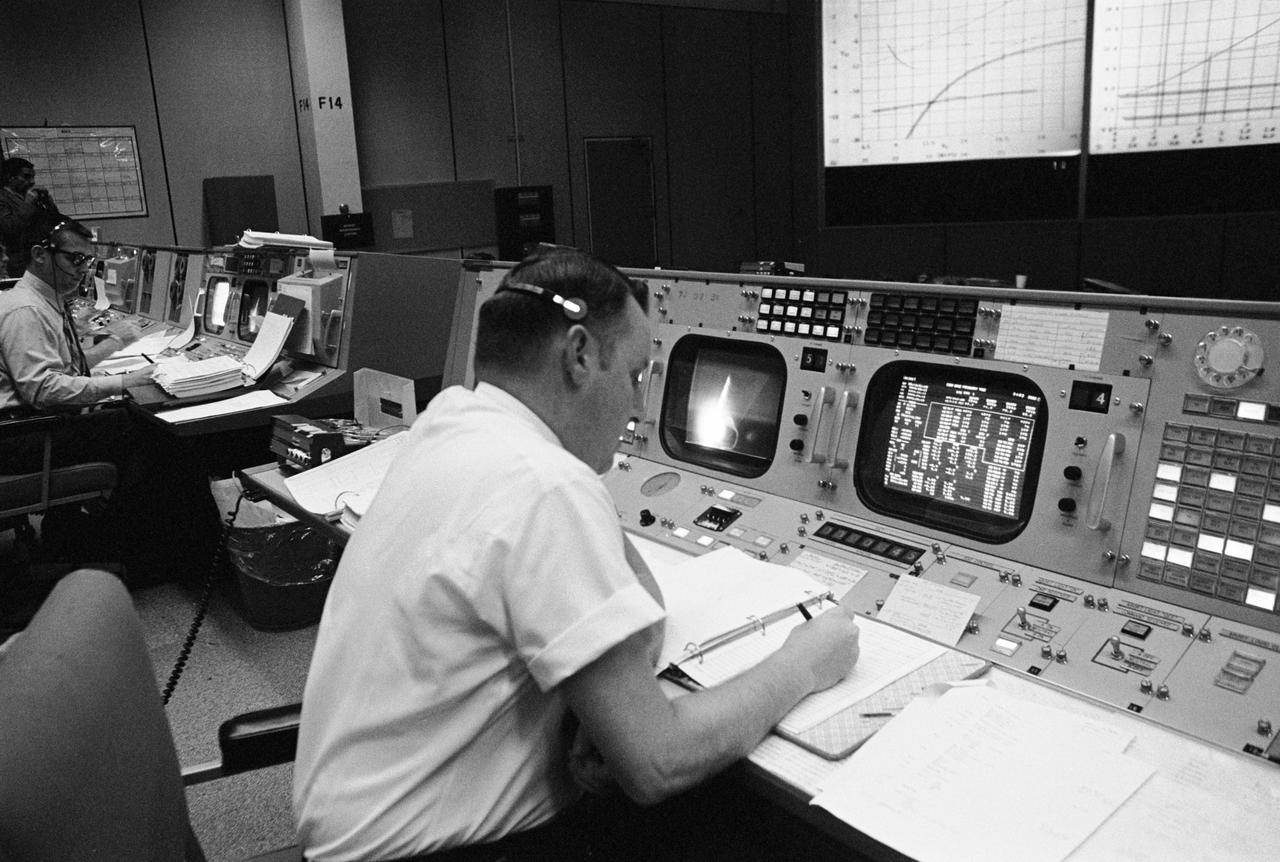
S68-55742 (21 Dec. 1968) --- Clifford E. Charlesworth, Apollo 8 "Green Team" flight director, is seated at his console in the Mission Operations Control Room in the Mission Control Center, Building 30, during the launch of the Apollo 8 (Spacecraft 103/Saturn 503) manned lunar orbit space mission.
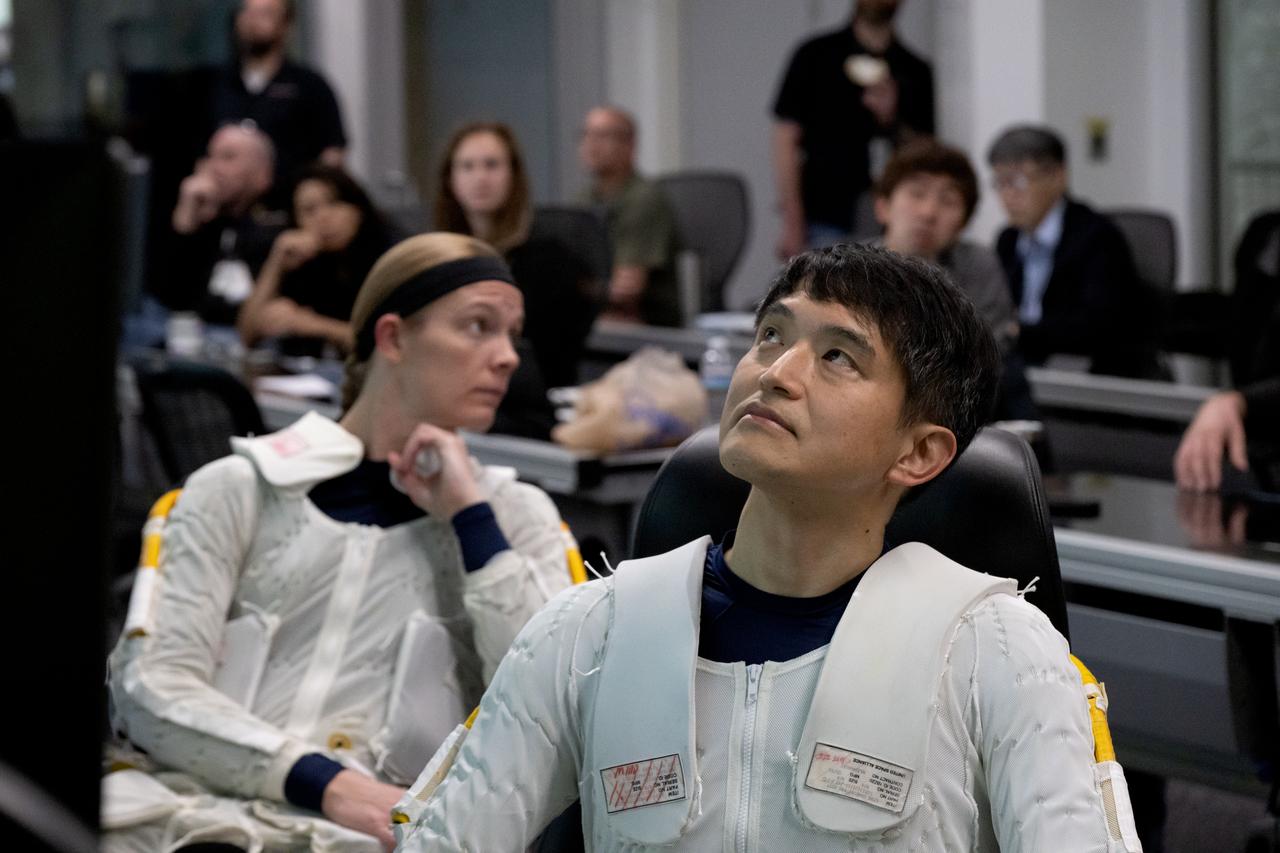
jsc2023e009094 (Jan. 22, 2024) --- SpaceX Crew-10 members Pilot Nichole Ayers of NASA and Mission Specialist Takuya Onishi of JAXA (Japan Aerospace Exploration Agency), surrounded by support personnel, prepare for spacewalk training in the Neutral Buoyancy Laboratory at NASA's Johnson Space Center.
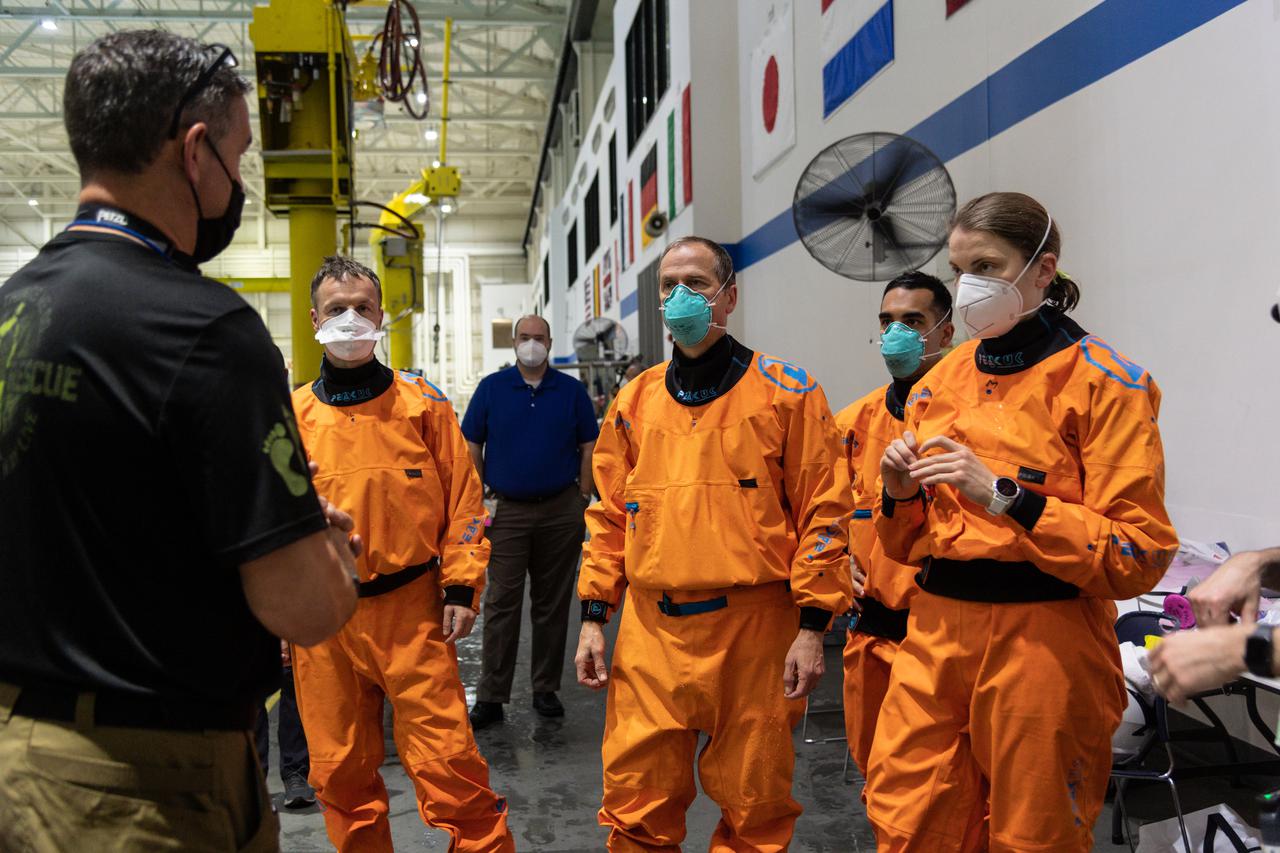
jsc2021e017162 (April 30, 2021) --- SpaceX Crew-3 astronauts (from left) Matthias Maurer, Tom Marshburn, Raja Chari and Kayla Barron, and support personnel participate in water survival training at the Neutral Buoyancy Laboratory at NASA's Johnson Space Center in Houston, Texas.
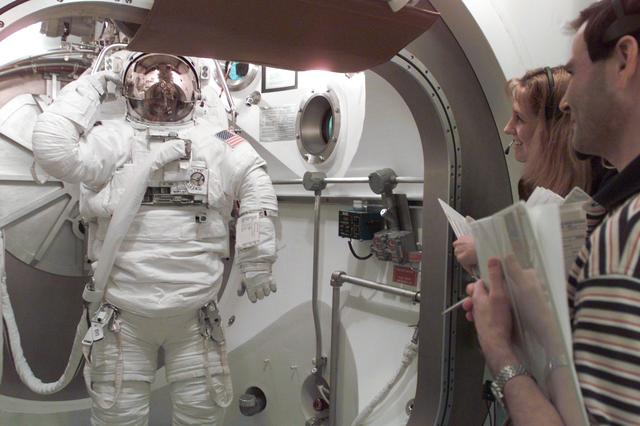
JSC2001-E-11704 (9 April 2001) --- Astronaut James F. Reilly, STS-104 mission specialist, participates in an Extravehicular Mobility Unit (EMU) fit check in one of the chambers in the Crew Systems Laboratory at the Johnson Space Center (JSC). Standing near the doorway are Peggy Berg and Dave Simon, Crew Personnel Representatives (CPR), from the Mission Operations Directorate (MOD) at the Johnson Space Center. The STS-104 mission to the International Space Station (ISS) represents the Space Shuttle Atlantis' first flight using a new engine and is targeted for a liftoff no earlier than June 14, 2001.
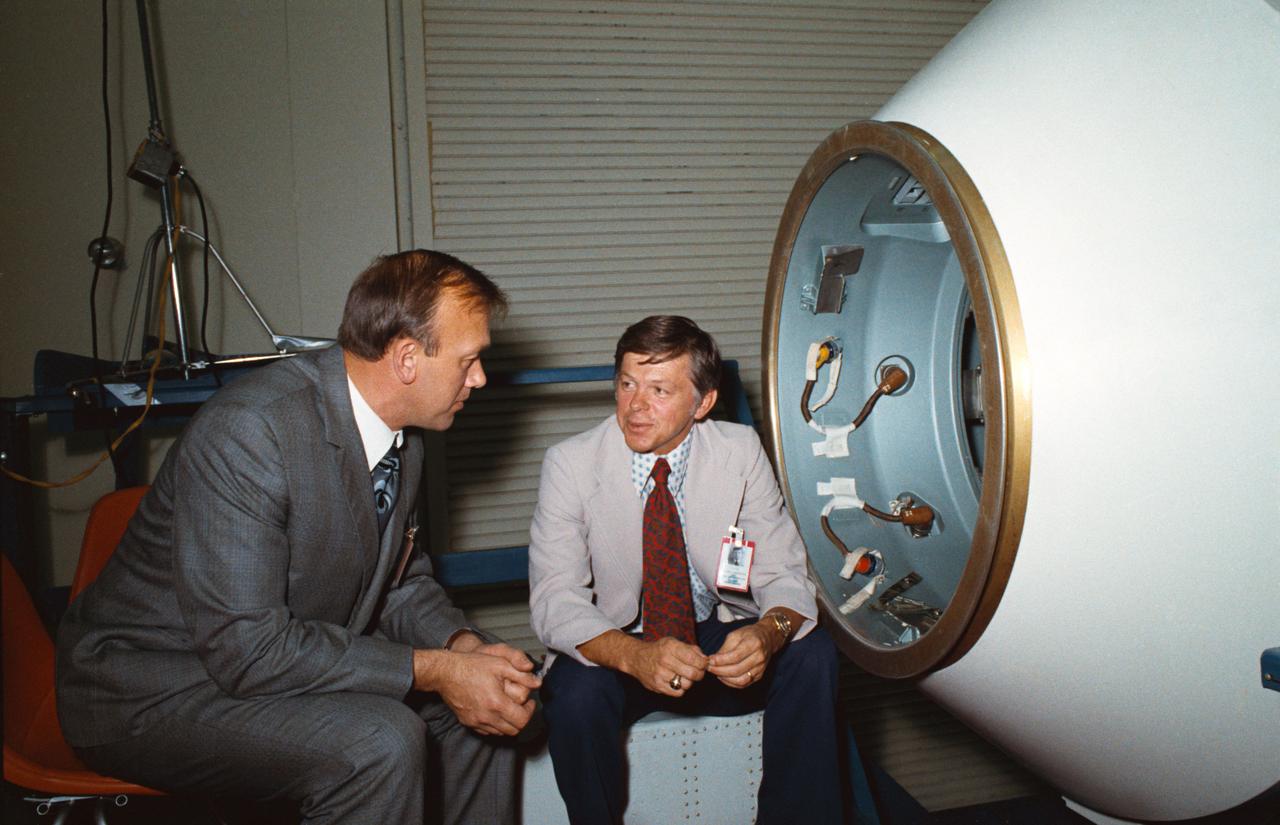
S74-32481 (November 1974) --- These two men are flight directors for the joint U.S.-USSR Apollo-Soyuz Test Project mission scheduled for July 1975. Cosmonaut Aleksey A. Yeliseyev (left) is the Soviet ASTP senior flight director; M.P. Frank is the American ASTP senior flight director. They are seated beside a Docking Module training mock-up in Building 35 at the Johnson Space Center. Cosmonaut Yeliseyev was head of a delegation of USSR flight controllers who were at JSC for two weeks of ASTP training.
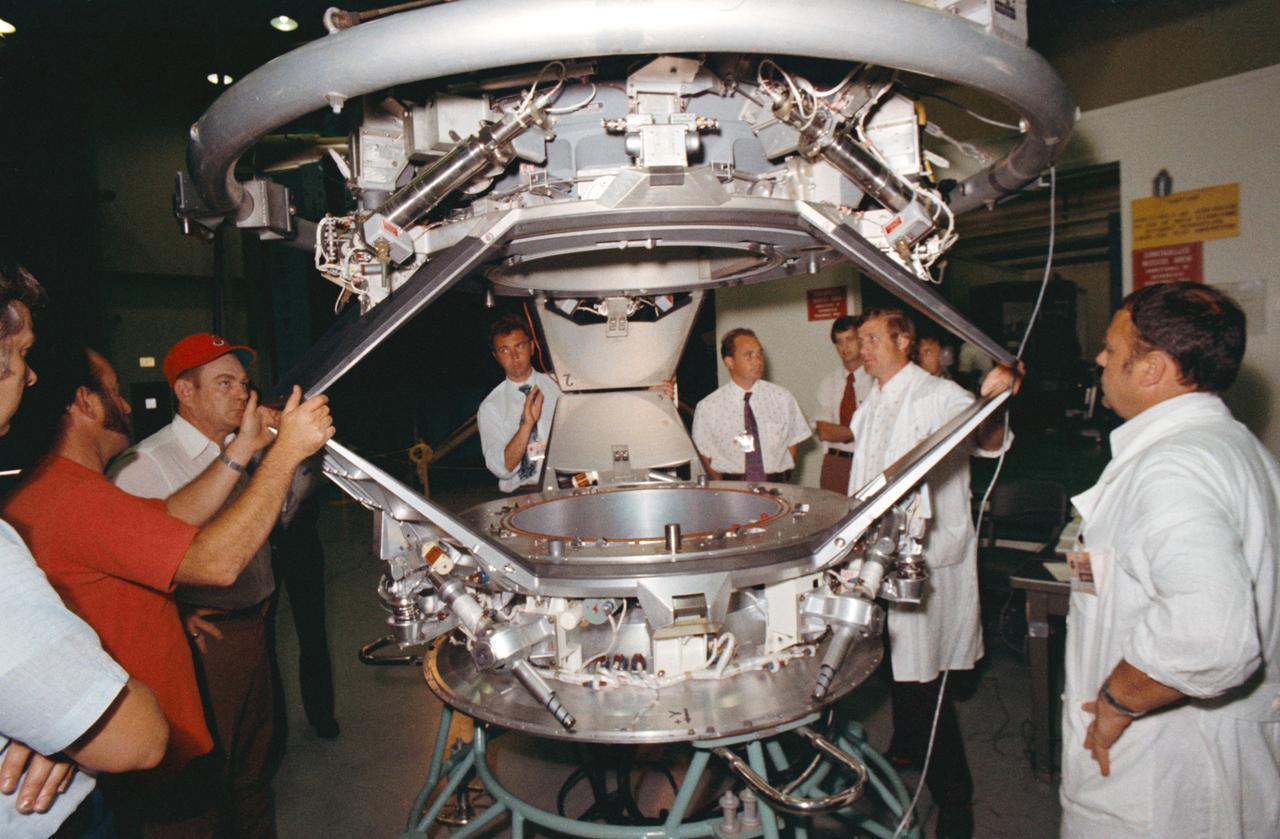
S74-25394 (10 July 1974) --- A group of American and Soviet engineers of the Apollo-Soyuz Test Project working group three examines an ASTP docking set-up following a docking mechanism fitness test conducted in Building 13 at the Johnson Space Center. Working Group No. 3 is concerned with ASTP docking problems and techniques. The joint U.S.-USSR ASTP docking mission in Earth orbit is scheduled for the summer of 1975. The Apollo docking mechanism is atop the Soyuz docking mechanism.
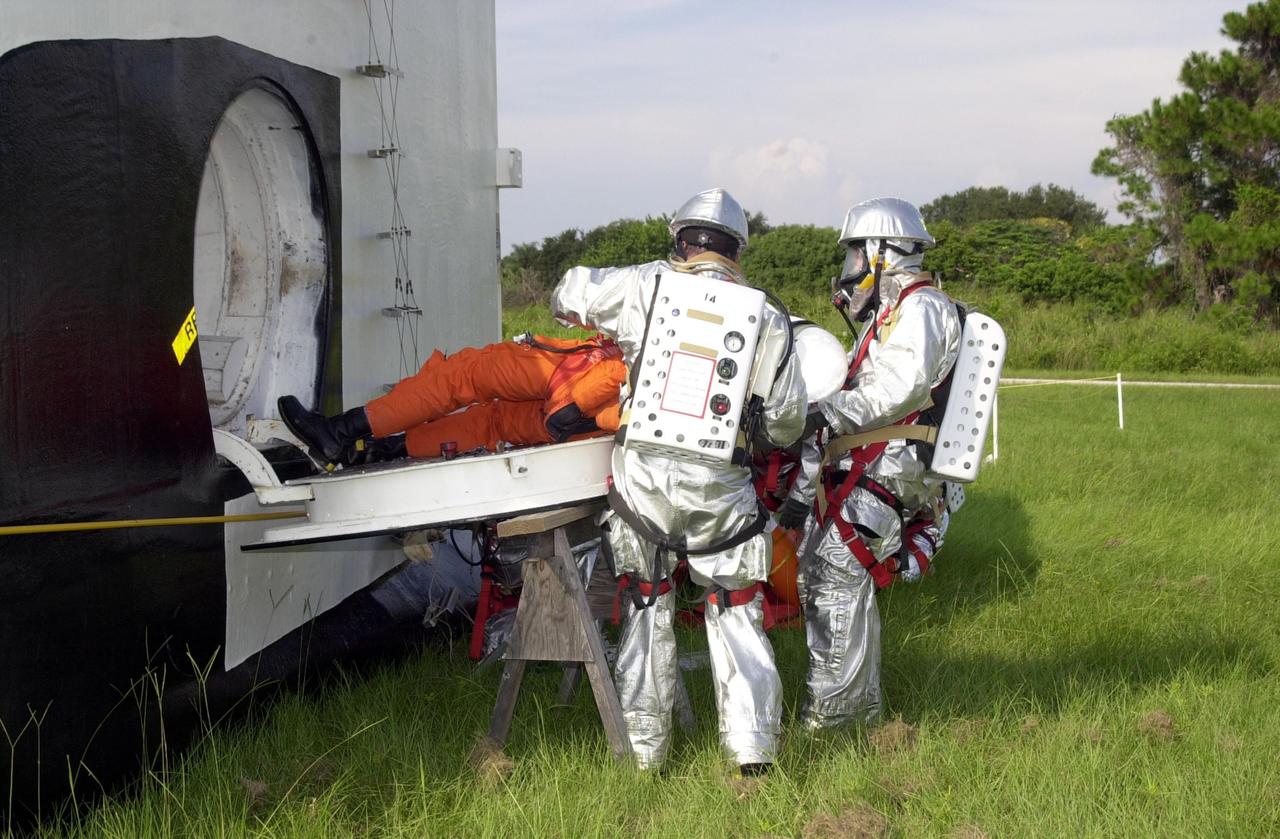
KENNEDY SPACE CENTER, FLA. - "Astronauts" were safely and successfully recovered from a "downed" Space Shuttle in a Mode VII contingency simulation led by Don Hammel, NASA Landing and Recovery Director. KSC Fire/Rescue and Emergency Medical workers, along with Johnson Space Center and Patrick Air Force Base personnel, participated in the drill. Mode simulations are held periodically at KSC to ensure contingency response forces are well prepared to respond to a wide variety of potential emergency situations.
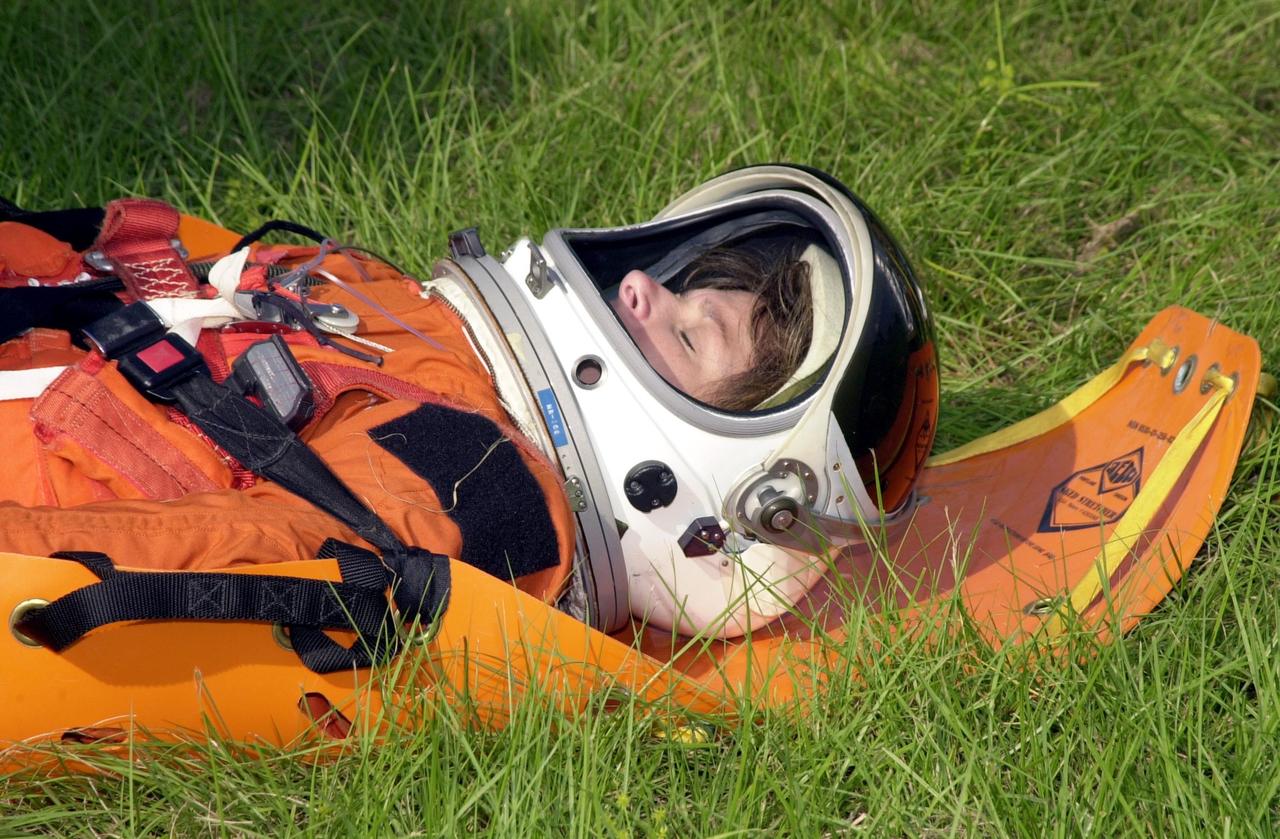
KENNEDY SPACE CENTER, FLA. - "Astronauts" were safely and successfully recovered from a "downed" Space Shuttle in a Mode VII contingency simulation led by Don Hammel, NASA Landing and Recovery Director. KSC Fire/Rescue and Emergency Medical workers, along with Johnson Space Center and Patrick Air Force Base personnel, participated in the drill. Mode simulations are held periodically at KSC to ensure contingency response forces are well prepared to respond to a wide variety of potential emergency situations. s.
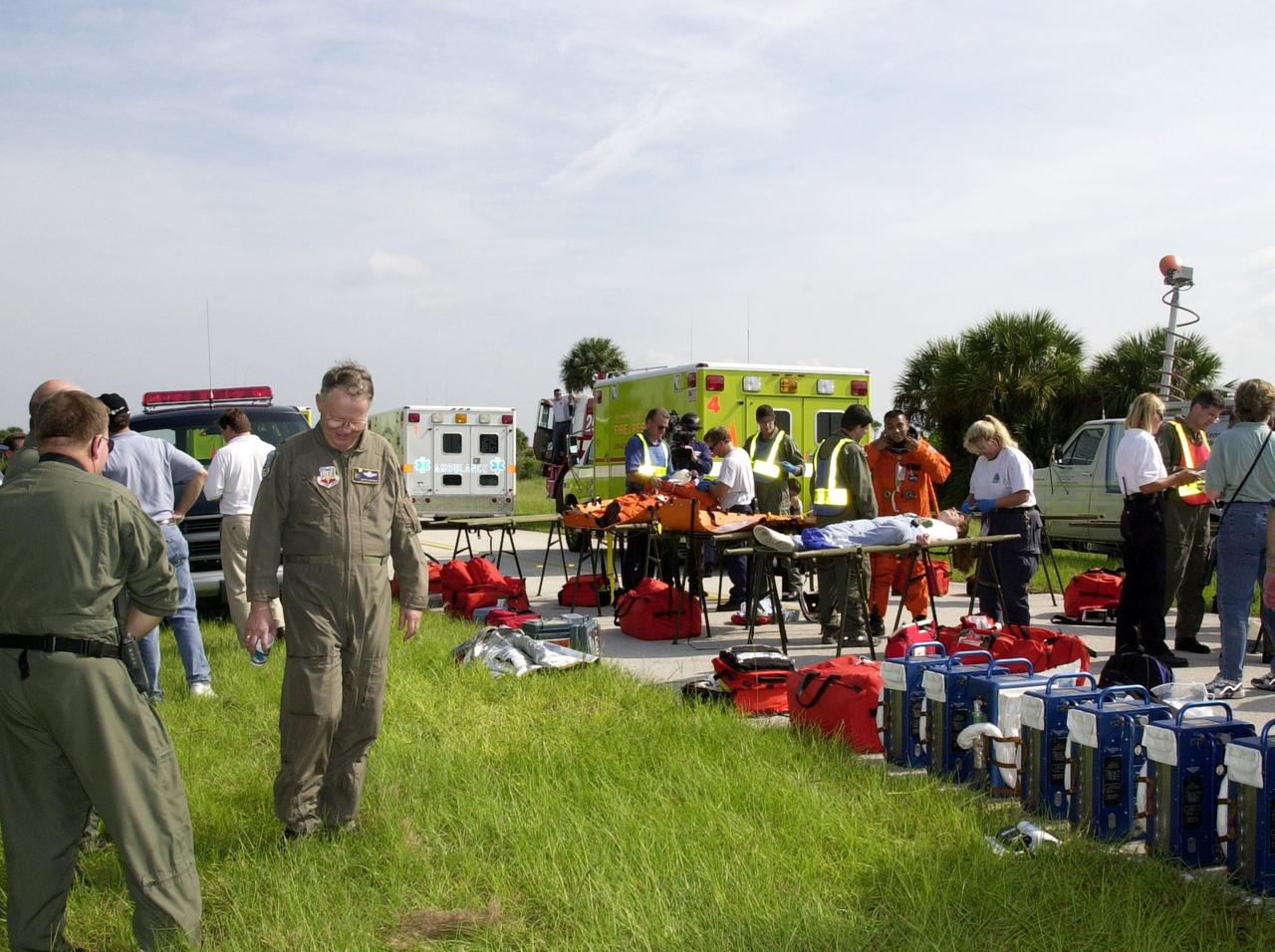
KENNEDY SPACE CENTER, FLA. - "Astronauts" were safely and successfully recovered from a "downed" Space Shuttle in a Mode VII contingency simulation led by Don Hammel, NASA Landing and Recovery Director. KSC Fire/Rescue and Emergency Medical workers, along with Johnson Space Center and Patrick Air Force Base personnel, participated in the drill. Mode simulations are held periodically at KSC to ensure contingency response forces are well prepared to respond to a wide variety of potential emergency situations.
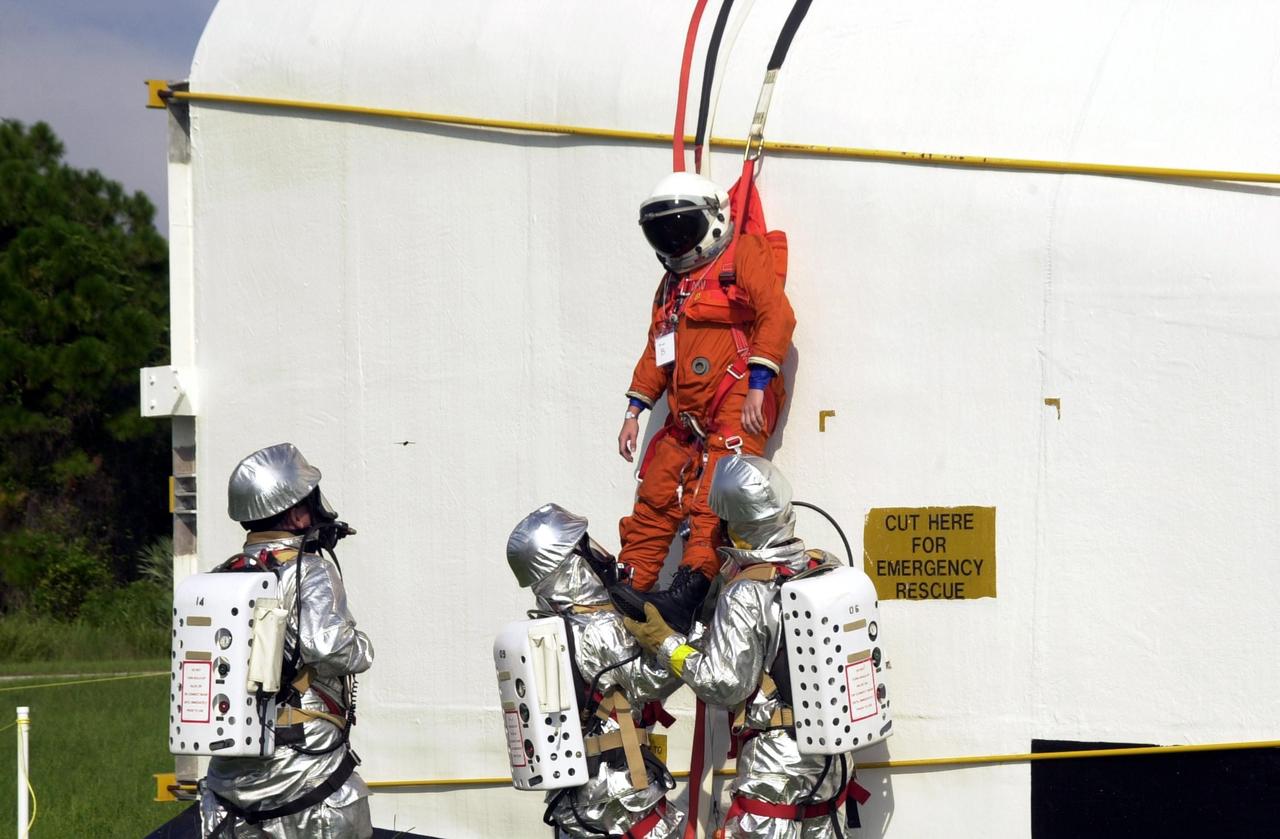
KENNEDY SPACE CENTER, FLA. - "Astronauts" were safely and successfully recovered from a "downed" Space Shuttle in a Mode VII contingency simulation led by Don Hammel, NASA Landing and Recovery Director. KSC Fire/Rescue and Emergency Medical workers, along with Johnson Space Center and Patrick Air Force Base personnel, participated in the drill. Mode simulations are held periodically at KSC to ensure contingency response forces are well prepared to respond to a wide variety of potential emergency situations.
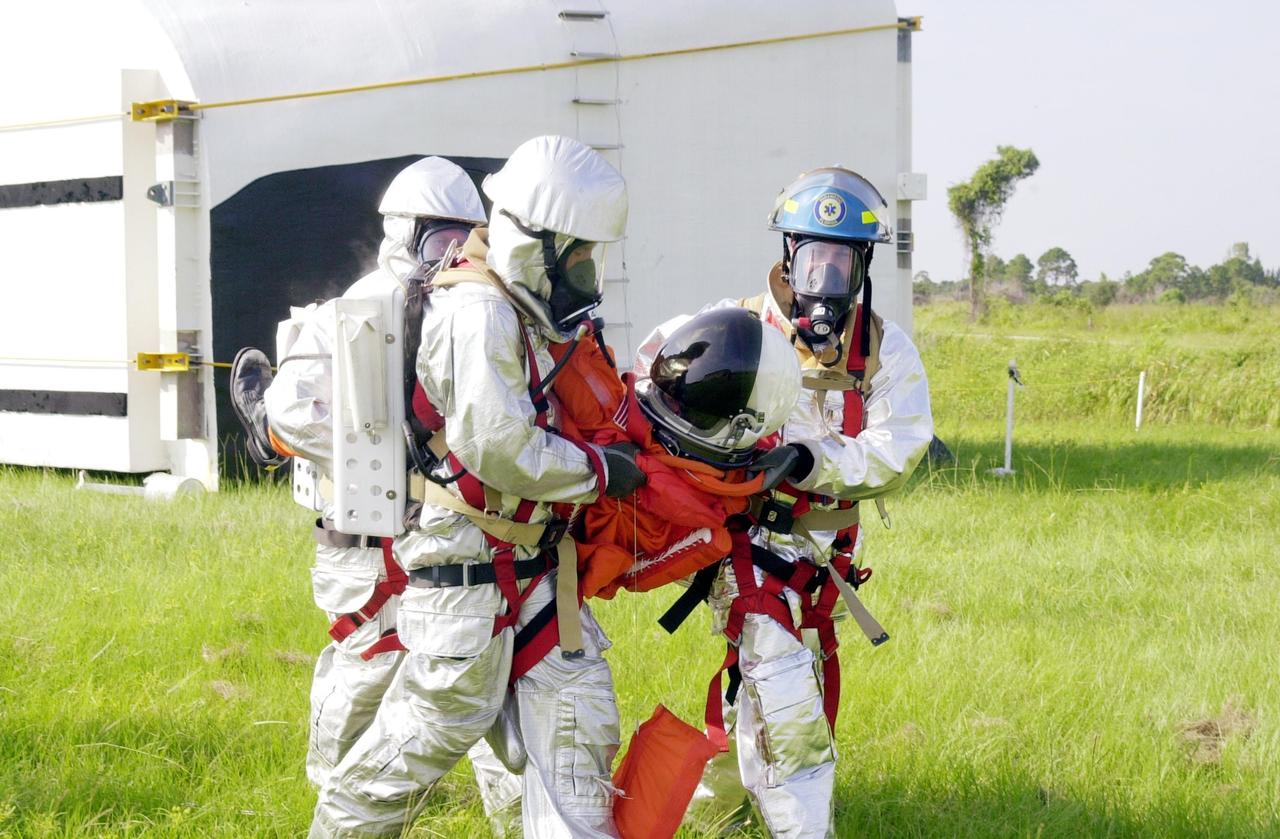
KENNEDY SPACE CENTER, FLA. - "Astronauts" were safely and successfully recovered from a "downed" Space Shuttle in a Mode VII contingency simulation led by Don Hammel, NASA Landing and Recovery Director. KSC Fire/Rescue and Emergency Medical workers, along with Johnson Space Center and Patrick Air Force Base personnel, participated in the drill. Mode simulations are held periodically at KSC to ensure contingency response forces are well prepared to respond to a wide variety of potential emergency situations.
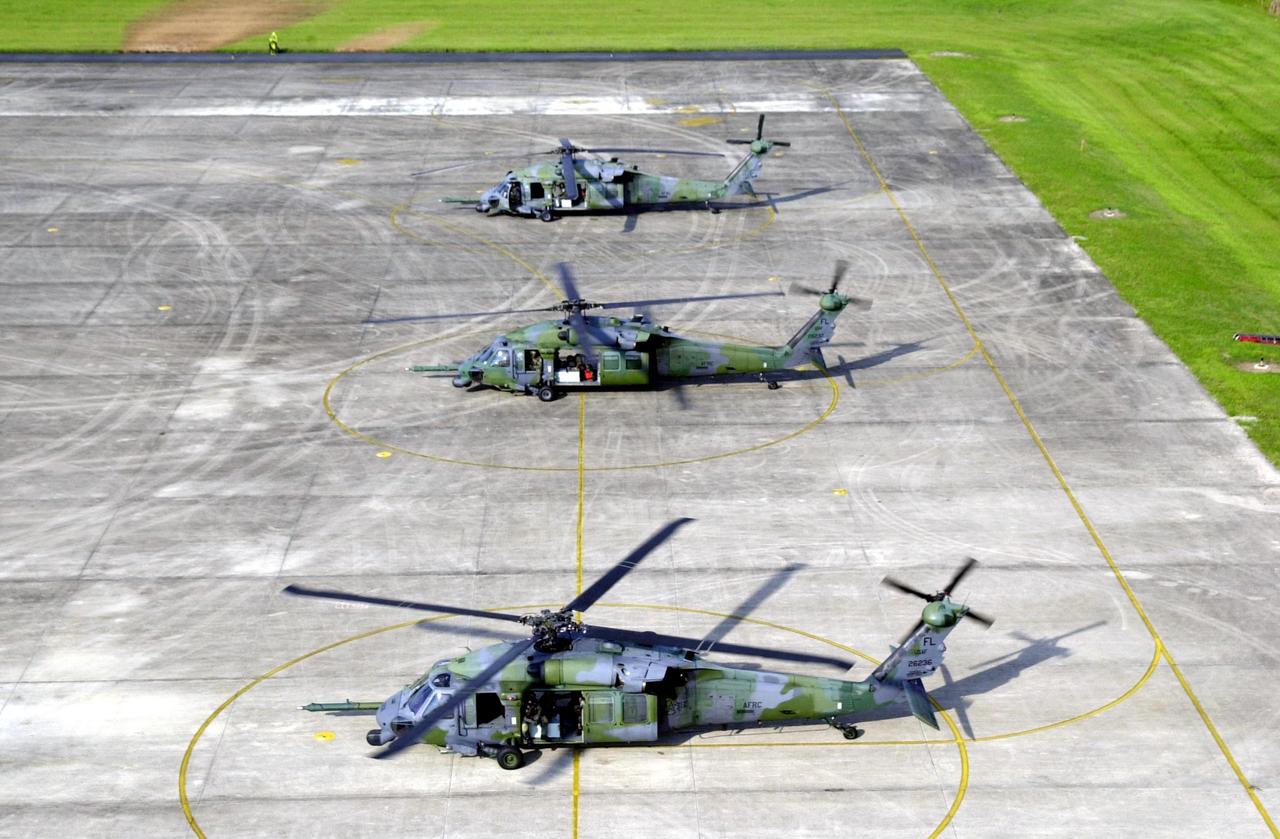
KENNEDY SPACE CENTER, FLA. - "Astronauts" were safely and successfully recovered from a "downed" Space Shuttle in a Mode VII contingency simulation led by Don Hammel, NASA Landing and Recovery Director. KSC Fire/Rescue and Emergency Medical workers, along with Johnson Space Center and Patrick Air Force Base personnel, participated in the drill. Mode simulations are held periodically at KSC to ensure contingency response forces are well prepared to respond to a wide variety of potential emergency situations.
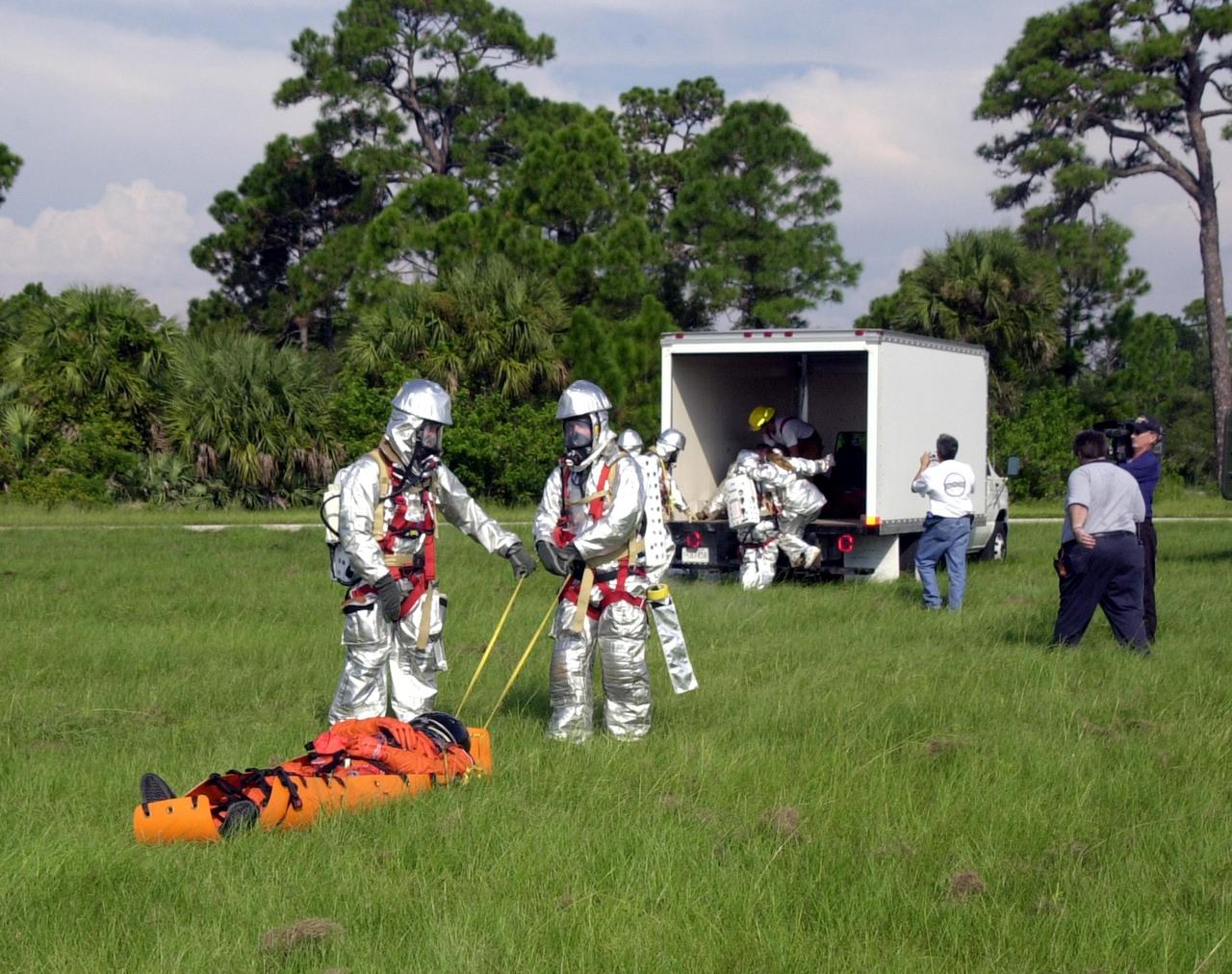
KENNEDY SPACE CENTER, FLA. - "Astronauts" were safely and successfully recovered from a "downed" Space Shuttle in a Mode VII contingency simulation led by Don Hammel, NASA Landing and Recovery Director. KSC Fire/Rescue and Emergency Medical workers, along with Johnson Space Center and Patrick Air Force Base personnel, participated in the drill. Mode simulations are held periodically at KSC to ensure contingency response forces are well prepared to respond to a wide variety of potential emergency situations. s.
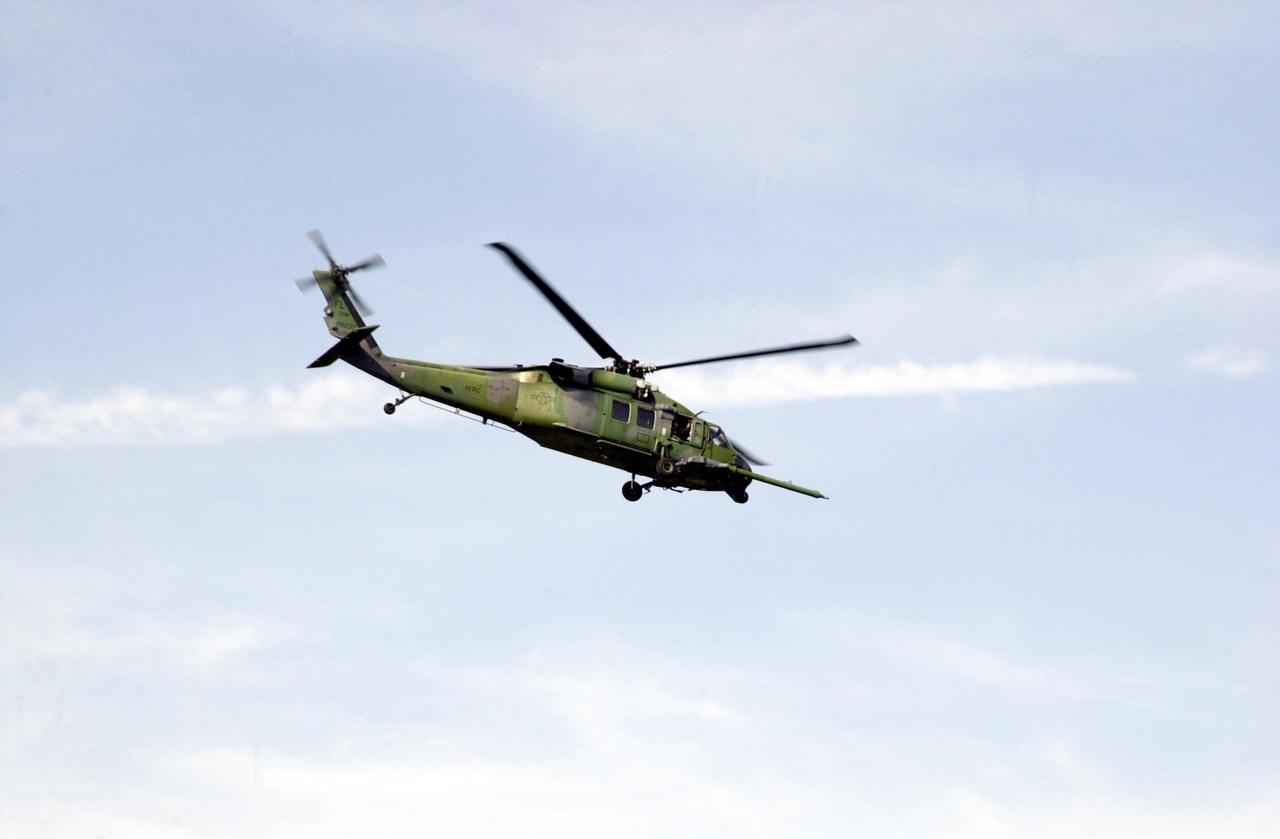
KENNEDY SPACE CENTER, FLA. - "Astronauts" were safely and successfully recovered from a "downed" Space Shuttle in a Mode VII contingency simulation led by Don Hammel, NASA Landing and Recovery Director. KSC Fire/Rescue and Emergency Medical workers, along with Johnson Space Center and Patrick Air Force Base personnel, participated in the drill. Mode simulations are held periodically at KSC to ensure contingency response forces are well prepared to respond to a wide variety of potential emergency situations.
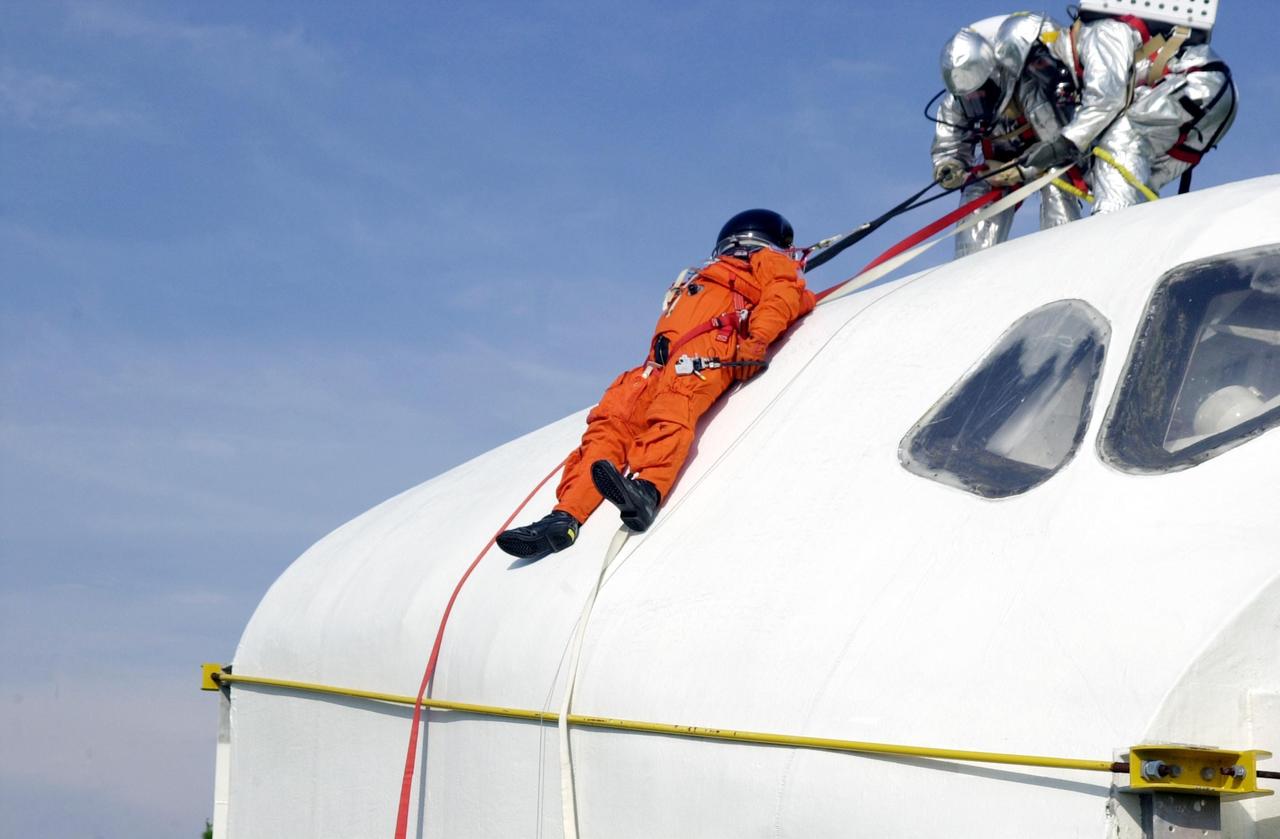
KENNEDY SPACE CENTER, FLA. - "Astronauts" were safely and successfully recovered from a "downed" Space Shuttle in a Mode VII contingency simulation led by Don Hammel, NASA Landing and Recovery Director. KSC Fire/Rescue and Emergency Medical workers, along with Johnson Space Center and Patrick Air Force Base personnel, participated in the drill. Mode simulations are held periodically at KSC to ensure contingency response forces are well prepared to respond to a wide variety of potential emergency situations.
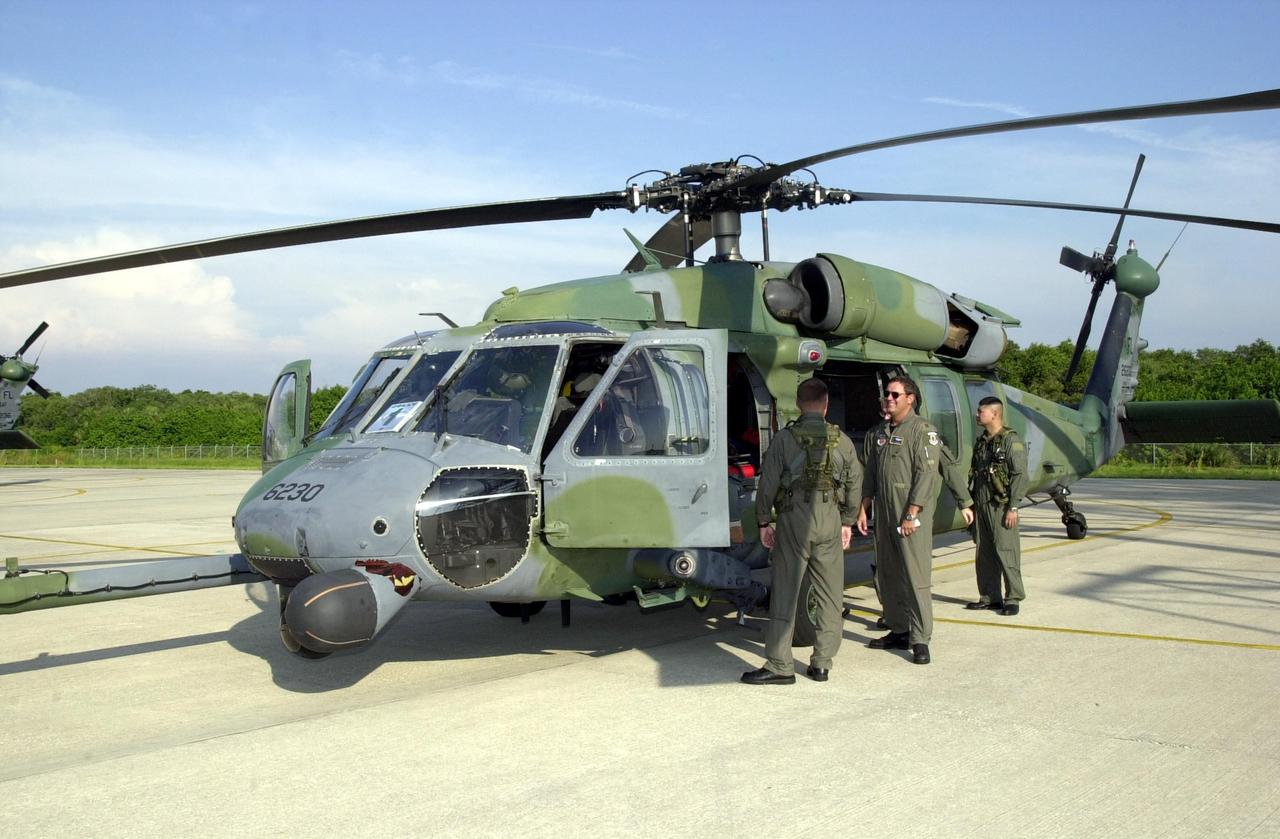
KENNEDY SPACE CENTER, FLA. - "Astronauts" were safely and successfully recovered from a "downed" Space Shuttle in a Mode VII contingency simulation led by Don Hammel, NASA Landing and Recovery Director. KSC Fire/Rescue and Emergency Medical workers, along with Johnson Space Center and Patrick Air Force Base personnel, participated in the drill. Mode simulations are held periodically at KSC to ensure contingency response forces are well prepared to respond to a wide variety of potential emergency situations.

KENNEDY SPACE CENTER, FLA. - "Astronauts" were safely and successfully recovered from a "downed" Space Shuttle in a Mode VII contingency simulation led by Don Hammel, NASA Landing and Recovery Director. KSC Fire/Rescue and Emergency Medical workers, along with Johnson Space Center and Patrick Air Force Base personnel, participated in the drill. Mode simulations are held periodically at KSC to ensure contingency response forces are well prepared to respond to a wide variety of potential emergency situations.
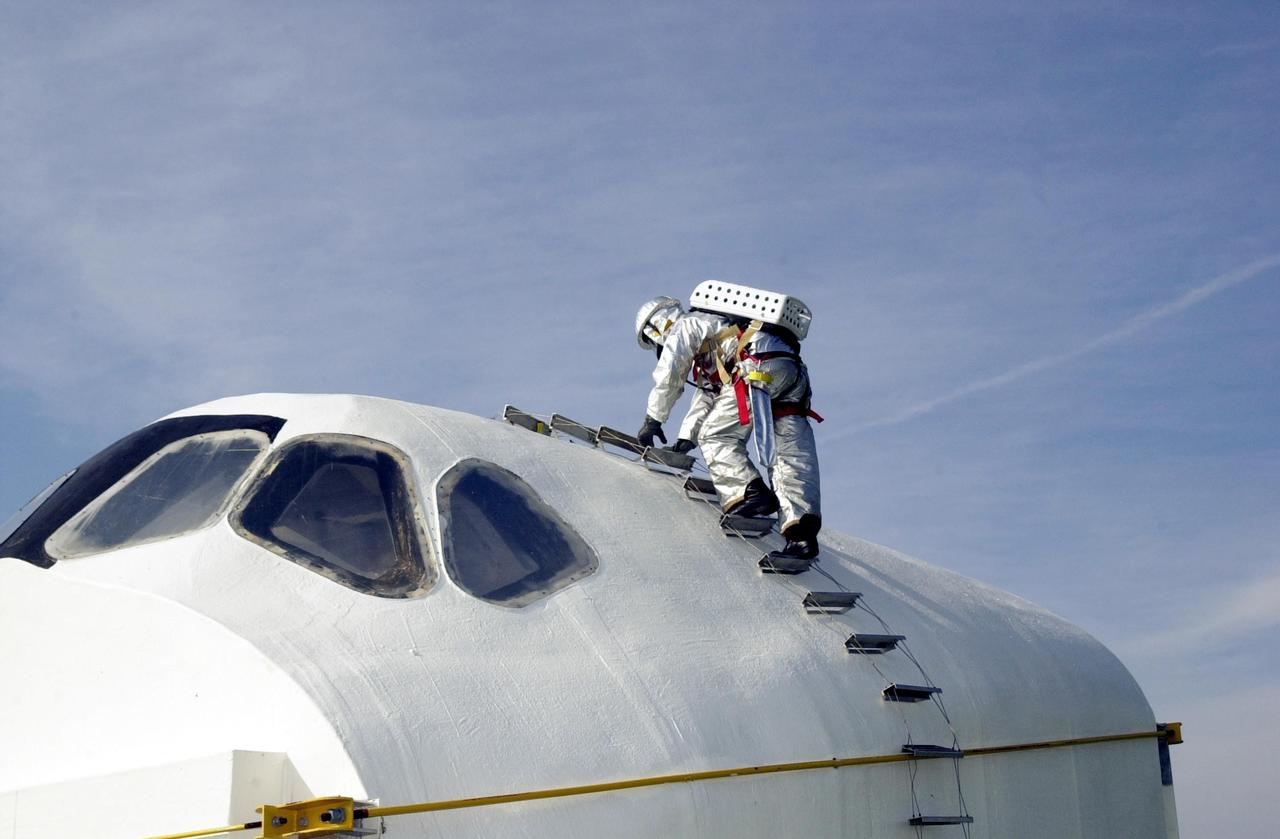
KENNEDY SPACE CENTER, FLA. - "Astronauts" were safely and successfully recovered from a "downed" Space Shuttle in a Mode VII contingency simulation led by Don Hammel, NASA Landing and Recovery Director. KSC Fire/Rescue and Emergency Medical workers, along with Johnson Space Center and Patrick Air Force Base personnel, participated in the drill. Mode simulations are held periodically at KSC to ensure contingency response forces are well prepared to respond to a wide variety of potential emergency situations.
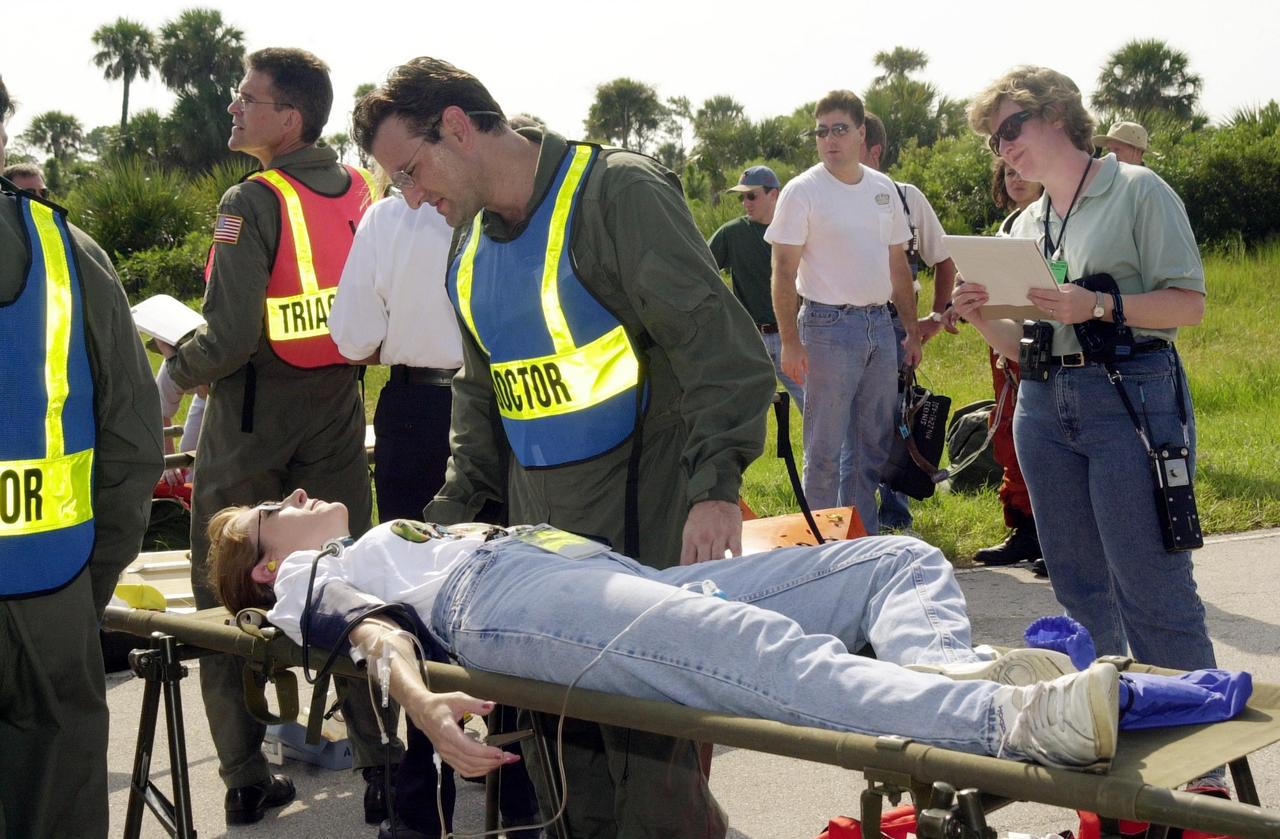
KENNEDY SPACE CENTER, FLA. - "Astronauts" were safely and successfully recovered from a "downed" Space Shuttle in a Mode VII contingency simulation led by Don Hammel, NASA Landing and Recovery Director. KSC Fire/Rescue and Emergency Medical workers, along with Johnson Space Center and Patrick Air Force Base personnel, participated in the drill. Mode simulations are held periodically at KSC to ensure contingency response forces are well prepared to respond to a wide variety of potential emergency situations.
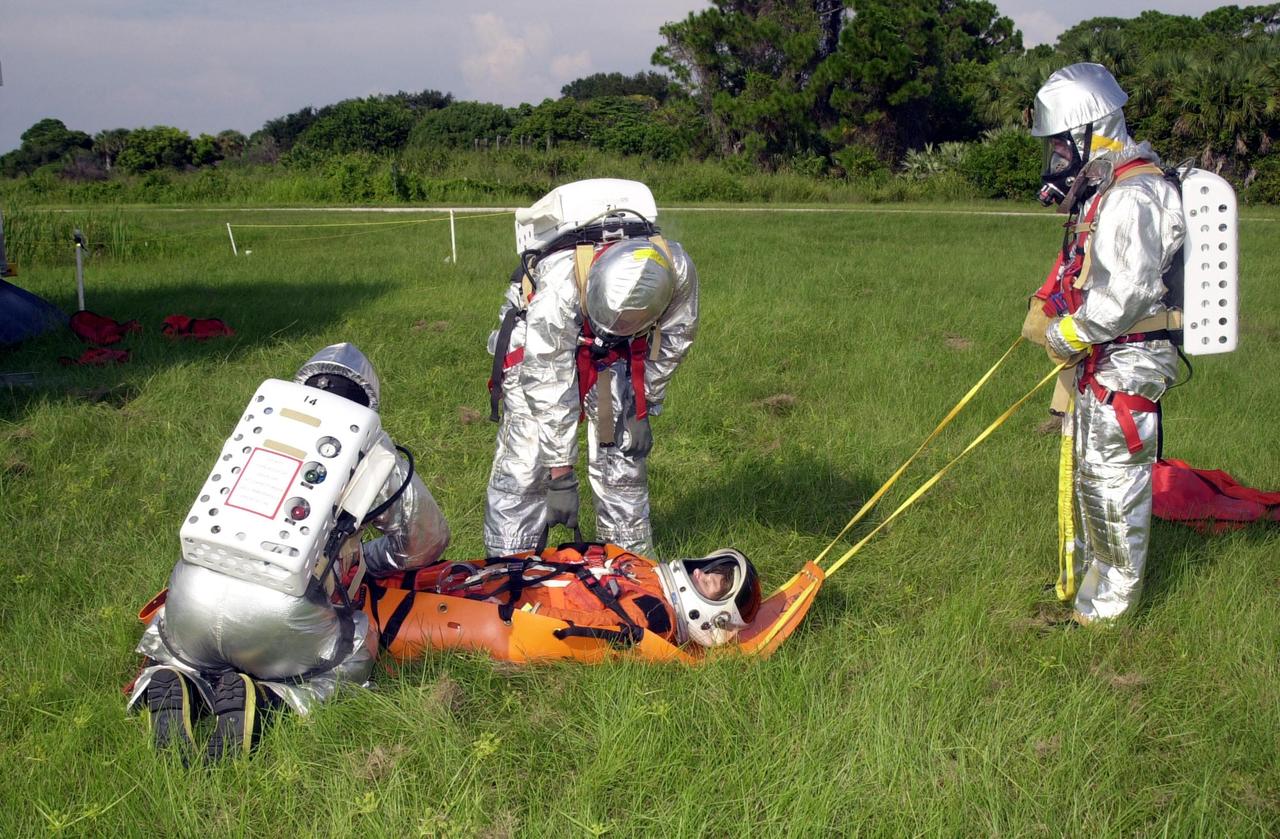
KENNEDY SPACE CENTER, FLA. - "Astronauts" were safely and successfully recovered from a "downed" Space Shuttle in a Mode VII contingency simulation led by Don Hammel, NASA Landing and Recovery Director. KSC Fire/Rescue and Emergency Medical workers, along with Johnson Space Center and Patrick Air Force Base personnel, participated in the drill. Mode simulations are held periodically at KSC to ensure contingency response forces are well prepared to respond to a wide variety of potential emergency situations.
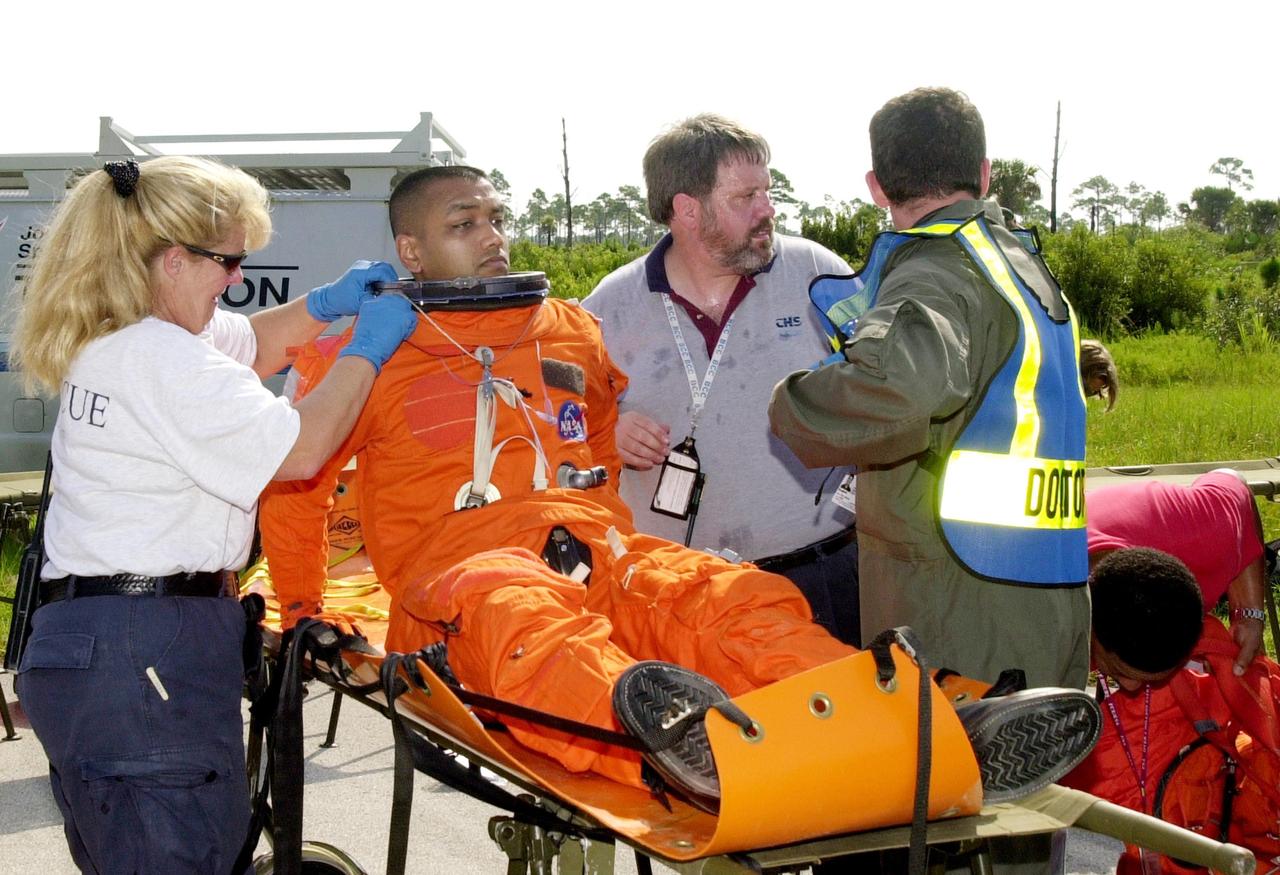
KENNEDY SPACE CENTER, FLA. - "Astronauts" were safely and successfully recovered from a "downed" Space Shuttle in a Mode VII contingency simulation led by Don Hammel, NASA Landing and Recovery Director. KSC Fire/Rescue and Emergency Medical workers, along with Johnson Space Center and Patrick Air Force Base personnel, participated in the drill. Mode simulations are held periodically at KSC to ensure contingency response forces are well prepared to respond to a wide variety of potential emergency situations.
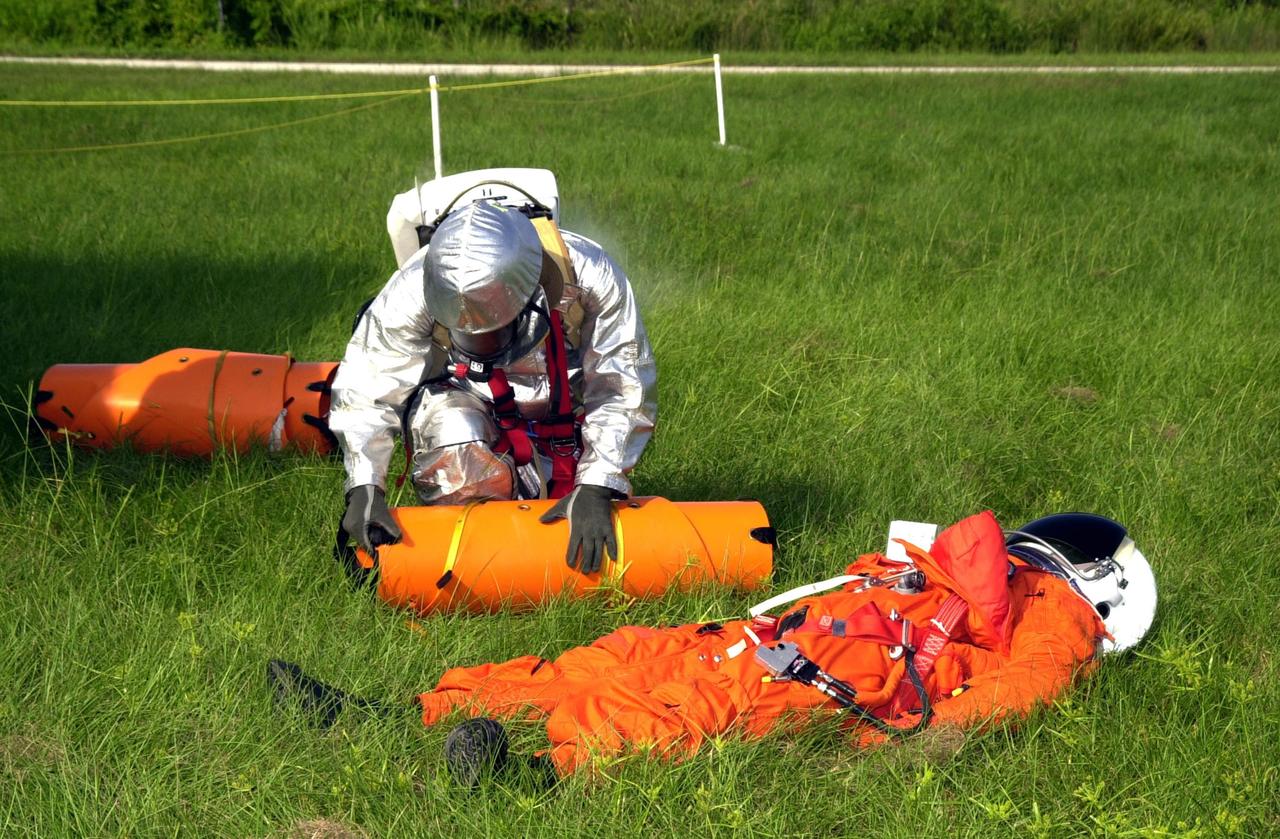
KENNEDY SPACE CENTER, FLA. - "Astronauts" were safely and successfully recovered from a "downed" Space Shuttle in a Mode VII contingency simulation led by Don Hammel, NASA Landing and Recovery Director. KSC Fire/Rescue and Emergency Medical workers, along with Johnson Space Center and Patrick Air Force Base personnel, participated in the drill. Mode simulations are held periodically at KSC to ensure contingency response forces are well prepared to respond to a wide variety of potential emergency situations.
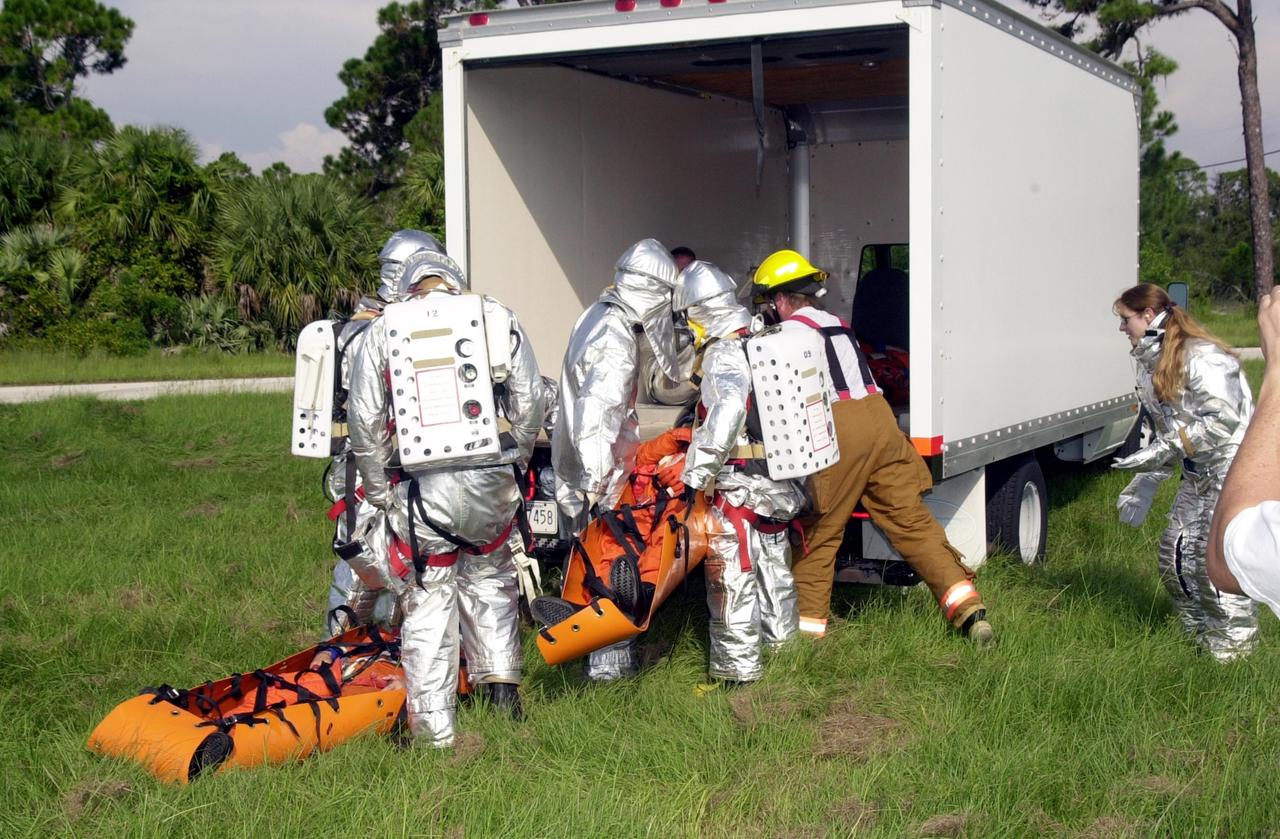
KENNEDY SPACE CENTER, FLA. - "Astronauts" were safely and successfully recovered from a "downed" Space Shuttle in a Mode VII contingency simulation led by Don Hammel, NASA Landing and Recovery Director. KSC Fire/Rescue and Emergency Medical workers, along with Johnson Space Center and Patrick Air Force Base personnel, participated in the drill. Mode simulations are held periodically at KSC to ensure contingency response forces are well prepared to respond to a wide variety of potential emergency situations.
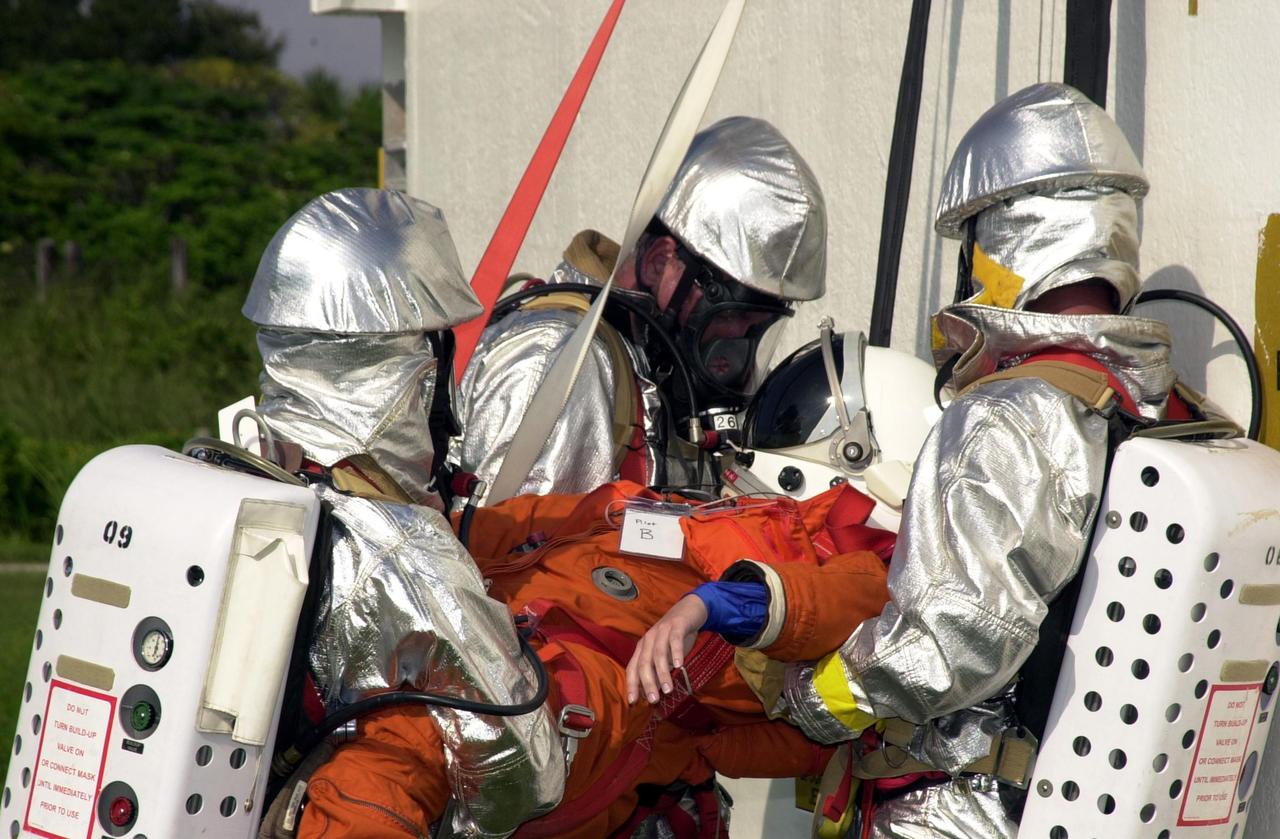
KENNEDY SPACE CENTER, FLA. - "Astronauts" were safely and successfully recovered from a "downed" Space Shuttle in a Mode VII contingency simulation led by Don Hammel, NASA Landing and Recovery Director. KSC Fire/Rescue and Emergency Medical workers, along with Johnson Space Center and Patrick Air Force Base personnel, participated in the drill. Mode simulations are held periodically at KSC to ensure contingency response forces are well prepared to respond to a wide variety of potential emergency situations.
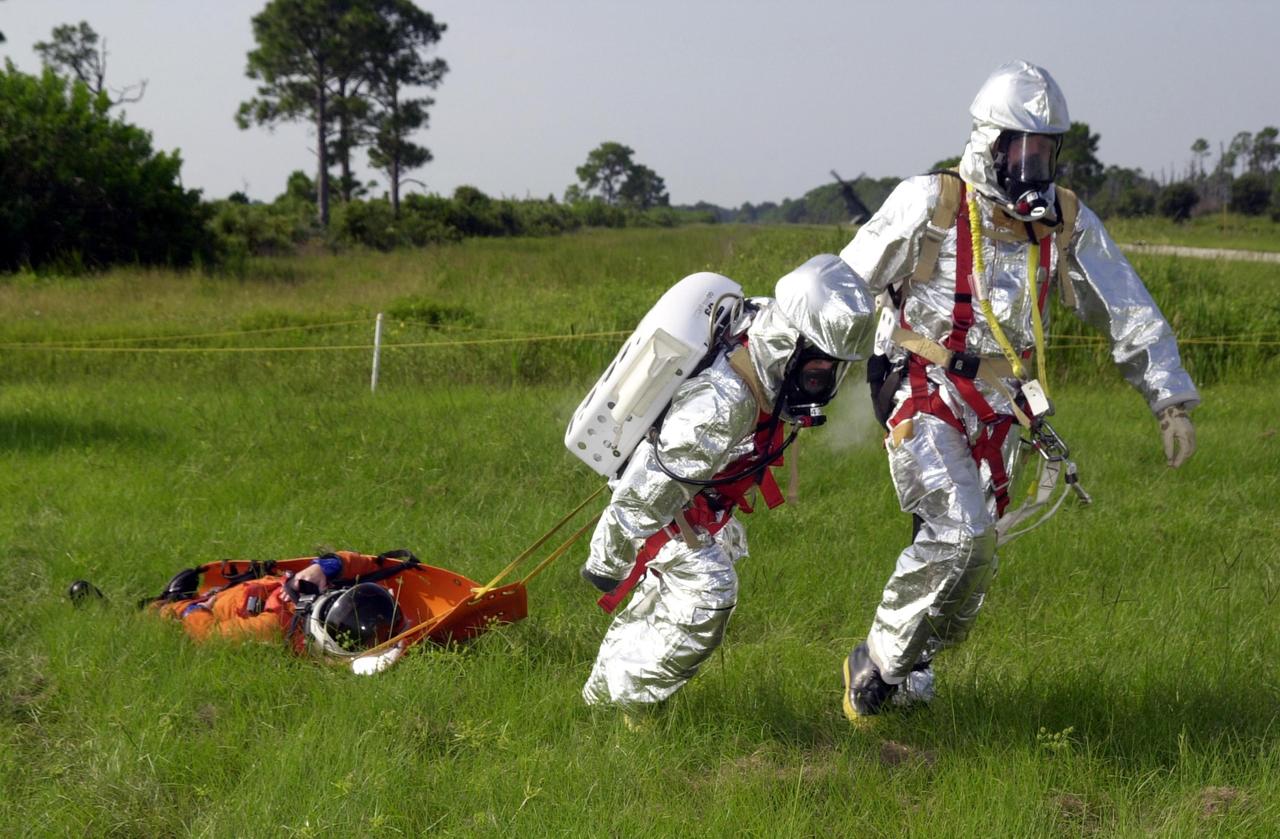
KENNEDY SPACE CENTER, FLA. - "Astronauts" were safely and successfully recovered from a "downed" Space Shuttle in a Mode VII contingency simulation led by Don Hammel, NASA Landing and Recovery Director. KSC Fire/Rescue and Emergency Medical workers, along with Johnson Space Center and Patrick Air Force Base personnel, participated in the drill. Mode simulations are held periodically at KSC to ensure contingency response forces are well prepared to respond to a wide variety of potential emergency situations.
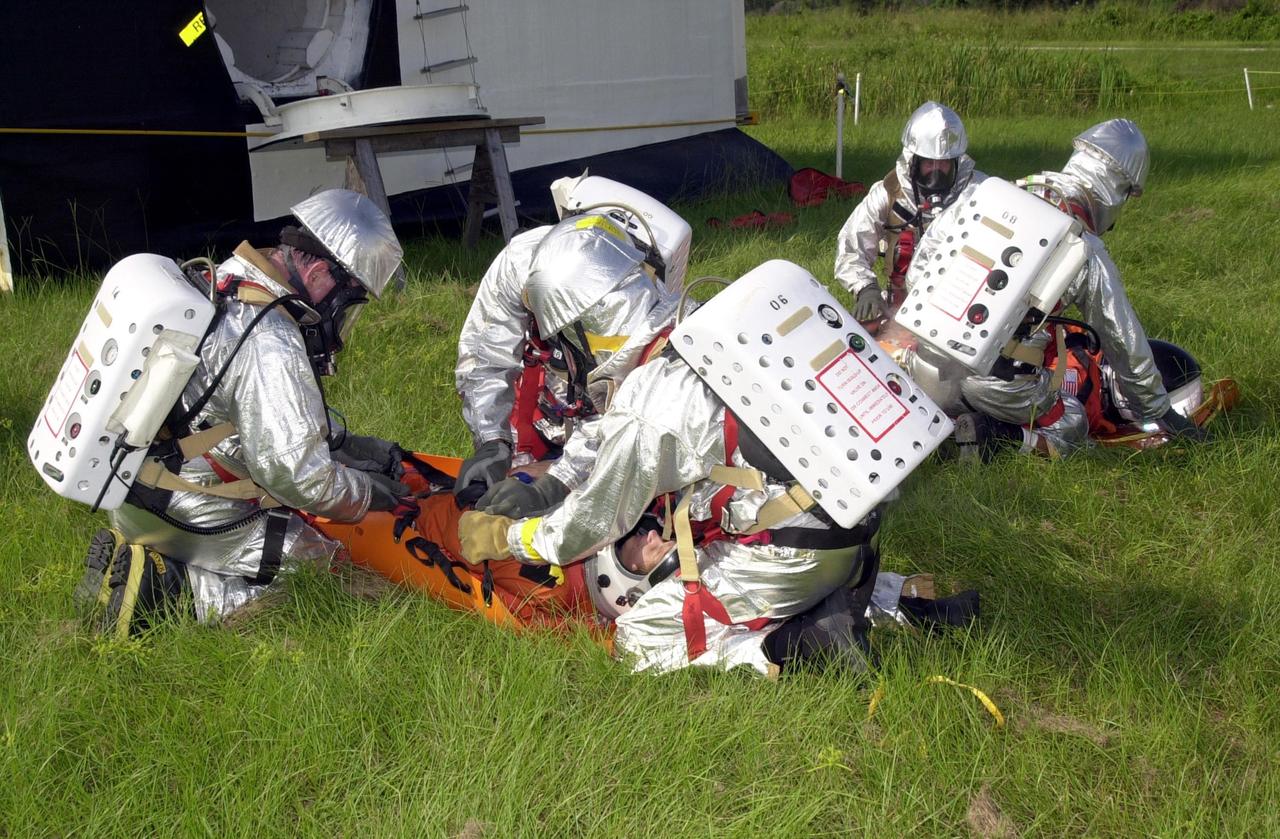
KENNEDY SPACE CENTER, FLA. - "Astronauts" were safely and successfully recovered from a "downed" Space Shuttle in a Mode VII contingency simulation led by Don Hammel, NASA Landing and Recovery Director. KSC Fire/Rescue and Emergency Medical workers, along with Johnson Space Center and Patrick Air Force Base personnel, participated in the drill. Mode simulations are held periodically at KSC to ensure contingency response forces are well prepared to respond to a wide variety of potential emergency situations.
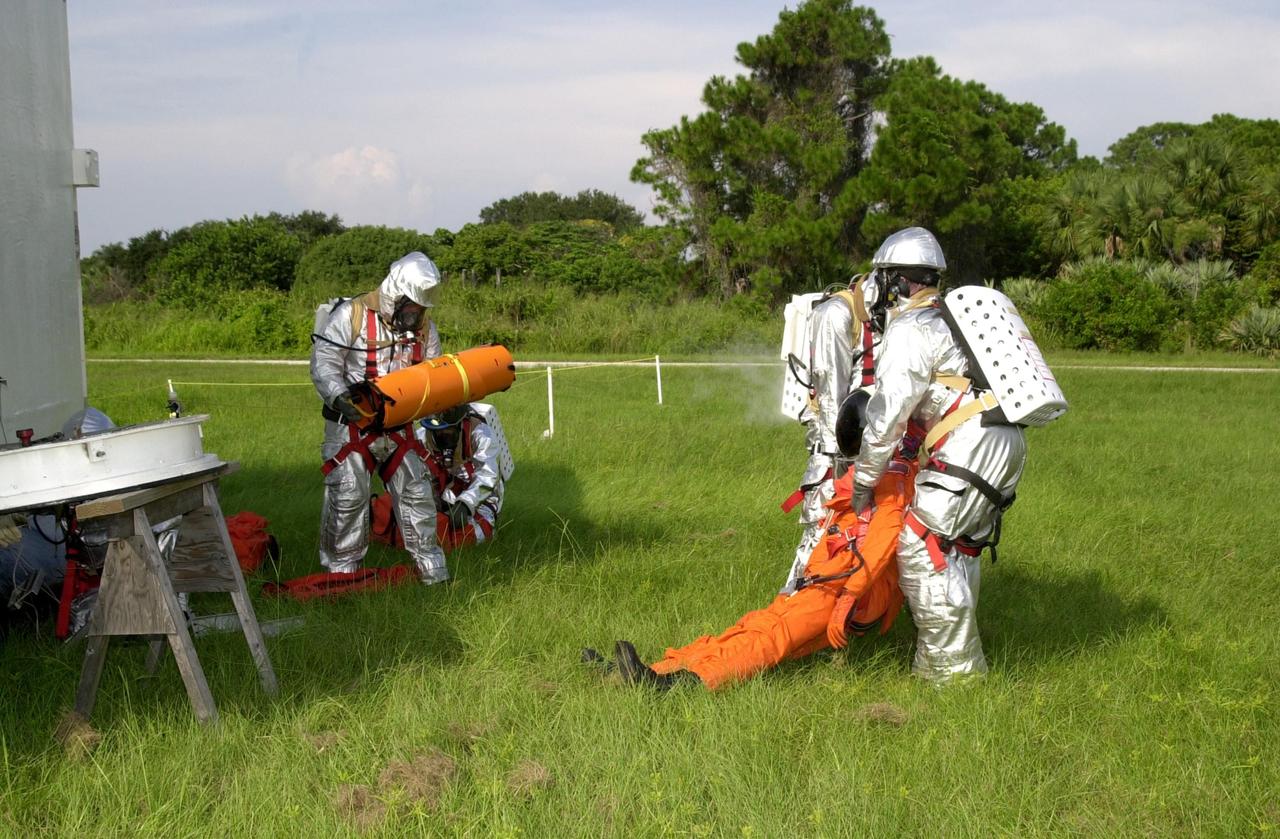
KENNEDY SPACE CENTER, FLA. - "Astronauts" were safely and successfully recovered from a "downed" Space Shuttle in a Mode VII contingency simulation led by Don Hammel, NASA Landing and Recovery Director. KSC Fire/Rescue and Emergency Medical workers, along with Johnson Space Center and Patrick Air Force Base personnel, participated in the drill. Mode simulations are held periodically at KSC to ensure contingency response forces are well prepared to respond to a wide variety of potential emergency situations.
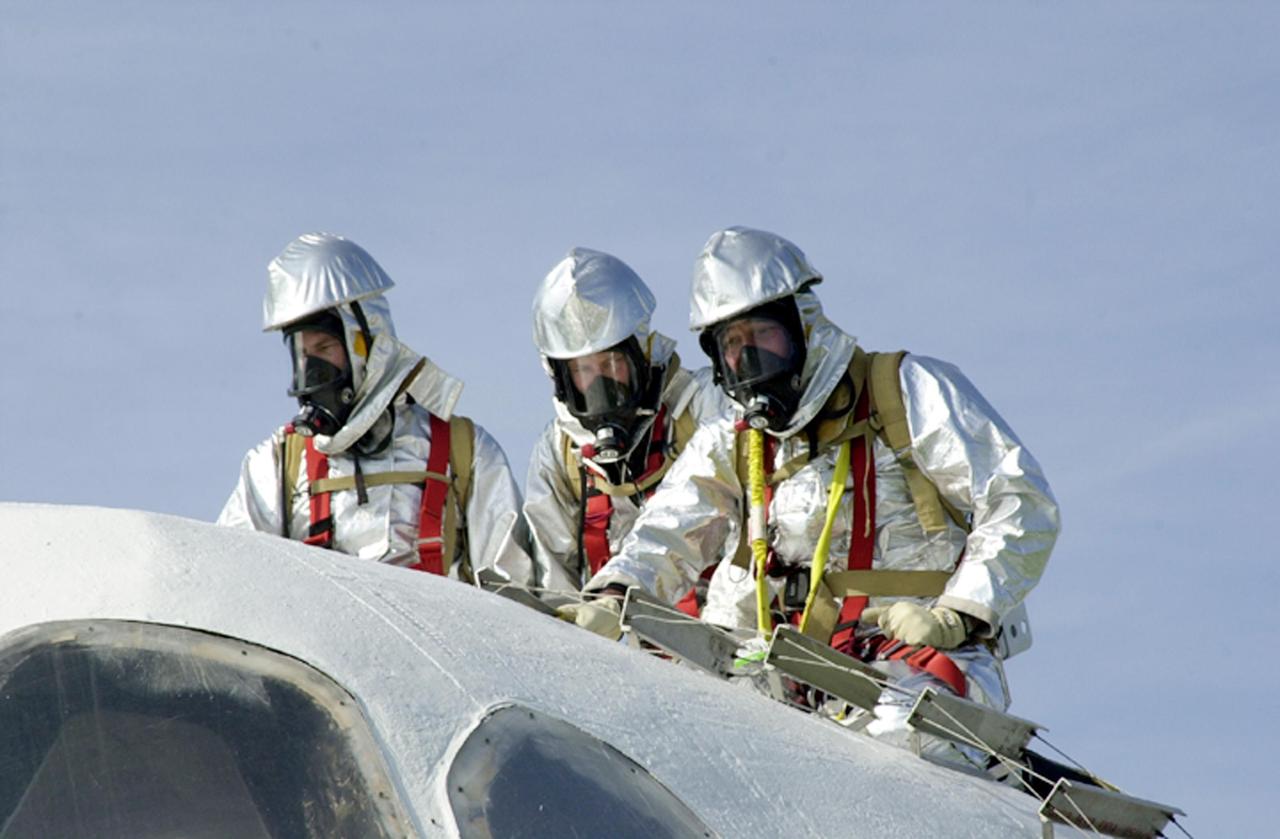
KENNEDY SPACE CENTER, FLA. - "Astronauts" were safely and successfully recovered from a "downed" Space Shuttle in a Mode VII contingency simulation led by Don Hammel, NASA Landing and Recovery Director. KSC Fire/Rescue and Emergency Medical workers, along with Johnson Space Center and Patrick Air Force Base personnel, participated in the drill. Mode simulations are held periodically at KSC to ensure contingency response forces are well prepared to respond to a wide variety of potential emergency situations.
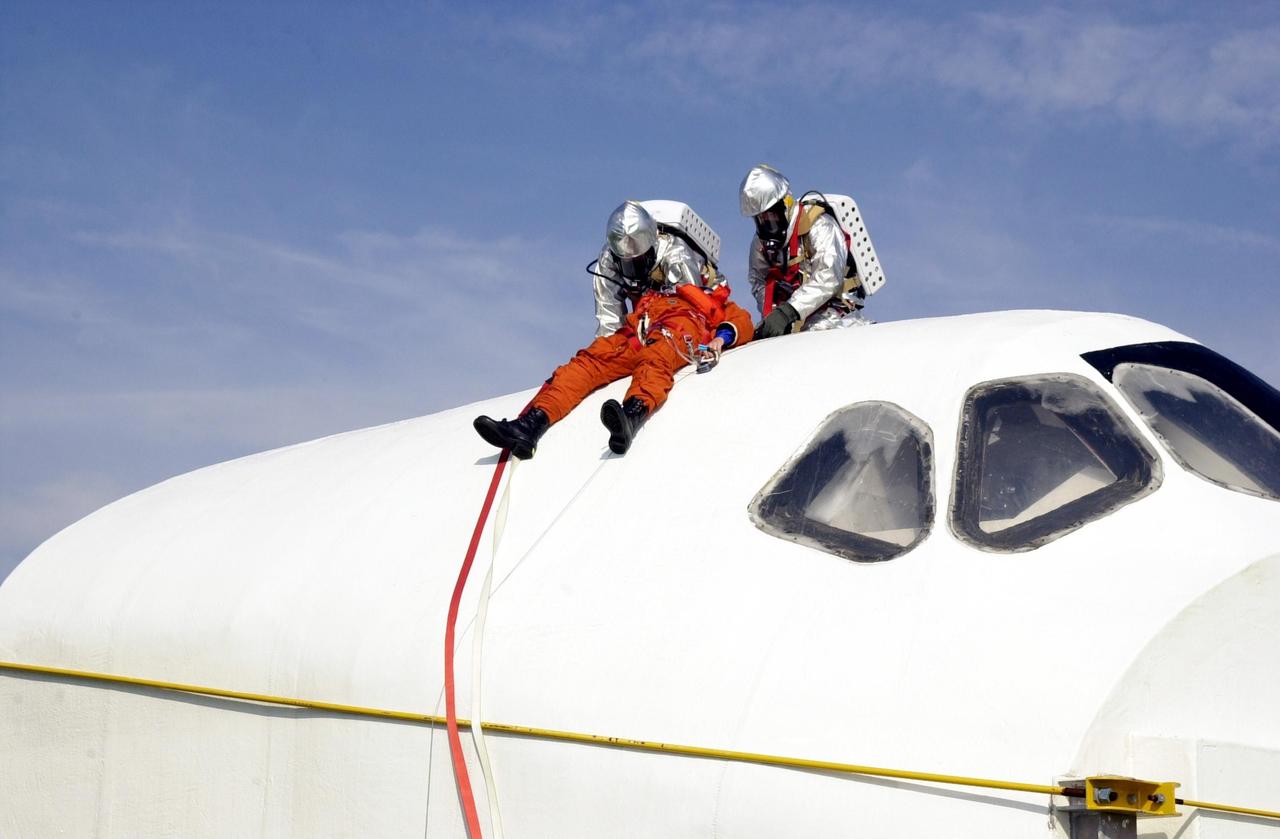
KENNEDY SPACE CENTER, FLA. -- "Astronauts" were safely and successfully recovered from a "downed" Space Shuttle in a Mode VII contingency simulation led by Don Hammel, NASA Landing and Recovery Director. KSC Fire/Rescue and Emergency Medical workers, along with Johnson Space Center and Patrick Air Force Base personnel, participated in the drill. Mode simulations are held periodically at KSC to ensure contingency response forces are well prepared to respond to a wide variety of potential emergency situations.
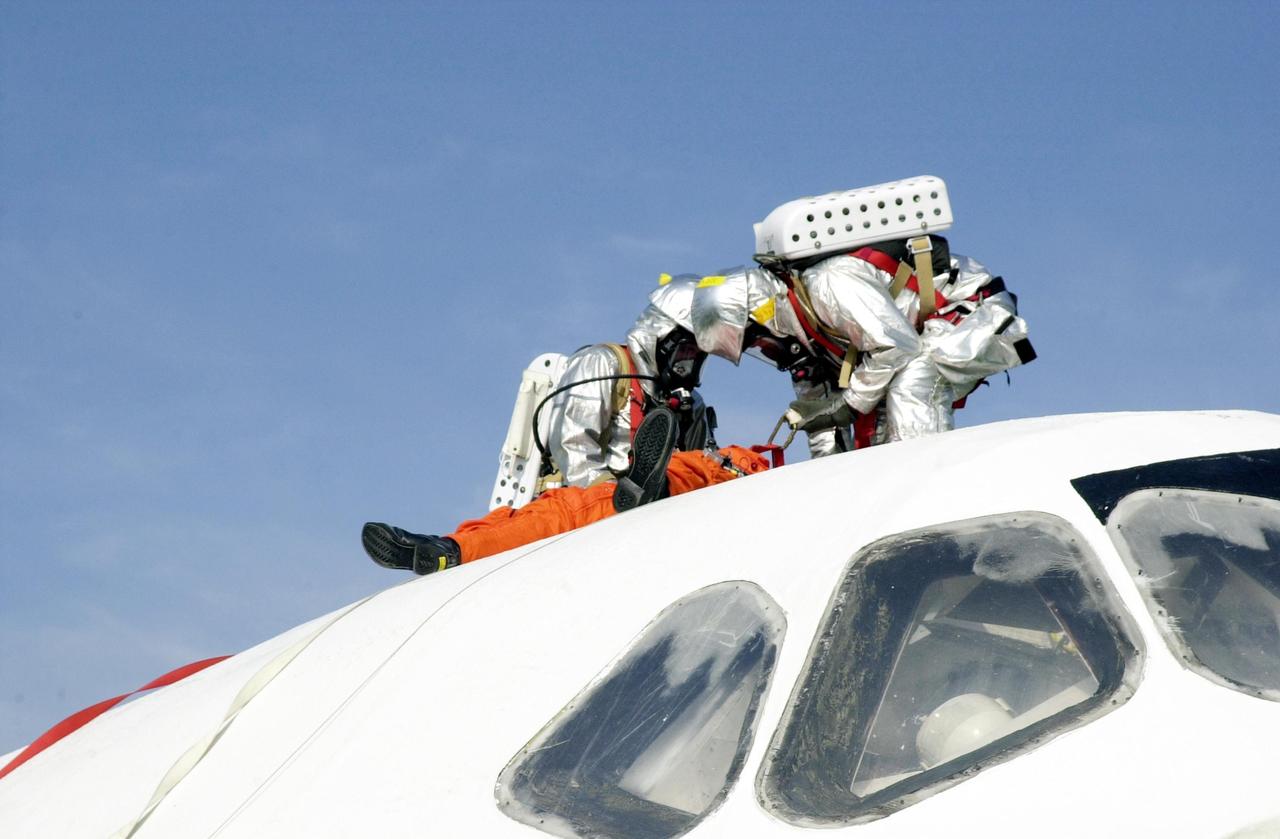
KENNEDY SPACE CENTER, FLA. - "Astronauts" were safely and successfully recovered from a "downed" Space Shuttle in a Mode VII contingency simulation led by Don Hammel, NASA Landing and Recovery Director. KSC Fire/Rescue and Emergency Medical workers, along with Johnson Space Center and Patrick Air Force Base personnel, participated in the drill. Mode simulations are held periodically at KSC to ensure contingency response forces are well prepared to respond to a wide variety of potential emergency situations.
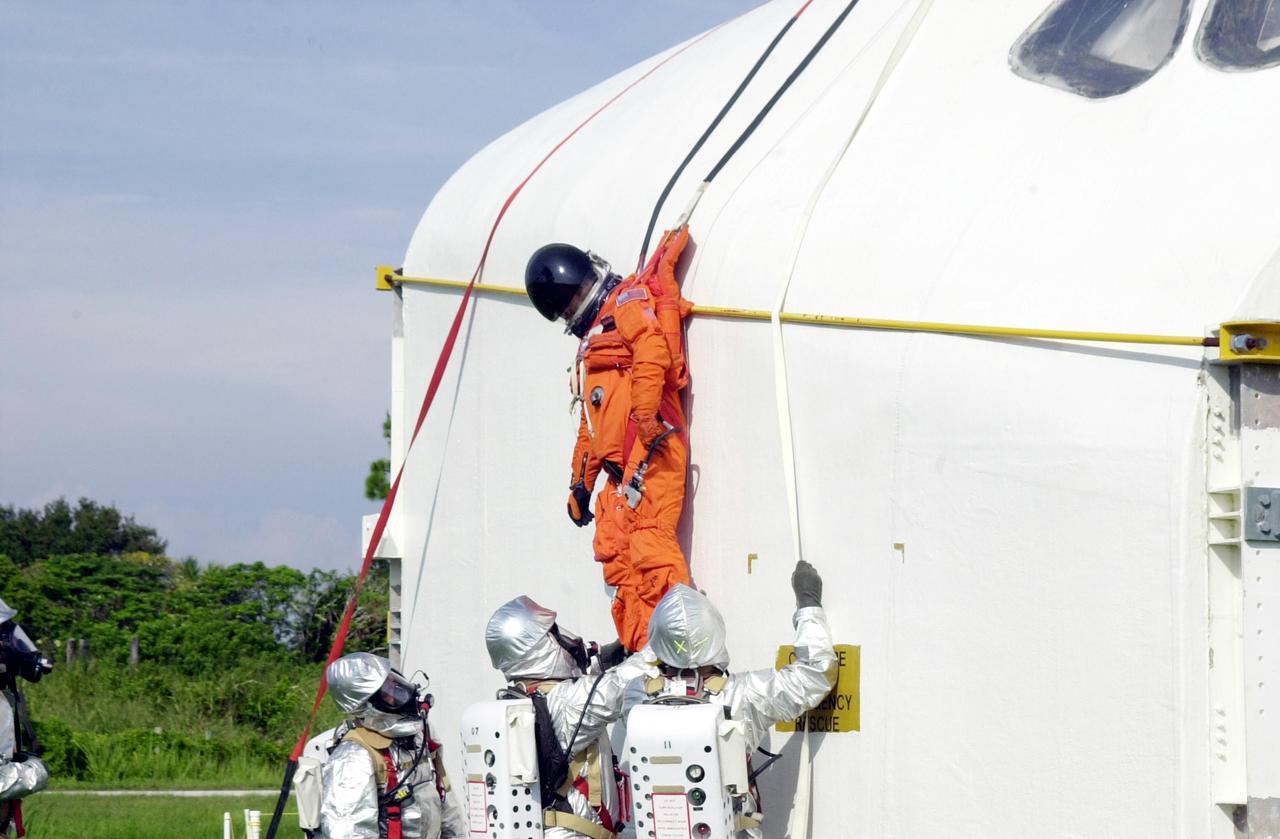
KENNEDY SPACE CENTER, FLA. - "Astronauts" were safely and successfully recovered from a "downed" Space Shuttle in a Mode VII contingency simulation led by Don Hammel, NASA Landing and Recovery Director. KSC Fire/Rescue and Emergency Medical workers, along with Johnson Space Center and Patrick Air Force Base personnel, participated in the drill. Mode simulations are held periodically at KSC to ensure contingency response forces are well prepared to respond to a wide variety of potential emergency situations.
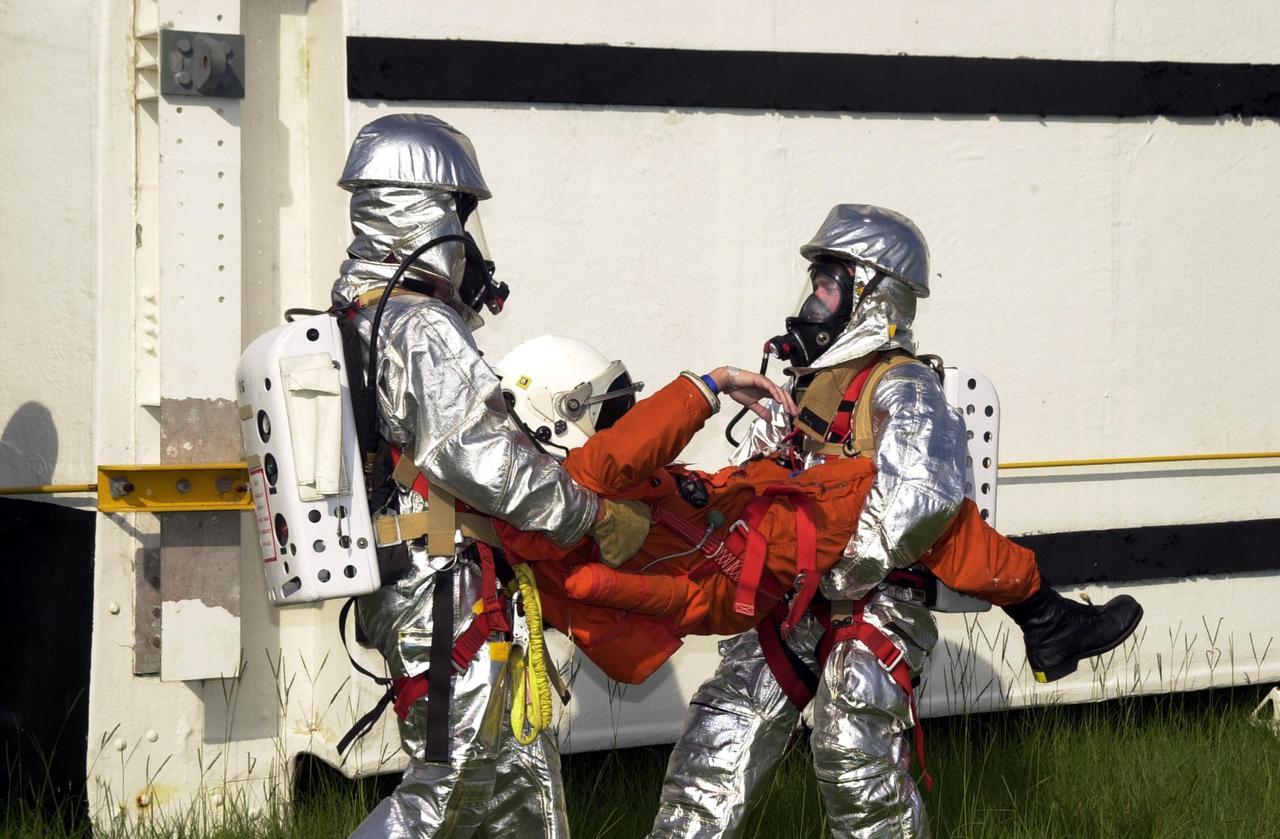
KENNEDY SPACE CENTER, FLA. - "Astronauts" were safely and successfully recovered from a "downed" Space Shuttle in a Mode VII contingency simulation led by Don Hammel, NASA Landing and Recovery Director. KSC Fire/Rescue and Emergency Medical workers, along with Johnson Space Center and Patrick Air Force Base personnel, participated in the drill. Mode simulations are held periodically at KSC to ensure contingency response forces are well prepared to respond to a wide variety of potential emergency situations.
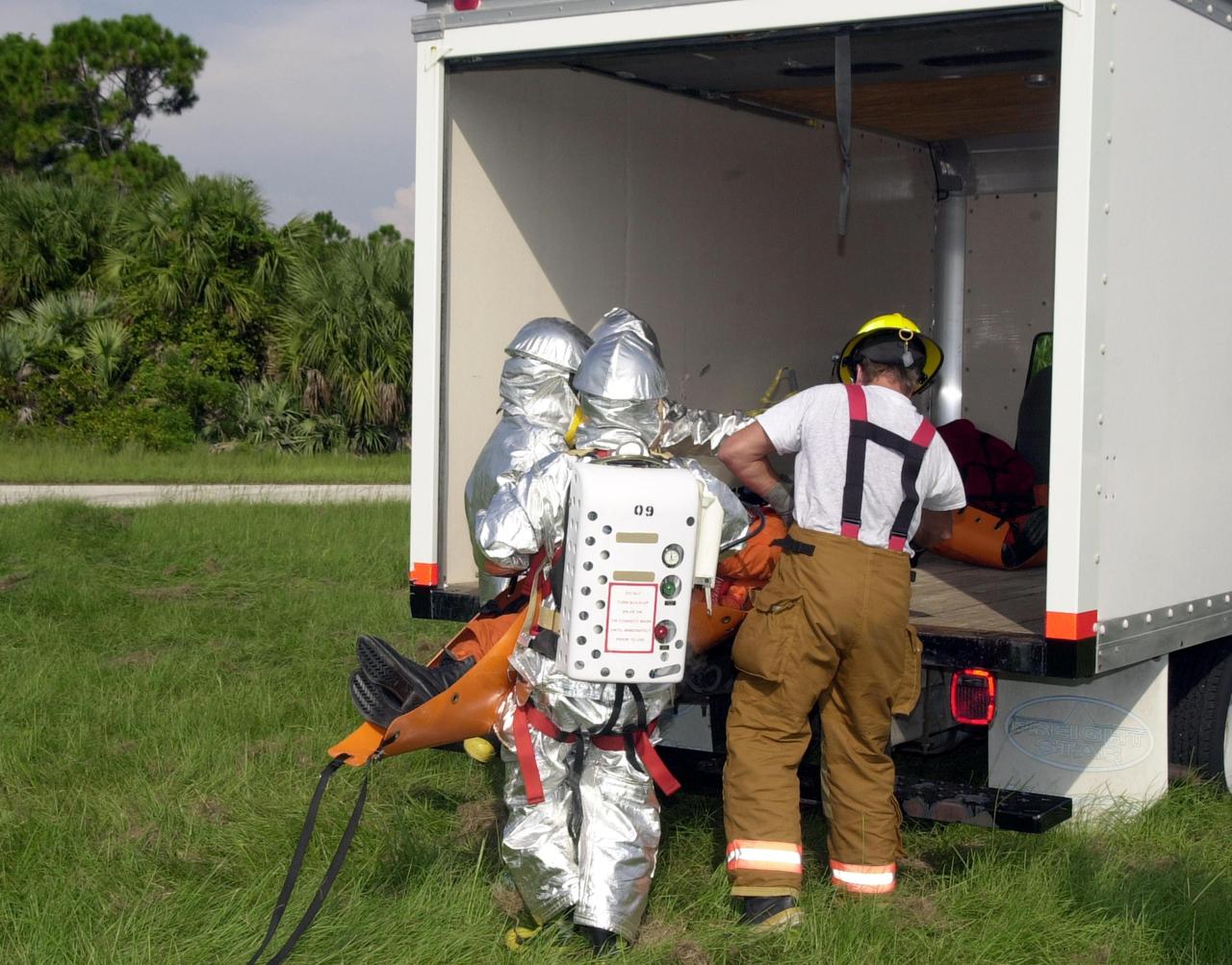
KENNEDY SPACE CENTER, FLA. - "Astronauts" were safely and successfully recovered from a "downed" Space Shuttle in a Mode VII contingency simulation led by Don Hammel, NASA Landing and Recovery Director. KSC Fire/Rescue and Emergency Medical workers, along with Johnson Space Center and Patrick Air Force Base personnel, participated in the drill. Mode simulations are held periodically at KSC to ensure contingency response forces are well prepared to respond to a wide variety of potential emergency situations.
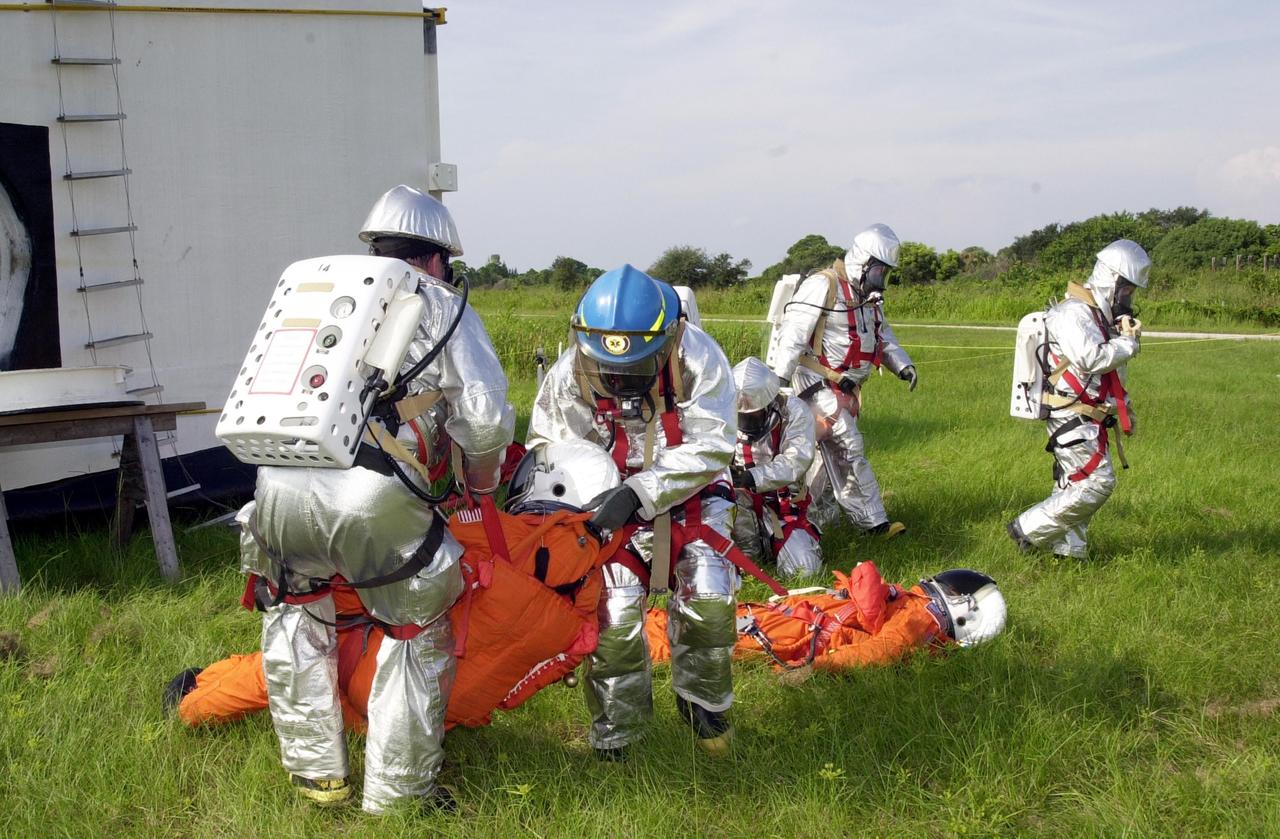
KENNEDY SPACE CENTER, FLA. - "Astronauts" were safely and successfully recovered from a "downed" Space Shuttle in a Mode VII contingency simulation led by Don Hammel, NASA Landing and Recovery Director. KSC Fire/Rescue and Emergency Medical workers, along with Johnson Space Center and Patrick Air Force Base personnel, participated in the drill. Mode simulations are held periodically at KSC to ensure contingency response forces are well prepared to respond to a wide variety of potential emergency situations.
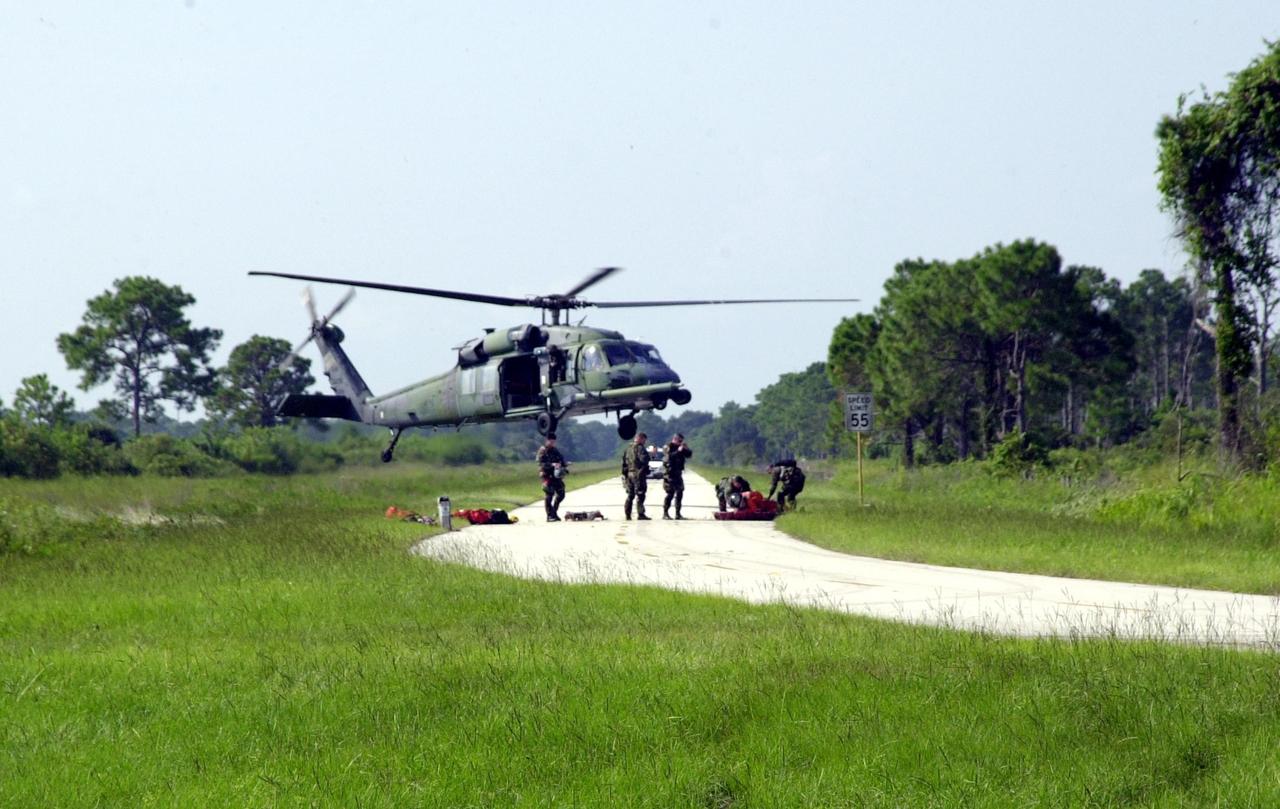
KENNEDY SPACE CENTER, FLA. - "Astronauts" were safely and successfully recovered from a "downed" Space Shuttle in a Mode VII contingency simulation led by Don Hammel, NASA Landing and Recovery Director. KSC Fire/Rescue and Emergency Medical workers, along with Johnson Space Center and Patrick Air Force Base personnel, participated in the drill. Mode simulations are held periodically at KSC to ensure contingency response forces are well prepared to respond to a wide variety of potential emergency situations.
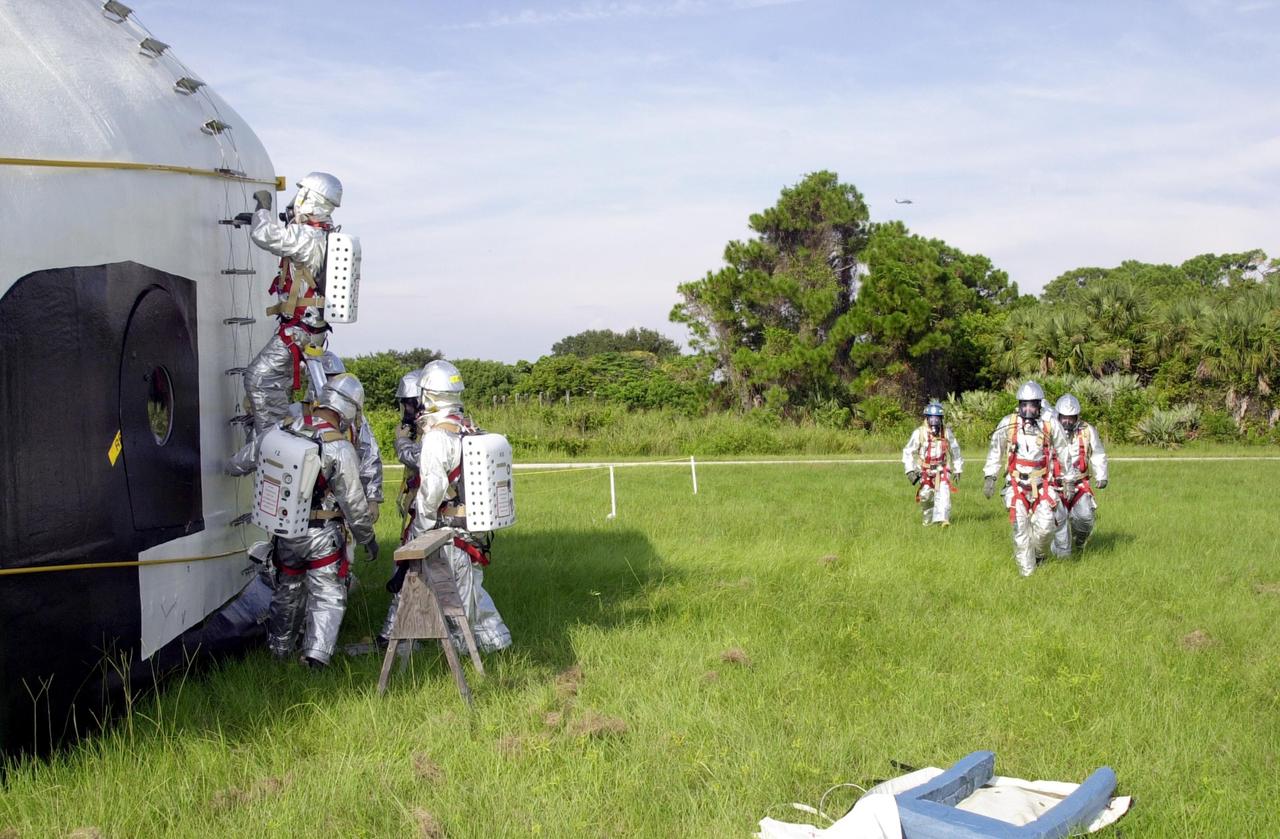
KENNEDY SPACE CENTER, FLA. - "Astronauts" were safely and successfully recovered from a "downed" Space Shuttle in a Mode VII contingency simulation led by Don Hammel, NASA Landing and Recovery Director. KSC Fire/Rescue and Emergency Medical workers, along with Johnson Space Center and Patrick Air Force Base personnel, participated in the drill. Mode simulations are held periodically at KSC to ensure contingency response forces are well prepared to respond to a wide variety of potential emergency situations.
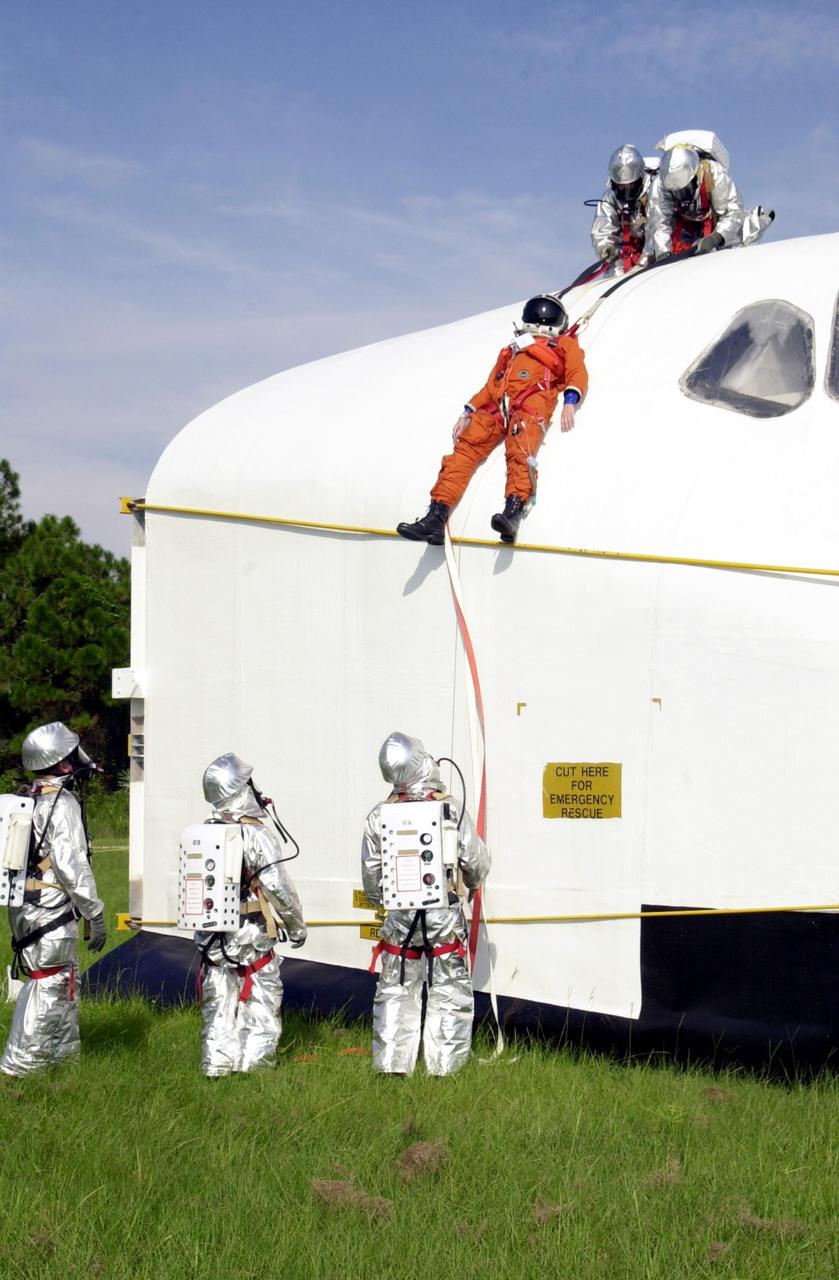
KENNEDY SPACE CENTER, FLA. - "Astronauts" were safely and successfully recovered from a "downed" Space Shuttle in a Mode VII contingency simulation led by Don Hammel, NASA Landing and Recovery Director. KSC Fire/Rescue and Emergency Medical workers, along with Johnson Space Center and Patrick Air Force Base personnel, participated in the drill. Mode simulations are held periodically at KSC to ensure contingency response forces are well prepared to respond to a wide variety of potential emergency situations.
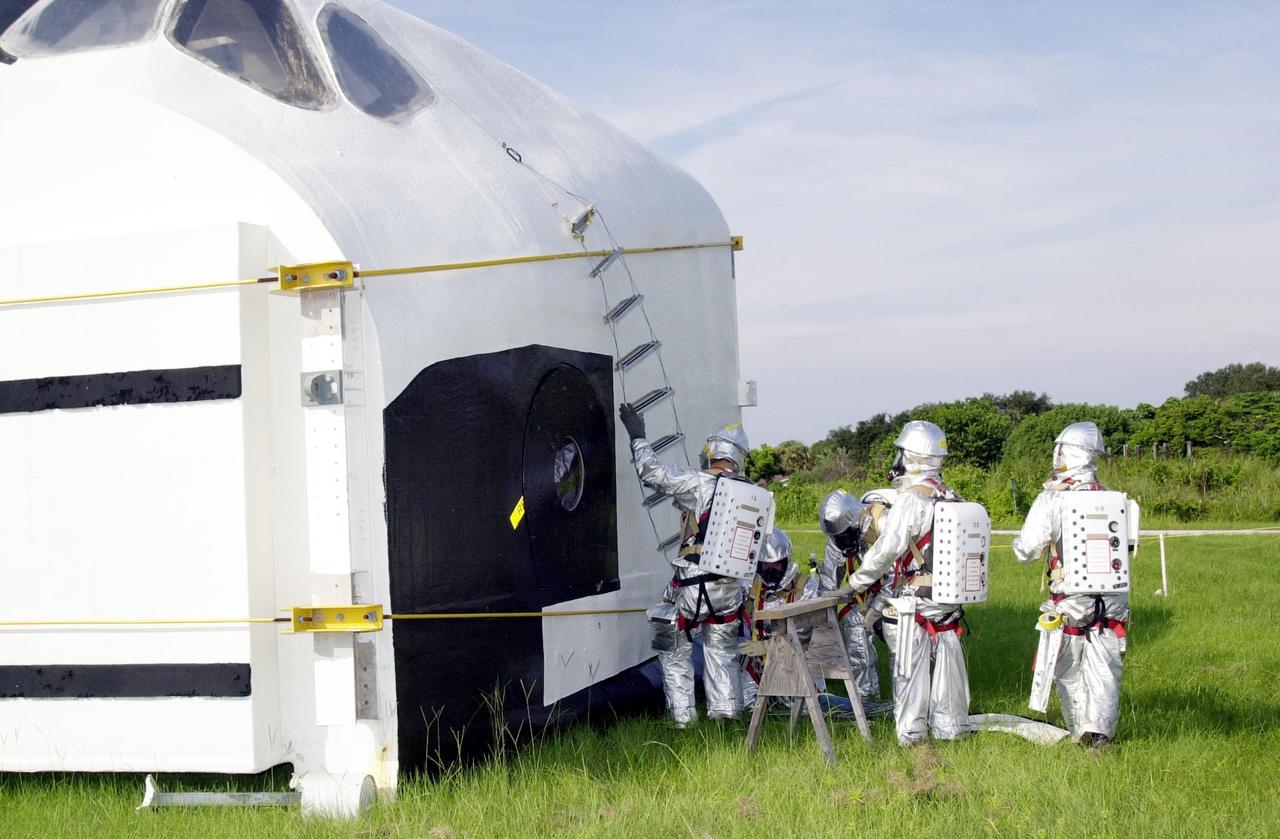
KENNEDY SPACE CENTER, FLA. - "Astronauts" were safely and successfully recovered from a "downed" Space Shuttle in a Mode VII contingency simulation led by Don Hammel, NASA Landing and Recovery Director. KSC Fire/Rescue and Emergency Medical workers, along with Johnson Space Center and Patrick Air Force Base personnel, participated in the drill. Mode simulations are held periodically at KSC to ensure contingency response forces are well prepared to respond to a wide variety of potential emergency situations.
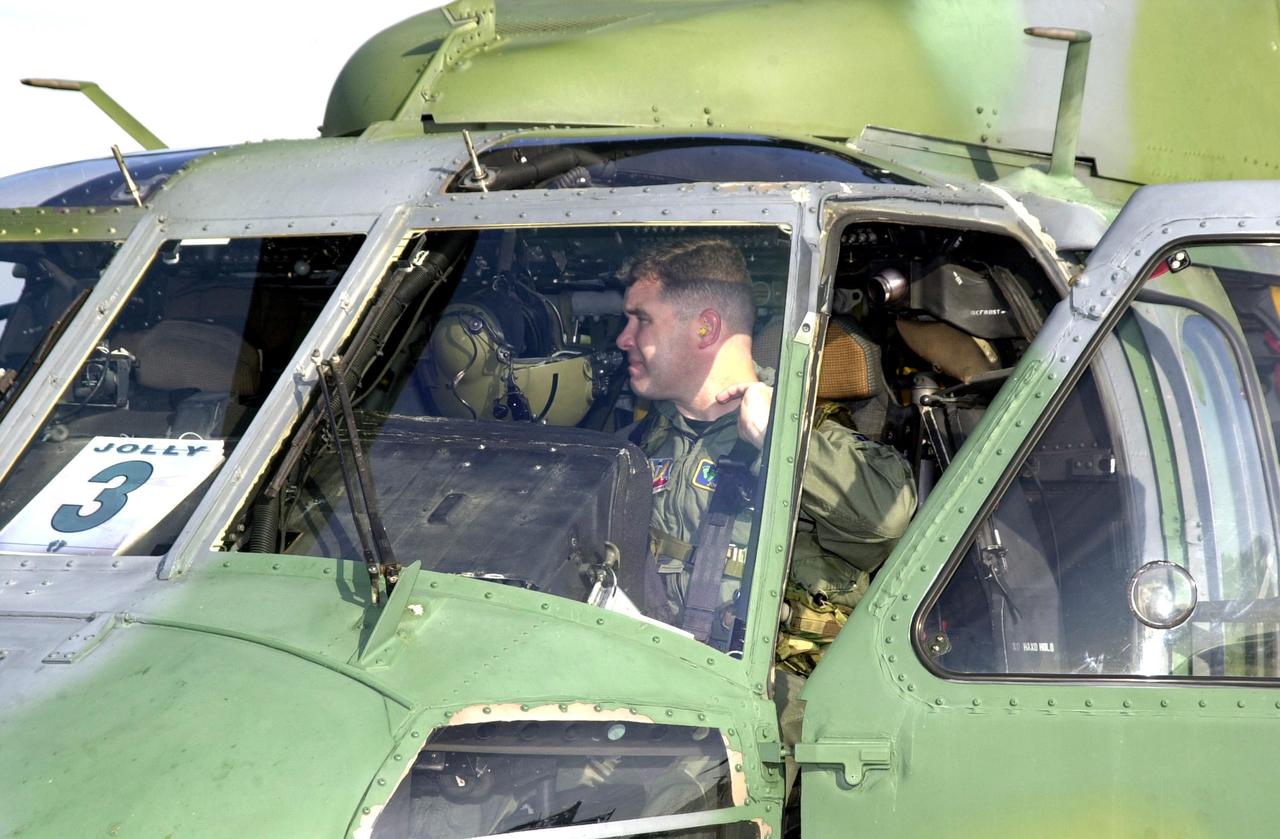
KENNEDY SPACE CENTER, FLA. - "Astronauts" were safely and successfully recovered from a "downed" Space Shuttle in a Mode VII contingency simulation led by Don Hammel, NASA Landing and Recovery Director. KSC Fire/Rescue and Emergency Medical workers, along with Johnson Space Center and Patrick Air Force Base personnel, participated in the drill. Mode simulations are held periodically at KSC to ensure contingency response forces are well prepared to respond to a wide variety of potential emergency situations.
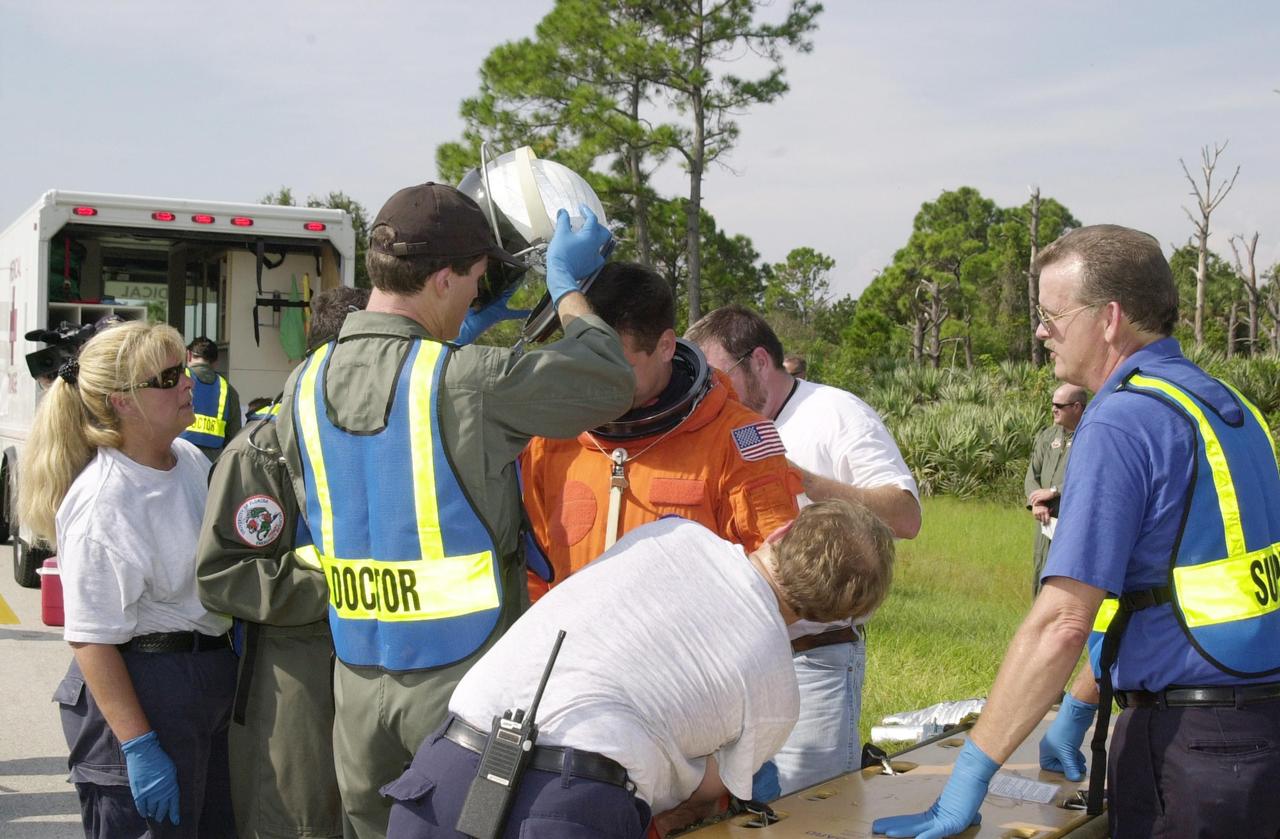
KENNEDY SPACE CENTER, FLA. - "Astronauts" were safely and successfully recovered from a "downed" Space Shuttle in a Mode VII contingency simulation led by Don Hammel, NASA Landing and Recovery Director. KSC Fire/Rescue and Emergency Medical workers, along with Johnson Space Center and Patrick Air Force Base personnel, participated in the drill. Mode simulations are held periodically at KSC to ensure contingency response forces are well prepared to respond to a wide variety of potential emergency situations.
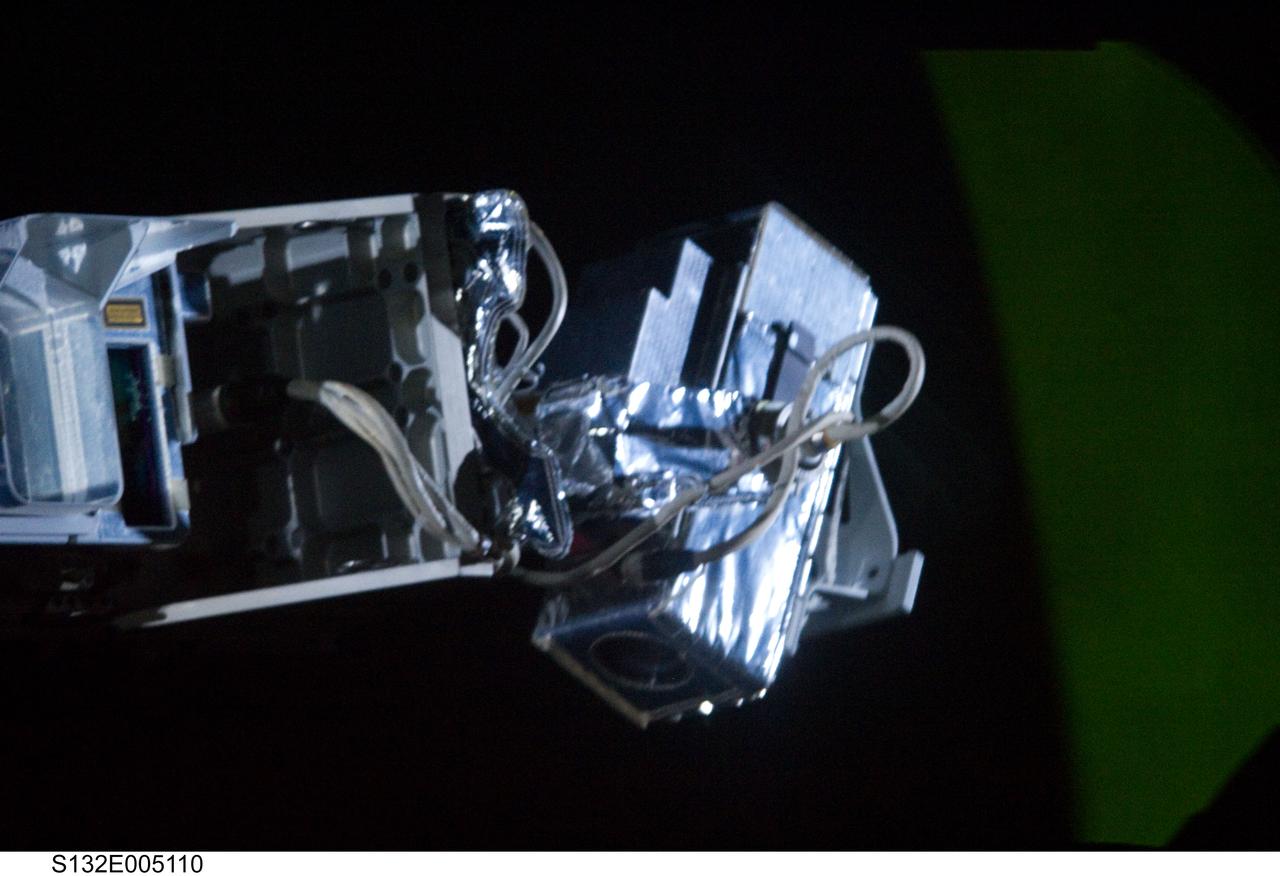
S132-E-005110 (15 May 2010) --- While preparing for the routine inspection of Atlantis’ thermal protection system on Flight Day 2, the STS-132 crew discovered a cable was being pinched and preventing the sensor package pan and tilt unit from moving properly. There are alternate sensor packages that do not require the pan and tilt function; and personnel in the Johnson Space Center’s Mission Control Center are evaluating those procedures. Photo credit: NASA or National Aeronautics and Space Administration
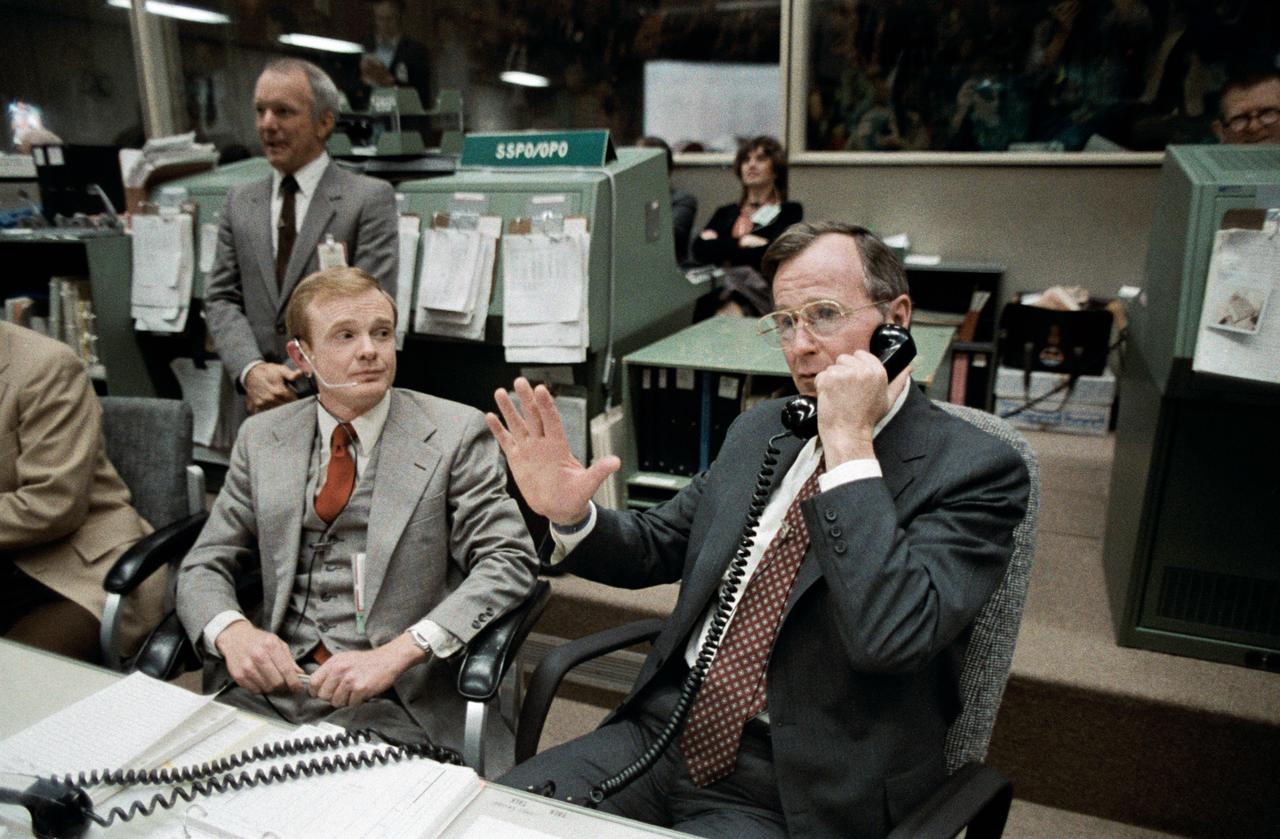
S83-30192 (8 April 1983) --- Vice President George Bush talks to the Earth-orbiting STS-6 astronauts from the spacecraft communicators; (CAPCOM) console in the mission operations control room (MOCR) of the Johnson Space Center?s mission control center. Astronaut Roy D. Bridges, is one of the CAPCOM personnel on duty. JSC Director Gerald D. Griffin, left, watches a large monitor (out of frame) on which the TV scene of the four-member Challenger crew is visible. This photo was made by Otis Imboden.
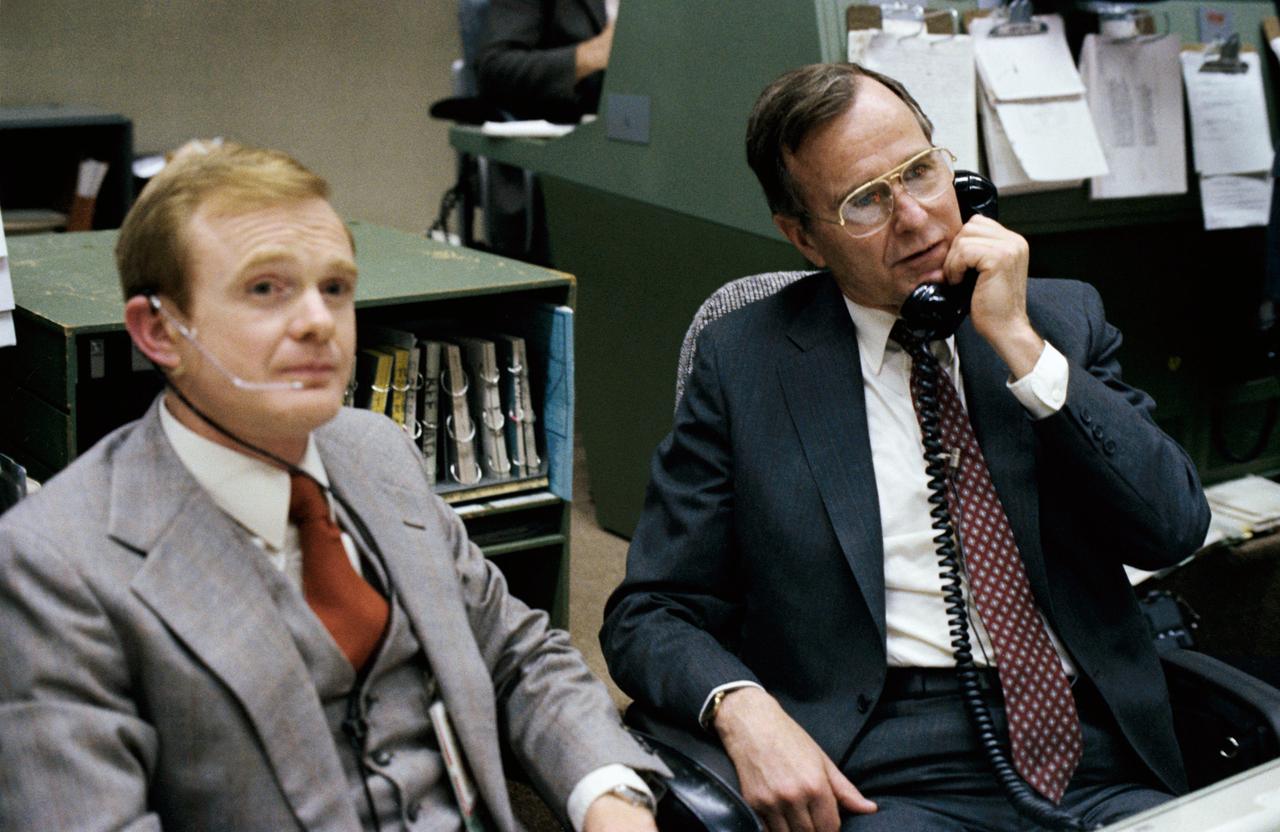
S83-30190 (8 April 1983) --- Vice President George Bush talks to the Earth-orbiting STS-6 astronauts from the spacecraft communicators; (CAPCOM) console in the mission operations control room (MOCR) of the Johnson Space Center?s mission control center. Astronaut Roy D. Bridges, left, is one of the CAPCOM personnel on duty.
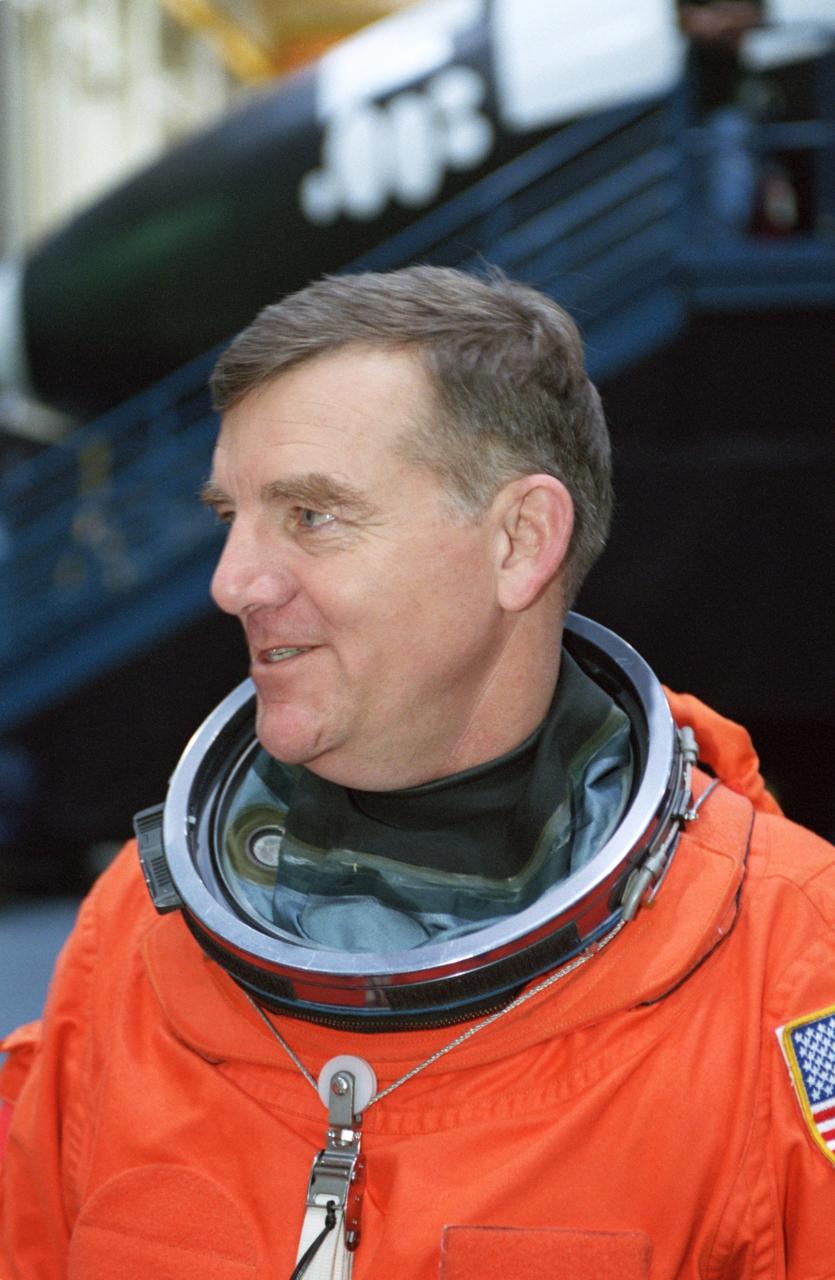
JSC2000-07444 (6 December 2000) --- Astronaut James S. Voss, Expedition Two crew member in training for next year's second lengthy stay aboard the International Space Station (ISS), listens as crew training personnel (out of frame) explain procedures for an upcoming simulation. The training took place in the crew compartment trainer (CCT-2) in the high bay area of the Johnson Space Center's Systems Integration Facility.
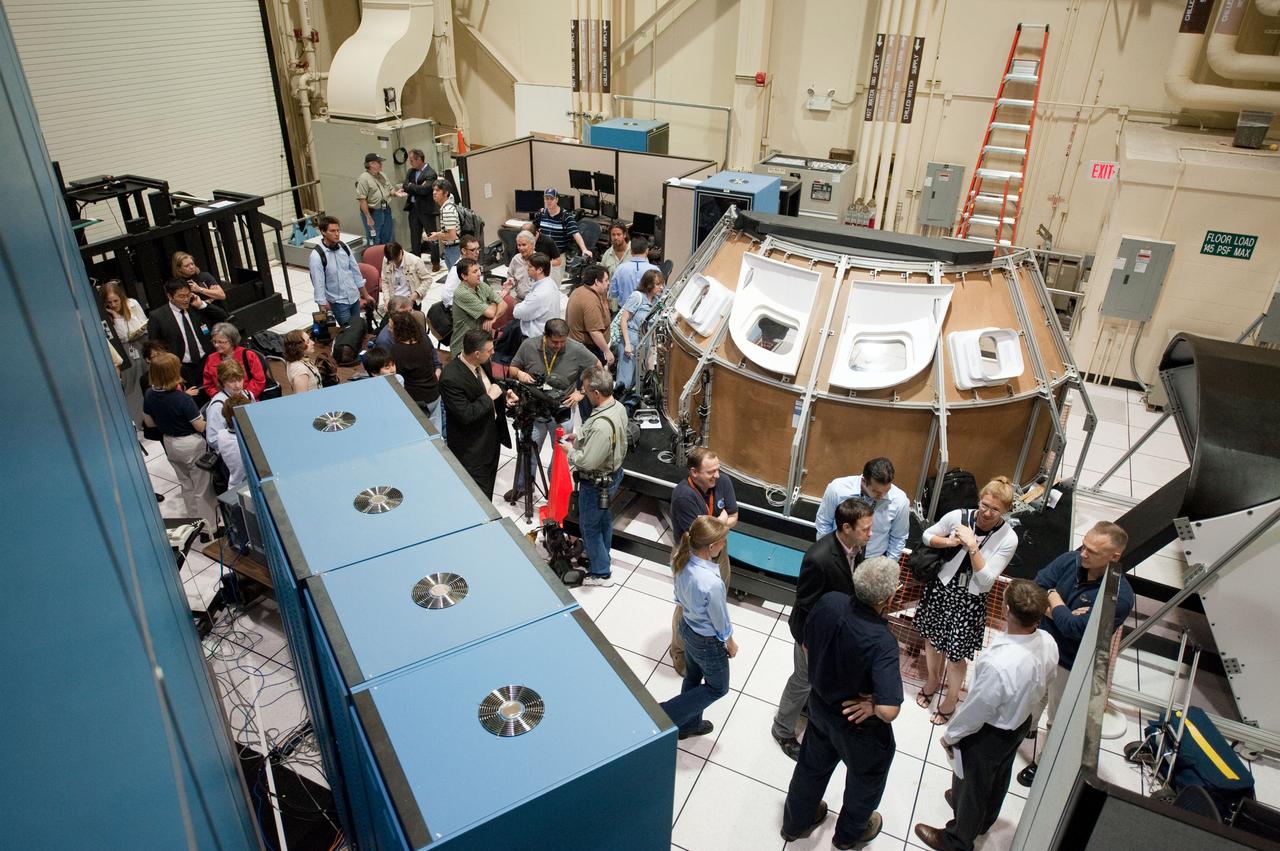
JSC2011-E-028127 (23 March 2011) --- NASA astronauts Chris Ferguson, STS-135 commander; Doug Hurley, pilot; and Sandy Magnus, mission specialist; along with news media representatives and NASA personnel are pictured during an STS-135 media day event in the Avionics Systems Laboratory at NASA's Johnson Space Center. Photo credit: NASA or National Aeronautics and Space Administration
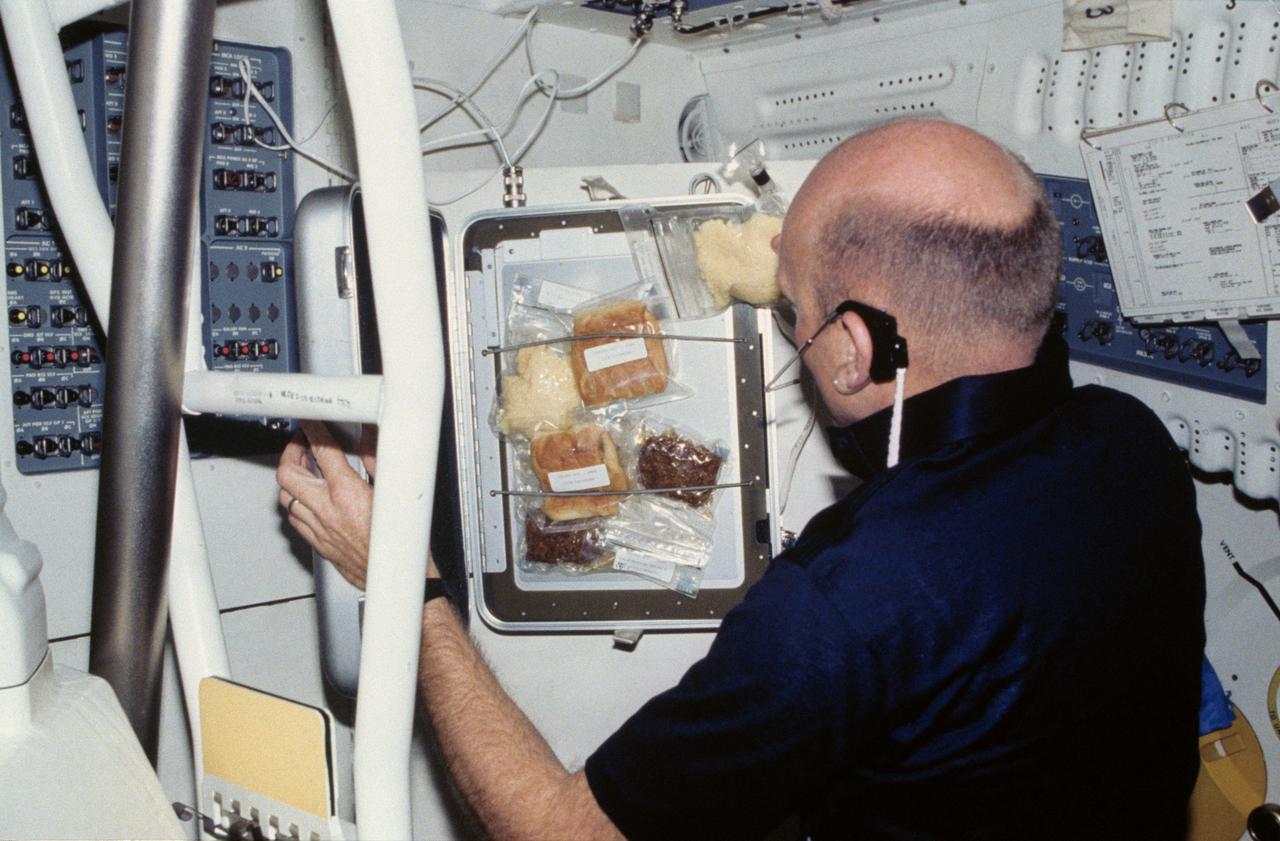
S82-28923 (March 1982) --- Astronaut C. Gordon Fullerton, STS-3 pilot, uses both hands to retrieve part of a meal from an orbital flight test food warmer in the middeck area of the Earth-orbiting space shuttle Columbia. The food warmer is a versatile briefcase-like device developed by life sciences personnel at the Johnson Space Center (JSC). Astronaut Jack R. Lousma, STS-3 commander, took this photograph with a 35mm camera. Photo credit: NASA

S86-28458 (28 Feb. 1986) --- Astronaut Michael L. Coats participates in a rehearsal for his assigned flight at the commander's station of the Shuttle Mission Simulator (SMS) at the Johnson Space Center (JSC). NOTE: Coats, a veteran of spaceflight, originally trained for STS 61-H, which was cancelled in the wake of the Challenger accident. Following the Janaury 1986 accident he was named to serve on a mock crew (STS-61M) for personnel training and simulation purposes. Photo credit: NASA

S79-29592 (28 Feb 1979) --- Sporting their new Shuttle-type constant-wear garments, these six astronaut candidates pose for a picture in the crew systems laboratory at the Johnson Space Center (JSC) with the personnel rescue enclosure (PRE) or "rescue ball" and an unoccupied Apollo EMU. From left to right are Rhea Seddon, Kathryn D. Sullivan, Judith A. Resnik, Sally K. Ride, Anna L. Fisher and Shannon W. Lucid.
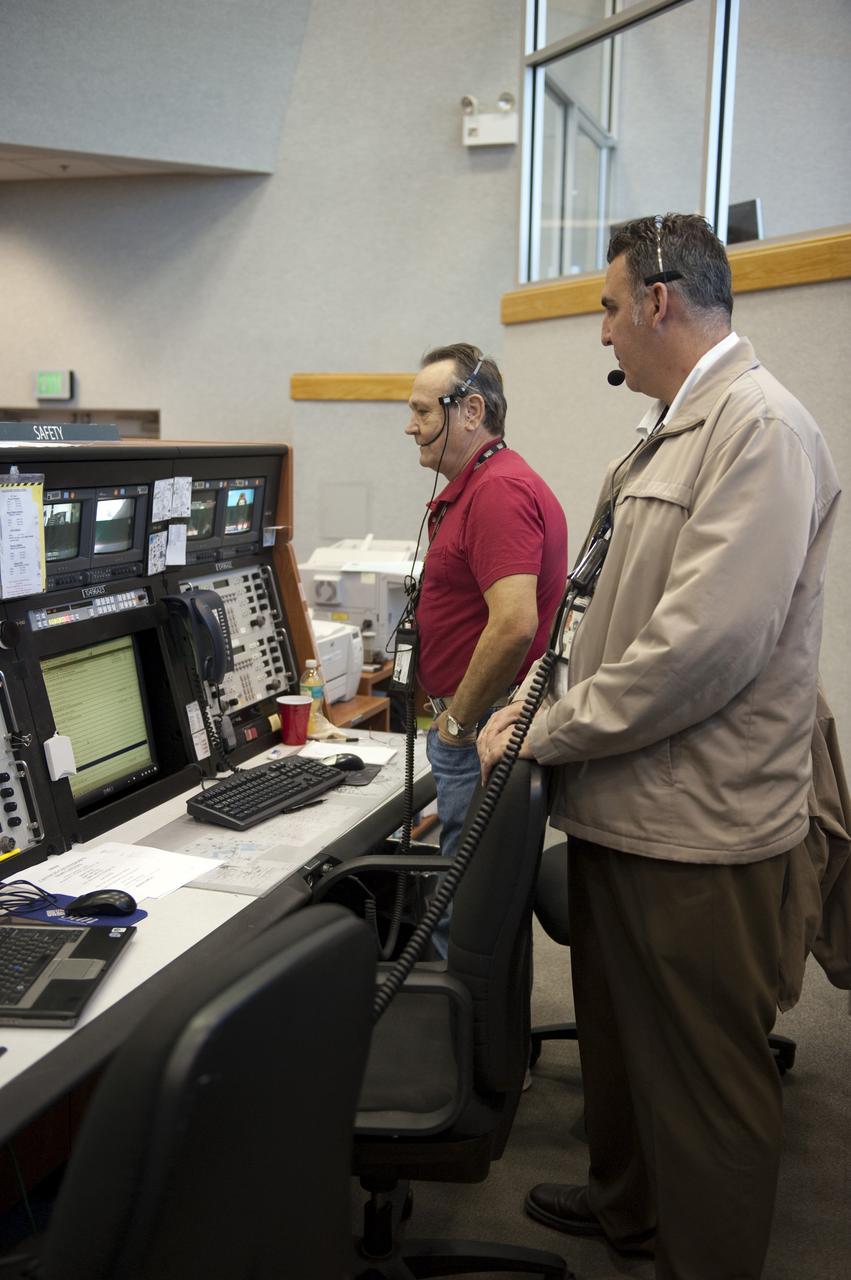
CAPE CANAVERAL, Fla. -- In the Launch Control Center at NASA's Kennedy Space Center in Florida, United Space Alliance Safety Engineer Dwayne Thompson, left, and NASA Safety Engineer Dallas McCarter rehearse procedures for the liftoff of space shuttle Discovery's final mission with other STS-133 launch team members in Firing Room 4. The team at Kennedy also participated in launch simulations with personnel at NASA's Johnson Space Center in Houston. Discovery's next launch opportunity to the International Space Station on the STS-133 mission is planned for no earlier than Feb. 24. For more information on STS-133, visit www.nasa.gov/mission_pages/shuttle/shuttlemissions/sts133/. Photo credit: NASA/Kim Shiflett
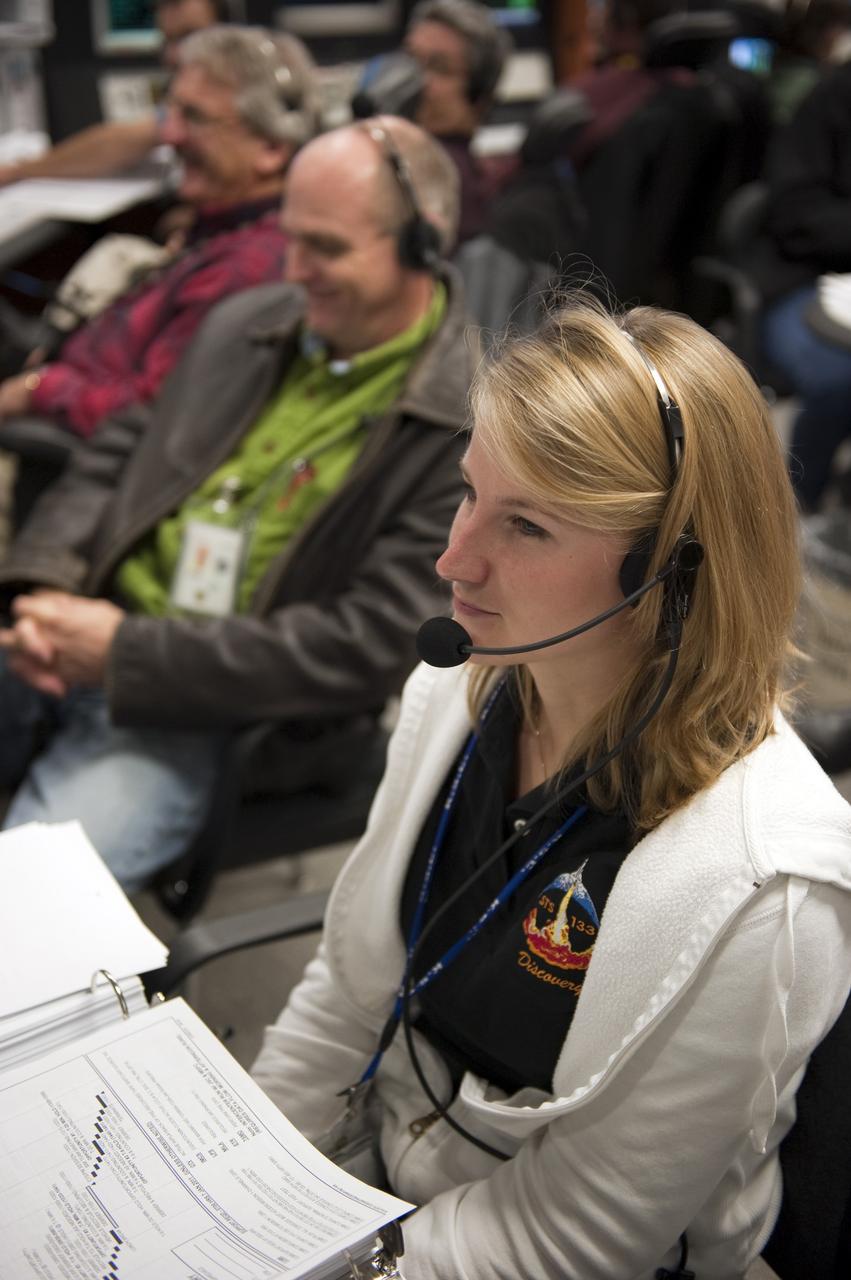
CAPE CANAVERAL, Fla. -- In the Launch Control Center at NASA's Kennedy Space Center in Florida, United Space Alliance Guidance and Navigation Engineer Jennifer Guida sits at her console in Firing Room 4 along with other STS-133 launch team members to rehearse procedures for the liftoff of space shuttle Discovery's final mission. The team at Kennedy also participated in launch simulations with personnel at NASA's Johnson Space Center in Houston. Discovery's next launch opportunity to the International Space Station on the STS-133 mission is planned for no earlier than Feb. 24. For more information on STS-133, visit www.nasa.gov/mission_pages/shuttle/shuttlemissions/sts133/. Photo credit: NASA/Kim Shiflett
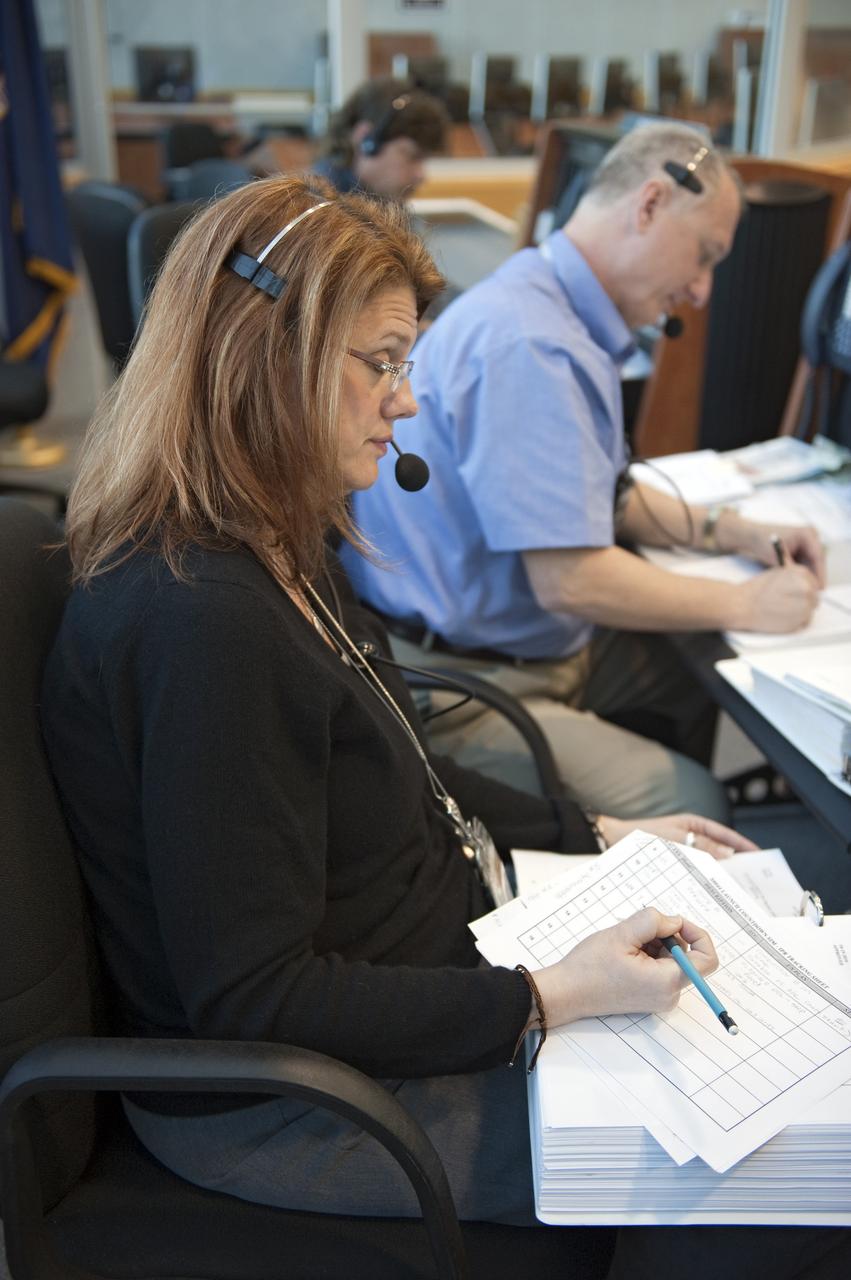
CAPE CANAVERAL, Fla. -- In the Launch Control Center at NASA's Kennedy Space Center in Florida, NASA Test Director Charlie Blackwell-Thompson sits at her console in Firing Room 4 along with other STS-133 launch team members to rehearse procedures for the liftoff of space shuttle Discovery's final mission. The team at Kennedy also participated in launch simulations with personnel at NASA's Johnson Space Center in Houston. Discovery's next launch opportunity to the International Space Station on the STS-133 mission is planned for no earlier than Feb. 24. For more information on STS-133, visit www.nasa.gov/mission_pages/shuttle/shuttlemissions/sts133/. Photo credit: NASA/Kim Shiflett
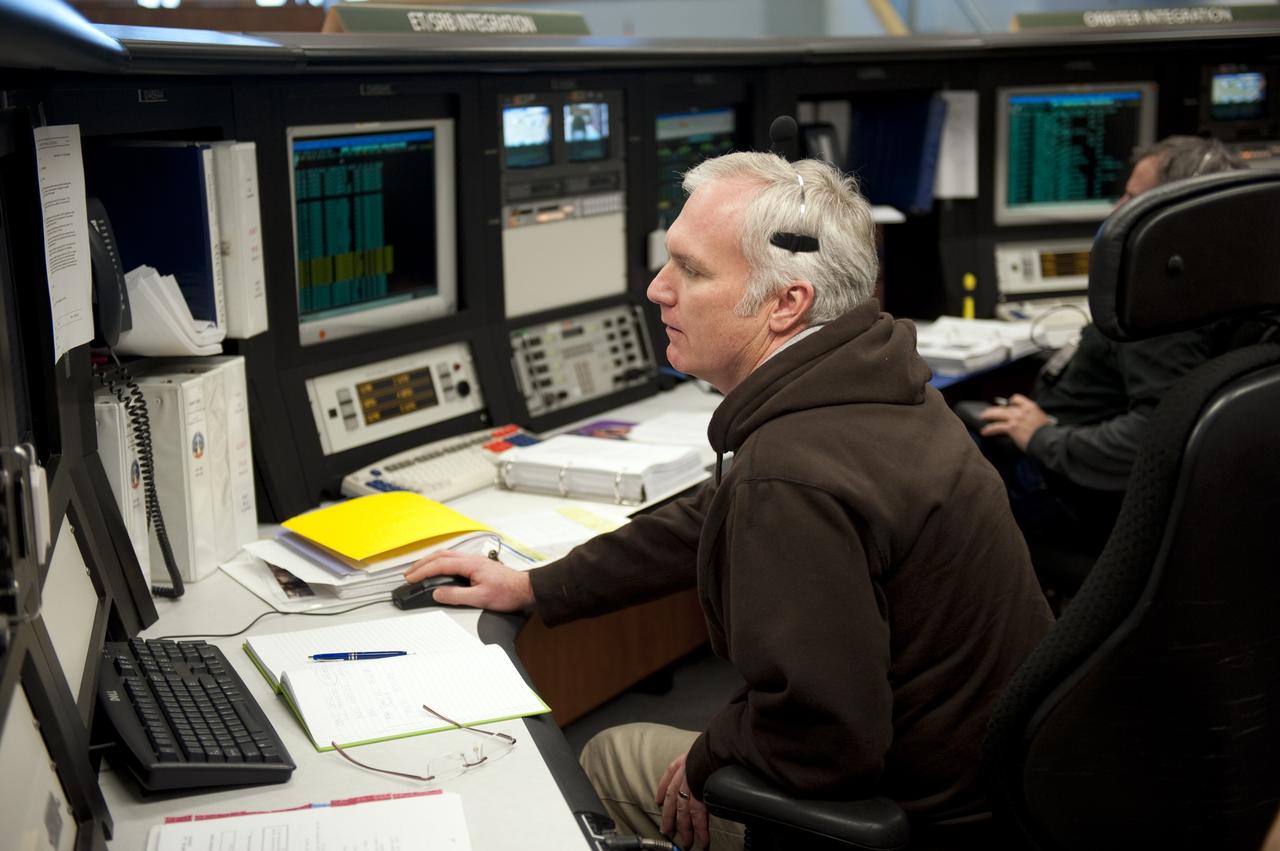
CAPE CANAVERAL, Fla. -- In the Launch Control Center at NASA's Kennedy Space Center in Florida, NASA Orbiter Project Engineer Todd Campbell sits at his console in Firing Room 4 along with other STS-133 launch team members to rehearse procedures for the liftoff of space shuttle Discovery's final mission. The team at Kennedy also participated in launch simulations with personnel at NASA's Johnson Space Center in Houston. Discovery's next launch opportunity to the International Space Station on the STS-133 mission is planned for no earlier than Feb. 24. For more information on STS-133, visit www.nasa.gov/mission_pages/shuttle/shuttlemissions/sts133/. Photo credit: NASA/Kim Shiflett

CAPE CANAVERAL, Fla. -- In the Launch Control Center at NASA's Kennedy Space Center in Florida, STS-133 NASA Test Director Stephen Payne sits at his console in Firing Room 4 along with other STS-133 launch team members to rehearse procedures for the liftoff of space shuttle Discovery's final mission. The team at Kennedy also participated in launch simulations with personnel at NASA's Johnson Space Center in Houston. Discovery's next launch opportunity to the International Space Station on the STS-133 mission is planned for no earlier than Feb. 24. For more information on STS-133, visit www.nasa.gov/mission_pages/shuttle/shuttlemissions/sts133/. Photo credit: NASA/Kim Shiflett
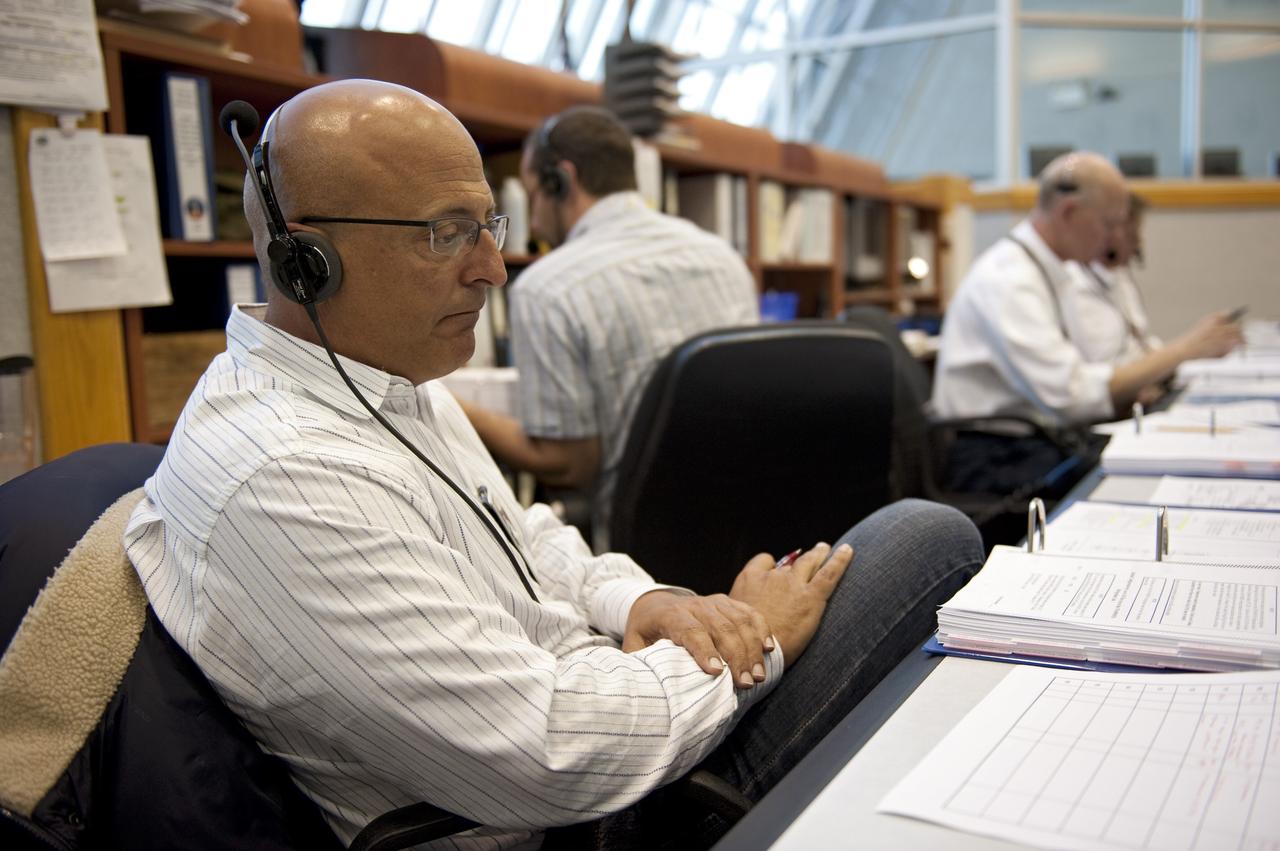
CAPE CANAVERAL, Fla. -- In the Launch Control Center at NASA's Kennedy Space Center in Florida, Assistant Launch Orbiter Test Conductor Mark Taffet sits at his console in Firing Room 4 along with other STS-133 launch team members to rehearse procedures for the liftoff of space shuttle Discovery's final mission. The team at Kennedy also participated in launch simulations with personnel at NASA's Johnson Space Center in Houston. Discovery's next launch opportunity to the International Space Station on the STS-133 mission is planned for no earlier than Feb. 24. For more information on STS-133, visit www.nasa.gov/mission_pages/shuttle/shuttlemissions/sts133/. Photo credit: NASA/Kim Shiflett

CAPE CANAVERAL, Fla. -- In the Launch Control Center at NASA's Kennedy Space Center in Florida, STS-133 Assistant Launch Director Pete Nickolenko sits at his console in Firing Room 4 along with other launch team members to rehearse procedures for the liftoff of space shuttle Discovery's final mission. The team at Kennedy also participated in launch simulations with personnel at NASA's Johnson Space Center in Houston. Discovery's next launch opportunity to the International Space Station on the STS-133 mission is planned for no earlier than Feb. 24. For more information on STS-133, visit www.nasa.gov/mission_pages/shuttle/shuttlemissions/sts133/. Photo credit: NASA/Kim Shiflett
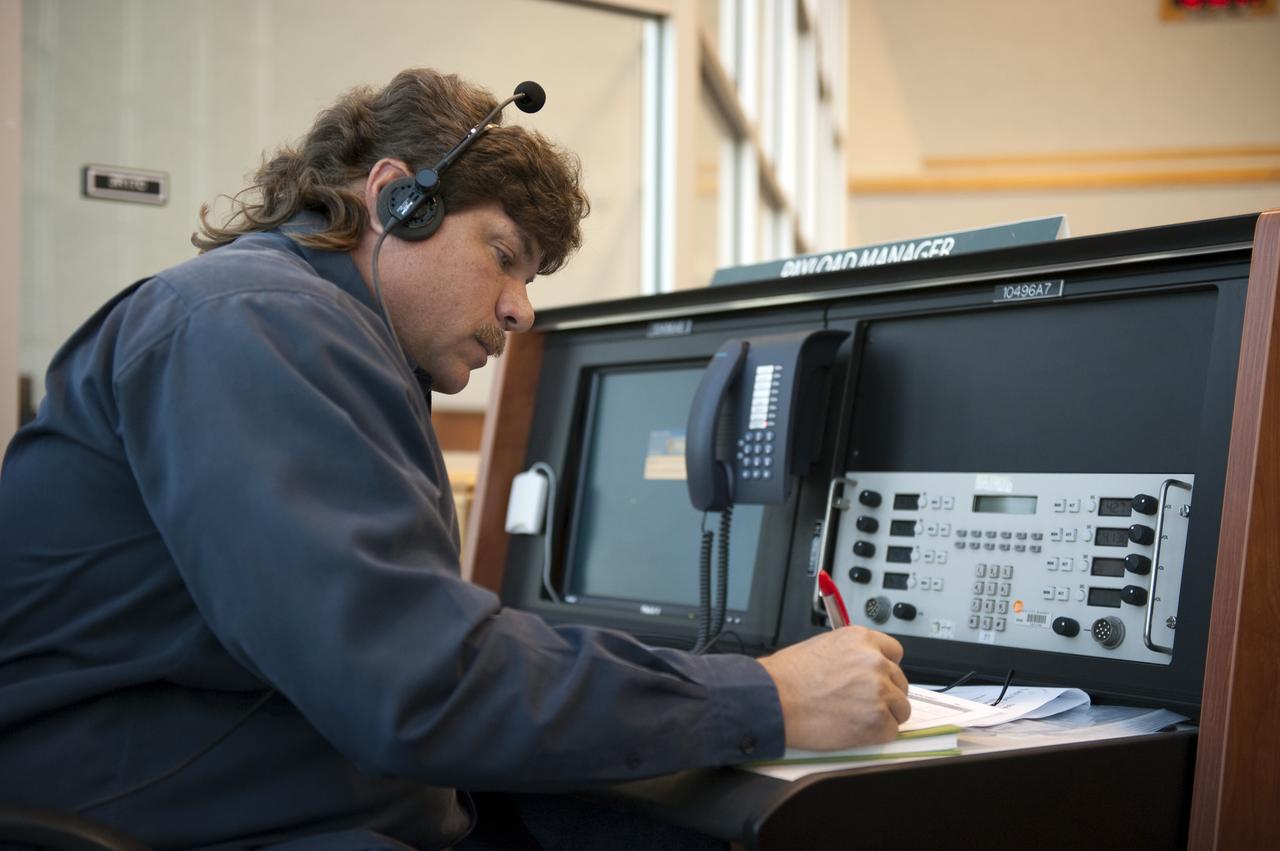
CAPE CANAVERAL, Fla. -- In the Launch Control Center at NASA's Kennedy Space Center in Florida, Bart Pannullo, the vehicle processing engineer for space shuttle Discovery, sits at his console in Firing Room 4 along with other STS-133 launch team members to rehearse procedures for the liftoff of Discovery's final mission. The team at Kennedy also participated in launch simulations with personnel at NASA's Johnson Space Center in Houston. Discovery's next launch opportunity to the International Space Station on the STS-133 mission is planned for no earlier than Feb. 24. For more information on STS-133, visit www.nasa.gov/mission_pages/shuttle/shuttlemissions/sts133/. Photo credit: NASA/Kim Shiflett

CAPE CANAVERAL, Fla. -- In the Launch Control Center at NASA's Kennedy Space Center in Florida, Shuttle Launch Director Mike Leinbach sits at his console in Firing Room 4 along with other STS-133 launch team members to rehearse procedures for the liftoff of space shuttle Discovery's final mission. The team at Kennedy also participated in launch simulations with personnel at NASA's Johnson Space Center in Houston. Discovery's next launch opportunity to the International Space Station on the STS-133 mission is planned for no earlier than Feb. 24. For more information on STS-133, visit www.nasa.gov/mission_pages/shuttle/shuttlemissions/sts133/. Photo credit: NASA/Kim Shiflett
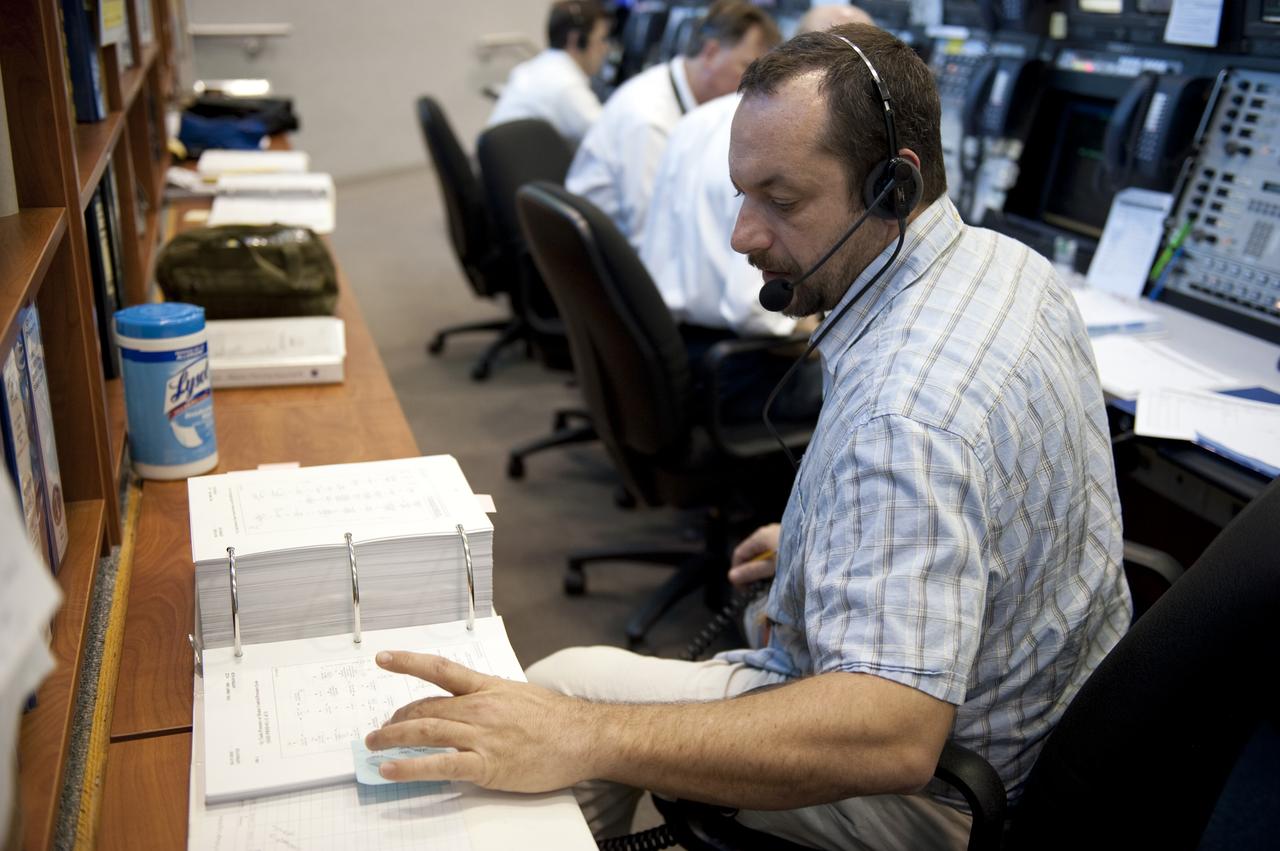
CAPE CANAVERAL, Fla. -- In the Launch Control Center at NASA's Kennedy Space Center in Florida, Launch Orbiter Test Conductor John Kracsun sits at his console in Firing Room 4 along with other STS-133 launch team members to rehearse procedures for the liftoff of space shuttle Discovery's final mission. The team at Kennedy also participated in launch simulations with personnel at NASA's Johnson Space Center in Houston. Discovery's next launch opportunity to the International Space Station on the STS-133 mission is planned for no earlier than Feb. 24. For more information on STS-133, visit www.nasa.gov/mission_pages/shuttle/shuttlemissions/sts133/. Photo credit: NASA/Kim Shiflett
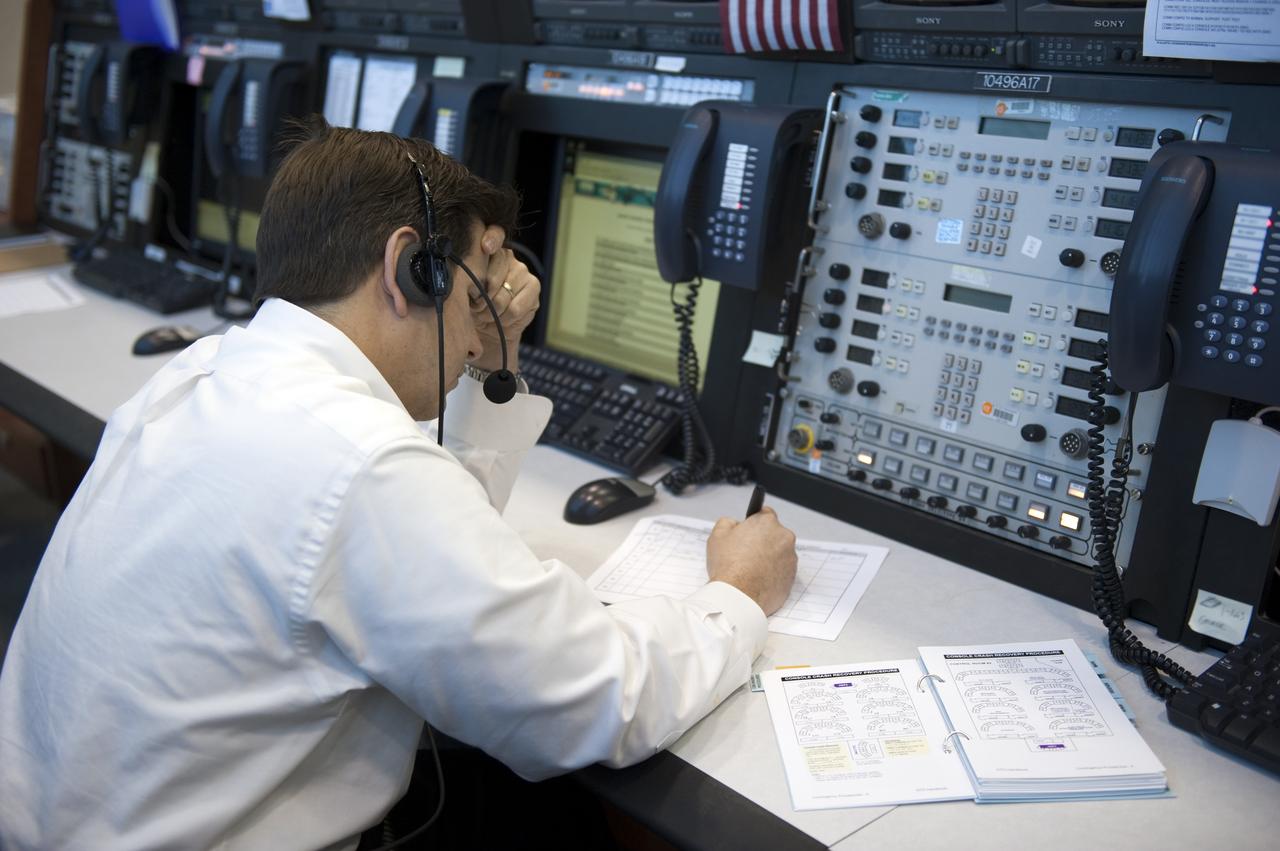
CAPE CANAVERAL, Fla. -- In the Launch Control Center at NASA's Kennedy Space Center in Florida, NASA Test Director Robert Holl sits at his console in Firing Room 4 along with other STS-133 launch team members to rehearse procedures for the liftoff of space shuttle Discovery's final mission. The team at Kennedy also participated in launch simulations with personnel at NASA's Johnson Space Center in Houston. Discovery's next launch opportunity to the International Space Station on the STS-133 mission is planned for no earlier than Feb. 24. For more information on STS-133, visit www.nasa.gov/mission_pages/shuttle/shuttlemissions/sts133/. Photo credit: NASA/Kim Shiflett
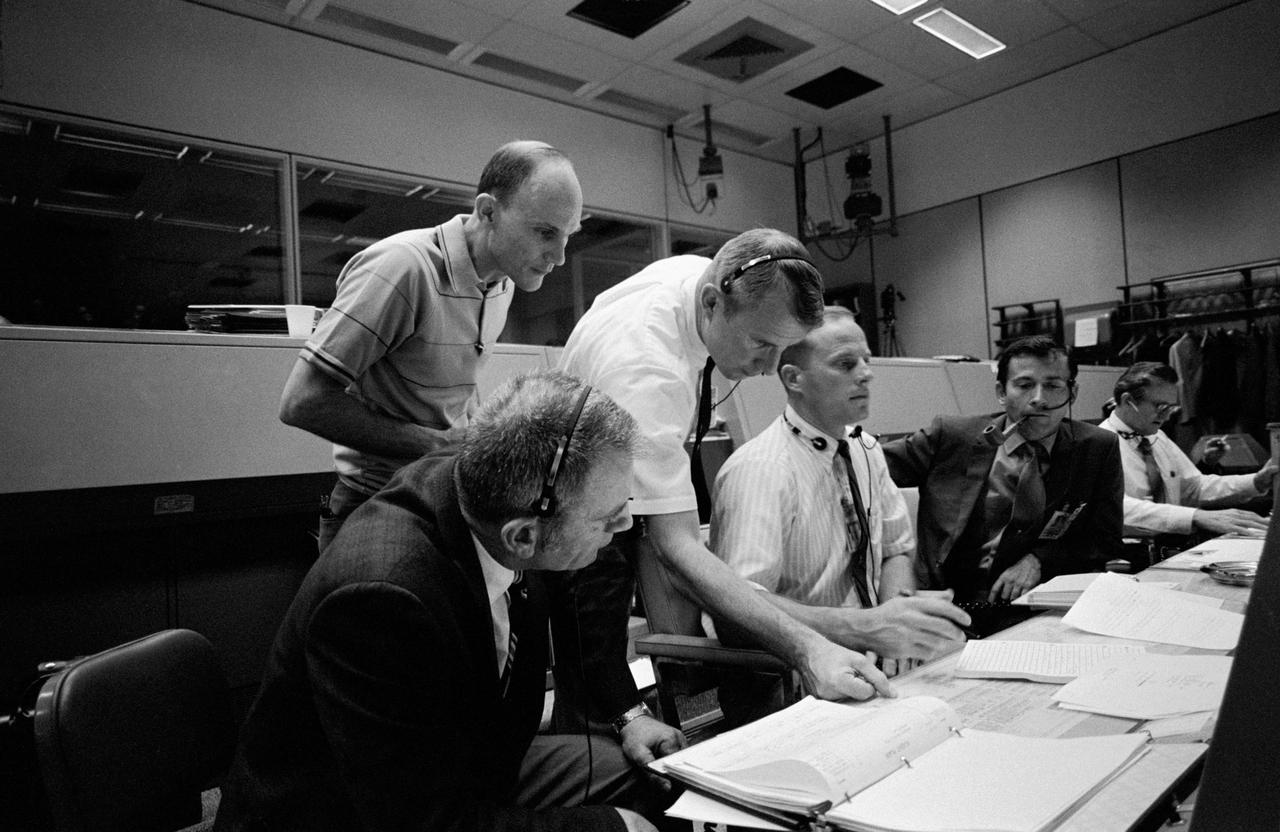
S70-34902 (14 April 1970) --- Several persons important to the Apollo 13 mission, at consoles in the Mission Operations Control Room (MOCR) of the Mission Control Center (MCC). Seated at consoles, from left to right, are astronauts Donald K. Slayton, director of flight crew operations; astronaut Jack R. Lousma, Shift 3 spacecraft communicator; and astronaut John W. Young, commander of the Apollo 13 backup crew. Standing, left to right, are astronaut Tom K. Mattingly II, who was replaced as Apollo 13 command module pilot after it was learned he may come down with measles, and astronaut Vance D. Brand, Shift 2 spacecraft communicator. Several hours earlier, in the late evening hours of April 13, crew members of the Apollo 13 mission reported to MCC that trouble had developed with an oxygen cell on their spacecraft.
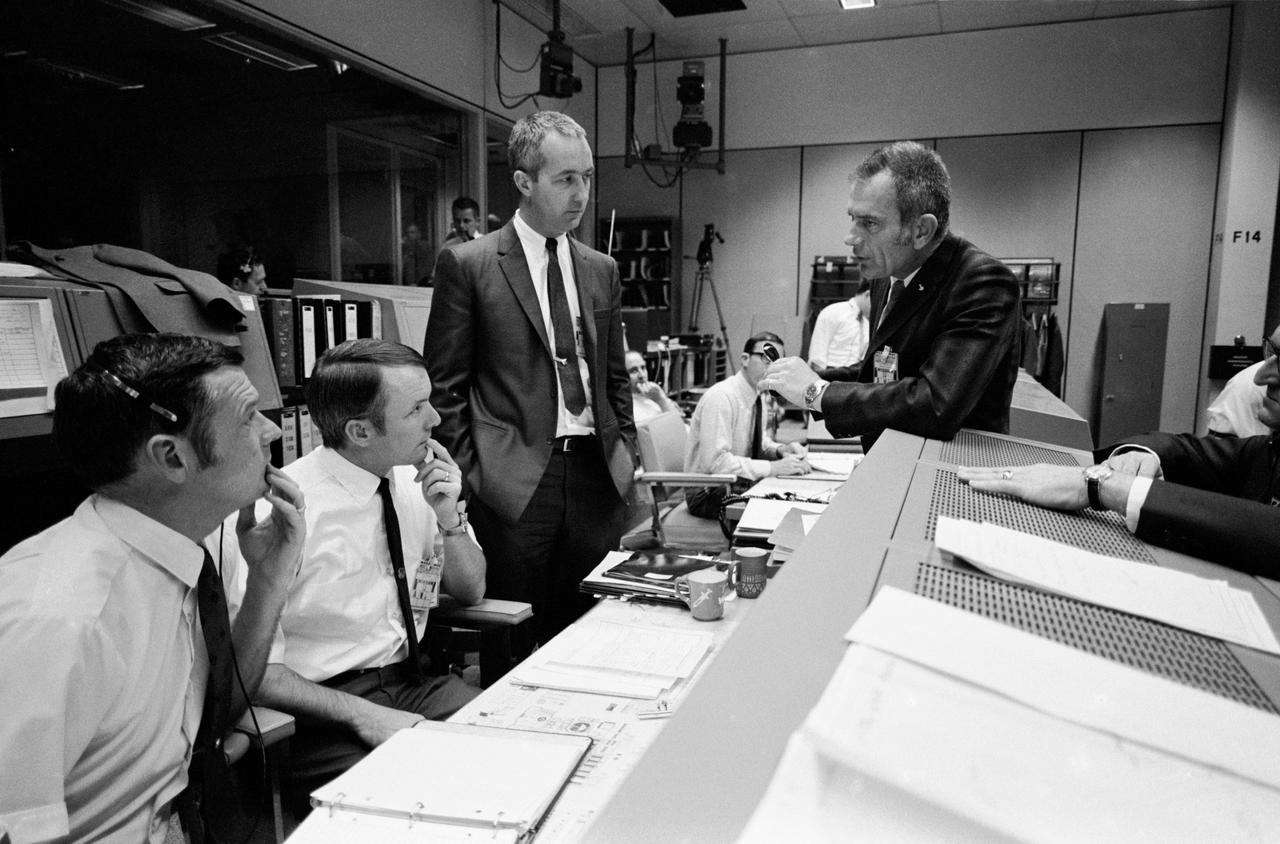
S70-35369 (16 April 1970) --- Discussion in the Mission Operations Control Room (MOCR) dealing with the Apollo 13 crewmen during their final day in space. From left to right are Glynn S. Lunney, Shift 4 flight director; Gerald D. Griffin, Shift 2 flight director; astronaut James A. McDivitt, manager, Apollo Spacecraft Program, MSC; Dr. Donald K. Slayton, director of Flight Crew Operations, MSC; and Dr. Willard R. Hawkins, M.D., Shift 1 flight surgeon.
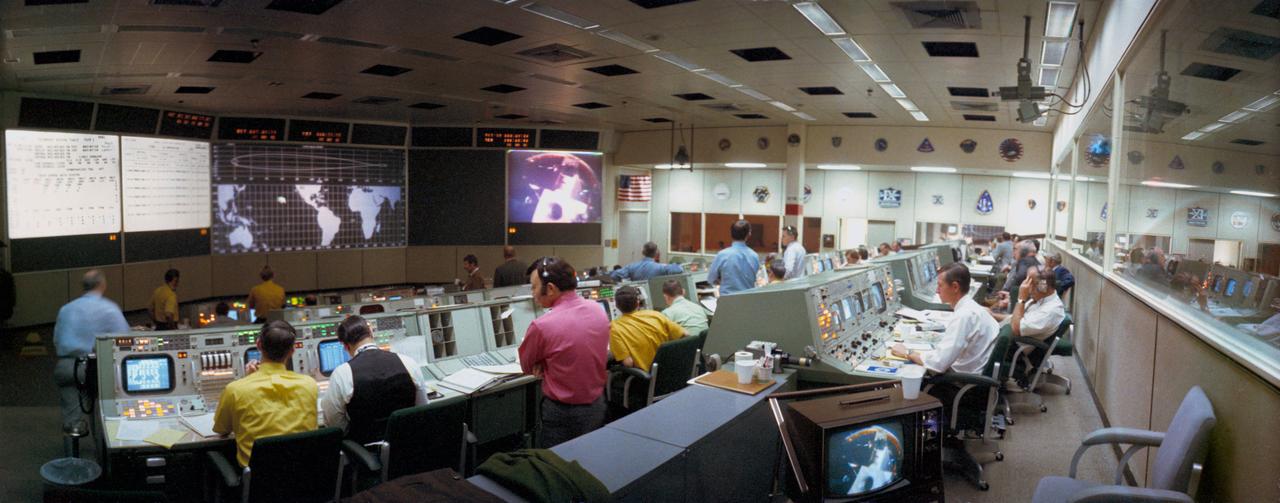
S71-17122 (31 Jan. 1971) --- A wide angle overall view of the Mission Operations Control Room (MOCR) in the Mission Control Center at the Manned spacecraft Center. This view was photographed during the first color television transmission from the Apollo 14 Command Module. Projected on the large screen at the right front of the MOCR is a view of the Apollo 14 Lunar Module, still attached to the Saturn IVB stage. The Command and Service Modules were approaching the LM/S-IVB during transposition and docking maneuvers.
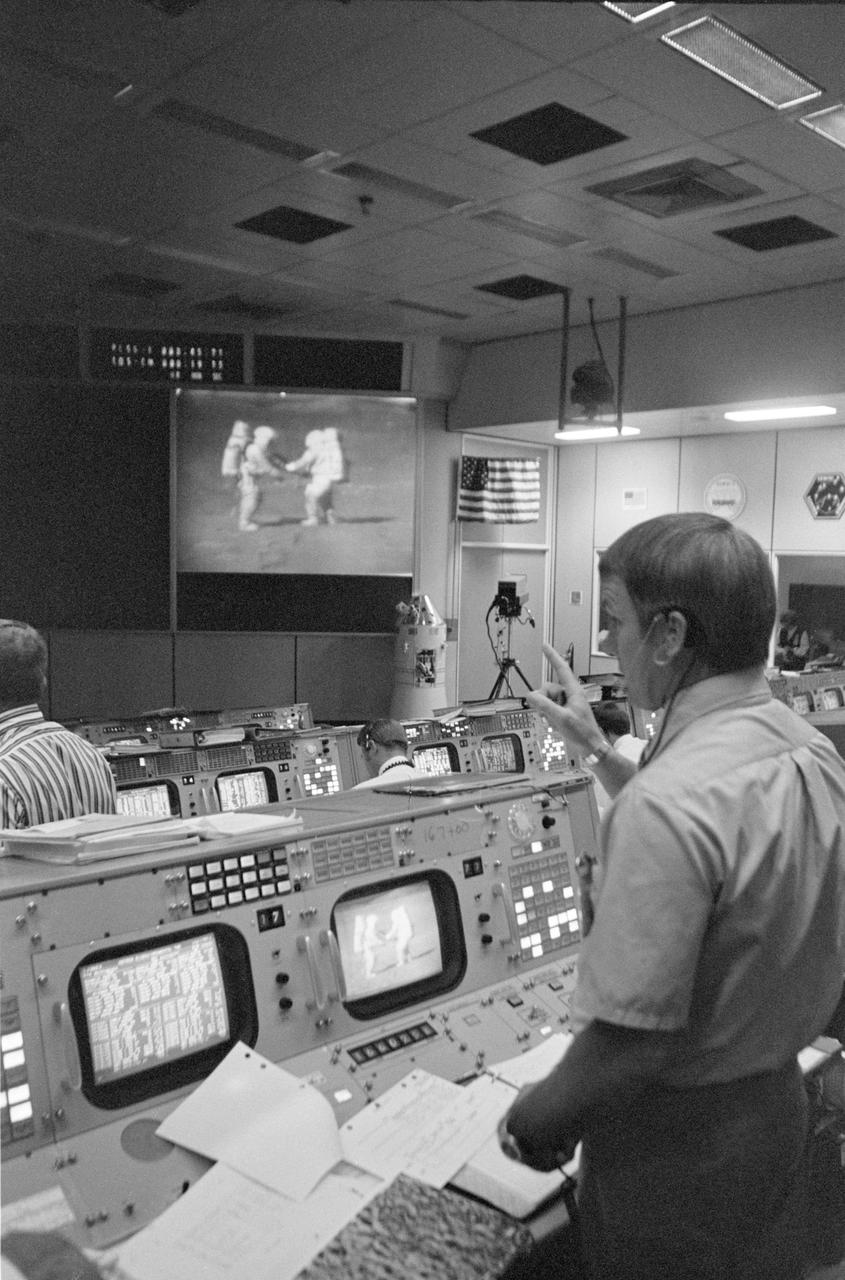
S71-41852 (2 Aug. 1971) --- Gerald D. Griffin, foreground, stands near his console in the Mission Operations Control Room (MOCR) during Apollo 15's third extravehicular activity (EVA) on the lunar surface. Griffin is Gold Team (Shift 1) flight director for the Apollo 15 mission. Astronauts David R. Scott and James B. Irwin can be seen on the large screen at the front of the MOCR as they participate in sample-gathering on the lunar surface.
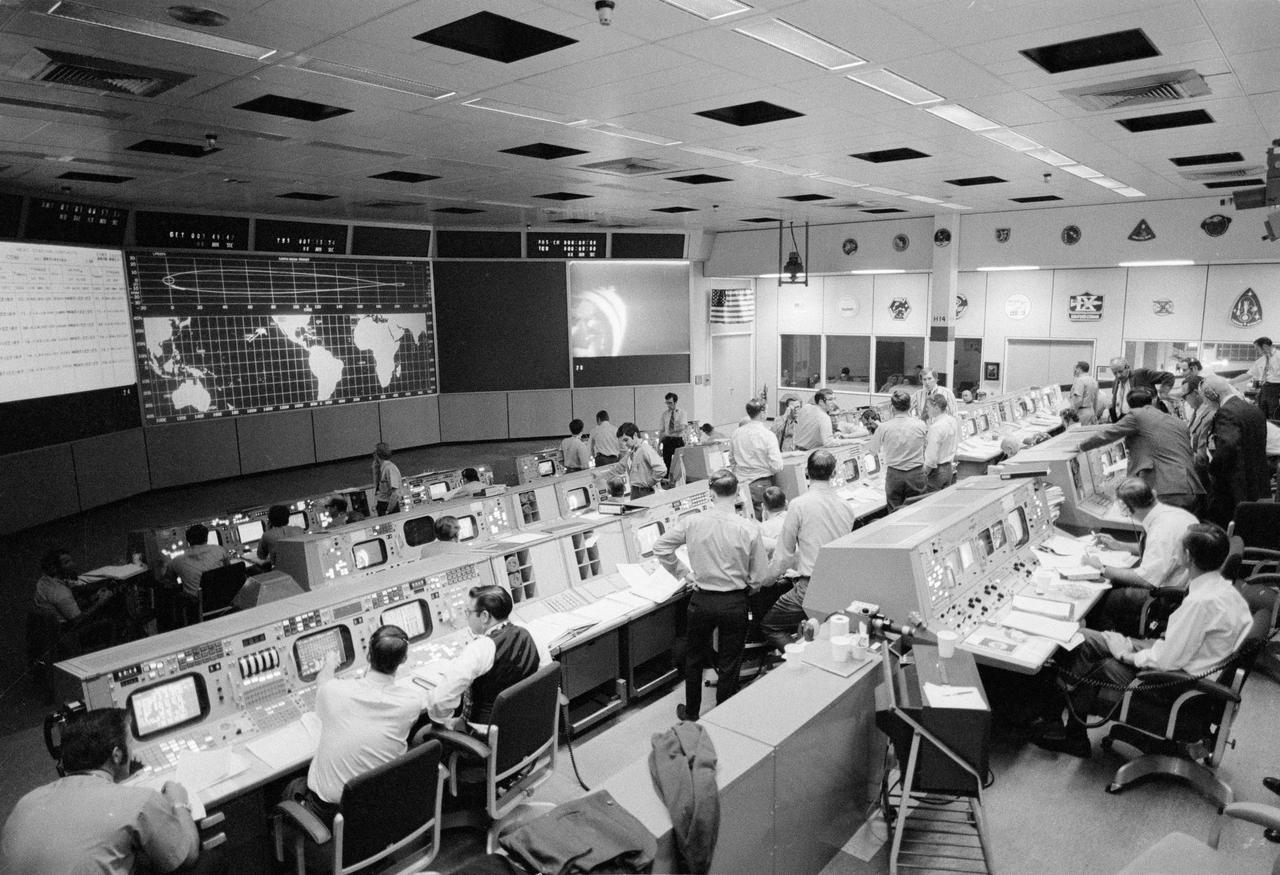
S71-16879 (31 Jan. 1971) --- Overall view of activity in the Mission Operations Control Room in the Mission Control Center during the Apollo 14 transposition and docking maneuvers. The Apollo 14 Lunar Module, still attached to the Saturn IVB stage, can be seen on the large television monitor. Due to difficulty with the docking mechanism six attempts were made before a successful "hard dock" of the Command Module with the Lunar Module was accomplished. Aboard the Command Module were astronauts Alan B. Shepard Jr., Stuart A. Roosa, and Edgar D. Mitchell.
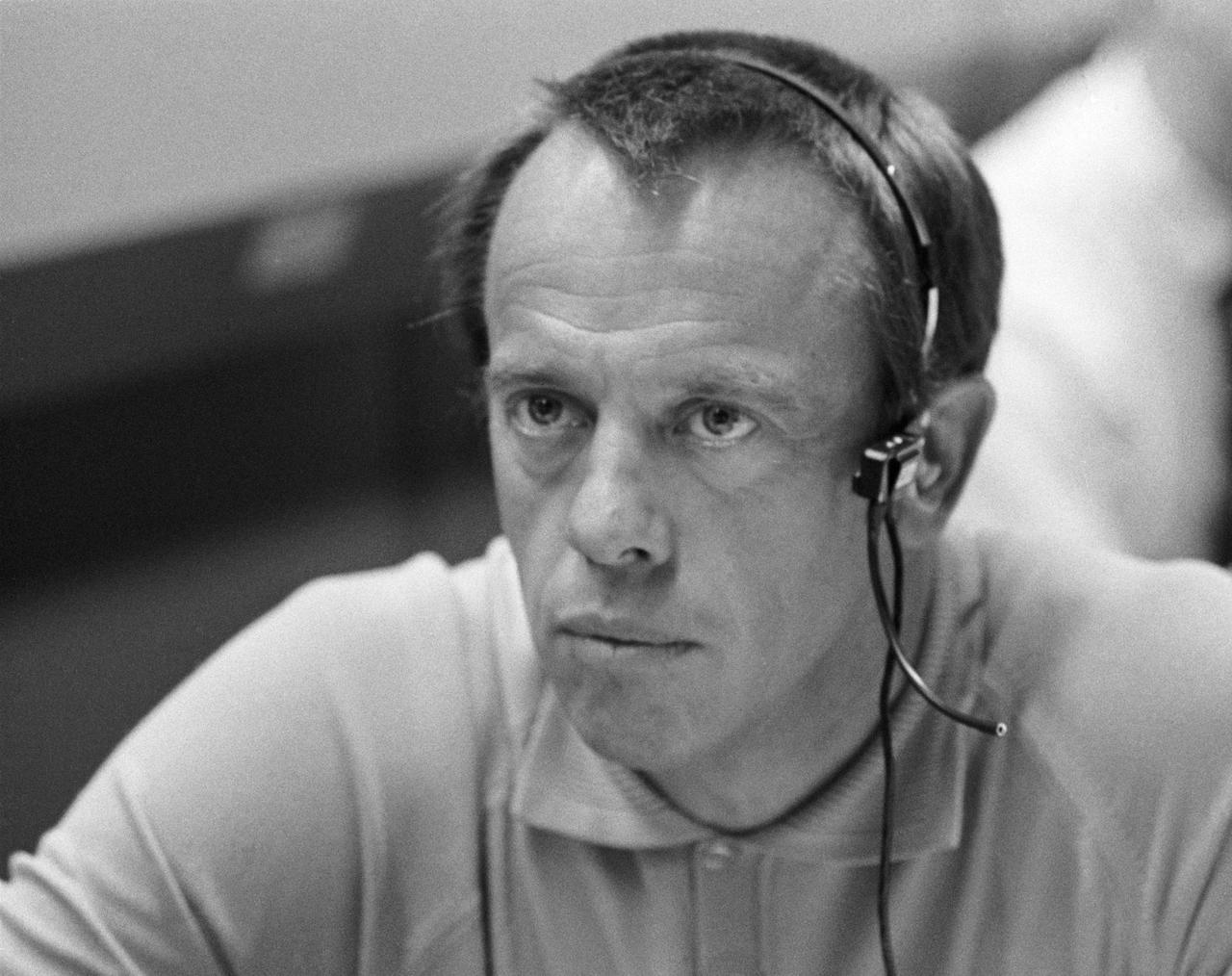
S70-34904 (14 April 1970) --- Astronaut Alan B. Shepard Jr., prime crew commander of the Apollo 14 mission, monitors communications between the Apollo 13 spacecraft and Mission Control Center. He is seated at a console in the Mission Operations Control Room of the MCC, Manned Spacecraft Center. The main concern of the moment was action taken by the three Apollo 13 crewmen - astronauts James A. Lovell Jr., John L. Swigert Jr. and Fred W. Haise Jr. - to make corrections inside the spacecraft following discovery of an oxygen cell failure several hours earlier.
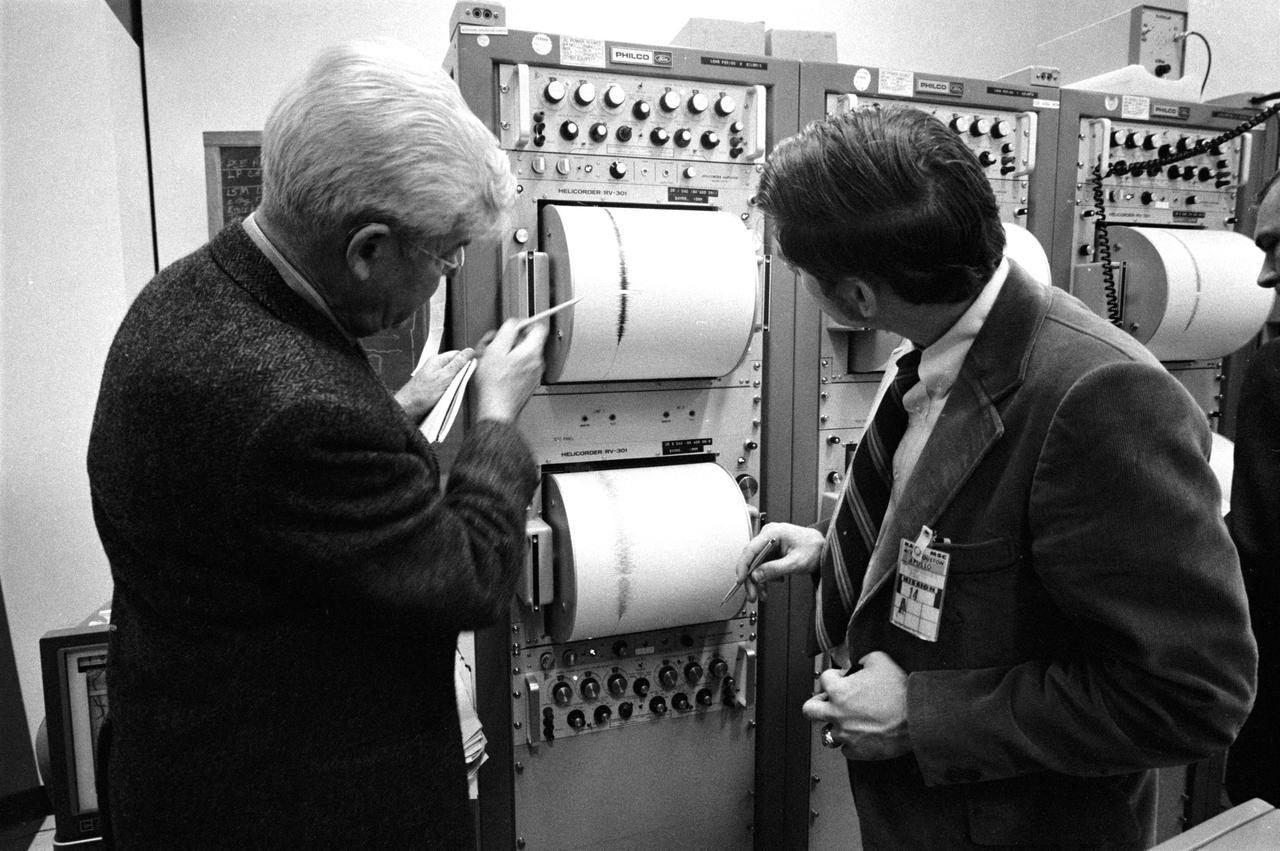
S71-17609 (4 Feb. 1971) --- These two individuals are examining a seismic reading in the Mission Control Center's ALSEP Room during the Apollo 14 S-IVB impact on the moon. Dr. Maurice Ewing (left) is the director of the Lamont-Doherty Geological Observatory at Columbia University. David Lammlein, a Columbia graduate student, is on the right. The Apollo 14 Saturn IVB stage impacted on the lunar surface at 1:40:54 a.m. (CST), Feb. 4, 1971, about 90 nautical miles south-southwest of the Apollo 12 passive seismometer. The energy release was comparable to 11 tons of TNT. Dr. Gary Latham of the Lamont-Doherty Geological Observatory is the principal investigator for the Passive Seismic Experiment, a component of the Apollo Lunar Surface Experiments Package.
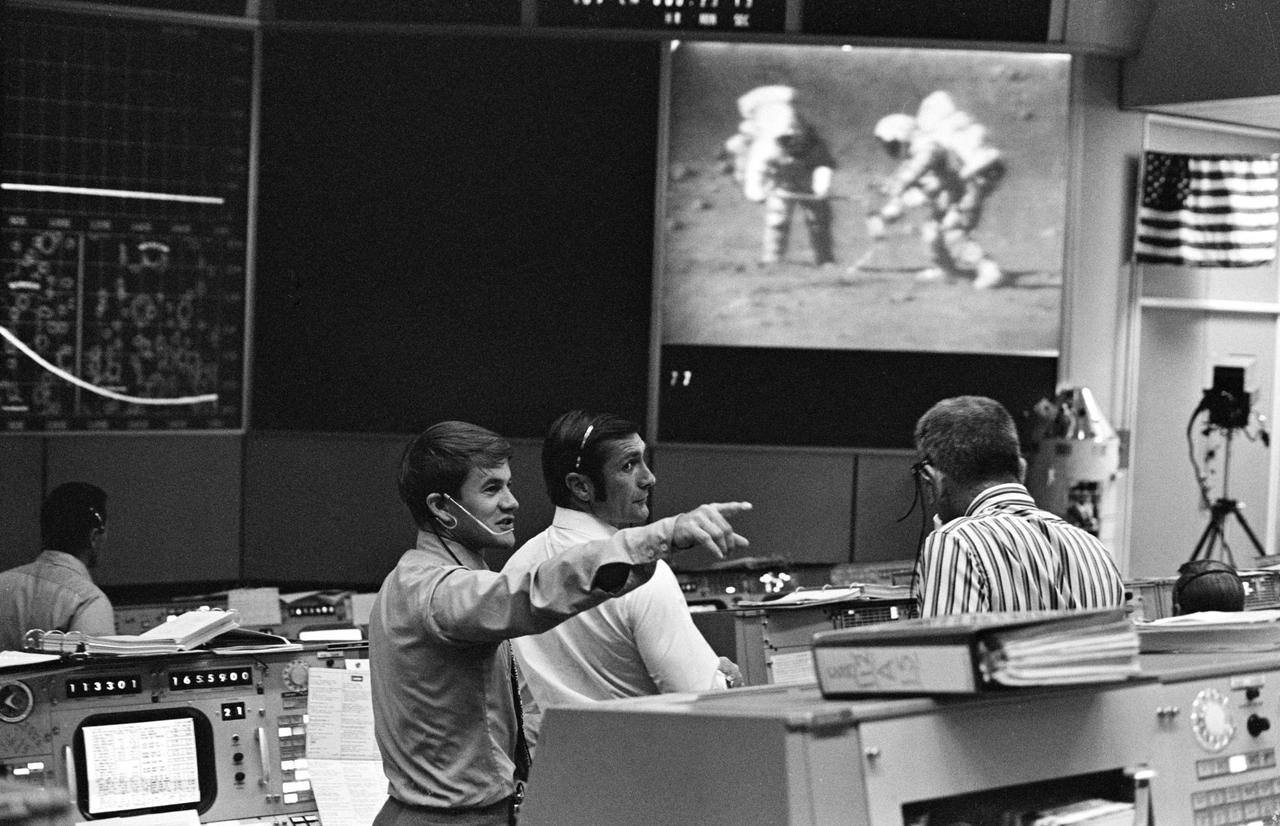
S71-41836 (2 Aug. 1971) --- Scientist-astronaut Joseph P. Allen, left, directs the attention of astronaut Richard F. Gordon Jr., to an occurrence out of view at right in the Mission Control Center's (MCC) Mission Operations Control Room (MOCR), while Dr. Donald K. (Deke) Slayton, on right with back to camera, views activity of Apollo 15 on a large screen at the front of the MOCR. Astronauts David R. Scott and James B. Irwin are seen on the screen performing tasks of the mission's third extravehicular activity (EVA), on Aug. 2, 1971. Dr. Slayton is director of Flight Crew Operations, NASA-MSC; Gordon is Apollo 15 backup commander; and Dr. Allen is an Apollo 15 spacecraft communicator.
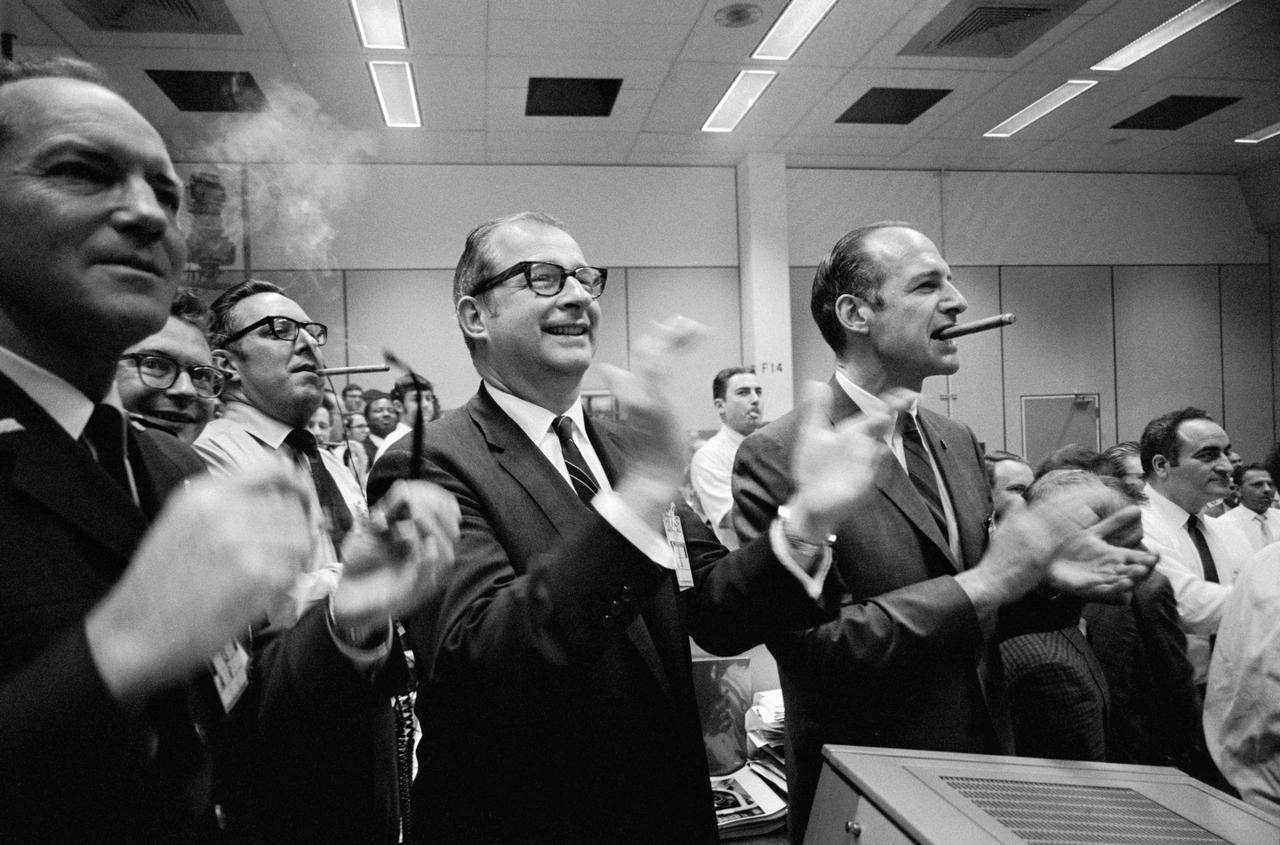
S70-35148 (17 April 1970) --- Staff members from NASA Headquarters (NASA HQ), Manned Spacecraft Center (MSC), and Dr. Thomas Paine (center of frame) applaud the successful splashdown of the Apollo 13 mission while Dr. George Low smokes a cigar (right), in the MSC Mission Control Center (MCC), located in Building 30. Apollo 13 crewmembers, astronauts James A. Lovell Jr., commander; John L. Swigert Jr., command module pilot; and Fred W. Haise Jr., lunar module pilot, splashed down at 12:07:44 p.m. (CST), April 17, 1970, in the south Pacific Ocean.

S70-35368 (16 April 1970) --- Overall view showing some of the feverish activity in the Mission Operations Control Room (MOCR) of the Mission Control Center (MCC) during the final 24 hours of the problem-plagued Apollo 13 mission. Here, flight controllers and several NASA/MSC officials confer at the flight director's console. When this picture was made, the Apollo 13 lunar landing had already been canceled, and the Apollo 13 crewmembers were in trans-Earth trajectory attempting to bring their crippled spacecraft back home.
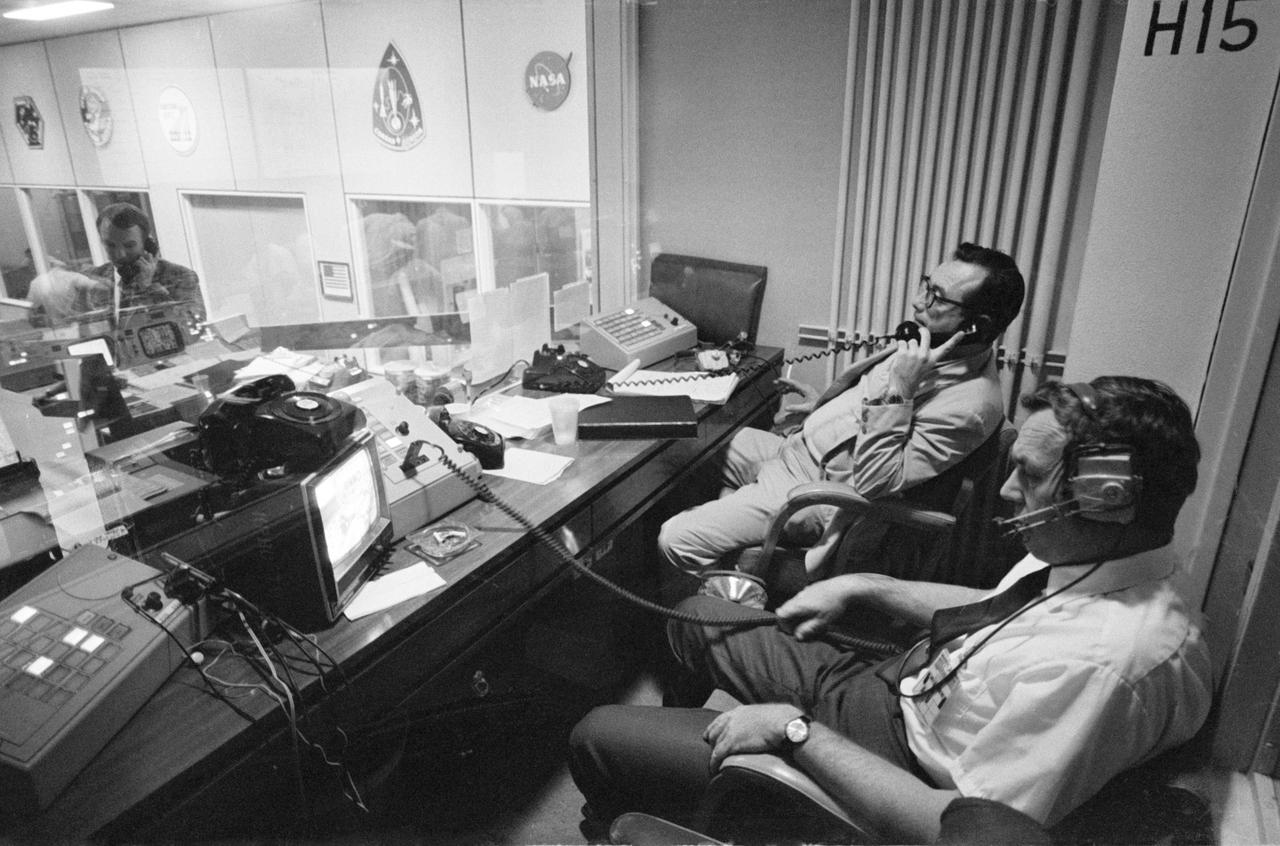
S70-35012 (15 April 1970) --- Two phases of busy activity during critical moments of the Apollo 13 mission are reflected in this view in the Mission Control Center, Building 30, Manned Spacecraft Center. In the foreground, Henry Simmons (left) of Newsweek magazine and John E. Riley, public information specialist, Public Affairs Office, MSC, man their positions in the Press Room. At extreme left of photo, Gerald D. Griffin, Shift 2 flight director, talks on telephone in Mission Operations Control Room. When this photograph was taken, the Apollo 13 lunar landing had been canceled, and the problem-plagued Apollo 13 crewmen were in trans-Earth trajectory attempting to bring their crippled spacecraft back home.
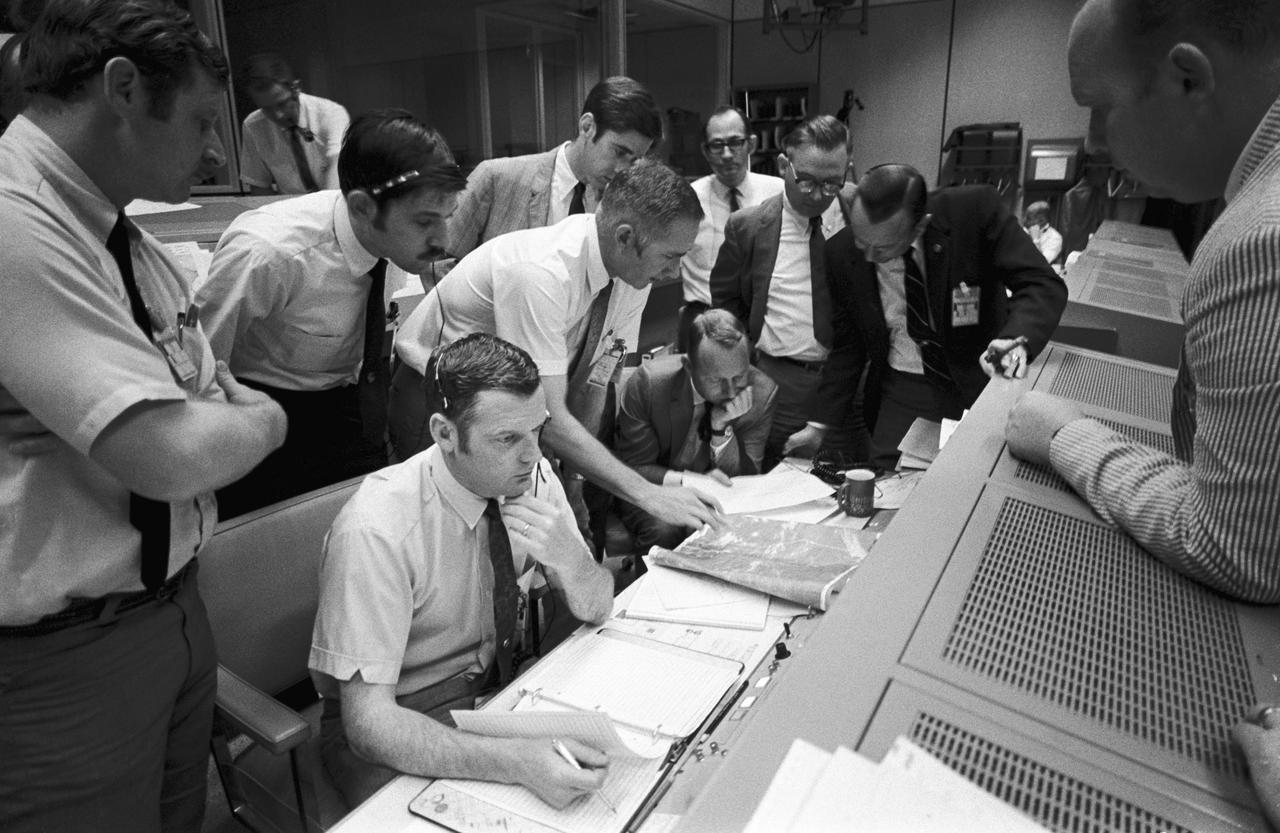
S70-35014 (15 April 1970) --- A group of flight controllers gathers around the console of Glenn S. Lunney (seated, nearest camera), Shift 4 flight director, in the Mission Operations Control Room (MOCR) of Mission Control Center (MCC), located in Building 30 at the Manned Spacecraft Center (MSC). Their attention is drawn to a weather map of the proposed landing site in the South Pacific Ocean. Among those looking on is Dr. Christopher C. Kraft, deputy director, MSC, standing in black suit, on right. When this photograph was taken, the Apollo 13 lunar landing mission had been canceled, and the problem-plagued Apollo 13 crew members were in trans-Earth trajectory attempting to bring their crippled spacecraft back home.
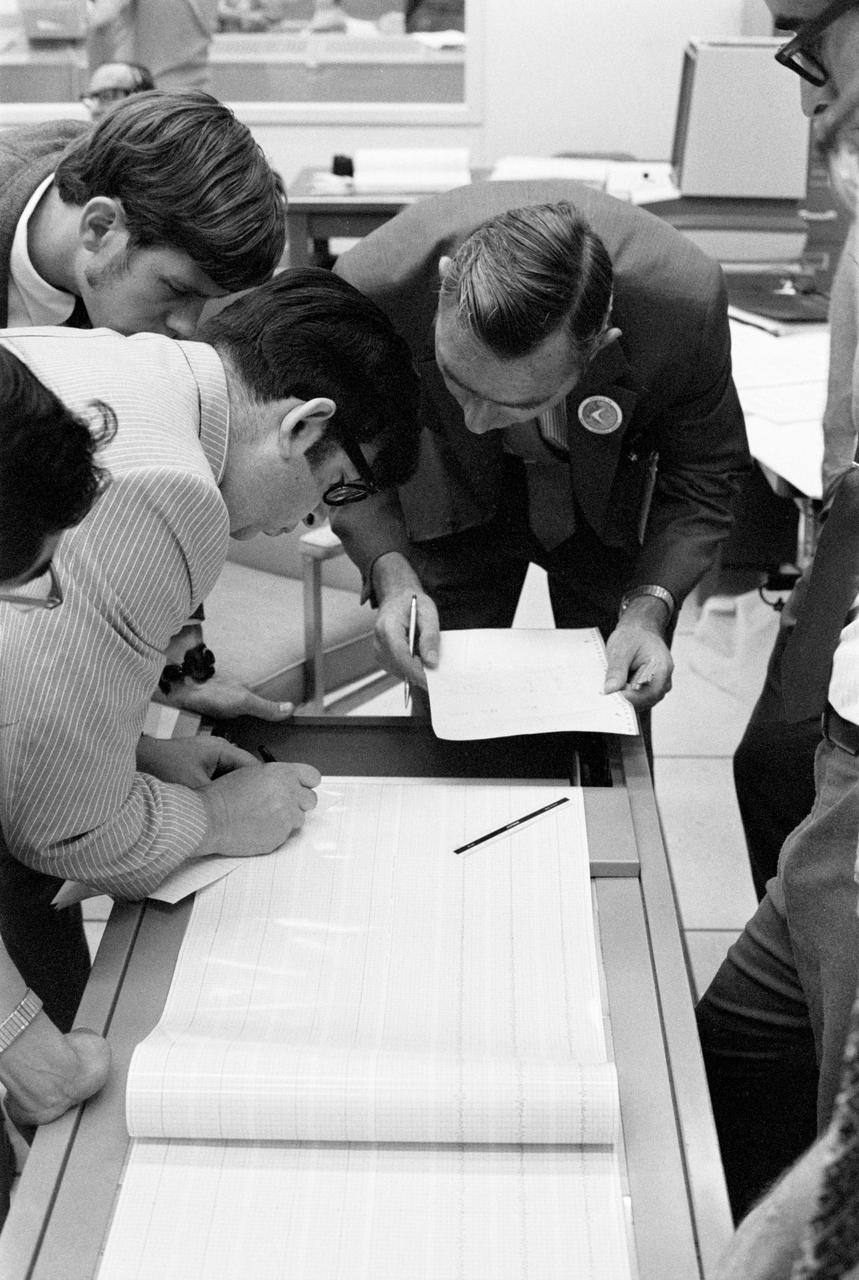
The seismometer reading from the impact made by the Apollo 15 Saturn S-IVB stage when it struck the lunar surface is studied by scientists in the Mission Control Center. Dr. Gary Latham (dark suit, wearing lapel button) of Columbia University is responsible for the design and experiment data analysis of the Passive Seismic Experiment of the Apollo Lunar Surface Experiment Package (ALSEP). The man on the left, writing, is Nafi Toksos of the Massachusetts Institute of Technology. Looking on at upper left is Dave Lamneline, also with Columbia.
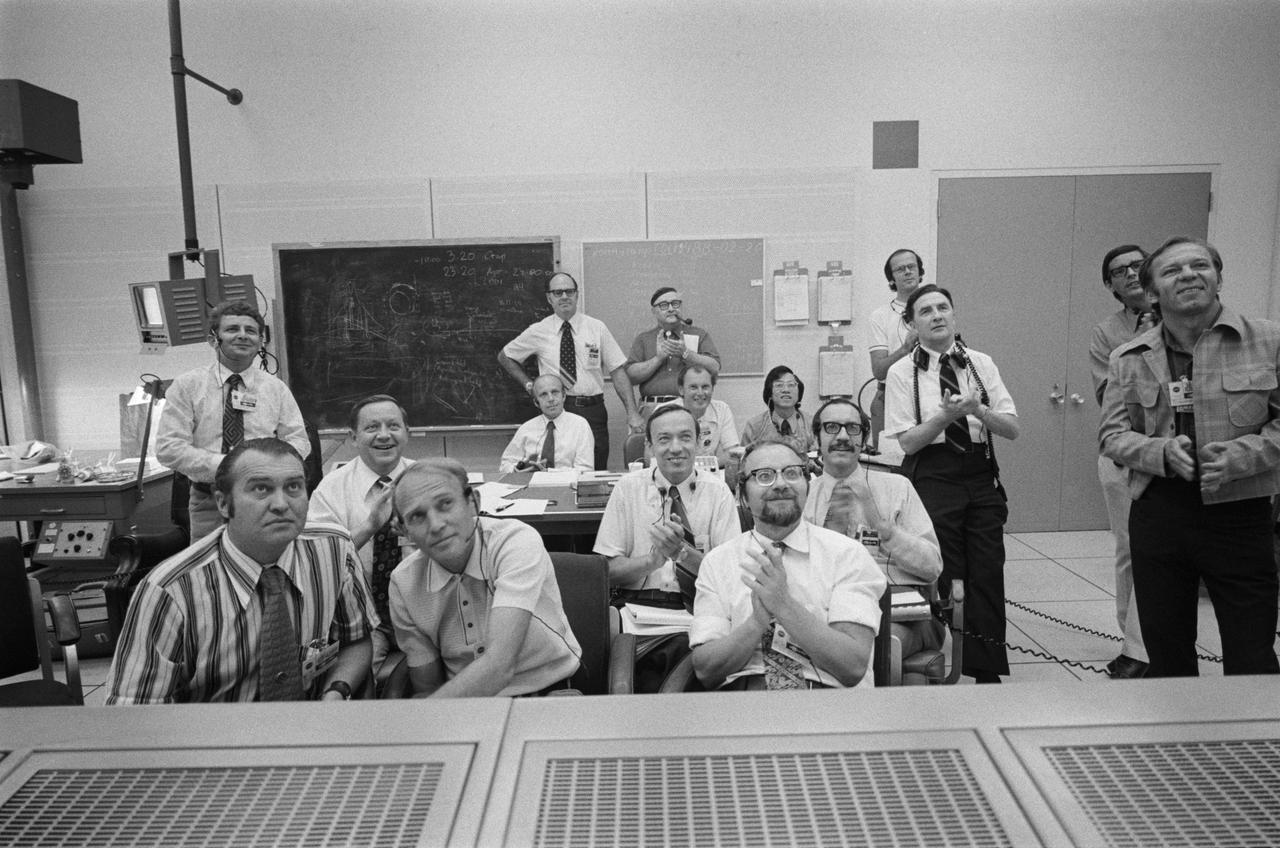
S75-28659 (21 July 1975) --- An overall view of the group of Soviet Union flight controllers who served at the Mission Control Center during the joint U.S.-USSR Apollo-Soyuz Test Project docking mission in Earth orbit. They are applauding the successful touchdown of the Soyuz spacecraft in Central Asia. The television monitor had just shown the land landing of the Soyuz descent vehicle.
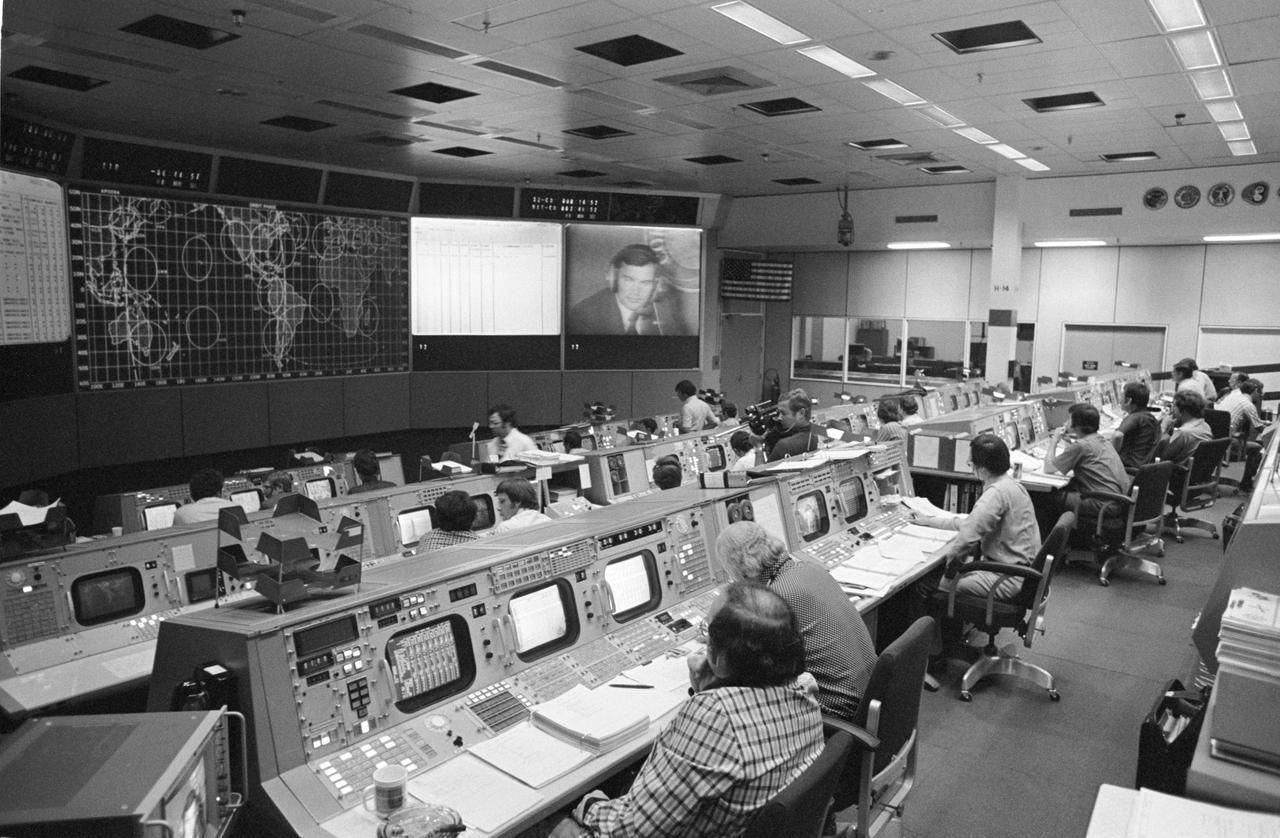
S75-28483 (15 July 1975) --- An overall view of the Mission Operations Control Room in the Mission Control Center on the first day of the Apollo-Soyuz Test Project docking mission in Earth orbit. The American ASTP flight controllers at NASA's Johnson Space Center were monitoring the progress of the Soviet ASTP launch when this photograph was taken. The television monitor shows cosmonaut Yuri V. Romanenko at his spacecraft communicator?s console in the ASTP mission control center in the Soviet Union. The American ASTP liftoff followed the Soviet ASTP launch by seven and one-half hours.
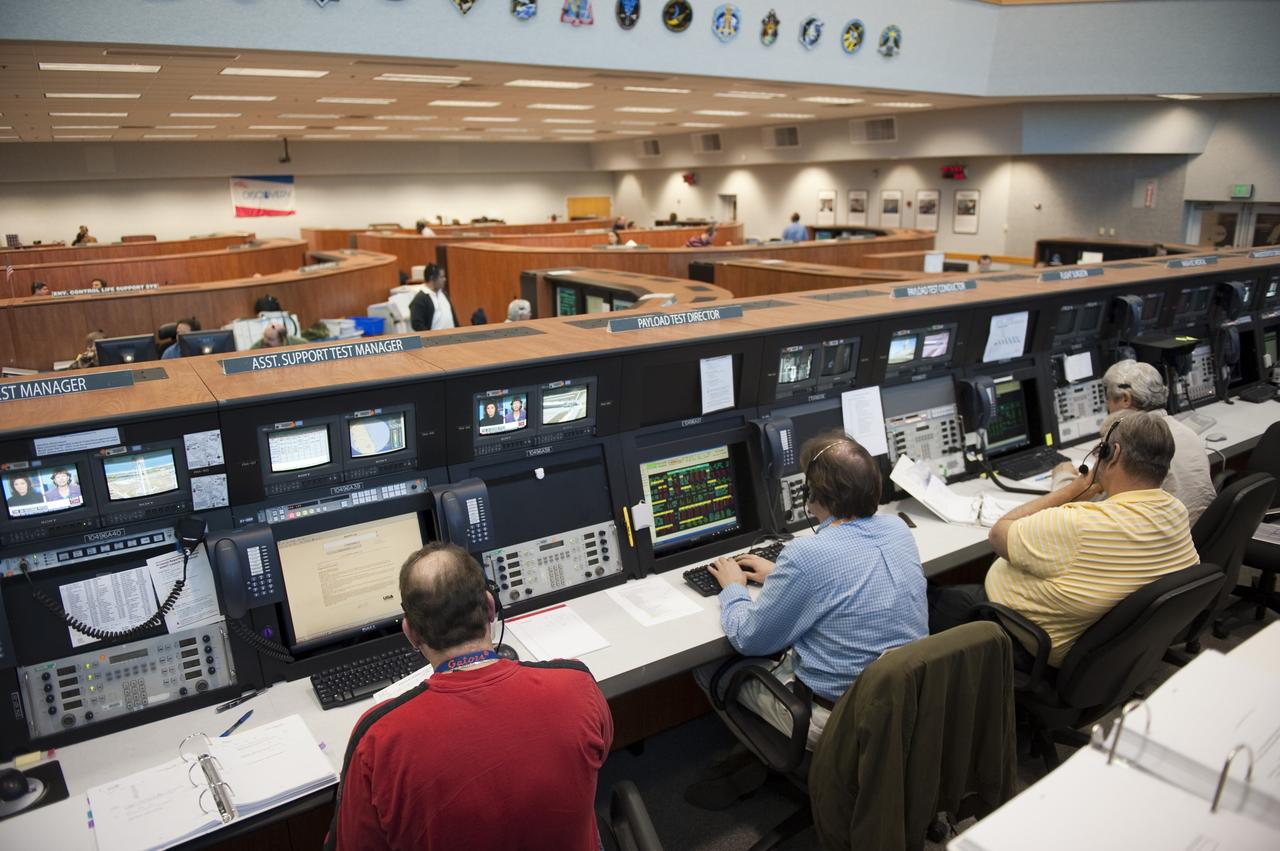
CAPE CANAVERAL, Fla. -- At NASA's Kennedy Space Center in Florida, STS-133 launch team members rehearse procedures for the liftoff of space shuttle Discovery's final mission in Firing Room 4. The team at Kennedy also participated in launch simulations with personnel at NASA's Johnson Space Center in Houston. Discovery's next launch opportunity to the International Space Station on the STS-133 mission is planned for no earlier than Feb. 24. For more information on STS-133, visit www.nasa.gov/mission_pages/shuttle/shuttlemissions/sts133/. Photo credit: NASA/Kim Shiflett

CAPE CANAVERAL, Fla. -- At NASA's Kennedy Space Center in Florida, STS-133 launch team members rehearse procedures for the liftoff of space shuttle Discovery's final mission in Firing Room 4. The team at Kennedy also participated in launch simulations with personnel at NASA's Johnson Space Center in Houston. Seen on display overhead are the five orbiter tribute wall hangings. Discovery's next launch opportunity to the International Space Station on the STS-133 mission is planned for no earlier than Feb. 24. For more information on STS-133, visit www.nasa.gov/mission_pages/shuttle/shuttlemissions/sts133/. Photo credit: NASA/Kim Shiflett
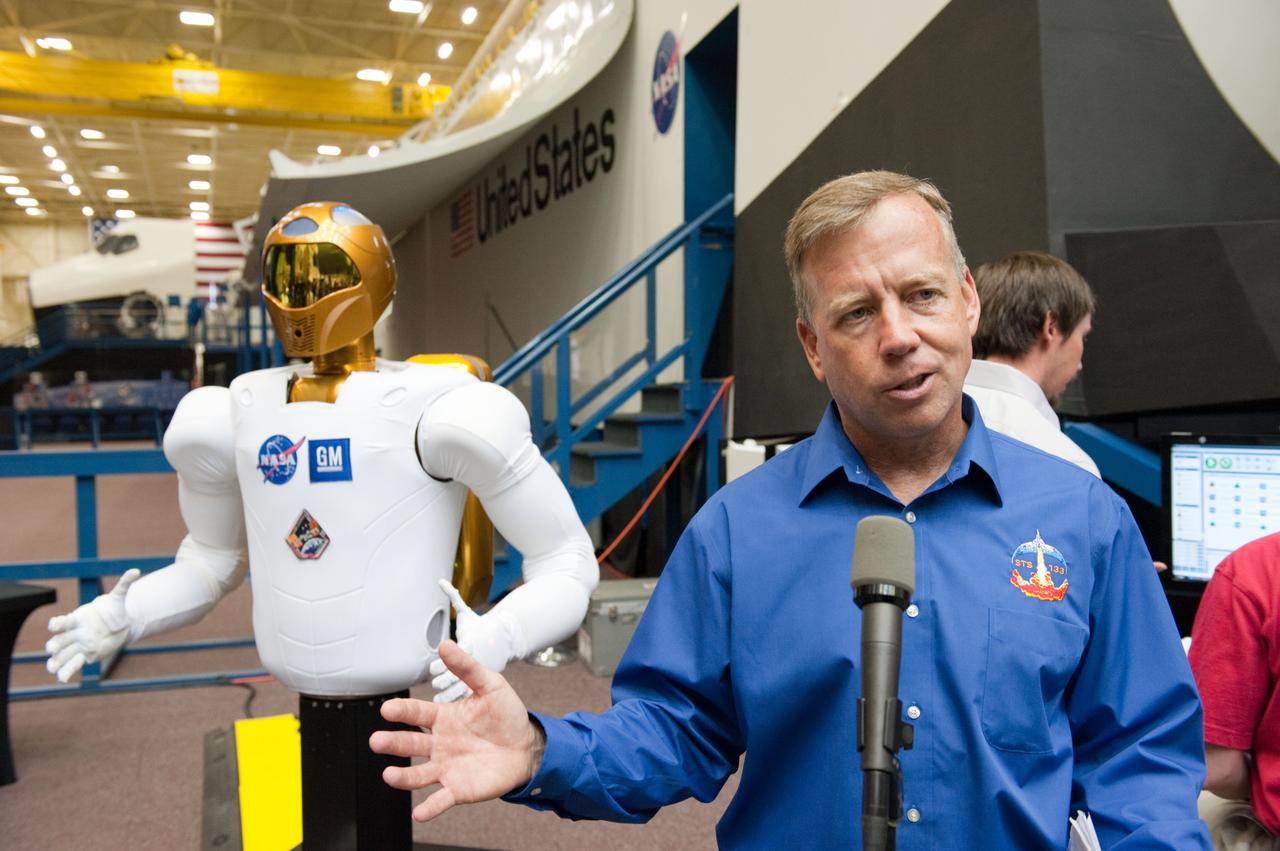
JSC2010-E-112721 (4 Aug. 2010) --- NASA astronaut Steve Lindsey, STS-133 commander, speaks to members of the media and NASA personnel during Robonaut 2 (R2) media day in the Space Vehicle Mock-up Facility at NASA's Johnson Space Center. R2, who will hitch a ride with the STS-133 crew members, is the first humanoid robot to travel to space and the first U.S.-built robot to visit the International Space Station. R2 will stay on the space station indefinitely to allow engineers on the ground to learn more about how humanoid robots fare in microgravity. Photo credit: NASA or National Aeronautics and Space Administration
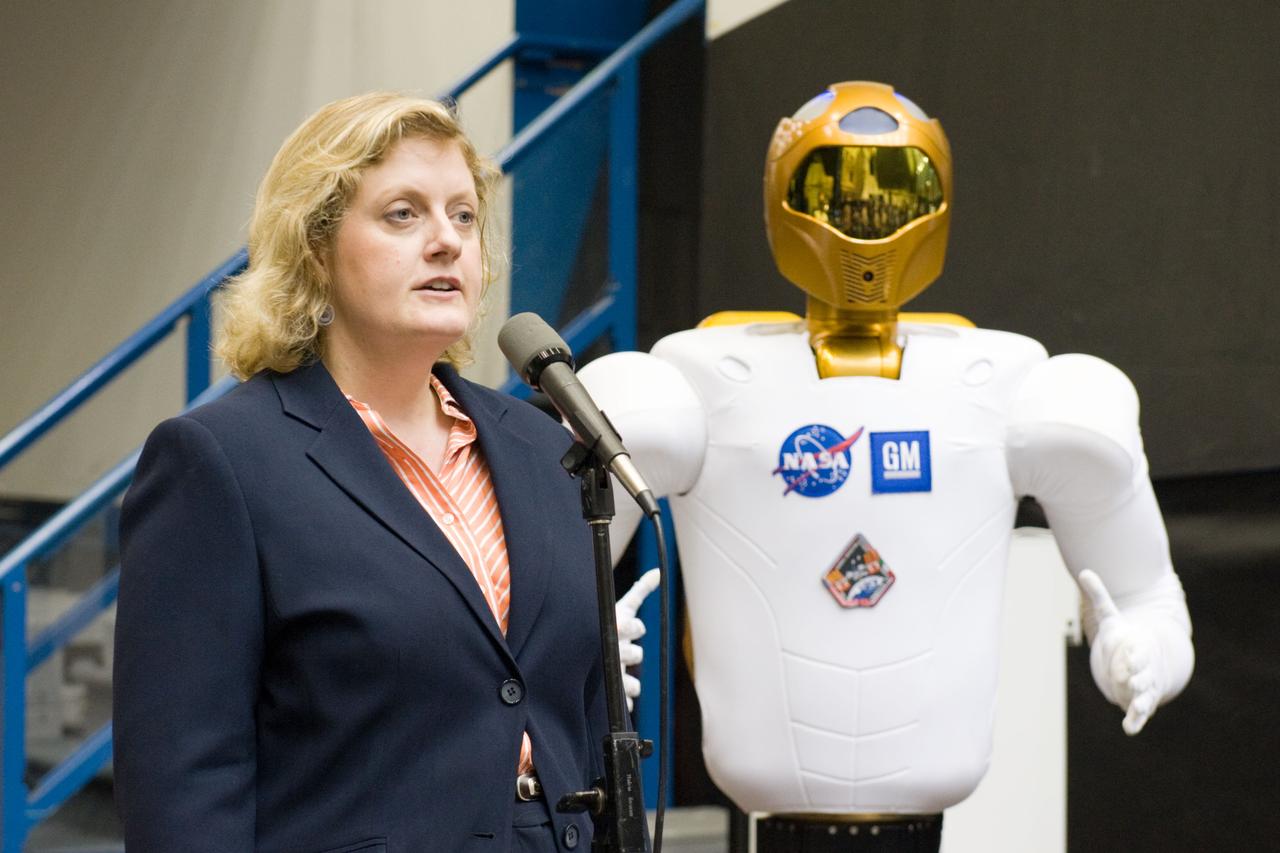
JSC2010-E-112828 (4 Aug. 2010) --- Julie Robinson, physical scientist, speaks to members of the media and NASA personnel during Robonaut 2 (R2) media day in the Space Vehicle Mock-up Facility at NASA's Johnson Space Center. R2, who will hitch a ride with the STS-133 crew members, is the first humanoid robot to travel to space and the first U.S.-built robot to visit the International Space Station. R2 will stay on the space station indefinitely to allow engineers on the ground to learn more about how humanoid robots fare in microgravity. Photo credit: NASA or National Aeronautics and Space Administration
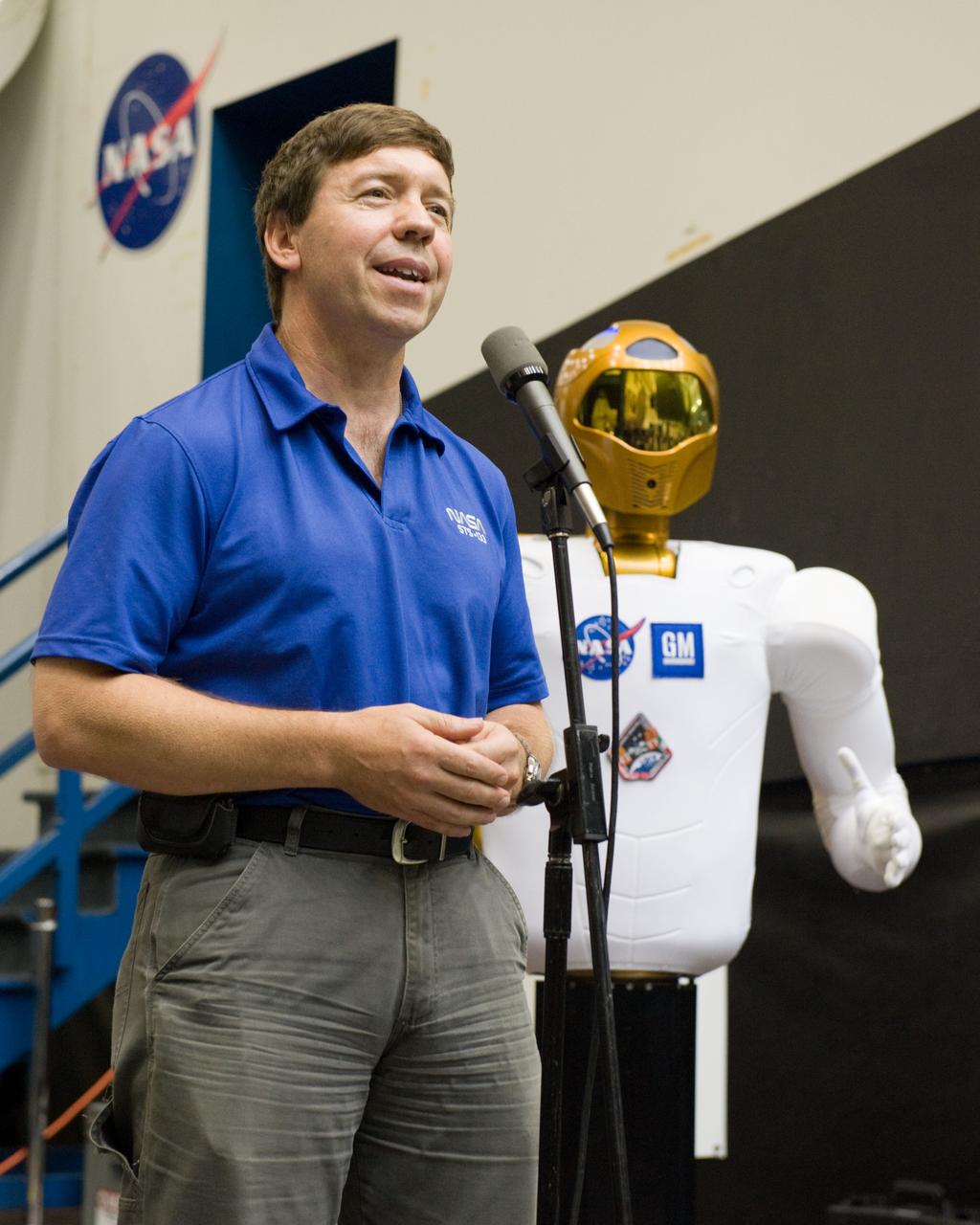
JSC2010-E-112826 (4 Aug. 2010) --- NASA astronaut Michael Barratt, STS-133 mission specialist, speaks to members of the media and NASA personnel during Robonaut 2 (R2) media day in the Space Vehicle Mock-up Facility at NASA's Johnson Space Center. R2, who will hitch a ride with the STS-133 crew members, is the first humanoid robot to travel to space and the first U.S.-built robot to visit the International Space Station. R2 will stay on the space station indefinitely to allow engineers on the ground to learn more about how humanoid robots fare in microgravity. Photo credit: NASA or National Aeronautics and Space Administration
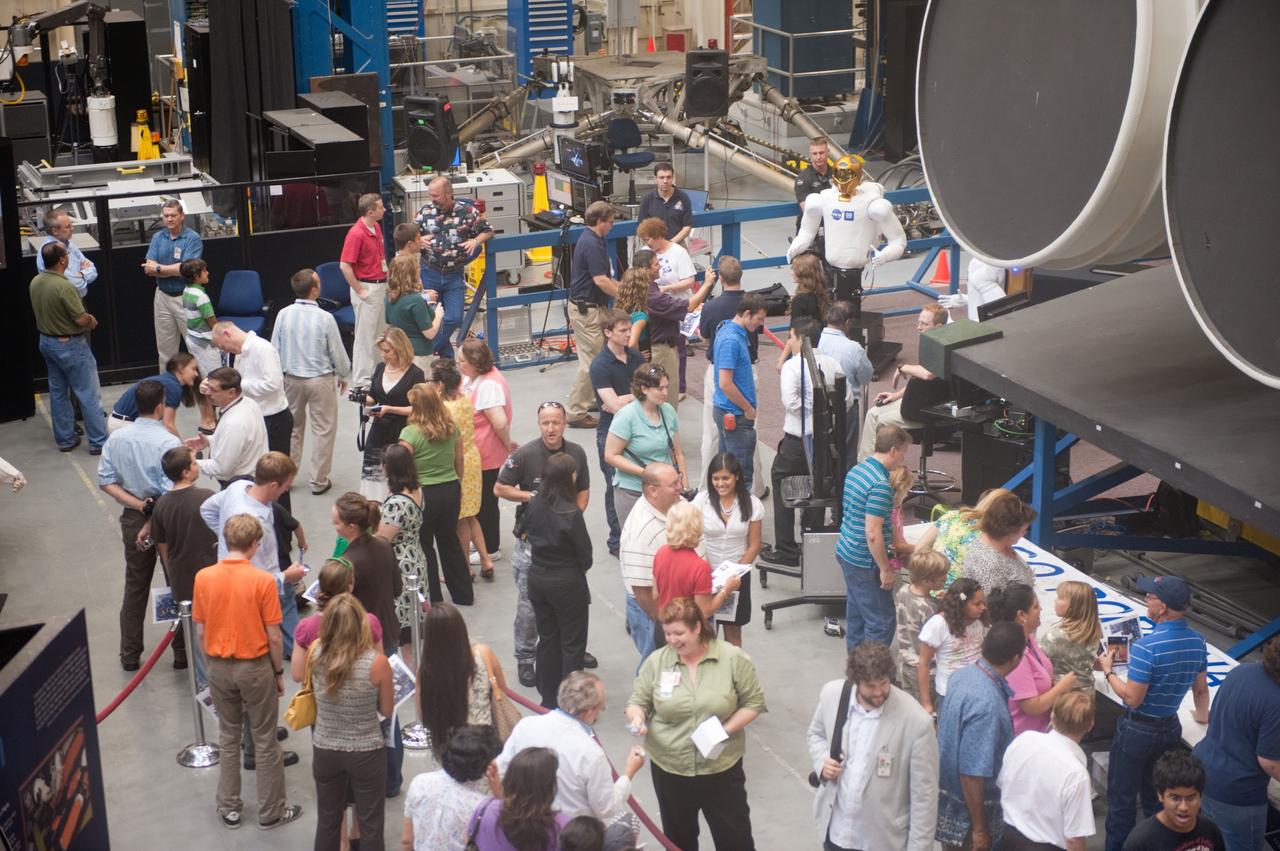
JSC2010-E-113084 (4 Aug. 2010) --- NASA personnel line up to see Robonaut 2 (R2) in the Space Vehicle Mock-up Facility at NASA's Johnson Space Center. R2, who will hitch a ride with the STS-133 crew members, is the first humanoid robot to travel to space and the first U.S.-built robot to visit the International Space Station. R2 will stay on the space station indefinitely to allow engineers on the ground to learn more about how humanoid robots fare in microgravity. Photo credit: NASA or National Aeronautics and Space Administration
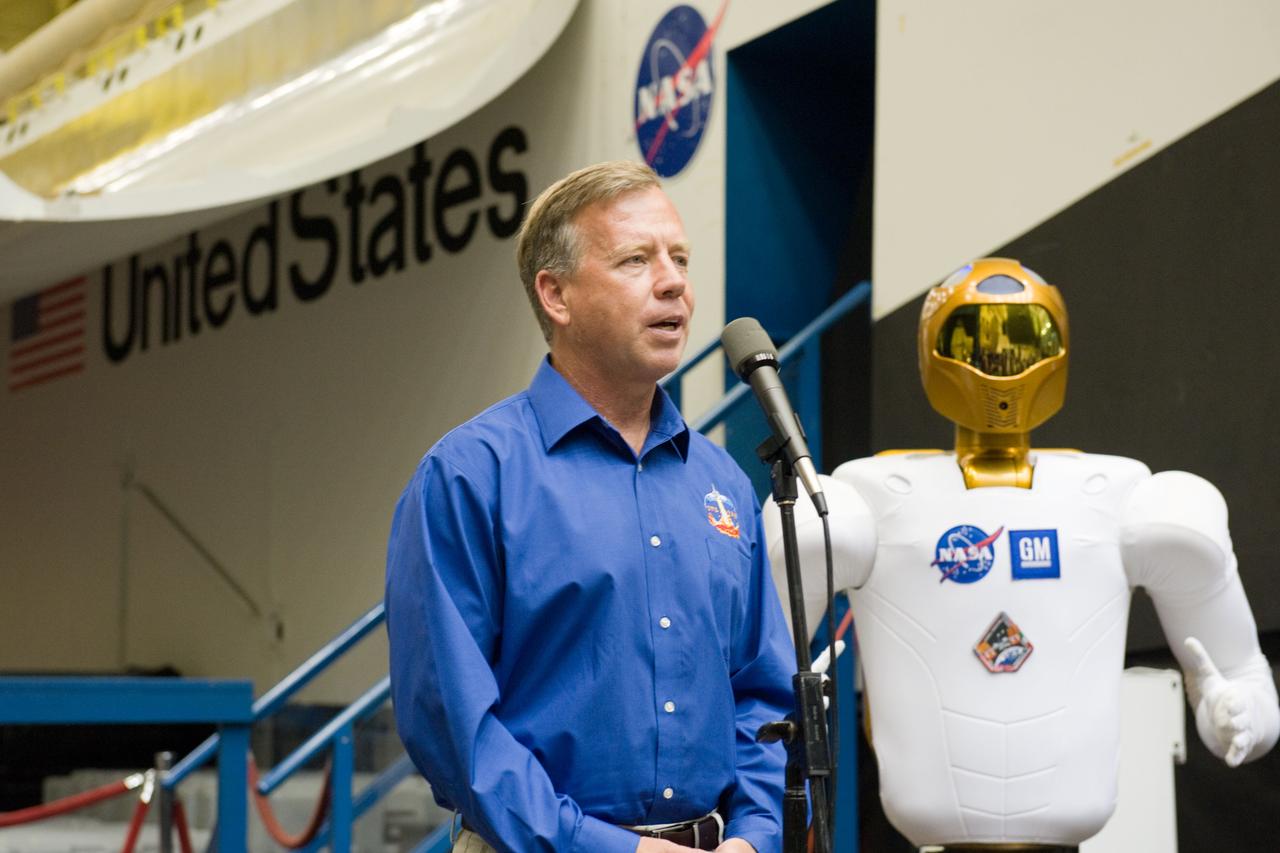
JSC2010-E-112821 (4 Aug. 2010) --- NASA astronaut Steve Lindsey, STS-133 commander, speaks to members of the media and NASA personnel during Robonaut 2 (R2) media day in the Space Vehicle Mock-up Facility at NASA's Johnson Space Center. R2, who will hitch a ride with the STS-133 crew members, is the first humanoid robot to travel to space and the first U.S.-built robot to visit the International Space Station. R2 will stay on the space station indefinitely to allow engineers on the ground to learn more about how humanoid robots fare in microgravity. Photo credit: NASA or National Aeronautics and Space Administration
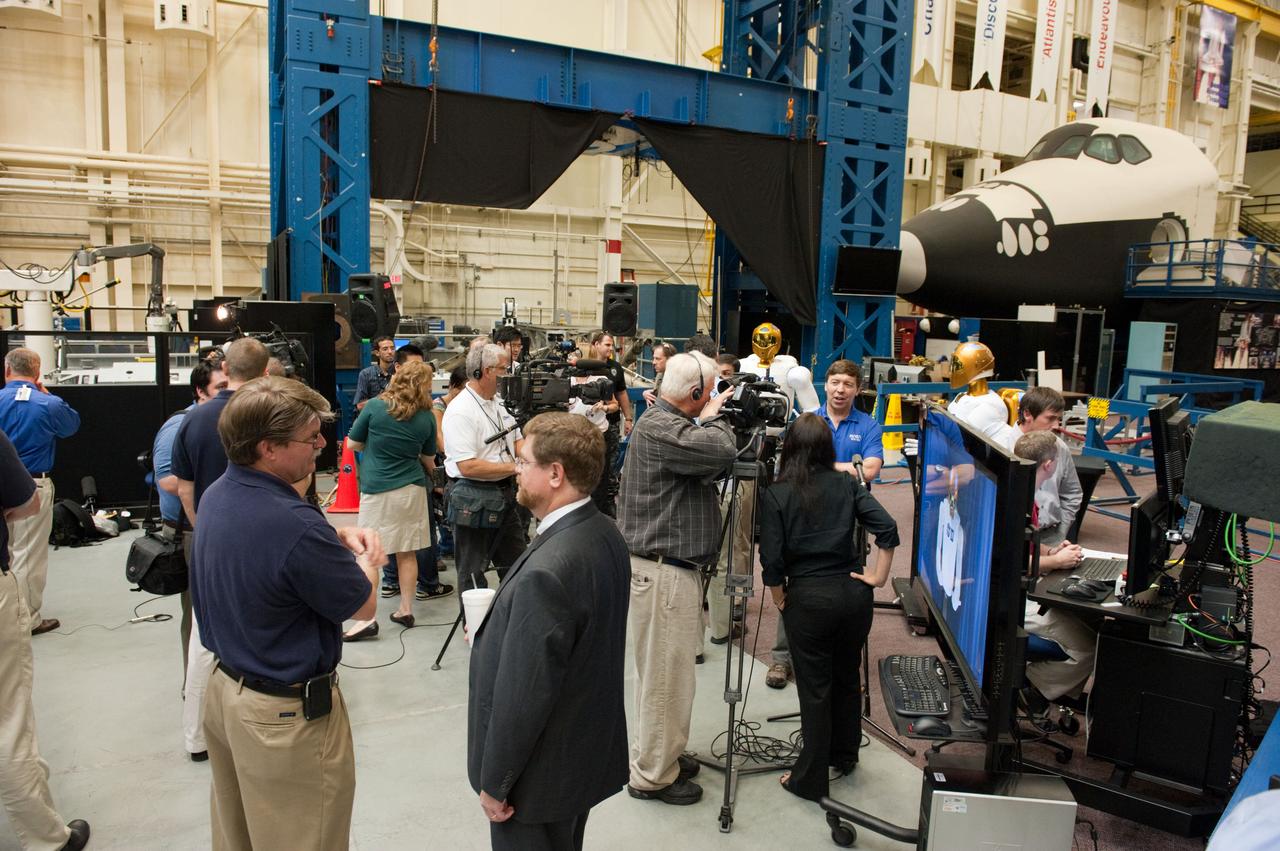
JSC2010-E-112717 (4 Aug. 2010) --- NASA personnel and members of the media are pictured during Robonaut 2 (R2) media day in the Space Vehicle Mock-up Facility at NASA's Johnson Space Center. R2, who will hitch a ride with the STS-133 crew members, is the first humanoid robot to travel to space and the first U.S.-built robot to visit the International Space Station. R2 will stay on the space station indefinitely to allow engineers on the ground to learn more about how humanoid robots fare in microgravity. Photo credit: NASA or National Aeronautics and Space Administration