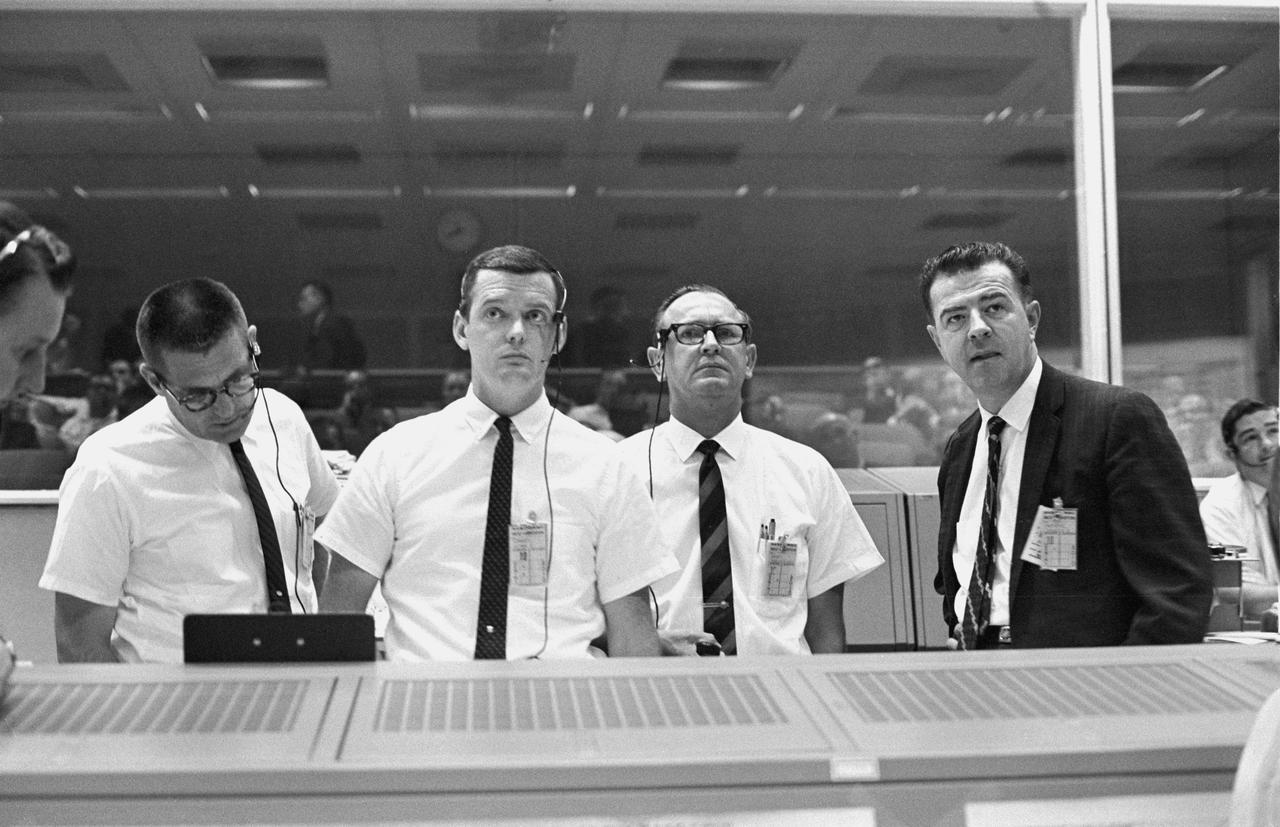
S66-43377 (18 July 1966) --- Standing at the flight director's console, viewing the Gemini-10 flight display in the Mission Control Center, are (left to right) William C. Schneider, Mission Director; Glynn Lunney, Prime Flight Director; Christopher C. Kraft Jr., MSC Director of Flight Operations; and Charles W. Mathews, Manager, Gemini Program Office. Photo credit: NASA
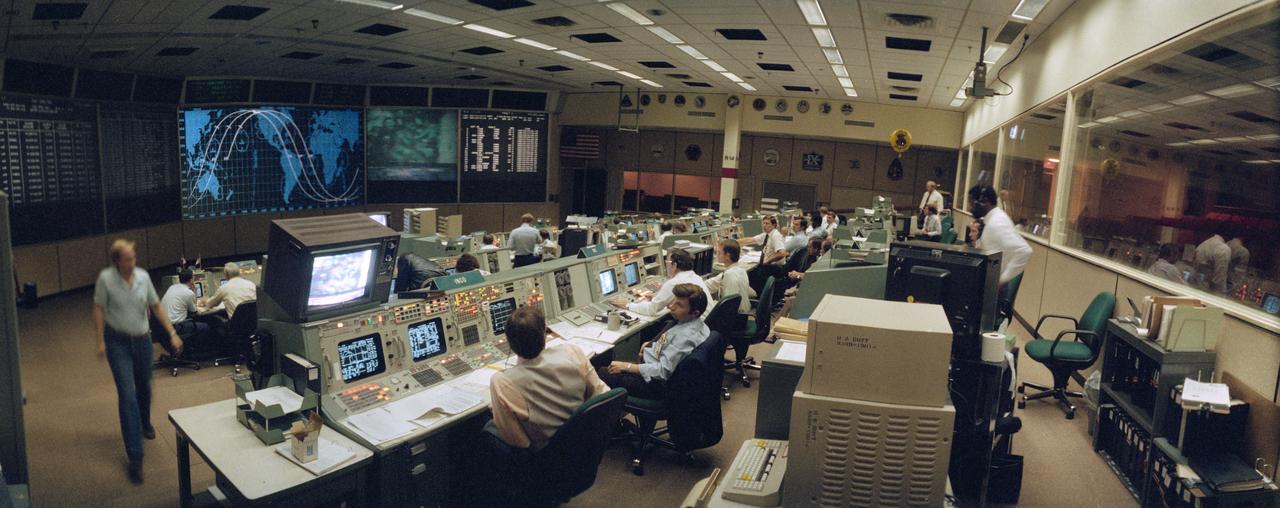
Wide angle view of the flight control room (FCR) of the Mission Control Center (MCC). Some of the STS 41-G crew can be seen on a large screen at the front of the MCC along with a map tracking the progress of the orbiter.
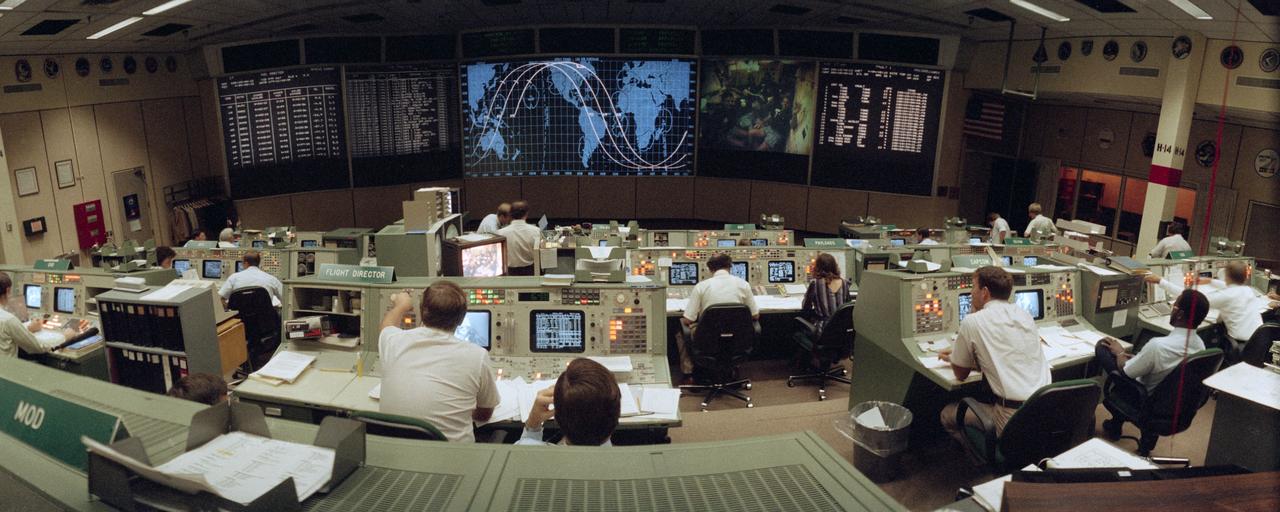
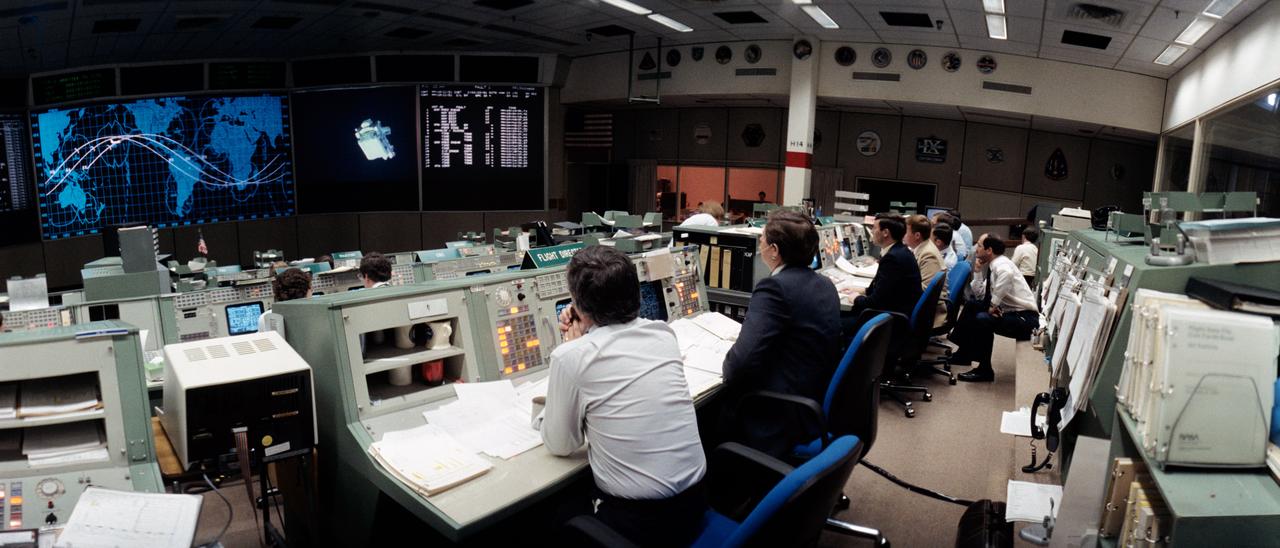
Fisheye view from the back of the Flight Control Room (FCR) of the Mission Control Center (MCC). Visible are the Flight Directors console (left front), the CAPCOM console (right front) and the Payloads console. Some of the STS 41-G crew can be seen on a large screen at the front of the MCC along with a map tracking the progress of the orbiter.
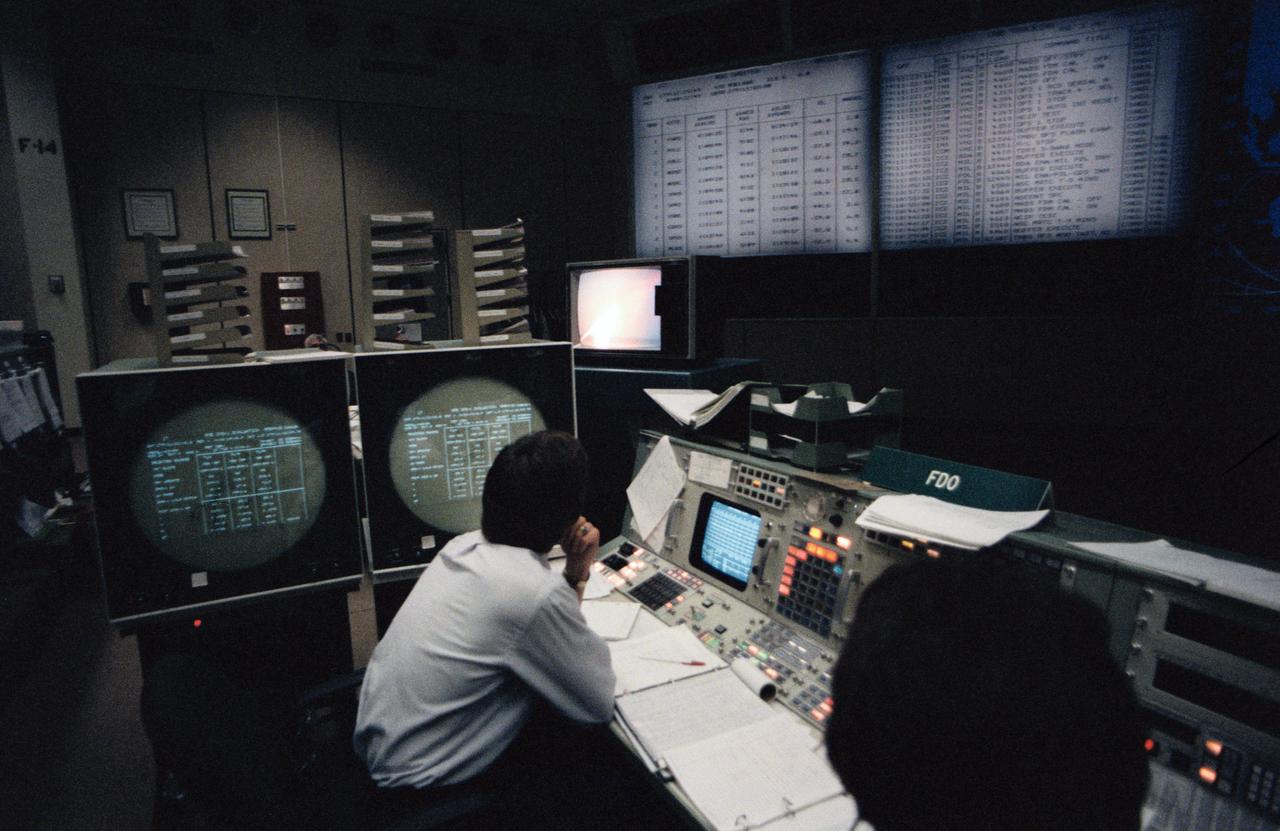
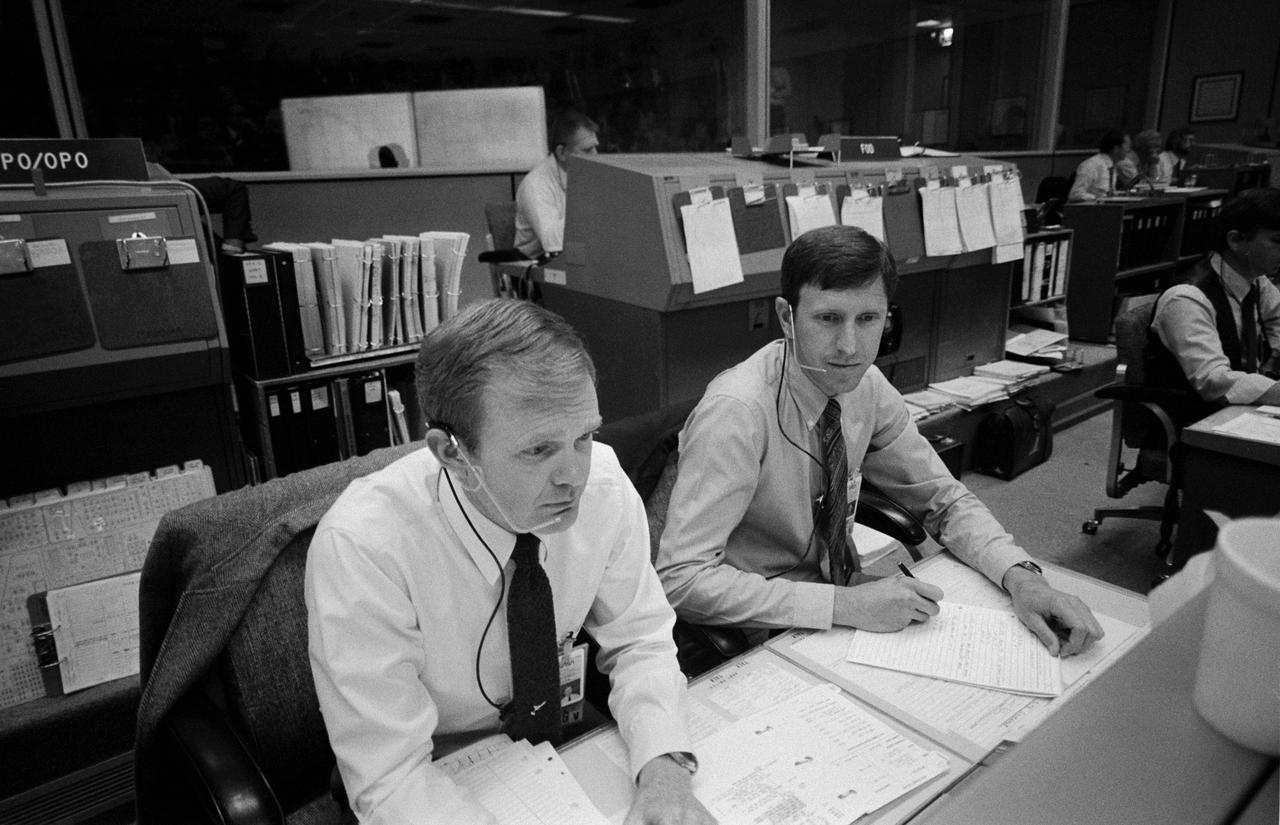
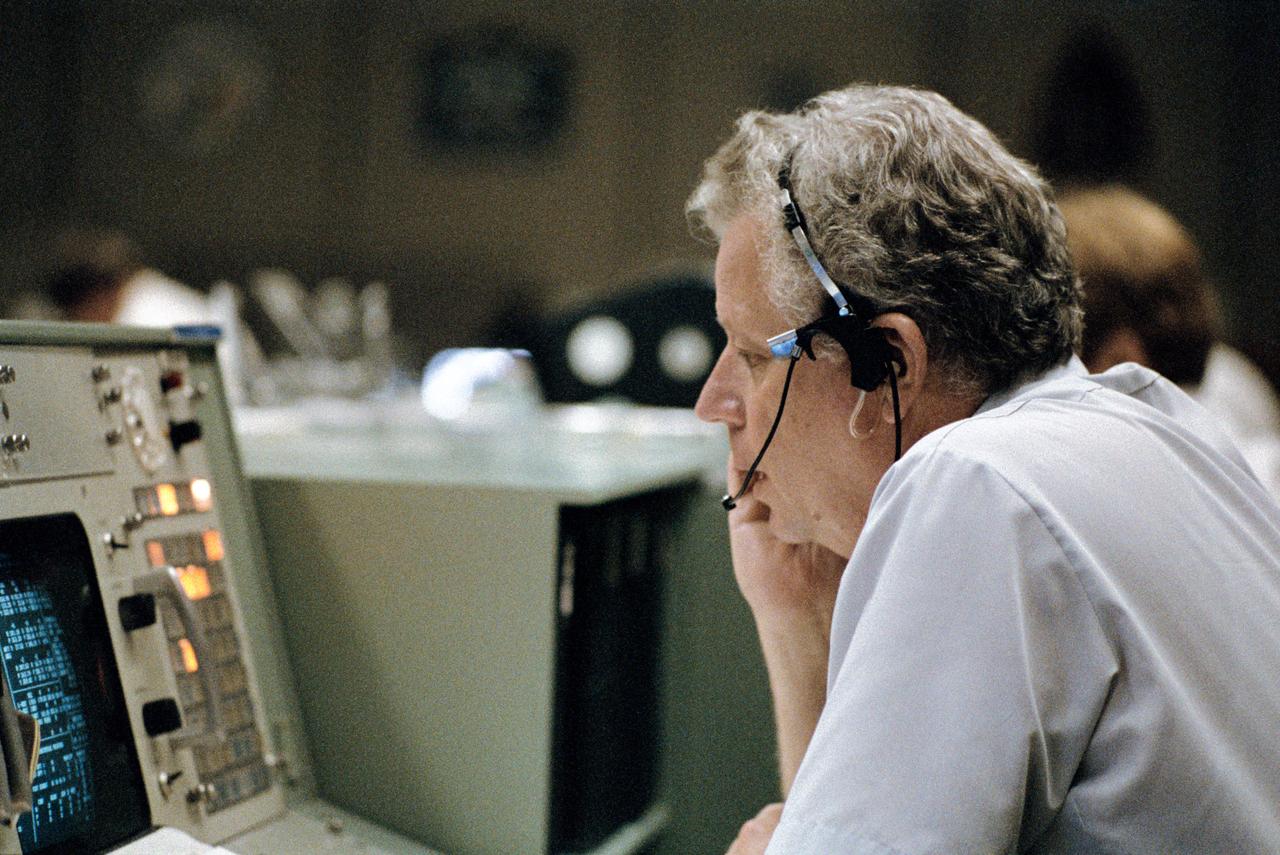
View of the Flight Dynamics Officer (FDO) console in the Mission Control Center (MCC) during the flight of STS41-G. The officer at the FDO console appears to be examining the large screens in front of him which are displaying lists of data.
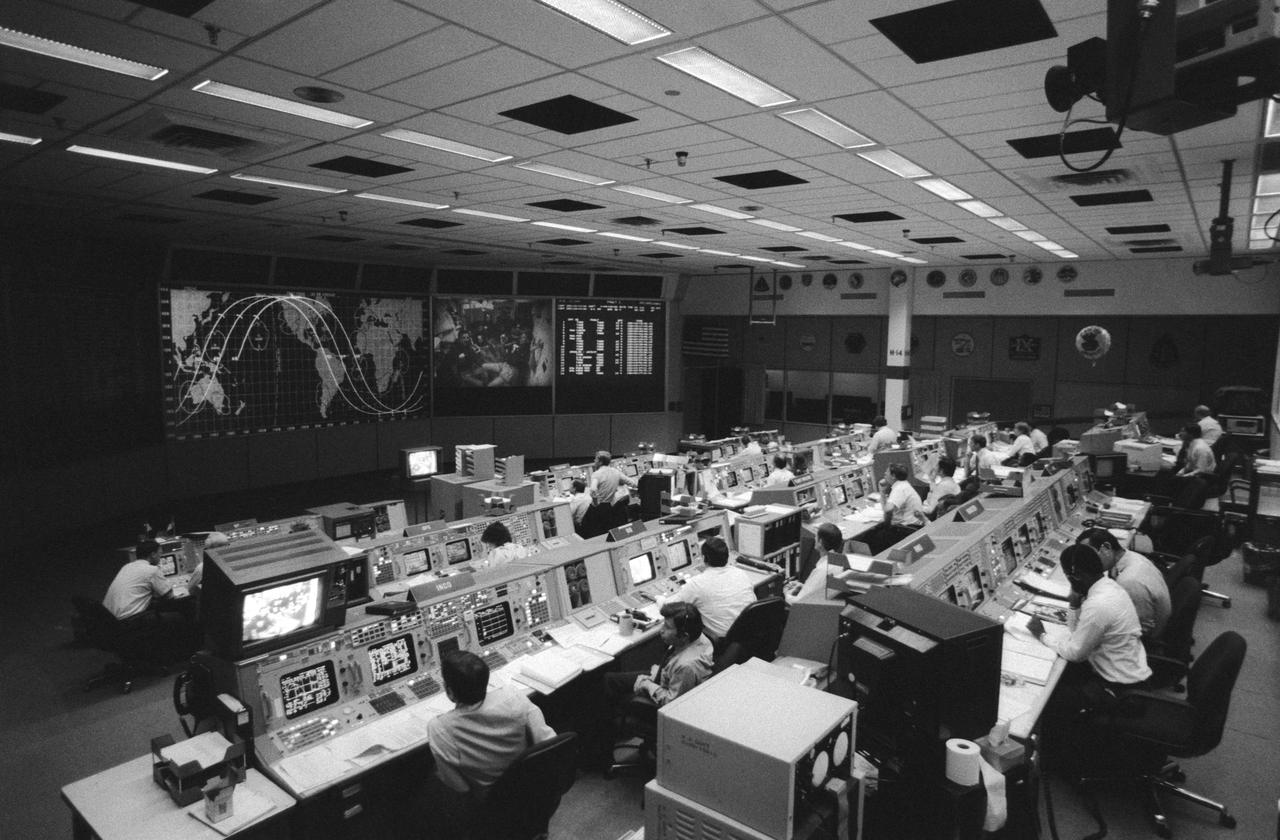
Wide angle view of the flight control room (FCR) of the Mission Control Center (MCC). Some of the STS 41-G crew can be seen on a large screen at the front of the MCC along with a map tracking the progress of the orbiter.
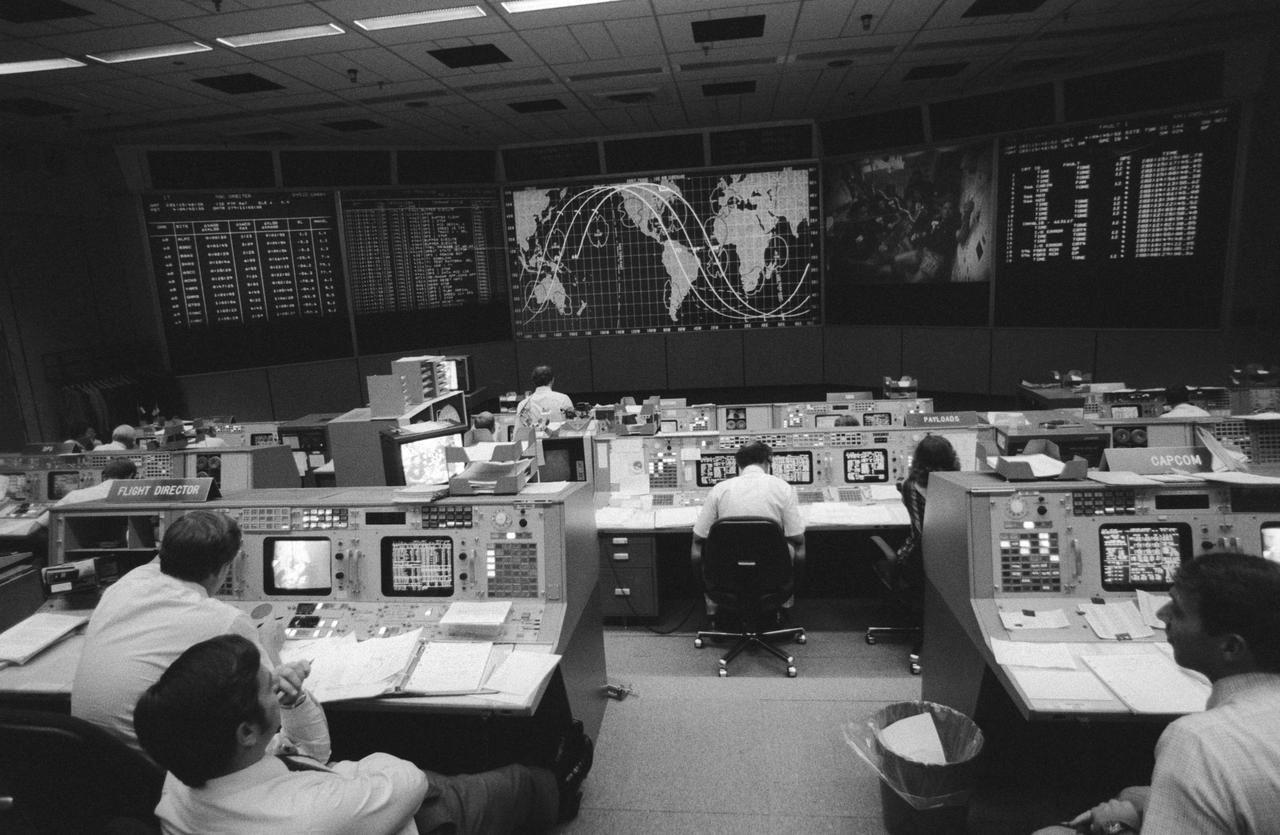
View from the back of the Mission Control Center (MCC). Visible are the Flight Directors console (left front), the CAPCOM console (right front) and the Payloads console. Some of the STS 41-G crew can be seen on a large screen at the front of the MCC along with a map tracking the progress of the orbiter.
Astronauts Roy D. Bridges (left) and RIchard O. Covey serve as spacecraft communicators (CAPCOM) for STS-6. They are seated at the CAPCOM console in the mission operations control room (MOCR) of JSC's mission control center (30119); Flight Director Jay H. Greene communicates with a nearby flight controller in the MOCR just after launch of the Challenger (30120).
Jay H. Greene, right, ascent flight director for STS 51-A, monitors pre-launch activity at the Kennedy Space Center (KSC) via a screen at the spacecraft communicators console in the second floor flight control room (FCR) of JSC's mission control center. Astronauts David C. Hilmers, left, and Richard N. Richards are the on-duty spacecraft communicators.
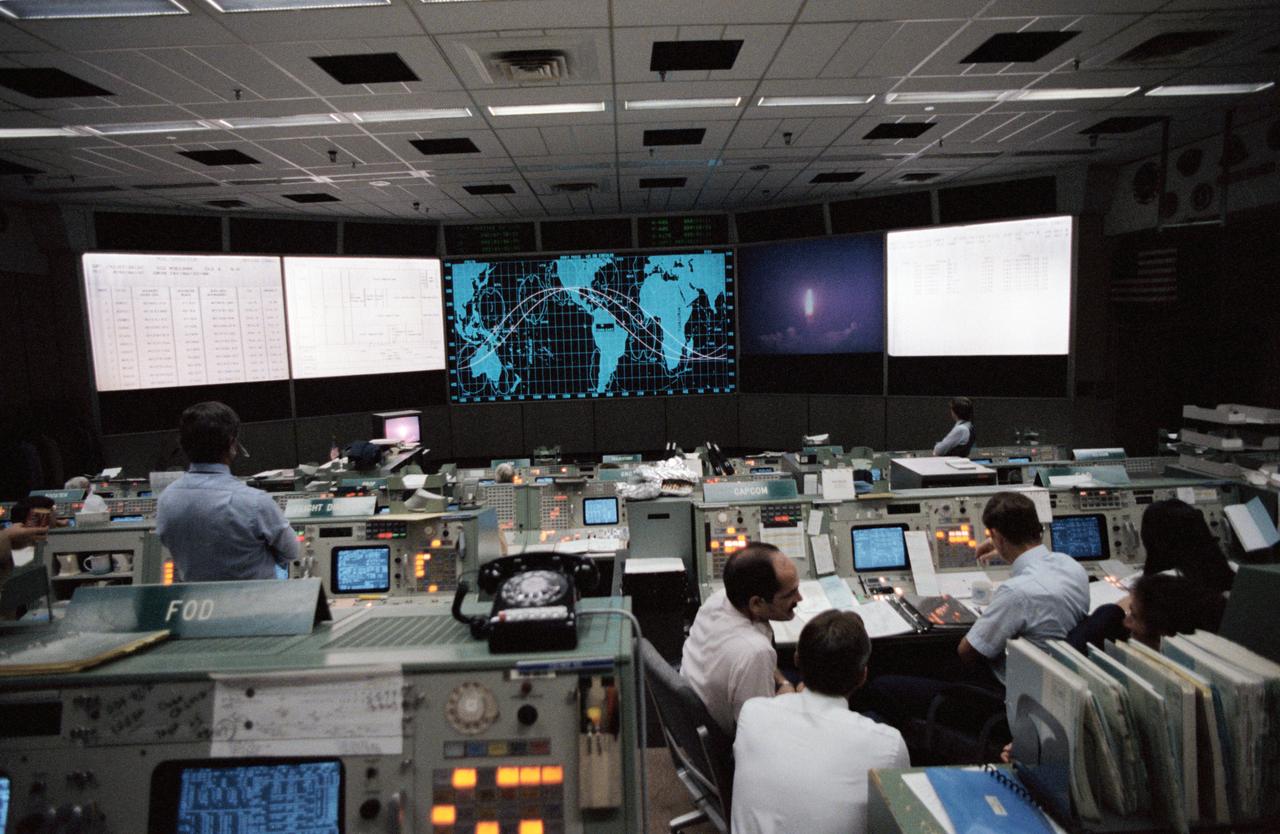
Serving as spacecraft communicators (CAPCOM) are Astronauts Guy S. Gardner (left), William F. Fisher (center), Bryan D. O'Connor (seated facing console), and Jeffrey A. Hoffman. Cheevon B. Lau is seated at the flight activities officer (FAO) console to the right of the CAPCOM console. The scene on the large screen in the mission operations control room (MOCR) is a replay of the launch of the Challenger (39264); Flight Director Jay H. Greene, left, watches a replay of the STS-8 launch on the large screen in the MOCR. He is joined by O'Connor, Jeffrey A. Hoffman, Gardner and Fisher. Lau works at the FAO console near the CAPCOM console (39265); Harold Black, integrated communications officer (INCO) for STS-8 mans the INCO console during the first TV downlink from the Challengers flight. The payload bay can be seen on the screen in the front of the MOCR (39266).
Terry White, serving as public affairs office commentator in the mission operations control room (MOCR) of JSC's mission control center, reads a status report on the STS-8 mission.
Astronaut George D. Nelson (see monitor at front of room) is viewed by flight controllers in the Mission Operations Control Room (MOCR) of JSC's Mission Control Center during 41-C extravehicular activity (EVA). In the foreground are Flight Directors Jay H. Greene and John T. Cox. Astronauts Jerry L. Ross and Richard H. Richards are seated at the CAPCOM or spacecraft communicators console at right background. Astronaut Guy S. Gardner is perched just behind them.
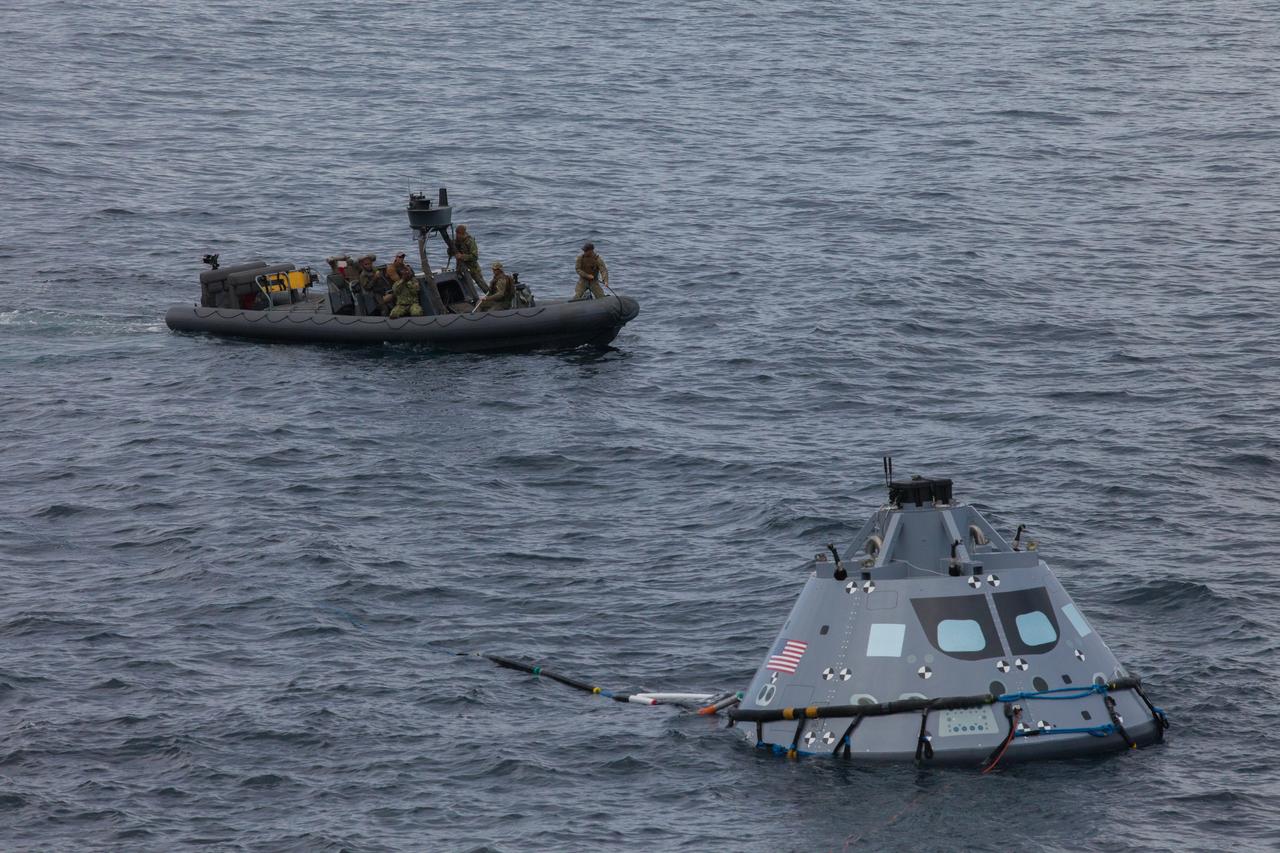
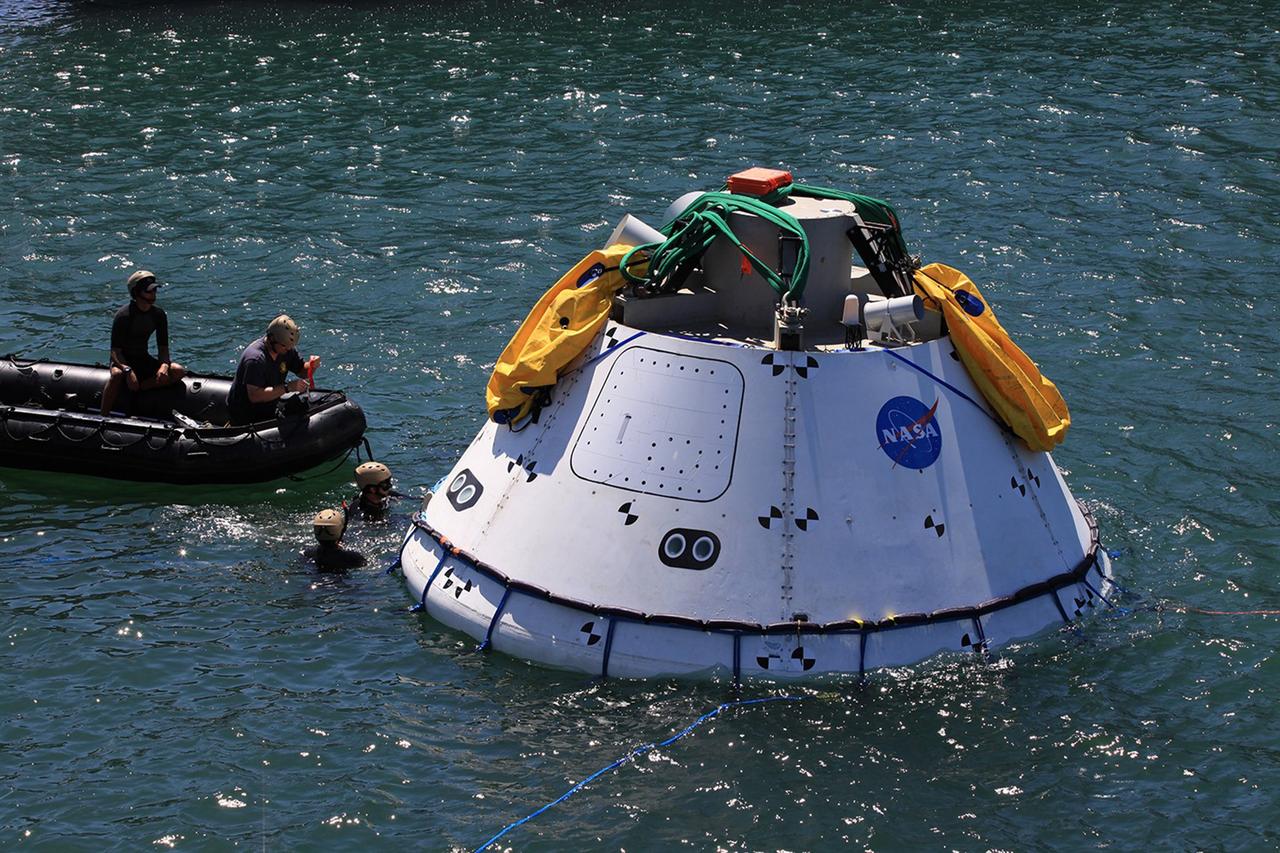
A test version of the Orion crew module floats in the Pacific Ocean during Underway Recovery Test 5 in the Pacific Ocean off the coast of California on Oct. 30, 2016. Nearby are U.S. Navy divers and other personnel in a rigid hull inflatable boat. NASA's Ground Systems Development and Operations Program and the U.S. Navy are conducting a series of tests using the well deck of the USS San Diego, several watercraft, support equipment and personnel to prepare for recovery of Orion on its return from deep space missions. The testing will allow the team to demonstrate and evaluate recovery processes, procedures, hardware and personnel in open waters. Part of Batch images transfer from Flickr.
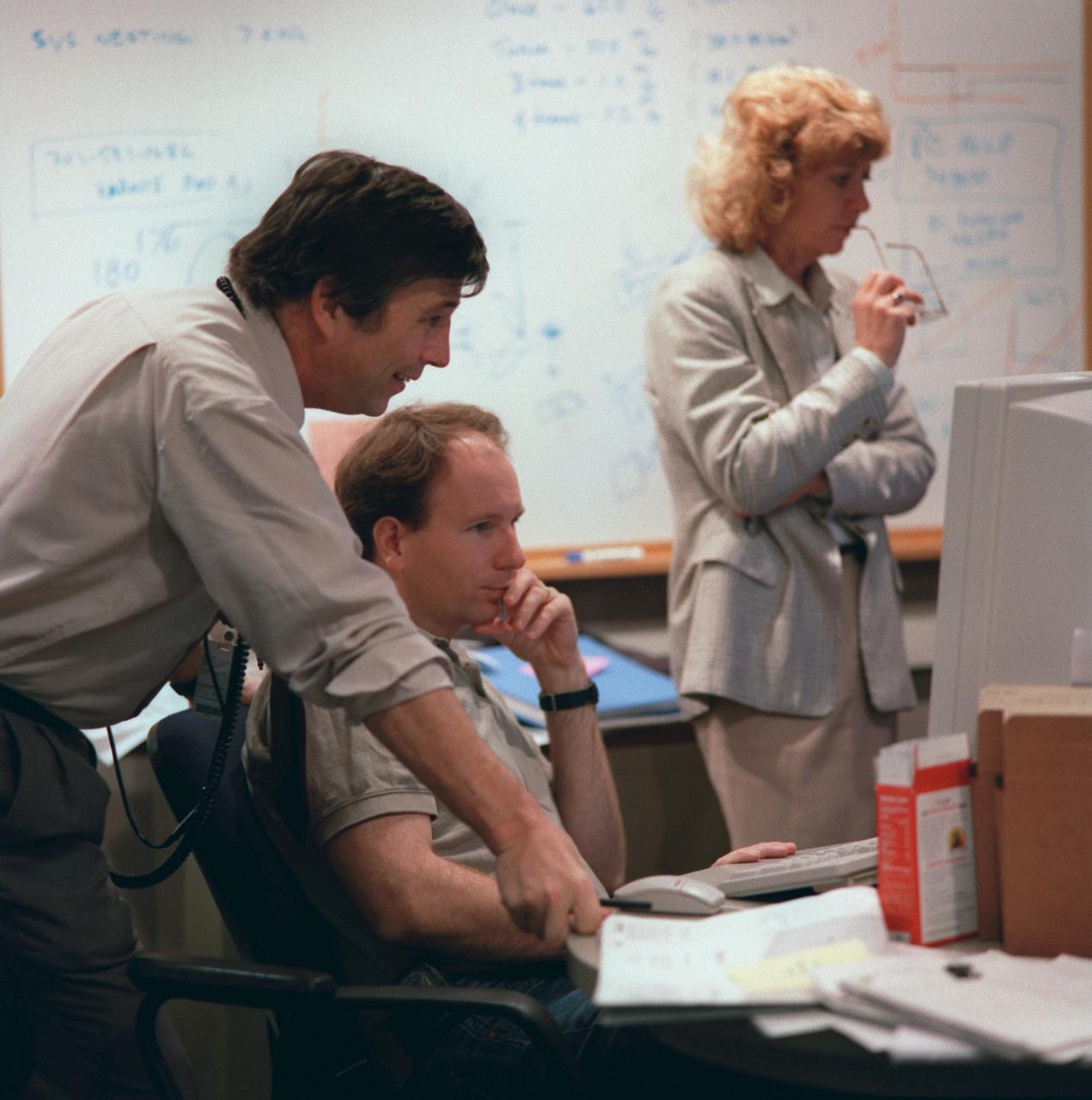
JSC2000-01451 (16 February 2000)--- Three SRTM personnel support the STS-99 at and near the Crew Interface Console (CIC) in the Payload Operations Control Center (POCC) at JSC's Mission Control Center. From left are Mike Kobrick, Ian Joughin and Diane Ainsworth.
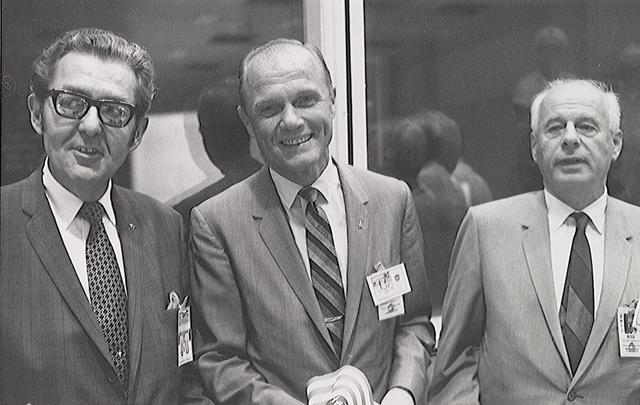
S69-44022 (7-24-69) --- On hand in Houston's mission control center to witness activity associated with the landing and recovery operations for the Apollo 11 mission were, from the left, Bob Kline, chief of the Mission Operations Procurement Branch at the Manned Spacecraft Center (MSC); astronaut John H. Glenn Jr.; and Eberhard Rees, deputy director of the Marshall Space Flight Center (MSFC). They were among a large number of personnel on hand in the MCC's mission operations control room (MOCR). Glenn holds one of the dozens of flags that were handed out for the return's celebration.
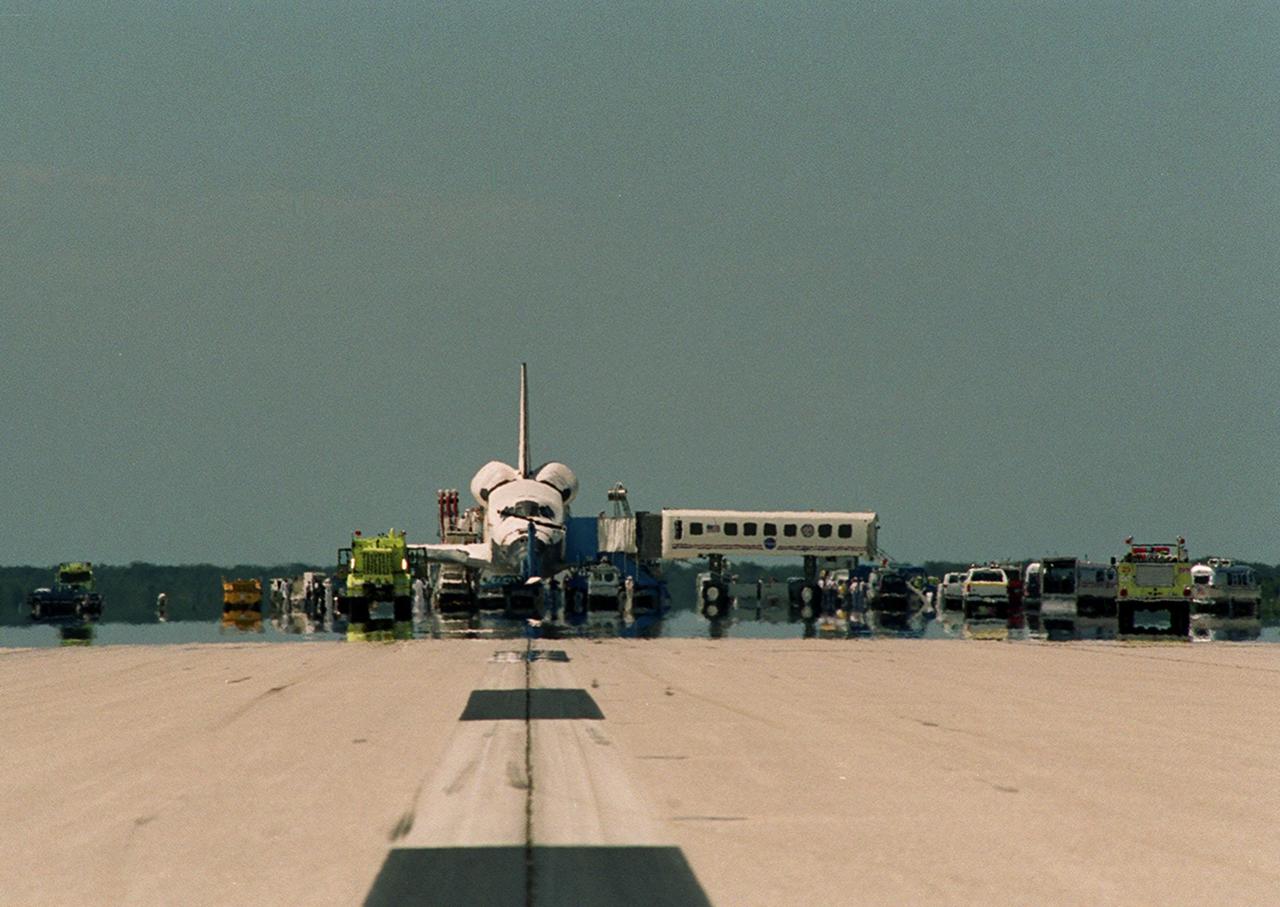
KENNEDY SPACE CENTER, Fla. -- On KSC’s Shuttle Landing Facility runway 15 following mission STS-105, specially designed vehicles and a team of up to 150 trained personnel gather around Discovery for safing operations, checking for toxic or hazardous gases, and introducing purge air to cool the vehicle and humidified air conditioning to the payload bay and other cavities to remove any residual explosive or toxic fumes that may be present. Some personnel will assist the STS-105 and Expedition Two crews in disembarking from the orbiter via the Crew Transfer Vehicle (at right). KSC support personnel will prepare the orbiter for ground tow operations, installing switch guards and removing data packages from any onboard experiments. Main gear touchdown was at 2:22:58 p.m. EDT; wheel stop, at 2:24:06 p.m. EDT. The 11-day, 21-hour, 12-minute mission accomplished the goals set for the 11th flight to the International Space Station: swapout of the resident Station crew; delivery of equipment, supplies and scientific experiments; and installation of the Early Ammonia Servicer and heater cables for the S0 truss on the Station. Discovery traveled 4.3 million miles on its 30th flight into space, the 106th mission of the Space Shuttle program. Out of five missions in 2001, the landing was the first to occur in daylight at KSC

Crane operators and ground support personnel practice lifting and stacking mock-ups of solid rocket booster (SRB) segments in High Bay 4 inside the Vehicle Assembly Building at NASA’s Kennedy Space Center in Florida. The training will help workers prepare for SRB stacking operations for the agency's Space Launch System SLS) rocket. The SLS will launch the Orion spacecraft on its first integrated flight, Exploration Mission-1.
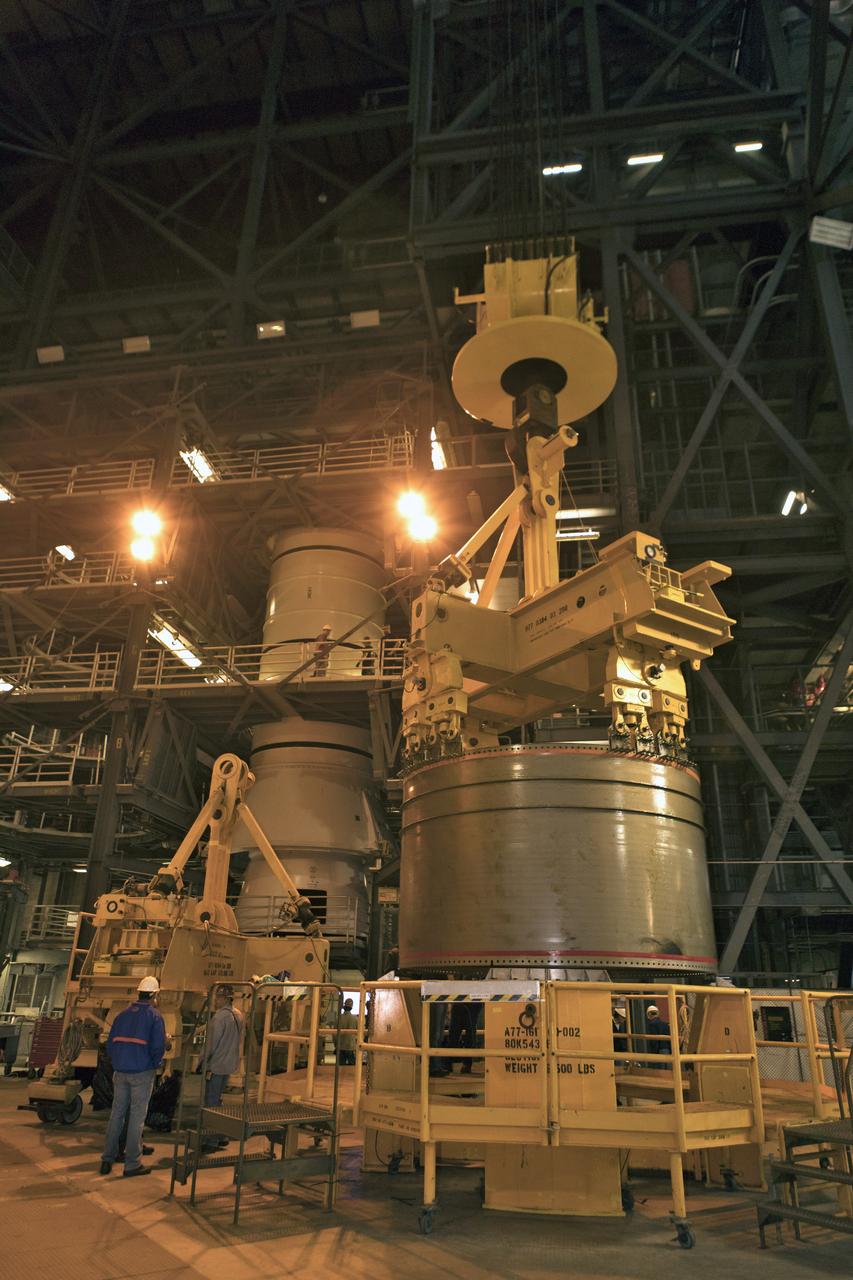
Crane operators and ground support personnel practice lifting and stacking mock-ups of solid rocket booster (SRB) segments in High Bay 4 inside the Vehicle Assembly Building at NASA’s Kennedy Space Center in Florida. The training will help workers prepare for SRB stacking operations for the agency's Space Launch System SLS) rocket. The SLS will launch the Orion spacecraft on its first integrated flight, Exploration Mission-1.
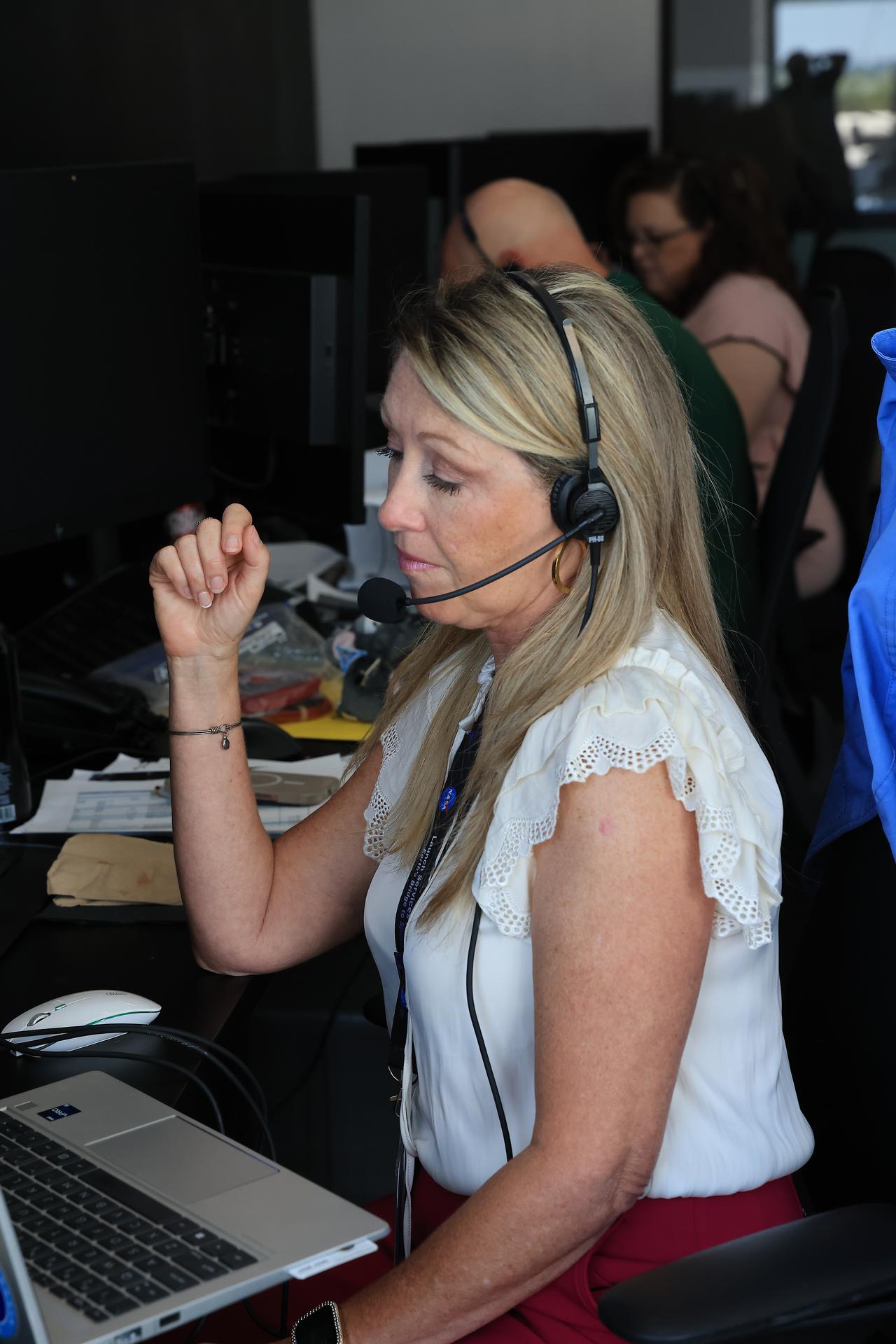
Penny Baez, launch operations manager with NASA’s Launch Services Program, participates in a mission dress rehearsal for NASA’s Nancy Grace Roman Space Telescope on Thursday, Aug. 20, 2026, inside SpaceX’s Hangar X at NASA Kennedy in Florida. Baez and other specialists served as an assessment team for personnel who ran through a full end-to-end simulation of every major step they will experience on launch day except liftoff, including powering up the spacecraft, fueling the rocket, conducting weather briefings, and other operations.
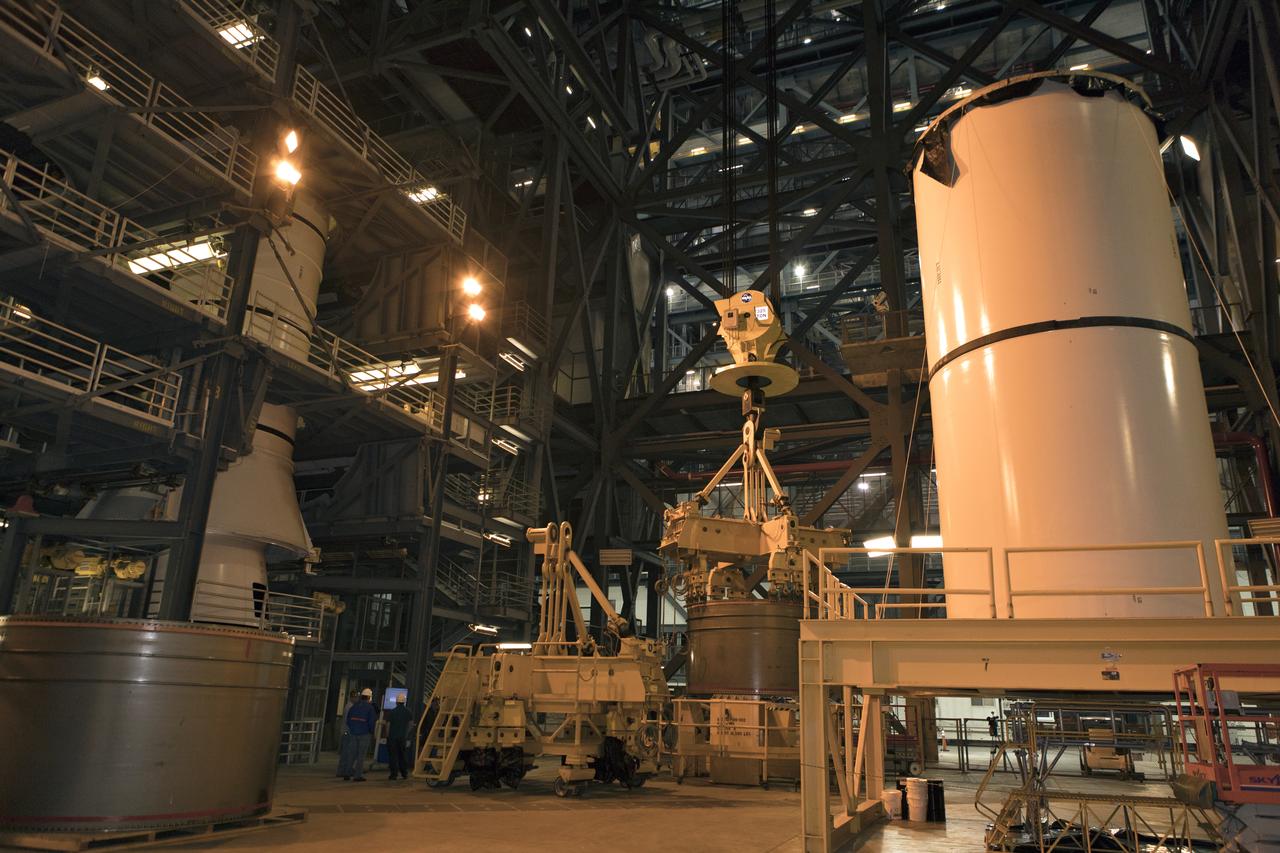
Crane operators and ground support personnel practice lifting and stacking mock-ups of solid rocket booster (SRB) segments in High Bay 4 inside the Vehicle Assembly Building at NASA’s Kennedy Space Center in Florida. The training will help workers prepare for SRB stacking operations for the agency's Space Launch System SLS) rocket. The SLS will launch the Orion spacecraft on its first integrated flight, Exploration Mission-1.

Crane operators and ground support personnel practice lifting and stacking mock-ups of solid rocket booster (SRB) segments in High Bay 4 inside the Vehicle Assembly Building at NASA’s Kennedy Space Center in Florida. The training will help workers prepare for SRB stacking operations for the agency's Space Launch System SLS) rocket. The SLS will launch the Orion spacecraft on its first integrated flight, Exploration Mission-1.
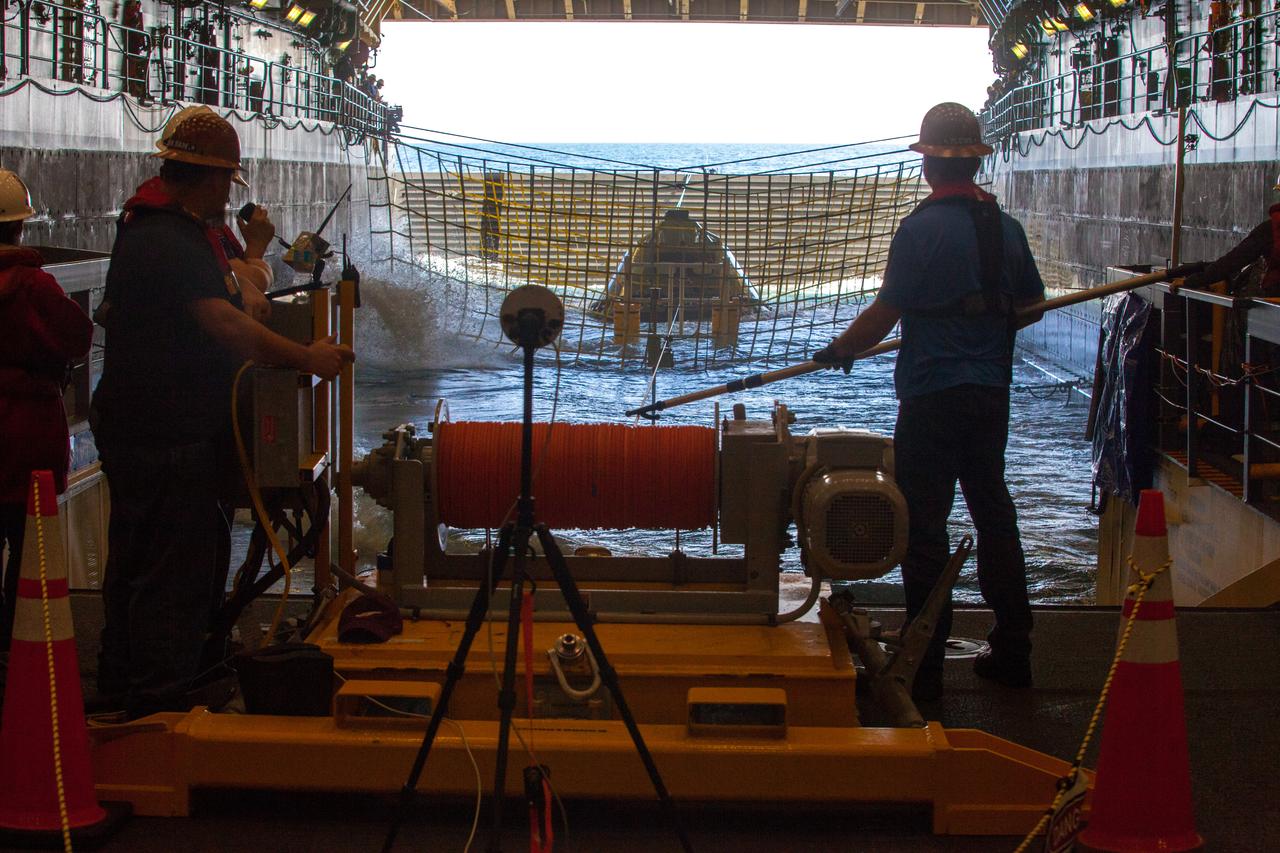
Winch team operators help guide a test version of the Orion crew module into the flooded well deck of the USS San Diego during Underway Recovery Test 5 in the Pacific Ocean off the coast of California. NASA's Ground Systems Development and Operations Program and the U.S. Navy are conducting a series of tests to prepare for recovery of Orion on its return from deep space missions. The testing will allow the team to demonstrate and evaluate recovery processes, procedures, hardware and personnel in open waters. Part of Batch images transfer from Flickr.
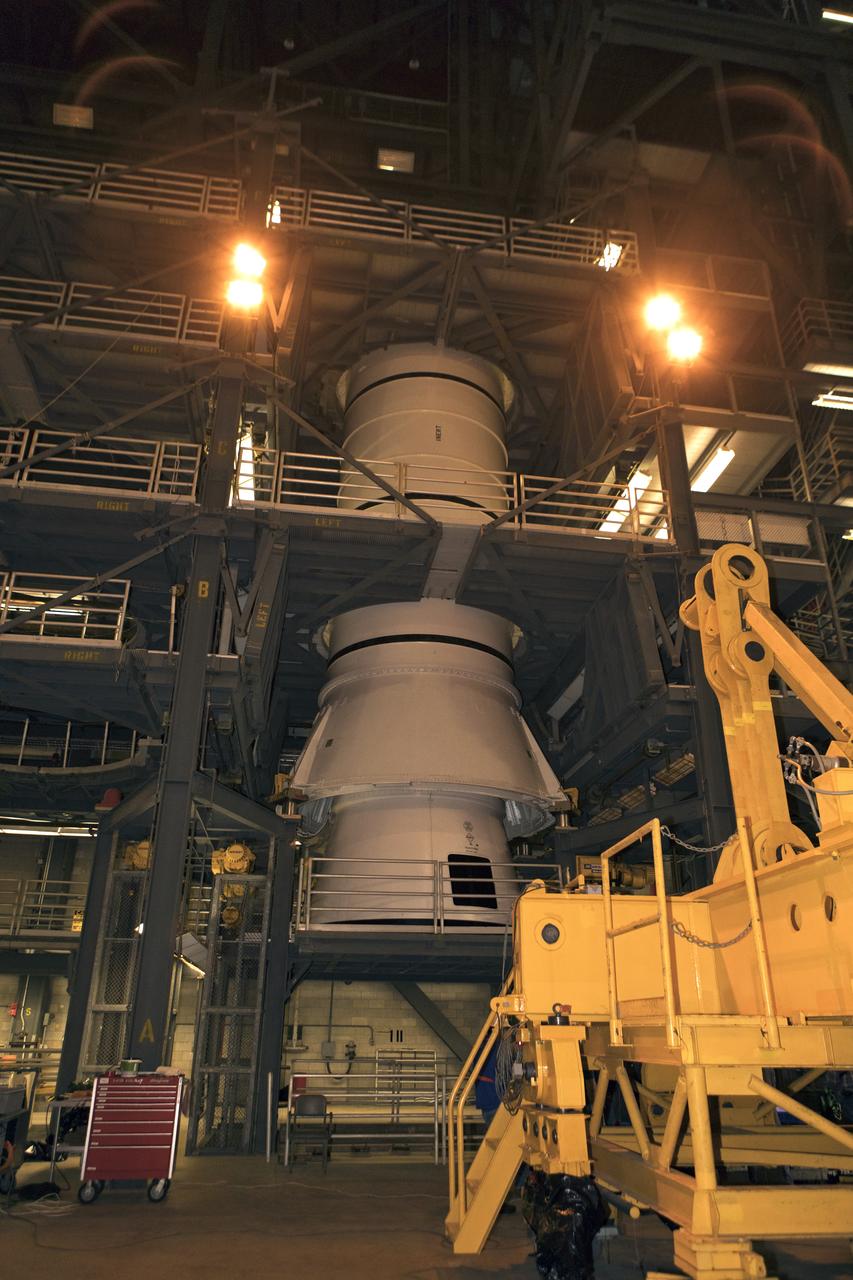
Crane operators and ground support personnel practice lifting and stacking mock-ups of solid rocket booster (SRB) segments in High Bay 4 inside the Vehicle Assembly Building at NASA’s Kennedy Space Center in Florida. The training will help workers prepare for SRB stacking operations for the agency's Space Launch System SLS) rocket. The SLS will launch the Orion spacecraft on its first integrated flight, Exploration Mission-1.
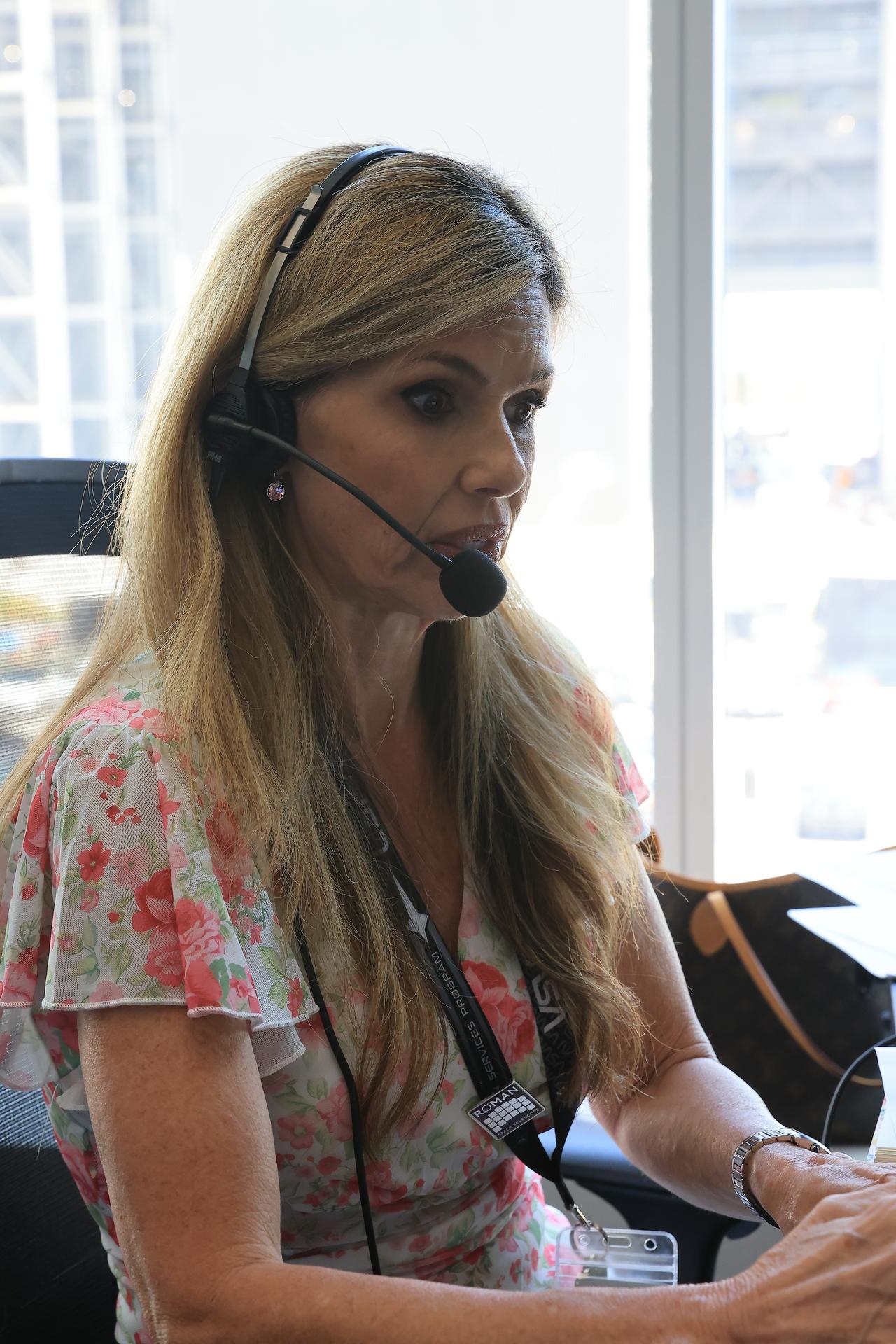
Dana Allender, senior launch operations manager with NASA’s Launch Services Program, participates in a mission dress rehearsal for NASA’s Nancy Grace Roman Space Telescope on Thursday, Aug. 20, 2026, inside SpaceX’s Hangar X at NASA Kennedy in Florida. Allender and other specialists served as an assessment team for personnel who ran through a full end-to-end simulation of every major step they will experience on launch day except liftoff, including powering up the spacecraft, fueling the rocket, conducting weather briefings, and other operations.
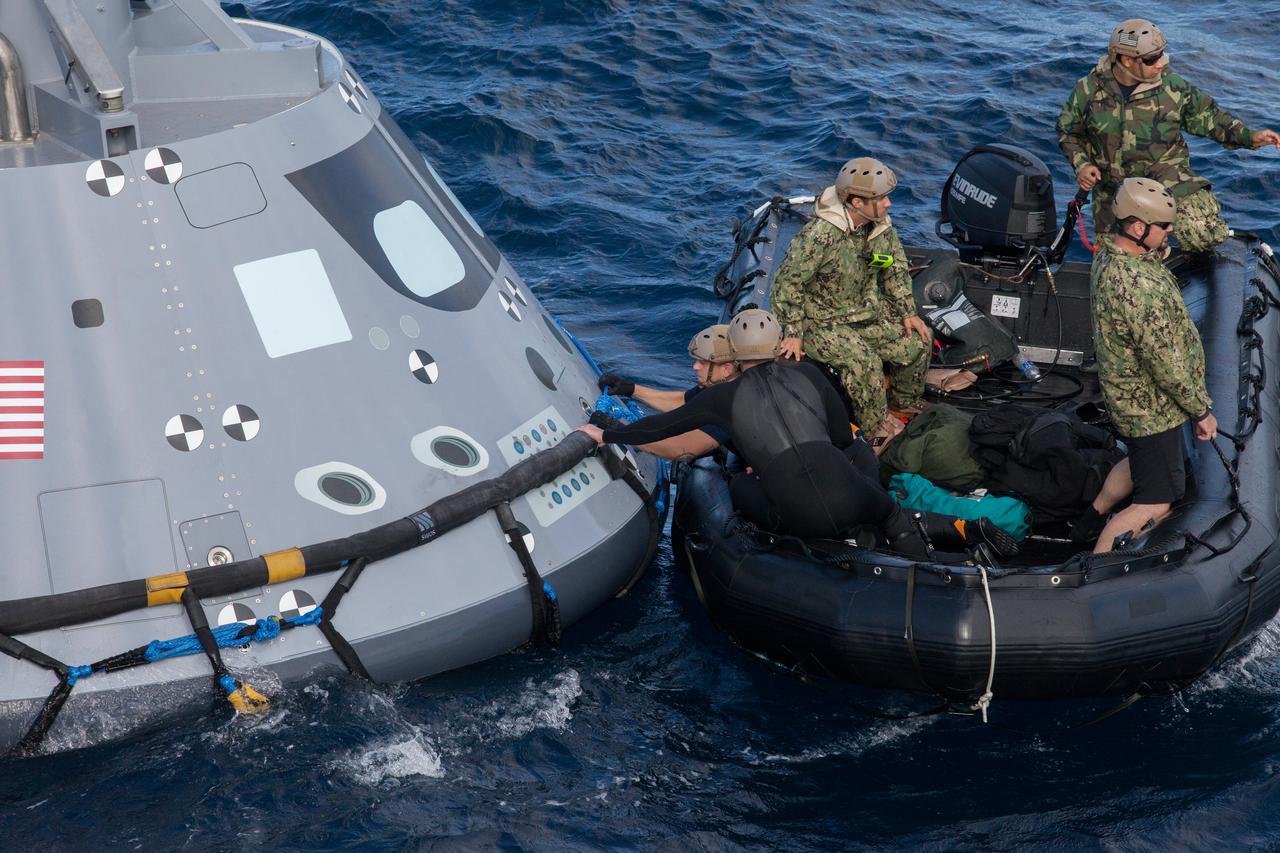
U.S. Navy divers and other personnel in a Zodiac boat secure a harness around a test version of the Orion crew module during Underway Recovery Test 5 in the Pacific Ocean off the coast of California on Oct. 28, 2016. Tether lines will be attached to the test module to help guide it back to the well deck of the USS San Diego. NASA's Ground Systems Development and Operations Program and the U.S. Navy are practicing recovery techniques to prepare for recovery of Orion on its return from deep space missions. The testing will allow the team to demonstrate and evaluate recovery processes, procedures, hardware and personnel in open waters. Part of Batch images transfer from Flickr.
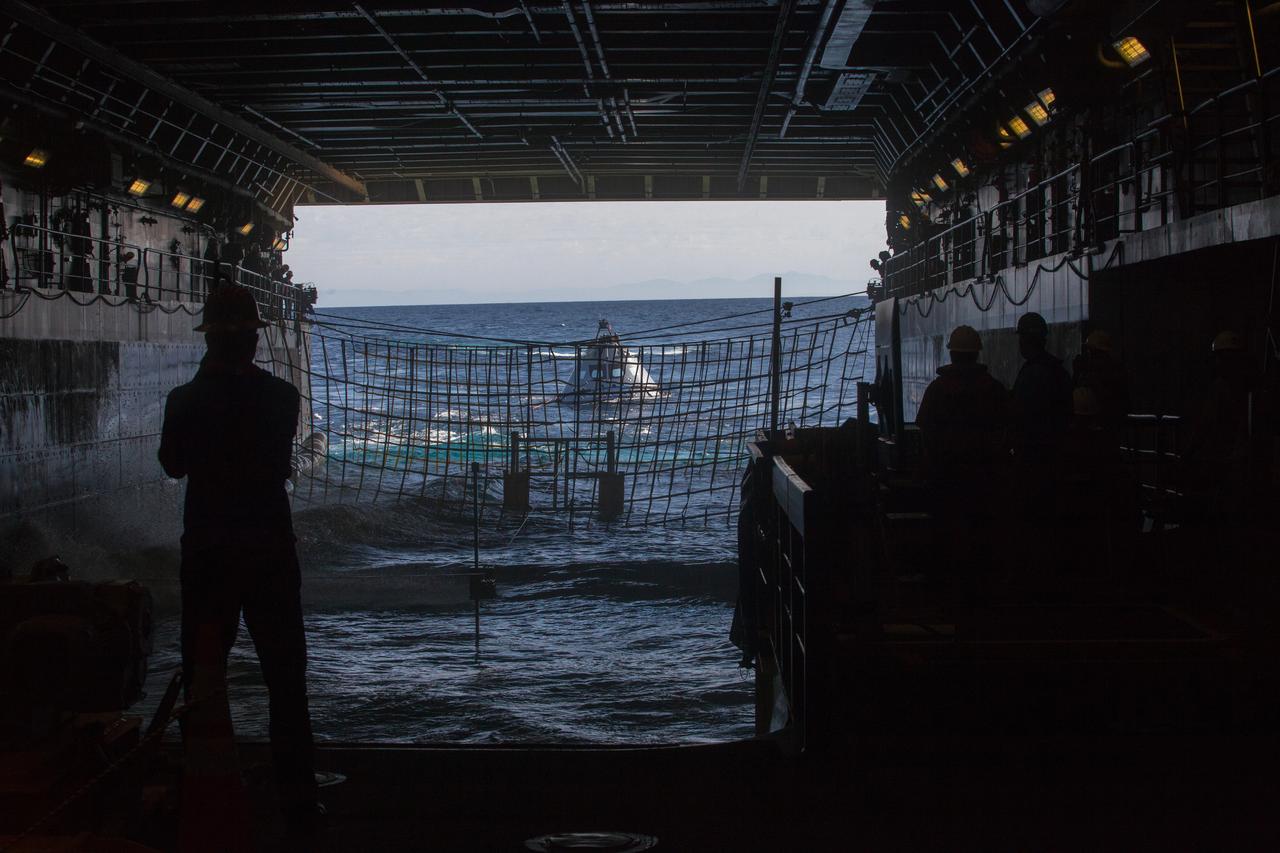
A test version of the Orion crew module floats outside the well deck of the USS San Diego during Underway Recovery Test 5 in the Pacific Ocean off the coast of California on Oct. 29, 2016. NASA's Ground Systems Development and Operations Program and the U.S. Navy are conducting a series of tests using the ship's well deck, several watercraft, support equipment and personnel to prepare for recovery of Orion on its return from deep space missions. The testing will allow the team to demonstrate and evaluate recovery processes, procedures, hardware and personnel in open waters. Part of Batch images transfer from Flickr.
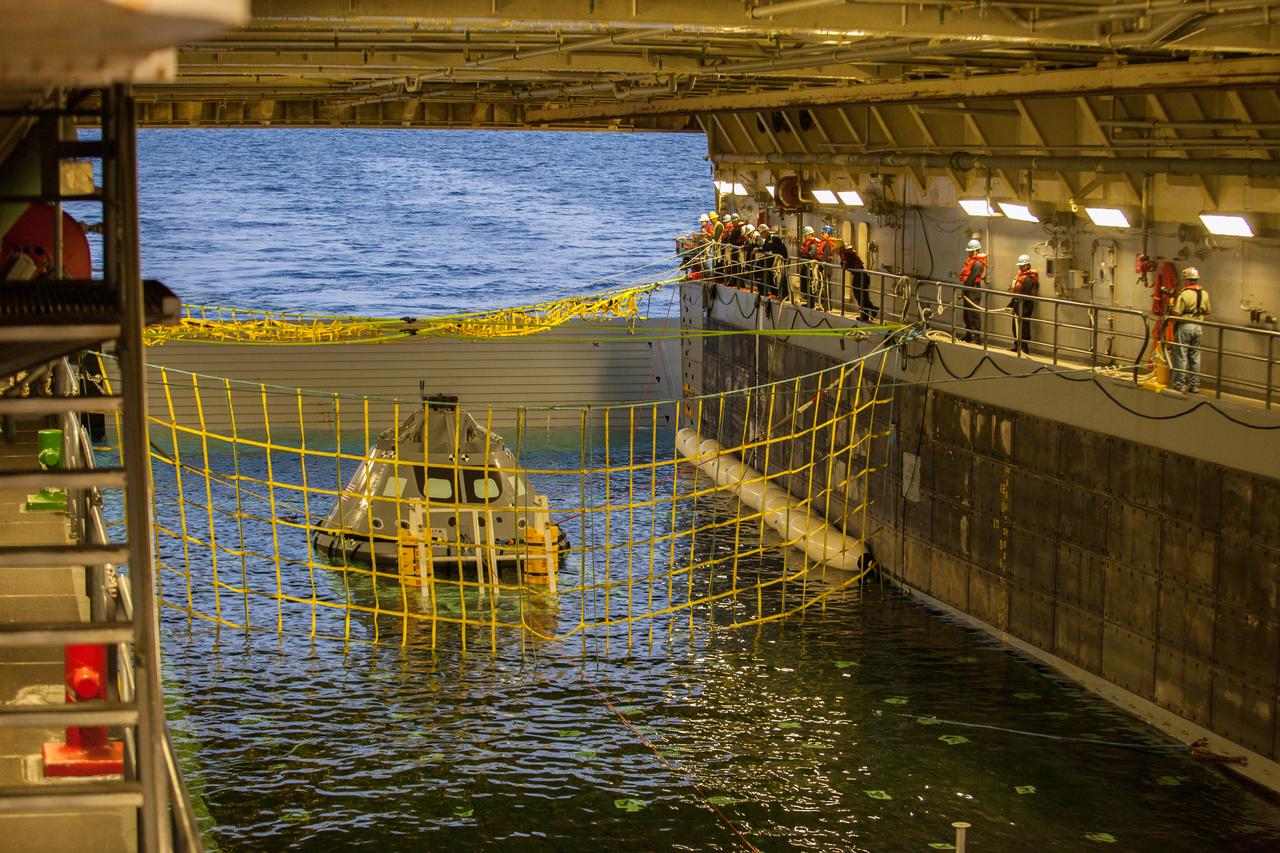
A golden sheen lights up a test version of the Orion crew module in the flooded well deck of the USS San Diego during Underway Recovery Test 5 in the Pacific Ocean off the coast of California on Oct. 26, 2016. Recovery team personnel have secured a net around the crew module. NASA's Ground Systems Development and Operations Program and the U.S. Navy will conduct a series of tests to prepare for recovery of Orion on its return from deep space missions. The testing will allow the team to demonstrate and evaluate recovery processes, procedures, hardware and personnel in open waters. Part of Batch images transfer from Flickr.
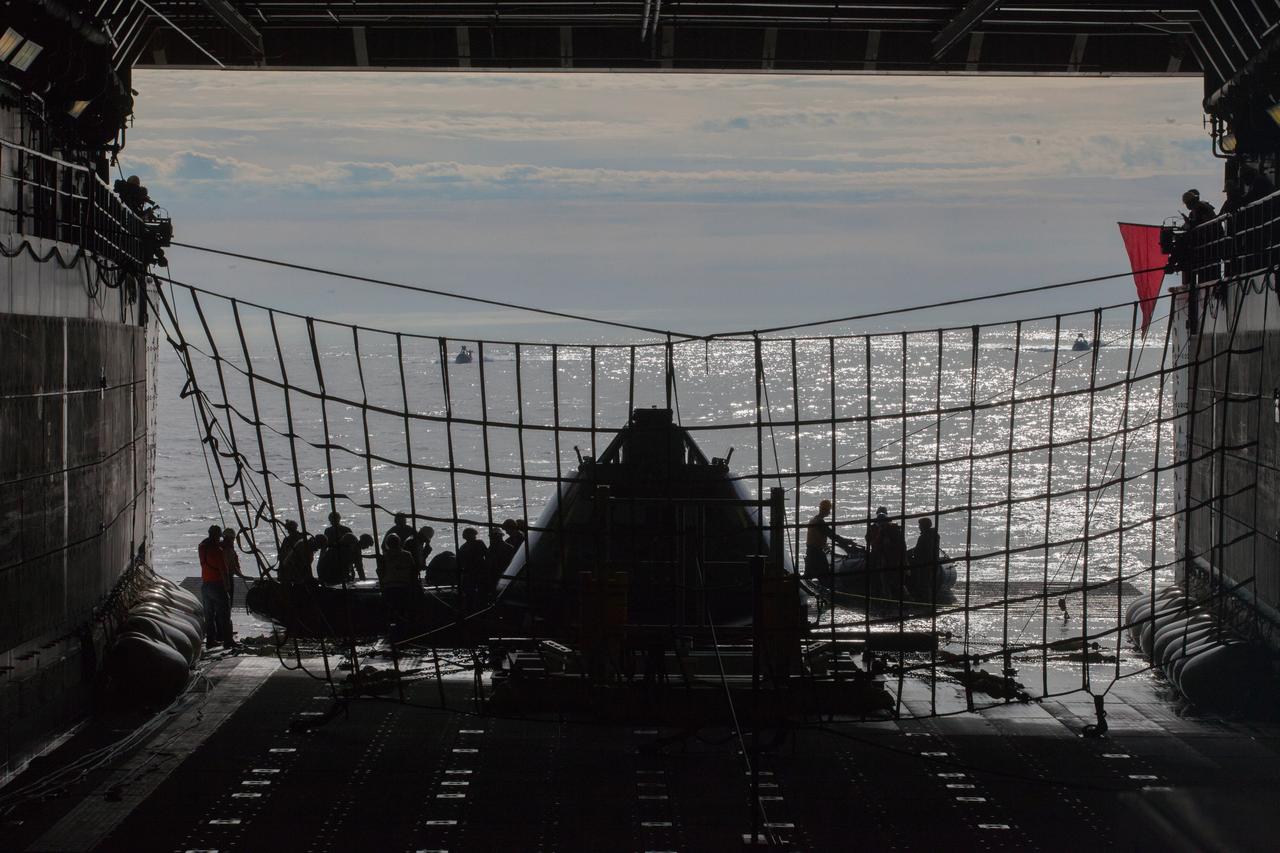
NASA's Ground Systems Development and Operations Program and the U.S. Navy prepare for another day of Underway Recovery Test 5 in the Pacific Ocean off the coast of California on Oct. 30, 2016. A test version of the Orion crew module is in the well deck of the ship, and U.S. Navy divers and other personnel are in rigid hull inflatable boats preparing to head out into the open water. The recovery team is conducting a series of tests to prepare for recovery of Orion on its return from deep space missions. The testing will allow the team to demonstrate and evaluate recovery processes, procedures, hardware and personnel in open waters. Part of Batch images transfer from Flickr.
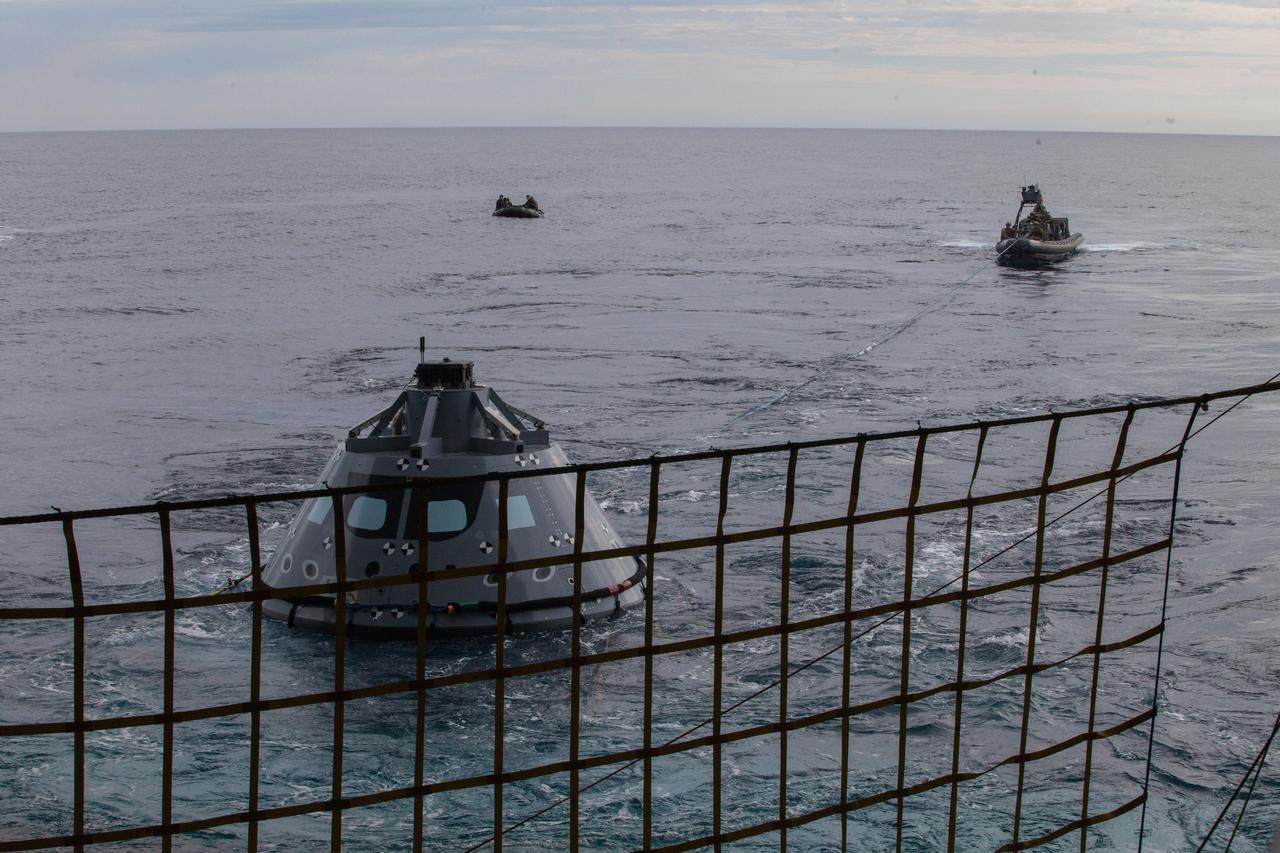
U.S. Navy divers and other personnel in a rigid hull inflatable boat are handling tether lines attached to a test version of the Orion crew module during Underway Recovery Test 5 in the Pacific Ocean off the coast of California. U.S. Navy divers in a smaller watercraft called a Zodiac boat are farther away. NASA's Ground Systems Development and Operations Program and the U.S. Navy are conducting a series of tests using the well deck of the USS San Diego, several watercraft and personnel to prepare for recovery of Orion on its return from deep space missions. The testing will allow the team to demonstrate and evaluate recovery processes, procedures, hardware and personnel in open waters. Part of Batch images transfer from Flickr.
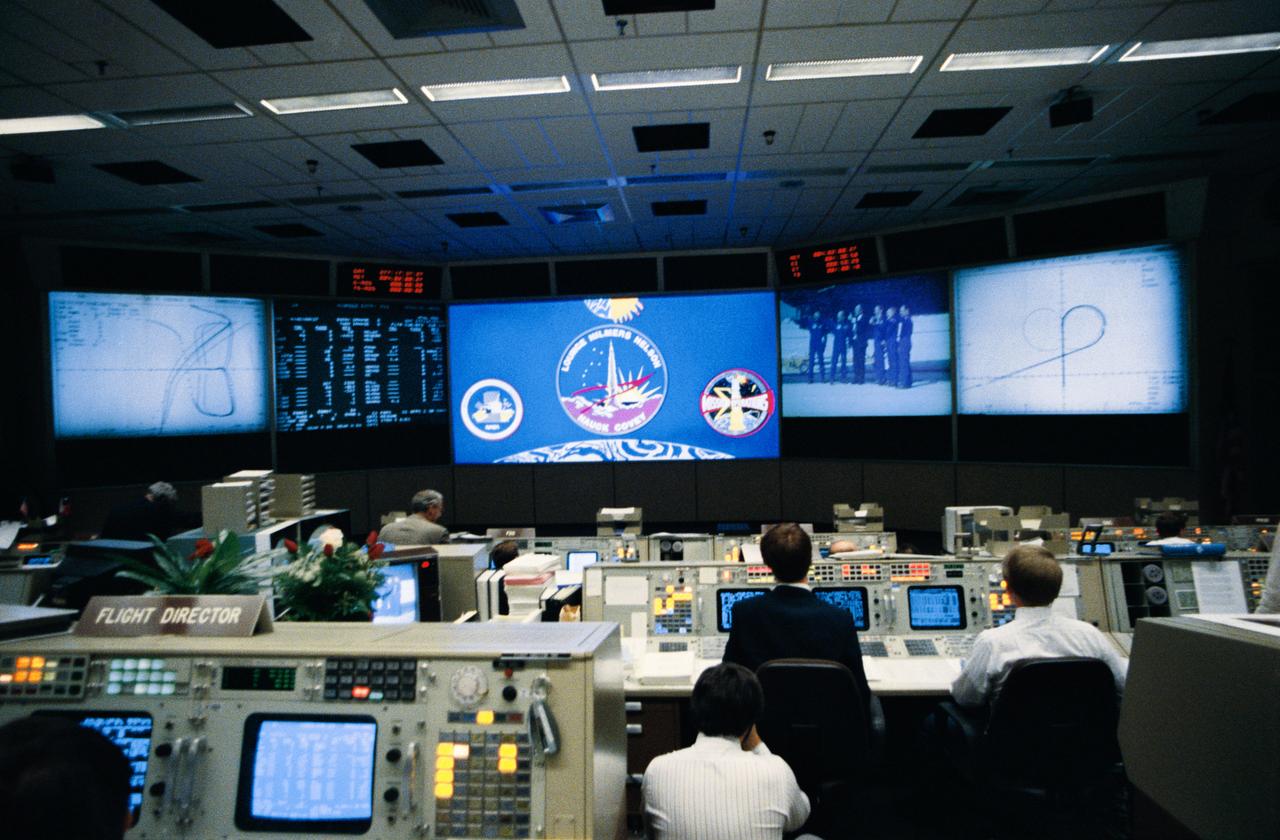
JSC Mission Control Center (MCC) Bldg 30 flight control room (FCR) personnel monitor STS-26 post landing activities and ceremonies at Edwards Air Force Base (EAFB) via their monitors. Displayed on front screens are approach and landing diagrams, data, the space shuttle program insignia, the STS-26 mission insignia, the Mission Operations Directorate insignia, and the STS-26 crew standing in front of Discovery, Orbiter Vehicle (OV) 103.
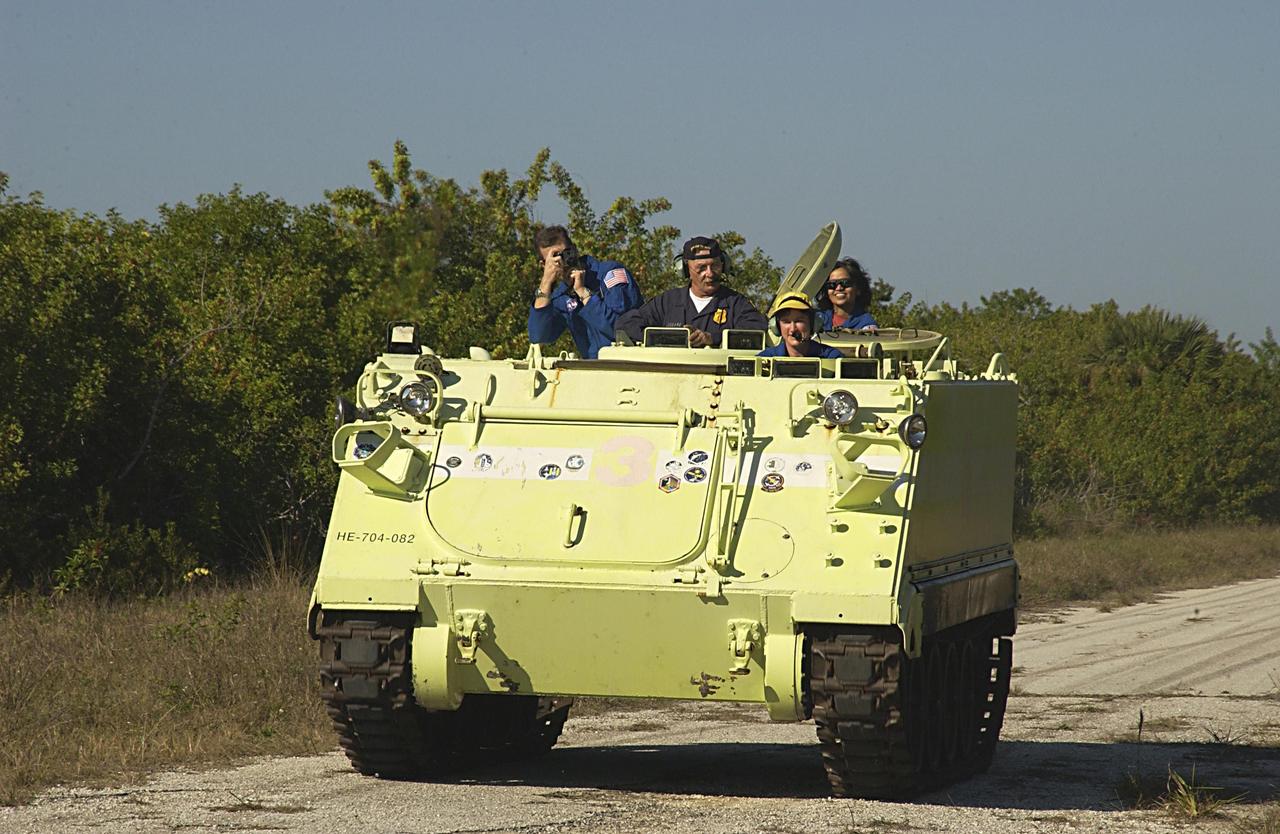
KENNEDY SPACE CENTER, FLA. -- STS-107 Mission Specialist Laurel Clark (in yellow cap) is instructed on the operation of an M113 armored personnel carrier during Terminal Countdown Demonstration Test activities, a standard part of launch preparations. STS-107 is a mission devoted to research and will include more than 80 experiments that will study Earth and space science, advanced technology development, and astronaut health and safety. Launch is planned for Jan. 16, 2003, between 10 a.m. and 2 p.m. EST aboard Space Shuttle Columbia.
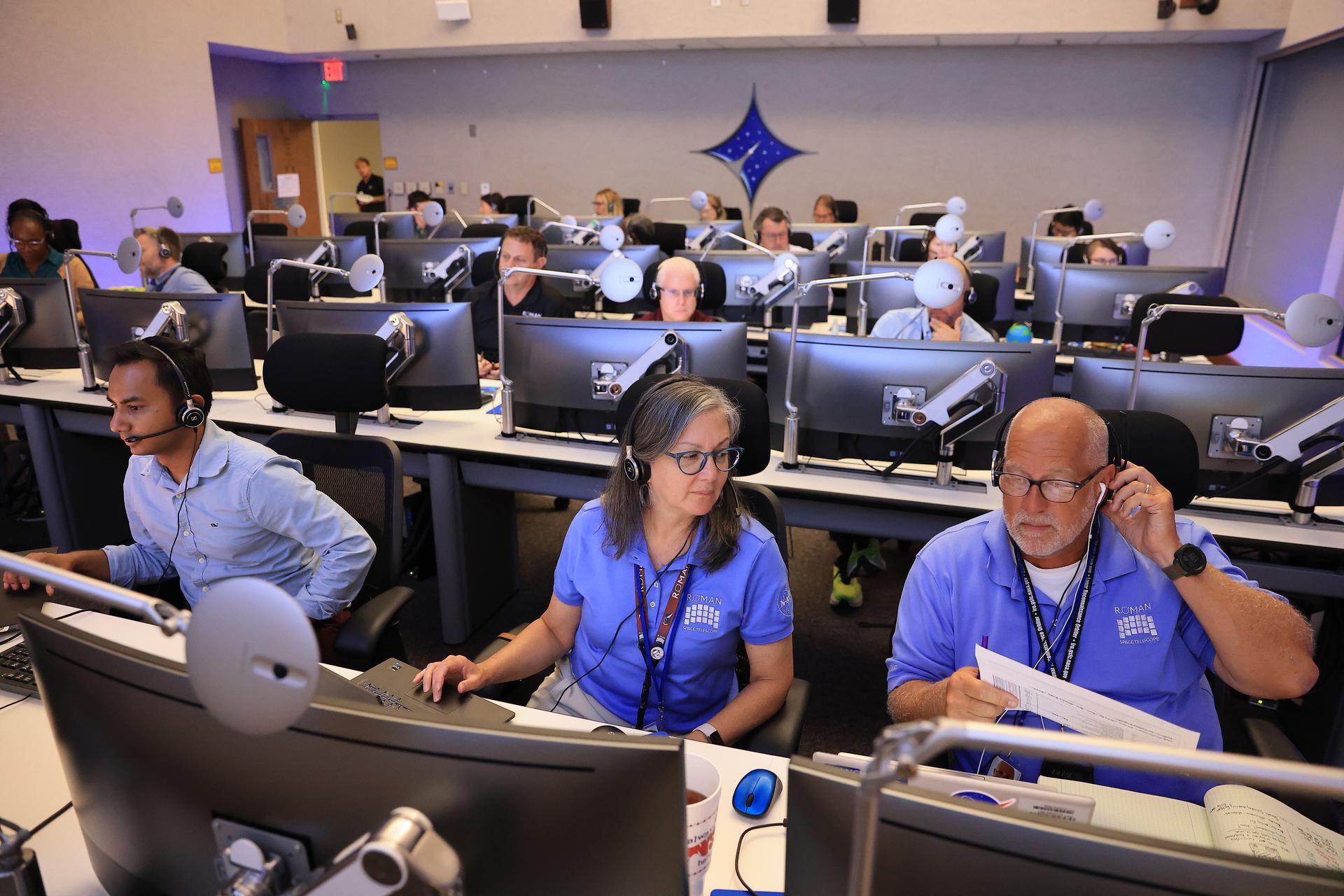
Personnel, including engineers, technicians, and mission managers, with the Launch Services Program at NASA’s Kennedy Space Center and NASA’s Nancy Grace Roman Space Telescope participate in a mission dress rehearsal on Thursday, Aug. 20, 2026, inside Hangar AE at Cape Canaveral Space Force Station in Florida. Teams ran through a full end-to-end simulation of every major step they will experience on launch day except liftoff, including powering up the spacecraft, fueling the rocket, conducting weather briefings, and other operations.
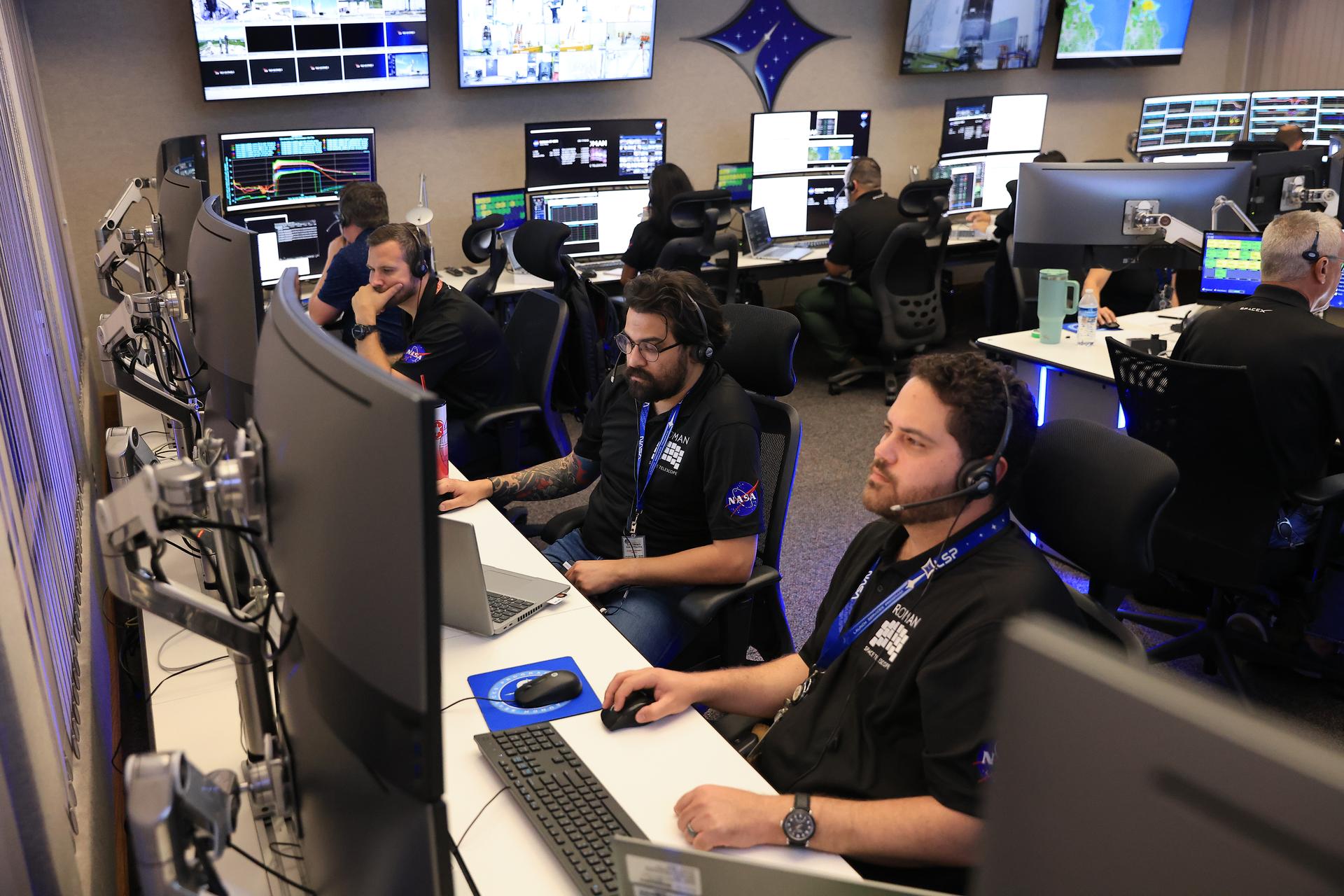
Personnel, including engineers, technicians, and mission managers, with the Launch Services Program at NASA’s Kennedy Space Center and NASA’s Nancy Grace Roman Space Telescope participate in a mission dress rehearsal on Thursday, Aug. 20, 2026, inside Hangar AE at Cape Canaveral Space Force Station in Florida. Teams ran through a full end-to-end simulation of every major step they will experience on launch day except liftoff, including powering up the spacecraft, fueling the rocket, conducting weather briefings, and other operations.
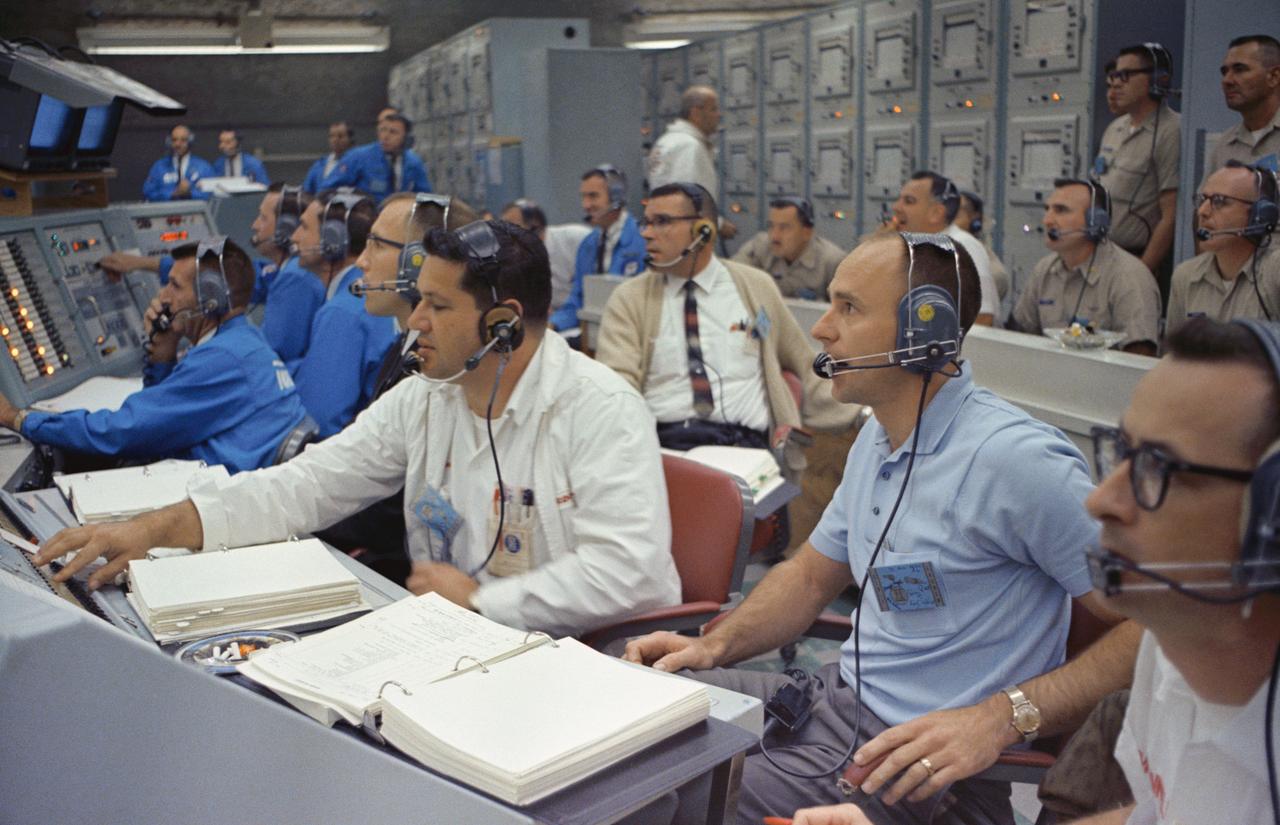
S65-59931 (4 Dec. 1965) --- Astronaut Alan Bean (right), spacecraft communicator for the Gemini-7 mission, joins other personnel (including H.K. "Fritz" Widick in dark jacket running launch operations) in the Blockhouse at Launch Complex 19 during the launch of the Gemini-7 spacecraft at 2:30 p.m. (EST), Dec. 4, 1965. Astronaut Frank Borman, command pilot, and James A. Lovell Jr., pilot, are the crew members for the planned 14-day mission in space. Photo credit: NASA
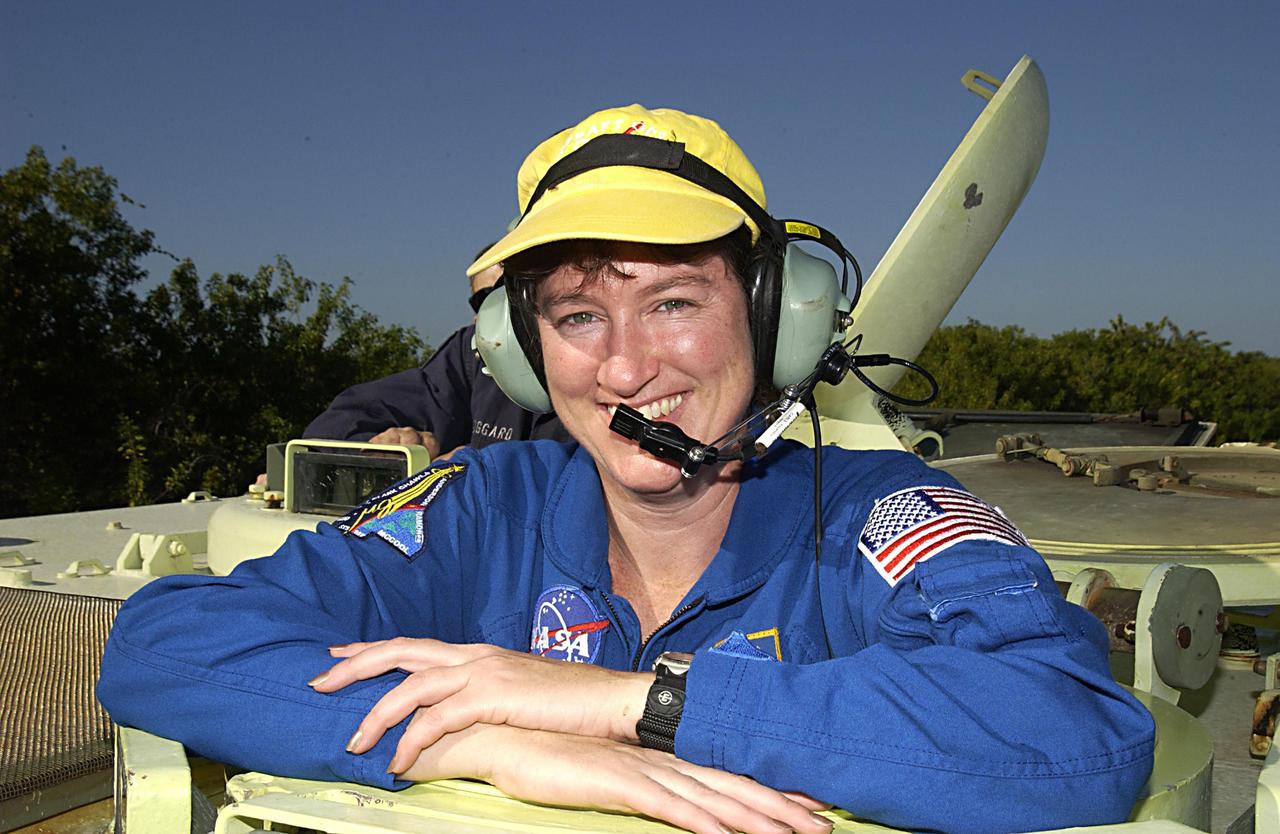
KENNEDY SPACE CENTER, FLA. -- STS-107 Mission Specialist Laurel Clark takes a break during training on the operation of an M113 armored personnel carrier during Terminal Countdown Demonstration Test activities, a standard part of launch preparations. STS-107 is a mission devoted to research and will include more than 80 experiments that will study Earth and space science, advanced technology development, and astronaut health and safety. Launch is planned for Jan. 16, 2003, between 10 a.m. and 2 p.m. EST aboard Space Shuttle Columbia.
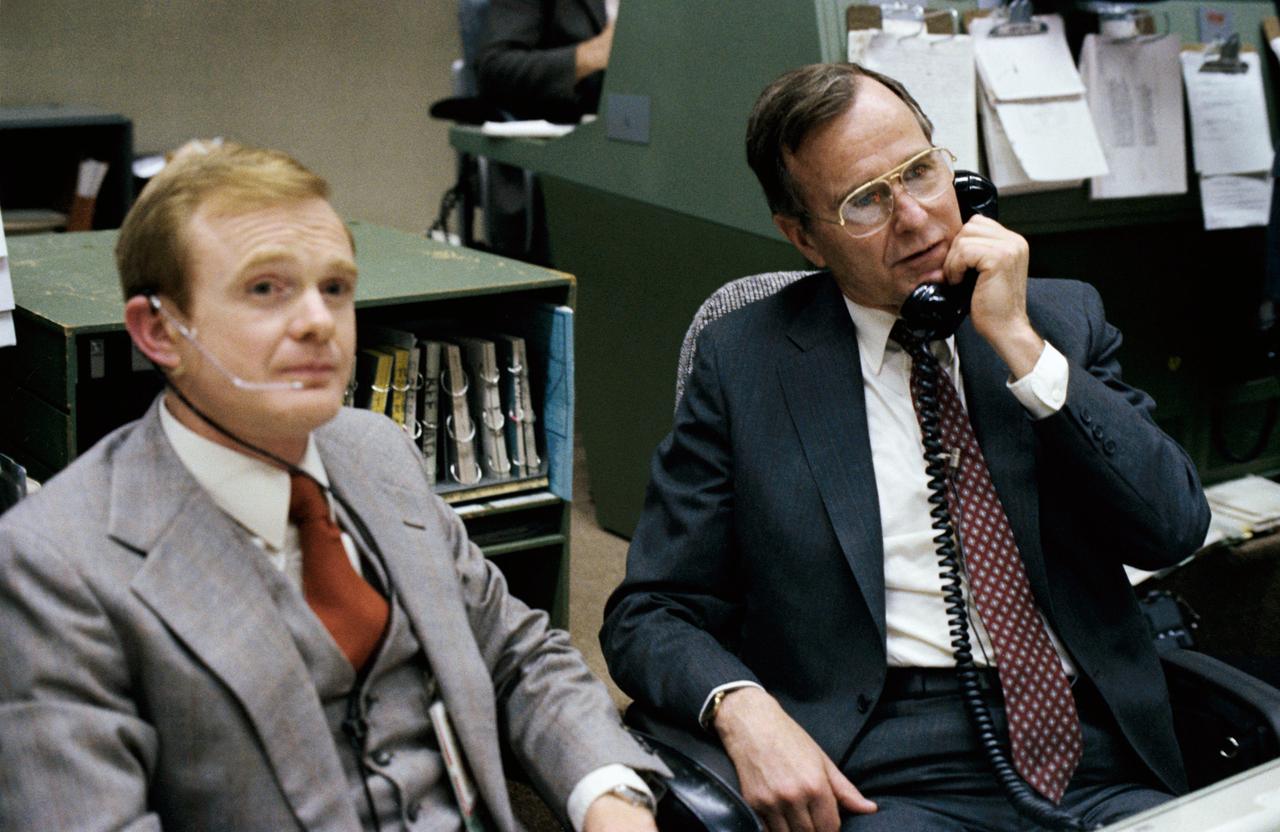
S83-30190 (8 April 1983) --- Vice President George Bush talks to the Earth-orbiting STS-6 astronauts from the spacecraft communicators; (CAPCOM) console in the mission operations control room (MOCR) of the Johnson Space Center?s mission control center. Astronaut Roy D. Bridges, left, is one of the CAPCOM personnel on duty.
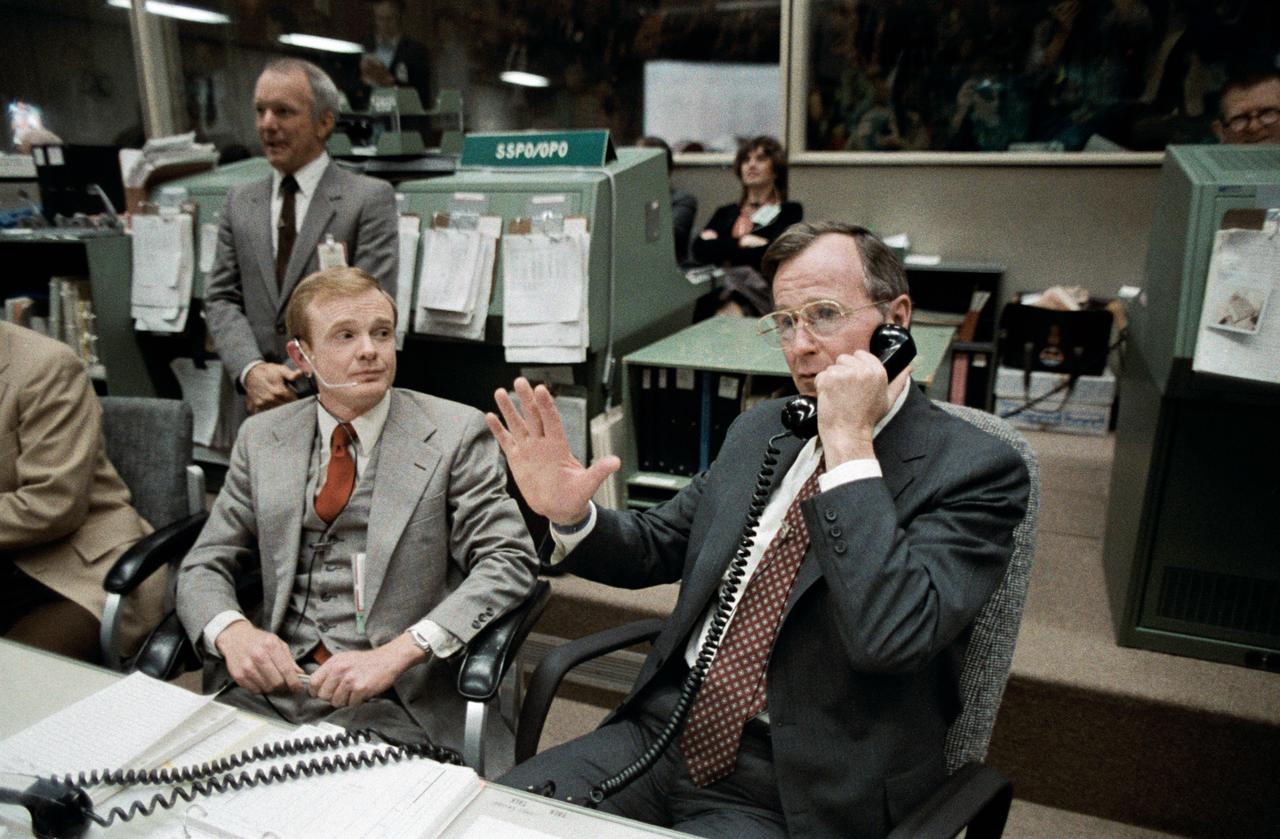
S83-30192 (8 April 1983) --- Vice President George Bush talks to the Earth-orbiting STS-6 astronauts from the spacecraft communicators; (CAPCOM) console in the mission operations control room (MOCR) of the Johnson Space Center?s mission control center. Astronaut Roy D. Bridges, is one of the CAPCOM personnel on duty. JSC Director Gerald D. Griffin, left, watches a large monitor (out of frame) on which the TV scene of the four-member Challenger crew is visible. This photo was made by Otis Imboden.
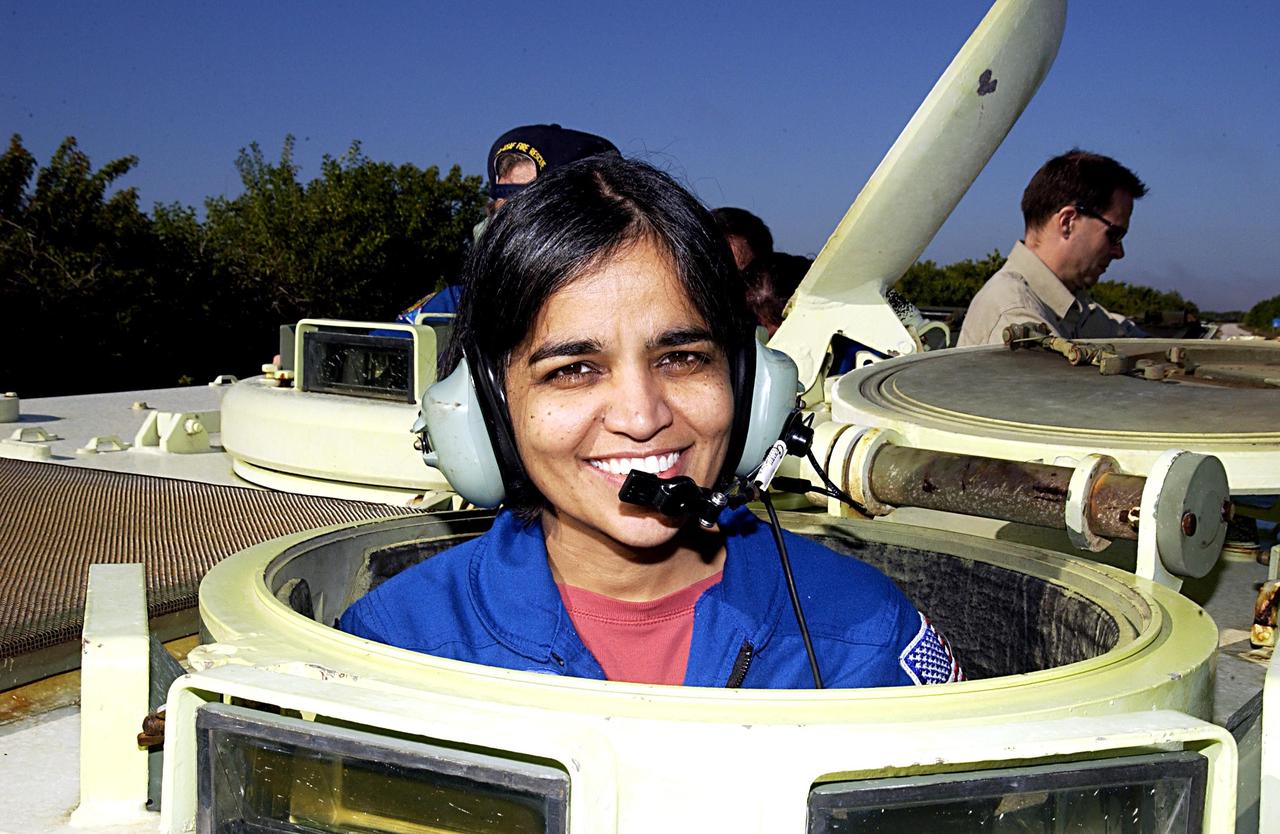
KENNEDY SPACE CENTER, FLA. -- STS-107 Mission Specialist Kalpana Chawla takes a break during training on the operation of an M113 armored personnel carrier during Terminal Countdown Demonstration Test activities, a standard part of launch preparations. STS-107 is a mission devoted to research and will include more than 80 experiments that will study Earth and space science, advanced technology development, and astronaut health and safety. Launch is planned for Jan. 16, 2003, between 10 a.m. and 2 p.m. EST aboard Space Shuttle Columbia.
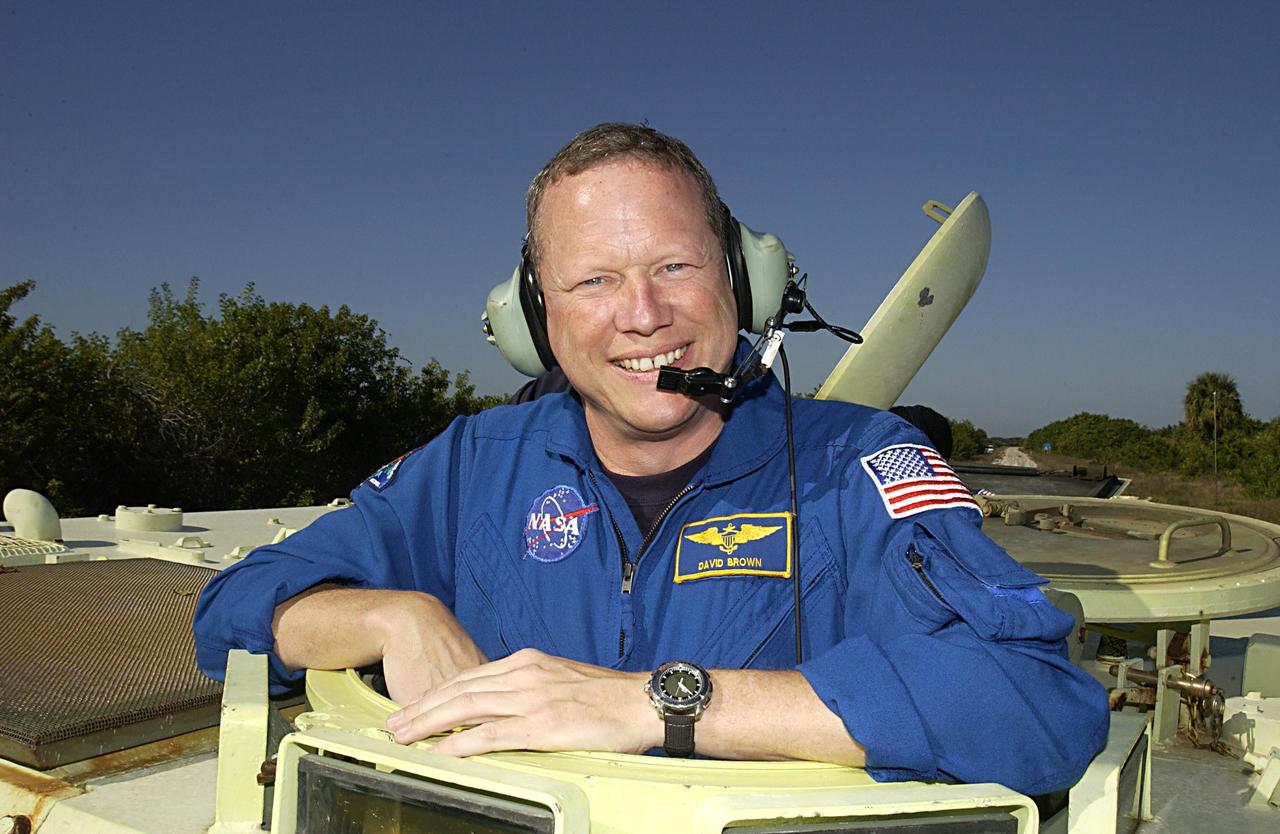
KENNEDY SPACE CENTER, FLA. -- -- STS-107 Mission Specialist David Brown takes a break during training on the operation of an M113 armored personnel carrier during Terminal Countdown Demonstration Test activities, a standard part of launch preparations. STS-107 is a mission devoted to research and will include more than 80 experiments that will study Earth and space science, advanced technology development, and astronaut health and safety. Launch is planned for Jan. 16, 2003, between 10 a.m. and 2 p.m. EST aboard Space Shuttle Columbia.
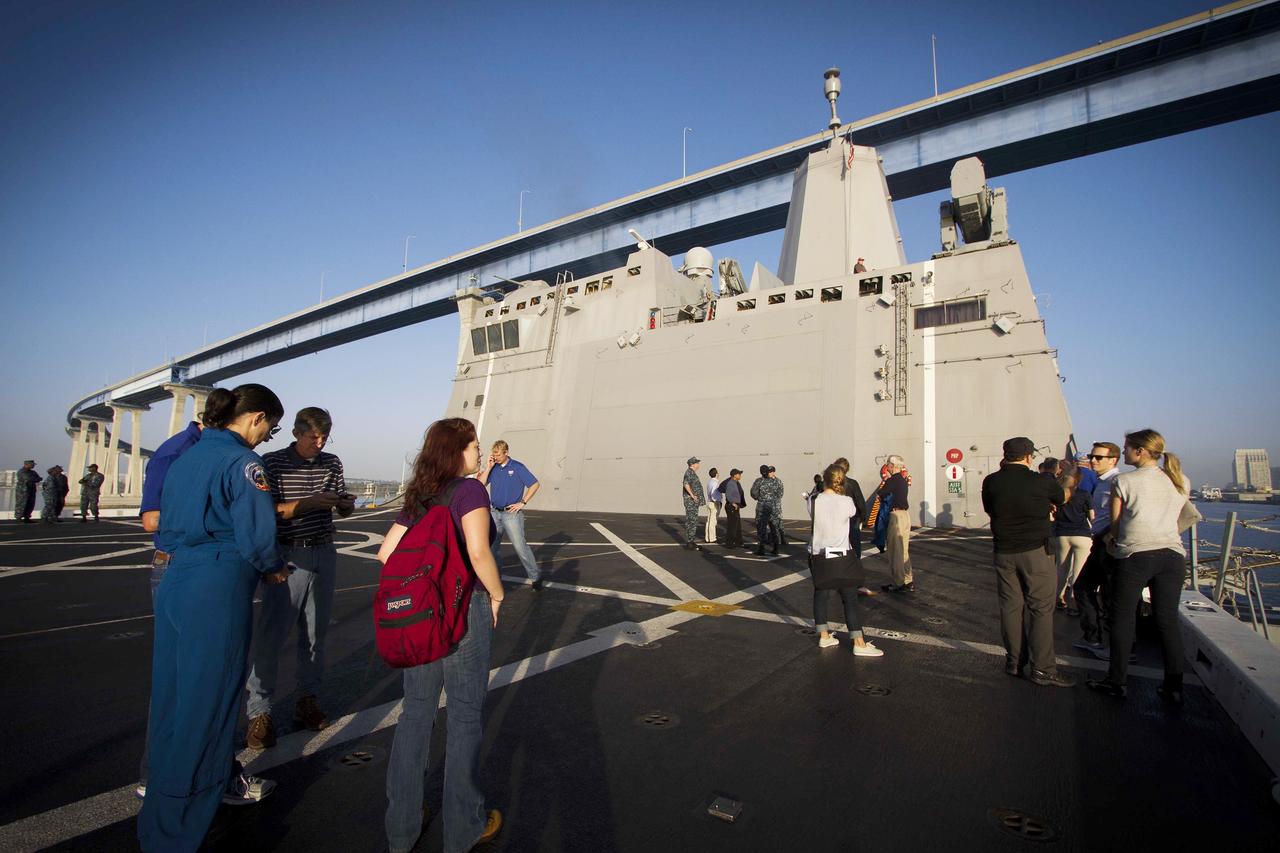
SAN DIEGO, Calif. – NASA, Lockheed Martin and U.S. Navy personnel stand on the deck of the USS Anchorage as the ship departs Naval Base San Diego on the first day of Orion Underway Recovery Test 3. The ship will head out to sea, off the coast of San Diego, in search of conditions to support test needs for a full dress rehearsal of recovery operations. NASA, Lockheed Martin and U.S. Navy personnel will conduct tests in the Pacific Ocean to prepare for recovery of the Orion crew module on its return from a deep space mission. The test will allow the teams to demonstrate and evaluate the recovery processes, procedures, hardware and personnel in open waters. The Ground Systems Development and Operations Program is conducting the underway recovery tests. Orion is the exploration spacecraft designed to carry astronauts to destinations not yet explored by humans, including an asteroid and Mars. It will have emergency abort capability, sustain the crew during space travel and provide safe re-entry from deep space return velocities. The first unpiloted test flight of Orion is scheduled to launch in 2014 atop a United Launch Alliance Delta IV Heavy rocket and in 2018 on NASA’s Space Launch System rocket. For more information, visit http://www.nasa.gov/orion. Photo credit: NASA/Cory Huston
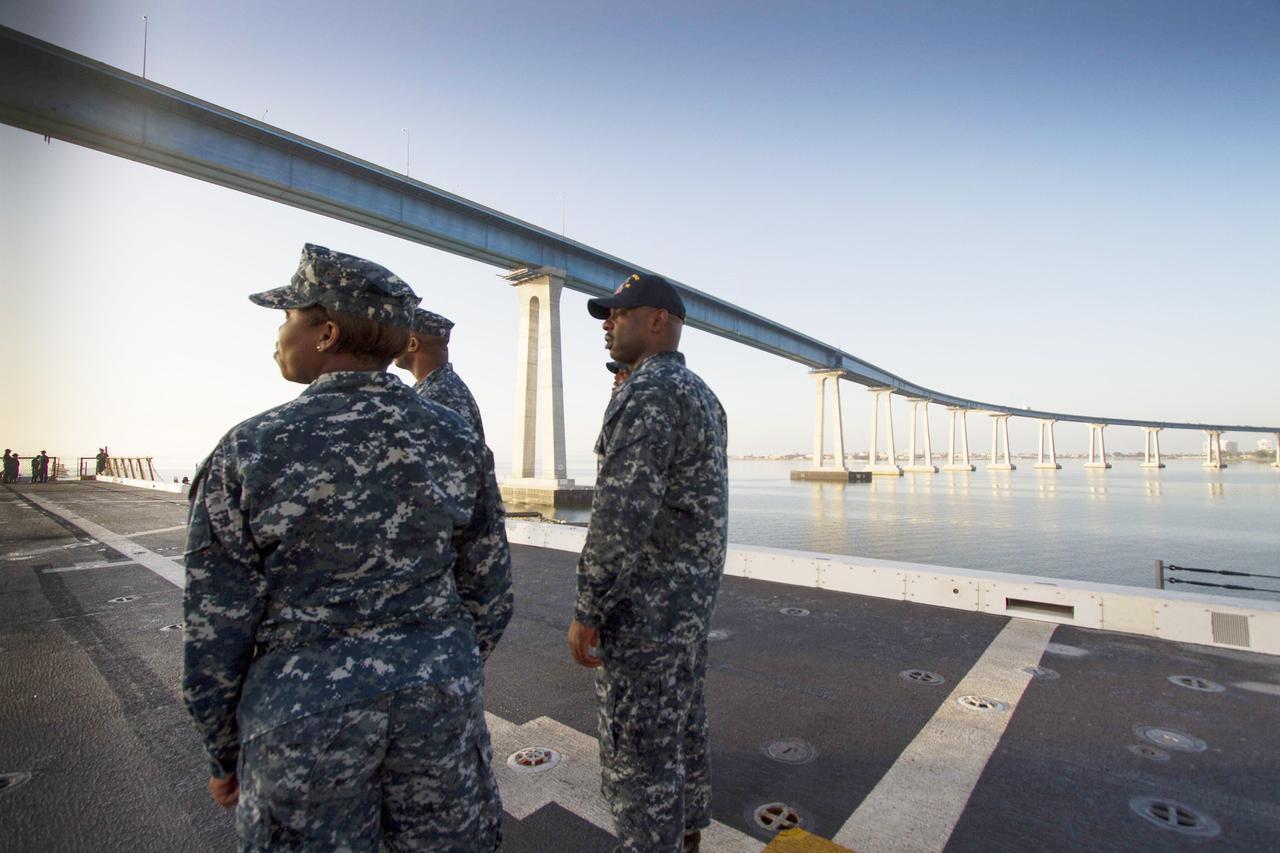
SAN DIEGO, Calif. – U.S. Navy personnel stand on the deck of the USS Anchorage as the ship departs Naval Base San Diego on the first day of Orion Underway Recovery Test 3. The ship will head out to sea, off the coast of San Diego, in search of conditions to support test needs for a full dress rehearsal of recovery operations. NASA, Lockheed Martin and U.S. Navy personnel will conduct tests in the Pacific Ocean to prepare for recovery of the Orion crew module on its return from a deep space mission. The test will allow the teams to demonstrate and evaluate the recovery processes, procedures, hardware and personnel in open waters. The Ground Systems Development and Operations Program is conducting the underway recovery tests. Orion is the exploration spacecraft designed to carry astronauts to destinations not yet explored by humans, including an asteroid and Mars. It will have emergency abort capability, sustain the crew during space travel and provide safe re-entry from deep space return velocities. The first unpiloted test flight of Orion is scheduled to launch in 2014 atop a United Launch Alliance Delta IV Heavy rocket and in 2018 on NASA’s Space Launch System rocket. For more information, visit http://www.nasa.gov/orion. Photo credit: NASA/Cory Huston
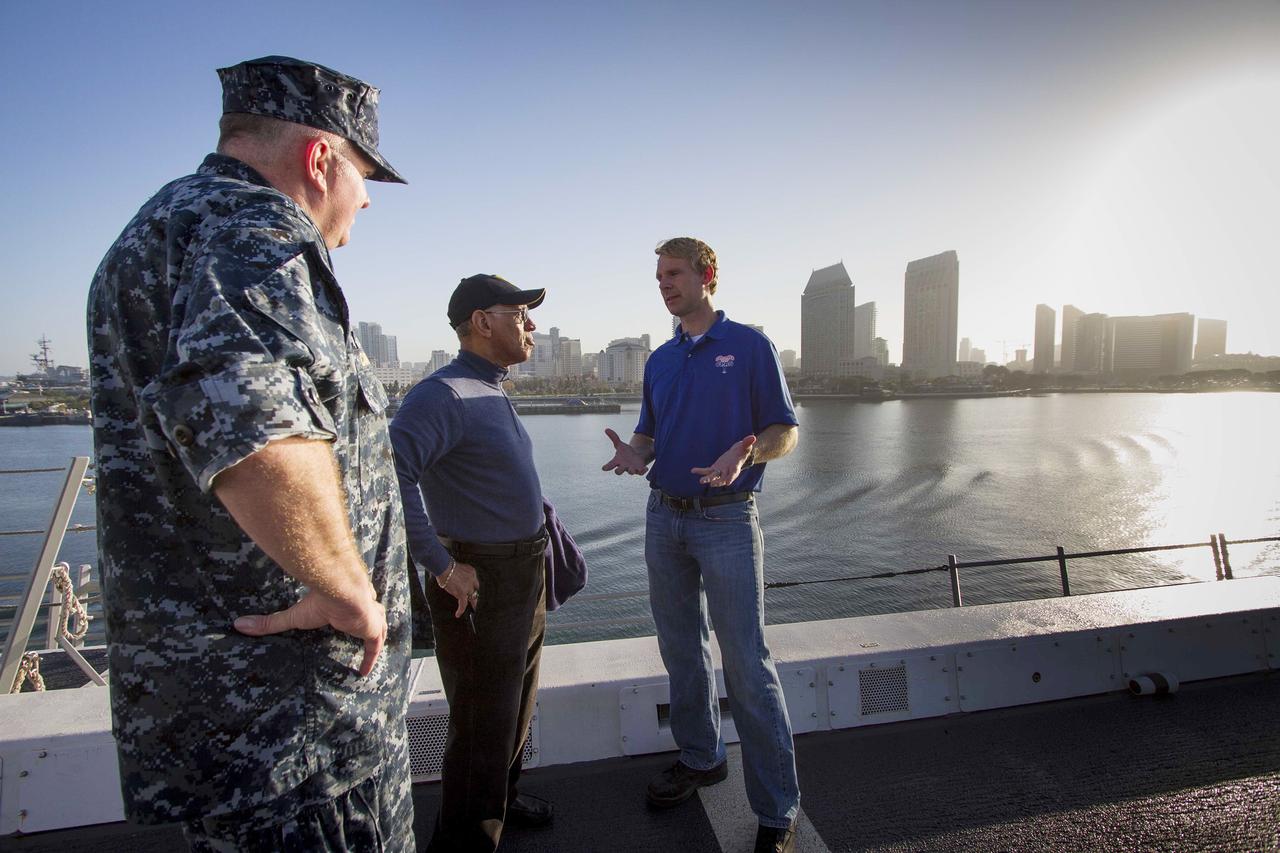
SAN DIEGO, Calif. – NASA Administrator Charlie Bolden, center, talks to NASA and U.S. Navy personnel on the deck of the USS Anchorage as the ship departs Naval Base San Diego on the first day of Orion Underway Recovery Test 3. The ship will head out to sea, off the coast of San Diego, in search of conditions to support test needs for a full dress rehearsal of recovery operations. NASA, Lockheed Martin and U.S. Navy personnel will conduct tests in the Pacific Ocean to prepare for recovery of the Orion crew module on its return from a deep space mission. The test will allow the teams to demonstrate and evaluate the recovery processes, procedures, hardware and personnel in open waters. The Ground Systems Development and Operations Program is conducting the underway recovery tests. Orion is the exploration spacecraft designed to carry astronauts to destinations not yet explored by humans, including an asteroid and Mars. It will have emergency abort capability, sustain the crew during space travel and provide safe re-entry from deep space return velocities. The first unpiloted test flight of Orion is scheduled to launch in 2014 atop a United Launch Alliance Delta IV Heavy rocket and in 2018 on NASA’s Space Launch System rocket. For more information, visit http://www.nasa.gov/orion. Photo credit: NASA/Cory Huston
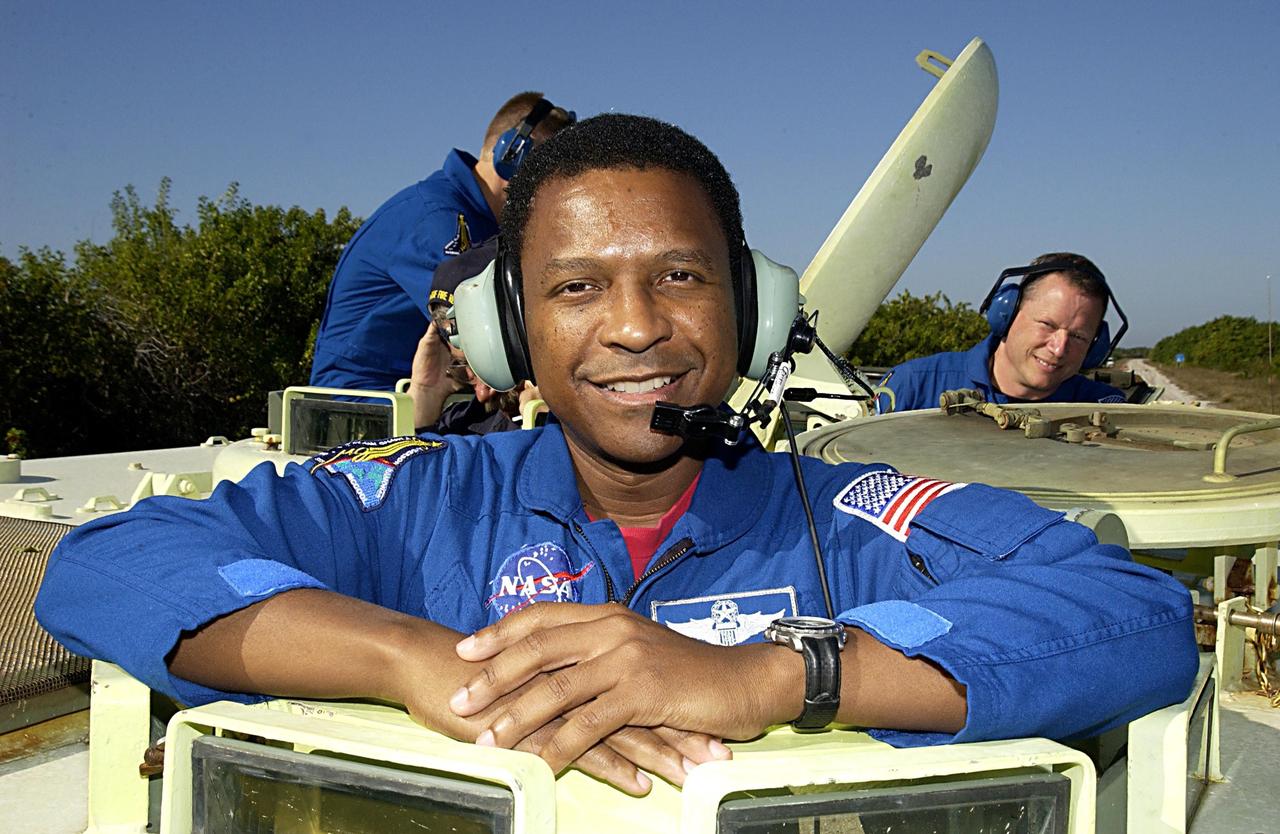
KENNEDY SPACE CENTER, FLA. -- -- STS-107 Payload Commander Michael Anderson takes a break during training on the operation of an M113 armored personnel carrier during Terminal Countdown Demonstration Test activities, a standard part of launch preparations. STS-107 is a mission devoted to research and will include more than 80 experiments that will study Earth and space science, advanced technology development, and astronaut health and safety. Launch is planned for Jan. 16, 2003, between 10 a.m. and 2 p.m. EST aboard Space Shuttle Columbia.
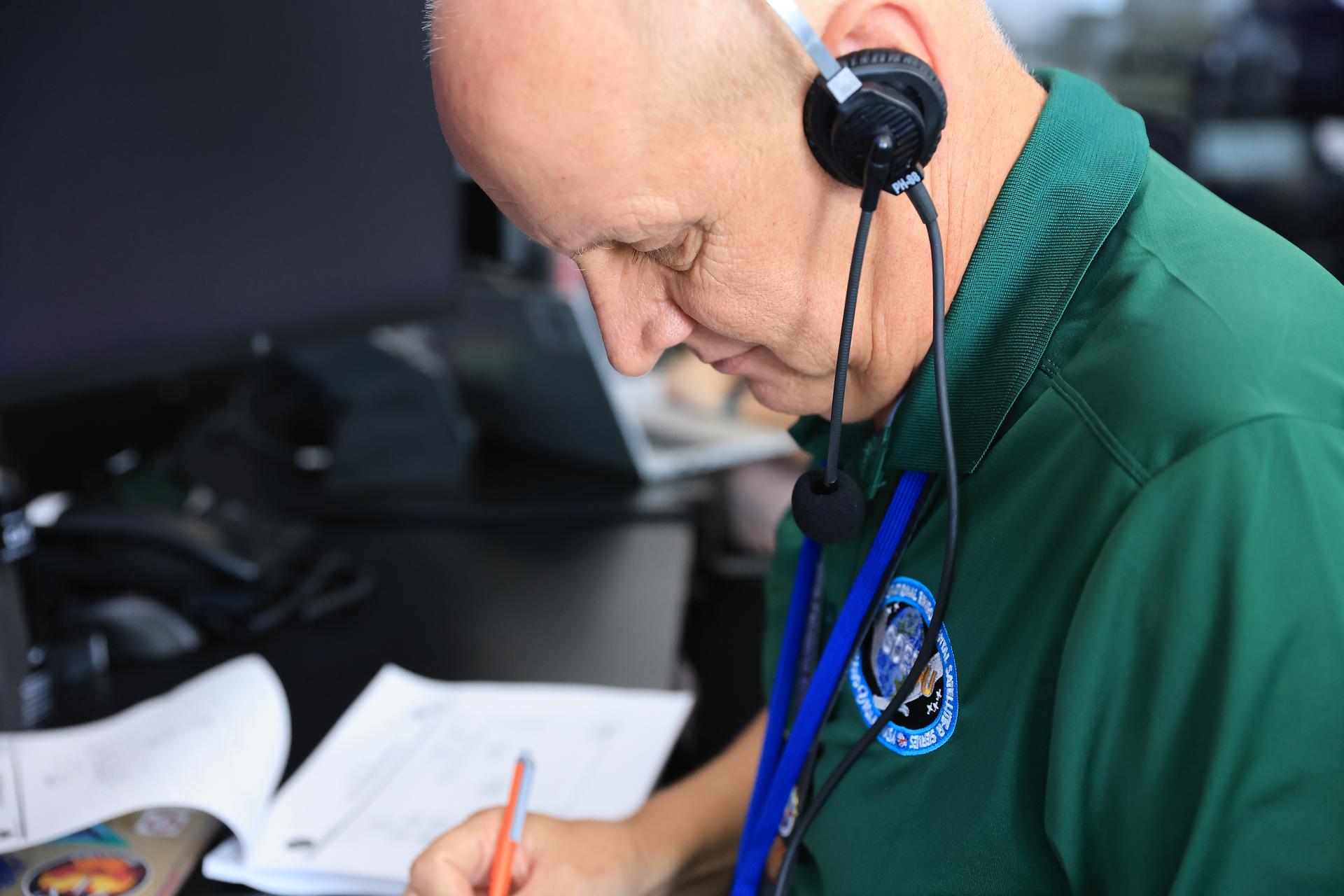
Tim Dunn, a retired senior launch director with NASA’s Launch Services Program, participates in a mission dress rehearsal for NASA’s Nancy Grace Roman Space Telescope on Thursday, Aug. 20, 2026, inside SpaceX’s Hangar X at NASA Kennedy in Florida. Dunn and other specialists served as an assessment team for personnel who ran through a full end-to-end simulation of every major step they will experience on launch day except liftoff, including powering up the spacecraft, fueling the rocket, conducting weather briefings, and other operations.
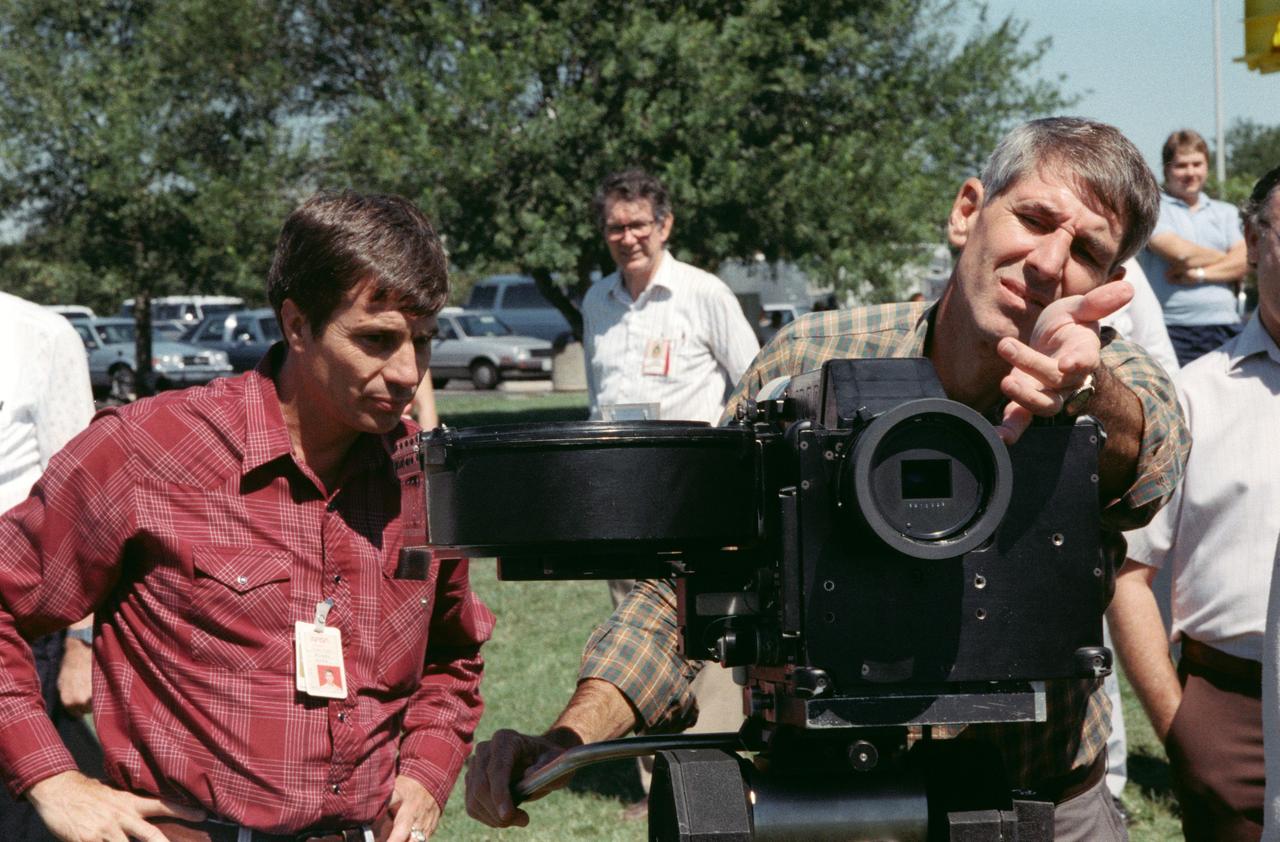
S88-52469 (8 Nov 1988) --- Astronauts John E. Blaha, left, and Robert C. Springer, STS-29 pilot and mission specialist, respectively, get in some training on the operation of one of the payloads for their upcoming spaceflight aboard Discovery. The crew met with Imax personnel on the JSC grounds to practice using the motion-picture camera, making its first post-Challenger trip into space. The payload flew on a number of earlier STS flights.
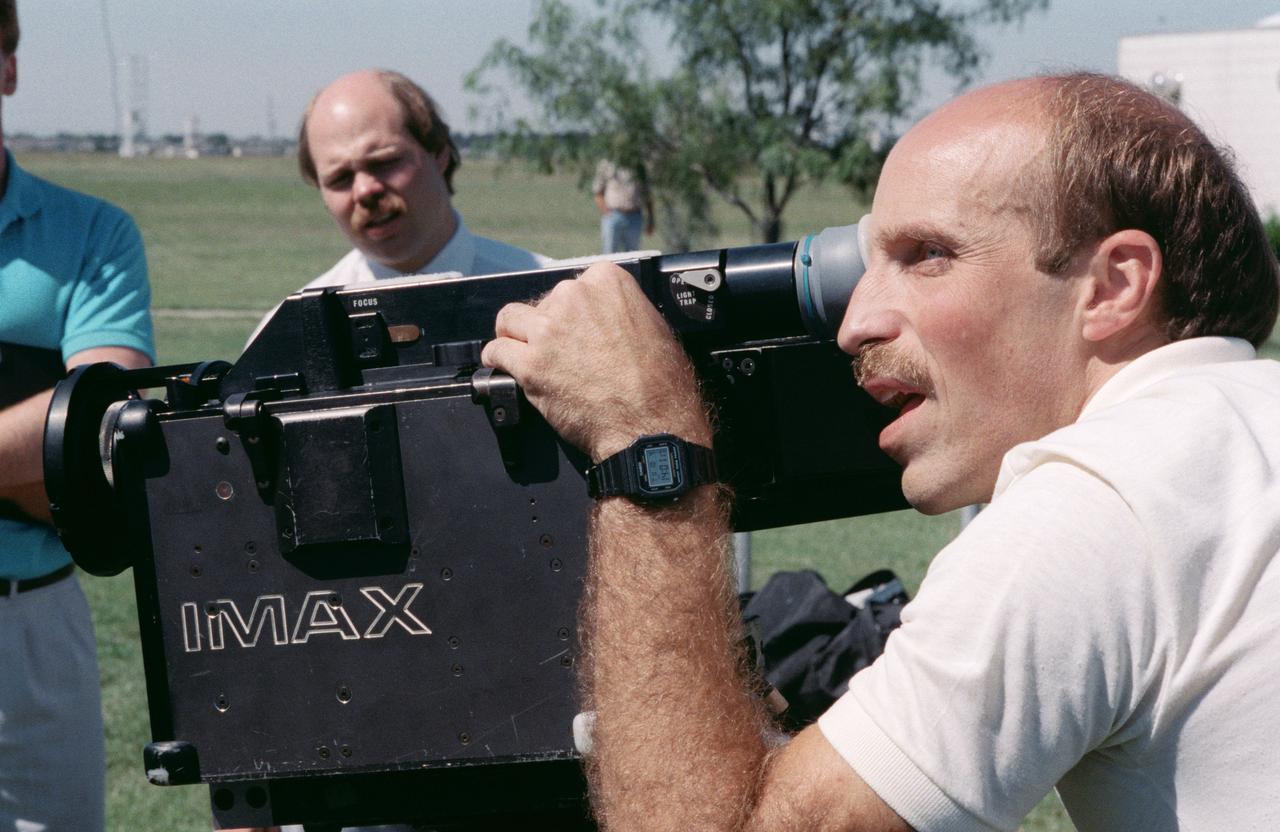
S88-52466 (8 Nov 1988) --- James P. Bagian, STS-29 mission specialist, gets in some training on the operation of one of the payloads for his upcoming spaceflight aboard Discovery. The crew met with Imax personnel, some of whom are pictured here, on the JSC grounds to practice using the motion- picture camera, making its first post-Challenger trip into space. The payload flew on a number of earlier STS flights.
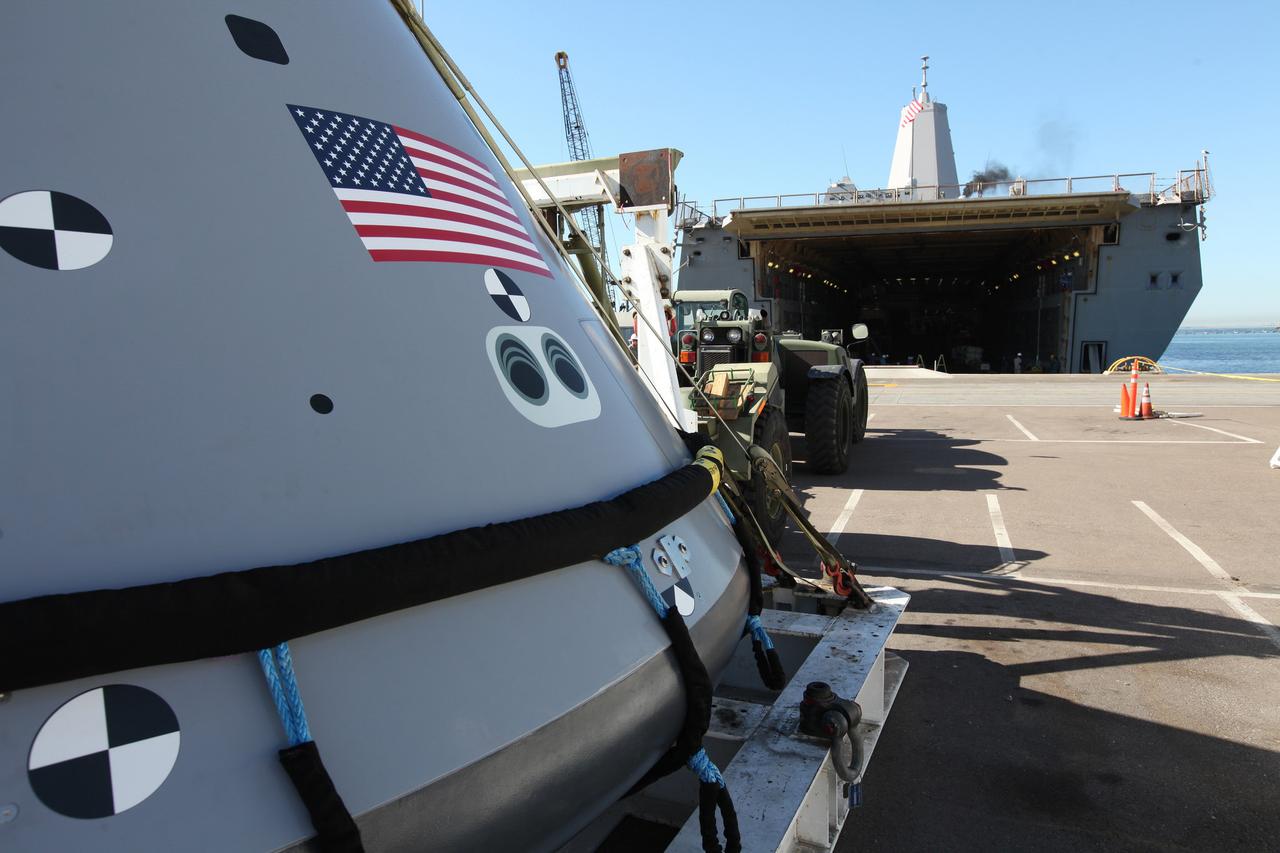
A test version of the Orion crew module seen outside the USS San Diego for Underway Recovery Test 5 on Oct. 27, 2016. NASA's Ground Systems Development and Operations Program and the U.S. Navy will conduct a series of tests using the ship's well deck, the test module, various watercraft and equipment to prepare for recovery of Orion on its return from deep space missions. The test will allow the team to demonstrate and evaluate recovery processes, procedures, hardware and personnel in open waters.
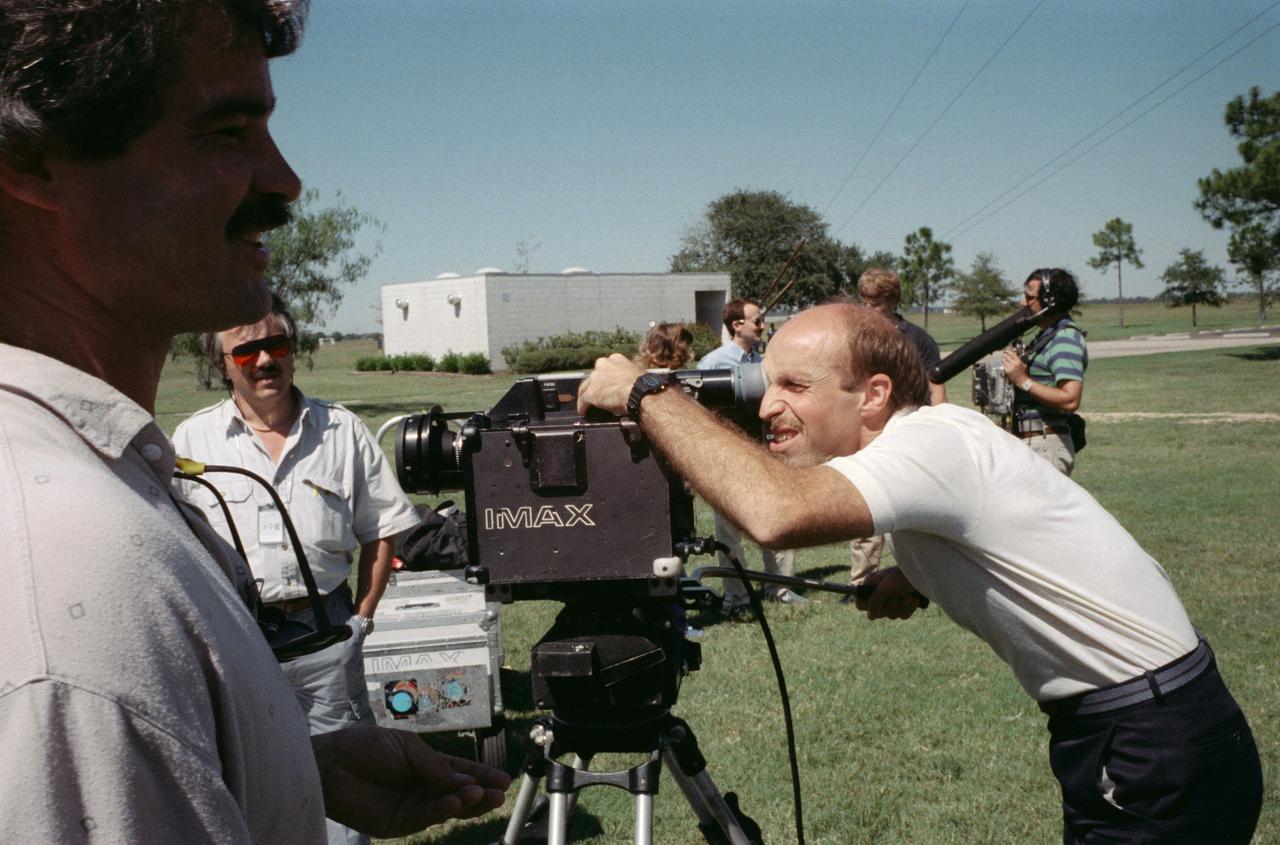
S88-52470 (8 Nov 1988) --- James P. Bagian, STS-29 mission specialist, gets in some training on the operation of one of the payloads for his upcoming spaceflight aboard Discovery. The crew met with Imax personnel, some of whom are pictured here, on the JSC grounds to practice using the motion- picture camera, making its first post-Challenger trip into space. The payload flew on a number of earlier STS flights.
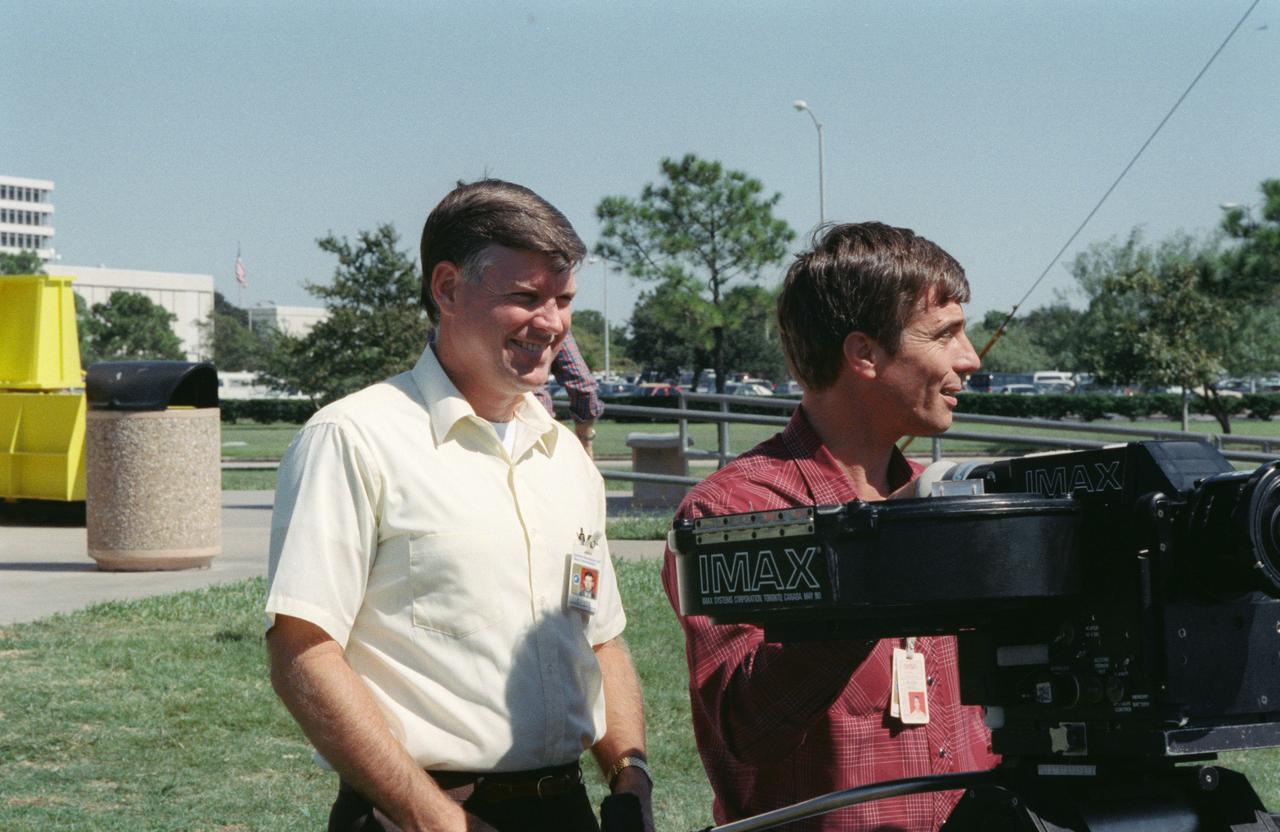
S88-52473 (8 Nov 1988) --- The commander and pilot of NASA's STS-29 mission get some training on the operation of one of the payloads for their upcoming spaceflight aboard Discovery. Astronauts Michael L. Coats, left, and John E. Blaha, along with the three other members of the crew, met with Imax personnel on the JSC grounds to practice using the motion-picture camera, making its first post-Challenger trip into space. The payload flew on a number of earlier STS flights.
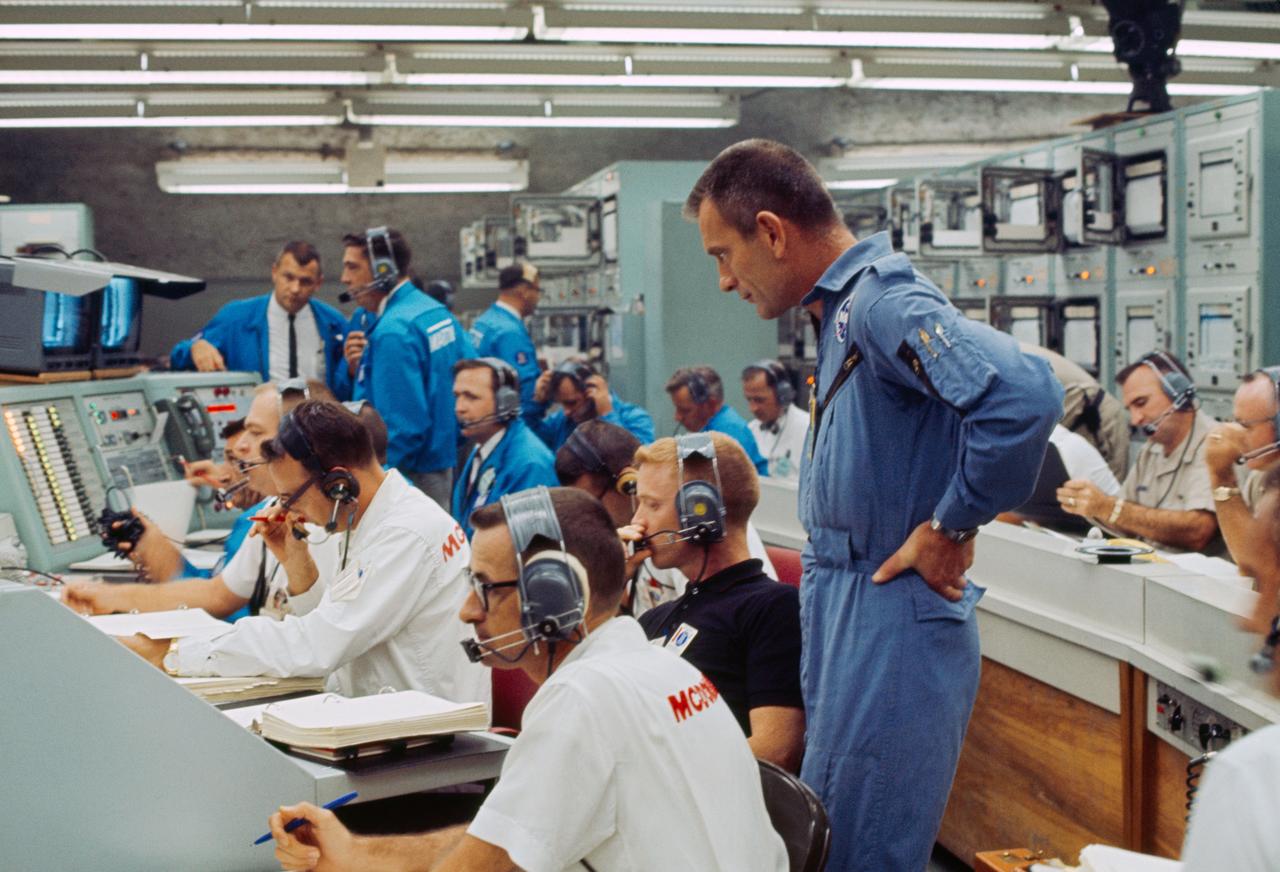
S65-28742 (21 Aug. 1965) --- View of Mission Control Center at Cape Kennedy, Florida, moments after the Gemini-5 spacecraft was launched from Pad 19 on Aug. 21, 1965. Standing at right is astronaut Donald K. Slayton, assistant director for Flight Crew Operations, Manned Spacecraft Center. Seated (wearing dark shirt) is astronaut Russell L. Schweickart. Other NASA and McDonnell Aircraft Col. personnel also monitor the progress of the flight.
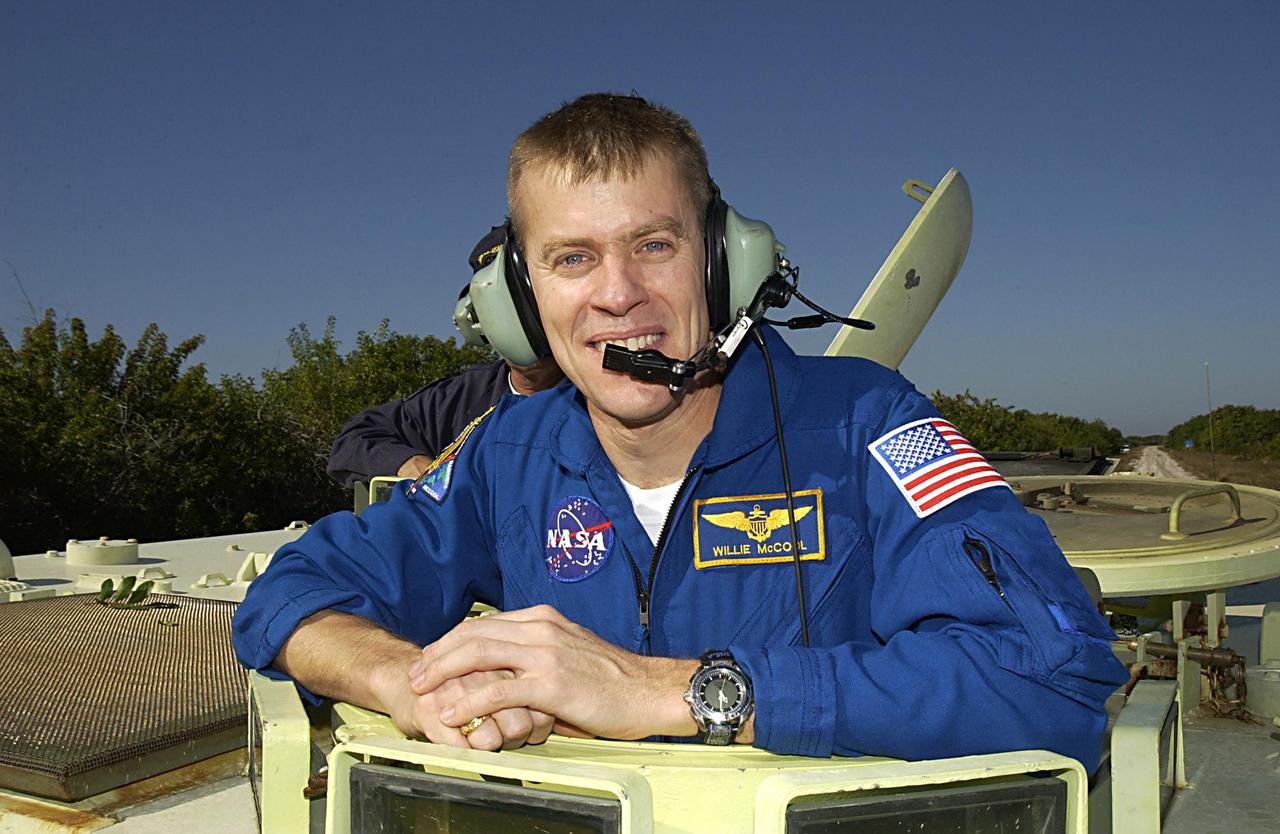
KENNEDY SPACE CENTER, FLA. -- -- STS-107 Pilot William "Willie" McCool takes a break during training on the operation of an M113 armored personnel carrier during Terminal Countdown Demonstration Test activities, a standard part of launch preparations. STS-107 is a mission devoted to research and will include more than 80 experiments that will study Earth and space science, advanced technology development, and astronaut health and safety. Launch is planned for Jan. 16, 2003, between 10 a.m. and 2 p.m. EST aboard Space Shuttle Columbia.
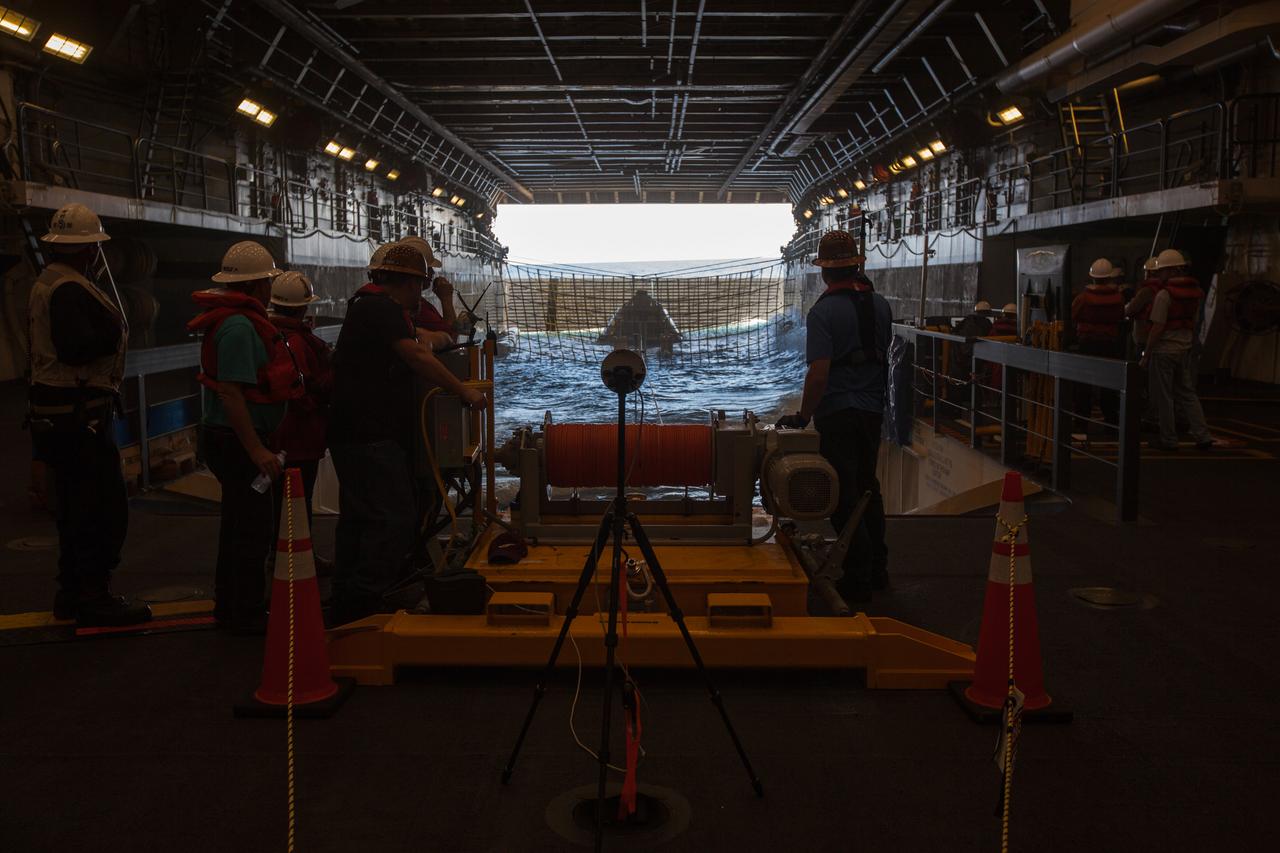
Winch team operators help guide a test version of the Orion crew module in the flooded well deck of the USS San Diego during Underway Recovery Test 5 in the Pacific Ocean off the coast of California on Oct. 29, 2016. NASA's Ground Systems Development and Operations Program and the U.S. Navy are conducting a series of tests using the ship's well deck, the test module, various watercraft and equipment to prepare for recovery of Orion on its return from deep space missions. The testing will allow the team to demonstrate and evaluate recovery processes, procedures, hardware and personnel in open waters. Part of Batch images transfer from Flickr.
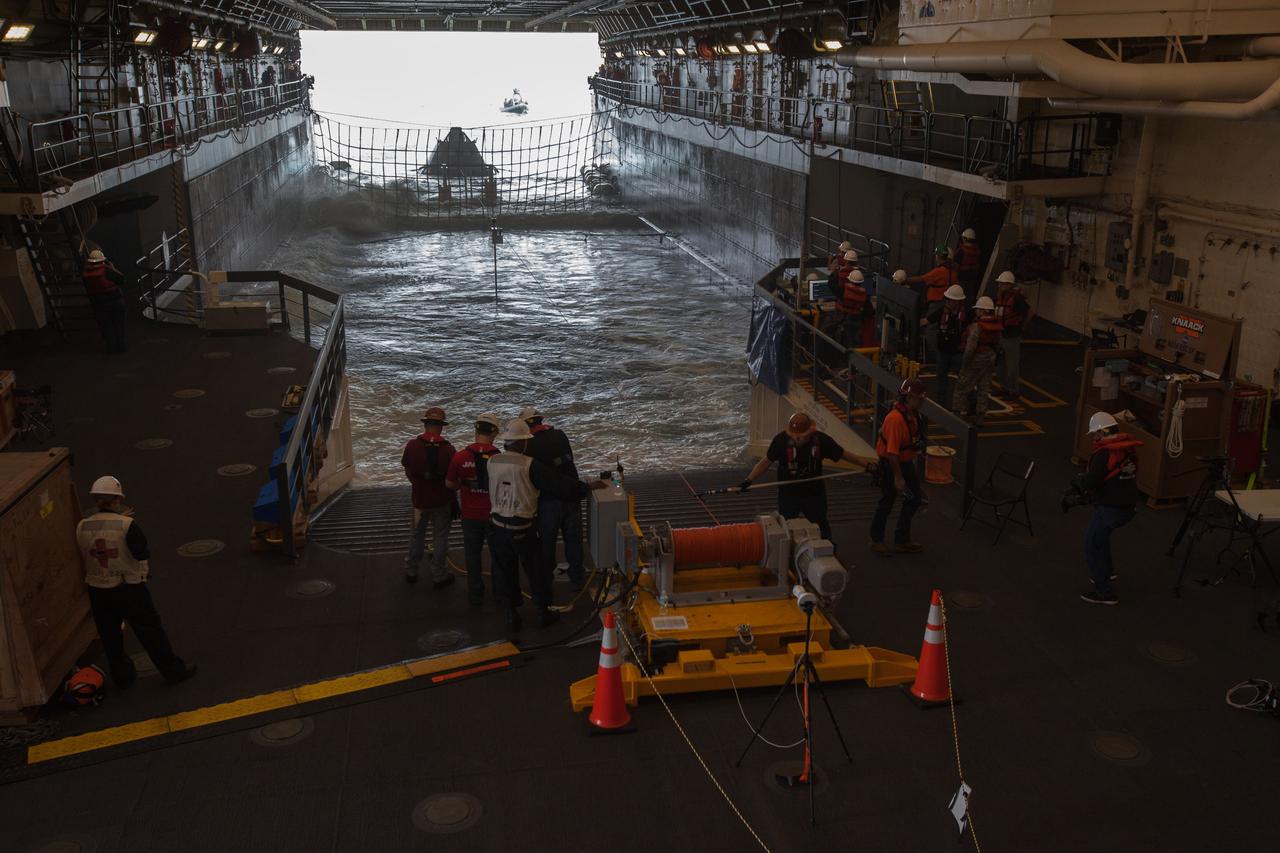
Winch team operators help guide a test version of the Orion crew module into the flooded well deck of the USS San Diego during Underway Recovery Test 5 in the Pacific Ocean off the coast of California on Oct. 30, 2016. NASA's Ground Systems Development and Operations Program and the U.S. Navy are conducting a series of tests using the ship's well deck, the test module, various watercraft and equipment to prepare for recovery of Orion on its return from deep space missions. The testing will allow the team to demonstrate and evaluate recovery processes, procedures, hardware and personnel in open waters. Part of Batch images transfer from Flickr.
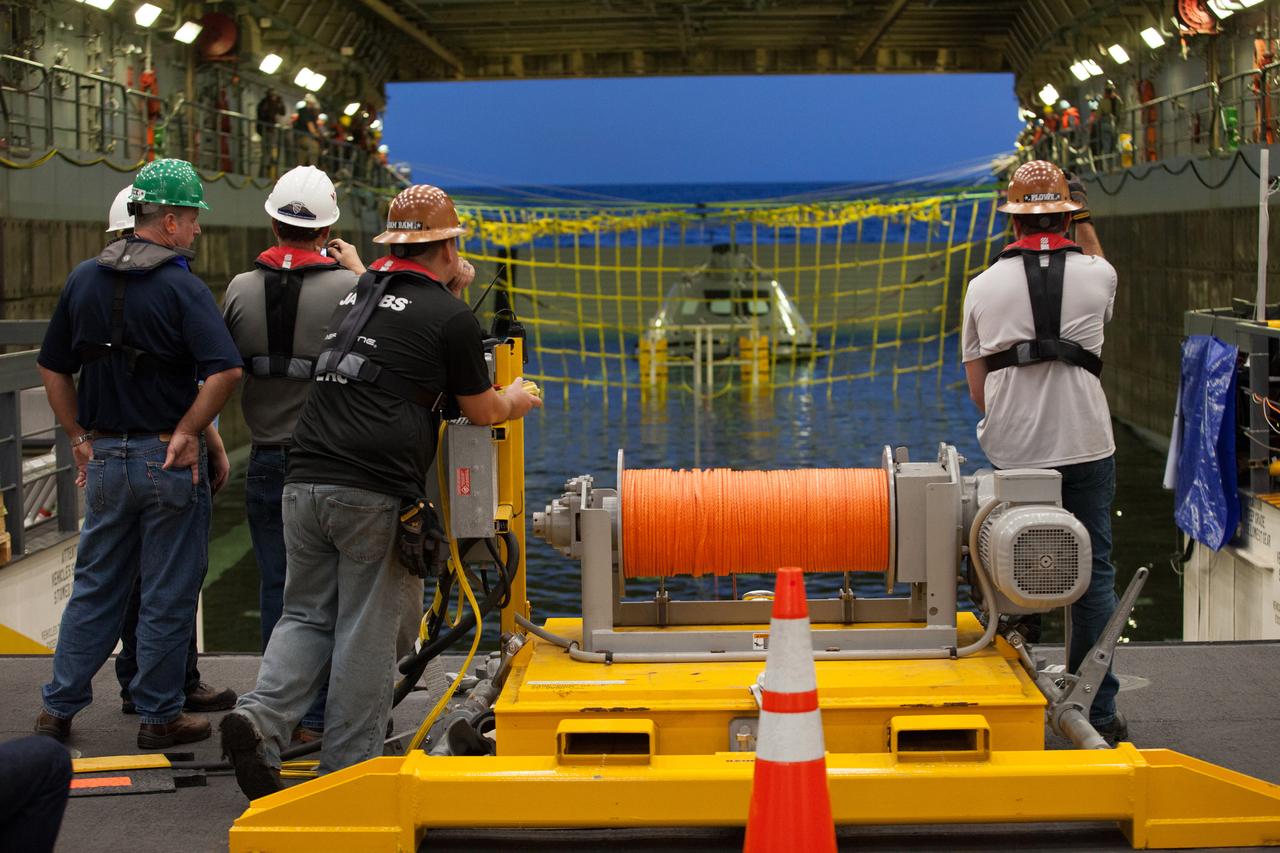
Winch operations team members watch as a test version of the Orion crew module is secured in the flooded well deck of the USS San Diego for the start of Underway Recovery Test 5 in the Pacific Ocean off the coast of California. NASA's Ground Systems Development and Operations Program and the U.S. Navy are conducting a series of tests to prepare for recovery of Orion on its return from deep space missions. The testing will allow the team to demonstrate and evaluate recovery processes, procedures, hardware and personnel in open waters. Part of Batch images transfer from Flickr.
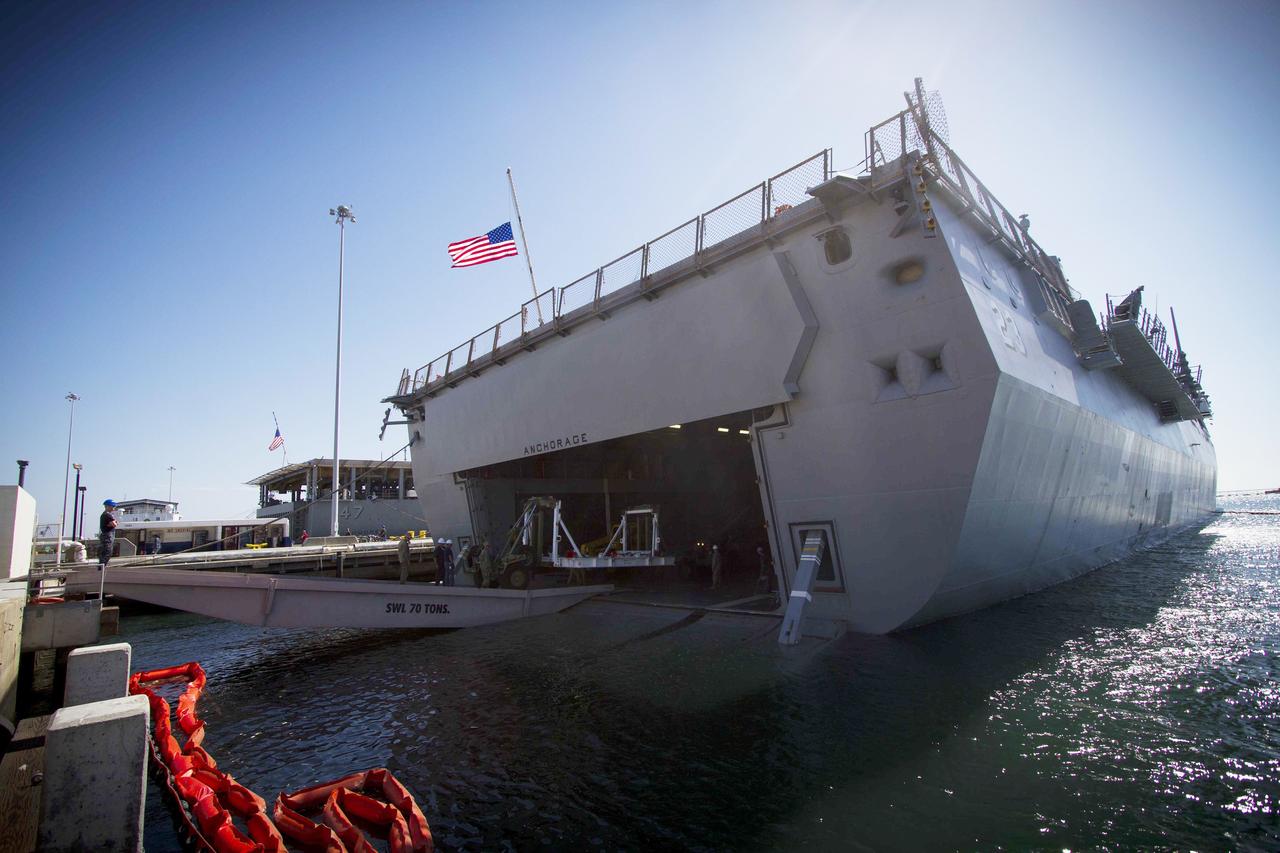
SAN DIEGO, Calif. – The USS Anchorage is docked at Naval Base San Diego during loading operations in its well deck for Orion Underway Recovery Test 3. The ship will head out to sea, off the coast of San Diego, in search of conditions to support test needs for a full dress rehearsal of recovery operations. NASA, Lockheed Martin and U.S. Navy personnel will conduct tests in the Pacific Ocean to prepare for recovery of the Orion crew module on its return from a deep space mission. The test will allow the teams to demonstrate and evaluate the recovery processes, procedures, new hardware and personnel in open waters. The Ground Systems Development and Operations Program is conducting the underway recovery tests. Orion is the exploration spacecraft designed to carry astronauts to destinations not yet explored by humans, including an asteroid and Mars. It will have emergency abort capability, sustain the crew during space travel and provide safe re-entry from deep space return velocities. The first unpiloted test flight of Orion is scheduled to launch in 2014 atop a United Launch Alliance Delta IV Heavy rocket and in 2018 on NASA’s Space Launch System rocket. For more information, visit http://www.nasa.gov/orion. Photo credit: NASA/Cory Huston
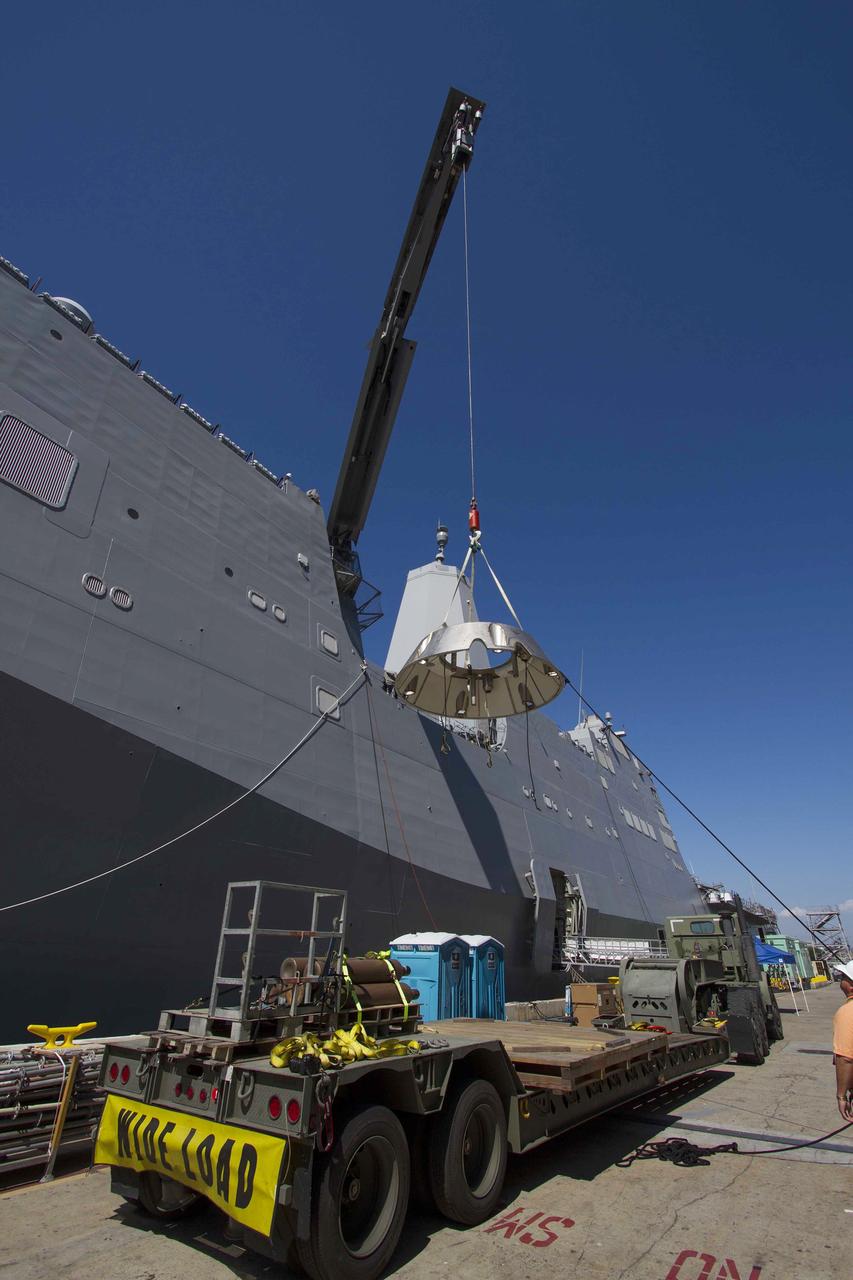
SAN DIEGO, Calif. – The USS Anchorage is docked at Naval Base San Diego during loading operations in its well deck for Orion Underway Recovery Test 3. A crane is used to lift the Orion forward bay cover for loading on the ship. The ship will head out to sea, off the coast of San Diego, in search of conditions to support test needs for a full dress rehearsal of recovery operations. NASA, Lockheed Martin and U.S. Navy personnel will conduct tests in the Pacific Ocean to prepare for recovery of the Orion crew module on its return from a deep space mission. The test will allow the teams to demonstrate and evaluate the recovery processes, procedures, new hardware and personnel in open waters. The Ground Systems Development and Operations Program is conducting the underway recovery tests. Orion is the exploration spacecraft designed to carry astronauts to destinations not yet explored by humans, including an asteroid and Mars. It will have emergency abort capability, sustain the crew during space travel and provide safe re-entry from deep space return velocities. The first unpiloted test flight of Orion is scheduled to launch in 2014 atop a United Launch Alliance Delta IV Heavy rocket and in 2018 on NASA’s Space Launch System rocket. For more information, visit http://www.nasa.gov/orion. Photo credit: NASA/Cory Huston
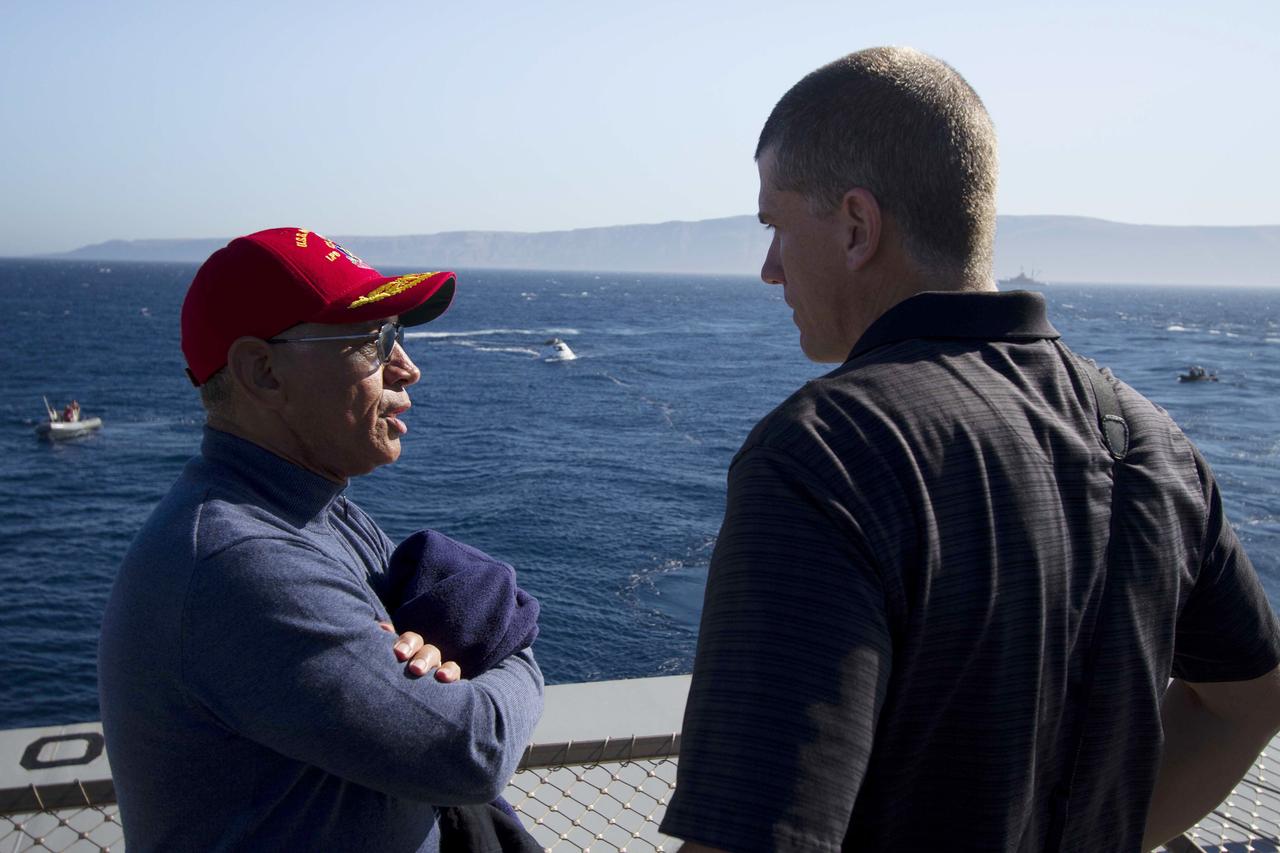
SAN DIEGO, Calif. – NASA Administrator Charlie Bolden, at left, talks to Jeremy Graeber, NASA Recovery director for Exploration Flight Test-1 Landing and Recovery Operations, on the deck of the USS Anchorage during Orion Underway Recovery Test 3. The Orion boilerplate test vehicle is in the Pacific Ocean with U.S. Navy divers nearby in Zodiac boats and rigid hull inflatable boats during recovery operations. NASA, Lockheed Martin and U.S. Navy personnel are conducting the test to prepare for recovery of the Orion crew module on its return from a deep space mission. The test will allow the teams to demonstrate and evaluate the recovery processes, procedures, hardware and personnel in open waters. The Ground Systems Development and Operations Program is conducting the underway recovery tests. Orion is the exploration spacecraft designed to carry astronauts to destinations not yet explored by humans, including an asteroid and Mars. It will have emergency abort capability, sustain the crew during space travel and provide safe re-entry from deep space return velocities. The first unpiloted test flight of Orion is scheduled to launch in 2014 atop a United Launch Alliance Delta IV Heavy rocket and in 2018 on NASA’s Space Launch System rocket. For more information, visit http://www.nasa.gov/orion. Photo credit: NASA/Cory Huston
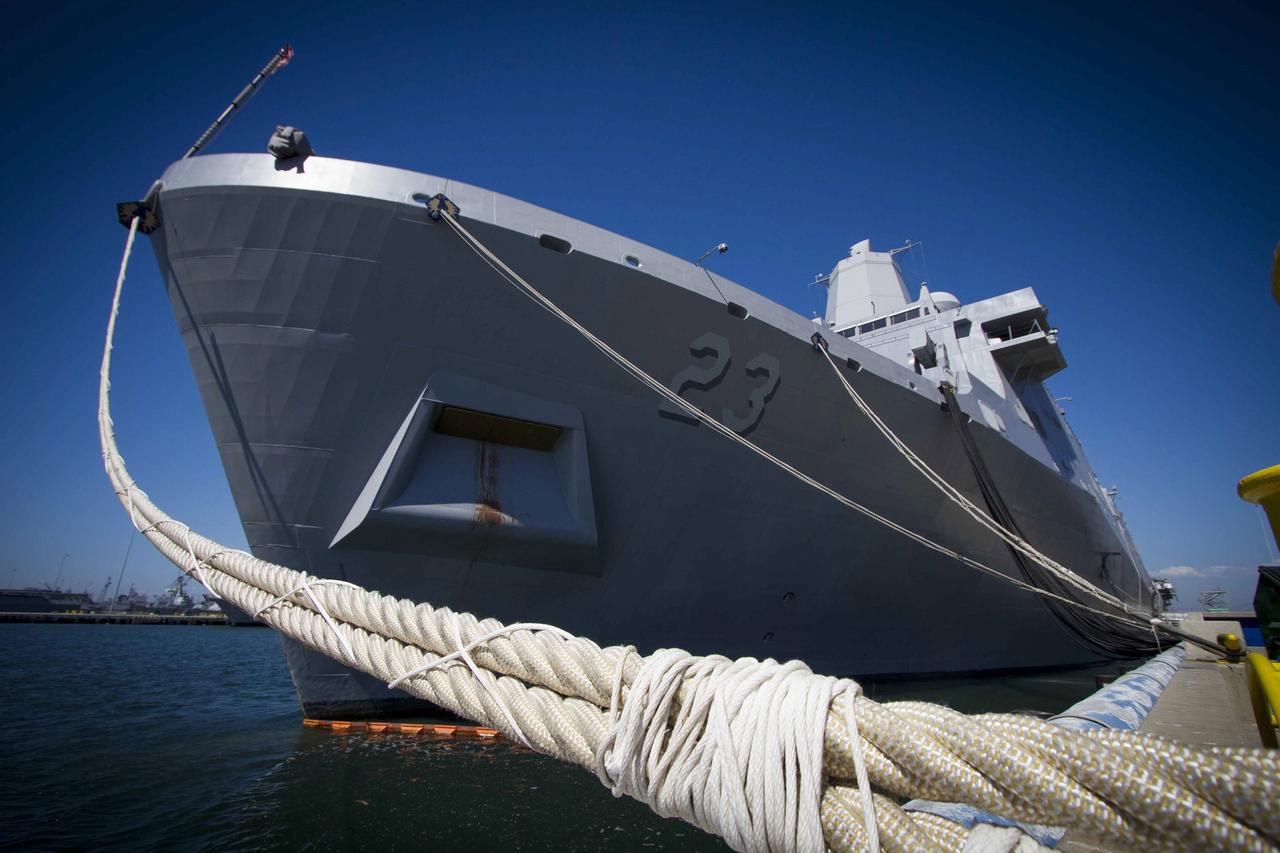
SAN DIEGO, Calif. – The USS Anchorage is docked at Naval Base San Diego during loading operations in its well deck for Orion Underway Recovery Test 3. The ship will head out to sea, off the coast of San Diego, in search of conditions to support test needs for a full dress rehearsal of recovery operations. NASA, Lockheed Martin and U.S. Navy personnel will conduct tests in the Pacific Ocean to prepare for recovery of the Orion crew module on its return from a deep space mission. The test will allow the teams to demonstrate and evaluate the recovery processes, procedures, new hardware and personnel in open waters. The Ground Systems Development and Operations Program is conducting the underway recovery tests. Orion is the exploration spacecraft designed to carry astronauts to destinations not yet explored by humans, including an asteroid and Mars. It will have emergency abort capability, sustain the crew during space travel and provide safe re-entry from deep space return velocities. The first unpiloted test flight of Orion is scheduled to launch in 2014 atop a United Launch Alliance Delta IV Heavy rocket and in 2018 on NASA’s Space Launch System rocket. For more information, visit http://www.nasa.gov/orion. Photo credit: NASA/Cory Huston
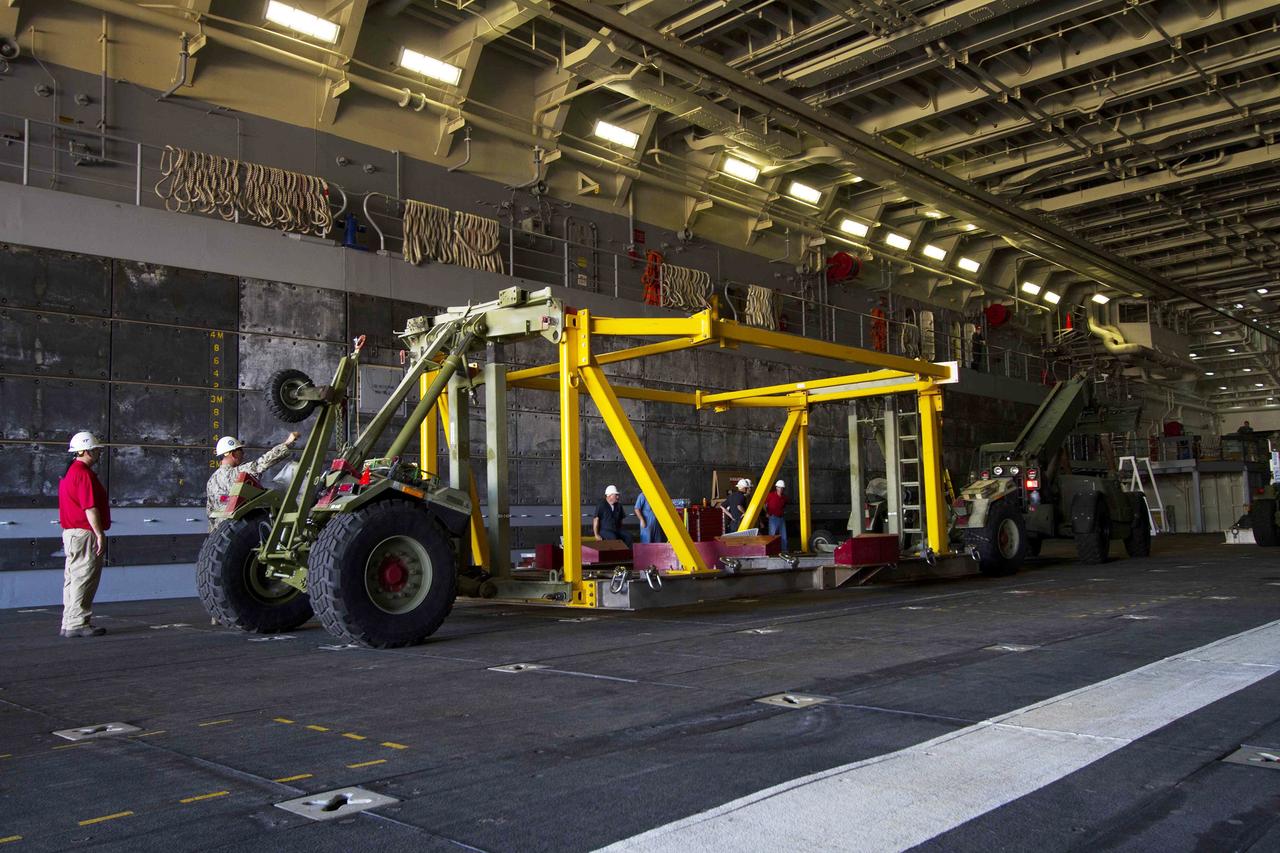
SAN DIEGO, Calif. – The USS Anchorage is docked at Naval Base San Diego during loading operations in its well deck for Orion Underway Recovery Test 3. The ship will head out to sea, off the coast of San Diego, in search of conditions to support test needs for a full dress rehearsal of recovery operations. NASA, Lockheed Martin and U.S. Navy personnel will conduct tests in the Pacific Ocean to prepare for recovery of the Orion crew module on its return from a deep space mission. The test will allow the teams to demonstrate and evaluate the recovery processes, procedures, new hardware and personnel in open waters. The Ground Systems Development and Operations Program is conducting the underway recovery tests. Orion is the exploration spacecraft designed to carry astronauts to destinations not yet explored by humans, including an asteroid and Mars. It will have emergency abort capability, sustain the crew during space travel and provide safe re-entry from deep space return velocities. The first unpiloted test flight of Orion is scheduled to launch in 2014 atop a United Launch Alliance Delta IV Heavy rocket and in 2018 on NASA’s Space Launch System rocket. For more information, visit http://www.nasa.gov/orion. Photo credit: NASA/Cory Huston

The Orion boilerplate test vehicle is in the water-filled well deck of the USS Anchorage during the first day of Underway Recovery Test 3 in the Pacific Ocean. NASA, Lockheed Martin and U.S. Navy personnel are conducting the recovery test to prepare for recovery of the Orion crew module on its return from a deep space mission. The test allows the teams to demonstrate and evaluate the recovery processes, procedures, hardware and personnel in open waters. The Ground Systems Development and Operations Program is conducting the underway recovery tests. Orion is the exploration spacecraft designed to carry astronauts to destinations not yet explored by humans, including an asteroid and Mars. It will have emergency abort capability, sustain the crew during space travel and provide safe re-entry from deep space return velocities. The first unpiloted test flight of Orion is scheduled to launch in 2014 atop a United Launch Alliance Delta IV Heavy rocket and in 2018 on NASA’s Space Launch System rocket.
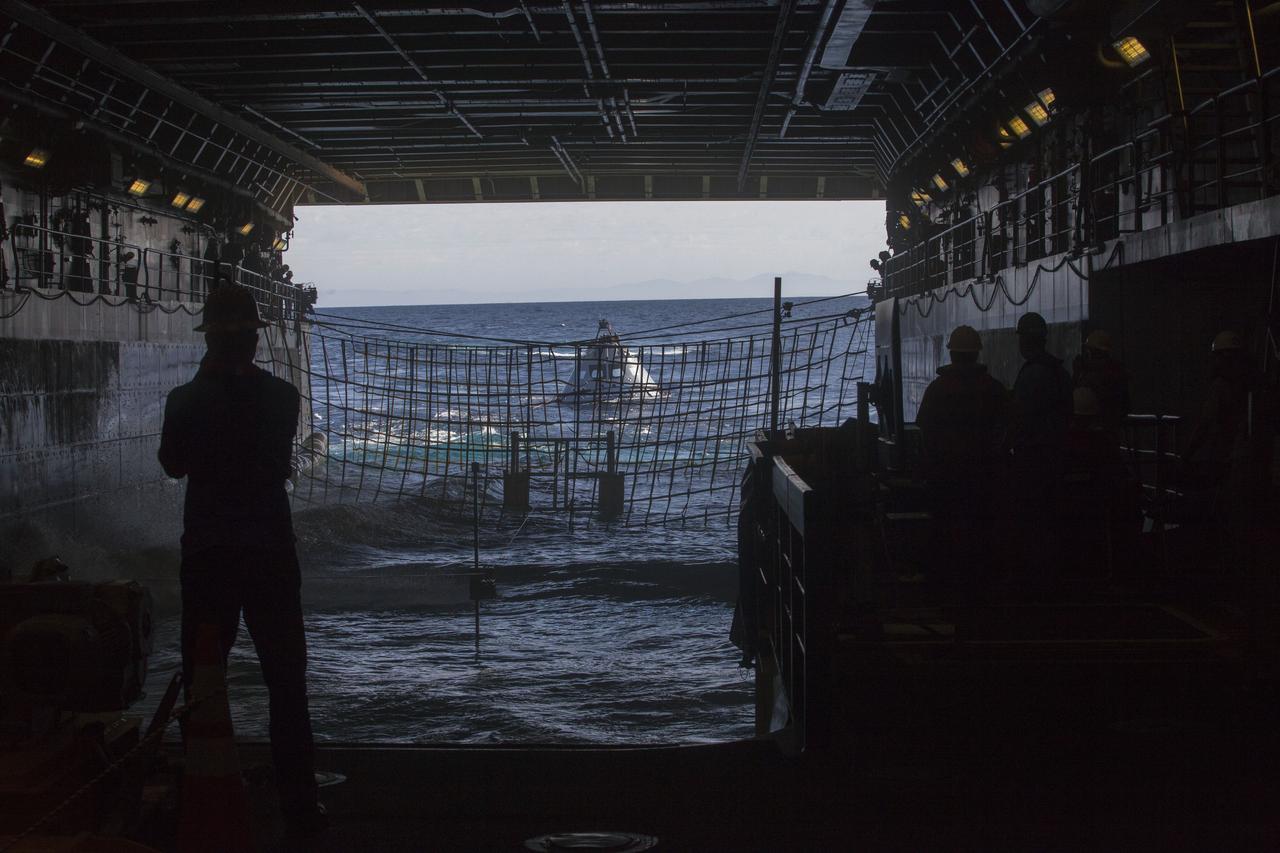
A test version of the Orion crew module floats outside the well deck of the USS San Diego during Underway Recovery Test 5 in the Pacific Ocean off the coast of California. NASA's Ground Systems Development and Operations Program and the U.S. Navy are conducting a series of tests using the ship's well deck, several watercraft, support equipment and personnel to prepare for recovery of Orion on its return from deep space missions. The testing will allow the team to demonstrate and evaluate recovery processes, procedures, hardware and personnel in open waters. Orion is the exploration spacecraft designed to carry astronauts to destinations not yet explored by humans, including an asteroid and NASA's Journey to Mars. It will have emergency abort capability, sustain the crew during space travel and provide safe re-entry from deep space return velocities. Orion is scheduled to launch on NASA's Space Launch System in late 2018. For more information, visit http://www.nasa.gov/orion.
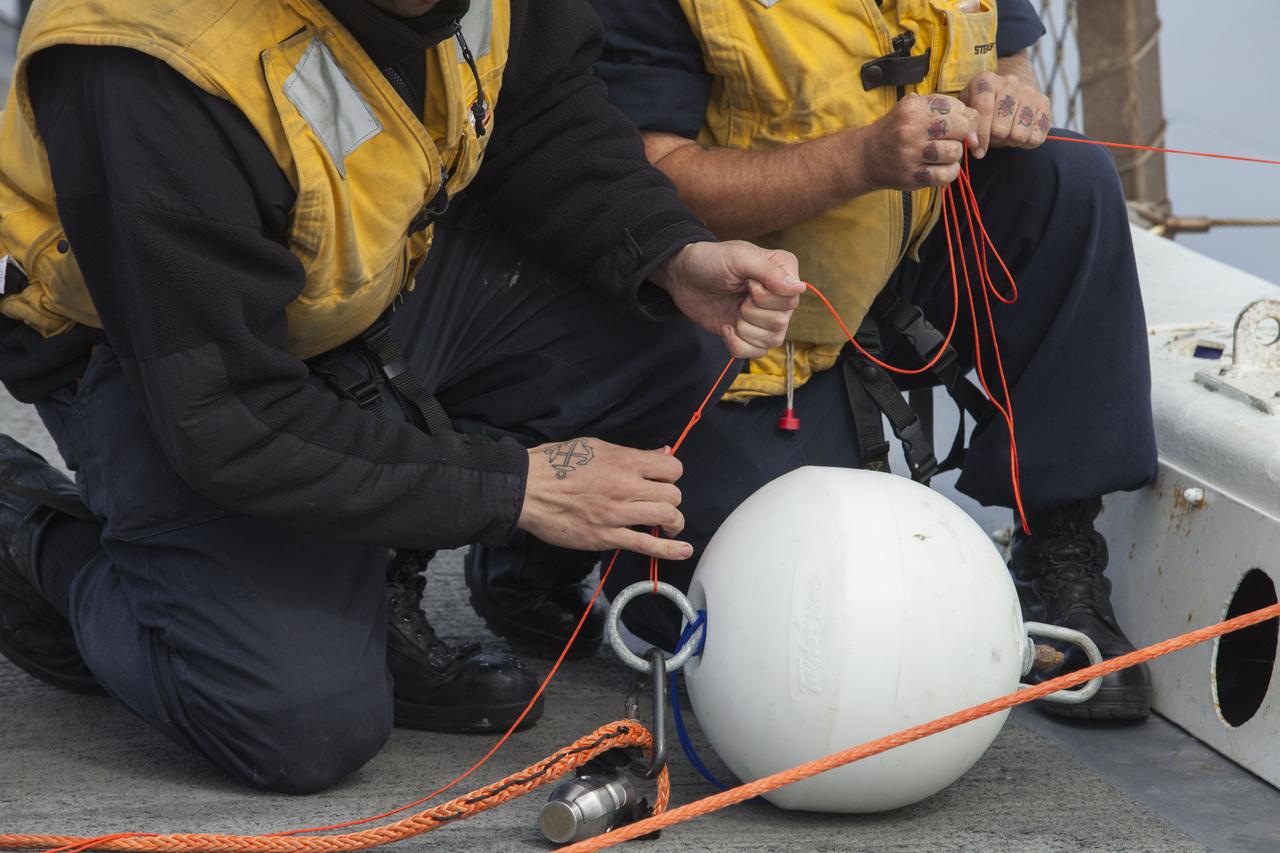
U.S. Navy personnel check tether and winch lines on the deck of the USS San Diego to prepare for Underway Recovery Test 5 in the Pacific Ocean off the coast of California. NASA's Ground Systems Development and Operations Program and the U.S. Navy are conducting a series of tests using the ship's well deck, a test version of the Orion crew module, various watercraft and equipment to prepare for recovery of Orion on its return from deep space missions. The testing will allow the team to demonstrate and evaluate recovery processes, procedures, hardware and personnel in open waters. Orion is the exploration spacecraft designed to carry astronauts to destinations not yet explored by humans, including an asteroid and NASA's Journey to Mars. It will have emergency abort capability, sustain the crew during space travel and provide safe re-entry from deep space return velocities. Orion is scheduled to launch on NASA's Space Launch System in late 2018. For more information, visit http://www.nasa.gov/orion.
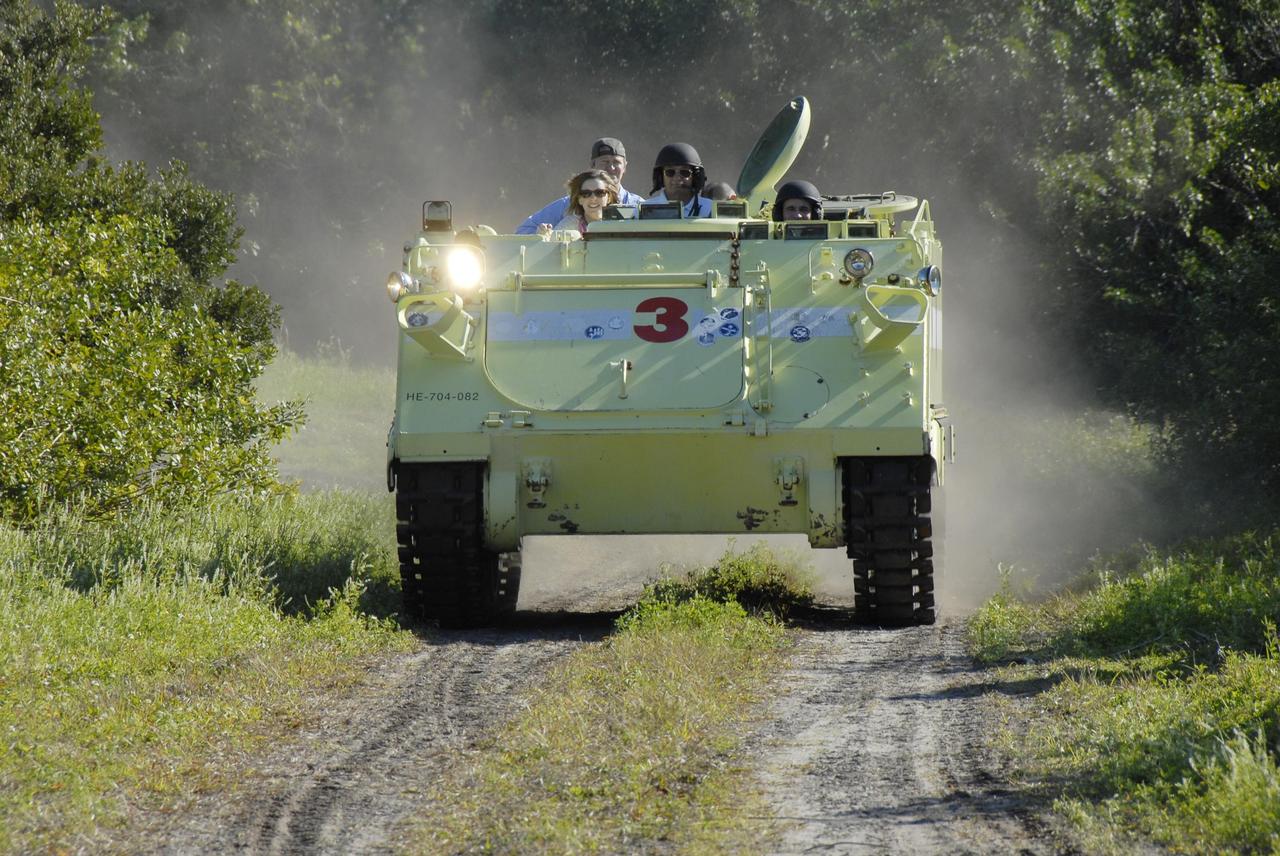
KENNEDY SPACE CENTER, FLA. -- At Launch Complex 39, members of the STS-117 crew are instructed in the operation of an M-113 armored personnel carrier by the astronaut rescue team. The astronauts on the STS-117 crew are participating in M-113 armored personnel carrier training during Terminal Countdown Demonstration Test (TCDT) activities, a dress rehearsal for their launch, targeted for March 15. The M-113 could be used to move the crew away from the launch pad quickly in the event of an emergency. The TCDT also includes pad emergency egress training and a simulated launch countdown. The mission payload aboard Space Shuttle Atlantis is the S3/S4 integrated truss structure, along with a third set of solar arrays and batteries. The crew of six astronauts will install the truss to continue assembly of the station. Photo credit: NASA/Kim Shiflett
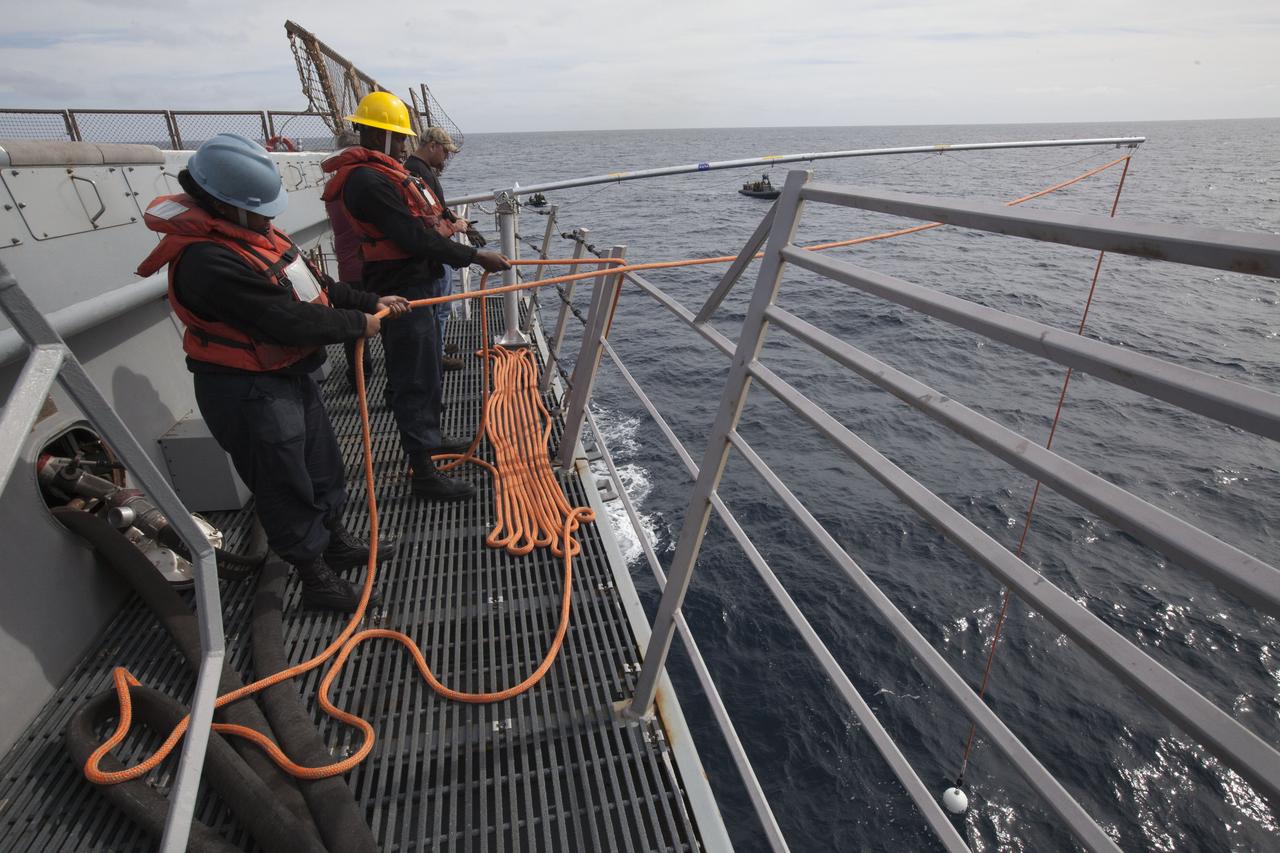
U.S. Navy personnel check tether lines and a winch line on the deck of the USS San Diego in the Pacific Ocean off the coast of California. NASA's Ground Systems Development and Operations Program and the U.S. Navy are conducting a series of tests, called Underway Recovery Test 5, using the ship's well deck and a test version of the Orion crew module to prepare for recovery of Orion on its return from deep space missions. The testing will allow the team to demonstrate and evaluate recovery processes, procedures, hardware and personnel in open waters. Orion is the exploration spacecraft designed to carry astronauts to destinations not yet explored by humans, including an asteroid and NASA's Journey to Mars. It will have emergency abort capability, sustain the crew during space travel and provide safe re-entry from deep space return velocities. Orion is scheduled to launch on NASA's Space Launch System in late 2018. For more information, visit http://www.nasa.gov/orion.
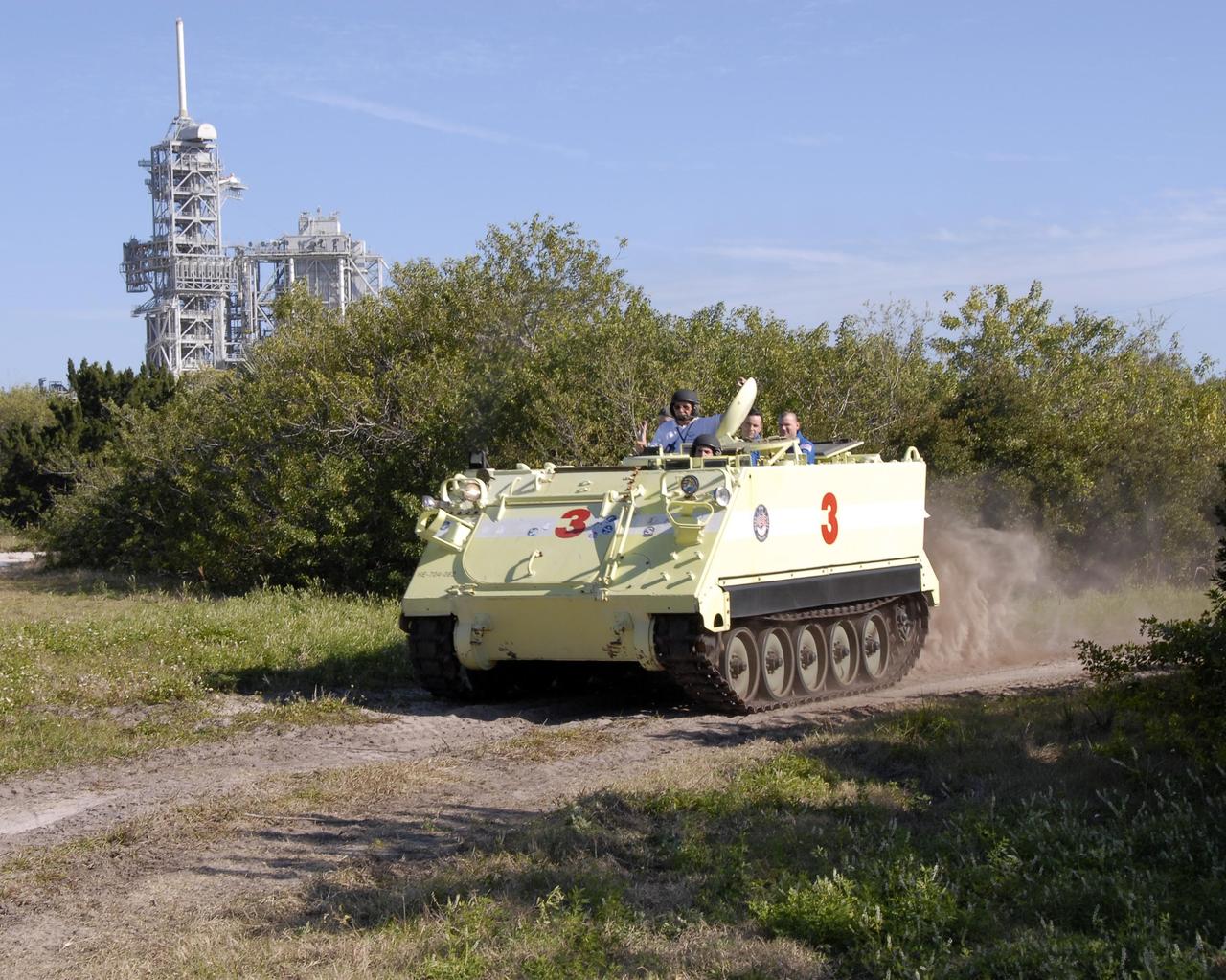
KENNEDY SPACE CENTER, FLA. -- At Launch Complex 39, members of the STS-117 crew are instructed in the operation of an M-113 armored personnel carrier by astronaut rescue team leader Capt. George Hoggard (left). The astronauts on the STS-117 crew are participating in M-113 armored personnel carrier training during Terminal Countdown Demonstration Test (TCDT) activities, a dress rehearsal for their launch, targeted for March 15. The M-113 could be used to move the crew away from the launch pad quickly in the event of an emergency. The TCDT also includes pad emergency egress training and a simulated launch countdown. The mission payload aboard Space Shuttle Atlantis is the S3/S4 integrated truss structure, along with a third set of solar arrays and batteries. The crew of six astronauts will install the truss to continue assembly of the station. Photo credit: NASA/Kim Shiflett
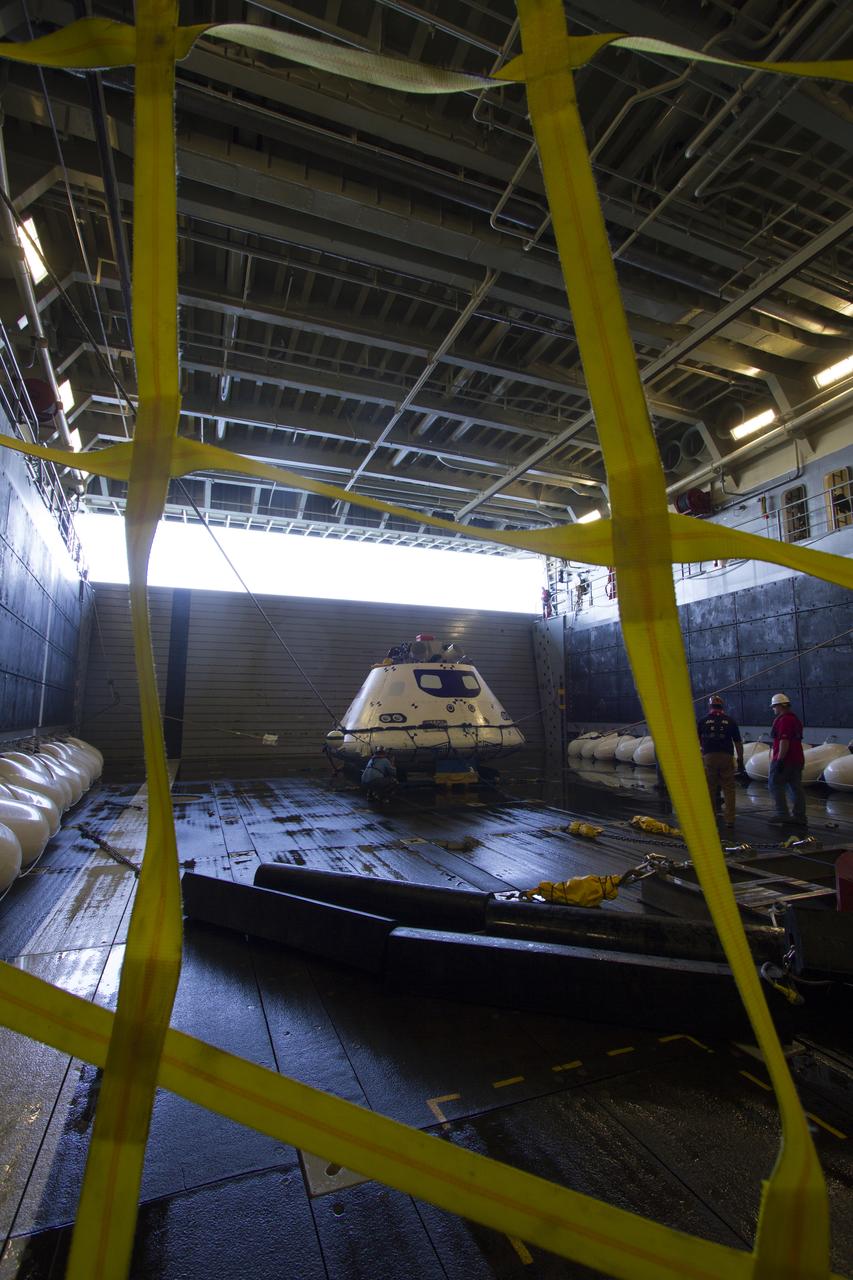
The Orion boilerplate test vehicle is secured in the well deck of the USS Anchorage during the first day of Underway Recovery Test 3 in the Pacific Ocean. NASA, Lockheed Martin and U.S. Navy personnel are conducting the recovery test to prepare for recovery of the Orion crew module on its return from a deep space mission. The test allows the teams to demonstrate and evaluate the recovery processes, procedures, hardware and personnel in open waters. The Ground Systems Development and Operations Program is conducting the underway recovery tests. Orion is the exploration spacecraft designed to carry astronauts to destinations not yet explored by humans, including an asteroid and Mars. It will have emergency abort capability, sustain the crew during space travel and provide safe re-entry from deep space return velocities. The first unpiloted test flight of Orion is scheduled to launch in 2014 atop a United Launch Alliance Delta IV Heavy rocket and in 2018 on NASA’s Space Launch System rocket.
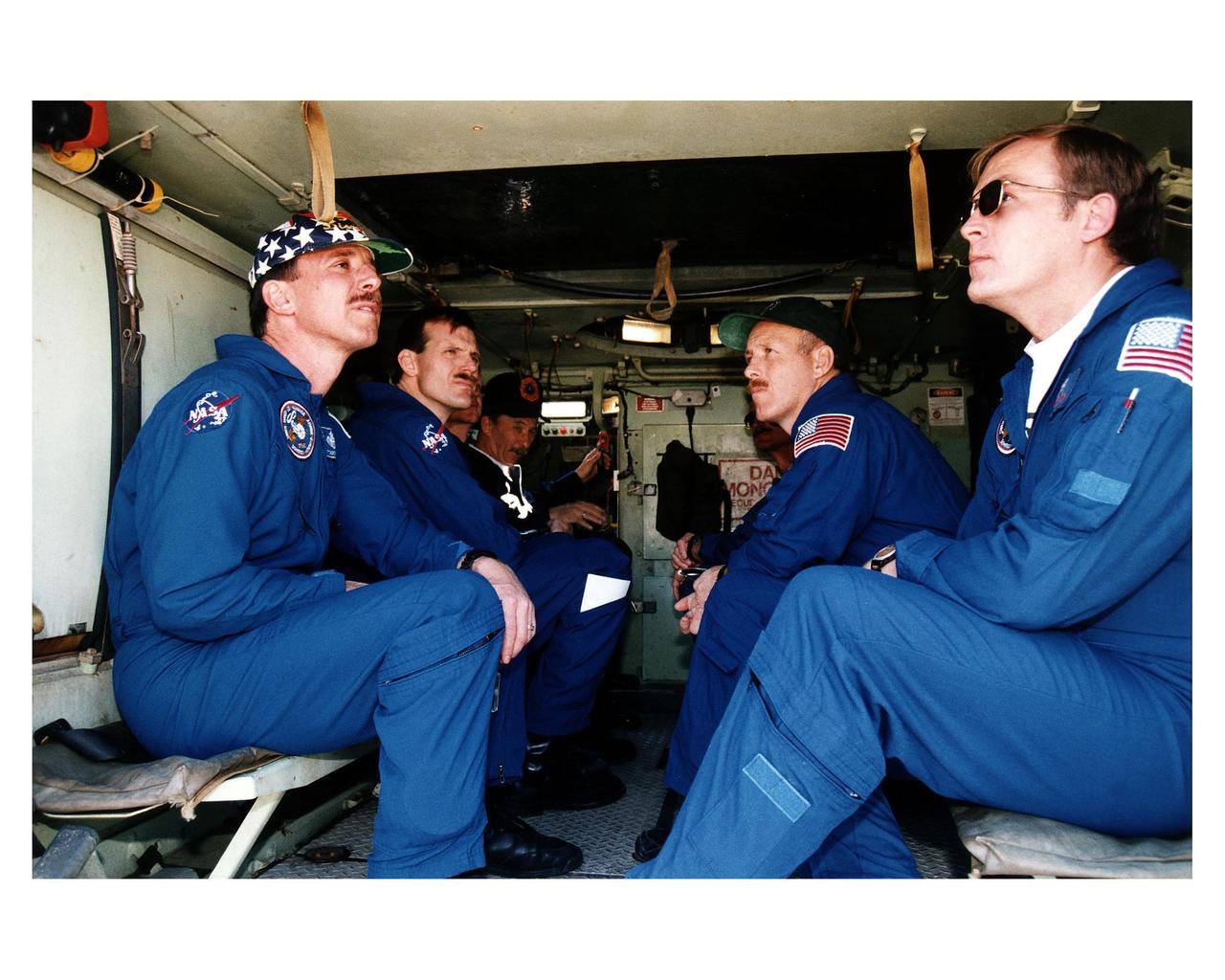
STS-82 crew members ride in and learn how to operate an M-113 armored personnel carrier during Terminal Countdown Demonstration Test (TCDT) activities prior to launch. The four crew members dressed in their blue flight suits and visible here are, from left, Pilot Scott J. "Doc" Horowitz, Mission Specialist Joseph R. "Joe" Tanner, Mission Commander Kenneth D. Bowersox and Payload Commander Mark C. Lee. George Hoggard, a training officer with KSC Fire Services, is visible in the background at left. The 10-day STS-82 flight, which will be the second Hubble Space Telescope servicing mission, is targeted for a Feb. 11 liftoff
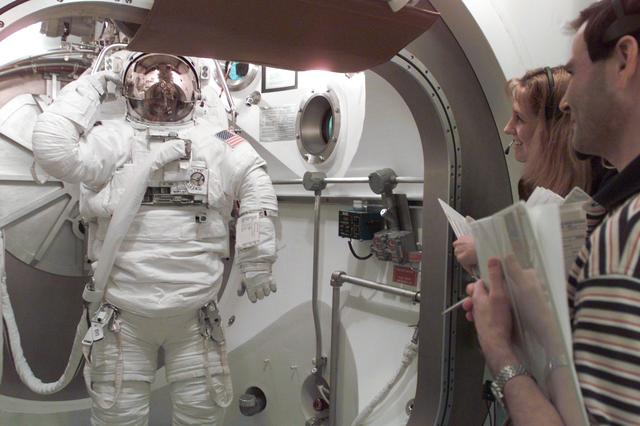
JSC2001-E-11704 (9 April 2001) --- Astronaut James F. Reilly, STS-104 mission specialist, participates in an Extravehicular Mobility Unit (EMU) fit check in one of the chambers in the Crew Systems Laboratory at the Johnson Space Center (JSC). Standing near the doorway are Peggy Berg and Dave Simon, Crew Personnel Representatives (CPR), from the Mission Operations Directorate (MOD) at the Johnson Space Center. The STS-104 mission to the International Space Station (ISS) represents the Space Shuttle Atlantis' first flight using a new engine and is targeted for a liftoff no earlier than June 14, 2001.
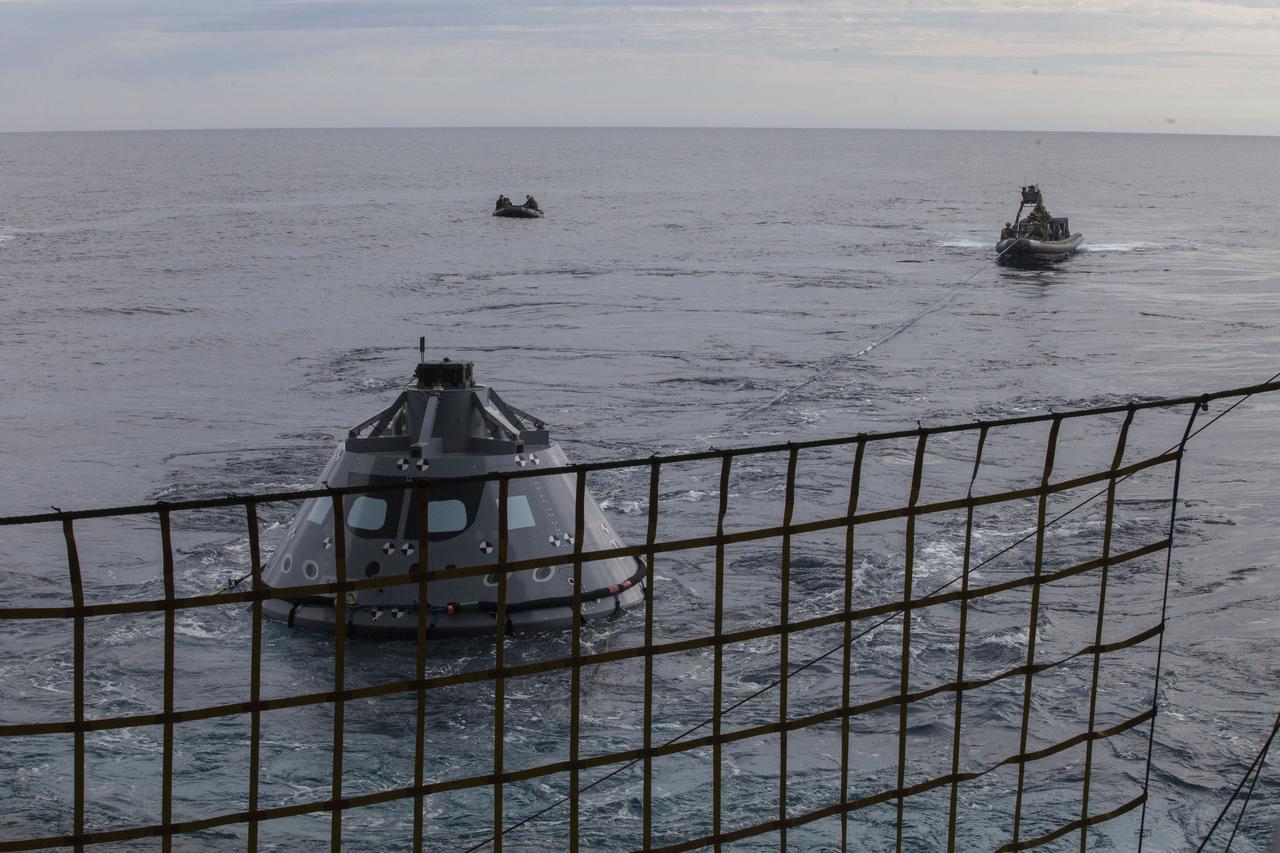
U.S. Navy divers and other personnel in a rigid hull inflatable boat are handling tether lines attached to a test version of the Orion crew module during Underway Recovery Test 5 in the Pacific Ocean off the coast of California. U.S. Navy divers in a smaller watercraft called a Zodiac boat are farther away. NASA's Ground Systems Development and Operations Program and the U.S. Navy are conducting a series of tests using the well deck of the USS San Diego, several watercraft and personnel to prepare for recovery of Orion on its return from deep space missions. The testing will allow the team to demonstrate and evaluate recovery processes, procedures, hardware and personnel in open waters. Orion is the exploration spacecraft designed to carry astronauts to destinations not yet explored by humans, including an asteroid and NASA's Journey to Mars. It will have emergency abort capability, sustain the crew during space travel and provide safe re-entry from deep space return velocities. Orion is scheduled to launch on NASA's Space Launch System in late 2018. For more information, visit http://www.nasa.gov/orion.
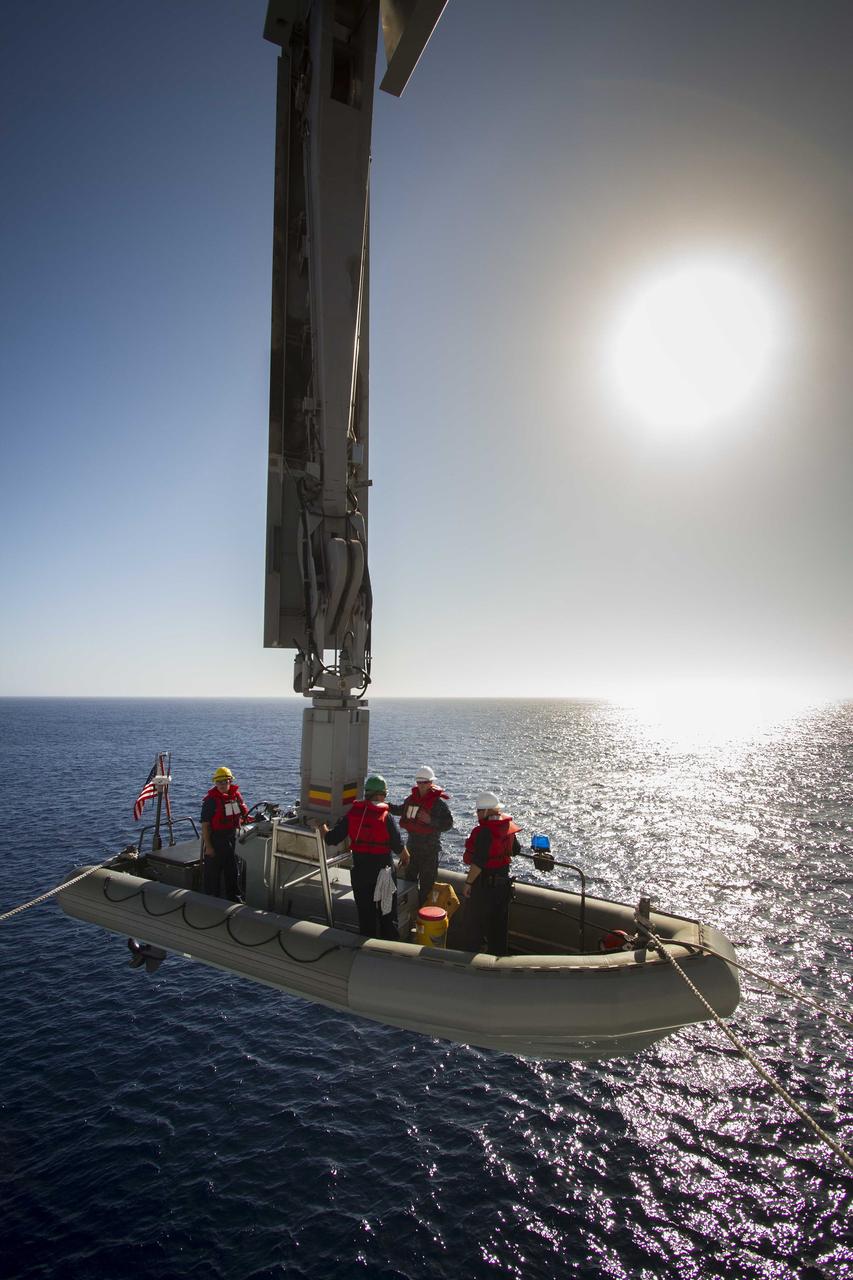
SAN DIEGO, Calif. – A rigid hull inflatable boat, with U.S. Navy personnel aboard, is being lowered into the water from the USS Anchorage on the second day of Orion Underway Recovery Test 3 in the Pacific Ocean. NASA, Lockheed Martin and U.S. Navy personnel are conducting recovery tests using the Orion boilerplate test vehicle to prepare for recovery of the Orion crew module on its return from a deep space mission. The test allows the teams to demonstrate and evaluate the recovery processes, procedures, hardware and personnel in open waters. The Ground Systems Development and Operations Program is conducting the underway recovery tests. Orion is the exploration spacecraft designed to carry astronauts to destinations not yet explored by humans, including an asteroid and Mars. It will have emergency abort capability, sustain the crew during space travel and provide safe re-entry from deep space return velocities. The first unpiloted test flight of Orion is scheduled to launch in 2014 atop a United Launch Alliance Delta IV Heavy rocket and in 2018 on NASA’s Space Launch System rocket. For more information, visit http://www.nasa.gov/orion. Photo credit: NASA/Cory Huston
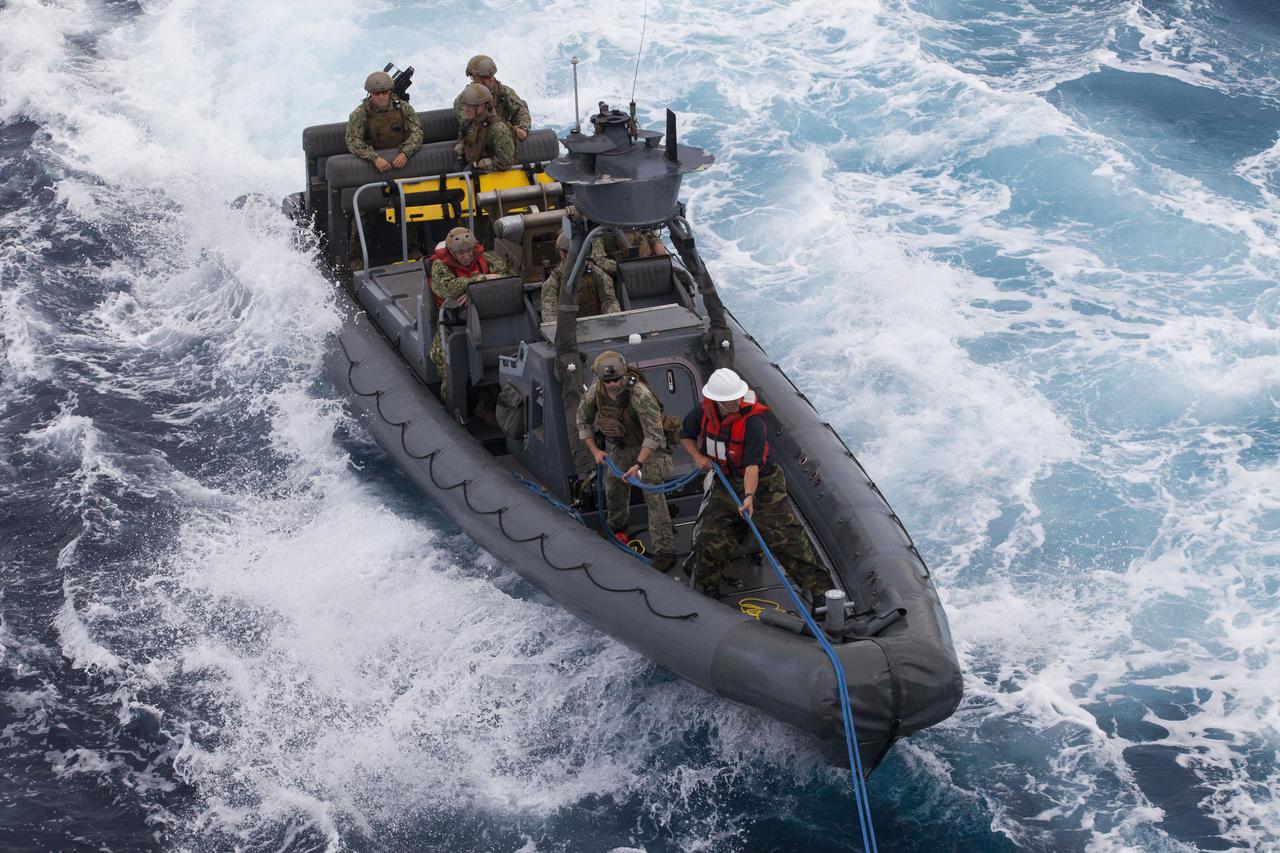
U.S. Navy divers and other personnel in a rigid hull inflatable boat are handling tether lines attached to a test version of the Orion crew module during Underway Recovery Test 5 in the Pacific Ocean off the coast of California. NASA's Ground Systems Development and Operations Program and the U.S. Navy are conducting a series of tests using the well deck of the USS San Diego, several watercraft and personnel to prepare for recovery of Orion on its return from deep space missions. The testing will allow the team to demonstrate and evaluate recovery processes, procedures, hardware and personnel in open waters. Orion is the exploration spacecraft designed to carry astronauts to destinations not yet explored by humans, including an asteroid and NASA's Journey to Mars. It will have emergency abort capability, sustain the crew during space travel and provide safe re-entry from deep space return velocities. Orion is scheduled to launch on NASA's Space Launch System in late 2018. For more information, visit http://www.nasa.gov/orion.
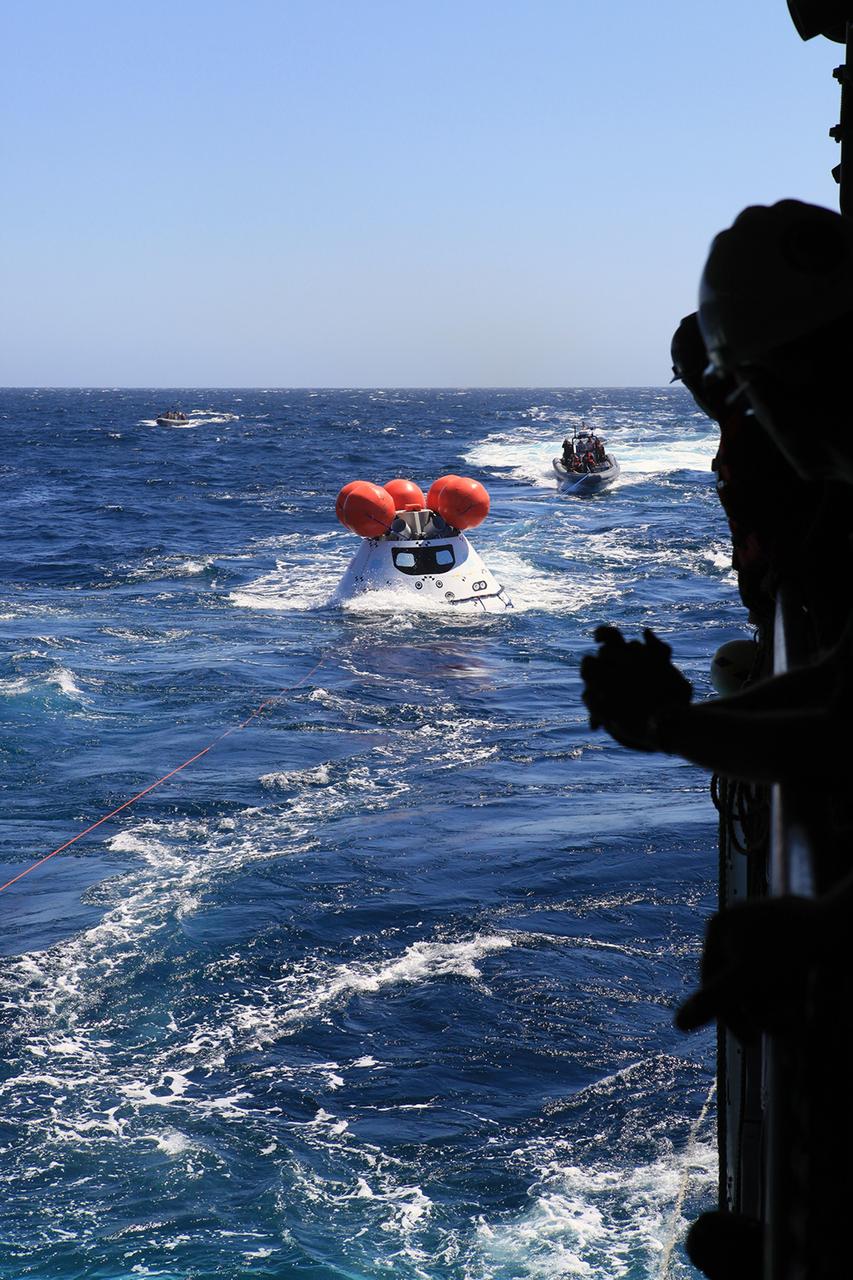
SAN DIEGO, Calif. – During the third day of Orion Underway Recovery Test 3 on the USS Anchorage in the Pacific Ocean, U.S. Navy personnel in a rigid hull inflatable boat use tether lines attached to the test vehicle to practice the recovery process. NASA, Lockheed Martin and U.S. Navy personnel are conducting recovery tests using the Orion boilerplate test vehicle to prepare for recovery of the Orion crew module on its return from a deep space mission. The test allows the teams to demonstrate and evaluate the recovery processes, procedures, hardware and personnel in open waters. The Ground Systems Development and Operations Program is conducting the underway recovery tests. Orion is the exploration spacecraft designed to carry astronauts to destinations not yet explored by humans, including an asteroid and Mars. It will have emergency abort capability, sustain the crew during space travel and provide safe re-entry from deep space return velocities. The first unpiloted test flight of Orion is scheduled to launch in 2014 atop a United Launch Alliance Delta IV Heavy rocket and in 2018 on NASA’s Space Launch System rocket. For more information, visit http://www.nasa.gov/orion. Photo credit: NASA/Kim Shiflett
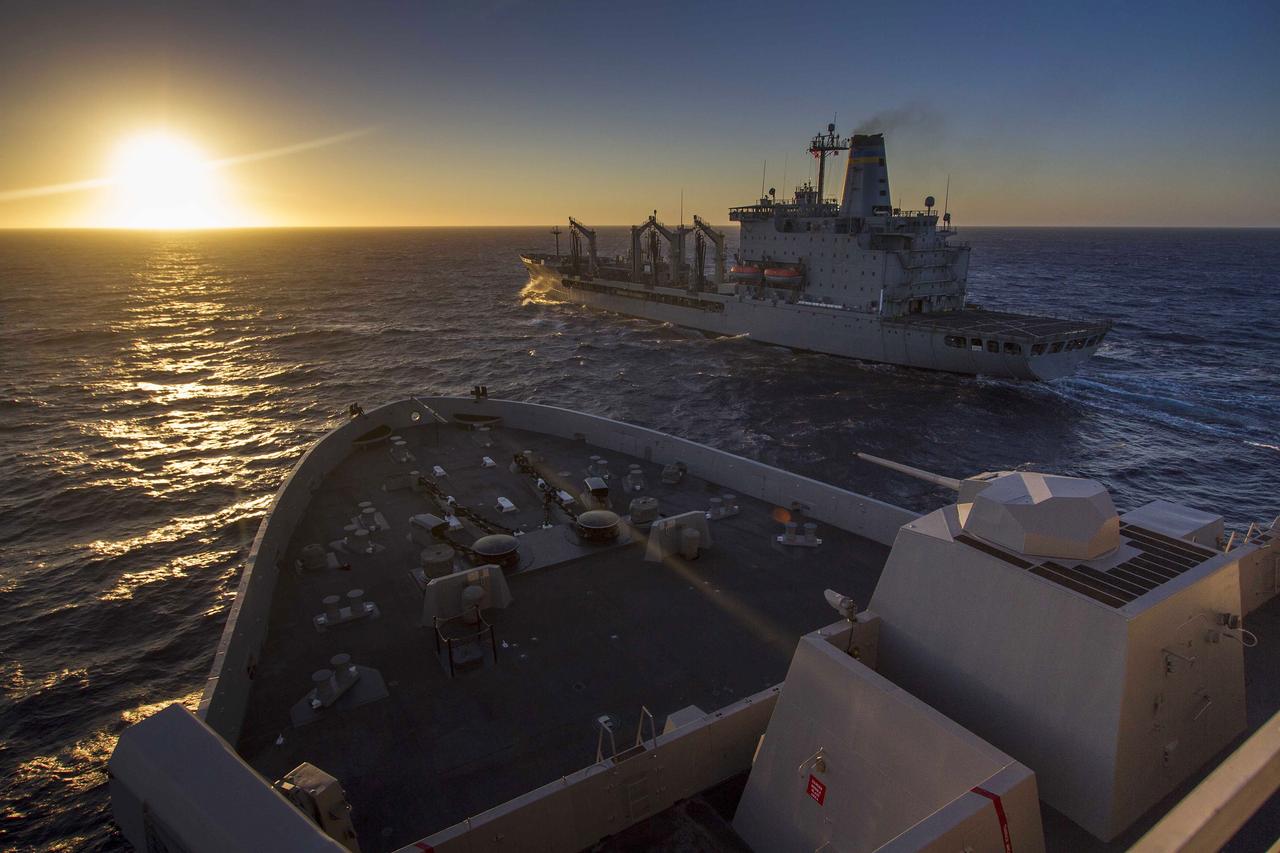
SAN DIEGO, Calif. – The USNS Yukon, in the foreground, is stationed nearby the USS Anchorage, during the third day of Orion Underway Recovery Test 3 in the Pacific Ocean. The Yukon provides underway replenishment of fuel to ships at sea. U.S. Navy divers and other personnel completed a day of practicing recovery of the Orion boilerplate test vehicle. NASA, Lockheed Martin and U.S. Navy personnel are conducting the recovery test using the test vehicle to prepare for recovery of the Orion crew module on its return from a deep space mission. The test allows the teams to demonstrate and evaluate the recovery processes, procedures, hardware and personnel in open waters. The Ground Systems Development and Operations Program is conducting the underway recovery tests. Orion is the exploration spacecraft designed to carry astronauts to destinations not yet explored by humans, including an asteroid and Mars. It will have emergency abort capability, sustain the crew during space travel and provide safe re-entry from deep space return velocities. The first unpiloted test flight of Orion is scheduled to launch in 2014 atop a United Launch Alliance Delta IV Heavy rocket and in 2018 on NASA’s Space Launch System rocket. For more information, visit http://www.nasa.gov/orion. Photo credit: NASA/Cory Huston
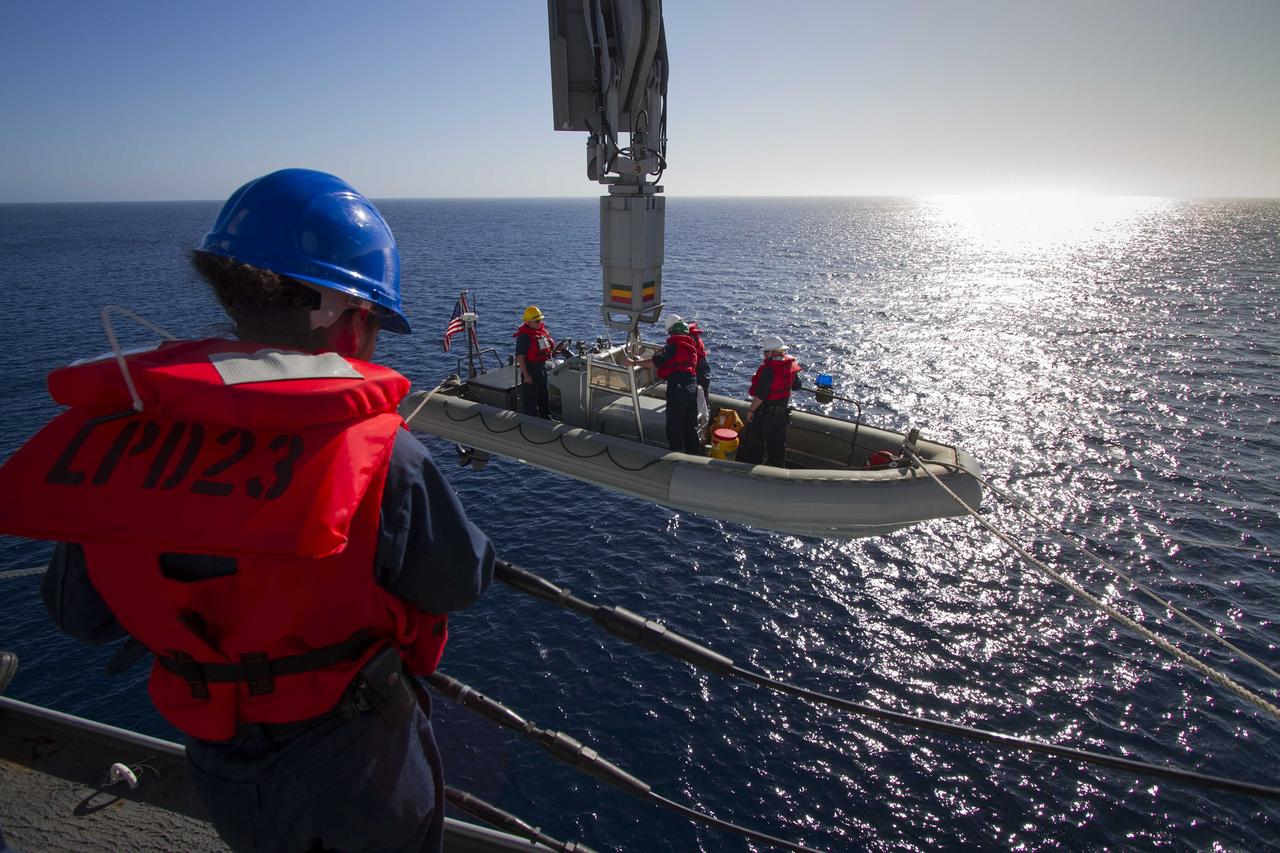
SAN DIEGO, Calif. – A rigid hull inflatable boat, with U.S. Navy personnel aboard, is being lowered into the water from the USS Anchorage on the second day of Orion Underway Recovery Test 3 in the Pacific Ocean. NASA, Lockheed Martin and U.S. Navy personnel are conducting recovery tests using the Orion boilerplate test vehicle to prepare for recovery of the Orion crew module on its return from a deep space mission. The test allows the teams to demonstrate and evaluate the recovery processes, procedures, hardware and personnel in open waters. The Ground Systems Development and Operations Program is conducting the underway recovery tests. Orion is the exploration spacecraft designed to carry astronauts to destinations not yet explored by humans, including an asteroid and Mars. It will have emergency abort capability, sustain the crew during space travel and provide safe re-entry from deep space return velocities. The first unpiloted test flight of Orion is scheduled to launch in 2014 atop a United Launch Alliance Delta IV Heavy rocket and in 2018 on NASA’s Space Launch System rocket. For more information, visit http://www.nasa.gov/orion. Photo credit: NASA/Cory Huston
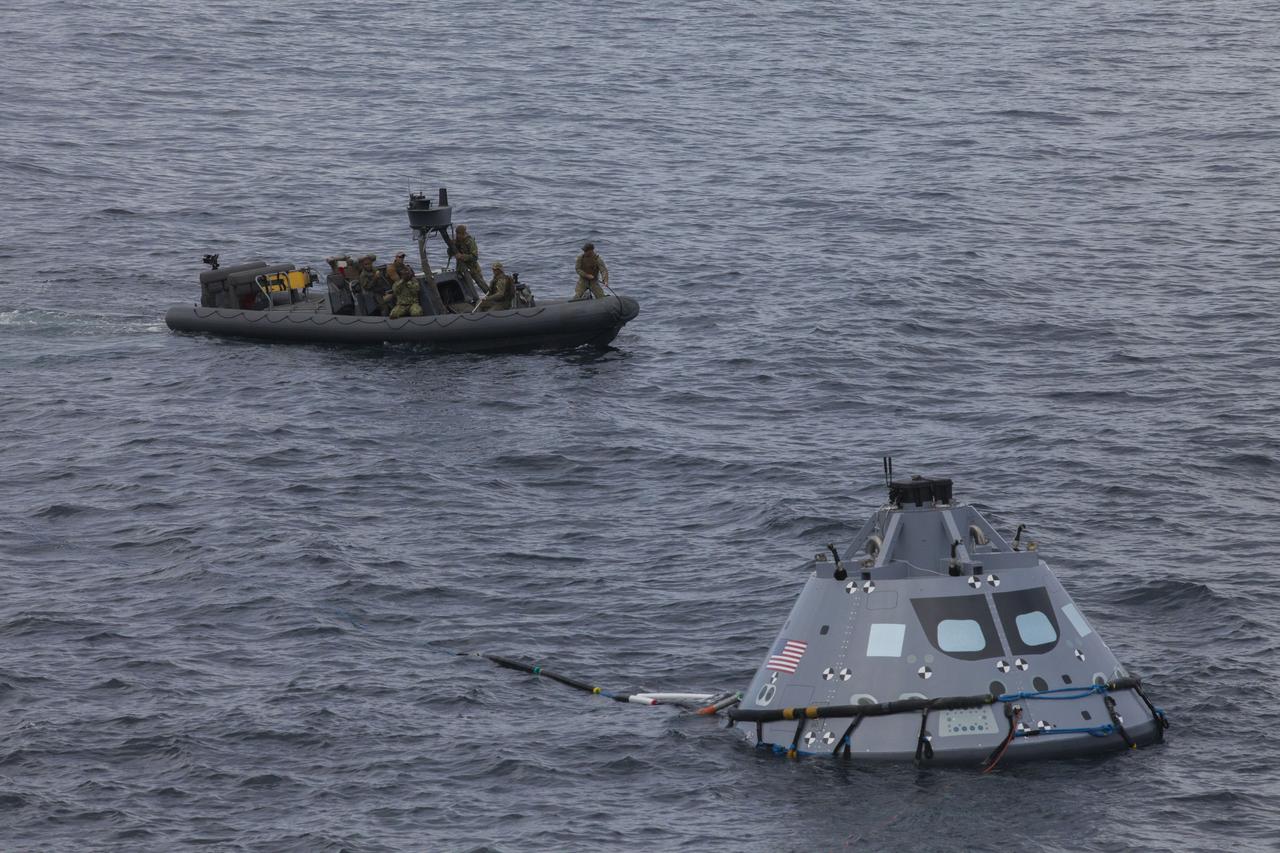
A test version of the Orion crew module floats in the Pacific Ocean during Underway Recovery Test 5 in the Pacific Ocean off the coast of California. Nearby are U.S. Navy divers and other personnel in a rigid hull inflatable boat. NASA's Ground Systems Development and Operations Program and the U.S. Navy are conducting a series of tests using the well deck of the USS San Diego, several watercraft, support equipment and personnel to prepare for recovery of Orion on its return from deep space missions. The testing will allow the team to demonstrate and evaluate recovery processes, procedures, hardware and personnel in open waters. Orion is the exploration spacecraft designed to carry astronauts to destinations not yet explored by humans, including an asteroid and NASA's Journey to Mars. It will have emergency abort capability, sustain the crew during space travel and provide safe re-entry from deep space return velocities. Orion is scheduled to launch on NASA's Space Launch System in late 2018. For more information, visit http://www.nasa.gov/orion.
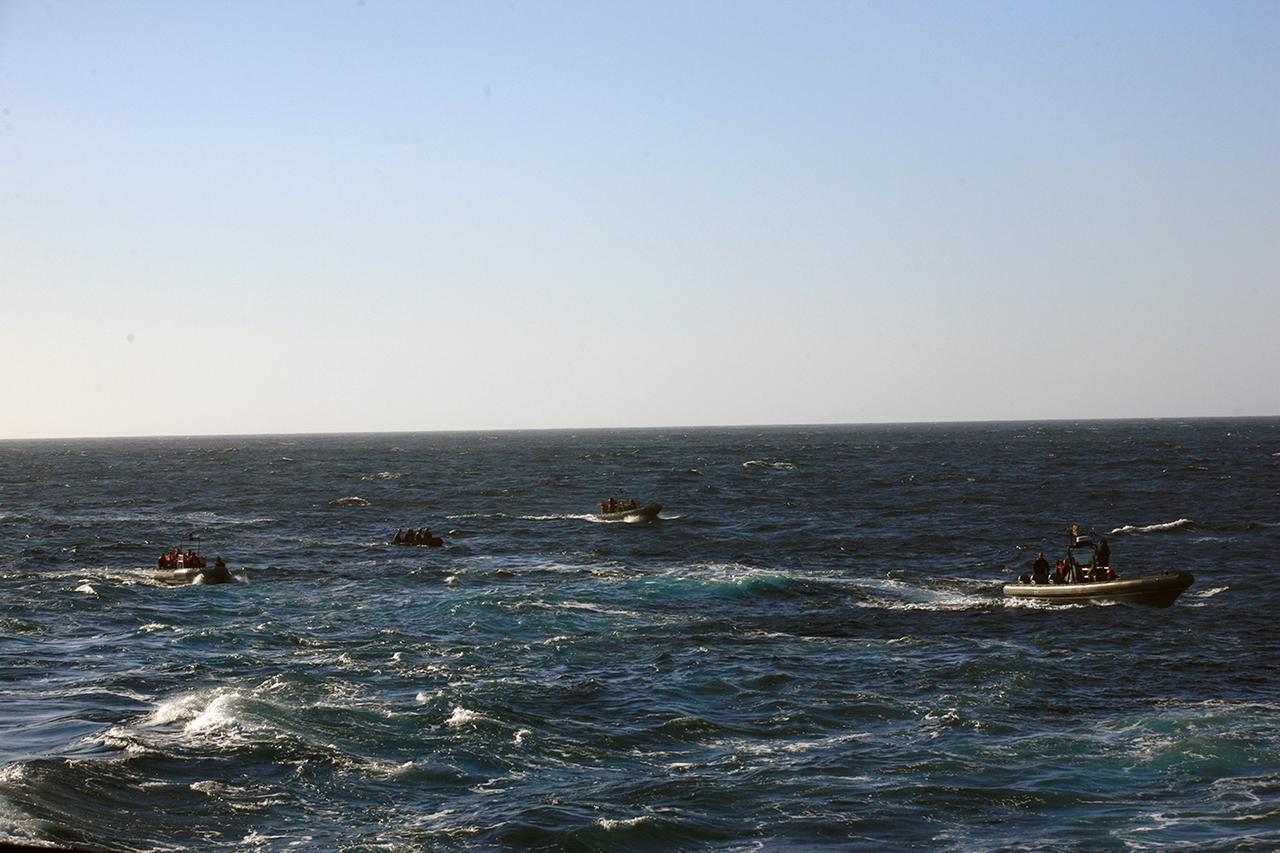
SAN DIEGO, Calif. – During the third day of Orion Underway Recovery Test 3 on the USS Anchorage in the Pacific Ocean, two Zodiac boats with U.S. Navy divers aboard, at left, and two rigid hull inflatable boats with Navy and other team personnel aboard, prepare for recovery of the Orion boilerplate test vehicle. NASA, Lockheed Martin and U.S. Navy personnel are conducting recovery tests using the Orion boilerplate test vehicle to prepare for recovery of the Orion crew module on its return from a deep space mission. The test allows the teams to demonstrate and evaluate the recovery processes, procedures, hardware and personnel in open waters. The Ground Systems Development and Operations Program is conducting the underway recovery tests. Orion is the exploration spacecraft designed to carry astronauts to destinations not yet explored by humans, including an asteroid and Mars. It will have emergency abort capability, sustain the crew during space travel and provide safe re-entry from deep space return velocities. The first unpiloted test flight of Orion is scheduled to launch in 2014 atop a United Launch Alliance Delta IV Heavy rocket and in 2018 on NASA’s Space Launch System rocket. For more information, visit http://www.nasa.gov/orion. Photo credit: NASA/Kim Shiflett
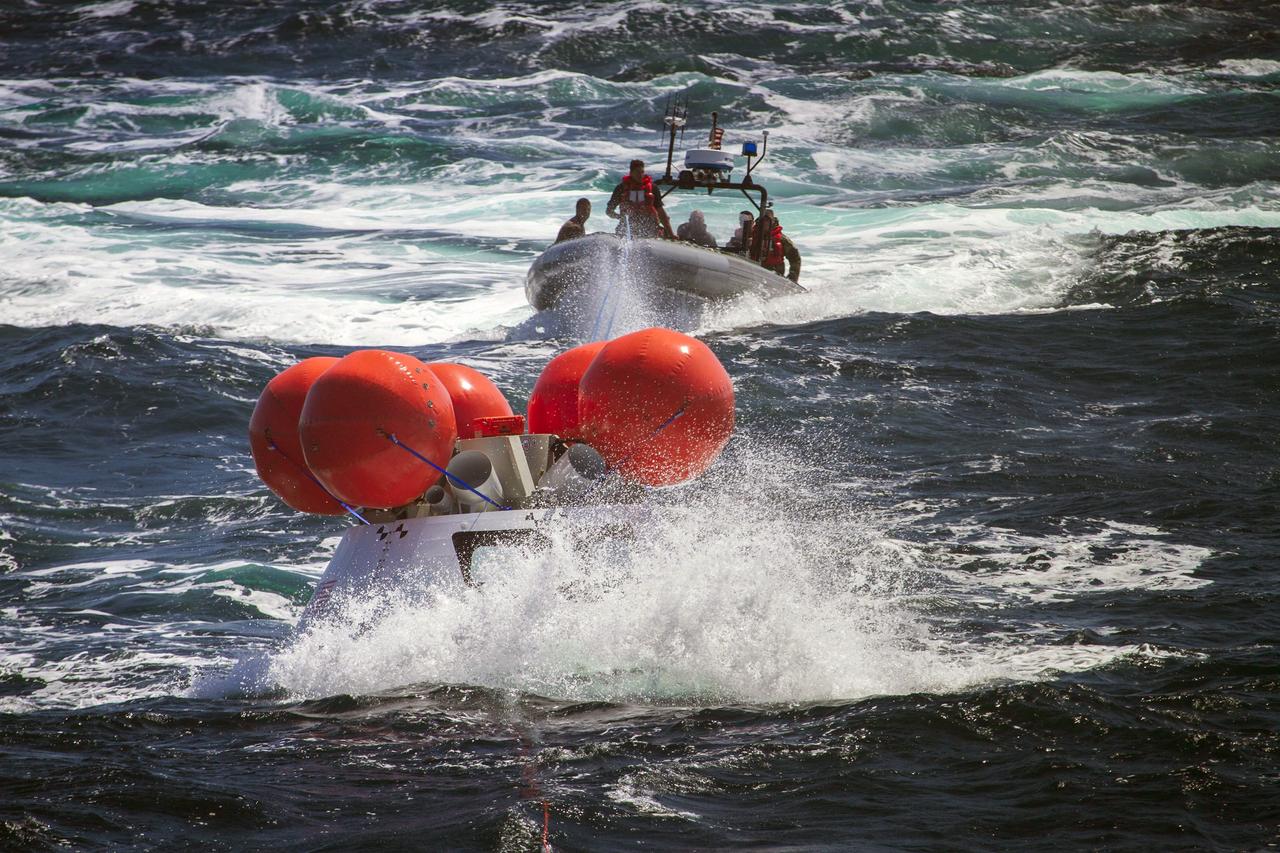
SAN DIEGO, Calif. – A rigid hull inflatable boat containing U.S. Navy divers and other personnel approaches the Orion boilerplate test vehicle floating in the Pacific Ocean, a distance away from the USS Anchorage, during the third day of Orion Underway Recovery Test 3. Orange stabilizers on the top of the test vehicle were inflated to simulate the system that will be used to upright Orion in the water after splashdown. NASA, Lockheed Martin and U.S. Navy personnel are conducting the recovery test using the test vehicle to prepare for recovery of the Orion crew module on its return from a deep space mission. The test allows the teams to demonstrate and evaluate the recovery processes, procedures, hardware and personnel in open waters. The Ground Systems Development and Operations Program is conducting the underway recovery tests. Orion is the exploration spacecraft designed to carry astronauts to destinations not yet explored by humans, including an asteroid and Mars. It will have emergency abort capability, sustain the crew during space travel and provide safe re-entry from deep space return velocities. The first unpiloted test flight of Orion is scheduled to launch in 2014 atop a United Launch Alliance Delta IV Heavy rocket and in 2018 on NASA’s Space Launch System rocket. For more information, visit http://www.nasa.gov/orion. Photo credit: NASA/Cory Huston
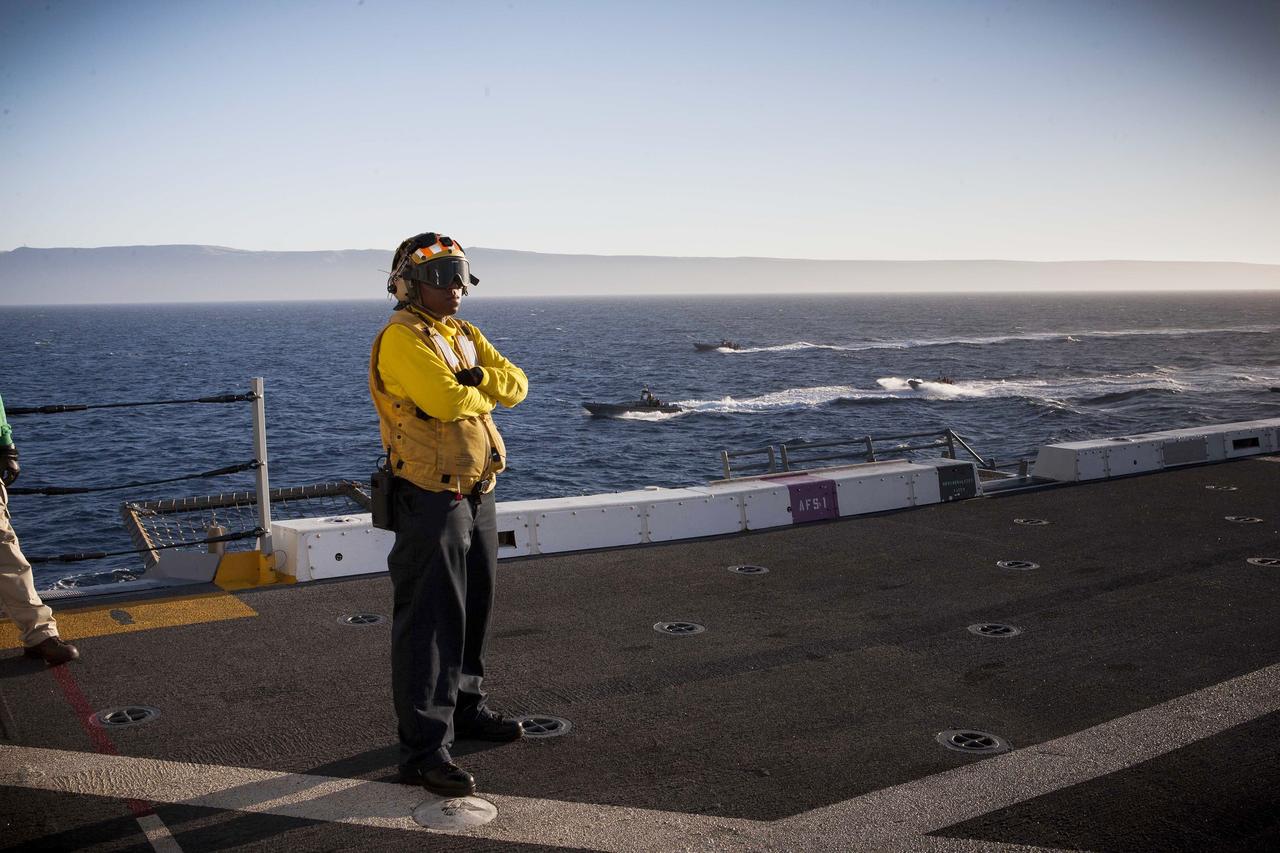
SAN DIEGO, Calif. – A member of the U.S. Navy stands on the deck of the USS Anchorage on the first day of Orion Underway Recovery Test 3 in the Pacific Ocean. In the water are several Zodiac boats and rigid hull inflatable boats with U.S. Navy personnel and divers that are preparing to recover the Orion boilerplate test vehicle already in the water. NASA, Lockheed Martin and U.S. Navy personnel are conducting the recovery test to prepare for recovery of the Orion crew module on its return from a deep space mission. The test will allow the teams to demonstrate and evaluate the recovery processes, procedures, hardware and personnel in open waters. The Ground Systems Development and Operations Program is conducting the underway recovery tests. Orion is the exploration spacecraft designed to carry astronauts to destinations not yet explored by humans, including an asteroid and Mars. It will have emergency abort capability, sustain the crew during space travel and provide safe re-entry from deep space return velocities. The first unpiloted test flight of Orion is scheduled to launch in 2014 atop a United Launch Alliance Delta IV Heavy rocket and in 2018 on NASA’s Space Launch System rocket. For more information, visit http://www.nasa.gov/orion. Photo credit: NASA/Cory Huston
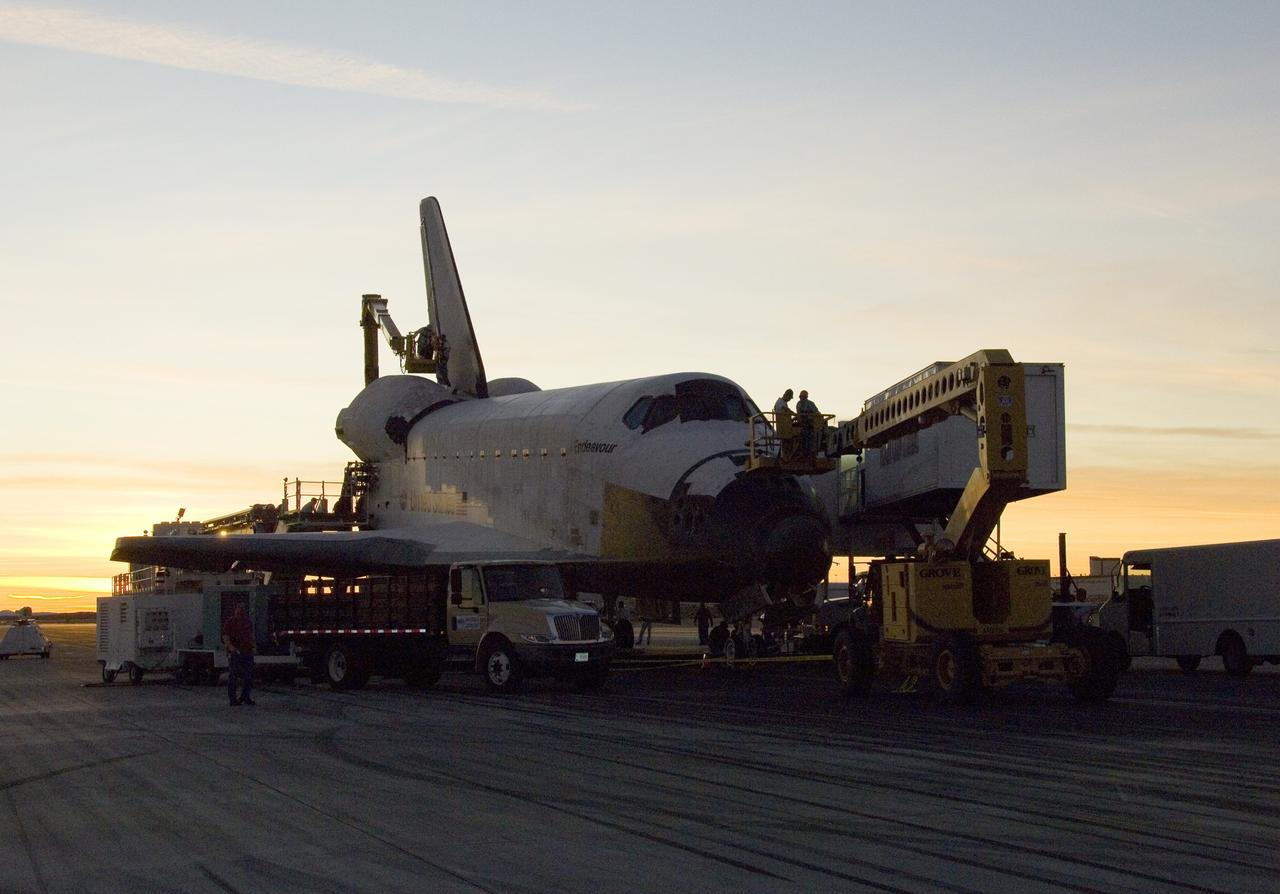
EDWARDS, Calif. – On Edwards Air Force Base in California, space shuttle Endeavour undergoes recovery operations after its landing. The orbiter convoy normally begins recovery operations in earnest about two hours before the shuttle is scheduled to land. Specially designed vehicles or units and a team of trained personnel “safe” the orbiter and prepare it for towing. Purge and Coolant Umbilical Access Vehicles are moved into position behind the orbiter to get access to the umbilical areas. The flight crew is replaced aboard the orbiter by exchange sup¬port personnel who prepare the orbiter for ground tow operations, install switch guards and remove data packages from any onboard experiments. After a total safety downgrade, vehicle ground personnel make numerous preparations for the towing operation, including install¬ing landing gear lock pins, disconnecting the nose landing gear drag link, positioning the towing vehicle in front of the orbiter and connecting the tow bar. The decision to land Endeavour at Edwards was made due to weather concerns at NASA's Kennedy Space Center in Florida. In the 52nd landing at Edwards, Endeavour touched down at 4:25 p.m. EST to end the STS-126 mission, completing its 16-day journey of more than 6.6 million miles in space. Endeavour will be returned to Kennedy atop a Shuttle Carrier Aircraft, or SCA, a modified Boeing 747 jetliner. Photo credit: NASA/Tony Landis, VAFB
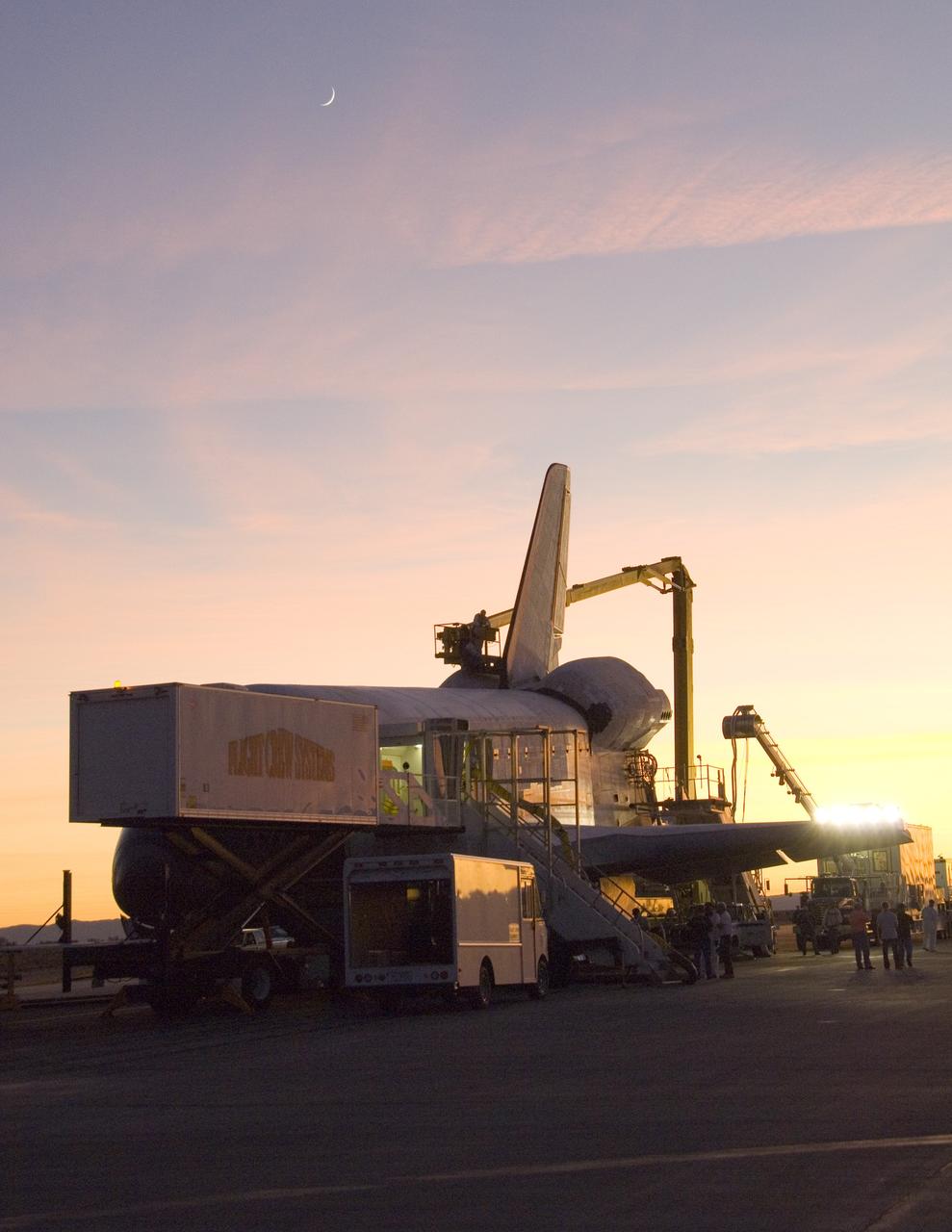
EDWARDS, Calif. – On Edwards Air Force Base in California, space shuttle Endeavour undergoes recovery operations after its landing. The orbiter convoy normally begins recovery operations in earnest about two hours before the shuttle is scheduled to land. Specially designed vehicles or units and a team of trained personnel “safe” the orbiter and prepare it for towing. Purge and Coolant Umbilical Access Vehicles are moved into position behind the orbiter to get access to the umbilical areas. The flight crew is replaced aboard the orbiter by exchange sup¬port personnel who prepare the orbiter for ground tow operations, install switch guards and remove data packages from any onboard experiments. After a total safety downgrade, vehicle ground personnel make numerous preparations for the towing operation, including install¬ing landing gear lock pins, disconnecting the nose landing gear drag link, positioning the towing vehicle in front of the orbiter and connecting the tow bar. The decision to land Endeavour at Edwards was made due to weather concerns at NASA's Kennedy Space Center in Florida. In the 52nd landing at Edwards, Endeavour touched down at 4:25 p.m. EST to end the STS-126 mission, completing its 16-day journey of more than 6.6 million miles in space. Endeavour will be returned to Kennedy atop a Shuttle Carrier Aircraft, or SCA, a modified Boeing 747 jetliner. Photo credit: NASA/Tony Landis, VAFB
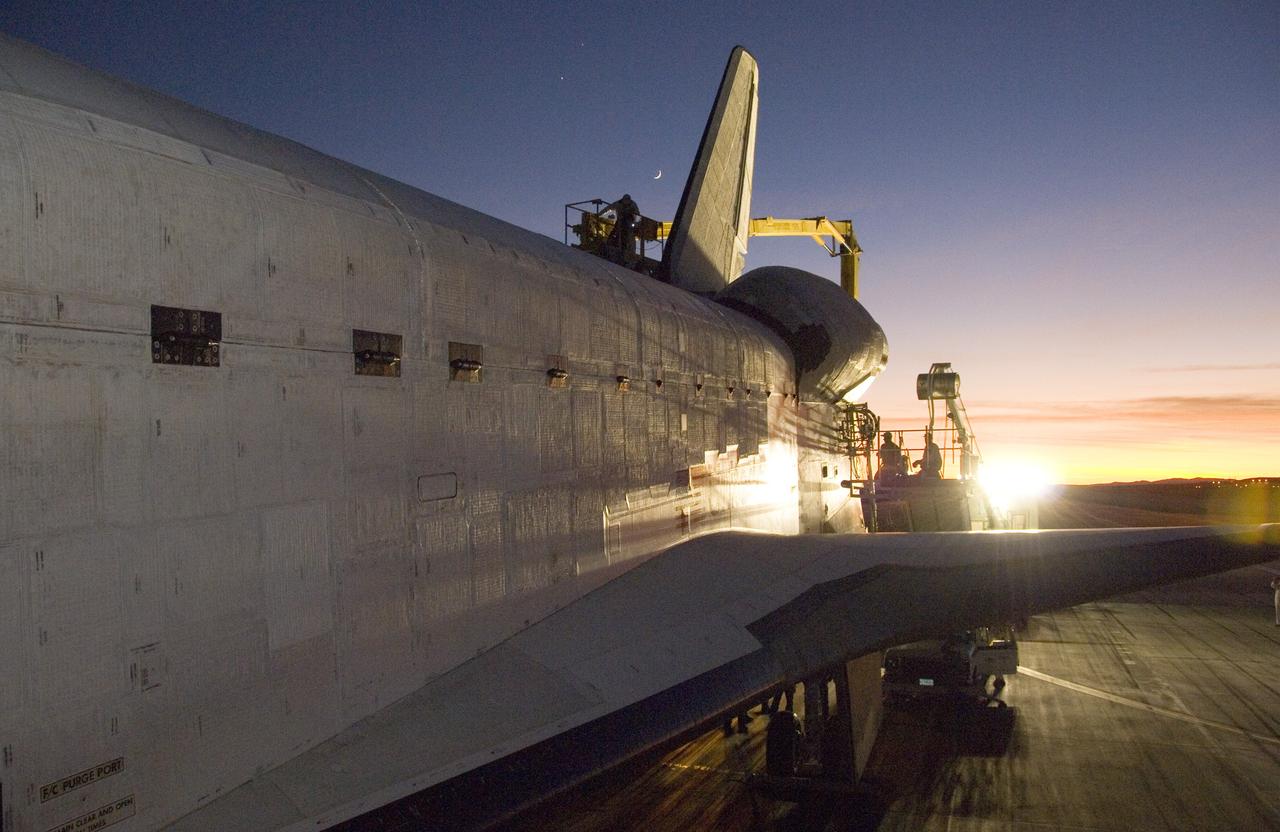
EDWARDS, Calif. – Against a setting sun, space shuttle Endeavour undergoes recovery operations on Edwards Air Force Base in California after its landing. The orbiter convoy normally begins recovery operations in earnest about two hours before the shuttle is scheduled to land. Specially designed vehicles or units and a team of trained personnel “safe” the orbiter and prepare it for towing. Purge and Coolant Umbilical Access Vehicles are moved into position behind the orbiter to get access to the umbilical areas. The flight crew is replaced aboard the orbiter by exchange sup¬port personnel who prepare the orbiter for ground tow operations, install switch guards and remove data packages from any onboard experiments. After a total safety downgrade, vehicle ground personnel make numerous preparations for the towing operation, including install¬ing landing gear lock pins, disconnecting the nose landing gear drag link, positioning the towing vehicle in front of the orbiter and connecting the tow bar. The decision to land Endeavour at Edwards was made due to weather concerns at NASA's Kennedy Space Center in Florida. In the 52nd landing at Edwards, Endeavour touched down at 4:25 p.m. EST to end the STS-126 mission, completing its 16-day journey of more than 6.6 million miles in space. Endeavour will be returned to Kennedy atop a Shuttle Carrier Aircraft, or SCA, a modified Boeing 747 jetliner. Photo credit: NASA/Tony Landis, VAFB
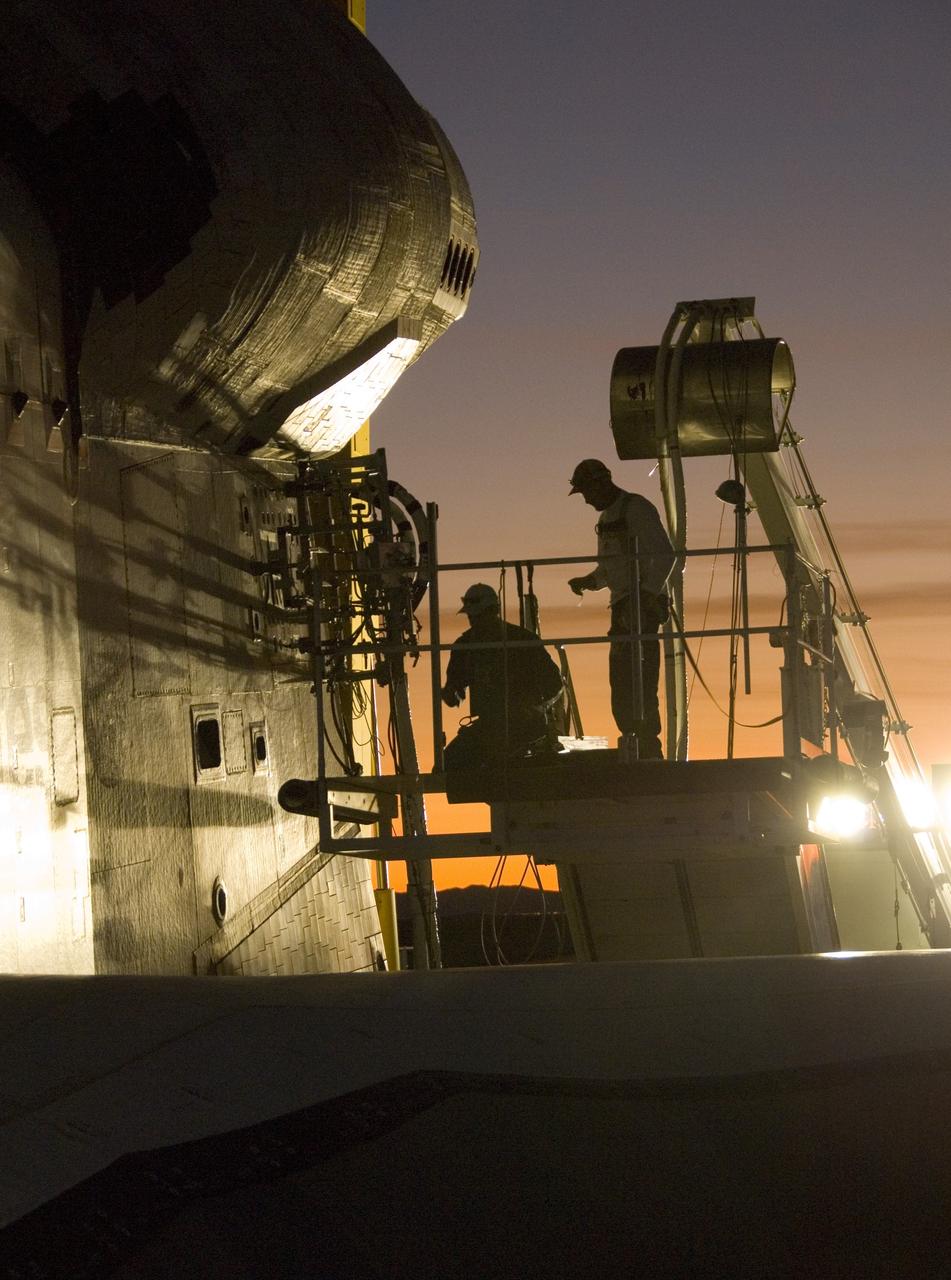
EDWARDS, Calif. – Against a setting sun, space shuttle Endeavour undergoes recovery operations on Edwards Air Force Base in California after its landing. The orbiter convoy normally begins recovery operations in earnest about two hours before the shuttle is scheduled to land. Specially designed vehicles or units and a team of trained personnel “safe” the orbiter and prepare it for towing. Purge and Coolant Umbilical Access Vehicles are moved into position behind the orbiter to get access to the umbilical areas. The flight crew is replaced aboard the orbiter by exchange sup¬port personnel who prepare the orbiter for ground tow operations, install switch guards and remove data packages from any onboard experiments. After a total safety downgrade, vehicle ground personnel make numerous preparations for the towing operation, including install¬ing landing gear lock pins, disconnecting the nose landing gear drag link, positioning the towing vehicle in front of the orbiter and connecting the tow bar. The decision to land Endeavour at Edwards was made due to weather concerns at NASA's Kennedy Space Center in Florida. In the 52nd landing at Edwards, Endeavour touched down at 4:25 p.m. EST to end the STS-126 mission, completing its 16-day journey of more than 6.6 million miles in space. Endeavour will be returned to Kennedy atop a Shuttle Carrier Aircraft, or SCA, a modified Boeing 747 jetliner. Photo credit: NASA/Tony Landis, VAFB
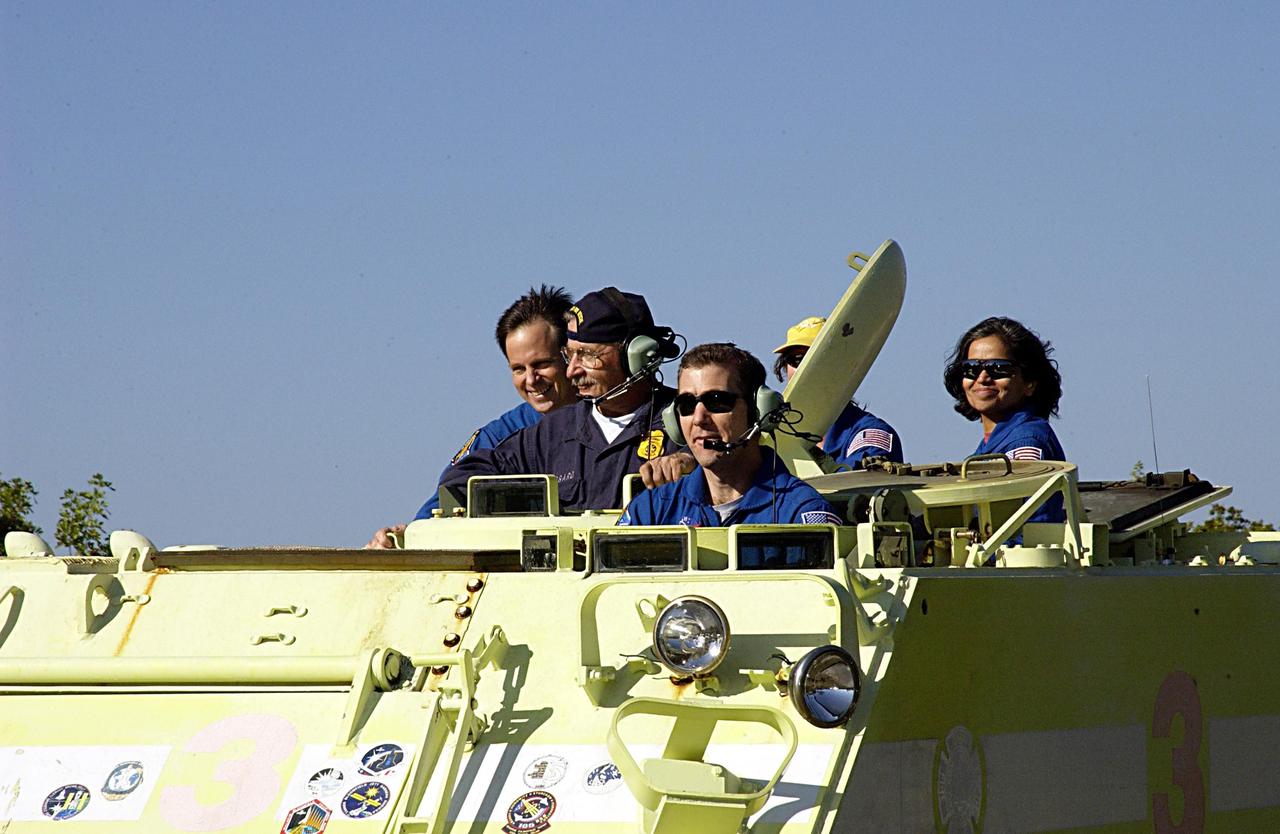
KENNEDY SPACE CENTER, FLA. -- STS-107 Commander Rick Husband operates an M113 armored personnel carrier during Terminal Countdown Demonstration Test activities, a standard part of launch preparations. From left, Payload Specialist Ilan Ramon, the first Israeli astronaut, Instructor George Hoggard, and Mission Specialists Laurel Clark (face obscured) and Kalpana Chawla enjoy the ride in the background. STS-107 is a mission devoted to research and will include more than 80 experiments that will study Earth and space science, advanced technology development, and astronaut health and safety. Launch is planned for Jan. 16, 2003, between 10 a.m. and 2 p.m. EST aboard Space Shuttle Columbia.
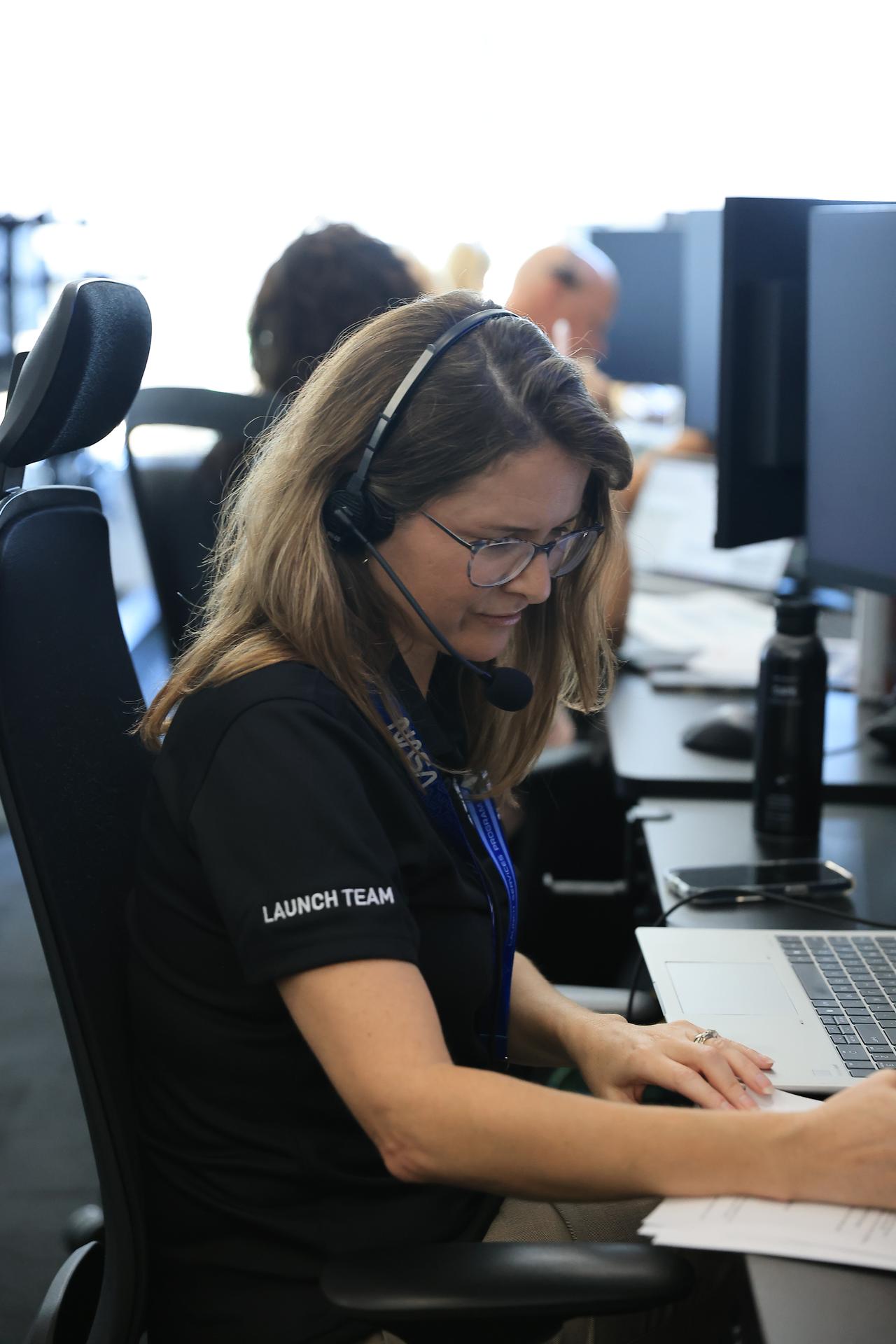
Jennifer Nufer, mission manager, Flight Projects Office with NASA’s Launch Services Program, participates in a mission dress rehearsal for NASA’s Nancy Grace Roman Space Telescope on Thursday, Aug. 20, 2026, inside SpaceX’s Hangar X at NASA Kennedy in Florida. Nufer and other specialists served as an assessment team for personnel who ran through a full end-to-end simulation of every major step they will experience on launch day except liftoff, including powering up the spacecraft, fueling the rocket, conducting weather briefings, and other operations.
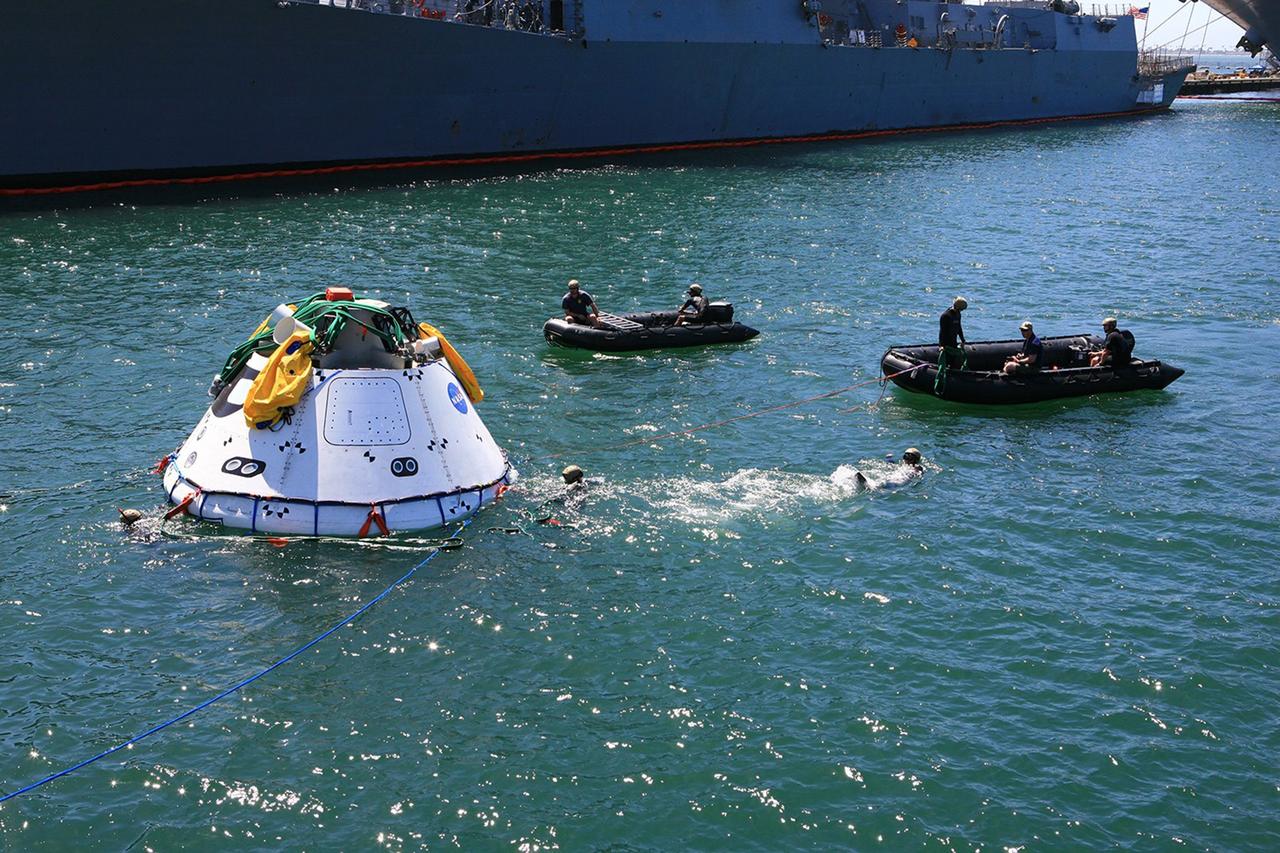
SAN DIEGO, Calif. – The Orion boilerplate test vehicle has been lowered into the water with a stationary crane from the USS Salvor, a safeguard-class rescue and salvage ship, during the first day of Underway Recovery Test 4A at Naval Base San Diego in California. U.S. Navy personnel in two Zodiac boats practice procedures to tether and retrieve the test vehicle. The ship will head out to sea for four days to test crew module crane recovery operations. NASA, Lockheed Martin and the U.S. Navy are conducting the test to prepare for recovery of the Orion crew module on its return from a deep space mission. The underway recovery test will allow the teams to demonstrate and evaluate the recovery processes, procedures, new hardware and personnel in open waters. The Ground Systems Development and Operations Program is conducting the underway recovery test. Orion is the exploration spacecraft designed to carry astronauts to destinations not yet explored by humans, including an asteroid and Mars. It will have emergency abort capability, sustain the crew during space travel and provide safe re-entry from deep space return velocities. The first unpiloted test flight of the Orion is scheduled to launch in December 2014 atop a United Launch Alliance Delta IV rocket and in 2018 on NASA’s Space Launch System rocket. For more information, visit http://www.nasa.gov/orion. Photo credit: Kim Shiflett
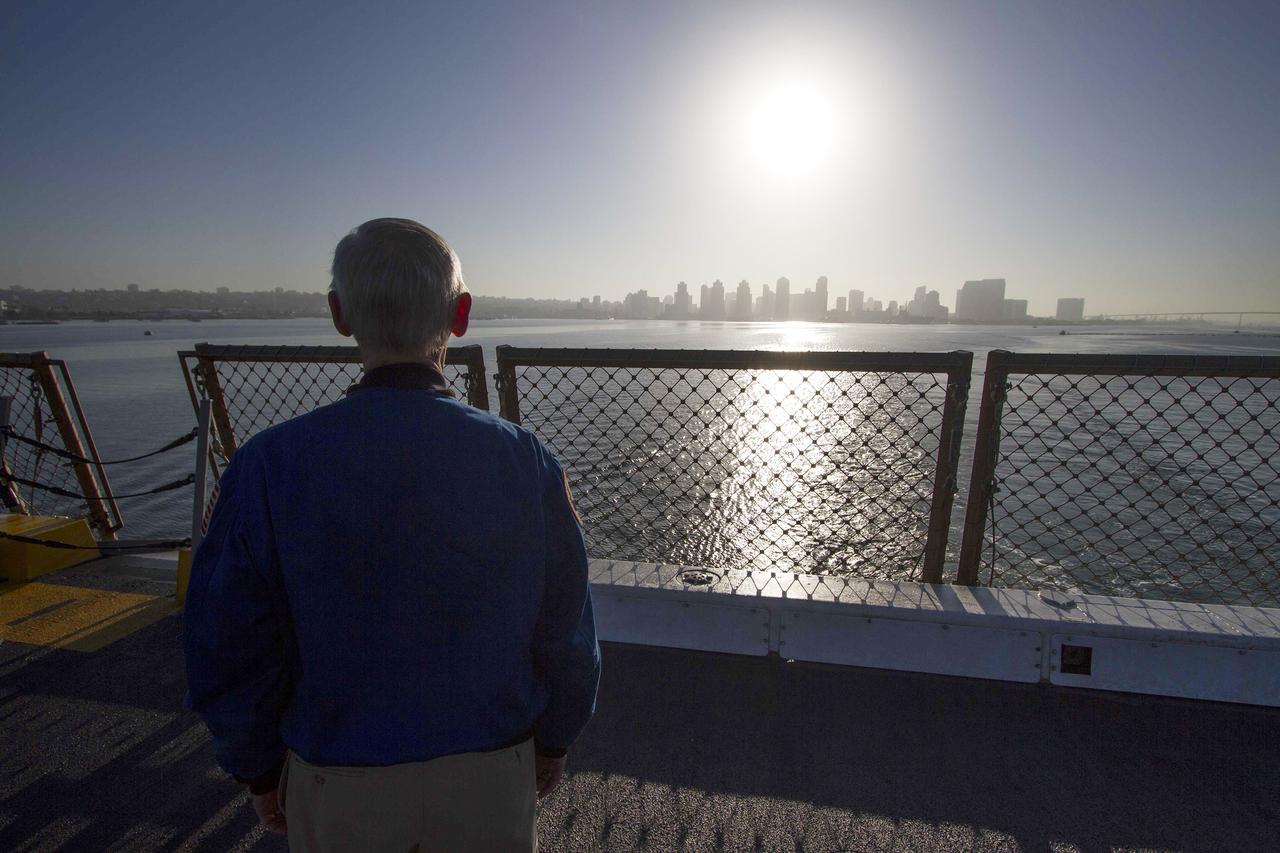
SAN DIEGO, Calif. – John Casper, retired NASA astronaut and Special Assistant for Program Integration for the Orion Program, looks at the San Diego skyline from the deck of the USS Anchorage as the ship departs Naval Base San Diego on the first day of Orion Underway Recovery Test 3. The ship will head out to sea, off the coast of San Diego, in search of conditions to support test needs for a full dress rehearsal of recovery operations. NASA, Lockheed Martin and U.S. Navy personnel will conduct tests in the Pacific Ocean to prepare for recovery of the Orion crew module on its return from a deep space mission. The test will allow the teams to demonstrate and evaluate the recovery processes, procedures, hardware and personnel in open waters. The Ground Systems Development and Operations Program is conducting the underway recovery tests. Orion is the exploration spacecraft designed to carry astronauts to destinations not yet explored by humans, including an asteroid and Mars. It will have emergency abort capability, sustain the crew during space travel and provide safe re-entry from deep space return velocities. The first unpiloted test flight of Orion is scheduled to launch in 2014 atop a United Launch Alliance Delta IV Heavy rocket and in 2018 on NASA’s Space Launch System rocket. For more information, visit http://www.nasa.gov/orion. Photo credit: NASA/Cory Huston
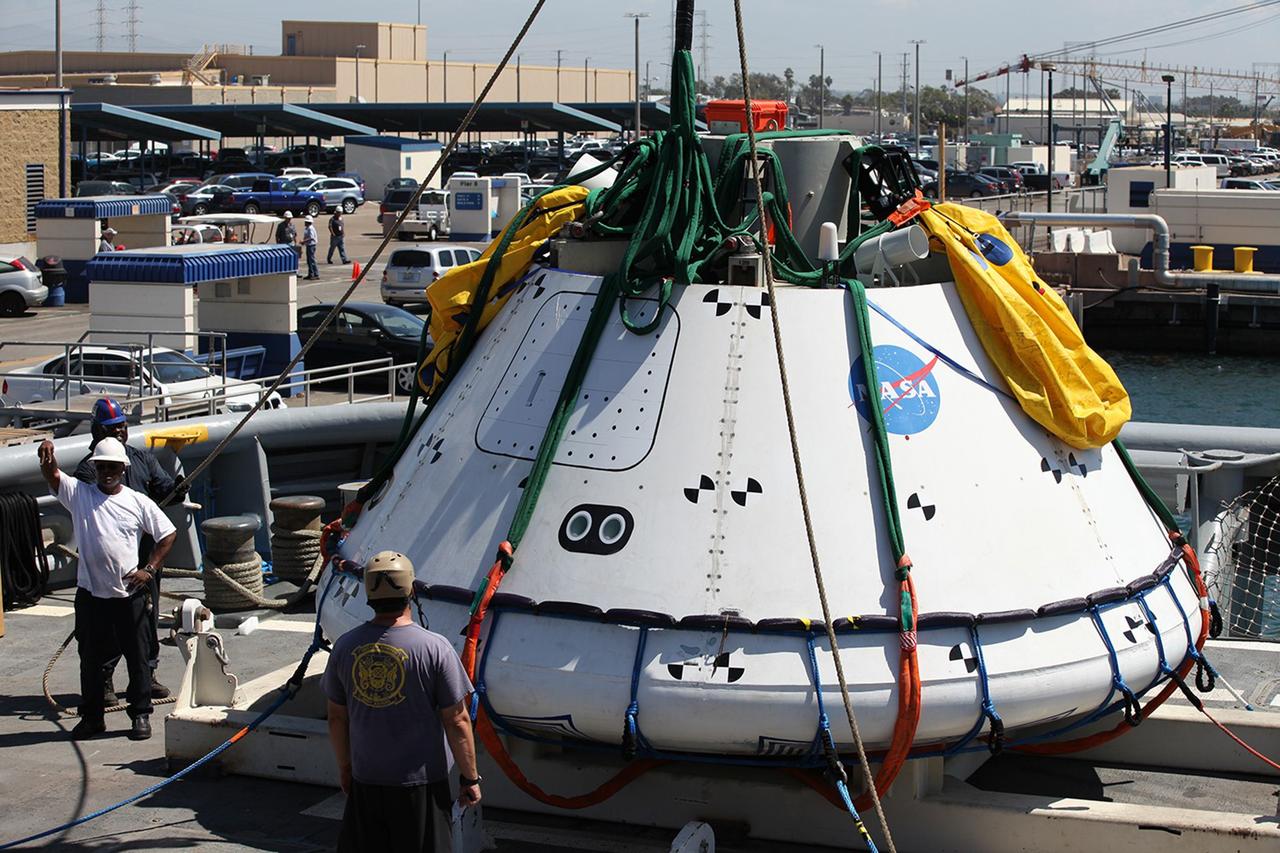
SAN DIEGO, Calif. – At Naval Base San Diego in California, U.S. Navy personnel prepare the Orion boilerplate test vehicle to be lifted by stationary crane from the USS Salvor, a safeguard-class rescue and salvage ship, and lowered into the water during the first day of Underway Recovery Test 4A. The ship will head out to sea for four days to test crew module crane recovery operations. NASA, Lockheed Martin and the U.S. Navy are conducting the test to prepare for recovery of the Orion crew module on its return from a deep space mission. The underway recovery test will allow the teams to demonstrate and evaluate the recovery processes, procedures, new hardware and personnel in open waters. The Ground Systems Development and Operations Program is conducting the underway recovery test. Orion is the exploration spacecraft designed to carry astronauts to destinations not yet explored by humans, including an asteroid and Mars. It will have emergency abort capability, sustain the crew during space travel and provide safe re-entry from deep space return velocities. The first unpiloted test flight of the Orion is scheduled to launch in December 2014 atop a United Launch Alliance Delta IV rocket and in 2018 on NASA’s Space Launch System rocket. For more information, visit http://www.nasa.gov/orion. Photo credit: Kim Shiflett
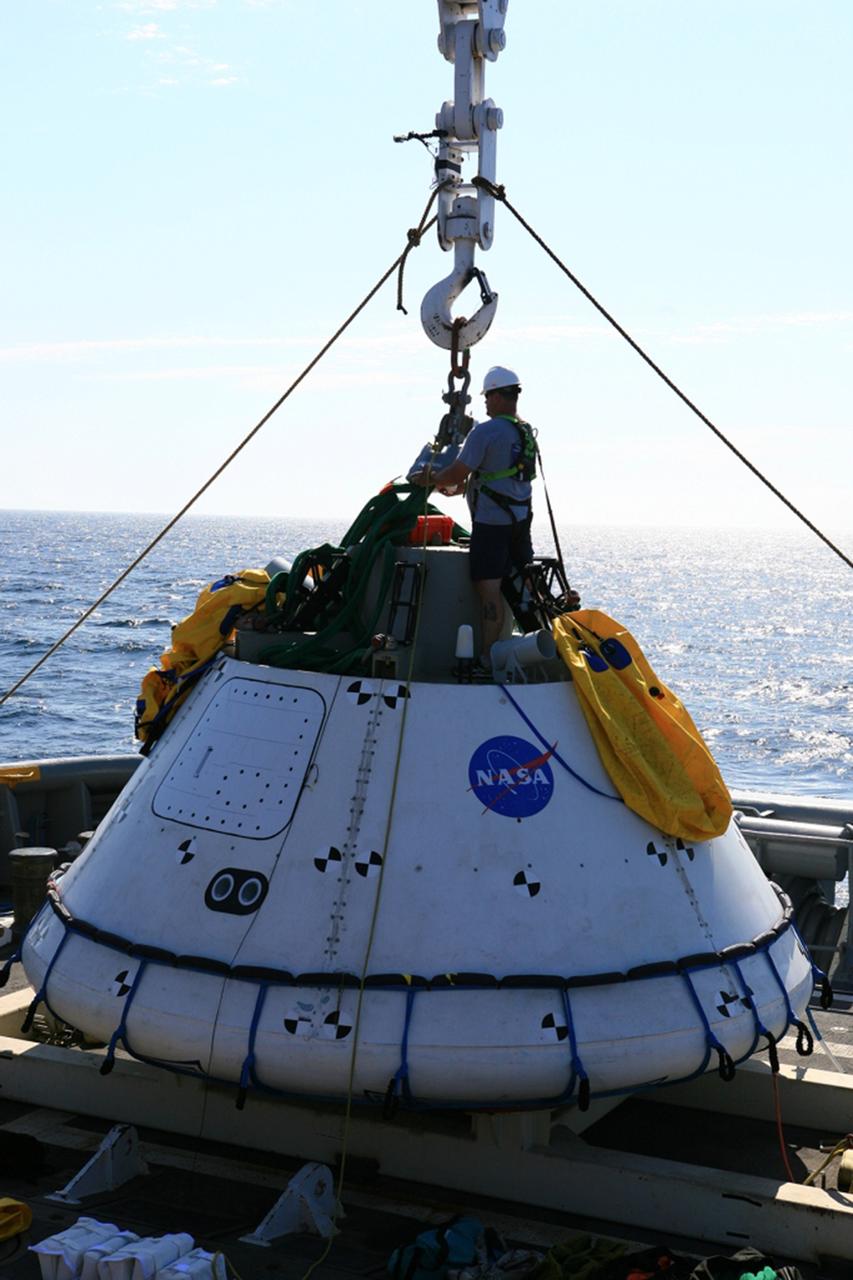
SAN DIEGO, Calif. – On board the USS Salvor, a safeguard-class rescue and salvage ship, U.S. Navy personnel check the stationary crane attached to the Orion boilerplate test vehicle during Underway Recovery Test 4A in the Pacific Ocean. The test vehicle will be lifted up and lowered into the water to test crew module crane recovery operations. NASA, Lockheed Martin and the U.S. Navy are conducting the test to prepare for recovery of the Orion crew module on its return from a deep space mission. The underway recovery test will allow the teams to demonstrate and evaluate the recovery processes, procedures, new hardware and personnel in open waters. The Ground Systems Development and Operations Program is conducting the underway recovery test. Orion is the exploration spacecraft designed to carry astronauts to destinations not yet explored by humans, including an asteroid and Mars. It will have emergency abort capability, sustain the crew during space travel and provide safe re-entry from deep space return velocities. The first unpiloted test flight of the Orion is scheduled to launch in December 2014 atop a United Launch Alliance Delta IV Heavy rocket and in 2018 on NASA’s Space Launch System rocket. For more information, visit http://www.nasa.gov/orion. Photo credit: Kim Shiflett
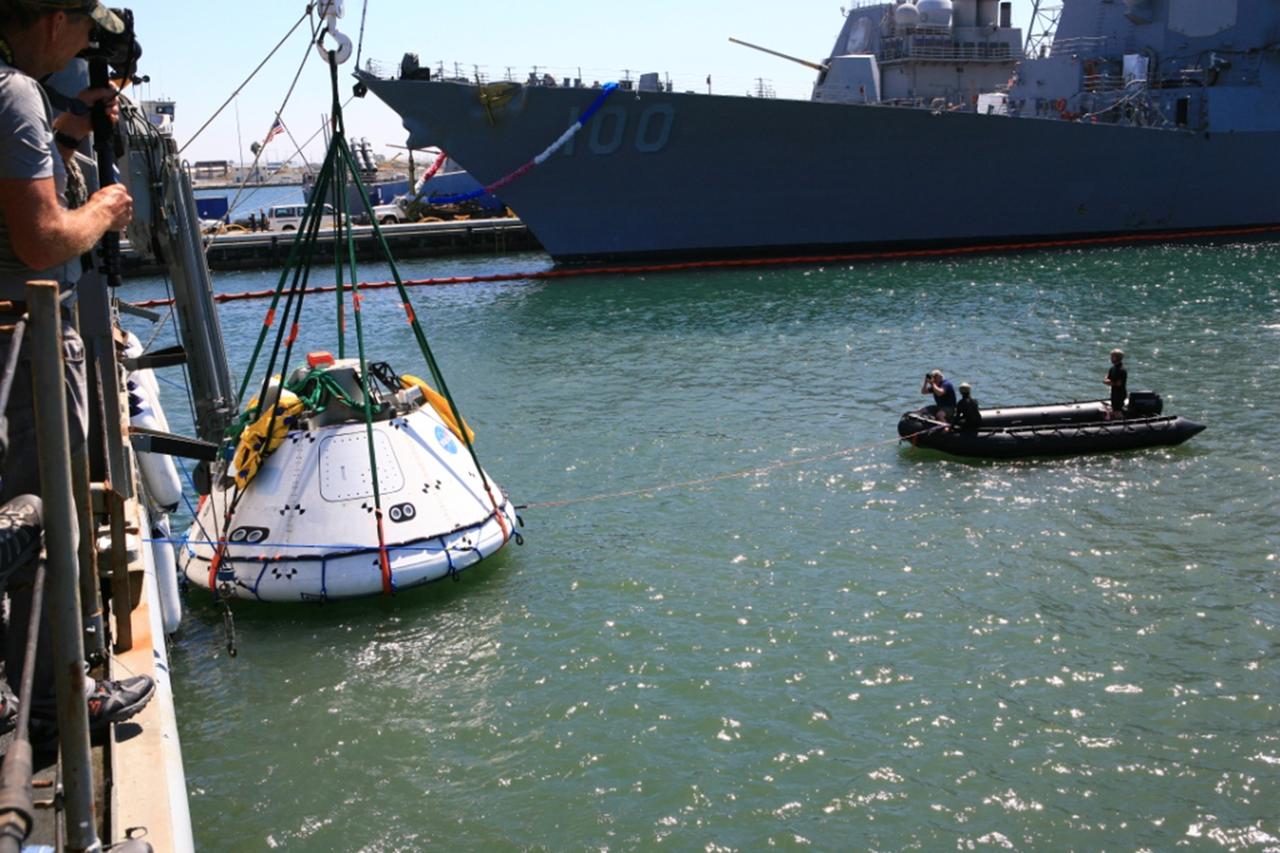
SAN DIEGO, Calif. – The Orion boilerplate test vehicle has been lowered into the water with a stationary crane from the USS Salvor, a safeguard-class rescue and salvage ship, during the first day of Underway Recovery Test 4A at Naval Base San Diego in California. U.S. Navy personnel in a Zodiac boat practice procedures to tether the test vehicle. The ship will head out to sea for four days to test crew module crane recovery operations. NASA, Lockheed Martin and the U.S. Navy are conducting the test to prepare for recovery of the Orion crew module on its return from a deep space mission. The underway recovery test will allow the teams to demonstrate and evaluate the recovery processes, procedures, new hardware and personnel in open waters. The Ground Systems Development and Operations Program is conducting the underway recovery test. Orion is the exploration spacecraft designed to carry astronauts to destinations not yet explored by humans, including an asteroid and Mars. It will have emergency abort capability, sustain the crew during space travel and provide safe re-entry from deep space return velocities. The first unpiloted test flight of the Orion is scheduled to launch in December 2014 atop a United Launch Alliance Delta IV rocket and in 2018 on NASA’s Space Launch System rocket. For more information, visit http://www.nasa.gov/orion. Photo credit: Kim Shiflett
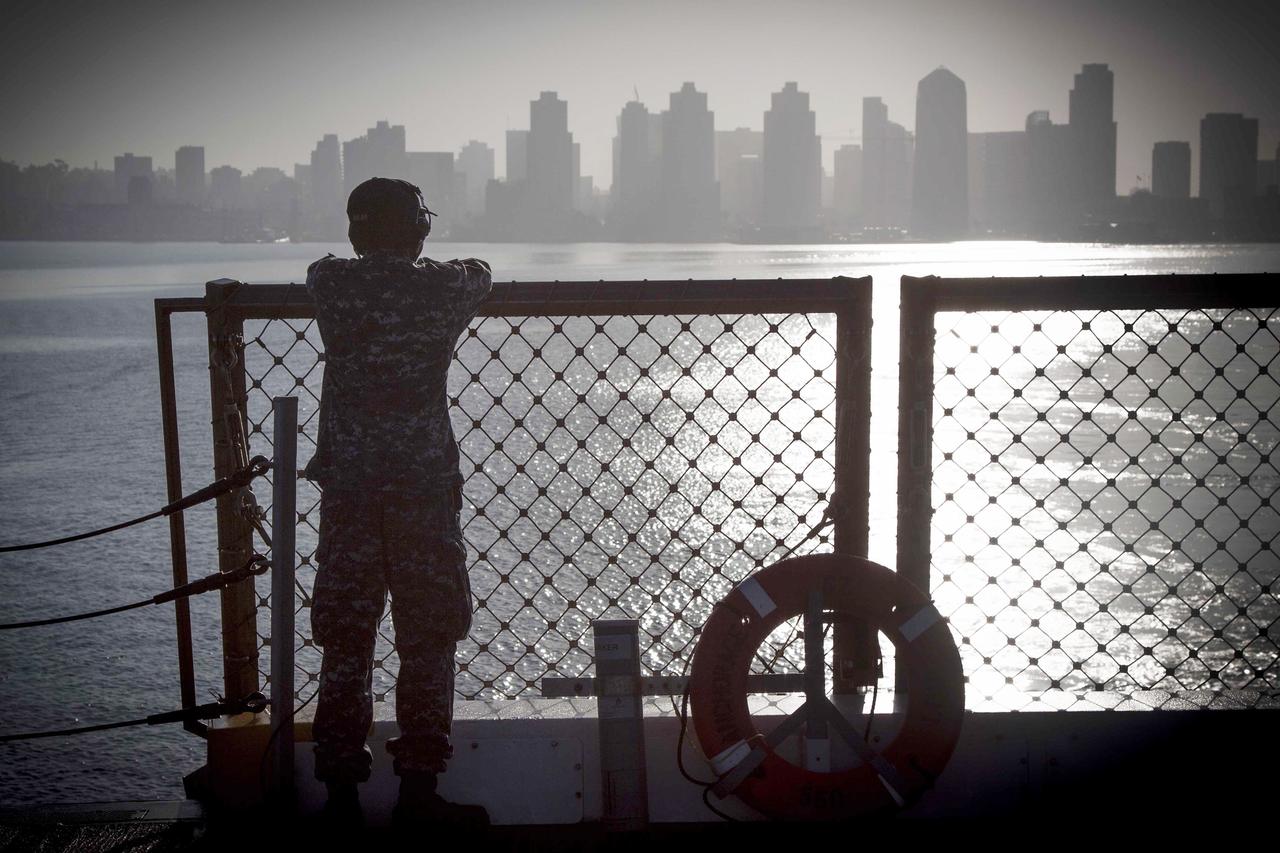
SAN DIEGO, Calif. – A member of the U.S. Navy watches the San Diego skyline from the deck of the USS Anchorage as the ship departs Naval Base San Diego on the first day of Orion Underway Recovery Test 3. The ship is heading out to sea, off the coast of San Diego, in search of conditions to support test needs for a full dress rehearsal of recovery operations. NASA, Lockheed Martin and U.S. Navy personnel will conduct tests in the Pacific Ocean to prepare for recovery of the Orion crew module on its return from a deep space mission. The test will allow the teams to demonstrate and evaluate the recovery processes, procedures, hardware and personnel in open waters. The Ground Systems Development and Operations Program is conducting the underway recovery tests. Orion is the exploration spacecraft designed to carry astronauts to destinations not yet explored by humans, including an asteroid and Mars. It will have emergency abort capability, sustain the crew during space travel and provide safe re-entry from deep space return velocities. The first unpiloted test flight of Orion is scheduled to launch in 2014 atop a United Launch Alliance Delta IV Heavy rocket and in 2018 on NASA’s Space Launch System rocket. For more information, visit http://www.nasa.gov/orion. Photo credit: NASA/Cory Huston
SAN DIEGO, Calif. – The Orion boilerplate test vehicle has been lowered into the water with a stationary crane from the USS Salvor, a safeguard-class rescue and salvage ship, during the first day of Underway Recovery Test 4A at Naval Base San Diego in California. U.S. Navy personnel in a Zodiac boat practice procedures to tether and retrieve the test vehicle. The ship will head out to sea for four days to test crew module crane recovery operations. NASA, Lockheed Martin and the U.S. Navy are conducting the test to prepare for recovery of the Orion crew module on its return from a deep space mission. The underway recovery test will allow the teams to demonstrate and evaluate the recovery processes, procedures, new hardware and personnel in open waters. The Ground Systems Development and Operations Program is conducting the underway recovery test. Orion is the exploration spacecraft designed to carry astronauts to destinations not yet explored by humans, including an asteroid and Mars. It will have emergency abort capability, sustain the crew during space travel and provide safe re-entry from deep space return velocities. The first unpiloted test flight of the Orion is scheduled to launch in December 2014 atop a United Launch Alliance Delta IV rocket and in 2018 on NASA’s Space Launch System rocket. For more information, visit http://www.nasa.gov/orion. Photo credit: Kim Shiflett
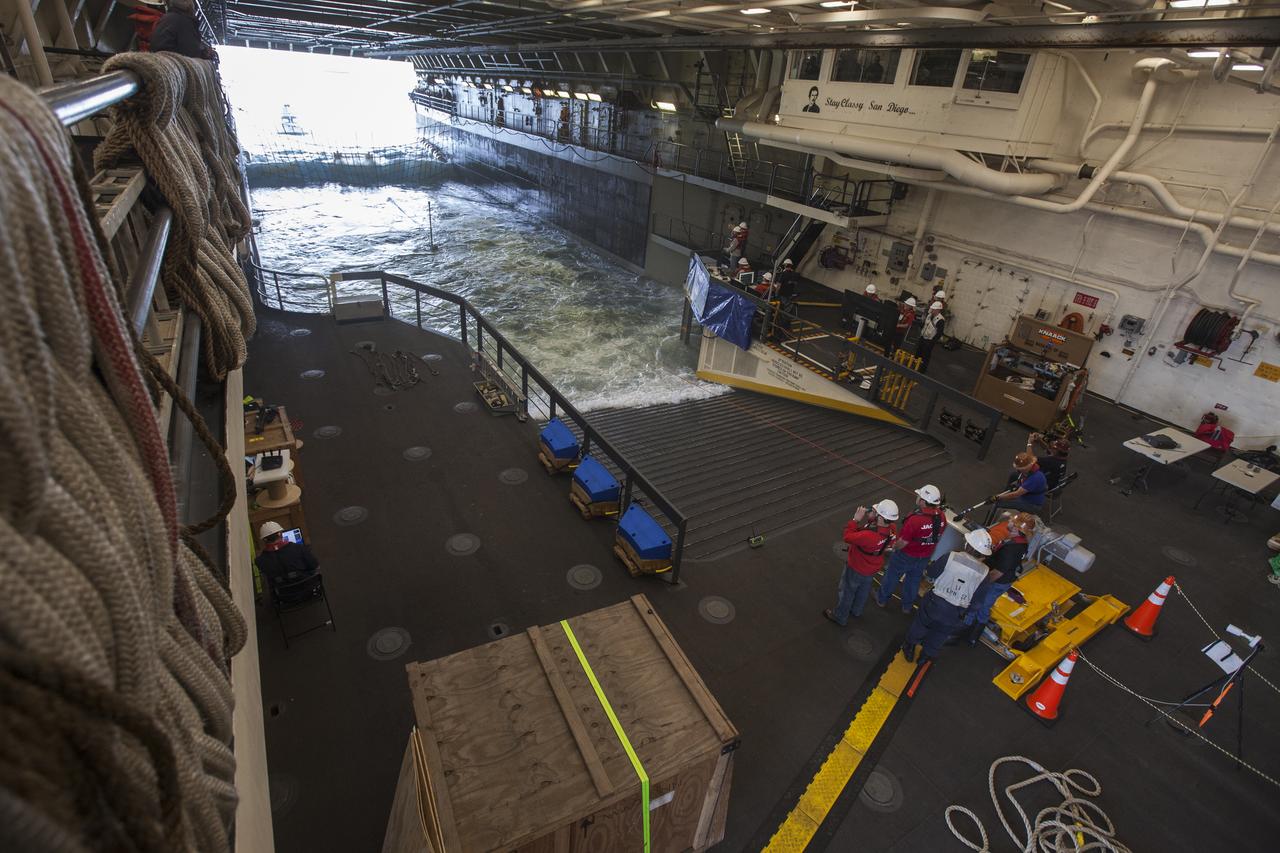
Winch operators, at right, watch from the flooded well deck of the USS San Diego as a test version of the Orion crew module is guided to the well deck during Underway Recovery Test 5 in the Pacific Ocean off the coast of California. NASA's Ground Systems Development and Operations Program and the U.S. Navy are conducting a series of tests using the well deck of the USS San Diego, several watercraft, support equipment and personnel to prepare for recovery of Orion on its return from deep space missions. The testing will allow the team to demonstrate and evaluate recovery processes, procedures, hardware and personnel in open waters. Orion is the exploration spacecraft designed to carry astronauts to destinations not yet explored by humans, including an asteroid and NASA's Journey to Mars. It will have emergency abort capability, sustain the crew during space travel and provide safe re-entry from deep space return velocities. Orion is scheduled to launch on NASA's Space Launch System in late 2018. For more information, visit http://www.nasa.gov/orion.
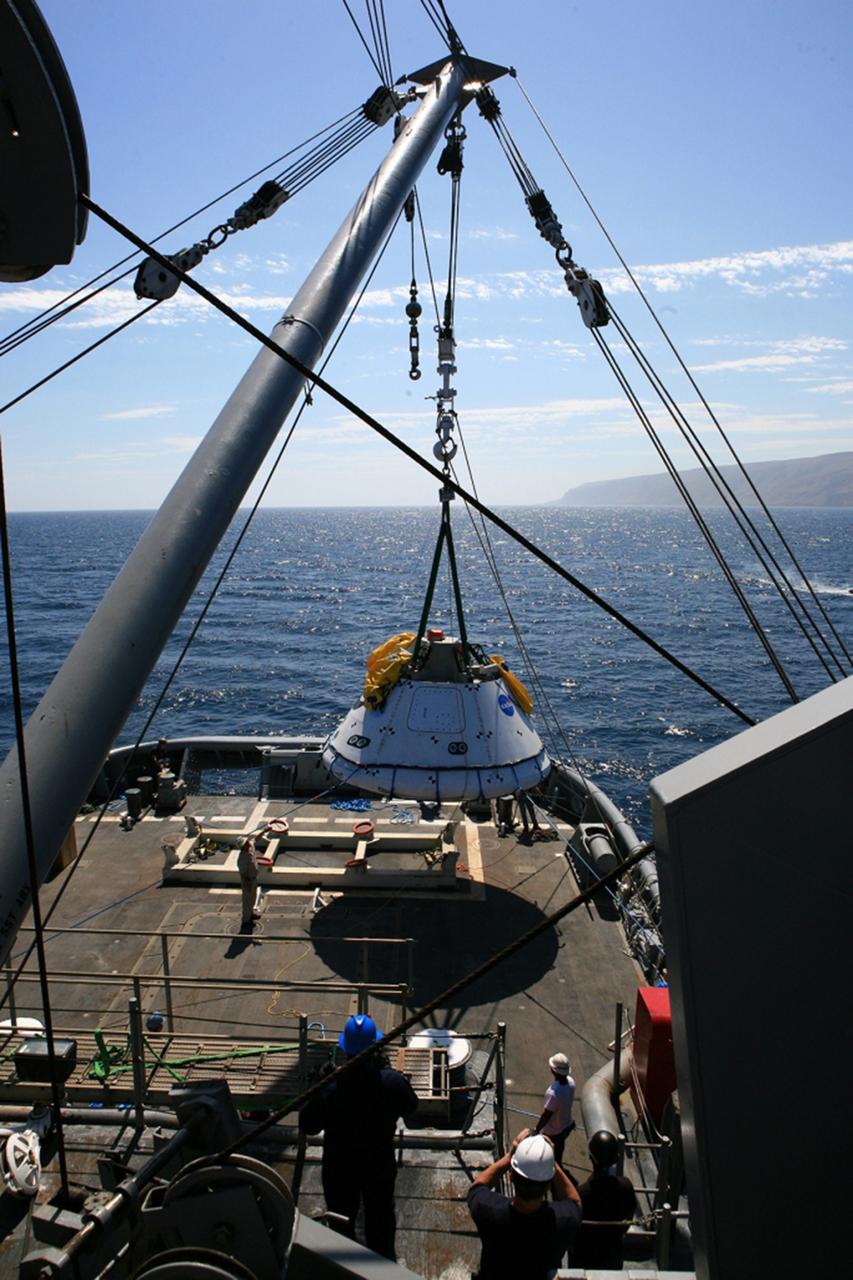
SAN DIEGO, Calif. – On board the USS Salvor, a safeguard-class rescue and salvage ship, U.S. Navy personnel monitor the progress as a stationary crane lifts the Orion boilerplate test vehicle during Underway Recovery Test 4A in the Pacific Ocean. The test vehicle will be lifted up and lowered into the water to test crew module crane recovery operations. NASA, Lockheed Martin and the U.S. Navy are conducting the test to prepare for recovery of the Orion crew module on its return from a deep space mission. The underway recovery test will allow the teams to demonstrate and evaluate the recovery processes, procedures, new hardware and personnel in open waters. The Ground Systems Development and Operations Program is conducting the underway recovery test. Orion is the exploration spacecraft designed to carry astronauts to destinations not yet explored by humans, including an asteroid and Mars. It will have emergency abort capability, sustain the crew during space travel and provide safe re-entry from deep space return velocities. The first unpiloted test flight of the Orion is scheduled to launch in December 2014 atop a United Launch Alliance Delta IV Heavy rocket and in 2018 on NASA’s Space Launch System rocket. For more information, visit http://www.nasa.gov/orion. Photo credit: Kim Shiflett

SAN DIEGO, Calif. – NASA Administrator Charlie Bolden stands on the deck of the USS Anchorage as the ship departs Naval Base San Diego for the first day of Orion Underway Recovery Test 3. The ship will head out to sea, off the coast of San Diego, in search of conditions to support test needs for a full dress rehearsal of recovery operations. NASA, Lockheed Martin and U.S. Navy personnel will conduct tests in the Pacific Ocean to prepare for recovery of the Orion crew module on its return from a deep space mission. The test will allow the teams to demonstrate and evaluate the recovery processes, procedures, hardware and personnel in open waters. The Ground Systems Development and Operations Program is conducting the underway recovery tests. Orion is the exploration spacecraft designed to carry astronauts to destinations not yet explored by humans, including an asteroid and Mars. It will have emergency abort capability, sustain the crew during space travel and provide safe re-entry from deep space return velocities. The first unpiloted test flight of Orion is scheduled to launch in 2014 atop a United Launch Alliance Delta IV Heavy rocket and in 2018 on NASA’s Space Launch System rocket. For more information, visit http://www.nasa.gov/orion. Photo credit: NASA/Cory Huston
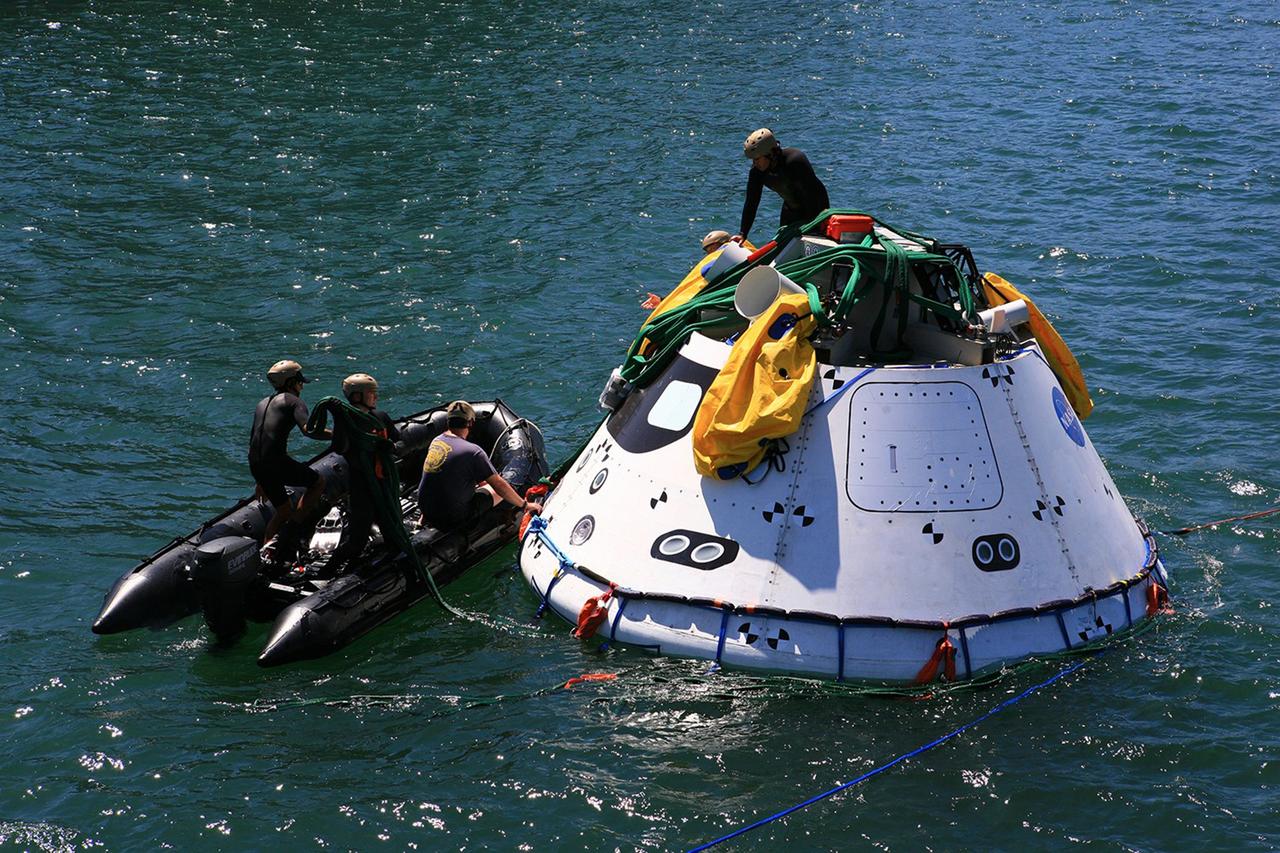
SAN DIEGO, Calif. – The Orion boilerplate test vehicle has been lowered into the water with a stationary crane from the USS Salvor, a safeguard-class rescue and salvage ship, during the first day of Underway Recovery Test 4A at Naval Base San Diego in California. U.S. Navy personnel in a Zodiac boat practice procedures to tether and retrieve the test vehicle. The ship will head out to sea for four days to test crew module crane recovery operations. NASA, Lockheed Martin and the U.S. Navy are conducting the test to prepare for recovery of the Orion crew module on its return from a deep space mission. The underway recovery test will allow the teams to demonstrate and evaluate the recovery processes, procedures, new hardware and personnel in open waters. The Ground Systems Development and Operations Program is conducting the underway recovery test. Orion is the exploration spacecraft designed to carry astronauts to destinations not yet explored by humans, including an asteroid and Mars. It will have emergency abort capability, sustain the crew during space travel and provide safe re-entry from deep space return velocities. The first unpiloted test flight of the Orion is scheduled to launch in December 2014 atop a United Launch Alliance Delta IV rocket and in 2018 on NASA’s Space Launch System rocket. For more information, visit http://www.nasa.gov/orion. Photo credit: Kim Shiflett
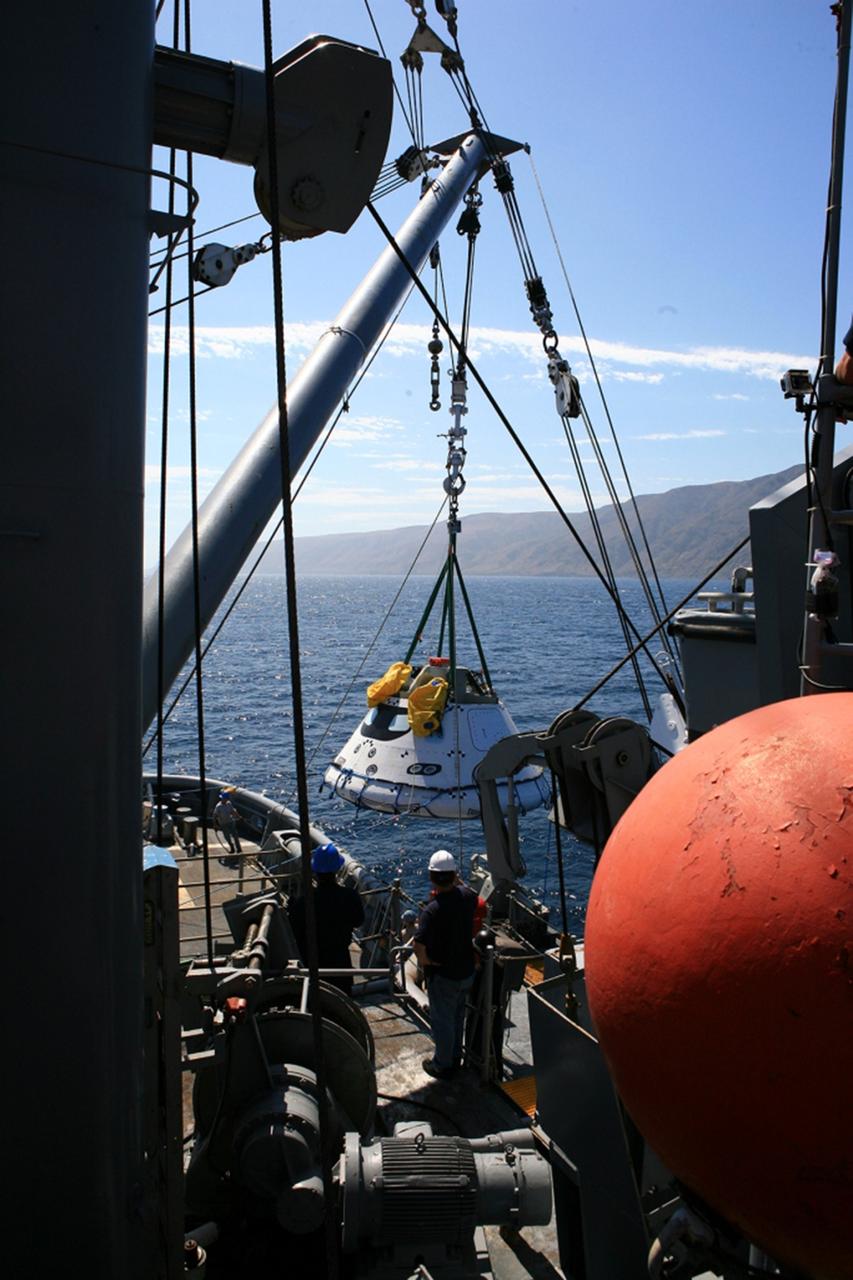
SAN DIEGO, Calif. – On board the USS Salvor, a safeguard-class rescue and salvage ship, U.S. Navy personnel monitor the progress as a stationary crane lowers the Orion boilerplate test vehicle into the Pacific Ocean during Underway Recovery Test 4A. NASA, Lockheed Martin and the U.S. Navy are testing crane recovery operations to prepare for recovery of the Orion crew module on its return from a deep space mission. The underway recovery test will allow the teams to demonstrate and evaluate the recovery processes, procedures, new hardware and personnel in open waters. The Ground Systems Development and Operations Program is conducting the underway recovery test. Orion is the exploration spacecraft designed to carry astronauts to destinations not yet explored by humans, including an asteroid and Mars. It will have emergency abort capability, sustain the crew during space travel and provide safe re-entry from deep space return velocities. The first unpiloted test flight of the Orion is scheduled to launch in December 2014 atop a United Launch Alliance Delta IV Heavy rocket and in 2018 on NASA’s Space Launch System rocket. For more information, visit http://www.nasa.gov/orion. Photo credit: Kim Shiflett
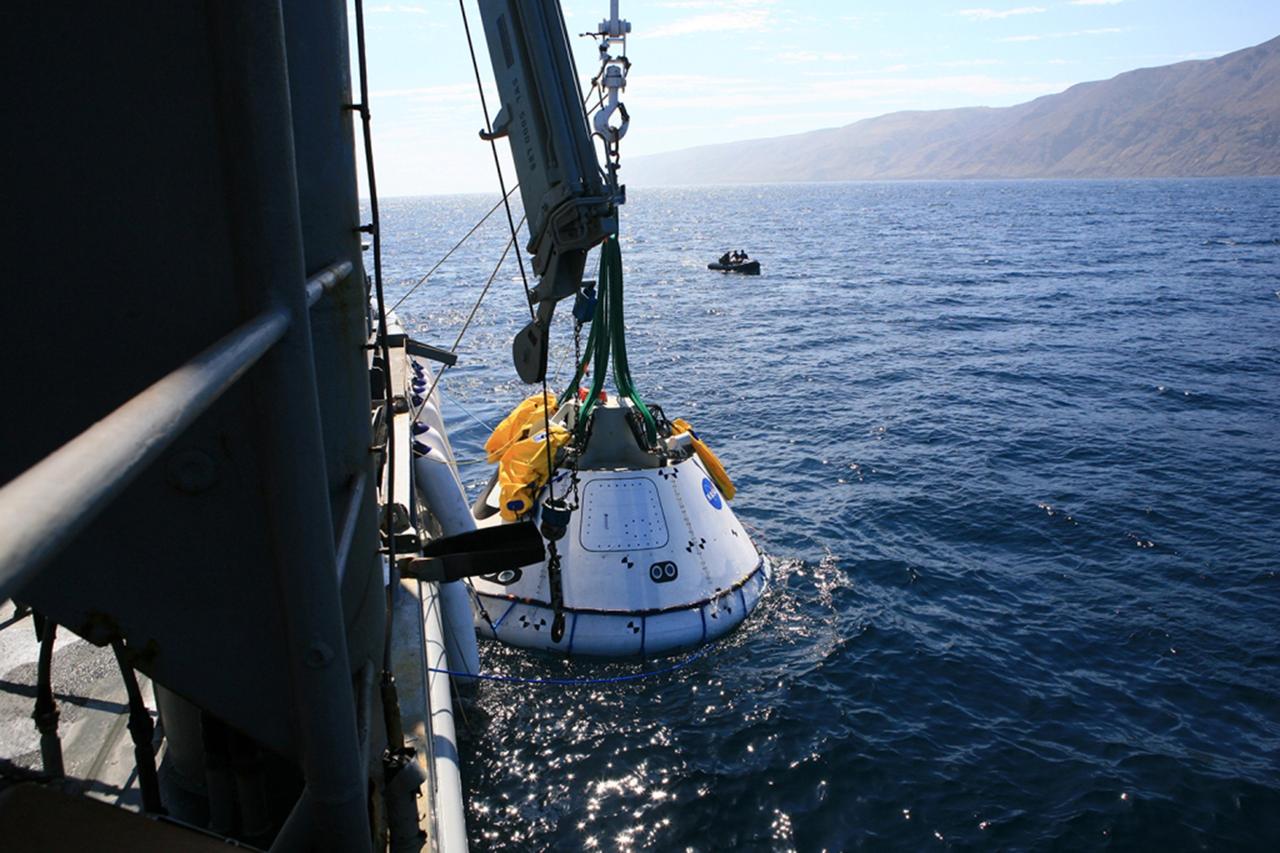
SAN DIEGO, Calif. – The Orion boilerplate test vehicle has been lowered into the water with a stationary crane from the USS Salvor, a safeguard-class rescue and salvage ship, during Underway Recovery Test 4A in the Pacific Ocean. Nearby, U.S. Navy personnel in a Zodiac boat prepare to practice procedures to tether and retrieve the test vehicle. NASA, Lockheed Martin and the U.S. Navy are testing crane recovery operations to prepare for recovery of the Orion crew module on its return from a deep space mission. The underway recovery test will allow the teams to demonstrate and evaluate the recovery processes, procedures, new hardware and personnel in open waters. The Ground Systems Development and Operations Program is conducting the underway recovery test. Orion is the exploration spacecraft designed to carry astronauts to destinations not yet explored by humans, including an asteroid and Mars. It will have emergency abort capability, sustain the crew during space travel and provide safe re-entry from deep space return velocities. The first unpiloted test flight of the Orion is scheduled to launch in December 2014 atop a United Launch Alliance Delta IV Heavy rocket and in 2018 on NASA’s Space Launch System rocket. For more information, visit http://www.nasa.gov/orion. Photo credit: Kim Shiflett
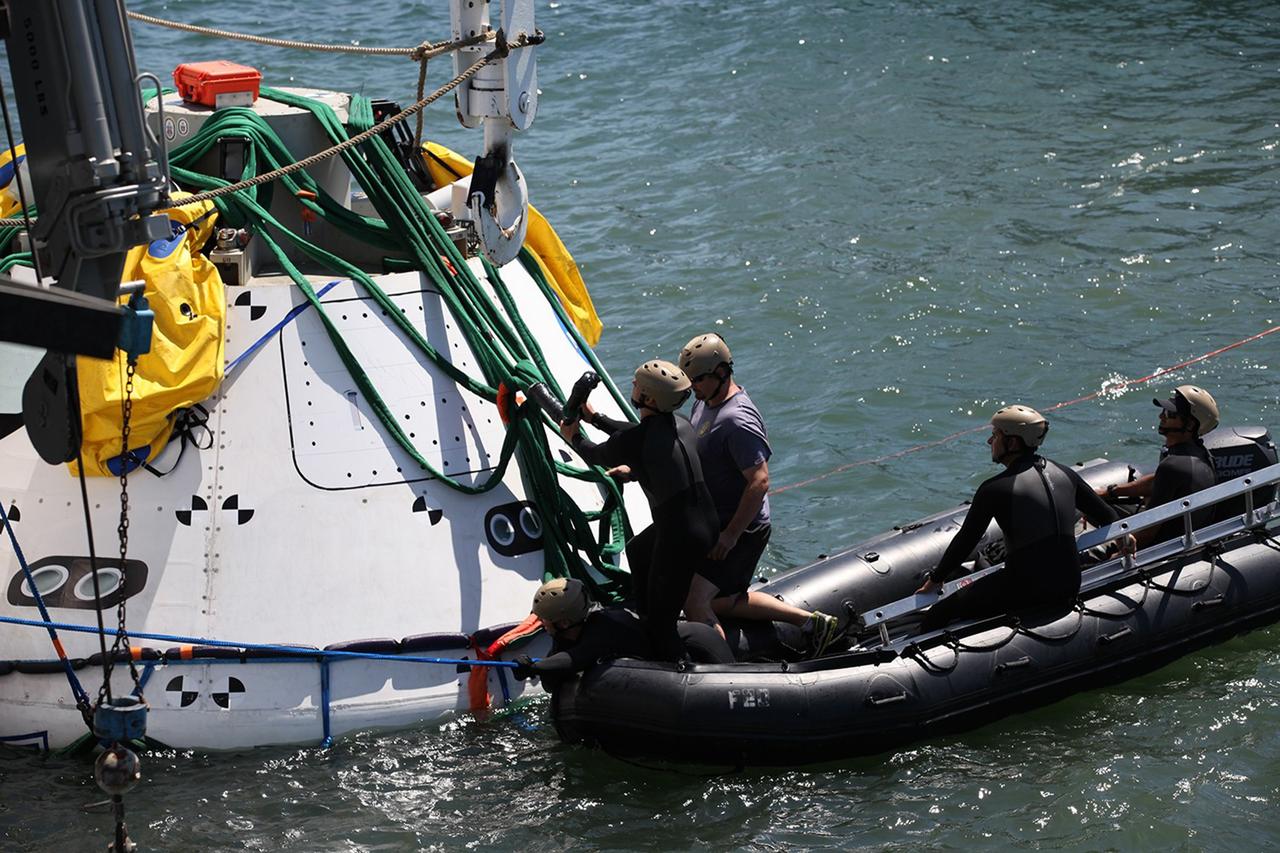
SAN DIEGO, Calif. – The Orion boilerplate test vehicle has been lowered into the water with a stationary crane from the USS Salvor, a safeguard-class rescue and salvage ship, during the first day of Underway Recovery Test 4A at Naval Base San Diego in California. U.S. Navy personnel in a Zodiac boat practice procedures to tether and retrieve the test vehicle. The ship will head out to sea for four days to test crew module crane recovery operations. NASA, Lockheed Martin and the U.S. Navy are conducting the test to prepare for recovery of the Orion crew module on its return from a deep space mission. The underway recovery test will allow the teams to demonstrate and evaluate the recovery processes, procedures, new hardware and personnel in open waters. The Ground Systems Development and Operations Program is conducting the underway recovery test. Orion is the exploration spacecraft designed to carry astronauts to destinations not yet explored by humans, including an asteroid and Mars. It will have emergency abort capability, sustain the crew during space travel and provide safe re-entry from deep space return velocities. The first unpiloted test flight of the Orion is scheduled to launch in December 2014 atop a United Launch Alliance Delta IV rocket and in 2018 on NASA’s Space Launch System rocket. For more information, visit http://www.nasa.gov/orion. Photo credit: Kim Shiflett
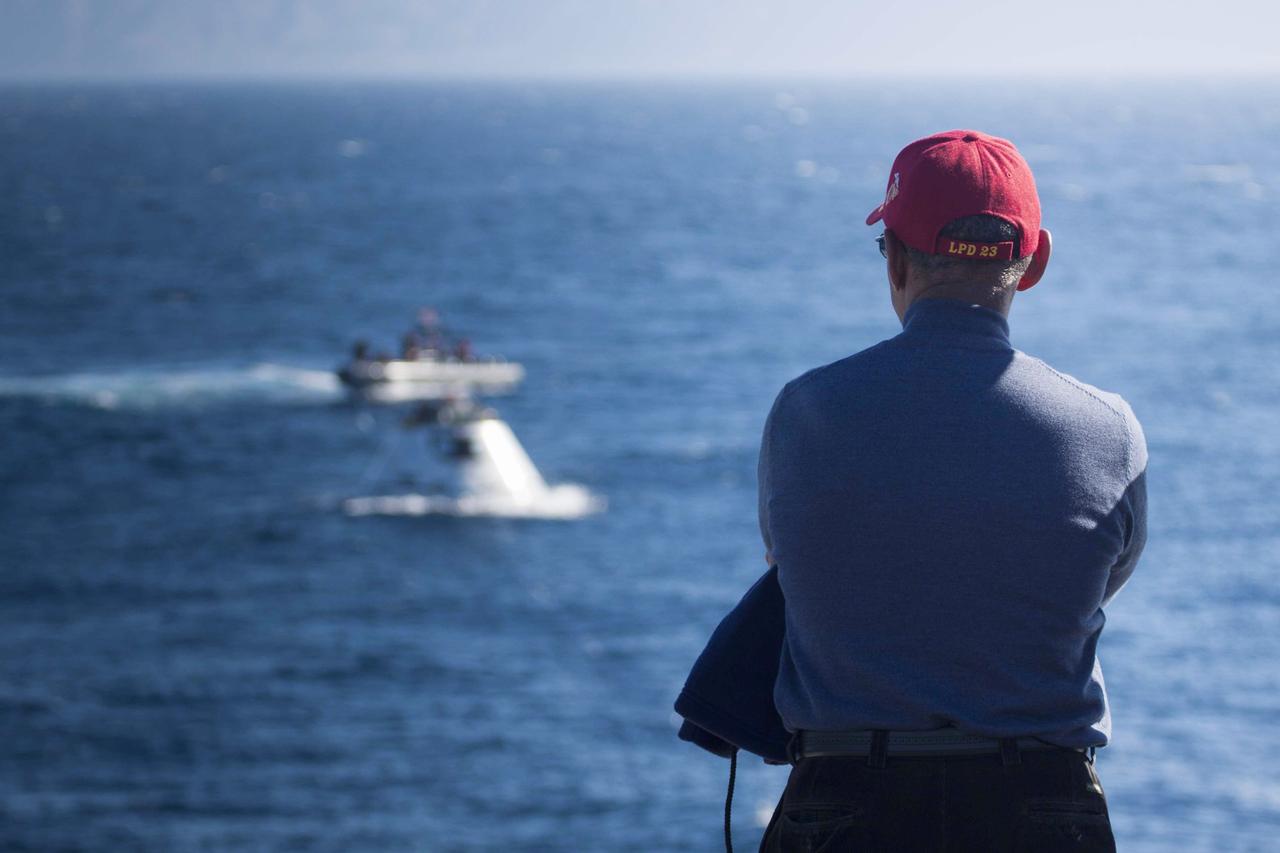
SAN DIEGO, Calif. – NASA Administrator Charlie Bolden stands on the deck of the USS Anchorage on the first day of Orion Underway Recovery Test 3. The Orion boilerplate test vehicle floats in the Pacific Ocean with U.S. Navy divers in a rigid hull inflatable boat nearby. NASA, Lockheed Martin and U.S. Navy personnel are conducting a full dress rehearsal of recovery operations in the Pacific Ocean to prepare for recovery of the Orion crew module on its return from a deep space mission. The test will allow the teams to demonstrate and evaluate the recovery processes, procedures, hardware and personnel in open waters. The Ground Systems Development and Operations Program is conducting the underway recovery tests. Orion is the exploration spacecraft designed to carry astronauts to destinations not yet explored by humans, including an asteroid and Mars. It will have emergency abort capability, sustain the crew during space travel and provide safe re-entry from deep space return velocities. The first unpiloted test flight of Orion is scheduled to launch in 2014 atop a United Launch Alliance Delta IV Heavy rocket and in 2018 on NASA’s Space Launch System rocket. For more information, visit http://www.nasa.gov/orion. Photo credit: NASA/Cory Huston
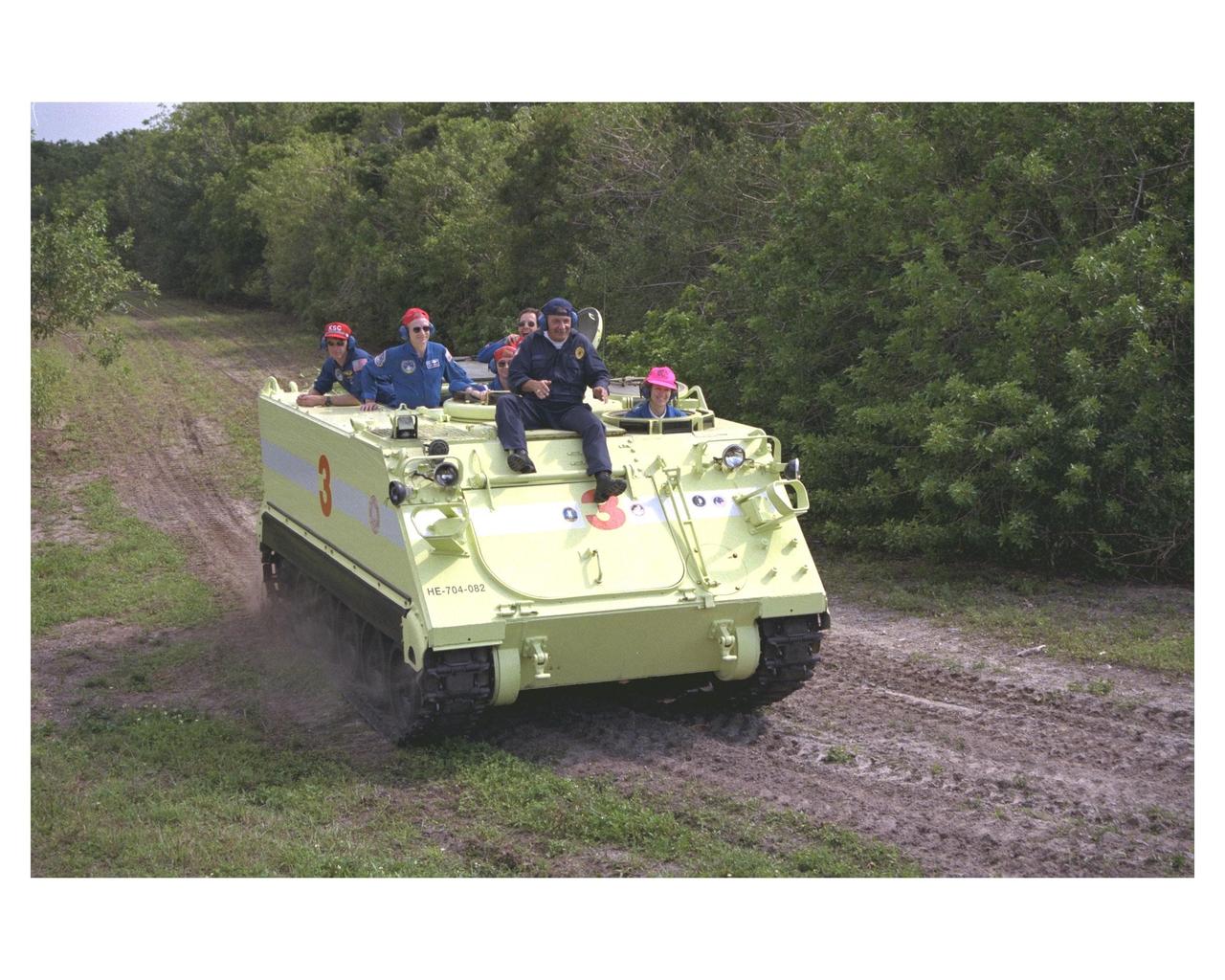
STS-84 crew members ride in and learn how to operate an M-113 armored personnel carrier as part of the Terminal Countdown Demonstration Test (TCDT) activities. In the front seat is Pilot Eileen Marie Collins. George Hoggard, a training officer with KSC Fire Services, sits beside her on top of the personnel carrier. Directly behind Hoggard, from left, are Commander Charles J. Precourt and Mission Specialist Elena V. Kondakova (sitting) of the Russian Space Agency. At the rear, from left, are Mission Specialist C. Michael Foale and Mission Specialist Jean-Francois Clervoy of the European Space Agency. STS-84 aboard the Space Shuttle Atlantis will be the sixth docking of the Space Shuttle with the Russian Space Station Mir. After docking, Foale will transfer to the space station and become a member of the Mir 23 crew, replacing U.S. astronaut Jerry M. Linenger, who will return to Earth aboard Atlantis. Foale will live and work on Mir until mid-September when his replacement is expected to arrive on the STS-86 mission. STS-84 is targeted for a May 15 liftoff
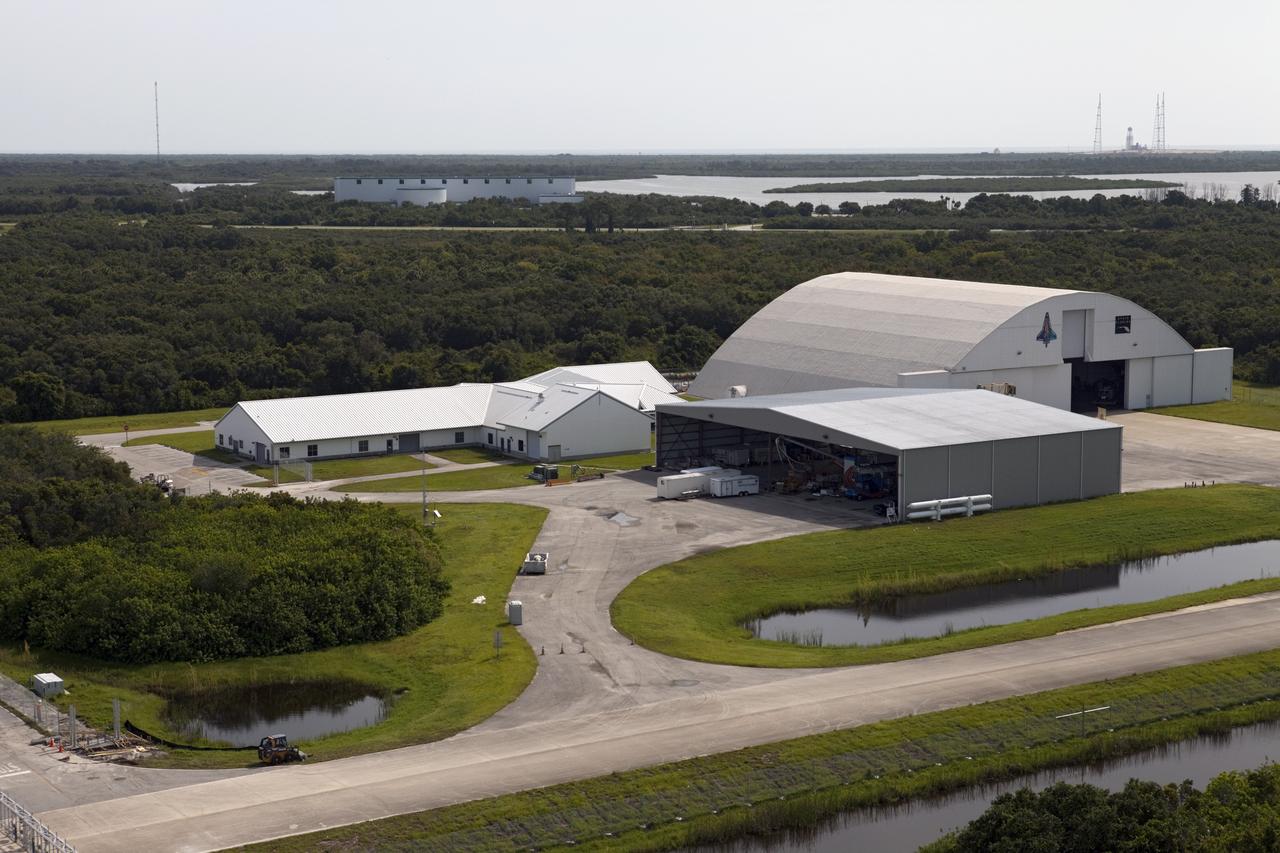
CAPE CANAVERAL, Fla. – This aerial view shows a 50,000-square-foot hangar located on the Shuttle Landing Facility at the Kennedy Space Center, Fla., providing shelter and storage for NASA and non-NASA aircraft and maintenance operations. Adjacent to the hangar is an operations building housing personnel who support operations at the 15,000-foot long concrete runway. At the north end of the runway, a rock and crater-filled planetary scape has been built so engineers can test the Autonomous Landing and Hazard Avoidance Technology, or ALHAT system on the Project Morpheus lander. Testing will demonstrate ALHAT’s ability to provide required navigation data negotiating the Morpheus lander away from risks during descent. Checkout of the prototype lander has been ongoing at NASA’s Johnson Space Center in Houston in preparation for its first free flight. The SLF site will provide the lander with the kind of field necessary for realistic testing. Project Morpheus is one of 20 small projects comprising the Advanced Exploration Systems, or AES, program in NASA’s Human Exploration and Operations Mission Directorate. AES projects pioneer new approaches for rapidly developing prototype systems, demonstrating key capabilities and validating operational concepts for future human missions beyond Earth orbit. For more information on Project Morpheus, visit http://www.nasa.gov/centers/johnson/exploration/morpheus/index.html Photo credit: NASA/Kim Shiflett