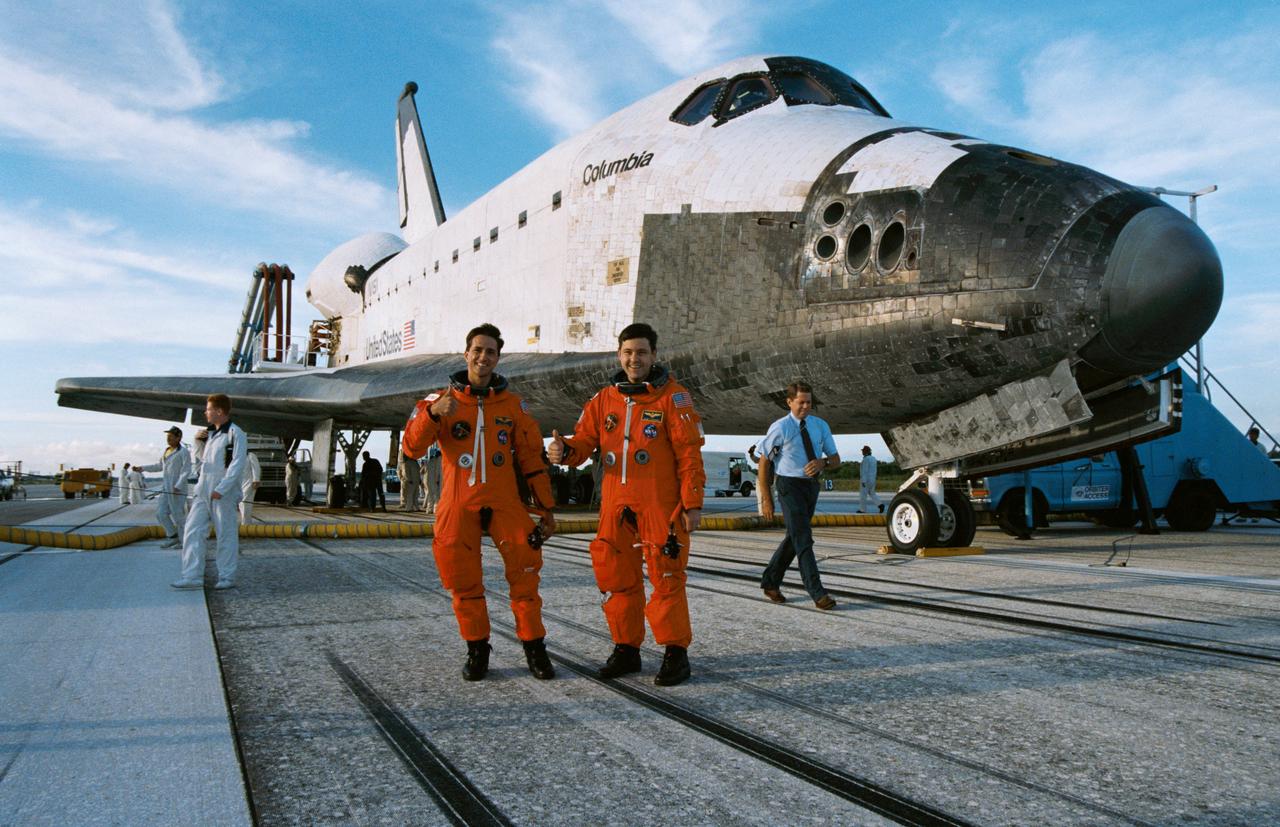
STS-65 Commander Robert D. Cabana (right) and Mission Specialist Donald A. Thomas, wearing launch and entry suits (LESs), signal mission success with a "thumbs up" gesture as they stand in front of Columbia, Orbiter Vehicle (OV) 102. The two crewmembers are all smiles after OV-102's landing at the Kennedy Space Center (KSC) Shuttle Landing Facility (SLF). The two, along with four other NASA astronauts and a Japanese payload specialist, had just broken a Shuttle duration record as they ran almost 18 hours over two weeks in space in support of the International Microgravity Laboratory 2 (IML-2) mission. Landing occurred at 6:38 am (Eastern Daylight Time (EDT)). Mission duration was 14 days, 17 hours and 56 minutes. In the background, KSC personnel conduct postflight servicing of the vehicle.
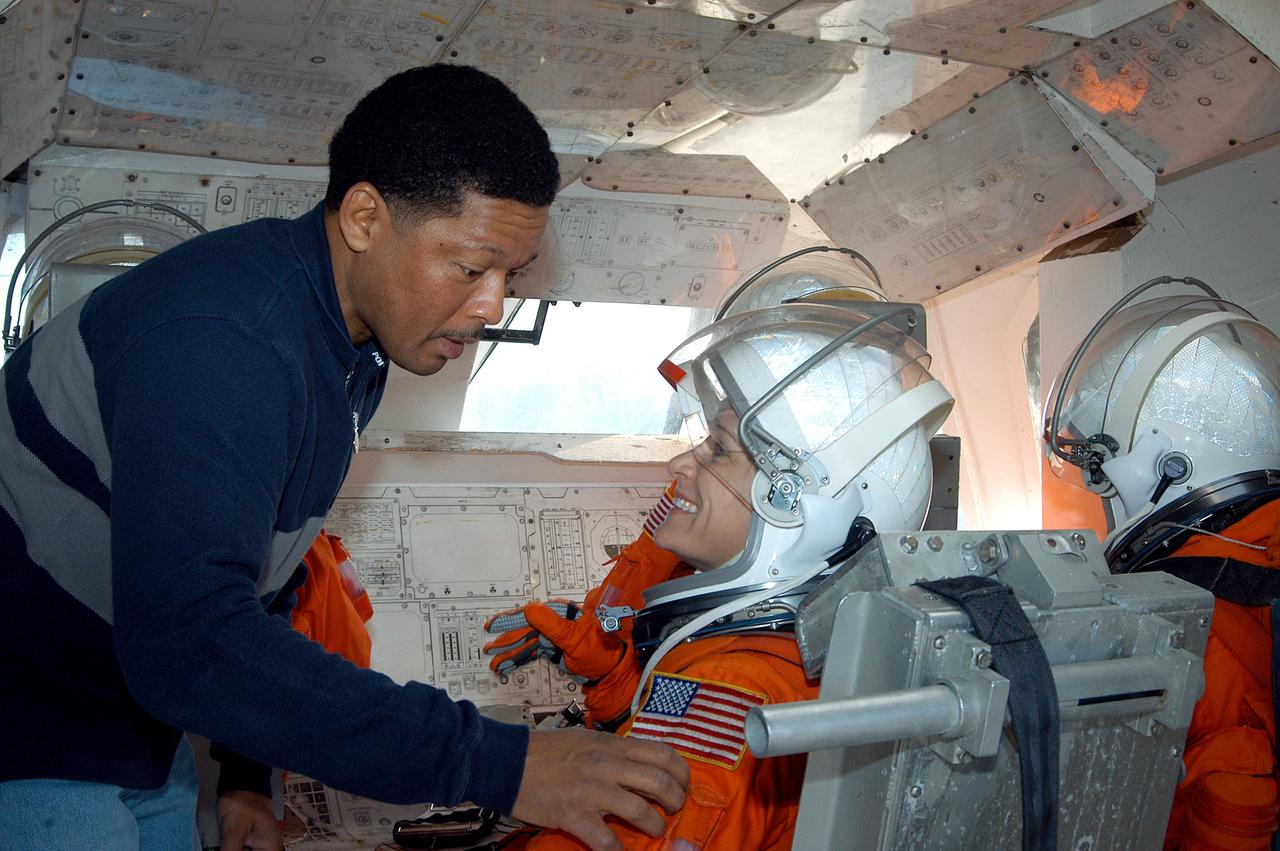
KENNEDY SPACE CENTER, FLA. - Volunteers from the KSC Fire-Rescue team dressed in launch and entry suits settle into seats in an orbiter crew compartment mock-up under the guidance of George Brittingham, USA suit technician on the Closeout Crew. Brittingham is helping Catherine Di Biase, a nurse with Bionetics Life Sciences. They are all taking part in a “Mode VII” emergency landing simulation at Kennedy Space Center. The purpose is to exercise emergency preparedness personnel, equipment and facilities in rescuing astronauts from a downed orbiter and providing immediate medical attention. This simulation presents an orbiter that has crashed short of the Shuttle Landing Facility in a wooded area 2-1/2 miles south of Runway 33. Emergency crews will respond to the volunteer “astronauts” simulating various injuries. Rescuers must remove the crew, provide triage and transport to hospitals those who need further treatment. Local hospitals are participating in the exercise.
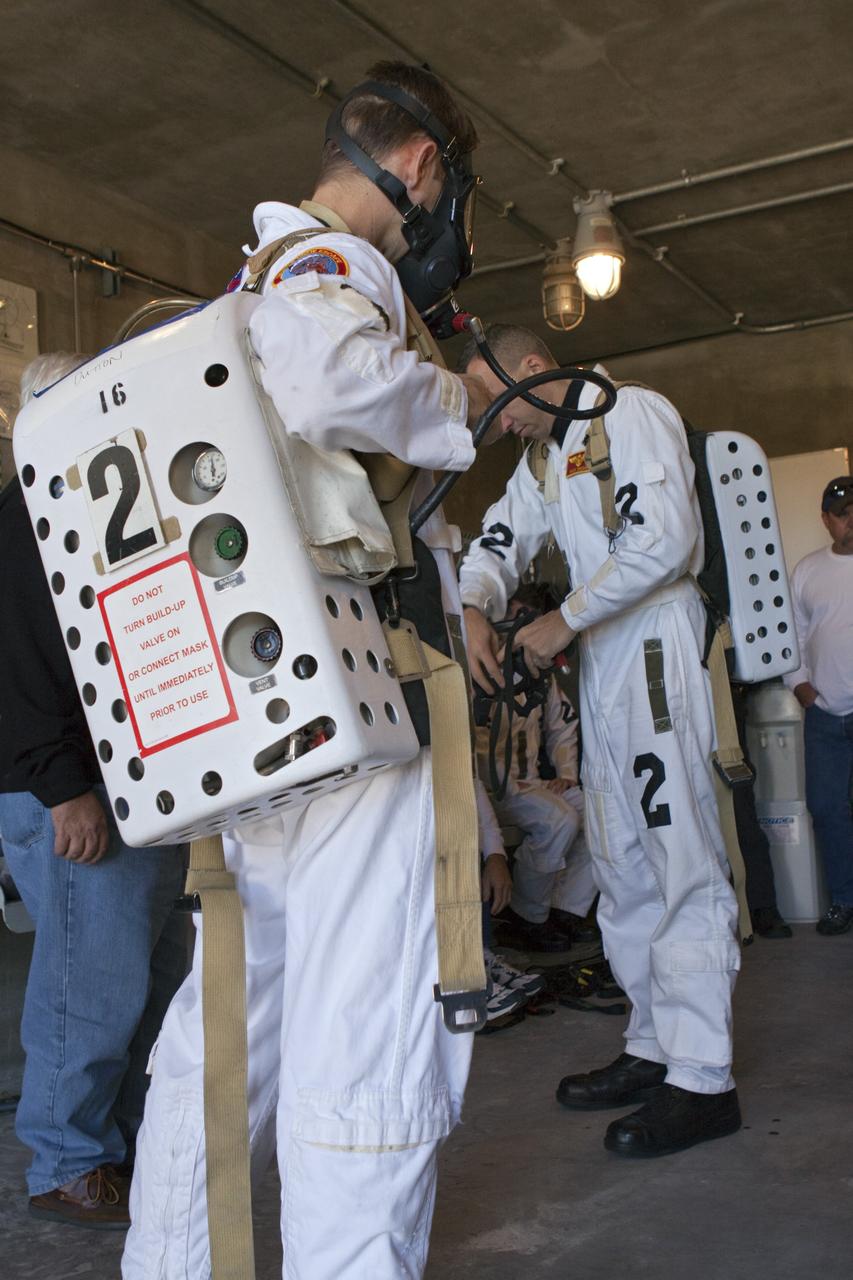
CAPE CANAVERAL, Fla. -- At NASA's Kennedy Space Center in Florida, members of an emergency escape training team suit up in the bunkers below Launch Pad 39A prior to the start of a simulated evacuation exercise. For several days, volunteers portraying astronauts, take part in training exercises which allow teams to practice emergency response procedures, including helicopter evacuation to local hospitals. Training normally involves NASA fire rescue personnel, personnel from the Air Force's 920th Rescue Wing, and medical trauma teams from central Florida hospitals, and is required every 18 months to certify Fire Rescue and Closeout Crew personnel. Photo credit: NASA/Troy Cryder
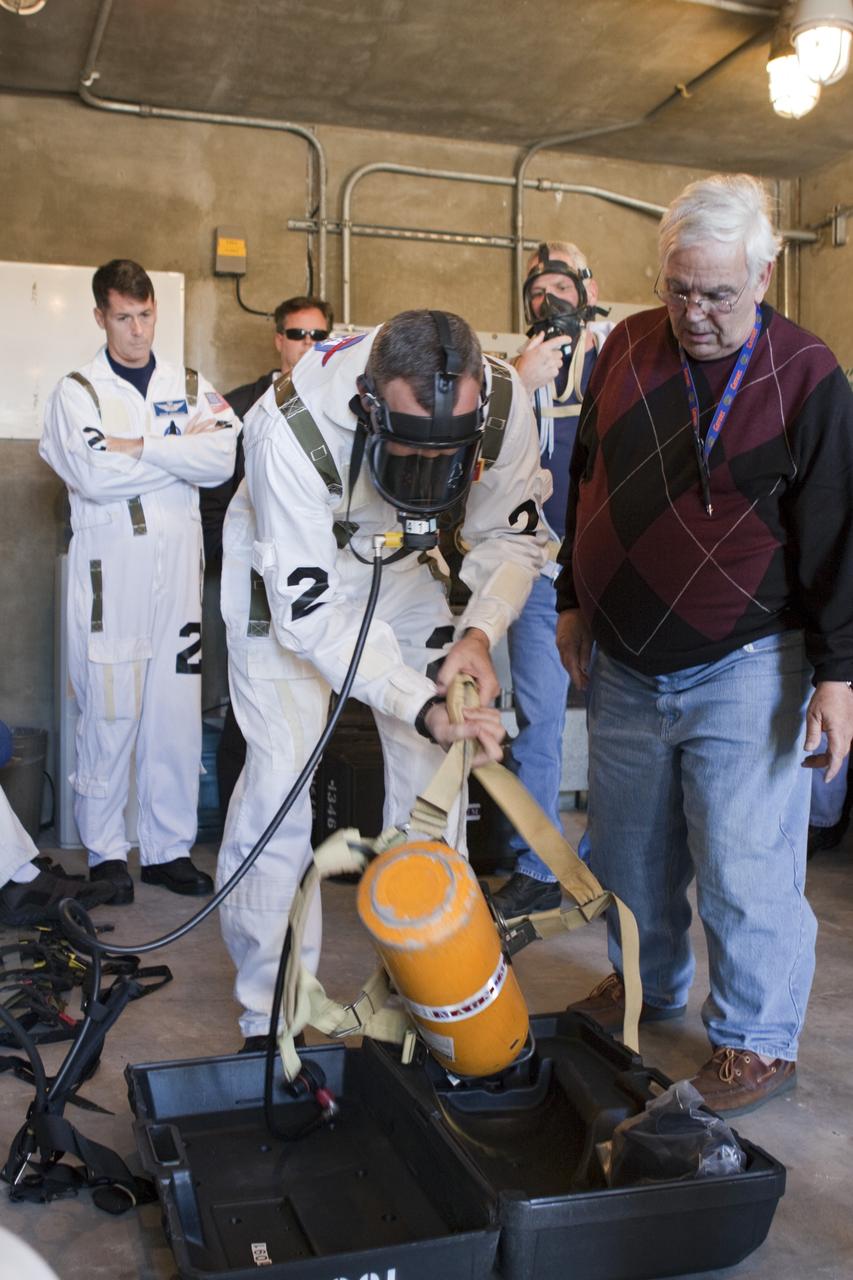
CAPE CANAVERAL, Fla. -- At NASA's Kennedy Space Center in Florida, members of an emergency escape training team suit up in the bunkers below Launch Pad 39A prior to the start of a simulated evacuation exercise. For several days, volunteers portraying astronauts, take part in training exercises which allow teams to practice emergency response procedures, including helicopter evacuation to local hospitals. Training normally involves NASA fire rescue personnel, personnel from the Air Force's 920th Rescue Wing, and medical trauma teams from central Florida hospitals, and is required every 18 months to certify Fire Rescue and Closeout Crew personnel. Photo credit: NASA/Troy Cryder
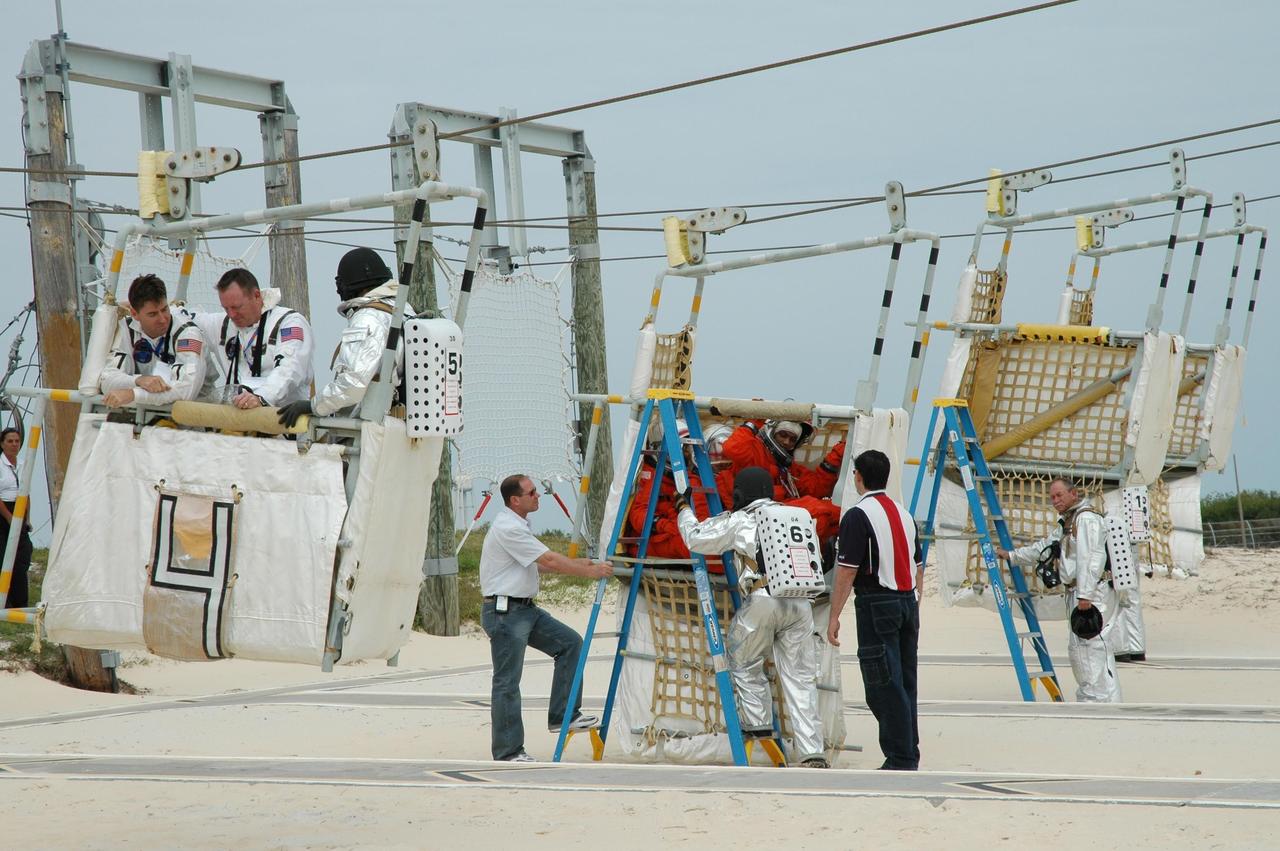
KENNEDY SPACE CENTER, FLA. -- During the second stage of a simulated emergency, known as Mode 4, KSC personnel dressed in astronauts' launch-and-entry suits are helped by the fire rescue team at the slidewire basket landing site. The emergency exercise began at the 195-foot level of Launch Pad 39A. The KSC rescue teams are practicing emergency procedures in the unlikely scenario of a mishap on the pad during a launch sequence. The exercises are standard training procedures to assess and prepare emergency personnel, procedures and hardware. Photo credit: NASA/Jim Grossmann
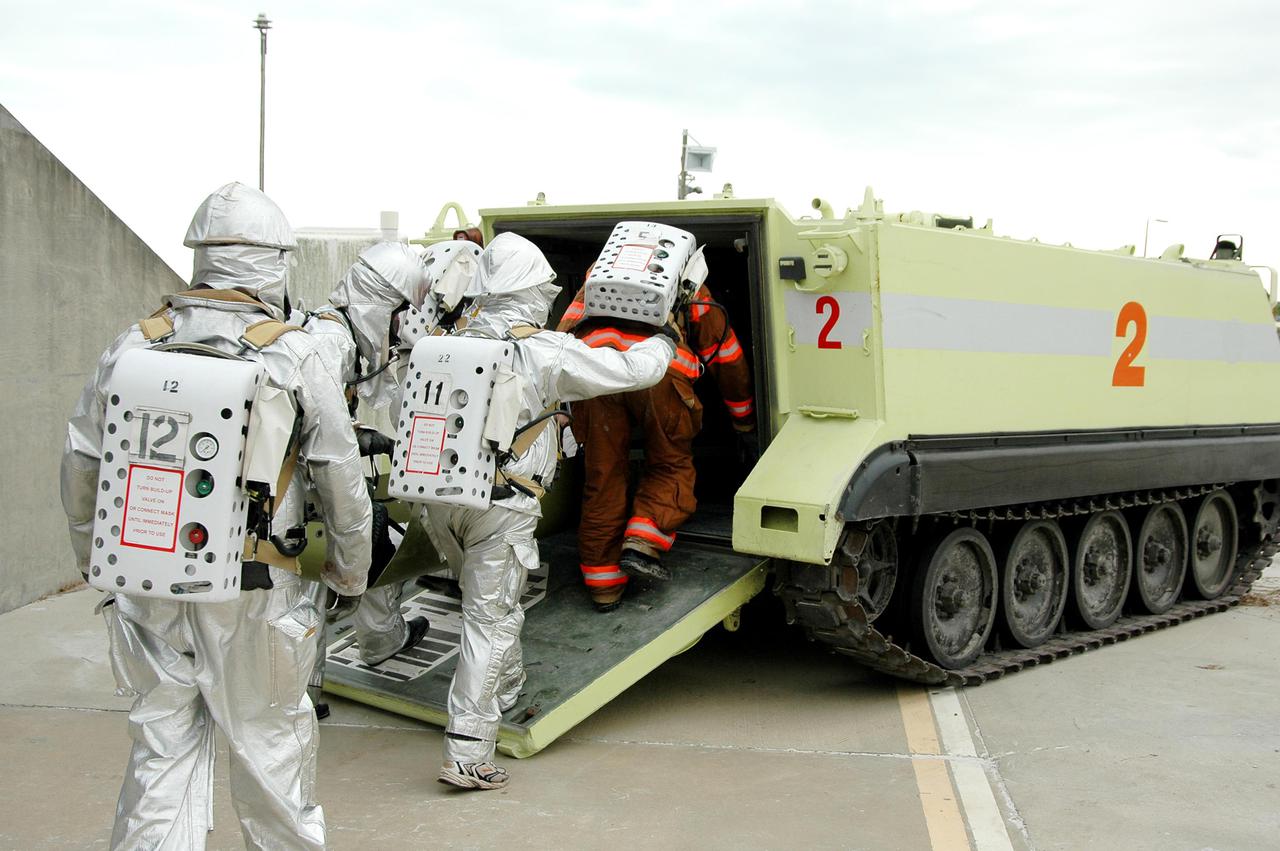
KENNEDY SPACE CENTER, FLA. - During a simulated launch countdown_emergency simulation on Launch Pad 39A, the rescue team helps astronaut-suited workers climb into an M-113 armored personnel carrier for transport away from the pad. The four-hour exercise simulated normal launch countdown operations, with the added challenge of a fictitious event causing an evacuation of the vehicle and launch pad. It tested the team’s rescue approaches on the Fixed Service Structure, slidewire basket evacuation, triage care and transportation of injured personnel to hospitals, as well as communications and coordination.
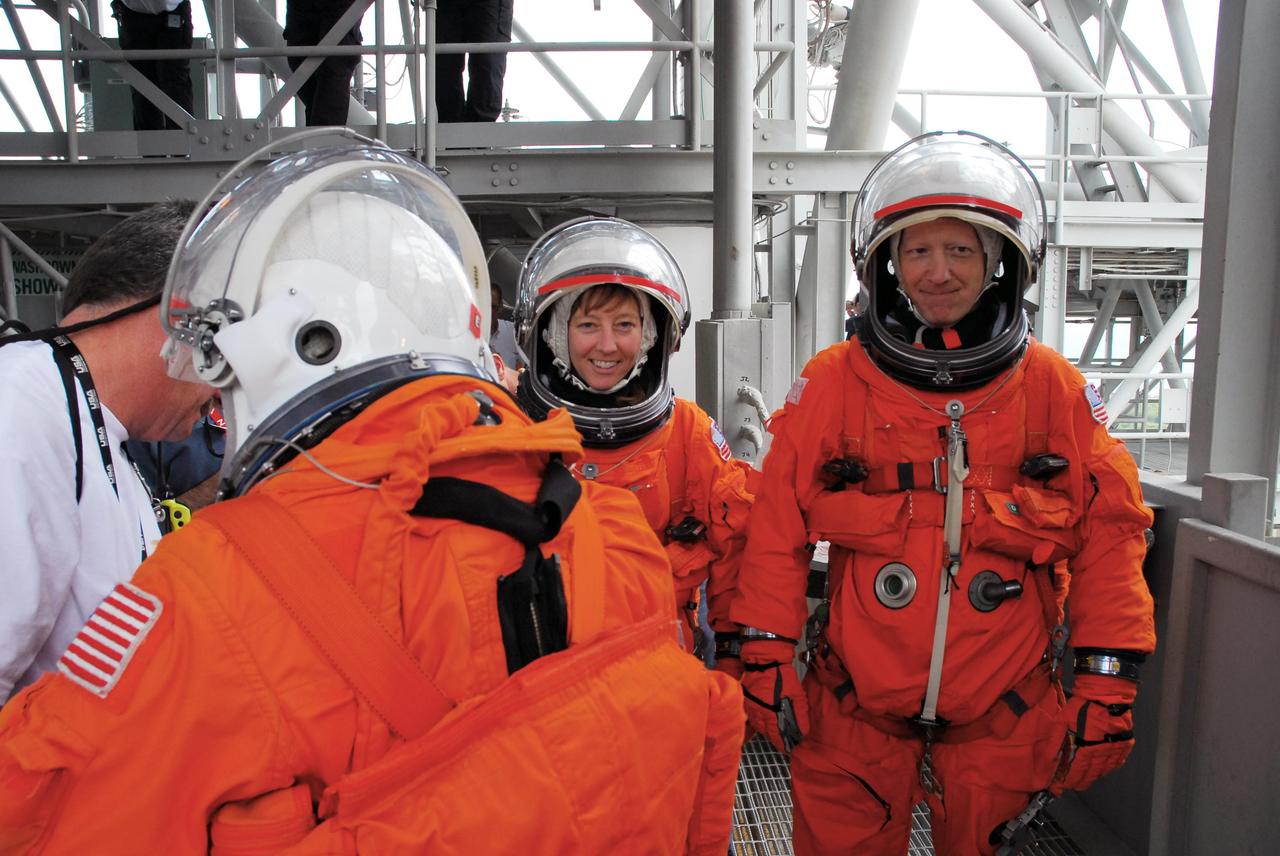
KENNEDY SPACE CENTER, FLA. -- During a simulated rescue mission on Launch Pad 39A, known as Mode 2, KSC personnel dressed in astronauts' launch-and-entry suits move from the white room on the 195-foot level toward the slidewire baskets. The KSC rescue teams are practicing emergency procedures in the unlikely scenario of a mishap on the pad during a launch sequence. The exercises are standard training procedures to assess and prepare emergency personnel, procedures and hardware. Photo credit: NASA/Jack Pfaller
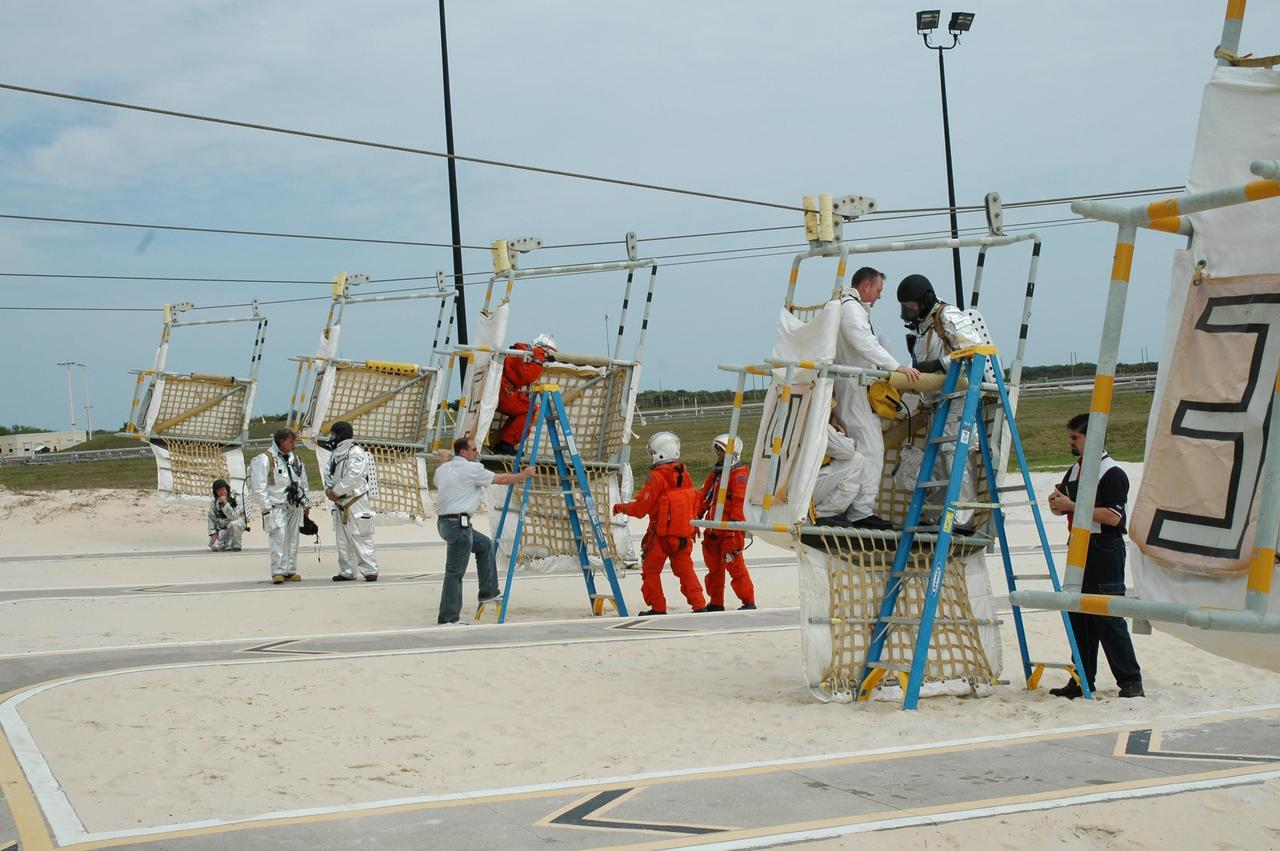
KENNEDY SPACE CENTER, FLA. -- During the second stage of a simulated emergency, known as Mode 4, KSC personnel dressed in astronauts' launch-and-entry suits are helped by the fire rescue team at the slidewire basket landing site. The emergency exercise began at the 195-foot level of Launch Pad 39A. The KSC rescue teams are practicing emergency procedures in the unlikely scenario of a mishap on the pad during a launch sequence. The exercises are standard training procedures to assess and prepare emergency personnel, procedures and hardware. Photo credit: NASA/Jim Grossmann
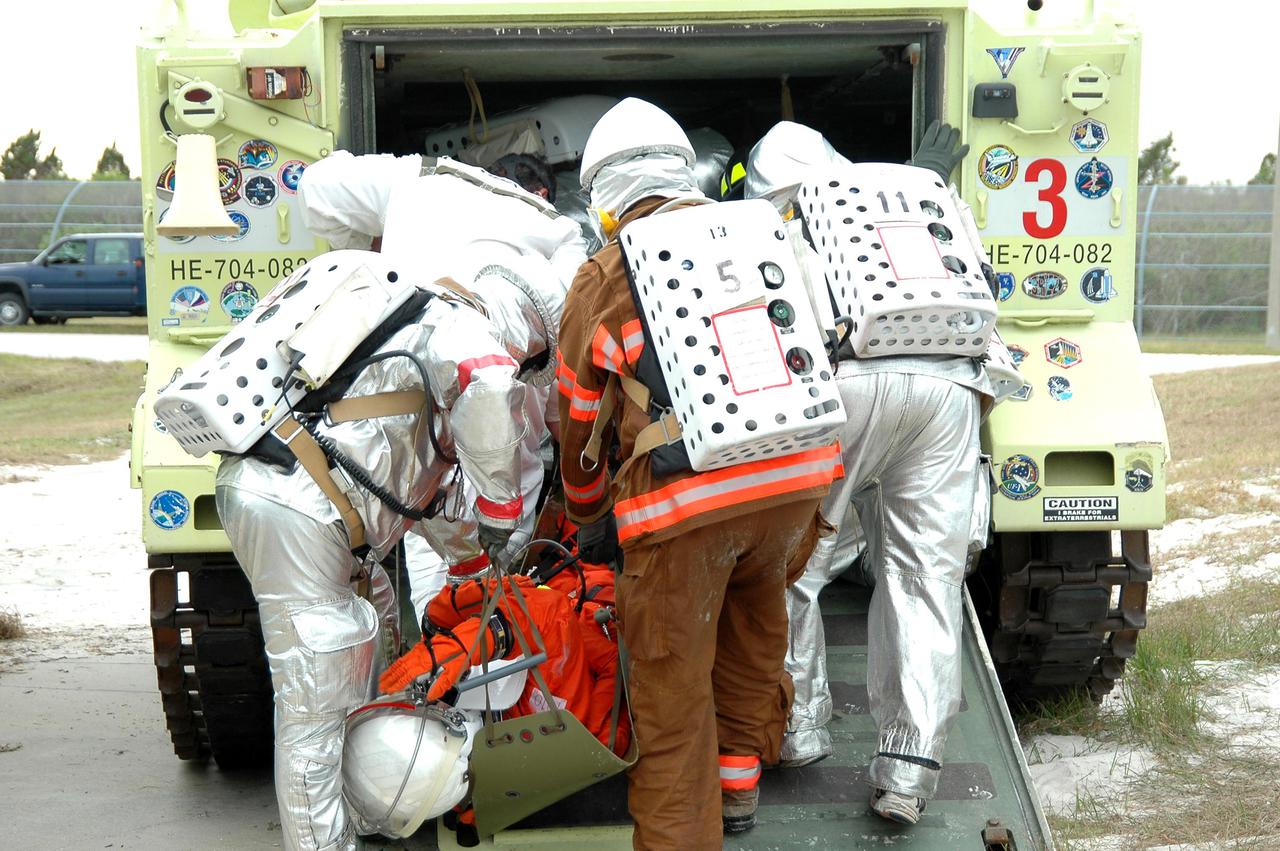
KENNEDY SPACE CENTER, FLA. - During a simulated launch countdown_emergency simulation on Launch Pad 39A, the rescue team carries “injured” astronaut-suited workers into an M-113 armored personnel carrier for transport away from the pad. The four-hour exercise simulated normal launch countdown operations, with the added challenge of a fictitious event causing an evacuation of the vehicle and launch pad. It tested the team’s rescue approaches on the Fixed Service Structure, slidewire basket evacuation, triage care and transportation of injured personnel to hospitals, as well as communications and coordination.
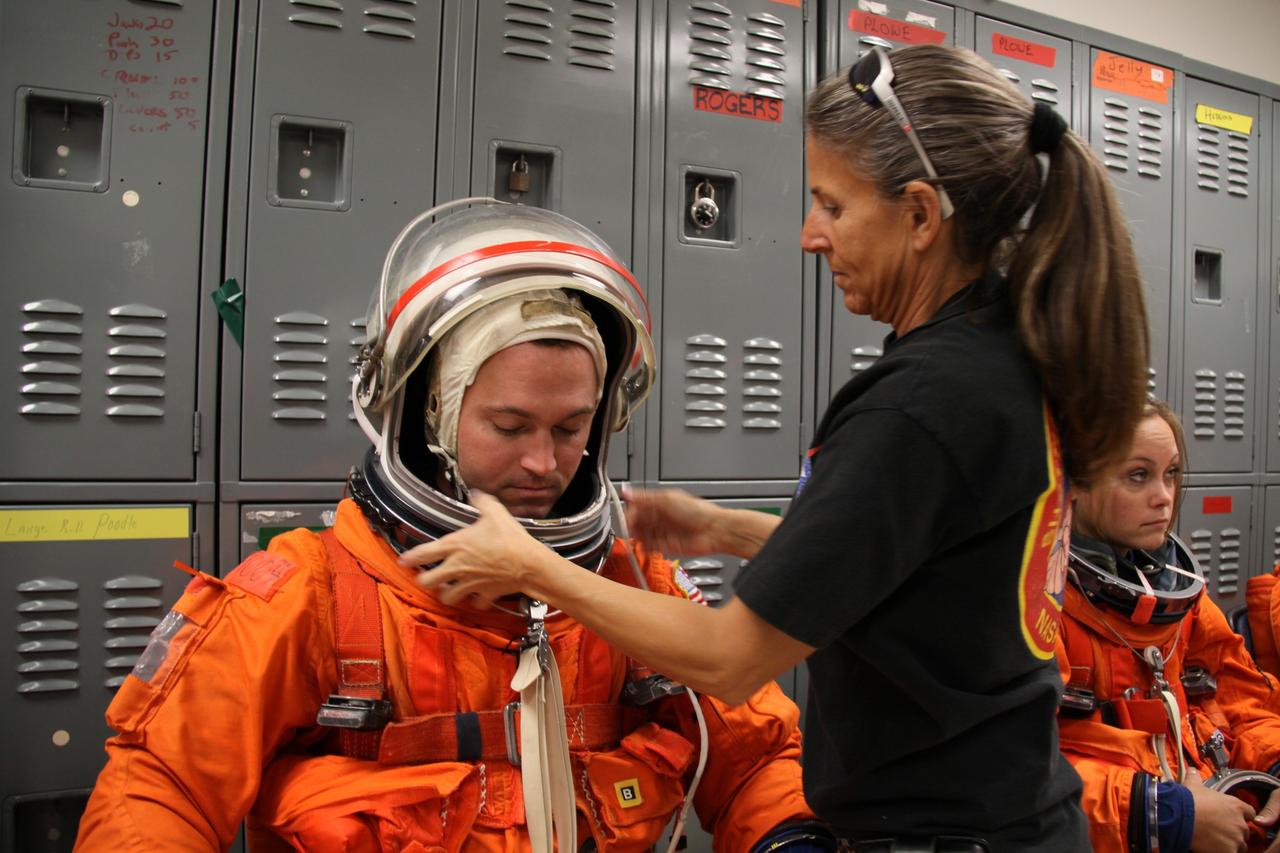
CAPE CANAVERAL, Fla. – At NASA's Kennedy Space Center in Florida, volunteers portraying astronauts are helped with the launch-and-entry suits. The volunteers are taking part in a Mode II-IV exercise that allows teams to practice an emergency response at Launch Pad 39A, including helicopter evacuation to local hospitals. The exercise involves NASA fire rescue personnel, volunteers portraying astronauts with simulated injuries, helicopters and personnel from the Air Force’s 920th Rescue Wing and medical trauma teams at three central Florida hospitals. The Space Shuttle Program and U.S. Air Force are conducting the emergency simulation. Photo credit: NASA/Troy Cryder
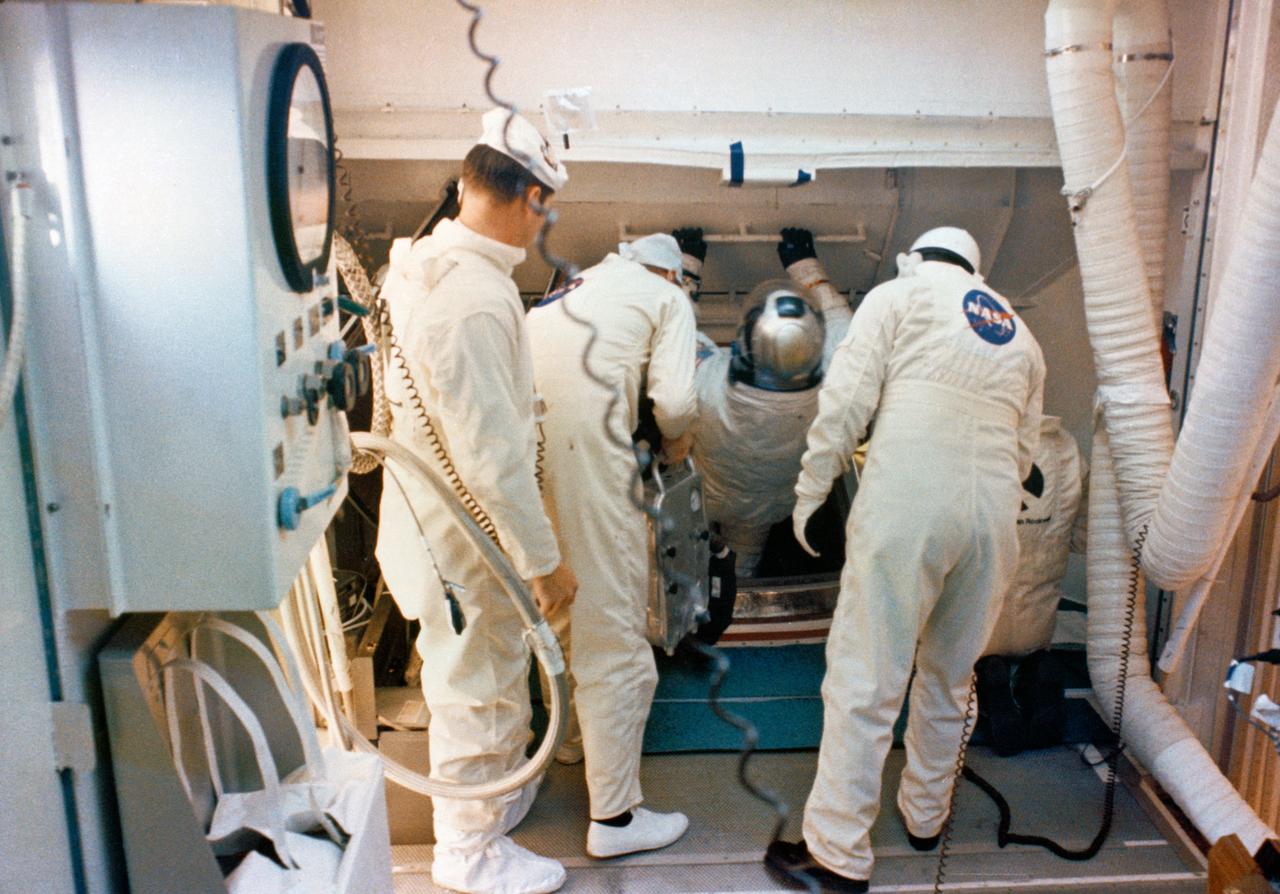
S69-25488 (23 Feb. 1969) --- Interior view of the White Room at Pad A, Launch Complex 39, Kennedy Space Center (KSC), during an Apollo 9 Countdown Demonstration Test (CDDT). Astronauts James A. McDivitt, commander; David R. Scott, command module pilot; and Russell L. Schweickart, lunar module pilot, were participating in a dress rehearsal in preparation for their scheduled 10-day Earth-orbital space mission.
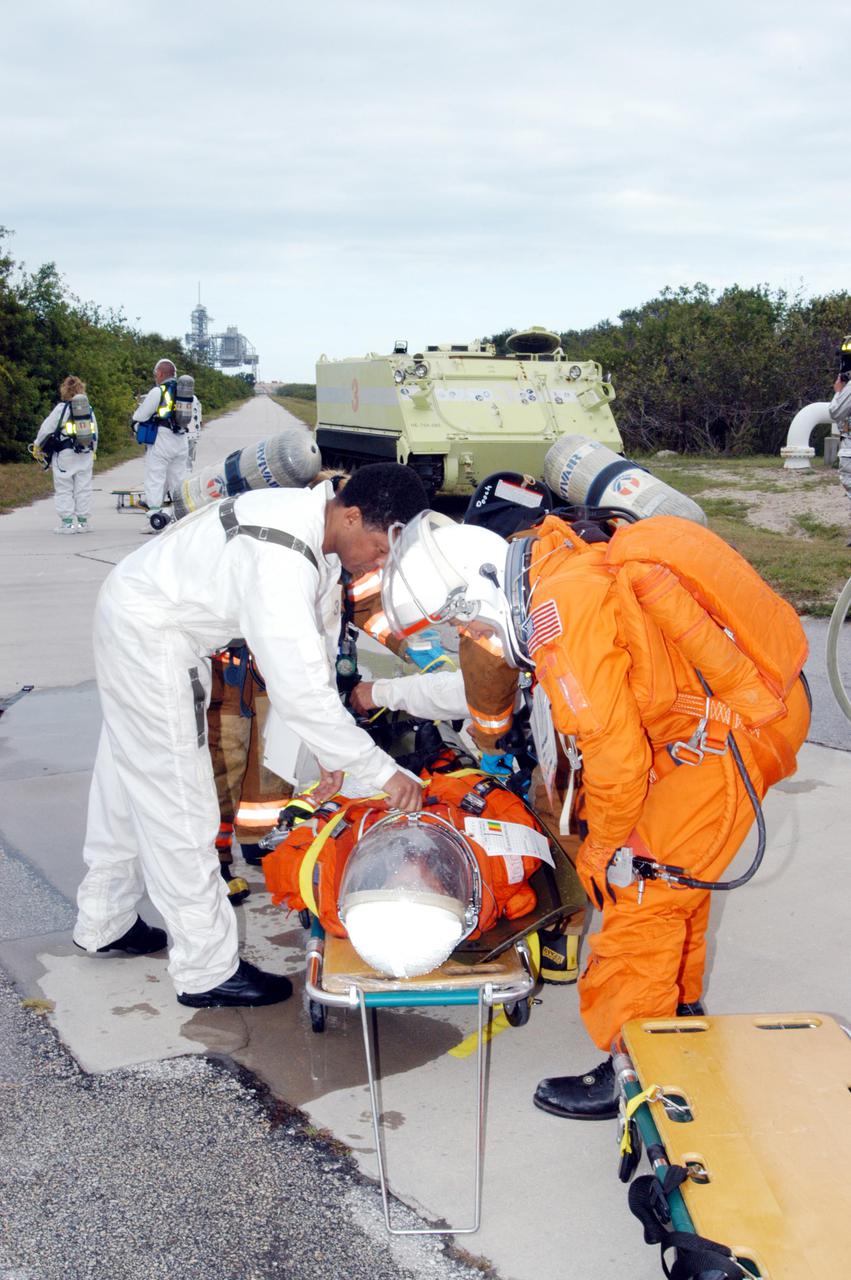
KENNEDY SPACE CENTER, FLA. - During a simulated launch countdown_emergency simulation on Launch Pad 39A, the rescue team moves “injured” astronaut-suited workers out of the M-113 armored personnel carriers that transported them away from the pad (seen in the distance). Pad team members participated in the four-hour exercise simulating normal launch countdown operations, with the added challenge of a fictitious event causing an evacuation of the vehicle and launch pad. The simulation tested the team’s rescue approaches on the Fixed Service Structure, slidewire basket evacuation, triage care and transportation of injured personnel to hospitals, as well as communications and coordination.
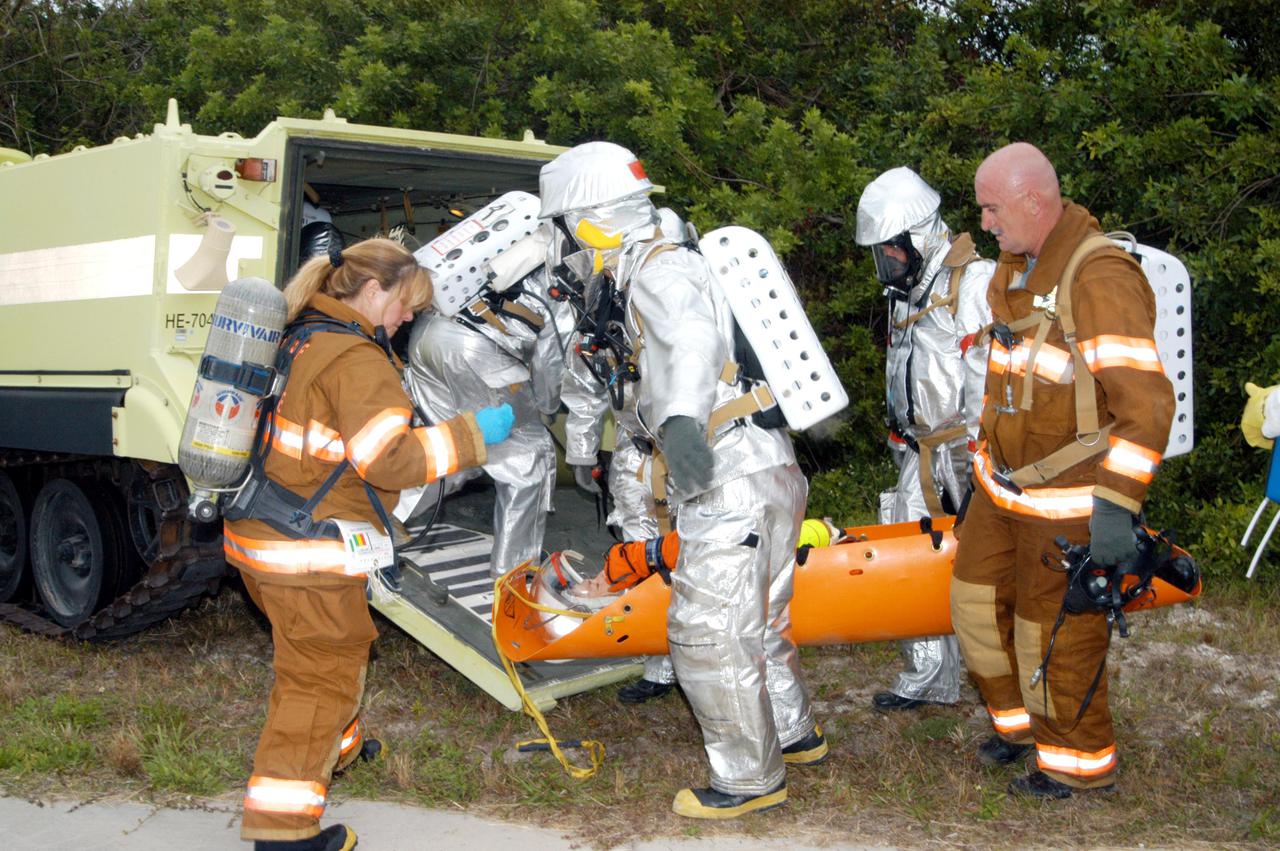
KENNEDY SPACE CENTER, FLA. - During a simulated launch countdown_emergency simulation on Launch Pad 39A, the rescue team moves “injured” astronaut-suited workers out of the M-113 armored personnel carriers that transported them away from the pad (seen in the distance). Pad team members participated in the four-hour exercise simulating normal launch countdown operations, with the added challenge of a fictitious event causing an evacuation of the vehicle and launch pad. The simulation tested the team’s rescue approaches on the Fixed Service Structure, slidewire basket evacuation, triage care and transportation of injured personnel to hospitals, as well as communications and coordination.
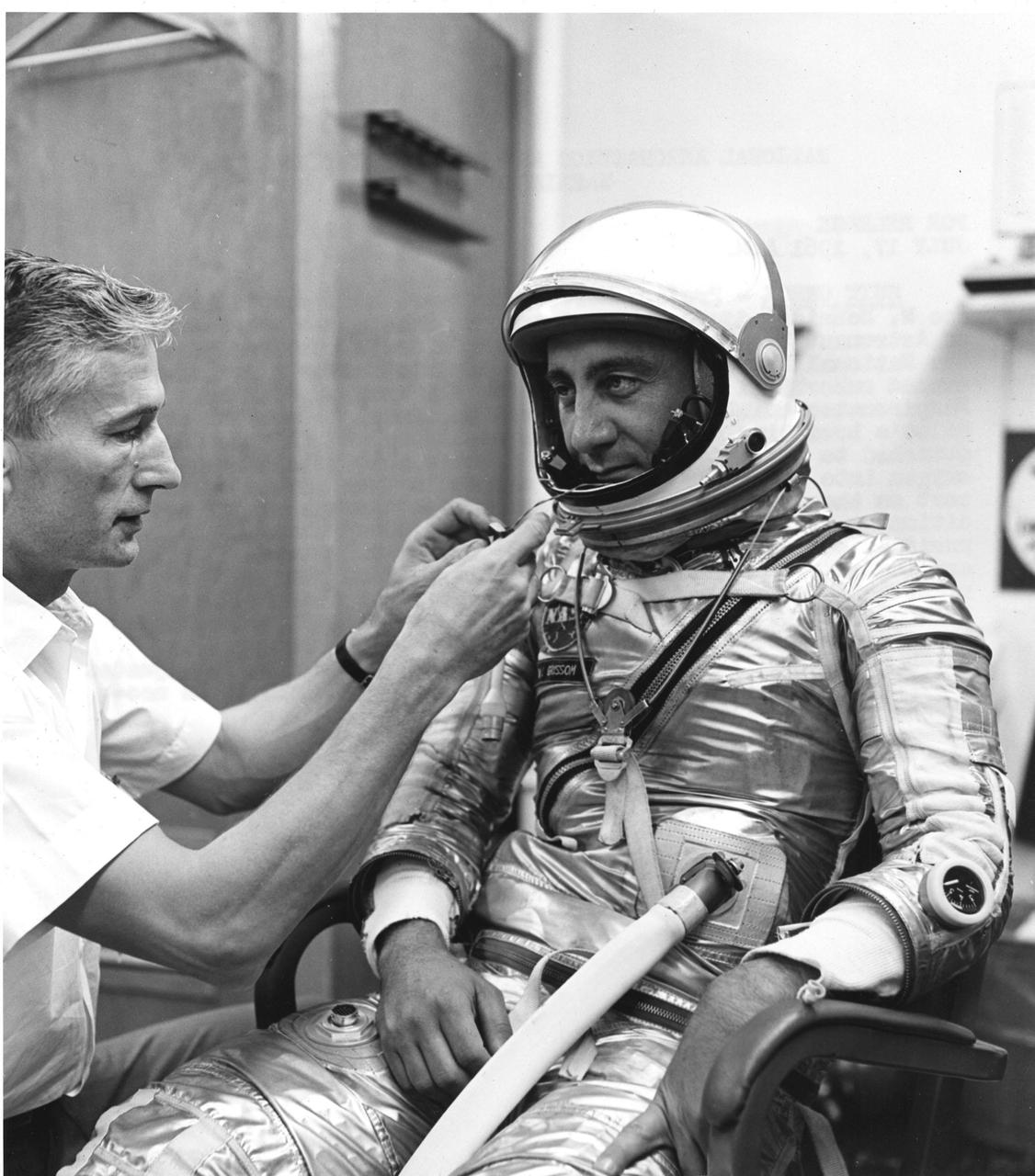
KENNEDY SPACE CENTER, FLA. -- SUIT CHECK - Project Mercury pressure suit specialist Joe. W. Schidt adjusts a respirometer attached to the helmet of astronaut Virgil I. Grissom during a dress rehearsal for the National Aeronautics and Space Administration's second manned suborbital flight, dubbed Liberty Bell 7, planned for the week of July 16. Respirometer enables ground medical personnel to monitor the pilot's breathing rate during the countdown and flight. Hose attached to the left side of the pilot's suit brings breathing oxygen into the suit. Expelled oxygen is then vented out a port on the side of the helmet and passed through an air conditioning system beneath the astronaut's couch where it is purified before being recycled into the suit. Gauge on left arm indicates pressure within the suit. Canon plug on the right thigh brings medical information out of the suit for telemetering to ground stations. Suit is not inflated during the mission unless there is a failure in cabin pressure, in which event the 'V' shaped cable around the neck ring is adjusted prior to flight to prevent helmet from rising should it be necessary to pressurize the suit
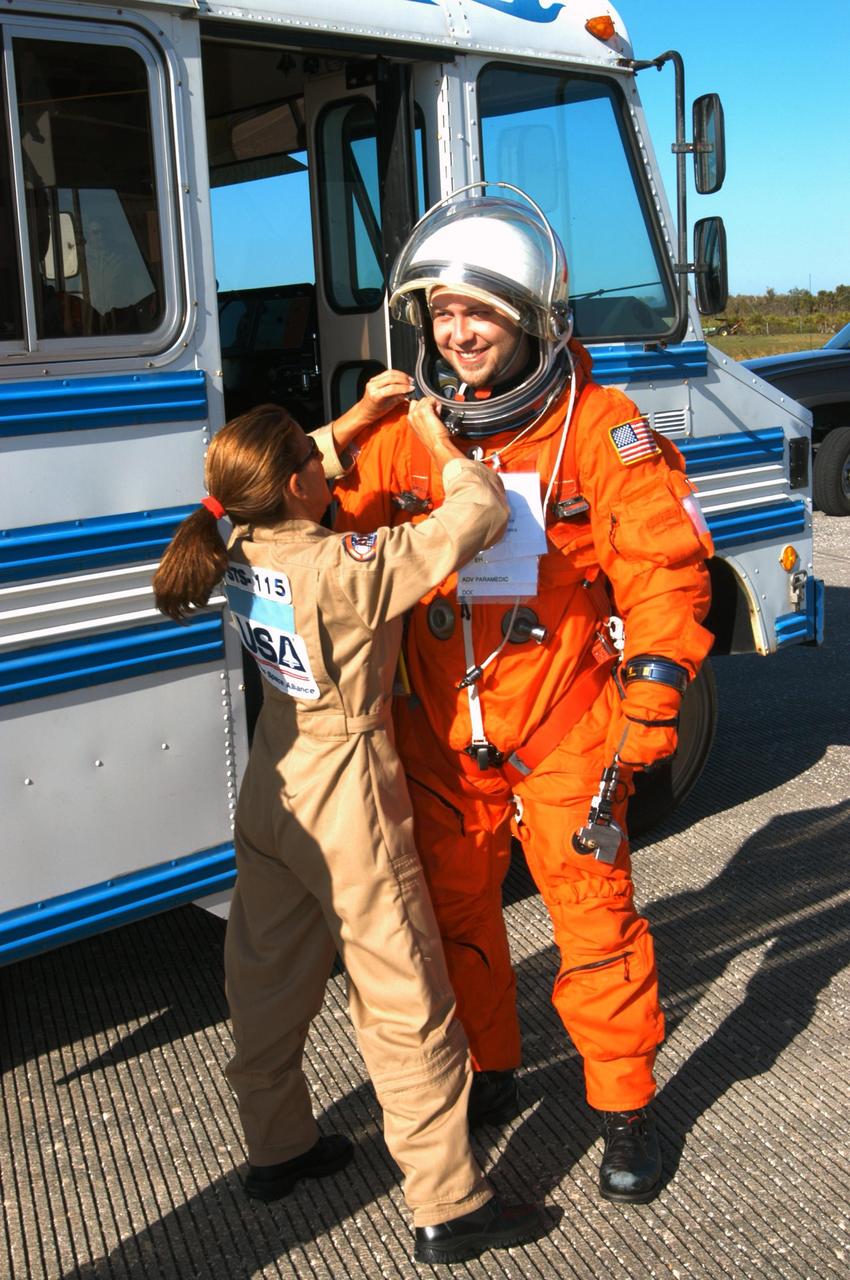
KENNEDY SPACE CENTER, FLA. - Preparing for a simulated emergency landing of a shuttle crew, United Space Alliance (USA) Suit Tech Toni Costa-Davis helps volunteer "astronaut" Brian Bateman, also with USA, with his launch and entry suit. Many volunteers posed as astronauts during the simulation. Known as a Mode VI exercise, the operation uses volunteer workers from the Center to pose as astronauts. The purpose of the simulation is to exercise emergency preparedness personnel, equipment and facilities in rescuing astronauts from a downed orbiter and providing immediate medical attention. Photo credit: NASA/George Shelton
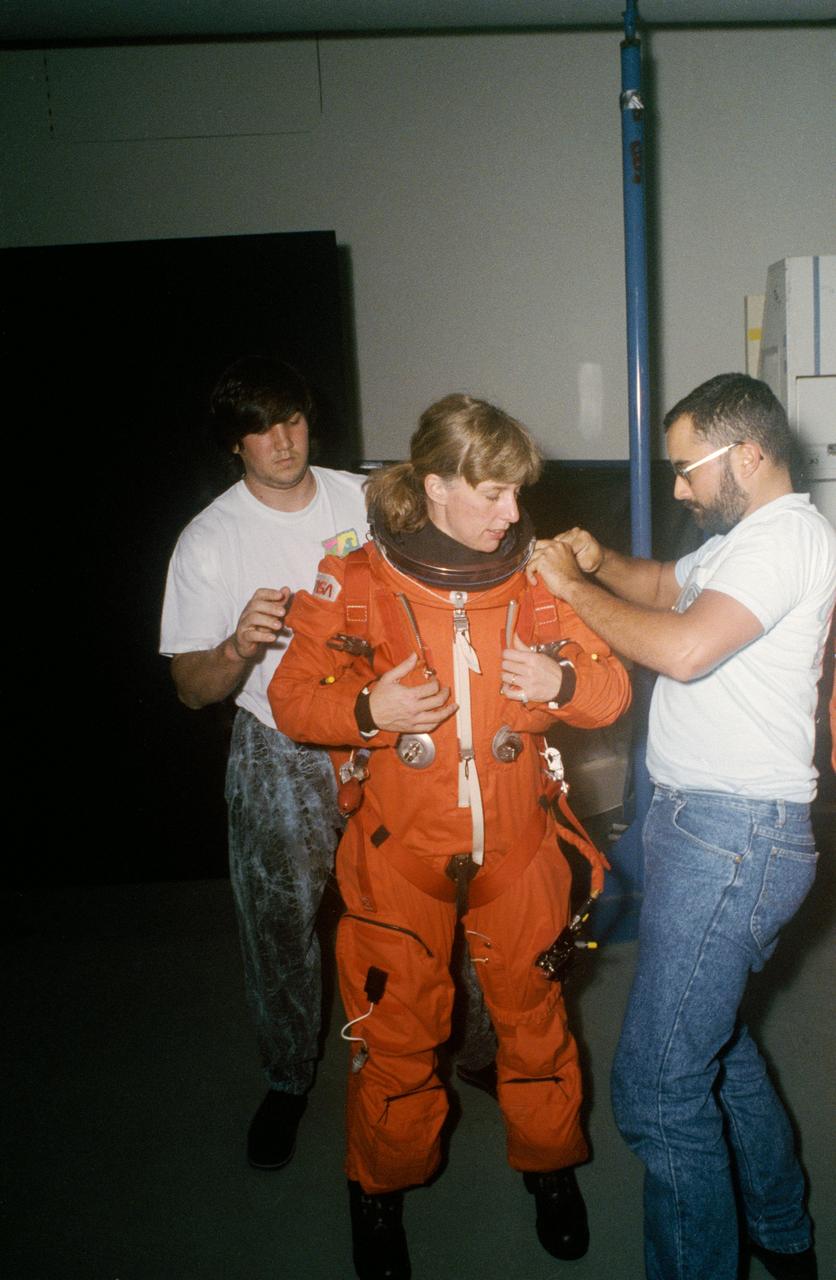
STS-47 Endeavour, Orbiter Vehicle (OV) 105, Mission Specialist (MS) N. Jan Davis, wearing a launch and entry suit (LES), looks on as technicians adjust her LES parachute pack prior to launch emergency egress (bailout) exercises in JSC's Mockup and Integration Laboratory (MAIL) Bldg 9A. Davis is making her first flight in space.
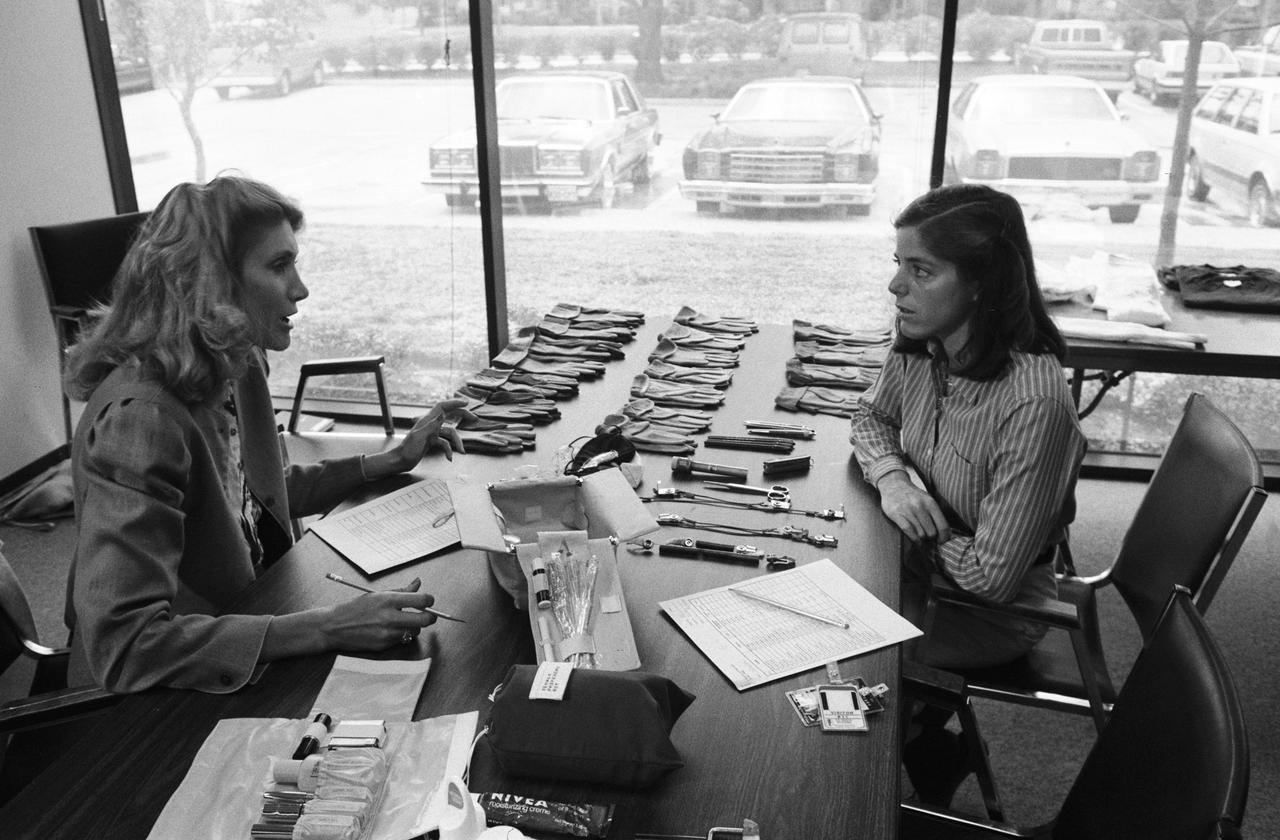
Views of STS-33/51L crew personnel Prime McAuliffe and Backup Morgan at the ILC Facility during clothing selection and Building #37 during food sampling, and with the rest of the STS-33/51L crew. 40074: "Teacher-in-Space" Participant Barbara Morgan (right) is briefed on her suit and on personal hygiene equipment to be used on the STS-51L Mission. 1. JSC - Education Program (Teacher in Space) 2. Barbara Morgan 3. Christa McAuliffe 4. STS-33/51L - Crew Training (Uniforms/Food/Crew)
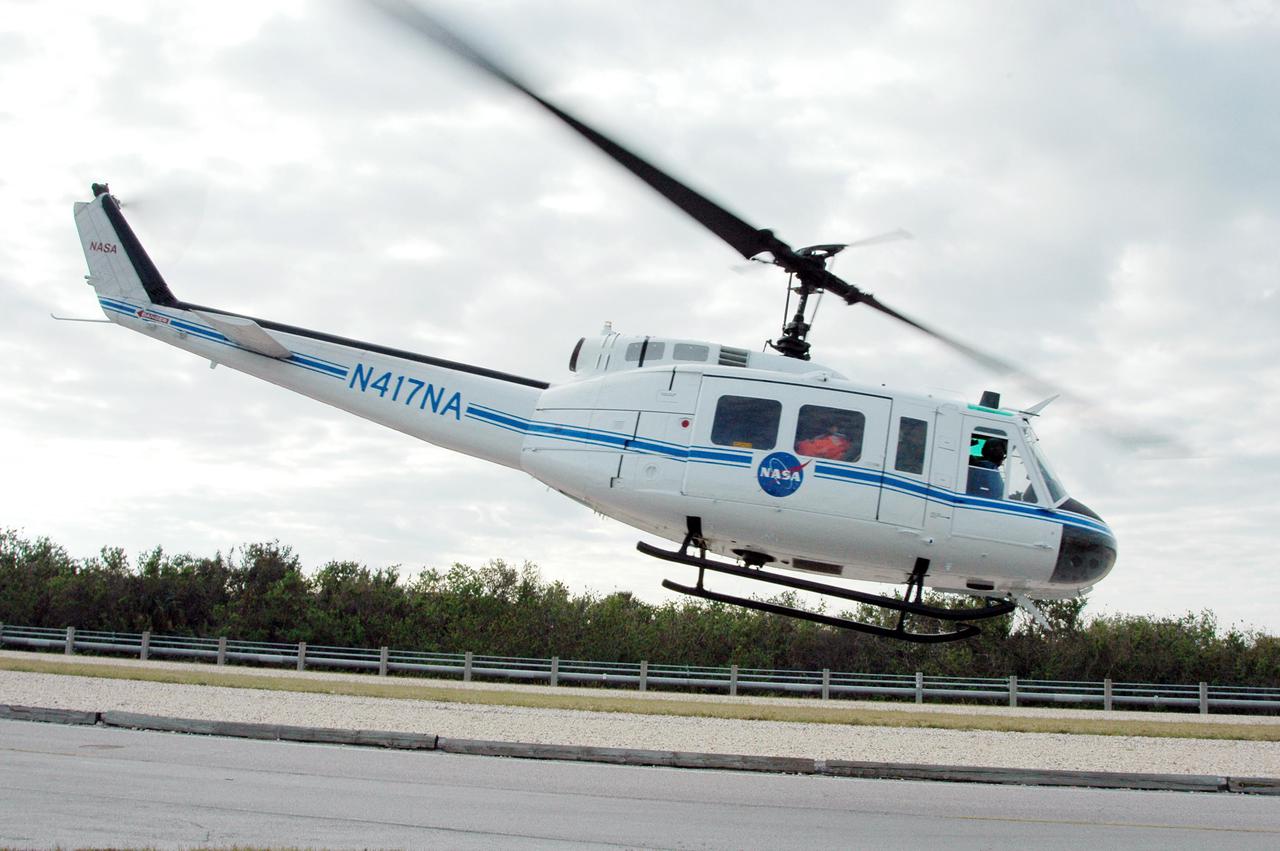
KENNEDY SPACE CENTER, FLA. - During a simulated launch countdown_emergency simulation on Launch Pad 39A, the NASA helicopter leaves the scene with “injured” astronaut-suited workers, heading to a hospital. Pad team members participated in the four-hour exercise simulating normal launch countdown operations, with the added challenge of a fictitious event causing an evacuation of the vehicle and launch pad. The simulation tested the team’s rescue approaches on the Fixed Service Structure, slidewire basket evacuation, triage care and transportation of injured personnel to hospitals, as well as communications and coordination.
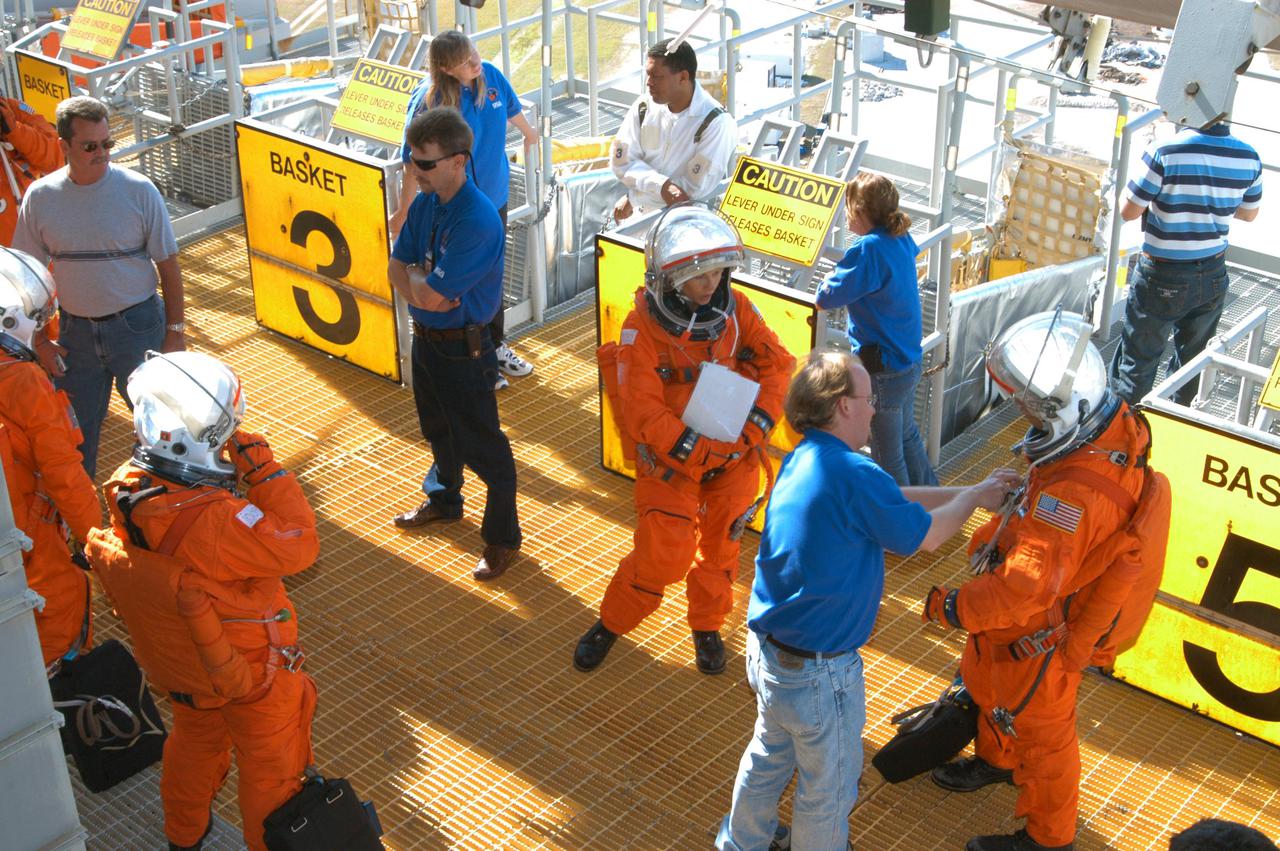
KENNEDY SPACE CENTER, FLA. - On Launch Pad 39-A, team members (in blue) help astronaut-suited co-workers near the slidewire baskets prepare for an emergency egress scenario. The four-hour exercise simulated normal launch countdown operations, with the added challenge of a fictitious event causing an evacuation of the vehicle and launch pad. It tested the team’s rescue approaches on the Fixed Service Structure, slidewire basket evacuation, triage care and transportation of injured personnel to hospitals, as well as communications and coordination.

NASA’s pad rescue team learn about the Orion Crew Survival Suit ahead of the Artemis II emergency egress demonstration, which is one of the integrated system verification and validation tests taking place at Launch Pad 39B at the agency’s Kennedy Space Center in Florida on Thursday, Aug. 8, 2024. In the event of an emergency during launch countdown, the pad rescue team is there to help personnel leave the launch pad if needed.
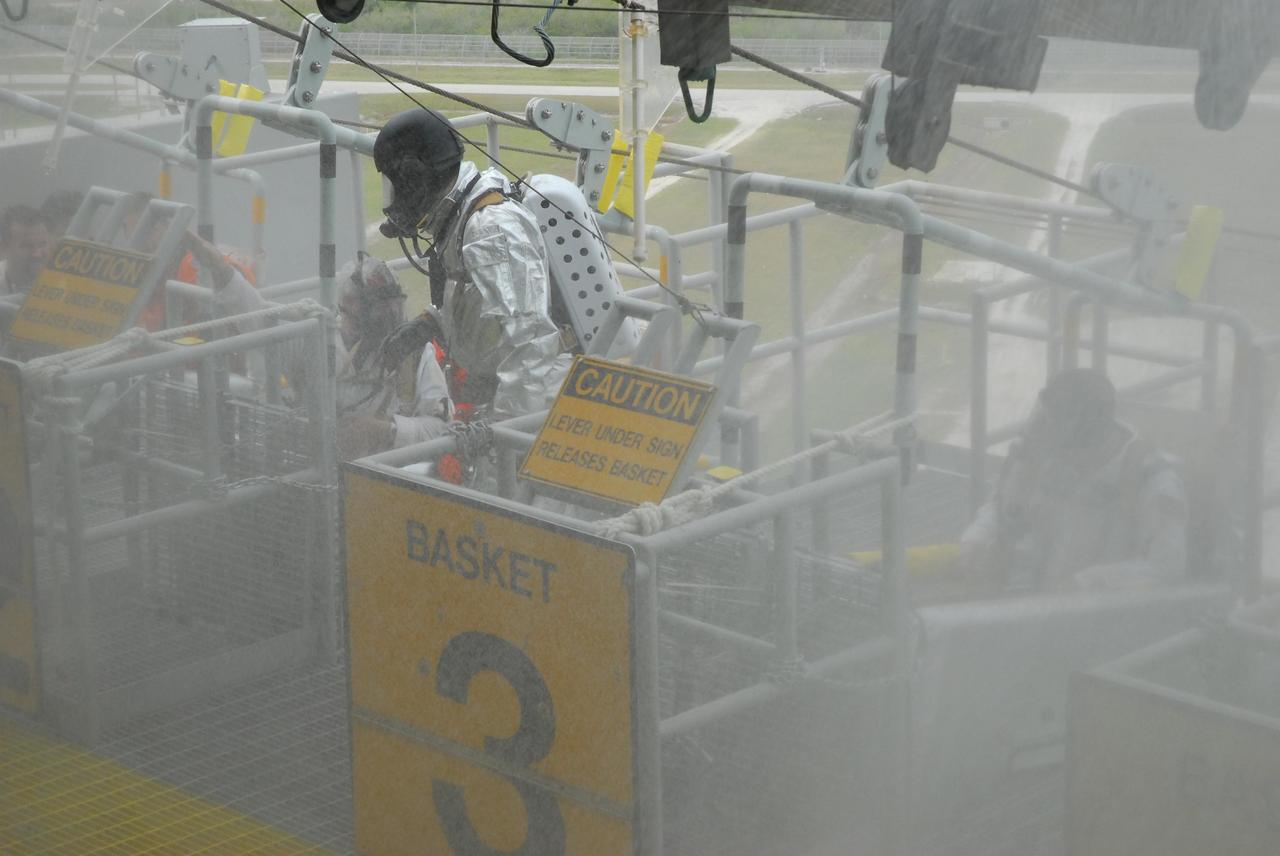
KENNEDY SPACE CENTER, FLA. -- During a simulated rescue mission on Launch Pad 39A, known as Mode 2, KSC workers dressed in astronauts' launch-and-entry suits climb into the slidewire baskets. A fire rescue team is simulating extracting the crew from the orbiter and helping them to the baskets. The KSC rescue teams are practicing emergency procedures in the unlikely scenario of a mishap on the pad during a launch sequence. The exercises are standard training procedures to assess and prepare emergency personnel, procedures and hardware. Photo credit: NASA/Jack Pfaller
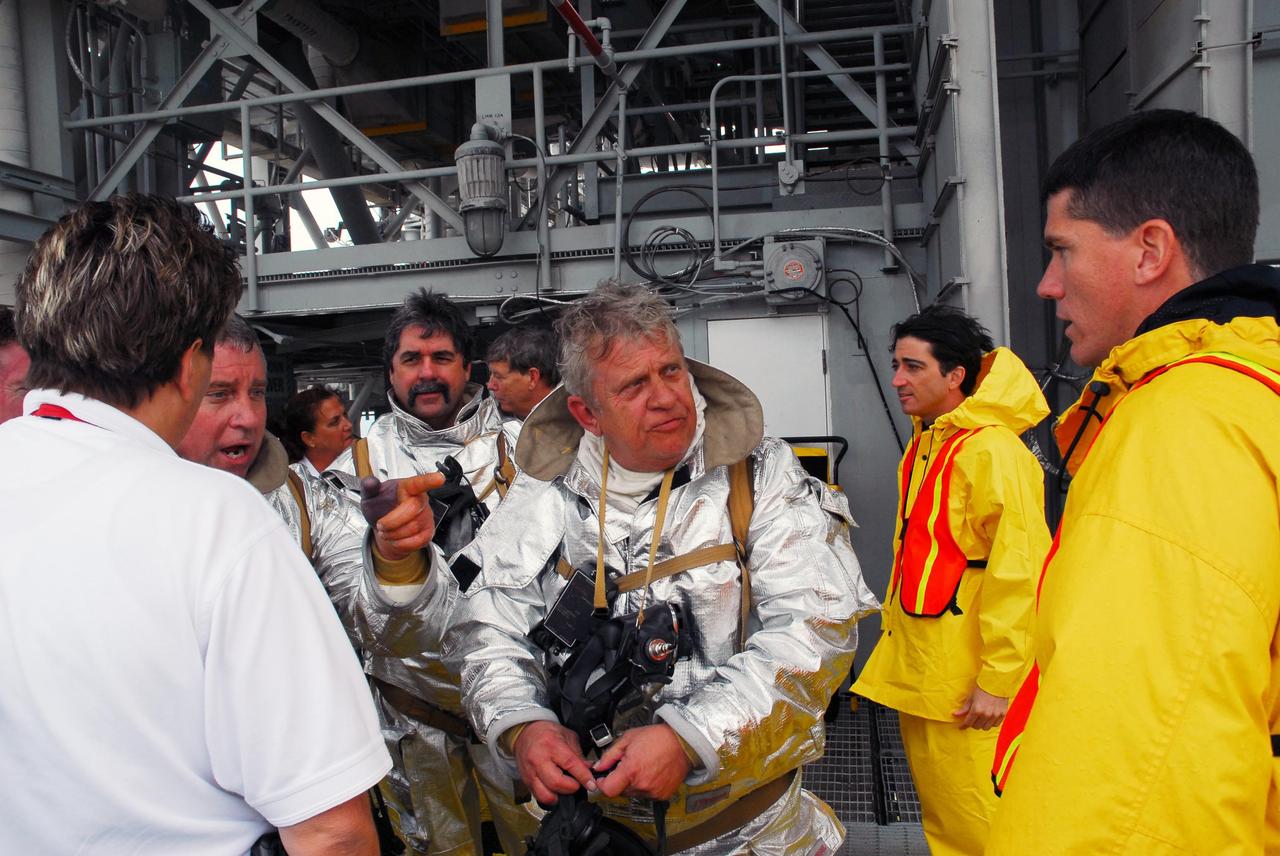
KENNEDY SPACE CENTER, FLA. -- After a simulated rescue mission on Launch Pad 39A, the fire rescue team compares notes about the activity. KSC workers dressed in official launch-and-entry suits portrayed astronauts. The KSC rescue teams are practicing emergency procedures in the unlikely scenario of a mishap on the pad during a launch sequence. The exercises are standard training procedures to assess and prepare emergency personnel, procedures and hardware. Photo credit: NASA/Jack Pfaller
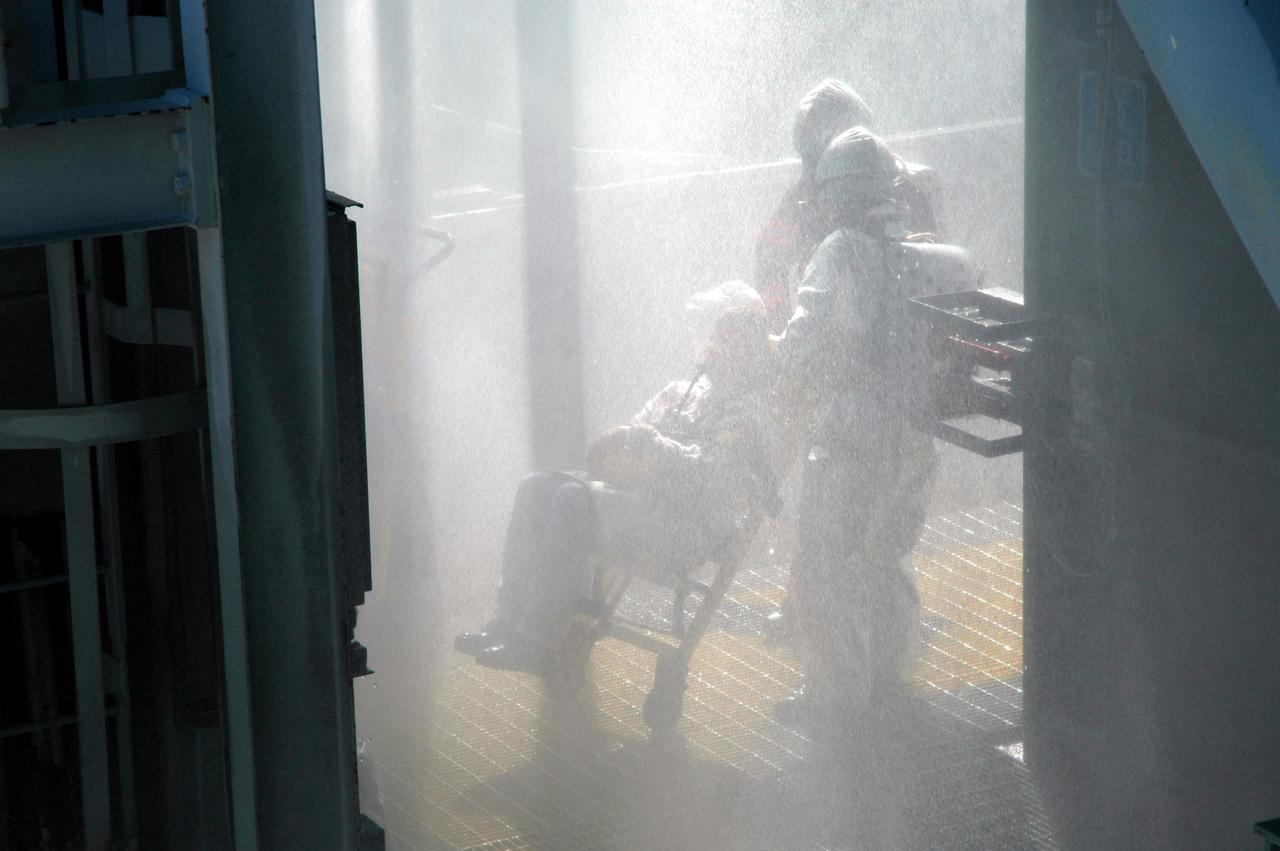
KENNEDY SPACE CENTER, FLA. - On Launch Pad 39A, astronaut-suited workers take part in an emergency egress scenario. The four-hour exercise simulated normal launch countdown operations, with the added challenge of a fictitious event causing an evacuation of the vehicle and launch pad. It tested the team’s rescue approaches on the Fixed Service Structure, slidewire basket evacuation, triage care and transportation of injured personnel to hospitals, as well as communications and coordination.
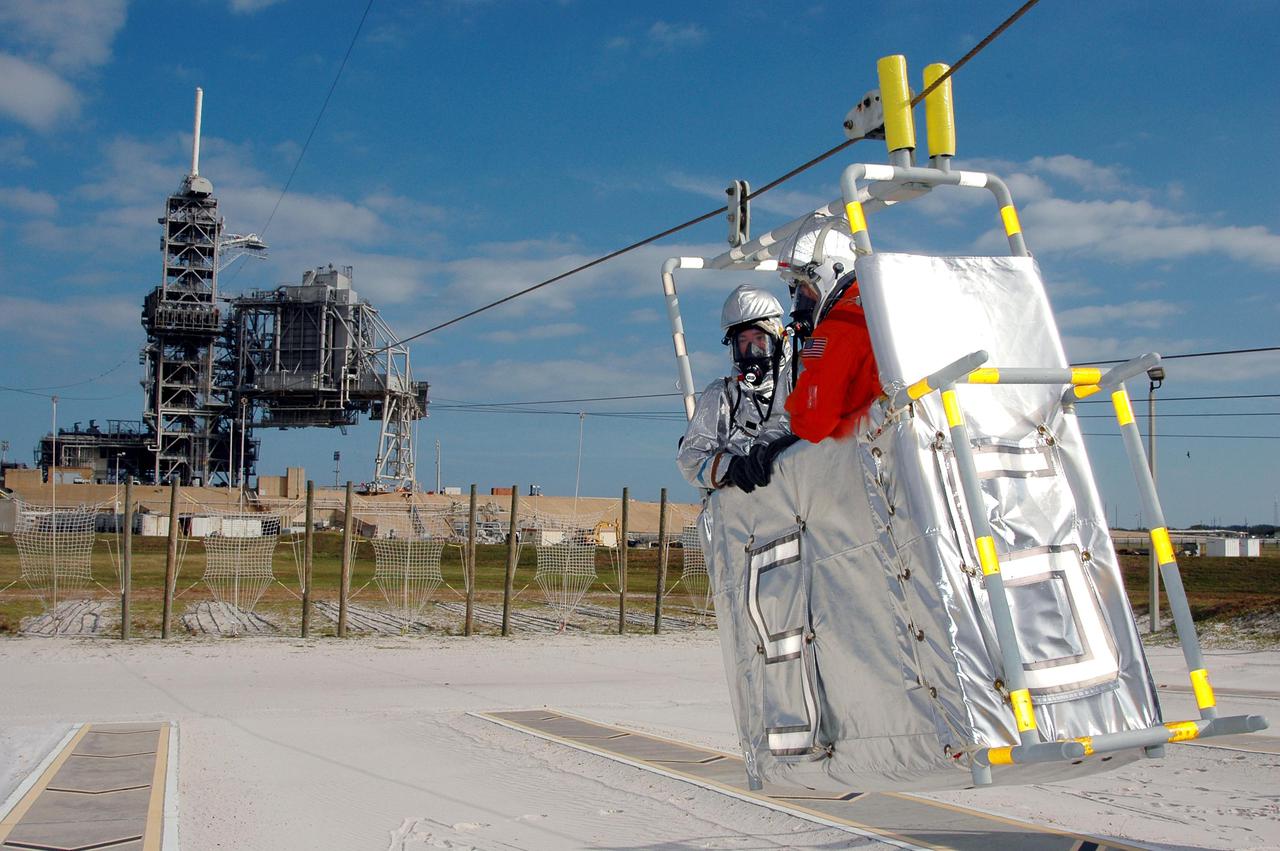
KENNEDY SPACE CENTER, FLA. - On Launch Pad 39A, a rescue team member and astronaut-suited worker approach landing in a slidewire basket reaching from the Fixed Service Structure in the background during an emergency egress scenario. The four-hour exercise simulated normal launch countdown operations, with the added challenge of a fictitious event causing an evacuation of the vehicle and launch pad. It tested the team’s rescue approaches on the Fixed Service Structure, slidewire basket evacuation, triage care and transportation of injured personnel to hospitals, as well as communications and coordination.
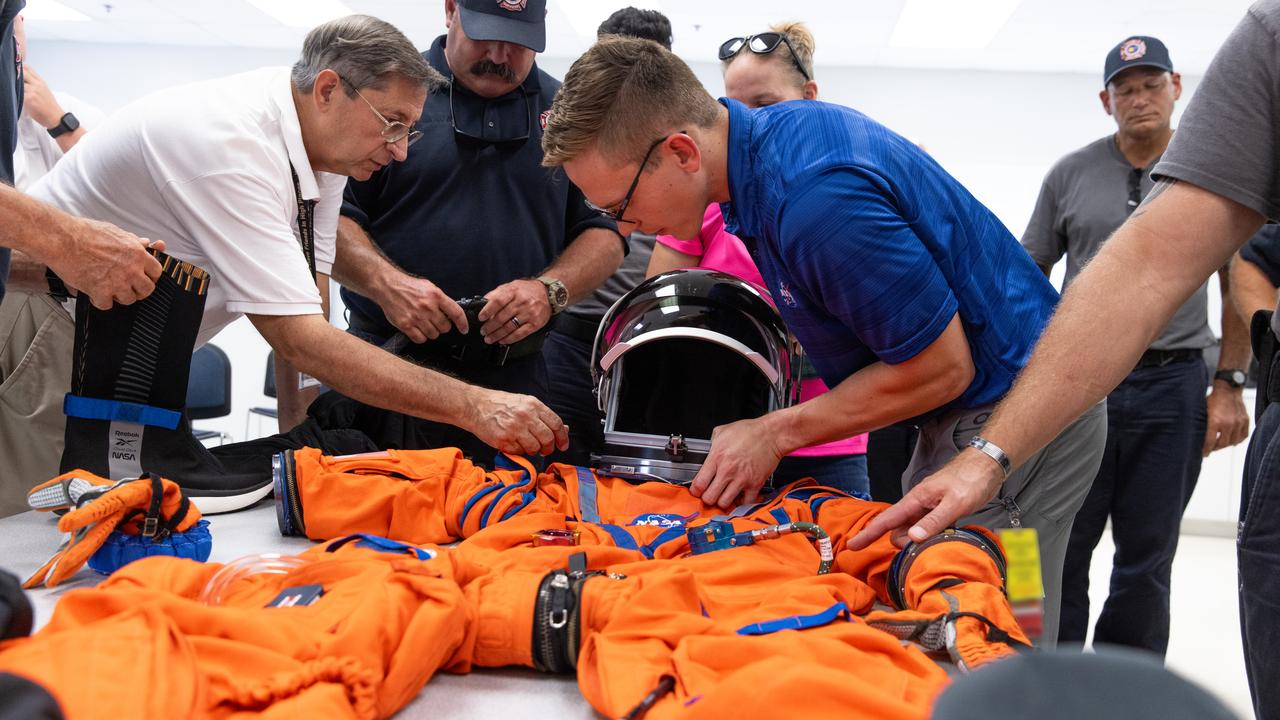
NASA’s pad rescue team learn about the Orion Crew Survival Suit ahead of the Artemis II emergency egress demonstration, which is one of the integrated system verification and validation tests taking place at Launch Pad 39B at the agency’s Kennedy Space Center in Florida on Thursday, Aug. 8, 2024. In the event of an emergency during launch countdown, the pad rescue team is there to help personnel leave the launch pad if needed.
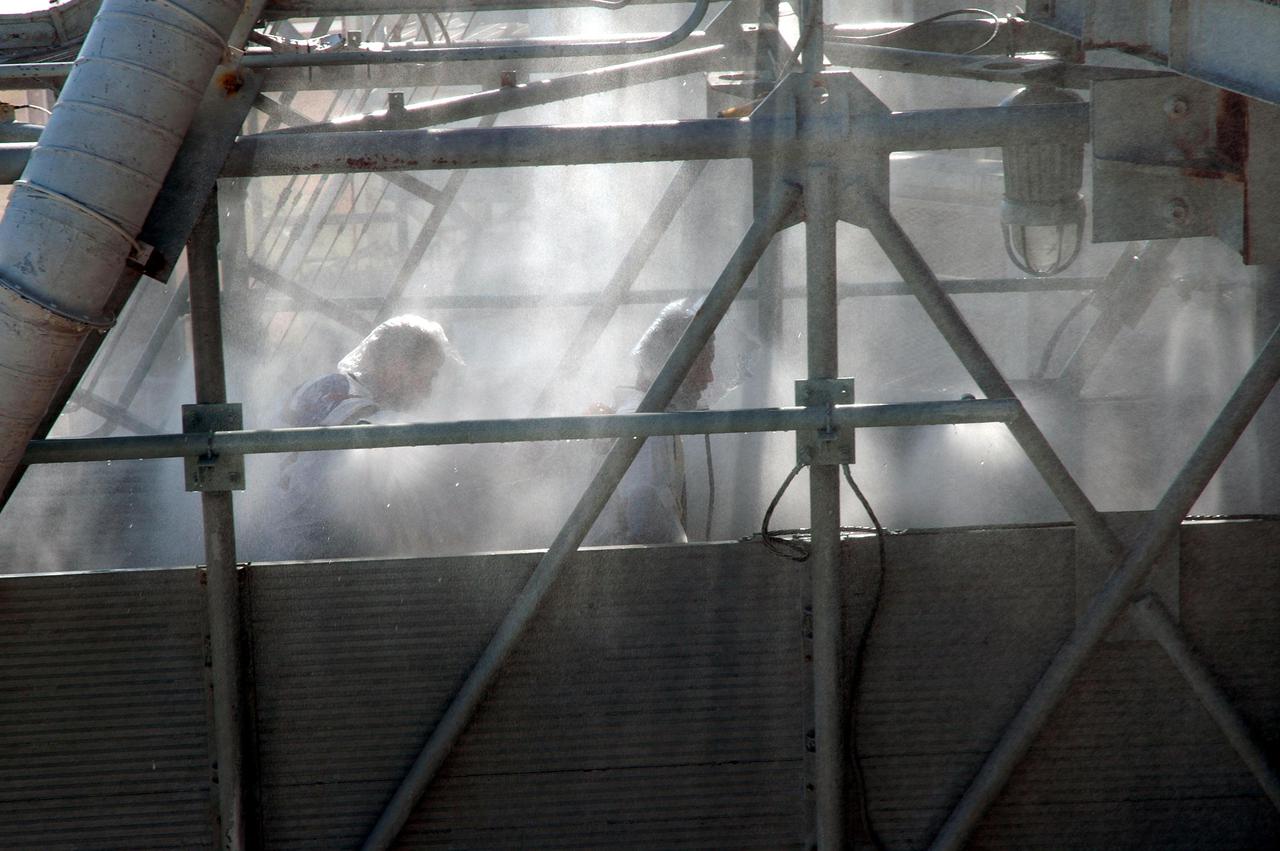
KENNEDY SPACE CENTER, FLA. - On Launch Pad 39A, astronaut-suited workers take part in an emergency egress scenario. The four-hour exercise simulated normal launch countdown operations, with the added challenge of a fictitious event causing an evacuation of the vehicle and launch pad. It tested the team’s rescue approaches on the Fixed Service Structure, slidewire basket evacuation, triage care and transportation of injured personnel to hospitals, as well as communications and coordination.
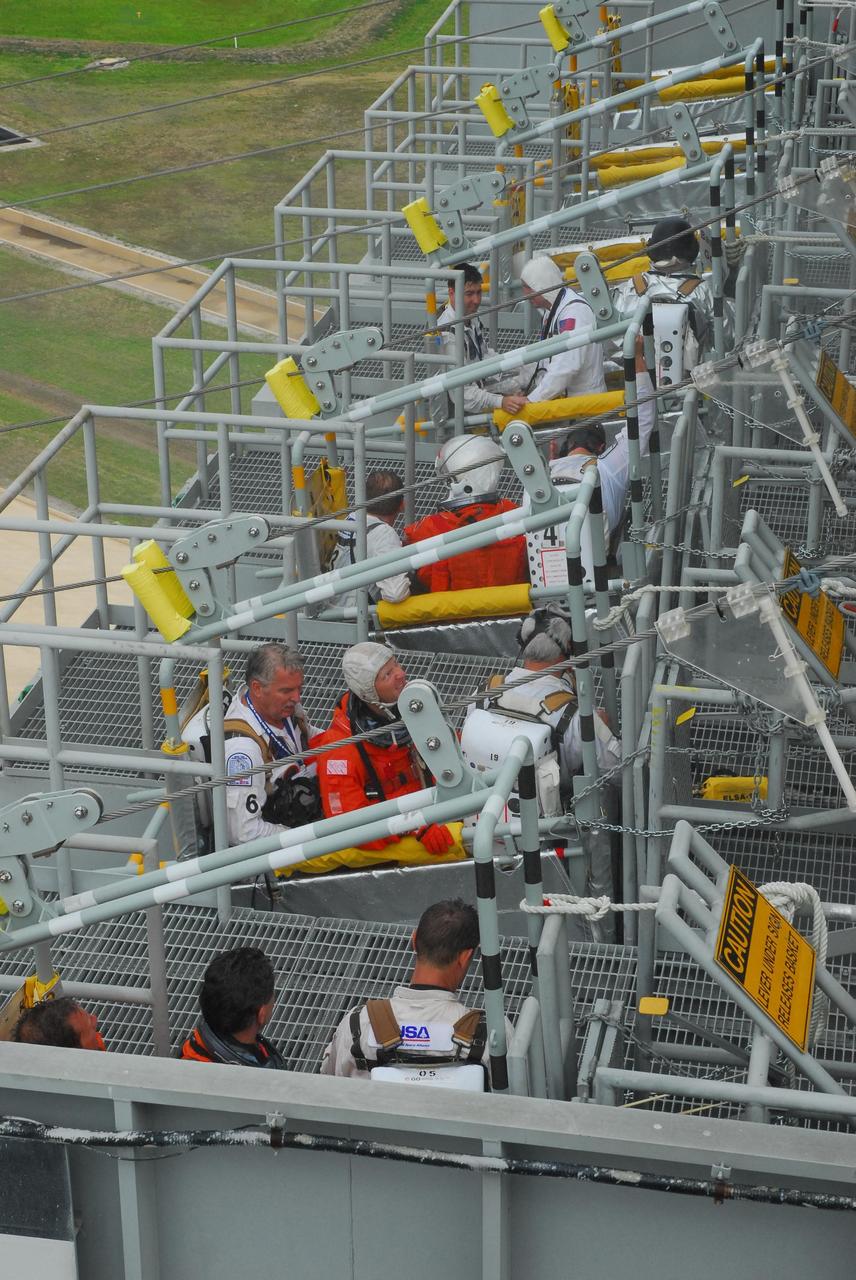
KENNEDY SPACE CENTER, FLA. -- During a simulated rescue mission on Launch Pad 39A, known as Mode 2, KSC workers dressed in astronauts' launch-and-entry suits are climbing into the slidewire baskets. A fire rescue team is simulating extracting the crew from the orbiter and helping them to the baskets.The KSC rescue teams are practicing emergency procedures in the unlikely scenario of a mishap on the pad during a launch sequence. The exercises are standard training procedures to assess and prepare emergency personnel, procedures and hardware. Photo credit: NASA/Jack Pfaller
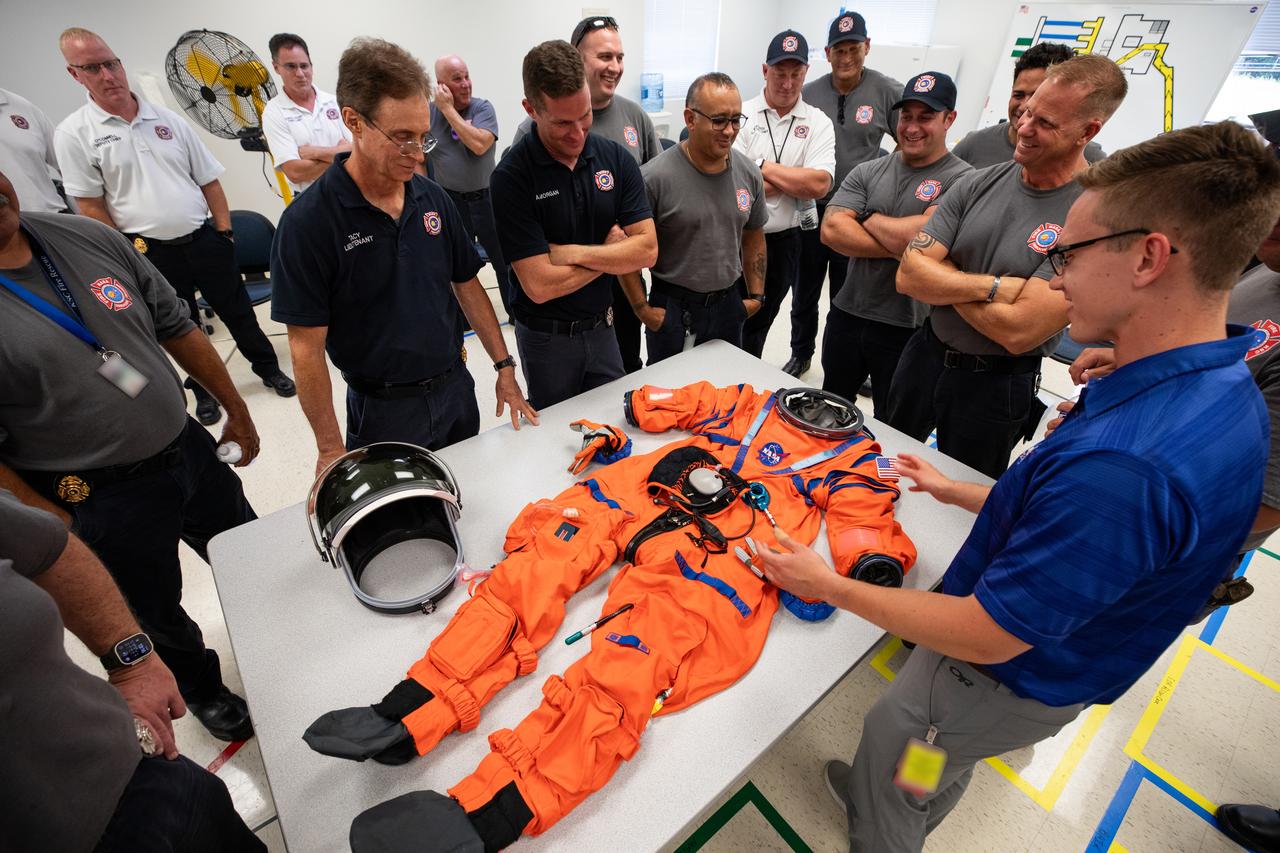
NASA’s pad rescue team learn about the Orion Crew Survival Suit ahead of the Artemis II emergency egress demonstration, which is one of the integrated system verification and validation tests taking place at Launch Pad 39B at the agency’s Kennedy Space Center in Florida on Thursday, Aug. 8, 2024. In the event of an emergency during launch countdown, the pad rescue team is there to help personnel leave the launch pad if needed.
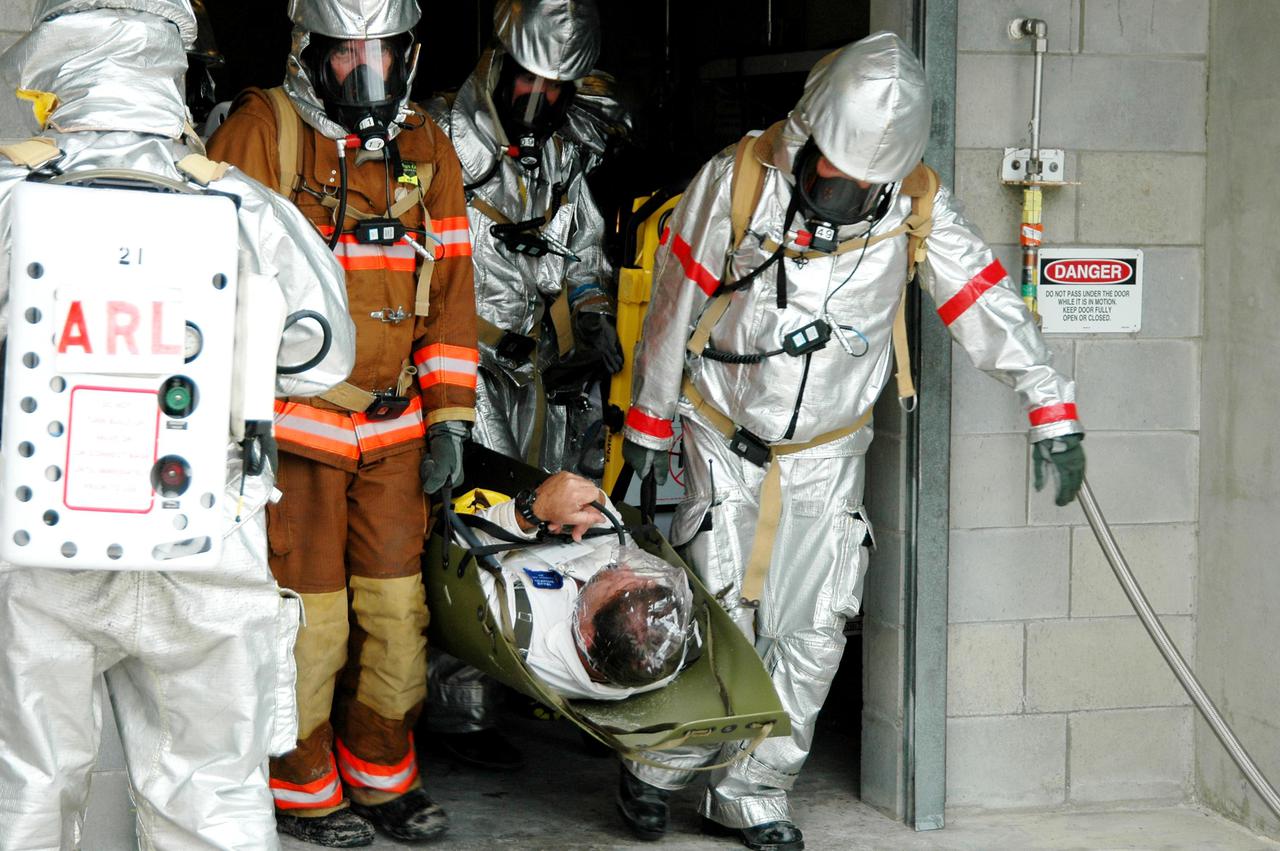
KENNEDY SPACE CENTER, FLA. - During a simulated launch countdown_emergency simulation on Launch Pad 39A, the rescue team carries “injured” astronaut-suited workers out of the pad bunker. The four-hour exercise simulated normal launch countdown operations, with the added challenge of a fictitious event causing an evacuation of the vehicle and launch pad. It tested the team’s rescue approaches on the Fixed Service Structure, slidewire basket evacuation, triage care and transportation of injured personnel to hospitals, as well as communications and coordination.
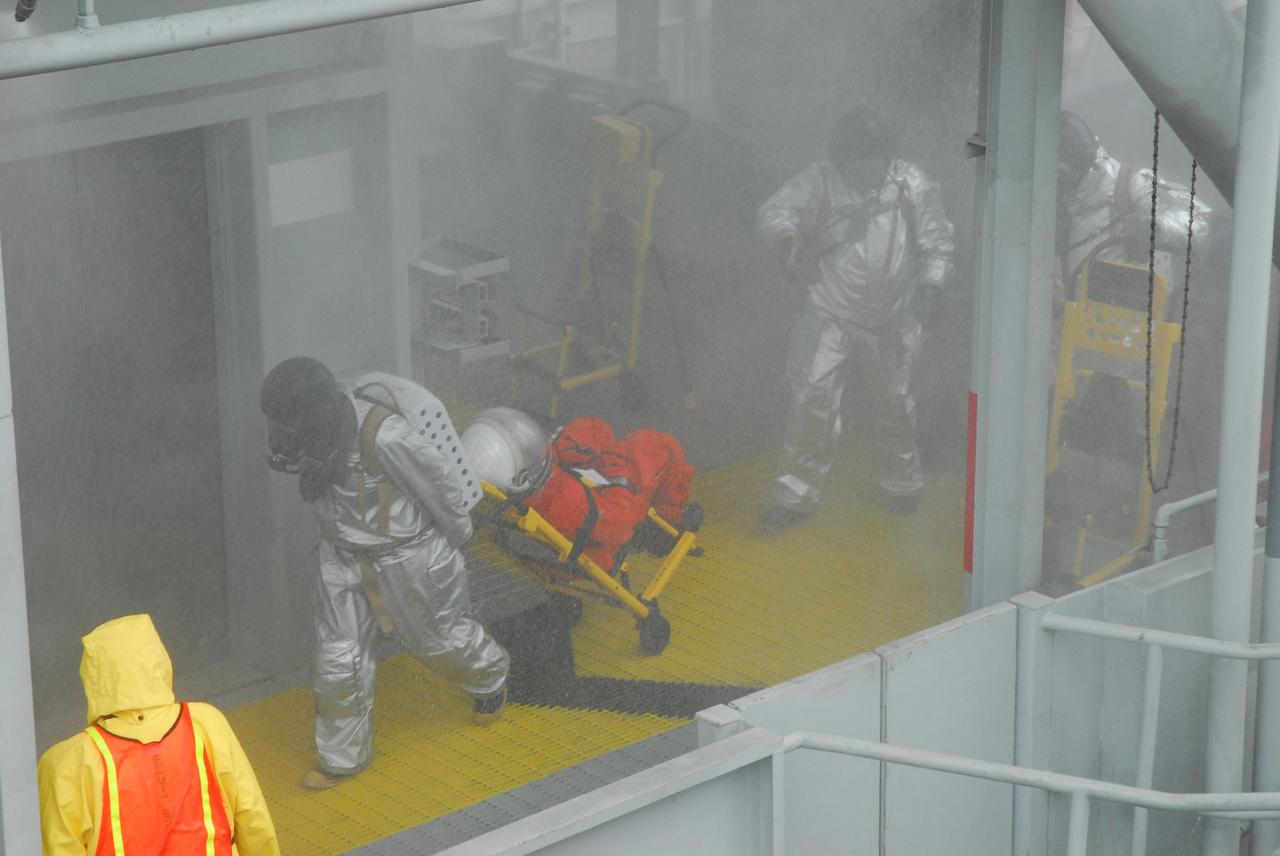
KENNEDY SPACE CENTER, FLA. -- During a simulated rescue mission on Launch Pad 39A, known as Mode 2, KSC workers dressed in astronauts' launch-and-entry suits are helped by the fire rescue team to the slidewire baskets on the 195-foot level. The KSC rescue teams are practicing emergency procedures in the unlikely scenario of a mishap on the pad during a launch sequence. The exercises are standard training procedures to assess and prepare emergency personnel, procedures and hardware. Photo credit: NASA/Jack Pfaller
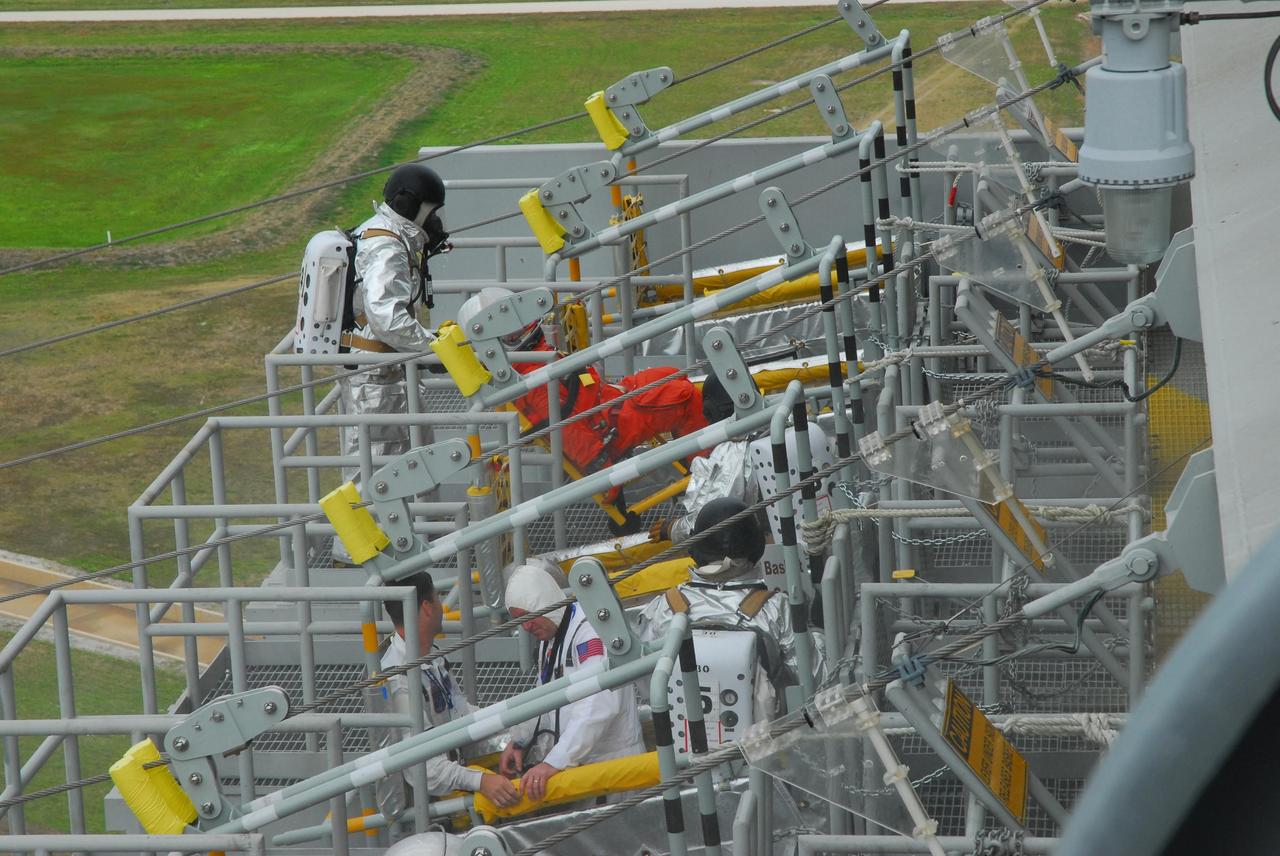
KENNEDY SPACE CENTER, FLA. -- During a simulated rescue mission on Launch Pad 39A, known as Mode 2, KSC workers dressed in astronauts' launch-and-entry suits are climbing into the slidewire baskets. A fire rescue team is simulating extracting the crew from the orbiter and helping them to the baskets.The KSC rescue teams are practicing emergency procedures in the unlikely scenario of a mishap on the pad during a launch sequence. The exercises are standard training procedures to assess and prepare emergency personnel, procedures and hardware. Photo credit: NASA/Jack Pfaller
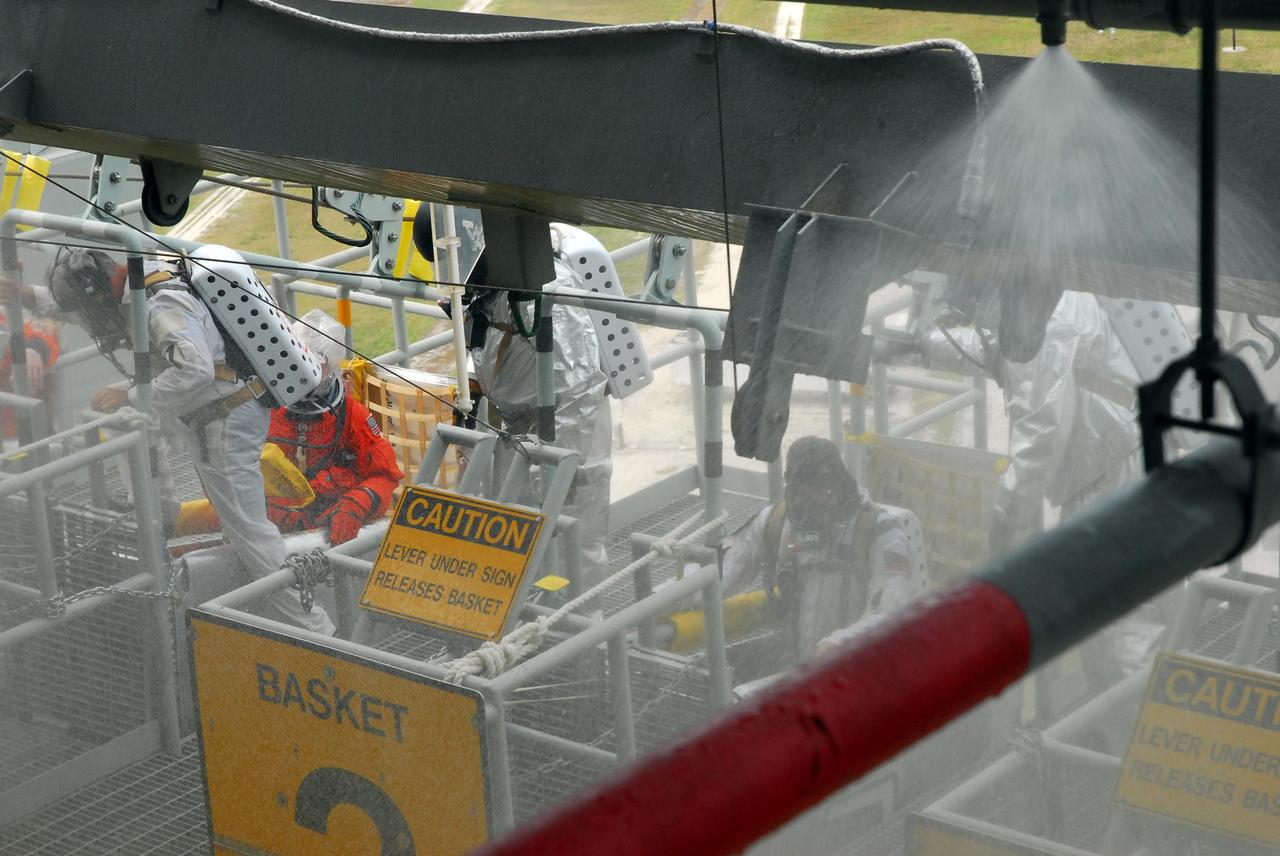
KENNEDY SPACE CENTER, FLA. -- During a simulated rescue mission on Launch Pad 39A, known as Mode 2, KSC workers dressed in astronauts' launch-and-entry suits climb into the slidewire baskets, helped by a fire rescue team. The KSC rescue teams are practicing emergency procedures in the unlikely scenario of a mishap on the pad during a launch sequence. The exercises are standard training procedures to assess and prepare emergency personnel, procedures and hardware. Photo credit: NASA/Jack Pfaller
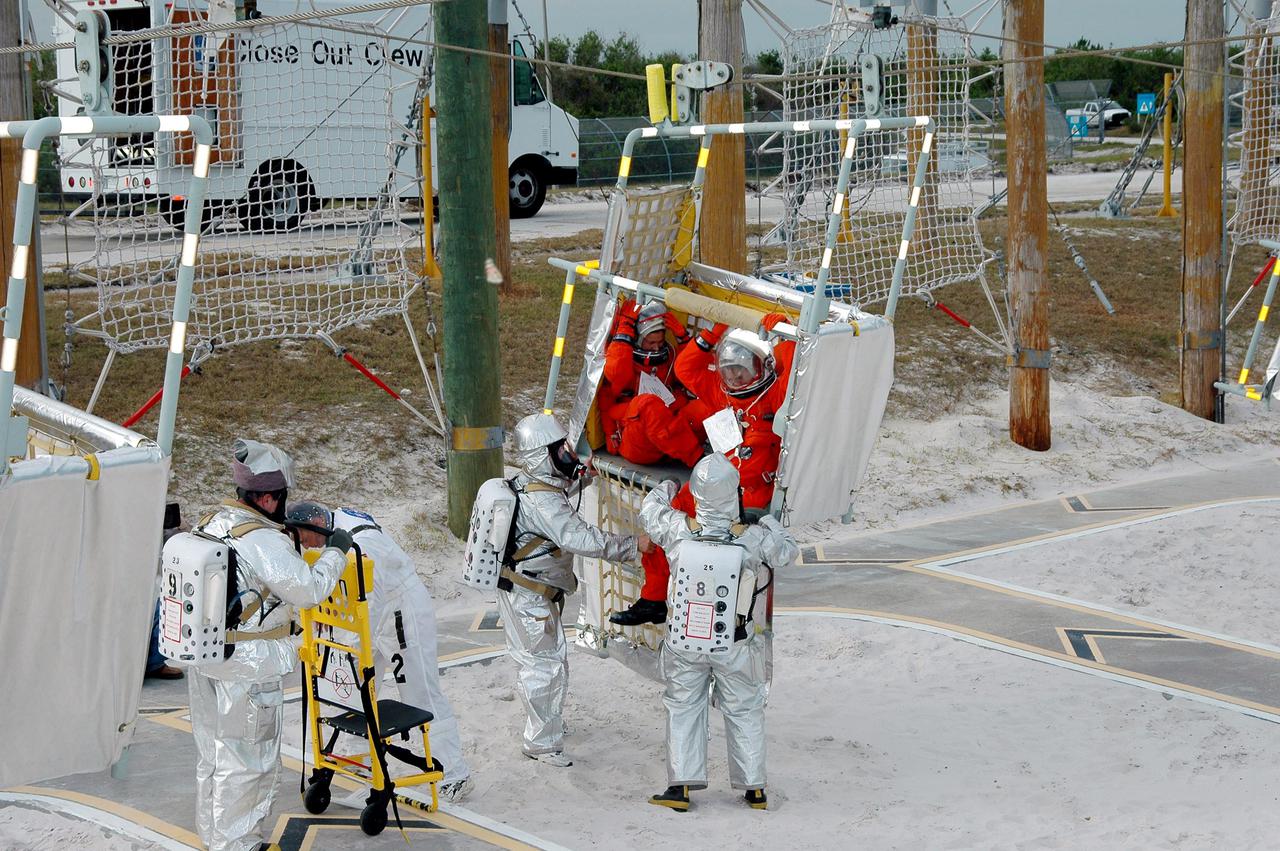
KENNEDY SPACE CENTER, FLA. - On Launch Pad 39A, rescue team members and astronaut-suited workers exit a slidewire basket during an emergency egress scenario. The four-hour exercise simulated normal launch countdown operations, with the added challenge of a fictitious event causing an evacuation of the vehicle and launch pad. It tested the team’s rescue approaches on the Fixed Service Structure, slidewire basket evacuation, triage care and transportation of injured personnel to hospitals, as well as communications and coordination.
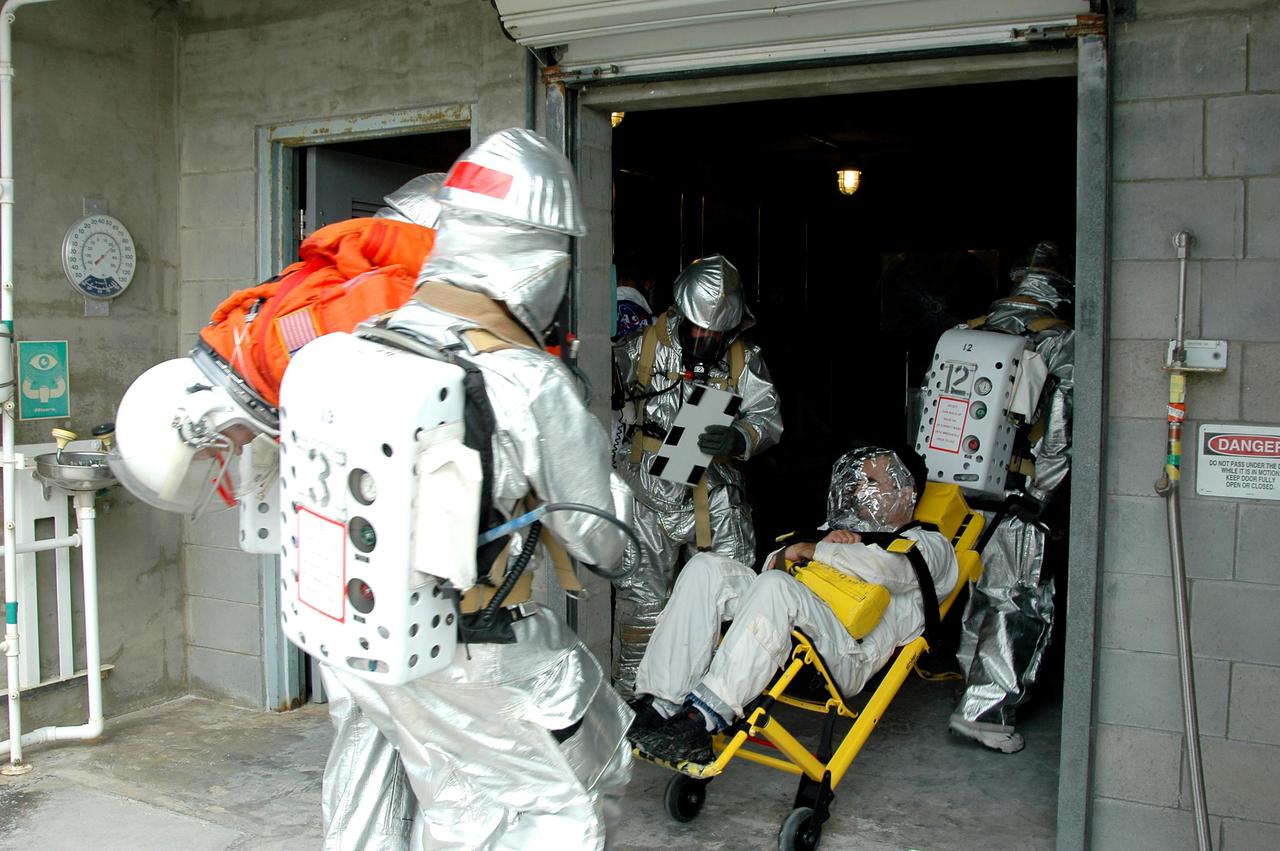
KENNEDY SPACE CENTER, FLA. - During a simulated launch countdown_emergency simulation on Launch Pad 39A, the rescue team takes “injured” astronaut-suited workers into the pad bunker. The four-hour exercise simulated normal launch countdown operations, with the added challenge of a fictitious event causing an evacuation of the vehicle and launch pad. It tested the team’s rescue approaches on the Fixed Service Structure, slidewire basket evacuation, triage care and transportation of injured personnel to hospitals, as well as communications and coordination.
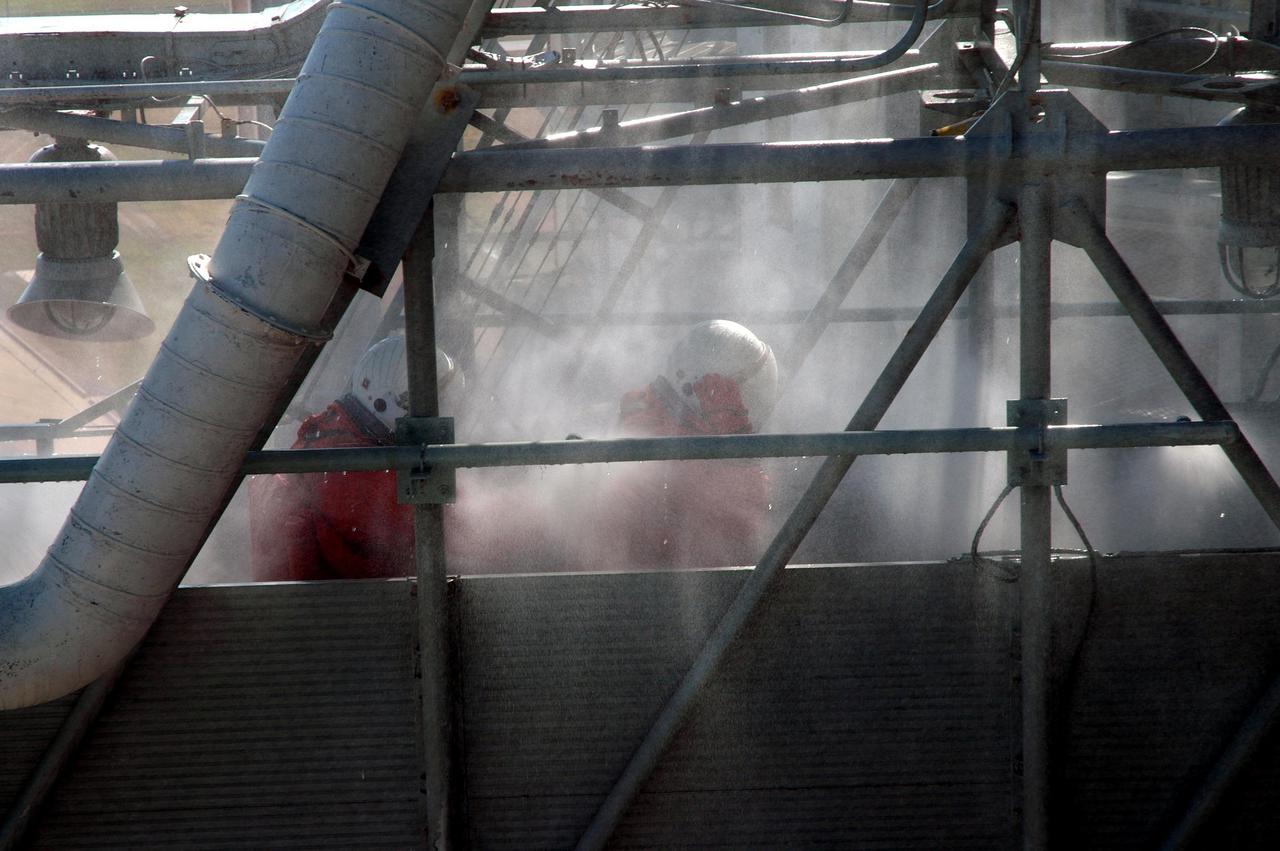
KENNEDY SPACE CENTER, FLA. - On Launch Pad 39A, astronaut-suited workers take part in an emergency egress scenario. The four-hour exercise simulated normal launch countdown operations, with the added challenge of a fictitious event causing an evacuation of the vehicle and launch pad. It tested the team’s rescue approaches on the Fixed Service Structure, slidewire basket evacuation, triage care and transportation of injured personnel to hospitals, as well as communications and coordination.
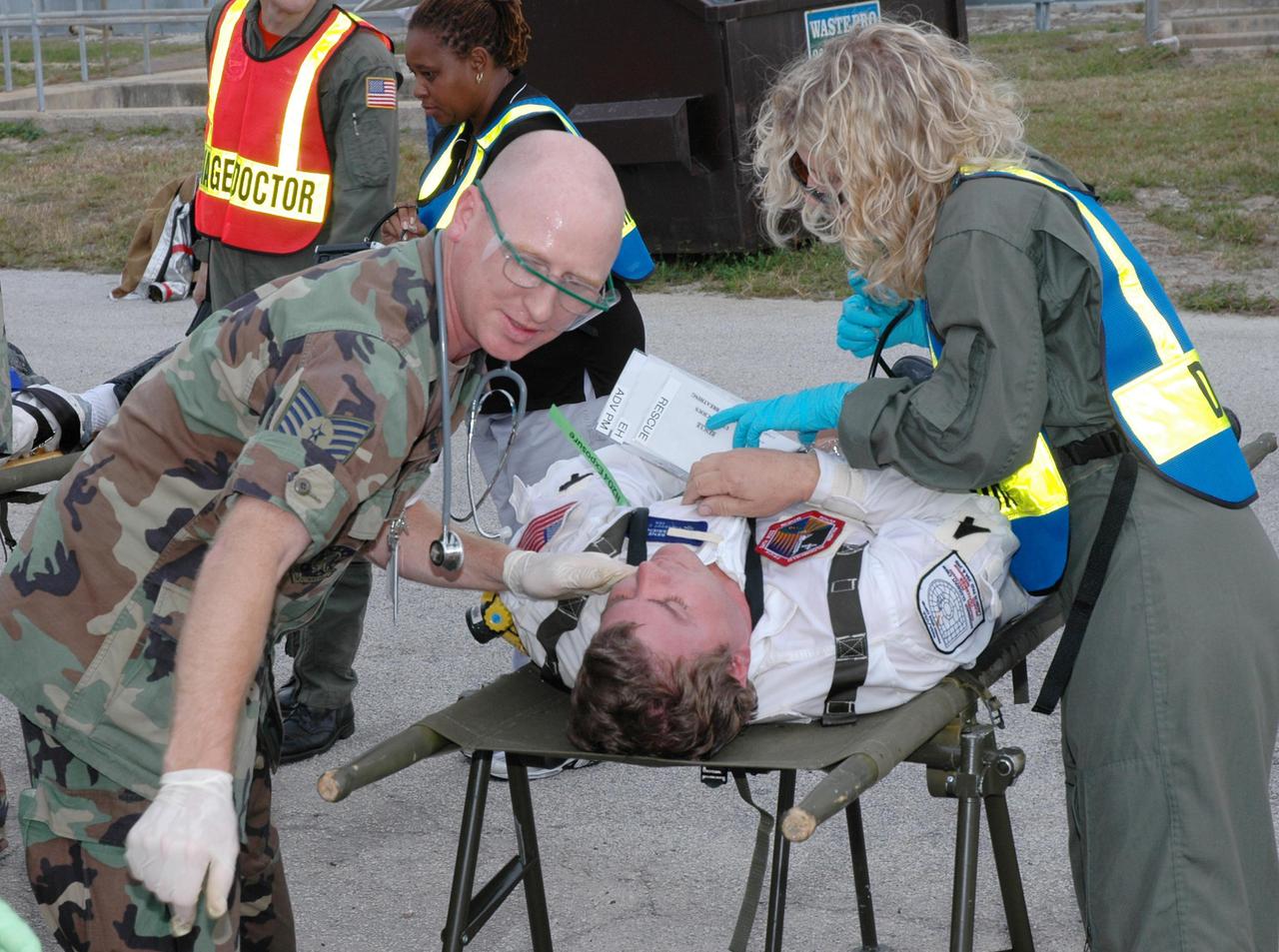
KENNEDY SPACE CENTER, FLA. - During a simulated launch countdown_emergency simulation on Launch Pad 39A, the rescue team performs triage on “injured” astronaut-suited workers. Pad team members participated in the four-hour exercise simulating normal launch countdown operations, with the added challenge of a fictitious event causing an evacuation of the vehicle and launch pad. The simulation tested the team’s rescue approaches on the Fixed Service Structure, slidewire basket evacuation, triage care and transportation of injured personnel to hospitals, as well as communications and coordination.

Photographs documenting International Space Station (ISS) Phase One activities at the Russian Space Agency's (RSA) Gagarin Cosmonaut Training Center, Korolov Mission Control Center and Zvezda; and ISS and Soyuz manufacturing at RSA's Khrunichev Design Center and RSC Energiya in Moscow, Russia, the French Space Agency's (CNES) INTESPACE facility in Toulouse, France, and the Italian Space Agency's (ASI) Alenia Spazio facility in Torino, Italy. Photographs were taken by Johnson Space Center Imagery and Publications Office contractors travelling from October 7 to November 4, 1996. Includes: VIEWS FROM RSC ENERGIYA'S SPACE MUSEUM: Room with a Buran model and photographic displays (17372-374). Salyut Space Station mock-up (17376). Russian propulsion engines on display (17377-378). Russian spacecraft on display (17375, 17387-398). Graphic displays (17399-405). VIEWS FROM RSC ENERGIYA MANUFACTURING FACILITIES: Unidentified facility (17379). Mir 24 crew member Michael C. Foale, suited in a Soyuz pressure suit, ingresses the Soyuz TM-26 flight article at RSC Energiya for a fit check (17380-381). Closeups of Foale inside the Soyuz during the fit check (17382-383, 17466-467). Overhead views of RSC Energiya's Building 444 manufacturing floor where docking modules and Soyuz TM spacecraft are built (17495-498). Technicians on the Building 444 manufacturing floor assembling probe and drogue docking modules (17499-500, 17504). Technicians assembling Soyuz spacecraft (17437-439). Views of other Soyuz spacecraft (17440-441). Androgynous Peripheral Docking System (APDS) mock-up (17501-503). Closeups of a control panel, possibly for the APDS mock-up (17519-528). VIEWS FROM ZVEZDA, RSA CONTRACTOR FOR SUIT DESIGN AND SOYUZ SEAT LINERS: Mir 24 crew member Foale dons a "penguin" flight suit for a fit check (17454-456). Zvezda personnel adjust Foale's Soyuz seat and seat liner (17442). Closeup of Foale, suited in a Soyuz pressure suit, sitting on a chair (17444). Zvezda personnel strap pressure-suited Foale into his Soyuz seat (17443, 17445, 17450). Views of Foale in his Soyuz seat during a pressurized pressure suit fit check (17451-453). Views looking into a vacuum chamber where Foale, wearing pressure suit, is strapped into his Soyuz seat (17466-467). Views of Zvezda personnel working at the vacuum chamber control station during the vacuum chamber suit test (17468-471). VIEWS FROM KHRUNICHEV DESIGN CENTER: Views of a green ISS Functional Cargo Block (FGB) test article on the manufacturing floor (17529, 17532-536, 17540-544). Views of an ISS Service Module (SM) test article on the manufacturing floor (17530-531, 17537, 17539). Closeup of the SM test article docking sphere (17538). Views of the FGB flight article on the manufacturing floor during systems tests (17545-548, 17550-567). Views of technicians conducting the FGB systems tests (17549, 17557). VIEWS FROM GAGARIN COSMONAUT TRAINING CENTER: NASA astronauts work out in the cosmonaut gym at Gagarin: Closeup of ISS 2R Expedition Commander William Shepherd on a weight machine (17384). Shepherd and an unidentified man with back to camera work out with dumbbells (17386). Shepherd does pull-ups (17447). Closeup of Foale on an exercise machine (17385). Closeups of Foale exercising arms on a cycle ergometer and a weight machine (17415, 17448-449). Foale exercises on a Nordic Track (17416). Closeup of Mir 23 crew member Jerry Linenger exercising arms (17417). Wendy Lawrence exercises with dumbbells (17418). Closeup of Lawrence in a handstand position (17419). David Wolf works out on a leg press machine (17446). Views of the Mir Space Station mock-up at Gagarin: Interior views of the Mir Base Module mock-up looking toward the transfer compartment (17421-425). Mir Base Module living area mock-up (17420). Overall views of the Base Module mock-up central control station (17426-427, 17505). Closeups of switch panels on the central control station (17428-436, 17506-518). Other views from Gagarin: Personnel work at an unidentified test/trainer control station (17472-473). Linenger sits at a table next to an RSA trainer during a Mir 23 meeting (17475-476). Out-of-focus view of two subjects in the Soyuz trainer (17474). Foale examines a Mir Complex EVA Suit (Orlan) with RSA trainers during an EVA suit training class (17492-494). VIEWS FROM KOROLOV MISSION CONTROL CENTER: Various views of personnel working in the NASA Consulting Room and/or PAO Consulting Room at Korolov Mission Control Center (17457-463). VIEWS FROM INTESPACE: Exterior views of an ISS Mini Pressurized Logistics Module (MPLM) structural test article (STA) during testing at INTESPACE (17406-409, 17477, 17482-484). Technicians install hatch on the MPLM STA (17410-414). Interior views of the MPLM STA (17478-481). VIEWS FROM ALENIA SPAZIO: Closeups of MPLM flight article #1 side panels during milling and refining at Alenia Spazio (17485-488). Workers process MPLM parts at milling machines (17489-491).
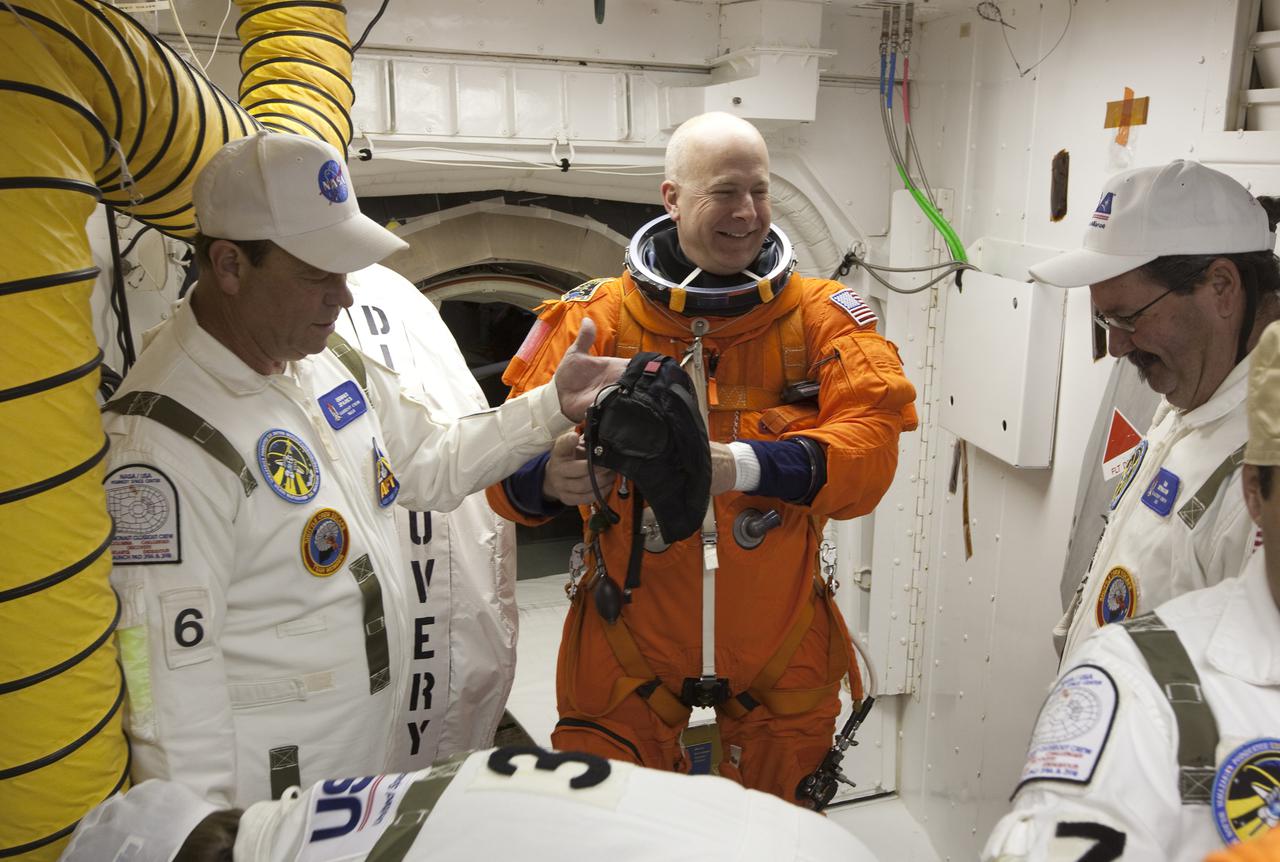
CAPE CANAVERAL, Fla. - At Launch Pad 39A at NASA's Kennedy Space Center in Florida, STS-131 Commander Alan Poindexter, in the orange suit, prepares to enter space shuttle Discovery from the pad's White Room. The members of space shuttle Discovery's STS-131 crew, dressed in their launch-and-entry suits, are participating in the Terminal Countdown Demonstration Test, or TCDT, a dress rehearsal for launch. TCDT includes training on the emergency exit systems at the launch pad, driving practice of the M-113 armored personnel carrier and a simulated launch countdown. The crew will deliver the multi-purpose logistics module Leonardo, filled with resupply stowage platforms and science racks, to the International Space Station. STS-131, targeted for launch on April 5, will be the 33rd shuttle mission to the station and the 131st shuttle mission overall. For information on the STS-131 mission and crew, visit http:__www.nasa.gov_mission_pages_shuttle_shuttlemissions_sts131_index.htm. Photo courtesy of Scott Andrews
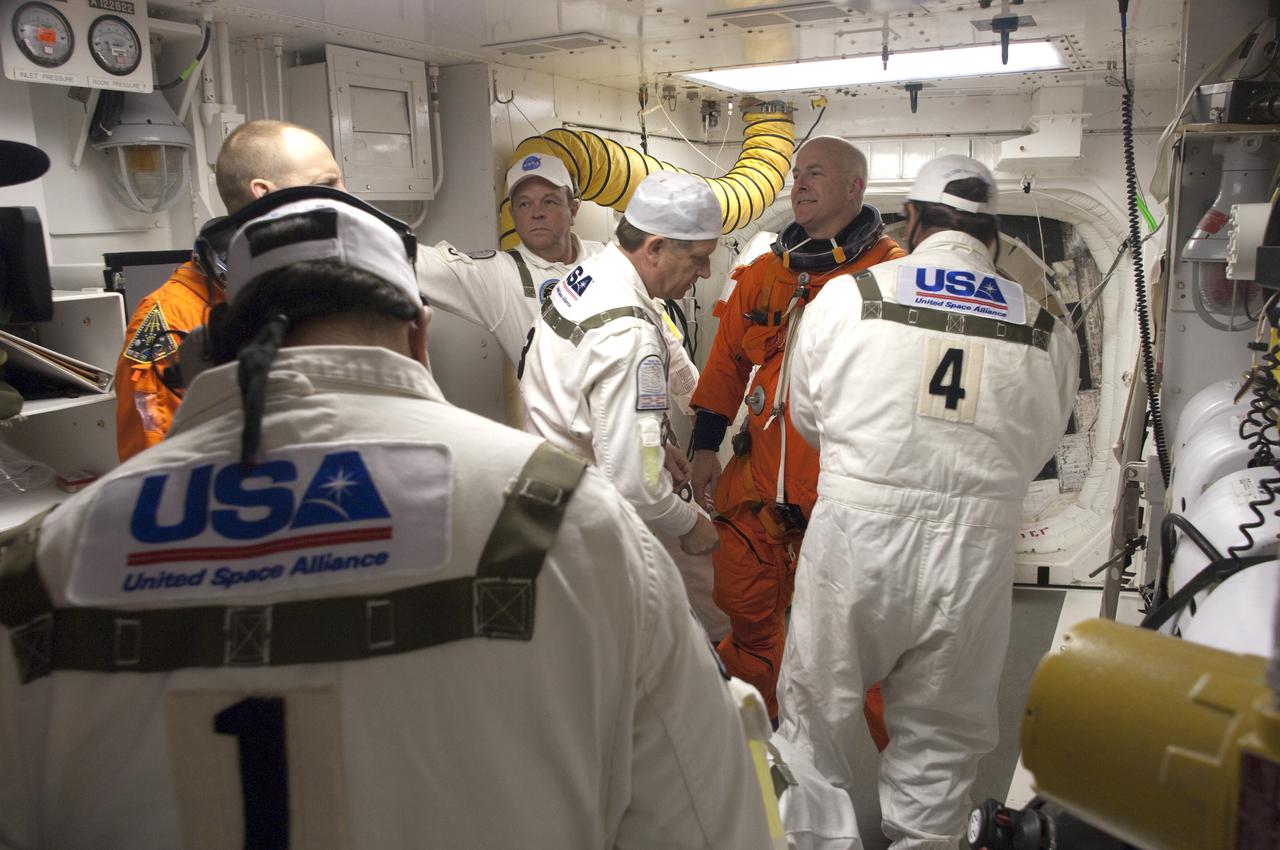
CAPE CANAVERAL, Fla. - At Launch Pad 39A at NASA's Kennedy Space Center in Florida, STS-131 Commander Alan Poindexter, at right in the orange suit, prepares to enter space shuttle Discovery from the pad's White Room. The members of space shuttle Discovery's STS-131 crew, dressed in their launch-and-entry suits, are participating in the Terminal Countdown Demonstration Test, or TCDT, a dress rehearsal for launch. TCDT includes training on the emergency exit systems at the launch pad, driving practice of the M-113 armored personnel carrier and a simulated launch countdown. The crew will deliver the multi-purpose logistics module Leonard, filled with resupply stowage platforms and science racks, to the International Space Station. STS-131, targeted for launch on April 5, will be the 33rd shuttle mission to the station and the 131st shuttle mission overall. For information on the STS-131 mission and crew, visit http:__www.nasa.gov_mission_pages_shuttle_shuttlemissions_sts131_index.htm. Photo credit: NASA_Regina Mitchell-Ryall
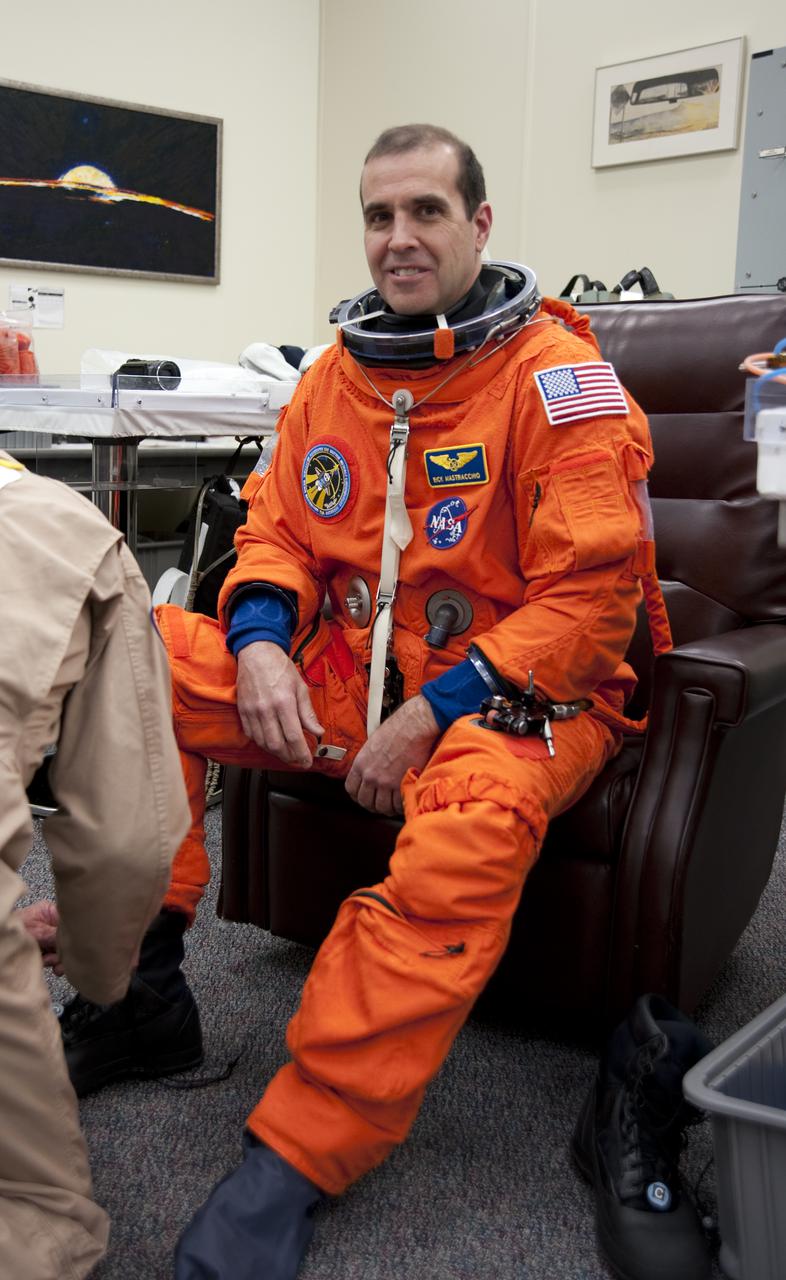
CAPE CANAVERAL, Fla. - In the Operations and Checkout Building at NASA's Kennedy Space Center in Florida, STS-131 Mission Specialist Rick Mastracchio suits up for his third practice countdown. The members of space shuttle Discovery's STS-131 crew put on their launch-and-entry suits before heading to the Astrovan for the ride to Launch Pad 39A. The crew is participating in the Terminal Countdown Demonstration Test, or TCDT, a dress rehearsal for launch. TCDT includes training on the emergency egress systems at the launch pad, driving practice of the M-113 armored personnel carrier and a simulated launch countdown. The crew will deliver the multi-purpose logistics module Leonard, filled with resupply stowage platforms and science racks, to the International Space Station. STS-131, targeted for launch on April 5, will be the 33rd shuttle mission to the station and the 131st shuttle mission overall. For information on the STS-131 mission and crew, visit http:__www.nasa.gov_mission_pages_shuttle_shuttlemissions_sts131_index.htm. Photo credit: NASA_Kim Shiflett
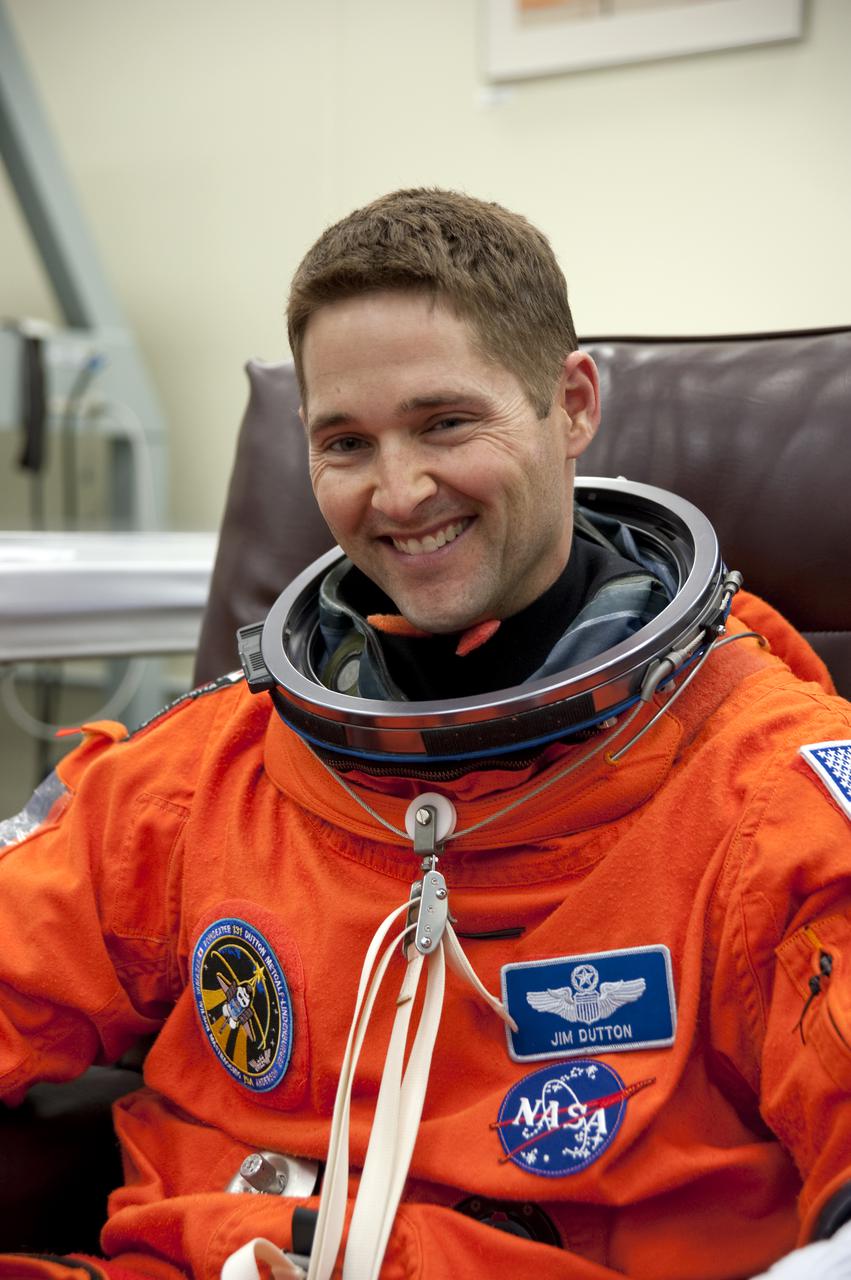
CAPE CANAVERAL, Fla. - In the Operations and Checkout Building at NASA's Kennedy Space Center in Florida, STS-131 Pilot James P. Dutton Jr. suits up for his first practice countdown. The members of space shuttle Discovery's STS-131 crew put on their launch-and-entry suits before heading to the Astrovan for the ride to Launch Pad 39A. The crew is participating in the Terminal Countdown Demonstration Test, or TCDT, a dress rehearsal for launch. TCDT includes training on the emergency egress systems at the launch pad, driving practice of the M-113 armored personnel carrier and a simulated launch countdown. The crew will deliver the multi-purpose logistics module Leonard, filled with resupply stowage platforms and science racks, to the International Space Station. STS-131, targeted for launch on April 5, will be the 33rd shuttle mission to the station and the 131st shuttle mission overall. For information on the STS-131 mission and crew, visit http:__www.nasa.gov_mission_pages_shuttle_shuttlemissions_sts131_index.htm. Photo credit: NASA_Kim Shiflett
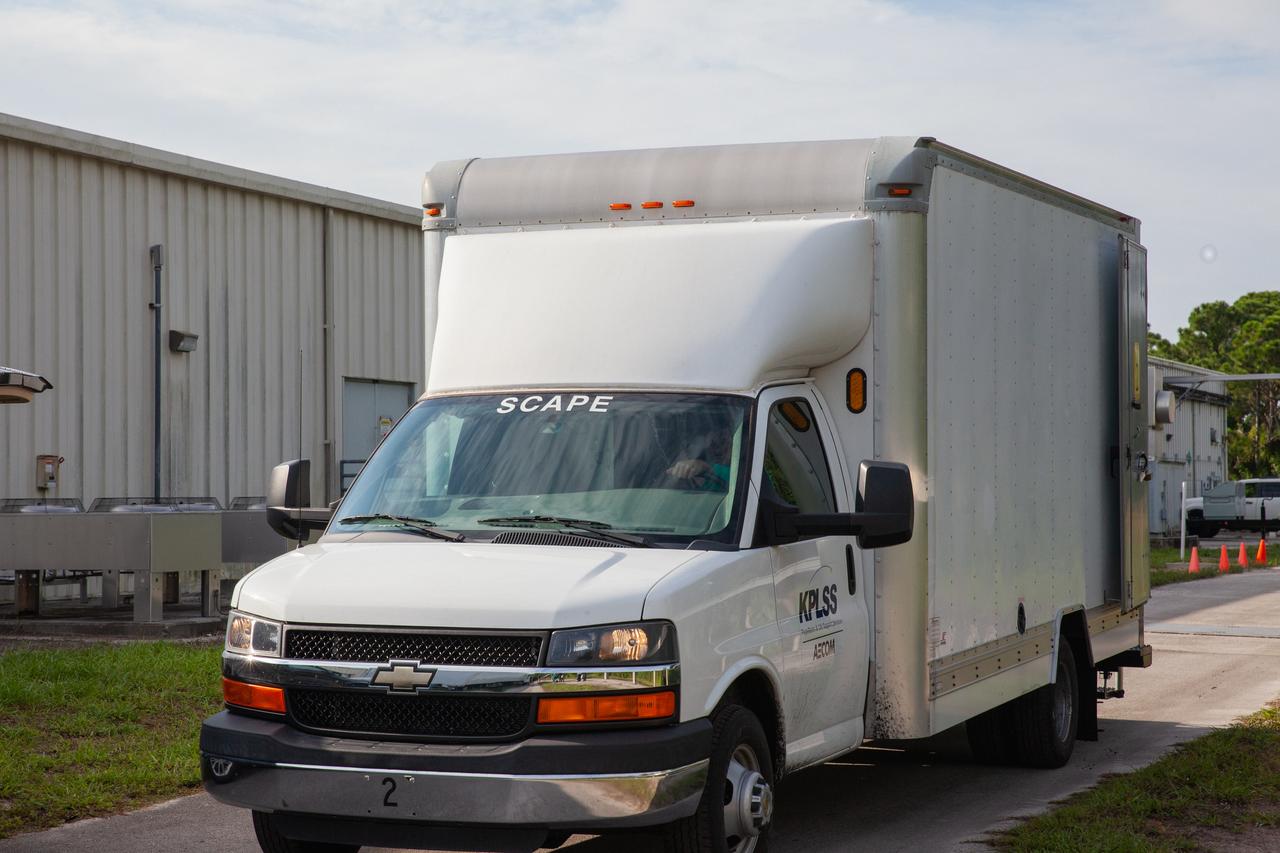
A truck transports technicians wearing Self-Contained Atmospheric Protective Ensemble (SCAPE) suits and operations support personnel to the Multi-Payload Processing Facility (MPPF) at NASA’s Kennedy Space Center in Florida, for a test simulation of loading propellants into a replicated test tank for Orion on Aug. 16, 2019. Exploration Ground Systems is preparing for Artemis 1 with a series of hazardous hyper test events at the MPPF. The technicians will complete a tanking to test the system before Orion arrives for processing. During preparations for launch, these teams will be responsible for loading the Orion vehicle with propellants prior to transportation to the Vehicle Assembly Building, where it will be secured atop the Space Launch System rocket. SCAPE suits are used in operations involving toxic propellants and are supplied with air either through a hardline or through a self-contained environmental control unit.
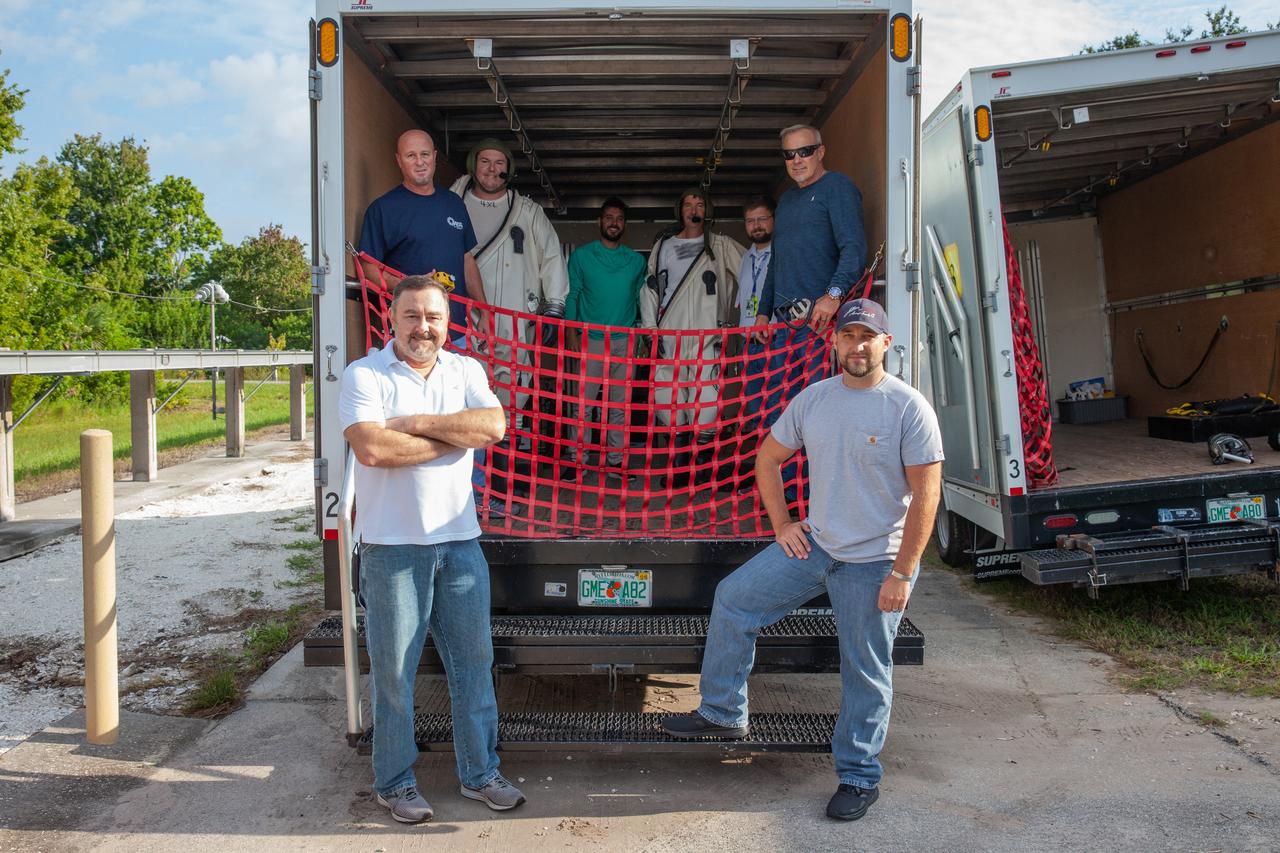
Technicians wearing Self-Contained Atmospheric Protective Ensemble (SCAPE) suits and operations support personnel prepare for a test simulation of loading propellants into a replicated test tank for Orion on Aug. 16, 2019, at NASA’s Kennedy Space Center in Florida. They are in a transport truck at the Multi-Operations Support Building near the Multi-Payload Processing Facility (MPPF). Exploration Ground Systems is preparing for Artemis 1 with a series of hazardous hyper test events at the MPPF. The technicians will complete a tanking to test the system before Orion arrives for processing. During preparations for launch, these teams will be responsible for loading the Orion vehicle with propellants prior to transportation to the Vehicle Assembly Building, where it will be secured atop the Space Launch System rocket. SCAPE suits are used in operations involving toxic propellants and are supplied with air either through a hardline or through a self-contained environmental control unit.
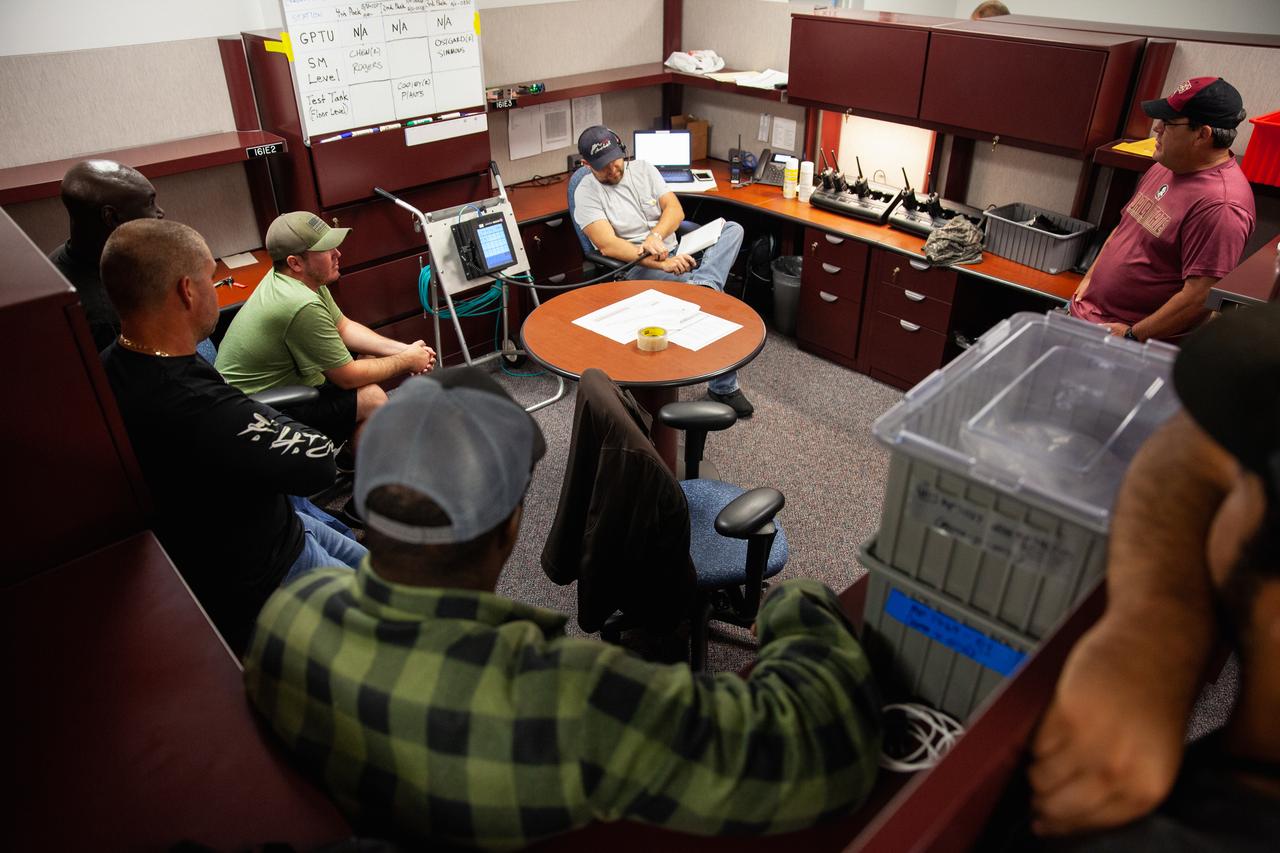
Inside the Multi-Operations Support Building near the Multi-Payload Processing Facility (MPPF) at NASA’s Kennedy Space Center in Florida, technicians and operations personnel review procedures for a test simulation of loading propellants into a replicated test tank for Orion, on Aug. 16, 2019. Exploration Ground Systems is preparing for Artemis 1 with a series of hazardous hyper test events at the MPPF. Technicians will practice putting on Self-Contained Atmospheric Protective Ensemble (SCAPE) suits and then complete tanking to test the system before Orion arrives for processing. During preparations for launch, these teams will be responsible for loading the Orion vehicle with propellants prior to transportation to the Vehicle Assembly Building, where it will be secured atop the Space Launch System rocket. SCAPE suits are used in operations involving toxic propellants and are supplied with air either through a hardline or through a self-contained environmental control unit.
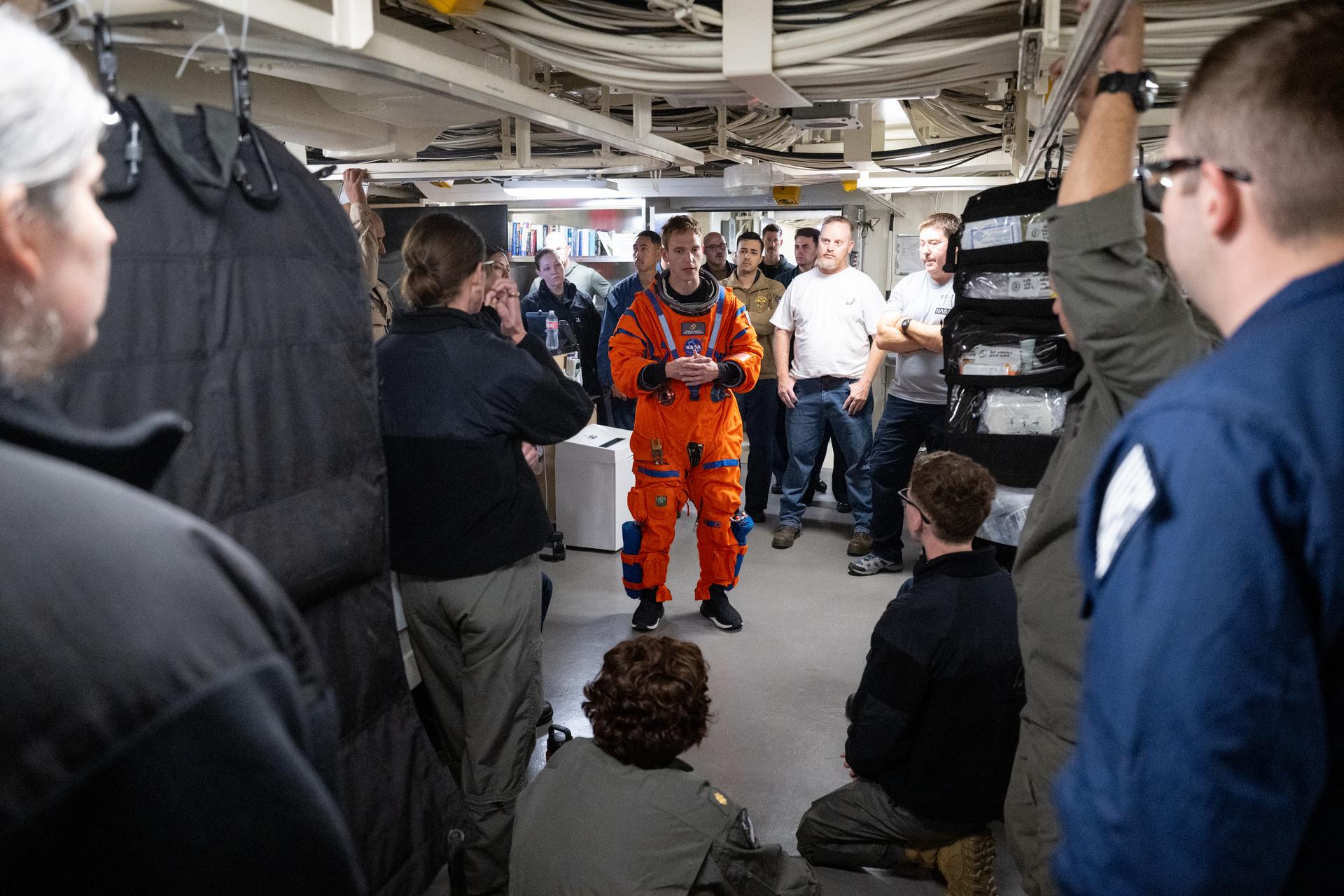
Nicholas Houghton, an Orion Crew Survival System engineer at NASA’s Johnson Space Center, wears an Orion Crew Survival System suit as he conducts familiarization training with U.S. Navy medical personnel on doffing the suit onboard USS John P. Murtha ahead of the return of the Artemis II crewmembers to Earth, Tuesday, April 7, 2026, in the Pacific Ocean off the coast of California. NASA’s Artemis II mission is taking NASA astronauts Reid Wiseman, commander; Victor Glover, pilot; Christina Koch, mission specialist; and CSA (Canadian Space Agency) astronaut Jeremy Hansen, mission specialist on a 10-day journey around the Moon and back aboard their Orion spacecraft. Wiseman, Glover, Koch, and Hansen are scheduled to splash down off the coast of San Diego at approximately 5:07 p.m. PDT (8:07 p.m. EDT) on Friday, April 10. Photo Credit: (NASA/Joel Kowsky)
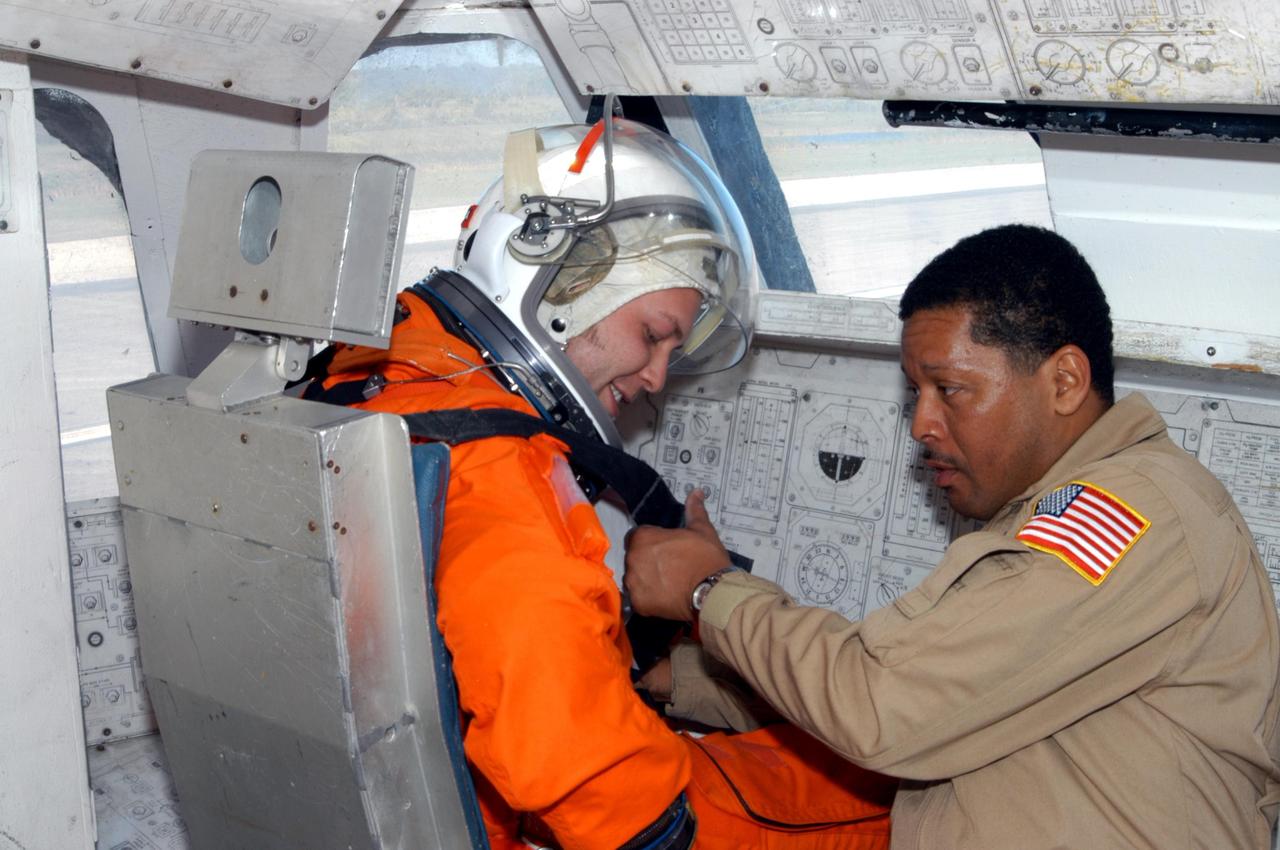
KENNEDY SPACE CENTER, FLA. - Inside the orbiter mockup at NASA Kennedy Space Center's Shuttle Landing Facility, volunteer "astronaut" Jeremy Garcia, with United Space Alliance (USA), is helped with his launch and entry suit by USA Insertion Tech George Brittingham before a simulated emergency landing of a shuttle crew. Known as a Mode VI exercise, the operation uses volunteer workers from the Center to pose as astronauts. The purpose of the simulation is to exercise emergency preparedness personnel, equipment and facilities in rescuing astronauts from a downed orbiter and providing immediate medical attention. Photo credit: NASA/George Shelton
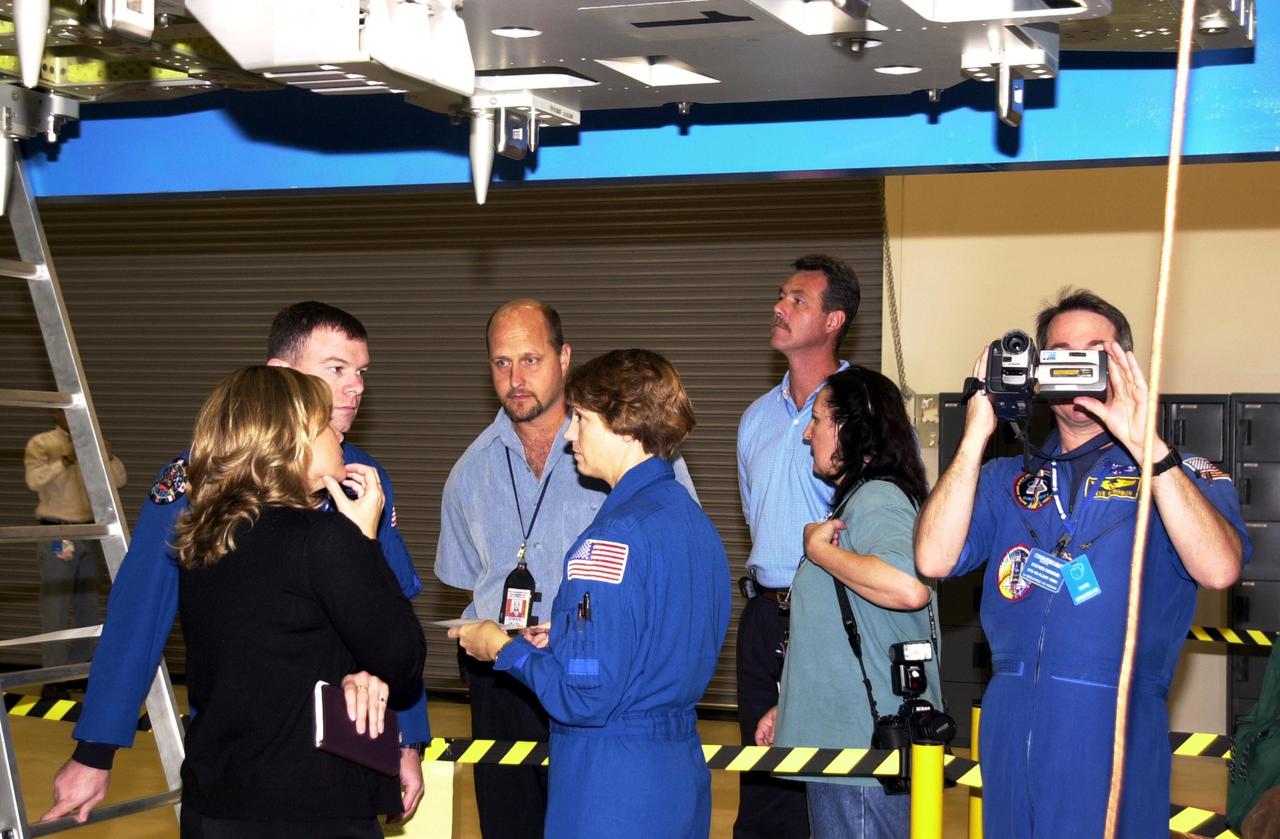
KENNEDY SPACE CENTER, FLA. - At the SPACEHAB facility in Cape Canaveral, STS-114 crew members, dressed in blue flight suits -- Pilot James Kelly (left), Commander Eileen Collins (center) and Mission Specialist Stephen Robinson (holding videocamera) -- participate in familiarization activities on the module that will fly on the STS-114 mission with support personnel looking on. STS-114 is a utilization and logistics flight that will carry Multi-Purpose Logistics Module Raffaello and the External Stowage Platform (ESP-2), as well as the Expedition 7 crew, to the International Space Station. Launch of STS-114 is currently targeted for March 1, 2003.
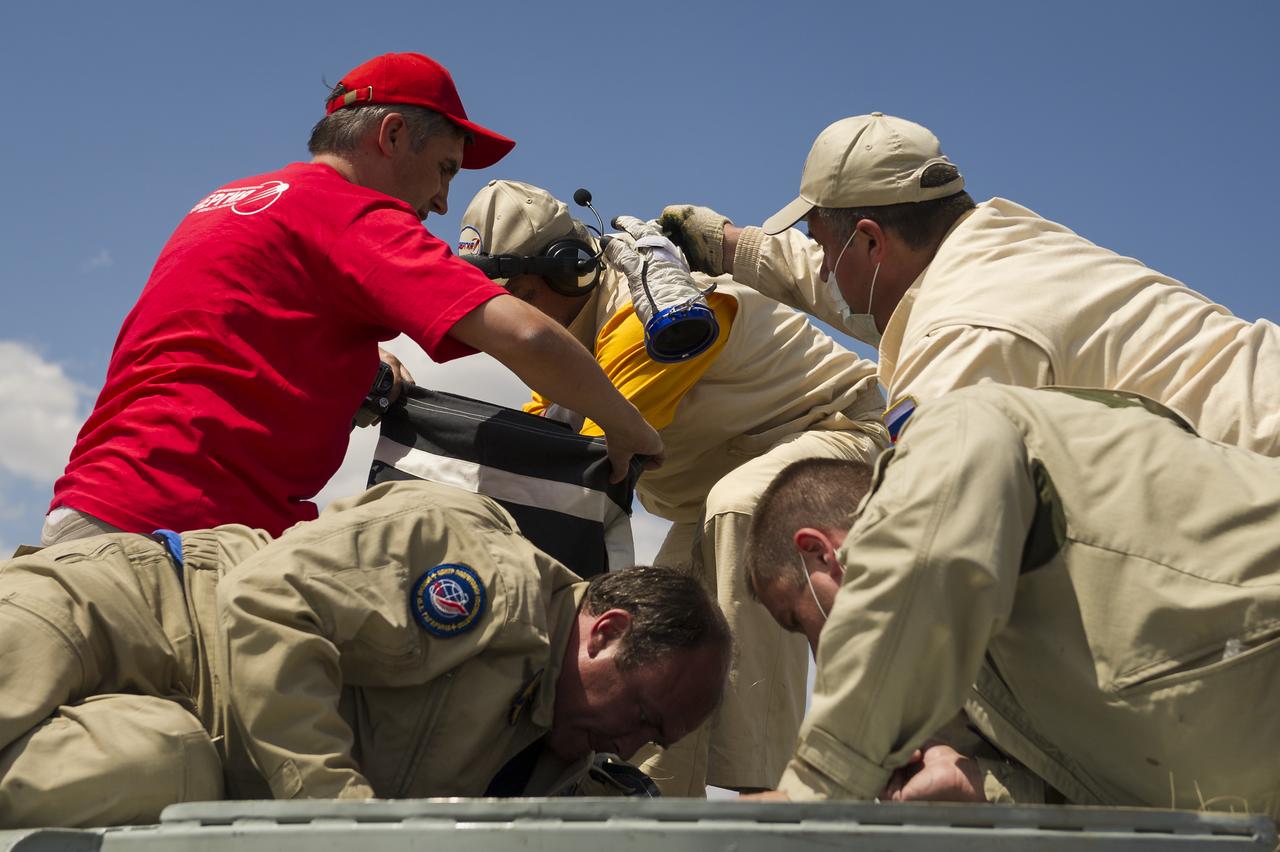
Russian support personnel are handed sokol suit gloves from the crew inside the Soyuz TMA-03M capsule after it landed with Expedition 31 Commander Oleg Kononenko of Russia and Flight Engineers Don Pettit of NASA and Andre Kuipers of the European Space Agency in a remote area near the town of Zhezkazgan, Kazakhstan, on Sunday, July 1, 2012. Pettit, Kononenko and Kuipers returned from more than six months onboard the International Space Station where they served as members of the Expedition 30 and 31 crews. Photo Credit: (NASA/Bill Ingalls)
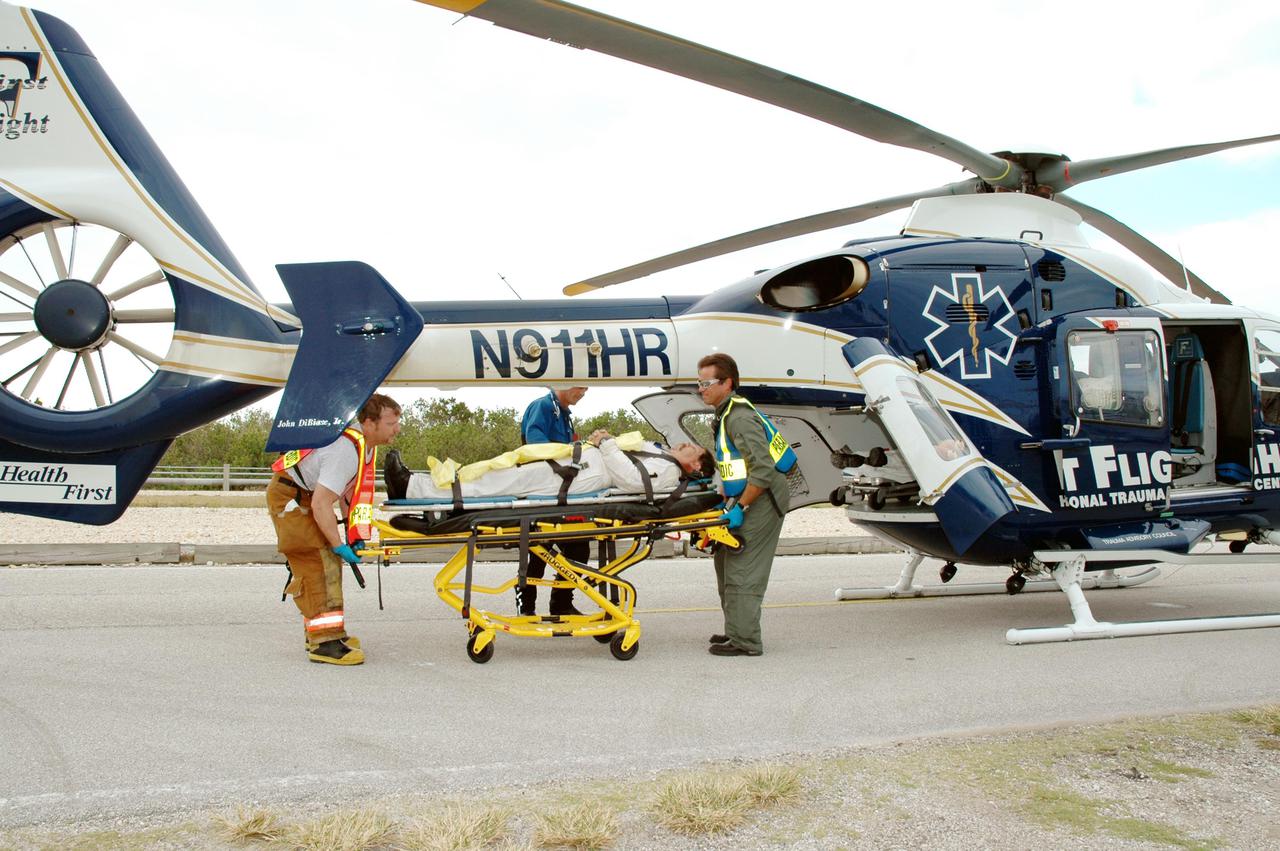
KENNEDY SPACE CENTER, FLA. - During a simulated launch countdown_emergency simulation on Launch Pad 39A, astronaut-suited workers are placed in a medical-rescue helicopter for transport to a hospital participating in the simulation. Pad team members took part in the four-hour exercise simulating normal launch countdown operations, with the added challenge of a fictitious event causing an evacuation of the vehicle and launch pad. The simulation tested the team’s rescue approaches on the Fixed Service Structure, slidewire basket evacuation, triage care and transportation of injured personnel to hospitals, as well as communications and coordination.
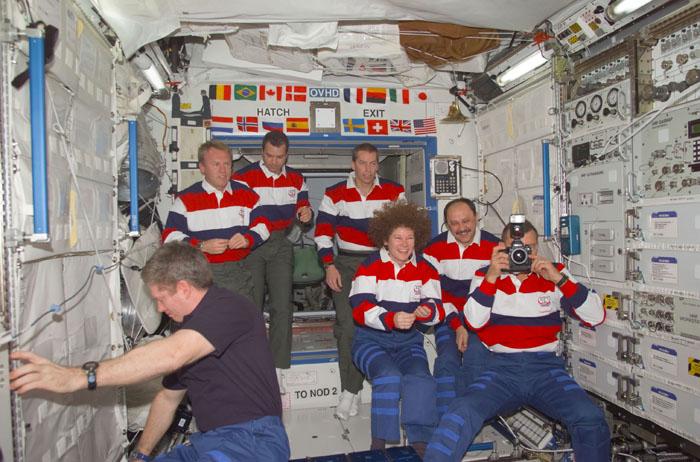
STS102-E-5227 (16 March 2001) --- Onboard the Destiny laboratory on the International Space Station (ISS), astronauts and cosmonauts convene in the midst of personnel changes on crew assignments. From the left are astronauts William M. (Bill) Shepherd, Andrew S.W. Thomas, Paul W. Richards, James D. Wetherbee and Susan J. Helms; along with cosmonaut Yury V. Usachev of Rosaviakosmos and astronaut James S. Voss. Though six here are wearing STS-102 attire, Helms, Voss and Usachev will be dressed in that of the Expedition Two crew shortly and Shepherd's suit will match those of the STS-102 crew members. The photo was taken with a digital still camera.
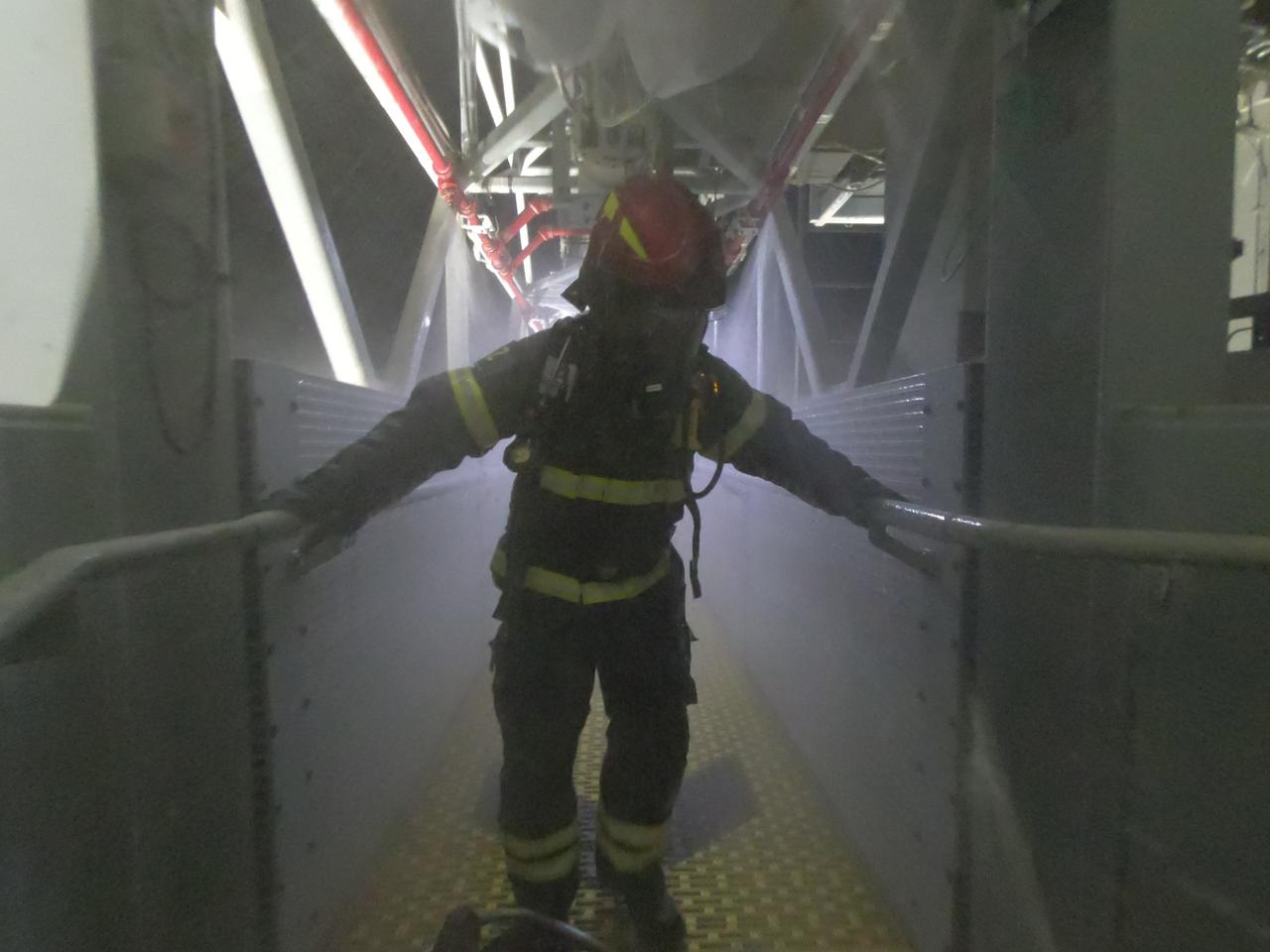
Teams at NASA’s Kennedy Space Center in Florida practice the Artemis mission emergency escape or egress procedures during a series of integrated system verification and validation tests at Launch Pad 39B on Tuesday, Aug. 13, 2024. Members of the closeout crew, pad rescue team, and the Exploration Ground Systems Program – who also suited up as astronauts – practiced the process of getting inside and out of the emergency egress baskets. While the crew and other personnel will ride the emergency egress baskets to the terminus area in a real emergency, no one rode the baskets for this test. Instead, teams tested the baskets during separate occasions by using water tanks filled to different levels to replicate simulate the weight of passengers.
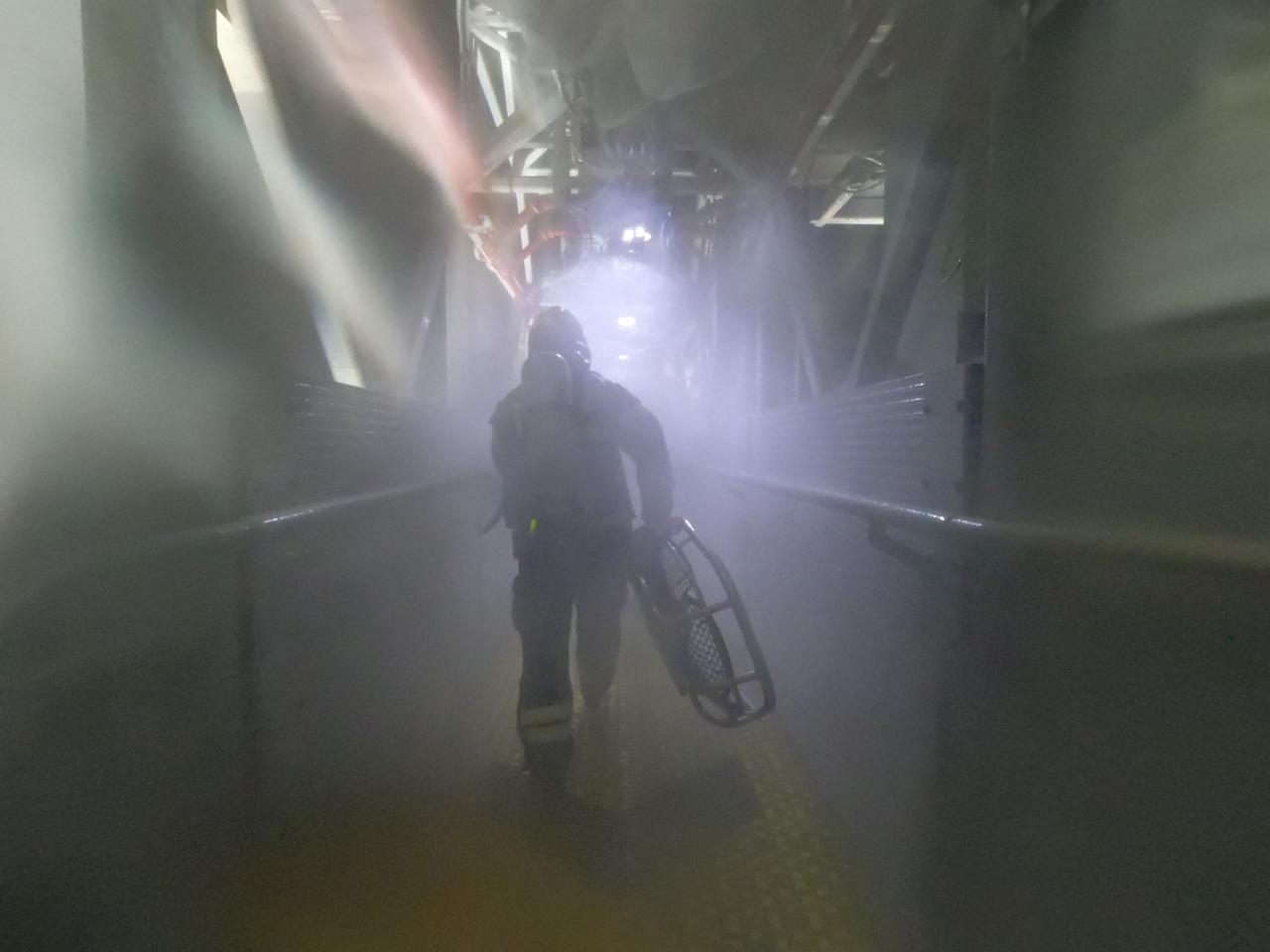
Teams at NASA’s Kennedy Space Center in Florida practice the Artemis mission emergency escape or egress procedures during a series of integrated system verification and validation tests at Launch Pad 39B on Tuesday, Aug. 13, 2024. Members of the closeout crew, pad rescue team, and the Exploration Ground Systems Program – who also suited up as astronauts – practiced the process of getting inside and out of the emergency egress baskets. While the crew and other personnel will ride the emergency egress baskets to the terminus area in a real emergency, no one rode the baskets for this test. Instead, teams tested the baskets during separate occasions by using water tanks filled to different levels to replicate simulate the weight of passengers.
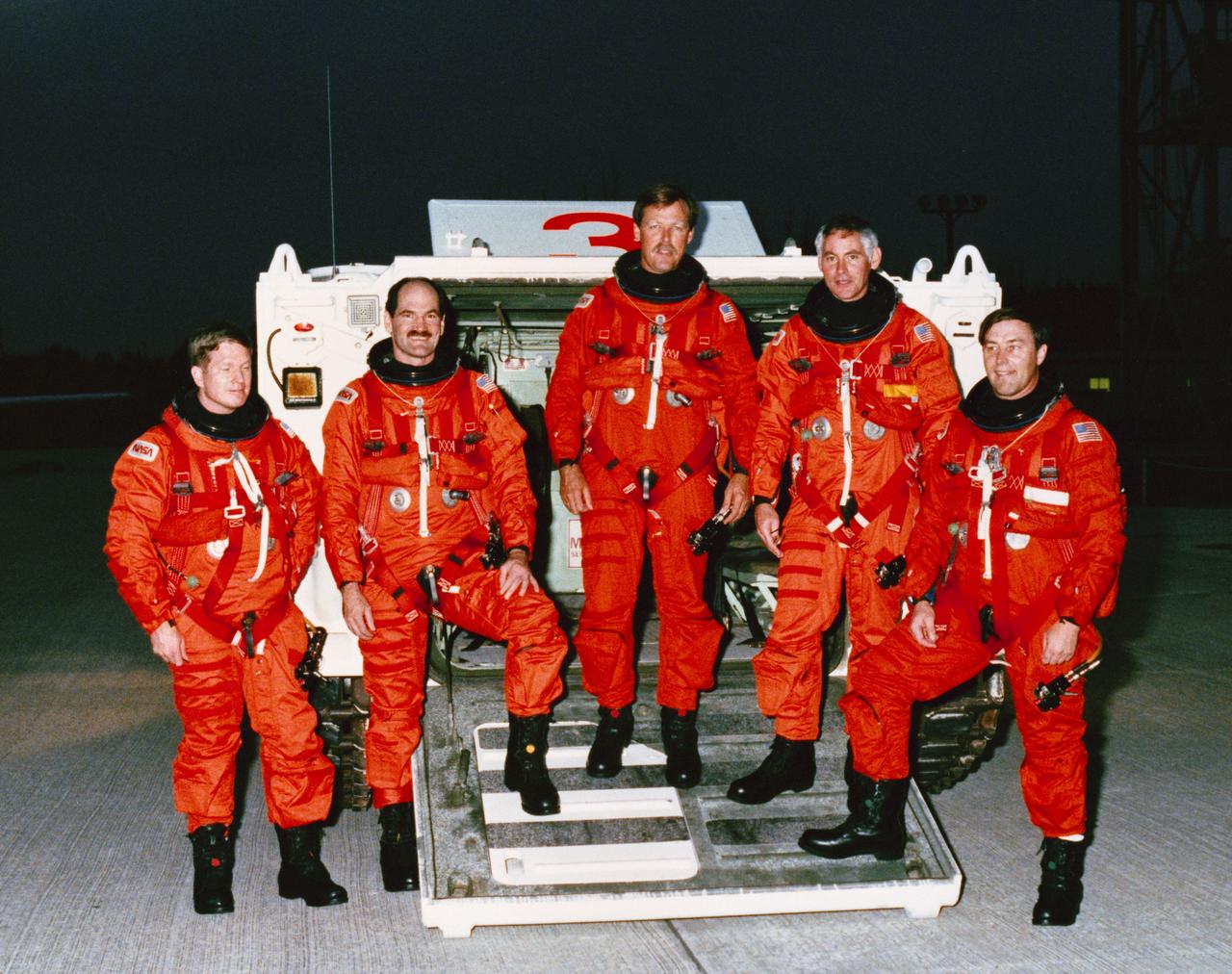
S88-53086 (17 Nov 1988) --- STS-27 Atlantis, Orbiter Vehicle (OV) 104, crewmembers participate in the terminal countdown demonstration test (TCDT) at the Kennedy Space Center (KSC). Standing in front of the M113 tracked rescue vehicle (armored personnel carrier (APC)) are left to right Mission Specialist (MS) William M. Shepherd, Pilot Guy S. Gardner, Commander Robert L. Gibson, MS Richard M. Mullane, and MS Jerry L. Ross. Crewmembers are wearing orange partial pressure or launch and entry suits (LES).
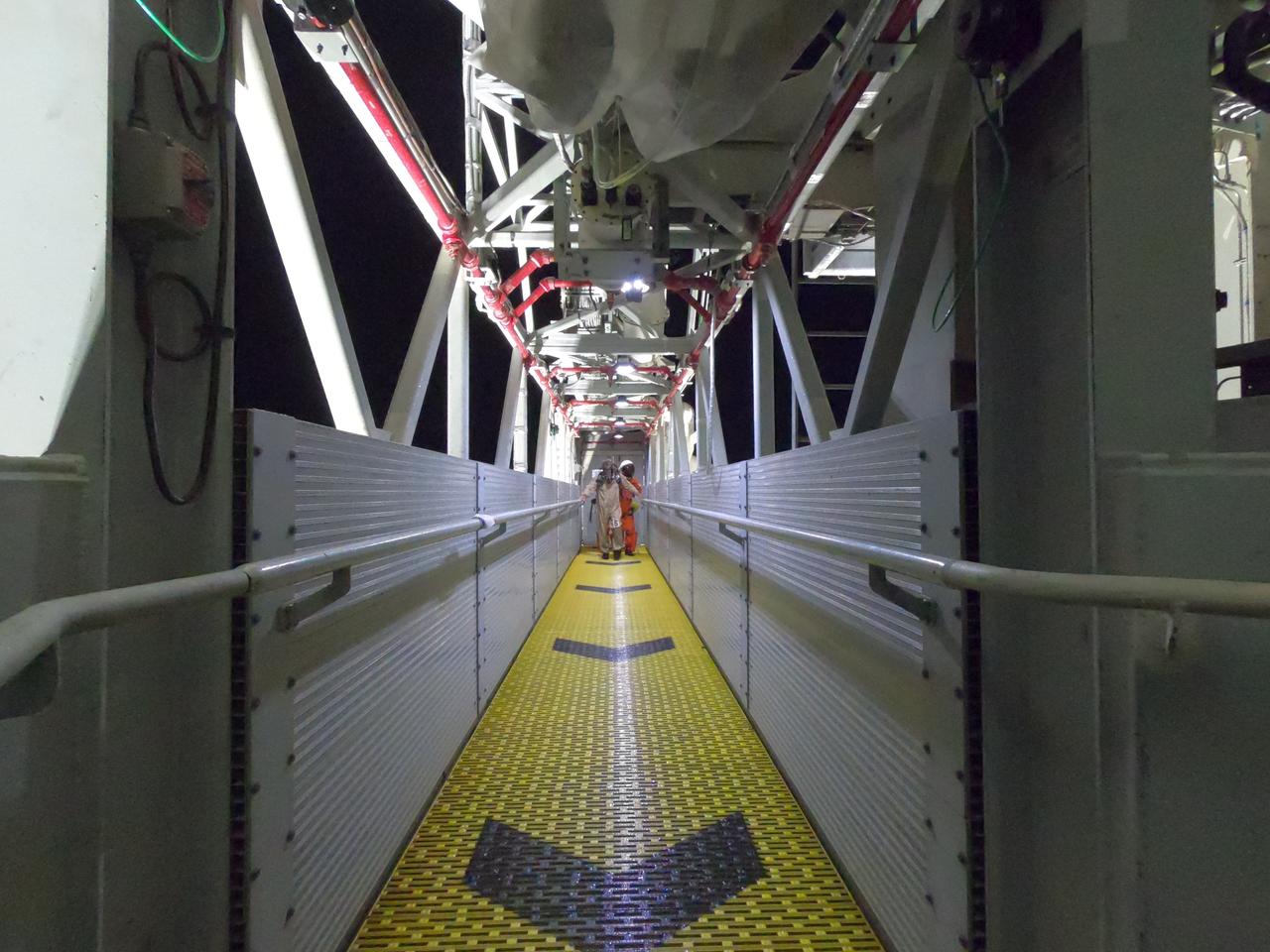
Teams at NASA’s Kennedy Space Center in Florida practice the Artemis mission emergency escape or egress procedures during a series of integrated system verification and validation tests at Launch Pad 39B on Tuesday, Aug. 13, 2024. Members of the closeout crew, pad rescue team, and the Exploration Ground Systems Program – who also suited up as astronauts – practiced the process of getting inside and out of the emergency egress baskets. While the crew and other personnel will ride the emergency egress baskets to the terminus area in a real emergency, no one rode the baskets for this test. Instead, teams tested the baskets during separate occasions by using water tanks filled to different levels to replicate simulate the weight of passengers.
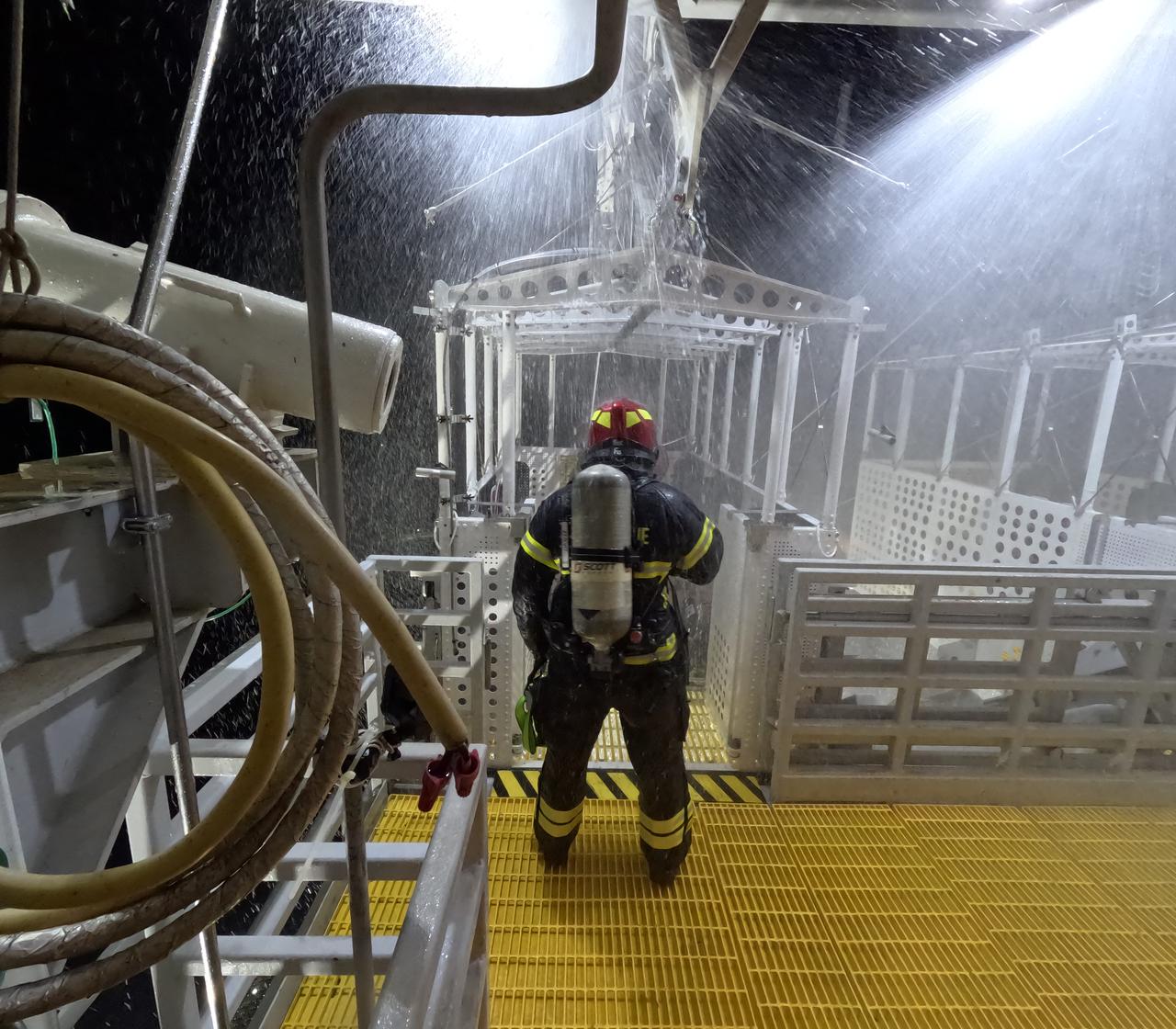
Teams at NASA’s Kennedy Space Center in Florida practice the Artemis mission emergency escape or egress procedures during a series of integrated system verification and validation tests at Launch Pad 39B on Tuesday, Aug. 13, 2024. Members of the closeout crew, pad rescue team, and the Exploration Ground Systems Program – who also suited up as astronauts – practiced the process of getting inside and out of the emergency egress baskets. While the crew and other personnel will ride the emergency egress baskets to the terminus area in a real emergency, no one rode the baskets for this test. Instead, teams tested the baskets during separate occasions by using water tanks filled to different levels to replicate simulate the weight of passengers.
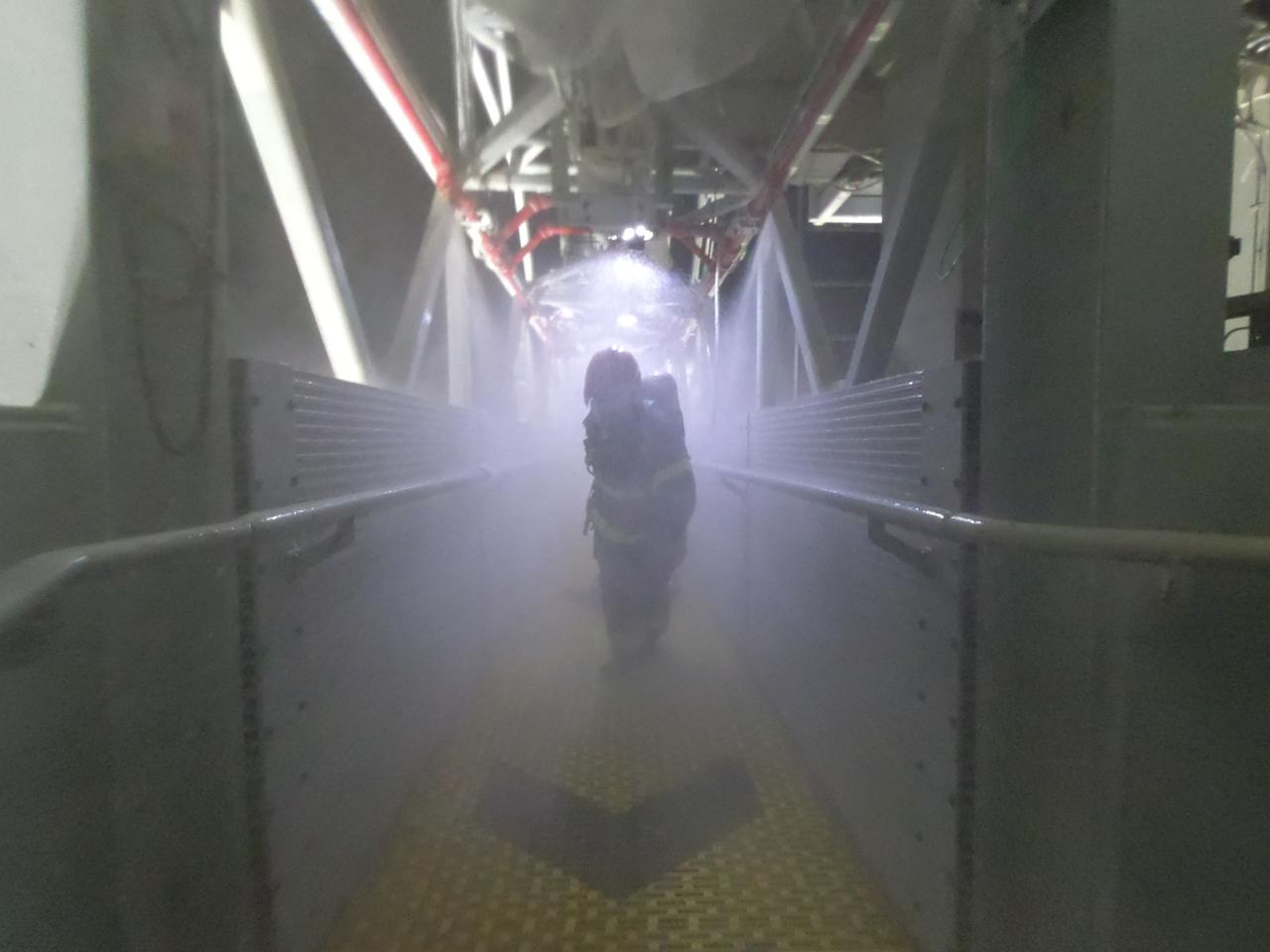
Teams at NASA’s Kennedy Space Center in Florida practice the Artemis mission emergency escape or egress procedures during a series of integrated system verification and validation tests at Launch Pad 39B on Tuesday, Aug. 13, 2024. Members of the closeout crew, pad rescue team, and the Exploration Ground Systems Program – who also suited up as astronauts – practiced the process of getting inside and out of the emergency egress baskets. While the crew and other personnel will ride the emergency egress baskets to the terminus area in a real emergency, no one rode the baskets for this test. Instead, teams tested the baskets during separate occasions by using water tanks filled to different levels to replicate simulate the weight of passengers.
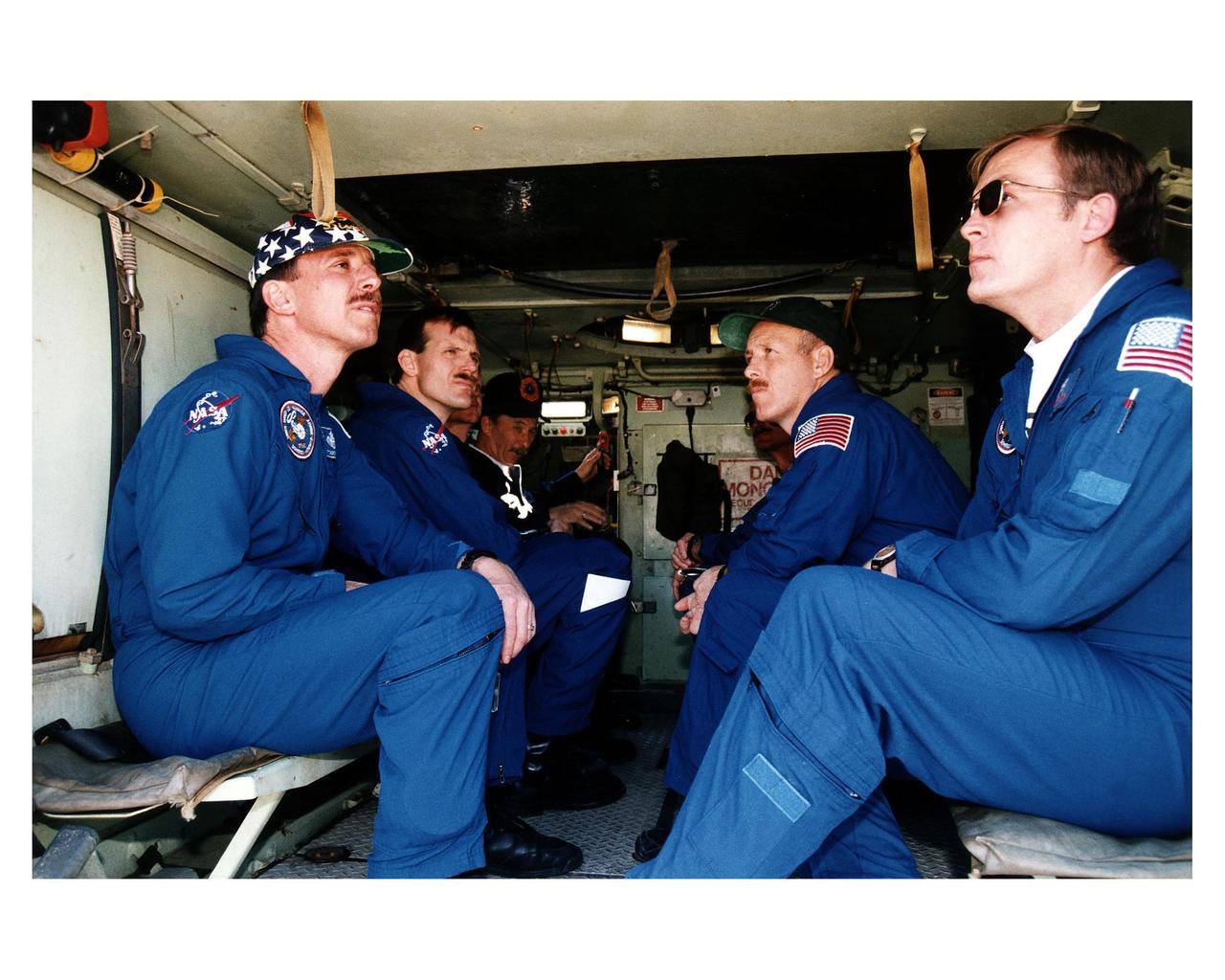
STS-82 crew members ride in and learn how to operate an M-113 armored personnel carrier during Terminal Countdown Demonstration Test (TCDT) activities prior to launch. The four crew members dressed in their blue flight suits and visible here are, from left, Pilot Scott J. "Doc" Horowitz, Mission Specialist Joseph R. "Joe" Tanner, Mission Commander Kenneth D. Bowersox and Payload Commander Mark C. Lee. George Hoggard, a training officer with KSC Fire Services, is visible in the background at left. The 10-day STS-82 flight, which will be the second Hubble Space Telescope servicing mission, is targeted for a Feb. 11 liftoff
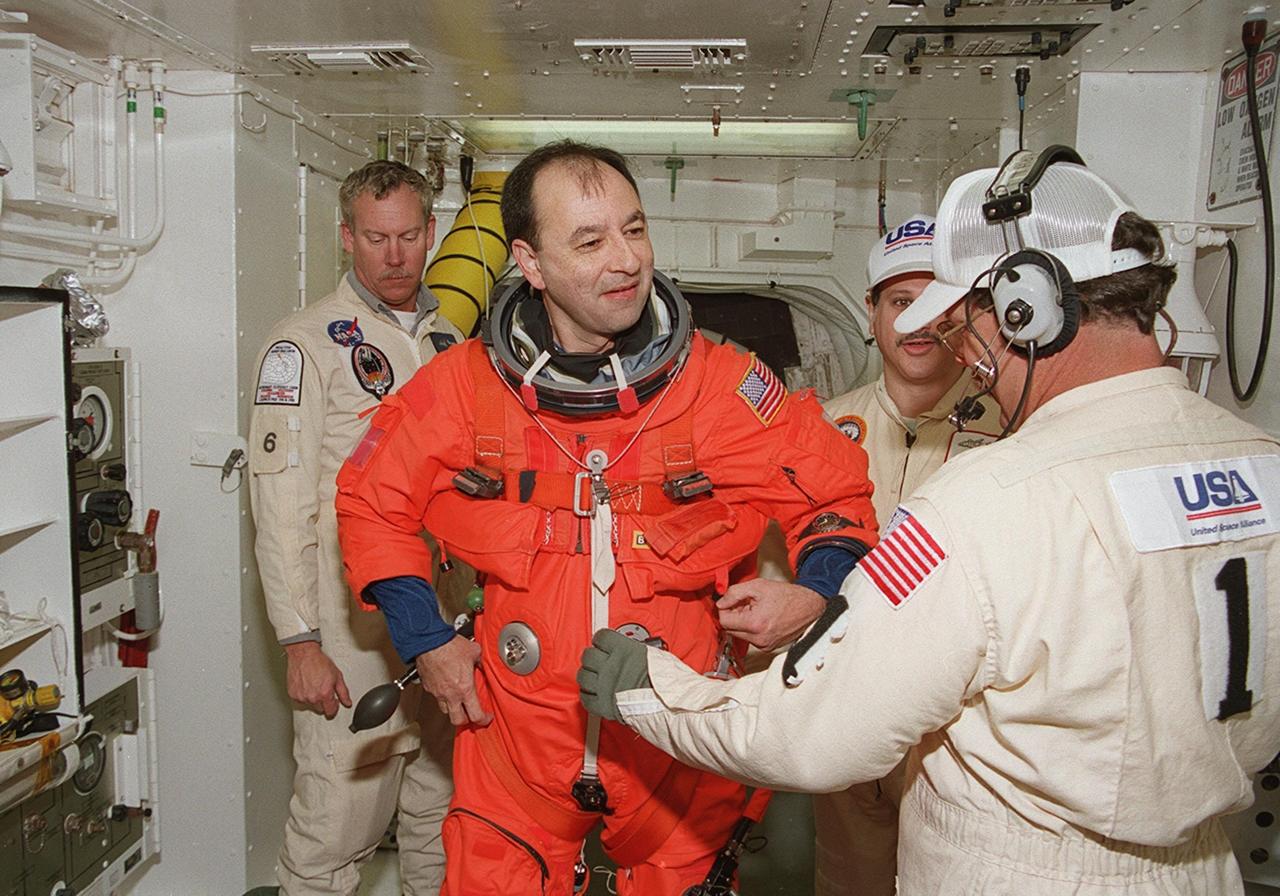
In the White Room, STS-98 Pilot Mark Polansky gets help with his launch and entry suit before entering Atlantis for a simulated launch countdown. The White Room is an environmental chamber at the end of the orbiter access arm that mates with the orbiter to allow personnel to enter the orbiter’s crew compartment. The STS-98 crew is taking part in Terminal Countdown Demonstration Test activities, which also include emergency egress training at the pad. STS-98 is the seventh construction flight to the International Space Station, carrying as payload the U.S. Lab Destiny, a key element in the construction of the ISS. Launch of STS-98 is scheduled for Jan. 19 at 2:11 a.m. EST
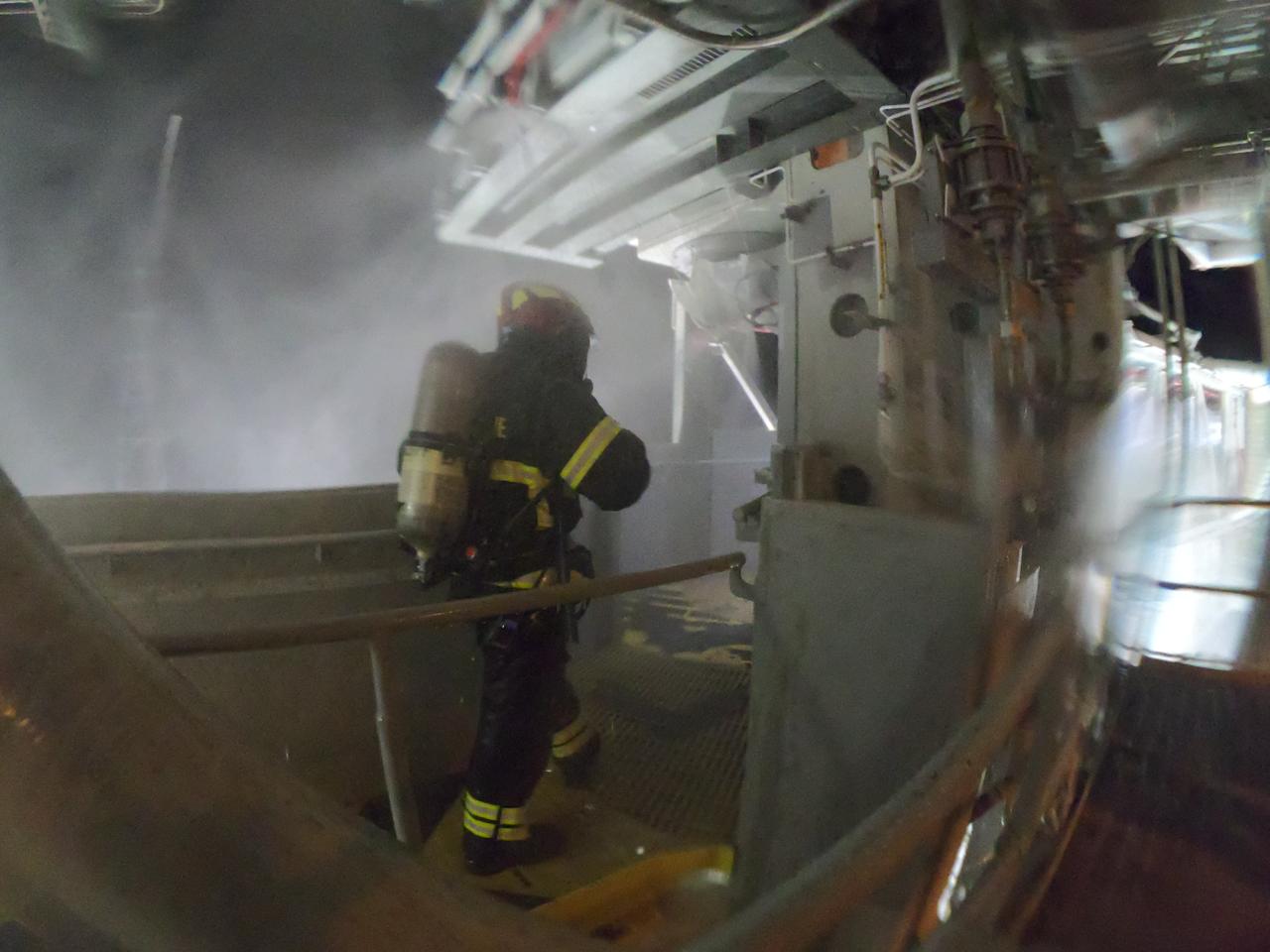
Teams at NASA’s Kennedy Space Center in Florida practice the Artemis mission emergency escape or egress procedures during a series of integrated system verification and validation tests at Launch Pad 39B on Tuesday, Aug. 13, 2024. Members of the closeout crew, pad rescue team, and the Exploration Ground Systems Program – who also suited up as astronauts – practiced the process of getting inside and out of the emergency egress baskets. While the crew and other personnel will ride the emergency egress baskets to the terminus area in a real emergency, no one rode the baskets for this test. Instead, teams tested the baskets during separate occasions by using water tanks filled to different levels to replicate simulate the weight of passengers.
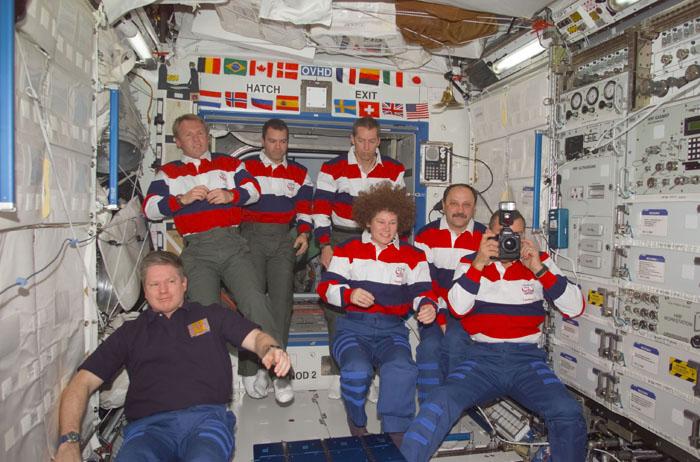
STS102-E-5228 (16 March 2001) --- Onboard the Destiny laboratory for the International Space Station (ISS), astronauts and cosmonauts convene in the midst of personnel changes on crew assignments. From the left are astronauts William M. (Bill) Shepherd, Andrew S.W. Thomas, Paul W. Richards, James D. Wetherbee and Susan J. Helms; along with cosmonaut Yury V. Usachev of Rosaviakosmos and astronaut James S. Voss. Though six here are wearing STS-102 attire, Helms, Voss and Usachev will be dressed in that of the Expedition Two crew shortly and Shepherd's suit will match those of the STS-102 crew members. The photo was taken with a digital still camera.
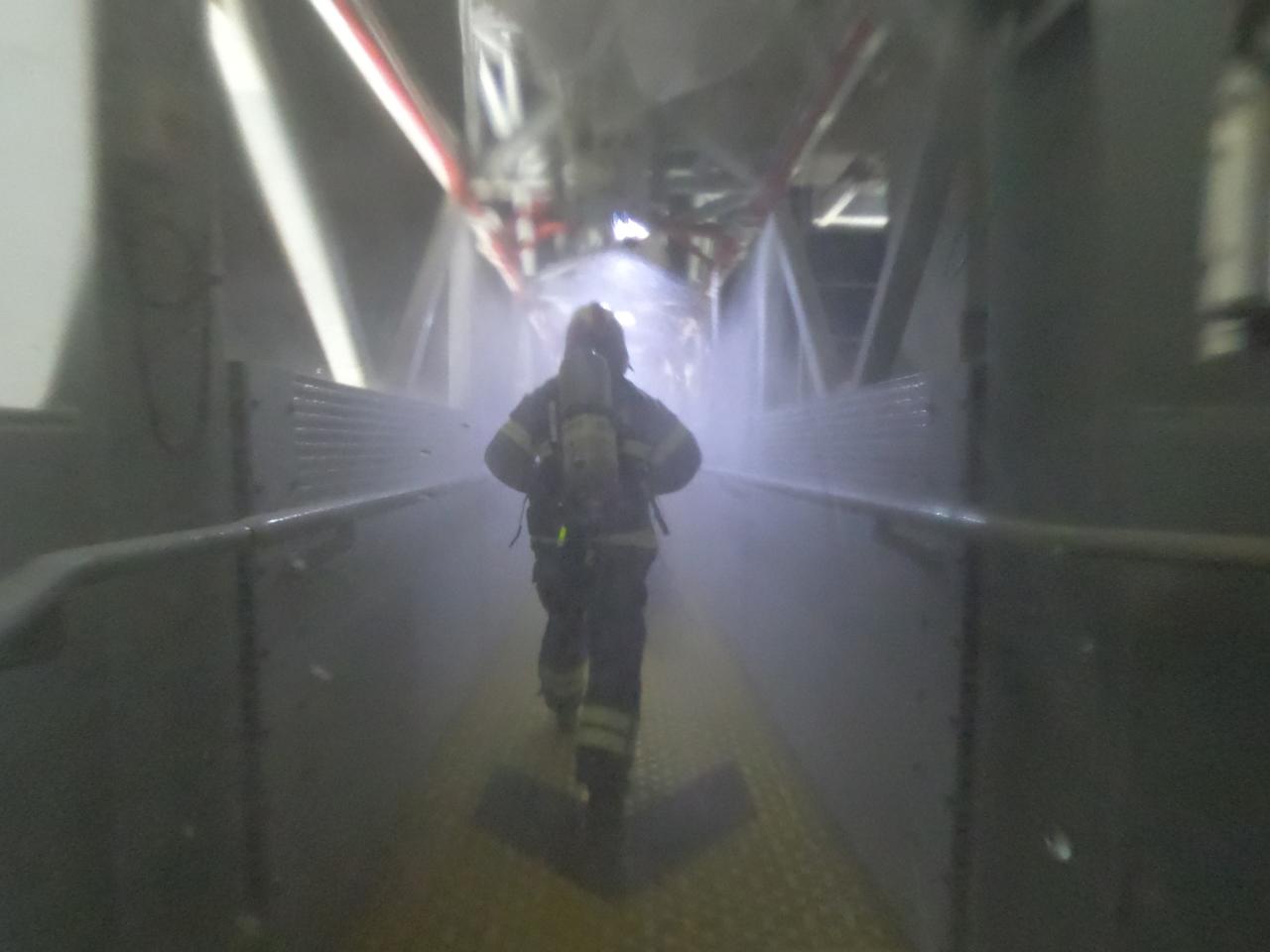
Teams at NASA’s Kennedy Space Center in Florida practice the Artemis mission emergency escape or egress procedures during a series of integrated system verification and validation tests at Launch Pad 39B on Tuesday, Aug. 13, 2024. Members of the closeout crew, pad rescue team, and the Exploration Ground Systems Program – who also suited up as astronauts – practiced the process of getting inside and out of the emergency egress baskets. While the crew and other personnel will ride the emergency egress baskets to the terminus area in a real emergency, no one rode the baskets for this test. Instead, teams tested the baskets during separate occasions by using water tanks filled to different levels to replicate simulate the weight of passengers.

Teams at NASA’s Kennedy Space Center in Florida practice the Artemis mission emergency escape or egress procedures during a series of integrated system verification and validation tests at Launch Pad 39B on Tuesday, Aug. 13, 2024. Members of the closeout crew, pad rescue team, and the Exploration Ground Systems Program – who also suited up as astronauts – practiced the process of getting inside and out of the emergency egress baskets. While the crew and other personnel will ride the emergency egress baskets to the terminus area in a real emergency, no one rode the baskets for this test. Instead, teams tested the baskets during separate occasions by using water tanks filled to different levels to replicate simulate the weight of passengers.

In the White Room, STS-98 Mission Specialist Thomas Jones gets help with his launch and entry suit before entering Atlantis for a simulated launch countdown. The White Room is an environmental chamber at the end of the orbiter access arm that mates with the orbiter to allow personnel to enter the orbiter’s crew compartment. The STS-98 crew is taking part in Terminal Countdown Demonstration Test activities, which also include emergency egress training at the pad. STS-98 is the seventh construction flight to the International Space Station, carrying as payload the U.S. Lab Destiny, a key element in the construction of the ISS. Launch of STS-98 is scheduled for Jan. 19 at 2:11 a.m. EST
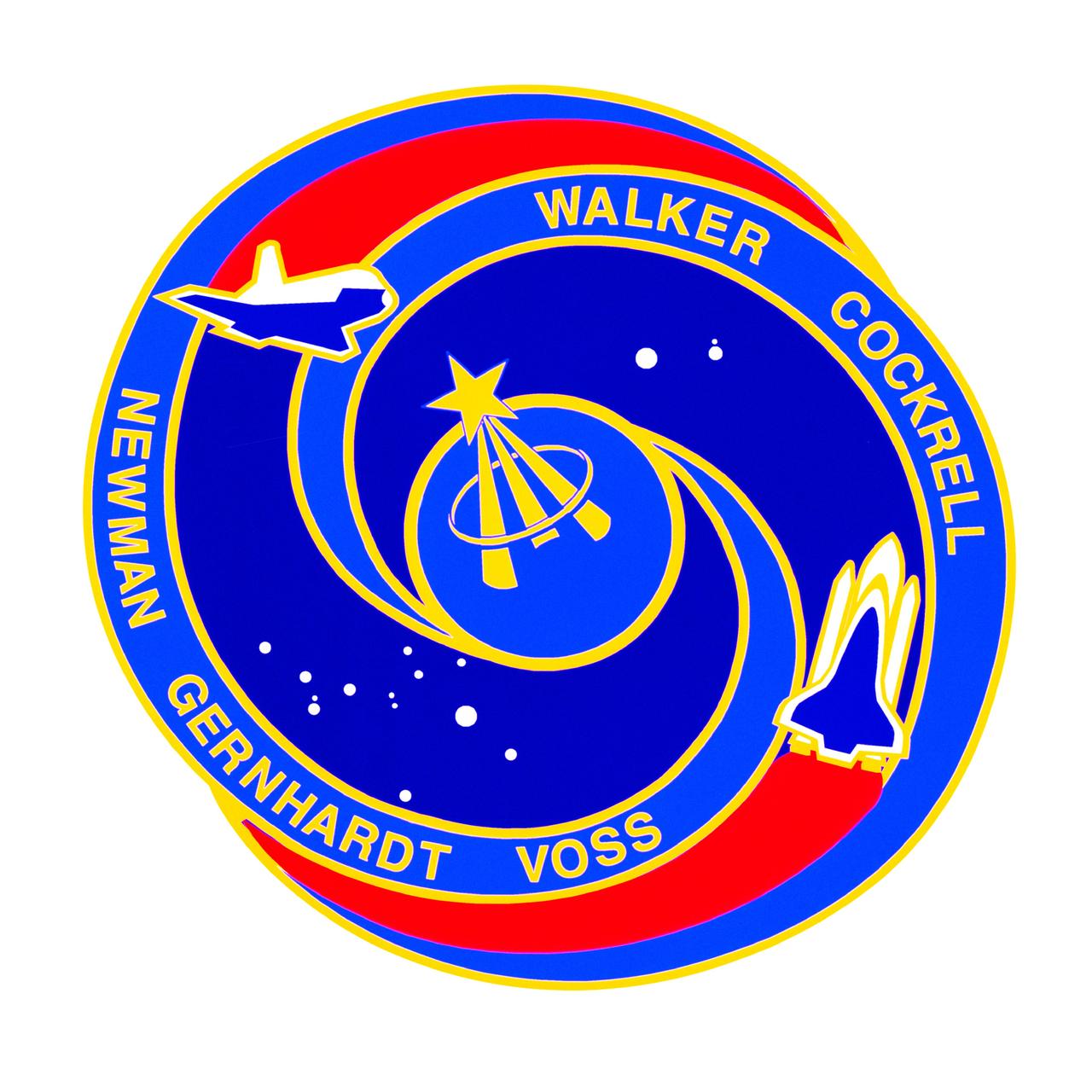
Designed by the mission crew members, the patch for STS-69 symbolizes the multifaceted nature of the flight's mission. The primary payload, the Wake Shield Facility (WSF), is represented in the center by the astronaut emblem against a flat disk. The astronaut emblem also signifies the importance of human beings in space exploration, reflected by the planned space walk to practice for International Space Station (ISS) activities and to evaluate space suit design modifications. The two stylized Space Shuttles highlight the ascent and entry phases of the mission. Along with the two spiral plumes, the stylized Space Shuttles symbolize a NASA first, the deployment and recovery on the same mission of two spacecraft (both the Wake Shield Facility and the Spartan). The constellations Canis Major and Canis Minor represent the astronomy objectives of the Spartan and International Extreme Ultraviolet Hitchhiker (IEH) payload. The two constellations also symbolize the talents and dedication of the support personnel who make Space Shuttle missions possible.
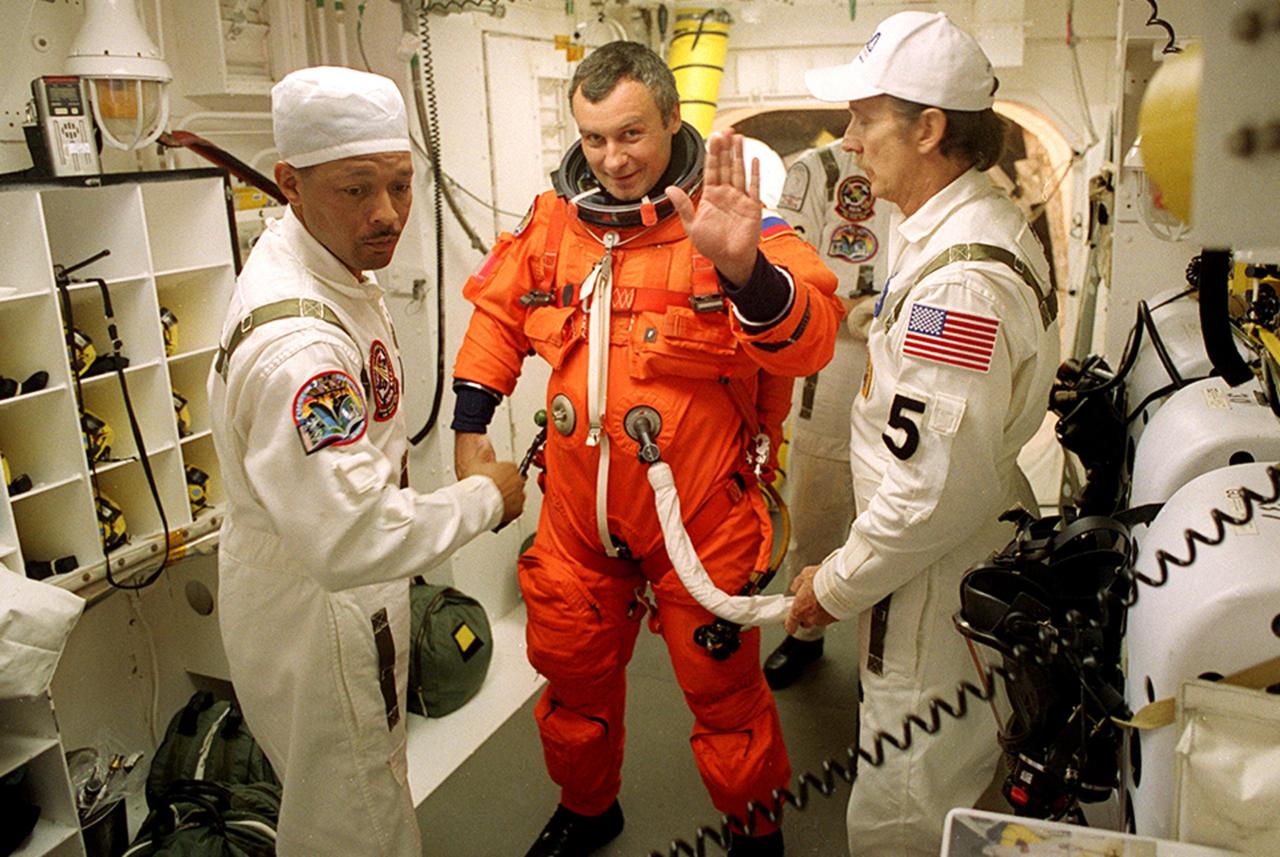
KENNEDY SPACE CENTER, Fla. - Expedition Three crew member Vladimir Dezhurov waves as he is helped with his launch and entry suit before he enters Space Shuttle Discovery for launch. Helping him are (left) NASA Astronaut Support Personnel John Herrington and (right) USA Mechanical Technician Al Schmidt. The payload on the STS-105 mission to the International Space Station includes the third flight of the Italian-built Multi-Purpose Logistics Module Leonardo, delivering additional scientific racks, equipment and supplies for the Space Station, and the Early Ammonia Servicer (EAS) tank. The EAS, which will be attached to the Station during two spacewalks, contains spare ammonia for the Station’s cooling system. Also, the Expedition Three crew is aboard to replace the Expedition Two crew on the International Space Station, who will be returning to Earth aboard Discovery after a five-month stay on the Station
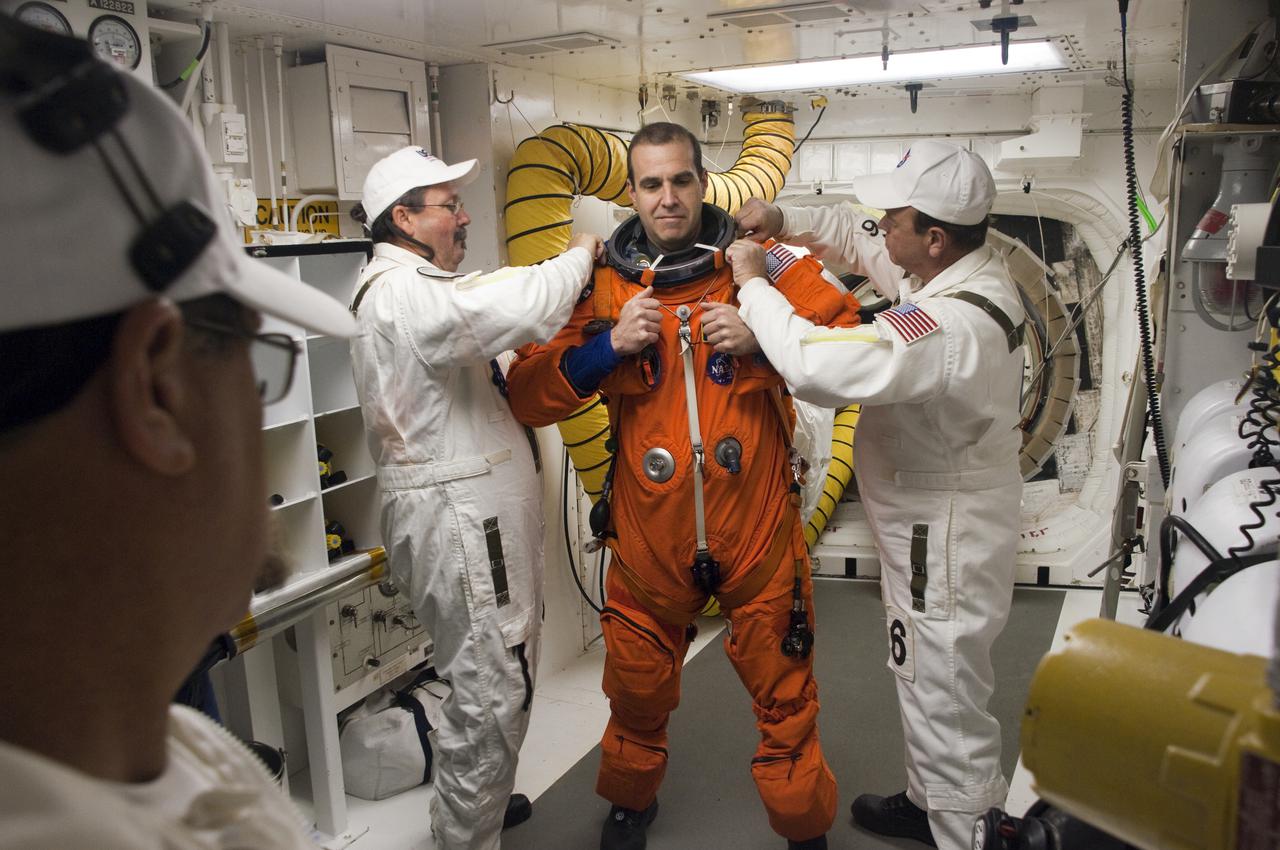
CAPE CANAVERAL, Fla. - At Launch Pad 39A at NASA's Kennedy Space Center in Florida, STS-131 Mission Specialist Rick Mastracchio prepares to enter space shuttle Discovery from the pad's White Room. The members of space shuttle Discovery's STS-131 crew, dressed in their launch-and-entry suits, are participating in the Terminal Countdown Demonstration Test, or TCDT, a dress rehearsal for launch. TCDT includes training on the emergency exit systems at the launch pad, driving practice of the M-113 armored personnel carrier and a simulated launch countdown. The crew will deliver the multi-purpose logistics module Leonard, filled with resupply stowage platforms and science racks, to the International Space Station. STS-131, targeted for launch on April 5, will be the 33rd shuttle mission to the station and the 131st shuttle mission overall. For information on the STS-131 mission and crew, visit http:__www.nasa.gov_mission_pages_shuttle_shuttlemissions_sts131_index.htm. Photo credit: NASA_Regina Mitchell-Ryall
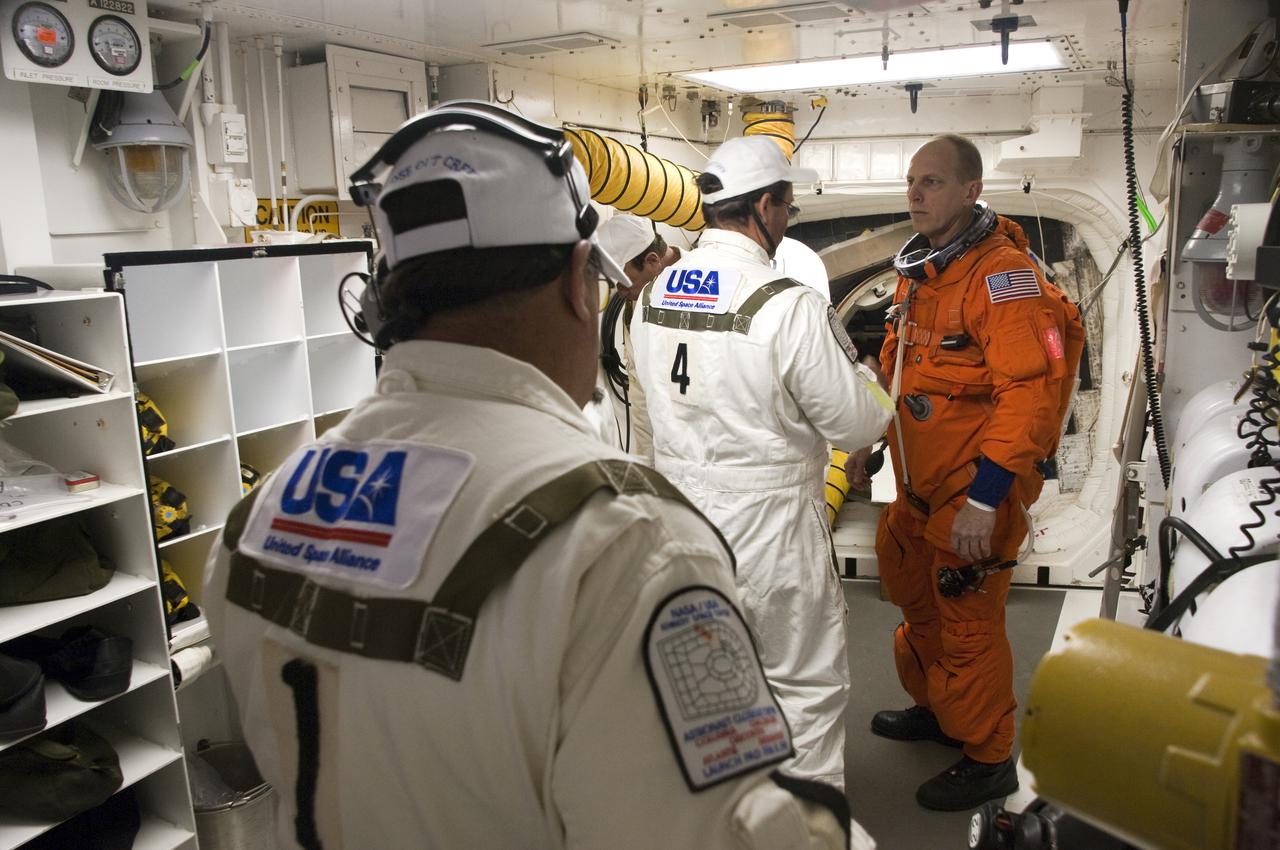
CAPE CANAVERAL, Fla. - At Launch Pad 39A at NASA's Kennedy Space Center in Florida, STS-131 Mission Specialist Clayton Anderson, at right, prepares to enter space shuttle Discovery from the pad's White Room. The members of space shuttle Discovery's STS-131 crew, dressed in their launch-and-entry suits, are participating in the Terminal Countdown Demonstration Test, or TCDT, a dress rehearsal for launch. TCDT includes training on the emergency exit systems at the launch pad, driving practice of the M-113 armored personnel carrier and a simulated launch countdown. The crew will deliver the multi-purpose logistics module Leonard, filled with resupply stowage platforms and science racks, to the International Space Station. STS-131, targeted for launch on April 5, will be the 33rd shuttle mission to the station and the 131st shuttle mission overall. For information on the STS-131 mission and crew, visit http:__www.nasa.gov_mission_pages_shuttle_shuttlemissions_sts131_index.htm. Photo credit: NASA_Regina Mitchell-Ryall
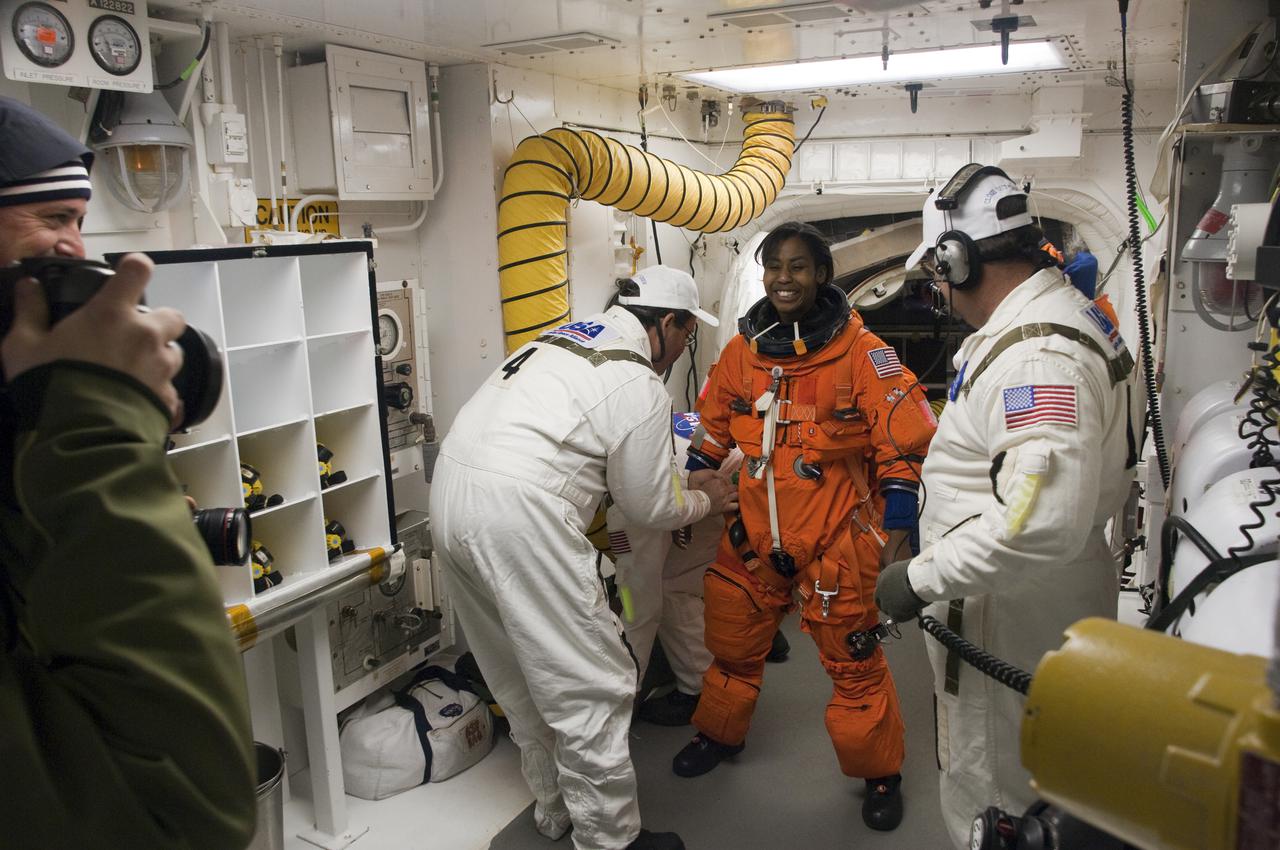
CAPE CANAVERAL, Fla. - At Launch Pad 39A at NASA's Kennedy Space Center in Florida, STS-131 Mission Specialist Stephanie Wilson prepares to enter space shuttle Discovery from the pad's White Room. The members of space shuttle Discovery's STS-131 crew, dressed in their launch-and-entry suits, are participating in the Terminal Countdown Demonstration Test, or TCDT, a dress rehearsal for launch. TCDT includes training on the emergency exit systems at the launch pad, driving practice of the M-113 armored personnel carrier and a simulated launch countdown. The crew will deliver the multi-purpose logistics module Leonard, filled with resupply stowage platforms and science racks, to the International Space Station. STS-131, targeted for launch on April 5, will be the 33rd shuttle mission to the station and the 131st shuttle mission overall. For information on the STS-131 mission and crew, visit http:__www.nasa.gov_mission_pages_shuttle_shuttlemissions_sts131_index.htm. Photo credit: NASA_Regina Mitchell-Ryall
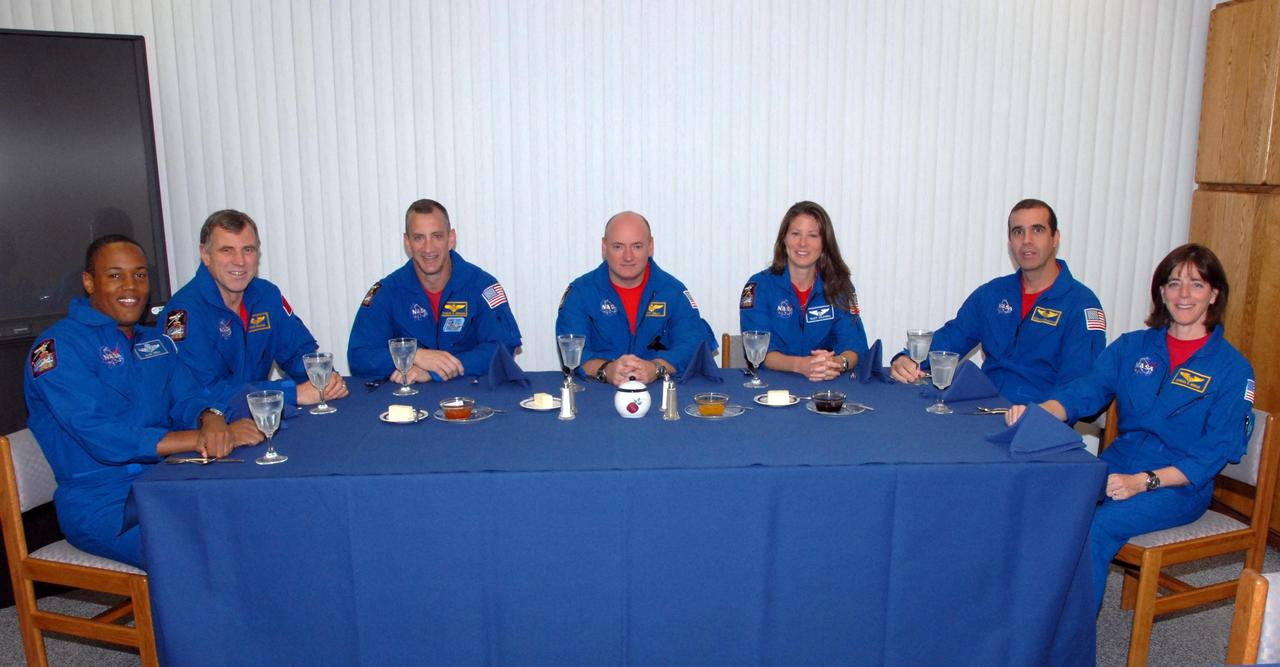
KENNEDY SPACE CENTER, Fla. -- Members of the STS-118 crew enjoy breakfast together before the next event in their Terminal Countdown Demonstration Test (TCDT), a dress rehearsal for launch. Following the meal, the crew will don their flight suits and board Space Shuttle Endeavour for a simulated countdown. From left are Mission Specialists Alvin Drew and the Canadian Space Agency's Dave Williams, Pilot Charlie Hobaugh, Commander Scott Kelly, and Mission Specialists Tracy Caldwell, Rick Mastracchio and teacher-turned-astronaut Barbara R. Morgan. TCDT activities also include M-113 armored personnel carrier training, payload familiarization, and emergency egress training at the pad. The STS-118 payload includes the S5 truss, a SPACEHAB module and external stowage platform 3. The mission is the 22nd flight to the International Space Station and is targeted for launch on Aug.7. Photo credit: NASA/George Shelton
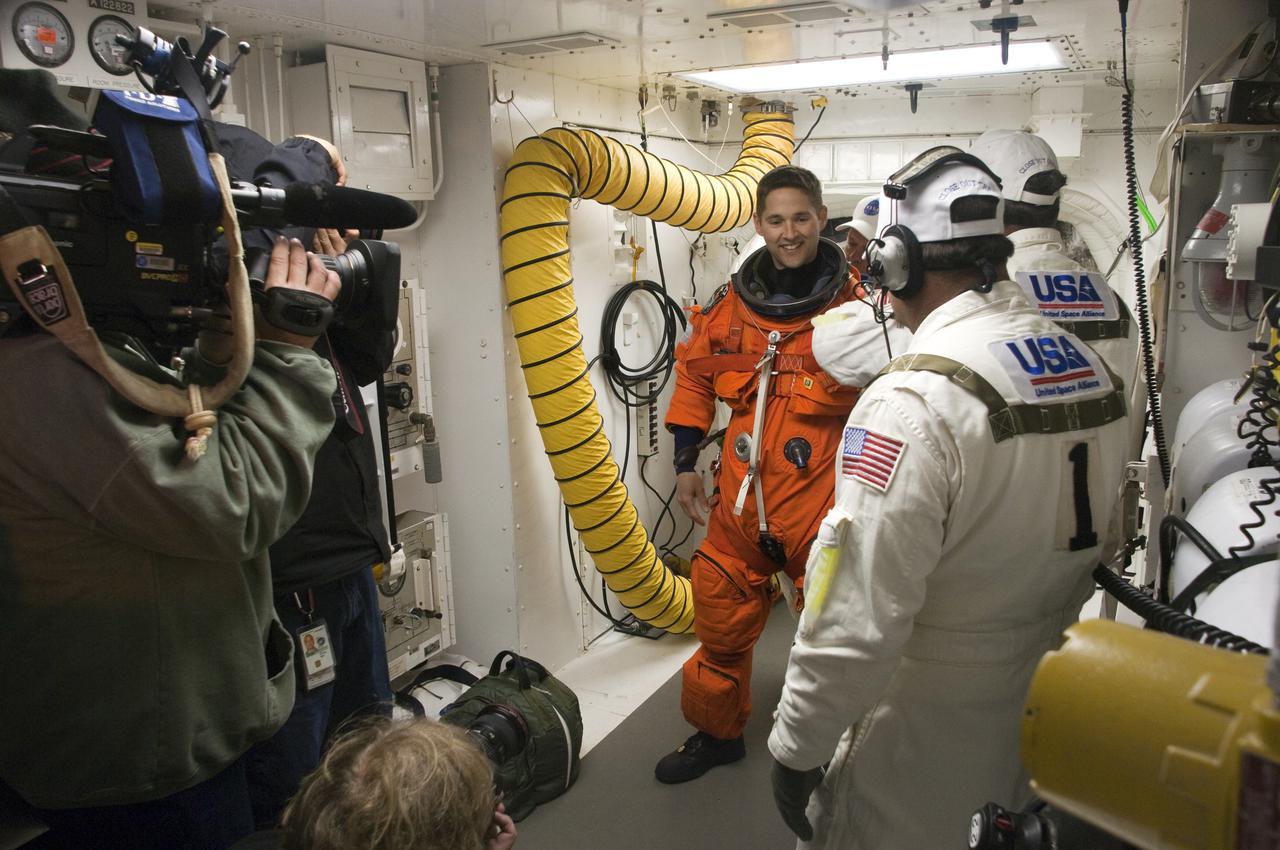
CAPE CANAVERAL, Fla. - At Launch Pad 39A at NASA's Kennedy Space Center in Florida, STS-131 Pilot James P. Dutton Jr., at left, prepares to enter space shuttle Discovery from the pad's White Room. The members of space shuttle Discovery's STS-131 crew, dressed in their launch-and-entry suits, are participating in the Terminal Countdown Demonstration Test, or TCDT, a dress rehearsal for launch. TCDT includes training on the emergency exit systems at the launch pad, driving practice of the M-113 armored personnel carrier and a simulated launch countdown. The crew will deliver the multi-purpose logistics module Leonard, filled with resupply stowage platforms and science racks, to the International Space Station. STS-131, targeted for launch on April 5, will be the 33rd shuttle mission to the station and the 131st shuttle mission overall. For information on the STS-131 mission and crew, visit http:__www.nasa.gov_mission_pages_shuttle_shuttlemissions_sts131_index.htm. Photo credit: NASA_Regina Mitchell-Ryall
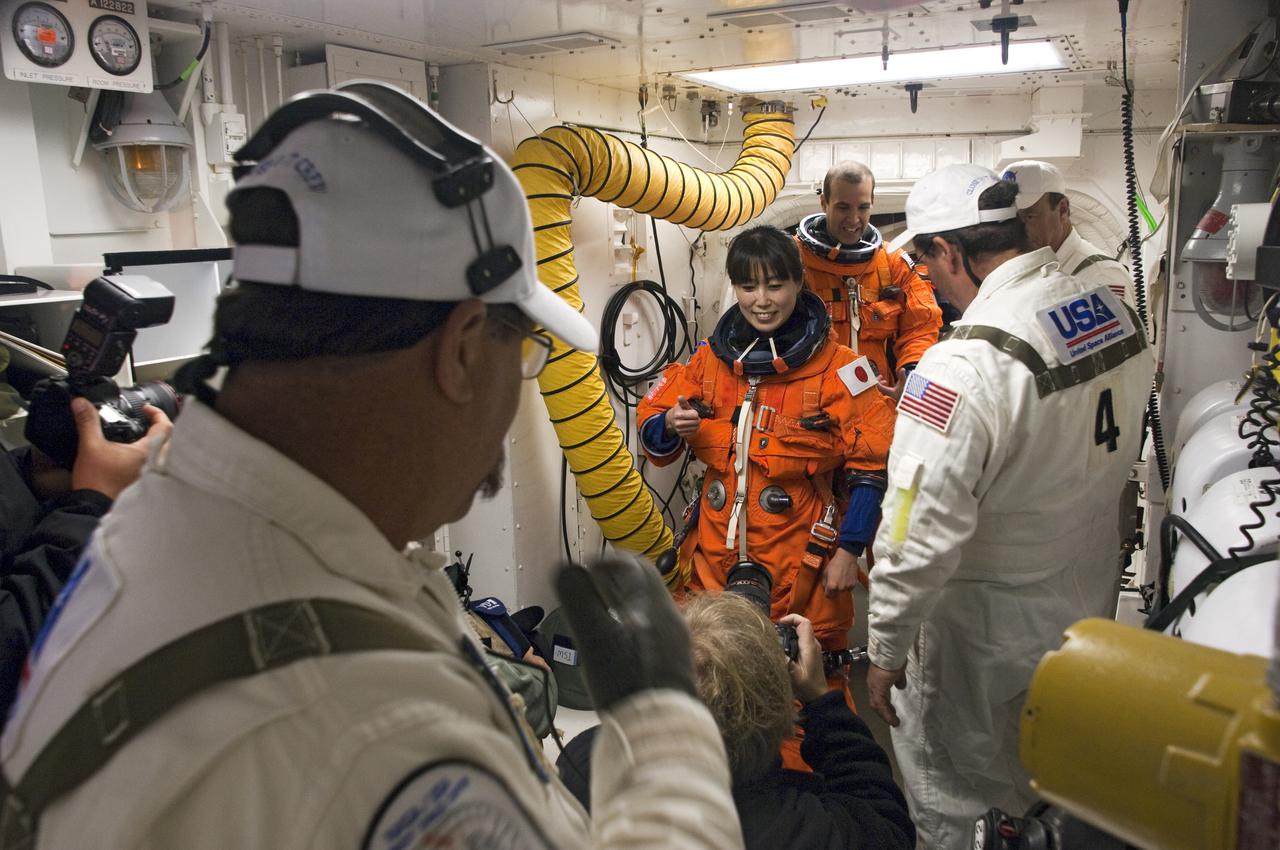
CAPE CANAVERAL, Fla. - At Launch Pad 39A at NASA's Kennedy Space Center in Florida, STS-131 Mission Specialists Naoko Yamazaki of the Japan Aerospace Exploration Agency and Rick Mastracchio, in the orange suits, prepare to enter space shuttle Discovery from the pad's White Room. The members of space shuttle Discovery's STS-131 crew, dressed in their launch-and-entry suits, are participating in the Terminal Countdown Demonstration Test, or TCDT, a dress rehearsal for launch. TCDT includes training on the emergency exit systems at the launch pad, driving practice of the M-113 armored personnel carrier and a simulated launch countdown. The crew will deliver the multi-purpose logistics module Leonard, filled with resupply stowage platforms and science racks, to the International Space Station. STS-131, targeted for launch on April 5, will be the 33rd shuttle mission to the station and the 131st shuttle mission overall. For information on the STS-131 mission and crew, visit http:__www.nasa.gov_mission_pages_shuttle_shuttlemissions_sts131_index.htm. Photo credit: NASA_Regina Mitchell-Ryall
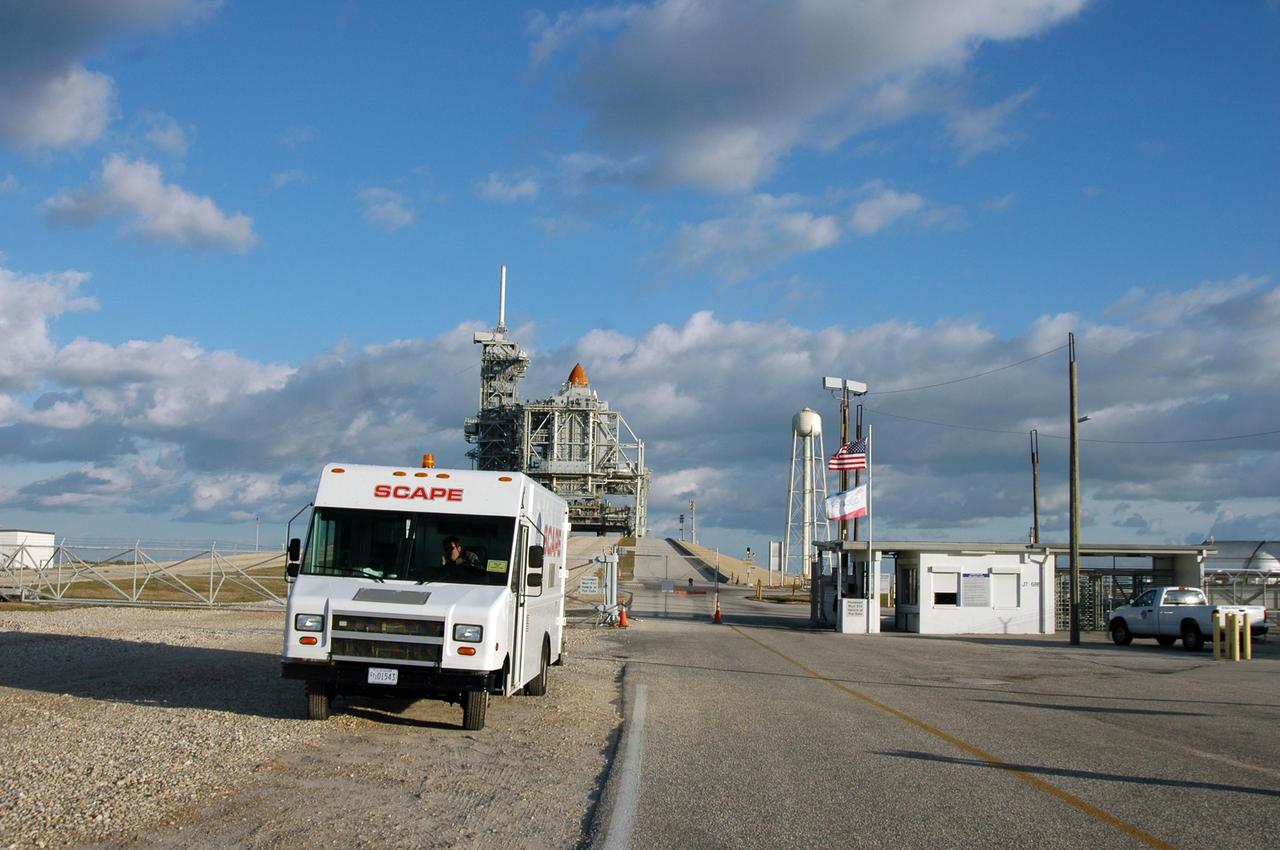
KENNEDY SPACE CENTER, FLA. -- On the morning of the second launch attempt, Space Shuttle Discovery is ready on Launch Pad 39B. The SCAPE vehicle (Self-Contained Atmospheric Protection Ensemble) at left contains the equipment necessary to support recovery, if necessary, including recovery crew SCAPE suits, liquid air packs, and a crew who assist recovery personnel in suiting-up in protective clothing. It is present before every launch and at every landing. The first launch attempt of STS-116 Dec. 7 was postponed due a low cloud ceiling over Kennedy Space Center. The next launch attempt was scheduled for Saturday, Dec. 9, at 8:47 p.m. This will be Discovery's 33rd mission and the first night launch since 2002. The 20th shuttle mission to the International Space Station, STS-116 carries another truss segment, P5. It will serve as a spacer, mated to the P4 truss that was attached in September. After installing the P5, the crew will reconfigure and redistribute the power generated by two pairs of U.S. solar arrays. Landing is expected Dec. 19 at KSC. Photo credit: NASA/Ken Thornsley
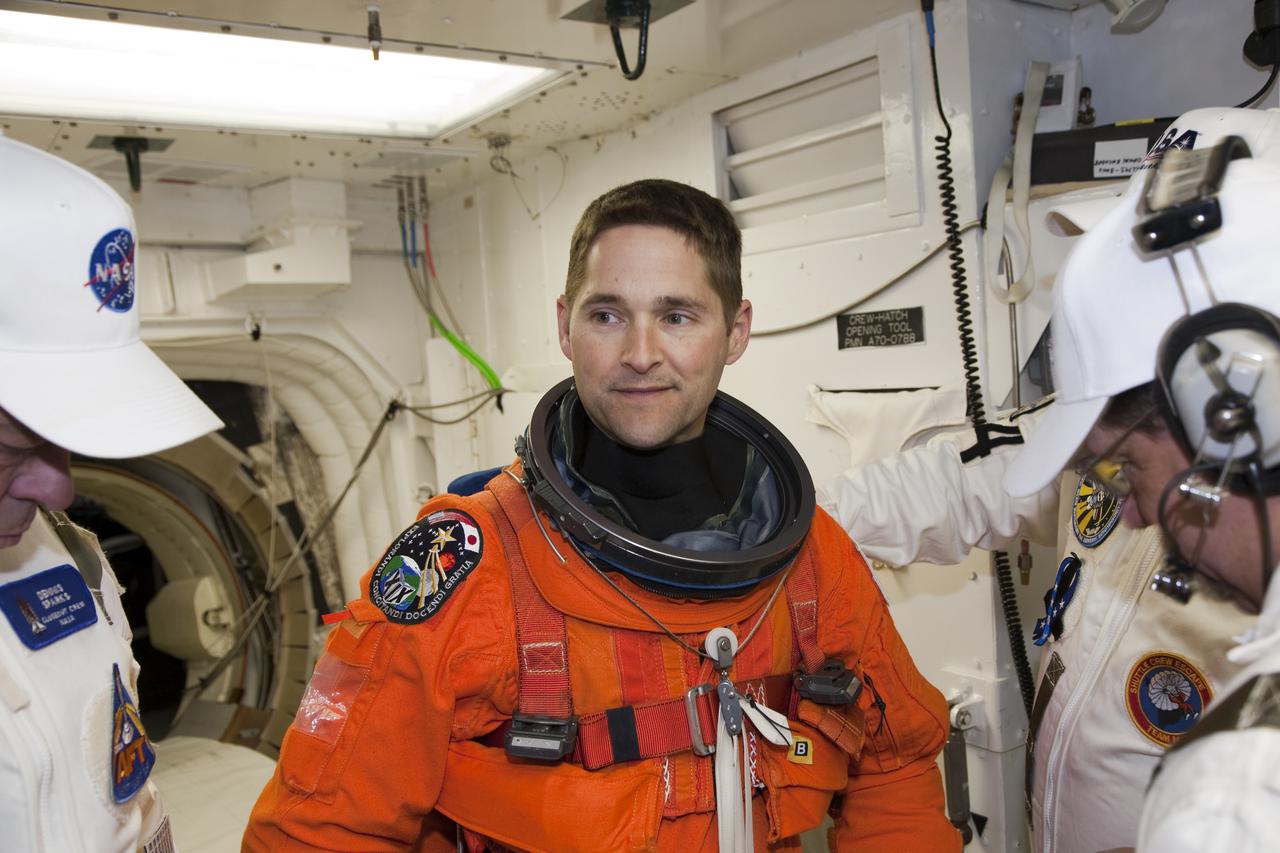
CAPE CANAVERAL, Fla. - At Launch Pad 39A at NASA's Kennedy Space Center in Florida, STS-131 Pilot James P. Dutton Jr. prepares to enter space shuttle Discovery from the pad's White Room. The crew members of Discovery's STS-131 mission, dressed in their launch-and-entry suits, are participating in the Terminal Countdown Demonstration Test, or TCDT, a dress rehearsal for launch. TCDT includes training on the emergency exit systems at the launch pad, driving practice of the M-113 armored personnel carrier and a simulated launch countdown. The crew will deliver the multi-purpose logistics module Leonard, filled with resupply stowage platforms and science racks, to the International Space Station. STS-131, targeted for launch on April 5, will be the 33rd shuttle mission to the station and the 131st shuttle mission overall. For information on the STS-131 mission and crew, visit http:__www.nasa.gov_mission_pages_shuttle_shuttlemissions_sts131_index.htm. Photo credit: NASA_Dimitri Gerondidakis
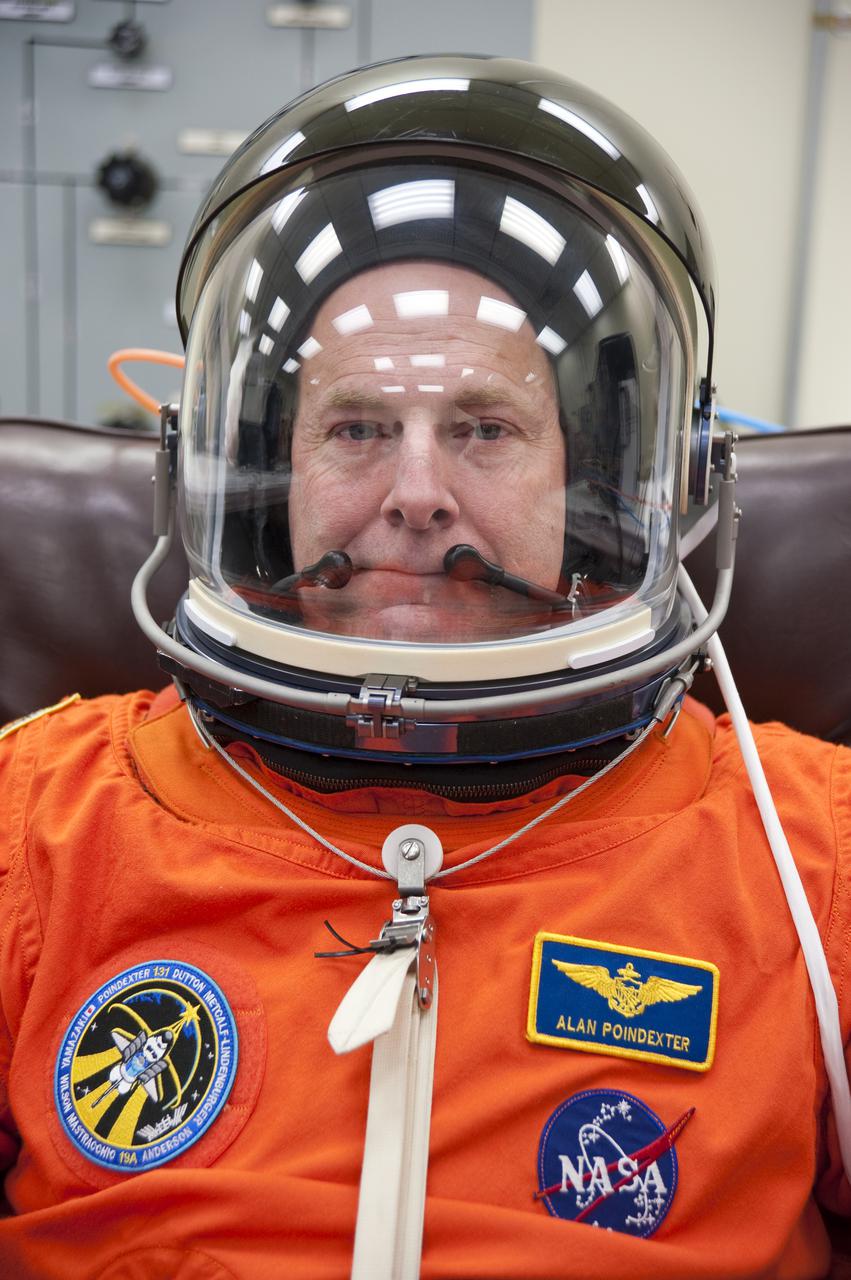
CAPE CANAVERAL, Fla. - In the Operations and Checkout Building at NASA's Kennedy Space Center in Florida, STS-131 Commander Alan Poindexter verifies that his helmet is functioning properly. The members of space shuttle Discovery's STS-131 crew put on their launch-and-entry suits before heading to the Astrovan for the ride to Launch Pad 39A. The crew is participating in the Terminal Countdown Demonstration Test, or TCDT, a dress rehearsal for launch. TCDT includes training on the emergency egress systems at the launch pad, driving practice of the M-113 armored personnel carrier and a simulated launch countdown. The crew will deliver the multi-purpose logistics module Leonard, filled with resupply stowage platforms and science racks, to the International Space Station. STS-131, targeted for launch on April 5, will be the 33rd shuttle mission to the station and the 131st shuttle mission overall. For information on the STS-131 mission and crew, visit http:__www.nasa.gov_mission_pages_shuttle_shuttlemissions_sts131_index.htm. Photo credit: NASA_Kim Shiflett
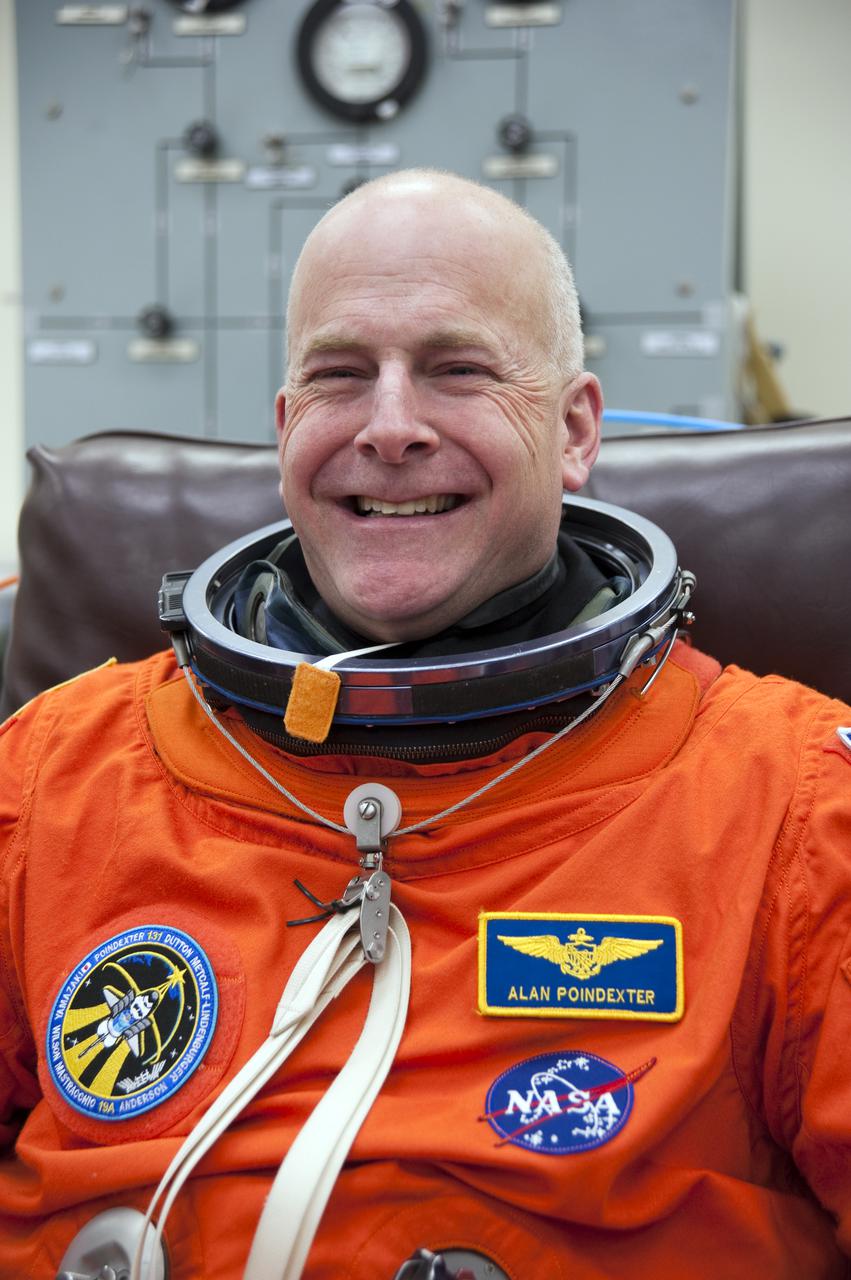
CAPE CANAVERAL, Fla. - In the Operations and Checkout Building at NASA's Kennedy Space Center in Florida, STS-131 Commander Alan Poindexter appears enthusiastic about the opportunity to board Discovery. The members of space shuttle Discovery's STS-131 crew put on their launch-and-entry suits before heading to the Astrovan for the ride to Launch Pad 39A. The crew is participating in the Terminal Countdown Demonstration Test, or TCDT, a dress rehearsal for launch. TCDT includes training on the emergency egress systems at the launch pad, driving practice of the M-113 armored personnel carrier and a simulated launch countdown. The crew will deliver the multi-purpose logistics module Leonard, filled with resupply stowage platforms and science racks, to the International Space Station. STS-131, targeted for launch on April 5, will be the 33rd shuttle mission to the station and the 131st shuttle mission overall. For information on the STS-131 mission and crew, visit http:__www.nasa.gov_mission_pages_shuttle_shuttlemissions_sts131_index.htm. Photo credit: NASA_Kim Shiflett
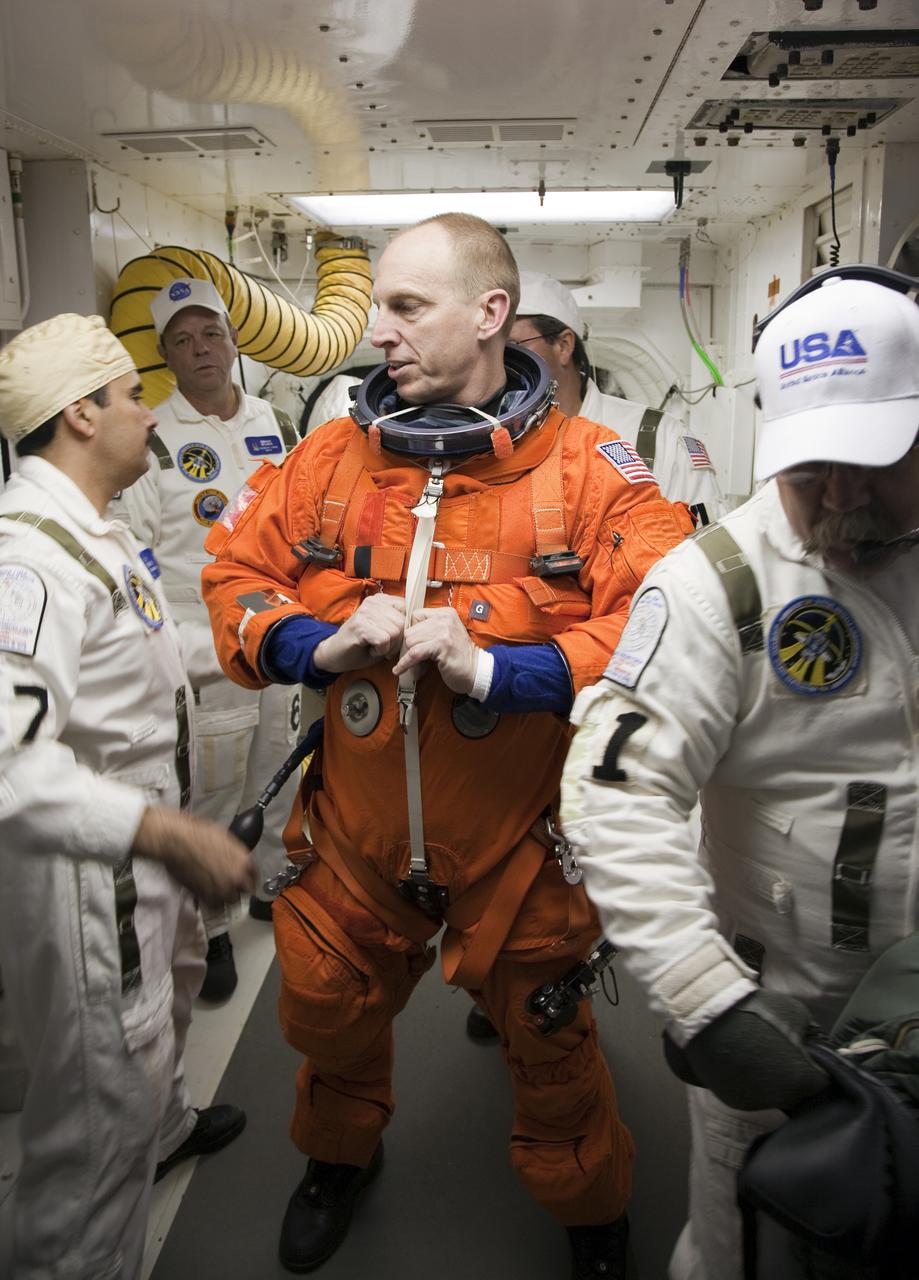
CAPE CANAVERAL, Fla. - At Launch Pad 39A at NASA's Kennedy Space Center in Florida, STS-131 Mission Specialist Clayton Anderson prepares to enter space shuttle Discovery from the pad's White Room. The crew members of Discovery's STS-131 mission, dressed in their launch-and-entry suits, are participating in the Terminal Countdown Demonstration Test, or TCDT, a dress rehearsal for launch. TCDT includes training on the emergency exit systems at the launch pad, driving practice of the M-113 armored personnel carrier and a simulated launch countdown. The crew will deliver the multi-purpose logistics module Leonard, filled with resupply stowage platforms and science racks, to the International Space Station. STS-131, targeted for launch on April 5, will be the 33rd shuttle mission to the station and the 131st shuttle mission overall. For information on the STS-131 mission and crew, visit http:__www.nasa.gov_mission_pages_shuttle_shuttlemissions_sts131_index.htm. Photo credit: NASA_Dimitri Gerondidakis
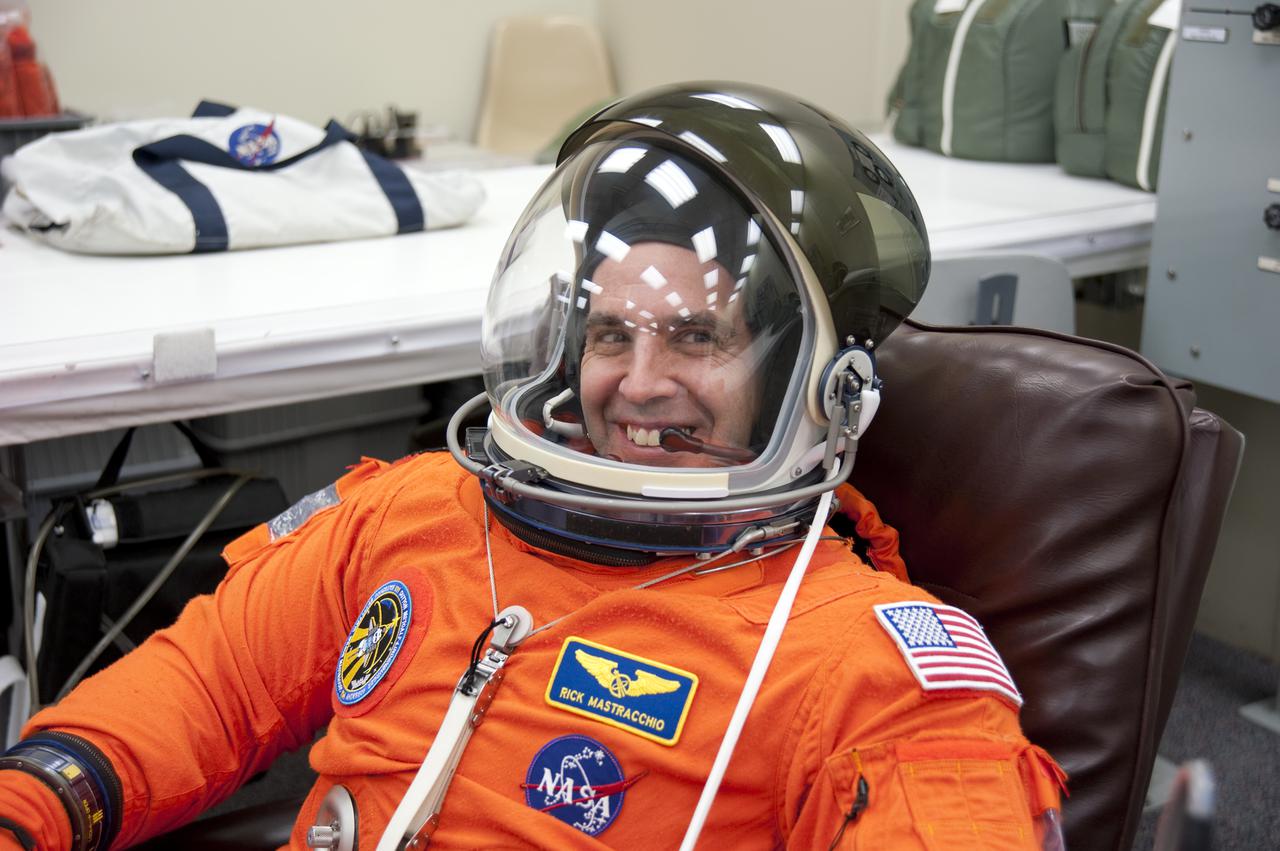
CAPE CANAVERAL, Fla. - In the Operations and Checkout Building at NASA's Kennedy Space Center in Florida, STS-131 Mission Specialist Rick Mastracchio verifies that his helmet is functioning properly. The members of space shuttle Discovery's STS-131 crew put on their launch-and-entry suits before heading to the Astrovan for the ride to Launch Pad 39A. The crew is participating in the Terminal Countdown Demonstration Test, or TCDT, a dress rehearsal for launch. TCDT includes training on the emergency egress systems at the launch pad, driving practice of the M-113 armored personnel carrier and a simulated launch countdown. The crew will deliver the multi-purpose logistics module Leonard, filled with resupply stowage platforms and science racks, to the International Space Station. STS-131, targeted for launch on April 5, will be the 33rd shuttle mission to the station and the 131st shuttle mission overall. For information on the STS-131 mission and crew, visit http:__www.nasa.gov_mission_pages_shuttle_shuttlemissions_sts131_index.htm. Photo credit: NASA_Kim Shiflett
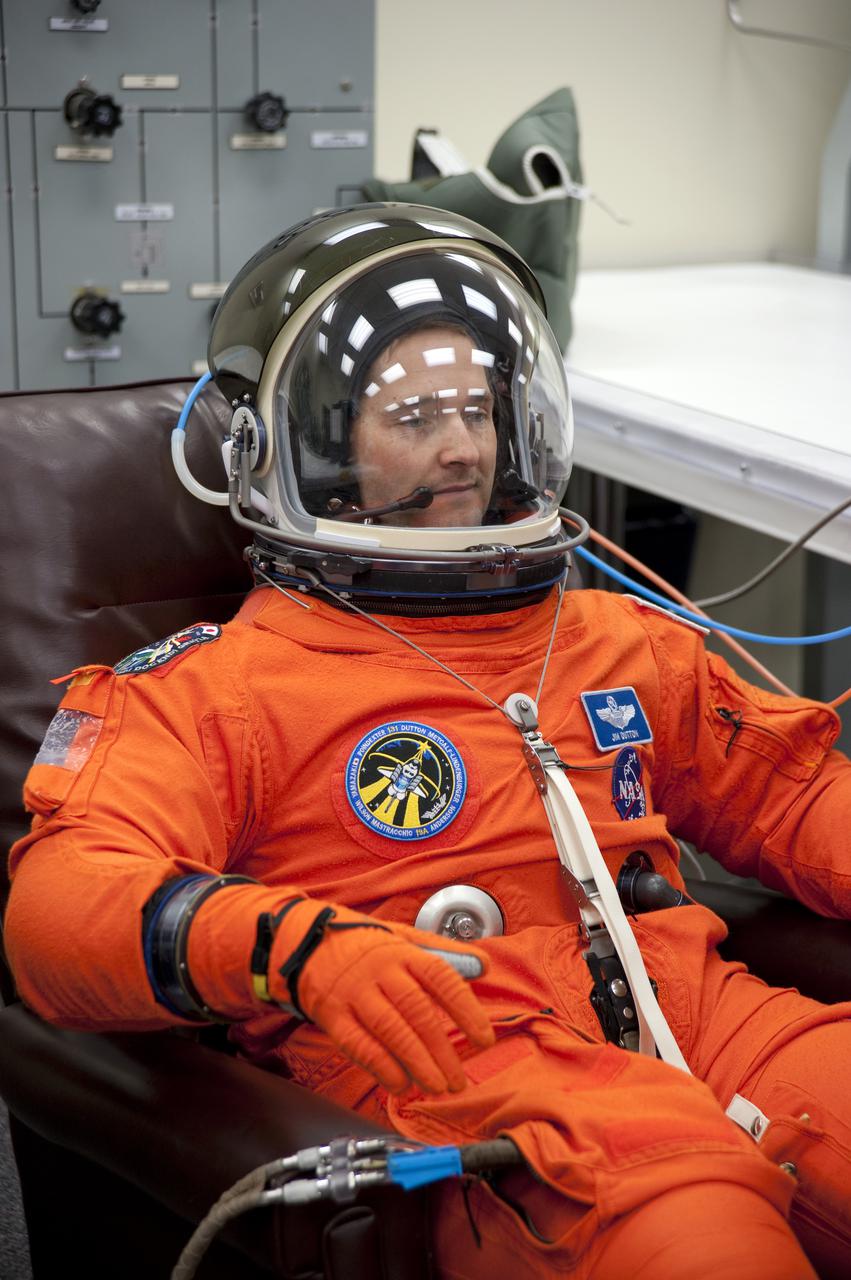
CAPE CANAVERAL, Fla. - In the Operations and Checkout Building at NASA's Kennedy Space Center in Florida, STS-131 Pilot James P. Dutton Jr. verifies that his helmet is functioning properly. The members of space shuttle Discovery's STS-131 crew put on their launch-and-entry suits before heading to the Astrovan for the ride to Launch Pad 39A. The crew is participating in the Terminal Countdown Demonstration Test, or TCDT, a dress rehearsal for launch. TCDT includes training on the emergency egress systems at the launch pad, driving practice of the M-113 armored personnel carrier and a simulated launch countdown. The crew will deliver the multi-purpose logistics module Leonard, filled with resupply stowage platforms and science racks, to the International Space Station. STS-131, targeted for launch on April 5, will be the 33rd shuttle mission to the station and the 131st shuttle mission overall. For information on the STS-131 mission and crew, visit http:__www.nasa.gov_mission_pages_shuttle_shuttlemissions_sts131_index.htm. Photo credit: NASA_Kim Shiflett
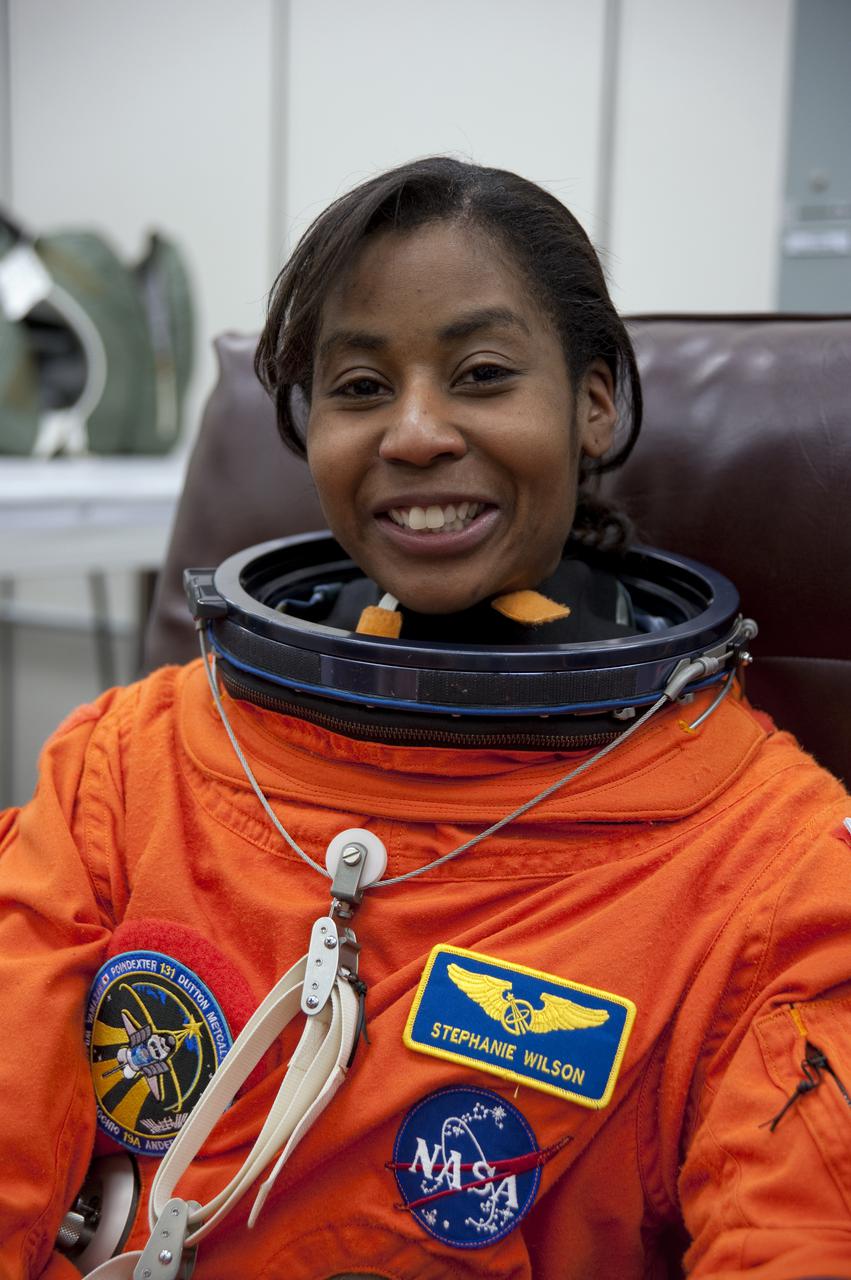
CAPE CANAVERAL, Fla. - In the Operations and Checkout Building at NASA's Kennedy Space Center in Florida, STS-131 Mission Specialist Stephanie Wilson seems pleased with the fit of her spacesuit. The members of space shuttle Discovery's STS-131 crew put on their launch-and-entry suits before heading to the Astrovan for the ride to Launch Pad 39A. The crew is participating in the Terminal Countdown Demonstration Test, or TCDT, a dress rehearsal for launch. TCDT includes training on the emergency egress systems at the launch pad, driving practice of the M-113 armored personnel carrier and a simulated launch countdown. The crew will deliver the multi-purpose logistics module Leonard, filled with resupply stowage platforms and science racks, to the International Space Station. STS-131, targeted for launch on April 5, will be the 33rd shuttle mission to the station and the 131st shuttle mission overall. For information on the STS-131 mission and crew, visit http:__www.nasa.gov_mission_pages_shuttle_shuttlemissions_sts131_index.htm. Photo credit: NASA_Kim Shiflett

CAPE CANAVERAL, Fla. - At Launch Pad 39A at NASA's Kennedy Space Center in Florida, STS-131 Mission Specialist Stephanie Wilson awaits her turn to enter space shuttle Discovery. The crew members of Discovery's STS-131 mission, dressed in their launch-and-entry suits, are participating in the Terminal Countdown Demonstration Test, or TCDT, a dress rehearsal for launch. TCDT includes training on the emergency exit systems at the launch pad, driving practice of the M-113 armored personnel carrier and a simulated launch countdown. The crew will deliver the multi-purpose logistics module Leonard, filled with resupply stowage platforms and science racks, to the International Space Station. STS-131, targeted for launch on April 5, will be the 33rd shuttle mission to the station and the 131st shuttle mission overall. For information on the STS-131 mission and crew, visit http:__www.nasa.gov_mission_pages_shuttle_shuttlemissions_sts131_index.htm. Photo credit: NASA_Dimitri Gerondidakis
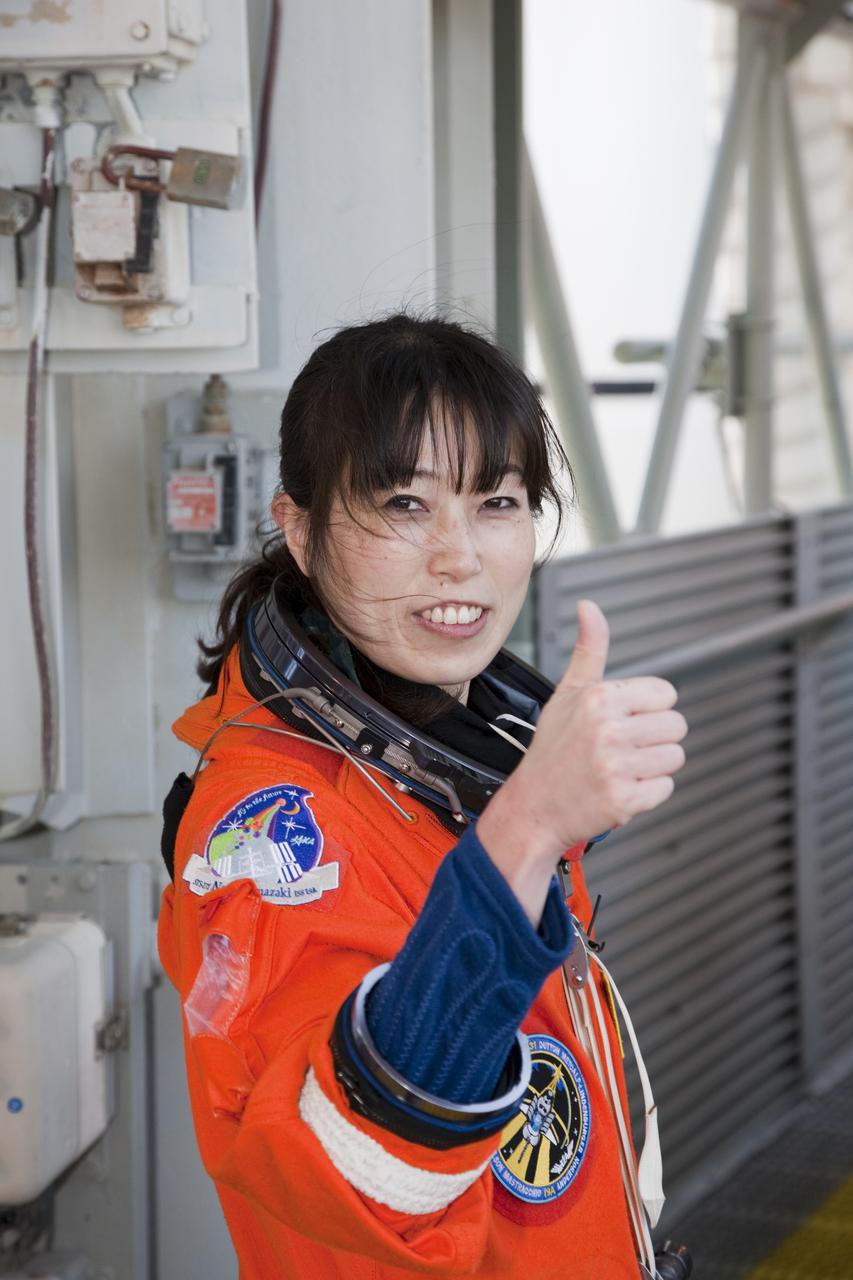
CAPE CANAVERAL, Fla. - At Launch Pad 39A at NASA's Kennedy Space Center in Florida, STS-131 Mission Specialist Naoko Yamazaki of the Japan Aerospace Exploration Agency awaits her turn to enter space shuttle Discovery. The crew members of Discovery's STS-131 mission, dressed in their launch-and-entry suits, are participating in the Terminal Countdown Demonstration Test, or TCDT, a dress rehearsal for launch. TCDT includes training on the emergency exit systems at the launch pad, driving practice of the M-113 armored personnel carrier and a simulated launch countdown. The crew will deliver the multi-purpose logistics module Leonard, filled with resupply stowage platforms and science racks, to the International Space Station. STS-131, targeted for launch on April 5, will be the 33rd shuttle mission to the station and the 131st shuttle mission overall. For information on the STS-131 mission and crew, visit http:__www.nasa.gov_mission_pages_shuttle_shuttlemissions_sts131_index.htm. Photo credit: NASA_Dimitri Gerondidakis
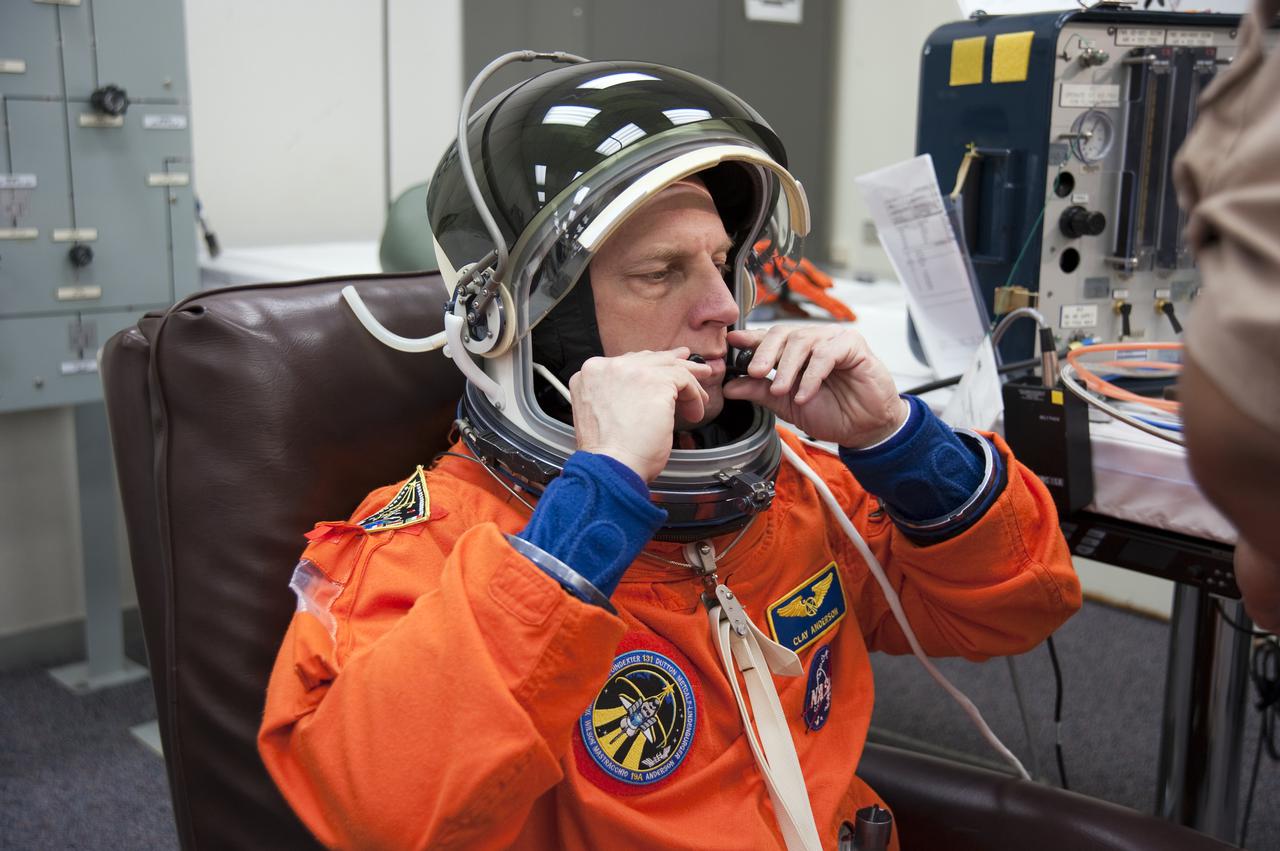
CAPE CANAVERAL, Fla. - In the Operations and Checkout Building at NASA's Kennedy Space Center in Florida, STS-131 Mission Specialist Clayton Anderson adjusts his helmet. The members of space shuttle Discovery's STS-131 crew put on their launch-and-entry suits before heading to the Astrovan for the ride to Launch Pad 39A. The crew is participating in the Terminal Countdown Demonstration Test, or TCDT, a dress rehearsal for launch. TCDT includes training on the emergency egress systems at the launch pad, driving practice of the M-113 armored personnel carrier and a simulated launch countdown. The crew will deliver the multi-purpose logistics module Leonard, filled with resupply stowage platforms and science racks, to the International Space Station. STS-131, targeted for launch on April 5, will be the 33rd shuttle mission to the station and the 131st shuttle mission overall. For information on the STS-131 mission and crew, visit http:__www.nasa.gov_mission_pages_shuttle_shuttlemissions_sts131_index.htm. Photo credit: NASA_Kim Shiflett
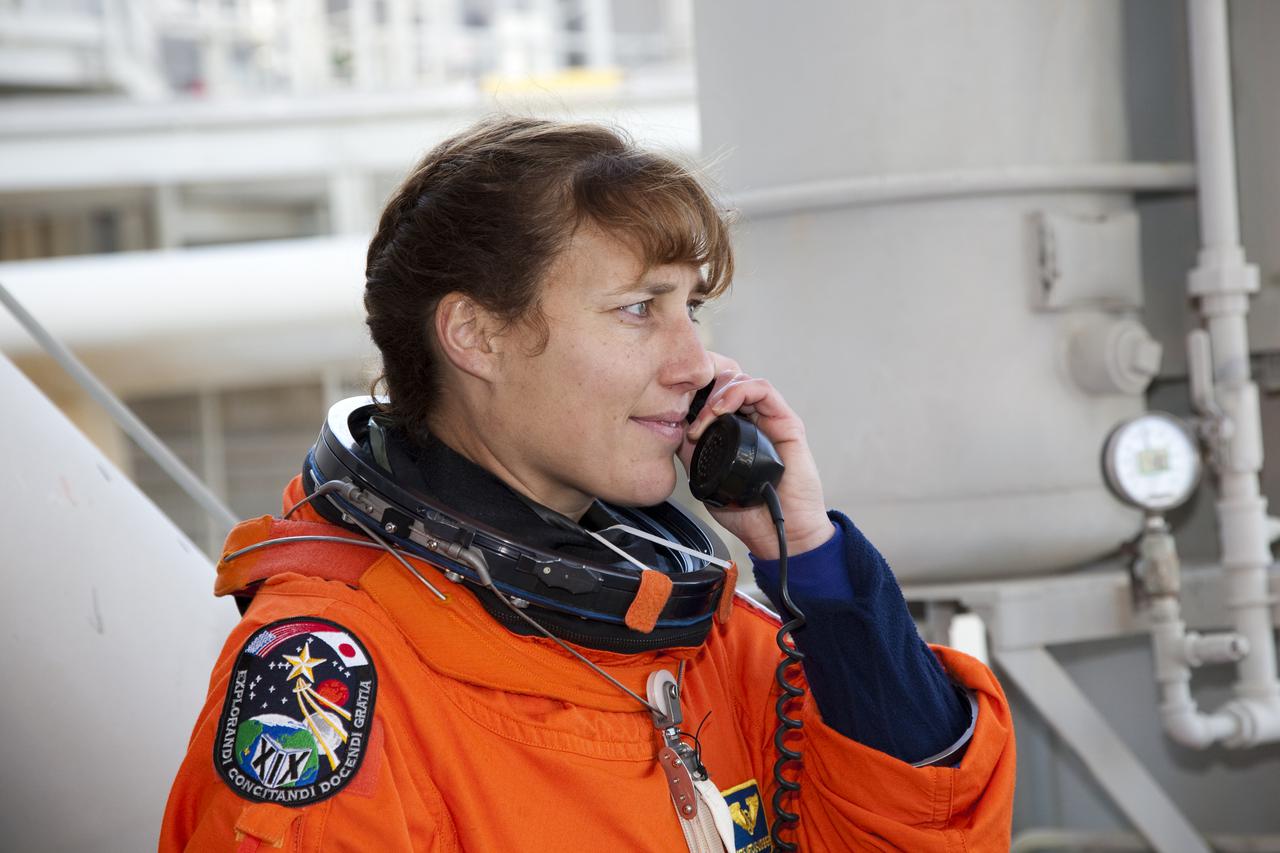
CAPE CANAVERAL, Fla. - At Launch Pad 39A at NASA's Kennedy Space Center in Florida, STS-131 Mission Specialist Dorothy Metcalf-Lindenburger awaits her turn to enter space shuttle Discovery. The crew members of Discovery's STS-131 mission, dressed in their launch-and-entry suits, are participating in the Terminal Countdown Demonstration Test, or TCDT, a dress rehearsal for launch. TCDT includes training on the emergency exit systems at the launch pad, driving practice of the M-113 armored personnel carrier and a simulated launch countdown. The crew will deliver the multi-purpose logistics module Leonard, filled with resupply stowage platforms and science racks, to the International Space Station. STS-131, targeted for launch on April 5, will be the 33rd shuttle mission to the station and the 131st shuttle mission overall. For information on the STS-131 mission and crew, visit http:__www.nasa.gov_mission_pages_shuttle_shuttlemissions_sts131_index.htm. Photo credit: NASA_Dimitri Gerondidakis
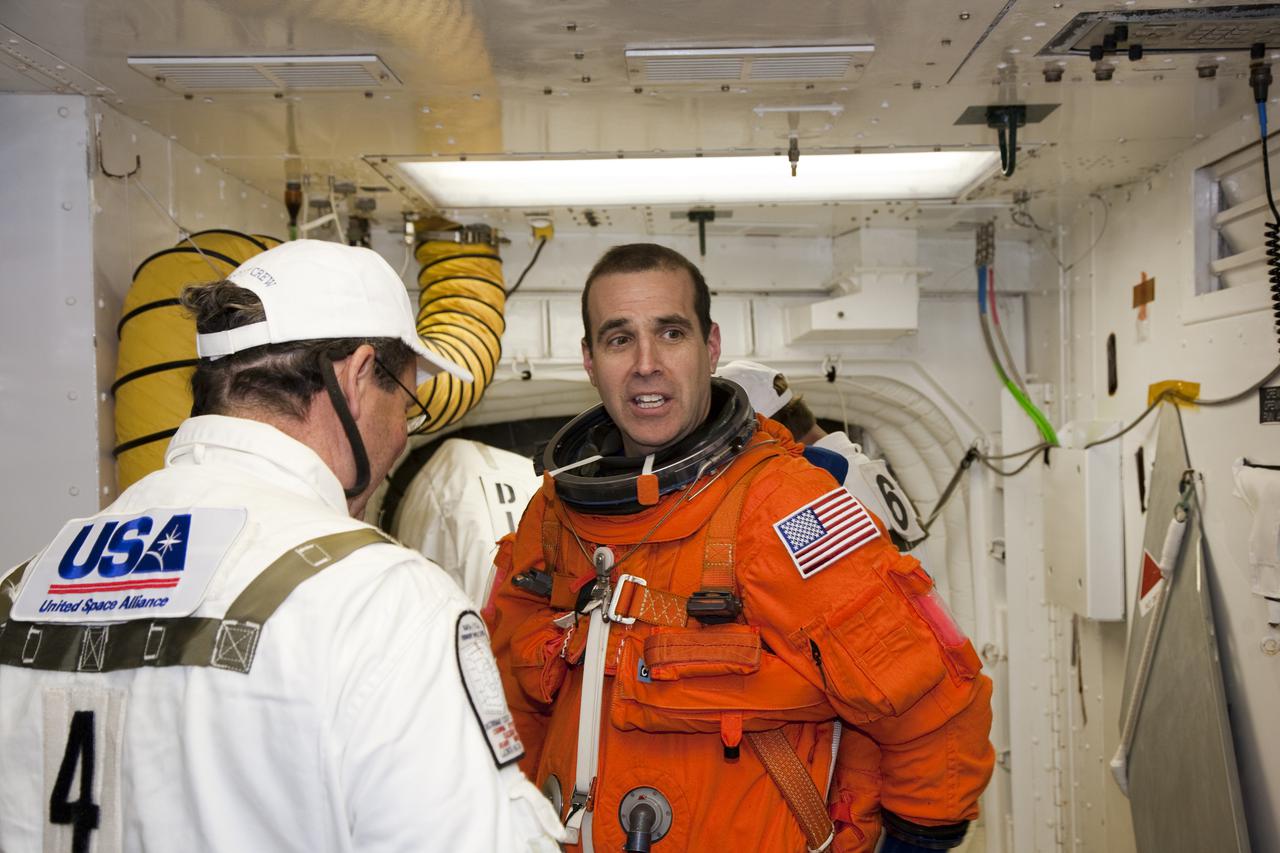
CAPE CANAVERAL, Fla. - At Launch Pad 39A at NASA's Kennedy Space Center in Florida, STS-131 Mission Specialist Rick Mastracchio prepares to enter space shuttle Discovery from the pad's White Room. The crew members of Discovery's STS-131 mission, dressed in their launch-and-entry suits, are participating in the Terminal Countdown Demonstration Test, or TCDT, a dress rehearsal for launch. TCDT includes training on the emergency exit systems at the launch pad, driving practice of the M-113 armored personnel carrier and a simulated launch countdown. The crew will deliver the multi-purpose logistics module Leonard, filled with resupply stowage platforms and science racks, to the International Space Station. STS-131, targeted for launch on April 5, will be the 33rd shuttle mission to the station and the 131st shuttle mission overall. For information on the STS-131 mission and crew, visit http:__www.nasa.gov_mission_pages_shuttle_shuttlemissions_sts131_index.htm. Photo credit: NASA_Dimitri Gerondidakis
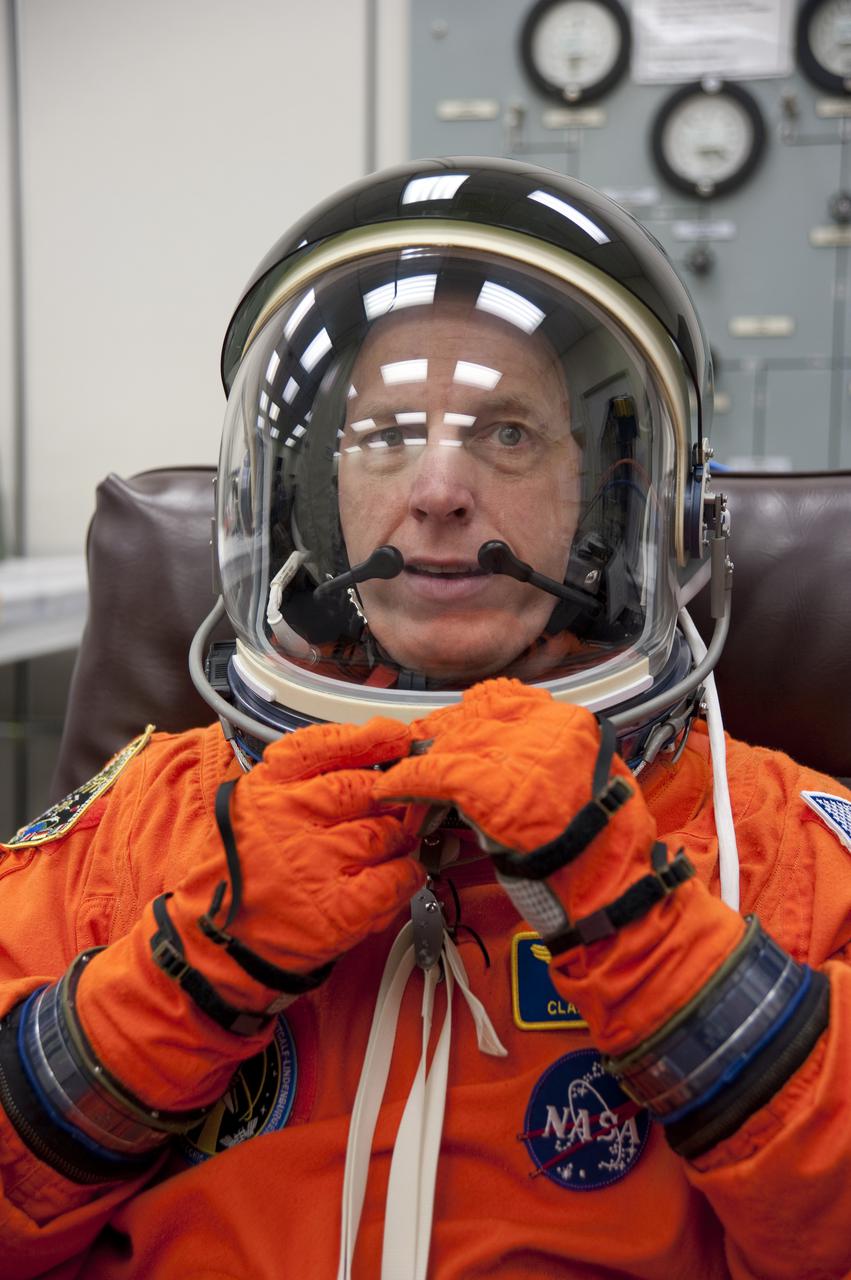
CAPE CANAVERAL, Fla. - In the Operations and Checkout Building at NASA's Kennedy Space Center in Florida, STS-131 Mission Specialist Clayton Anderson verifies that his helmet is functioning properly. The members of space shuttle Discovery's STS-131 crew put on their launch-and-entry suits before heading to the Astrovan for the ride to Launch Pad 39A. The crew is participating in the Terminal Countdown Demonstration Test, or TCDT, a dress rehearsal for launch. TCDT includes training on the emergency egress systems at the launch pad, driving practice of the M-113 armored personnel carrier and a simulated launch countdown. The crew will deliver the multi-purpose logistics module Leonard, filled with resupply stowage platforms and science racks, to the International Space Station. STS-131, targeted for launch on April 5, will be the 33rd shuttle mission to the station and the 131st shuttle mission overall. For information on the STS-131 mission and crew, visit http:__www.nasa.gov_mission_pages_shuttle_shuttlemissions_sts131_index.htm. Photo credit: NASA_Kim Shiflett
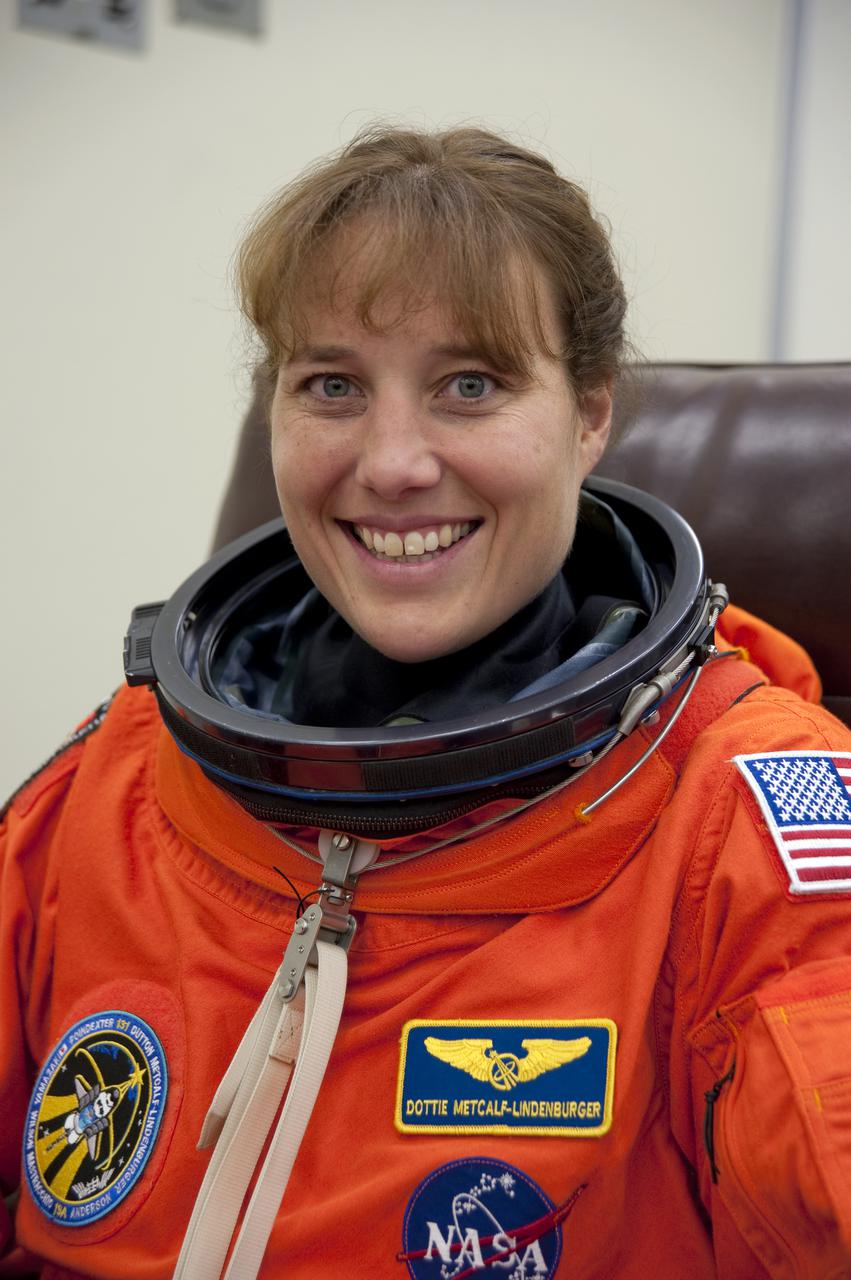
CAPE CANAVERAL, Fla. - In the Operations and Checkout Building at NASA's Kennedy Space Center in Florida, STS-131 Mission Specialist Dorothy Metcalf-Lindenburger seems pleased with the fit of her spacesuit. The members of space shuttle Discovery's STS-131 crew put on their launch-and-entry suits before heading to the Astrovan for the ride to Launch Pad 39A. The crew is participating in the Terminal Countdown Demonstration Test, or TCDT, a dress rehearsal for launch. TCDT includes training on the emergency egress systems at the launch pad, driving practice of the M-113 armored personnel carrier and a simulated launch countdown. The crew will deliver the multi-purpose logistics module Leonard, filled with resupply stowage platforms and science racks, to the International Space Station. STS-131, targeted for launch on April 5, will be the 33rd shuttle mission to the station and the 131st shuttle mission overall. For information on the STS-131 mission and crew, visit http:__www.nasa.gov_mission_pages_shuttle_shuttlemissions_sts131_index.htm. Photo credit: NASA_Kim Shiflett
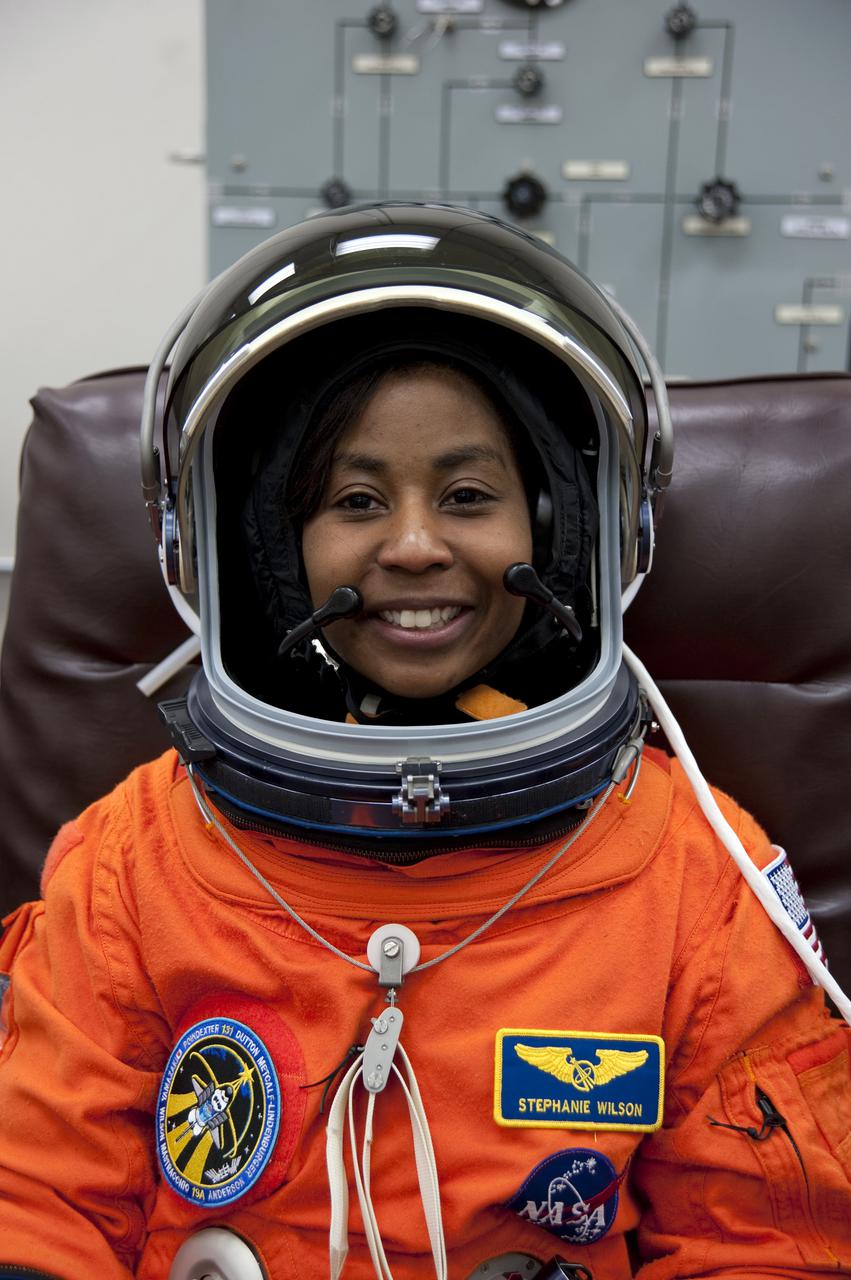
CAPE CANAVERAL, Fla. - In the Operations and Checkout Building at NASA's Kennedy Space Center in Florida, STS-131 Mission Specialist Stephanie Wilson verifies that her helmet is functioning properly. The members of space shuttle Discovery's STS-131 crew put on their launch-and-entry suits before heading to the Astrovan for the ride to Launch Pad 39A. The crew is participating in the Terminal Countdown Demonstration Test, or TCDT, a dress rehearsal for launch. TCDT includes training on the emergency egress systems at the launch pad, driving practice of the M-113 armored personnel carrier and a simulated launch countdown. The crew will deliver the multi-purpose logistics module Leonard, filled with resupply stowage platforms and science racks, to the International Space Station. STS-131, targeted for launch on April 5, will be the 33rd shuttle mission to the station and the 131st shuttle mission overall. For information on the STS-131 mission and crew, visit http:__www.nasa.gov_mission_pages_shuttle_shuttlemissions_sts131_index.htm. Photo credit: NASA_Kim Shiflett
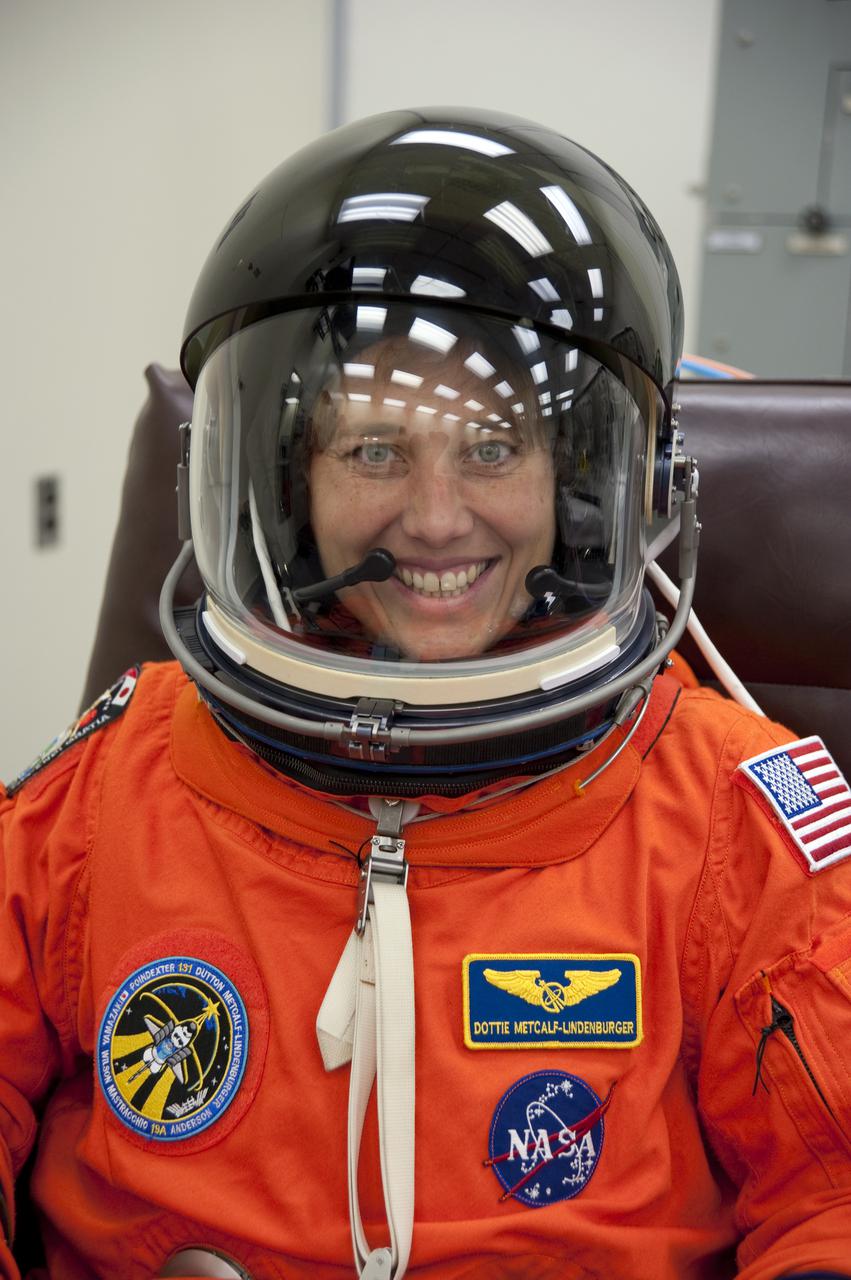
CAPE CANAVERAL, Fla. - In the Operations and Checkout Building at NASA's Kennedy Space Center in Florida, STS-131 Mission Specialist Dorothy Metcalf-Lindenburger verifies that her helmet is functioning properly. The members of space shuttle Discovery's STS-131 crew put on their launch-and-entry suits before heading to the Astrovan for the ride to Launch Pad 39A. The crew is participating in the Terminal Countdown Demonstration Test, or TCDT, a dress rehearsal for launch. TCDT includes training on the emergency egress systems at the launch pad, driving practice of the M-113 armored personnel carrier and a simulated launch countdown. The crew will deliver the multi-purpose logistics module Leonard, filled with resupply stowage platforms and science racks, to the International Space Station. STS-131, targeted for launch on April 5, will be the 33rd shuttle mission to the station and the 131st shuttle mission overall. For information on the STS-131 mission and crew, visit http:__www.nasa.gov_mission_pages_shuttle_shuttlemissions_sts131_index.htm. Photo credit: NASA_Kim Shiflett

CAPE CANAVERAL, Fla. - In the Operations and Checkout Building at NASA's Kennedy Space Center in Florida, STS-131 Mission Specialist Naoko Yamazaki of the Japan Aerospace Exploration Agency signals that her suit fits well. The members of space shuttle Discovery's STS-131 crew put on their launch-and-entry suits before heading to the Astrovan for the ride to Launch Pad 39A. The crew is participating in the Terminal Countdown Demonstration Test, or TCDT, a dress rehearsal for launch. TCDT includes training on the emergency egress systems at the launch pad, driving practice of the M-113 armored personnel carrier and a simulated launch countdown. The crew will deliver the multi-purpose logistics module Leonard, filled with resupply stowage platforms and science racks, to the International Space Station. STS-131, targeted for launch on April 5, will be the 33rd shuttle mission to the station and the 131st shuttle mission overall. For information on the STS-131 mission and crew, visit http:__www.nasa.gov_mission_pages_shuttle_shuttlemissions_sts131_index.htm. Photo credit: NASA_Kim Shiflett

KENNEDY SPACE CENTER, FLA. -- In the Payload Hazardous Servicing Facility, Phoenix Program Manager Barry Goldstein, from the Jet Propulsion Laboratory, briefs media personnel dressed in clean-room suits about the mission of the Phoenix Mars Lander, in the background. Phoenix is scheduled to launch Aug. 3 from Launch Pad 17-A at Cape Canaveral Air Force Station. Phoenix will land in icy soils near the north polar permanent ice cap of Mars and explore the history of the water in these soils and any associated rocks, while monitoring polar climate. Landing on Mars is planned in May 2008 on arctic ground where a mission currently in orbit, Mars Odyssey, has detected high concentrations of ice just beneath the top layer of soil. Photo credit: NASA/Kim Shiflett
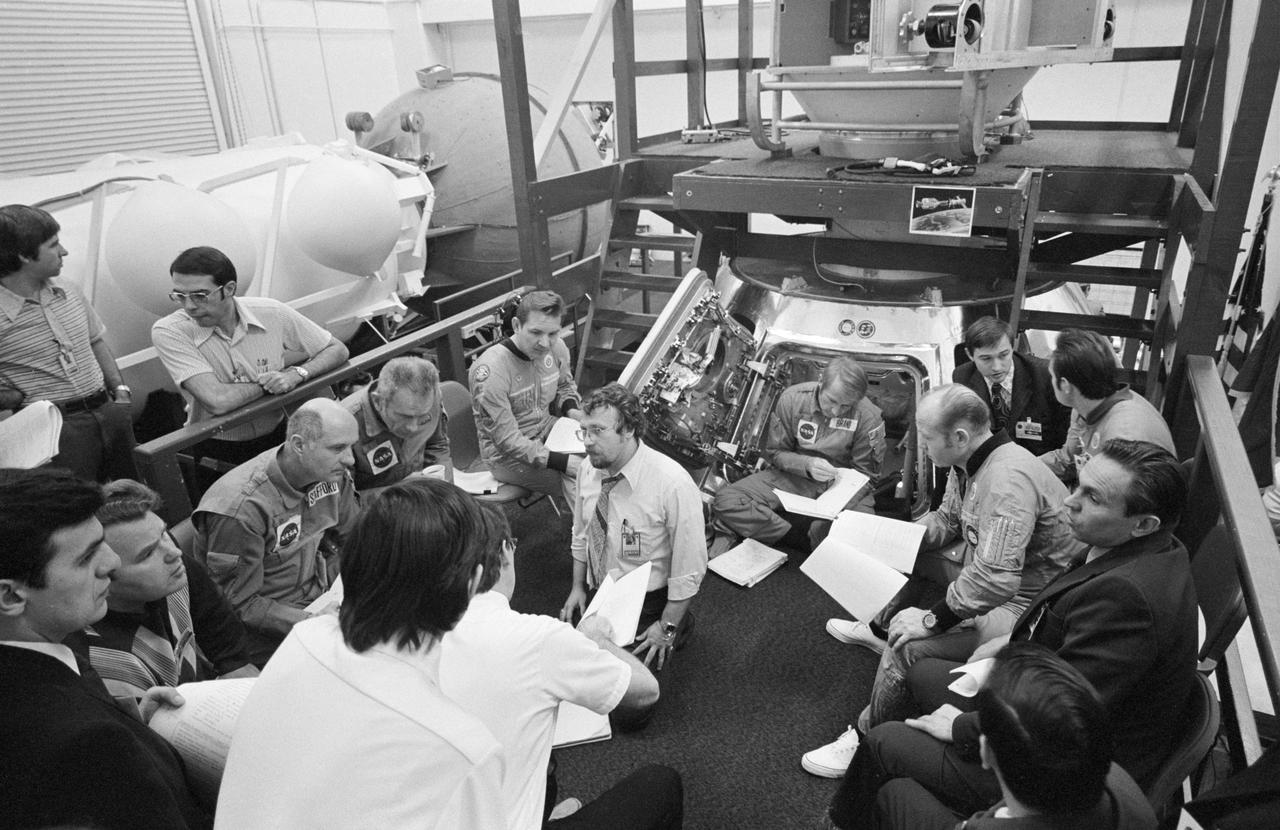
S75-21599 (12 Feb. 1975) --- Six Apollo-Soyuz Test Project crewmen participate in joint crew training in Building 35 at the Johnson Space Center. They are (wearing flight suits), left to right, astronaut Thomas P. Stafford, commander of the American ASTP prime crew; astronaut Donald K. Slayton, docking module pilot on Stafford?s crew; cosmonaut Valeriy N. Kubasov, engineer on the Soviet ASTP first (prime) crew; astronaut Vance D. Brand, command module pilot on Stafford?s crew; cosmonaut Aleksey A. Leonov, commander of the Soviet ASTP first (prime) crew; and cosmonaut Vladimir A. Dzhanibekov, commander of the Soviet ASTP third (backup) crew. Brand is seated next to the hatch of the Apollo Command Module trainer. This picture was taken during a ?walk-through? of the first day?s activities in Earth orbit. The other men are interpreters and training personnel.
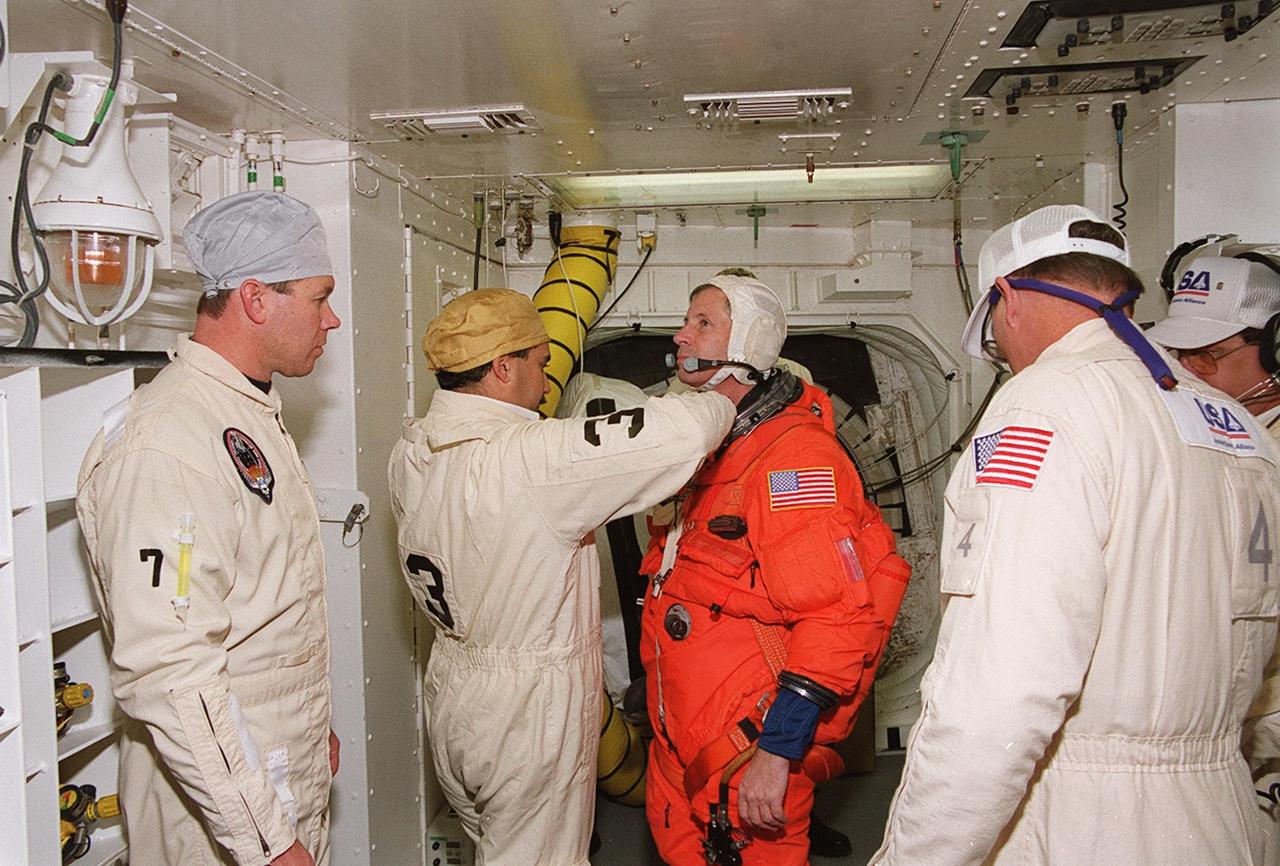
In the White Room at Launch Pad 39A, STS-98 Commander Ken Cockrell (center) gets help from the closeout crew with his launch and entry suit before entering Atlantis for a simulated launch countdown. The White Room is an environmental chamber at the end of the orbiter access arm that mates with the orbiter to allow personnel to enter the orbiter’s crew compartment. The STS-98 crew is taking part in Terminal Countdown Demonstration Test activities, which also include emergency egress training at the pad. STS-98 is the seventh construction flight to the International Space Station, carrying as payload the U.S. Lab Destiny, a key element in the construction of the ISS. Launch of STS-98 is scheduled for Jan. 19 at 2:11 a.m. EST
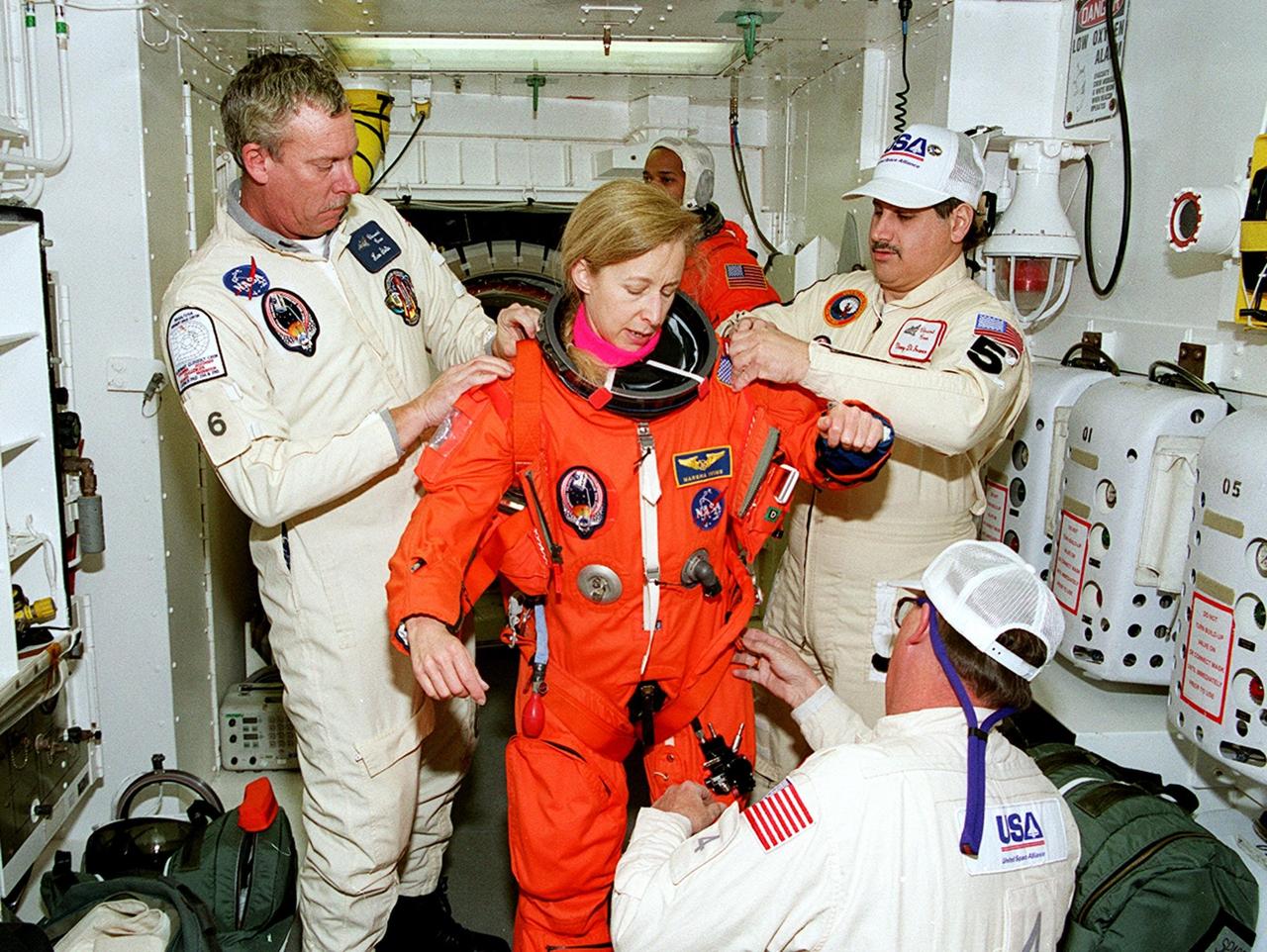
In the White Room, members of the closeout crew help STS-98 Mission Specialist Marsha Ivins (center) with her launch and entry suit before she enters Atlantis for a simulated launch countdown. The White Room is an environmental chamber at the end of the orbiter access arm that mates with the orbiter to allow personnel to enter the orbiter’s crew compartment. The STS-98 crew is taking part in Terminal Countdown Demonstration Test activities, which also include emergency egress training at the pad. STS-98 is the seventh construction flight to the International Space Station, carrying as payload the U.S. Lab Destiny, a key element in the construction of the ISS. Launch of STS-98 is scheduled for Jan. 19 at 2:11 a.m. EST
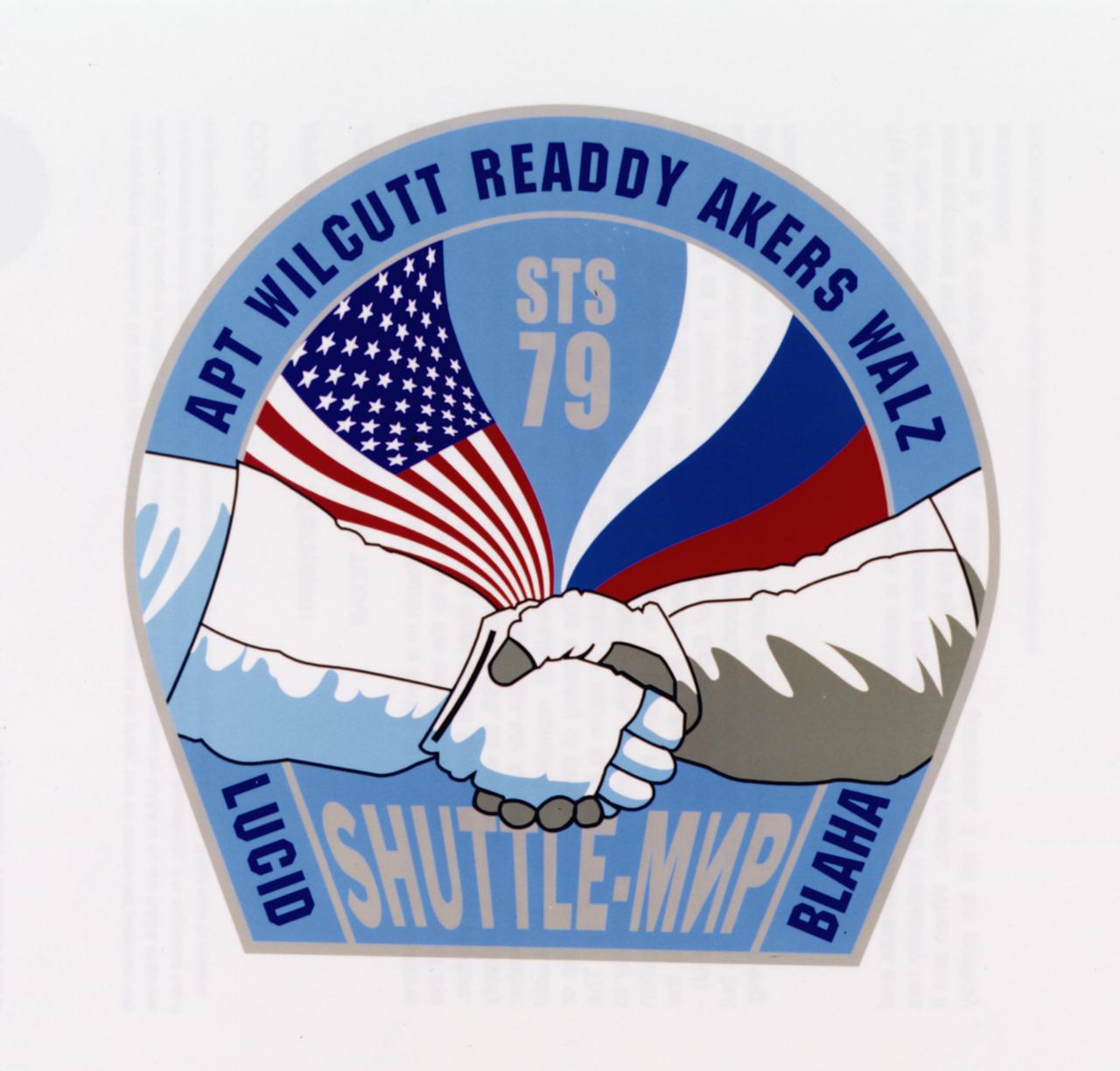
STS-79 was the fourth in a series of NASA docking missions to the Russian Mir Space Station, leading up to the construction and operation of the International Space Station (ISS). As the first flight of the Spacehab Double Module, STS-79 encompassed research, test and evaluation of ISS, as well as logistics resupply for the Mir Space Station. STS-79 was also the first NASA-Mir American crew member exchange mission, with John E. Blaha (NASA-Mir-3) replacing Shannon W. Lucid (NASA-Mir-2) aboard the Mir Space Station. The lettering of their names either up or down denotes transport up to the Mir Space Station or return to Earth on STS-79. The patch is in the shape of the Space Shuttle’s airlock hatch, symbolizing the gateway to international cooperation in space. The patch illustrates the historic cooperation between the United States and Russia in space. With the flags of Russia and the United States as a backdrop, the handshake of Extravehicular Mobility Unit (EMU) which are suited crew members symbolizes mission teamwork, not only of the crew members but also the teamwork between both countries space personnel in science, engineering, medicine and logistics.
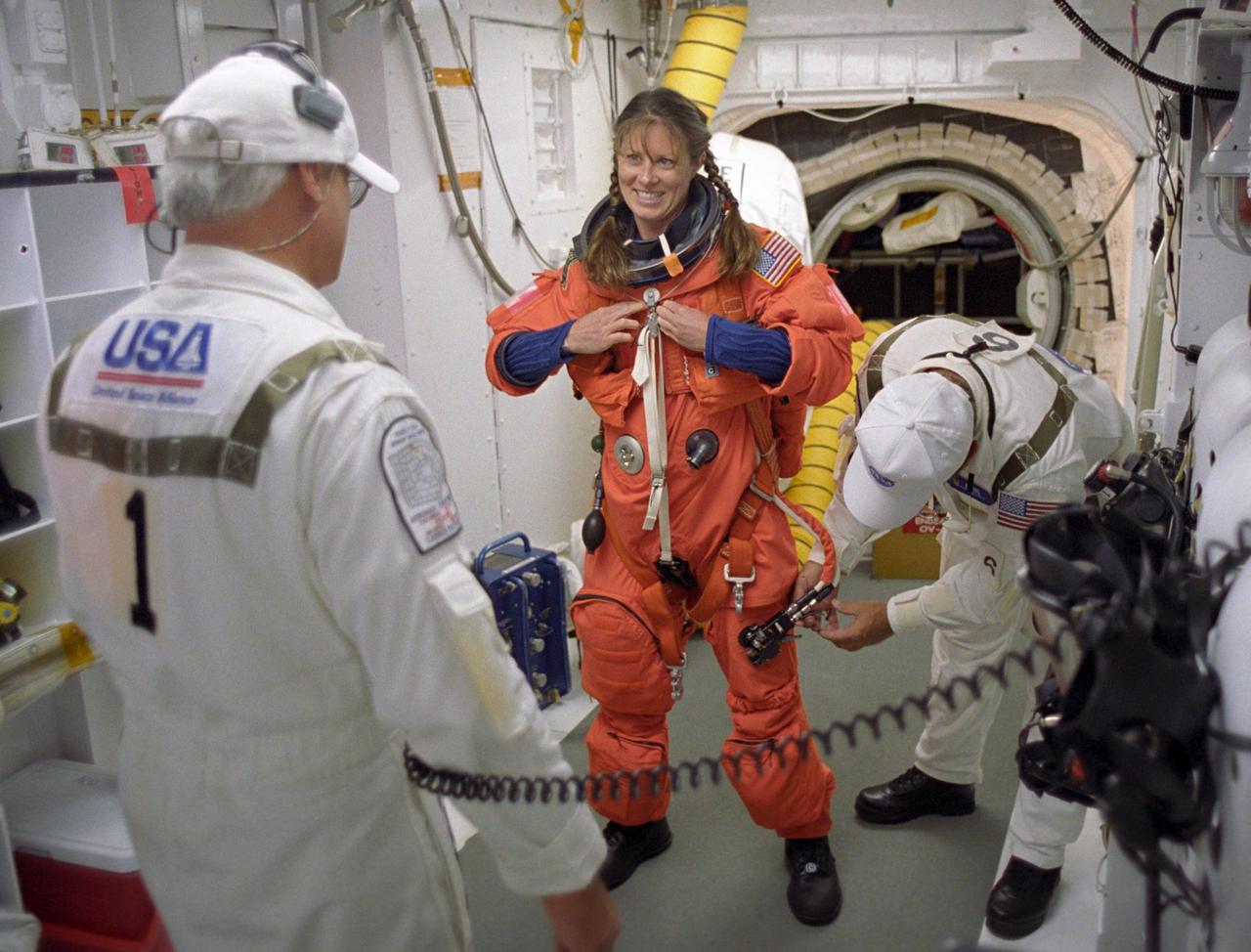
KENNEDY SPACE CENTER, FLA. -- In the White Room on Launch Pad 39A, STS-118 Mission Specialist Tracy Caldwell, with the help of the closeout crew, goes through final preparation of her launch and entry suit before she enters Space Shuttle Endeavour. The outer end of the orbiter access arm ends in an environmental chamber (the White Room) that mates with the orbiter and allows personnel to enter the crew compartment. With assistance, each member of the flight crew dons a parachute pack before crawling through the open hatch into the shuttle. The closeout crew also straps the astronauts into the space shuttle's crew module and takes care of any other last-minute needs that arise. Space Shuttle Endeavour's STS-118 mission is the 22nd shuttle flight to the International Space Station. It will continue space station construction by delivering a third starboard truss segment, S5, and other payloads such as the SPACEHAB module and the external stowage platform 3. Liftoff of Endeavour is scheduled at 6:36 p.m. EDT. Photo credit: NASA/John Kechele, Scott Haun, Tom Farrar
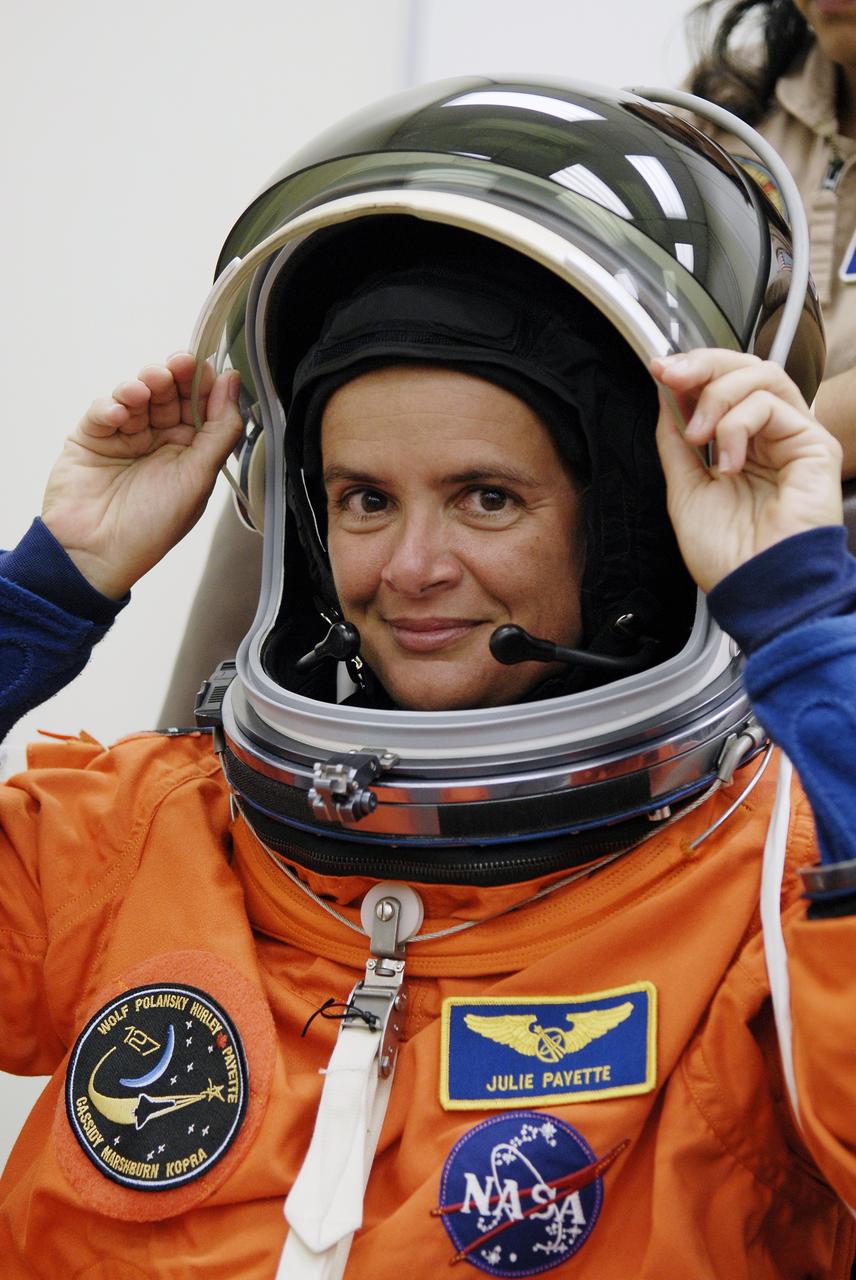
CAPE CANAVERAL, Fla. – In the Operations and Checkout Building at NASA's Kennedy Space Center in Florida, STS-127 crew members put on their launch-and-entry suits before heading to the Astrovan for the 3.4-mile drive to Launch Pad 39A. Seen here, Mission Specialist Julie Payette of the Canadian Space Agency adjusts her helmet. At the pad, Payette and the other crew members will complete their suitup and enter space shuttle Endeavour for the 7:13 p.m. EDT liftoff. This is the fourth launch attempt for the STS-127 mission. The first two launch attempts on June 13 and June 17 were scrubbed when a hydrogen gas leak occurred during tanking due to a misaligned Ground Umbilical Carrier Plate. Mission managers also decided to delay tanking on July 11 for a launch attempt later in the day to allow engineers and safety personnel time to analyze data captured during lightning strikes near the pad on July 10. Endeavour will deliver the Japanese Experiment Module's Exposed Facility, or JEM-EF, and the Experiment Logistics Module-Exposed Section, or ELM-ES, in the final of three flights dedicated to the assembly of the Japan Aerospace Exploration Agency's Kibo laboratory complex on the International Space Station. STS-127 is the 29th flight for the assembly of the space station. Photo credit: NASA/Kim Shiflett
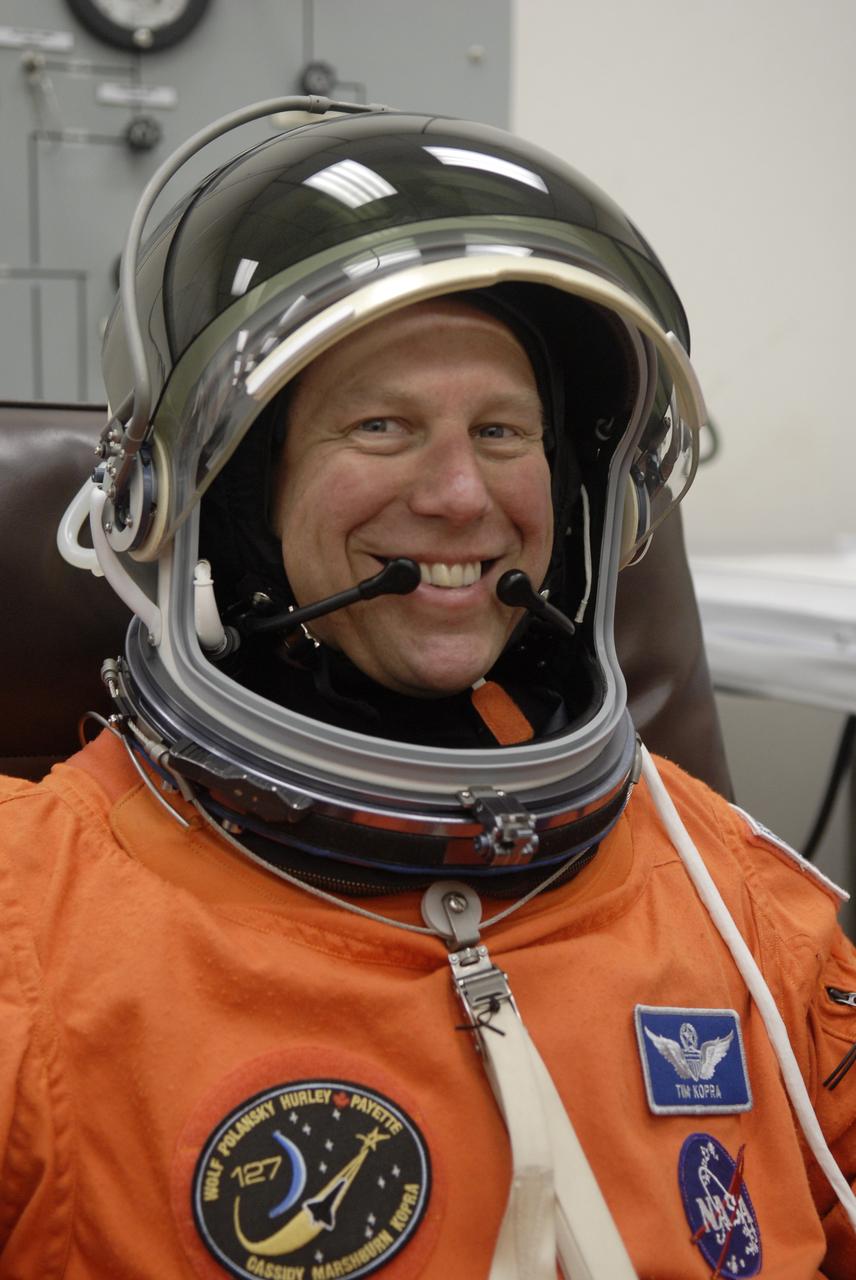
CAPE CANAVERAL, Fla. – In the Operations and Checkout Building at NASA's Kennedy Space Center in Florida, STS-127 crew members put on their launch-and-entry suits before heading to the Astrovan for the 3.4-mile drive to Launch Pad 39A. Seen here is Mission Specialist Tim Kopra, who is checking his helmet. At the pad, he and the other crew members will complete their suitup and enter space shuttle Endeavour for the 7:13 p.m. EDT liftoff. Kopra will remain on the International Space Station as the Expedition 20 flight engineer. This is the fourth launch attempt for the STS-127 mission. The first two launch attempts on June 13 and June 17 were scrubbed when a hydrogen gas leak occurred during tanking due to a misaligned Ground Umbilical Carrier Plate. Mission managers also decided to delay tanking on July 11 for a launch attempt later in the day to allow engineers and safety personnel time to analyze data captured during lightning strikes near the pad on July 10. Endeavour will deliver the Japanese Experiment Module's Exposed Facility, or JEM-EF, and the Experiment Logistics Module-Exposed Section, or ELM-ES, in the final of three flights dedicated to the assembly of the Japan Aerospace Exploration Agency's Kibo laboratory complex on the International Space Station. STS-127 is the 29th flight for the assembly of the space station. Photo credit: NASA/Kim Shiflett
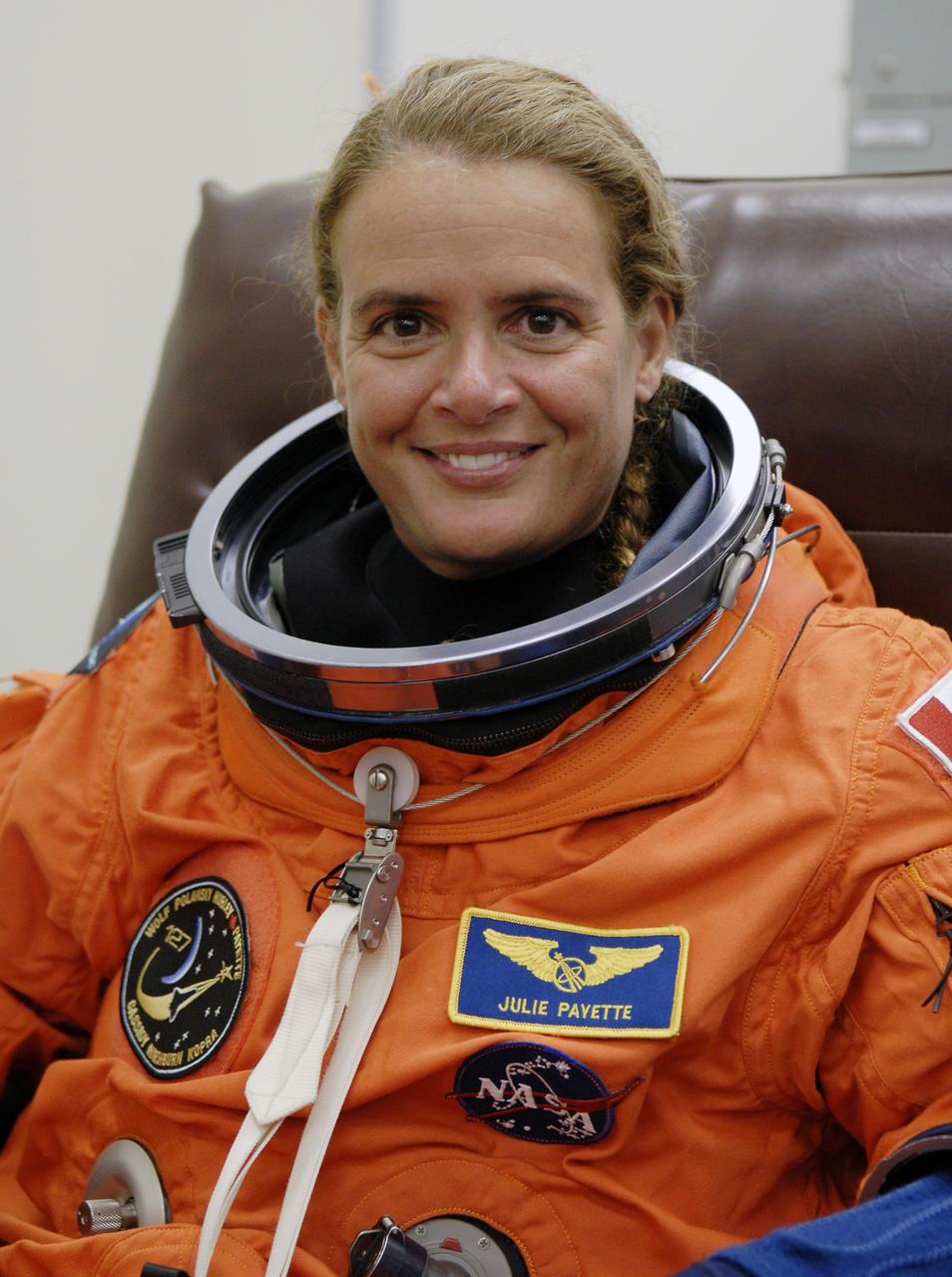
CAPE CANAVERAL, Fla. – – In the Operations and Checkout Building at NASA's Kennedy Space Center in Florida, STS-127 crew members put on their launch-and-entry suits before heading to the Astrovan for the 3.4-mile drive to Launch Pad 39A. Seen here is Mission Specialist Julie Payette of the Canadian Space Agency, who is making her second shuttle flight. At the pad, Payette and the other crew members will complete their suitup and enter space shuttle Endeavour for the 7:13 p.m. EDT liftoff. This is the fourth launch attempt for the STS-127 mission. The first two launch attempts on June 13 and June 17 were scrubbed when a hydrogen gas leak occurred during tanking due to a misaligned Ground Umbilical Carrier Plate. Mission managers also decided to delay tanking on July 11 for a launch attempt later in the day to allow engineers and safety personnel time to analyze data captured during lightning strikes near the pad on July 10. Endeavour will deliver the Japanese Experiment Module's Exposed Facility, or JEM-EF, and the Experiment Logistics Module-Exposed Section, or ELM-ES, in the final of three flights dedicated to the assembly of the Japan Aerospace Exploration Agency's Kibo laboratory complex on the International Space Station. STS-127 is the 29th flight for the assembly of the space station. Photo credit: NASA/Kim Shiflett
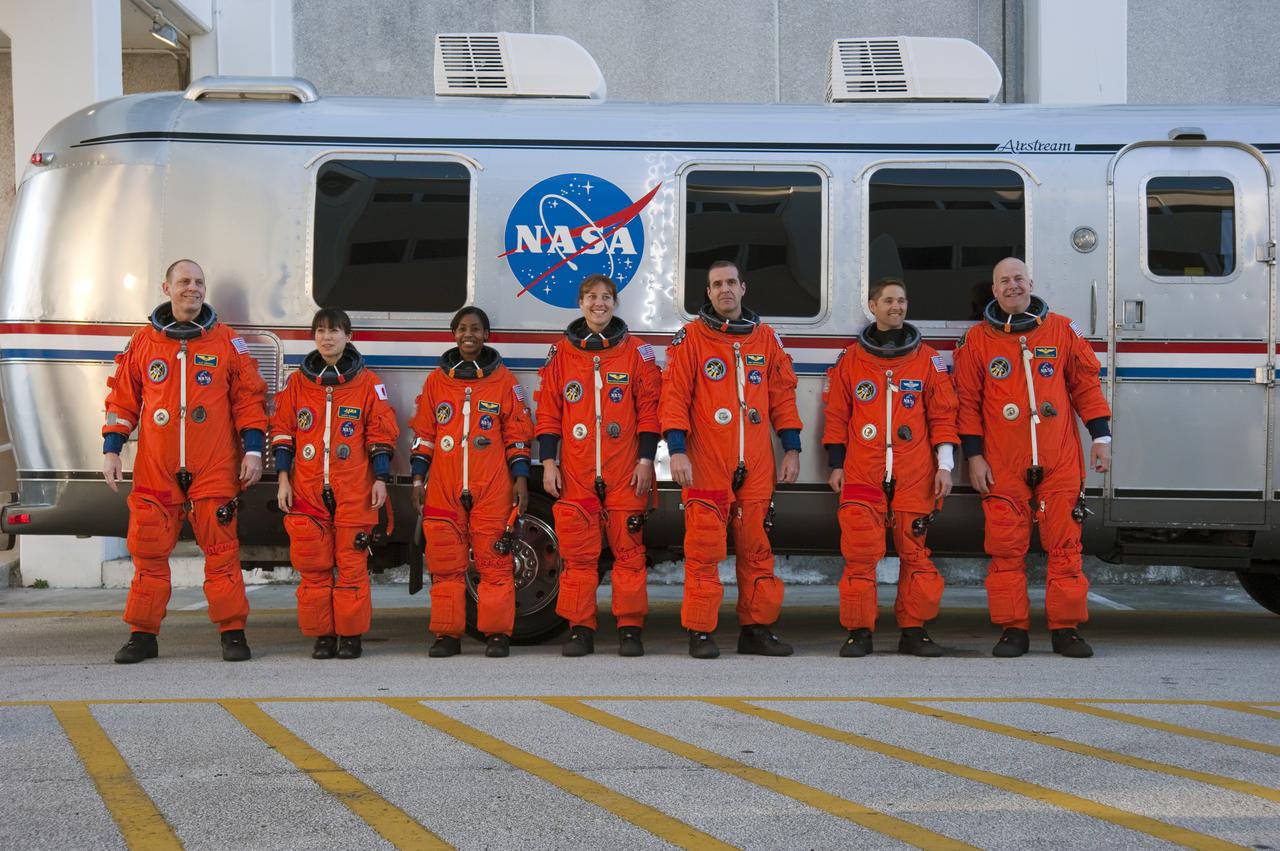
CAPE CANAVERAL, Fla. - At the Operations and Checkout Building at NASA's Kennedy Space Center in Florida, members of space shuttle Discovery's STS-131 crew pose for a group portrait in their launch-and-entry suits before boarding the Astrovan for the ride to Launch Pad 39A. The crew is participating in the Terminal Countdown Demonstration Test, or TCDT. From left are Mission Specialists Clayton Anderson, Naoko Yamazaki of the Japan Aerospace Exploration Agency, Stephanie Wilson, Dorothy Metcalf-Lindenburger and Rick Mastracchio; Pilot James P. Dutton Jr.; and Commander Alan Poindexter. TCDT includes training on the emergency exit systems at the launch pad, driving practice of the M-113 armored personnel carrier and a full launch countdown dress rehearsal. The crew will deliver the multi-purpose logistics module Leonard, filled with resupply stowage platforms and science racks, to the International Space Station aboard space shuttle Discovery. STS-131, targeted for launch on April 5, will be the 33rd shuttle mission to the station and the 131st shuttle mission overall. For information on the STS-131 mission and crew, visit http:__www.nasa.gov_mission_pages_shuttle_shuttlemissions_sts131_index.htm. Photo credit: NASA_Kim Shiflett
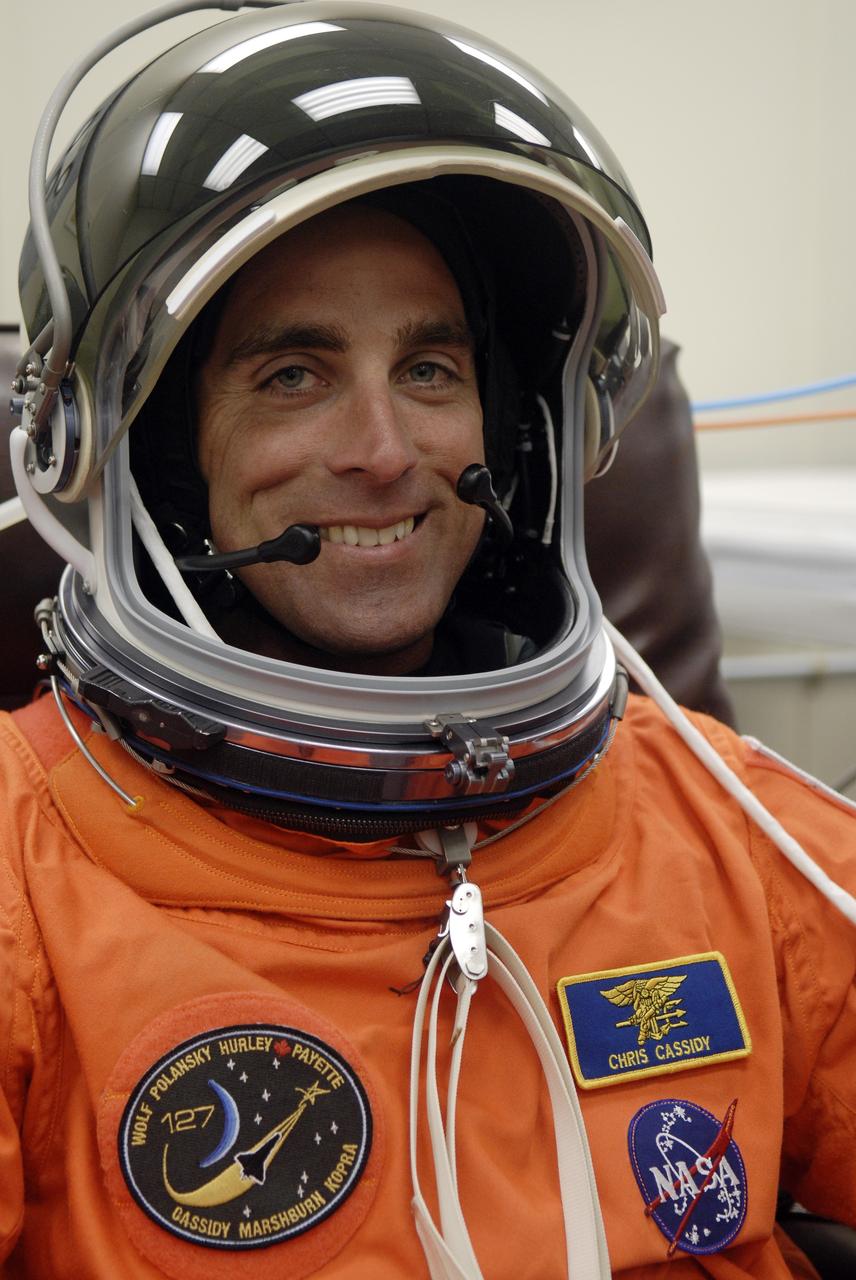
CAPE CANAVERAL, Fla. – In the Operations and Checkout Building at NASA's Kennedy Space Center in Florida, STS-127 crew members put on their launch-and-entry suits before heading to the Astrovan for the 3.4-mile drive to Launch Pad 39A. Seen here is Mission Specialist Christopher Cassidy, who is making his first shuttle flight. At the pad, Cassidy and the other crew members will complete their suitup and enter space shuttle Endeavour for the 7:13 p.m. EDT liftoff. This is the fourth launch attempt for the STS-127 mission. The first two launch attempts on June 13 and June 17 were scrubbed when a hydrogen gas leak occurred during tanking due to a misaligned Ground Umbilical Carrier Plate. Mission managers also decided to delay tanking on July 11 for a launch attempt later in the day to allow engineers and safety personnel time to analyze data captured during lightning strikes near the pad on July 10. Endeavour will deliver the Japanese Experiment Module's Exposed Facility, or JEM-EF, and the Experiment Logistics Module-Exposed Section, or ELM-ES, in the final of three flights dedicated to the assembly of the Japan Aerospace Exploration Agency's Kibo laboratory complex on the International Space Station. STS-127 is the 29th flight for the assembly of the space station. Photo credit: NASA/Kim Shiflett