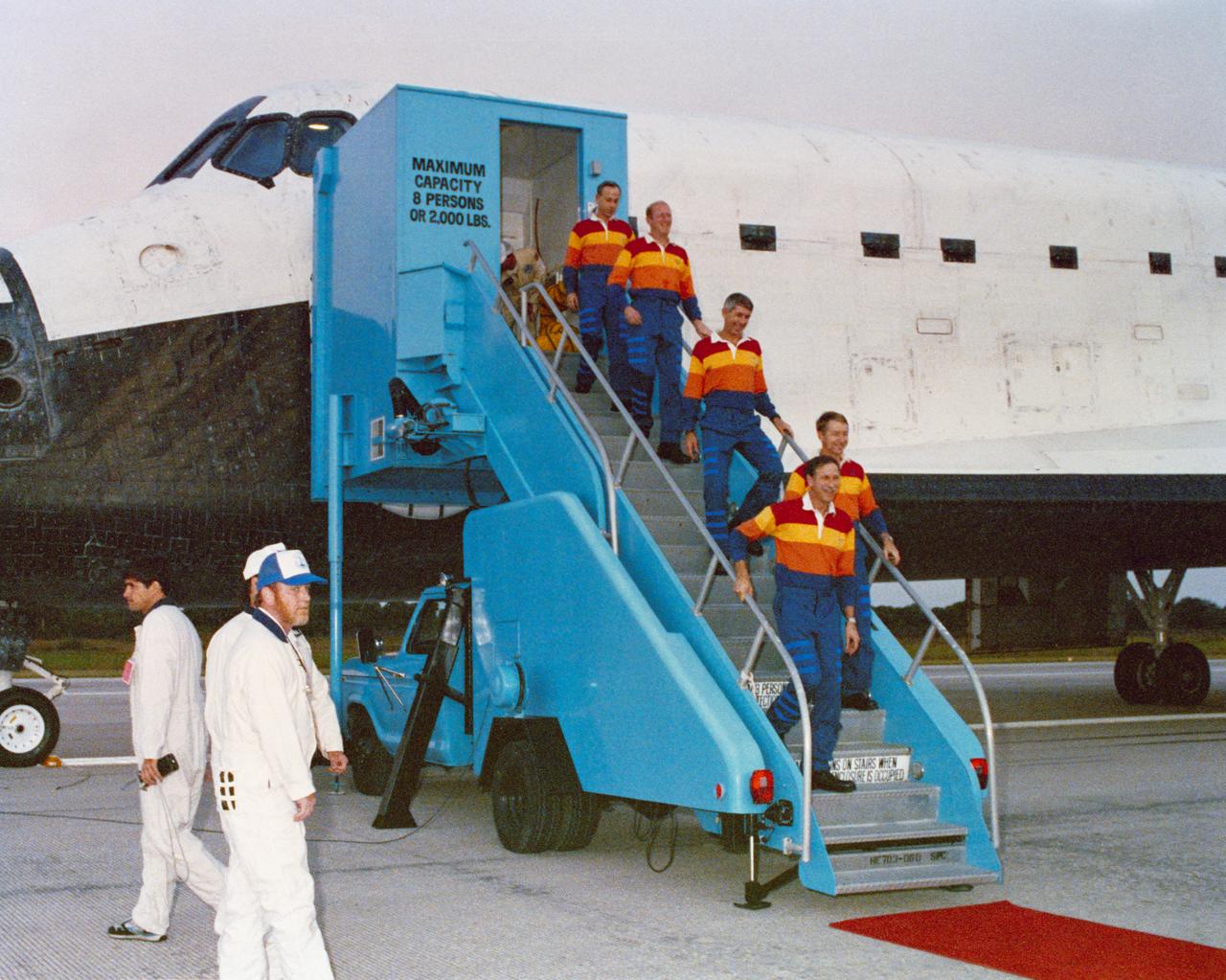
STS-38 crewmembers, wearing red, yellow, and orange polo shirts, egress Atlantis, Orbiter Vehicle (OV) 104, via a mobile stairway at the Kennedy Space Center's (KSC's) Shuttle Landing Facility (SLF). Commander Richard O. Covey, nearing the bottom of the stairway, is followed by Pilot Frank L. Culbertson, Mission Specialist (MS) Robert C. Springer, MS Charles D. Gemar, and MS Carl J. Meade. Ground servicing personnel look on in the foreground.
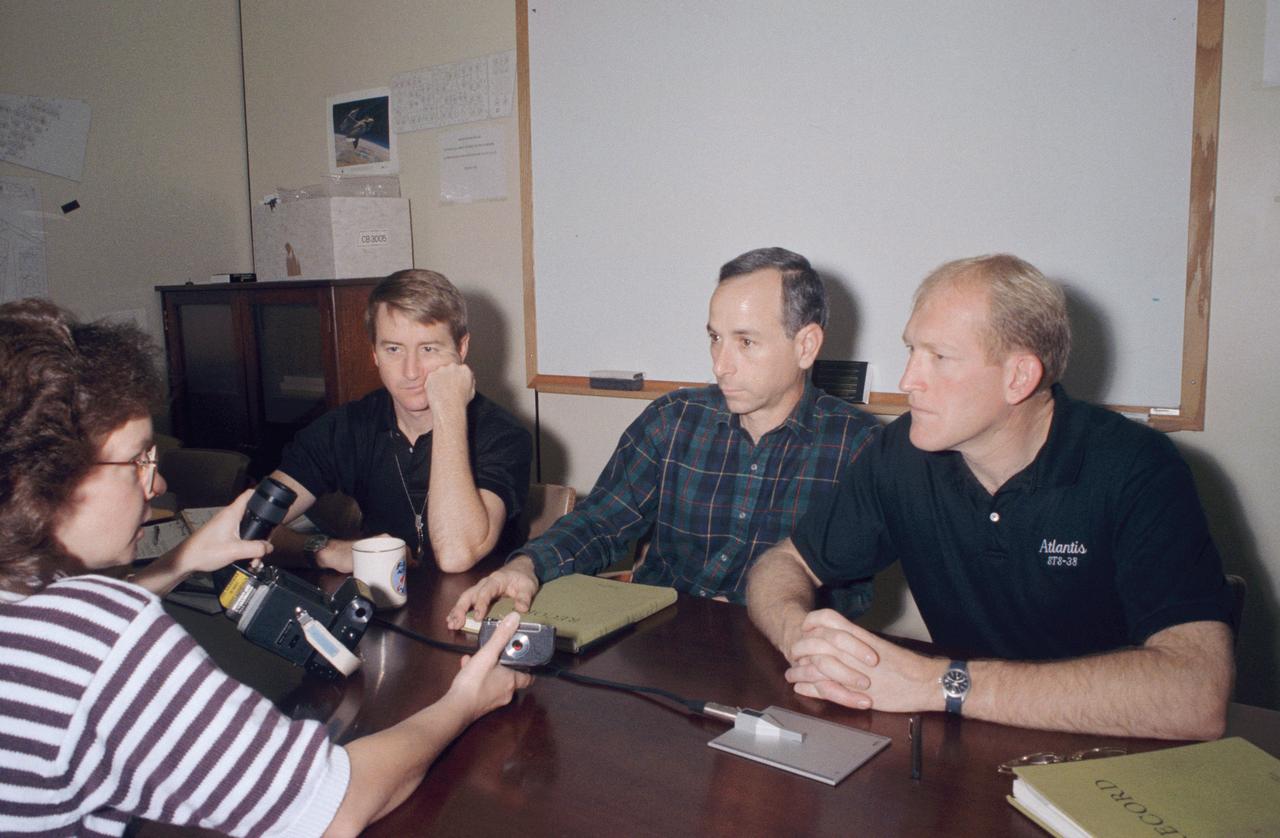
STS-38 crewmembers listen as RSOC-JSC crew trainer M. Judy Alexander explains the camera equipment they will be using on their upcoming Department of Defense (DOD) mission. Left to right are Pilot Frank L. Culbertson, Mission Specialist (MS) Carl J. Meade, and MS Charles D. Gemar. Alexander is holding a training version of the 70mm handheld HASSELBLAD camera.
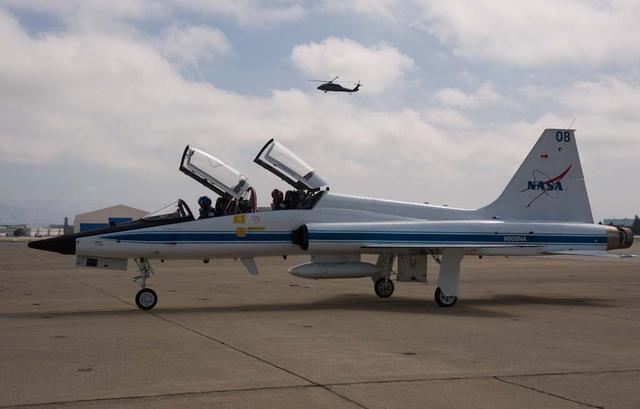
STS-135 Space Shuttle's final crew of Astronauts Ferguson, Hurley, Magnus and Walheim visit Ames for a mission/project briefing and with a meet and greet of Ames personnel, arrival in t-38 trainers
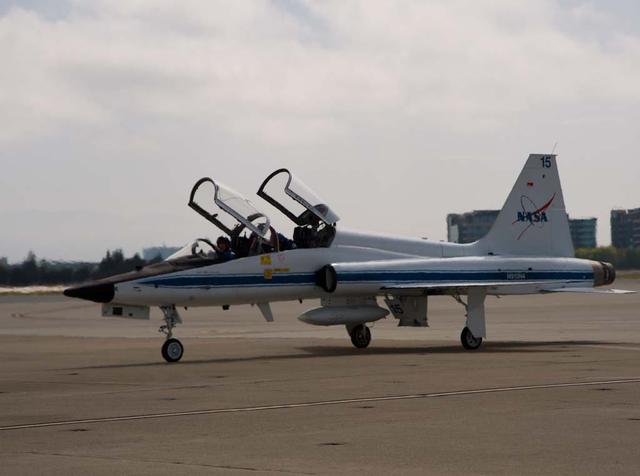
STS-135 Space Shuttle's final crew of Astronauts Ferguson, Hurley, Magnus and Walheim visit Ames for a mission/project briefing and with a meet and greet of Ames personnel, arrival in t-38 trainers
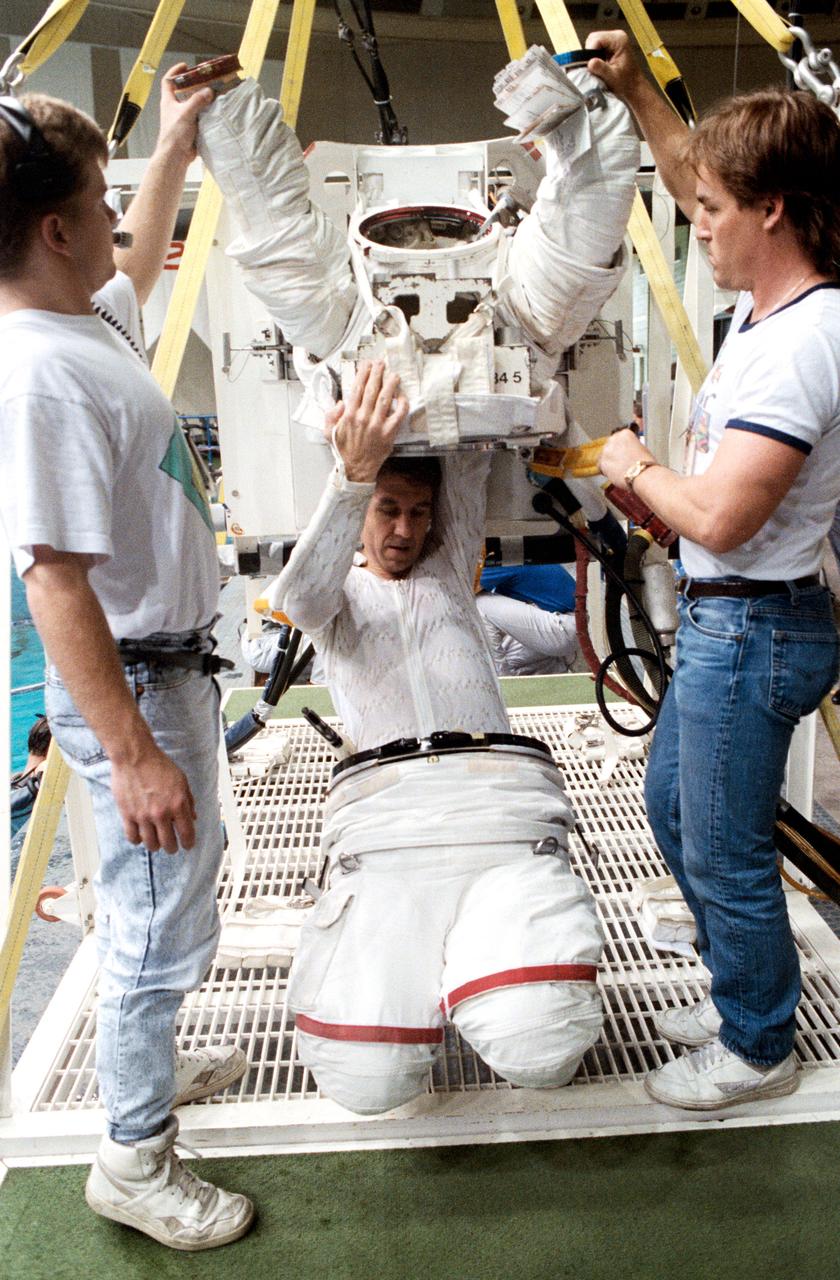
STS-38 Mission Specialist (MS) Robert C. Springer dons extravehicular mobility unit (EMU) upper torso with technicians' assistance in JSC's Weightless Environment Training Facility (WETF) Bldg 29. Positioned on the WETF platform at pool side, Springer is preparing for an underwater extravehicular activity (EVA) simulation. During the training session, Springer will rehearse contingency EVA procedures for the STS-38 mission aboard Atlantis, Orbiter Vehicle (OV) 104.
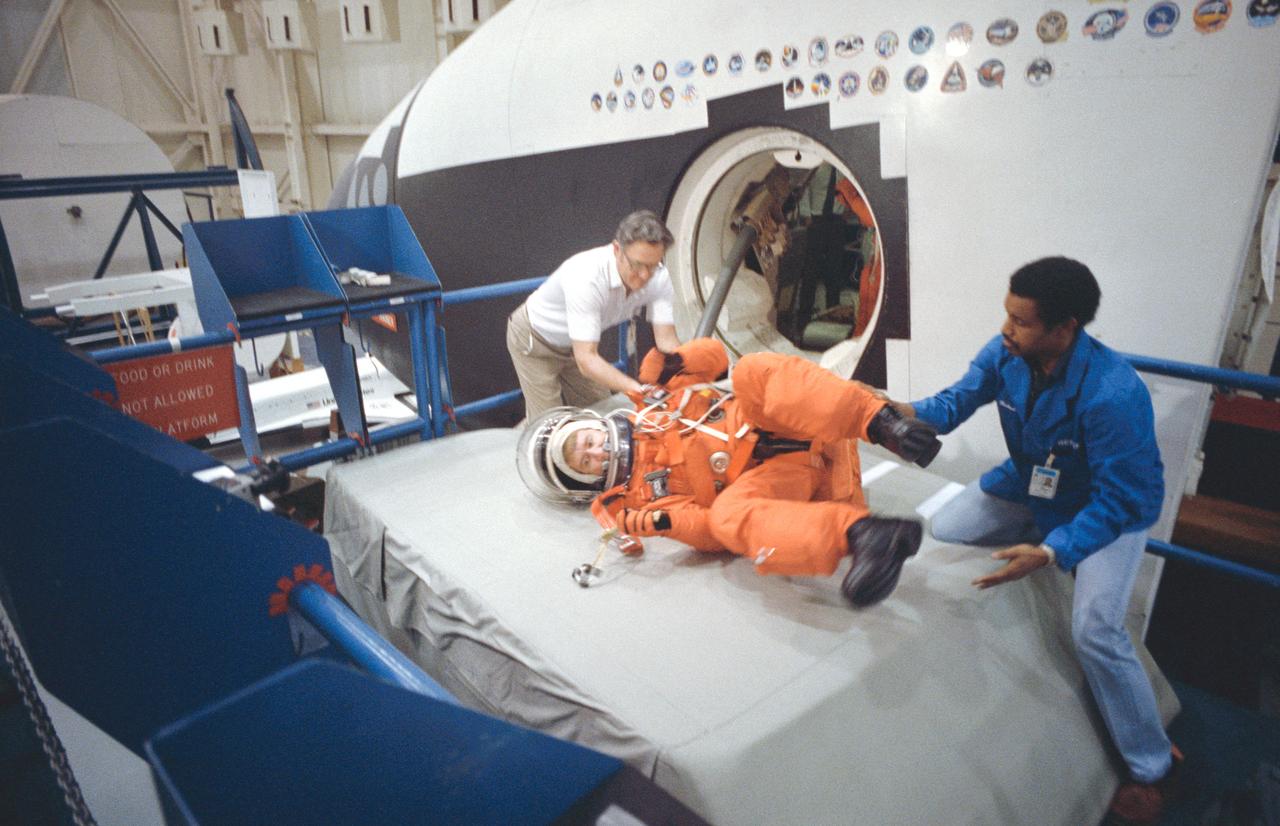
STS-38 Pilot Frank L. Culbertson, wearing launch and entry suit (LES) and launch and entry helmet (LEH), rolls through the side hatch of the crew compartment trainer (CCT) located in JSC's Mockup and Integration Laboratory (MAIL) Bldg 9A. Assisted by technicians, Culbertson practices emergency egress through the side hatch using the crew escape system (CES) pole which extends out the side hatch. The inflated safety cushion breaks Culbertson's fall as he rolls out of the side hatch.
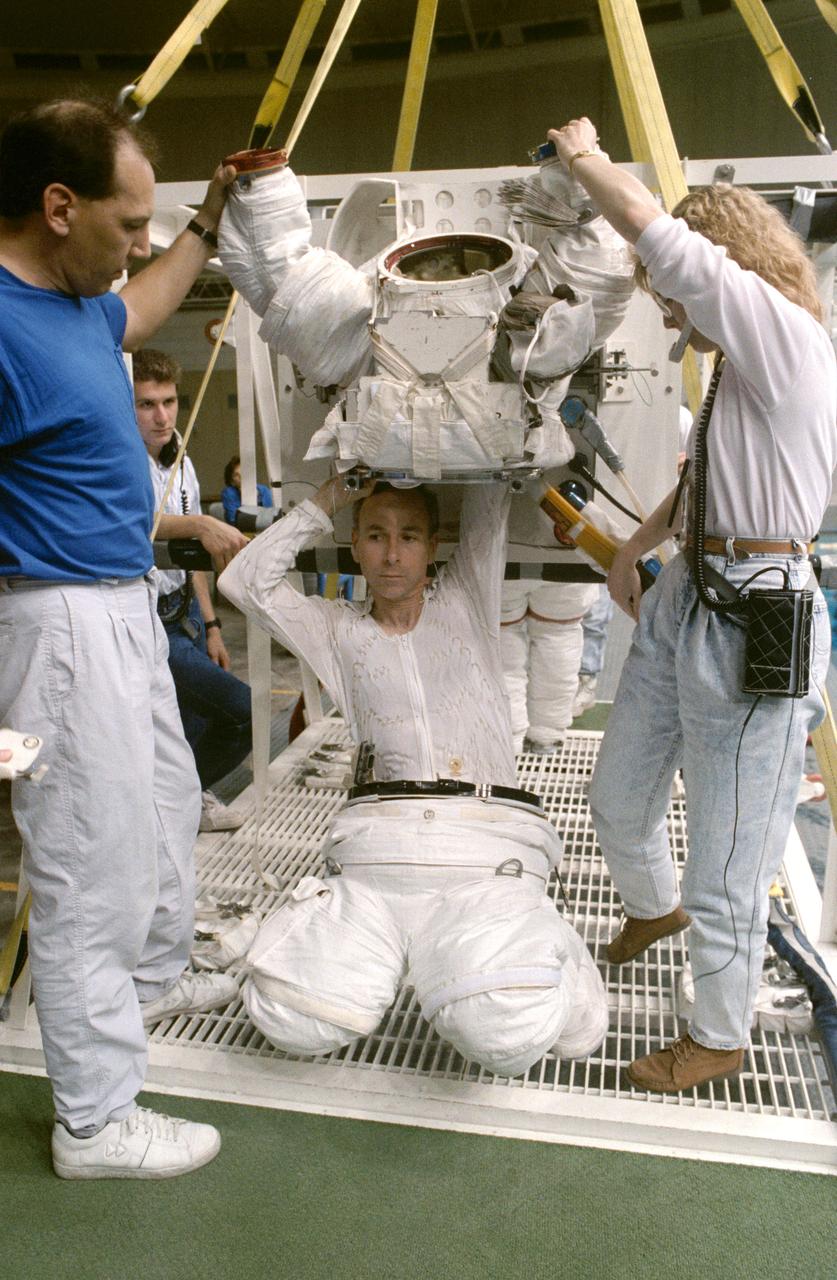
STS-38 Mission Specialist (MS) Carl J. Meade, wearing liquid cooling and ventilation garment (LCVG) and extravehicular mobility unit (EMU) lower torso, crouches under EMU upper torso. Technicians extend the EMU sleeves as Meade reaches into upper torso during suit donning in JSC's Weightless Environment Training Facility (WETF) Bldg 29. Positioned on the WETF platform at pool side, Meade is preparing for an underwater extravehicular activity (EVA) simulation. During the training exercise, Meade will rehearse contingency EVA procedures for the STS-38 mission aboard Atlantis, Orbiter Vehicle (OV) 104.
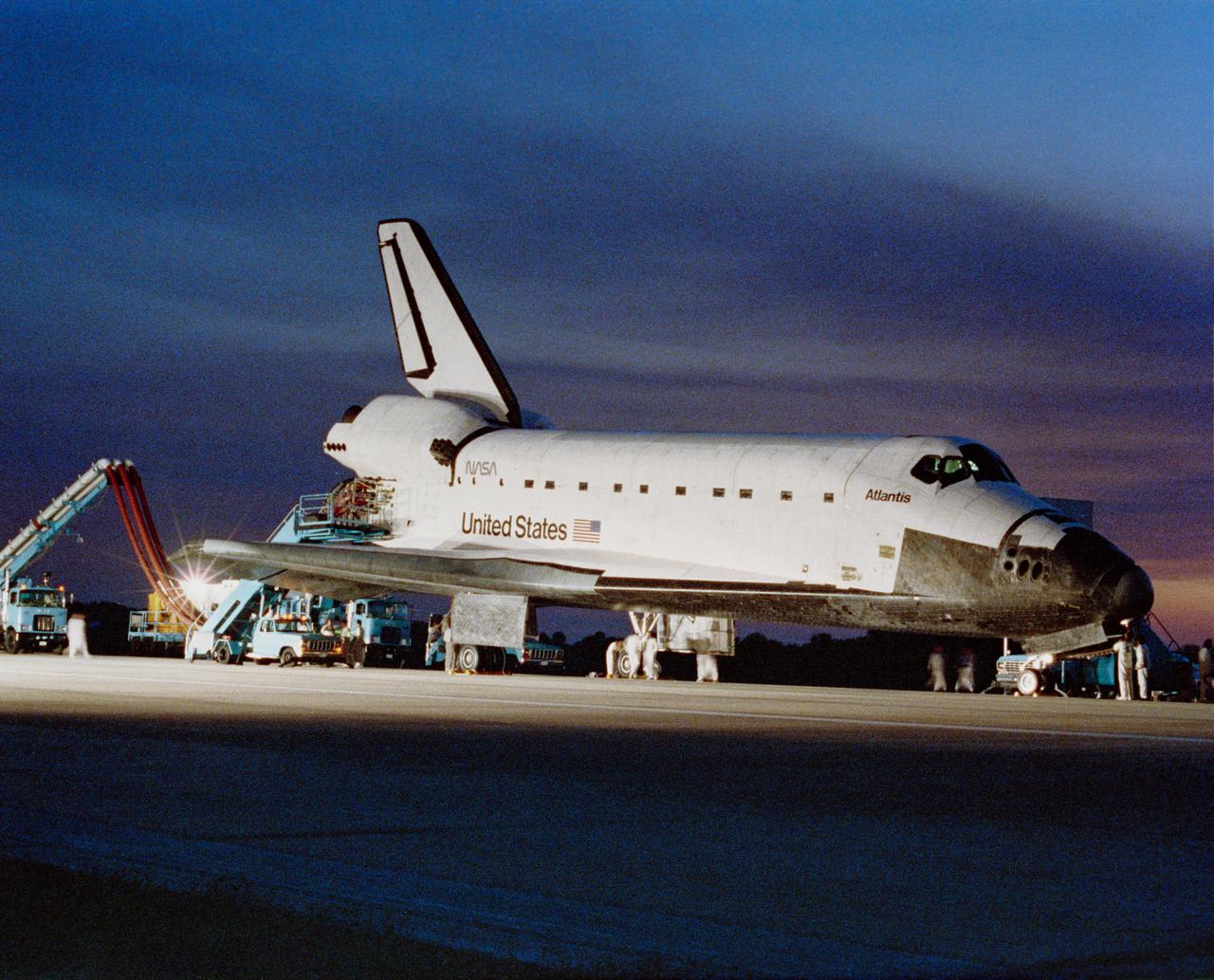
Spotlights illuminate Atlantis, Orbiter Vehicle (OV) 104, during safing operations at the Kennedy Space Center's (KSC's) Shuttle Landing Facility (SLF). OV-104 parked on runway 33 is serviced by KSC ground crews. STS-38, a Department of Defense (DOD)-devoted mission, came to an end (with complete wheel stop) at 4:43:37 pm (Eastern Standard Time (EST)).
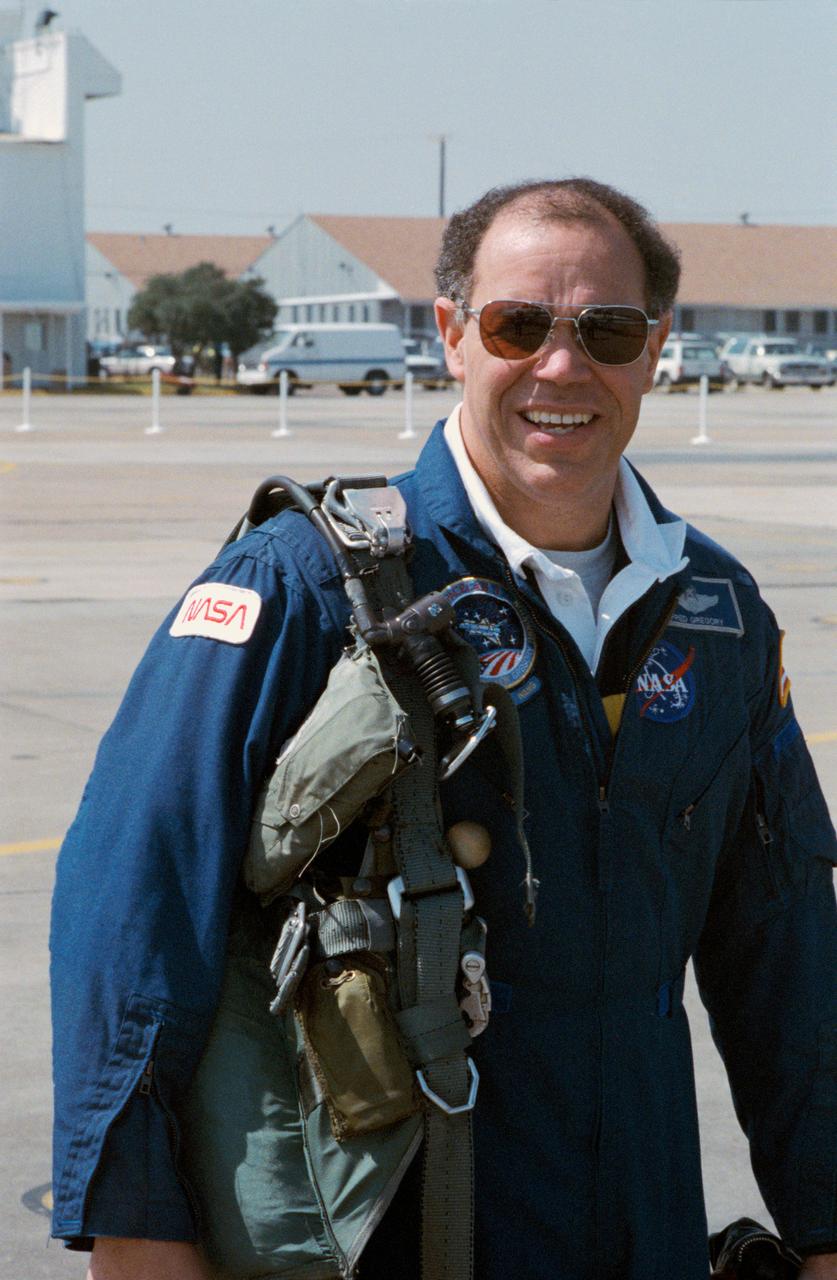
STS029-S-001 (10 March 1989) --- Astronaut Frederick Gregory, STS-33 mission commander, prepares to climb aboard a NASA T-38 jet aircraft. He's part of a group of JSC personnel who, in various NASA aircraft, will accompany the flight crew en route to the Kennedy Space Center (KSC) launch facility. The second post-Challenger flight of Discovery is scheduled for a 8:07 a.m. (EST) launch on March 13, 1989.
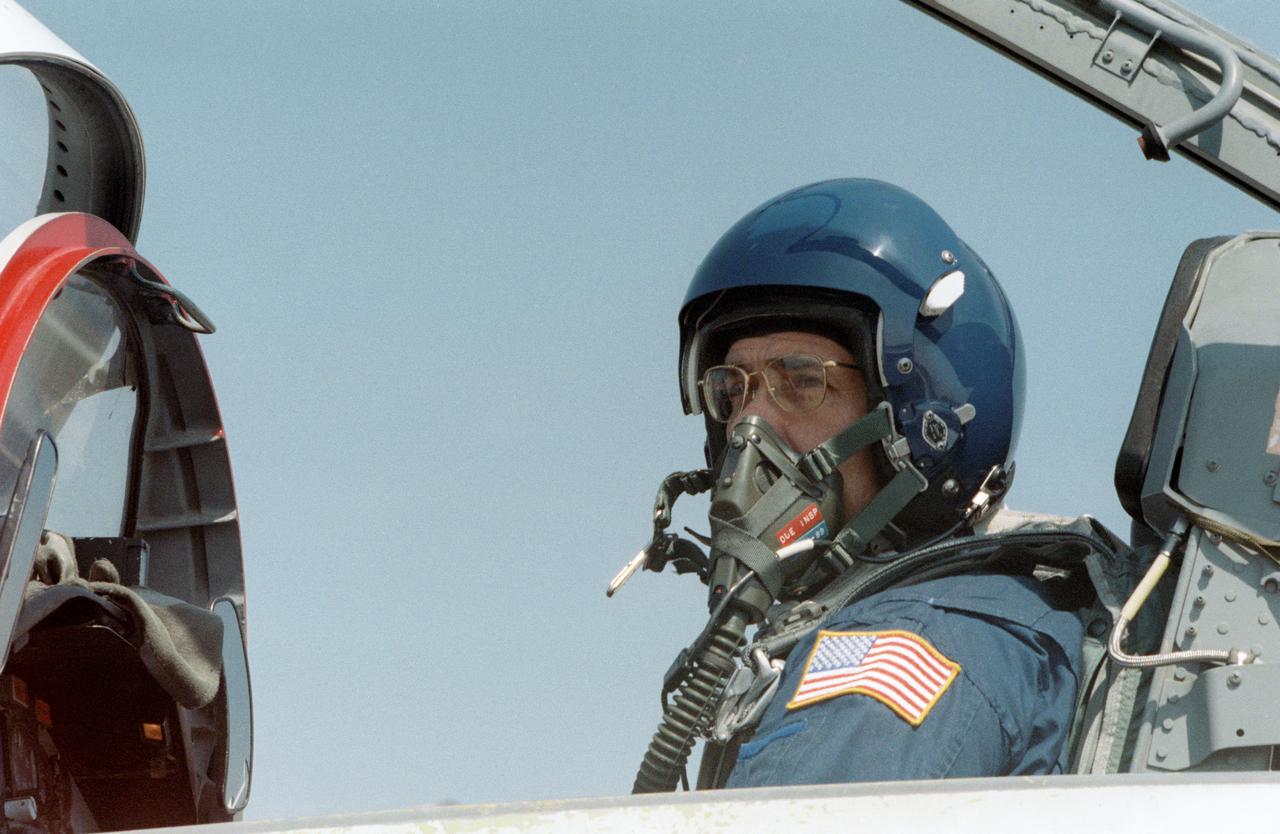
STS029–S-002 (10 March 1989) --- Astronaut Frederick Gregory, STS-33 mission commander, prepares to fly to Florida in a NASA T-38 jet aircraft. He's part of a group of JSC personnel in various NASA aircraft, accompanying the flight crew en route to the Kennedy Space Center launch facility. The second post-Challenger flight of Discovery is scheduled for a 8:07 a.m. (EST) launch on March 13.
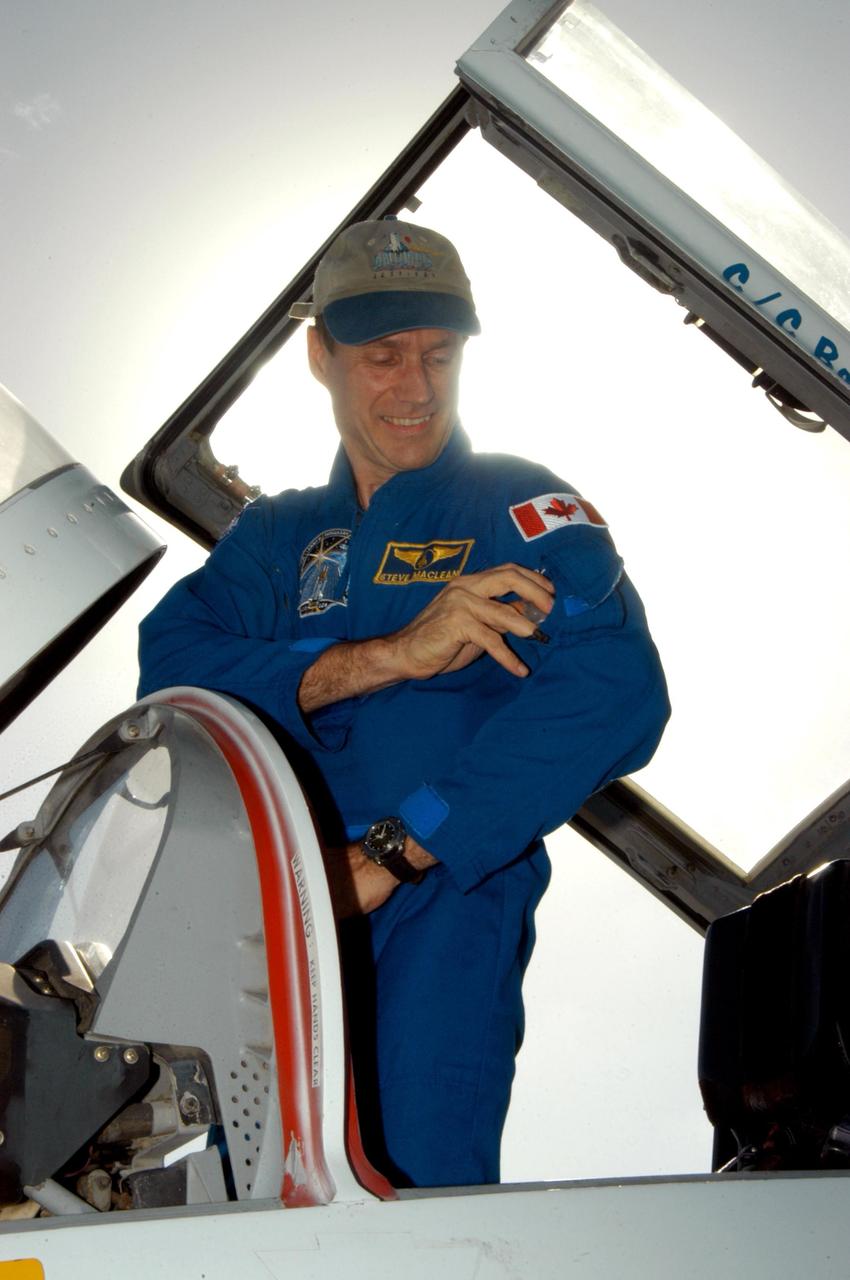
KENNEDY SPACE CENTER, FLA. - STS-115 Mission Specialist arrives at KSC's Shuttle Landing Facility aboard a T-38 jet aircraft. The STS-115 crew has flown to NASA's Kennedy Space Center to take part in Terminal Countdown Demonstration Test activities. The TCDT is a pre-launch preparation that includes practicing emergency egress from the pad, driving an M-113 armored personnel carrier, and simulating the launch countdown. Launch of STS-115 is currently scheduled for Aug. 27. Photo credit: NASA/George Shelton
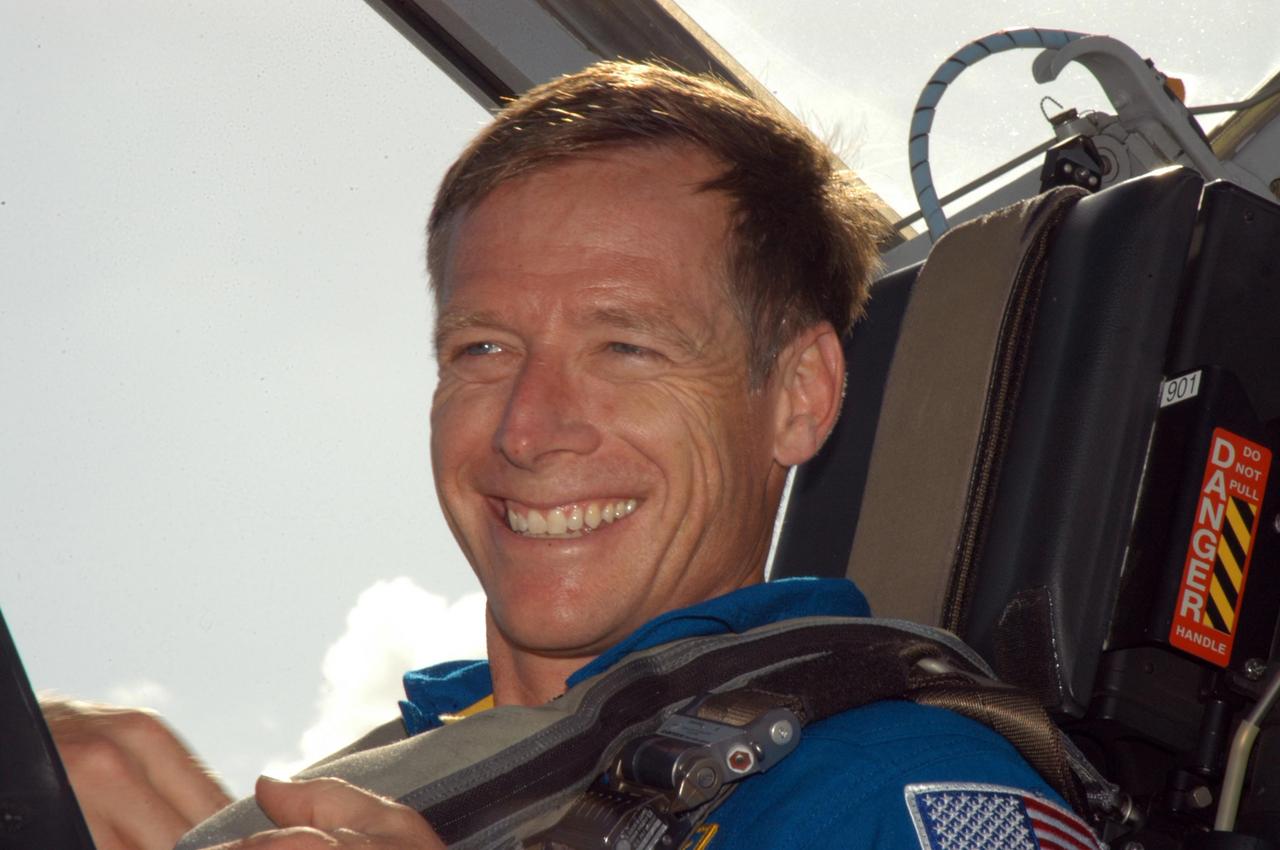
KENNEDY SPACE CENTER, FLA. - STS-115 Pilot Christopher Ferguson arrives at KSC's Shuttle Landing Facility aboard a T-38 jet aircraft. The STS-115 crew has flown to NASA's Kennedy Space Center to take part in Terminal Countdown Demonstration Test activities. The TCDT is a pre-launch preparation that includes practicing emergency egress from the pad, driving an M-113 armored personnel carrier, and simulating the launch countdown. Launch of STS-115 is currently scheduled for Aug. 27. Photo credit: NASA/George Shelton
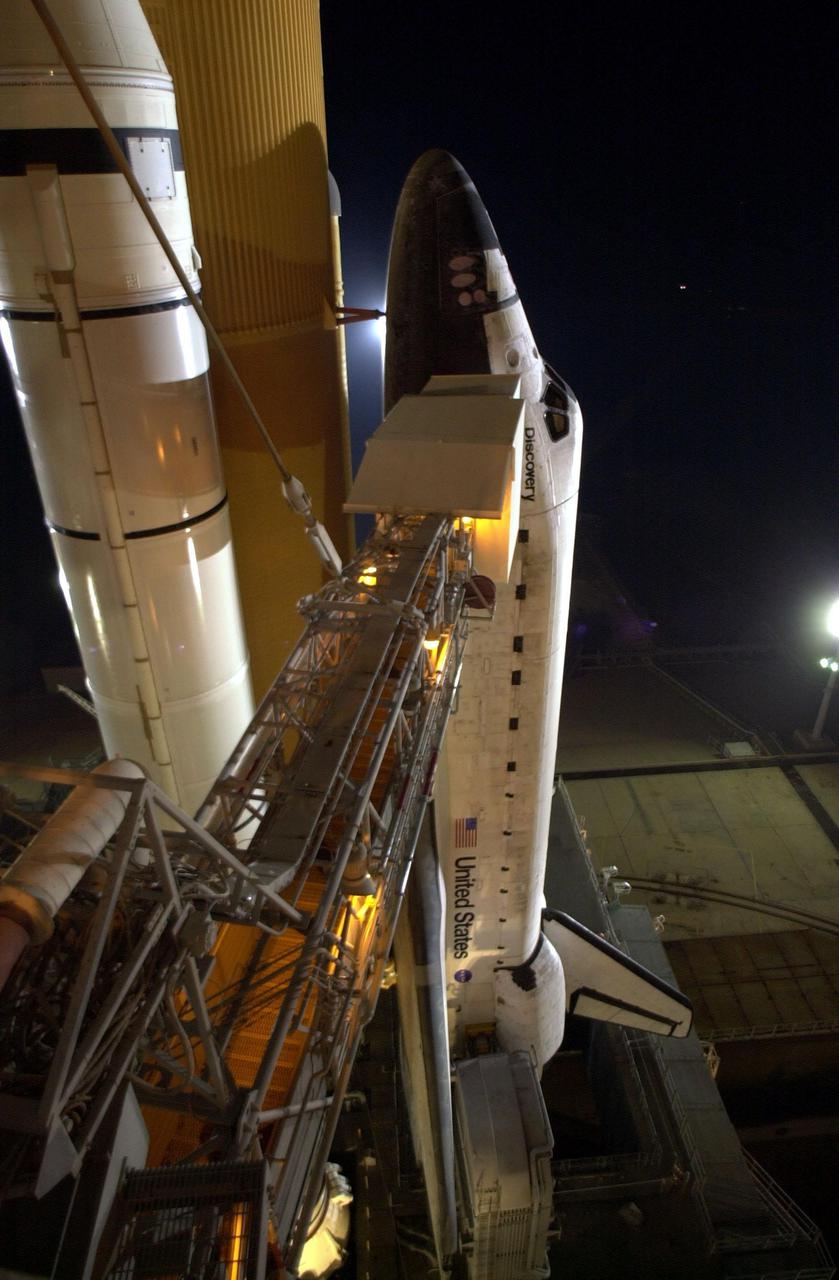
KENNEDY SPACE CENTER, Fla. -- Lights surrounding Launch Pad 39A create shadows from Space Shuttle Discovery after rollback of the Rotating Service Structure. Seen extending to the orbiter is the orbiter access arm, ending at the White Room, an environmental chamber that mates with the orbiter and allows personnel to enter the crew compartment. On mission STS-105, Discovery will be transporting the Expedition Three crew and several payloads and scientific experiments to the ISS, including the Early Ammonia Servicer (EAS) tank. The EAS, which will support the thermal control subsystems until a permanent system is activated, will be attached to the Station during two spacewalks. The three-member Expedition Two crew will be returning to Earth aboard Discovery after a five-month stay on the Station. Launch is scheduled for 5:38 p.m. EDT Aug. 9
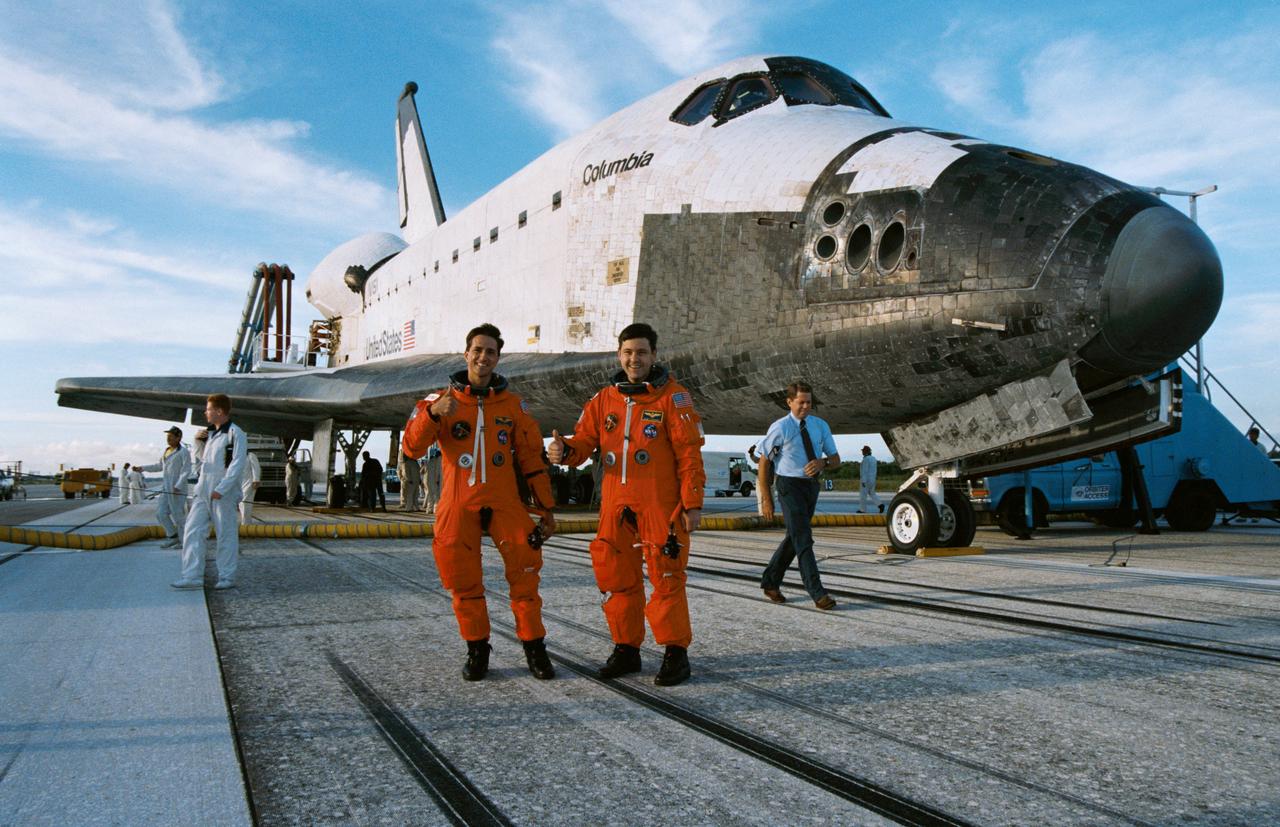
STS-65 Commander Robert D. Cabana (right) and Mission Specialist Donald A. Thomas, wearing launch and entry suits (LESs), signal mission success with a "thumbs up" gesture as they stand in front of Columbia, Orbiter Vehicle (OV) 102. The two crewmembers are all smiles after OV-102's landing at the Kennedy Space Center (KSC) Shuttle Landing Facility (SLF). The two, along with four other NASA astronauts and a Japanese payload specialist, had just broken a Shuttle duration record as they ran almost 18 hours over two weeks in space in support of the International Microgravity Laboratory 2 (IML-2) mission. Landing occurred at 6:38 am (Eastern Daylight Time (EDT)). Mission duration was 14 days, 17 hours and 56 minutes. In the background, KSC personnel conduct postflight servicing of the vehicle.
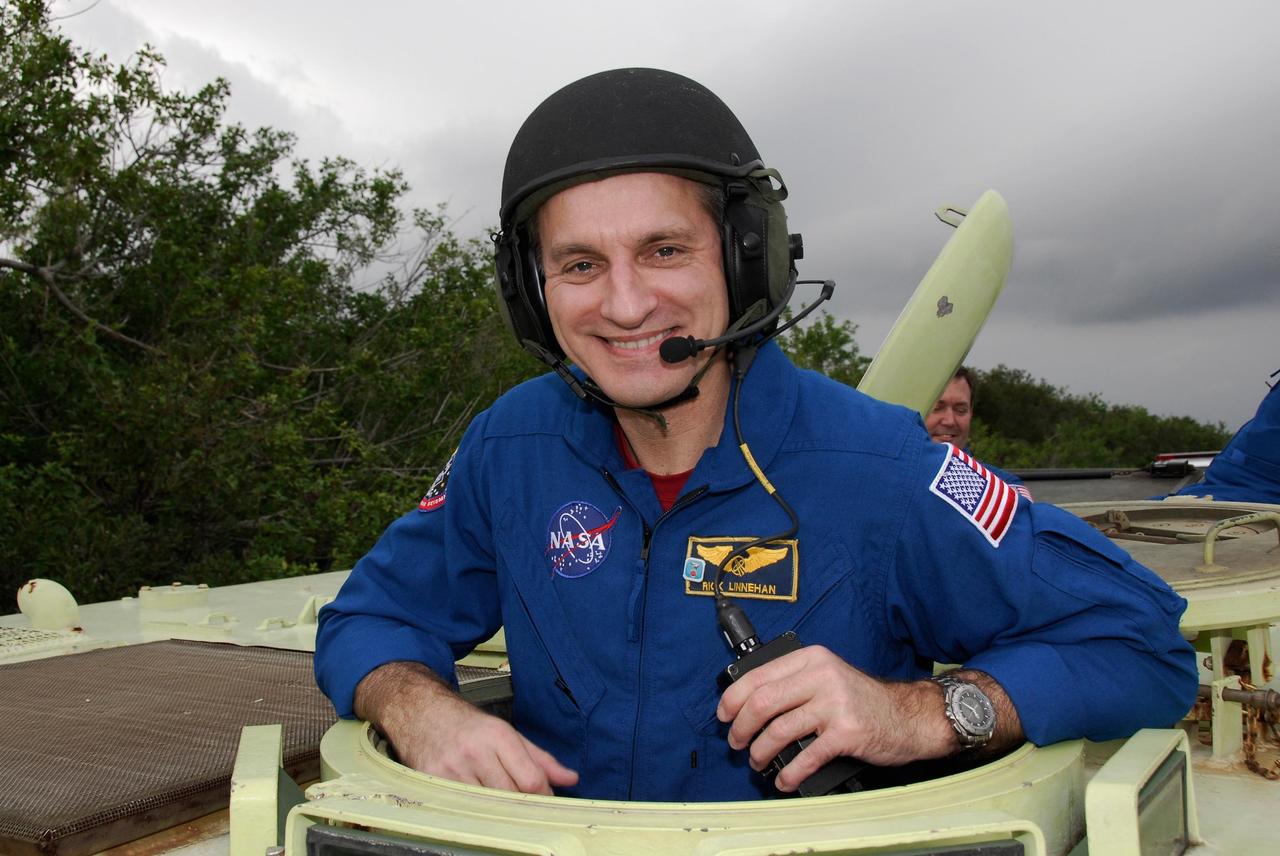
KENNEDY SPACE CENTER, FLA. -- At NASA Kennedy Space Center's Launch Complex 39, STS-123 Mission Specialist Rick Linnehan takes time out from driving practice of the M-113 armored personnel carrier to pose for a photo. The crew members of space shuttle Endeavour's STS-123 mission will each practice driving the M-113 in turn as part of his training on emergency egress procedures. An M-113 will be available to transport the crew to safety in the event of a contingency on the pad before their launch. The STS-123 crew is at Kennedy for a full launch dress rehearsal, known as the terminal countdown demonstration test or TCDT. Endeavour's seven astronauts arrived at Kennedy's Shuttle Landing Facility in their T-38 training aircraft between 10:45 and 10:58 a.m. EST. The terminal countdown demonstration test provides astronauts and ground crews with an opportunity to participate in various simulated countdown activities, including equipment familiarization and emergency training. Endeavour is targeted to launch March 11 at 2:28 a.m. EDT on a 16-day mission to the International Space Station. On the mission, Endeavour and its crew will deliver the first section of the Japan Aerospace Exploration Agency's Kibo laboratory and the Canadian Space Agency's two-armed robotic system, Dextre. Photo credit: NASA/Kim Shiflett
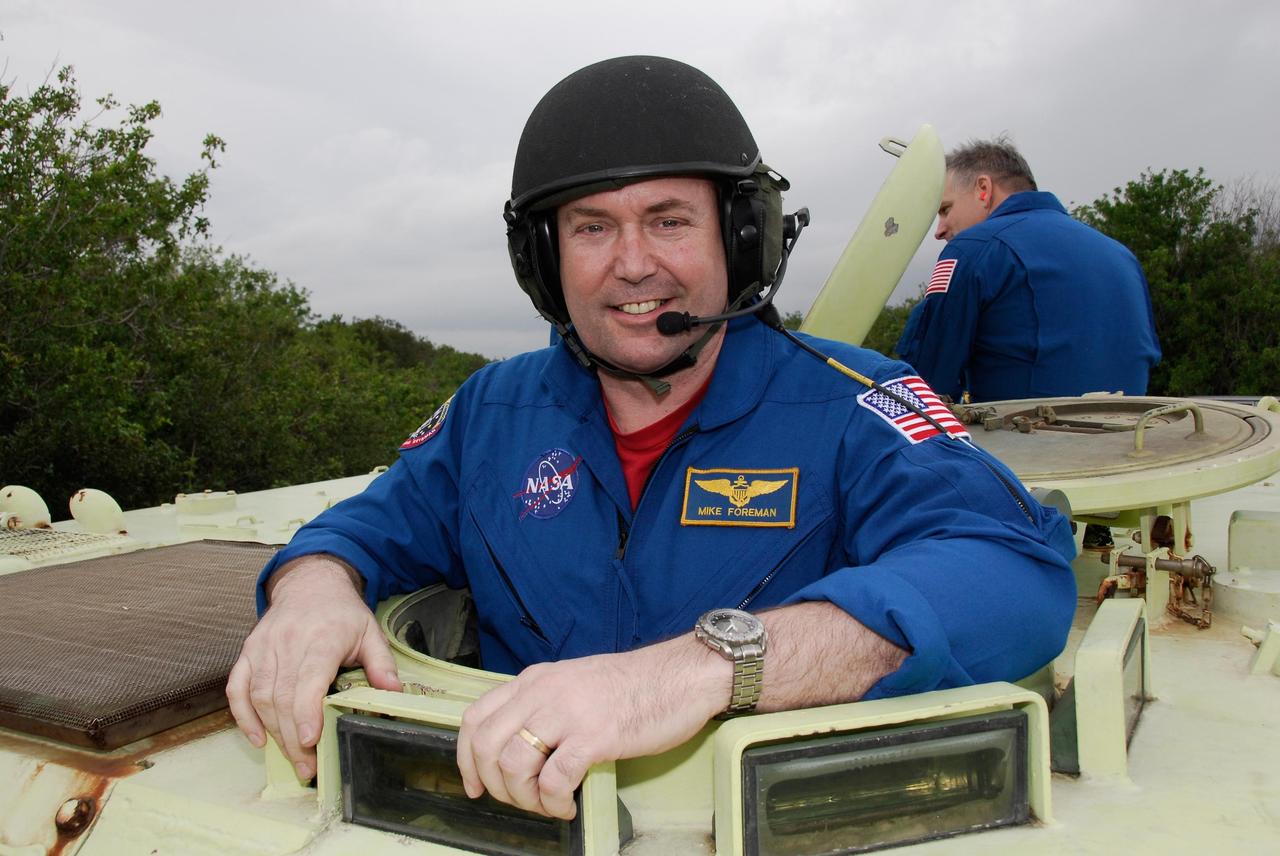
KENNEDY SPACE CENTER, FLA. -- At NASA Kennedy Space Center's Launch Complex 39, STS-123 Mission Specialist Mike Foreman takes time out from driving practice of the M-113 armored personnel carrier to pose for a photo. The crew members of space shuttle Endeavour's STS-123 mission will each practice driving the M-113 in turn as part of his training on emergency egress procedures. An M-113 will be available to transport the crew to safety in the event of a contingency on the pad before their launch. The STS-123 crew is at Kennedy for a full launch dress rehearsal, known as the terminal countdown demonstration test or TCDT. Endeavour's seven astronauts arrived at Kennedy's Shuttle Landing Facility in their T-38 training aircraft between 10:45 and 10:58 a.m. EST. The terminal countdown demonstration test provides astronauts and ground crews with an opportunity to participate in various simulated countdown activities, including equipment familiarization and emergency training. Endeavour is targeted to launch March 11 at 2:28 a.m. EDT on a 16-day mission to the International Space Station. On the mission, Endeavour and its crew will deliver the first section of the Japan Aerospace Exploration Agency's Kibo laboratory and the Canadian Space Agency's two-armed robotic system, Dextre. Photo credit: NASA/Kim Shiflett
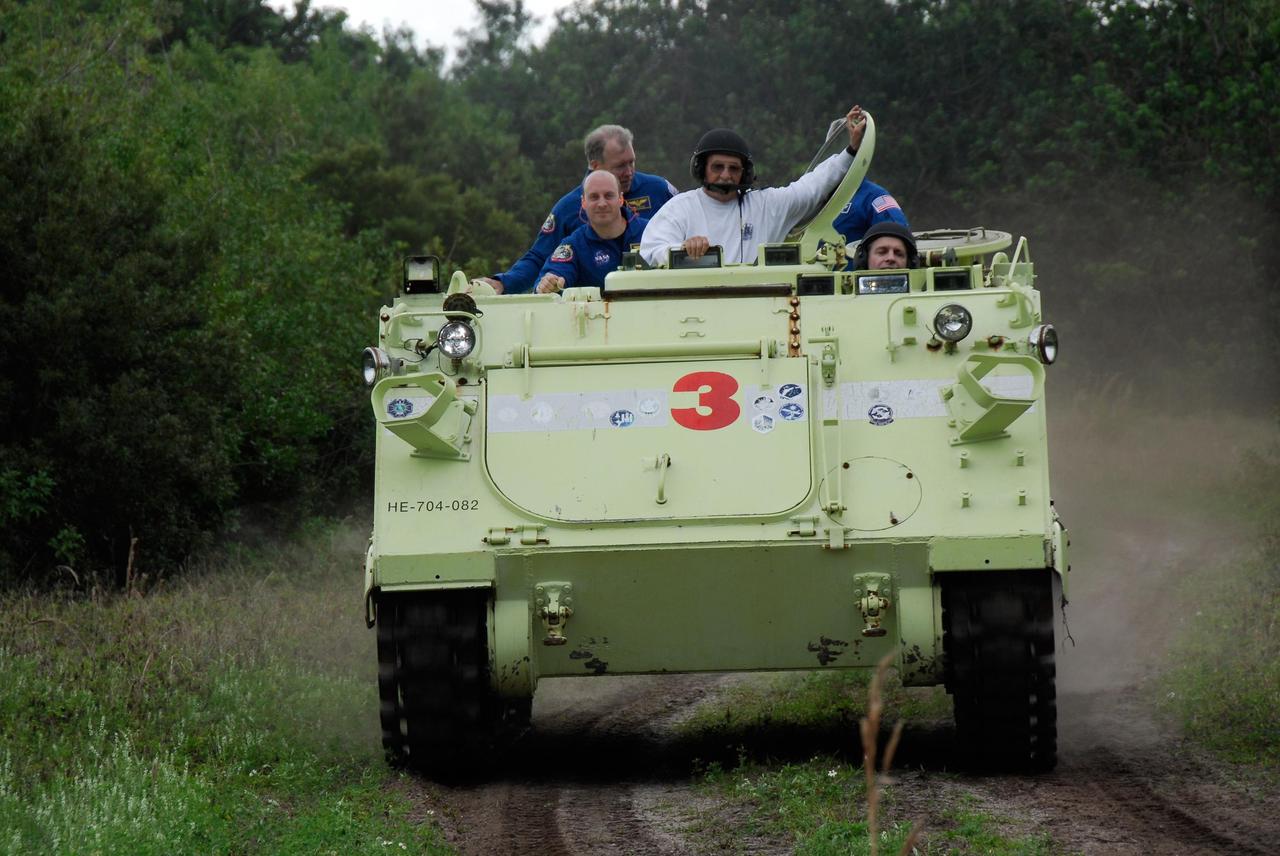
KENNEDY SPACE CENTER, FLA. -- At NASA Kennedy Space Center's Launch Complex 39, astronaut rescue team leader Capt. George Hoggard, in the white sweatshirt, instructs members of the crew for space shuttle Endeavour's STS-123 mission on the operation of an M-113 armored personnel carrier. The crew members of space shuttle Endeavour's STS-123 mission will each practice driving the M-113 in turn as part of his training on emergency egress procedures. An M-113 will be available to transport the crew to safety in the event of a contingency on the pad before their launch. The STS-123 crew is at Kennedy for a full launch dress rehearsal, known as the terminal countdown demonstration test or TCDT. Endeavour's seven astronauts arrived at Kennedy's Shuttle Landing Facility in their T-38 training aircraft between 10:45 and 10:58 a.m. EST. The terminal countdown demonstration test provides astronauts and ground crews with an opportunity to participate in various simulated countdown activities, including equipment familiarization and emergency training. Endeavour is targeted to launch March 11 at 2:28 a.m. EDT on a 16-day mission to the International Space Station. On the mission, Endeavour and its crew will deliver the first section of the Japan Aerospace Exploration Agency's Kibo laboratory and the Canadian Space Agency's two-armed robotic system, Dextre. Photo credit: NASA/Kim Shiflett
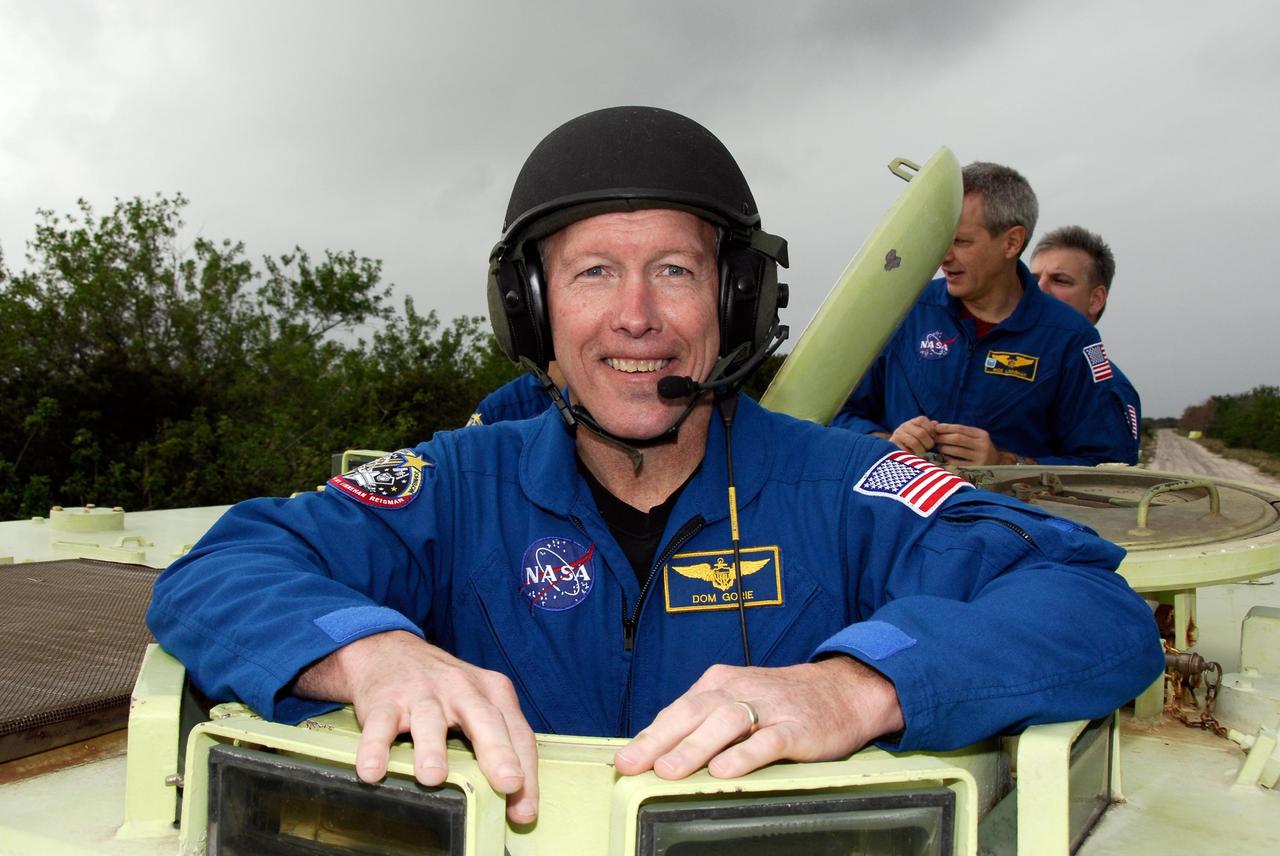
KENNEDY SPACE CENTER, FLA. -- At NASA Kennedy Space Center's Launch Complex 39, STS-123 Commander Dominic Gorie takes time out from driving practice of the M-113 armored personnel carrier to pose for a photo. The crew members of space shuttle Endeavour's STS-123 mission will each practice driving the M-113 in turn as part of his training on emergency egress procedures. An M-113 will be available to transport the crew to safety in the event of a contingency on the pad before their launch. The STS-123 crew is at Kennedy for a full launch dress rehearsal, known as the terminal countdown demonstration test or TCDT. Endeavour's seven astronauts arrived at Kennedy's Shuttle Landing Facility in their T-38 training aircraft between 10:45 and 10:58 a.m. EST. The terminal countdown demonstration test provides astronauts and ground crews with an opportunity to participate in various simulated countdown activities, including equipment familiarization and emergency training. Endeavour is targeted to launch March 11 at 2:28 a.m. EDT on a 16-day mission to the International Space Station. On the mission, Endeavour and its crew will deliver the first section of the Japan Aerospace Exploration Agency's Kibo laboratory and the Canadian Space Agency's two-armed robotic system, Dextre. Photo credit: NASA/Kim Shiflett
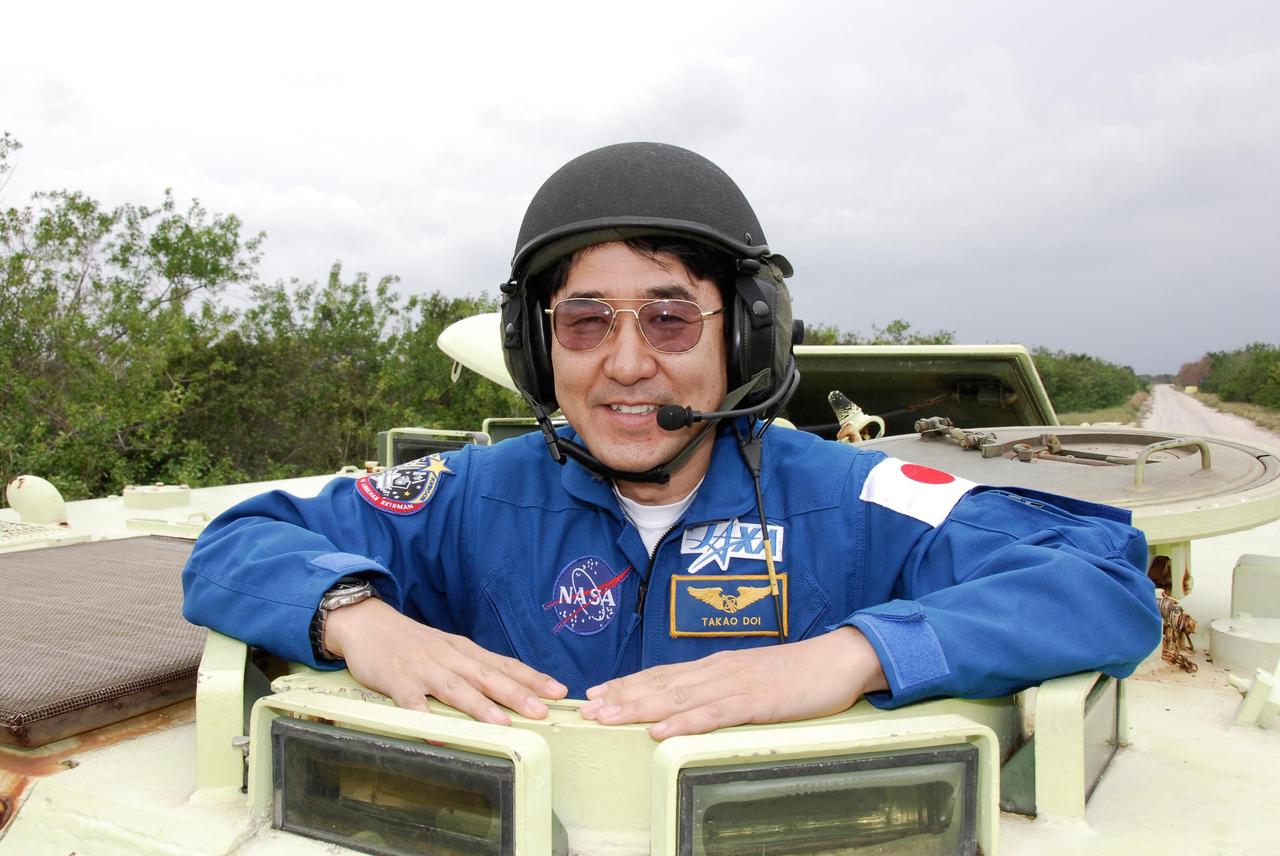
KENNEDY SPACE CENTER, FLA. -- At NASA Kennedy Space Center's Launch Complex 39, STS-123 Mission Specialist Takao Doi of the Japan Aerospace Exploration Agency takes time out from driving practice of the M-113 armored personnel carrier to pose for a photo. The crew members of space shuttle Endeavour's STS-123 mission will each practice driving the M-113 in turn as part of his training on emergency egress procedures. An M-113 will be available to transport the crew to safety in the event of a contingency on the pad before their launch. The STS-123 crew is at Kennedy for a full launch dress rehearsal, known as the terminal countdown demonstration test or TCDT. Endeavour's seven astronauts arrived at Kennedy's Shuttle Landing Facility in their T-38 training aircraft between 10:45 and 10:58 a.m. EST. The terminal countdown demonstration test provides astronauts and ground crews with an opportunity to participate in various simulated countdown activities, including equipment familiarization and emergency training. Endeavour is targeted to launch March 11 at 2:28 a.m. EDT on a 16-day mission to the International Space Station. On the mission, Endeavour and its crew will deliver the first section of the Japan Aerospace Exploration Agency's Kibo laboratory and the Canadian Space Agency's two-armed robotic system, Dextre. Photo credit: NASA/Kim Shiflett

KENNEDY SPACE CENTER, FLA. -- At NASA Kennedy Space Center's Launch Complex 39, STS-123 Mission Specialist Robert L. Behnken takes time out from driving practice of the M-113 armored personnel carrier to pose for a photo. The crew members of space shuttle Endeavour's STS-123 mission will each practice driving the M-113 in turn as part of his training on emergency egress procedures. An M-113 will be available to transport the crew to safety in the event of a contingency on the pad before their launch. The STS-123 crew is at Kennedy for a full launch dress rehearsal, known as the terminal countdown demonstration test or TCDT. Endeavour's seven astronauts arrived at Kennedy's Shuttle Landing Facility in their T-38 training aircraft between 10:45 and 10:58 a.m. EST. The terminal countdown demonstration test provides astronauts and ground crews with an opportunity to participate in various simulated countdown activities, including equipment familiarization and emergency training. Endeavour is targeted to launch March 11 at 2:28 a.m. EDT on a 16-day mission to the International Space Station. On the mission, Endeavour and its crew will deliver the first section of the Japan Aerospace Exploration Agency's Kibo laboratory and the Canadian Space Agency's two-armed robotic system, Dextre. Photo credit: NASA/Kim Shiflett
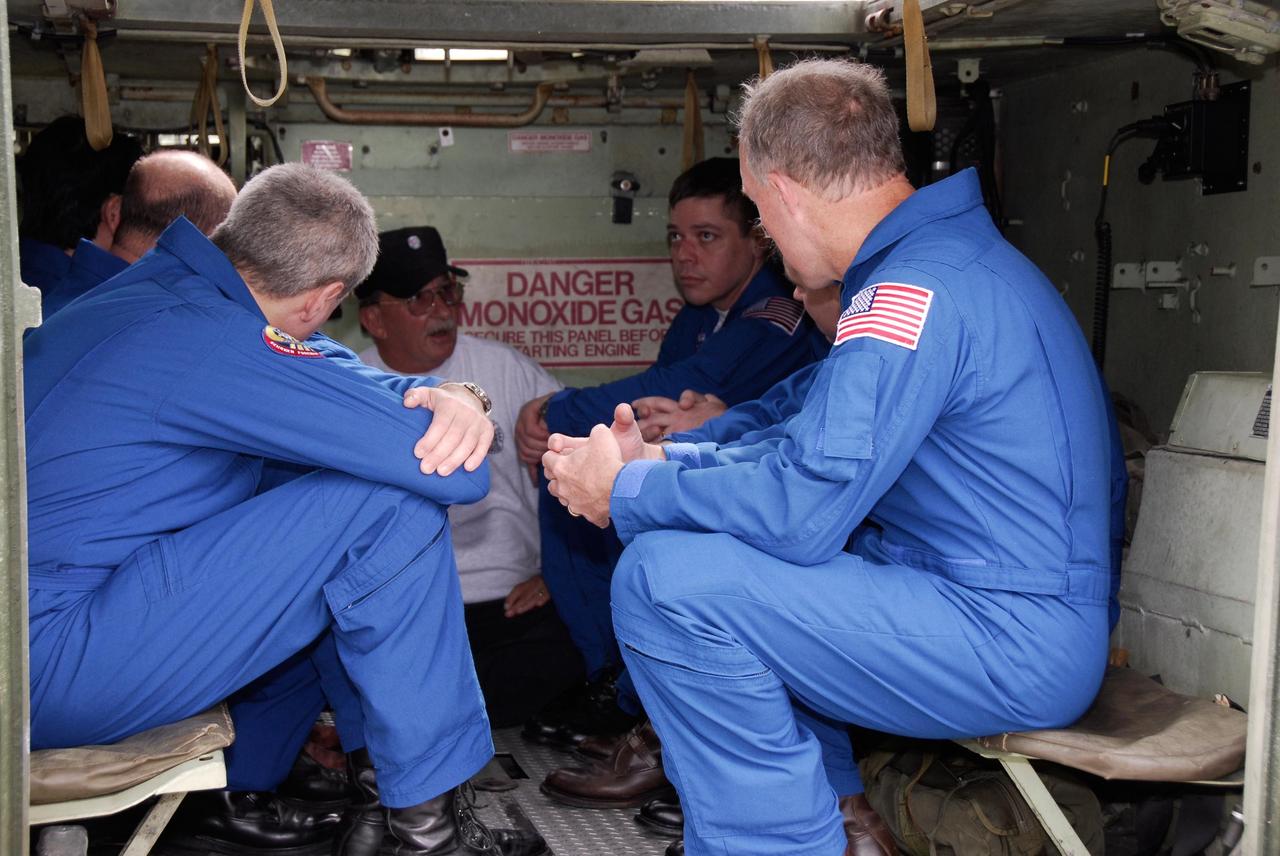
KENNEDY SPACE CENTER, FLA. -- At NASA Kennedy Space Center's Launch Complex 39, STS-123 crew members are instructed on the use of the M-113 armored personnel carrier from Capt. George Hoggard, astronaut rescue team leader. The crew members of space shuttle Endeavour's STS-123 mission will each practice driving the M-113 in turn as part of his training on emergency egress procedures. An M-113 will be available to transport the crew to safety in the event of a contingency on the pad before their launch. The STS-123 crew is at Kennedy for a full launch dress rehearsal, known as the terminal countdown demonstration test or TCDT. Endeavour's seven astronauts arrived at Kennedy's Shuttle Landing Facility in their T-38 training aircraft between 10:45 and 10:58 a.m. EST. The terminal countdown demonstration test provides astronauts and ground crews with an opportunity to participate in various simulated countdown activities, including equipment familiarization and emergency training. Endeavour is targeted to launch March 11 at 2:28 a.m. EDT on a 16-day mission to the International Space Station. On the mission, Endeavour and its crew will deliver the first section of the Japan Aerospace Exploration Agency's Kibo laboratory and the Canadian Space Agency's two-armed robotic system, Dextre. Photo credit: NASA/Kim Shiflett
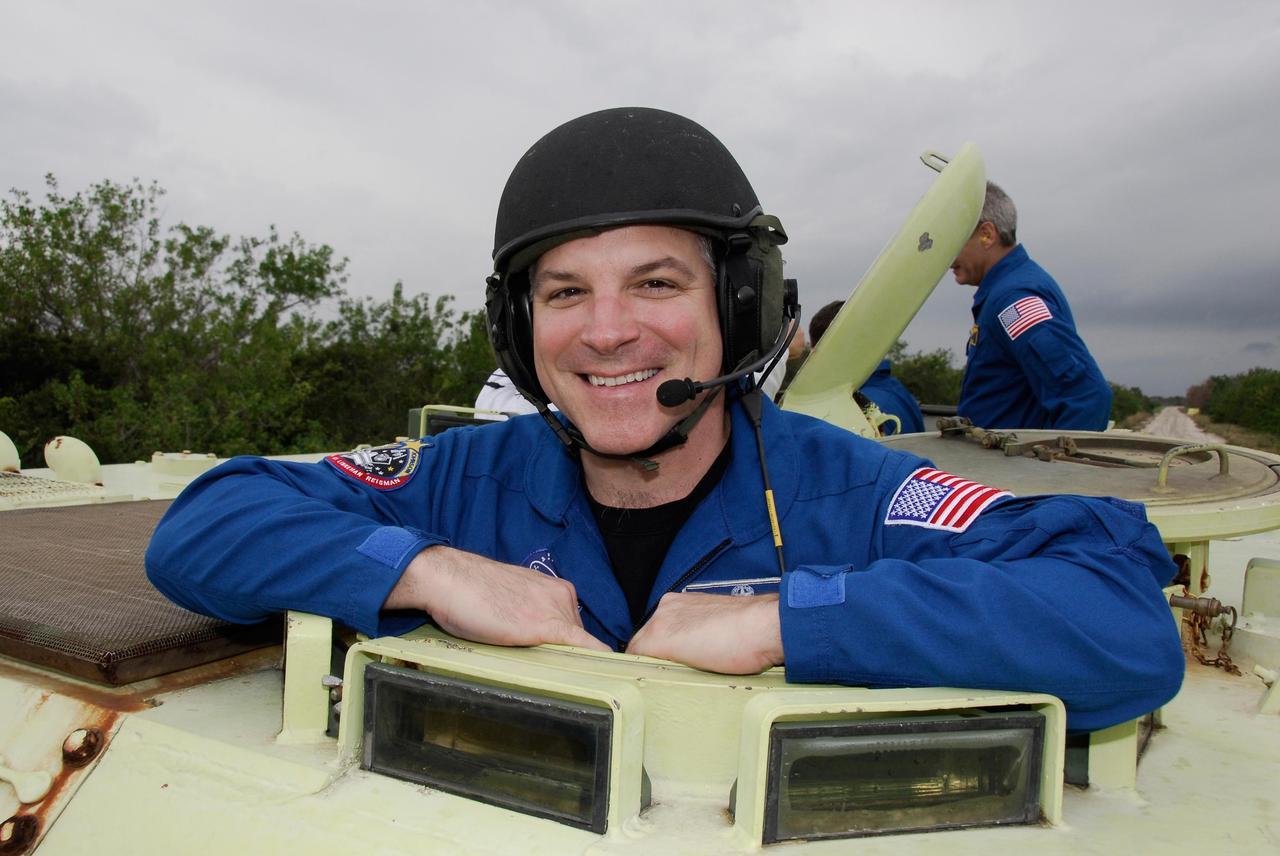
KENNEDY SPACE CENTER, FLA. -- At NASA Kennedy Space Center's Launch Complex 39, STS-123 Pilot Gregory H. Johnson takes time out from driving practice of the M-113 armored personnel carrier to pose for a photo. The crew members of space shuttle Endeavour's STS-123 mission will each practice driving the M-113 in turn as part of his training on emergency egress procedures. An M-113 will be available to transport the crew to safety in the event of a contingency on the pad before their launch. The STS-123 crew is at Kennedy for a full launch dress rehearsal, known as the terminal countdown demonstration test or TCDT. Endeavour's seven astronauts arrived at Kennedy's Shuttle Landing Facility in their T-38 training aircraft between 10:45 and 10:58 a.m. EST. The terminal countdown demonstration test provides astronauts and ground crews with an opportunity to participate in various simulated countdown activities, including equipment familiarization and emergency training. Endeavour is targeted to launch March 11 at 2:28 a.m. EDT on a 16-day mission to the International Space Station. On the mission, Endeavour and its crew will deliver the first section of the Japan Aerospace Exploration Agency's Kibo laboratory and the Canadian Space Agency's two-armed robotic system, Dextre. Photo credit: NASA/Kim Shiflett
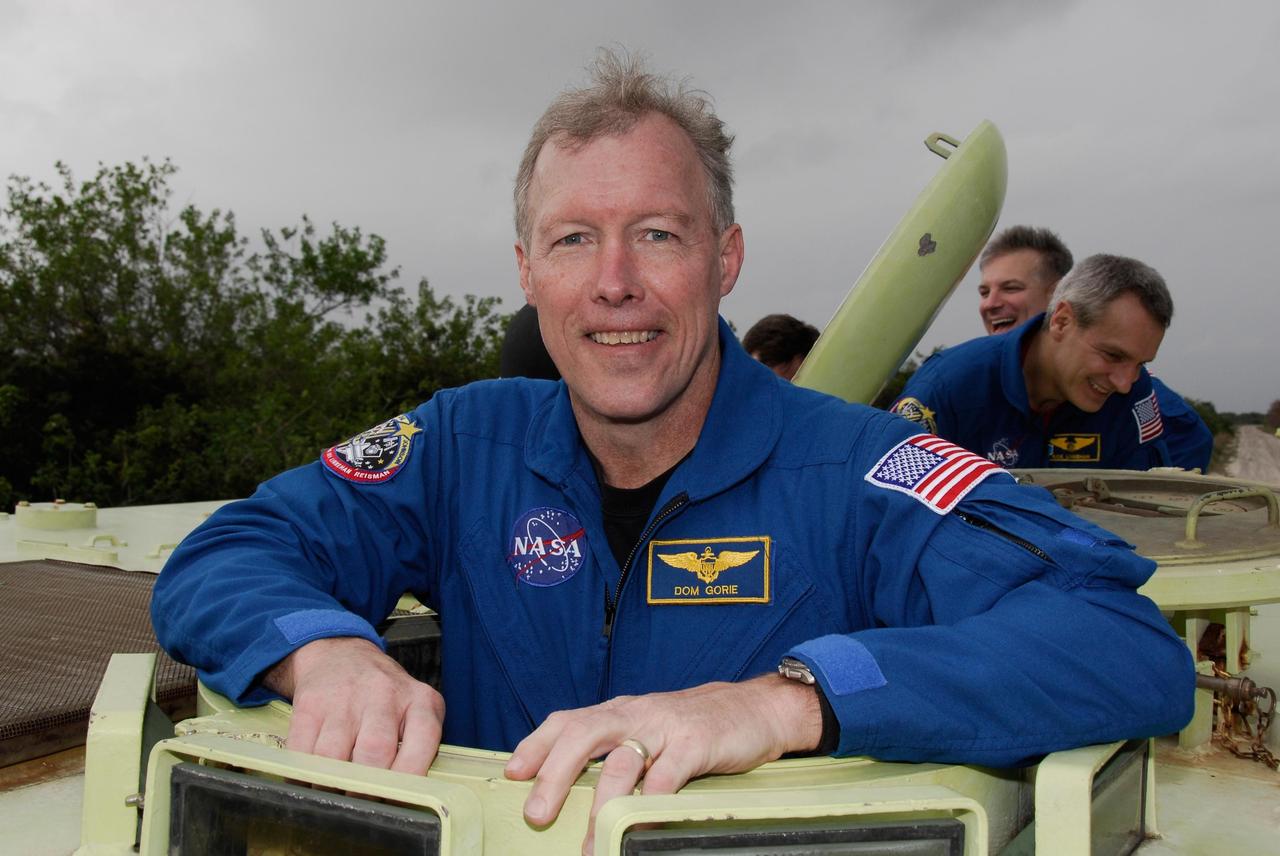
KENNEDY SPACE CENTER, FLA. -- At NASA Kennedy Space Center's Launch Complex 39, STS-123 Commander Dominic Gorie takes time out from driving practice of the M-113 armored personnel carrier to pose for a photo. The crew members of space shuttle Endeavour's STS-123 mission will each practice driving the M-113 in turn as part of his training on emergency egress procedures. An M-113 will be available to transport the crew to safety in the event of a contingency on the pad before their launch. The STS-123 crew is at Kennedy for a full launch dress rehearsal, known as the terminal countdown demonstration test or TCDT. Endeavour's seven astronauts arrived at Kennedy's Shuttle Landing Facility in their T-38 training aircraft between 10:45 and 10:58 a.m. EST. The terminal countdown demonstration test provides astronauts and ground crews with an opportunity to participate in various simulated countdown activities, including equipment familiarization and emergency training. Endeavour is targeted to launch March 11 at 2:28 a.m. EDT on a 16-day mission to the International Space Station. On the mission, Endeavour and its crew will deliver the first section of the Japan Aerospace Exploration Agency's Kibo laboratory and the Canadian Space Agency's two-armed robotic system, Dextre. Photo credit: NASA/Kim Shiflett
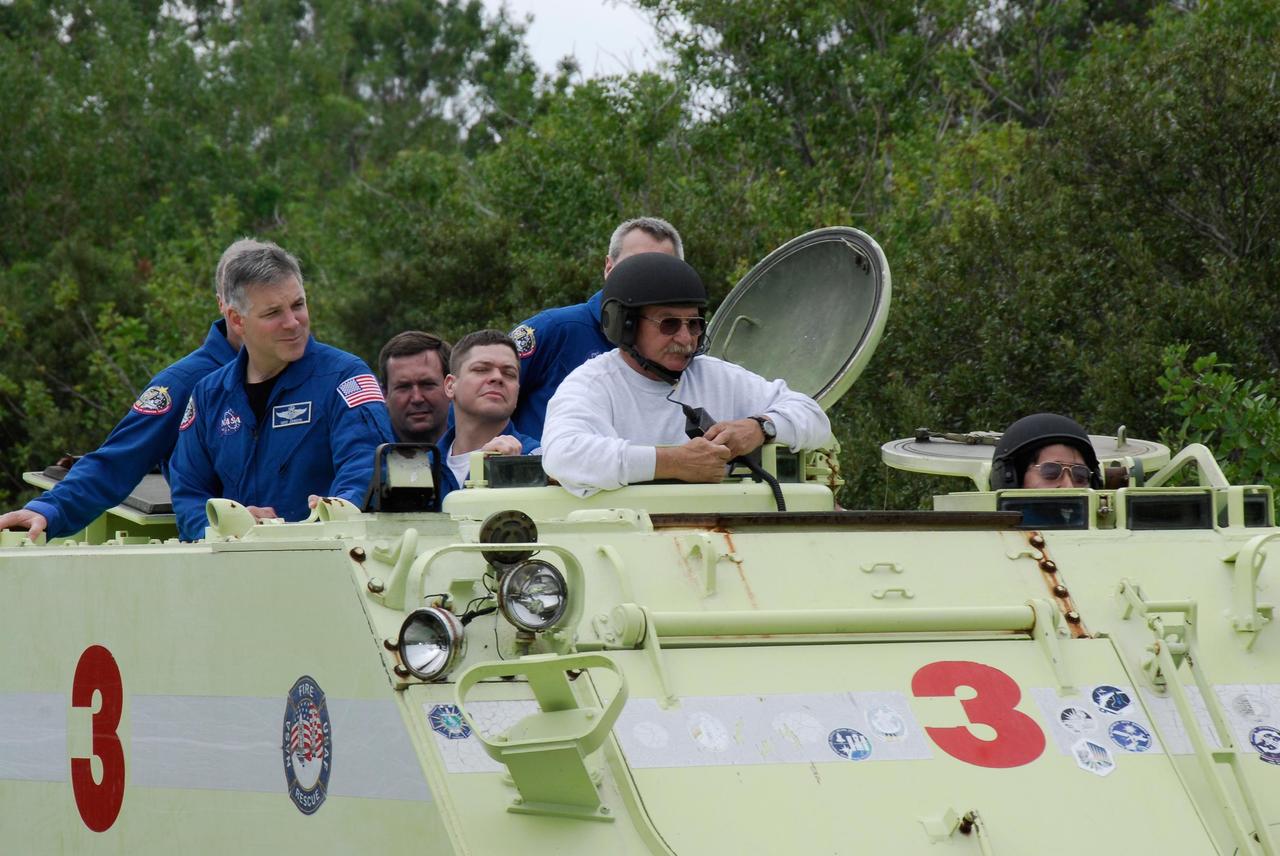
KENNEDY SPACE CENTER, FLA. -- At NASA Kennedy Space Center's Launch Complex 39, astronaut rescue team leader Capt. George Hoggard, in the white sweatshirt, instructs members of the crew for space shuttle Endeavour's STS-123 mission on the operation of an M-113 armored personnel carrier. Each member of the crew will practice driving the M-113 in turn as part of his training on emergency egress procedures. An M-113 will be available to transport the crew to safety in the event of a contingency on the pad before their launch. The STS-123 crew is at Kennedy for a full launch dress rehearsal, known as the terminal countdown demonstration test or TCDT. Endeavour's seven astronauts arrived at Kennedy's Shuttle Landing Facility in their T-38 training aircraft between 10:45 and 10:58 a.m. EST. The terminal countdown demonstration test provides astronauts and ground crews with an opportunity to participate in various simulated countdown activities, including equipment familiarization and emergency training. Endeavour is targeted to launch March 11 at 2:28 a.m. EDT on a 16-day mission to the International Space Station. On the mission, Endeavour and its crew will deliver the first section of the Japan Aerospace Exploration Agency's Kibo laboratory and the Canadian Space Agency's two-armed robotic system, Dextre. Photo credit: NASA/Kim Shiflett
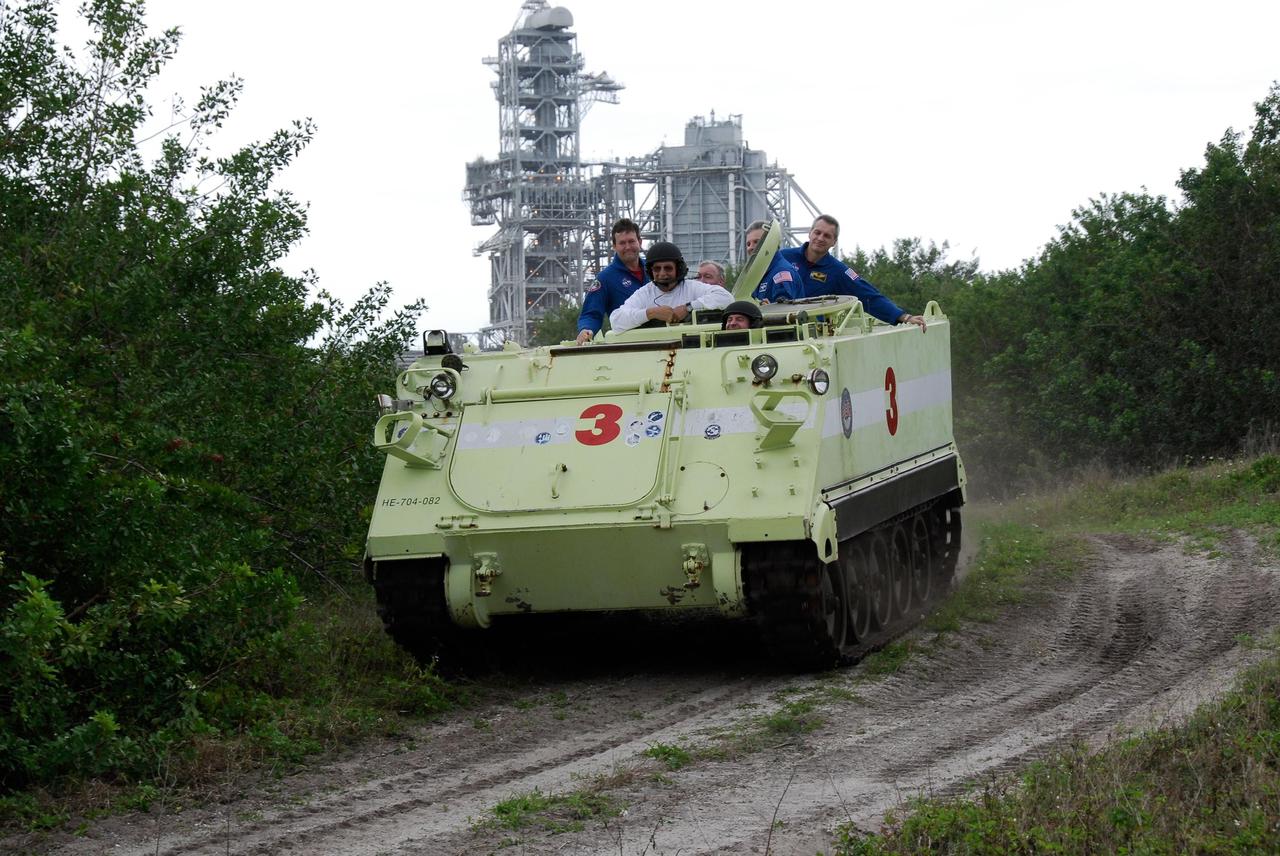
KENNEDY SPACE CENTER, FLA. -- At NASA Kennedy Space Center's Launch Complex 39, astronaut rescue team leader Capt. George Hoggard, in the white sweatshirt, instructs members of the crew for space shuttle Endeavour's STS-123 mission on the operation of an M-113 armored personnel carrier. The crew members will each practice driving the M-113 in turn as part of his training on emergency egress procedures. An M-113 will be available to transport the crew to safety in the event of a contingency on the pad before their launch. The STS-123 crew is at Kennedy for a full launch dress rehearsal, known as the terminal countdown demonstration test or TCDT. Endeavour's seven astronauts arrived at Kennedy's Shuttle Landing Facility in their T-38 training aircraft between 10:45 and 10:58 a.m. EST. The terminal countdown demonstration test provides astronauts and ground crews with an opportunity to participate in various simulated countdown activities, including equipment familiarization and emergency training. Endeavour is targeted to launch March 11 at 2:28 a.m. EDT on a 16-day mission to the International Space Station. On the mission, Endeavour and its crew will deliver the first section of the Japan Aerospace Exploration Agency's Kibo laboratory and the Canadian Space Agency's two-armed robotic system, Dextre. Photo credit: NASA/Kim Shiflett
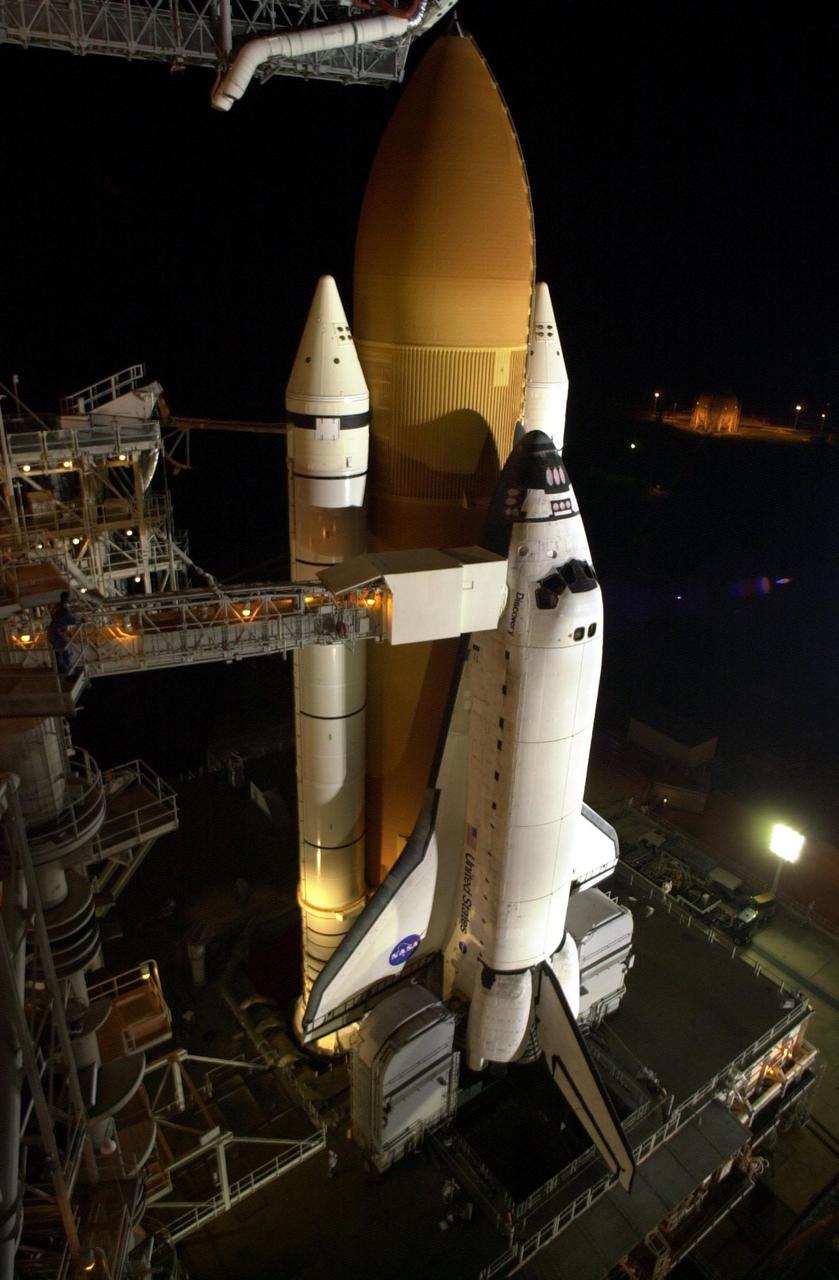
KENNEDY SPACE CENTER, Fla. -- Space Shuttle Discovery is bathed in light after rollback of the Rotating Service Structure in preparation for launch on mission STS-105. The Shuttle comprises the two solid rocket boosters, external tank and orbiter, all of which are secured on the mobile launcher platform beneath them. Extending toward Discovery from the fixed service structure at left is the orbiter access arm. At the end of the arm is the White Room, an environmental chamber that mates with the orbiter and allows personnel to enter the crew compartment. Below, on either side of the orbiter’s tail are the tail service masts that support the fluid, gas and electrical requirements of the orbiter’s liquid oxygen and liquid hydrogen aft T-0 umbilicals. On mission STS-105, Discovery will be transporting the Expedition Three crew and several payloads and scientific experiments to the ISS, including the Early Ammonia Servicer (EAS) tank. The EAS, which will support the thermal control subsystems until a permanent system is activated, will be attached to the Station during two spacewalks. The three-member Expedition Two crew will be returning to Earth aboard Discovery after a five-month stay on the Station. Launch is scheduled for 5:38 p.m. EDT Aug. 9
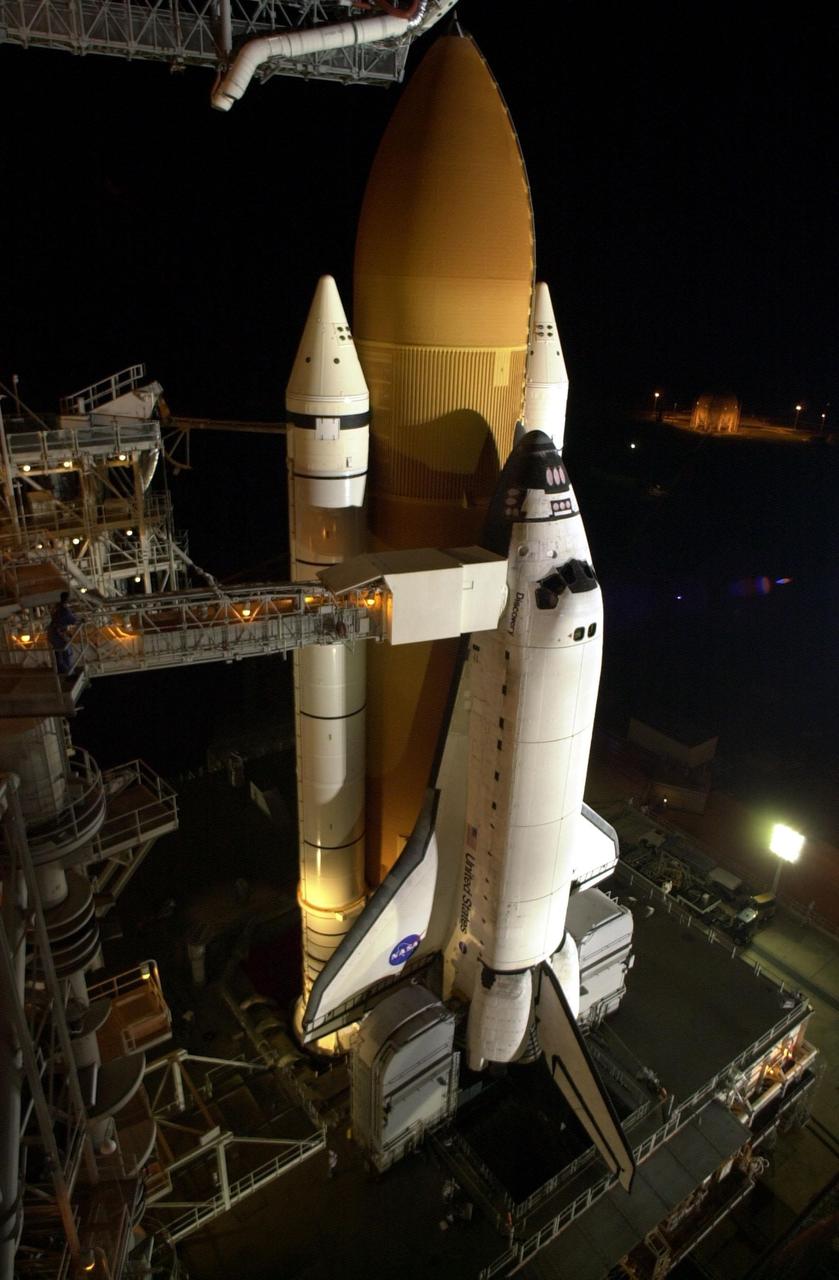
KENNEDY SPACE CENTER, Fla. -- Space Shuttle Discovery is bathed in light after rollback of the Rotating Service Structure in preparation for launch on mission STS-105. The Shuttle comprises the two solid rocket boosters, external tank and orbiter, all of which are secured on the mobile launcher platform beneath them. Extending toward Discovery from the fixed service structure at left is the orbiter access arm. At the end of the arm is the White Room, an environmental chamber that mates with the orbiter and allows personnel to enter the crew compartment. Below, on either side of the orbiter’s tail are the tail service masts that support the fluid, gas and electrical requirements of the orbiter’s liquid oxygen and liquid hydrogen aft T-0 umbilicals. On mission STS-105, Discovery will be transporting the Expedition Three crew and several payloads and scientific experiments to the ISS, including the Early Ammonia Servicer (EAS) tank. The EAS, which will support the thermal control subsystems until a permanent system is activated, will be attached to the Station during two spacewalks. The three-member Expedition Two crew will be returning to Earth aboard Discovery after a five-month stay on the Station. Launch is scheduled for 5:38 p.m. EDT Aug. 9
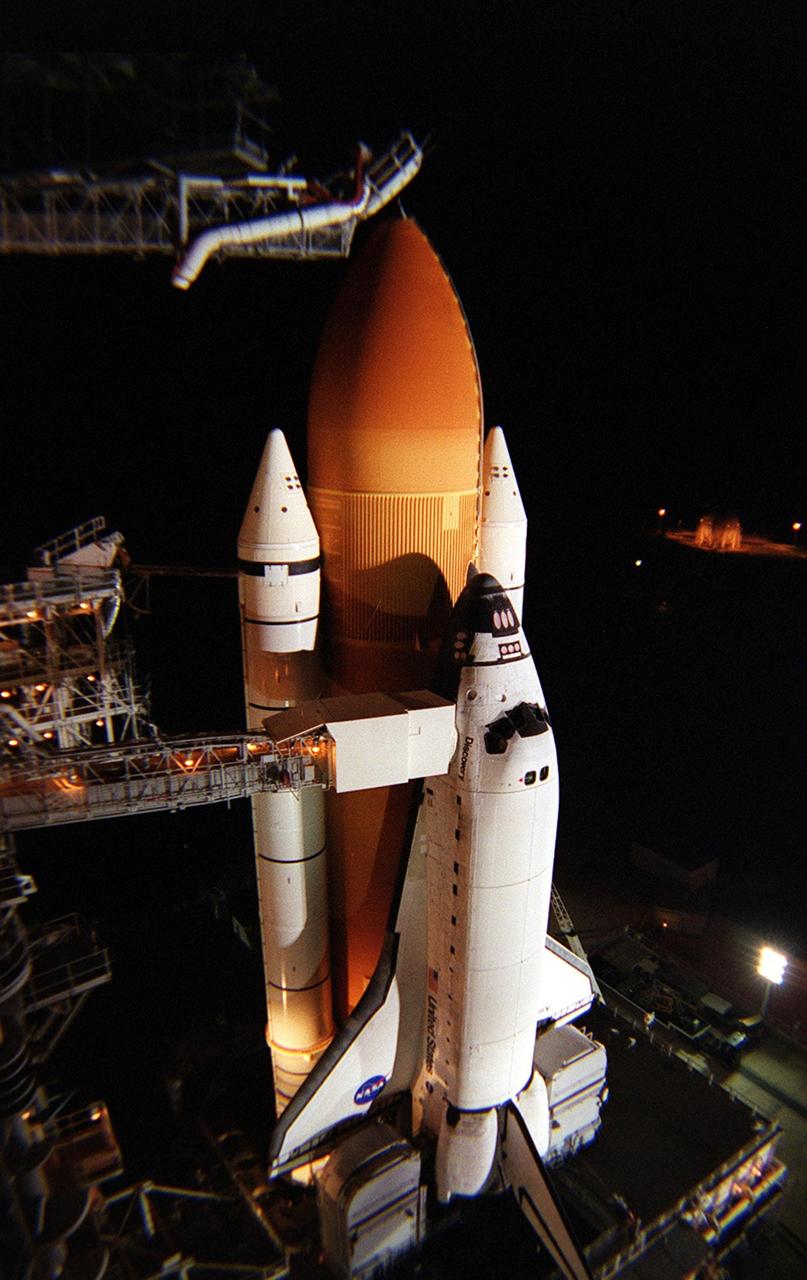
KENNEDY SPACE CENTER, Fla. -- Lights surrounding Launch Pad 39A create shadows from Space Shuttle Discovery after rollback of the Rotating Service Structure. Seen extending to the orbiter is the orbiter access arm, ending at the White Room, an environmental chamber that mates with the orbiter and allows personnel to enter the crew compartment. Above the external tank, the “beanie cap” is poised, waiting for loading of the propellants. The cap, or vent hood, is on the end of the gaseous oxygen vent arm that allows gaseous oxygen vapors to vent away from the Space Shuttle. On mission STS-105, Discovery will be transporting the Expedition Three crew and several scientific experiments and payloads to the International Space Station, including the Early Ammonia Servicer (EAS) tank. The EAS, which will support the thermal control subsystems until a permanent system is activated, will be attached to the Station during two spacewalks. The three-member Expedition Two crew will be returning to Earth aboard Discovery after a five-month stay on the Station. Launch is scheduled for 5:38 p.m. EDT Aug. 9
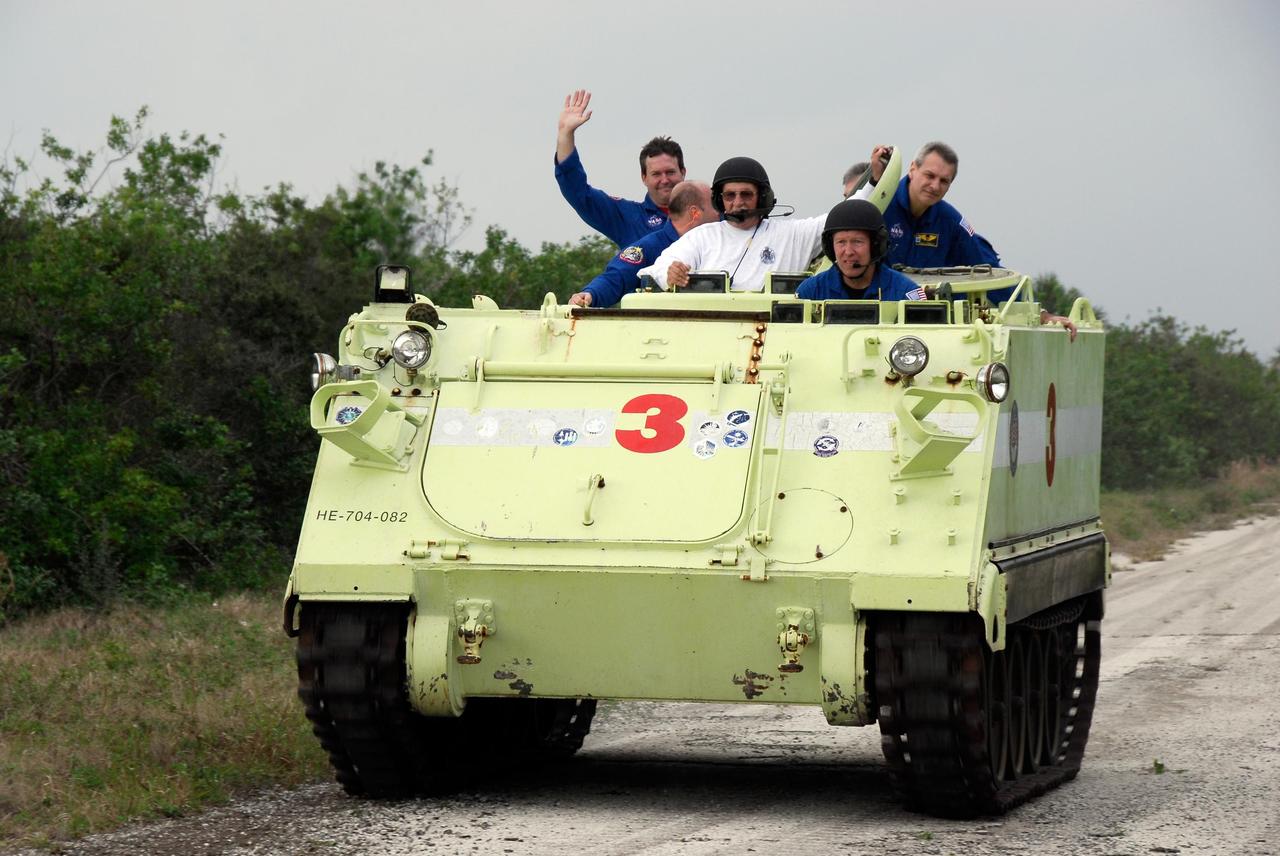
KENNEDY SPACE CENTER, FLA. -- At NASA Kennedy Space Center's Launch Complex 39, STS-123 Commander Dominic Gorie practices driving the M-113 armored personnel carrier. Behind him are, from left, STS-123 Mission Specialists Mike Foreman and Garrett Reisman, astronaut rescue team leader Capt. George Hoggard, STS-123 Pilot Gregory H. Johnson and STS-123 Mission Specialist Rick Linnehan. The crew members of space shuttle Endeavour's STS-123 mission will each practice driving the M-113 in turn as part of his training on emergency egress procedures. An M-113 will be available to transport the crew to safety in the event of a contingency on the pad before their launch. The STS-123 crew is at Kennedy for a full launch dress rehearsal, known as the terminal countdown demonstration test or TCDT. Endeavour's seven astronauts arrived at Kennedy's Shuttle Landing Facility in their T-38 training aircraft between 10:45 and 10:58 a.m. EST. The terminal countdown demonstration test provides astronauts and ground crews with an opportunity to participate in various simulated countdown activities, including equipment familiarization and emergency training. Endeavour is targeted to launch March 11 at 2:28 a.m. EDT on a 16-day mission to the International Space Station. On the mission, Endeavour and its crew will deliver the first section of the Japan Aerospace Exploration Agency's Kibo laboratory and the Canadian Space Agency's two-armed robotic system, Dextre. Photo credit: NASA/Kim Shiflett
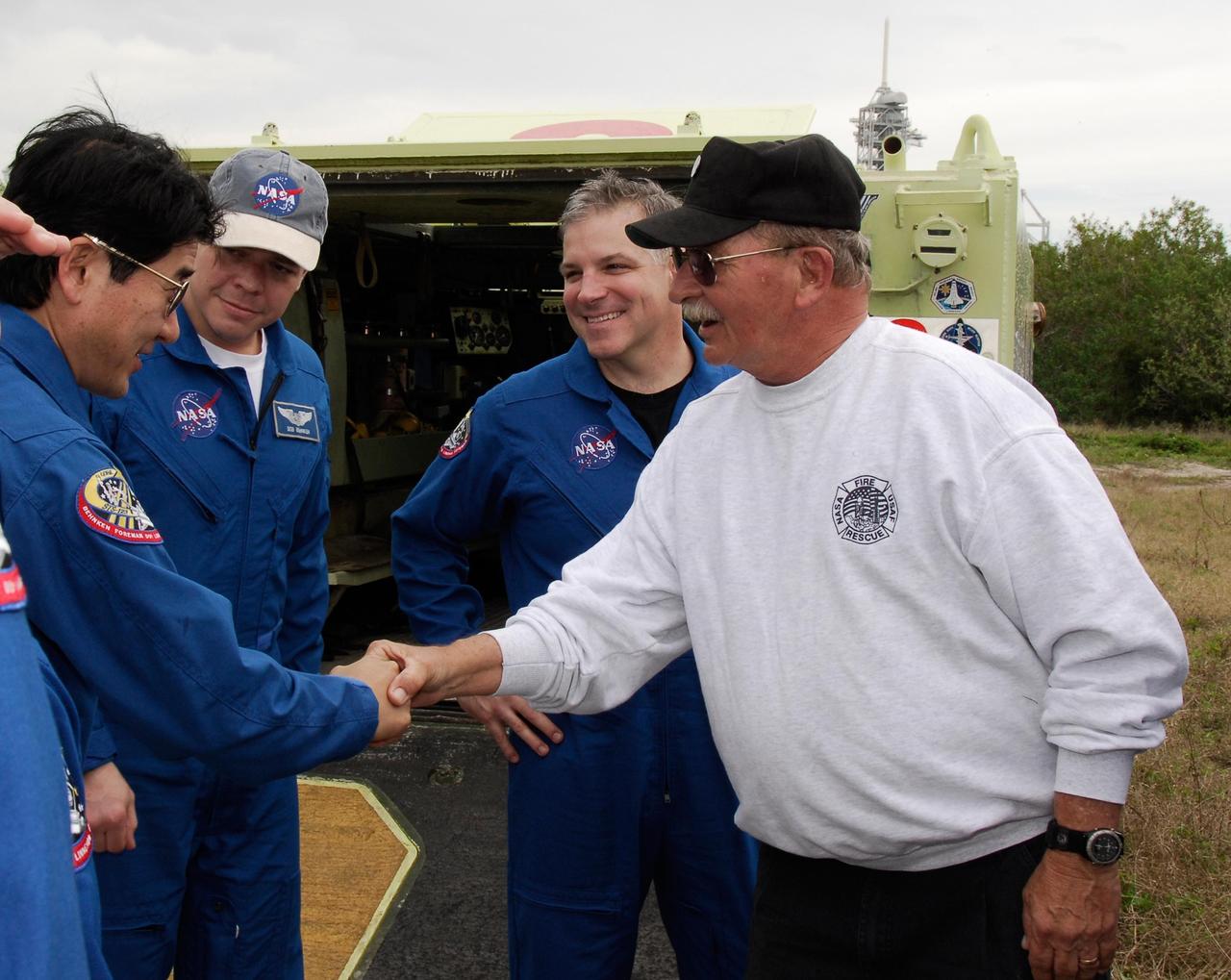
KENNEDY SPACE CENTER, FLA. -- At NASA Kennedy Space Center's Launch Complex 39, astronaut rescue team leader Capt. George Hoggard, at right, greets STS-123 Mission Specialist Takao Doi of the Japan Aerospace Exploration Agency as fellow crew members, from left, Mission Specialist Robert L. Behnken and Pilot Gregory H. Johnson look on. The crew for space shuttle Endeavour's STS-123 mission will practice driving the M-113 armored personnel carrier, in the background, part of their training on emergency egress procedures. An M-113 will be available to transport the crew to safety in the event of a contingency on the pad before their launch. The STS-123 crew is at Kennedy for a full launch dress rehearsal, known as the terminal countdown demonstration test or TCDT. Endeavour's seven astronauts arrived at Kennedy's Shuttle Landing Facility in their T-38 training aircraft between 10:45 and 10:58 a.m. EST. The terminal countdown demonstration test provides astronauts and ground crews with an opportunity to participate in various simulated countdown activities, including equipment familiarization and emergency training. Endeavour is targeted to launch March 11 at 2:28 a.m. EDT on a 16-day mission to the International Space Station. On the mission, Endeavour and its crew will deliver the first section of the Japan Aerospace Exploration Agency's Kibo laboratory and the Canadian Space Agency's two-armed robotic system, Dextre. Photo credit: NASA/Kim Shiflett
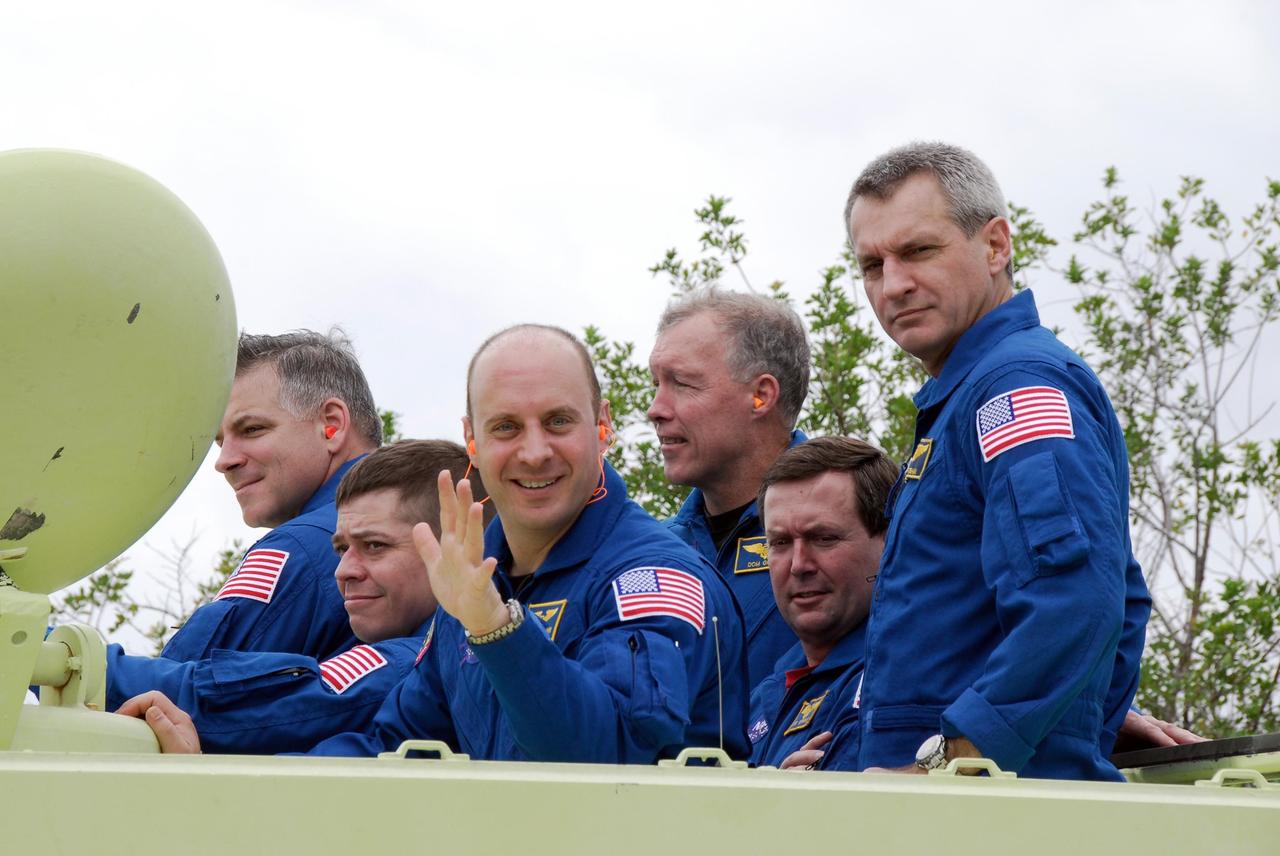
KENNEDY SPACE CENTER, FLA. -- At NASA Kennedy Space Center's Launch Complex 39, members of space shuttle Endeavour's STS-123 mission practice driving the M-113 armored personnel carrier. The crew members of space shuttle Endeavour's STS-123 mission will each practice driving the M-113 in turn as part of his training on emergency egress procedures. From left are Pilot Gregory H. Johnson; Mission Specialists Robert L. Behnken and Garrett Reisman; Commander Dominic Gorie; and Mission Specialists Mike Foreman and Rick Linnehan. An M-113 will be available to transport the crew to safety in the event of a contingency on the pad before their launch. The STS-123 crew is at Kennedy for a full launch dress rehearsal, known as the terminal countdown demonstration test or TCDT. Endeavour's seven astronauts arrived at Kennedy's Shuttle Landing Facility in their T-38 training aircraft between 10:45 and 10:58 a.m. EST. The terminal countdown demonstration test provides astronauts and ground crews with an opportunity to participate in various simulated countdown activities, including equipment familiarization and emergency training. Endeavour is targeted to launch March 11 at 2:28 a.m. EDT on a 16-day mission to the International Space Station. On the mission, Endeavour and its crew will deliver the first section of the Japan Aerospace Exploration Agency's Kibo laboratory and the Canadian Space Agency's two-armed robotic system, Dextre. Photo credit: NASA/Kim Shiflett
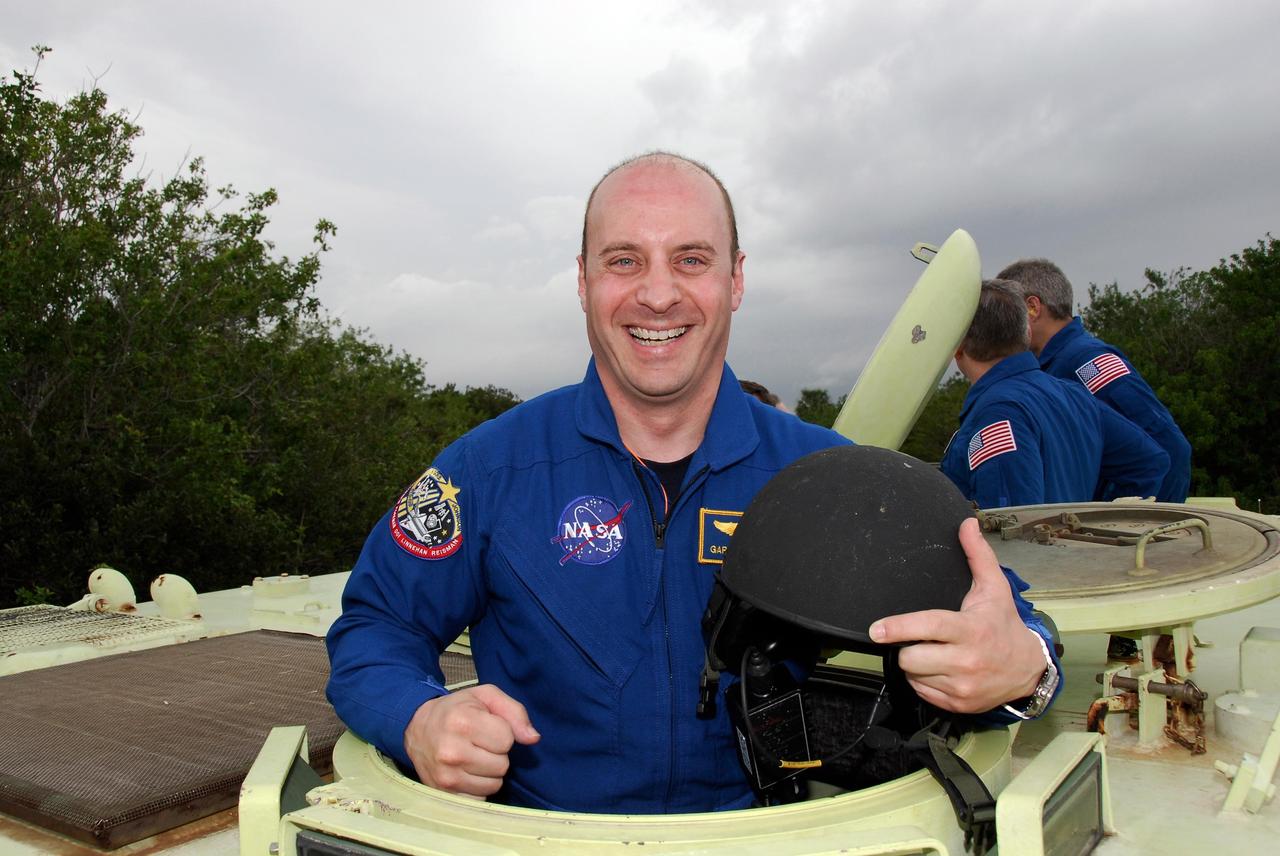
KENNEDY SPACE CENTER, FLA. -- At NASA Kennedy Space Center's Launch Complex 39, STS-123 Mission Specialist Garrett Reisman takes time out from driving practice of the M-113 armored personnel carrier to pose for a photo. The crew members of space shuttle Endeavour's STS-123 mission will each practice driving the M-113 in turn as part of his training on emergency egress procedures. Reisman will remain on the International Space Station as a flight engineer on the Expedition 16 and 17 crews. An M-113 will be available to transport the crew to safety in the event of a contingency on the pad before their launch. The STS-123 crew is at Kennedy for a full launch dress rehearsal, known as the terminal countdown demonstration test or TCDT. Endeavour's seven astronauts arrived at Kennedy's Shuttle Landing Facility in their T-38 training aircraft between 10:45 and 10:58 a.m. EST. The terminal countdown demonstration test provides astronauts and ground crews with an opportunity to participate in various simulated countdown activities, including equipment familiarization and emergency training. Endeavour is targeted to launch March 11 at 2:28 a.m. EDT on a 16-day mission to the International Space Station. On the mission, Endeavour and its crew will deliver the first section of the Japan Aerospace Exploration Agency's Kibo laboratory and the Canadian Space Agency's two-armed robotic system, Dextre. Photo credit: NASA/Kim Shiflett
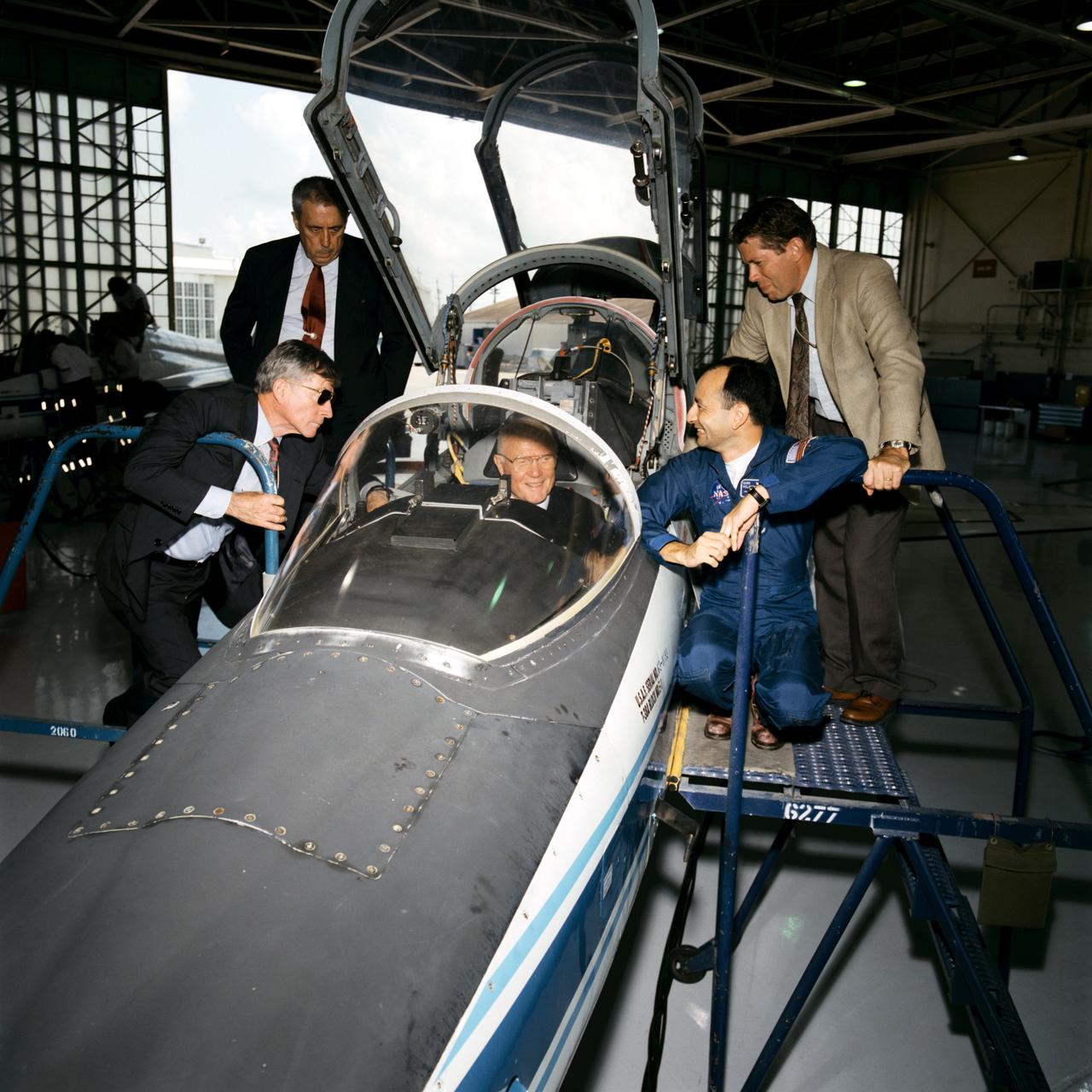
Senator John Glenn visit to Johnson Space Center (JSC). Views of Glenn sitting in cockpit of T-38 in Hangar 276 with John Young, George Abbey, David Leestma and Mark Polansky observing (11150). An engineer explains SPIFEX experiment hardware to Abby, Young and Glenn in Bldg 13 (11151, 11153). Glenn talks with astronaut Terrence T. Henricks and employees in Bldg 9C, Virtual reality lab (11152). Lunch in Bldg 17 Flight Crew support division with Dr. Ellen Baker, Robert "Hoot" Gibson and John Glenn (11154). Linda Godwin, Robert Cabana, Abbey, Young, Baker, Gibson and Glenn at lunch (11155). Astronaut Mark Lee shows Glenn and his aide how to use the virtural reality helmets (11156-7). Glenn shakes the hand of Franklin Chang-Diaz with his plasma rocket in the background in the Sonny Carter Training Facility (SCTF) (11158). Glenn in the Manipulator Development Facility (MDF) Remote Manipulator System (RMS) station mock-up in Bldg 9A with Abbey, Young and aide (11159, 11186). Glenn signs a book for Thomas D. Jones as Frederick Sturckow and Linda Godwin look on (11160). Glenn inside visual-vestibular trainer in Bldg 9B (11161). In conference room meeting with astronaut corps in Bldg 4S, Glenn shakes Robert Cabana's hand (11162). John Glenn and John Young pose for a group shot with Bldg 17 Food lab personnel (11163). Glenn thanks the food lab personnel (11164). Glenn visits Bldg 5 Fixed Base (FB) middeck simulator with astronauts Terrence Henricks and Mary Ellen Weber (11165). Glenn with Charles T. Bourland (11166). STS-70 crew Donald Thomas, Terrence Henricks, Mary Ellen Weber, Nancy Currie and Kevin Kregel with Glenn's advisor (11167). STS-70 crew Thomas, Henricks, Weber, Currie and Kregel with John Glenn (11175). Glenn with Thomas, Kregel, Weber, Henricks and trainer (11176-7). David J. Homan assists Glenn's aide with virtual reality goggles (11168) and Glenn (11174). John Young in Bldg 9C equilibrium trainer (11169). Glenn with Carl Walz in flight deck mock-up of MDF in Bldg 9NE (11170, 11187). Young, Abbey, aides, Glenn and Walz examine helium balloon in MDF (11171-2). Chang-Diaz shows Glenn's tour group the plasma rocket (11173). Glenn's presentation to astronaut corps (11178-81, 11184-5). Glenn is presented with framed picture of Sonny Carter Training Facility (SCTF) (11182) and framed picture of space station (11183).
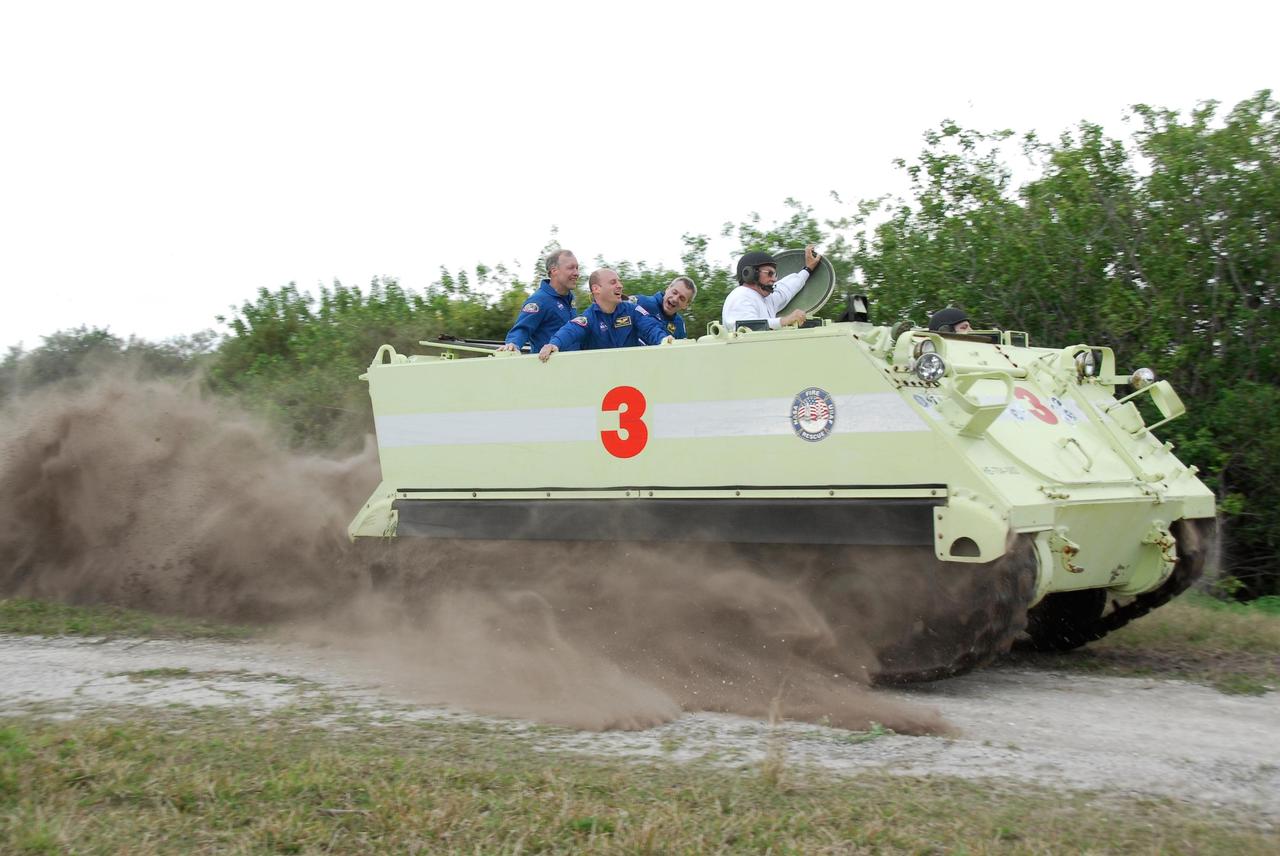
KENNEDY SPACE CENTER, FLA. -- At NASA Kennedy Space Center's Launch Complex 39, astronaut rescue team leader Capt. George Hoggard, in the white sweatshirt, demonstrates to members of the crew for space shuttle Endeavour's STS-123 mission the speed at which an M-113 armored personnel carrier can travel. From left are Commander Dominic Gorie and Mission Specialists Garrett Reisman and Rick Linnehan. The entire crew will practice driving the M-113 as part of his training on emergency egress procedures. An M-113 will be available to transport the crew to safety in the event of a contingency on the pad before their launch. The STS-123 crew is at Kennedy for a full launch dress rehearsal, known as the terminal countdown demonstration test or TCDT. Endeavour's seven astronauts arrived at Kennedy's Shuttle Landing Facility in their T-38 training aircraft between 10:45 and 10:58 a.m. EST. The terminal countdown demonstration test provides astronauts and ground crews with an opportunity to participate in various simulated countdown activities, including equipment familiarization and emergency training. Endeavour is targeted to launch March 11 at 2:28 a.m. EDT on a 16-day mission to the International Space Station. On the mission, Endeavour and its crew will deliver the first section of the Japan Aerospace Exploration Agency's Kibo laboratory and the Canadian Space Agency's two-armed robotic system, Dextre. Photo credit: NASA/Kim Shiflett