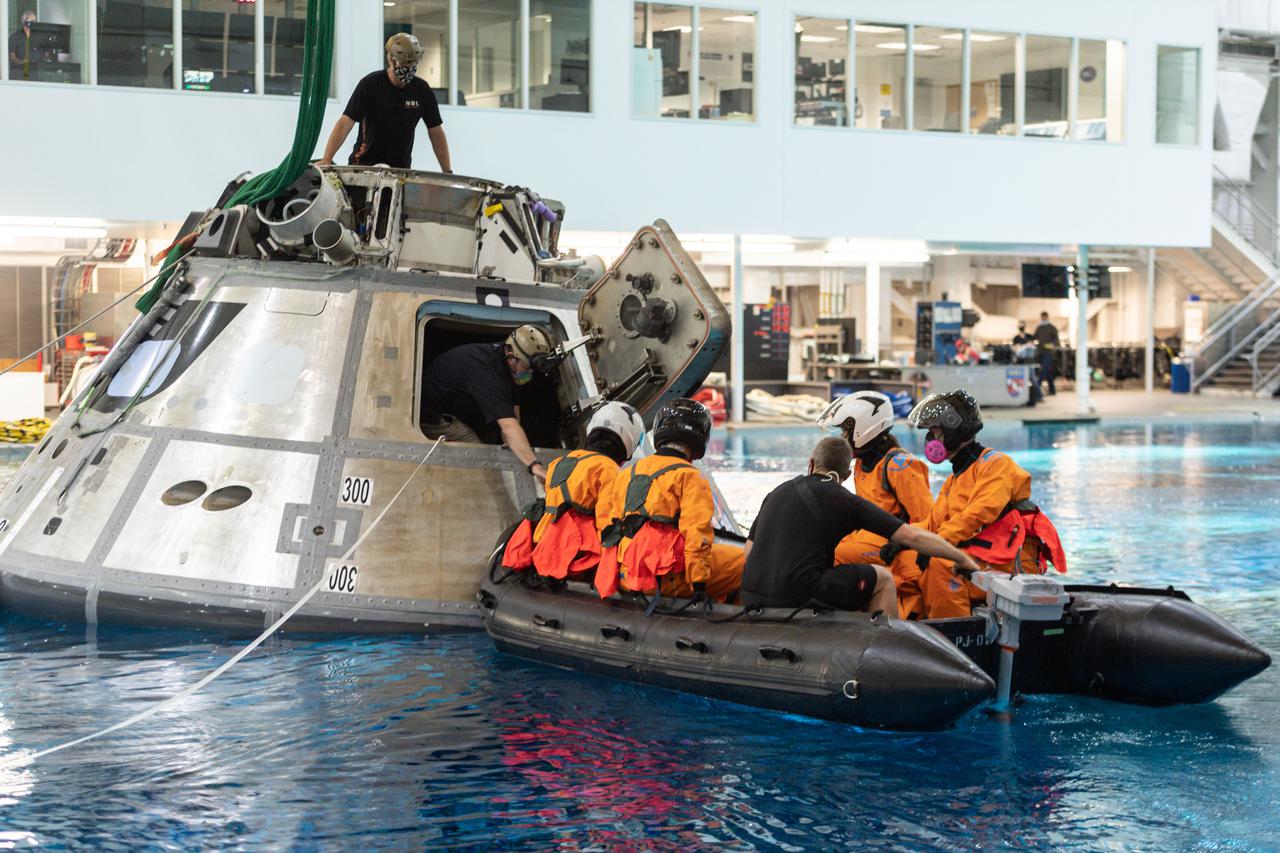
jsc2021e017168 (April 30, 2021) --- The SpaceX Crew-3 astronauts and support personnel participate in water survival training at the Neutral Buoyancy Laboratory at NASA's Johnson Space Center in Houston, Texas.
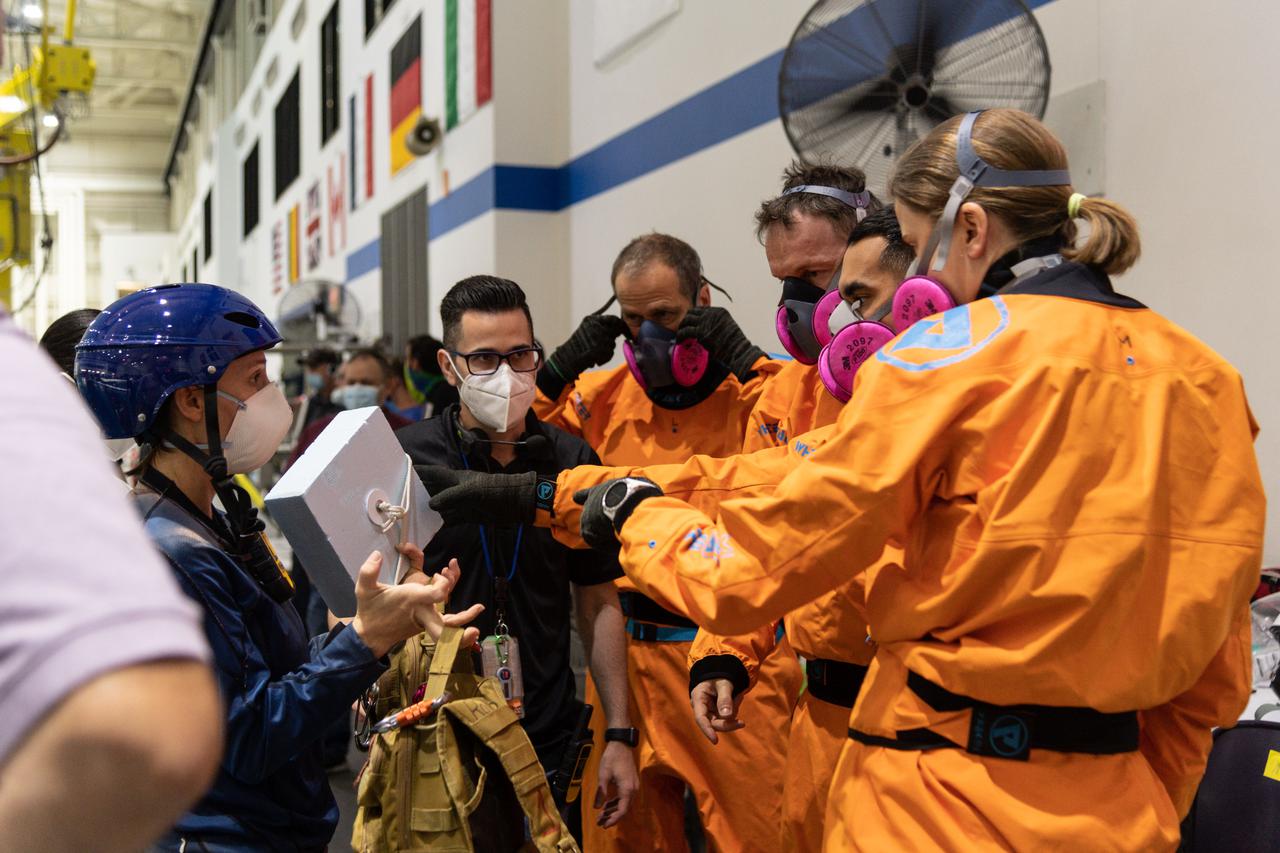
jsc2021e017099 (April 30, 2021) --- The SpaceX Crew-3 astronauts and support personnel participate in water survival training at the Neutral Buoyancy Laboratory at NASA's Johnson Space Center in Houston, Texas.
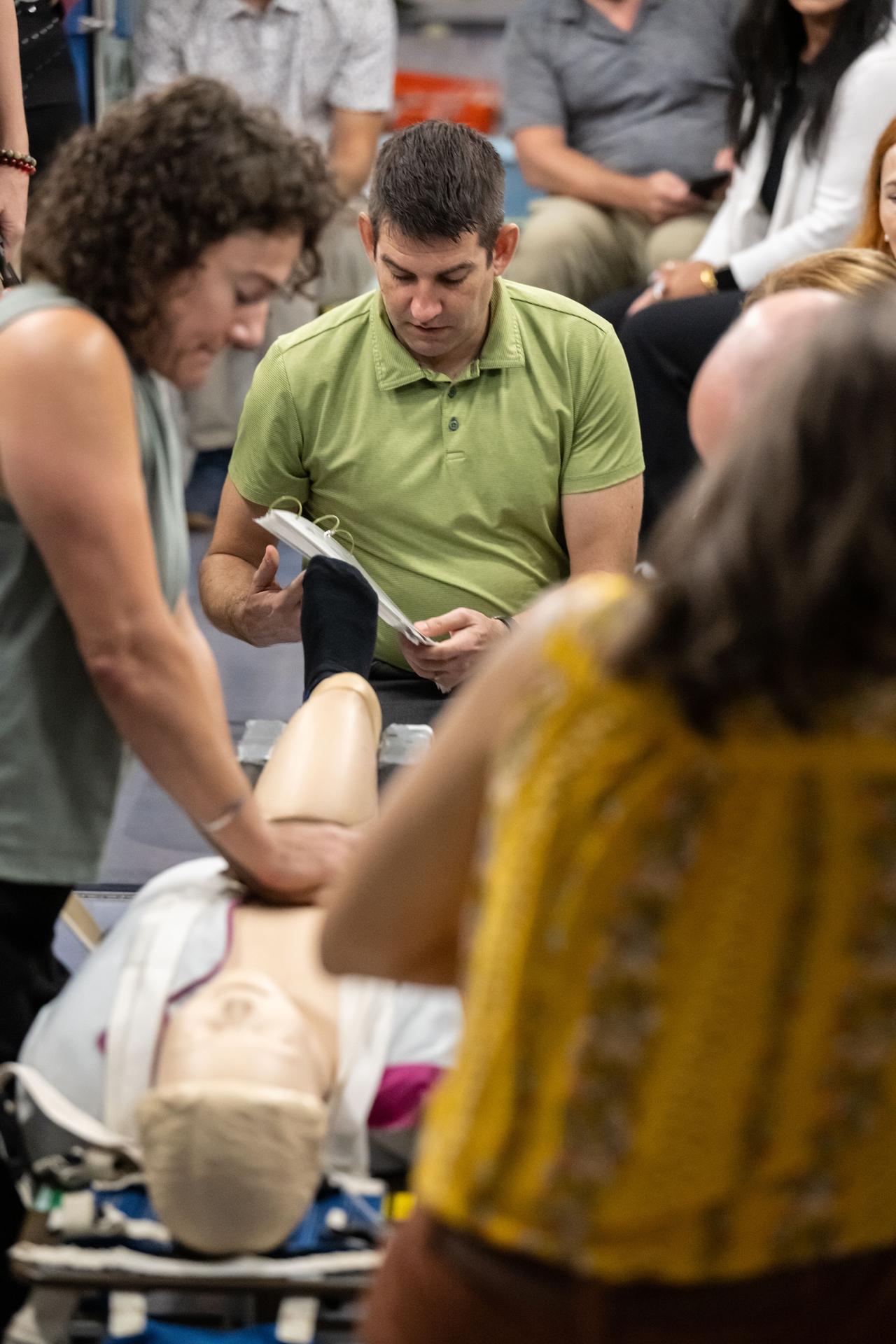
jsc2025e070045 (Aug. 21, 2025) --- NASA's SpaceX Crew-12 members Jessica Meir and Jack Hathaway, both NASA astronauts, practice cardiopulmonary resuscitation (CPR) during a medical emergency simulation as part of their training for mission to the International Space Station. Surrounding Meir and Hathaway are various training support personnel at NASA's Johnson Space Center in Houston, Texas. Credit: NASA/Bill Stafford
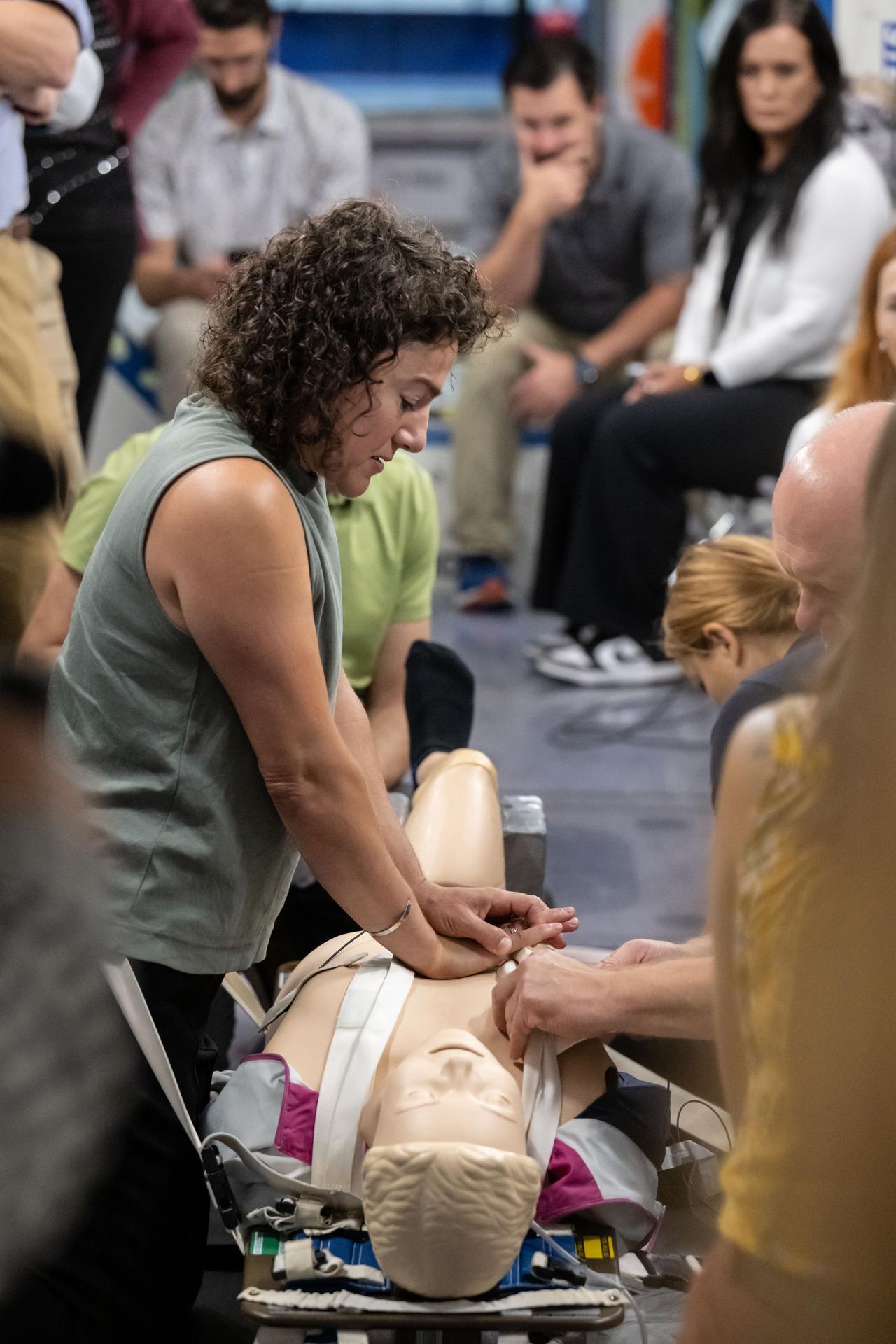
jsc2025e070047 (Aug. 21, 2025) --- NASA astronaut Jessica Meir practices cardiopulmonary resuscitation (CPR) during a medical emergency simulation as part of her training for NASA's SpaceX Crew-12 mission to the International Space Station. Surrounding Meir are various training support personnel at NASA's Johnson Space Center in Houston, Texas. Credit: NASA/Bill Stafford
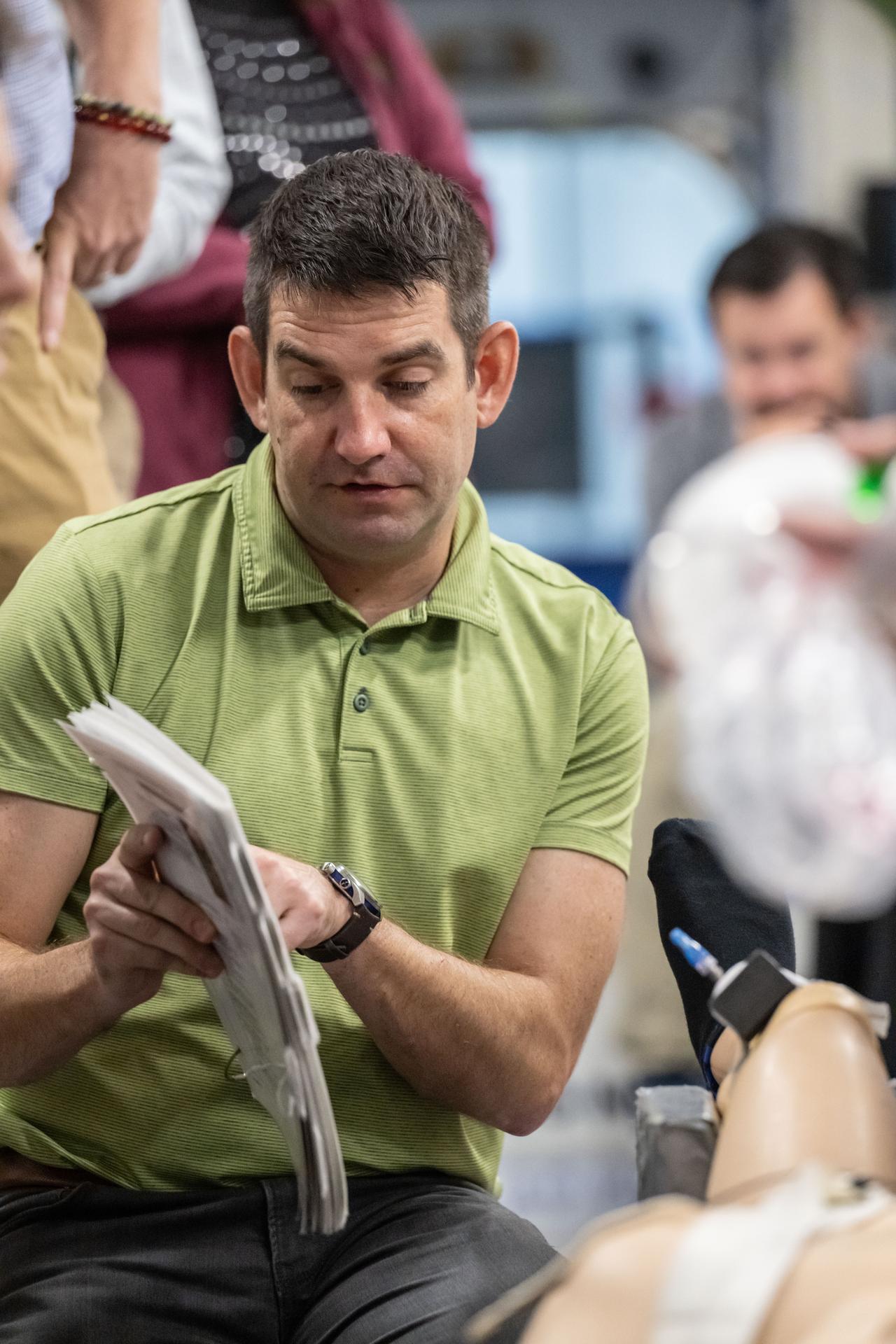
jsc2025e070056 (Aug. 21, 2025) --- NASA astronaut Jack Hathaway reviews cardiopulmonary resuscitation (CPR) techniques during a medical emergency simulation as part of his training for NASA's SpaceX Crew-12 mission to the International Space Station. Surrounding Hathaway are various training support personnel at NASA's Johnson Space Center in Houston, Texas. Credit: NASA/Bill Stafford
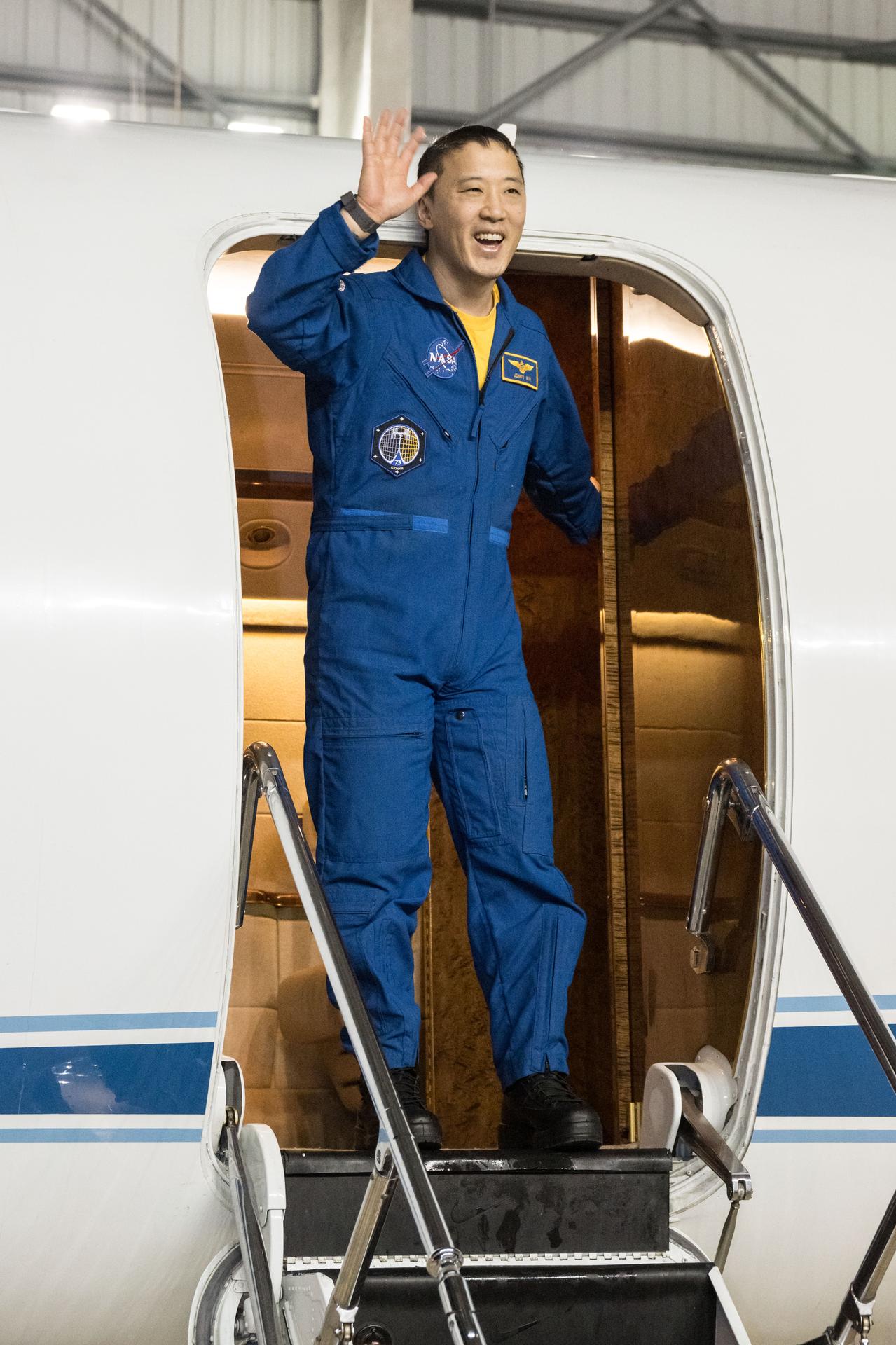
jsc2025e089530 (Dec. 10, 2025) --- NASA astronaut Jonny Kim waves to NASA personnel at Ellington Field after exiting the Gulfstream V aircraft that returned him to Houston, Texas, from Kazakhstan in Central Asia. The day before, Kim had landed in Kazakhstan aboard the Soyuz MS-27 crew spacecraft with Roscosmos cosmonauts Sergey Ryzhikov and Alexey Zubritsky after completing a 245-day research mission aboard the International Space Station. Credit: NASA/Robert Markowitz
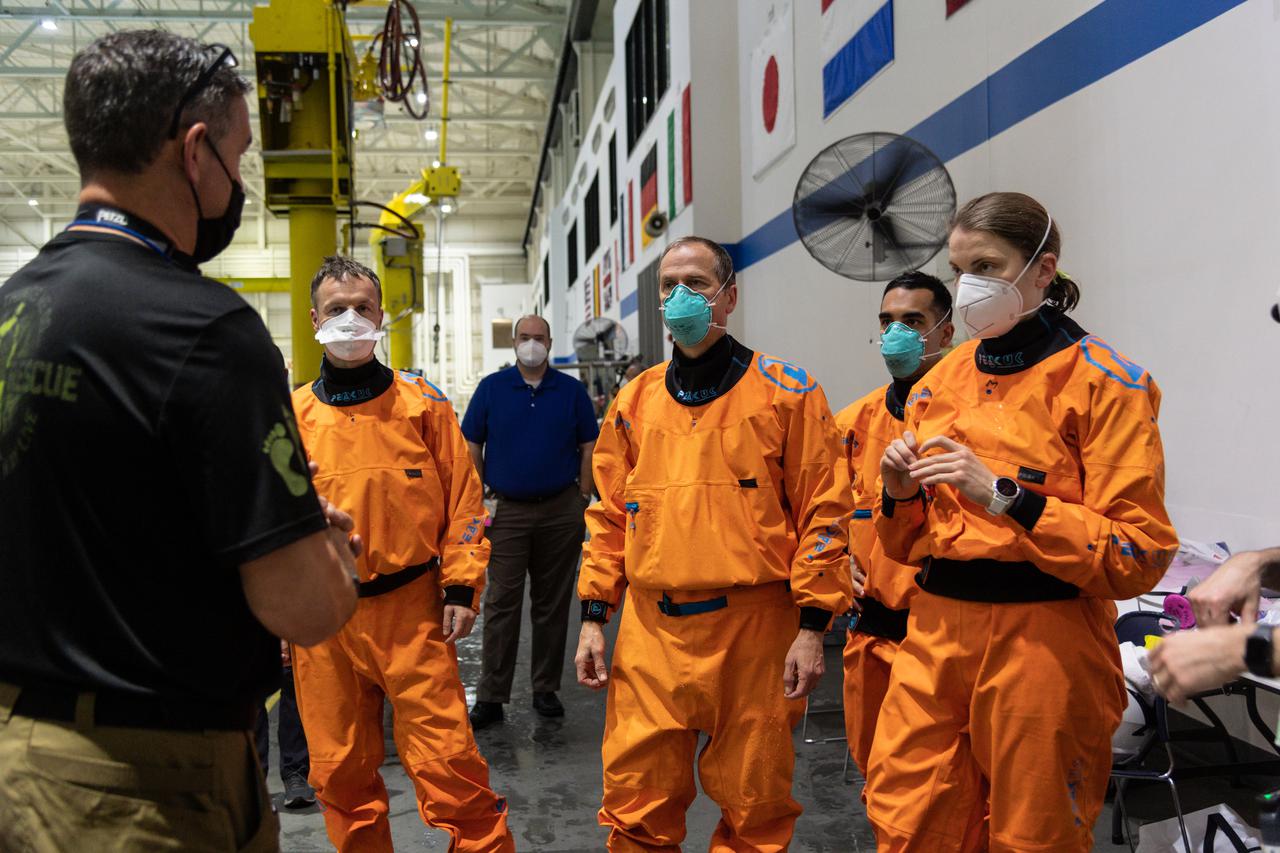
jsc2021e017162 (April 30, 2021) --- SpaceX Crew-3 astronauts (from left) Matthias Maurer, Tom Marshburn, Raja Chari and Kayla Barron, and support personnel participate in water survival training at the Neutral Buoyancy Laboratory at NASA's Johnson Space Center in Houston, Texas.
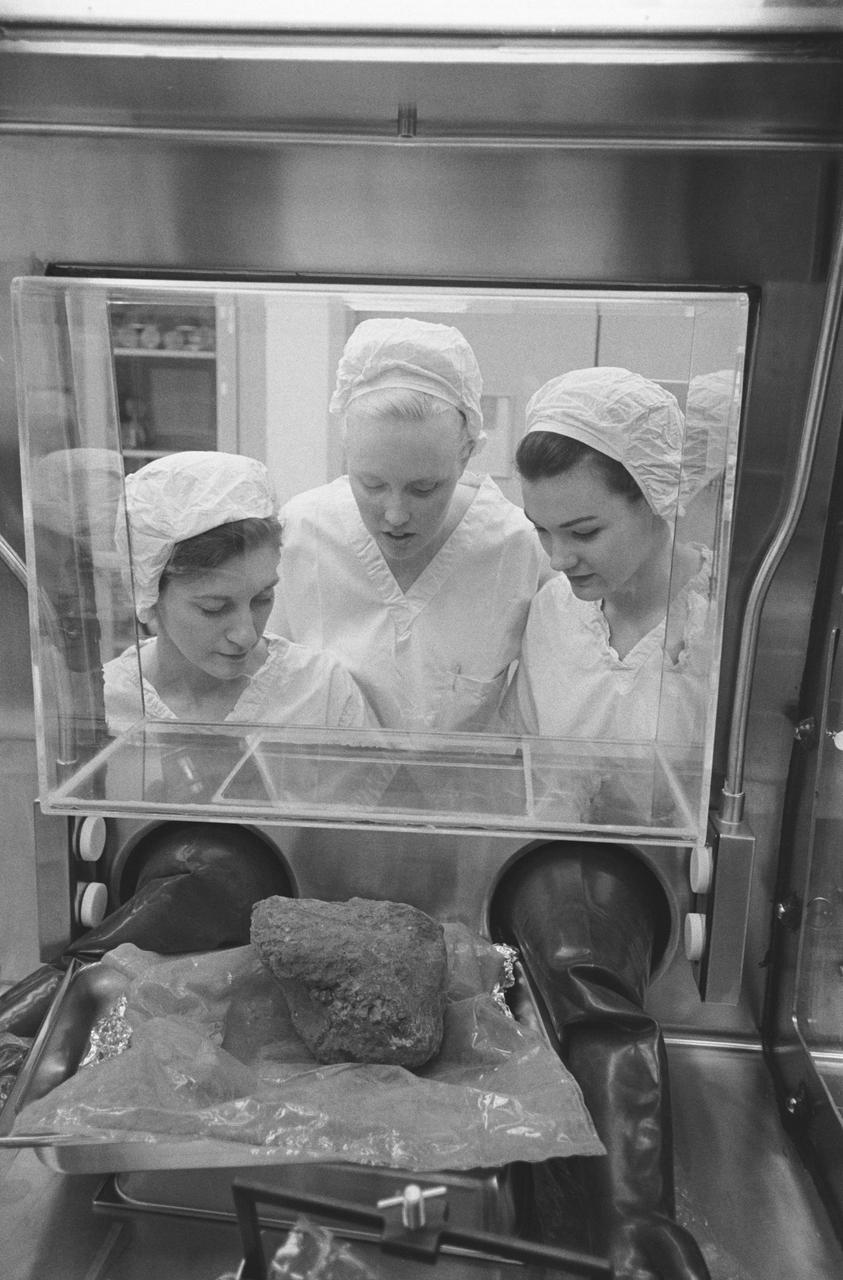
S71-21244 (24 Feb. 1971) --- Three Brown and Root/Northrop technicians in the Nonsterile Nitrogen Laboratory in the Lunar Receiving Laboratory (LRL) peer through glass at the much-discussed basketball size rock which Apollo 14 crewmen brought back from the Fra Mauro area of the moon. They are, left to right, Linda Tyler, Nancy L. Trent and Sandra Richards.
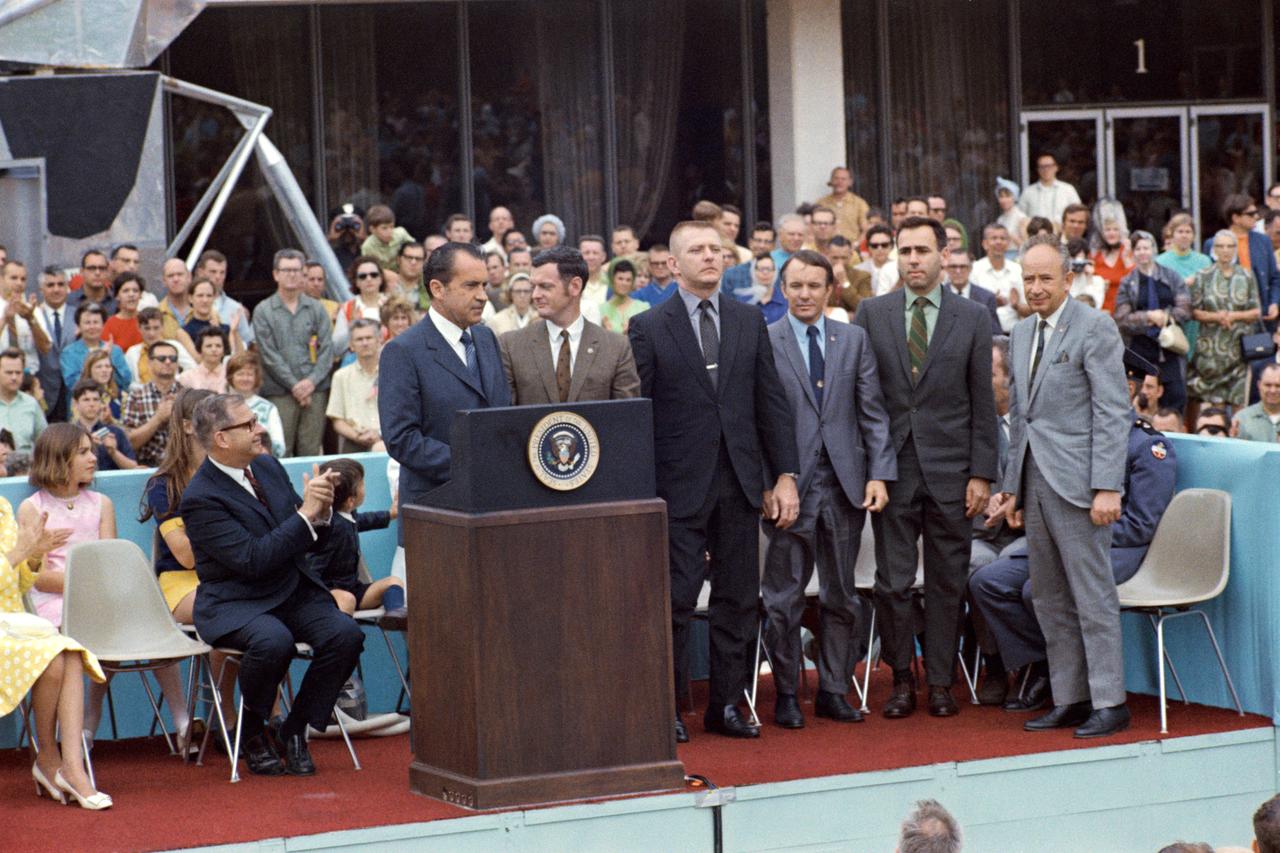
S70-35600 (18 April 1970) --- President Richard M. Nixon introduces Sigurd A. Sjoberg (far right), director of Flight Operations at Manned Spacecraft Center, and the four Apollo 13 flight directors during the President?s post-mission visit to the Manned Spacecraft Center. The flight directors are, from left to right, Glynn S. Lunney, Eugene A. Kranz, Gerald D. Griffin and Milton L. Windler. Dr. Thomas O. Paine, Administrator, National Aeronautics and Space Administration, is seated at left. President Nixon was on the site to present the Presidential Medal of Freedom - the nation?s highest civilian honor -to the Apollo 13 Mission Operations Team.
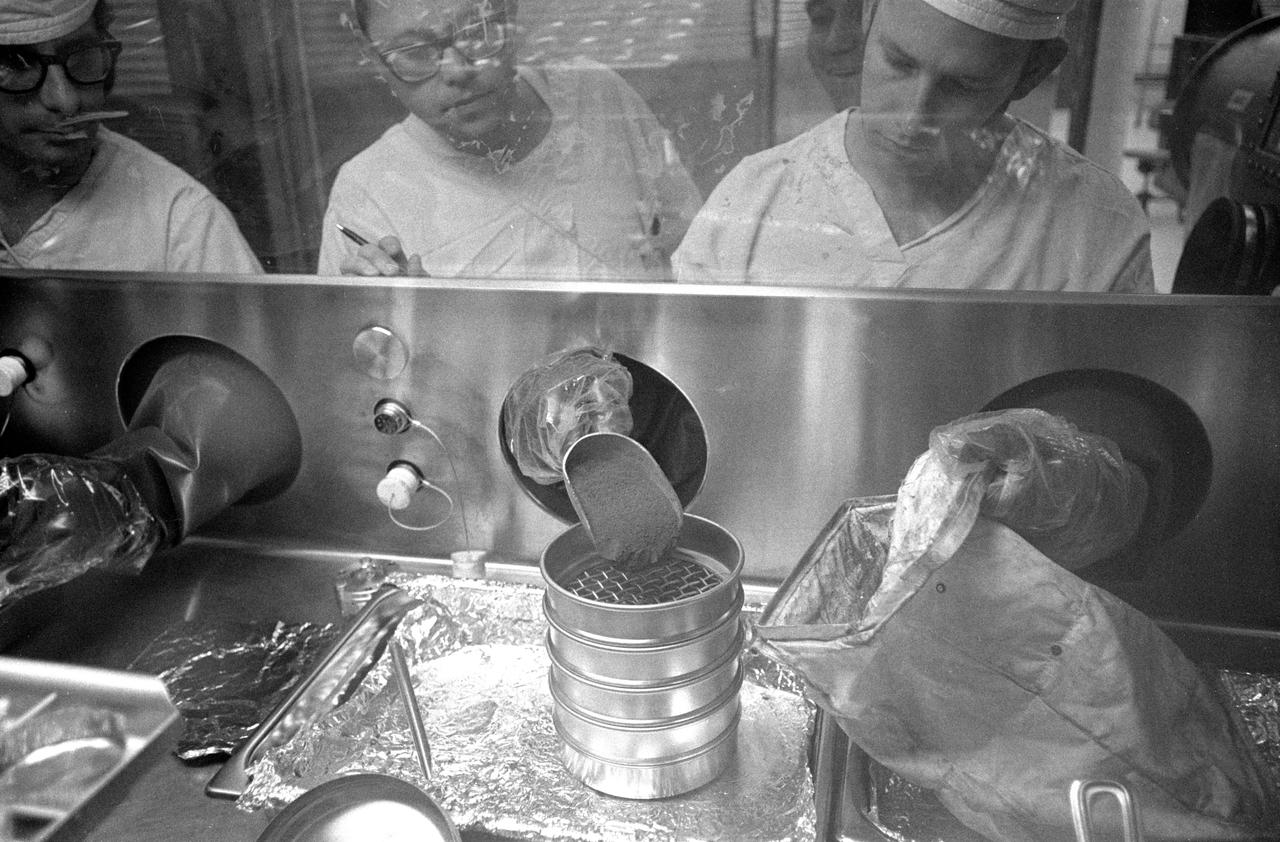
S71-19489 (18 Feb. 1971) --- Glove handlers work with freshly opened Apollo 14 lunar sample material in modularized cabinets in the Lunar Receiving Laboratory at the Manned Spacecraft Center. The glove operator on the right starts to pour fine lunar material which he has just taken from a tote bag. The powdery sample was among the last to be revealed of the 90-odd pounds of material brought back to Earth by the Apollo 14 crew members.
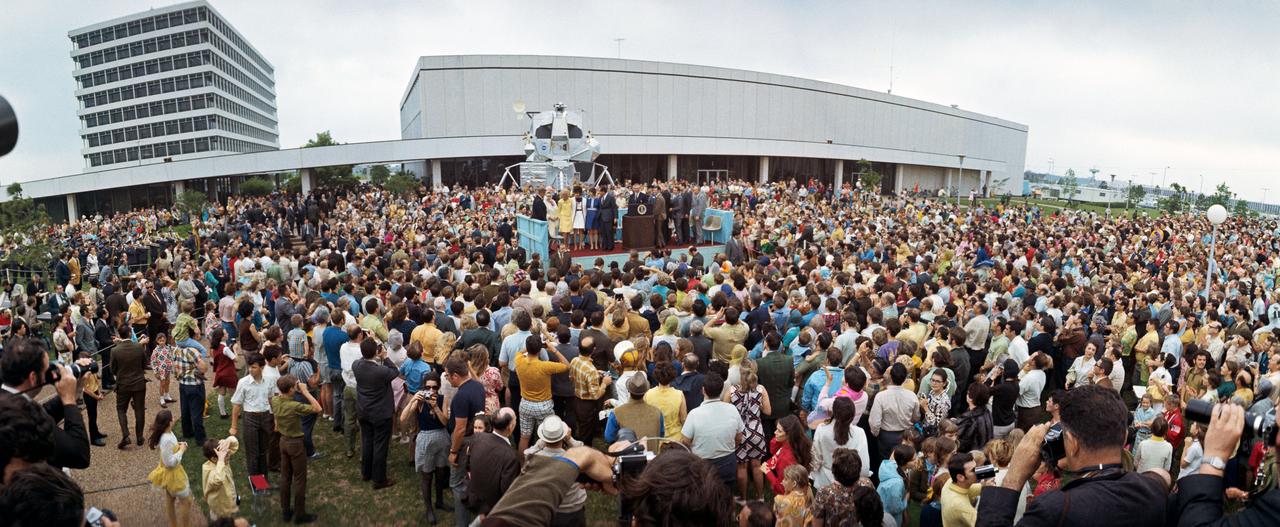
S70-35601 (18 April 1970) --- A wide-angle, overall view of the large crowd of people who were on hand to see President Richard M. Nixon present the Presidential Medal of Freedom to the Apollo 13 Mission Operations Team. The honor is the nation's highest civilian award. A temporary speaker's platform was erected beside Building 1 for the occasion.
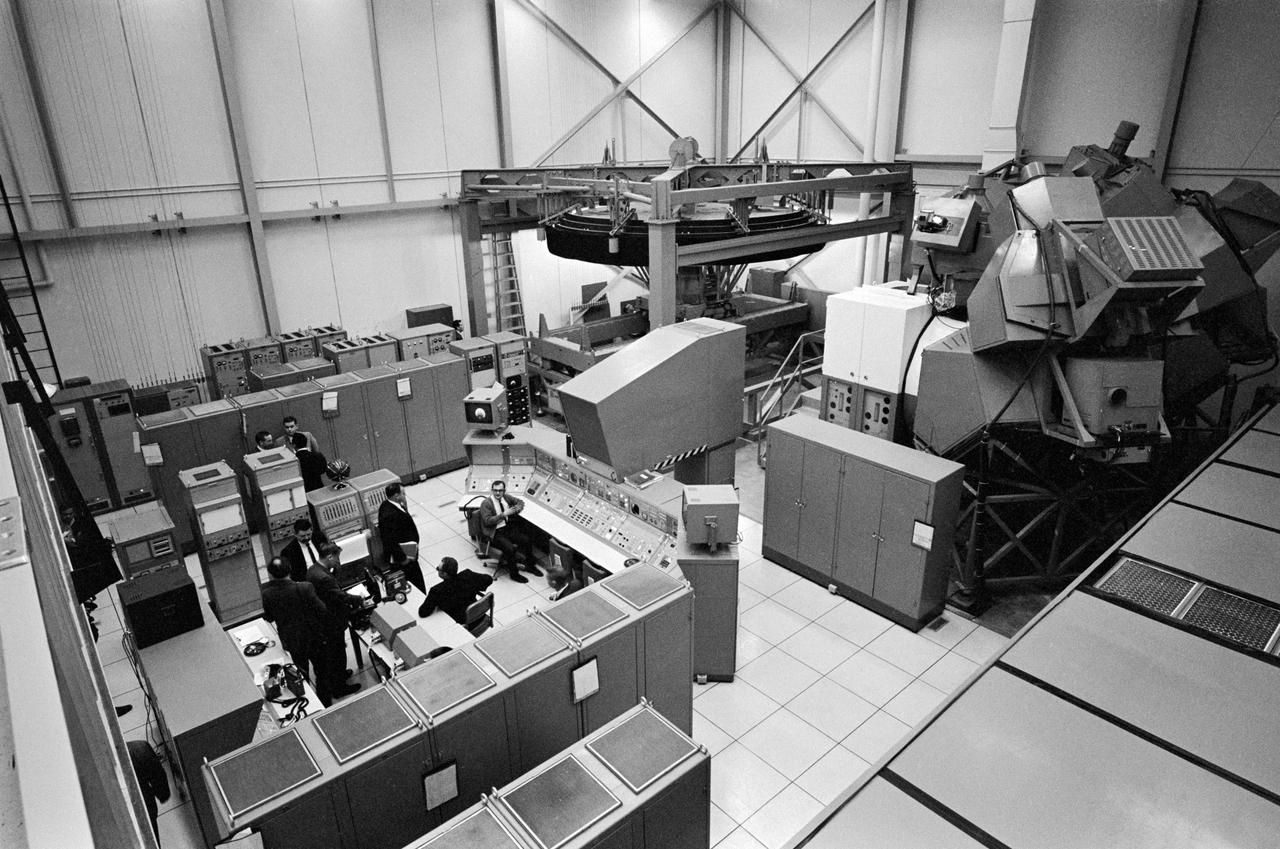
Overall view of the Lunar Module Mission Simulator, an astronaut training facility located in bldg 5.
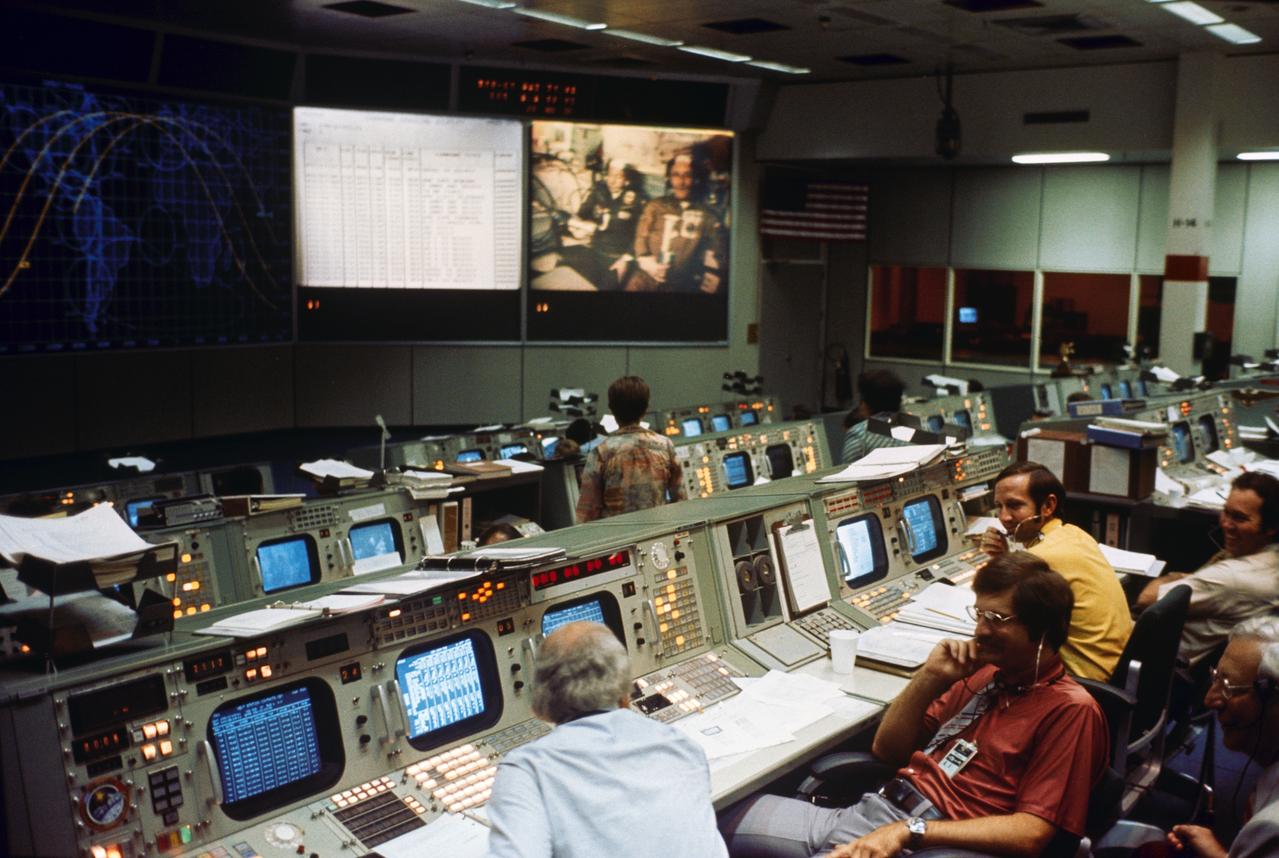
S75-28685 (17 July 1975) --- An overall view of activity in the Mission Operations Control Room in the Mission Control Center during joint U.S.-USSR Apollo Soyuz Test Project (ASTP) docking mission in Earth orbit. The large television monitor shows an interior view of the Soyuz Orbital Module with astronaut Thomas P. Stafford (in front) visiting with cosmonaut Aleksey A. Leonov. Neil B. Hutchinson (right hand to chin) is the flight director for this shift.
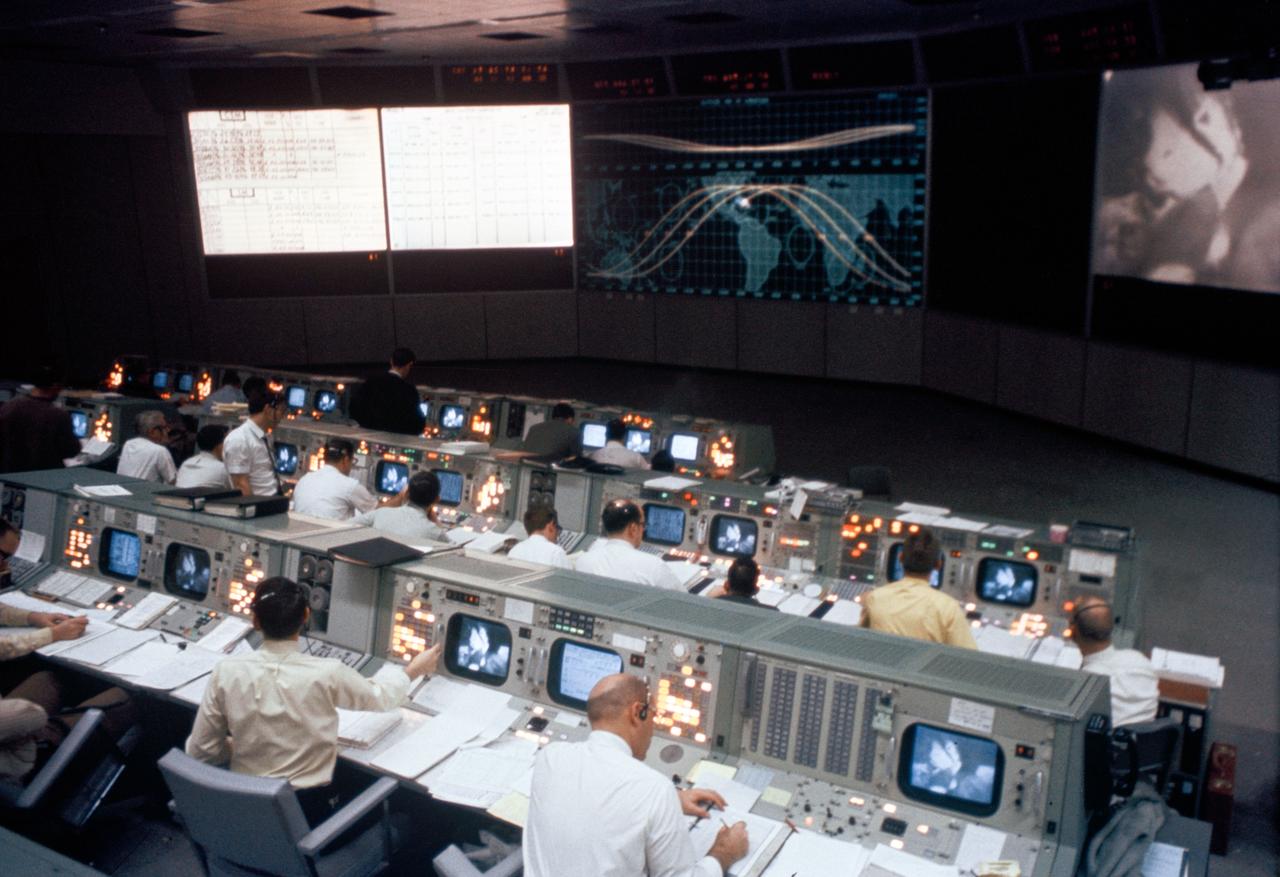
S69-26301 (March 1969) --- Overall view of the Mission Operations Control Room in the Mission Control Center, Building 30, during the Apollo 9 Earth-orbital mission. When this photograph was taken a live television transmission was being received from Apollo 9 as it orbited Earth.
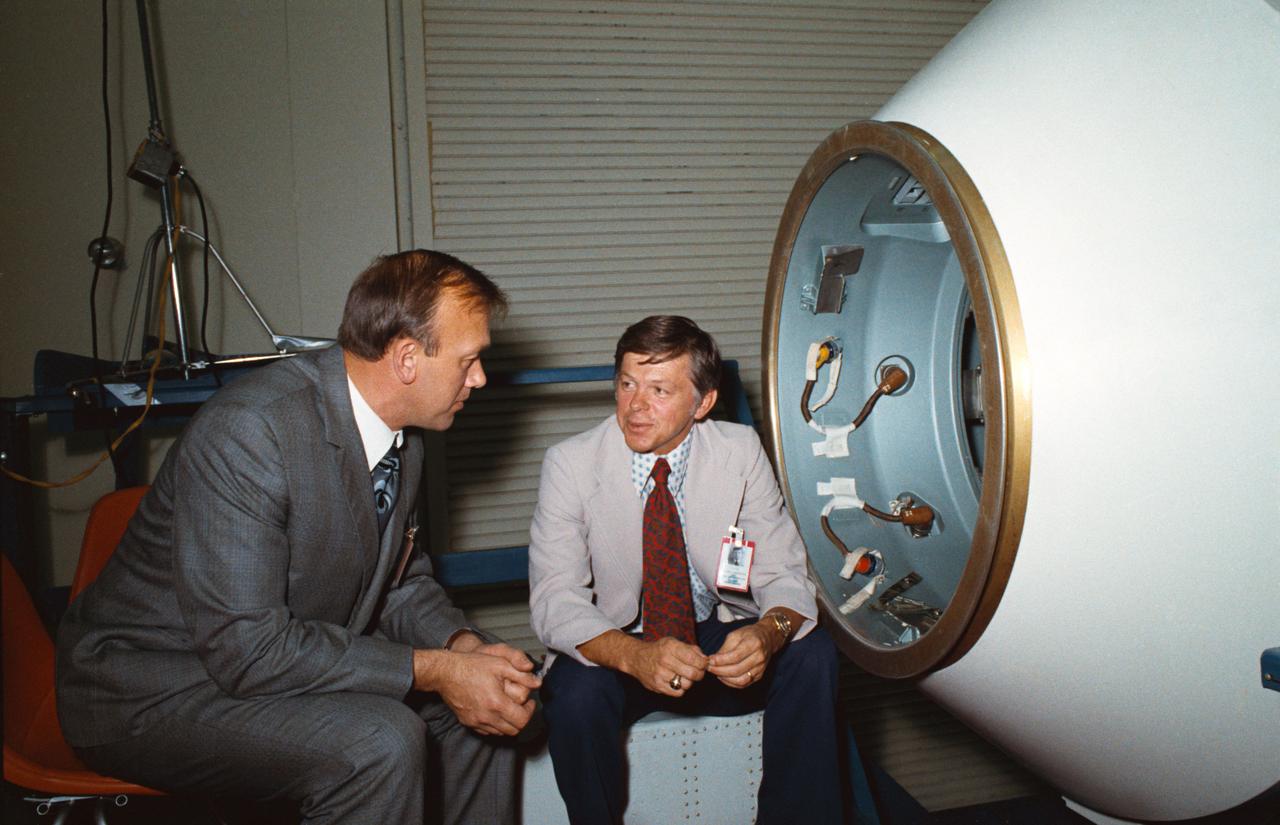
S74-32481 (November 1974) --- These two men are flight directors for the joint U.S.-USSR Apollo-Soyuz Test Project mission scheduled for July 1975. Cosmonaut Aleksey A. Yeliseyev (left) is the Soviet ASTP senior flight director; M.P. Frank is the American ASTP senior flight director. They are seated beside a Docking Module training mock-up in Building 35 at the Johnson Space Center. Cosmonaut Yeliseyev was head of a delegation of USSR flight controllers who were at JSC for two weeks of ASTP training.
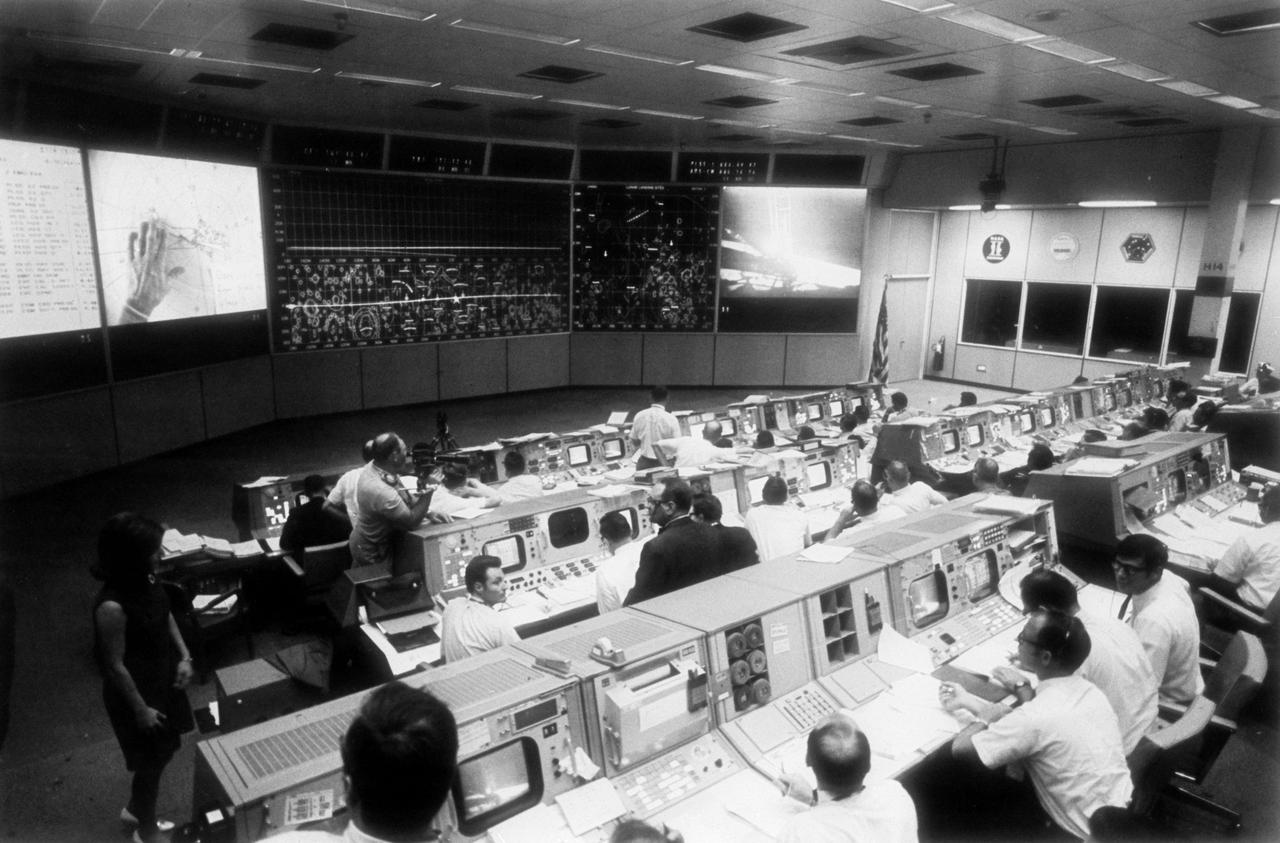
Overall view of the Mission Operations Control Room in the Mission Control Center, bldg 30, during the lunar surface extravehicular activity (EVA) of Apollo 11 Astronauts Neil A. Armstrong and Edwin E. Aldrin Jr.
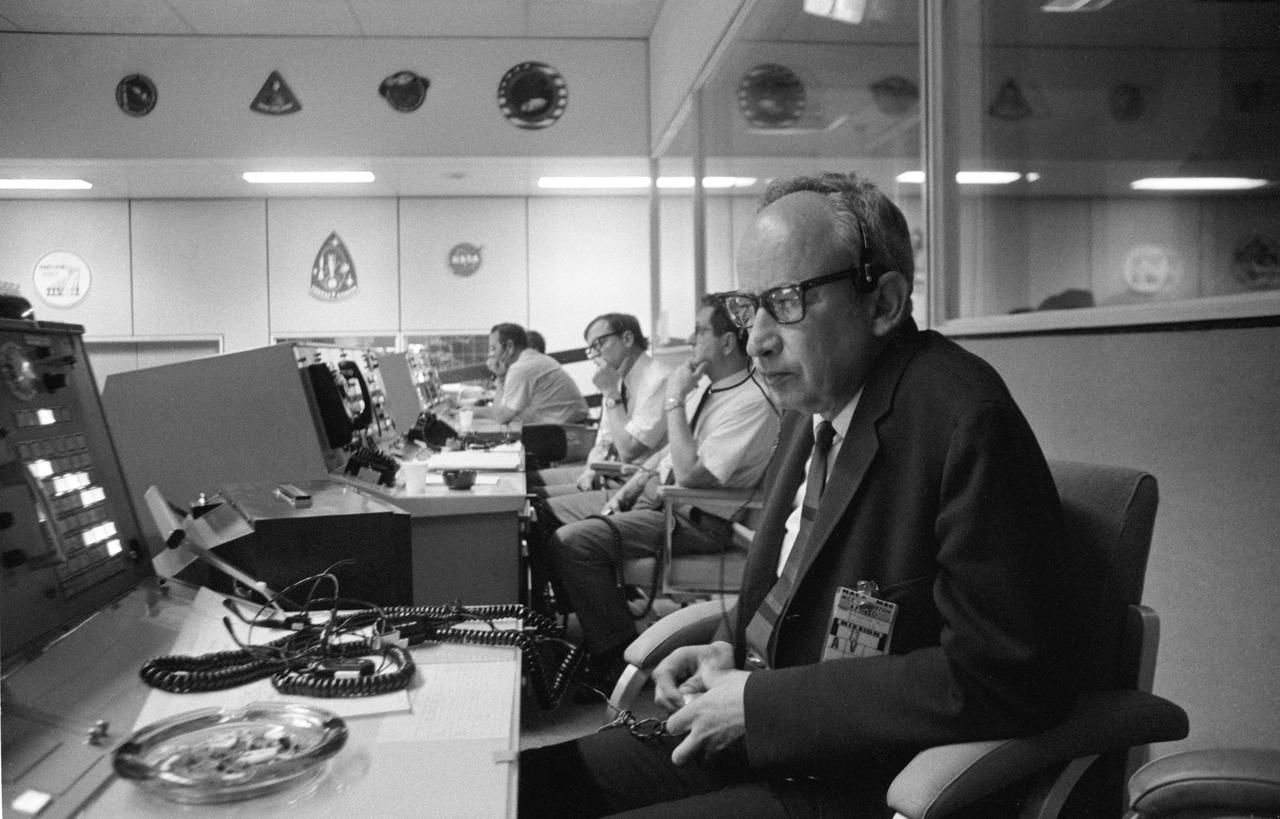
S70-34627 (11 April 1970) --- Sigurd A. Sjoberg, director of flight operations, at the Manned Spacecraft Center (MSC), views the Apollo 13 liftoff from a console in the MSC Mission Control Center (MCC), Building 30. Apollo 13 lifted off at 1:13 p.m. (CST) April 11, 1970. Photo credit: NASA
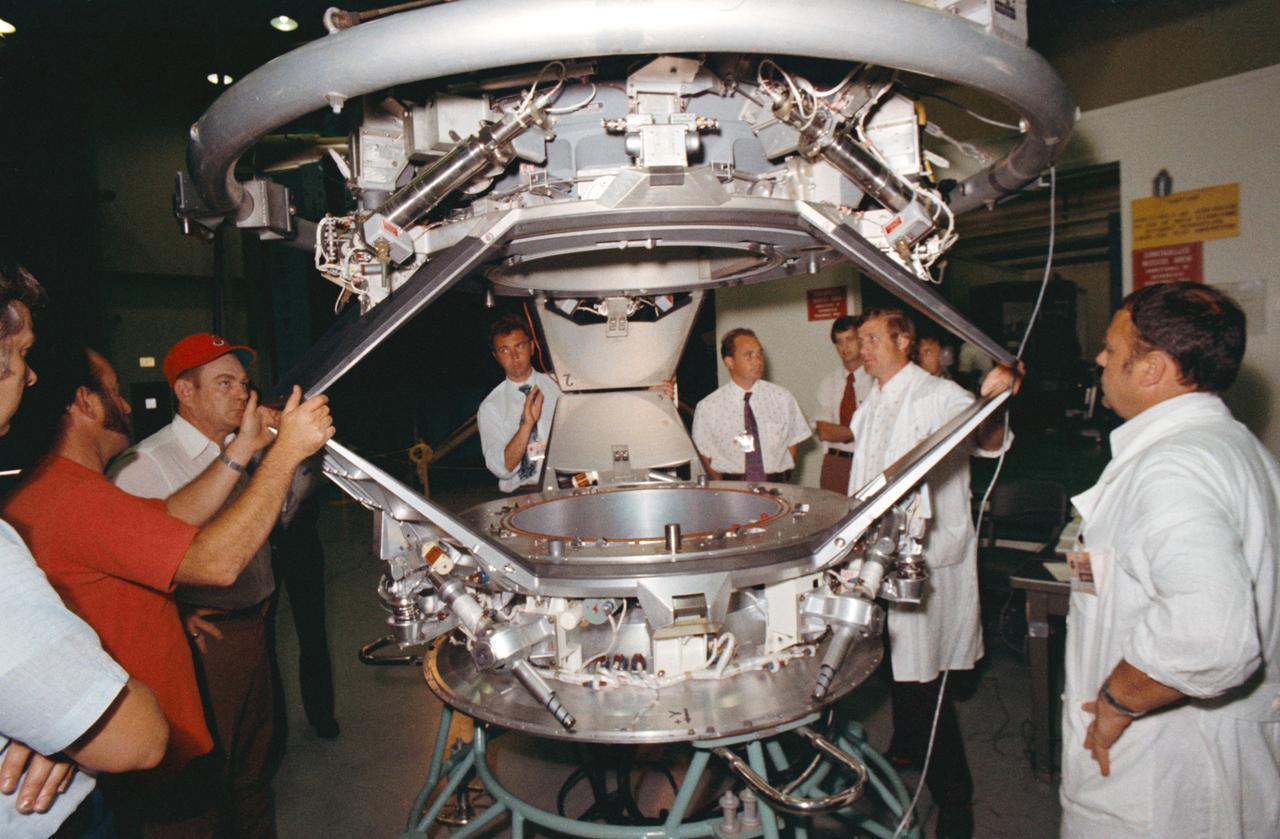
S74-25394 (10 July 1974) --- A group of American and Soviet engineers of the Apollo-Soyuz Test Project working group three examines an ASTP docking set-up following a docking mechanism fitness test conducted in Building 13 at the Johnson Space Center. Working Group No. 3 is concerned with ASTP docking problems and techniques. The joint U.S.-USSR ASTP docking mission in Earth orbit is scheduled for the summer of 1975. The Apollo docking mechanism is atop the Soyuz docking mechanism.
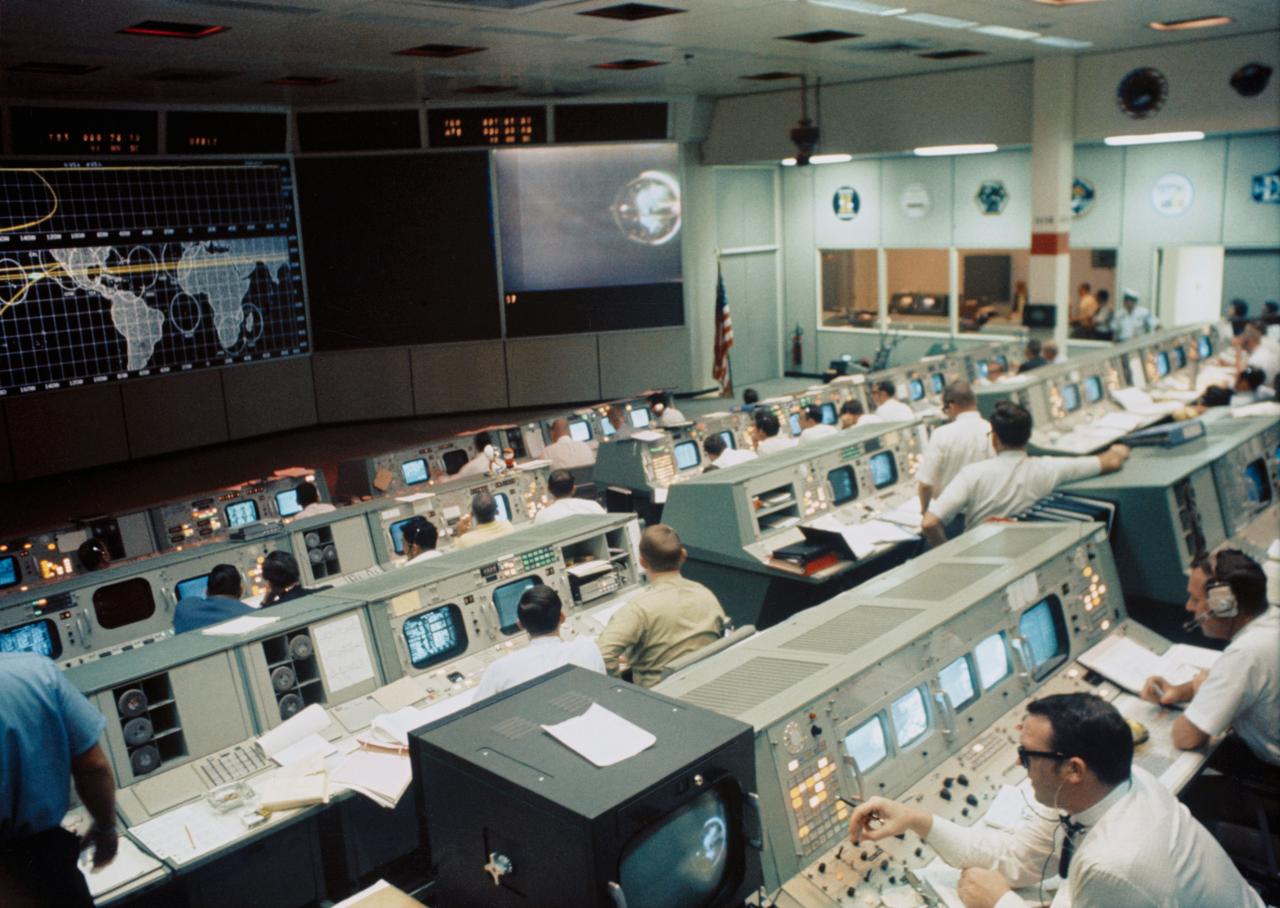
S69-34316 (18 May 1969) --- Overall view of the Mission Operations Control Room in the Mission Control Center, Building 30, on the first day of the Apollo 10 lunar orbit mission. A color television transmission was being received from Apollo 10. This picture was made following Command and Service Module/Lunar Module/Saturn IVB (CSM/LM-S-IVB) separation and prior to LM extraction from the S-IVB. The CSM were making the docking approach to the LM/S-IVB.
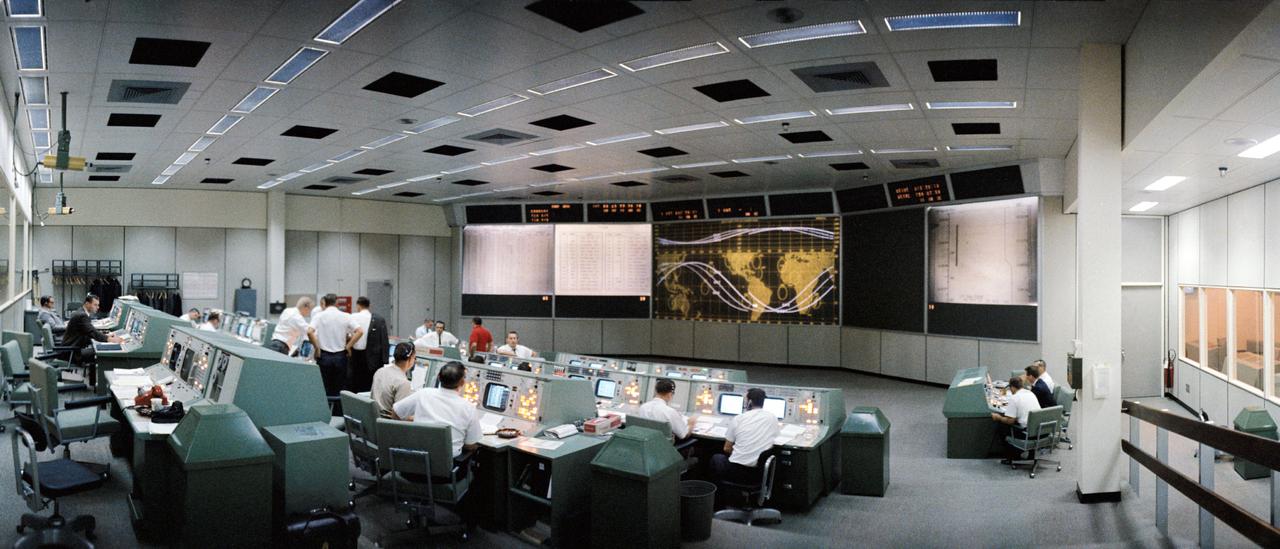
S65-45280 (21-29 Aug. 1965) --- Overall view of the Mission Control Center (MCC), Houston, Texas, during the Gemini-5 flight. Note the screen at the front of the MCC which is used to track the progress of the Gemini spacecraft.
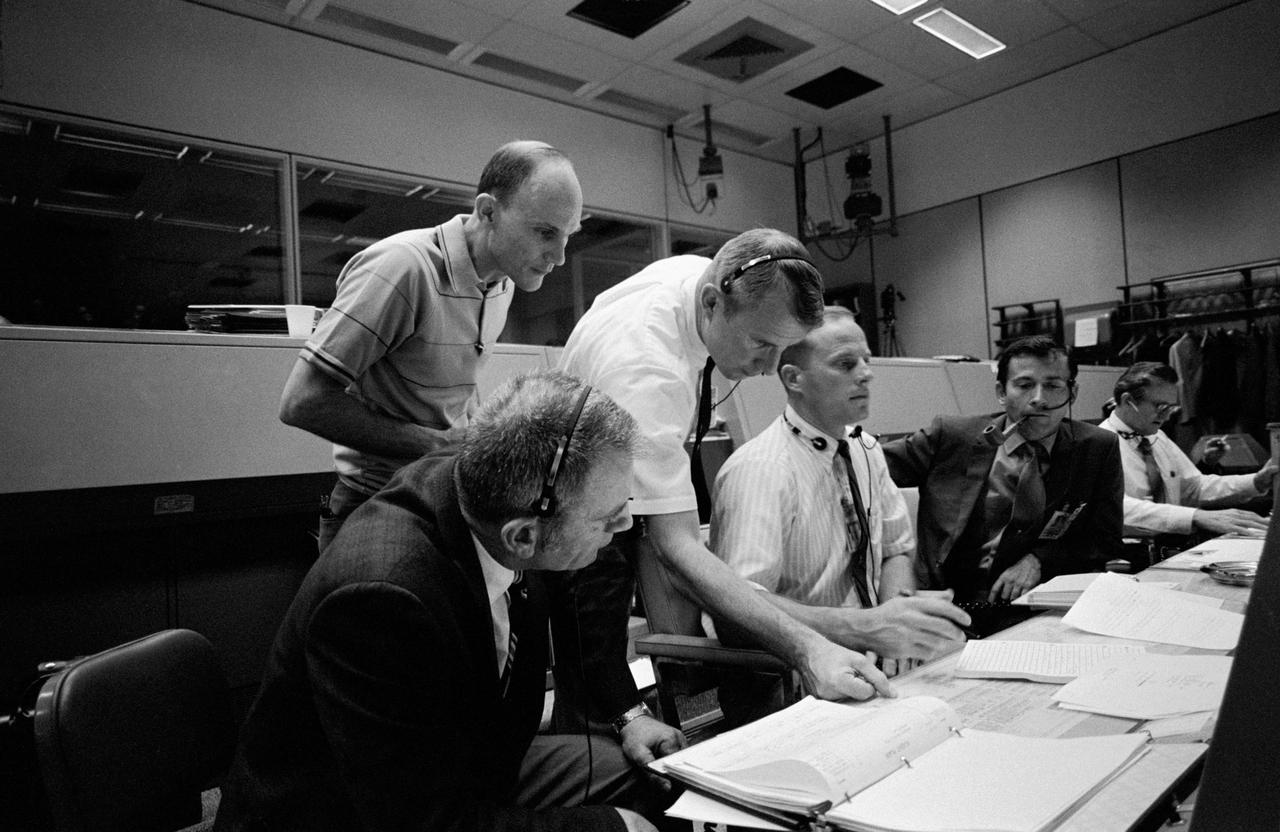
S70-34902 (14 April 1970) --- Several persons important to the Apollo 13 mission, at consoles in the Mission Operations Control Room (MOCR) of the Mission Control Center (MCC). Seated at consoles, from left to right, are astronauts Donald K. Slayton, director of flight crew operations; astronaut Jack R. Lousma, Shift 3 spacecraft communicator; and astronaut John W. Young, commander of the Apollo 13 backup crew. Standing, left to right, are astronaut Tom K. Mattingly II, who was replaced as Apollo 13 command module pilot after it was learned he may come down with measles, and astronaut Vance D. Brand, Shift 2 spacecraft communicator. Several hours earlier, in the late evening hours of April 13, crew members of the Apollo 13 mission reported to MCC that trouble had developed with an oxygen cell on their spacecraft.
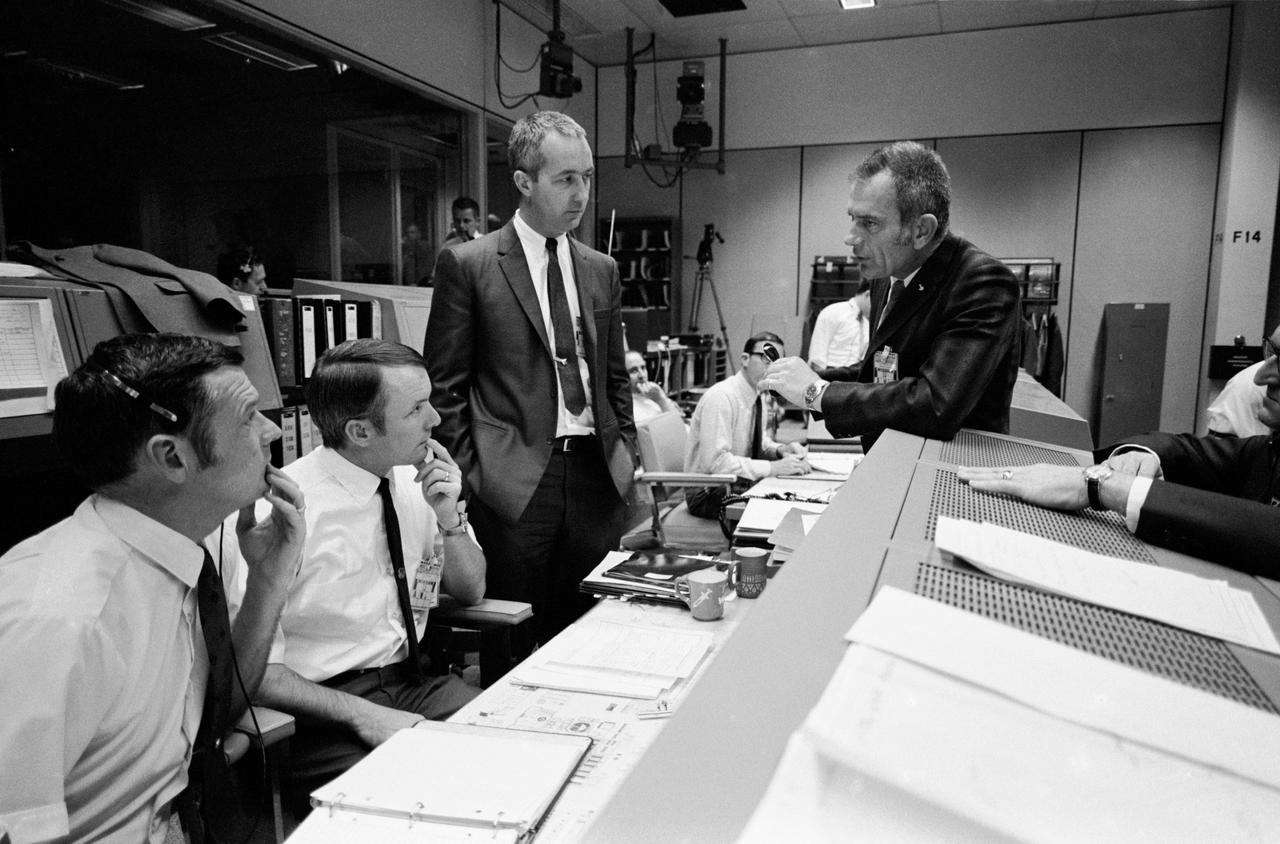
S70-35369 (16 April 1970) --- Discussion in the Mission Operations Control Room (MOCR) dealing with the Apollo 13 crewmen during their final day in space. From left to right are Glynn S. Lunney, Shift 4 flight director; Gerald D. Griffin, Shift 2 flight director; astronaut James A. McDivitt, manager, Apollo Spacecraft Program, MSC; Dr. Donald K. Slayton, director of Flight Crew Operations, MSC; and Dr. Willard R. Hawkins, M.D., Shift 1 flight surgeon.
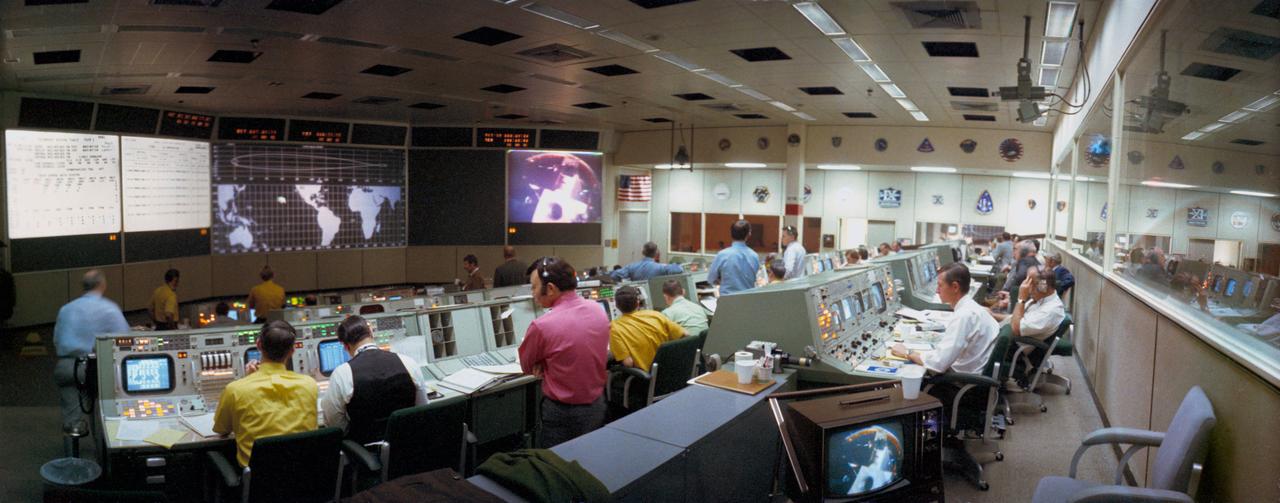
S71-17122 (31 Jan. 1971) --- A wide angle overall view of the Mission Operations Control Room (MOCR) in the Mission Control Center at the Manned spacecraft Center. This view was photographed during the first color television transmission from the Apollo 14 Command Module. Projected on the large screen at the right front of the MOCR is a view of the Apollo 14 Lunar Module, still attached to the Saturn IVB stage. The Command and Service Modules were approaching the LM/S-IVB during transposition and docking maneuvers.
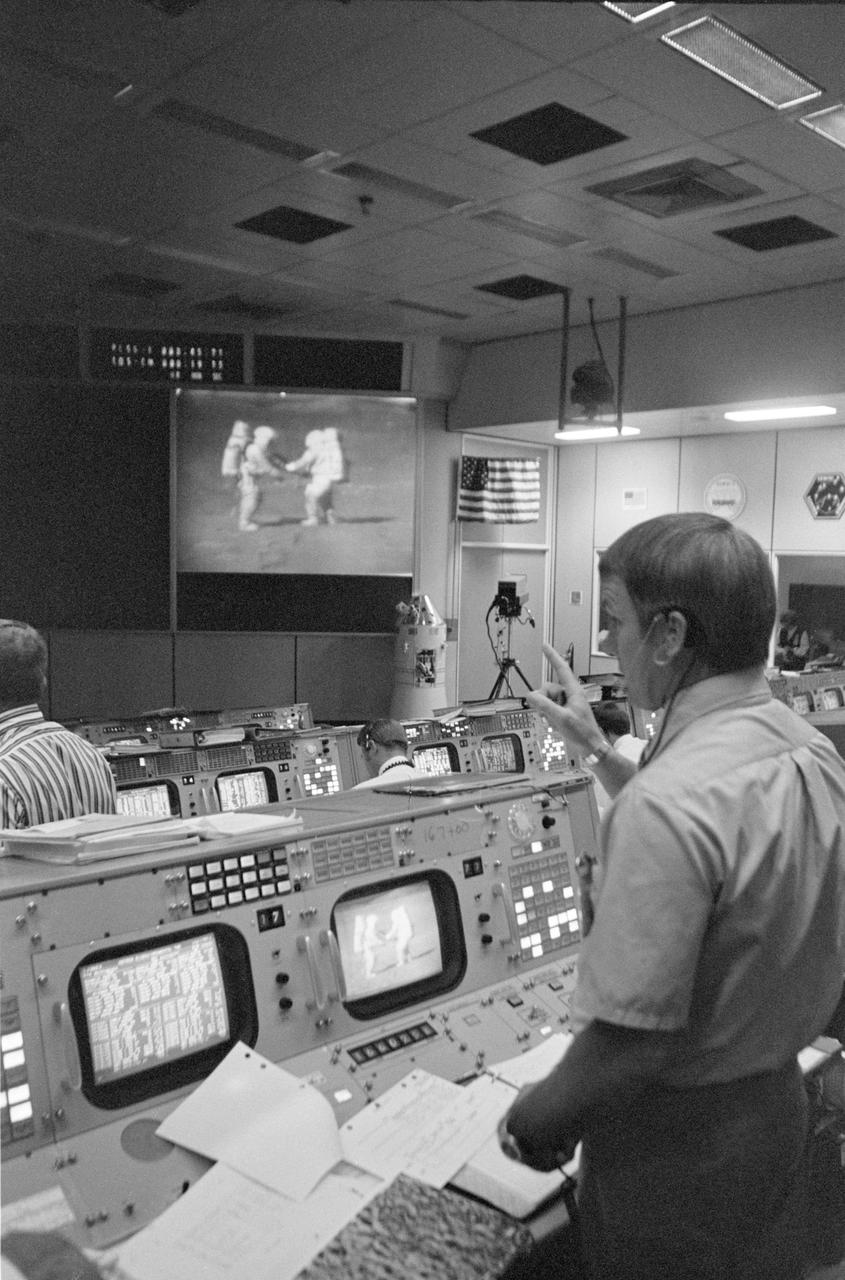
S71-41852 (2 Aug. 1971) --- Gerald D. Griffin, foreground, stands near his console in the Mission Operations Control Room (MOCR) during Apollo 15's third extravehicular activity (EVA) on the lunar surface. Griffin is Gold Team (Shift 1) flight director for the Apollo 15 mission. Astronauts David R. Scott and James B. Irwin can be seen on the large screen at the front of the MOCR as they participate in sample-gathering on the lunar surface.
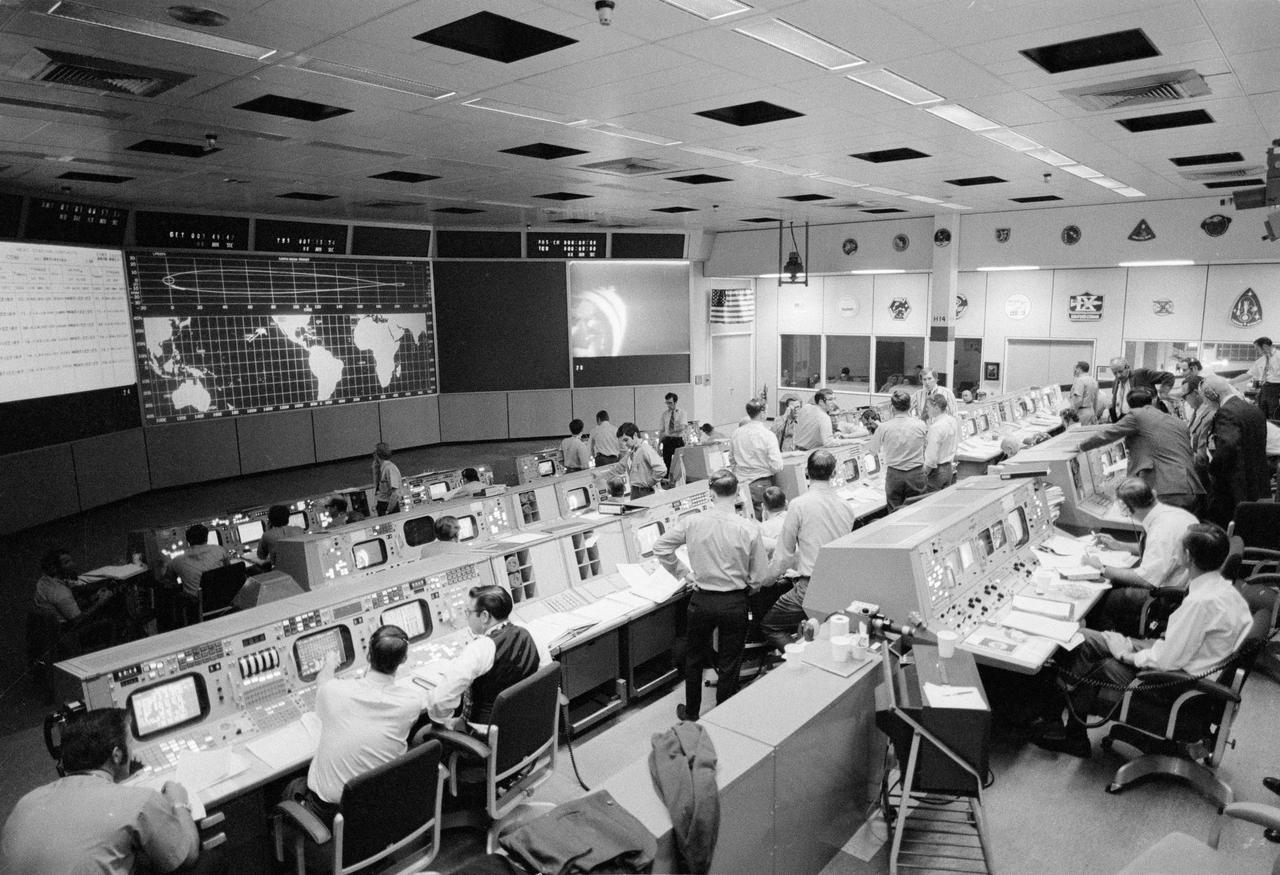
S71-16879 (31 Jan. 1971) --- Overall view of activity in the Mission Operations Control Room in the Mission Control Center during the Apollo 14 transposition and docking maneuvers. The Apollo 14 Lunar Module, still attached to the Saturn IVB stage, can be seen on the large television monitor. Due to difficulty with the docking mechanism six attempts were made before a successful "hard dock" of the Command Module with the Lunar Module was accomplished. Aboard the Command Module were astronauts Alan B. Shepard Jr., Stuart A. Roosa, and Edgar D. Mitchell.
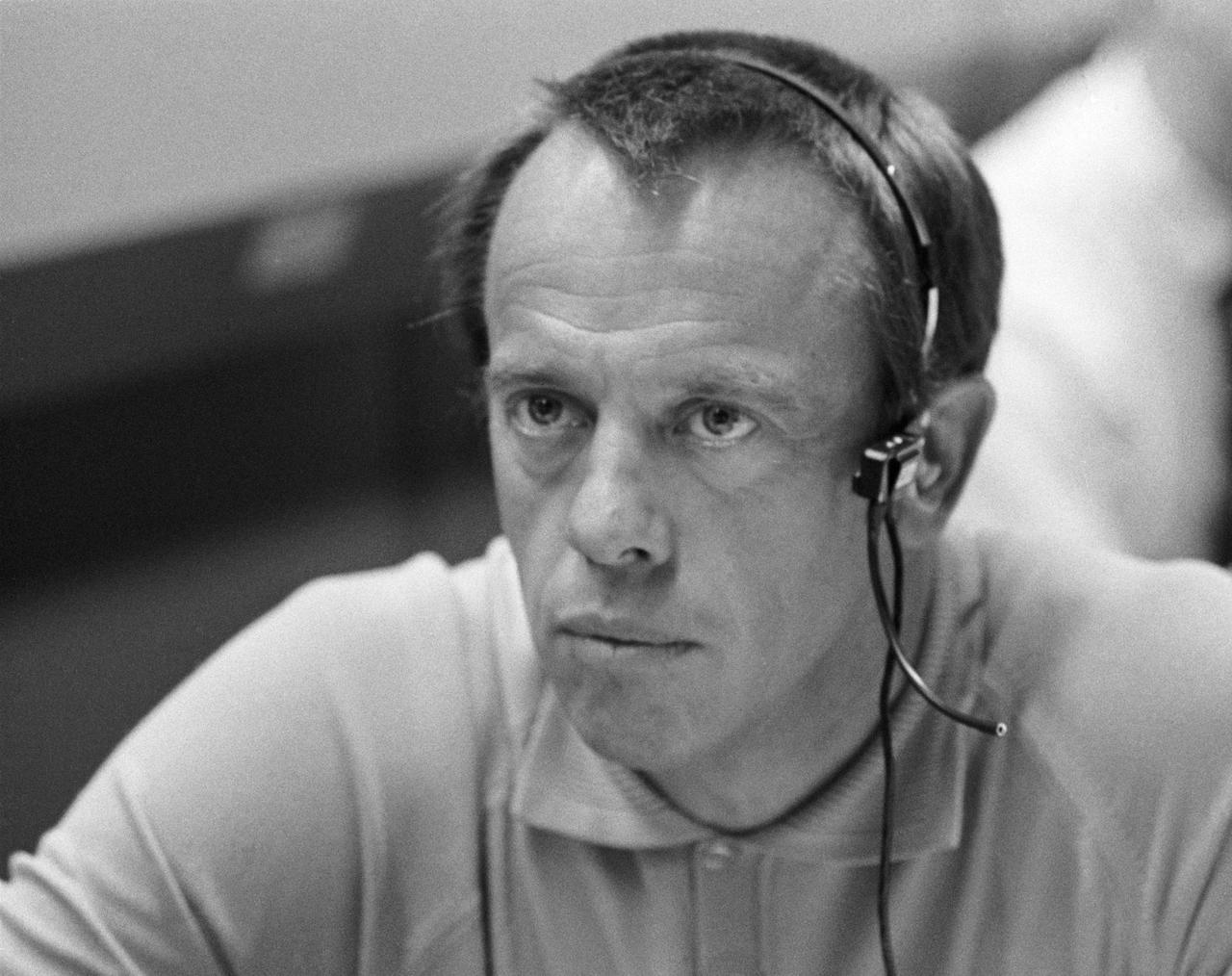
S70-34904 (14 April 1970) --- Astronaut Alan B. Shepard Jr., prime crew commander of the Apollo 14 mission, monitors communications between the Apollo 13 spacecraft and Mission Control Center. He is seated at a console in the Mission Operations Control Room of the MCC, Manned Spacecraft Center. The main concern of the moment was action taken by the three Apollo 13 crewmen - astronauts James A. Lovell Jr., John L. Swigert Jr. and Fred W. Haise Jr. - to make corrections inside the spacecraft following discovery of an oxygen cell failure several hours earlier.
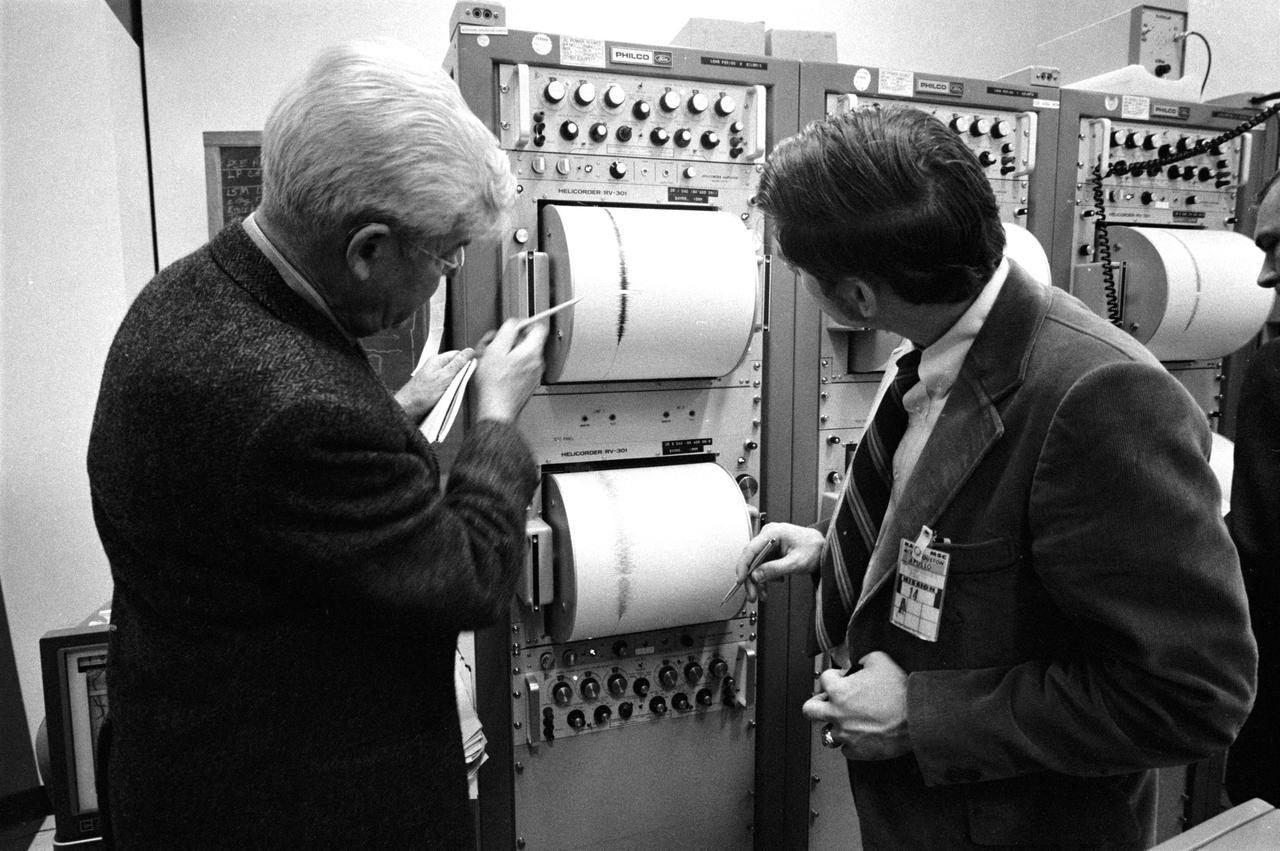
S71-17609 (4 Feb. 1971) --- These two individuals are examining a seismic reading in the Mission Control Center's ALSEP Room during the Apollo 14 S-IVB impact on the moon. Dr. Maurice Ewing (left) is the director of the Lamont-Doherty Geological Observatory at Columbia University. David Lammlein, a Columbia graduate student, is on the right. The Apollo 14 Saturn IVB stage impacted on the lunar surface at 1:40:54 a.m. (CST), Feb. 4, 1971, about 90 nautical miles south-southwest of the Apollo 12 passive seismometer. The energy release was comparable to 11 tons of TNT. Dr. Gary Latham of the Lamont-Doherty Geological Observatory is the principal investigator for the Passive Seismic Experiment, a component of the Apollo Lunar Surface Experiments Package.
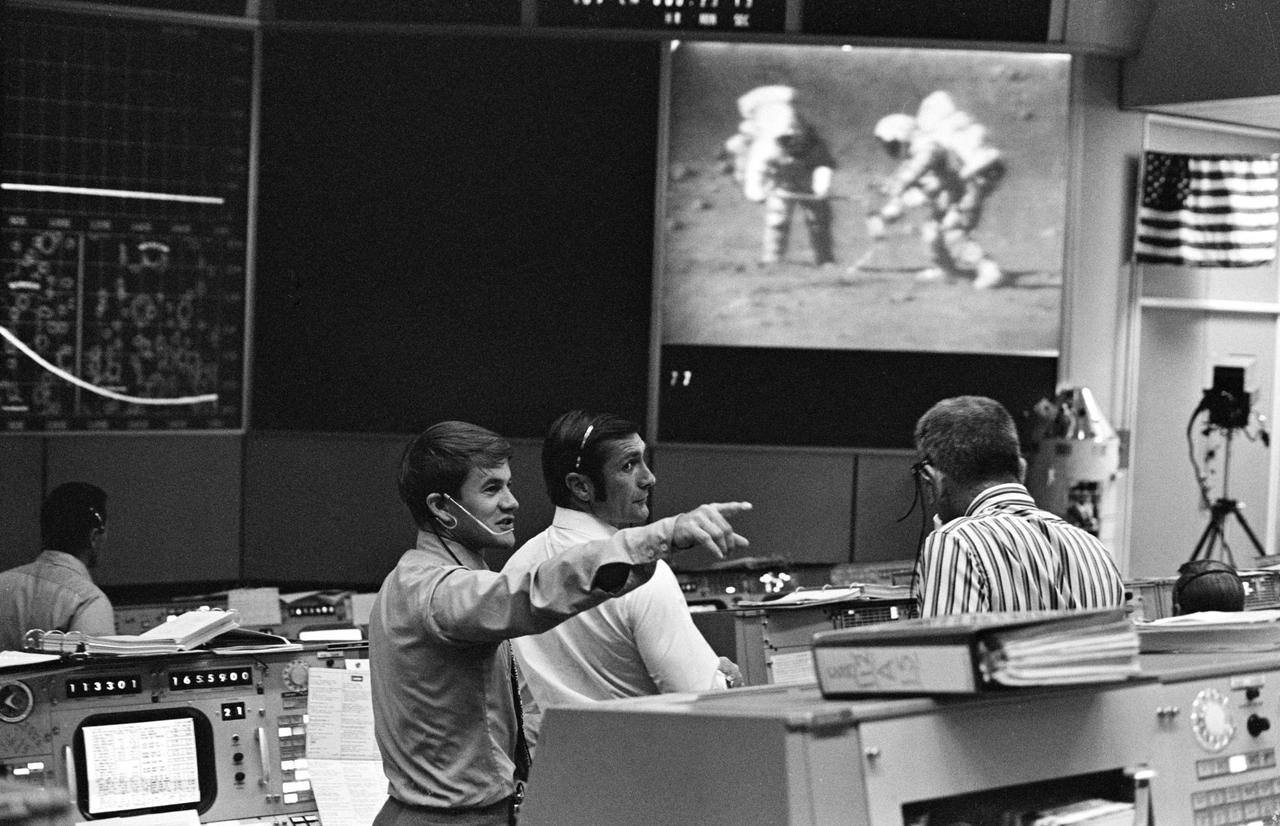
S71-41836 (2 Aug. 1971) --- Scientist-astronaut Joseph P. Allen, left, directs the attention of astronaut Richard F. Gordon Jr., to an occurrence out of view at right in the Mission Control Center's (MCC) Mission Operations Control Room (MOCR), while Dr. Donald K. (Deke) Slayton, on right with back to camera, views activity of Apollo 15 on a large screen at the front of the MOCR. Astronauts David R. Scott and James B. Irwin are seen on the screen performing tasks of the mission's third extravehicular activity (EVA), on Aug. 2, 1971. Dr. Slayton is director of Flight Crew Operations, NASA-MSC; Gordon is Apollo 15 backup commander; and Dr. Allen is an Apollo 15 spacecraft communicator.
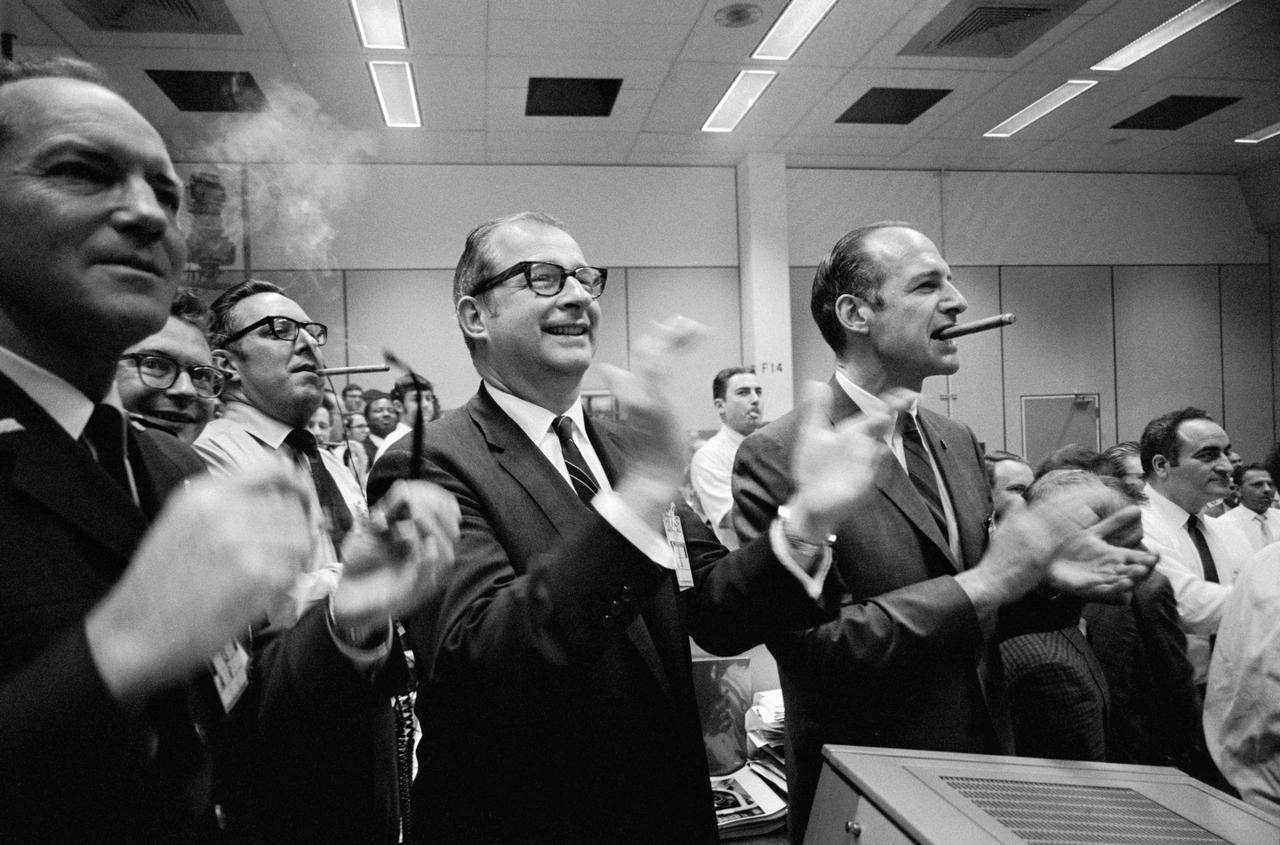
S70-35148 (17 April 1970) --- Staff members from NASA Headquarters (NASA HQ), Manned Spacecraft Center (MSC), and Dr. Thomas Paine (center of frame) applaud the successful splashdown of the Apollo 13 mission while Dr. George Low smokes a cigar (right), in the MSC Mission Control Center (MCC), located in Building 30. Apollo 13 crewmembers, astronauts James A. Lovell Jr., commander; John L. Swigert Jr., command module pilot; and Fred W. Haise Jr., lunar module pilot, splashed down at 12:07:44 p.m. (CST), April 17, 1970, in the south Pacific Ocean.

S70-35368 (16 April 1970) --- Overall view showing some of the feverish activity in the Mission Operations Control Room (MOCR) of the Mission Control Center (MCC) during the final 24 hours of the problem-plagued Apollo 13 mission. Here, flight controllers and several NASA/MSC officials confer at the flight director's console. When this picture was made, the Apollo 13 lunar landing had already been canceled, and the Apollo 13 crewmembers were in trans-Earth trajectory attempting to bring their crippled spacecraft back home.
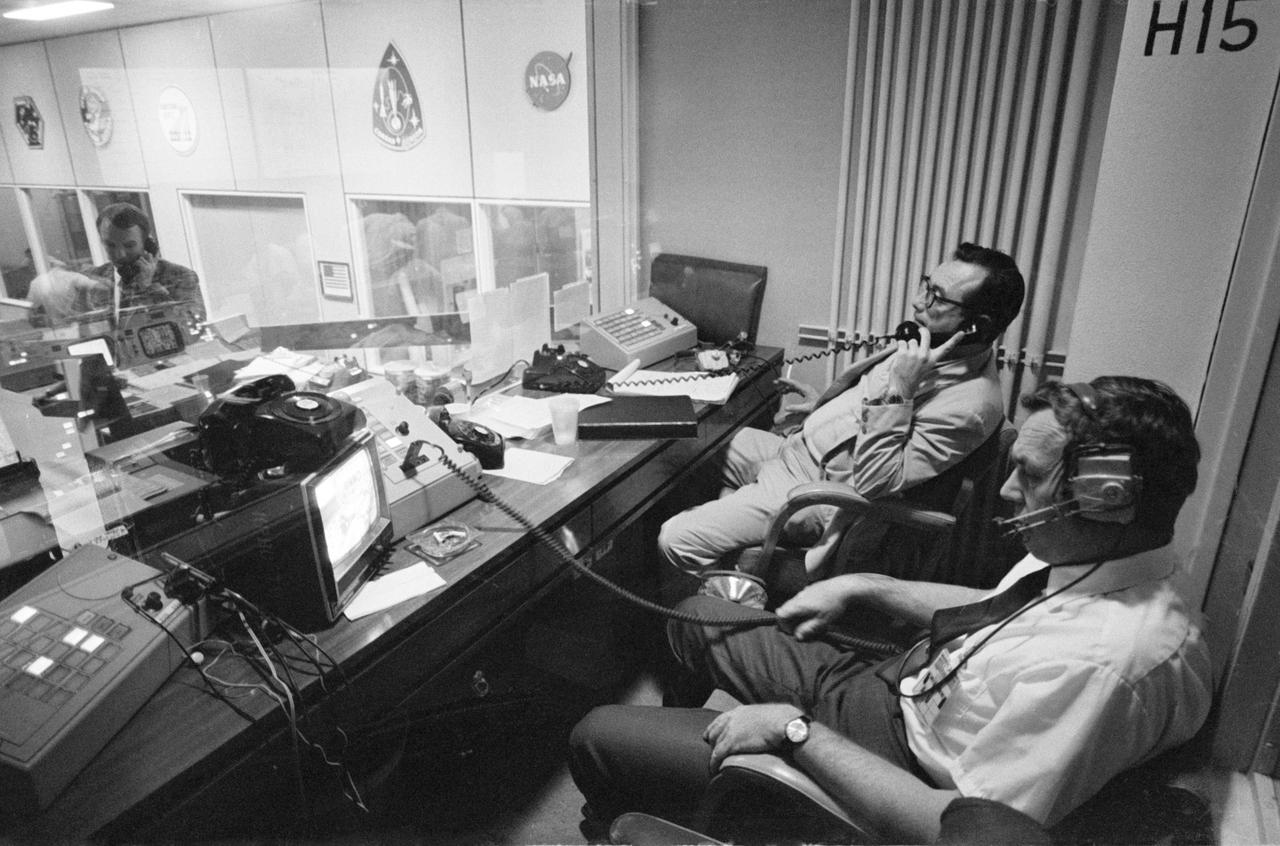
S70-35012 (15 April 1970) --- Two phases of busy activity during critical moments of the Apollo 13 mission are reflected in this view in the Mission Control Center, Building 30, Manned Spacecraft Center. In the foreground, Henry Simmons (left) of Newsweek magazine and John E. Riley, public information specialist, Public Affairs Office, MSC, man their positions in the Press Room. At extreme left of photo, Gerald D. Griffin, Shift 2 flight director, talks on telephone in Mission Operations Control Room. When this photograph was taken, the Apollo 13 lunar landing had been canceled, and the problem-plagued Apollo 13 crewmen were in trans-Earth trajectory attempting to bring their crippled spacecraft back home.
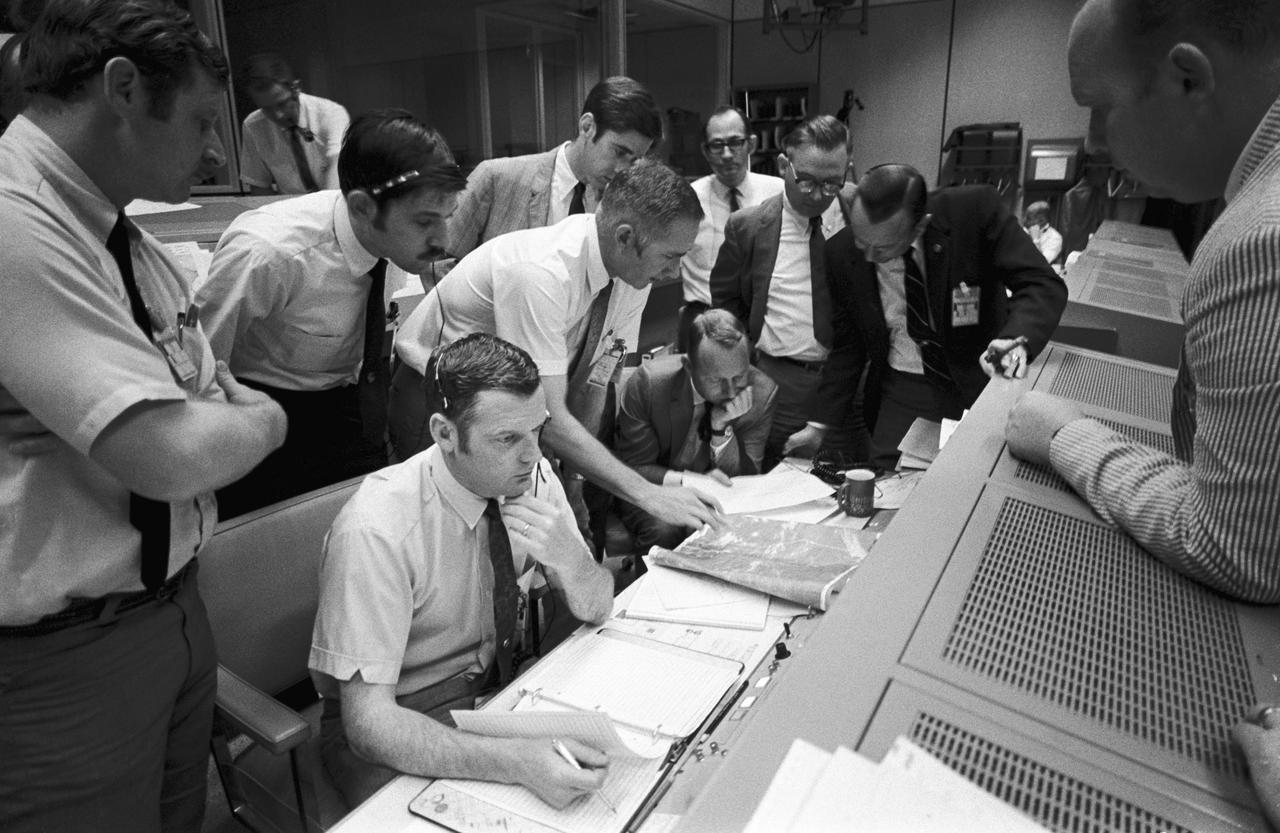
S70-35014 (15 April 1970) --- A group of flight controllers gathers around the console of Glenn S. Lunney (seated, nearest camera), Shift 4 flight director, in the Mission Operations Control Room (MOCR) of Mission Control Center (MCC), located in Building 30 at the Manned Spacecraft Center (MSC). Their attention is drawn to a weather map of the proposed landing site in the South Pacific Ocean. Among those looking on is Dr. Christopher C. Kraft, deputy director, MSC, standing in black suit, on right. When this photograph was taken, the Apollo 13 lunar landing mission had been canceled, and the problem-plagued Apollo 13 crew members were in trans-Earth trajectory attempting to bring their crippled spacecraft back home.
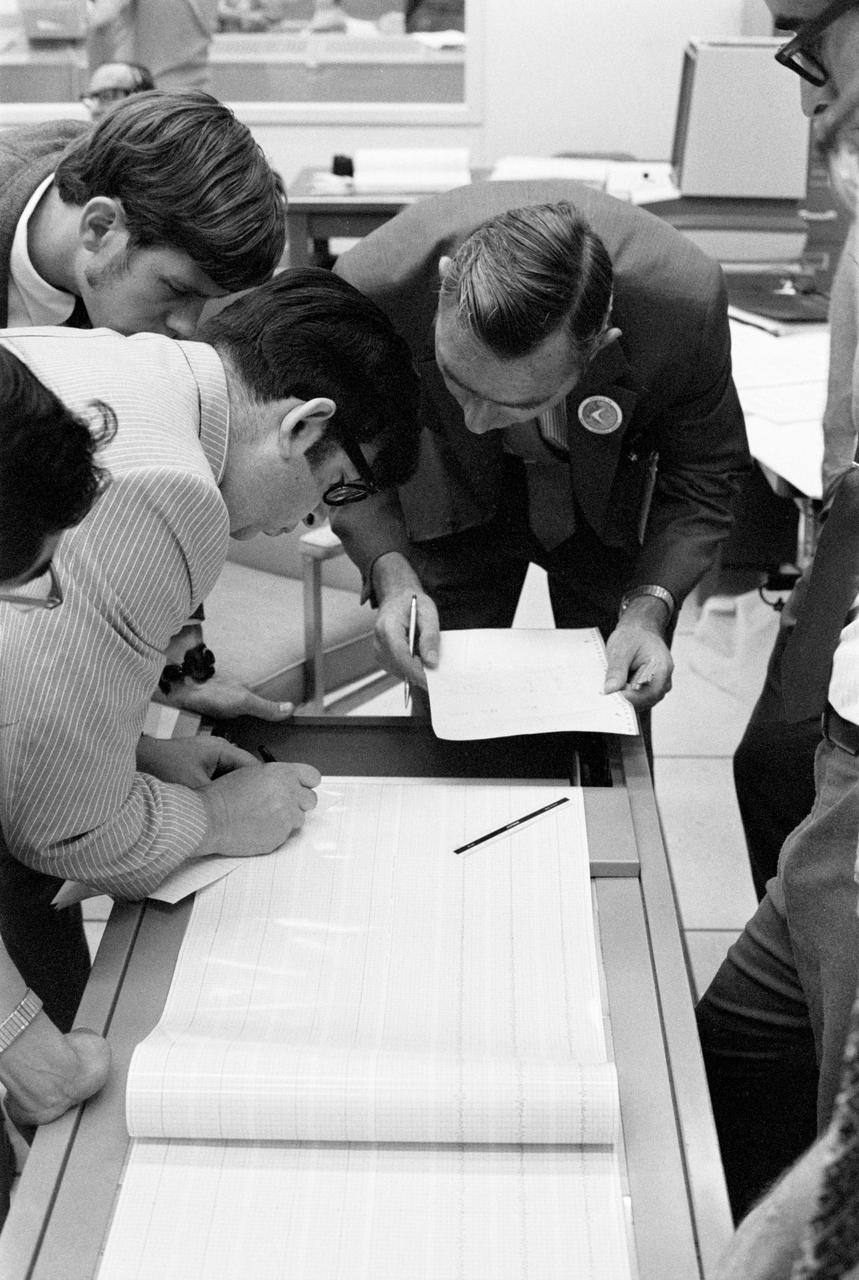
The seismometer reading from the impact made by the Apollo 15 Saturn S-IVB stage when it struck the lunar surface is studied by scientists in the Mission Control Center. Dr. Gary Latham (dark suit, wearing lapel button) of Columbia University is responsible for the design and experiment data analysis of the Passive Seismic Experiment of the Apollo Lunar Surface Experiment Package (ALSEP). The man on the left, writing, is Nafi Toksos of the Massachusetts Institute of Technology. Looking on at upper left is Dave Lamneline, also with Columbia.
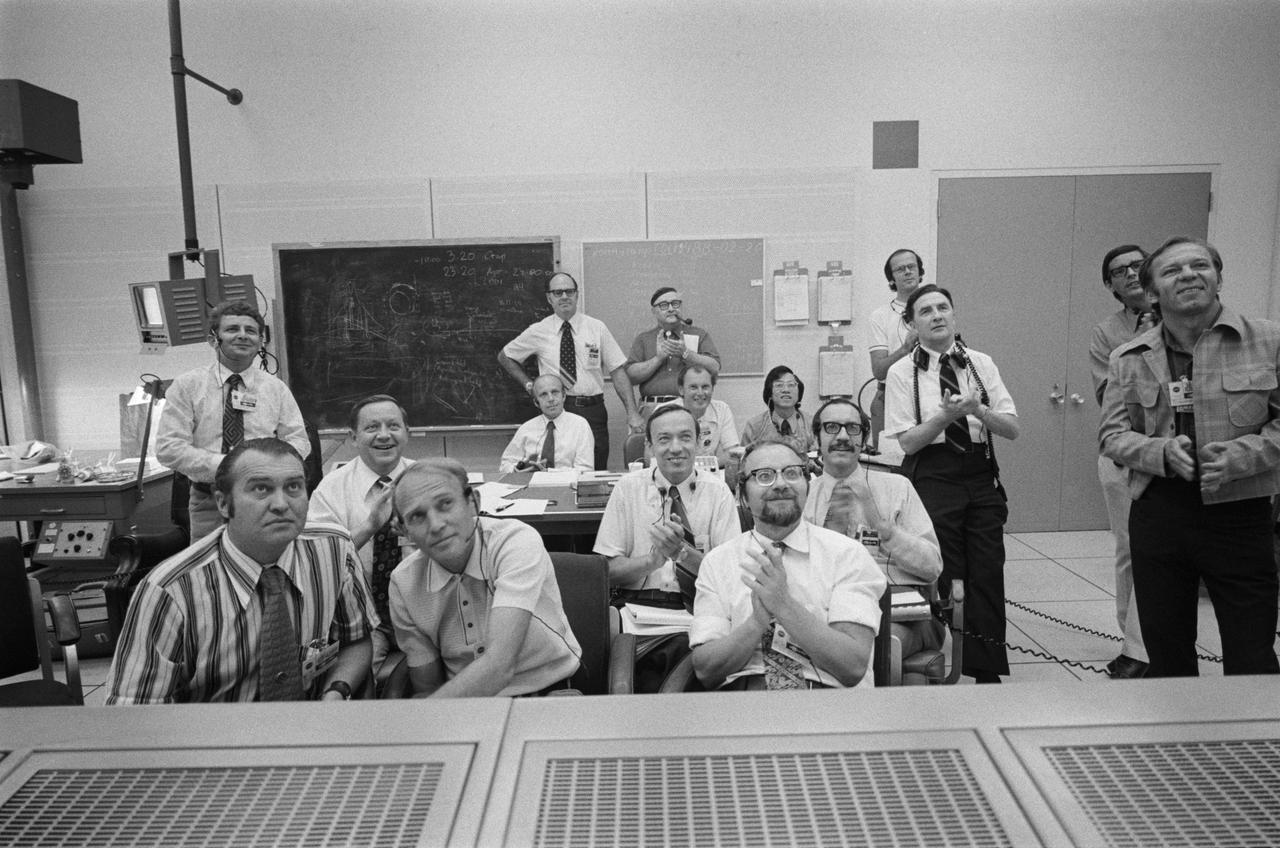
S75-28659 (21 July 1975) --- An overall view of the group of Soviet Union flight controllers who served at the Mission Control Center during the joint U.S.-USSR Apollo-Soyuz Test Project docking mission in Earth orbit. They are applauding the successful touchdown of the Soyuz spacecraft in Central Asia. The television monitor had just shown the land landing of the Soyuz descent vehicle.
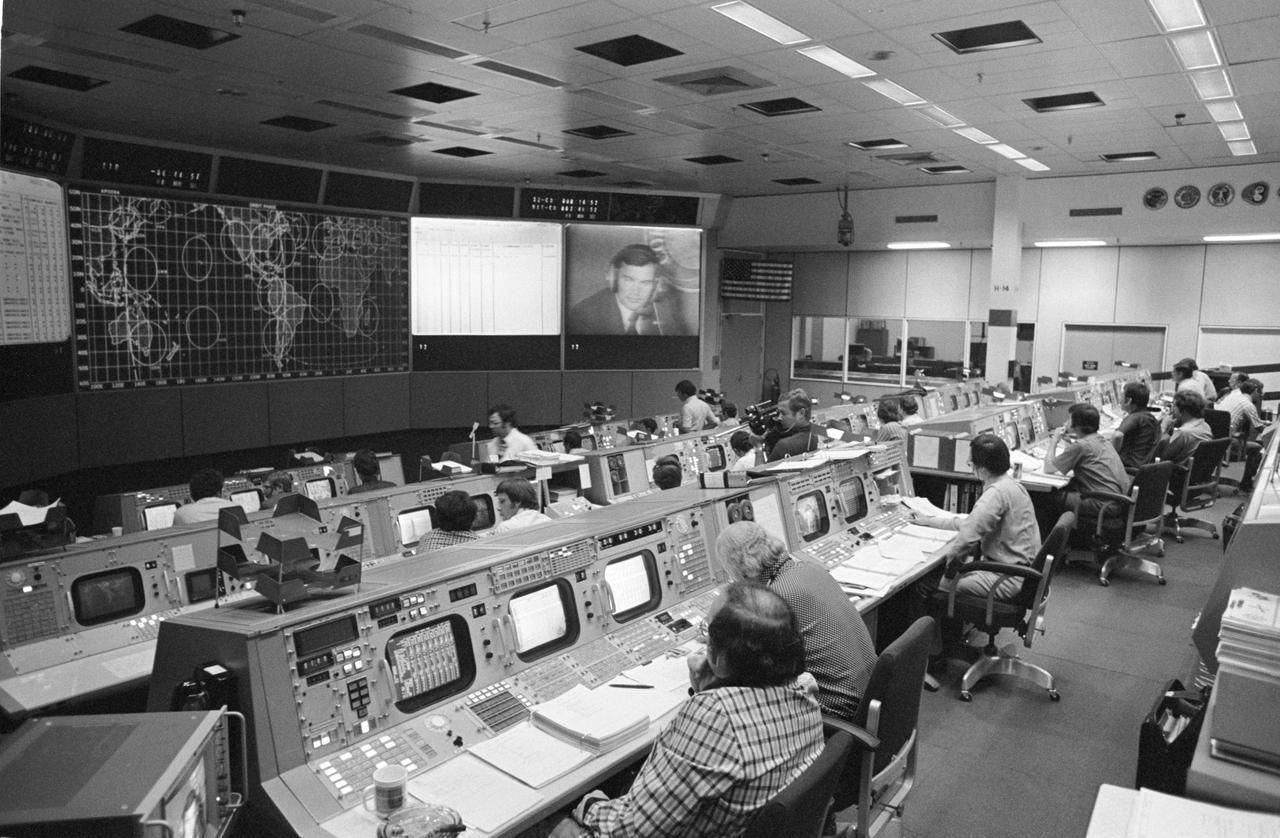
S75-28483 (15 July 1975) --- An overall view of the Mission Operations Control Room in the Mission Control Center on the first day of the Apollo-Soyuz Test Project docking mission in Earth orbit. The American ASTP flight controllers at NASA's Johnson Space Center were monitoring the progress of the Soviet ASTP launch when this photograph was taken. The television monitor shows cosmonaut Yuri V. Romanenko at his spacecraft communicator?s console in the ASTP mission control center in the Soviet Union. The American ASTP liftoff followed the Soviet ASTP launch by seven and one-half hours.
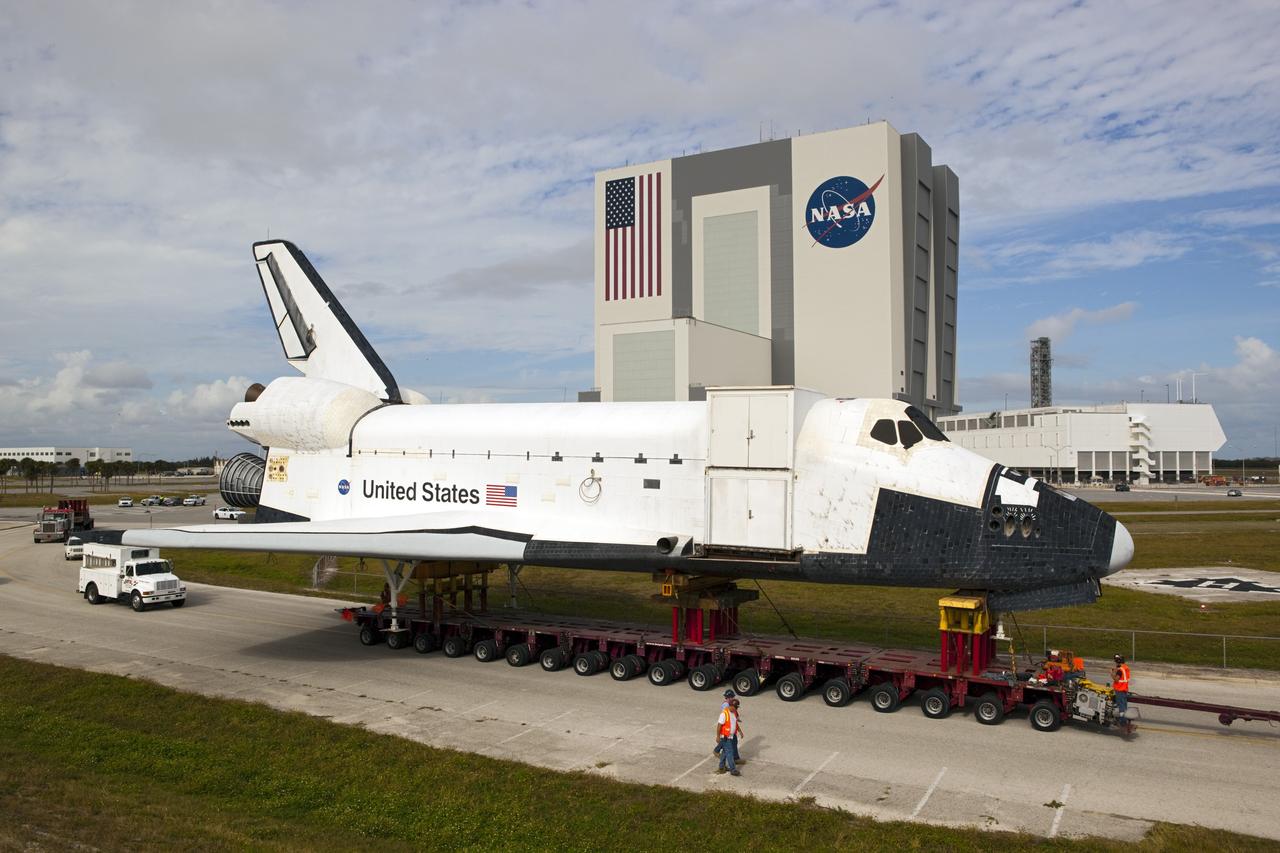
CAPE CANAVERAL, Fla. – Support personnel walk with the high-fidelity space shuttle model which was on display at the NASA Kennedy Space Center Visitor Complex in Florida as it rolls through the parking lot leading to Kennedy's Launch Complex 39 turn basin. Behind it are the 525-foot-tall Vehicle Assembly Building and the Launch Control Center. The shuttle was part of a display at the visitor complex that also included an external tank and two solid rocket boosters that were used to show visitors the size of actual space shuttle components. The full-scale shuttle model is being transferred from Kennedy to Space Center Houston, NASA Johnson Space Center's visitor center. The model will stay at the turn basin for a few months until it is ready to be transported to Texas via barge. The move also helps clear the way for the Kennedy Space Center Visitor Complex to begin construction of a new facility next year to display space shuttle Atlantis in 2013. For more information about Space Center Houston, visit http://www.spacecenter.org. Photo credit: NASA/Dimitri Gerondidakis
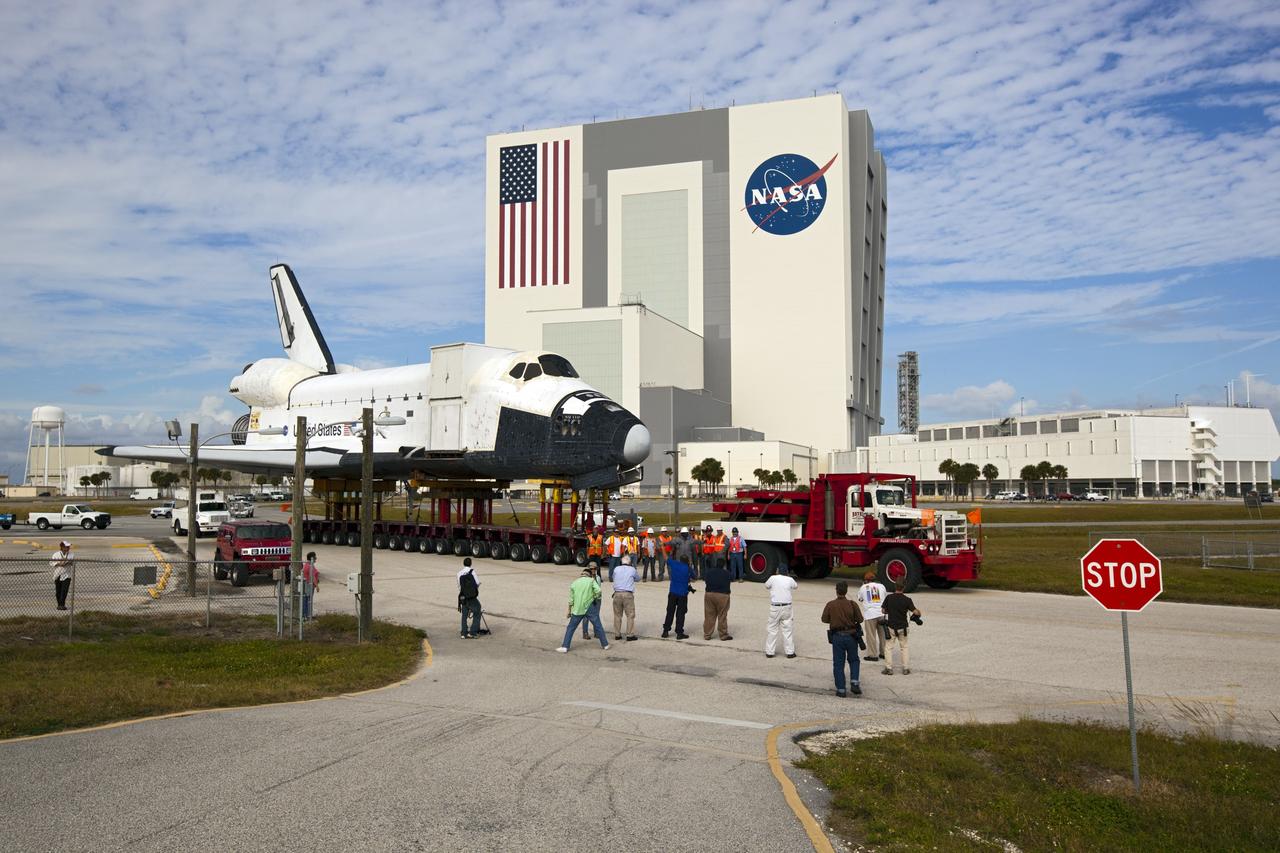
CAPE CANAVERAL, Fla. – Support personnel pose for a group portrait with the high-fidelity space shuttle model which was on display at the NASA Kennedy Space Center Visitor Complex in Florida. The shuttle lingered momentarily in the parking lot entrance to its destination, Kennedy's Launch Complex 39 turn basin. Behind them are the 525-foot-tall Vehicle Assembly Building and the Launch Control Center (at right). The shuttle was part of a display at the visitor complex that also included an external tank and two solid rocket boosters that were used to show visitors the size of actual space shuttle components. The full-scale shuttle model is being transferred from Kennedy to Space Center Houston, NASA Johnson Space Center's visitor center. The model will stay at the turn basin for a few months until it is ready to be transported to Texas via barge. The move also helps clear the way for the Kennedy Space Center Visitor Complex to begin construction of a new facility next year to display space shuttle Atlantis in 2013. For more information about Space Center Houston, visit http://www.spacecenter.org. Photo credit: NASA/Dimitri Gerondidakis
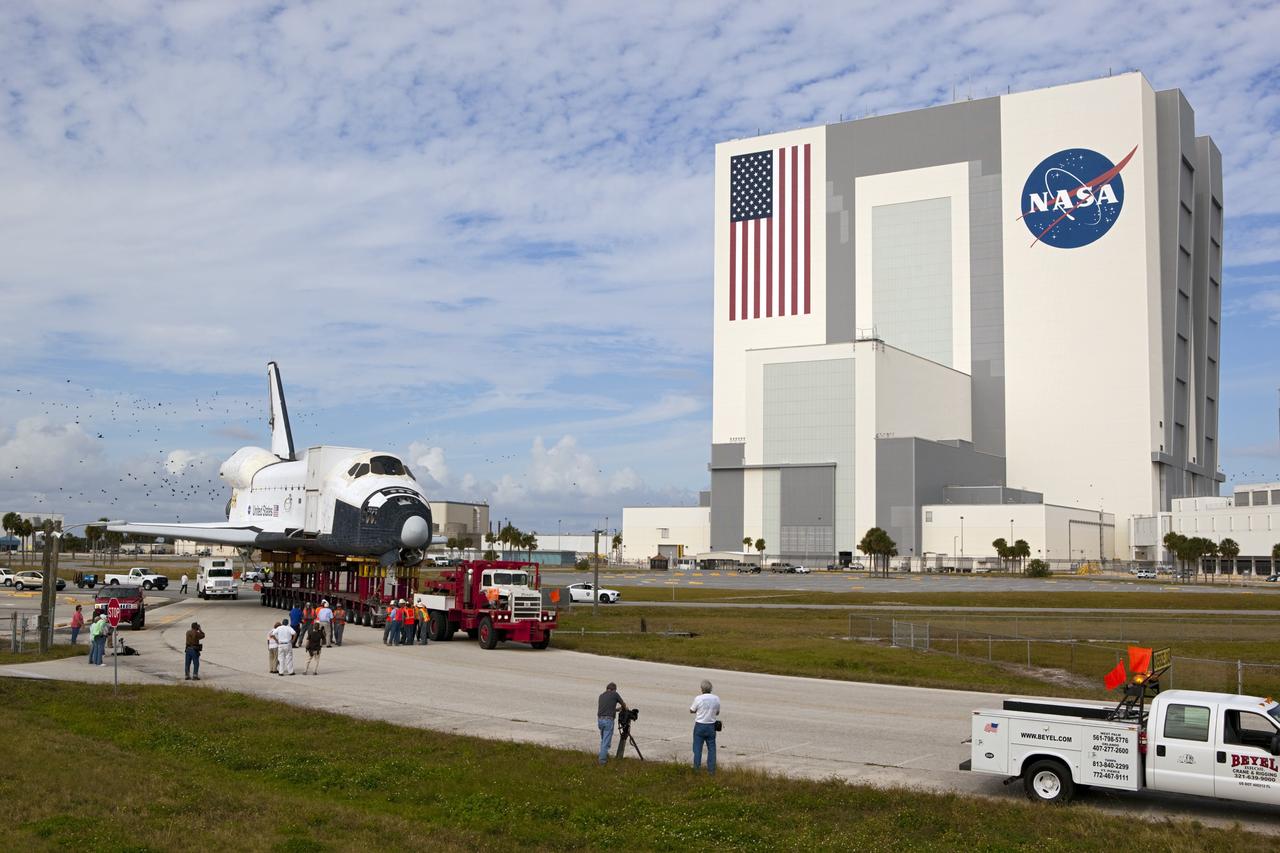
CAPE CANAVERAL, Fla. – Support personnel plan the last leg of the move of the high-fidelity space shuttle model which was on display at the NASA Kennedy Space Center Visitor Complex in Florida to Kennedy's Launch Complex 39 turn basin. Across the street (at right) are the 525-foot-tall Vehicle Assembly Building and the Launch Control Center. The shuttle was part of a display at the visitor complex that also included an external tank and two solid rocket boosters that were used to show visitors the size of actual space shuttle components. The full-scale shuttle model is being transferred from Kennedy to Space Center Houston, NASA Johnson Space Center's visitor center. The model will stay at the turn basin for a few months until it is ready to be transported to Texas via barge. The move also helps clear the way for the Kennedy Space Center Visitor Complex to begin construction of a new facility next year to display space shuttle Atlantis in 2013. For more information about Space Center Houston, visit http://www.spacecenter.org. Photo credit: NASA/Dimitri Gerondidakis
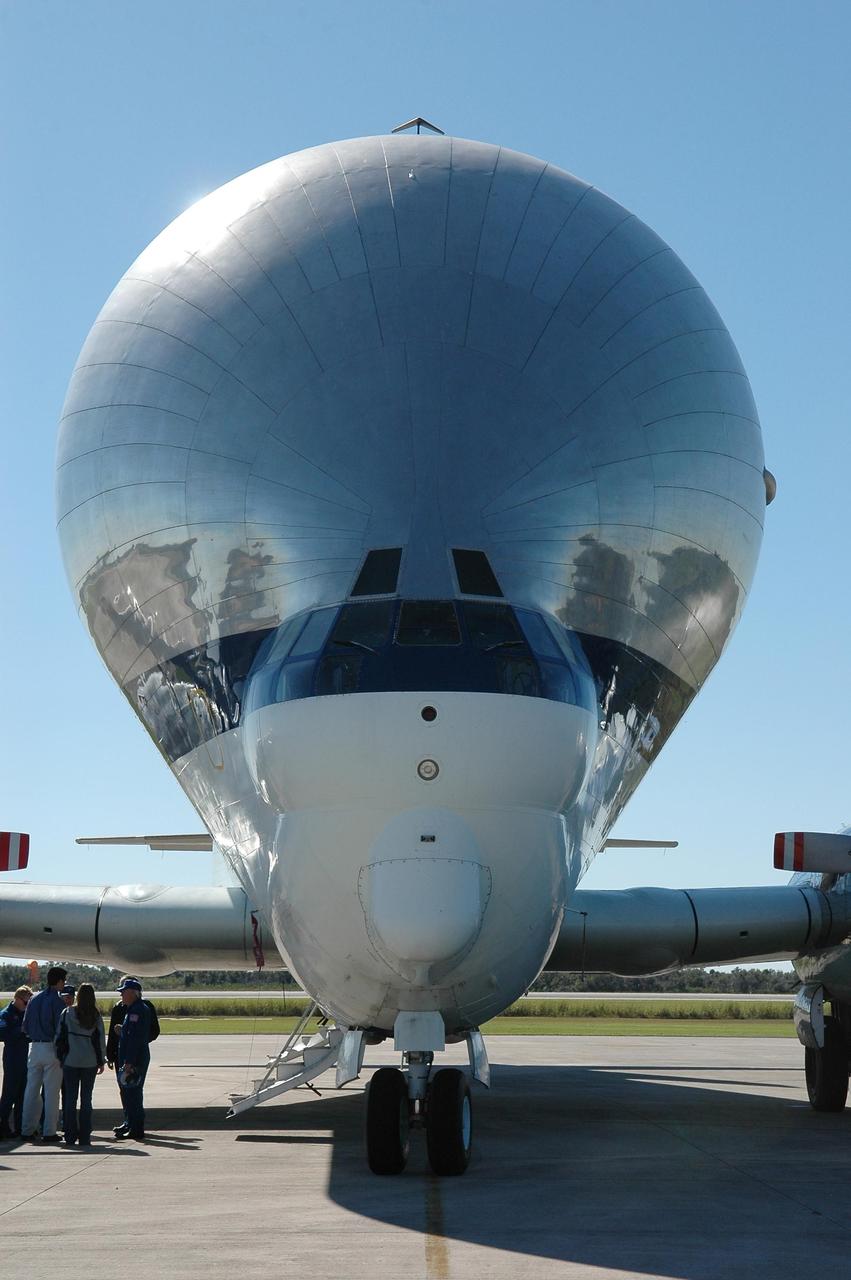
KENNEDY SPACE CENTER, FLA. - This front view of the Super Guppy aircraft, parked on NASA Kennedy Space Center’s Shuttle Landing Facility, appears more like a hot air balloon. In fact, it is the bulbous nose which, when unhinged, can open more than 200 degrees and allow large pieces of cargo to be loaded and unloaded from the front. The aircraft has flown to the Center to pick up and transport the common module structural test element to NASA's Marshall Space Flight Center in Huntsville, Ala. The common module is an aluminum canister used as a structural test element for an actual Space Station flight element. At Marshall, the module will be used to conduct advanced environmental control and life support testing for future NASA exploration missions. Guppy aircraft were used in several past space programs, including Gemini, Apollo and Skylab, to transport spacecraft components. NASA personnel at Ellington Field in Texas outfitted the Super Guppy with a specially designed cradle to be used when carrying International Space Station components. The first Guppy aircraft was developed in 1962, designed specifically for NASA operations by Aero Spacelines of California. Photo credit: NASA/Kim Shiflett
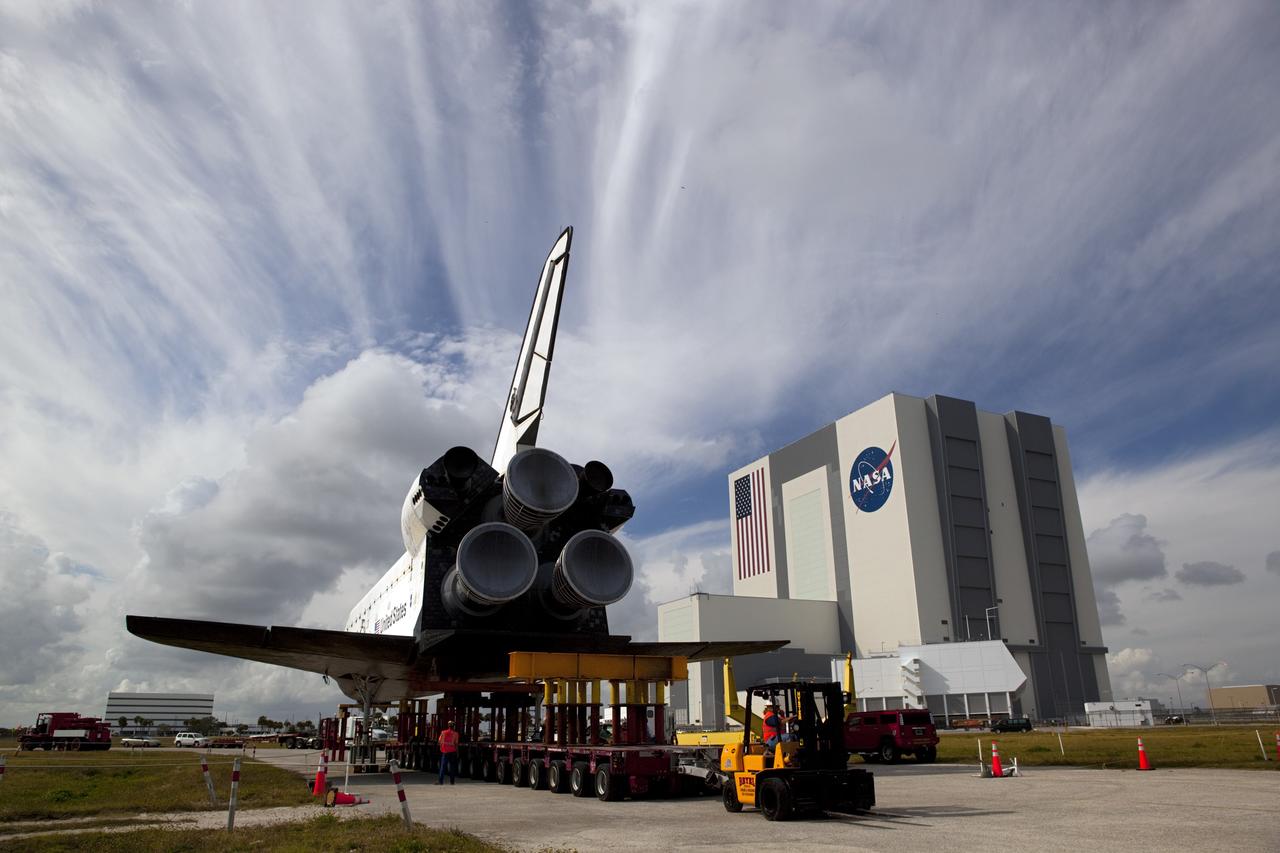
CAPE CANAVERAL, Fla. – Support personnel pull the transporter from beneath the high-fidelity space shuttle model which was on display at the NASA Kennedy Space Center Visitor Complex in Florida following its delivery to Kennedy's Launch Complex 39 turn basin. Across the street is the 525-foot-tall Vehicle Assembly Building. The shuttle was part of a display at the visitor complex that also included an external tank and two solid rocket boosters that were used to show visitors the size of actual space shuttle components. The full-scale shuttle model is being transferred from Kennedy to Space Center Houston, NASA Johnson Space Center's visitor center. The model will stay at the turn basin for a few months until it is ready to be transported to Texas via barge. The move also helps clear the way for the Kennedy Space Center Visitor Complex to begin construction of a new facility next year to display space shuttle Atlantis in 2013. For more information about Space Center Houston, visit http://www.spacecenter.org. Photo credit: NASA/Dimitri Gerondidakis
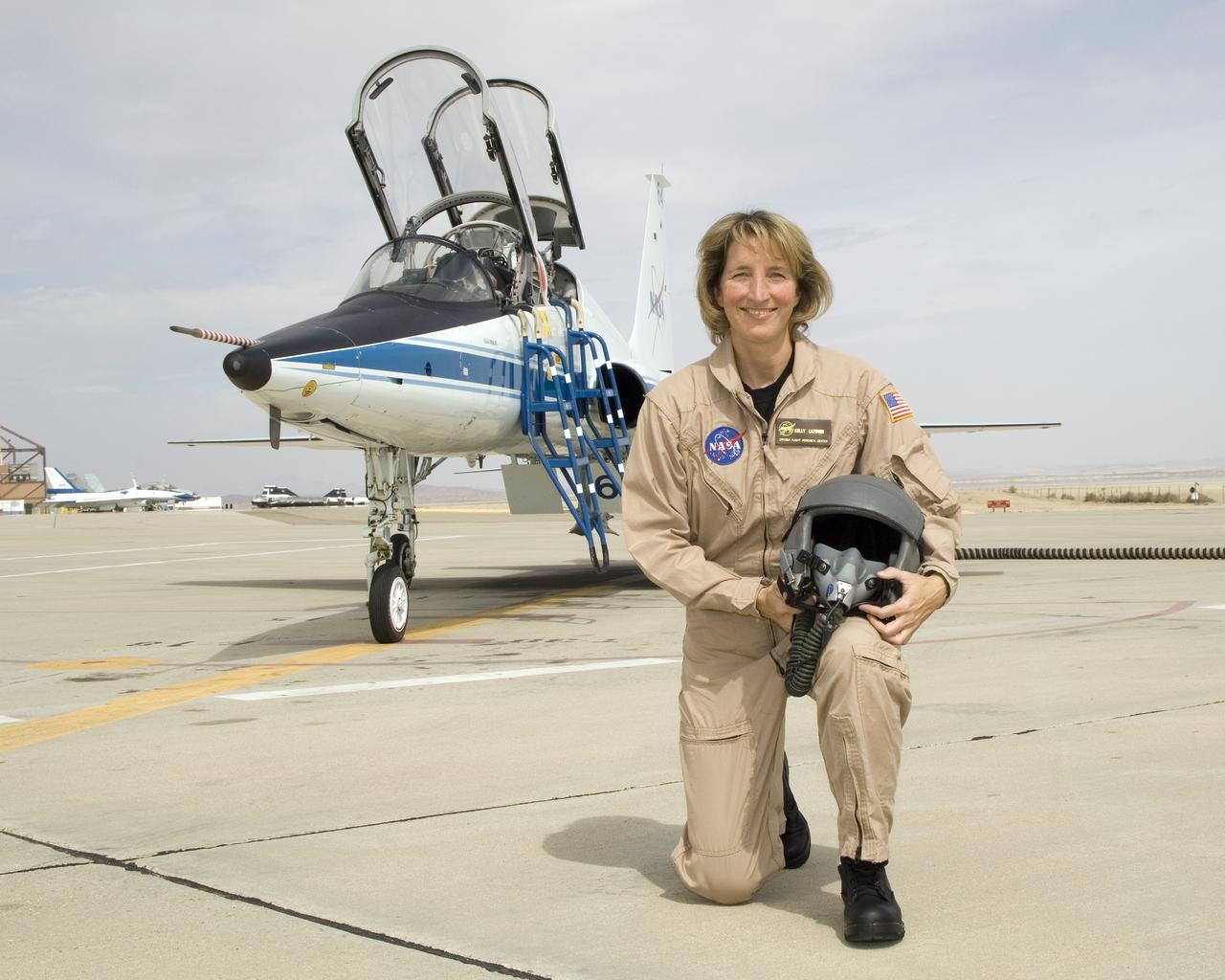
Kelly Latimer is a research pilot in the Flight Crew Branch of NASA's Dryden Flight Research Center, Edwards, Calif. Latimer joined NASA in March 2007 and will fly the T38, T-34, G-III, C-17 and the "Ikhana" Predator B. Latimer is Dryden's first female research test pilot. Prior to joining NASA, Latimer was on active duty with the U.S. Air Force. She has accumulated more than 5,000 hours of military and civilian flight experience in 30 aircraft. Latimer's first association with NASA was while attending graduate school at George Washington University, Washington, D.C. Her studies included work with the Joint Institute for the Advancement of Flight Sciences at NASA's Langley Research Center, Hampton, Va. She flew an Air Force C-17 during a 2005 NASA study to reduce aircraft noise. A team of California Polytechnic State University students and Northrop Grumman personnel were stationed on Rogers Dry Lake located at Edwards Air Force Base, Calif., to record the noise footprint of the aircraft as it made various landing approaches to Edwards' runway. Latimer completed undergraduate pilot training at Reese Air Force Base, Texas, in 1990. She remained at Reese as a T-38 instructor pilot until 1993. She was assigned as a C-141 aircraft commander at McCord Air Force Base, Tacoma, Wash., until 1996. Latimer graduated from the U.S. Air Force Test Pilot School at Edwards in Class 96B. She served as a C-17 and C-141 experimental test pilot at Edwards until 2000. She then became the chief of the Performance Branch and a T-38 instructor pilot at The Air Force Test Pilot School. She returned to McCord in 2002, where she was a C-17 aircraft commander and the operations officer for the 62nd Operations Support Squadron. In 2004, Latimer became the commander of Edwards' 418th Flight Test Squadron and director of the Global Reach Combined Test Force. Following that assignment, she deployed to Iraq as an advisor to the Iraqi Air Force. Her last active duty tour was as an instructor a