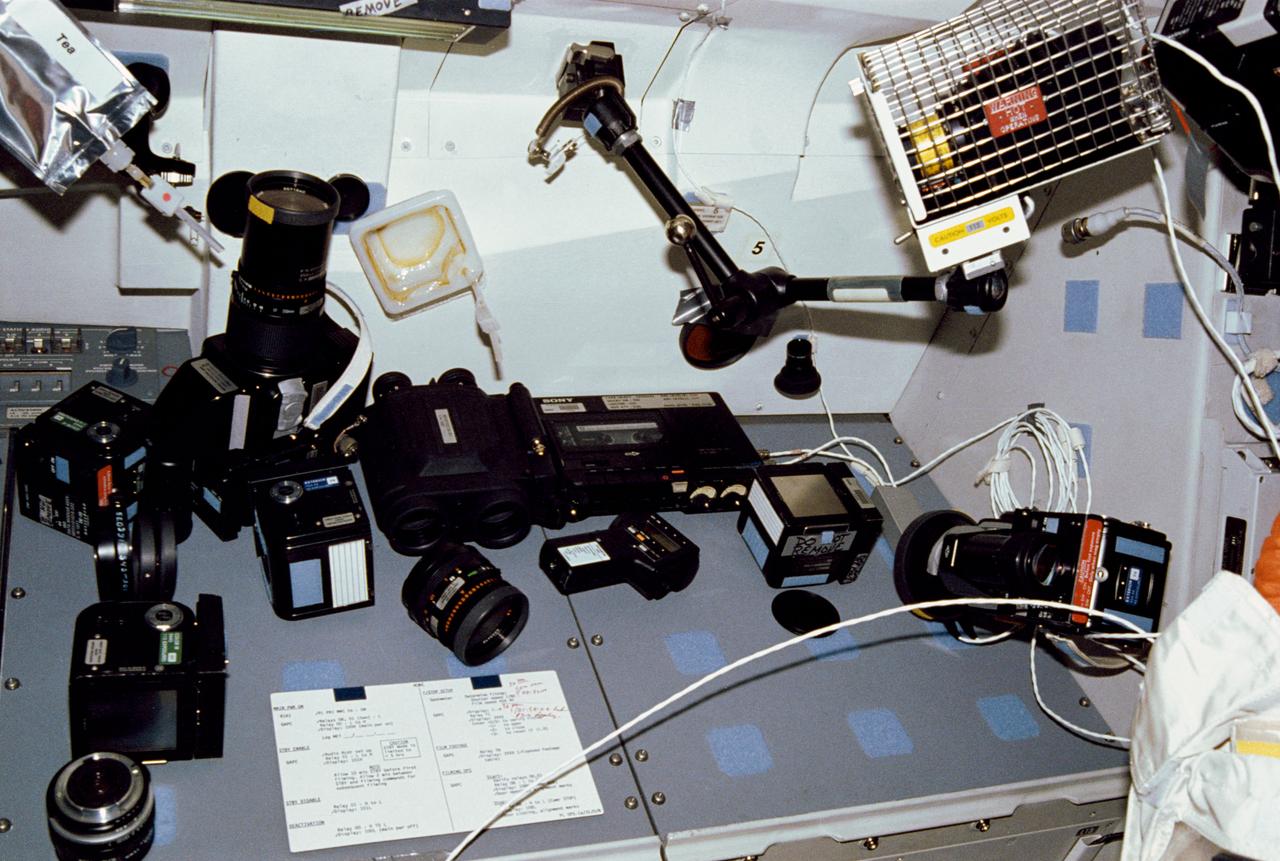
This array of photographic equipment, displayed on the aft flight deck payload station, represents just a part of the imaging and recording hardware which was carried aboard Discovery, Orbiter Vehicle (OV) 103, for STS-31's five day mission. Lenses, film magazines, cassettes, recorders, camera chassis, a pair of binoculars, spot meter, tape recorder, and a bracket-mounted light fixture are included among the array.
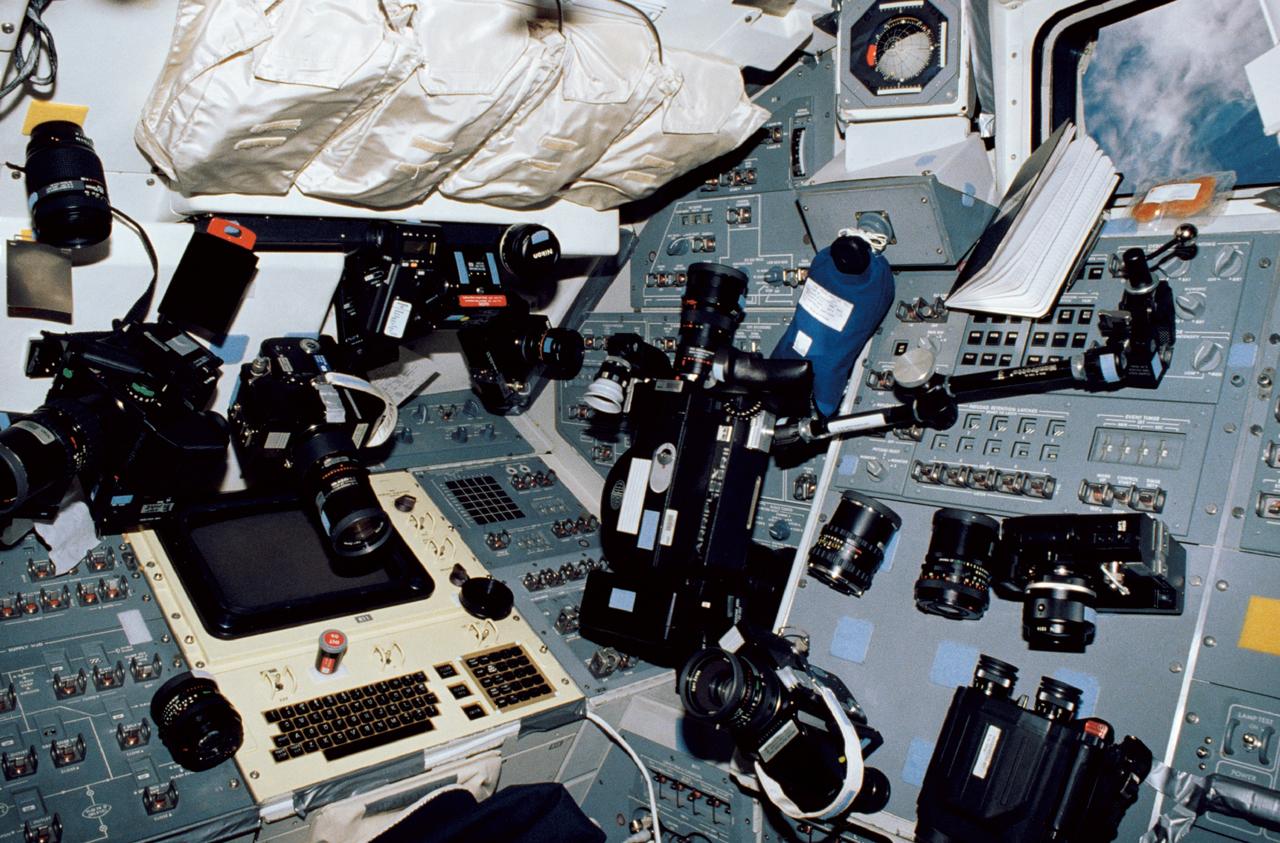
STS035-10-015 (2-10 Dec 1990) --- This busy scene shows cameras and supportive photographic gear temporarily stowed on Space Shuttle Columbia's aft flight deck. It was photographed with a 35mm camera by astronaut Jeffrey A. Hoffman, mission specialist, who called the cluster a "camera forest." The seven STS-35 crewmembers trained to record a wide variety of imagery with an equally broad range of equipment. In addition to cameras, a spot meter, film, a pair of binoculars, a bracket, lenses, lens cleaner and other photographic equipment are in the scene. Clouds over ocean waters are framed by an aft flight deck window at upper right.
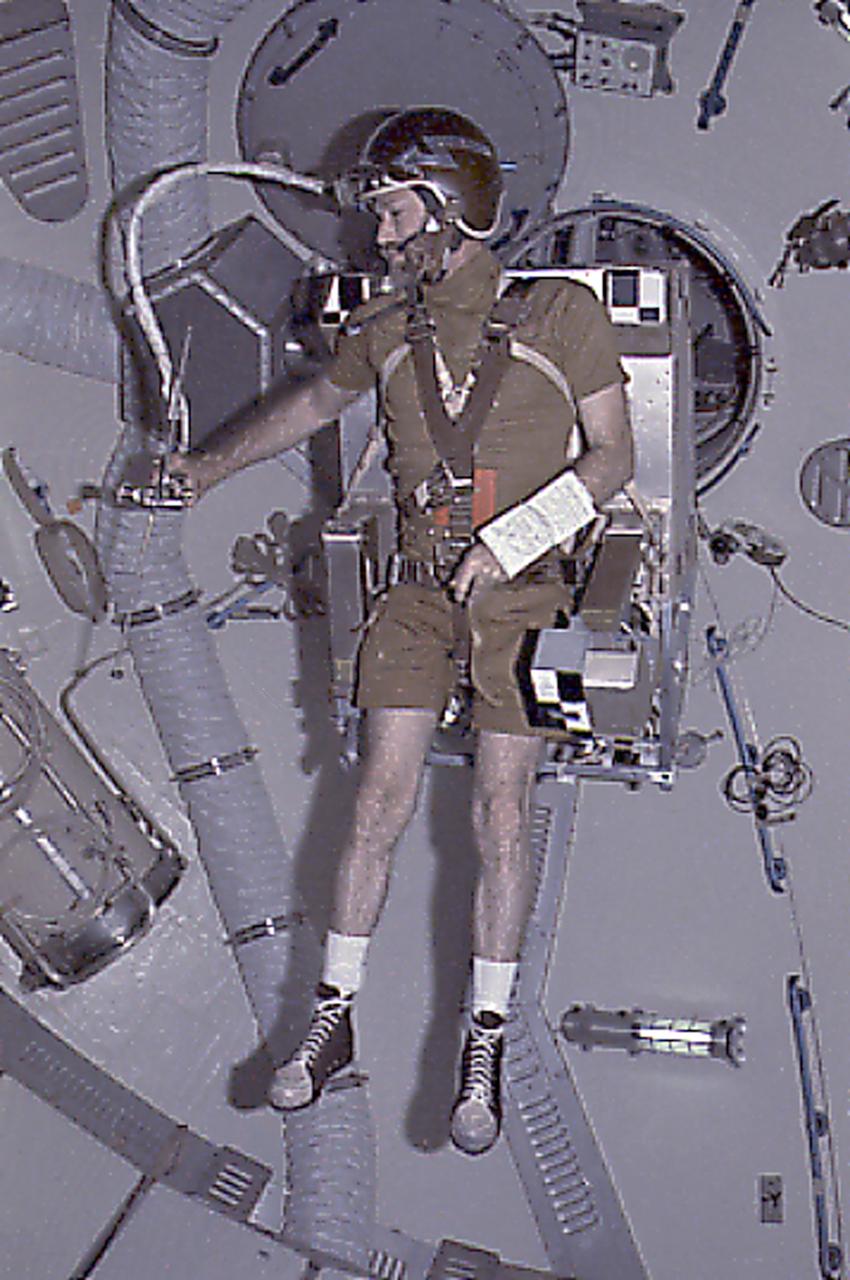
This Skylab-4 onboard photograph depicts Astronaut Gerald Carr testing Astronaut Maneuvering Equipment (M509) by flying it around under weightless conditions in the Orbital Workshop. The M509 experiment was an operational study to evaluate and conduct an in-orbit verification of the utility of various maneuvering techniques to assist astronauts in performing tasks that were representative of future extravehicular activity requirements.
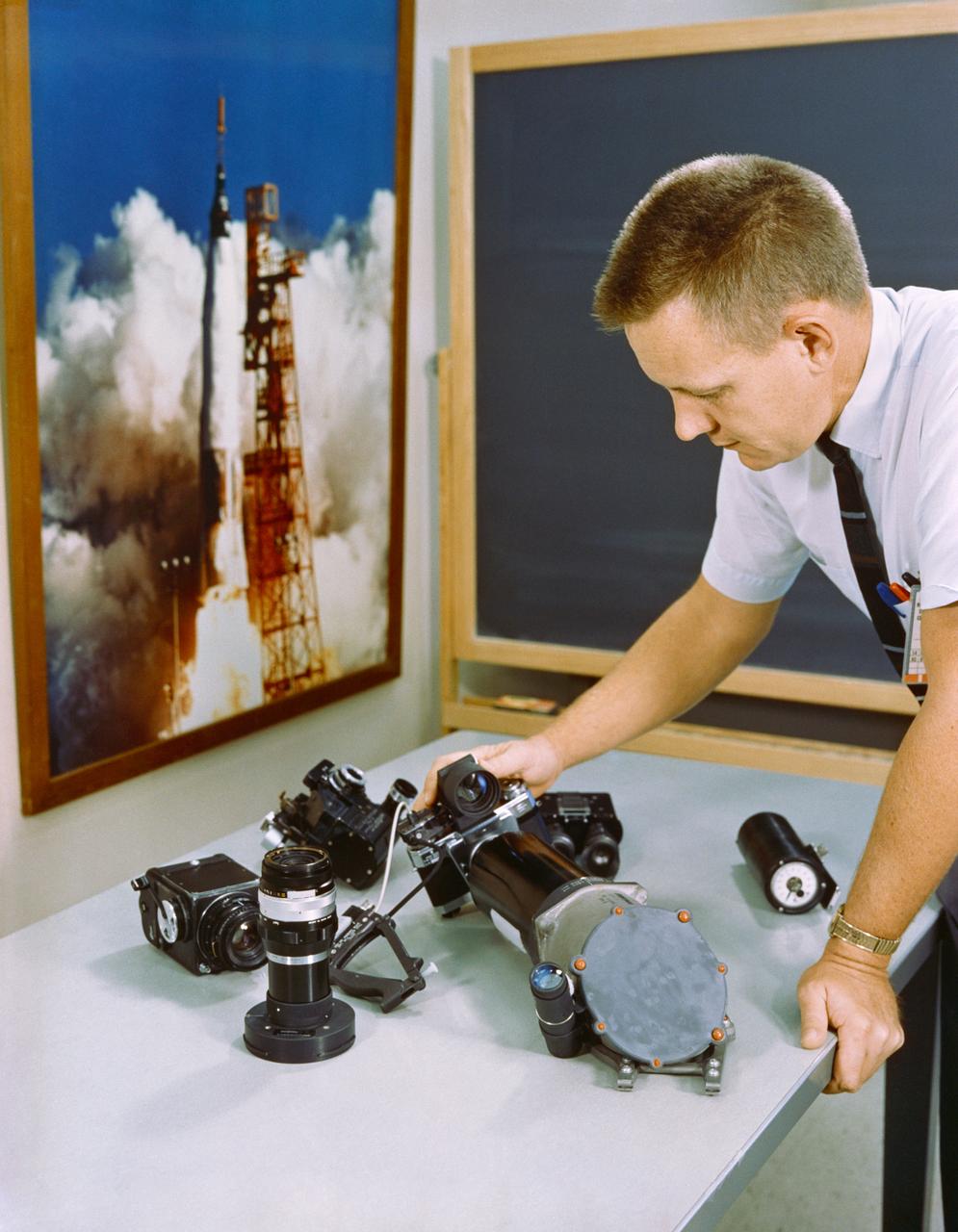
S65-43482 (20 Aug. 1965) --- Table-top view of several of the optical and photographic pieces of equipment planned for use on the Gemini-5 spacecraft before installation in the spacecraft.
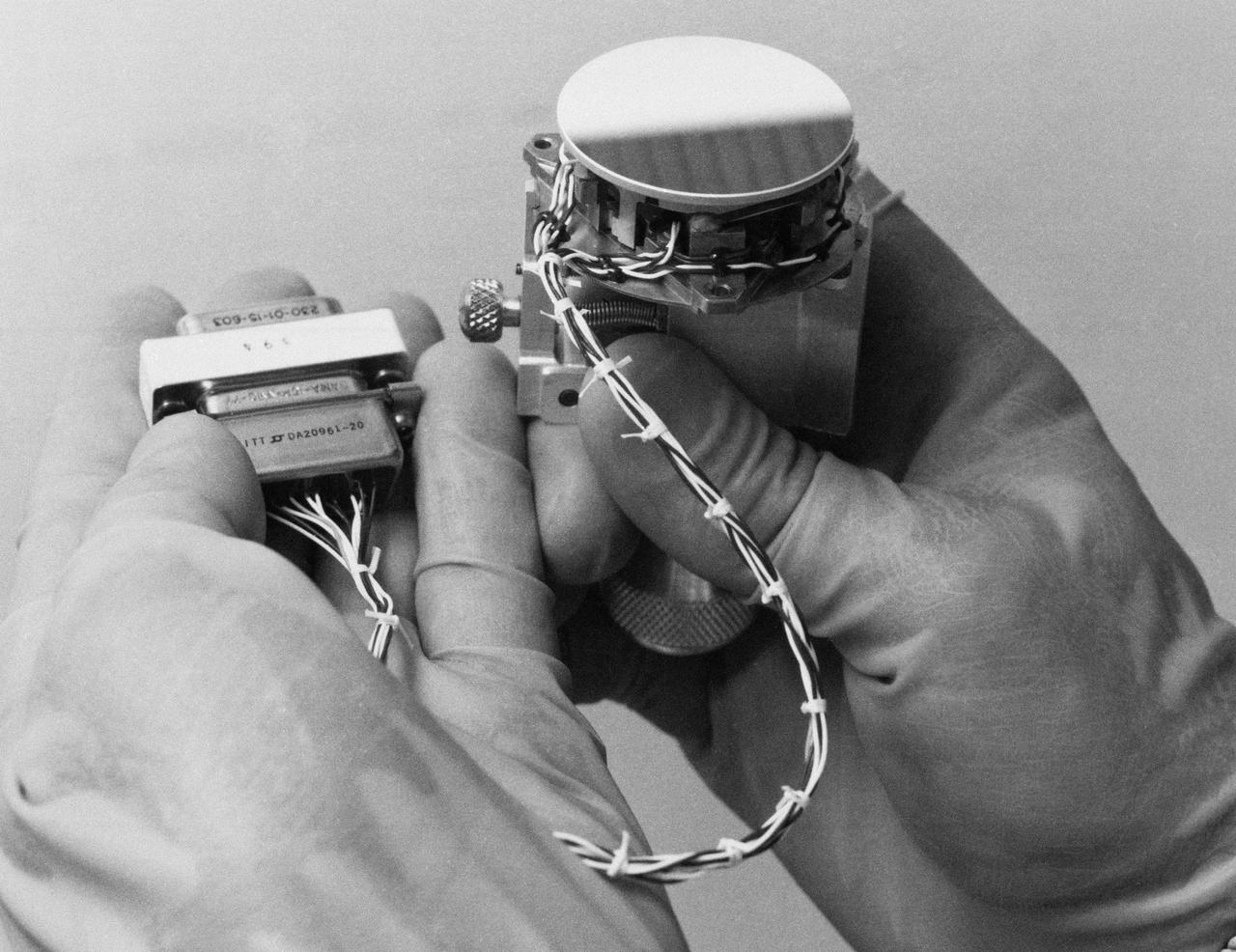
S93-33257 (15 Mar 1993) --- This close-up view features tiny articulating fold mirrors that will go into a replacement camera for the Wide Field\Planetary Camera (WF\PC-1) currently on the Hubble Space Telescope (HST). A team of NASA astronauts will pay a visit to the HST later this year, carrying with them the new WF/PC-2 to replace the one currently on the HST. The Jet Propulsion Laboratory (JPL) in Pasadena, California has been working on the replacement system for several months. See NASA photo S93-33258 for an optical schematic diagram of one of the four channels of the WF\PC-2 showing the path taken by beams from the HST before an image is formed at the camera's charge-coupled devices.
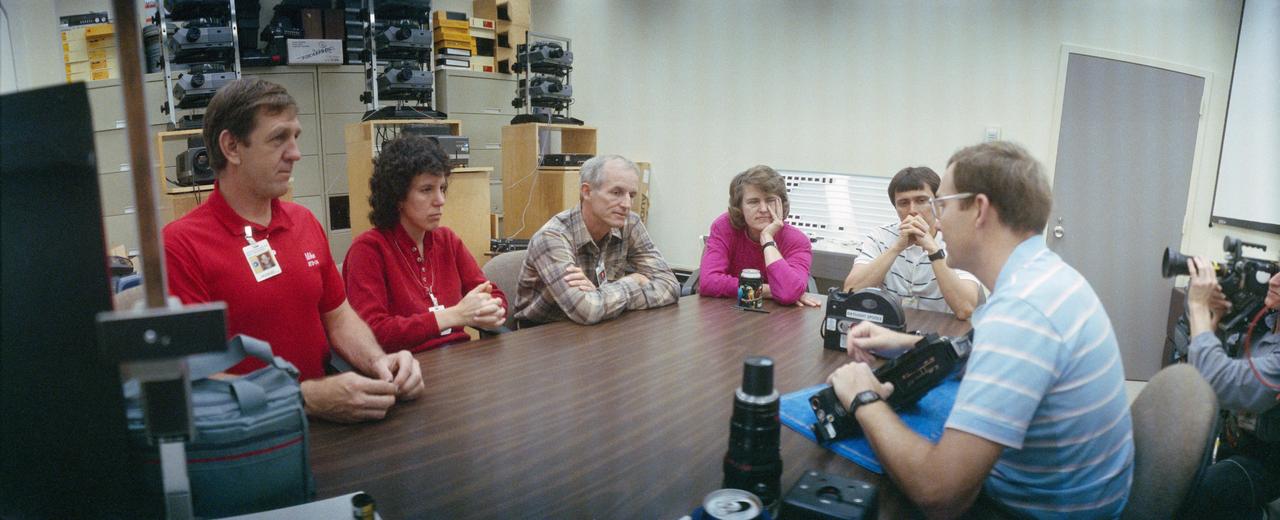
STS-34 Atlantis, Orbiter Vehicle (OV) 104, crewmembers listen to trainer Bill Bowers explain ARRIFLEX camera equipment during briefing at JSC. Across the table from Bowers are (left to right) Pilot Michael J. McCulley, Mission Specialist (MS) Ellen S. Baker, Commander Donald E. Williams, MS Shannon W. Lucid, and MS Franklin R. Chang-Diaz.
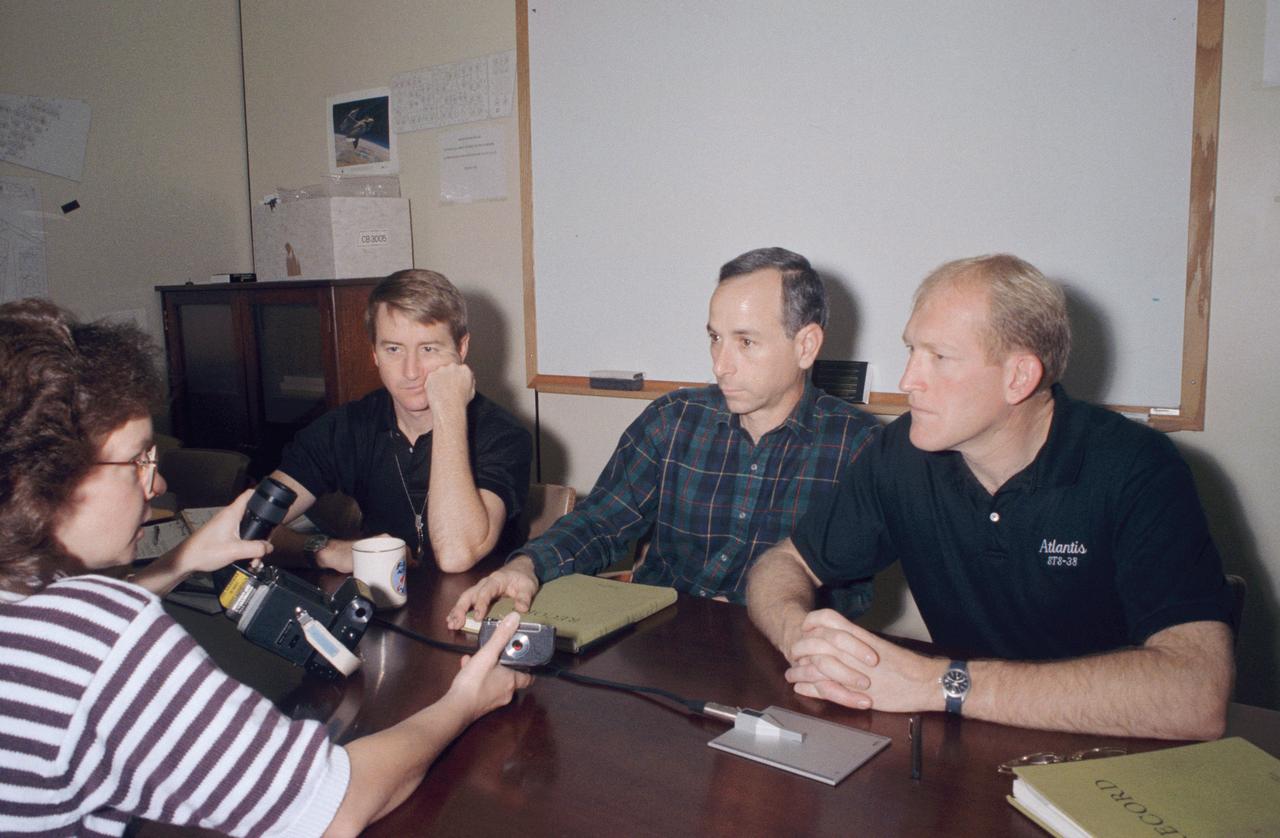
STS-38 crewmembers listen as RSOC-JSC crew trainer M. Judy Alexander explains the camera equipment they will be using on their upcoming Department of Defense (DOD) mission. Left to right are Pilot Frank L. Culbertson, Mission Specialist (MS) Carl J. Meade, and MS Charles D. Gemar. Alexander is holding a training version of the 70mm handheld HASSELBLAD camera.

STS-34 Atlantis, Orbiter Vehicle (OV) 104, Pilot Michael J. McCulley squints while looking through ARRIFLEX camera eye piece during camera briefing at JSC. McCulley rests part of the camera on his shoulder as he operates it.
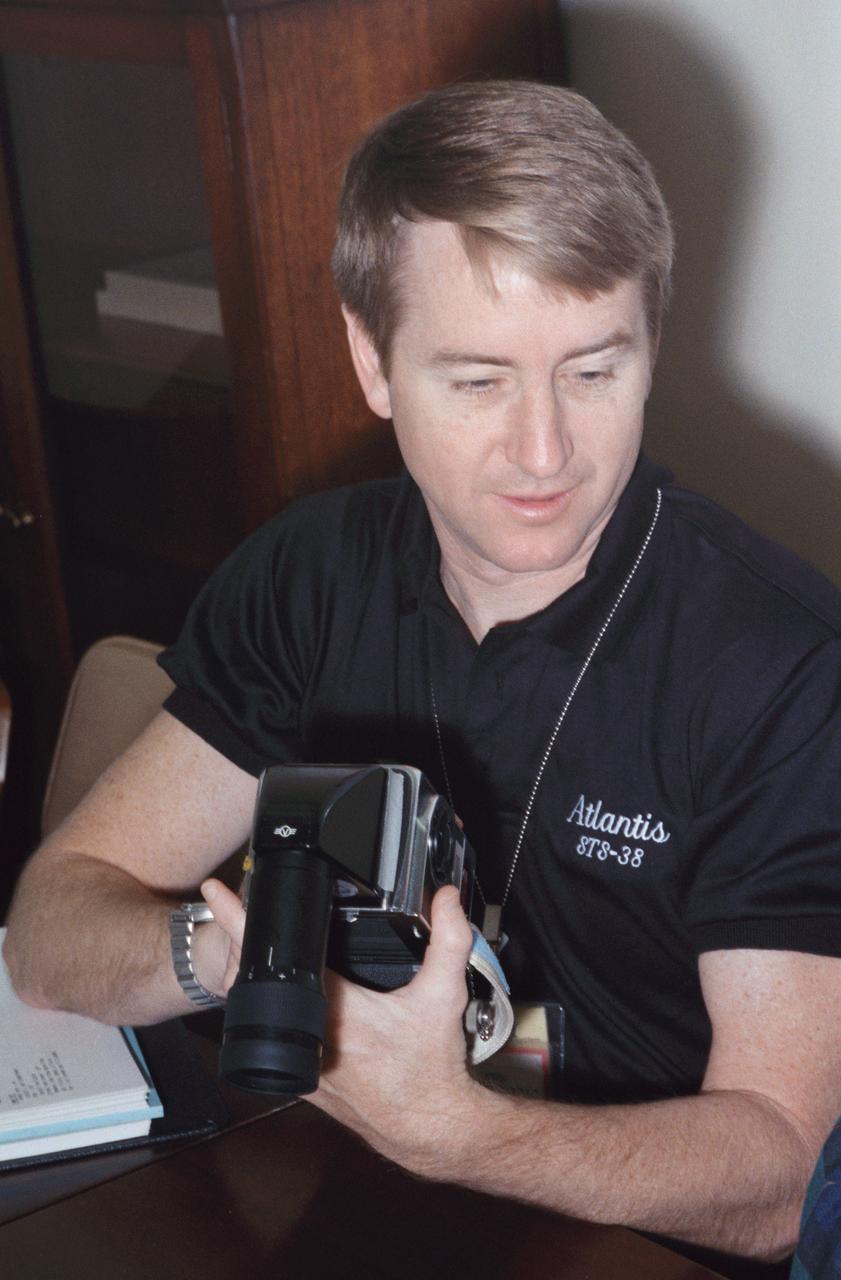
STS-38 Pilot Frank L. Culbertson holds a training version of the 70mm handheld HASSELBLAD camera he will be using on his upcoming Department of Defense (DOD) mission.
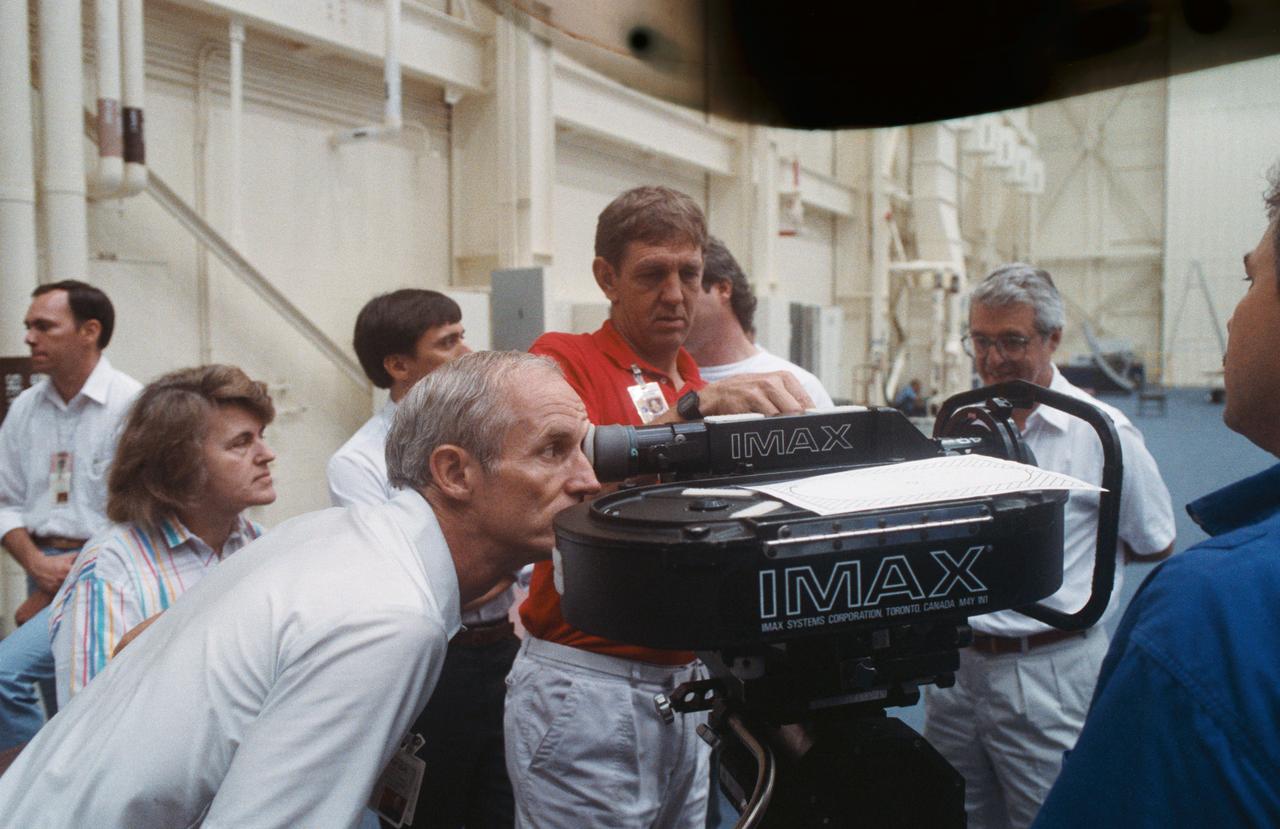
STS-34 crewmembers participate in IMAX camera training session held in JSC's Mockup and Integration Laboratory (MAIL) Bldg 9B. The crew is briefed on the operation and handling of the IMAX camera scheduled to fly aboard Atlantis, Orbiter Vehicle (OV) 104. Left to right in the foreground are Mission Specialist (MS) Shannon W. Lucid, MS Franklin R. Chang-Diaz, Commander Donald E. Williams (looking through IMAX eye piece), Pilot Michael J. McCulley, and IMAX instructor Grant Ferguson. David Douglas of IMAX is at right edge of photo.
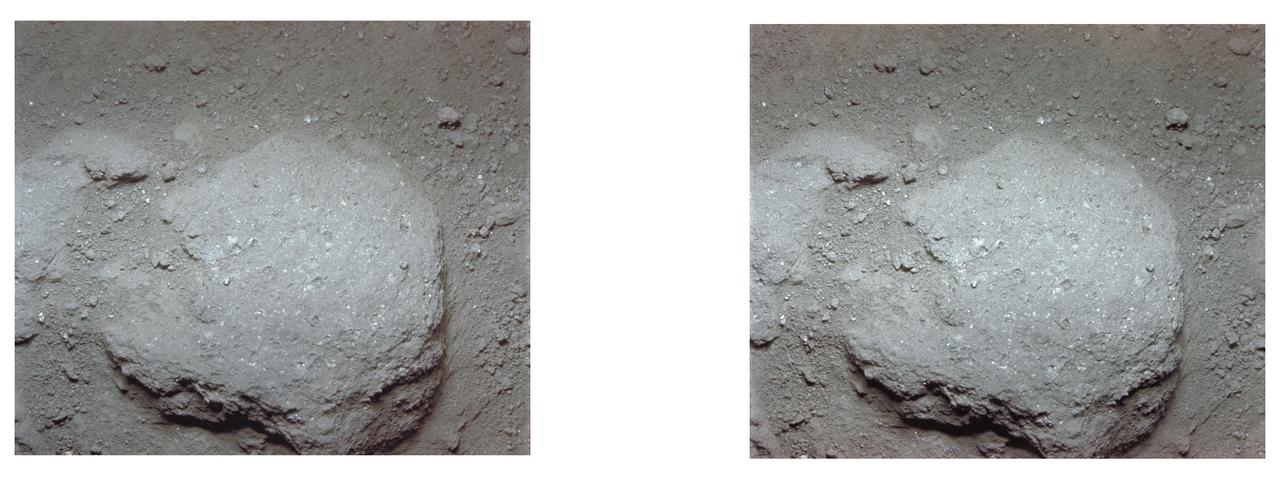
AS11-45-6712 (20 July 1969) --- An Apollo 11 stereo view of a stone, about two and one-half inches long, embedded in the powdery lunar surface material. The little pieces closely around it suggest that it has suffered some erosion. On the surface several small pits are seen, mostly less than one-eighth inch in size, and with a glazed surface. They have a raised rim, characteristic of pits made by the Apollo 11 35mm stereo close-up camera. The camera was specially developed to get the highest possible resolution of a small area. A three-inch square area is photographed with a flash illumination and at a fixed distance. The camera is mounted on a walking stick, and the astronauts use it by holding it up against the object to be photographed and pulling the trigger. The pictures are in color and give a stereo view, enabling the fine detail to be seen very clearly. The project is under the direction of Professor T. Gold of Cornell University and Mr. F. Pearce of NASA. The camera was designed and built by Eastman Kodak. Professor E. Purcell of Harvard University and Dr. E. Land of the Polaroid Corporation have contributed to the project. The pictures brought back from the moon by the Apollo 11 crew are of excellent quality and allow fine detail of the undisturbed lunar surface to be seen. Scientists hope to be able to deduce from them some of the processes that have taken place that have shaped and modified the surface.
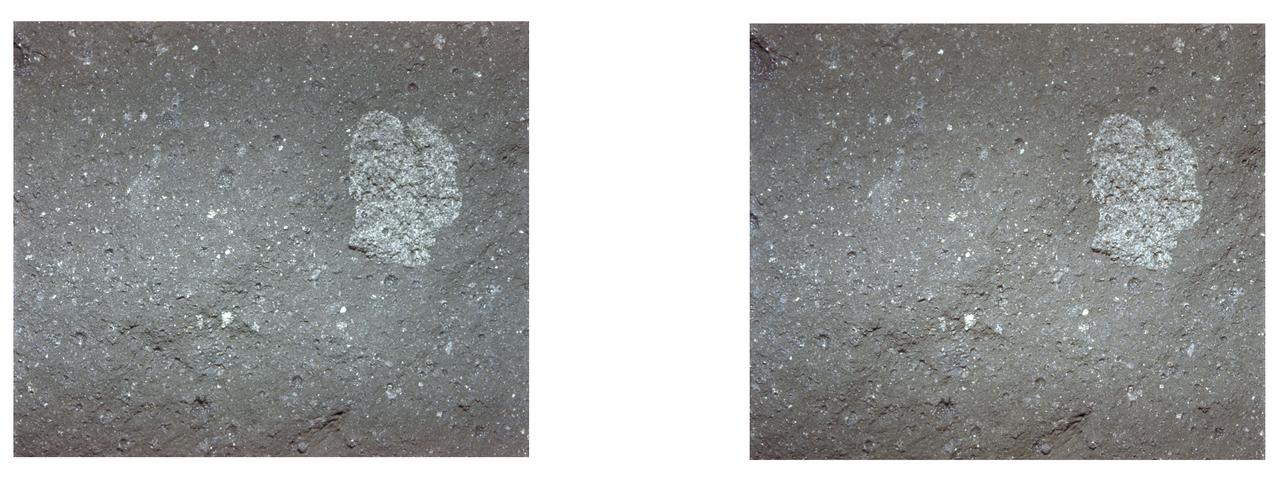
AS11-45-6709 (20 July 1969) --- An Apollo 11 stereo view of the surface of a lunar rock showing an embedded three-fourths inch fragment of a different color. On the surface several small pits are seen; mostly less than one-eighth inch in size, and with a glazed surface. They have a raised rim, characteristic of pits made by high-velocity micro meteorite impacts. The exposure was made by the Apollo 11 35mm stereo close-up camera. The camera was specially developed to get the highest possible resolution of a small area. A three-inch square area is photographed with a flash illumination and at a fixed distance. The camera is mounted on a walking stick, and the astronauts use it by holding it up against the object to be photographed and pulling the trigger. The pictures are in color and give a stereo view, enabling the fine detail to be seen very clearly. The project is under the direction of Professor T. Gold of Cornell University and Mr. F. Pearce of NASA. The camera was designed and built by Eastman Kodak. Professor E. Purcell of Harvard University and Dr. E. Land of the Polaroid Corporation have contributed to the project. The pictures brought back from the moon by the Apollo 11 crew are of excellent quality and allow fine detail of the undisturbed lunar surface to be seen. Scientists hope to be able to deduce from them some of the processes that have taken place that have shaped and modified the surface.
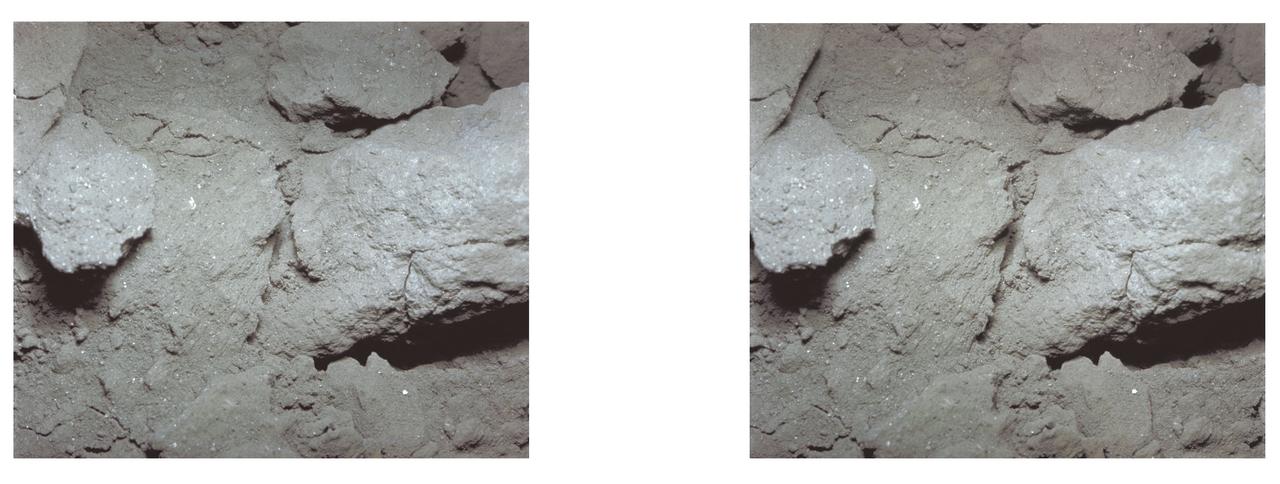
AS11-45-6706 (20 July 1969) --- An Apollo 11 stereo view showing a clump of lunar surface powder, with various small pieces of different color. Many small, shiny spherical particles can be seen. The picture is three inches across. The exposure was made by the Apollo 11 35mm stereo close-up camera. The camera was specially developed to get the highest possible resolution of a small area. A three-inch square area is photographed with a flash illumination and at a fixed distance. The camera is mounted on a walking stick, and the astronauts use it by holding it up against the object to be photographed and pulling the trigger. The pictures are in color and give a stereo view, enabling the fine detail to be seen very clearly. The project is under the direction of Professor T. Gold of Cornell University and Mr. F. Pearce of NASA. The camera was designed and built by Eastman Kodak. Professor E. Purcell of Harvard University and Dr. E. Land of the Polaroid Corporation have contributed to the project. The pictures brought back from the moon by the Apollo 11 crew are of excellent quality and allow fine detail of the undisturbed lunar surface to be seen. Scientists hope to be able to deduce from them some of the processes that have taken place that have shaped and modified the surface.
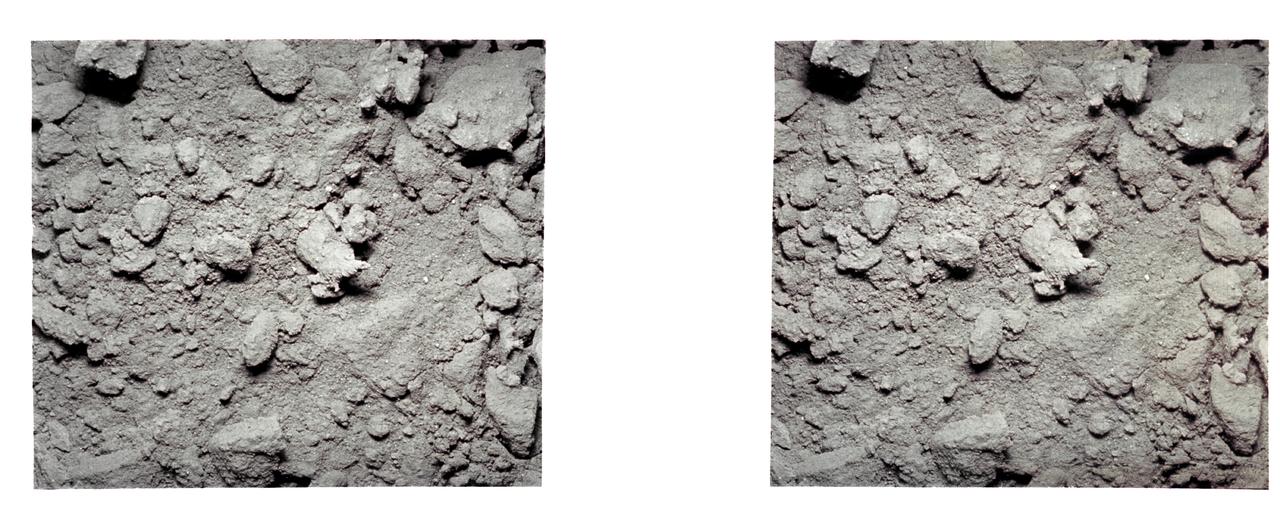
AS12-57-8455 (19-20 Nov. 1969) --- An Apollo 12 stereo view showing a three-inch square of the lunar surface. The exposure was made with an Apollo 35mm stereo close-up camera during extravehicular activity of the Apollo 12 lunar landing mission. The camera was developed to get the highest possible resolution of a small area. The three-inch square is photographed with a flash illumination and at a fixed distance. The camera is mounted on a walking stick, and the astronauts use it by holding it up against the object to be photographed and pulling the trigger. Astronauts Charles Conrad Jr., commander, and Alan L. Bean, lunar module pilot, descended in the Apollo 12 Lunar Module to explore the moon while astronaut Richard F. Gordon Jr. remained with the Command and Service Modules in lunar orbit in the capacity of command module pilot.
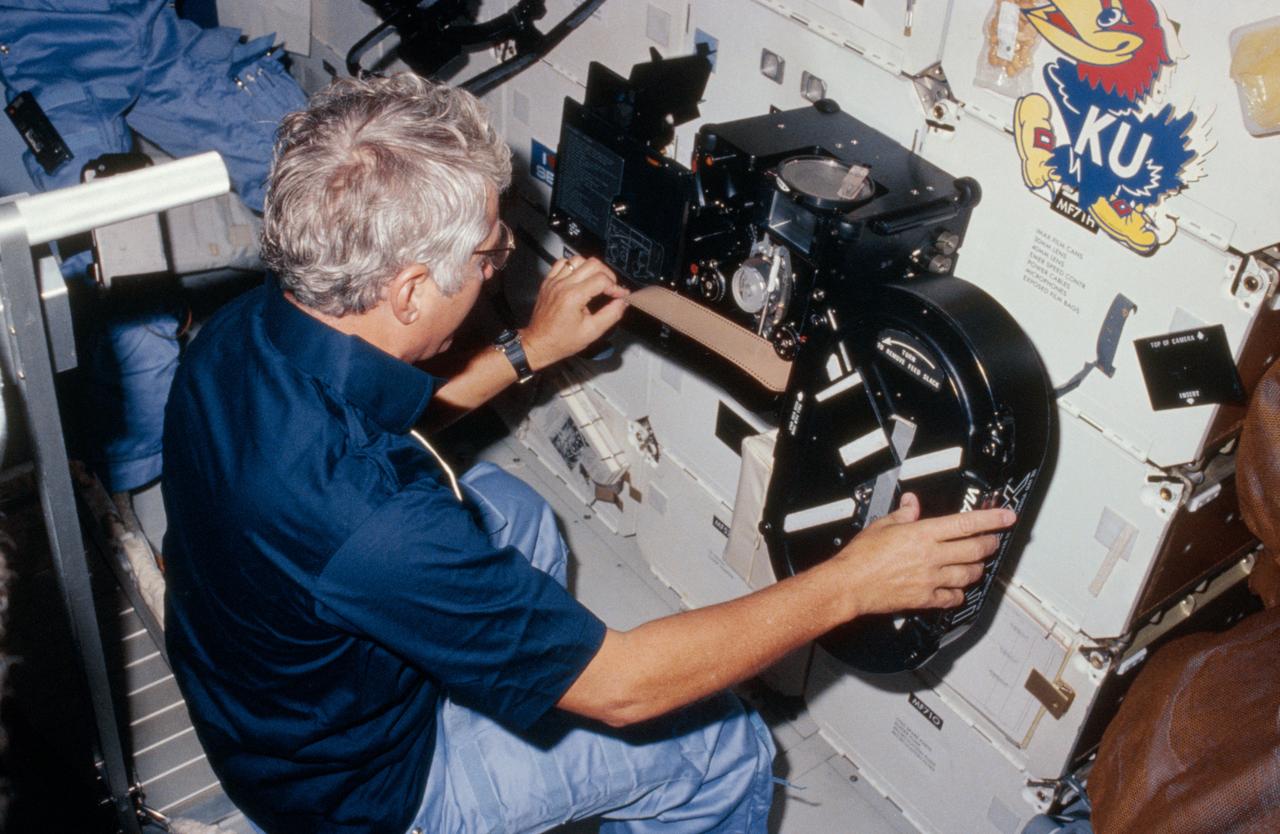
41D-11-004 (8 September 1984 --- View of Crew Commander Henry Hartsfield Jr. loading film into the IMAX camera during the 41-D mission. The camera is floating in front of the middeck lockers. Above it is a sticker of the University of Kansas mascott, the Jayhawk.
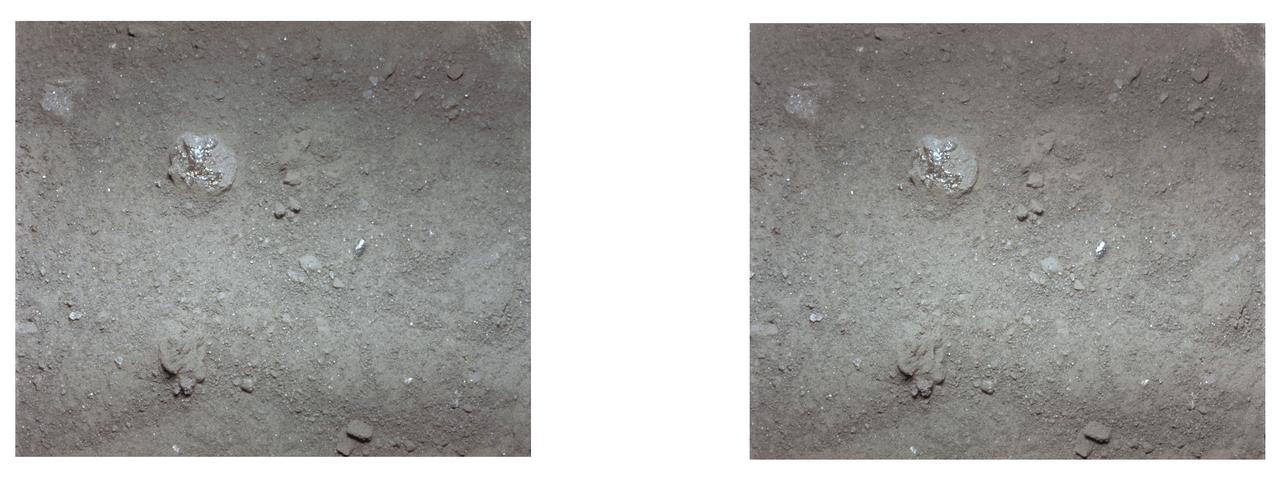
AS11-45-6704 (20 July 1969) --- An Apollo stereo view showing a close-up of a small lump of lunar surface powder about a half inch across, with a splash of a glassy material over it. It seems that a drop of molten material fell on it, splashed and froze. The exposure was made by the Apollo 11 35mm stereo close-up camera. The camera was specially developed to get the highest possible resolution of a small area. A three-inch square area is photographed with a flash illumination and at a fixed distance. The camera is mounted on a walking stick, and the astronauts use it by holding it up against the object to be photographed and pulling the trigger. The pictures are in color and give a stereo view, enabling the fine detail to be seen very clearly. The project is under the direction of Professor T. Gold of Cornell University and Dr. F. Pearce of NASA. The camera was designed and built by Eastman Kodak. Professor E. Purcell of Harvard University and Dr. E. Land of the Polaroid Corporation have contributed to the project. The pictures brought back from the moon by the Apollo 11 crew are of excellent quality and allow fine detail of the undisturbed lunar surface to be seen. Scientists hope to be able to deduce from them some of the processes that have taken place that have shaped and modified the surface.
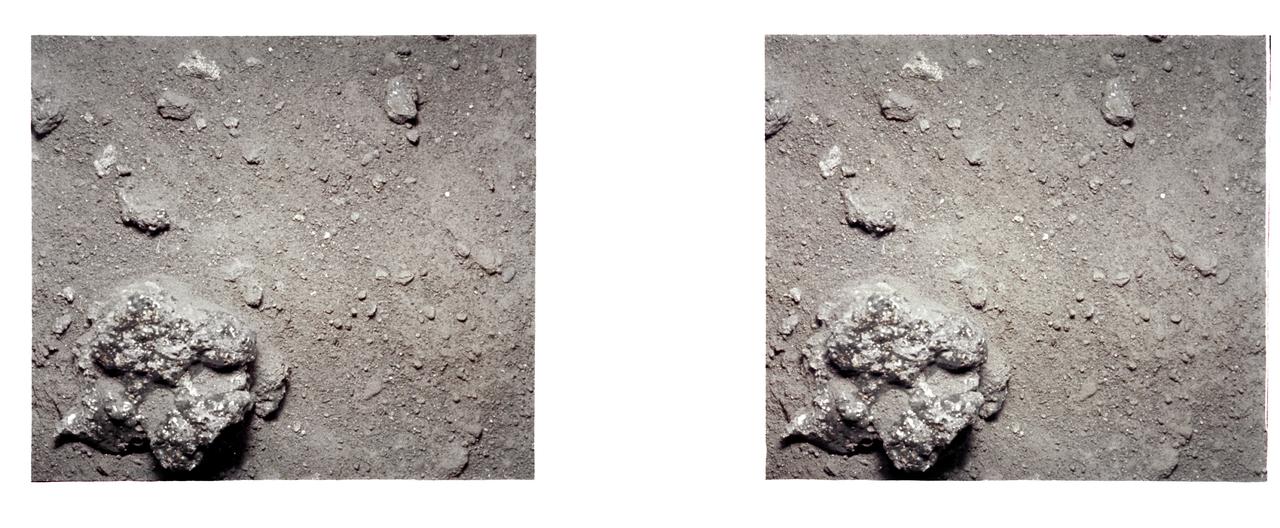
AS12-57-8452 (19-20 Nov. 1969) --- An Apollo 12 stereo view showing a three-inch square of the lunar surface. The exposure was made with an Apollo 35mm stereo close-up camera during extravehicular activity of the Apollo 12 lunar landing mission. The camera was developed to get the highest possible resolution of a small area. The three-inch square is photographed with a flash illumination and at a fixed distance. The camera is mounted on a walking stick, and the astronauts use it by holding it up against the object to be photographed and pulling the trigger. Astronauts Charles Conrad Jr., commander, and Alan L. Bean, lunar module pilot, descended in the Apollo 12 Lunar Module to explore the moon while astronaut Richard F. Gordon Jr. remained with the Command and Service Modules in lunar orbit in the capacity of command module pilot.
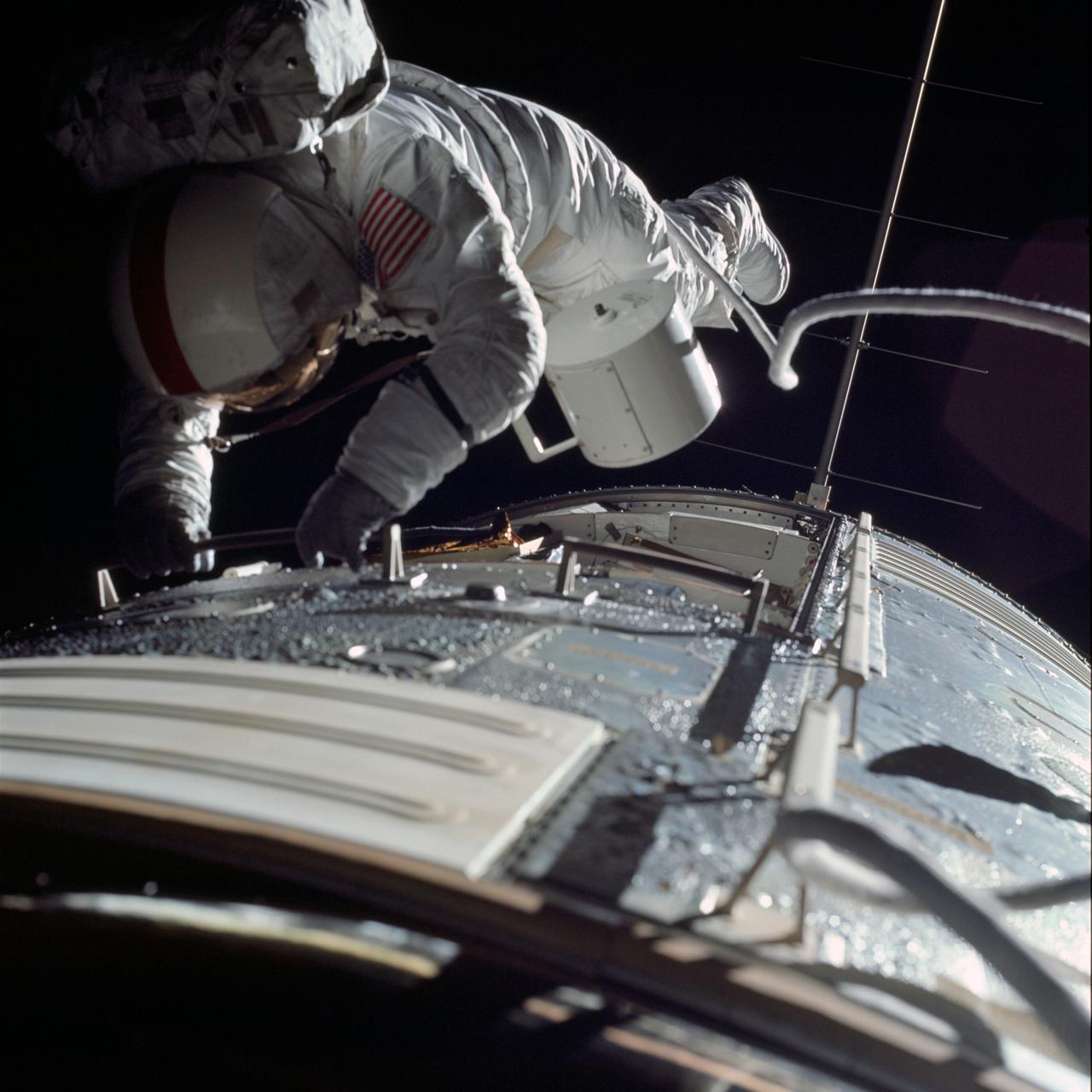
AS17-152-23391 (17 Dec. 1972) --- Astronaut Ronald E. Evans is photographed performing extravehicular activity during the Apollo 17 spacecraft's trans-Earth coast. During his EVA, Evans, command module pilot, retrieved film cassettes from the lunar sounder, mapping camera and panoramic camera. The cylindrical object at Evans' left side is the mapping camera cassette. The total time for the trans-Earth EVA was one hour, seven minutes, 18 seconds, starting at ground elapsed time of 257:25 (2:28 p.m.) and ending at G.E.T. of 258:42 (3:35 p.m.) on Sunday, Dec. 17, 1972.
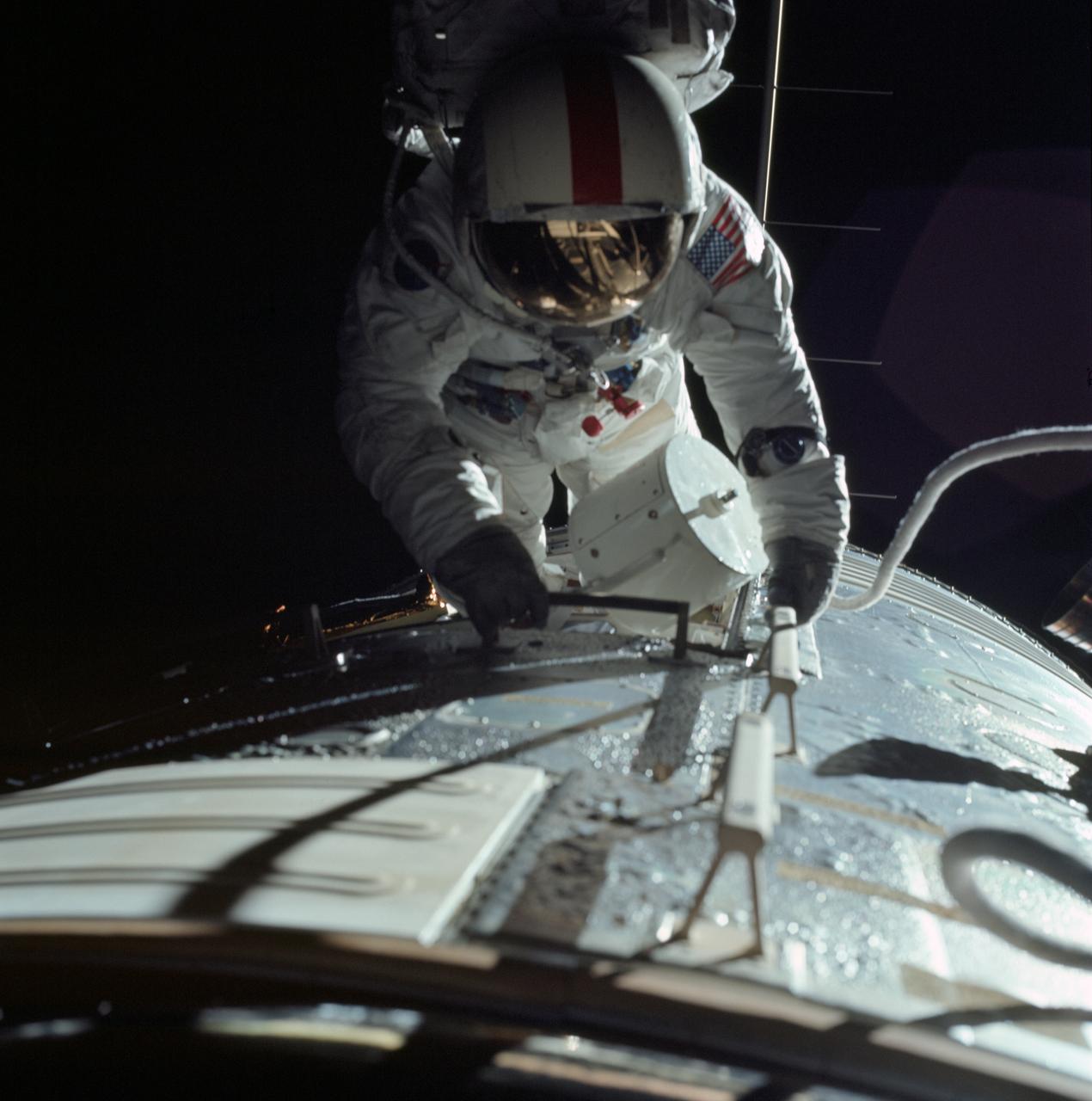
AS17-152-23393 (17 Dec. 1972) --- Astronaut Ronald E. Evans is photographed performing extravehicular activity during the Apollo 17 spacecraft's trans-Earth coast. During his EVA, command module pilot Evans retrieved film cassettes from the Lunar Sounder, Mapping Camera, and Panoramic Camera. The cylindrical object at Evans' left side is the Mapping Camera cassette. The total time for the trans-Earth EVA was one hour seven minutes 18 seconds, starting at ground elapsed time of 257:25 (2:28 p.m.) and ending at ground elapsed timed of 258:42 (3:35 p.m.) on Sunday, Dec. 17, 1972.
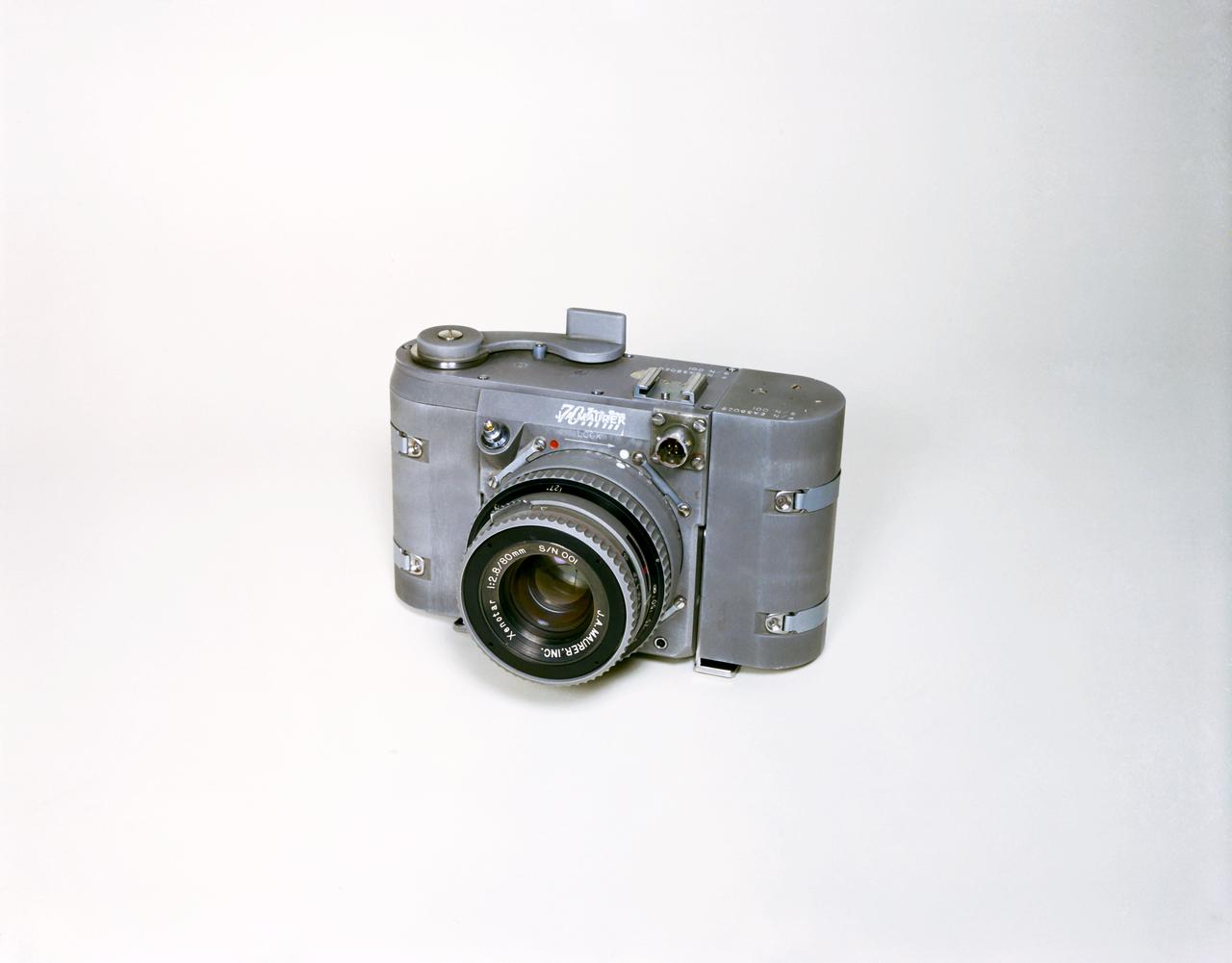
S65-23639 (28 April 1965) --- A bench view of a 70mm camera expected to be used by the Gemini-4 astronauts.
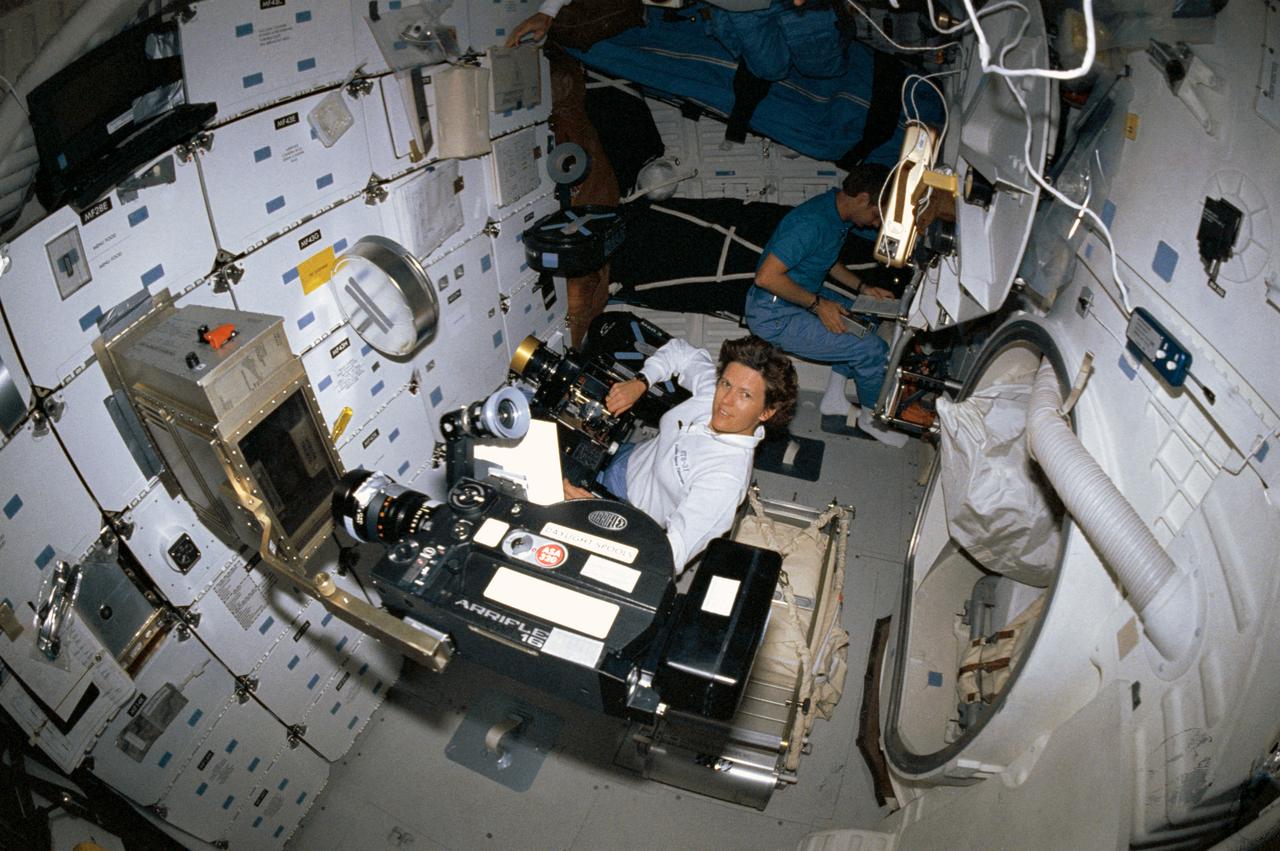
STS031-05-002 (24-29 April 1990) --- A 35mm camera with a "fish eye" lens captured this high angle image on Discovery's middeck. Astronaut Kathryn D. Sullivan works with the IMAX camera in foreground, while Astronaut Steven A. Hawley consults a checklist in corner. An Arriflex motion picture camera records student ion arc experiment in apparatus mounted on stowage locker. The experiment was the project of Gregory S. Peterson, currently a student at Utah State University.

AS11-40-5948 (20 July 1969) --- Astronaut Edwin E. Aldrin Jr., lunar module pilot, is photographed during the Apollo 11 extravehicular activity (EVA) on the moon. He has just deployed the Early Apollo Scientific Experiments Package (EASEP). This is a good view of the deployed equipment. In the foreground is the Passive Seismic Experiment Package (PSEP); beyond it is the Laser Ranging Retro-Reflector (LR-3); in the center background is the United States flag; in the left background is the black and white lunar surface television camera; in the far right background is the Lunar Module (LM). Astronaut Neil A. Armstrong, commander, took this picture with a 70mm lunar surface camera. While astronauts Armstrong and Aldrin descended in the Lunar Module (LM) "Eagle" to explore the Sea of Tranquility region of the moon, astronaut Michael Collins, command module pilot, remained with the Command and Service Modules (CSM) "Columbia" in lunar orbit.
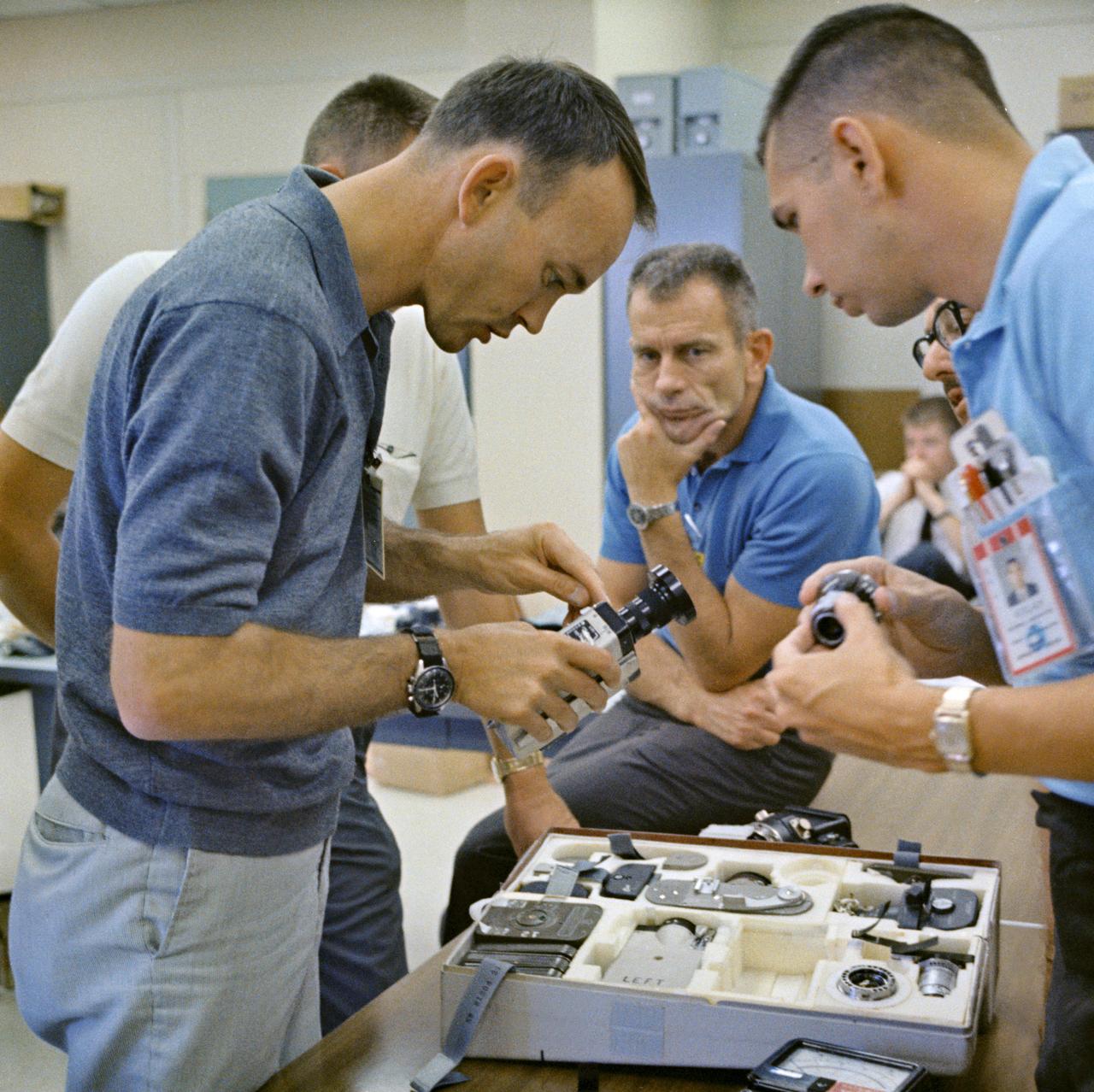
S66-42763 (18 July 1966) --- Astronaut Michael Collins (left), Gemini-10 prime crew pilot, inspects a camera during prelaunch activity at Cape Kennedy, Florida. In center background is Dr. Donald K. Slayton, Manned Spacecraft Center (MSC) Director of Flight Crew Operations. Photo credit: NASA
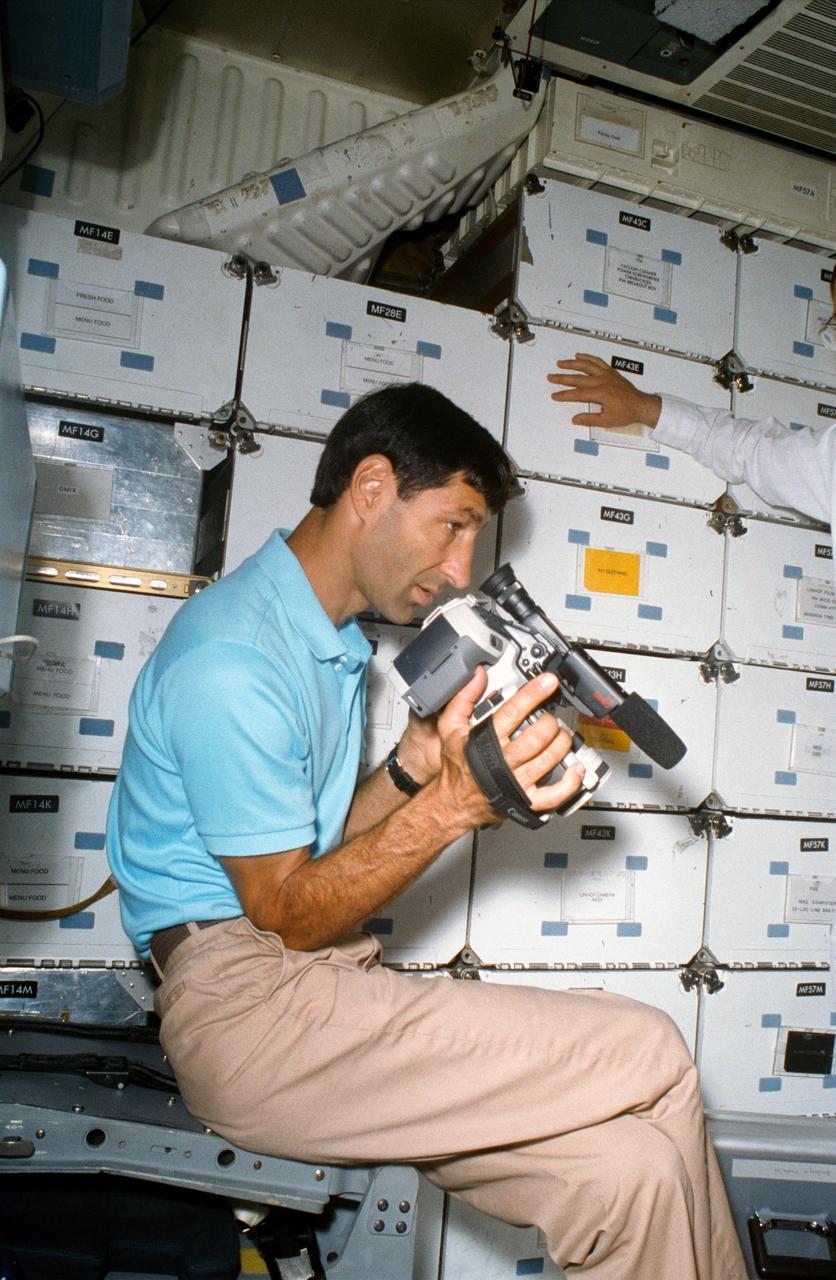
S92-45751 (1 Sept 1992) --- Astronaut Mario Runco Jr., mission specialist assigned to fly aboard the Space Shuttle Endeavour for the STS-54 mission, gets in some rehearsal time with a camcorder. He is on the middeck of a Shuttle trainer.
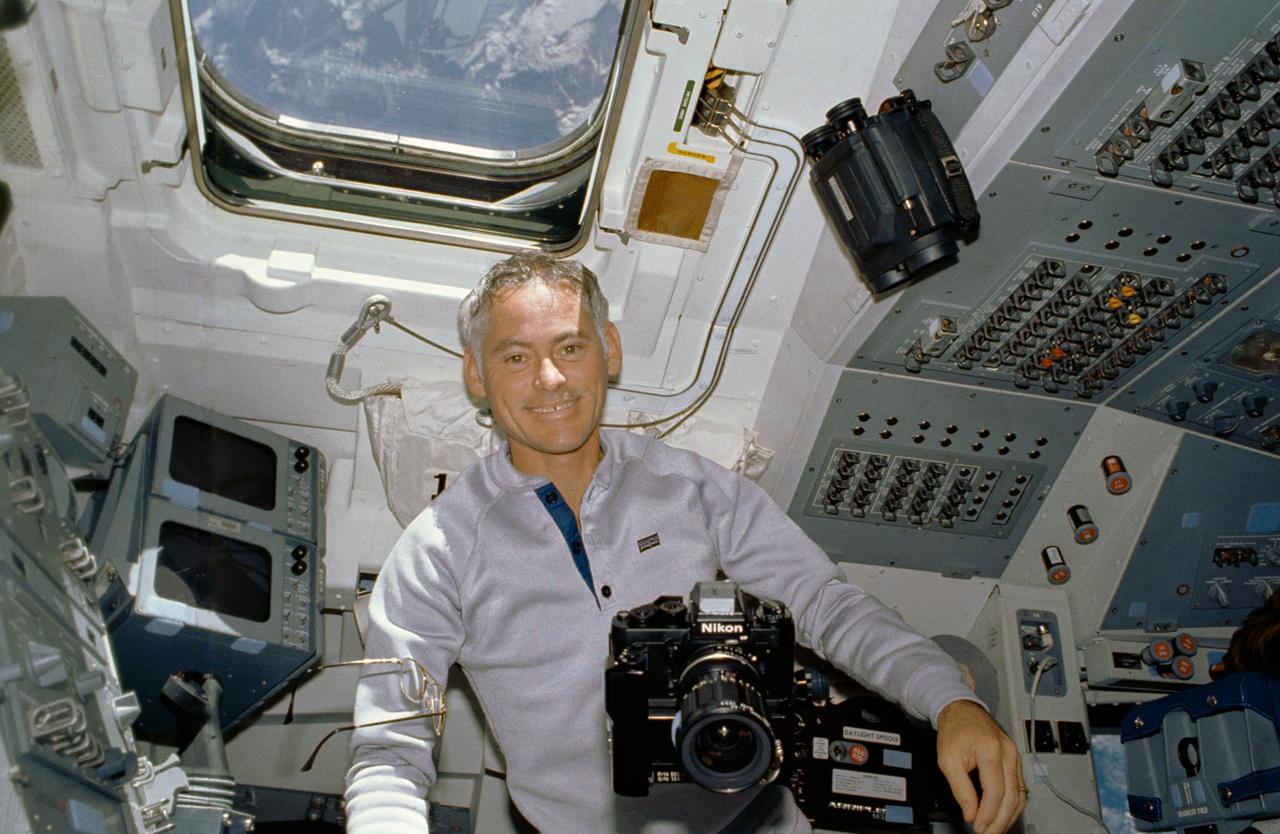
STS027-10-021 (2-6 Dec. 1988) --- Astronaut Richard M. (Mike) Mullane, STS-27 mission specialist, is able to handle a number of cameras with the aid of the microgravity in the shirt sleeve environment of the Earth-orbiting space shuttle Atlantis. Photo credit: NASA
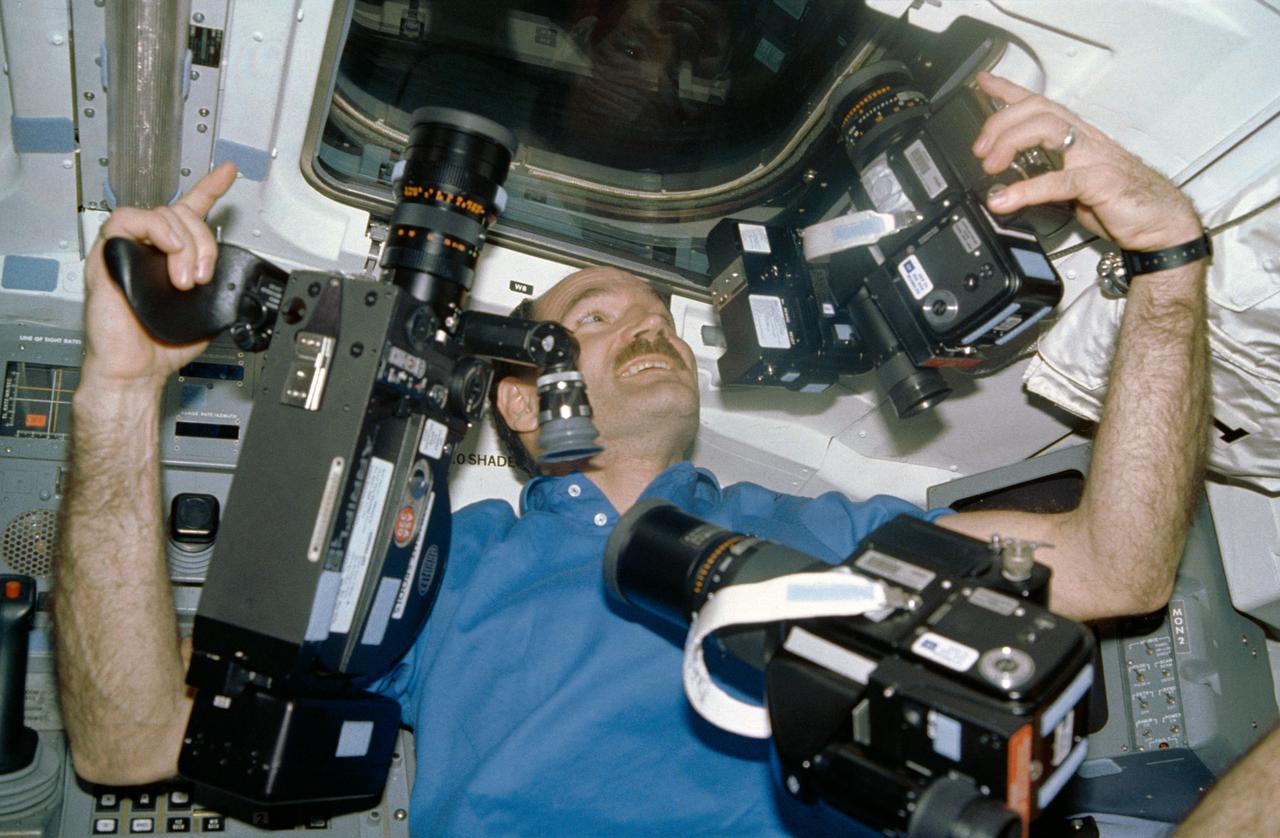
STS027-14-021 (2-6 Dec. 1988) --- Astronaut Guy S. Gardner, STS-27 pilot, appears to have enough cameras as he prepares to take photographs onboard the Earth-orbiting space shuttle Atlantis. Photo credit: NASA
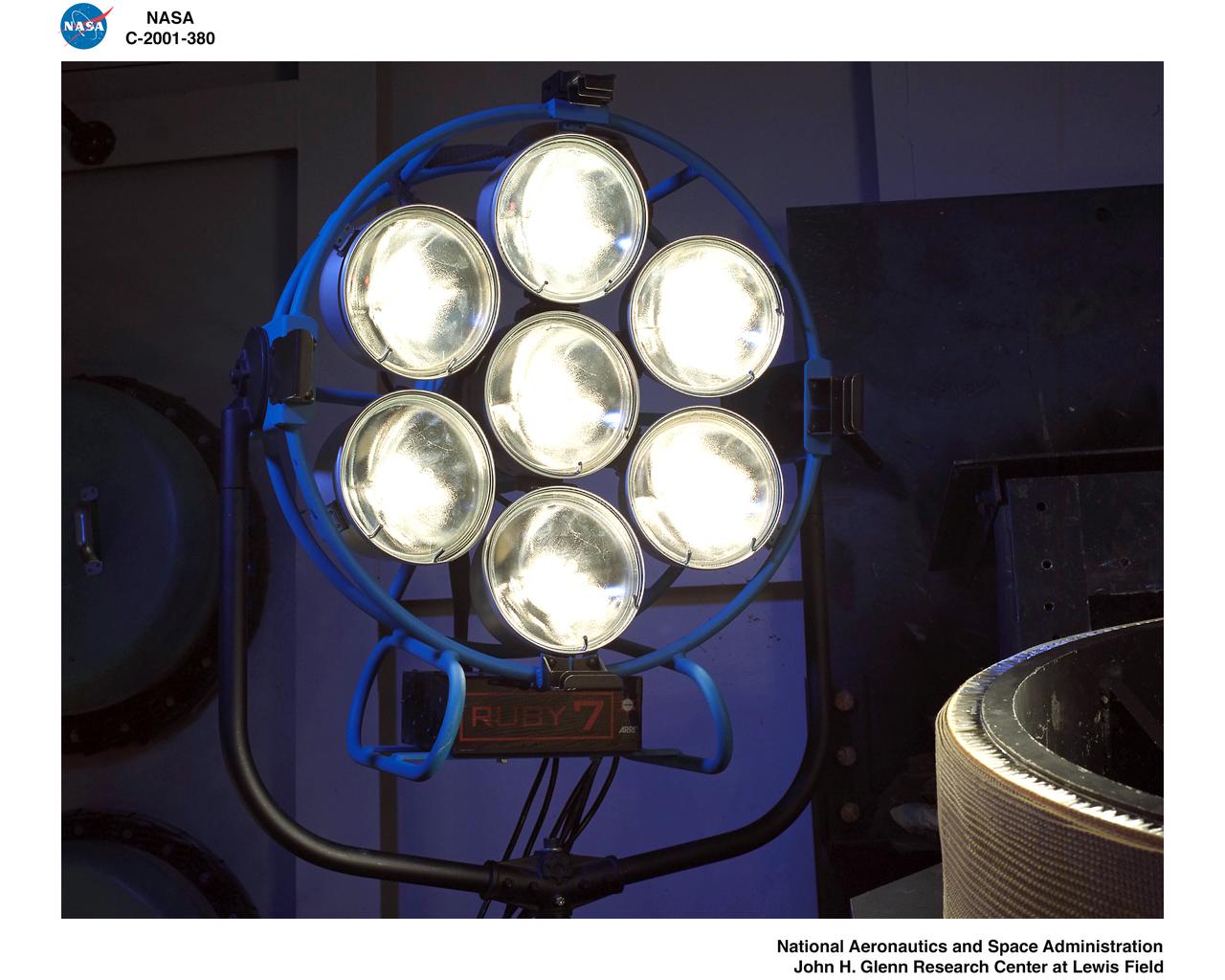
BALLISTIC LABORATORY PHOTOGRAPHIC EQUIPMENT
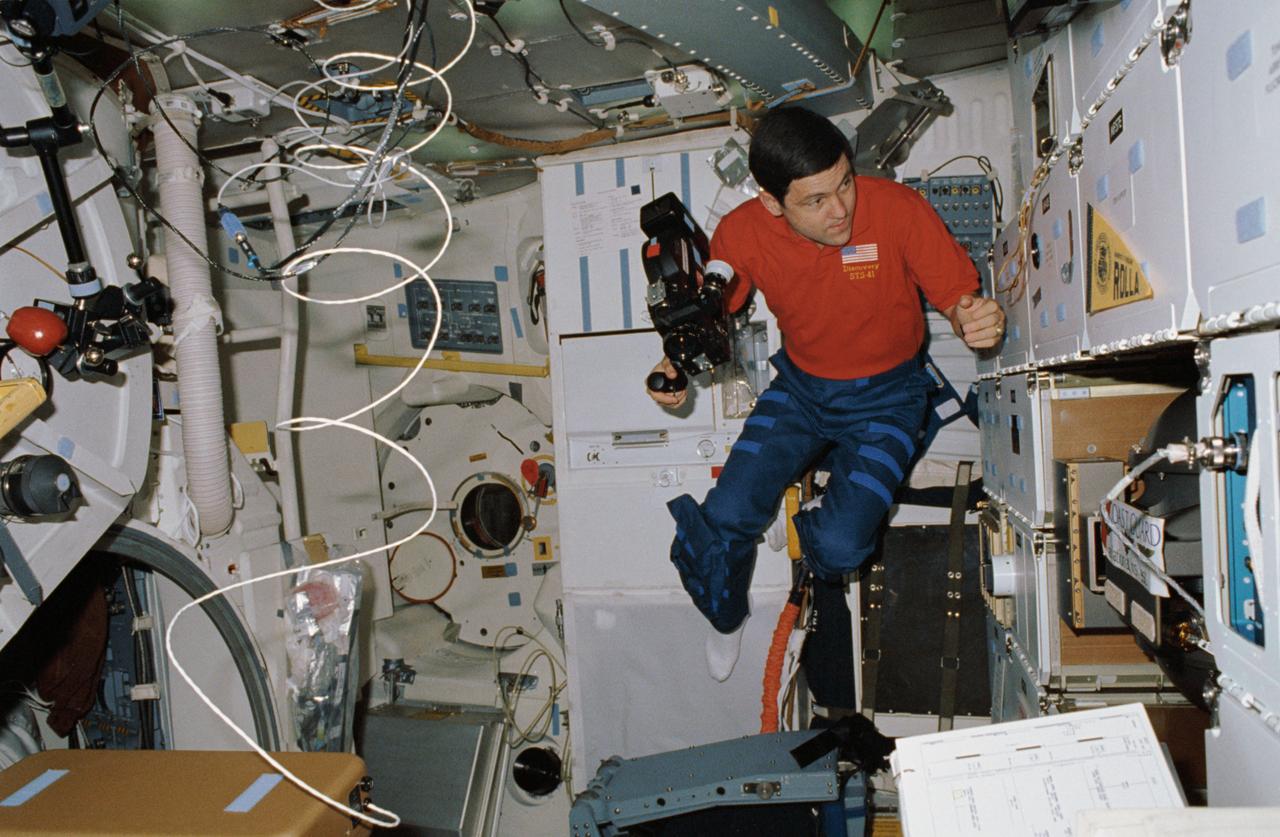
STS041-05-011 (6-10 Oct 1990) --- Astronaut Robert D. Cabana, STS-41 pilot, exhibits the weightlessness of space travel as he appears to "float" about on the middeck of Discovery. Careful inspection of the photo proves that, actually, his floating is limited, as he has anchored his left foot with a special restraint device. He apparently has chosen this vantage point to use the Arriflex motion picture camera in his right hand.
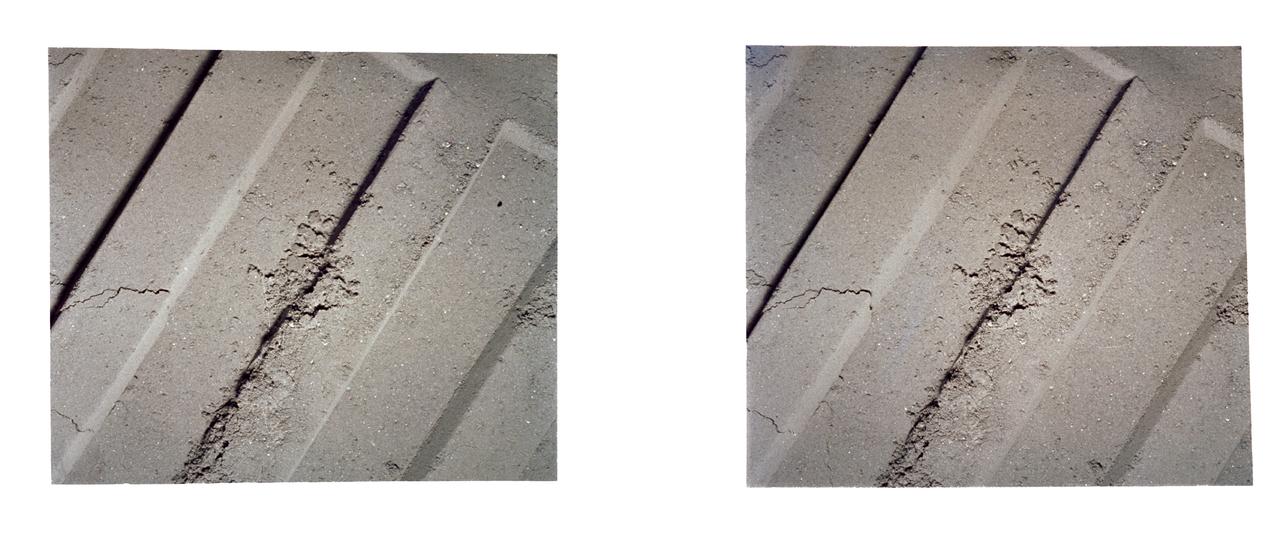
AS12-57-8448 (19-20 Nov. 1969) --- An Apollo 12 stereo view showing a three-inch square of the lunar surface upon which an astronaut had stepped. Taken during extravehicular activity of astronauts Charles Conrad Jr. and Alan L. Bean, the exposure of the boot imprint was made with an Apollo 35mm stereo close-up camera. The camera was developed to get the highest possible resolution of a small area. The three-inch square is photographed with a flash illumination and at a fixed distance. The camera is mounted on a walking stick, and the astronauts use it by holding it up against the object to be photographed and pulling the trigger. While astronauts Conrad and Bean descended in their Apollo 12 Lunar Module to explore the lunar surface, astronaut Richard F. Gordon Jr. remained with the Command and Service Modules in lunar orbit.
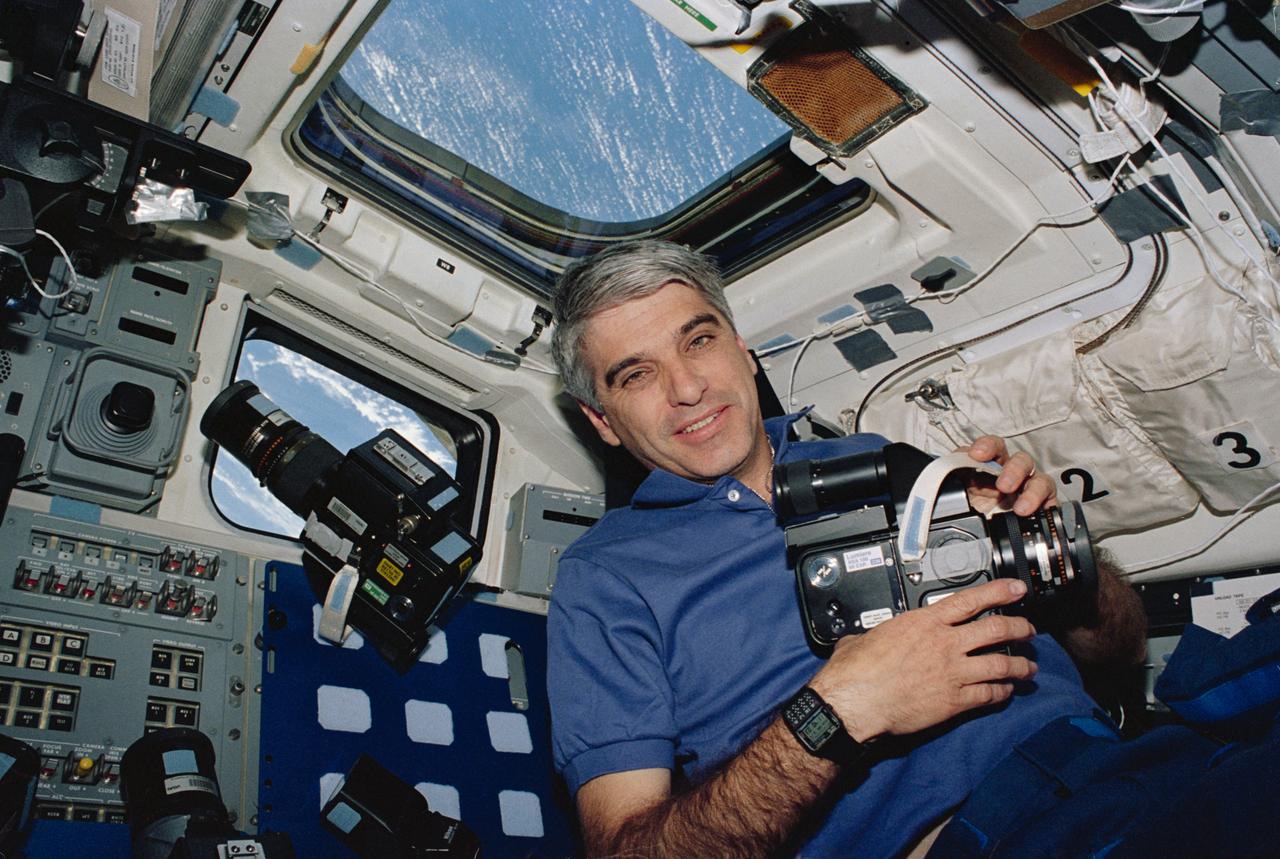
STS059-19-004 (9-20 April 1994) --- Astronaut Sidney M. Gutierrez, mission commander, pauses on the flight deck during Earth observations on the Space Shuttle Endeavour. Gutierrez, who was joined by five other NASA astronauts for 11-days in Earth orbit, holds a 70mm Hasselblad camera. The camera was one of several instruments used during the SRL mission to record an unprecedented compilation of data on planet Earth.

41D-12-020 (6 Sept 1984) --- Astronaut Judith A. Resnik, mission specialist, anchors herself on the flight deck (out of frame) to take a peek at mid-deck activity aboard the Earth-orbiting Space Shuttle Discovery. Among the many stationary and portable cameras onboard the flight are (left to right) TV camera, a data acquisition motion picture camera and the IMAX.
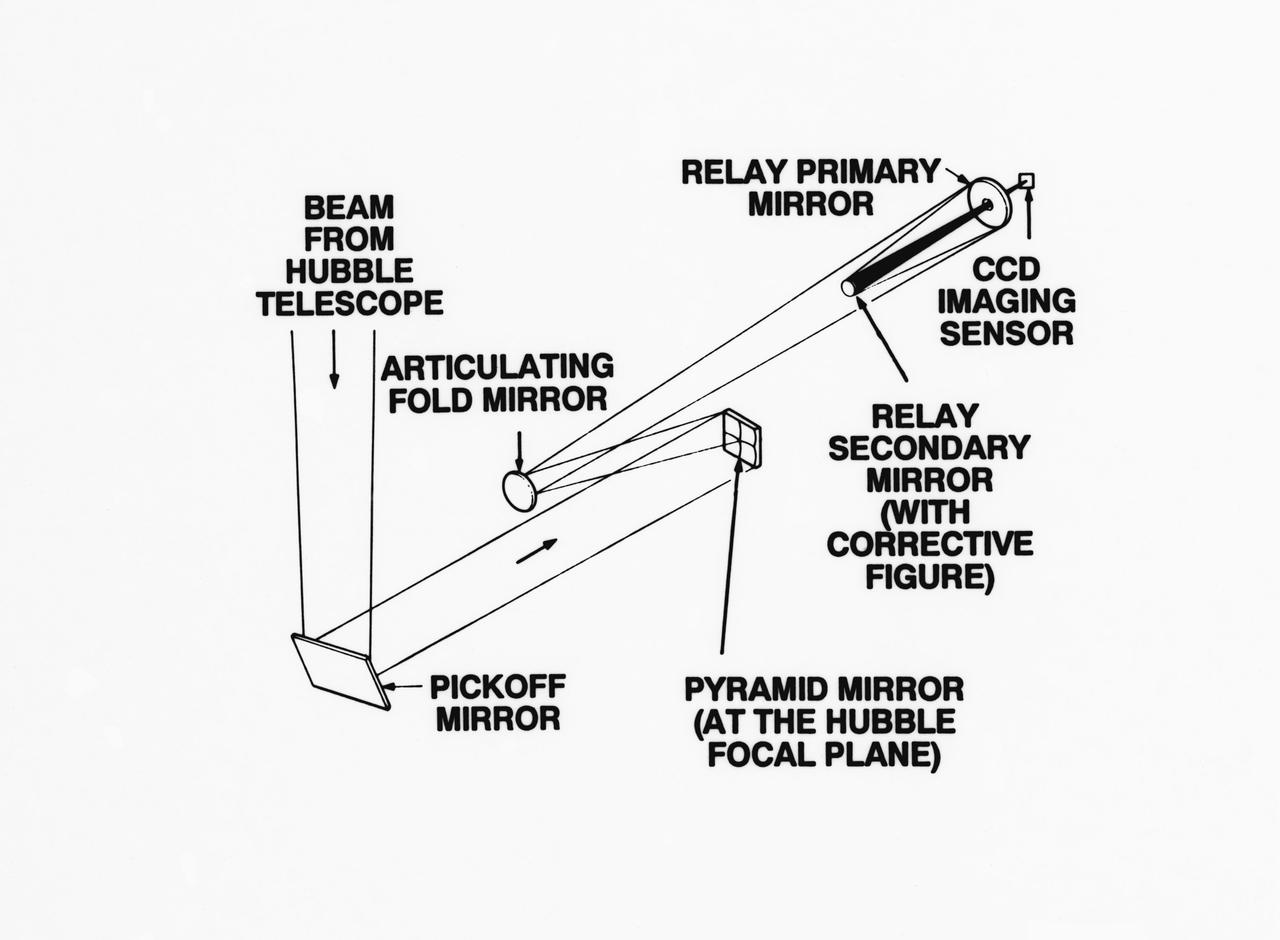
S93-33258 (15 Mar 1993) --- An optical schematic diagram of one of the four channels of the Wide Field\Planetary Camera-2 (WF\PC-2) shows the path taken by beams from the Hubble Space Telescope (HST) before an image is formed at the camera's charge-coupled devices. A team of NASA astronauts will pay a visit to the HST later this year, carrying with them the new WF/PC-2 to replace the one currently on the HST. The Jet Propulsion Laboratory in Pasadena, California has been working on the replacement system for several months. See NASA photo S93-33257 for a close-up view of tiny articulating mirrors designed to realign incoming light in order to make certain the beams fall precisely in the middle of the secondary mirrors.
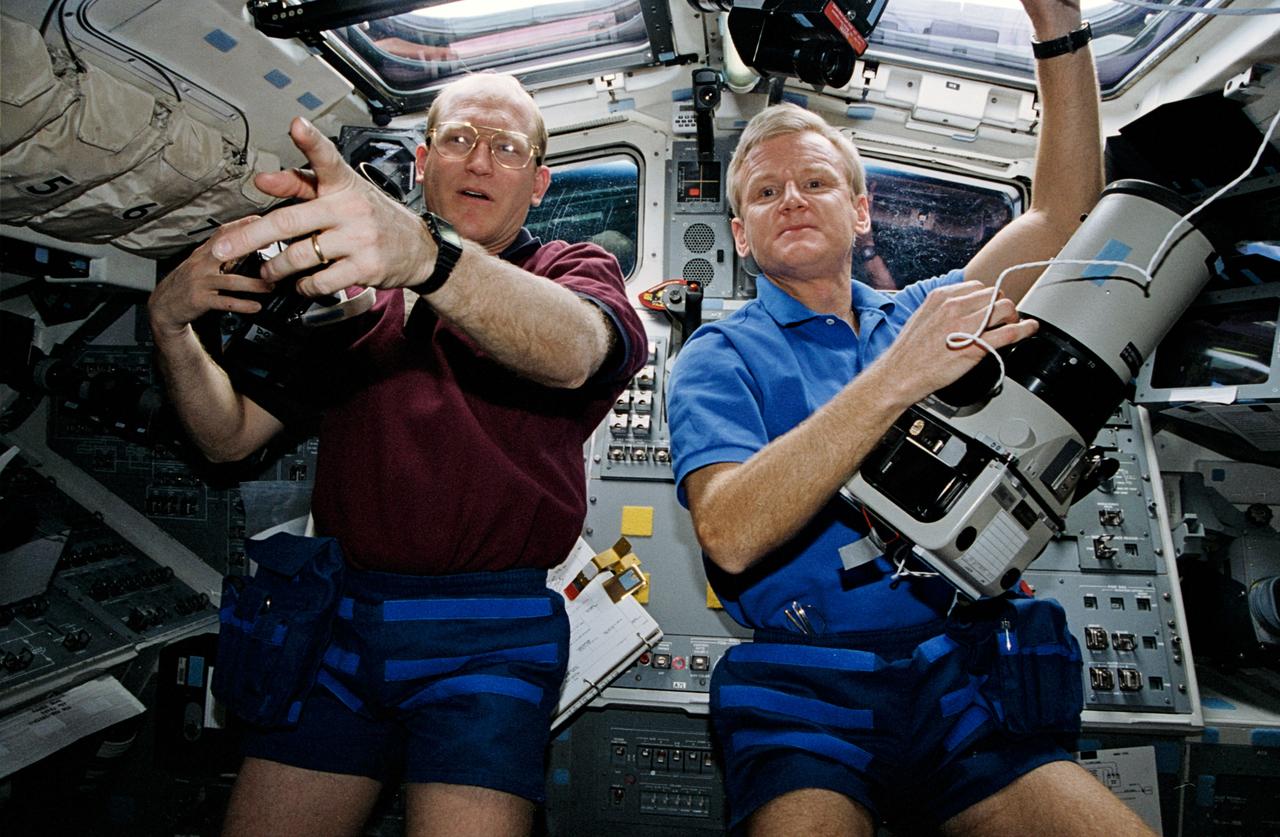
STS062-06-030 (4-18 March 1994) --- With cameras in hand two of the STS-62 astronauts prepare to take pictures of their home planet. John H. Casper (right), mission commander, handles a large format, Linhof camera, while Charles D. (Sam) Gemar, mission specialist, has just added a roll of film to a 70mm handheld Hasselblad camera. Earth observations and documentation occupied muc of the on-duty time of all five of the STS-62 crewmembers during their 14-day mission in earth orbit.
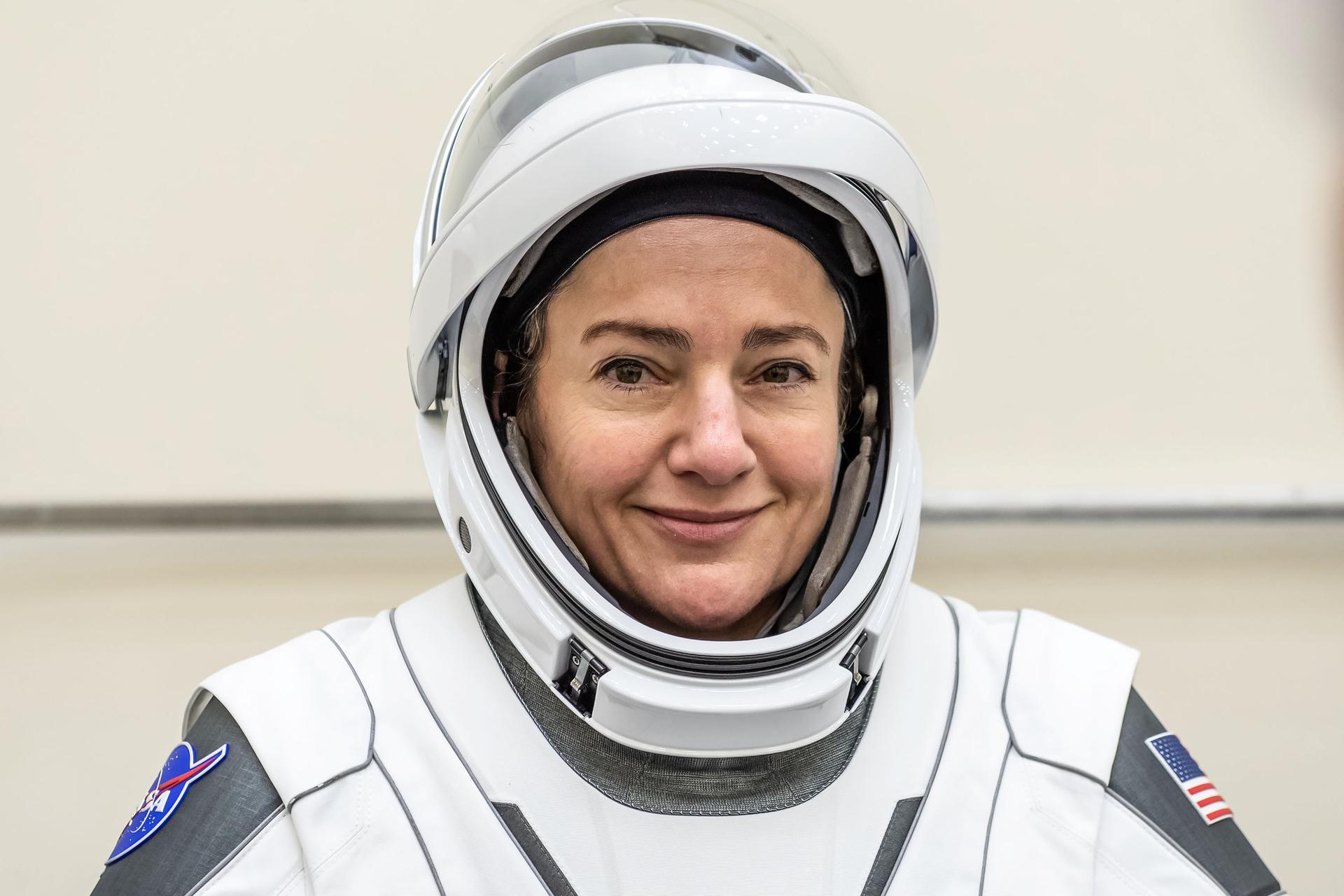
jsc2026e002966 (Jan. 12, 2026) --- NASA astronaut and SpaceX Crew-12 Commander Jessica Meir is photographed in her pressure suit during the Crew Equipment Interface Test at NASA’s Kennedy Space Center in Florida. The goal of the training is to rehearse launch day activities and get a close look at the Dragon spacecraft. Credit: SpaceX
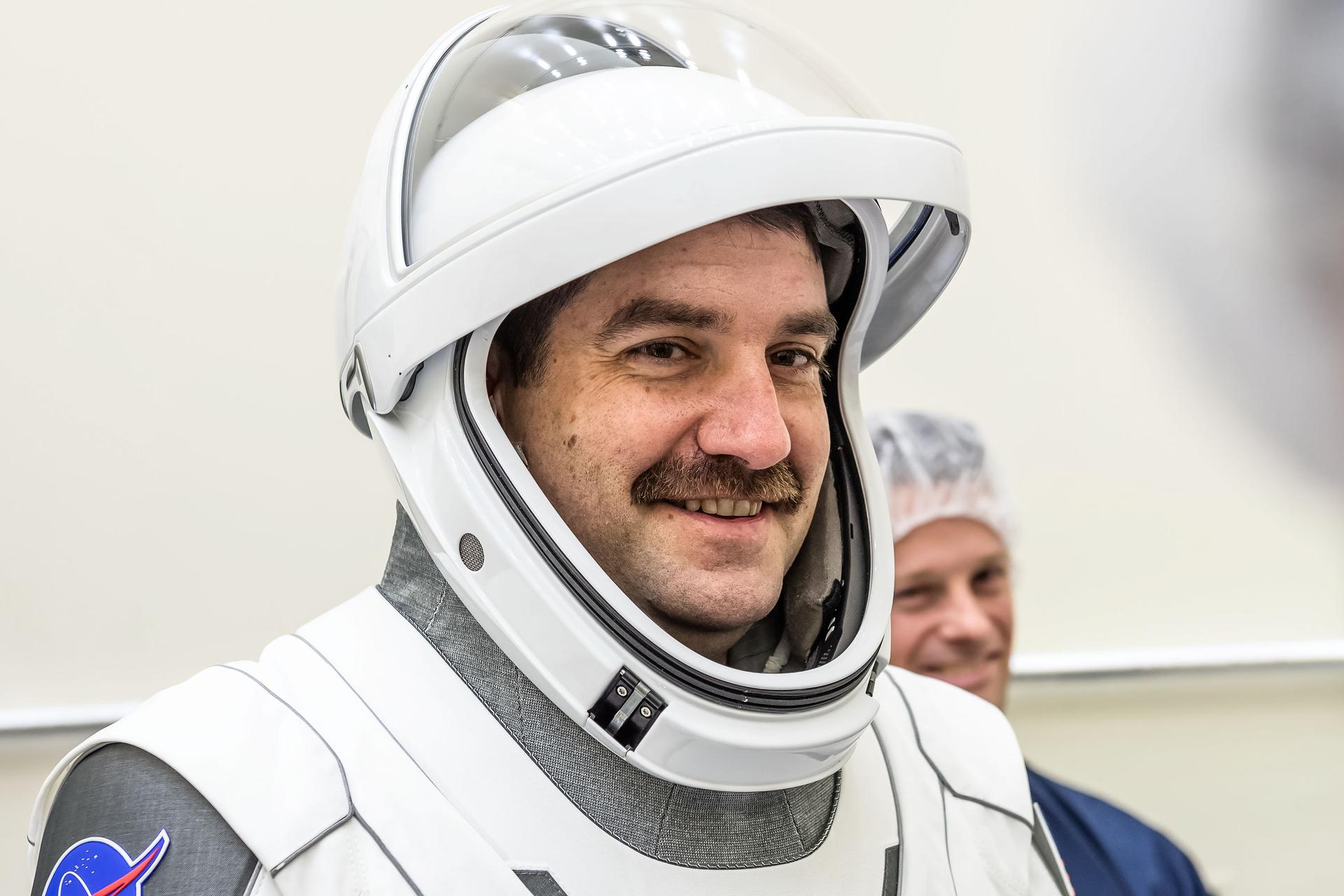
jsc2026e002965 (Jan. 12, 2026) --- NASA astronaut and SpaceX Crew-12 Pilot Jack Hathaway is photographed in his pressure suit during the Crew Equipment Interface Test at NASA’s Kennedy Space Center in Florida. The goal of the training is to rehearse launch day activities and get a close look at the Dragon spacecraft. Credit: SpaceX
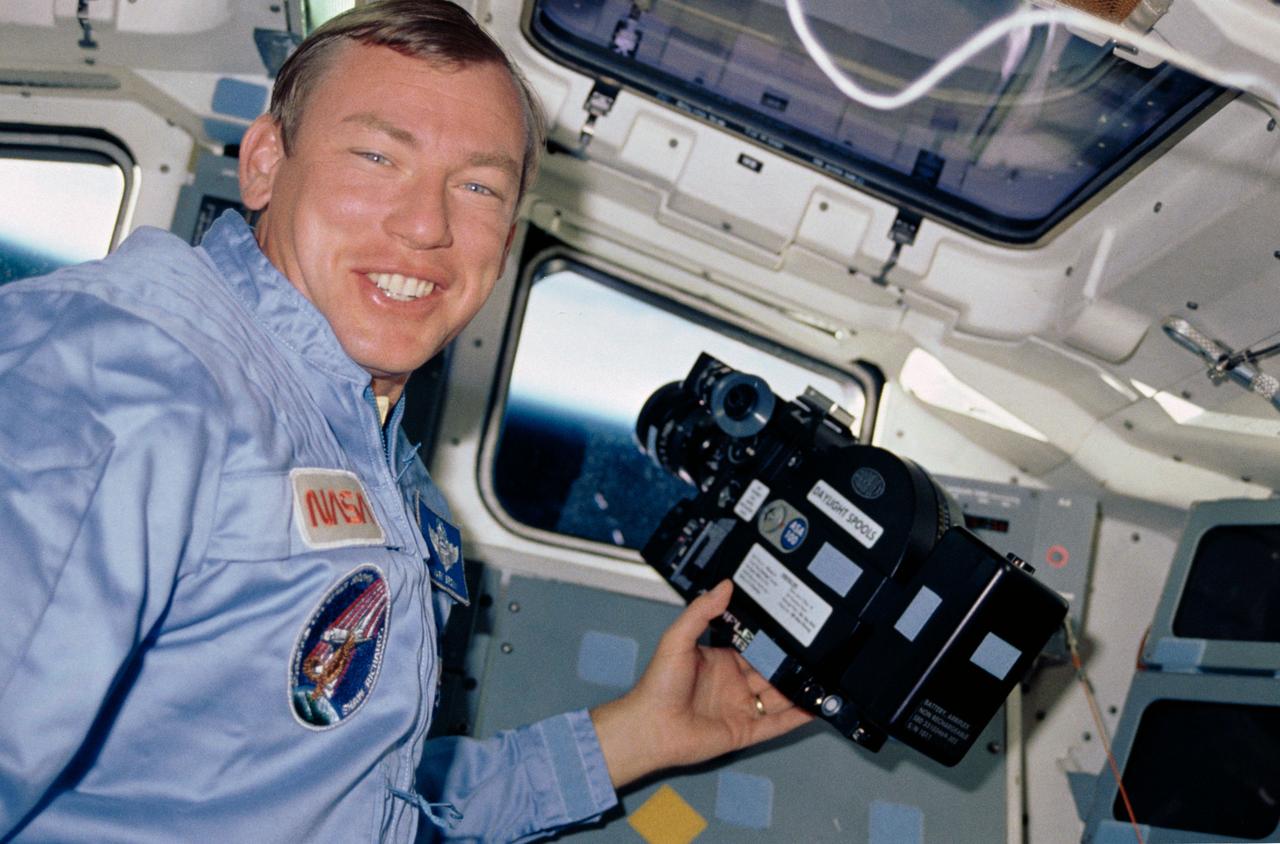
STS028-17-033 (August 1989) --- Astronaut Mark N. Brown, STS-28 mission specialist, pauses from a session of motion-picture photography conducted through one of the aft windows on the flight deck of the Earth-orbiting Space Shuttle Columbia. He is using an Arriflex camera. The horizon of the blue and white appearing Earth and its airglow are visible in the background.
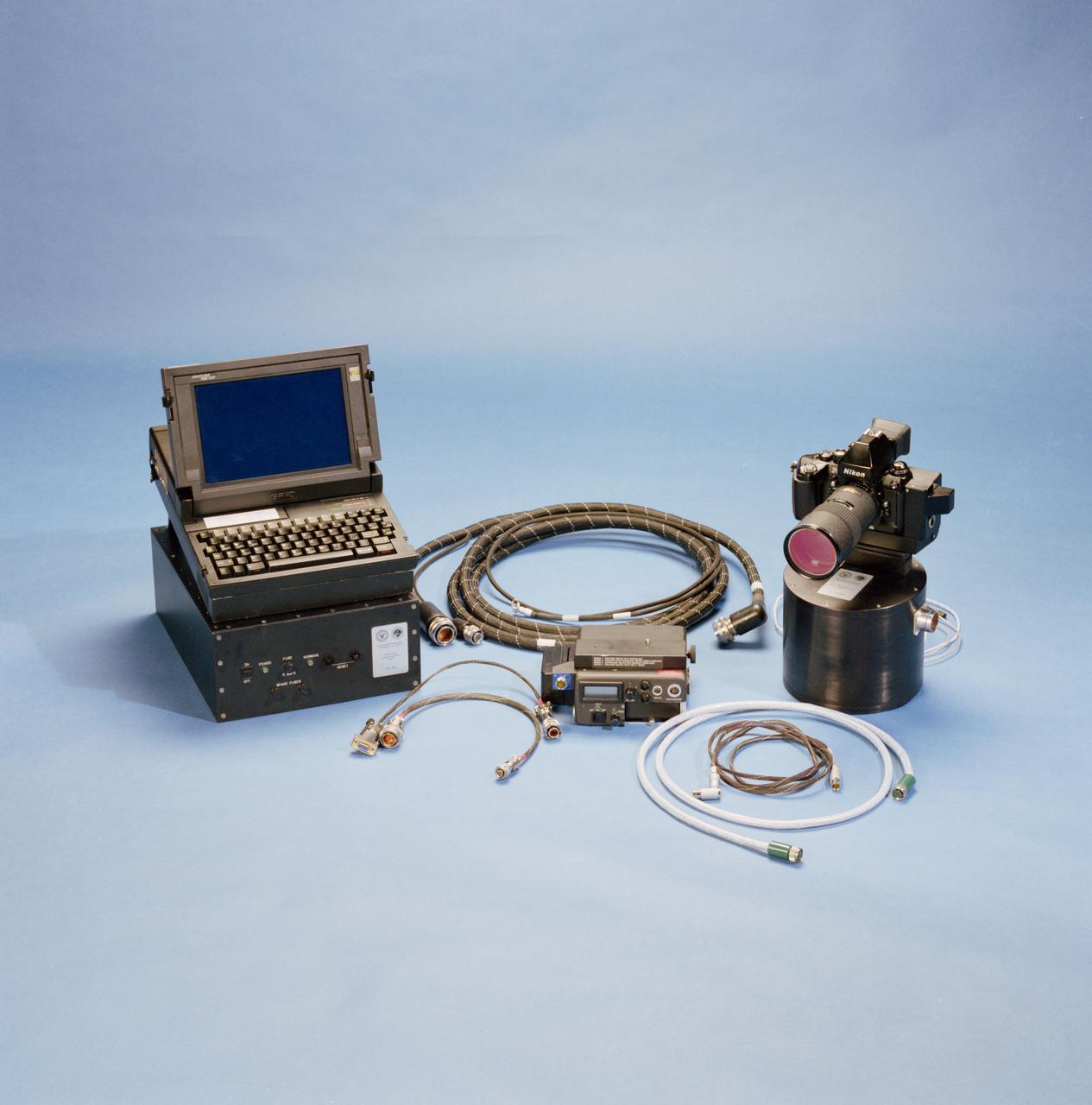
STS-53 Discovery, Orbiter Vehicle (OV) 103, Department of Defense (DOD) mission Hand-held Earth-oriented Real-time Cooperative, User-friendly, Location, targeting, and Environmental System (Hercules) spaceborne experiment equipment is documented in this table top view. HERCULES is a joint NAVY-NASA-ARMY payload designed to provide real-time high resolution digital electronic imagery and geolocation (latitude and longitude determination) of earth surface targets of interest. HERCULES system consists of (from left to right): a specially modified GRID Systems portable computer mounted atop NASA developed Playback-Downlink Unit (PDU) and the Naval Research Laboratory (NRL) developed HERCULES Attitude Processor (HAP); the NASA-developed Electronic Still Camera (ESC) Electronics Box (ESCEB) including removable imagery data storage disks and various connecting cables; the ESC (a NASA modified Nikon F-4 camera) mounted atop the NRL HERCULES Inertial Measurement Unit (HIMU) containing the three-axis ring-laser gyro.
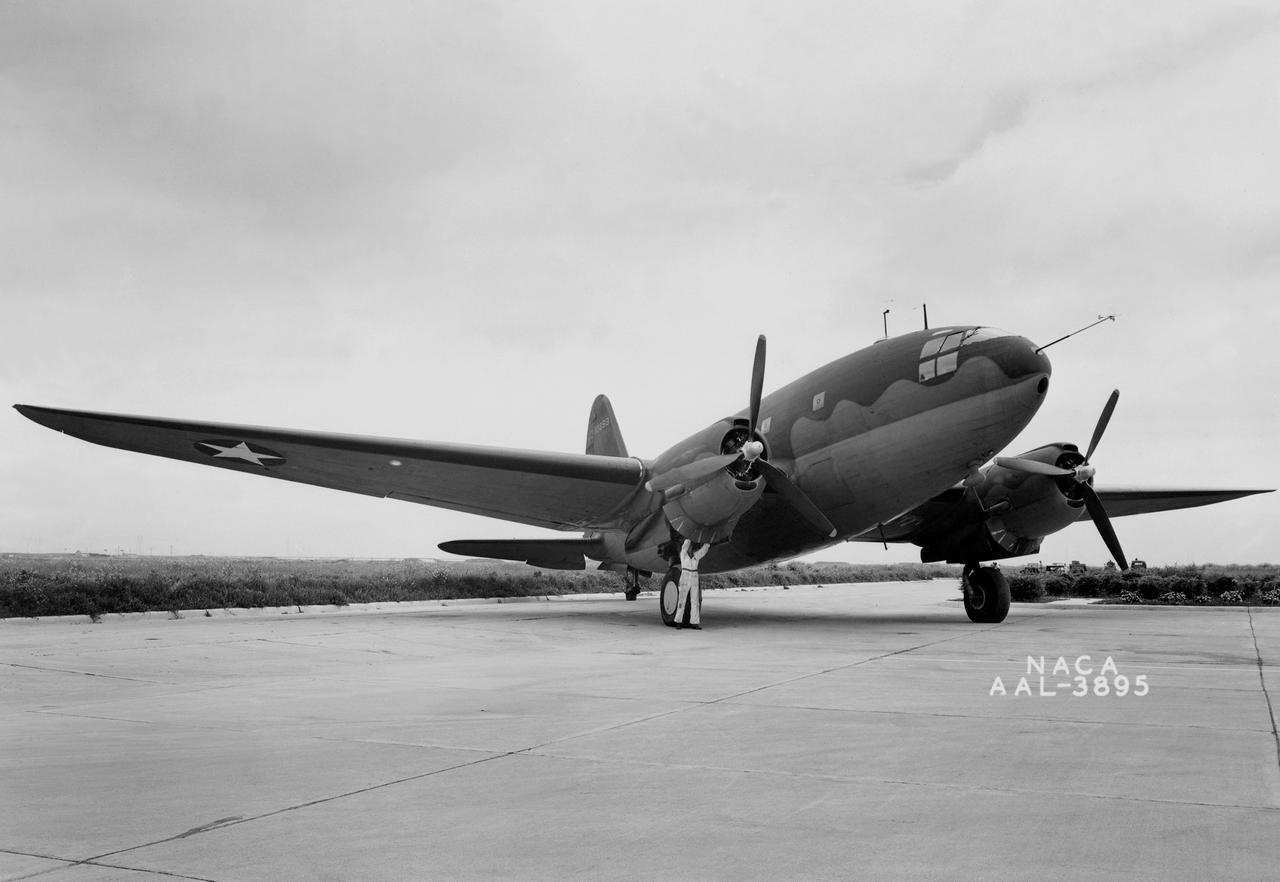
NACA Photographer 3/4 front view Curtiss C-46 airplane in which the thermal ice-prevention equipment was installed
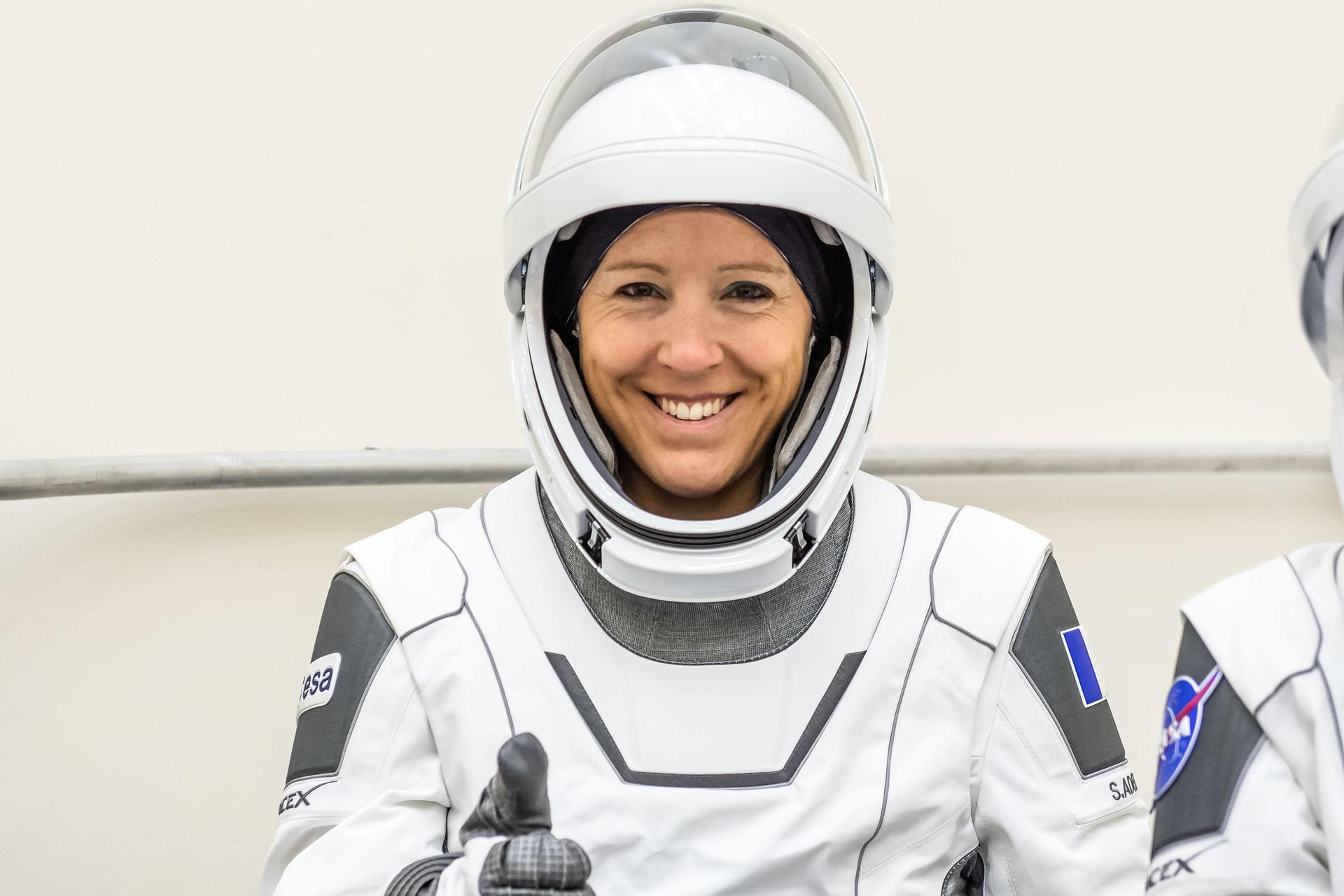
jsc2026e002964 (Jan. 12, 2026) --- ESA (European Space Agency) astronaut and SpaceX Crew-12 Mission Specialist Sophie Adenot is photographed in her pressure suit during the Crew Equipment Interface Test at NASA’s Kennedy Space Center in Florida. The goal of the training is to rehearse launch day activities and get a close look at the Dragon spacecraft. Credit: SpaceX
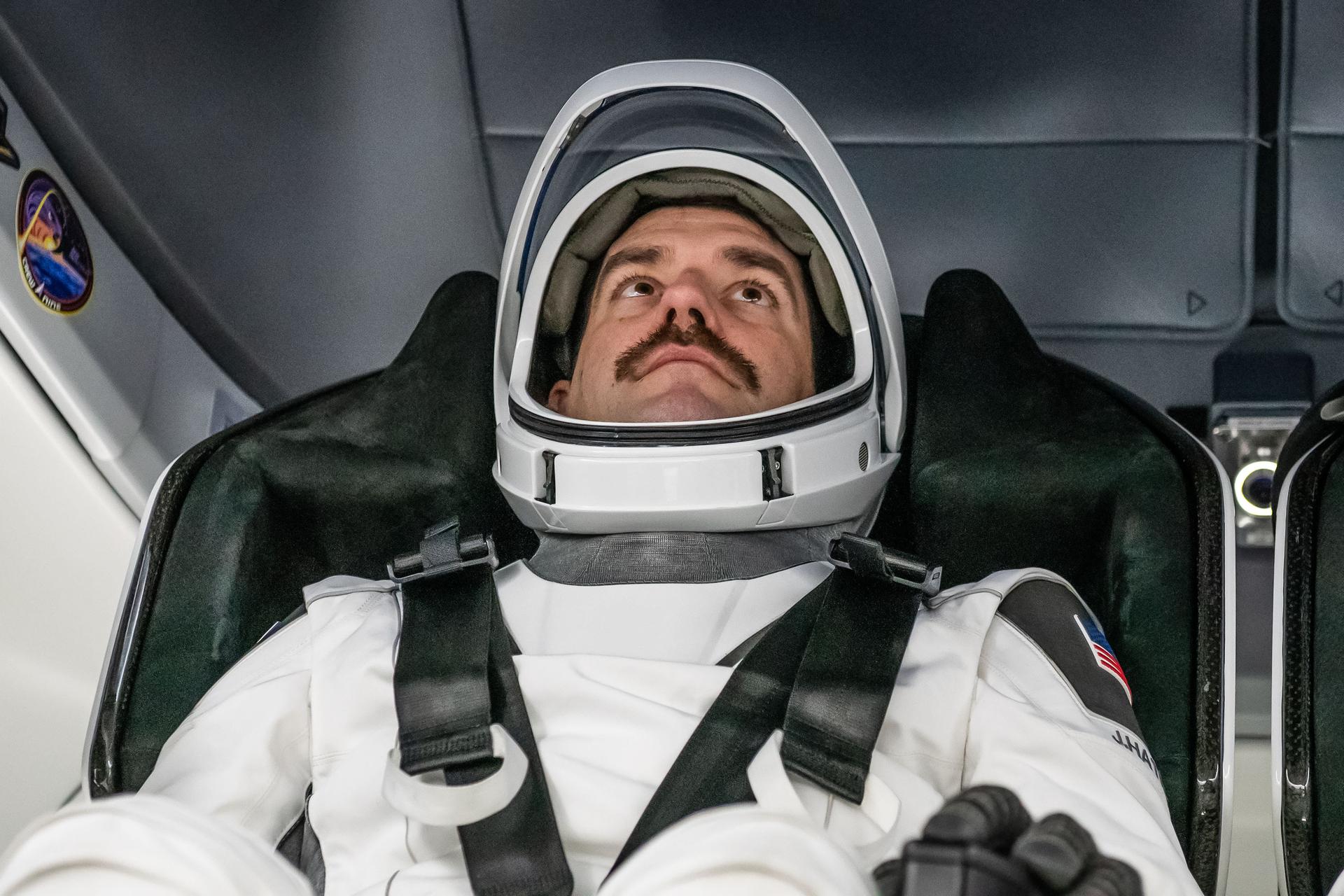
jsc2026e002974 (Jan. 12, 2026) --- NASA astronaut and SpaceX Crew-12 Pilot Jack Hathaway is photographed in his pressure suit and inside the Dragon spacecraft during the Crew Equipment Interface Test at NASA’s Kennedy Space Center in Florida. The goal of the training is to rehearse launch day activities and get a close look at the spacecraft that will take them to the International Space Station. Credit: SpaceX
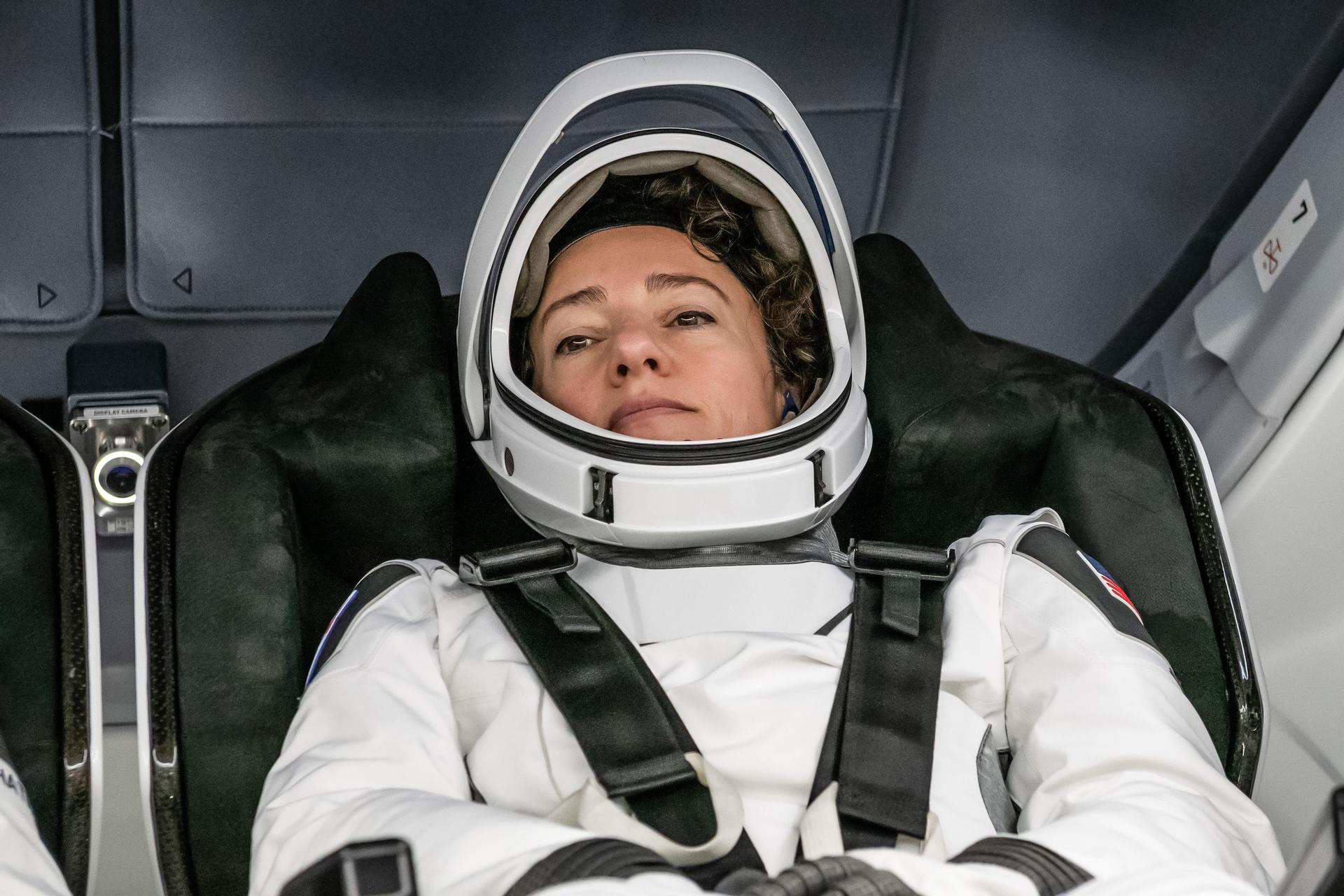
jsc2026e002976 (Jan. 12, 2026) --- NASA astronaut and SpaceX Crew-12 Commander Jessica Meir is photographed in her pressure suit and inside the Dragon spacecraft during the Crew Equipment Interface Test at NASA’s Kennedy Space Center in Florida. The goal of the training is to rehearse launch day activities and get a close look at the spacecraft that will take them to the International Space Station. Credit: SpaceX
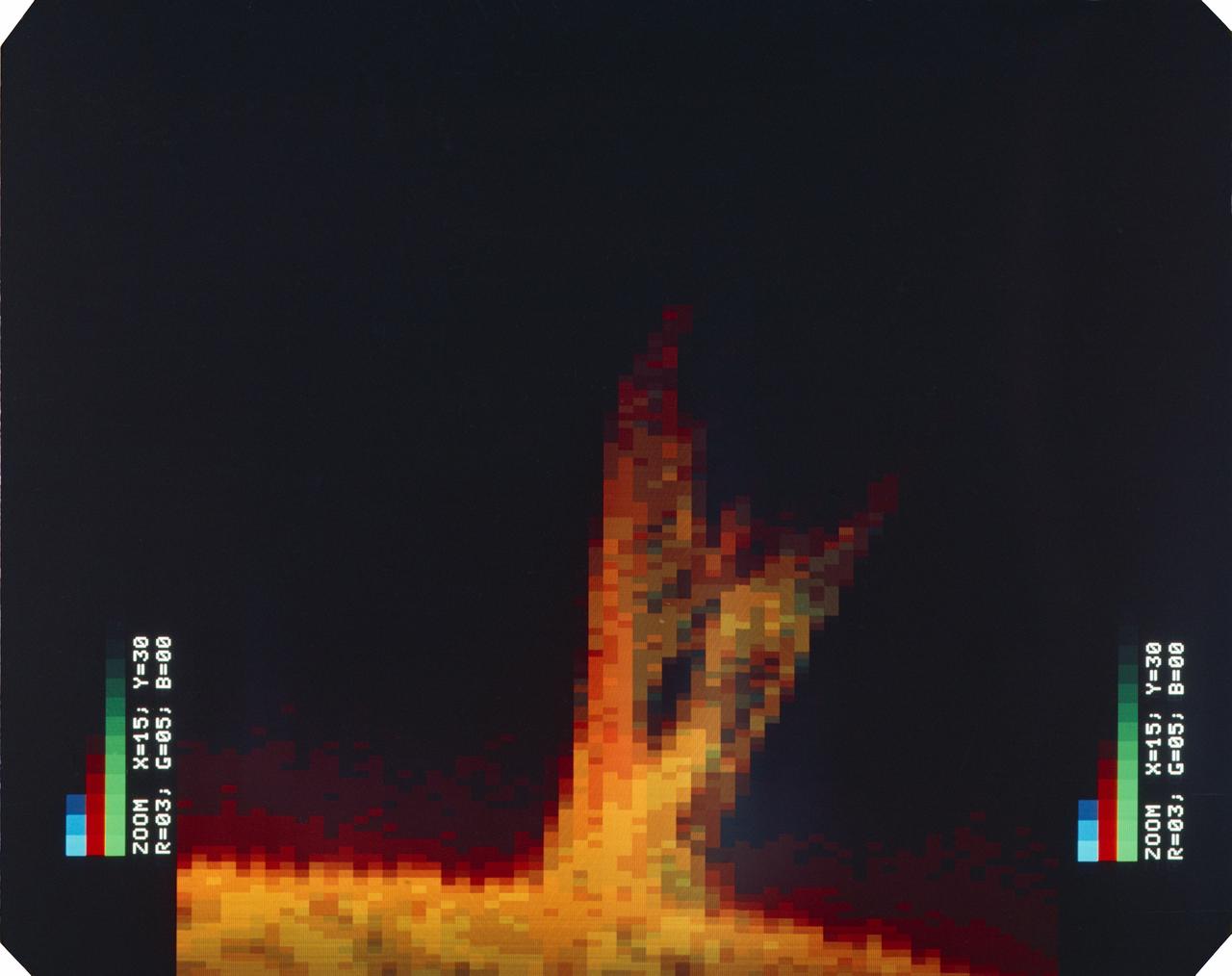
S74-18098 (1974) --- Graphical representation of an ultraviolet photograph depicting a solar flare, using the Skylab 4 Earth Observation Experiment equipment. Photo credit: NASA

AS07-04-1586 (20 Oct. 1968) --- Astronaut Walter Cunningham, Apollo 7 lunar module pilot, writes with space pen as he is photographed performing flight tasks on the ninth day of the Apollo 7 mission. Note the 70mm Hasselblad camera film magazine just above Cunningham's right hand floating in the weightless (zero gravity) environment of the spacecraft.
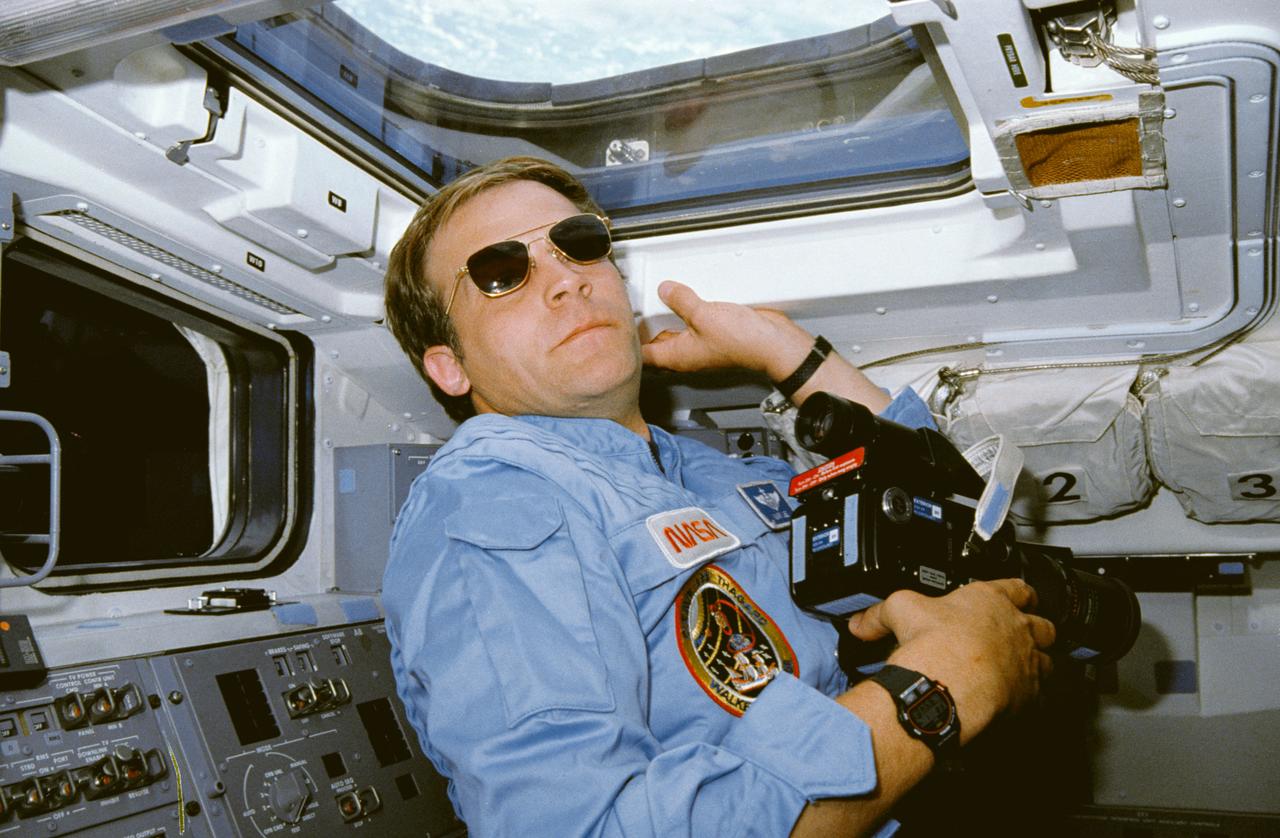
STS030-08-015 (4-8 May 1989) --- Astronaut Mark C. Lee, STS-30 mission specialist, pauses from a of Earth photography on Atlantis' aft flight deck. He holds a 70mm camera. The scene was recorded with a 35mm camera. The photo was in a group released by NASA following the completion of a four-day mission in space.
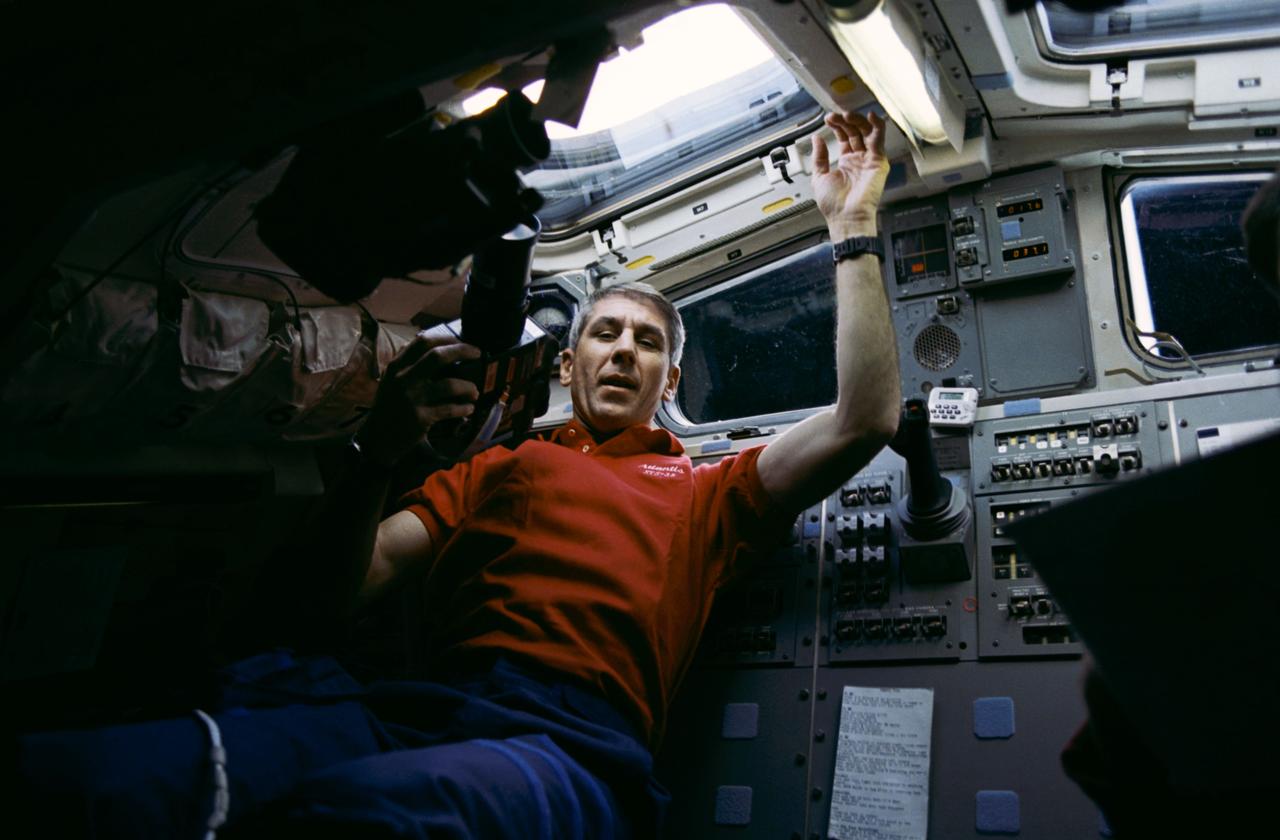
STS038-25-005 (20 Nov 1990) --- STS-38 Mission Specialist (MS) Robert C. Springer, holding HASSELBLAD camera, positions himself under aft flight deck overhead window W7 before recording the Earth's surface below. Behind Springer are Atlantis', Orbiter Vehicle (OV) 104's, on orbit station and aft flight deck viewing windows.
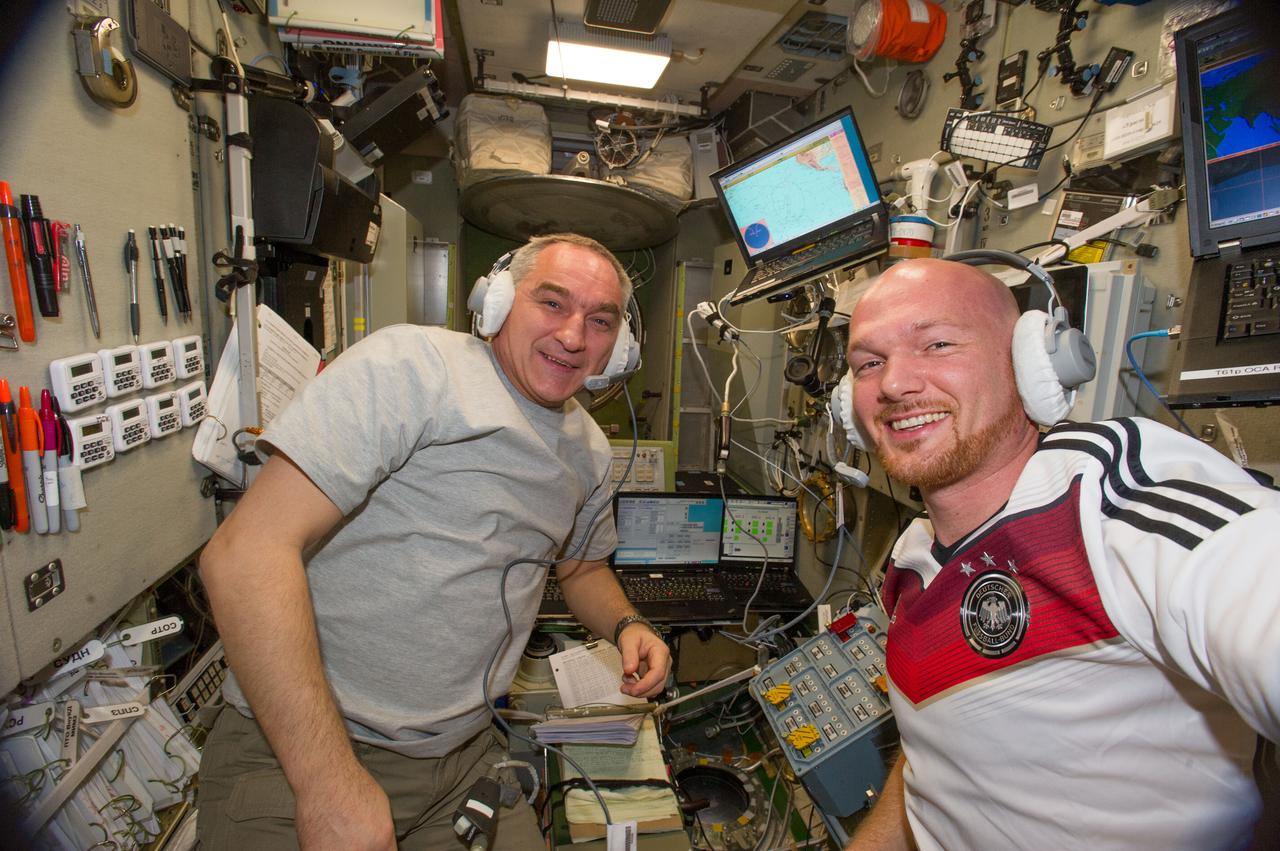
Cosmonaut Alexander Skvortsov and ESA Astronaut Alexander Gerst, Expedition 40 flight engineers, are photographed during ATV equipment preparation in the Service Module (SM) prior to ATV launch.

Photographed on: 12 09 58. -- Mercury capsule details, capsule in cargo bay of C-130 airplane prior to drop test, equipment in C130 for doing drop test.
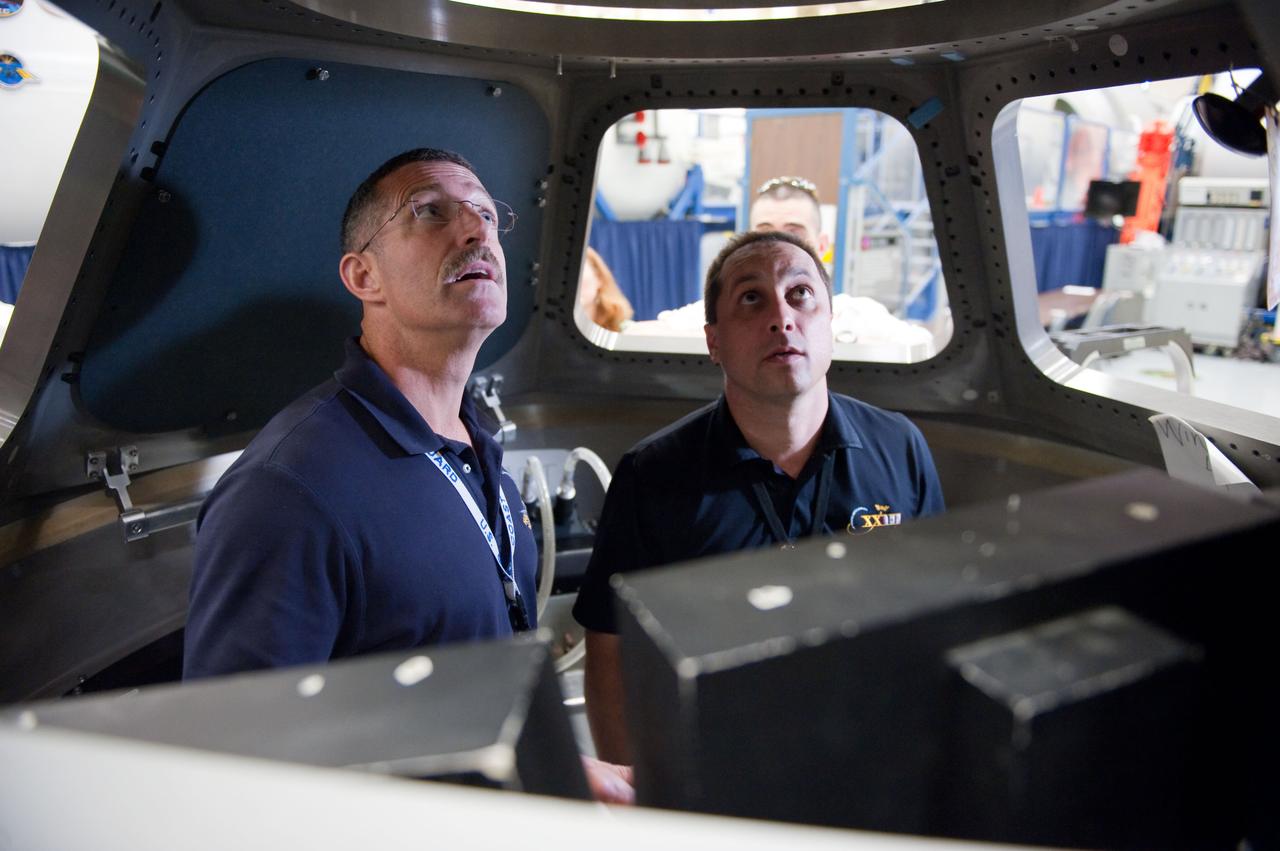
Expedition 29/30 ISS Habitability Equipment and Procedures training in ISS mockups. Photo Date: May 17, 2011. Location: Bldg. 9NW - ISS Mockups. Photographer: Robert Markowitz.
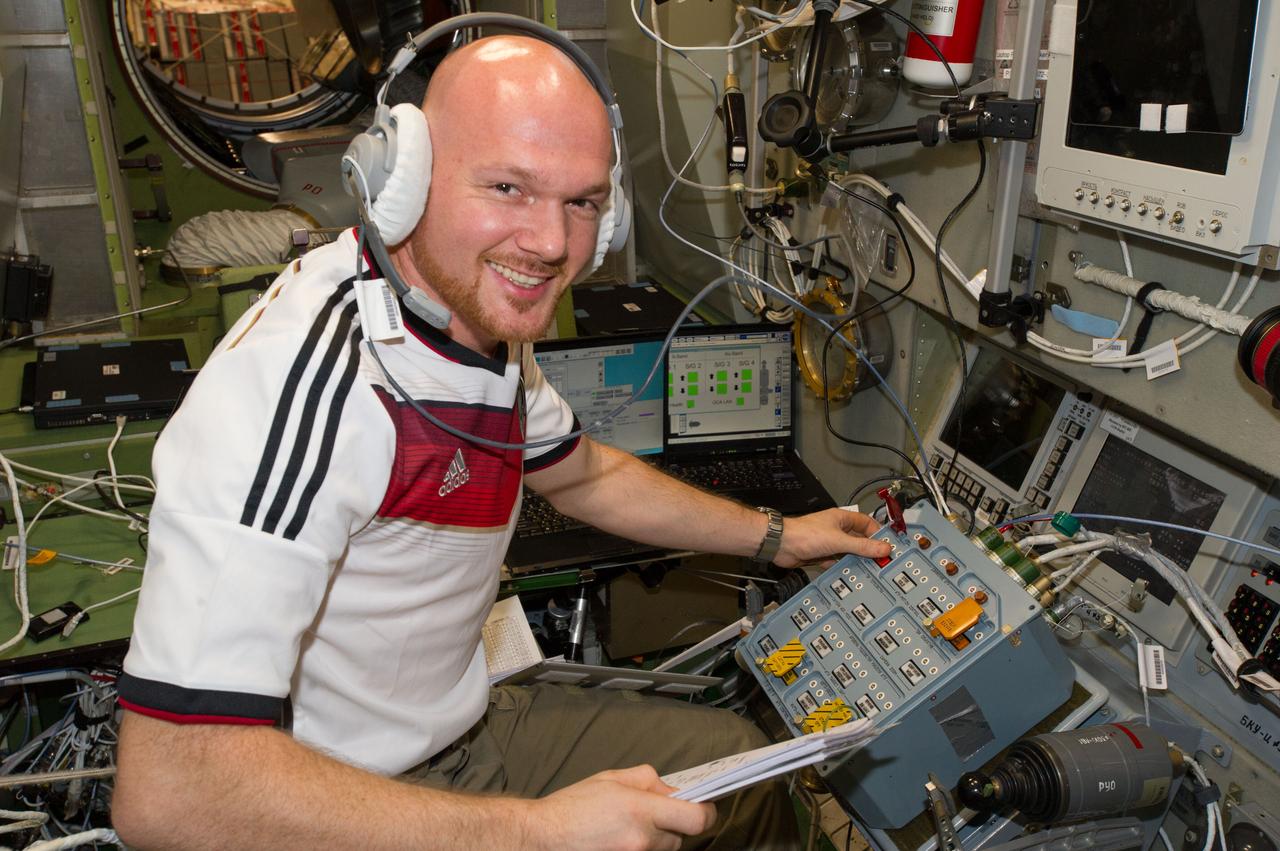
ESA astronaut Alexander Gerst, Expedition 40 flight engineer (wearing soccer shirt), is photographed during ATV equipment preparation in the Service Module (SM) prior to ATV launch.
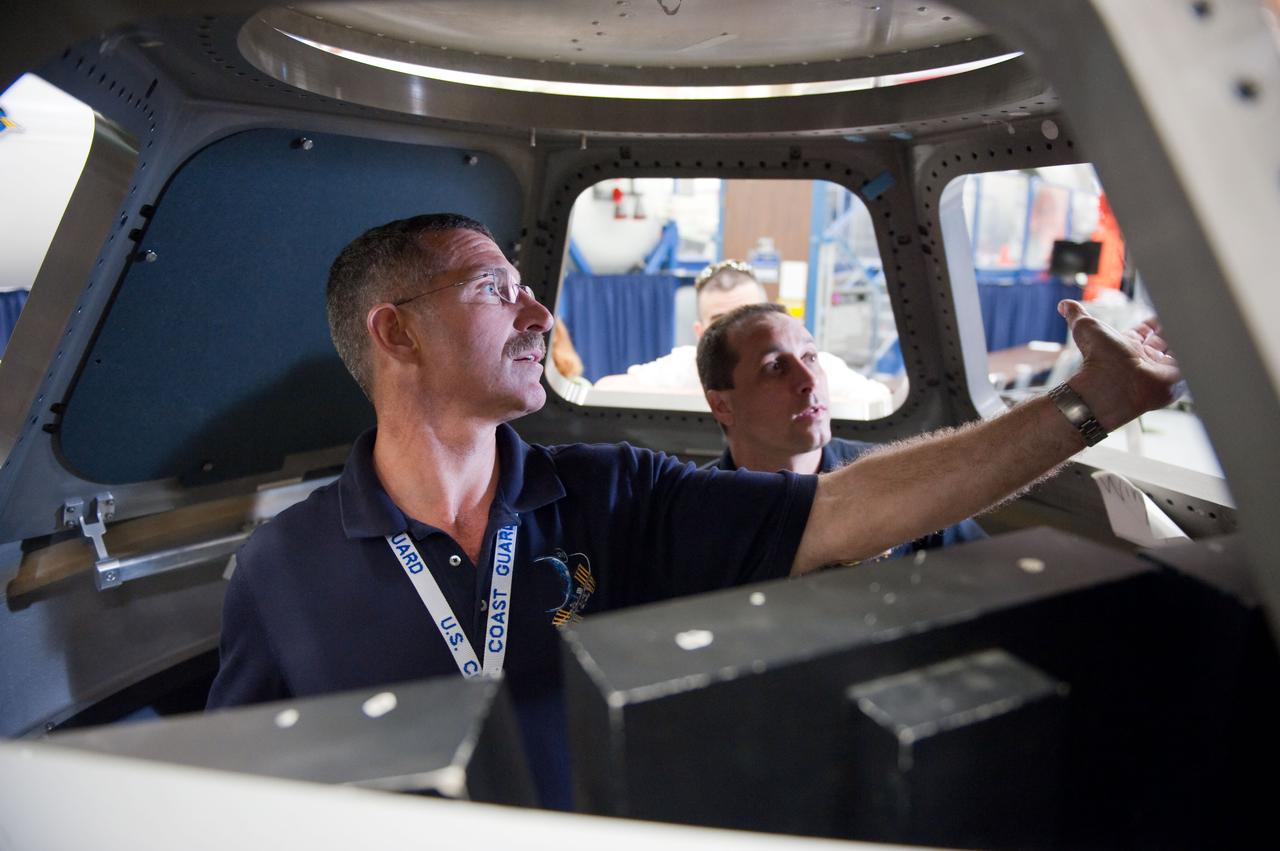
Expedition 29/30 ISS Habitability Equipment and Procedures training in ISS mockups. Photo Date: May 17, 2011. Location: Bldg. 9NW - ISS Mockups. Photographer: Robert Markowitz.
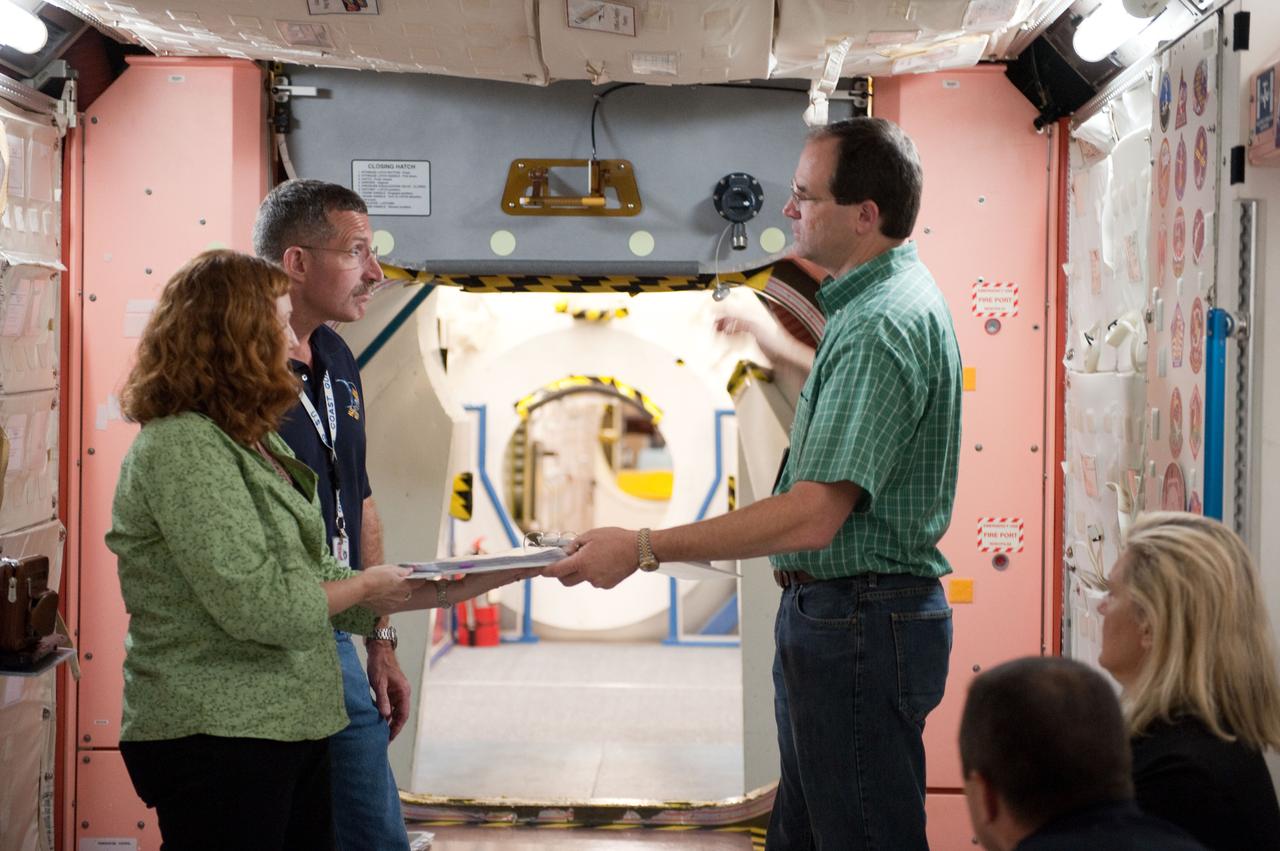
Expedition 29/30 ISS Habitability Equipment and Procedures training in ISS mockups. Photo Date: May 17, 2011. Location: Bldg. 9NW - ISS Mockups. Photographer: Robert Markowitz.
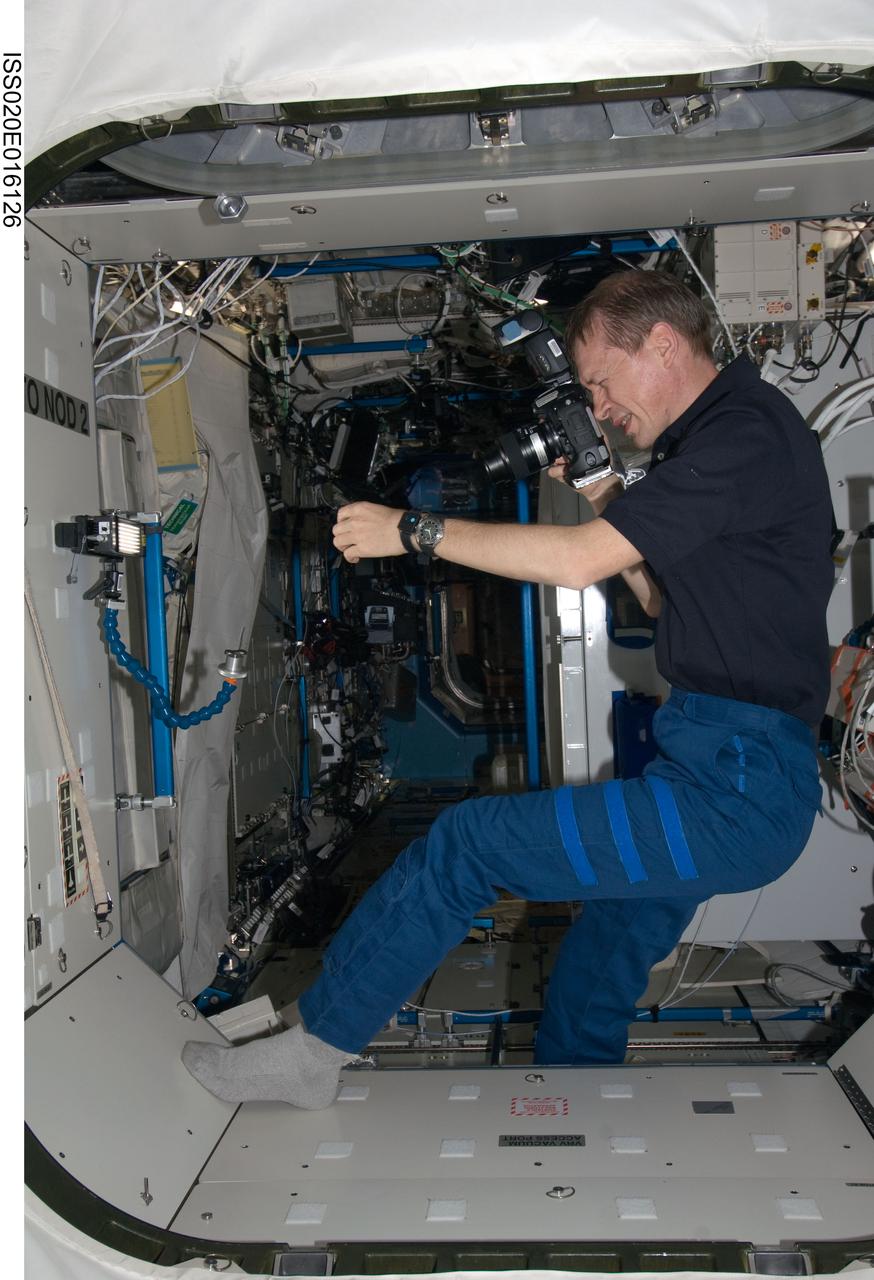
ISS020-E-016126 (30 June 2009) --- European Space Agency astronaut Frank De Winne, Expedition 20 flight engineer, photographs equipment in the Destiny laboratory of the International Space Station.

ISS004-329-024 (5-19 June 2002) --- Astronaut Franklin R. Chang-Diaz, STS-111 mission specialist, is photographed in the Unity node on the International Space Station (ISS) during the transfer of supplies and equipment.
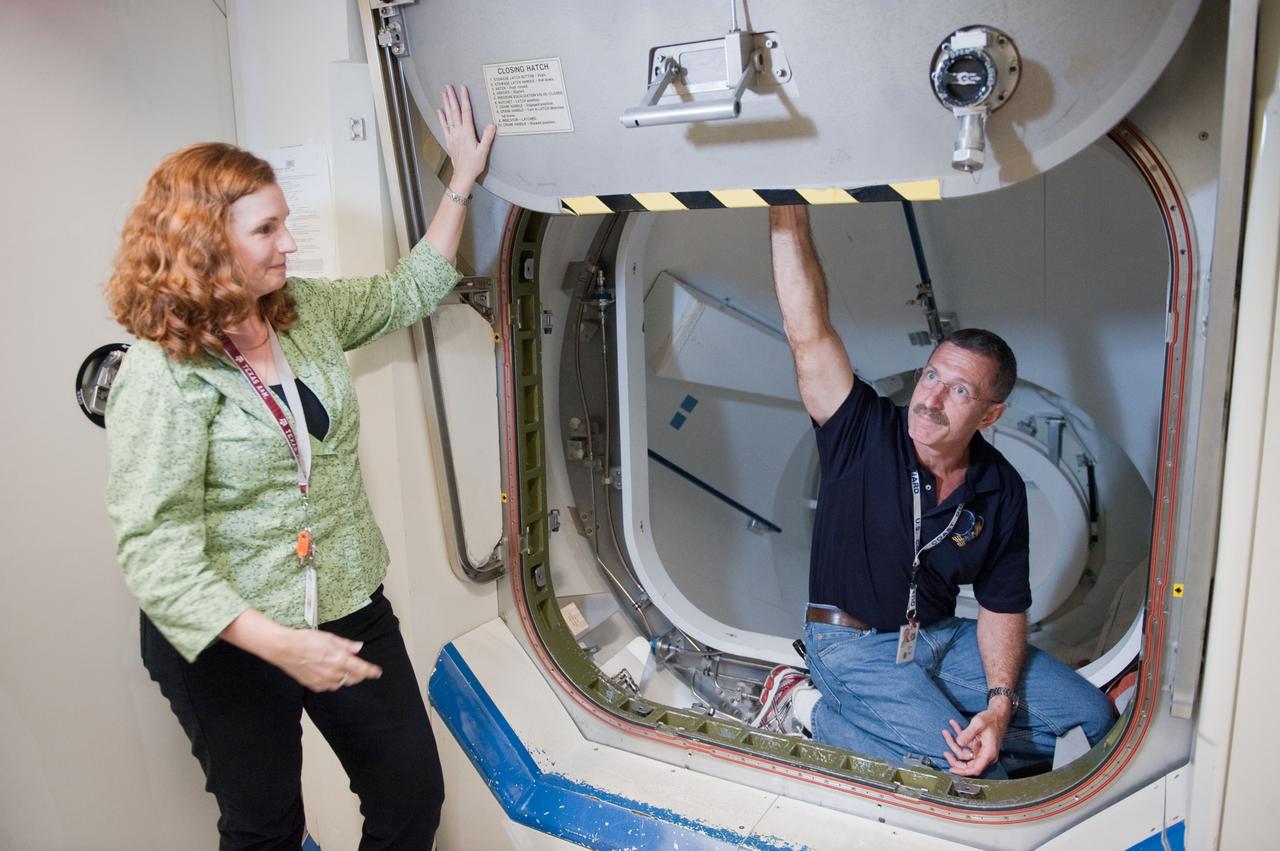
Expedition 29/30 ISS Habitability Equipment and Procedures training in ISS mockups. Photo Date: May 17, 2011. Location: Bldg. 9NW - ISS Mockups. Photographer: Robert Markowitz.

ISS020-E-016128 (30 June 2009) --- European Space Agency astronaut Frank De Winne, Expedition 20 flight engineer, photographs equipment in the Destiny laboratory of the International Space Station.
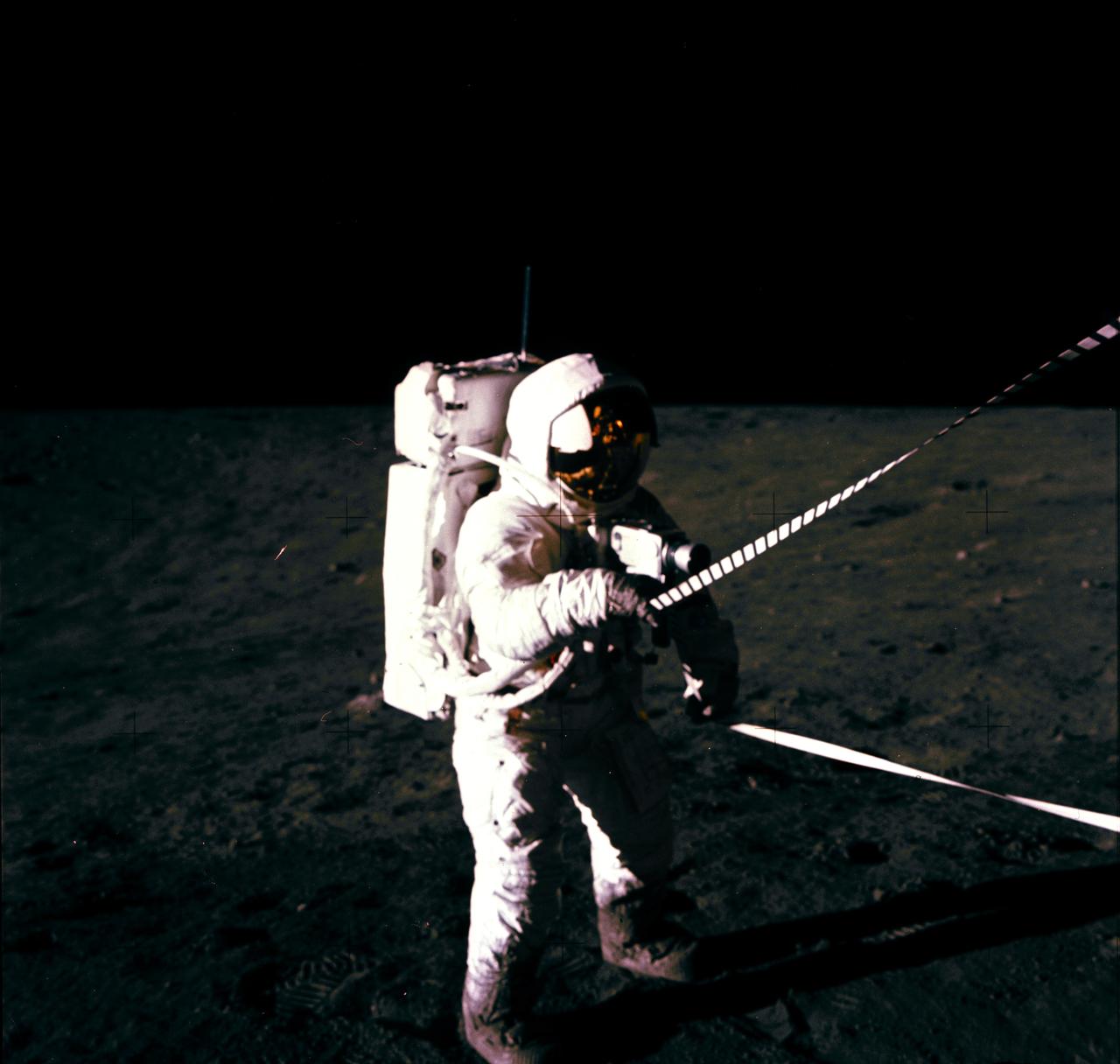
Astronaut Charles Conrad Jr., commander, uses the lunar equipment conveyer (LEC) at the Lunar Module during the Apollo 12 extravehicular activity on the lunar surface. This photograph was taken by Astronaut Alan L. Bean, lunar module pilot.
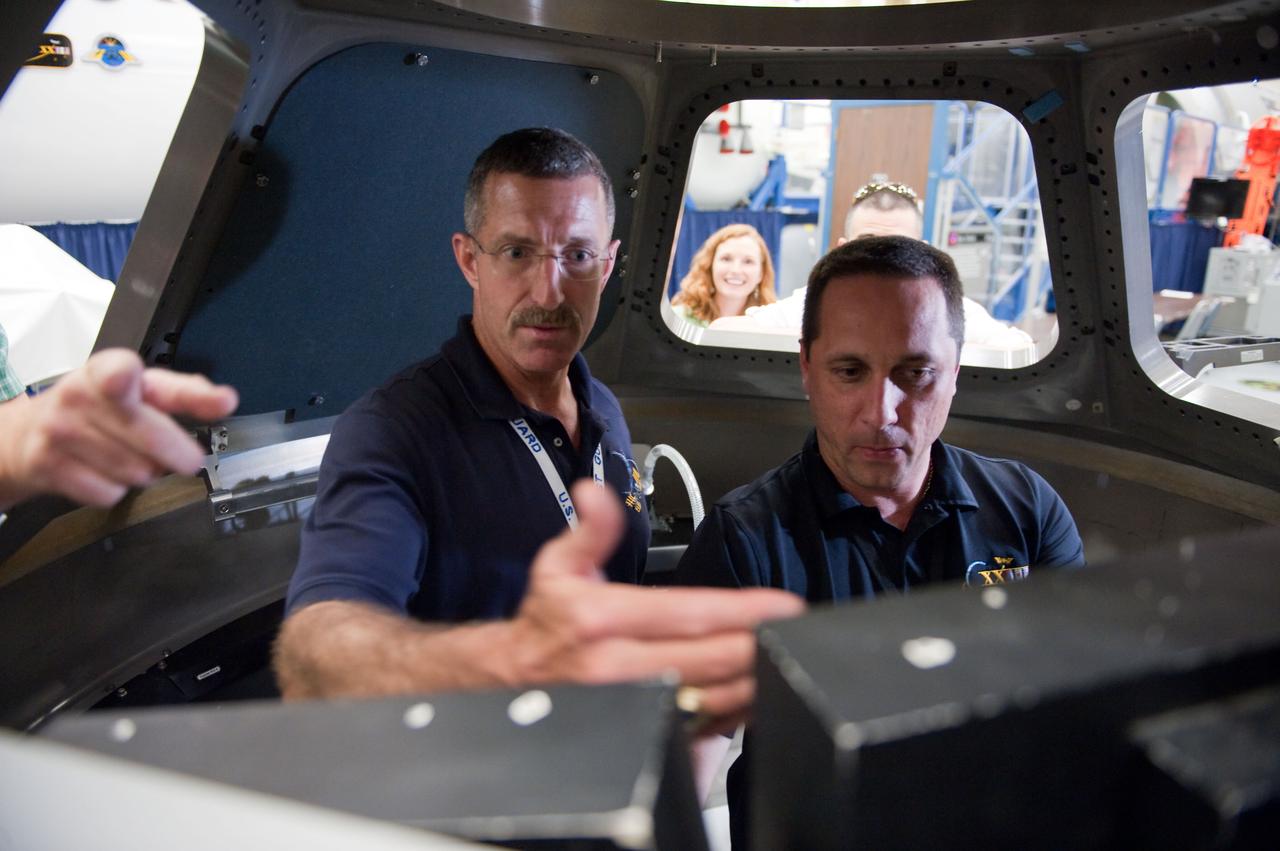
Expedition 29/30 ISS Habitability Equipment and Procedures training in ISS mockups. Photo Date: May 17, 2011. Location: Bldg. 9NW - ISS Mockups. Photographer: Robert Markowitz.
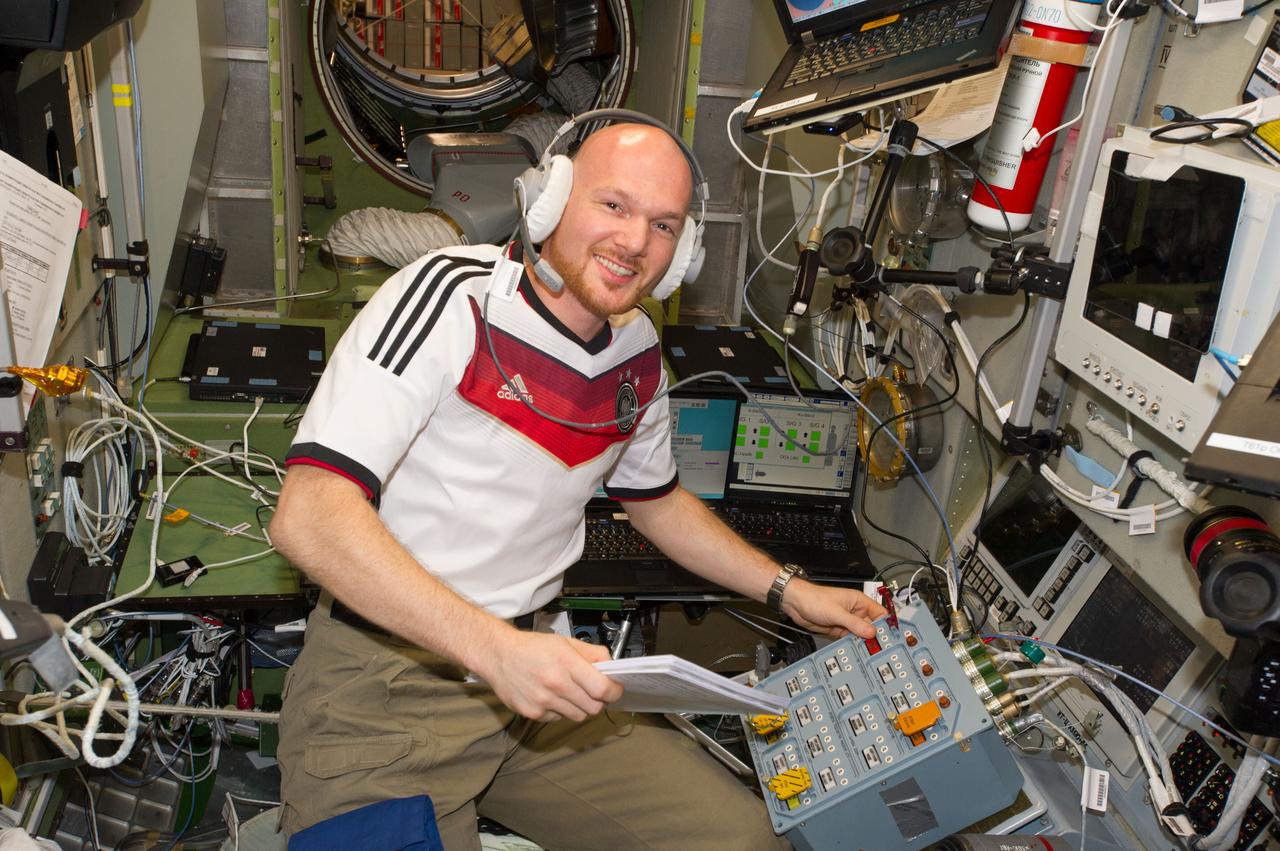
ESA astronaut Alexander Gerst, Expedition 40 flight engineer (wearing soccer shirt), is photographed during ATV equipment preparation in the Service Module (SM) prior to ATV launch.
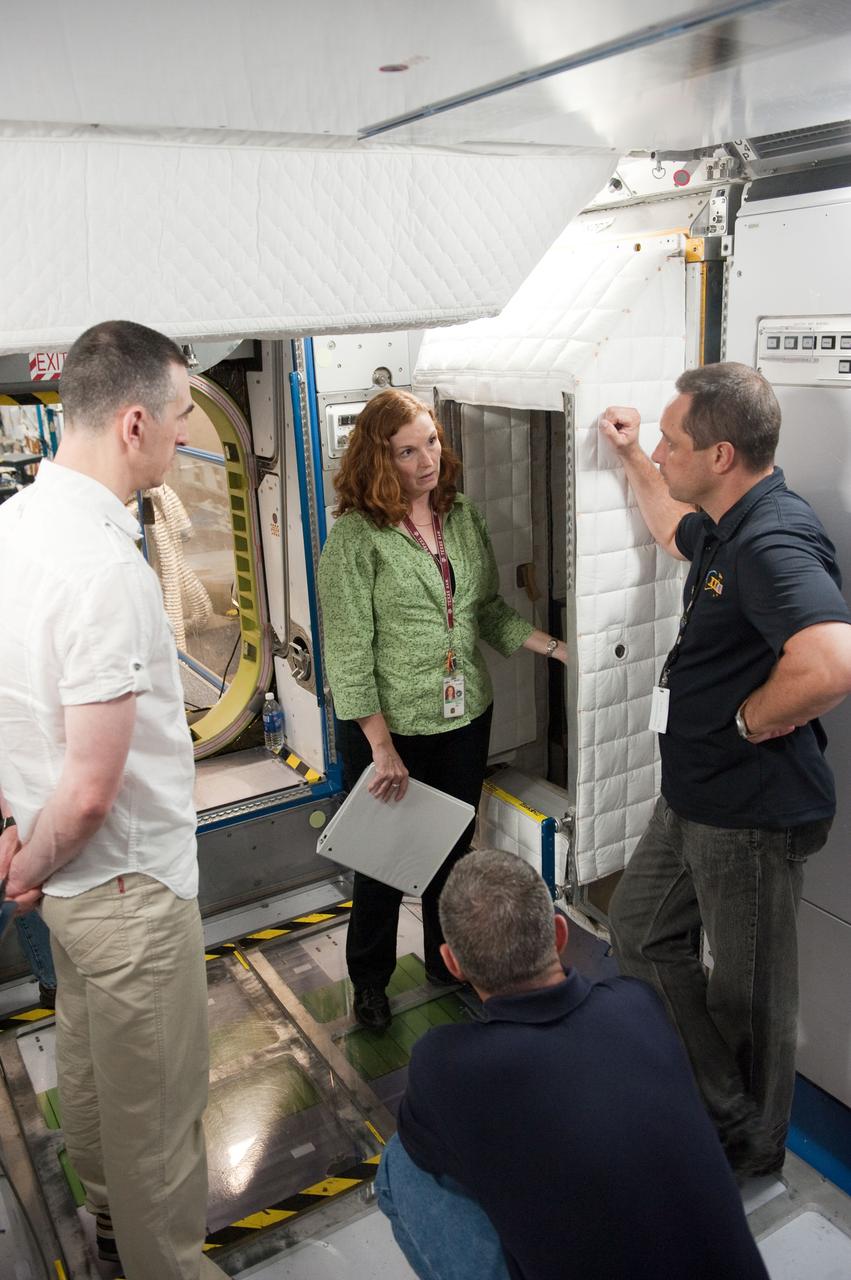
Expedition 29/30 ISS Habitability Equipment and Procedures training in ISS mockups. Photo Date: May 17, 2011. Location: Bldg. 9NW - ISS Mockups. Photographer: Robert Markowitz.

Photographed on: 12 09 58. -- Mercury capsule details, capsule in cargo bay of C-130 airplane prior to drop test, equipment in C130 for doing drop test.
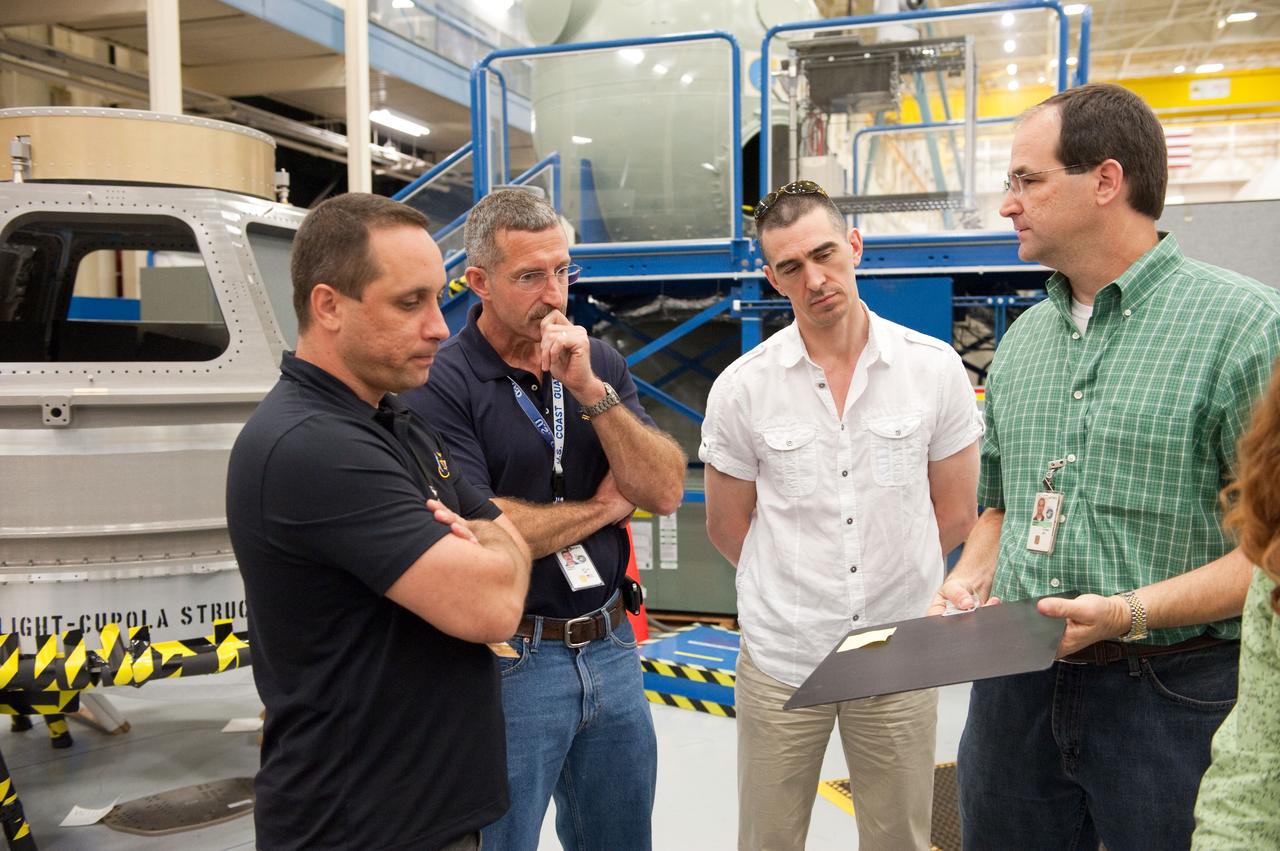
Expedition 29/30 ISS Habitability Equipment and Procedures training in ISS mockups. Photo Date: May 17, 2011. Location: Bldg. 9NW - ISS Mockups. Photographer: Robert Markowitz.
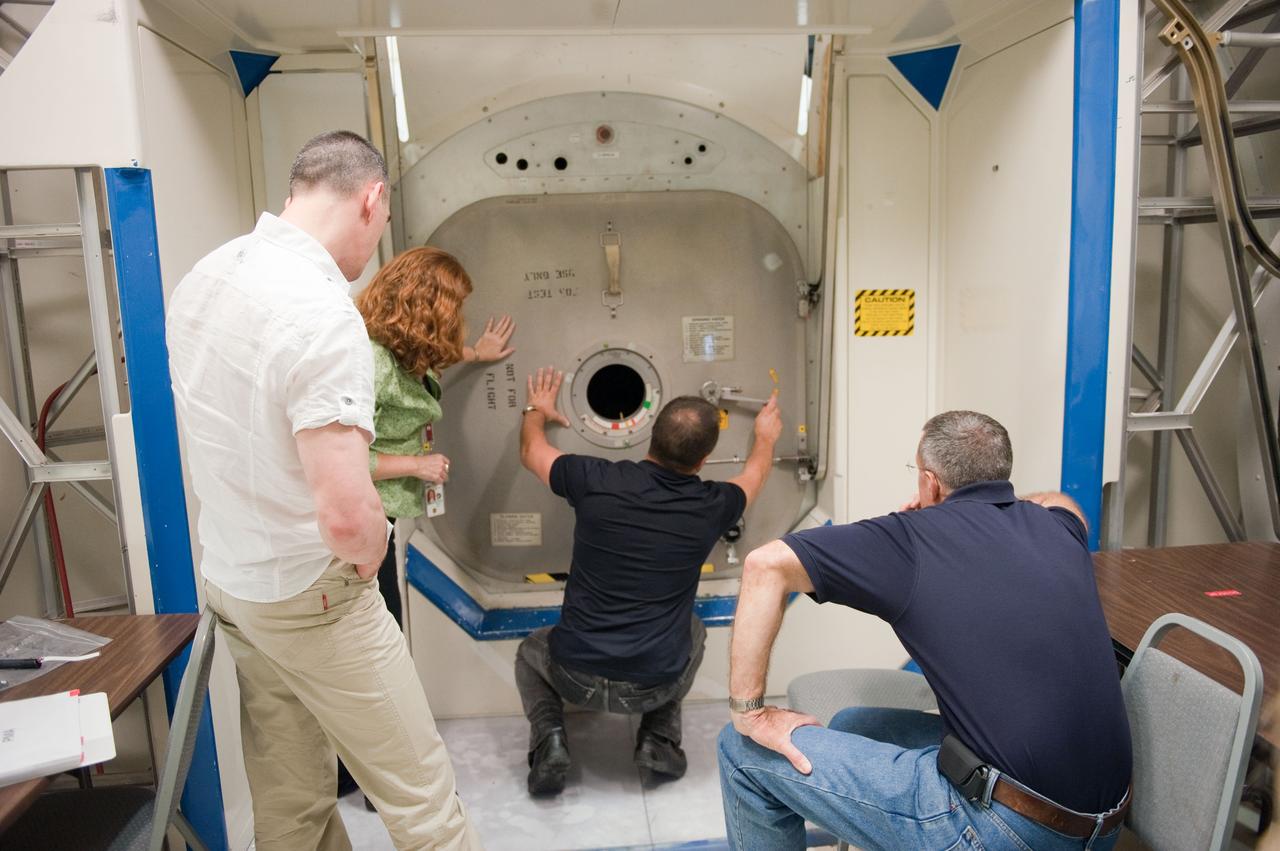
Expedition 29/30 ISS Habitability Equipment and Procedures training in ISS mockups. Photo Date: May 17, 2011. Location: Bldg. 9NW - ISS Mockups. Photographer: Robert Markowitz.
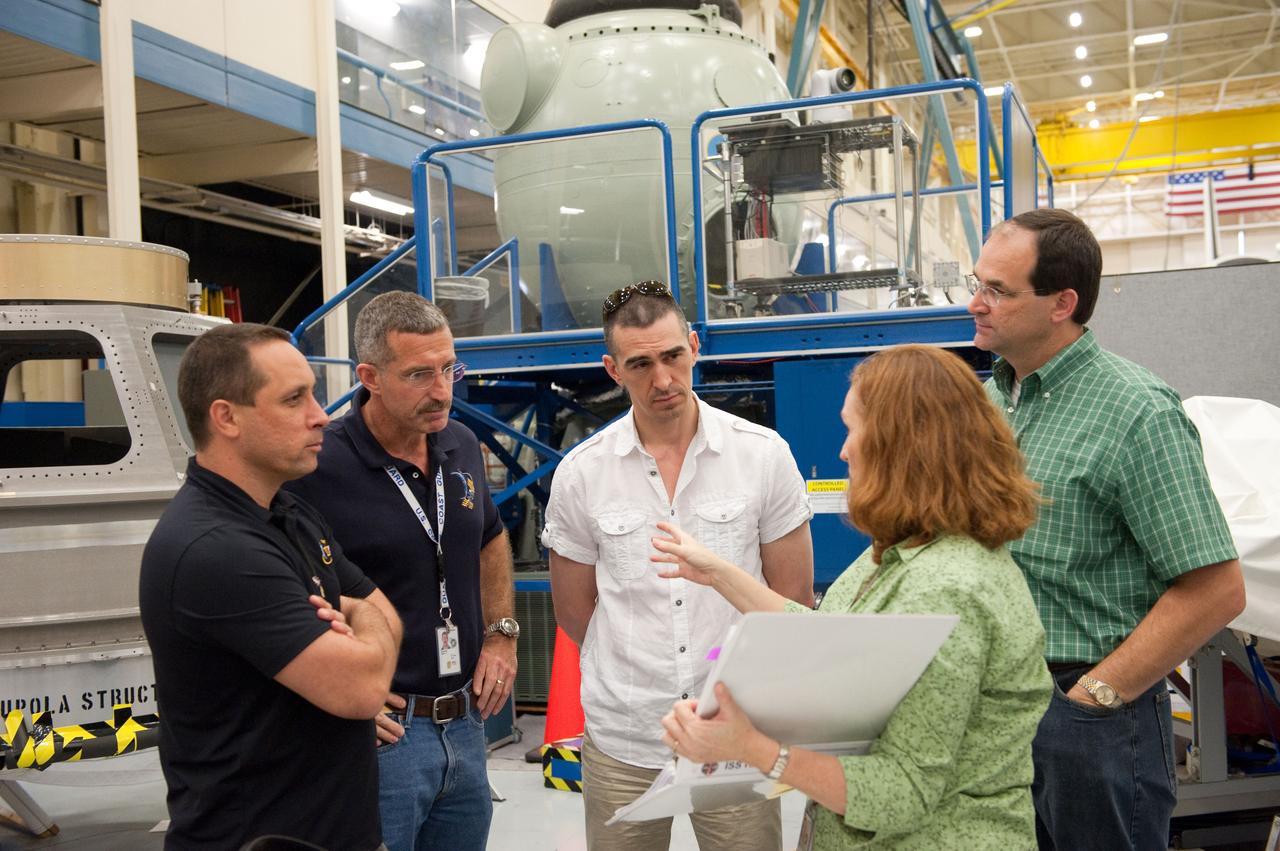
Expedition 29/30 ISS Habitability Equipment and Procedures training in ISS mockups. Photo Date: May 17, 2011. Location: Bldg. 9NW - ISS Mockups. Photographer: Robert Markowitz.
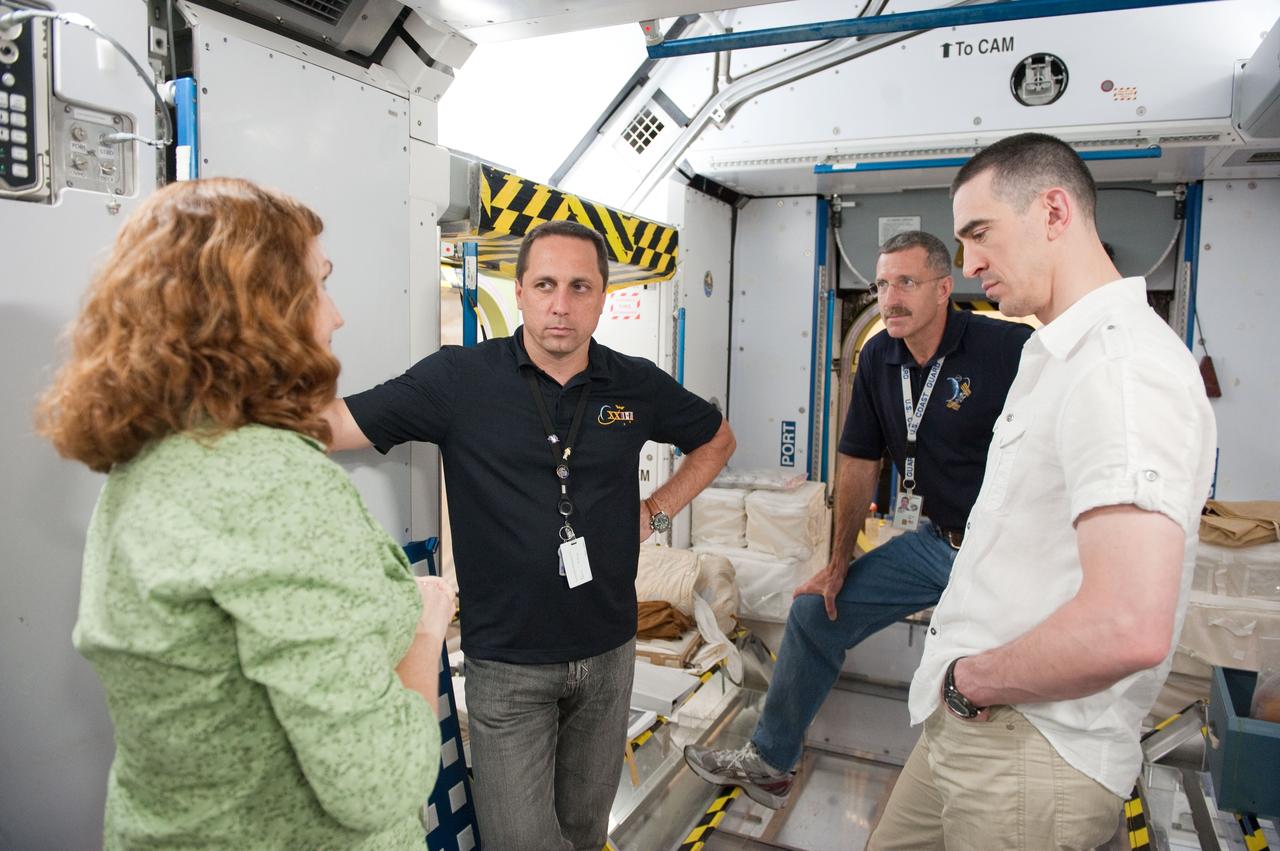
Expedition 29/30 ISS Habitability Equipment and Procedures training in ISS mockups. Photo Date: May 17, 2011. Location: Bldg. 9NW - ISS Mockups. Photographer: Robert Markowitz.
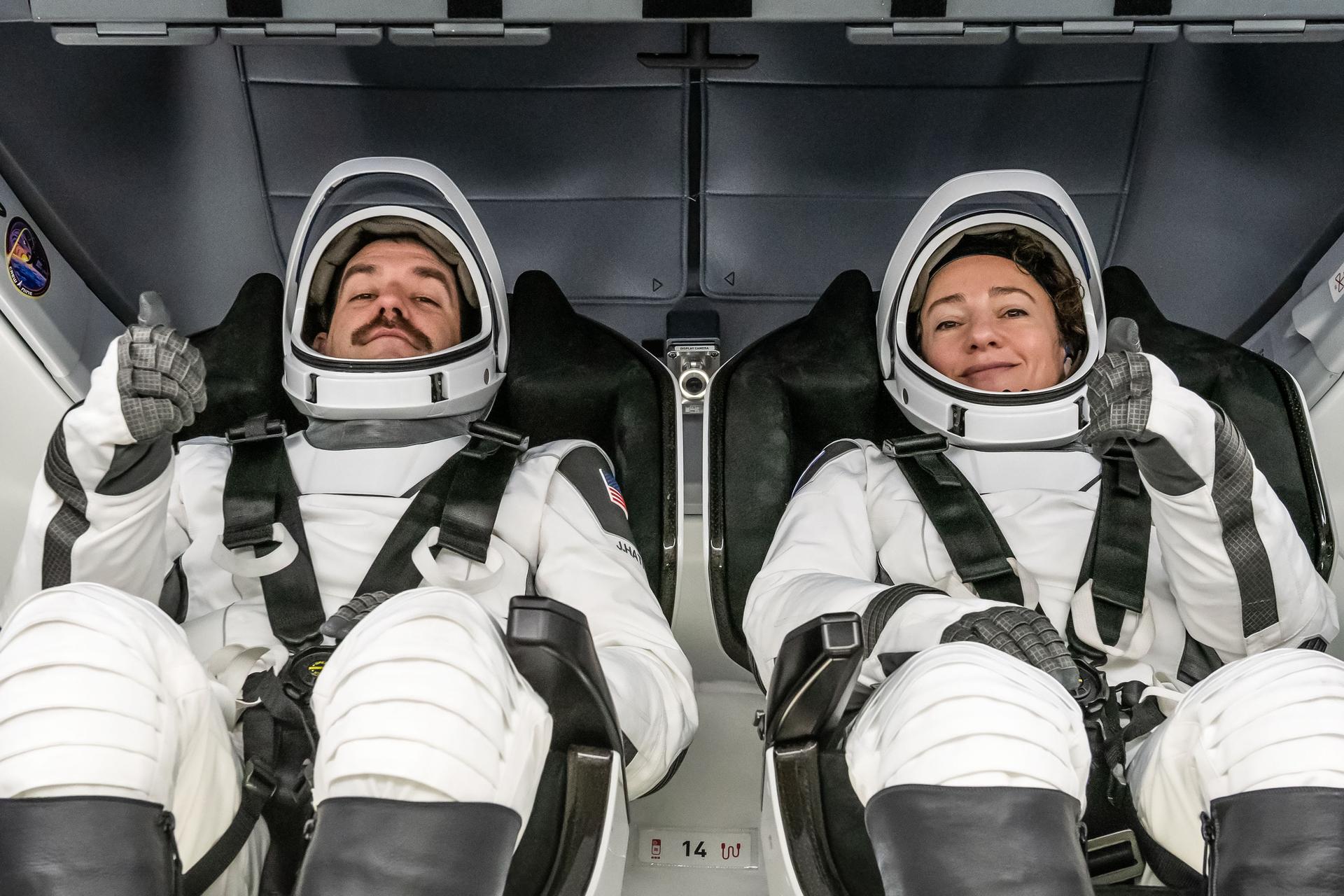
jsc2026e002978 (Jan. 12, 2026) --- NASA astronauts (from left) Jack Hathaway and Jessica Meir, SpaceX Crew-12 Pilot and Commander respectively, are photographed in their pressure suits and inside the Dragon spacecraft during the Crew Equipment Interface Test at NASA’s Kennedy Space Center in Florida. The goal of the training is to rehearse launch day activities and get a close look at the spacecraft that will take them to the International Space Station. Credit: SpaceX
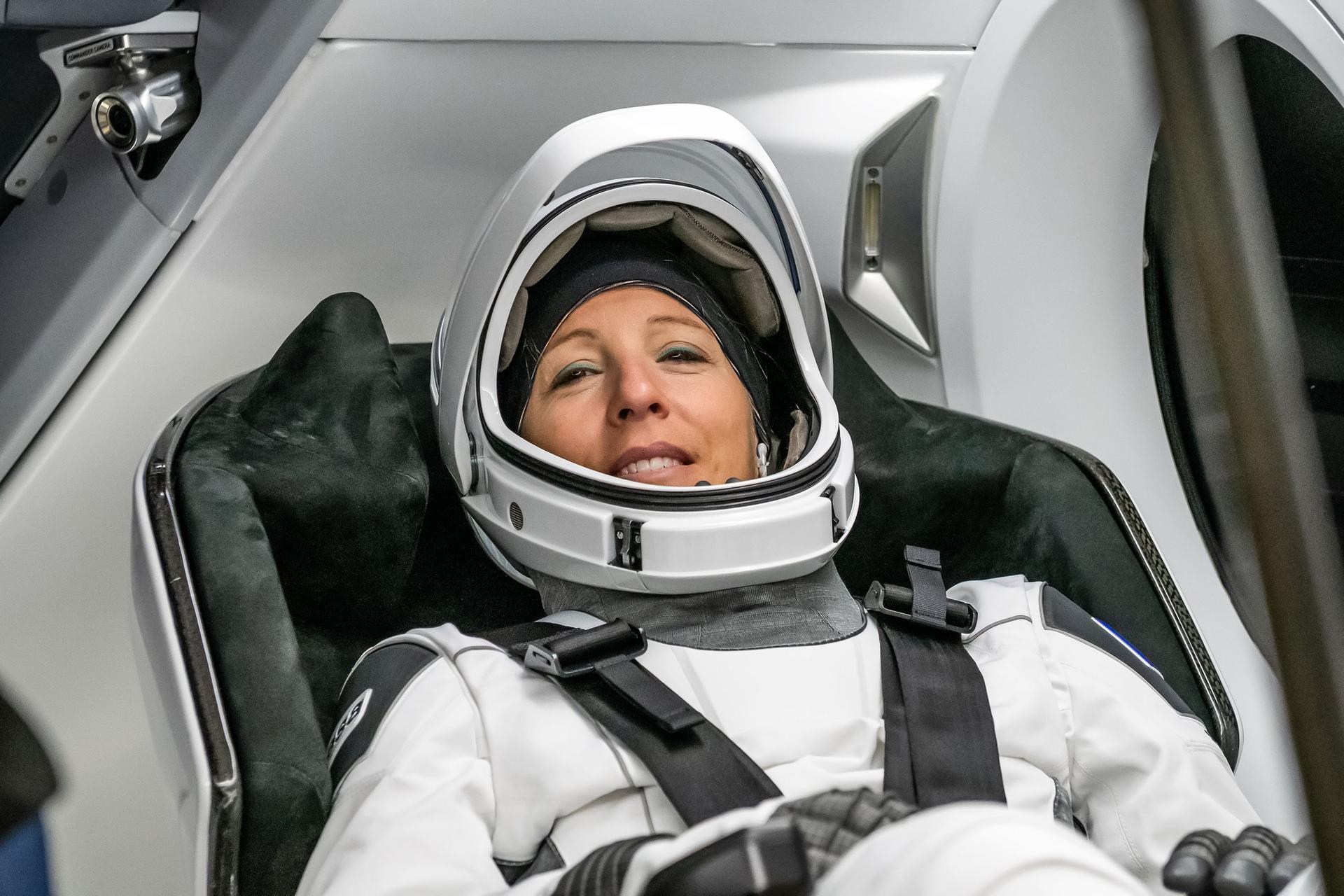
jsc2026e002975 (Jan. 12, 2026) --- ESA (European Space Agency) astronaut and SpaceX Crew-12 Mission Specialist Sophie Adenot is photographed in her pressure suit and inside the Dragon spacecraft during the Crew Equipment Interface Test at NASA’s Kennedy Space Center in Florida. The goal of the training is to rehearse launch day activities and get a close look at the spacecraft that will take them to the International Space Station. Credit: SpaceX
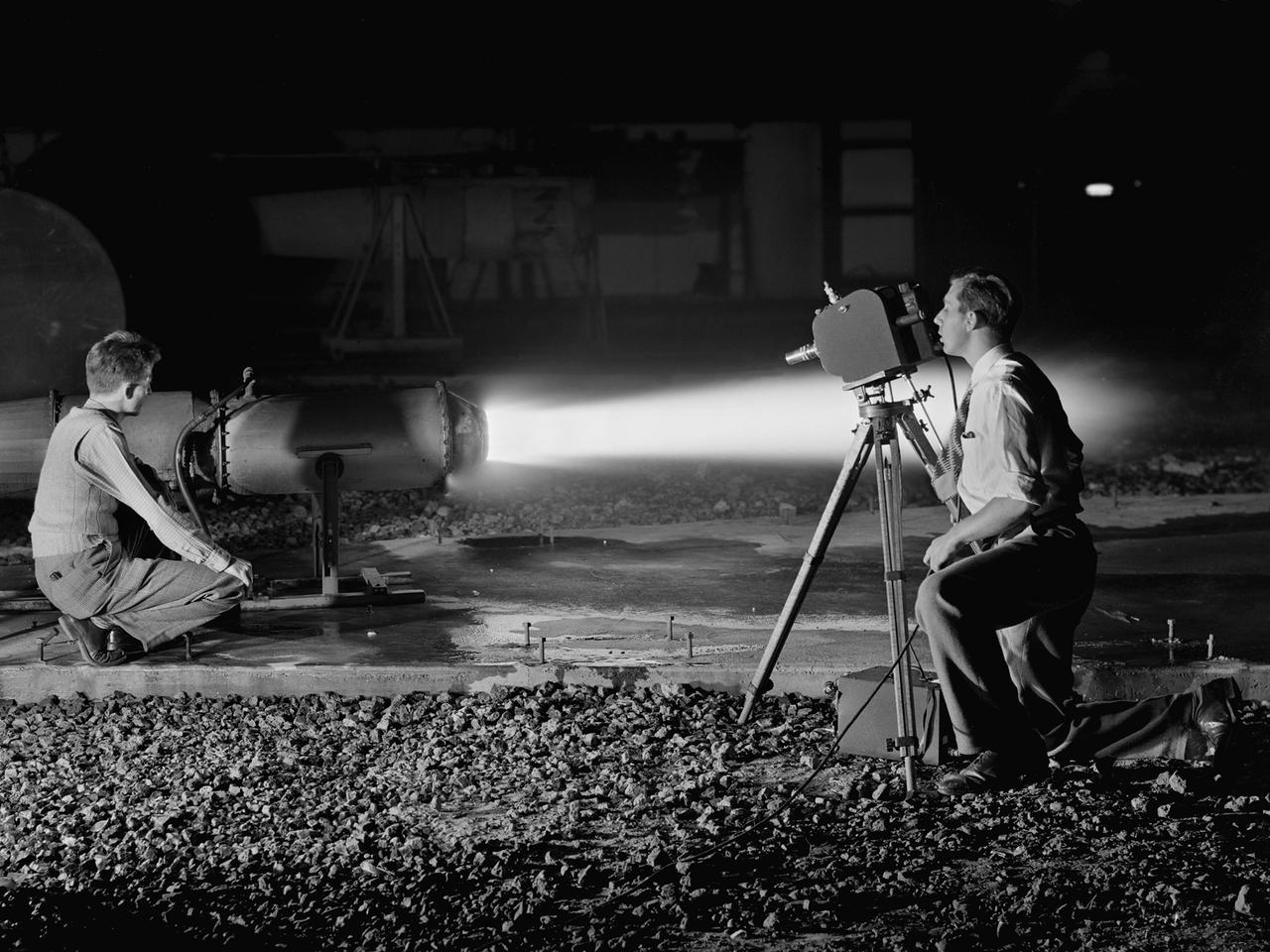
A National Advisory Committee for Aeronautics (NACA) photographer films the test of a ramjet engine at the Lewis Flight Propulsion Laboratory. The laboratory had an arsenal of facilities to test the engines and their components, and immersed itself in the study of turbojet and ramjet engines during the mid-1940s. Combustion, fuel injection, flameouts, and performance at high altitudes were of particular interest to researchers. They devised elaborate schemes to instrument the engines in order to record temperature, pressure, and other data. Many of the tests were also filmed so Lewis researchers could visually review the combustion performance along with the data. The photographer in this image was using high-speed film to document a thrust augmentation study at Lewis’ Jet Static Propulsion Laboratory. The ramjet in this photograph was equipped with a special afterburner as part of a general effort to improve engine performance. Lewis’ Photo Lab was established in 1942. The staff was expanded over the next few years as more test facilities became operational. The Photo Lab’s staff and specialized equipment have been key research tools for decades. They accompany pilots on test flights, use high-speed cameras to capture fleeting processes like combustion, and work with technology, such as the Schlieren camera, to capture supersonic aerodynamics. In addition, the group has documented construction projects, performed publicity work, created images for reports, and photographed data recording equipment.
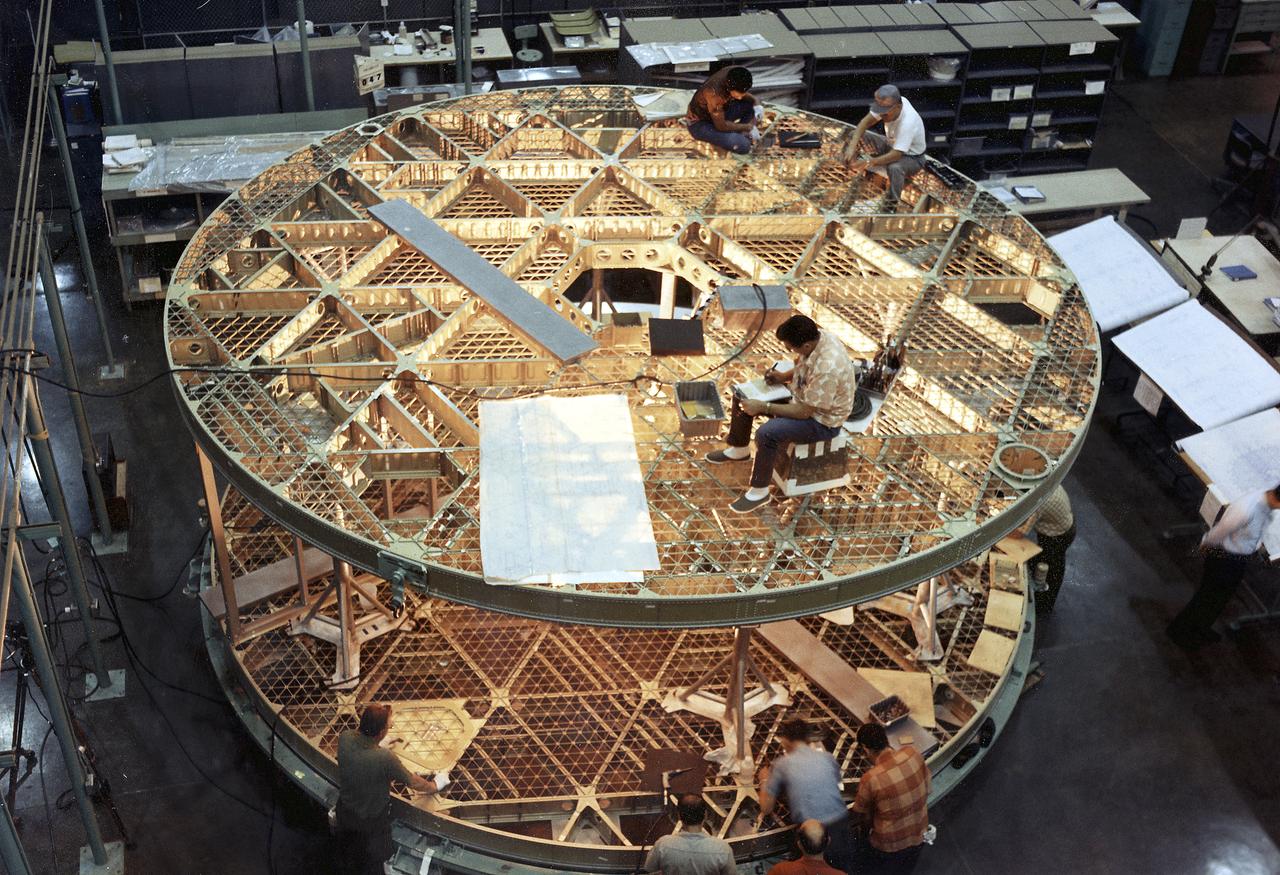
This photograph was taken during assembly of the bottom and upper floors of the Skylab Orbital Workshop (OWS). The OWS was divided into two major compartments. The lower level provided crew accommodations for sleeping, food preparation and consumption, hygiene, waste processing and disposal, and performance of certain experiments. The upper level consisted of a large work area and housed water storage tanks, a food freezer, storage vaults for film, scientific airlocks, mobility and stability experiment equipment, and other experimental equipment.
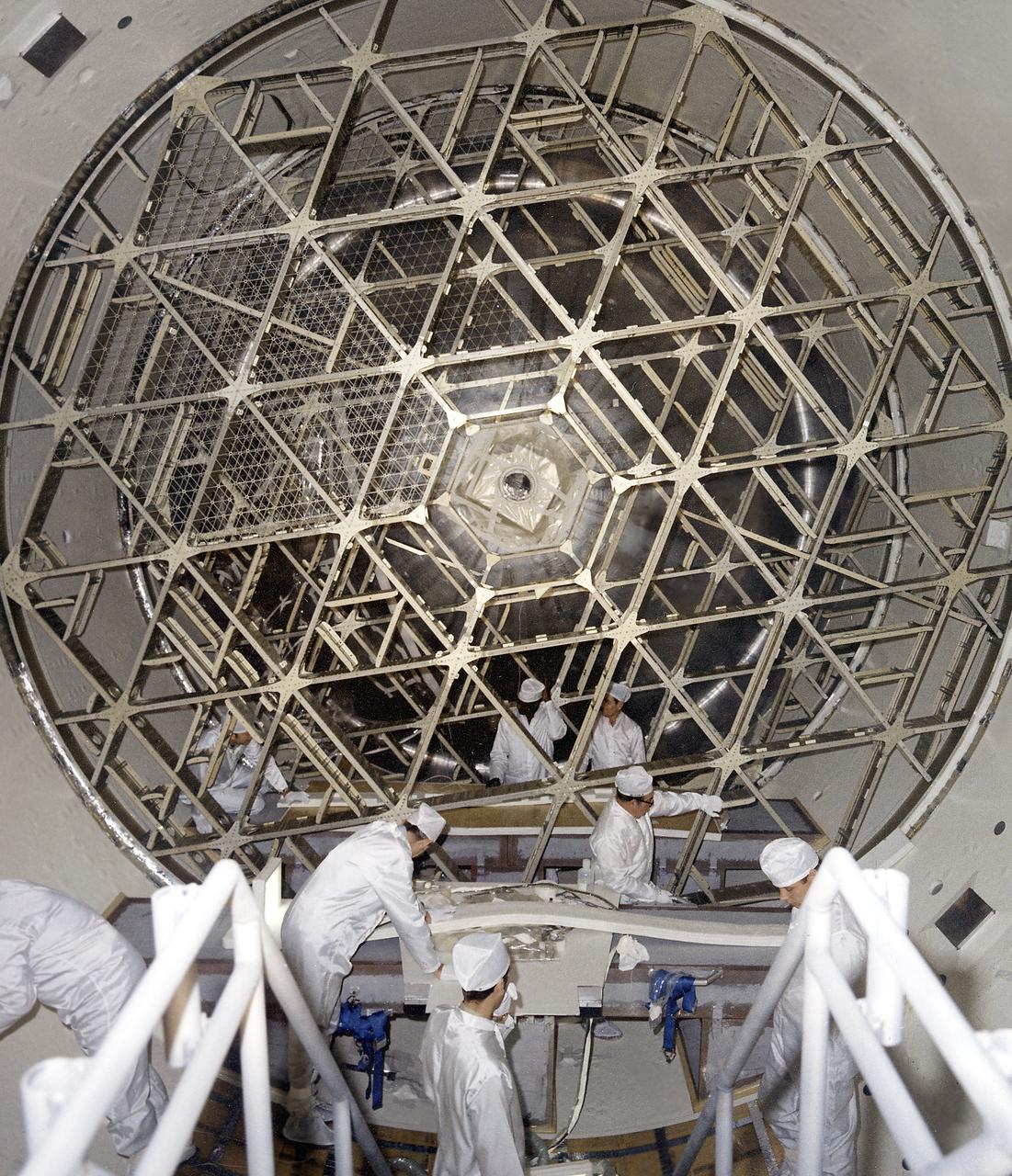
This photograph was taken during installation of floor grids on the upper and lower floors inside the Skylab Orbital Workshop at the McDornell Douglas plant at Huntington Beach, California. The OWS was divided into two major compartments. The lower level provided crew accommodations for sleeping, food preparation and consumption, hygiene, waste processing and disposal, and performance of certain experiments. The upper level consisted of a large work area and housed water storage tanks, a food freezer, storage vaults for film, scientific airlocks, mobility and stability experiment equipment, and other experimental equipment.
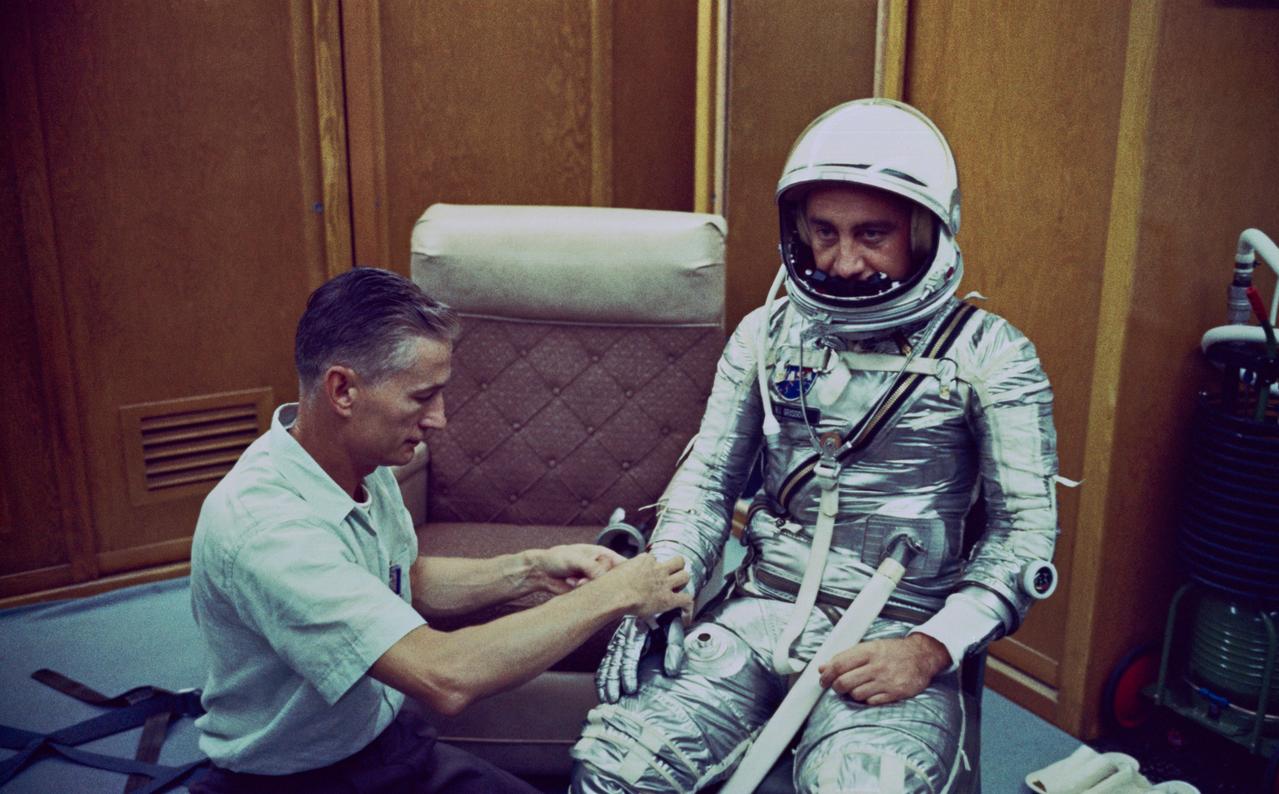
S88-55875 (19 July 1961) --- Donning a spacesuit for the Mercury-Redstone 4 (MR-4) mission, astronaut Virgil I. (Gus) Grissom chats with spaceflight equipment specialist Joe W. Schmitt in the personal equipment room of Hangar S at Cape Canaveral, Florida. Shortly after this photograph was taken, the launch was postponed two days due to unfavorable weather conditions in the area. Photo credit: NASA
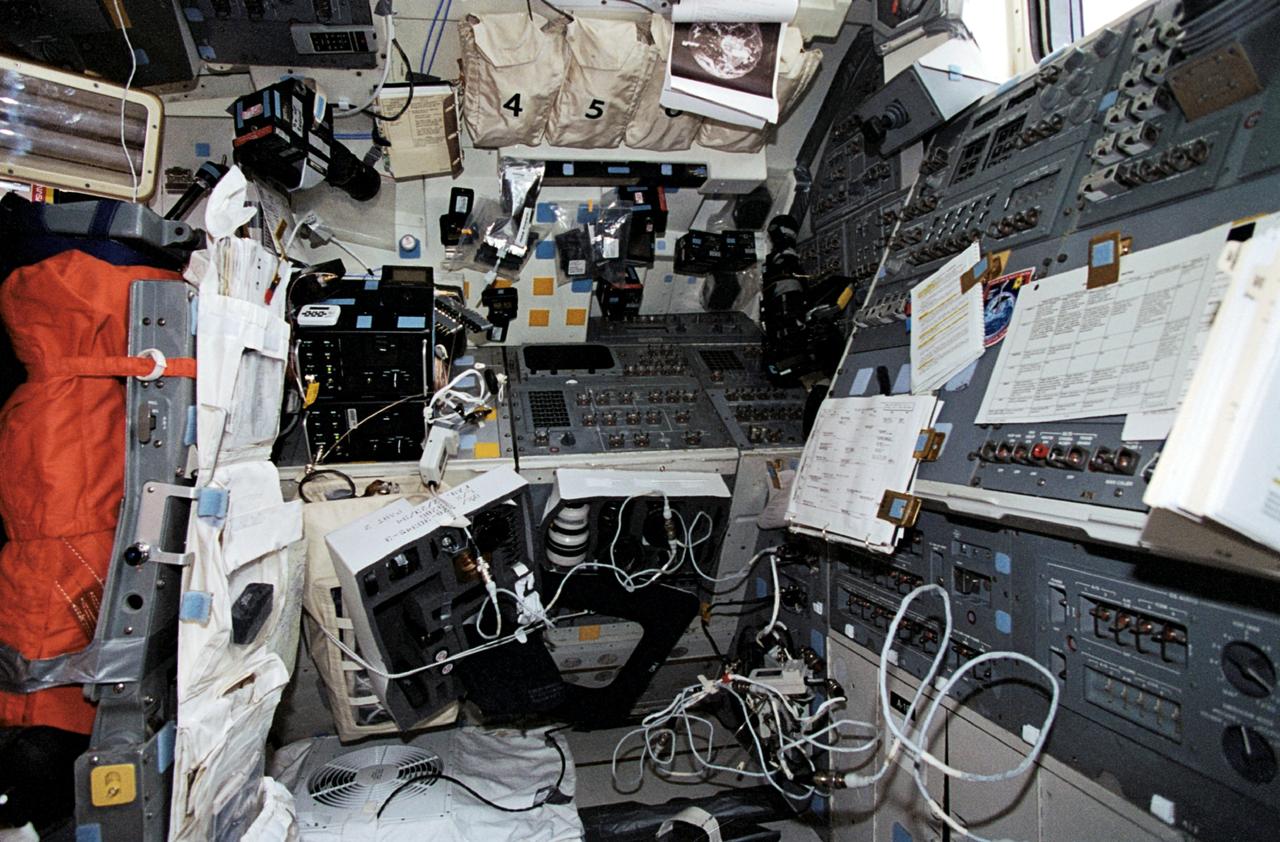
STS062-17-034 (4-18 March 1994) --- This scene, resembling a photographer's studio/laboratory, actually shows the aft flight deck of the Earth-orbiting Space Shuttle Columbia. A variety of cameras, lenses, visual aids and other gear are seen stowed around the flight deck. The five astronaut crew members devoted a large portion of their on-duty time at this workstation using some of this photographic equipment to record Earth imagery.

ISS041E089709 (10/22/2014) --- In the upper center/left of this photograph International Space Station Expedition 41 Commander Max Suraev and Flight Engineer Alexander Samokutyaev ( Roscosmos) in thier Russian red stripped Orlon space suits are performing important repairs on Oct. 22, 2014. The two cosmonauts removed and jettisoned obsolete equipment, collected surface samples from a window of the Pirs docking compartment and photographed the exterior of the station.
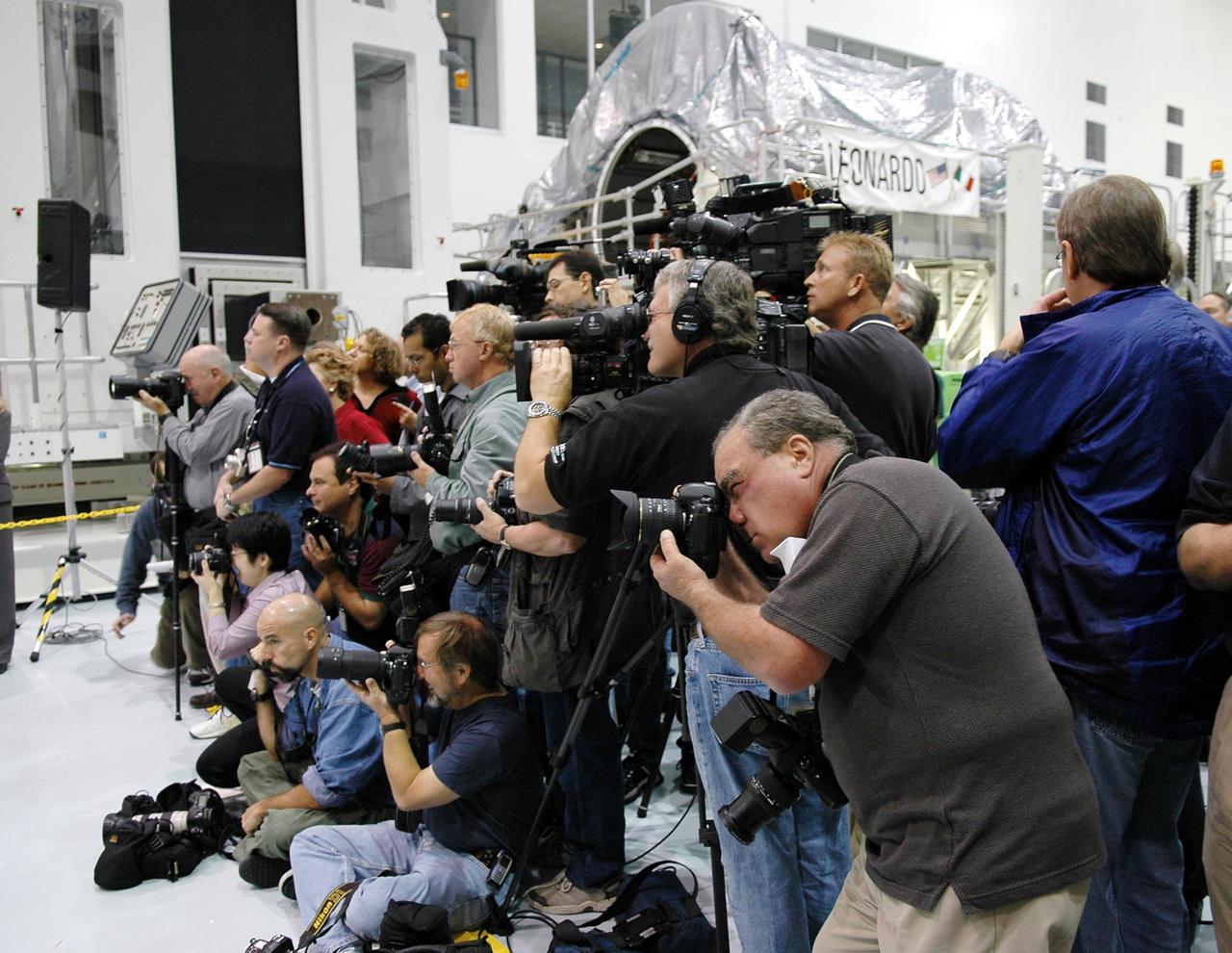
KENNEDY SPACE CENTER, FLA. - Photographers and journalists gather in the Space Station Processing Facility (SSPF) to interview and photograph the STS-114 crew. The crew is looking over some of the hardware in the SSPF. Behind the photographers is the Multi-Purpose Logistics Module Leonardo. STS-114 will carry its sister module Raffaello. The crew is at KSC for Crew Equipment Interface Test (CEIT) activities. During CEIT, the crew has an opportunity to get a hands-on look at the payloads with which they’ll be working on-orbit. The Return to Flight mission STS-114 will also carry a replacement Control Moment Gyroscope. Launch of STS-114 has a launch window of May 12 to June 3.
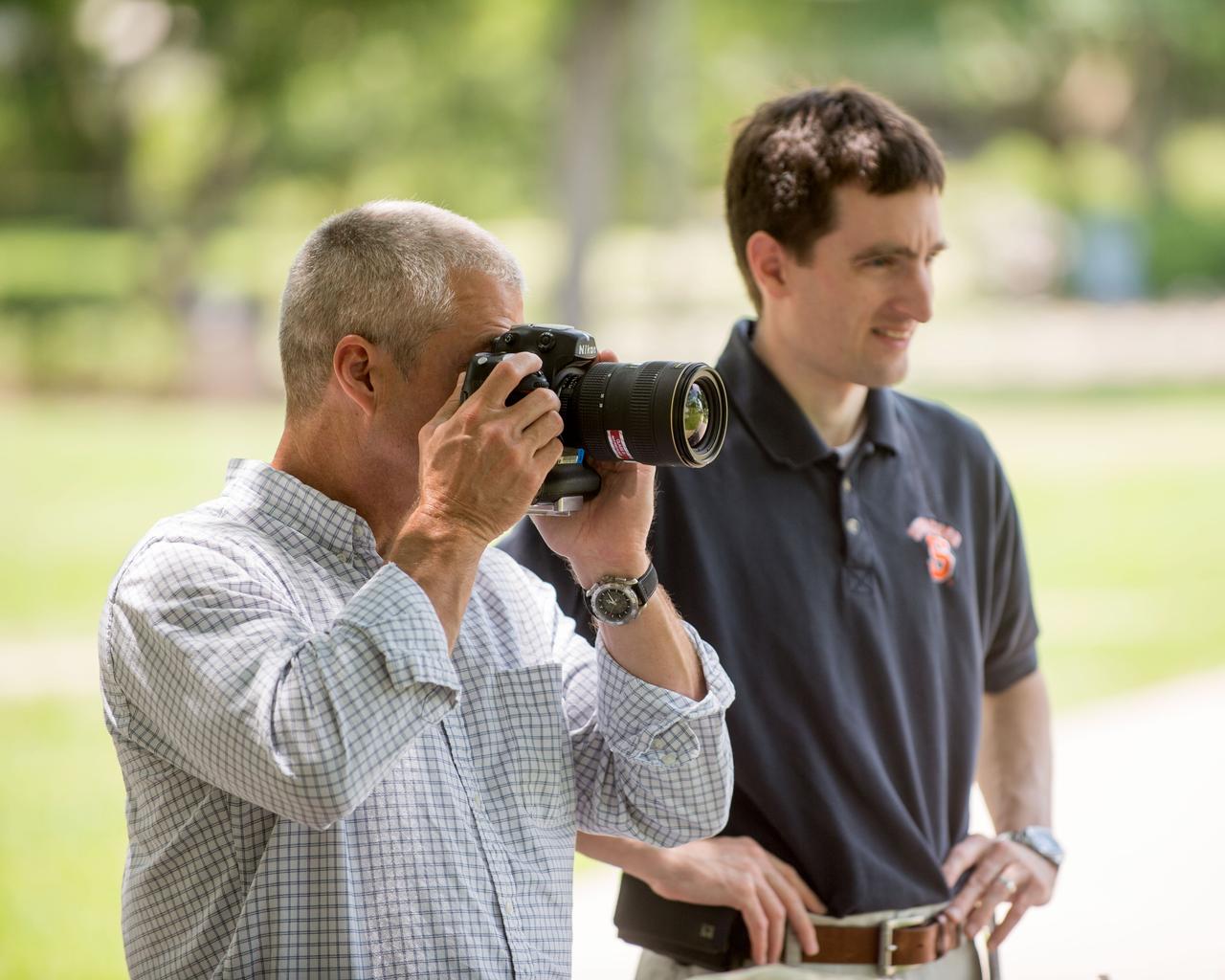
PHOTO DATE: 05-20-13 LOCATION: Bldg. 4south, Room 1303 SUBJECT: Soyuz 38 (Expedition 39/40) crew member Steve Swanson training on Nikon camera equipment and long lenses for External Photo Skills with instructor Paul Reichert. PHOTOGRAPHER: BILL STAFFORD
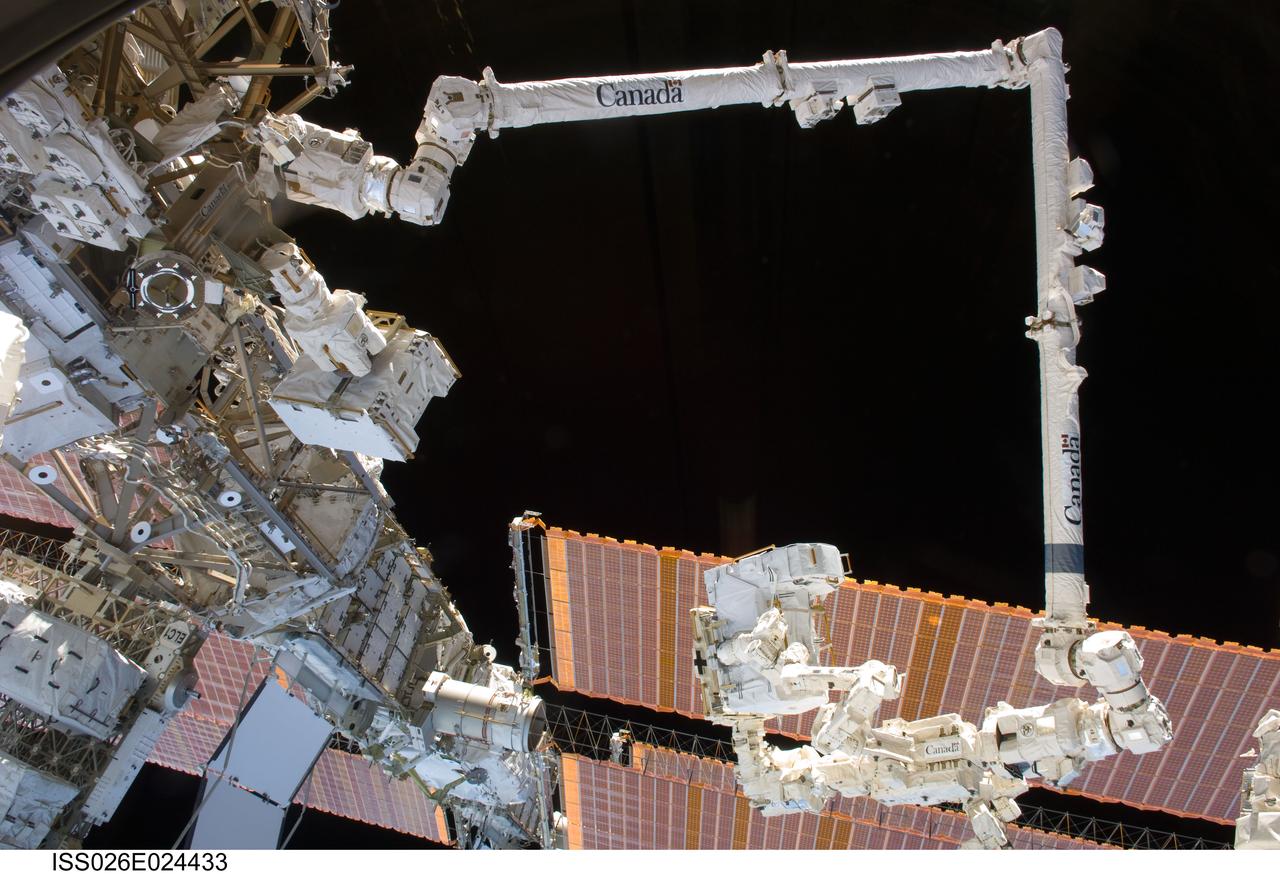
ISS026-E-024433 (3 Feb. 2011) --- While attached on the end of the Canadarm2, Dextre, the Canadian Space Agency’s robotic “handyman”, is featured in this image photographed by an Expedition 26 crew member aboard the International Space Station. During the activities, Dextre unpacked two critical pieces of equipment delivered by Japan’s Kounotori2 spacecraft.
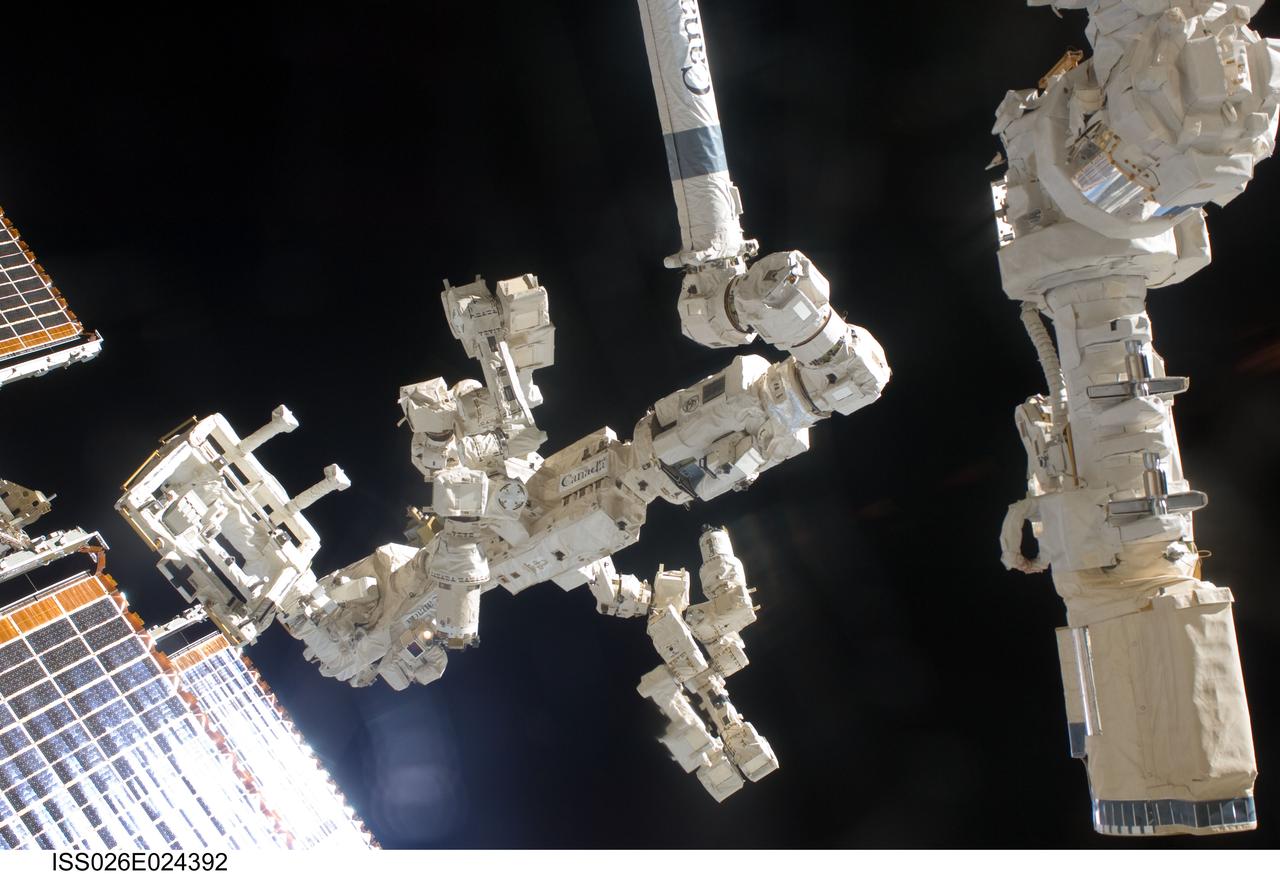
ISS026-E-024392 (3 Feb. 2011) --- While attached on the end of the Canadarm2, Dextre, the Canadian Space Agency’s robotic “handyman”, is featured in this image photographed by an Expedition 26 crew member aboard the International Space Station. During the activities, Dextre unpacked two critical pieces of equipment delivered by Japan’s Kounotori2 spacecraft.
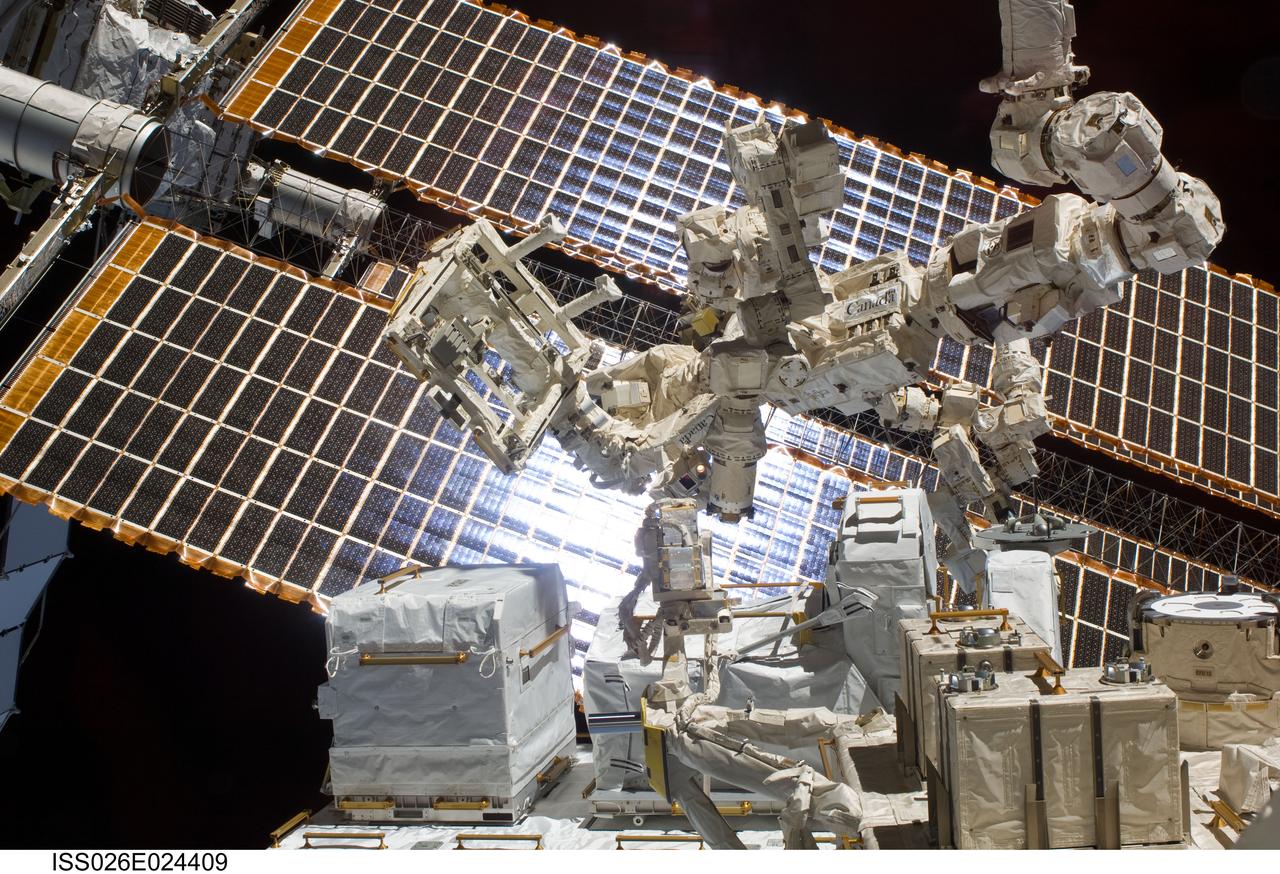
ISS026-E-024409 (3 Feb. 2011) --- While attached on the end of the Canadarm2, Dextre, the Canadian Space Agency’s robotic “handyman”, is featured in this image photographed by an Expedition 26 crew member aboard the International Space Station. During the activities, Dextre unpacked two critical pieces of equipment delivered by Japan’s Kounotori2 spacecraft.
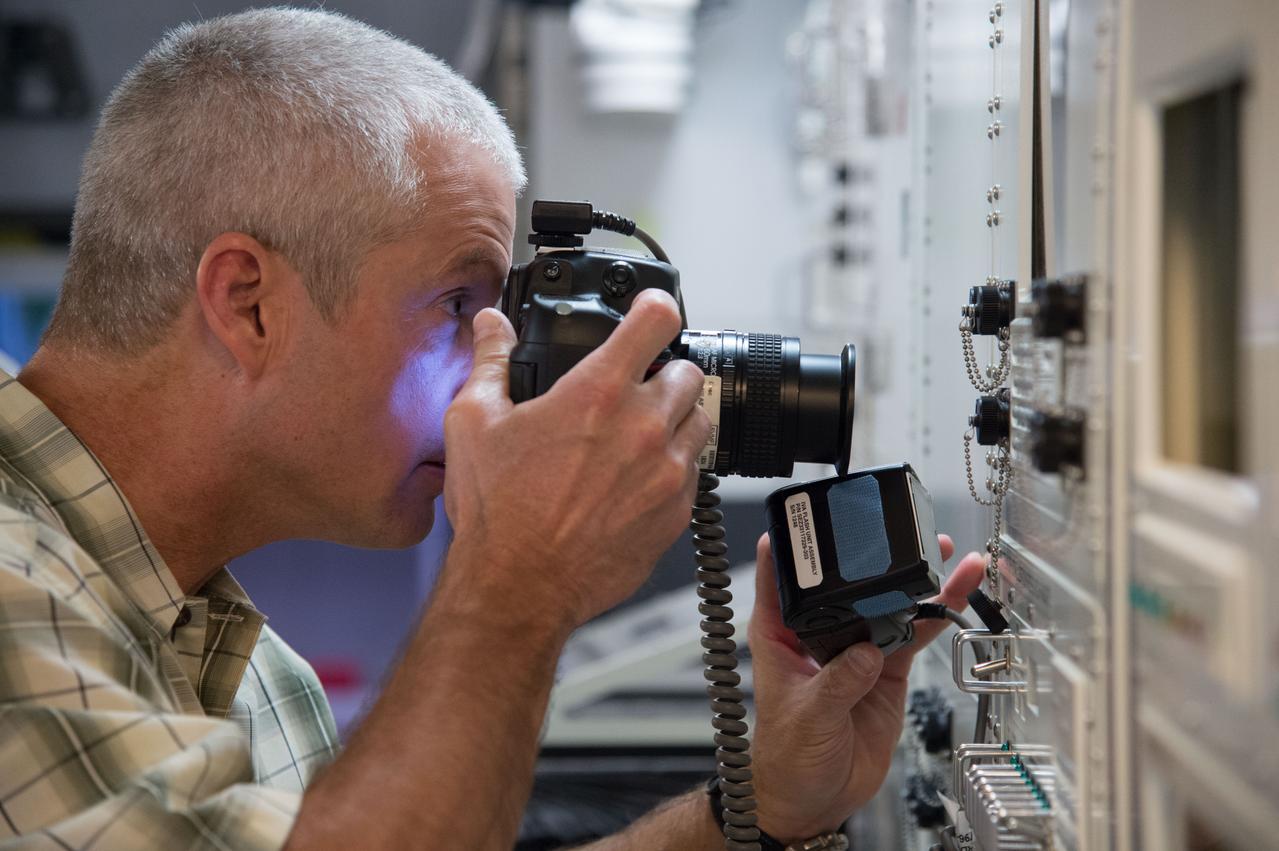
PHOTO DATE: 05-21-13 LOCATION: Bldg. 9NW - ISS Mockups SUBJECT: Soyuz 38 (Expedition 39/40) crew member Steve Swanson training on Nikon camera equipment and lenses for Internal Photo Skills inside ISS mockups with instructor Paul Reichert PHOTOGRAPHER: BILL STAFFORD
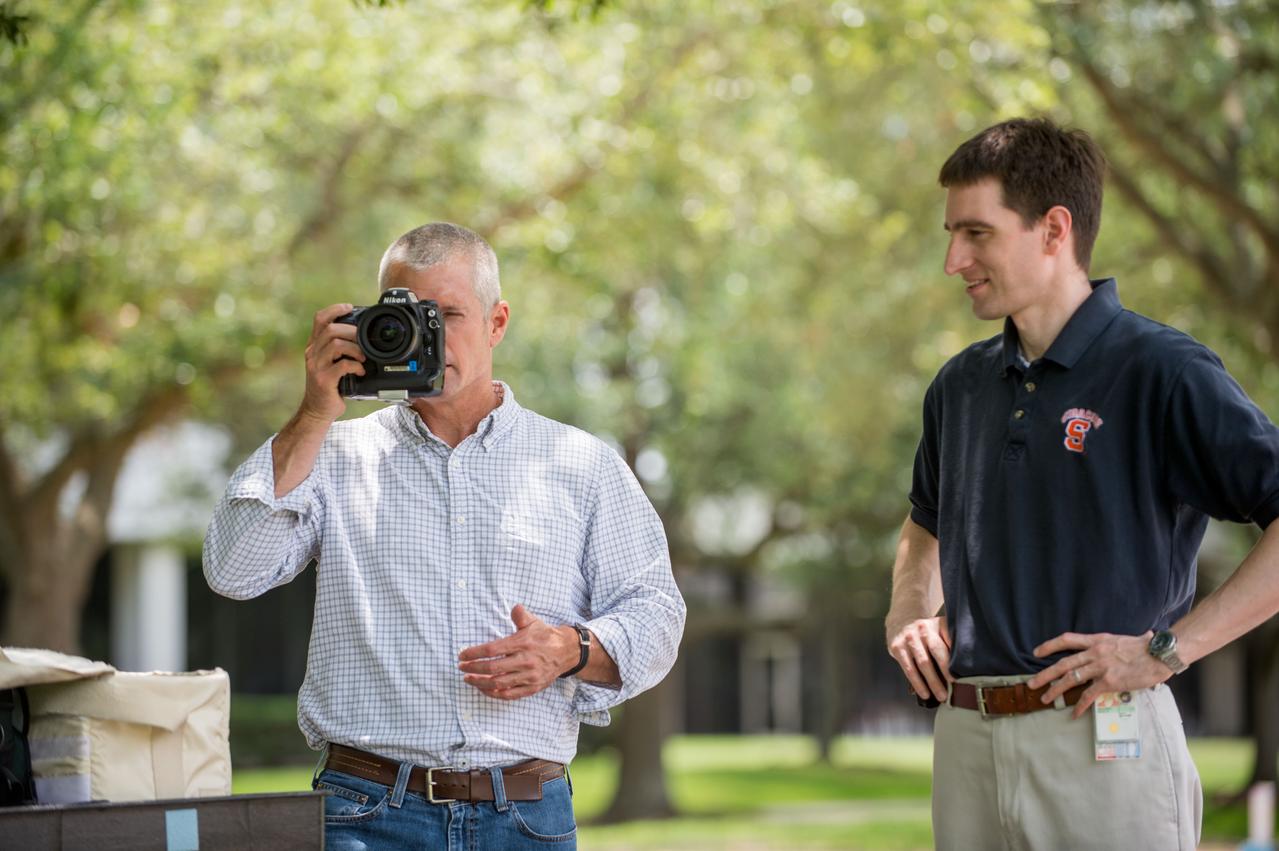
PHOTO DATE: 05-20-13 LOCATION: Bldg. 4south, Room 1303 SUBJECT: Soyuz 38 (Expedition 39/40) crew member Steve Swanson training on Nikon camera equipment and long lenses for External Photo Skills with instructor Paul Reichert. PHOTOGRAPHER: BILL STAFFORD
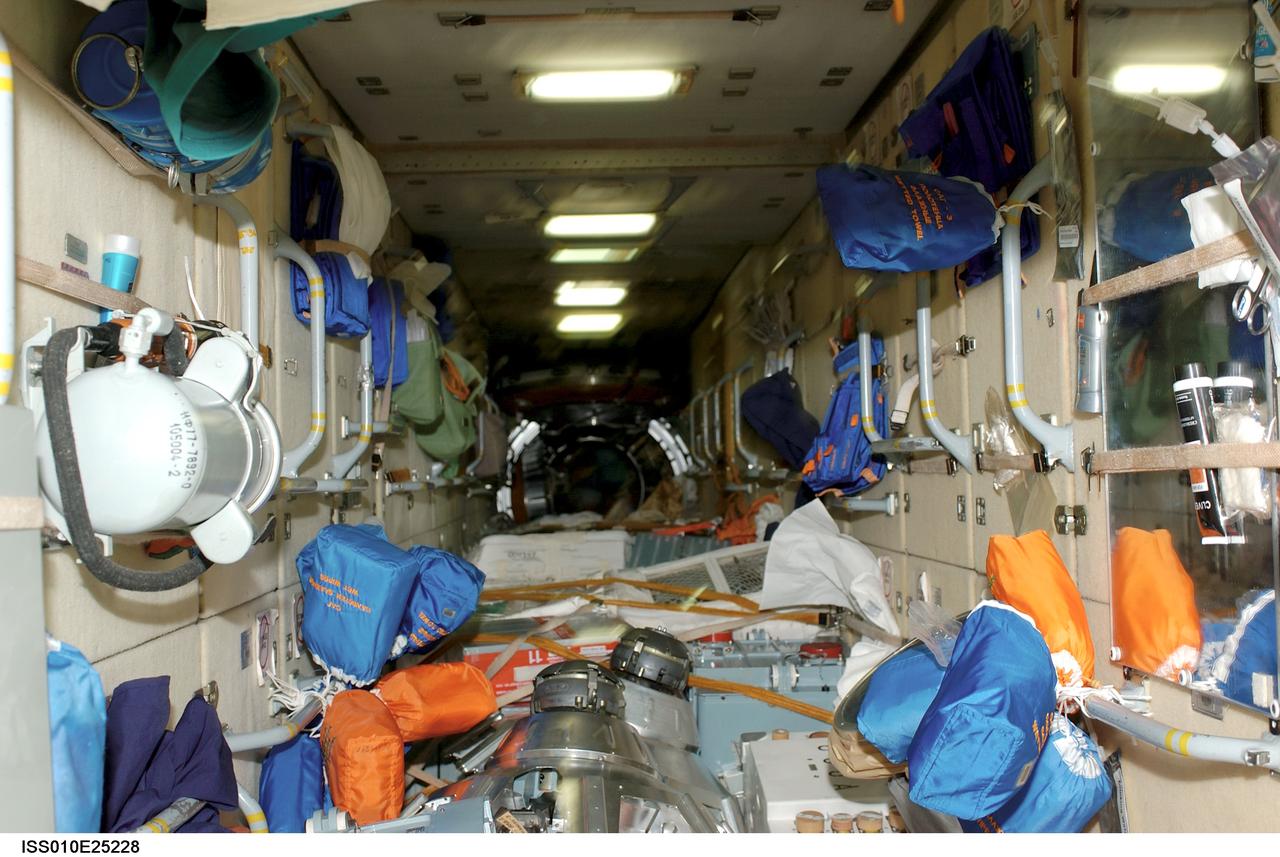
ISS010-E-25228 (20 April 2005) --- This view shows supplies and equipment stowed in the functional cargo block (FGB) or Zarya photographed by a crewmember on the International Space Station (ISS). At the time this photo was taken the Expedition 10 and 11 crews were onboard the Station.
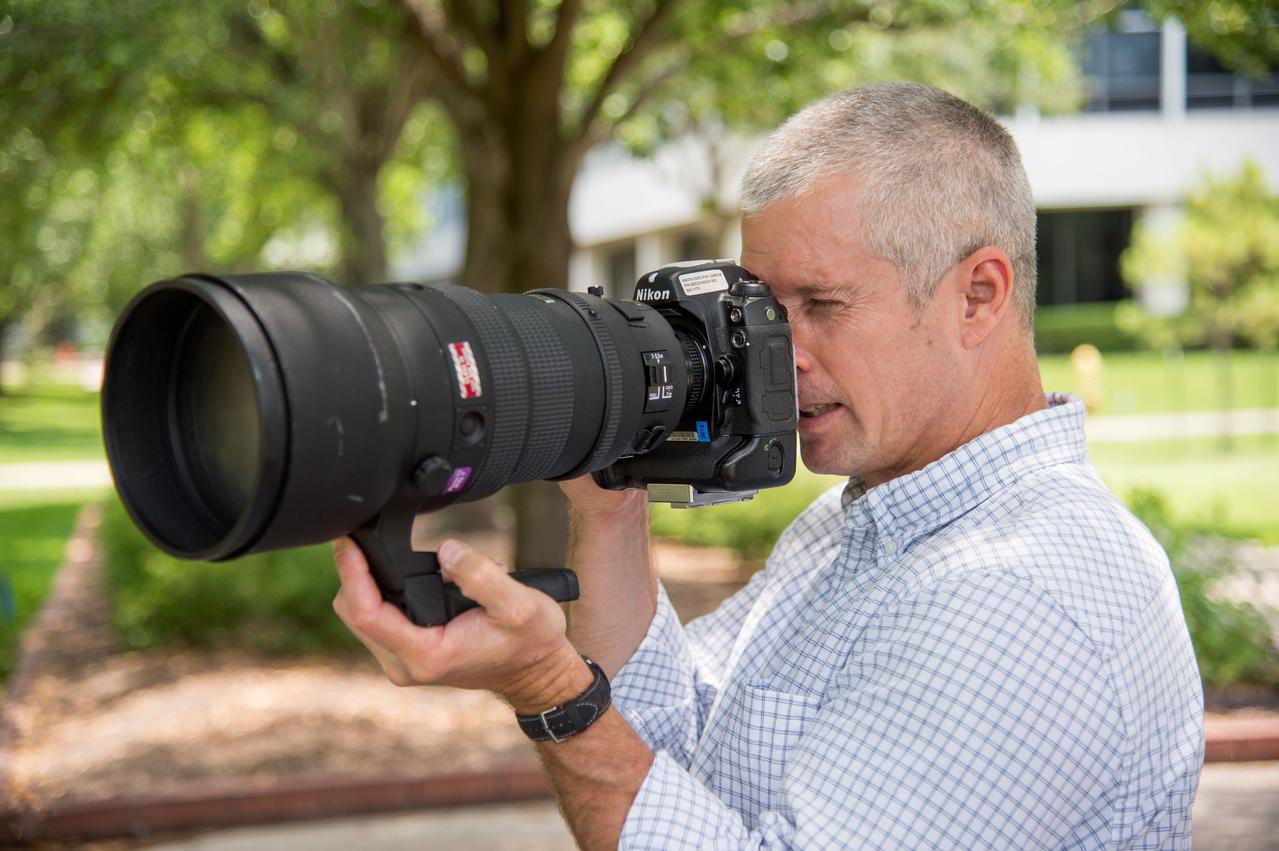
PHOTO DATE: 05-20-13 LOCATION: Bldg. 4south, Room 1303 SUBJECT: Soyuz 38 (Expedition 39/40) crew member Steve Swanson training on Nikon camera equipment and long lenses for External Photo Skills with instructor Paul Reichert. PHOTOGRAPHER: BILL STAFFORD

PHOTO DATE: 05-20-13 LOCATION: Bldg. 4south, Room 1303 SUBJECT: Soyuz 38 (Expedition 39/40) crew member Steve Swanson training on Nikon camera equipment and long lenses for External Photo Skills with instructor Paul Reichert. PHOTOGRAPHER: BILL STAFFORD
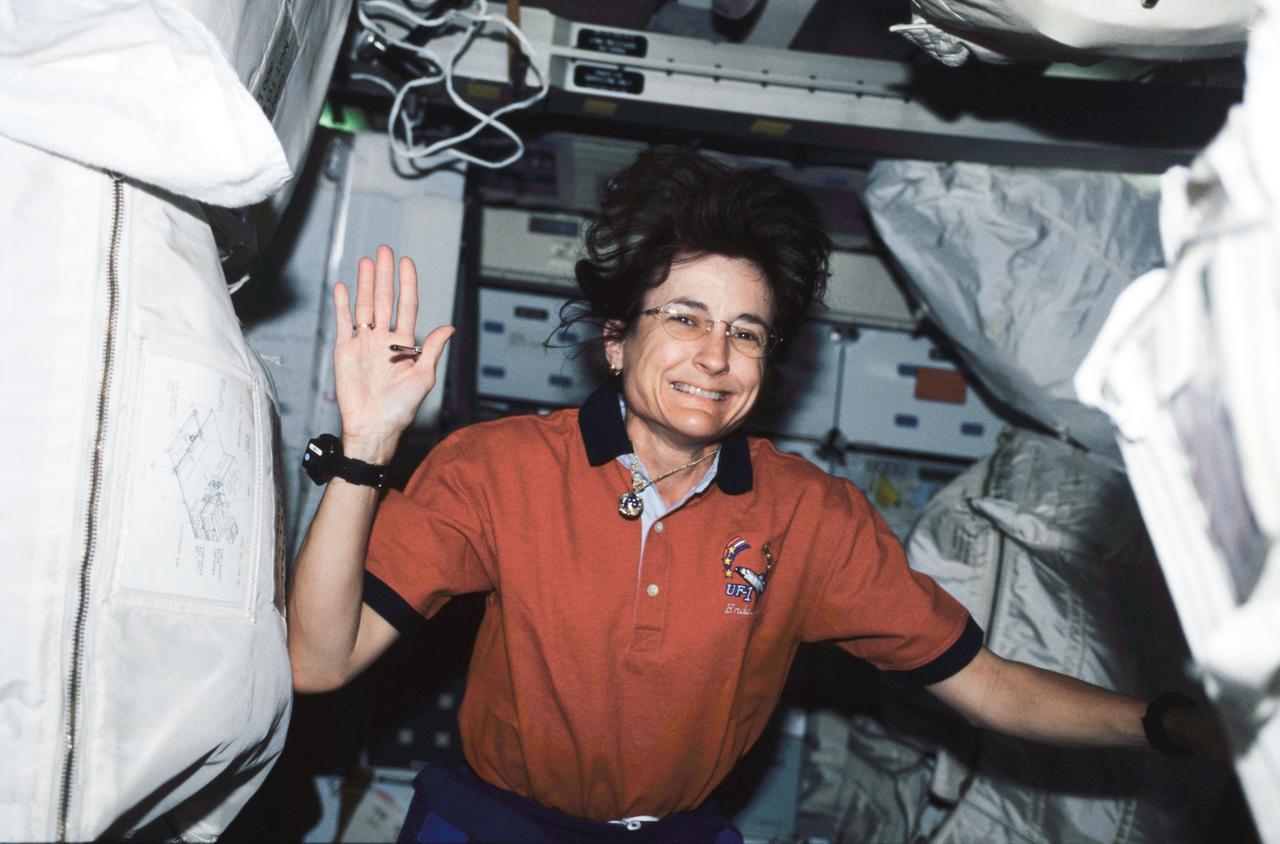
ISS003-307-032 (5-17 December 2001) --- Astronaut Linda M. Godwin, STS-108 mission specialist, is photographed on the mid deck of the Space Shuttle Endeavour during the transfer of supplies and equipment between the shuttle and the International Space Station (ISS).
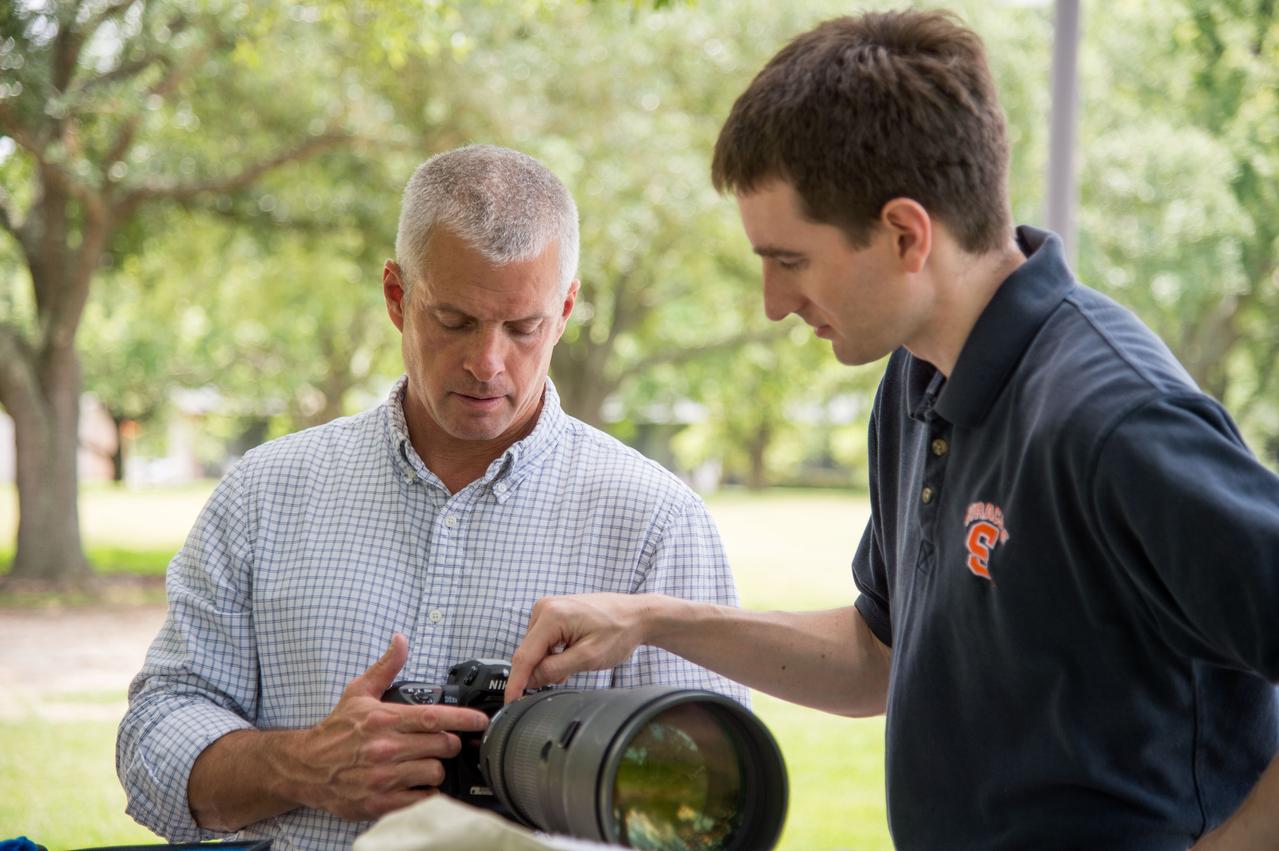
PHOTO DATE: 05-20-13 LOCATION: Bldg. 4south, Room 1303 SUBJECT: Soyuz 38 (Expedition 39/40) crew member Steve Swanson training on Nikon camera equipment and long lenses for External Photo Skills with instructor Paul Reichert. PHOTOGRAPHER: BILL STAFFORD
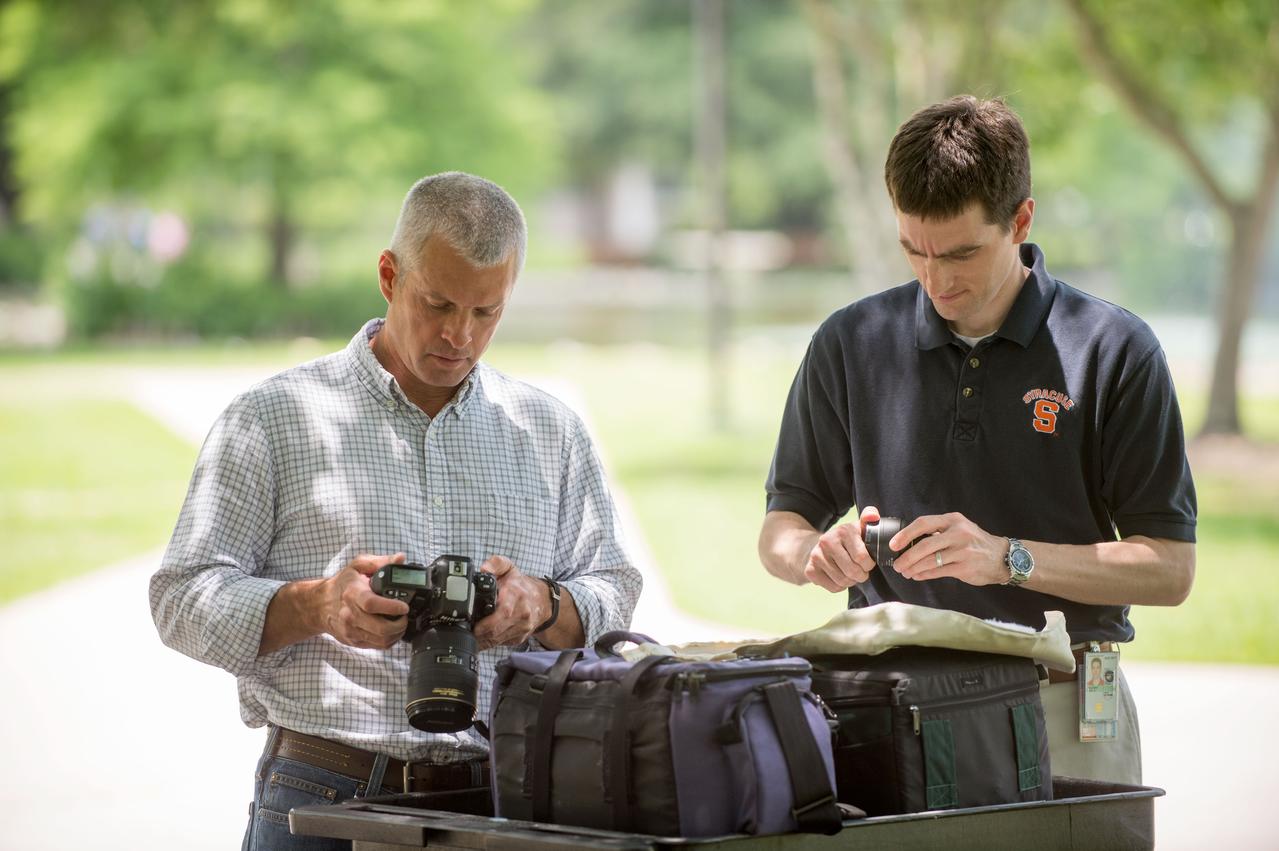
PHOTO DATE: 05-20-13 LOCATION: Bldg. 4south, Room 1303 SUBJECT: Soyuz 38 (Expedition 39/40) crew member Steve Swanson training on Nikon camera equipment and long lenses for External Photo Skills with instructor Paul Reichert. PHOTOGRAPHER: BILL STAFFORD
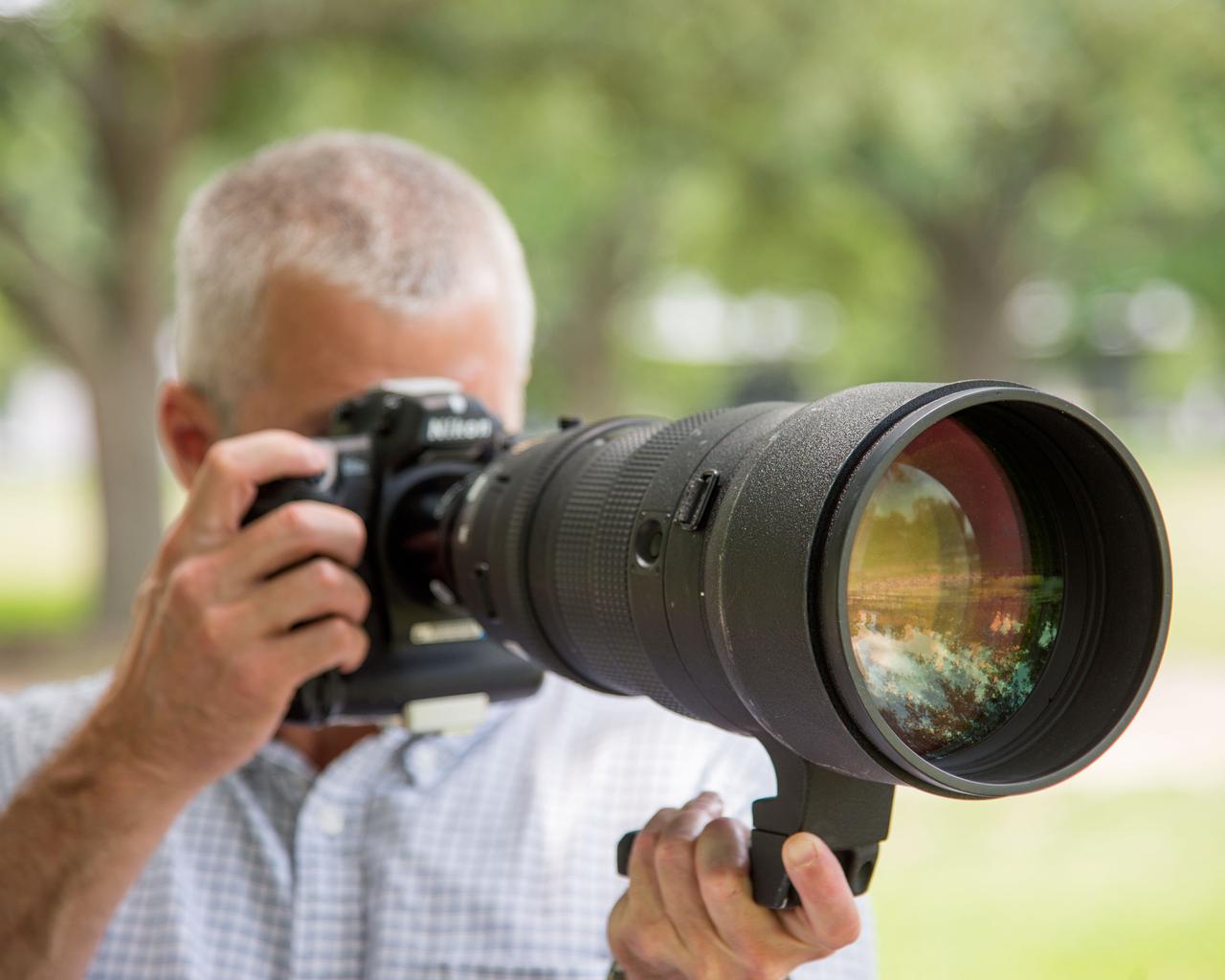
PHOTO DATE: 05-20-13 LOCATION: Bldg. 4south, Room 1303 SUBJECT: Soyuz 38 (Expedition 39/40) crew member Steve Swanson training on Nikon camera equipment and long lenses for External Photo Skills with instructor Paul Reichert. PHOTOGRAPHER: BILL STAFFORD
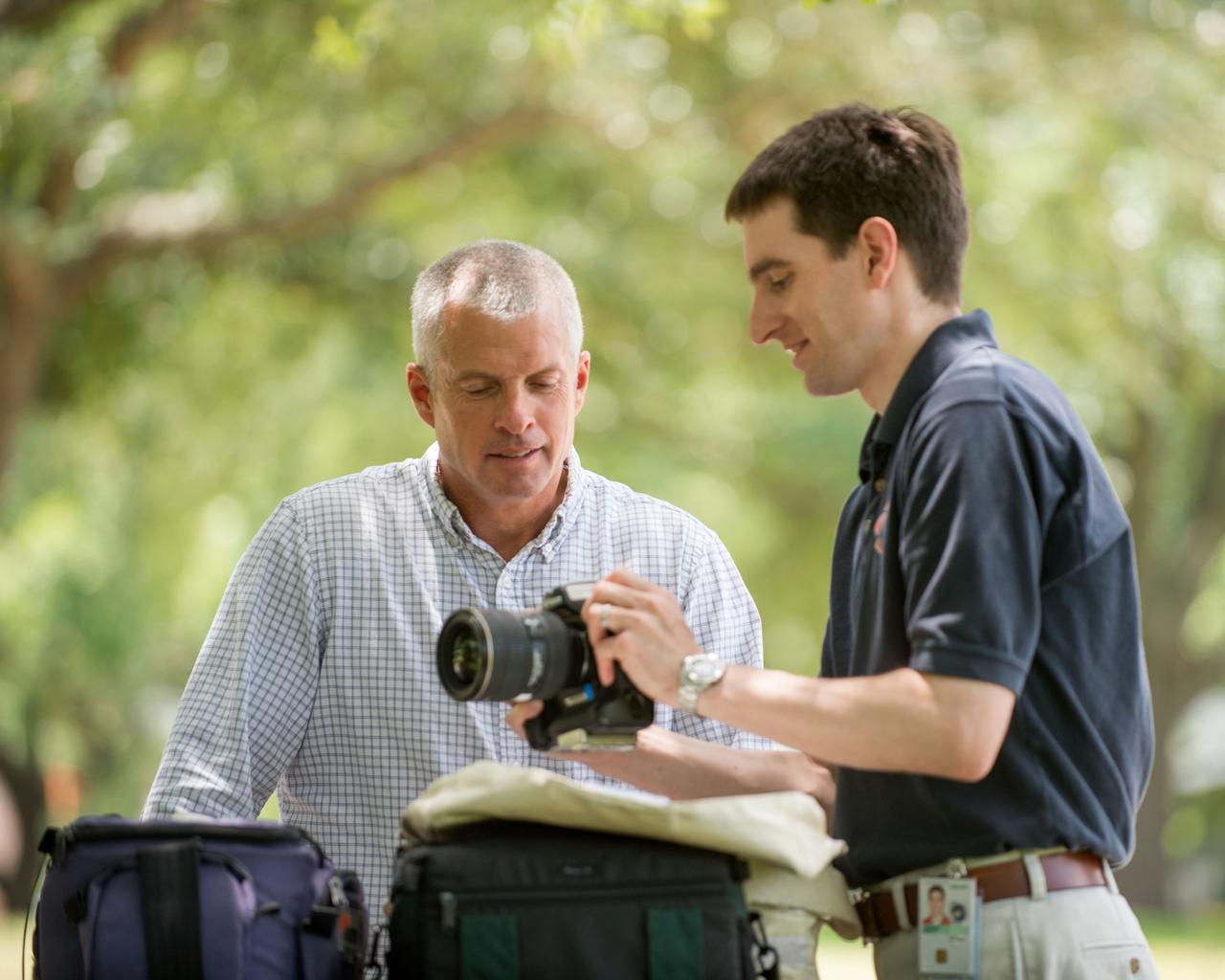
PHOTO DATE: 05-20-13 LOCATION: Bldg. 4south, Room 1303 SUBJECT: Soyuz 38 (Expedition 39/40) crew member Steve Swanson training on Nikon camera equipment and long lenses for External Photo Skills with instructor Paul Reichert. PHOTOGRAPHER: BILL STAFFORD
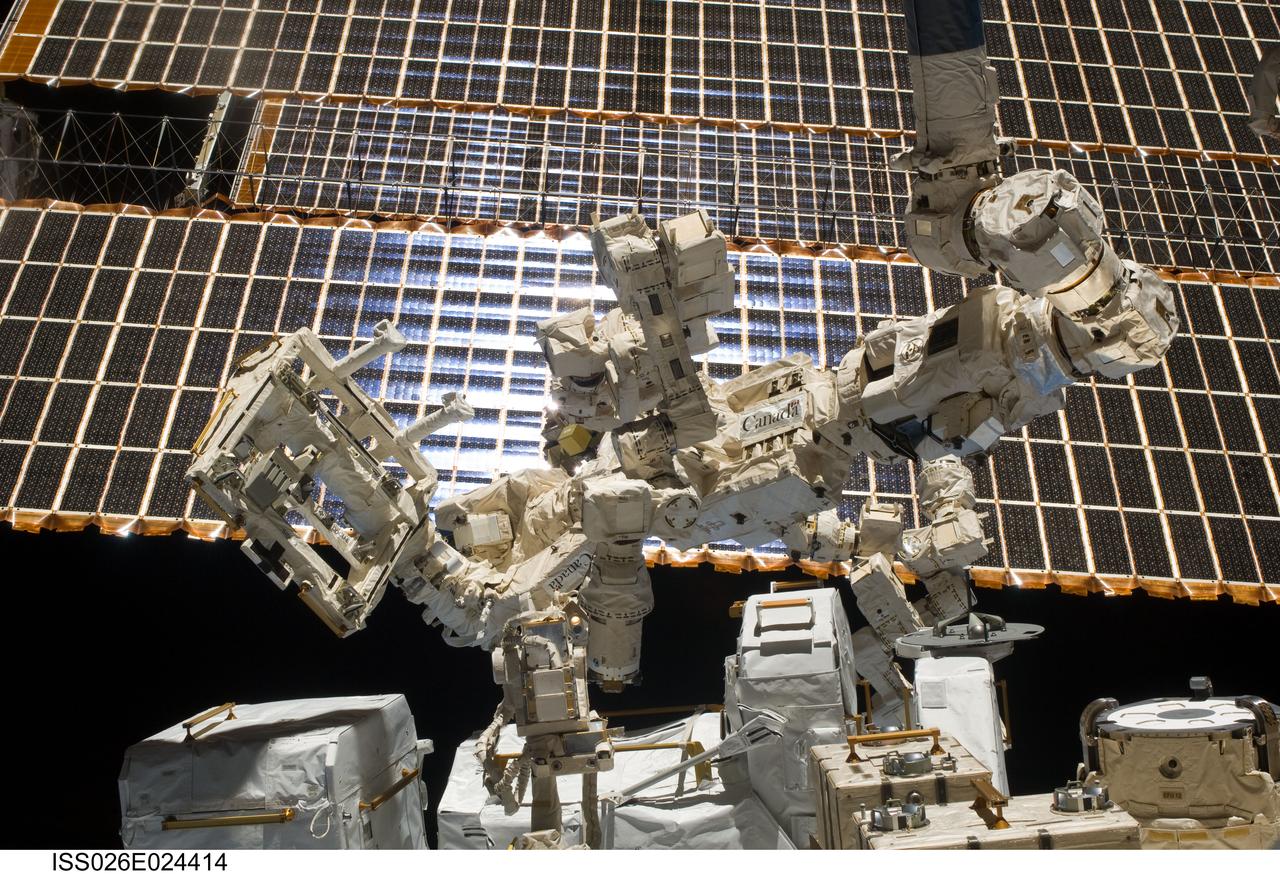
ISS026-E-024414 (3 Feb. 2011) --- While attached on the end of the Canadarm2, Dextre, the Canadian Space Agency’s robotic “handyman”, is featured in this image photographed by an Expedition 26 crew member aboard the International Space Station. During the activities, Dextre unpacked two critical pieces of equipment delivered by Japan’s Kounotori2 spacecraft.
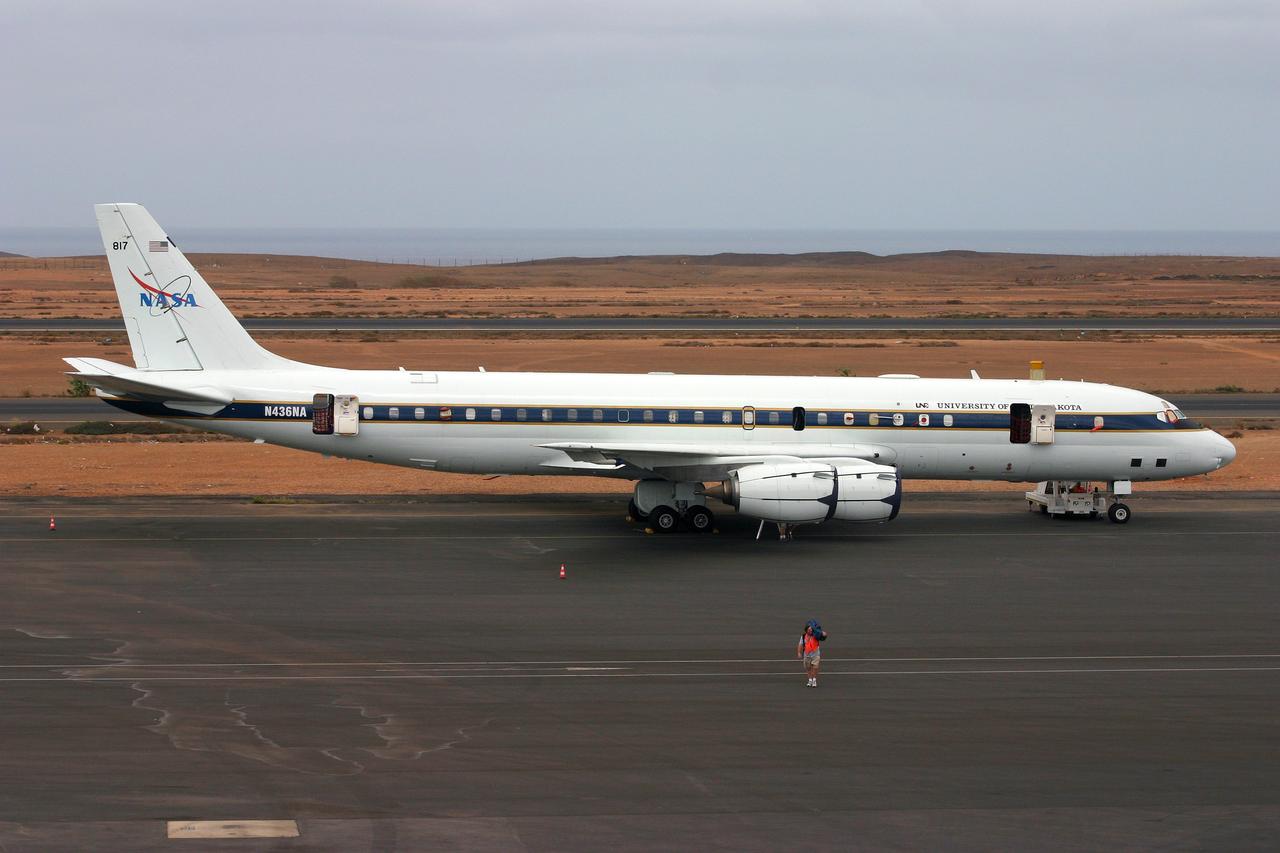
DC-8 NAMMA MISSION TO CAPE VERDE, AFRICA: NASA'S DC-8 parked on ramp of Sal Island's Amilcar Cabral International Airport in the Cape Verde Islands. NASA Ames photographer Eric James is seen in the foreground carrying equipment off the airplane.
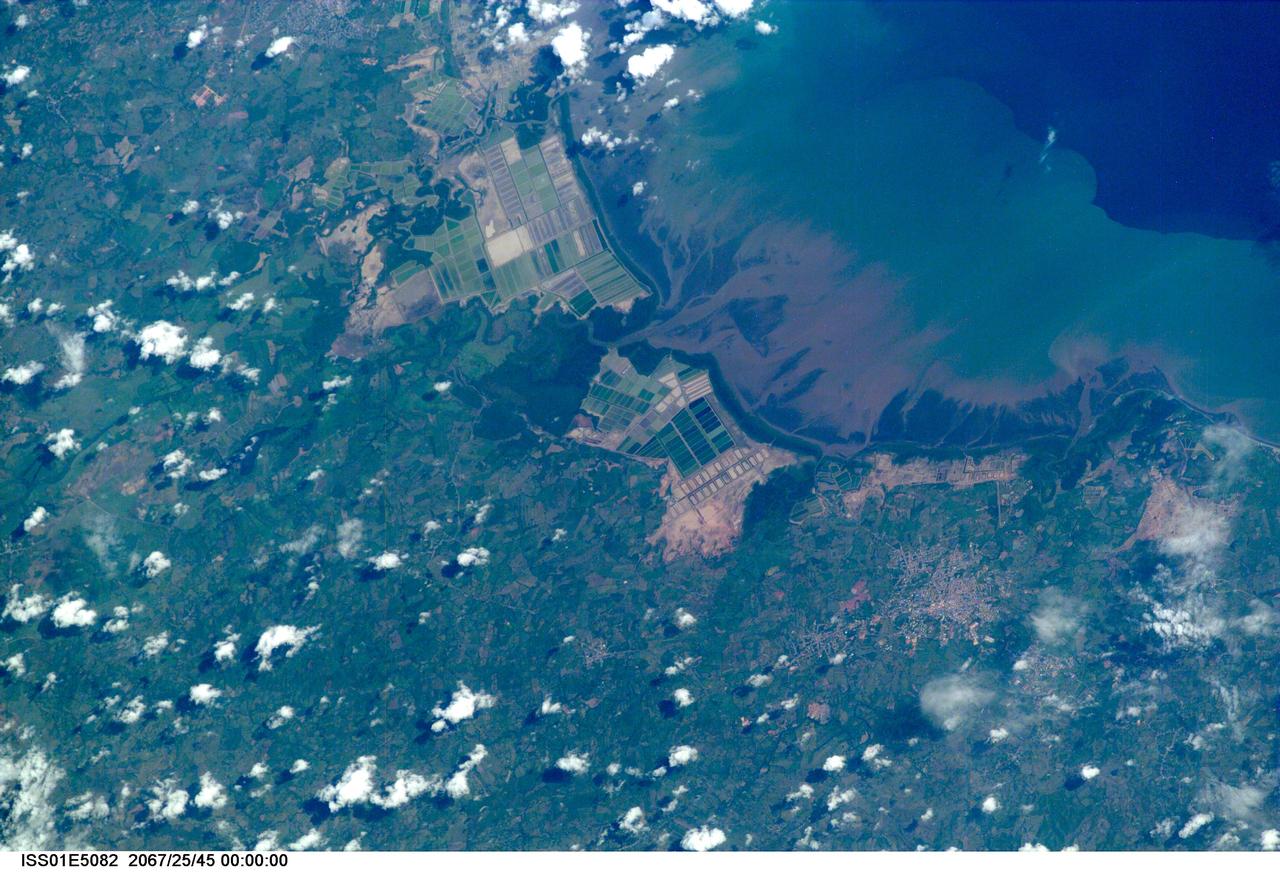
ISS01-E-5082 (December 2000) --- This image of coastal Asia was taken from the International Space Station with a digital still camera and a 400mm lens with a very narrow field of view. Early in the Space Station Program, communications with the crew are less direct, and the exact time that this image was taken could not be determined. Because there are relatively few photograph of Earth taken with this long lens, and because the times are not available to calculate the exact position of the Station over the Earth when the photograph was taken, the exact location of the photograph cannot be determined. Many of these logistical problems will be resolved as camera equipment is replaced and communications with the crew improve. Catalogers believe the coast most resembles Indonesia, and this determination will be maintained until future images allow correction and refinement of the location. The photograph is a striking example of the degree to which humans modify coastal environments. The large green squares in the image probably represent a combination of rice cultivation and aquaculture.
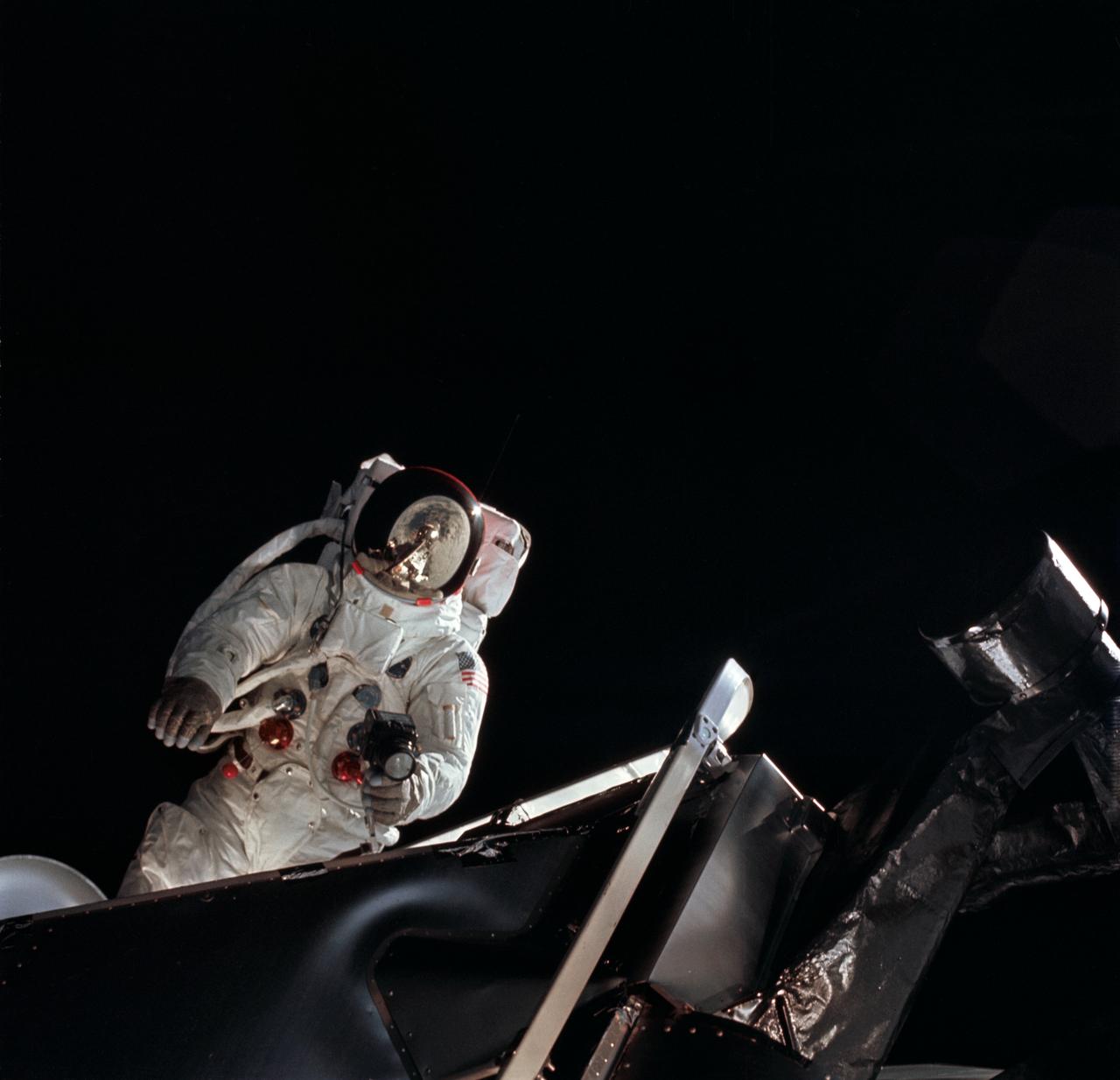
AS09-19-2983 (6 March 1969) --- Astronaut Russell L. Schweickart, lunar module pilot, operates a 70mm Hasselblad camera during his extravehicular activity (EVA) on the fourth day of the Apollo 9 Earth-orbital mission. The Command and Service Modules (CSM) and Lunar Module (LM) "Spider" are docked. This view was taken from the Command Module (CM) "Gumdrop". Schweickart, wearing an Extravehicular Mobility Unit (EMU), is standing in "golden slippers" on the LM porch. On his back, partially visible, are a Portable Life Support System (PLSS) and an Oxygen Purge System (OPS). Astronaut James A. McDivitt, Apollo 9 commander, was inside the "Spider". Astronaut David R. Scott, command module pilot, remained at the controls in the CM.
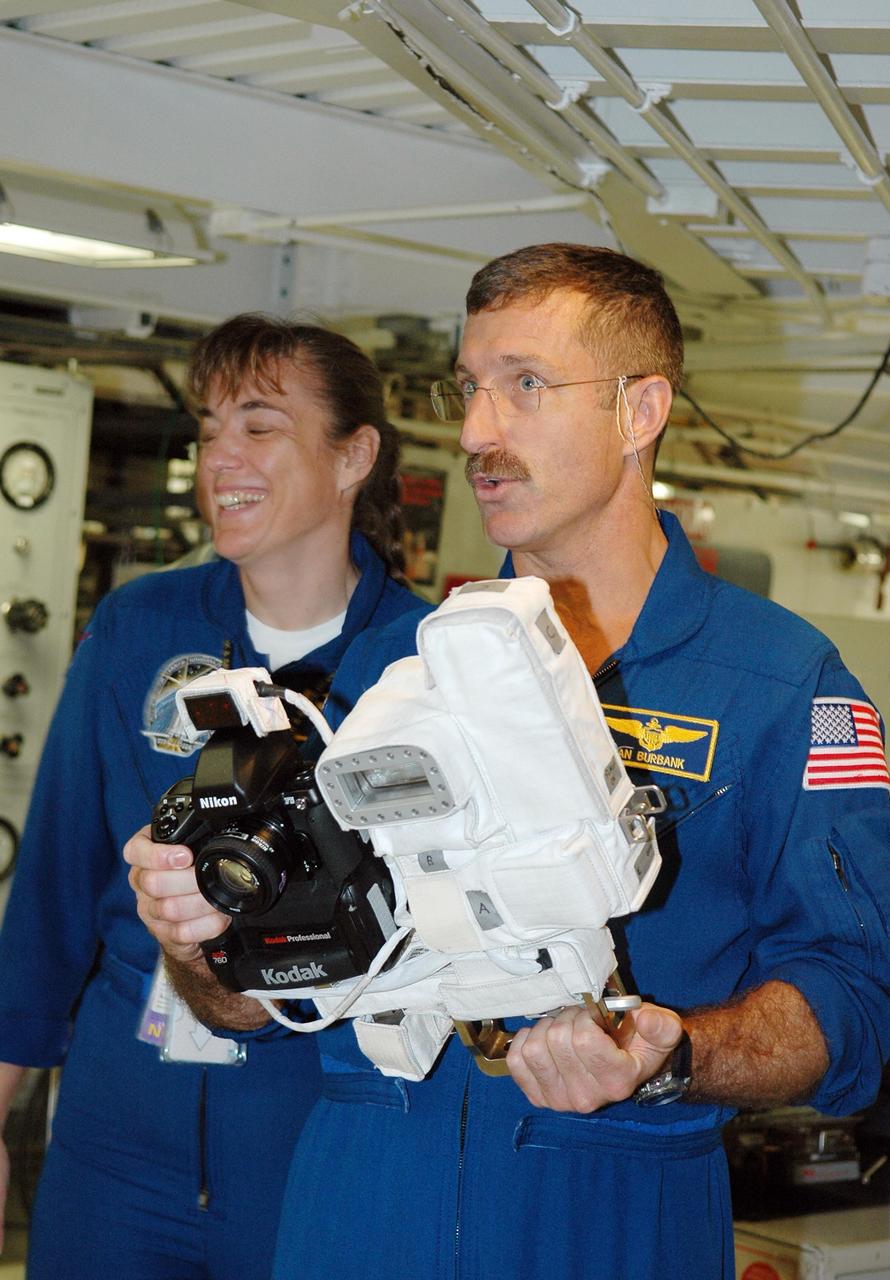
KENNEDY SPACE CENTER, FLA. - In the Orbiter Processing Facility, STS-115 Mission Specialist Daniel Burbank holds a camera that is a mockup of one the crew will use to take photographs on-orbit. At left is Mission Specialist Heidemarie Stefanyshyn-Piper. The crew is at the center for Crew Equipment Interface Test activities, which involves equipment familiarization, a routine part of astronaut training and launch preparations. The mission will deliver the second port truss segment, the P3/P4 Truss, to attach to the first port truss segment, the P1 Truss, as well as deploy solar array set 2A and 4A. Launch on Space Shuttle Atlantis is scheduled for late August. Photo credit: NASA/Kim Shiflett
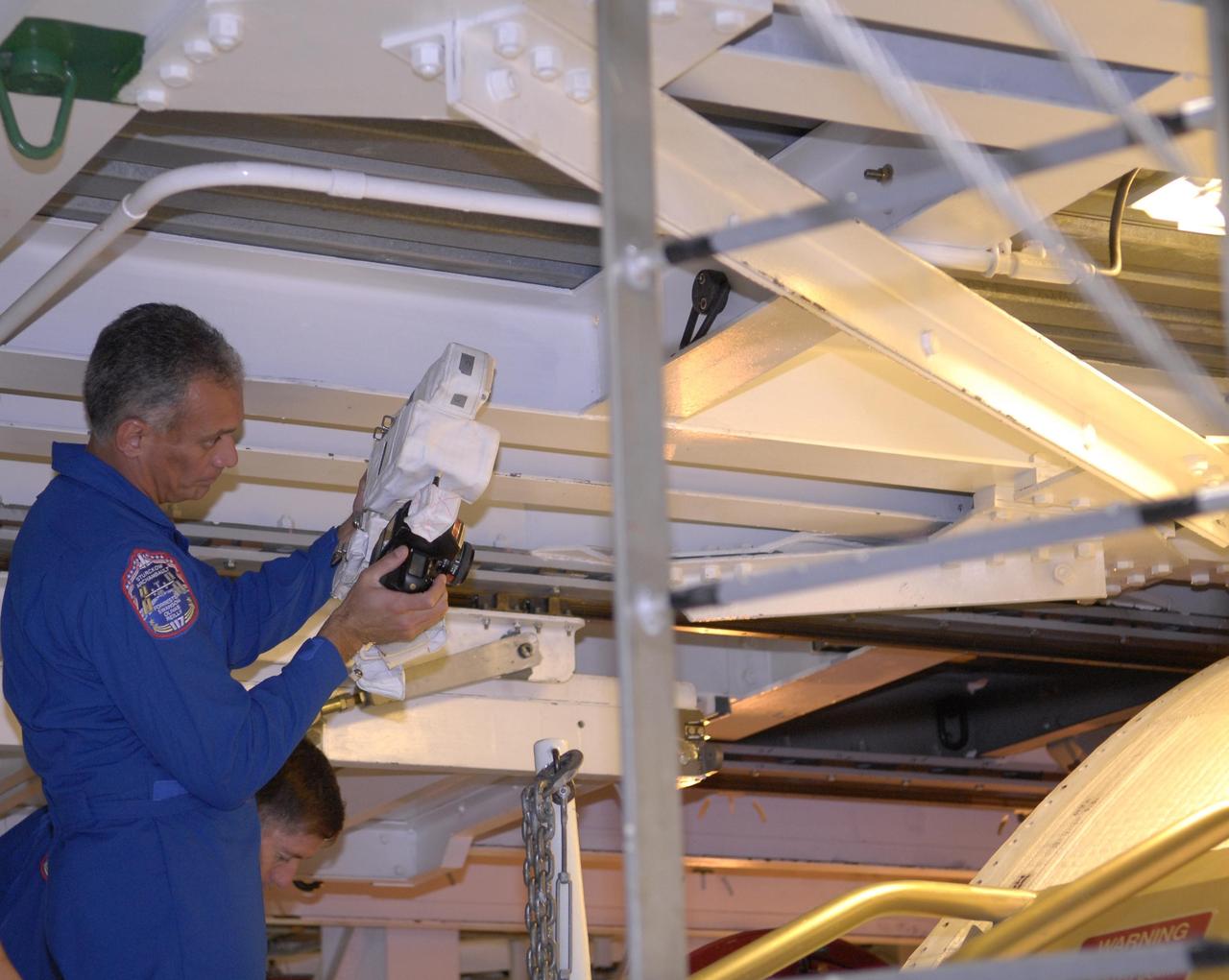
KENNEDY SPACE CENTER, FLA. -- In the Orbiter Processing Facility, STS-117 Mission Specialist John (Danny) Olivas practices photographing the orbiter Atlantis with a camera to be used on the mission. He and other crew members are at KSC to take part in a Crew Equipment Interface Test that allows them opportunities to become familiar with equipment and hardware for their mission. STS-117 will deliver the S3/S4 and another pair of solar arrays to the space station. The 21st shuttle mission to the International Space Station, STS-117 is scheduled to launch no earlier than March 16. Photo credit: NASA/Kim Shiflett
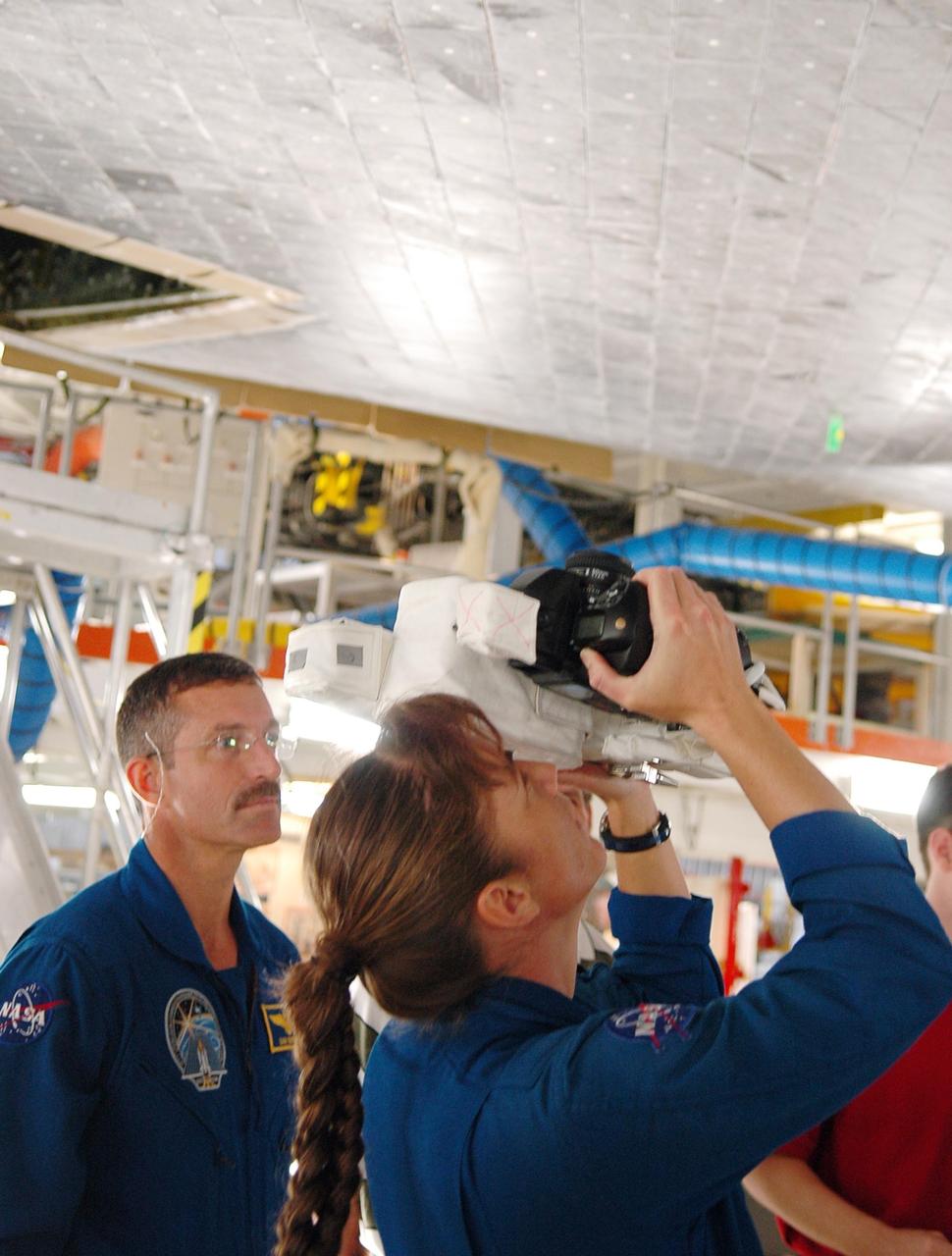
KENNEDY SPACE CENTER, FLA. - In the Orbiter Processing Facility, STS-115 Mission Specialist Heidemarie Stefanyshyn-Piper practices using a camera that is a mockup of one the crew will use to take photographs on-orbit. At left is Mission Specialist Daniel Burbank. The crew is at the center for Crew Equipment Interface Test activities, which involves equipment familiarization, a routine part of astronaut training and launch preparations. The mission will deliver the second port truss segment, the P3/P4 Truss, to attach to the first port truss segment, the P1 Truss, as well as deploy solar array set 2A and 4A. Launch on Space Shuttle Atlantis is scheduled for late August. Photo credit: NASA/Kim Shiflett
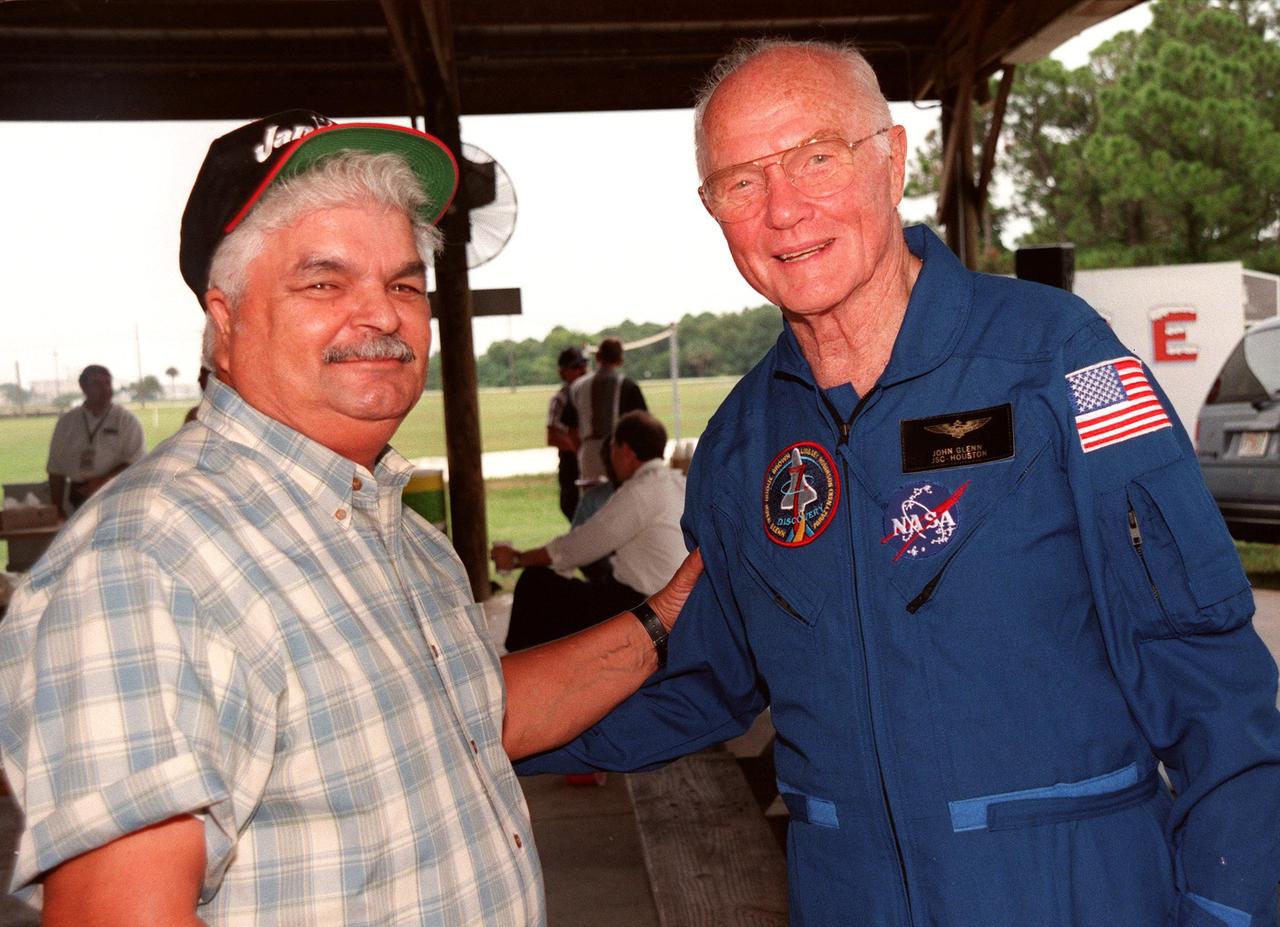
During a break in the Crew Equipment Interface Test (CEIT), Payload Specialist John H. Glenn Jr., a senator from Ohio, greets Bobby Miranda. Miranda was a NASA photographer for Glenn's first flight on Friendship 7, February 1962. The CEIT gives astronauts an opportunity for a hands-on look at the payloads and equipment with which they will be working on orbit. The launch of the STS-95 mission is scheduled for Oct. 29, 1998, on the Space Shuttle Discovery. The mission includes research payloads such as the Spartan solar-observing deployable spacecraft, the Hubble Space Telescope Orbital Systems Test Platform, the International Extreme Ultraviolet Hitchhiker, as well as the SPACEHAB single module with experiments on space flight and the aging process
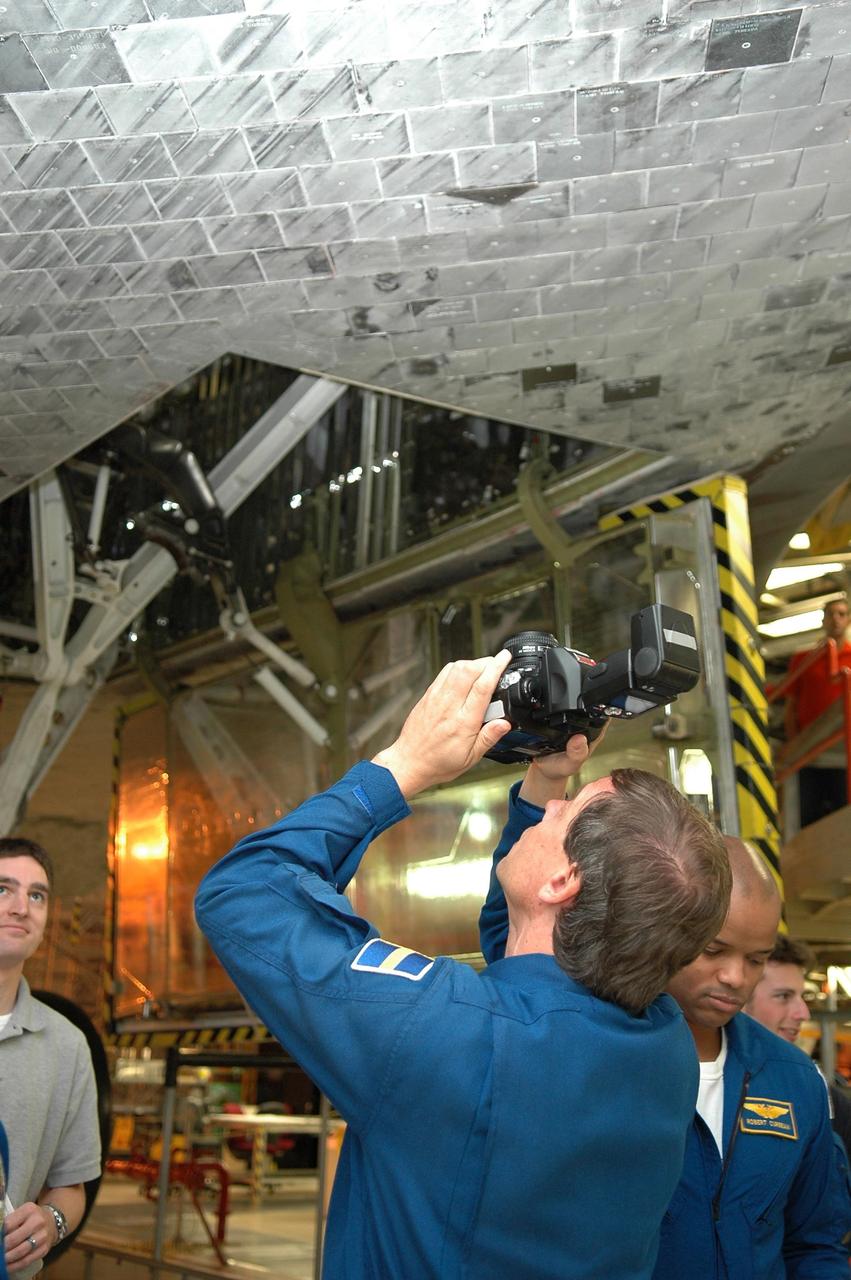
KENNEDY SPACE CENTER, FLA. - In the Orbiter Processing Facility, STS-116 Mission Specialist Christer Fugelsang practices photographing the orbiter Discovery with a camera similar to those the crew will use on the mission. At right is Mission Specialist Robert Curbeam. The crew is at KSC for a Crew Equipment Interface Test. Mission crews make frequent trips to the Kennedy Space Center to become familiar with the equipment and payloads they will be using. STS-116 will be mission No. 20 to the International Space Station and construction flight 12A.1. The mission payload is the SPACEHAB module, the P5 integrated truss structure and other key components. Launch is scheduled for no earlier than Dec. 7. Photo credit: NASA/Kim Shiflett
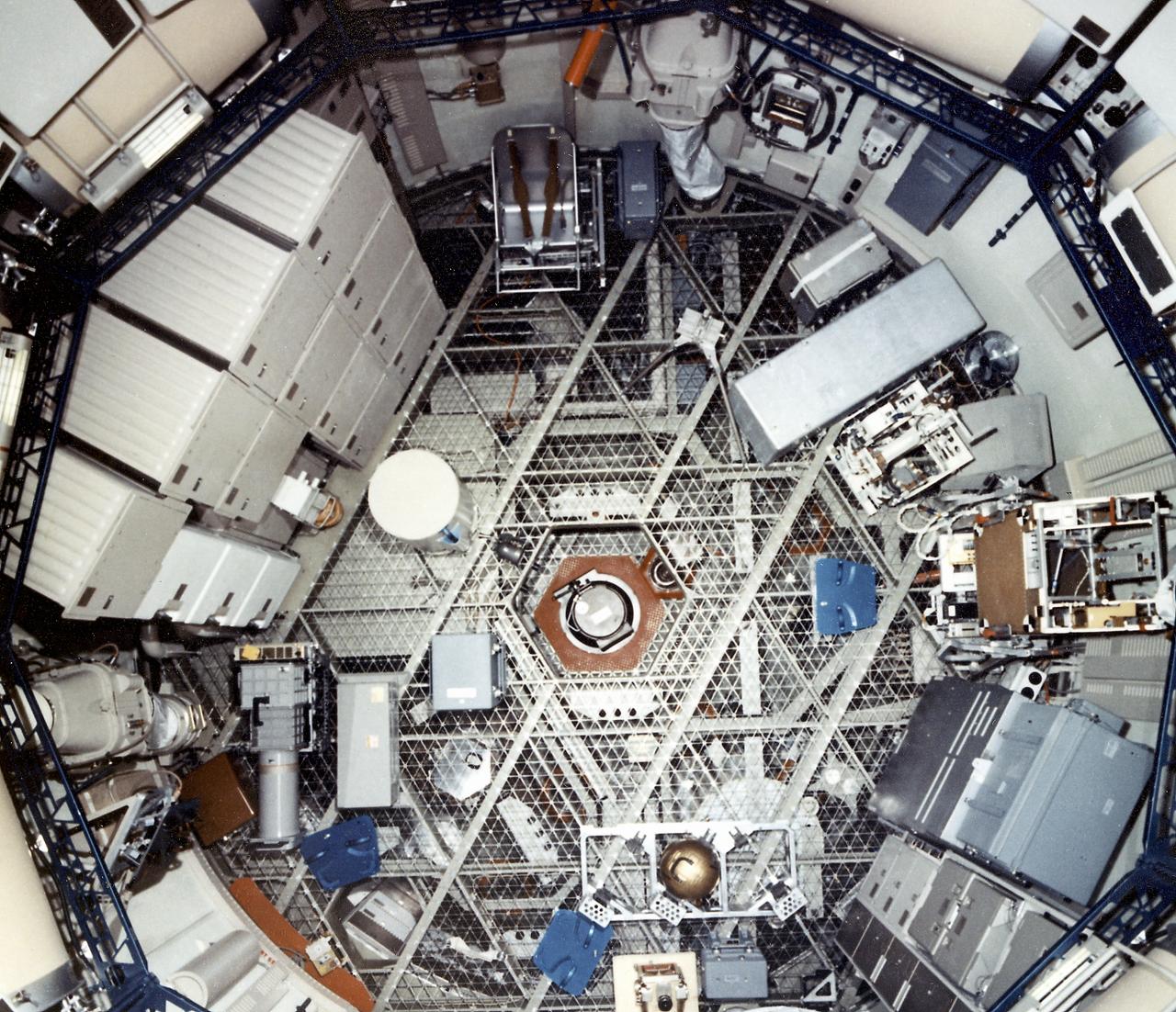
This photograph is an interior view of the Orbital Workshop (OWS) upper level looking from the airlock hatch, showing the octagonal opening that separated the workshop's two levels. The trash airlock can be seen at center. The lower level of the OWS provided crew accommodations for sleeping, food preparation and consumption, hygiene, waste processing and disposal, and performance of certain experiments. The upper level consisted of a large work area and housed water storage tanks, a food freezer, storage vaults for film, scientific airlocks, mobility and stability experiment equipment, and other experimental equipment.
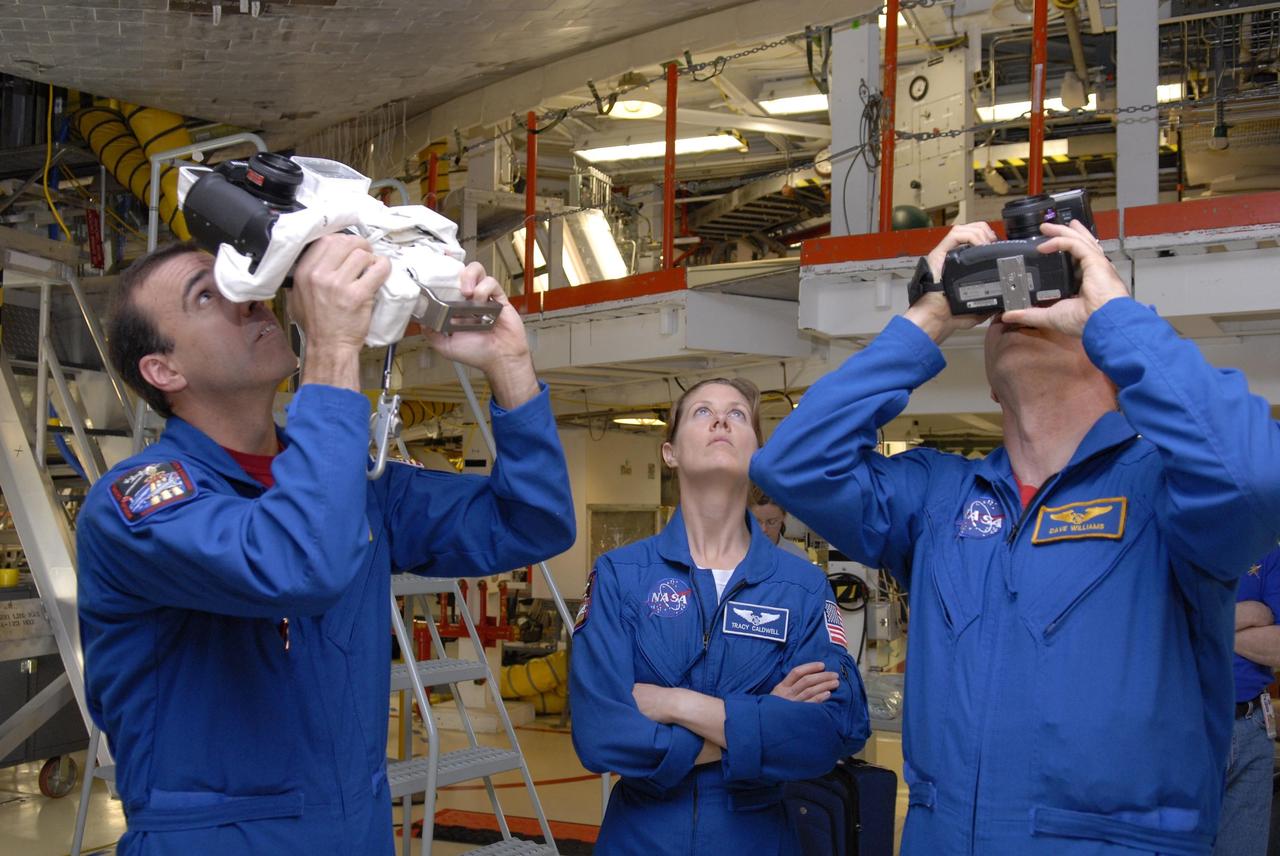
KENNEDY SPACE CENTER, FLA. -- In Orbiter Processing Facility bay 2, during crew equipment interface test activities, STS-118 Mission Specialists Dr. Dafydd Williams (left) and Richard Mastrocchio (right) practice photographing the underside of the orbiter Endeavour, which they may do on the flight. At center is Mission Specialist Tracy Caldwell, who will also practice with the cameras. The STS-118 mission will be delivering the third starboard truss segment, the ITS S5, to the International Space Station, as well as the SPACEHAB single cargo module filled with supplies and equipment. Launch aboard Space Shuttle Endeavour is targeted for Aug. 9. Photo credit: NASA/Kim Shiflett
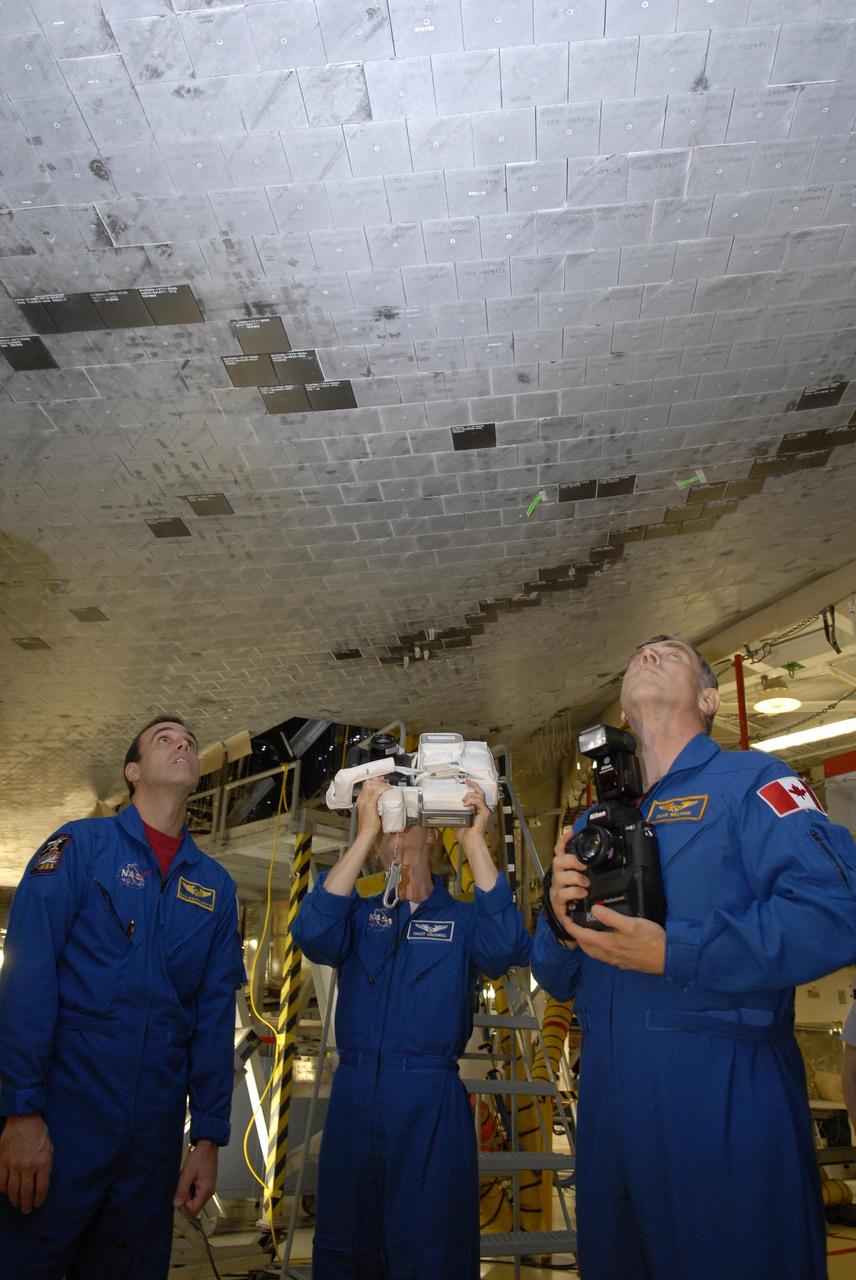
KENNEDY SPACE CENTER, FLA. -- In Orbiter Processing Facility bay 2, during crew equipment interface test activities, STS-118 Mission Specialists Dr. Dafydd Williams, Tracy Caldwell and Richard Mastrocchio are getting practice photographing the underside of the orbiter Endeavour, which they may do on the flight. The STS-118 mission will be delivering the third starboard truss segment, the ITS S5, to the International Space Station, as well as the SPACEHAB single cargo module filled with supplies and equipment. Launch aboard Space Shuttle Endeavour is targeted for Aug. 9. Photo credit: NASA/Kim Shiflett
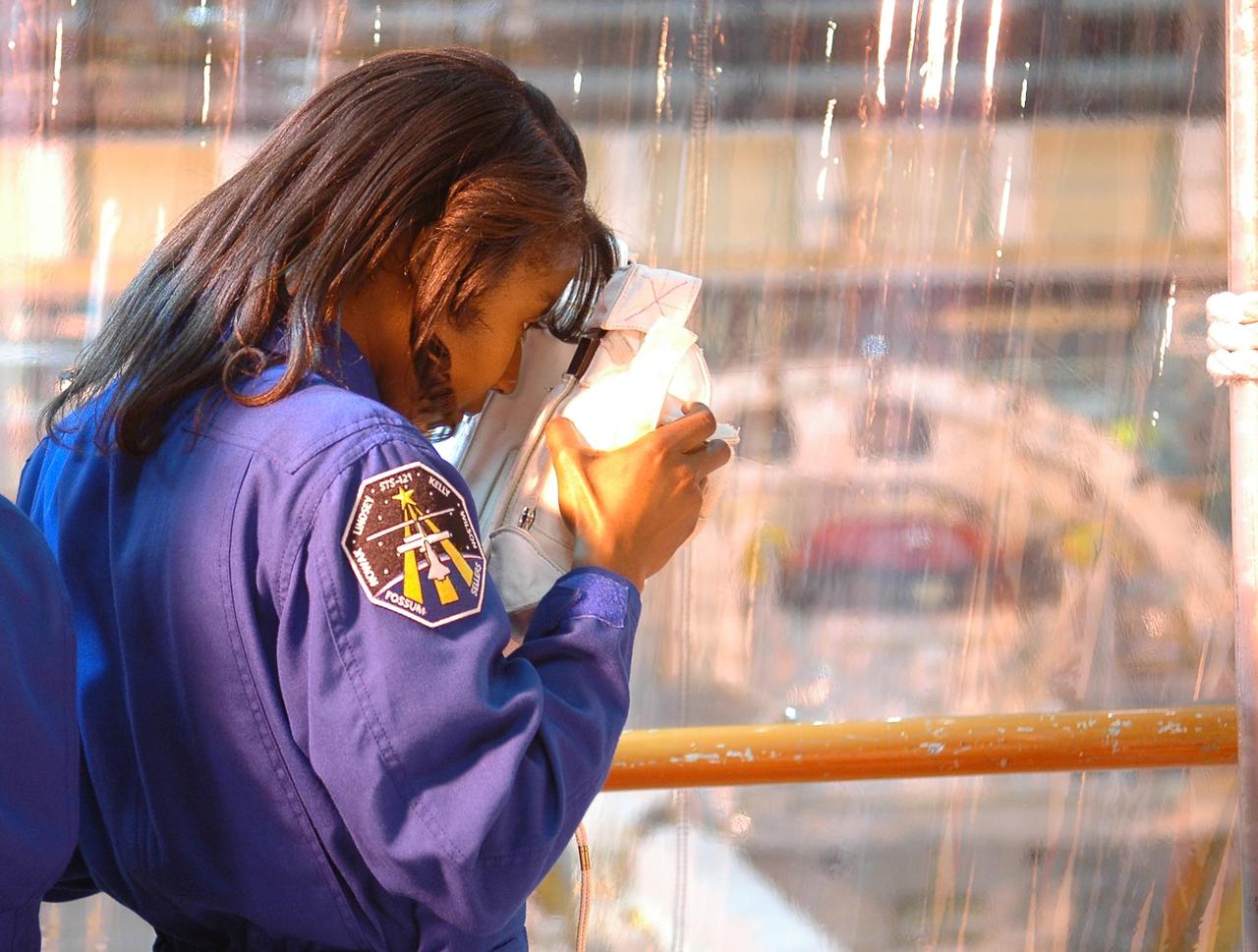
KENNEDY SPACE CENTER, FLA. - Inside the Orbiter Processing Facility bay 3 at NASA's Kennedy Space Center, STS-121 Mission Specialist Lisa Nowak photographs Discovery, the launch vehicle for the mission, during a training session. She and other crew members -- Commander Steven Lindsey, Pilot Mark Kelly and Mission Specialists Stephanie Wilson, Michael Fossum and Piers Sellers -- are at Kennedy for a crew equipment interface test, which provides hands-on experience with equipment they will use on orbit. Launch of STS-121, the second return-to-flight mission, is scheduled for no earlier than May. Photo credit: NASA/Kim Shiflett