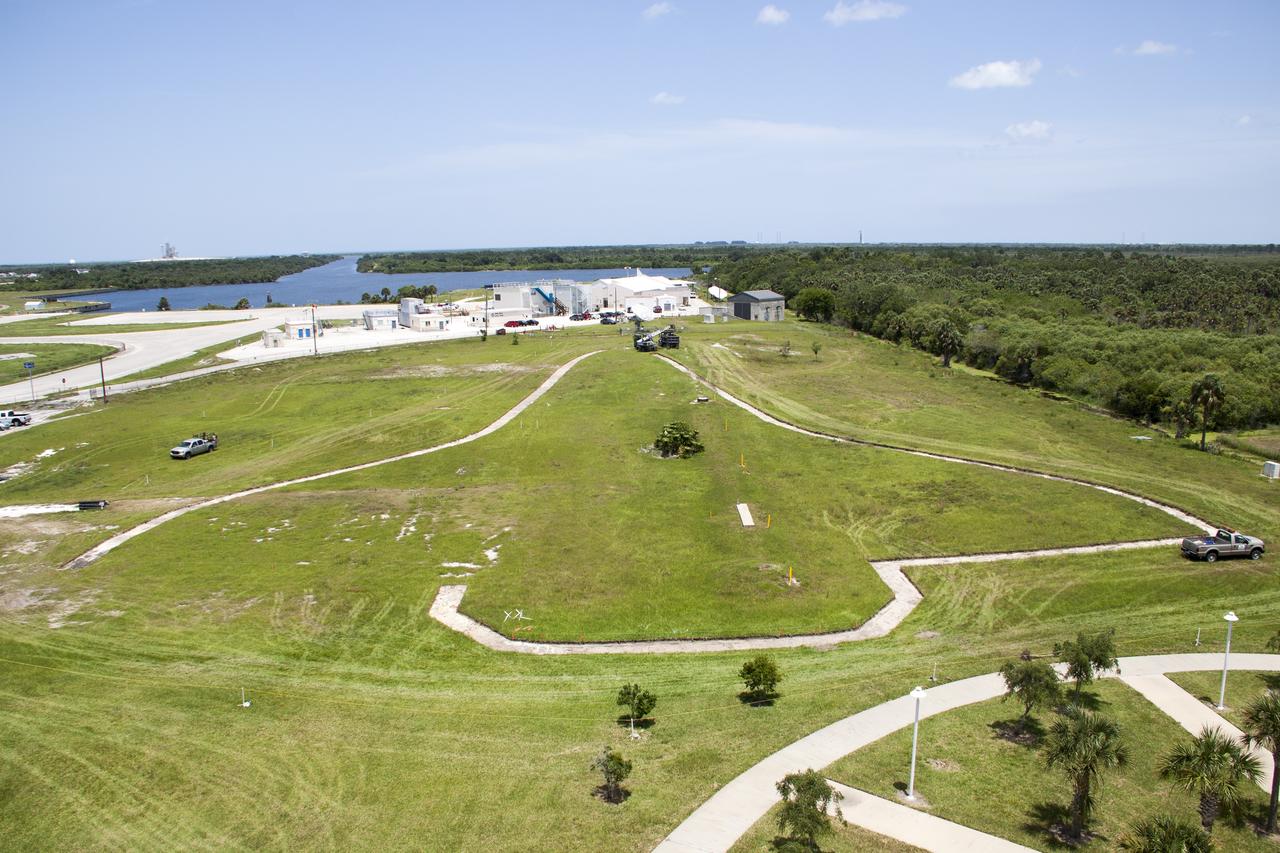
CAPE CANAVERAL, Fla. – At the Kennedy Space Center in Florida, a fitness trail is under construction in the Launch Complex 39 area just west of the Press Site. Designed in the shape of a space shuttle, the trail will provide an opportunity for employees at the spaceport to stay physically fit. Photo credit: NASA/Jim Grossmann
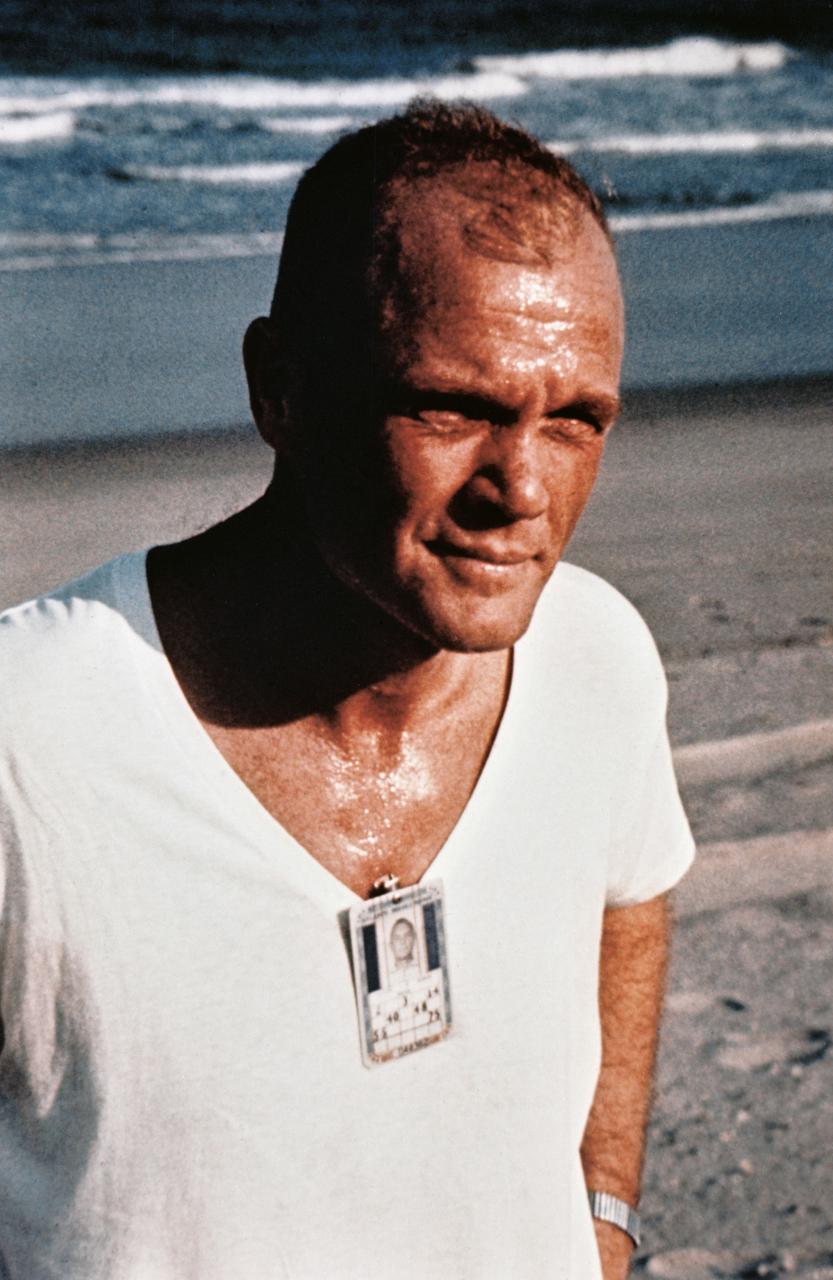
S64-14883 (1962) --- Astronaut John H. Glenn Jr., pilot of the Mercury-Atlas 6 mission, participates in a strict physical training program, as he exemplifies by frequent running. Here he pauses during an exercise period on the beach near Cape Canaveral, Florida. Photo credit: NASA
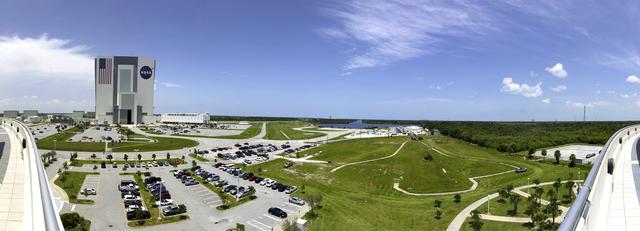
CAPE CANAVERAL, Fla. – At the Kennedy Space Center in Florida, a fitness trail is under construction in the Launch Complex 39 area across from the Vehicle Assembly Building and just west of the Press Site. This panoramic image shows that that trail is being designed in the shape of a space shuttle. The trail will provide an opportunity for employees at the spaceport to stay physically fit. Photo credit: NASA/Jim Grossmann

CAPE CANAVERAL, Fla. -- At the Astrotech payload processing facility, technicians lower NASA's Gamma-Ray Large Area Space Telescope, or GLAST, spacecraft toward the payload attach fitting. The fitting will eventually be used to mate GLAST to the Delta II launch vehicle. The GLAST is a powerful space observatory that will explore the Universe's ultimate frontier, where nature harnesses forces and energies far beyond anything possible on Earth; probe some of science's deepest questions, such as what our Universe is made of, and search for new laws of physics; explain how black holes accelerate jets of material to nearly light speed; and help crack the mystery of stupendously powerful explosions known as gamma-ray bursts. A launch date still is to be determined. Photo credit: NASA/Jim Grossmann

CAPE CANAVERAL, Fla. -- At the Astrotech payload processing facility, technicians check the placement of NASA's Gamma-Ray Large Area Space Telescope, or GLAST, spacecraft on the payload attach fitting. The fitting will eventually be used to mate GLAST to the Delta II launch vehicle. The GLAST is a powerful space observatory that will explore the Universe's ultimate frontier, where nature harnesses forces and energies far beyond anything possible on Earth; probe some of science's deepest questions, such as what our Universe is made of, and search for new laws of physics; explain how black holes accelerate jets of material to nearly light speed; and help crack the mystery of stupendously powerful explosions known as gamma-ray bursts. A launch date still is to be determined. Photo credit: NASA/Jim Grossmann

CAPE CANAVERAL, Fla. -- At the Astrotech payload processing facility, technicians lower NASA's Gamma-Ray Large Area Space Telescope, or GLAST, spacecraft toward the payload attach fitting. The fitting will eventually be used to mate GLAST to the Delta II launch vehicle. The GLAST is a powerful space observatory that will explore the Universe's ultimate frontier, where nature harnesses forces and energies far beyond anything possible on Earth; probe some of science's deepest questions, such as what our Universe is made of, and search for new laws of physics; explain how black holes accelerate jets of material to nearly light speed; and help crack the mystery of stupendously powerful explosions known as gamma-ray bursts. A launch date still is to be determined. Photo credit: NASA/Jim Grossmann
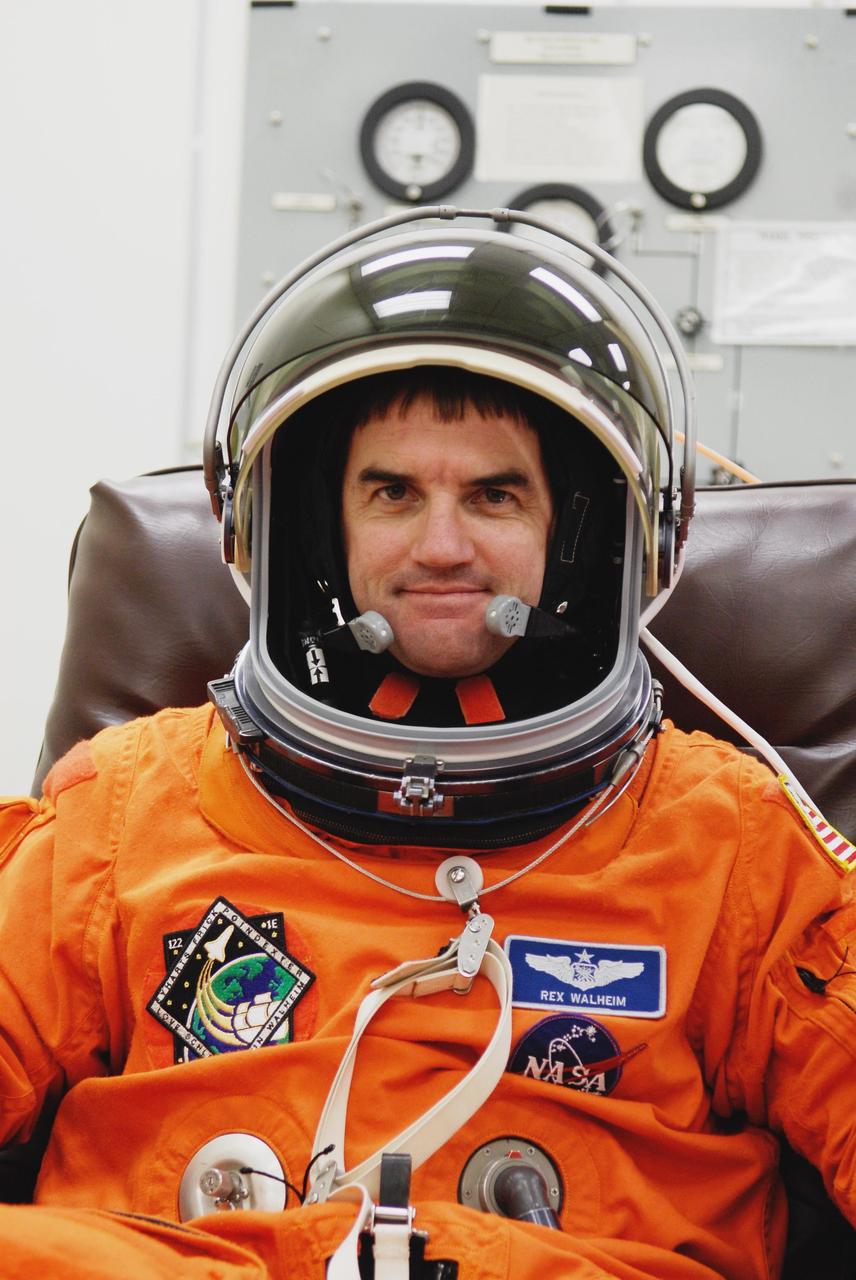
KENNEDY SPACE CENTER, FLA. -- Space shuttle Atlantis STS-122 Mission Specialist Rex Walheim has his helmet fitted on his launch and entry suit, preparing for launch. The fitting is part of terminal countdown demonstration test, or TCDT, activities the crew is undertaking at NASA's Kennedy Space Center. The TCDT provides astronauts and ground crews with equipment familiarization, emergency egress training and a simulated launch countdown. On mission STS-122, Atlantis will deliver the Columbus module to the International Space Station. The European Space Agency's largest single contribution to the station, Columbus is a multifunctional, pressurized laboratory that will be permanently attached to U.S. Node 2, called Harmony. The laboratory will expand the research facilities aboard the station, providing crew members and scientists from around the world the ability to conduct a variety of experiments in the physical, materials and life sciences. Launch is targeted for Dec. 6. Photo credit: NASA/Kim Shiflett

CAPE CANAVERAL, Fla. -- At the Astrotech payload processing facility, technicians prepare the payload attach fitting that will receive NASA's Gamma-Ray Large Area Space Telescope, or GLAST, spacecraft. The fitting will eventually be used to mate GLAST to the Delta II launch vehicle. The GLAST is a powerful space observatory that will explore the Universe's ultimate frontier, where nature harnesses forces and energies far beyond anything possible on Earth; probe some of science's deepest questions, such as what our Universe is made of, and search for new laws of physics; explain how black holes accelerate jets of material to nearly light speed; and help crack the mystery of stupendously powerful explosions known as gamma-ray bursts. A launch date still is to be determined. Photo credit: NASA/Jim Grossmann
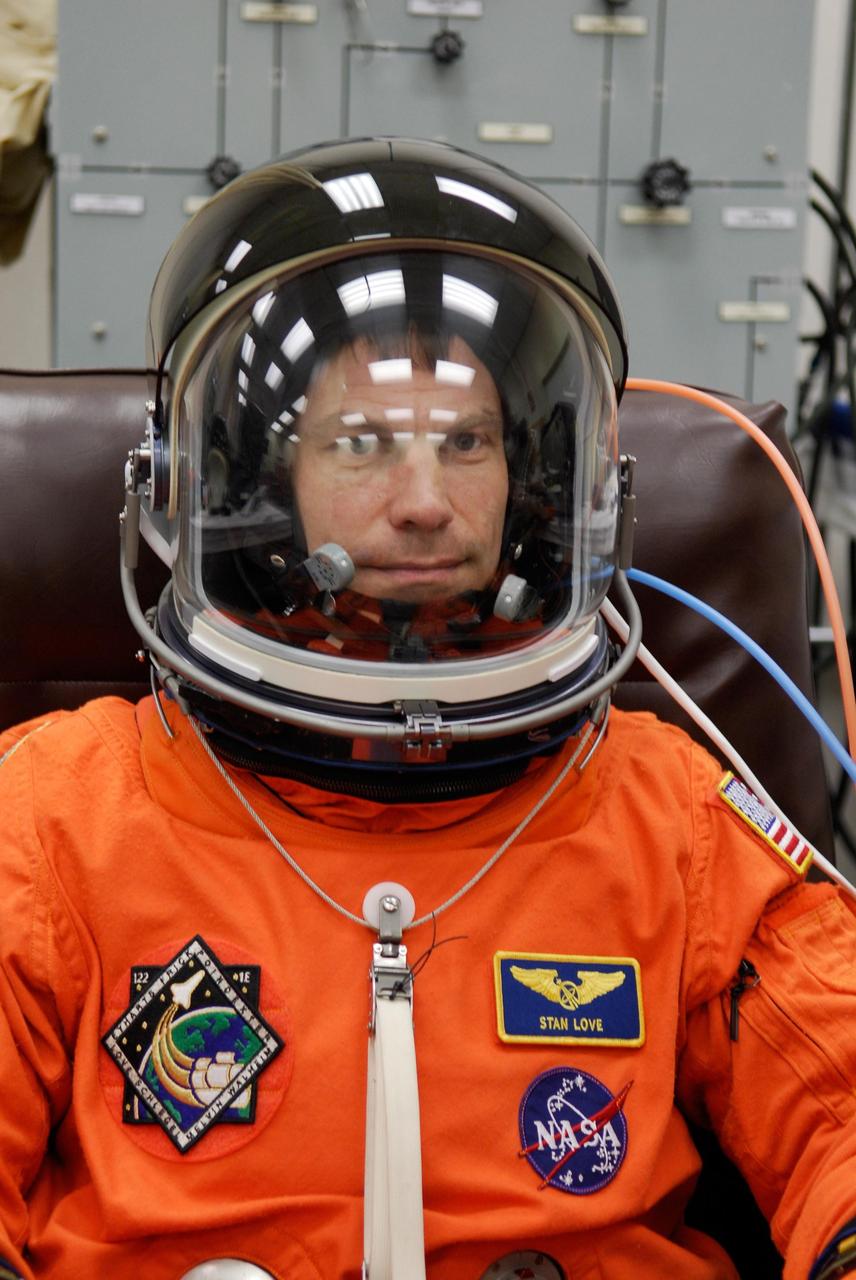
KENNEDY SPACE CENTER, FLA. -- Space shuttle Atlantis STS-122 Mission Specialist Stanley Love has his helmet fitted on his launch and entry suit, preparing for launch. The fitting is part of terminal countdown demonstration test, or TCDT, activities the crew is undertaking at NASA's Kennedy Space Center. The TCDT provides astronauts and ground crews with equipment familiarization, emergency egress training and a simulated launch countdown. On mission STS-122, Atlantis will deliver the Columbus module to the International Space Station. The European Space Agency's largest single contribution to the station, Columbus is a multifunctional, pressurized laboratory that will be permanently attached to U.S. Node 2, called Harmony. The laboratory will expand the research facilities aboard the station, providing crew members and scientists from around the world the ability to conduct a variety of experiments in the physical, materials and life sciences. Launch is targeted for Dec. 6. Photo credit: NASA/Kim Shiflett

CAPE CANAVERAL, Fla. -- At the Astrotech payload processing facility, technicians check the attachment of NASA's Gamma-Ray Large Area Space Telescope, or GLAST, spacecraft on the payload attach fitting. The fitting will eventually be used to mate GLAST to the Delta II launch vehicle. The GLAST is a powerful space observatory that will explore the Universe's ultimate frontier, where nature harnesses forces and energies far beyond anything possible on Earth; probe some of science's deepest questions, such as what our Universe is made of, and search for new laws of physics; explain how black holes accelerate jets of material to nearly light speed; and help crack the mystery of stupendously powerful explosions known as gamma-ray bursts. A launch date still is to be determined. Photo credit: NASA/Jim Grossmann

CAPE CANAVERAL, Fla. -- Technicians at Astrotech in Titusville, Fla., work on closeouts of the payload attach fitting on NASA's Gamma-Ray Large Area Space Telescope, or GLAST, spacecraft. The GLAST is a powerful space observatory that will explore the Universe's ultimate frontier, where nature harnesses forces and energies far beyond anything possible on Earth; probe some of science's deepest questions, such as what our Universe is made of, and search for new laws of physics; explain how black holes accelerate jets of material to nearly light speed; and help crack the mystery of stupendously powerful explosions known as gamma-ray bursts. A launch date still is to be determined. Photo credit: NASA/Kim Shiflett
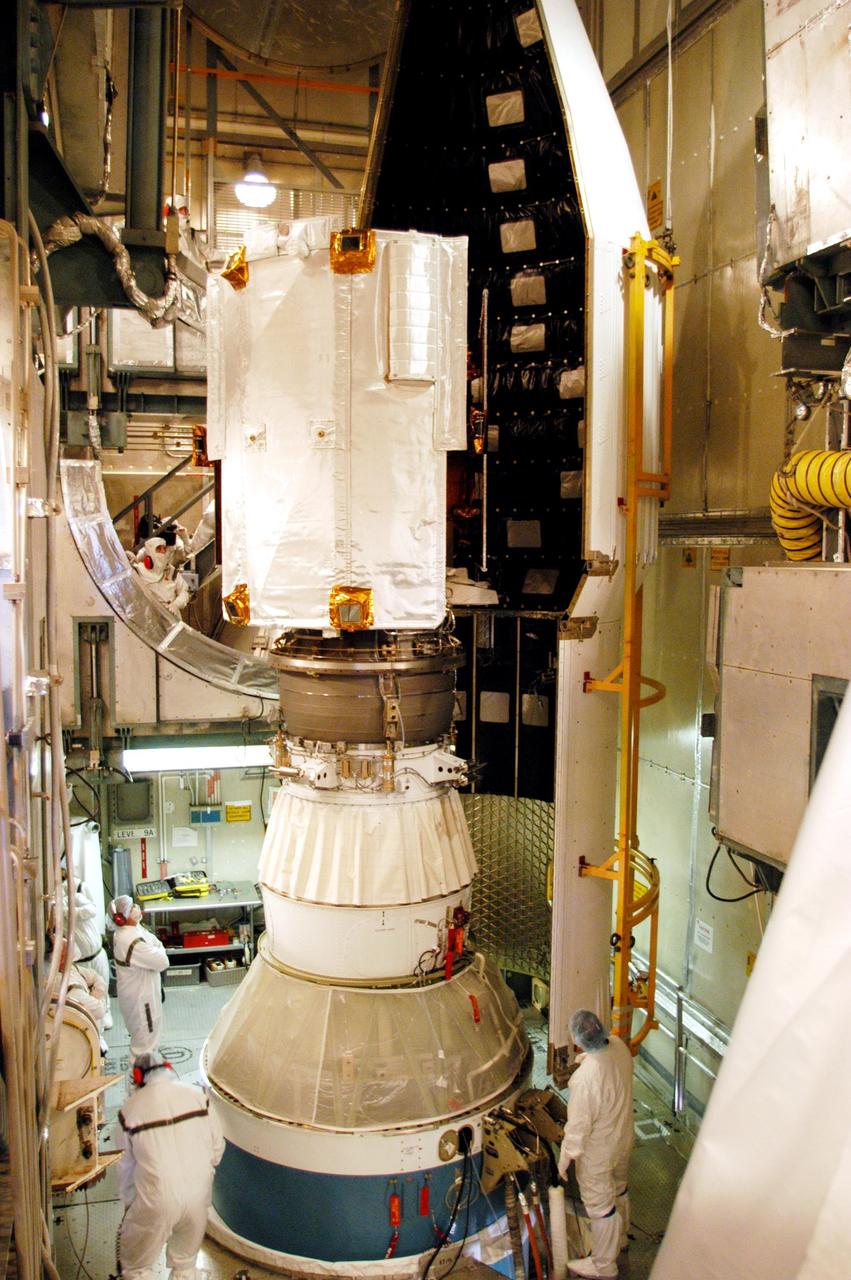
KENNEDY SPACE CENTER, FLA. - On Launch Pad 17-B at Cape Canaveral Air Force Station, the first half of the fairing, at right, is moved into place for installation around the MESSENGER (Mercury Surface, Space Environment, Geochemistry and Ranging) spacecraft. The fairing is a molded structure that fits flush with the outside surface of the upper stage booster and forms an aerodynamically smooth joint, protecting the spacecraft during launch. MESSENGER is scheduled to launch Aug. 2 aboard a Boeing Delta II rocket and is expected to enter Mercury orbit in March 2011. MESSENGER was built for NASA by the Johns Hopkins University Applied Physics Laboratory in Laurel, Md.
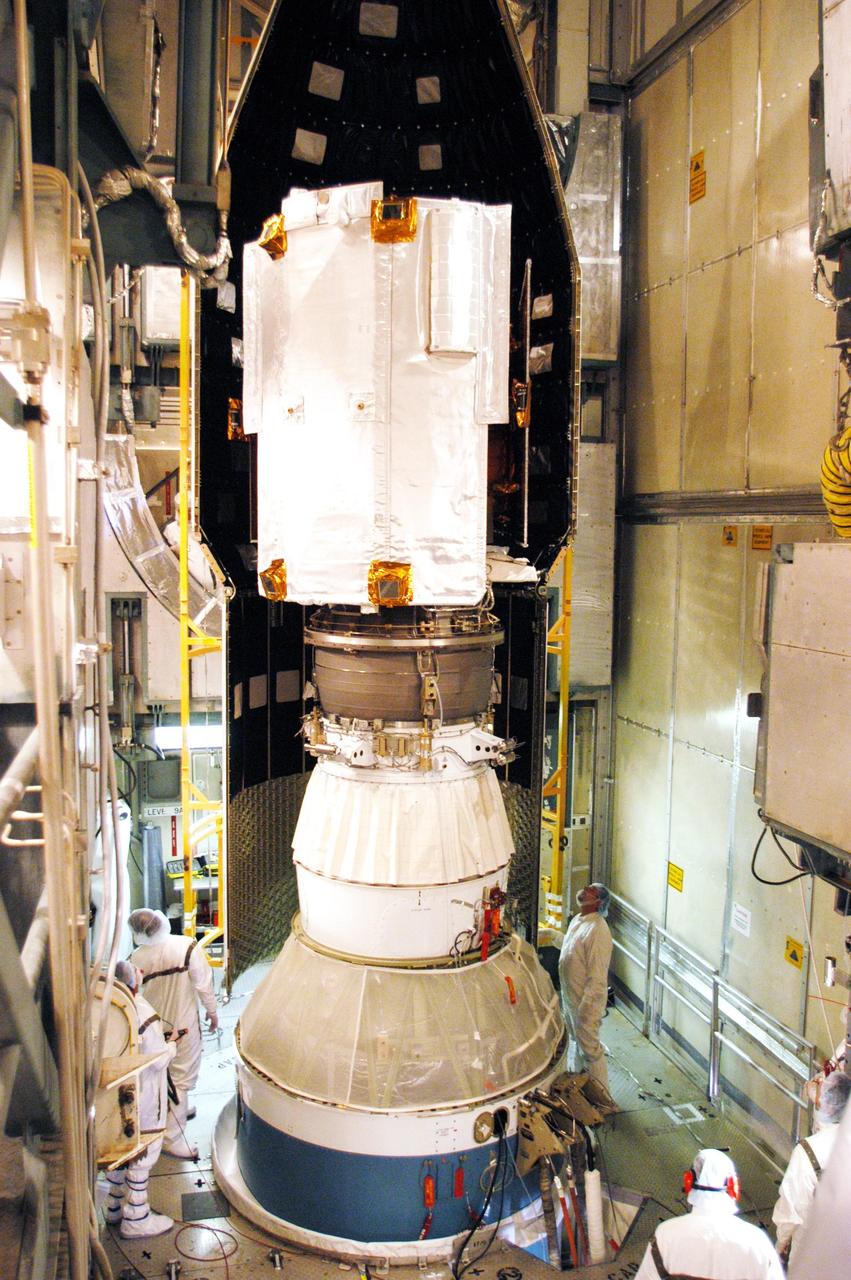
KENNEDY SPACE CENTER, FLA. - On Launch Pad 17-B at Cape Canaveral Air Force Station, Boeing workers check the progress of the fairing as it is moved into place for installation around the MESSENGER (Mercury Surface, Space Environment, Geochemistry and Ranging) spacecraft. The fairing is a molded structure that fits flush with the outside surface of the upper stage booster and forms an aerodynamically smooth joint, protecting the spacecraft during launch. MESSENGER is scheduled to launch Aug. 2 aboard a Boeing Delta II rocket and is expected to enter Mercury orbit in March 2011. MESSENGER was built for NASA by the Johns Hopkins University Applied Physics Laboratory in Laurel, Md.

CAPE CANAVERAL, Fla. -- Technicians at Astrotech in Titusville, Fla., work on closeouts of the payload attach fitting on NASA's Gamma-Ray Large Area Space Telescope, or GLAST, spacecraft. The GLAST is a powerful space observatory that will explore the Universe's ultimate frontier, where nature harnesses forces and energies far beyond anything possible on Earth; probe some of science's deepest questions, such as what our Universe is made of, and search for new laws of physics; explain how black holes accelerate jets of material to nearly light speed; and help crack the mystery of stupendously powerful explosions known as gamma-ray bursts. A launch date still is to be determined. Photo credit: NASA/Kim Shiflett
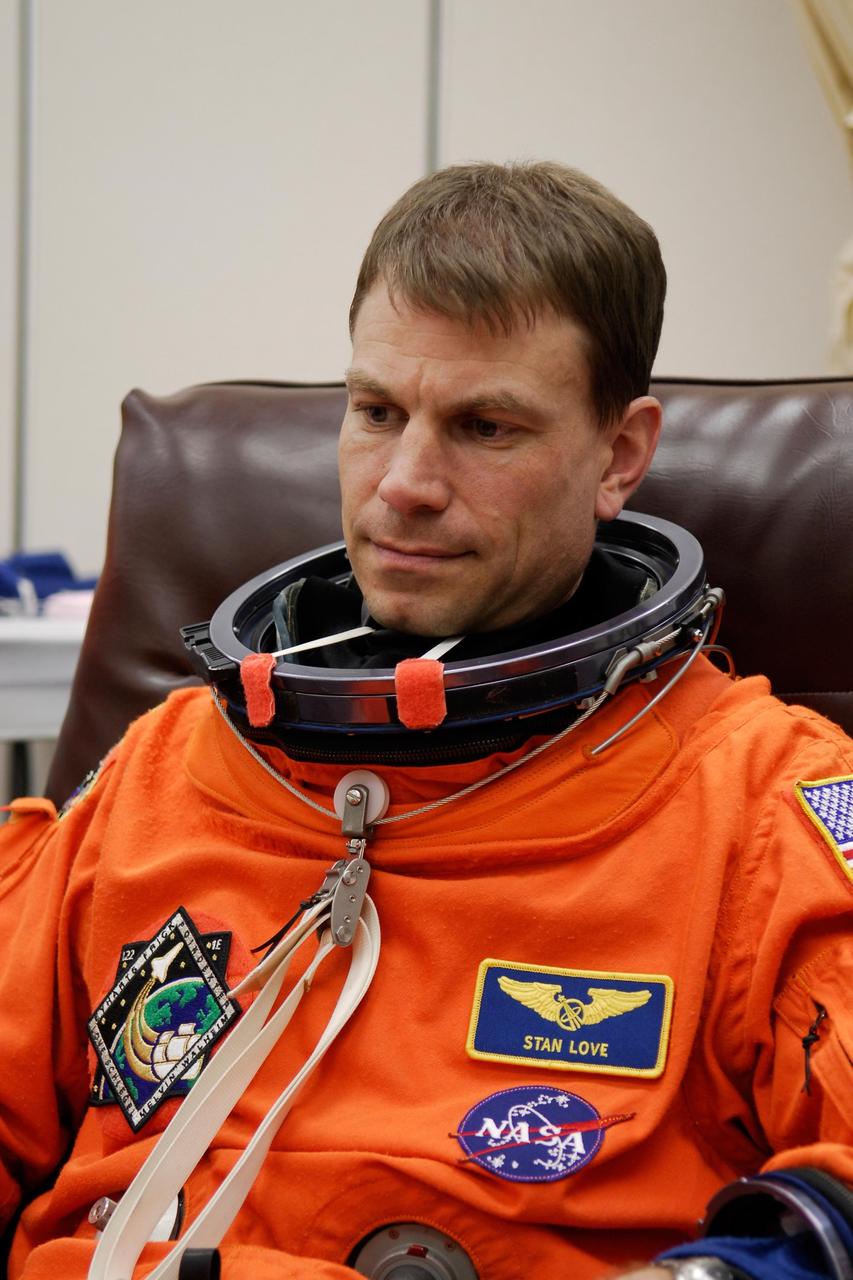
KENNEDY SPACE CENTER, FLA. -- STS-122 Mission Specialist Stanley Love dons his launch and entry suit for a final fitting before space shuttle Atlantis' launch scheduled for 4:31 p.m. EST on Dec. 6. Love will make his first shuttle flight. Atlantis will carry the Columbus Lab, Europe’s largest contribution to the construction of the International Space Station. It will support scientific and technological research in a microgravity environment. Columbus, a program of ESA, is a multifunctional, pressurized laboratory that will be permanently attached to Node 2 of the space station to carry out experiments in materials science, fluid physics and biosciences, as well as to perform a number of technological applications. Photo credit: NASA/Kim Shiflett
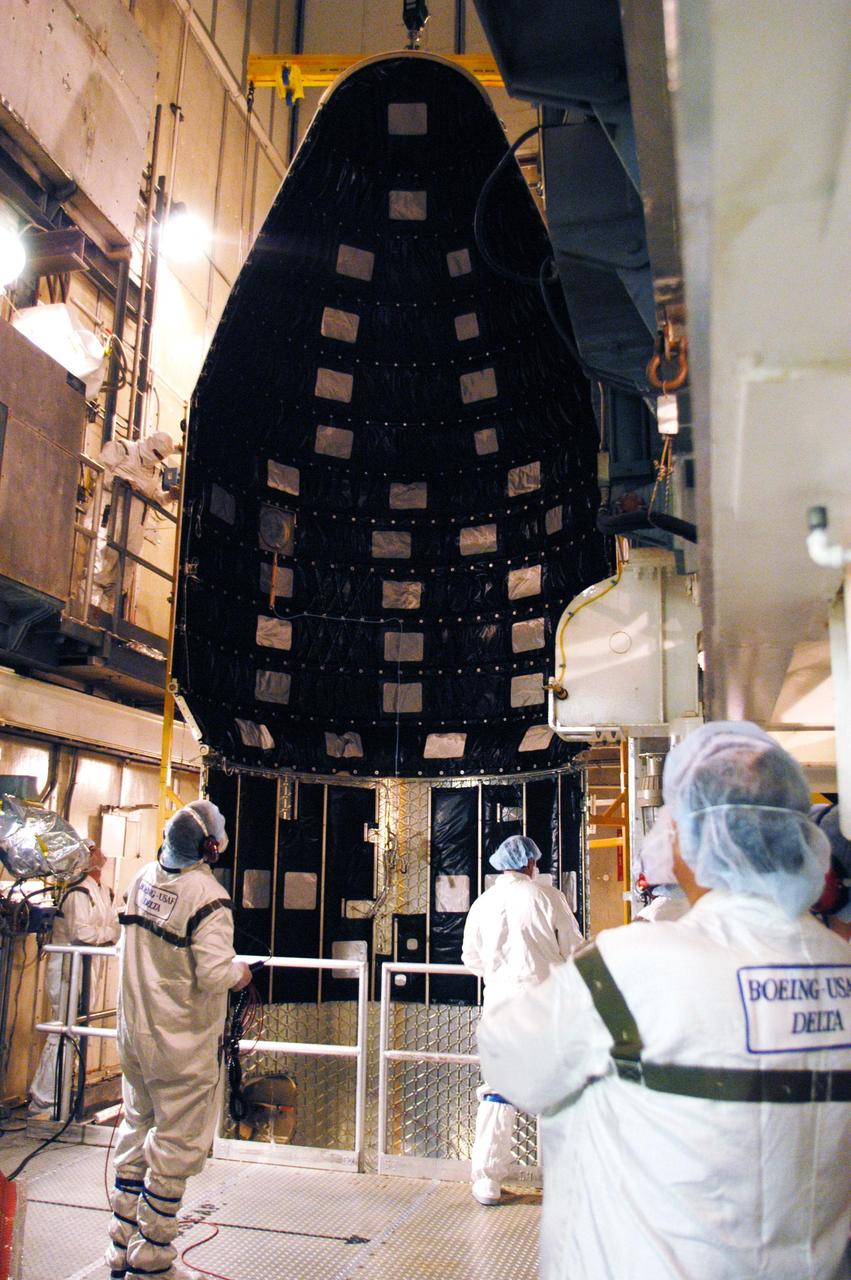
KENNEDY SPACE CENTER, FLA. - On a platform inside the mobile service tower on Launch Pad 17-B at Cape Canaveral Air Force Station, a Boeing worker guides the second half of the fairing as it moves into place around the MESSENGER (Mercury Surface, Space Environment, Geochemistry and Ranging) spacecraft. The fairing is a molded structure that fits flush with the outside surface of the upper stage booster and forms an aerodynamically smooth joint, protecting the spacecraft during launch. MESSENGER is scheduled to launch Aug. 2 aboard a Boeing Delta II rocket and is expected to enter Mercury orbit in March 2011. MESSENGER was built for NASA by the Johns Hopkins University Applied Physics Laboratory in Laurel, Md.
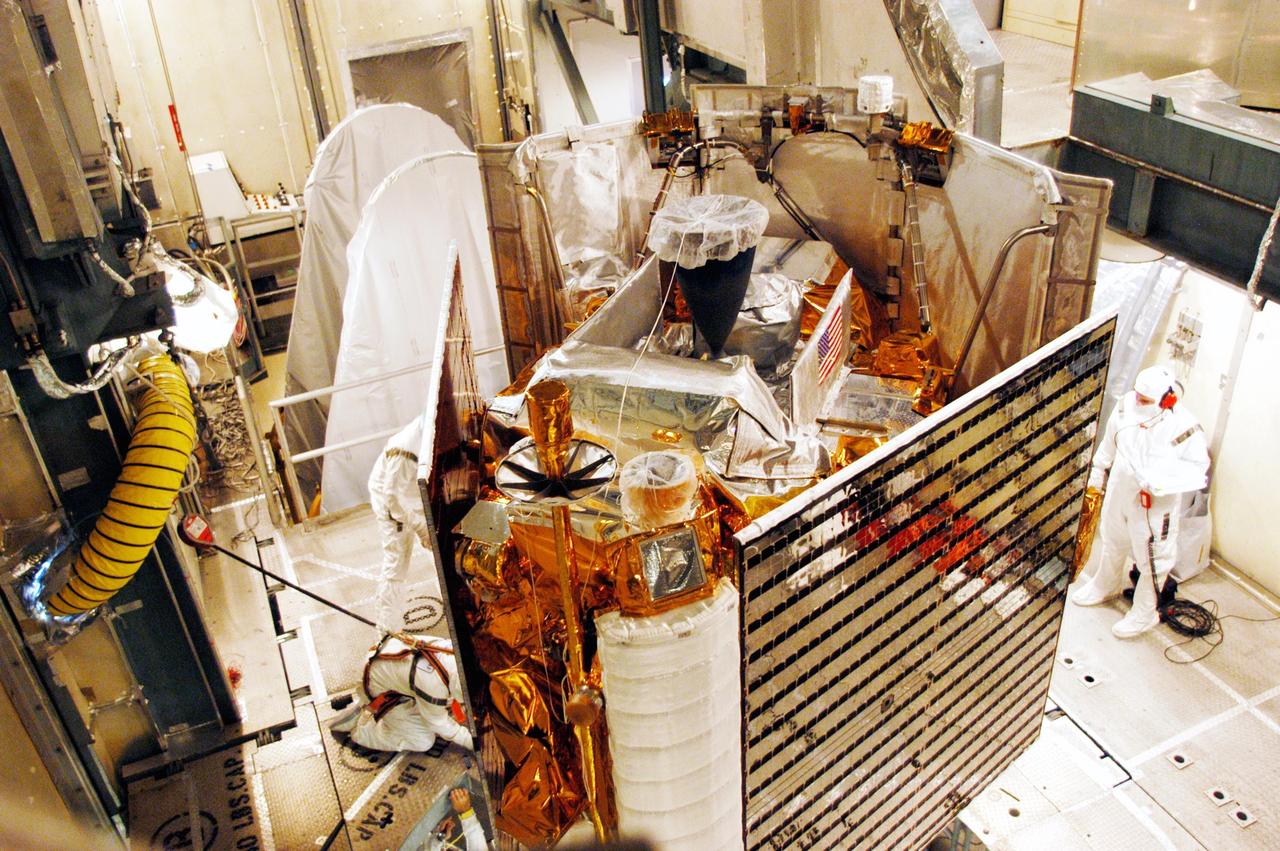
KENNEDY SPACE CENTER, FLA. - On Launch Pad 17-B at Cape Canaveral Air Force Station, the MESSENGER (Mercury Surface, Space Environment, Geochemistry and Ranging) spacecraft is prepared for installation of the fairing, a molded structure that fits flush with the outside surface of the Delta II upper stage booster and forms an aerodynamically smooth joint, protecting the spacecraft during launch. Seen at right is one of the solar panels on the spacecraft. MESSENGER is scheduled to launch Aug. 2 aboard a Boeing Delta II rocket and is expected to enter Mercury orbit in March 2011. MESSENGER was built for NASA by the Johns Hopkins University Applied Physics Laboratory in Laurel, Md.
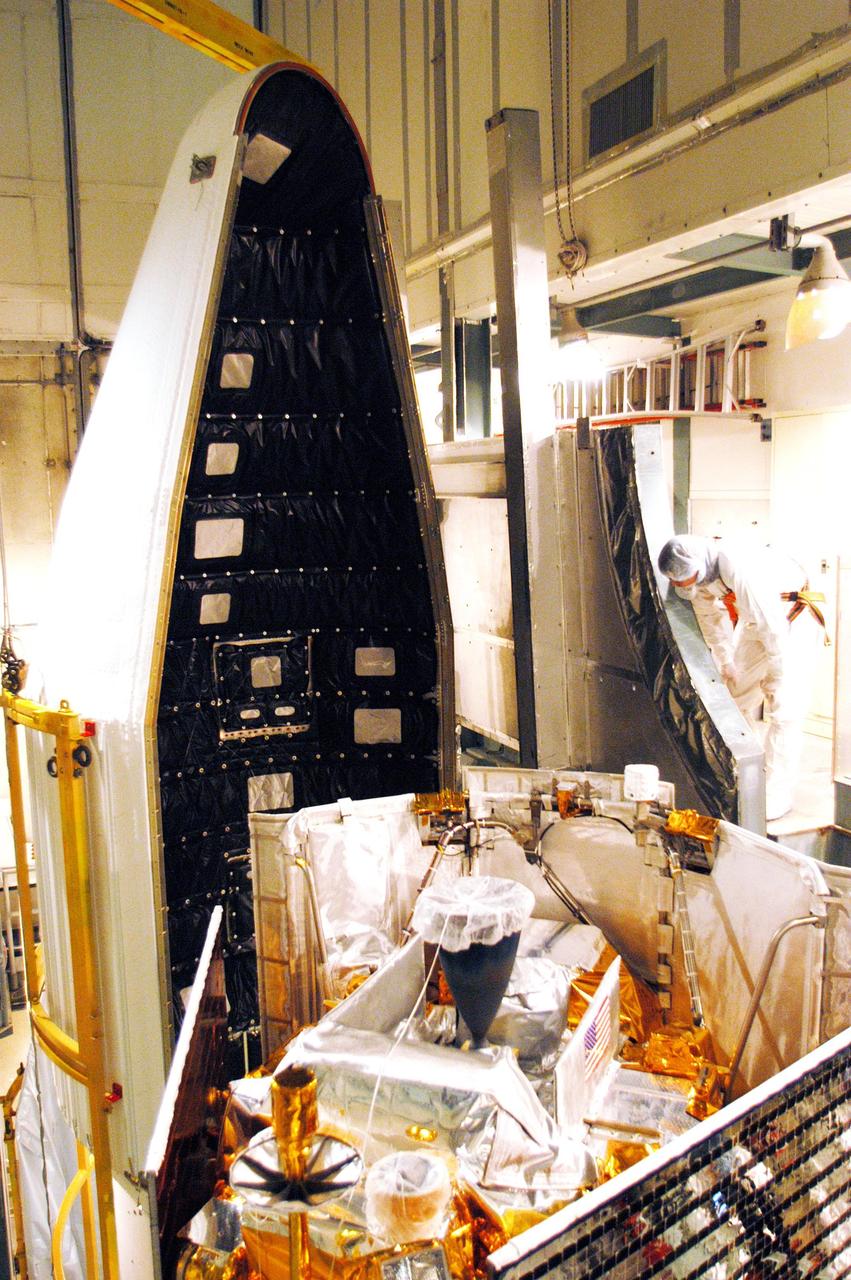
KENNEDY SPACE CENTER, FLA. - On Launch Pad 17-B at Cape Canaveral Air Force Station, the first half of the fairing, at left, is moved into place for installation around the MESSENGER (Mercury Surface, Space Environment, Geochemistry and Ranging) spacecraft. The fairing is a molded structure that fits flush with the outside surface of the upper stage booster and forms an aerodynamically smooth joint, protecting the spacecraft during launch. MESSENGER is scheduled to launch Aug. 2 aboard a Boeing Delta II rocket and is expected to enter Mercury orbit in March 2011. MESSENGER was built for NASA by the Johns Hopkins University Applied Physics Laboratory in Laurel, Md.

CAPE CANAVERAL, Fla. -- TvTechnicians at Astrotech in Titusville, Fla., work on closeouts of the payload attach fitting on NASA's Gamma-Ray Large Area Space Telescope, or GLAST, spacecraft. The GLAST is a powerful space observatory that will explore the Universe's ultimate frontier, where nature harnesses forces and energies far beyond anything possible on Earth; probe some of science's deepest questions, such as what our Universe is made of, and search for new laws of physics; explain how black holes accelerate jets of material to nearly light speed; and help crack the mystery of stupendously powerful explosions known as gamma-ray bursts. A launch date still is to be determined. Photo credit: NASA/Kim Shiflett

CAPE CANAVERAL, Fla. -- Technicians at Astrotech in Titusville, Fla., work on closeouts of the payload attach fitting on NASA's Gamma-Ray Large Area Space Telescope, or GLAST, spacecraft. The GLAST is a powerful space observatory that will explore the Universe's ultimate frontier, where nature harnesses forces and energies far beyond anything possible on Earth; probe some of science's deepest questions, such as what our Universe is made of, and search for new laws of physics; explain how black holes accelerate jets of material to nearly light speed; and help crack the mystery of stupendously powerful explosions known as gamma-ray bursts. A launch date still is to be determined. Photo credit: NASA/Kim Shiflett
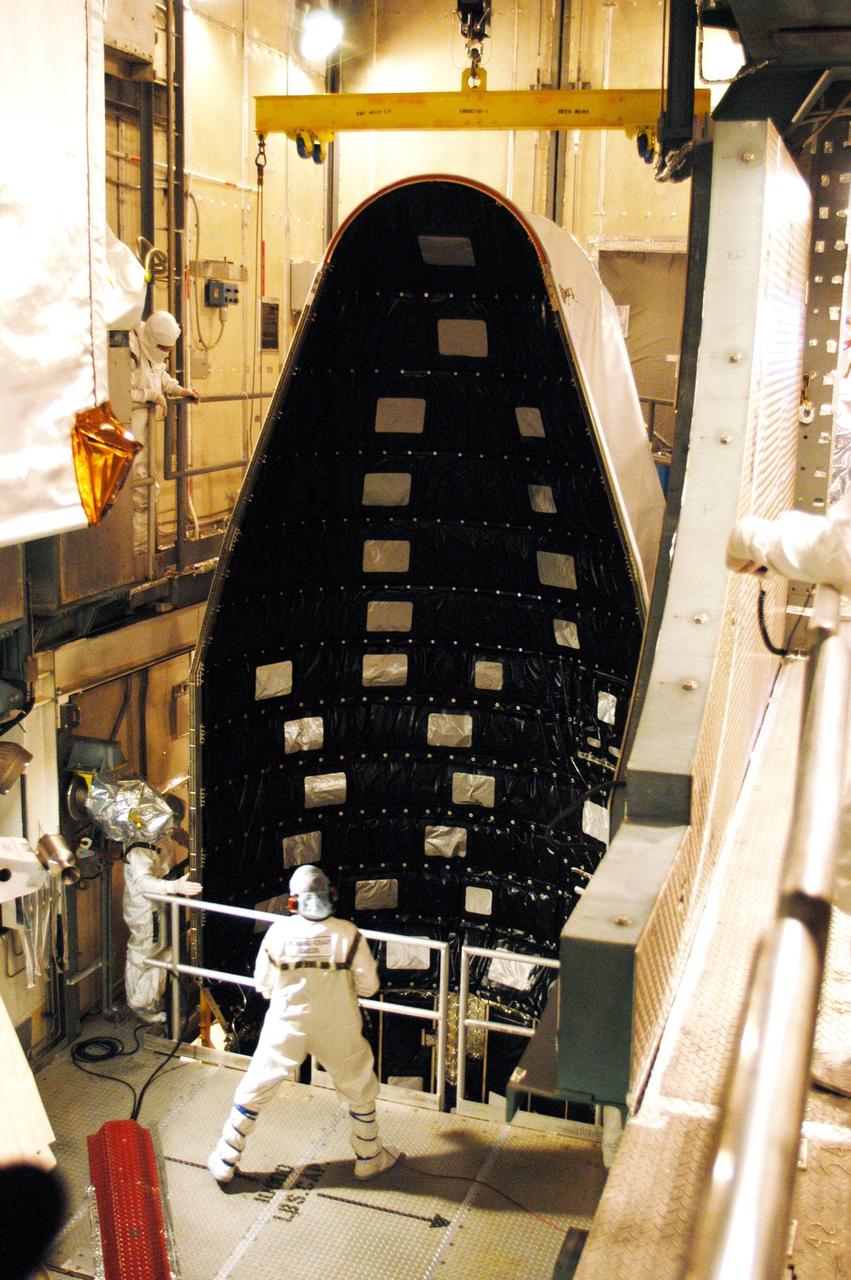
KENNEDY SPACE CENTER, FLA. - On Launch Pad 17-B at Cape Canaveral Air Force Station, part of the fairing for the MESSENGER (Mercury Surface, Space Environment, Geochemistry and Ranging) spacecraft is moved into place for installation. The fairing is a molded structure that fits flush with the outside surface of the upper stage booster and forms an aerodynamically smooth joint, protecting the spacecraft during launch. MESSENGER is scheduled to launch Aug. 2 aboard a Boeing Delta II rocket and is expected to enter Mercury orbit in March 2011. MESSENGER was built for NASA by the Johns Hopkins University Applied Physics Laboratory in Laurel, Md.
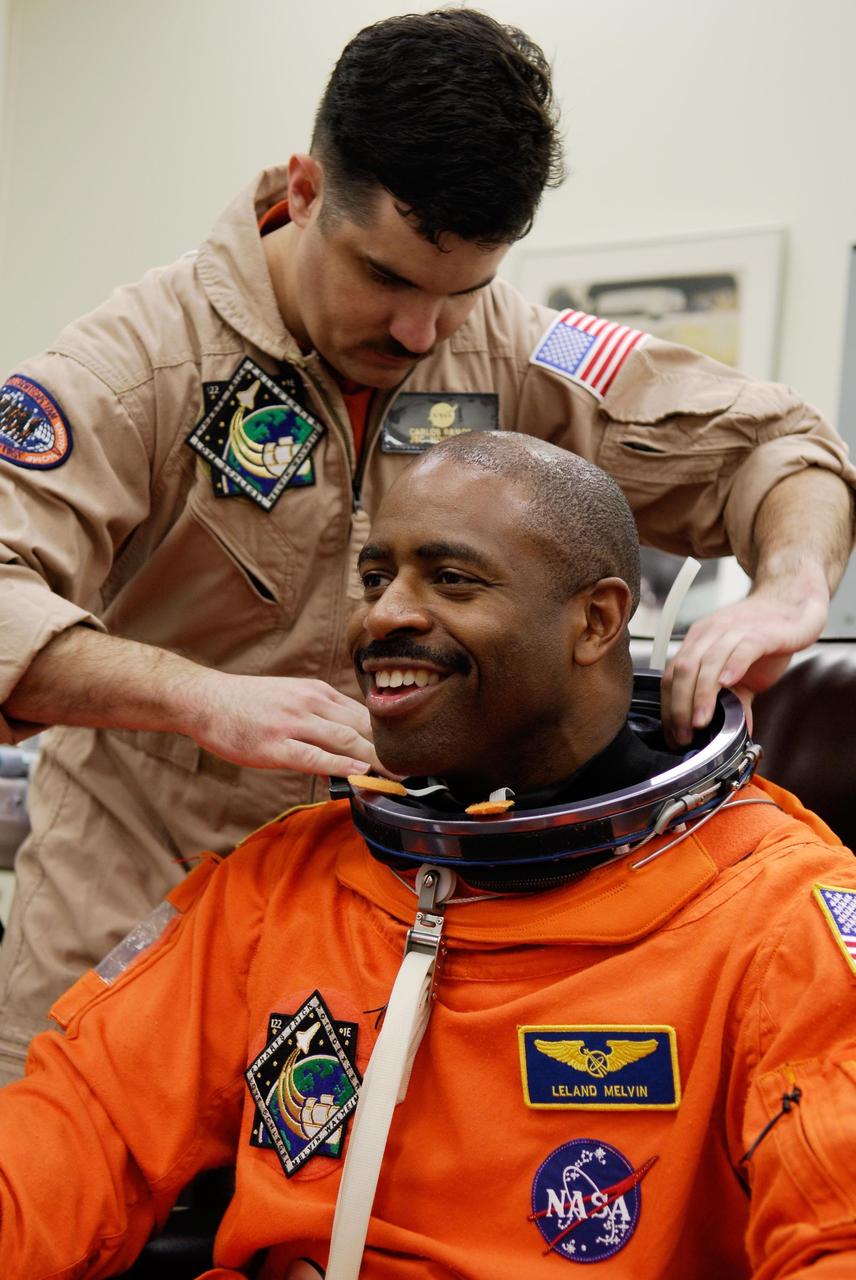
KENNEDY SPACE CENTER, FLA. -- STS-122 Mission Specialist Leland Melvin dons his launch and entry suit for a final fitting before space shuttle Atlantis' launch scheduled for 4:31 p.m. EST on Dec. 6. Melvin will make his first shuttle flight. Atlantis will carry the Columbus Lab, Europe’s largest contribution to the construction of the International Space Station. It will support scientific and technological research in a microgravity environment. Columbus, a program of ESA, is a multifunctional, pressurized laboratory that will be permanently attached to Node 2 of the space station to carry out experiments in materials science, fluid physics and biosciences, as well as to perform a number of technological applications. Photo credit: NASA/Kim Shiflett

KENNEDY SPACE CENTER, FLA. -- STS-122 Mission Specialist Rex Walheim checks the helmet to his launch and entry suit for a final fitting before space shuttle Atlantis' launch scheduled for 4:31 p.m. EST on Dec. 6. Walheim will make his second shuttle flight. Atlantis will carry the Columbus Lab, Europe’s largest contribution to the construction of the International Space Station. It will support scientific and technological research in a microgravity environment. Columbus, a program of ESA, is a multifunctional, pressurized laboratory that will be permanently attached to Node 2 of the space station to carry out experiments in materials science, fluid physics and biosciences, as well as to perform a number of technological applications. Photo credit: NASA/Kim Shiflett
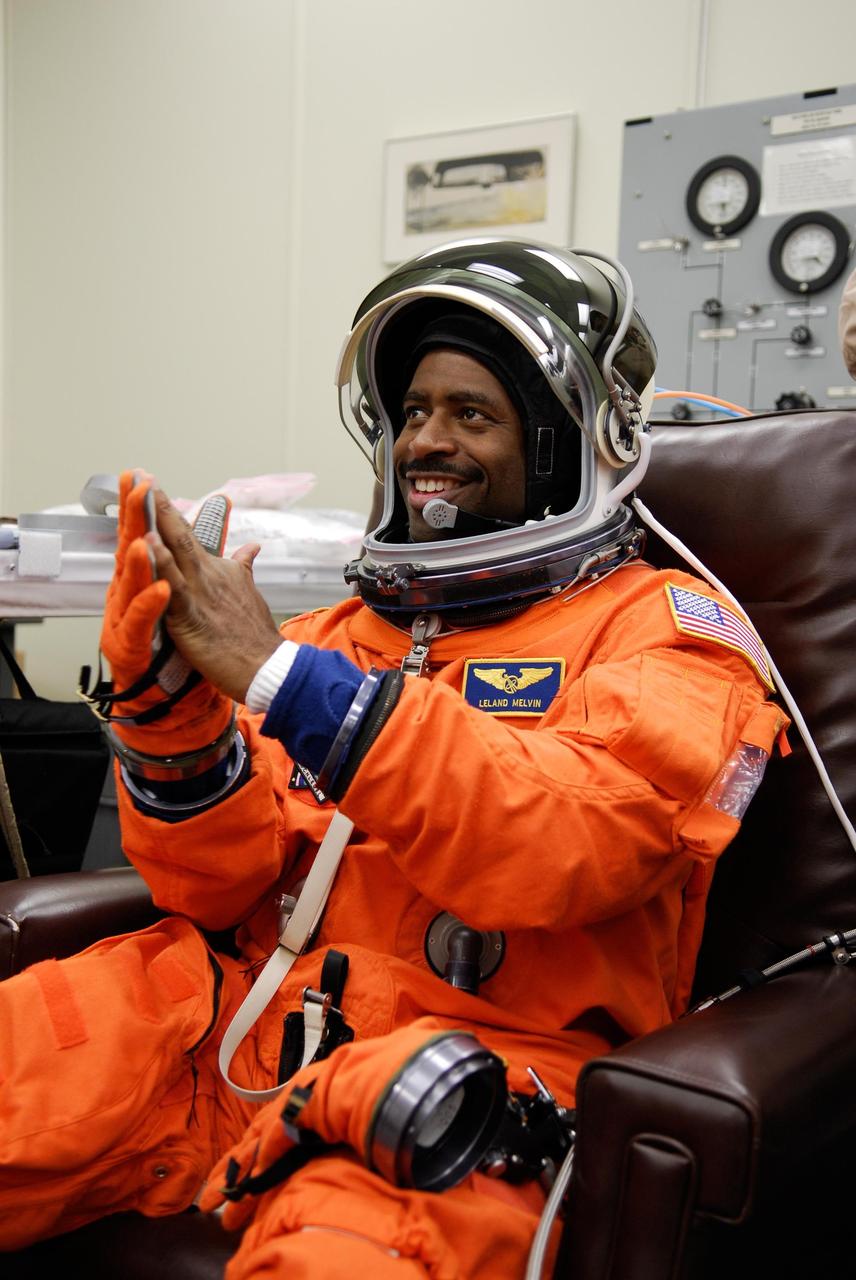
KENNEDY SPACE CENTER, FLA. -- STS-122 Mission Specialist Leland Melvin tests his gloves for a final fitting before space shuttle Atlantis' launch scheduled for 4:31 p.m. EST on Dec. 6. Melvin will make his first shuttle flight. Atlantis will carry the Columbus Lab, Europe’s largest contribution to the construction of the International Space Station. It will support scientific and technological research in a microgravity environment. Columbus, a program of ESA, is a multifunctional, pressurized laboratory that will be permanently attached to Node 2 of the space station to carry out experiments in materials science, fluid physics and biosciences, as well as to perform a number of technological applications. Photo credit: NASA/Kim Shiflett
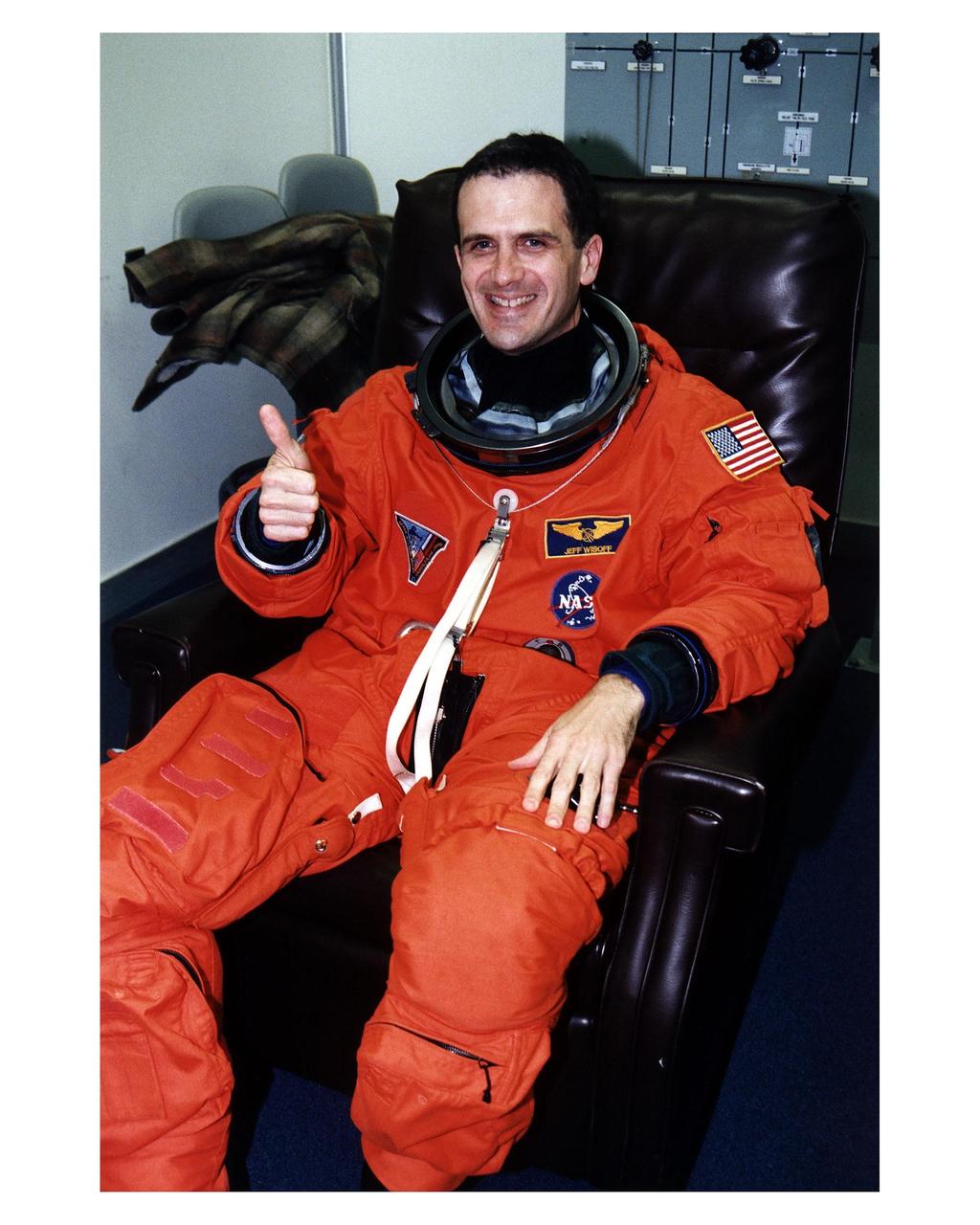
STS-81 Mission Specialist Peter J. K. "Jeff" Wisoff prepares for the fifth ShuttleMir docking as he waits in the Operations and Checkout (O&C) Building for the operation to fit him into his launch/entry suit to be completed. He conducted a spacewalk on his on his first Shuttle mission, STS57 and holds a doctorate degree in applied physics with an emphasis on lasers and semiconductor materials. He and five crew members will shortly depart the O&C and head for Launch Pad 39B, where the Space Shuttle Atlantis will lift off during a 7-minute window that opens at 4:27 a.m. EST, January 12
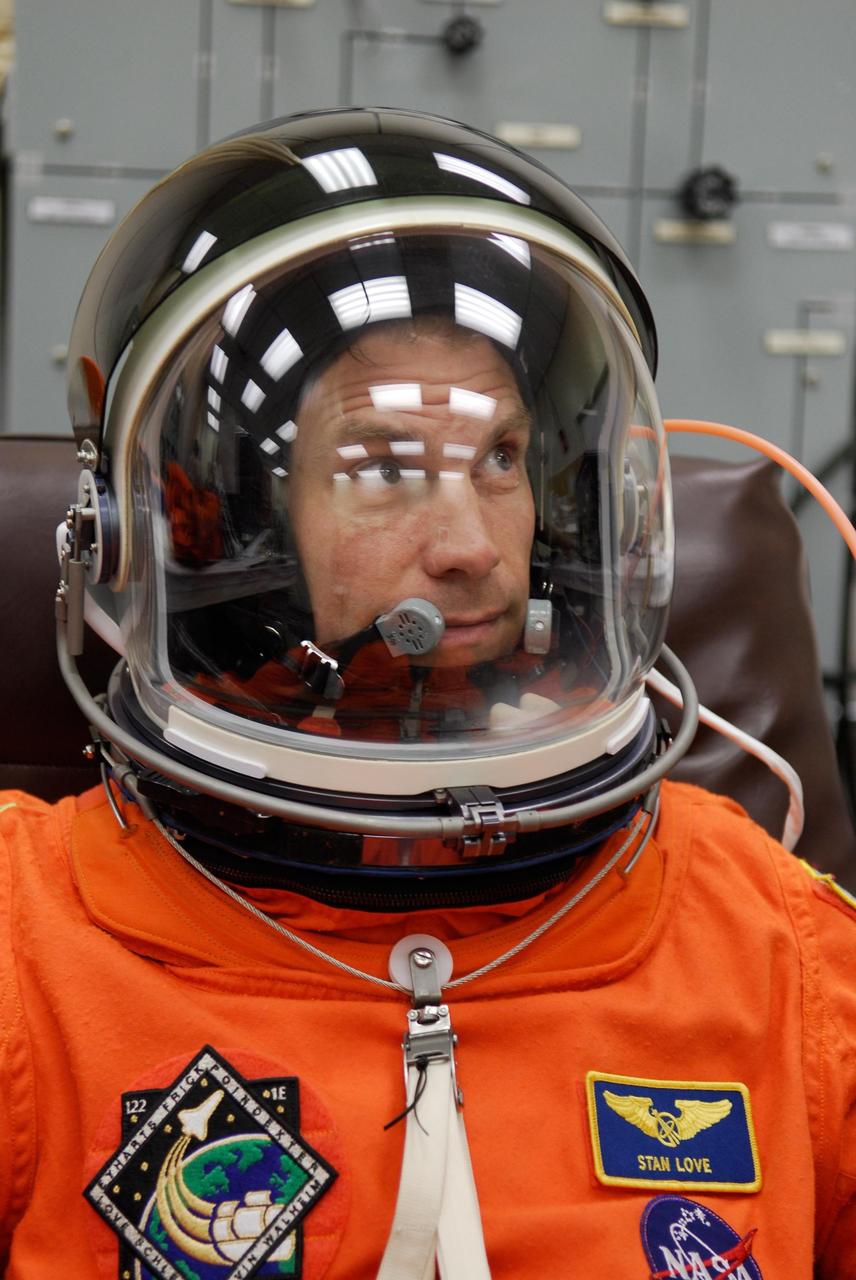
KENNEDY SPACE CENTER, FLA. -- STS-122 Mission Specialist Stanley Love checks the fit of his helmet for his launch and entry suit before space shuttle Atlantis' launch scheduled for 4:31 p.m. EST on Dec. 6. Love will make his first shuttle flight. Atlantis will carry the Columbus Lab, Europe’s largest contribution to the construction of the International Space Station. It will support scientific and technological research in a microgravity environment. Columbus, a program of ESA, is a multifunctional, pressurized laboratory that will be permanently attached to Node 2 of the space station to carry out experiments in materials science, fluid physics and biosciences, as well as to perform a number of technological applications. Photo credit: NASA/Kim Shiflett
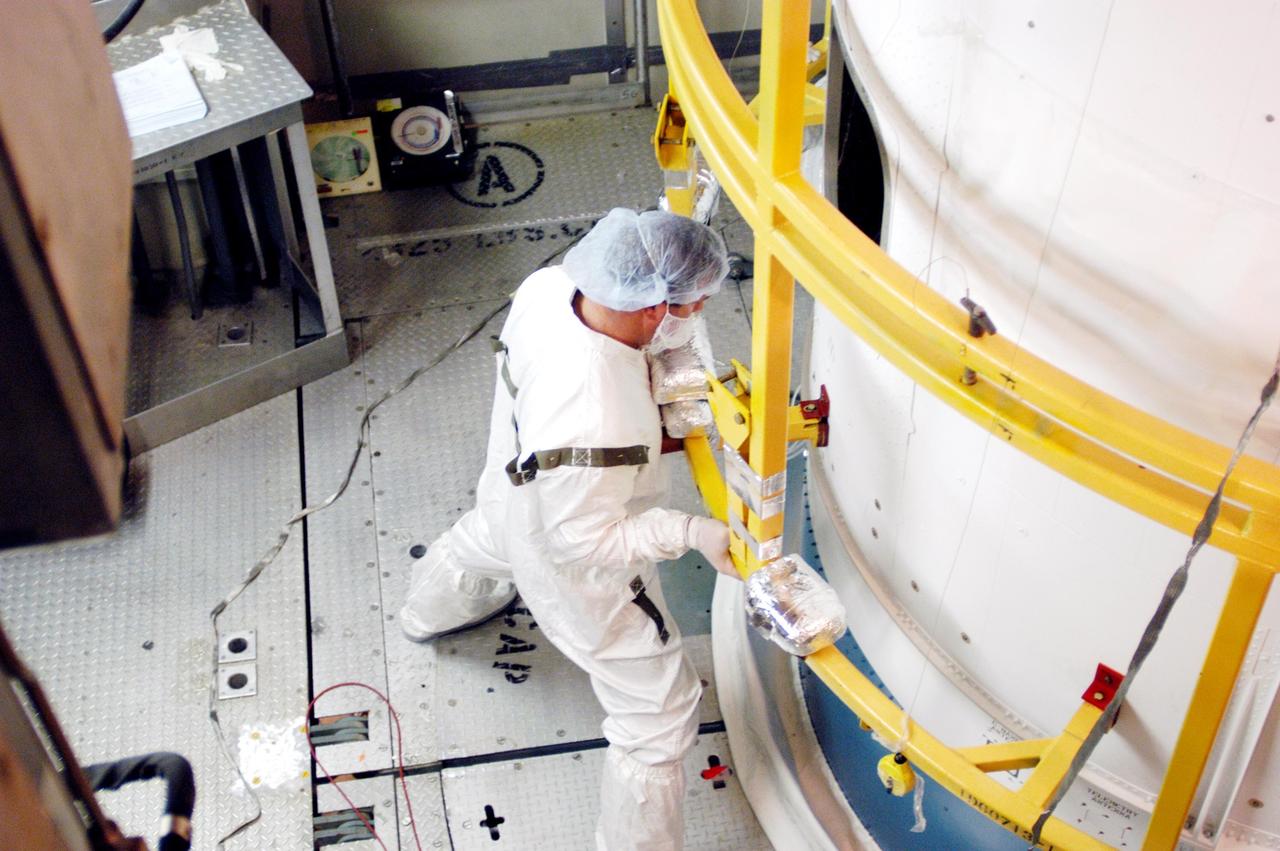
KENNEDY SPACE CENTER, FLA. - On Launch Pad 17-B at Cape Canaveral Air Force Station, Boeing workers secure the first half of the fairing installed around the MESSENGER (Mercury Surface, Space Environment, Geochemistry and Ranging) spacecraft. The fairing is a molded structure that fits flush with the outside surface of the upper stage booster and forms an aerodynamically smooth joint, protecting the spacecraft during launch. MESSENGER is scheduled to launch Aug. 2 aboard a Boeing Delta II rocket and is expected to enter Mercury orbit in March 2011. MESSENGER was built for NASA by the Johns Hopkins University Applied Physics Laboratory in Laurel, Md.
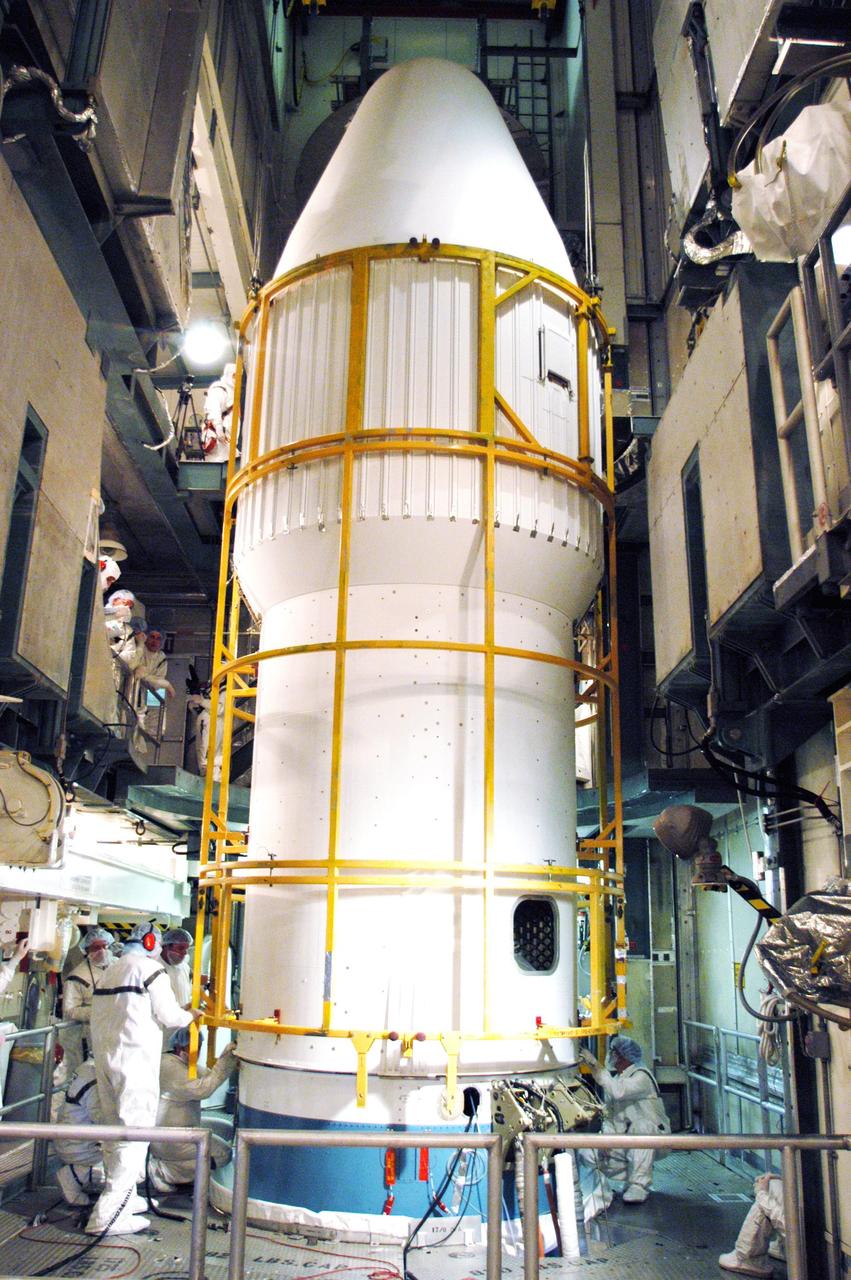
KENNEDY SPACE CENTER, FLA. - On Launch Pad 17-B at Cape Canaveral Air Force Station, Boeing workers complete the installation of the fairing around the MESSENGER (Mercury Surface, Space Environment, Geochemistry and Ranging) spacecraft. The fairing is a molded structure that fits flush with the outside surface of the upper stage booster and forms an aerodynamically smooth joint, protecting the spacecraft during launch. MESSENGER is scheduled to launch Aug. 2 aboard a Boeing Delta II rocket and is expected to enter Mercury orbit in March 2011. MESSENGER was built for NASA by the Johns Hopkins University Applied Physics Laboratory in Laurel, Md.
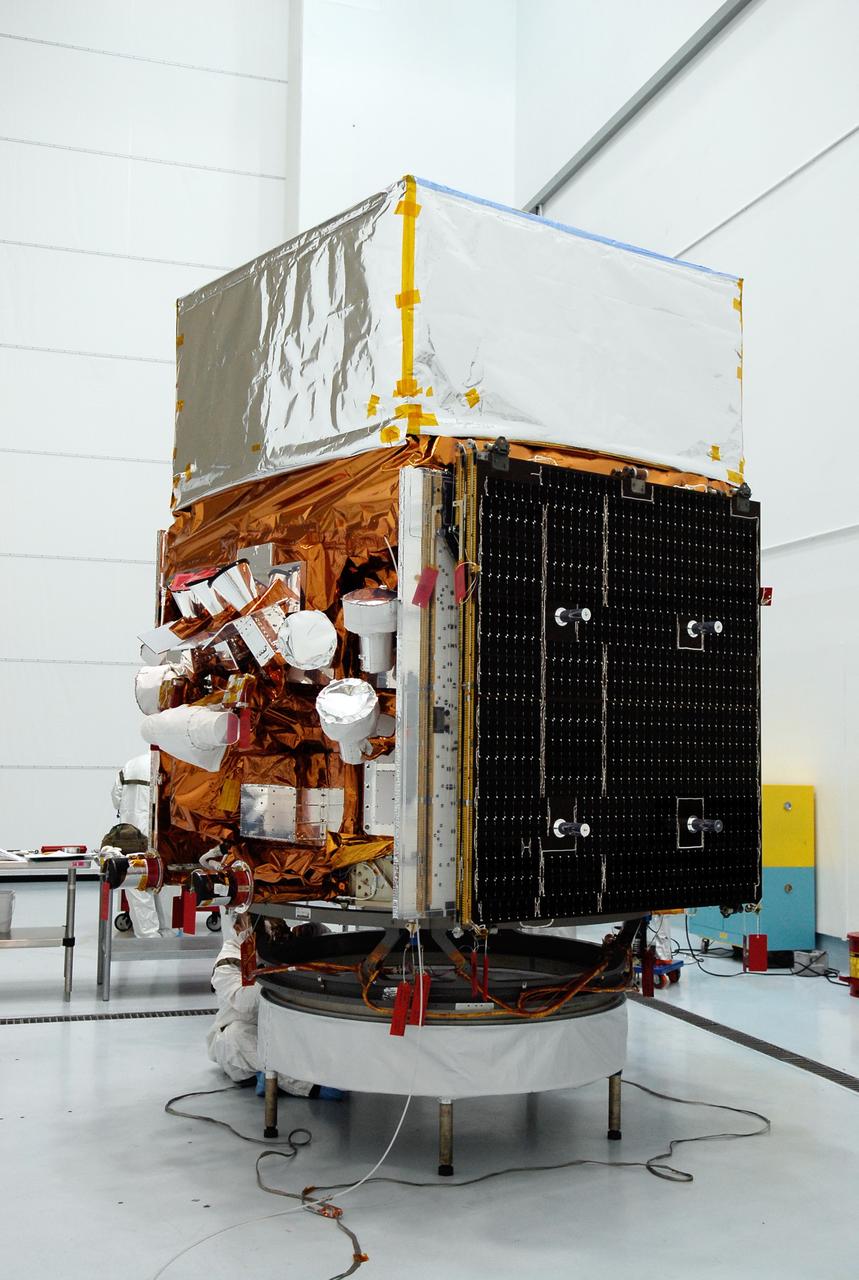
CAPE CANAVERAL, Fla. -- Technicians at Astrotech in Titusville, Fla., work on closeouts of the payload attach fitting on NASA's Gamma-Ray Large Area Space Telescope, or GLAST, spacecraft. The GLAST is a powerful space observatory that will explore the Universe's ultimate frontier, where nature harnesses forces and energies far beyond anything possible on Earth; probe some of science's deepest questions, such as what our Universe is made of, and search for new laws of physics; explain how black holes accelerate jets of material to nearly light speed; and help crack the mystery of stupendously powerful explosions known as gamma-ray bursts. A launch date still is to be determined. Photo credit: NASA/Kim Shiflett
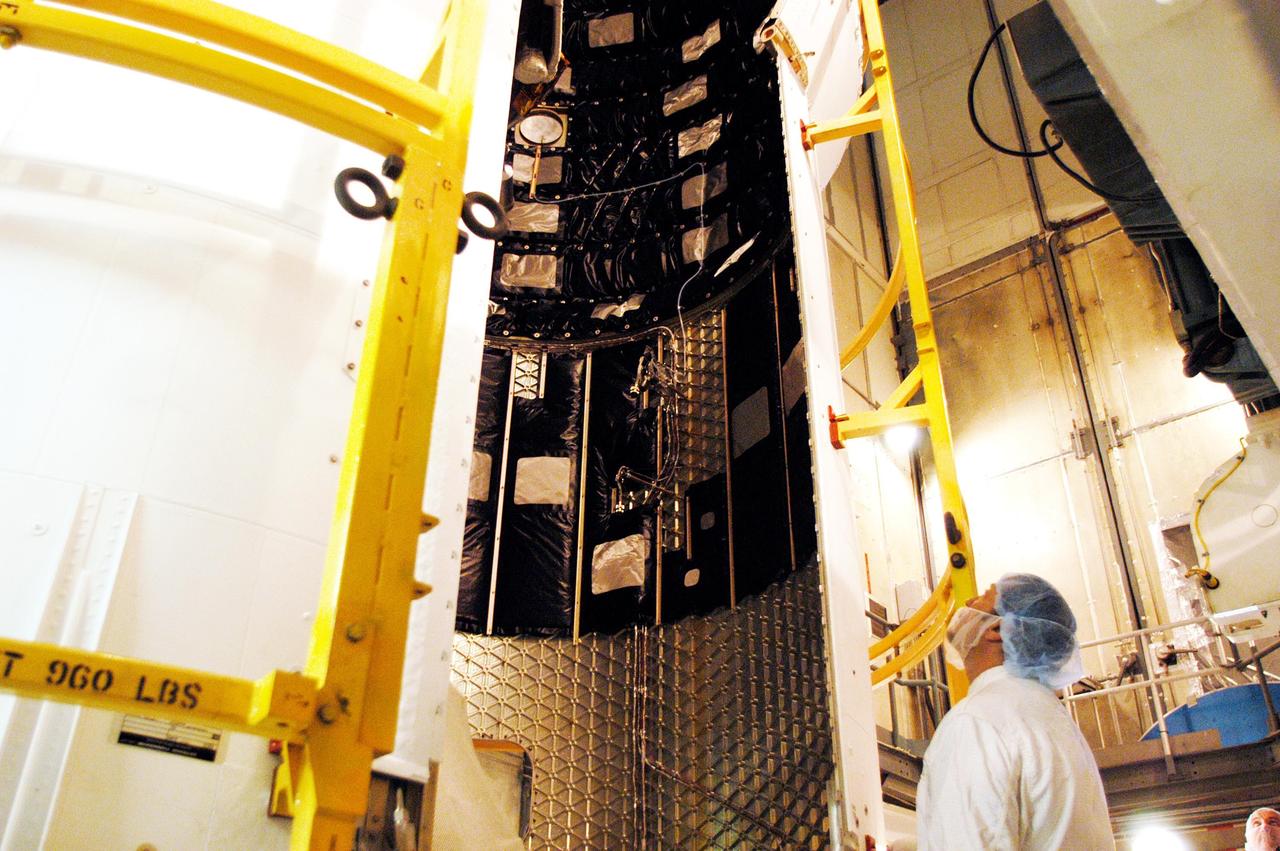
KENNEDY SPACE CENTER, FLA. - On Launch Pad 17-B at Cape Canaveral Air Force Station, a Boeing worker observes the second half of the fairing as it moves into place around the MESSENGER (Mercury Surface, Space Environment, Geochemistry and Ranging) spacecraft. The fairing is a molded structure that fits flush with the outside surface of the upper stage booster and forms an aerodynamically smooth joint, protecting the spacecraft during launch. MESSENGER is scheduled to launch Aug. 2 aboard a Boeing Delta II rocket and is expected to enter Mercury orbit in March 2011. MESSENGER was built for NASA by the Johns Hopkins University Applied Physics Laboratory in Laurel, Md.
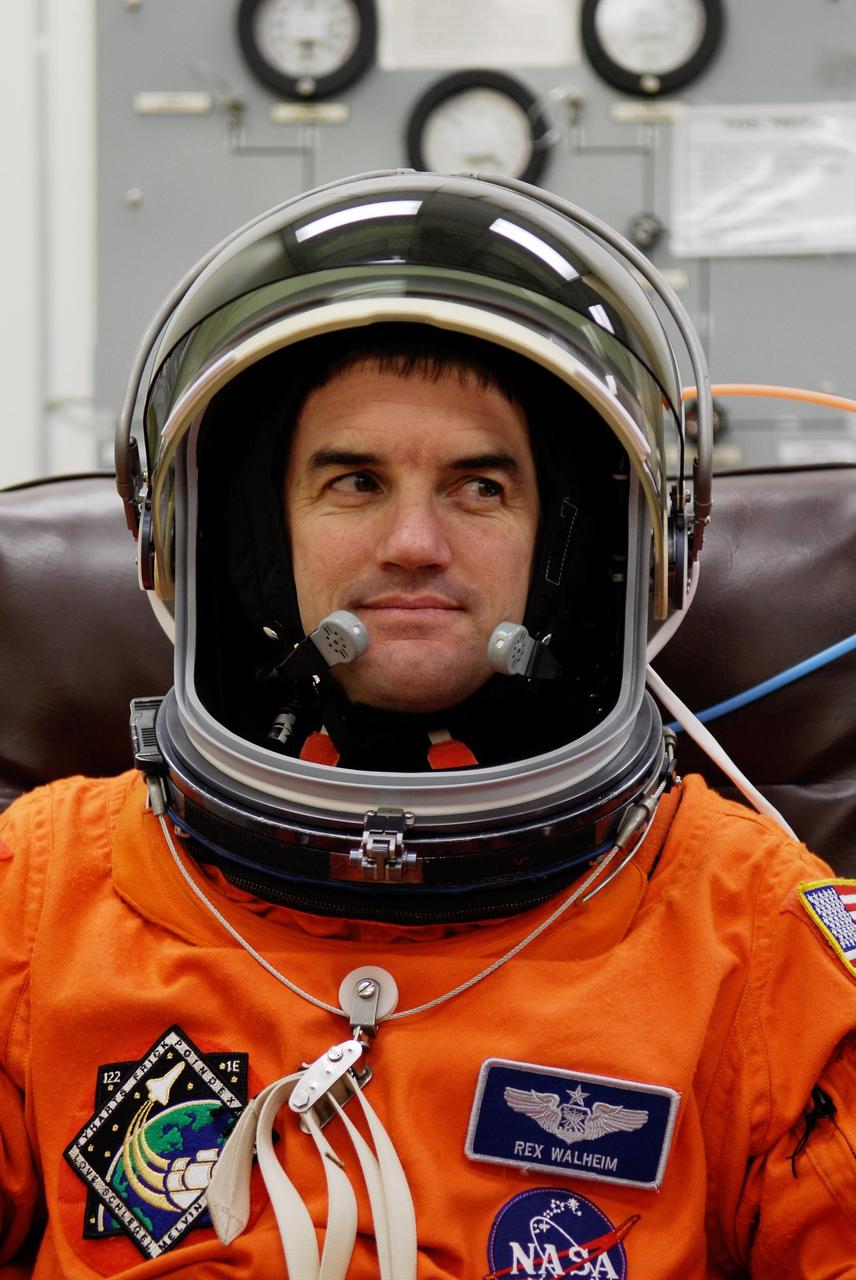
KENNEDY SPACE CENTER, FLA. -- STS-122 Mission Specialist Rex Walheim checks the helmet to his launch and entry suit for a final fitting before space shuttle Atlantis' launch scheduled for 4:31 p.m. EST on Dec. 6. Walheim will make his second shuttle flight. Atlantis will carry the Columbus Lab, Europe’s largest contribution to the construction of the International Space Station. It will support scientific and technological research in a microgravity environment. Columbus, a program of ESA, is a multifunctional, pressurized laboratory that will be permanently attached to Node 2 of the space station to carry out experiments in materials science, fluid physics and biosciences, as well as to perform a number of technological applications. Photo credit: NASA/Kim Shiflett

CAPE CANAVERAL, Fla. – Workers take an early morning walk along the Pathfinder Trail near the Operations and Support Building II at Kennedy Space Center in Florida, to officially kick off National Employee Health and Fitness Month with the NASA Moves! challenge. NASA Moves! challenged the workforce from each of the agency's field centers to engage in at least 20 minutes of activity, or 10,000 steps, each day from May 18-31. About 100 people participated in the kickoff event on the Pathfinder Trail in the heart of the center's Launch Complex 39. The one-third-mile-long gravel walkway traces the iconic shape of a space shuttle orbiter and features a set of exercise stations. The friendly contest is part of NASA's new Health4Life initiative, a Web-based health initiative designed to help employees track their health, fitness and nutrition. Health4Life also provides an array of resources geared toward increasing physical activity. Photo credit: NASA/Dimitri Gerondidakis
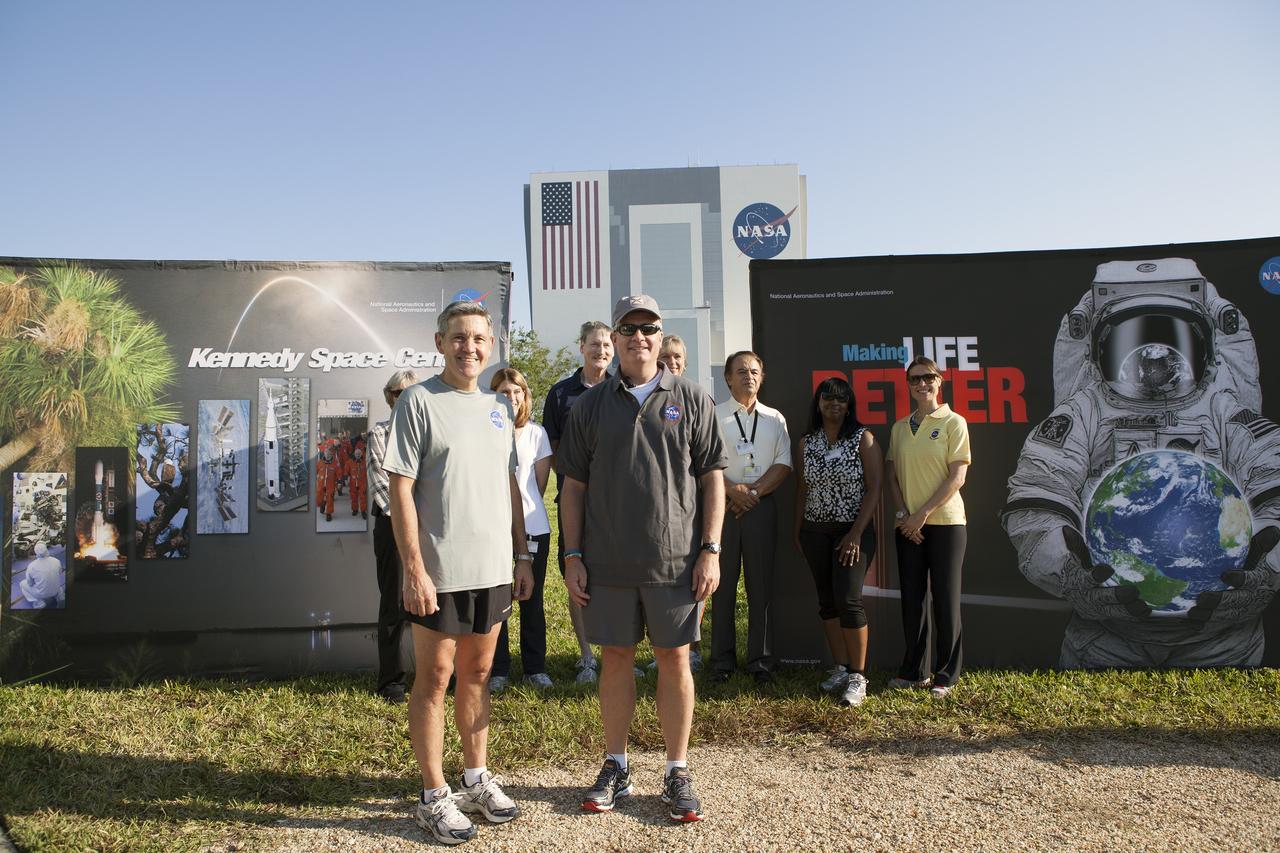
CAPE CANAVERAL, Fla. – Kennedy Space Center Director Bob Cabana, left, and Florida State Surgeon General John Armstrong complete an early morning run along the center's Pathfinder Trail near the Operations and Support Building II at Kennedy Space Center in Florida, to officially kick off National Employee Health and Fitness Month with the NASA Moves! challenge. NASA Moves! challenged the workforce from each of the agency's field centers to engage in at least 20 minutes of activity, or 10,000 steps, each day from May 18-31. About 100 people participated in the kickoff event on the Pathfinder Trail in the heart of the center's Launch Complex 39. The one-third-mile-long gravel walkway traces the iconic shape of a space shuttle orbiter and features a set of exercise stations. The friendly contest is part of NASA's new Health4Life initiative, a Web-based health initiative designed to help employees track their health, fitness and nutrition. Health4Life also provides an array of resources geared toward increasing physical activity. Photo credit: NASA/Dimitri Gerondidakis
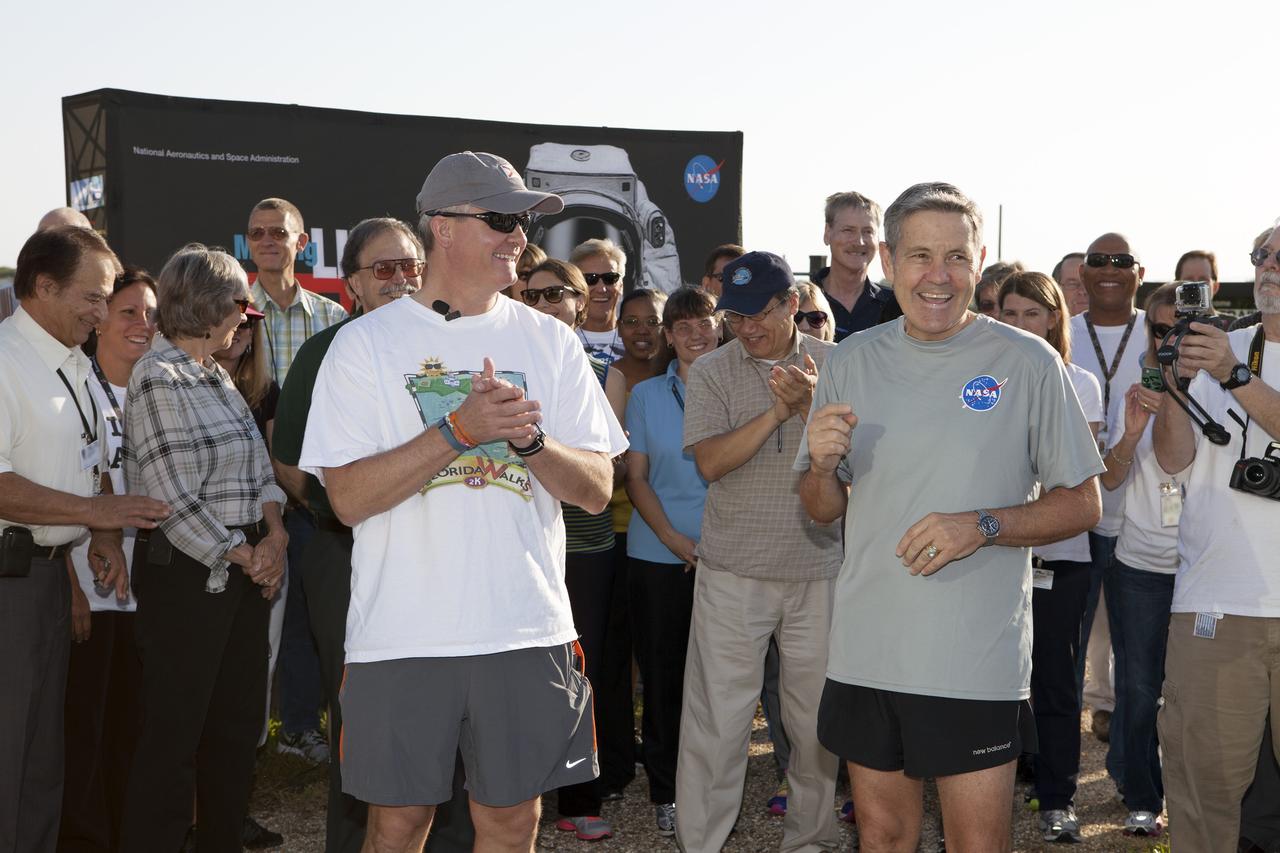
CAPE CANAVERAL, Fla. – Kennedy Space Center Director Bob Cabana, right, Florida State Surgeon General John Armstrong and other guests prepare for an early morning run at the center's Pathfinder Trail near the Operations and Support Building II at Kennedy Space Center in Florida, to officially kick off National Employee Health and Fitness Month with the NASA Moves! challenge. NASA Moves! challenged the workforce from each of the agency's field centers to engage in at least 20 minutes of activity, or 10,000 steps, each day from May 18-31. About 100 people participated in the kickoff event on the Pathfinder Trail in the heart of the center's Launch Complex 39. The one-third-mile-long gravel walkway traces the iconic shape of a space shuttle orbiter and features a set of exercise stations. The friendly contest is part of NASA's new Health4Life initiative, a Web-based health initiative designed to help employees track their health, fitness and nutrition. Health4Life also provides an array of resources geared toward increasing physical activity. Photo credit: NASA/Dimitri Gerondidakis
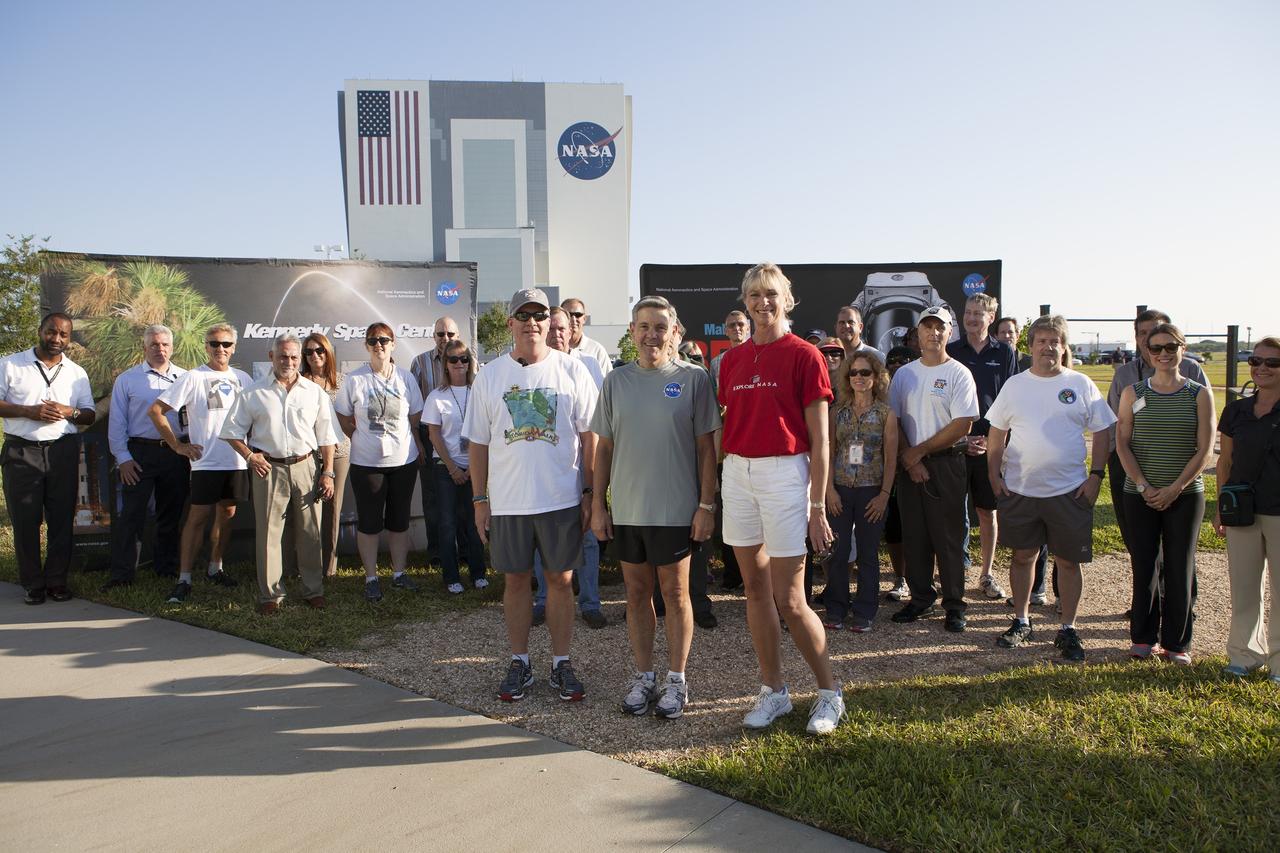
CAPE CANAVERAL, Fla. – From left, Florida State Surgeon General John Armstrong, Kennedy Space Center Director Bob Cabana, Center Operations Director Nancy Bray and Kennedy workers and guests prepare to take an early morning run along the center's Pathfinder Trail near the Operations and Support Building II at Kennedy Space Center in Florida, to officially kick off National Employee Health and Fitness Month with the NASA Moves! challenge. NASA Moves! challenged the workforce from each of the agency's field centers to engage in at least 20 minutes of activity, or 10,000 steps, each day from May 18-31. About 100 people participated in the kickoff event on the Pathfinder Trail in the heart of the center's Launch Complex 39. The one-third-mile-long gravel walkway traces the iconic shape of a space shuttle orbiter and features a set of exercise stations. The friendly contest is part of NASA's new Health4Life initiative, a Web-based health initiative designed to help employees track their health, fitness and nutrition. Health4Life also provides an array of resources geared toward increasing physical activity. Photo credit: NASA/Dimitri Gerondidakis

CAPE CANAVERAL, Fla. – Nancy Bray, right, Center Operations director at Kennedy Space Center, and Lori Hicks, Human Resources, take an early morning walk along the center's Pathfinder Trail near the Operations and Support Building II at Kennedy Space Center in Florida, to officially kick off National Employee Health and Fitness Month with the NASA Moves! challenge. NASA Moves! challenged the workforce from each of the agency's field centers to engage in at least 20 minutes of activity, or 10,000 steps, each day from May 18-31. About 100 people participated in the kickoff event on the Pathfinder Trail in the heart of the center's Launch Complex 39. The one-third-mile-long gravel walkway traces the iconic shape of a space shuttle orbiter and features a set of exercise stations. The friendly contest is part of NASA's new Health4Life initiative, a Web-based health initiative designed to help employees track their health, fitness and nutrition. Health4Life also provides an array of resources geared toward increasing physical activity. Photo credit: NASA/Dimitri Gerondidakis
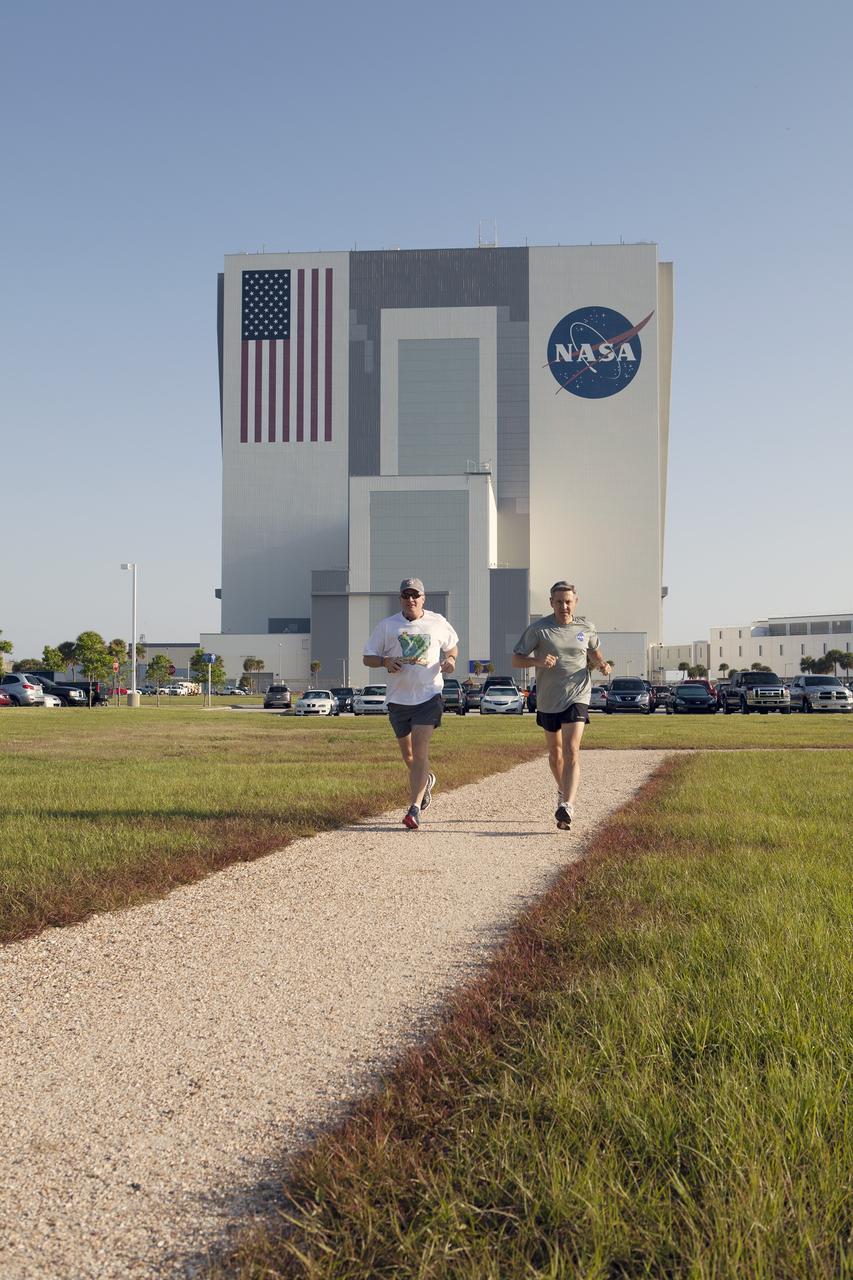
CAPE CANAVERAL, Fla. – Kennedy Space Center Director Bob Cabana, right, and Florida State Surgeon General John Armstrong begin an early morning run along the center's Pathfinder Trail near the Operations and Support Building II at Kennedy Space Center in Florida, to officially kick off National Employee Health and Fitness Month with the NASA Moves! challenge. NASA Moves! challenged the workforce from each of the agency's field centers to engage in at least 20 minutes of activity, or 10,000 steps, each day from May 18-31. About 100 people participated in the kickoff event on the Pathfinder Trail in the heart of the center's Launch Complex 39. The one-third-mile-long gravel walkway traces the iconic shape of a space shuttle orbiter and features a set of exercise stations. The friendly contest is part of NASA's new Health4Life initiative, a Web-based health initiative designed to help employees track their health, fitness and nutrition. Health4Life also provides an array of resources geared toward increasing physical activity. Photo credit: NASA/Dimitri Gerondidakis
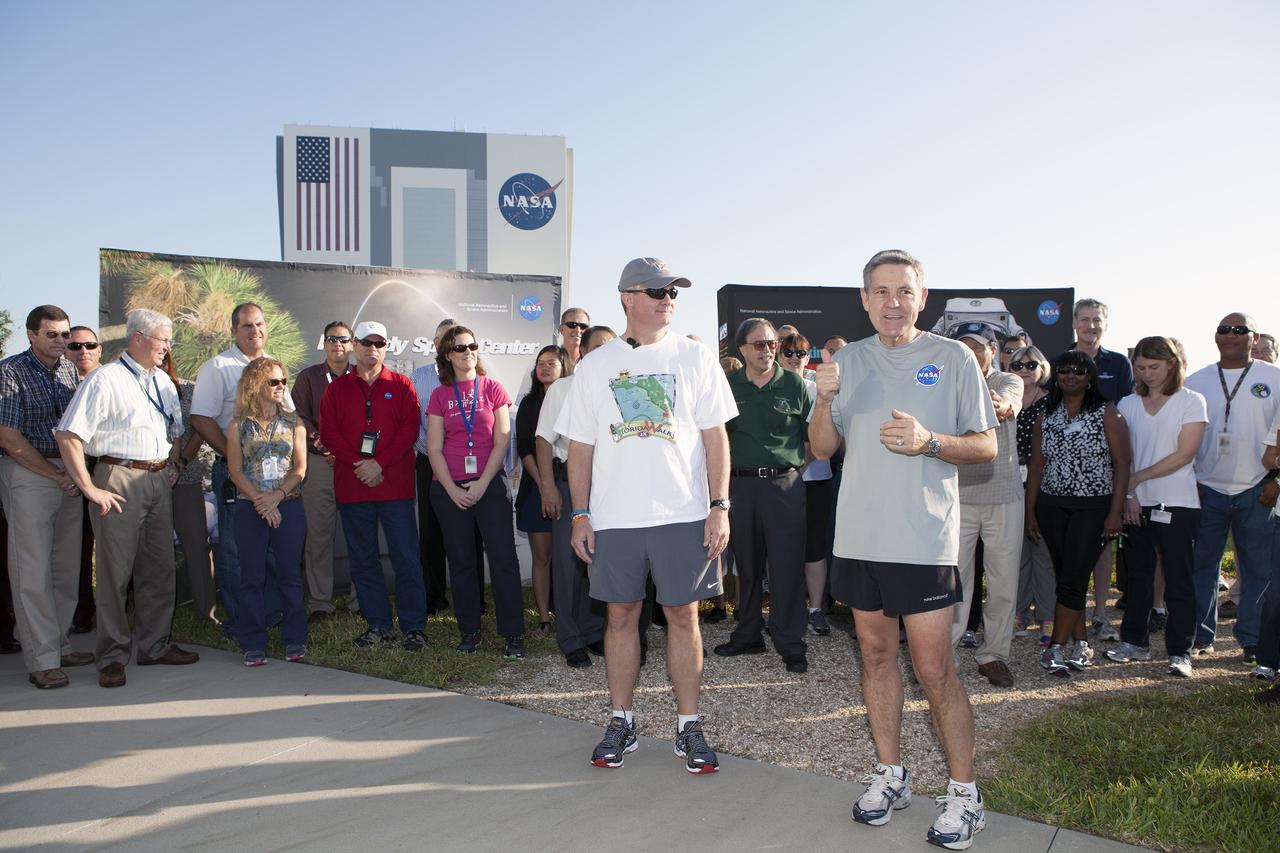
CAPE CANAVERAL, Fla. – Kennedy Space Center Director Bob Cabana, right, Florida State Surgeon General John Armstrong, other Kennedy managers and guests prepare for an early morning run at the center's Pathfinder Trail near the Operations and Support Building II at Kennedy Space Center in Florida, to officially kick off National Employee Health and Fitness Month with the NASA Moves! challenge. NASA Moves! challenged the workforce from each of the agency's field centers to engage in at least 20 minutes of activity, or 10,000 steps, each day from May 18-31. About 100 people participated in the kickoff event on the Pathfinder Trail in the heart of the center's Launch Complex 39. The one-third-mile-long gravel walkway traces the iconic shape of a space shuttle orbiter and features a set of exercise stations. The friendly contest is part of NASA's new Health4Life initiative, a Web-based health initiative designed to help employees track their health, fitness and nutrition. Health4Life also provides an array of resources geared toward increasing physical activity. Photo credit: NASA/Dimitri Gerondidakis
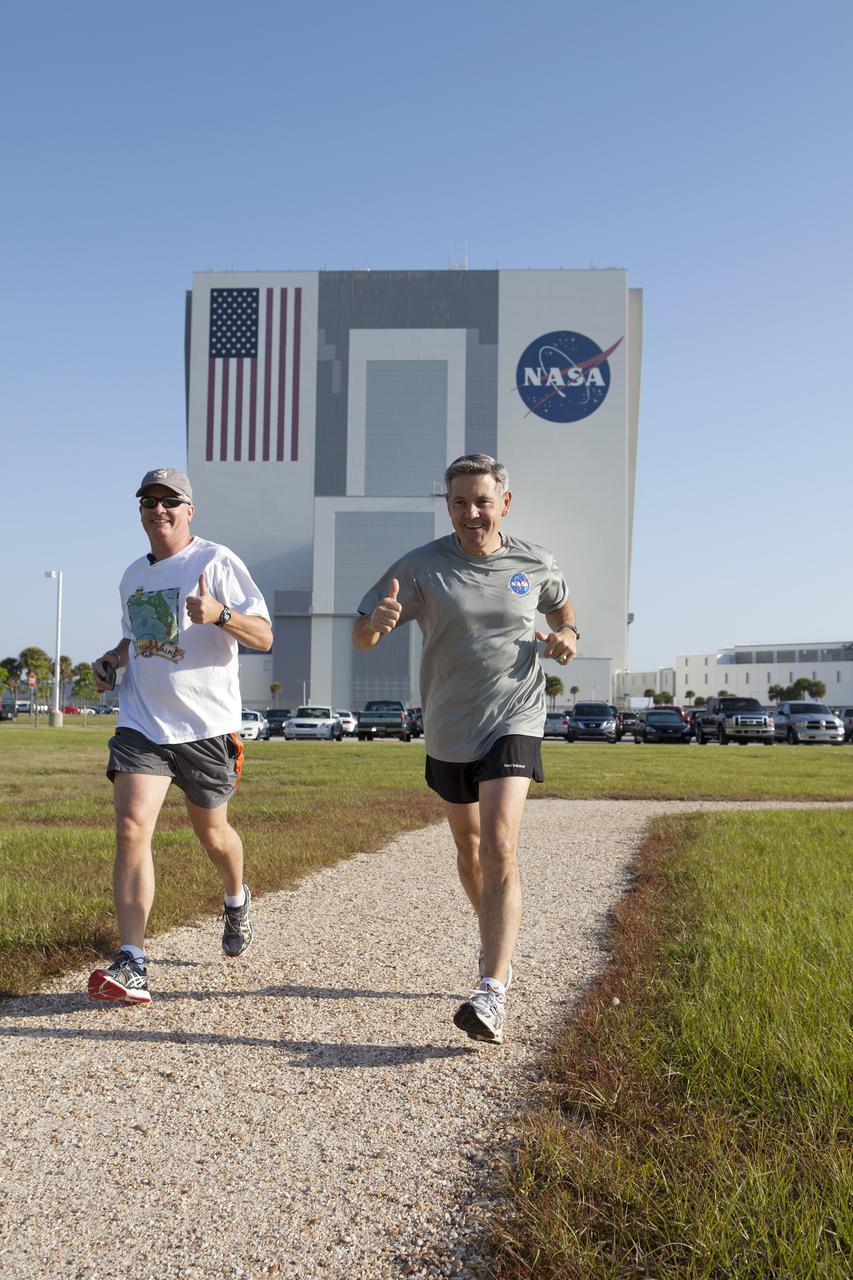
CAPE CANAVERAL, Fla. – Kennedy Space Center Director Bob Cabana, right, and Florida State Surgeon General John Armstrong take an early morning run along the center's Pathfinder Trail near the Operations and Support Building II at Kennedy Space Center in Florida, to officially kick off National Employee Health and Fitness Month with the NASA Moves! challenge. NASA Moves! challenged the workforce from each of the agency's field centers to engage in at least 20 minutes of activity, or 10,000 steps, each day from May 18-31. About 100 people participated in the kickoff event on the Pathfinder Trail in the heart of the center's Launch Complex 39. The one-third-mile-long gravel walkway traces the iconic shape of a space shuttle orbiter and features a set of exercise stations. The friendly contest is part of NASA's new Health4Life initiative, a Web-based health initiative designed to help employees track their health, fitness and nutrition. Health4Life also provides an array of resources geared toward increasing physical activity. Photo credit: NASA/Dimitri Gerondidakis
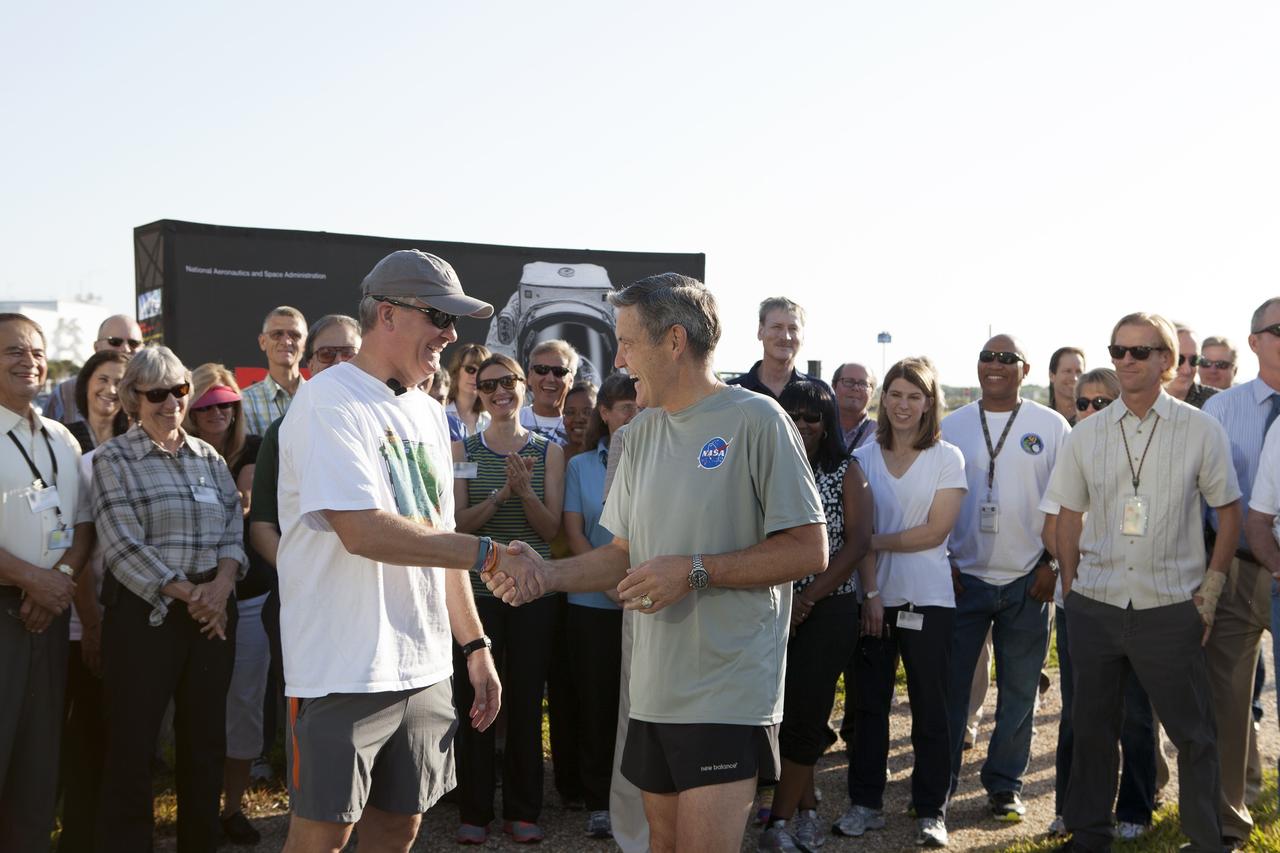
CAPE CANAVERAL, Fla. – Kennedy Space Center Director Bob Cabana, right, shakes hands with Florida State Surgeon General John Armstrong before an early morning run along the center's Pathfinder Trail near the Operations and Support Building II at Kennedy Space Center in Florida, to officially kick off National Employee Health and Fitness Month with the NASA Moves! challenge. NASA Moves! challenged the workforce from each of the agency's field centers to engage in at least 20 minutes of activity, or 10,000 steps, each day from May 18-31. About 100 people participated in the kickoff event on the Pathfinder Trail in the heart of the center's Launch Complex 39. The one-third-mile-long gravel walkway traces the iconic shape of a space shuttle orbiter and features a set of exercise stations. The friendly contest is part of NASA's new Health4Life initiative, a Web-based health initiative designed to help employees track their health, fitness and nutrition. Health4Life also provides an array of resources geared toward increasing physical activity. Photo credit: NASA/Dimitri Gerondidakis

VANDENBERG AIR FORCE BASE, Calif. – In a clean room at Vandenberg Air Force Base in California, technicians complete a second fillet and wing fit check on the Pegasus XL launch vehicle. The Orbital Sciences Corp. Pegasus rocket will launch the Nuclear Spectroscopic Telescope Array (NuSTAR) into space. After the rocket and spacecraft are processed at Vandenberg, they will be flown on the Orbital Sciences’ L-1011 carrier aircraft to the Ronald Reagan Ballistic Missile Defense Test Site at the Pacific Ocean’s Kwajalein Atoll for launch. The high-energy X-ray telescope will conduct a census for black holes, map radioactive material in young supernovae remnants, and study the origins of cosmic rays and the extreme physics around collapsed stars. For more information, visit science.nasa.gov/missions/nustar/. Photo credit: NASA/Randy Beaudoin, VAFB
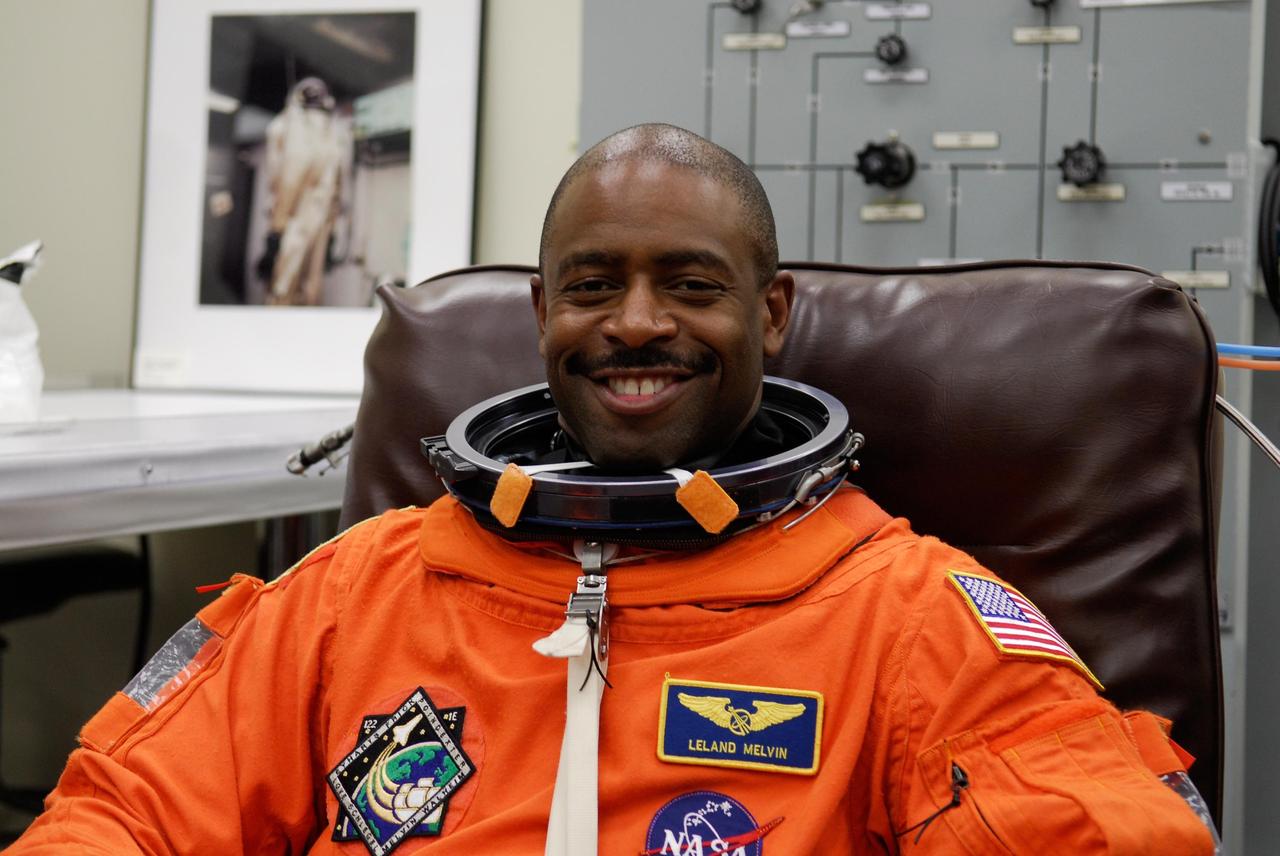
KENNEDY SPACE CENTER, FLA. -- Space shuttle Atlantis STS-122 Mission Specialist Leland Melvin tries on his launch and entry suit, preparing for launch. The fitting is part of terminal countdown demonstration test, or TCDT, activities the crew is undertaking at NASA's Kennedy Space Center. The TCDT provides astronauts and ground crews with equipment familiarization, emergency egress training and a simulated launch countdown. On mission STS-122, Atlantis will deliver the Columbus module to the International Space Station. The European Space Agency's largest single contribution to the station, Columbus is a multifunctional, pressurized laboratory that will be permanently attached to U.S. Node 2, called Harmony. The laboratory will expand the research facilities aboard the station, providing crew members and scientists from around the world the ability to conduct a variety of experiments in the physical, materials and life sciences. Launch is targeted for Dec. 6. Photo credit: NASA/Kim Shiflett

VANDENBERG AIR FORCE BASE, Calif. – In a clean room at Vandenberg Air Force Base in California, technicians prepare to do a fillet and wing fit check on the Pegasus XL launch vehicle. The Orbital Sciences Corp. Pegasus rocket will launch the Nuclear Spectroscopic Telescope Array (NuSTAR) into space. After the rocket and spacecraft are processed at Vandenberg, they will be flown on the Orbital Sciences’ L-1011 carrier aircraft to the Ronald Reagan Ballistic Missile Defense Test Site at the Pacific Ocean’s Kwajalein Atoll for launch. The high-energy X-ray telescope will conduct a census for black holes, map radioactive material in young supernovae remnants, and study the origins of cosmic rays and the extreme physics around collapsed stars. For more information, visit science.nasa.gov/missions/nustar/. Photo credit: NASA/Randy Beaudoin, VAFB

VANDENBERG AIR FORCE BASE, Calif. – In a clean room at Vandenberg Air Force Base in California, technicians perform a fillet and wing fit check on the Pegasus XL launch vehicle. The Orbital Sciences Corp. Pegasus rocket will launch the Nuclear Spectroscopic Telescope Array (NuSTAR) into space. After the rocket and spacecraft are processed at Vandenberg, they will be flown on the Orbital Sciences’ L-1011 carrier aircraft to the Ronald Reagan Ballistic Missile Defense Test Site at the Pacific Ocean’s Kwajalein Atoll for launch. The high-energy X-ray telescope will conduct a census for black holes, map radioactive material in young supernovae remnants, and study the origins of cosmic rays and the extreme physics around collapsed stars. For more information, visit science.nasa.gov/missions/nustar/. Photo credit: NASA/Randy Beaudoin, VAFB
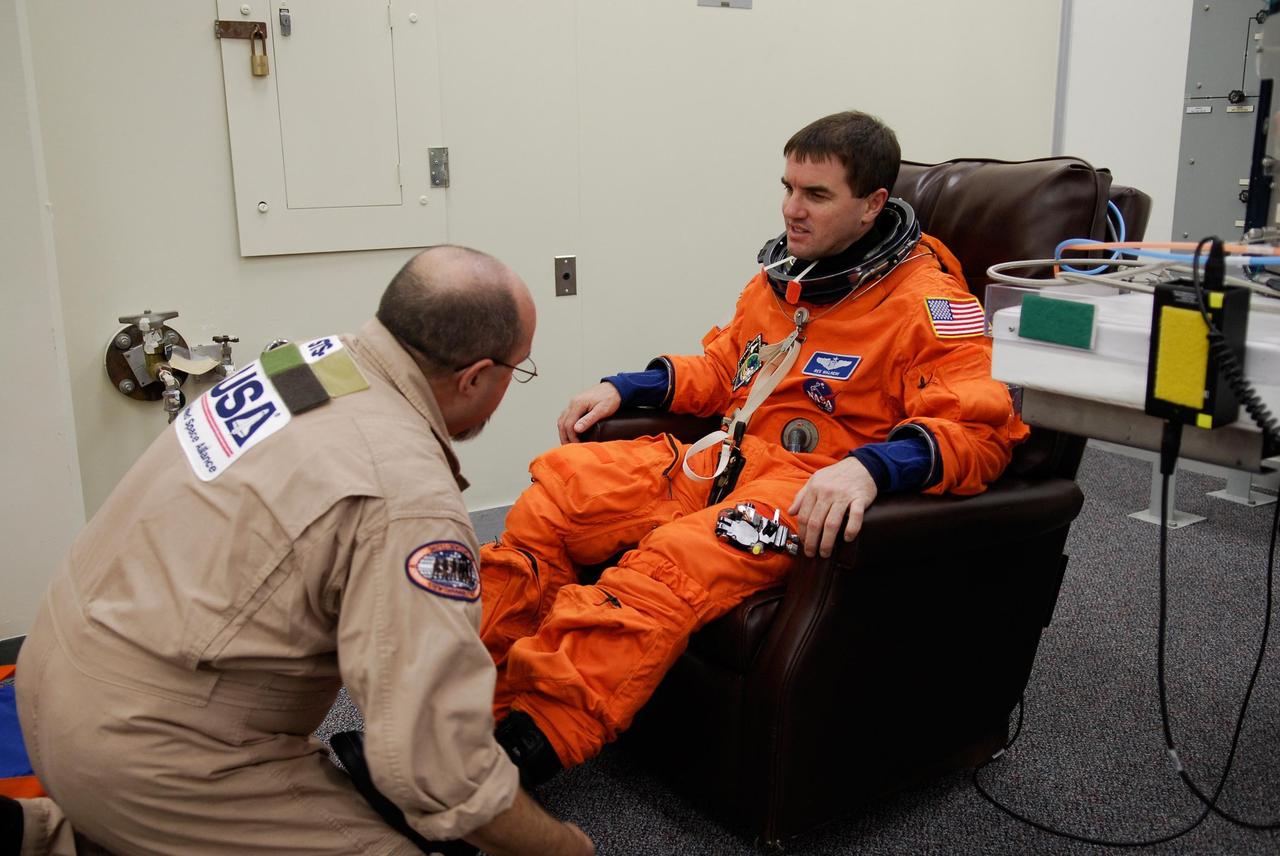
KENNEDY SPACE CENTER, FLA. -- A suit technician helps Space shuttle Atlantis STS-122 Mission Specialist Rex Walheim put on his launch and entry suit, preparing for launch. The fitting is part of terminal countdown demonstration test, or TCDT, activities the crew is undertaking at NASA's Kennedy Space Center. The TCDT provides astronauts and ground crews with equipment familiarization, emergency egress training and a simulated launch countdown. On mission STS-122, Atlantis will deliver the Columbus module to the International Space Station. The European Space Agency's largest single contribution to the station, Columbus is a multifunctional, pressurized laboratory that will be permanently attached to U.S. Node 2, called Harmony. The laboratory will expand the research facilities aboard the station, providing crew members and scientists from around the world the ability to conduct a variety of experiments in the physical, materials and life sciences. Launch is targeted for Dec. 6. Photo credit: NASA/Kim Shiflett

VANDENBERG AIR FORCE BASE, Calif. – In a clean room at Vandenberg Air Force Base in California, technicians perform a fillet and wing fit check on the Pegasus XL launch vehicle. The Orbital Sciences Corp. Pegasus rocket will launch the Nuclear Spectroscopic Telescope Array (NuSTAR) into space. After the rocket and spacecraft are processed at Vandenberg, they will be flown on the Orbital Sciences’ L-1011 carrier aircraft to the Ronald Reagan Ballistic Missile Defense Test Site at the Pacific Ocean’s Kwajalein Atoll for launch. The high-energy X-ray telescope will conduct a census for black holes, map radioactive material in young supernovae remnants, and study the origins of cosmic rays and the extreme physics around collapsed stars. For more information, visit science.nasa.gov/missions/nustar/. Photo credit: NASA/Randy Beaudoin, VAFB

VANDENBERG AIR FORCE BASE, Calif. – In a clean room at Vandenberg Air Force Base in California, technicians prepare to do a fillet and wing fit check on the Pegasus XL launch vehicle. The Orbital Sciences Corp. Pegasus rocket will launch the Nuclear Spectroscopic Telescope Array (NuSTAR) into space. After the rocket and spacecraft are processed at Vandenberg, they will be flown on the Orbital Sciences’ L-1011 carrier aircraft to the Ronald Reagan Ballistic Missile Defense Test Site at the Pacific Ocean’s Kwajalein Atoll for launch. The high-energy X-ray telescope will conduct a census for black holes, map radioactive material in young supernovae remnants, and study the origins of cosmic rays and the extreme physics around collapsed stars. For more information, visit science.nasa.gov/missions/nustar/. Photo credit: NASA/Randy Beaudoin, VAFB
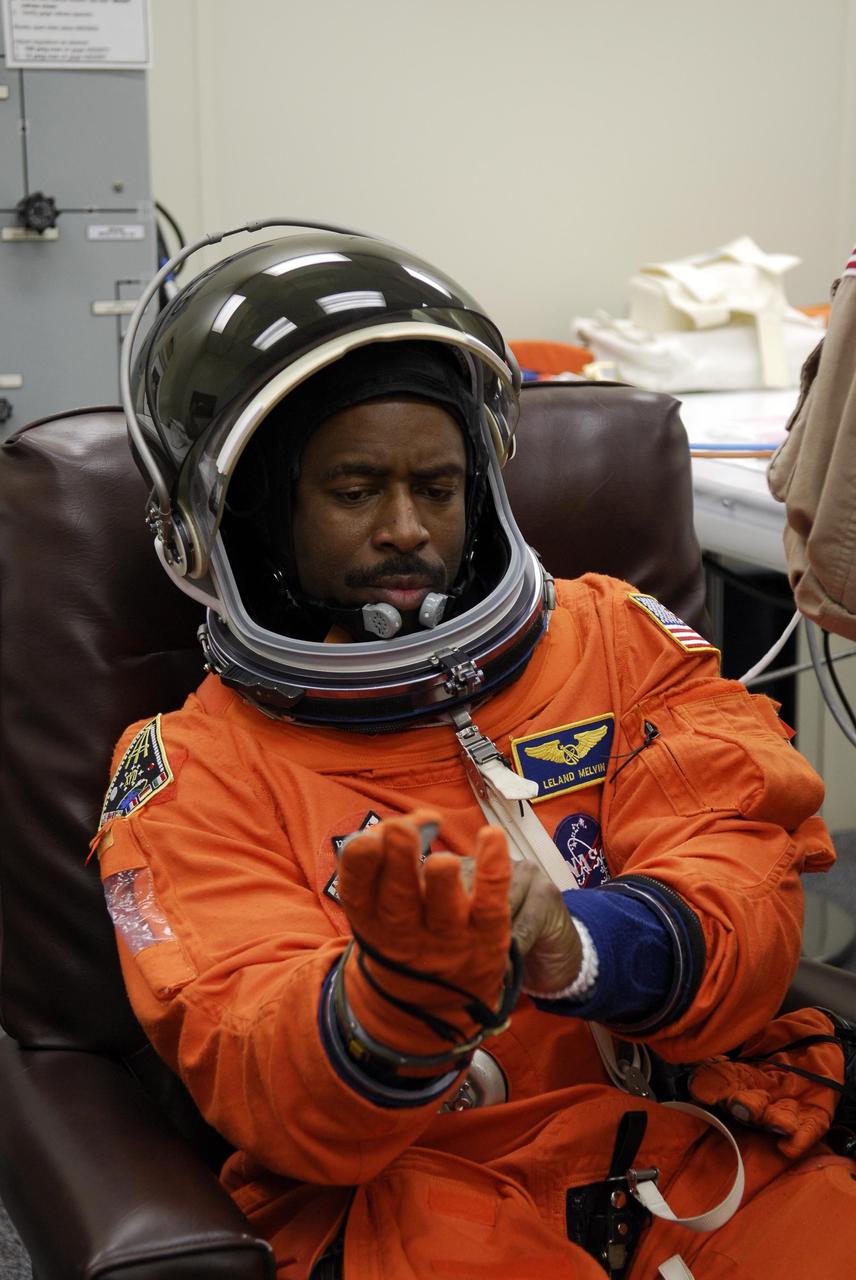
KENNEDY SPACE CENTER, FLA. -- Space shuttle Atlantis STS-122 Mission Specialist Leland Melvin tries on the gloves of his launch and entry suit, preparing for launch. The fitting is part of terminal countdown demonstration test, or TCDT, activities the crew is undertaking at NASA's Kennedy Space Center. The TCDT provides astronauts and ground crews with equipment familiarization, emergency egress training and a simulated launch countdown. On mission STS-122, Atlantis will deliver the Columbus module to the International Space Station. The European Space Agency's largest single contribution to the station, Columbus is a multifunctional, pressurized laboratory that will be permanently attached to U.S. Node 2, called Harmony. The laboratory will expand the research facilities aboard the station, providing crew members and scientists from around the world the ability to conduct a variety of experiments in the physical, materials and life sciences. Launch is targeted for Dec. 6. Photo credit: NASA/Kim Shiflett

CAPE CANAVERAL, Fla. -- At the Astrotech payload processing facility, NASA's Gamma-Ray Large Area Space Telescope, or GLAST, spacecraft is being prepared for a move to an payload attach fitting that will eventually be used to mate GLAST to the Delta II launch vehicle. The GLAST is a powerful space observatory that will explore the Universe's ultimate frontier, where nature harnesses forces and energies far beyond anything possible on Earth; probe some of science's deepest questions, such as what our Universe is made of, and search for new laws of physics; explain how black holes accelerate jets of material to nearly light speed; and help crack the mystery of stupendously powerful explosions known as gamma-ray bursts. A launch date still is to be determined. Photo credit: NASA/Jim Grossmann

VANDENBERG AIR FORCE BASE, Calif. – In a clean room at Vandenberg Air Force Base in California, technicians complete a second fillet and wing fit check on the Pegasus XL launch vehicle. The Orbital Sciences Corp. Pegasus rocket will launch the Nuclear Spectroscopic Telescope Array (NuSTAR) into space. After the rocket and spacecraft are processed at Vandenberg, they will be flown on the Orbital Sciences’ L-1011 carrier aircraft to the Ronald Reagan Ballistic Missile Defense Test Site at the Pacific Ocean’s Kwajalein Atoll for launch. The high-energy X-ray telescope will conduct a census for black holes, map radioactive material in young supernovae remnants, and study the origins of cosmic rays and the extreme physics around collapsed stars. For more information, visit science.nasa.gov/missions/nustar/. Photo credit: NASA/Randy Beaudoin, VAFB
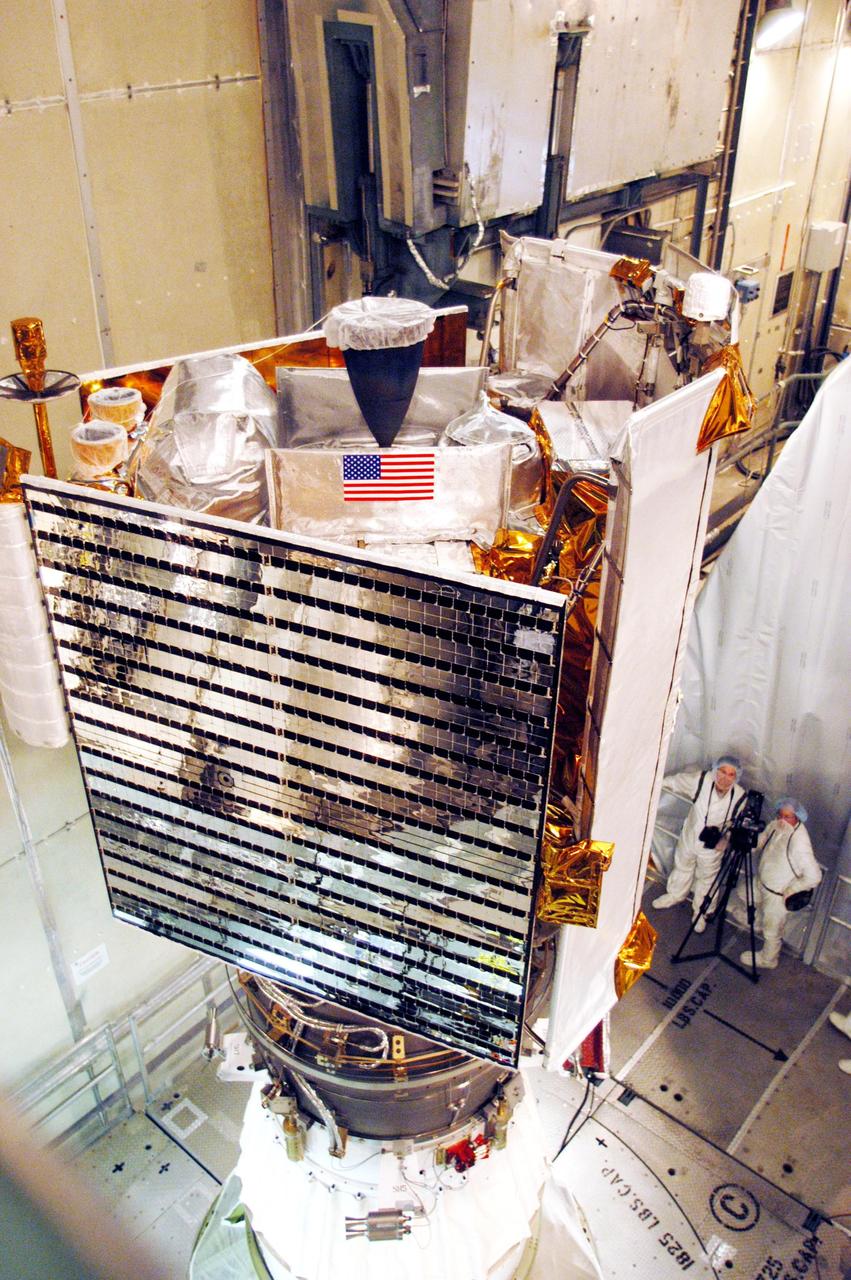
KENNEDY SPACE CENTER, FLA. - On Launch Pad 17-B at Cape Canaveral Air Force Station, the MESSENGER (Mercury Surface, Space Environment, Geochemistry and Ranging) spacecraft is ready for installation of the fairing, a molded structure that fits flush with the outside surface of the Delta II upper stage booster and forms an aerodynamically smooth joint, protecting the spacecraft during launch. Seen on the left is one of the solar panels on the spacecraft. On the right is part of the heat-resistant, ceramic-cloth sunshade that will protect the spacecraft’s instruments as MESSENGER orbits the Mercury where the surface reaches a high temperature near 840 degrees Fahrenheit and the solar intensity can be 11 times greater than on Earth. MESSENGER is scheduled to launch Aug. 2 aboard a Boeing Delta II rocket and is expected to enter Mercury orbit in March 2011. MESSENGER was built for NASA by the Johns Hopkins University Applied Physics Laboratory in Laurel, Md.

VANDENBERG AIR FORCE BASE, Calif. – In a clean room at Vandenberg Air Force Base in California, technicians prepare to complete a second fillet and wing fit check on the Pegasus XL launch vehicle. The Orbital Sciences Corp. Pegasus rocket will launch the Nuclear Spectroscopic Telescope Array (NuSTAR) into space. After the rocket and spacecraft are processed at Vandenberg, they will be flown on the Orbital Sciences’ L-1011 carrier aircraft to the Ronald Reagan Ballistic Missile Defense Test Site at the Pacific Ocean’s Kwajalein Atoll for launch. The high-energy X-ray telescope will conduct a census for black holes, map radioactive material in young supernovae remnants, and study the origins of cosmic rays and the extreme physics around collapsed stars. For more information, visit science.nasa.gov/missions/nustar/. Photo credit: NASA/Randy Beaudoin, VAFB

KENNEDY SPACE CENTER, FLA. -- STS-122 Mission Specialist Hans Schlegel checks the helmet to his launch and entry suit for a final fitting before space shuttle Atlantis' launch scheduled for 4:31 p.m. EST on Dec. 6. Schlegel, who represents the European Space Agency, will make his second shuttle flight. Atlantis will carry the Columbus Lab, Europe’s largest contribution to the construction of the International Space Station. It will support scientific and technological research in a microgravity environment. Columbus, a program of ESA, is a multifunctional, pressurized laboratory that will be permanently attached to Node 2 of the space station to carry out experiments in materials science, fluid physics and biosciences, as well as to perform a number of technological applications. Photo credit: NASA/Kim Shiflett
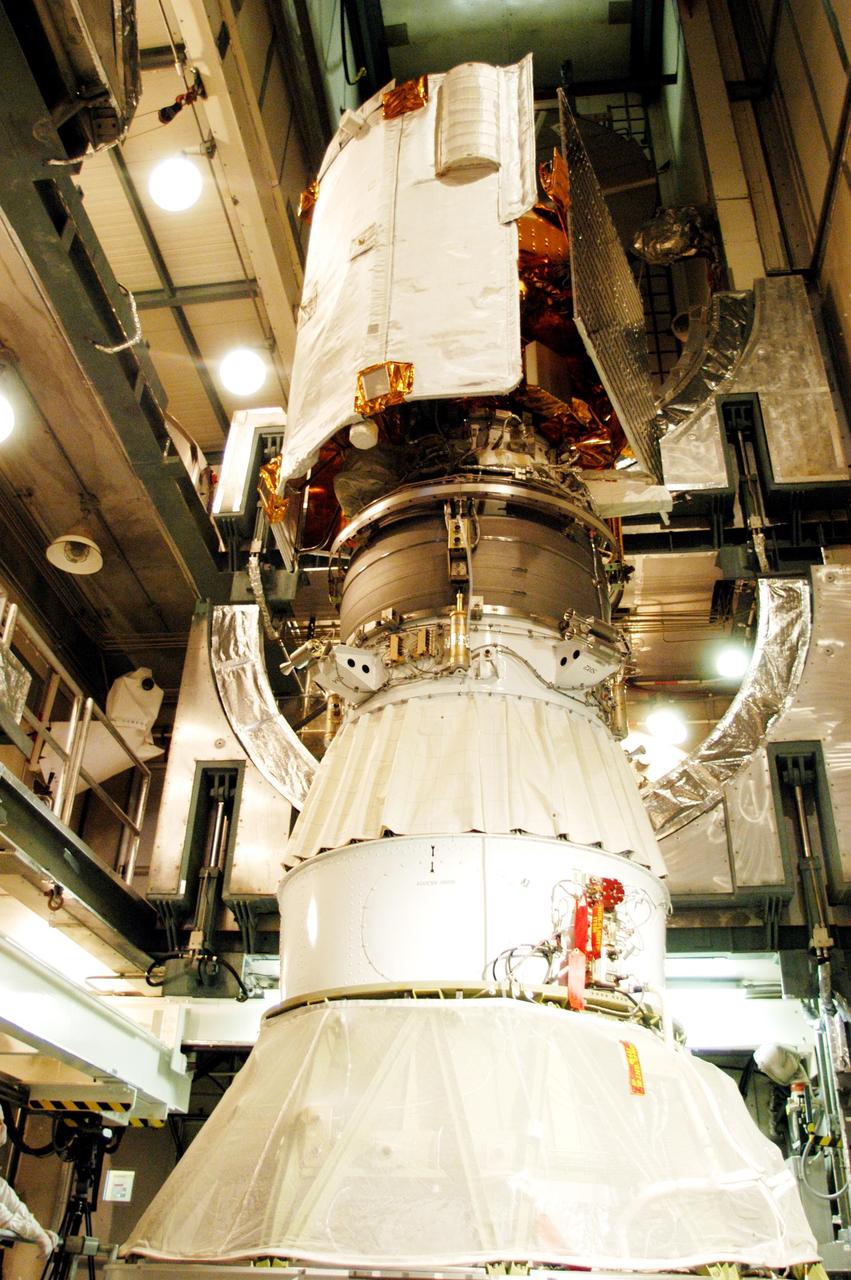
KENNEDY SPACE CENTER, FLA. - On Launch Pad 17-B at Cape Canaveral Air Force Station, the MESSENGER (Mercury Surface, Space Environment, Geochemistry and Ranging) spacecraft is seen atop the Delta II upper stage booster (middle) and the Delta II launch vehicle below. The spacecraft is ready for installation of the fairing, a molded structure that fits flush with the outside surface of the upper stage booster and forms an aerodynamically smooth joint, protecting the spacecraft during launch. Seen on the right is one of the solar panels on the spacecraft. On the left is the heat-resistant, ceramic-cloth sunshade that will protect the spacecraft’s instruments as MESSENGER orbits the Mercury where the surface reaches a high temperature near 840 degrees Fahrenheit and the solar intensity can be 11 times greater than on Earth. MESSENGER is scheduled to launch Aug. 2 and is expected to enter Mercury orbit in March 2011. MESSENGER was built for NASA by the Johns Hopkins University Applied Physics Laboratory in Laurel, Md.
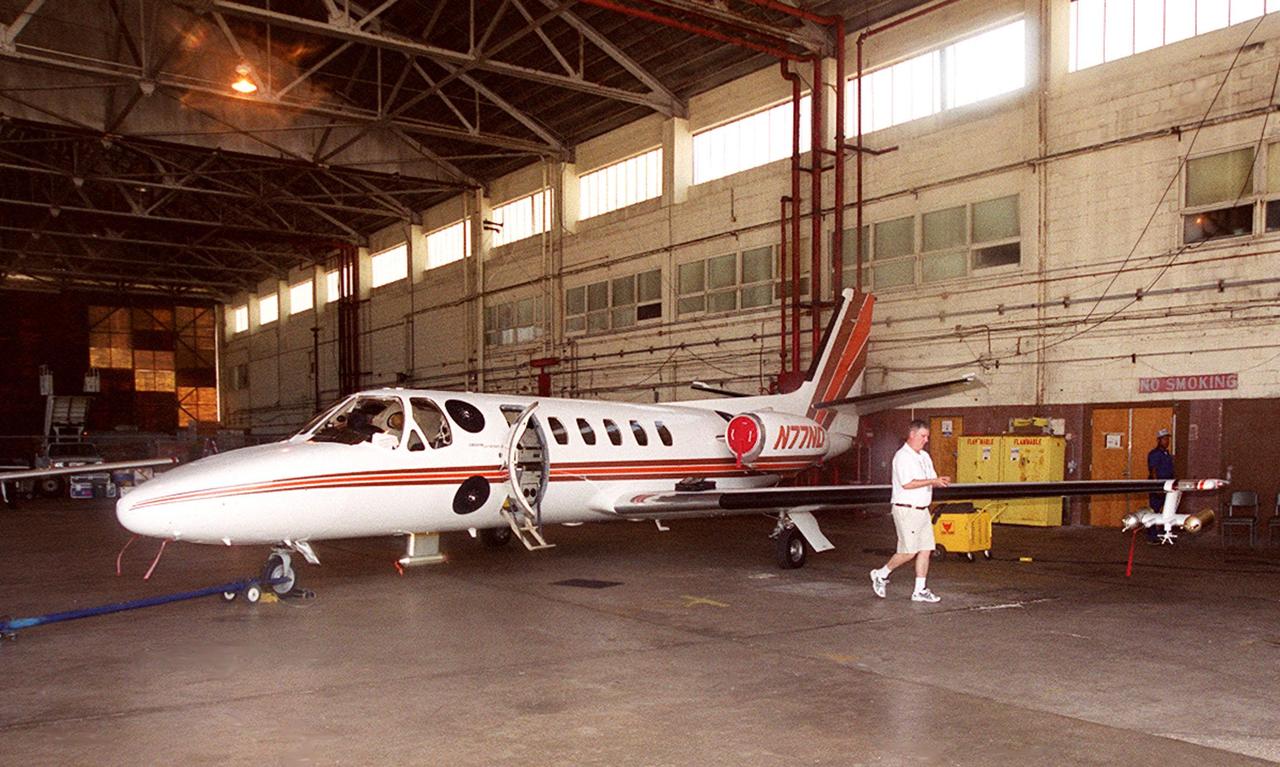
In a hangar at Cape Canaveral Air Force Station, a Cessna Citation aircraft has been fitted on the wings with devices that measure electric fields (black circles shown behind the open door) and with cloud physics probes (under the body and wings) that measure the size, shape and number of ice and water particles in clouds. The plane is being flown into anvil clouds in the KSC area as part of a study to review and possibly modify lightning launch commit criteria. The weather study could lead to improved lightning avoidance rules and fewer launch scrubs for the Space Shuttle and other launch vehicles on the Eastern and Western ranges.; More information about the study can be found in <a href="http://www-pao.ksc.nasa.gov/kscpao/release/2000/56-00.htm">Release No. 56-00</a>
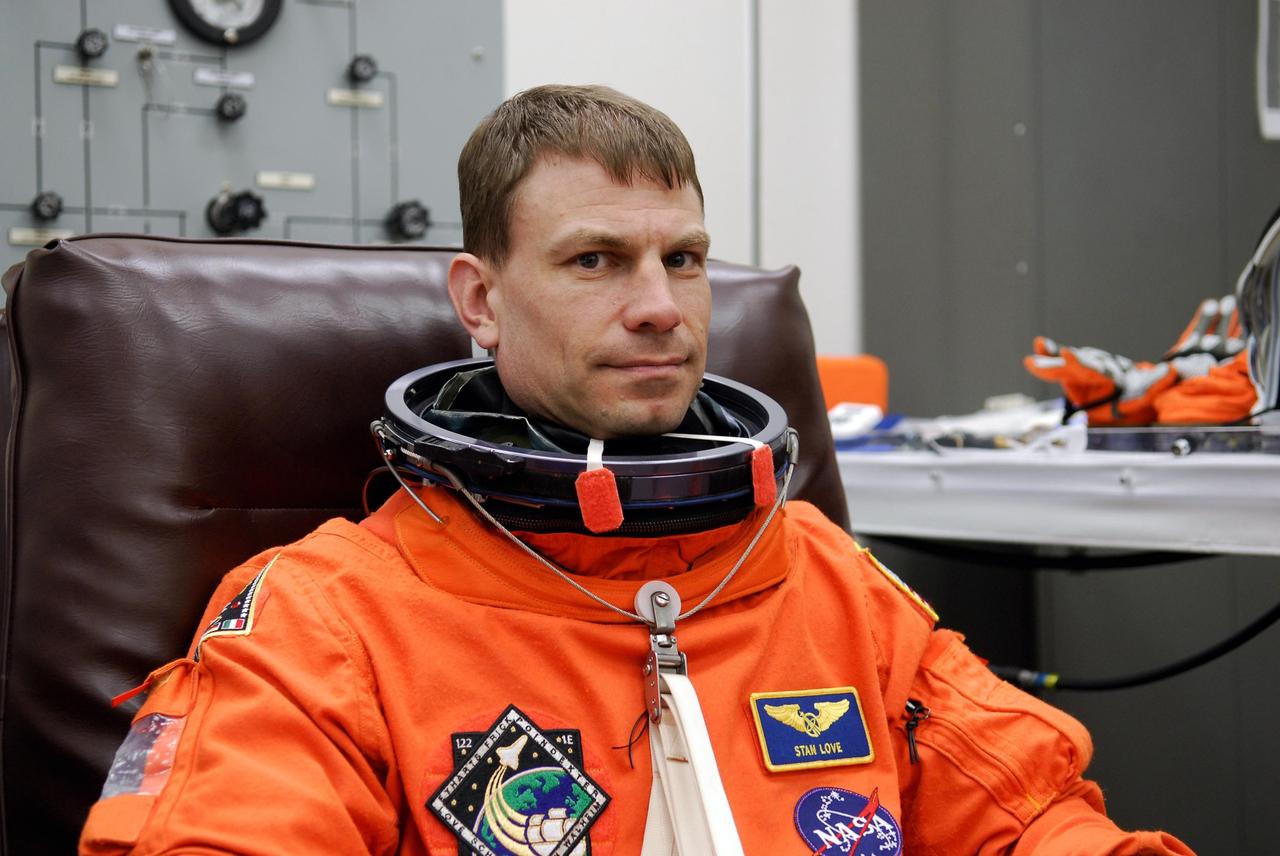
KENNEDY SPACE CENTER, FLA. -- Space shuttle Atlantis STS-122 Mission Specialist Stanley Love tries on his launch and entry suit, preparing for launch. The fitting is part of terminal countdown demonstration test, or TCDT, activities the crew is undertaking at NASA's Kennedy Space Center. The TCDT provides astronauts and ground crews with equipment familiarization, emergency egress training and a simulated launch countdown. On mission STS-122, Atlantis will deliver the Columbus module to the International Space Station. The European Space Agency's largest single contribution to the station, Columbus is a multifunctional, pressurized laboratory that will be permanently attached to U.S. Node 2, called Harmony. The laboratory will expand the research facilities aboard the station, providing crew members and scientists from around the world the ability to conduct a variety of experiments in the physical, materials and life sciences. Launch is targeted for Dec. 6. Photo credit: NASA/Kim Shiflett

VANDENBERG AIR FORCE BASE, Calif. – In a clean room at Vandenberg Air Force Base in California, the Pegasus XL launch vehicle awaits a fillet and wing fit check. The Orbital Sciences Corp. Pegasus rocket will launch the Nuclear Spectroscopic Telescope Array (NuSTAR) into space. After the rocket and spacecraft are processed at Vandenberg, they will be flown on the Orbital Sciences’ L-1011 carrier aircraft to the Ronald Reagan Ballistic Missile Defense Test Site at the Pacific Ocean’s Kwajalein Atoll for launch. The high-energy X-ray telescope will conduct a census for black holes, map radioactive material in young supernovae remnants, and study the origins of cosmic rays and the extreme physics around collapsed stars. For more information, visit science.nasa.gov/missions/nustar/. Photo credit: NASA/Randy Beaudoin, VAFB
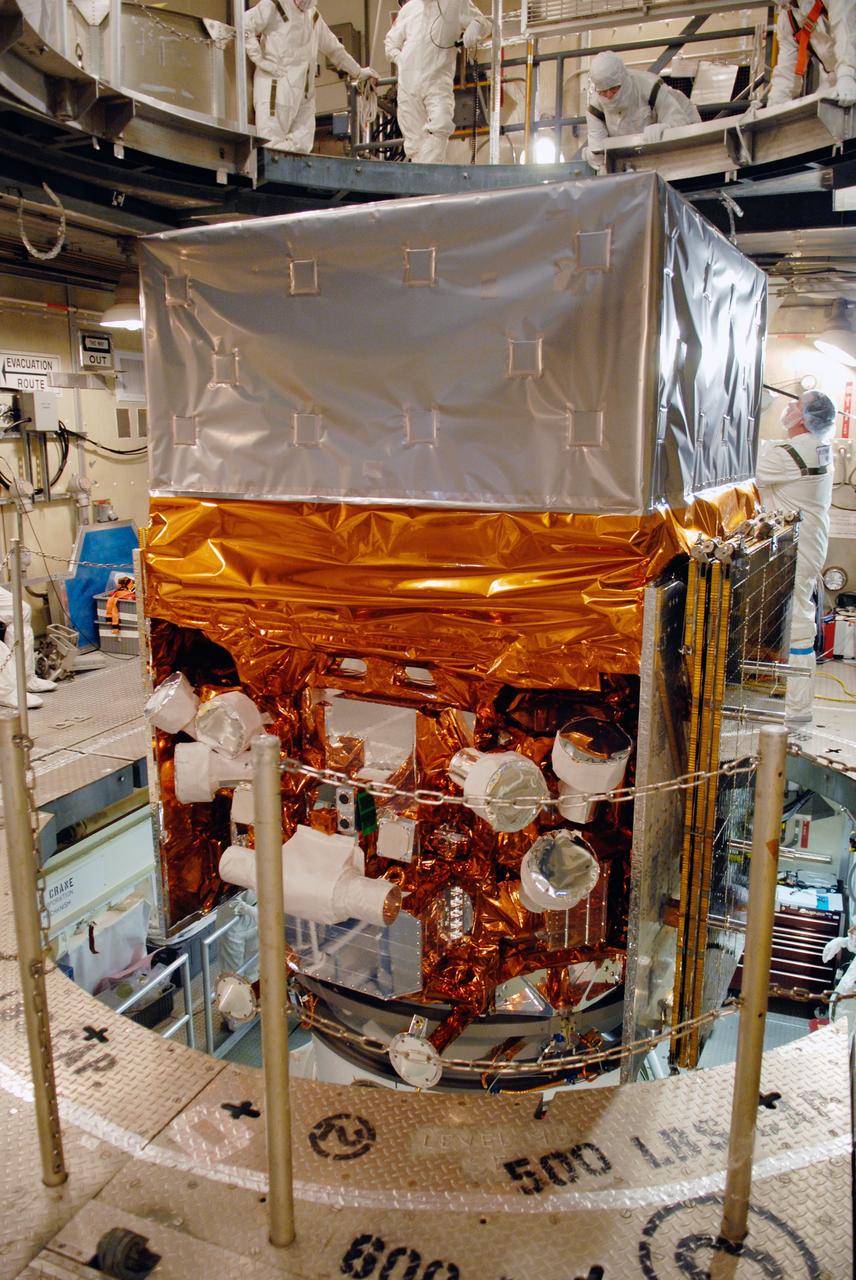
CAPE CANAVERAL, Fla. -- Inside the mobile service tower on Launch Pad 17-B at Cape Canaveral Air Force Station, NASA's Gamma-Ray Large Area Space Telescope, or GLAST, is ready for encapsulation in the payload fairing. The fairing is a molded structure that fits flush with the outside surface of the Delta II upper stage booster and forms an aerodynamically smooth nose cone, protecting the spacecraft during launch and ascent. GLAST is a powerful space observatory that will explore the Universe's ultimate frontier, where nature harnesses forces and energies far beyond anything possible on Earth; probe some of science's deepest questions, such as what our Universe is made of, and search for new laws of physics; explain how black holes accelerate jets of material to nearly light speed; and help crack the mystery of stupendously powerful explosions known as gamma-ray bursts. The launch date is targeted no earlier than June 3. Photo credit: NASA/Jim Grossmann

VANDENBERG AIR FORCE BASE, Calif. – In a clean room at Vandenberg Air Force Base in California, technicians prepare to complete a second fillet and wing fit check on the Pegasus XL launch vehicle. The Orbital Sciences Corp. Pegasus rocket will launch the Nuclear Spectroscopic Telescope Array (NuSTAR) into space. After the rocket and spacecraft are processed at Vandenberg, they will be flown on the Orbital Sciences’ L-1011 carrier aircraft to the Ronald Reagan Ballistic Missile Defense Test Site at the Pacific Ocean’s Kwajalein Atoll for launch. The high-energy X-ray telescope will conduct a census for black holes, map radioactive material in young supernovae remnants, and study the origins of cosmic rays and the extreme physics around collapsed stars. For more information, visit science.nasa.gov/missions/nustar/. Photo credit: NASA/Randy Beaudoin, VAFB

VANDENBERG AIR FORCE BASE, Calif. – In a clean room at Vandenberg Air Force Base in California, technicians complete a second fillet and wing fit check on the Pegasus XL launch vehicle. The Orbital Sciences Corp. Pegasus rocket will launch the Nuclear Spectroscopic Telescope Array (NuSTAR) into space. After the rocket and spacecraft are processed at Vandenberg, they will be flown on the Orbital Sciences’ L-1011 carrier aircraft to the Ronald Reagan Ballistic Missile Defense Test Site at the Pacific Ocean’s Kwajalein Atoll for launch. The high-energy X-ray telescope will conduct a census for black holes, map radioactive material in young supernovae remnants, and study the origins of cosmic rays and the extreme physics around collapsed stars. For more information, visit science.nasa.gov/missions/nustar/. Photo credit: NASA/Randy Beaudoin, VAFB

VANDENBERG AIR FORCE BASE, Calif. – In a clean room at Vandenberg Air Force Base in California, technicians prepare to do a fillet and wing fit check on the Pegasus XL launch vehicle. The Orbital Sciences Corp. Pegasus rocket will launch the Nuclear Spectroscopic Telescope Array (NuSTAR) into space. After the rocket and spacecraft are processed at Vandenberg, they will be flown on the Orbital Sciences’ L-1011 carrier aircraft to the Ronald Reagan Ballistic Missile Defense Test Site at the Pacific Ocean’s Kwajalein Atoll for launch. The high-energy X-ray telescope will conduct a census for black holes, map radioactive material in young supernovae remnants, and study the origins of cosmic rays and the extreme physics around collapsed stars. For more information, visit science.nasa.gov/missions/nustar/. Photo credit: NASA/Randy Beaudoin, VAFB

VANDENBERG AIR FORCE BASE, Calif. – In a clean room at Vandenberg Air Force Base in California, technicians complete a second fillet and wing fit check on the Pegasus XL launch vehicle. The Orbital Sciences Corp. Pegasus rocket will launch the Nuclear Spectroscopic Telescope Array (NuSTAR) into space. After the rocket and spacecraft are processed at Vandenberg, they will be flown on the Orbital Sciences’ L-1011 carrier aircraft to the Ronald Reagan Ballistic Missile Defense Test Site at the Pacific Ocean’s Kwajalein Atoll for launch. The high-energy X-ray telescope will conduct a census for black holes, map radioactive material in young supernovae remnants, and study the origins of cosmic rays and the extreme physics around collapsed stars. For more information, visit science.nasa.gov/missions/nustar/. Photo credit: NASA/Randy Beaudoin, VAFB
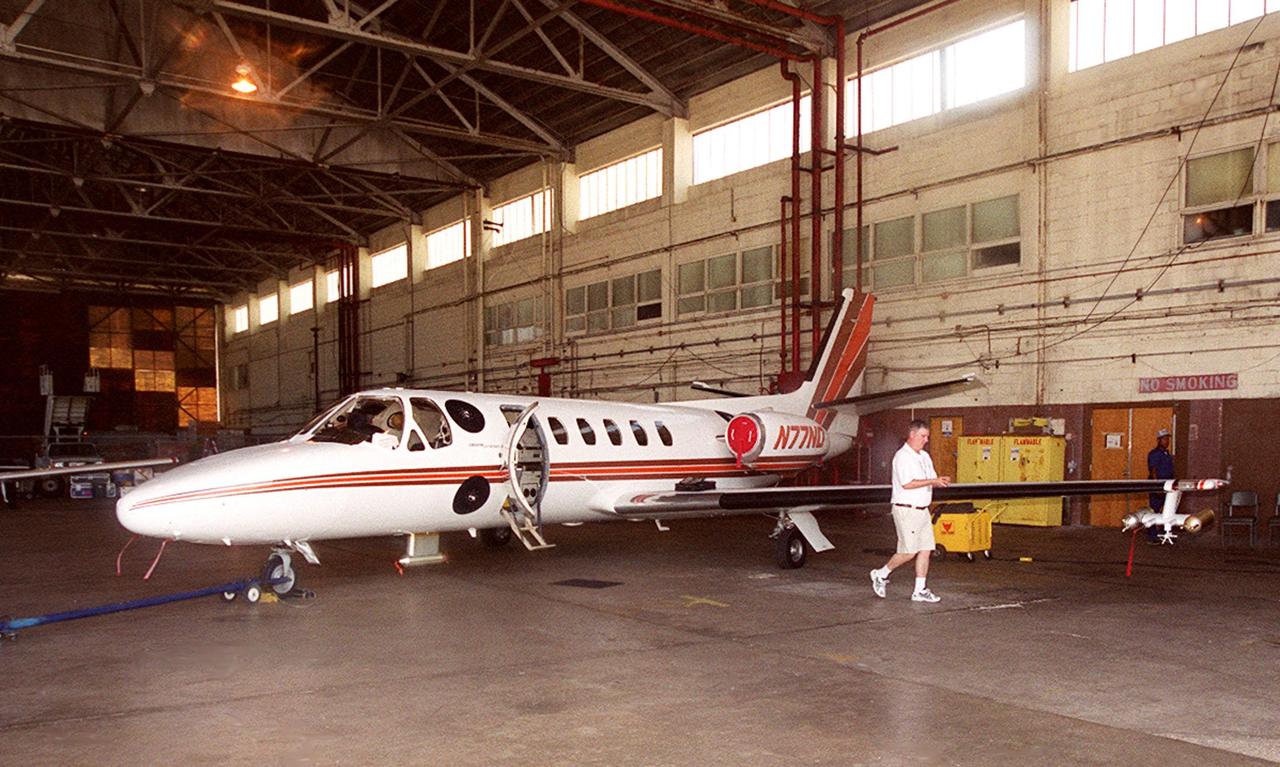
In a hangar at Cape Canaveral Air Force Station, a Cessna Citation aircraft has been fitted on the wings with devices that measure electric fields (black circles shown behind the open door) and with cloud physics probes (under the body and wings) that measure the size, shape and number of ice and water particles in clouds. The plane is being flown into anvil clouds in the KSC area as part of a study to review and possibly modify lightning launch commit criteria. The weather study could lead to improved lightning avoidance rules and fewer launch scrubs for the Space Shuttle and other launch vehicles on the Eastern and Western ranges.; More information about the study can be found in <a href="http://www-pao.ksc.nasa.gov/kscpao/release/2000/56-00.htm">Release No. 56-00</a>
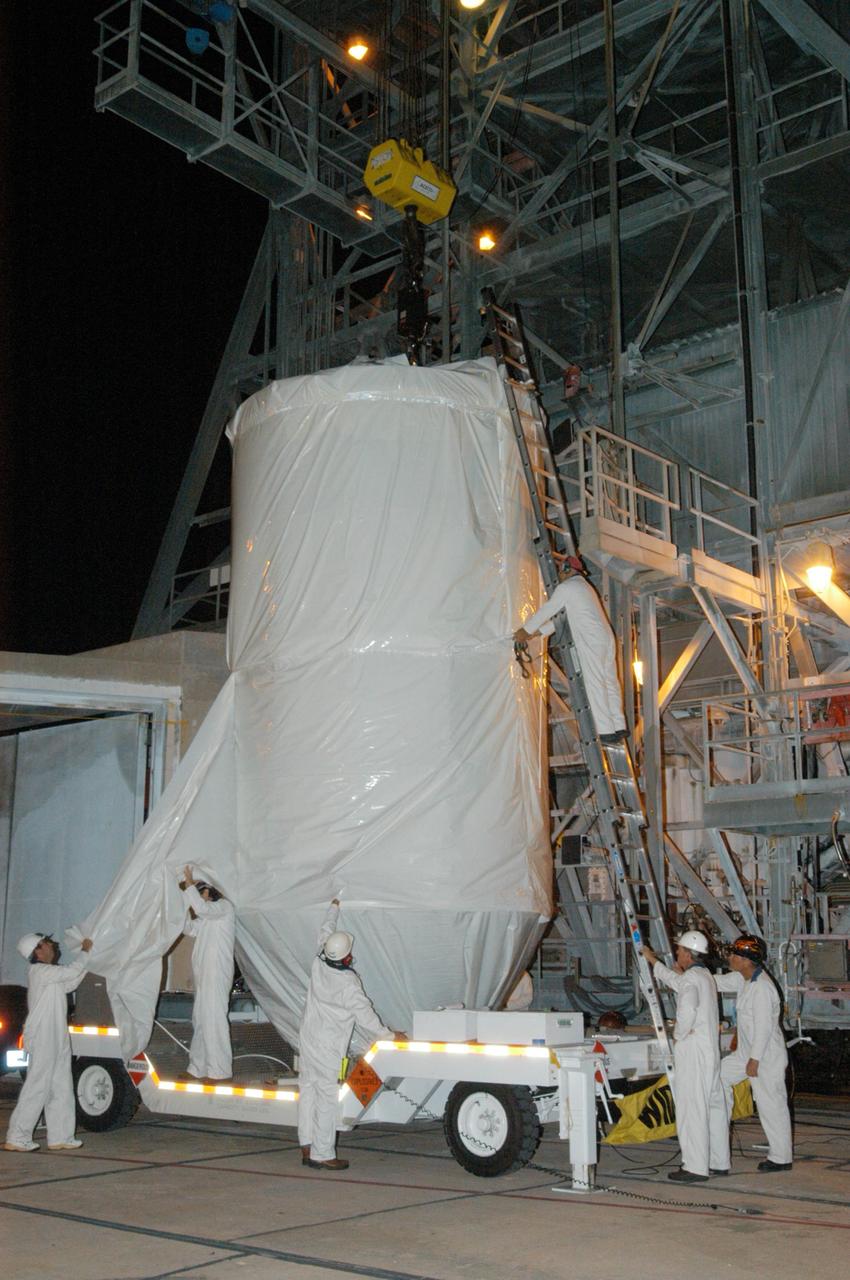
KENNEDY SPACE CENTER, FLA. - After arriving at Launch Pad 17-B on Cape Canaveral Air Force Station, the STEREO spacecraft is fitted with a crane to lift it into the mobile service tower. STEREO will be mated with its launch vehicle, a Boeing Delta II rocket. STEREO stands for Solar Terrestrial Relations Observatory and comprises two spacecraft. The STEREO mission is the first to take measurements of the sun and solar wind in 3-dimension. This new view will improve our understanding of space weather and its impact on the Earth. The STEREO mission is managed by Goddard Space Flight Center. The Applied Physics Laboratory designed and built the spacecraft. The laboratory will maintain command and control of the observatories throughout the mission, while NASA tracks and receives the data, determines the orbit of the satellites, and coordinates the science results. STEREO is expected to lift off Oct. 25. Photo credit: NASA/George Shelton
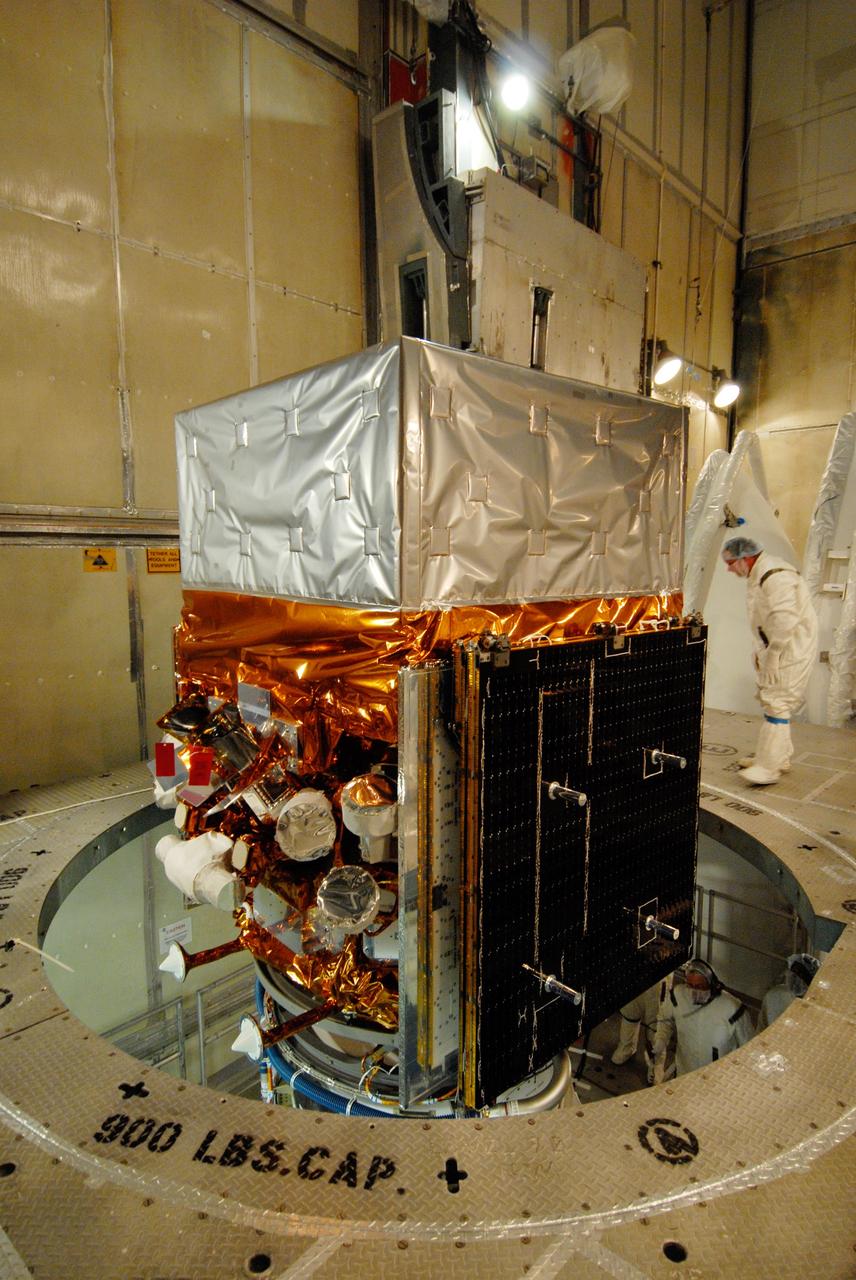
CAPE CANAVERAL, Fla. -- Inside the mobile service tower on Launch Pad 17-B at Cape Canaveral Air Force Station, NASA's Gamma-Ray Large Area Space Telescope, or GLAST, is ready for encapsulation in the payload fairing. The fairing is a molded structure that fits flush with the outside surface of the Delta II upper stage booster and forms an aerodynamically smooth nose cone, protecting the spacecraft during launch and ascent. GLAST is a powerful space observatory that will explore the Universe's ultimate frontier, where nature harnesses forces and energies far beyond anything possible on Earth; probe some of science's deepest questions, such as what our Universe is made of, and search for new laws of physics; explain how black holes accelerate jets of material to nearly light speed; and help crack the mystery of stupendously powerful explosions known as gamma-ray bursts. The launch date is targeted no earlier than June 3. Photo credit: NASA/Jim Grossmann
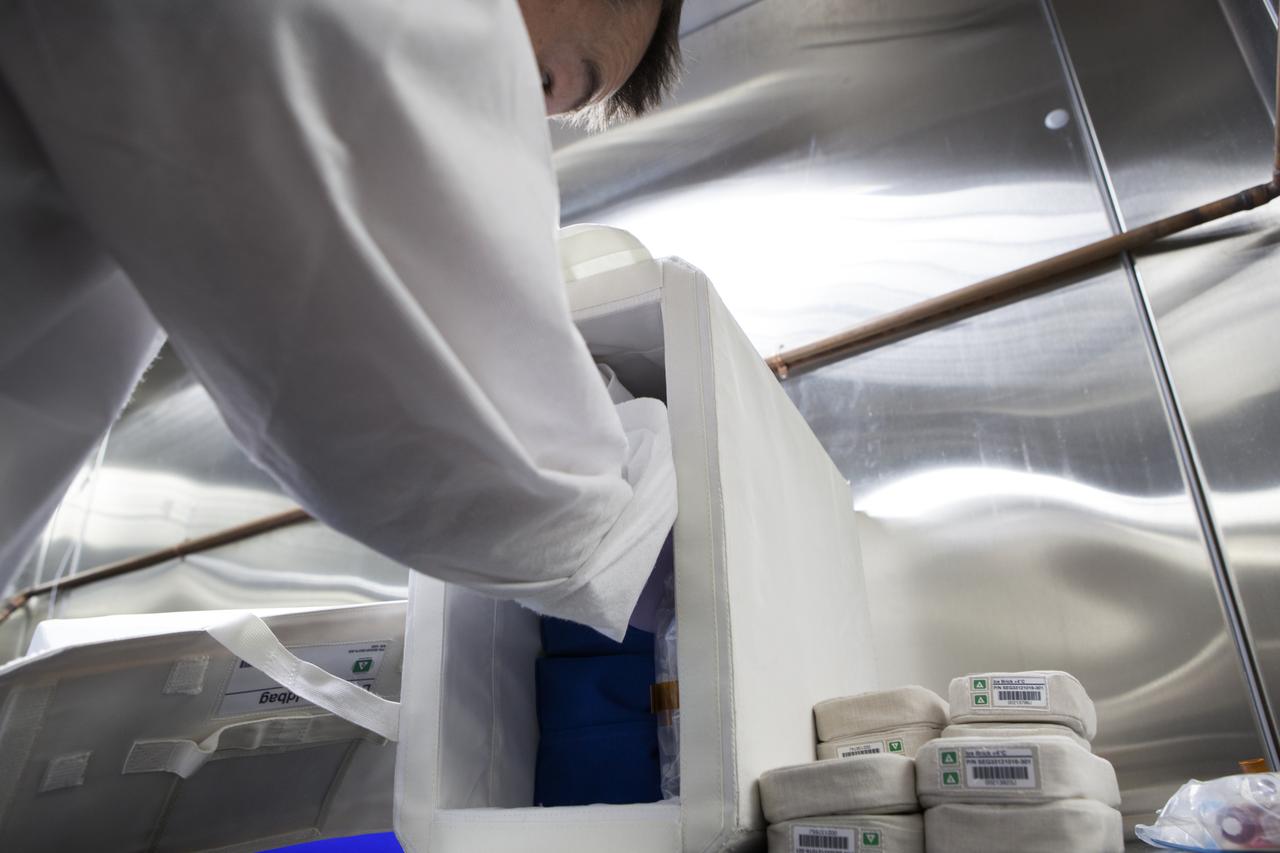
APEX-04, or Advanced Plant EXperiments-04, is being prepared in a cold room in the Kennedy Space Center Processing Facility for SpaceX-10. Eric Morris from the cold stowage group fits items into the Double Cold Bag (DCB) which is a non-powered container that keeps the APEX petri plates at +4 degrees Celsius during launch and ascent.. Dr. Anna Lisa Paul of the University of Florida is the principal investigator for APEX-04. Apex-04 is an experiment involving Arabidopsis in petri plates inside the Veggie facility aboard the International Space Station. Since Arabidopsis is the genetic model of the plant world, it is a perfect sample organism for performing genetic studies in spaceflight. The experiment is the result of a grant from NASA’s Space Life and Physical Sciences division.

CAPE CANAVERAL, Fla. -- At the Astrotech payload processing facility, NASA's Gamma-Ray Large Area Space Telescope, or GLAST, spacecraft is being prepared for a move to an payload attach fitting, in the foreground, that will eventually be used to mate GLAST to the Delta II launch vehicle. The GLAST is a powerful space observatory that will explore the Universe's ultimate frontier, where nature harnesses forces and energies far beyond anything possible on Earth; probe some of science's deepest questions, such as what our Universe is made of, and search for new laws of physics; explain how black holes accelerate jets of material to nearly light speed; and help crack the mystery of stupendously powerful explosions known as gamma-ray bursts. A launch date still is to be determined. Photo credit: NASA/Jim Grossmann
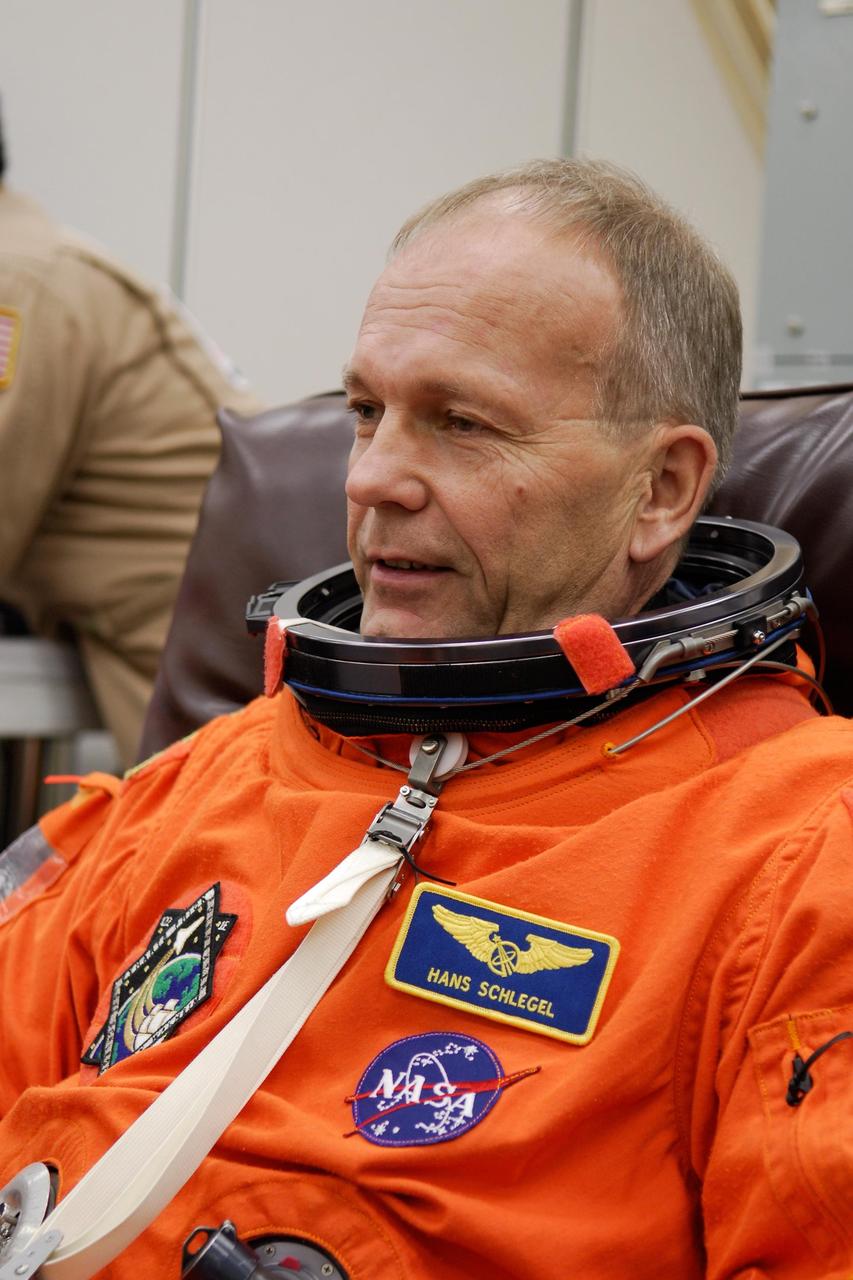
KENNEDY SPACE CENTER, FLA. -- STS-122 Mission Specialist Hans Schlegel dons his launch and entry suit for a final fitting before space shuttle Atlantis' launch scheduled for 4:31 p.m. EST on Dec. 6. Schlegel, who represents the European Space Agency, will make his second shuttle flight. Atlantis will carry the Columbus Lab, Europe’s largest contribution to the construction of the International Space Station. It will support scientific and technological research in a microgravity environment. Columbus, a program of ESA, is a multifunctional, pressurized laboratory that will be permanently attached to Node 2 of the space station to carry out experiments in materials science, fluid physics and biosciences, as well as to perform a number of technological applications. Photo credit: NASA/Kim Shiflett

VANDENBERG AIR FORCE BASE, Calif. – In a clean room at Vandenberg Air Force Base in California, technicians perform a fillet and wing fit check on the Pegasus XL launch vehicle. The Orbital Sciences Corp. Pegasus rocket will launch the Nuclear Spectroscopic Telescope Array (NuSTAR) into space. After the rocket and spacecraft are processed at Vandenberg, they will be flown on the Orbital Sciences’ L-1011 carrier aircraft to the Ronald Reagan Ballistic Missile Defense Test Site at the Pacific Ocean’s Kwajalein Atoll for launch. The high-energy X-ray telescope will conduct a census for black holes, map radioactive material in young supernovae remnants, and study the origins of cosmic rays and the extreme physics around collapsed stars. For more information, visit science.nasa.gov/missions/nustar/. Photo credit: NASA/Randy Beaudoin, VAFB
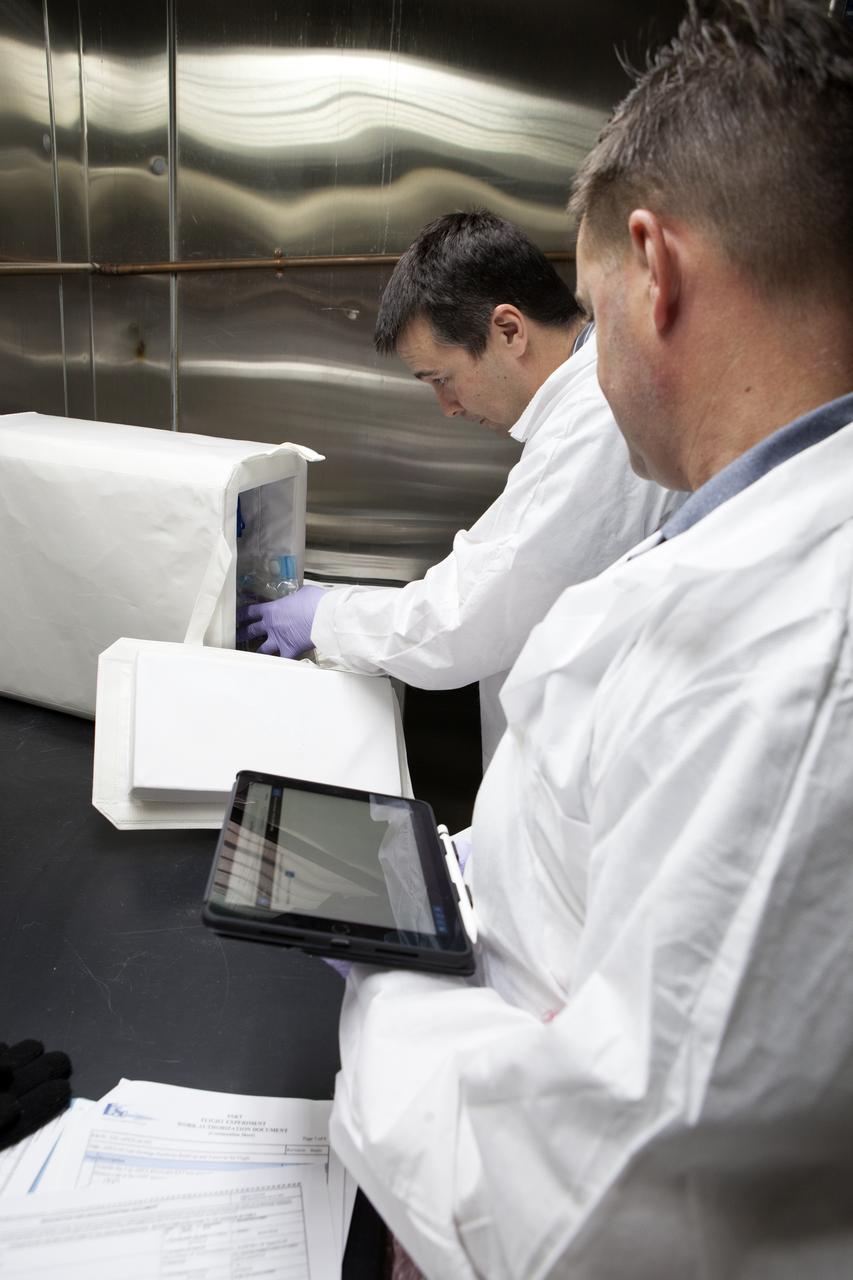
APEX-04, or Advanced Plant EXperiments-04, is being prepared in a cold room in the Kennedy Space Center Processing Facility for SpaceX-10. Eric Morris from the cold stowage group fits items into the Double Cold Bag (DCB) which is a non-powered container that keeps the APEX petri plates at +4 degrees Celsius during launch and ascent.. Dr. Anna Lisa Paul of the University of Florida is the principal investigator for APEX-04. Apex-04 is an experiment involving Arabidopsis in petri plates inside the Veggie facility aboard the International Space Station. Since Arabidopsis is the genetic model of the plant world, it is a perfect sample organism for performing genetic studies in spaceflight. The experiment is the result of a grant from NASA’s Space Life and Physical Sciences division.

CAPE CANAVERAL, Fla. -- At the Astrotech payload processing facility, technicians begin lifting and moving NASA's Gamma-Ray Large Area Space Telescope, or GLAST, spacecraft for its move to a payload attach fitting that will eventually be used to mate GLAST to the Delta II launch vehicle. The GLAST is a powerful space observatory that will explore the Universe's ultimate frontier, where nature harnesses forces and energies far beyond anything possible on Earth; probe some of science's deepest questions, such as what our Universe is made of, and search for new laws of physics; explain how black holes accelerate jets of material to nearly light speed; and help crack the mystery of stupendously powerful explosions known as gamma-ray bursts. A launch date still is to be determined. Photo credit: NASA/Jim Grossmann
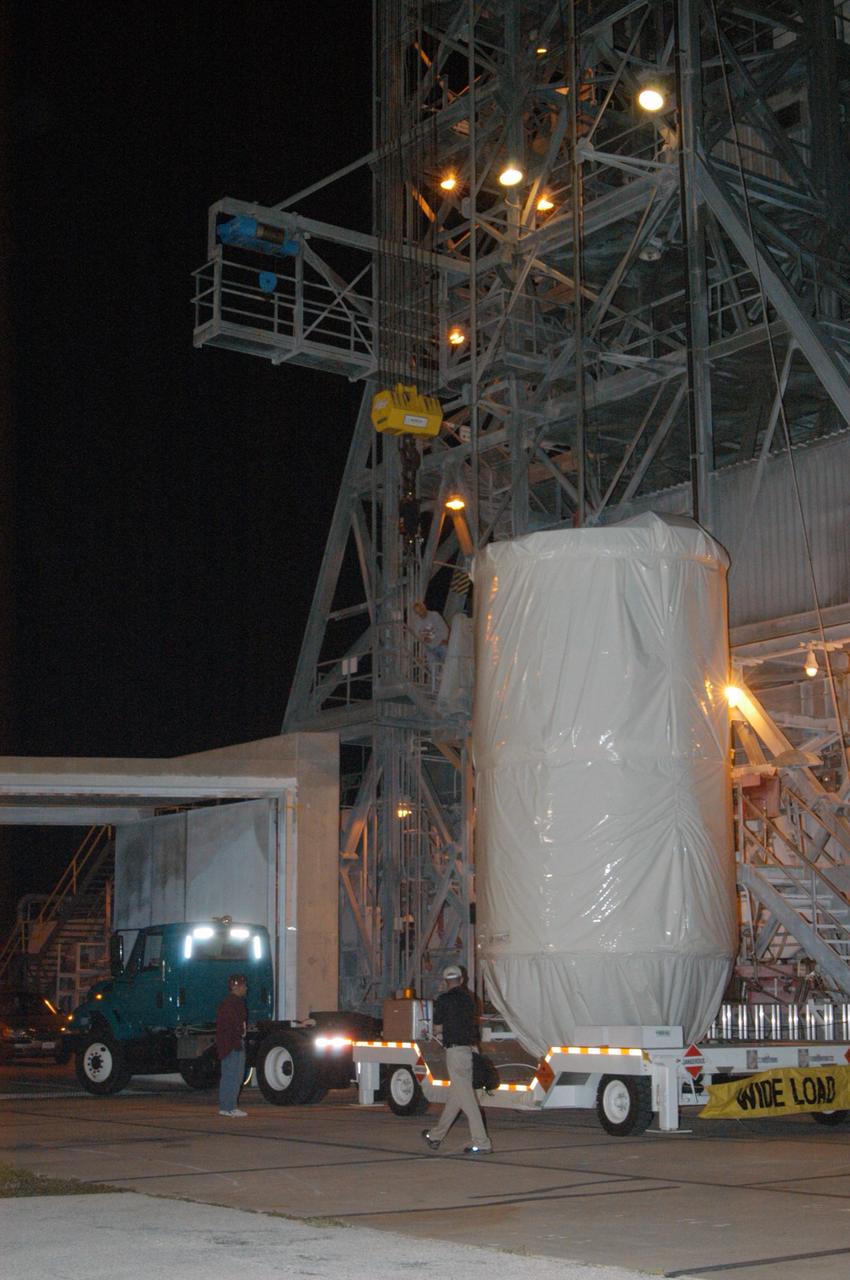
KENNEDY SPACE CENTER, FLA. - After arriving at Launch Pad 17-B on Cape Canaveral Air Force Station, the STEREO spacecraft waits for a crane to be fitted over it and be lifted into the mobile service tower. STEREO will be mated with its launch vehicle, a Boeing Delta II rocket. STEREO stands for Solar Terrestrial Relations Observatory and comprises two spacecraft. The STEREO mission is the first to take measurements of the sun and solar wind in 3-dimension. This new view will improve our understanding of space weather and its impact on the Earth. The STEREO mission is managed by Goddard Space Flight Center. The Applied Physics Laboratory designed and built the spacecraft. The laboratory will maintain command and control of the observatories throughout the mission, while NASA tracks and receives the data, determines the orbit of the satellites, and coordinates the science results. STEREO is expected to lift off Oct. 25. Photo credit: NASA/George Shelton

CAPE CANAVERAL, Fla. -- At the Astrotech payload processing facility, technicians prepare NASA's Gamma-Ray Large Area Space Telescope, or GLAST, spacecraft for its move to the payload attach fitting that will eventually be used to mate GLAST to the Delta II launch vehicle. The GLAST is a powerful space observatory that will explore the Universe's ultimate frontier, where nature harnesses forces and energies far beyond anything possible on Earth; probe some of science's deepest questions, such as what our Universe is made of, and search for new laws of physics; explain how black holes accelerate jets of material to nearly light speed; and help crack the mystery of stupendously powerful explosions known as gamma-ray bursts. A launch date still is to be determined. Photo credit: NASA/Jim Grossmann

CAPE CANAVERAL, Fla. -- At the Astrotech payload processing facility, NASA's Gamma-Ray Large Area Space Telescope, or GLAST, spacecraft will be installed on this payload attach fitting that will eventually be mated to the Delta II launch vehicle. The GLAST is a powerful space observatory that will explore the Universe's ultimate frontier, where nature harnesses forces and energies far beyond anything possible on Earth; probe some of science's deepest questions, such as what our Universe is made of, and search for new laws of physics; explain how black holes accelerate jets of material to nearly light speed; and help crack the mystery of stupendously powerful explosions known as gamma-ray bursts. A launch date still is to be determined. Photo credit: NASA/Jim Grossmann

VANDENBERG AIR FORCE BASE, Calif. – In a clean room at Vandenberg Air Force Base in California, technicians prepare to complete a second fillet and wing fit check on the Pegasus XL launch vehicle. The Orbital Sciences Corp. Pegasus rocket will launch the Nuclear Spectroscopic Telescope Array (NuSTAR) into space. After the rocket and spacecraft are processed at Vandenberg, they will be flown on the Orbital Sciences’ L-1011 carrier aircraft to the Ronald Reagan Ballistic Missile Defense Test Site at the Pacific Ocean’s Kwajalein Atoll for launch. The high-energy X-ray telescope will conduct a census for black holes, map radioactive material in young supernovae remnants, and study the origins of cosmic rays and the extreme physics around collapsed stars. For more information, visit science.nasa.gov/missions/nustar/. Photo credit: NASA/Randy Beaudoin, VAFB
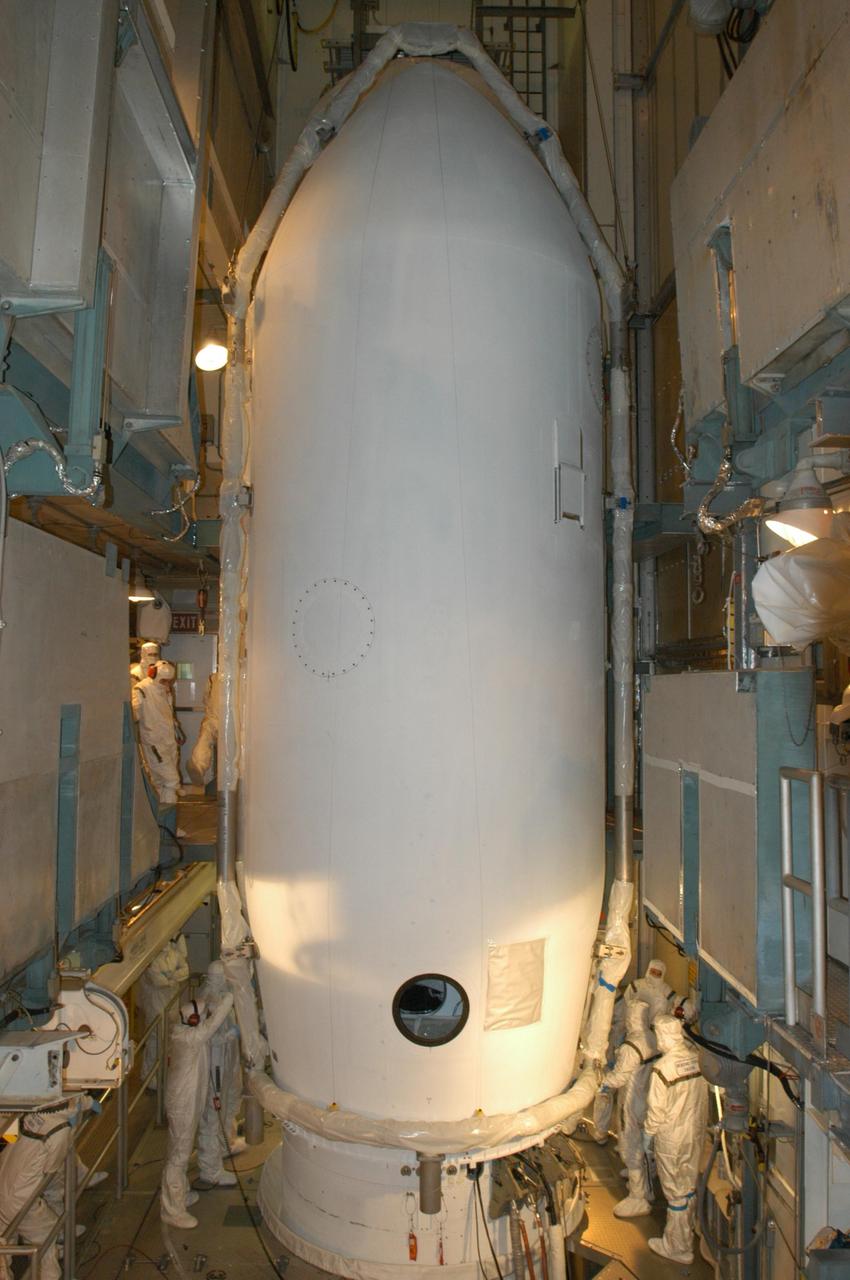
KENNEDY SPACE CENTER, FLA. - Inside the mobile service tower on Launch Pad 17-B at Cape Canaveral Air Force Station, workers secure the two halves of the fairing that enclose the STEREO spacecraft. The fairing is a molded structure that fits flush with the outside surface of the Delta II upper stage booster and forms an aerodynamically smooth nose cone, protecting the spacecraft during launch and ascent. The STEREO (Solar Terrestrial Relations Observatory) mission is the first to take measurements of the sun and solar wind in 3-dimension. This new view will improve our understanding of space weather and its impact on the Earth. Designed and built by the Applied Physics Laboratory (APL) , the STEREO mission is being managed by NASA Goddard Space Flight Center. APL will maintain command and control of the observatories throughout the mission, while NASA tracks and receives the data, determines the orbit of the satellites, and coordinates the science results. STEREO is expected to lift off Oct. 25. Photo credit: NASA/George Shelton
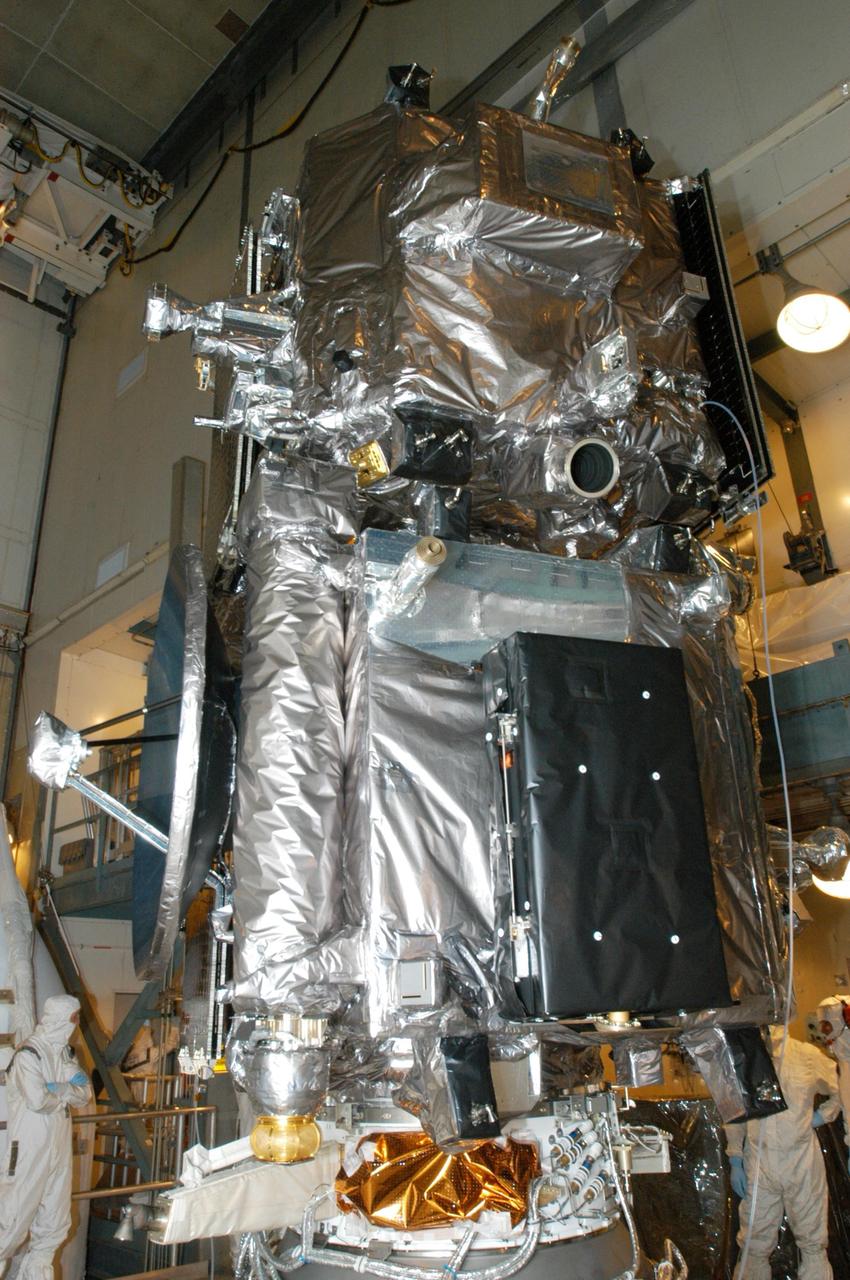
KENNEDY SPACE CENTER, FLA. - Inside the mobile service tower on Launch Pad 17-B at Cape Canaveral Air Force Station, workers prepare the twin observatories known as STEREO for encapsulation in the fairing. The fairing is a molded structure that fits flush with the outside surface of the Delta II upper stage booster and forms an aerodynamically smooth nose cone, protecting the spacecraft during launch and ascent. The STEREO (Solar Terrestrial Relations Observatory) mission is the first to take measurements of the sun and solar wind in 3-dimension. This new view will improve our understanding of space weather and its impact on the Earth. Designed and built by the Applied Physics Laboratory (APL) , the STEREO mission is being managed by NASA Goddard Space Flight Center. APL will maintain command and control of the observatories throughout the mission, while NASA tracks and receives the data, determines the orbit of the satellites, and coordinates the science results. STEREO is expected to lift off Oct. 25. Photo credit: NASA/George Shelton
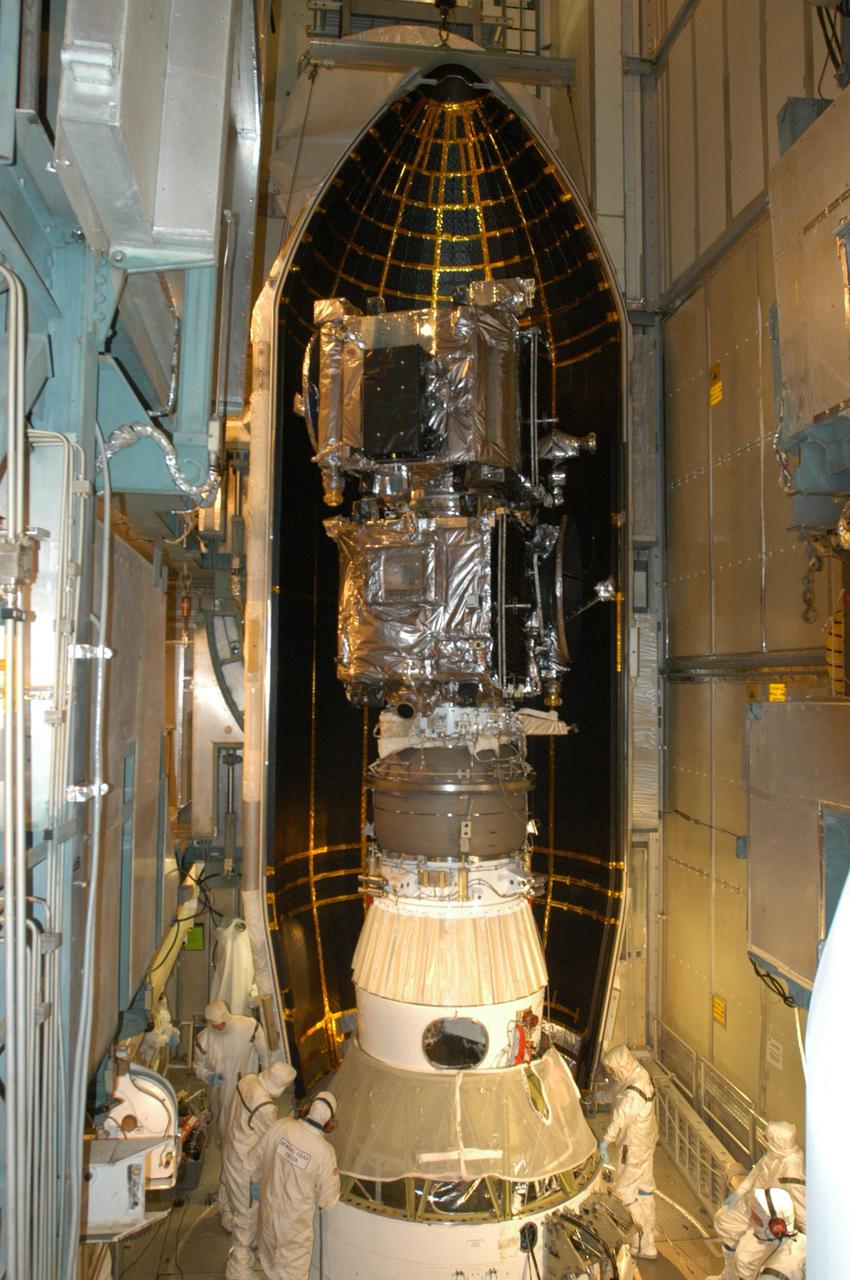
KENNEDY SPACE CENTER, FLA. - Inside the mobile service tower on Launch Pad 17-B at Cape Canaveral Air Force Station, workers check the placement of the first half of the fairing around the STEREO spacecraft. The fairing is a molded structure that fits flush with the outside surface of the Delta II upper stage booster and forms an aerodynamically smooth nose cone, protecting the spacecraft during launch and ascent. The STEREO (Solar Terrestrial Relations Observatory) mission is the first to take measurements of the sun and solar wind in 3-dimension. This new view will improve our understanding of space weather and its impact on the Earth. Designed and built by the Applied Physics Laboratory (APL) , the STEREO mission is being managed by NASA Goddard Space Flight Center. APL will maintain command and control of the observatories throughout the mission, while NASA tracks and receives the data, determines the orbit of the satellites, and coordinates the science results. STEREO is expected to lift off Oct. 25. Photo credit: NASA/George Shelton

STS-91 Mission Specialist Franklin R. Chang-Diaz gets assistance from a suit technician as he dons his flight suit in the Operations and Checkout (O&C) Building. The fitting takes place prior to the crew walkout and transport to Launch Pad 39A. He is on his sixth space flight. Chang-Diaz holds a doctorate in applied plasma physics and is director of the Advanced Space Propulsion Laboratory at the University of Houston. Franklin’s background will serve him well during the mission, since he will be primarily responsible for crew activities in support of the of the Alpha Magnetic Spectrometer. He will also back up Lawrence with the mideck experiments and Kavandi with SPACEHAB operations. STS-91 is scheduled to be launched on June 2 with a launch window opening around 6:10 p.m. EDT. The mission will feature the ninth and final Shuttle docking with the Russian Space Station Mir, the first Mir docking for Discovery, the first on-orbit test of the Alpha Magnetic Spectrometer (AMS), and the first flight of the new Space Shuttle super lightweight external tank. Astronaut Andrew S. W. Thomas will return to Earth as a STS-91 crew member after living more than four months aboard Mir
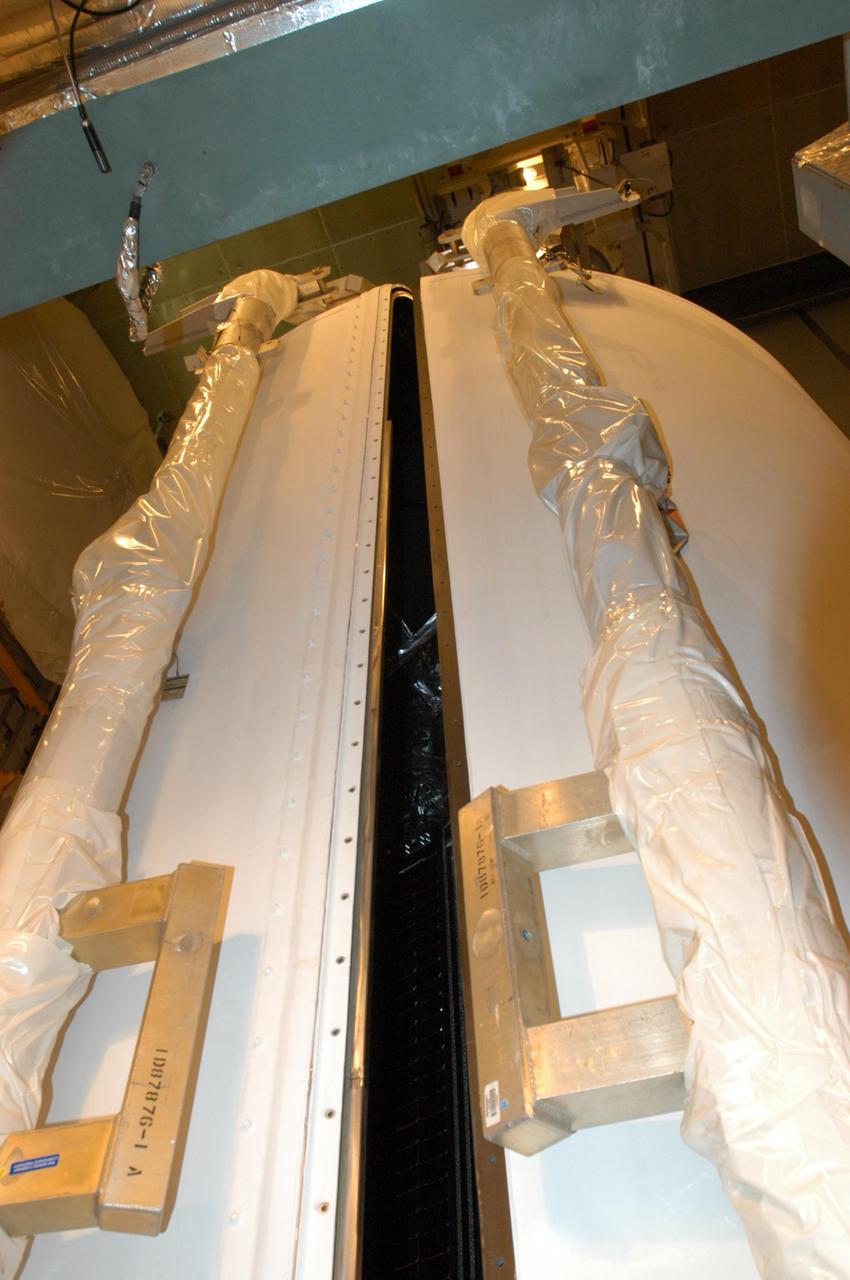
KENNEDY SPACE CENTER, FLA. - Inside the mobile service tower on Launch Pad 17-B at Cape Canaveral Air Force Station, the two fairing segments close in around the STEREO spacecraft. The fairing is a molded structure that fits flush with the outside surface of the Delta II upper stage booster and forms an aerodynamically smooth nose cone, protecting the spacecraft during launch and ascent. The STEREO (Solar Terrestrial Relations Observatory) mission is the first to take measurements of the sun and solar wind in 3-dimension. This new view will improve our understanding of space weather and its impact on the Earth. Designed and built by the Applied Physics Laboratory (APL) , the STEREO mission is being managed by NASA Goddard Space Flight Center. APL will maintain command and control of the observatories throughout the mission, while NASA tracks and receives the data, determines the orbit of the satellites, and coordinates the science results. STEREO is expected to lift off Oct. 25. Photo credit: NASA/George Shelton
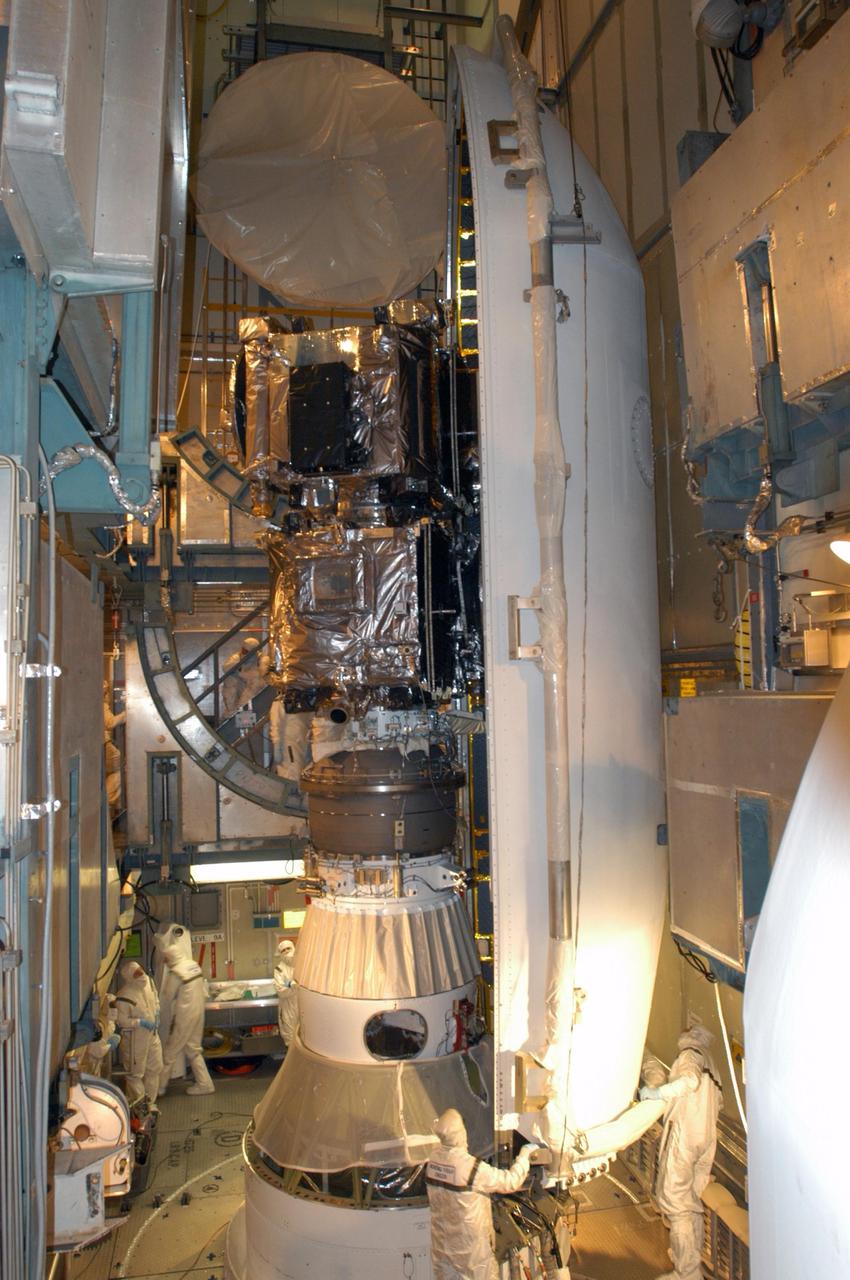
KENNEDY SPACE CENTER, FLA. - Inside the mobile service tower on Launch Pad 17-B at Cape Canaveral Air Force Station, workers help maneuver one segment of the fairing around the STEREO spacecraft. The fairing is a molded structure that fits flush with the outside surface of the Delta II upper stage booster and forms an aerodynamically smooth nose cone, protecting the spacecraft during launch and ascent. The STEREO (Solar Terrestrial Relations Observatory) mission is the first to take measurements of the sun and solar wind in 3-dimension. This new view will improve our understanding of space weather and its impact on the Earth. Designed and built by the Applied Physics Laboratory (APL) , the STEREO mission is being managed by NASA Goddard Space Flight Center. APL will maintain command and control of the observatories throughout the mission, while NASA tracks and receives the data, determines the orbit of the satellites, and coordinates the science results. STEREO is expected to lift off Oct. 25. Photo credit: NASA/George Shelton
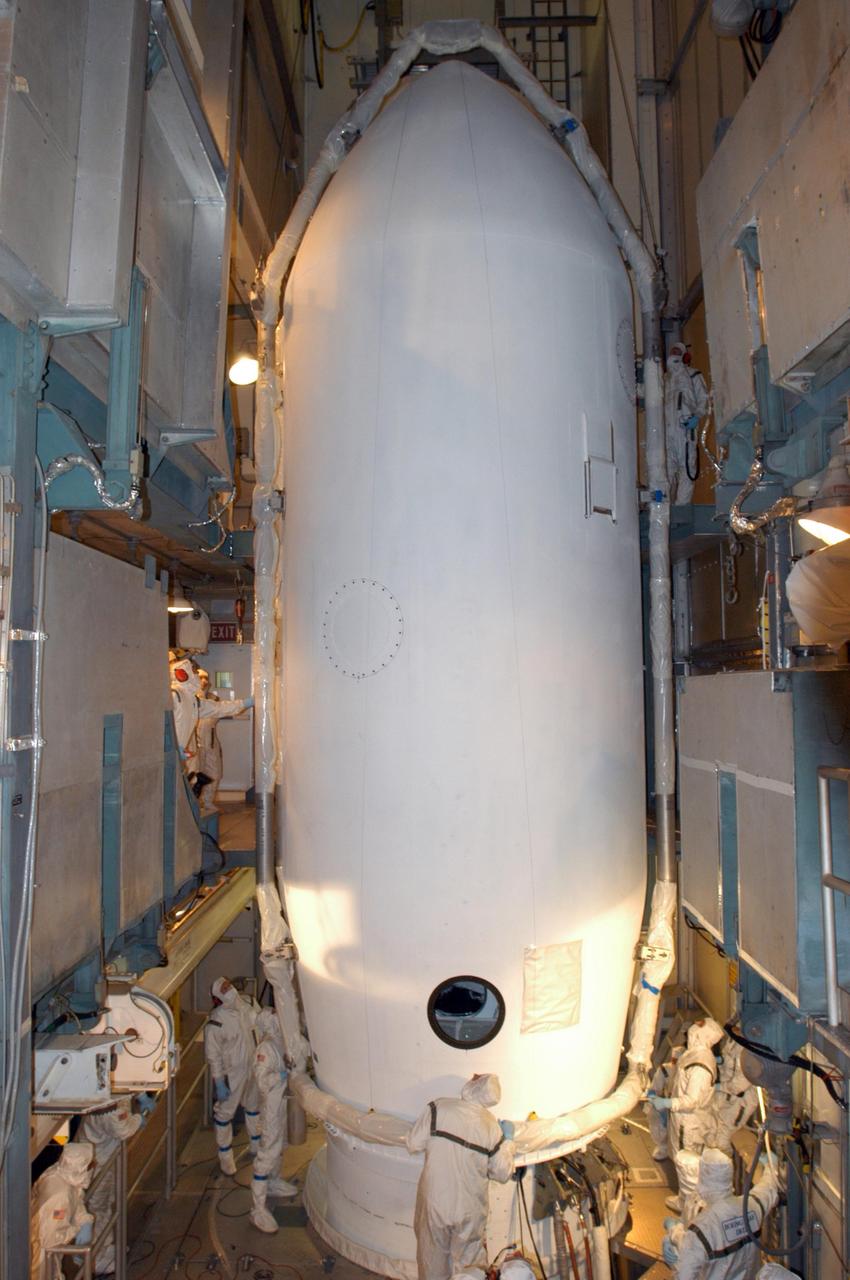
KENNEDY SPACE CENTER, FLA. - Inside the mobile service tower on Launch Pad 17-B at Cape Canaveral Air Force Station, workers maneuver the second half of the fairing into place around the STEREO spacecraft. The fairing is a molded structure that fits flush with the outside surface of the Delta II upper stage booster and forms an aerodynamically smooth nose cone, protecting the spacecraft during launch and ascent. The STEREO (Solar Terrestrial Relations Observatory) mission is the first to take measurements of the sun and solar wind in 3-dimension. This new view will improve our understanding of space weather and its impact on the Earth. Designed and built by the Applied Physics Laboratory (APL) , the STEREO mission is being managed by NASA Goddard Space Flight Center. APL will maintain command and control of the observatories throughout the mission, while NASA tracks and receives the data, determines the orbit of the satellites, and coordinates the science results. STEREO is expected to lift off Oct. 25. Photo credit: NASA/George Shelton
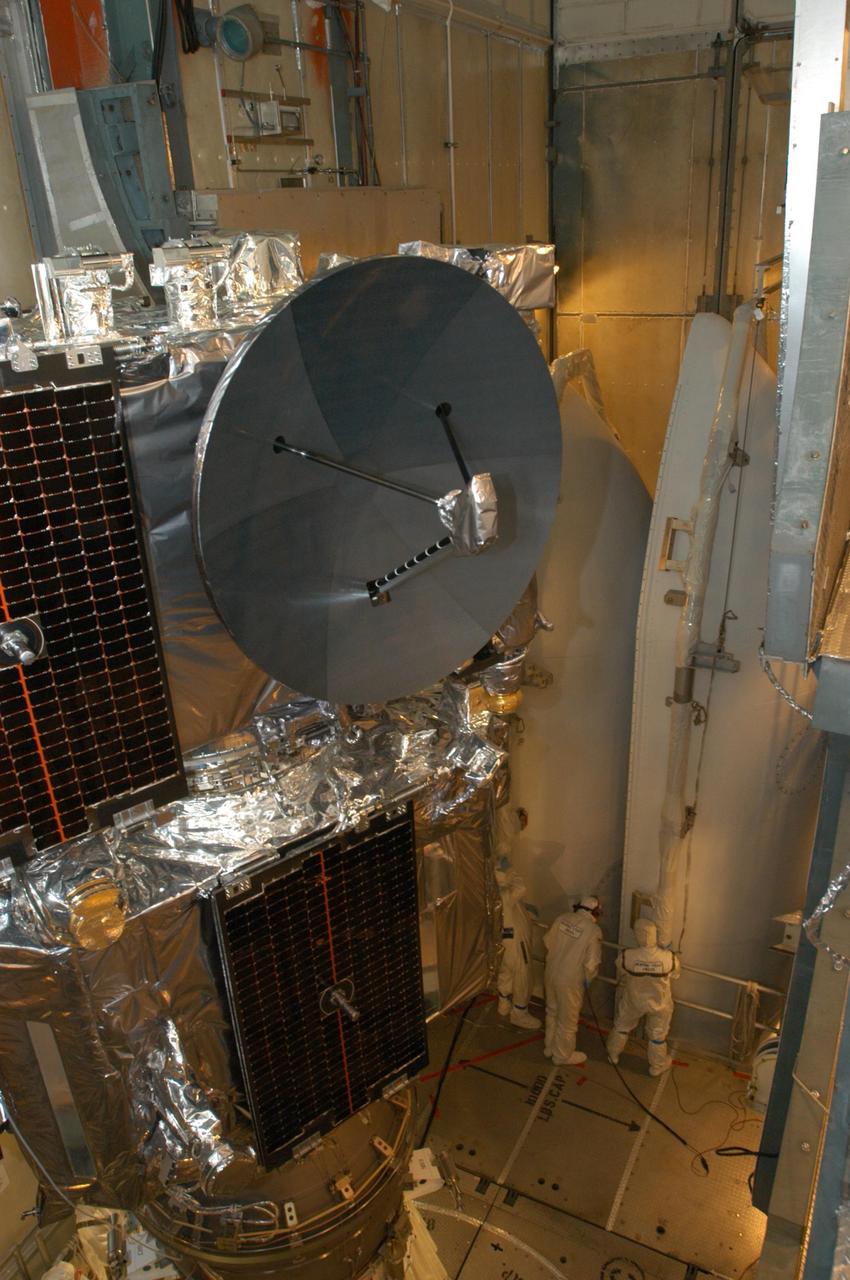
KENNEDY SPACE CENTER, FLA. - Inside the mobile service tower on Launch Pad 17-B at Cape Canaveral Air Force Station, workers (background) observe the lifting of the two fairing segments that will encapsulate the STEREO spacecraft (foreground). The fairing is a molded structure that fits flush with the outside surface of the Delta II upper stage booster and forms an aerodynamically smooth nose cone, protecting the spacecraft during launch and ascent. The STEREO (Solar Terrestrial Relations Observatory) mission is the first to take measurements of the sun and solar wind in 3-dimension. This new view will improve our understanding of space weather and its impact on the Earth. Designed and built by the Applied Physics Laboratory (APL) , the STEREO mission is being managed by NASA Goddard Space Flight Center. APL will maintain command and control of the observatories throughout the mission, while NASA tracks and receives the data, determines the orbit of the satellites, and coordinates the science results. STEREO is expected to lift off Oct. 25. Photo credit: NASA/George Shelton
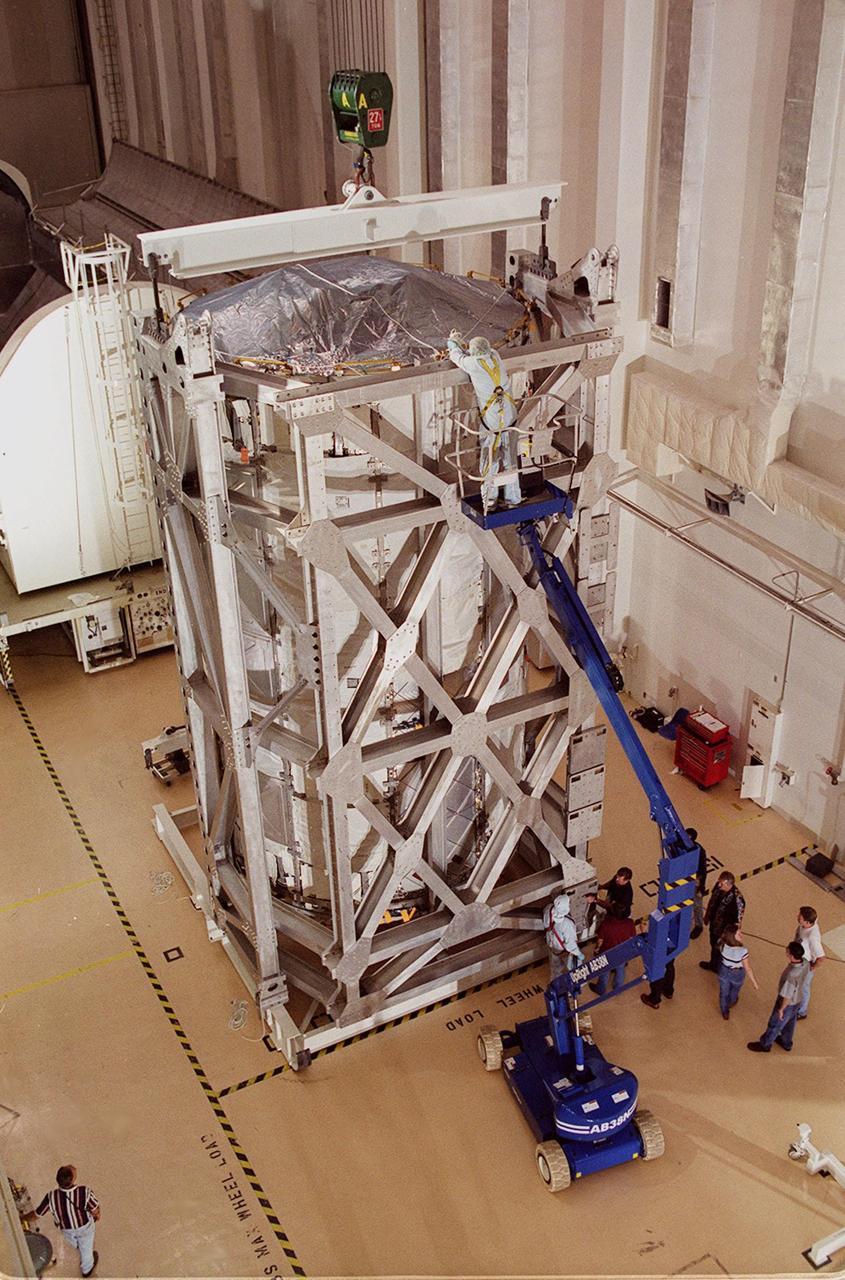
KENNEDY SPACE CENTER, FLA. -- A worker checks the cable fittings on the U.S. Lab, a component of the International Space Station, before it is lifted and placed inside the vacuum chamber in the Operations and Checkout Building. The 32,000-pound scientific research lab, named Destiny, is the first Space Station element to spend seven days in the renovated vacuum chamber for a leak test. Destiny is scheduled to be launched on Shuttle mission STS-98, the 5A assembly mission, targeted for Jan. 18, 2001. During the mission, the crew will install the Lab in the Space Station during a series of three space walks. The STS-98 mission will provide the Station with science research facilities and expand its power, life support and control capabilities. The U.S. Lab module continues a long tradition of microgravity materials research, first conducted by Skylab and later Shuttle and Spacelab missions. Destiny is expected to be a major feature in future research, providing facilities for biotechnology, fluid physics, combustion, and life sciences research
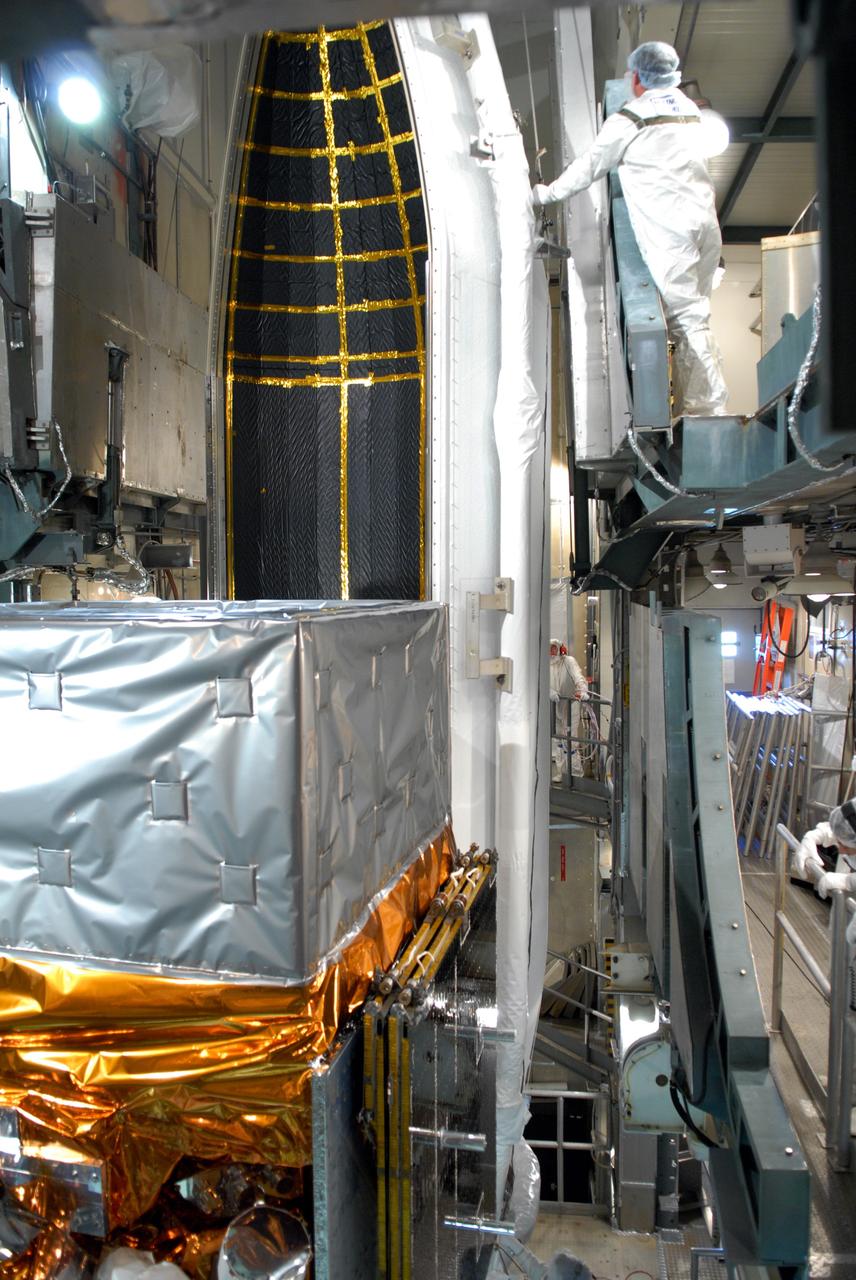
CAPE CANAVERAL, Fla. -- Inside the mobile service tower on Launch Pad 17-B at Cape Canaveral Air Force Station, workers help guide one section of the payload fairing into place around NASA's Gamma-Ray Large Area Space Telescope, or GLAST. The fairing is a molded structure that fits flush with the outside surface of the Delta II upper stage booster and forms an aerodynamically smooth nose cone, protecting the spacecraft during launch and ascent. GLAST is a powerful space observatory that will explore the Universe's ultimate frontier, where nature harnesses forces and energies far beyond anything possible on Earth; probe some of science's deepest questions, such as what our Universe is made of, and search for new laws of physics; explain how black holes accelerate jets of material to nearly light speed; and help crack the mystery of stupendously powerful explosions known as gamma-ray bursts. The launch date is targeted no earlier than June 3. Photo credit: NASA/Jim Grossmann
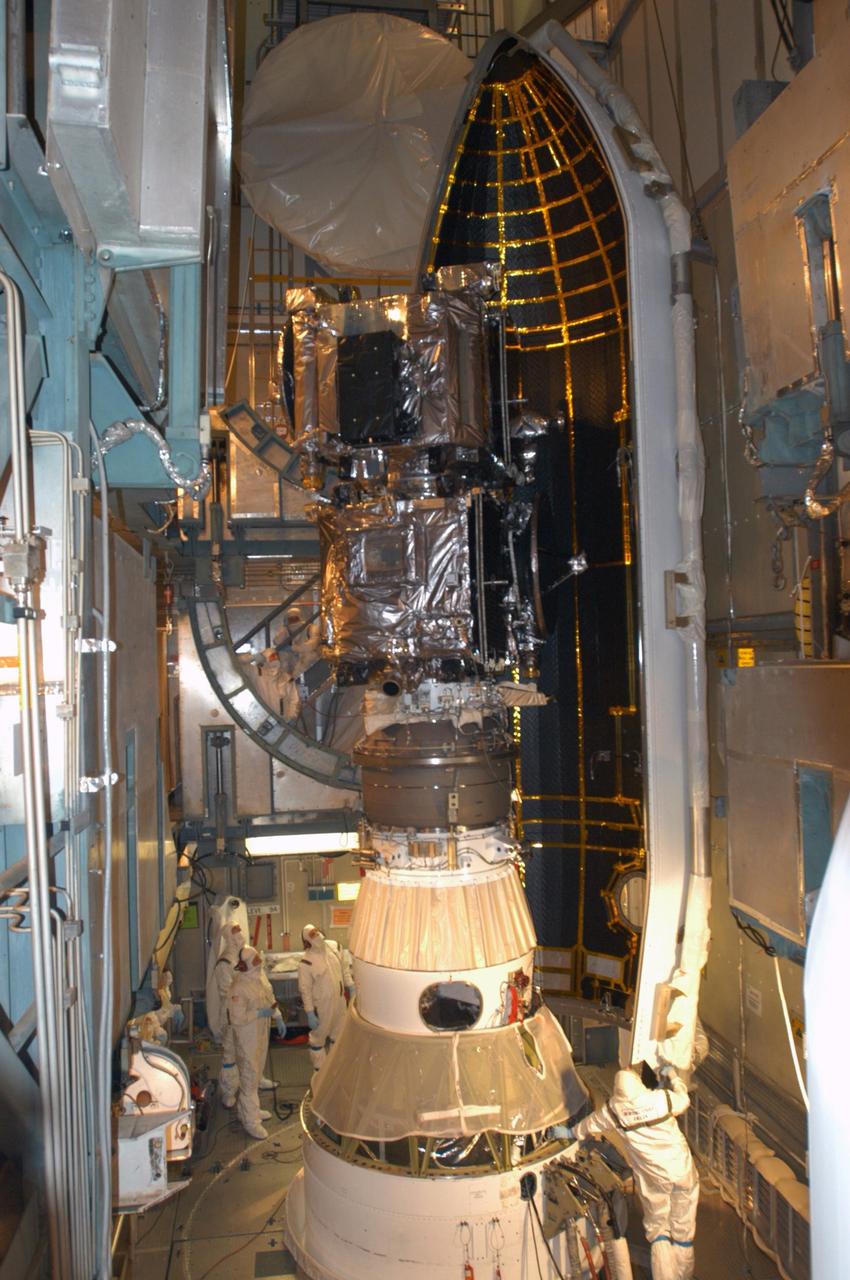
KENNEDY SPACE CENTER, FLA. - Inside the mobile service tower on Launch Pad 17-B at Cape Canaveral Air Force Station, workers help maneuver one segment of the fairing around the STEREO spacecraft. The fairing is a molded structure that fits flush with the outside surface of the Delta II upper stage booster and forms an aerodynamically smooth nose cone, protecting the spacecraft during launch and ascent. The STEREO (Solar Terrestrial Relations Observatory) mission is the first to take measurements of the sun and solar wind in 3-dimension. This new view will improve our understanding of space weather and its impact on the Earth. Designed and built by the Applied Physics Laboratory (APL) , the STEREO mission is being managed by NASA Goddard Space Flight Center. APL will maintain command and control of the observatories throughout the mission, while NASA tracks and receives the data, determines the orbit of the satellites, and coordinates the science results. STEREO is expected to lift off Oct. 25. Photo credit: NASA/George Shelton
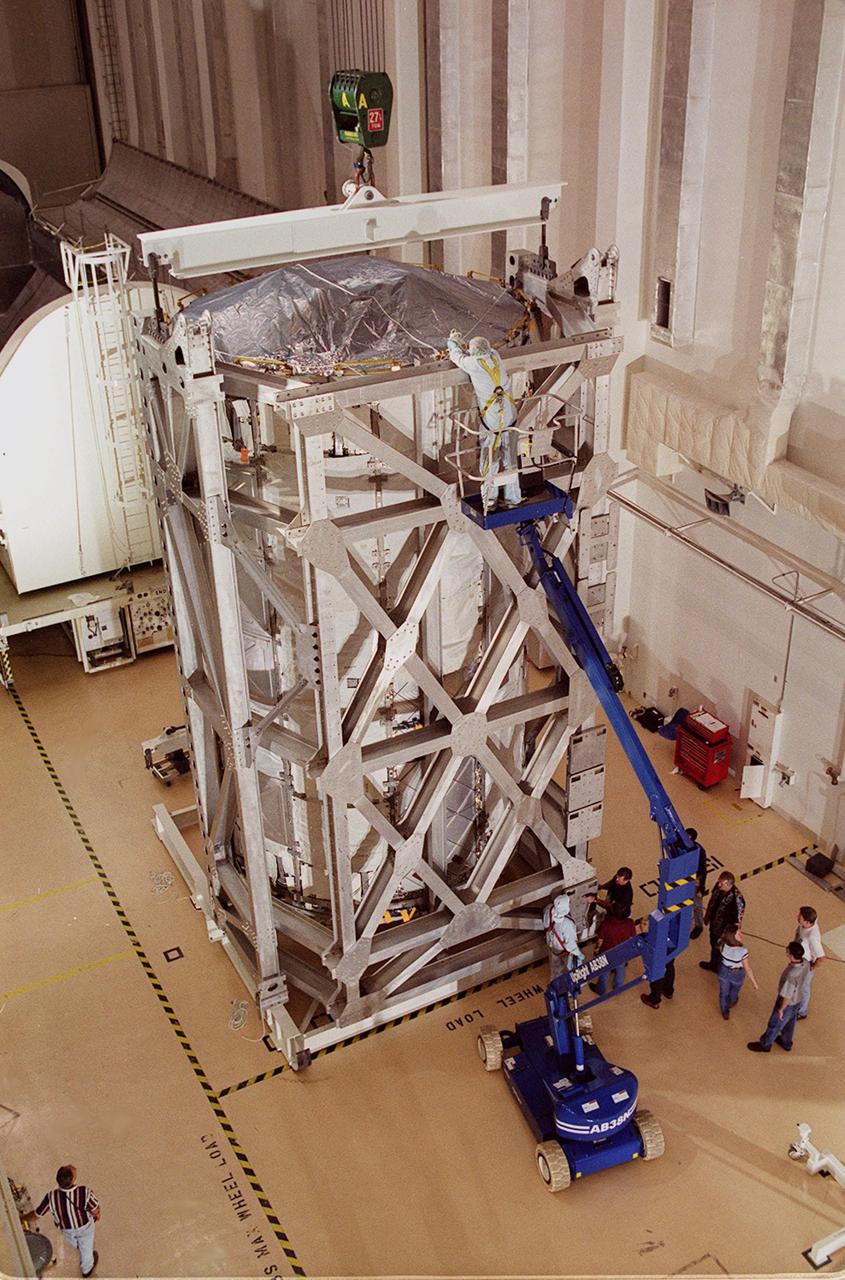
KENNEDY SPACE CENTER, FLA. -- A worker checks the cable fittings on the U.S. Lab, a component of the International Space Station, before it is lifted and placed inside the vacuum chamber in the Operations and Checkout Building. The 32,000-pound scientific research lab, named Destiny, is the first Space Station element to spend seven days in the renovated vacuum chamber for a leak test. Destiny is scheduled to be launched on Shuttle mission STS-98, the 5A assembly mission, targeted for Jan. 18, 2001. During the mission, the crew will install the Lab in the Space Station during a series of three space walks. The STS-98 mission will provide the Station with science research facilities and expand its power, life support and control capabilities. The U.S. Lab module continues a long tradition of microgravity materials research, first conducted by Skylab and later Shuttle and Spacelab missions. Destiny is expected to be a major feature in future research, providing facilities for biotechnology, fluid physics, combustion, and life sciences research
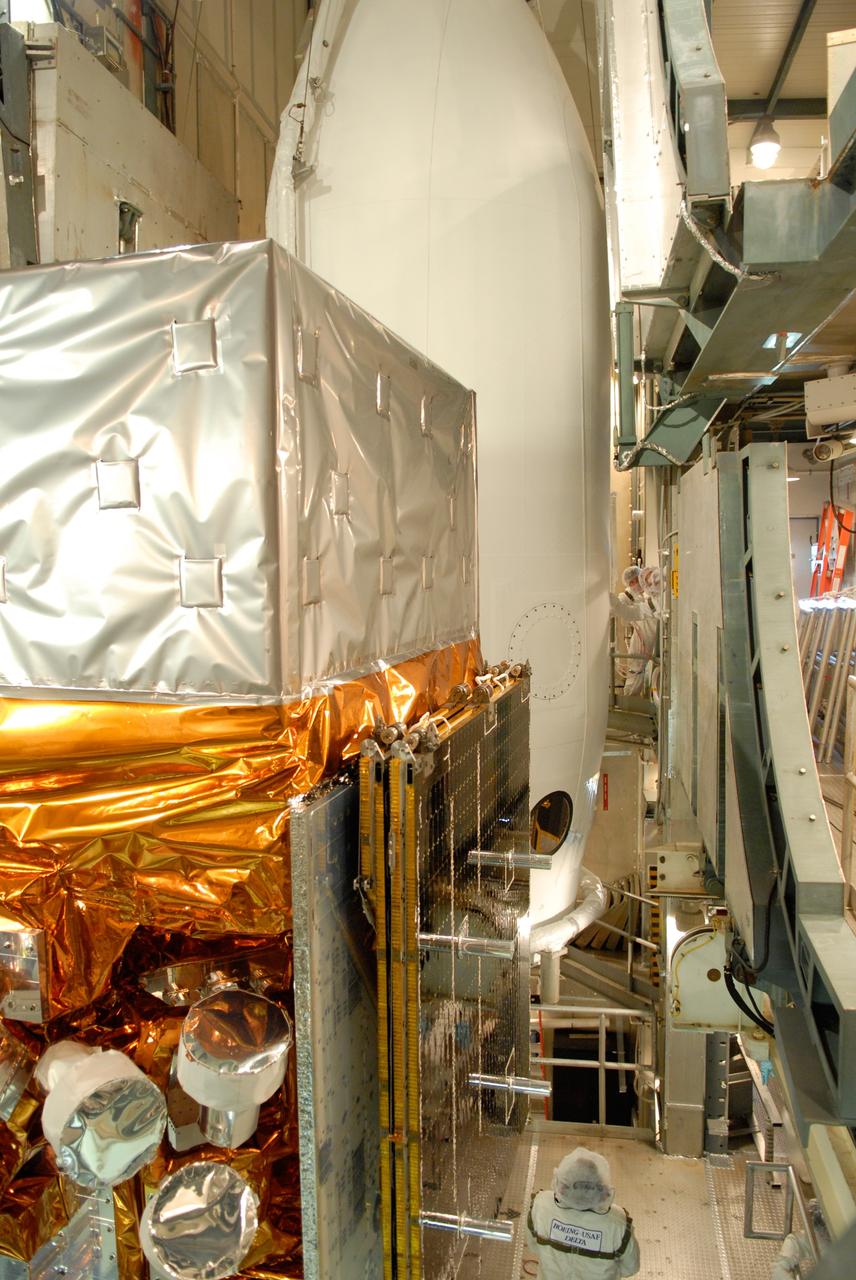
CAPE CANAVERAL, Fla. -- Inside the mobile service tower on Launch Pad 17-B at Cape Canaveral Air Force Station, NASA's Gamma-Ray Large Area Space Telescope, or GLAST, is ready for encapsulation in the payload fairing, which is seen behind it. The fairing is a molded structure that fits flush with the outside surface of the Delta II upper stage booster and forms an aerodynamically smooth nose cone, protecting the spacecraft during launch and ascent. GLAST is a powerful space observatory that will explore the Universe's ultimate frontier, where nature harnesses forces and energies far beyond anything possible on Earth; probe some of science's deepest questions, such as what our Universe is made of, and search for new laws of physics; explain how black holes accelerate jets of material to nearly light speed; and help crack the mystery of stupendously powerful explosions known as gamma-ray bursts. The launch date is targeted no earlier than June 3. Photo credit: NASA/Jim Grossmann
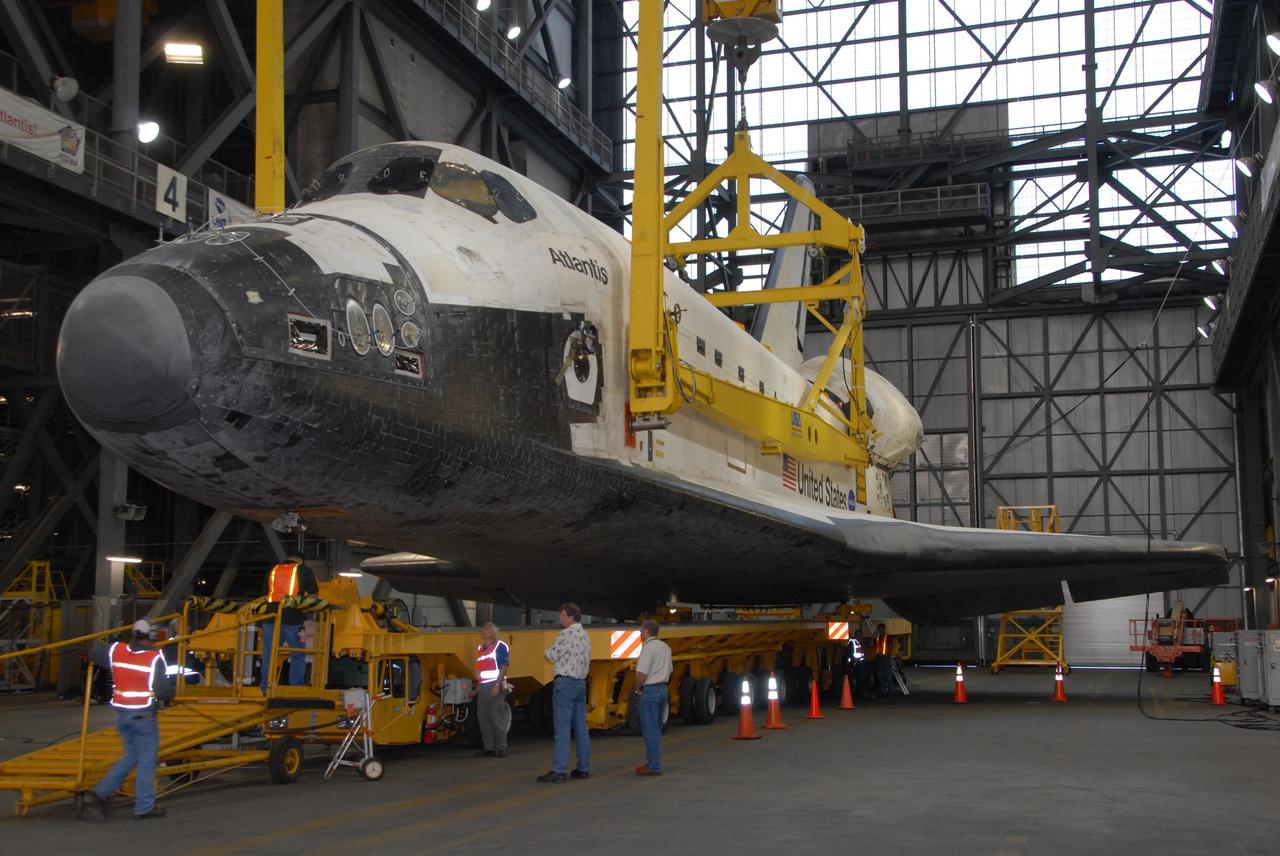
KENNEDY SPACE CENTER, FLA. — In the transfer aisle of the Vehicle Assembly Building at NASA's Kennedy Space Center, space shuttle Atlantis is fitted with a sling to raise it off its transporter into a vertical position. Atlantis will be lifted into high bay 3 and mated with the external tank and solid rocket boosters designated for mission STS-122, already secured atop a mobile launcher platform. On this mission, Atlantis will deliver the Columbus module to the International Space Station. The European Space Agency's largest contribution to the station, Columbus is a multifunctional, pressurized laboratory that will be permanently attached to U.S. Node 2, called Harmony. The module is approximately 23 feet long and 15 feet wide, allowing it to hold 10 large racks of experiments. The laboratory will expand the research facilities aboard the station, providing crew members and scientists from around the world the ability to conduct a variety of experiments in the physical, materials and life sciences. Mission STS-122 is targeted for launch on Dec. 6. Photo credit: NASA/George Shelton
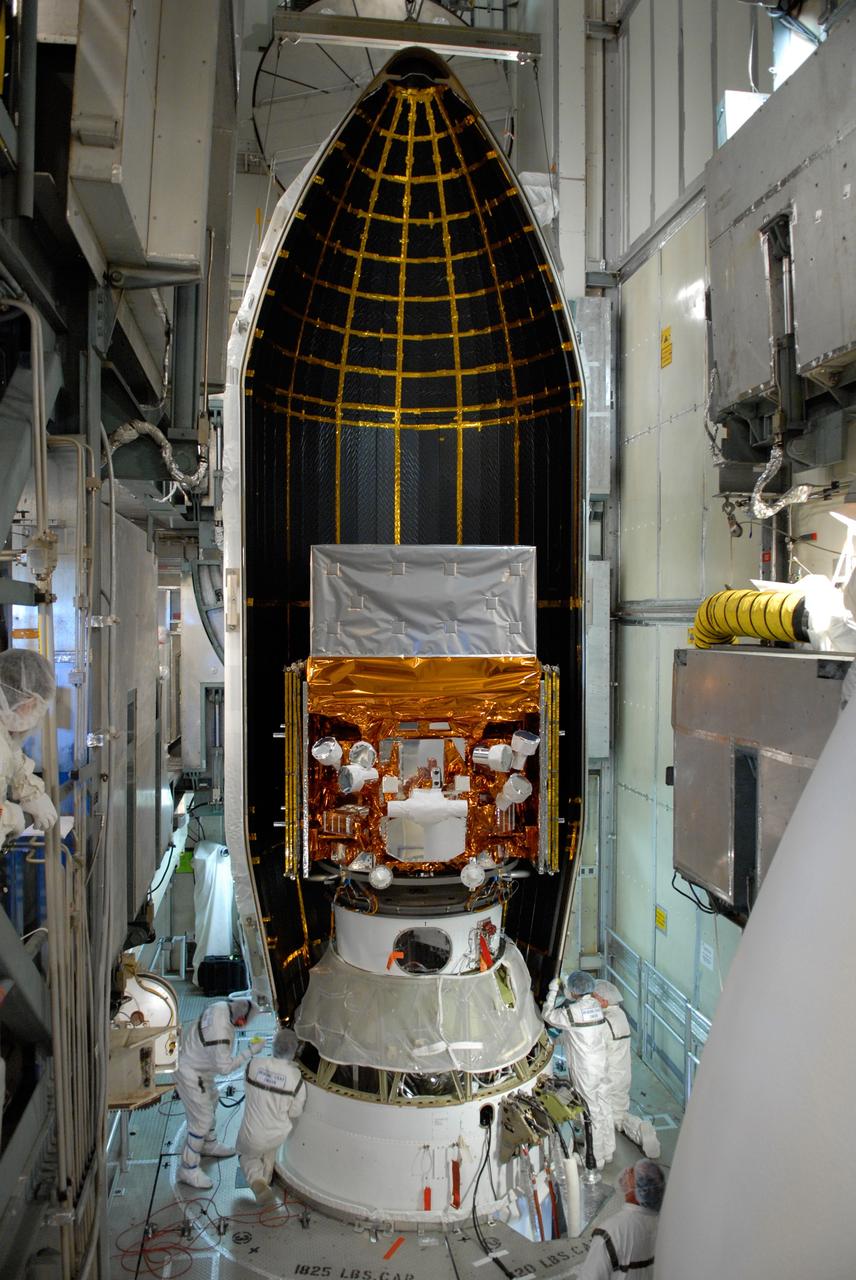
CAPE CANAVERAL, Fla. -- The first half of the payload fairing is moved into place around NASA's Gamma-Ray Large Area Space Telescope within the mobile service tower on Launch Pad 17-B at Cape Canaveral Air Force Station. The fairing is a molded structure that fits flush with the outside surface of the Delta II upper stage booster and forms an aerodynamically smooth nose cone, protecting the spacecraft during launch and ascent. GLAST is a powerful space observatory that will explore the Universe's ultimate frontier, where nature harnesses forces and energies far beyond anything possible on Earth; probe some of science's deepest questions, such as what our Universe is made of, and search for new laws of physics; explain how black holes accelerate jets of material to nearly light speed; and help crack the mystery of stupendously powerful explosions known as gamma-ray bursts. The launch date is targeted no earlier than June 3. Photo credit: NASA/Jim Grossmann
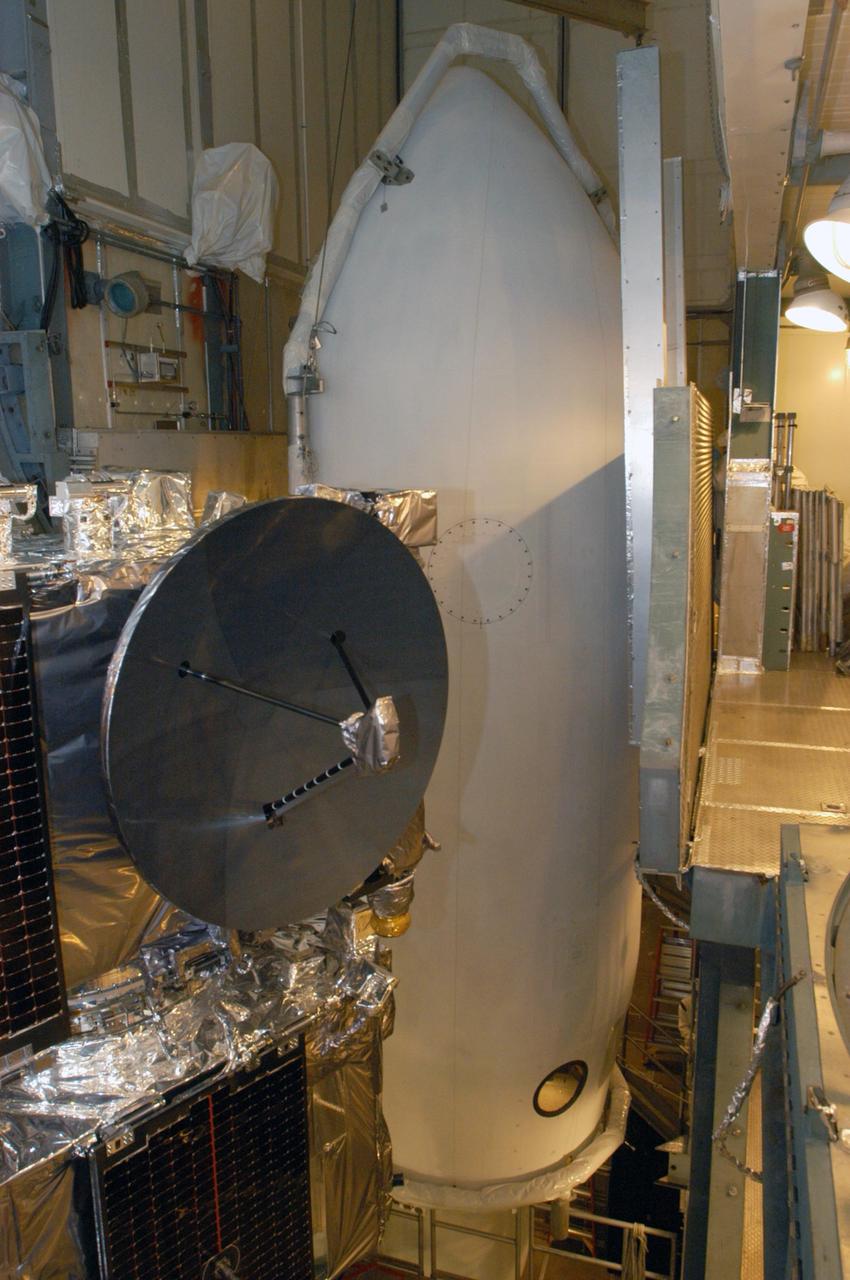
KENNEDY SPACE CENTER, FLA. - Inside the mobile service tower on Launch Pad 17-B at Cape Canaveral Air Force Station, one segment of the fairing is lifted toward the STEREO spacecraft in the foreground. The fairing is a molded structure that fits flush with the outside surface of the Delta II upper stage booster and forms an aerodynamically smooth nose cone, protecting the spacecraft during launch and ascent. The STEREO (Solar Terrestrial Relations Observatory) mission is the first to take measurements of the sun and solar wind in 3-dimension. This new view will improve our understanding of space weather and its impact on the Earth. Designed and built by the Applied Physics Laboratory (APL) , the STEREO mission is being managed by NASA Goddard Space Flight Center. APL will maintain command and control of the observatories throughout the mission, while NASA tracks and receives the data, determines the orbit of the satellites, and coordinates the science results. STEREO is expected to lift off Oct. 25. Photo credit: NASA/George Shelton
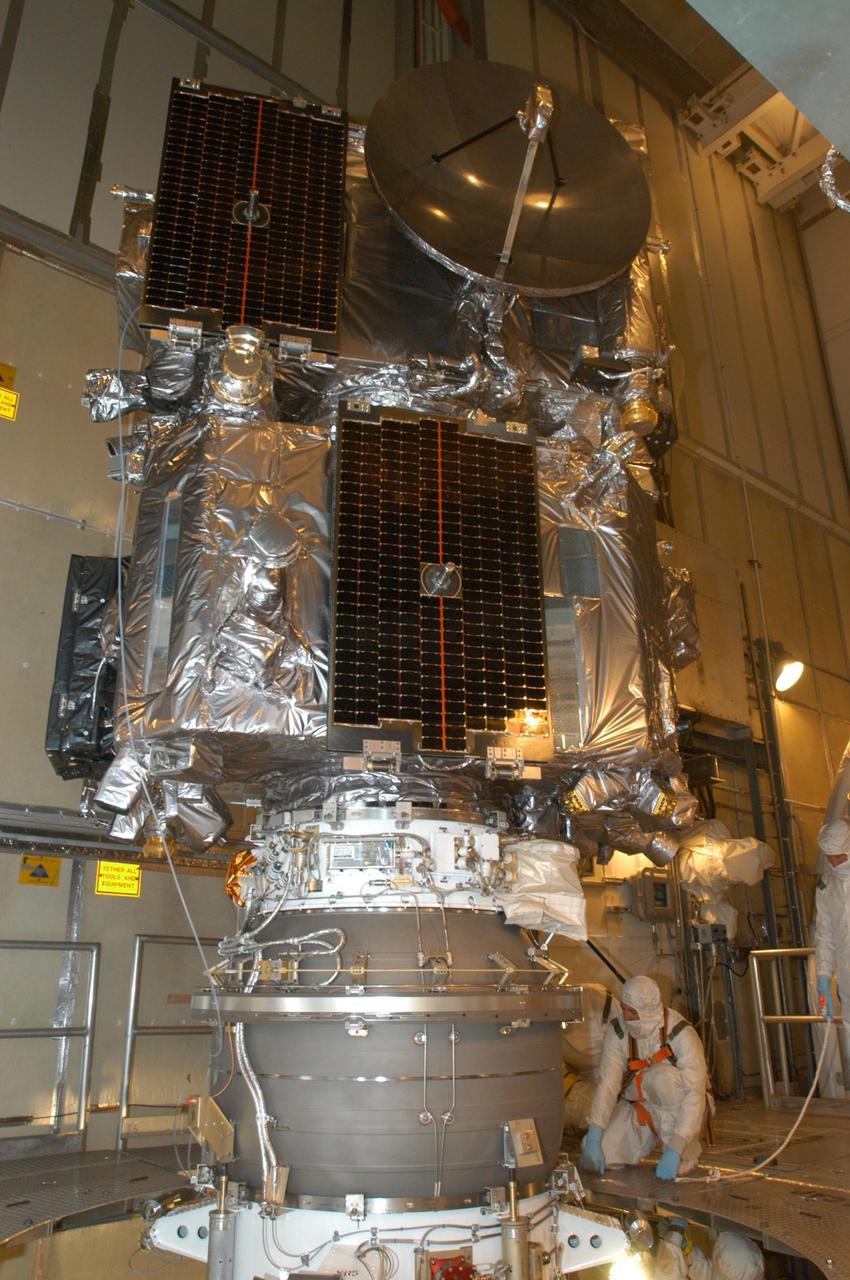
KENNEDY SPACE CENTER, FLA. - Inside the mobile service tower on Launch Pad 17-B at Cape Canaveral Air Force Station, workers prepare the twin observatories known as STEREO for encapsulation in the fairing. The fairing is a molded structure that fits flush with the outside surface of the Delta II upper stage booster and forms an aerodynamically smooth nose cone, protecting the spacecraft during launch and ascent. The STEREO (Solar Terrestrial Relations Observatory) mission is the first to take measurements of the sun and solar wind in 3-dimension. This new view will improve our understanding of space weather and its impact on the Earth. Designed and built by the Applied Physics Laboratory (APL) , the STEREO mission is being managed by NASA Goddard Space Flight Center. APL will maintain command and control of the observatories throughout the mission, while NASA tracks and receives the data, determines the orbit of the satellites, and coordinates the science results. STEREO is expected to lift off Oct. 25. Photo credit: NASA/George Shelton
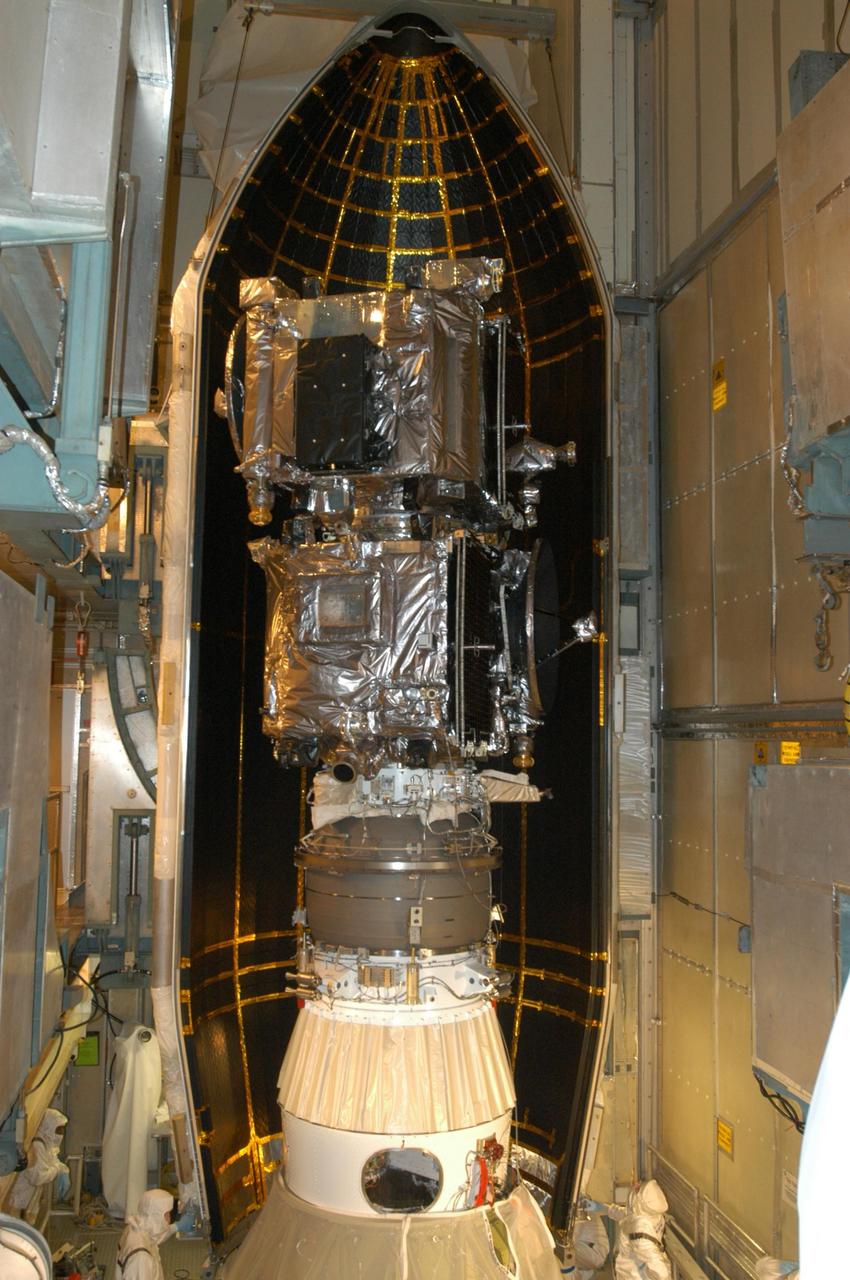
KENNEDY SPACE CENTER, FLA. - Inside the mobile service tower on Launch Pad 17-B at Cape Canaveral Air Force Station, the first half of the fairing is moved into place around the STEREO spacecraft. The fairing is a molded structure that fits flush with the outside surface of the Delta II upper stage booster and forms an aerodynamically smooth nose cone, protecting the spacecraft during launch and ascent. The STEREO (Solar Terrestrial Relations Observatory) mission is the first to take measurements of the sun and solar wind in 3-dimension. This new view will improve our understanding of space weather and its impact on the Earth. Designed and built by the Applied Physics Laboratory (APL) , the STEREO mission is being managed by NASA Goddard Space Flight Center. APL will maintain command and control of the observatories throughout the mission, while NASA tracks and receives the data, determines the orbit of the satellites, and coordinates the science results. STEREO is expected to lift off Oct. 25. Photo credit: NASA/George Shelton
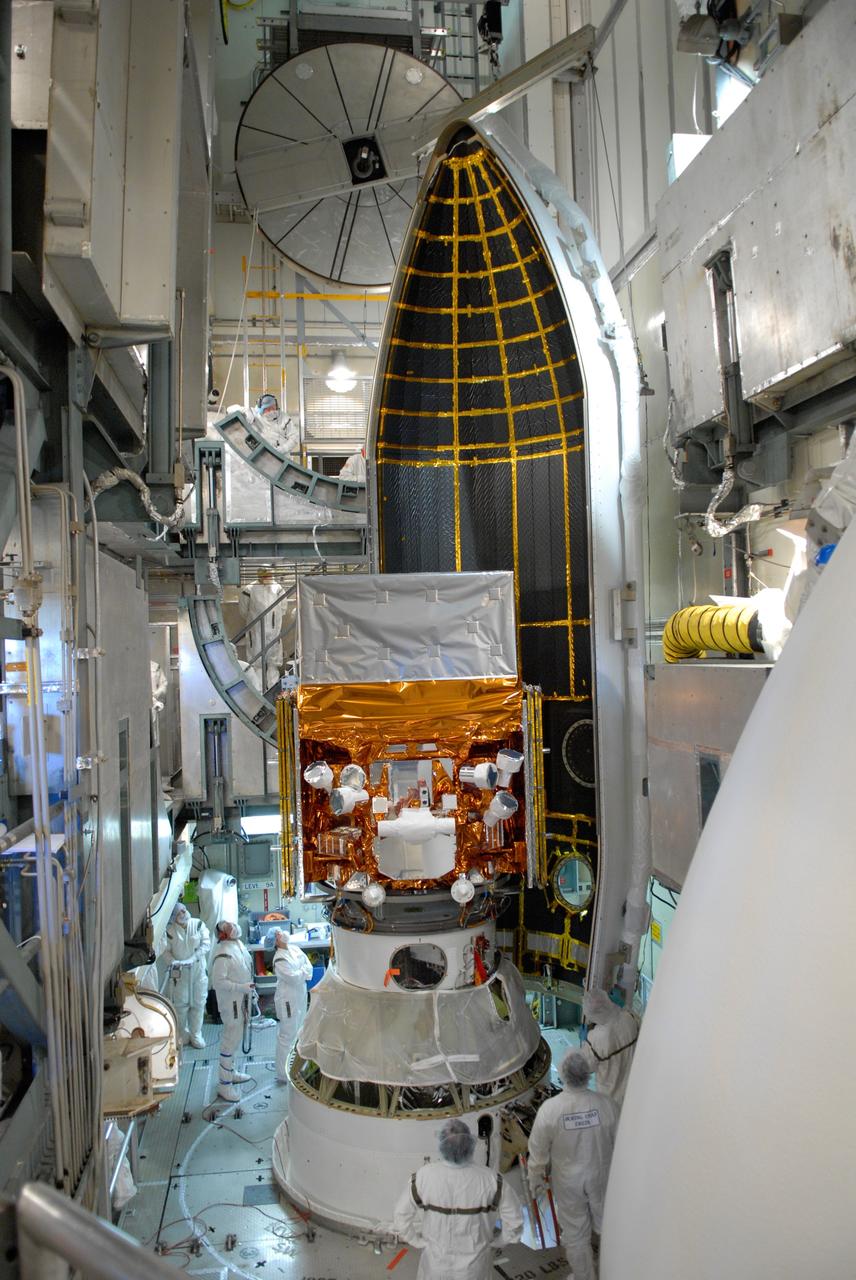
CAPE CANAVERAL, Fla. -- The first half of the payload fairing is ready to be moved around NASA's Gamma-Ray Large Area Space Telescope, or GLAST, within the mobile service tower on Launch Pad 17-B at Cape Canaveral Air Force Station. The fairing is a molded structure that fits flush with the outside surface of the Delta II upper stage booster and forms an aerodynamically smooth nose cone, protecting the spacecraft during launch and ascent. GLAST is a powerful space observatory that will explore the Universe's ultimate frontier, where nature harnesses forces and energies far beyond anything possible on Earth; probe some of science's deepest questions, such as what our Universe is made of, and search for new laws of physics; explain how black holes accelerate jets of material to nearly light speed; and help crack the mystery of stupendously powerful explosions known as gamma-ray bursts. The launch date is targeted no earlier than June 3. Photo credit: NASA/Jim Grossmann
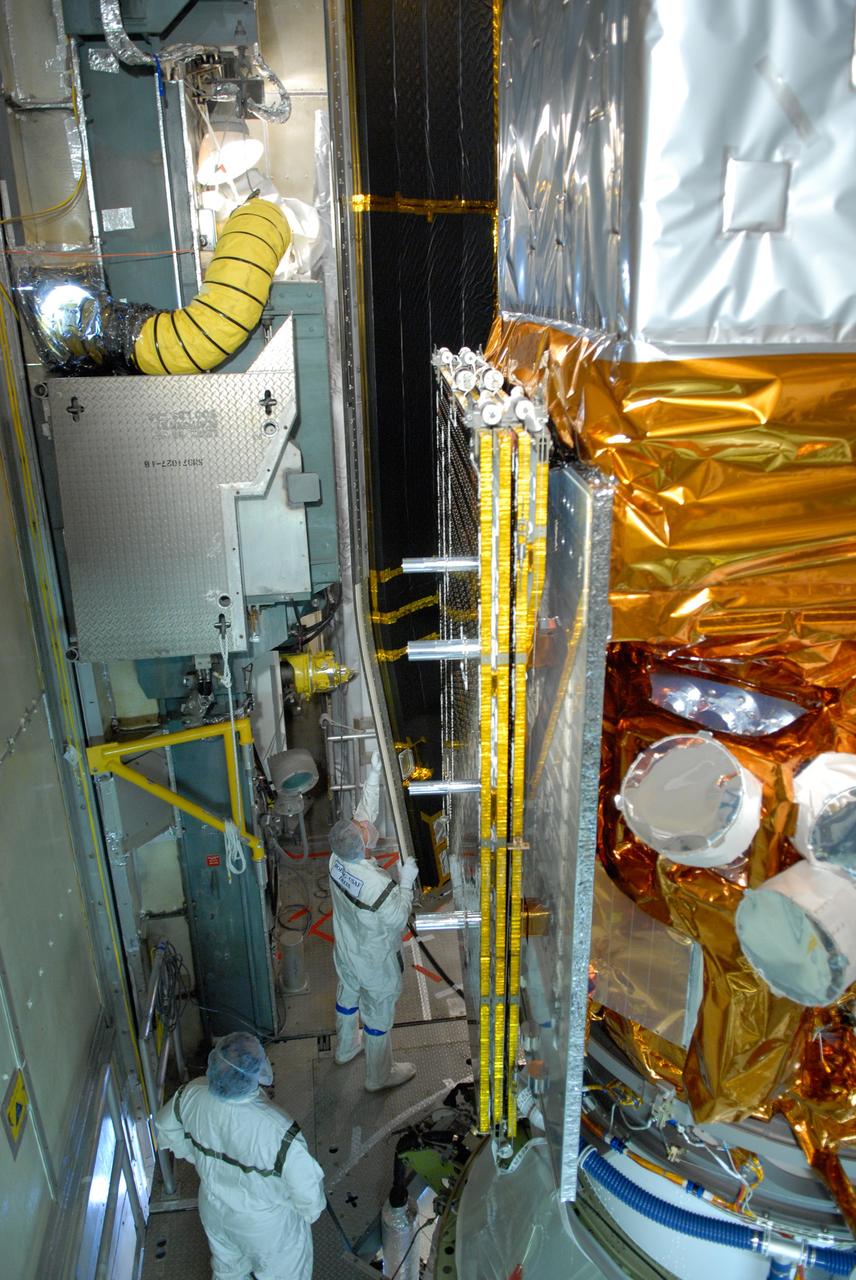
CAPE CANAVERAL, Fla. -- Inside the mobile service tower on Launch Pad 17-B at Cape Canaveral Air Force Station, workers help guide one section of the payload fairing into place around NASA's Gamma-Ray Large Area Space Telescope, or GLAST. The fairing is a molded structure that fits flush with the outside surface of the Delta II upper stage booster and forms an aerodynamically smooth nose cone, protecting the spacecraft during launch and ascent. GLAST is a powerful space observatory that will explore the Universe's ultimate frontier, where nature harnesses forces and energies far beyond anything possible on Earth; probe some of science's deepest questions, such as what our Universe is made of, and search for new laws of physics; explain how black holes accelerate jets of material to nearly light speed; and help crack the mystery of stupendously powerful explosions known as gamma-ray bursts. The launch date is targeted no earlier than June 3. Photo credit: NASA/Jim Grossmann
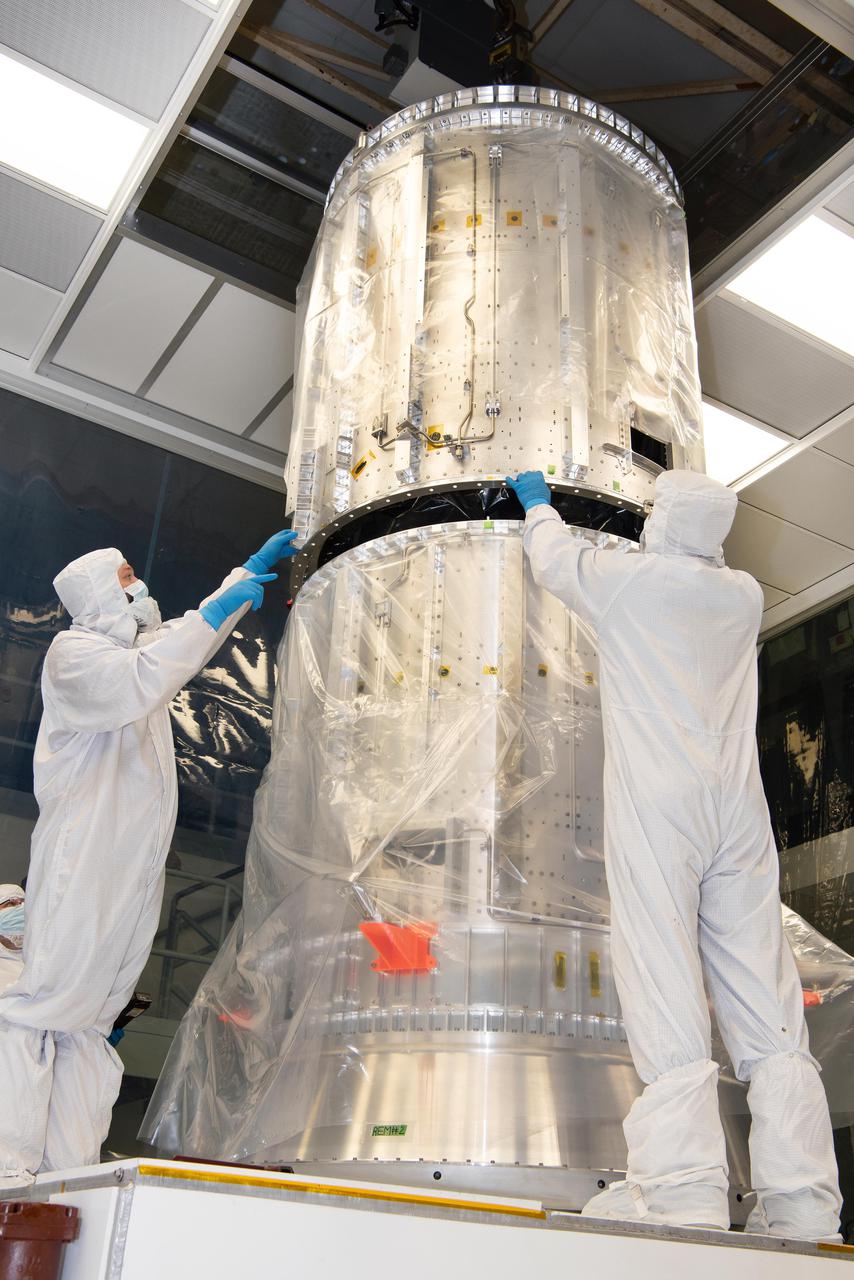
Technicians in a clean room at NASA's Goddard Space Flight Center in Greenbelt, Maryland, check the fit of the upper and lower cylinders of the propulsion module core of NASA's Europa Clipper spacecraft on Oct. 15, 2020. The stacked cylinders stand almost 10 feet (3 meters) high and hold the propulsion tanks and rocket engines that will propel Europa Clipper once it leaves Earth's atmosphere on its path toward Jupiter's moon Europa. In this photo, the cylinders are stacked atop an adapter ring that's about 1 foot (0.3 meters) high. The cylinders were built by the Johns Hopkins Applied Physics Laboratory (APL) in Laurel, Maryland. They were shipped to NASA's Jet Propulsion Laboratory in Southern California for installation of the Heat Redistribution System (HRS) tubing, which helps control the spacecraft's temperature. The cylinders were then shipped to Goddard for the propulsion subsystem installation. With an internal global ocean twice the size of Earth's oceans combined, Europa may have the potential to harbor life. The Europa Clipper orbiter will swoop around Jupiter on an elliptical path, dipping close to the moon on each flyby to collect data. Understanding Europa's habitability will help scientists better understand how life developed on Earth and the potential for finding life beyond our planet. Europa Clipper is aiming for a launch readiness date of 2024. https://photojournal.jpl.nasa.gov/catalog/PIA24322
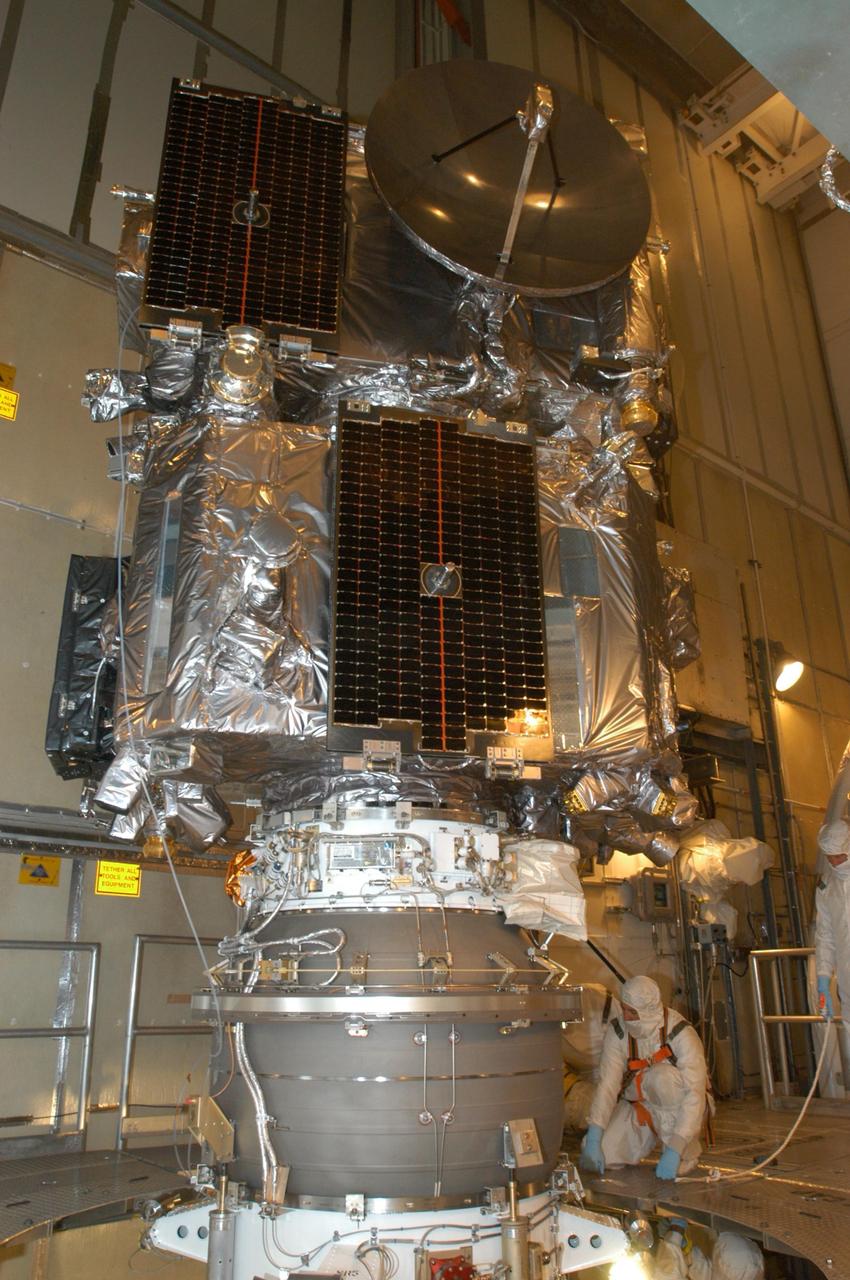
KENNEDY SPACE CENTER, FLA. - Inside the mobile service tower on Launch Pad 17-B at Cape Canaveral Air Force Station, workers prepare the twin observatories known as STEREO for encapsulation in the fairing. The fairing is a molded structure that fits flush with the outside surface of the Delta II upper stage booster and forms an aerodynamically smooth nose cone, protecting the spacecraft during launch and ascent. The STEREO (Solar Terrestrial Relations Observatory) mission is the first to take measurements of the sun and solar wind in 3-dimension. This new view will improve our understanding of space weather and its impact on the Earth. Designed and built by the Applied Physics Laboratory (APL) , the STEREO mission is being managed by NASA Goddard Space Flight Center. APL will maintain command and control of the observatories throughout the mission, while NASA tracks and receives the data, determines the orbit of the satellites, and coordinates the science results. STEREO is expected to lift off Oct. 25. Photo credit: NASA/George Shelton
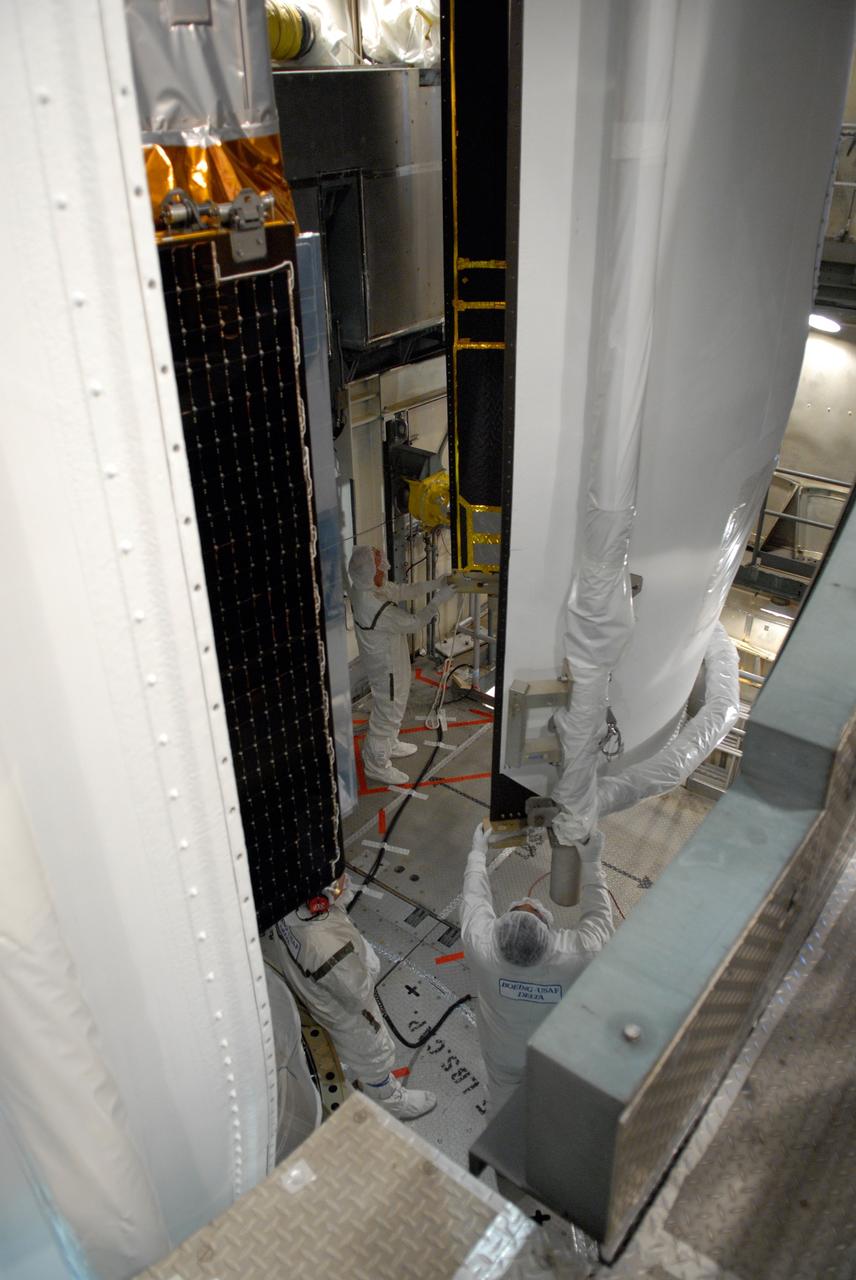
CAPE CANAVERAL, Fla. -- Inside the mobile service tower on Launch Pad 17-B at Cape Canaveral Air Force Station, workers help guide the second section of the payload fairing into place around NASA's Gamma-Ray Large Area Space Telescope, or GLAST. The first half is seen at left. The fairing is a molded structure that fits flush with the outside surface of the Delta II upper stage booster and forms an aerodynamically smooth nose cone, protecting the spacecraft during launch and ascent. GLAST is a powerful space observatory that will explore the Universe's ultimate frontier, where nature harnesses forces and energies far beyond anything possible on Earth; probe some of science's deepest questions, such as what our Universe is made of, and search for new laws of physics; explain how black holes accelerate jets of material to nearly light speed; and help crack the mystery of stupendously powerful explosions known as gamma-ray bursts. The launch date is targeted no earlier than June 3. Photo credit: NASA/Jim Grossmann
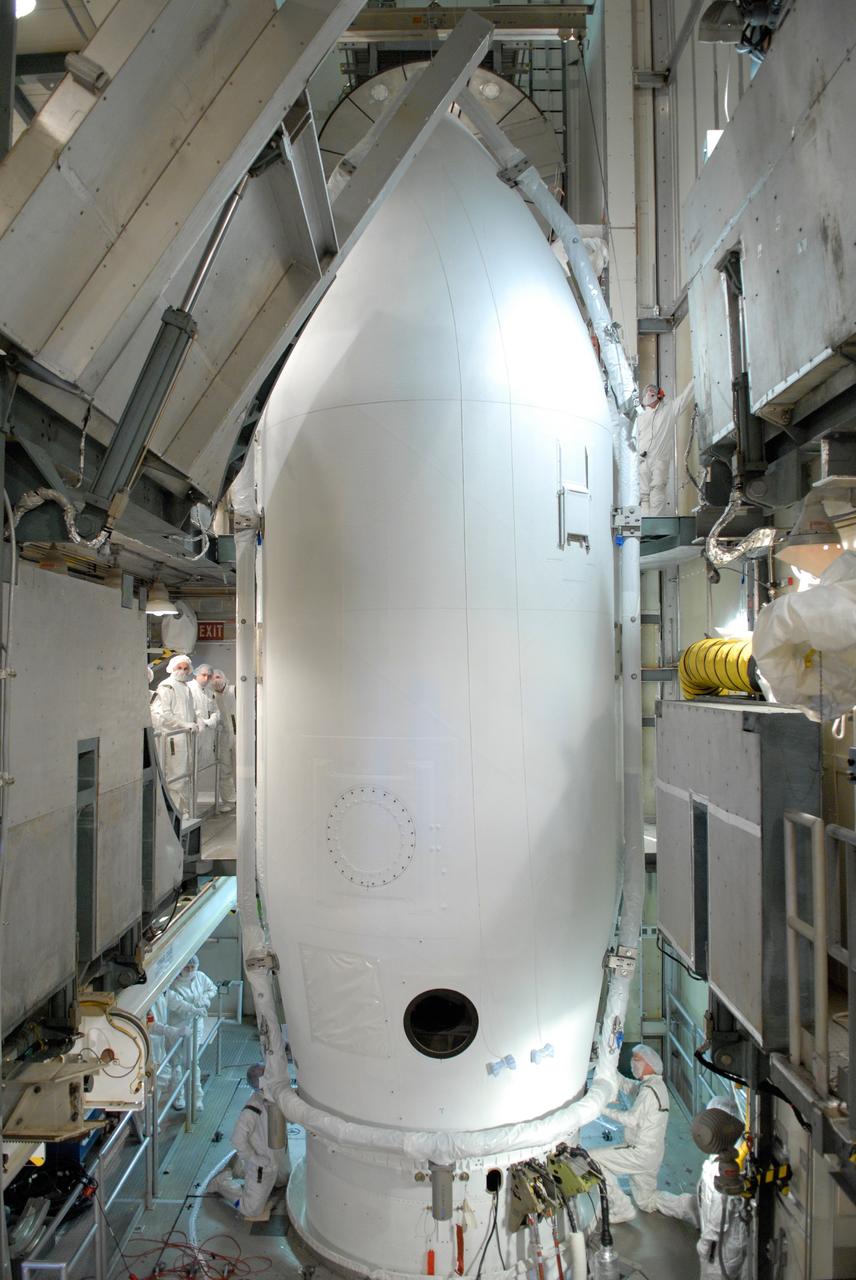
CAPE CANAVERAL, Fla. -- Inside the mobile service tower on Launch Pad 17-B at Cape Canaveral Air Force Station, workers connect the two sections of the payload fairing into place around NASA's Gamma-Ray Large Area Space Telescope, or GLAST. The fairing is a molded structure that fits flush with the outside surface of the Delta II upper stage booster and forms an aerodynamically smooth nose cone, protecting the spacecraft during launch and ascent. GLAST is a powerful space observatory that will explore the Universe's ultimate frontier, where nature harnesses forces and energies far beyond anything possible on Earth; probe some of science's deepest questions, such as what our Universe is made of, and search for new laws of physics; explain how black holes accelerate jets of material to nearly light speed; and help crack the mystery of stupendously powerful explosions known as gamma-ray bursts. The launch date is targeted no earlier than June 3. Photo credit: NASA/Jim Grossmann
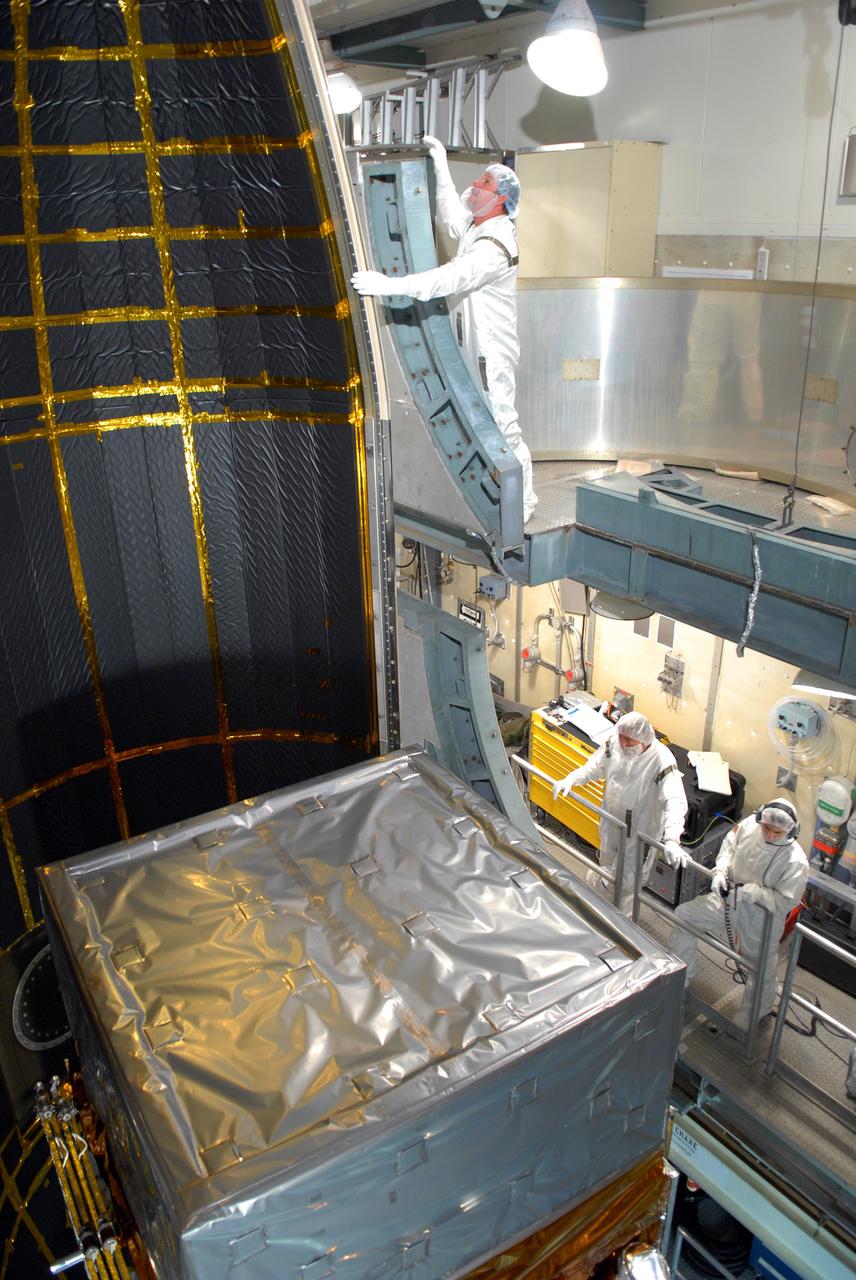
CAPE CANAVERAL, Fla. -- Inside the mobile service tower on Launch Pad 17-B at Cape Canaveral Air Force Station, workers help guide one section of the payload fairing into place around NASA's Gamma-Ray Large Area Space Telescope, or GLAST. The fairing is a molded structure that fits flush with the outside surface of the Delta II upper stage booster and forms an aerodynamically smooth nose cone, protecting the spacecraft during launch and ascent. GLAST is a powerful space observatory that will explore the Universe's ultimate frontier, where nature harnesses forces and energies far beyond anything possible on Earth; probe some of science's deepest questions, such as what our Universe is made of, and search for new laws of physics; explain how black holes accelerate jets of material to nearly light speed; and help crack the mystery of stupendously powerful explosions known as gamma-ray bursts. The launch date is targeted no earlier than June 3. Photo credit: NASA/Jim Grossmann