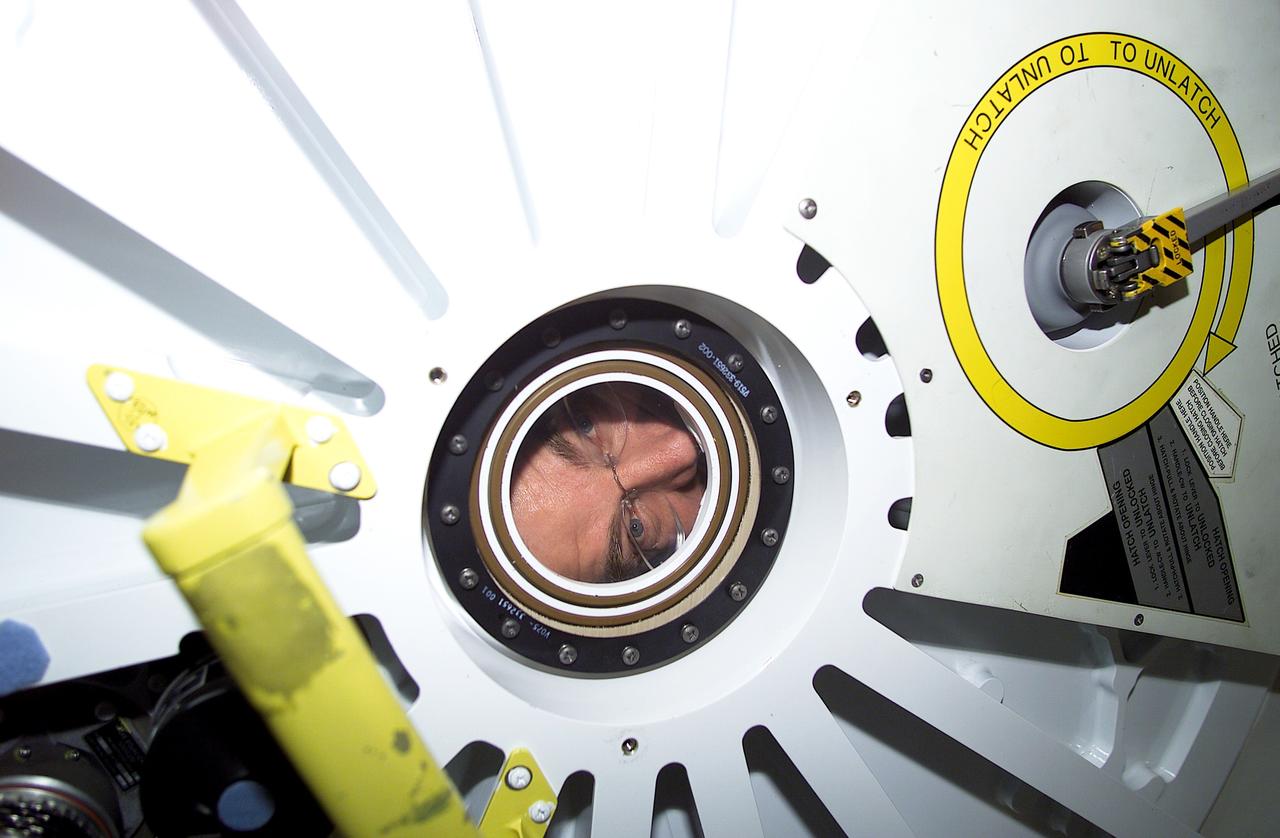
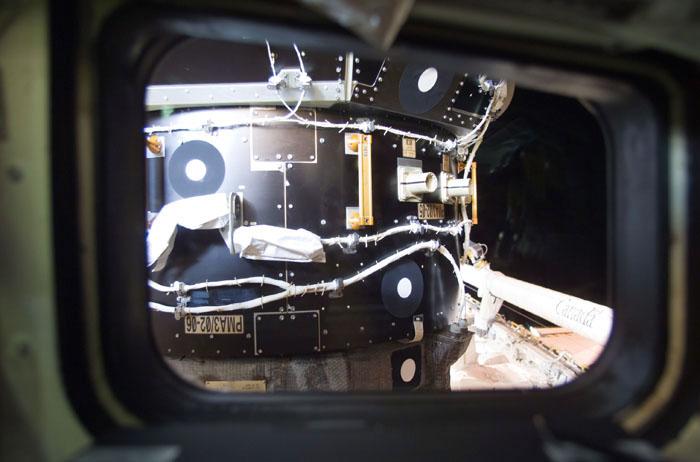
The STS-100 mission launched for the International Space Station (ISS) on April 19, 2001 as the sixth station assembly flight. Main objectives included the delivery and installation of the Canadian-built Space Station Remote Manipulator System (SSRMS), or Canadarm2, the installation of a UHF anterna for space-to-space communications for U.S. based space walks, and the delivery of supplies via the Italian Multipurpose Logistics Module (MPLM) "Raffaello". This is an STS-110 onboard photo of Astronaut James S. Voss, Expedition Two flight engineer, peering into the pressurized Mating Adapter (PMA-2) prior hatch opening. The picture was taken by one of the STS-100 crew members inside the PMA.
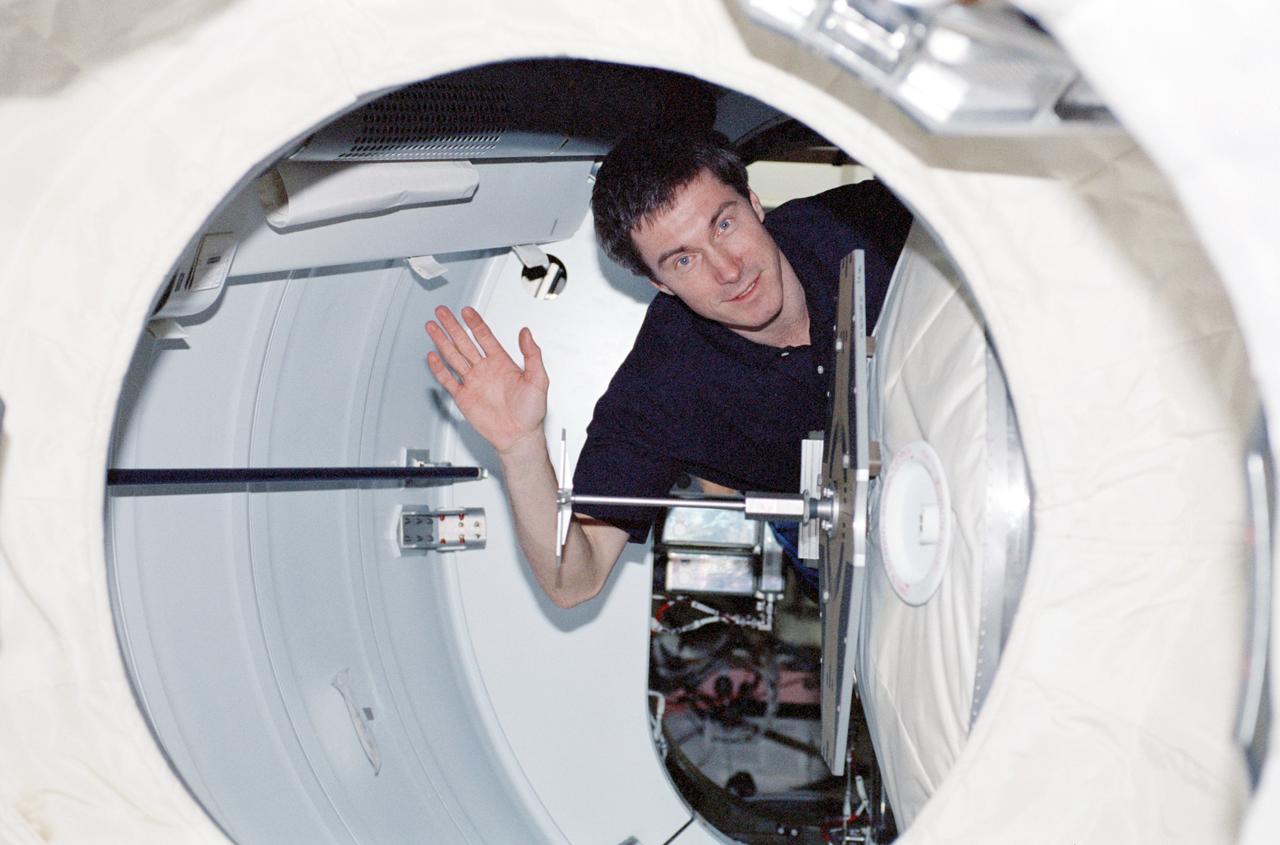
STS098-355-017 (7-20 February 2001) --- Cosmonaut Sergei K. Krikalev, Expedition One flight engineer, waves as he moves the hatch of the Pressurized Mating Adapter (PMA) leading to the Space Shuttle Atlantis. Krikalev represents Rosaviakosmos.
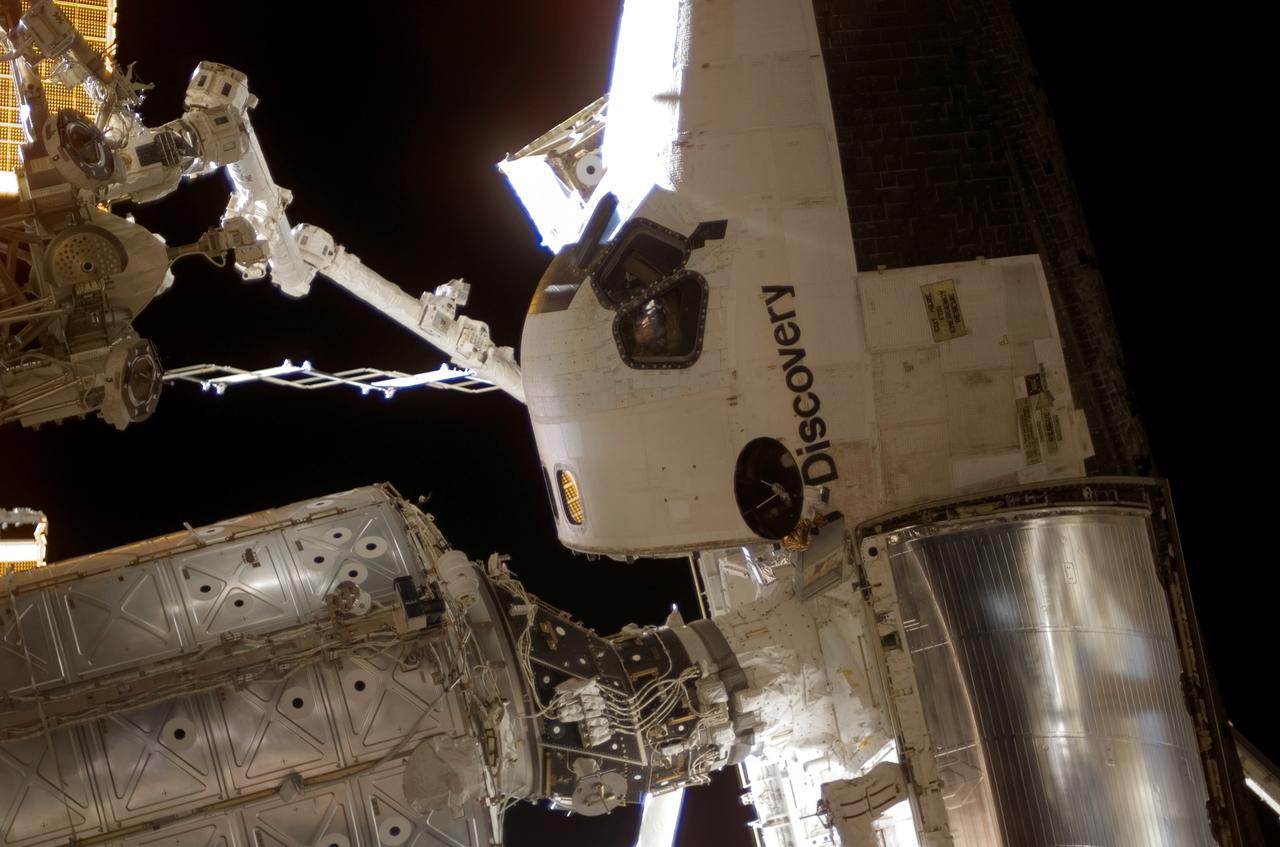
Space Shuttle Discovery, docked to the Pressurized Mating Adapter (PMA-2) on the International Space Station (ISS), is featured in this image photographed by a space walker during the second session of extravehicular activity (EVA) for the STS-120 mission on October 28, 2007.
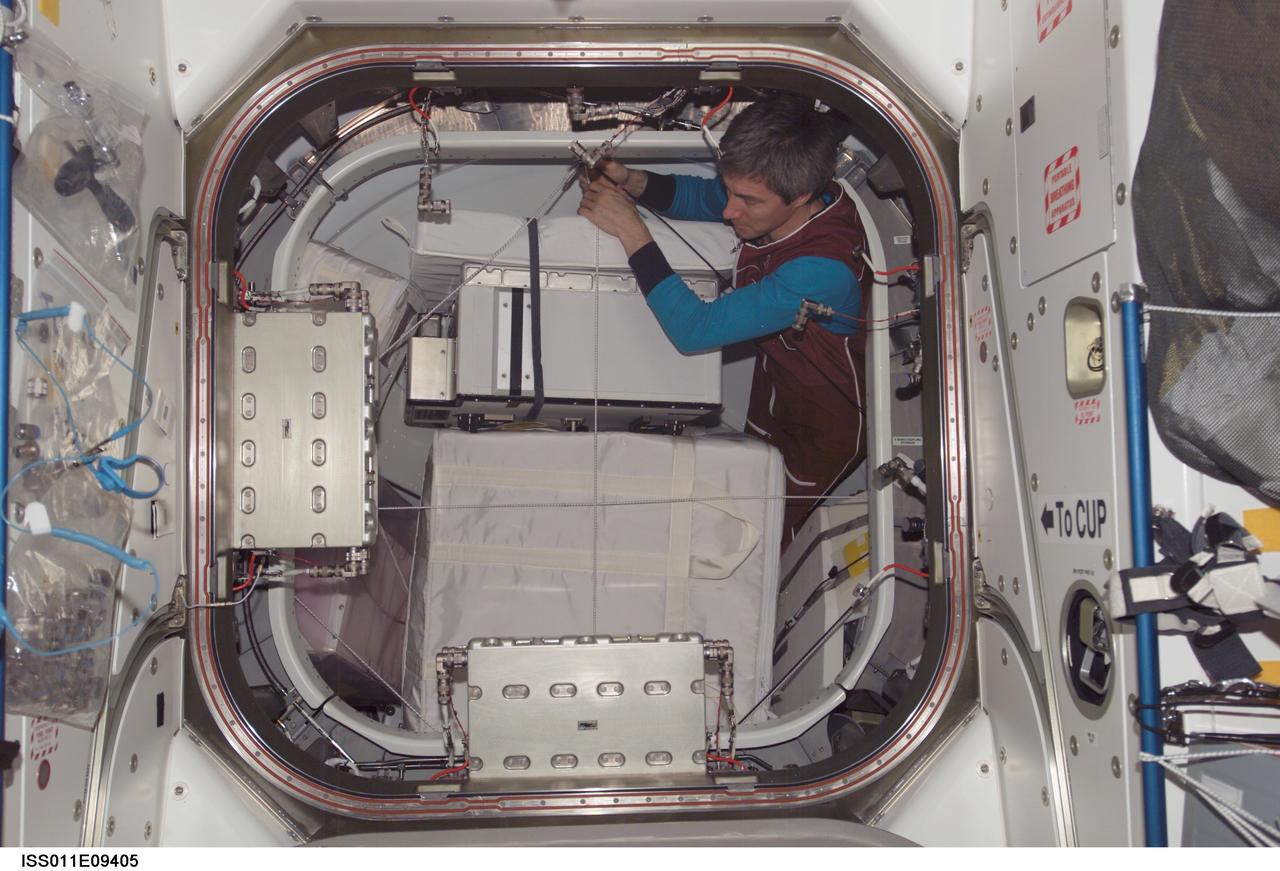
ISS011-E-09405 (21 June 2005) --- Cosmonaut Sergei K. Krikalev, Expedition 11 commander representing Russia's Federal Space Agency, moves stowage items from the Unity node into the Pressurized Mating Adapter (PMA-3) of the International Space Station (ISS).

S130-E-006903 (10 Feb. 2010) --- NASA astronaut Robert Behnken, STS-130 mission specialist, floats through the Pressurized Mating Adapter 2 (PMA-2) of the International Space Station from the docked space shuttle Endeavour.
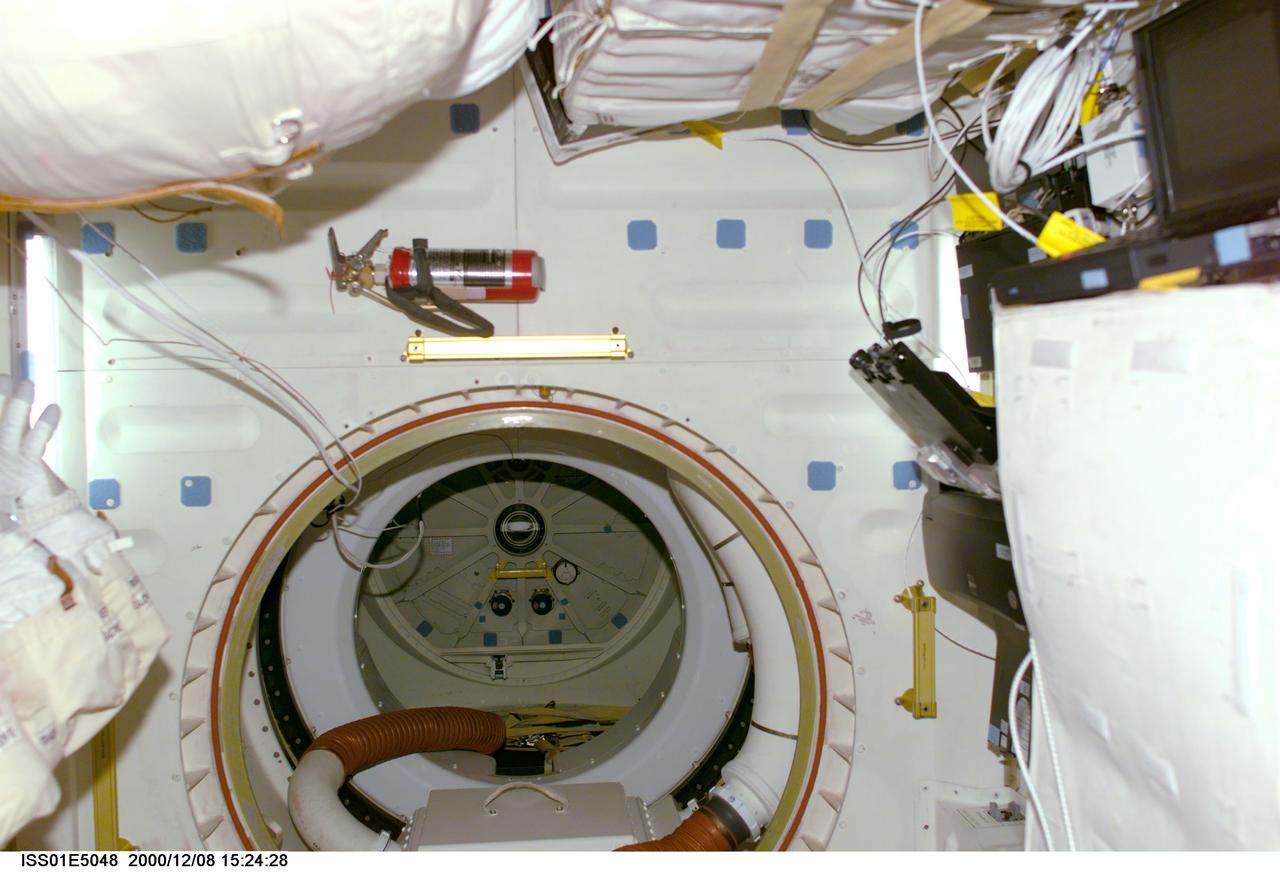
ISS01-E-5048 (8 December 2000) ---This digital still camera's view was taken in the International Space Station's Primary Mating Adapter-3 (PMA-3) looking into the tunnel that leads to the Unity node.
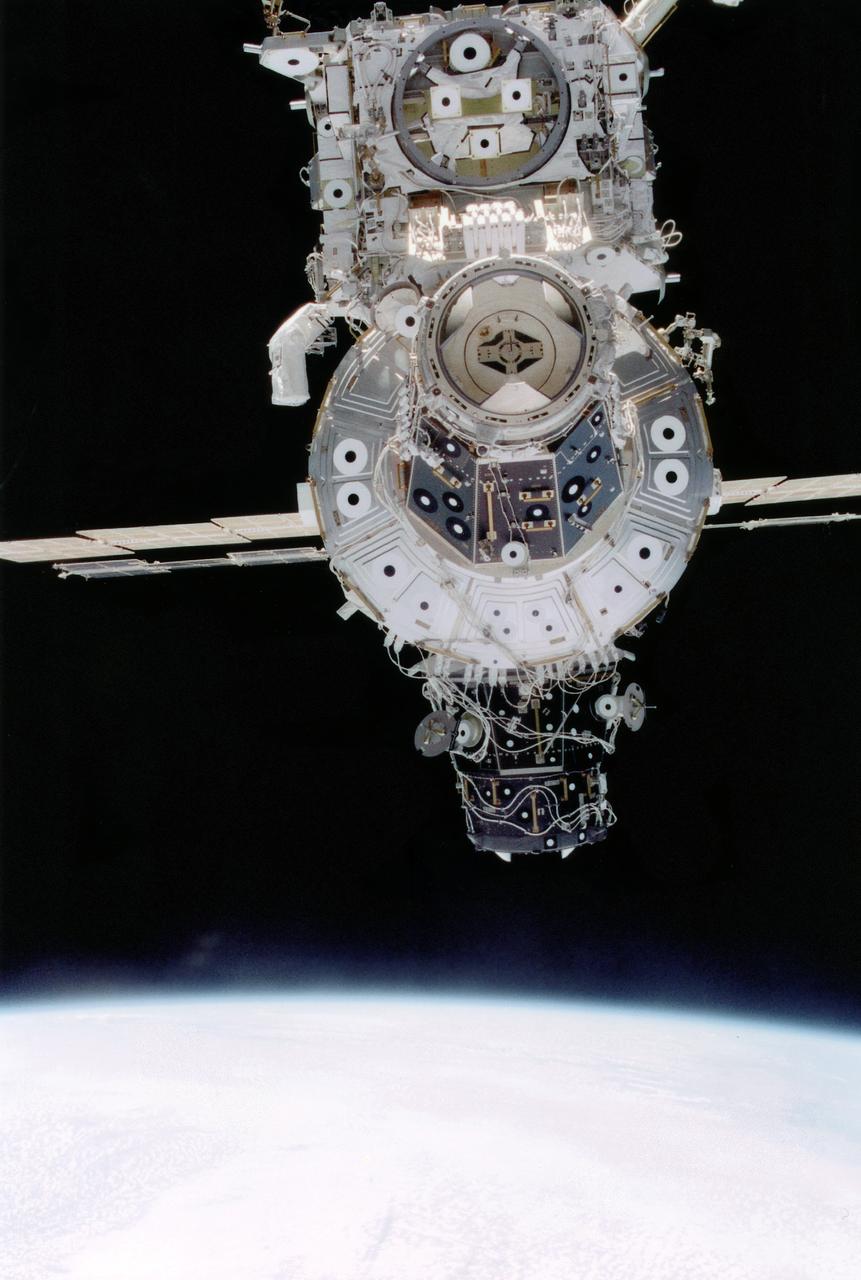
As the Space Shuttle Discovery began its separation from the International Space Station (ISS), a crew member captured this view of the ISS, revealing new additions to the complex. Most of the Z1 truss structure is visible, along with the recently installed Pressurized Mating Adapter (PMA-3).
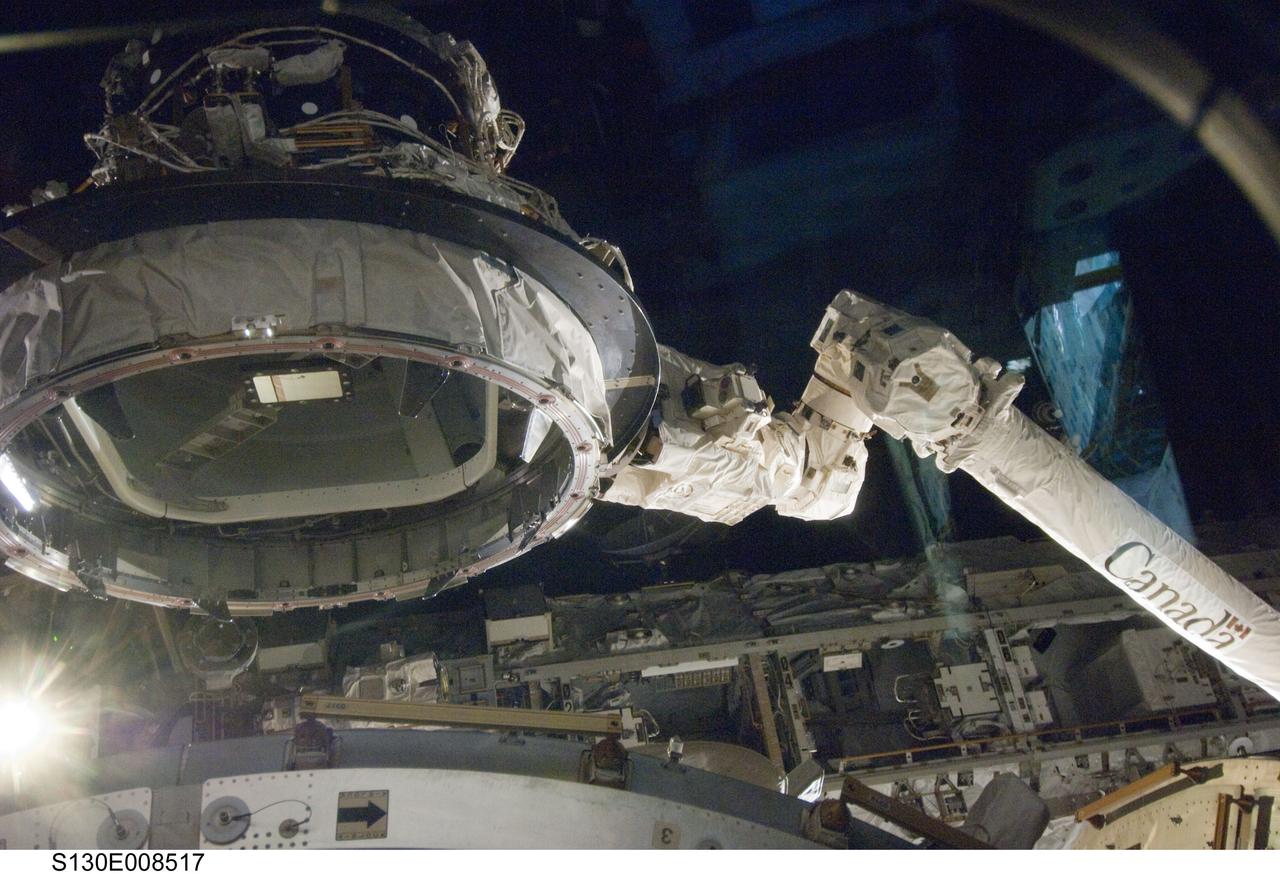
S130-E-008517 (16 Feb. 2010) --- In the grasp of the Canadarm2, the Pressurized Mating Adapter 3 (PMA-3) is relocated from the Harmony node to the open port on the end of the newly-installed Tranquility node. NASA astronauts Robert Behnken and Nicholas Patrick, both STS-130 mission specialists, operated the station’s robotic arm for the move, while Jeffrey Williams, Expedition 22 commander; and Japan Aerospace Exploration Agency (JAXA) astronaut Soichi Noguchi, Expedition 22 flight engineer, dealt with latches and bolts, connecting the port to its new home.
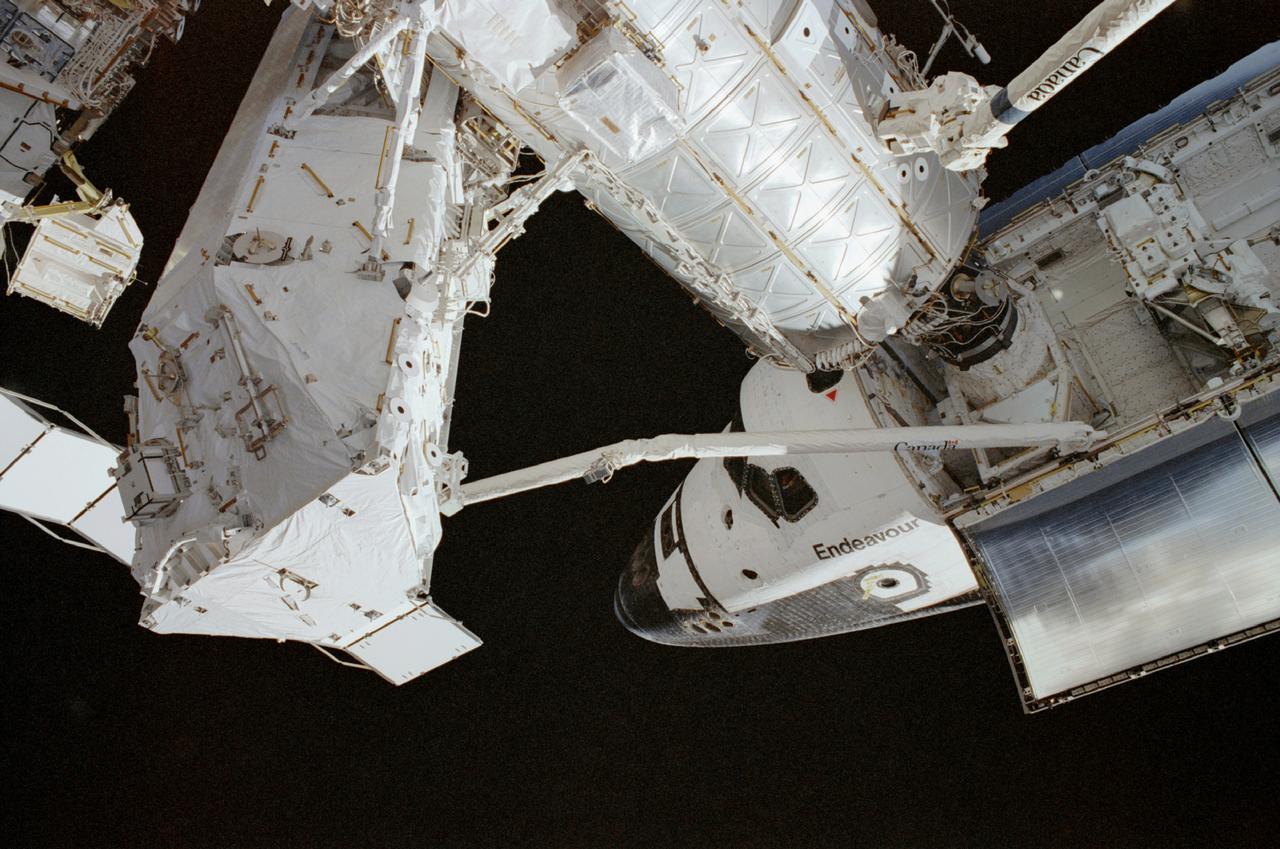
The STS-111 mission, the 14th Shuttle mission to visit the International Space Station (ISS), was launched on June 5, 2002 aboard the Space Shuttle Orbiter Endeavour. On board were the STS-111 and Expedition Five crew members. Astronauts Kerneth D. Cockrell, commander; Paul S. Lockhart, pilot, and mission specialists Franklin R. Chang-Diaz and Philippe Perrin were the STS-111 crew members. Expedition Five crew members included Cosmonaut Valeri G. Korzun, commander, Astronaut Peggy A. Whitson and Cosmonaut Sergei Y. Treschev, flight engineers. Three space walks enabled the STS-111 crew to accomplish mission objectives: The delivery and installation of the Mobile Remote Servicer Base System (MBS), an important part of the Station's Mobile Servicing System that allows the robotic arm to travel the length of the Station, which is necessary for future construction tasks; the replacement of a wrist roll joint on the Station's robotic arm; and the task of unloading supplies and science experiments from the Leonardo multipurpose Logistics Module, which made its third trip to the orbital outpost. In this photograph, the Space Shuttle Endeavour, back dropped by the blackness of space, is docked to the pressurized Mating Adapter (PMA-2) at the forward end of the Destiny Laboratory on the ISS. Endeavour's robotic arm is in full view as it is stretched out with the S0 (S-zero) Truss at its end.
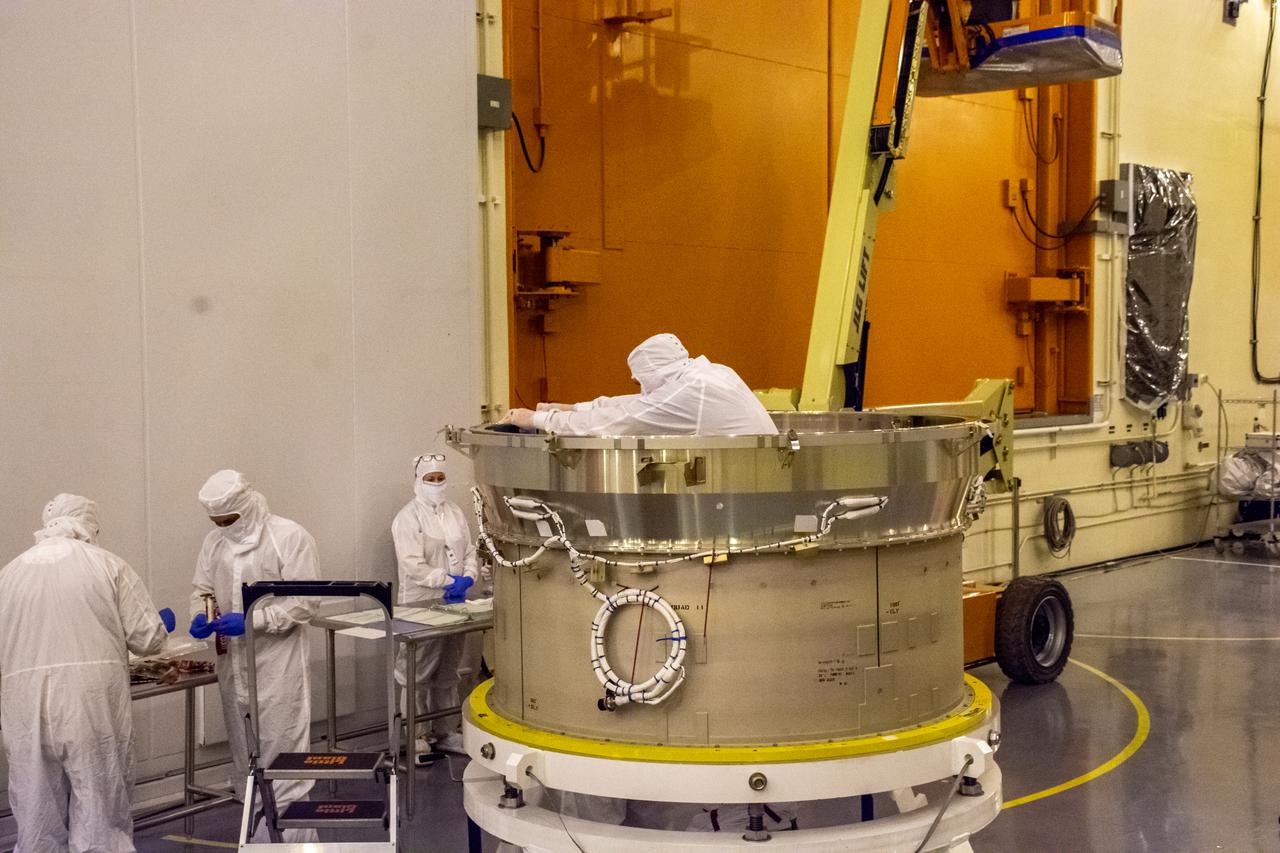
On Aug. 9, 2021, technicians ready the payload adapter (PMA) for mating operations in preparation for NASA’s Landsat 9 mission at Vandenberg Space Force Base in California. On one end, the PMA will attach to the second stage of a United Launch Alliance Atlas V rocket. On the other, it will attach to the evolved expendable vehicle secondary payload adapter – the piece of flight hardware that connects the spacecraft to the PMA. Landsat 9 will launch on the Atlas V from Space Launch Complex 3 at Vandenberg in September 2021. The launch is being managed by NASA’s Launch Services Program based at Kennedy Space Center, America’s multi-user spaceport. The Landsat 9 satellite will continue the nearly 50-year legacy of previous Landsat missions. It will monitor key natural and economic resources from orbit. Landsat 9 is managed by the agency’s Goddard Space Flight Center in Greenbelt, Maryland. The satellite will carry two instruments: the Operational Land Imager 2, which collects images of Earth’s landscapes in visible, near infrared and shortwave infrared light, and the Thermal Infrared Sensor 2, which measures the temperature of land surfaces. Like its predecessors, Landsat 9 is a joint mission between NASA and the U.S. Geological Survey.
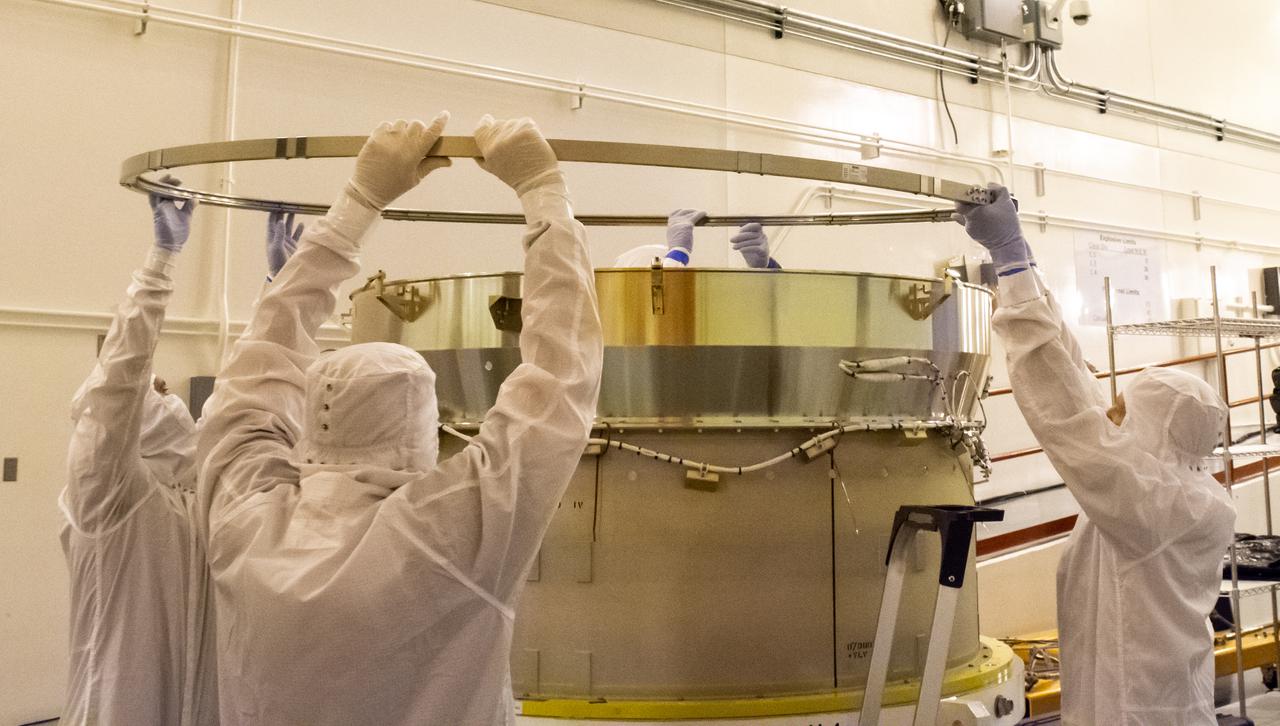
On Aug. 9, 2021, technicians ready the payload adapter (PMA) for mating operations in preparation for NASA’s Landsat 9 mission at Vandenberg Space Force Base in California. On one end, the PMA will attach to the second stage of a United Launch Alliance Atlas V rocket. On the other, it will attach to the evolved expendable vehicle secondary payload adapter – the piece of flight hardware that connects the spacecraft to the PMA. Landsat 9 will launch on the Atlas V from Space Launch Complex 3 at Vandenberg in September 2021. The launch is being managed by NASA’s Launch Services Program based at Kennedy Space Center, America’s multi-user spaceport. The Landsat 9 satellite will continue the nearly 50-year legacy of previous Landsat missions. It will monitor key natural and economic resources from orbit. Landsat 9 is managed by the agency’s Goddard Space Flight Center in Greenbelt, Maryland. The satellite will carry two instruments: the Operational Land Imager 2, which collects images of Earth’s landscapes in visible, near infrared and shortwave infrared light, and the Thermal Infrared Sensor 2, which measures the temperature of land surfaces. Like its predecessors, Landsat 9 is a joint mission between NASA and the U.S. Geological Survey.
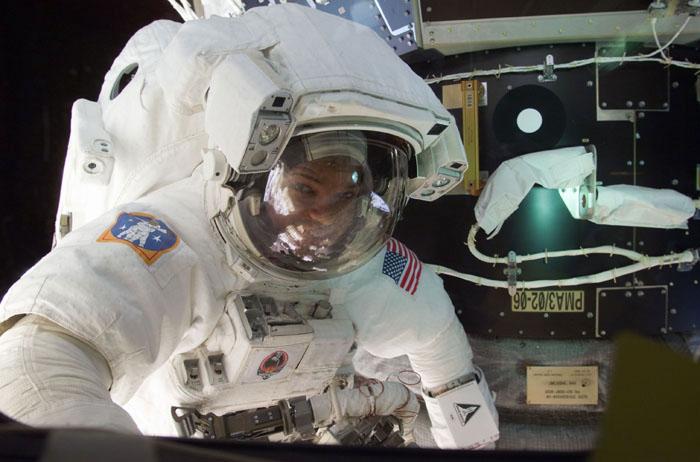
STS98-E-5193 (12 February 2001) --- Astronaut Robert L. Curbeam, STS-98 mission specialist, is pictured near Pressurized Mating Adapter (PMA-3) during the second of three scheduled space walks on 5a. The scene was recorded with a digital still camera.
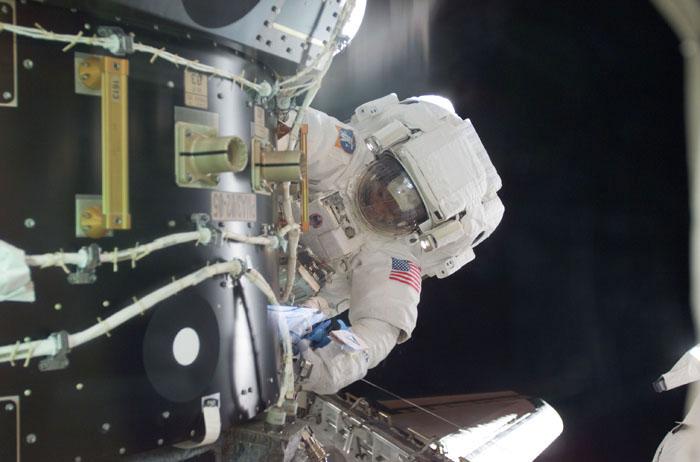
STS98-E-5189 (12 February 2001) --- Astronaut Robert L. Curbeam, STS-98 mission specialist, holds onto a hand rail on Pressurized Mating Adapter (PMA-3) during the second of three scheduled space walks on 5a. The scene was recorded with a digital still camera.
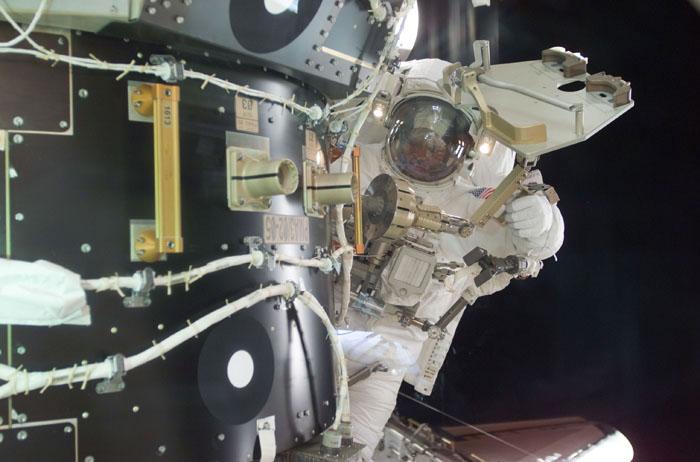
STS98-E-5191 (12 February 2001) --- Astronaut Robert L. Curbeam, STS-98 mission specialist, is pictured near Pressurized Mating Adapter (PMA-3) during the second of three scheduled space walks on 5a. The scene was recorded with a digital still camera.
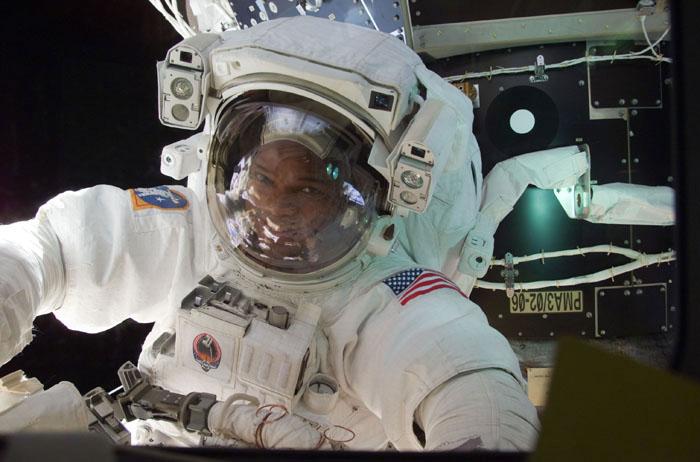
STS98-E-5192 (12 February 2001) --- Astronaut Robert L. Curbeam, STS-98 mission specialist, is pictured near Pressurized Mating Adapter (PMA-3) during the second of three scheduled space walks on 5a. The scene was recorded with a digital still camera.
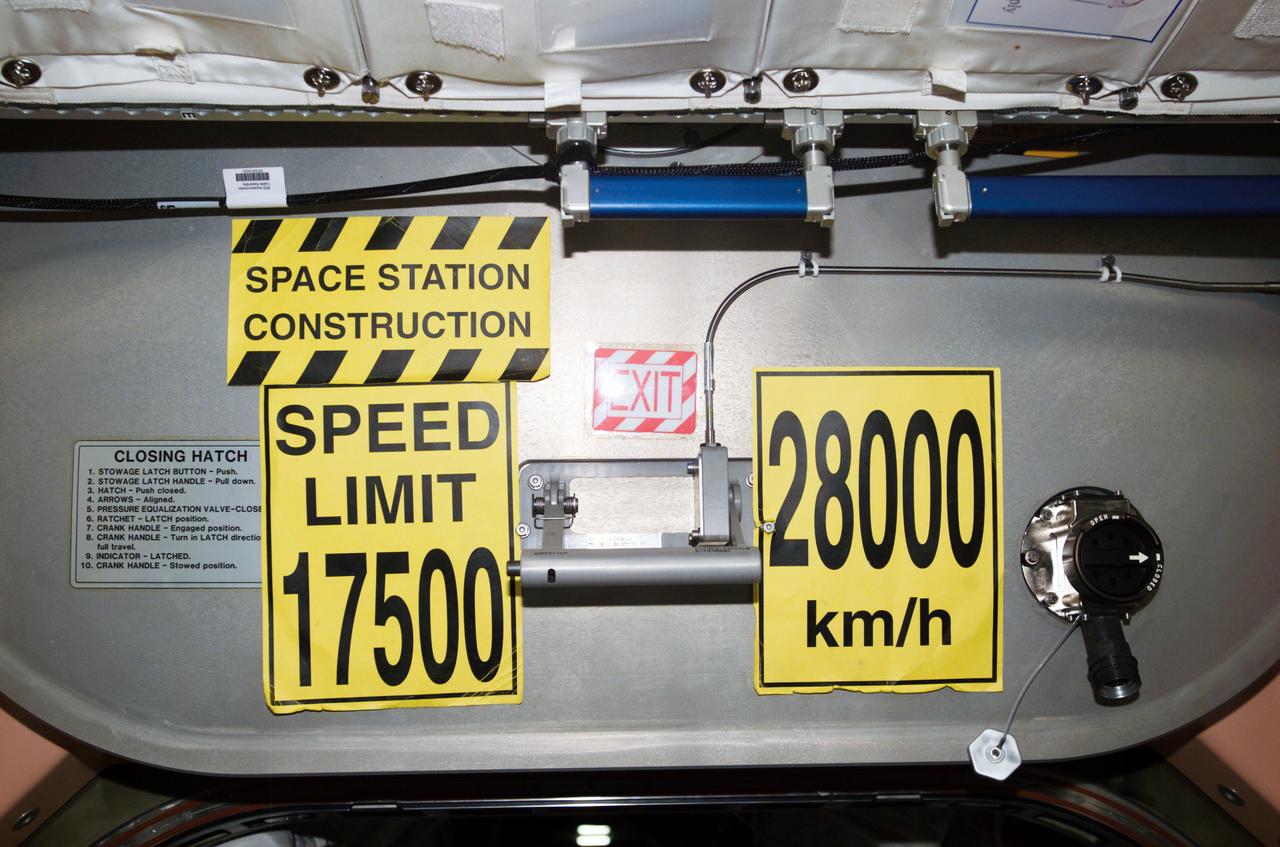
ISS012-E-22884 (29 March 2006) --- A close-up view of signs on the Pressurized Mating Adapter-1 (PMA-1) hatchway photographed by an Expedition 12 crewmember on the International Space Station.
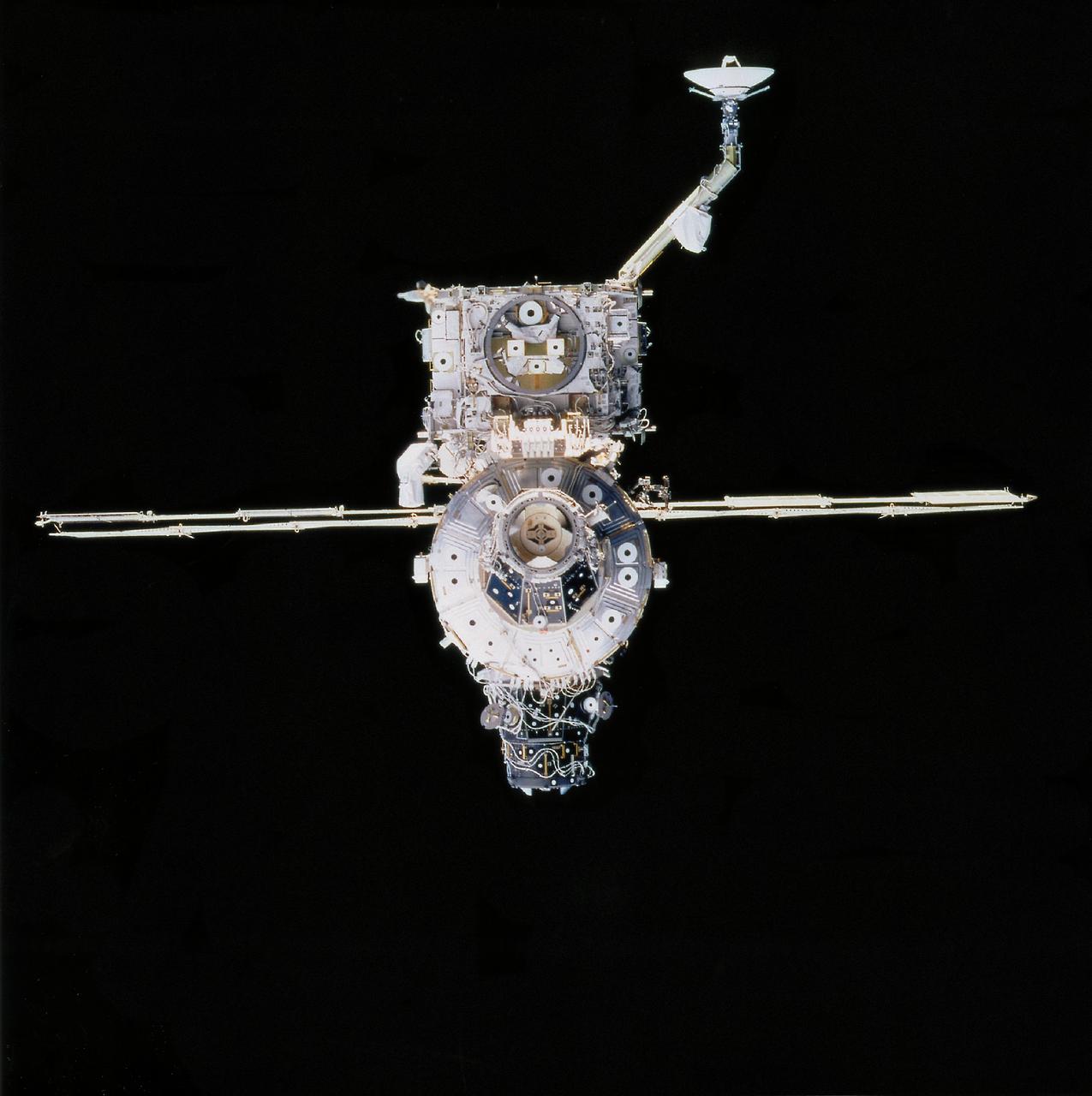
Not long after separation of the Space Shuttle Discovery from the International Space Station (ISS), a crew member was able to use a 70mm handheld camera to grab this image of the station, featuring its newest additions. Backdropped against the blackness of space, the Z1 truss structure and its anterna, as well as the new Pressurized Mating Adapter (PMA-3), are visible in the foreground.
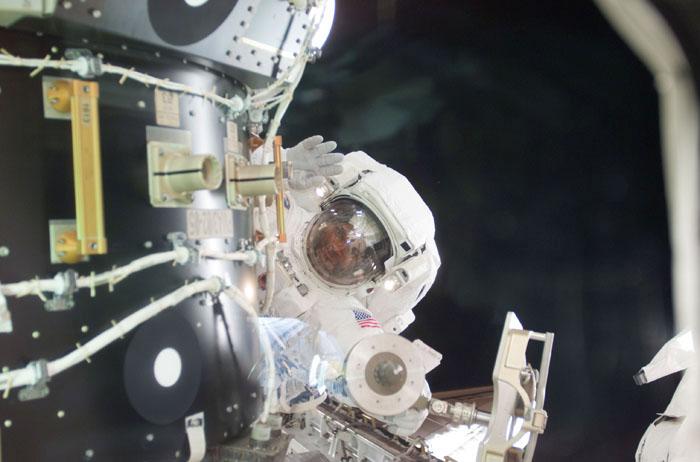
STS98-E-5190 (12 February 2001) --- Astronaut Robert L. Curbeam, STS-98 mission specialist, waves to a crew mate inside the Space Shuttle Atlantis' crew cabin from his position near Pressurized Mating Adapter (PMA-3) during the second of three scheduled space walks on 5a. The scene was recorded with a digital still camera.
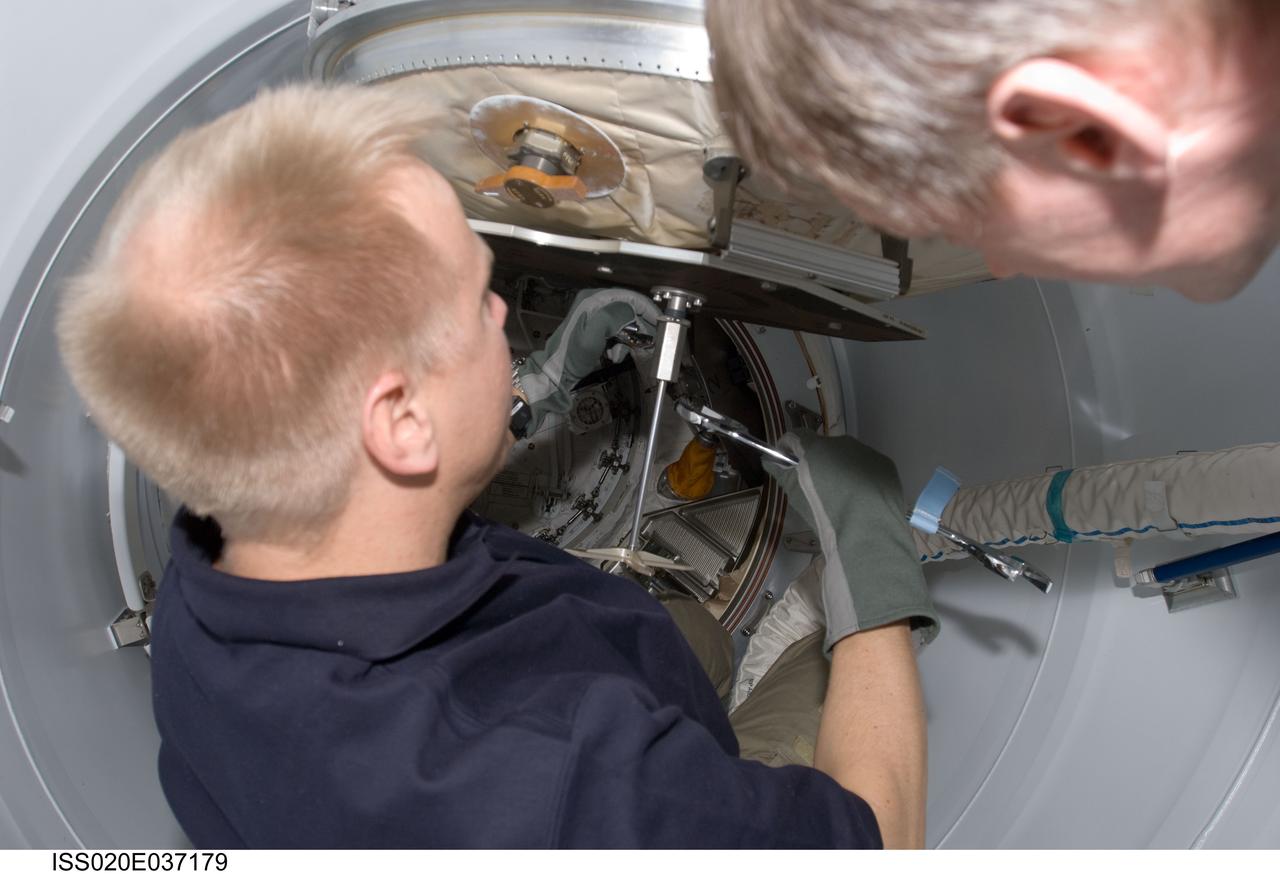
ISS020-E-037179 (30 Aug. 2009) --- NASA astronaut Tim Kopra (left) and European Space Agency astronaut Frank De Winne, both Expedition 20 flight engineers, work in the Pressurized Mating Adapter 2 (PMA-2) of the International Space Station while Space Shuttle Discovery (STS-128) remains docked with the station.
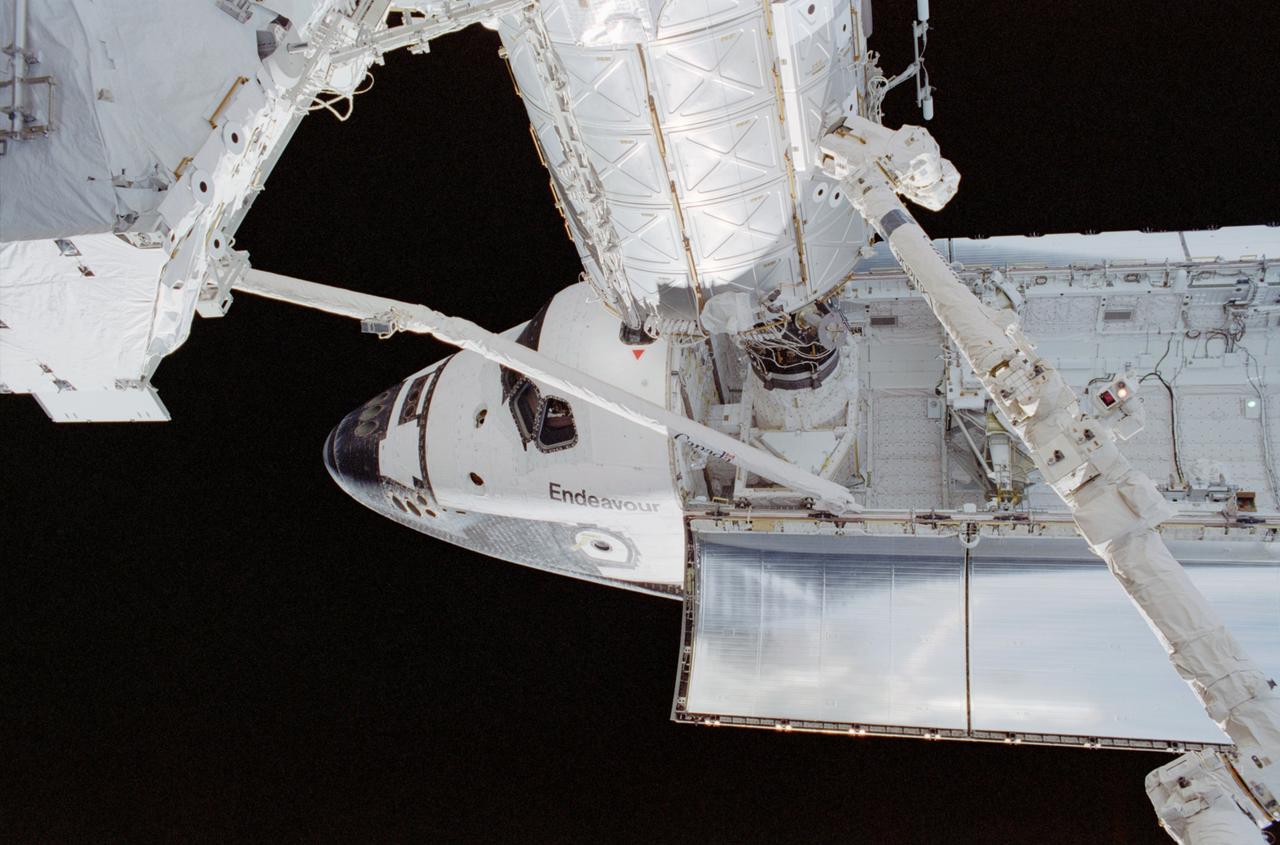
The STS-111 mission, the 14th Shuttle mission to visit the International Space Station (ISS), was launched on June 5, 2002 aboard the Space Shuttle Orbiter Endeavour. On board were the STS-111 and Expedition Five crew members. Astronauts Kerneth D. Cockrell, commander; Paul S. Lockhart, pilot, and mission specialists Franklin R. Chang-Diaz and Philippe Perrin were the STS-111 crew members. Expedition Five crew members included Cosmonaut Valeri G. Korzun, commander, Astronaut Peggy A. Whitson and Cosmonaut Sergei Y. Treschev, flight engineers. Three space walks enabled the STS-111 crew to accomplish the delivery and installation of the Mobile Remote Servicer Base System (MBS), an important part of the Station's Mobile Servicing System that allows the robotic arm to travel the length of the Station, which is necessary for future construction tasks; the replacement of a wrist roll joint on the Station's robotic arm; and the task of unloading supplies and science experiments from the Leonardo multipurpose Logistics Module, which made its third trip to the orbital outpost. In this photograph, the Space Shuttle Endeavour, back dropped by the blackness of space, is docked to the pressurized Mating Adapter (PMA-2) at the forward end of the Destiny Laboratory on the ISS. A portion of the Canadarm2 is visible on the right and Endeavour's robotic arm is in full view as it is stretched out with the S0 (S-zero) Truss at its end.
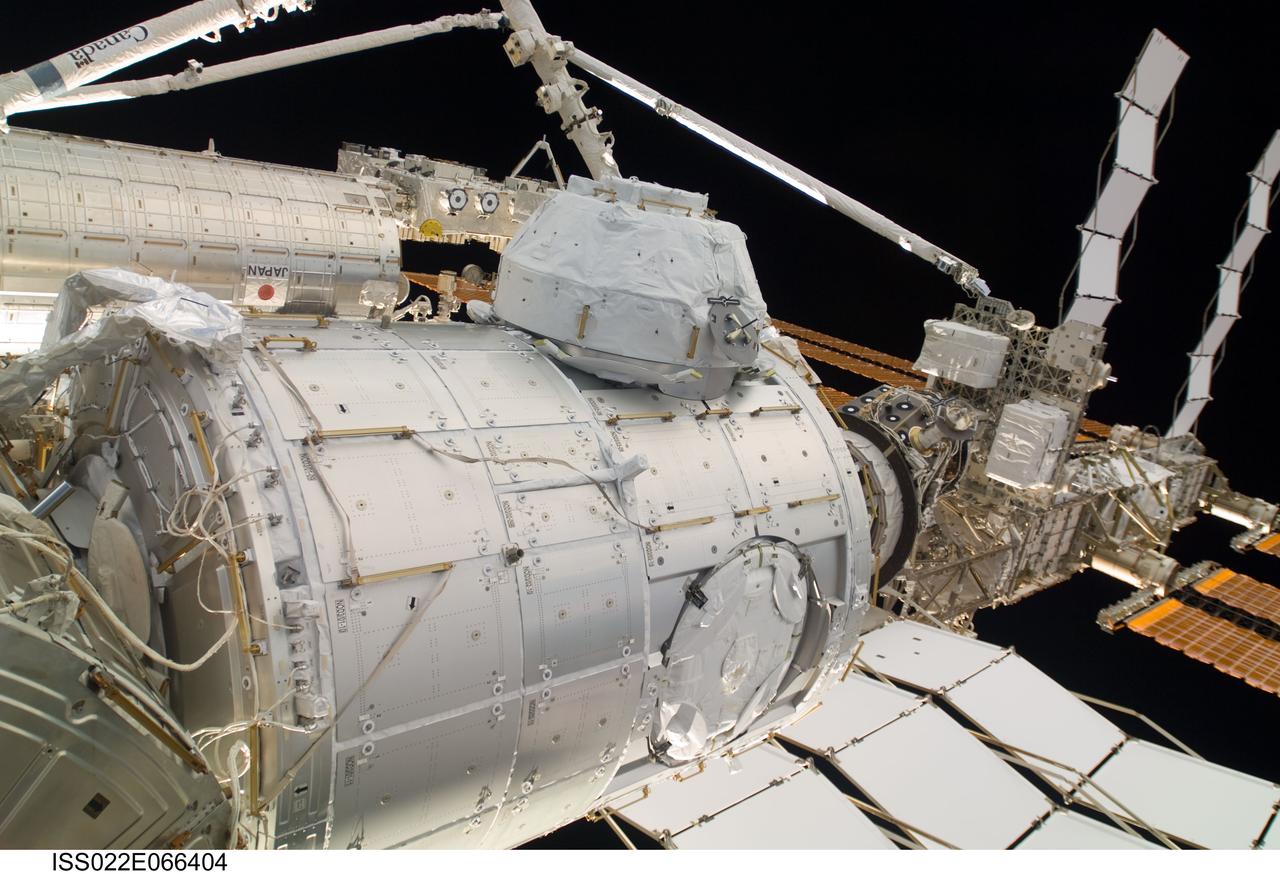
ISS022-E-066404 (16 Feb. 2010) --- In the grasp of the Canadarm2, the Pressurized Mating Adapter 3 (PMA-3) is relocated from the Harmony node to the open port on the end of the newly-installed Tranquility node. NASA astronauts Robert Behnken and Nicholas Patrick, both STS-130 mission specialists, operated the station?s robotic arm for the move, while Jeffrey Williams, Expedition 22 commander; and Japan Aerospace Exploration Agency (JAXA) astronaut Soichi Noguchi, Expedition 22 flight engineer, dealt with latches and bolts, connecting the port to its new home. Tranquility?s Cupola is visible at top center.
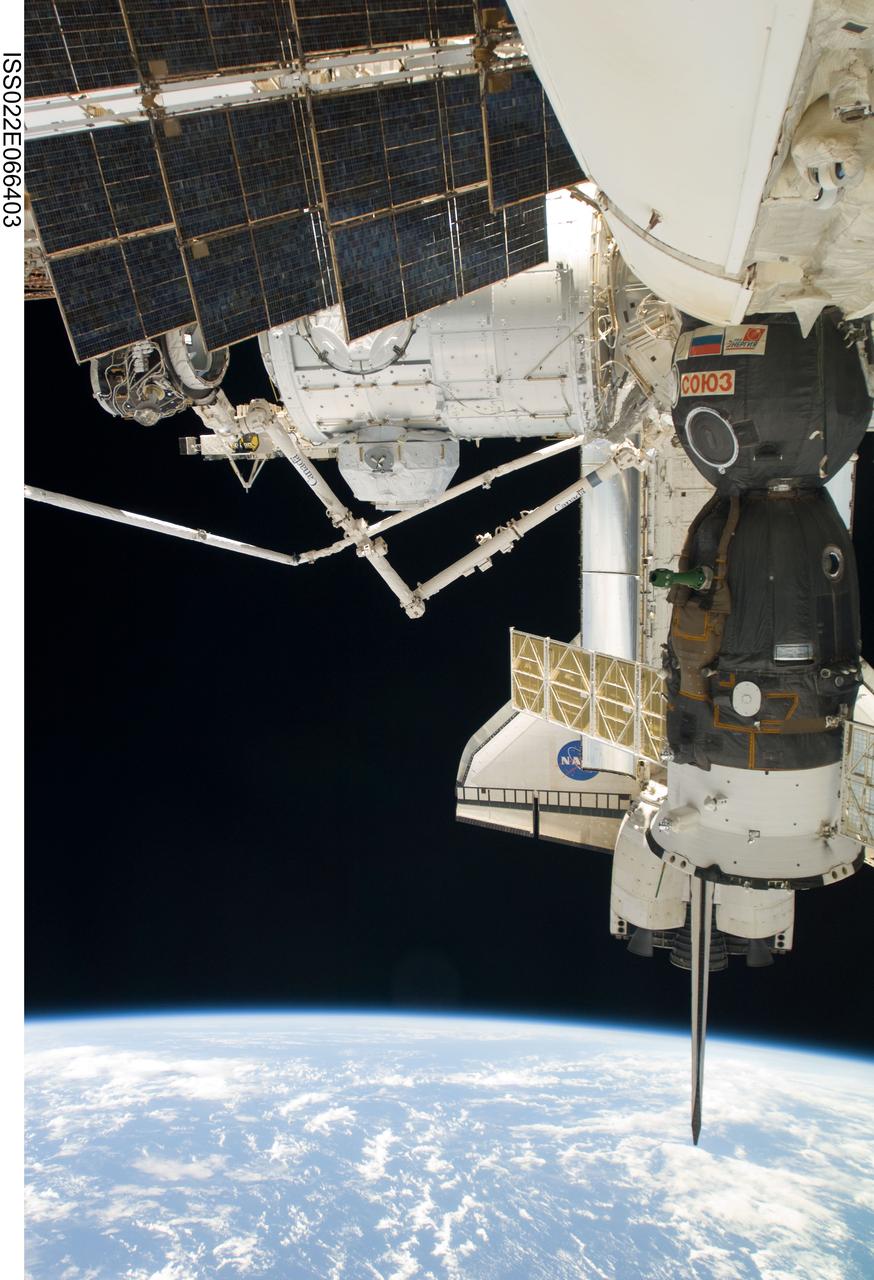
ISS022-E-066403 (16 Feb. 2010) --- In the grasp of the Canadarm2, the Pressurized Mating Adapter 3 (PMA-3) is relocated from the Harmony node to the open port on the end of the newly-installed Tranquility node. NASA astronauts Robert Behnken and Nicholas Patrick, both STS-130 mission specialists, operated the station?s robotic arm for the move, while Jeffrey Williams, Expedition 22 commander; and Japan Aerospace Exploration Agency (JAXA) astronaut Soichi Noguchi, Expedition 22 flight engineer, dealt with latches and bolts, connecting the port to its new home. Tranquility?s Cupola is visible at top center and a docked Russian Soyuz spacecraft and space shuttle Endeavor are at right.
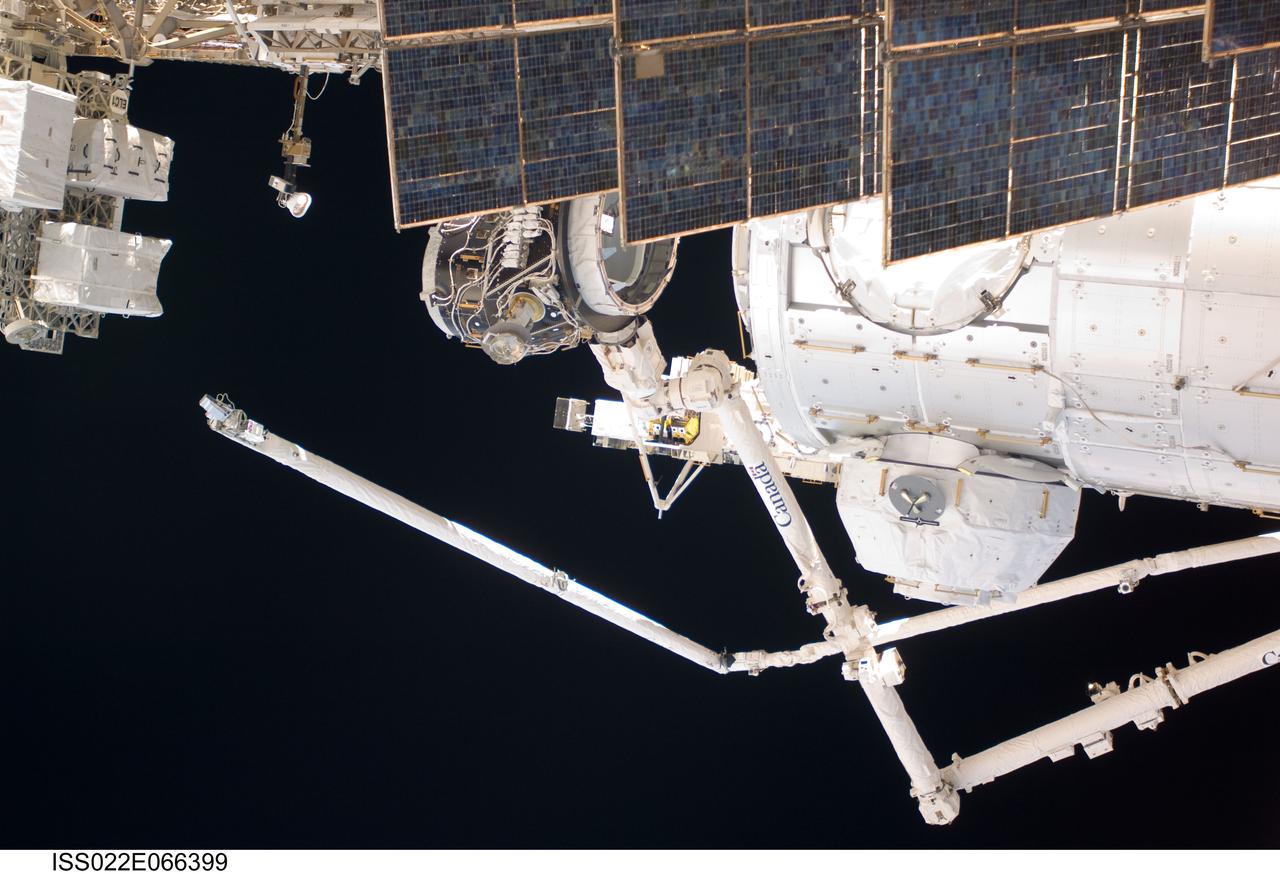
ISS022-E-066399 (16 Feb. 2010) --- In the grasp of the Canadarm2, the Pressurized Mating Adapter 3 (PMA-3) is relocated from the Harmony node to the open port on the end of the newly-installed Tranquility node (right). NASA astronauts Robert Behnken and Nicholas Patrick, both STS-130 mission specialists, operated the station?s robotic arm for the move, while Jeffrey Williams, Expedition 22 commander; and Japan Aerospace Exploration Agency (JAXA) astronaut Soichi Noguchi, Expedition 22 flight engineer, dealt with latches and bolts, connecting the port to its new home. Tranquility?s Cupola is visible at lower right.
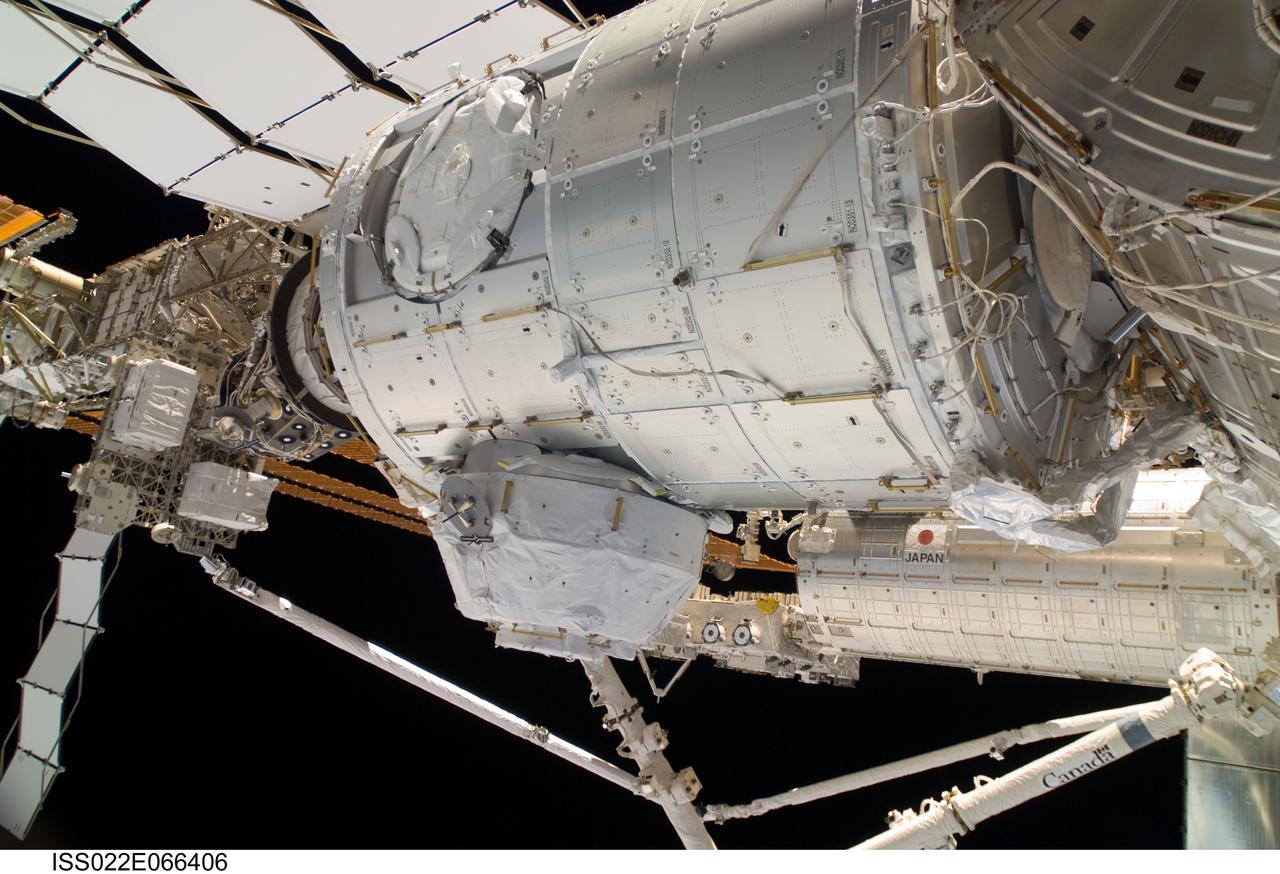
ISS022-E-066406 (16 Feb. 2010) --- In the grasp of the Canadarm2, the Pressurized Mating Adapter 3 (PMA-3) is relocated from the Harmony node to the open port on the end of the newly-installed Tranquility node. NASA astronauts Robert Behnken and Nicholas Patrick, both STS-130 mission specialists, operated the station?s robotic arm for the move, while Jeffrey Williams, Expedition 22 commander; and Japan Aerospace Exploration Agency (JAXA) astronaut Soichi Noguchi, Expedition 22 flight engineer, dealt with latches and bolts, connecting the port to its new home. Tranquility?s Cupola is visible at bottom center.
STS98-E-5091 (10 February 2001) --- One of the International Space Station's Pressurized Mating Adapters (PMA-3) was photographed with a digital still camera from the crew cabin of the Space Shuttle Atlantis during Flight Day 4 activity. The Canadian-built Remote Manipulator System (RMS) arm can be seen in its stowed position on the port side of the shuttle's cargo bay.
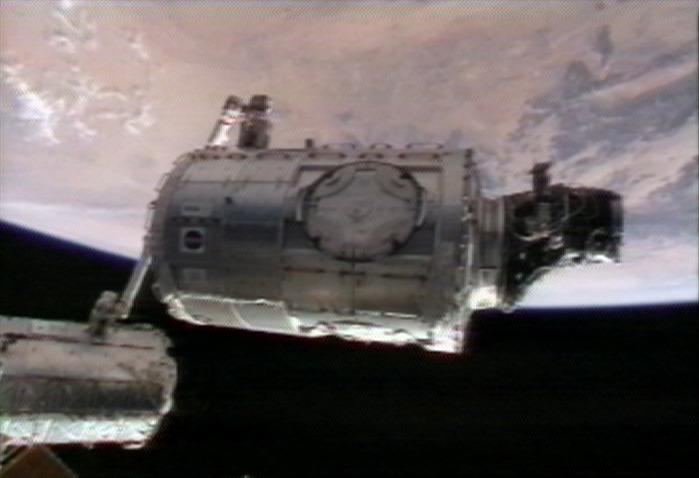
ISS016-E-011442 (14 Nov. 2007) --- In the grasp of the International Space Station's Canadarm2, the Harmony node with the Pressurized Mating Adapter (PMA-2) attached is moved from its temporary location on the left side of the Unity node to its new home on the front of the Destiny laboratory. Astronaut Daniel Tani, Expedition 16 flight engineer, operated the station's robotic arm from inside Destiny. The blackness of space and Earth's horizon provide the backdrop for the view, which was taken from NASA television.
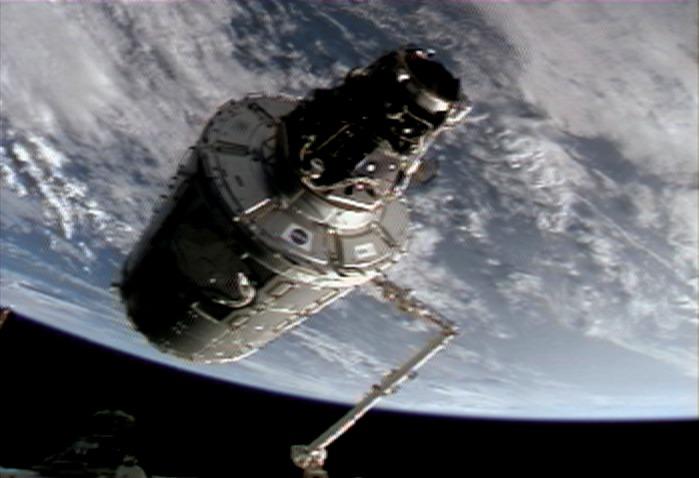
ISS016-E-011441 (14 Nov. 2007) --- In the grasp of the International Space Station's Canadarm2, the Harmony node with the Pressurized Mating Adapter (PMA-2) attached is moved from its temporary location on the left side of the Unity node to its new home on the front of the Destiny laboratory. Astronaut Daniel Tani, Expedition 16 flight engineer, operated the station's robotic arm from inside Destiny. The blackness of space and Earth's horizon provide the backdrop for the view, which was taken from NASA television.
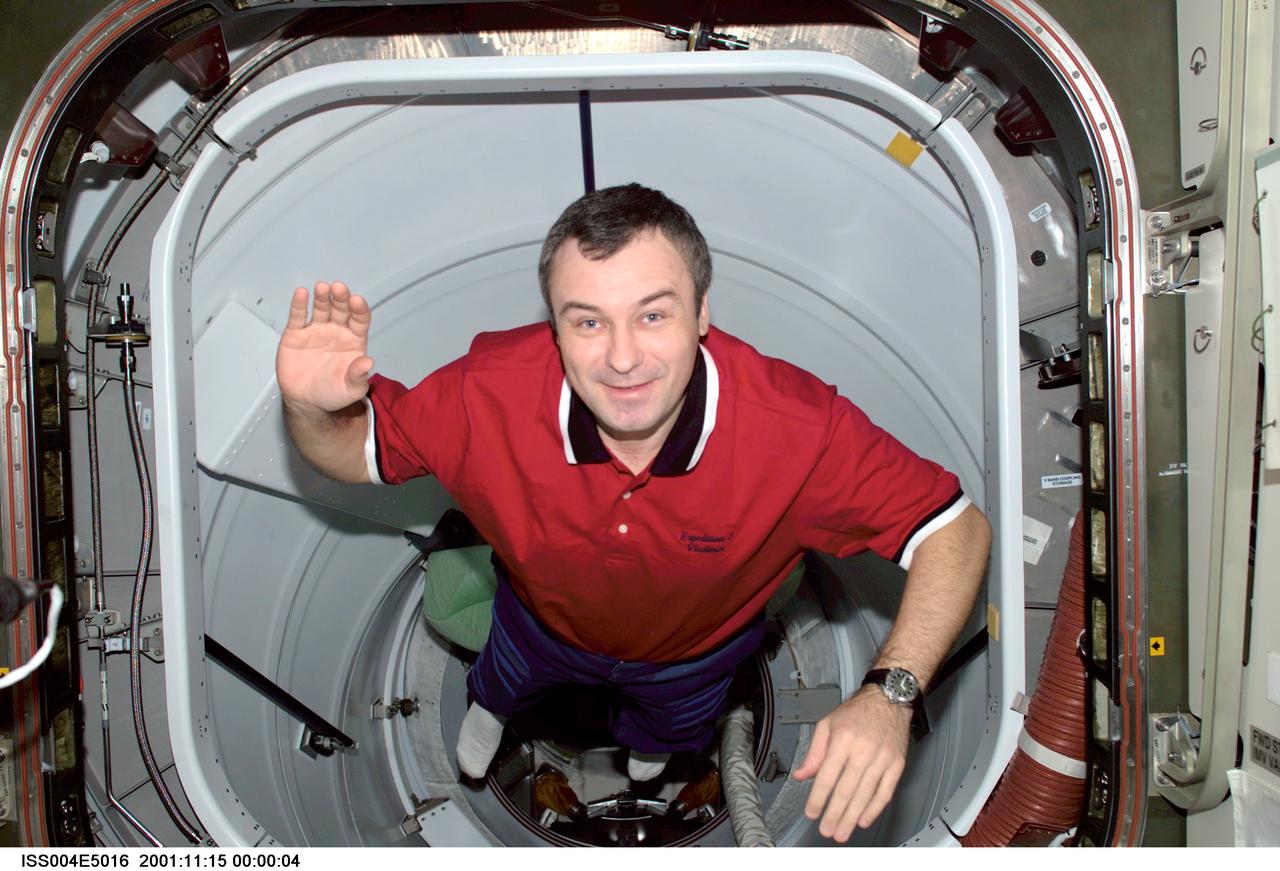
ISS004-E-5016 (December 2001) --- Cosmonaut Vladimir N. Dezhurov, Expedition Three flight engineer, floats through the Pressurized Mating Adapter 2 (PMA-2) on the International Space Station (ISS). A crewmate in the Destiny laboratory captured the image on a digital still camera.
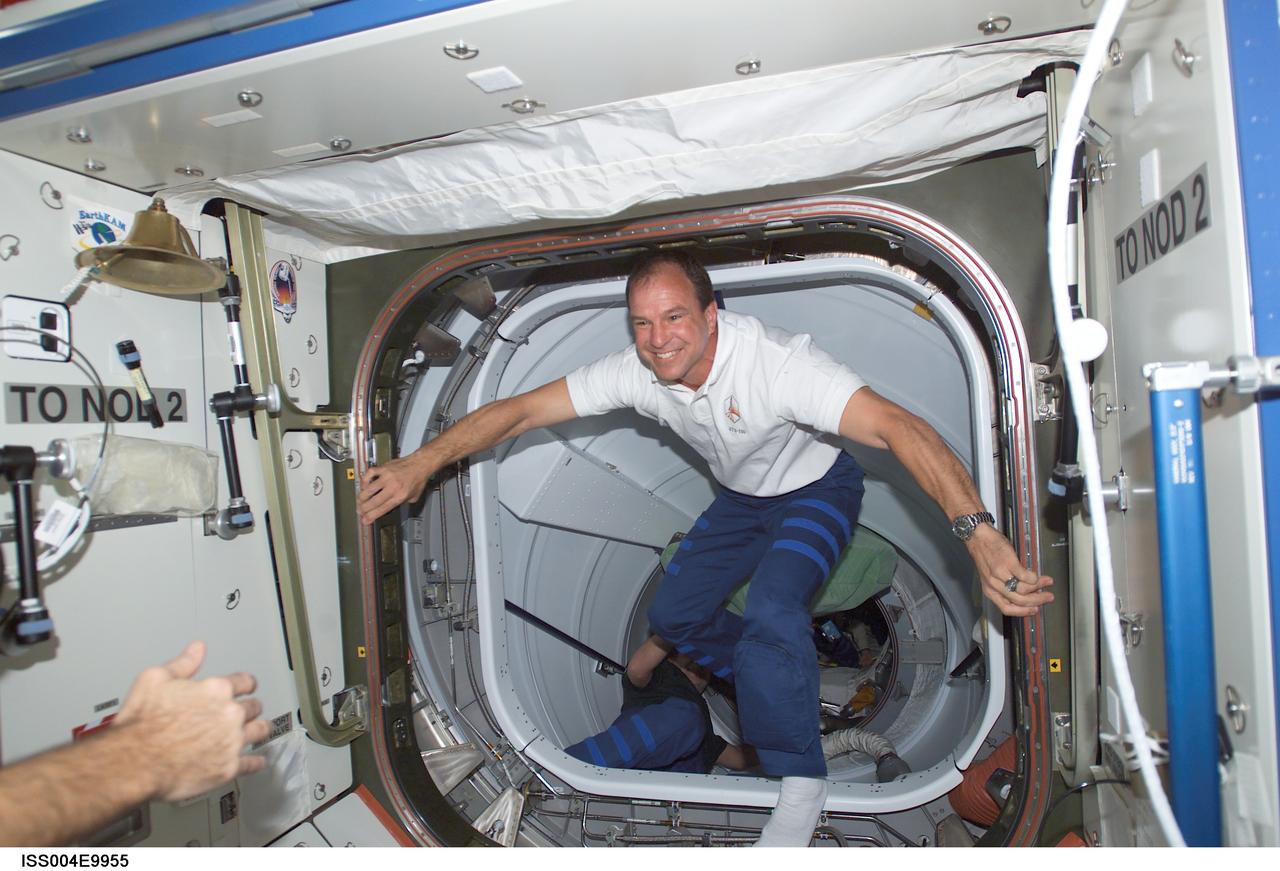
ISS004-E-9955 (10 April 2002) --- Astronaut Michael J. Bloomfield, STS-110 mission commander, steps into the Destiny laboratory on the International Space Station (ISS) through the Pressurized Mating Adapter 2 (PMA-2) upon docking of the Space Shuttle Atlantis and the station.
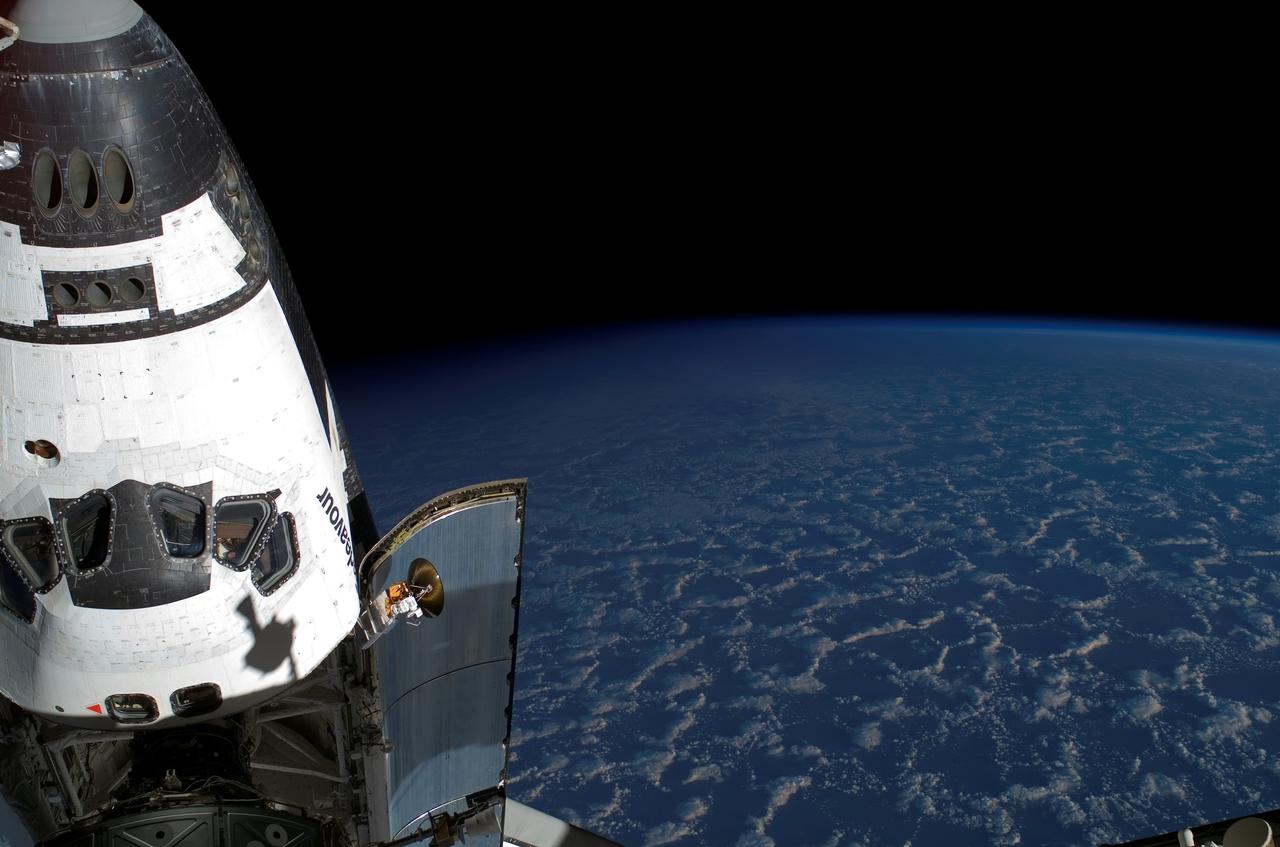
ISS015-E-21944 (11 Aug. 2007) --- Backdropped by the blackness of space and Earth's horizon, the Space Shuttle Endeavour, docked to the Pressurized Mating Adapter (PMA-2) on the International Space Station, is featured in this photograph taken by a crewmember during the mission's first planned session of extravehicular activity (EVA).
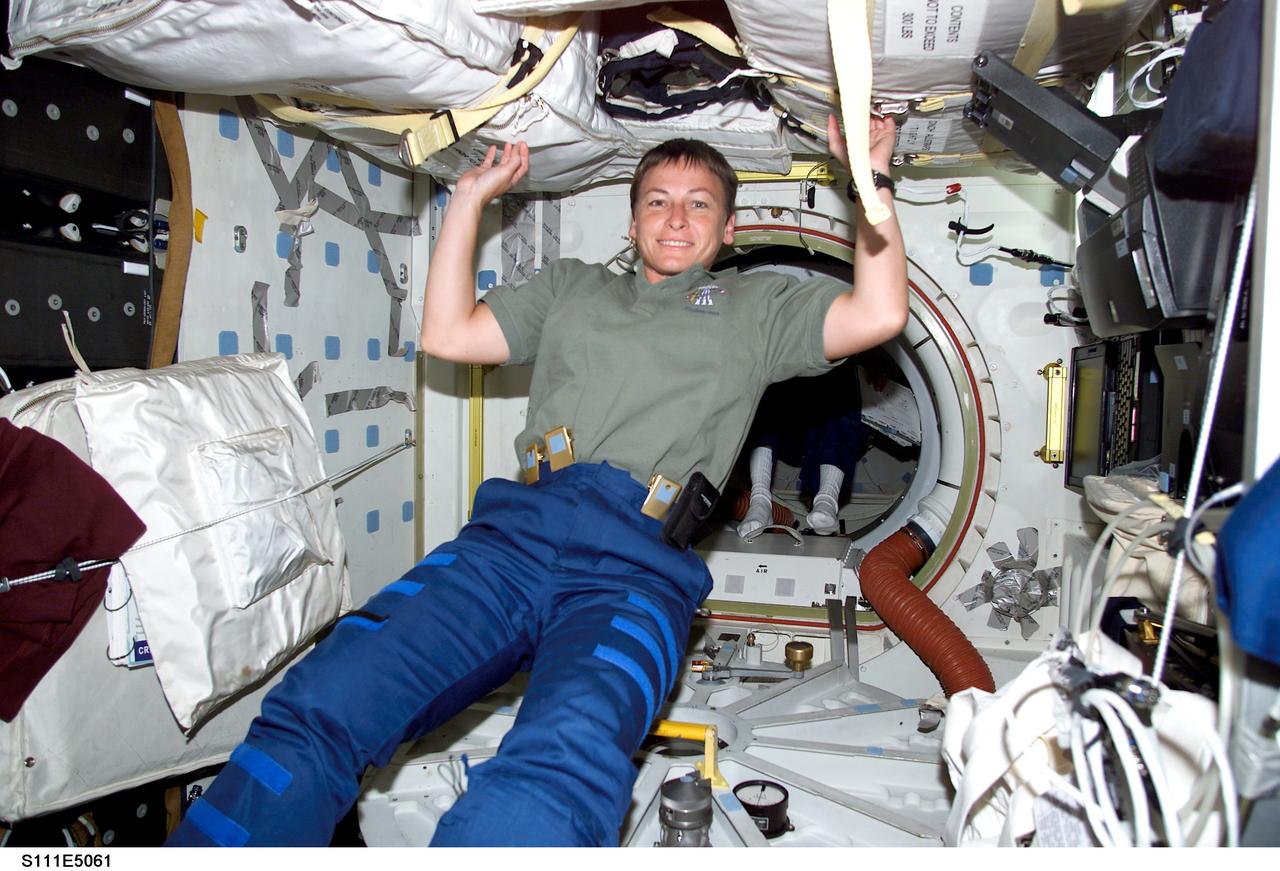
STS111-E-5061 (7 June 2002) --- Astronaut Peggy A. Whitson is pictured as she passes into the Pressurized Mating Adapter (PMA-2) on board the International Space Station (ISS). She is beginning this week to serve a lengthy tour of duty as flight engineer for the fifth crew to live and work aboard the orbiting outpost.

KENNEDY SPACE CENTER, FLA. -- The Pressurized Mating Adapter (PMA)-2 for the International Space Station (ISS) is moved on an air pallet toward Node 1, the space station’s structural building block, in KSC’s Space Station Processing Facility. This PMA is a cone-shaped connector to Node 1, which will have two PMAs attached once PMA-2 is mated with the node. The node and PMAs, which together will make up the first element of the ISS, are scheduled to be launched aboard the Space Shuttle Endeavour on STS-88
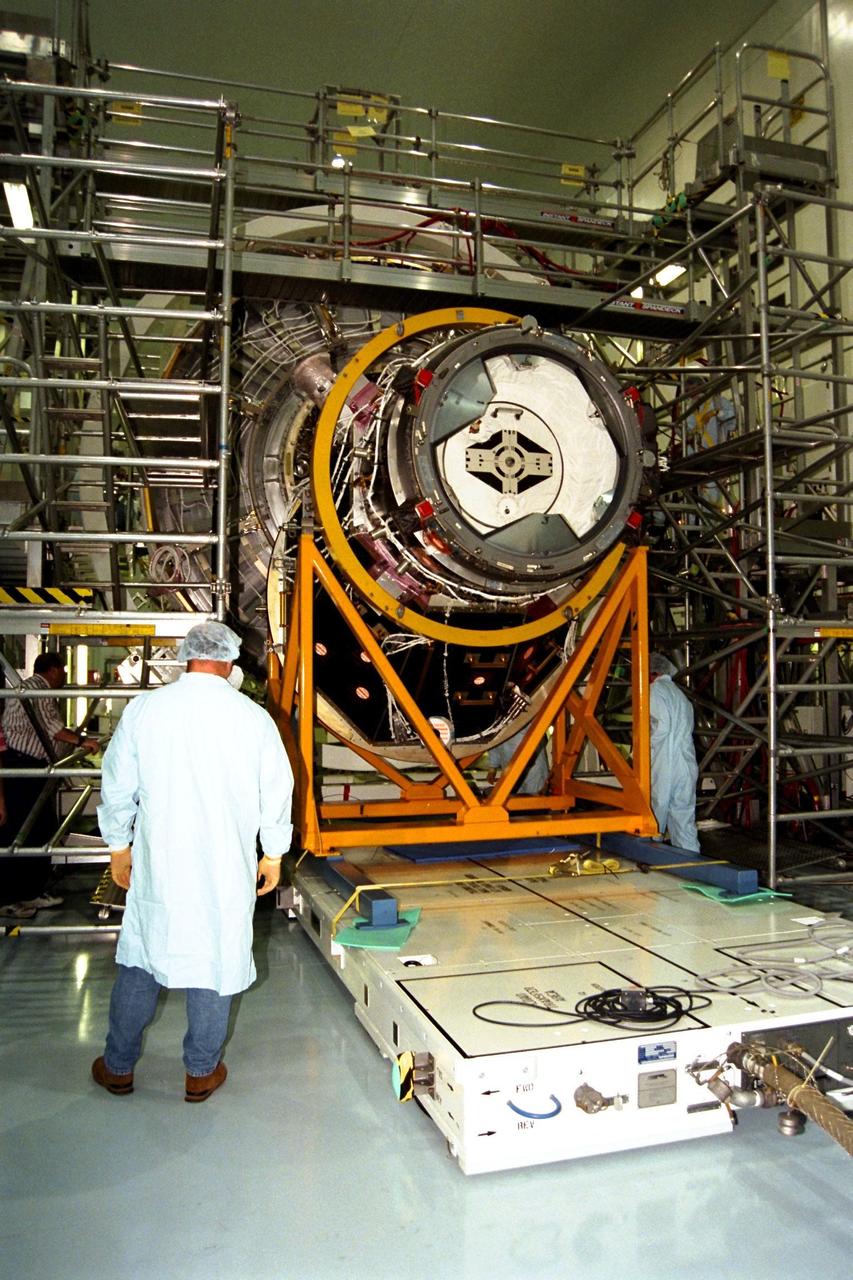
KENNEDY SPACE CENTER, FLA. -- The Pressurized Mating Adapter (PMA)-2, seen here in its yellow workstand, is moved on an air pallet toward Node 1, the International Space Station’s (ISS's) structural building block, in KSC’s Space Station Processing Facility. This PMA is a cone-shaped connector to Node 1, which will have two PMAs attached once PMA-2 is mated with the node. Node 1 can be seen directly behind PMA-2. The node and PMAs, which together will make up the first element of the ISS, are scheduled to be launched aboard the Space Shuttle Endeavour on STS-88.
![KENNEDY SPACE CENTER, FLA. -- Technicians prepare to join the Pressurized Mating Adapter (PMA)-2, seen here in its yellow workstand at right, to Node 1 (the International Space Station’s [ISS] structural building block) in KSC’s Space Station Processing Facility. This PMA is a cone-shaped connector to Node 1, which will have two PMAs attached once PMA-2 is mated with the node. The node and PMAs, which together will make up the first element of the ISS, are scheduled to be launched aboard the Space Shuttle Endeavour on STS-88.](https://images-assets.nasa.gov/image/KSC-98pc297/KSC-98pc297~medium.jpg)
KENNEDY SPACE CENTER, FLA. -- Technicians prepare to join the Pressurized Mating Adapter (PMA)-2, seen here in its yellow workstand at right, to Node 1 (the International Space Station’s [ISS] structural building block) in KSC’s Space Station Processing Facility. This PMA is a cone-shaped connector to Node 1, which will have two PMAs attached once PMA-2 is mated with the node. The node and PMAs, which together will make up the first element of the ISS, are scheduled to be launched aboard the Space Shuttle Endeavour on STS-88.
![KENNEDY SPACE CENTER, FLA. -- Technicians and workers observe preparations to join the Pressurized Mating Adapter (PMA)-2, seen here in its yellow workstand at right, to Node 1 (the International Space Station’s [ISS] structural building block) in KSC’s Space Station Processing Facility. This PMA is a cone-shaped connector to Node 1, which will have two PMAs attached once PMA-2 is mated with the node. The node (surrounded here by scaffolding) and PMAs, which together will make up the first element of the ISS, are scheduled to be launched aboard the Space Shuttle Endeavour on STS-88](https://images-assets.nasa.gov/image/KSC-98pc298/KSC-98pc298~medium.jpg)
KENNEDY SPACE CENTER, FLA. -- Technicians and workers observe preparations to join the Pressurized Mating Adapter (PMA)-2, seen here in its yellow workstand at right, to Node 1 (the International Space Station’s [ISS] structural building block) in KSC’s Space Station Processing Facility. This PMA is a cone-shaped connector to Node 1, which will have two PMAs attached once PMA-2 is mated with the node. The node (surrounded here by scaffolding) and PMAs, which together will make up the first element of the ISS, are scheduled to be launched aboard the Space Shuttle Endeavour on STS-88
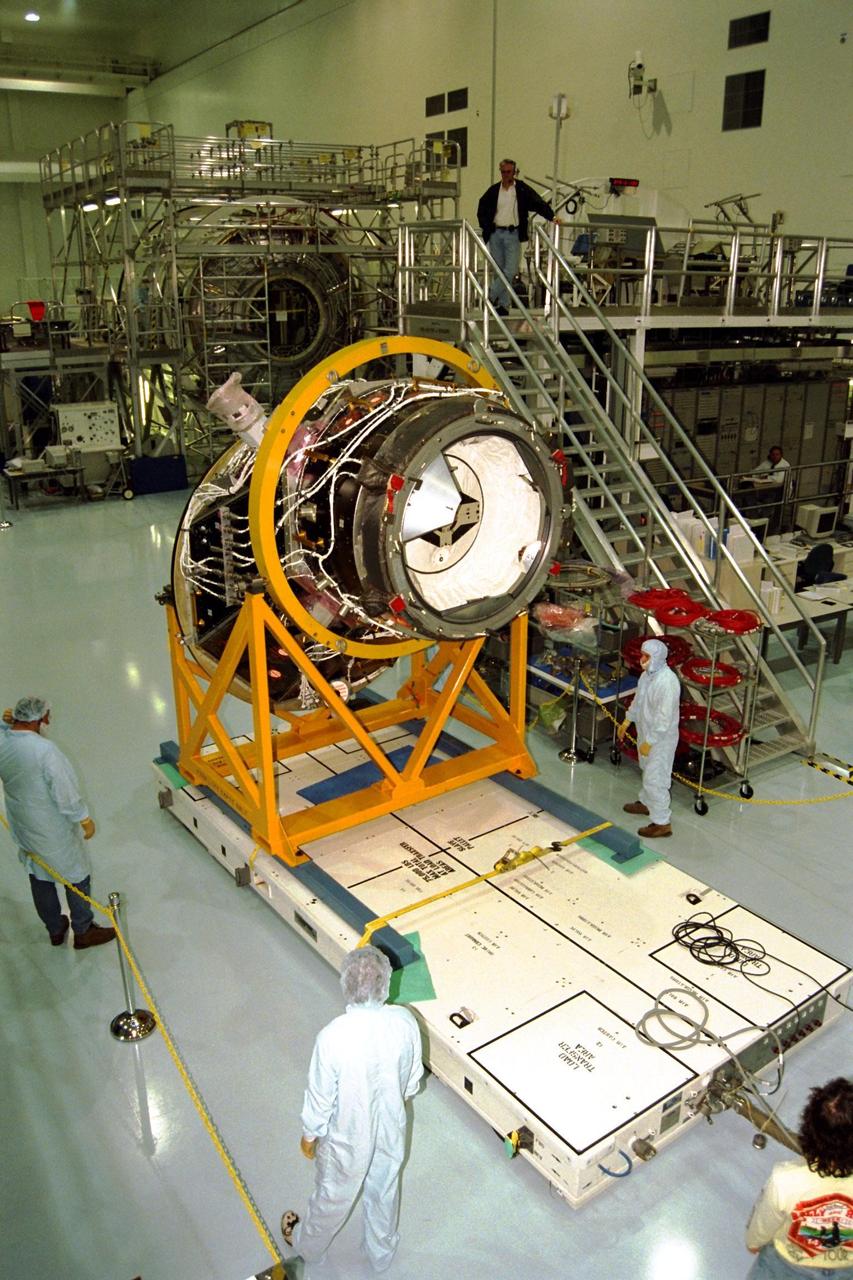
KENNEDY SPACE CENTER, FLA. -- The Pressurized Mating Adapter (PMA)-2 for the International Space Station (ISS), seen here in its yellow workstand, is moved on an air pallet toward Node 1, the space station’s structural building block, in KSC’s Space Station Processing Facility. This PMA is a cone-shaped connector to Node 1, which will have two PMAs attached once PMA-2 is mated with the node. The node and PMAs, which together will make up the first element of the ISS, are scheduled to be launched aboard the Space Shuttle Endeavour on STS-88
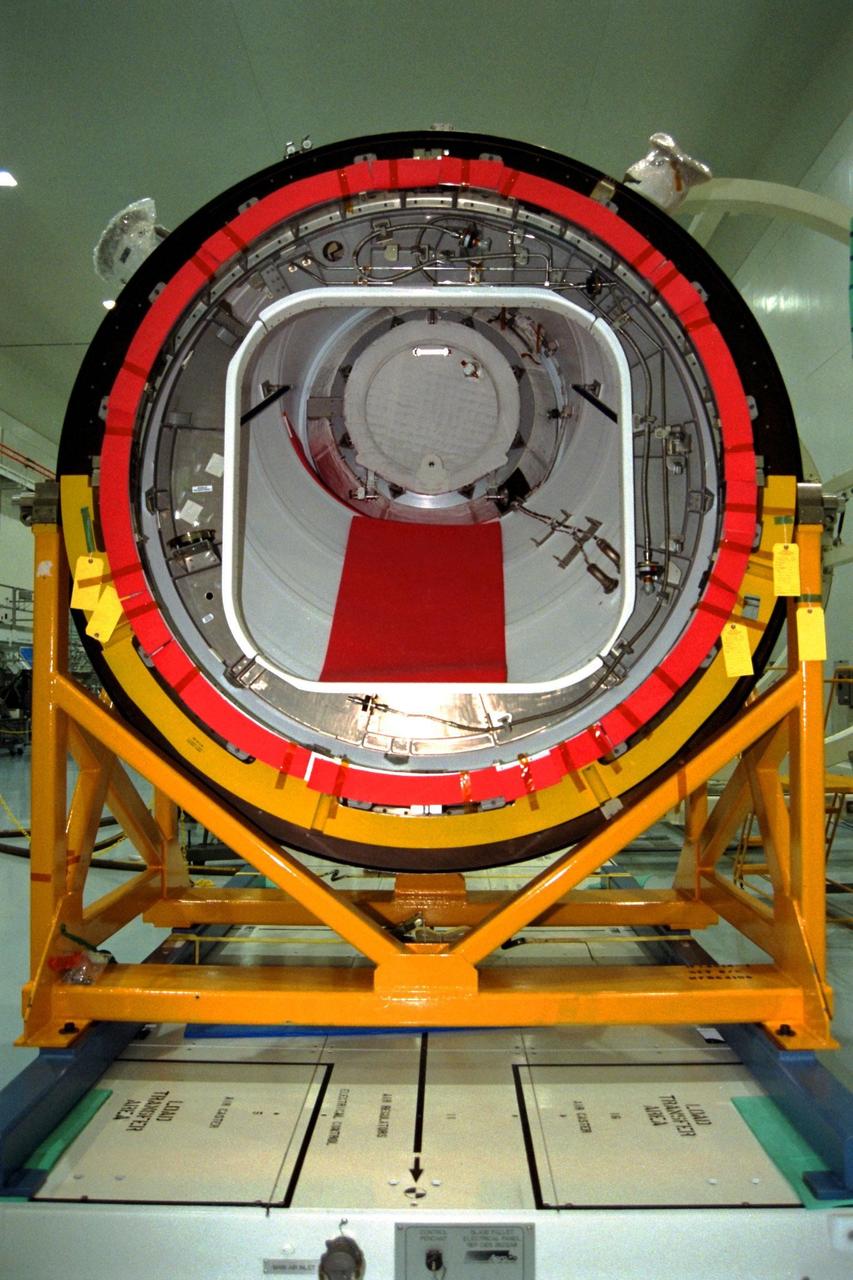
KENNEDY SPACE CENTER, FLA. -- The Pressurized Mating Adapter (PMA)-2 for the International Space Station (ISS) awaits being mated with Node 1, the space station’s structural building block, in KSC’s Space Station Processing Facility. This PMA, identifiable by its bright red ring, is a cone-shaped connector to Node 1, which will have two PMAs attached once this mate is completed. The node and PMAs, which together will make up the first element of the ISS, are scheduled to be launched aboard the Space Shuttle Endeavour on STS-88
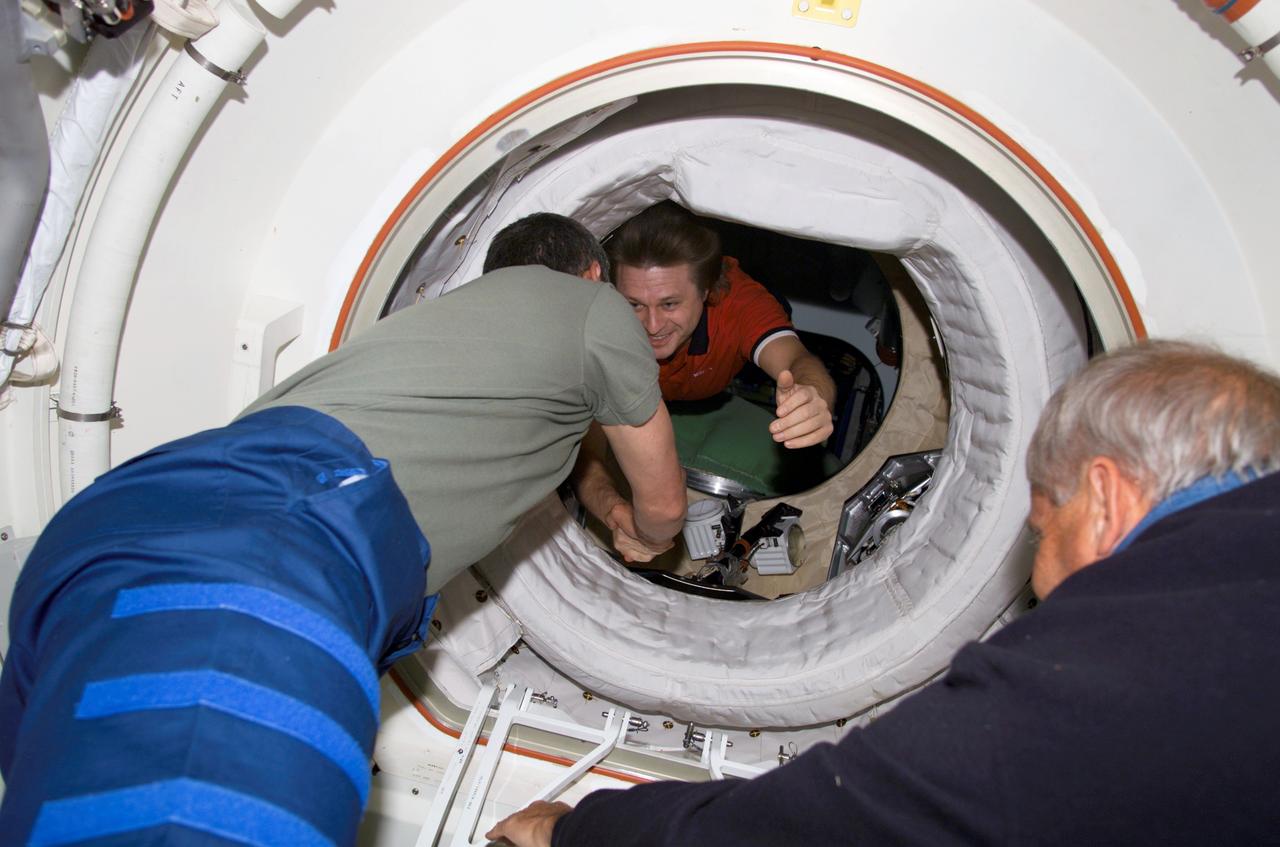
STS111-E-5095 (7 June 2002) --- Cosmonaut Yury I. Onufrienko, Expedition Four mission commander, greets cosmonaut Valery G. Korzun (back to camera), Expedition Five mission commander, when the hatch to the Pressurized Mating Adapter 2 (PMA-2) on the International Space Station (ISS) was opened for the STS-111 ingress. Astronaut Kenneth D. Cockrell, STS-111 mission commander, is partially visible on the right of Korzun. Onufrienko and Korzun represent Rosaviakosmos.
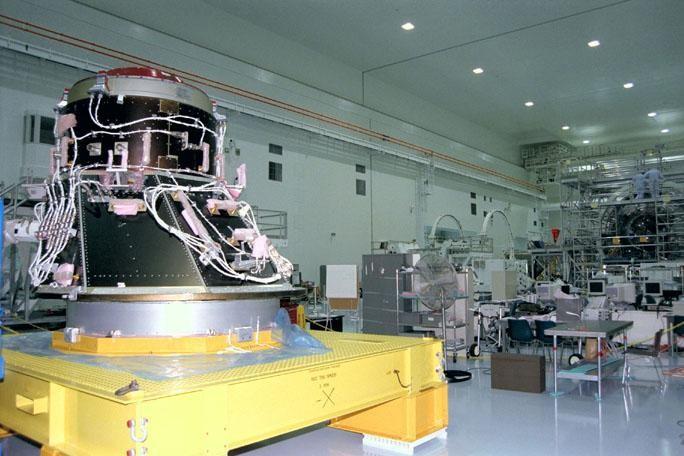
KENNEDY SPACE CENTER, FLA. -- The Pressurized Mating Adapter 2 (PMA 2), at left, part of the first International Space Station (ISS) element to be launched from the U.S., awaits prelaunch processing in the Space Station Processing Facility after its arrival at KSC. PMAs 1 and 2 attached to a component called Node 1, shown in background at far right, to form the first U.S.-launched ISS element. The Node 1/PMA assembly will provide key connecting points in orbit for other Space Station modules and for docking of the orbiter with the ISS. PMA 1 will provide the interface between U.S. and Russian elements of the Station; PMA 2 will provide a Shuttle orbiter docking area. The Node 1/PMA assembly is targeted for liftoff aboard the Space Shuttle Endeavour on STS-88 in July 1998.
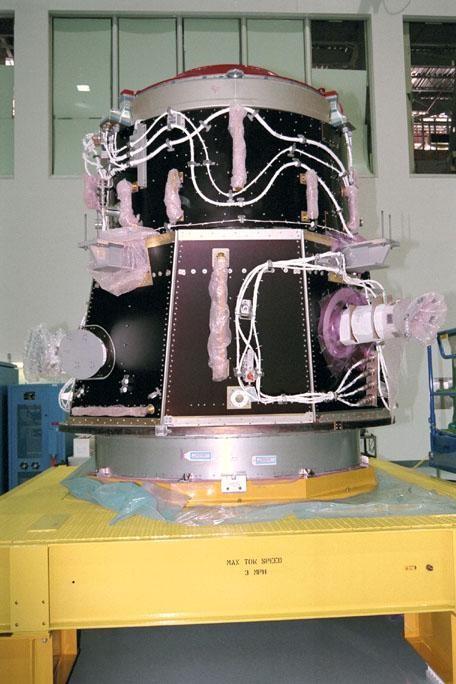
KENNEDY SPACE CENTER, FLA. -- The Pressurized Mating Adapter 2 (PMA 2), part of the first International Space Station (ISS) element to be launched from the U.S., awaits prelaunch processing in the Space Station Processing Facility after its arrival at KSC. PMAs 1 and 2 attached to a component called Node 1, a Station structural building block, will make up the first U.S.-launched ISS element. The Node 1/PMA assembly will provide key connecting points in orbit for other Space Station modules and for docking of the orbiter with the ISS. PMA 1 will provide the interface between U.S. and Russian elements of the Station; PMA 2 will provide a Shuttle orbiter docking area. The Node 1/PMA assembly is targeted for liftoff aboard the Space Shuttle Endeavour on STS-88 in July 1998.
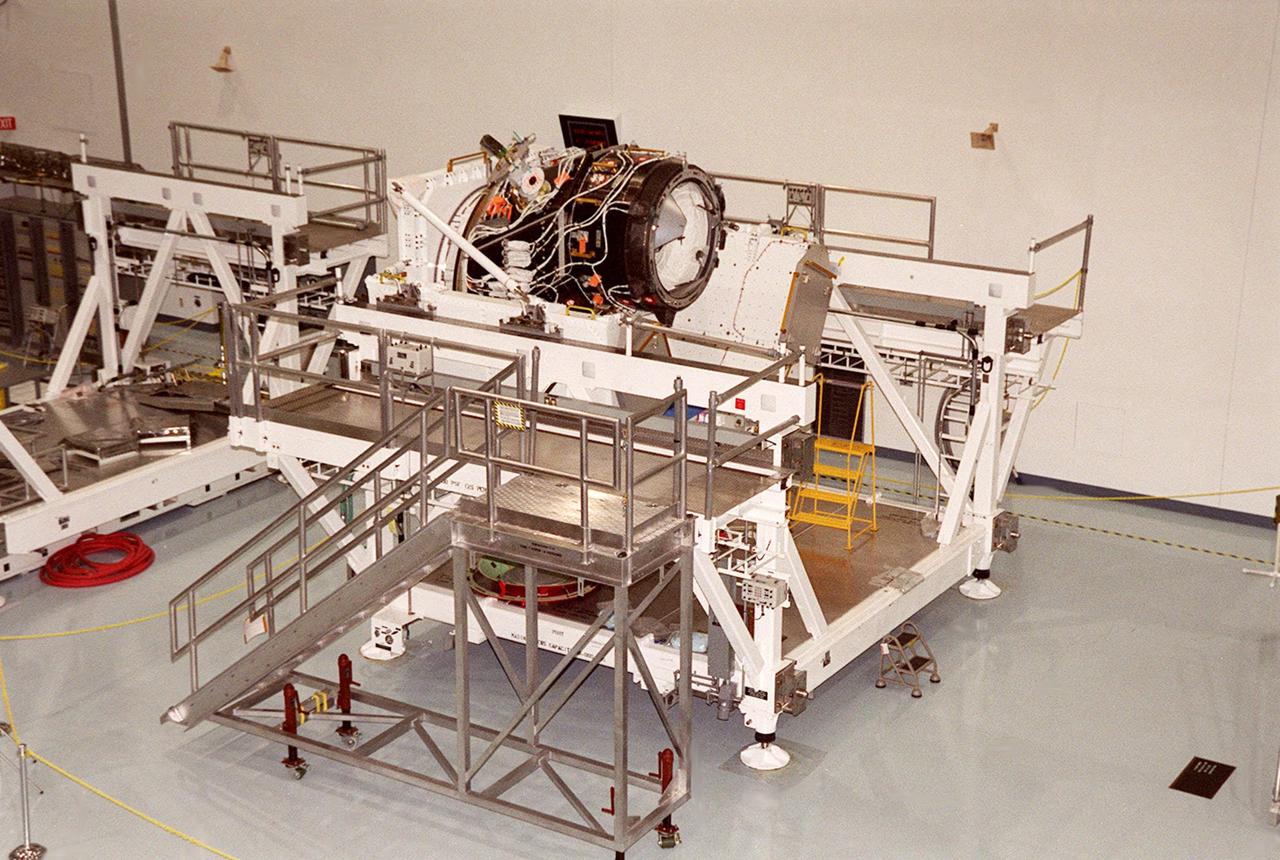
KENNEDY SPACE CENTER, FLA. -- Inside the Space Station Processing Facility, the Pressurized Mating Adapter-3 (PMA-3), an element for the International Space Station, awaits testing. The PMA-3, once launched, will be mated to Node 1, a connecting passageway to the living and working areas of the Space Station. The primary purpose of PMA-3 is to serve as a Shuttle docking port through which crew members and equipment will transfer to the Space Station during later assembly missions. PMA-3 is scheduled as payload on mission STS-92, whose date for launch is not yet determined
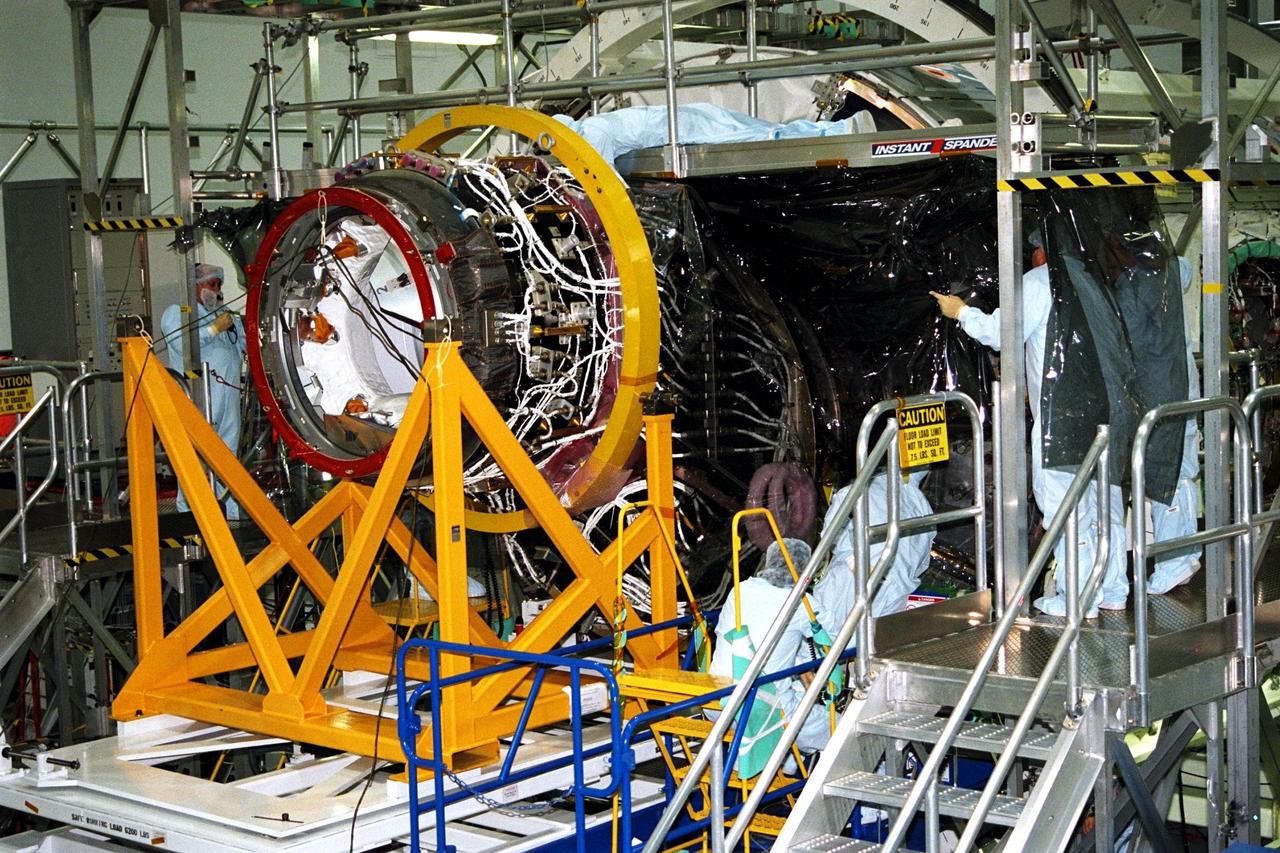
KENNEDY SPACE CENTER, FLA. -- Boeing technicians join Node 1 for the International Space Station (ISS) with the Pressurized Mating Adapter (PMA)-1 in KSC’s Space Station Processing Facility. This PMA, identifiable by its bright red ring, is a cone-shaped connector for the space station’s structural building block, known as Node 1. Seen here surrounded by scaffolding, Node 1 will have two PMAs attached, the second of which is scheduled for mating to the node in January 1998. The node and PMAs, which will be the first element of the ISS, are scheduled to be launched aboard the Space Shuttle Endeavour on STS-88 in July 1998
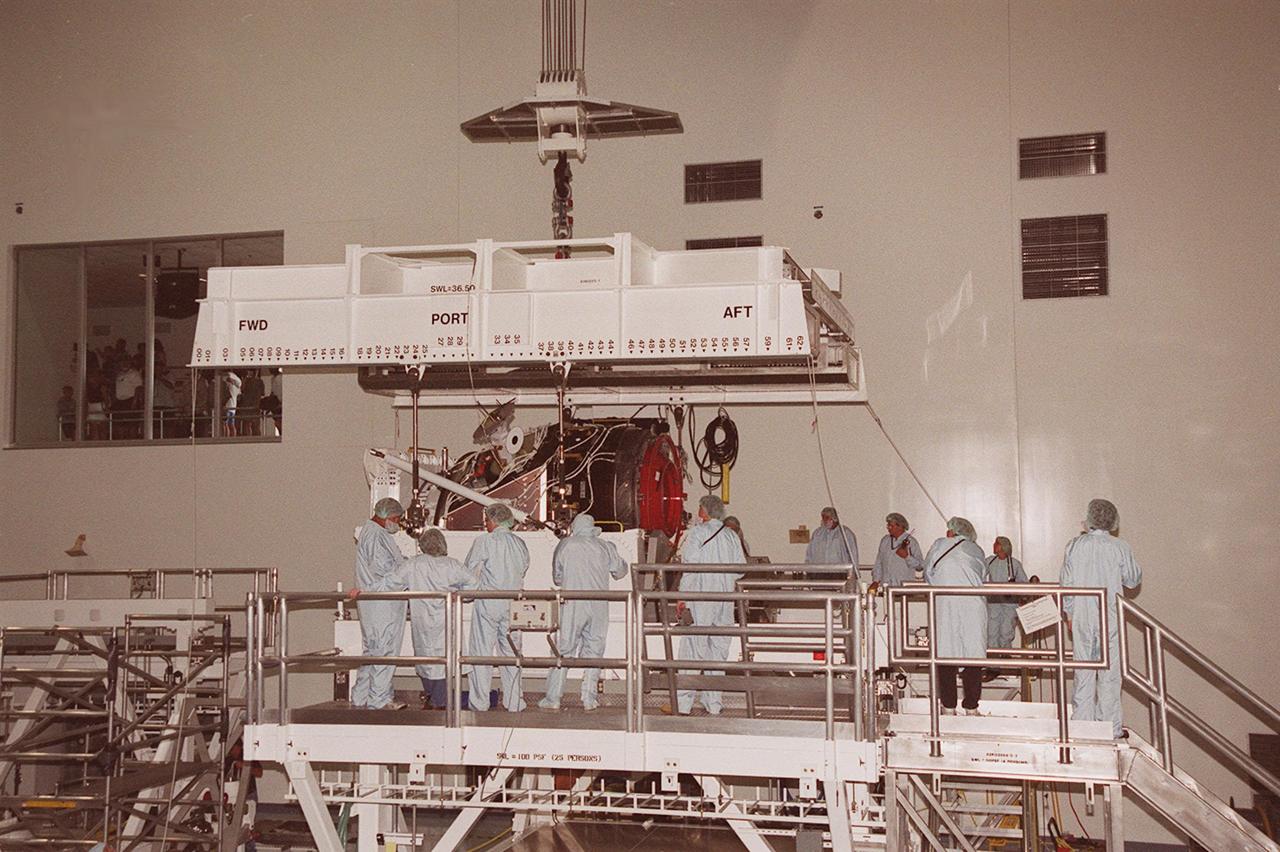
Workers in the Space Station Processing Facility gather around the Pressurized Mating Adapter -3 (PMA-3) as an overhead crane is set to lift and move it. The PMA-3, a component of the International Space Station, is being transported to the Orbiter Processing Facility. PMA-3 is part of the payload on Space Shuttle mission STS-92, scheduled to launch Oct. 5. The mission will be the fifth flight to the Space Station, and the 100th Shuttle flight overall. PMA-3 provides shuttle docking port for solar array installation on flight 4A (mission STS-97 scheduled for Nov. 30), and Lab installation on flight 5A (mission STS-98, scheduled for Jan. 18, 2001)

KENNEDY SPACE CENTER, FLA. -- Inside the Space Station Processing Facility, the Pressurized Mating Adapter-3 (PMA-3), an element for the International Space Station, awaits testing. The PMA-3, once launched, will be mated to Node 1, a connecting passageway to the living and working areas of the Space Station. The primary purpose of PMA-3 is to serve as a Shuttle docking port through which crew members and equipment will transfer to the Space Station during later assembly missions. PMA-3 is scheduled as payload on mission STS-92, whose date for launch is not yet determined
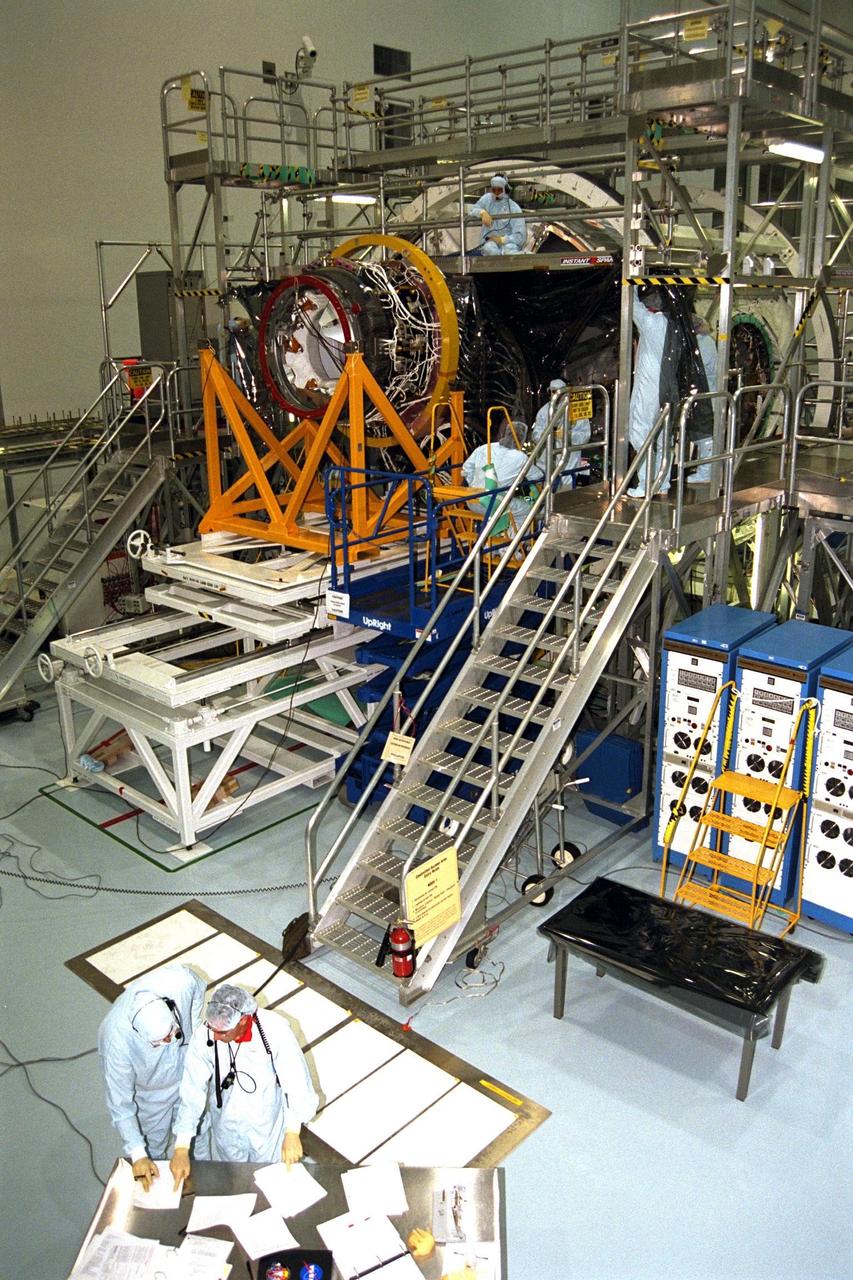
KENNEDY SPACE CENTER, FLA. -- Boeing technicians join Node 1 for the International Space Station (ISS) with the Pressurized Mating Adapter (PMA)-1 in KSC’s Space Station Processing Facility. This PMA, identifiable by its bright red ring, is a cone-shaped connector for the space station’s structural building block, known as Node 1. Seen here surrounded by scaffolding, Node 1 will have two PMAs attached, the second of which is scheduled for mating to the node in January 1998. The node and PMAs, which will be the first element of the ISS, are scheduled to be launched aboard the Space Shuttle Endeavour on STS-88 in July 1998
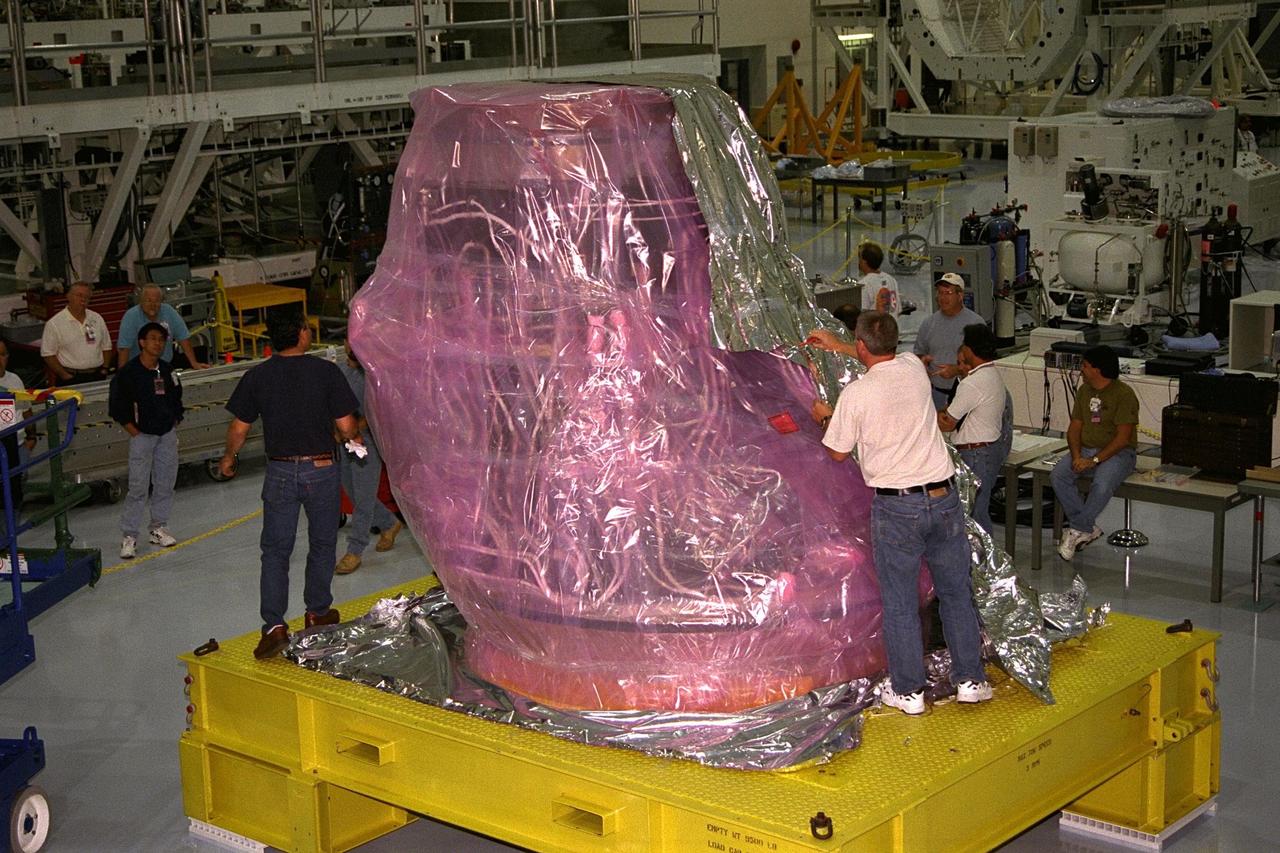
International Space Station (ISS) contractors unwrap Pressurized Mating Adapter-1 (PMA-1) for the ISS in KSC’s Space Station Processing Facility. A PMA is a cone-shaped connector that will be attached to Node 1, the space station’s structural building block, during ground processing. Node 1 with two PMAs attached will be the first element of the station scheduled to be launched aboard the Space Shuttle Endeavour on STS-88 in July 1998
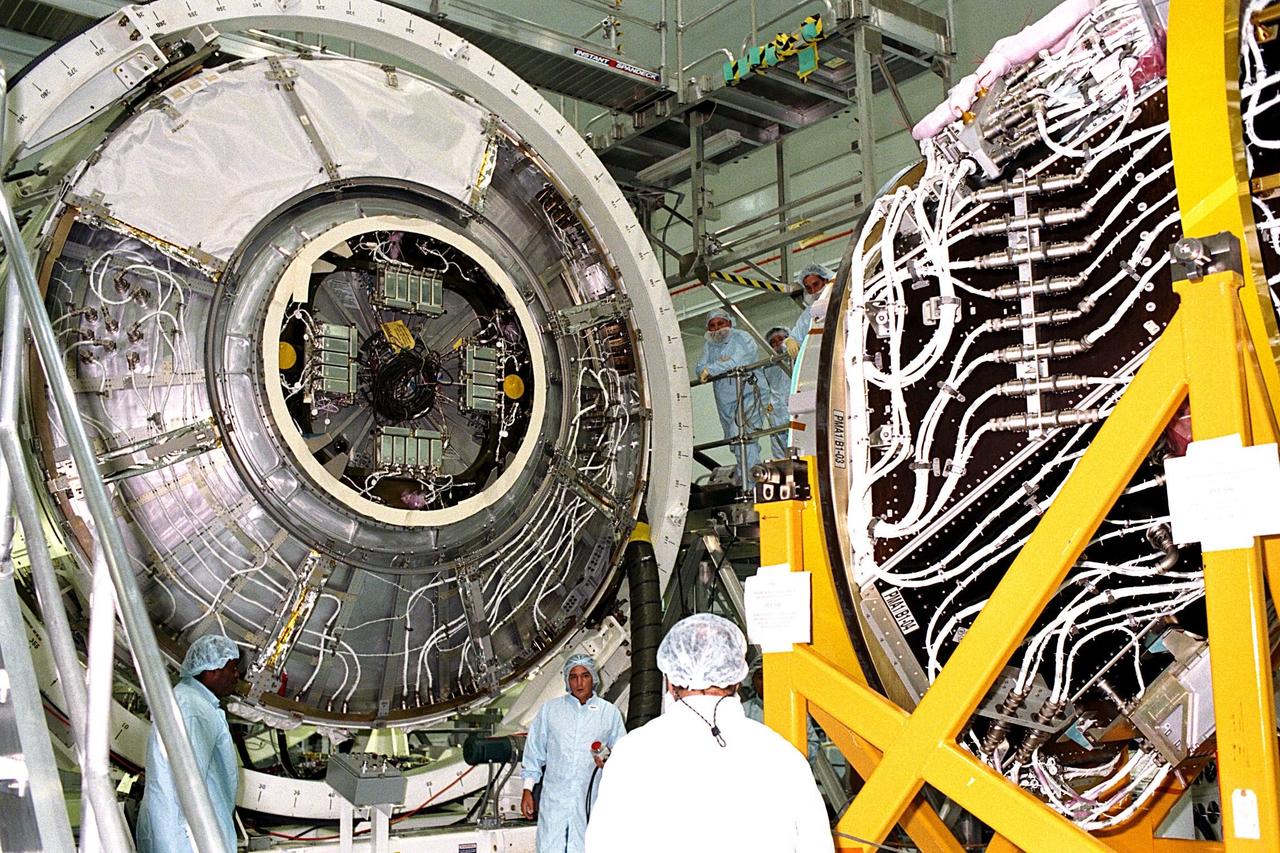
KENNEDY SPACE CENTER, FLA. -- The Pressurized Mating Adapter-1 (PMA-1) for the International Space Station is moved for further processing in KSC’s Space Station Processing Facility. A PMA is a cone-shaped connector that will be attached to Node 1, the space station’s structural building block, during ground processing. Node 1 with two PMAs attached will be the first element of the station scheduled to be launched aboard the Space Shuttle Endeavour on STS-88 in July 1998
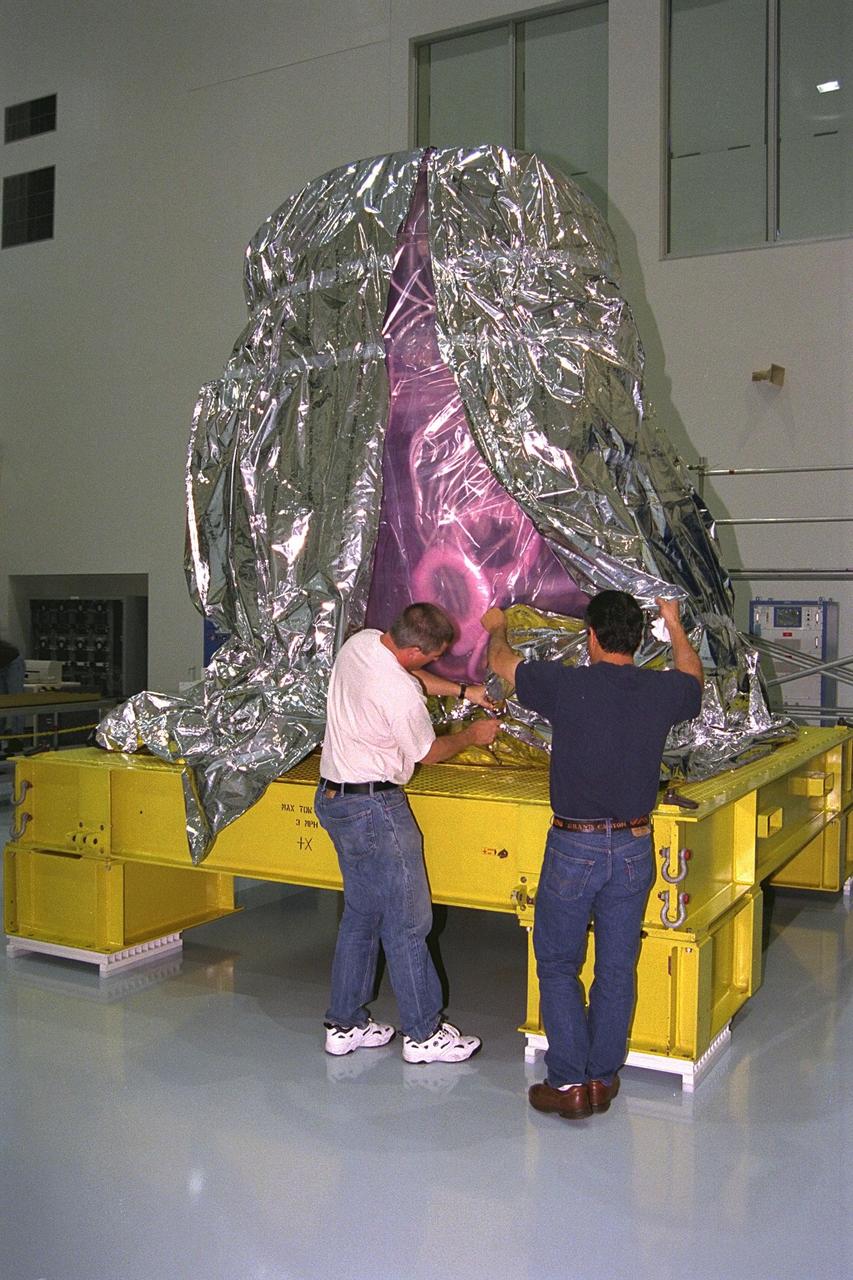
International Space Station (ISS) contractors unwrap Pressurized Mating Adapter-1 (PMA-1) for the ISS in KSC’s Space Station Processing Facility. A PMA is a cone-shaped connector that will be attached to Node 1, the space station’s structural building block, during ground processing. Node 1 with two PMAs attached will be the first element of the station scheduled to be launched aboard the Space Shuttle Endeavour on STS-88 in July 1998
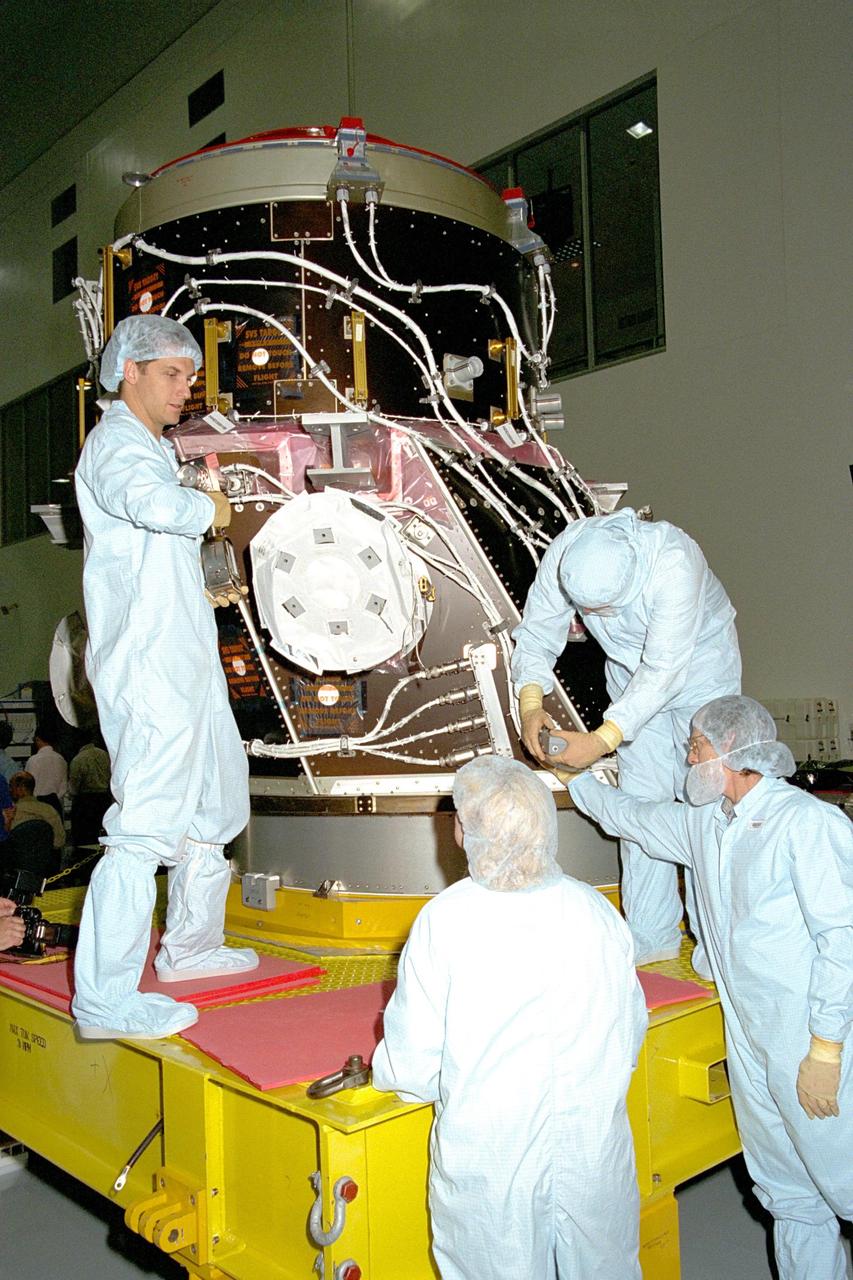
KENNEDY SPACE CENTER, FLA. -- The Pressurized Mating Adapter-2 (PMA-2) is processed in KSC's Space Station Processing Facility. This PMA is a cone-shaped connector to Node 1, the space station's structural building block. The node and two PMAs will together make up the first U.S. element of the ISS and are scheduled to be launched aboard the Space Shuttle Endeavour on STS-88.
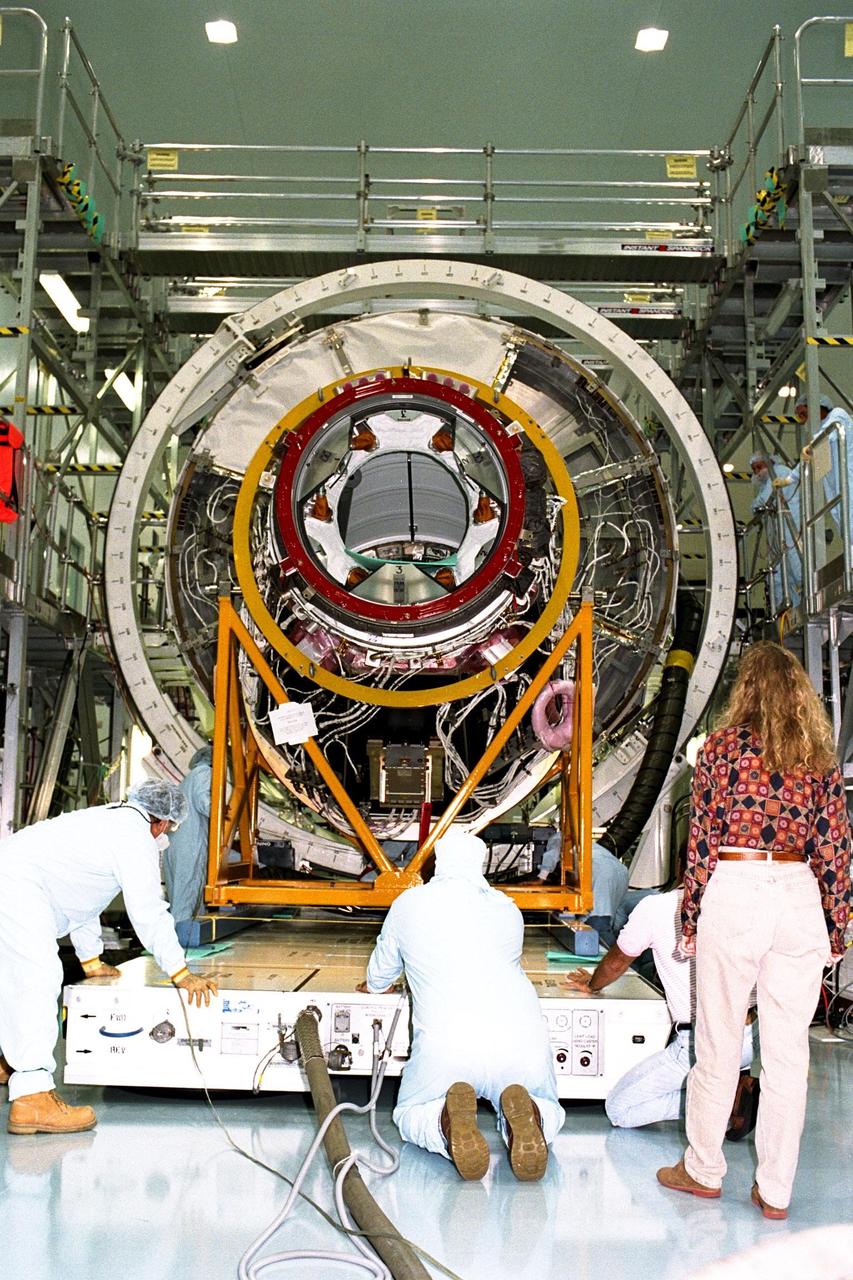
KENNEDY SPACE CENTER, FLA. -- The Pressurized Mating Adapter-1 (PMA-1) for the International Space Station is moved for further processing in KSC’s Space Station Processing Facility. A PMA is a cone-shaped connector that will be attached to Node 1, the space station’s structural building block, during ground processing. Node 1 with two PMAs attached will be the first element of the station scheduled to be launched aboard the Space Shuttle Endeavour on STS-88 in July 1998.
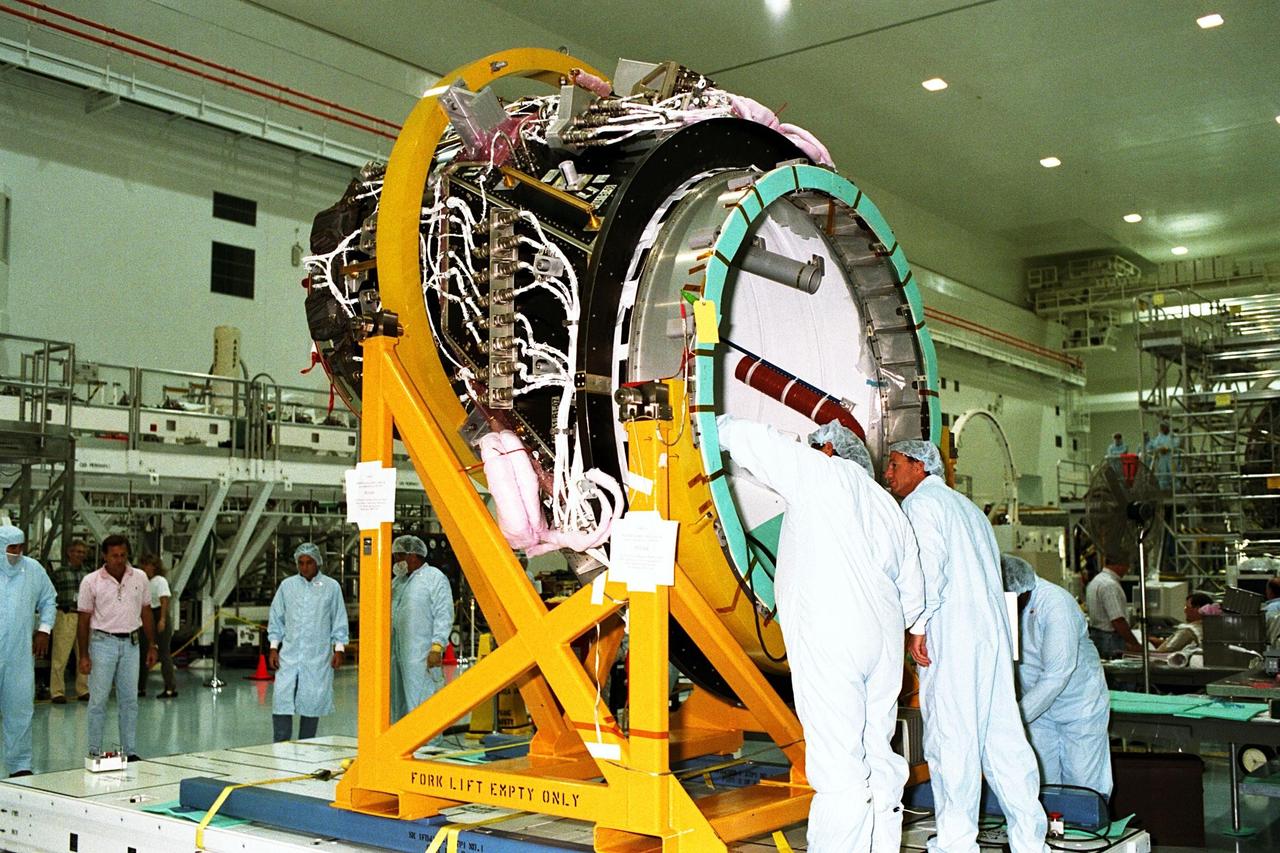
KENNEDY SPACE CENTER, FLA. -- The Pressurized Mating Adapter-1 (PMA-1) for the International Space Station is moved for further processing in KSC’s Space Station Processing Facility. A PMA is a cone-shaped connector that will be attached to Node 1, the space station’s structural building block, during ground processing. Node 1 with two PMAs attached will be the first element of the station scheduled to be launched aboard the Space Shuttle Endeavour on STS-88 in July 1998
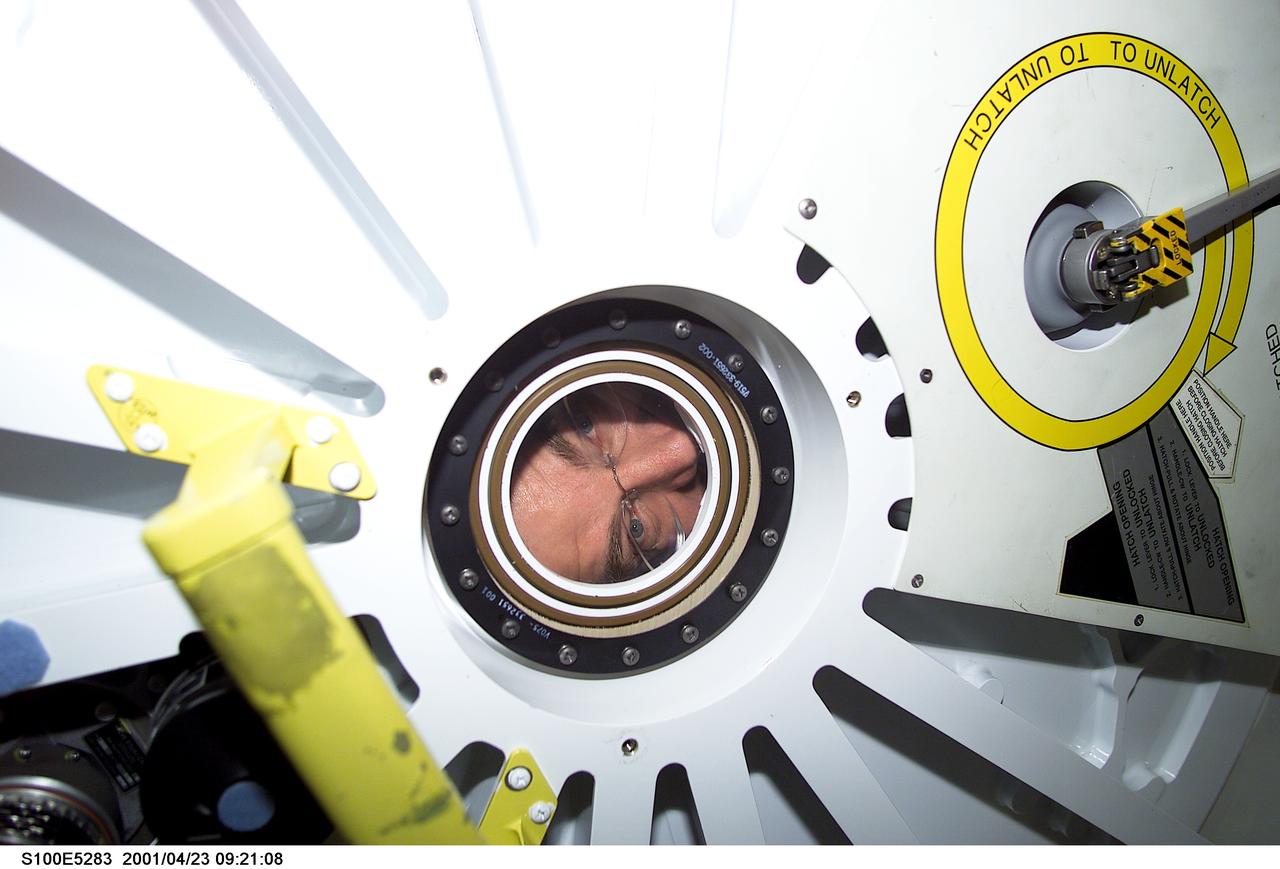
STS100-E-5283 (23 April 2001) --- Astronaut James S. Voss, Expedition Two flight engineer, peers into the Pressurized Mating Adapter (PMA-2) prior to hatch opening. The picture was taken with a digital still camera by one of the STS-100 crew members in the PMA. Photo credit: NASA

KENNEDY SPACE CENTER, FLA. -- Pressurized Mating Adapter (PMA)-2 is moved into position to be mated to Node 1 of the International Space Station (ISS) by Boeing technicians in KSC's Space Station Processing Facility (SSPF). The node is the first element of the ISS to be manufactured in the United States and is currently scheduled to lift off aboard the Space Shuttle Endeavour on STS-88 later this year, along with PMAs 1 and 2. This PMA is a cone-shaped connector to Node 1, which will have two PMAs attached once this mate is completed. Once in space, Node 1 will function as a connecting passageway to the living and working areas of the ISS. It has six hatches that will serve as docking ports to the U.S. laboratory module, U.S. habitation module, an airlock and other space station elements
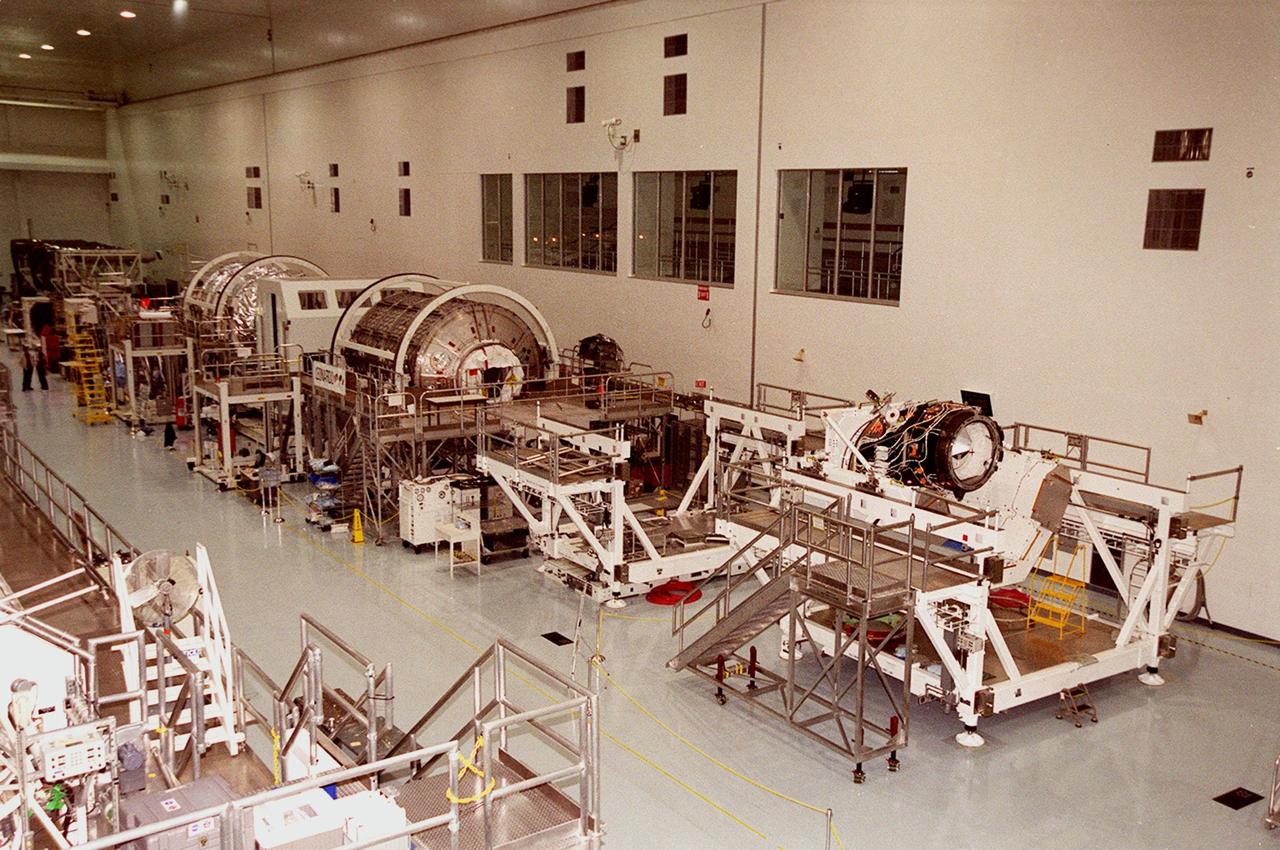
KENNEDY SPACE CENTER, FLA. -- The Space Station Processing Facility is filled with hardware, components for the International Space Station. Lined up (left to right) are the Multi-Purpose Logistics Modules Raffaello and Leonardo and the Pressurized Mating Adapter-3 (PMA-3). Italy's major contributions to the ISS program, Raffaello and Leonardo are reusable logistics carriers to resupply and return station cargo requiring a pressurized environment. They are slated as payloads on missions STS-102 and STS-100, respectively. Dates have not yet been determined for the two missions. The PMA-3, once launched, will be mated to Node 1, a connecting passageway to the living and working areas of the Space Station. The primary purpose of PMA-3 is to serve as a Shuttle docking port through which crew members and equipment will transfer to the Space Station during later assembly missions. PMA-3 is scheduled as payload on mission STS-92, whose date for launch is not yet determined.

KENNEDY SPACE CENTER, FLA. -- Node 1, the first U.S. element for the International Space Station, and attached Pressurized Mating Adapter-1 (PMA-1) continue with prelaunch preparation activities at KSC's Space Station Processing Facility. Node 1 is a connecting passageway to the living and working areas of the space station. The node and PMA-1 are being removed from the element rotation stand, or test stand, where they underwent an interim weight and center of gravity determination. (The final determination is planned to be performed prior to transporting Node 1 to the launch pad.) Now the node is being moved to the Shuttle payload transportation canister, where the doors will be closed for a two-week leak check. PMAs -2 and -3 can be seen against the right wall, with PMA-3 at the far right. Node 1 is scheduled to fly on STS-88
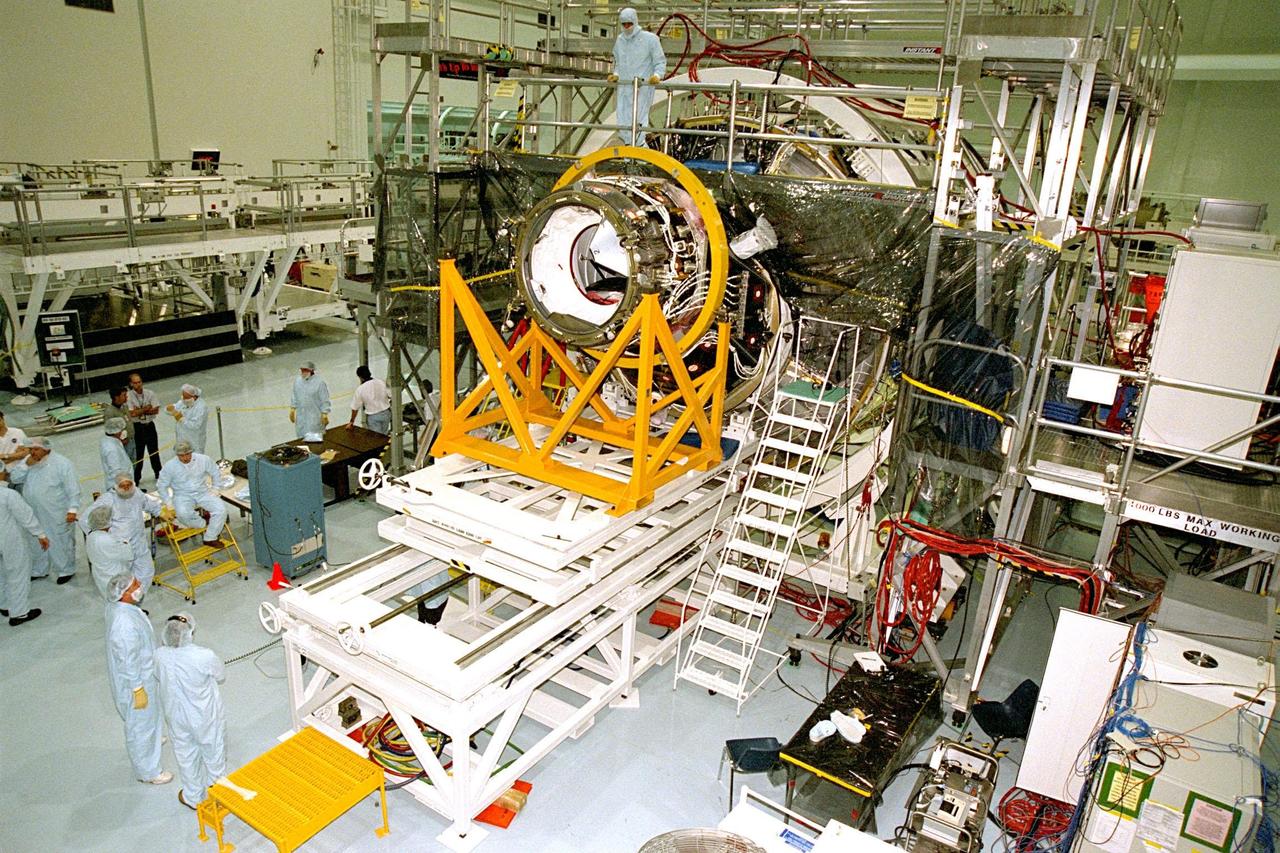
Pressurized Mating Adapter (PMA)-2 is in the process of being mated to Node 1 of the International Space Station (ISS) under the supervision of Boeing technicians in KSC's Space Station Processing Facility (SSPF). The node is the first element of the ISS to be manufactured in the United States and is currently scheduled to lift off aboard the Space Shuttle Endeavour on STS-88 later this year, along with PMAs 1 and 2. This PMA is a cone-shaped connector to Node 1, which will have two PMAs attached once this mate is completed. Once in space, Node 1 will function as a connecting passageway to the living and working areas of the ISS. It has six hatches that will serve as docking ports to the U.S. laboratory module, U.S. habitation module, an airlock and other space station elements
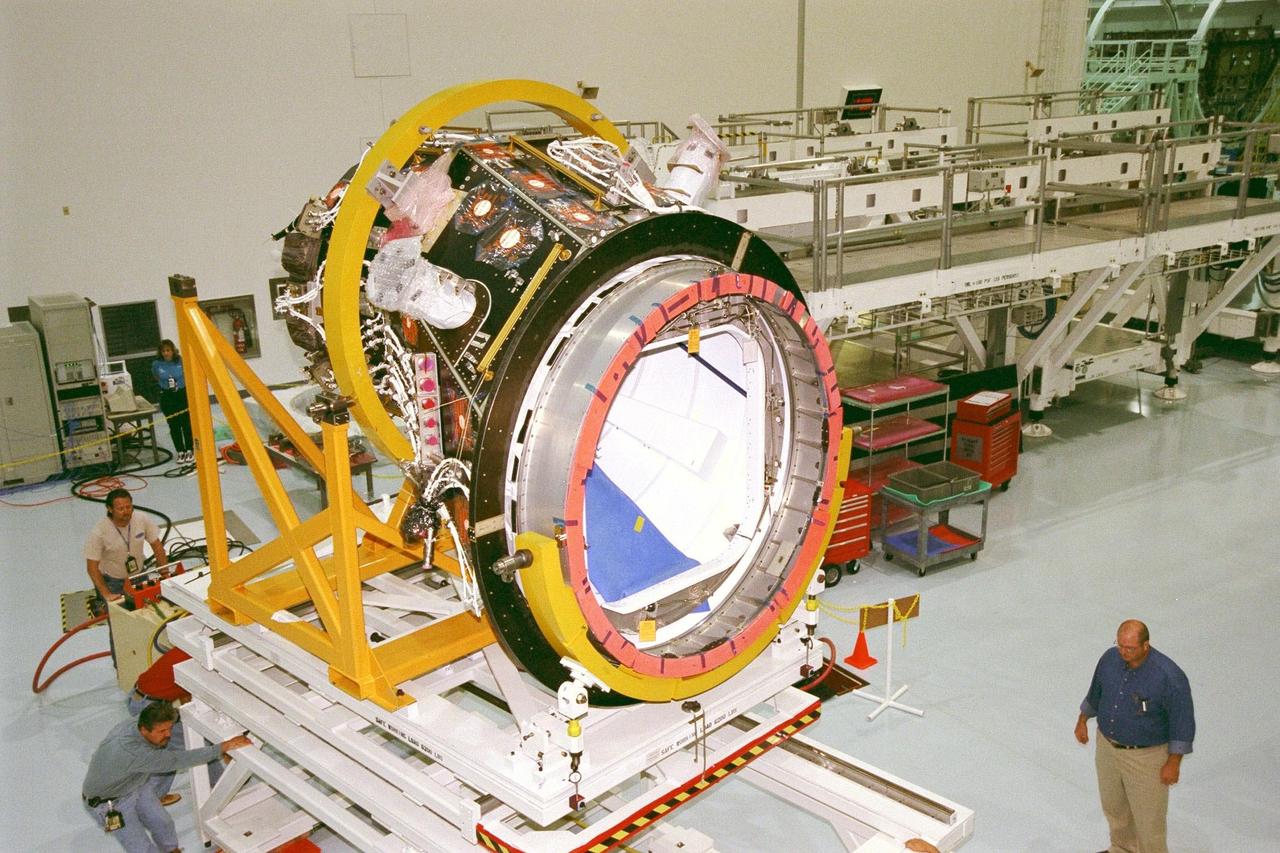
KENNEDY SPACE CENTER, FLA. -- Pressurized Mating Adapter (PMA)-2 is moved toward Node 1 of the International Space Station (ISS) in KSC's Space Station Processing Facility for pre-mating preparations. The node is the first element of the ISS to be manufactured in the United States and is currently scheduled to lift off aboard the Space Shuttle Endeavour on STS-88 later this year, along with PMAs 1 and 2. This PMA is a cone-shaped connector to Node 1, which will have two PMAs attached once this mate is completed. Once in space, Node 1 will function as a connecting passageway to the living and working areas of the ISS. It has six hatches that will serve as docking ports to the U.S. laboratory module, U.S. habitation module, an airlock and other space station elements
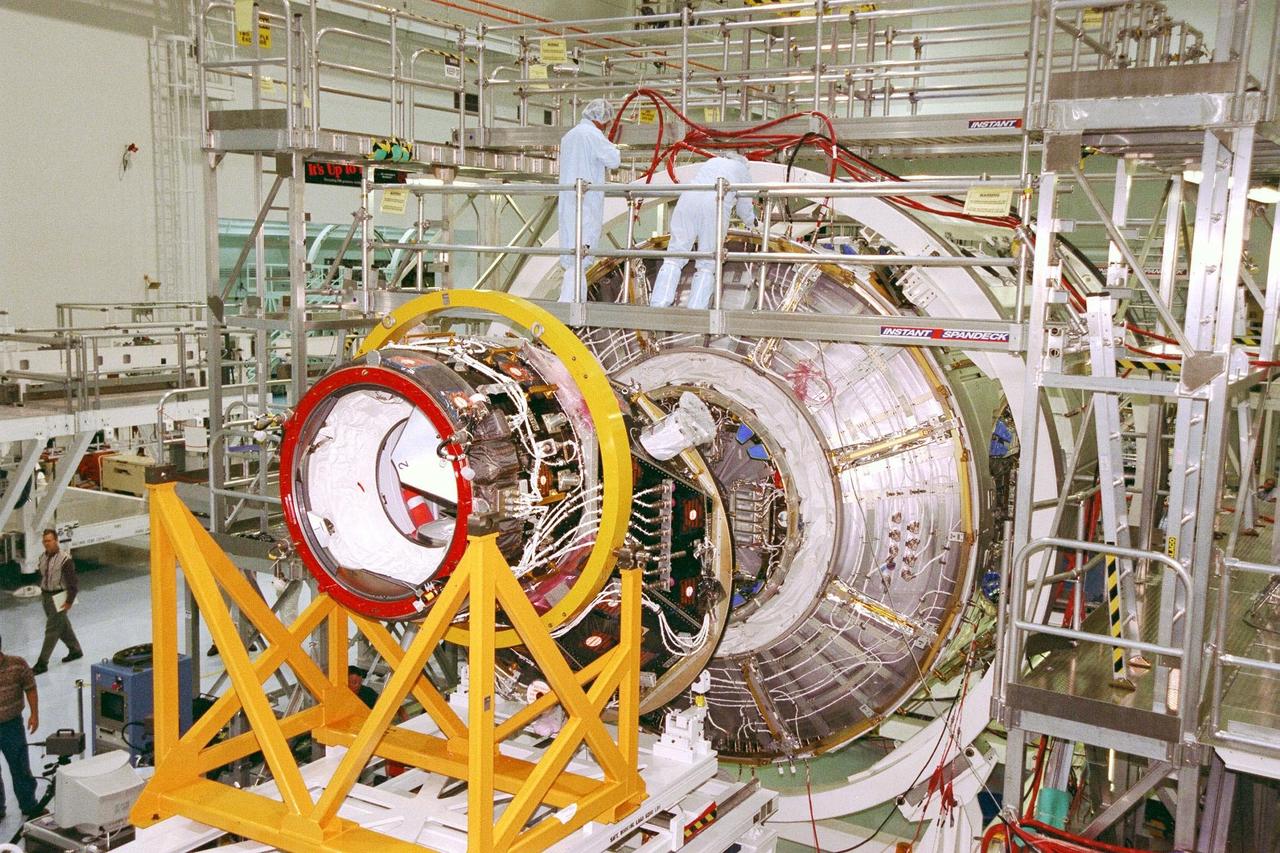
KENNEDY SPACE CENTER, FLA. -- Pressurized Mating Adapter (PMA)-2 is moved into position against Node 1 of the International Space Station (ISS) in KSC's Space Station Processing Facility for pre-mating preparations. The node is the first element of the ISS to be manufactured in the United States and is currently scheduled to lift off aboard the Space Shuttle Endeavour on STS-88 later this year, along with PMAs 1 and 2. This PMA is a cone-shaped connector to Node 1, which will have two PMAs attached once this mate is completed. Once in space, Node 1 will function as a connecting passageway to the living and working areas of the ISS. It has six hatches that will serve as docking ports to the U.S. laboratory module, U.S. habitation module, an airlock and other space station elements
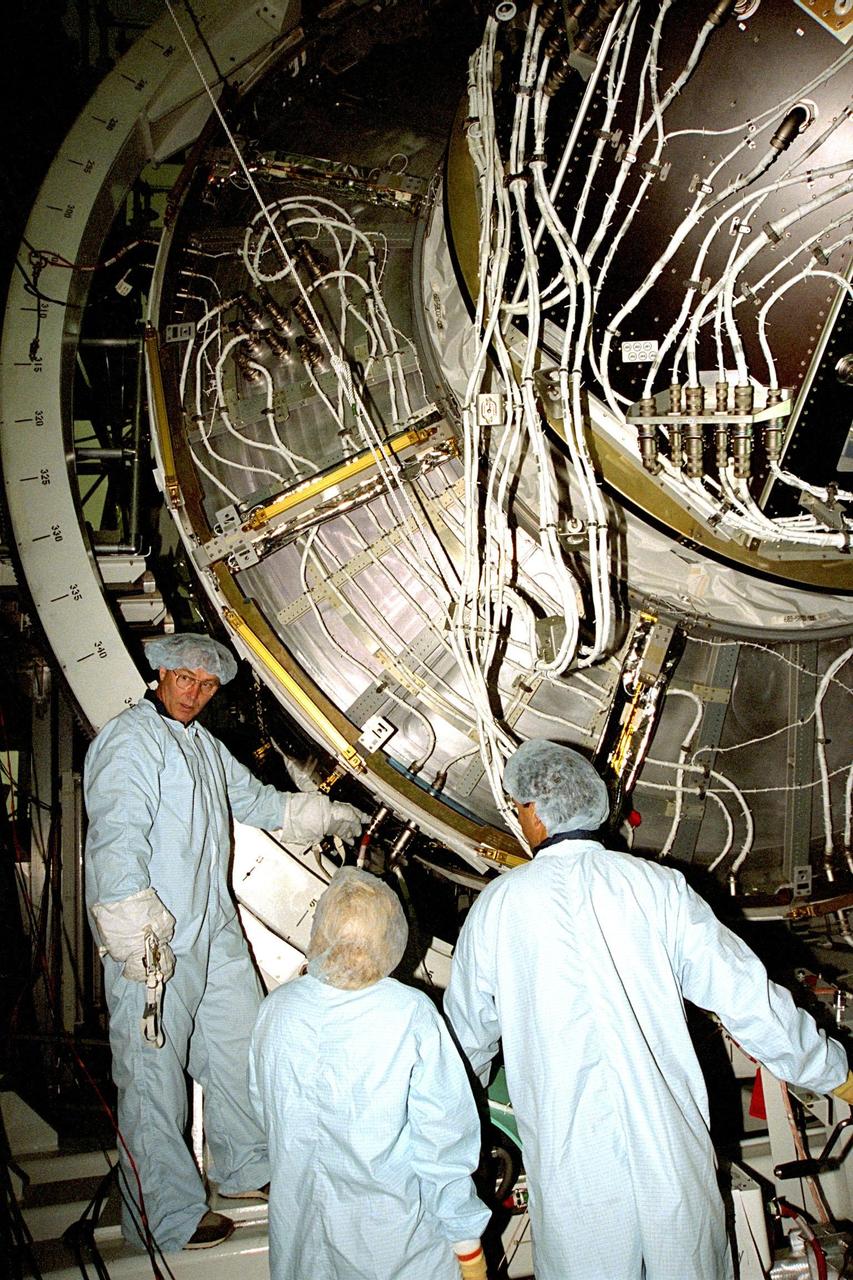
Boeing technicians discuss mating Pressurized Mating Adapter (PMA)-2 to Node 1 of the International Space Station (ISS) in KSC's Space Station Processing Facility (SSPF). The node is the first element of the ISS to be manufactured in the United States and is currently scheduled to lift off aboard the Space Shuttle Endeavour on STS-88 later this year, along with PMAs 1 and 2. This PMA is a cone-shaped connector to Node 1, which will have two PMAs attached once this mate is completed. Once in space, Node 1 will function as a connecting passageway to the living and working areas of the ISS. It has six hatches that will serve as docking ports to the U.S. laboratory module, U.S. habitation module, an airlock and other space station elements
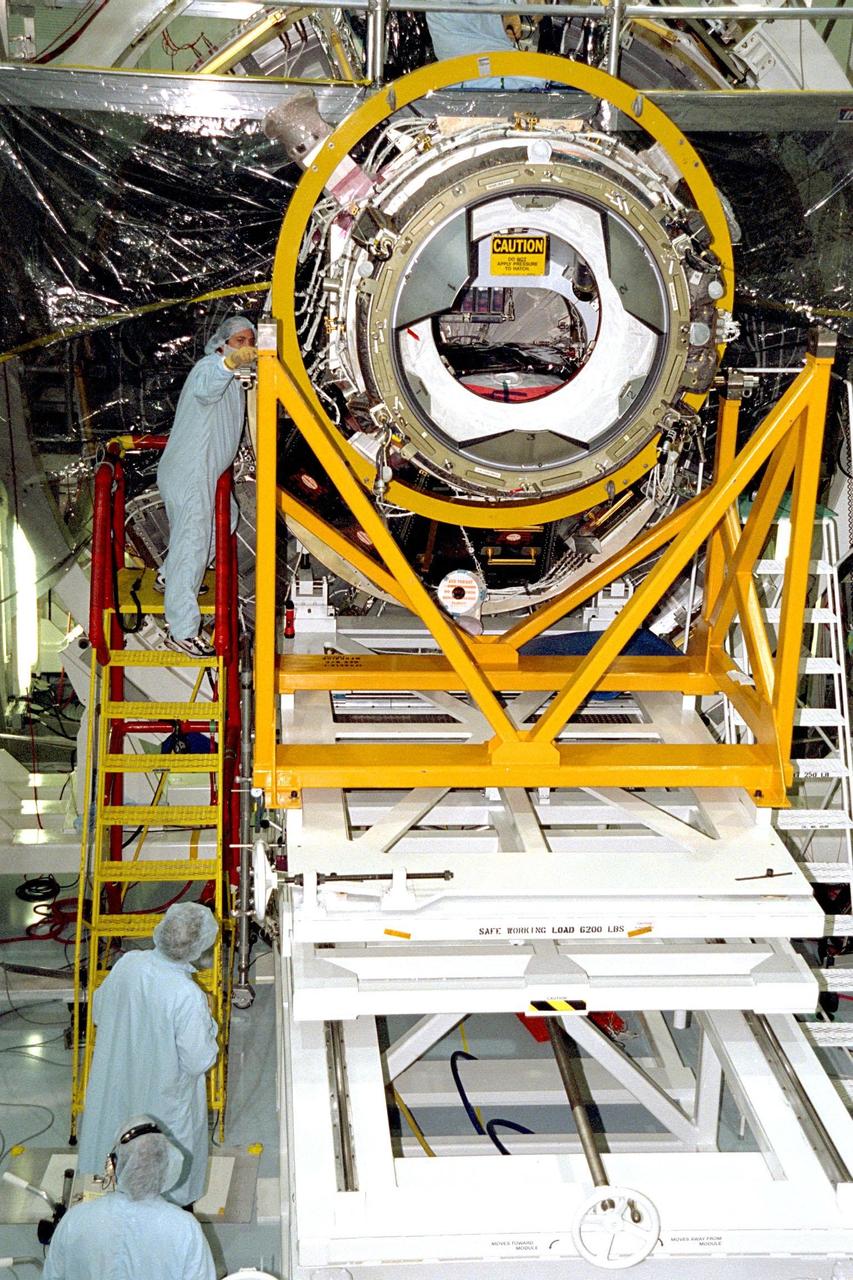
Pressurized Mating Adapter (PMA)-2 is moved into position to be mated to Node 1 of the International Space Station (ISS) by Boeing technicians in KSC's Space Station Processing Facility (SSPF). The node is the first element of the ISS to be manufactured in the United States and is currently scheduled to lift off aboard the Space Shuttle Endeavour on STS-88 later this year, along with PMAs 1 and 2. This PMA is a cone-shaped connector to Node 1, which will have two PMAs attached once this mate is completed. Once in space, Node 1 will function as a connecting passageway to the living and working areas of the ISS. It has six hatches that will serve as docking ports to the U.S. laboratory module, U.S. habitation module, an airlock and other space station elements
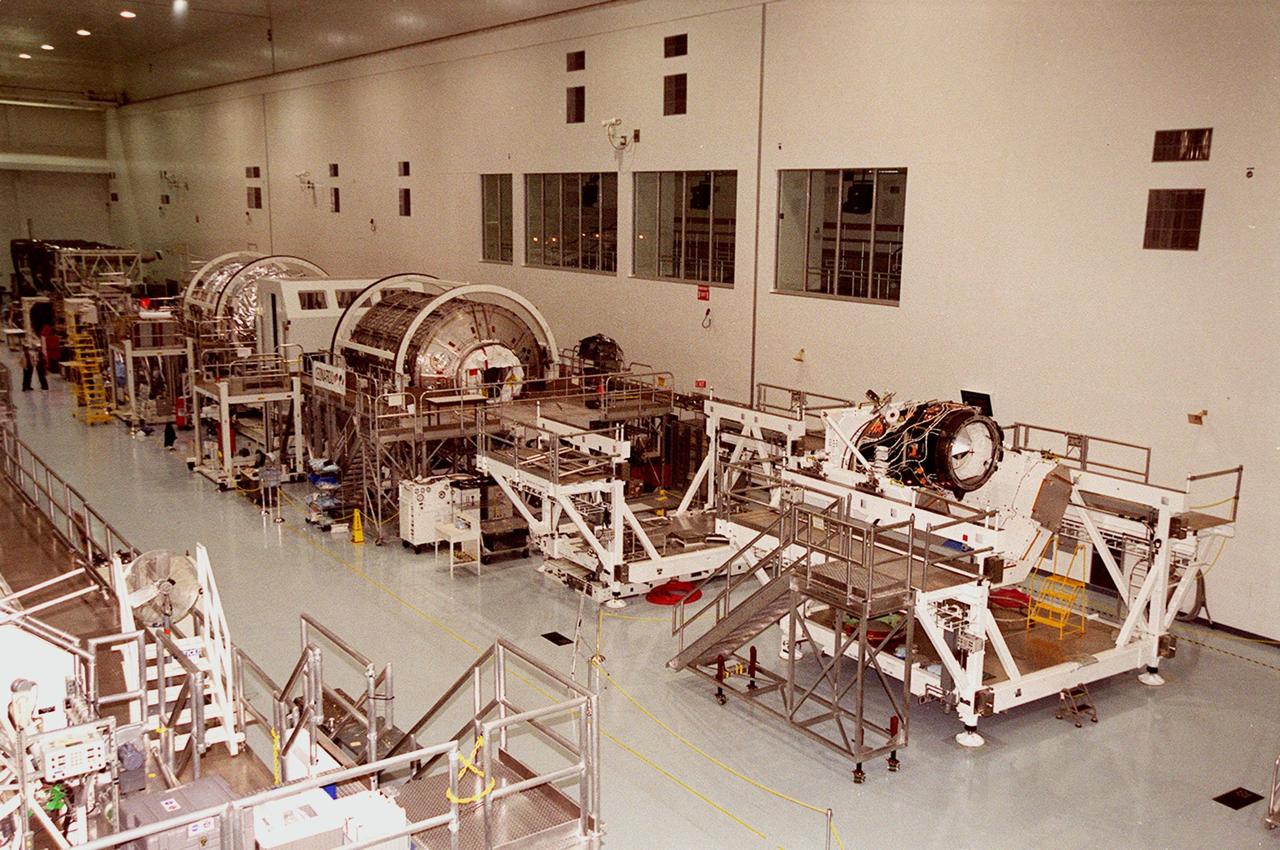
KENNEDY SPACE CENTER, FLA. -- The Space Station Processing Facility is filled with hardware, components for the International Space Station. Lined up (left to right) are the Multi-Purpose Logistics Modules Raffaello and Leonardo and the Pressurized Mating Adapter-3 (PMA-3). Italy's major contributions to the ISS program, Raffaello and Leonardo are reusable logistics carriers to resupply and return station cargo requiring a pressurized environment. They are slated as payloads on missions STS-102 and STS-100, respectively. Dates have not yet been determined for the two missions. The PMA-3, once launched, will be mated to Node 1, a connecting passageway to the living and working areas of the Space Station. The primary purpose of PMA-3 is to serve as a Shuttle docking port through which crew members and equipment will transfer to the Space Station during later assembly missions. PMA-3 is scheduled as payload on mission STS-92, whose date for launch is not yet determined.

In the Orbiter Processing Facility bay 1, the Pressurized Mating Adapter -3 (PMA-3) is lifted out of the payload canister for its transfer to the orbiter Discovery. A component of the International Space Station, the PMA-3 is part of the payload on Shuttle mission STS-92, scheduled to launch Oct. 5. The mission will be the fifth flight to the Space Station, and the 100th Shuttle flight overall. PMA-3 provides shuttle docking port for solar array installation on flight 4A (mission STS-97 scheduled for Nov. 30), and Lab installation on flight 5A (mission STS-98, scheduled for Jan. 18, 2001)

KENNEDY SPACE CENTER, FLA. - Workers in the Orbiter Processing Facility bay 1 watch the progress of the Pressurized Mating Adapter-3 (PMA-3) as it is transferred to the payload bay of the orbiter Discovery. A component of the International Space Station, the PMA-3 will fly on Shuttle mission STS-92, scheduled to launch October 5. The mission will be the fifth flight to the Space Station, and the 100th Shuttle flight overall. PMA-3 provides shuttle docking port for solar array installation on flight 4A (mission STS-97 scheduled for November 30), and Lab installation on flight 5A (mission STS-98, scheduled for January 18, 2001).

KENNEDY SPACE CENTER, FLA. -- The Pressurized Mating Adapter-3 (PMA-3), an element of the STS-92 mission scheduled for launch aboard Space Shuttle Atlantis in January 1999, arrived from the Boeing Company in Huntington Beach, Calif., for processing in KSC's Space Station Processing Facility (SSPF). While in orbit, PMA-3 will be removed from the orbiter's payload bay by the astronauts using the remote manipulator arm and mated to Node 1, a connecting passageway to the living and working areas of the International Space Station. The primary purpose of PMA-3 is to serve as a Shuttle docking port through which crew members and equipment will transfer to the International Space Station during later assembly missions.
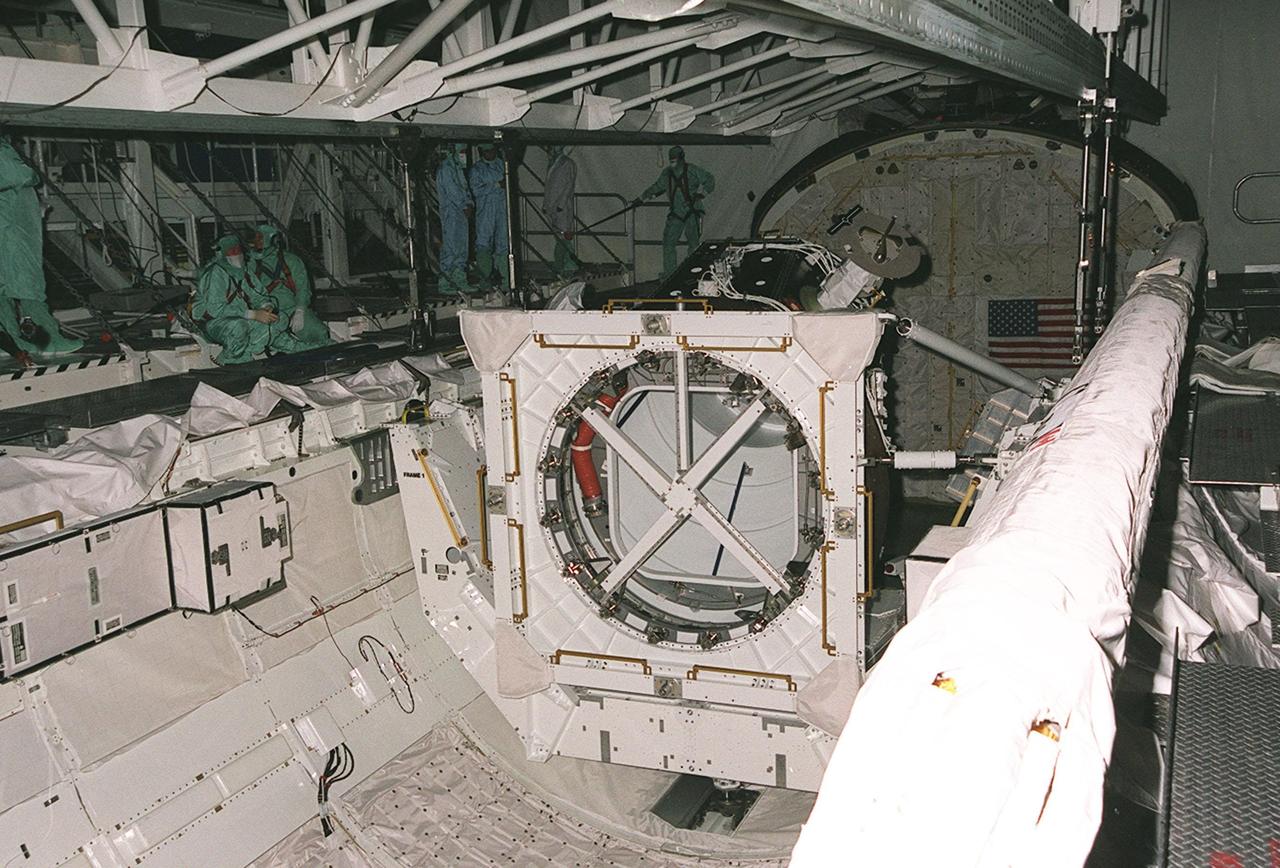
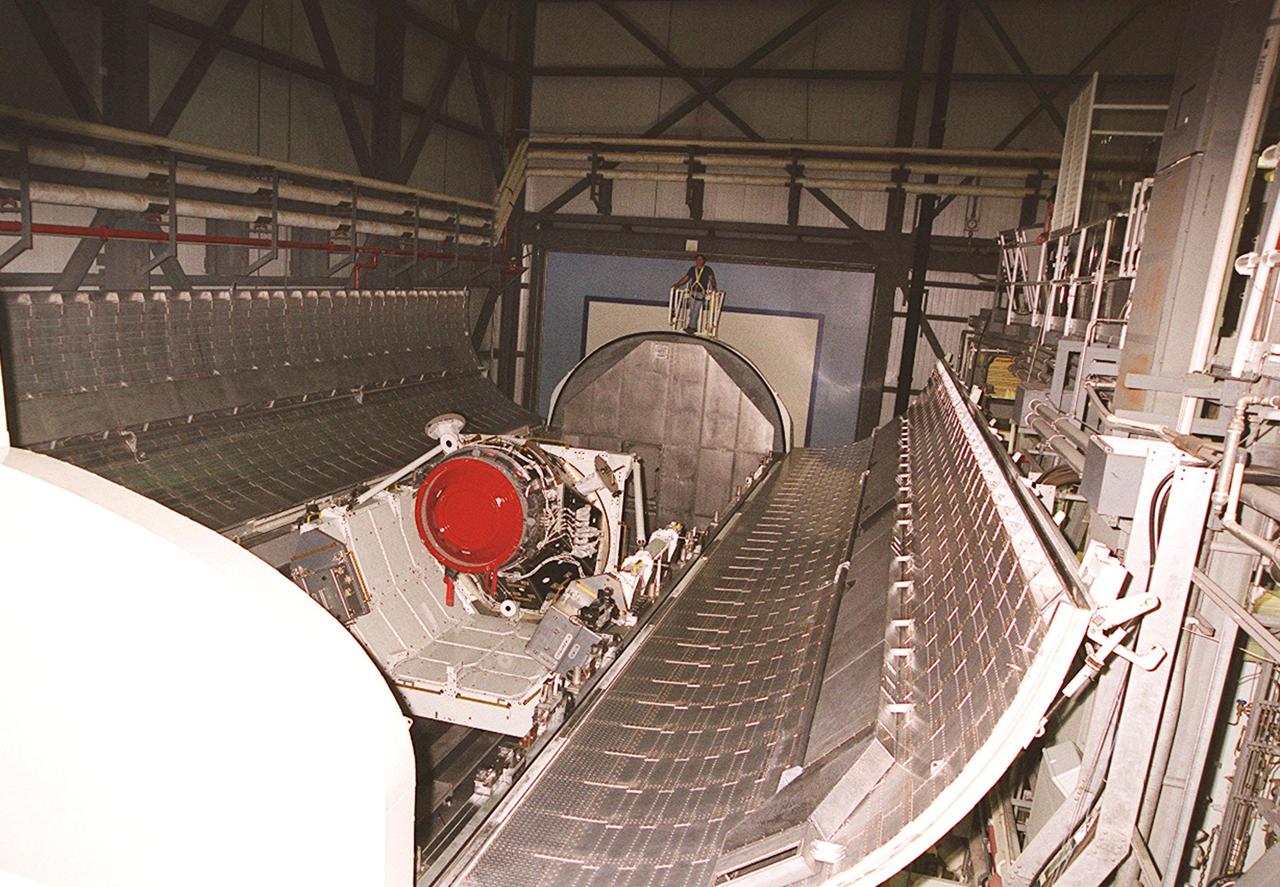
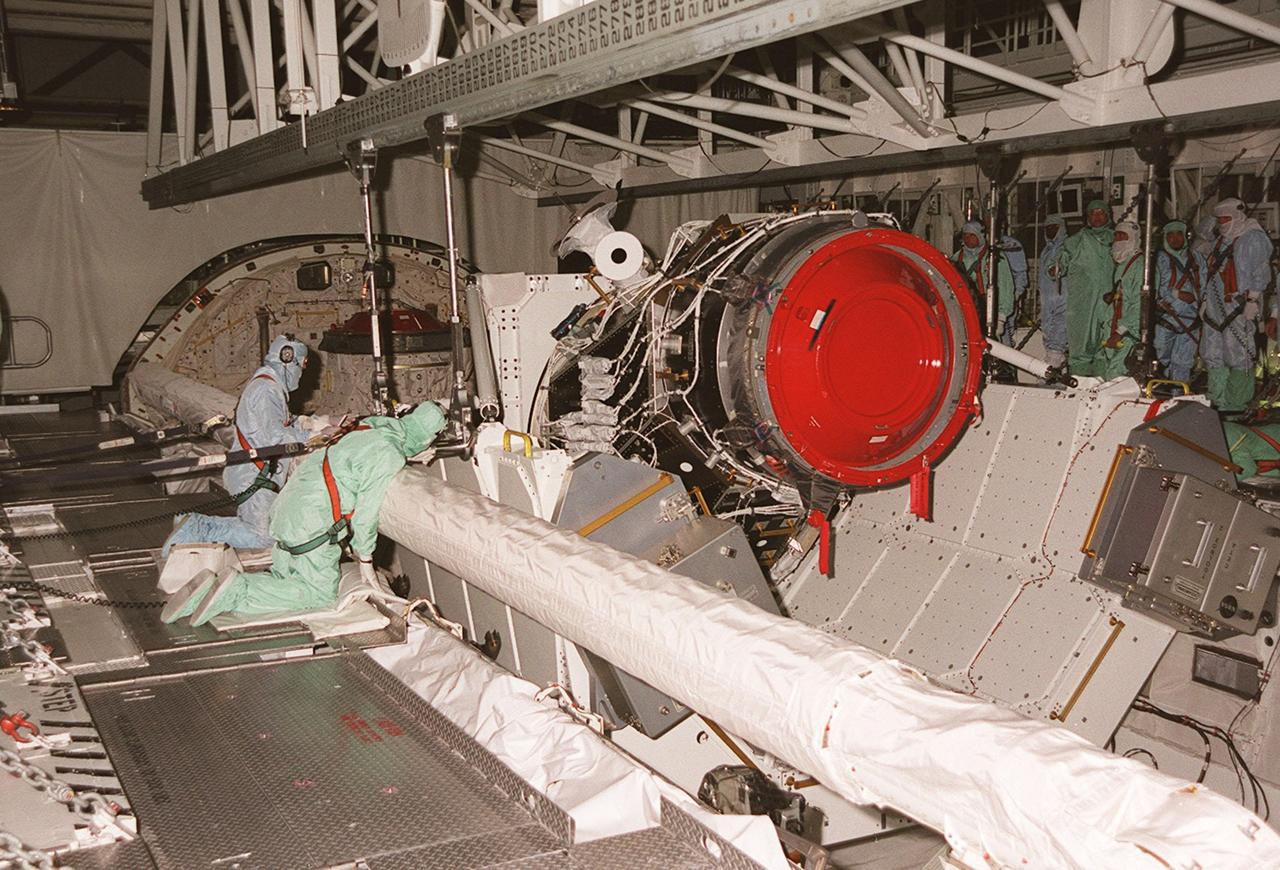
KENNEDY SPACE CENTER, FLA. -- The Pressurized Mating Adapter -3 (PMA-3) sits in the payload bay of the orbiter Discovery after being transported from the Space Station Processing Facility. A component of the International Space Station, the PMA-3 will fly on Shuttle mission STS-92, scheduled to launch Oct. 5. The mission will be the fifth flight to the Space Station, and the 100th Shuttle flight overall. PMA-3 provides shuttle docking port for solar array installation on flight 4A (mission STS-97 scheduled for Nov. 30), and Lab installation on flight 5A (mission STS-98, scheduled for Jan. 18, 2001)
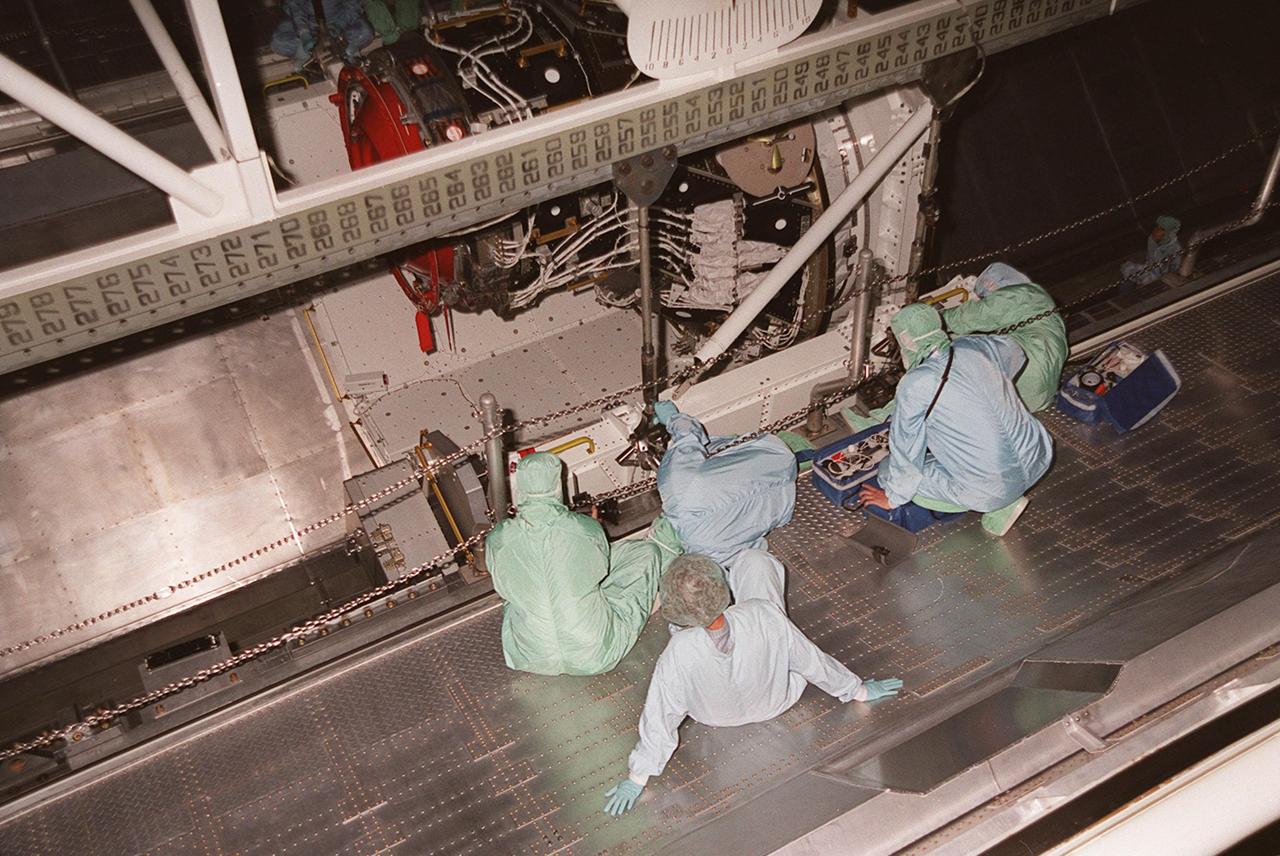
KENNEDY SPACE CENTER, FLA. -- Workers in the Orbiter Processing Facility check the placement of cables on the Pressurized Mating Adapter -3 (PMA-3) for its transfer to the orbiter Discovery. A component of the International Space Station, the PMA-3 is part of the payload on Space Shuttle mission STS-92, scheduled to launch Oct. 5. The mission will be the fifth flight to the Space Station, and the 100th Shuttle flight overall. PMA-3 provides shuttle docking port for solar array installation on flight 4A (mission STS-97 scheduled for Nov. 30), and Lab installation on flight 5A (mission STS-98, scheduled for Jan. 18, 2001)
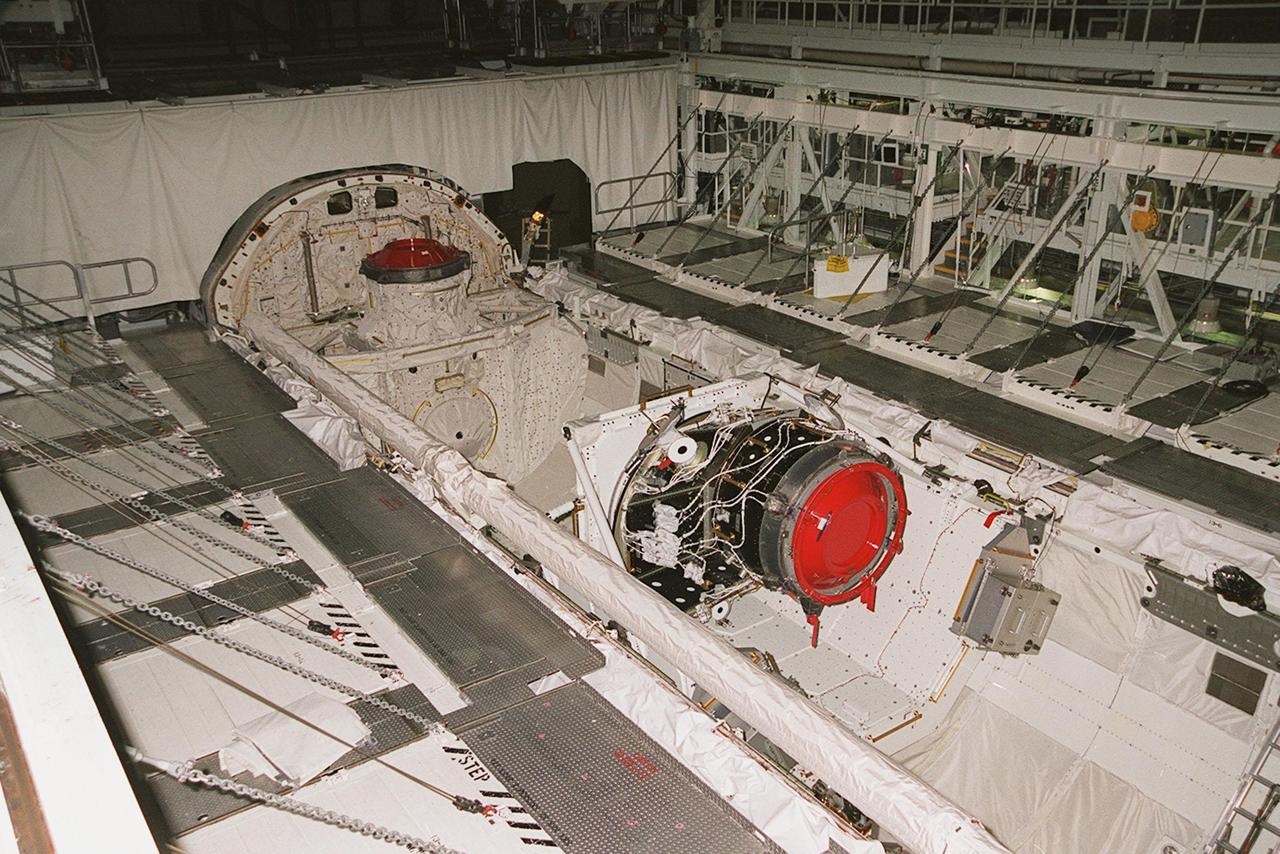
KENNEDY SPACE CENTER, FLA. -- The Pressurized Mating Adapter -3 (PMA-3) sits in the payload bay of the orbiter Discovery after being transported from the Space Station Processing Facility. A component of the International Space Station, the PMA-3 will fly on Shuttle mission STS-92, scheduled to launch Oct. 5. The mission will be the fifth flight to the Space Station, and the 100th Shuttle flight overall. PMA-3 provides shuttle docking port for solar array installation on flight 4A (mission STS-97 scheduled for Nov. 30), and Lab installation on flight 5A (mission STS-98, scheduled for Jan. 18, 2001)
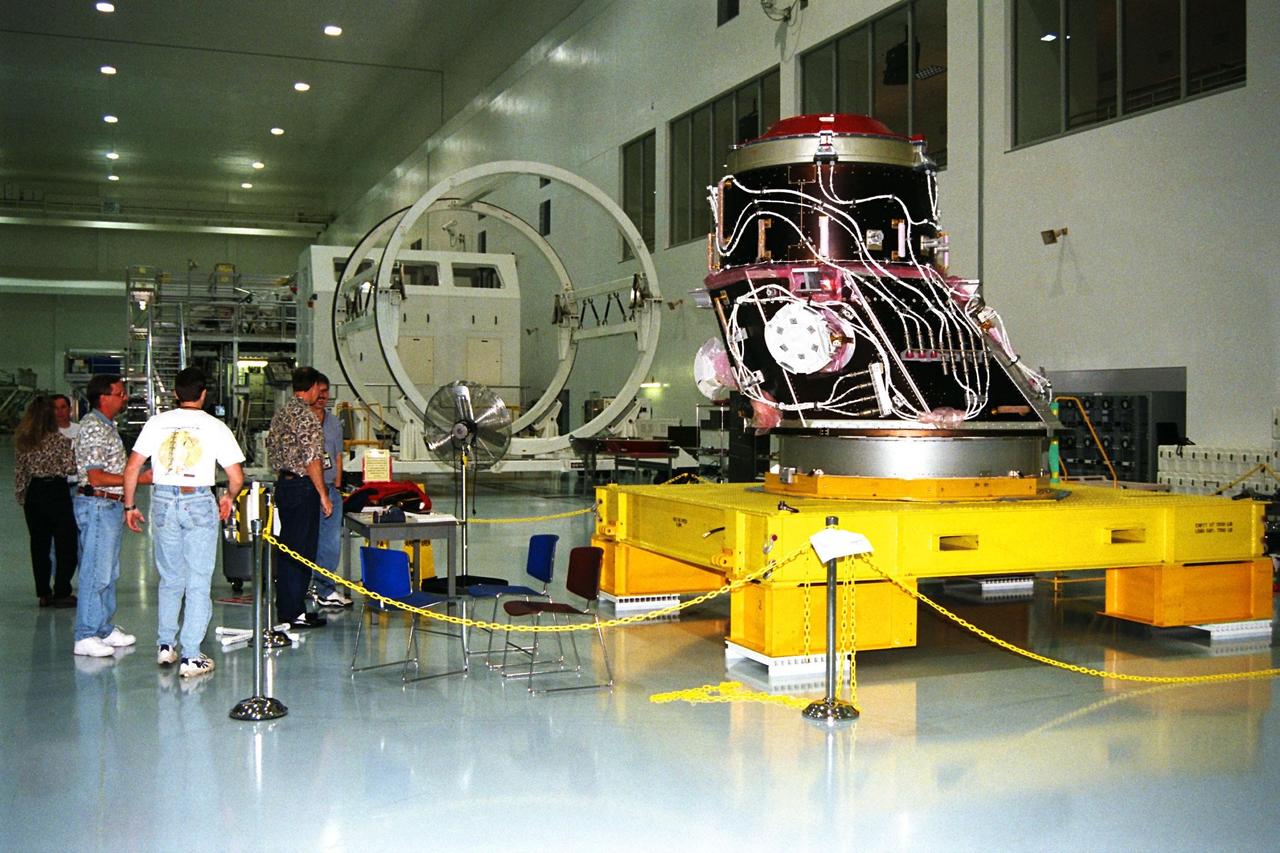
KENNEDY SPACE CENTER, FLA. -- Seen at the right of the photograph, the Pressurized Mating Adapter-3 (PMA-3), an element of the STS-92 mission scheduled for launch aboard Space Shuttle Atlantis in January 1999, awaits processing in KSC's Space Station Processing Facility (SSPF). While in orbit, PMA-3 will be removed from the orbiter's payload bay by the astronauts using the remote manipulator arm and mated to Node 1, a connecting passageway to the living and working areas of the International Space Station. The primary purpose of PMA-3 is to serve as a Shuttle docking port through which crew members and equipment will transfer to the International Space Station during later assembly missions
KENNEDY SPACE CENTER, FLA. -- In the Space Station Processing Facility, the Pressurized Mating Adapter -3 (PMA-3) sits in a payload canister for transport to the Orbiter Processing Facility. Workers at the sides and below watch the process. The PMA-3, a component of the International Space Station, is part of the payload on Space Shuttle mission STS-92, scheduled to launch Oct. 5. The mission will be the fifth flight to the Space Station, and the 100th Shuttle flight overall. PMA-3 provides shuttle docking port for solar array installation on flight 4A (mission STS-97 scheduled for Nov. 30), and Lab installation on flight 5A (mission STS-98, scheduled for Jan. 18, 2001)
KENNEDY SPACE CENTER, FLA. -- In the Orbiter Processing Facility bay 1, workers detach the overhead crane from the Pressurized Mating Adapter -3 (PMA-3), which sits in the payload bay of the orbiter Discovery. A component of the International Space Station, the PMA-3 will fly on Shuttle mission STS-92, scheduled to launch Oct. 5. The mission will be the fifth flight to the Space Station, and the 100th Shuttle flight overall. PMA-3 provides shuttle docking port for solar array installation on flight 4A (mission STS-97 scheduled for Nov. 30), and Lab installation on flight 5A (mission STS-98, scheduled for Jan. 18, 2001)
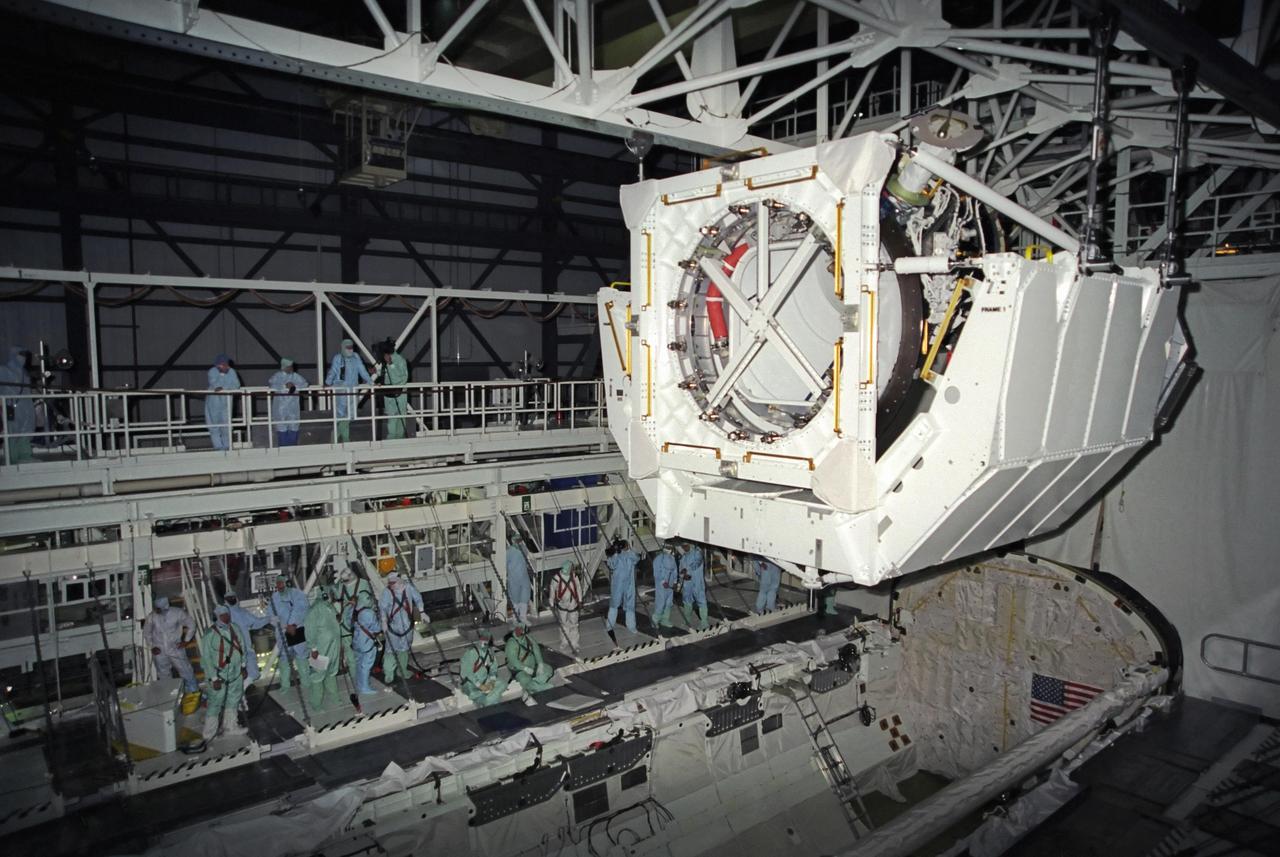
KENNEDY SPACE CENTER, FLA. - Workers in the Orbiter Processing Facility bay 1 watch the progress of the Pressurized Mating Adapter-3 (PMA-3) as it is transferred to the payload bay of the orbiter Discovery. A component of the International Space Station, the PMA-3 will fly on Shuttle mission STS-92, scheduled to launch October 5. The mission will be the fifth flight to the Space Station, and the 100th Shuttle flight overall. PMA-3 provides shuttle docking port for solar array installation on flight 4A (mission STS-97 scheduled for November 30), and Lab installation on flight 5A (mission STS-98, scheduled for January 18, 2001).
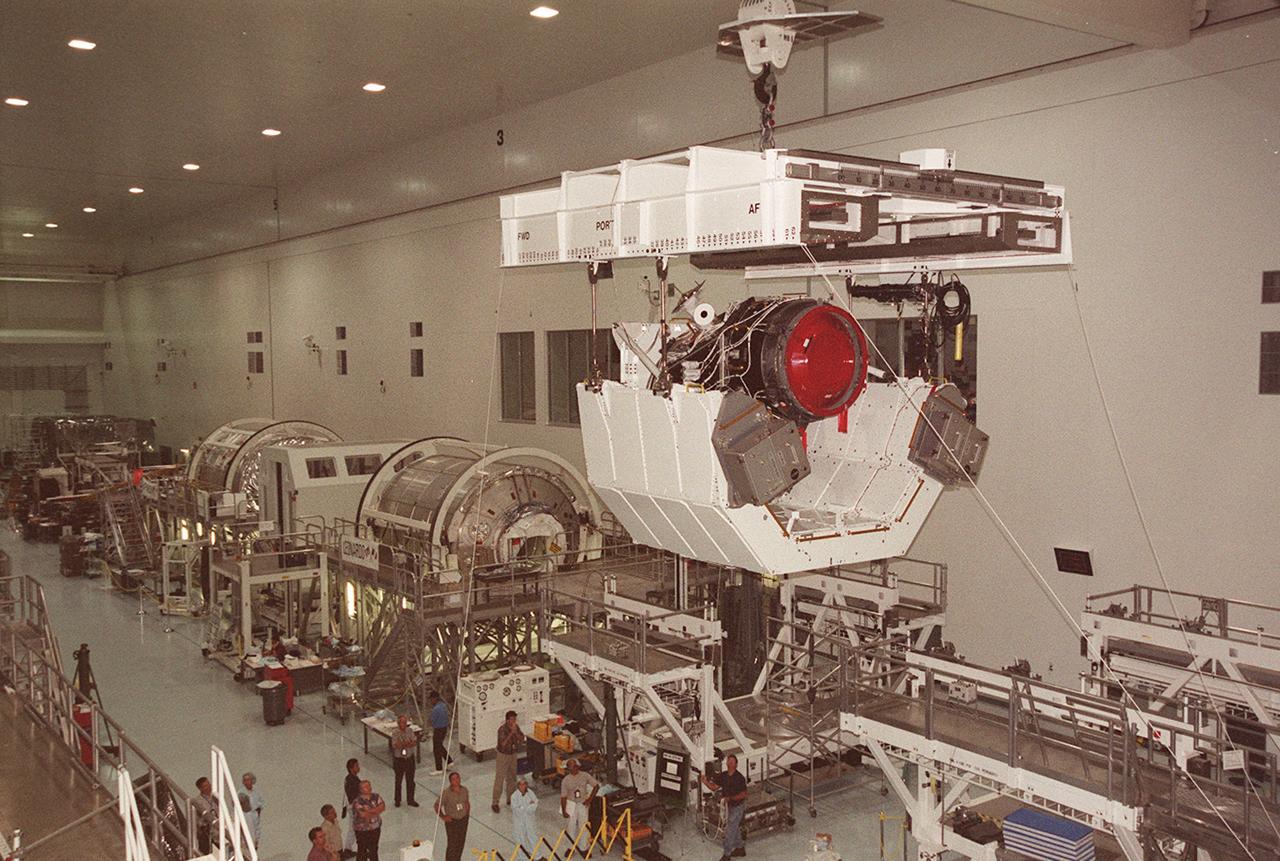
KENNEDY SPACE CENTER, FLA. -- In the Space Station Processing Facility, an overhead crane moves the Pressurized Mating Adapter-3 (PMA-3) to a payload canister for transport to the Orbiter Processing Facility. The PMA-3, a component of the International Space Station, is part of the payload on Space Shuttle mission STS-92, scheduled to launch Oct. 5. The mission will be the fifth flight to the Space Station, and the 100th Shuttle flight overall. PMA-3 provides the Shuttle docking port for solar array installation on flight 4A (mission STS-97, scheduled for Nov. 30) and Lab installation on flight 5A (mission STS-98), scheduled for Jan. 18, 2001.)
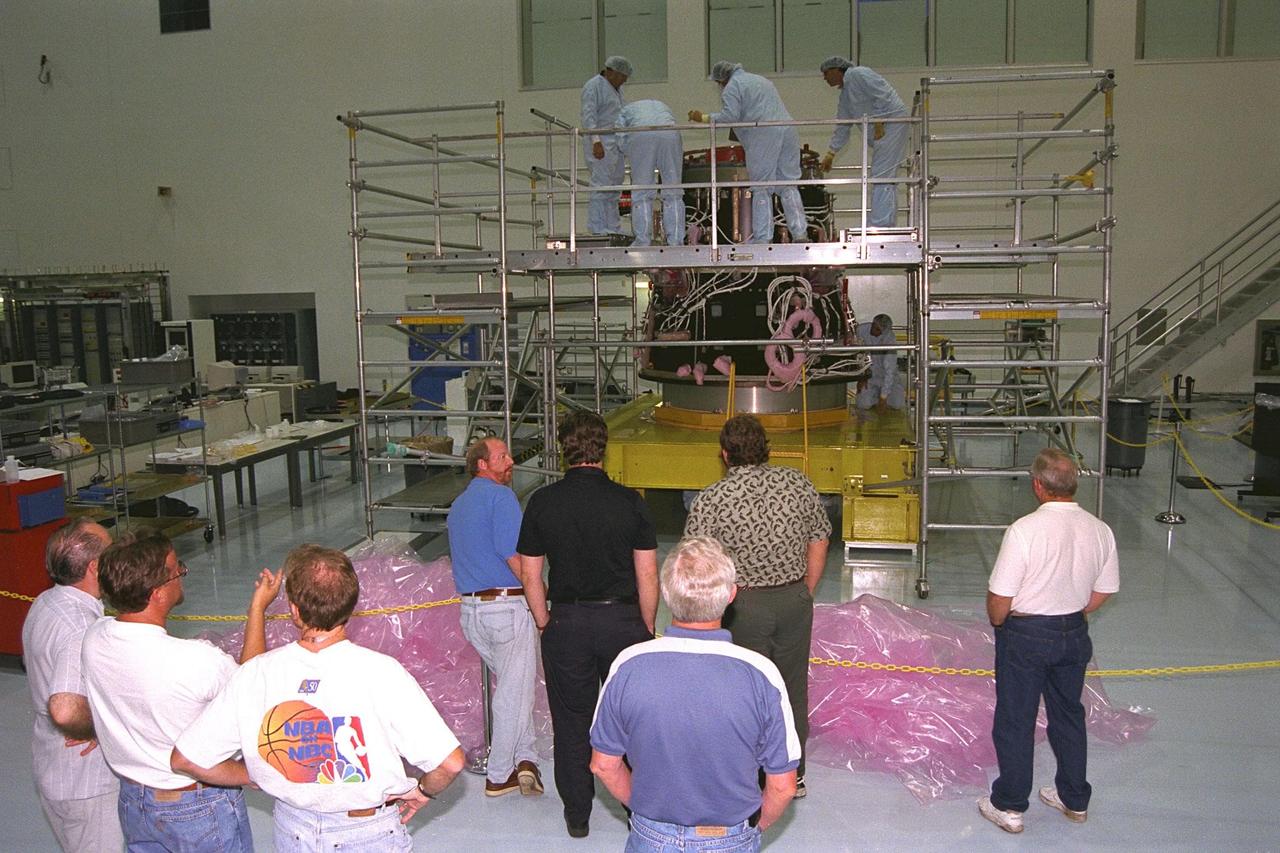
International Space Station (ISS) contractors erect access scaffolding around the Pressurized Mating Adapter-1 (PMA-1) for the ISS in KSC’s Space Station Processing Facility. A PMA is a cone-shaped connector that will be attached to Node 1, the space station’s structural building block, during ground processing. The white flight cables around PMA-1 will assist in connecting the node to the U.S.-financed, Russian-built Functional Cargo Block, a component that supplies early power and propulsion systems for the station. Node 1 with two adapters attached will be the first element of the station to be launched aboard the Space Shuttle Endeavour on STS-88 in July 1998
KENNEDY SPACE CENTER, FLA. -- In the Orbiter Processing Facility bay 1, workers check the placement of the Pressurized Mating Adapter -3 (PMA-3) as the overhead crane places it in the payload bay of the orbiter Discovery. A component of the International Space Station, the PMA-3 will fly on Shuttle mission STS-92, scheduled to launch Oct. 5. The mission will be the fifth flight to the Space Station, and the 100th Shuttle flight overall. PMA-3 provides shuttle docking port for solar array installation on flight 4A (mission STS-97 scheduled for Nov. 30), and Lab installation on flight 5A (mission STS-98, scheduled for Jan. 18, 2001)
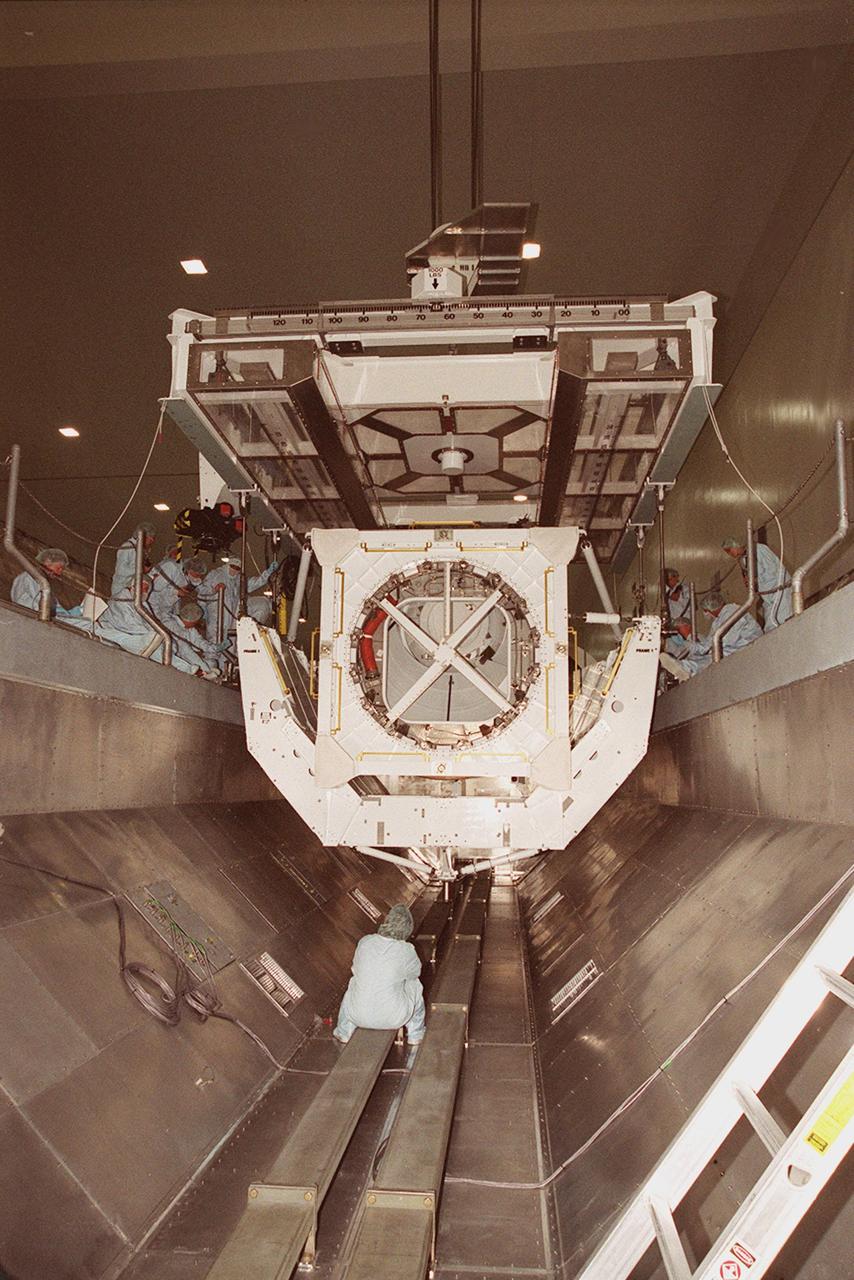
KENNEDY SPACE CENTER, FLA. -- In the Space Station Processing Facility, an overhead crane lowers the Pressurized Mating Adapter -3 (PMA-3) into a payload canister for transport to the Orbiter Processing Facility. Workers at the sides and below watch the process. The PMA-3, a component of the International Space Station, is part of the payload on Space Shuttle mission STS-92, scheduled to launch Oct. 5. The mission will be the fifth flight to the Space Station, and the 100th Shuttle flight overall. PMA-3 provides shuttle docking port for solar array installation on flight 4A (mission STS-97 scheduled for Nov. 30), and Lab installation on flight 5A (mission STS-98, scheduled for Jan. 18, 2001)
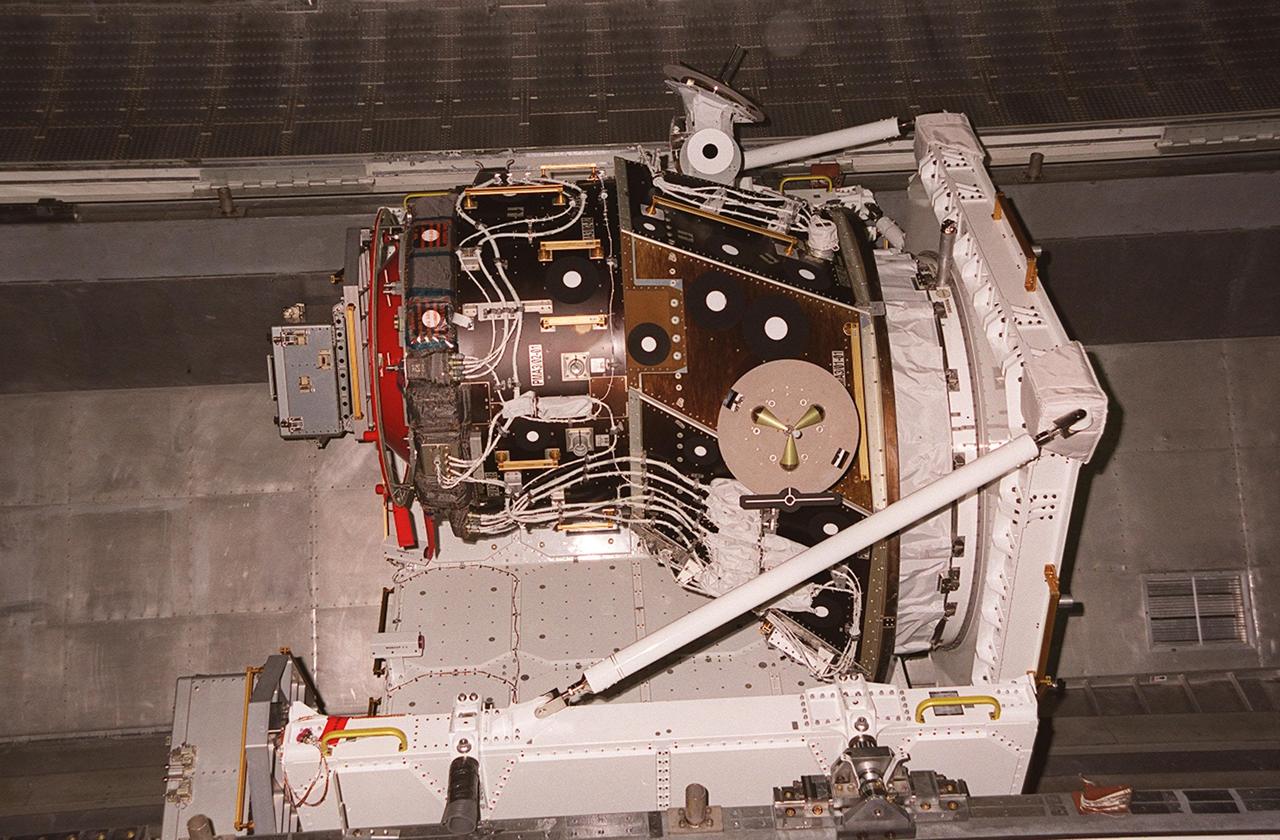
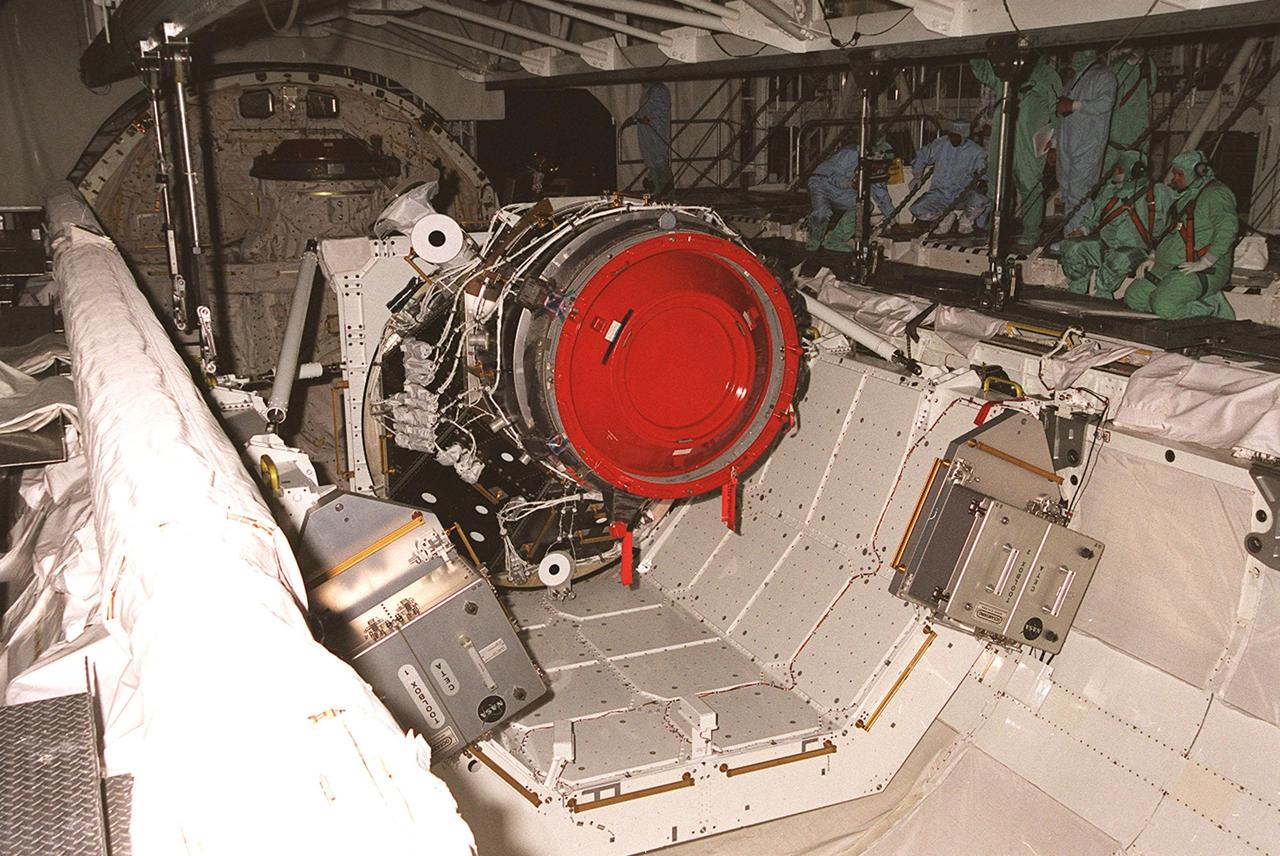
KENNEDY SPACE CENTER, FLA. -- This closeup shows the Pressurized Mating Adapter -3 (PMA-3) after transport to the Orbiter Processing Facility. A component of the International Space Station, the PMA-3 is being transferred to the payload bay of the orbiter Discovery, for mission STS-92, scheduled to launch Oct. 5. The mission will be the fifth flight to the Space Station, and the 100th Shuttle flight overall. PMA-3 provides shuttle docking port for solar array installation on flight 4A (mission STS-97 scheduled for Nov. 30), and Lab installation on flight 5A (mission STS-98, scheduled for Jan. 18, 2001)

KENNEDY SPACE CENTER, FLA. -- In the Space Station Processing Facility, an overhead crane moves the Pressurized Mating Adapter-3 (PMA-3) to a payload canister for transport to the Orbiter Processing Facility. The PMA-3, a component of the International Space Station, is part of the payload on Space Shuttle mission STS-92, scheduled to launch Oct. 5. The mission will be the fifth flight to the Space Station, and the 100th Shuttle flight overall. PMA-3 provides the Shuttle docking port for solar array installation on flight 4A (mission STS-97, scheduled for Nov. 30) and Lab installation on flight 5A (mission STS-98), scheduled for Jan. 18, 2001.)
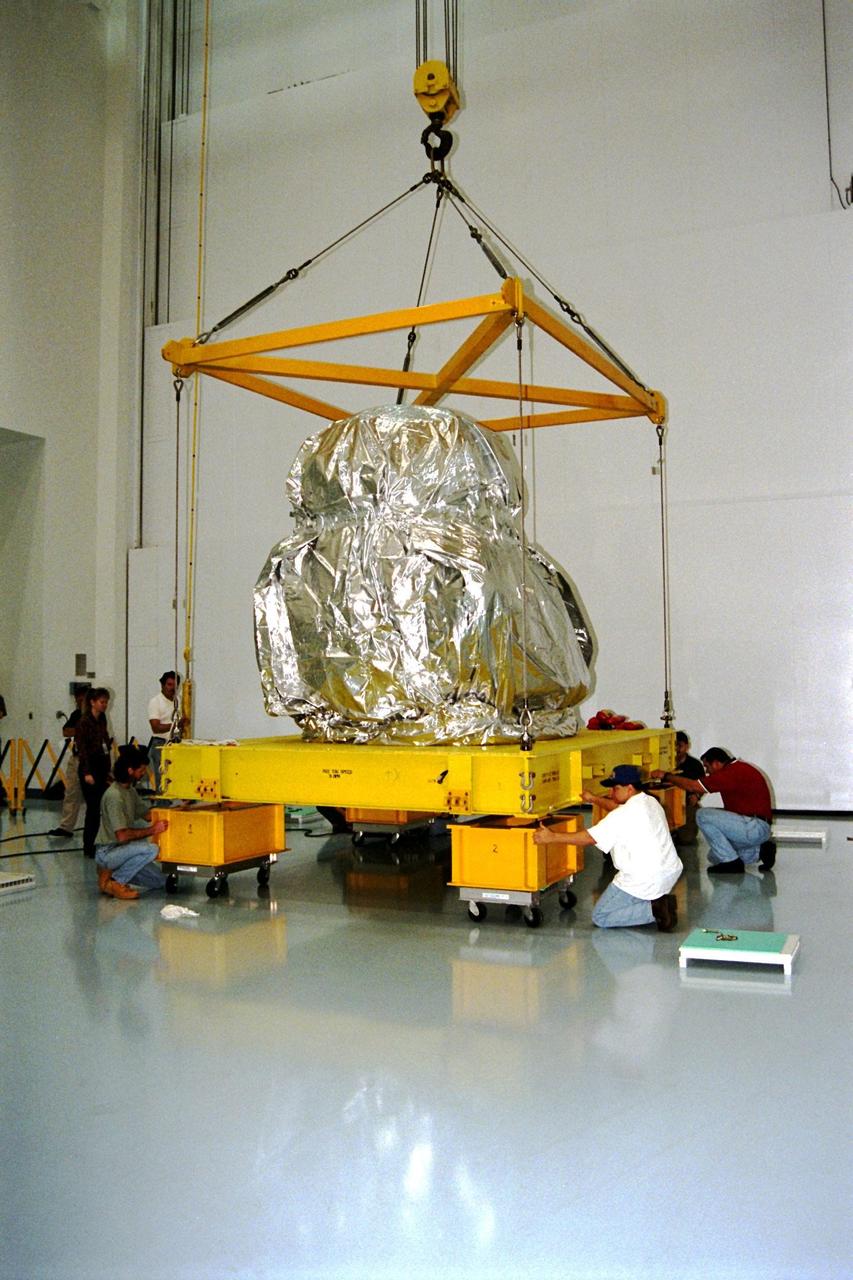
KENNEDY SPACE CENTER, FLA. -- The Pressurized Mating Adapter-3 (PMA-3), an element of the STS-92 mission scheduled for launch aboard Space Shuttle Atlantis in January 1999, arrived from the Boeing Company in Huntington Beach, Calif., for processing in KSC's Space Station Processing Facility (SSPF). While in orbit, PMA-3 will be removed from the orbiter's payload bay by the astronauts using the remote manipulator arm and mated to Node 1, a connecting passageway to the living and working areas of the International Space Station. The primary purpose of PMA-3 is to serve as a Shuttle docking port through which crew members and equipment will transfer to the International Space Station during later assembly missions

KENNEDY SPACE CENTER, FLA. -- In the Space Station Processing Facility, an overhead crane lowers the Pressurized Mating Adapter -3 (PMA-3) into a payload canister for transport to the Orbiter Processing Facility. Workers at the sides and below watch the process. The PMA-3, a component of the International Space Station, is part of the payload on Space Shuttle mission STS-92, scheduled to launch Oct. 5. The mission will be the fifth flight to the Space Station, and the 100th Shuttle flight overall. PMA-3 provides shuttle docking port for solar array installation on flight 4A (mission STS-97 scheduled for Nov. 30), and Lab installation on flight 5A (mission STS-98, scheduled for Jan. 18, 2001)
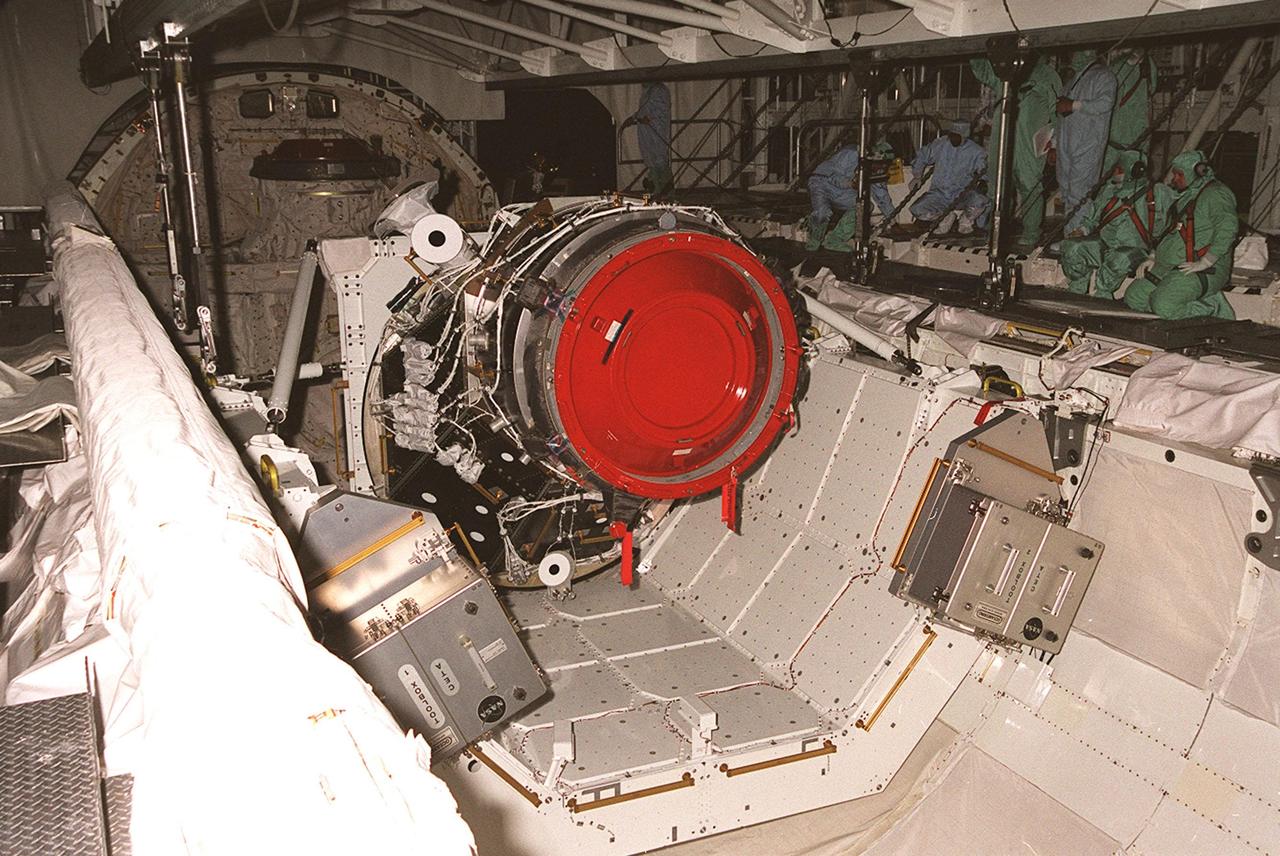
KENNEDY SPACE CENTER, FLA. -- In the Orbiter Processing Facility bay 1, workers detach the overhead crane from the Pressurized Mating Adapter -3 (PMA-3), which sits in the payload bay of the orbiter Discovery. A component of the International Space Station, the PMA-3 will fly on Shuttle mission STS-92, scheduled to launch Oct. 5. The mission will be the fifth flight to the Space Station, and the 100th Shuttle flight overall. PMA-3 provides shuttle docking port for solar array installation on flight 4A (mission STS-97 scheduled for Nov. 30), and Lab installation on flight 5A (mission STS-98, scheduled for Jan. 18, 2001)
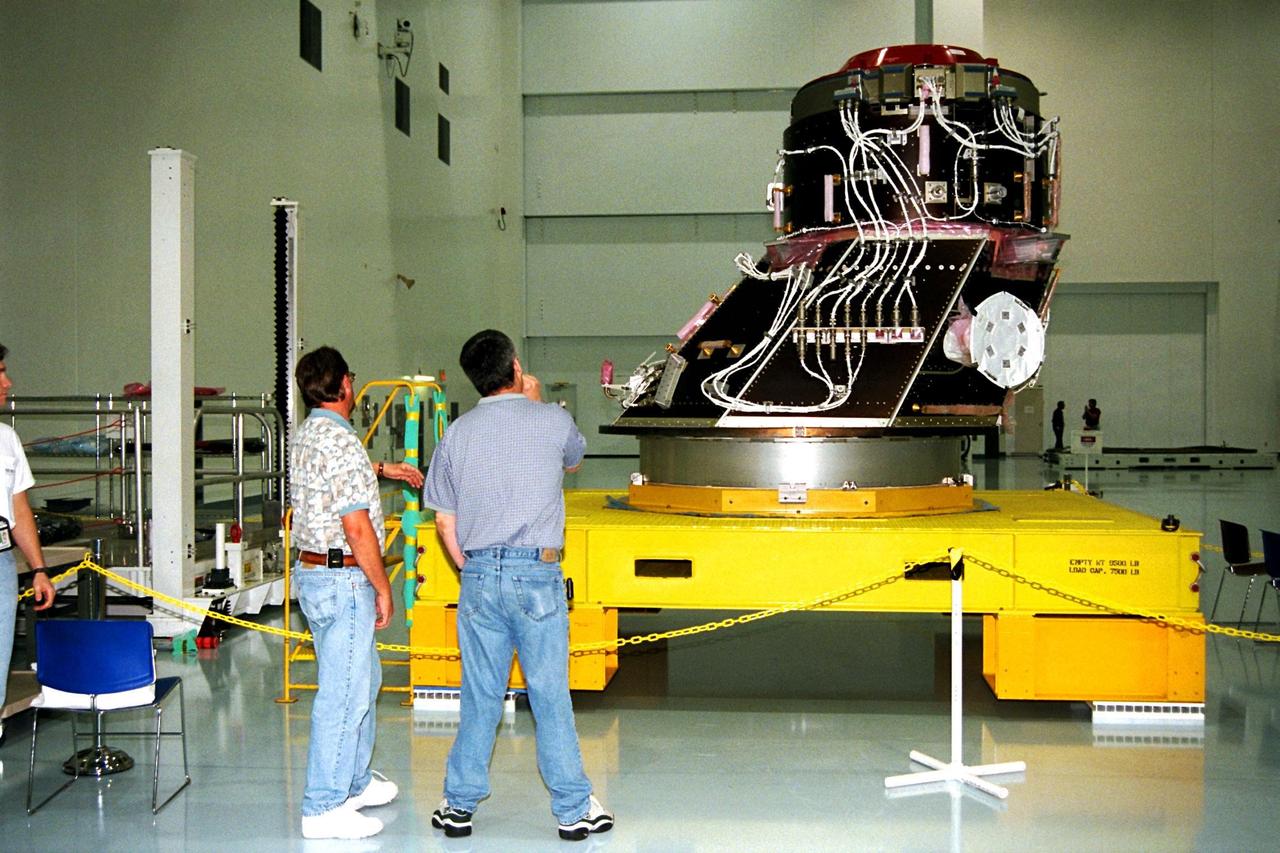
KENNEDY SPACE CENTER, FLA. -- The Pressurized Mating Adapter-3 (PMA-3), an element of the STS-92 mission scheduled for launch aboard Space Shuttle Atlantis in January 1999, awaits processing in KSC's Space Station Processing Facility (SSPF). While in orbit, PMA-3 will be removed from the orbiter's payload bay by the astronauts using the remote manipulator arm and mated to Node 1, a connecting passageway to the living and working areas of the International Space Station. The primary purpose of PMA-3 is to serve as a Shuttle docking port through which crew members and equipment will transfer to the International Space Station during later assembly missions

KENNEDY SPACE CENTER, FLA. -- In the Space Station Processing Facility, the Pressurized Mating Adapter -3 (PMA-3) sits in a payload canister for transport to the Orbiter Processing Facility. Workers at the sides and below watch the process. The PMA-3, a component of the International Space Station, is part of the payload on Space Shuttle mission STS-92, scheduled to launch Oct. 5. The mission will be the fifth flight to the Space Station, and the 100th Shuttle flight overall. PMA-3 provides shuttle docking port for solar array installation on flight 4A (mission STS-97 scheduled for Nov. 30), and Lab installation on flight 5A (mission STS-98, scheduled for Jan. 18, 2001)
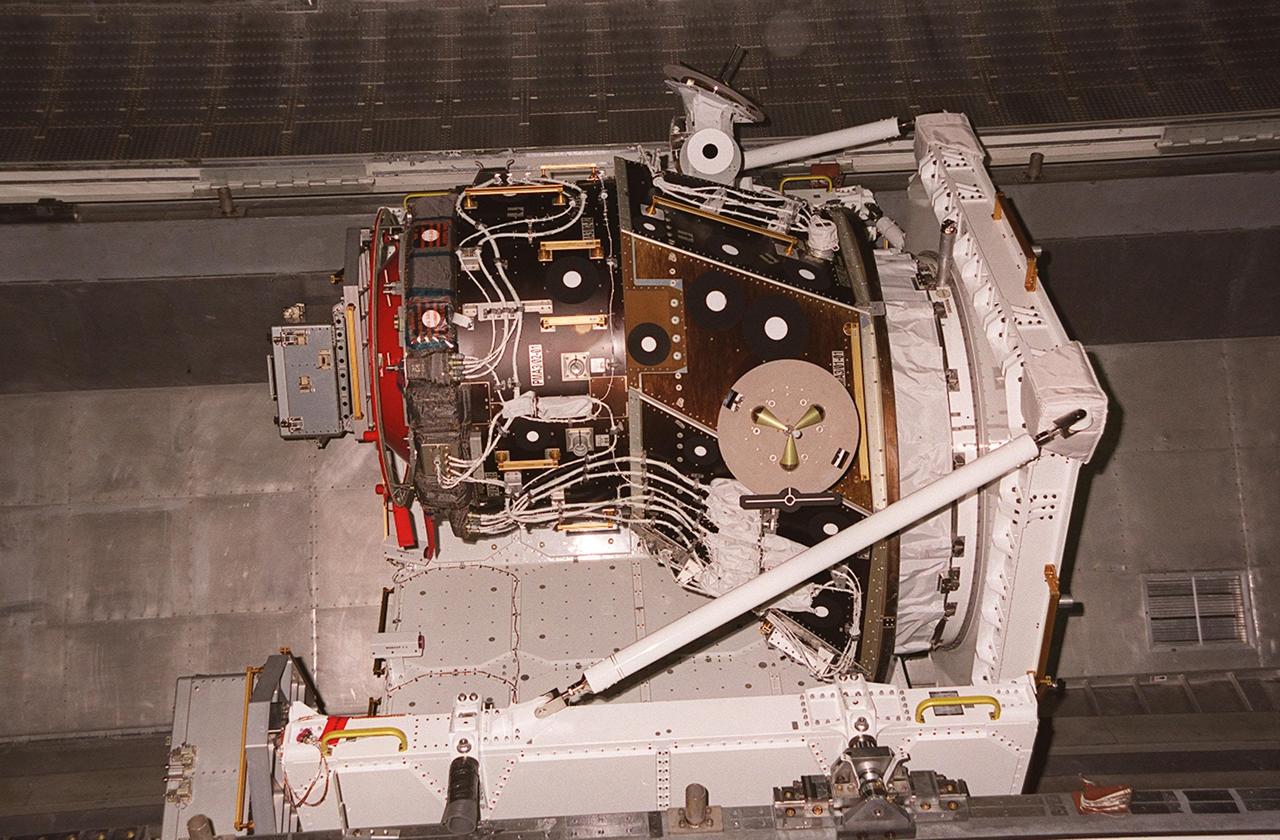
KENNEDY SPACE CENTER, FLA. -- This closeup shows the Pressurized Mating Adapter -3 (PMA-3) after transport to the Orbiter Processing Facility. A component of the International Space Station, the PMA-3 is being transferred to the payload bay of the orbiter Discovery, for mission STS-92, scheduled to launch Oct. 5. The mission will be the fifth flight to the Space Station, and the 100th Shuttle flight overall. PMA-3 provides shuttle docking port for solar array installation on flight 4A (mission STS-97 scheduled for Nov. 30), and Lab installation on flight 5A (mission STS-98, scheduled for Jan. 18, 2001)
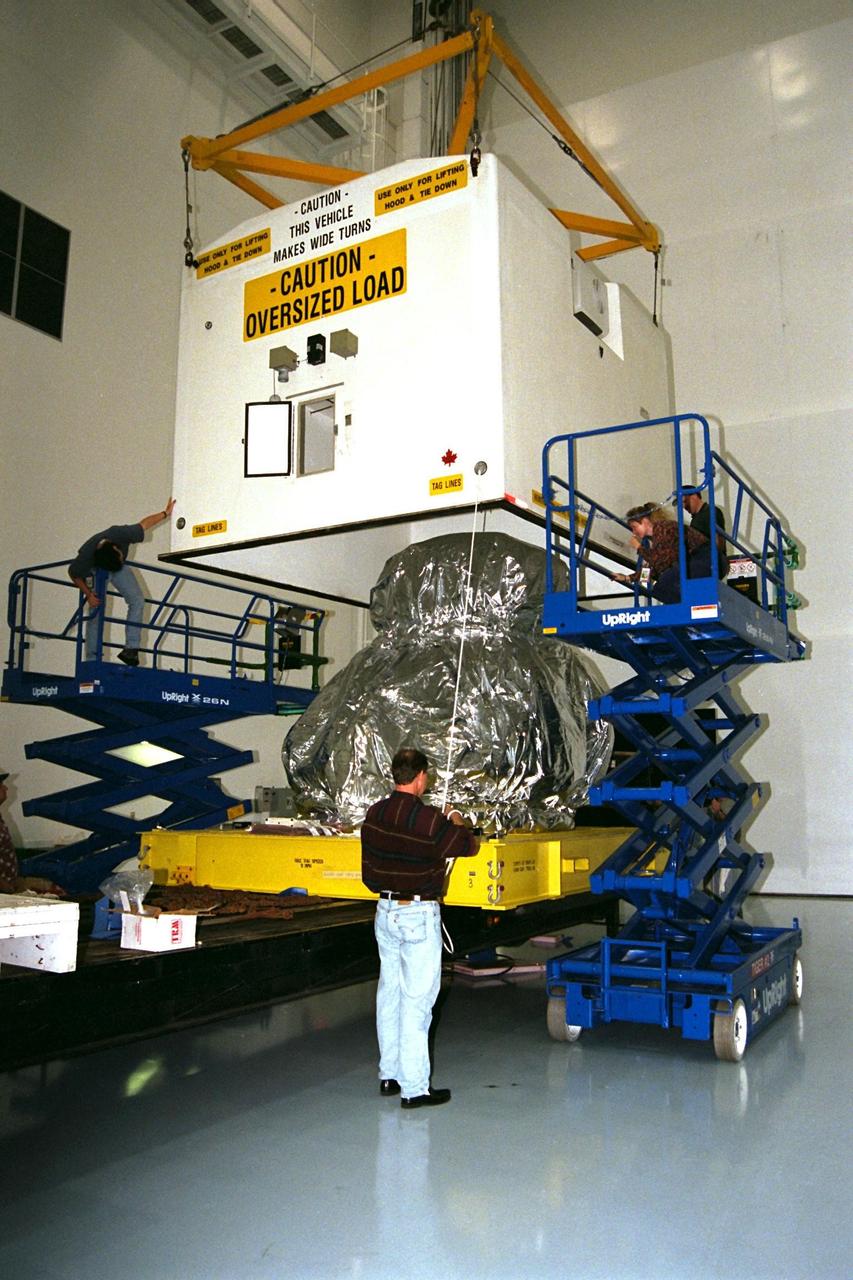
KENNEDY SPACE CENTER, FLA. -- The Pressurized Mating Adapter-3 (PMA-3), an element of the STS-92 mission scheduled for launch aboard Space Shuttle Atlantis in January 1999, arrived from the Boeing Company in Huntington Beach, Calif., for processing in KSC's Space Station Processing Facility (SSPF). While in orbit, PMA-3 will be removed from the orbiter's payload bay by the astronauts using the remote manipulator arm and mated to Node 1, a connecting passageway to the living and working areas of the International Space Station. The primary purpose of PMA-3 is to serve as a Shuttle docking port through which crew members and equipment will transfer to the International Space Station during later assembly missions
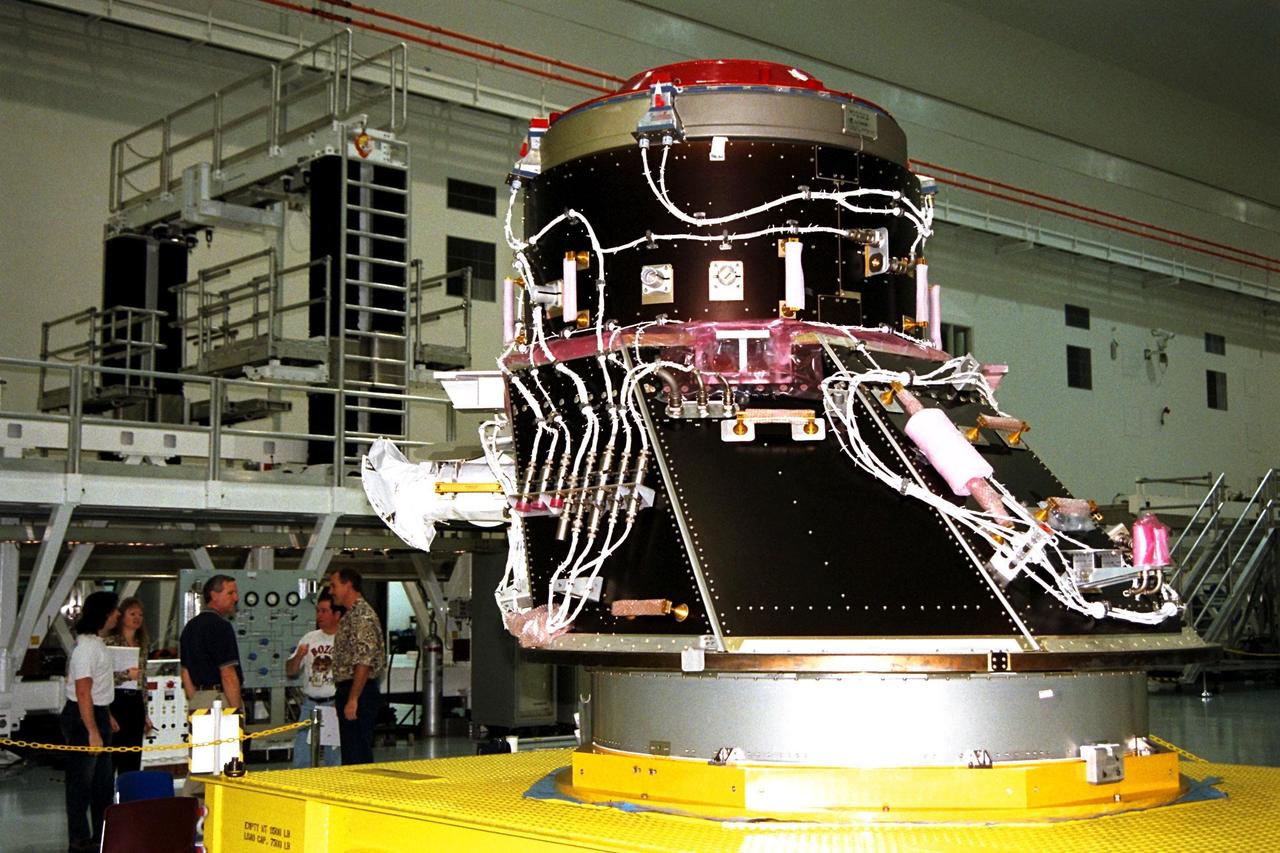
KENNEDY SPACE CENTER, FLA. -- The Pressurized Mating Adapter-3 (PMA-3), an element of the STS-92 mission scheduled for launch aboard Space Shuttle Atlantis in January 1999, awaits processing in KSC's Space Station Processing Facility (SSPF). While in orbit, PMA-3 will be removed from the orbiter's payload bay by the astronauts using the remote manipulator arm and mated to Node 1, a connecting passageway to the living and working areas of the International Space Station. The primary purpose of PMA-3 is to serve as a Shuttle docking port through which crew members and equipment will transfer to the International Space Station during later assembly missions
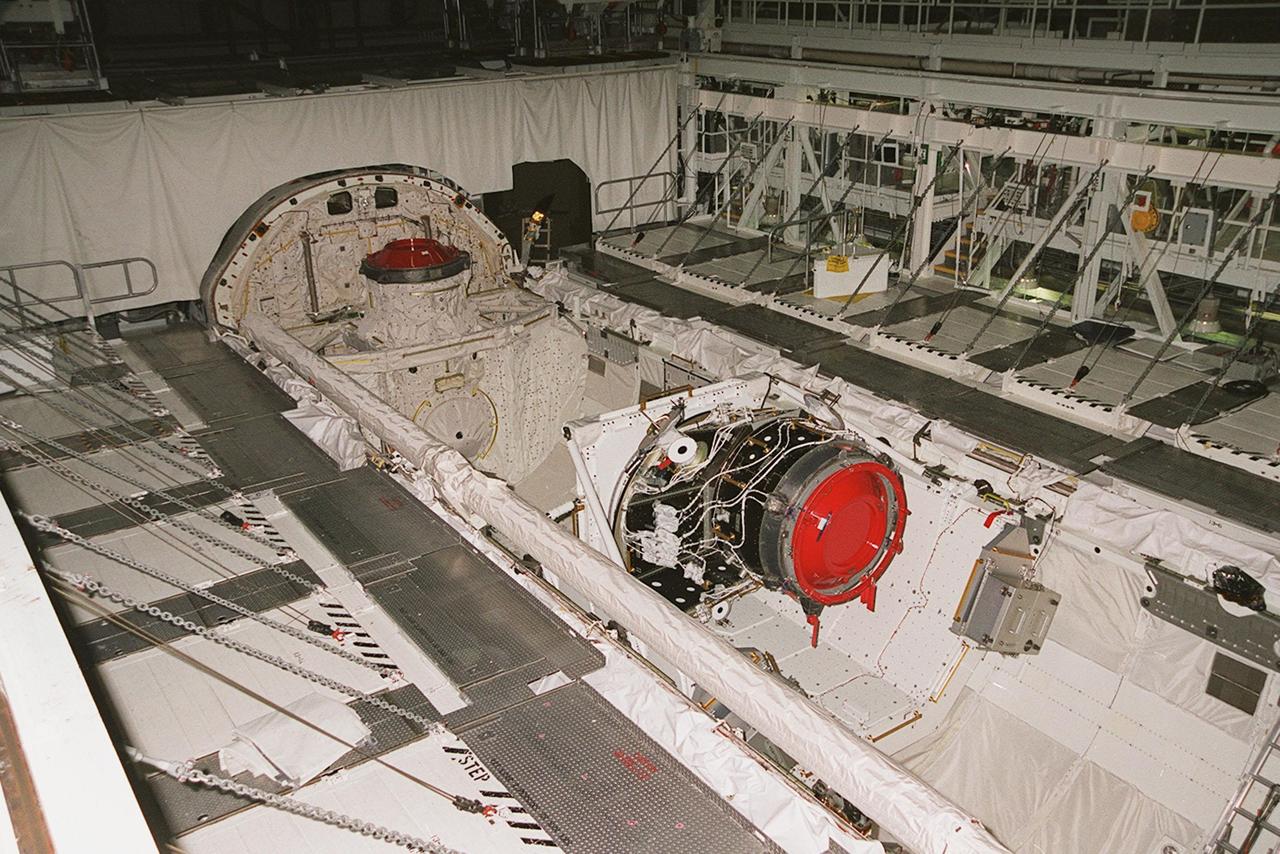
KENNEDY SPACE CENTER, FLA. -- The Pressurized Mating Adapter -3 (PMA-3) sits in the payload bay of the orbiter Discovery after being transported from the Space Station Processing Facility. A component of the International Space Station, the PMA-3 will fly on Shuttle mission STS-92, scheduled to launch Oct. 5. The mission will be the fifth flight to the Space Station, and the 100th Shuttle flight overall. PMA-3 provides shuttle docking port for solar array installation on flight 4A (mission STS-97 scheduled for Nov. 30), and Lab installation on flight 5A (mission STS-98, scheduled for Jan. 18, 2001)
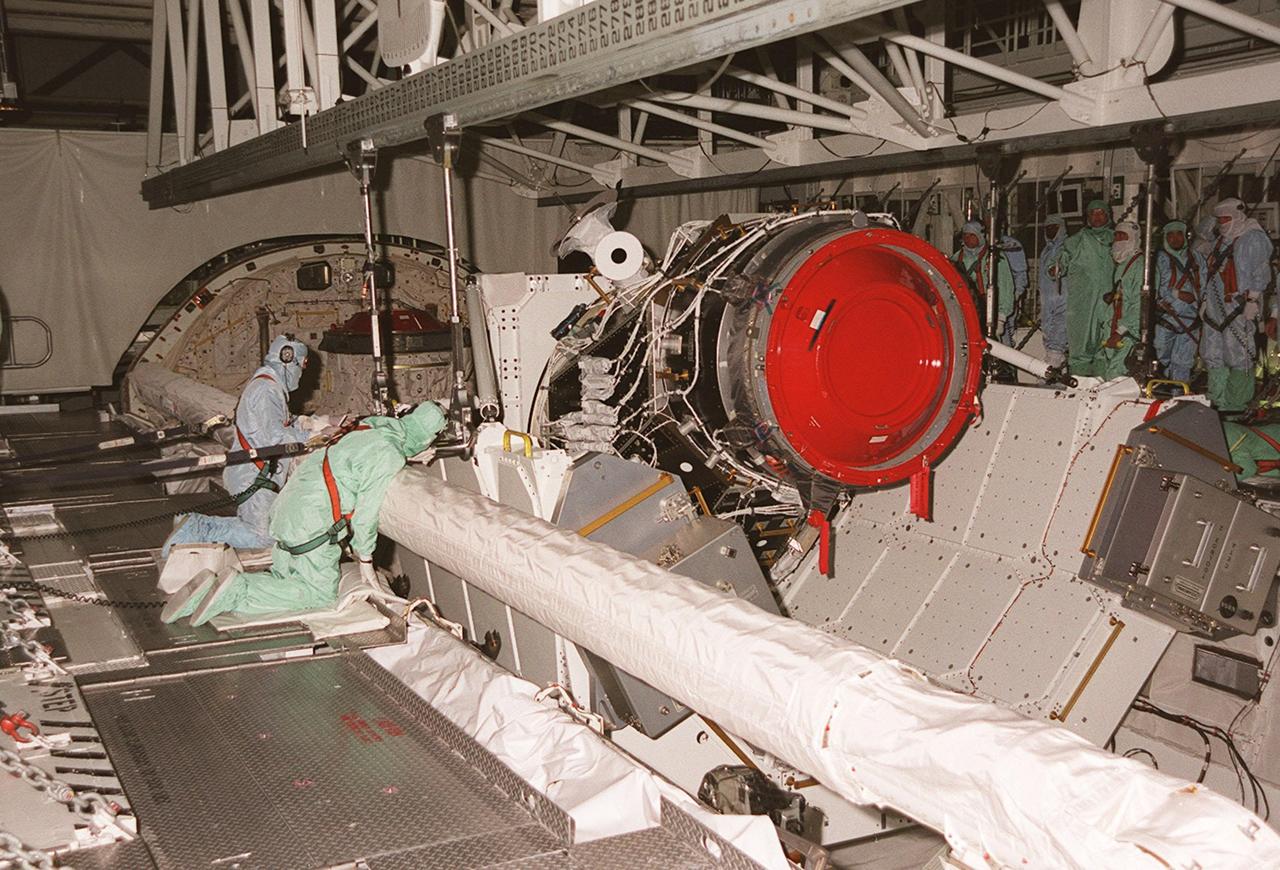
KENNEDY SPACE CENTER, FLA. -- In the Orbiter Processing Facility bay 1, workers check the placement of the Pressurized Mating Adapter -3 (PMA-3) as the overhead crane places it in the payload bay of the orbiter Discovery. A component of the International Space Station, the PMA-3 will fly on Shuttle mission STS-92, scheduled to launch Oct. 5. The mission will be the fifth flight to the Space Station, and the 100th Shuttle flight overall. PMA-3 provides shuttle docking port for solar array installation on flight 4A (mission STS-97 scheduled for Nov. 30), and Lab installation on flight 5A (mission STS-98, scheduled for Jan. 18, 2001)
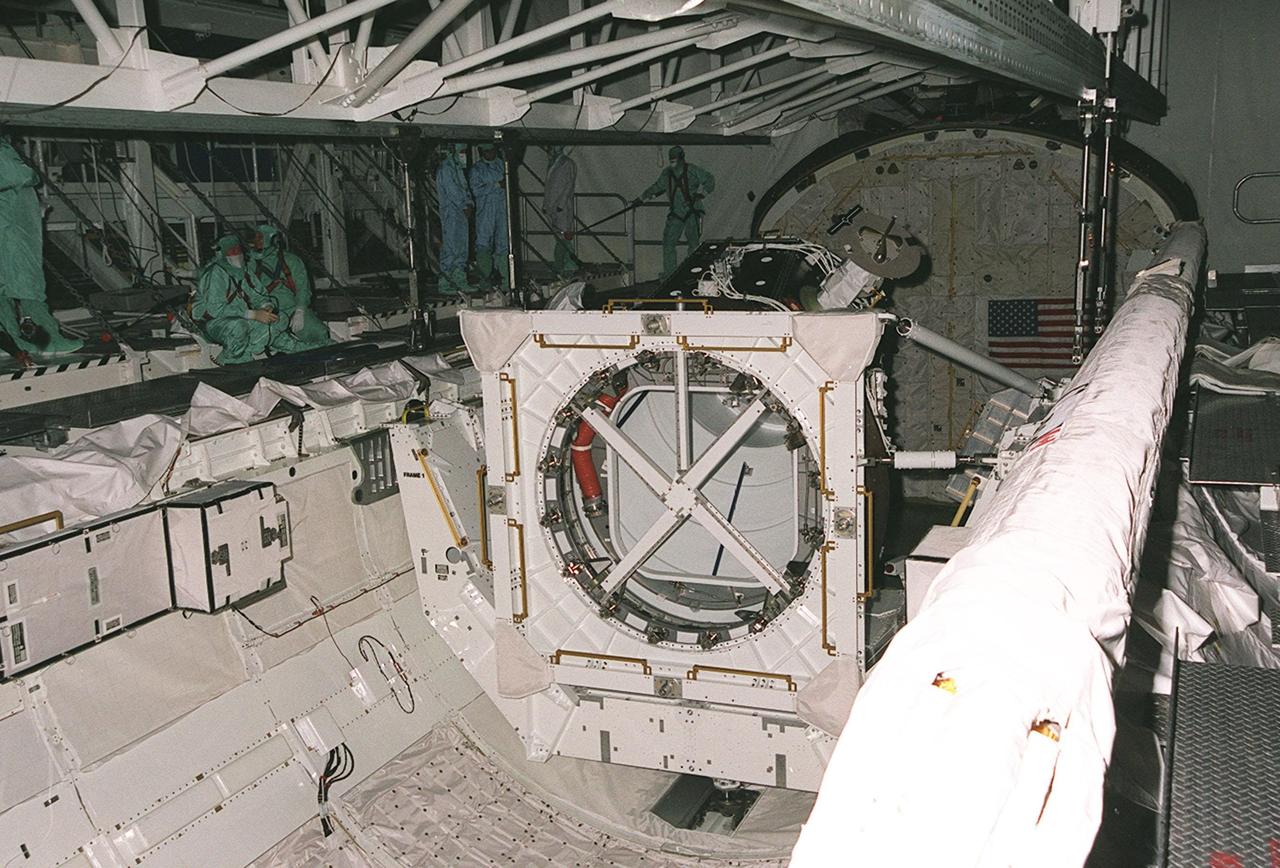
KENNEDY SPACE CENTER, FLA. -- The Pressurized Mating Adapter -3 (PMA-3) sits in the payload bay of the orbiter Discovery after being transported from the Space Station Processing Facility. A component of the International Space Station, the PMA-3 will fly on Shuttle mission STS-92, scheduled to launch Oct. 5. The mission will be the fifth flight to the Space Station, and the 100th Shuttle flight overall. PMA-3 provides shuttle docking port for solar array installation on flight 4A (mission STS-97 scheduled for Nov. 30), and Lab installation on flight 5A (mission STS-98, scheduled for Jan. 18, 2001)
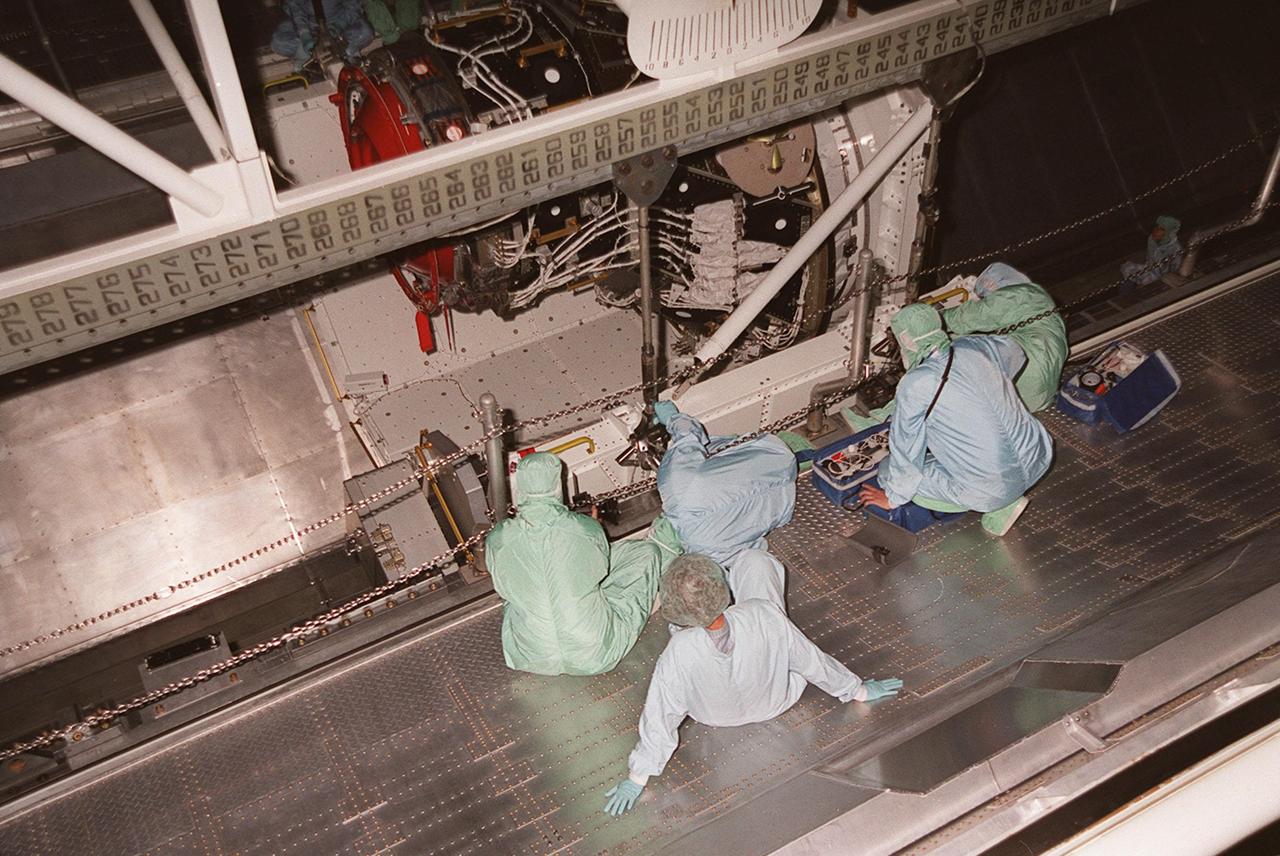
KENNEDY SPACE CENTER, FLA. -- Workers in the Orbiter Processing Facility check the placement of cables on the Pressurized Mating Adapter -3 (PMA-3) for its transfer to the orbiter Discovery. A component of the International Space Station, the PMA-3 is part of the payload on Space Shuttle mission STS-92, scheduled to launch Oct. 5. The mission will be the fifth flight to the Space Station, and the 100th Shuttle flight overall. PMA-3 provides shuttle docking port for solar array installation on flight 4A (mission STS-97 scheduled for Nov. 30), and Lab installation on flight 5A (mission STS-98, scheduled for Jan. 18, 2001)
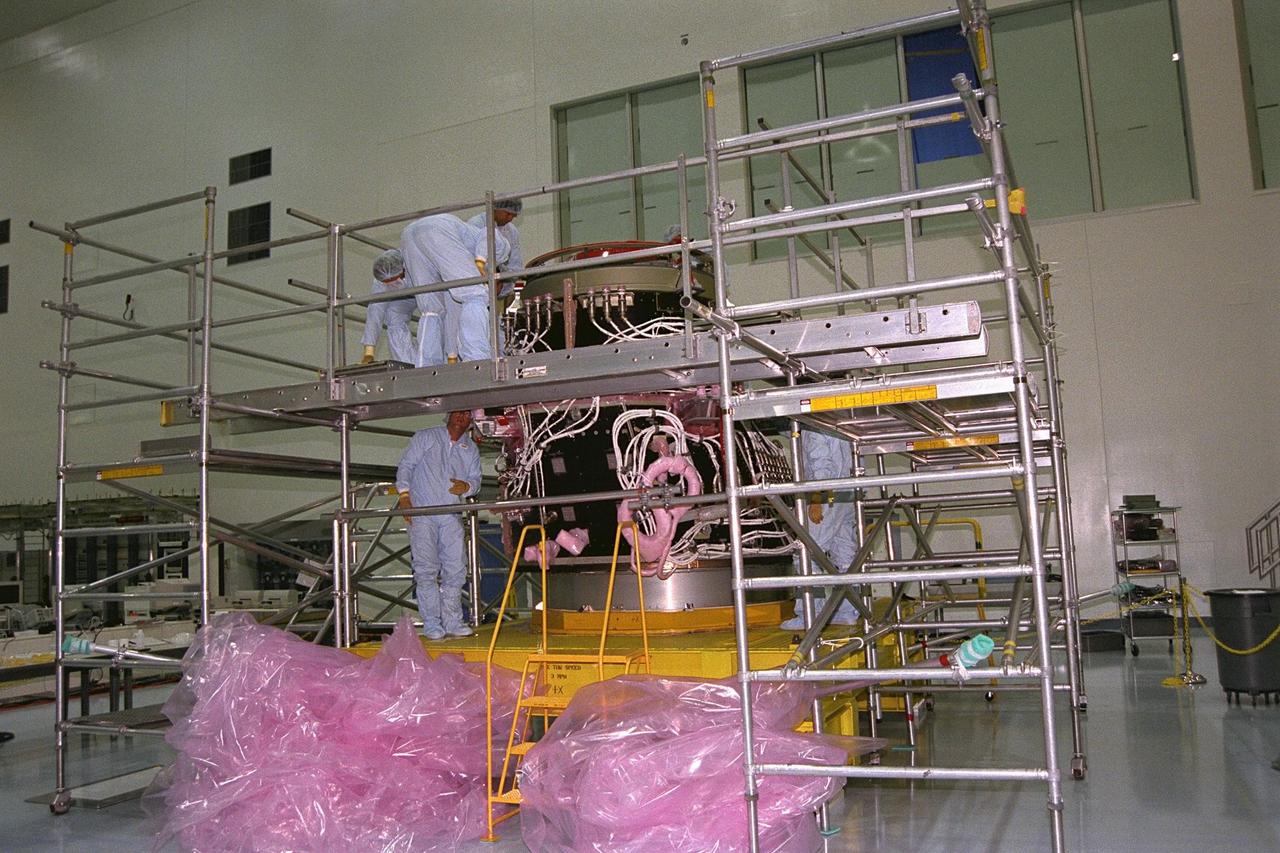
International Space Station (ISS) contractors erect access scaffolding around the Pressurized Mating Adapter-1 (PMA-1) for the ISS in KSC’s Space Station Processing Facility. A PMA is a cone-shaped connector that will be attached to Node 1, the space station’s structural building block, during ground processing. The white flight cables around PMA-1 will assist in connecting the node to the U.S.-financed, Russian-built Functional Cargo Block, a component that supplies early power and propulsion systems for the station. Node 1 with two adapters attached will be the first element of the station to be launched aboard the Space Shuttle Endeavour on STS-88 in July 1998
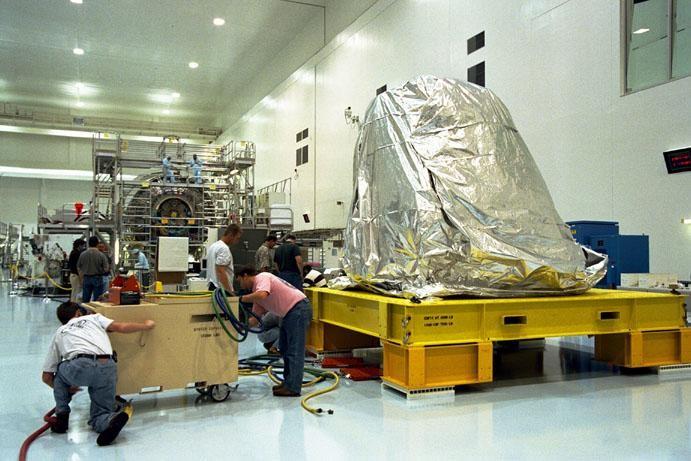
KENNEDY SPACE CENTER, FLA. -- PMA-2 is being moved from the airlock into the high bay. It is the payload on mission STS-88.
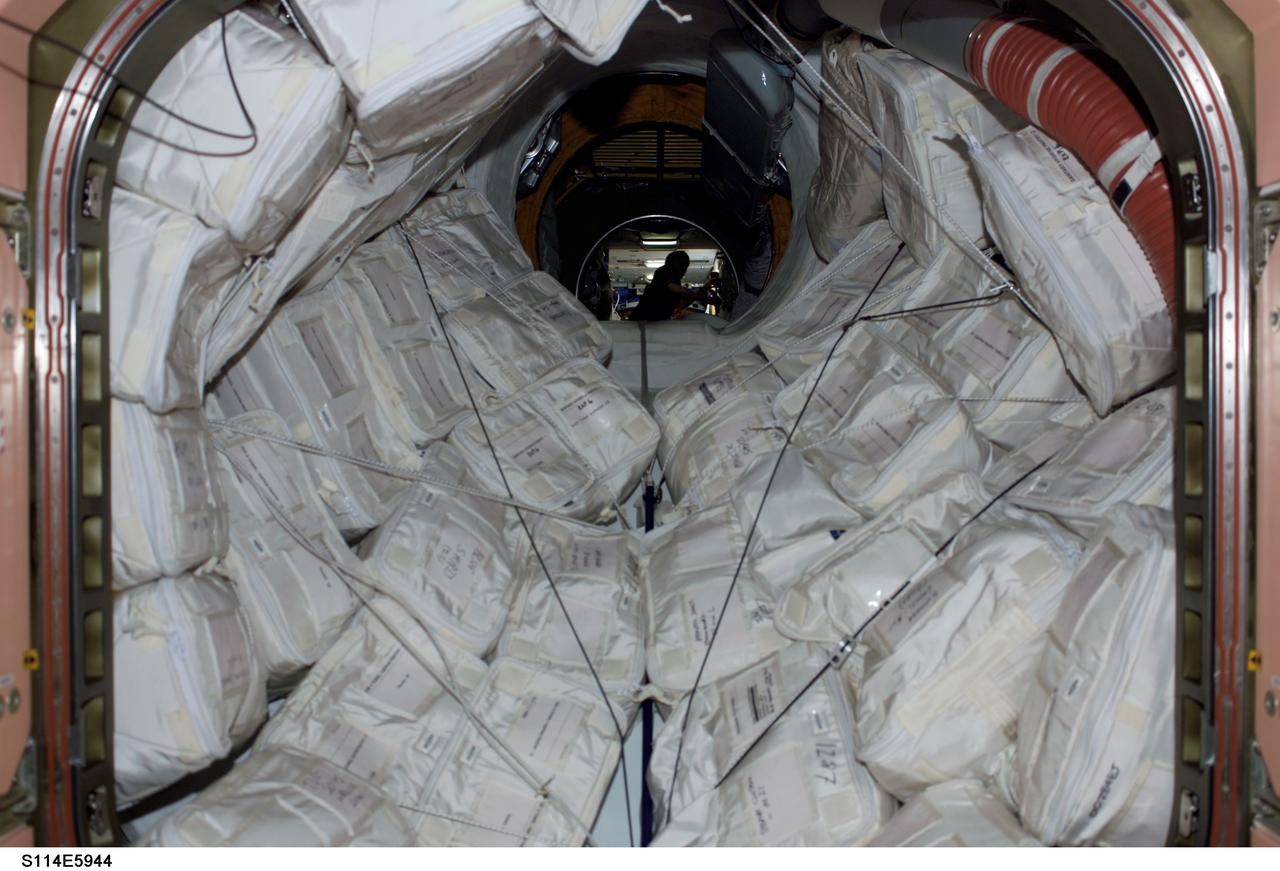
S114-E-5944 (31 July 2005) --- An airlock serves as temporary storage area for supplies being transferred to the International Space Station from the Space Shuttle Discovery.
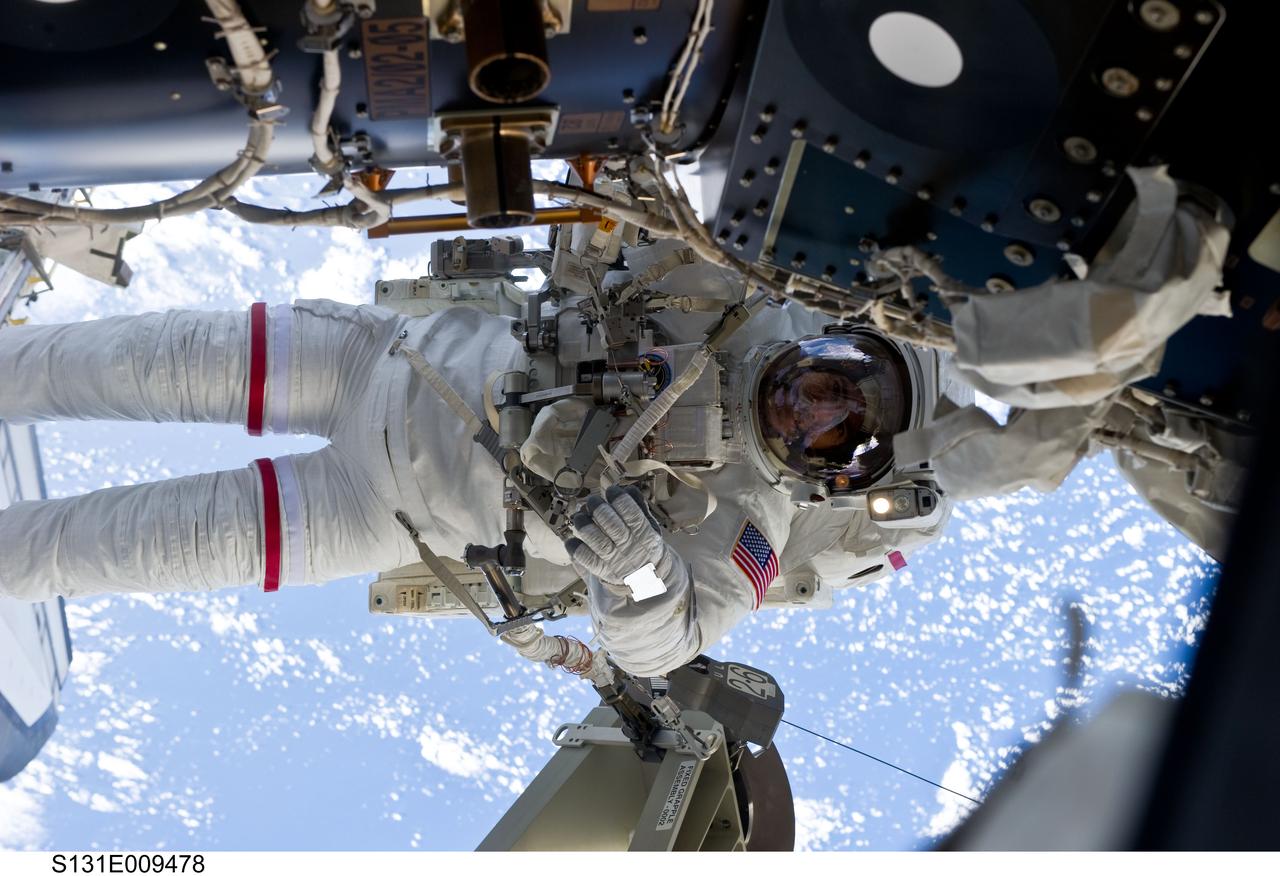
S131-E-009478 (13 April 2010) --- NASA astronaut Rick Mastracchio, STS-131 mission specialist, participates in the mission's third and final session of extravehicular activity (EVA) as construction and maintenance continue on the International Space Station. During the six-hour, 24-minute spacewalk, Mastracchio and astronaut Clayton Anderson (out of frame), mission specialist, hooked up fluid lines of the new 1,700-pound tank, retrieved some micrometeoroid shields from the Quest airlock’s exterior, relocated a portable foot restraint and prepared cables on the Zenith 1 truss for a spare Space to Ground Ku-Band antenna, two chores required before space shuttle Atlantis' STS-132/ULF-4 mission in May.
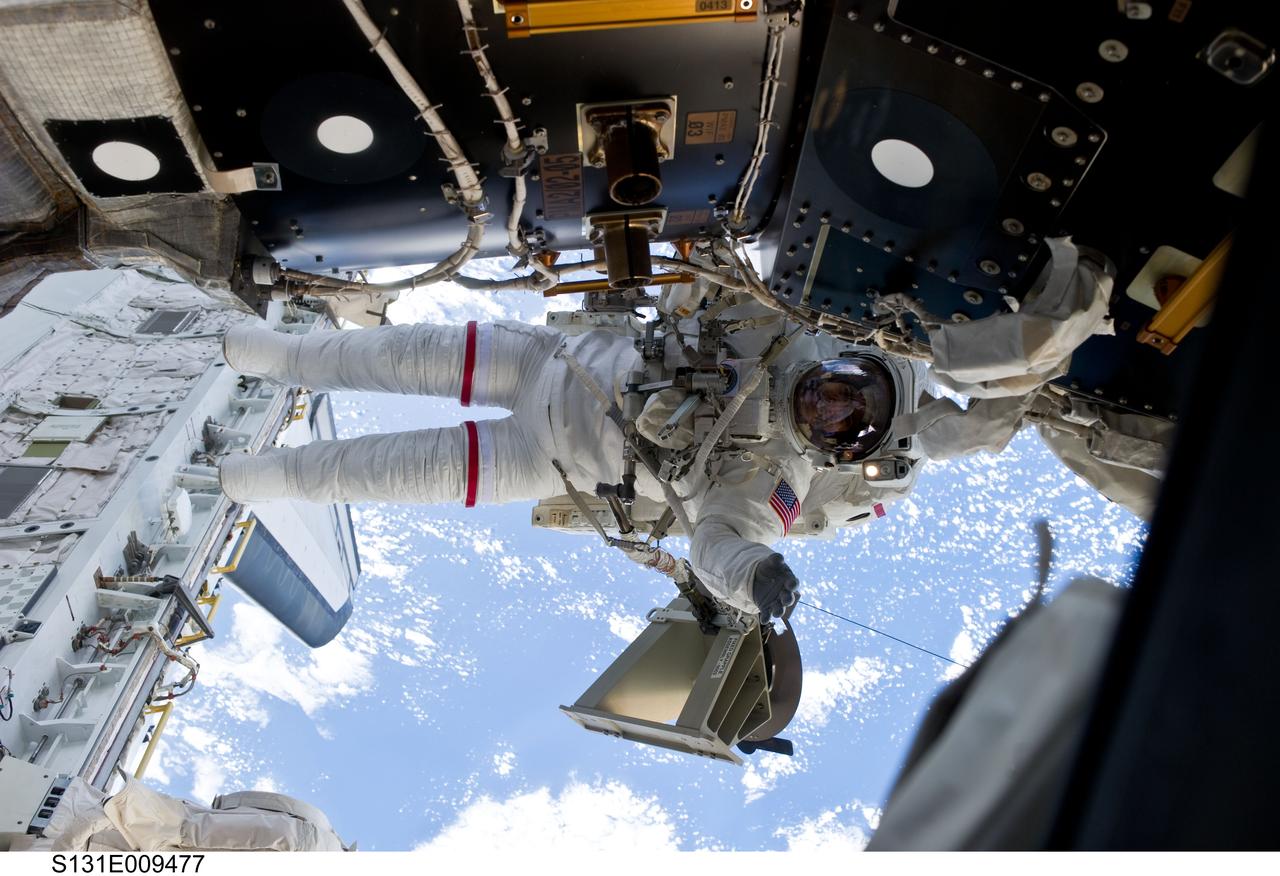
S131-E-009477 (13 April 2010) --- NASA astronaut Rick Mastracchio, STS-131 mission specialist, participates in the mission's third and final session of extravehicular activity (EVA) as construction and maintenance continue on the International Space Station. During the six-hour, 24-minute spacewalk, Mastracchio and astronaut Clayton Anderson (out of frame), mission specialist, hooked up fluid lines of the new 1,700-pound tank, retrieved some micrometeoroid shields from the Quest airlock’s exterior, relocated a portable foot restraint and prepared cables on the Zenith 1 truss for a spare Space to Ground Ku-Band antenna, two chores required before space shuttle Atlantis' STS-132/ULF-4 mission in May.

ISS011-E-11287 (28 July 2005) --- Onboard the International Space Station, cosmonaut Sergei Krikalev, Russia Federal Space Agency representative and commander of Expedition 11, opens a hatch in the tunnel leading to the Space Shuttle Discovery. The seven-member Shuttle crew was only moments away from joining its hosts on the orbital outpost. The two crews are scheduled to share several days of joint activities in space.
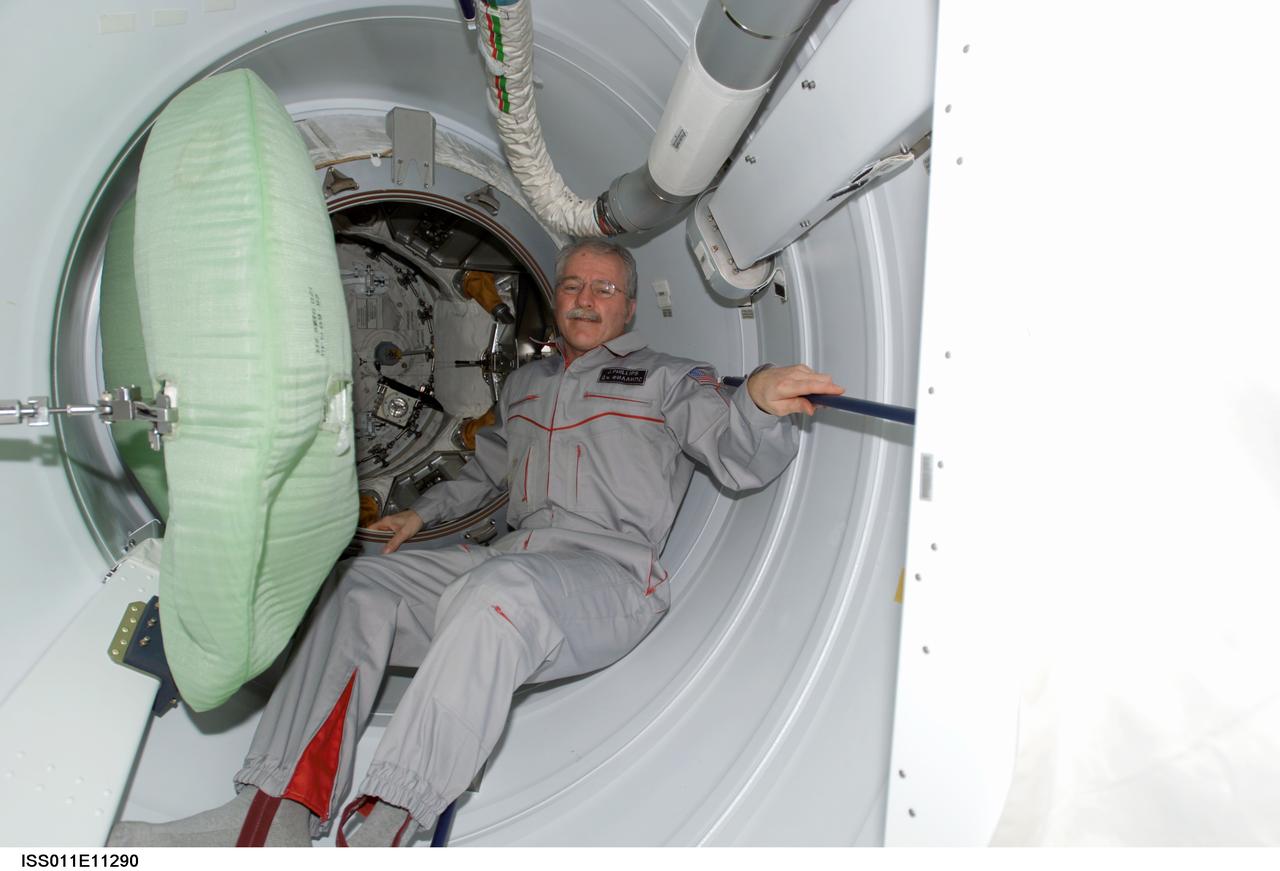
ISS011-E-11290 (28 July 2005) --- Onboard the International Space Station, astronaut John L. Phillips, flight engineer and NASA Space Station Science Officer for Expedition 11, comes through a hatch in the tunnel leading to the Space Shuttle Discovery. The seven-member Shuttle crew was only moments away from joining its hosts on the orbital outpost. The two crews are scheduled to share several days of joint activities in space.
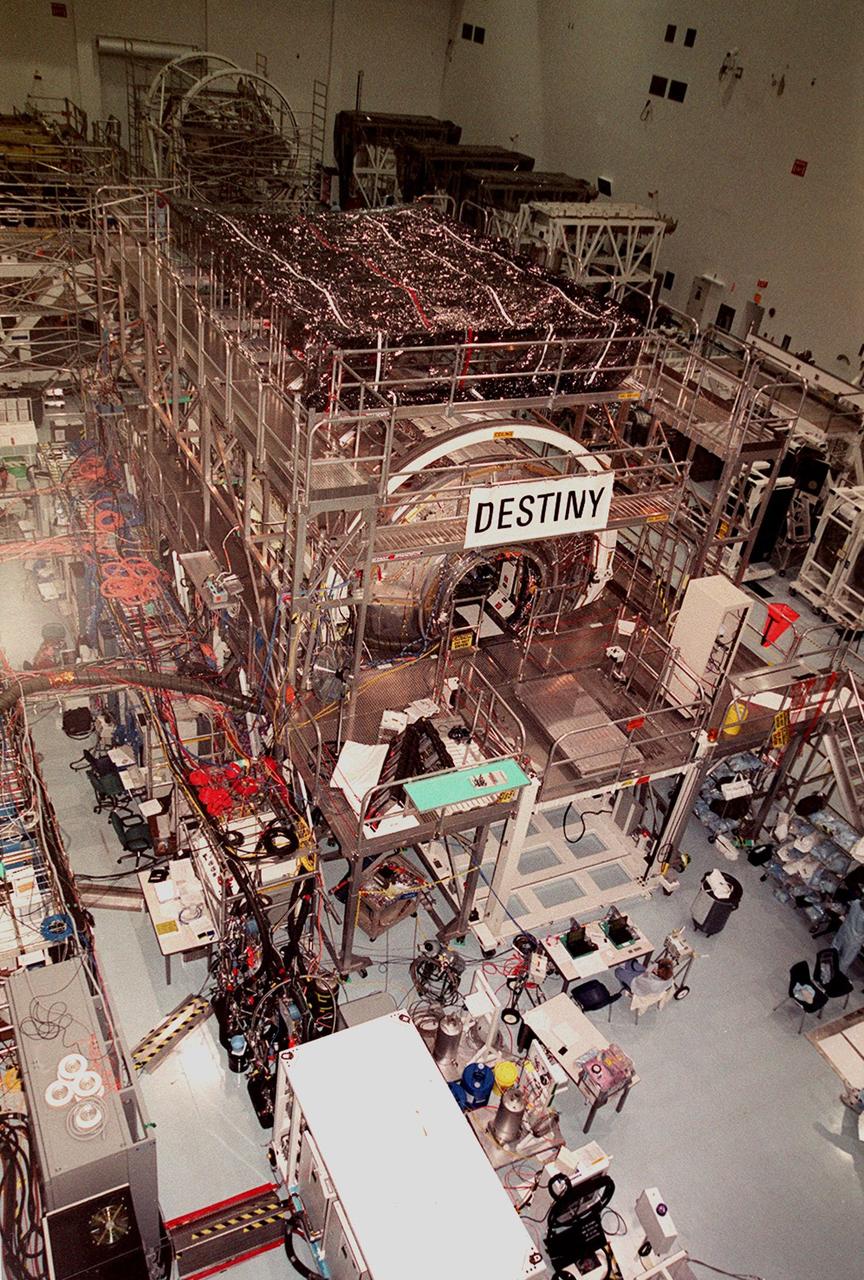
KENNEDY SPACE CENTER, FLA. -- The U.S. Lab Destiny dominates the center of the Space Station Processing Facility (SSPF), which is filled with other hardware and equipment for the International Space Station. Elsewhere in the SSPF are also the Multi-Purpose Logistics Modules Raffaello and Leonardo and the Pressurized Mating Adapter-3 (PMA-3). The PMA-3 is the first element scheduled to be launched to the Space Station, on STS-92. Next is Destiny, on STS-98, followed by the MPLMs on STS-102 and STS-100. No dates have been determined yet for these missions
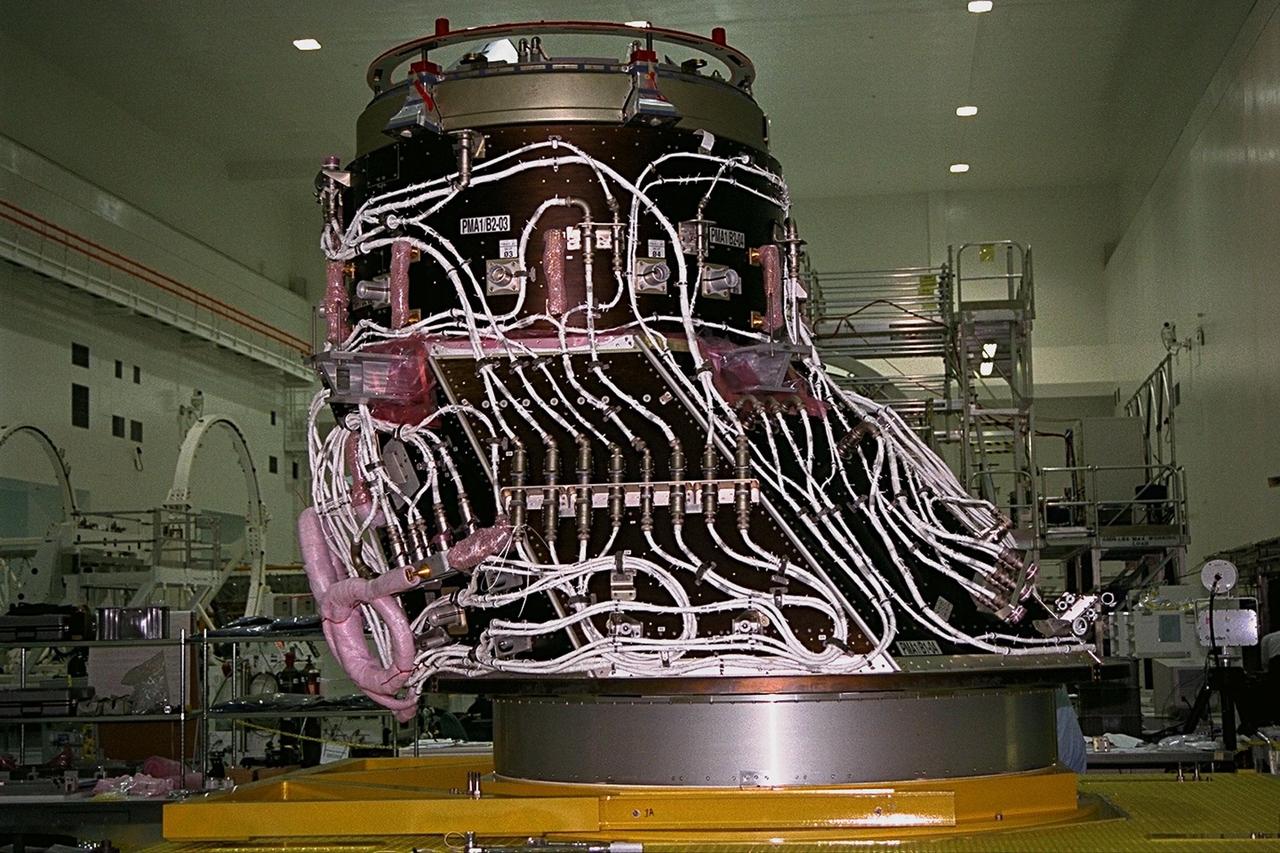
KENNEDY SPACE CENTER, FLA. -- The Pressurized Mating Adapter-1 (PMA-1), scheduled to fly on Space Shuttle mission STS-88 is undergoing processing in the Space Station Processing Facility (SSPF). A PMA is a cone-shaped connector that will be attached to Node 1, the space station’s structural building block, during ground processing. STS-88 is the first International Space Station assembly flight.
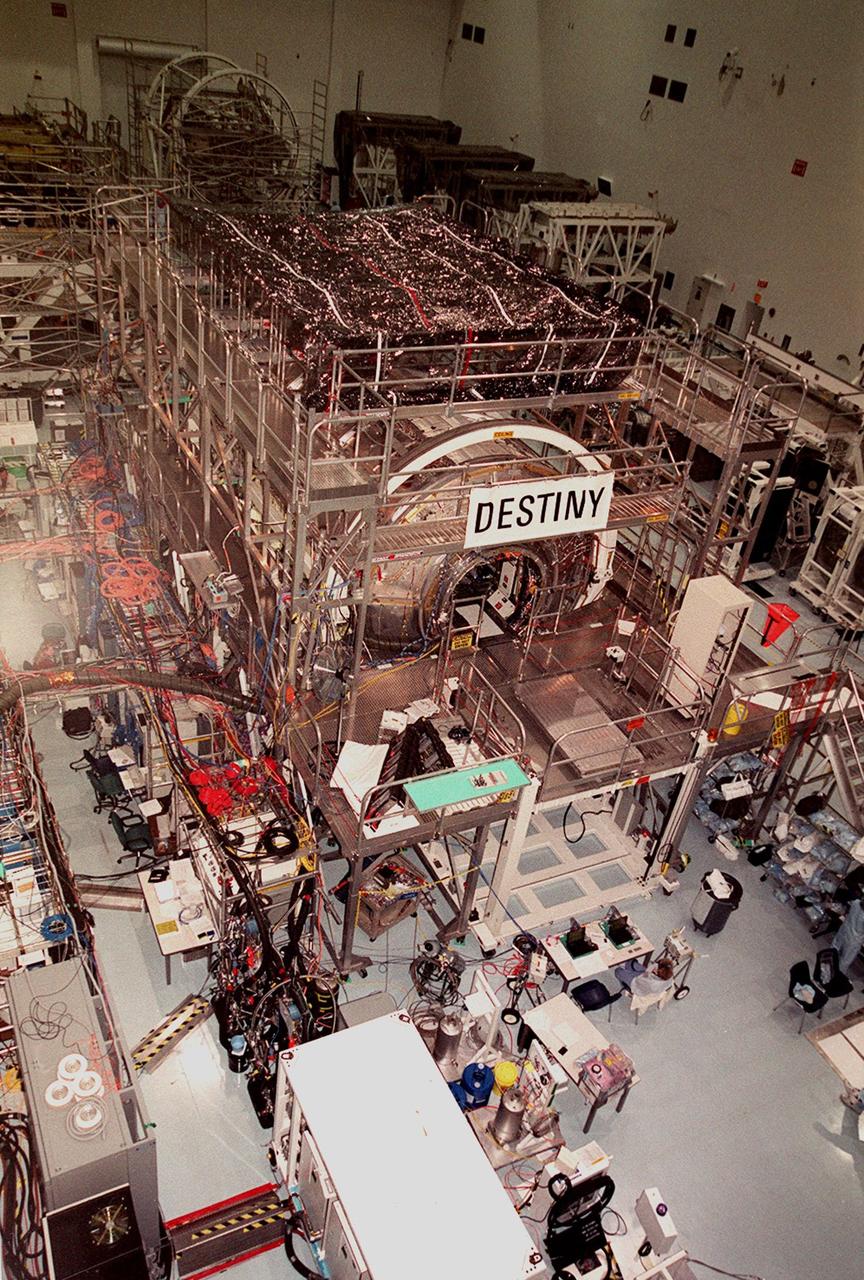
KENNEDY SPACE CENTER, FLA. -- The U.S. Lab Destiny dominates the center of the Space Station Processing Facility (SSPF), which is filled with other hardware and equipment for the International Space Station. Elsewhere in the SSPF are also the Multi-Purpose Logistics Modules Raffaello and Leonardo and the Pressurized Mating Adapter-3 (PMA-3). The PMA-3 is the first element scheduled to be launched to the Space Station, on STS-92. Next is Destiny, on STS-98, followed by the MPLMs on STS-102 and STS-100. No dates have been determined yet for these missions

JSC2006-E-43516 (October 2006) --- Computer-generated artist's rendering of the International Space Station after flight 20A. U.S. Orbiter delivers and installs Node 3 with Cupola. Pressurized Mating Adapter-3 (PMA-3) is relocated from Unity node nadir to Node 2 nadir beforehand. The Cupola is relocated to the forward port of Node 3 after the flight; and PMA- 3 is relocated to the axial port of Node 3 after the flight.