
S130-E-006903 (10 Feb. 2010) --- NASA astronaut Robert Behnken, STS-130 mission specialist, floats through the Pressurized Mating Adapter 2 (PMA-2) of the International Space Station from the docked space shuttle Endeavour.
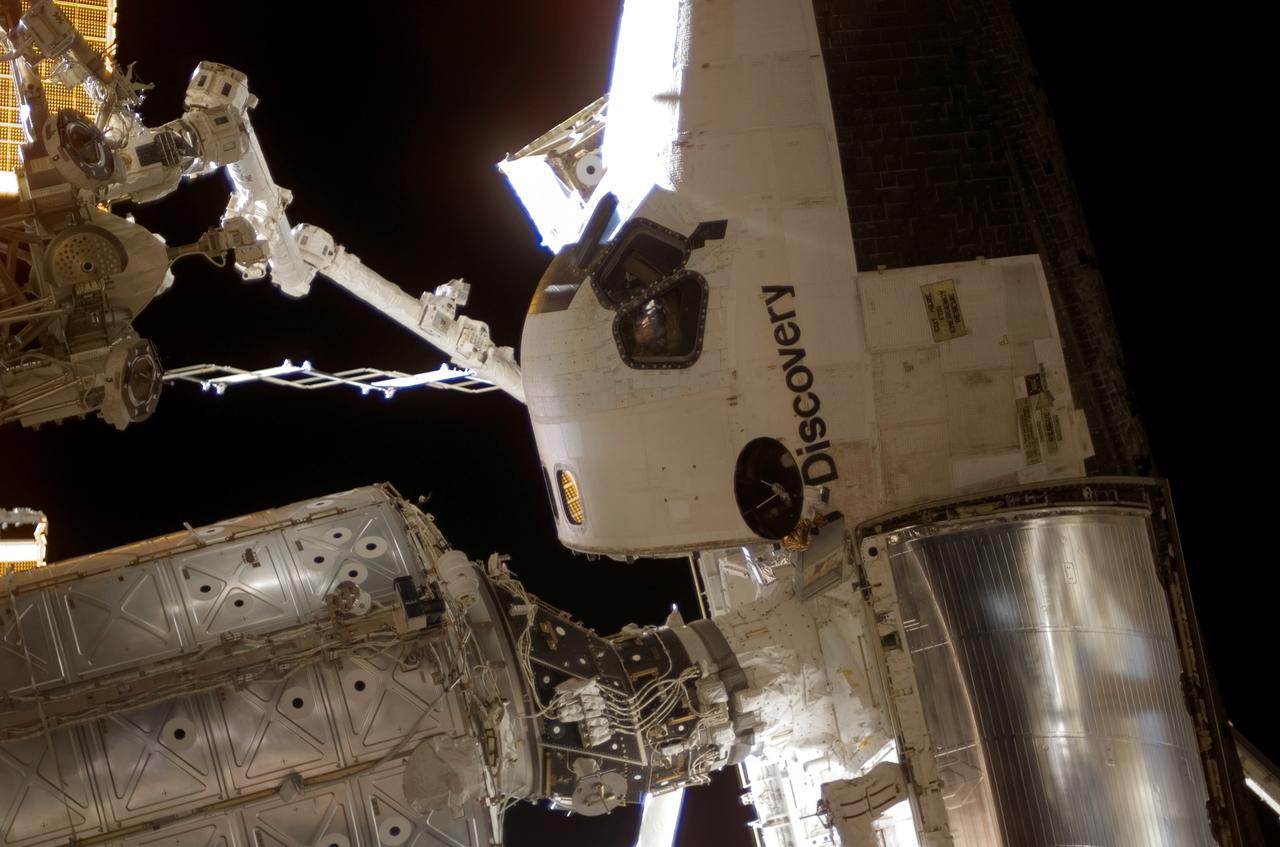
Space Shuttle Discovery, docked to the Pressurized Mating Adapter (PMA-2) on the International Space Station (ISS), is featured in this image photographed by a space walker during the second session of extravehicular activity (EVA) for the STS-120 mission on October 28, 2007.
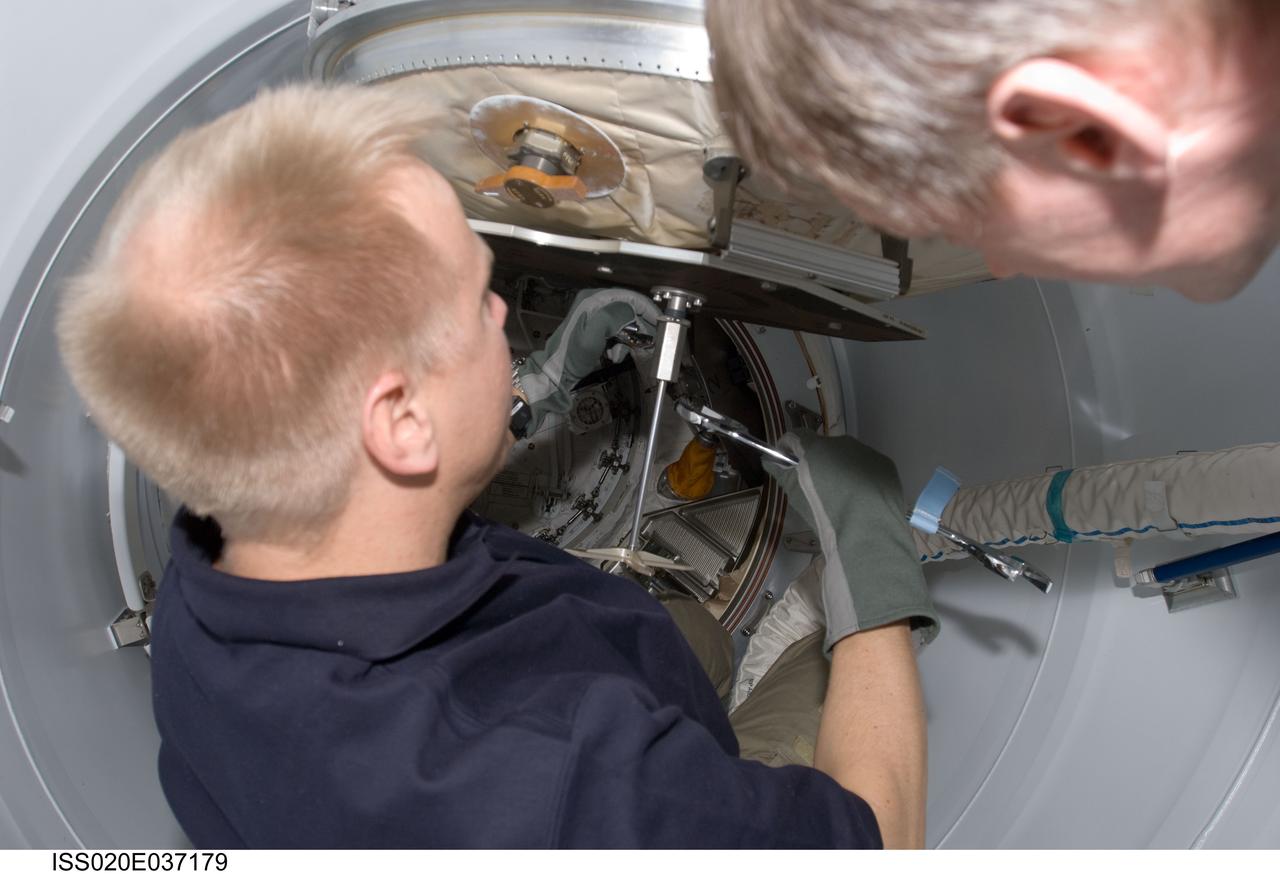
ISS020-E-037179 (30 Aug. 2009) --- NASA astronaut Tim Kopra (left) and European Space Agency astronaut Frank De Winne, both Expedition 20 flight engineers, work in the Pressurized Mating Adapter 2 (PMA-2) of the International Space Station while Space Shuttle Discovery (STS-128) remains docked with the station.
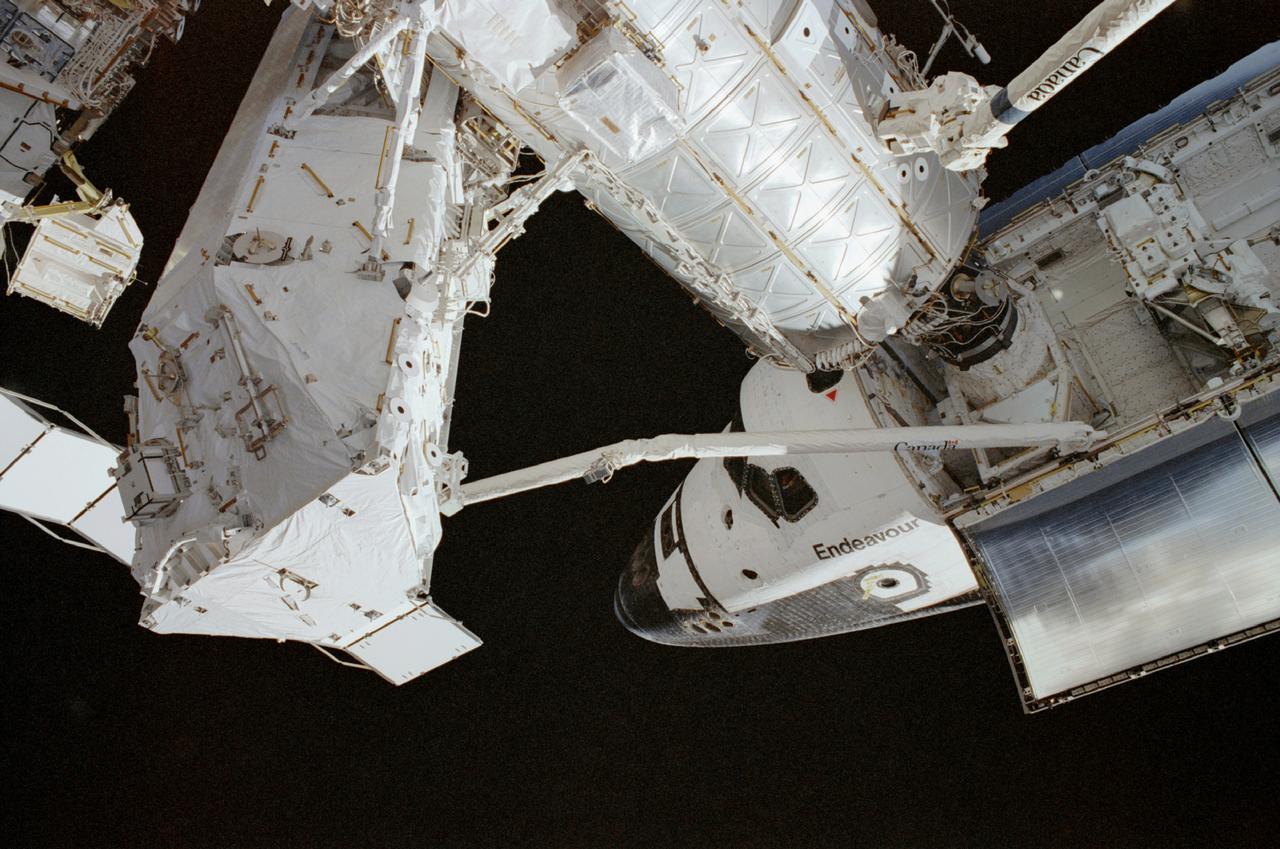
The STS-111 mission, the 14th Shuttle mission to visit the International Space Station (ISS), was launched on June 5, 2002 aboard the Space Shuttle Orbiter Endeavour. On board were the STS-111 and Expedition Five crew members. Astronauts Kerneth D. Cockrell, commander; Paul S. Lockhart, pilot, and mission specialists Franklin R. Chang-Diaz and Philippe Perrin were the STS-111 crew members. Expedition Five crew members included Cosmonaut Valeri G. Korzun, commander, Astronaut Peggy A. Whitson and Cosmonaut Sergei Y. Treschev, flight engineers. Three space walks enabled the STS-111 crew to accomplish mission objectives: The delivery and installation of the Mobile Remote Servicer Base System (MBS), an important part of the Station's Mobile Servicing System that allows the robotic arm to travel the length of the Station, which is necessary for future construction tasks; the replacement of a wrist roll joint on the Station's robotic arm; and the task of unloading supplies and science experiments from the Leonardo multipurpose Logistics Module, which made its third trip to the orbital outpost. In this photograph, the Space Shuttle Endeavour, back dropped by the blackness of space, is docked to the pressurized Mating Adapter (PMA-2) at the forward end of the Destiny Laboratory on the ISS. Endeavour's robotic arm is in full view as it is stretched out with the S0 (S-zero) Truss at its end.
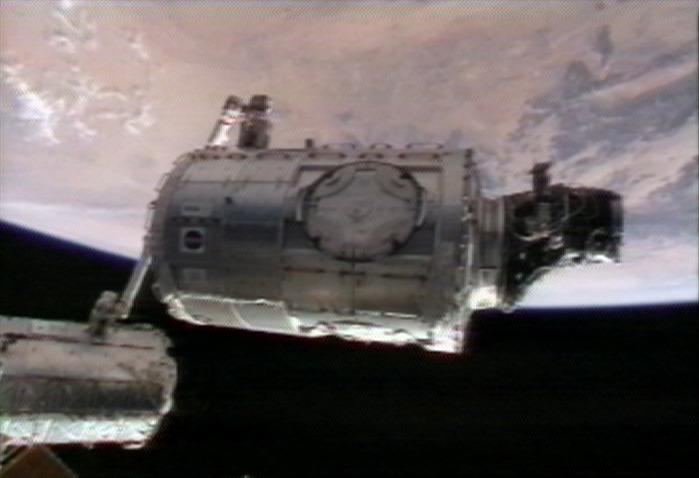
ISS016-E-011442 (14 Nov. 2007) --- In the grasp of the International Space Station's Canadarm2, the Harmony node with the Pressurized Mating Adapter (PMA-2) attached is moved from its temporary location on the left side of the Unity node to its new home on the front of the Destiny laboratory. Astronaut Daniel Tani, Expedition 16 flight engineer, operated the station's robotic arm from inside Destiny. The blackness of space and Earth's horizon provide the backdrop for the view, which was taken from NASA television.
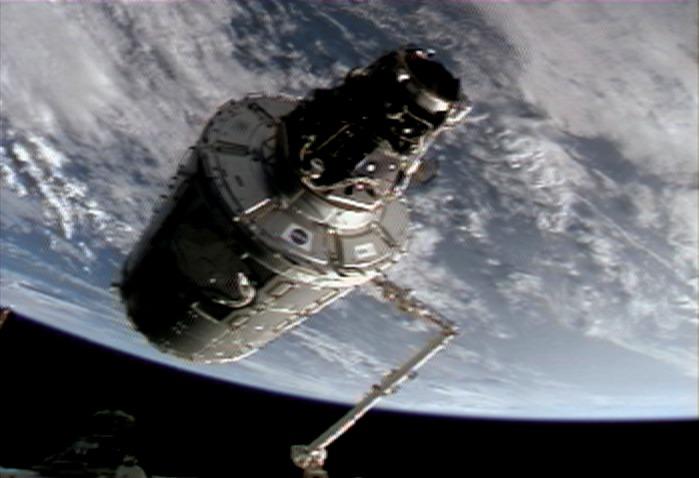
ISS016-E-011441 (14 Nov. 2007) --- In the grasp of the International Space Station's Canadarm2, the Harmony node with the Pressurized Mating Adapter (PMA-2) attached is moved from its temporary location on the left side of the Unity node to its new home on the front of the Destiny laboratory. Astronaut Daniel Tani, Expedition 16 flight engineer, operated the station's robotic arm from inside Destiny. The blackness of space and Earth's horizon provide the backdrop for the view, which was taken from NASA television.
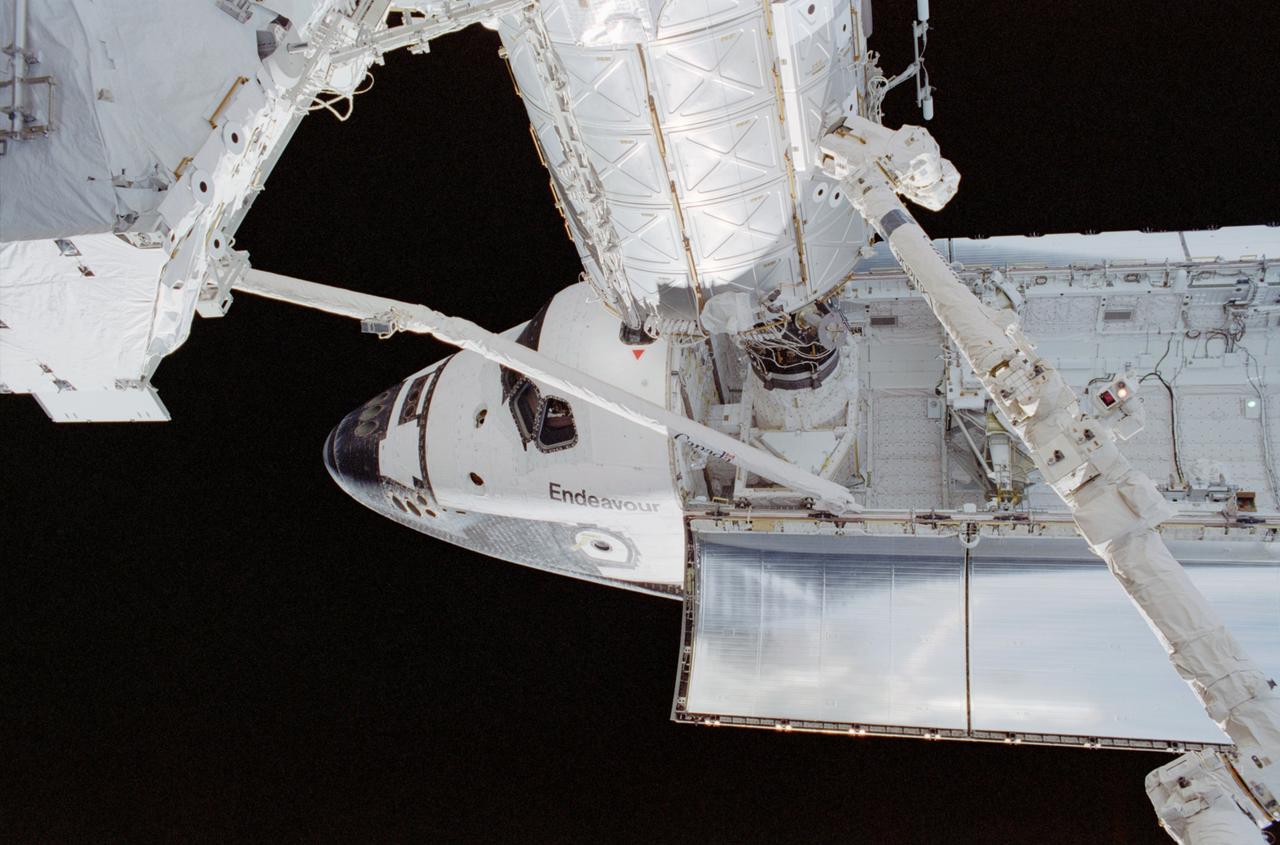
The STS-111 mission, the 14th Shuttle mission to visit the International Space Station (ISS), was launched on June 5, 2002 aboard the Space Shuttle Orbiter Endeavour. On board were the STS-111 and Expedition Five crew members. Astronauts Kerneth D. Cockrell, commander; Paul S. Lockhart, pilot, and mission specialists Franklin R. Chang-Diaz and Philippe Perrin were the STS-111 crew members. Expedition Five crew members included Cosmonaut Valeri G. Korzun, commander, Astronaut Peggy A. Whitson and Cosmonaut Sergei Y. Treschev, flight engineers. Three space walks enabled the STS-111 crew to accomplish the delivery and installation of the Mobile Remote Servicer Base System (MBS), an important part of the Station's Mobile Servicing System that allows the robotic arm to travel the length of the Station, which is necessary for future construction tasks; the replacement of a wrist roll joint on the Station's robotic arm; and the task of unloading supplies and science experiments from the Leonardo multipurpose Logistics Module, which made its third trip to the orbital outpost. In this photograph, the Space Shuttle Endeavour, back dropped by the blackness of space, is docked to the pressurized Mating Adapter (PMA-2) at the forward end of the Destiny Laboratory on the ISS. A portion of the Canadarm2 is visible on the right and Endeavour's robotic arm is in full view as it is stretched out with the S0 (S-zero) Truss at its end.
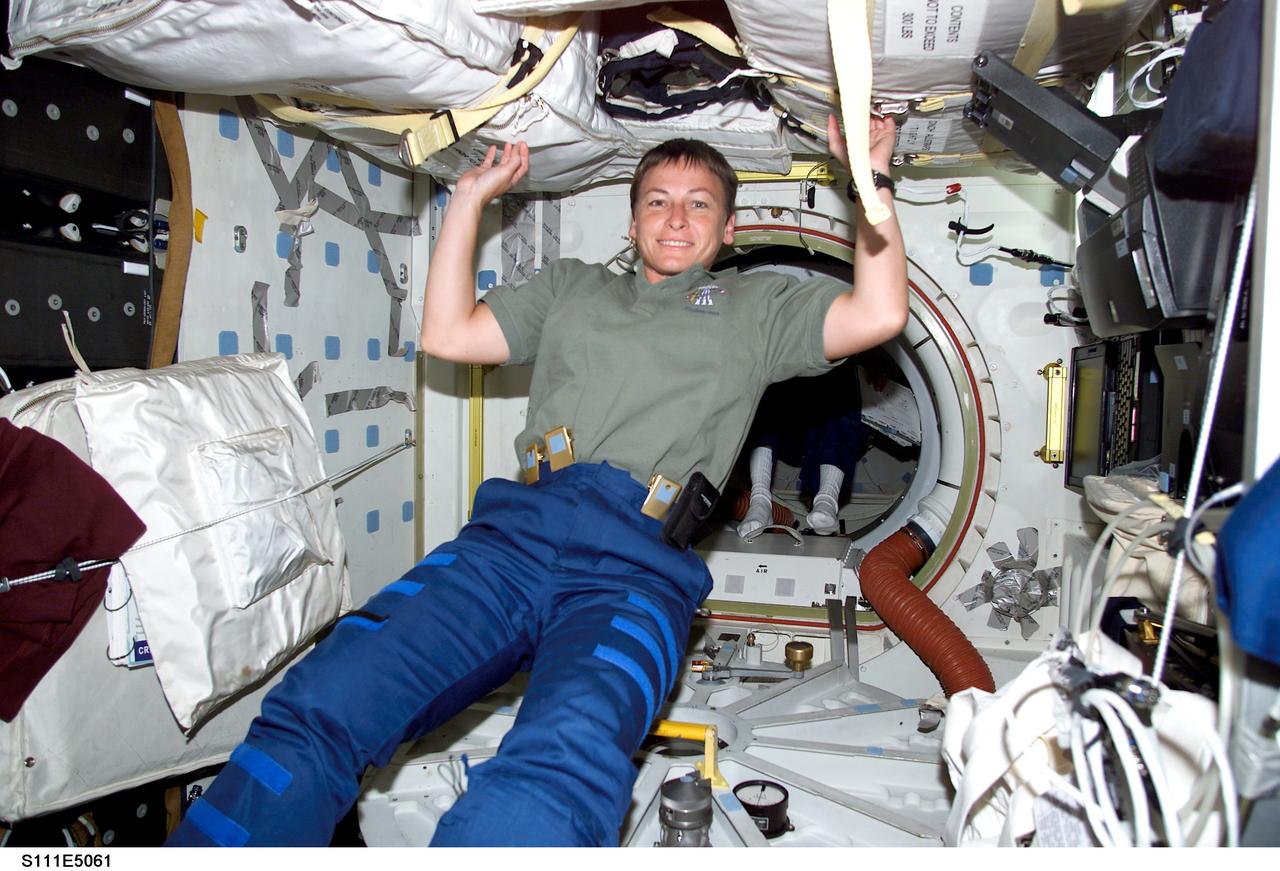
STS111-E-5061 (7 June 2002) --- Astronaut Peggy A. Whitson is pictured as she passes into the Pressurized Mating Adapter (PMA-2) on board the International Space Station (ISS). She is beginning this week to serve a lengthy tour of duty as flight engineer for the fifth crew to live and work aboard the orbiting outpost.
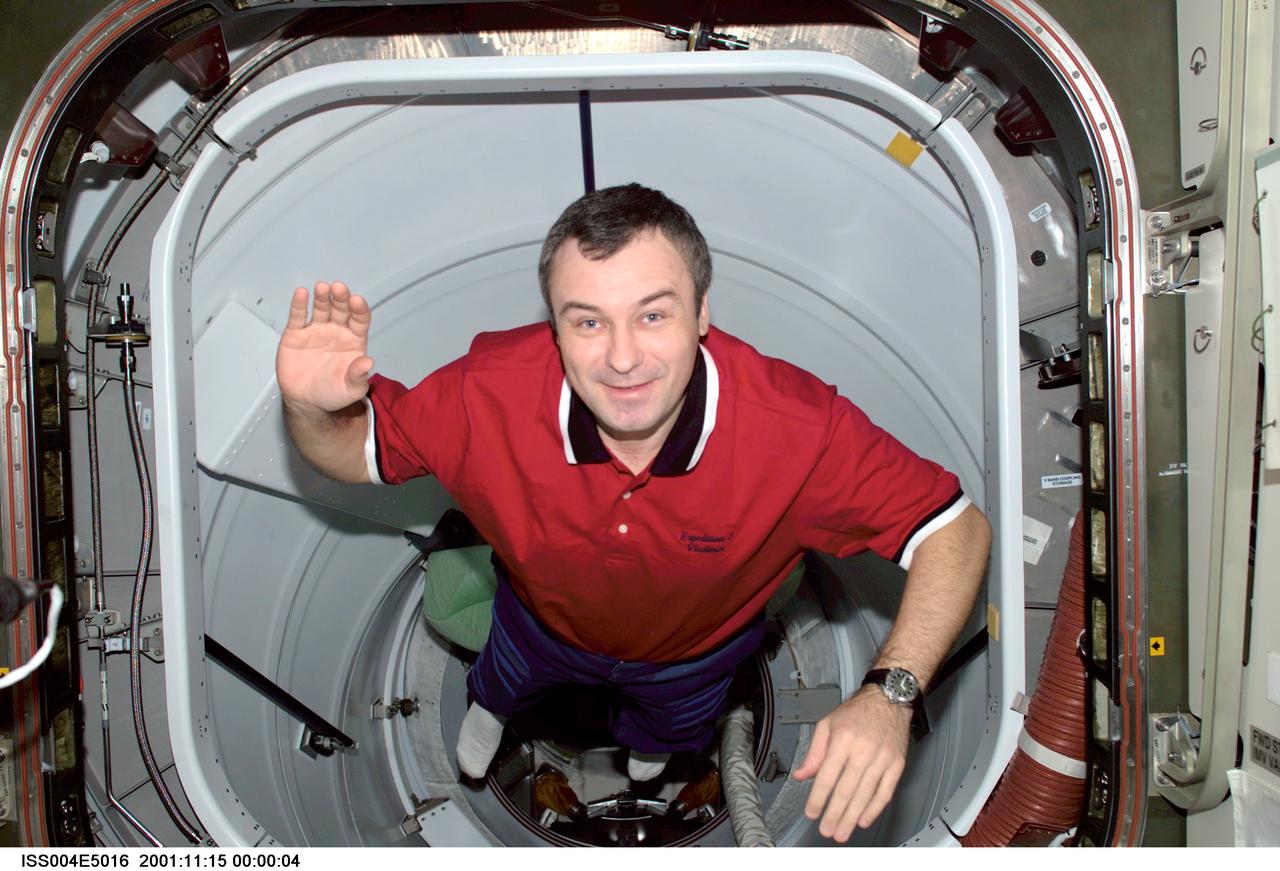
ISS004-E-5016 (December 2001) --- Cosmonaut Vladimir N. Dezhurov, Expedition Three flight engineer, floats through the Pressurized Mating Adapter 2 (PMA-2) on the International Space Station (ISS). A crewmate in the Destiny laboratory captured the image on a digital still camera.
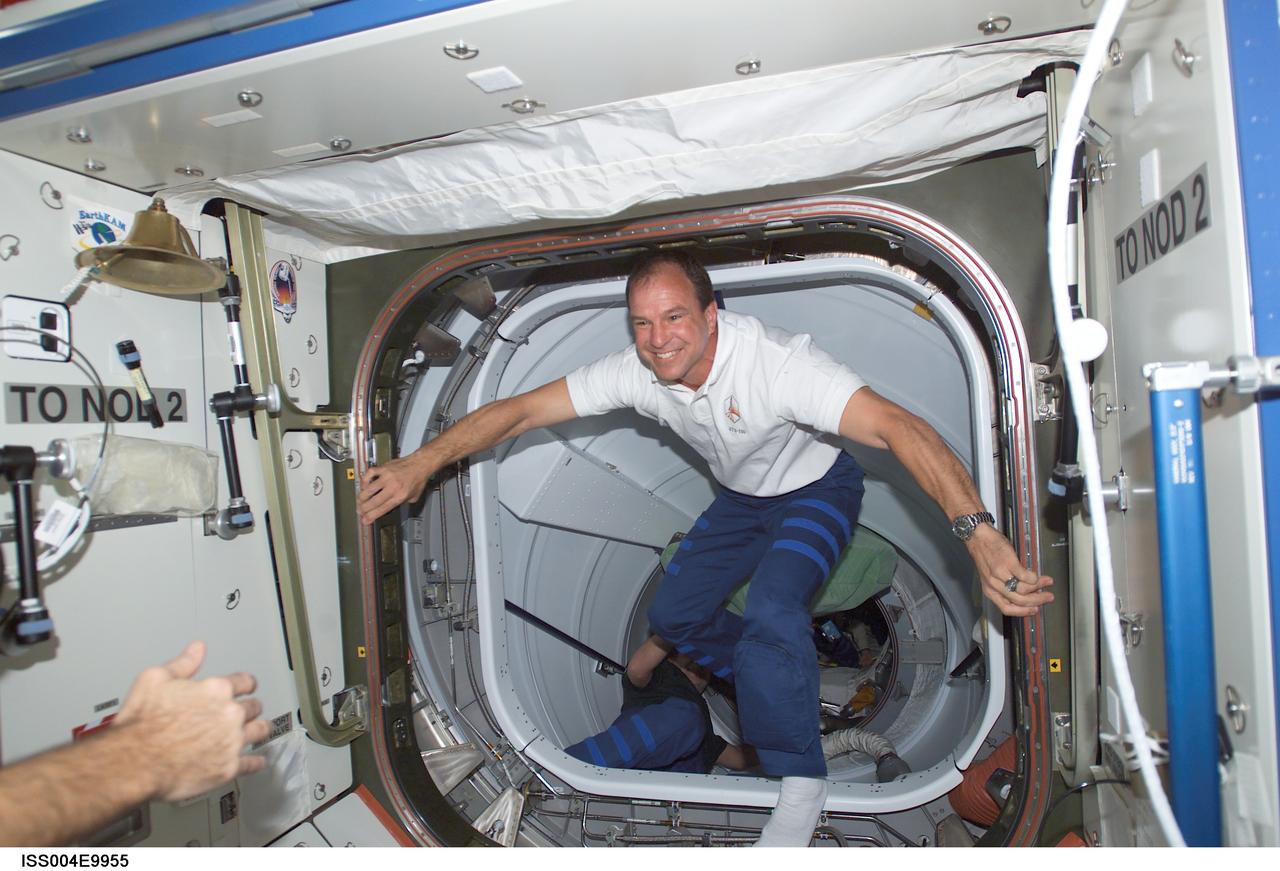
ISS004-E-9955 (10 April 2002) --- Astronaut Michael J. Bloomfield, STS-110 mission commander, steps into the Destiny laboratory on the International Space Station (ISS) through the Pressurized Mating Adapter 2 (PMA-2) upon docking of the Space Shuttle Atlantis and the station.
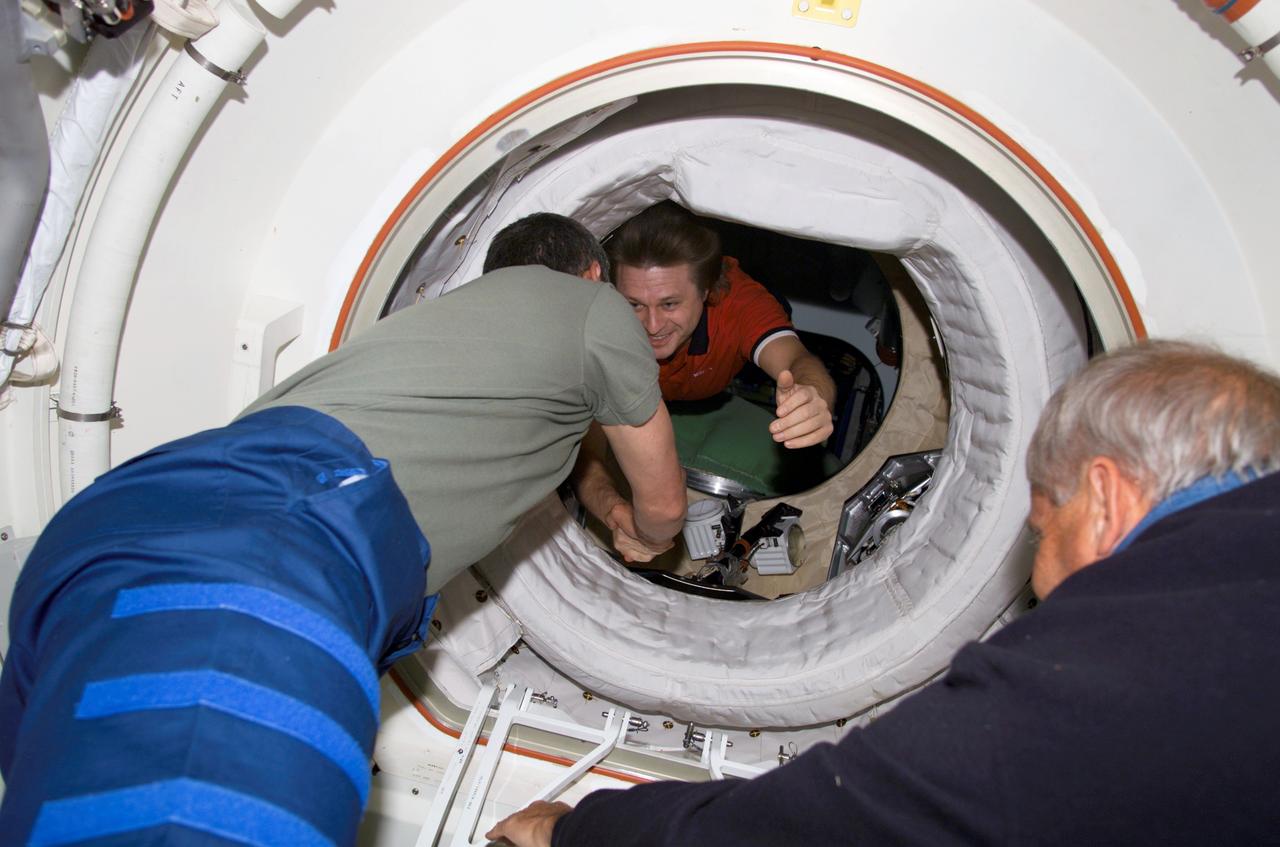
STS111-E-5095 (7 June 2002) --- Cosmonaut Yury I. Onufrienko, Expedition Four mission commander, greets cosmonaut Valery G. Korzun (back to camera), Expedition Five mission commander, when the hatch to the Pressurized Mating Adapter 2 (PMA-2) on the International Space Station (ISS) was opened for the STS-111 ingress. Astronaut Kenneth D. Cockrell, STS-111 mission commander, is partially visible on the right of Korzun. Onufrienko and Korzun represent Rosaviakosmos.
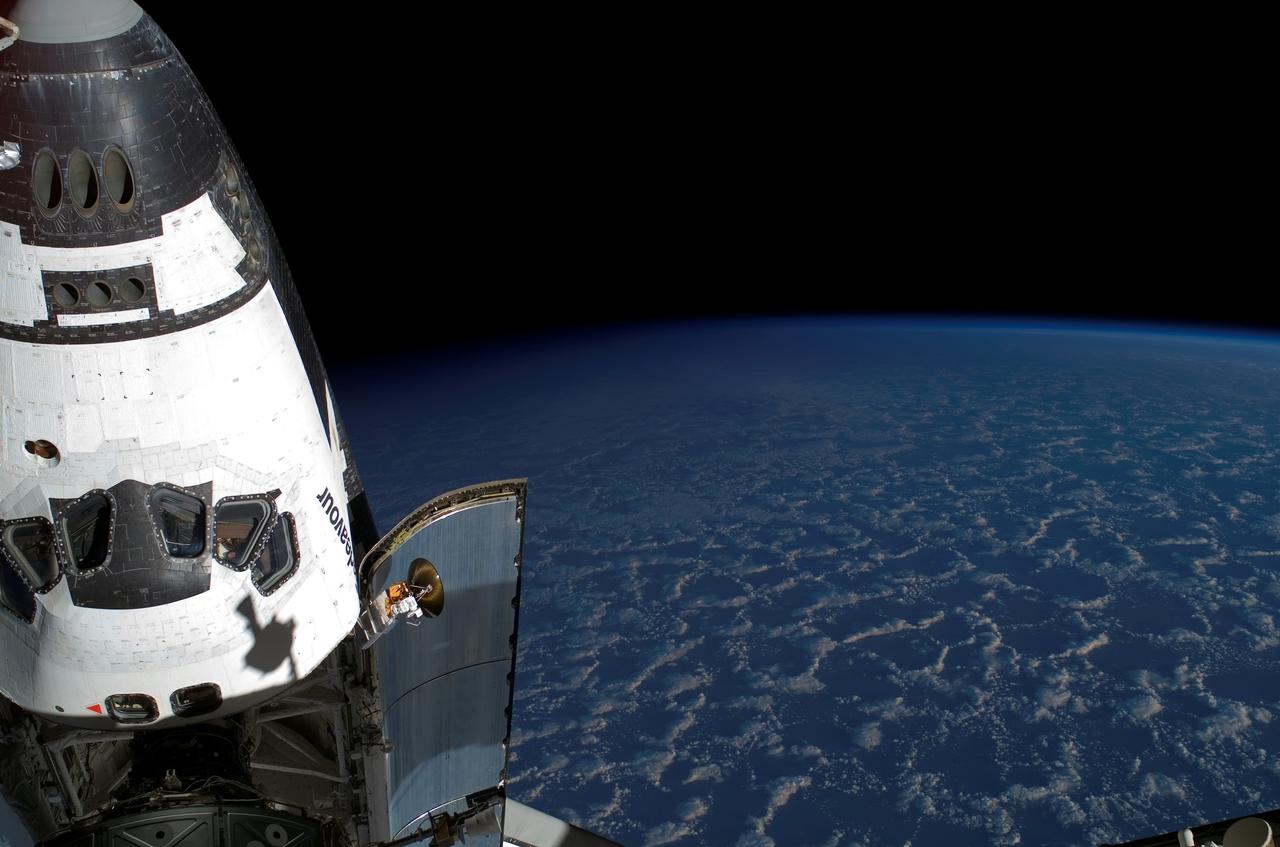
ISS015-E-21944 (11 Aug. 2007) --- Backdropped by the blackness of space and Earth's horizon, the Space Shuttle Endeavour, docked to the Pressurized Mating Adapter (PMA-2) on the International Space Station, is featured in this photograph taken by a crewmember during the mission's first planned session of extravehicular activity (EVA).
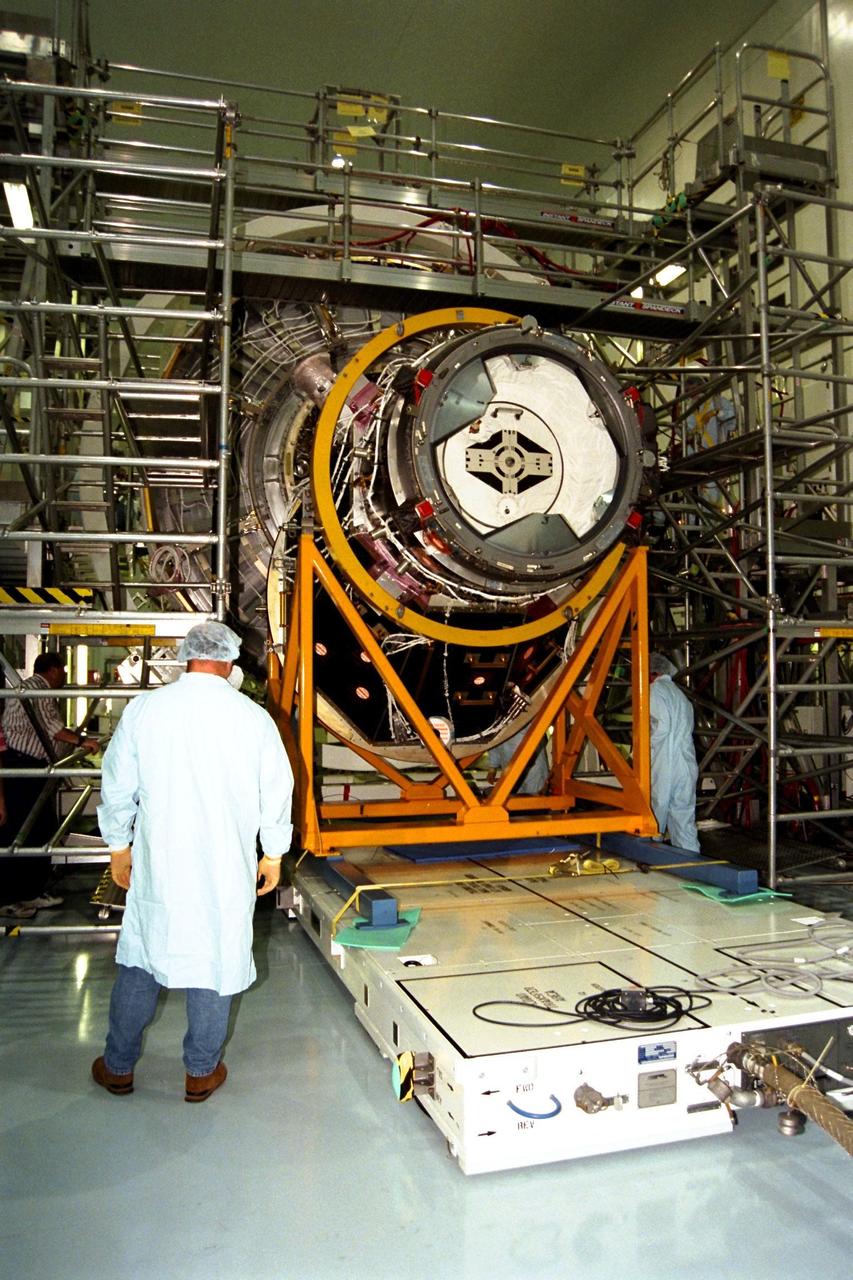
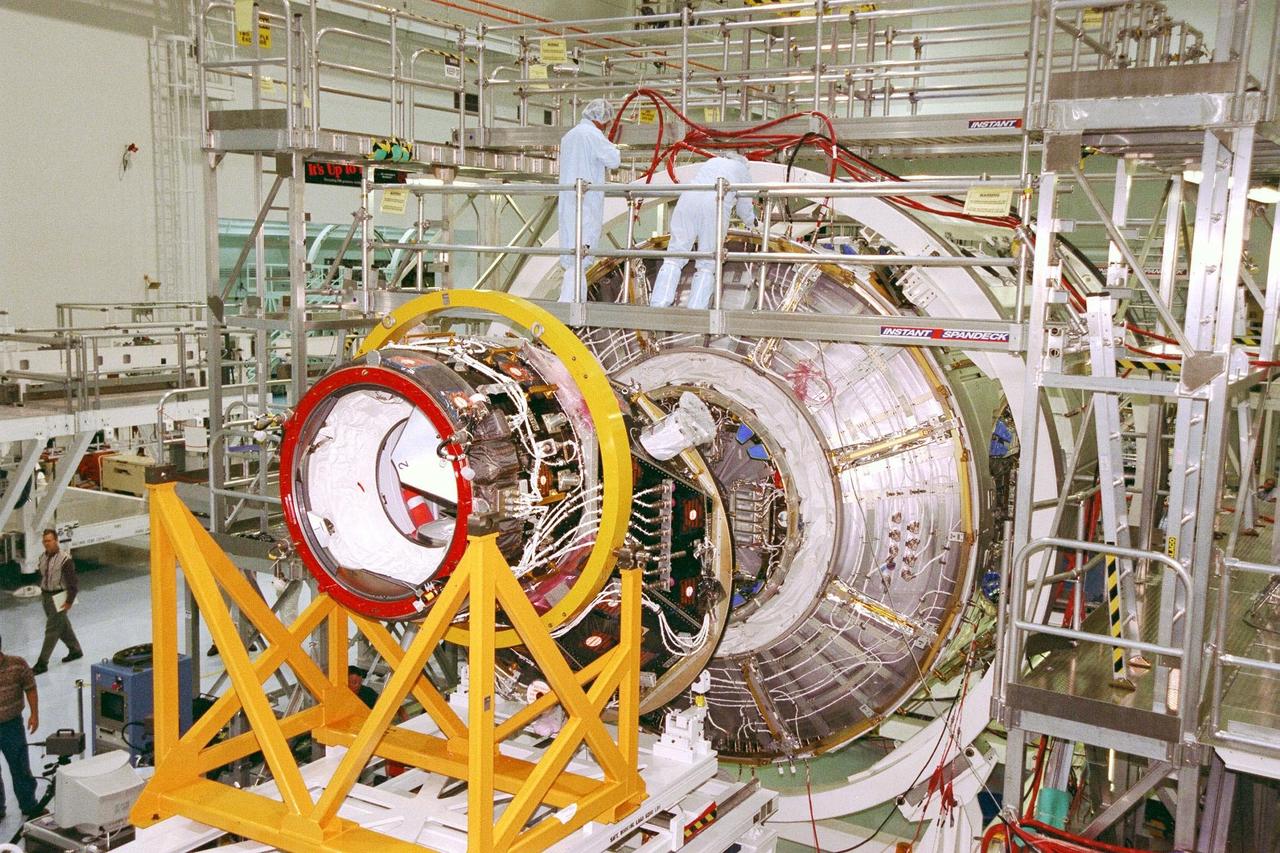
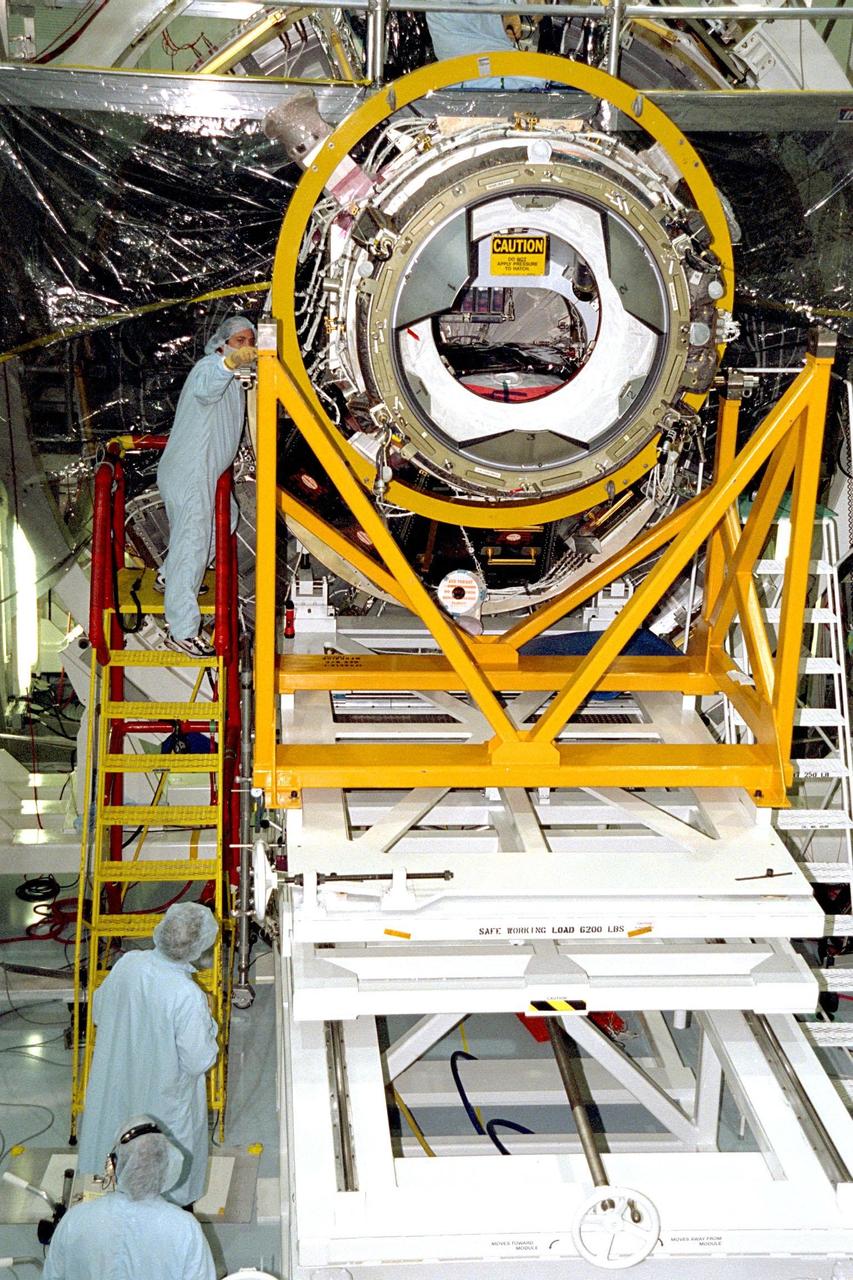
KENNEDY SPACE CENTER, FLA. -- The Pressurized Mating Adapter (PMA)-2, seen here in its yellow workstand, is moved on an air pallet toward Node 1, the International Space Station’s (ISS's) structural building block, in KSC’s Space Station Processing Facility. This PMA is a cone-shaped connector to Node 1, which will have two PMAs attached once PMA-2 is mated with the node. Node 1 can be seen directly behind PMA-2. The node and PMAs, which together will make up the first element of the ISS, are scheduled to be launched aboard the Space Shuttle Endeavour on STS-88.

KENNEDY SPACE CENTER, FLA. -- The Pressurized Mating Adapter (PMA)-2 for the International Space Station (ISS) is moved on an air pallet toward Node 1, the space station’s structural building block, in KSC’s Space Station Processing Facility. This PMA is a cone-shaped connector to Node 1, which will have two PMAs attached once PMA-2 is mated with the node. The node and PMAs, which together will make up the first element of the ISS, are scheduled to be launched aboard the Space Shuttle Endeavour on STS-88
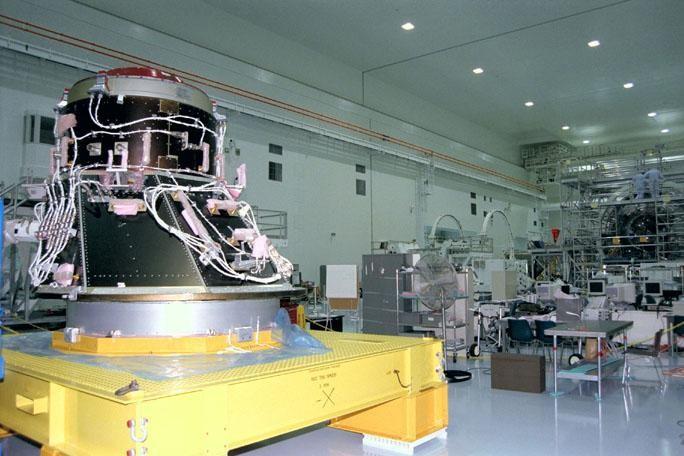
KENNEDY SPACE CENTER, FLA. -- The Pressurized Mating Adapter 2 (PMA 2), at left, part of the first International Space Station (ISS) element to be launched from the U.S., awaits prelaunch processing in the Space Station Processing Facility after its arrival at KSC. PMAs 1 and 2 attached to a component called Node 1, shown in background at far right, to form the first U.S.-launched ISS element. The Node 1/PMA assembly will provide key connecting points in orbit for other Space Station modules and for docking of the orbiter with the ISS. PMA 1 will provide the interface between U.S. and Russian elements of the Station; PMA 2 will provide a Shuttle orbiter docking area. The Node 1/PMA assembly is targeted for liftoff aboard the Space Shuttle Endeavour on STS-88 in July 1998.
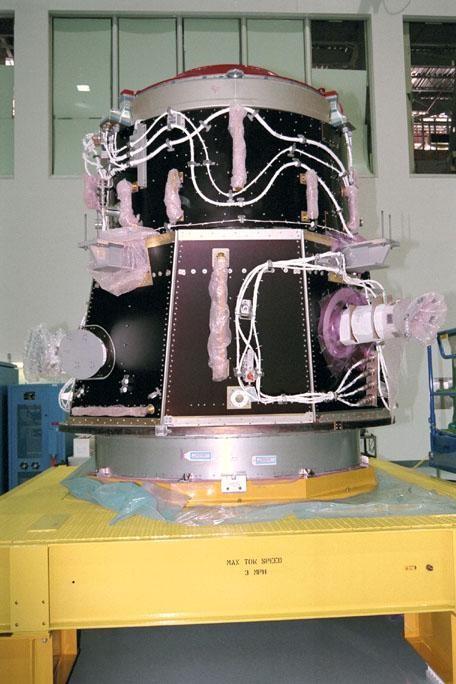
KENNEDY SPACE CENTER, FLA. -- The Pressurized Mating Adapter 2 (PMA 2), part of the first International Space Station (ISS) element to be launched from the U.S., awaits prelaunch processing in the Space Station Processing Facility after its arrival at KSC. PMAs 1 and 2 attached to a component called Node 1, a Station structural building block, will make up the first U.S.-launched ISS element. The Node 1/PMA assembly will provide key connecting points in orbit for other Space Station modules and for docking of the orbiter with the ISS. PMA 1 will provide the interface between U.S. and Russian elements of the Station; PMA 2 will provide a Shuttle orbiter docking area. The Node 1/PMA assembly is targeted for liftoff aboard the Space Shuttle Endeavour on STS-88 in July 1998.
![KENNEDY SPACE CENTER, FLA. -- Technicians prepare to join the Pressurized Mating Adapter (PMA)-2, seen here in its yellow workstand at right, to Node 1 (the International Space Station’s [ISS] structural building block) in KSC’s Space Station Processing Facility. This PMA is a cone-shaped connector to Node 1, which will have two PMAs attached once PMA-2 is mated with the node. The node and PMAs, which together will make up the first element of the ISS, are scheduled to be launched aboard the Space Shuttle Endeavour on STS-88.](https://images-assets.nasa.gov/image/KSC-98pc297/KSC-98pc297~medium.jpg)
KENNEDY SPACE CENTER, FLA. -- Technicians prepare to join the Pressurized Mating Adapter (PMA)-2, seen here in its yellow workstand at right, to Node 1 (the International Space Station’s [ISS] structural building block) in KSC’s Space Station Processing Facility. This PMA is a cone-shaped connector to Node 1, which will have two PMAs attached once PMA-2 is mated with the node. The node and PMAs, which together will make up the first element of the ISS, are scheduled to be launched aboard the Space Shuttle Endeavour on STS-88.
![KENNEDY SPACE CENTER, FLA. -- Technicians and workers observe preparations to join the Pressurized Mating Adapter (PMA)-2, seen here in its yellow workstand at right, to Node 1 (the International Space Station’s [ISS] structural building block) in KSC’s Space Station Processing Facility. This PMA is a cone-shaped connector to Node 1, which will have two PMAs attached once PMA-2 is mated with the node. The node (surrounded here by scaffolding) and PMAs, which together will make up the first element of the ISS, are scheduled to be launched aboard the Space Shuttle Endeavour on STS-88](https://images-assets.nasa.gov/image/KSC-98pc298/KSC-98pc298~medium.jpg)
KENNEDY SPACE CENTER, FLA. -- Technicians and workers observe preparations to join the Pressurized Mating Adapter (PMA)-2, seen here in its yellow workstand at right, to Node 1 (the International Space Station’s [ISS] structural building block) in KSC’s Space Station Processing Facility. This PMA is a cone-shaped connector to Node 1, which will have two PMAs attached once PMA-2 is mated with the node. The node (surrounded here by scaffolding) and PMAs, which together will make up the first element of the ISS, are scheduled to be launched aboard the Space Shuttle Endeavour on STS-88
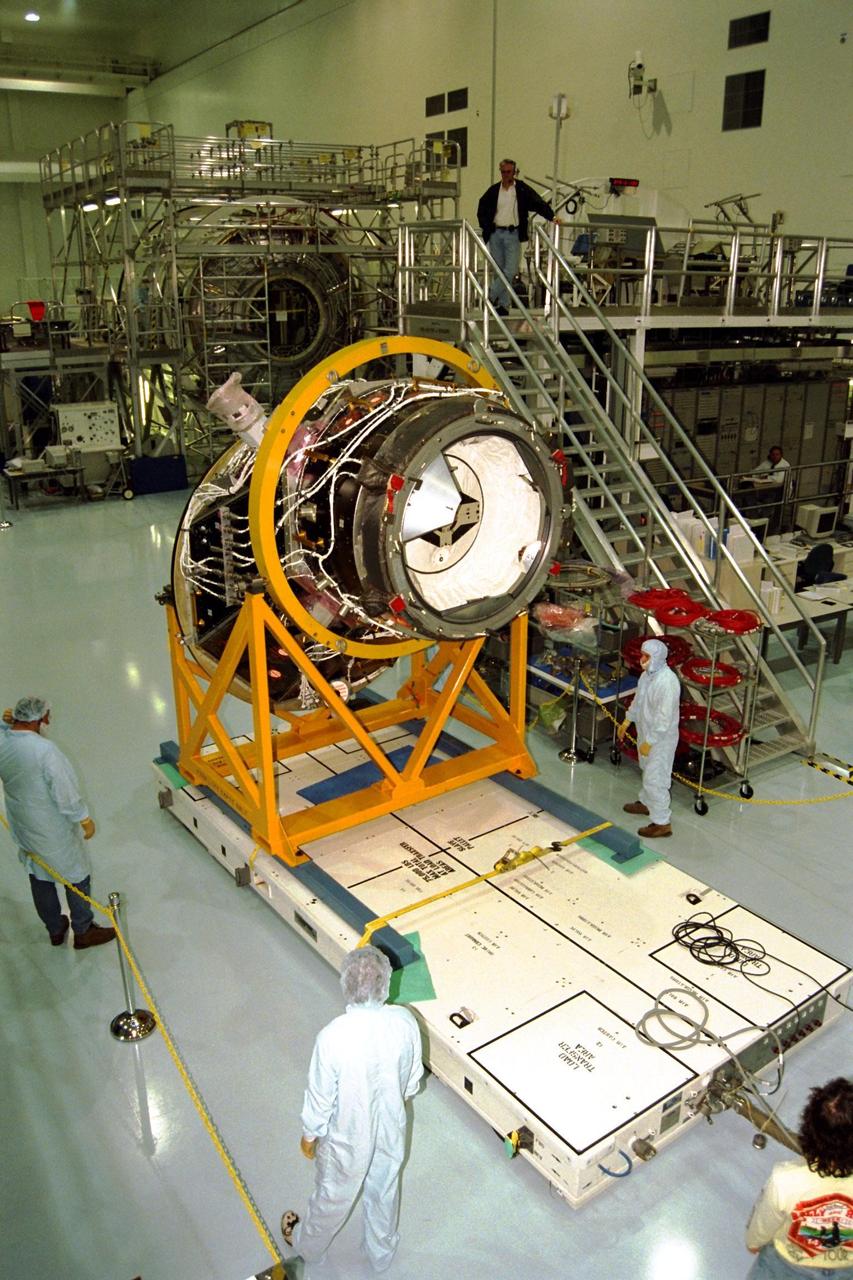
KENNEDY SPACE CENTER, FLA. -- The Pressurized Mating Adapter (PMA)-2 for the International Space Station (ISS), seen here in its yellow workstand, is moved on an air pallet toward Node 1, the space station’s structural building block, in KSC’s Space Station Processing Facility. This PMA is a cone-shaped connector to Node 1, which will have two PMAs attached once PMA-2 is mated with the node. The node and PMAs, which together will make up the first element of the ISS, are scheduled to be launched aboard the Space Shuttle Endeavour on STS-88
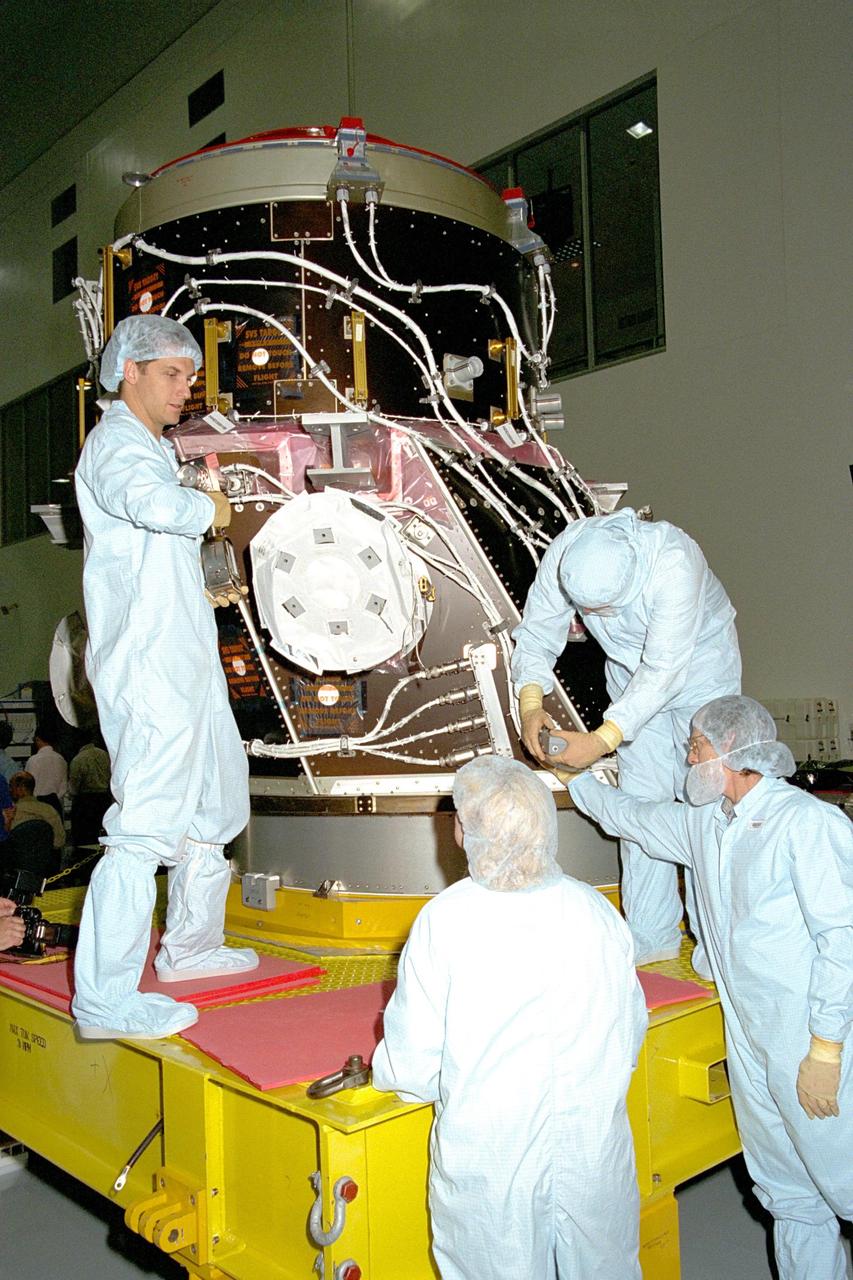
KENNEDY SPACE CENTER, FLA. -- The Pressurized Mating Adapter-2 (PMA-2) is processed in KSC's Space Station Processing Facility. This PMA is a cone-shaped connector to Node 1, the space station's structural building block. The node and two PMAs will together make up the first U.S. element of the ISS and are scheduled to be launched aboard the Space Shuttle Endeavour on STS-88.
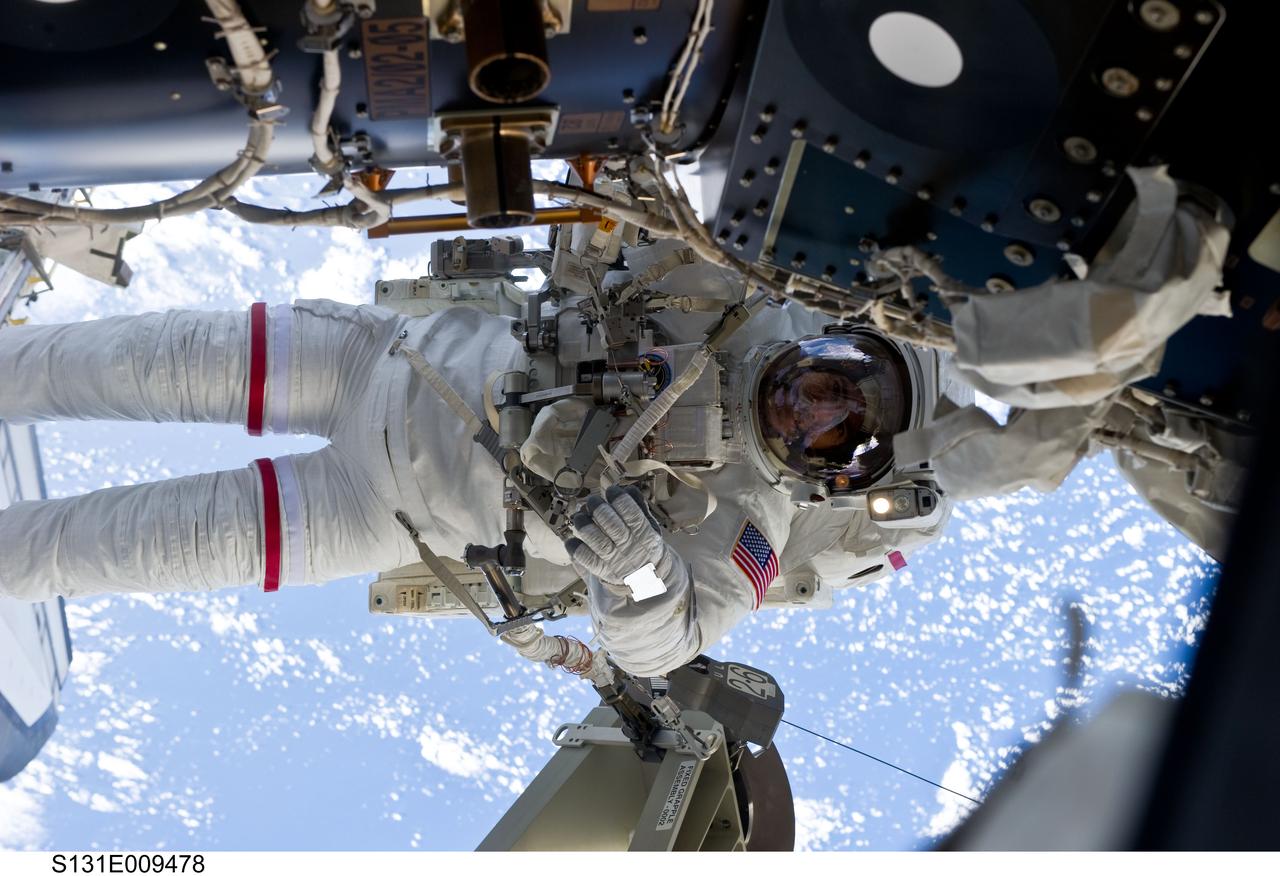
S131-E-009478 (13 April 2010) --- NASA astronaut Rick Mastracchio, STS-131 mission specialist, participates in the mission's third and final session of extravehicular activity (EVA) as construction and maintenance continue on the International Space Station. During the six-hour, 24-minute spacewalk, Mastracchio and astronaut Clayton Anderson (out of frame), mission specialist, hooked up fluid lines of the new 1,700-pound tank, retrieved some micrometeoroid shields from the Quest airlock’s exterior, relocated a portable foot restraint and prepared cables on the Zenith 1 truss for a spare Space to Ground Ku-Band antenna, two chores required before space shuttle Atlantis' STS-132/ULF-4 mission in May.
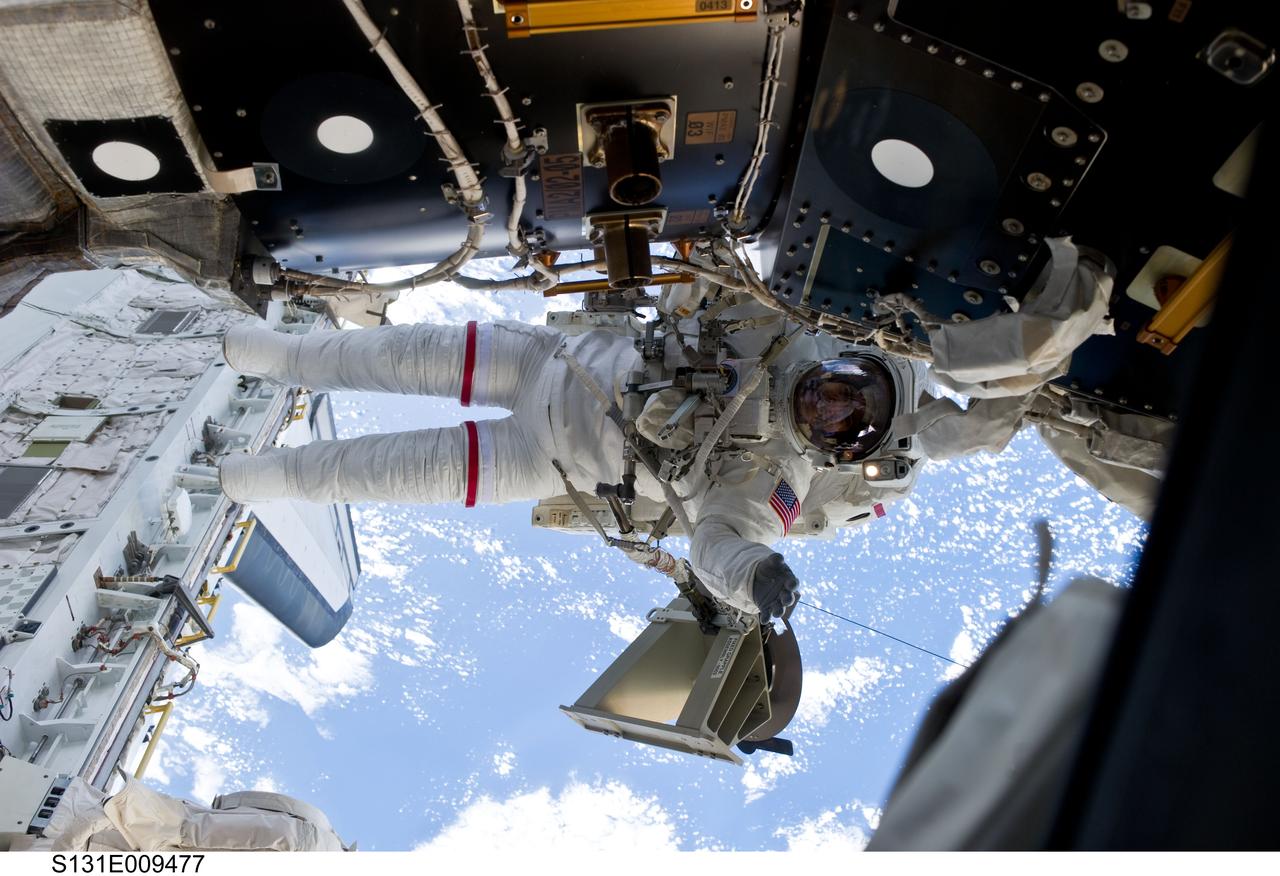
S131-E-009477 (13 April 2010) --- NASA astronaut Rick Mastracchio, STS-131 mission specialist, participates in the mission's third and final session of extravehicular activity (EVA) as construction and maintenance continue on the International Space Station. During the six-hour, 24-minute spacewalk, Mastracchio and astronaut Clayton Anderson (out of frame), mission specialist, hooked up fluid lines of the new 1,700-pound tank, retrieved some micrometeoroid shields from the Quest airlock’s exterior, relocated a portable foot restraint and prepared cables on the Zenith 1 truss for a spare Space to Ground Ku-Band antenna, two chores required before space shuttle Atlantis' STS-132/ULF-4 mission in May.

ISS011-E-11287 (28 July 2005) --- Onboard the International Space Station, cosmonaut Sergei Krikalev, Russia Federal Space Agency representative and commander of Expedition 11, opens a hatch in the tunnel leading to the Space Shuttle Discovery. The seven-member Shuttle crew was only moments away from joining its hosts on the orbital outpost. The two crews are scheduled to share several days of joint activities in space.
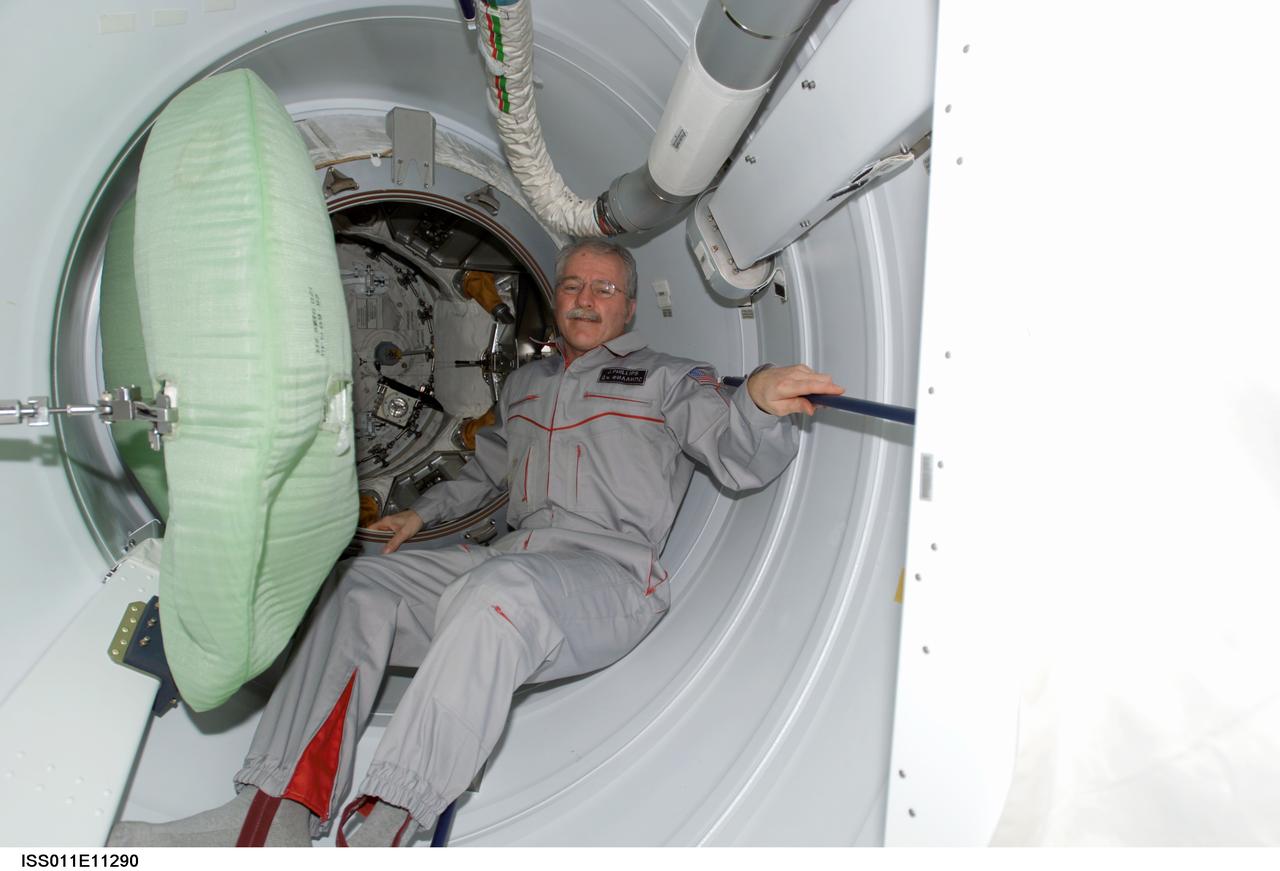
ISS011-E-11290 (28 July 2005) --- Onboard the International Space Station, astronaut John L. Phillips, flight engineer and NASA Space Station Science Officer for Expedition 11, comes through a hatch in the tunnel leading to the Space Shuttle Discovery. The seven-member Shuttle crew was only moments away from joining its hosts on the orbital outpost. The two crews are scheduled to share several days of joint activities in space.
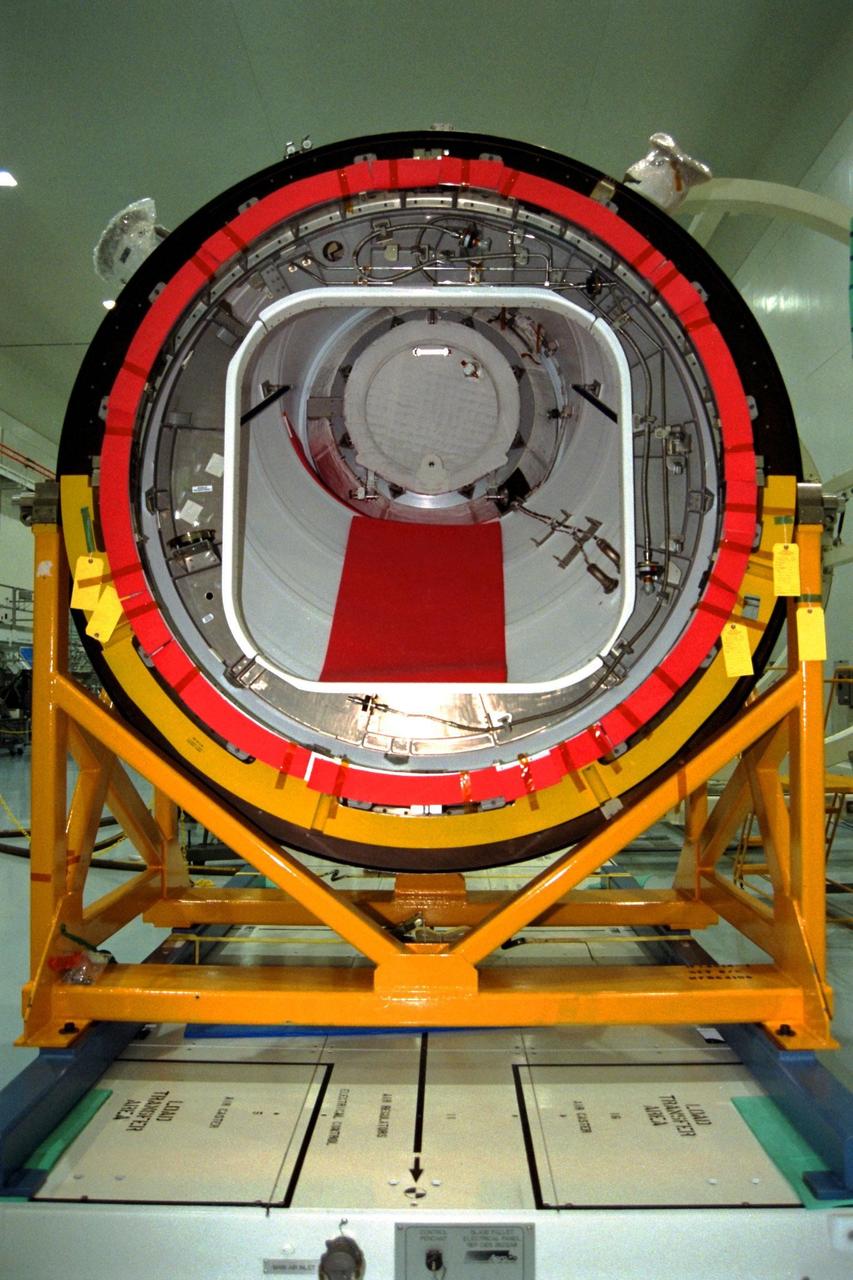
KENNEDY SPACE CENTER, FLA. -- The Pressurized Mating Adapter (PMA)-2 for the International Space Station (ISS) awaits being mated with Node 1, the space station’s structural building block, in KSC’s Space Station Processing Facility. This PMA, identifiable by its bright red ring, is a cone-shaped connector to Node 1, which will have two PMAs attached once this mate is completed. The node and PMAs, which together will make up the first element of the ISS, are scheduled to be launched aboard the Space Shuttle Endeavour on STS-88
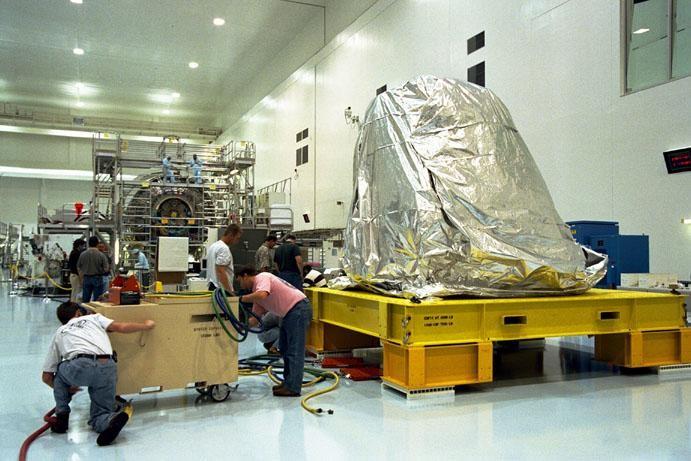
KENNEDY SPACE CENTER, FLA. -- PMA-2 is being moved from the airlock into the high bay. It is the payload on mission STS-88.
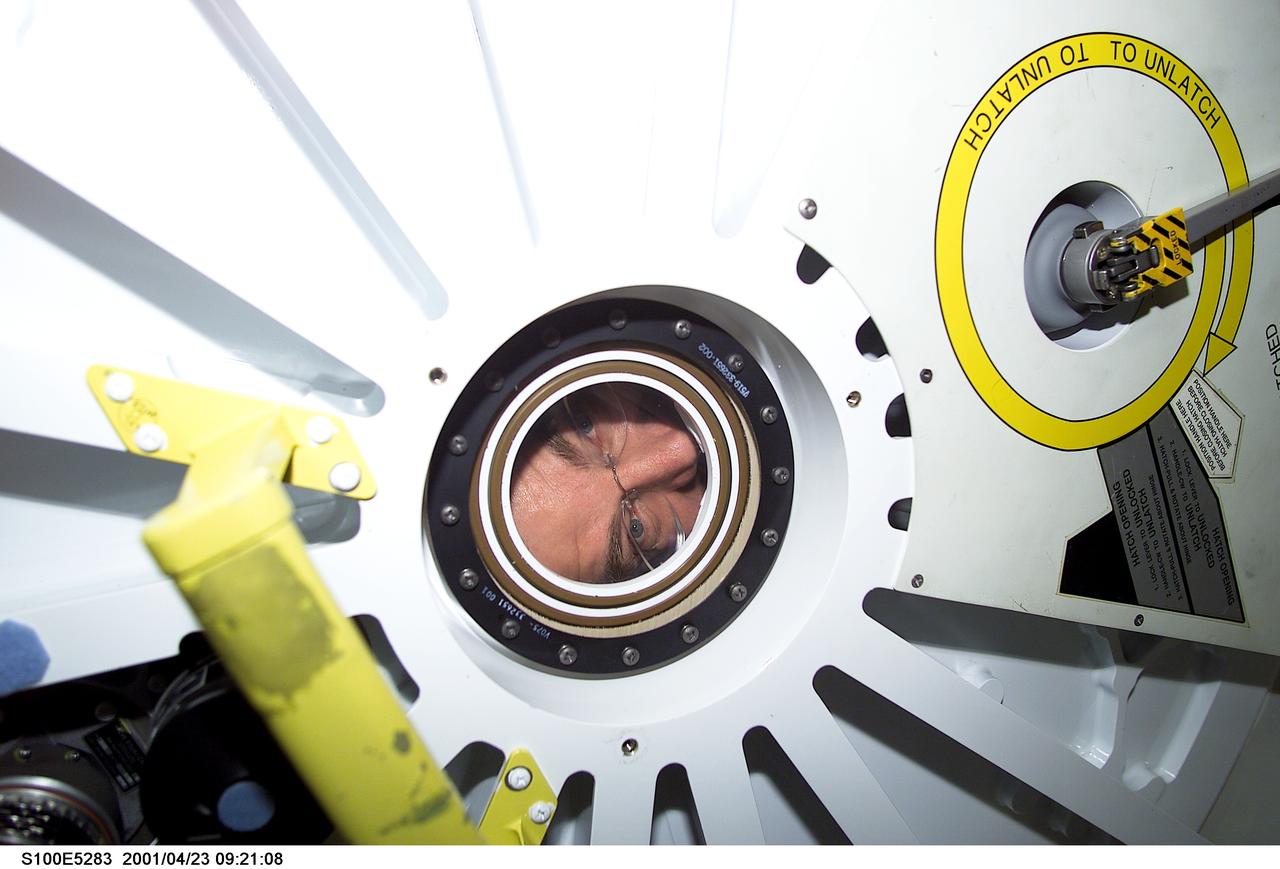
STS100-E-5283 (23 April 2001) --- Astronaut James S. Voss, Expedition Two flight engineer, peers into the Pressurized Mating Adapter (PMA-2) prior to hatch opening. The picture was taken with a digital still camera by one of the STS-100 crew members in the PMA. Photo credit: NASA

KENNEDY SPACE CENTER, FLA. -- Pressurized Mating Adapter (PMA)-2 is moved into position to be mated to Node 1 of the International Space Station (ISS) by Boeing technicians in KSC's Space Station Processing Facility (SSPF). The node is the first element of the ISS to be manufactured in the United States and is currently scheduled to lift off aboard the Space Shuttle Endeavour on STS-88 later this year, along with PMAs 1 and 2. This PMA is a cone-shaped connector to Node 1, which will have two PMAs attached once this mate is completed. Once in space, Node 1 will function as a connecting passageway to the living and working areas of the ISS. It has six hatches that will serve as docking ports to the U.S. laboratory module, U.S. habitation module, an airlock and other space station elements
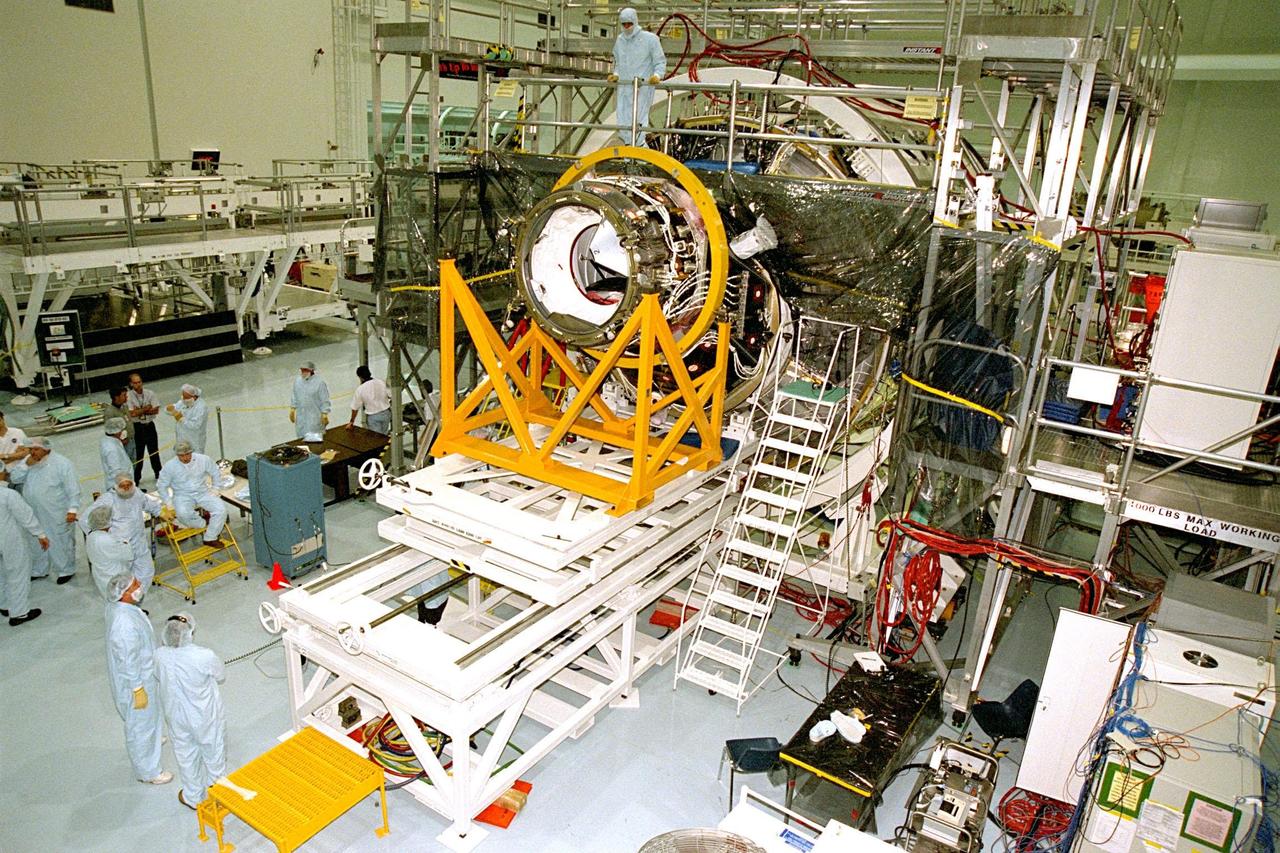
Pressurized Mating Adapter (PMA)-2 is in the process of being mated to Node 1 of the International Space Station (ISS) under the supervision of Boeing technicians in KSC's Space Station Processing Facility (SSPF). The node is the first element of the ISS to be manufactured in the United States and is currently scheduled to lift off aboard the Space Shuttle Endeavour on STS-88 later this year, along with PMAs 1 and 2. This PMA is a cone-shaped connector to Node 1, which will have two PMAs attached once this mate is completed. Once in space, Node 1 will function as a connecting passageway to the living and working areas of the ISS. It has six hatches that will serve as docking ports to the U.S. laboratory module, U.S. habitation module, an airlock and other space station elements
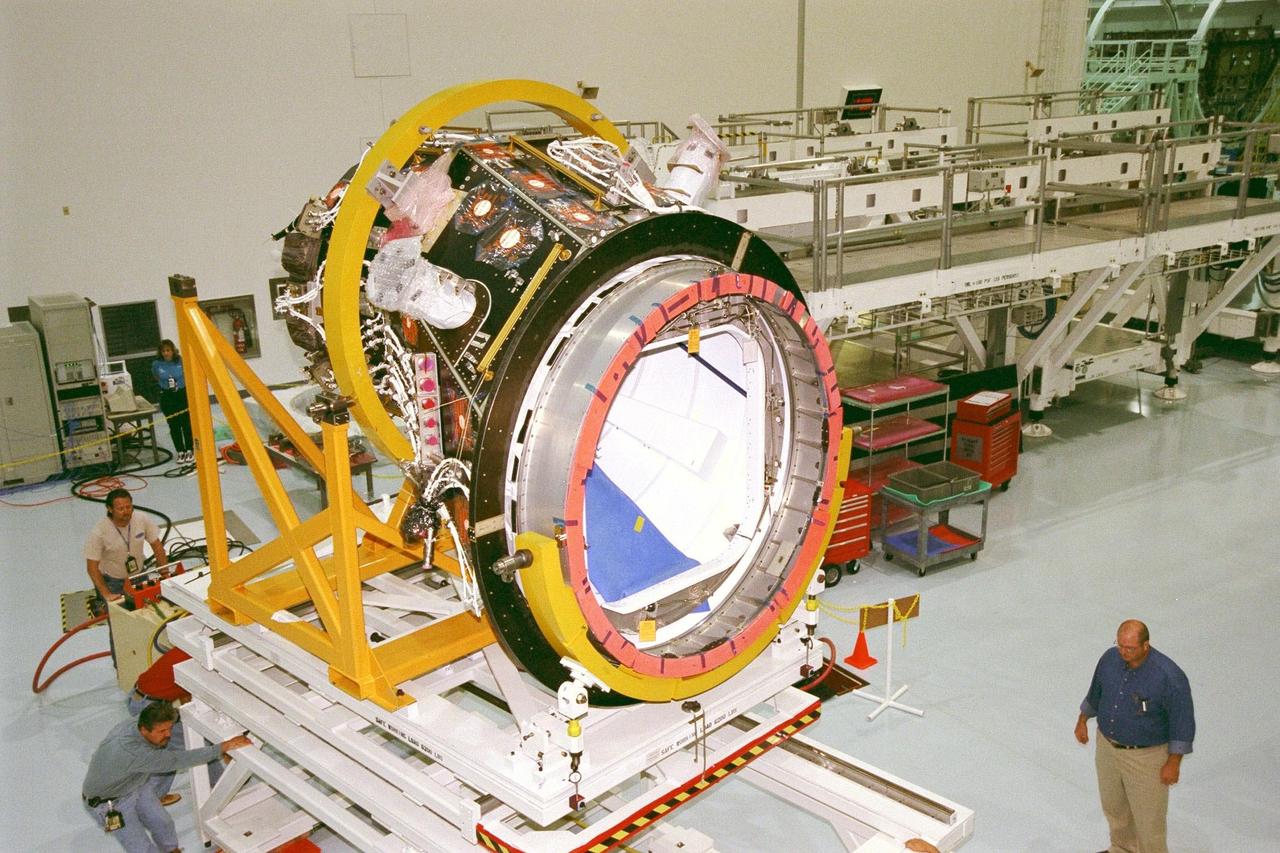
KENNEDY SPACE CENTER, FLA. -- Pressurized Mating Adapter (PMA)-2 is moved toward Node 1 of the International Space Station (ISS) in KSC's Space Station Processing Facility for pre-mating preparations. The node is the first element of the ISS to be manufactured in the United States and is currently scheduled to lift off aboard the Space Shuttle Endeavour on STS-88 later this year, along with PMAs 1 and 2. This PMA is a cone-shaped connector to Node 1, which will have two PMAs attached once this mate is completed. Once in space, Node 1 will function as a connecting passageway to the living and working areas of the ISS. It has six hatches that will serve as docking ports to the U.S. laboratory module, U.S. habitation module, an airlock and other space station elements
KENNEDY SPACE CENTER, FLA. -- Pressurized Mating Adapter (PMA)-2 is moved into position against Node 1 of the International Space Station (ISS) in KSC's Space Station Processing Facility for pre-mating preparations. The node is the first element of the ISS to be manufactured in the United States and is currently scheduled to lift off aboard the Space Shuttle Endeavour on STS-88 later this year, along with PMAs 1 and 2. This PMA is a cone-shaped connector to Node 1, which will have two PMAs attached once this mate is completed. Once in space, Node 1 will function as a connecting passageway to the living and working areas of the ISS. It has six hatches that will serve as docking ports to the U.S. laboratory module, U.S. habitation module, an airlock and other space station elements
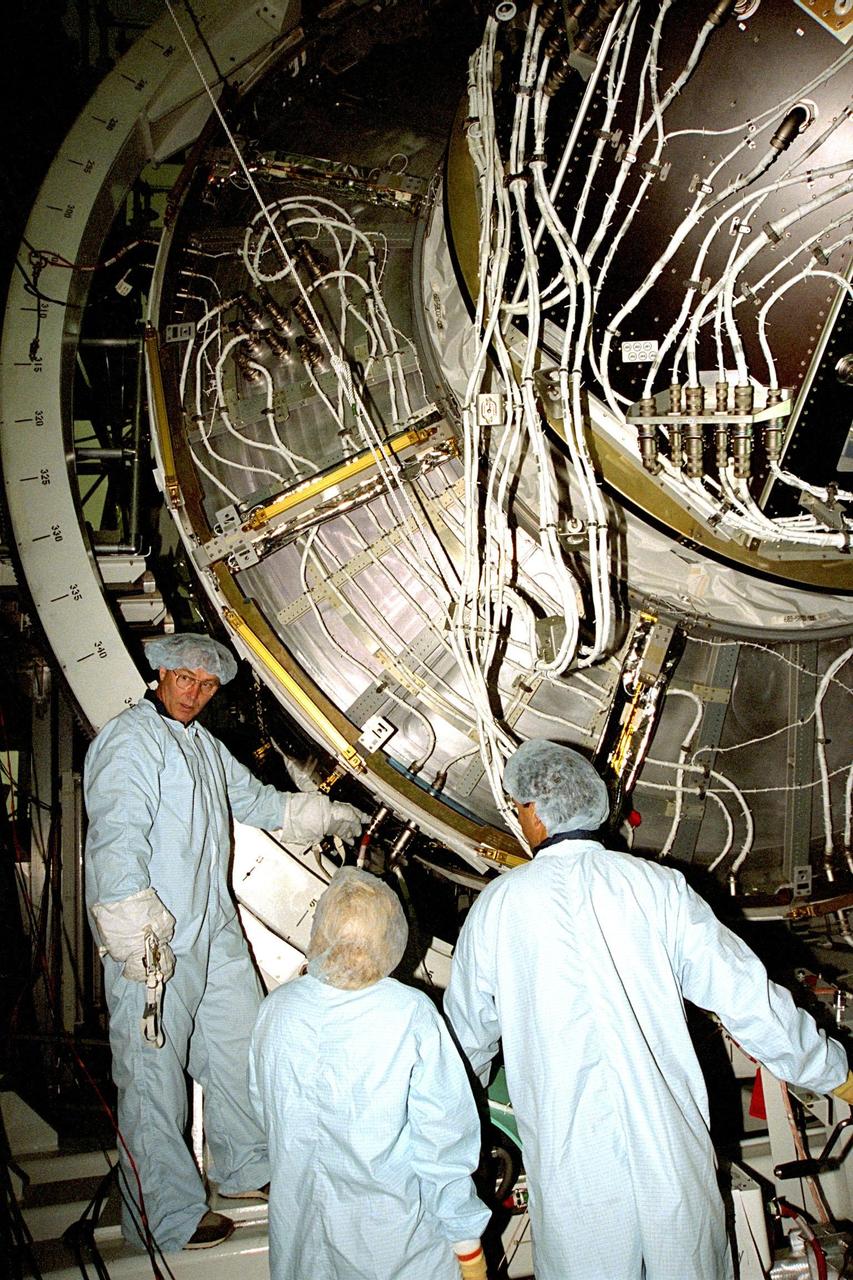
Boeing technicians discuss mating Pressurized Mating Adapter (PMA)-2 to Node 1 of the International Space Station (ISS) in KSC's Space Station Processing Facility (SSPF). The node is the first element of the ISS to be manufactured in the United States and is currently scheduled to lift off aboard the Space Shuttle Endeavour on STS-88 later this year, along with PMAs 1 and 2. This PMA is a cone-shaped connector to Node 1, which will have two PMAs attached once this mate is completed. Once in space, Node 1 will function as a connecting passageway to the living and working areas of the ISS. It has six hatches that will serve as docking ports to the U.S. laboratory module, U.S. habitation module, an airlock and other space station elements
Pressurized Mating Adapter (PMA)-2 is moved into position to be mated to Node 1 of the International Space Station (ISS) by Boeing technicians in KSC's Space Station Processing Facility (SSPF). The node is the first element of the ISS to be manufactured in the United States and is currently scheduled to lift off aboard the Space Shuttle Endeavour on STS-88 later this year, along with PMAs 1 and 2. This PMA is a cone-shaped connector to Node 1, which will have two PMAs attached once this mate is completed. Once in space, Node 1 will function as a connecting passageway to the living and working areas of the ISS. It has six hatches that will serve as docking ports to the U.S. laboratory module, U.S. habitation module, an airlock and other space station elements
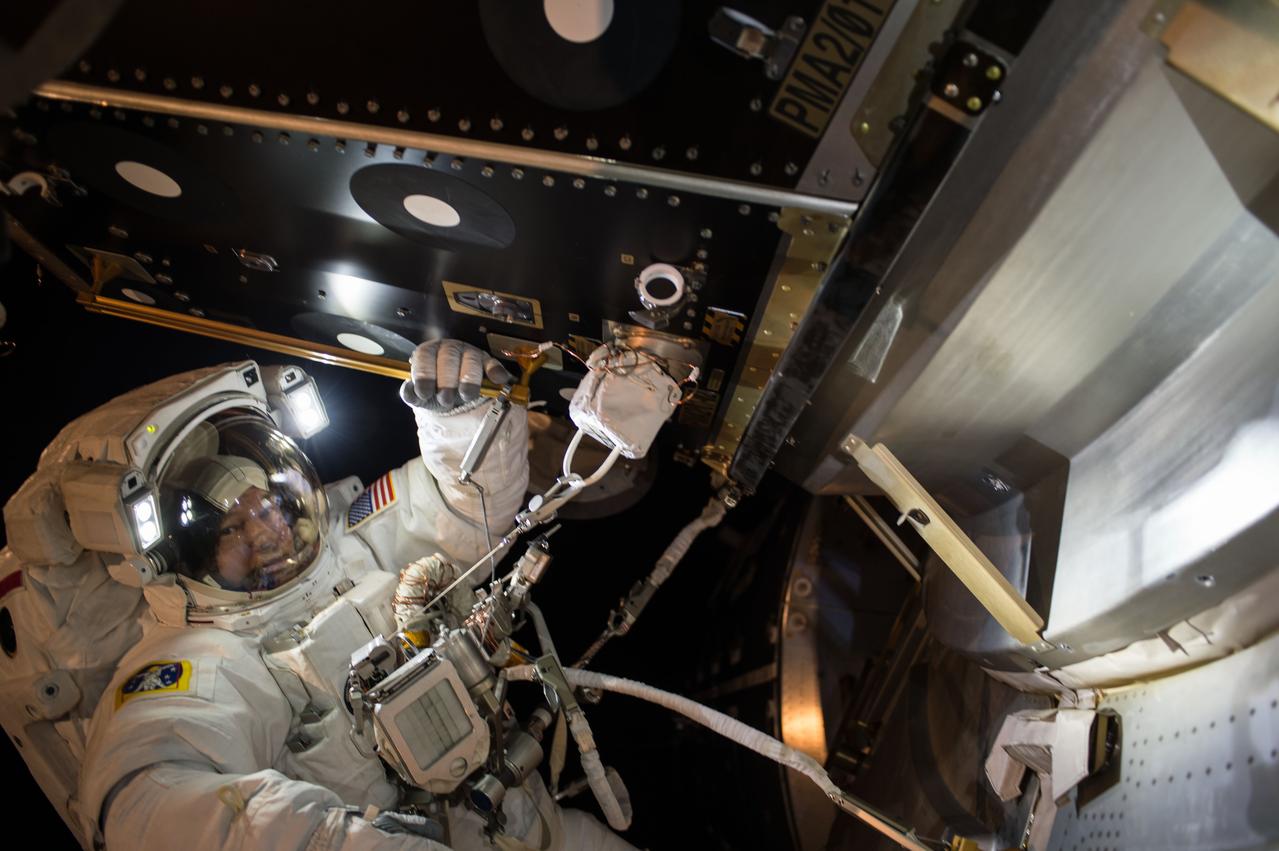
Extravehicular crewmember 1 (EV1) Jeff Williams pauses for a photo after installing a Hemispherical (Hemi) Reflector Cover on Pressurized Mating Adapter 2 (PMA-2) during Extravehicular Activity 36 (EVA 36).
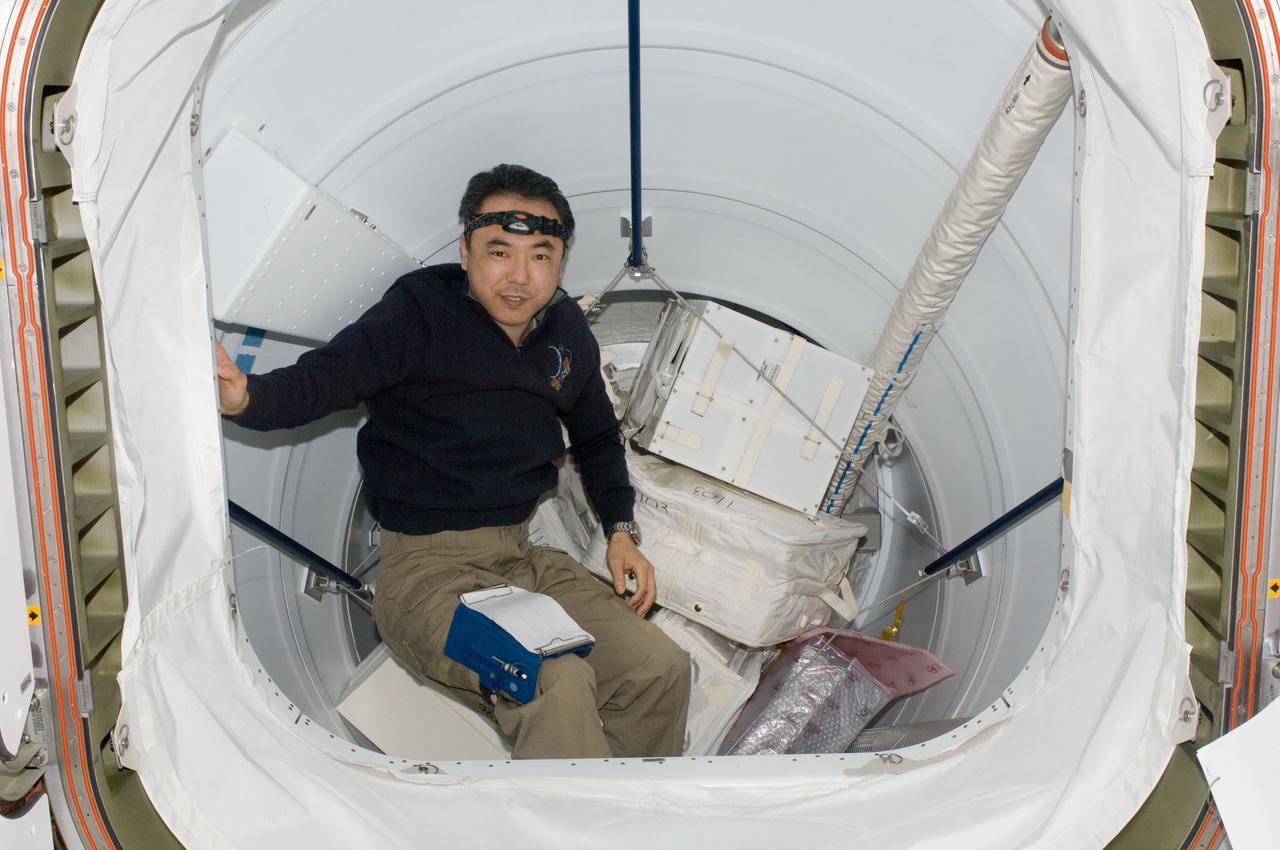
ISS028-E-034104 (26 Aug. 2011) --- Japan Aerospace Exploration Agency astronaut Satoshi Furukawa, Expedition 28 flight engineer, stows cargo in the Pressurized Mating Adapter 2 (PMA-2) of the International Space Station.
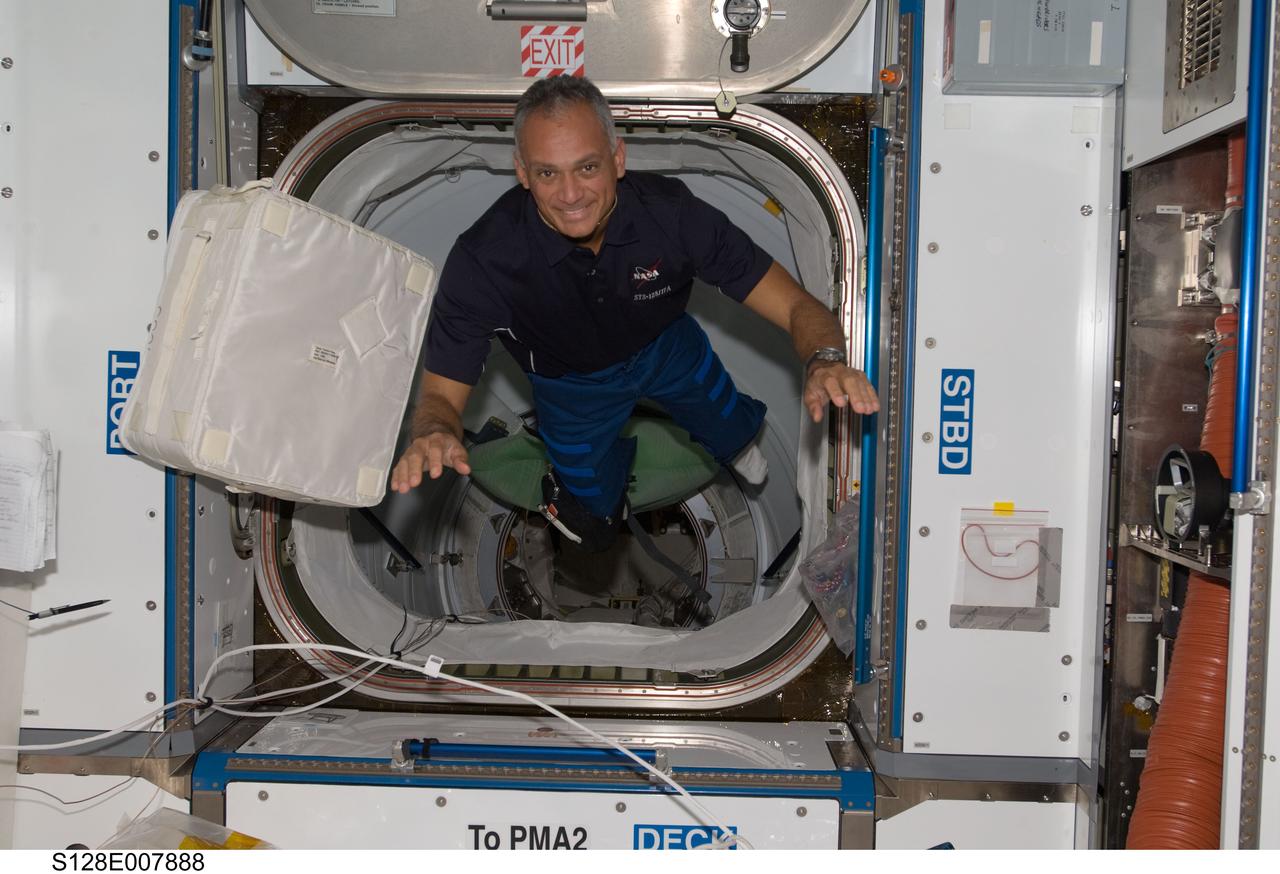
S128-E-007888 (6 Sept. 2009) --- NASA astronaut John “Danny” Olivas, STS-128 mission specialist, is pictured near a stowage bag floating freely in the Harmony node of the International Space Station while Space Shuttle Discovery remains docked with the station.
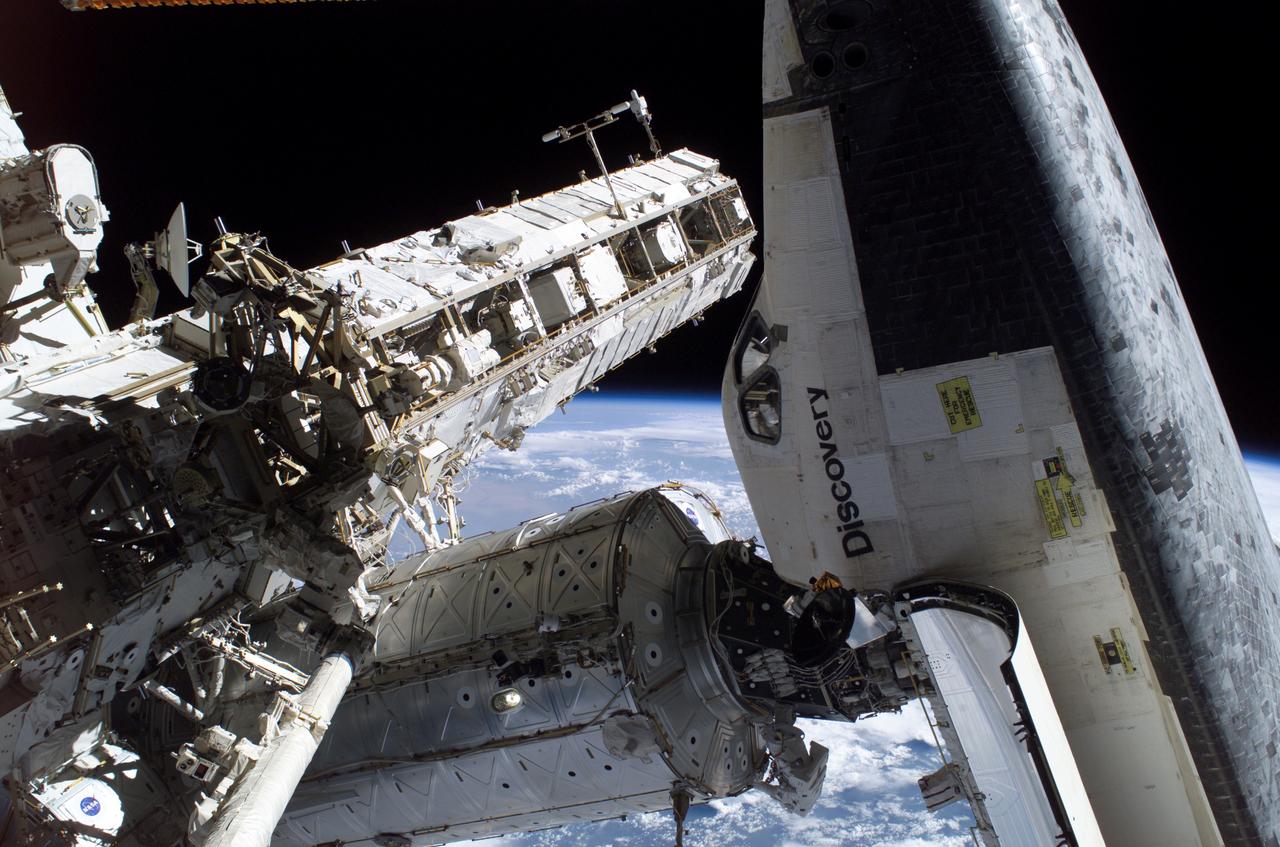
S114-E-6455 (3 August 2005) --- This image features a view of Space Shuttle Discovery docked to the Pressurized Mating Adapter 2 (PMA-2) on the Destiny laboratory of the international space station. The Crew Equipment Translation Aid (CETA) cart and the Mobile Base System (MBS), mounted on the S0 truss, are visible at left. Part of the P1 truss is also visible in the background. Dwarfed by the station and shuttle, Japan Aerospace Exploration Agency (JAXA) astronaut Soichi Noguchi, STS-114 mission specialist, is visible near the PMA-2 during the mission’s third session of extravehicular activity (EVA). The blackness of space and a blue and white Earth form the backdrop for the image.

KENNEDY SPACE CENTER, FLA. -- Node 1, the first U.S. element for the International Space Station, and attached Pressurized Mating Adapter-1 (PMA-1) continue with prelaunch preparation activities at KSC's Space Station Processing Facility. Node 1 is a connecting passageway to the living and working areas of the space station. The node and PMA-1 are being removed from the element rotation stand, or test stand, where they underwent an interim weight and center of gravity determination. (The final determination is planned to be performed prior to transporting Node 1 to the launch pad.) Now the node is being moved to the Shuttle payload transportation canister, where the doors will be closed for a two-week leak check. PMAs -2 and -3 can be seen against the right wall, with PMA-3 at the far right. Node 1 is scheduled to fly on STS-88

JSC2006-E-43516 (October 2006) --- Computer-generated artist's rendering of the International Space Station after flight 20A. U.S. Orbiter delivers and installs Node 3 with Cupola. Pressurized Mating Adapter-3 (PMA-3) is relocated from Unity node nadir to Node 2 nadir beforehand. The Cupola is relocated to the forward port of Node 3 after the flight; and PMA- 3 is relocated to the axial port of Node 3 after the flight.
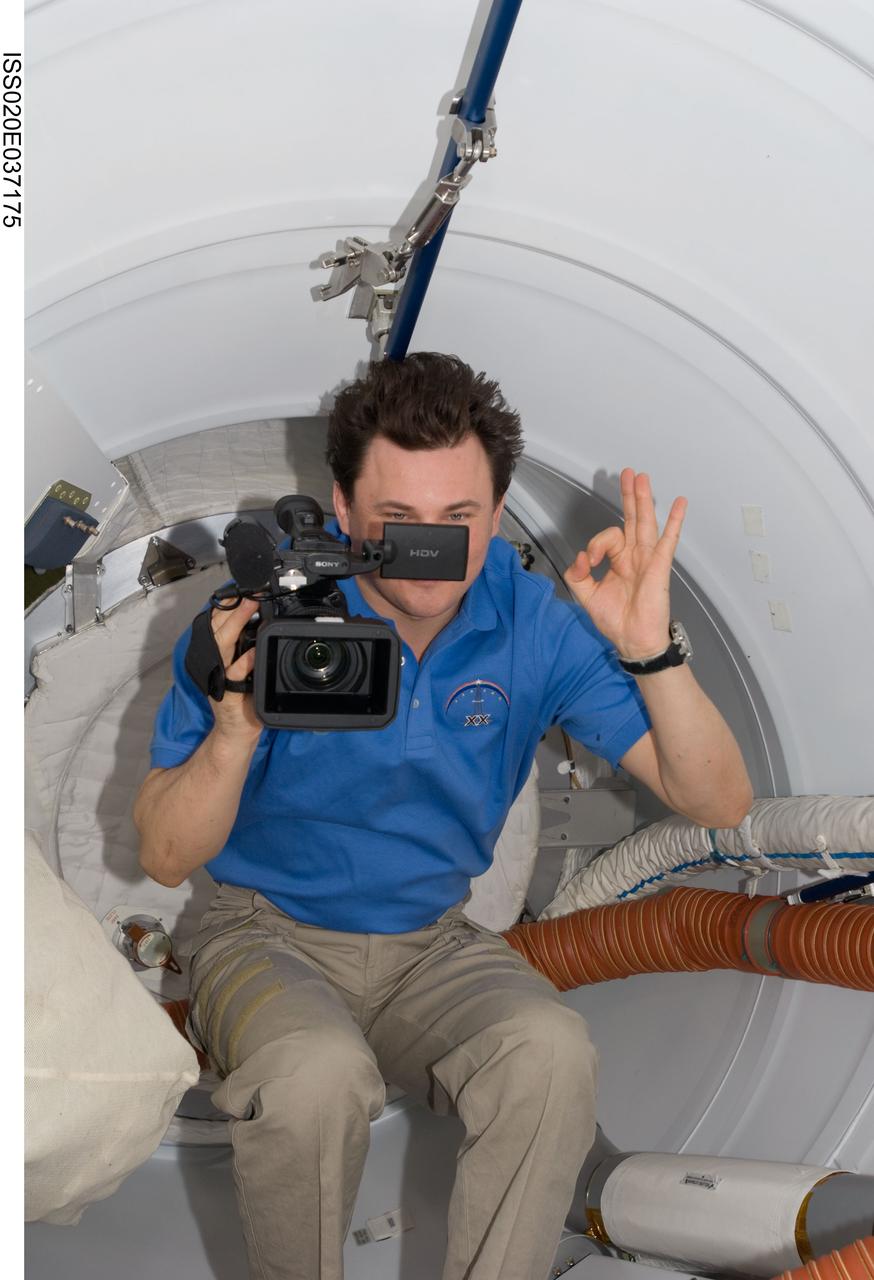
ISS020-E-037175 (30 Aug. 2009) --- Russian cosmonaut Roman Romanenko, Expedition 20 flight engineer, uses a High Definition Video (HDV) camera in the Pressurized Mating Adapter 2 (PMA-2) of the International Space Station while Space Shuttle Discovery (STS-128) remains docked with the station.
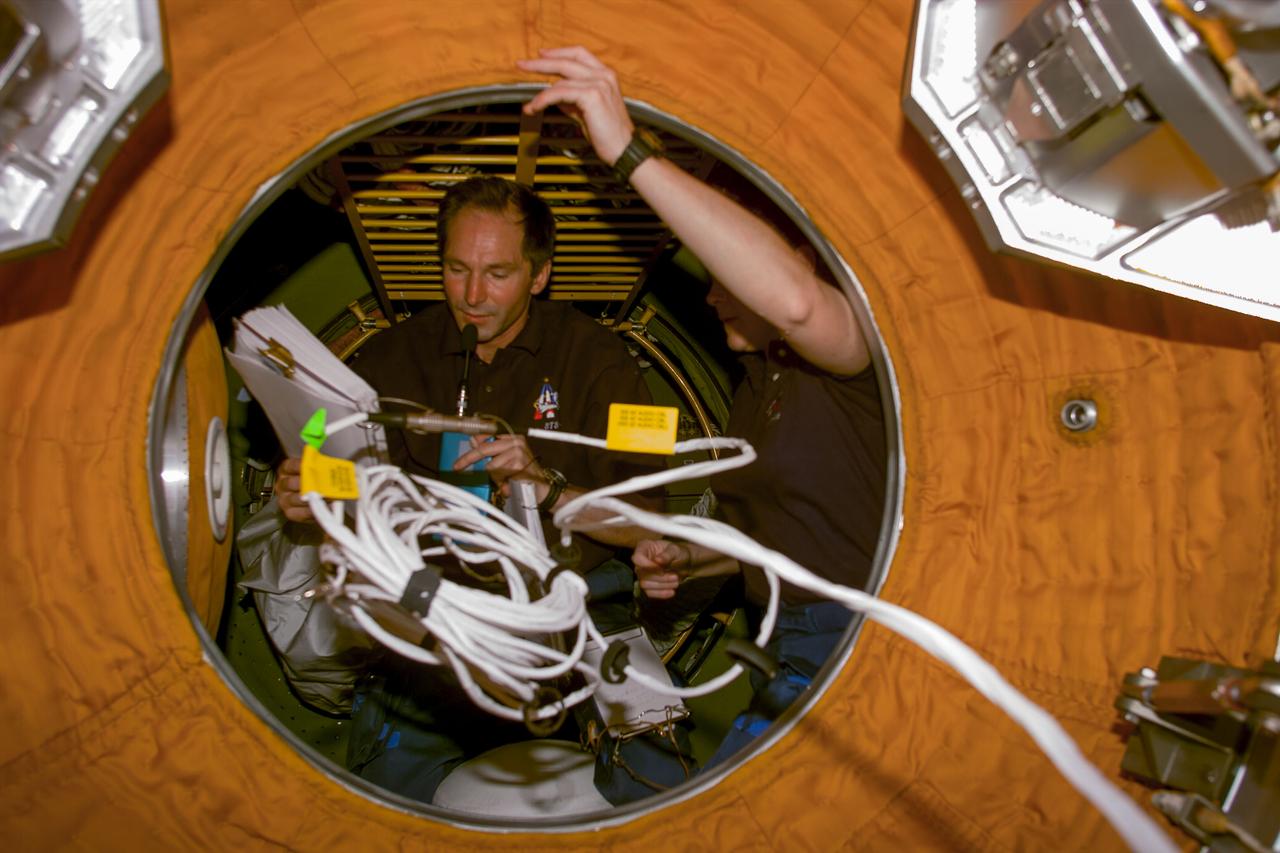
S96-E-5084 (31 May 1999) --- Cosmonaut Valery I. Tokarev and astronaut Tamara Jernigan are almost obscured by communications gear in this scene recorded in the passageway to the Russian-built Zarya module. Tokarev is a mission specialist representing the Russian Space Agency (RSA). Jernigan is one of two mission specialists that earlier had performed a lengthy space walk to do some exterior work on the International Space Station (ISS). The scene was recorded with an electronic still camera (ESC) at 02:09:00 GMT, May 31, 1999.
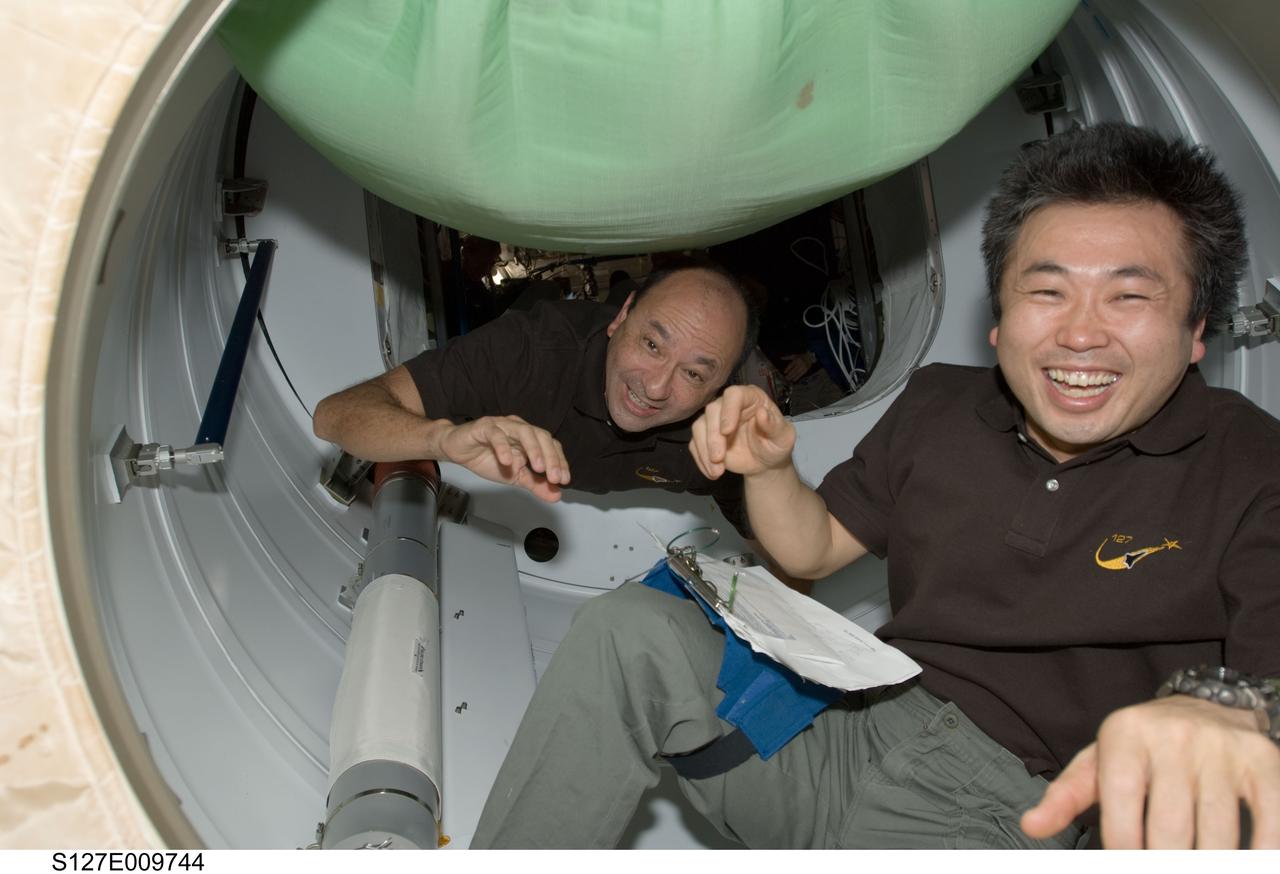
S127-E-009744 (28 July 2009) --- NASA astronaut Mark Polansky (background), STS-127 commander; and Japan Aerospace Exploration Agency (JAXA) astronaut Koichi Wakata, mission specialist, work in the hatch between Space Shuttle Endeavour and the International Space Station as they prepare for the undocking of the two spacecraft.
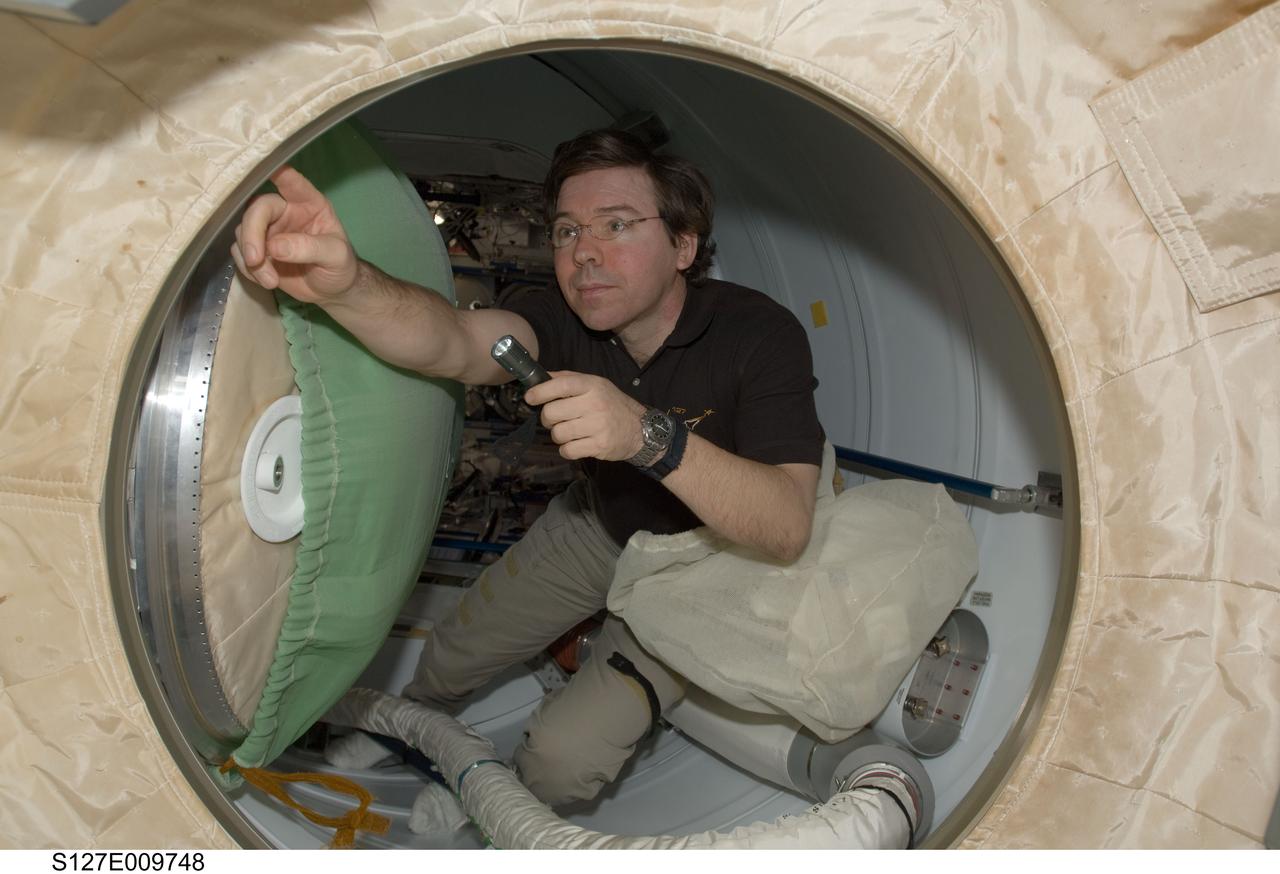
S127-E-009748 (28 July 2009) --- NASA astronaut Michael Barratt, Expedition 20 flight engineer, works in the hatch between Space Shuttle Endeavour and the International Space Station during preparations for the undocking of the two spacecraft.
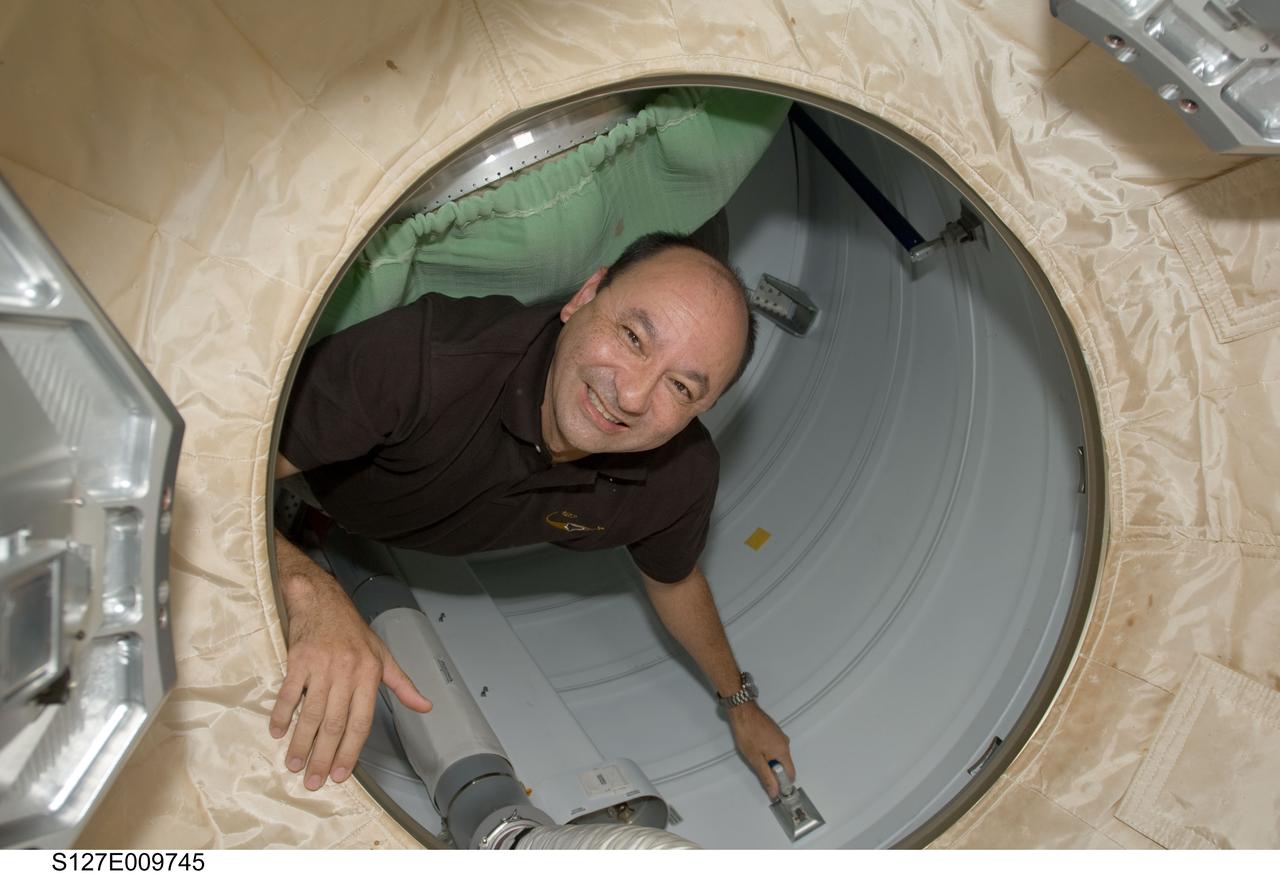
S127-E-009745 (28 July 2009) --- NASA astronaut Mark Polansky, STS-127 commander, is pictured in the hatch between Space Shuttle Endeavour and the International Space Station as the STS-127 crew members prepare for the undocking of the two spacecraft.

STS110-E-5068 (9 April 2002) --- During the docking approach of the Space Shuttle Atlantis to the International Space Station (ISS), a STS-110 crewmember photographed this close-up view of the station with a digital still camera. As Atlantis approached the Pressurized Mating Adapter (PMA-2) on the ISS, the Quest Airlock was visible on the right in this picture.
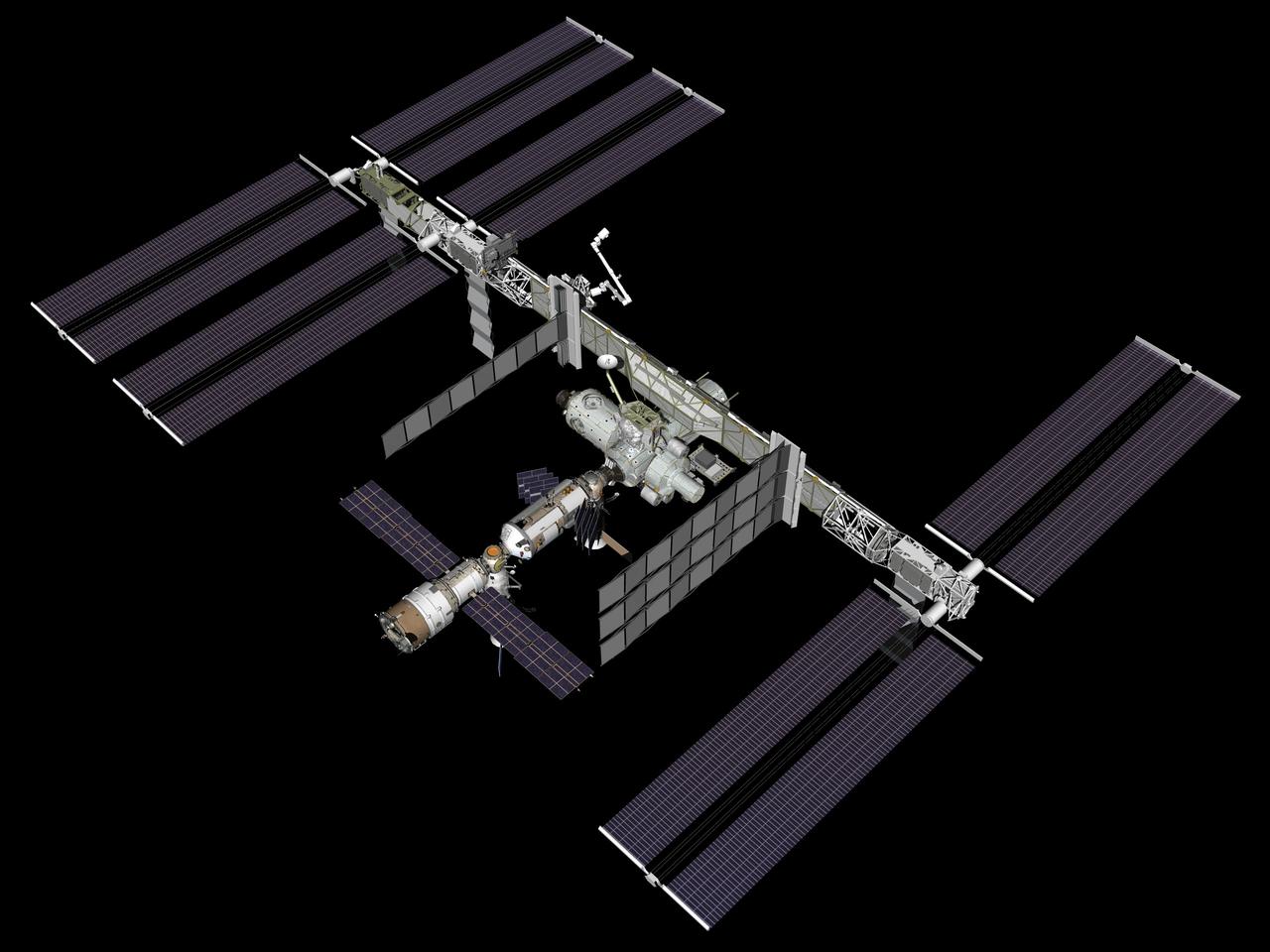
JSC2007-E-099881 (November 2007) --- Computer-generated artist's rendering of the 10A stage configuration of the International Space Station as of Nov. 12, 2007. Pressurized Mating Adapter (PMA-2) is relocated from the front of the Destiny laboratory to the port side of the Harmony node.
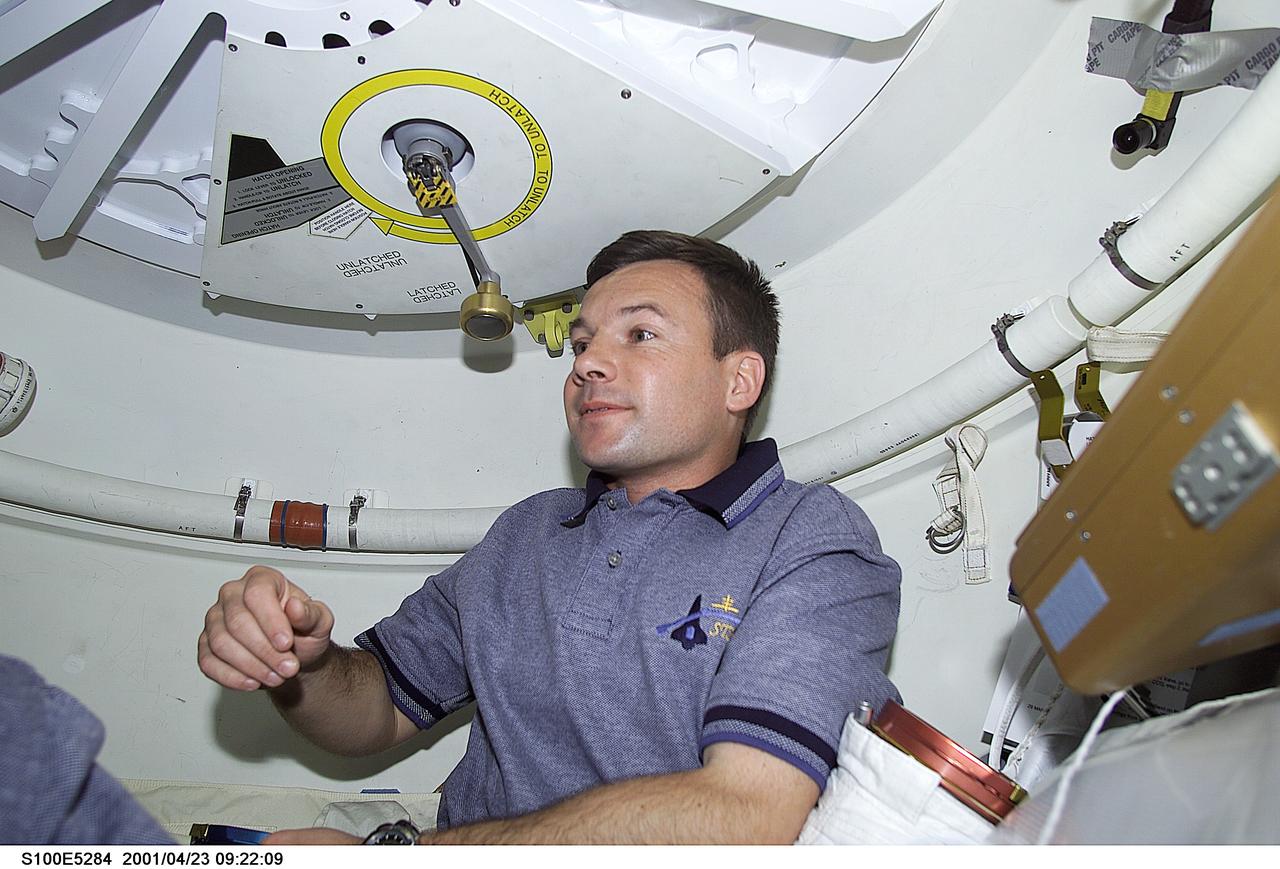
S100-E-5284 (23 April 2001) --- Cosmonaut Yuri V. Lonchakov, STS-100 mission specialist representing Rosaviakosmos, is in the Pressurized Mating Adapter (PMA-2) prior to hatch-opening. The image was recorded with a digital still camera.
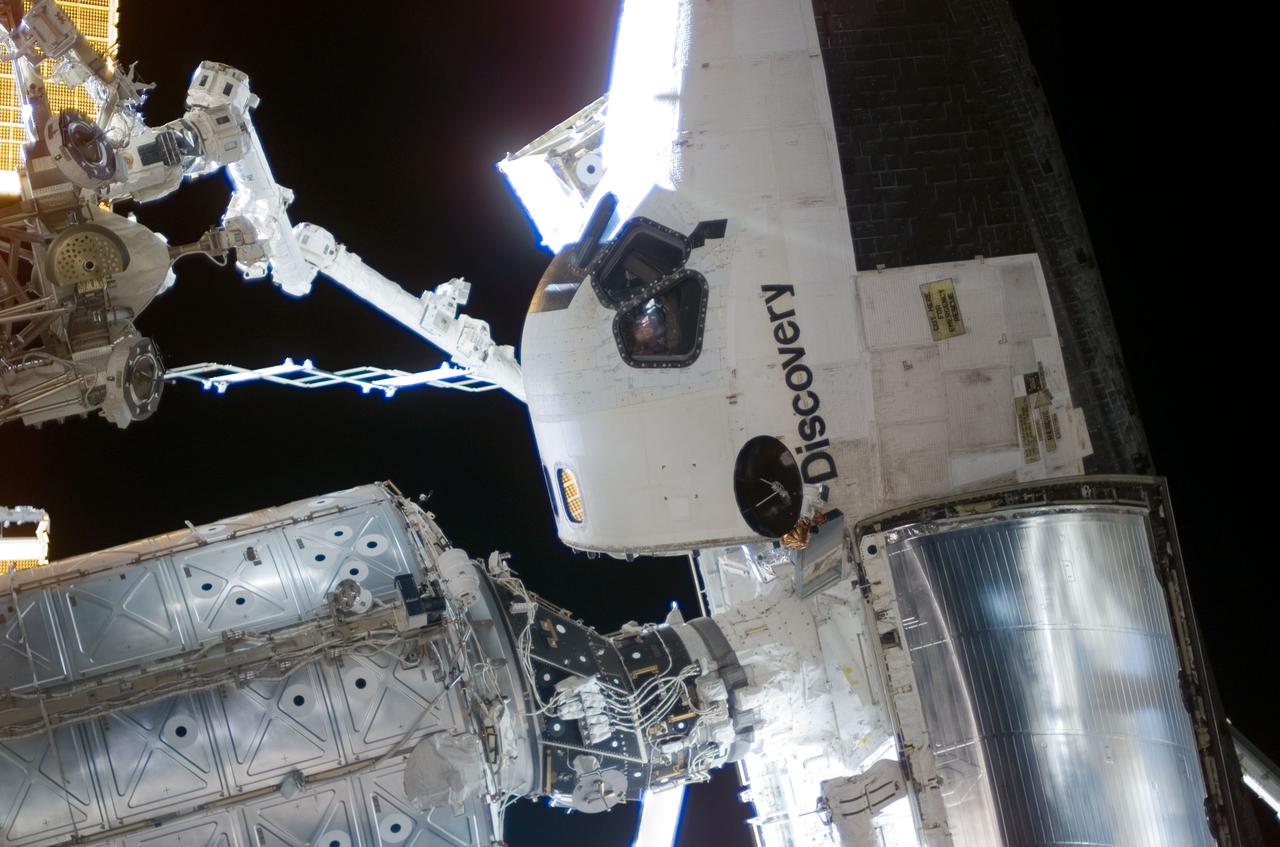
ISS016-E-006573 (28 Oct. 2007) --- Space Shuttle Discovery, docked to the Pressurized Mating Adapter (PMA-2) on the International Space Station, is featured in this image photographed by a spacewalker during the second session of extravehicular activity (EVA) for the STS-120 mission.

STS110-E-5071 (9 April 2002) --- During the docking approach of the Space Shuttle Atlantis to the International Space Station (ISS), a STS-110 crewmember photographed this close-up view of the station with a digital still camera. As Atlantis approached the Pressurized Mating Adapter (PMA-2) of the ISS, the Quest Airlock was visible on the right in this picture.
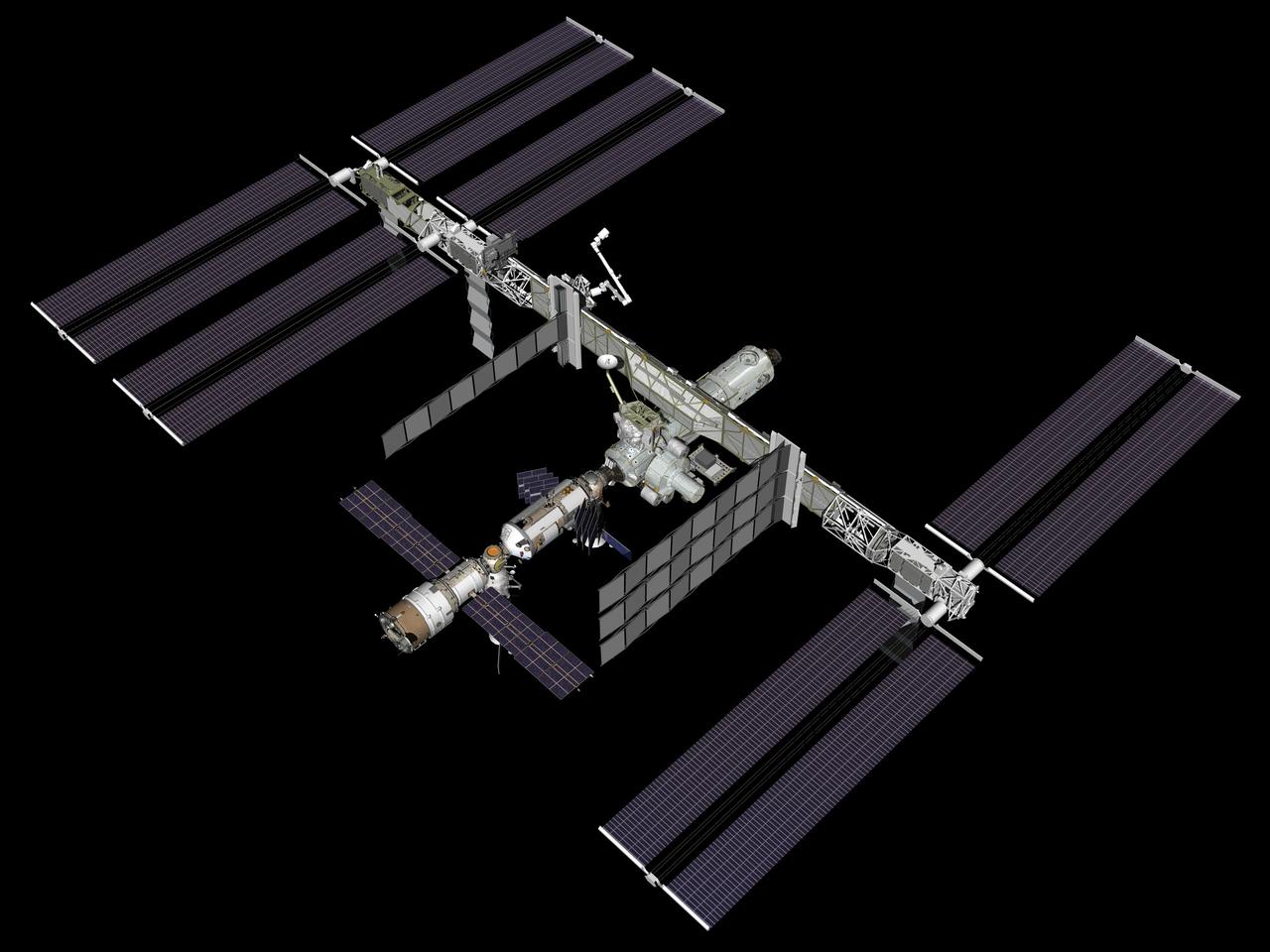
JSC2007-E-099882 (November 2007) --- Computer-generated artist's rendering of the 10A stage configuration of the International Space Station as of Nov. 14, 2007. The Harmony node with Pressurized Mating Adapter (PMA-2) attached is relocated to the front of the Destiny laboratory.
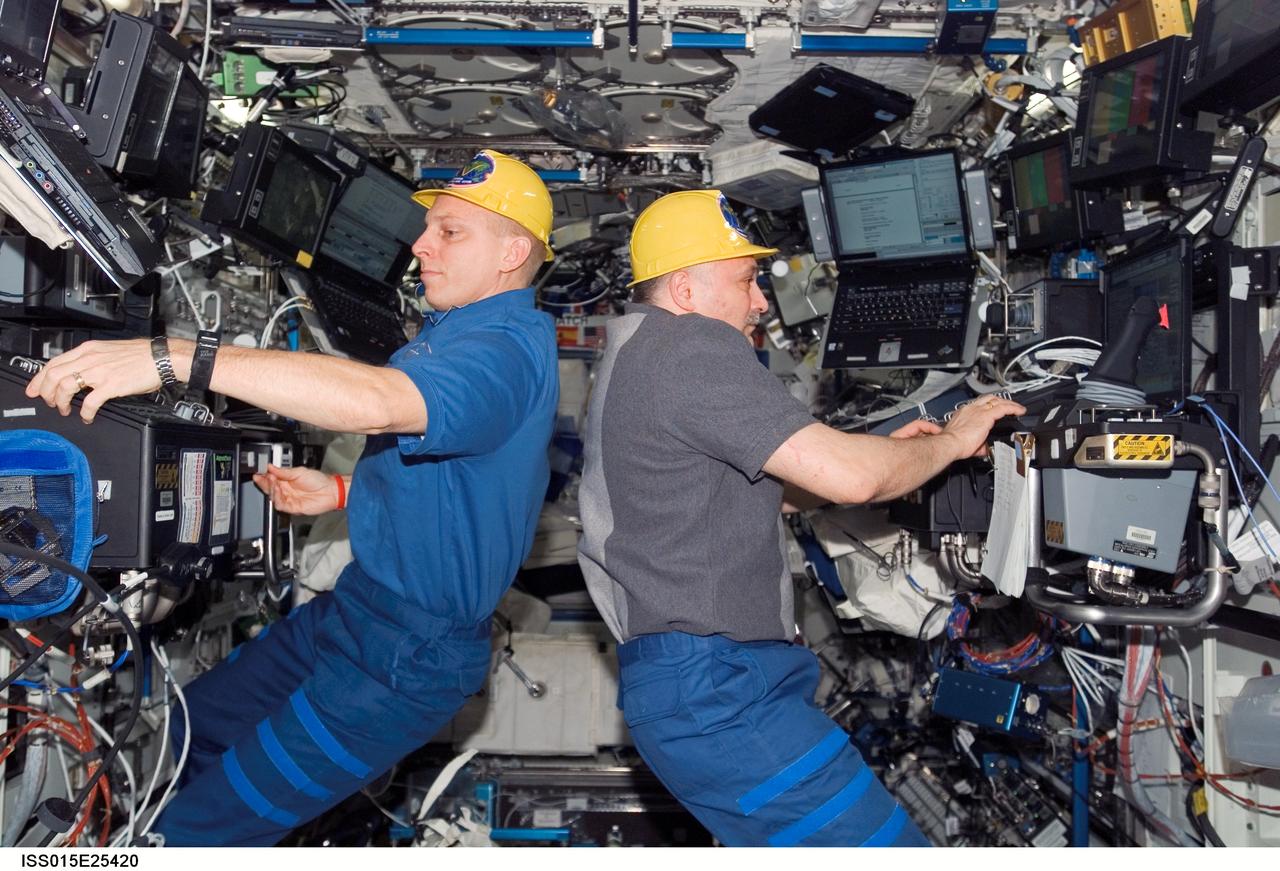
ISS015-E-25420 (30 Aug. 2007) --- Astronaut Clay Anderson (left), Expedition 15 flight engineer, works the controls of the station's robotic arm, Canadarm2; while cosmonaut Fyodor N. Yurchikhin, commander representing Russia's Federal Space Agency, works with docking systems in the Destiny laboratory of the International Space Station during Pressurized Mating Adapter-3 (PMA-3) transfer operations. Using the Canadarm2, the PMA-3 was undocked from the Unity node's left side at 7:18 a.m. (CDT) and docked to Unity's lower port at 8:07 a.m. to prepare for the arrival of Node 2, the Harmony module, on the STS-120 flight of Space Shuttle Discovery in October 2007.
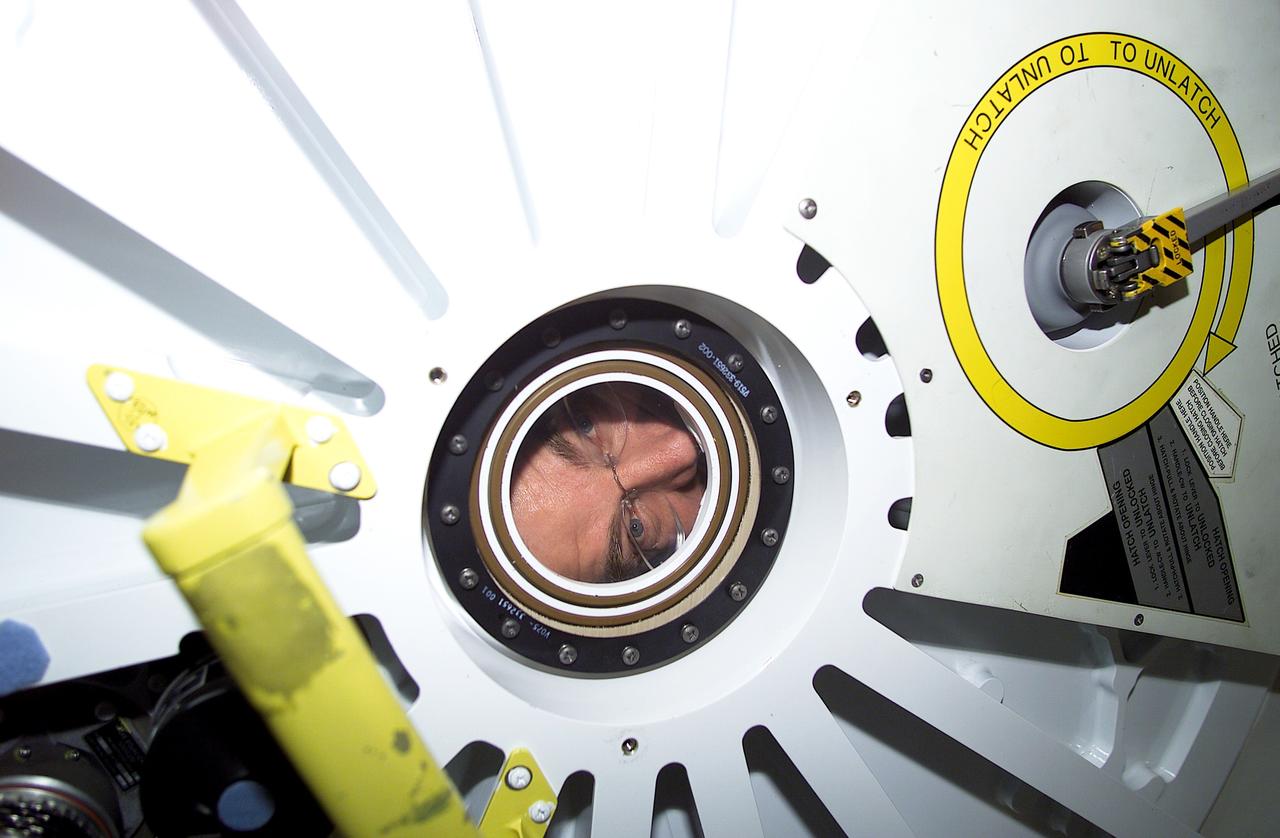
The STS-100 mission launched for the International Space Station (ISS) on April 19, 2001 as the sixth station assembly flight. Main objectives included the delivery and installation of the Canadian-built Space Station Remote Manipulator System (SSRMS), or Canadarm2, the installation of a UHF anterna for space-to-space communications for U.S. based space walks, and the delivery of supplies via the Italian Multipurpose Logistics Module (MPLM) "Raffaello". This is an STS-110 onboard photo of Astronaut James S. Voss, Expedition Two flight engineer, peering into the pressurized Mating Adapter (PMA-2) prior hatch opening. The picture was taken by one of the STS-100 crew members inside the PMA.
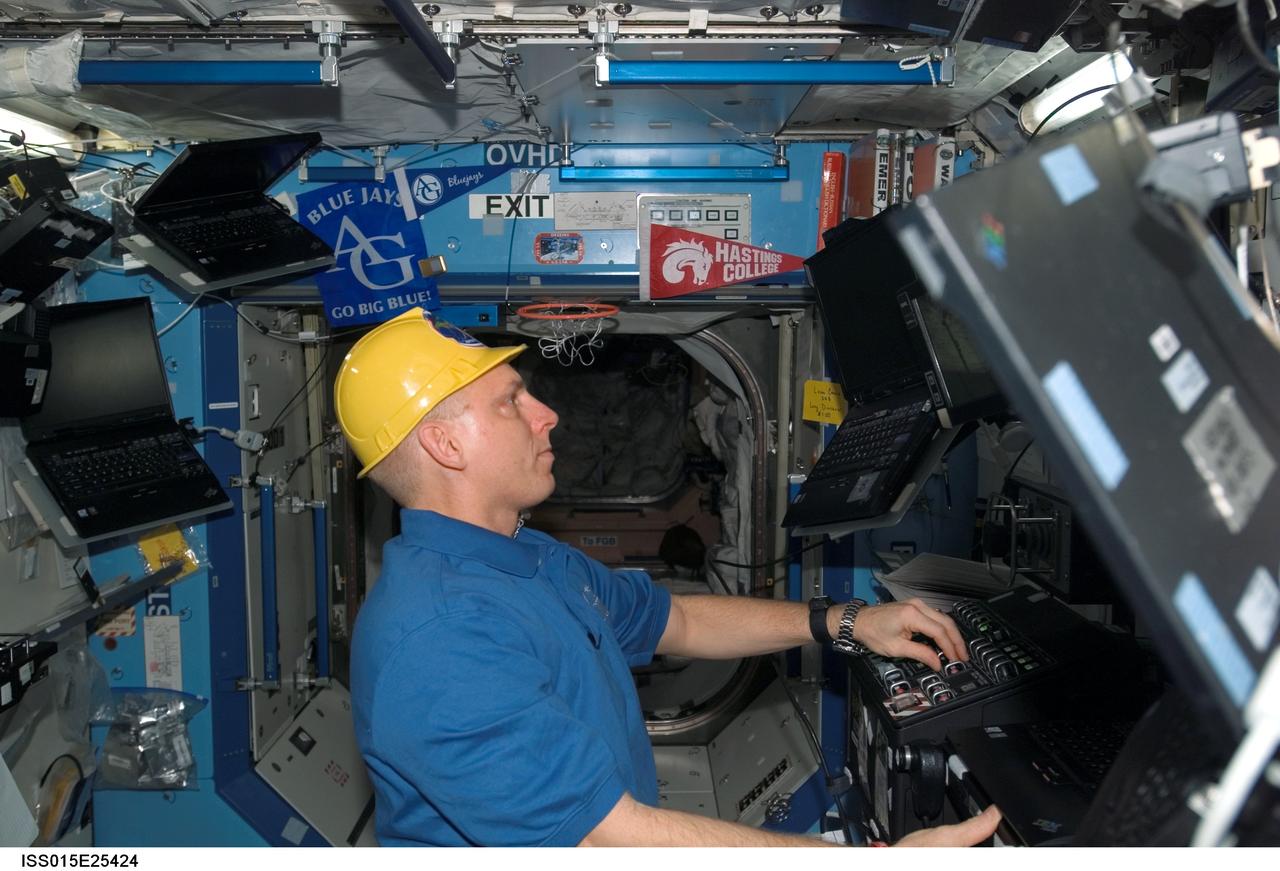
ISS015-E-25424 (30 Aug. 2007) --- Astronaut Clay Anderson, Expedition 15 flight engineer, works the controls of the station's robotic arm, Canadarm2, in the Destiny laboratory of the International Space Station during Pressurized Mating Adapter-3 (PMA-3) transfer operations. Using the Canadarm2, the PMA-3 was undocked from the Unity node's left side at 7:18 a.m. (CDT) and docked to Unity's lower port at 8:07 a.m. to prepare for the arrival of Node 2, the Harmony module, on the STS-120 flight of Space Shuttle Discovery in October 2007.

STS111-E-5018 (7 June 2002) --- This closeup view of the forward docking port on the International Space Station (ISS) was photographed with a digital still camera by one the STS-111 crew members just prior to docking. The Space Shuttle Endeavour went on to gently dock with the station 240 miles over the South Pacific, setting the stage for eight days of docked operations highlighted by three scheduled spacewalks and the exchange of resident crews aboard the outpost. Astronaut Kenneth D. Cockrell, mission commander, guided the shuttle to a linkup with the forward docking port of the station’s Destiny Laboratory at 11:25 a.m. (CDT), June 7, 2002. The docking culminated a textbook rendezvous executed by astronauts Cockrell and Paul S. Lockhart, pilot.
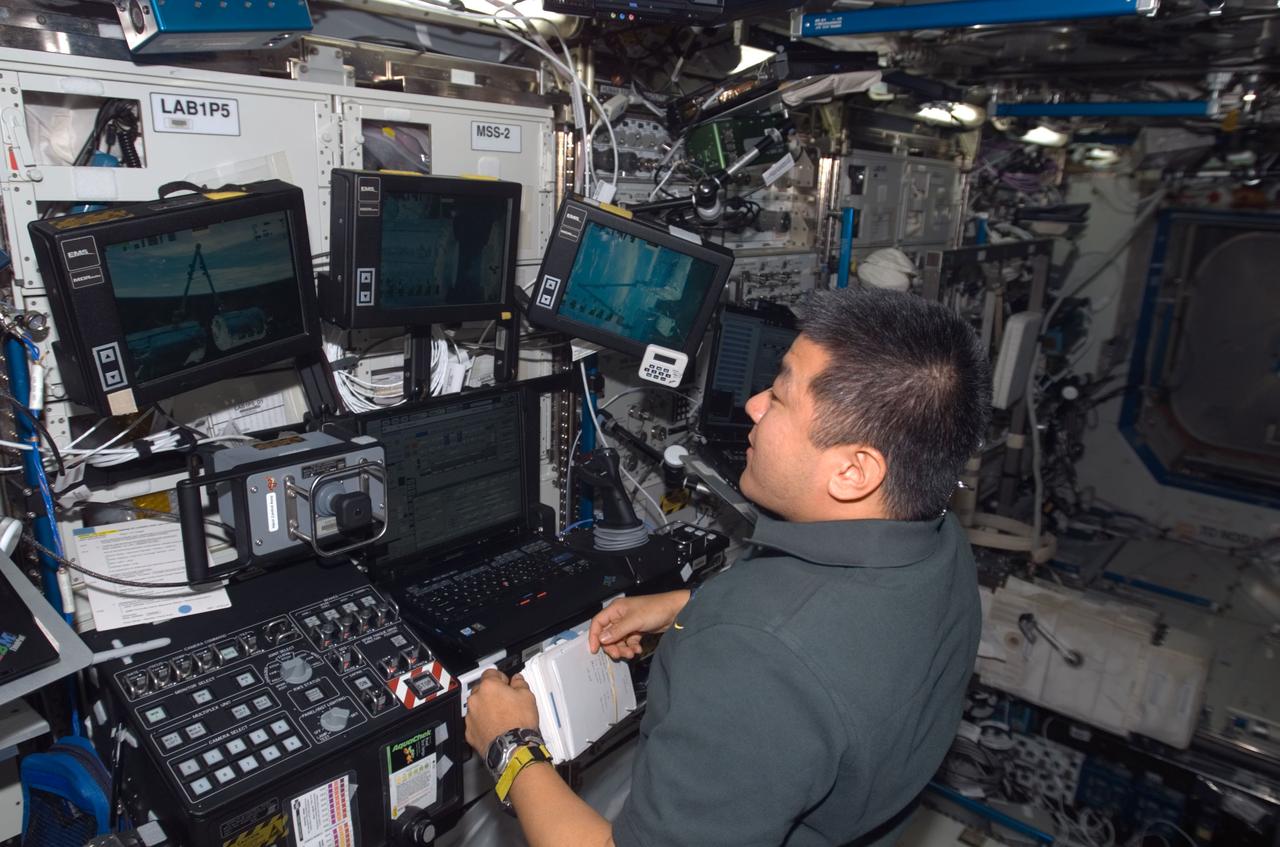
ISS016-E-011253 (14 Nov. 2007) --- Astronaut Daniel Tani, Expedition 16 flight engineer, works the controls of the space station's robotic Canadarm2 in the Destiny laboratory of the International Space Station, during the relocation of the Harmony node and Pressurized Mating Adapter 2 (PMA2) from the Unity node to the front of Destiny.
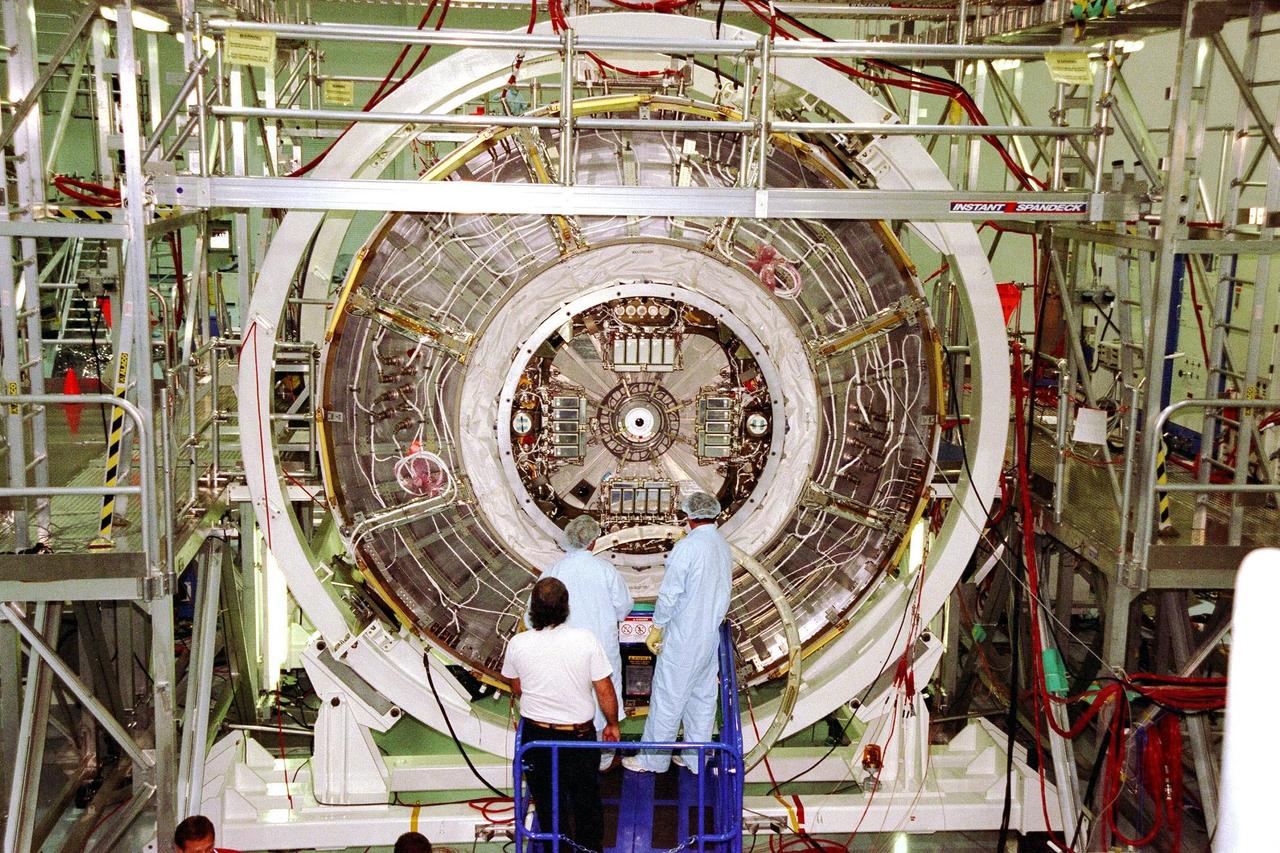
KENNEDY SPACE CENTER, FLA. -- Boeing technicians move a piece of hardware into position on Node 1 of the International Space Station (ISS) in KSC's Space Station Processing Facility in preparation for mating with Pressurized Mating Adapter (PMA)-2. The node is the first element of the ISS to be manufactured in the United States and is currently scheduled to lift off aboard the Space Shuttle Endeavour on STS-88 later this year, along with PMAs 1 and 2. The 18-foot-in-diameter, 22-foot-long aluminum module was manufactured by the Boeing Co. at Marshall Space Flight Center. Once in space, Node 1 will function as a connecting passageway to the living and working areas of the ISS. It has six hatches that will serve as docking ports to the U.S. laboratory module, U.S. habitation module, an airlock and other space station elements
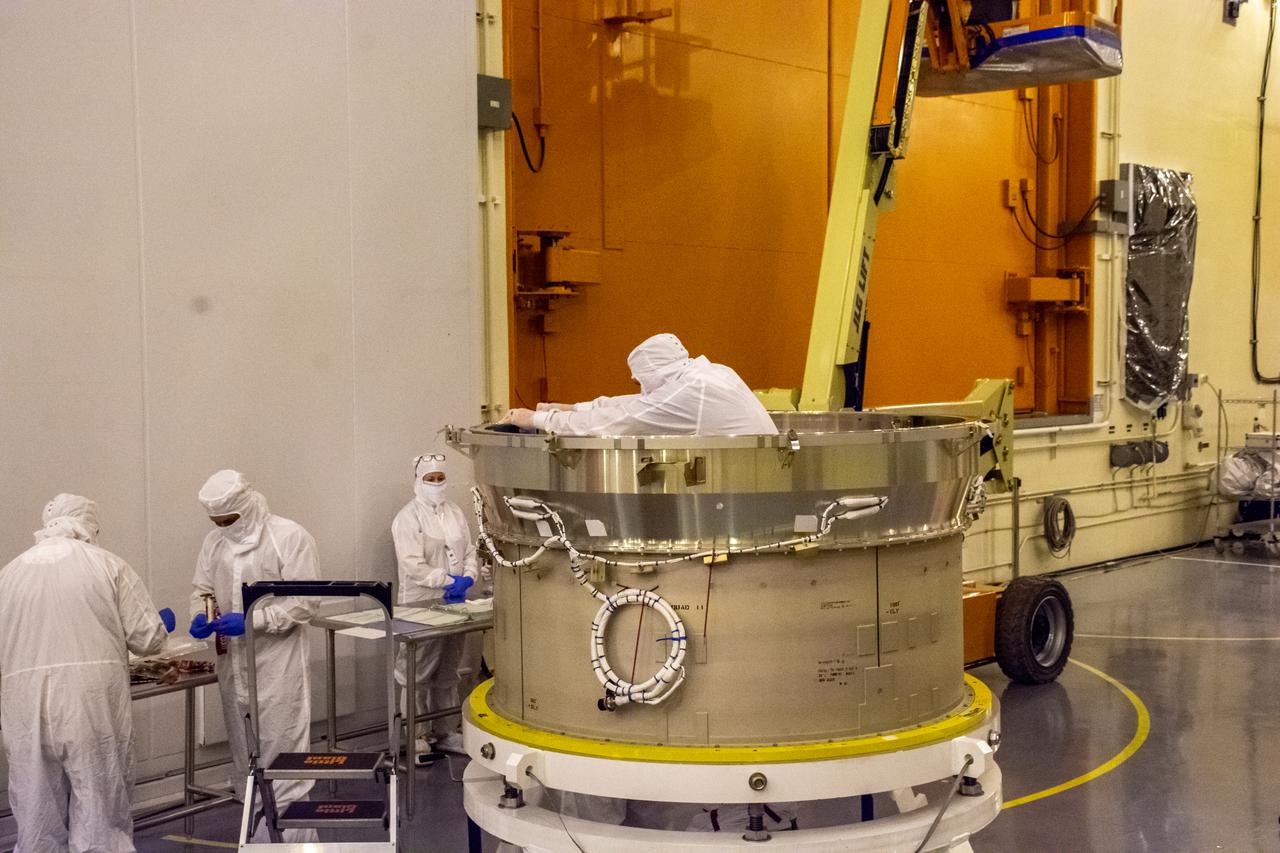
On Aug. 9, 2021, technicians ready the payload adapter (PMA) for mating operations in preparation for NASA’s Landsat 9 mission at Vandenberg Space Force Base in California. On one end, the PMA will attach to the second stage of a United Launch Alliance Atlas V rocket. On the other, it will attach to the evolved expendable vehicle secondary payload adapter – the piece of flight hardware that connects the spacecraft to the PMA. Landsat 9 will launch on the Atlas V from Space Launch Complex 3 at Vandenberg in September 2021. The launch is being managed by NASA’s Launch Services Program based at Kennedy Space Center, America’s multi-user spaceport. The Landsat 9 satellite will continue the nearly 50-year legacy of previous Landsat missions. It will monitor key natural and economic resources from orbit. Landsat 9 is managed by the agency’s Goddard Space Flight Center in Greenbelt, Maryland. The satellite will carry two instruments: the Operational Land Imager 2, which collects images of Earth’s landscapes in visible, near infrared and shortwave infrared light, and the Thermal Infrared Sensor 2, which measures the temperature of land surfaces. Like its predecessors, Landsat 9 is a joint mission between NASA and the U.S. Geological Survey.
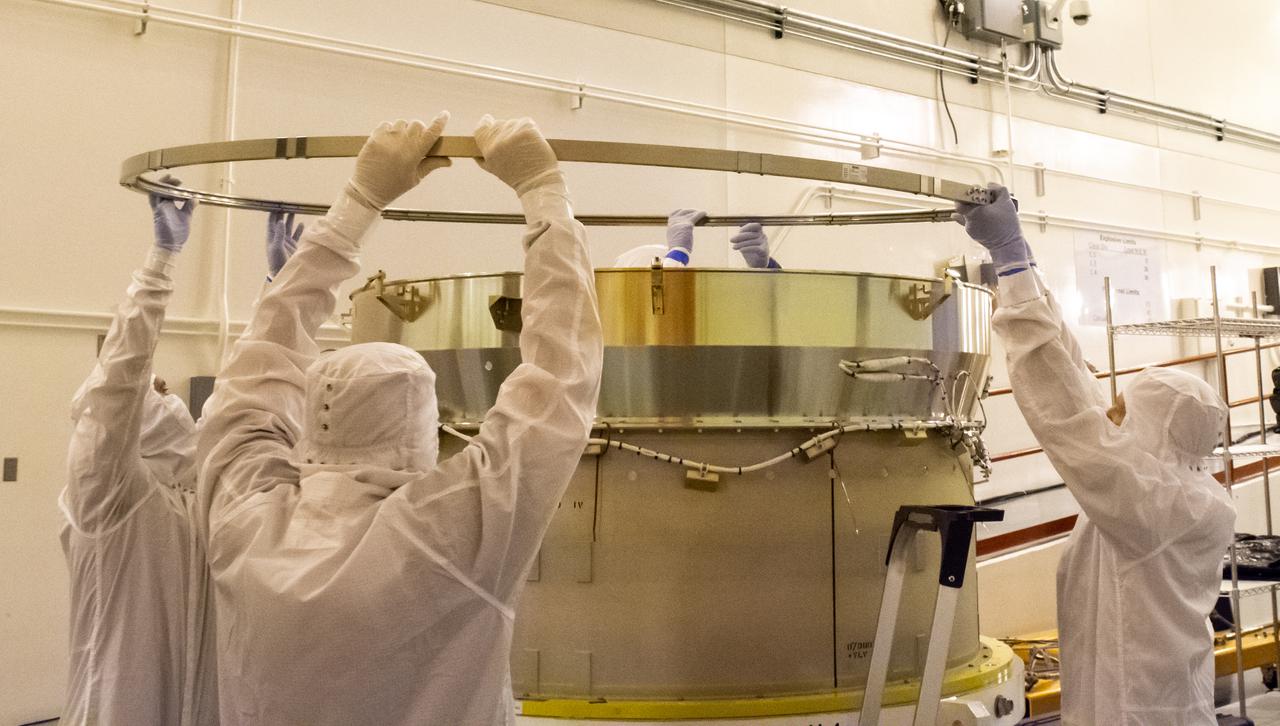
On Aug. 9, 2021, technicians ready the payload adapter (PMA) for mating operations in preparation for NASA’s Landsat 9 mission at Vandenberg Space Force Base in California. On one end, the PMA will attach to the second stage of a United Launch Alliance Atlas V rocket. On the other, it will attach to the evolved expendable vehicle secondary payload adapter – the piece of flight hardware that connects the spacecraft to the PMA. Landsat 9 will launch on the Atlas V from Space Launch Complex 3 at Vandenberg in September 2021. The launch is being managed by NASA’s Launch Services Program based at Kennedy Space Center, America’s multi-user spaceport. The Landsat 9 satellite will continue the nearly 50-year legacy of previous Landsat missions. It will monitor key natural and economic resources from orbit. Landsat 9 is managed by the agency’s Goddard Space Flight Center in Greenbelt, Maryland. The satellite will carry two instruments: the Operational Land Imager 2, which collects images of Earth’s landscapes in visible, near infrared and shortwave infrared light, and the Thermal Infrared Sensor 2, which measures the temperature of land surfaces. Like its predecessors, Landsat 9 is a joint mission between NASA and the U.S. Geological Survey.

ISS016-E-010001 (9 Nov. 2007) --- Astronaut Peggy A. Whitson, Expedition 16 commander, participates in a session of extravehicular activity (EVA) as construction continues on the International Space Station (ISS). During the spacewalk Whitson and cosmonaut Yuri I. Malenchenko (out of frame), flight engineer representing Russia's Federal Space Agency, prepared for the relocation of the Pressurized Mating Adapter 2 (PMA-2) and the subsequent move of the new Harmony node to its permanent ISS home.

S120-E-008857 (4 Nov. 2007) --- Astronaut Peggy Whitson, Expedition 16 commander, prepares to close the hatch in the Pressurized Mating Adapter (PMA-2) of the International Space Station after the STS-120 crewmembers boarded Space Shuttle Discovery for their return trip home. Hatches were closed between the station and the shuttle at 2:03 p.m. (CST) on Nov. 4.
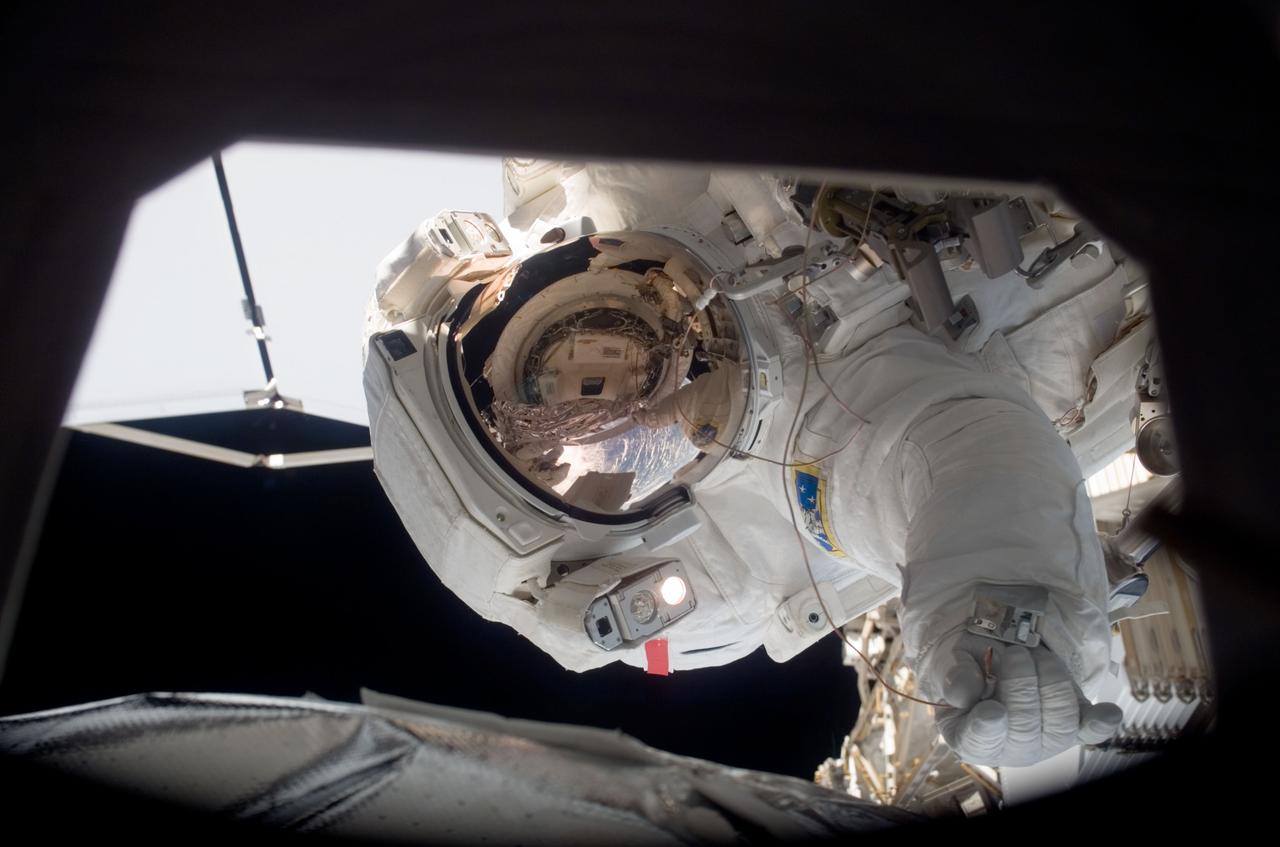
ISS016-E-009989 (9 Nov. 2007) --- Astronaut Peggy A. Whitson, Expedition 16 commander, participates in a session of extravehicular activity (EVA) as construction continues on the International Space Station (ISS). During the spacewalk Whitson and cosmonaut Yuri I. Malenchenko (out of frame), flight engineer representing Russia's Federal Space Agency, prepared for the relocation of the Pressurized Mating Adapter 2 (PMA-2) and the subsequent move of the new Harmony node to its permanent ISS home.
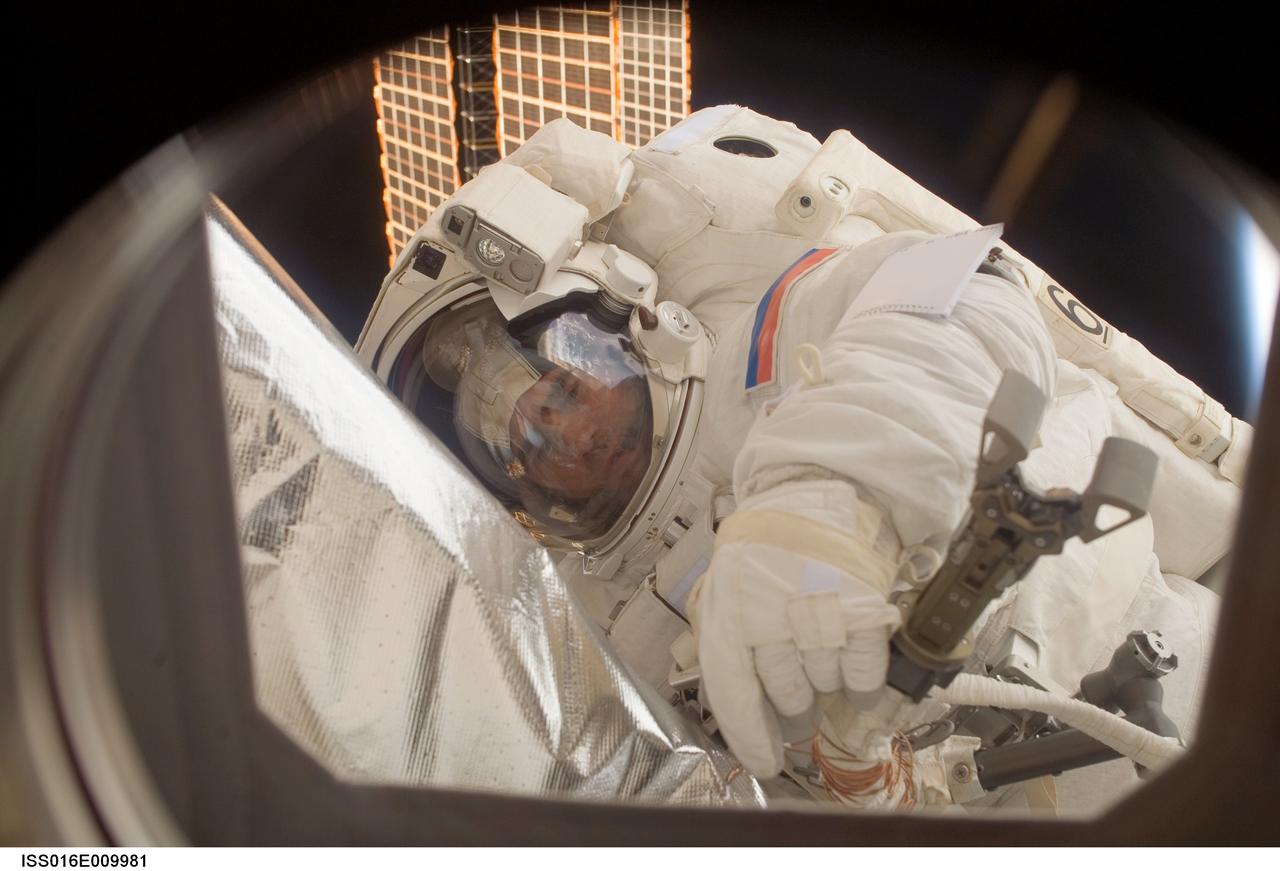
ISS016-E-009981 (9 Nov. 2007) --- Cosmonaut Yuri I. Malenchenko, Expedition 16 flight engineer representing Russia's Federal Space Agency, participates in a session of extravehicular activity (EVA) as construction continues on the International Space Station (ISS). During the spacewalk Malenchenko and astronaut Peggy A. Whitson (out of frame), commander, prepared for the relocation of the Pressurized Mating Adapter 2 (PMA-2) and the subsequent move of the new Harmony node to its permanent ISS home.
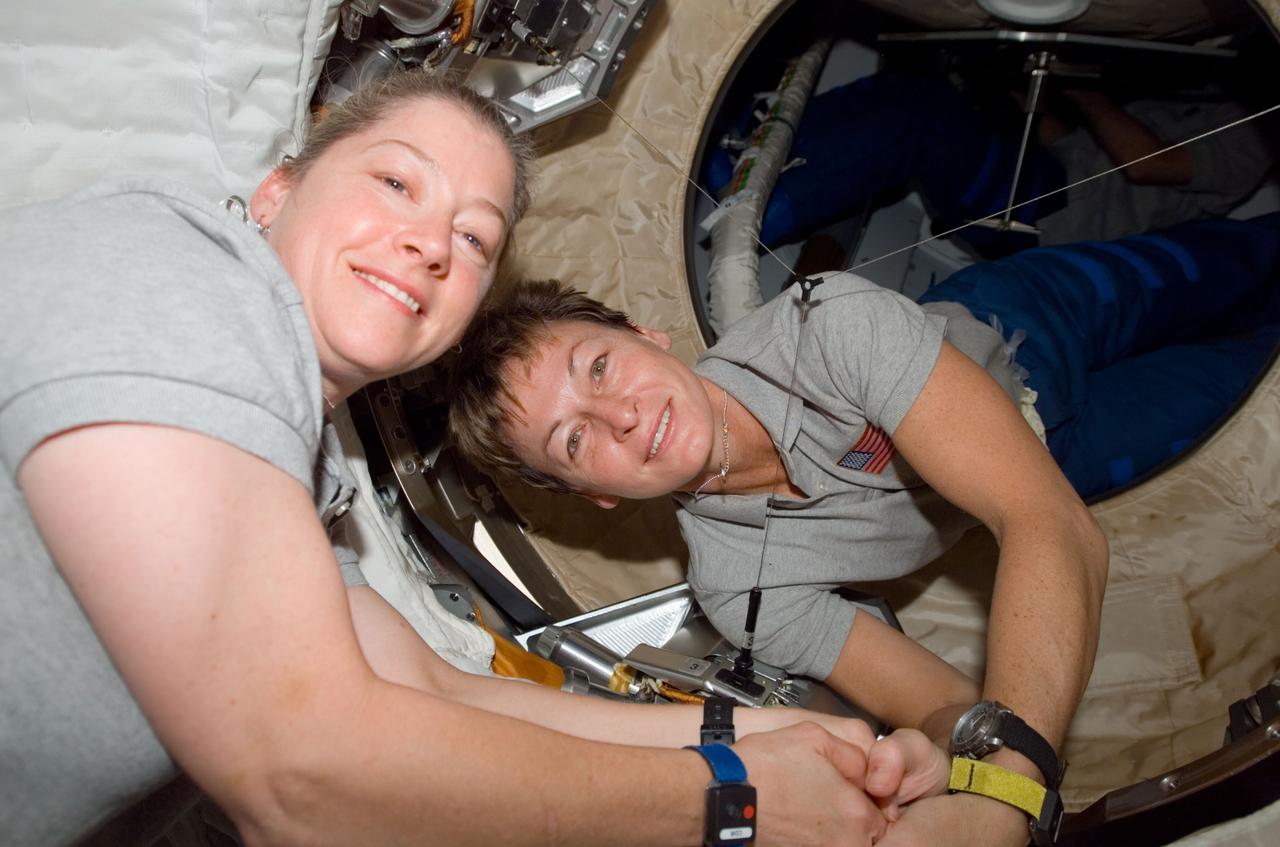
S120-E-008866 (4 Nov. 2007) --- Astronaut Pam Melroy (left), STS-120 commander, and Peggy Whitson, Expedition 16 commander, pose for a photo in the Pressurized Mating Adapter (PMA-2) of the International Space Station as the STS-120 crewmembers exit the station to board Space Shuttle Discovery for their return trip home. Hatches were closed between the station and the shuttle at 2:03 p.m. (CST) on Nov. 4.
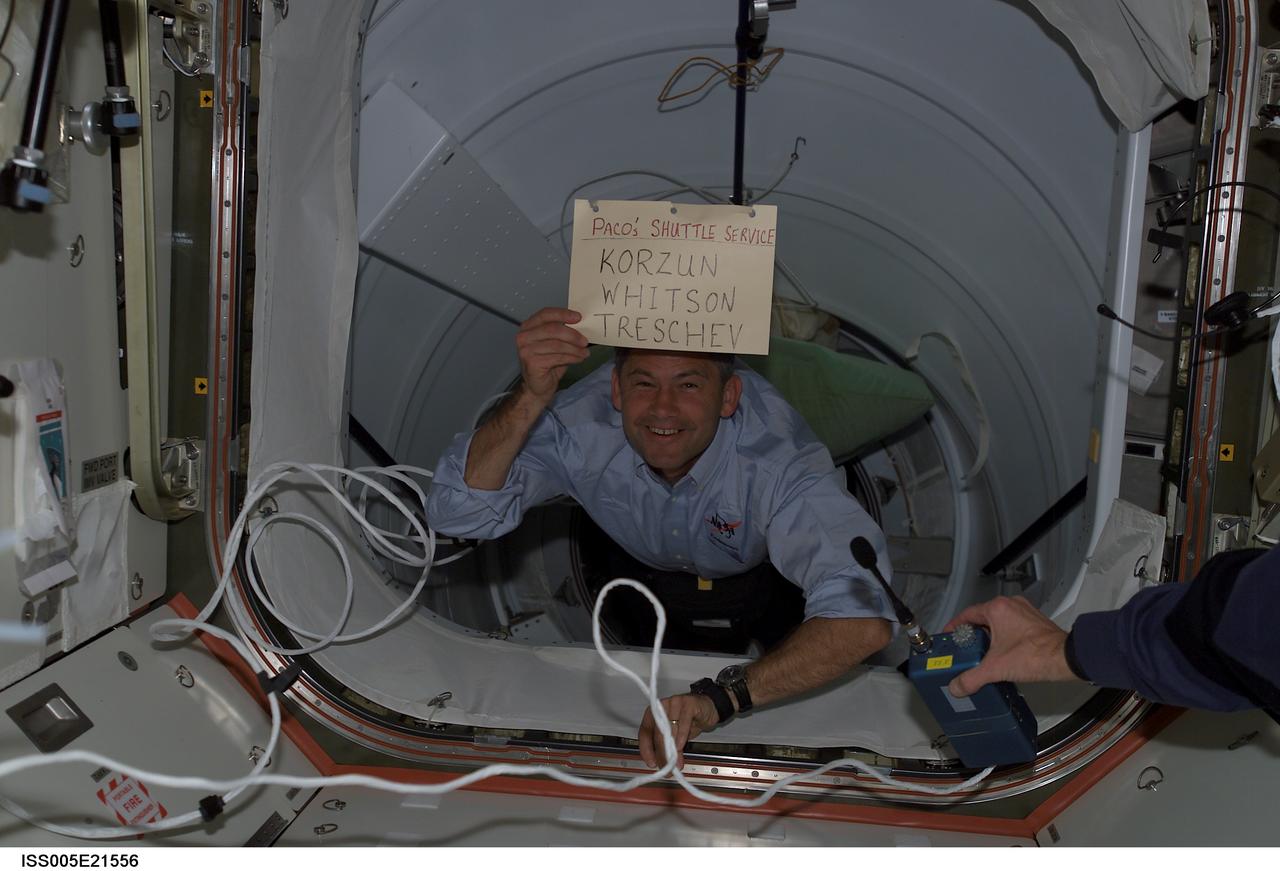
ISS005-E-21556 (25 November 2002) --- Astronaut Paul S. Lockhart, STS-113 pilot, holds a sign as he floats through the Pressurized Mating Adapter 2 (PMA-2) on the International Space Station (ISS) following the docking with the Space Shuttle Endeavour. Lockhart was also STS-111 pilot, which carried the Expedition Five crew to the station.
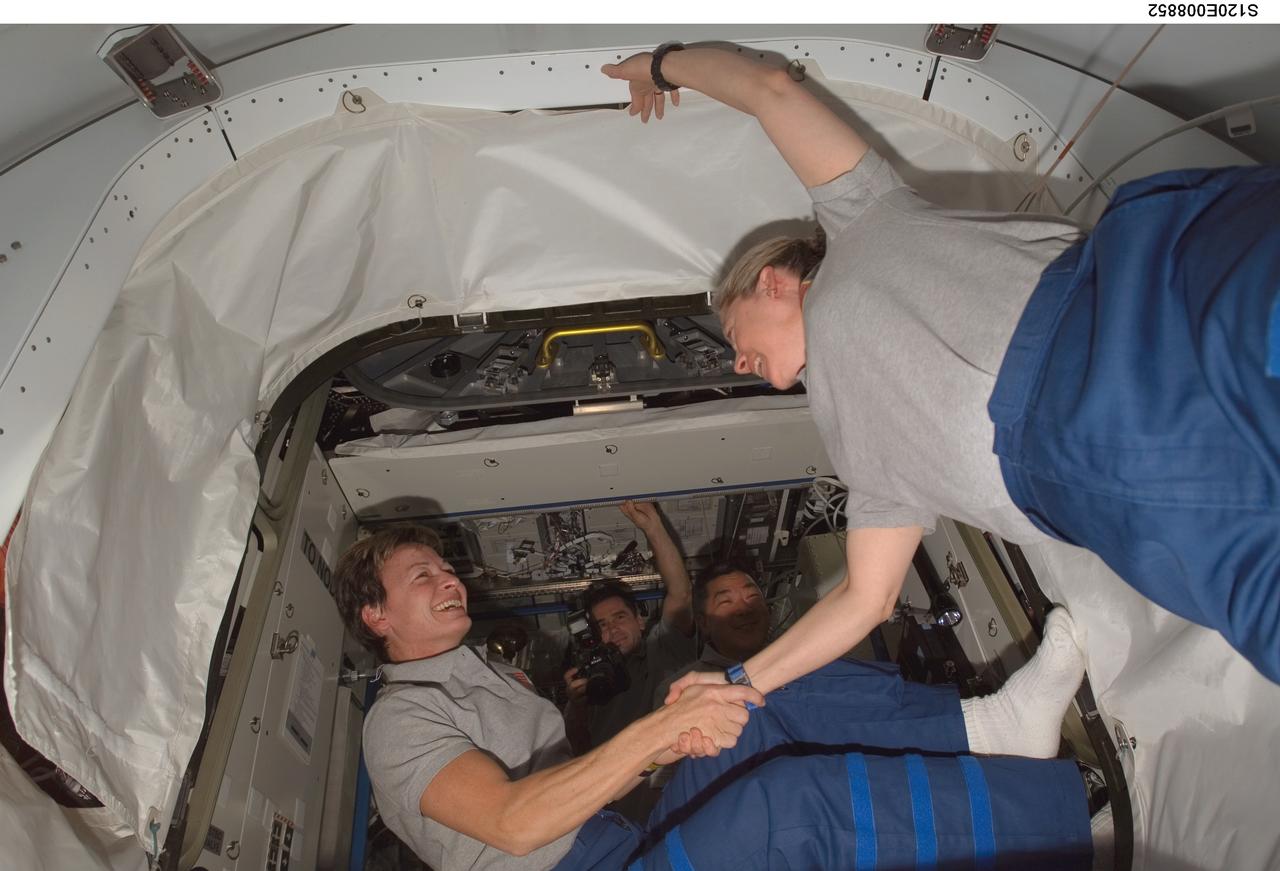
S120-E-008852 (4 Nov. 2007) --- Astronauts Peggy Whitson (left), Expedition 16 commander, and Pam Melroy, STS-120 commander, exchange handshakes in the Pressurized Mating Adapter (PMA-2) of the International Space Station as the STS-120 crewmembers exit the station to board Space Shuttle Discovery for their return trip home. Hatches were closed between the station and the shuttle at 2:03 p.m. (CST) on Nov. 4.
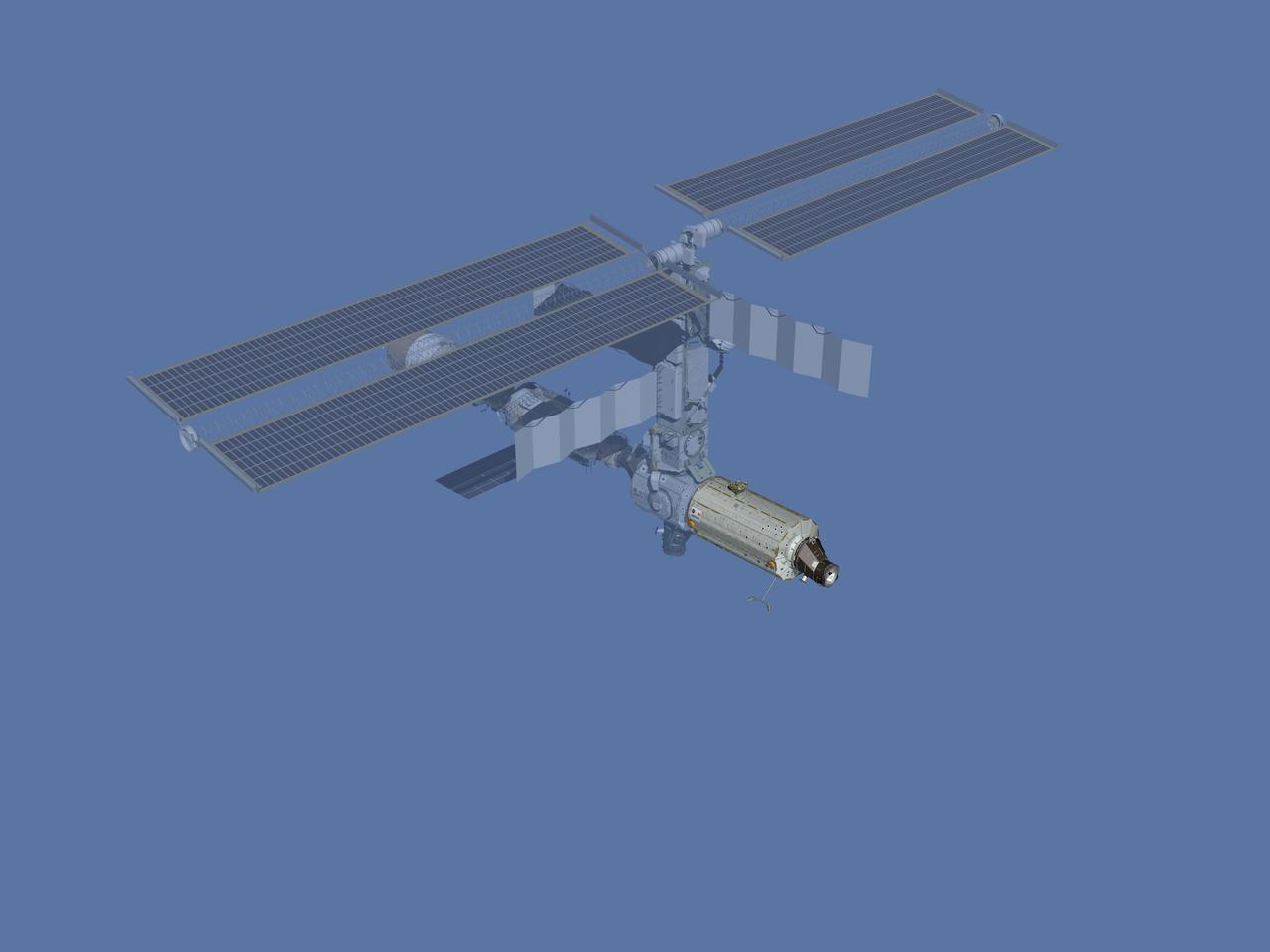
JSC2006-E-43485 (February 2001) --- Computer-generated artist's rendering of the International Space Station after flight STS-98/5A. The STS-98 crew installed the new Destiny laboratory module after removing it from Space Shuttle Atlantis payload bay. Pressurized Mating Adapter-2 (PMA-2) is relocated to the front of Destiny.
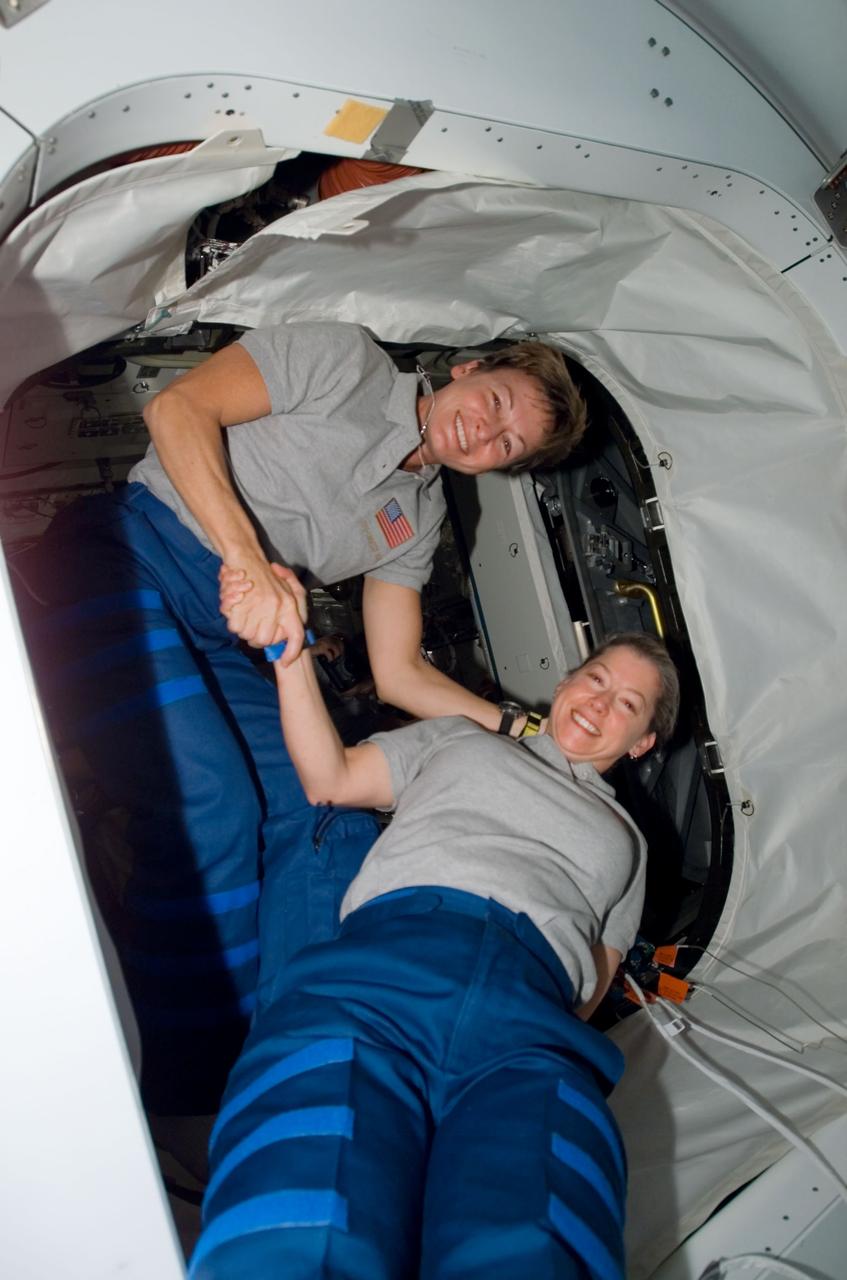
S120-E-008853 (4 Nov. 2007) --- Astronauts Peggy Whitson (left), Expedition 16 commander, and Pam Melroy, STS-120 commander, exchange handshakes in the Pressurized Mating Adapter (PMA-2) of the International Space Station as the STS-120 crewmembers exit the station to board Space Shuttle Discovery for their return trip home. Hatches were closed between the station and the shuttle at 2:03 p.m. (CST) on Nov. 4.
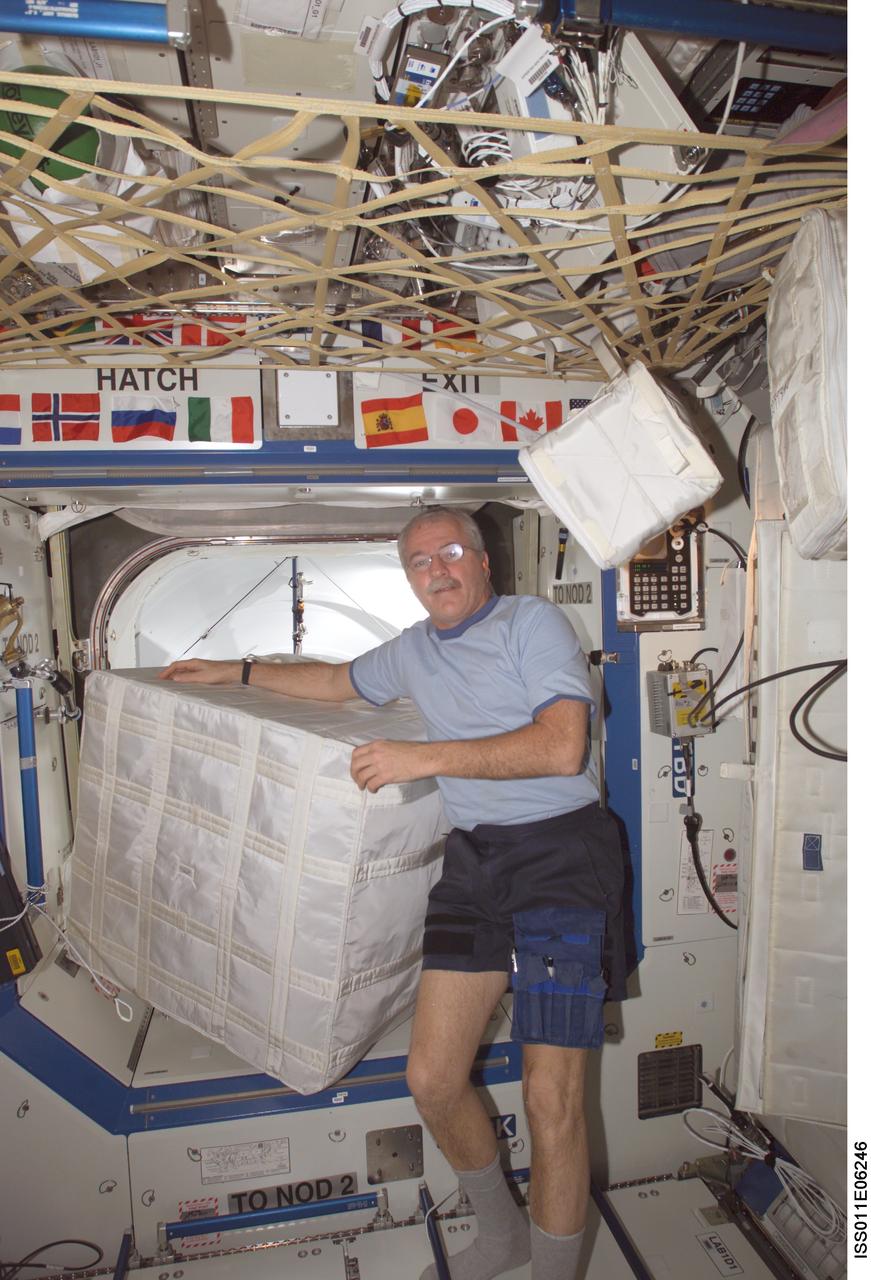
ISS011-E-06246 (18 May 2005) --- Astronaut John L. Phillips, Expedition 11 NASA ISS science officer and flight engineer, moves un-stowed cargo from the PMA-2 (Pressurized Mating Adapter-2) in preparation for the scheduled docking of the Space Shuttle Discovery. Phillips is in the Destiny laboratory of the International Space Station (ISS) with the hatch leading to the adapter in the background.
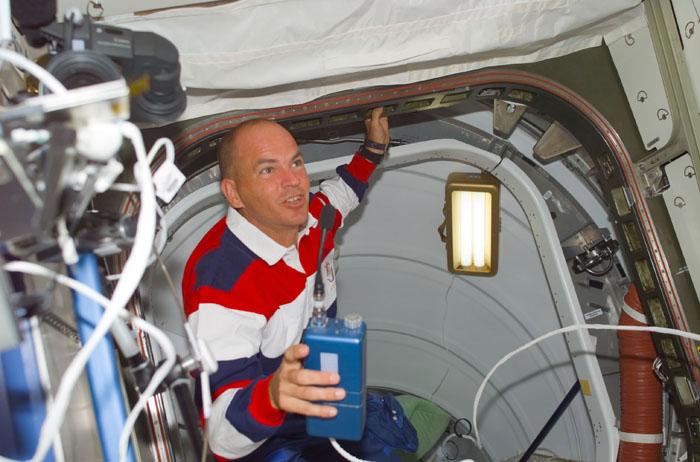
S105-E-5100 (12 August 2001) --- Frederick W. Sturckow, STS-105 pilot, moves through Pressurized Mating Adapter 2 (PMA-2) and into the Destiny Laboratory during STS-105's initial ingress into the International Space Station (ISS). This is Sturckow's second visit to the ISS. This image was taken with a digital still camera.
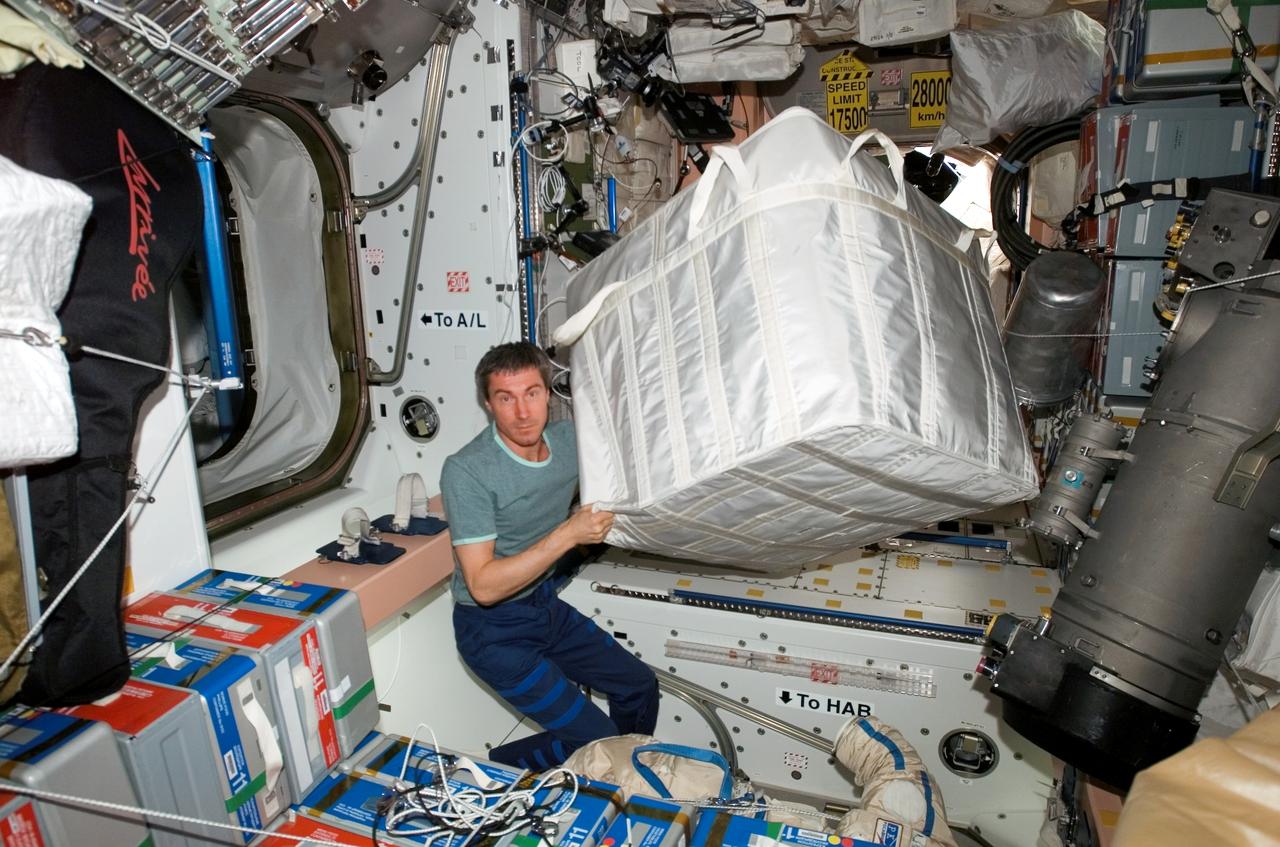
ISS011-E-06249 (18 May 2005) --- Cosmonaut Sergei K. Krikalev, Expedition 11 commander representing Russia's Federal Space Agency, moves un-stowed cargo through the Unity node from the PMA-2 (Pressurized Mating Adapter-2) in preparation for the scheduled docking of the space shuttle Discovery on international space station.

ISS016-E-009992 (9 Nov. 2007) --- Astronaut Peggy A. Whitson (right), Expedition 16 commander; and cosmonaut Yuri I. Malenchenko, flight engineer representing Russia's Federal Space Agency, participate in a session of extravehicular activity (EVA) as construction continues on the International Space Station (ISS). During the spacewalk Whitson and Malenchenko prepared for the relocation of the Pressurized Mating Adapter 2 (PMA-2) and the subsequent move of the new Harmony node to its permanent ISS home.
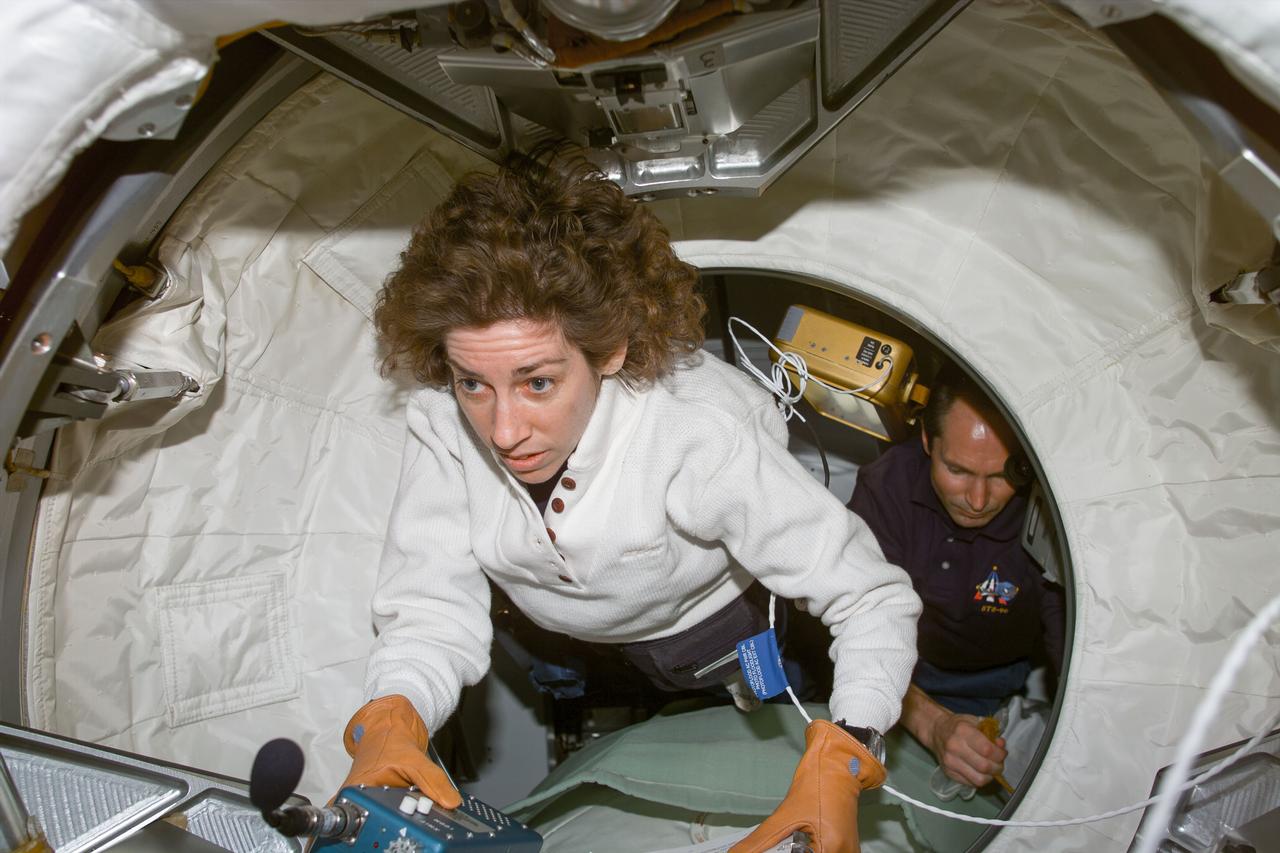
S96-E-5031 (29 May 1999) --- Astronaut Ellen Ochoa and cosmonaut Valery I. Tokarev return to the space shuttle Discovery after a brief intravehicular trip to the Pressurized Mating Adapter 2 (PMA 2) on flight day four. The photo was recorded with an electronic still camera (ESC) at 07:02:52 GMT, May 29, 1999. Photo credit: NASA
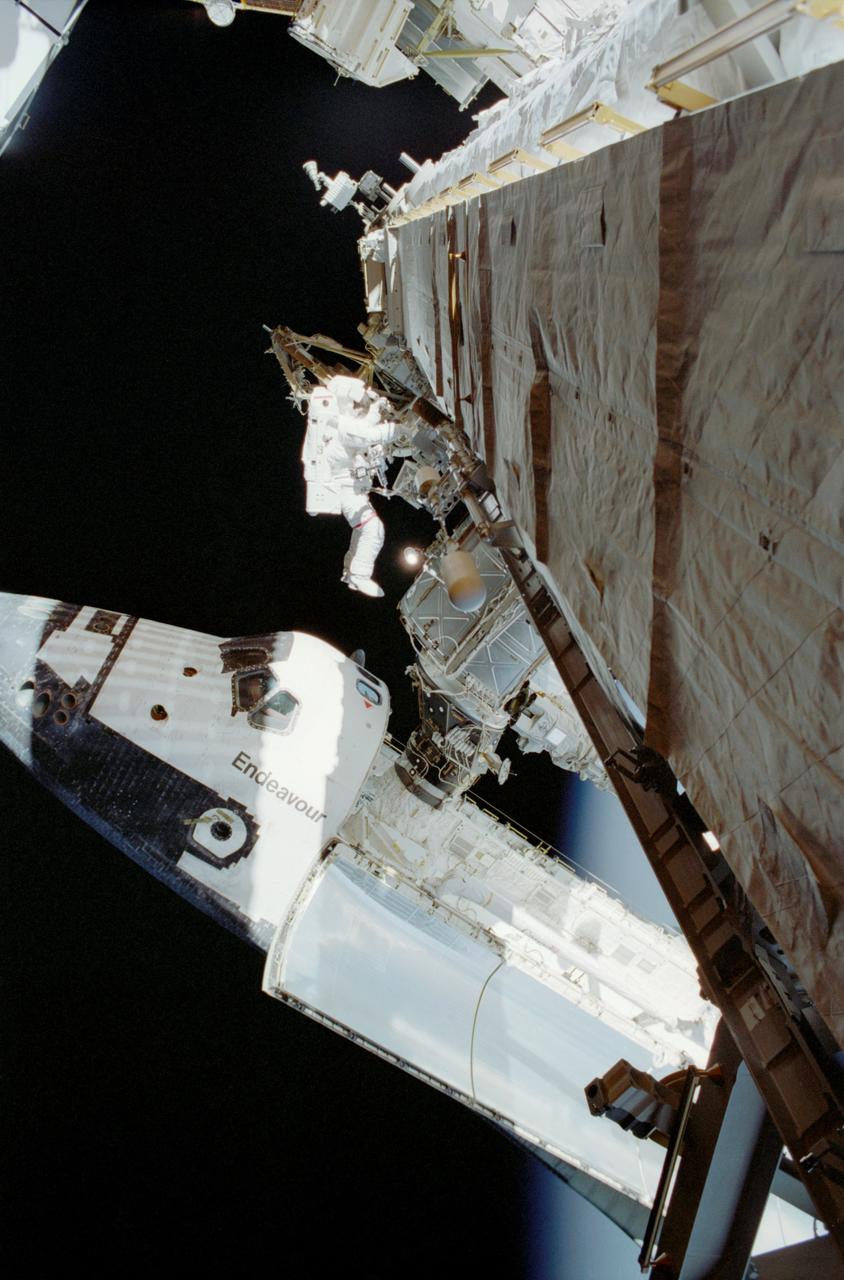
STS113-308-002 (28 November 2002) --- Astronaut Michael E. Lopez-Alegria, STS-113 mission specialist, participates in the mission’s second scheduled spacewalk to perform work on the International Space Station (ISS). The Space Shuttle Endeavour, docked to the Pressurized Mating Adapter 2 (PMA-2), is visible below Lopez-Alegria.
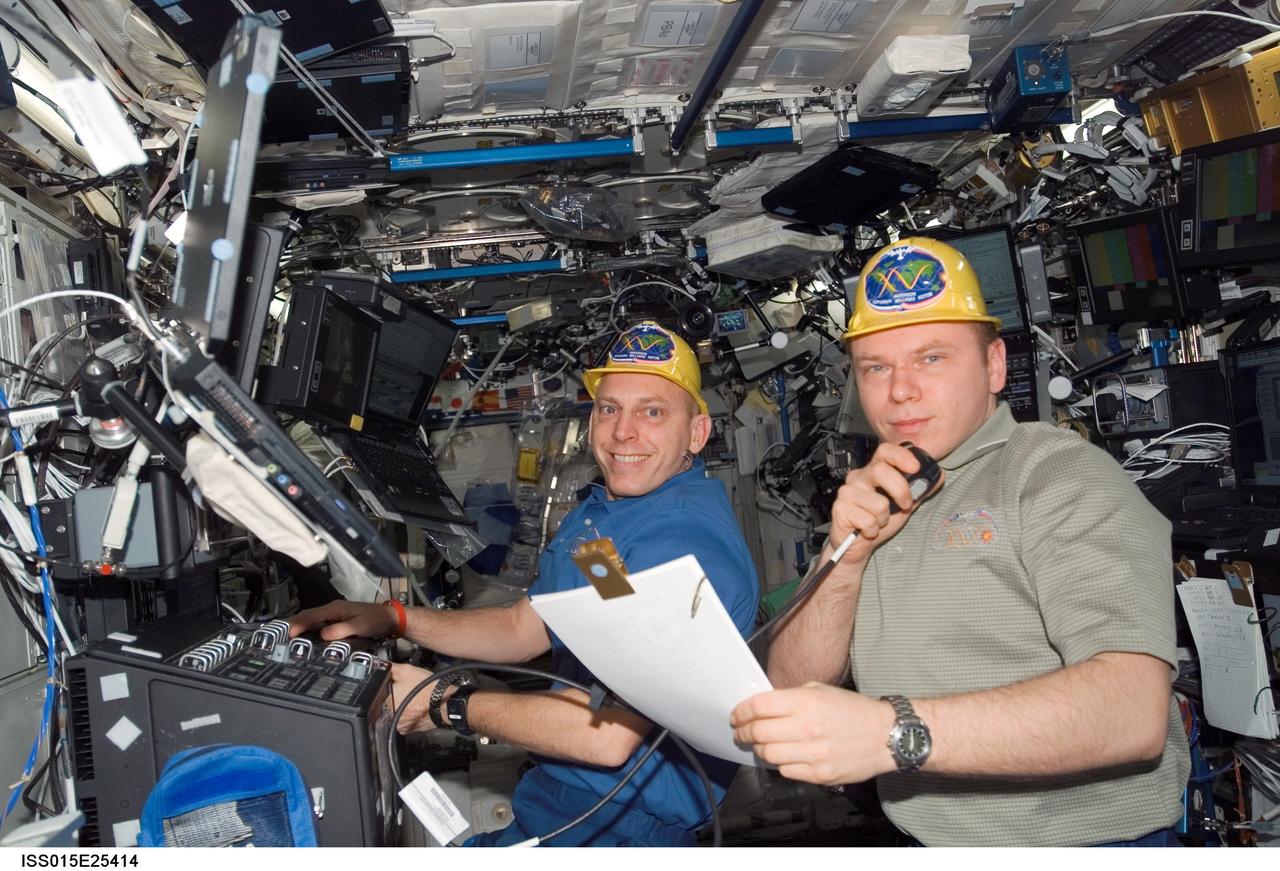
ISS015-E-25414 (30 Aug. 2007) --- Astronaut Clay Anderson (left), Expedition 15 flight engineer, works the controls of the station's robotic arm, Canadarm2; while cosmonaut Oleg V. Kotov, flight engineer representing Russia's Federal Space Agency, uses a communication system in the Destiny laboratory of the International Space Station during Pressurized Mating Adapter-3 (PMA-3) transfer operations. Using the Canadarm2, the PMA-3 was undocked from the Unity node's left side at 7:18 a.m. (CDT) and docked to Unity's lower port at 8:07 a.m. to prepare for the arrival of Node 2, the Harmony module, on the STS-120 flight of Space Shuttle Discovery in October 2007.
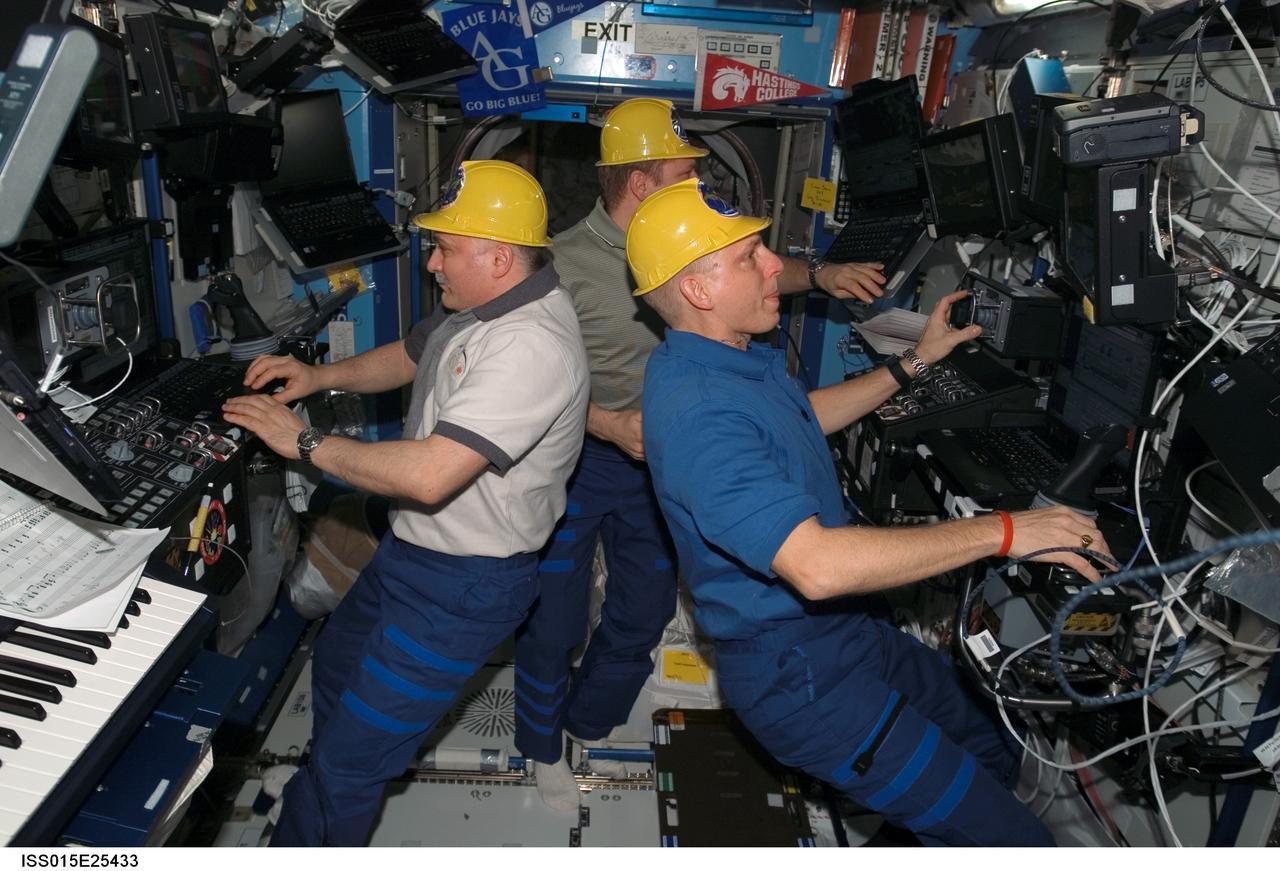
ISS015-E-25433 (30 Aug. 2007) --- Cosmonauts Fyodor N. Yurchikhin (left) and Oleg V. Kotov, Expedition 15 commander and flight engineer, respectively, both representing Russia's Federal Space Agency; along with astronaut Clay Anderson (right), flight engineer, work various tasks in the Destiny laboratory of the International Space Station during Pressurized Mating Adapter-3 (PMA-3) transfer operations. Using the station's robotic arm, Canadarm2, the PMA-3 was undocked from the Unity node's left side at 7:18 a.m. (CDT) and docked to Unity's lower port at 8:07 a.m. to prepare for the arrival of Node 2, the Harmony module, on the STS-120 flight of Space Shuttle Discovery in October 2007.
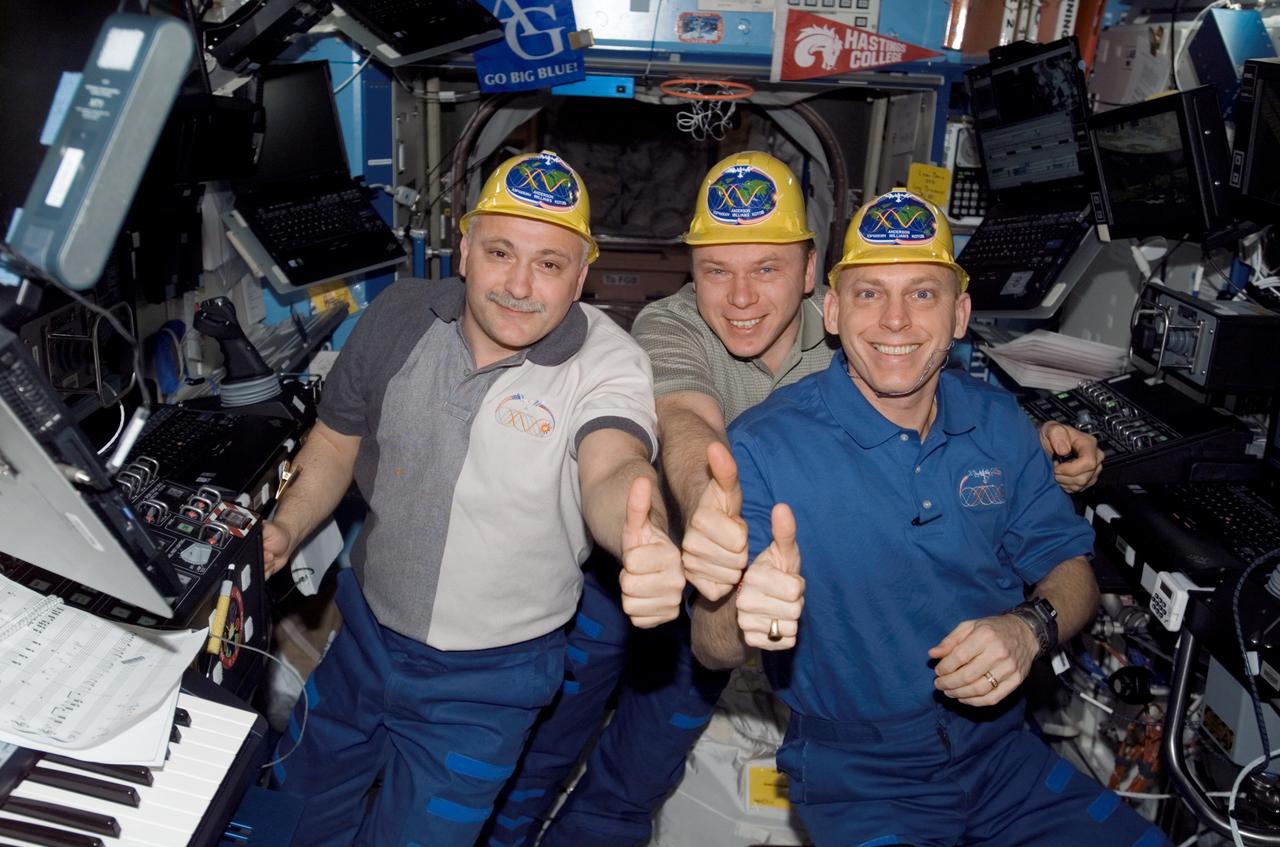
ISS015-E-25439 (30 Aug. 2007) --- Cosmonauts Fyodor N. Yurchikhin (left) and Oleg V. Kotov, Expedition 15 commander and flight engineer, respectively, both representing Russia's Federal Space Agency; along with astronaut Clay Anderson, flight engineer, give a "thumbs-up" signal at the conclusion of Pressurized Mating Adapter-3 (PMA-3) transfer operations in the Destiny laboratory of the International Space Station. Using the station's robotic arm, Canadarm2, the PMA-3 was undocked from the Unity node's left side at 7:18 a.m. (CDT) and docked to Unity's lower port at 8:07 a.m. to prepare for the arrival of Node 2, the Harmony module, on the STS-120 flight of Space Shuttle Discovery in October 2007.
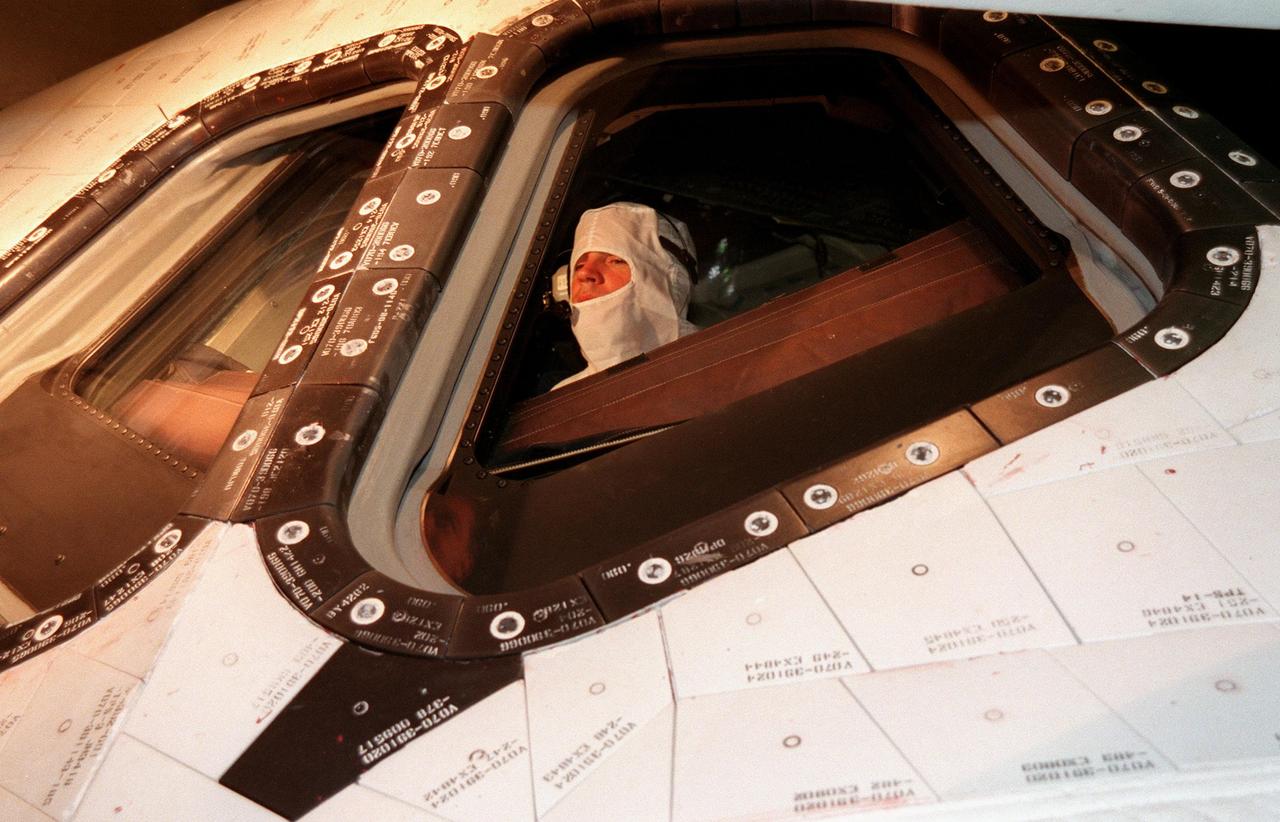
KENNEDY SPACE CENTER, FLA. -- In the Orbiter Processing Facility Bay 1, STS-88 Pilot Frederick W. Sturckow makes a visual inspection of windows on the Space Shuttle orbiter Endeavour. The STS-88 crew members are participating in a Crew Equipment Interface Test (CEIT), familiarizing themselves with the orbiter's midbody and crew compartments. Targeted for launch on Dec. 3, 1998, STS-88 will be the first Space Shuttle launch for assembly of the International Space Station (ISS). The primary payload is the Unity connecting module which will be mated to the Russian-built Zarya control module, expected to be already on orbit after a November launch from Russia. The first major U.S.-built component of ISS, Unity will serve as a connecting passageway to living and working areas of the space station. Unity has two attached pressurized mating adapters (PMAs) and one stowage rack installed inside. PMA-1 provides the permanent connection point between Unity and Zarya; PMA-2 will serve as a Space Shuttle docking port. Zarya is a self-supporting active vehicle, providing propulsive control capability and power during the early assembly stages. It also has fuel storage capability
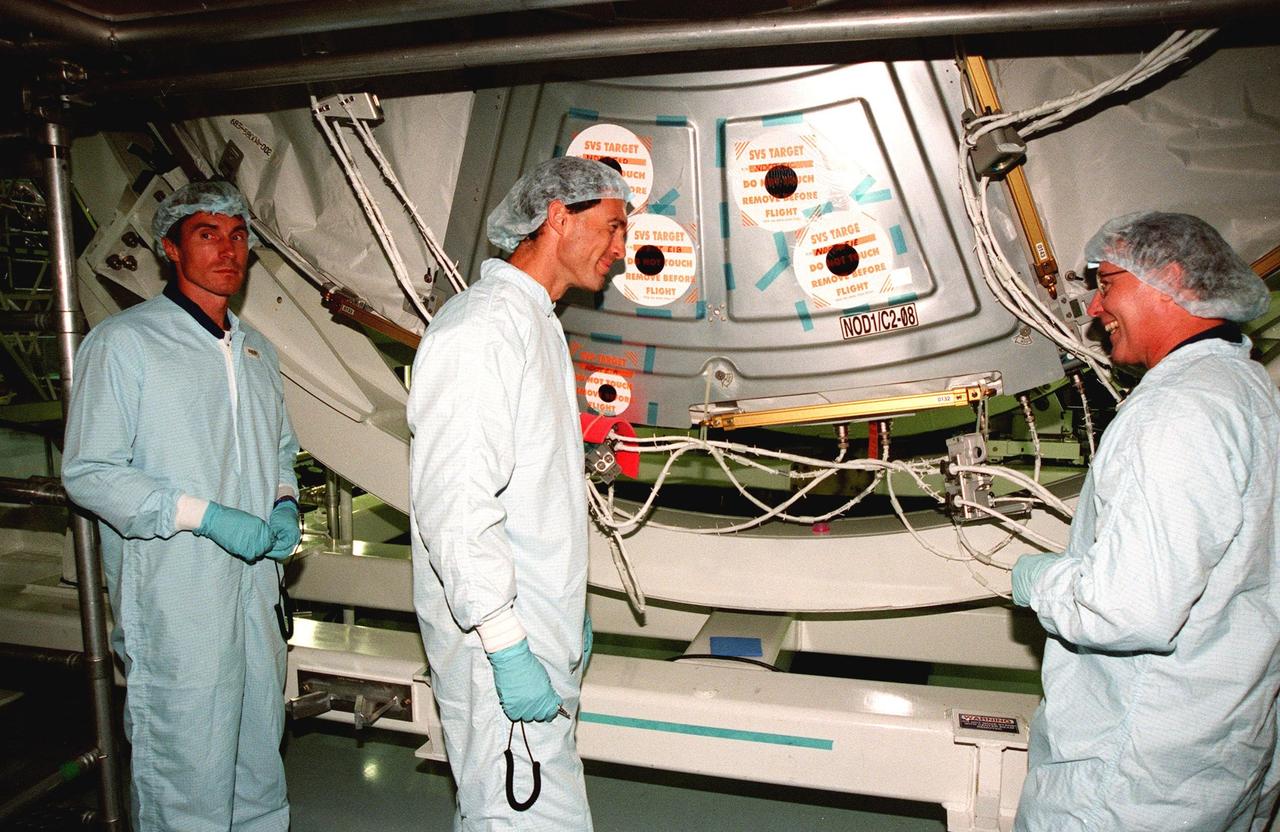
KENNEDY SPACE CENTER, FLA. -- In the Space Station Processing Facility, STS-88 Mission Specialists Sergei Krikalev (left), a Russian cosmonaut; James H. Newman (center); and Jerry L. Ross conduct a sharp-edge inspection of the Unity connecting module, which is the primary payload on their upcoming mission. The STS-88 crew members are participating in a Crew Equipment Interface Test (CEIT), familiarizing themselves with the orbiter's midbody and crew compartments. Targeted for liftoff on Dec. 3, 1998, STS-88 will be the first Space Shuttle launch for assembly of the International Space Station (ISS). The primary payload is the Unity connecting module which will be mated to the Russian-built Zarya control module, expected to be already on orbit after a November launch from Russia. The first major U.S.-built component of ISS, Unity will serve as a connecting passageway to living and working areas of the space station. Unity has two attached pressurized mating adapters (PMAs) and one stowage rack installed inside. PMA-1 provides the permanent connection point between Unity and Zarya; PMA-2 will serve as a Space Shuttle docking port. Zarya is a self-supporting active vehicle, providing propulsive control capability and power during the early assembly stages. It also has fuel storage capability
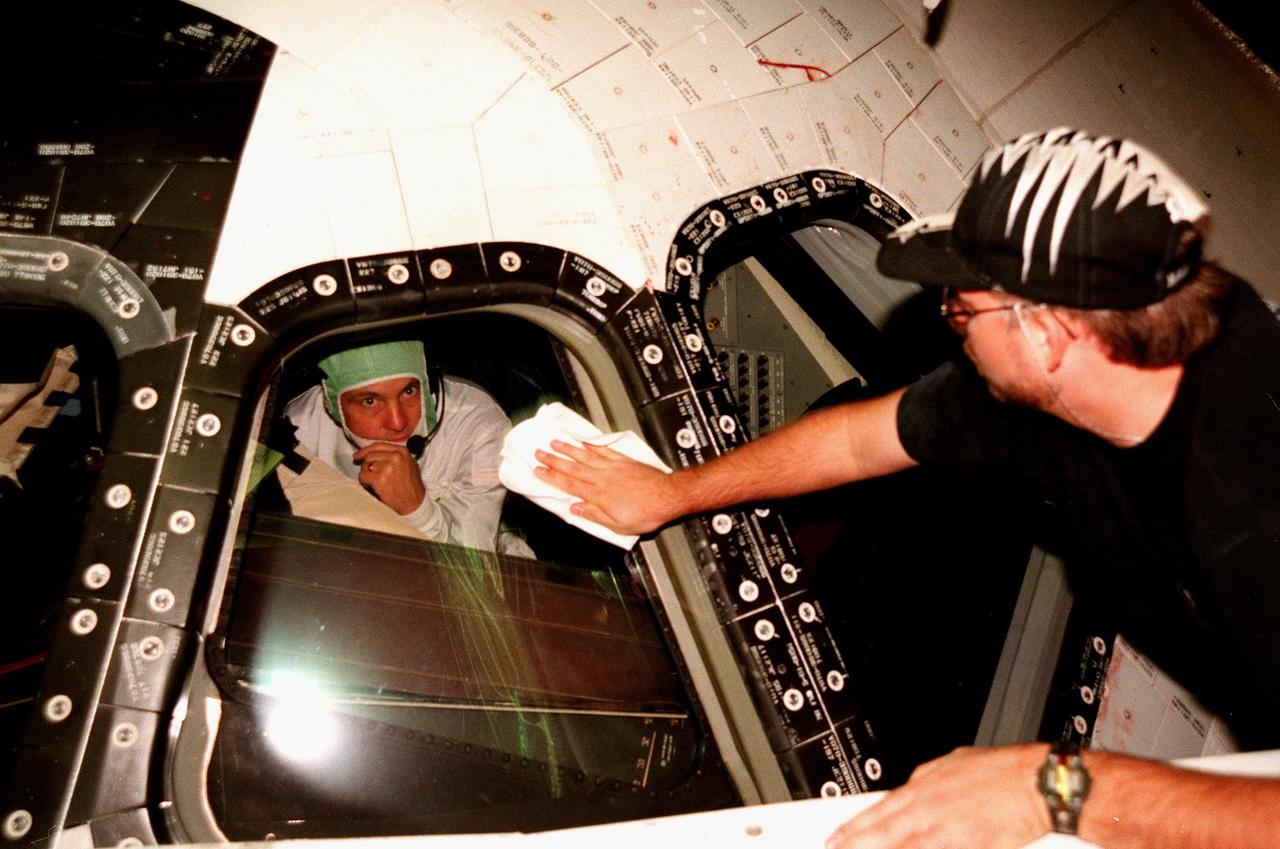
KENNEDY SPACE CENTER, FLA. -- In the Orbiter Processing Facility Bay 1, STS-88 Commander Robert D. Cabana watches from inside Space Shuttle orbiter Endeavour as worker Tracey Hackett cleans the outside of a window. The STS-88 crew members are participating in a Crew Equipment Interface Test (CEIT), familiarizing themselves with the orbiter's midbody and crew compartments. Targeted for liftoff on Dec. 3, 1998, STS-88 will be the first Space Shuttle launch for assembly of the International Space Station (ISS). The primary payload is the Unity connecting module which will be mated to the Russian-built Zarya control module, expected to be already on orbit after a November launch from Russia. The first major U.S.-built component of ISS, Unity will serve as a connecting passageway to living and working areas of the space station. Unity has two attached pressurized mating adapters (PMAs) and one stowage rack installed inside. PMA-1 provides the permanent connection point between Unity and Zarya; PMA-2 will serve as a Space Shuttle docking port. Zarya is a self-supporting active vehicle, providing propulsive control capability and power during the early assembly stages. It also has fuel storage capability
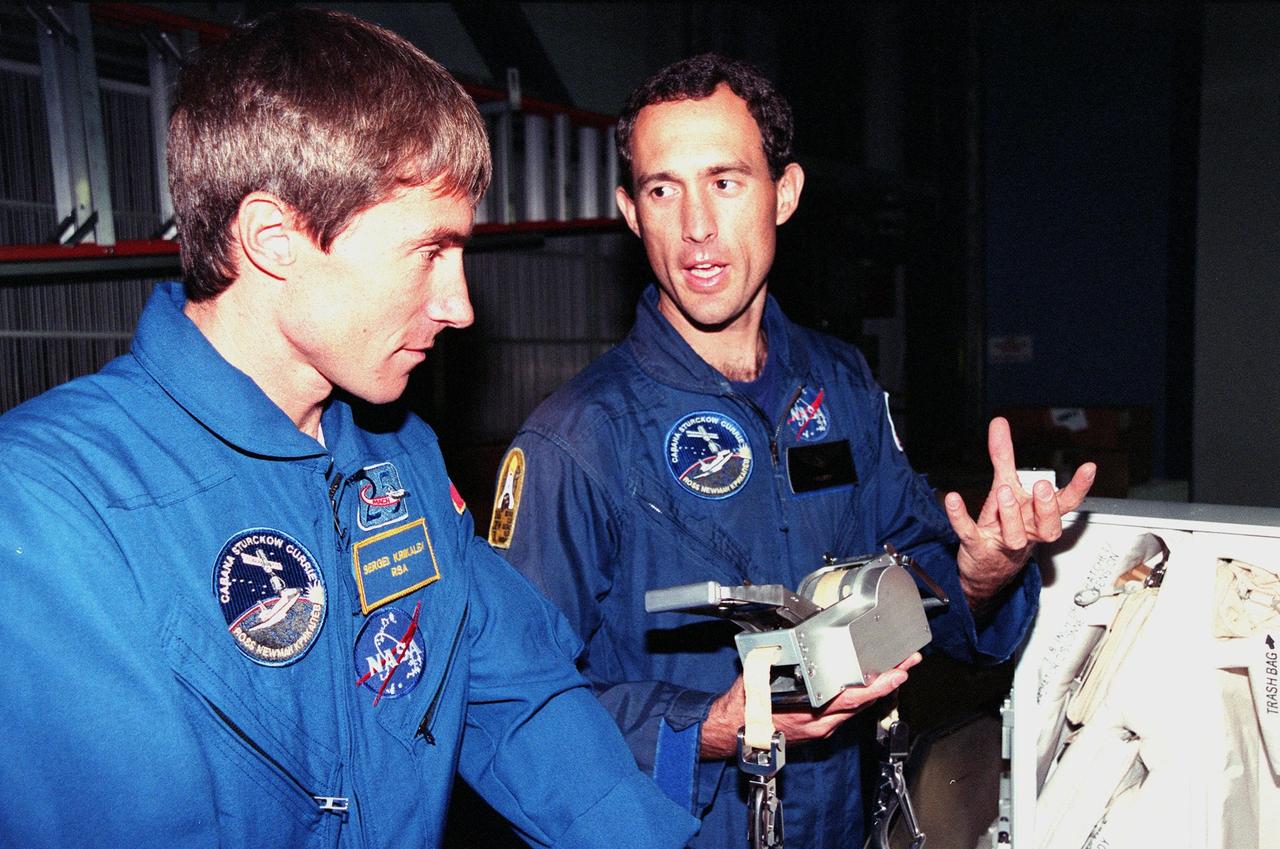
KENNEDY SPACE CENTER, FLA. -- Inside the Orbiter Processing Facility Bay 1, STS-88 Mission Specialists Sergei Krikalev (left), a Russian cosmonaut; and James H. Newman look over equipment for their upcoming flight. The STS-88 crew members are participating in a Crew Equipment Interface Test (CEIT), familiarizing themselves with the orbiter's midbody and crew compartments. Targeted for liftoff on Dec. 3, 1998, STS-88 will be the first Space Shuttle launch for assembly of the International Space Station (ISS). The primary payload is the Unity connecting module which will be mated to the Russian-built Zarya control module, expected to be already on orbit after a November launch from Russia. The first major U.S.-built component of ISS, Unity will serve as a connecting passageway to living and working areas of the space station. Unity has two attached pressurized mating adapters (PMAs) and one stowage rack installed inside. PMA-1 provides the permanent connection point between Unity and Zarya; PMA-2 will serve as a Space Shuttle docking port. Zarya is a self-supporting active vehicle, providing propulsive control capability and power during the early assembly stages. It also has fuel storage capability
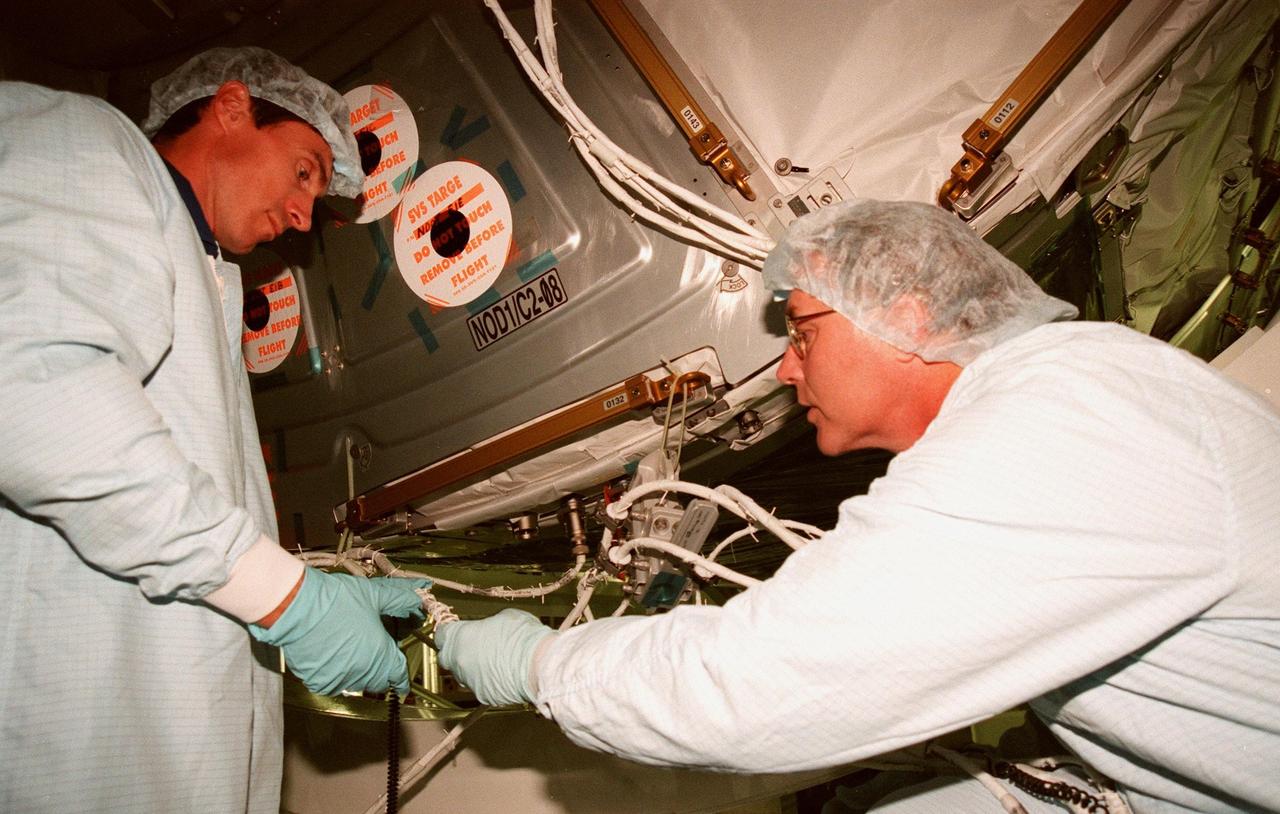
KENNEDY SPACE CENTER, FLA. -- In the Space Station Processing Facility, STS-88 Mission Specialists Sergei Krikalev, a Russian cosmonaut, and Jerry L. Ross check out equipment on the Unity connecting module, primary payload on the mission. The STS-88 crew members are participating in a Crew Equipment Interface Test (CEIT), familiarizing themselves with the orbiter's midbody and crew compartments. Scheduled for launch on Dec. 3, 1998, STS-88 will be the first Space Shuttle launch for the International Space Station. The Unity connecting module will be mated to the Russian-built Zarya control module, already on orbit after a November launch. Unity will have two Pressurized Mating Adapters (PMAs) attached and 1 stowage rack installed inside. PMA-1 will connect U.S. and Russian elements; PMA-2 will provide a Shuttle docking location. Eventually, Unity's six ports will provide connecting points for the Z1 truss exterior framework, U.S. lab, airlock, cupola, Node 3, and the Multi-Purpose Logistics Module, as well as the control module. Zarya is a self-supporting active vehicle, providing propulsive control capability and power through the early assembly stages. It provides fuel storage capability and a rendezvous and docking capability to the Service Module
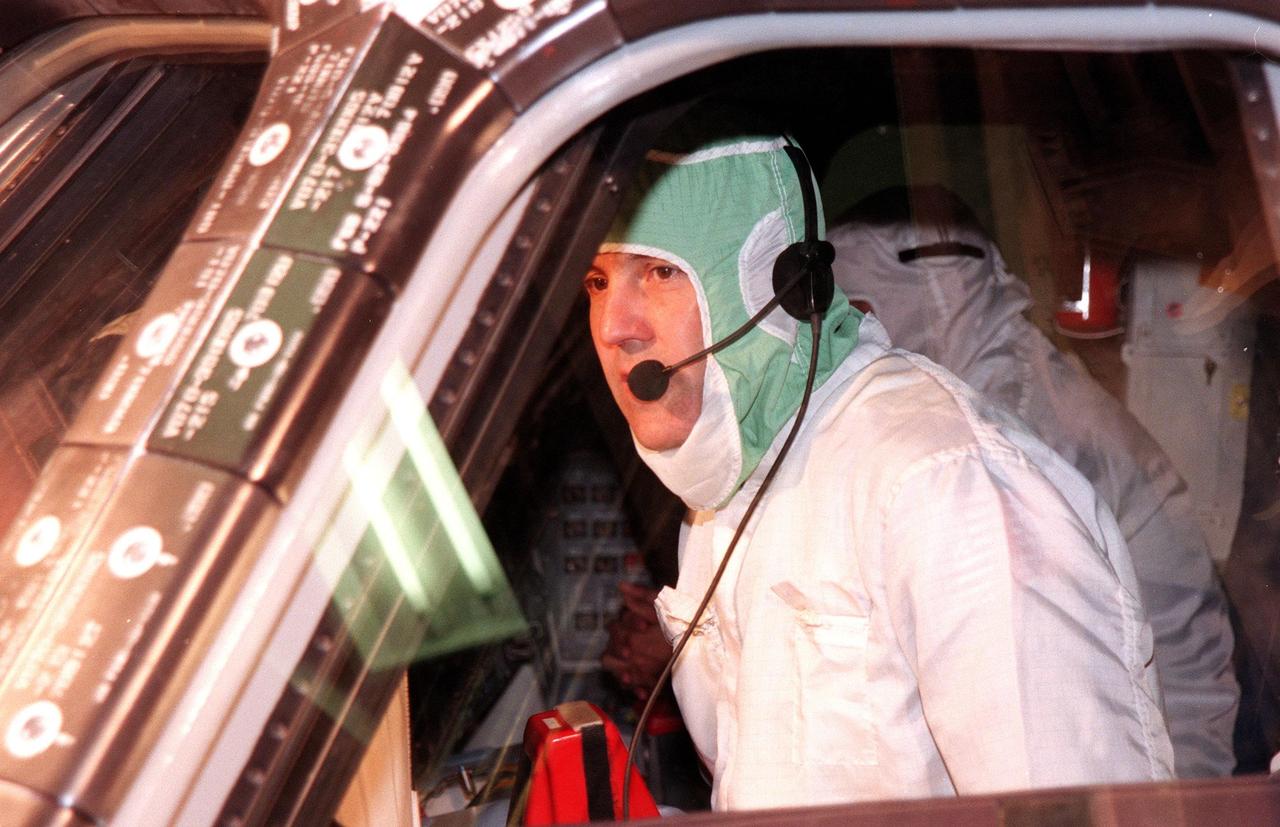
KENNEDY SPACE CENTER, FLA. -- In the Orbiter Processing Facility Bay 1, STS-88 Commander Robert D. Cabana makes a visual inspection of the windows on Space Shuttle orbiter Endeavour. The STS-88 crew members are participating in a Crew Equipment Interface Test (CEIT), familiarizing themselves with the orbiter's midbody and crew compartments. Targeted for liftoff on Dec. 3, 1998, STS-88 will be the first Space Shuttle launch for assembly of the International Space Station (ISS). The primary payload is the Unity connecting module which will be mated to the Russian-built Zarya control module, expected to be already on orbit after a November launch from Russia. The first major U.S.-built component of ISS, Unity will serve as a connecting passageway to living and working areas of the space station. Unity has two attached pressurized mating adapters (PMAs) and one stowage rack installed inside. PMA-1 provides the permanent connection point between Unity and Zarya; PMA-2 will serve as a Space Shuttle docking port. Zarya is a self-supporting active vehicle, providing propulsive control capability and power during the early assembly stages. It also has fuel storage capability
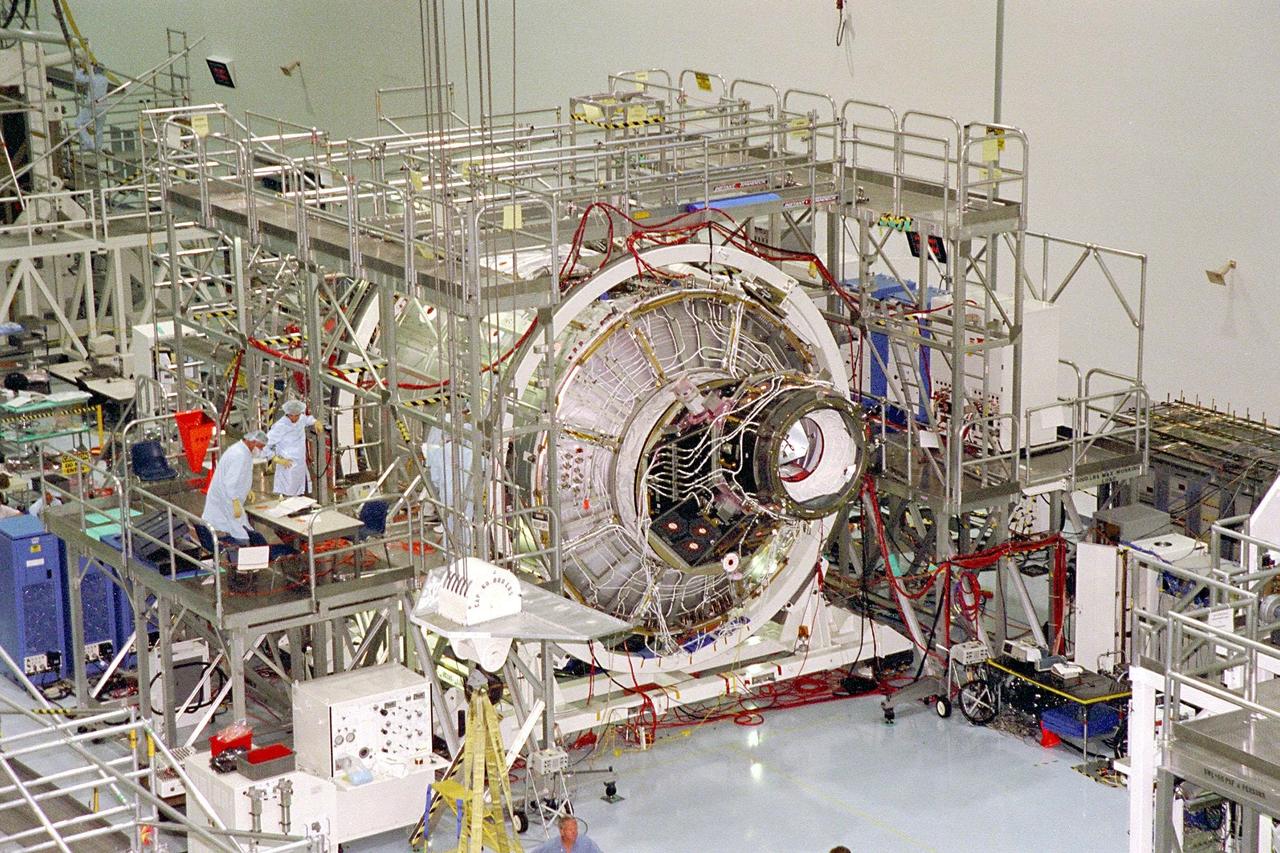
KENNEDY SPACE CENTER, FLA. -- The International Space Station's (ISS) Unity node, with Pressurized Mating Adapter (PMA)-2 attached, awaits further processing by Boeing technicians in its workstand in the Space Station Processing Facility (SSPF). The Unity node is the first element of the ISS to be manufactured in the United States and is currently scheduled to lift off aboard the Space Shuttle Endeavour on STS-88 later this year. Unity has two PMAs attached to it now that this mate is completed. PMAs are conical docking adapters which will allow the docking systems used by the Space Shuttle and by Russian modules to attach to the node's hatches and berthing mechanisms. Once in orbit, Unity, which has six hatches, will be mated with the already orbiting Control Module and will eventually provide attachment points for the U.S. laboratory module; Node 3; an early exterior framework or truss for the station; an airlock; and a multi-windowed cupola. The Control Module, or Functional Cargo Block, is a U.S.-funded and Russian-built component that will be launched aboard a Russian rocket from Kazakstan
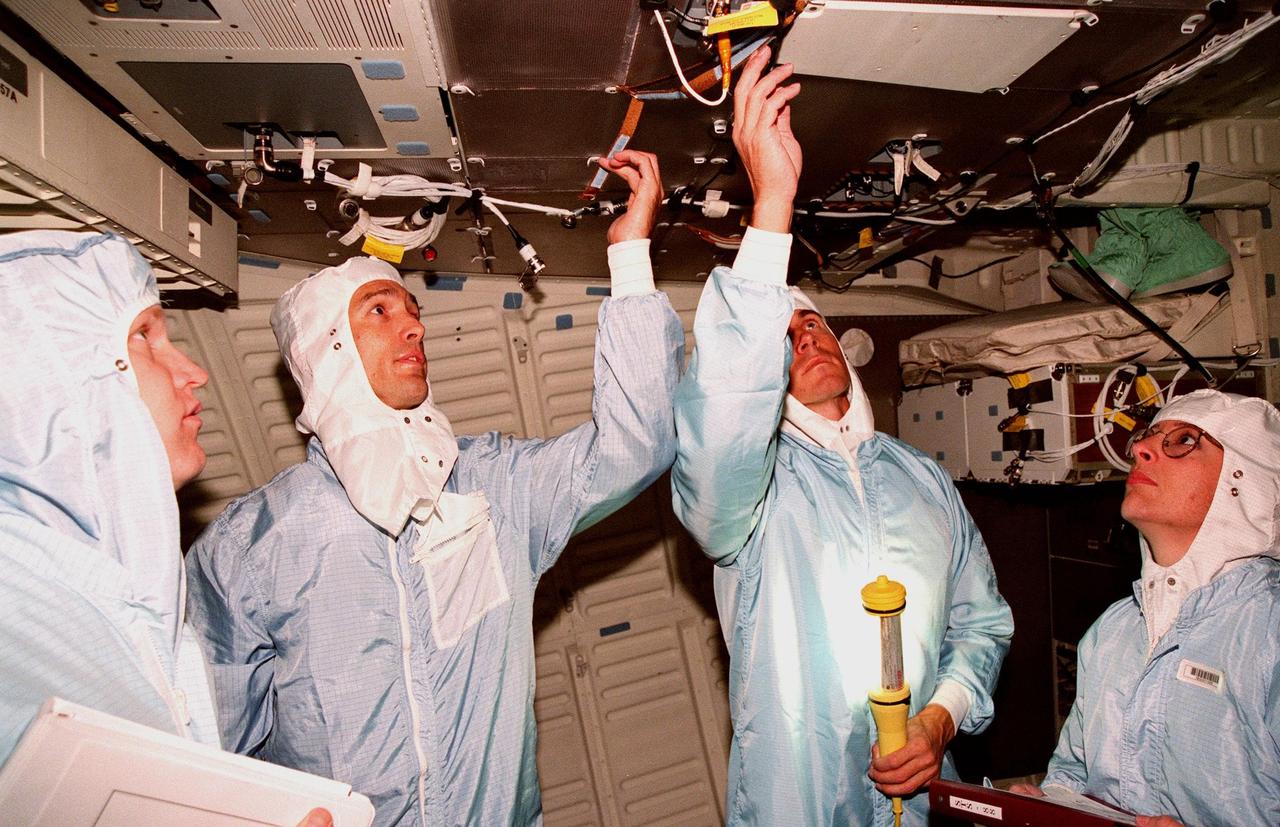
KENNEDY SPACE CENTER, FLA. -- Inside Space Shuttle orbiter Endeavour in the Orbiter Processing Facility Bay 1, workers James Neilhouse (left) and Melissa Groening (right) watch while STS-88 Mission Specialists James H. Newman (second from left) and Sergei Krikalev, a Russian cosmonaut, check overhead equipment. STS-88 crew members are participating in a Crew Equipment Interface Test (CEIT), familiarizing themselves with the orbiter's midbody and crew compartments. Targeted for liftoff on Dec. 3, 1998, STS-88 will be the first Space Shuttle launch for assembly of the International Space Station (ISS). The primary payload is the Unity connecting module which will be mated to the Russian-built Zarya control module, expected to be already on orbit after a November launch from Russia. The first major U.S.-built component of ISS, Unity will serve as a connecting passageway to living and working areas of the space station. Unity has two attached pressurized mating adapters (PMAs) and one stowage rack installed inside. PMA-1 provides the permanent connection point between Unity and Zarya; PMA-2 will serve as a Space Shuttle docking port. Zarya is a self-supporting active vehicle, providing propulsive control capability and power during the early assembly stages. It also has fuel storage capability.
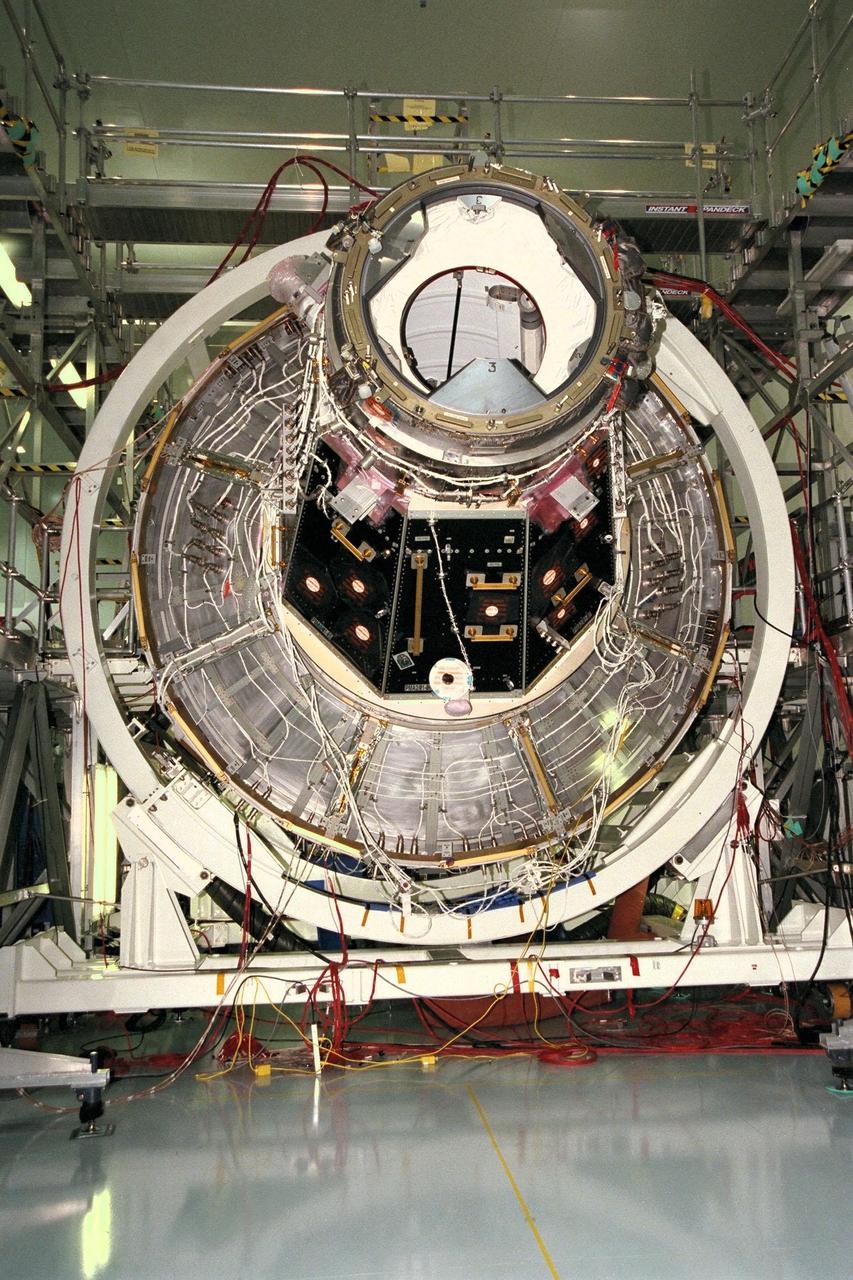
KENNEDY SPACE CENTER, FLA. -- The International Space Station's (ISS) Unity node, with Pressurized Mating Adapter (PMA)-2 attached, awaits further processing in the Space Station Processing Facility (SSPF). The Unity node is the first element of the ISS to be manufactured in the United States and is currently scheduled to lift off aboard the Space Shuttle Endeavour on STS-88 later this year. Unity has two PMAs attached to it now that this mate is completed. PMAs are conical docking adapters which will allow the docking systems used by the Space Shuttle and by Russian modules to attach to the node's hatches and berthing mechanisms. Once in orbit, Unity, which has six hatches, will be mated with the already orbiting Control Module and will eventually provide attachment points for the U.S. laboratory module; Node 3; an early exterior framework or truss for the station; an airlock; and a multi-windowed cupola. The Control Module, or Functional Cargo Block, is a U.S.-funded and Russian-built component that will be launched aboard a Russian rocket from Kazakstan
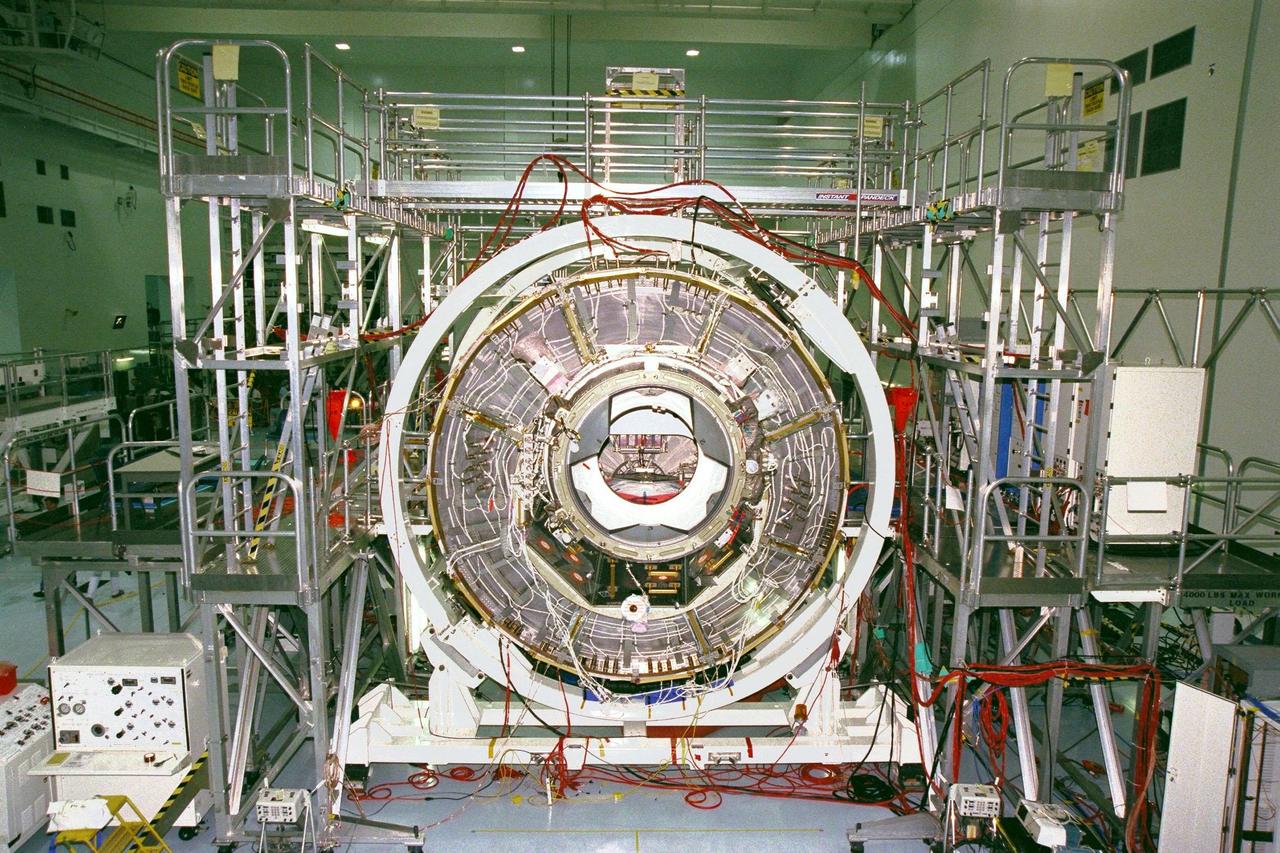
KENNEDY SPACE CENTER, FLA. -- The International Space Station's (ISS) Unity node, with Pressurized Mating Adapter (PMA)-2 attached, awaits further processing in the Space Station Processing Facility (SSPF). The Unity node is the first element of the ISS to be manufactured in the United States and is currently scheduled to lift off aboard the Space Shuttle Endeavour on STS-88 later this year. Unity has two PMAs attached to it now that this mate is completed. PMAs are conical docking adapters which will allow the docking systems used by the Space Shuttle and by Russian modules to attach to the node's hatches and berthing mechanisms. Once in orbit, Unity, which has six hatches, will be mated with the already orbiting Control Module and will eventually provide attachment points for the U.S. laboratory module; Node 3; an early exterior framework or truss for the station; an airlock; and a multi-windowed cupola. The Control Module, or Functional Cargo Block, is a U.S.-funded and Russian-built component that will be launched aboard a Russian rocket from Kazakstan
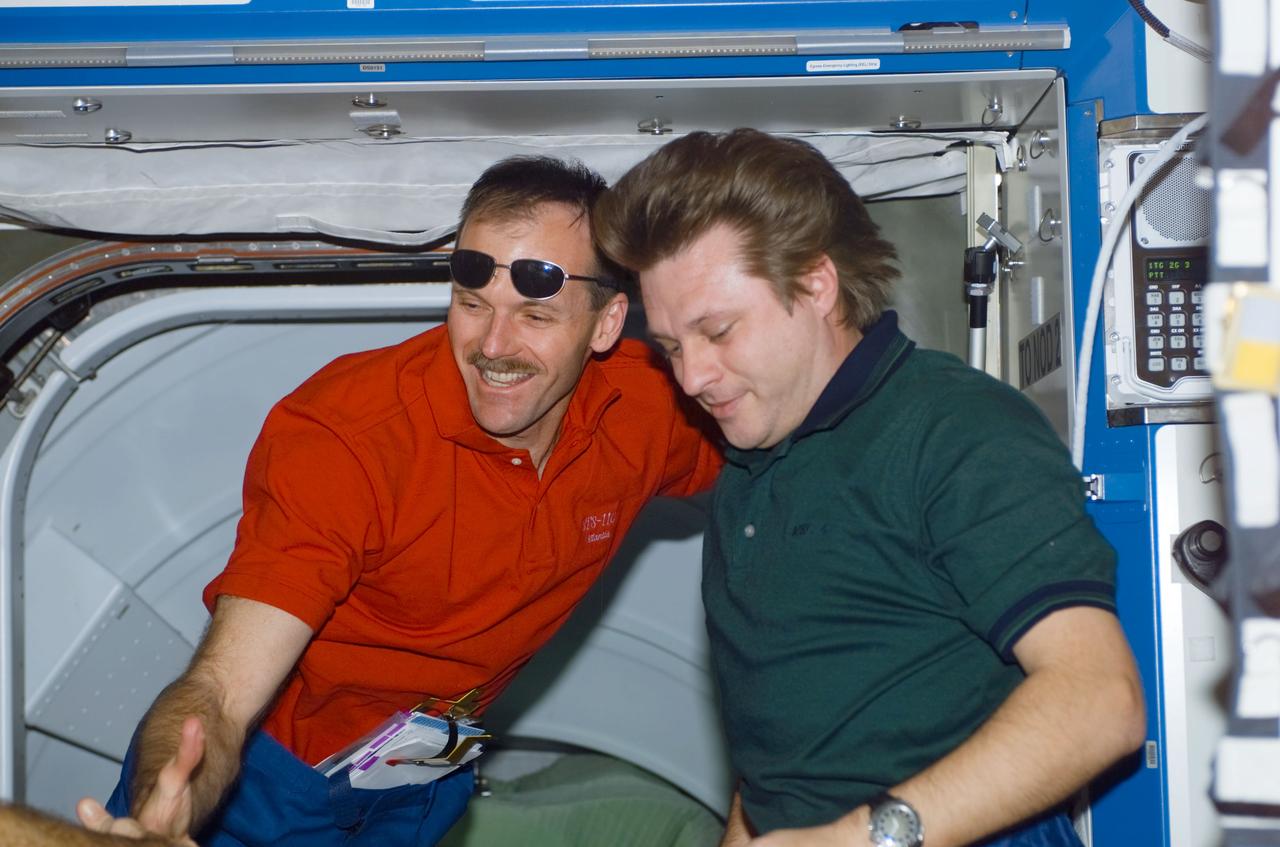
STS110-E-5097 (10 April 2002) --- Astronaut Steven L. Smith (left), STS-110 mission specialist, and cosmonaut Yury I. Onufrienko, Expedition Four mission commander, converse in the Destiny laboratory near the Pressurized Mating Adapter (PMA-2) on the International Space Station (ISS). The image was taken with a digital still camera.

STS113-306-011 (30 November 2002) --- Astronaut John B. Herrington (center left frame), STS-113 mission specialist, participates in the mission’s third spacewalk. The forward section of the Space Shuttle Endeavour, docked to the Pressurized Mating Adapter (PMA-2) on the International Space Station (ISS), is visible center frame. The station’s Canadarm2 appears to stand in between the shuttle and Herrington.
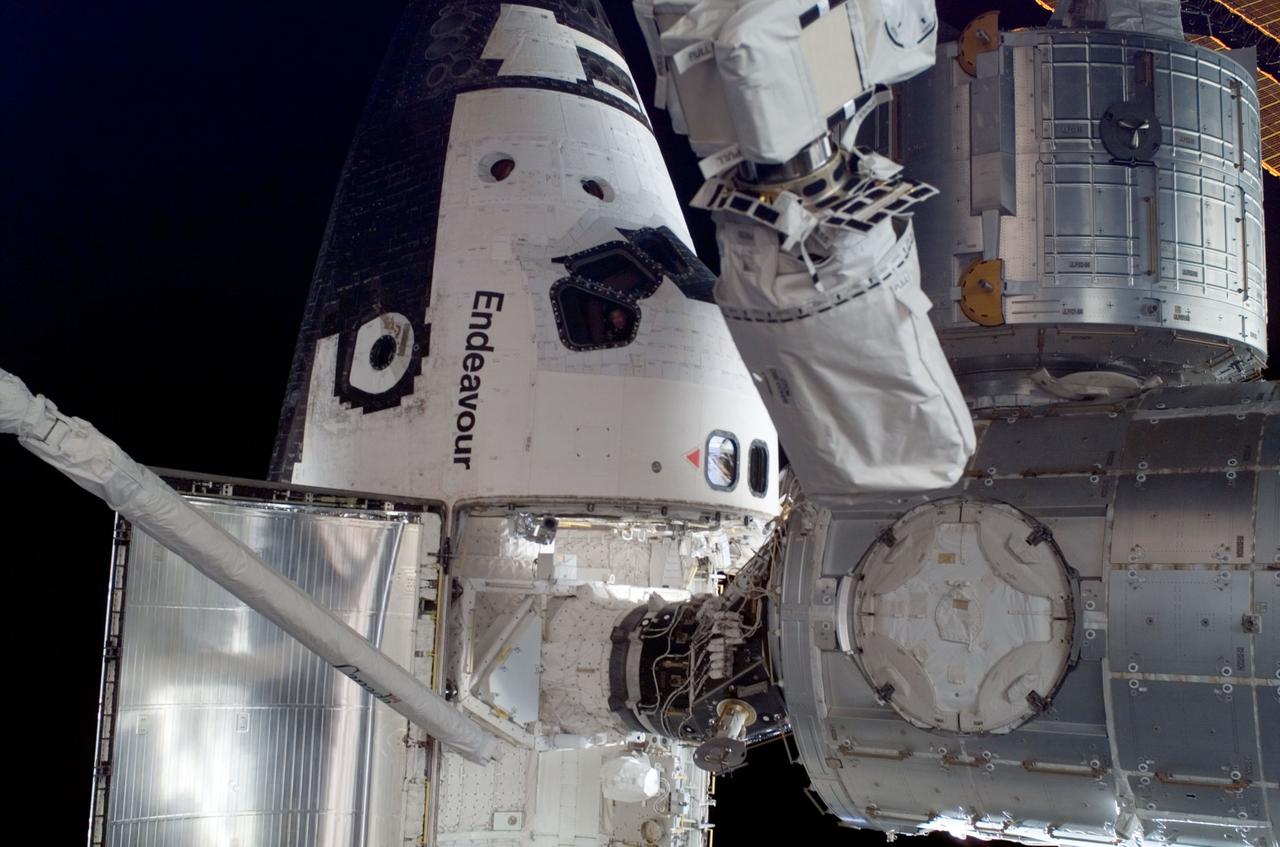
ISS016-E-032993 (18 March 2008) --- Space Shuttle Endeavour, docked to the Pressurized Mating Adapter (PMA-2) on the International Space Station, is featured in this image photographed by a crewmember during the STS-123 mission's third planned session of extravehicular activity (EVA). The newly installed Japanese Logistics Module - Pressurized Section (JLP) is visible at top right. The JLP is the first pressurized component of the Japan Aerospace Exploration Agency's Kibo laboratory and the newest component of the station.
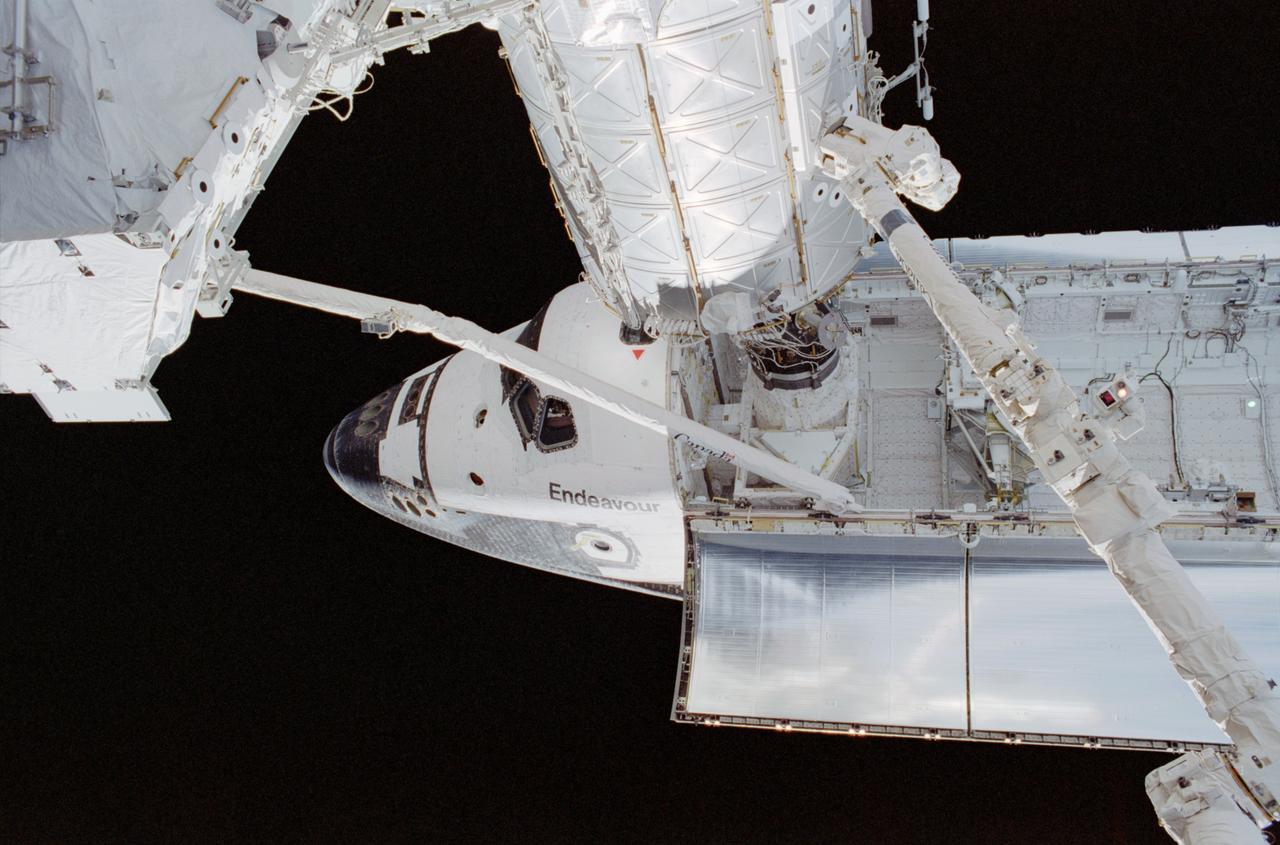
STS111-310-014 (9 June 2002) --- Backdropped by the blackness of space, the Space Shuttle Endeavour is pictured while docked to the Pressurized Mating Adapter (PMA-2) at the forward end of the Destiny laboratory on the International Space Station (ISS). A portion of the Canadarm2 is visible on the right and Endeavour’s robotic arm is in full view as it is stretched out with the S0 (S-zero) Truss at its end.
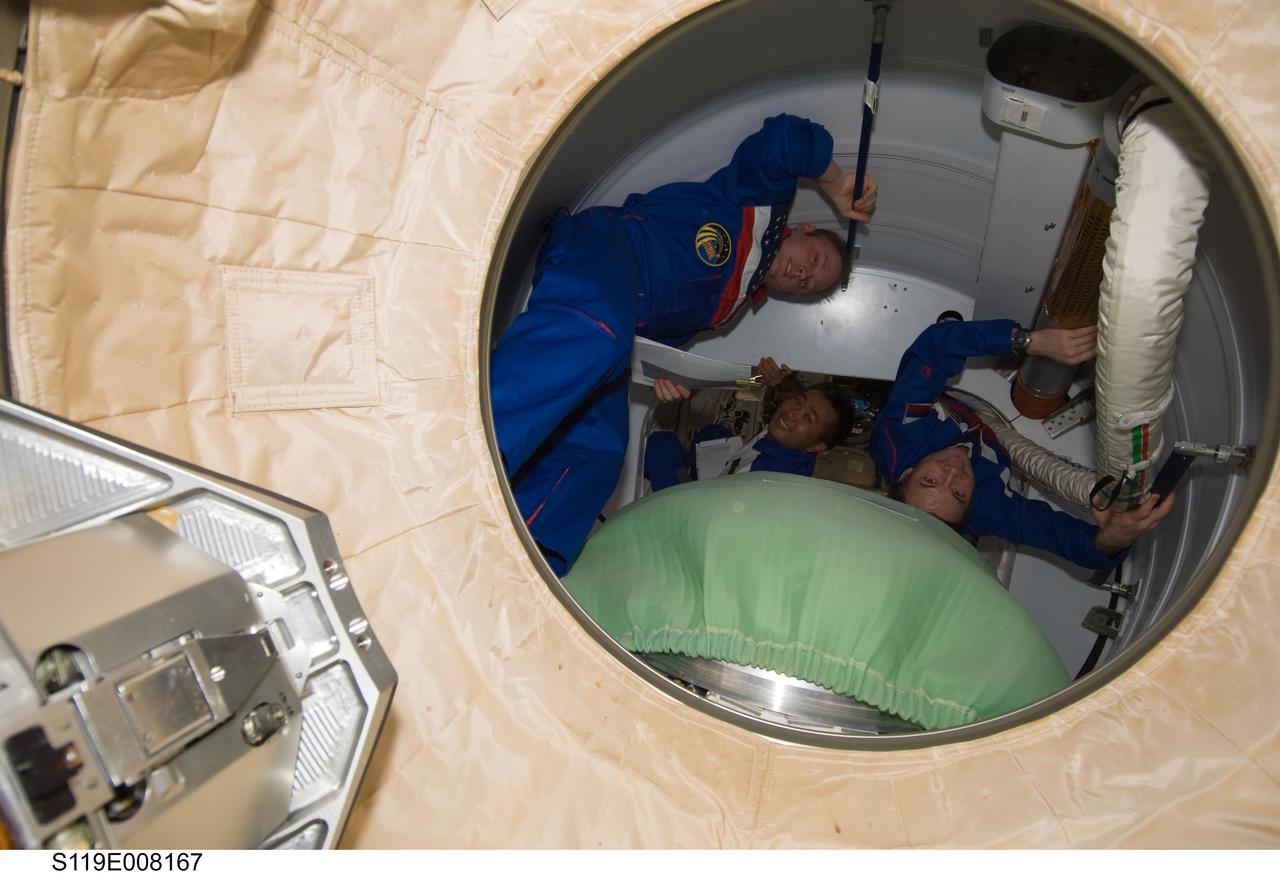
S119-E-008167 (25 March 2009) --- NASA astronaut Michael Fincke (left), Expedition 18 commander; Japan Aerospace Exploration Agency astronaut (JAXA) Koichi Wakata and cosmonaut Yury Lonchakov, both flight engineers, prepare to close the hatch in the Pressurized Mating Adapter (PMA-2) as they bid farewell to the STS-119 crewmembers prior to Space Shuttle Discovery undocking from the International Space Station.
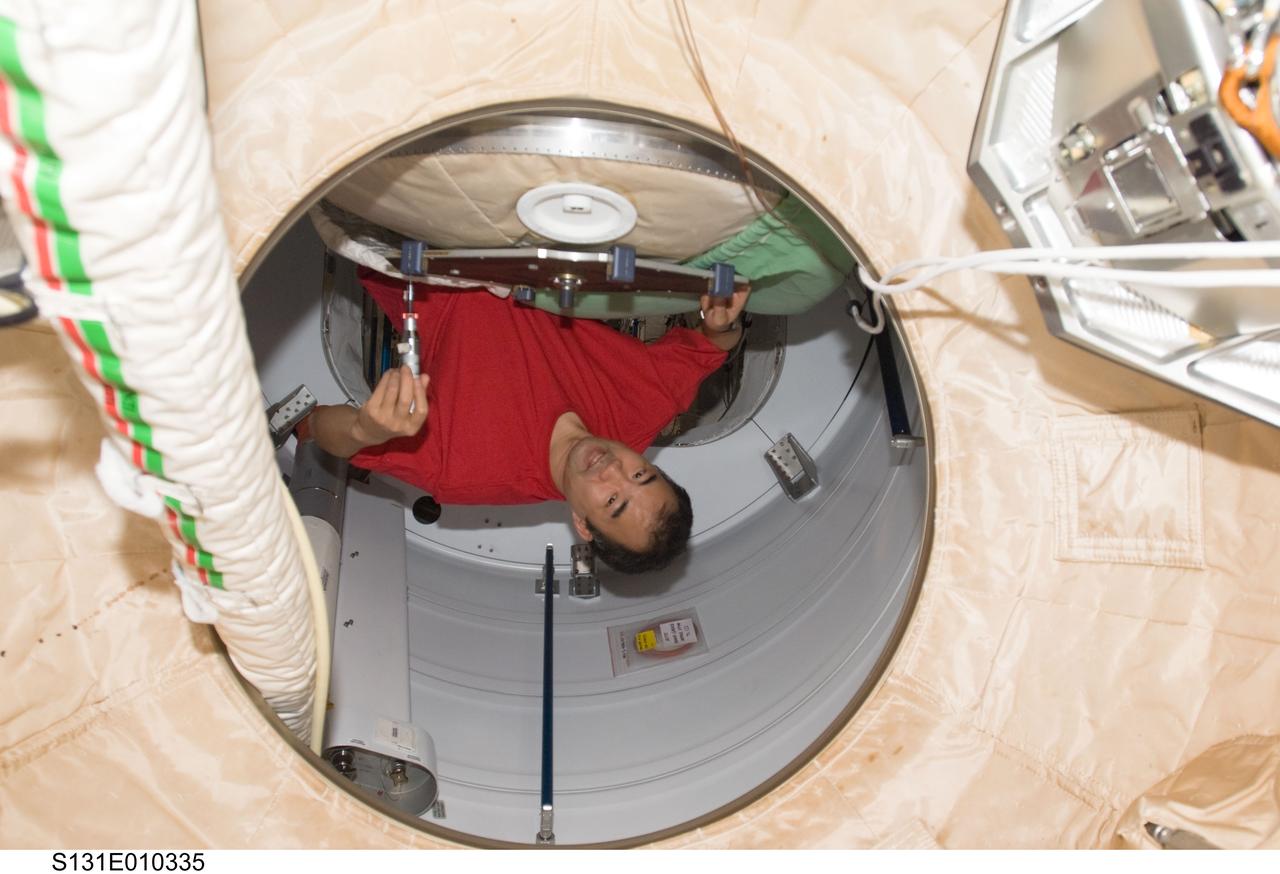
S131-E-010335 (16 April 2010) --- Japan Aerospace Exploration Agency (JAXA) astronaut Soichi Noguchi, Expedition 23 flight engineer, works to relocate a reflective element on the PMA-2 docking target in support of the Sensor Test for Orion Relative Navigation Risk Mitigation (STORRM) on the International Space Station while space shuttle Discovery (STS-131) remains docked with the station.
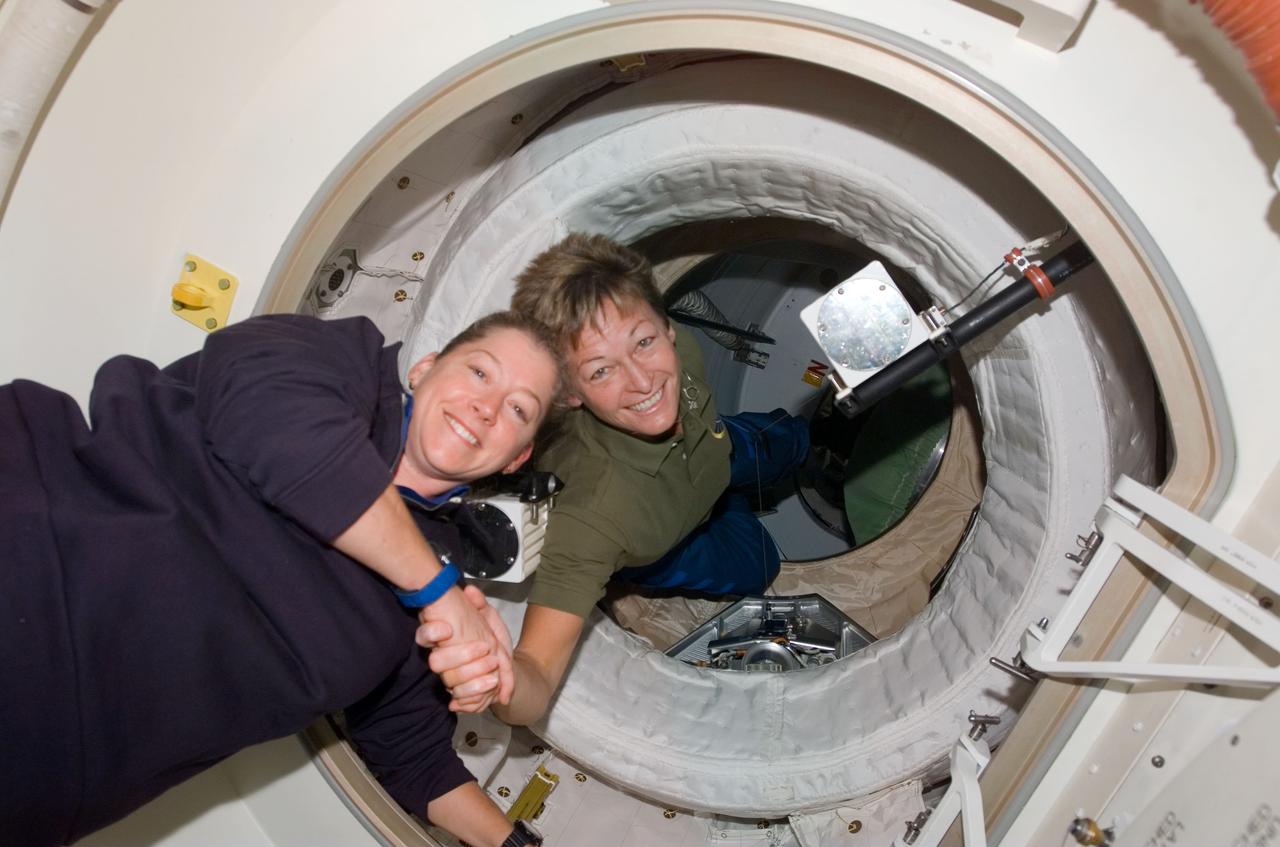
S120-E-006397 (25 Oct. 2007) --- Astronaut Peggy Whitson (right), Expedition 16 commander, greets astronaut Pam Melroy, STS-120 commander, after hatch opening between the International Space Station and Space Shuttle Discovery. Whitson is partially in the Pressurized Mating Adapter (PMA-2) and Melroy is in the Orbiter Docking Compartment (ODC).
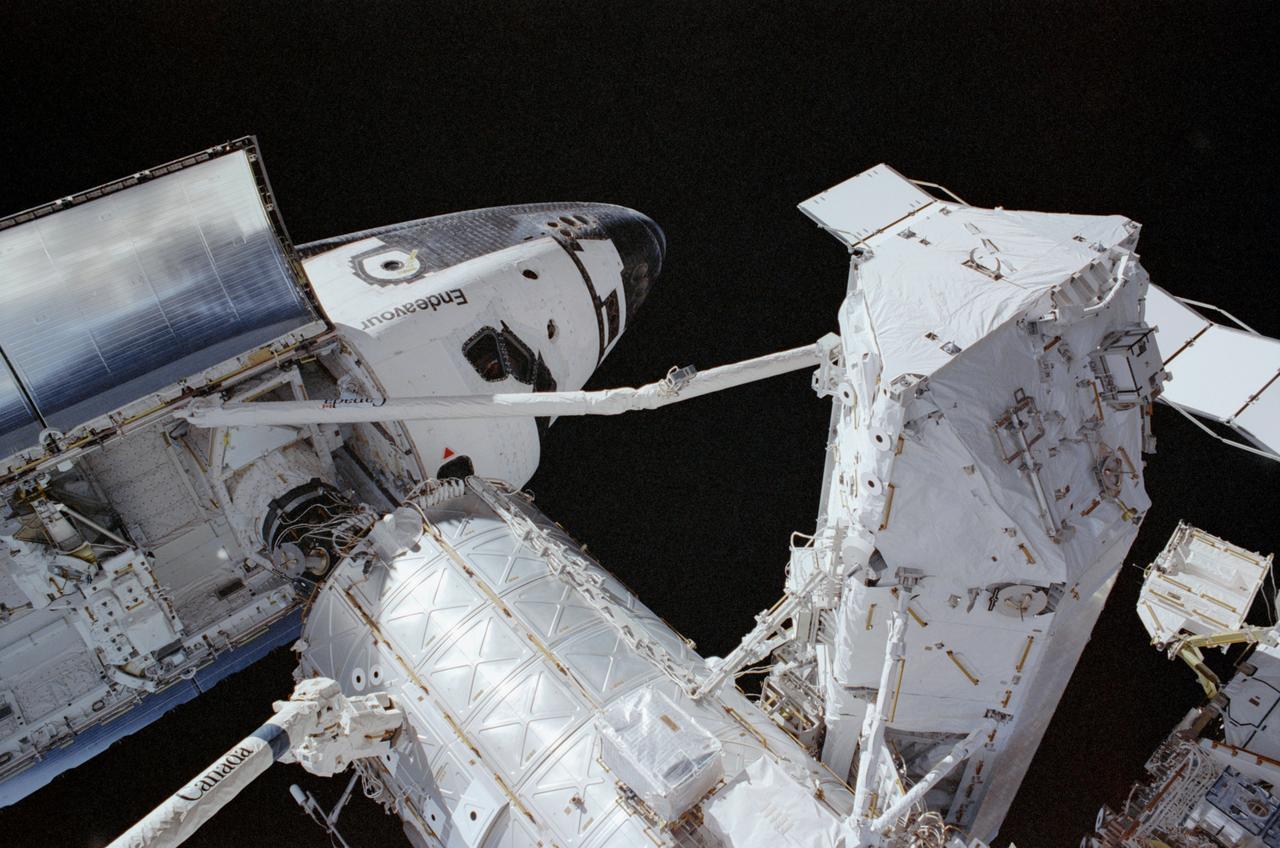
STS111-310-011 (9 June 2002) --- Backdropped by the blackness of space, the Space Shuttle Endeavour is pictured while docked to the Pressurized Mating Adapter (PMA-2) at the forward end of the Destiny laboratory on the International Space Station (ISS). A portion of the Canadarm2 is visible in the lower left corner and Endeavour’s robotic arm is in full view as it is stretched out with the S0 (S-zero) Truss at its end.
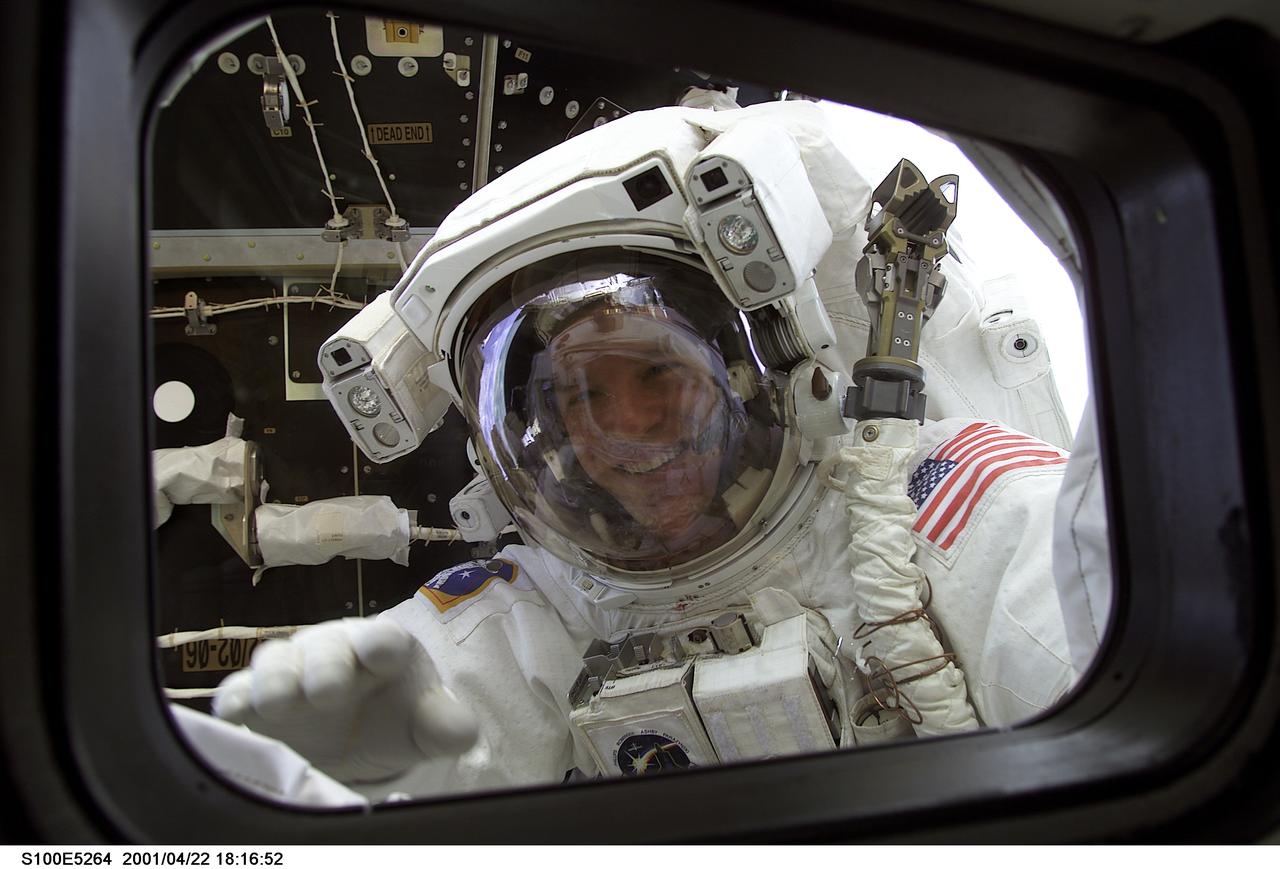
S100-E-5264 (22 April 2001) --- A smiling astronaut Scott E. Parazynski, STS-100 mission specialist, peers into the crew cabin of the Space Shuttle Endeavour during a lengthy spacewalk to perform important work on the International Space Station (ISS). The Pressurized Mating Adapter (PMA-2), which temporarily anchors the orbital outpost to the shuttle, can be seen behind the astronaut. The picture was recorded with a digital still camera.
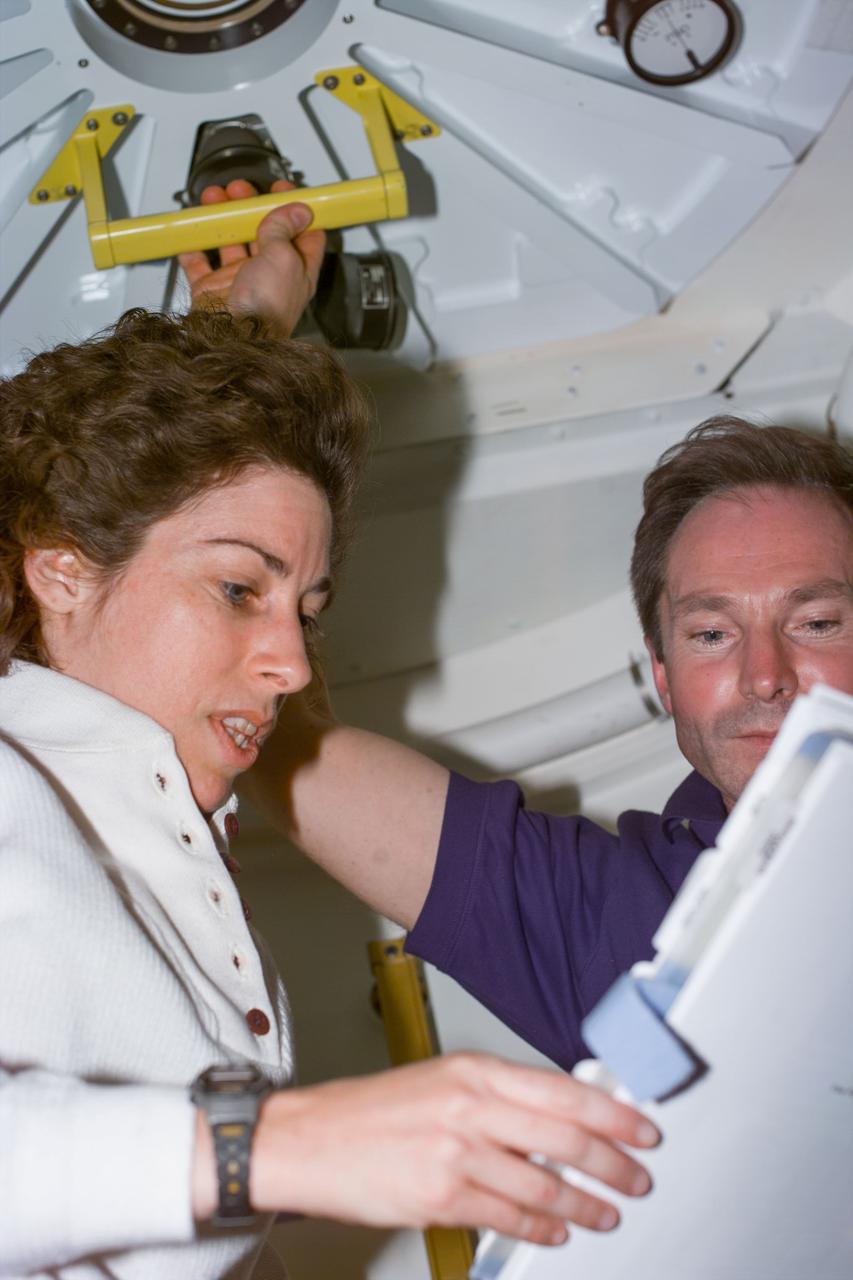
S96-E-5022 (29 May 1999) --- Astronaut Ellen Ochoa and cosmonaut Valery I. Tokarev read over flight data in preparation for post-docking activity. Shortly after the Discovery linked with the orbiting International Space Station (ISS), Ochoa and Tokarev, a mission specialist representing the Russian Space Agency (RSA), briefly went into the Pressurized Mating Adapter (PMA-2). This photo was taken with an electronic still camera (ESC)at 5:53:37 GMT, May 29, 1999.
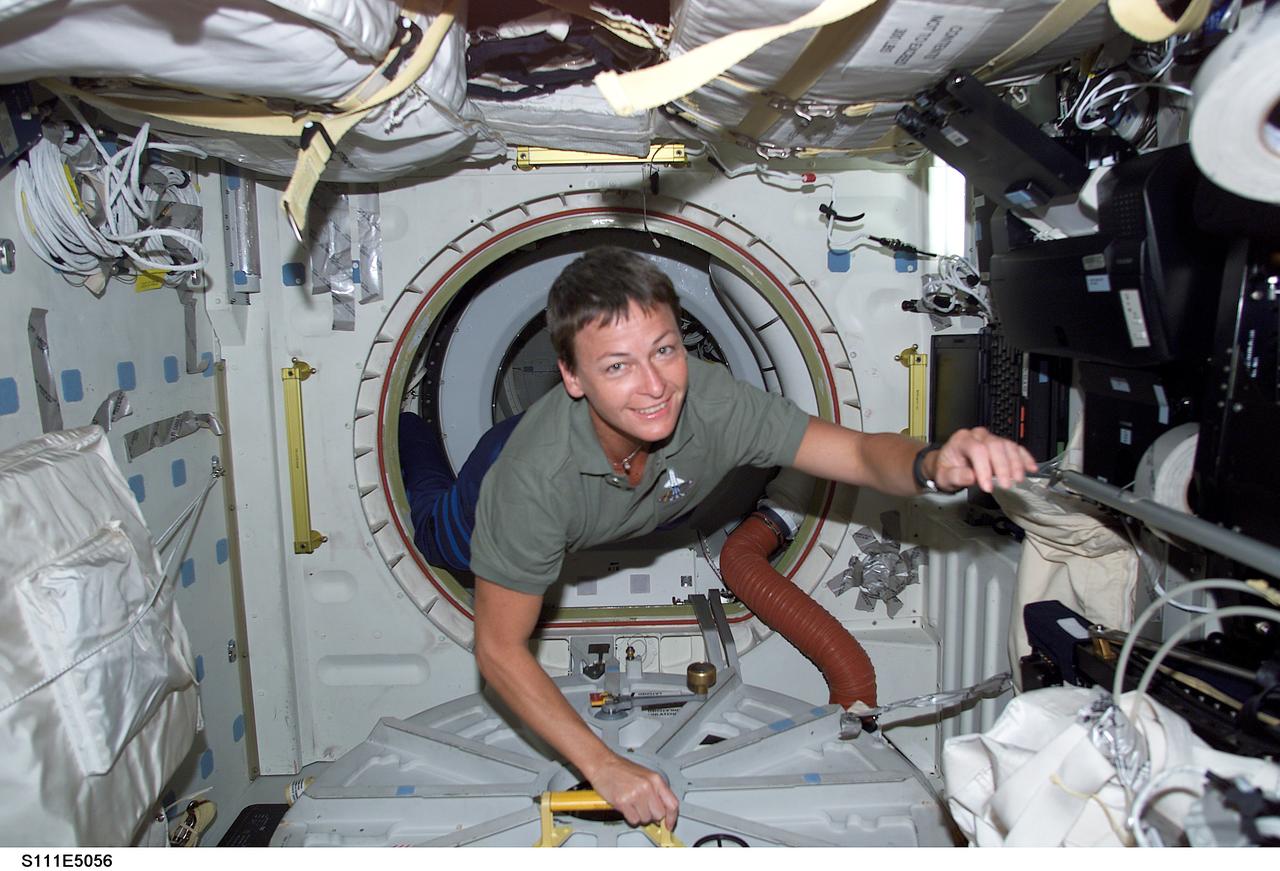
STS111-E-5056 (7 June 2002) --- Astronaut Peggy A. Whitson is pictured in the Pressurized Mating Adapter (PMA-2) near the entrance way into the Destiny laboratory on board the International Space Station (ISS). She is beginning this week to serve a lengthy tour of duty as flight engineer for the fifth crew to live and work aboard the orbiting outpost.
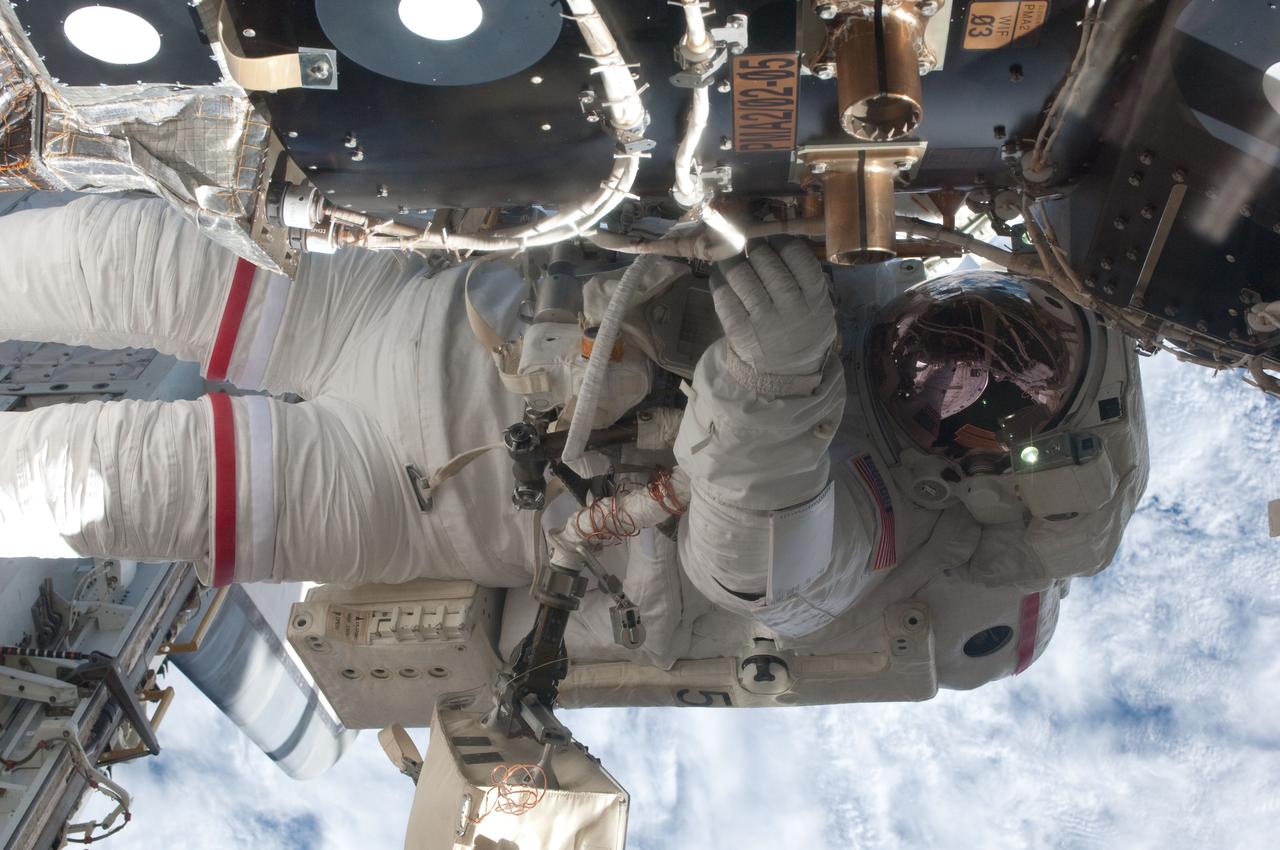
S135-E-007656 (12 July 2011) --- NASA astronaut Mike Fossum, Expedition 28 flight engineer, waits at an International Space Station's pressurized mating adapter (PMA-2) docked to the space shuttle Atlantis, as the station's robotic system moves the failed pump module (out of frame) over to the spacewalking astronaut and the shuttle's cargo bay. Fossum and crewmate Ron Garan sent six hours and 31 minutes on their July 12 spacewalk. Photo credit: NASA
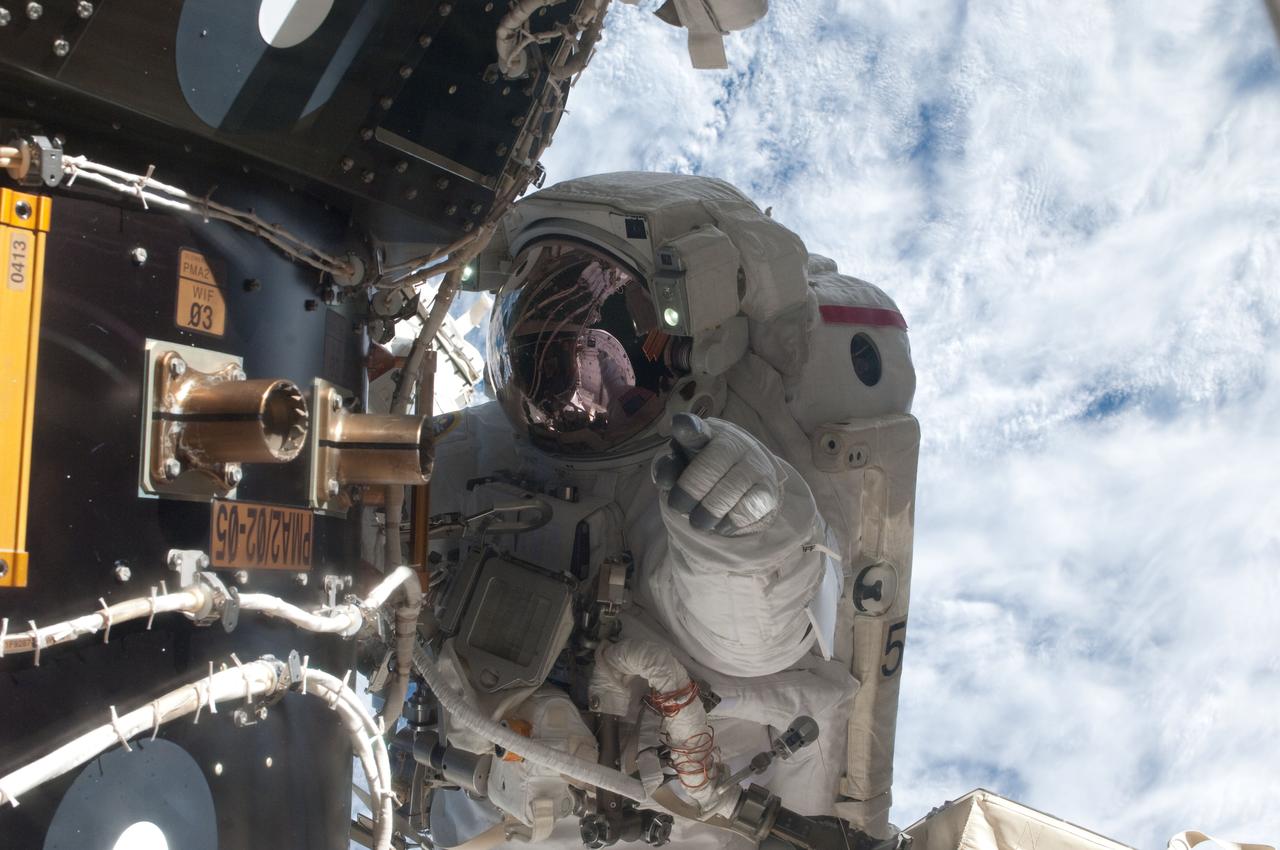
S135-E-007655 (12 July 2011) --- NASA astronaut Mike Fossum, Expedition 28 flight engineer, waits at an International Space Station's pressurized mating adapter (PMA-2) docked to the space shuttle Atlantis, as the station's robotic system moves the failed pump module (out of frame) over to the spacewalking astronaut and the shuttle's cargo bay. Fossum and crewmate Ron Garan sent six hours and 31 minutes on their July 12 spacewalk. Photo credit: NASA
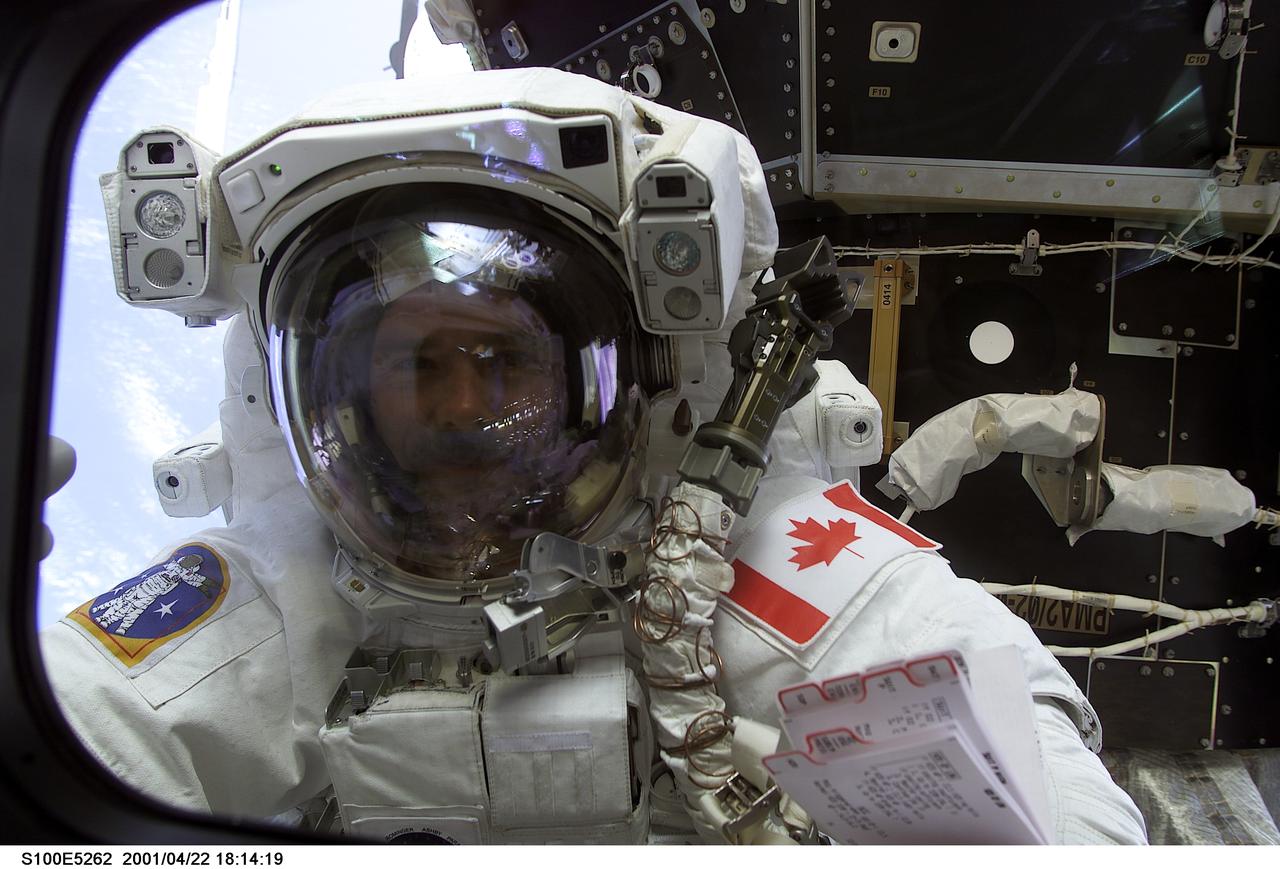
S100-E-5262 (22 April 2001) --- Astronaut Chris A. Hadfield, STS-100 mission specialist representing the Canadian Space Agency (CSA), peers into the crew cabin of the Space Shuttle Endeavour during a lengthy space walk to perform important work on the International Space Station (ISS). The Pressurized Mating Adapter (PMA-2), which temporarily anchors the orbital outpost to the shuttle, can be seen behind the astronaut. The picture was recorded with a digital still camera.