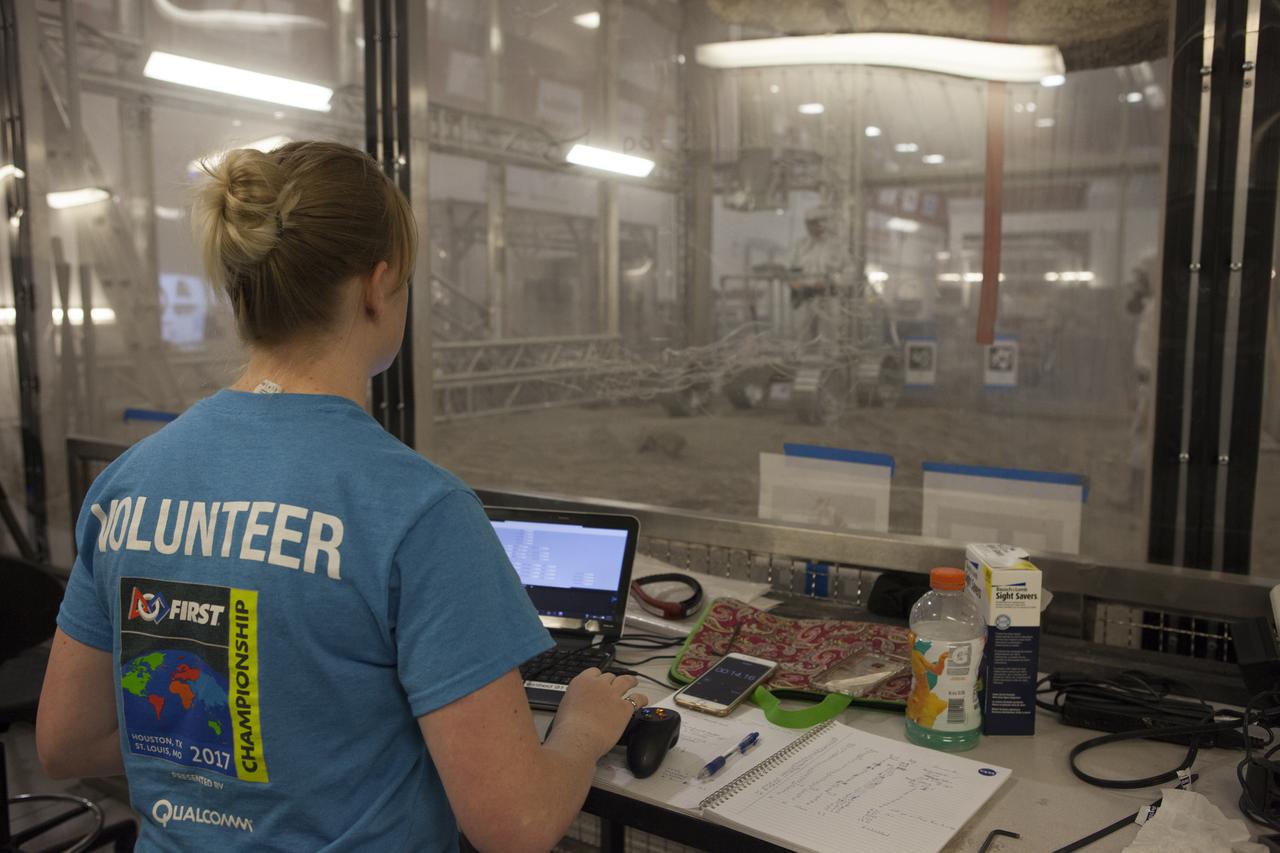
Outside a regolith bin at the agency's Kennedy Space center in Florida, an engineer operates controls for a lightweight simulator version of NASA's Resource Prospector during a mobility test. The Resource Prospector mission aims to be the first mining expedition on another world. Operating on the moon’s poles, the robot is designed to use instruments to locate elements at a lunar polar regions, then excavate and sample resources such as hydrogen, oxygen and water. These resources could support human explores on their way to destinations such as farther into the solar system.
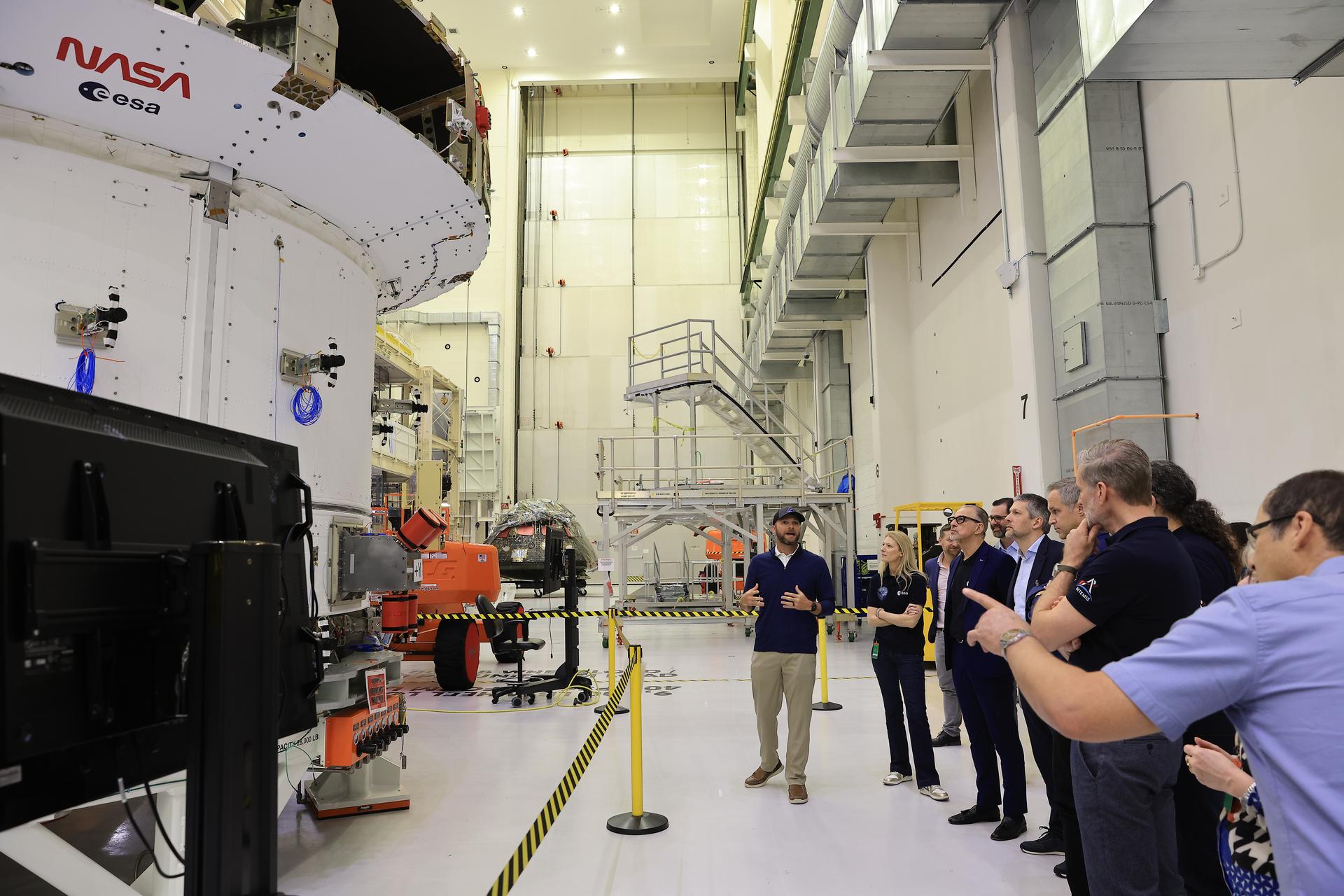
Members of the ESA (European Space Agency) leadership team and NASA Orion program team stand by European Service Module with the Orion spacecraft in the background for NASA’s Artemis III mission on Tuesday, Feb. 10, 2026, inside the high bay of the Neil A. Armstrong Operations and Checkout Building at NASA’s Kennedy Space Center in Florida. The service module provides the Orion spacecraft’s propulsion, thermal control, electrical power, and life support systems during the Artemis III mission to send humans to explore the lunar South Pole region.
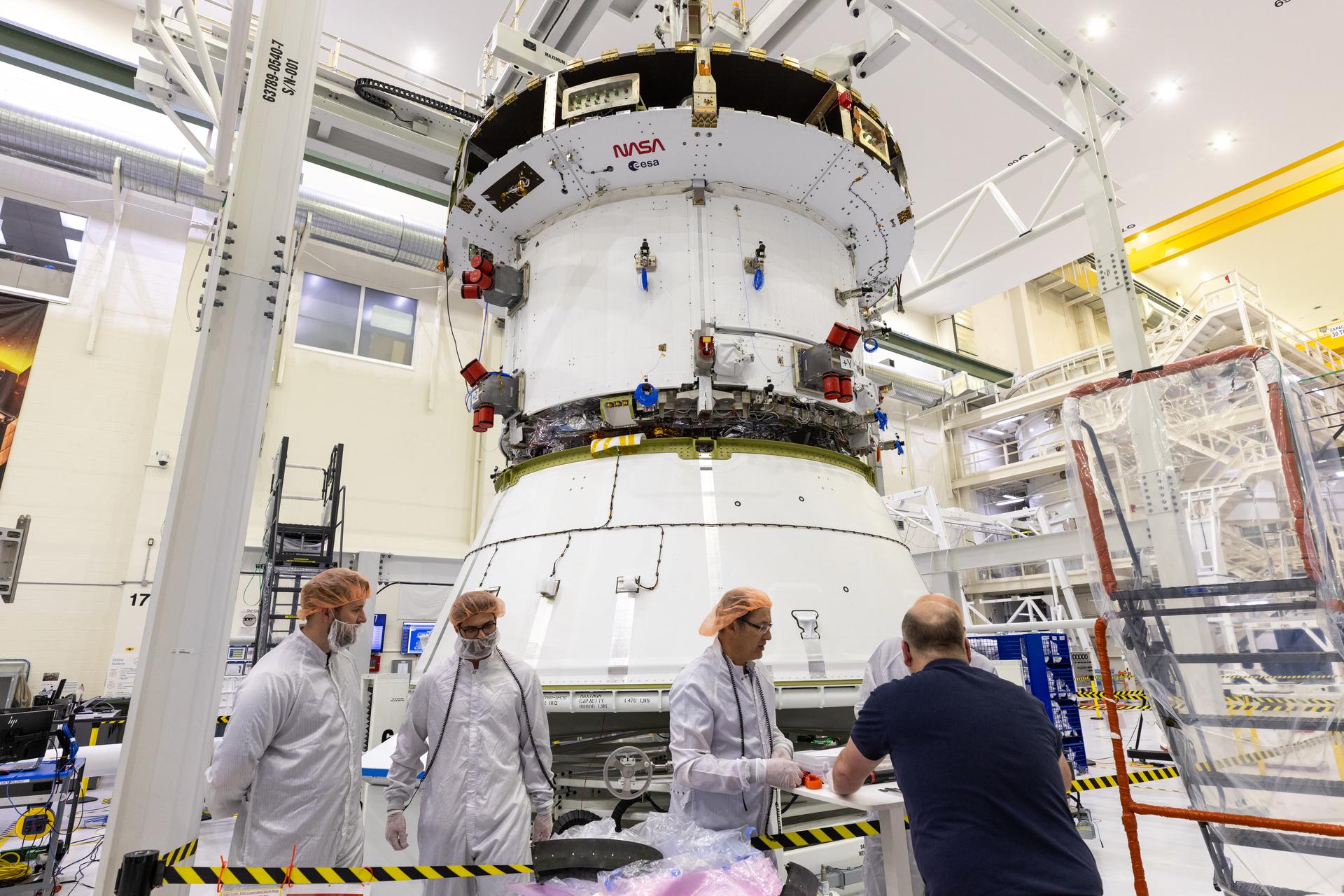
Teams prepare for the installation of the engine nozzle onto the European Service Module for NASA’s Artemis III mission on Tuesday, Feb. 17, 2026, inside the high bay of the Neil A. Armstrong Operations and Checkout Building at NASA’s Kennedy Space Center in Florida. The service module provides the Orion spacecraft’s propulsion, thermal control, electrical power, and life support systems during the Artemis III mission to send humans to explore the lunar South Pole region.
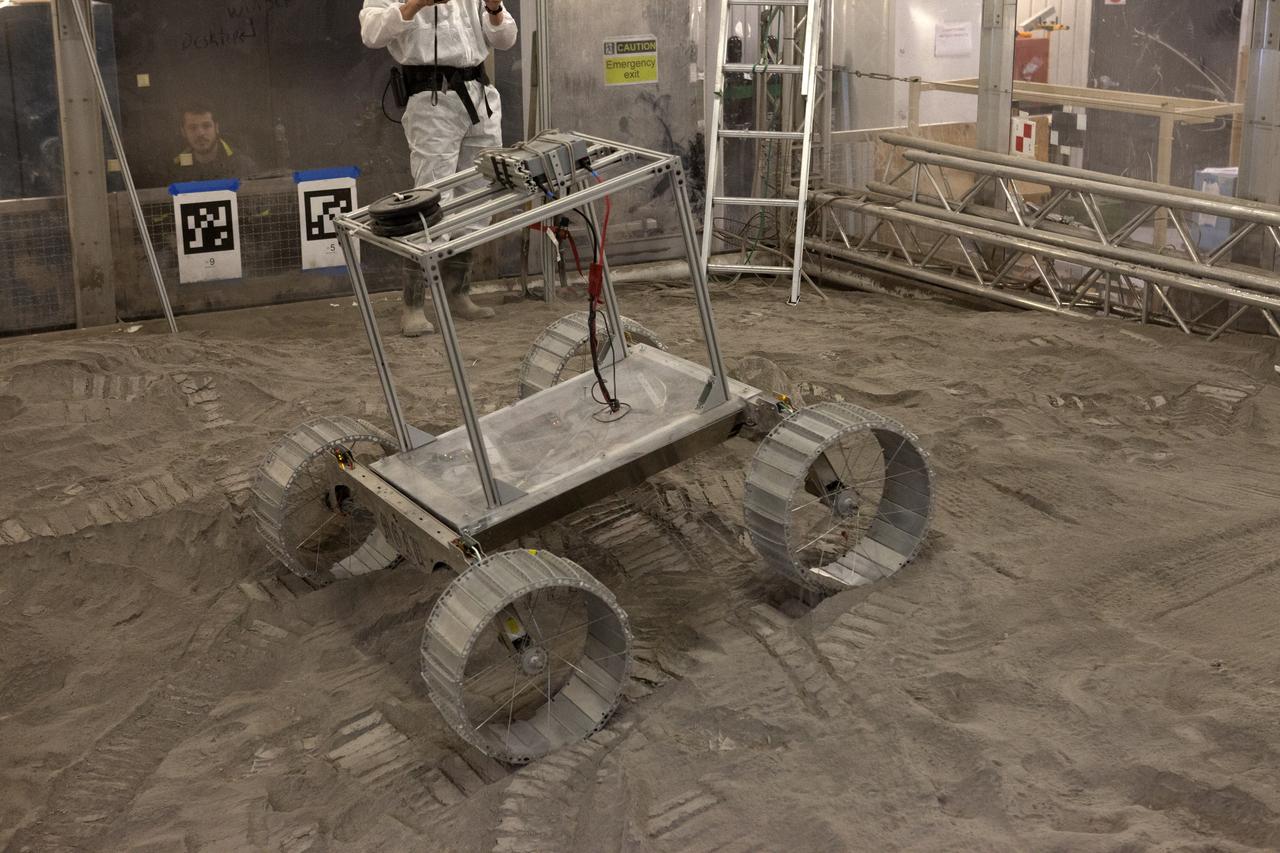
A lightweight simulator version of NASA's Resource Prospector undergoes a mobility test in a regolith bin at the agency's Kennedy Space center in Florida. The Resource Prospector mission aims to be the first mining expedition on another world. Operating on the moon’s poles, the robot is designed to use instruments to locate elements at a lunar polar regions, then excavate and sample resources such as hydrogen, oxygen and water. These resources could support human explores on their way to destinations such as farther into the solar system.
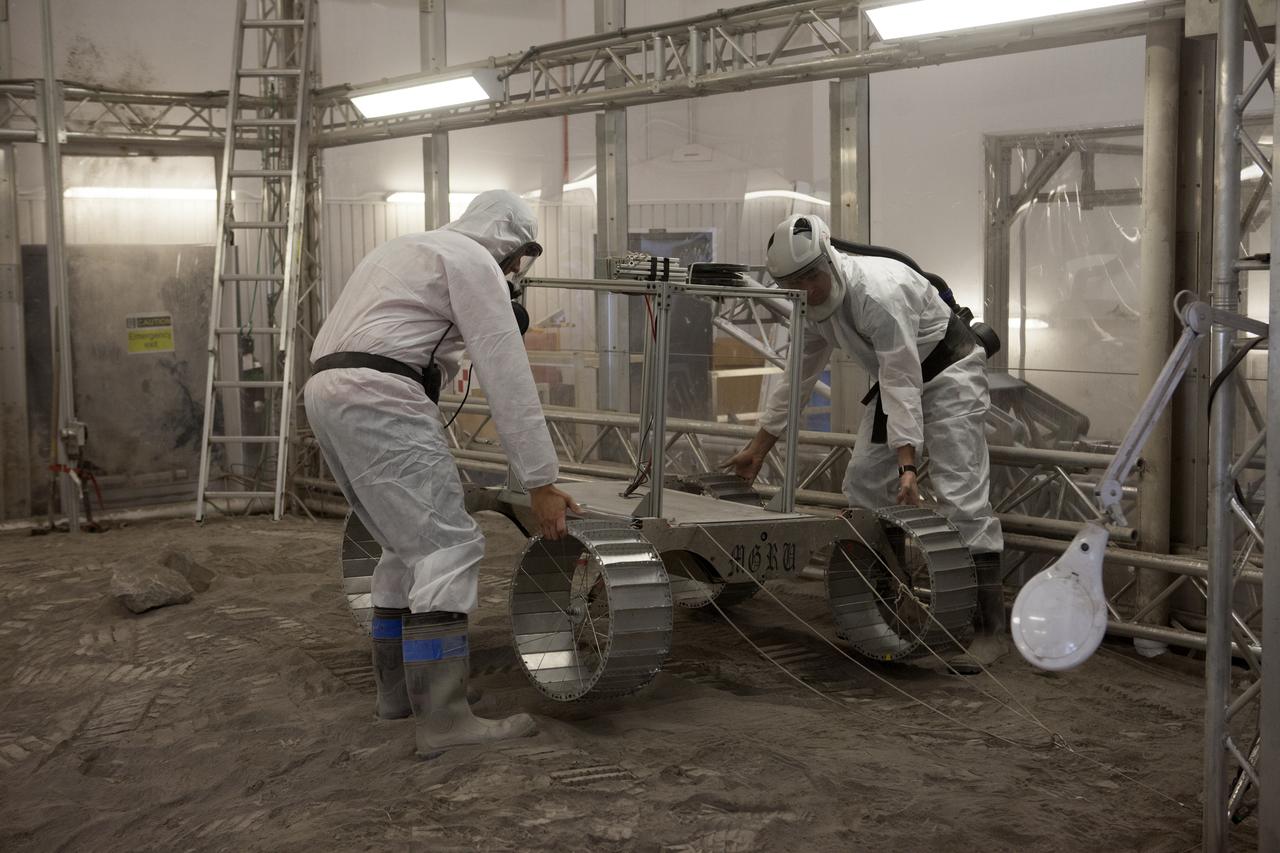
Engineers wearing protecting garb, make adjustments to a lightweight simulator version of NASA's Resource Prospector undergoes a mobility test in a regolith bin at the agency's Kennedy Space center in Florida. The Resource Prospector mission aims to be the first mining expedition on another world. Operating on the moon’s poles, the robot is designed to use instruments to locate elements at a lunar polar regions, then excavate and sample resources such as hydrogen, oxygen and water. These resources could support human explores on their way to destinations such as farther into the solar system.
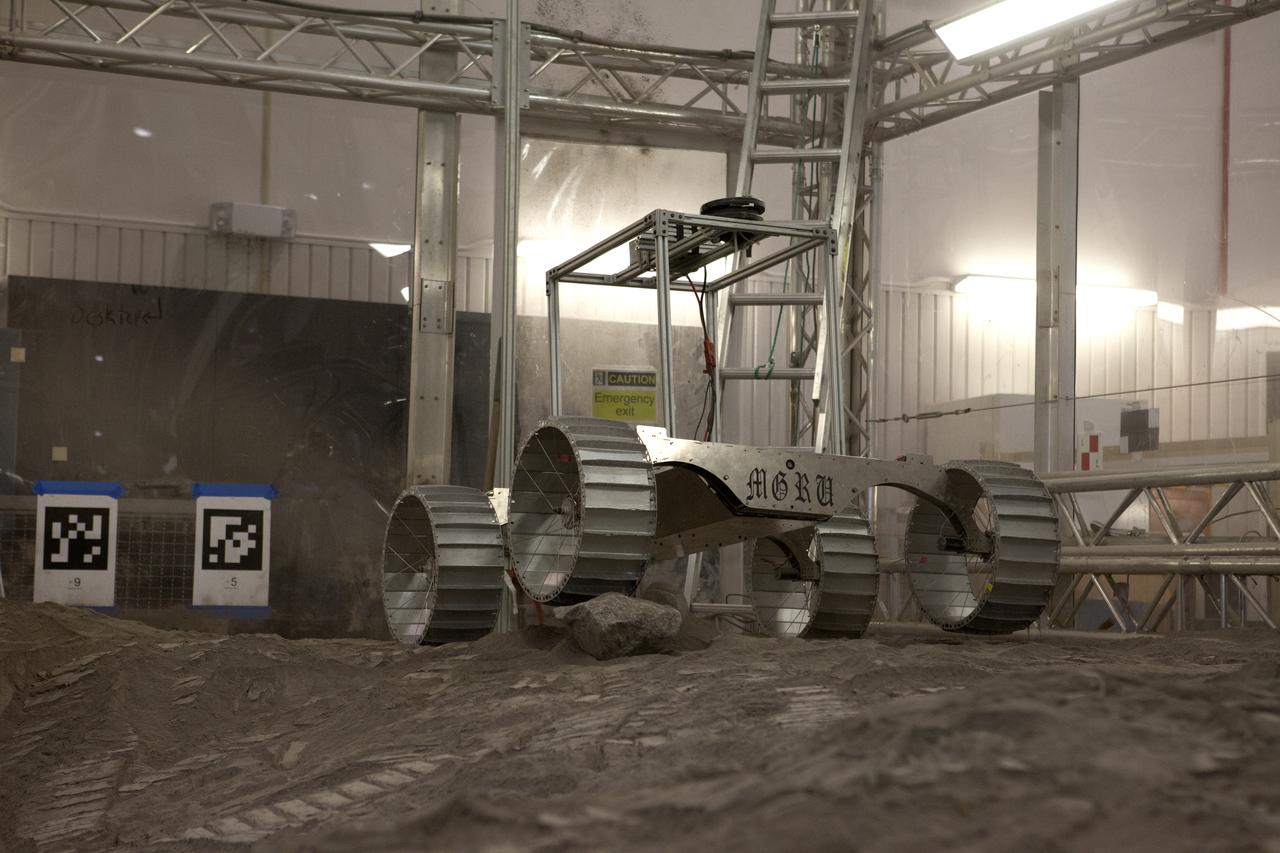
A lightweight simulator version of NASA's Resource Prospector undergoes a mobility test in a regolith bin at the agency's Kennedy Space center in Florida. The Resource Prospector mission aims to be the first mining expedition on another world. Operating on the moon’s poles, the robot is designed to use instruments to locate elements at a lunar polar regions, then excavate and sample resources such as hydrogen, oxygen and water. These resources could support human explores on their way to destinations such as farther into the solar system.
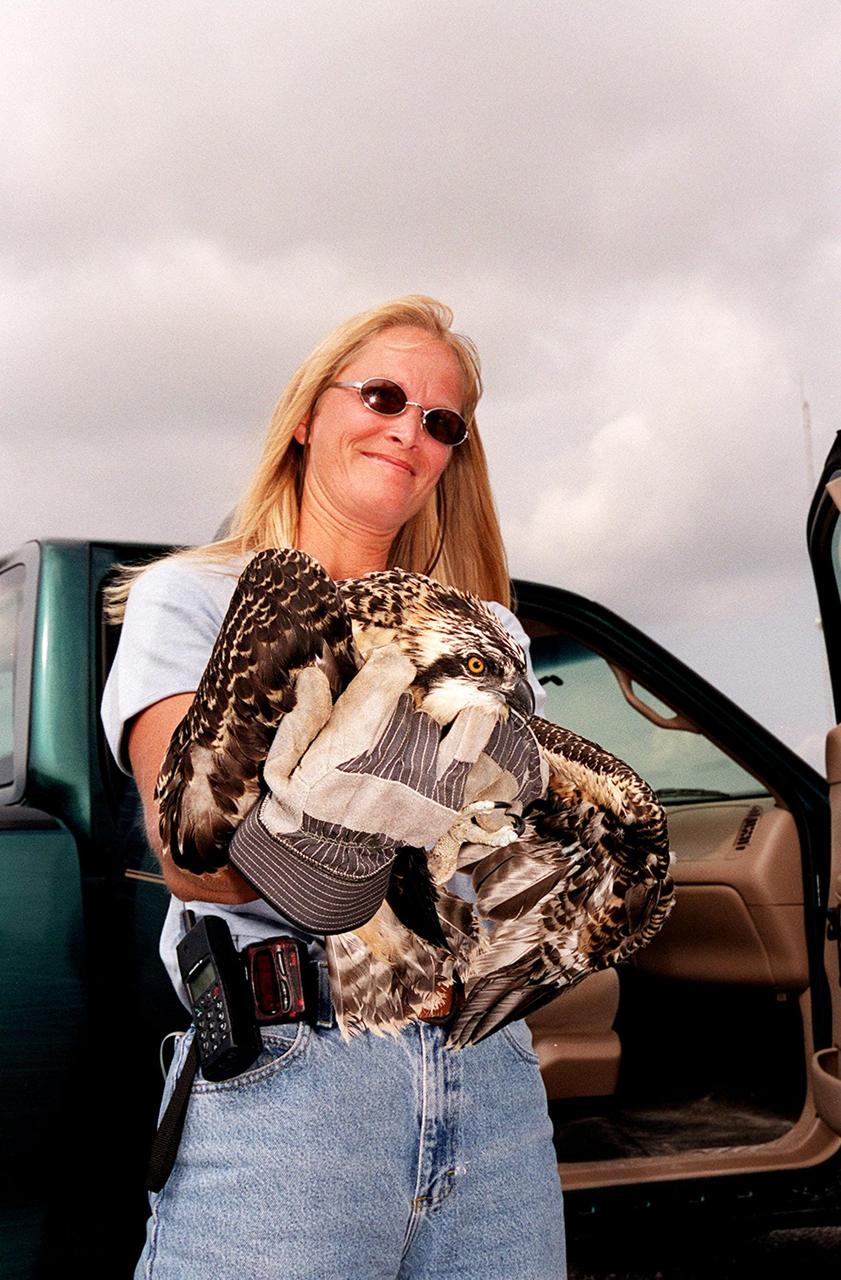
Angy Chambers, senior wildlife biologist for Environmental Support Contract/Dynamac, holds a juvenile osprey before releasing it at Cape Canaveral Air Force Station. As a nestling, the osprey fell twice from its nest, located on a light pole in the ITL area of CCAFS. Chambers determined the bird might have a broken leg and gave it to the Florida Wildlife Hospital for treatment. The osprey was released the same day as the two great horned owls
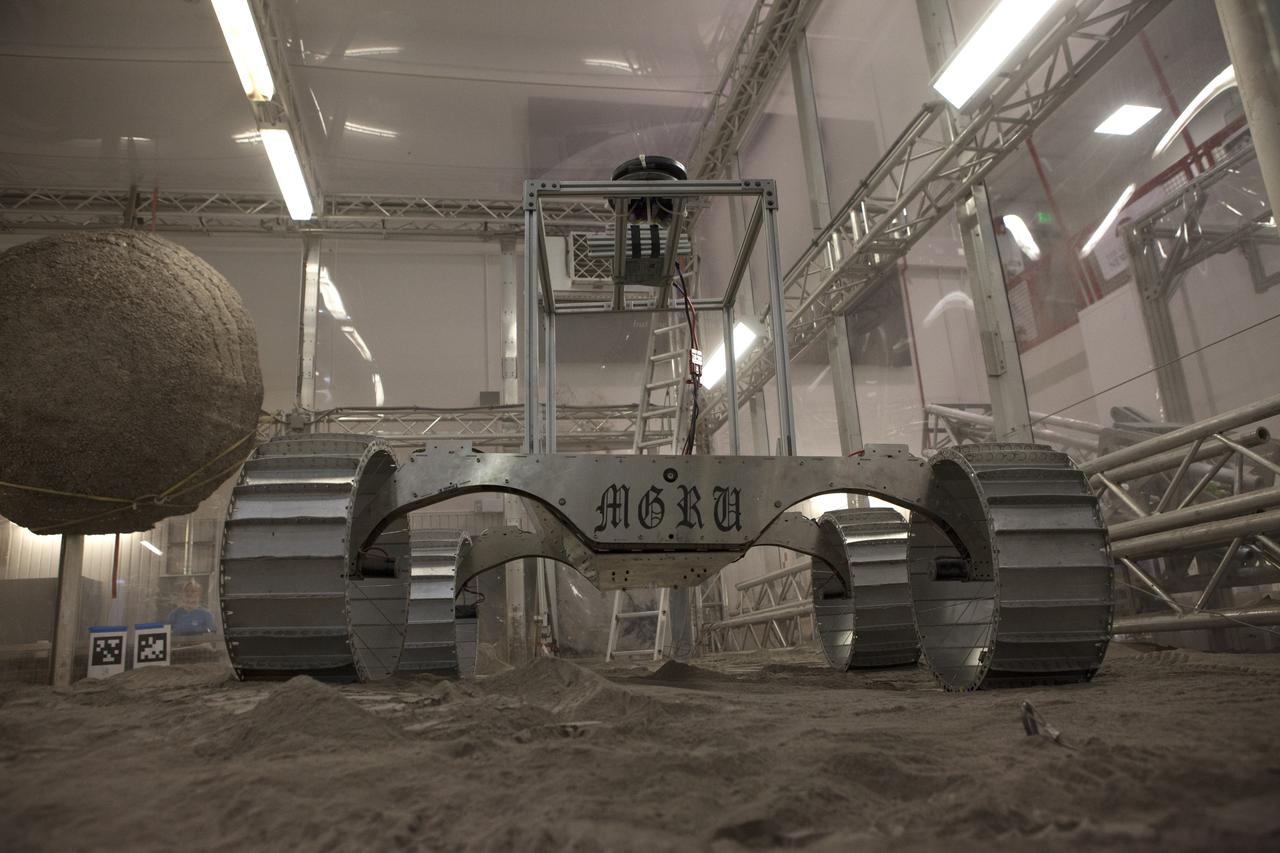
A lightweight simulator version of NASA's Resource Prospector undergoes a mobility test in a regolith bin at the agency's Kennedy Space center in Florida. The Resource Prospector mission aims to be the first mining expedition on another world. Operating on the moon’s poles, the robot is designed to use instruments to locate elements at a lunar polar regions, then excavate and sample resources such as hydrogen, oxygen and water. These resources could support human explores on their way to destinations such as farther into the solar system.

A lightweight simulator version of NASA's Resource Prospector undergoes a mobility test in a regolith bin at the agency's Kennedy Space center in Florida. The Resource Prospector mission aims to be the first mining expedition on another world. Operating on the moon’s poles, the robot is designed to use instruments to locate elements at a lunar polar regions, then excavate and sample resources such as hydrogen, oxygen and water. These resources could support human explores on their way to destinations such as farther into the solar system.
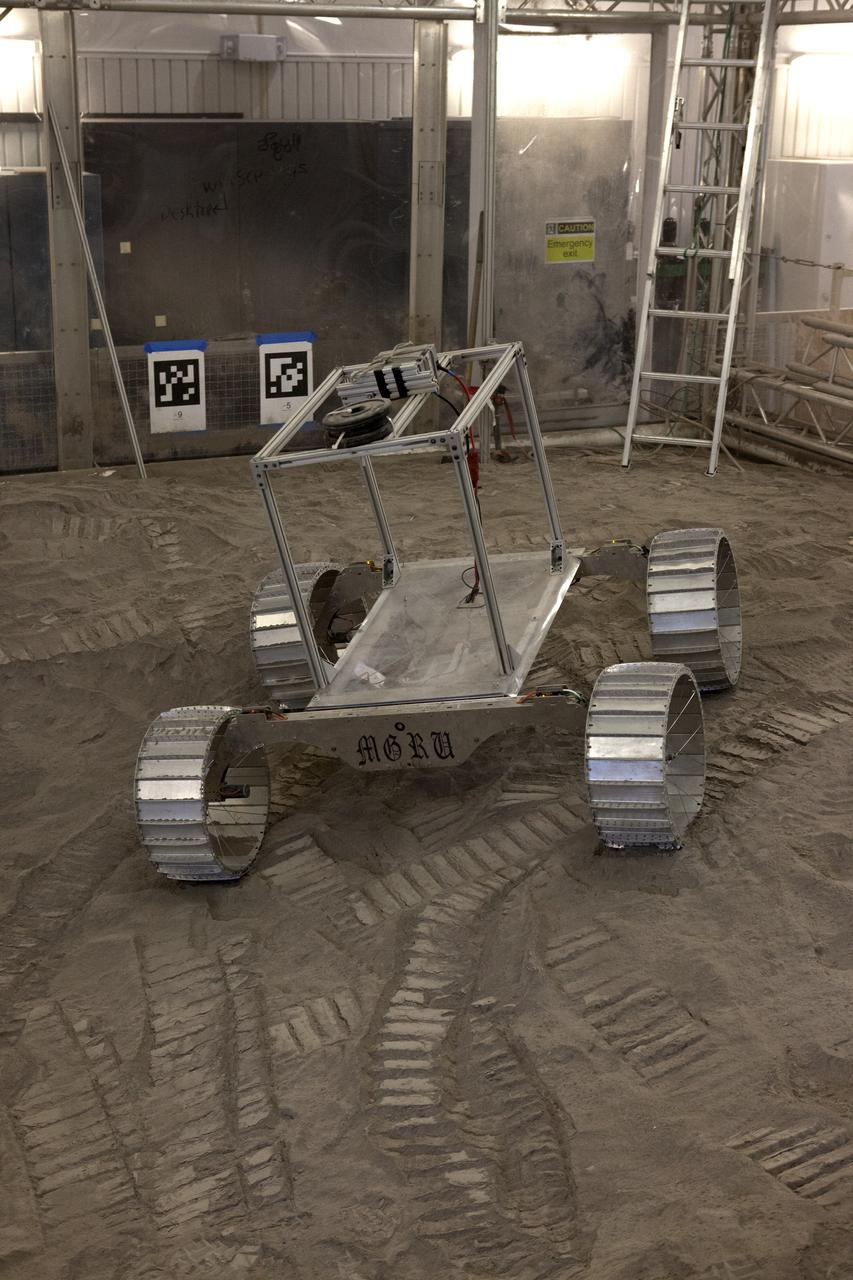
A lightweight simulator version of NASA's Resource Prospector undergoes a mobility test in a regolith bin at the agency's Kennedy Space center in Florida. The Resource Prospector mission aims to be the first mining expedition on another world. Operating on the moon’s poles, the robot is designed to use instruments to locate elements at a lunar polar regions, then excavate and sample resources such as hydrogen, oxygen and water. These resources could support human explores on their way to destinations such as farther into the solar system.
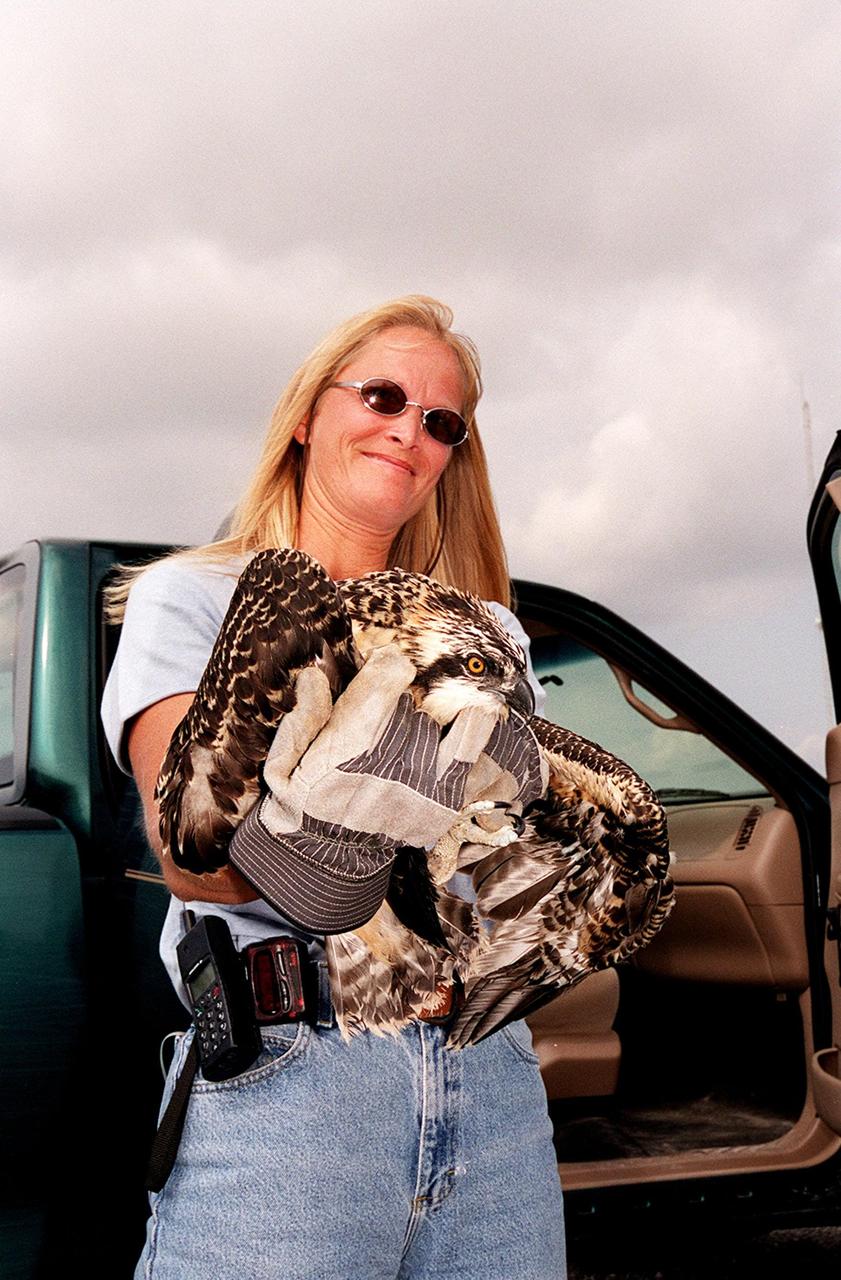
Angy Chambers, senior wildlife biologist for Environmental Support Contract/Dynamac, holds a juvenile osprey before releasing it at Cape Canaveral Air Force Station. As a nestling, the osprey fell twice from its nest, located on a light pole in the ITL area of CCAFS. Chambers determined the bird might have a broken leg and gave it to the Florida Wildlife Hospital for treatment. The osprey was released the same day as the two great horned owls
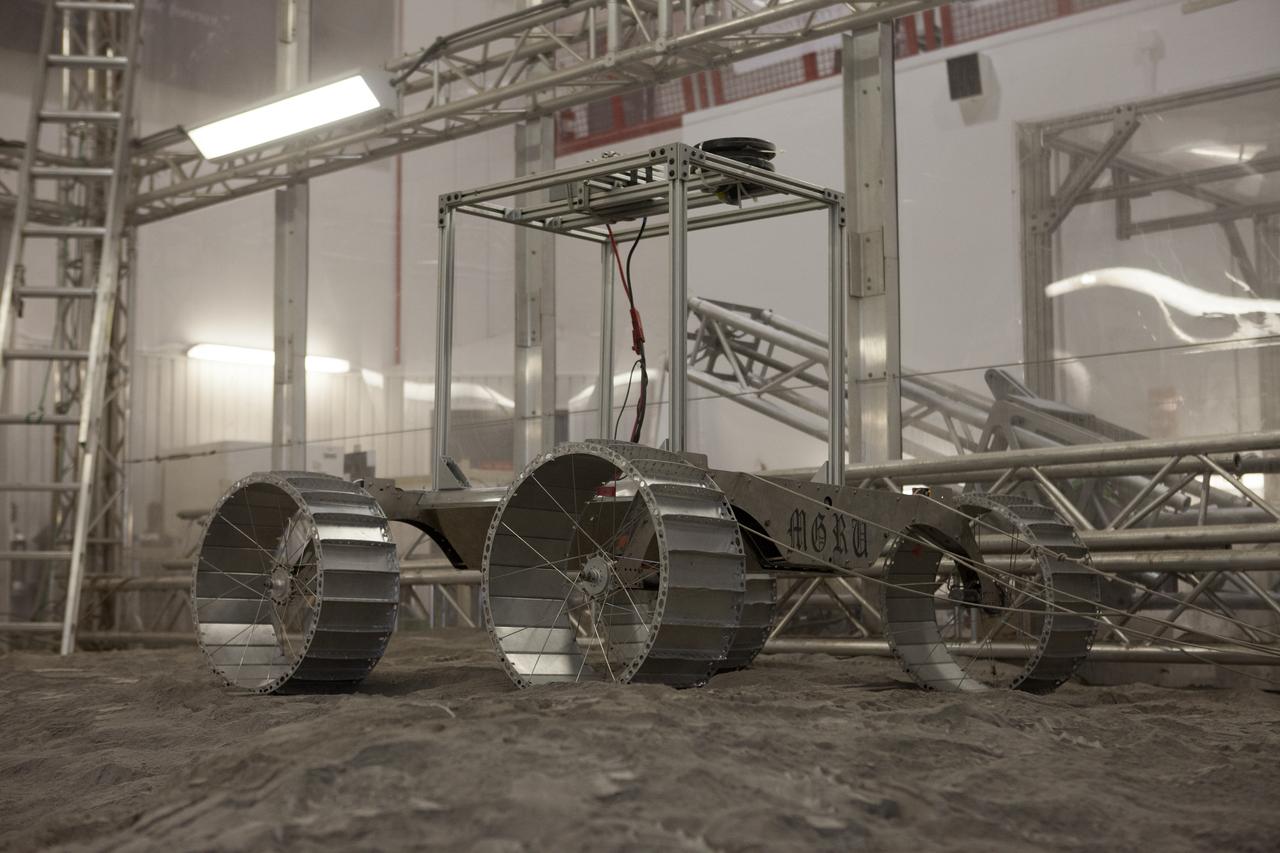
A lightweight simulator version of NASA's Resource Prospector undergoes a mobility test in a regolith bin at the agency's Kennedy Space center in Florida. The Resource Prospector mission aims to be the first mining expedition on another world. Operating on the moon’s poles, the robot is designed to use instruments to locate elements at a lunar polar regions, then excavate and sample resources such as hydrogen, oxygen and water. These resources could support human explores on their way to destinations such as farther into the solar system.
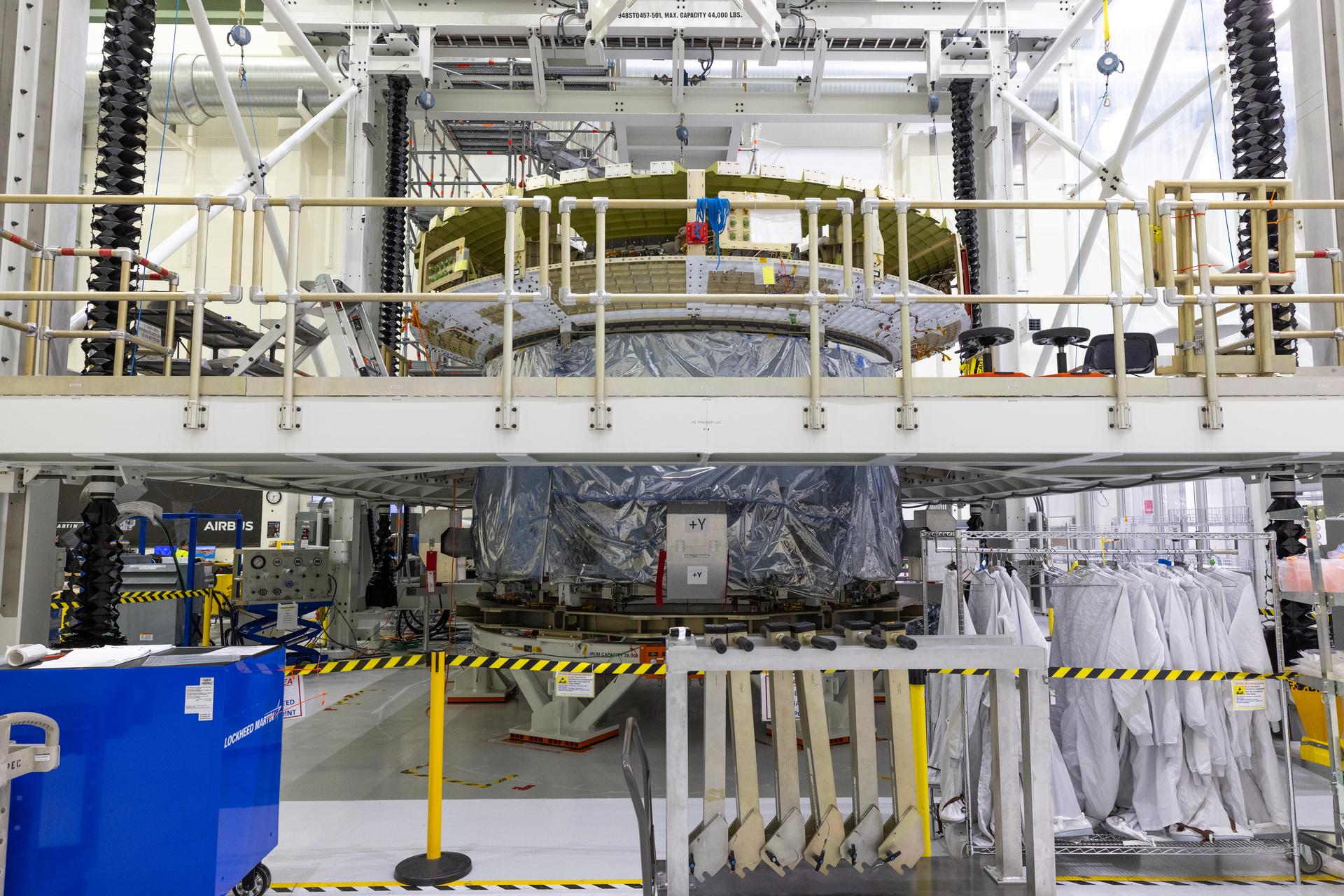
Teams prepare for the installation of the engine nozzle onto the European Service Module for NASA’s Artemis III mission on Tuesday, Feb. 17, 2026, inside the high bay of the Neil A. Armstrong Operations and Checkout Building at NASA’s Kennedy Space Center in Florida. The service module provides the Orion spacecraft’s propulsion, thermal control, electrical power, and life support systems during the Artemis III mission to send humans to explore the lunar South Pole region.
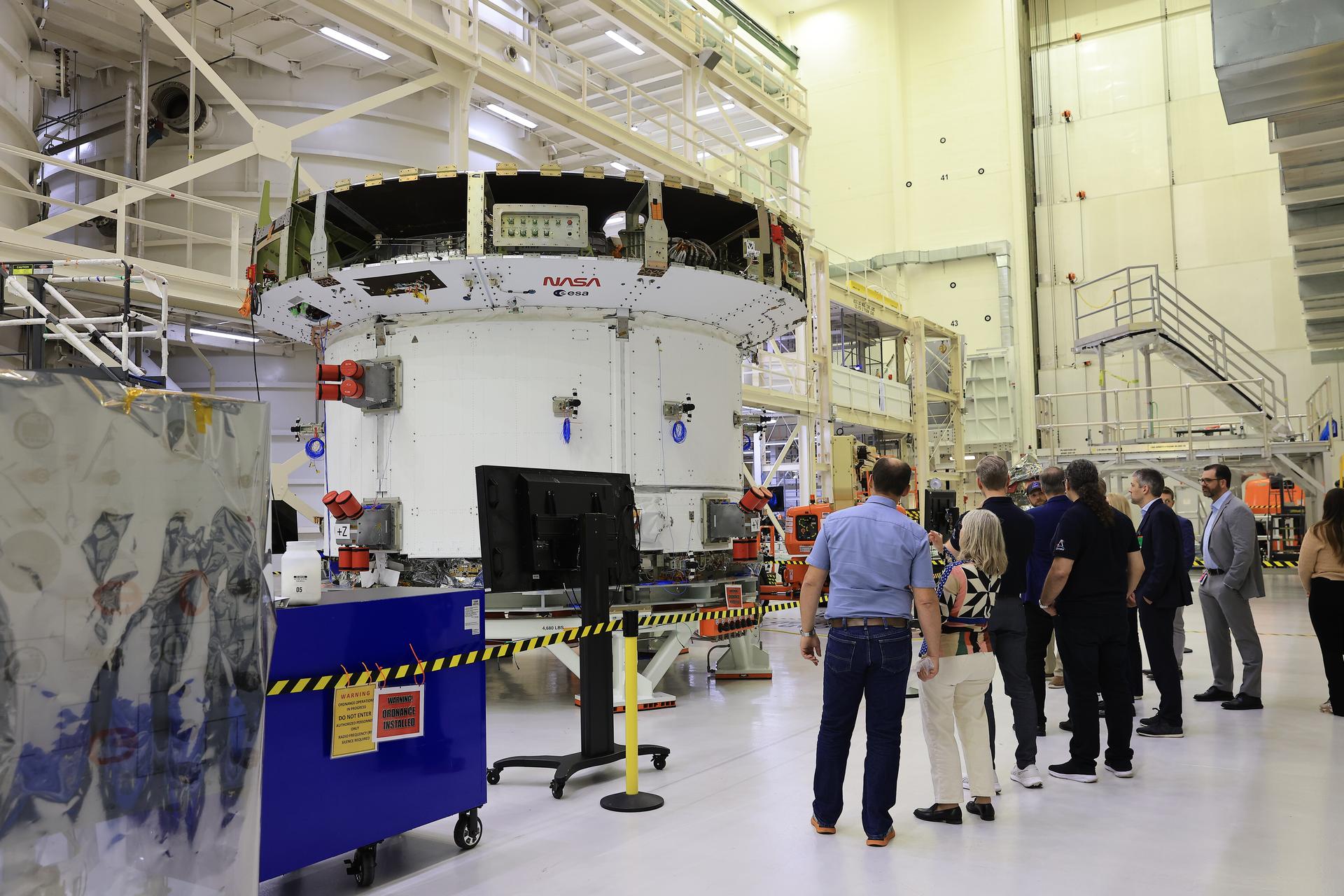
Members of the ESA (European Space Agency) leadership team and NASA Orion program team stand by European Service Module for NASA’s Artemis III mission on Tuesday, Feb. 10, 2026, inside the high bay of the Neil A. Armstrong Operations and Checkout Building at NASA’s Kennedy Space Center in Florida. The service module provides the Orion spacecraft’s propulsion, thermal control, electrical power, and life support systems during the Artemis III mission to send humans to explore the lunar South Pole region.
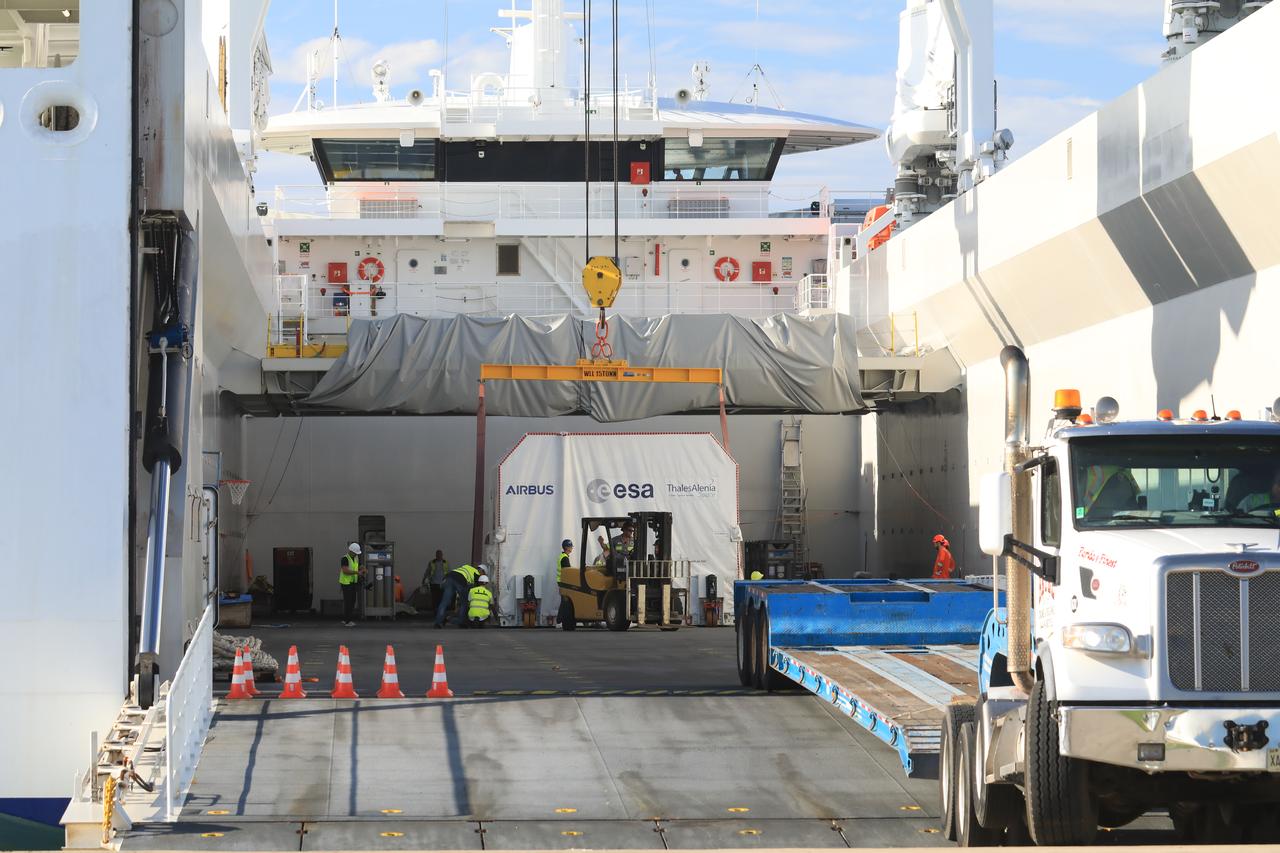
The transport carrier containing the European Service Module 3 for NASA’s Artemis III mission arrives at Port Canaveral on Tuesday, Sept. 3, 2024, awaiting transportation to NASA’s Kennedy Space Center in Florida. The European Service Module 3, which is assembled by Airbus in Bremen, Germany, traveled 10 days across the Atlantic Ocean via the Canopee ship. The European Service Module 3 provides the spacecraft’s propulsion, thermal control, electrical power, and life support systems. Artemis III will send four astronauts to the lunar orbit where two crew members will spend a week near the South Pole of the Moon conducting new science.
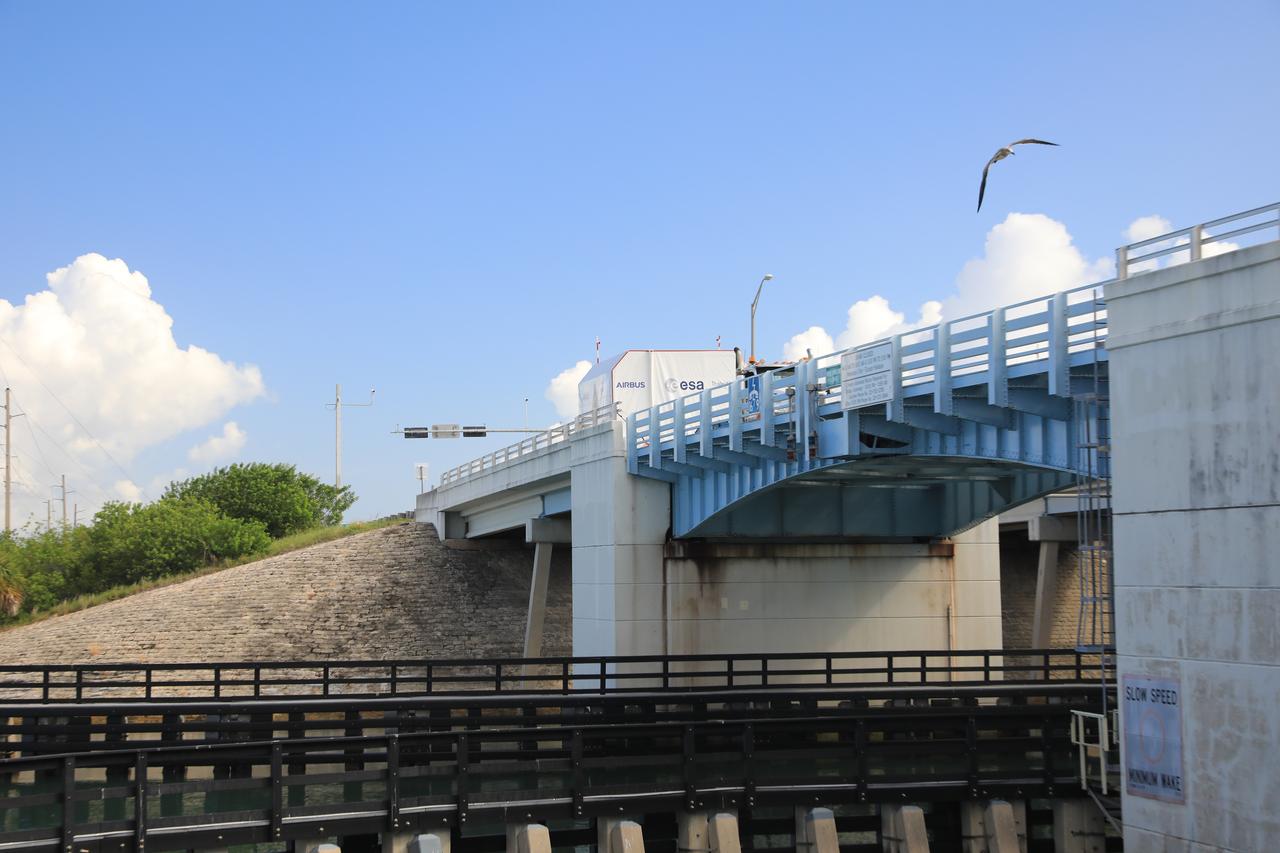
The transport carrier containing the European Service Module 3 for NASA’s Artemis III mission arrives at Port Canaveral on Tuesday, Sept. 3, 2024, awaiting transportation to NASA’s Kennedy Space Center in Florida. The European Service Module 3, which is assembled by Airbus in Bremen, Germany, traveled 10 days across the Atlantic Ocean via the Canopee ship. The European Service Module 3 provides the spacecraft’s propulsion, thermal control, electrical power, and life support systems. Artemis III will send four astronauts to the lunar orbit where two crew members will spend a week near the South Pole of the Moon conducting new science.
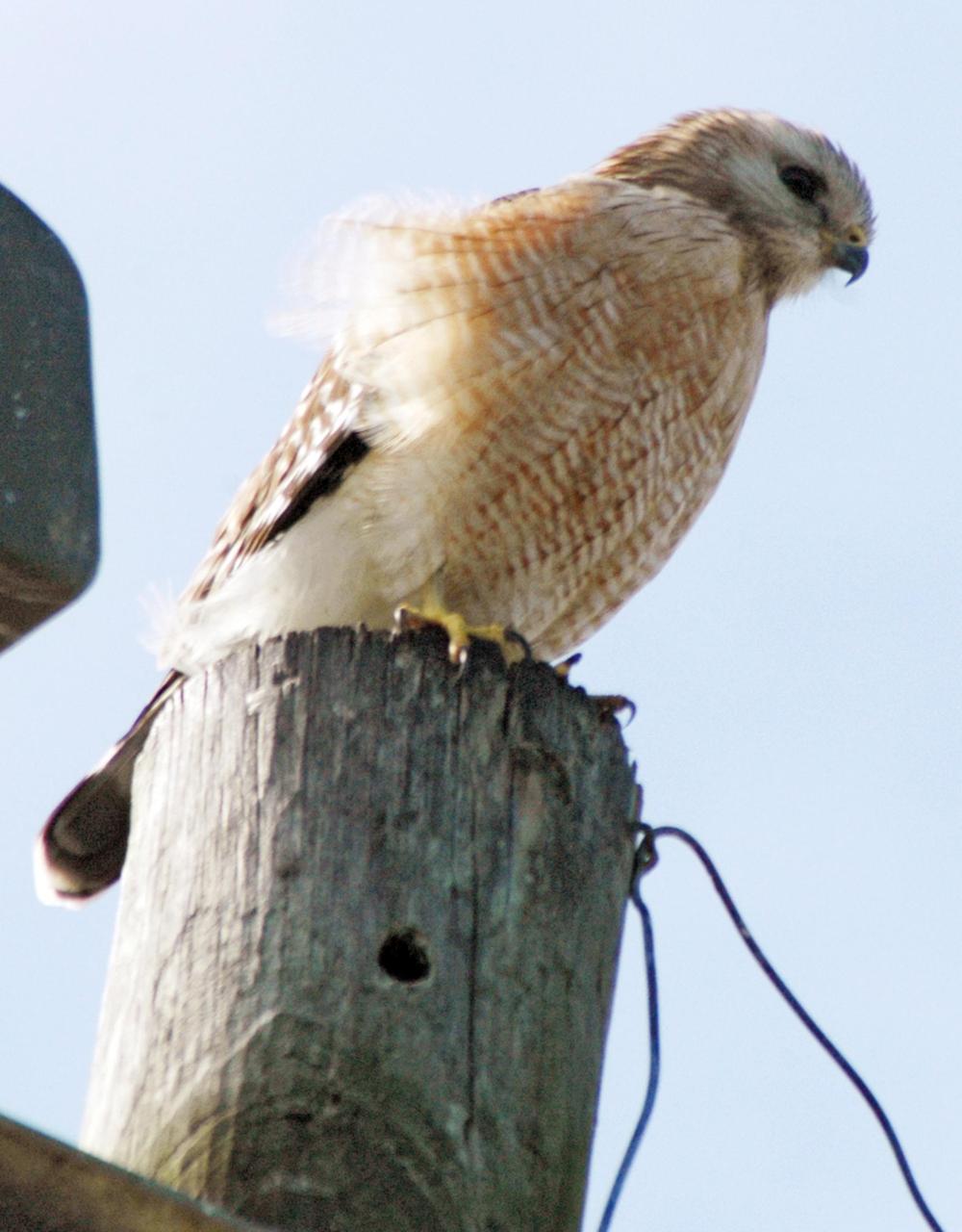
KENNEDY SPACE CENTER, FLA. -- This young red-shouldered hawk perches on a roadside pole inside NASA's Kennedy Space Center. The habitat of these hawks is deciduous woodlands, especially near standing water, frequently found in lowlands such as swampy woods and bogs. They range throughout the eastern half of the United States. KSC shares a boundary with the Merritt Island Wildlife Nature Refuge. The refuge is a habitat for more than 310 species of birds, 25 mammals, 117 fishes and 65 amphibians and reptiles. In addition, the Refuge supports 19 endangered or threatened wildlife species on Federal or State lists, more than any other single refuge in the U.S. Photo credit: NASA/Ken Thornsley
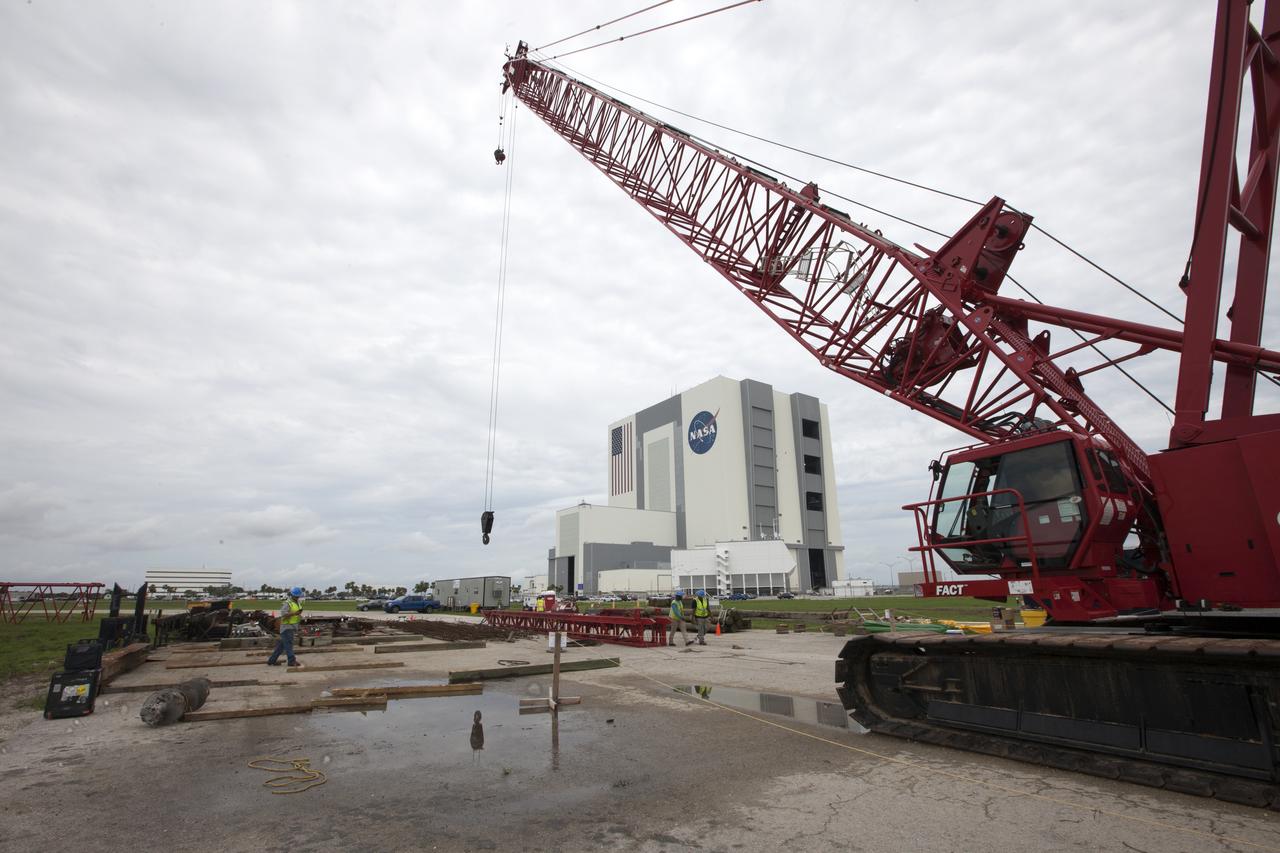
Modifications are underway at the Launch Complex 39 turn basin wharf at NASA's Kennedy Space Center in Florida to prepare for the arrival of the agency's massive Space Launch System (SLS) core stage aboard the barge Pegasus. A crane will be used to lift up precast concrete poles and position them to be driven to a depth of about 70 feet into the bedrock below the water around the turn basin. The upgrades are necessary to accommodate the increased weight of the core stage along with ground support and transportation equipment aboard the modified barge Pegasus. The Ground Systems Development and Operations Program is overseeing the upgrades to the turn basin wharf.
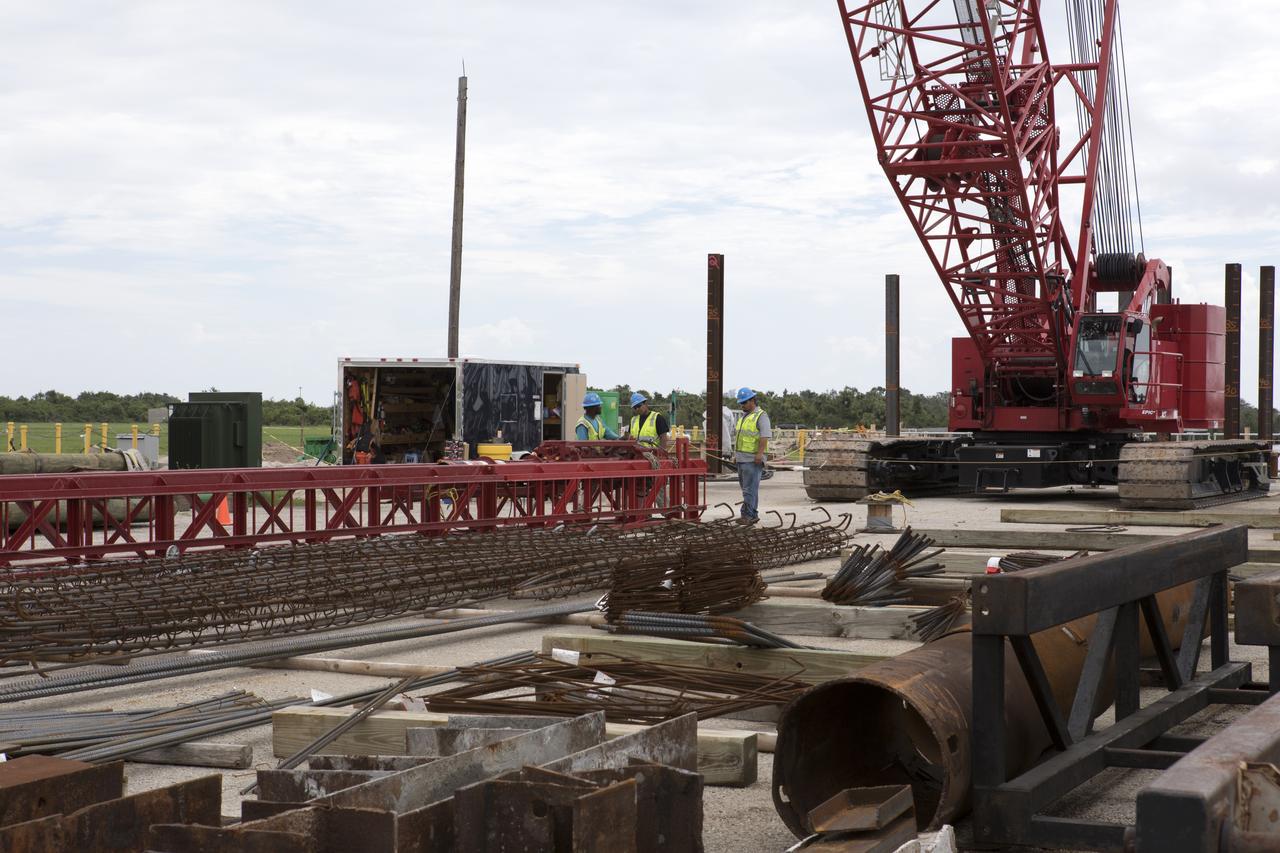
Modifications are underway at the Launch Complex 39 turn basin wharf at NASA's Kennedy Space Center in Florida to prepare for the arrival of the agency's massive Space Launch System (SLS) core stage aboard the barge Pegasus. Equipment is staged and a crane will be used to lift up precast concrete poles and position them to be driven to a depth of about 70 feet into the bedrock below the water around the turn basin. The upgrades are necessary to accommodate the increased weight of the core stage along with ground support and transportation equipment aboard the modified barge Pegasus. The Ground Systems Development and Operations Program is overseeing the upgrades to the turn basin wharf.
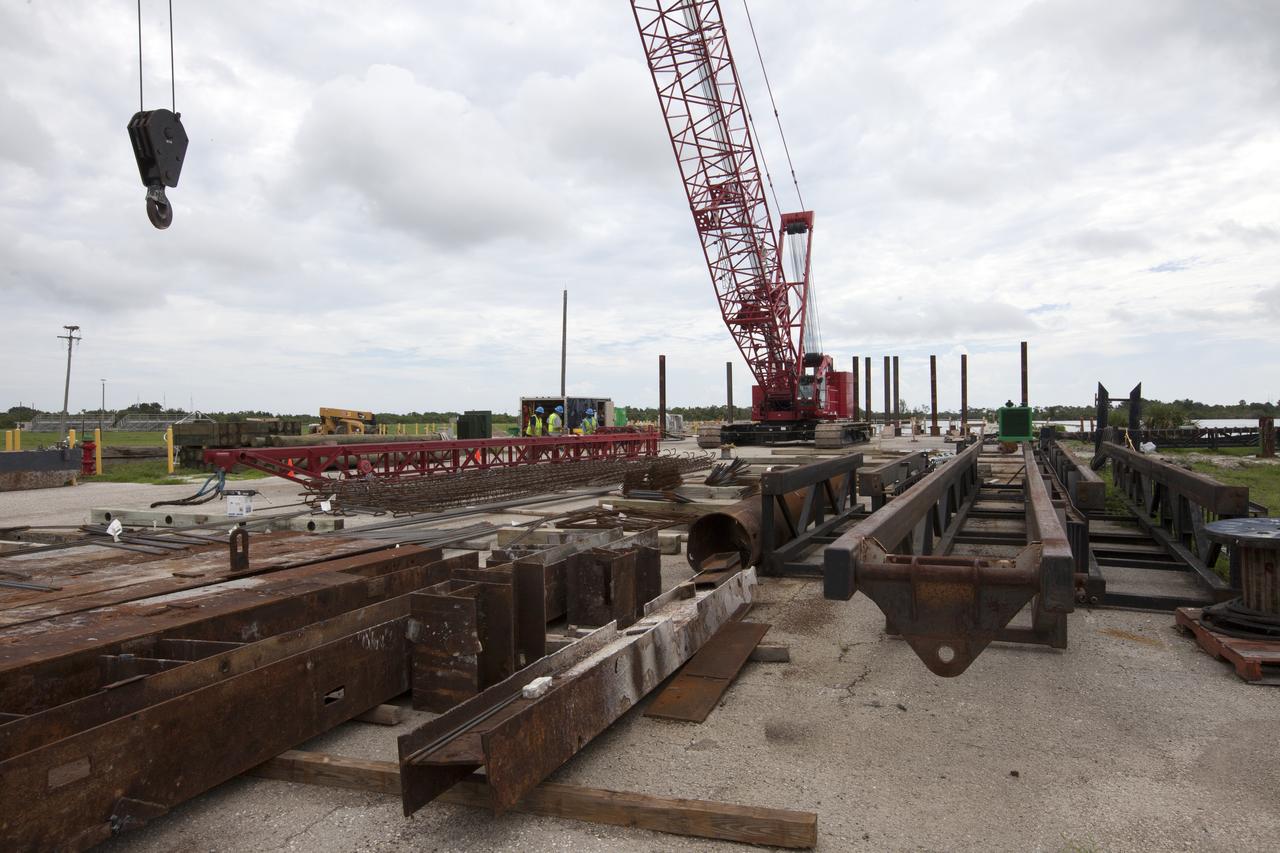
Modifications are underway at the Launch Complex 39 turn basin wharf at NASA's Kennedy Space Center in Florida to prepare for the arrival of the agency's massive Space Launch System (SLS) core stage aboard the barge Pegasus. Equipment is staged and a crane will be used to lift up precast concrete poles and position them to be driven to a depth of about 70 feet into the bedrock below the water around the turn basin. The upgrades are necessary to accommodate the increased weight of the core stage along with ground support and transportation equipment aboard the modified barge Pegasus. The Ground Systems Development and Operations Program is overseeing the upgrades to the turn basin wharf.
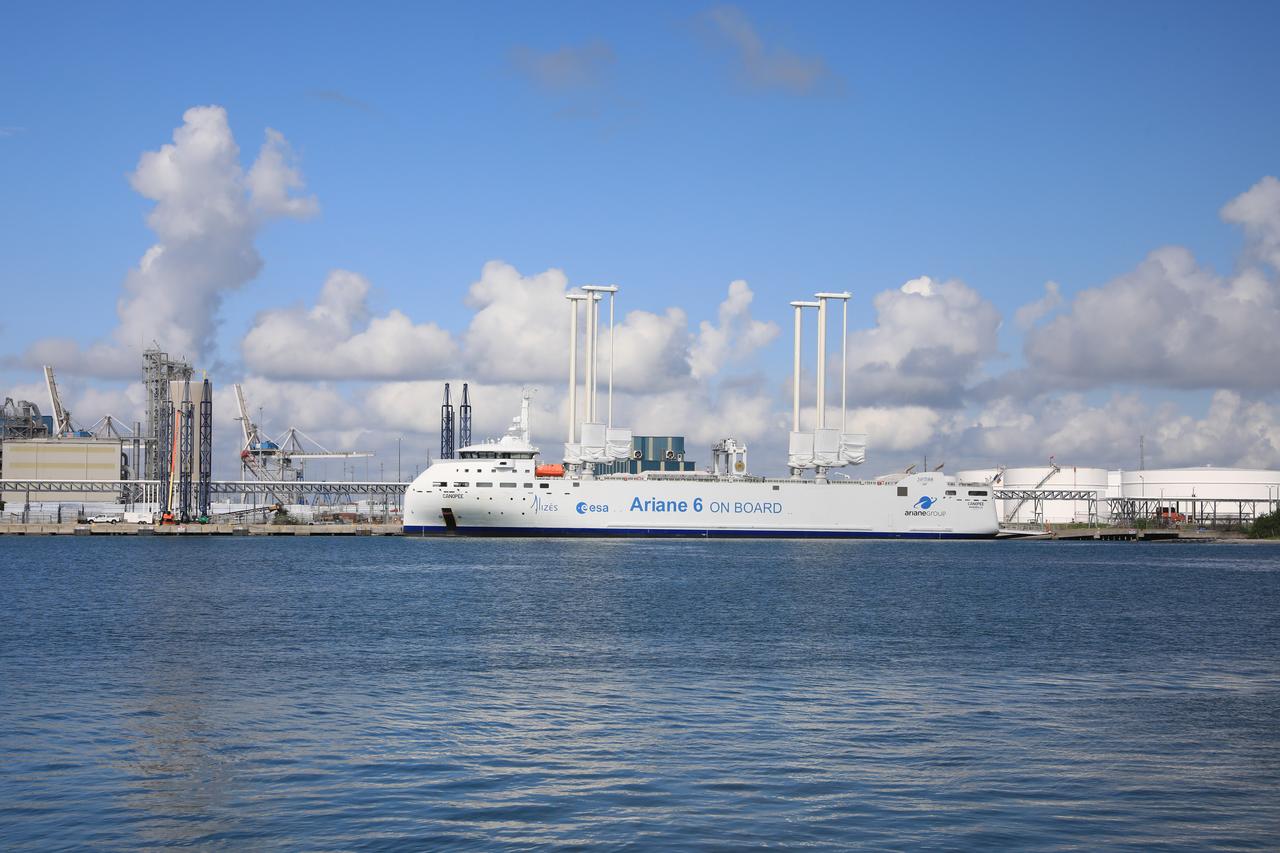
The European Service Module 3 for NASA’s Artemis III mission arrives at Port Canaveral on Tuesday, Sept. 3, 2024, awaiting transportation to NASA’s Kennedy Space Center in Florida. The European Service Module 3, which is assembled by Airbus in Bremen, Germany, traveled across the Atlantic Ocean by the ESA (European Space Agency) aboard the Canopee ship. The European Service Module 3 provides the spacecraft’s propulsion, thermal control, electrical power, and life support systems. Artemis III will send four astronauts to the lunar orbit where two crew members will spend a week near the South Pole of the Moon conducting new science.
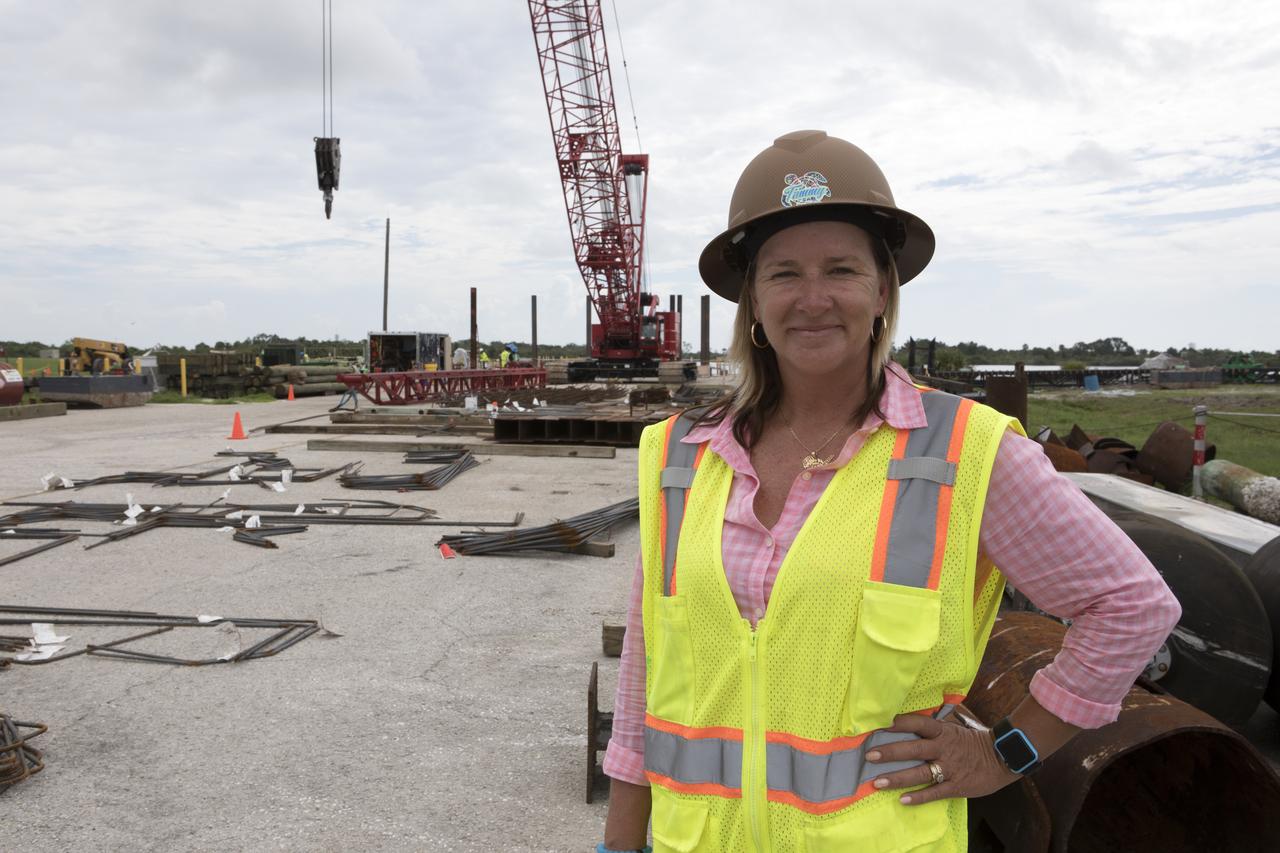
Modifications are underway at the Launch Complex 39 turn basin wharf at NASA's Kennedy Space Center in Florida to prepare for the arrival of the agency's massive Space Launch System (SLS) core stage aboard the barge Pegasus. In the foreground is Tammy Kelly, site manager, with Southeast Cherokee Construction Inc. A crane will be used to lift up precast concrete poles and position them to be driven to a depth of about 70 feet into the bedrock below the water around the turn basin. The upgrades are necessary to accommodate the increased weight of the core stage along with ground support and transportation equipment aboard the modified barge Pegasus. The Ground Systems Development and Operations Program is overseeing the upgrades to the turn basin wharf.
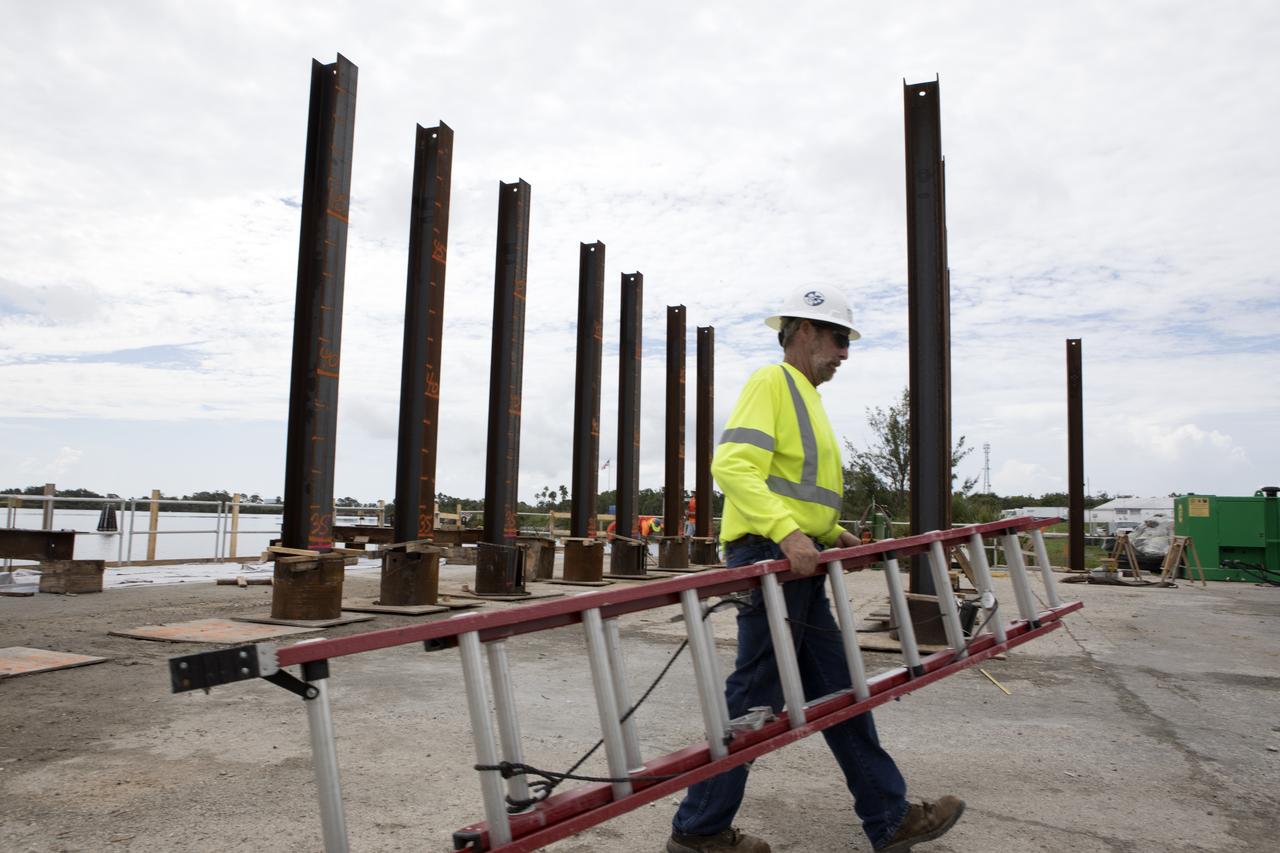
Modifications are underway at the Launch Complex 39 turn basin wharf at NASA's Kennedy Space Center in Florida to prepare for the arrival of the agency's massive Space Launch System (SLS) core stage aboard the barge Pegasus. Precast concrete poles are being driven to a depth of about 70 feet into the bedrock below the water around the turn basin. The upgrades are necessary to accommodate the increased weight of the core stage along with ground support and transportation equipment aboard the modified barge Pegasus. The Ground Systems Development and Operations Program is overseeing the upgrades to the turn basin wharf.
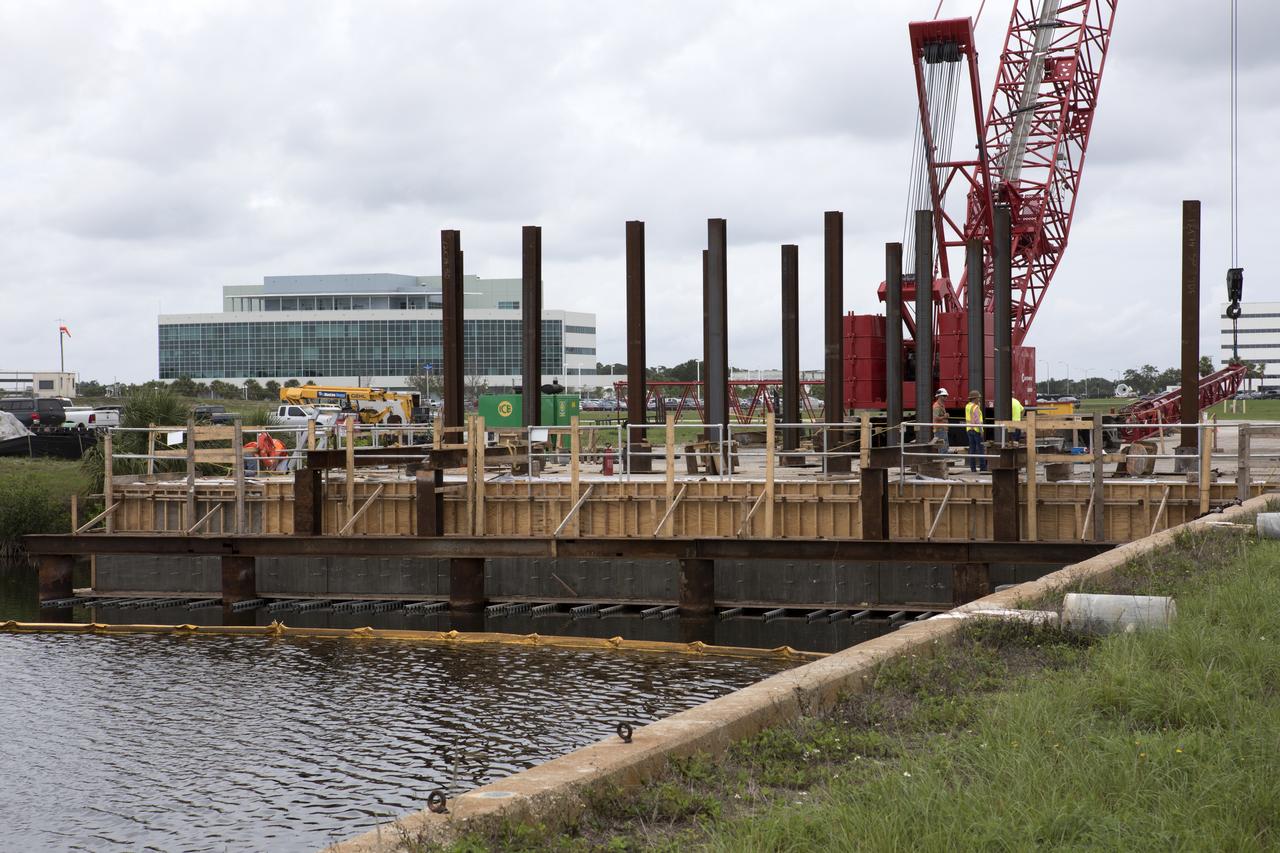
Modifications are underway at the Launch Complex 39 turn basin wharf at NASA's Kennedy Space Center in Florida to prepare for the arrival of the agency's massive Space Launch System (SLS) core stage aboard the barge Pegasus. Precast concrete poles are being driven to a depth of about 70 feet into the bedrock below the water around the turn basin. The upgrades are necessary to accommodate the increased weight of the core stage along with ground support and transportation equipment aboard the modified barge Pegasus. The Ground Systems Development and Operations Program is overseeing the upgrades to the turn basin wharf.
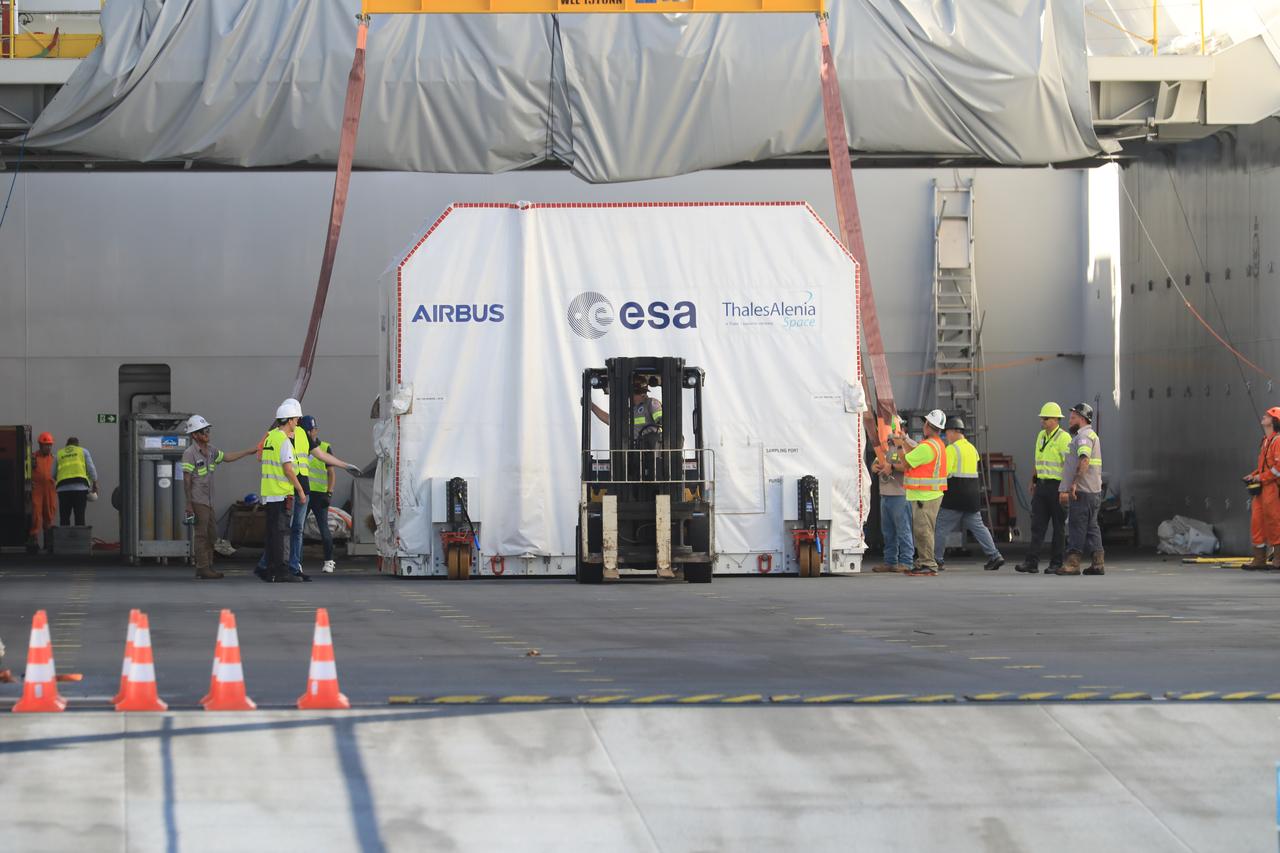
The transport carrier containing the European Service Module 3 for NASA’s Artemis III mission arrives at Port Canaveral on Tuesday, Sept. 3, 2024, awaiting transportation to NASA’s Kennedy Space Center in Florida. The European Service Module 3, which is assembled by Airbus in Bremen, Germany, traveled 10 days across the Atlantic Ocean via the Canopee ship. The European Service Module 3 provides the spacecraft’s propulsion, thermal control, electrical power, and life support systems. Artemis III will send four astronauts to the lunar orbit where two crew members will spend a week near the South Pole of the Moon conducting new science.
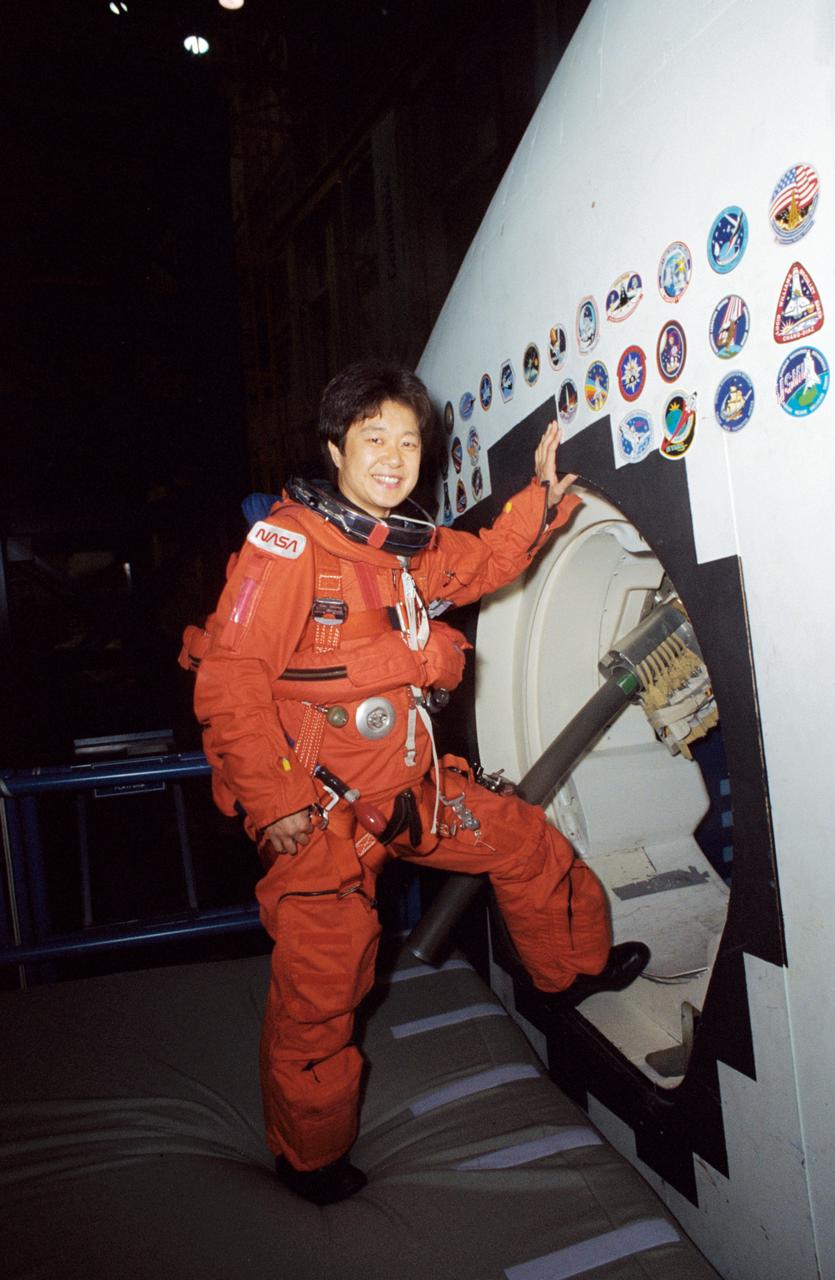
STS-65 Japanese Payload Specialist Chiaki Mukai takes a break from training at the Johnson Space Center (JSC). Wearing a training version of the orange launch and entry suit (LES), Mukai stands at the crew compartment trainer (CCT) side hatch in the Mockup and Integration Laboratory (MAIL) Bldg 9NE. Note the crew escape system (CES) pole device extending out the side hatch which would accommodate crewmembers in bailout from a troubled spacecraft. Mukai represents the National Space Development Agency (NASDA) of Japan and will serve as a payload specialist aboard Columbia, Orbiter Vehicle (OV) 102, during the STS-65 International Microgravity Laboratory 2 (IML-2) mission.
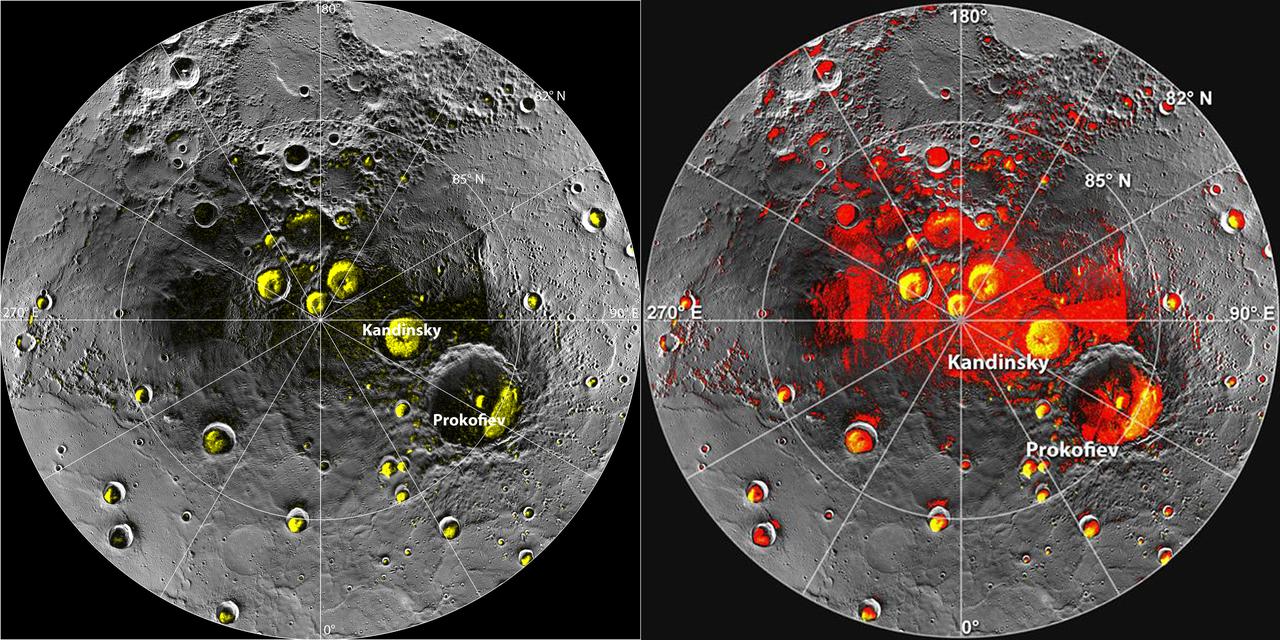
New observations by the MESSENGER spacecraft provide compelling support for the long-held hypothesis that Mercury harbors abundant water ice and other frozen volatile materials in its permanently shadowed polar craters. Three independent lines of evidence support this conclusion: the first measurements of excess hydrogen at Mercury's north pole with MESSENGER's Neutron Spectrometer, the first measurements of the reflectance of Mercury's polar deposits at near-infrared wavelengths with the Mercury Laser Altimeter (MLA), and the first detailed models of the surface and near-surface temperatures of Mercury's north polar regions that utilize the actual topography of Mercury's surface measured by the MLA. These findings are presented in three papers published online today in Science Express. Given its proximity to the Sun, Mercury would seem to be an unlikely place to find ice. But the tilt of Mercury's rotational axis is almost zero — less than one degree — so there are pockets at the planet's poles that never see sunlight. Scientists suggested decades ago that there might be water ice and other frozen volatiles trapped at Mercury's poles. The idea received a boost in 1991, when the Arecibo radio telescope in Puerto Rico detected unusually radar-bright patches at Mercury's poles, spots that reflected radio waves in the way one would expect if there were water ice. Many of these patches corresponded to the location of large impact craters mapped by the Mariner 10 spacecraft in the 1970s. But because Mariner saw less than 50 percent of the planet, planetary scientists lacked a complete diagram of the poles to compare with the images. MESSENGER's arrival at Mercury last year changed that. Images from the spacecraft's Mercury Dual Imaging System taken in 2011 and earlier this year confirmed that radar-bright features at Mercury's north and south poles are within shadowed regions on Mercury's surface, findings that are consistent with the water-ice hypothesis. To read more go to: <a href="http://1.usa.gov/TtNwM2" rel="nofollow">1.usa.gov/TtNwM2</a> Image Credit: NASA/Johns Hopkins University Applied Physics Laboratory/Carnegie Institution of Washington/National Astronomy and Ionosphere Center, Arecibo Observatory <b><a href="http://www.nasa.gov/audience/formedia/features/MP_Photo_Guidelines.html" rel="nofollow">NASA image use policy.</a></b> <b><a href="http://www.nasa.gov/centers/goddard/home/index.html" rel="nofollow">NASA Goddard Space Flight Center</a></b> enables NASA’s mission through four scientific endeavors: Earth Science, Heliophysics, Solar System Exploration, and Astrophysics. Goddard plays a leading role in NASA’s accomplishments by contributing compelling scientific knowledge to advance the Agency’s mission. <b>Follow us on <a href="http://twitter.com/NASA_GoddardPix" rel="nofollow">Twitter</a></b> <b>Like us on <a href="http://www.facebook.com/pages/Greenbelt-MD/NASA-Goddard/395013845897?ref=tsd" rel="nofollow">Facebook</a></b> <b>Find us on <a href="http://instagram.com/nasagoddard?vm=grid" rel="nofollow">Instagram</a></b>
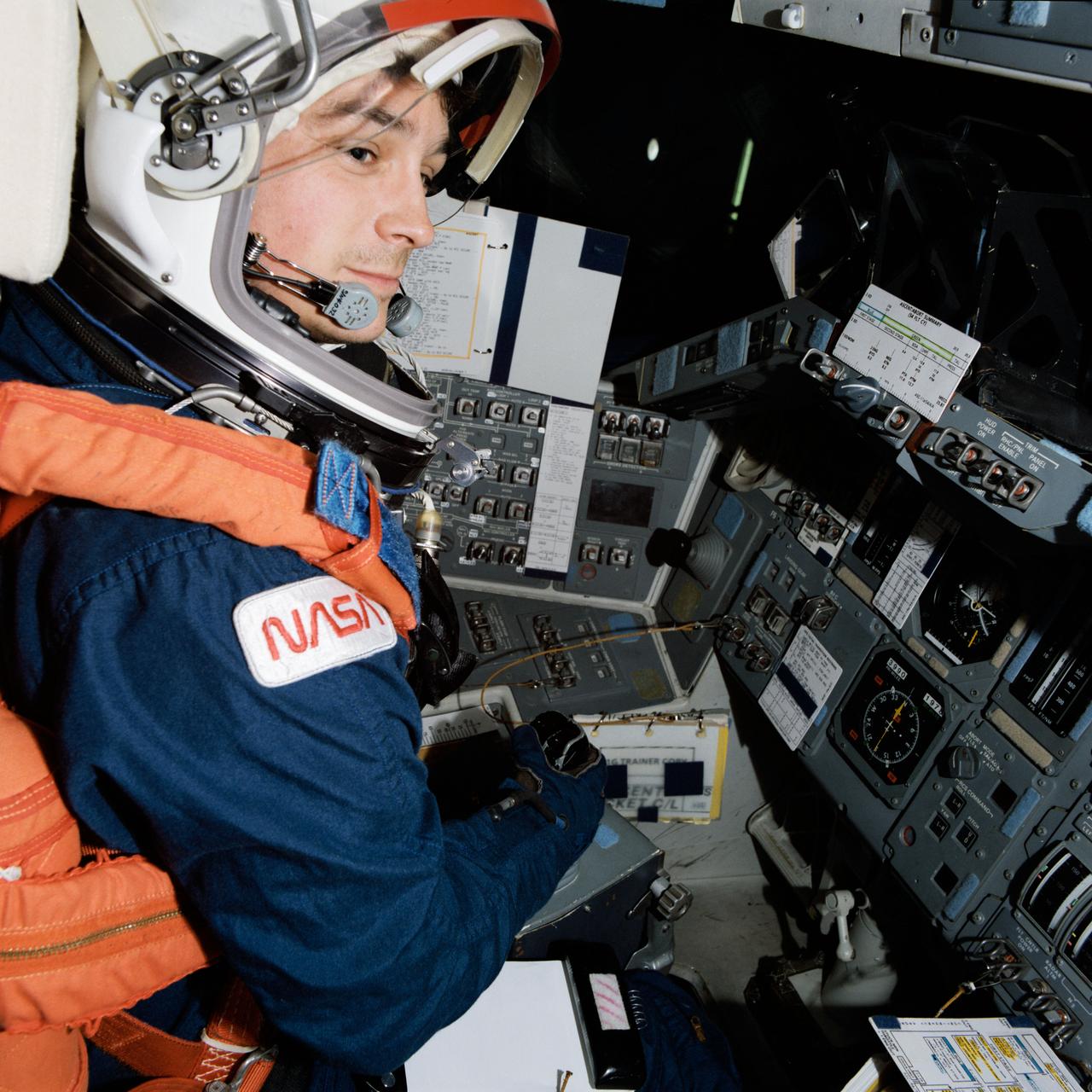
Photos of orbiter fire rescue and crew escape training for extravehicular activity (EVA) crew systems support conducted in Bldg 9A Crew Compartment Trainer (CCT) and Fuel Fuselage Trainer (FFT) include views of CCT interior of middeck starboard fuselage showing middeck forward (MF) locker and COAS assembly filter, artiflex film and camcorder bag (26834); launch/entry suit (LES) helmet assembly, neckring and helmet hold-down assembly (26835-26836); middeck aft (MA) lockers (26837); area of middeck airlock and crew escape pole (26838); connectors of crew escape pole in the middeck (268390); three test subjects in LES in the flight deck (26840); emergency side hatch slide before inflated stowage (26841); area of below adjacent to floor panel MD23R (26842); a test subject in LES in the flight deck (26843); control board and also showing sign of "orbital maneuvering system (OMS) secure and OMS TK" (26844); test subject in the flight deck also showing chart of "ascent/abort summary" (26845).
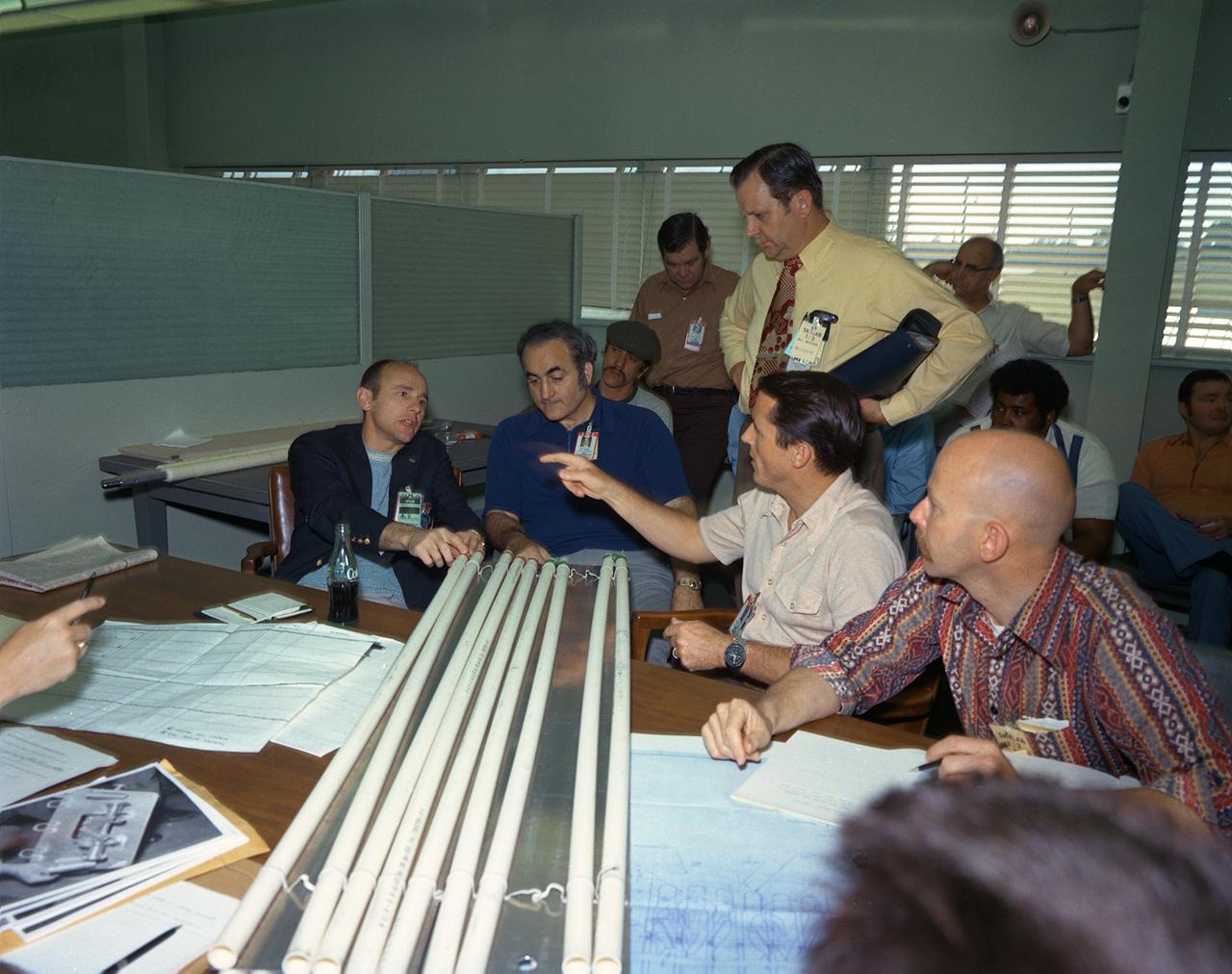
Sixty-three seconds after the launch of the modified Saturn V vehicle carrying the Skylab cluster, engineers in the operation support and control center saw an unexpected telemetry indication that signalled that damages occurred on one solar array and the micrometeoroid shield during the launch. Still unoccupied, the Skylab was stricken with the loss of the heat shield and sunlight beat mercilessly on the lab's sensitive skin. Internal temperatures soared, rendering the the station uninhabitable, threatening foods, medicines, films, and experiments. The launch of the first marned Skylab (Skylab-2) mission was delayed until methods were devised to repair and salvage the workshop. Personnel from other NASA Centers and industries quickly joined the Marshall Space Flight Center (MSFC) in efforts to save the damaged Skylab. They worked day and night for the next several days. Eventually the MSFC developed, tested, rehearsed, and approved three repair options. These options included a parasol sunshade and a twin-pole sunshade to restore the temperature inside the workshop, and a set of metal cutting tools to free the jammed solar panel. This photograph was taken during a discussion of the methods of the twin-pole Sun shield by (left to right) Astronaut Alan Bean, MSFC Director Dr. Rocco Petrone, Astronaut Edward Gibson, and MSFC engineer Richard Heckman. Dr. William Lucas, who became MSFC Director after Dr. Petrone left MSFC in March of 1974, is standing.

Modifications are underway at the Launch Complex 39 turn basin wharf at NASA's Kennedy Space Center in Florida to prepare for the arrival of the agency's massive Space Launch System (SLS) core stage aboard the barge Pegasus. Tammy Kelly, in the center, site manager, with Southeast Cherokee Construction Inc. talks with construction workers. A crane will be used to lift up precast concrete poles and position them to be driven to a depth of about 70 feet into the bedrock below the water around the turn basin. The upgrades are necessary to accommodate the increased weight of the core stage along with ground support and transportation equipment aboard the modified barge Pegasus. The Ground Systems Development and Operations Program is overseeing the upgrades to the turn basin wharf.
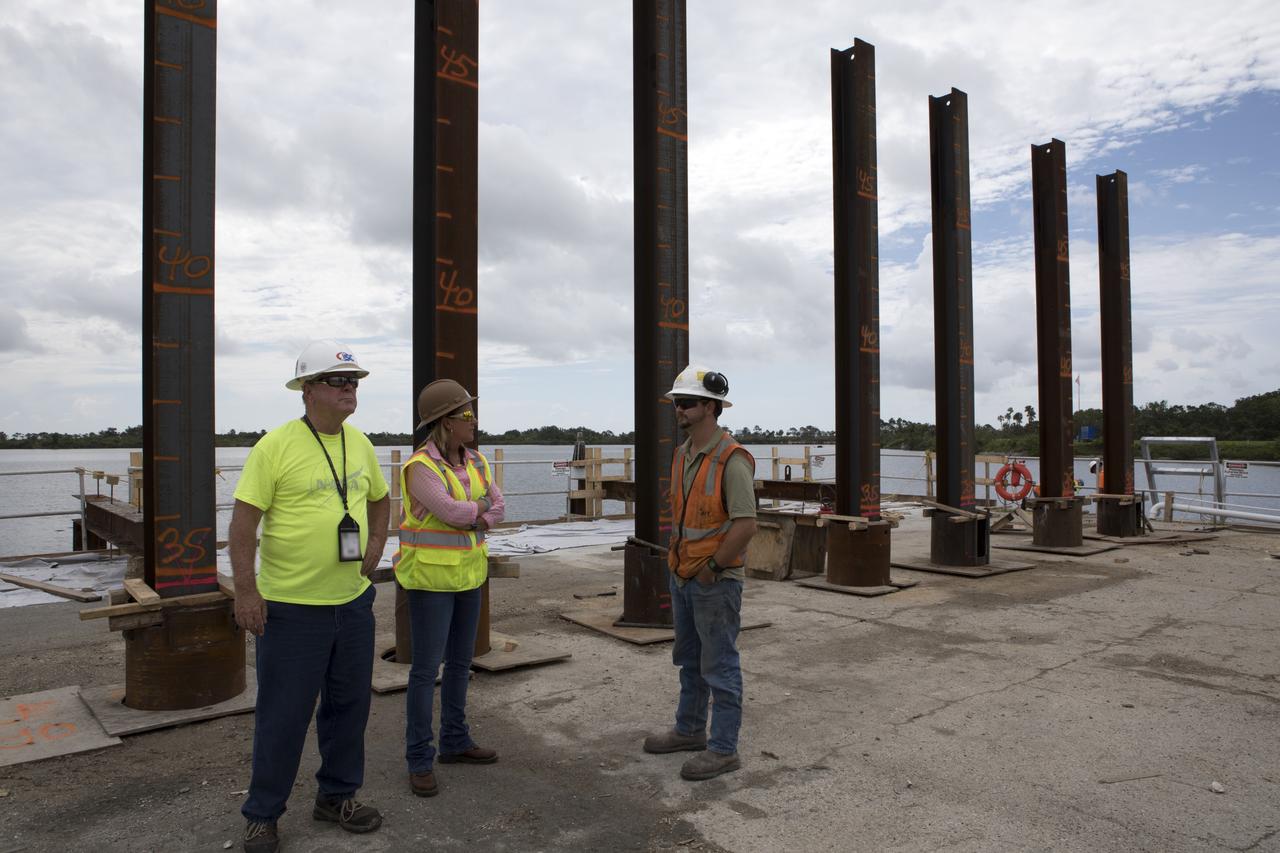
Modifications are underway at the Launch Complex 39 turn basin wharf at NASA's Kennedy Space Center in Florida to prepare for the arrival of the agency's massive Space Launch System (SLS) core stage aboard the barge Pegasus. Tammy Kelly, in the center, site manager, with Southeast Cherokee Construction Inc. talks with construction workers. A crane will be used to lift up precast concrete poles and position them to be driven to a depth of about 70 feet into the bedrock below the water around the turn basin. The upgrades are necessary to accommodate the increased weight of the core stage along with ground support and transportation equipment aboard the modified barge Pegasus. The Ground Systems Development and Operations Program is overseeing the upgrades to the turn basin wharf.

Astronomers are using the NASA/ESA Hubble Space Telescope to study auroras — stunning light shows in a planet’s atmosphere — on the poles of the largest planet in the solar system, Jupiter. This observation program is supported by measurements made by NASA’s Juno spacecraft, currently on its way to Jupiter. Jupiter, the largest planet in the solar system, is best known for its colorful storms, the most famous being the Great Red Spot. Now astronomers have focused on another beautiful feature of the planet, using Hubble's ultraviolet capabilities. The extraordinary vivid glows shown in the new observations are known as auroras. They are created when high-energy particles enter a planet’s atmosphere near its magnetic poles and collide with atoms of gas. As well as producing beautiful images, this program aims to determine how various components of Jupiter’s auroras respond to different conditions in the solar wind, a stream of charged particles ejected from the sun. This observation program is perfectly timed as NASA’s Juno spacecraft is currently in the solar wind near Jupiter and will enter the orbit of the planet in early July 2016. While Hubble is observing and measuring the auroras on Jupiter, Juno is measuring the properties of the solar wind itself; a perfect collaboration between a telescope and a space probe. “These auroras are very dramatic and among the most active I have ever seen”, said Jonathan Nichols from the University of Leicester, U.K., and principal investigator of the study. “It almost seems as if Jupiter is throwing a firework party for the imminent arrival of Juno.” Read more: <a href="http://go.nasa.gov/294QswK" rel="nofollow">go.nasa.gov/294QswK</a> Credits: NASA, ESA, and J. Nichols (University of Leicester)
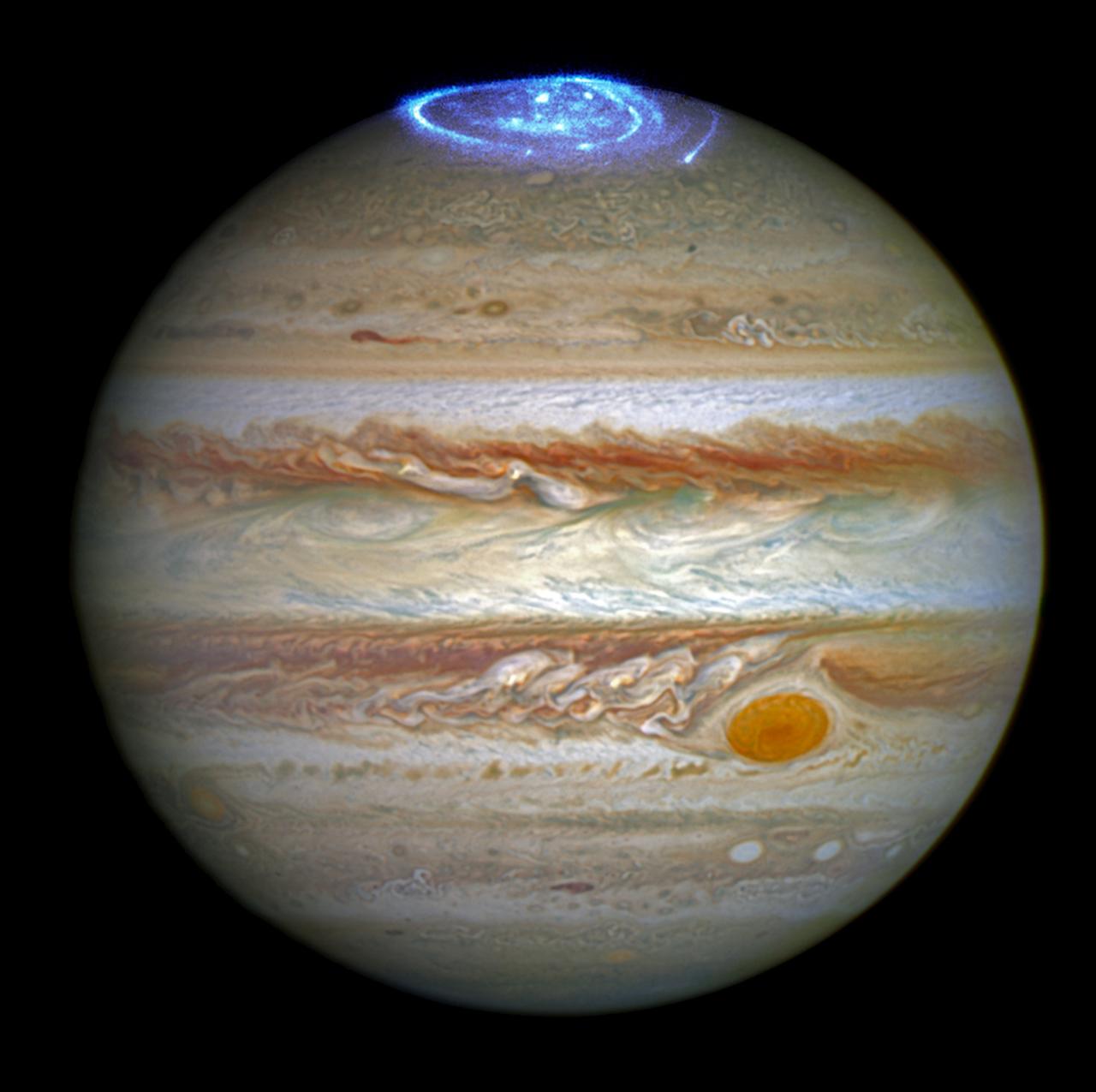
Astronomers are using the NASA/ESA Hubble Space Telescope to study auroras — stunning light shows in a planet’s atmosphere — on the poles of the largest planet in the solar system, Jupiter. This observation program is supported by measurements made by NASA’s Juno spacecraft, currently on its way to Jupiter. Jupiter, the largest planet in the solar system, is best known for its colorful storms, the most famous being the Great Red Spot. Now astronomers have focused on another beautiful feature of the planet, using Hubble's ultraviolet capabilities. The extraordinary vivid glows shown in the new observations are known as auroras. They are created when high-energy particles enter a planet’s atmosphere near its magnetic poles and collide with atoms of gas. As well as producing beautiful images, this program aims to determine how various components of Jupiter’s auroras respond to different conditions in the solar wind, a stream of charged particles ejected from the sun. This observation program is perfectly timed as NASA’s Juno spacecraft is currently in the solar wind near Jupiter and will enter the orbit of the planet in early July 2016. While Hubble is observing and measuring the auroras on Jupiter, Juno is measuring the properties of the solar wind itself; a perfect collaboration between a telescope and a space probe. “These auroras are very dramatic and among the most active I have ever seen”, said Jonathan Nichols from the University of Leicester, U.K., and principal investigator of the study. “It almost seems as if Jupiter is throwing a firework party for the imminent arrival of Juno.” Credits: NASA, ESA, and J. Nichols (University of Leicester)
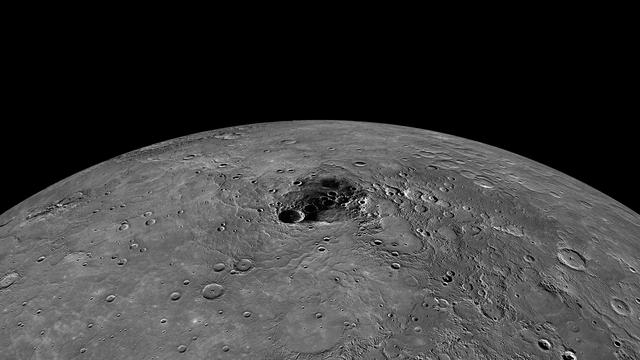
Tune in to NASA's News Conference today, November 29, 2012, at 2 p.m. EST for new findings about Mercury's polar regions. <a href="http://www.nasa.gov/multimedia/nasatv/index.html" rel="nofollow">www.nasa.gov/multimedia/nasatv/index.html</a> Due to its nearly vertical spin axis, Mercury's north pole is never fully sunlit. If it were, it might look something like this image, which is an orthographic projection of a global mosaic. The dark area towards the center of the image contains the north pole. The MESSENGER spacecraft is the first ever to orbit the planet Mercury, and the spacecraft's seven scientific instruments and radio science investigation are unraveling the history and evolution of the Solar System's innermost planet. Visit the Why Mercury? section of this website to learn more about the key science questions that the MESSENGER mission is addressing. During the one-year primary mission, MESSENGER acquired 88,746 images and extensive other data sets. MESSENGER is now in a yearlong extended mission, during which plans call for the acquisition of more than 80,000 additional images to support MESSENGER's science goals. Credit: NASA/Johns Hopkins University Applied Physics Laboratory/Carnegie Institution of Washington <b><a href="http://www.nasa.gov/audience/formedia/features/MP_Photo_Guidelines.html" rel="nofollow">NASA image use policy.</a></b> <b><a href="http://www.nasa.gov/centers/goddard/home/index.html" rel="nofollow">NASA Goddard Space Flight Center</a></b> enables NASA’s mission through four scientific endeavors: Earth Science, Heliophysics, Solar System Exploration, and Astrophysics. Goddard plays a leading role in NASA’s accomplishments by contributing compelling scientific knowledge to advance the Agency’s mission. <b>Follow us on <a href="http://twitter.com/NASA_GoddardPix" rel="nofollow">Twitter</a></b> <b>Like us on <a href="http://www.facebook.com/pages/Greenbelt-MD/NASA-Goddard/395013845897?ref=tsd" rel="nofollow">Facebook</a></b> <b>Find us on <a href="http://instagram.com/nasagoddard?vm=grid" rel="nofollow">Instagram</a></b>
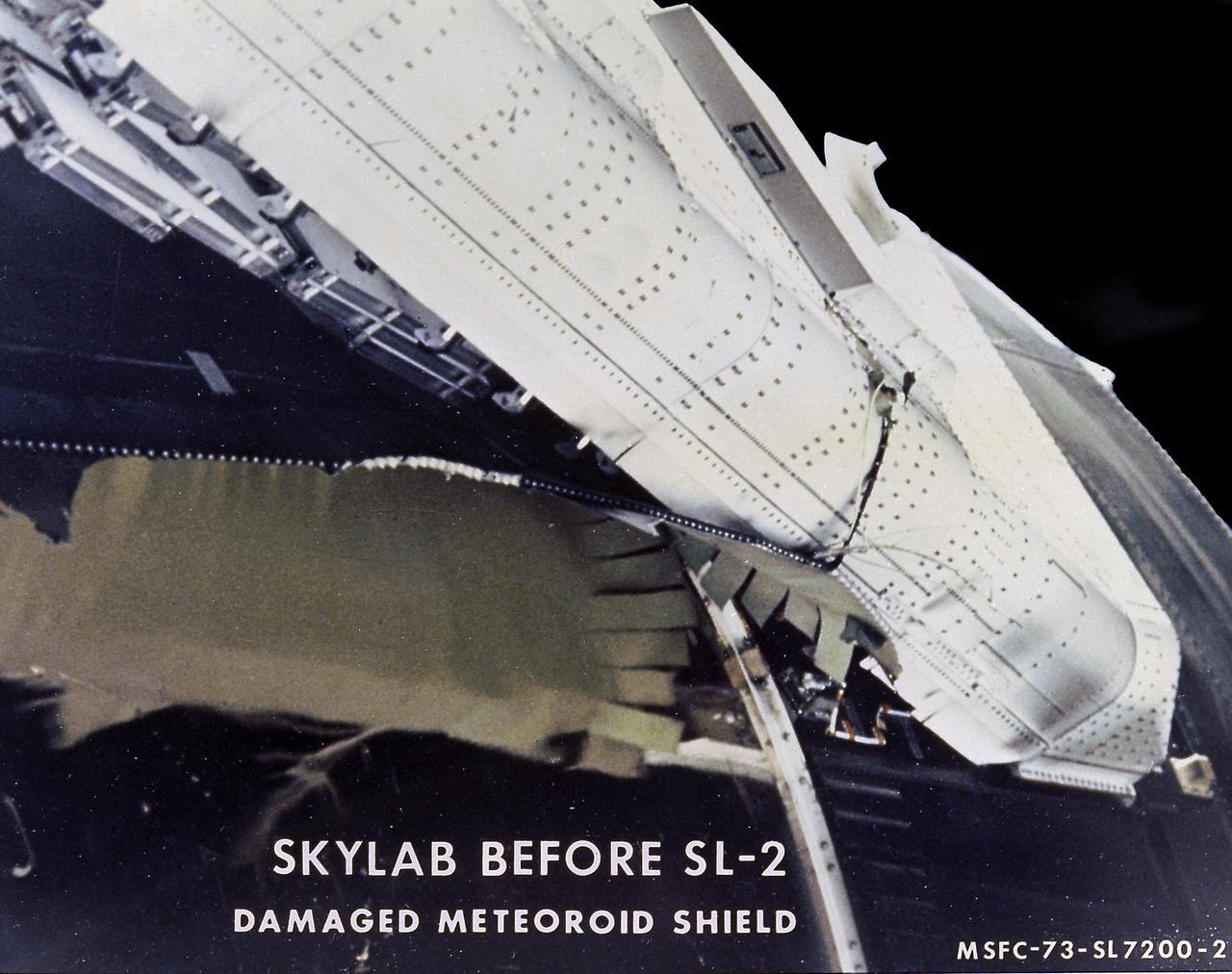
The Saturn V vehicle, carrying the unmarned orbital workshop for the Skylab-1 mission, lifted off successfully and all systems performed normally. Sixty-three seconds into flight, engineers in the operation support and control center saw an unexpected telemetry indication that signalled that damages occurred on one solar array and the micrometeoroid shield during the launch. The micrometeoroid shield, a thin protective cylinder surrounding the workshop protecting it from tiny space particles and the sun's scorching heat, ripped loose from its position around the workshop. This caused the loss of one solar wing and jammed the other. Still unoccupied, the Skylab was stricken with the loss of the heat shield and sunlight beat mercilessly on the lab's sensitive skin. Internal temperatures soared, rendering the station uninhabitable, threatening foods, medicines, films, and experiments. This image, taken during a fly-around inspection by the Skylab-2 crew, shows the damaged meteoroid shield being held by a thin aluminum strap entangled with green-hued remnants of the lost heat shield. The Marshall Space Flight Center (MSFC) developed, tested, rehearsed, and approved three repair options. These options included a parasol sunshade and a twin-pole sunshade to restore the temperature inside the workshop, and a set of metal cutting tools to free the jammed solar panel.
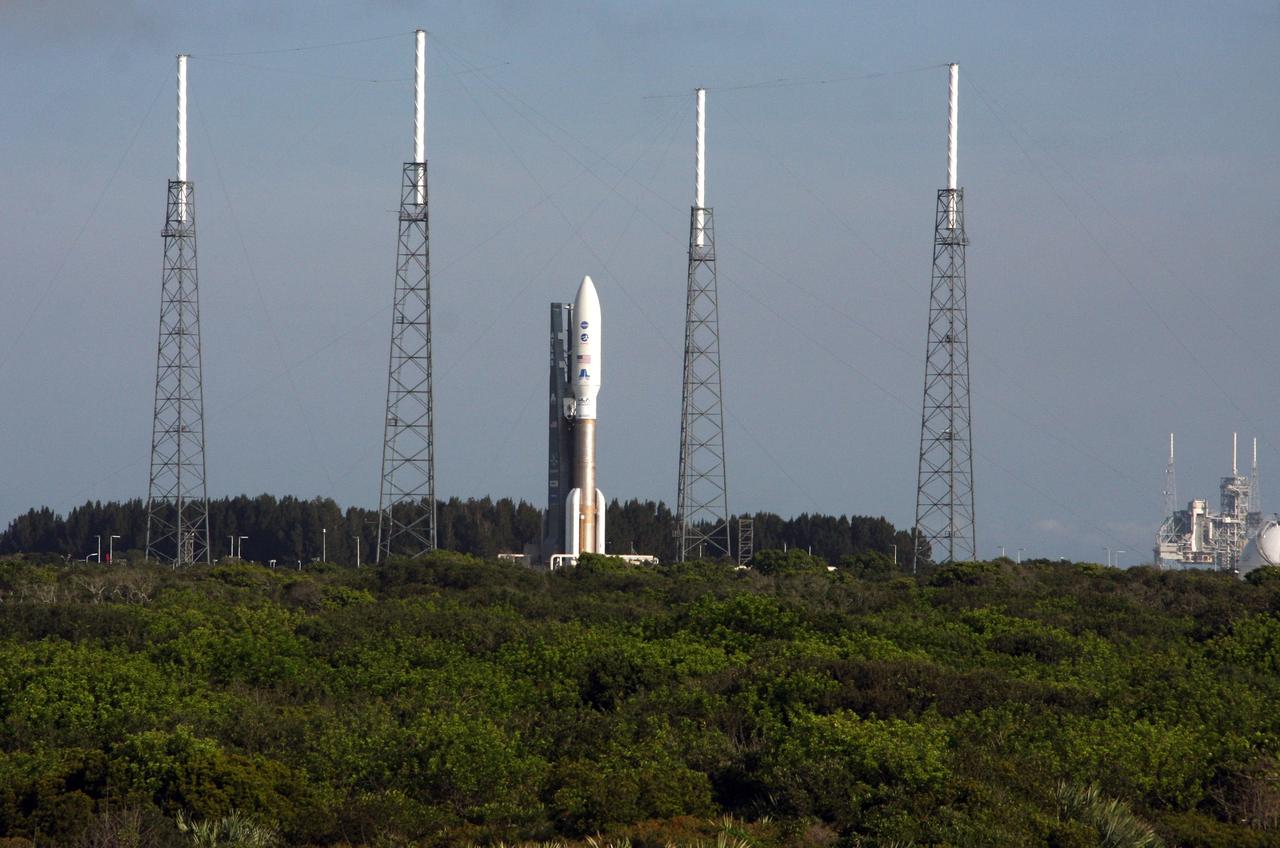
CAPE CANAVERAL, Fla. -- On Cape Canaveral Air Force Station in Florida, the 197-foot-tall United Launch Alliance Atlas V-551 launch vehicle carrying NASA's Juno spacecraft has arrived on the launch pad at Space Launch Complex 41. On Kennedy Space Center property, at right, is Launch Pad 39A, which supported the last space shuttle launch in July. Liftoff is planned during a launch window which extends from 11:34 a.m. to 12:43 p.m. EDT on Aug. 5. The solar-powered spacecraft will orbit Jupiter's poles 33 times to find out more about the gas giant's origins, structure, atmosphere and magnetosphere and investigate the existence of a solid planetary core. NASA's Jet Propulsion Laboratory, Pasadena, Calif., manages the Juno mission for the principal investigator, Scott Bolton, of Southwest Research Institute in San Antonio. The Juno mission is part of the New Frontiers Program managed at NASA's Marshall Space Flight Center in Huntsville, Ala. Lockheed Martin Space Systems, Denver, built the spacecraft. Launch management for the mission is the responsibility of NASA's Launch Services Program at the Kennedy Space Center in Florida. For more information, visit www.nasa.gov/juno. Photo credit: NASA/Ken Thornsley
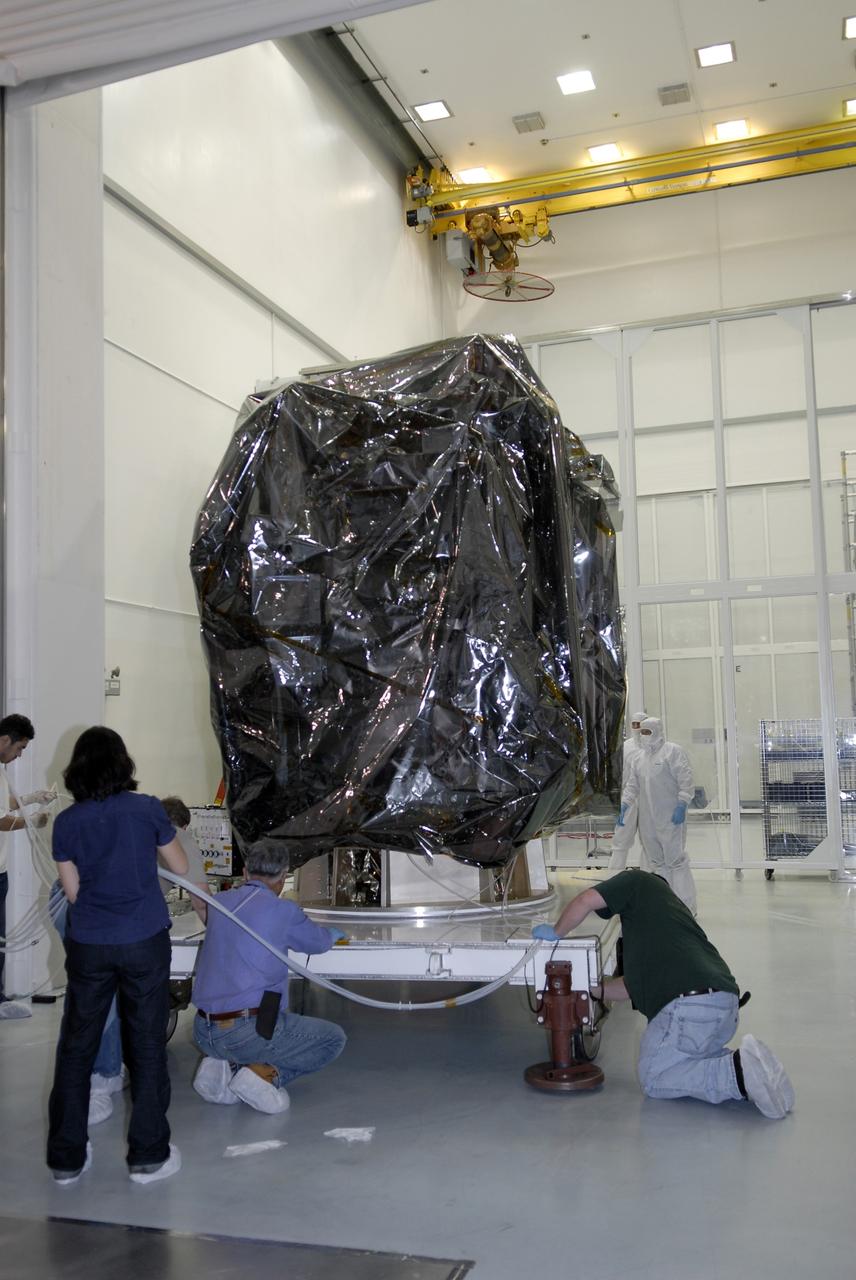
CAPE CANAVERAL, Fla. – Technicians secure a work stand supporting NASA's Lunar Reconnaissance Orbiter, or LRO, in the high bay at the Astrotech processing facility in Titusville, Fla. The spacecraft was built by engineers at Goddard Space Flight Center, where it recently completed two months of tests in a thermal vacuum chamber. The orbiter will carry seven instruments to provide scientists with detailed maps of the lunar surface and enhance our understanding of the moon's topography, lighting conditions, mineralogical composition and natural resources. Information gleaned from LRO will be used to select safe landing sites, determine locations for future lunar outposts and help mitigate radiation dangers to astronauts. The polar regions of the moon are the main focus of the mission because continuous access to sunlight may be possible and water ice may exist in permanently shadowed areas of the poles. Accompanying LRO on its journey to the moon will be the Lunar Crater Observation and Sensing Satellite, or LCROSS, a mission that will impact the lunar surface in its search for water ice. Launch of LRO/LCROSS is targeted for April 24. Photo credit: NASA/Kim Shiflett

BARREL researchers get ready to release the top part of the balloon, called the bubble, as it fills with enough helium to support itself. Only the top part of the balloon is inflated before launch since the helium expands as the balloon ascends. Credit: NASA/Goddard/BARREL/Nicky Knox Read more: <a href="http://www.nasa.gov/content/goddard/nasas-barrel-returns-successful-from-antarctica" rel="nofollow">www.nasa.gov/content/goddard/nasas-barrel-returns-success...</a> -- Three months, 20 balloons, and one very successful campaign. The team for NASA's BARREL – short for Balloon Array for Radiation belt Relativistic Electron Losses -- mission returned from Antarctica in March 2014. BARREL's job is to help unravel the mysterious Van Allen belts, two gigantic donuts of radiation that surround Earth, which can shrink and swell in response to incoming energy and particles from the sun and sometimes expose satellites to harsh radiation. While in Antarctica, the team launched 20 balloons carrying instruments that sense charged particles that are scattered into the atmosphere from the belts, spiraling down the magnetic fields near the South Pole. Each balloon traveled around the pole for up to three weeks. The team will coordinate the BARREL data with observations from NASA's two Van Allen Probes to better understand how occurrences in the belts relate to bursts of particles funneling down toward Earth. BARREL team members will be on hand at the USA Science and Engineering Festival in DC on April 26 and 27, 2014 for the exhibit Space Balloons: Exploring the Extremes of Space Weather. <b><a href="http://www.nasa.gov/audience/formedia/features/MP_Photo_Guidelines.html" rel="nofollow">NASA image use policy.</a></b> <b><a href="http://www.nasa.gov/centers/goddard/home/index.html" rel="nofollow">NASA Goddard Space Flight Center</a></b> enables NASA’s mission through four scientific endeavors: Earth Science, Heliophysics, Solar System Exploration, and Astrophysics. Goddard plays a leading role in NASA’s accomplishments by contributing compelling scientific knowledge to advance the Agency’s mission. <b>Follow us on <a href="http://twitter.com/NASAGoddardPix" rel="nofollow">Twitter</a></b> <b>Like us on <a href="http://www.facebook.com/pages/Greenbelt-MD/NASA-Goddard/395013845897?ref=tsd" rel="nofollow">Facebook</a></b> <b>Find us on <a href="http://instagram.com/nasagoddard?vm=grid" rel="nofollow">Instagram</a></b>
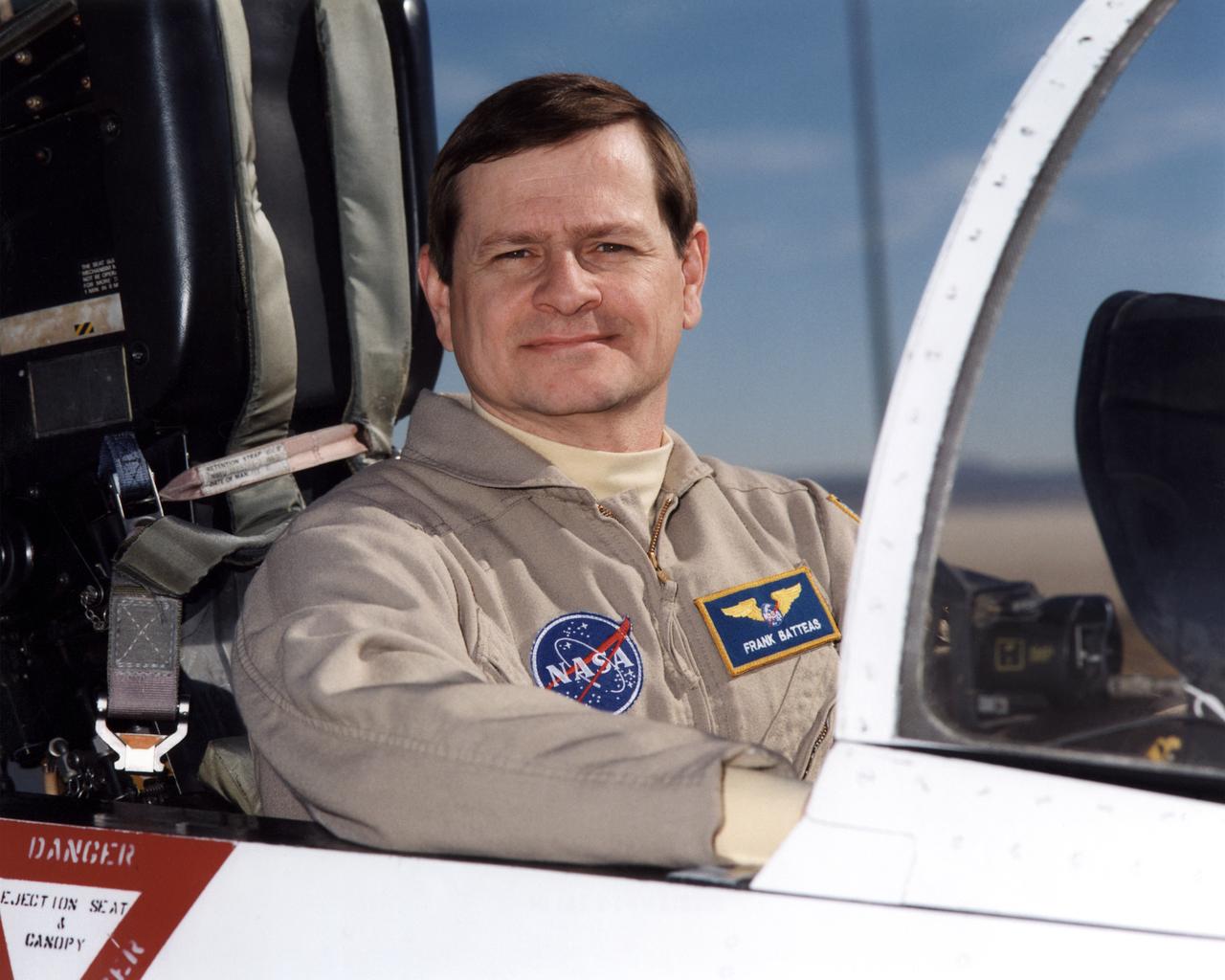
Frank Batteas is a research test pilot in the Flight Crew Branch of NASA's Dryden Flight Research Center, Edwards, California. He is currently a project pilot for the F/A-18 and C-17 flight research projects. In addition, his flying duties include operation of the DC-8 Flying Laboratory in the Airborne Science program, and piloting the B-52B launch aircraft, the King Air, and the T-34C support aircraft. Batteas has accumulated more than 4,700 hours of military and civilian flight experience in more than 40 different aircraft types. Batteas came to NASA Dryden in April 1998, following a career in the U.S. Air Force. His last assignment was at Wright-Patterson Air Force Base, Dayton, Ohio, where Lieutenant Colonel Batteas led the B-2 Systems Test and Evaluation efforts for a two-year period. Batteas graduated from Class 88A of the Air Force Test Pilot School, Edwards Air Force Base, California, in December 1988. He served more than five years as a test pilot for the Air Force's newest airlifter, the C-17, involved in nearly every phase of testing from flutter and high angle-of-attack tests to airdrop and air refueling envelope expansion. In the process, he achieved several C-17 firsts including the first day and night aerial refuelings, the first flight over the North Pole, and a payload-to-altitude world aviation record. As a KC-135 test pilot, he also was involved in aerial refueling certification tests on a number of other Air Force aircraft. Batteas received his commission as a second lieutenant in the U. S. Air Force through the Reserve Officer Training Corps and served initially as an engineer working on the Peacekeeper and Minuteman missile programs at the Ballistic Missile Office, Norton Air Force Base, Calif. After attending pilot training at Williams Air Force Base, Phoenix, Ariz., he flew operational flights in the KC-135 tanker aircraft and then was assigned to research flying at the 4950th Test Wing, Wright-Patterson. He flew extensively modified C-135

This VIS image shows part of the eastern margin of the summit caldera of Arsia Mons. The arcuate features are the faults created by collapse of summit materials. A massive eruption can empty the large magma chamber which existed within the volcano, creating a void which can not support the weight of the top of the volcano. Arsia Mons is the southernmost of the Tharsis volcanoes. It is 270 miles (450km) in diameter, almost 12 miles (20km) high, and the summit caldera is 72 miles (120km) wide. For comparison, the largest volcano on Earth is Mauna Loa. From its base on the sea floor, Mauna Loa measures only 6.3 miles high and 75 miles in diameter. A large volcanic crater known as a caldera is located at the summit of all of the Tharsis volcanoes. These calderas are produced by massive volcanic explosions and collapse. The Arsia Mons summit caldera is larger than many volcanoes on Earth. The Odyssey spacecraft has spent over 15 years in orbit around Mars, circling the planet more than 69000 times. It holds the record for longest working spacecraft at Mars. THEMIS, the IR/VIS camera system, has collected data for the entire mission and provides images covering all seasons and lighting conditions. Over the years many features of interest have received repeated imaging, building up a suite of images covering the entire feature. From the deepest chasma to the tallest volcano, individual dunes inside craters and dune fields that encircle the north pole, channels carved by water and lava, and a variety of other feature, THEMIS has imaged them all. For the next several months the image of the day will focus on the Tharsis volcanoes, the various chasmata of Valles Marineris, and the major dunes fields. We hope you enjoy these images! Orbit Number: 12487 Latitude: -9.44031 Longitude: 240.527 Instrument: VIS Captured: 2004-10-07 11:58 https://photojournal.jpl.nasa.gov/catalog/PIA22152
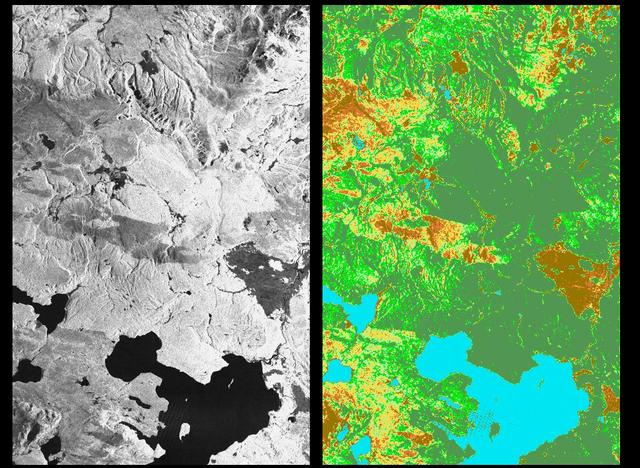
These two radar images show the majestic Yellowstone National Park, Wyoming, the oldest national park in the United States and home to the world's most spectacular geysers and hot springs. The region supports large populations of grizzly bears, elk and bison. In 1988, the park was burned by one of the most widespread fires to occur in the northern Rocky Mountains in the last 50 years. Surveys indicated that 793,880 acres of land burned. Of that, 41 percent was burned forest, with tree canopies totally consumed by the fire; 35 percent was a combination of unburned, scorched and blackened trees; 13 percent was surface burn under an unburned canopy; 6 percent was non-forest burn; and 5 percent was undifferentiated burn. Six years later, the burned areas are still clearly visible in these false-color radar images obtained by the Spaceborne Imaging Radar-C/X-band Synthetic Aperture Radar on board the space shuttle Endeavour. The image at the left was obtained using the L-band radar channel, horizontally received and vertically transmitted, on the shuttle's 39th orbit on October 2, 1994. The area shown is 45 kilometers by 71 kilometers (28 miles by 44 miles) in size and centered at 44.6 degrees north latitude, 110.7 degrees west longitude. North is toward the top of the image (to the right). Most trees in this area are lodge pole pines at different stages of fire succession. Yellowstone Lake appears as a large dark feature at the bottom of the scene. At right is a map of the forest crown, showing its biomass, or amount of vegetation, which includes foliage and branches. The map was created by inverting SIR-C data and using in situ estimates of crown biomass gathered by the Yellowstone National Biological Survey. The map is displayed on a color scale from blue (rivers and lakes with no biomass) to brown (non-forest areas with crown biomass of less than 4 tons per hectare) to light brown (areas of canopy burn with biomass of between 4 and 12 tons per hectare). Yellow indicates areas of canopy burn and mixed burn with a biomass of between 12 to 20 tons per hectare; light green is mixed burn and on-burn forest with a biomass of 20 to 35 tons per hectare; and green is non-burned forest with a biomass of greater than 35 tons per hectare. Forest recovery from the fire seems to depend on fire intensity and soil conditions. In areas of severe canopy burn and poor soil conditions, crown biomass was still low in 1994 (indicated by the brown areas at the center left), whereas in areas of mixed burn with nutrient-rich soils, seen west of Yellowstone Lake, crown biomass has increased significantly in six years (indicated by the yellow and light green areas). Imaging fire-affected regions with spaceborne radar illustrates SIR-C/X-SAR's keen abilities to monitor regrowth after a fire. Knowing the amount of carbon accumulated in the atmosphere by regenerating forest in the 20 to 50 years following a fire disturbance is also a significant factor in understanding the global carbon cycle. Measuring crown biomass is necessary to evaluate the effects of past and future fires in specific regions. http://photojournal.jpl.nasa.gov/catalog/PIA01741

Image release date September 22, 2010 To view a video of this image go here: <a href="http://www.flickr.com/photos/gsfc/5014452203">www.flickr.com/photos/gsfc/5014452203</a> Caption: A spectacular new NASA/ESA Hubble Space Telescope image reveals the heart of the Lagoon Nebula. Seen as a massive cloud of glowing dust and gas, bombarded by the energetic radiation of new stars, this placid name hides a dramatic reality. The Advanced Camera for Surveys (ACS) on the NASA/ESA Hubble Space Telescope has captured a dramatic view of gas and dust sculpted by intense radiation from hot young stars deep in the heart of the Lagoon Nebula (Messier 8). This spectacular object is named after the wide, lagoon-shaped dust lane that crosses the glowing gas of the nebula. This structure is prominent in wide-field images, but cannot be seen in this close-up. However the strange billowing shapes and sandy texture visible in this image make the Lagoon Nebula’s watery name eerily appropriate from this viewpoint too. Located four to five thousand light-years away, in the constellation of Sagittarius (the Archer), Messier 8 is a huge region of star birth that stretches across one hundred light-years. Clouds of hydrogen gas are slowly collapsing to form new stars, whose bright ultraviolet rays then light up the surrounding gas in a distinctive shade of red. The wispy tendrils and beach-like features of the nebula are not caused by the ebb and flow of tides, but rather by ultraviolet radiation’s ability to erode and disperse the gas and dust into the distinctive shapes that we see. In recent years astronomers probing the secrets of the Lagoon Nebula have found the first unambiguous proof that star formation by accretion of matter from the gas cloud is ongoing in this region. Young stars that are still surrounded by an accretion disc occasionally shoot out long tendrils of matter from their poles. Several examples of these jets, known as Herbig-Haro objects, have been found in this nebula in the last five years, providing strong support for astronomers’ theories about star formation in such hydrogen-rich regions. The Lagoon Nebula is faintly visible to the naked eye on dark nights as a small patch of grey in the heart of the Milky Way. Without a telescope, the nebula looks underwhelming because human eyes are unable to distinguish clearly between colours at low light levels. Charles Messier, the 18th century French astronomer, observed the nebula and included it in his famous astronomical catalogue, from which the nebula’s alternative name comes. But his relatively small refracting telescope would only have hinted at the dramatic structures and colours now visible thanks to Hubble. The Hubble Space Telescope is a project of international cooperation between ESA and NASA. Image credit: NASA, ESA <b><a href="http://www.nasa.gov/audience/formedia/features/MP_Photo_Guidelines.html" rel="nofollow">NASA image use policy.</a></b> <b><a href="http://www.nasa.gov/centers/goddard/home/index.html" rel="nofollow">NASA Goddard Space Flight Center</a></b> enables NASA’s mission through four scientific endeavors: Earth Science, Heliophysics, Solar System Exploration, and Astrophysics. Goddard plays a leading role in NASA’s accomplishments by contributing compelling scientific knowledge to advance the Agency’s mission. <b>Follow us on <a href="http://twitter.com/NASAGoddardPix" rel="nofollow">Twitter</a></b> <b>Like us on <a href="http://www.facebook.com/pages/Greenbelt-MD/NASA-Goddard/395013845897?ref=tsd" rel="nofollow">Facebook</a></b> <b>Find us on <a href="http://instagram.com/nasagoddard?vm=grid" rel="nofollow">Instagram</a></b> To learn more about the Hubble Space Telescope go here: <a href="http://www.nasa.gov/mission_pages/hubble/main/index.html" rel="nofollow">www.nasa.gov/mission_pages/hubble/main/index.html</a>
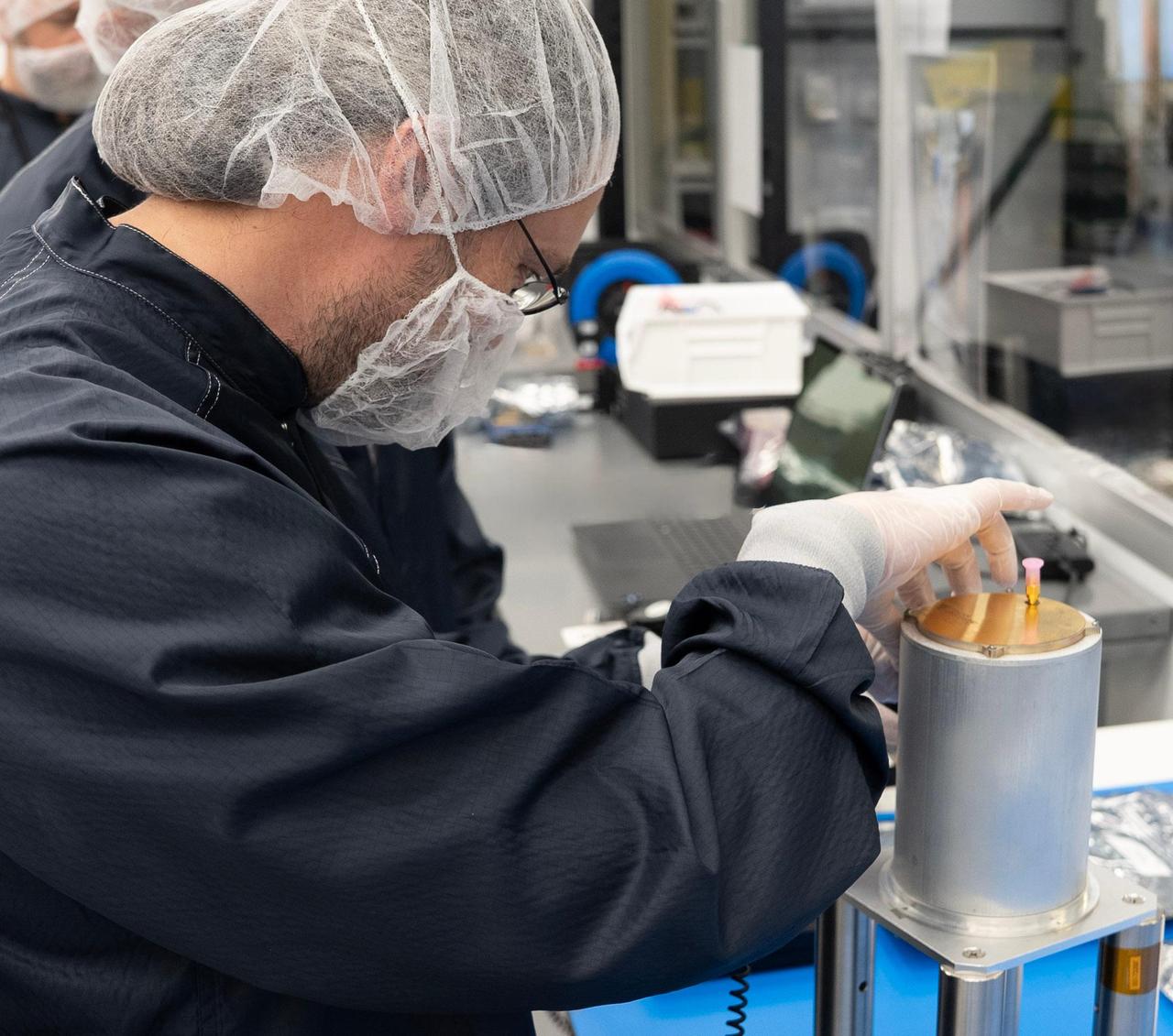
Engineer Emmanuel Decrossas of NASA's Jet Propulsion Laboratory in Southern California makes an adjustment to an antenna's connector, part of a NASA telecommunications payload called User Terminal, at Firefly Aerospace's facility in Cedar Park, Texas, in August 2025. Figure A (https://photojournal.jpl.nasa.gov/figures/PIA26596_figA.jpg) shows members of the team from JPL and NASA (dark blue) and Firefly (white) with the User Terminal antenna, radio, and other components on the bench behind them. Managed by JPL, the User Terminal will test a new, low-cost lunar communications system that future missions to the Moon's far side could use to transfer data to and from Earth via lunar relay satellite. The User Terminal payload will be installed atop Firefly's Blue Ghost Mission 2 lunar lander, which is slated to launch to the Moon's far side in 2026 under NASA's CLPS (Commercial Lunar Payload Services) initiative. NASA's Apollo missions brought large and powerful telecommunications systems to the lunar near-side surface to communicate directly with Earth. But spacecraft on the far side will not have that option because only the near side of the Moon is visible to Earth. Sending messages between the Moon and Earth via a relay orbiter enables communication with the lunar far side and improves it at the Moon's poles. The User Terminal will for the first time test such a setup for NASA by using a compact, lightweight software defined radio, antenna, and related hardware to communicate with a satellite that Blue Ghost Mission 2 is delivering to lunar orbit: ESA's (the European Space Agency's) Lunar Pathfinder. The User Terminal radio and antenna installed on the Blue Ghost lander will be used to commission Lunar Pathfinder, sending test data back and forth. After the lander ceases operations as planned at the end of a single lunar day (about 14 Earth days), a separate User Terminal radio and antenna installed on LuSEE-Night – another payload on the lander – will send LuSEE-Night's data to Lunar Pathfinder, which will relay the information to a commercial network of ground stations on Earth. LuSEE-Night is a radio telescope that expected to operate for at least 1½ years; it is a joint effort by NASA, the U.S. Department of Energy, and University of California, Berkeley's Space Sciences Laboratory. Additionally, User Terminal will be able to communicate with another satellite that's being delivered to lunar orbit by Blue Ghost Mission 2: Firefly's own Elytra Dark orbital vehicle. The hardware on the lander is only part of the User Terminal project, which was also designed to implement a new S-band two-way protocol, or standard, for short-range space communications between entities on the lunar surface (such as rovers and landers) and lunar orbiters, enabling reliable data transfer between them. The standard is a new version of a space communications protocol called Proximity-1 that was initially developed more than two decades ago for use at Mars by an international standard body called the Consultative Committee for Space Data Systems (CCSDS), of which NASA is a member agency. The User Terminal team made recommendations to CCSDS on the development of the new lunar S-band standard, which was specified in 2024. The new standard will enable lunar orbiters and surface spacecraft from various entities – NASA and other civil space agencies as well as industry and academia – to communicate with each other, a concept known as interoperability. At Mars, NASA rovers communicate with various Red Planet orbiters using the Ultra-High Frequency (UHF) radio band version of the Proximity-1 standard. On the Moon's far side, use of UHF is reserved for radio astronomy science; so a new lunar standard was needed using a different frequency range, S-band, as were more efficient modulation and coding schemes to better fit the available frequency spectrum specified by the new standard. User Terminal is funded by NASA's Exploration Science Strategy and Integration Office, part of the agency's Science Mission Directorate, which manages the CLPS initiative. JPL manages the project and supported development of the new S-band radio standard and the payload in coordination with Vulcan Wireless in Carlsbad, California, which built the radio. Caltech in Pasadena manages JPL for NASA. https://photojournal.jpl.nasa.gov/catalog/PIA26596
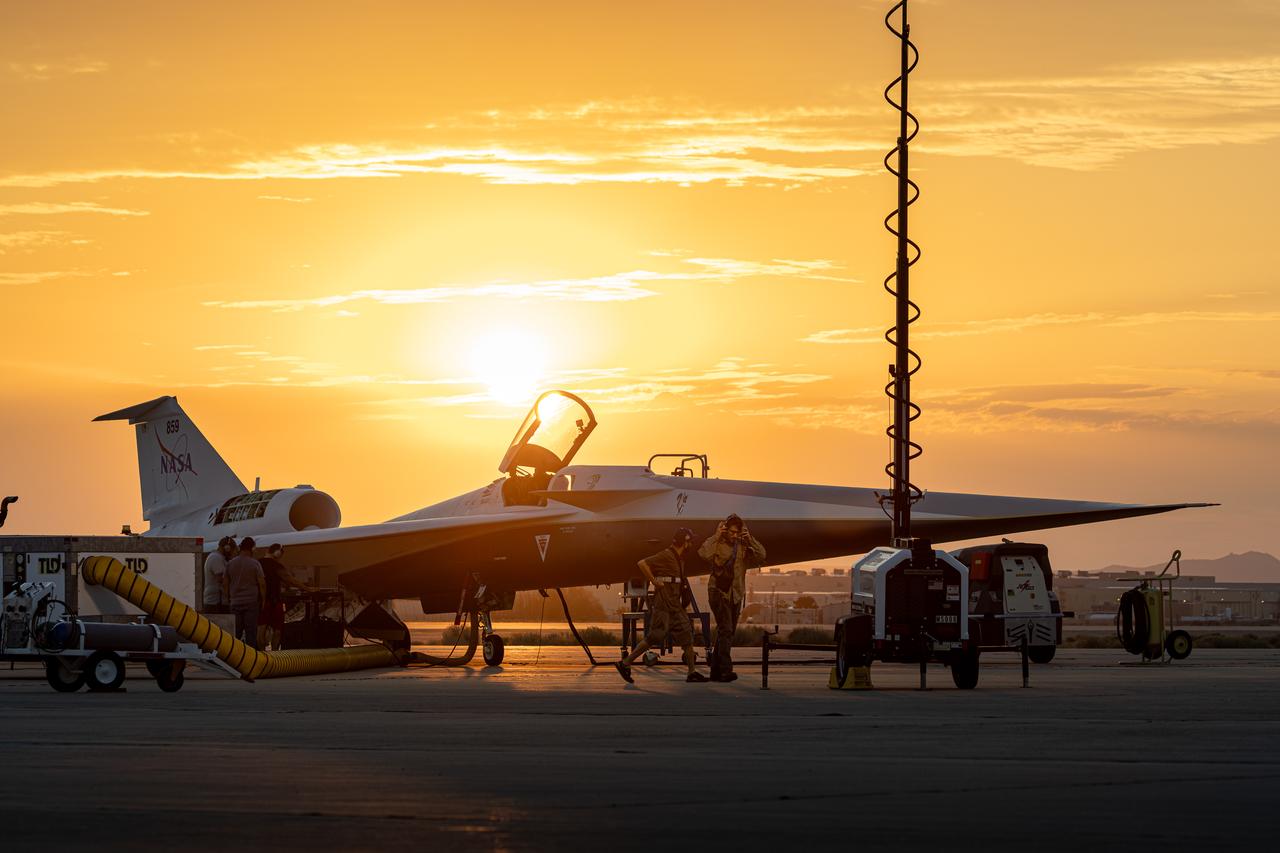
NASA’s X-59 quiet supersonic research aircraft sits on the ramp at sunrise before ground tests at Lockheed Martin’s Skunk Works facility in Palmdale, California, on July 18, 2025. The X-59 is the centerpiece of NASA’s Quesst mission to demonstrate quiet supersonic flight and the aircraft is scheduled to make its first flight later this year.