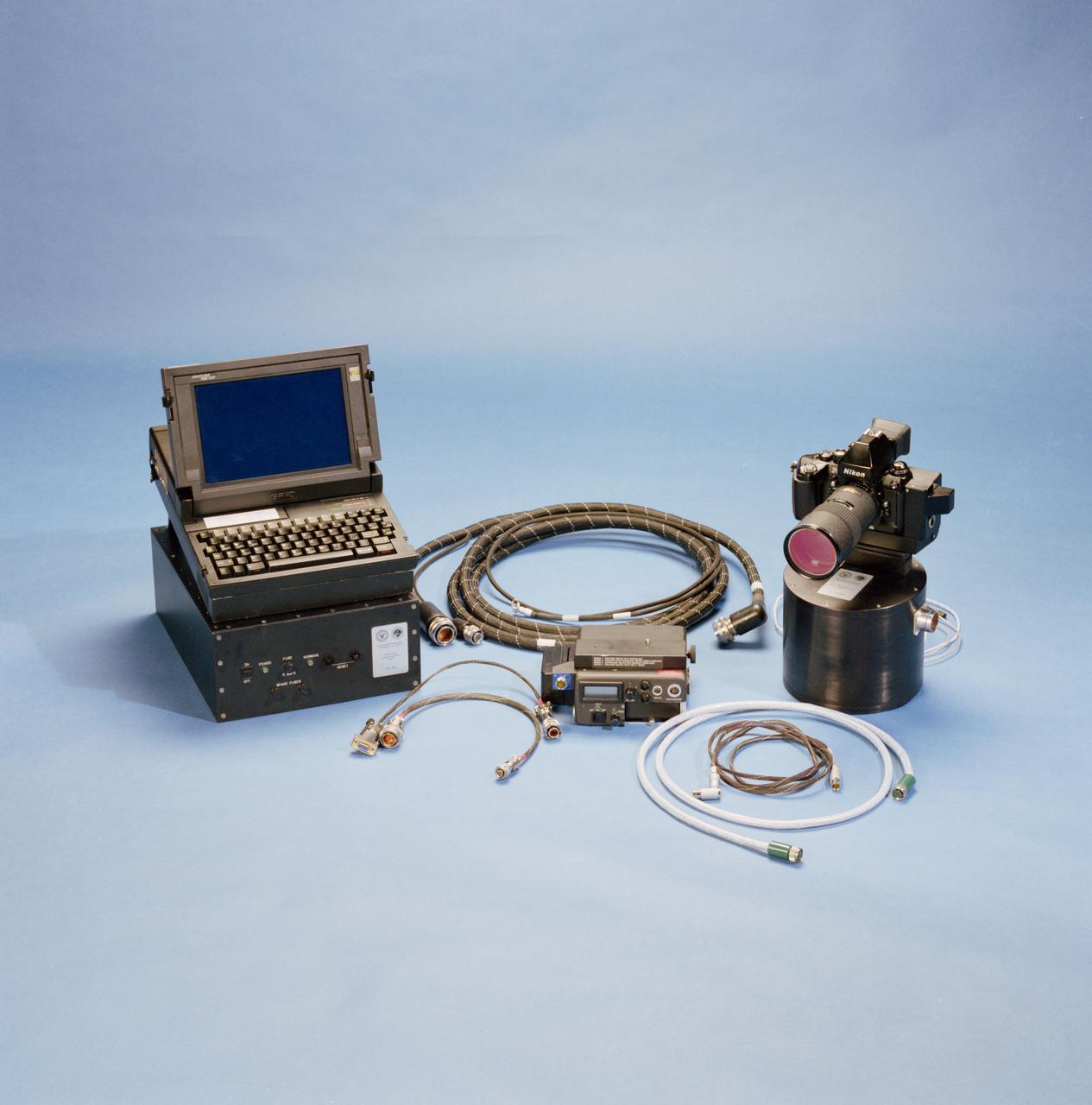
STS-53 Discovery, Orbiter Vehicle (OV) 103, Department of Defense (DOD) mission Hand-held Earth-oriented Real-time Cooperative, User-friendly, Location, targeting, and Environmental System (Hercules) spaceborne experiment equipment is documented in this table top view. HERCULES is a joint NAVY-NASA-ARMY payload designed to provide real-time high resolution digital electronic imagery and geolocation (latitude and longitude determination) of earth surface targets of interest. HERCULES system consists of (from left to right): a specially modified GRID Systems portable computer mounted atop NASA developed Playback-Downlink Unit (PDU) and the Naval Research Laboratory (NRL) developed HERCULES Attitude Processor (HAP); the NASA-developed Electronic Still Camera (ESC) Electronics Box (ESCEB) including removable imagery data storage disks and various connecting cables; the ESC (a NASA modified Nikon F-4 camera) mounted atop the NRL HERCULES Inertial Measurement Unit (HIMU) containing the three-axis ring-laser gyro.
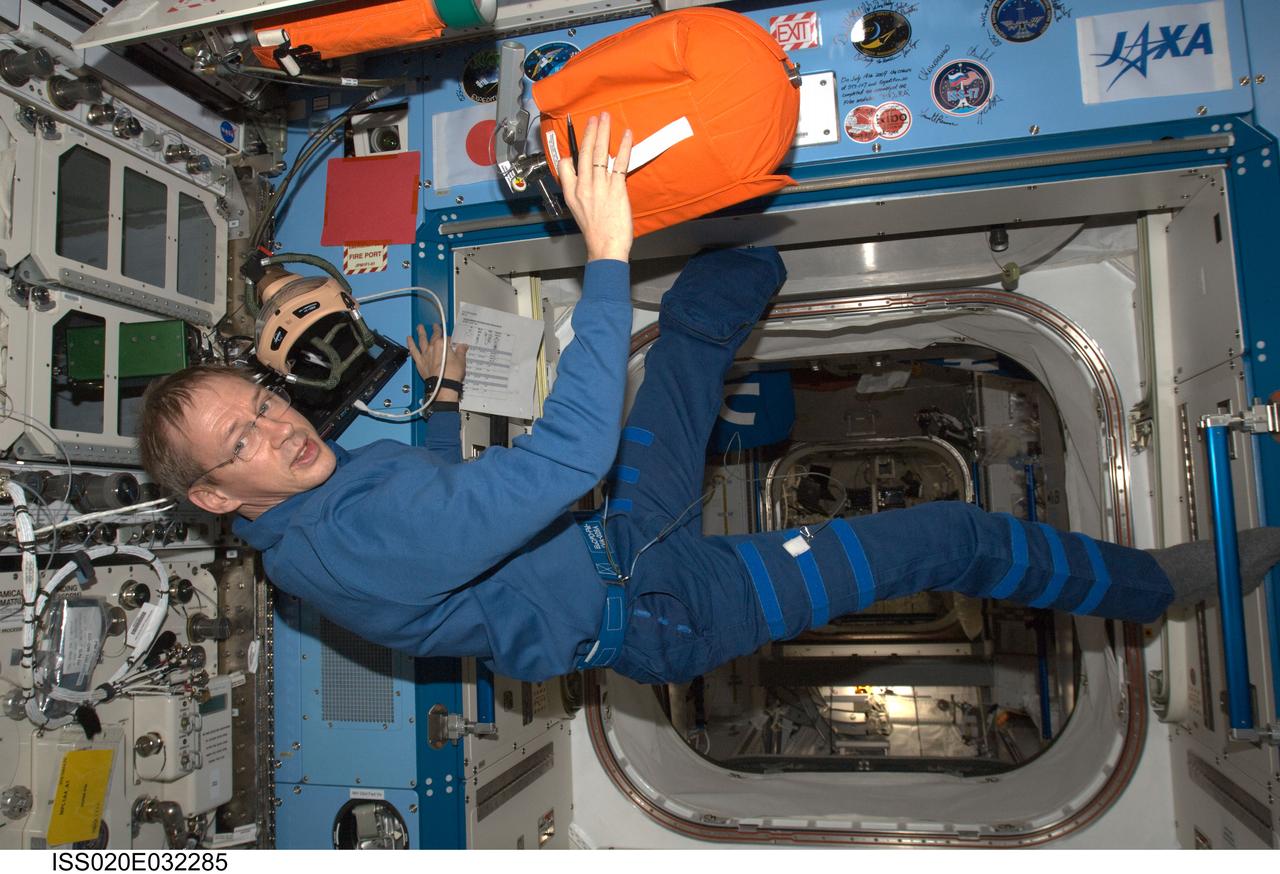
ISS020-E-032285 (19 Aug. 2009) --- European Space Agency astronaut Frank De Winne, Expedition 20 flight engineer, conducts the monthly inspection/audit on Portable Fire Extinguisher (PFE) and Portable Breathing Apparatus (PBA) equipment in the Kibo laboratory of the International Space Station.
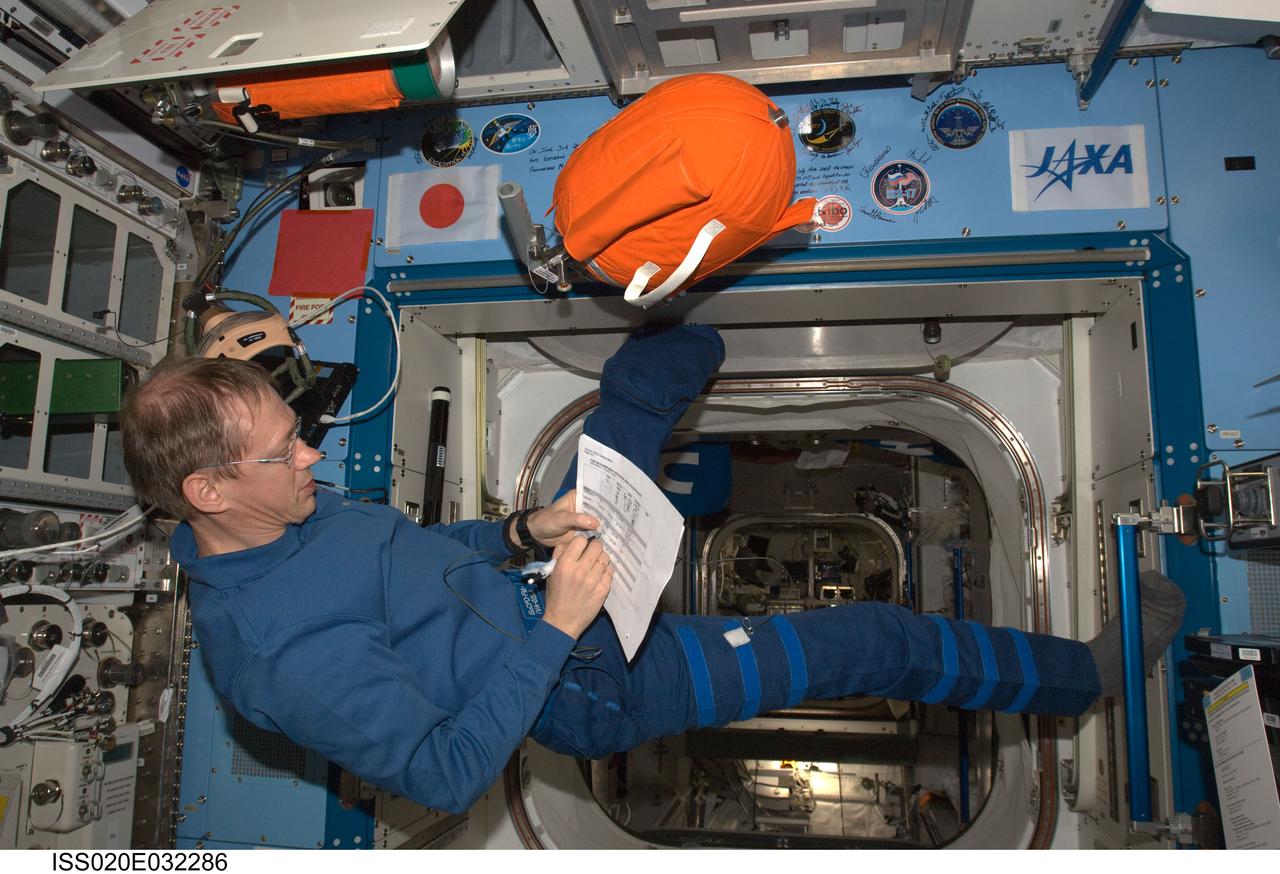
ISS020-E-032286 (19 Aug. 2009) --- European Space Agency astronaut Frank De Winne, Expedition 20 flight engineer, conducts the monthly inspection/audit on Portable Fire Extinguisher (PFE) and Portable Breathing Apparatus (PBA) equipment in the Kibo laboratory of the International Space Station.
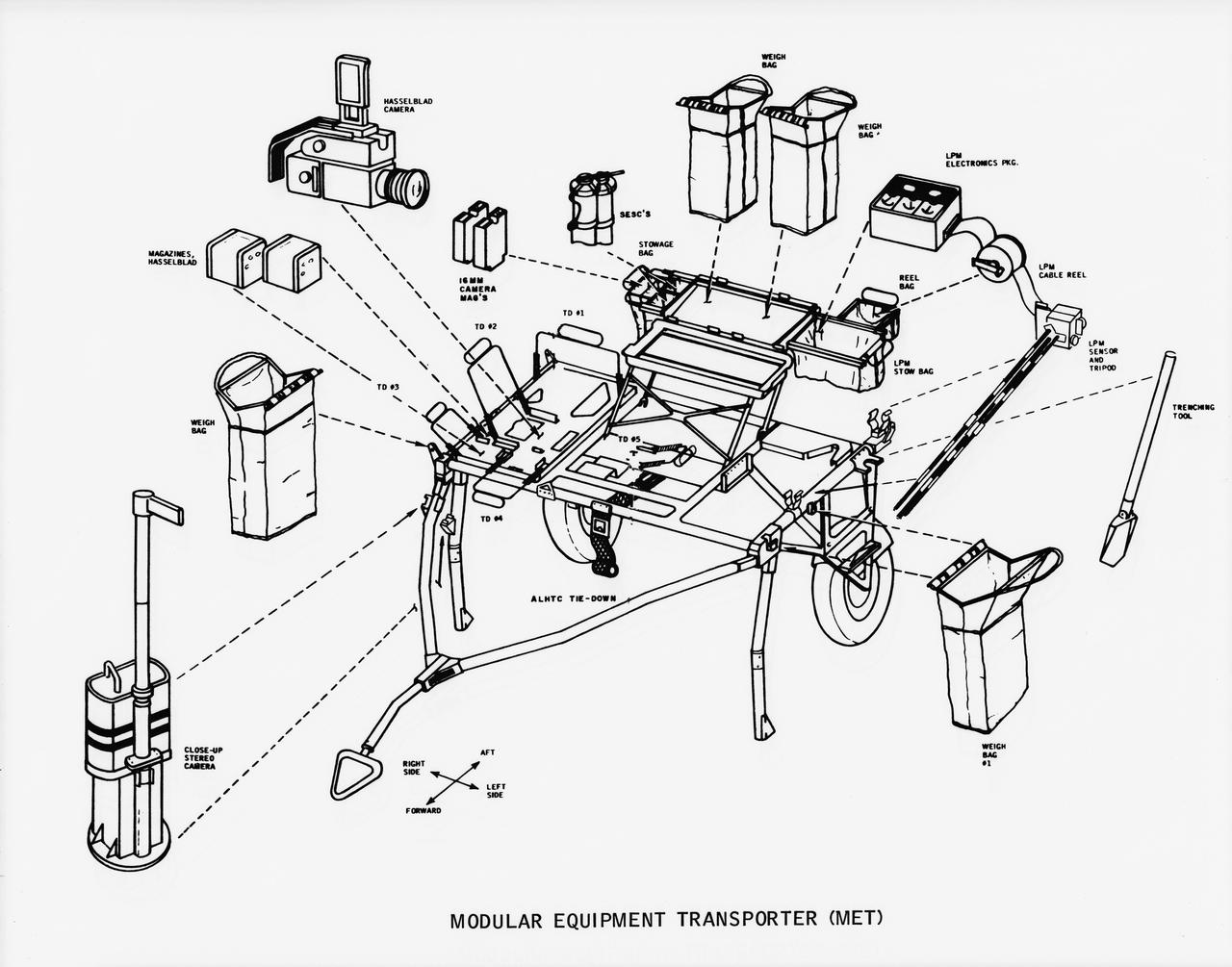
S70-50762 (November 1970) --- A line drawing illustrating layout view of the modular equipment transporter (MET) and its equipment. A MET (or Rickshaw, as it has been nicknamed) will be used on the lunar surface for the first time during the Apollo 14 lunar landing mission. The Rickshaw will serve as a portable workbench with a place for the Apollo lunar hand tools (ALHT) and their carrier, three cameras, two sample container bags, a special environment sample container (SESC), a lunar portable magnetometer (LPM) and spare film magazines.
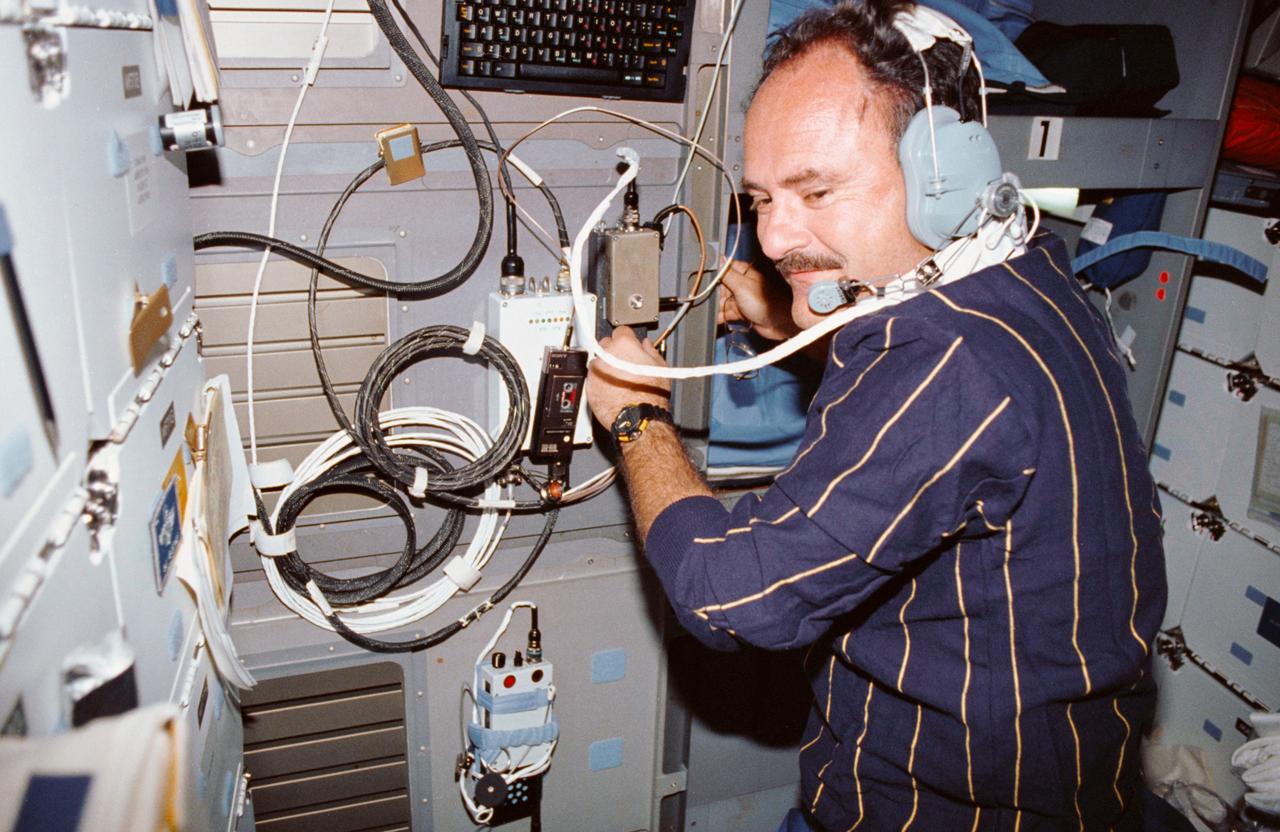
STS035-15-010 (2-11 Dec 1990) --- Astronaut John M. (Mike) Lounge, STS-35 mission specialist, communicates with family members from the middeck of Space Shuttle Columbia in Earth orbit. The STS-35 Shuttle amateur radio experiment (SAREX), allowed the Astro 1 crewmembers to "visit" and briefly share some of their in space experiences with family members. The picture was made with a 35mm camera. Note: Used by Astronomer Ronald A. Parise on his off-duty hours, SAREX provided radio transmissions between ground based amateur radio operators around the world and the Shuttle. Parise is a payload specialist who is also a licensed amateur radio operator (call-sign WA4SIR). The experiment enabled students from all over the United States to have a chance to communicate with an astronaut in space.
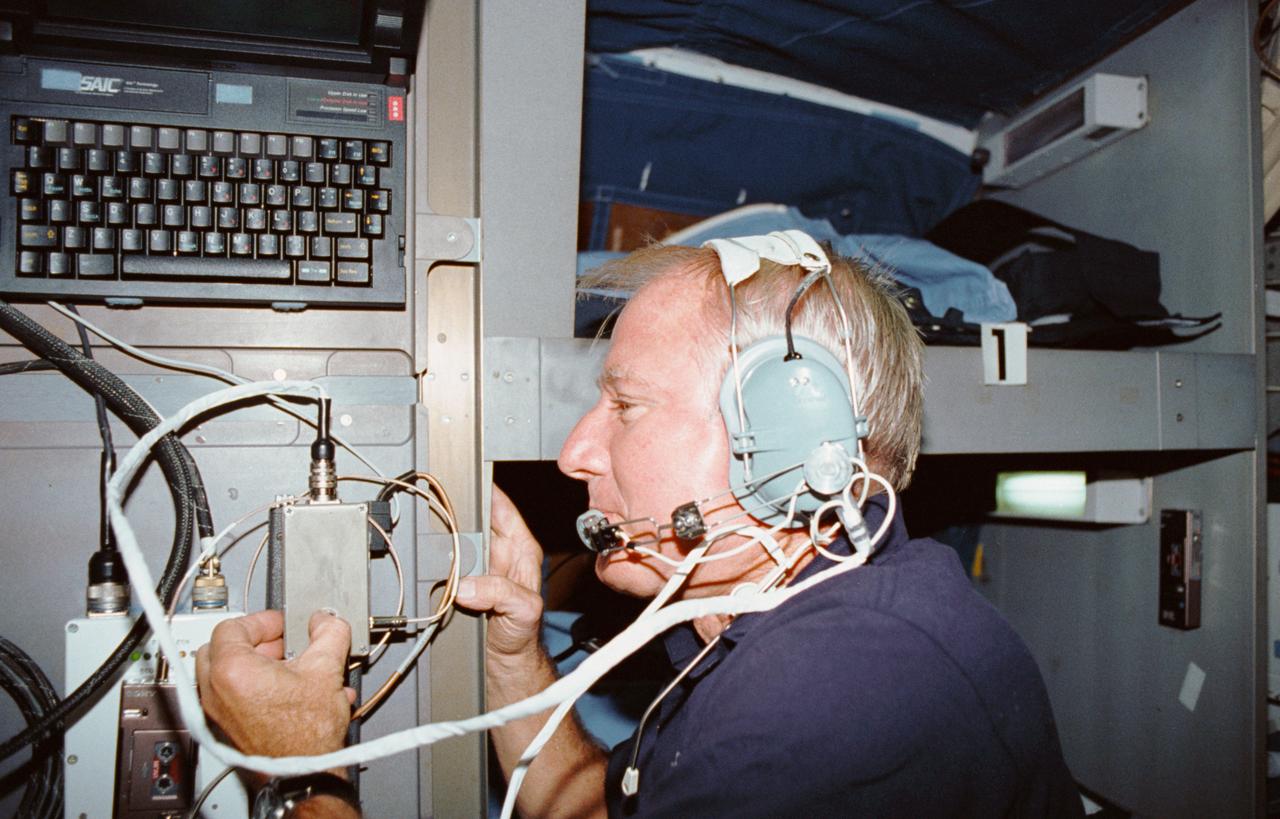
STS035-05-036 (2-10 Dec 1990) --- STS-35 Commander Vance D. Brand, wearing headset, communicates with family members using Shuttle Amateur Radio Experiment (SAREX) on Columbia's, Orbiter Vehicle (OV) 102's, middeck. SAREX and its portable laptop computer mounted on the outside of the middeck sleep station allowed the STS-35 crewmembers to "visit" and briefly share some of their in space experiences with family members. It also provided radio transmissions between ground based amateur radio operators around the world and OV-102. The experiment enabled students from all over the United States to have a chance to communicate with a crewmember in space.
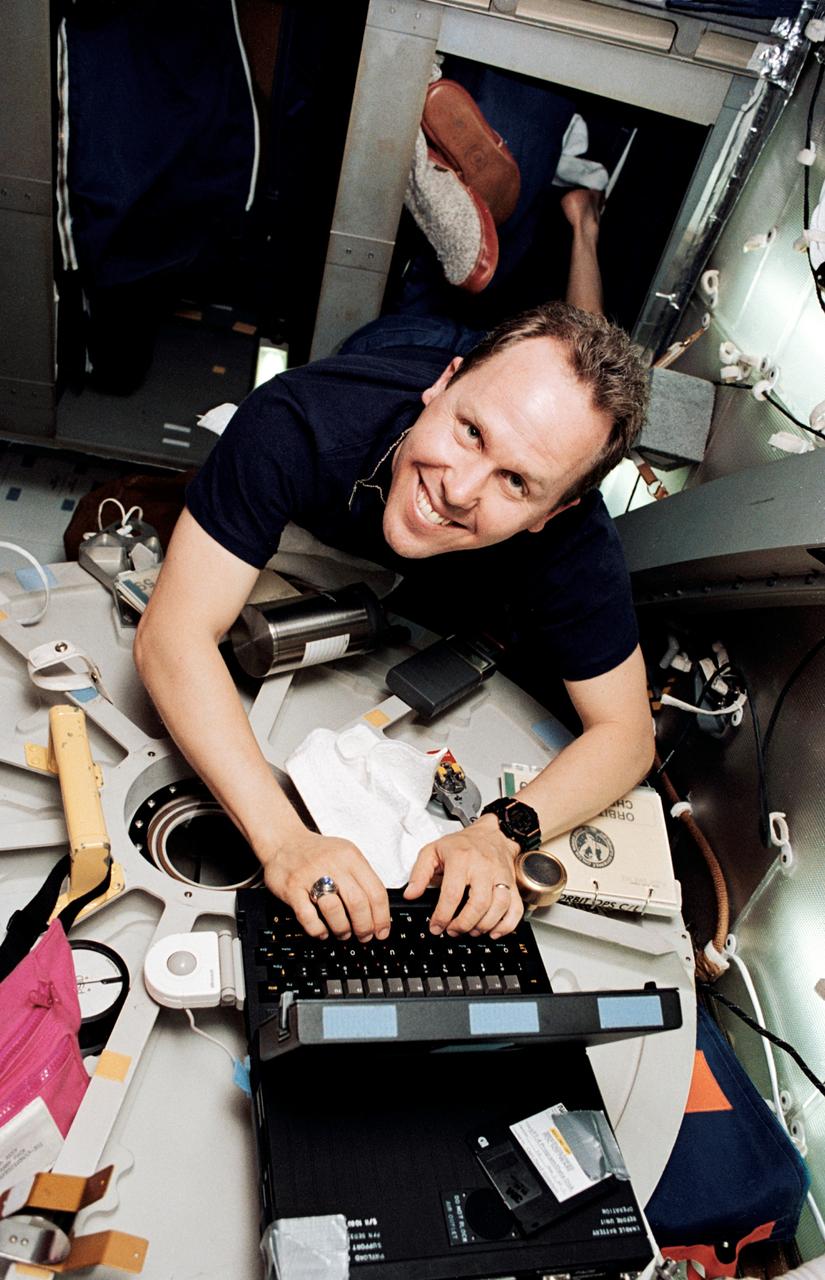
STS059-10-011 (9-20 April 1994) --- Astronaut Thomas D. Jones appears to have climbed out of bed right into his work in this onboard 35mm frame. Actually, Jones had anchored himself in the bunk facility while working on one of the onboard computers which transfered data to the ground via modem. The mission specialist was joined in space by five other NASA astronauts for a week and a half of support to the Space Radar Laboratory (SRL-1)/STS-59 mission.
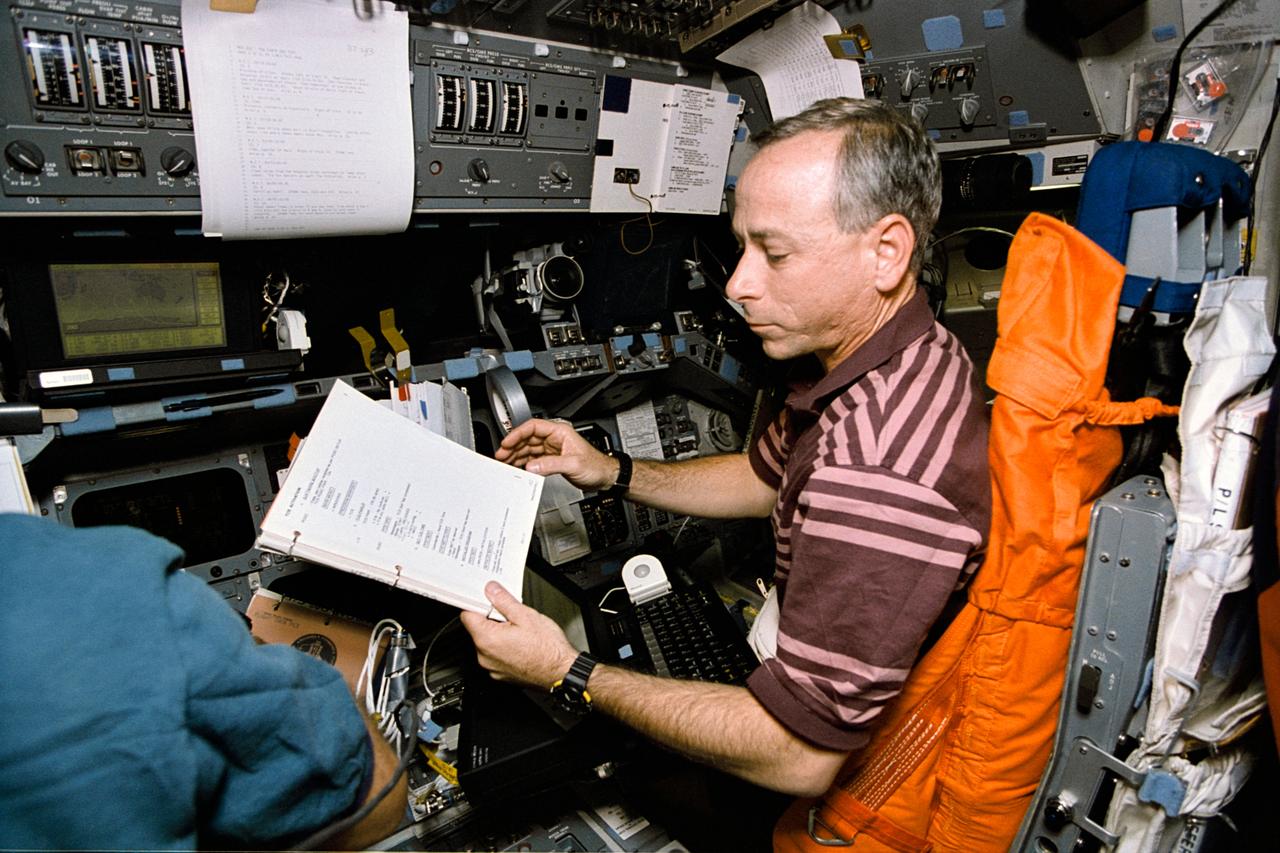
STS064-22-024 (9-20 Sept. 1994) --- With a manual and lap top computer in front of him, astronaut Carl J. Meade, STS-64 mission specialist, supports operations with the Trajectory Control Sensor (TCS) aboard the Earth-orbiting space shuttle Discovery. For this exercise, Meade temporarily mans the pilot's station on the forward flight deck. The TCS is the work of a team of workers at NASA's Johnson Space Center. Data gathered during this flight was expected to prove valuable in designing and developing a sensor for use during the rendezvous and mating phases of orbiter missions to the space station. For this demonstration, the Shuttle Pointed Autonomous Research Tool for Astronomy 201 (SPARTAN 201) was used as the target vehicle during release and retrieval operations. Photo credit: NASA or National Aeronautics and Space Administration
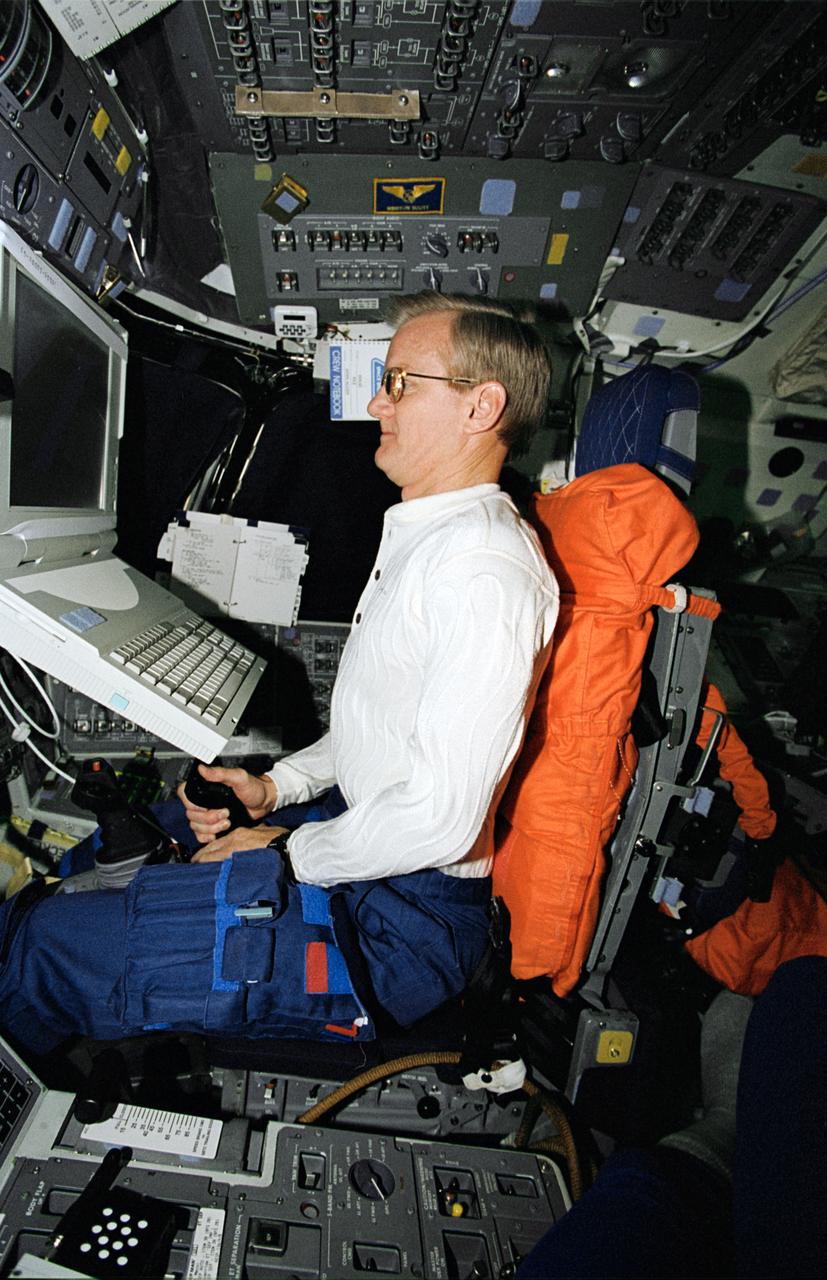
STS062-15-013 (4-18 March 1994) --- Astronaut John H. Casper, mission commander, participates in an experiment that measures the effects of space flight on pilot proficiency. Astronauts Casper and Andrew M. Allen, pilot, continued the testing of the Portable Inflight Landing Operations Trainer (PILOT), which first flew onboard Columbia in October of 1993.
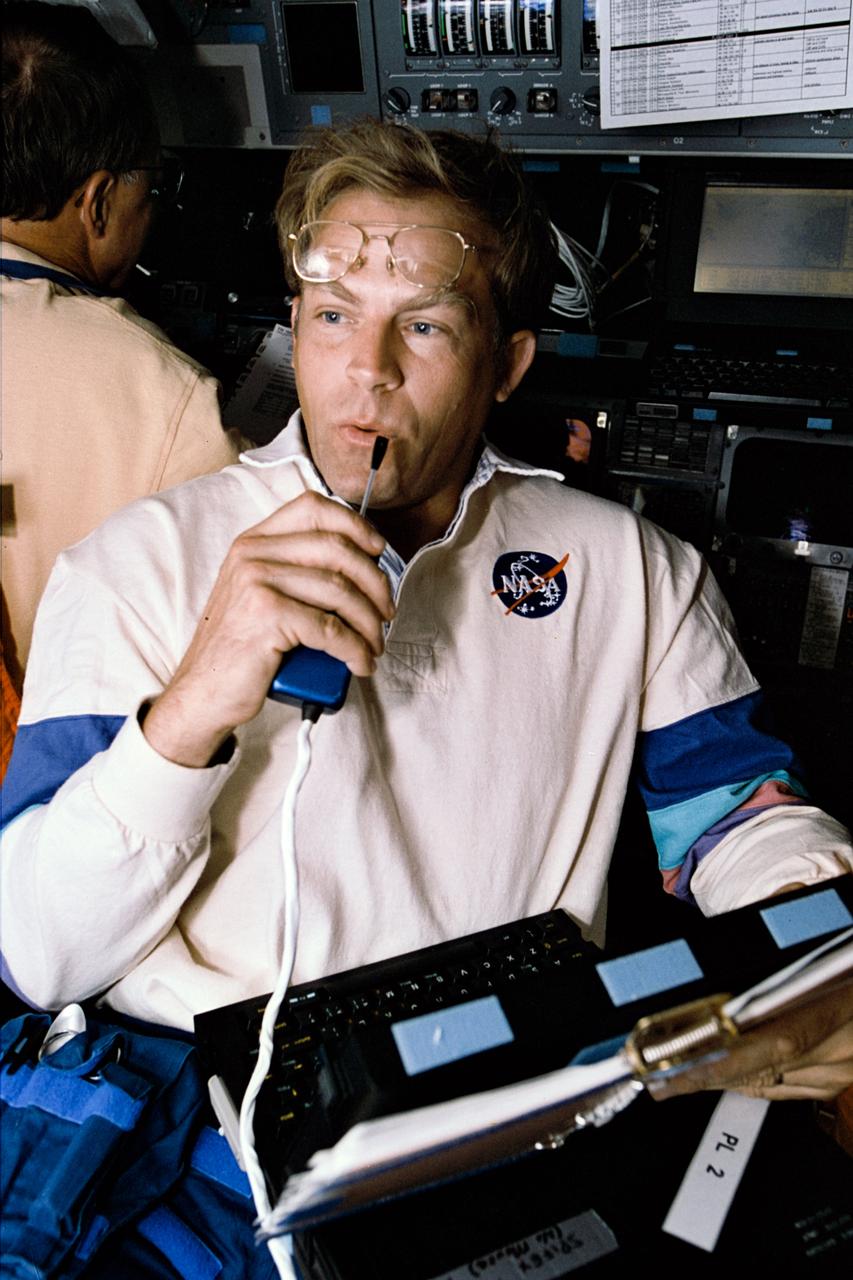
STS064-311-031 (10 Sept. 1994) --- Astronaut Mark C. Lee, STS-64 mission specialist, at a Payload General Support Computer (PGSC) on the space shuttle Discovery's flight deck, talks to ground controllers about the Shuttle Plume Impingement Flight Experiment (SPIFEX). Astronaut L. Blaine Hammond, pilot, is partially visible in the background. Photo credit: NASA or National Aeronautics and Space Administration
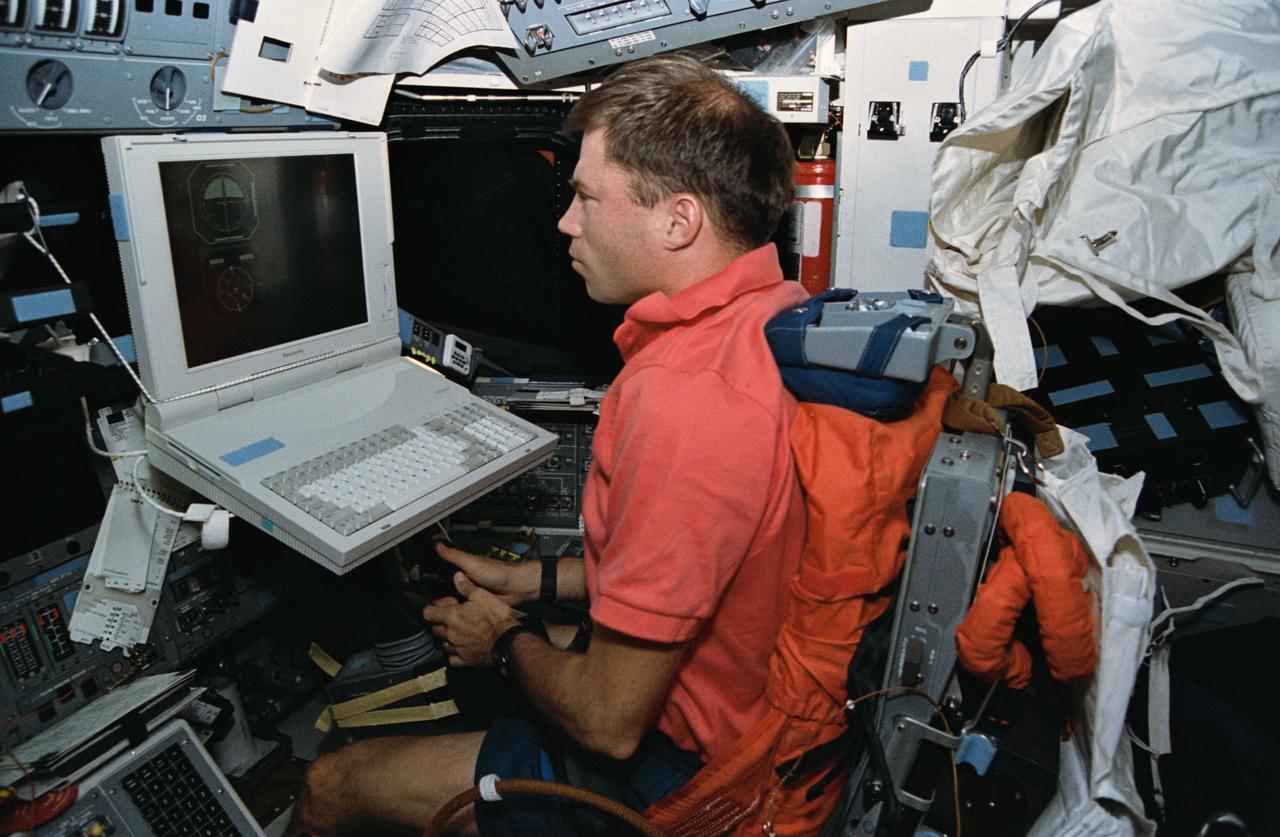
STS058-14-006 (18 Oct- 1 Nov 1993) --- Astronaut Richard A. Searfoss, pilot, participates in an experiment that measures the effects of space flight on pilot proficiency. Astronauts Searfoss (seen here at the pilot's station) and John E. Blaha, mission commander, are conducting the first tests of the Portable Inflight Landing Operations Trainer (PILOT). STS-58 is the first of six scheduled test flights of PILOT designed to determine its effectiveness as a training tool.
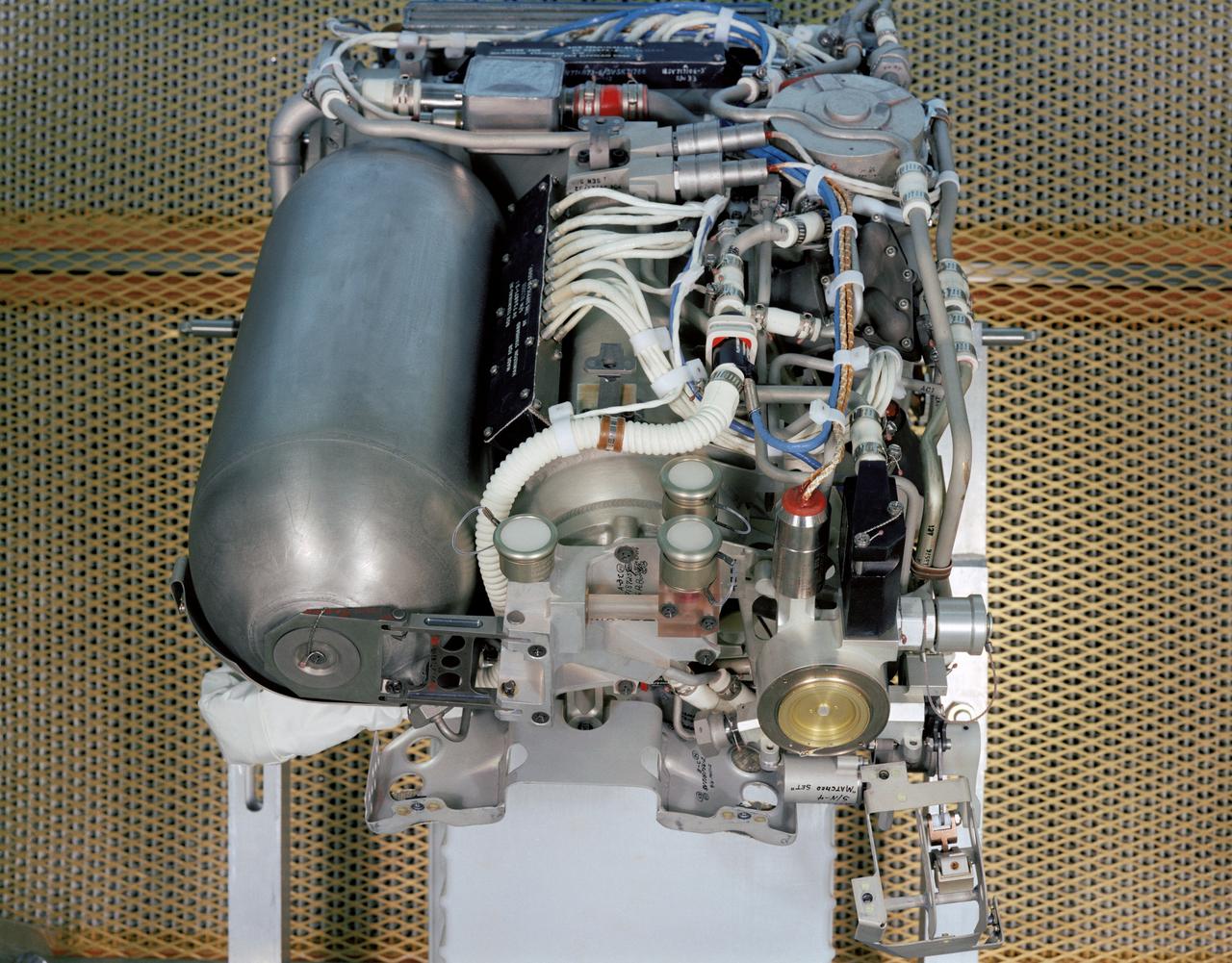
S68-34582 (1968) --- With its exterior removed, the Apollo portable life support system (PLSS) can be easily studied. The PLSS is worn as a backpack over the Extravehicular Mobility Unit (EMU) a multi-layered spacesuit used for outside-the-spacecraft activity. JSC photographic frame no. S68-34582 is a wider view of the exposed interior working parts of the PLSS and its removed cover.
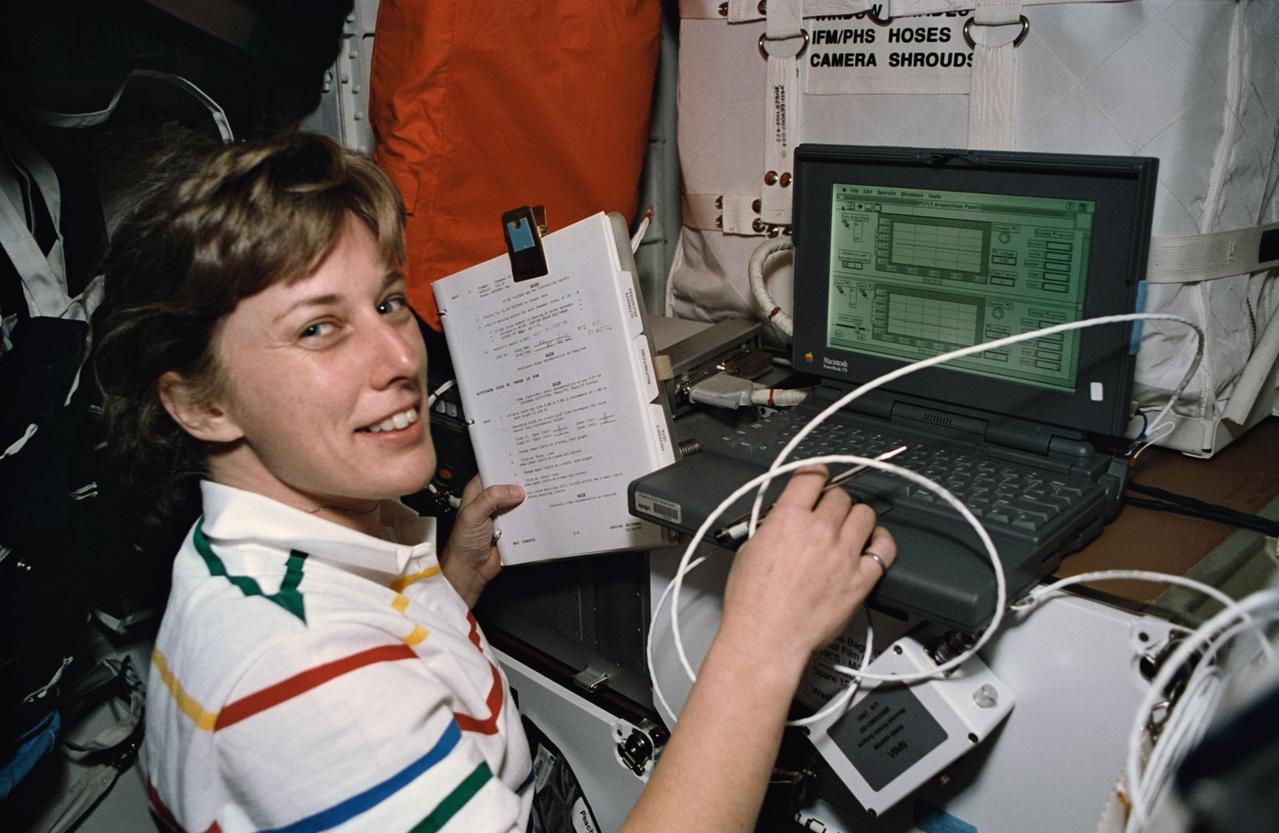
STS060-21-031 (3-11 Feb 1994) --- Using a lap top computer, astronaut N. Jan Davis monitors systems for the Commercial Protein Crystal Growth (CPCG) experiment onboard the Space Shuttle Discovery. Davis joined four other NASA astronauts and a Russian cosmonaut for eight days in space aboard Discovery.
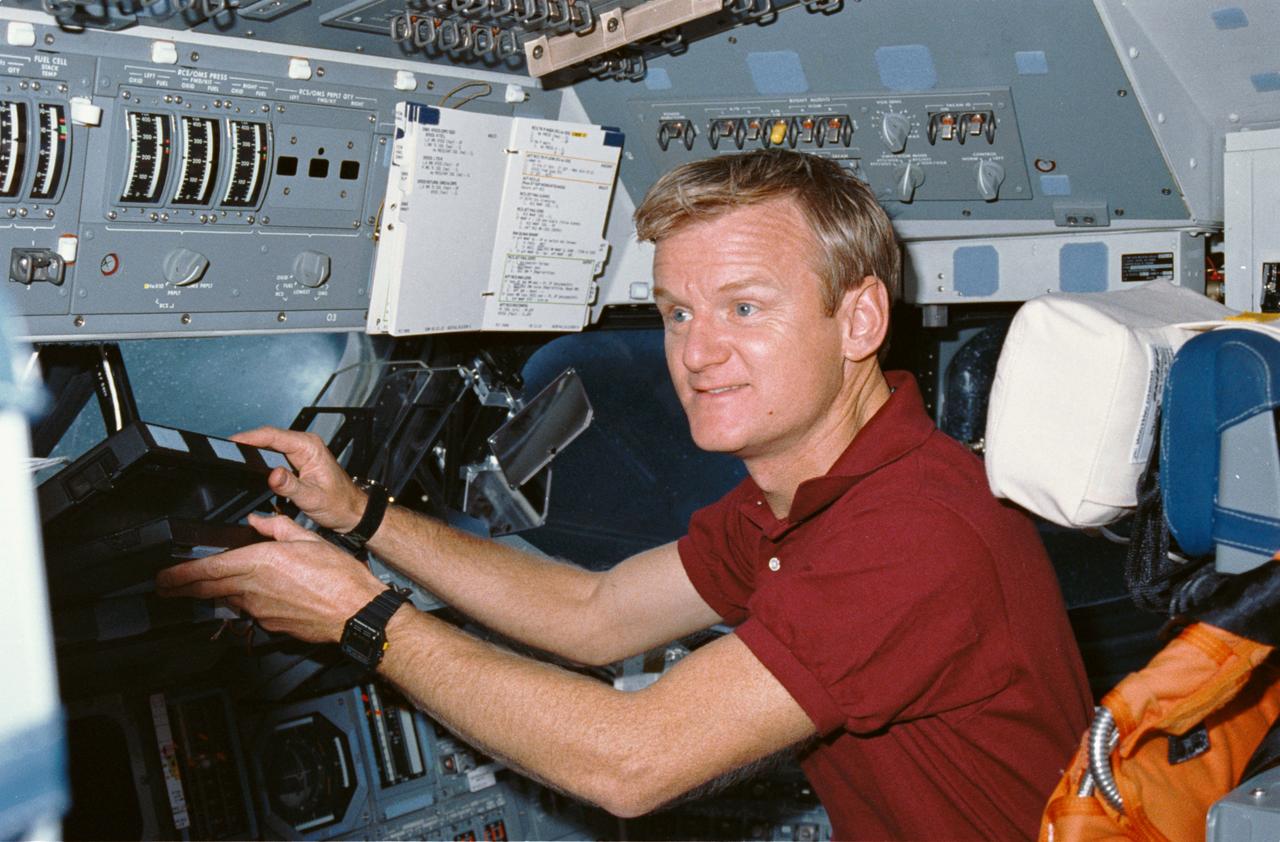
STS036-03-027 (3 March 1990) --- STS-36 Pilot John H. Casper reaches for the shuttle portable onboard computer (SPOC), a laptop computer, while at the pilots station on the forward flight deck of Atlantis, Orbiter Vehicle (OV) 104. Casper, seated in the pilot’s seat, lifts the SPOC from the forward window ledge. Appearing around him are forward crew compartment windows, the head up display (HUD), the flight mirror assembly, and a checklist attached to control panel O3. Casper and four other astronauts spent four days, 10 hours and 19 minutes aboard the spacecraft for a Department of Defense (DOD) devoted mission.
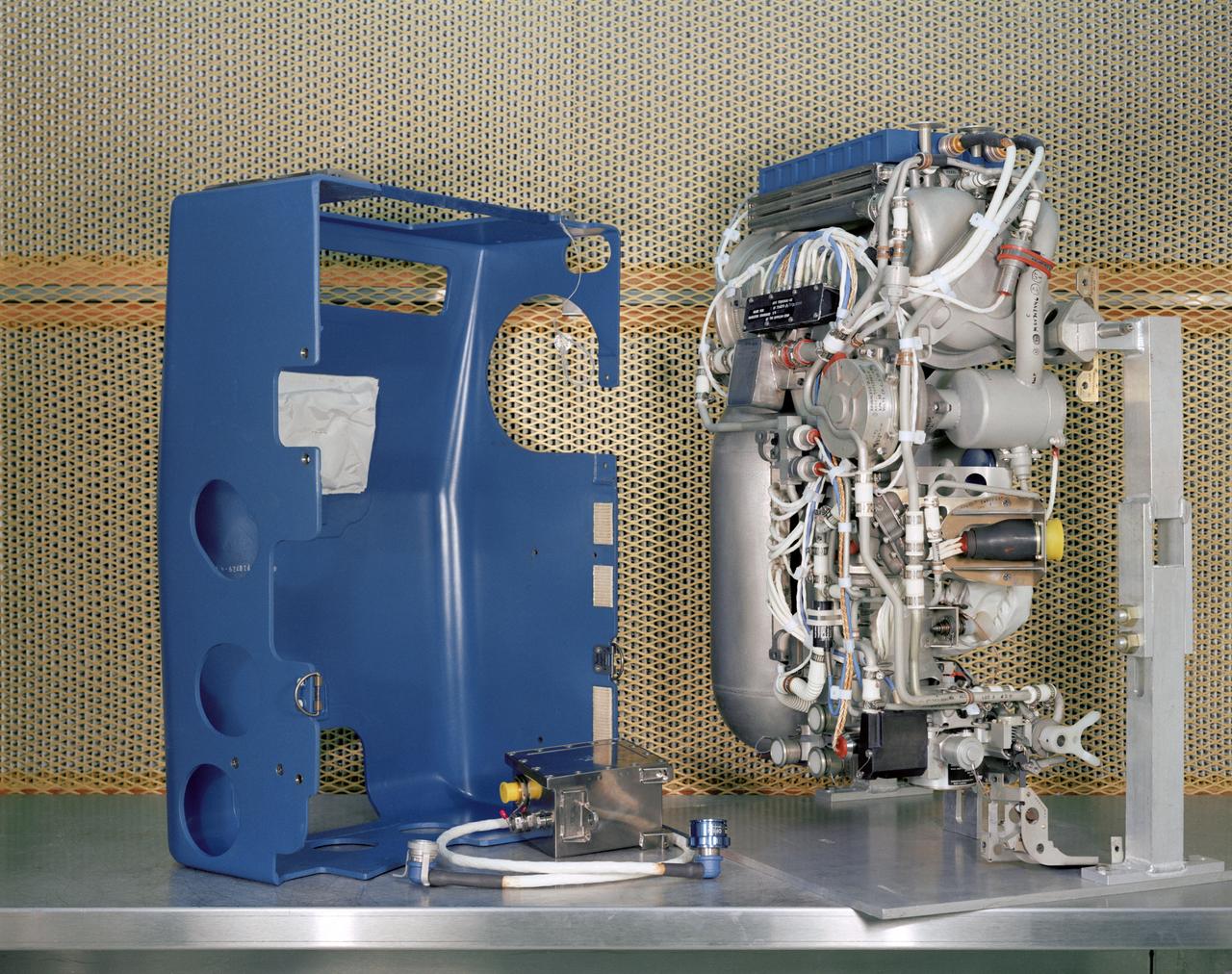
S68-34580 (1968) --- With its exterior removed, the Apollo portable life support system (PLSS) can be easily studied. The PLSS is worn as a backpack over the Extravehicular Mobility Unit (EMU), a multi-layered spacesuit used for outside-the-spacecraft activity. JSC photographic frame no. S68-34582 is a close-up view of the working parts of the PLSS.
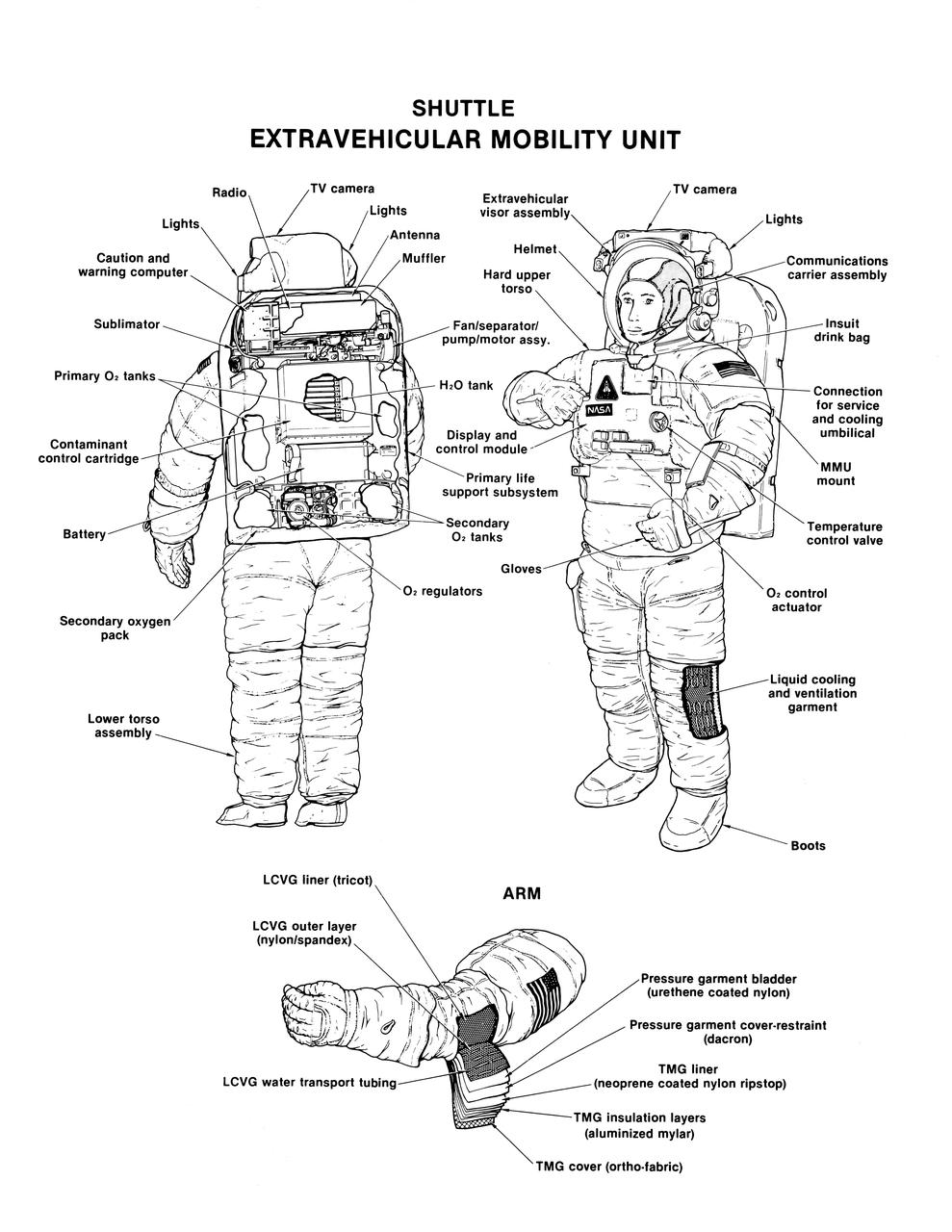
Labeled cutaway line drawing of the Shuttle extravehicular mobility unit (EMU) identifies its various components and equipment. The portable life support system (PLSS) and protective layers of fabric (thermal micrometeoroid garment (TMG)) incorporated in this extravehicular activity (EVA) space suit are shown.
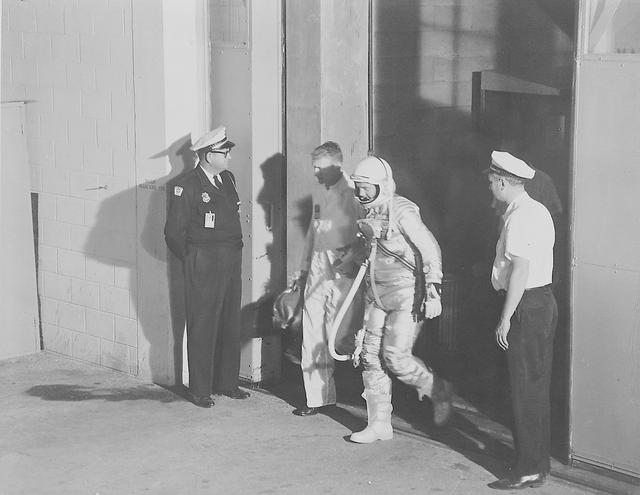
S62-00222 (20 Feb. 1962) --- View of astronaut John H. Glenn Jr. and equipment specialist Joe Schmitt leaving crew quarters prior to Mercury-Atlas 6 (MA-6) mission. Glenn is in his pressure suit and is carrying the portable ventilation unit. Photo credit: NASA
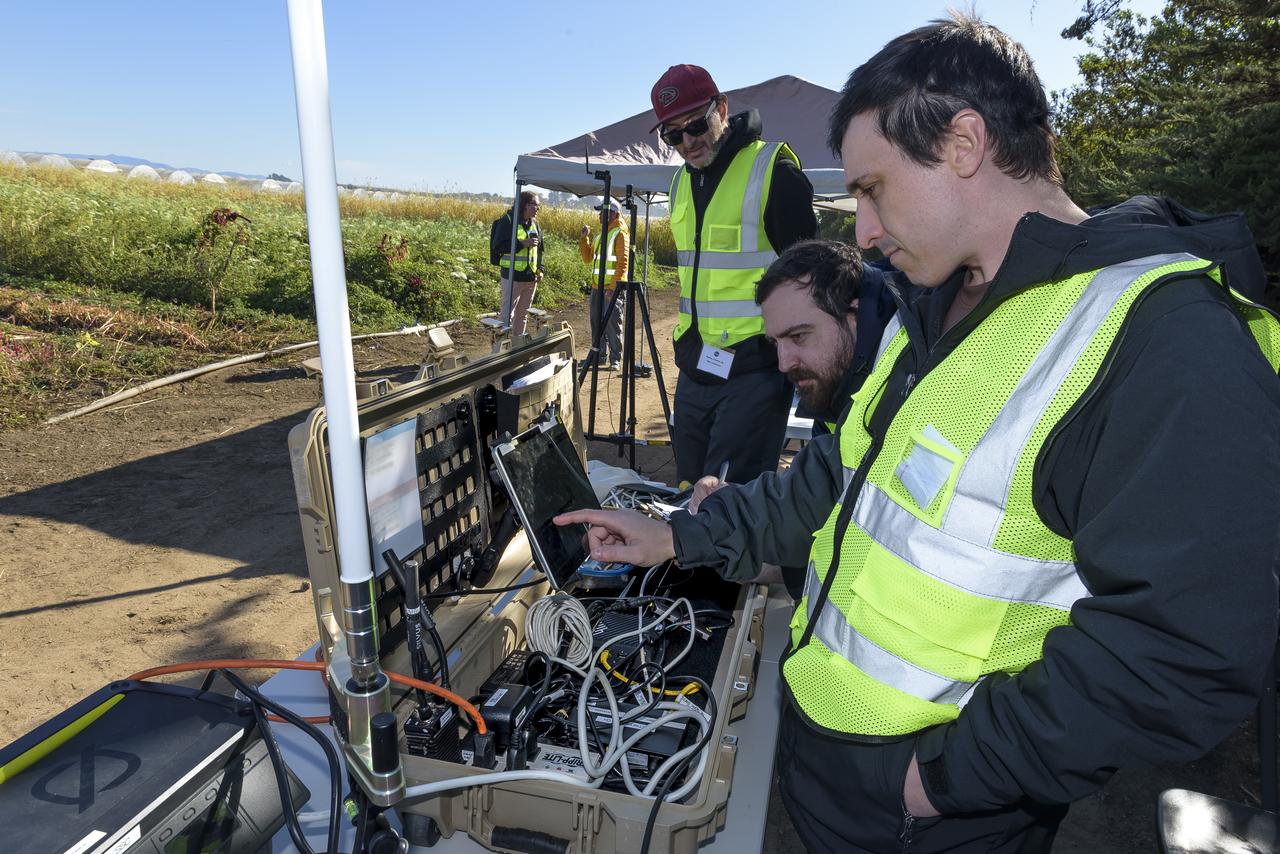
Greg Costedoat, front-right frame, Stefan Blandin, and Charles Walker, left, with the Advanced Capabilities for Emergency Response Operations (ACERO) Portable Airspace Management System (PAMS) case with the equipment stowed at the Monterey Bay Academy Airport near Watsonville, California.

S62-00330 (1962) --- Astronaut John H. Glenn Jr. (left), Dr. William Douglas, astronauts flight surgeon, and equipment specialist Joe Schmitt leave crew quarters prior to Mercury-Atlas 6 (MA-6) mission. Glenn is in his pressure suit and is carrying the portable ventilation unit. Photo credit: NASA
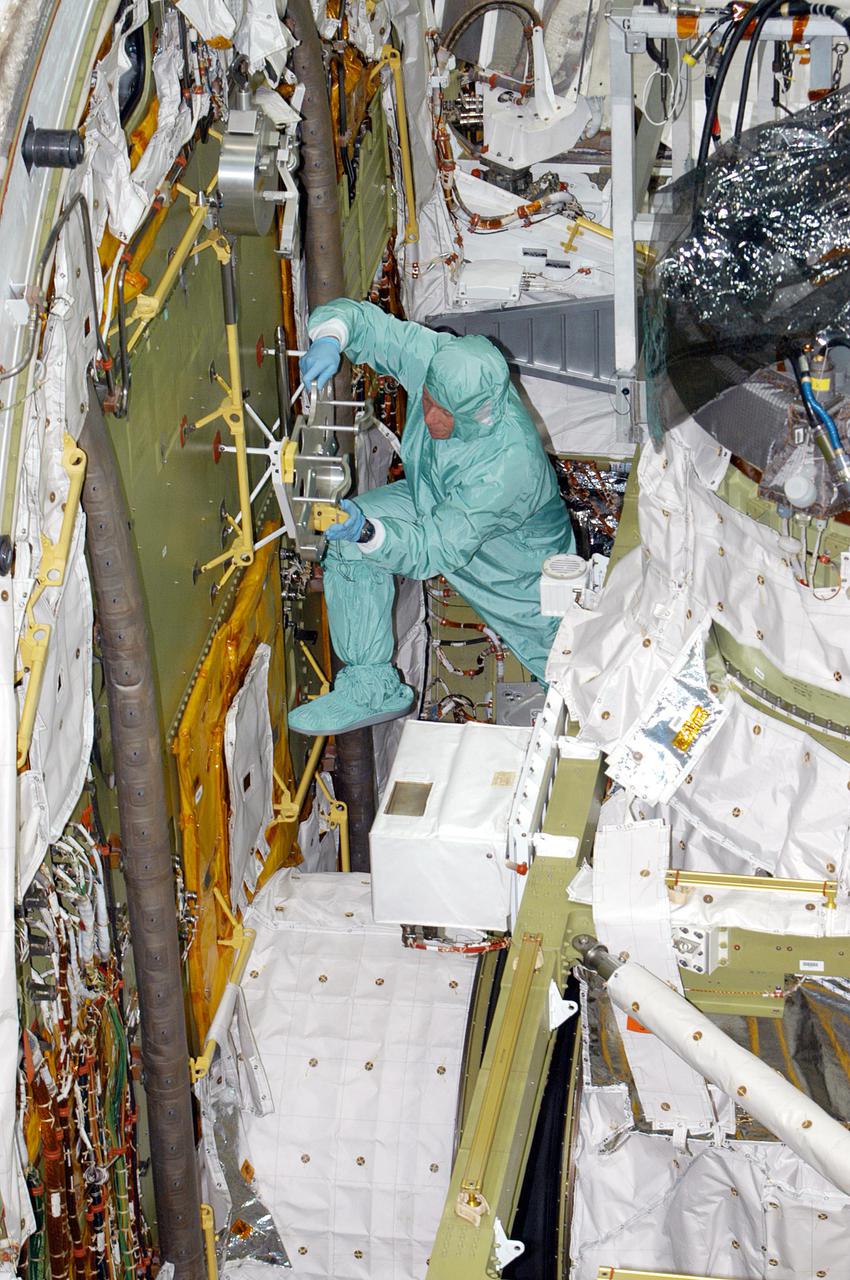
KENNEDY SPACE CENTER, FLA. - During Crew Equipment Interface Test (CEIT) in the Orbiter Processing Facility at NASA’s Kennedy Space Center, STS-121 Mission Specialist Michael E. Fossum familiarizes himself with the Portable Foot Restraint on the forward bulkhead of Atlantis. The Airlock is in the center. During CEIT, the crew has an opportunity to get a hands-on look at the orbiter and equipment they will be working with on their mission. Mission STS-121 is scheduled to launch aboard Space Shuttle Atlantis in July.
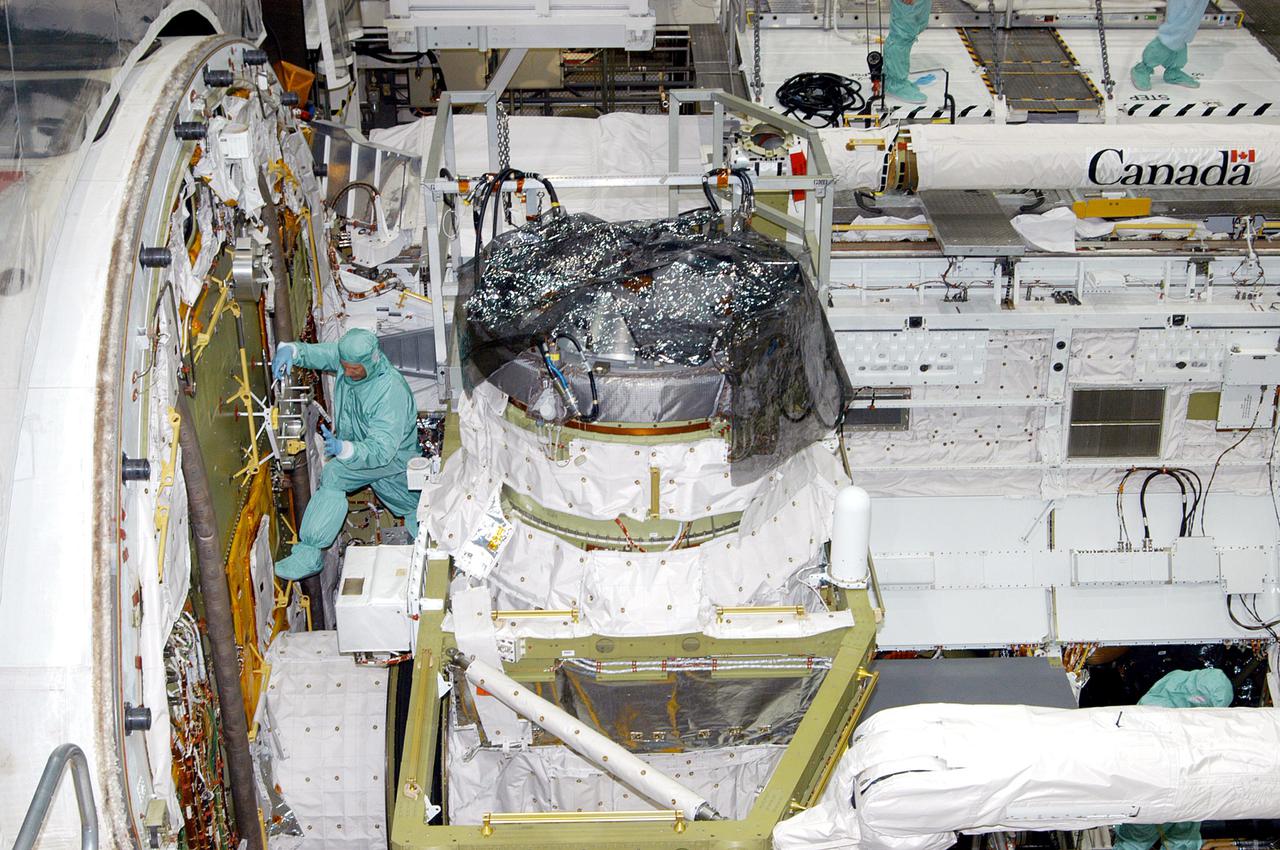
KENNEDY SPACE CENTER, FLA. - During Crew Equipment Interface Test (CEIT) in the Orbiter Processing Facility at NASA’s Kennedy Space Center, STS-121 Mission Specialist Michael E. Fossum familiarizes himself with the Portable Foot Restraint on the forward bulkhead of Atlantis. The Airlock is in the center. During CEIT, the crew has an opportunity to get a hands-on look at the orbiter and equipment they will be working with on their mission. Mission STS-121 is scheduled to launch aboard Space Shuttle Atlantis in July.

CAPE CANAVERAL, Fla. – In the Payload Hazardous Servicing Facility at NASA’s Kennedy Space Center, crew members with the STS-125 mission get a close look at some of the equipment associated with their mission to service NASA’s Hubble Space Telescope. Mission Specialists Mike Massimino (left) and John Grunsfeld look at the portable foot restraint on the Axial Science Instrument Protective Enclosure, or ASIPE. The STS-125 crew is taking part in a crew equipment interface test, which provides experience handling tools, equipment and hardware they will use on their mission. Space shuttle Atlantis is targeted to launch on the STS-125 mission Oct. 10. Photo credit: NASA/Kim Shiflett

CAPE CANAVERAL, Fla. – In the Payload Hazardous Servicing Facility at NASA’s Kennedy Space Center, crew members with the STS-125 mission get a close look at some of the equipment associated with their mission to service NASA’s Hubble Space Telescope. On the lift in the foreground, Mission Specialists Mike Massimino (center left) and John Grunsfeld (right) look at the portable foot restraint on the Axial Science Instrument Protective Enclosure, or ASIPE. The STS-125 crew is taking part in a crew equipment interface test, which provides experience handling tools, equipment and hardware they will use on their mission. Space shuttle Atlantis is targeted to launch on the STS-125 mission Oct. 10. Photo credit: NASA/Kim Shiflett
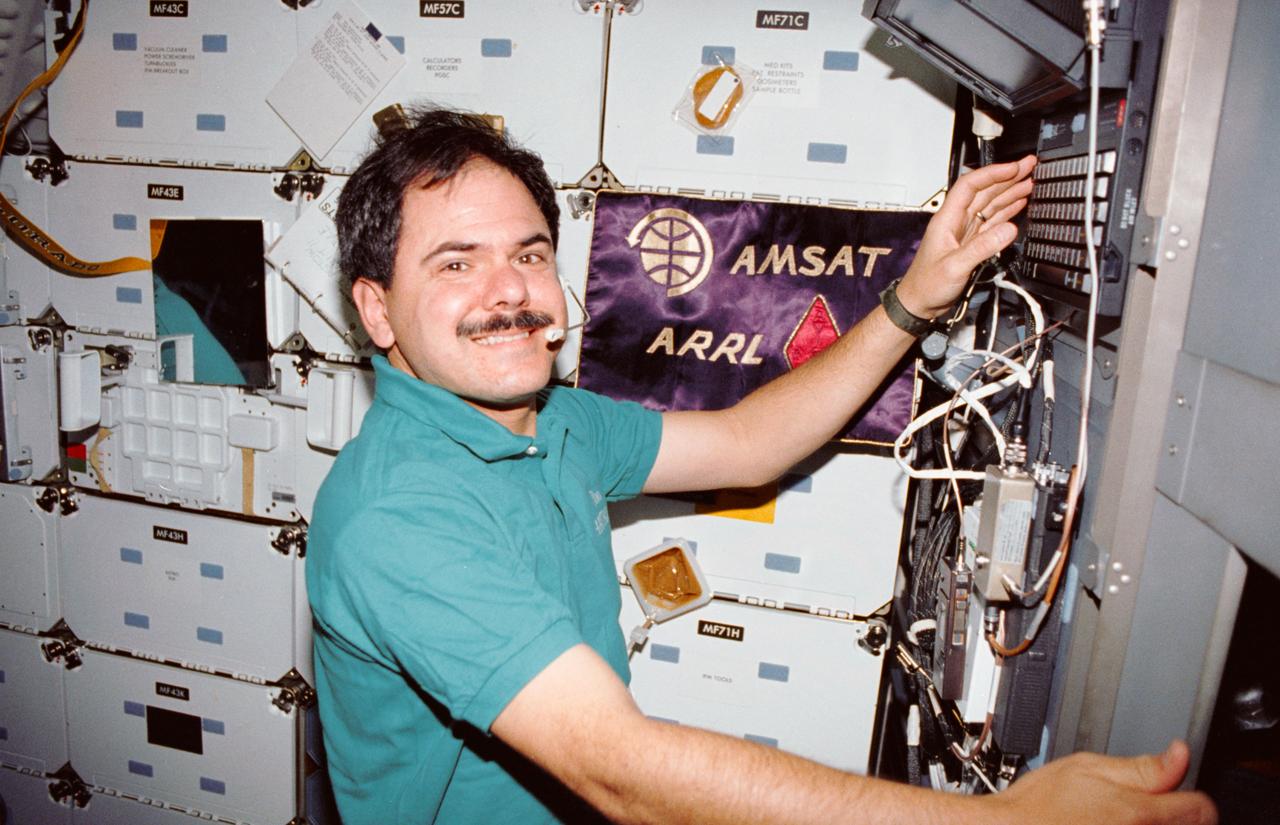
STS-35 Payload Specialist Ronald A. Parise enters data into the payload and general support computer (PGSC) in preparation for Earth communication via the Shuttle Amateur Radio Experiment (SAREX) aboard Columbia, Orbiter Vehicle (OV) 102. The SAREX equipment is secured to the middeck starboard sleep station. SAREX provided radio transmissions between ground based amateur radio operators around the world and Parise, a licensed amateur radio operator. The experiment enabled students to communicate with an astronaut in space, as Parise (call-sign WA4SIR) devoted some of his off-duty time to that purpose. Displayed on the forward lockers beside Parise is a AMSAT (Amateur Radio Satellite Corporation) / ARRL (American Radio Relay League) banner. Food items and checklists are attached to the lockers. In locker position MF43G, the Development Test Objective (DTO) Trash Compaction and Retention System Demonstration extended duration orbiter (EDO) compactor is visible.
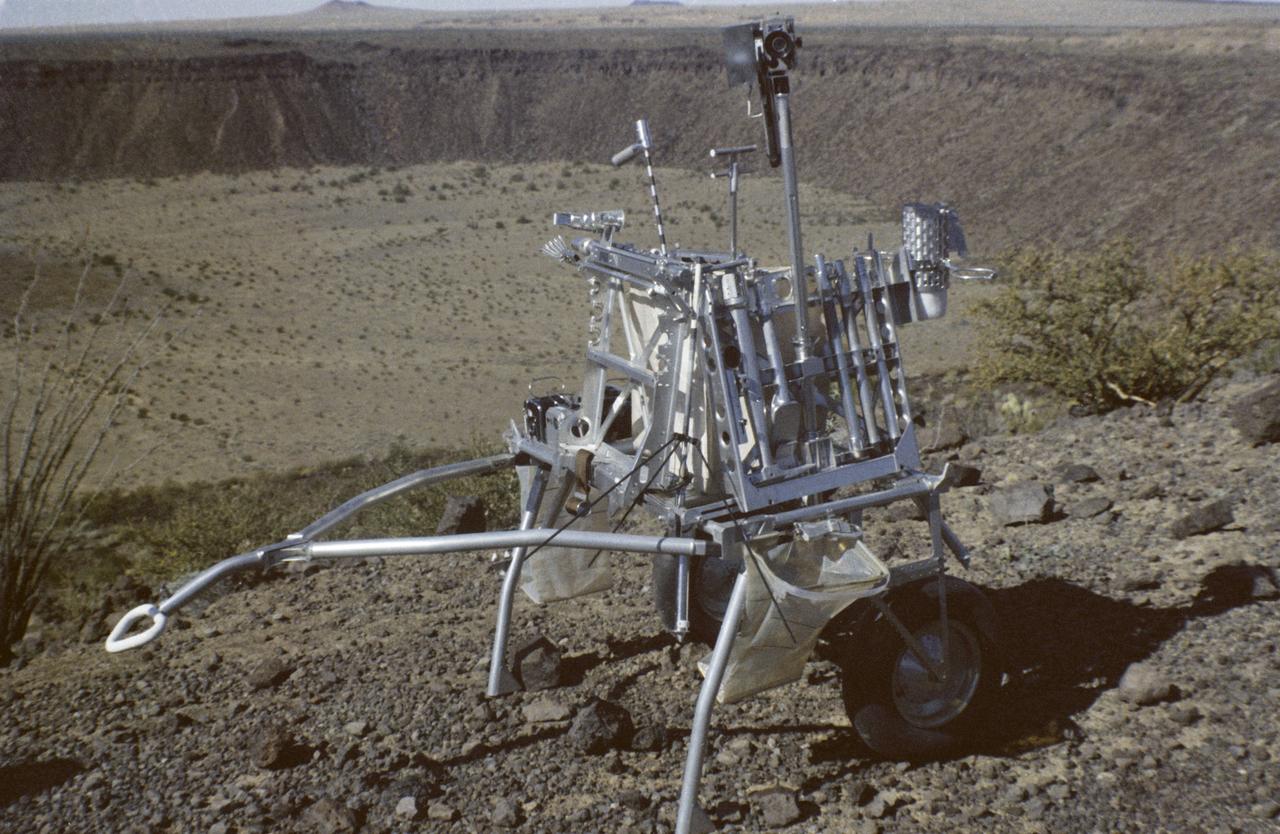
S70-29505 (13-18 Feb. 1970) --- A prototype of the modular equipment transporter (MET), nicknamed the "Rickshaw" after its shape and method of propulsion. This equipment was used by the Apollo 14 astronauts during their geological and lunar surface simulation training in the Pinacate volcanic area of northwestern Sonora, Mexico. The Apollo 14 crew will be the first one to use the MET. It will be a portable workbench with a place for the lunar hand tools and their carrier, three cameras, two sample container bags, a special environmental sample container, spare film magazines, and a lunar surface Penetrometer.
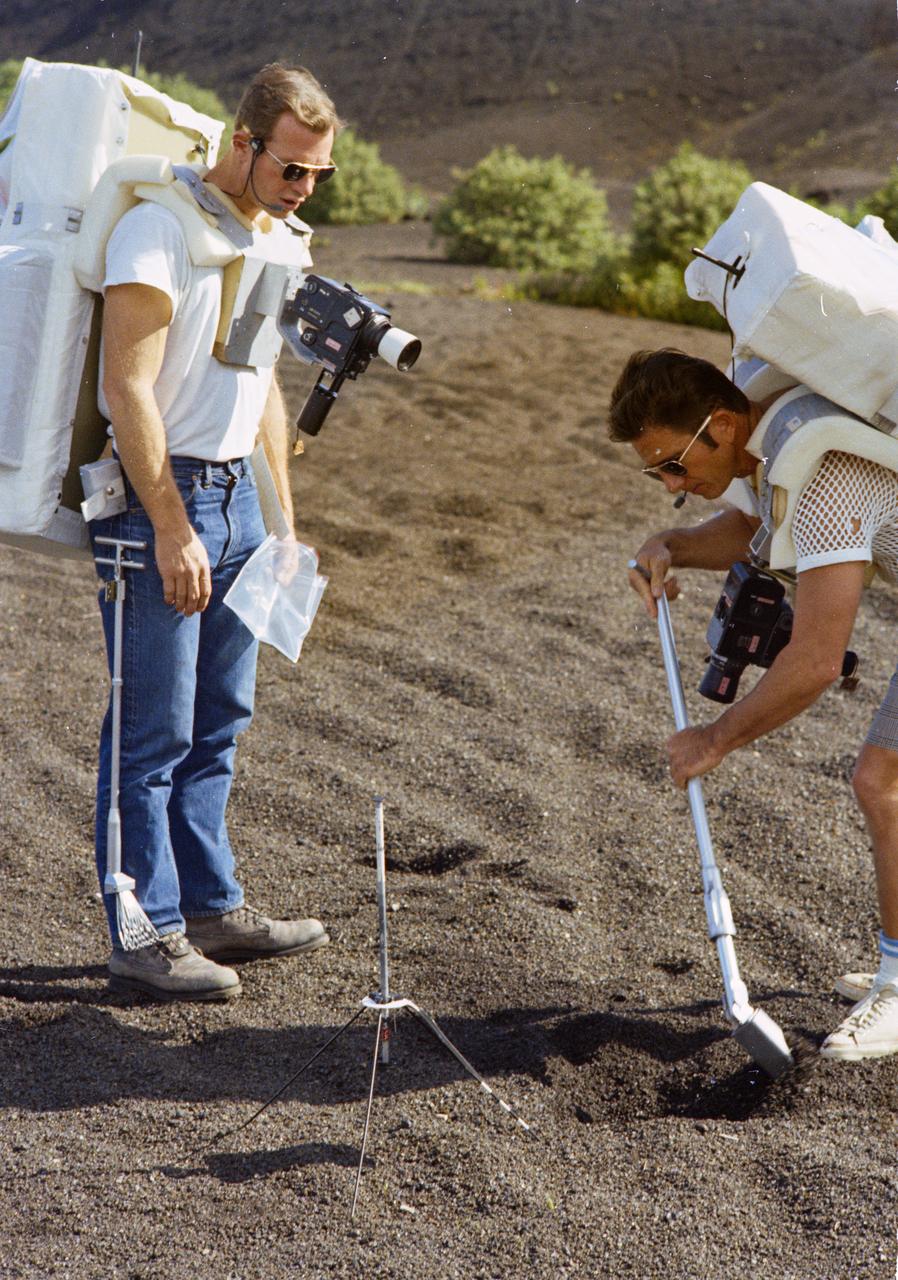
S70-56415 (December 1970) --- At Kapoho, Hawaii, astronauts David R. Scott (left), commander of the Apollo 15 lunar landing mission, and James B. Irwin, lunar module pilot, train at a designated lunar surface simulation area for their upcoming lunar landing mission. Wearing street clothes, but equipped with a Portable Life Support System (PLSS), the two rehearse for a selenological traverse. Here, they are inspecting a grapefruit-sized rock. Photo credit: NASA
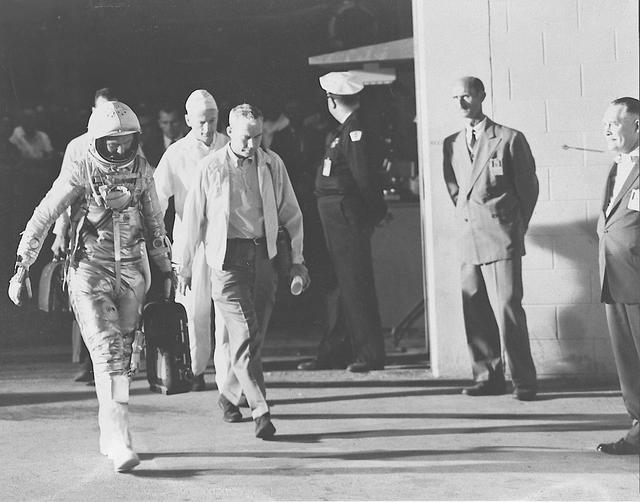
S62-00379 (20 Feb. 1962) --- View of astronaut John H. Glenn Jr., Dr. William Douglas, astronauts' flight surgeon, and equipment specialist Joe Schmitt leaving Operations and Checkout Building prior to the Mercury-Atlas 6 (MA-6) mission. Glenn is in his pressure suit and is carrying the portable ventilation unit. Photo credit: NASA
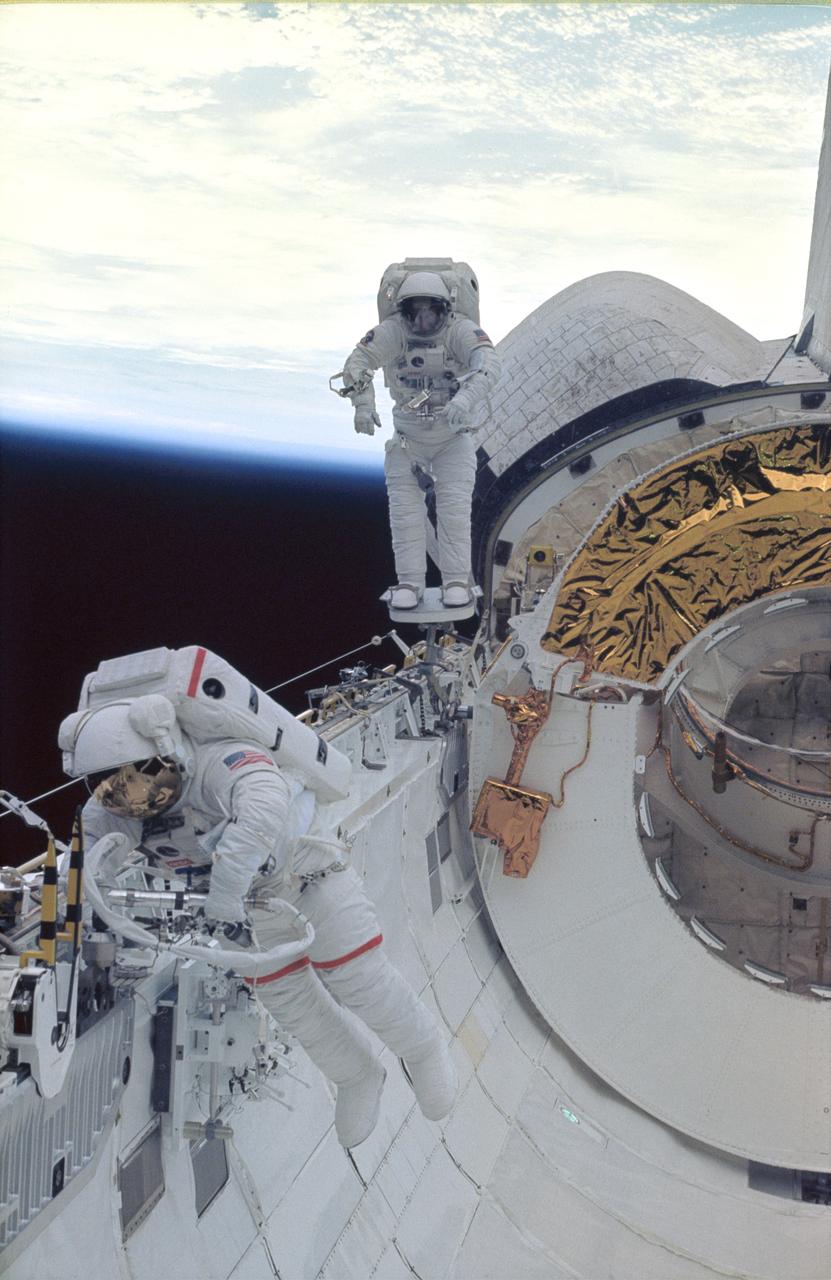
STS051-06-037 (16 Sept 1993) --- Astronauts Carl E. Walz (foreground) and James H. Newman evaluate some important gear. Walz reaches for the Power Ratchet Tool (PRT) while Newman checks out mobility on the Portable Foot Restraint (PFR) near the Space Shuttle Discovery's starboard Orbital Maneuvering System (OMS) pod. The tools and equipment will be instrumental on some of the five periods of extravehicular activity (EVA) scheduled for the Hubble Space Telescope (HST) STS-61 servicing mission later this year.
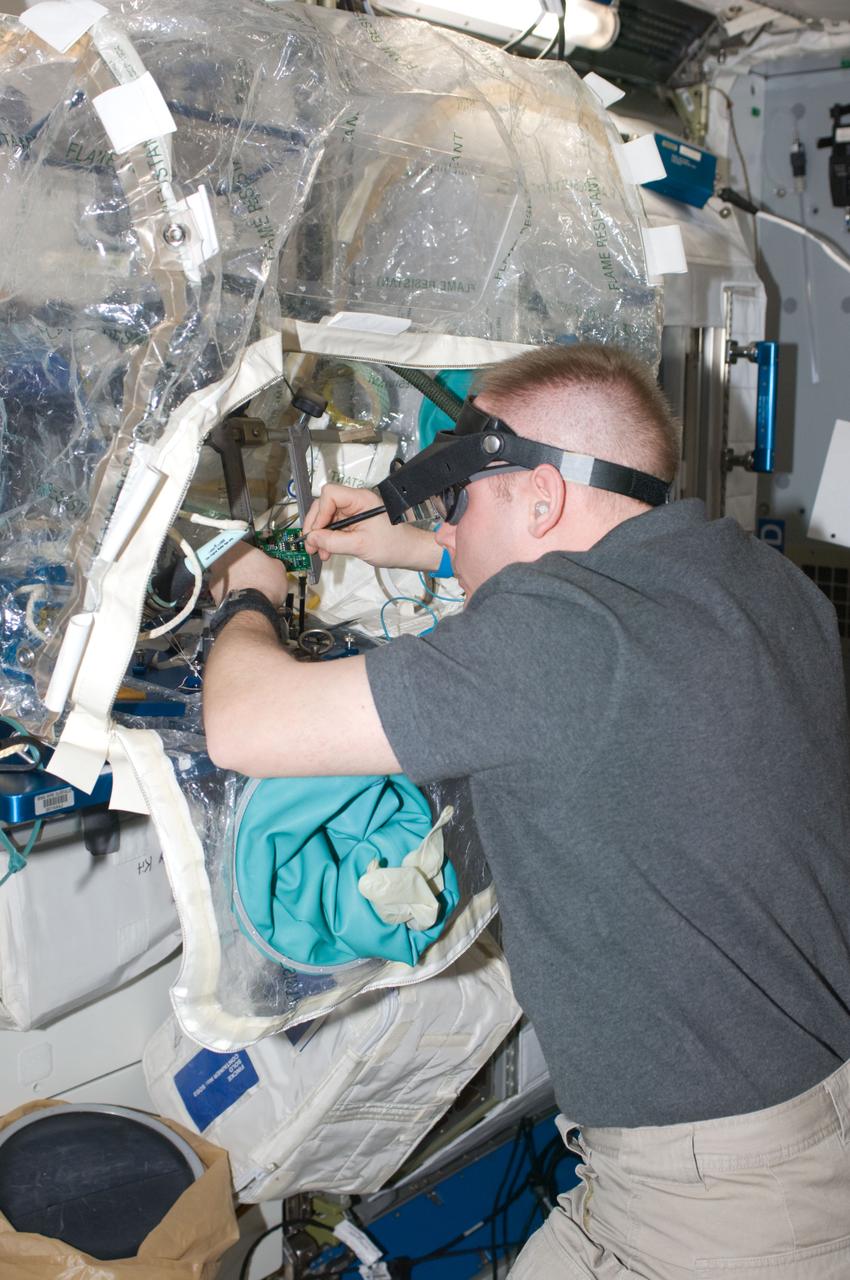
ISS018-E-033818 (19 Feb. 2009) --- Astronaut Michael Fincke, Expedition 18 commander, removes, cleans and replaces electronic test components on a single test card using Component Repair Equipment (CRE-1) hardware in a portable glovebox facility in the Harmony node of the International Space Station. Fincke unsoldered 1 1/2 components from an integrated circuit board and re-soldered new components including an integrated circuit chip.
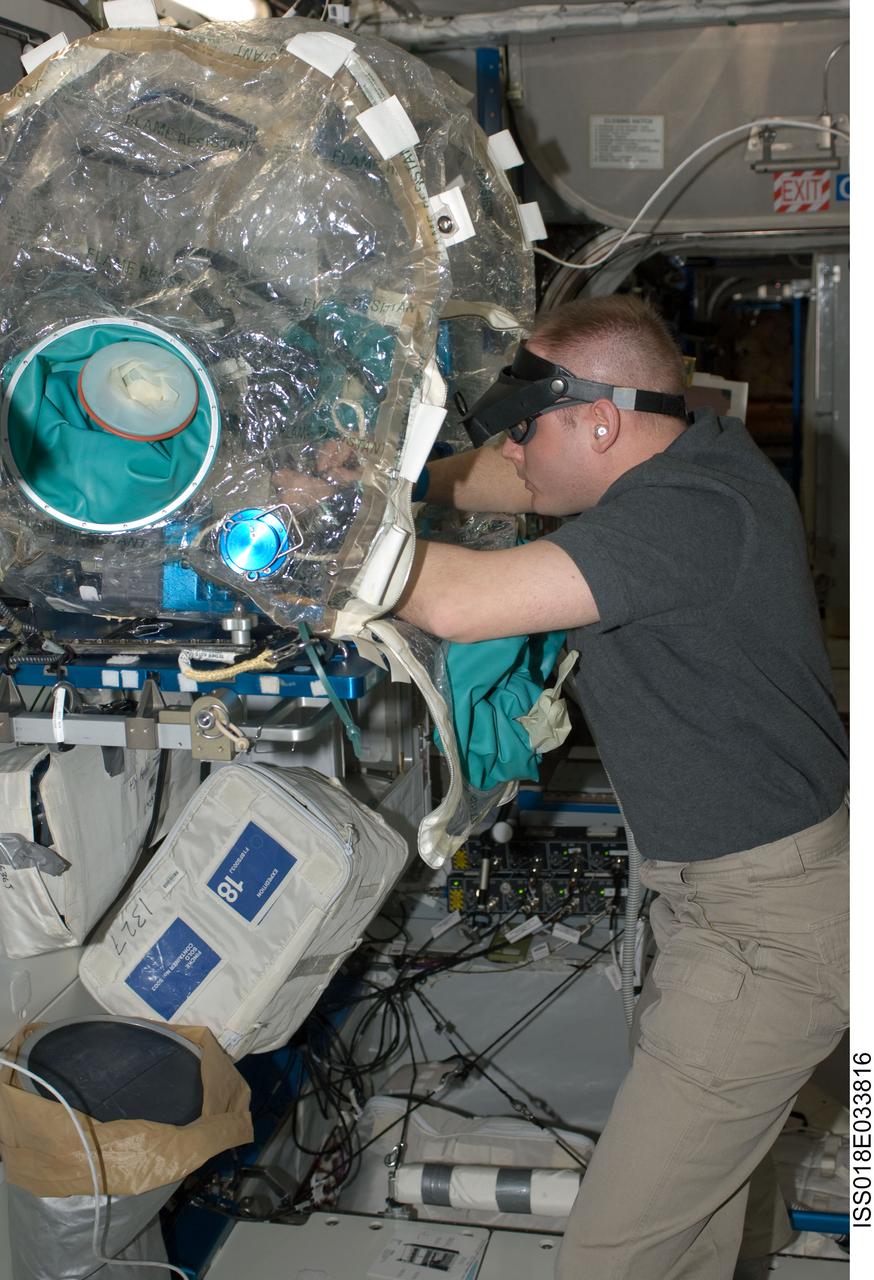
ISS018-E-033816 (19 Feb. 2009) --- Astronaut Michael Fincke, Expedition 18 commander, removes, cleans and replaces electronic test components on a single test card using Component Repair Equipment (CRE-1) hardware in a portable glovebox facility in the Harmony node of the International Space Station. Fincke unsoldered 1 1/2 components from an integrated circuit board and re-soldered new components including an integrated circuit chip.
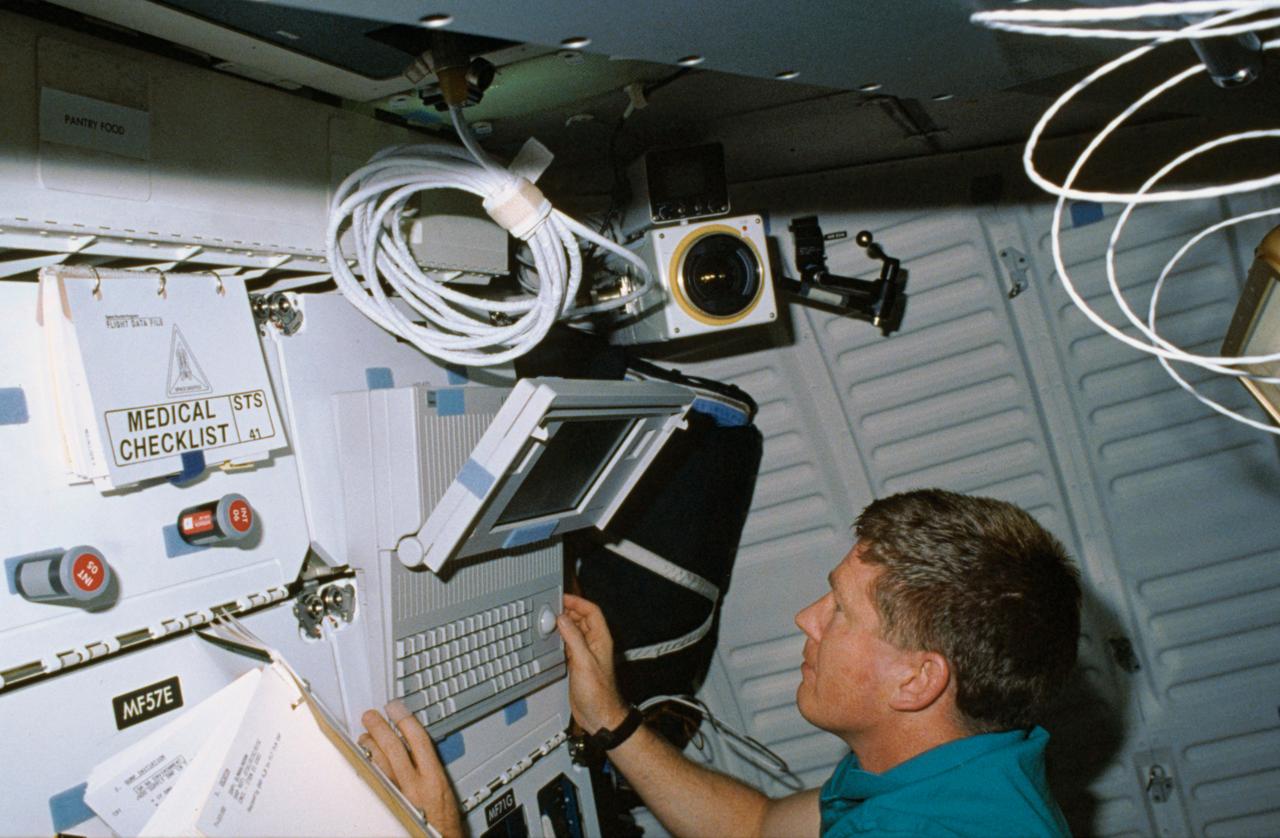
STS-41 Mission Specialist (MS) William M. Shepherd uses Detailed Test Objective (DTO) Space Station Cursor Control Device Evaluation MACINTOSH portable computer on the middeck of Discovery, Orbiter Vehicle (OV) 103. The computer is velcroed to forward lockers MF71C and MF71E. Surrounding Shepherd are checklists, the field sequential (FS) crew cabin camera, and a lighting fixture.
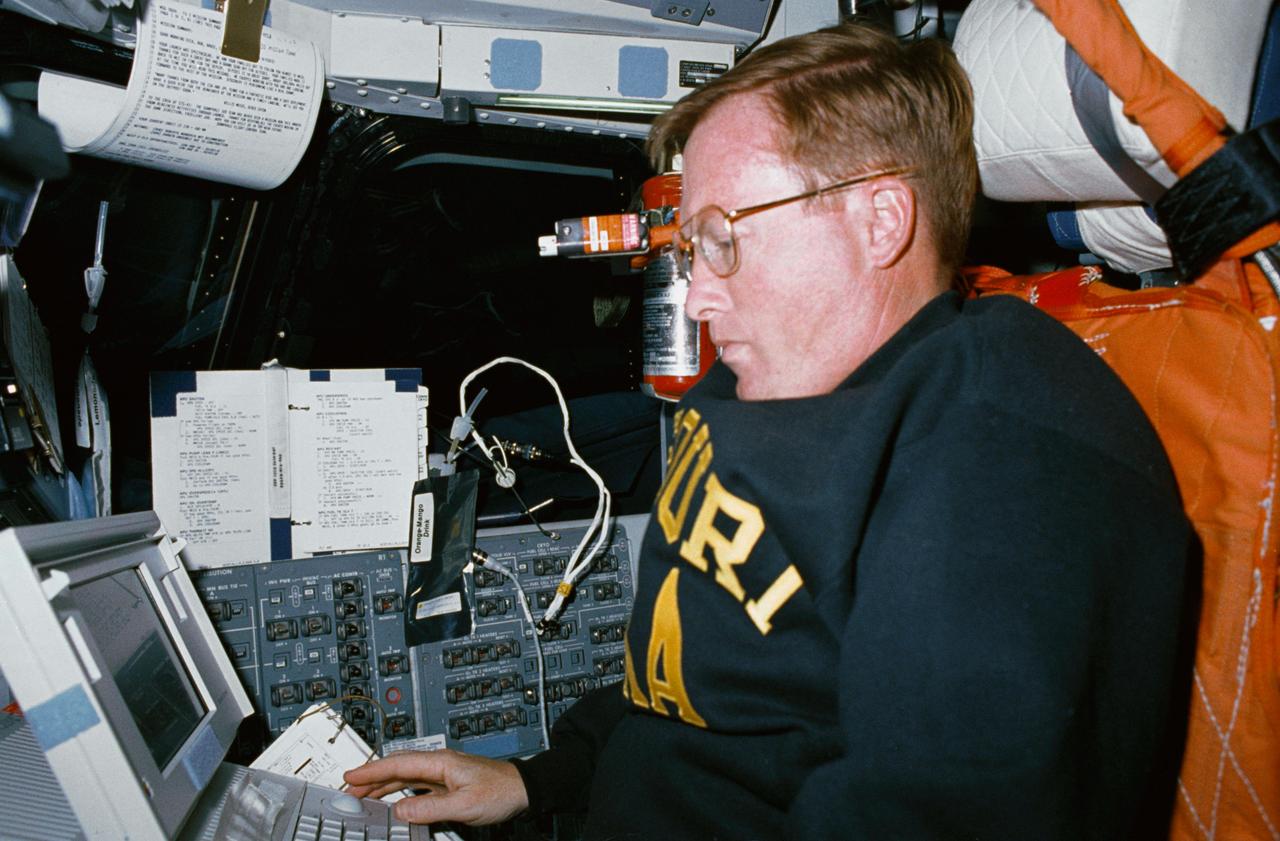
STS041-01-002 (6-10 Oct 1990) --- Astronaut Richard N. Richards, STS 41 mission commander, "borrows" the pilot's station to utilize a Shuttle portable onboard computer during the four-day flight. The photo was made with a 35mm camera.
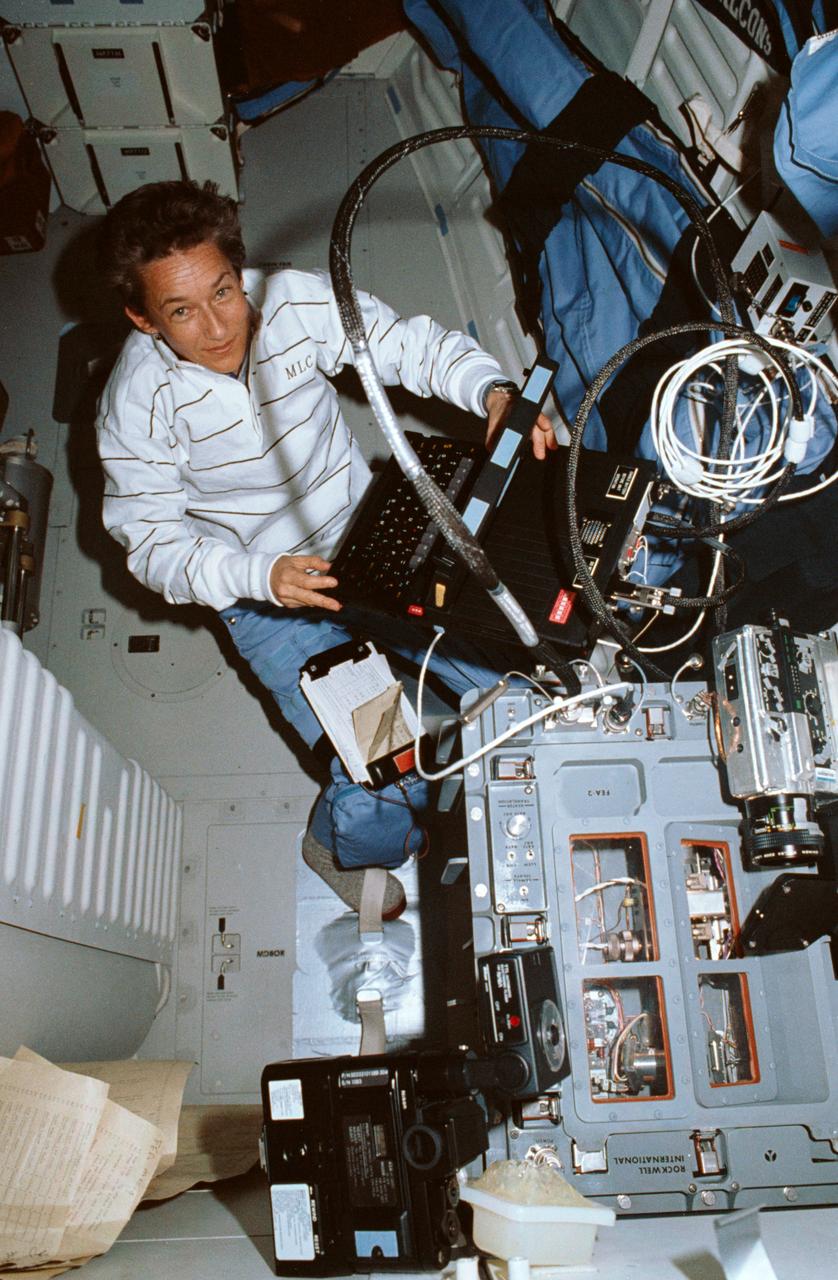
STS030-02-018 (4-8 May 1989) --- A 35mm overall scene of the operations devoted to the fluids experiment apparatus (FEA) aboard Atlantis for NASA’s STS-30 mission. Astronaut Mary L. Cleave, mission specialist, is seen with the computer which is instrumental in the carrying out of a variety of materials science experiments. Rockwell International is engaged in a joint endeavor agreement with NASA’s Office of Commercial Programs in the field of floating zone crystal growth and purification research. The March 1987 agreement provides for microgravity experiments to be performed in the company’s Microgravity Laboratory, the FEA. An 8 mm camcorder which documented details inside the apparatus is visible at bottom of the frame.
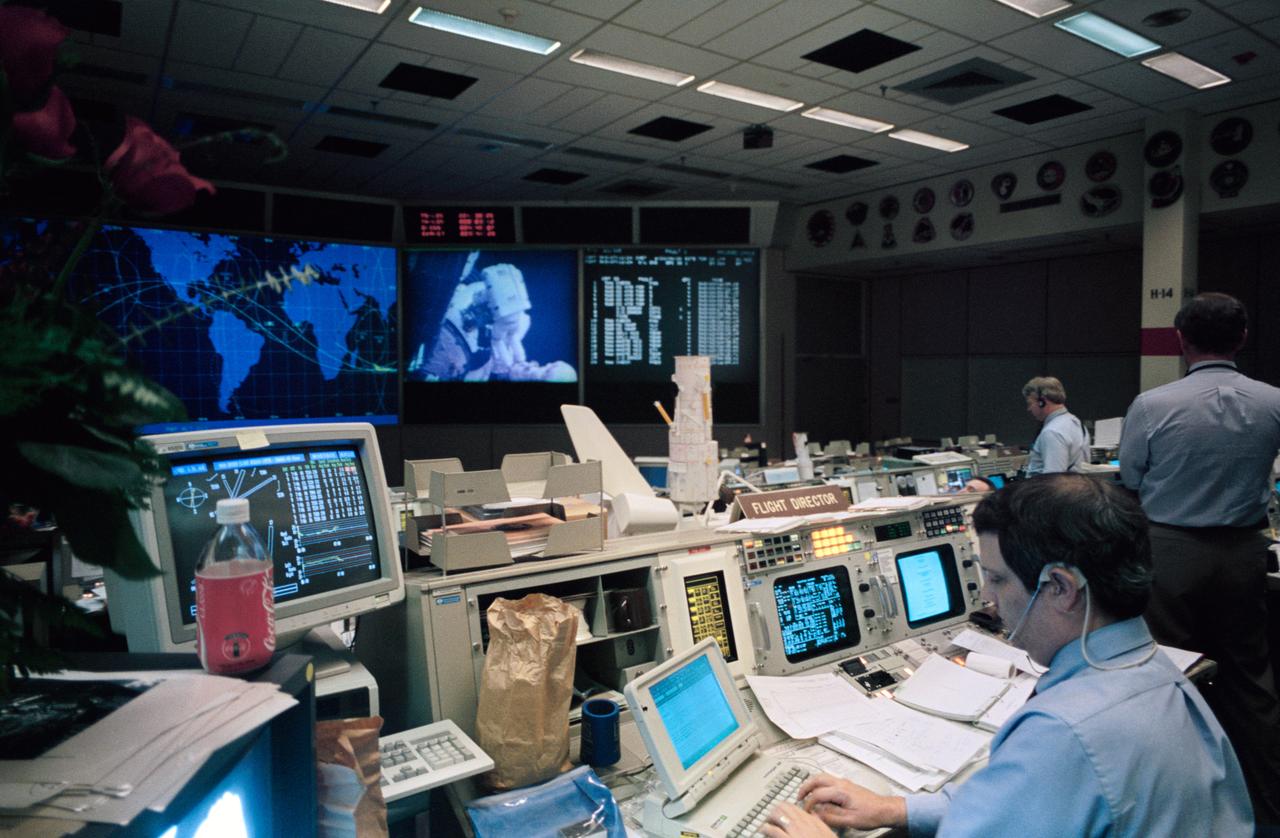
STS061-S-103 (2-13 DEC 1993) --- Flight director Robert E. Castle uses a lap top computer to aid his busy tasks during one of the five space walks performed to service the Hubble Space Telescope (HST) temporarily berthed in the Space Shuttle Endeavour's cargo bay. STS-61 lead flight director Milt Heflin is at right edge of frame.
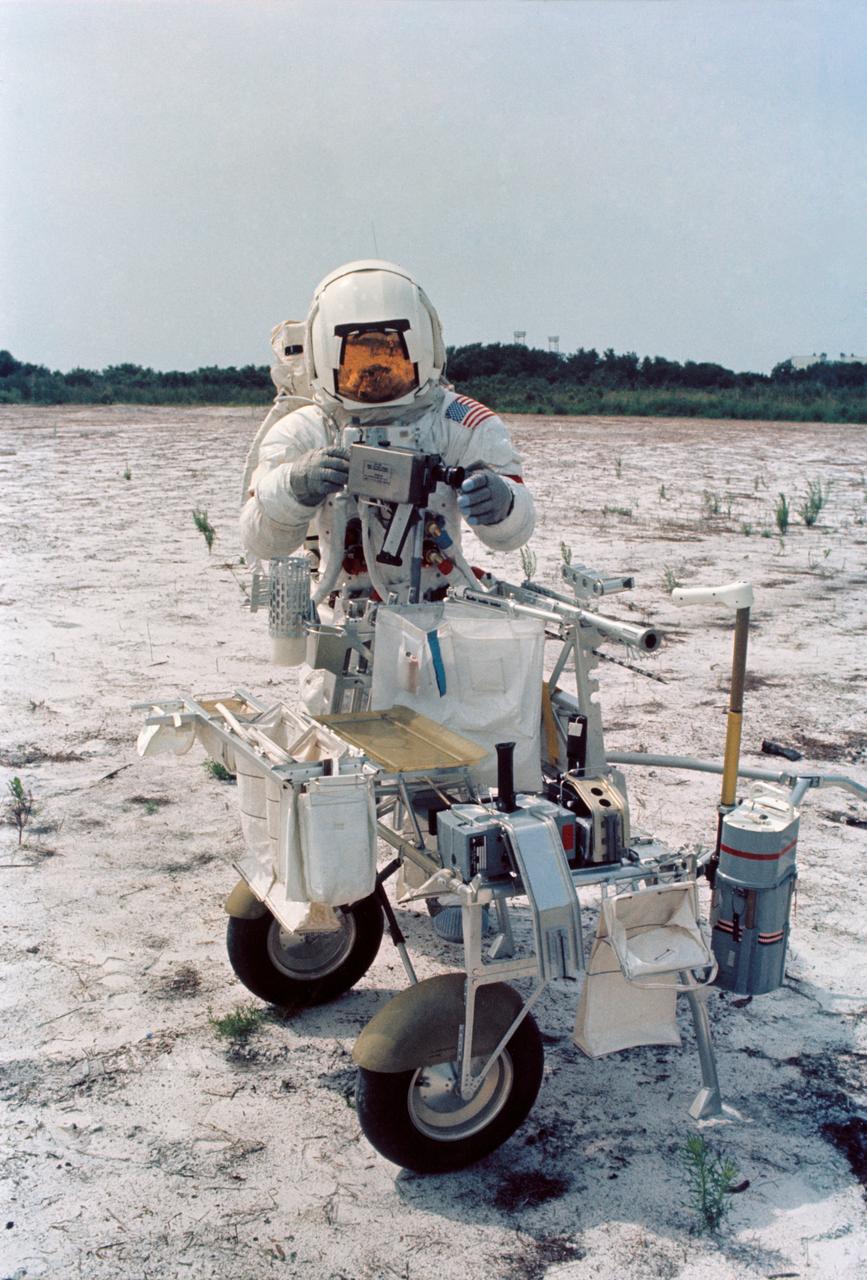
S70-46191 (July 1970) --- Astronaut Alan B. Shepard Jr., commander of the Apollo 14 lunar landing mission, participates in lunar surface training at the Kennedy Space Center (KSC). Shepard is adjusting a camera mounted to the modular equipment transporter (MET). The MET, nicknamed the "Rickshaw", will serve as a portable work bench with a place for the Apollo lunar hand tools and their carrier, three cameras, two sample container bags, a special environment sample container, spare magazines, and a lunar surface Penetrometer. Shepard is wearing an Extravehicular Mobility Unit (EMU).
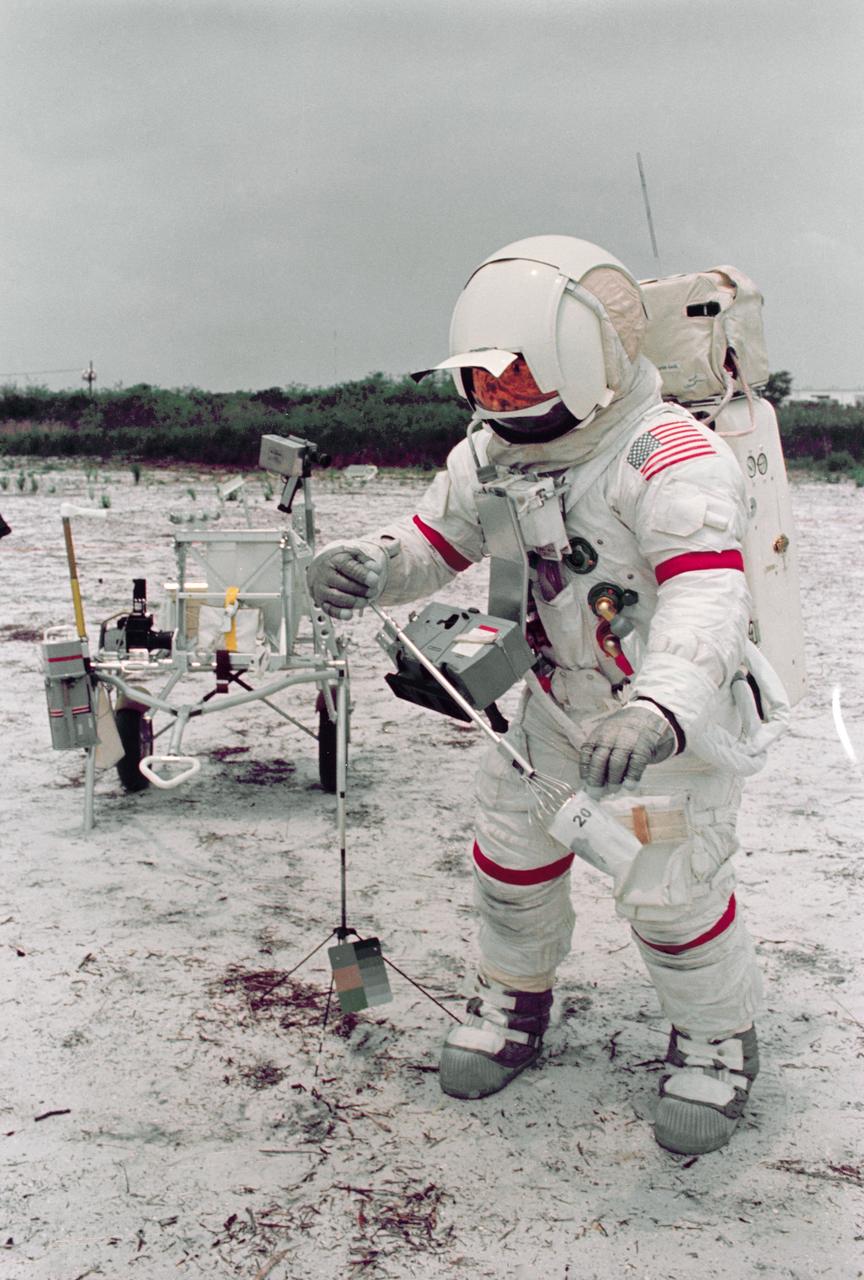
S70-46157 (July 1970) --- Astronaut Alan B. Shepard Jr., commander of the Apollo 14 lunar landing mission, participates in lunar surface simulation training at the Kennedy Space Center (KSC). The modular equipment transporter (MET) is in the left background, in the center foreground is a gnomon. The MET, nicknamed the "Rickshaw", will serve as a portable work bench with a place for the Apollo lunar hand tools and their carrier, three cameras, two sample container bags, a special environment sample container, spare magazines, and a lunar surface Penetrometer. Shepard is wearing an Extravehicular Mobility Unit (EMU).
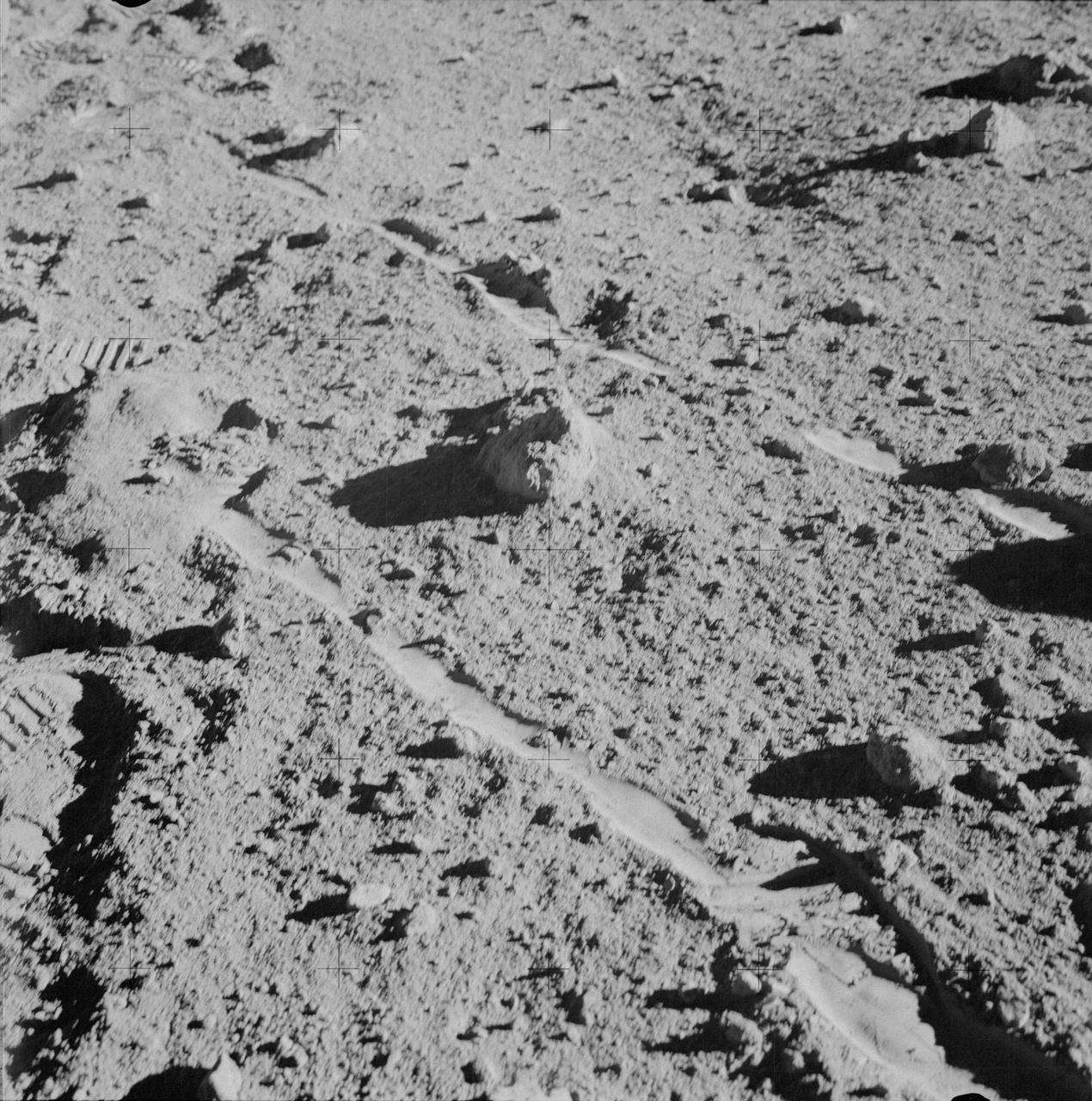
AS14-64-9129 (6 Feb. 1971) --- The two moon-exploring crew men of the Apollo 14 lunar landing mission, photographed and collected the large rock pictured just above the exact center of this picture. (Hold picture with the NASA photographic number at lower right hand corner.) The rock, casting a shadow off to the left, is lunar sample number 14321, referred to as a basketball-sized rock by newsmen and nicknamed "Big Bertha" by principal investigators. It lies between the wheel tracks made by the modular equipment transporter (MET) or rickshaw-type portable workbench. A few prints of the lunar overshoes of the crew members are at the left. This photo was made near the boulder field near the rim of Cone Crater.
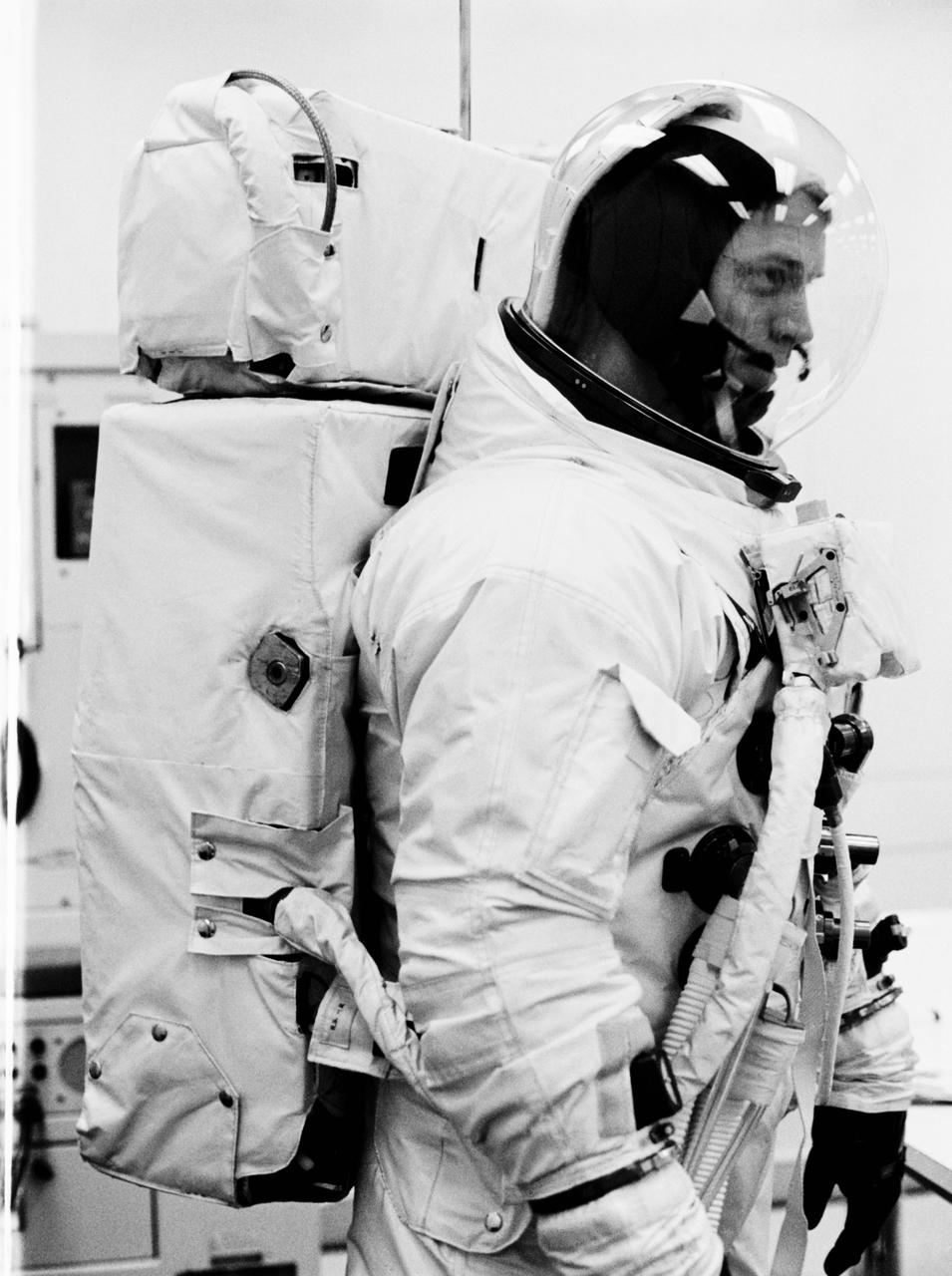
S69-25878 (23 Feb. 1969) --- Astronaut Russell L. Schweickart, lunar module pilot of the Apollo 9 prime crew, wears the Extravehicular Mobility Unit (EMU) which he will use during his scheduled Apollo 9 extravehicular activity. In addition to the space suit and bubble helmet, the EMU also includes a Portable Life Support System back pack, an Oxygen Purge System (seen atop the PLSS), and a Remote Control Unit on his chest. This equipment will be completely independent of the spacecraft during Schweickart's EVA. He will be secured only by a tether line. When this photograph was taken, Schweickart was suited to participate in an Apollo 9 Countdown Demonstration Test.
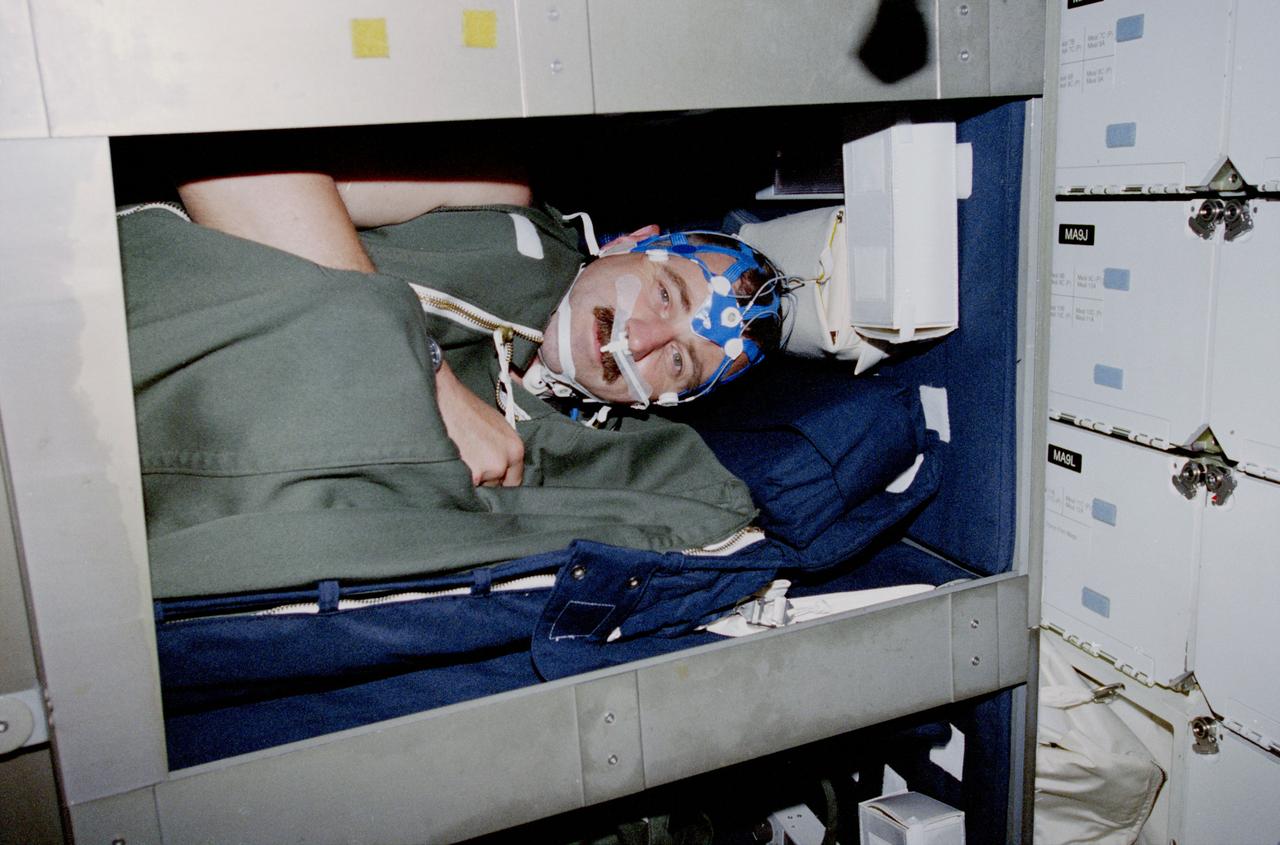
STS090-377-011 (17 APRIL-3 MAY 1998) --- Astronaut Dafydd R. (Dave) Williams, mission specialist representing the Canadian Space Agency (CSA), accomplishes more than one purpose when he sleeps in this bunk aboard the Earth-orbiting Space Shuttle Columbia. Conducting a Neurolab sleep experiment, Williams wears equipment which includes a sleep net (mesh cap that monitors and records brain waves); a Respiratory Inductance Plethysmograph (RIP) suit for monitoring respiration; and an activity monitor -- a device (out of view) worn on the wrist to detect and record body movement. Data on brain waves, eye movements, respiration, heart rate, and oxygen concentration are routed to a portable data recorder. The entire system has capabilities similar to a fully equipped sleep laboratory on Earth. The sleeping bag is conventional Shuttle ware and not part of the experiment.
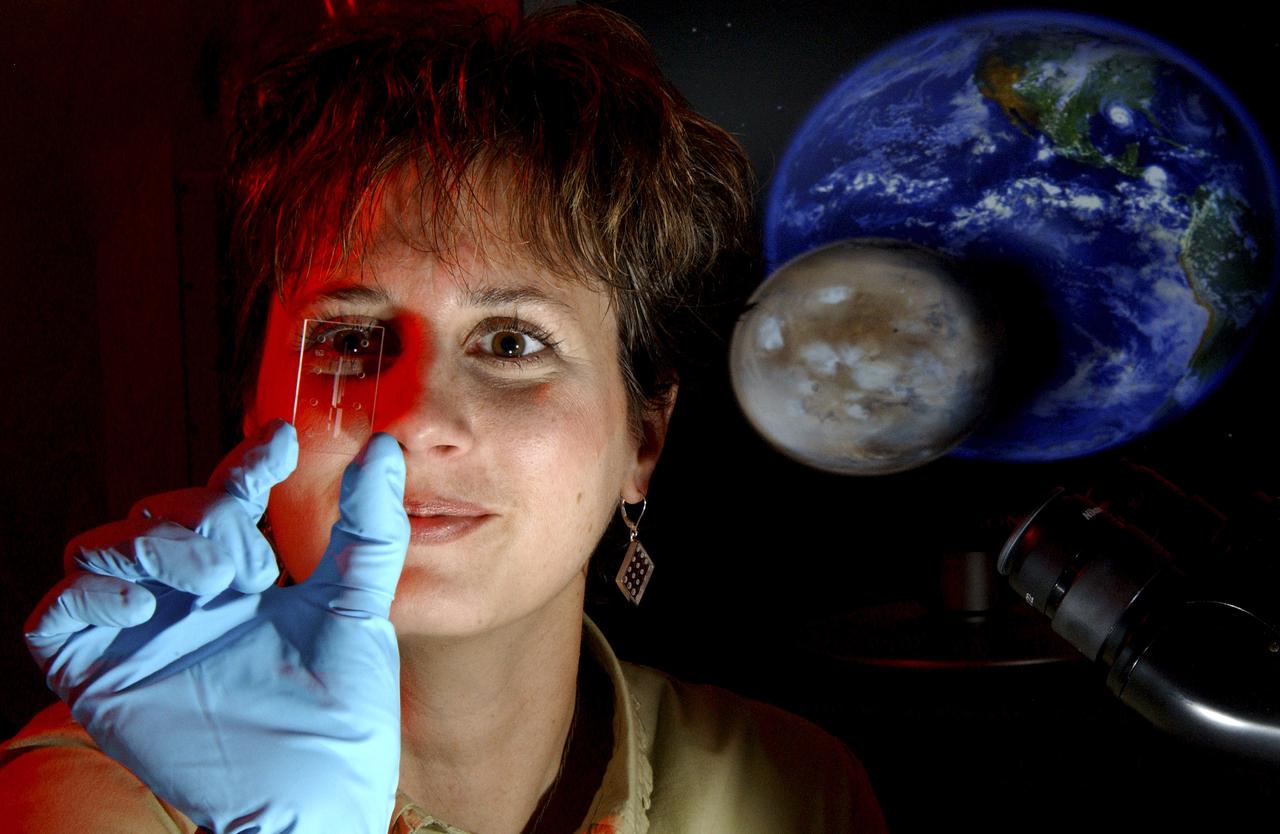
Dr. Lisa Monaco, Marshall Space Flight Center’s (MSFC’s) project scientist for the Lab-on-a-Chip Applications Development (LOCAD) program, examines a lab on a chip. The small dots are actually ports where fluids and chemicals can be mixed or samples can be collected for testing. Tiny channels, only clearly visible under a microscope, form pathways between the ports. Many chemical and biological processes, previously conducted on large pieces of laboratory equipment, can now be performed on these small glass or plastic plates. Monaco and other researchers at MSFC in Huntsville, Alabama, are customizing the chips to be used for many space applications, such as monitoring microbes inside spacecraft and detecting life on other planets. The portable, handheld Lab-on-a Chip Application Development Portable Test System (LOCAD-PTS) made its debut flight aboard Discovery during the STS-116 mission launched December 9, 2006. The system allowed crew members to monitor their environment for problematic contaminants such as yeast, mold, and even E.coli, and salmonella. Once LOCAD-PTS reached the International Space Station (ISS), the Marshall team continued to manage the experiment, monitoring the study from a console in the Payload Operations Center at MSFC. The results of these studies will help NASA researchers refine the technology for future Moon and Mars missions. (NASA/MSFC/D.Stoffer)
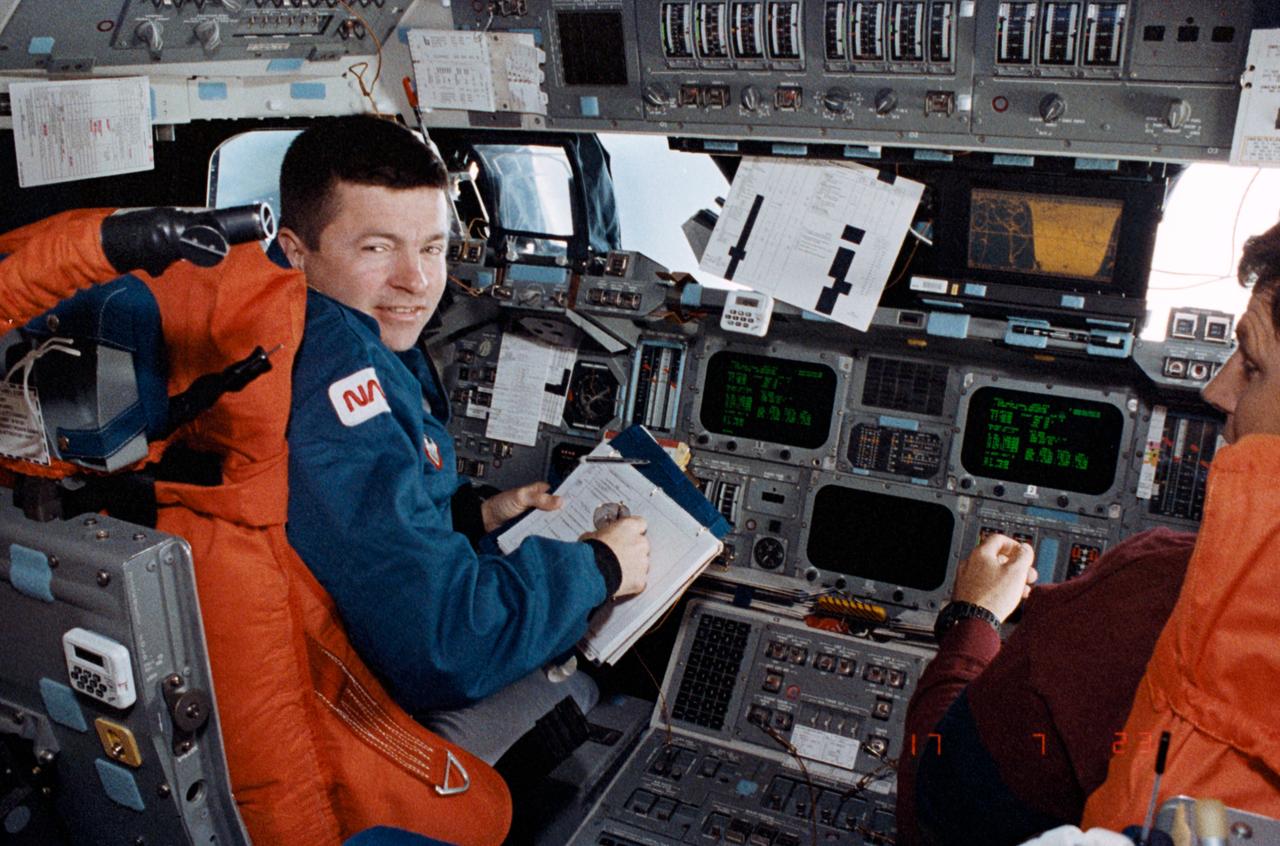
STS056-39-010 (8-17 April 1993) --- Astronaut Kenneth D. Cameron mans the mission commander's station during an orbiter maneuver aboard the Earth-orbiting Space Shuttle Discovery. Astronaut Stephen S. Oswald, pilot, is partially visible at right edge of the frame. The two were joined by three other NASA astronauts for nine days of science in support of the Atlas 2 mission in Earth orbit.
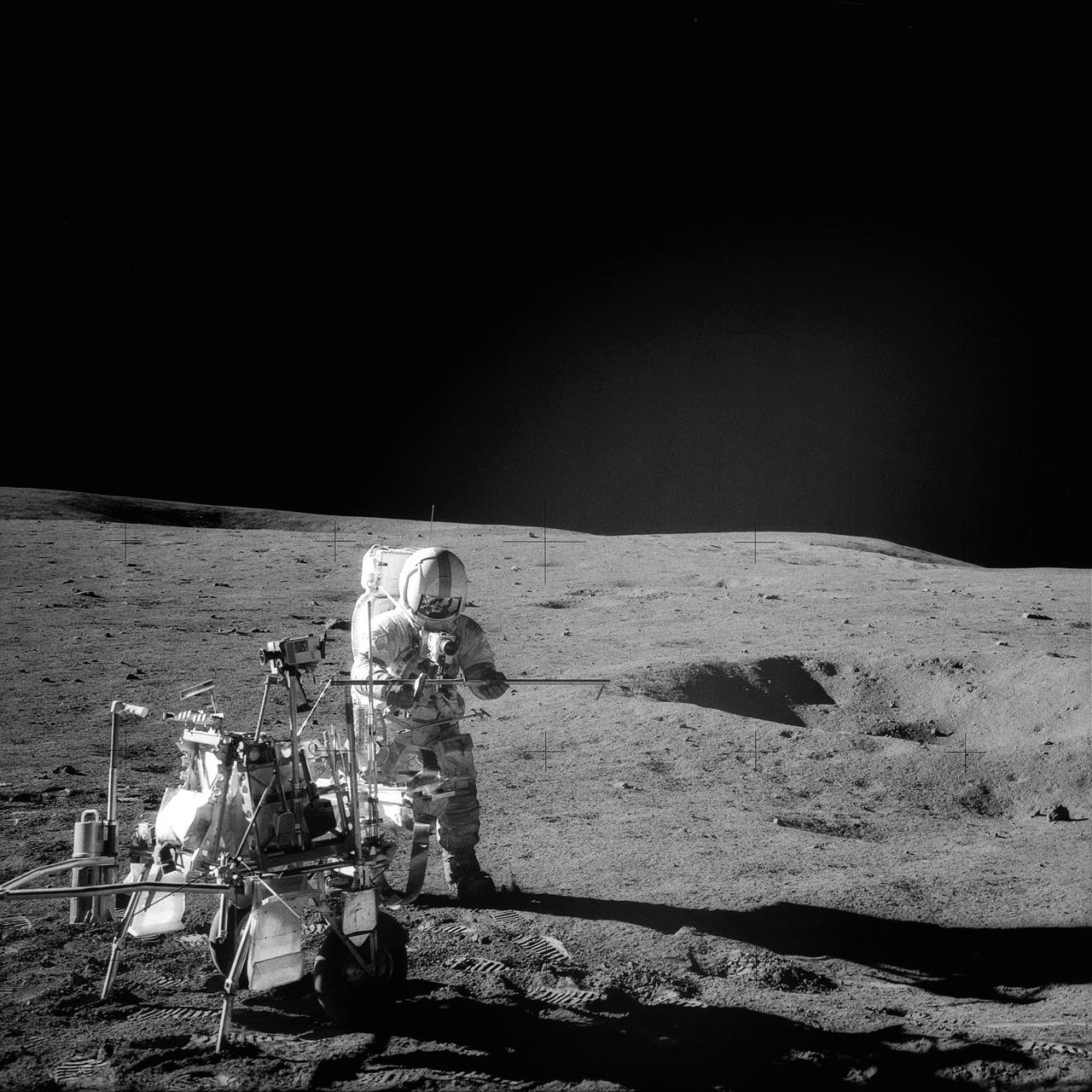
AS14-68-9405 (6 Feb. 1971) --- Astronaut Alan B. Shepard Jr., Apollo 14 commander, assembles a double core tube as he stands beside the rickshaw-type portable workbench or modularized equipment transporter (MET) unique to this mission. The photograph was taken by astronaut Edgar D. Mitchell, lunar module pilot, standing some 170 meters northeast of the Lunar Module (LM), during the mission's second extravehicular activity (EVA) on Feb. 6, 1971. While astronauts Shepard and Mitchell descended in the LM "Antares" to explore the Fra Mauro region of the moon, astronaut Stuart A. Roosa, command module pilot, remained with the Command and Service Modules (CSM) "Kitty Hawk" in lunar orbit.
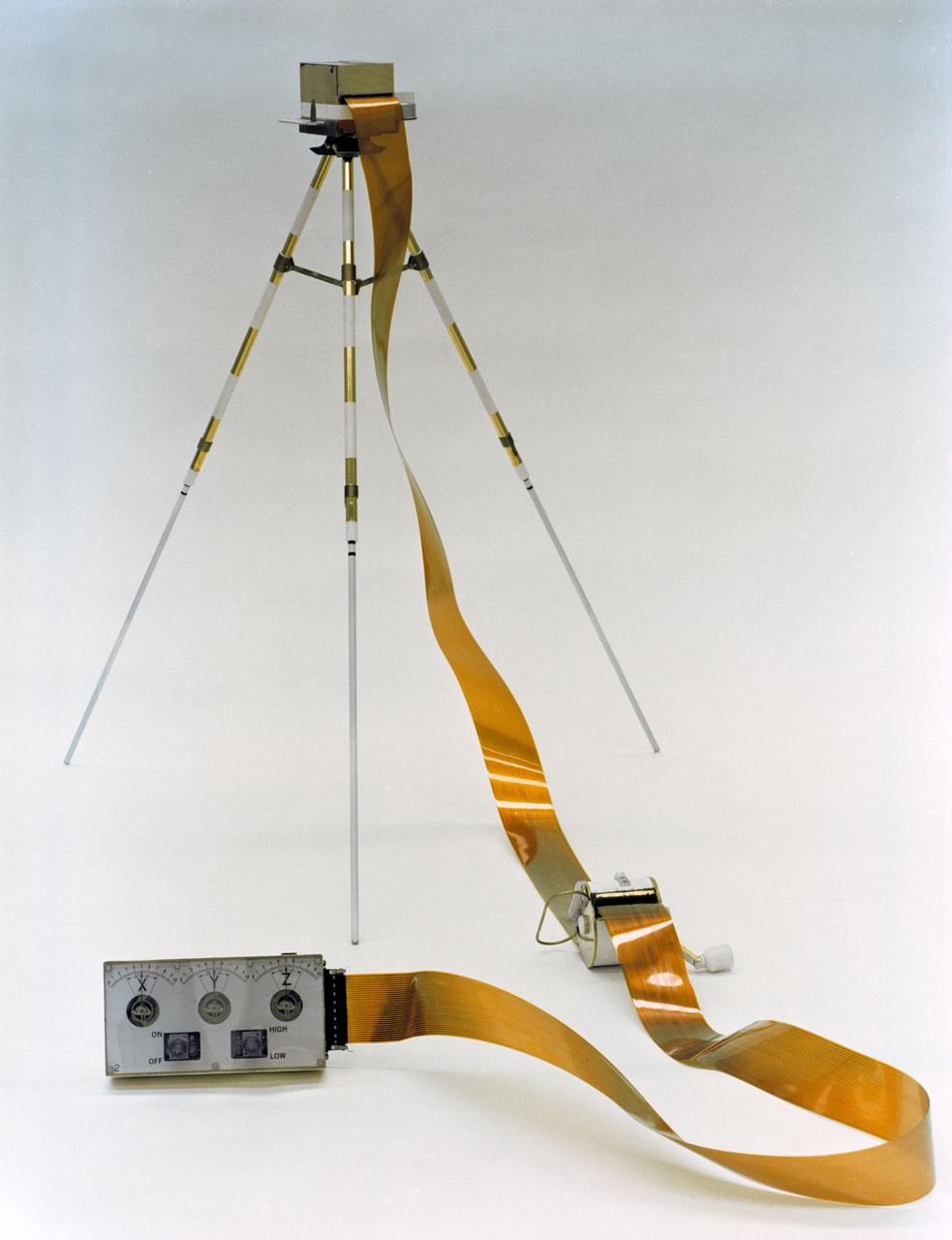
S70-56721 (December 1970) --- A close-up view of the Lunar Portable Magnetometer (LPM), which will be used by the crew of the Apollo 14 lunar landing mission during the second extravehicular activity (EVA). The LPM's components, a tripod-mounted flux-gate magnetometer sensor head and an electronics data package, connected by a 50-feet flat cable, function together to measure variations in the lunar magnetic field at several points on the geological traverse. Data gathered will be used to determine the location, strength and dimensions of magnetic sources, as well as knowledge of the local and total selenological structure. The LPM will be carried on the Modular Equipment Transporter (MET), and deployed by the lunar module pilot, who will align the sensor head at least 35 feet from the data package. The LM pilot will then return to the MET and verbally relay the LPM readouts to Earth. Astronaut Edgar D. Mitchell is the lunar module pilot for the Apollo 14 lunar landing mission.
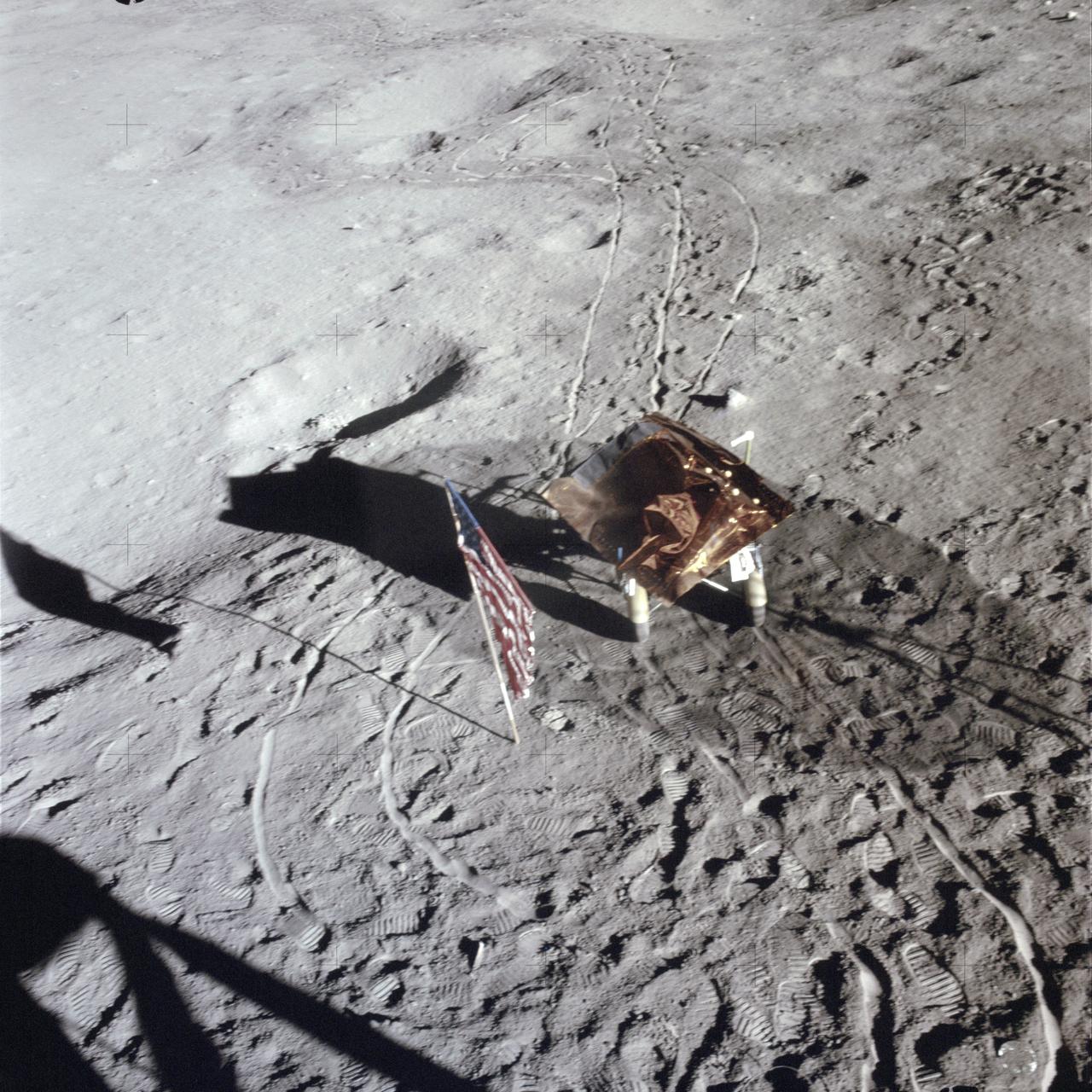
AS14-66-9325 (5 Feb. 1971) --- The third United States flag to be deployed on the lunar surface, footprints, wheel tracks and the "Rickshaw"-type portable workbench, as seen by the two moon-exploring astronauts from inside the Lunar Module (LM), give evidence of a busy first extravehicular activity (EVA) period. The two-wheeled cart is the Apollo modularized equipment transporter (MET), covered with a sheet of foil material to protect the cameras and rock box between EVAs. While astronauts Alan B. Shepard Jr., commander, and Edgar D. Mitchell, lunar module pilot, descended in the LM, astronaut Stuart A. Roosa, command module pilot, remained with the Command and Service Modules (CSM) in lunar orbit.
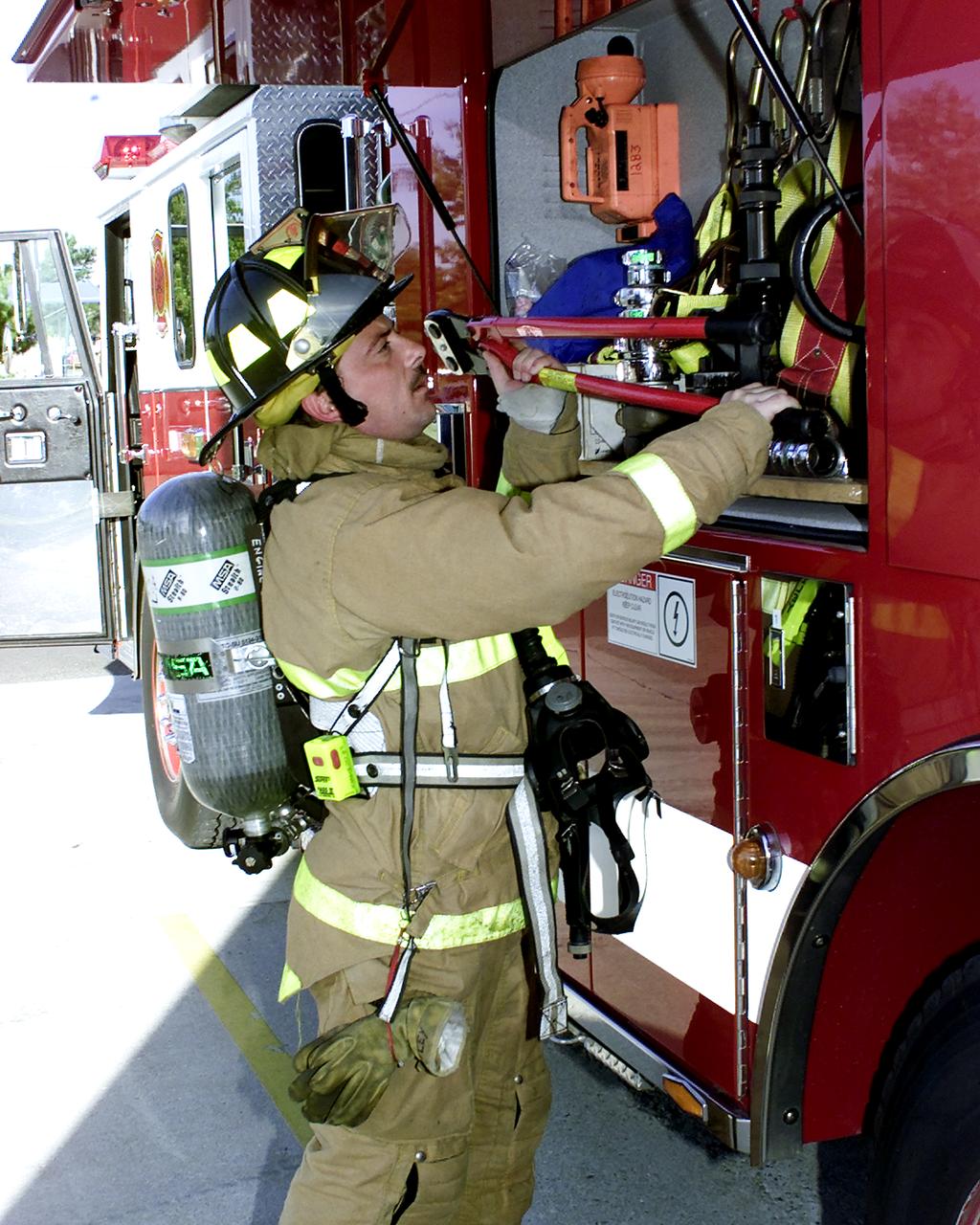
Technology used to provide thermal protection for Apollo astronauts and spacecraft components provides firefighters with better protective clothing and equipment. Spinoffs include a portable firefighting module, protective clothing for workers in hazardous environments, fire-retardant paints and forms, fireblocking coating for outdoor structures, and flame-resistant fabric. Perhaps the farthest reaching is the breathing apparatus worn by firefighters throughout the U.S. for protection against smoke inhalation injury. The breathing system weighs approximately 20 pounds, one-third less than past systems, and it enables the wearer to have improved mobility. It consists of a face mask, frame and harness, a warning device, and an air bottle. The basic air cylinder offers the same 30-minutes of operation time as its predecessor. The result is a drastic reduction in the number of inhalation injuries to firefighters. Though they have made many design modifications and refinements, manufacturers of breathing apparatus still incorporate the original NASA technology.
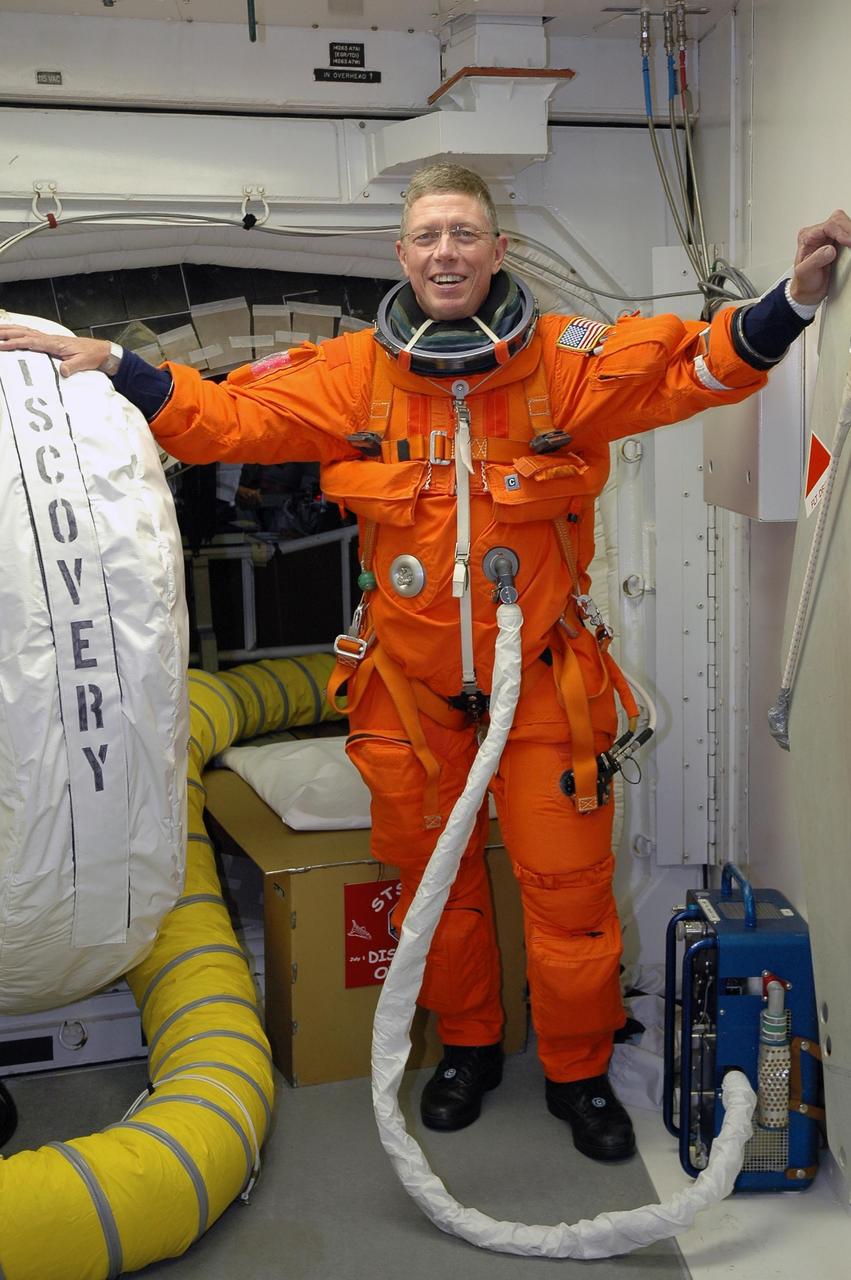
KENNEDY SPACE CENTER, FLA. - In the White Room on Launch Pad 39B, STS-121 Mission Specialist Michael Fossum enjoys a portable cooling unit keeping him cool while waiting to enter Space Shuttle Discovery. The crew is taking part in a full dress rehearsal for launch, including countdown and culminating in main engine cutoff. The rehearsal is the final part of Terminal Countdown Demonstration Test (TCDT) activities that the crew has been involved in for two days. TCDT provides the crew of each mission an opportunity to participate in various simulated countdown activities, including equipment familiarization and emergency egress training. Mission STS-121 is scheduled to be launched July 1. Photo credit: NASA/Amanda Diller
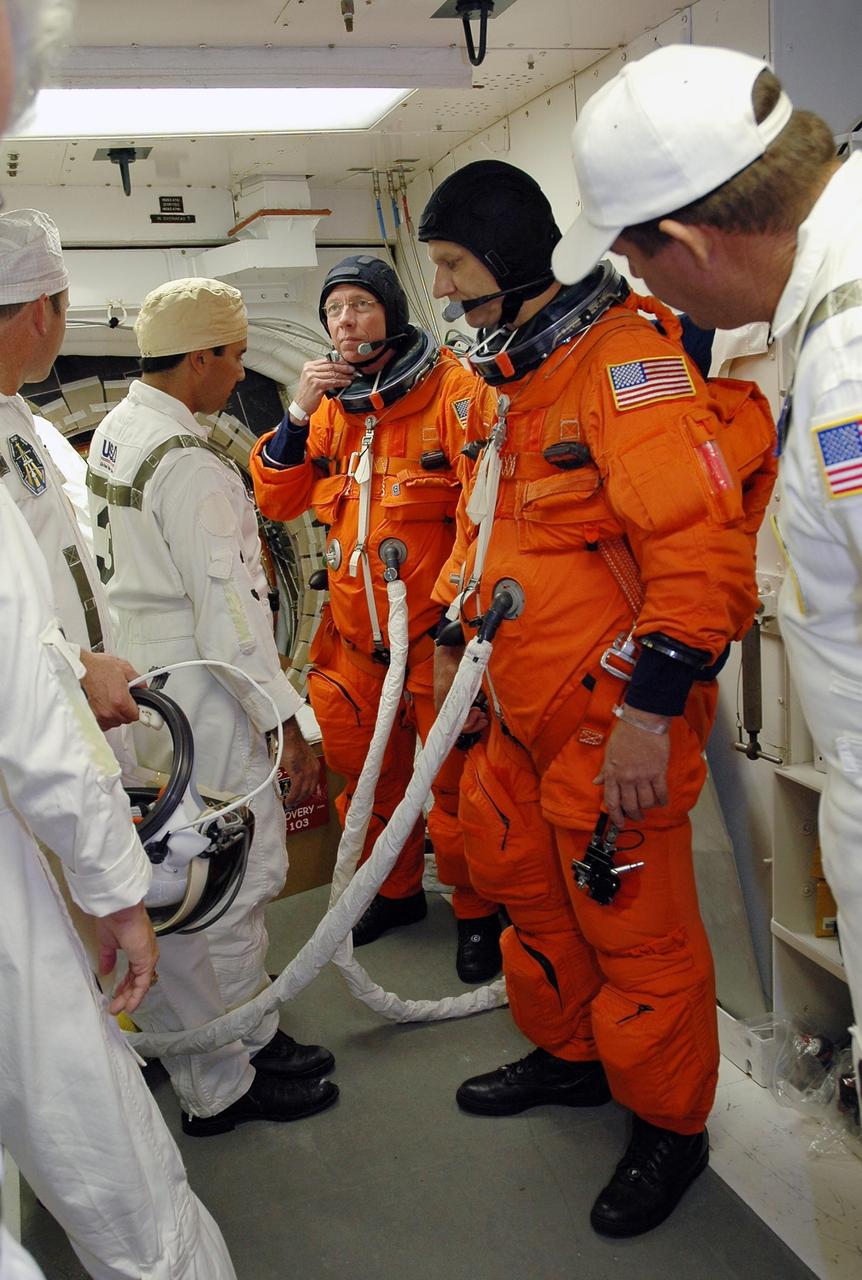
KENNEDY SPACE CENTER, FLA. - In the White Room on Launch Pad 39B, STS-121 Mission Specialists Michael Fossum (center) and Piers Sellers have their launch suits checked by the closeout crew before entering Space Shuttle Discovery. They are connected to portable cooling units keeping them cool while waiting to enter Space Shuttle Discovery. The crew is taking part in a full dress rehearsal for launch, including countdown and culminating in main engine cutoff. The rehearsal is the final part of Terminal Countdown Demonstration Test (TCDT) activities that the crew has been involved in for two days. TCDT provides the crew of each mission an opportunity to participate in various simulated countdown activities, including equipment familiarization and emergency egress training. Mission STS-121 is scheduled to be launched July 1. Photo credit: NASA/Amanda Diller
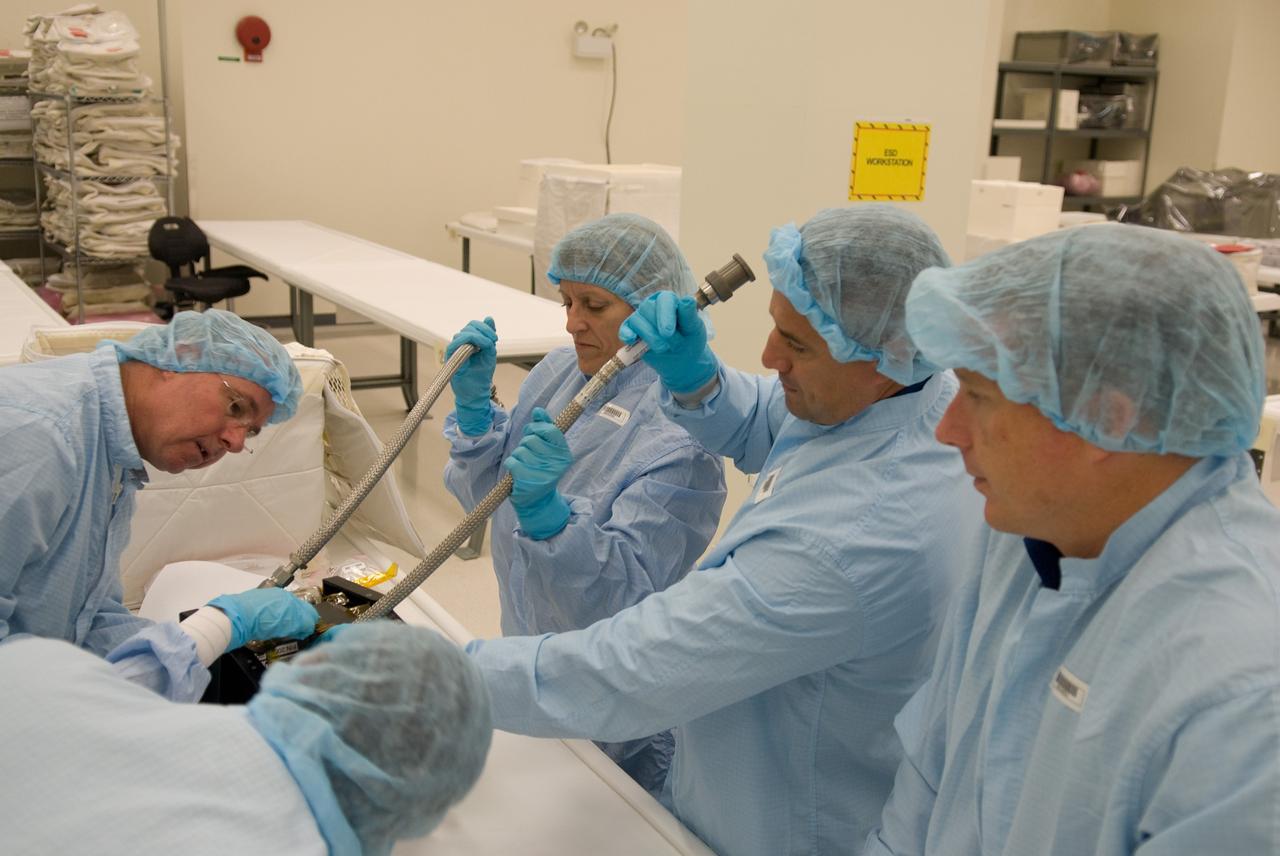
CAPE CANAVERAL, Fla. – In the Space Station Processing Facility at NASA's Kennedy Space Center in Florida, members of the STS-130 crew participate in a bench review, standard familiarization training on the hardware and equipment that will fly on their mission, during the crew equipment interface test. From left are Mission Specialists Stephen Robinson and Kathryn "Kay" Hire, Commander George Zamka and Pilot Terry Virts Jr. Tranquility, the payload for the STS-130 mission, is a pressurized module that will provide room for many of the International Space Station's life support systems. The module was built for the European Space Agency by Thales Alenia Space in Turin, Italy. The cupola, a unique work station with six windows on its sides and one on top, is attached to the end of Tranquility. It resembles a circular bay window and will provide a vastly improved view of the station's exterior. Just under 10 feet in diameter, the module will accommodate two crew members and portable workstations that can control station and robotic activities. The multi-directional view will allow the crew to monitor spacewalks and docking operations, as well as provide a spectacular view of Earth and other celestial objects. Endeavour is targeted to launch Feb. 4, 2010. Photo credit: NASA/Kim Shiflett
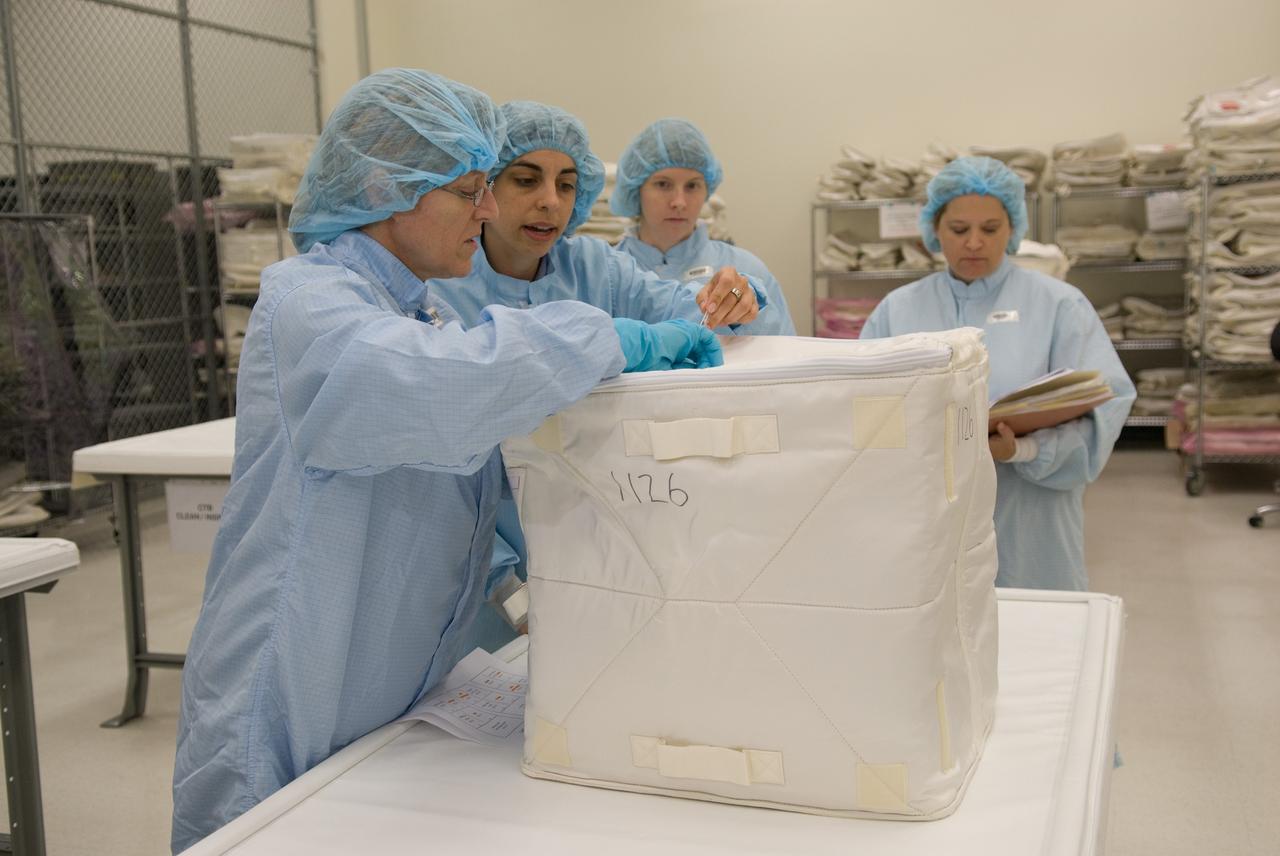
CAPE CANAVERAL, Fla. – In the Space Station Processing Facility at NASA's Kennedy Space Center in Florida, STS-130 Mission Specialist Kathryn "Kay" Hire, at left, participates in a bench review, standard familiarization training on the hardware and equipment that will fly on her mission, during the crew equipment interface test. Tranquility, the payload for the STS-130 mission, is a pressurized module that will provide room for many of the International Space Station's life support systems. The module was built for the European Space Agency by Thales Alenia Space in Turin, Italy. The cupola, a unique work station with six windows on its sides and one on top, is attached to the end of Tranquility. It resembles a circular bay window and will provide a vastly improved view of the station's exterior. Just under 10 feet in diameter, the module will accommodate two crew members and portable workstations that can control station and robotic activities. The multi-directional view will allow the crew to monitor spacewalks and docking operations, as well as provide a spectacular view of Earth and other celestial objects. Endeavour is targeted to launch Feb. 4, 2010. Photo credit: NASA/Kim Shiflett
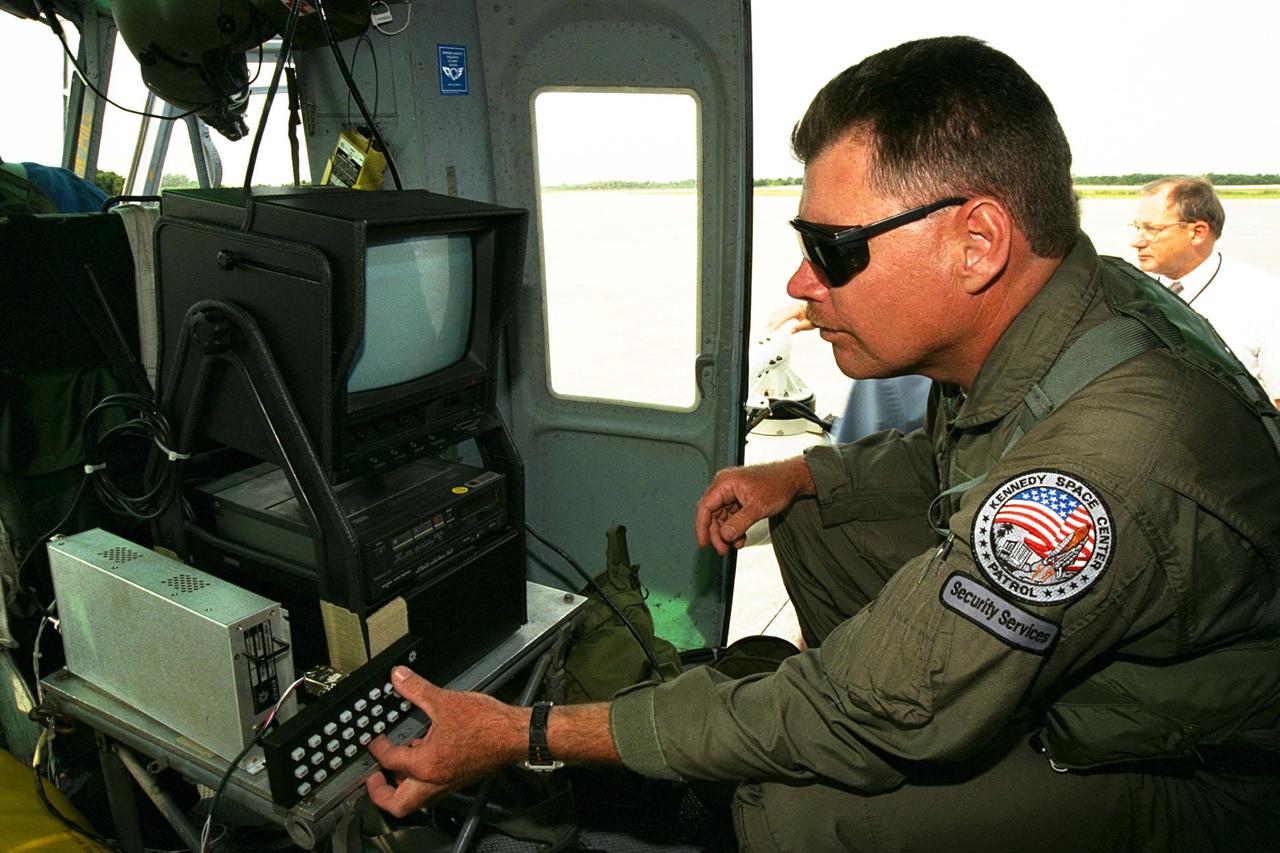
KENNEDY SPACE CENTER, FLA. -- Sgt. Mark Hines, of Kennedy Space Center (KSC) Security, checks out equipment used to operate the Forward Looking Infrared Radar (FLIR) installed on NASA's Huey UH-1 helicopter. The helicopter has also been outfitted with a portable global positioning satellite (GPS) system to support Florida's Division of Forestry as they fight the brush fires which have been plaguing the state as a result of extremely dry conditions and lightning storms. The FLIR includes a beach ball-sized infrared camera that is mounted on the helicopter's right siderail and a real-time television monitor and recorder installed inside. While the FLIR collects temperature data and images, the GPS system provides the exact coordinates of the fires being observed and transmits the data to the firefighters on the ground. KSC's security team routinely uses the FLIR equipment prior to Shuttle launch and landing activities to ensure that the area surrounding the launch pad and runway are clear of unauthorized personnel. KSC's Base Operations Contractor, EG&G Florida, operates the NASA-owned helicopter
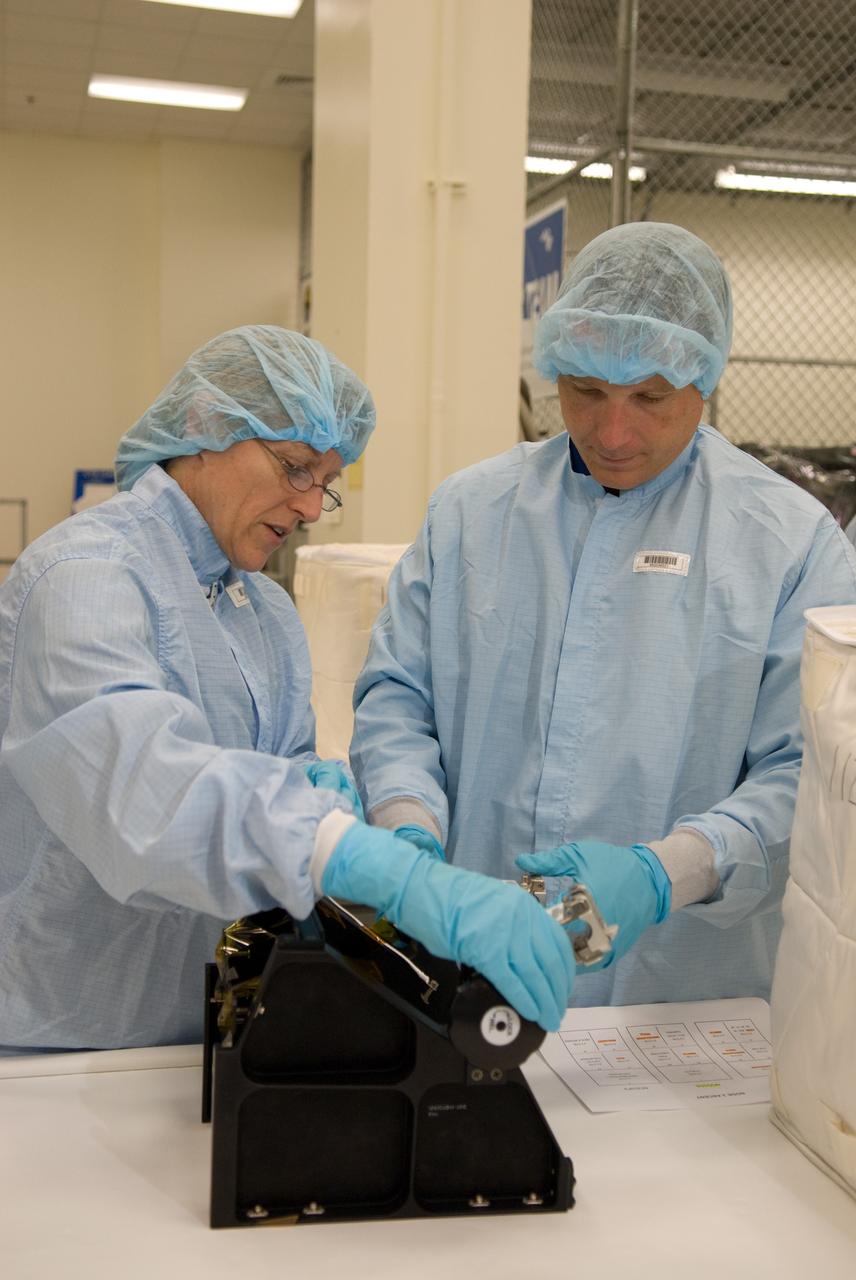
CAPE CANAVERAL, Fla. – In the Space Station Processing Facility at NASA's Kennedy Space Center in Florida, STS-130 Mission Specialist Kathryn "Kay" Hire, at left, and Pilot Terry Virts Jr. participate in a bench review, standard familiarization training on the hardware and equipment that will fly on their mission, during the crew equipment interface test. Tranquility, the payload for the STS-130 mission, is a pressurized module that will provide room for many of the International Space Station's life support systems. The module was built for the European Space Agency by Thales Alenia Space in Turin, Italy. The cupola, a unique work station with six windows on its sides and one on top, is attached to the end of Tranquility. It resembles a circular bay window and will provide a vastly improved view of the station's exterior. Just under 10 feet in diameter, the module will accommodate two crew members and portable workstations that can control station and robotic activities. The multi-directional view will allow the crew to monitor spacewalks and docking operations, as well as provide a spectacular view of Earth and other celestial objects. Endeavour is targeted to launch Feb. 4, 2010. Photo credit: NASA/Kim Shiflett
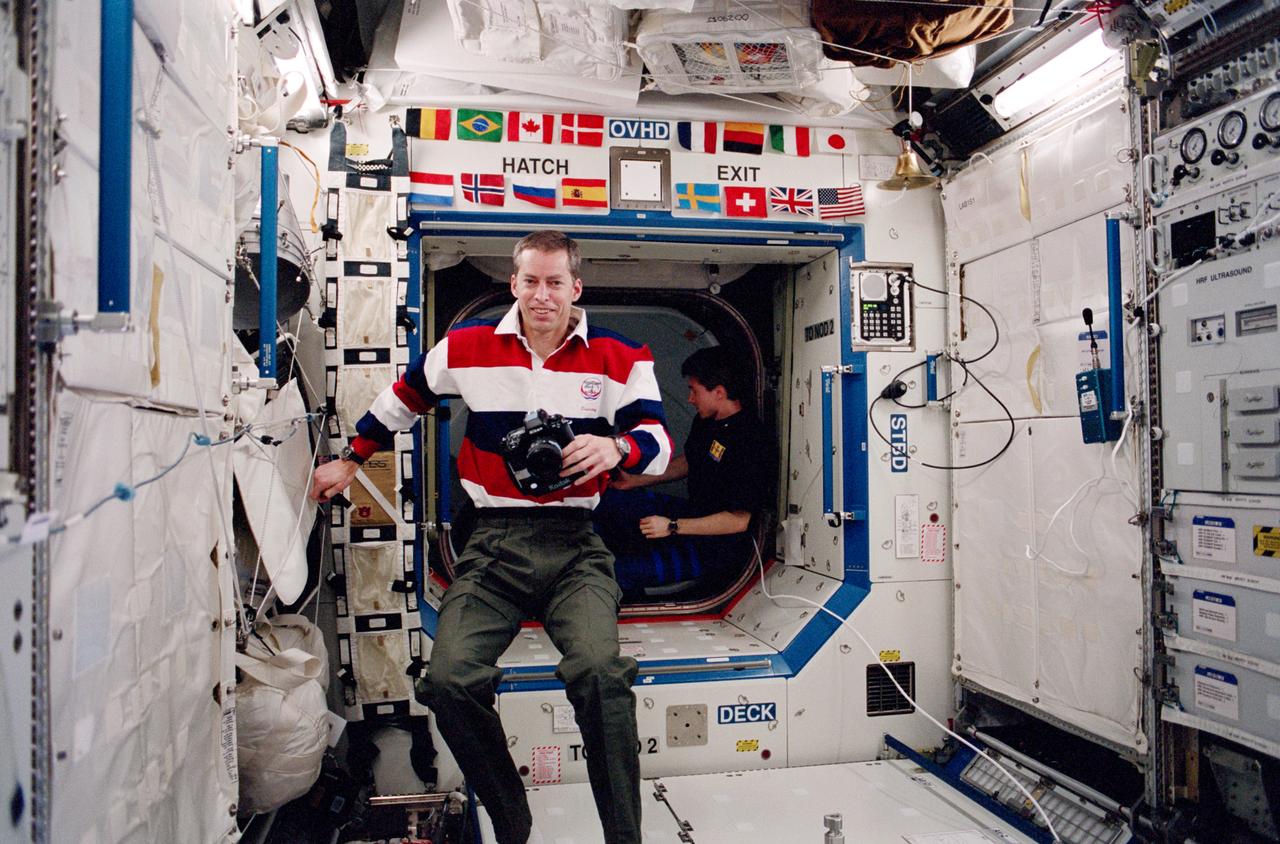
In this Space Shuttle STS-102 mission image, the Payload Equipment Restraint System H-Strap is shown at the left side of the U.S. Laboratory hatch and behind Astronaut James D. Weatherbee, mission specialist. PERS is an integrated modular system of components designed to assist the crew of the International Space Station (ISS) in restraining and carrying necessary payload equipment and tools in a microgravity environment. The Operations Development Group, Flight Projects Directorate at the Marshall Space Flight Center (MSFC), while providing operation support to the ISS Materials Science Research Facility (MSRF), recognized the need for an on-orbit restraint system to facilitate control of lose objects, payloads, and tools. The PERS is the offspring of that need and it helps the ISS crew manage tools and rack components that would otherwise float away in the near-zero gravity environment aboard the Space Station. The system combines Kevlar straps, mesh pockets, Velcro and a variety of cornecting devices into a portable, adjustable system. The system includes the Single Strap, the H-Strap, the Belly Pack, the Laptop Restraint Belt, and the Tool Page Case. The Single Strap and the H-Strap were flown on this mission. The PERS concept was developed by industrial design students at Auburn University and the MSFC Flight Projects Directorate.
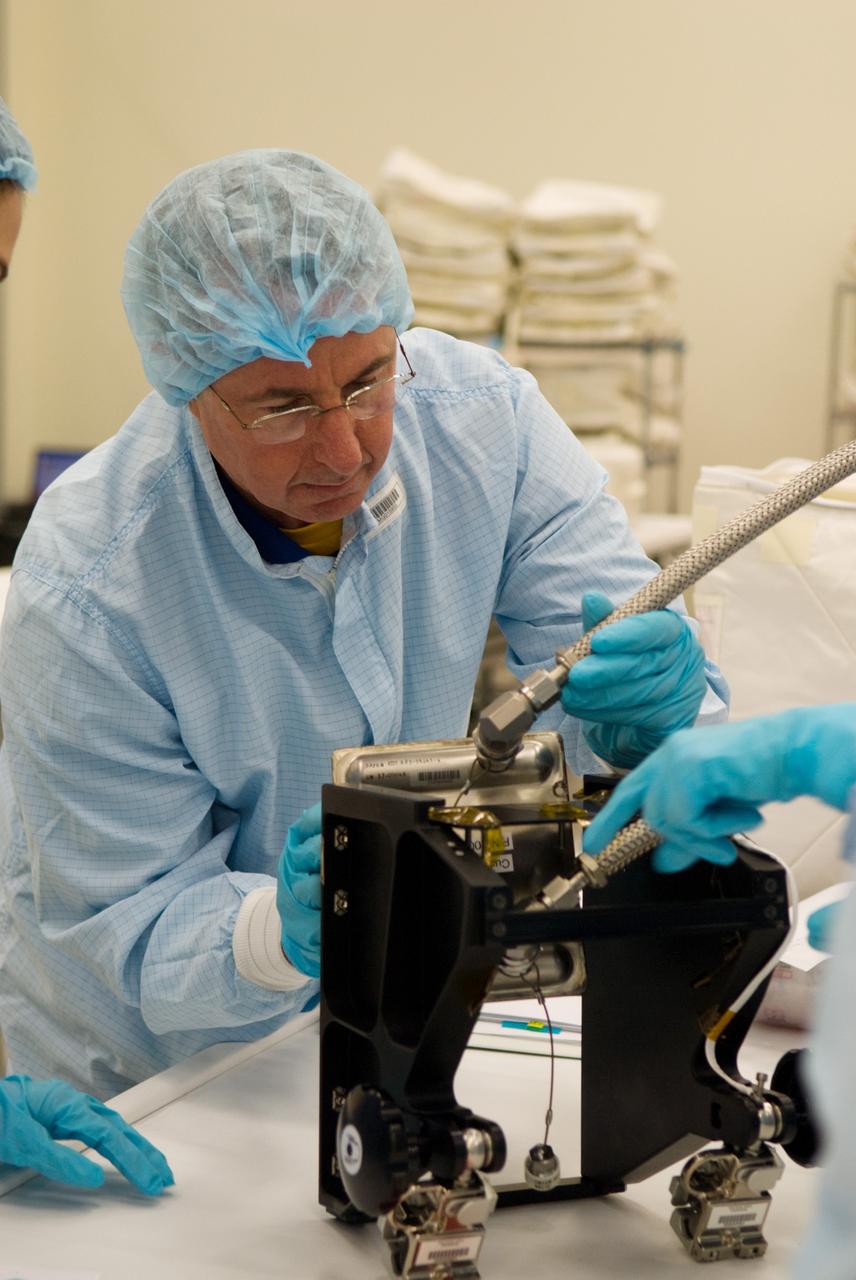
CAPE CANAVERAL, Fla. – In the Space Station Processing Facility at NASA's Kennedy Space Center in Florida, STS-130 Mission Specialist Stephen Robinson participates in a bench review, standard familiarization training on the hardware and equipment that will fly on his mission, during the crew equipment interface test. Tranquility, the payload for the STS-130 mission, is a pressurized module that will provide room for many of the International Space Station's life support systems. The module was built for the European Space Agency by Thales Alenia Space in Turin, Italy. The cupola, a unique work station with six windows on its sides and one on top, is attached to the end of Tranquility. It resembles a circular bay window and will provide a vastly improved view of the station's exterior. Just under 10 feet in diameter, the module will accommodate two crew members and portable workstations that can control station and robotic activities. The multi-directional view will allow the crew to monitor spacewalks and docking operations, as well as provide a spectacular view of Earth and other celestial objects. Endeavour is targeted to launch Feb. 4, 2010. Photo credit: NASA/Kim Shiflett
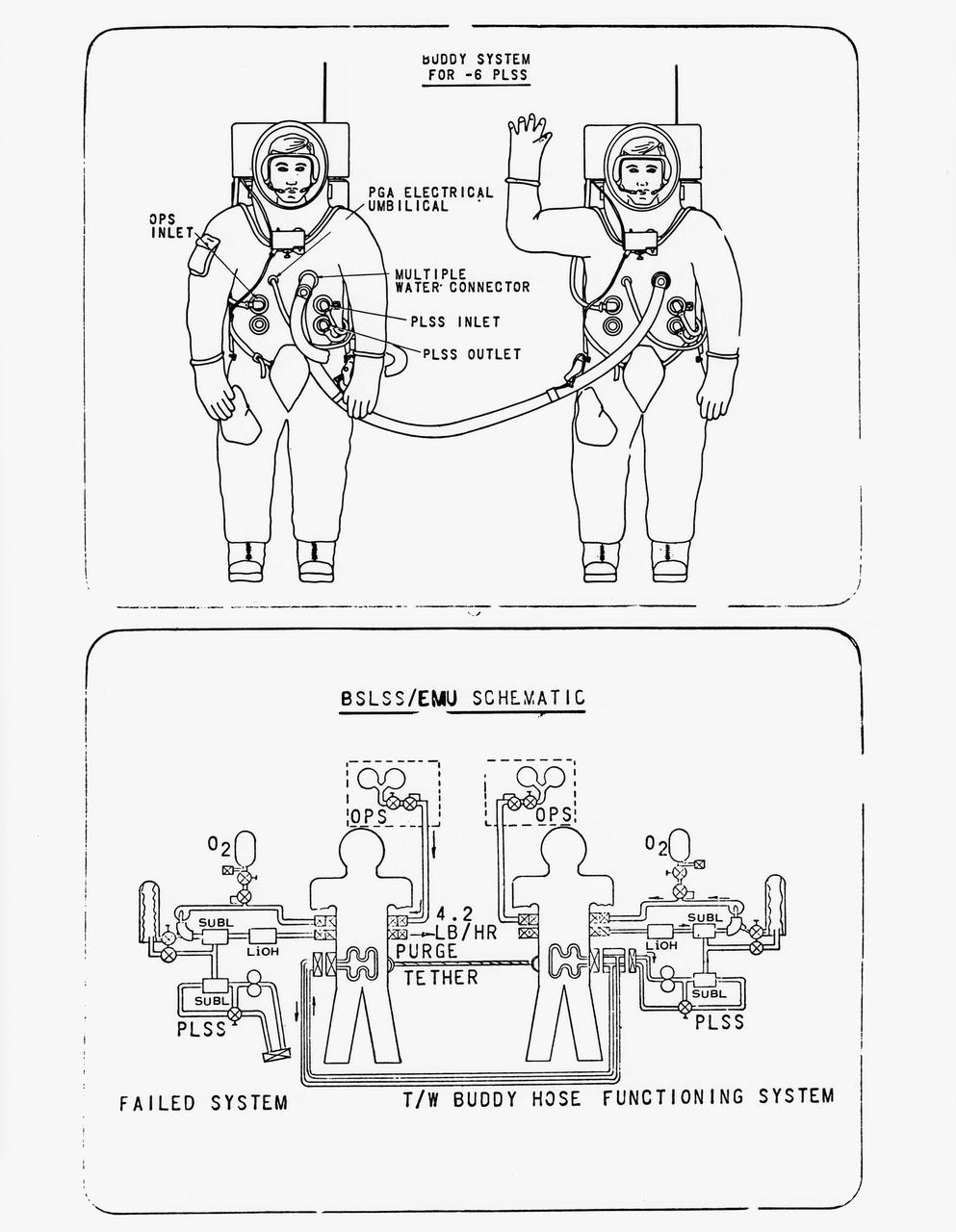
S70-56965 (December 1970) --- Drawing of the newly developed Buddy Secondary Life Support System (BSLSS). The life-sustaining system will be provided for the first time on the Apollo 14 lunar landing mission. The two flexible hoses, to be used on the second Apollo 14 extravehicular activity (EVA), will be among the paraphernalia on the Modular Equipment Transporter (MET) or two-wheeled workshop, and readily accessible in an emergency. During EVAs the Portable Life Support System (PLSS) supplies the astronaut with breathing and suit-pressurizing oxygen and water flow for the liquid-cooling garment -- a suit of knitted long underwear with thin tubing woven in the torso and limbs. The tubes carry water from a reservoir in the PLSS, and the circulating water serves to carry the astronaut's metabolic heat to a heat exchanger in the PLSS. Before the BSLSS was devised, the emergency tank was required to furnish not only suit pressure and breathing oxygen, but also cooling through a high oxygen flow rate. The BSLSS, by sharing the water supply between the two crewmen, stretches the time of the emergency oxygen from about 40 minutes to 60 to 75 minutes.
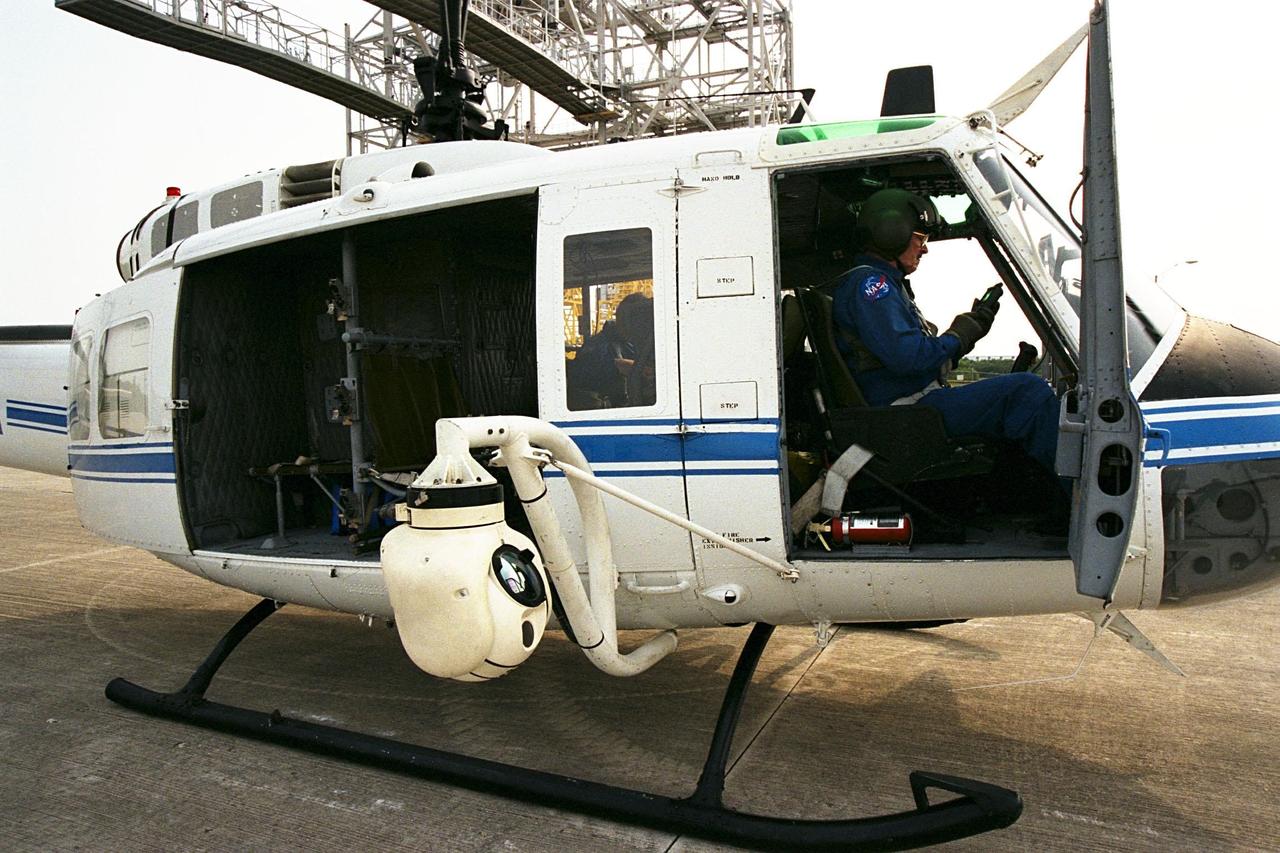
KENNEDY SPACE CENTER, FLA. -- A beach ball-sized infrared camera, part of the Forward Looking Infrared Radar (FLIR), has been mounted on the right siderail of NASA's Huey UH-1 helicopter. A KSC pilot prepares to fly the helicopter, which has also been outfitted with a portable global positioning satellite (GPS) system, to support Florida's Division of Forestry as they fight the brush fires which have been plaguing the state as a result of extremely dry conditions and lightning storms. The FLIR also includes a real-time television monitor and recorder installed inside the helicopter. While the FLIR collects temperature data and images, the GPS system provides the exact coordinates of the fires being observed and transmits the data to the firefighters on the ground. The Kennedy Space Center (KSC) security team routinely uses the FLIR equipment prior to Shuttle launch and landing activities to ensure that the area surrounding the launch pad and runway are clear of unauthorized personnel. KSC's Base Operations Contractor, EG&G Florida, operates the NASA-owned helicopter
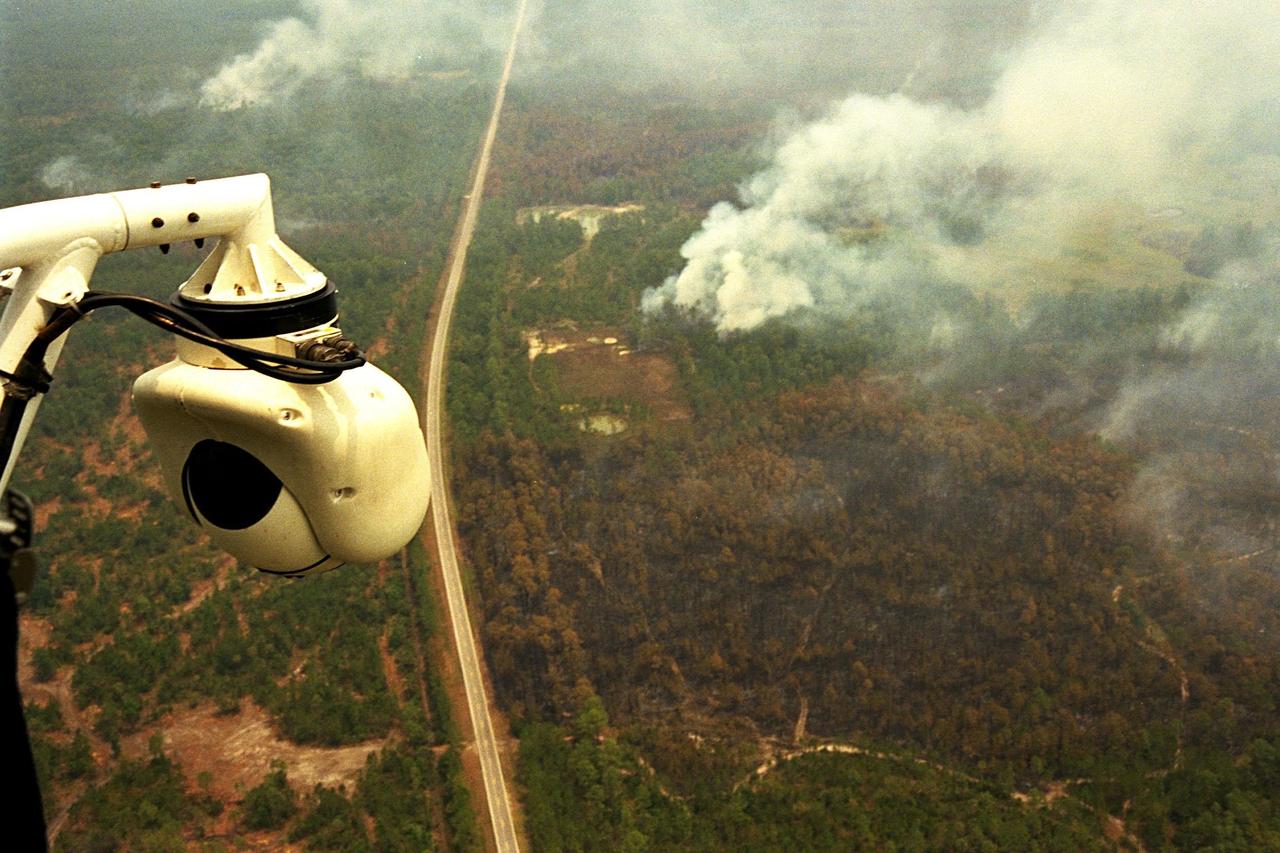
KENNEDY SPACE CENTER, FLA. -- A beach ball-sized infrared camera, part of the Forward Looking Infrared Radar (FLIR), has been mounted on the right siderail of NASA's Huey UH-1 helicopter and is being used to search for fires in Volusia County, Florida. The helicopter has also been outfitted with a portable global positioning satellite (GPS) system to support Florida's Division of Forestry as they fight the brush fires which have been plaguing the state as a result of extremely dry conditions and lightning storms. The FLIR also includes a real-time television monitor and recorder installed inside the helicopter. While the FLIR collects temperature data and images, the GPS system provides the exact coordinates of the fires being observed and transmits the data to the firefighters on the ground. The Kennedy Space Center (KSC) security team routinely uses the FLIR equipment prior to Shuttle launch and landing activities to ensure that the area surrounding the launch pad and runway are clear of unauthorized personnel. KSC's Base Operations Contractor, EG&G Florida, operates the NASA-owned helicopter
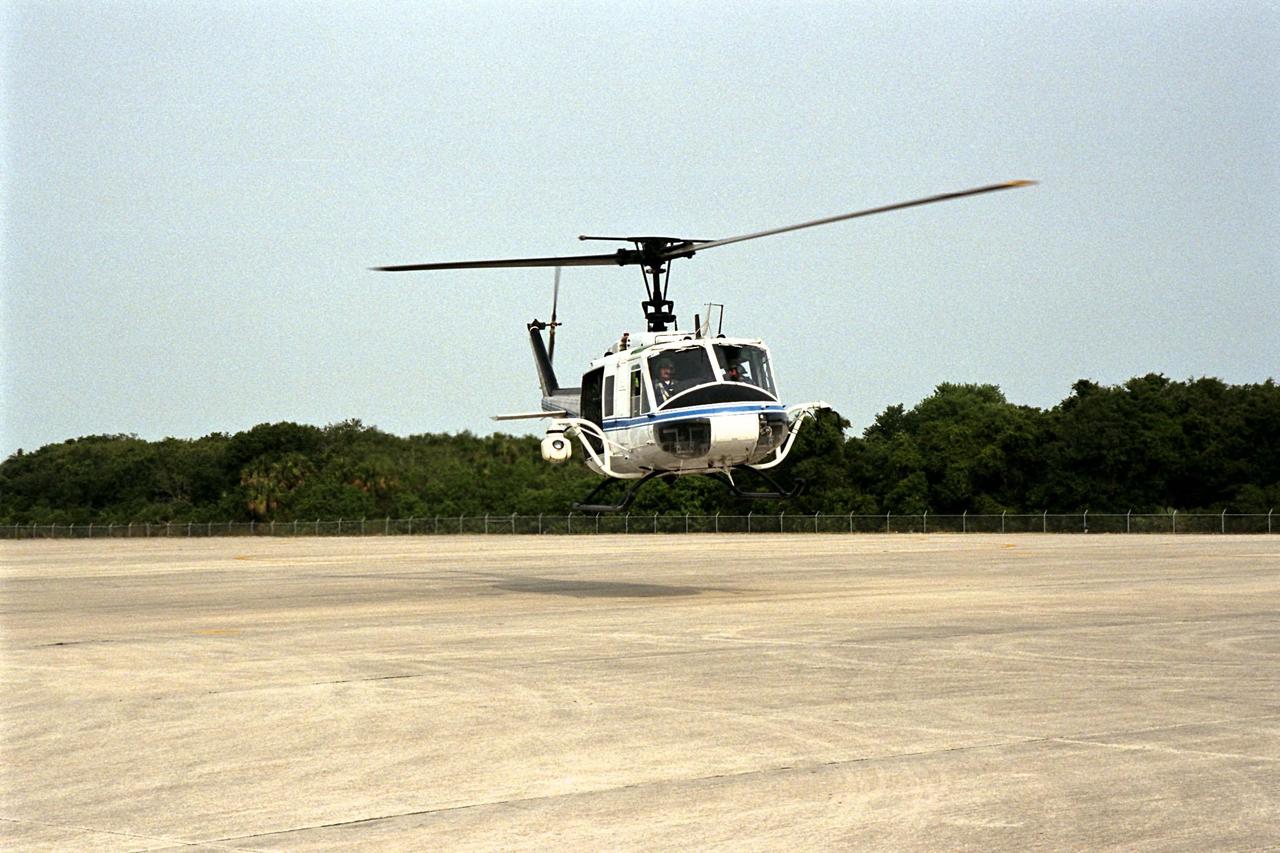
KENNEDY SPACE CENTER, FLA. -- NASA's Huey UH-1 helicopter lands at the Shuttle Landing Facility to pick up Kennedy Space Center (KSC) Security personnel who operate the Forward Looking Infrared Radar (FLIR) installed on board. The helicopter has also been outfitted with a portable global positioning satellite (GPS) system to support Florida's Division of Forestry as they fight the brush fires which have been plaguing the state as a result of extremely dry conditions and lightning storms. The FLIR includes a beach ball-sized infrared camera that is mounted on the helicopter's right siderail and a real-time television monitor and recorder installed inside. While the FLIR collects temperature data and images, the GPS system provides the exact coordinates of the fires being observed and transmits the data to the firefighters on the ground. KSC's security team routinely uses the FLIR equipment prior to Shuttle launch and landing activities to ensure that the area surrounding the launch pad and runway are clear of unauthorized personnel. KSC's Base Operations Contractor, EG&G Florida, operates the NASA-owned helicopter
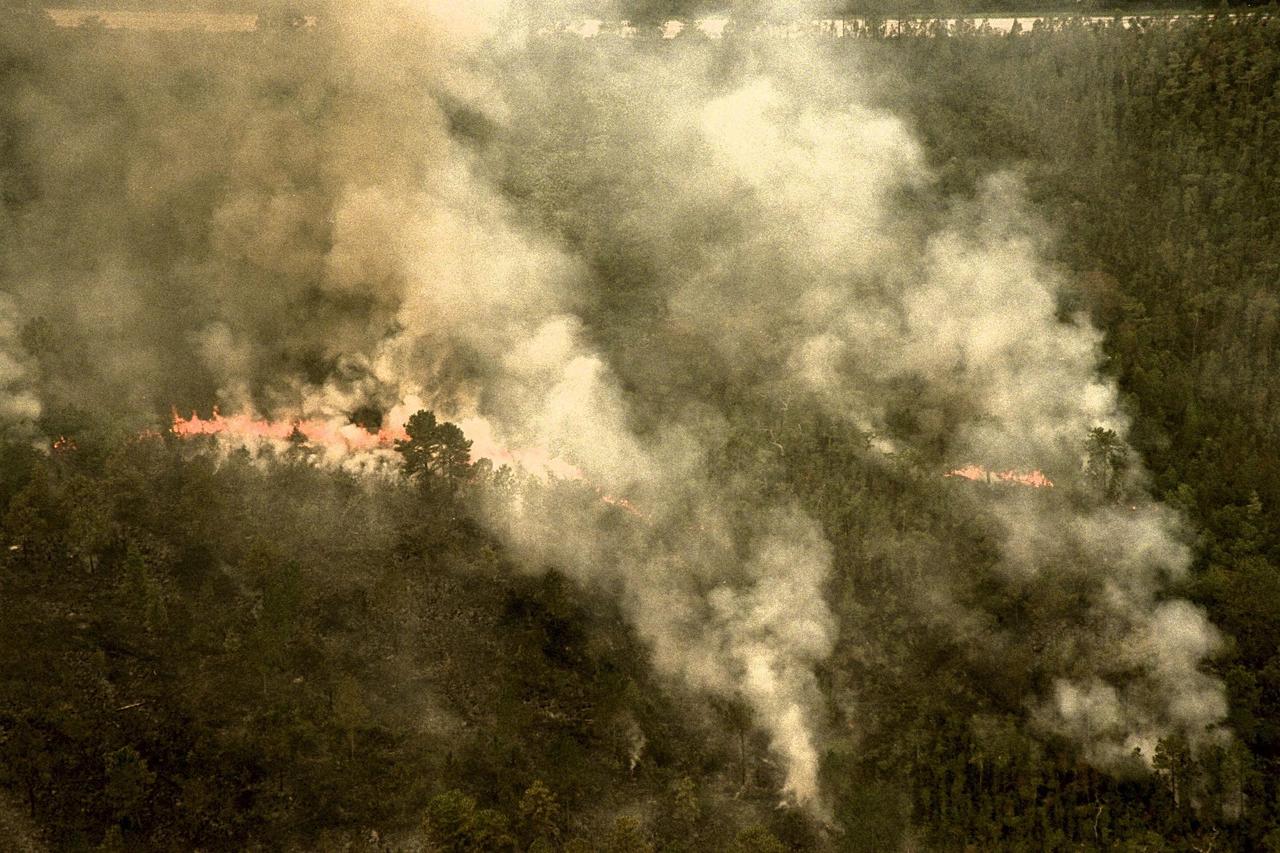
KENNEDY SPACE CENTER, FLA. -- A forest fire burning in Volusia County, Florida, is clearly visible from NASA's Huey UH-1 helicopter. The helicopter has been outfitted with a Forward Looking Infrared Radar (FLIR) and a portable global positioning satellite (GPS) system to support Florida's Division of Forestry as they fight the brush fires which have been plaguing the state as a result of extremely dry conditions and lightning storms. The FLIR includes a beach ball-sized infrared camera that is mounted on the helicopter's right siderail and a real-time television monitor and recorder installed inside. While the FLIR collects temperature data and images, the GPS system provides the exact coordinates of the fires being observed and transmits the data to the firefighters on the ground. The Kennedy Space Center (KSC) security team routinely uses the FLIR equipment prior to Shuttle launch and landing activities to ensure that the area surrounding the launch pad and runway are clear of unauthorized personnel. KSC's Base Operations Contractor, EG&G Florida, operates the NASA-owned helicopter

During a Crew Equipment Interface Test (CEIT), members of the STS-103 crew check out a portable foot restraint on the Flight Support System that will be used on the mission, repairing the Hubble Space Telescope. The seven-member crew comprises Commander Curtis L. Brown Jr., Pilot Scott J. Kelly, and Mission Specialists Steven L. Smith, C. Michael Foale (Ph.D.), John M. Grunsfeld (Ph.D), Claude Nicollier of Switzerland, and Jean-François Clervoy of France. Nicollier and Clervoy are with the European Space Agency. Mission STS-103 is a "call-up" due to the need to replace portions of the pointing system, the gyros, which have begun to fail on the Hubble Space Telescope. Although Hubble is operating normally and conducting its scientific observations, only three of its six gyroscopes are working properly. The gyroscopes allow the telescope to point at stars, galaxies and planets. The STS-103 crew will not only replace gyroscopes, it will also replace a Fine Guidance Sensor and an older computer with a new enhanced model, an older data tape recorder with a solid-state digital recorder, a failed spare transmitter with a new one, and degraded insulation on the telescope with new thermal insulation. The crew will also install a Battery Voltage/Temperature Improvement Kit to protect the spacecraft batteries from overcharging and overheating when the telescope goes into a safe mode. The scheduled launch date in October is under review
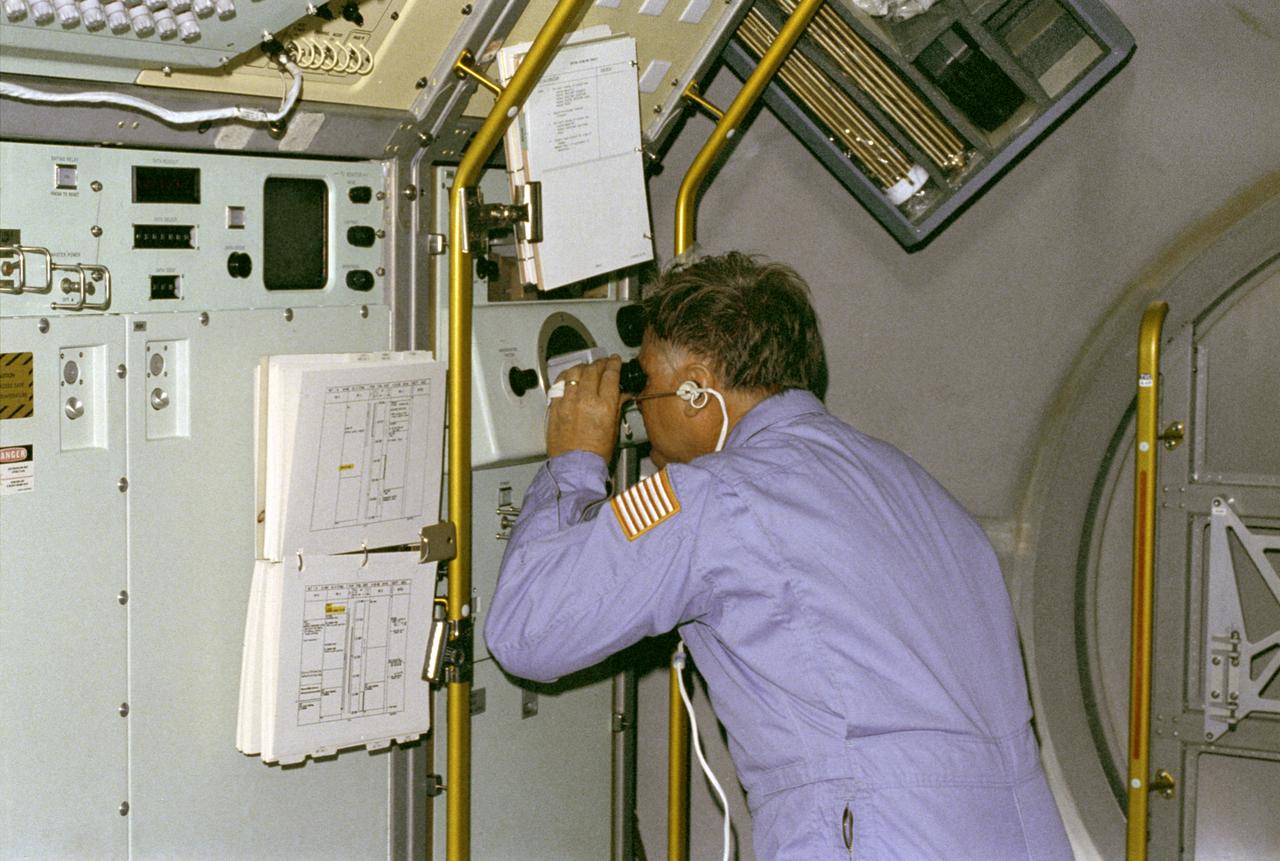
The primary purpose of the Spacelab-3 mission was to conduct materials science experiments in a stable low-gravity environment. In addition, the crew performed research in life sciences, fluid mechanics, atmospheric science, and astronomy. Spacelab-3 was equipped with several new minilabs, special facilities that would be used repeatedly on future flights. Two elaborate crystal growth furnaces, a life support and housing facility for small animals, and two types of apparatus for the study of fluids were evaluated on their inaugural flight. In this photograph, astronaut Don Lind observes the mercuric iodide growth experiment through a microscope at the vapor crystal growth furnace. The goals of this investigation were to grow near-perfect single crystals of mercuric iodide and to gain improved understanding of crystal growth by a vapor process. Mercuric iodide crystals have practical use as sensitive x-ray and gamma-ray detectors, and in portable detector devices for nuclear power plant monitoring, natural resource prospecting, biomedical applications in diagnosis and therapy, and in astronomical instruments. Managed by the Marshall Space Flight Center, Spacelab-3 (STS-51B) was launched aboard the Space Shuttle Orbiter Challenger on April 29, 1985.
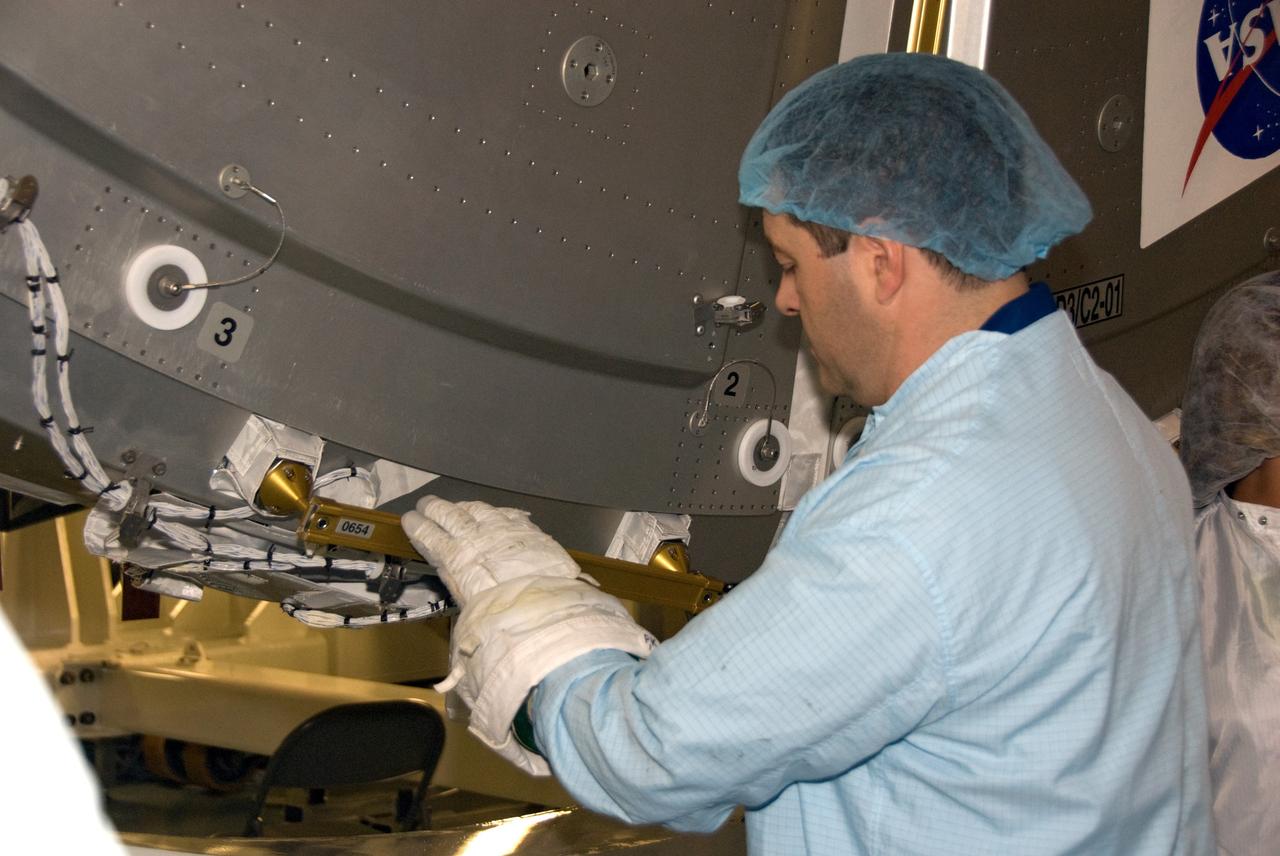
CAPE CANAVERAL, Fla. – In the Space Station Processing Facility at NASA's Kennedy Space Center in Florida, STS-130 Mission Specialist Nicolas Patrick becomes familiar with the working of the Tranquility node during the crew equipment interface test for his mission. The cupola, a unique work station with six windows on its sides and one on top, is attached to one end of Tranquility. Tranquility, the payload for the STS-130 mission, is a pressurized module that will provide room for many of the International Space Station's life support systems. The module was built for the European Space Agency by Thales Alenia Space in Turin, Italy. The cupola resembles a circular bay window that will provide a vastly improved view of the station's exterior. Just under 10 feet in diameter, the module will accommodate two crew members and portable workstations that can control station and robotic activities. The multi-directional view will allow the crew to monitor spacewalks and docking operations, as well as provide a spectacular view of Earth and other celestial objects. Endeavour is targeted to launch Feb. 4, 2010. Photo credit: NASA/Kim Shiflett
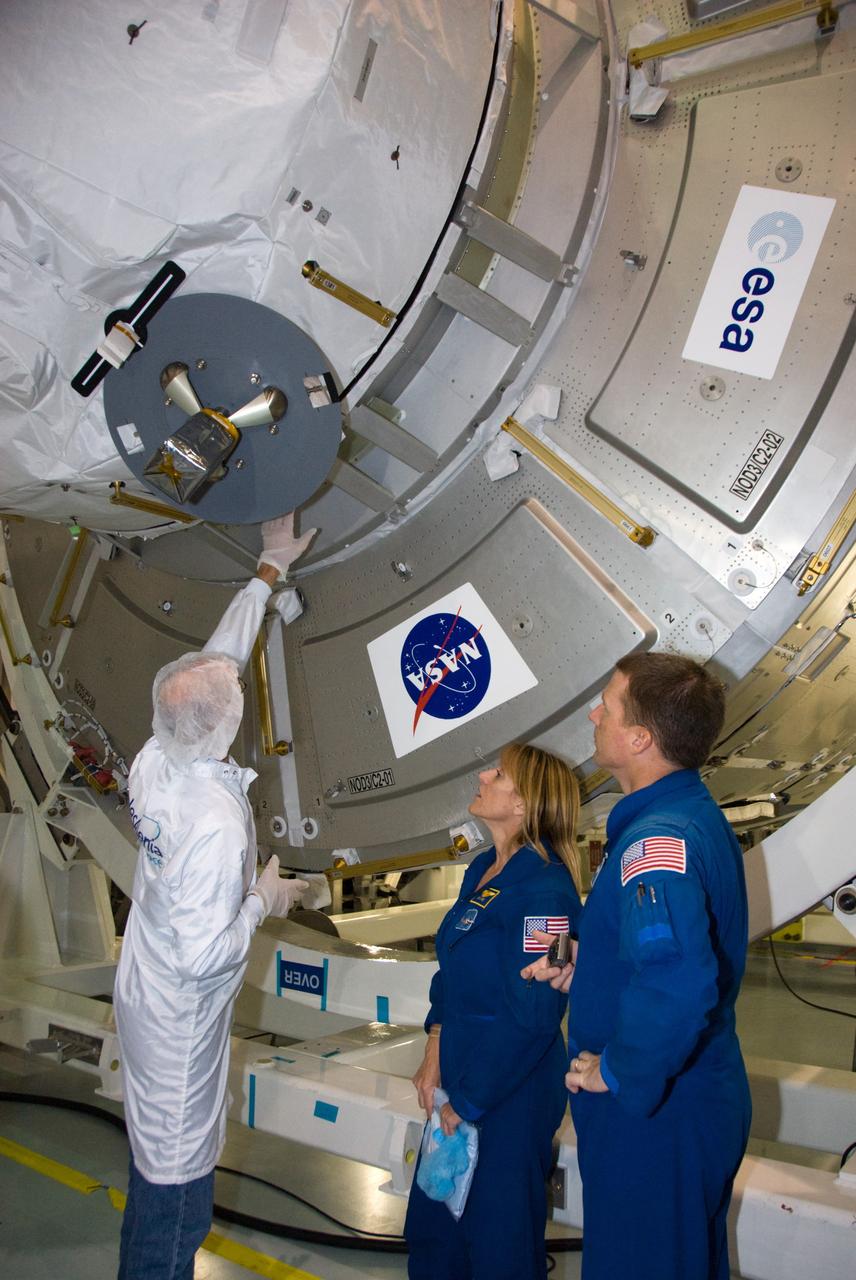
CAPE CANAVERAL, Fla. – In the Space Station Processing Facility at NASA's Kennedy Space Center in Florida, STS-130 Mission Specialist Kathryn "Kay" Hire, middle, and Pilot Terry Virts Jr., right, receive familiarization training on the cupola from a flight crew representative from Thales Alenia Space during their crew equipment interface test. The cupola, a unique work station with six windows on its sides and one on top, is attached to one end of the Tranquility node. Tranquility, the payload for the STS-130 mission, is a pressurized module that will provide room for many of the International Space Station's life support systems. The module was built for the European Space Agency by Thales Alenia Space in Turin, Italy. The cupola resembles a circular bay window that will provide a vastly improved view of the station's exterior. Just under 10 feet in diameter, the module will accommodate two crew members and portable workstations that can control station and robotic activities. The multi-directional view will allow the crew to monitor spacewalks and docking operations, as well as provide a spectacular view of Earth and other celestial objects. Endeavour is targeted to launch Feb. 4, 2010. Photo credit: NASA/Kim Shiflett
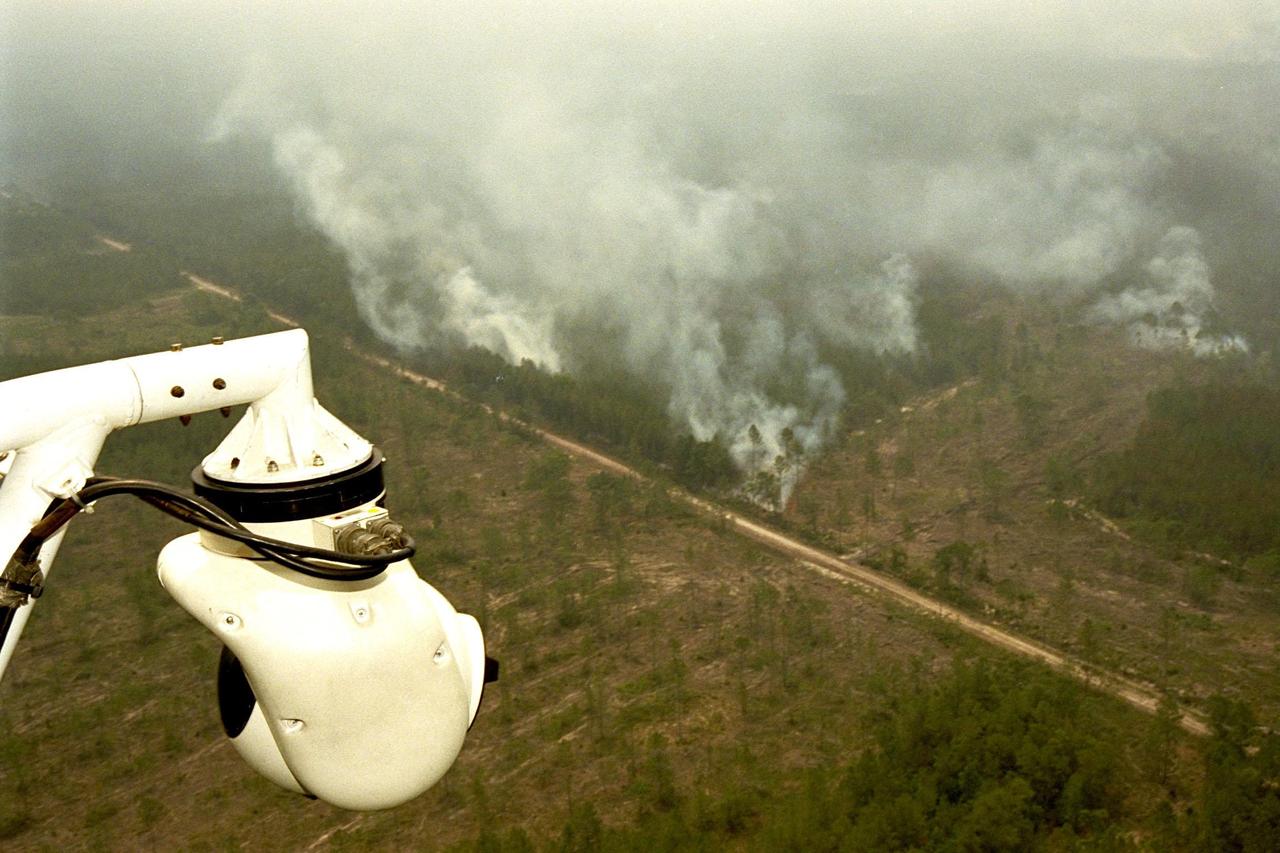
KENNEDY SPACE CENTER, FLA. -- A beach ball-sized infrared camera, part of the Forward Looking Infrared Radar (FLIR), has been mounted on the right siderail of NASA's Huey UH-1 helicopter and is being used to scan a large area of Volusia County, Florida, where a fire burns. The helicopter has also been outfitted with a portable global positioning satellite (GPS) system to support Florida's Division of Forestry as they fight the brush fires which have been plaguing the state as a result of extremely dry conditions and lightning storms. The FLIR also includes a real-time television monitor and recorder installed inside the helicopter. While the FLIR collects temperature data and images, the GPS system provides the exact coordinates of the fires being observed and transmits the data to the firefighters on the ground. The Kennedy Space Center (KSC) security team routinely uses the FLIR equipment prior to Shuttle launch and landing activities to ensure that the area surrounding the launch pad and runway are clear of unauthorized personnel. KSC's Base Operations Contractor, EG&G Florida, operates the NASA-owned helicopter
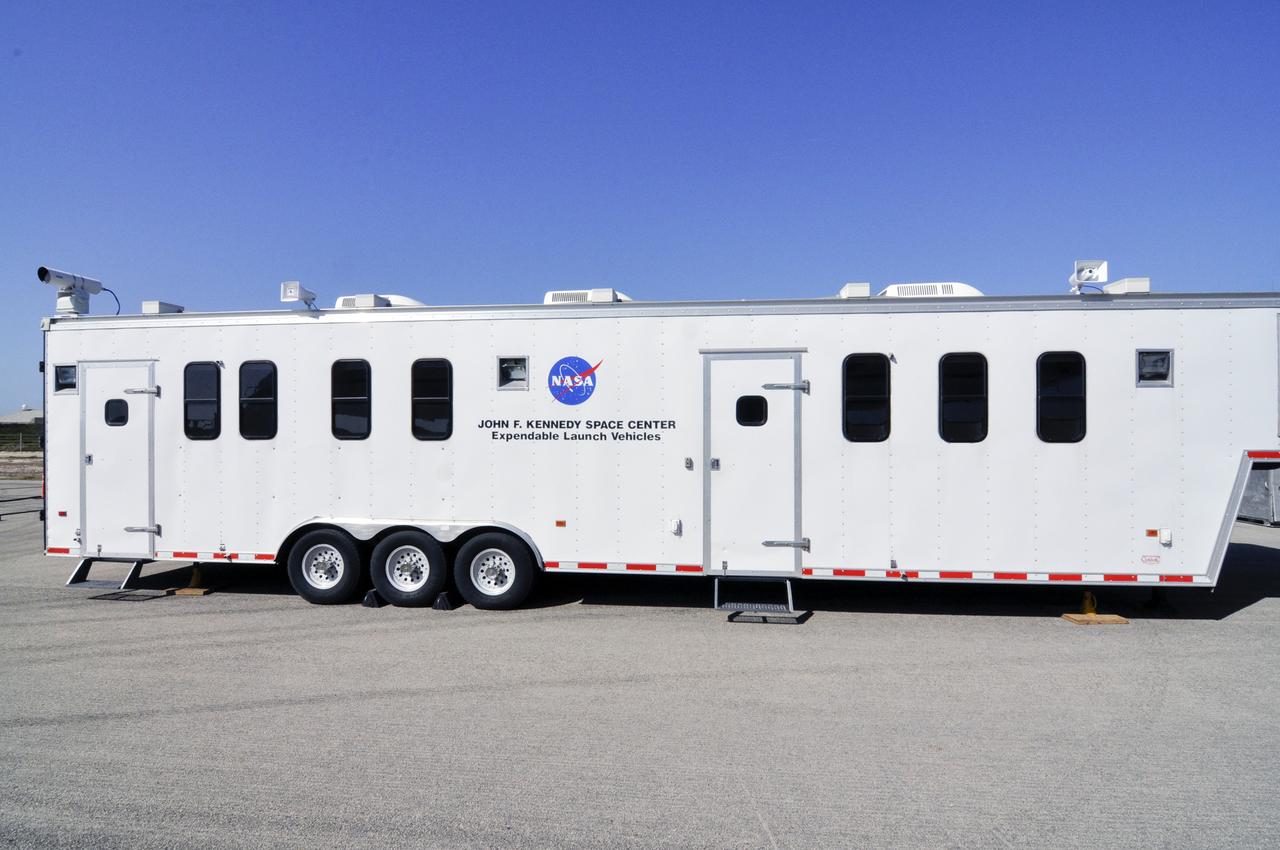
VANDENBERG ABF, Calif. – One of the portable control trailers is set up at Vandenberg Air Force Base for the upcoming launch of an Orbital Sciences Pegasus XL rocket lifting NASA's IRIS solar observatory into orbit. The aircraft will carry the winged rocket to an altitude of 39,000 feet before releasing the Pegasus so its own motors can ignite to send the IRIS into space. The L-1011 is a modified airliner equipped to hold the Pegasus under its body safely. IRIS, short for Interface Region Imaging Spectrograph, is being prepared for launch from Vandenberg June 26. IRIS will open a new window of discovery by tracing the flow of energy and plasma through the chromospheres and transition region into the sun’s corona using spectrometry and imaging. IRIS fills a crucial gap in our ability to advance studies of the sun-to-Earth connection by tracing the flow of energy and plasma through the foundation of the corona and the region around the sun known as the heliosphere. Photo credit: VAFB/Randy Beaudoin
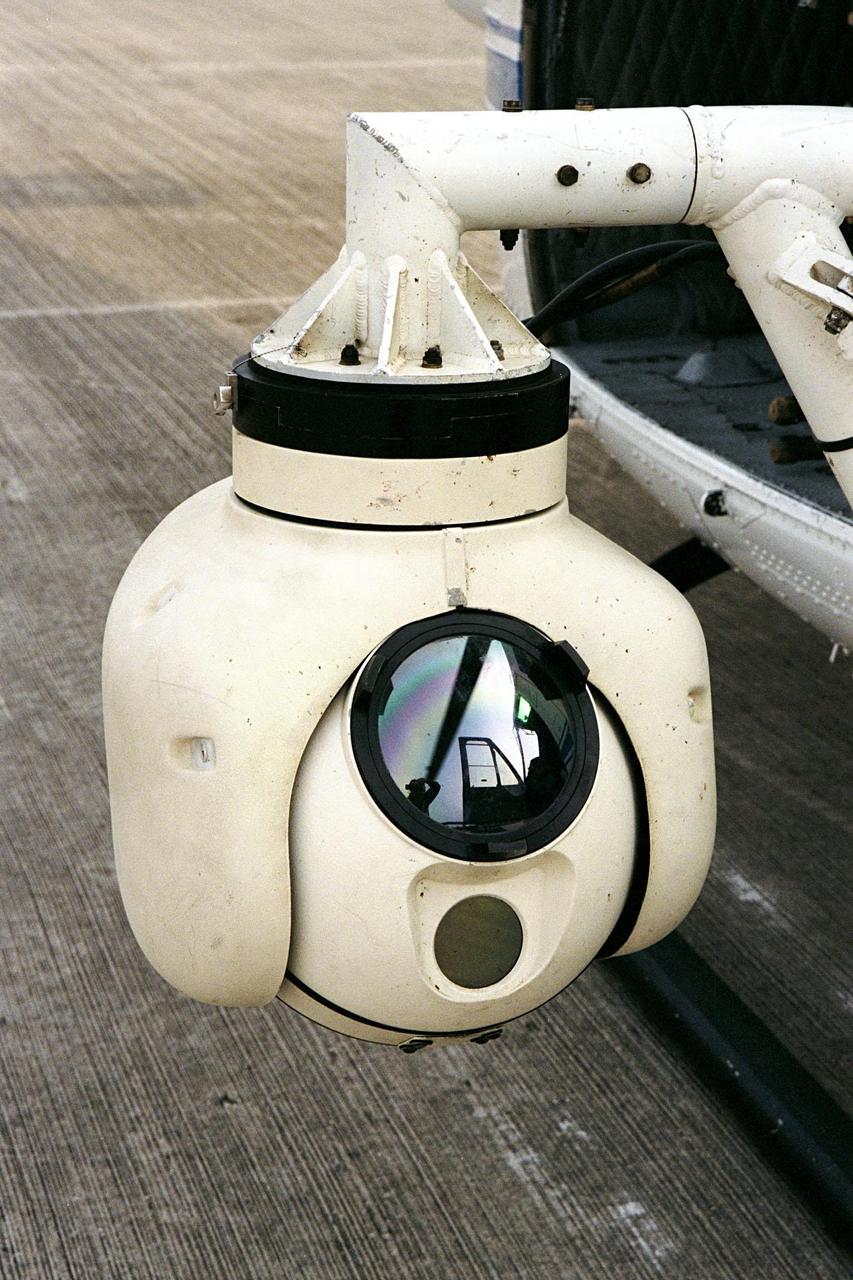
KENNEDY SPACE CENTER, FLA. -- A beach ball-sized infrared camera, part of the Forward Looking Infrared Radar (FLIR), has been mounted on the right siderail of NASA's Huey UH-1 helicopter. The helicopter has also been outfitted with a portable global positioning satellite (GPS) system to support Florida's Division of Forestry as they fight the brush fires which have been plaguing the state as a result of extremely dry conditions and lightning storms. The FLIR also includes a real-time television monitor and recorder installed inside the helicopter. While the FLIR collects temperature data and images, the GPS system provides the exact coordinates of the fires being observed and transmits the data to the firefighters on the ground. The Kennedy Space Center (KSC) security team routinely uses the FLIR equipment prior to Shuttle launch and landing activities to ensure that the area surrounding the launch pad and runway are clear of unauthorized personnel. KSC's Base Operations Contractor, EG&G Florida, operates the NASA-owned helicopter
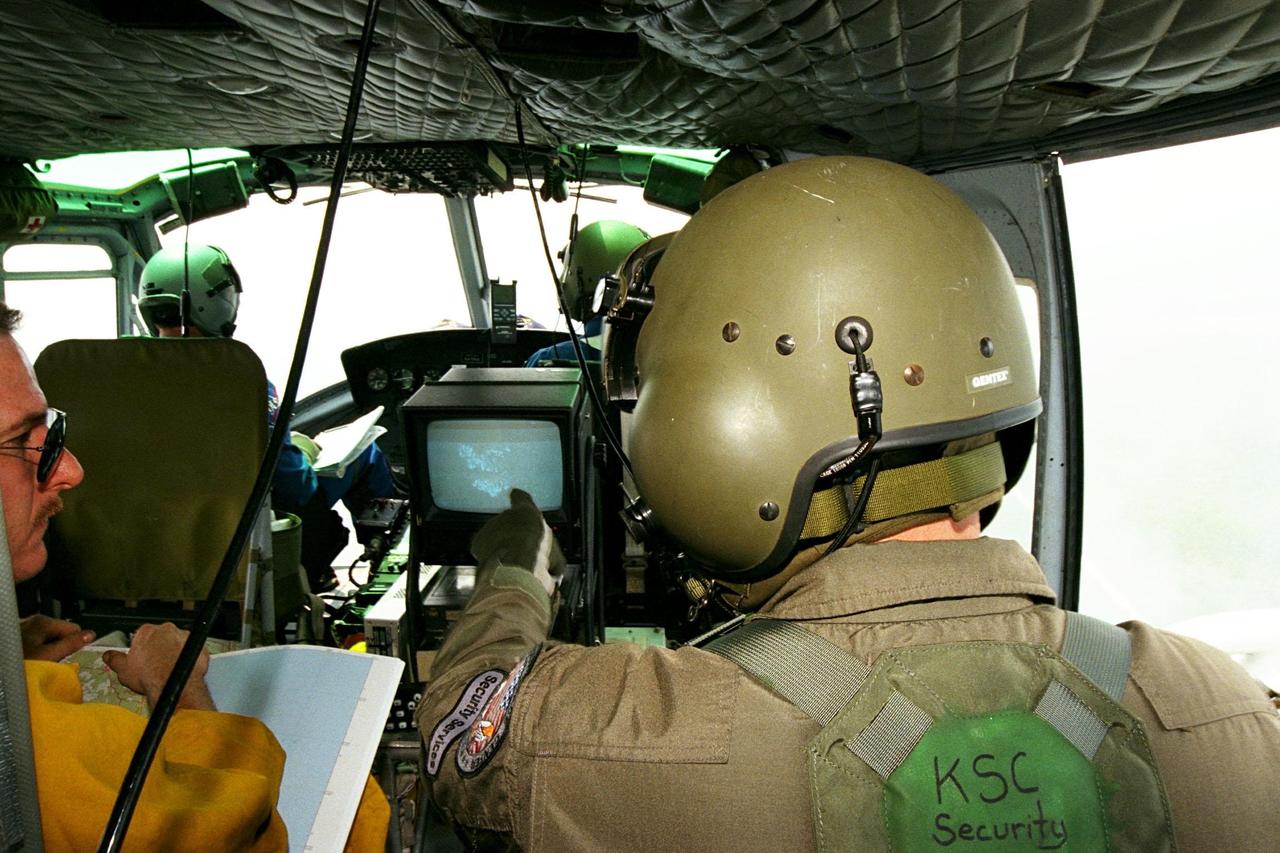
KENNEDY SPACE CENTER, FLA. -- Sgt. Mark Hines, of Kennedy Space Center (KSC) Security, points out a view of a fire on the Forward Looking Infrared Radar (FLIR) video screen to Greg Dunn, of Florida's Division of Forestry, as KSC pilots fly NASA's Huey UH-1 helicopter over fires burning in Volusia County, Florida. The FLIR includes a beach-ball sized infrared camera that is mounted on the helicopter's right siderail and a real-time TV monitor and recorder installed inside. The helicopter has also been outfitted with a portable global positioning satellite (GPS) system to support the Division of Forestry as they fight the brush fires which have been plaguing the state as a result of extremely dry conditions and lightning storms. While the FLIR collects temperature data and images, the GPS system provides the exact coordinates of the fires being observed and transmits the data to the firefighters on the ground. KSC's security team routinely uses the FLIR equipment prior to Shuttle launch and landing activities to ensure that the area surrounding the launch pad and runway are clear of unauthorized personnel. KSC's Base Operations Contractor, EG&G Florida, operates the NASA-owned helicopter.
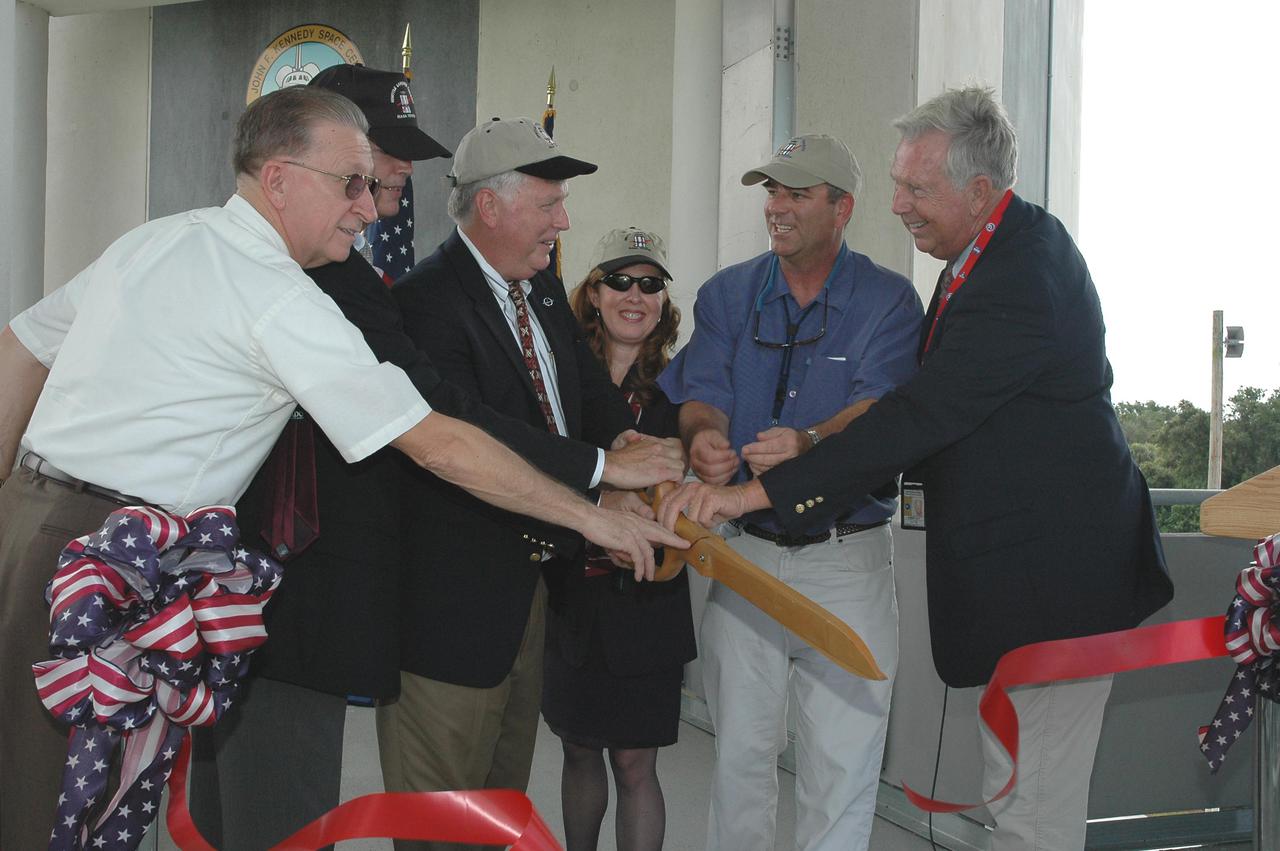
KENNEDY SPACE CENTER, FLA. - At the Shuttle Landing Facility on NASA’s Kennedy Space Center, a ribbon-cutting dedicated the new NASA Air Traffic Control Tower. From left are James H. Jones, Space Gateway Support President William A. Sample, Center Director Jim Kennedy, External Relations Director Lisa Malone, Center Operations Director Scott D. Kerr, and KSC Safety Aviation Officer Albert E. Taff. The structure rises 110 feet over the midpoint of the runway and offers air traffic controllers a magnificent 360-degree view of Kennedy Space Center, Cape Canaveral Air Force Station and north Brevard County. It replaces the small, portable tower installed at the edge of the runway in 1986. The new control tower will manage all landings and departures from the SLF, including air traffic within the Kennedy Space Center-Cape Canaveral restricted airspace. The facility provides a 24-hour weather-observing facility providing official hourly weather observations for the SLF and the Cape Canaveral vicinity, including special observations for all launches and landings. State-of-the-art, weather-observing equipment has been installed for Space Shuttle landings and for serving conventional aircraft landing at the SLF. At this location, weather observers will have a multi-directional view of the weather conditions at the runway and Launch Complex 39.
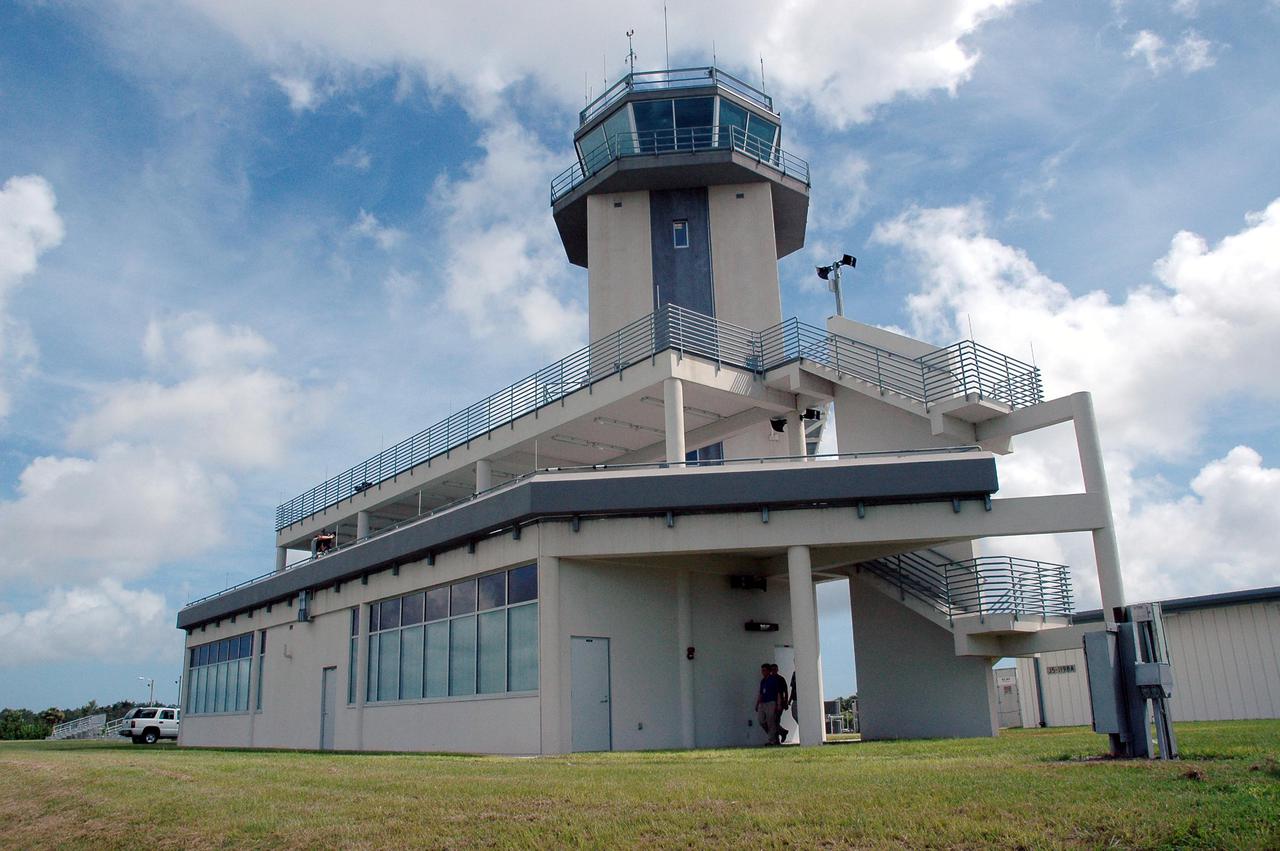
KENNEDY SPACE CENTER, FLA. - At the Shuttle Landing Facility on NASA’s Kennedy Space Center, this new media building features a new Air Traffic Control Tower. The facility was dedicated in a ribbon-cutting ceremony July 8 that included Center Director Jim Kennedy, Space Gateway Support President William A. Sample, External Relations Director Lisa Malone, Center Operations Director Scott D. Kerr, and KSC Safety Aviation Officer Albert E. Taff. The facility was built for the Return to Flight mission STS-114 and the landing of Shuttle Discovery. The structure rises 110 feet over the midpoint of the runway and offers air traffic controllers a magnificent 360-degree view of Kennedy Space Center, Cape Canaveral Air Force Station and north Brevard County. It replaces the small, portable tower installed at the edge of the runway in 1986. The new control tower will manage all landings and departures from the SLF, including air traffic within the Kennedy Space Center-Cape Canaveral restricted airspace. The facility provides a 24-hour weather-observing facility providing official hourly weather observations for the SLF and the Cape Canaveral vicinity, including special observations for all launches and landings. State-of-the-art, weather-observing equipment has been installed for Space Shuttle landings and for serving conventional aircraft landing at the SLF. At this location, weather observers will have a multi-directional view of the weather conditions at the runway and Launch Complex 39.
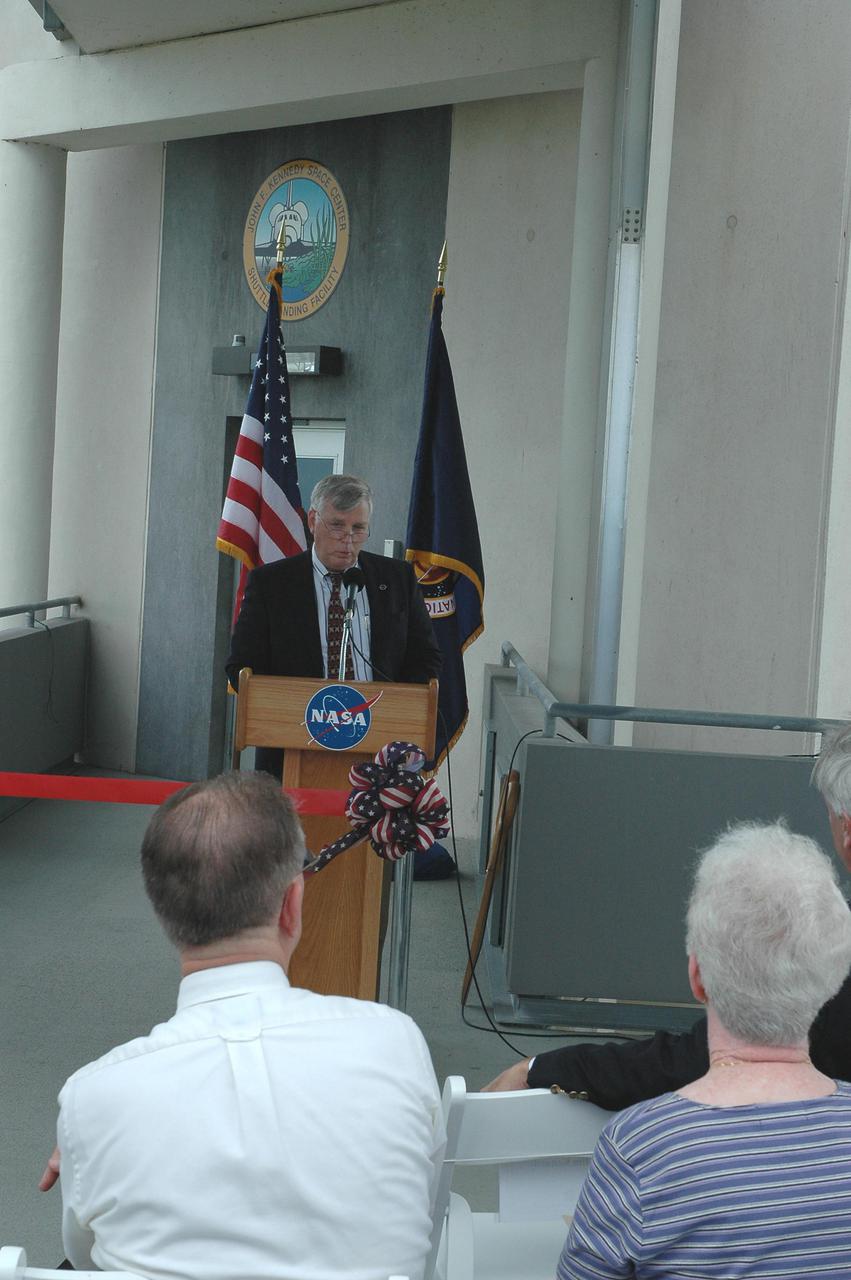
KENNEDY SPACE CENTER, FLA. - At the Shuttle Landing Facility on NASA’s Kennedy Space Center, KSC Director Jim Kennedy talks to attendees at the ribbon-cutting ceremony for the new NASA Air Traffic Control Tower. The dedication took place in the SLF’s new media facilities, which were built for the Return to Flight mission STS-114 and the landing of Shuttle Discovery. The facilities are co-located with the new control tower. The dedication and ribbon cutting were held at the base of the tower and included Center Director Jim Kennedy, Space Gateway Support President William A. Sample, External Relations Director Lisa Malone, Center Operations Director Scott D. Kerr, and KSC Safety Aviation Officer Albert E. Taff. The structure rises 110 feet over the midpoint of the runway and offers air traffic controllers a magnificent 360-degree view of Kennedy Space Center, Cape Canaveral Air Force Station and north Brevard County. It replaces the small, portable tower installed at the edge of the runway in 1986. The new control tower will manage all landings and departures from the SLF, including air traffic within the Kennedy Space Center-Cape Canaveral restricted airspace. The facility provides a 24-hour weather-observing facility providing official hourly weather observations for the SLF and the Cape Canaveral vicinity, including special observations for all launches and landings. State-of-the-art, weather-observing equipment has been installed for Space Shuttle landings and for serving conventional aircraft landing at the SLF. At this location, weather observers will have a multi-directional view of the weather conditions at the runway and Launch Complex 39.