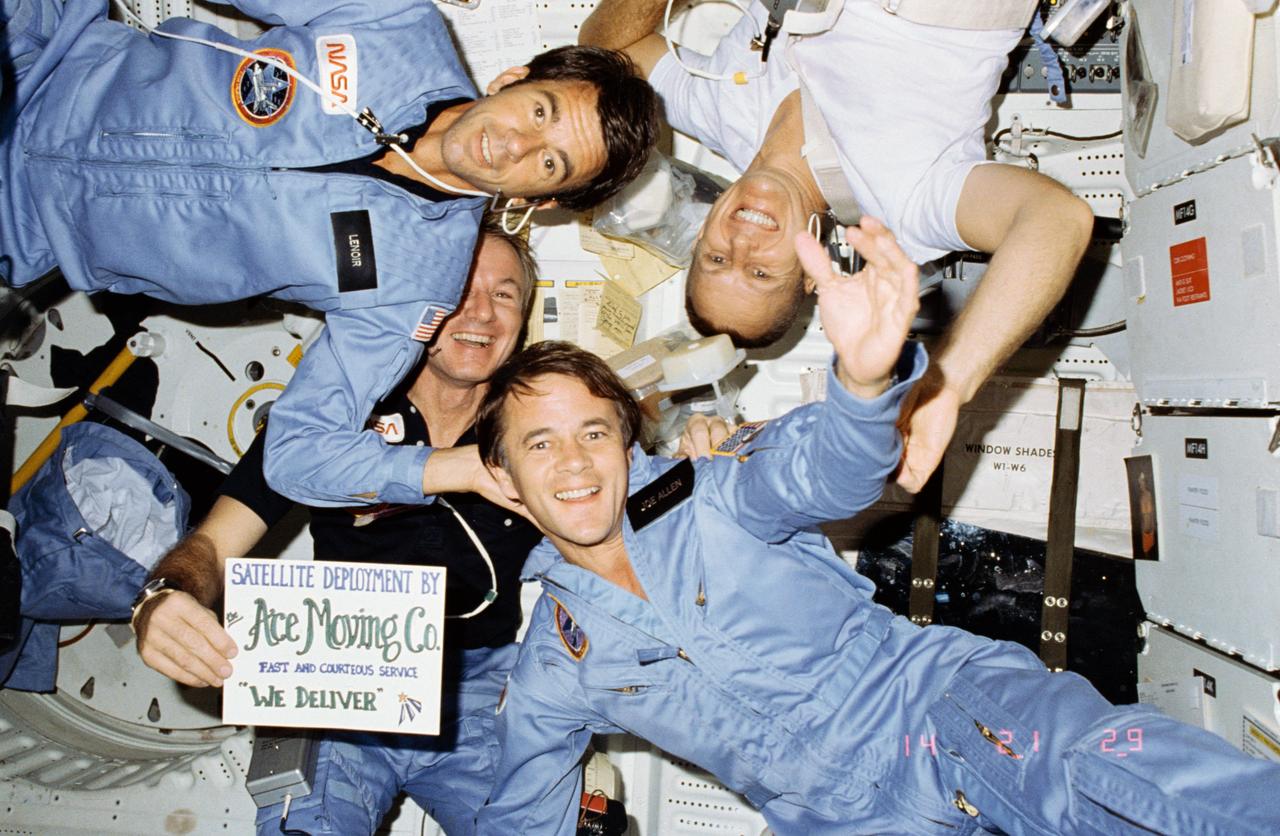
Crew onboard portrait taken on port side middeck shows Commander Brand holding Ace Moving Co sign (partially obscured, near center) and surrounded by Pilot Overmyer (in light t-shirt), Mission Specialist (MS) Allen (center bottom) and MS Lenoir (center top). The sign refers to the successful deployment of two commercial communications satellites on the flight's first two days.
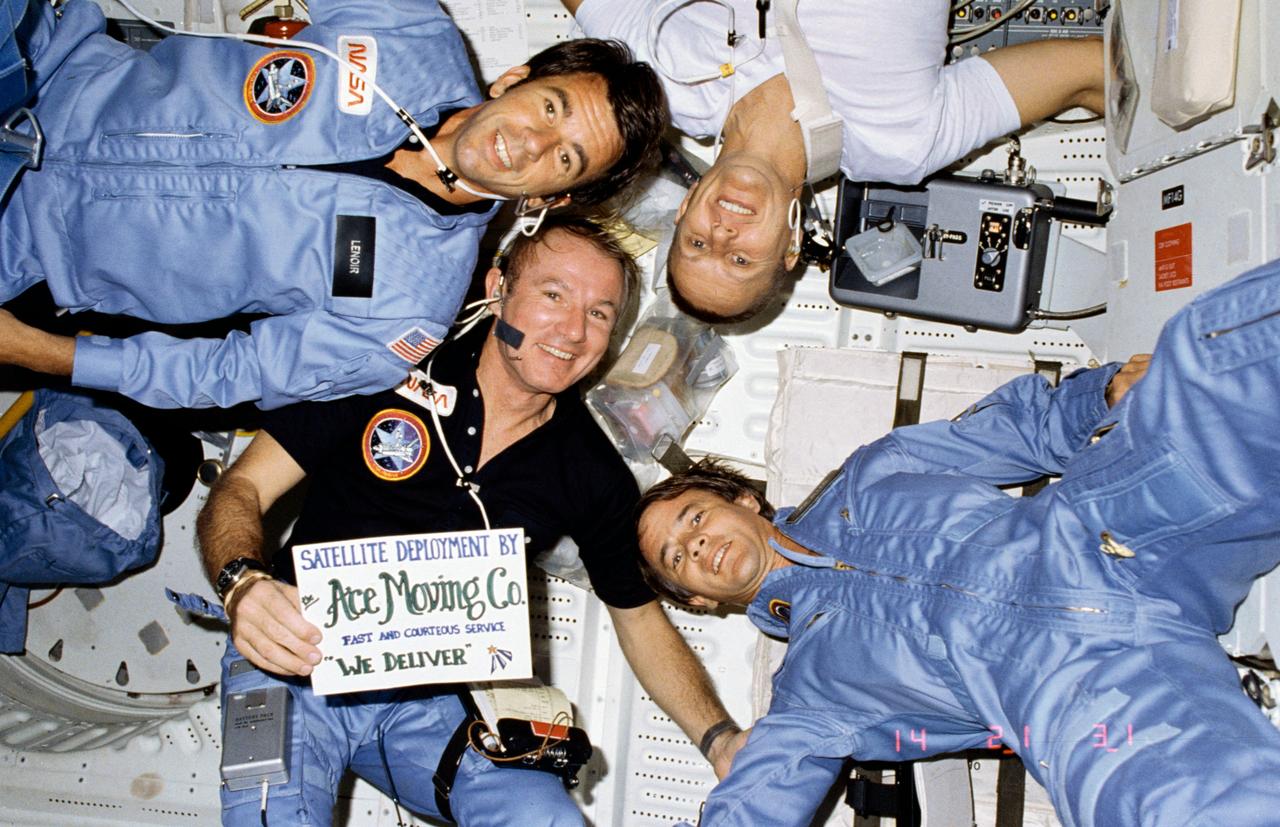
STS005-07-267 (12 Nov. 1982) --- A pre-set 35mm camera?s exposure of all four STS-5 astronaut crew members reveals a bit of their humorous side. The sign held by astronaut Vance D. Brand, crew commander, refers to the successful deployment of two commercial communications satellites on the flight's first two days. Brand is surrounded by, clockwise, left to right, astronauts William B. Lenoir, mission specialist, Robert F. Overmyer, pilot, and Joseph O. Allen IV, mission specialist, in the middeck area of the Earth-orbiting space shuttle Columbia. Photo credit: NASA
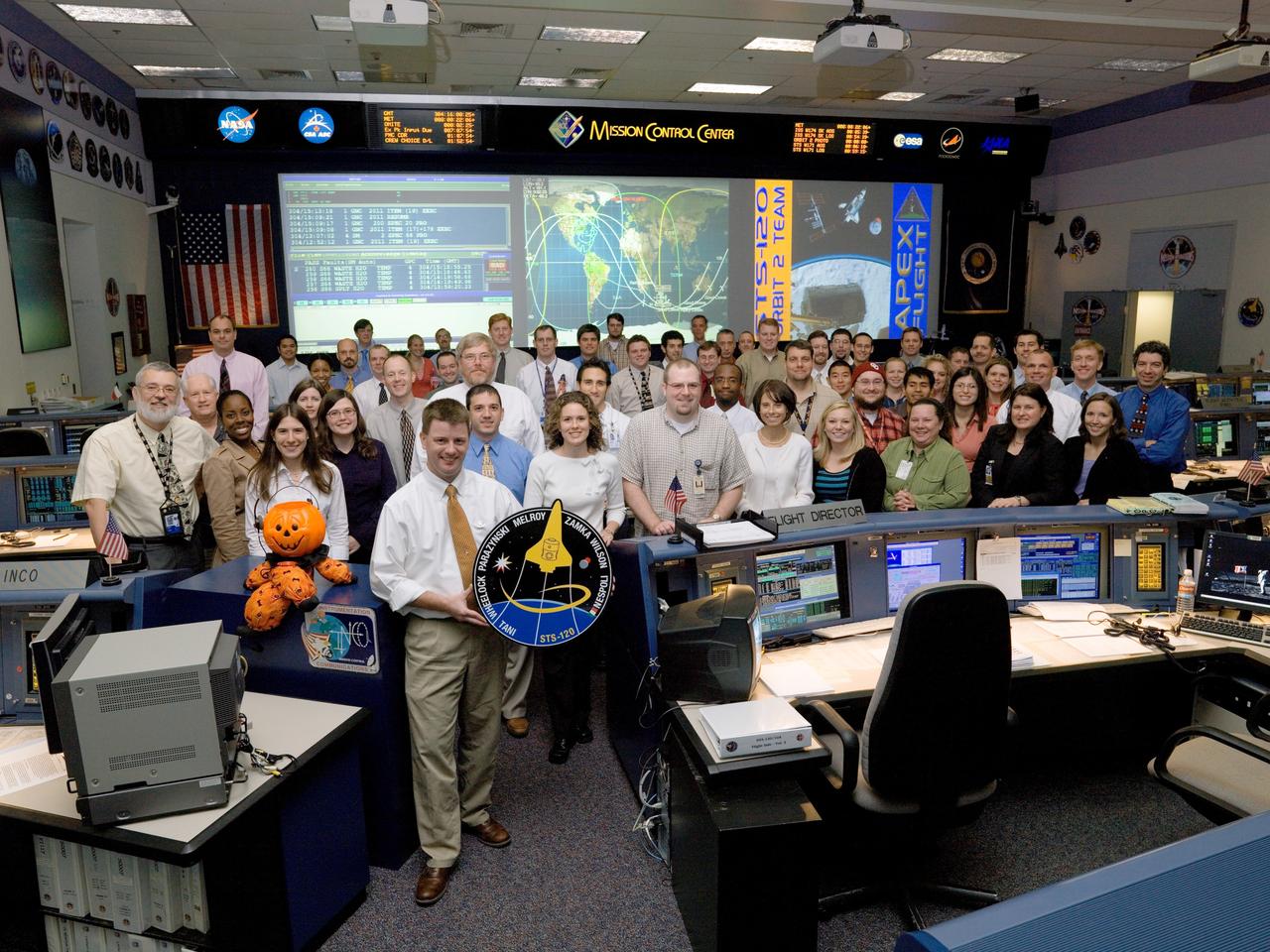
JSC2007-E-095908 (31 Oct. 2007) --- The members of the STS-120 Orbit 2 flight control team pose for a group portrait in the space shuttle flight control room of Houston's Mission Control Center (MCC). Flight director Mike Moses holds the STS-120 mission logo.
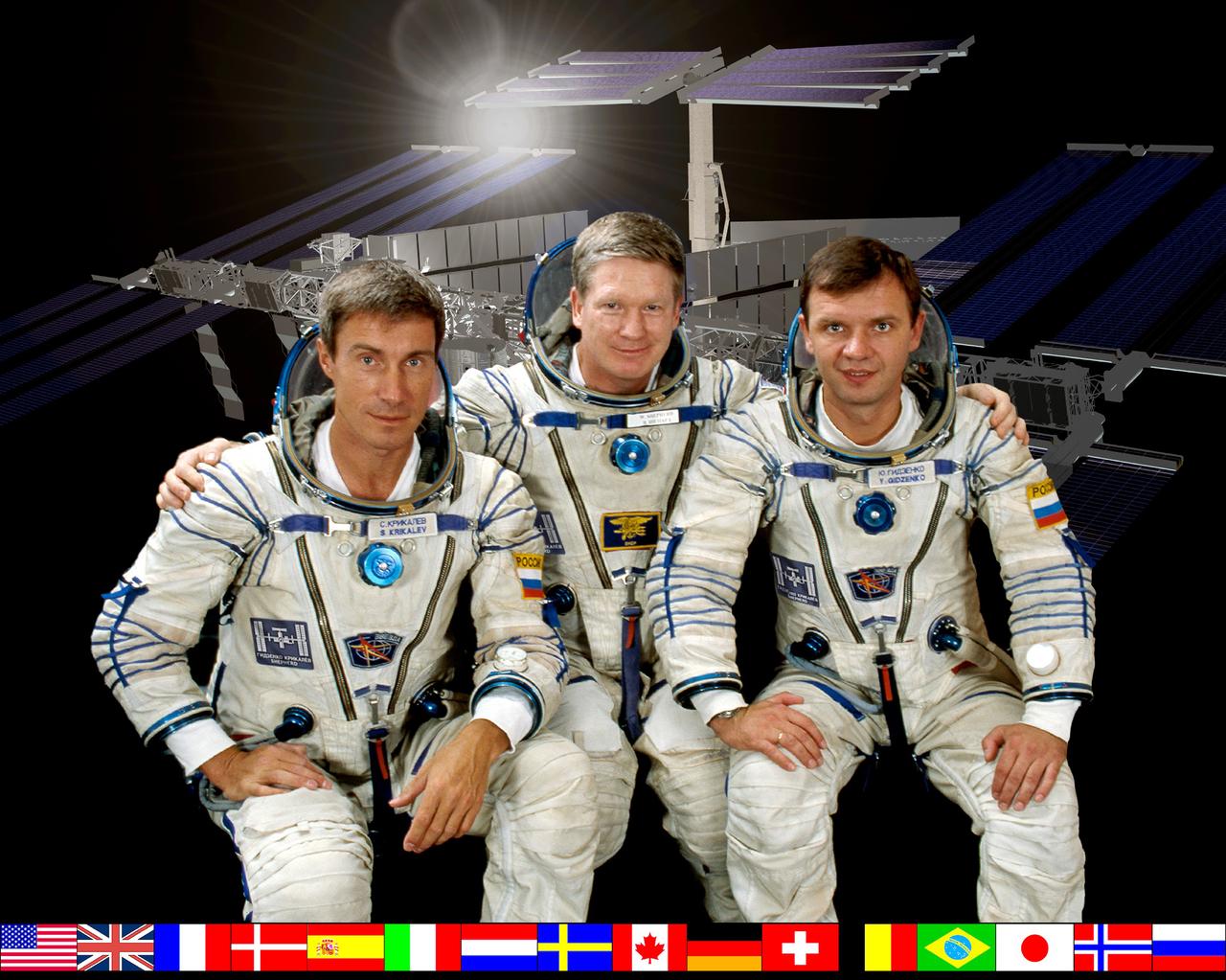
This is a crew portrait of the International Space Station (ISS) Expedition One. Left to right are flight engineer Sergei K. Krikalev, commander William M. (Bill) Shepherd, and Soyuz commander Yuri P. Gidzenko. They are wearing the Russian Sokol space suits. The Russian Soyuz rocket carrying the Expedition One crew was launched from the Baikonur Cosmodrome, Kazakhstan on October 31, 2000. The crew returned to the Kennedy Space Center on March 21, 2002 aboard the Space Shuttle Orbiter Discovery (STS-102 mission). The crew's duration on the ISS was 138 days. National flags representing all the international partners run along the bottom of the portrait.
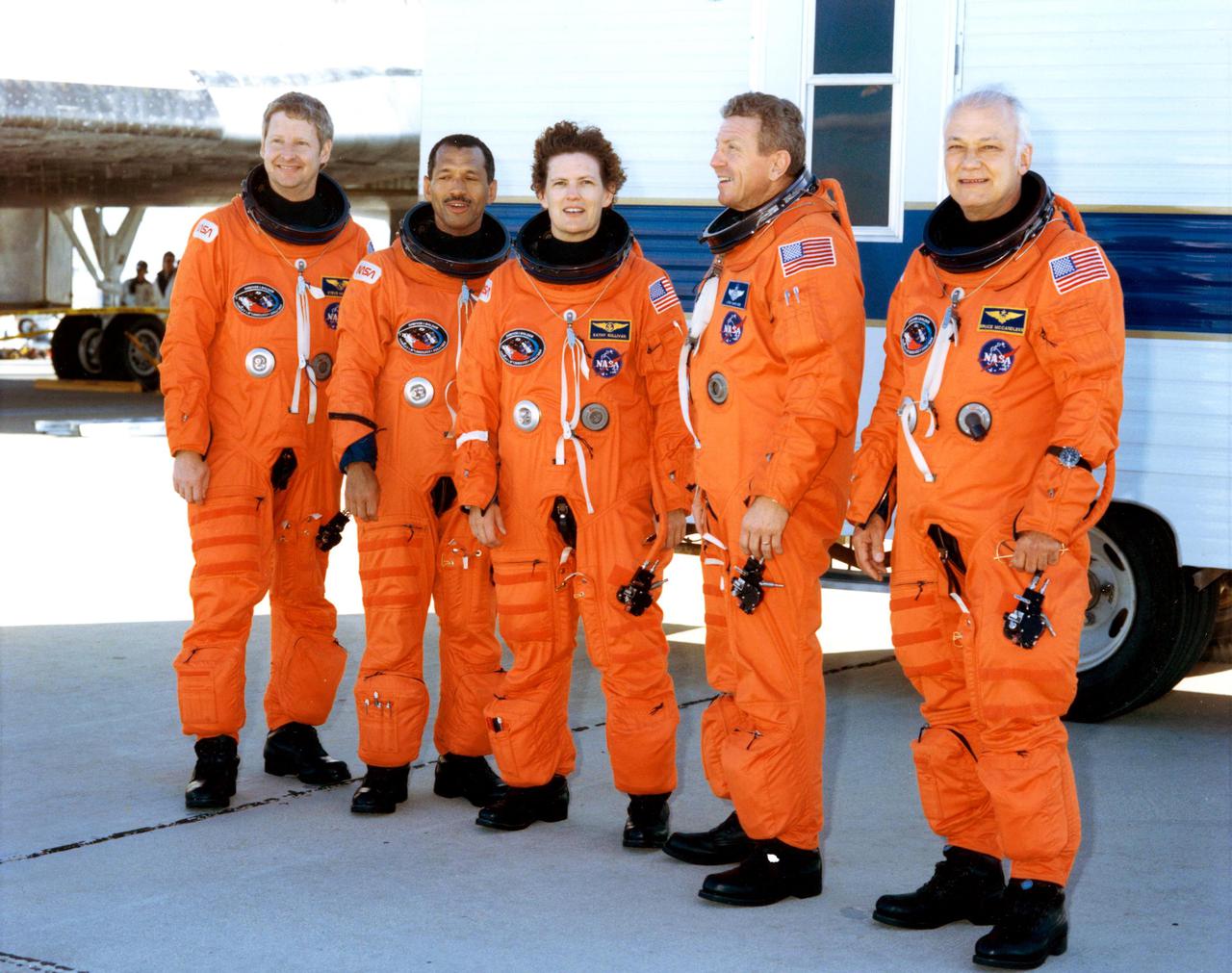
DRYDEN FLIGHT RESEARCH FACILITY, EDWARDS, CALIF. -- STS-31 POST-LANDING CREW PORTRAIT -- The astronauts of STS-31 pose for a quick photo near the Space Shuttle Discovery following a smooth landing on the runway at Edwards Air Force Base to complete a highly successful five day mission. Picture, left to right, are Astronauts Steven A. Hawley, Charles F. Bolden Jr., Kathryn D. Sullivan, Loren J. Shriver, and Bruce McCandless II. Theirs was an Earth-orbital flight during which the Hubble Space Telescope was sent toward its 15-year mission. Landing was completed at 6:51 a.m. (PDT), April 29, 1990.
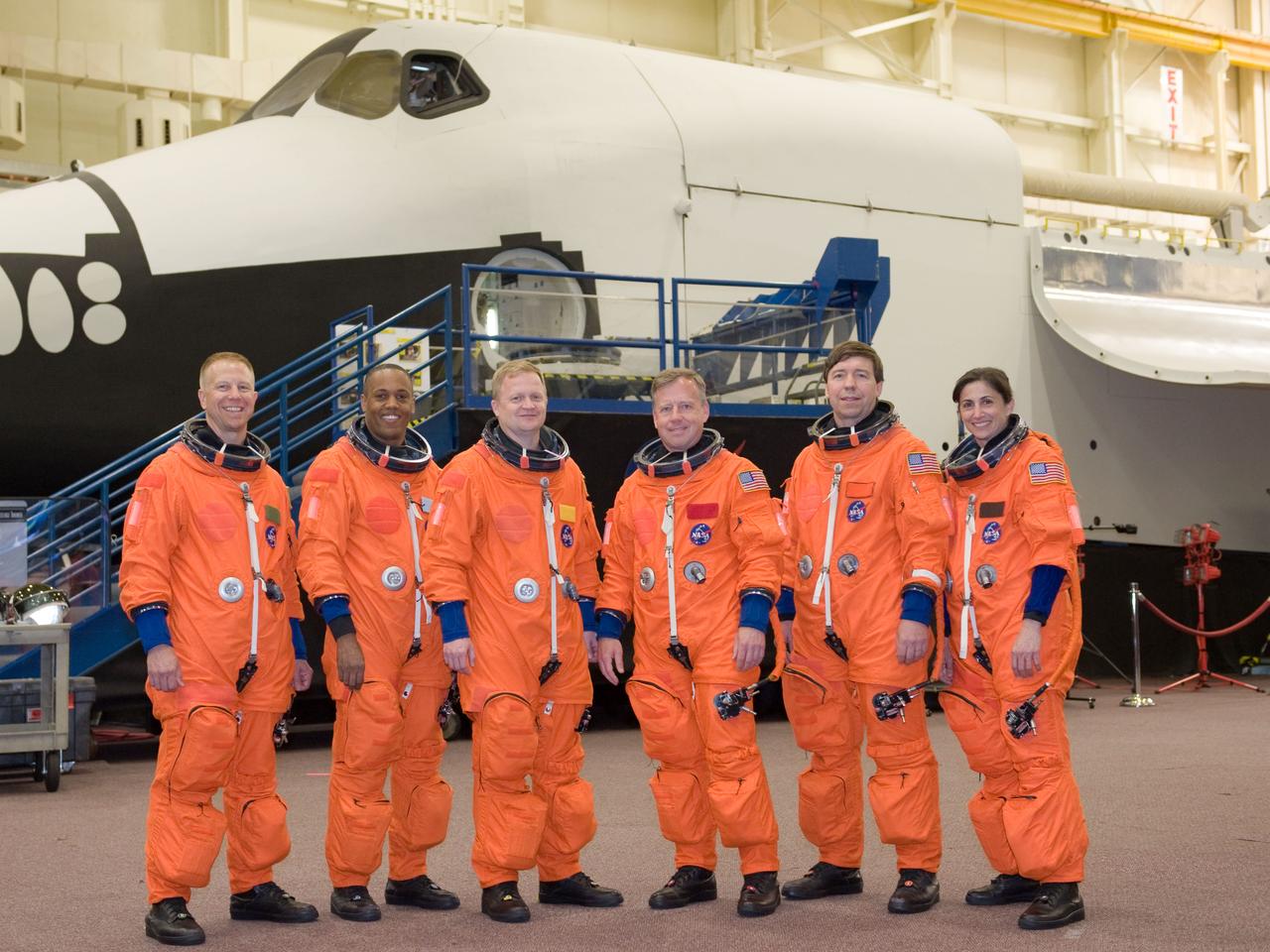
JSC2010-E-046394 (31 March 2010) --- Attired in training versions of their shuttle launch and entry suits, the STS-133 crew members take a brief break for a portrait in the Space Vehicle Mock-up Facility at NASA's Johnson Space Center. From the left are NASA astronauts Tim Kopra and Alvin Drew, both mission specialists; Eric Boe, pilot; Steve Lindsey, commander; Michael Barratt and Nicole Stott, both mission specialists.
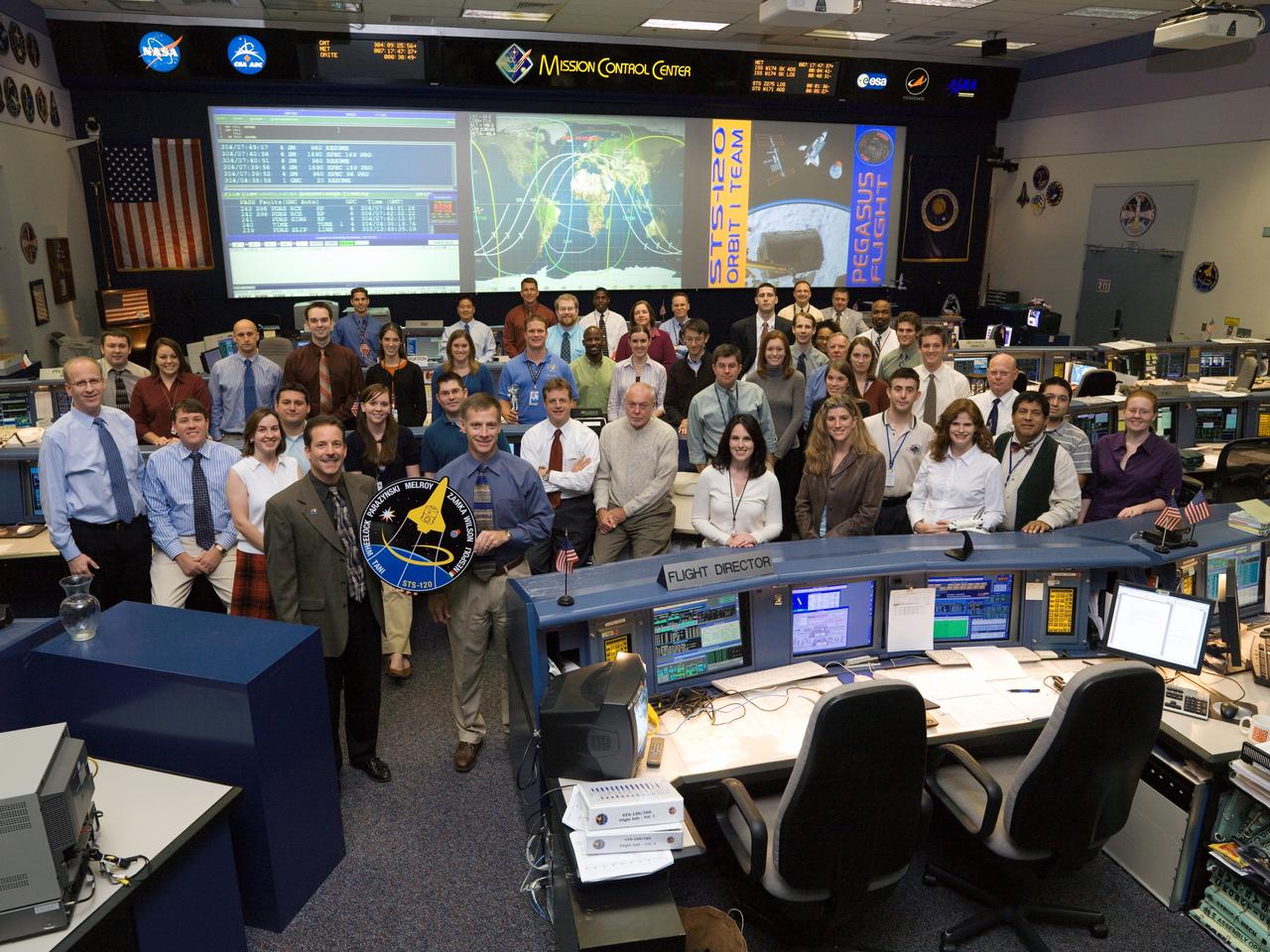
JSC2007-E-095034 (31 Oct. 2007) --- The members of the STS-120 Orbit 1 flight control team pose for a portrait in the space shuttle flight control room in Houston's Mission Control Center (MCC). Flight director Rick LaBrode (left) and astronaut Chris Ferguson, spacecraft communicator (CAPCOM), hold the STS-120 mission logo.
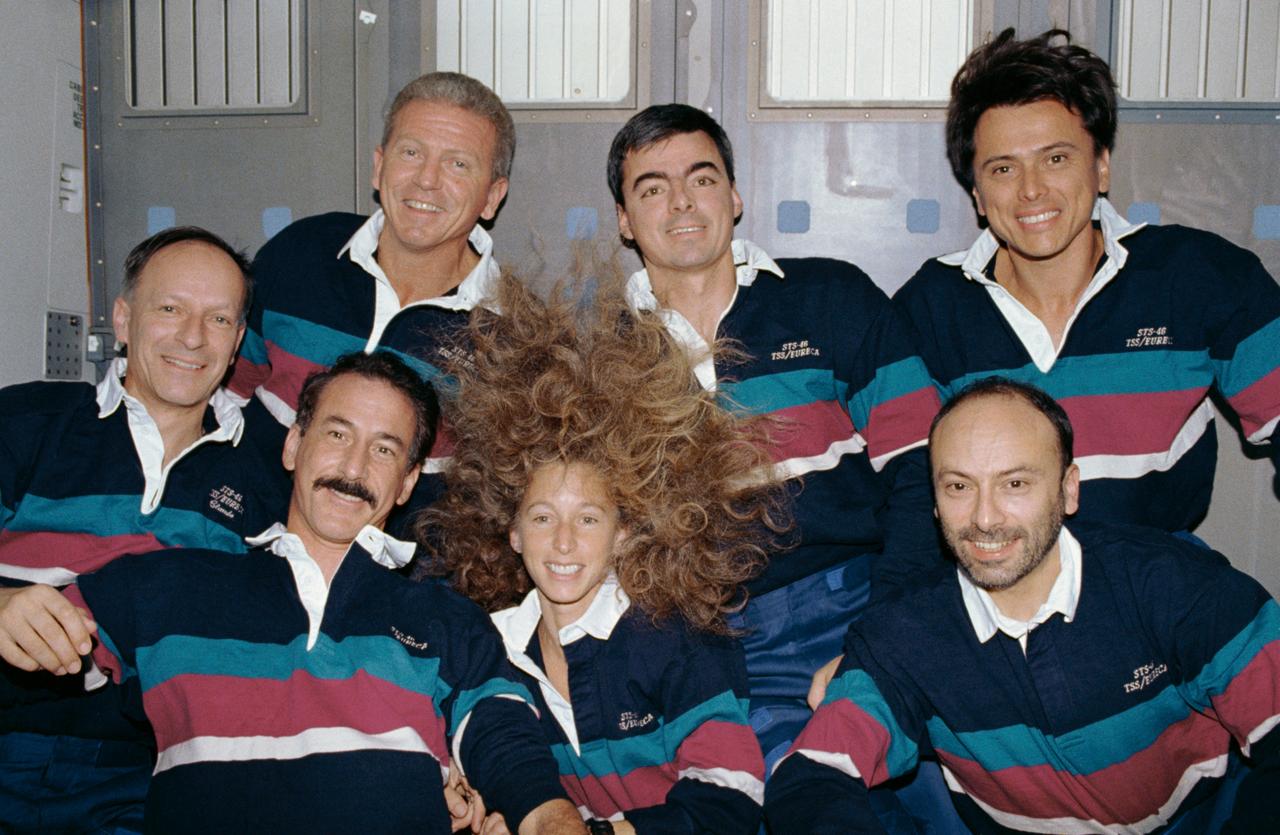
STS046-12-009 (31 July-8 Aug. 1992) --- The seven crew members for the STS-46 mission pose for the traditional in-flight portrait onboard the Earth-orbiting space shuttle Atlantis. In the rear are, left to right, astronauts Loren J. Shriver, commander; Andrew M. Allen, pilot; and Franklin R. Chang-Diaz, mission specialist. In front are, left to right, Swiss scientist Claude Nicollier, mission specialist representing the European Space Agency (ESA); astronaut Jeffrey A. Hoffman, payload commander; astronaut Marsha S. Ivins, mission specialist; and Franco Malerba, payload specialist representing the Italian Space Agency (ASI).
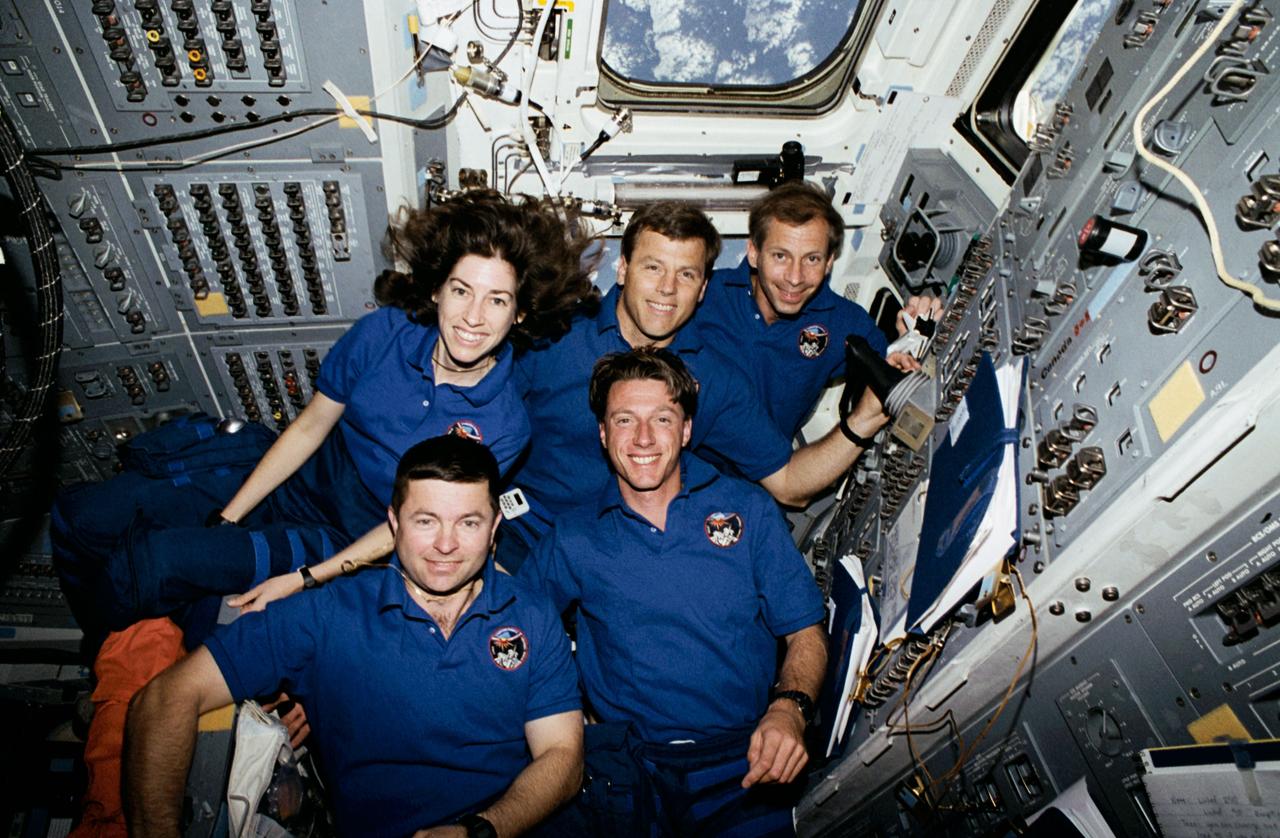
STS056-31-020 (8-17 April 1993) --- The five astronaut crew members assemble on the Space Shuttle Discovery's aft flight deck for the traditional inflight crew portrait. In front are astronauts Kenneth D. Cameron, mission commander; and C. Michael Foale, mission specialist. In back are (left to right) astronauts Ellen Ochoa, mission specialist; Stephen S. Oswald, pilot; and Kenneth D. Cockrell, mission specialist. The five went on to spend nine days in Earth-orbit in support of the Atlas-2 mission. A 35mm camera with a 20mm lens was used to expose this frame.
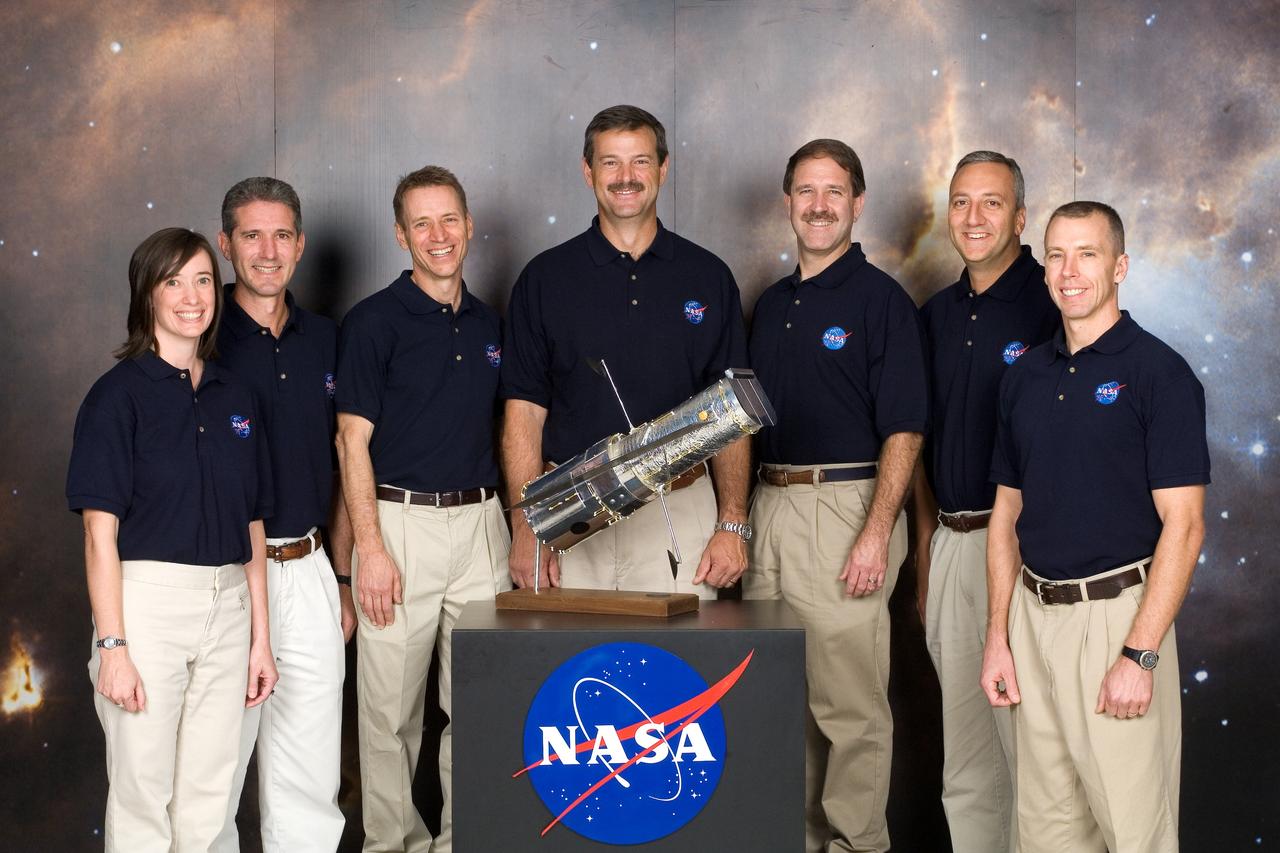
JSC2006-E-47144 (31 Oct. 2006) --- A few hours after NASA Administrator Michael Griffin announced from Goddard Space Flight Center the astronauts selected for the final shuttle mission to perform work on the Hubble Space Telescope, the STS-125 crew met the news media at the Johnson Space Center. Following the press briefing, the members posed for this group portrait. From left to right are astronauts K. Megan McArthur, Michael T. Good, Gregory C. Johnson, Scott D. Altman, John M. Grunsfeld, Michael J. Massimino and Andrew J. Feustel. Altman will command the final space shuttle mission to Hubble, and Johnson will serve as pilot for his initial spaceflight. Mission specialists include veteran spacewalkers Grunsfeld and Massimino and first-time space fliers Feustel, Good and McArthur.
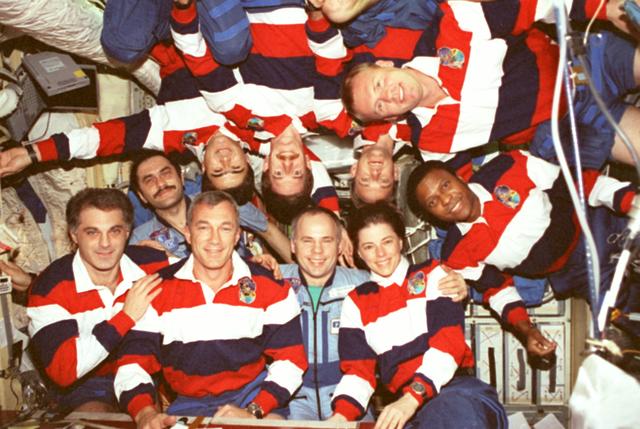
STS089-391-004 (22-31 Jan. 1998) --- Ten astronauts and cosmonauts form a human oval in order to fit into a single frame, onboard Russian Mir Space Station?s Base Block, the traditional in-flight crew portrait. In conventional position mode (from the left) are David A. Wolf, STS-89 mission specialist and former cosmonaut guest researcher; Pavel V. Vinogradov, Mir-24 flight engineer; Terrence W. Wilcutt, shuttle commander; Anatoly Y. Solovyev, Mir-24 commander; and mission specialist Bonnie J. Dunbar, payload commander. Demonstrating the freedom of microgravity, head-to-head with bottom row, are (from the left) Salizhan S. Sharipov, mission specialist representing Russian Space Agency (RSA); James F. Reilly, mission specialist; and Joe F. Edwards Jr., pilot. At 90-degree angle poses are Andrew S. W. Thomas, mission specialist and current cosmonaut guest researcher (top); and Michael P. Anderson, mission specialist. Photo credit: NASA
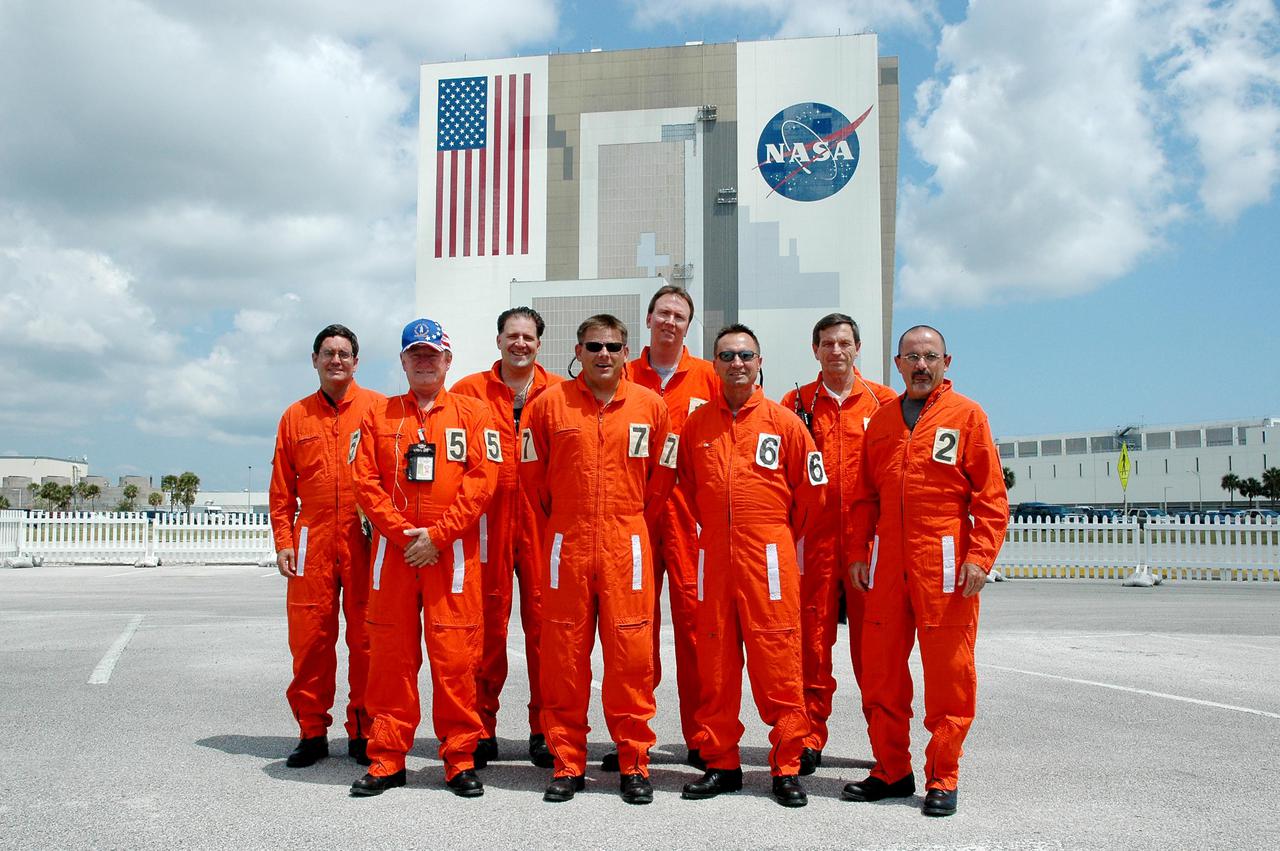
KENNEDY SPACE CENTER, FLA. - Members of the Final Inspection Team pose for a group portrait following their return from Launch Pad 39B where they were supporting an External Tank (ET) tanking test. From left are Robert Speece, NASA; Ray Brewer; United Space Alliance; Mike Payne, NASA; Scott Otto, Lockheed Martin; John Blue, NASA; Doug Powell, Lockheed Martin; William Duckworth, United Space Alliance; and Jorge Rivera, NASA. This team conducts a preflight walkdown of the vehicle and pad during the hold at T-3 hours on launch day. The tanking test is designed to evaluate how the tank, orbiter, solid rocket boosters and ground systems perform under 'cryo-load,' when the tank is filled with the two ultra-low-temperature propellants. The tank filling and draining portion of the test takes about 11 hours. The test also includes a simulated countdown through the hold at T-31 seconds. The test is being conducted to troubleshoot two issues identified by a tanking test held on April 14. Data is being collected to analyze the liquid hydrogen sensors that gave intermittent readings and the liquid hydrogen pressurization relief valve that cycled more times than standard. The tanking tests are part of preparations for Space Shuttle Discovery's Return to Flight mission, STS-114, to the International Space Station. The launch window extends from July 13 through July 31.