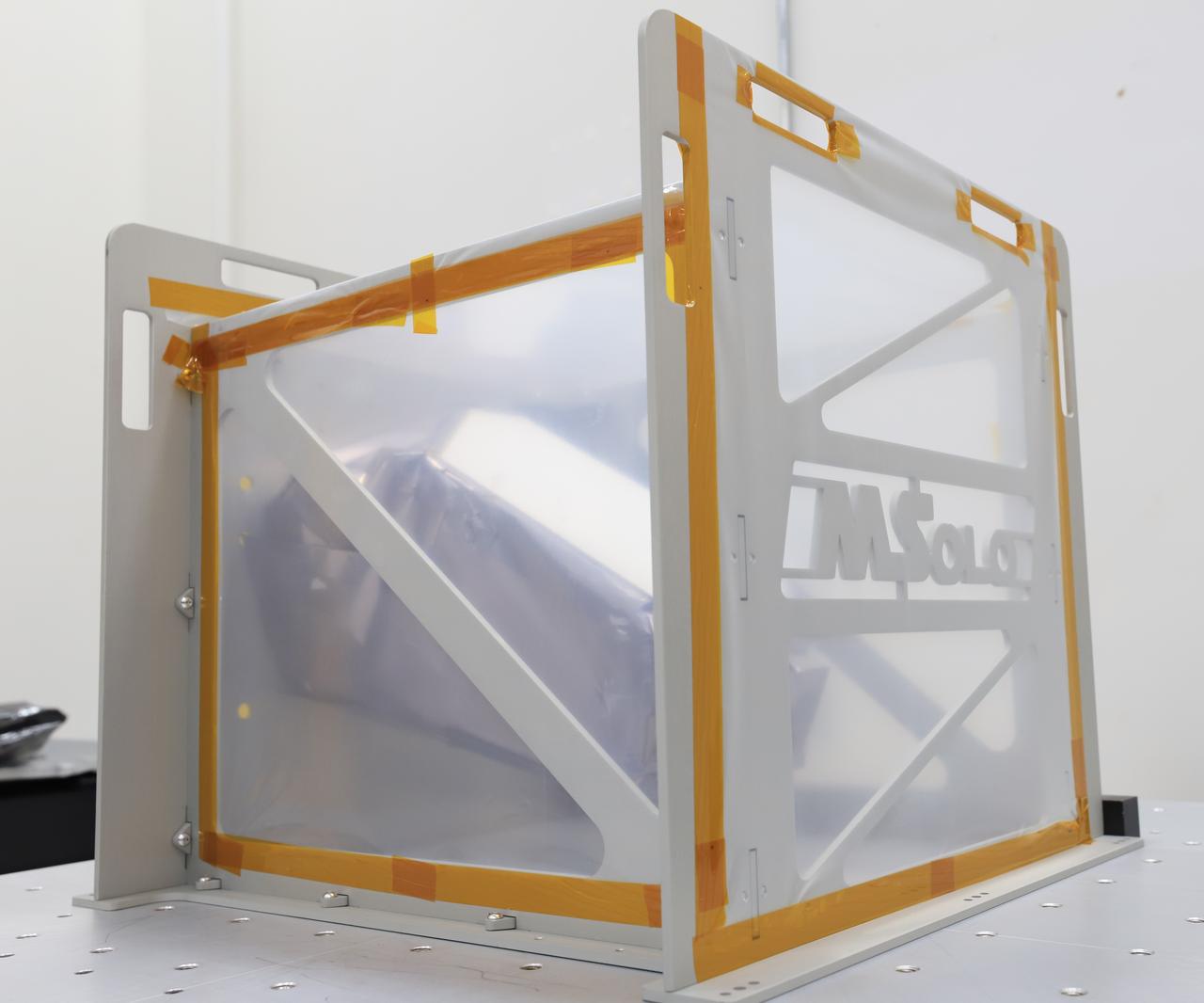
Engineers conduct a mass properties test on the Mass Spectrometer Observing Lunar Operations (MSolo) instrument inside Kennedy Space Center’s Space Station Processing Facility in Florida on Nov. 22, 2022. Mass properties determines the mass and center of gravity of the flight unit. The lander uses this information, from all payloads, to improve stability and performance of the lander – and to a lesser degree, the stability and performance of the rocket. This marks the end of testing at Kennedy for the Polar Resources Ice Mining Experiment-1 (PRIME-1) MSolo instrument. It will soon be shipped to Intuitive Machines in Houston for integration on the NOVA-C landing platform. Launching in 2023, the PRIME-1 mission will be the first in-situ resource utilization demonstration on the Moon.
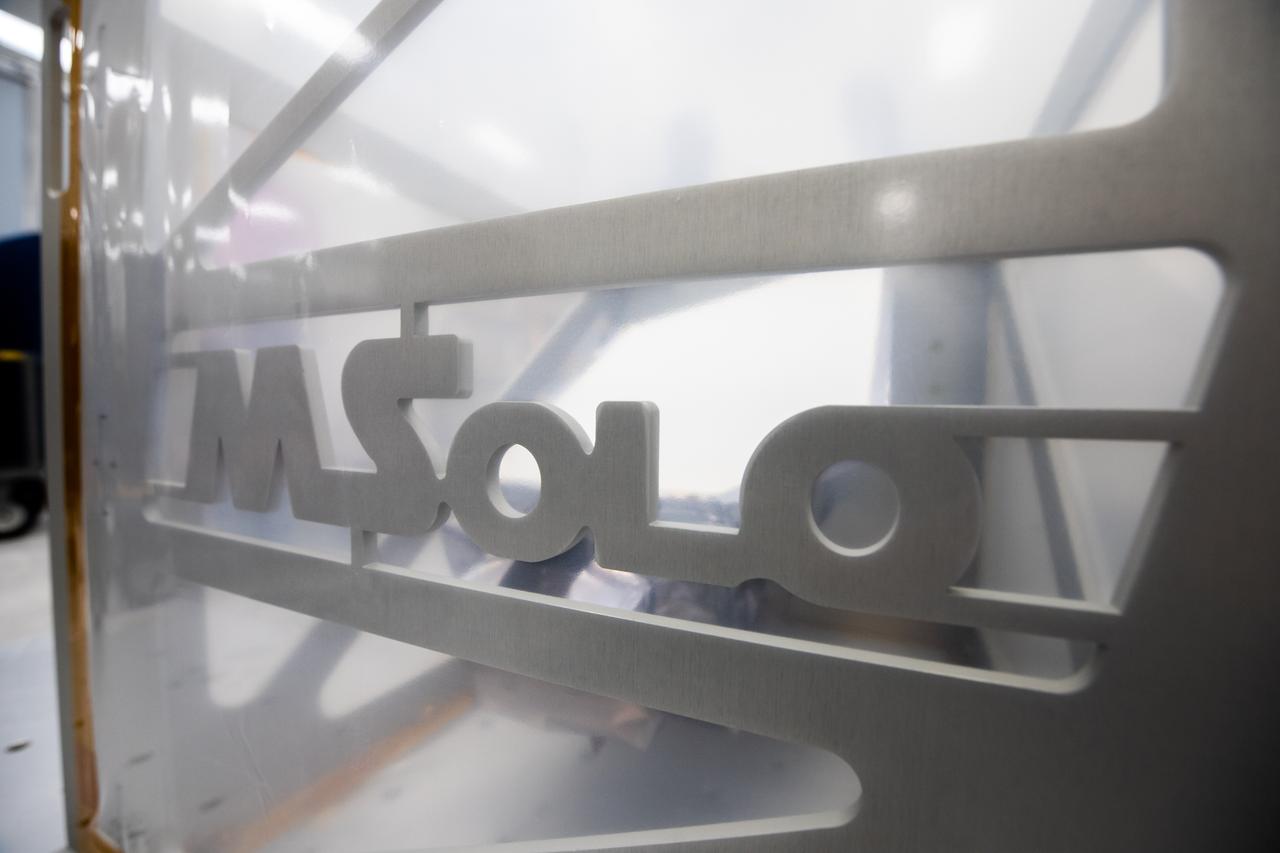
Engineers conduct a mass properties test on the Mass Spectrometer Observing Lunar Operations (MSolo) instrument inside Kennedy Space Center’s Space Station Processing Facility in Florida on Nov. 22, 2022. Mass properties determines the mass and center of gravity of the flight unit. The lander uses this information, from all payloads, to improve stability and performance of the lander – and to a lesser degree, the stability and performance of the rocket. This marks the end of testing at Kennedy for the Polar Resources Ice Mining Experiment-1 (PRIME-1) MSolo instrument. It will soon be shipped to Intuitive Machines in Houston for integration on the NOVA-C landing platform. Launching in 2023, the PRIME-1 mission will be the first in-situ resource utilization demonstration on the Moon.
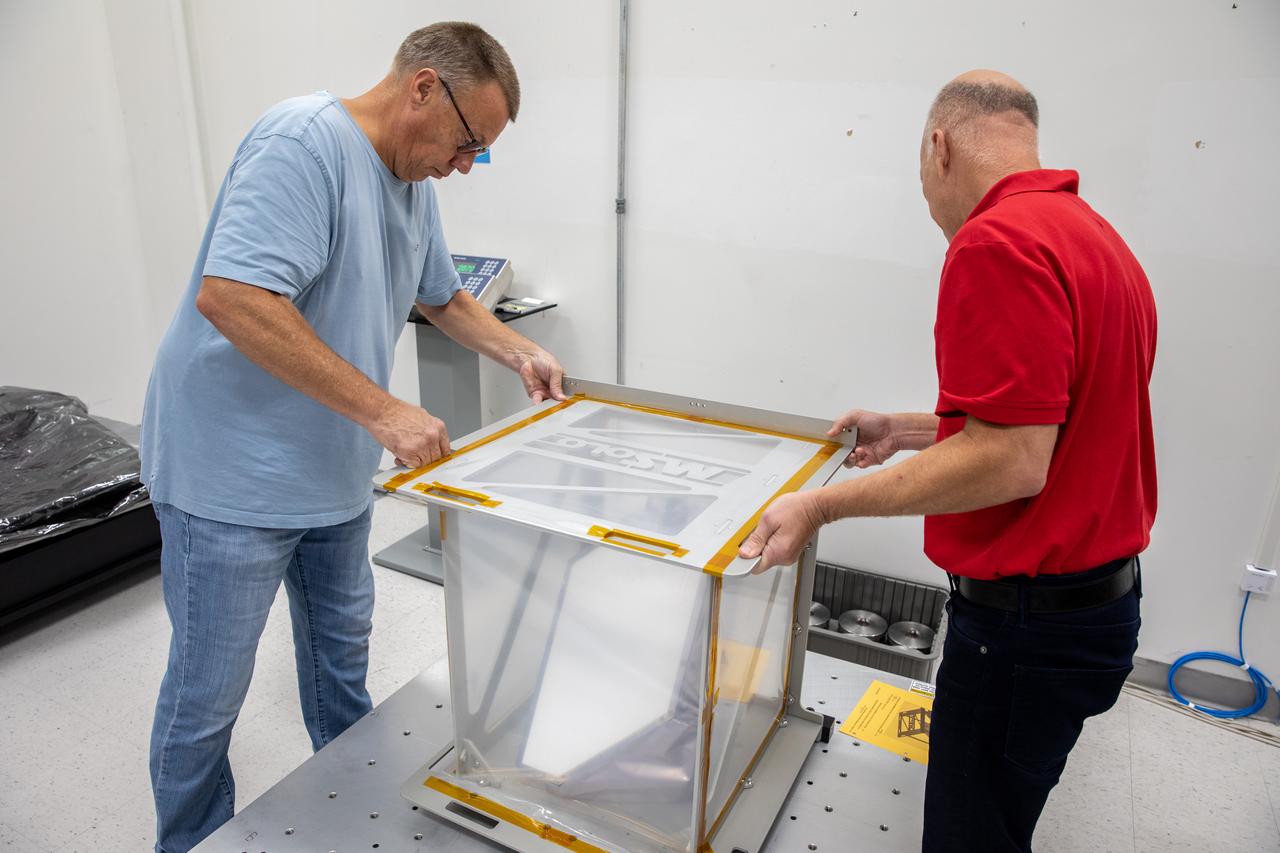
Engineers conduct a mass properties test on the Mass Spectrometer Observing Lunar Operations (MSolo) instrument inside Kennedy Space Center’s Space Station Processing Facility in Florida on Nov. 22, 2022. Mass properties determines the mass and center of gravity of the flight unit. The lander uses this information, from all payloads, to improve stability and performance of the lander – and to a lesser degree, the stability and performance of the rocket. This marks the end of testing at Kennedy for the Polar Resources Ice Mining Experiment-1 (PRIME-1) MSolo instrument. It will soon be shipped to Intuitive Machines in Houston for integration on the NOVA-C landing platform. Launching in 2023, the PRIME-1 mission will be the first in-situ resource utilization demonstration on the Moon.

A team of engineers participates in simulation training for the Polar Resources Ice Mining Experiment-1 (PRIME-1) on Thursday, Nov. 2, 2023, inside the Neil Armstrong Operations and Checkout Building at NASA’s Kennedy Space Center in Florida. The purpose of the training is to get the integrated PRIME-1 team – engineers with PRIME-1’s MSOLO (Mass Spectrometer Observing Lunar Operations) and Honeybee Robotics’ TRIDENT (The Regolith and Ice Drill for Exploring New Terrain) drill – prepared to operate the instrument on the lunar surface. The team commanded the PRIME-1 hardware, located at Intuitive Machines in Houston, to operate MSOLO and TRIDENT. PRIME-1 is scheduled to launch through NASA’s CLPS (Commercial Lunar Payload Delivery Service) initiative and will be the first in-situ resource utilization demonstration on the Moon, with MSOLO and TRIDENT making up its two primary components. Through Artemis missions, CLPS deliveries will be used to perform science experiments, test technologies, and demonstrate capabilities to help NASA explore the Moon and prepare for human deep space exploration missions.
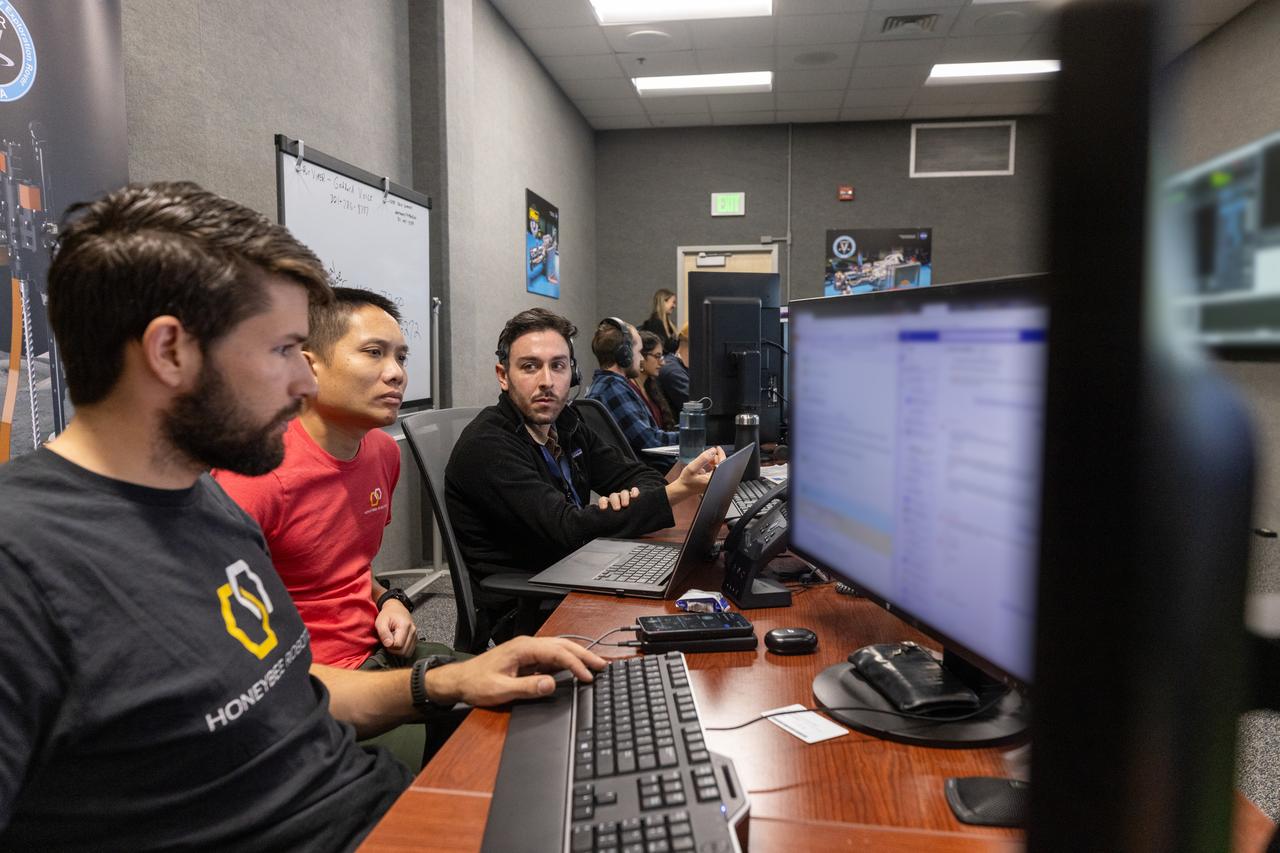
A team from Honeybee Robotics in Altadena, California participates in simulation training for the Polar Resources Ice Mining Experiment-1 (PRIME-1) on Thursday, Nov. 2, 2023, inside the Neil Armstrong Operations and Checkout Building at NASA’s Kennedy Space Center in Florida. The purpose of the training is to get the integrated PRIME-1 team – engineers with PRIME-1’s MSOLO (Mass Spectrometer Observing Lunar Operations) and Honeybee Robotics’ TRIDENT (The Regolith and Ice Drill for Exploring New Terrain) drill – prepared to operate the instrument on the lunar surface. The team commanded the PRIME-1 hardware, located at Intuitive Machines in Houston, to operate MSOLO and TRIDENT. PRIME-1 is scheduled to launch through NASA’s CLPS (Commercial Lunar Payload Delivery Service) initiative and will be the first in-situ resource utilization demonstration on the Moon, with MSOLO and TRIDENT making up its two primary components. Through Artemis missions, CLPS deliveries will be used to perform science experiments, test technologies, and demonstrate capabilities to help NASA explore the Moon and prepare for human deep space exploration missions.
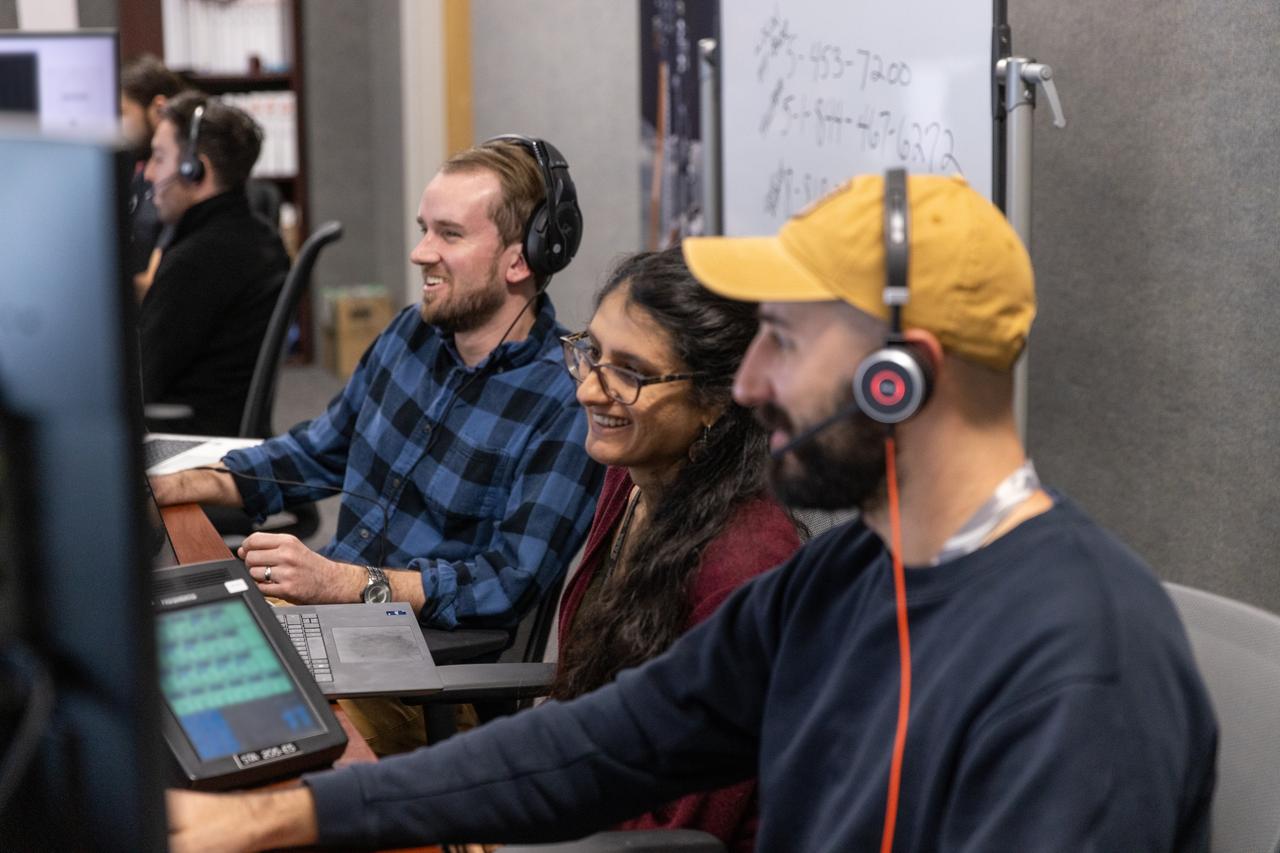
A team of engineers participates in simulation training for the Polar Resources Ice Mining Experiment-1 (PRIME-1) on Thursday, Nov. 2, 2023, inside the Neil Armstrong Operations and Checkout Building at NASA’s Kennedy Space Center in Florida. The purpose of the training is to get the integrated PRIME-1 team – engineers with PRIME-1’s MSOLO (Mass Spectrometer Observing Lunar Operations) and Honeybee Robotics’ TRIDENT (The Regolith and Ice Drill for Exploring New Terrain) drill – prepared to operate the instrument on the lunar surface. The team commanded the PRIME-1 hardware, located at Intuitive Machines in Houston, to operate MSOLO and TRIDENT. PRIME-1 is scheduled to launch through NASA’s CLPS (Commercial Lunar Payload Delivery Service) initiative and will be the first in-situ resource utilization demonstration on the Moon, with MSOLO and TRIDENT making up its two primary components. Through Artemis missions, CLPS deliveries will be used to perform science experiments, test technologies, and demonstrate capabilities to help NASA explore the Moon and prepare for human deep space exploration missions.
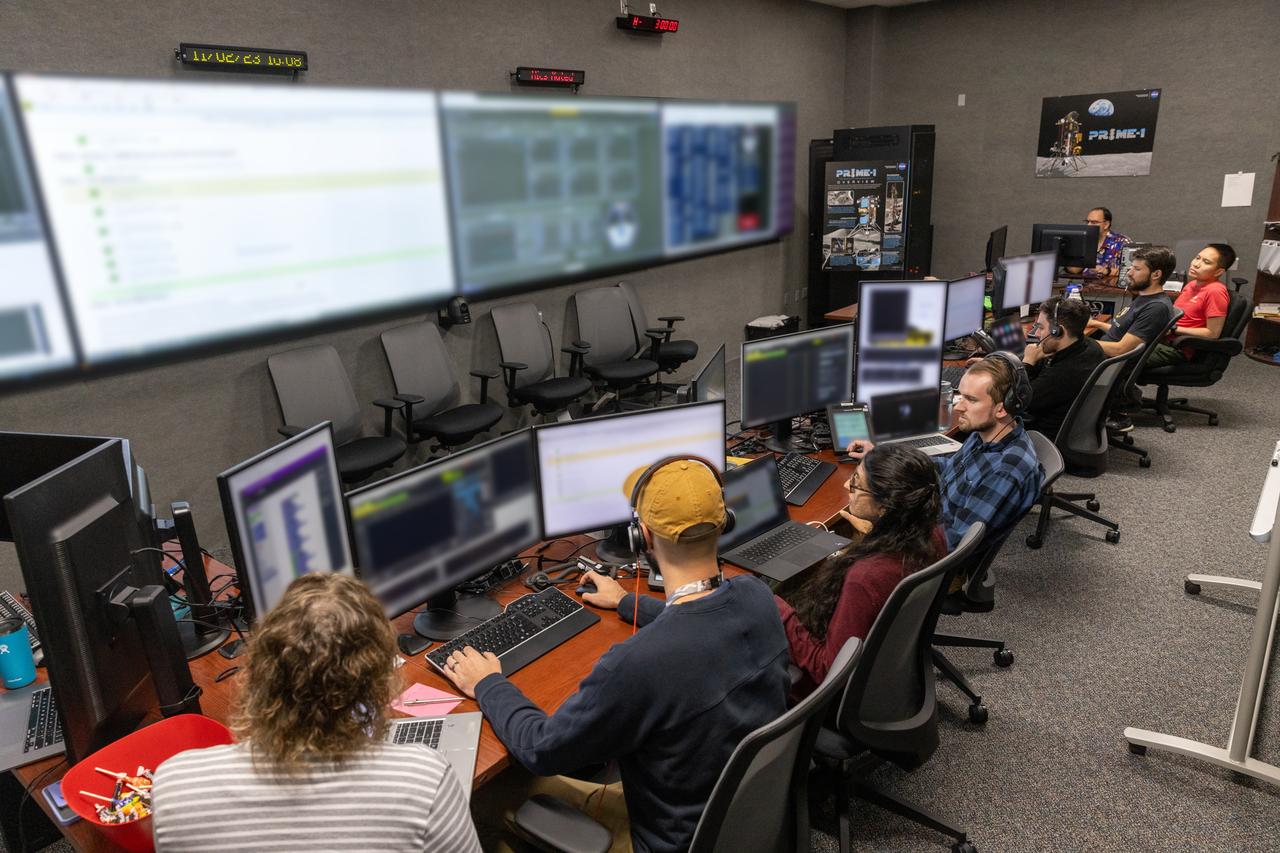
A team of engineers participates in simulation training for the Polar Resources Ice Mining Experiment-1 (PRIME-1) on Thursday, Nov. 2, 2023, inside the Neil Armstrong Operations and Checkout Building at NASA’s Kennedy Space Center in Florida. The purpose of the training is to get the integrated PRIME-1 team – engineers with PRIME-1’s MSOLO (Mass Spectrometer Observing Lunar Operations) and Honeybee Robotics’ TRIDENT (The Regolith and Ice Drill for Exploring New Terrain) drill – prepared to operate the instrument on the lunar surface. The team commanded the PRIME-1 hardware, located at Intuitive Machines in Houston, to operate MSOLO and TRIDENT. PRIME-1 is scheduled to launch through NASA’s CLPS (Commercial Lunar Payload Delivery Service) initiative and will be the first in-situ resource utilization demonstration on the Moon, with MSOLO and TRIDENT making up its two primary components. Through Artemis missions, CLPS deliveries will be used to perform science experiments, test technologies, and demonstrate capabilities to help NASA explore the Moon and prepare for human deep space exploration missions.
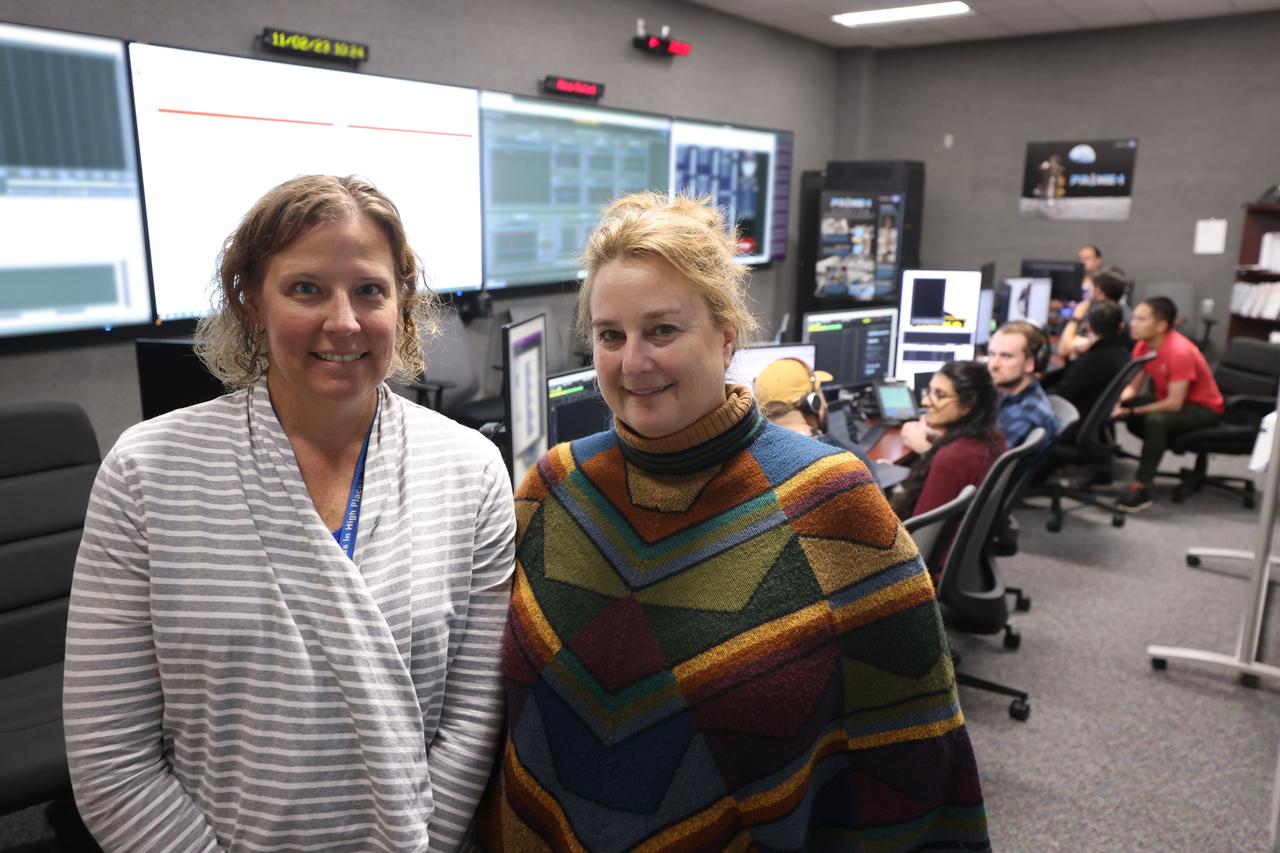
Janine Captain, left, and Jackie Quinn participate in simulation training for the Polar Resources Ice Mining Experiment-1 (PRIME-1) on Thursday, Nov. 2, 2023, inside the Neil Armstrong Operations and Checkout Building at NASA’s Kennedy Space Center in Florida. The purpose of the training is to get the integrated PRIME-1 team – engineers with PRIME-1’s MSOLO (Mass Spectrometer Observing Lunar Operations) and Honeybee Robotics’ TRIDENT (Regolith and Ice Drill for Exploring New Terrain) drill – prepared to operate the instrument on the lunar surface. The team commanded the PRIME-1 hardware, located at Intuitive Machines in Houston, to operate MSOLO and TRIDENT. PRIME-1 is scheduled to launch through NASA’s CLPS (Commercial Lunar Payload Delivery Service) initiative and will be the first in-situ resource utilization demonstration on the Moon, with MSOLO and TRIDENT making up its two primary components. Through Artemis missions, CLPS deliveries will be used to perform science experiments, test technologies, and demonstrate capabilities to help NASA explore the Moon and prepare for human deep space exploration missions.
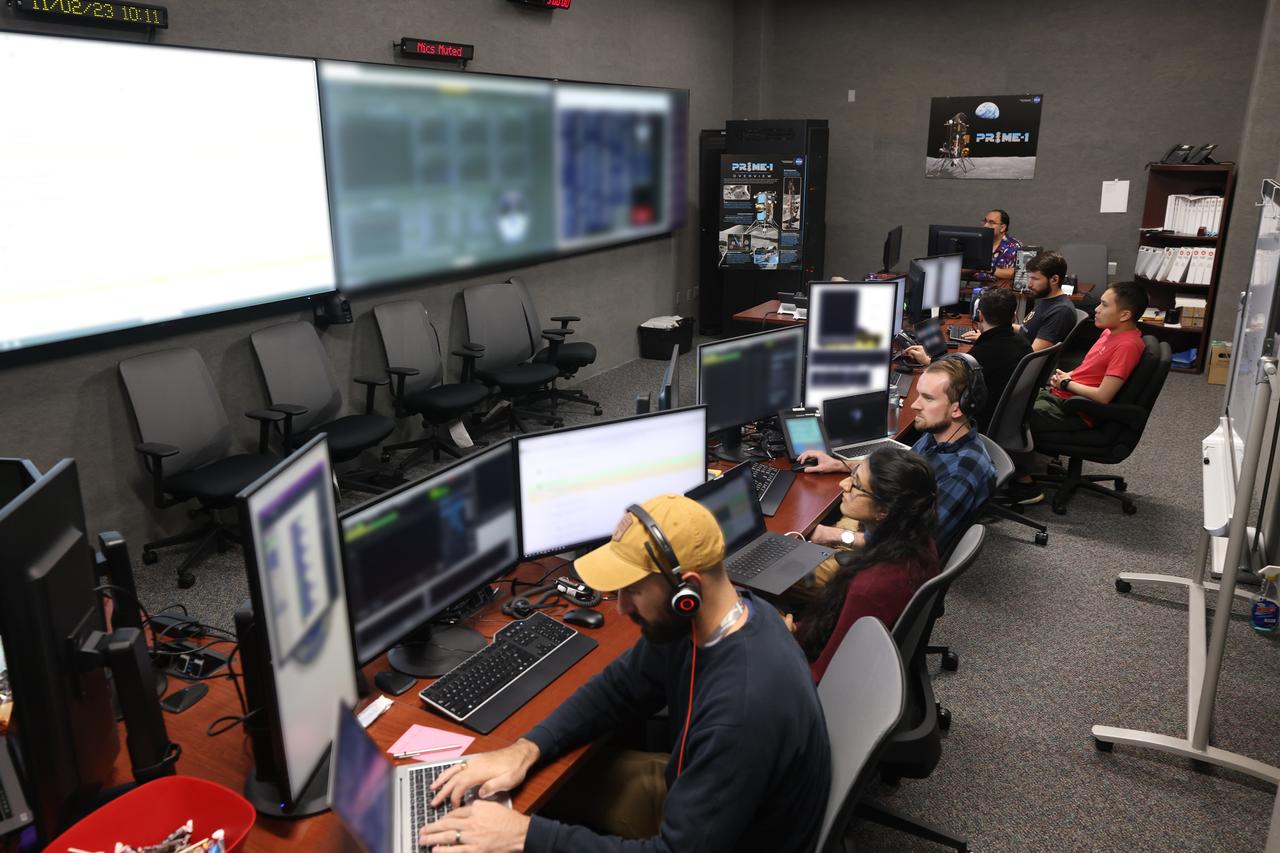
A team of engineers participates in simulation training for the Polar Resources Ice Mining Experiment-1 (PRIME-1) on Thursday, Nov. 2, 2023, inside the Neil Armstrong Operations and Checkout Building at NASA’s Kennedy Space Center in Florida. The purpose of the training is to get the integrated PRIME-1 team – engineers with PRIME-1’s MSOLO (Mass Spectrometer Observing Lunar Operations) and Honeybee Robotics’ TRIDENT (The Regolith and Ice Drill for Exploring New Terrain) drill – prepared to operate the instrument on the lunar surface. The team commanded the PRIME-1 hardware, located at Intuitive Machines in Houston, to operate MSOLO and TRIDENT. PRIME-1 is scheduled to launch through NASA’s CLPS (Commercial Lunar Payload Delivery Service) initiative and will be the first in-situ resource utilization demonstration on the Moon, with MSOLO and TRIDENT making up its two primary components. Through Artemis missions, CLPS deliveries will be used to perform science experiments, test technologies, and demonstrate capabilities to help NASA explore the Moon and prepare for human deep space exploration missions.
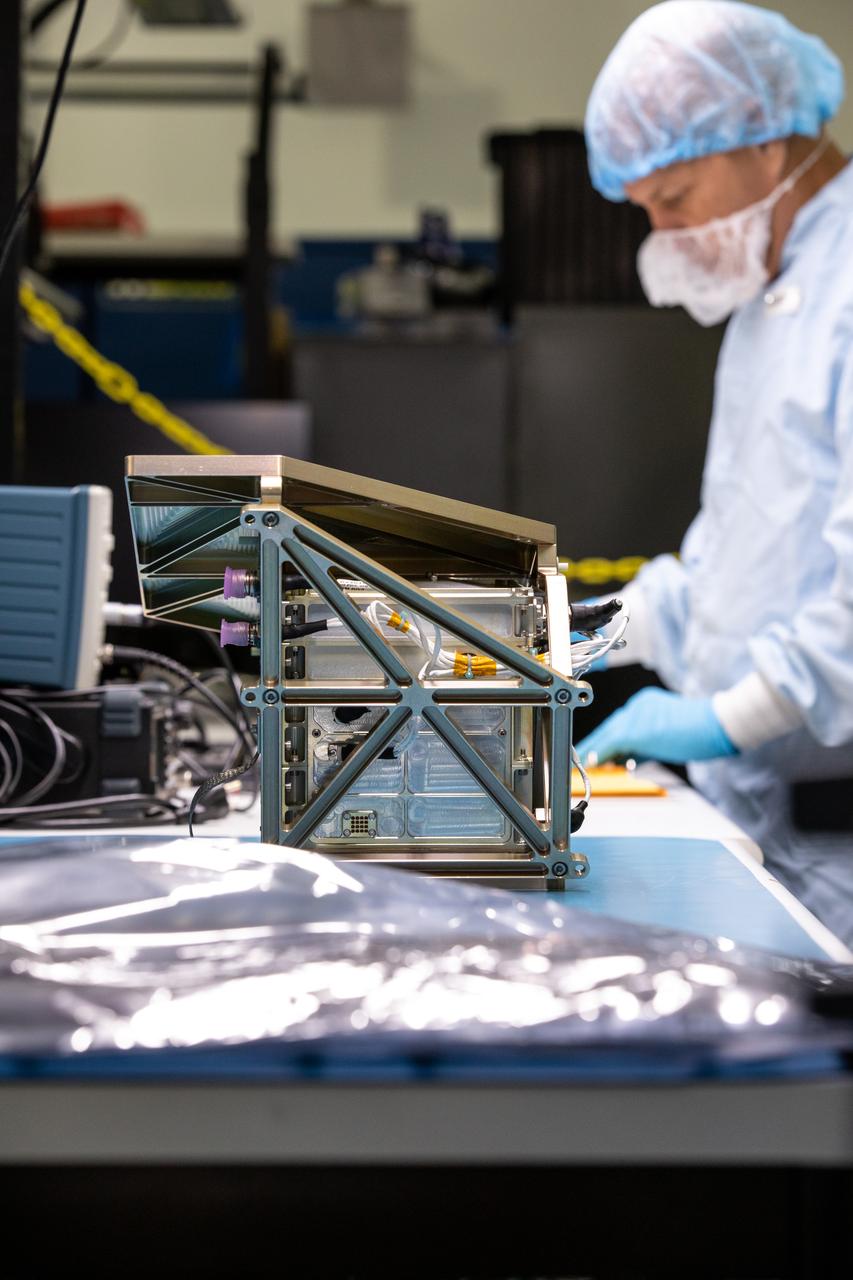
Engineers prepare the Mass Spectrometer Observing Lunar Operations (MSolo) instrument for the multilayer insulation installation inside Kennedy Space Center’s Space Station Processing Facility on Oct. 19, 2022. The activity is in preparation for the Polar Resources Ice Mining Experiment-1 (PRIME-1) mission, which will be the first in-situ resource utilization demonstration on the Moon. MSolo is a commercial off-the-shelf mass spectrometer modified to work in space and will help analyze the chemical makeup of landing sites on the Moon, as well as study water on the lunar surface. Researchers and engineers are preparing MSolo instruments to launch on four robotic missions as part of NASA’s Commercial Lunar Payload Services – commercial deliveries beginning in 2023 that will perform science experiments, test technologies, and demonstrate capabilities to help NASA explore the Moon and prepare for crewed missions to the lunar surface.
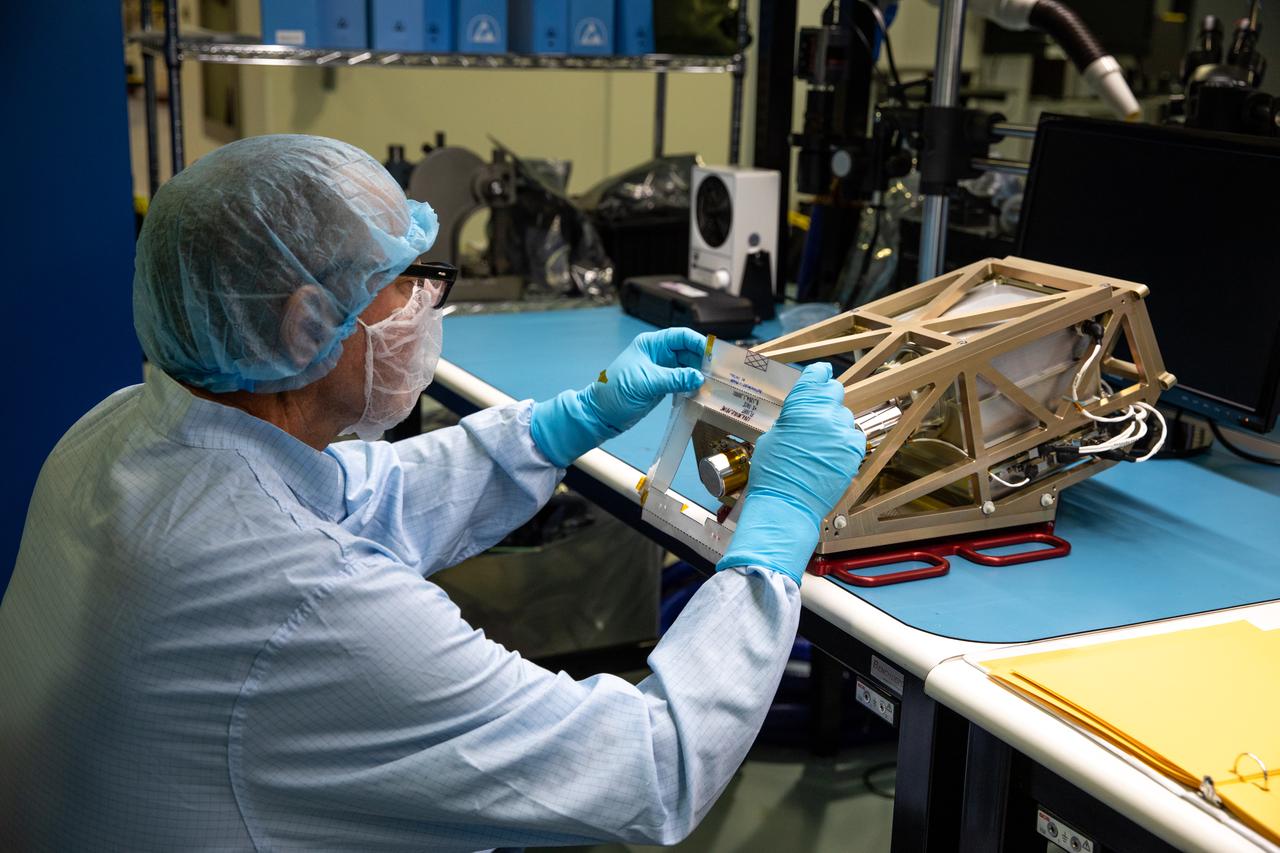
Engineers prepare the Mass Spectrometer Observing Lunar Operations (MSolo) instrument for the multilayer insulation installation inside Kennedy Space Center’s Space Station Processing Facility on Oct. 19, 2022. The activity is in preparation for the Polar Resources Ice Mining Experiment-1 (PRIME-1) mission, which will be the first in-situ resource utilization demonstration on the Moon. MSolo is a commercial off-the-shelf mass spectrometer modified to work in space and will help analyze the chemical makeup of landing sites on the Moon, as well as study water on the lunar surface. Researchers and engineers are preparing MSolo instruments to launch on four robotic missions as part of NASA’s Commercial Lunar Payload Services – commercial deliveries beginning in 2023 that will perform science experiments, test technologies, and demonstrate capabilities to help NASA explore the Moon and prepare for crewed missions to the lunar surface.
Engineers prepare the Mass Spectrometer Observing Lunar Operations (MSolo) instrument for the multilayer insulation installation inside Kennedy Space Center’s Space Station Processing Facility on Oct. 19, 2022. The activity is in preparation for the Polar Resources Ice Mining Experiment-1 (PRIME-1) mission, which will be the first in-situ resource utilization demonstration on the Moon. MSolo is a commercial off-the-shelf mass spectrometer modified to work in space and will help analyze the chemical makeup of landing sites on the Moon, as well as study water on the lunar surface. Researchers and engineers are preparing MSolo instruments to launch on four robotic missions as part of NASA’s Commercial Lunar Payload Services – commercial deliveries beginning in 2023 that will perform science experiments, test technologies, and demonstrate capabilities to help NASA explore the Moon and prepare for crewed missions to the lunar surface.
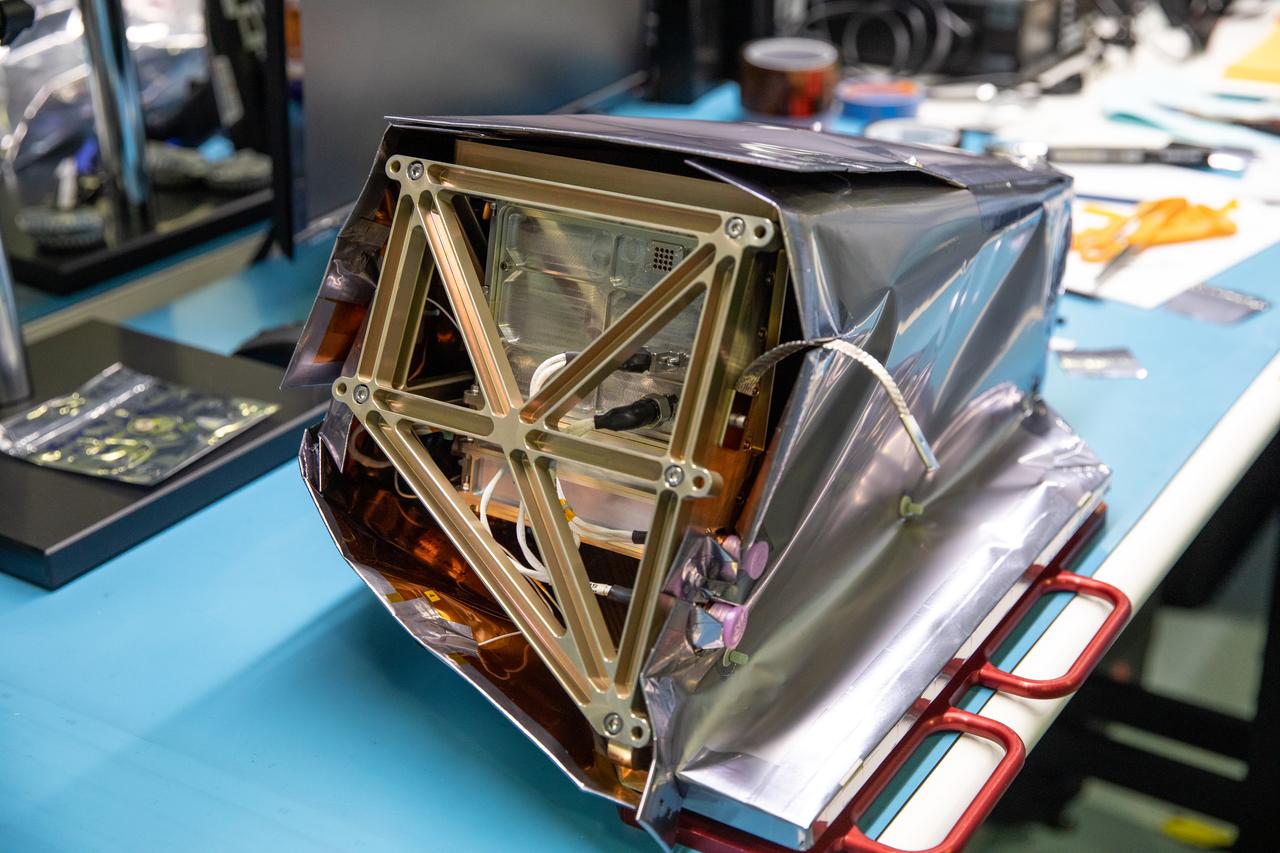
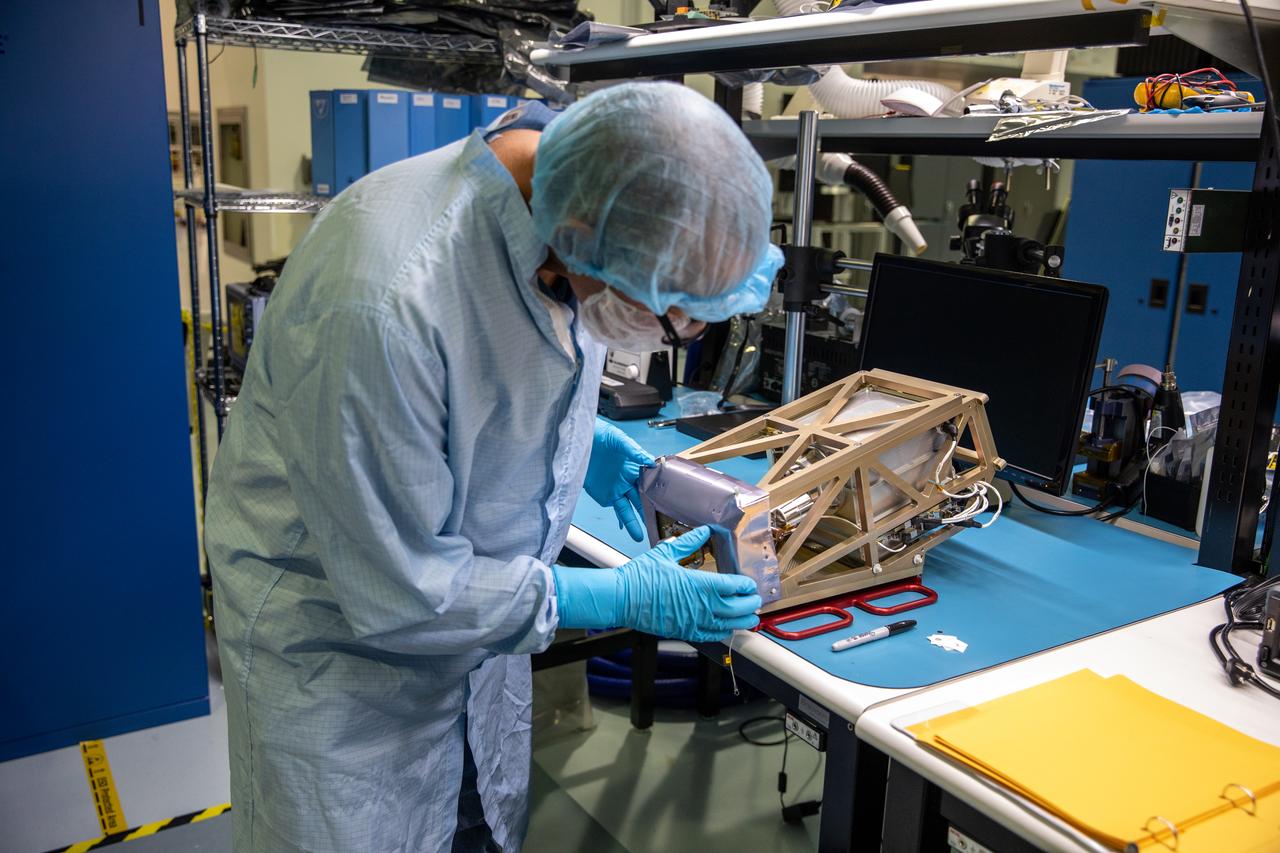
Engineers install multilayer insulation (MLI) on the Mass Spectrometer Observing Lunar Operations (MSolo) instrument inside Kennedy Space Center’s Space Station Processing Facility on Oct. 20, 2022. The activity is in preparation for the Polar Resources Ice Mining Experiment-1 (PRIME-1) mission, which will be the first in-situ resource utilization demonstration on the Moon. MLI protects the instrument from thermal temperature extremes, helping to insulate at cold temperatures and to cool at higher temperatures when solar lighting conditions or lunar infrared reflects onto the instrument. Researchers and engineers are preparing MSolo instruments to launch on four robotic missions as part of NASA’s Commercial Lunar Payload Services – commercial deliveries beginning in 2023 that will perform science experiments, test technologies, and demonstrate capabilities to help NASA explore the Moon and prepare for crewed missions to the lunar surface.

Engineers install multilayer insulation (MLI) on the Mass Spectrometer Observing Lunar Operations (MSolo) instrument inside Kennedy Space Center’s Space Station Processing Facility on Oct. 20, 2022. The activity is in preparation for the Polar Resources Ice Mining Experiment-1 (PRIME-1) mission, which will be the first in-situ resource utilization demonstration on the Moon. MLI protects the instrument from thermal temperature extremes, helping to insulate at cold temperatures and to cool at higher temperatures when solar lighting conditions or lunar infrared reflects onto the instrument. Researchers and engineers are preparing MSolo instruments to launch on four robotic missions as part of NASA’s Commercial Lunar Payload Services – commercial deliveries beginning in 2023 that will perform science experiments, test technologies, and demonstrate capabilities to help NASA explore the Moon and prepare for crewed missions to the lunar surface.
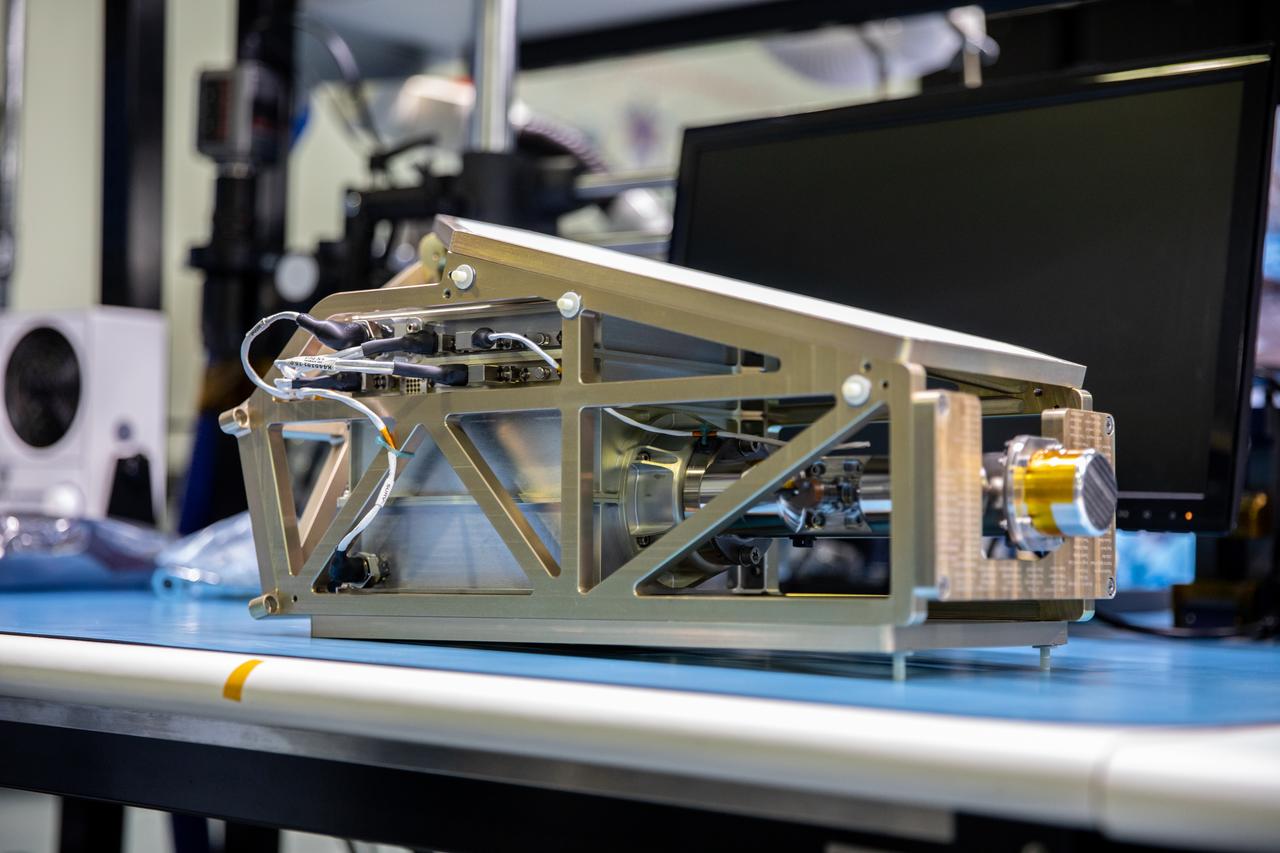
Engineers prepare the Mass Spectrometer Observing Lunar Operations (MSolo) instrument for the multilayer insulation installation inside Kennedy Space Center’s Space Station Processing Facility on Oct. 19, 2022. The activity is in preparation for the Polar Resources Ice Mining Experiment-1 (PRIME-1) mission, which will be the first in-situ resource utilization demonstration on the Moon. MSolo is a commercial off-the-shelf mass spectrometer modified to work in space and will help analyze the chemical makeup of landing sites on the Moon, as well as study water on the lunar surface. Researchers and engineers are preparing MSolo instruments to launch on four robotic missions as part of NASA’s Commercial Lunar Payload Services – commercial deliveries beginning in 2023 that will perform science experiments, test technologies, and demonstrate capabilities to help NASA explore the Moon and prepare for crewed missions to the lunar surface.
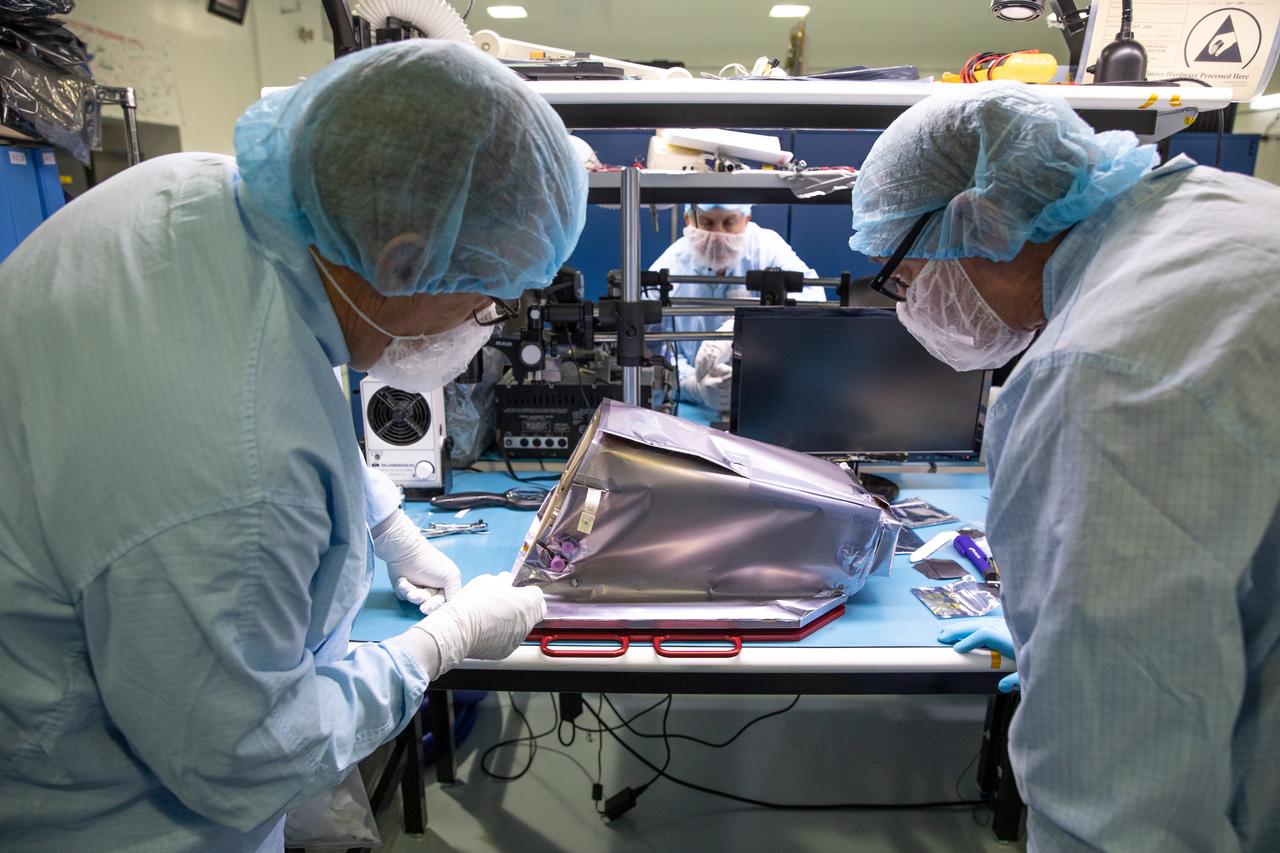
Engineers install multilayer insulation (MLI) on the Mass Spectrometer Observing Lunar Operations (MSolo) instrument inside Kennedy Space Center’s Space Station Processing Facility on Oct. 20, 2022. The activity is in preparation for the Polar Resources Ice Mining Experiment-1 (PRIME-1) mission, which will be the first in-situ resource utilization demonstration on the Moon. MLI protects the instrument from thermal temperature extremes, helping to insulate at cold temperatures and to cool at higher temperatures when solar lighting conditions or lunar infrared reflects onto the instrument. Researchers and engineers are preparing MSolo instruments to launch on four robotic missions as part of NASA’s Commercial Lunar Payload Services – commercial deliveries beginning in 2023 that will perform science experiments, test technologies, and demonstrate capabilities to help NASA explore the Moon and prepare for crewed missions to the lunar surface.
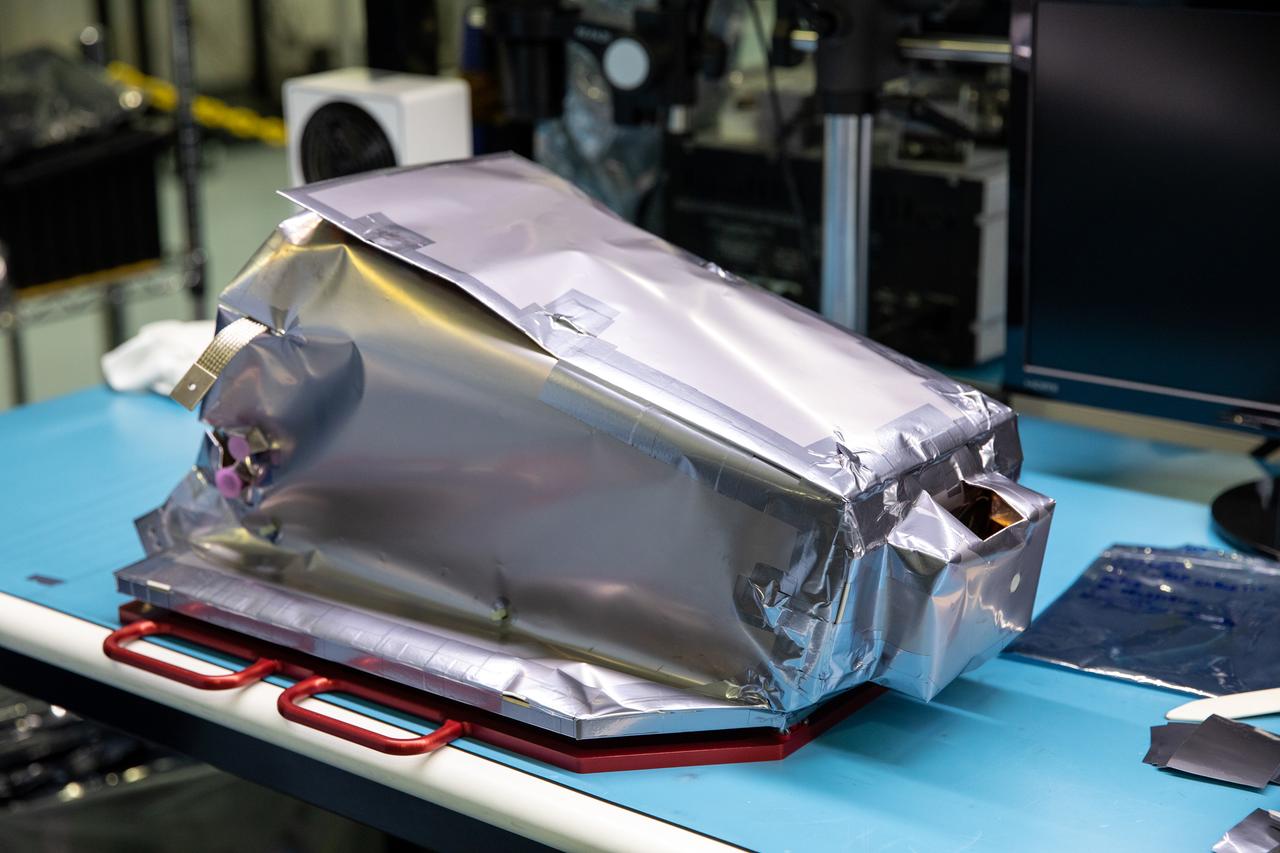
Engineers install multilayer insulation (MLI) on the Mass Spectrometer Observing Lunar Operations (MSolo) instrument inside Kennedy Space Center’s Space Station Processing Facility on Oct. 20, 2022. The activity is in preparation for the Polar Resources Ice Mining Experiment-1 (PRIME-1) mission, which will be the first in-situ resource utilization demonstration on the Moon. MLI protects the instrument from thermal temperature extremes, helping to insulate at cold temperatures and to cool at higher temperatures when solar lighting conditions or lunar infrared reflects onto the instrument. Researchers and engineers are preparing MSolo instruments to launch on four robotic missions as part of NASA’s Commercial Lunar Payload Services – commercial deliveries beginning in 2023 that will perform science experiments, test technologies, and demonstrate capabilities to help NASA explore the Moon and prepare for crewed missions to the lunar surface.
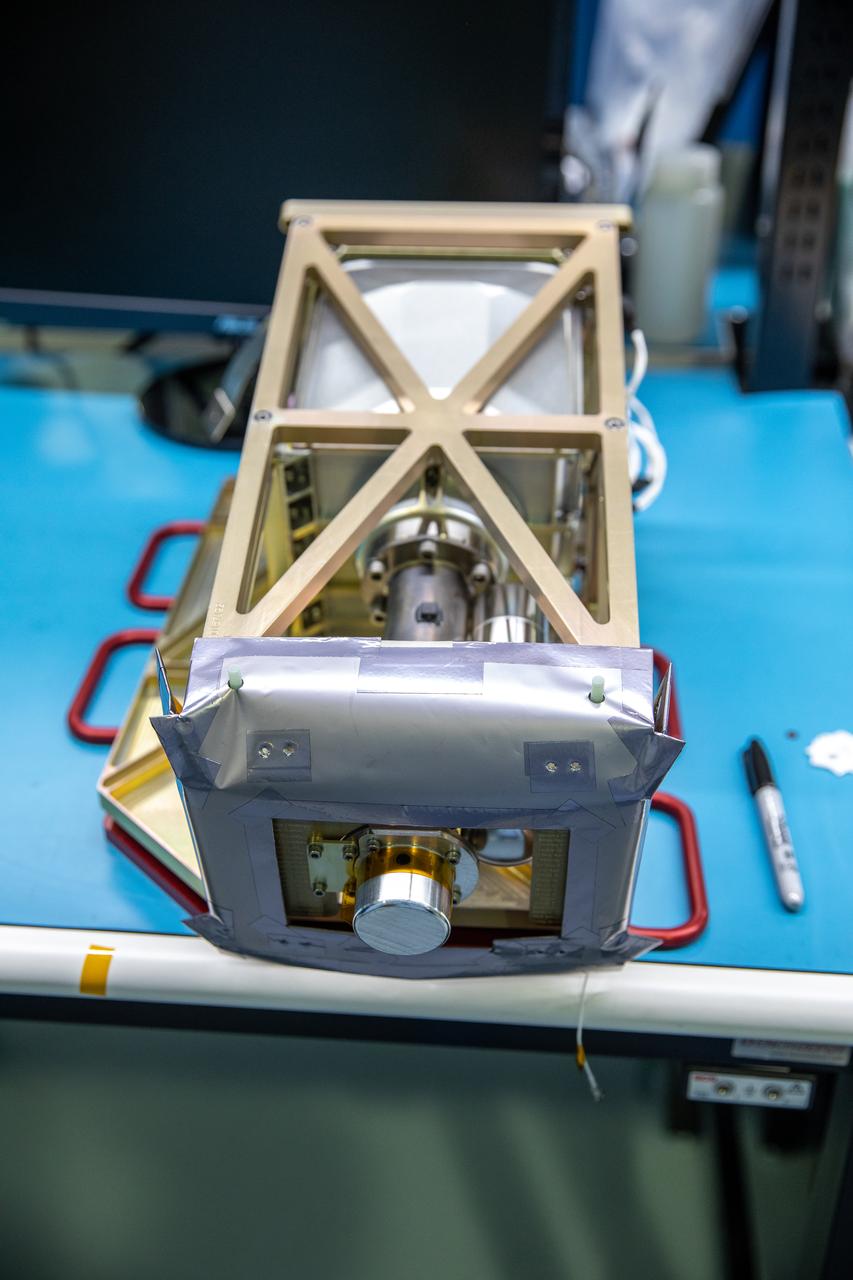
Engineers prepare the Mass Spectrometer Observing Lunar Operations (MSolo) instrument for the multilayer insulation installation inside Kennedy Space Center’s Space Station Processing Facility on Oct. 19, 2022. The activity is in preparation for the Polar Resources Ice Mining Experiment-1 (PRIME-1) mission, which will be the first in-situ resource utilization demonstration on the Moon. MSolo is a commercial off-the-shelf mass spectrometer modified to work in space and will help analyze the chemical makeup of landing sites on the Moon, as well as study water on the lunar surface. Researchers and engineers are preparing MSolo instruments to launch on four robotic missions as part of NASA’s Commercial Lunar Payload Services – commercial deliveries beginning in 2023 that will perform science experiments, test technologies, and demonstrate capabilities to help NASA explore the Moon and prepare for crewed missions to the lunar surface.
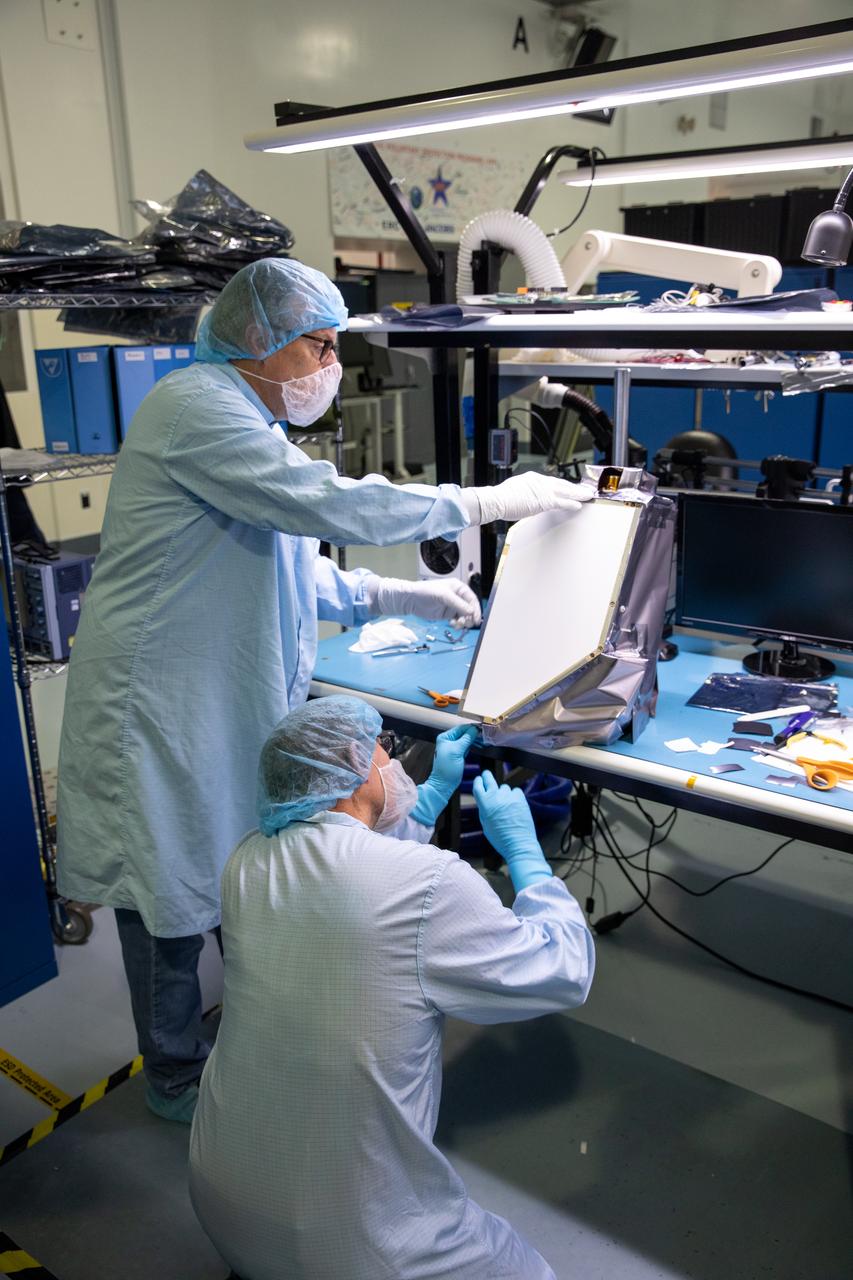
Engineers install multilayer insulation (MLI) on the Mass Spectrometer Observing Lunar Operations (MSolo) instrument inside Kennedy Space Center’s Space Station Processing Facility on Oct. 20, 2022. The activity is in preparation for the Polar Resources Ice Mining Experiment-1 (PRIME-1) mission, which will be the first in-situ resource utilization demonstration on the Moon. MLI protects the instrument from thermal temperature extremes, helping to insulate at cold temperatures and to cool at higher temperatures when solar lighting conditions or lunar infrared reflects onto the instrument. Researchers and engineers are preparing MSolo instruments to launch on four robotic missions as part of NASA’s Commercial Lunar Payload Services – commercial deliveries beginning in 2023 that will perform science experiments, test technologies, and demonstrate capabilities to help NASA explore the Moon and prepare for crewed missions to the lunar surface.
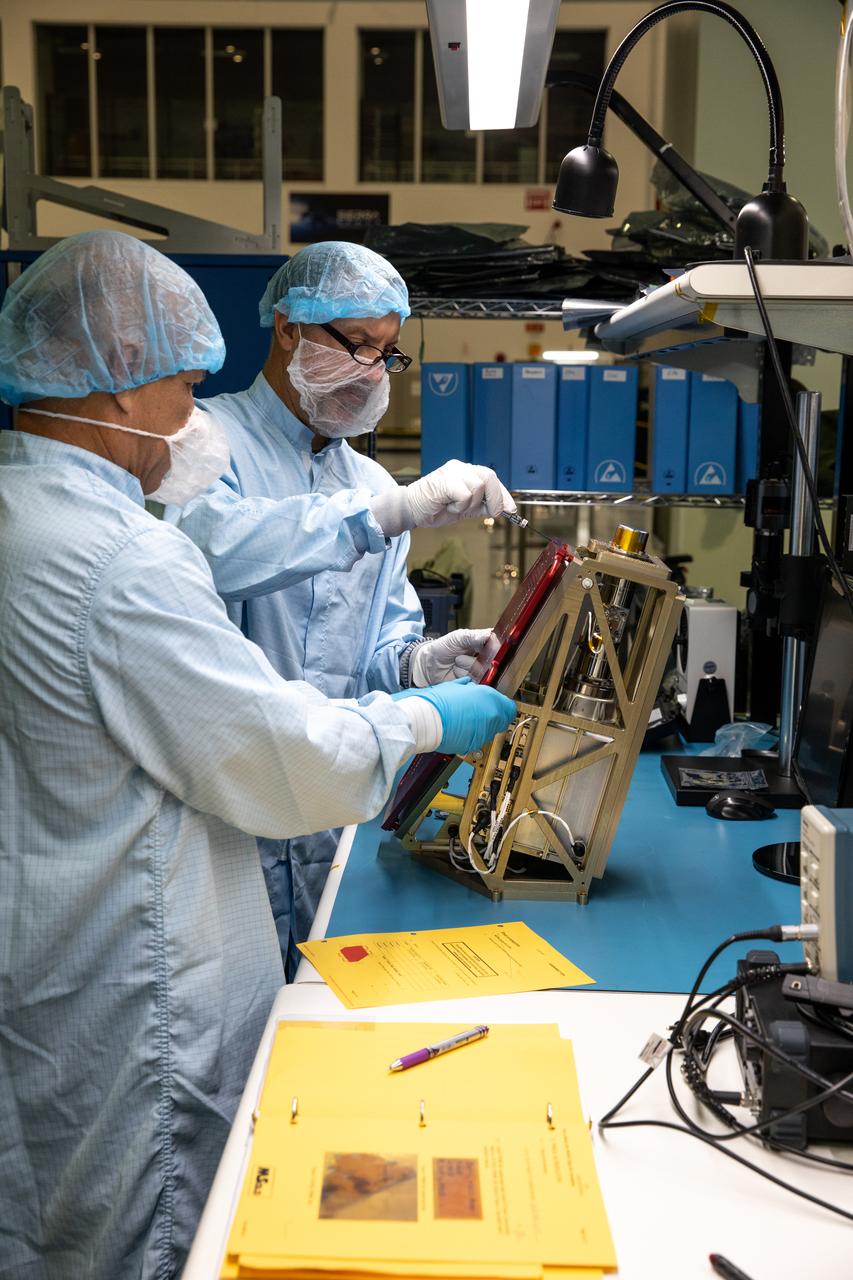
Engineers prepare the Mass Spectrometer Observing Lunar Operations (MSolo) instrument for the multilayer insulation installation inside Kennedy Space Center’s Space Station Processing Facility on Oct. 19, 2022. The activity is in preparation for the Polar Resources Ice Mining Experiment-1 (PRIME-1) mission, which will be the first in-situ resource utilization demonstration on the Moon. MSolo is a commercial off-the-shelf mass spectrometer modified to work in space and will help analyze the chemical makeup of landing sites on the Moon, as well as study water on the lunar surface. Researchers and engineers are preparing MSolo instruments to launch on four robotic missions as part of NASA’s Commercial Lunar Payload Services – commercial deliveries beginning in 2023 that will perform science experiments, test technologies, and demonstrate capabilities to help NASA explore the Moon and prepare for crewed missions to the lunar surface.
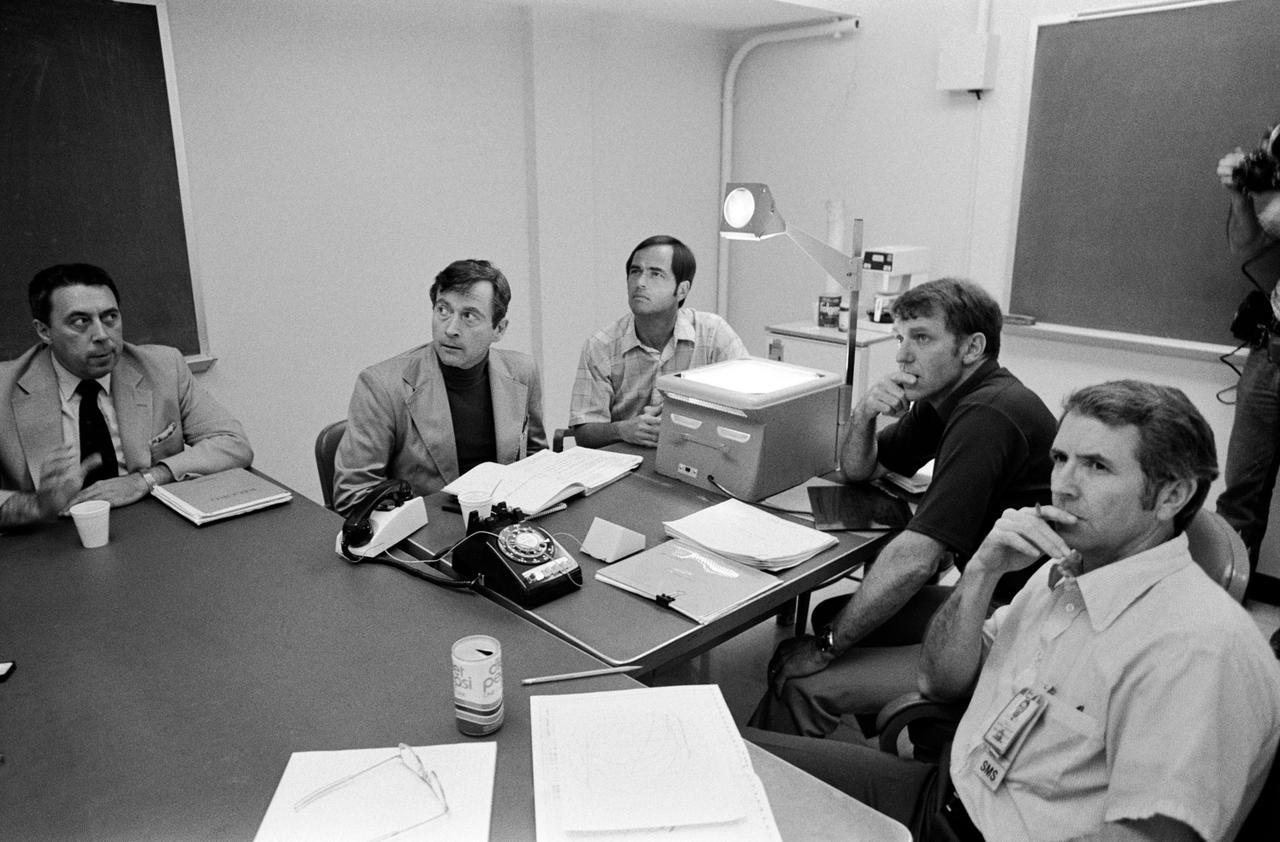
S81-29618 (6 April 1981) --- STS-1 prime and backup astronaut crew members look at visuals during a coordinated teleconference with engineers. Seated at the table in a briefing room at NASA's Johnson Space Center are, clockwise from the left, George W.S. Abbey, Director of Flight Operations, John W. Young, Robert L. Crippen, Joe H. Engle and Richard H. Truly. Young and Crippen are prime crewmen preparing to man the Columbia later this week for the flight of STS-1. Rockwell International engineers in California as well as JSC engineers participated in this telecon. Photo credit: NASA
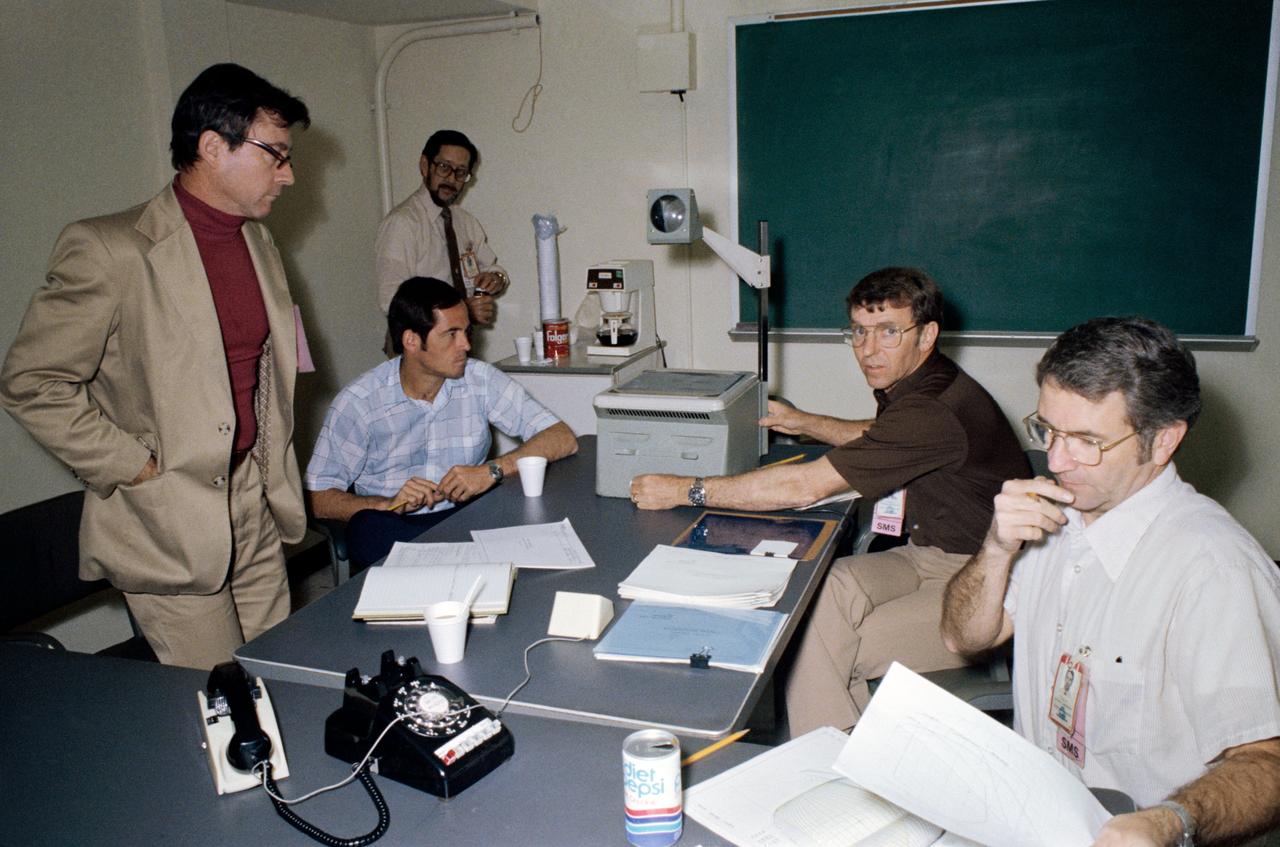
S81-29620 (6 April 1981) --- Prime and backup crew members for STS-1 take part in a briefing with engineers located in another building at NASA's Johnson Space Center (JSC) and with Rockwell International representatives in California via telephone. Astronauts John W. Young, left, and Robert L. Crippen, second from left, are STS-1 prime crewmen. Backup crewmen are astronauts Joe H. Engle, second from right, and Richard H. Truly. Photo credit: NASA
Inside the Space Station Processing Facility at NASA’s Kennedy Space Center in Florida, an engineer installs the Mass Spectrometer observing lunar operations (MSolo) onto its radiator bracket on June 14, 2022. Having successfully completed its thermal vacuum testing, the unit will undergo vibration testing later this month. This spectrometer is part of the PRIME-1 (Polar Resources Ice Mining Experiment-1) payload suite, slated to launch to the Moon in 2023 with Intuitive Machines. MSolo is a commercial off-the-shelf mass spectrometer modified to work in space and it will help analyze the chemical makeup of landing sites on the Moon, as well as study water on the lunar surface. MSolo is manifested to fly on four of the agency’s Commercial Lunar Payload Delivery Service missions where under Artemis, commercial deliveries beginning in 2023 will perform science experiments, test technologies, and demonstrate capabilities to help NASA explore the Moon and prepare for human missions.
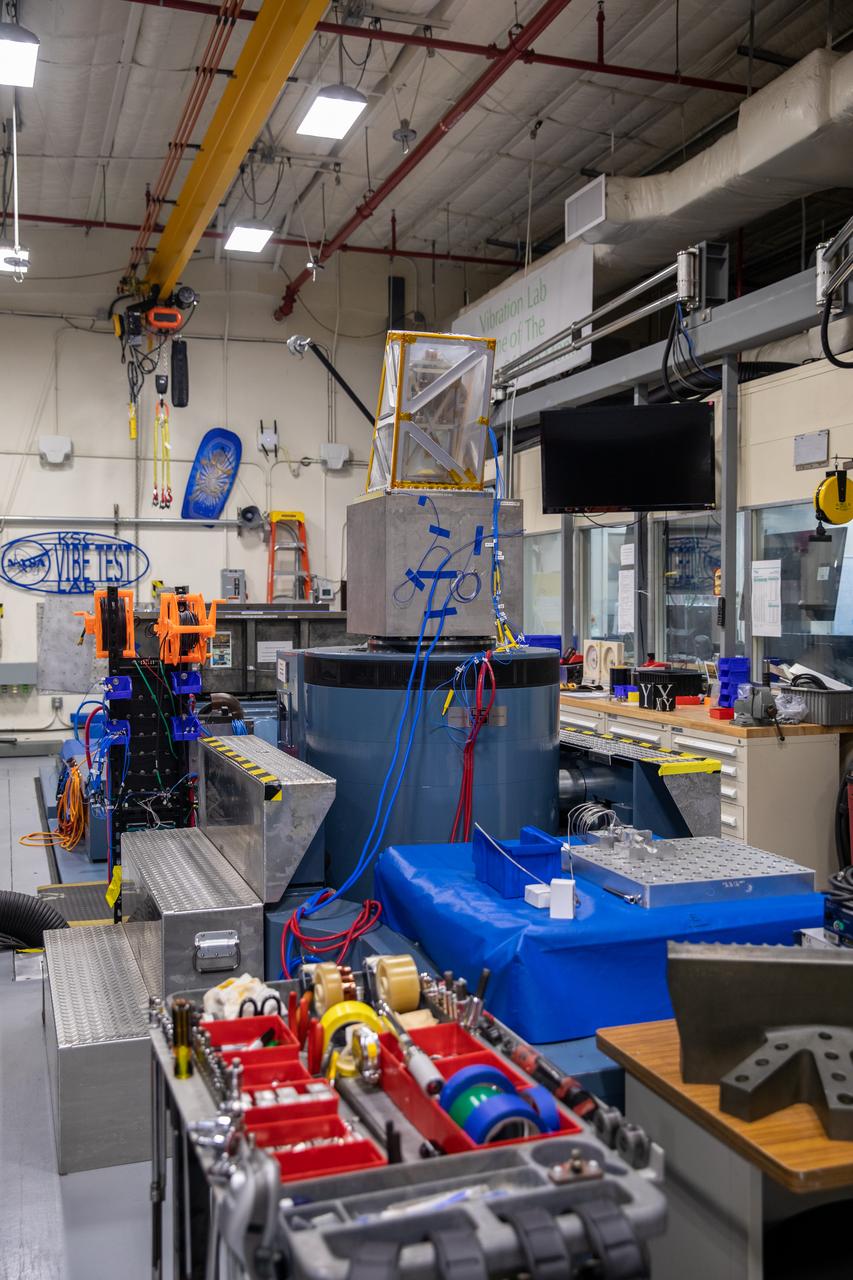
The Mass Spectrometer observing lunar operations (MSolo) instrument undergoes vibration testing inside the Cryogenics Laboratory at NASA’s Kennedy Space Center in Florida on Aug. 3, 2022. MSolo is a commercial off-the-shelf mass spectrometer modified to work in space and will help analyze the chemical makeup of landing sites on the Moon, as well as study water on the lunar surface. Researchers and engineers are preparing MSolo instruments to launch on four robotic missions as part of NASA’s Commercial Lunar Payload Services (CLPS) – commercial deliveries that will perform science experiments, test technologies, and demonstrate capabilities to help NASA explore the Moon and prepare for crewed missions to the lunar surface. This particular MSolo instrument is slated to fly on the agency’s Polar Resources Ice Mining Experiment-1 (PRIME-1) mission – the first in-situ resource utilization demonstration on the Moon – as part of the agency’s CLPS initiative.

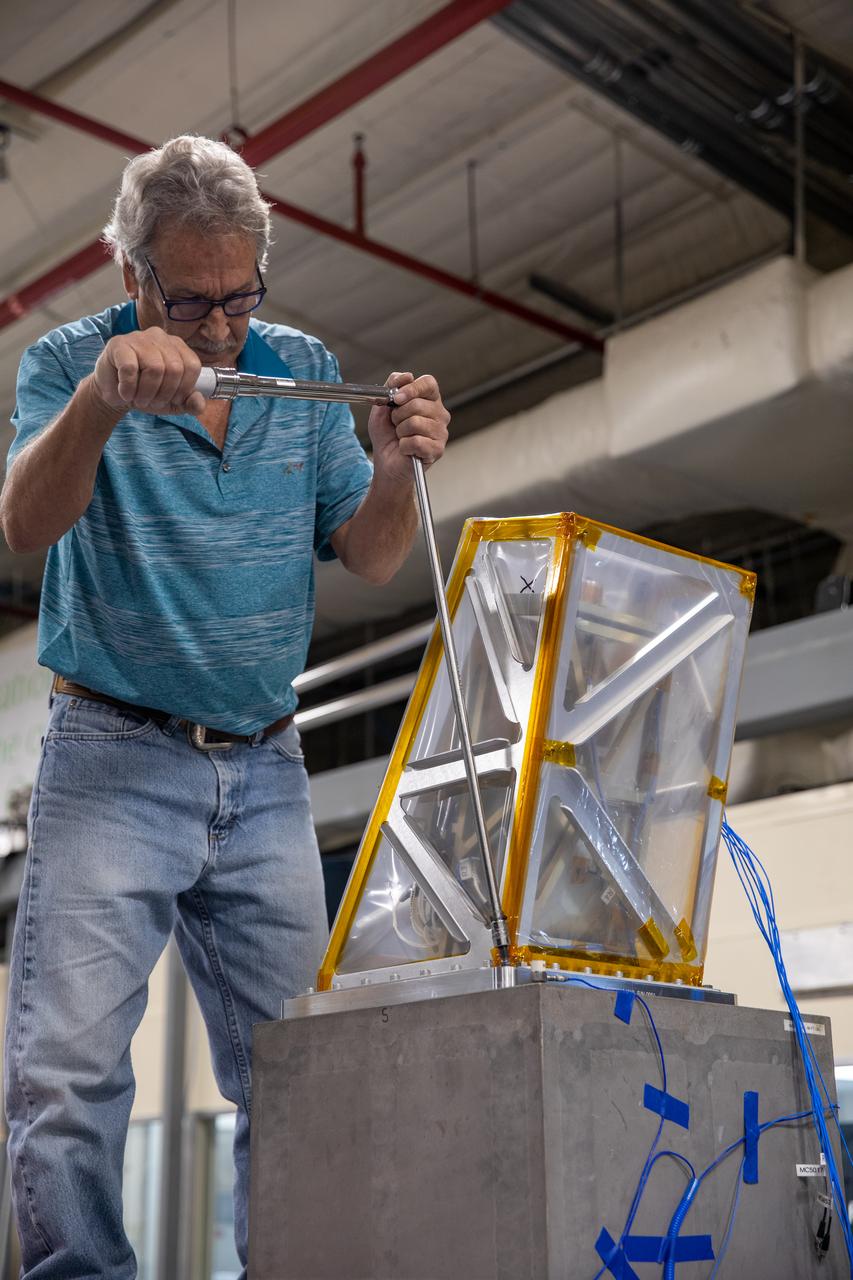
Engineers at NASA’s Kennedy Space Center in Florida remove the vibration fixture on the Mass Spectrometer observing lunar operations (MSolo) instrument on Aug. 4, 2022. The activity followed a vibration test in preparation for the Polar Resources Ice Mining Experiment-1 (PRIME-1) mission, which will be the first in-situ resource utilization demonstration on the Moon. MSolo is a commercial off-the-shelf mass spectrometer modified to work in space and will help analyze the chemical makeup of landing sites on the Moon, as well as study water on the lunar surface. Researchers and engineers are preparing MSolo instruments to launch on four robotic missions as part of NASA’s Commercial Lunar Payload Services – commercial deliveries beginning in 2023 that will perform science experiments, test technologies, and demonstrate capabilities to help NASA explore the Moon and prepare for crewed missions to the lunar surface.
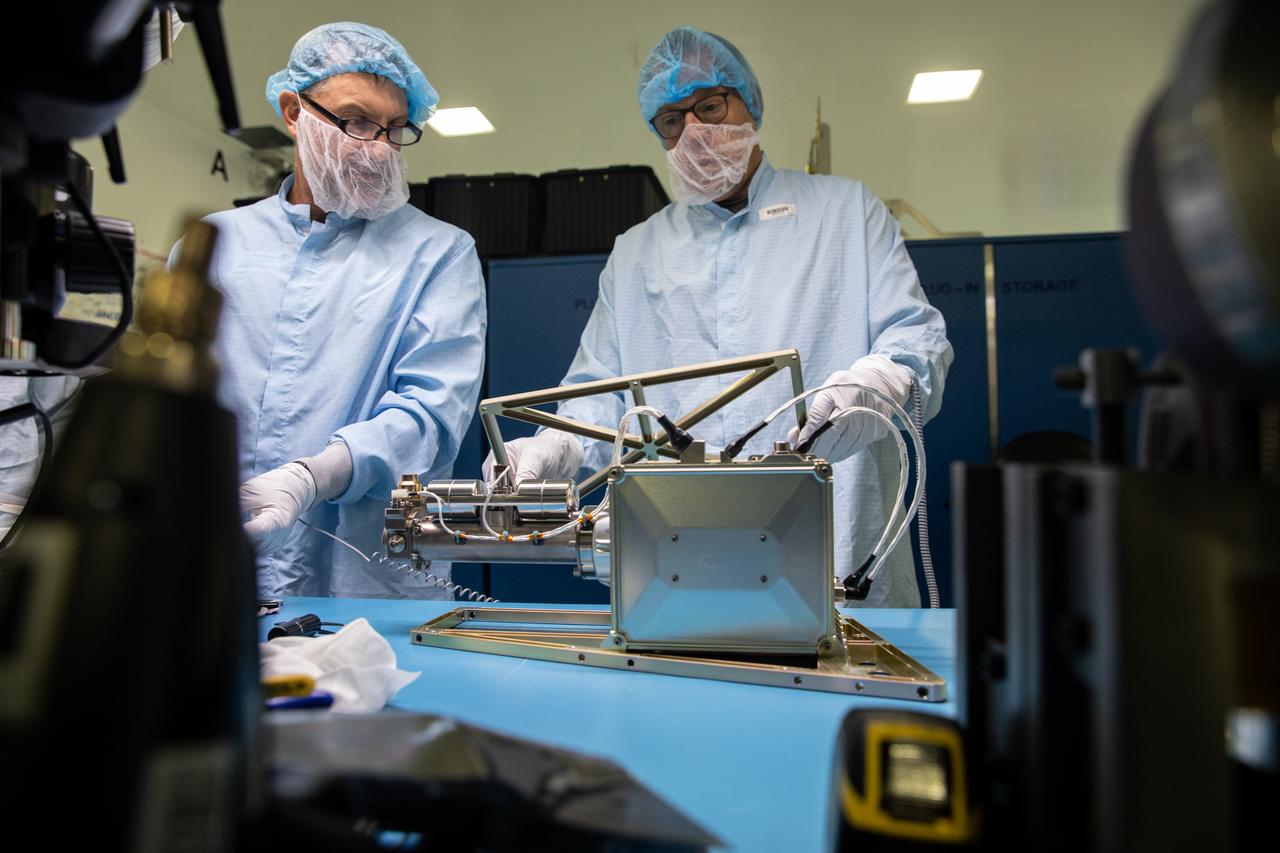
Inside the Space Station Processing Facility at NASA’s Kennedy Space Center in Florida, an engineer installs the Mass Spectrometer observing lunar operations (MSolo) onto its radiator bracket on June 14, 2022. Having successfully completed its thermal vacuum testing, the unit will undergo vibration testing later this month. This spectrometer is part of the PRIME-1 (Polar Resources Ice Mining Experiment-1) payload suite, slated to launch to the Moon in 2023 with Intuitive Machines. MSolo is a commercial off-the-shelf mass spectrometer modified to work in space and it will help analyze the chemical makeup of landing sites on the Moon, as well as study water on the lunar surface. MSolo is manifested to fly on four of the agency’s Commercial Lunar Payload Delivery Service missions where under Artemis, commercial deliveries beginning in 2023 will perform science experiments, test technologies, and demonstrate capabilities to help NASA explore the Moon and prepare for human missions.
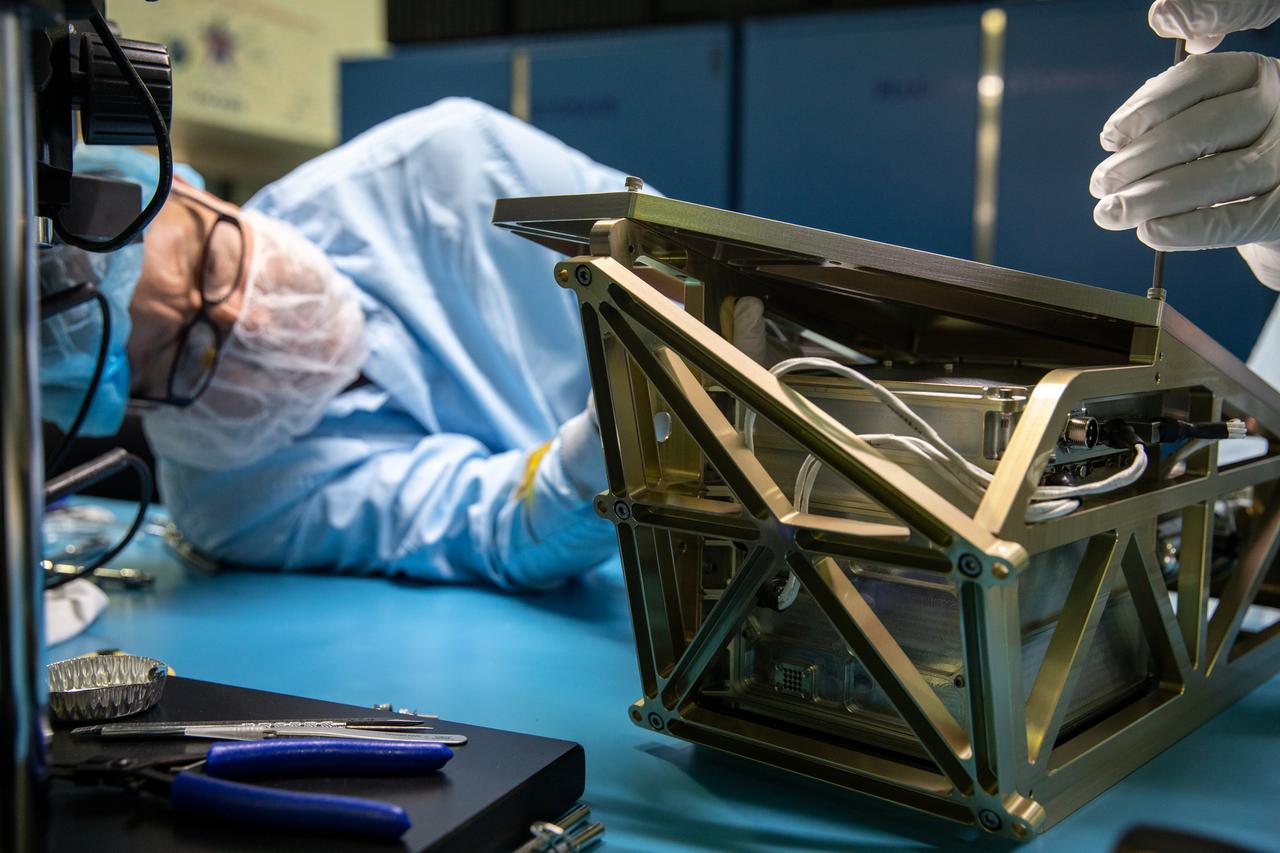
A Kennedy Space Center engineer prepares the Mass Spectrometer observing lunar operations (MSolo) instrument for vibration testing inside the Florida spaceport’s Cryogenics Laboratory on Aug. 3, 2022. MSolo is a commercial off-the-shelf mass spectrometer modified to work in space and will help analyze the chemical makeup of landing sites on the Moon, as well as study water on the lunar surface. Researchers and engineers are preparing MSolo instruments to launch on four robotic missions as part of NASA’s Commercial Lunar Payload Services (CLPS) – commercial deliveries that will perform science experiments, test technologies, and demonstrate capabilities to help NASA explore the Moon and prepare for crewed missions to the lunar surface. This particular MSolo instrument is slated to fly on the agency’s Polar Resources Ice Mining Experiment-1 (PRIME-1) mission – the first in-situ resource utilization demonstration on the Moon – as part of the agency’s CLPS initiative.
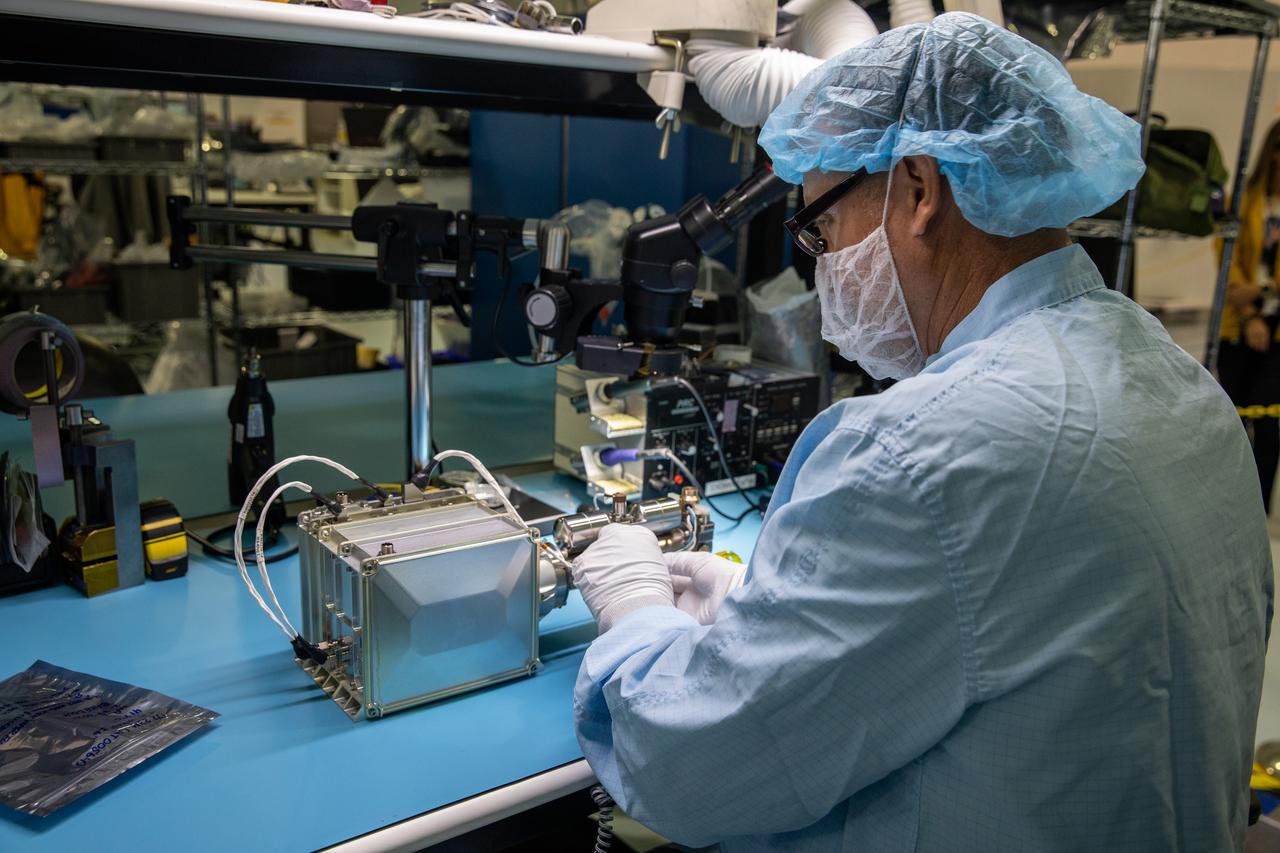
Inside the Space Station Processing Facility at NASA’s Kennedy Space Center in Florida, an engineer installs the Mass Spectrometer observing lunar operations (MSolo) onto its radiator bracket on June 14, 2022. Having successfully completed its thermal vacuum testing, the unit will undergo vibration testing later this month. This spectrometer is part of the PRIME-1 (Polar Resources Ice Mining Experiment-1) payload suite, slated to launch to the Moon in 2023 with Intuitive Machines. MSolo is a commercial off-the-shelf mass spectrometer modified to work in space and it will help analyze the chemical makeup of landing sites on the Moon, as well as study water on the lunar surface. MSolo is manifested to fly on four of the agency’s Commercial Lunar Payload Delivery Service missions where under Artemis, commercial deliveries beginning in 2023 will perform science experiments, test technologies, and demonstrate capabilities to help NASA explore the Moon and prepare for human missions.
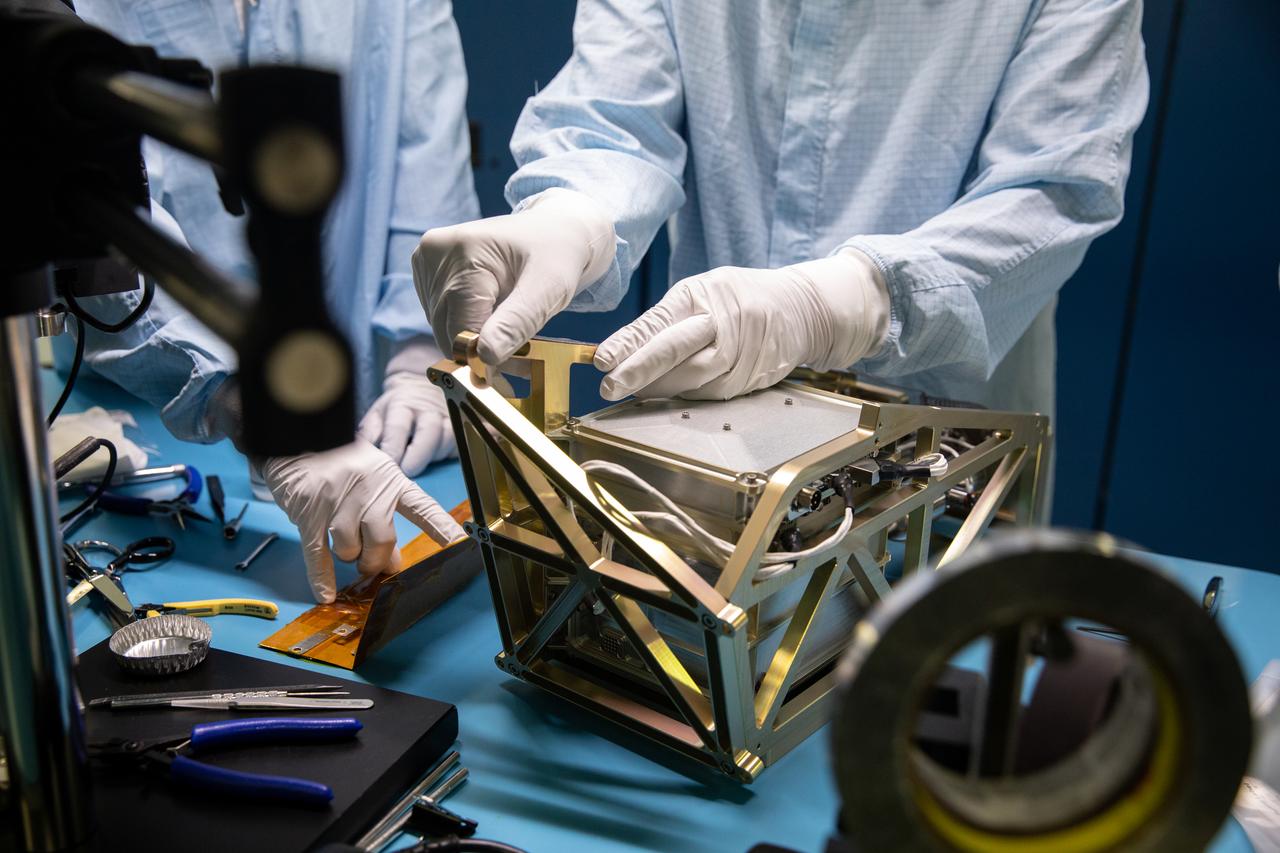
Inside the Space Station Processing Facility at NASA’s Kennedy Space Center in Florida, an engineer installs the Mass Spectrometer observing lunar operations (MSolo) onto its radiator bracket on June 14, 2022. Having successfully completed its thermal vacuum testing, the unit will undergo vibration testing later this month. This spectrometer is part of the PRIME-1 (Polar Resources Ice Mining Experiment-1) payload suite, slated to launch to the Moon in 2023 with Intuitive Machines. MSolo is a commercial off-the-shelf mass spectrometer modified to work in space and it will help analyze the chemical makeup of landing sites on the Moon, as well as study water on the lunar surface. MSolo is manifested to fly on four of the agency’s Commercial Lunar Payload Delivery Service missions where under Artemis, commercial deliveries beginning in 2023 will perform science experiments, test technologies, and demonstrate capabilities to help NASA explore the Moon and prepare for human missions.
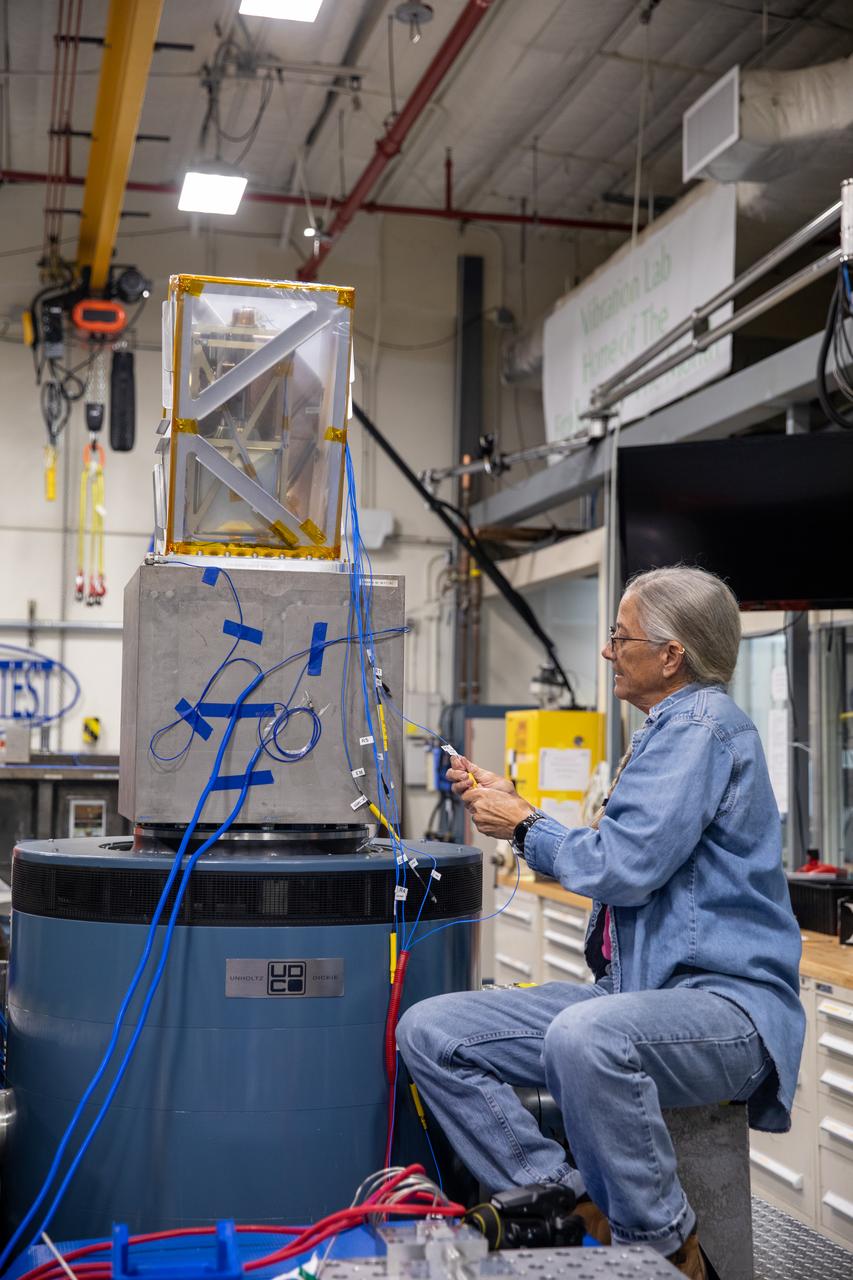
A Kennedy Space Center engineer prepares the Mass Spectrometer observing lunar operations (MSolo) instrument for vibration testing inside the Florida spaceport’s Cryogenics Laboratory on Aug. 3, 2022. MSolo is a commercial off-the-shelf mass spectrometer modified to work in space and will help analyze the chemical makeup of landing sites on the Moon, as well as study water on the lunar surface. Researchers and engineers are preparing MSolo instruments to launch on four robotic missions as part of NASA’s Commercial Lunar Payload Services (CLPS) – commercial deliveries that will perform science experiments, test technologies, and demonstrate capabilities to help NASA explore the Moon and prepare for crewed missions to the lunar surface. This particular MSolo instrument is slated to fly on the agency’s Polar Resources Ice Mining Experiment-1 (PRIME-1) mission – the first in-situ resource utilization demonstration on the Moon – as part of the agency’s CLPS initiative.
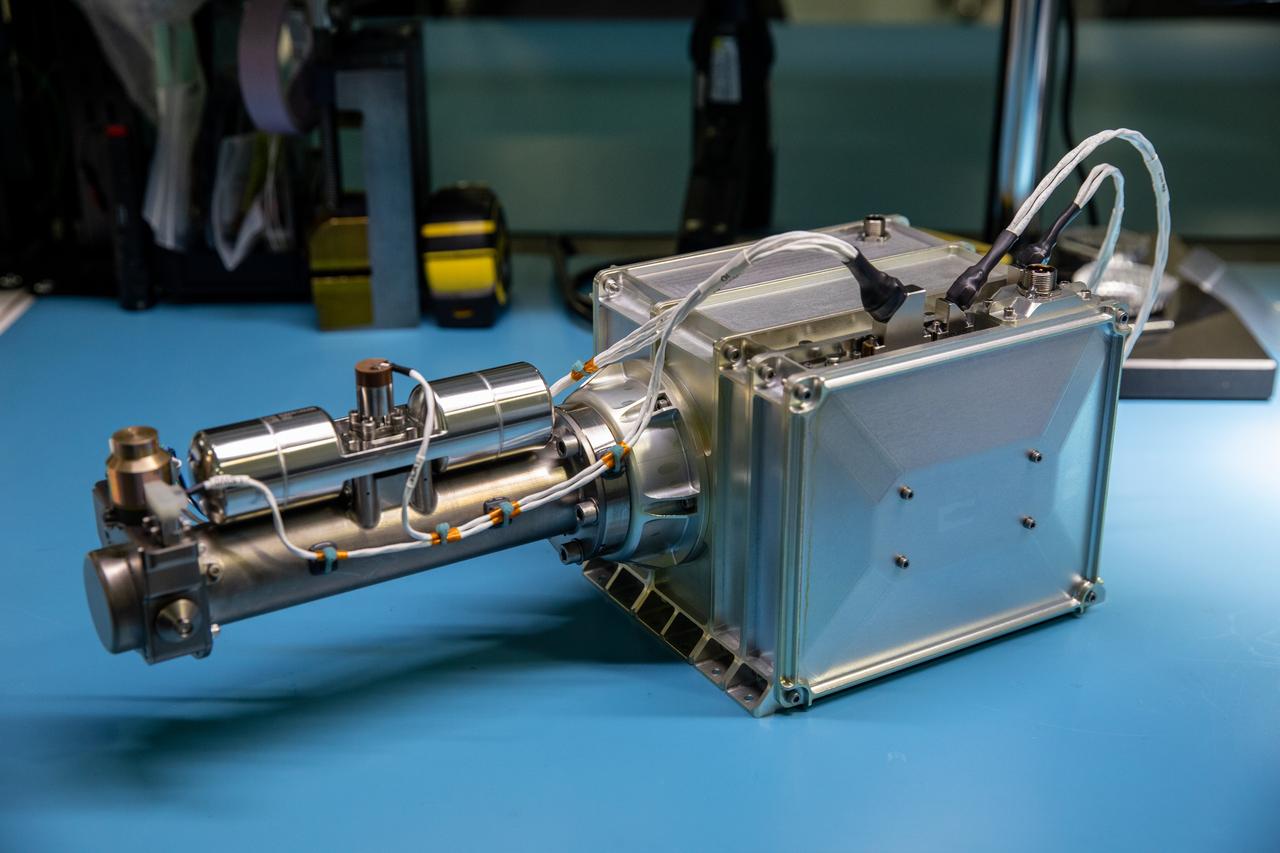
Inside the Space Station Processing Facility at NASA’s Kennedy Space Center in Florida, the Mass Spectrometer observing lunar operations (MSolo) is being installed on a radiator bracket on June 14, 2022. Having successfully completed its thermal vacuum testing, the unit will undergo vibration testing later this month. This spectrometer is part of the PRIME-1 (Polar Resources Ice Mining Experiment-1) payload suite, slated to launch to the Moon in 2023 with Intuitive Machines. MSolo is a commercial off-the-shelf mass spectrometer modified to work in space and it will help analyze the chemical makeup of landing sites on the Moon, as well as study water on the lunar surface. MSolo is manifested to fly on four of the agency’s Commercial Lunar Payload Delivery Service missions where under Artemis, commercial deliveries beginning in 2023 will perform science experiments, test technologies, and demonstrate capabilities to help NASA explore the Moon and prepare for human missions.
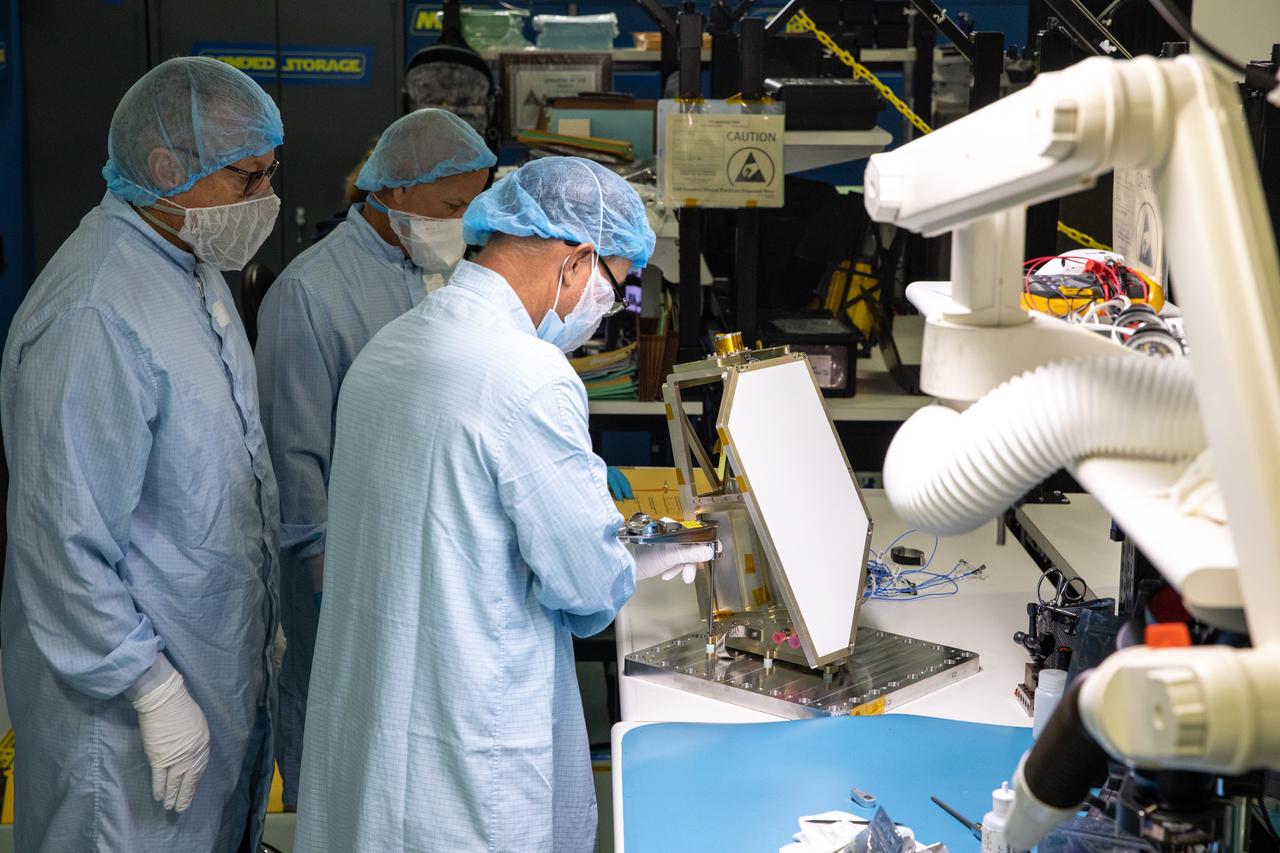
Engineers at NASA’s Kennedy Space Center in Florida remove the vibration fixture on the Mass Spectrometer observing lunar operations (MSolo) instrument on Aug. 4, 2022. The activity followed a vibration test in preparation for the Polar Resources Ice Mining Experiment-1 (PRIME-1) mission, which will be the first in-situ resource utilization demonstration on the Moon. MSolo is a commercial off-the-shelf mass spectrometer modified to work in space and will help analyze the chemical makeup of landing sites on the Moon, as well as study water on the lunar surface. Researchers and engineers are preparing MSolo instruments to launch on four robotic missions as part of NASA’s Commercial Lunar Payload Services – commercial deliveries beginning in 2023 that will perform science experiments, test technologies, and demonstrate capabilities to help NASA explore the Moon and prepare for crewed missions to the lunar surface.
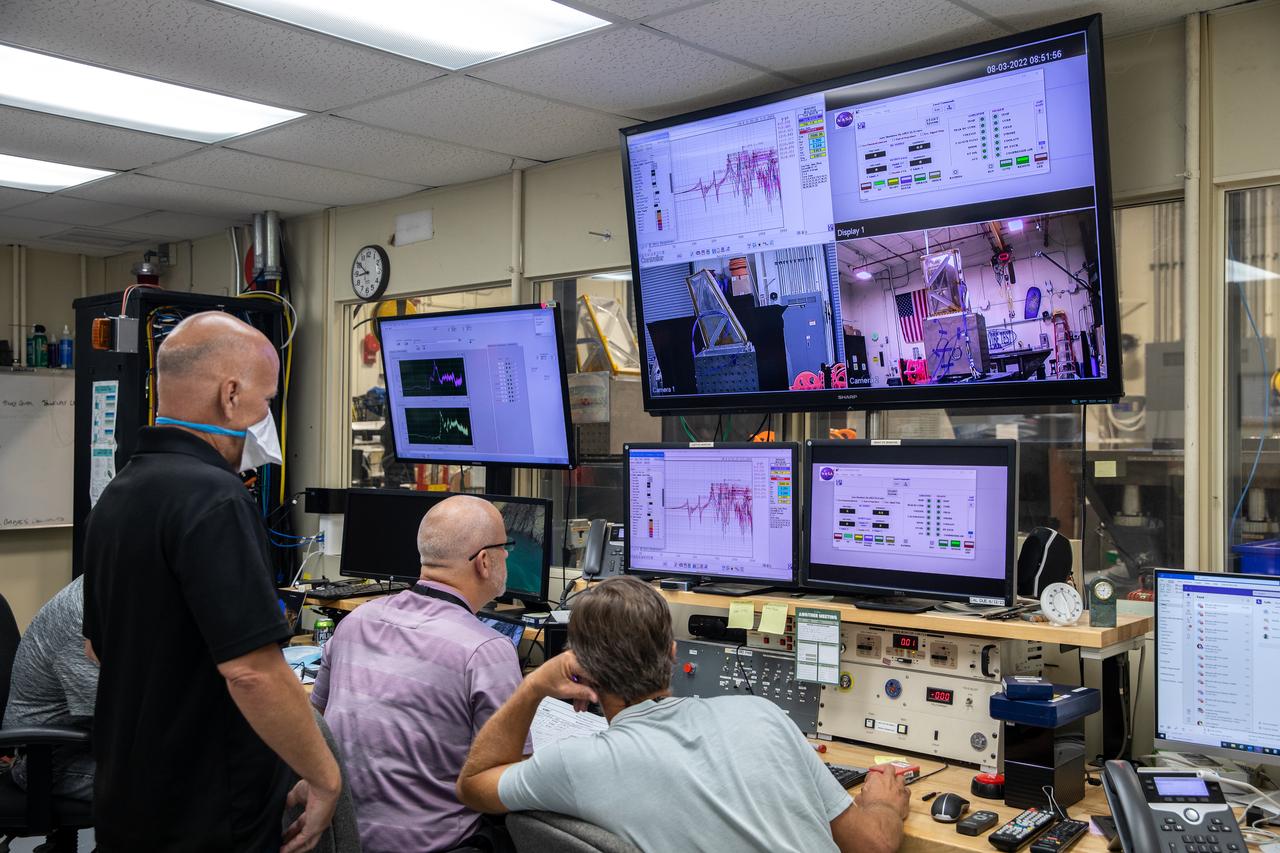
Engineers at NASA’s Kennedy Space Center monitor the Mass Spectrometer observing lunar operations (MSolo) instrument as it undergoes vibration testing inside the Florida spaceport’s Cryogenics Laboratory on Aug. 3, 2022. MSolo is a commercial off-the-shelf mass spectrometer modified to work in space and will help analyze the chemical makeup of landing sites on the Moon, as well as study water on the lunar surface. Researchers and engineers are preparing MSolo instruments to launch on four robotic missions as part of NASA’s Commercial Lunar Payload Services (CLPS) – commercial deliveries that will perform science experiments, test technologies, and demonstrate capabilities to help NASA explore the Moon and prepare for crewed missions to the lunar surface. This particular MSolo instrument is slated to fly on the agency’s Polar Resources Ice Mining Experiment-1 (PRIME-1) mission – the first in-situ resource utilization demonstration on the Moon – as part of the agency’s CLPS initiative.
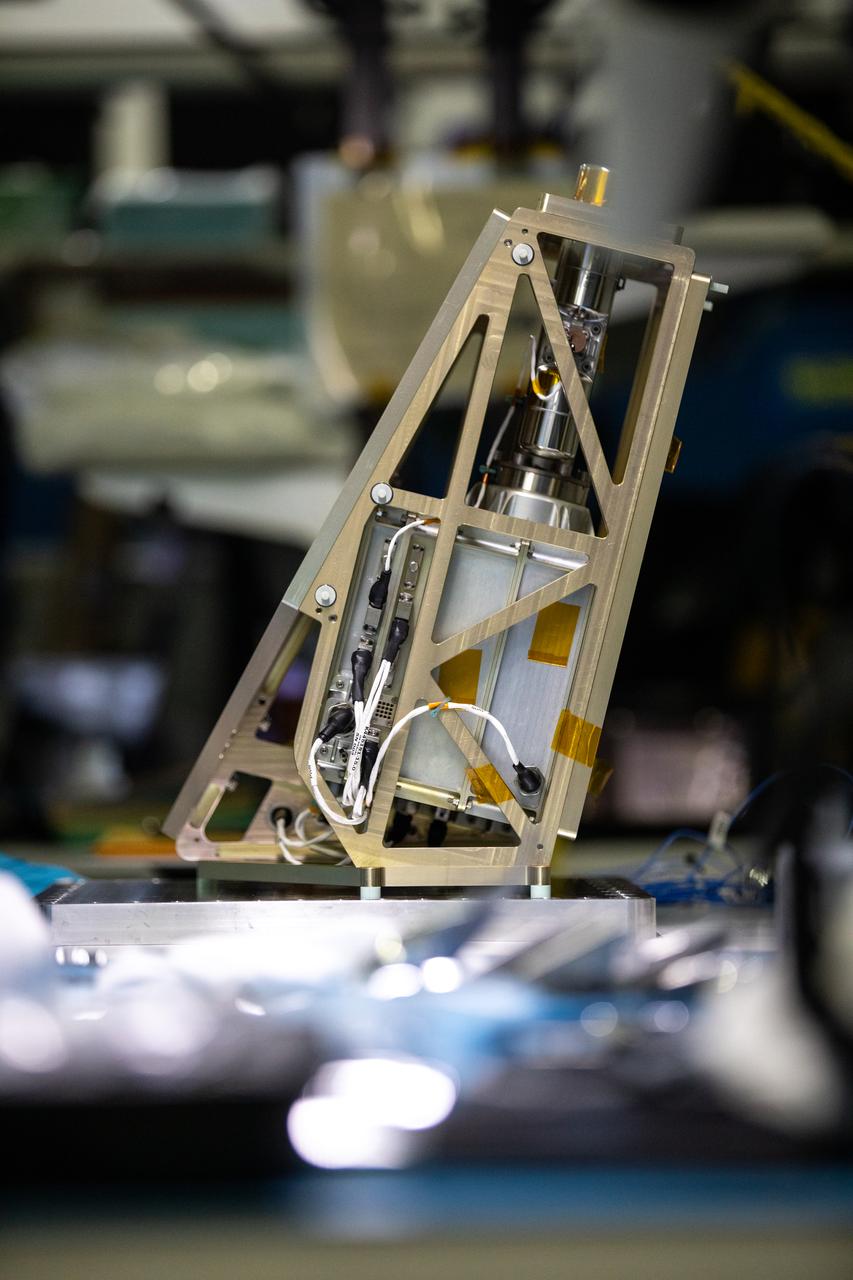
Engineers at NASA’s Kennedy Space Center in Florida remove the vibration fixture on the Mass Spectrometer observing lunar operations (MSolo) instrument on Aug. 4, 2022. The activity followed a vibration test in preparation for the Polar Resources Ice Mining Experiment-1 (PRIME-1) mission, which will be the first in-situ resource utilization demonstration on the Moon. MSolo is a commercial off-the-shelf mass spectrometer modified to work in space and will help analyze the chemical makeup of landing sites on the Moon, as well as study water on the lunar surface. Researchers and engineers are preparing MSolo instruments to launch on four robotic missions as part of NASA’s Commercial Lunar Payload Services – commercial deliveries beginning in 2023 that will perform science experiments, test technologies, and demonstrate capabilities to help NASA explore the Moon and prepare for crewed missions to the lunar surface.
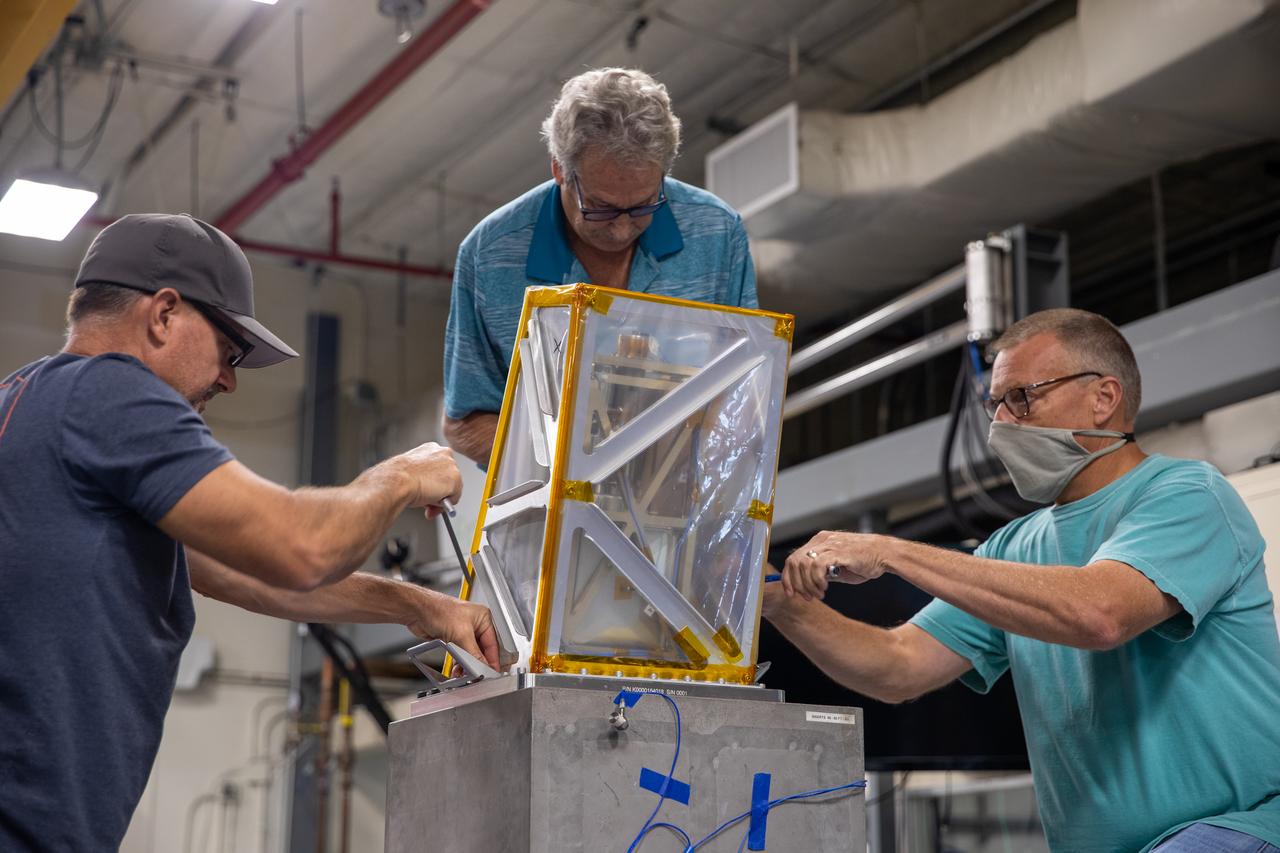
Engineers at NASA’s Kennedy Space Center prepare the Mass Spectrometer observing lunar operations (MSolo) instrument for vibration testing inside the Florida spaceport’s Cryogenics Laboratory on Aug. 3, 2022. MSolo is a commercial off-the-shelf mass spectrometer modified to work in space and will help analyze the chemical makeup of landing sites on the Moon, as well as study water on the lunar surface. Researchers and engineers are preparing MSolo instruments to launch on four robotic missions as part of NASA’s Commercial Lunar Payload Services (CLPS) – commercial deliveries that will perform science experiments, test technologies, and demonstrate capabilities to help NASA explore the Moon and prepare for crewed missions to the lunar surface. This particular MSolo instrument is slated to fly on the agency’s Polar Resources Ice Mining Experiment-1 (PRIME-1) mission – the first in-situ resource utilization demonstration on the Moon – as part of the agency’s CLPS initiative.

Engineers at NASA’s Kennedy Space Center in Florida remove the vibration fixture on the Mass Spectrometer observing lunar operations (MSolo) instrument on Aug. 4, 2022. The activity followed a vibration test in preparation for the Polar Resources Ice Mining Experiment-1 (PRIME-1) mission, which will be the first in-situ resource utilization demonstration on the Moon. MSolo is a commercial off-the-shelf mass spectrometer modified to work in space and will help analyze the chemical makeup of landing sites on the Moon, as well as study water on the lunar surface. Researchers and engineers are preparing MSolo instruments to launch on four robotic missions as part of NASA’s Commercial Lunar Payload Services – commercial deliveries beginning in 2023 that will perform science experiments, test technologies, and demonstrate capabilities to help NASA explore the Moon and prepare for crewed missions to the lunar surface.
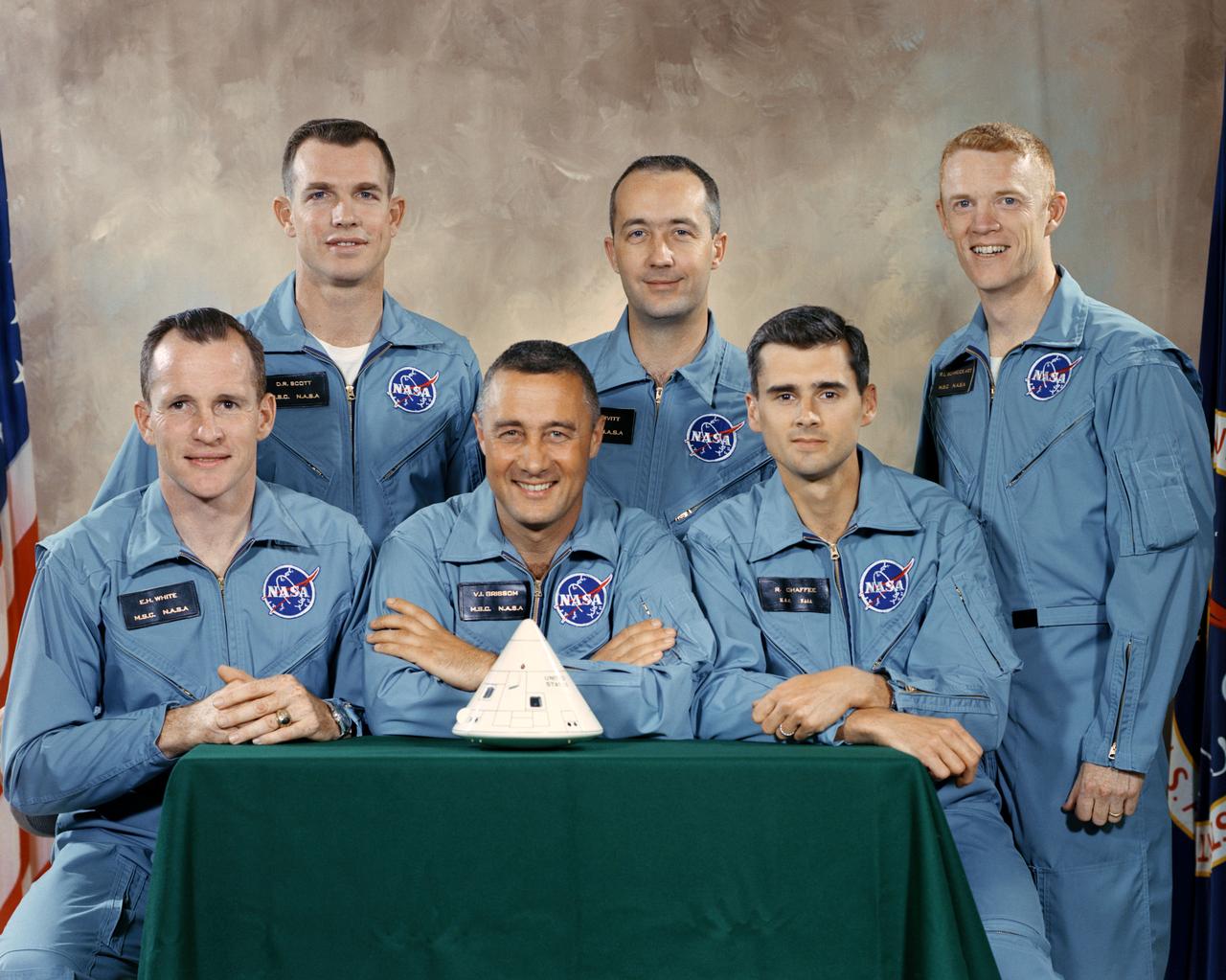
S66-30238 (1 April 1966) --- The National Aeronautics and Space Administration (NASA) has named these astronauts as the prime crew of the first manned Apollo Space Flight. Left to right, are Edward H. White II, command module pilot; Virgil I. Grissom, mission commander; and Roger B. Chaffee, lunar module pilot. On the second row are the Apollo 1 backup crew members, astronauts David R. Scott, James A. McDivitt and Russell L. Schweickart. EDITOR'S NOTE: Astronauts Grissom, White and Chaffee lost their lives in a Jan. 27, 1967 fire in the Apollo CM during testing at Cape Canaveral. McDivitt, Scott and Schweickart later served as crewmembers for the Apollo 9 Earth-orbital mission, which was one of the important stair-step missions leading up to the Apollo 11 manned lunar landing mission of July 1969.
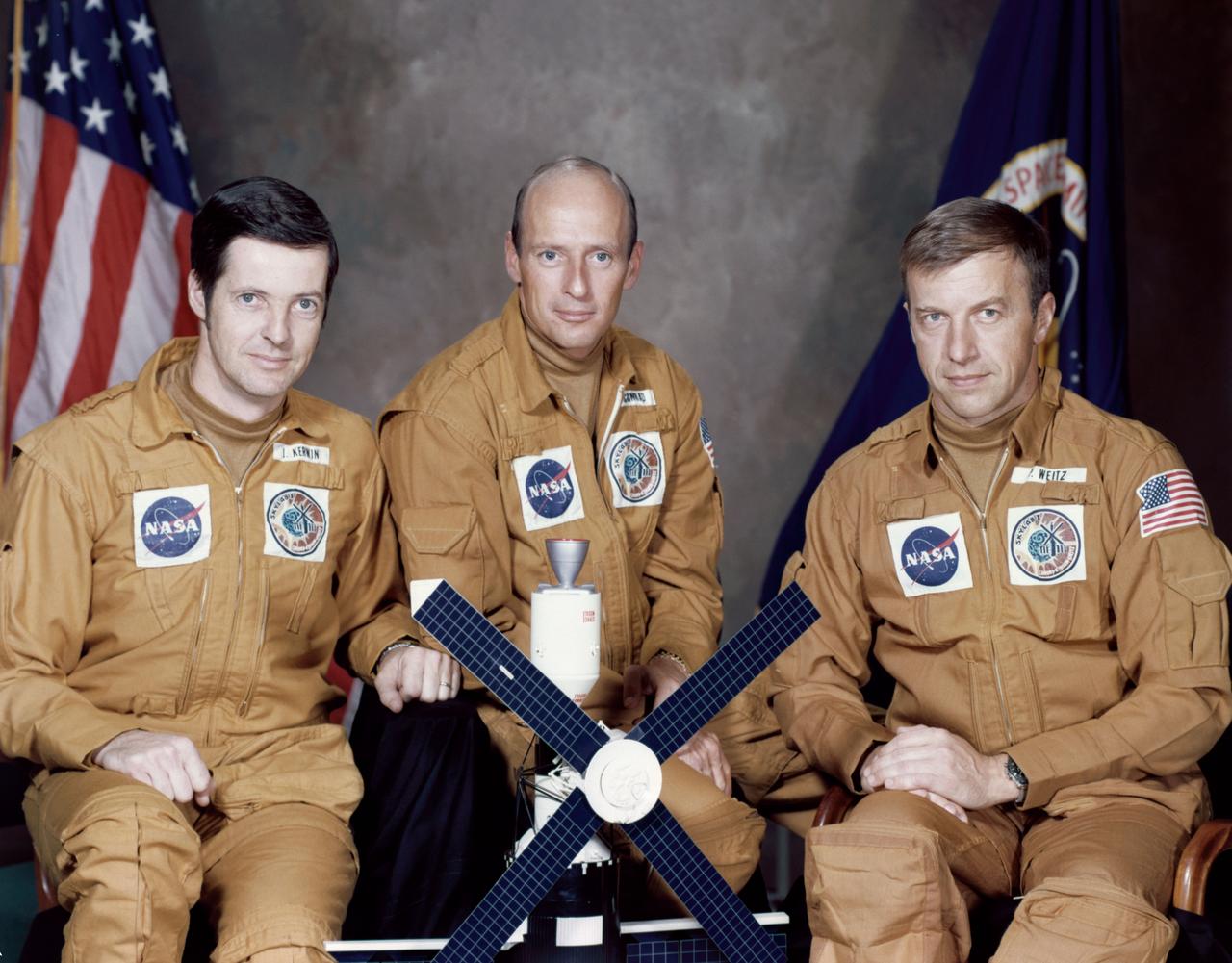
S73-24303 (May 1973) --- These three astronauts have been named by the National Aeronautics and Space Administration as the prime crew of the first manned Skylab mission. They are, left to right, Joseph P. Kerwin, science pilot; Charles Conrad Jr., commander; and Paul J. Weitz, pilot. Skylab is a three-part program consisting of one 28-day and two 56-day manned visits spanning an eight-month period. One day prior to the launch of this crew, the unmanned Skylab space station cluster will be launched and placed in Earth orbit. The first manned mission will last up to 28 days. Photo credit: NASA

Technicians with Orbital ATK, prime contractor for the Space Launch System (SLS) Booster, prepare a paint mixture for the right hand aft skirt for NASA’s SLS in a support building at the Hangar AF facility at Cape Canaveral Air Force Station in Florida. The space shuttle-era aft skirt, was inspected and resurfaced, and will be primed and painted for use on the right hand booster of the SLS rocket for Exploration Mission 1 (EM-1). NASA is preparing for EM-1, deep-space missions, and the Journey to Mars.
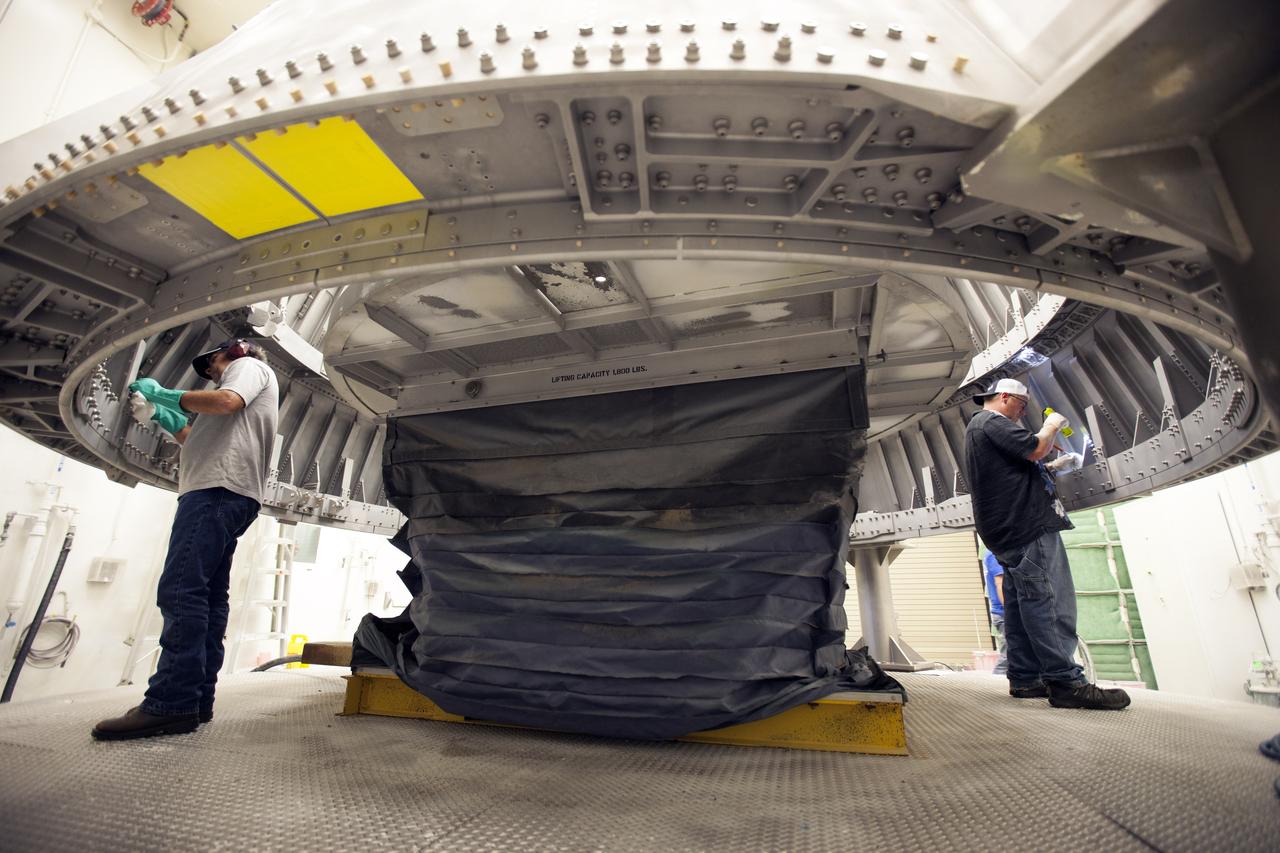
Technicians with Orbital ATK, prime contractor for the Space Launch System (SLS) Booster, prepare the right hand aft skirt for NASA’s SLS rocket for primer and painting inside a support building at the Hangar AF facility at Cape Canaveral Air Force Station in Florida. The space shuttle-era aft skirt, was inspected and resurfaced and will be primed and painted for use on the right hand booster of the SLS rocket for Exploration Mission 1 (EM-1). NASA is preparing for EM-1, deep-space missions, and the journey to Mars.
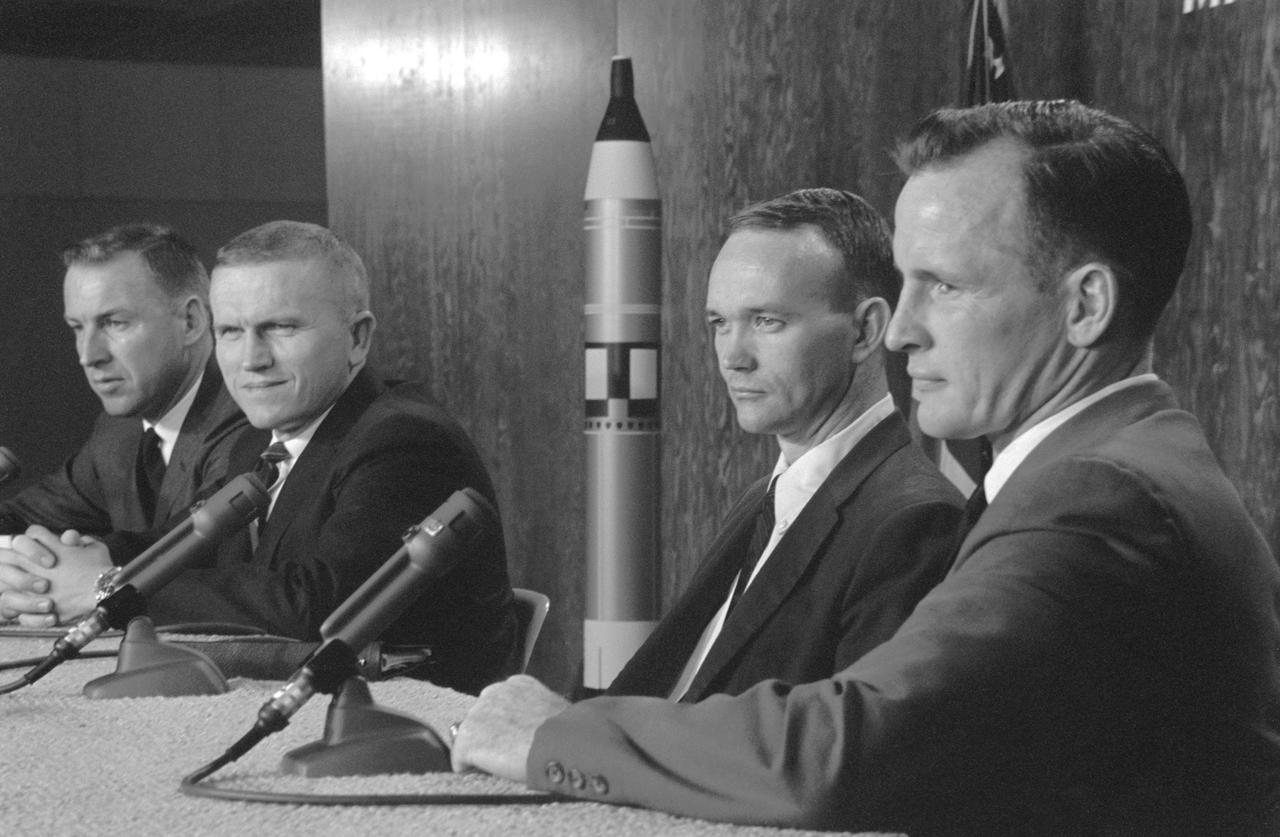
S65-57987 (1 Nov. 1965) --- The prime and backup crews of Gemini-7 spaceflight, scheduled for early December 1965, met with members of various news media at the MSC News Center. Left to right, are astronauts James A. Lovell Jr., prime crew pilot; Frank Borman, prime crew command pilot; Michael Collins, backup crew pilot; and Edward H. White II, backup crew command pilot. Photo credit: NASA
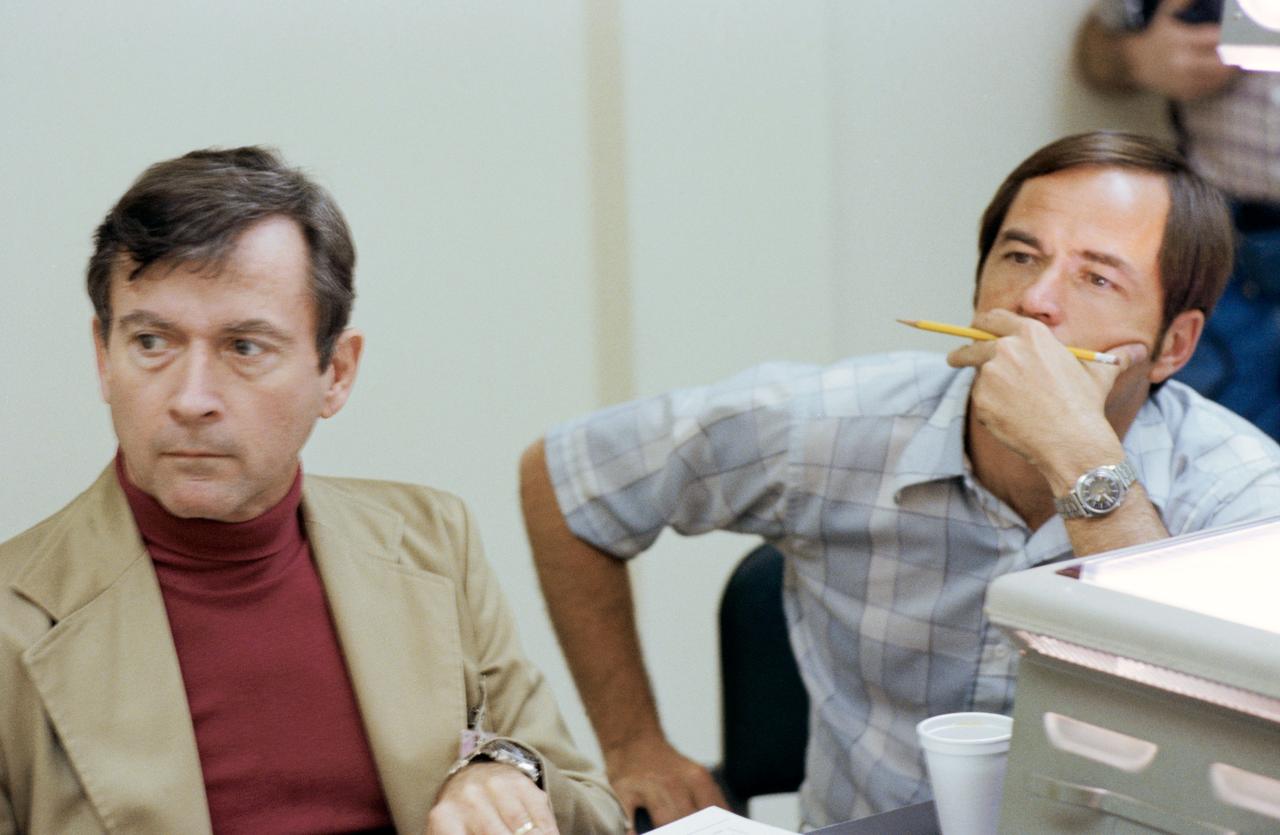
S81-29619 (6 April 1981) --- STS-1 astronauts John W. Young, left, and Robert L. Crippen direct their attention to a chart on a screen in a small briefing room at NASA's Johnson Space Center (JSC). They are taking part in a three-way telephone conference call, which involved engineers at JSC and at the Rockwell International facility in California. Later this week the two will man the space shuttle orbiter Columbia for STS-1. Photo credit: NASA
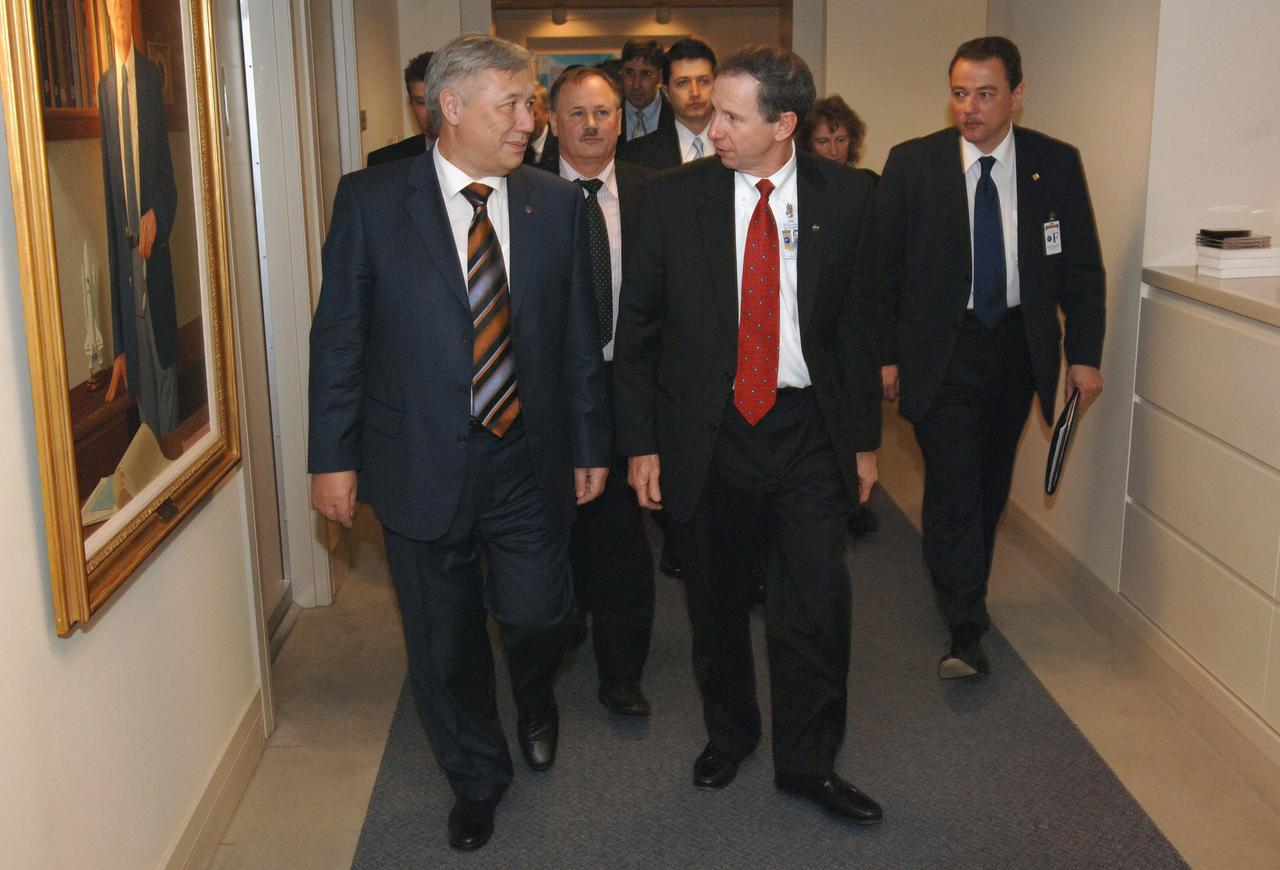
Yuriy Yekhanurov, Prime Minister of Ukraine, left, and NASA Administrator Michael Griffin, walk together prior to the start of a meeting Tuesday, Nov. 1, 2005, at NASA Headquarters in Washington. Photo Credit: (NASA/Bill Ingalls)

NASA Administrator Michael Griffin, left, shakes hands with Yuriy Yekhanurov, Prime Minister of Ukraine after a visit to NASA Headquarters on Tuesday, Nov. 1, 2005 in Washington. Photo Credit: (NASA/Bill Ingalls)
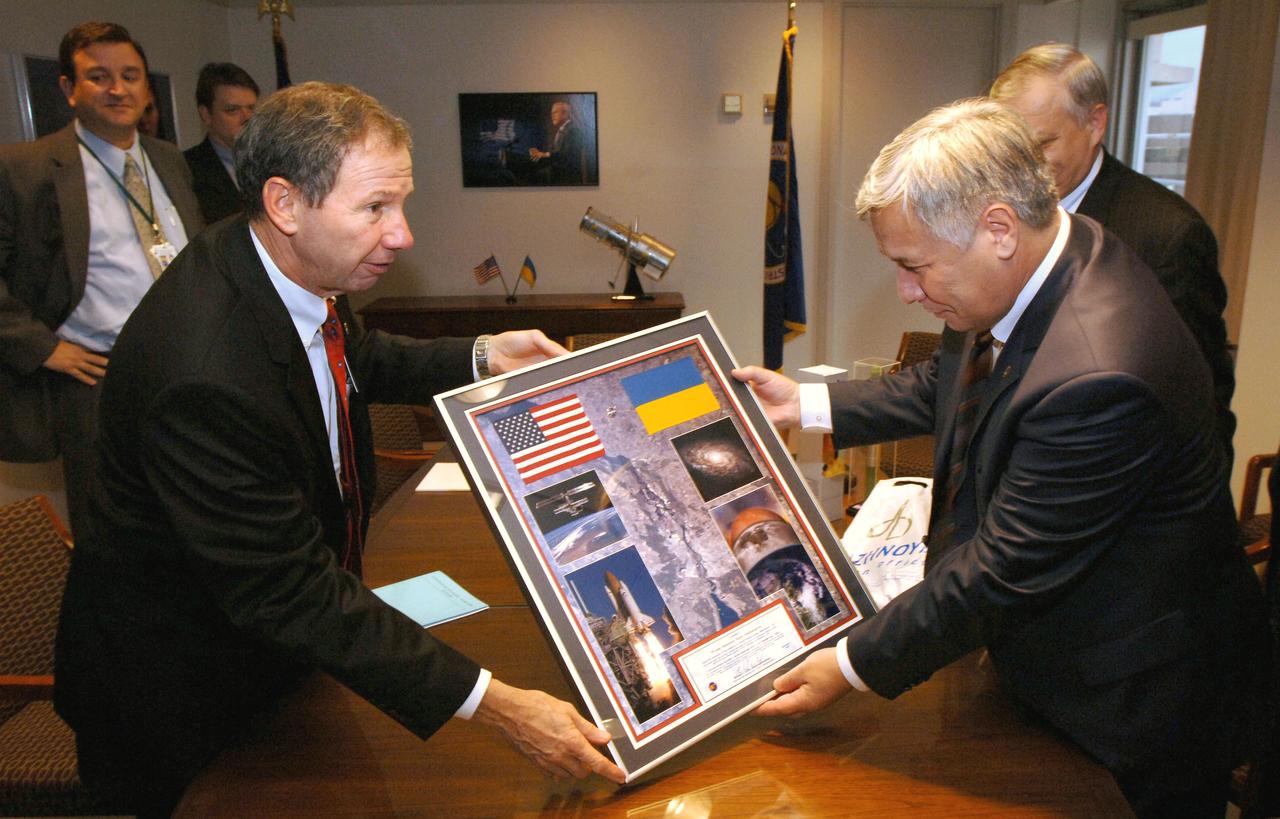
NASA Administrator Michael Griffin, left, presents Yuriy Yekhanurov, Prime Minister of Ukraine, with a montage following a meeting Tuesday, Nov. 1, 2005, at NASA Headquarters in Washington. Photo Credit: (NASA/Bill Ingalls)
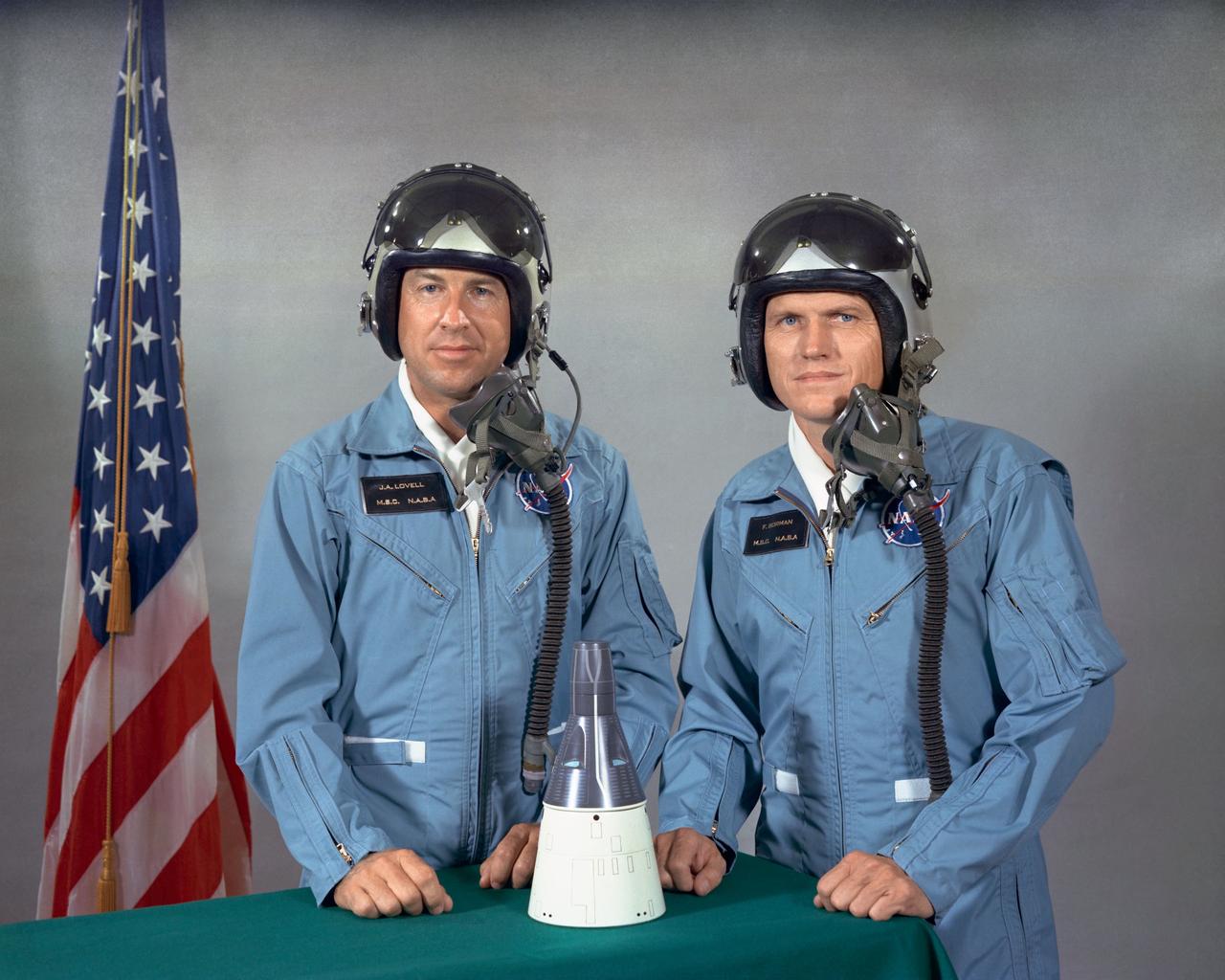
S65-41825 (1 July 1965) --- Astronauts Frank Borman (right), command pilot, and James A. Lovell Jr., pilot, are the prime crew members for NASA's Gemini-Titan 7 (GT-7) mission. Photo credit: NASA
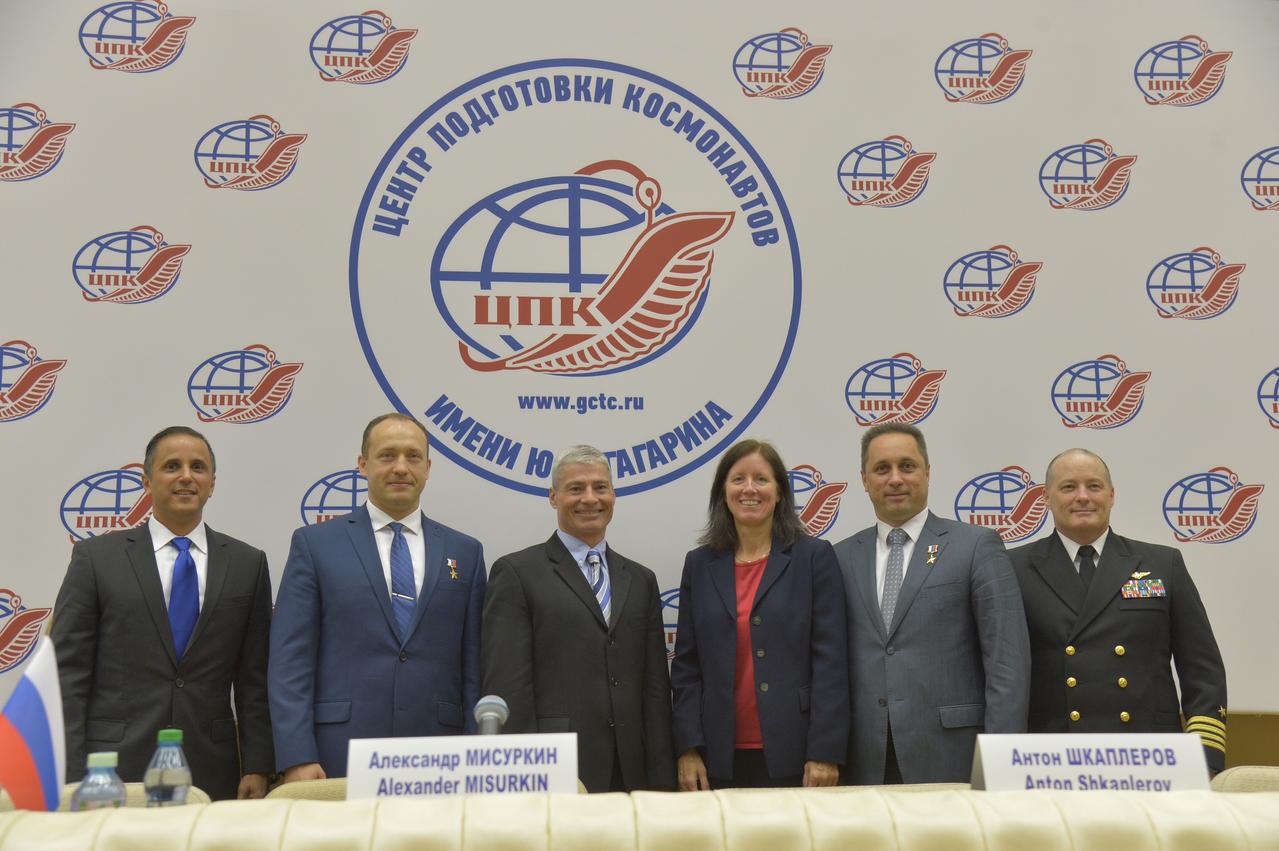
jsc2017e114483 (Sept. 1, 2017) --- At the Gagarin Cosmonaut Training Center in Star City, Russia, the Expedition 53-54 prime and backup crewmembers pose for pictures following a news conference Sept. 1. From left to right are the prime crewmembers, Joe Acaba of NASA, Alexander Misurkin of Roscosmos and Mark Vande Hei of NASA, and the backup crewmembers, Shannon Walker of NASA, Anton Shkaplerov of Roscosmos and Scott Tingle of NASA. Acaba, Misurkin and Vande Hei will launch Sept. 13 on the Soyuz MS-06 spacecraft from the Baikonur Cosmodrome in Kazakhstan on a five and a half month mission aboard the International Space Station. Credit: NASA/Elizabeth Weissinger
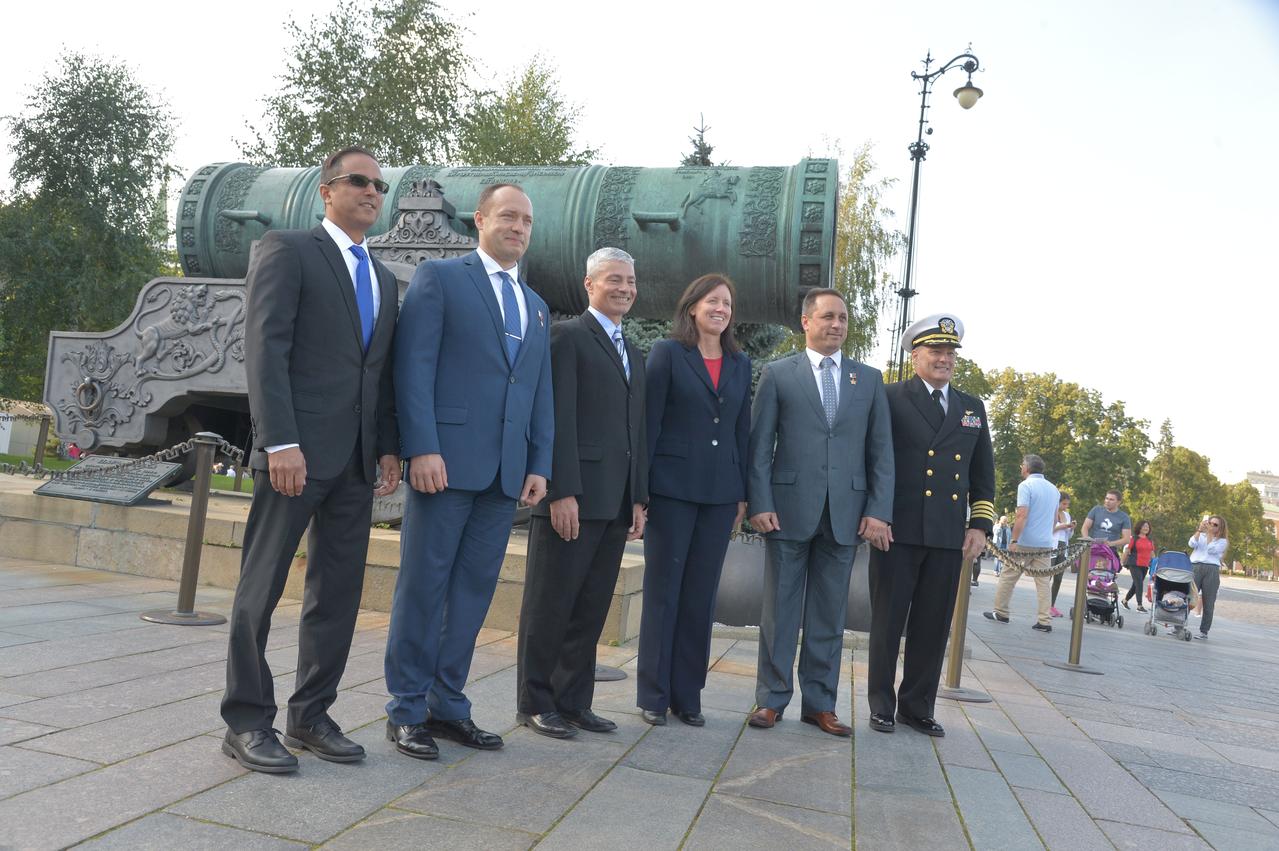
jsc2017e114491 (Sept. 1, 2017) --- The Expedition 53-54 prime and backup crewmembers pose for pictures in front of the Tsar Cannon at the Kremlin in Moscow Sept. 1 as part of their traditional pre-launch visit. From left to right are prime crewmembers Joe Acaba of NASA, Alexander Misurkin of Roscosmos and Mark Vande Hei of NASA and backup crewmembers Shannon Walker of NASA, Anton Shkaplerov of Roscosmos and Scott Tingle of NASA. Misurkin, Acaba and Vande Hei will launch Sept. 13 from the Baikonur Cosmodrome in Kazakhstan Sept. 13 on the Soyuz MS-06 spacecraft for a five and a half month mission on the International Space Station. Credit: NASA/Elizabeth Weissinger
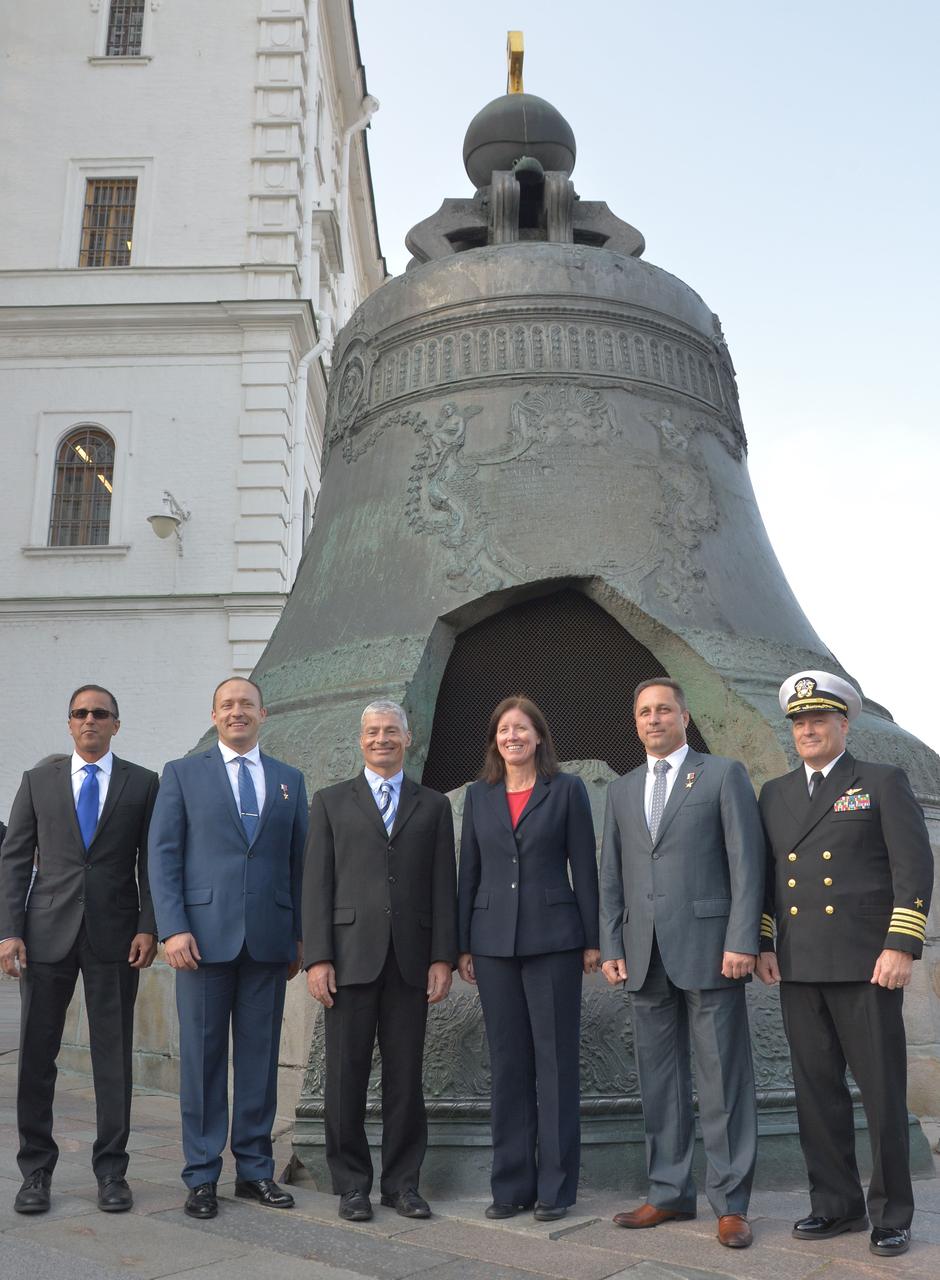
jsc2017e114490 (Sept. 1, 2017) --- The Expedition 53-54 prime and backup crewmembers pose for pictures in front of the Tsar Bell at the Kremlin in Moscow Sept. 1 as part of their traditional pre-launch visit. From left to right are prime crewmembers Joe Acaba of NASA, Alexander Misurkin of Roscosmos and Mark Vande Hei of NASA and backup crewmembers Shannon Walker of NASA, Anton Shkaplerov of Roscosmos and Scott Tingle of NASA. Misurkin, Acaba and Vande Hei will launch Sept. 13 from the Baikonur Cosmodrome in Kazakhstan Sept. 13 on the Soyuz MS-06 spacecraft for a five and a half month mission on the International Space Station. Credit: NASA/Elizabeth Weissinger
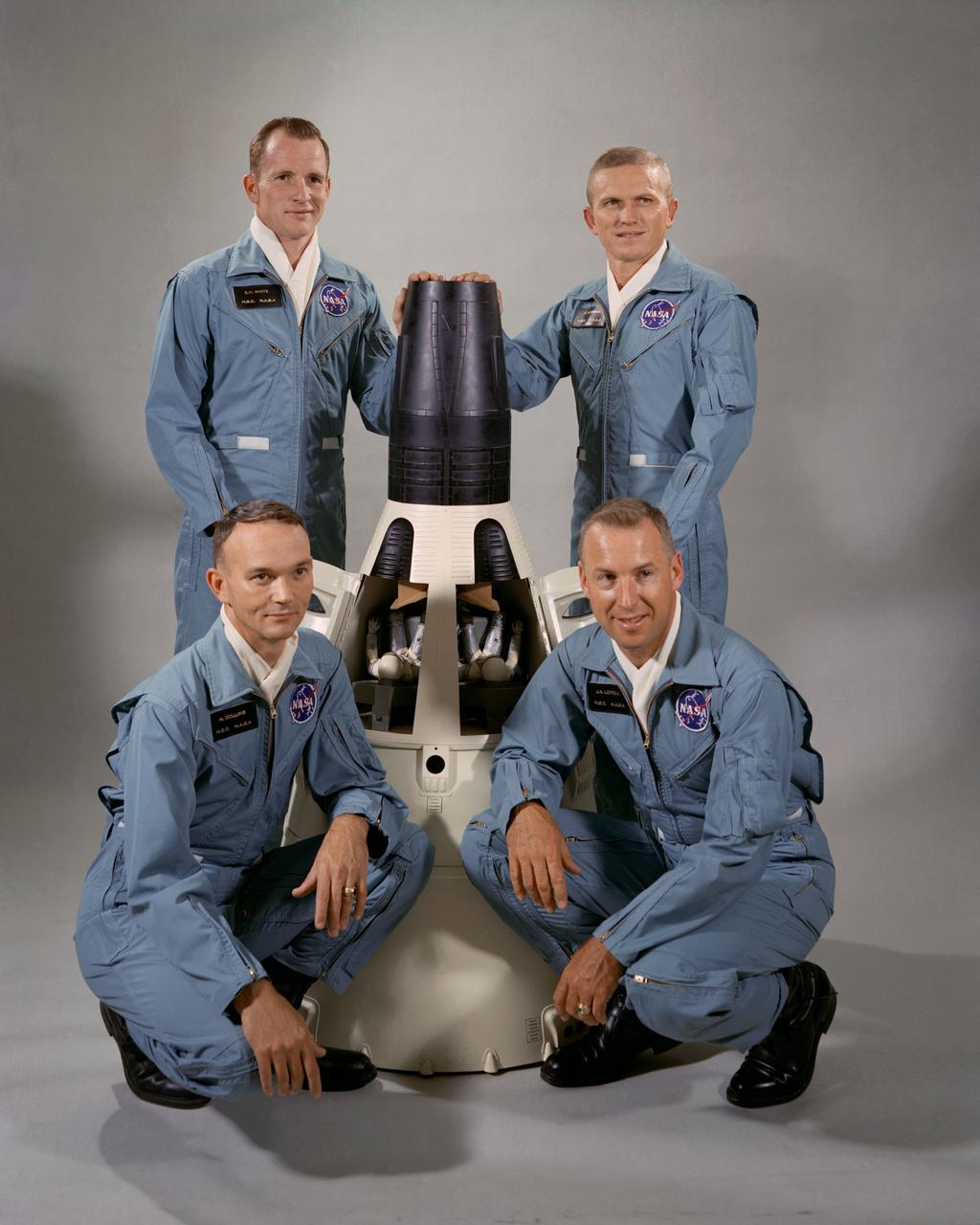
S65-41828 (September 1965) --- Portrait of the Gemini-7 prime and backup crew members around a model of the Gemini-7 spacecraft. The prime crew members for the Gemini-Titan 7 (GT-7) are astronauts Frank Borman (standing right), command pilot, and James A. Lovell Jr. (kneeling right), pilot. Astronauts Michael Collins (kneeling left), pilot, and Edward H. White II (standing left), command pilot, were named as GT-7 backup crew members on July 1, 1965. Photo credit: NASA
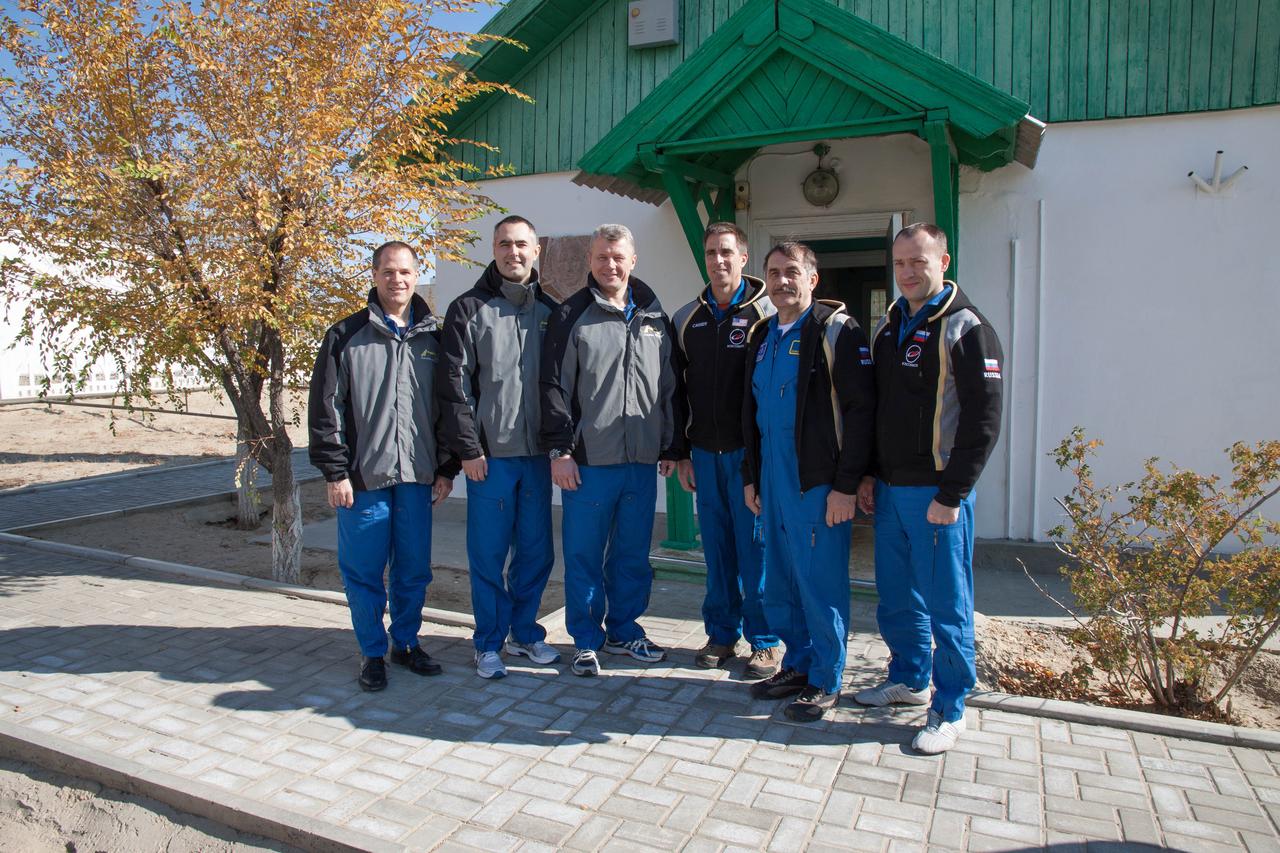
The Expedition 33/34 prime and backup crews pose for pictures October 18, 2012 at the Baikonur Cosmodrome in Kazakhstan in front of the famed cottage where Yuri Gagarin slept the night before his launch April 12, 1961 aboard the Vostok 1 spacecraft to become the first human to fly in space. From left to right are prime NASA Flight Engineer Kevin Ford, prime Flight Engineer Evgeny Tarelkin, prime Soyuz Commander Oleg Novitskiy and backup crewmembers Chris Cassidy of NASA, Pavel Vinogradov and Alexander Misurkin. Ford, Novitskiy and Tarelkin will launch October 23 from the Cosmodrome in their Soyuz TMA-06M spacecraft for a five-month mission on the International Space Station. NASA/Victor Zelentsov
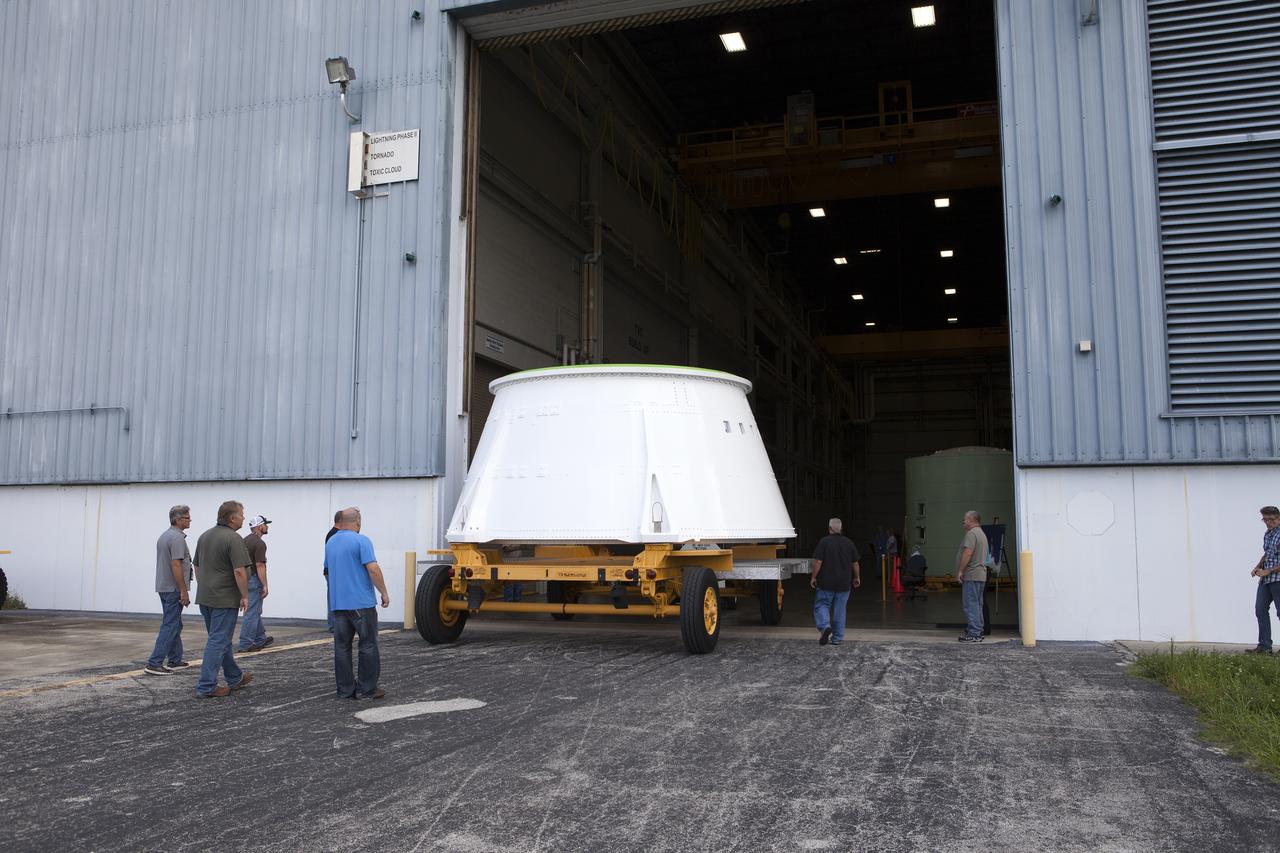
The left hand aft skirt for NASA’s Space Launch System (SLS) rocket is moved inside the Booster Fabrication Facility at the agency’s Kennedy Space Center in Florida. The aft skirt arrived from the Hangar AF facility at Cape Canaveral Air Force Station. The space shuttle-era aft skirt, was inspected, resurfaced, primed and painted for use on the left hand booster of the SLS rocket for Exploration Mission 1 (EM-1). NASA is preparing for EM-1, deep-space missions, and the journey to Mars.
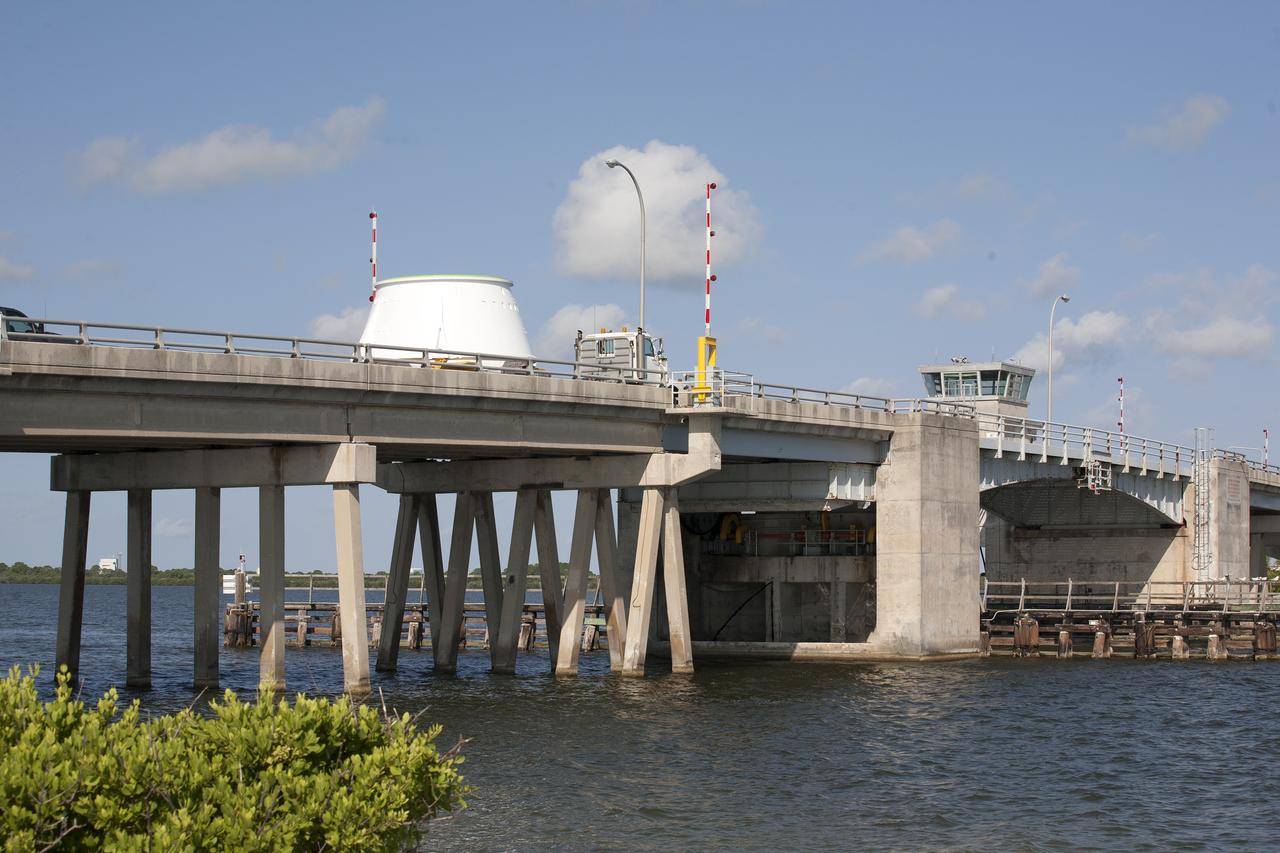
The left hand aft skirt for NASA’s Space Launch System (SLS) rocket is transported across the Roy D. Bridges Bridge from the Hangar AF facility at Cape Canaveral Air Force Station in Florida, on its way to the Booster Fabrication Facility at the agency’s Kennedy Space Center. The space shuttle-era aft skirt, was inspected, resurfaced, primed and painted for use on the left hand booster of the SLS rocket for Exploration Mission 1 (EM-1). NASA is preparing for EM-1, deep-space missions, and the journey to Mars.
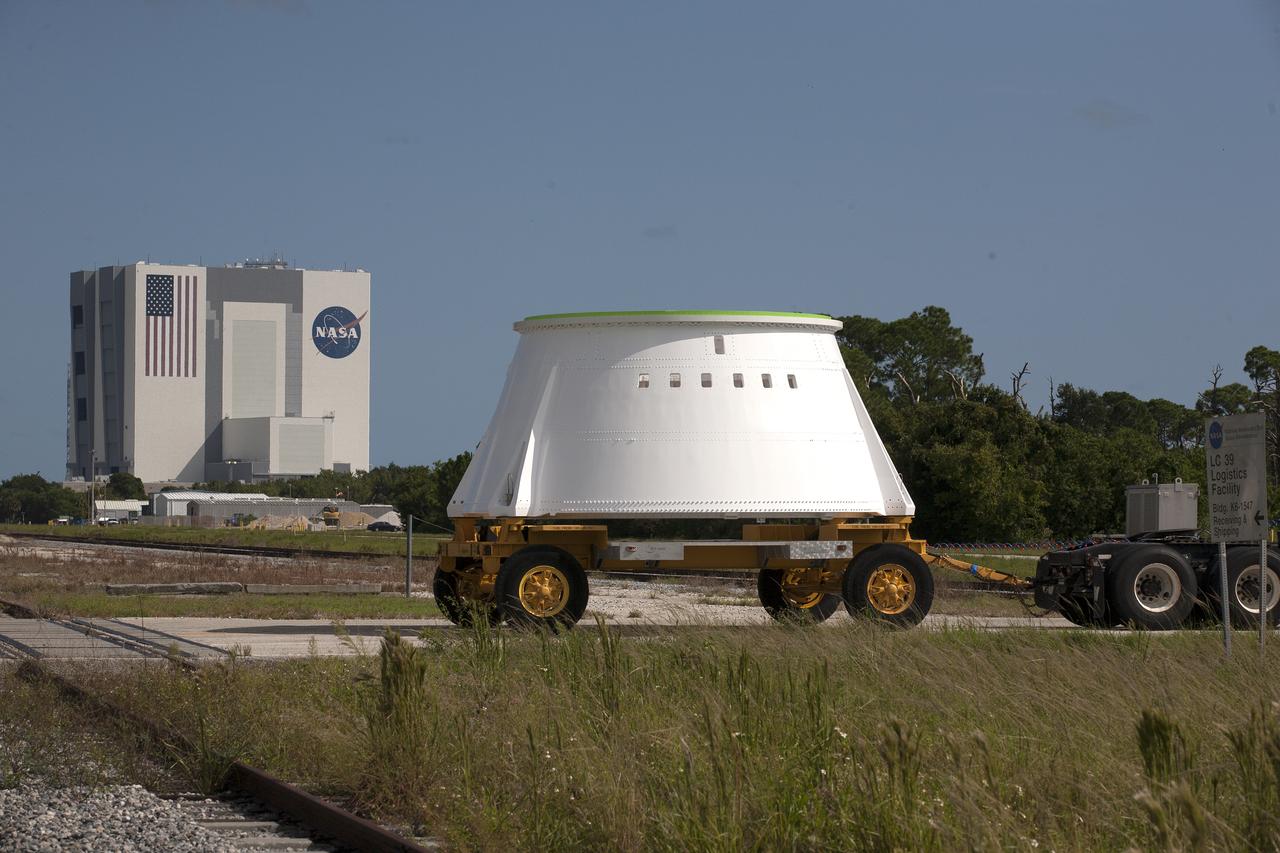
The left hand aft skirt for NASA’s Space Launch System (SLS) rocket arrives at the agency’s Kennedy Space Center in Florida, from the Hangar AF facility at Cape Canaveral Air Force Station. The aft skirt will be transported to the Booster Fabrication Facility. The space shuttle-era aft skirt, was inspected, resurfaced, primed and painted for use on the left hand booster of the SLS rocket for Exploration Mission 1 (EM-1). NASA is preparing for EM-1, deep-space missions, and the journey to Mars.

The left hand aft skirt for NASA’s Space Launch System (SLS) rocket arrives at the Booster Fabrication Facility at the agency’s Kennedy Space Center in Florida, from the Hangar AF facility at Cape Canaveral Air Force Station. The space shuttle-era aft skirt, was inspected, resurfaced, primed and painted for use on the left hand booster of the SLS rocket for Exploration Mission 1 (EM-1). NASA is preparing for EM-1, deep-space missions, and the journey to Mars.
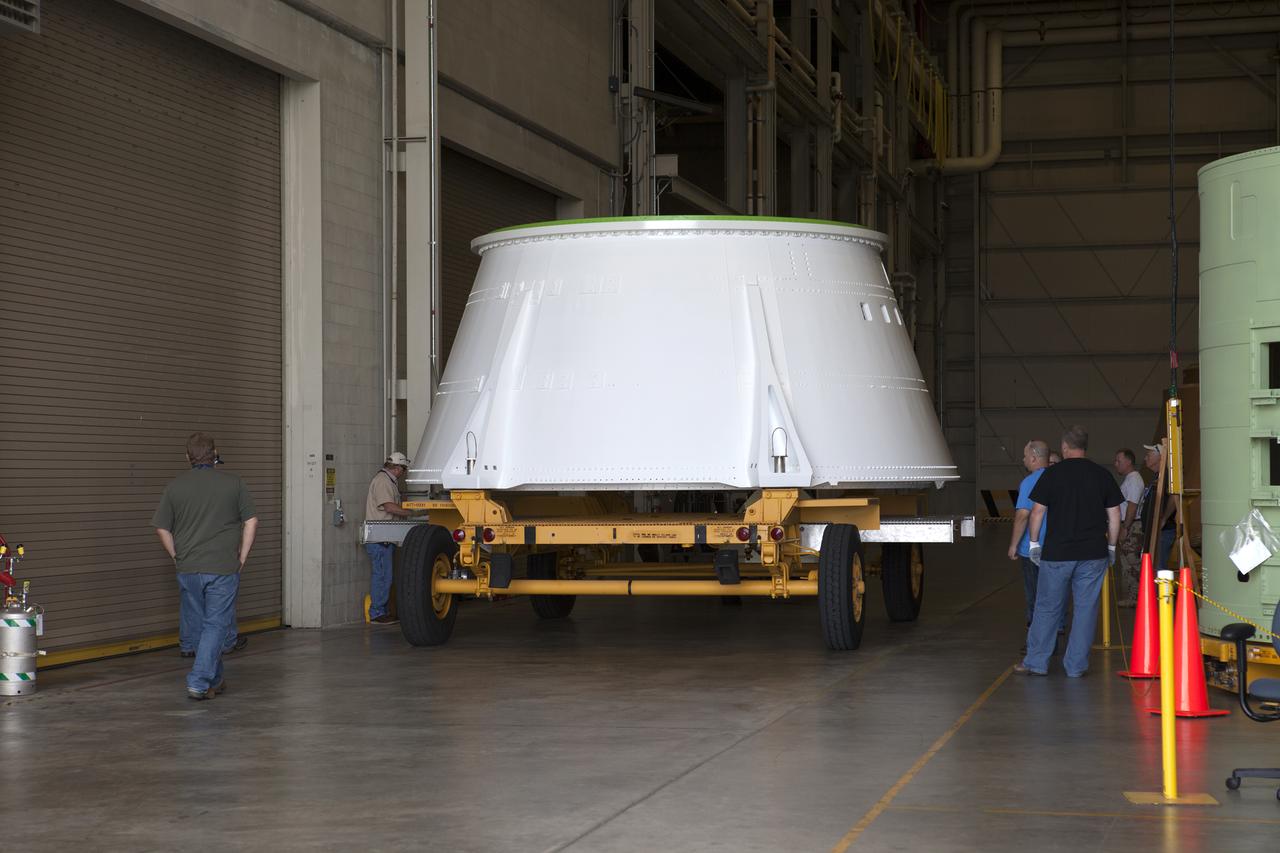
The left hand aft skirt for NASA’s Space Launch System (SLS) rocket is moved inside the Booster Fabrication Facility at the agency’s Kennedy Space Center in Florida. The aft skirt arrived from the Hangar AF facility at Cape Canaveral Air Force Station. The space shuttle-era aft skirt, was inspected, resurfaced, primed and painted for use on the left hand booster of the SLS rocket for Exploration Mission 1 (EM-1). NASA is preparing for EM-1, deep-space missions, and the journey to Mars.
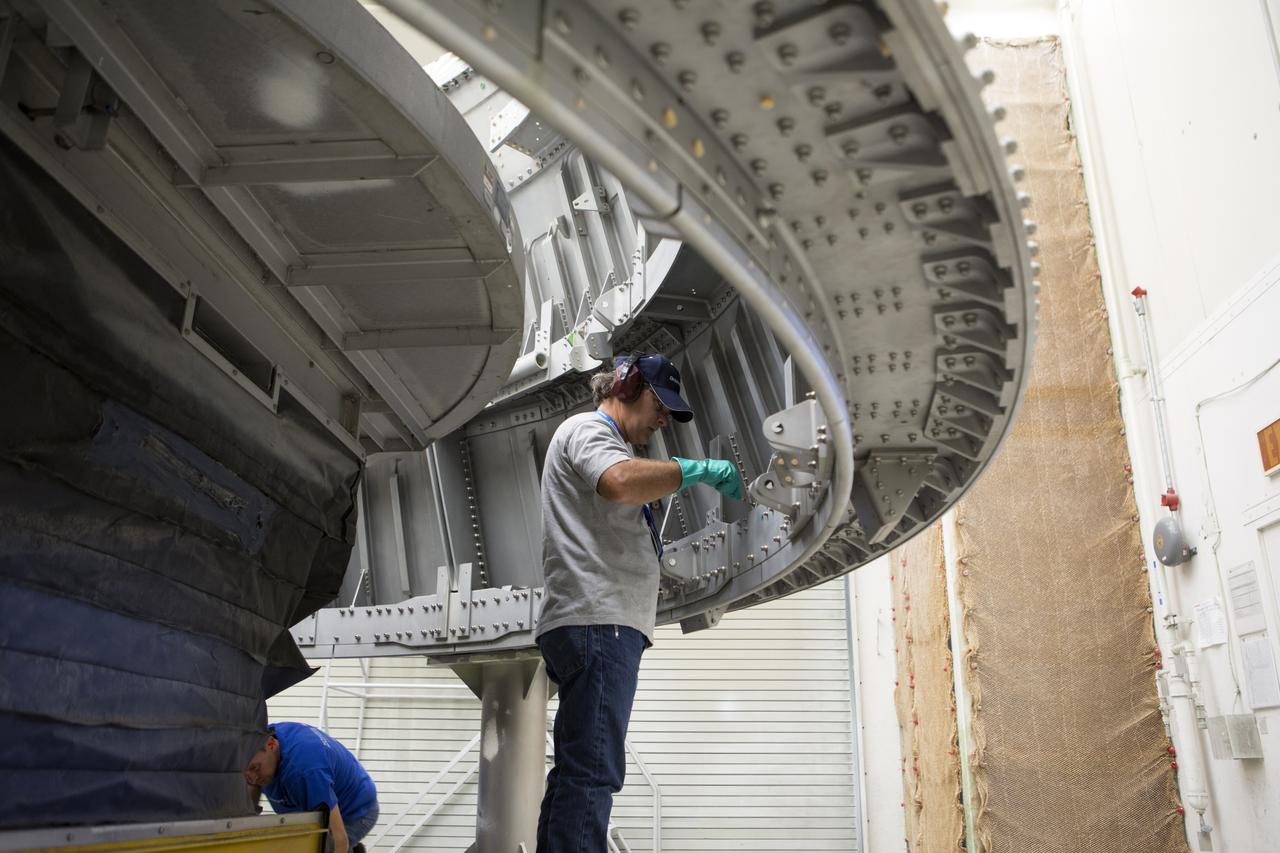
A technician with Orbital ATK, prime contractor for the Space Launch System (SLS) Booster, preps a section of the right hand aft skirt for primer and paint in a support building at the Hangar AF facility at Cape Canaveral Air Force Station in Florida. The space shuttle-era aft skirt will be used on the right hand booster of NASA's SLS rocket for Exploration Mission 1 (EM-1). NASA is preparing for EM-1, deep space missions, and the Journey to Mars.
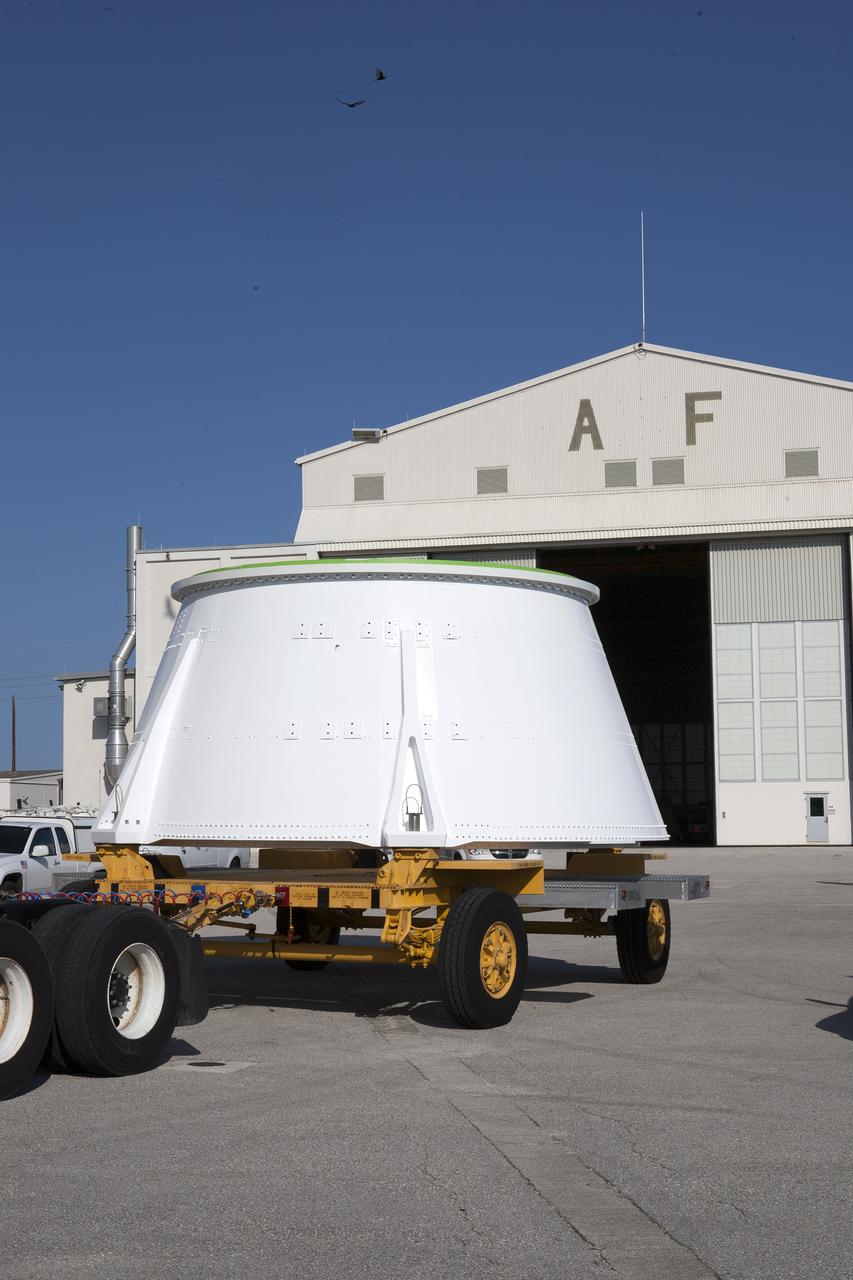
The left hand aft skirt for NASA’s Space Launch System (SLS) rocket is prepared for the move from the Hangar AF facility at Cape Canaveral Air Force Station in Florida, to the Booster Fabrication Facility at the agency’s Kennedy Space Center. The space shuttle-era aft skirt, was inspected, resurfaced, primed and painted for use on the left hand booster of the SLS rocket for Exploration Mission 1 (EM-1). NASA is preparing for EM-1, deep-space missions, and the journey to Mars
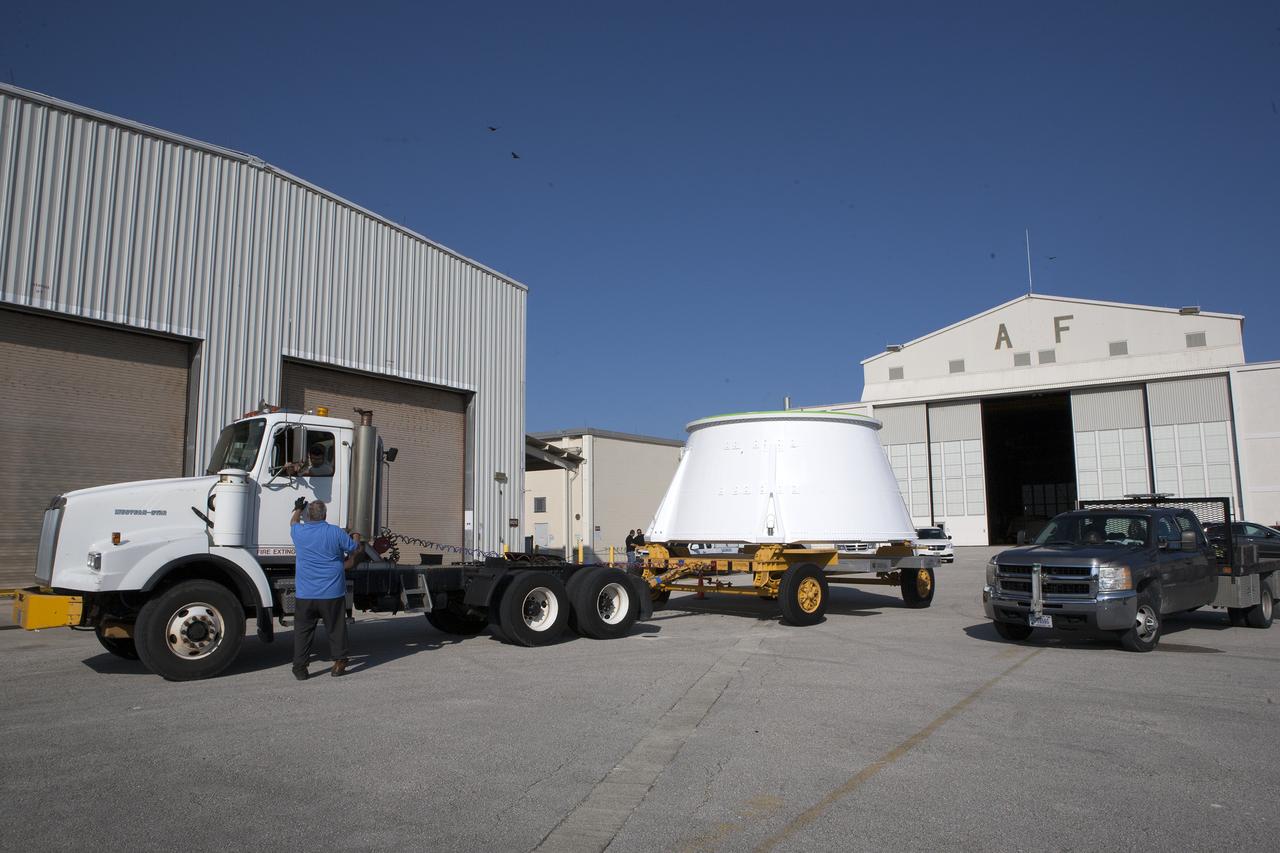
The left hand aft skirt for NASA’s Space Launch System (SLS) rocket is prepared for the move from the Hangar AF facility at Cape Canaveral Air Force Station in Florida, to the Booster Fabrication Facility at the agency’s Kennedy Space Center. The space shuttle-era aft skirt, was inspected, resurfaced, primed and painted for use on the left hand booster of the SLS rocket for Exploration Mission 1 (EM-1). NASA is preparing for EM-1, deep-space missions, and the journey to Mars.

S66-28770 (1 April 1966) --- Astronaut Michael Collins, prime crew pilot of the Gemini-10 spaceflight, undergoes zero-gravity egress training aboard a KC-135 Air Force plane. The plane, flying a parabolic curve, creates a weightless environment as a training exercise in preparation for spaceflight. Photo credit: NASA
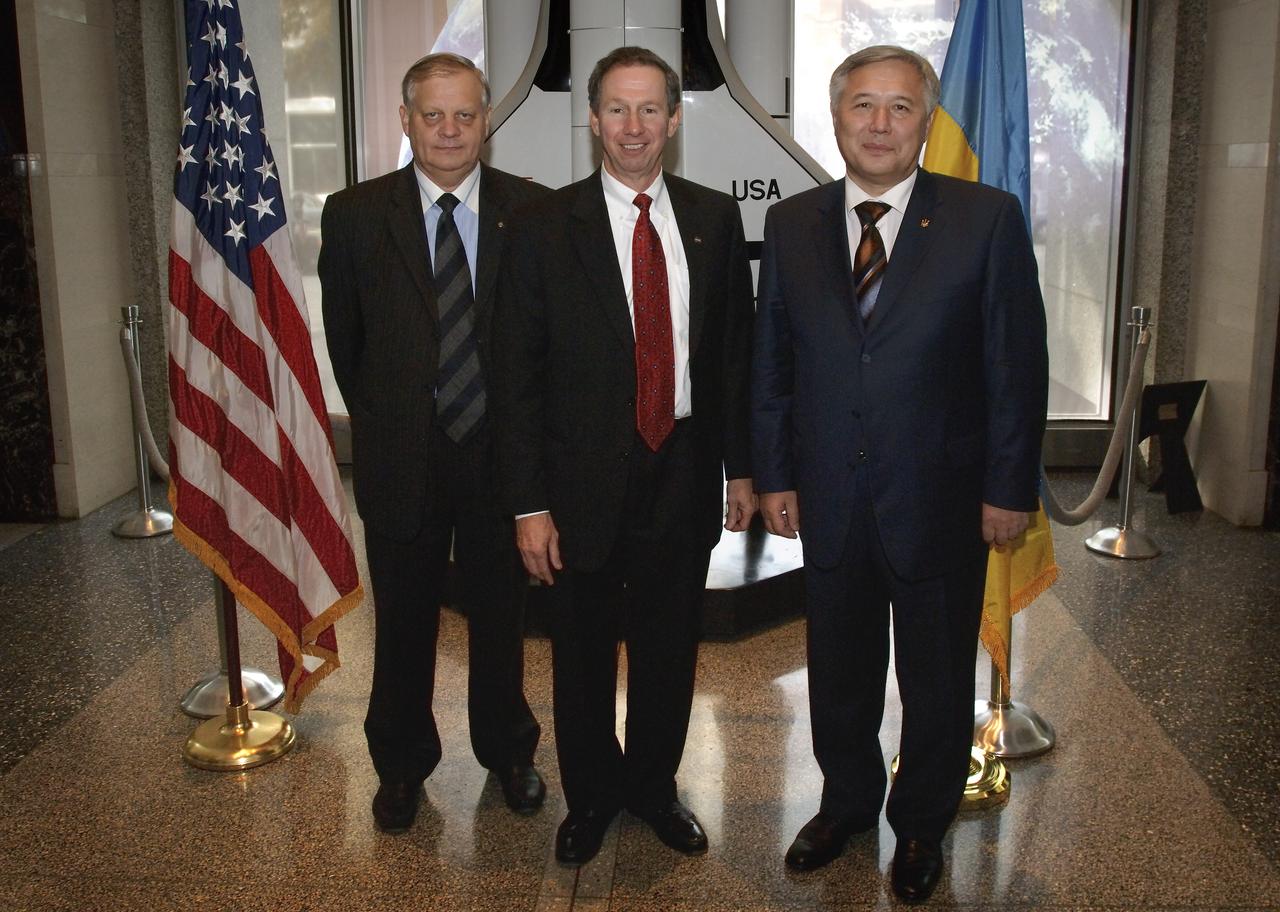
Director General of the National Space Agency of Ukraine Yuriy Sergiyovych Alekseyev, left, NASA Administrator Michael Griffin, center, and Prime Minister of Ukraine Yuriy Yekhanurov pose for a photograph prior to their meeting at NASA Headquarters, Tuesday, Nov. 1, 2005, in Washington. Photo Credit: (NASA/Bill Ingalls)
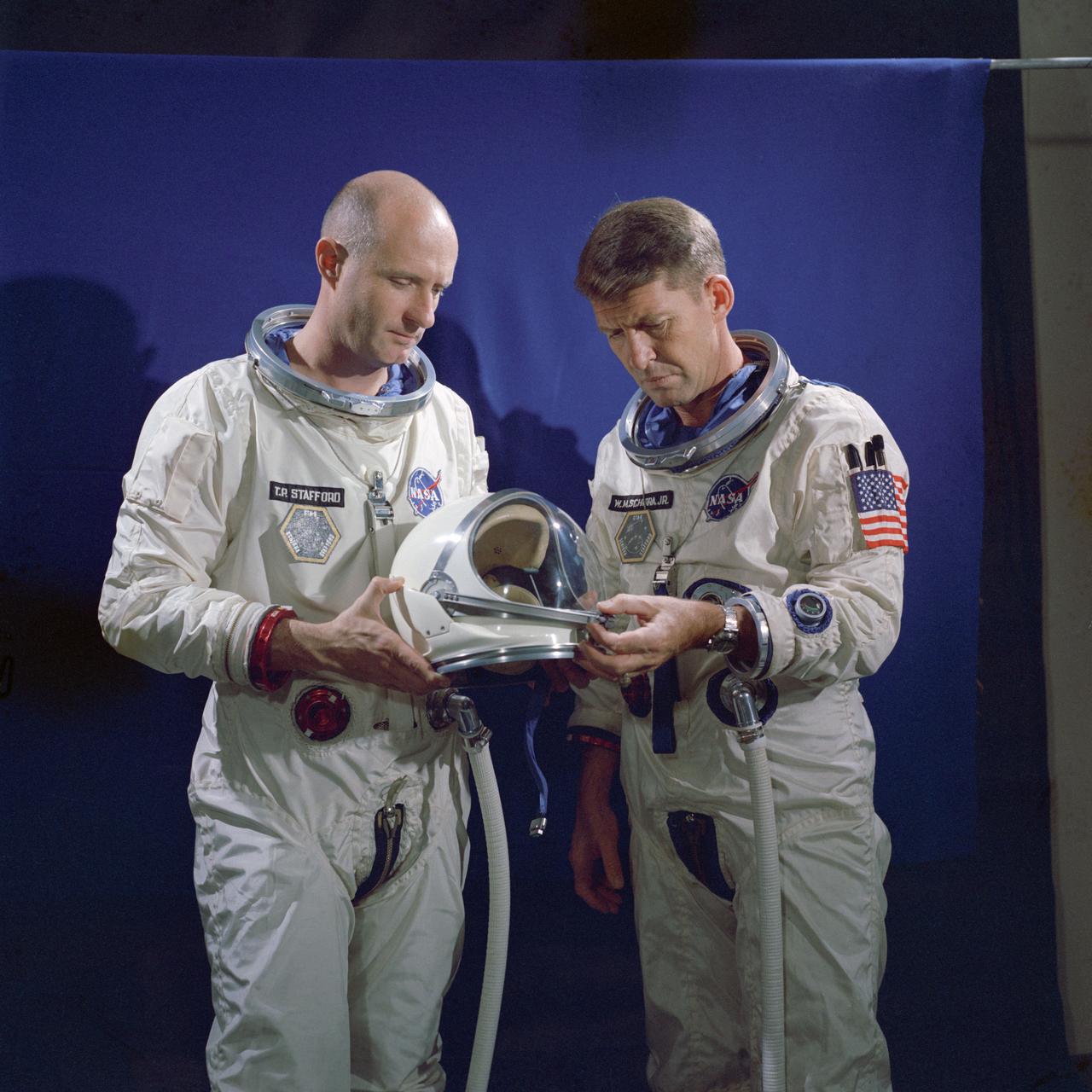
S65-56123 (1 Oct. 1965) --- Astronauts Thomas P. Stafford (left), pilot; and Walter M. Schirra Jr., command pilot, the prime crew of the Gemini-6 spaceflight, are pictured during a suiting up training exercise at Cape Kennedy, Florida. Photo credit: NASA or National Aeronautics and Space Administration
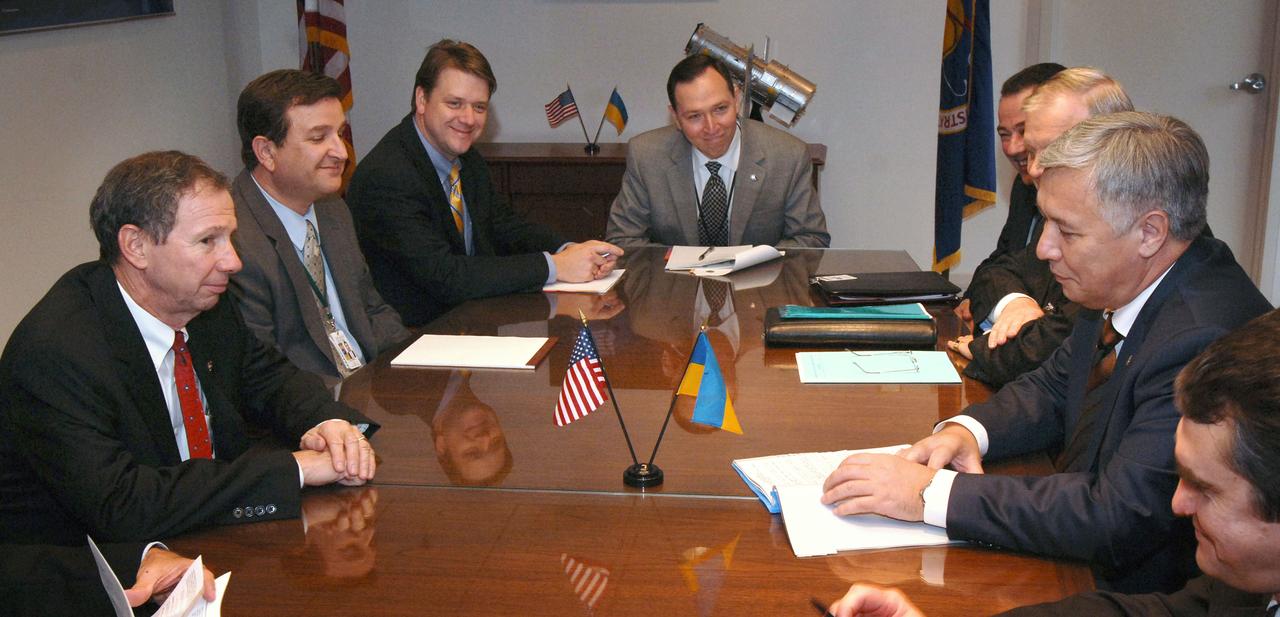
NASA Administrator Michael Griffin, foreground left, sits across the table from Yuriy Yekhanurov, Prime Minister of Ukraine, during a courtesy visit Tuesday, Nov. 1, 2005, at NASA Headquarters in Washington. Photo Credit: (NASA/Bill Ingalls)
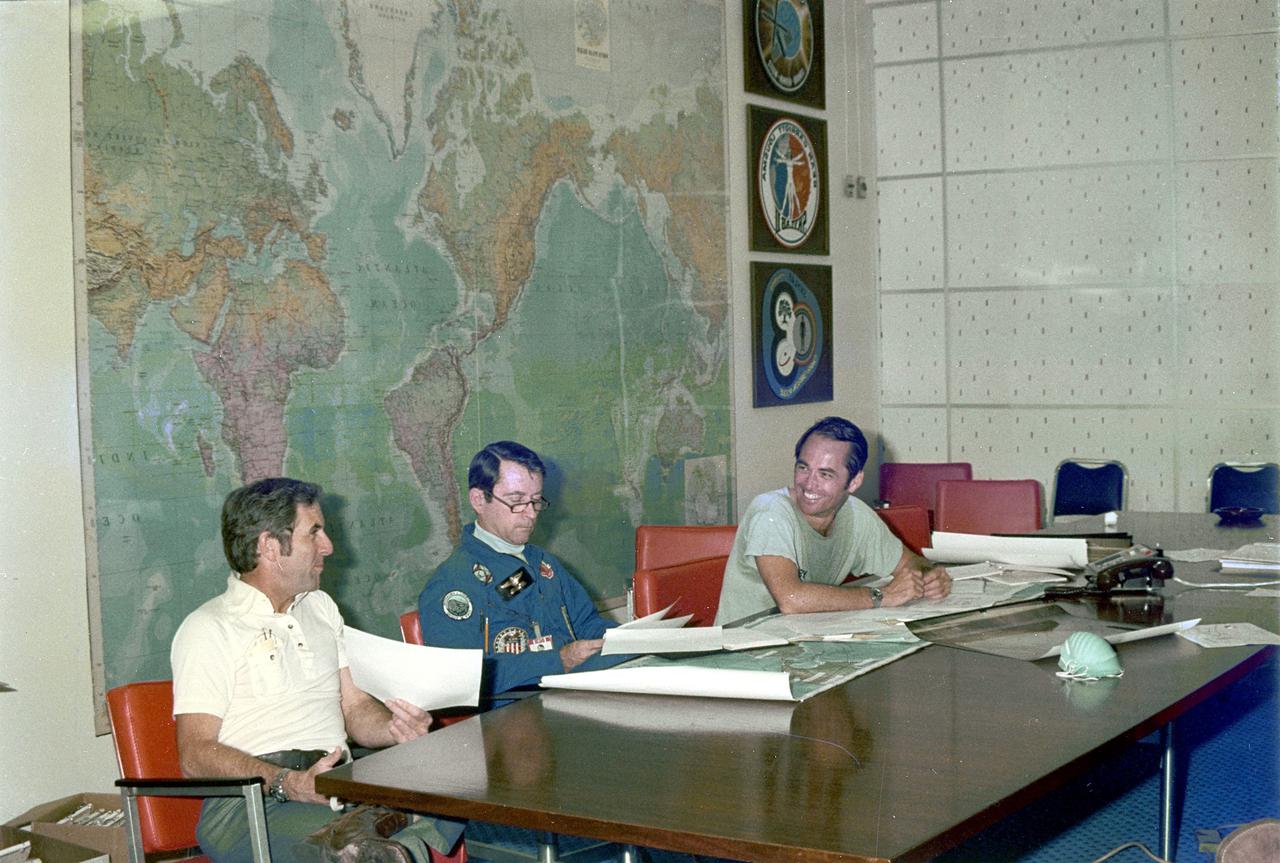
KENNEDY SPACE CENTER, FLA. - Space Shuttle prime crew members Robert Crippen, left, pilot, and John Young, center, commander, along with backup crewman Richard Truly, study forecasts of weather conditions for launch of the maiden flight of STS-1, America’s first reusable space transportation system.
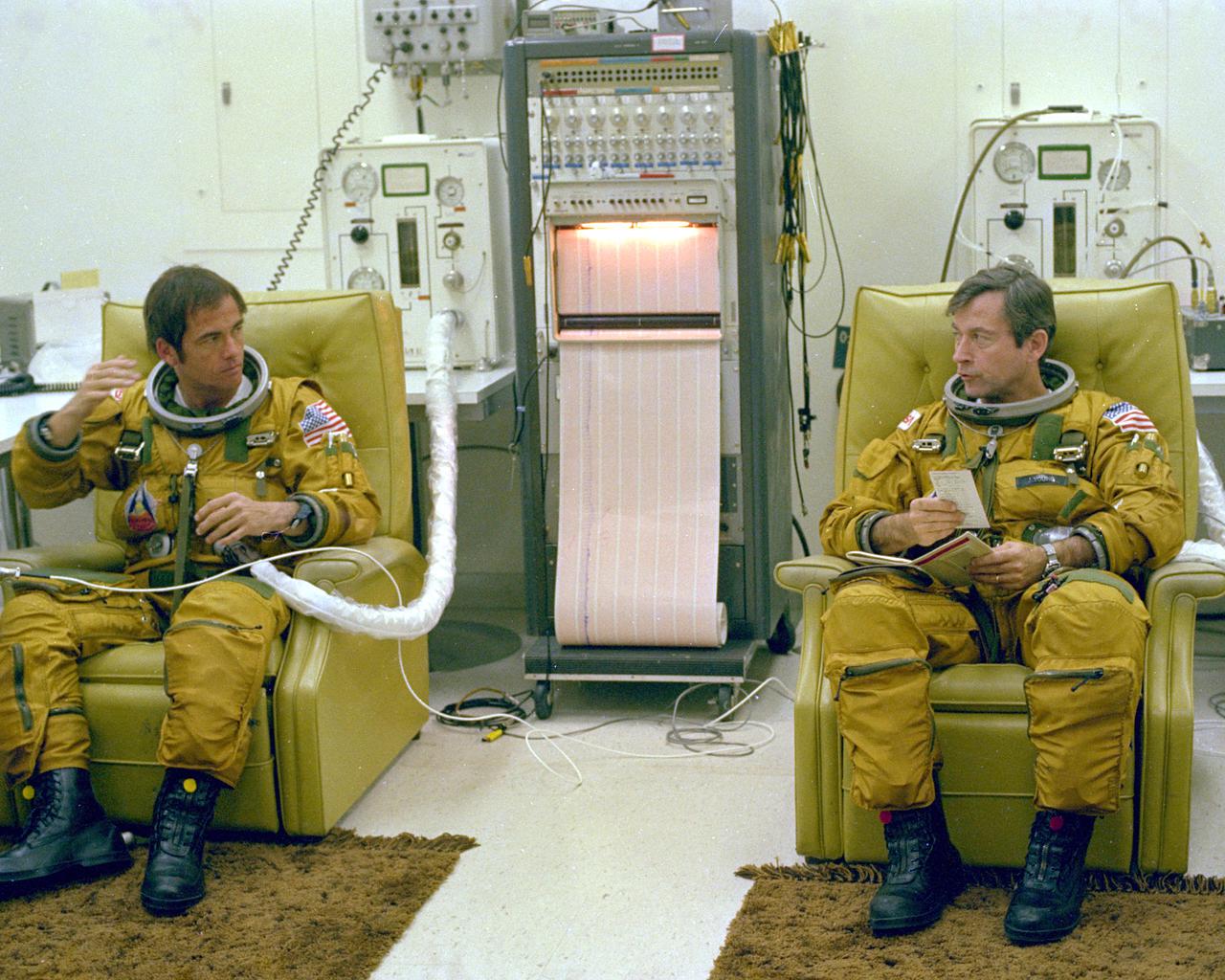
KENNEDY SPACE CENTER, FLA. - Prime crew astronauts Bob Crippen (left) and John Young (right) discuss checklist items during suit-up in the Operations and Checkout Building iiror to departure for the launch pad during the final countdown rehearsal before launch of STS-1.
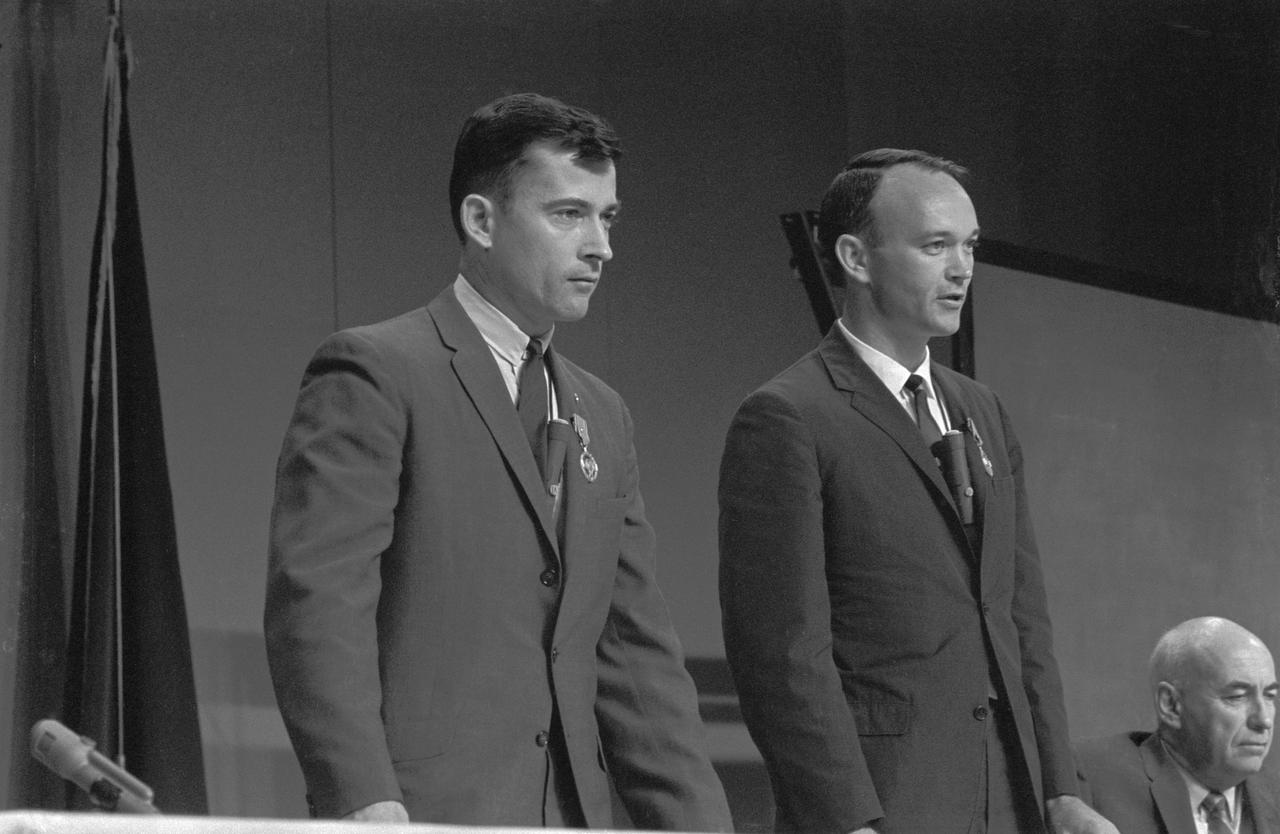
S66-39889 (1 Aug. 1966) --- Astronaut John W. Young (left), command pilot, and Michael Collins, pilot, the prime crew of the Gemini-10 spaceflight, wear the National Aeronautics and Space Administration's Exceptional Service Medal awarded them during ceremonies preceding the Gemini-10 press conference. Photo credit: NASA
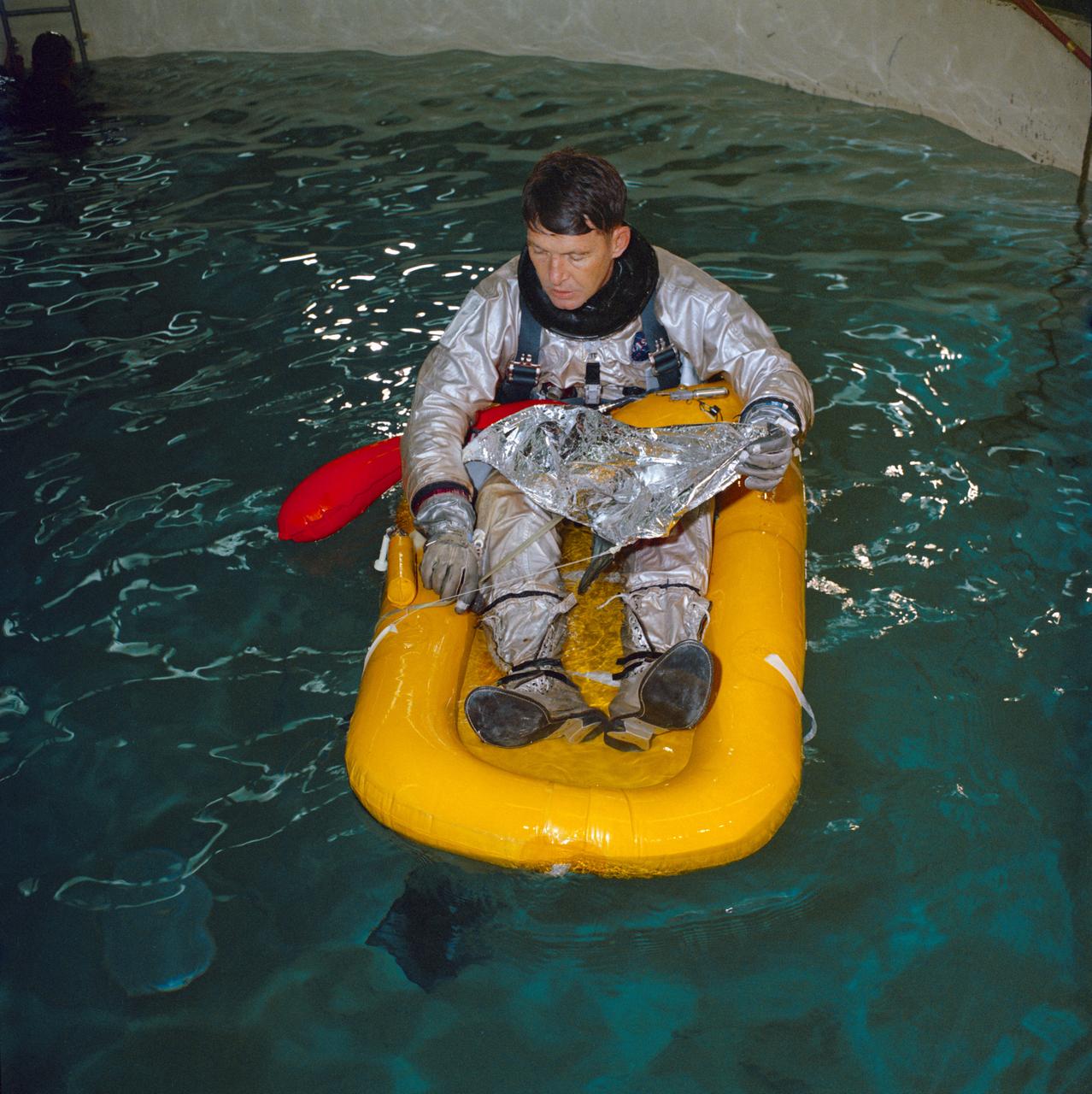
S65-10121 (1 Feb. 1965) --- Astronaut Walter M. Schirra Jr., the Gemini-6 command pilot for the prime crew, floats on a one-man life raft in a pool during water egress training at Ellington Air Force Base, Texas. Photo credit: NASA or National Aeronautics and Space Administration
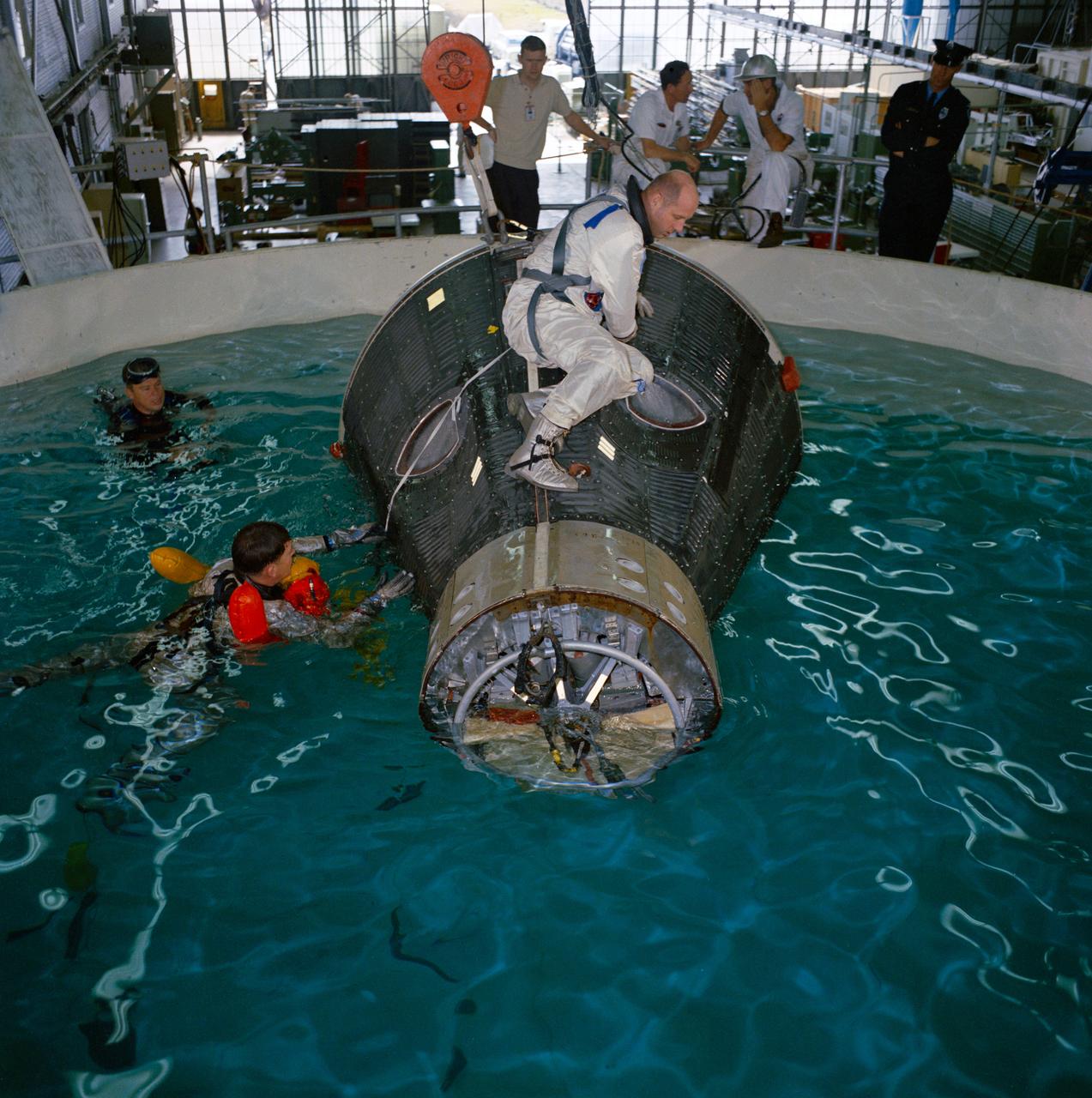
S65-10118 (1 Feb. 1965) --- The Gemini-6 prime crew, astronauts Walter M. Schirra Jr. (in water), command pilot; and Thomas P. Stafford (on spacecraft), pilot, are pictured during water egress training at Ellington Air Force Base, Texas. Photo credit: NASA or National Aeronautics and Space Administration
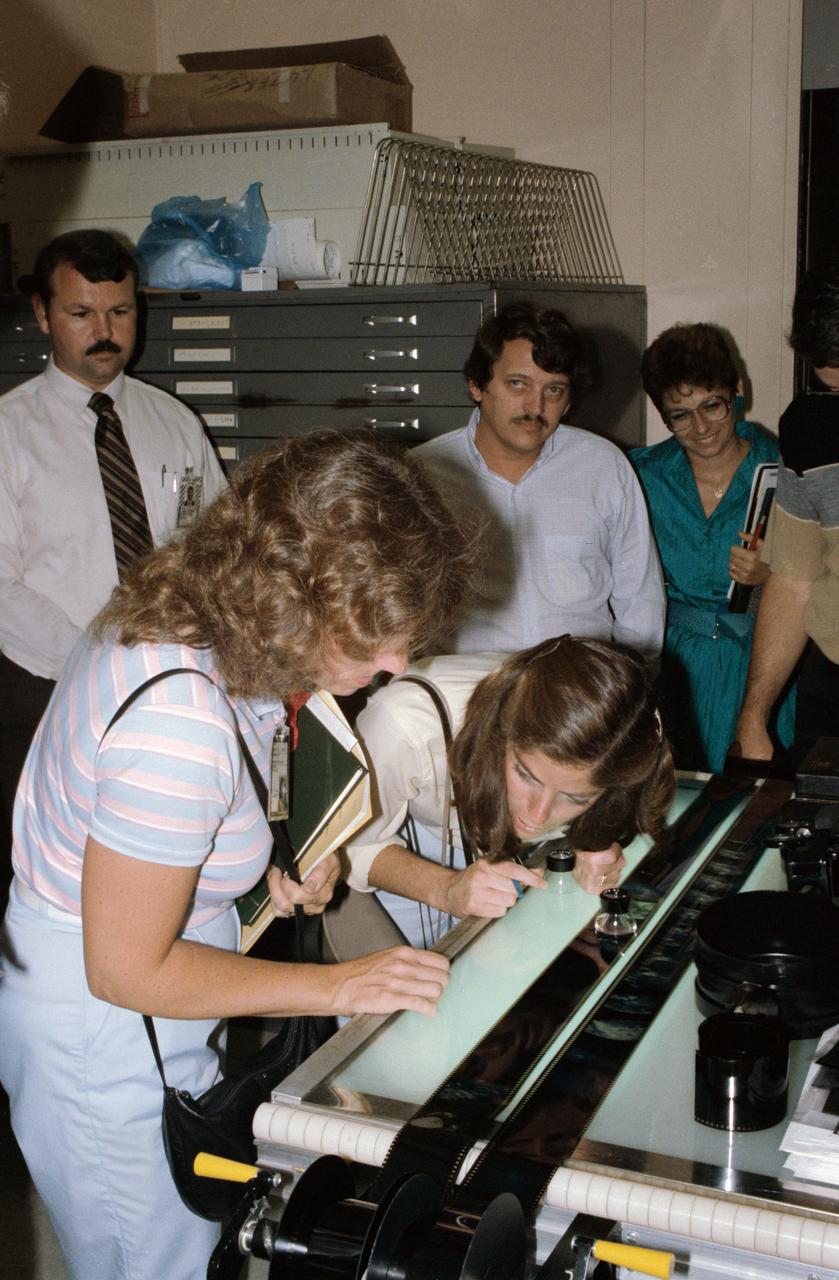
View of STS-33/51L Prime Teacher, Christa McAuliffe (left foreground) and Barbara Morgan (second left), both "Teacher in Space" Trainees, review film shot while training with Arriflex camera. 1. McAuliffe, S. Christa - Photography 2. Morgan, Barbara - Photography
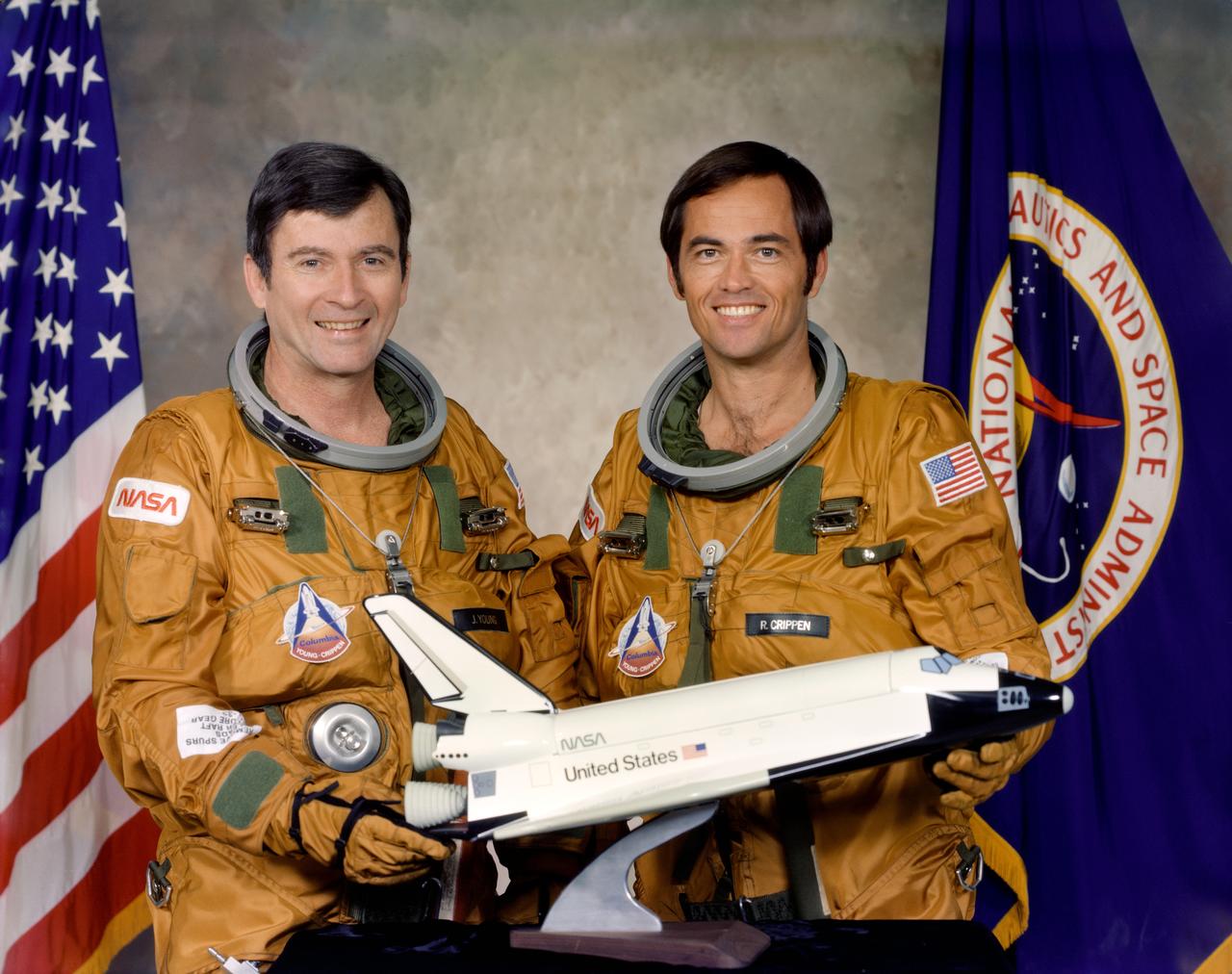
S79-31775 (29 April 1979) --- These two astronauts are the prime crewmen for the first flight in the Space Transportation System (STS-1) program. Astronauts John W. Young, left, commander, and Robert L. Crippen, pilot, will man the space shuttle orbiter 102 Columbia for the first orbital flight test. Photo credit: NASA

jsc2020e016976 - At the Cosmonaut Hotel crew quarters in Baikonur, Kazakhstan, Expedition 63 backup and prime crewmembers pose for pictures April 1 as part of pre-launch activities. From left to right are backup crewmembers Steve Bowen of NASA and Sergey Ryzhikov and Andrei Babkin of Roscosmos and prime crewmembers Ivan Vagner and Anatoly Ivanishin of Roscosmos and Chris Cassidy of NASA. Vagner, Ivanishin and Cassidy will launch April 9 on the Soyuz MS-16 spacecraft from the Baikonur Cosmodrome in Kazakhstan for a six-and-a-half month mission on the International Space Station...Andrey Shelepin/Gagarin Cosmonaut Training Center.

jsc2020e016977 - At the Cosmonaut Hotel crew quarters in Baikonur, Kazakhstan, Expedition 63 prime and backup crewmembers pose for pictures April 1 as part of pre-launch activities. From left to right are prime crewmembers Chris Cassidy of NASA and Anatoly Ivanishin and Ivan Vagner of Roscosmos and backup crewmembers Andrei Babkin and Sergey Ryzhikov of Roscosmos and Steve Bowen of NASA. Vagner, Ivanishin and Cassidy will launch April 9 on the Soyuz MS-16 spacecraft from the Baikonur Cosmodrome in Kazakhstan for a six-and-a-half month mission on the International Space Station...Andrey Shelepin/Gagarin Cosmonaut Training Center.
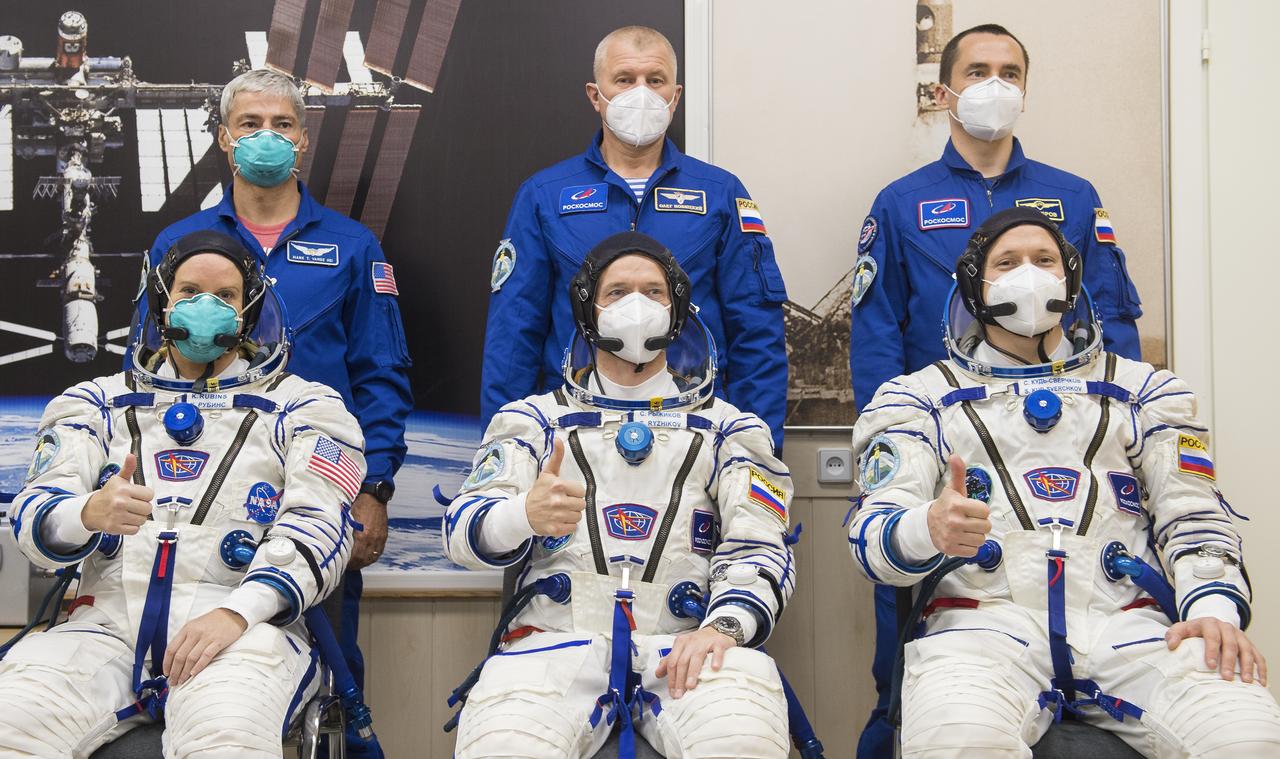
Expedition 64 prime and backup crew members pose for a picture following Russian Sokol suit pressure checks, Wednesday, Oct. 14, 2020, at the Baikonur Cosmodrome in Kazakhstan. From left to right seated are prime crew members Kate Rubins of NASA, Sergey Ryzhikov of Roscosmos, and Sergey Kud-Sverchkov of Roscosmos; standing are backup crew members Mark Vande Hei of NASA, Oleg Novitskiy of Roscosmos, and Petr Dubov of Roscosmos. Rubins, Ryzhikov, and Kud-Sverchkov launched at 1:45 a.m. EDT to begin a six-month mission aboard the International Space Station. Photo Credit: (NASA/GCTC/Andrey Shelepin)
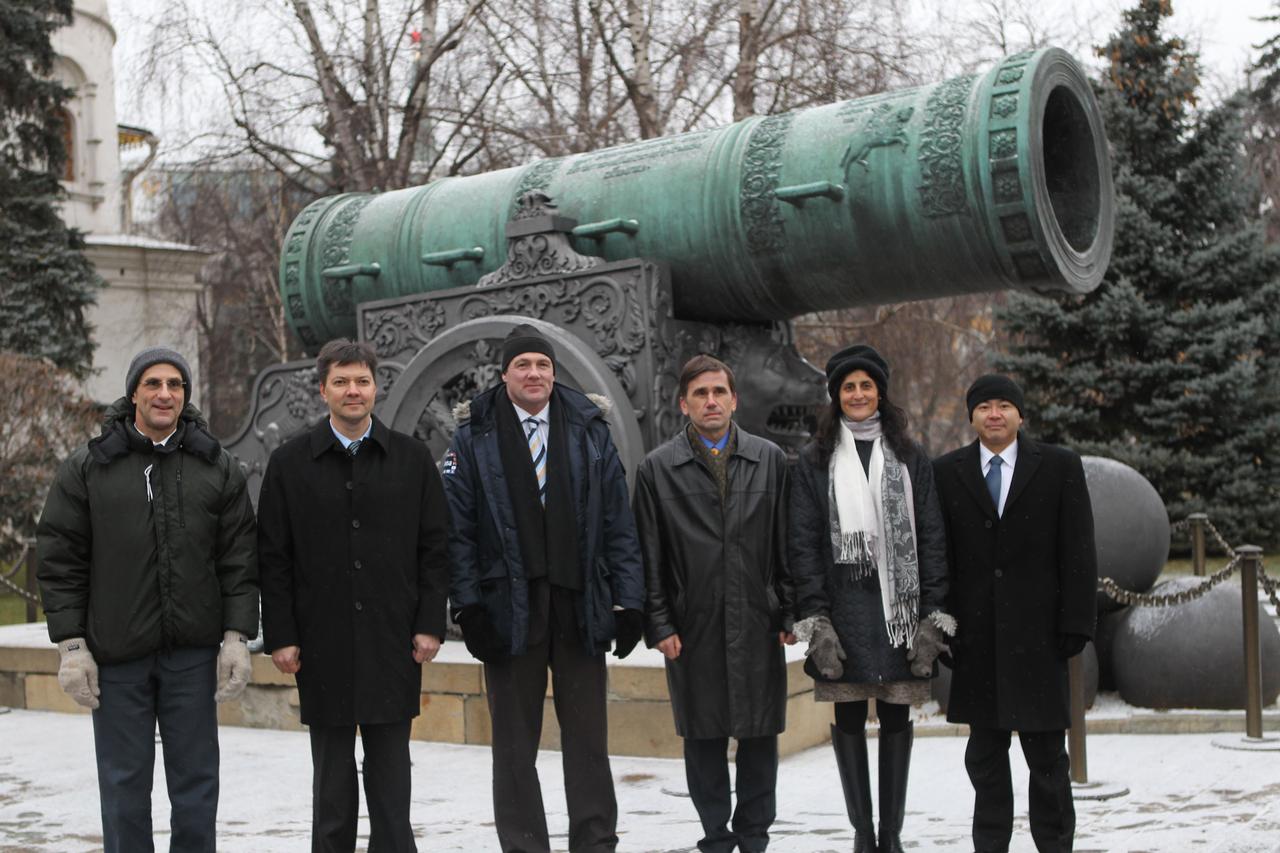
At the Kremlin in Moscow, the prime and backup crews for the next launch of crewmembers to the International Space Station pose for pictures Dec. 1, 2011 in front of the Tsar Cannon following ceremonial activities at Red Square. From left to right are the prime Expedition 30 crew --- NASA Flight Engineer Don Pettit, Soyuz Commander Oleg Kononenko and Flight Engineer Andre Kuipers of the European Space Agency, and the backup crew – Soyuz Commander Yuri Malenchenko, NASA Flight Engineer Suni Williams and Flight Engineer Aki Hoshide of the Japan Aerospace Exploration Agency. Pettit, Kononenko and Kuipers will launch Dec. 21 from the Baikonur Cosmodrome in Kazakhstan on the Soyuz TMA-03M spacecraft. Credit: NASA
![2014-03-15-11-03-42[1] At their Cosmonaut Hotel crew quarters in Baikonur, Kazakhstan, prime Expedition 39/40 Flight Engineer Steve Swanson of NASA (right) and backup Barry Wilmore of NASA (center) raise the American flag March 15 in traditional ceremonies that are part of the crew’s training. Prime crew Flight Engineer Oleg Artemyev (left) of the Russian Federal Space Agency (Roscosmos) looks on. Swanson, Artemyev and Soyuz Commander Alexander Skvortsov of Roscosmos are scheduled to launch to the International Space Station March 26 (Kazakh time) for the start of a six-month mission. NASA/Victor Zelentsov](https://images-assets.nasa.gov/image/jsc2014e026288/jsc2014e026288~medium.jpg)
2014-03-15-11-03-42[1] At their Cosmonaut Hotel crew quarters in Baikonur, Kazakhstan, prime Expedition 39/40 Flight Engineer Steve Swanson of NASA (right) and backup Barry Wilmore of NASA (center) raise the American flag March 15 in traditional ceremonies that are part of the crew’s training. Prime crew Flight Engineer Oleg Artemyev (left) of the Russian Federal Space Agency (Roscosmos) looks on. Swanson, Artemyev and Soyuz Commander Alexander Skvortsov of Roscosmos are scheduled to launch to the International Space Station March 26 (Kazakh time) for the start of a six-month mission. NASA/Victor Zelentsov
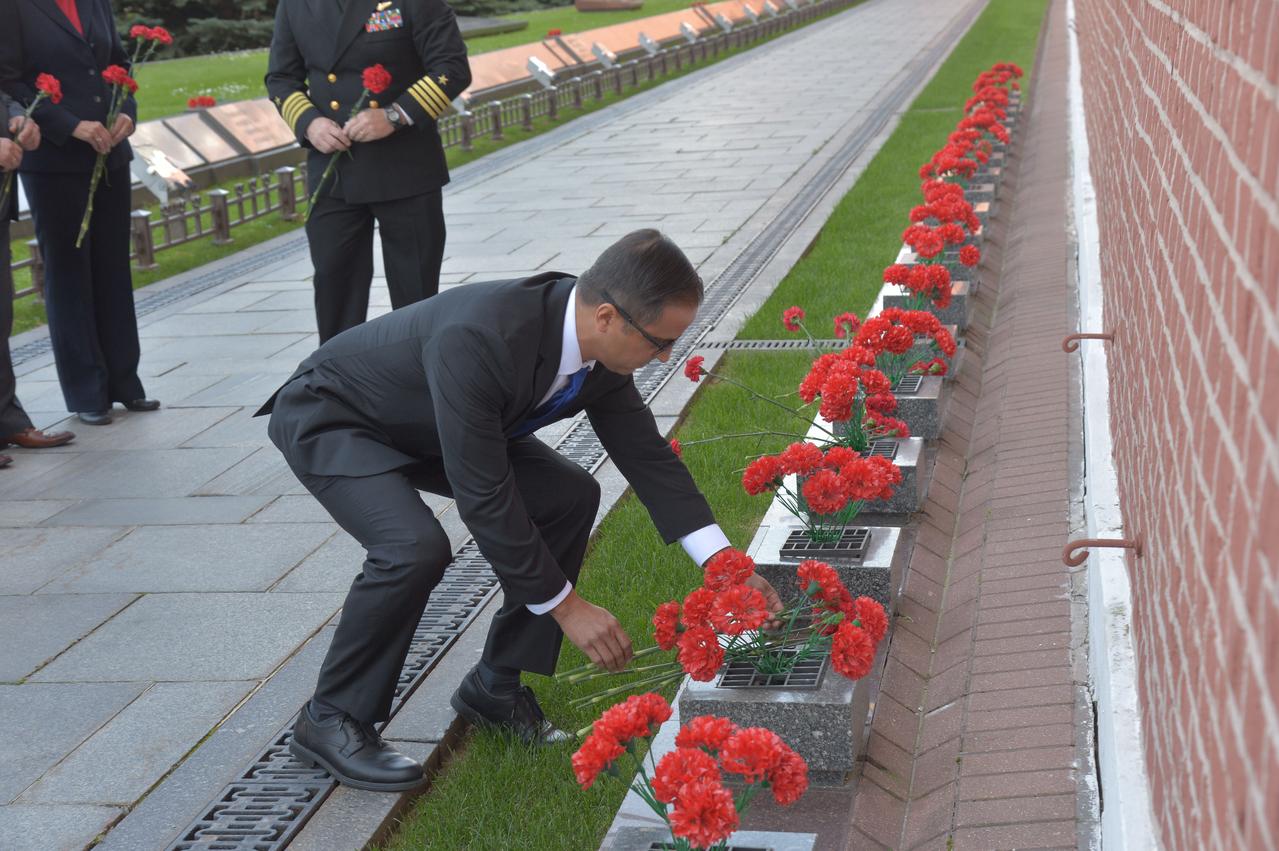
jsc2017e114494 (Sept. 1, 2017) --- Prime Expedition 53-54 crewmember and NASA astronaut Joe Acaba lays flowers at the Kremlin Wall in Moscow where Russian space icons are interred as part of traditional pre-launch ceremonies Sept. 1. Acaba, Mark Vande Hei of NASA and Alexander Misurkin of Roscosmos will launch Sept. 13 from the Baikonur Cosmodrome in Kazakhstan Sept. 13 on the Soyuz MS-06 spacecraft for a five and a half month mission on the International Space Station. Credit: NASA/Elizabeth Weissinger

S81-30479 (April 1981) --- Astronauts John W. Young, second from left, and Robert L. Crippen, left, discuss photography from their recent STS-1 mission with astronauts Joe H. Engle, right, and Richard H. Truly during a post-mission debriefing session. Engle and Truly were backup crewmen for STS-1 and they have been named as prime crew members for STS-2, scheduled for a Sept. 30, 1981 liftoff. Photo credit: NASA

jsc2017e114495 (Sept. 1, 2017) --- Prime Expedition 53-54 crewmember and NASA astronaut Mark Vande Hei lays flowers at the Kremlin Wall in Moscow where Russian space icons are interred as part of traditional pre-launch ceremonies Sept. 1. Vande He, Joe Acaba of NASA and Alexander Misurkin of Roscosmos will launch Sept. 13 from the Baikonur Cosmodrome in Kazakhstan Sept. 13 on the Soyuz MS-06 spacecraft for a five and a half month mission on the International Space Station. Credit: NASA/Elizabeth Weissinger
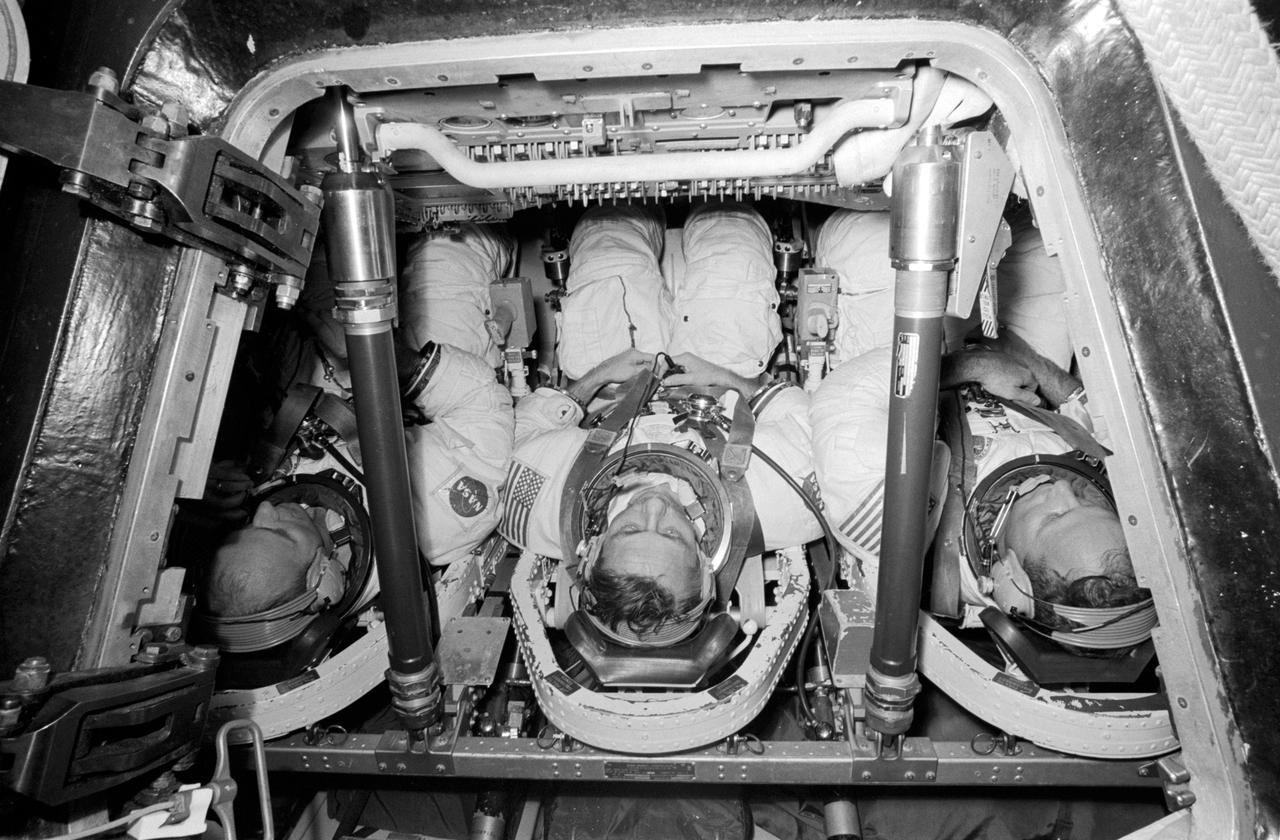
S73-27787 (1 May 1973) --- The three members of the prime crew of the second manned Skylab mission participate in prelaunch training, specifically water egress simulations, at the Johnson Space Center (JSC), Houston. They are, left to right, astronaut Alan J. Bean, commander; scientist-astronaut Owen K. Garriott, science pilot; and astronaut Jack R. Lousma, pilot. This training took place in JSC?s Building 220 on May 1, 1973. Photo credit: NASA

jsc2017e114488 (Sept. 1, 2017) --- Expedition 53-54 prime crewmember Alexander Misurkin of Roscosmos (foreground) and his backup and fellow cosmonaut Anton Shkaplerov lay flowers at the Kremlin Wall in Red Square in Moscow Sept. 1 as part of traditional pre-launch ceremonies. Misurkin and Joe Acaba and Mark Vande Hei of NASA will launch Sept. 13 from the Baikonur Cosmodrome in Kazakhstan Sept. 13 on the Soyuz MS-06 spacecraft for a five and a half month mission on the International Space Station. Credit: NASA/Elizabeth Weissinger
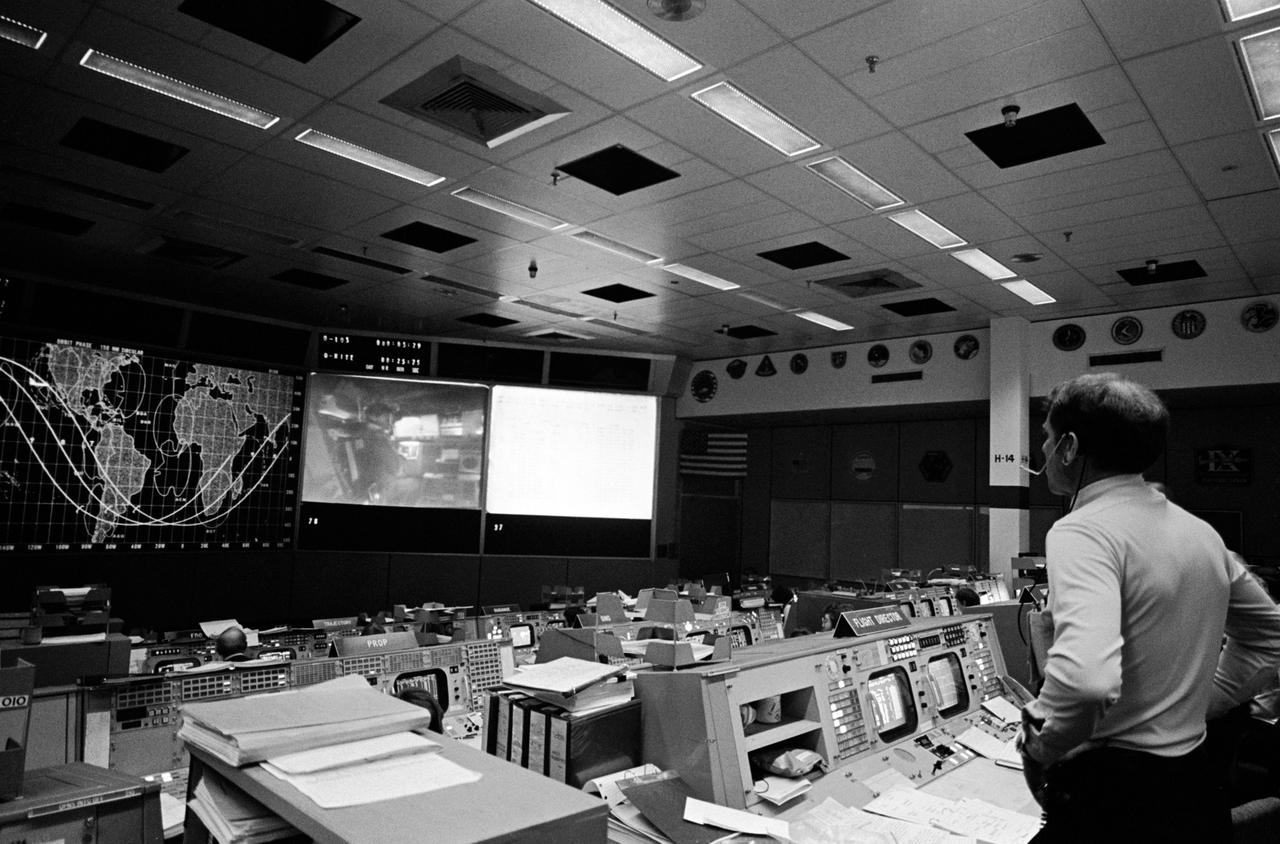
S81-30216 (12 April 1981) --- Astronaut Joe H. Engle, backup crew commander for STS-1, watches a large screen in the mission operations control room of the Johnson Space Center?s Mission Control Center during the STS-1 flight?s prime crew commander?s status report. Astronaut John W. Young, commander, can be seen in the image at left center, which is displayed via rear screen projector. Photo credit: NASA
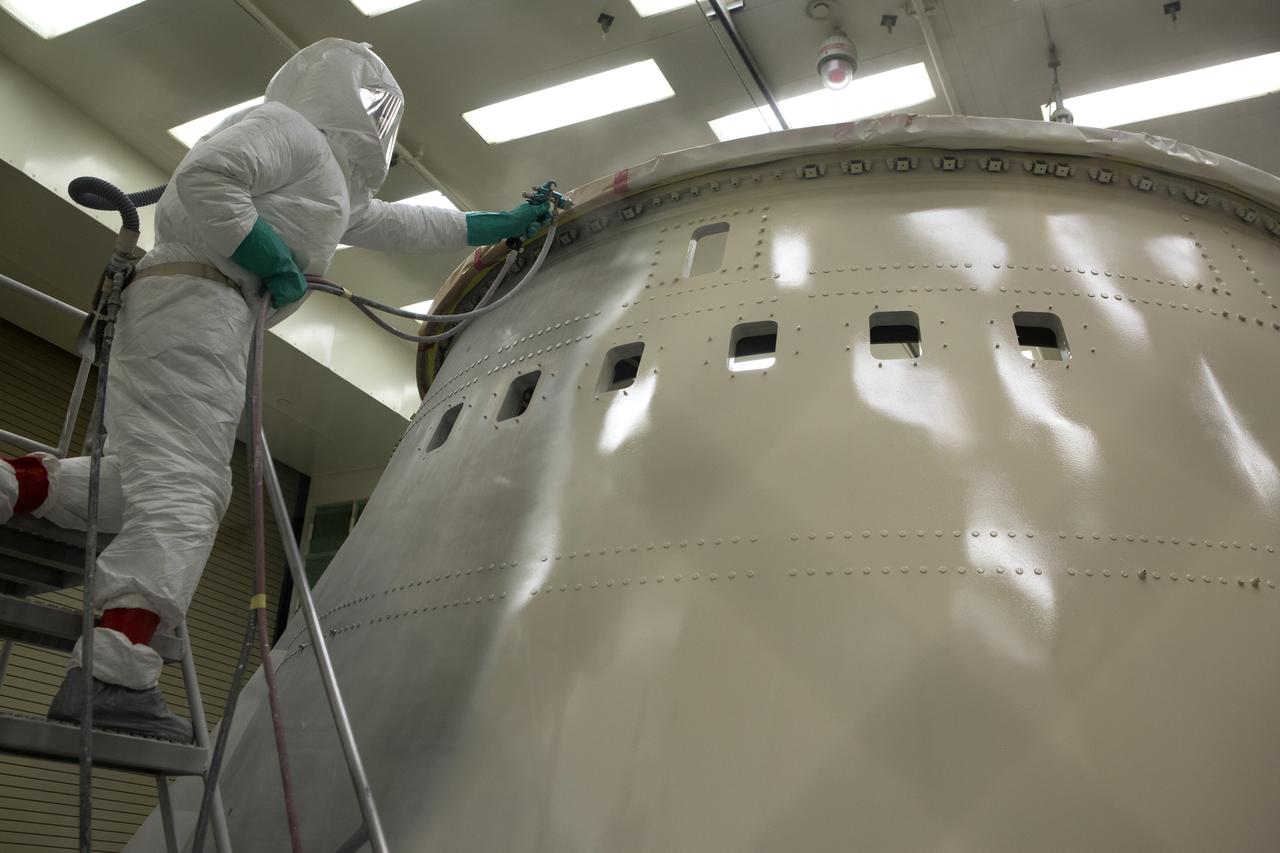
A paint technician with Orbital ATK, prime contractor for the Space Launch System (SLS) Booster, uses an air gun to apply paint to the right hand aft skirt for NASA’s SLS rocket inside a support building at the Hangar AF facility at Cape Canaveral Air Force Station. The space shuttle-era aft skirt, was inspected and resurfaced to prepare it for primer and paint. The aft skirt will be used on the right hand booster of the SLS rocket for Exploration Mission 1 (EM-1). NASA is preparing for EM-1, deep-space missions, and the journey to Mars.
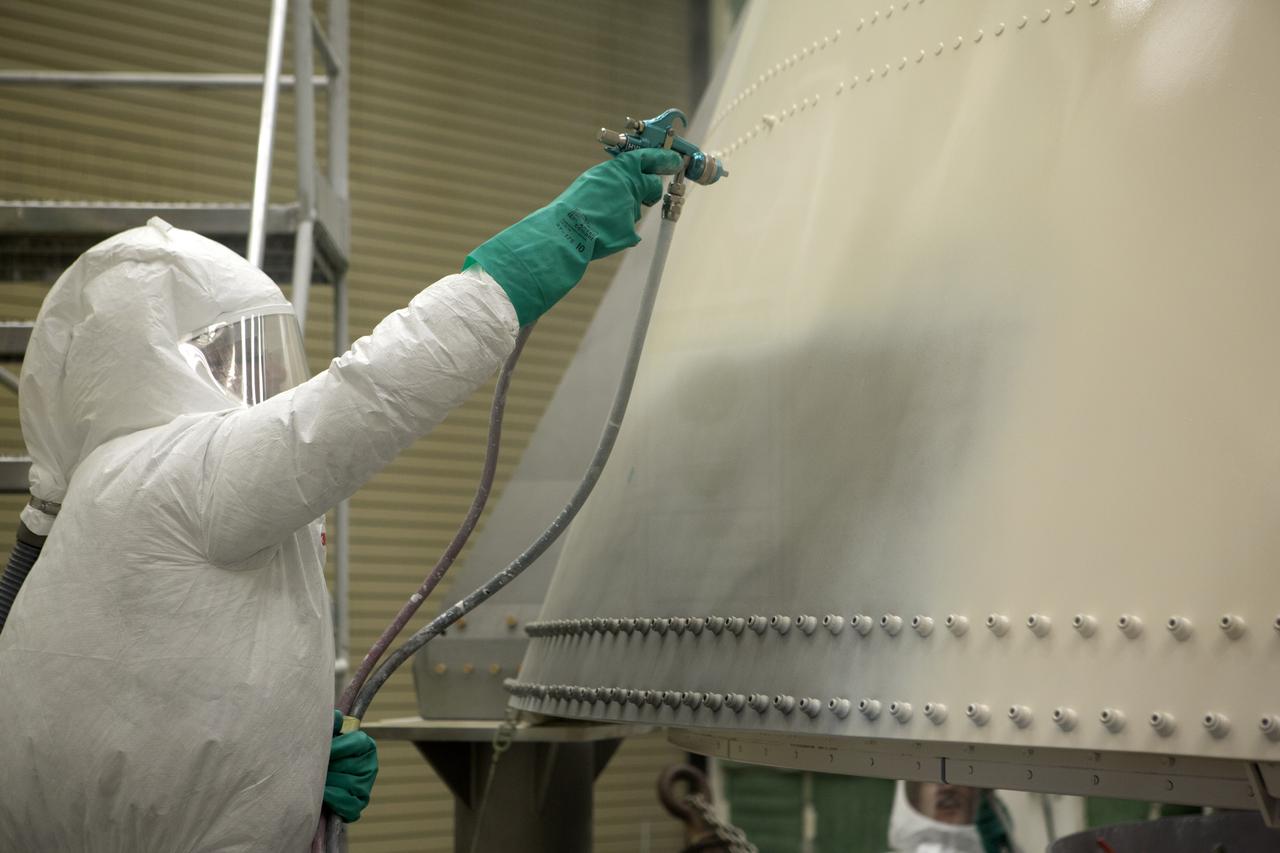
A paint technician with Orbital ATK, prime contractor for the Space Launch System (SLS) Booster, uses an air gun to apply paint to the right hand aft skirt for NASA’s SLS rocket inside a support building at the Hangar AF facility at Cape Canaveral Air Force Station. The space shuttle-era aft skirt, was inspected and resurfaced to prepare it for primer and paint. The aft skirt will be used on the right hand booster of the SLS rocket for Exploration Mission 1 (EM-1). NASA is preparing for EM-1, deep-space missions, and the journey to Mars.

Workers at the Astrotech processing facility in Titusville prepared for a news media showing of the Geostationary Operational Environmental Satellite-1 (GOES-1). GOES-1 was the first in a new generation of weather satellites deployed above Earth. It was the first 3-axis, body-stabilized meteorological satellite to be used by the National Oceanic Atmospheric Administration (NOAA) and NASA. These features allowed GOES-1 to continuously monitor the Earth, rather than viewing it just five percent of the time as was the case with spin-stabilized meteorological satellites. GOES-1 also has independent imaging and sounding instruments which can operate simultaneously yet independently. As a result, observations provided by each instrument will not be interrupted. The imager produces visual and infrared images of the Earth's surface, oceans, cloud cover and severe storm development, while the prime sounding products include vertical temperature and moisture profiles, and layer mean moisture.

jsc2017e114493 (Sept. 1, 2017) --- NASA astronaut Scott Tingle lays flowers at the Kremlin Wall in Moscow where Russian space icons are interred as part of traditional pre-launch ceremonies Sept. 1. Tingle is a backup to the Expedition 53-54 prime crew of Joe Acaba and Mark Vande Hei of NASA and Alexander Misurkin of Roscosmos, who will launch Sept. 13 from the Baikonur Cosmodrome in Kazakhstan Sept. 13 on the Soyuz MS-06 spacecraft for a five and a half month mission on the International Space Station. Credit: NASA/Elizabeth Weissinger
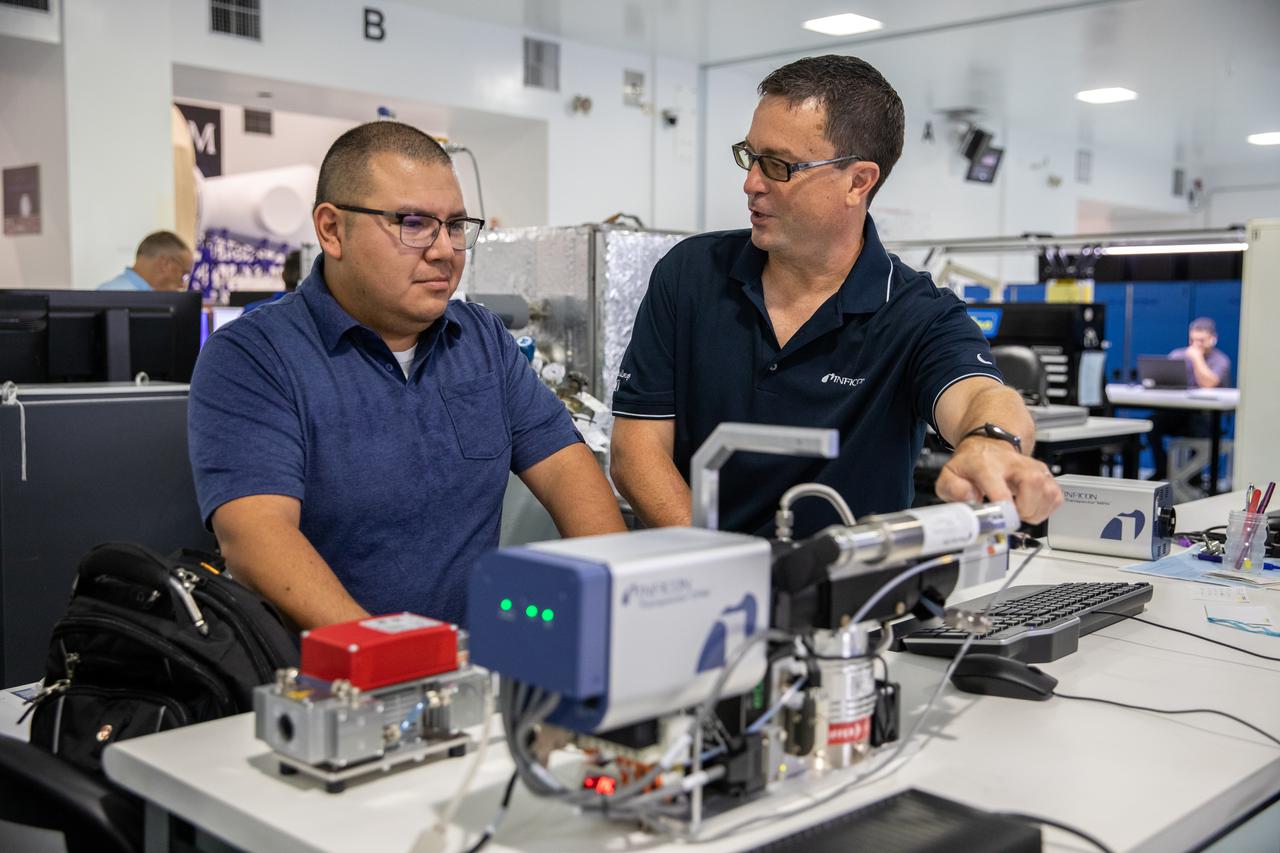
Kennedy Space Center employee Roberto Aguilar Ayala, left, and Ken Wright of INFICON work with MSolo (Mass Spectrometer Observing Lunar Operations) test hardware at Kennedy Space Center in Florida on July 13, 2021. MSolo is a commercial off-the-shelf mass spectrometer modified by the team at Kennedy to work in the harsh, rigorous conditions of the Moon. MSolo is heading to the Moon on four of NASA’s Commercial Lunar Payload Services initiative or CLPS missions, including the Polar Resources Ice Mining Experiment-1 (PRIME-1) and NASA’s Volatiles Investigating Polar Exploration Rover, or VIPER. Kennedy is working in partnership with INFICON, of Syracuse, New York, to develop the mass spectrometer.

Kennedy Space Center employee Chris Johnson, left, and Jamie Winfield of INFICON work with MSolo (Mass Spectrometer Observing Lunar Operations) test hardware at Kennedy Space Center in Florida on July 13, 2021. MSolo is a commercial off-the-shelf mass spectrometer modified by the team at Kennedy to work in the harsh, rigorous conditions of the Moon. MSolo is heading to the Moon on four of NASA’s Commercial Lunar Payload Services initiative or CLPS missions, including the Polar Resources Ice Mining Experiment-1 (PRIME-1) and NASA’s Volatiles Investigating Polar Exploration Rover, or VIPER. Kennedy is working in partnership with INFICON, of Syracuse, New York, to develop the mass spectrometer.
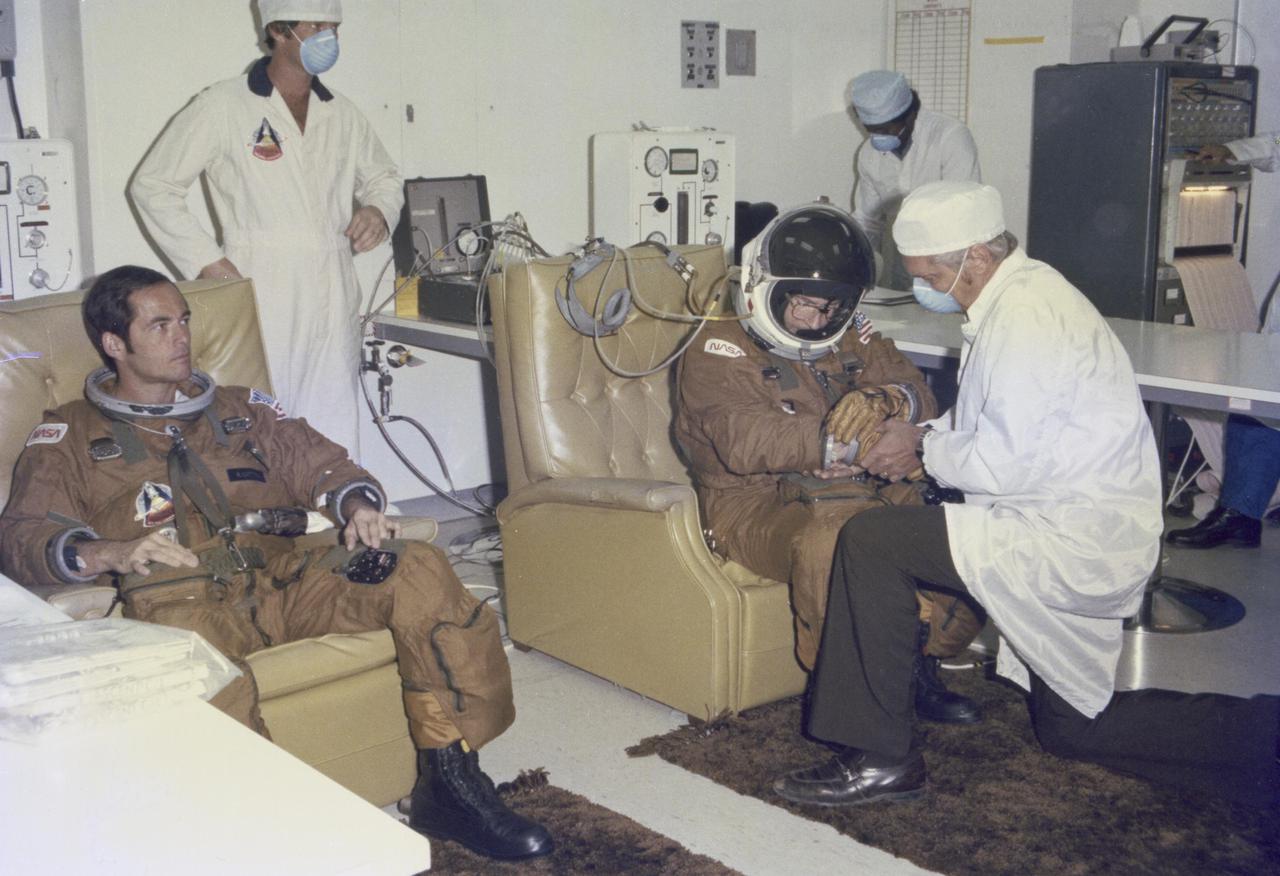
KENNEDY SPACE CENTER, FLA. -- Technicians assist prime crew Astronauts Bob Crippen (left) and John Young (right) in suit-up operations in KSC’s Operations and Checkout Building on the morning of Columbia’s successful liftoff on the Space Shuttle’s first orbital flight. Crippen is the pilot and Young is the commander for mission STS-1 aboard Space Shuttle Columbia. The STS-1 mission, known as a shuttle systems test flight, seeks to demonstrate safe launch into orbit and safe return of the orbiter and crew and verify the combined performance of the entire shuttle vehicle -- orbiter, solid rocket boosters and external tank.
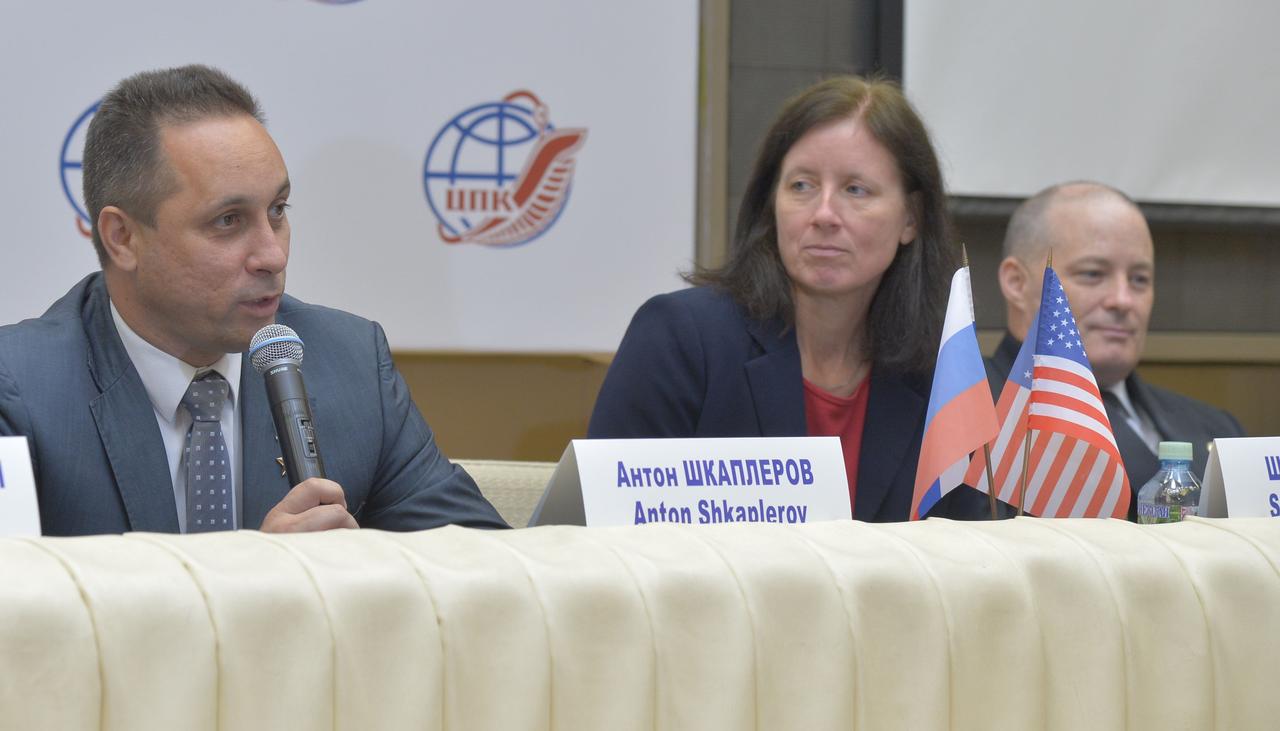
jsc2017e114479 (Sept. 1, 2017) --- At the Gagarin Cosmonaut Training Center in Star City, Russia, Expedition 53-54 backup crewmember Anton Shkaplerov of Roscosmos (left) answers a reporter’s question during a news conference Sept. 1 while backup crewmates Shannon Walker (center) and Scott Tingle (right of NASA look on. They are serving as backups to the prime crew, Mark Vande Hei and Joe Acaba of NASA and Alexander Misurkin of Roscosmos, who will launch Sept. 13 on the Soyuz MS-06 spacecraft from the Baikonur Cosmodrome in Kazakhstan on a five and a half month mission aboard the International Space Station. Credit: NASA/Elizabeth Weissinger
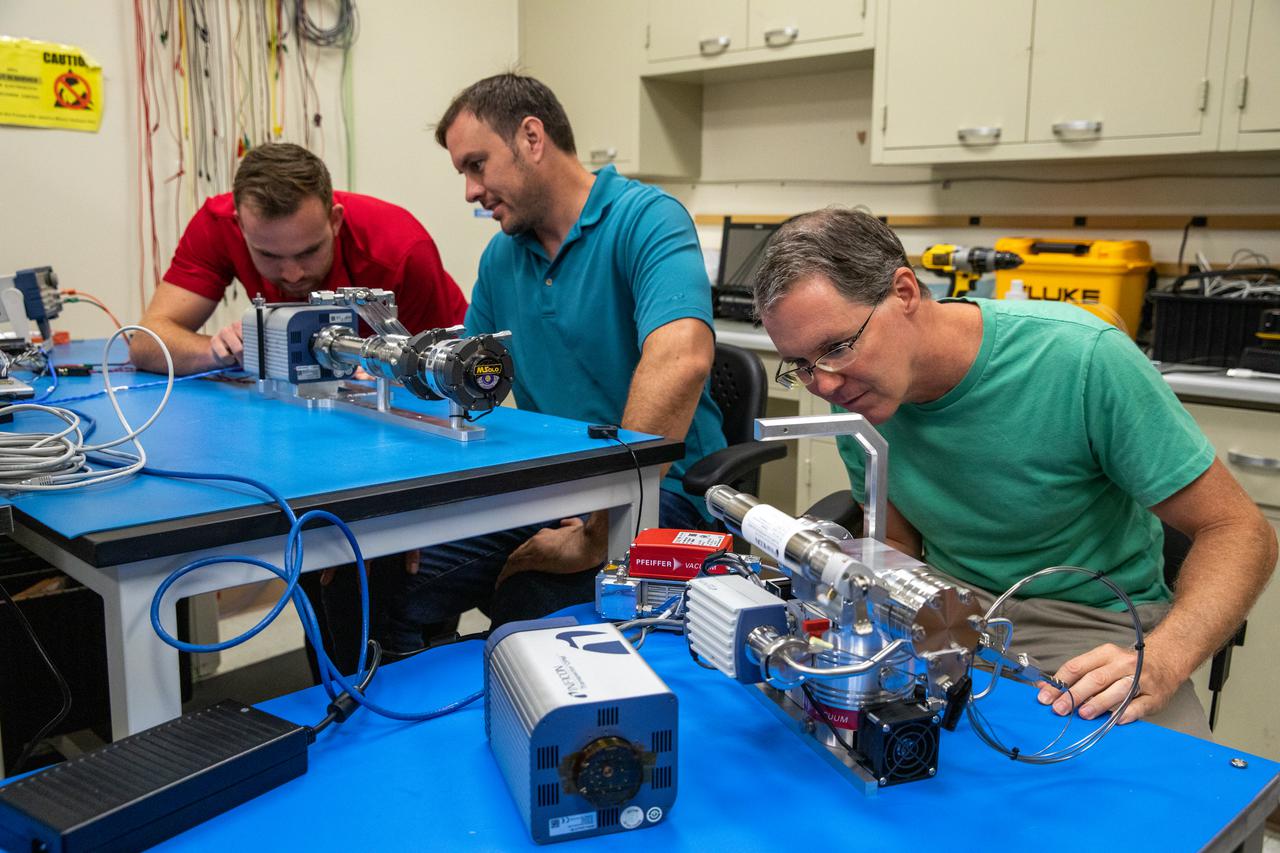
From left to right, Kennedy Space Center employees Stefan Tomovic, Beau Peacock, and Chris Bond work with MSolo (Mass Spectrometer Observing Lunar Operations) test hardware at the Florida spaceport on July 13, 2021. MSolo is a commercial off-the-shelf mass spectrometer modified by the team at Kennedy to work in the harsh, rigorous conditions of the Moon. MSolo is heading to the Moon on four of NASA’s Commercial Lunar Payload Services initiative or CLPS missions, including the Polar Resources Ice Mining Experiment-1 (PRIME-1) and NASA’s Volatiles Investigating Polar Exploration Rover, or VIPER. Kennedy is working in partnership with INFICON, of Syracuse, New York, to develop the mass spectrometer.

jsc2017e114489 (Sept. 1, 2017) --- Expedition 53-54 prime crewmember Alexander Misurkin of Roscosmos walks through the ground of the Kremlin in Moscow with his family Sept. 1 as part of traditional pre-launch ceremonies. Following Misurkin are NASA astronauts Joe Acaba, Mark Vande Hei, Shannon Walker and Scott Tingle. Misurkin, Acaba and Vande Hei will launch Sept. 13 from the Baikonur Cosmodrome in Kazakhstan Sept. 13 on the Soyuz MS-06 spacecraft for a five and a half month mission on the International Space Station. Credit: NASA/Elizabeth Weissinger
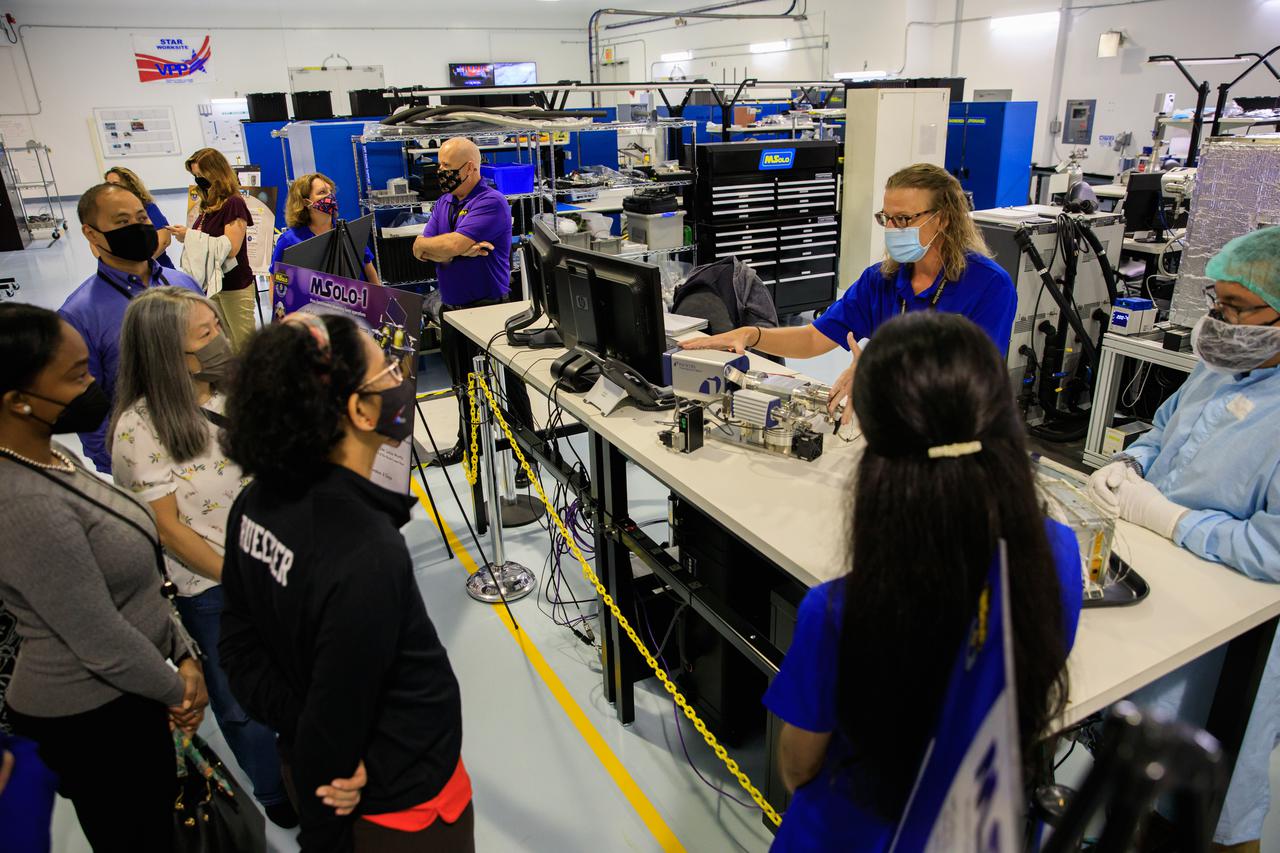
Senior leaders with Kennedy Space Center in Florida, familiarize newly appointed officials from NASA Headquarters with the center’s facilities during a tour on April 19, 2021. The group views research and technology experiments in the Space Station Processing Facility. Janine Captain, the principal investigator for the Mass Spectrometer Observing Lunar Operations, or MSolo, briefs the team about the commercial off the-shelf- mass spectrometer the team at Kennedy has hardened for lunar operations. MSolo will be part of four missions for NASA’s Commercial Lunar Payload Services initiative, including NASA’s Polar Resources Ice Mining Experiment-1 (PRIME-1) and NASA’s Volatiles Investigating Polar Exploration Rover or VIPER.
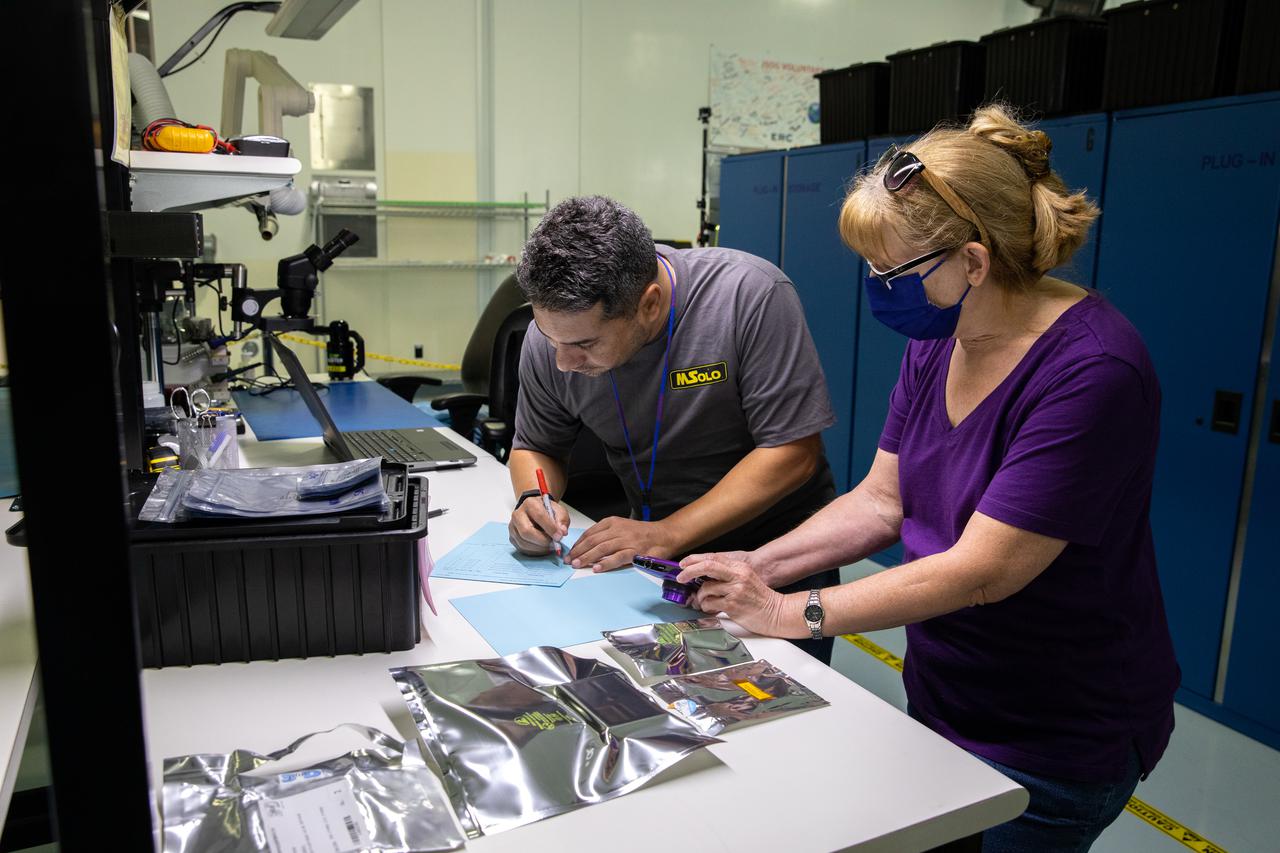
Kennedy Space Center employees Alex Decamargo, left, and JoAnn Robinson work with MSolo (Mass Spectrometer Observing Lunar Operations) flight hardware at the Florida spaceport on July 13, 2021. MSolo is a commercial off-the-shelf mass spectrometer modified by the team at Kennedy to work in the harsh, rigorous conditions of the Moon. MSolo is heading to the Moon on four of NASA’s Commercial Lunar Payload Services initiative or CLPS missions, including the Polar Resources Ice Mining Experiment-1 (PRIME-1) and NASA’s Volatiles Investigating Polar Exploration Rover, or VIPER. Kennedy is working in partnership with INFICON, of Syracuse, New York, to develop the mass spectrometer.
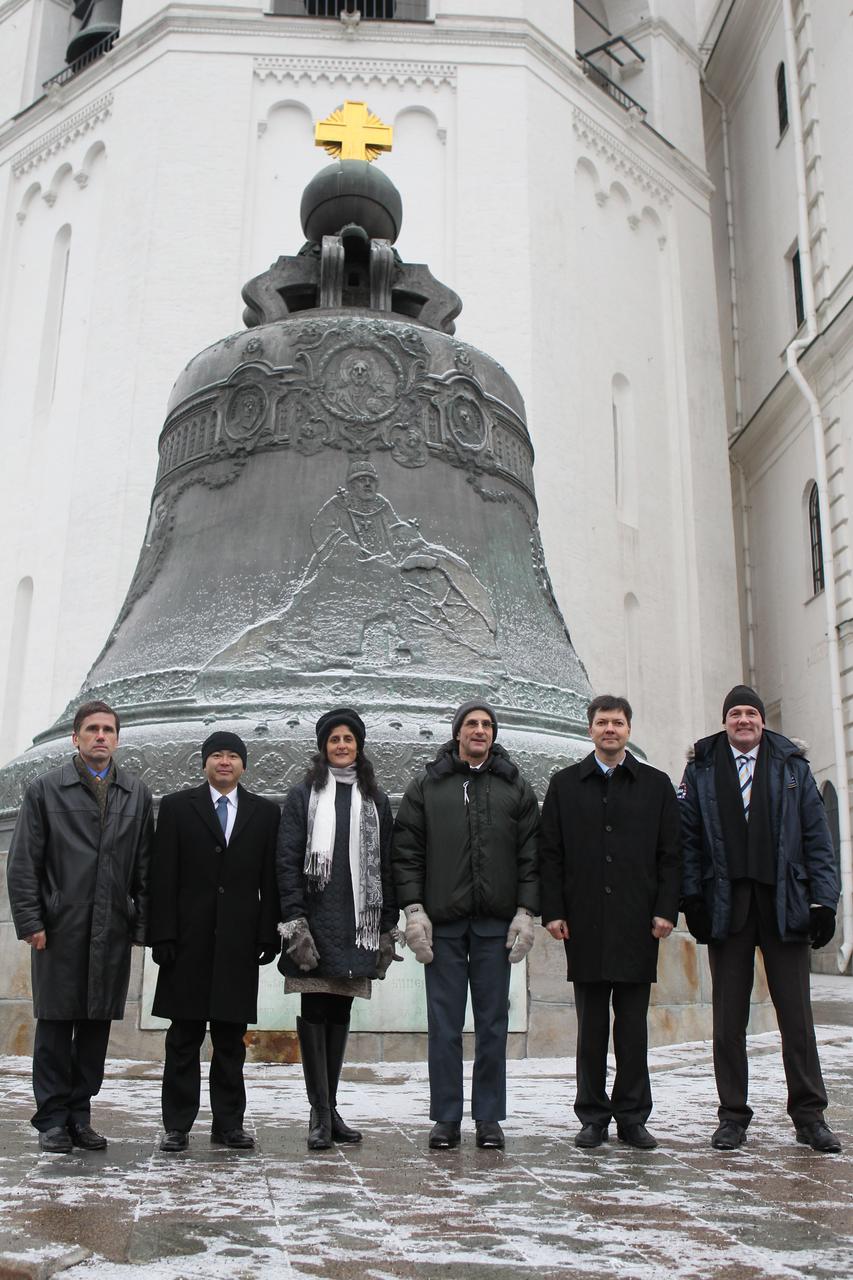
At the Kremlin in Moscow, the backup and prime crews for the next launch of Expedition 30 crewmembers to the International Space Station pose for pictures Dec. 1, 2011 in front of the Tsar Bell following traditional ceremonial activities at Red Square. From left to right are backup Soyuz Commander Yuri Malenchenko, backup NASA Flight Engineer Suni Williams, backup Flight Engineer Aki Hoshide of the Japan Aerospace Exploration Agency and the prime crew --- NASA Flight Engineer Don Pettit, Soyuz Commander Oleg Kononenko and Flight Engineer Andre Kuipers of the European Space Agency. Pettit, Kononenko and Kuipers will launch Dec. 21 from the Baikonur Cosmodrome in Kazakhstan on their Soyuz TMA-03M spacecraft. Credit: NASA
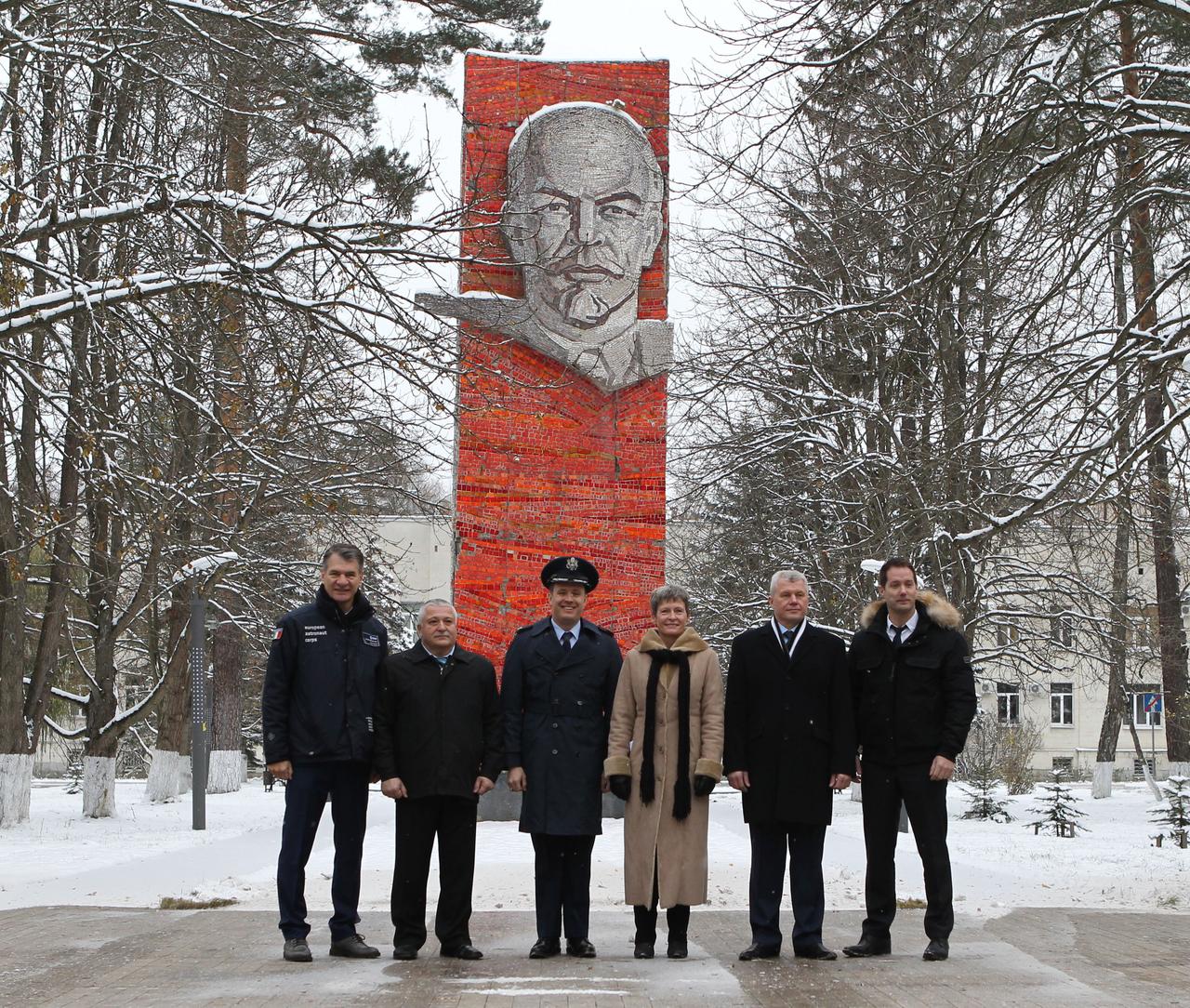
At the Gagarin Cosmonaut Training Center in Star City, Russia, the Expedition 50-51 prime and backup crewmembers pose for pictures Nov. 1 in front of Lenin’s Statue before departing for their launch site in Baikonur, Kazakhstan. From left to right are backup crewmembers Paolo Nespoli of the European Space Agency, Fyodor Yurchikhin of the Russian Federal Space Agency (Roscosmos) and Jack Fischer of NASA and prime crewmembers Peggy Whitson of NASA, Oleg Novitskiy of the Russian Federal Space Agency (Roscosmos) and Thomas Pesquet of the European Space Agency. Whitson, Novitskiy and Pesquet will launch Nov. 18, Baikonur time, on the Soyuz MS-03 spacecraft for a six-month mission on the International Space Station. NASA/Stephanie Stoll
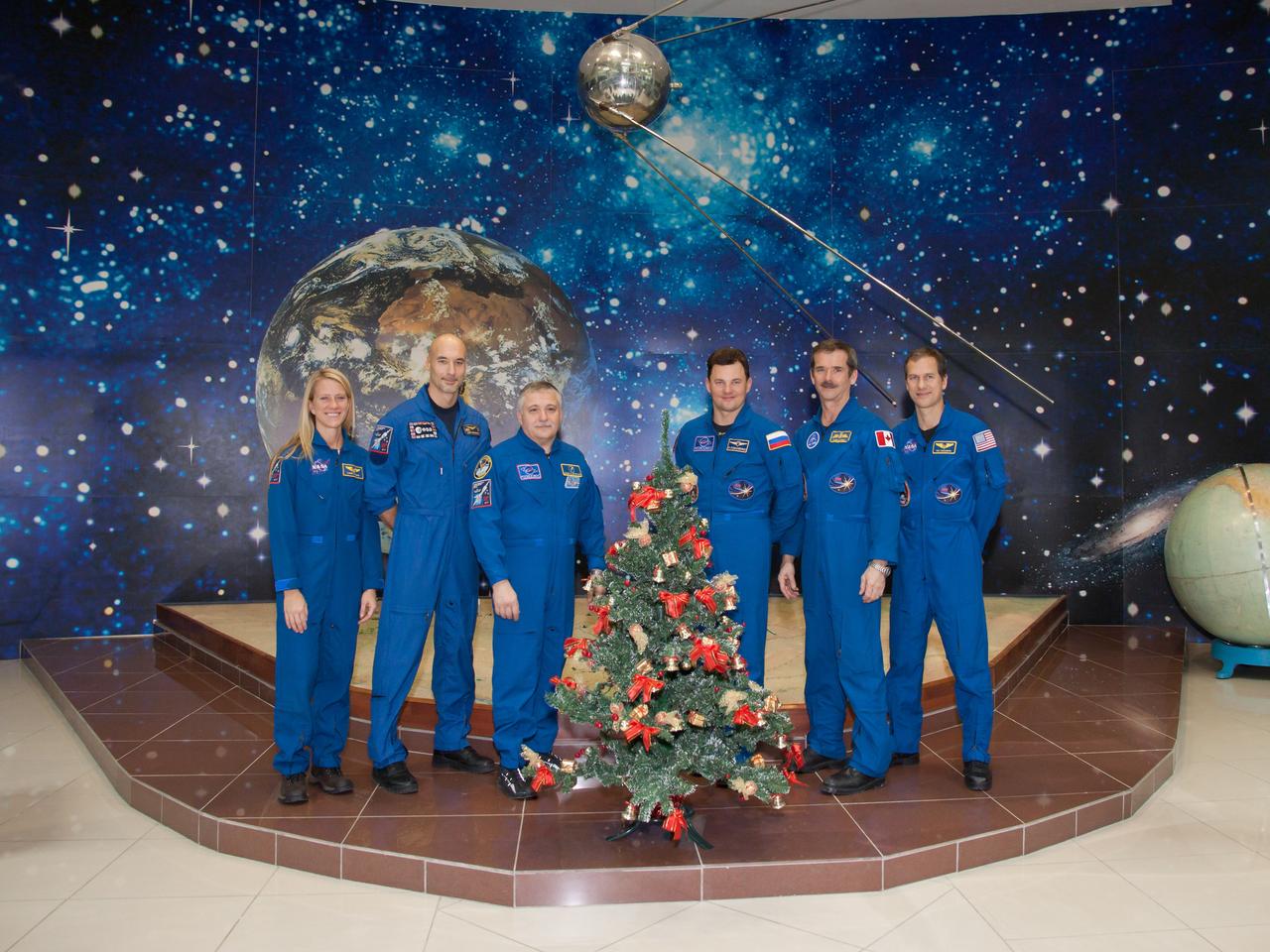
At the Korolev Museum at the Baikonur Cosmodrome in Kazakhstan, the Expedition 34/35 prime and backup crewmembers reflect the spirit of the holiday season as they pose for pictures in front of a wall mural depicting the cosmos and a model of Sputnik 1, the first satellite launched into orbit in October 1957 during ceremonial activities Dec. 14, 2012. From left to right are backup crewmembers Karen Nyberg of NASA, Luca Parmitano of the European Space Agency and Fyodor Yurchikhin and prime crewmembers Soyuz Commander Roman Romanenko, Flight Engineer Chris Hadfield of the Canadian Space Agency and Flight Engineer Tom Marshburn of NASA. Romanenko, Hadfield and Marshburn will launch Dec. 19 on the Soyuz TMA-07M spacecraft for a five-month mission on the International Space Station. NASA/Victor Zelentsov
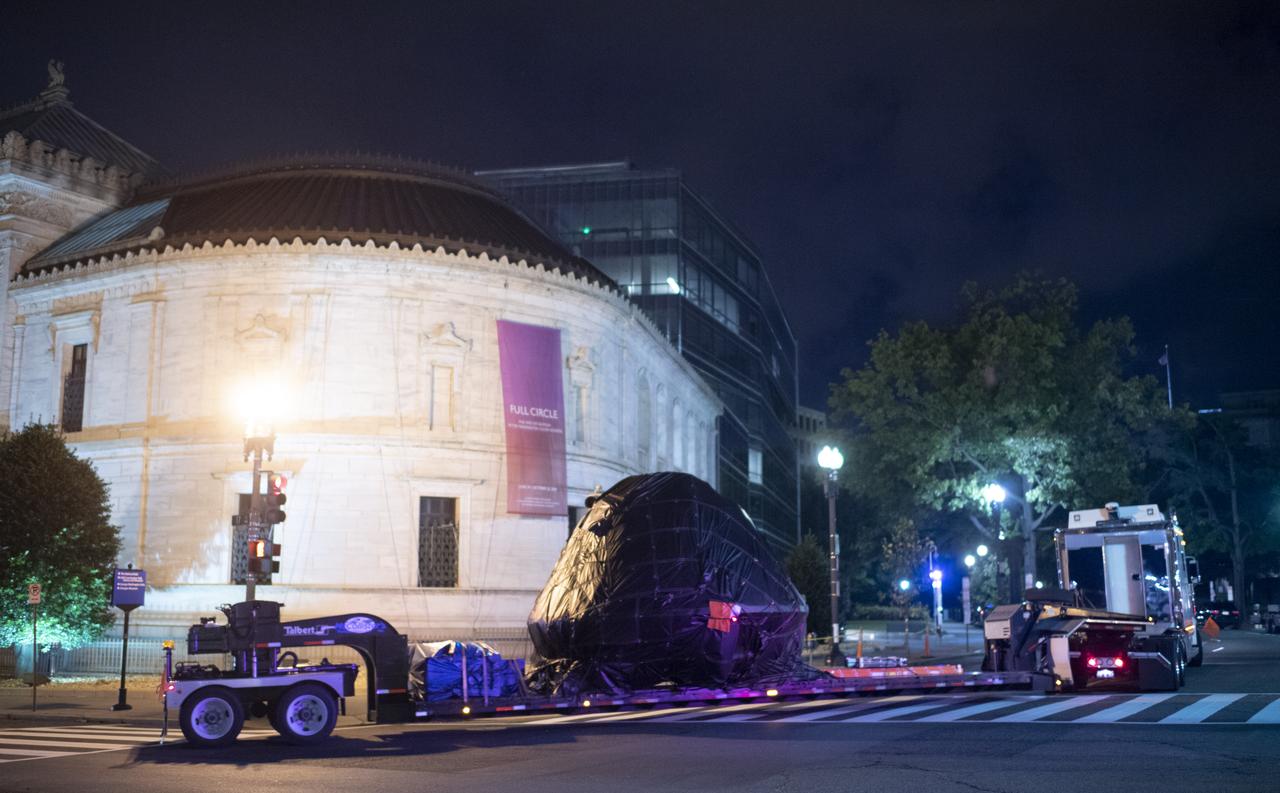
NASA's Orion spacecraft that flew Exploration Flight Test-1 on Dec. 5, 2014 is seen as it arrives at the White House complex, Saturday, July 21, 2018 in Washington, DC. Lockheed Martin, NASA’s prime contractor for Orion, began manufacturing the Orion crew module in 2011 and delivered it in July 2012 to NASA's Kennedy Space Center where final assembly, integration and testing was completed. More than 1,000 companies across the country manufactured or contributed elements to the spacecraft. Photo Credit: (NASA/Joel Kowsky)
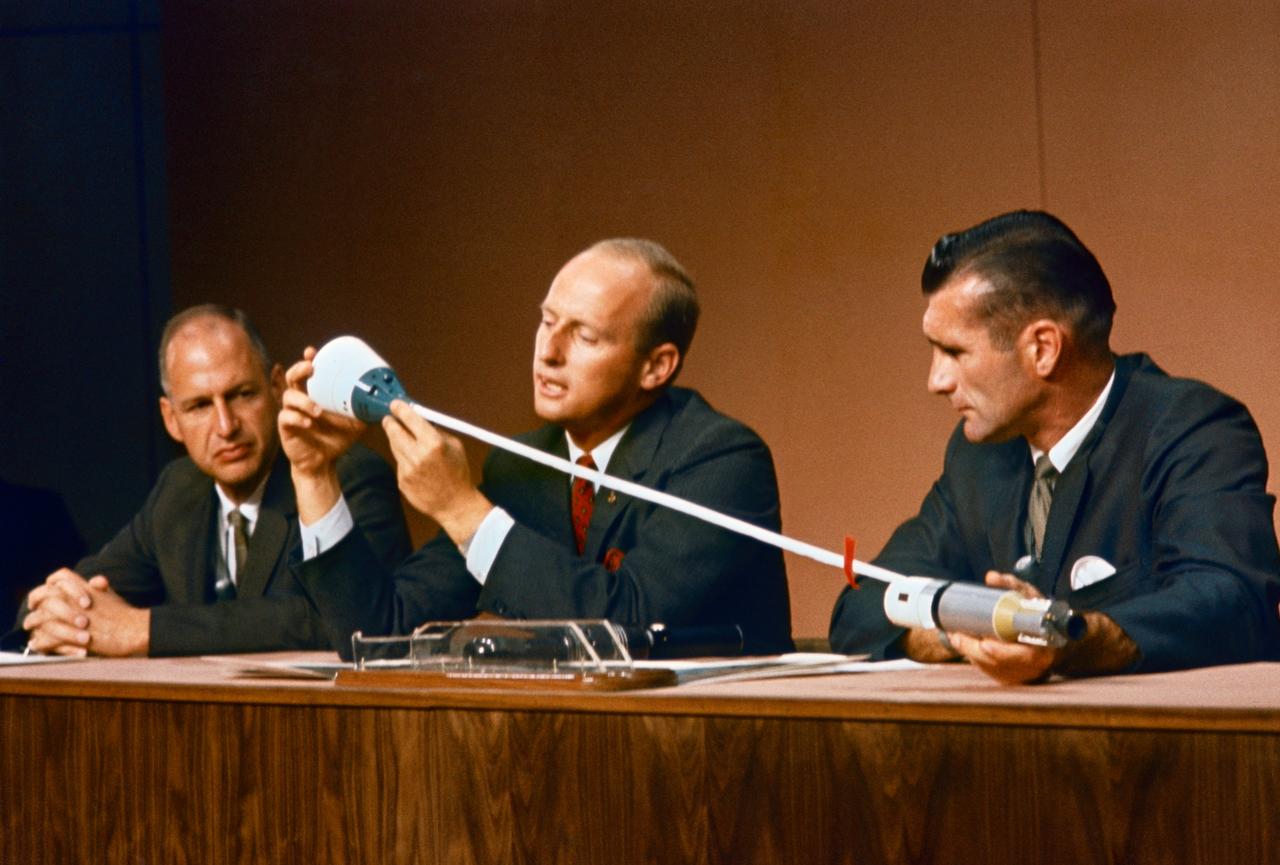
S66-45635 (26 Sept. 1966) --- Astronaut Charles Conrad Jr. (center), Gemini-11 prime crew command pilot, discusses the Gemini-11/Agena tether before a gathering of news media representatives in the MSC Building 1 auditorium. Holding an Agena model at right is astronaut Richard F. Gordon Jr., Gemini-11 pilot. Looking on at left is George M. Low, MSC Deputy Director. Photo credit: NASA
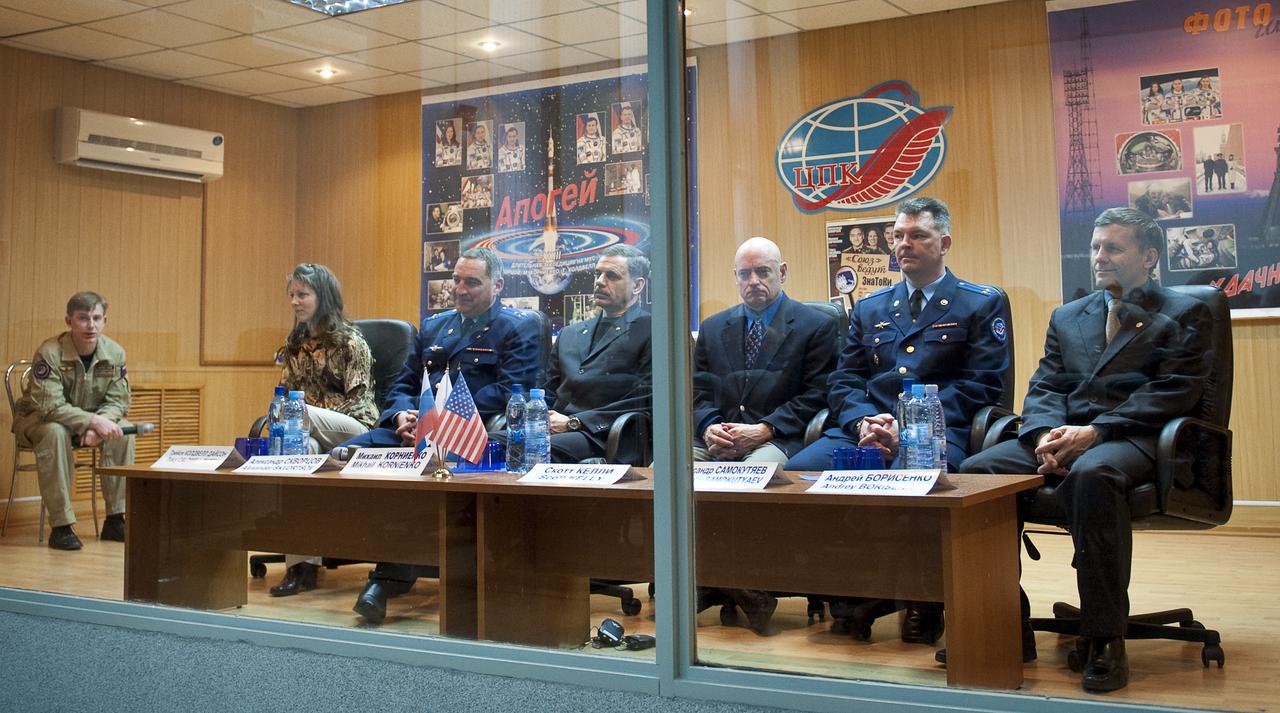
Expedition 23 prime and backup crew members, from left, NASA's Tracy Caldwell Dyson, Russian Aleksander Skvortsov, Russian Mikhail Kornienko, NASA's Scott Kelly, Russian Alexander Samokutyayev, and Russian Andrei Borisenko are seen during the State Commission meeting to approve the Soyuz launch of Caldwell Dyson, Skvortsov and Kornienko, Thursday, April 1, 2010 in Baikonur, Kazakhstan. The crew is kept in a separate room with a glass window in order to help maintain their health. Photo Credit: (NASA/Bill Ingalls)
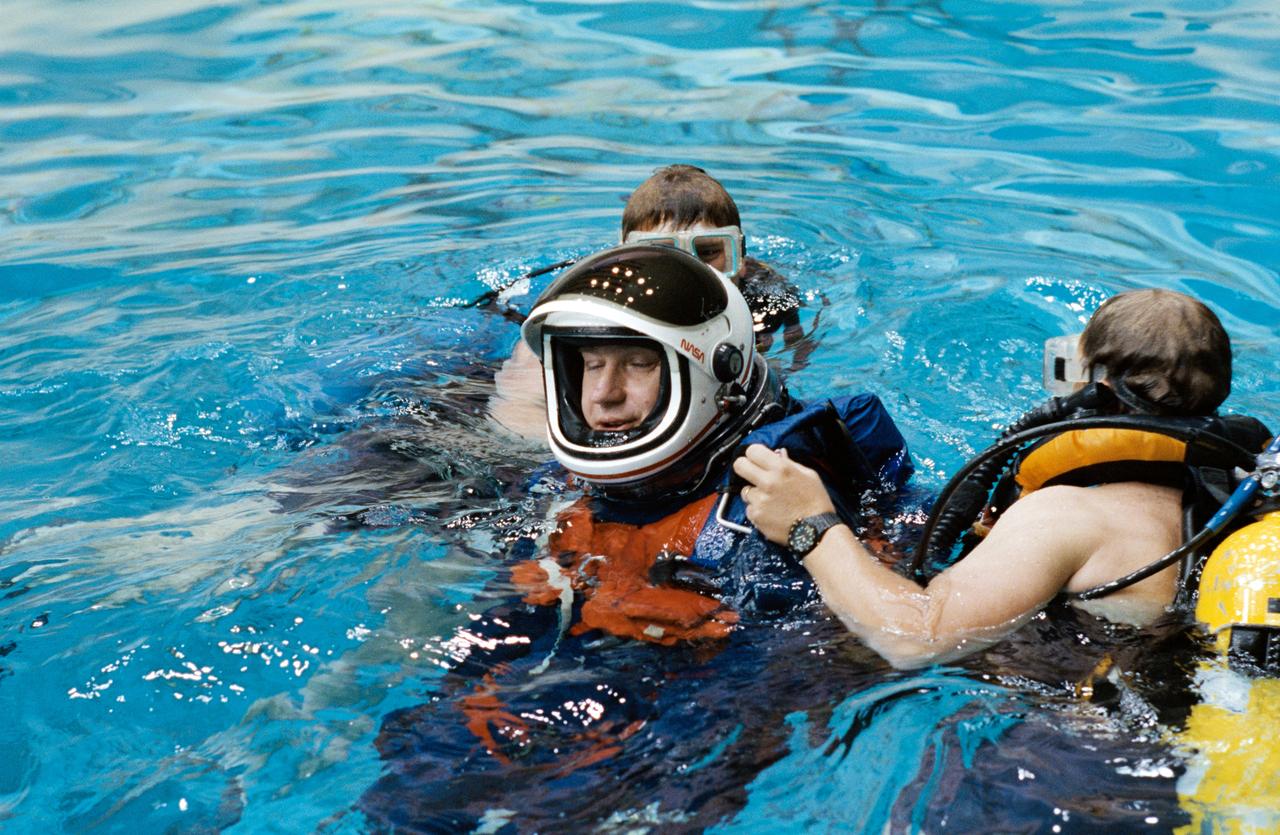
S92-32108 (May 1992) --- Payload specialist Albert Sacco Jr. uses a one-person life raft during emergency bailout training exercises in the Johnson Space Center?s (JSC) Weightless Environment Training Facility (WET-F). Sacco is an alternate payload specialist for the United States Microgravity Laboratory (USML-1) mission, scheduled for launch later this year. EDITOR?S NOTE: Sacco was later named as prime crew payload specialist for the USML-2 mission (STS-73), scheduled for 1995.