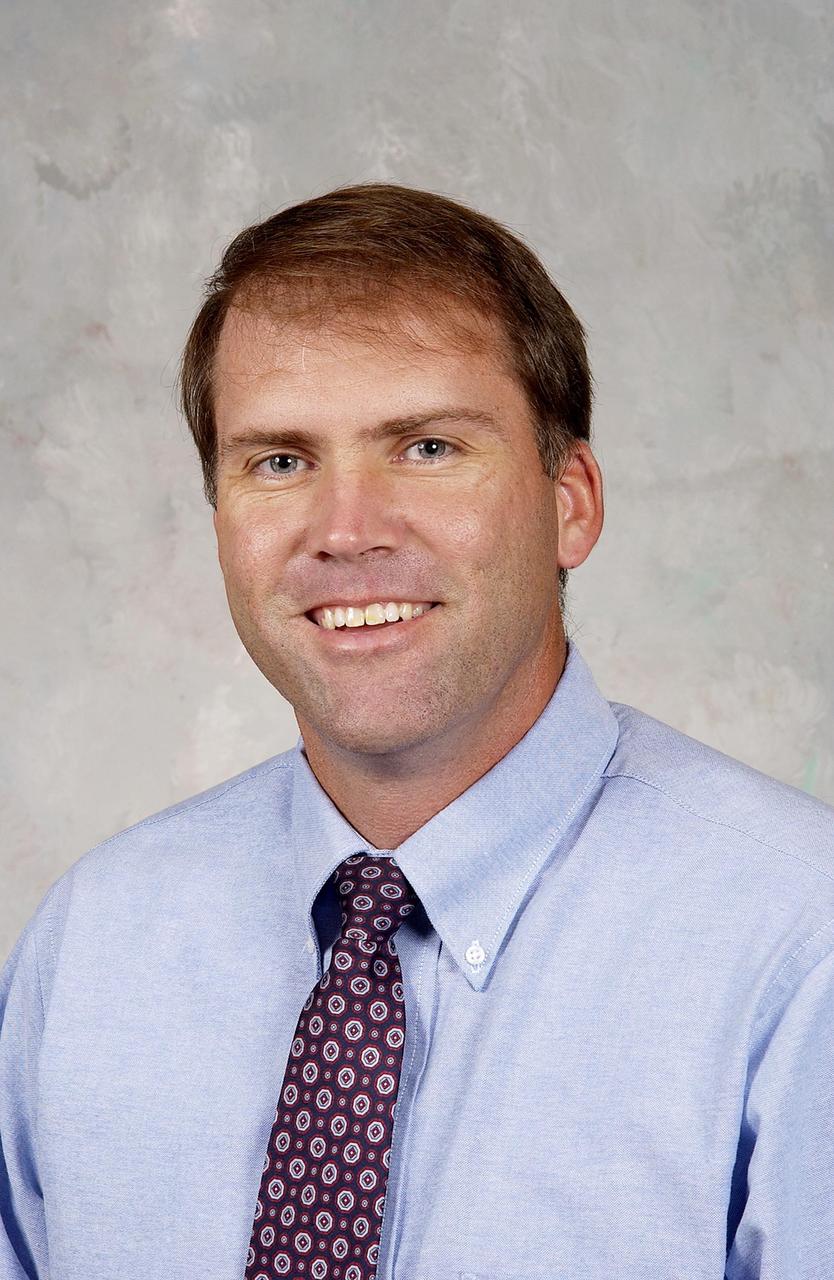
KENNEDY SPACE CENTER, FLA. -- Official portrait of Mike Rein, Division Chief, Media Services, External Relations and Business Development Directorate.

Former Astronaut Edwin E. Aldrin exiting the bus that brought him to the Apollo 11 Twentieth Aniversary Picnic at the Gilruth Center.
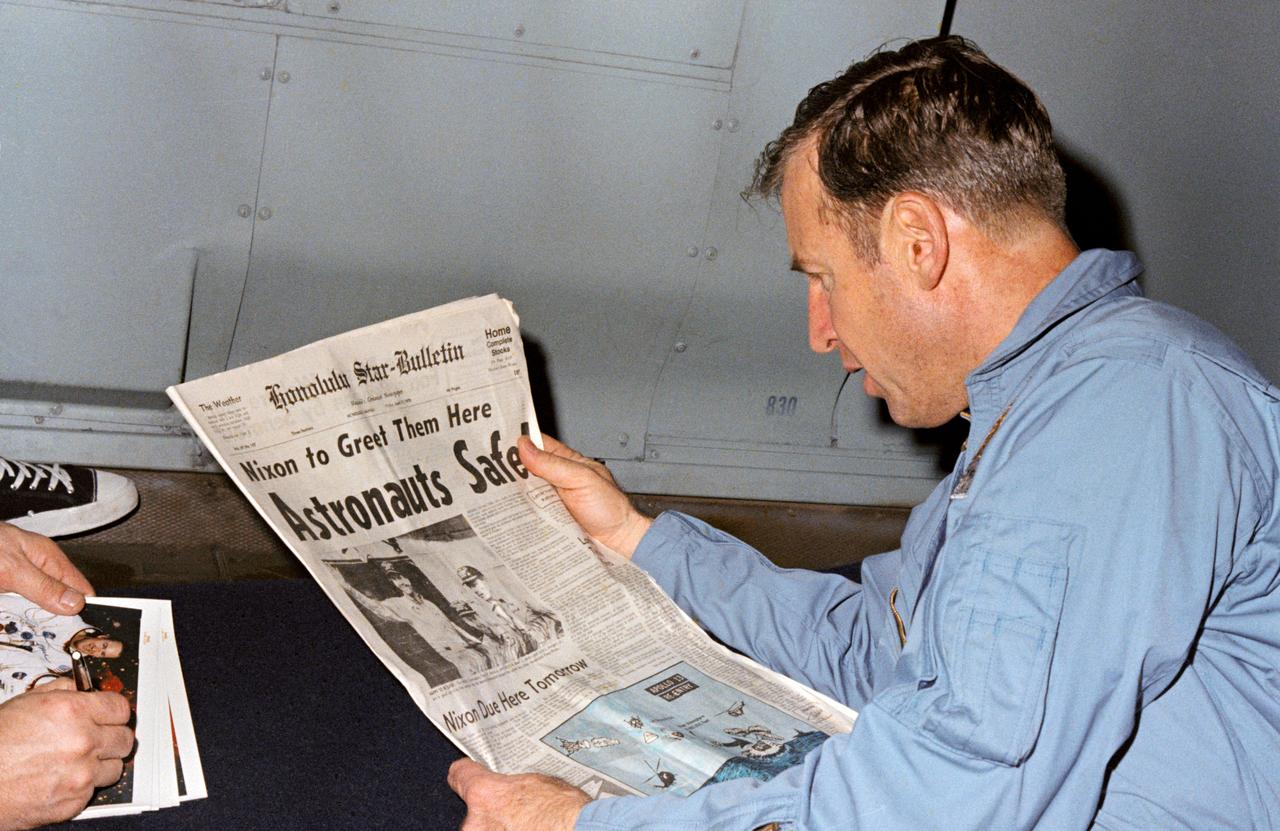
S70-15501 (17 April 1970) --- Astronaut James A. Lovell Jr., Apollo 13 mission commander, reads a newspaper account of the safe recovery of the problem plagued mission. Lovell is on board the USS Iwo Jima, prime recovery ship for Apollo 13, which was on a course headed for Pago Pago. From Pago Pago the astronauts flew to Hickam Air Force Base, Hawaii, where they were presented the Presidential Medal of Freedom by President Richard M. Nixon. Other Apollo 13 crew members were astronauts John L. Swigert Jr., command module pilot, and Fred W. Haise Jr., lunar module pilot.
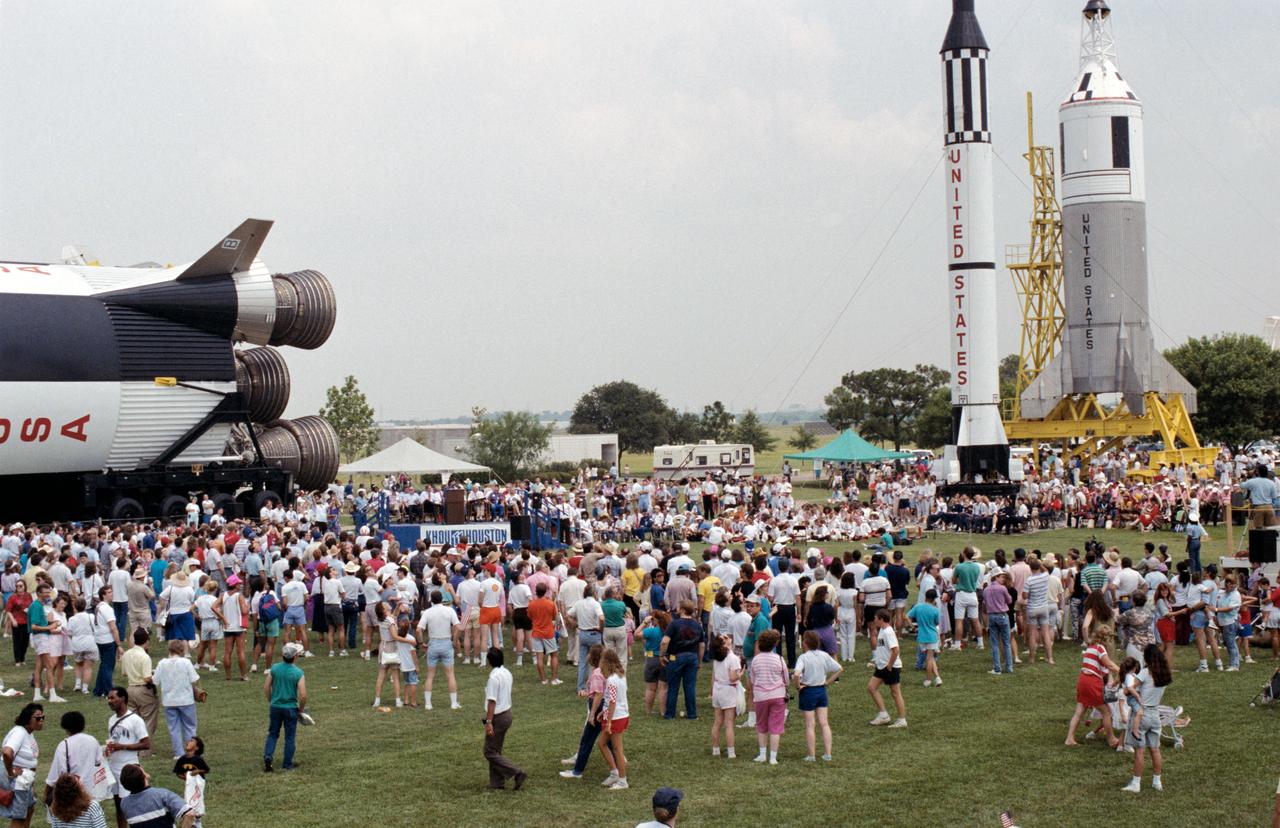
View of crowd at Rocket Park during Apollo 11 Anniversary festivities.
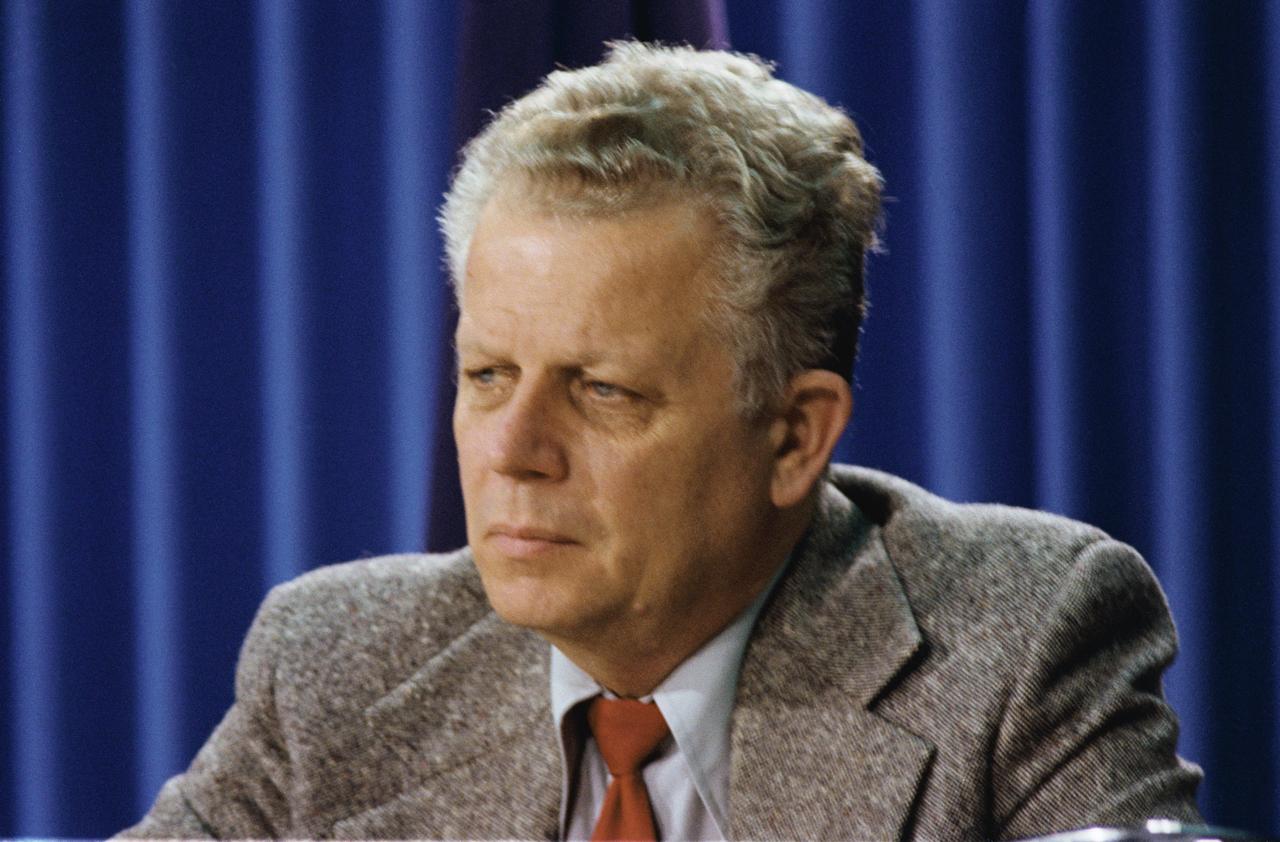
Terry White during a change-of-shift briefing in the JSC public affairs facility briefing room. White acted as one of the on-orbit public affairs officers and the landing PAO during the Challenger's STS-6 flight.
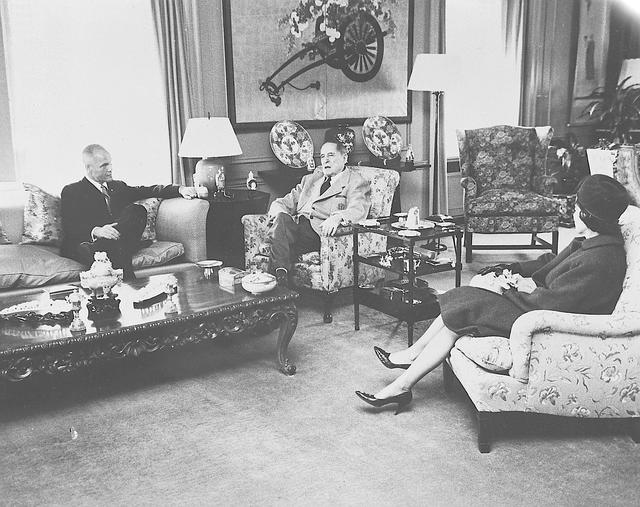
S62-02270 (1962) --- Astronaut John H. Glenn Jr. and wife visit with General Douglas McArthur in the Waldorf Astoria hotel. Photo credit: NASA
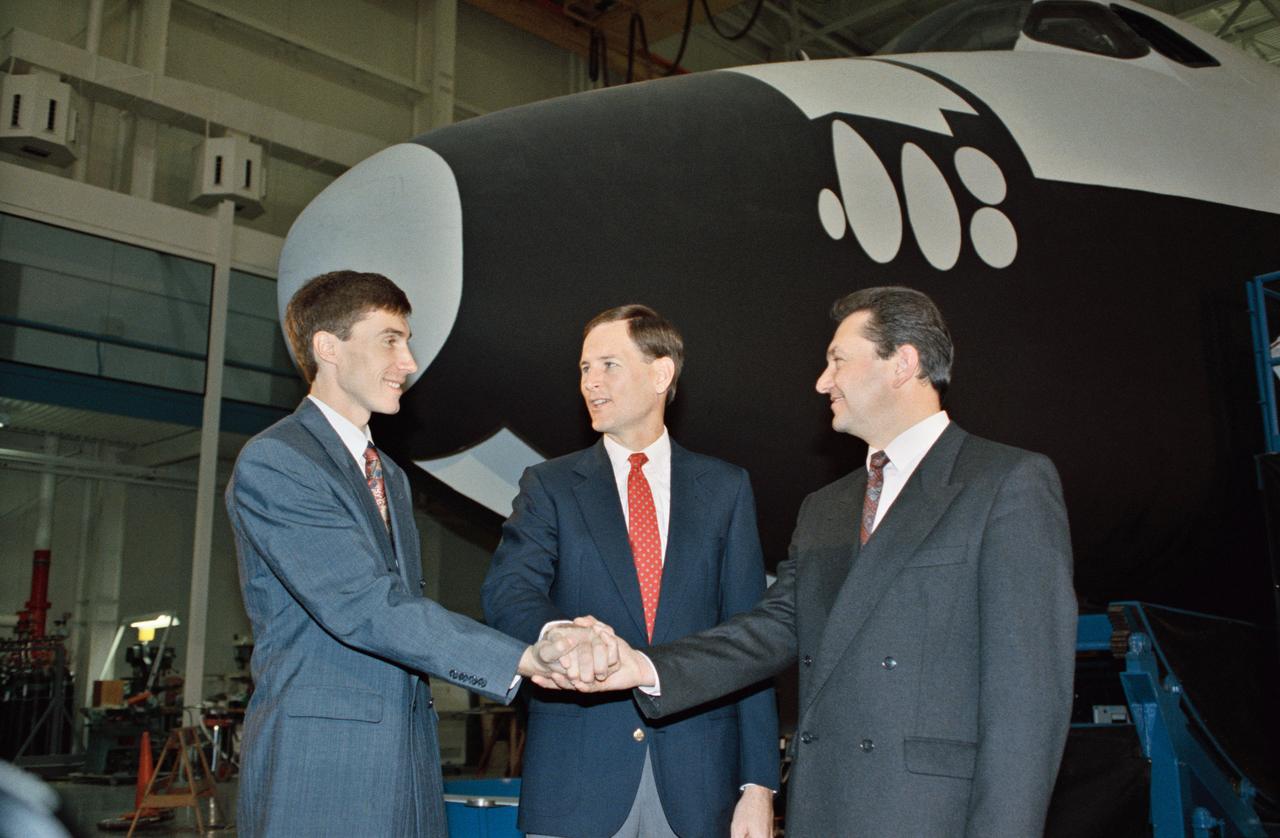
S92-49715 (10 Nov 1992) --- Russian cosmonauts Sergei Krikalev (left), and Vladimir Titov (right) share a team handshake with Kenneth L. Reightler, STS-60 pilot. The cosmonauts toured the Space Shuttle mockup and integration laboratory, in which they will undergo a great deal of training in preparation for the mission. One of the two will later be named as prime payload specialist and the second will serve as his alternate. The six person crew, to be led by astronaut Charles F. Bolden, mission commander, will man the Space Shuttle Discovery for the scheduled eight-day flight.
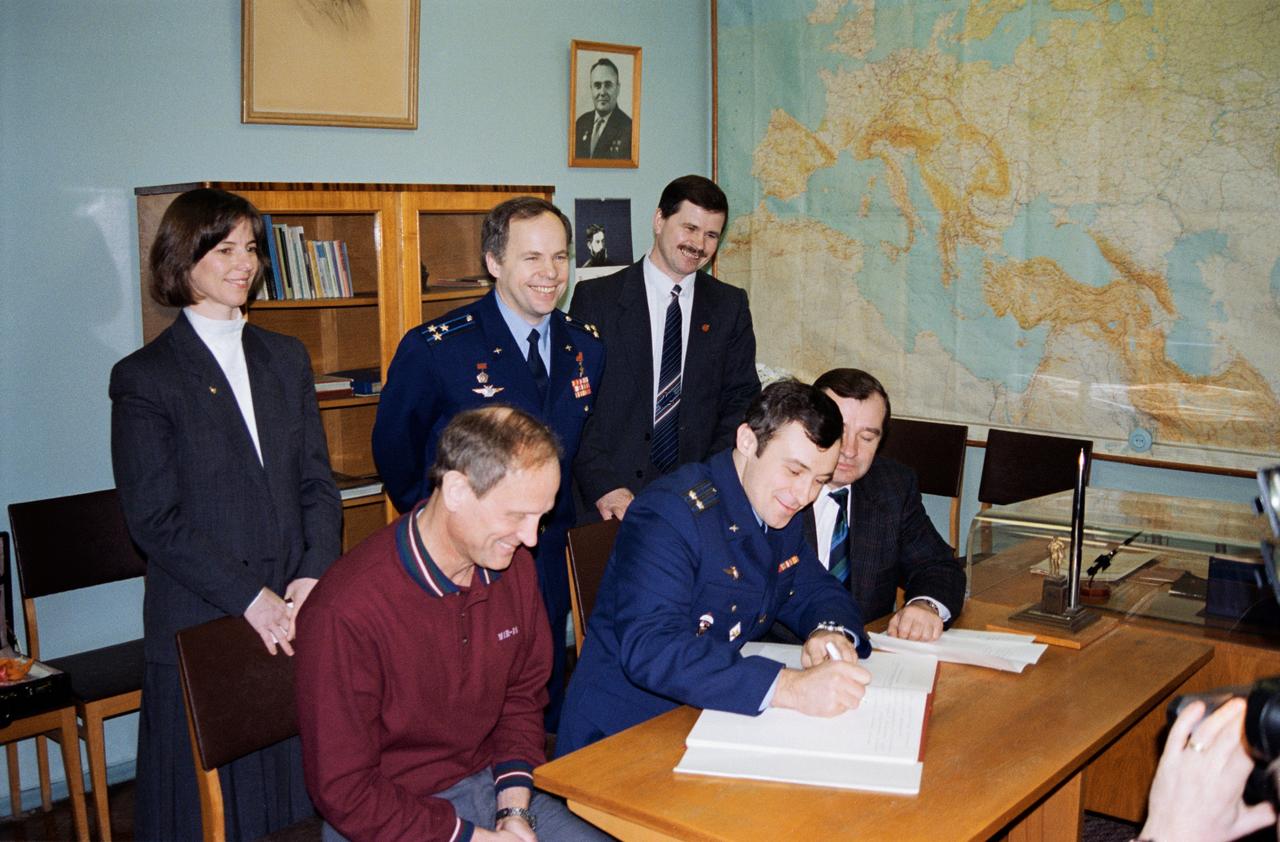
S95-04323 (22 Feb 1995) --- In keeping with Russian tradition, astronaut Norman E. Thagard (seated, left), guest researcher, watches as Vladimir N. Dezhurov (seated, center), signs the diary of the late Yuriy A. Gagarin, the first Russian cosmonaut, as his Mir 18 crew mates and the subsequent Mir crewmembers look on. Cosmonauts Dezhurov, mission commander, and Gennadiy M. Strekalov (seated right, partially obscured), flight engineer, have been training with Thagard in both the United States and Russia for the past several months. Watching are, standing left to right, astronaut Bonnie J. Dunbar, Thagard?s alternate crew member; and cosmonauts Anatoliy Y. Solovyev, Mir 19 mission commander, and Nikolai M. Budarin, flight engineer.
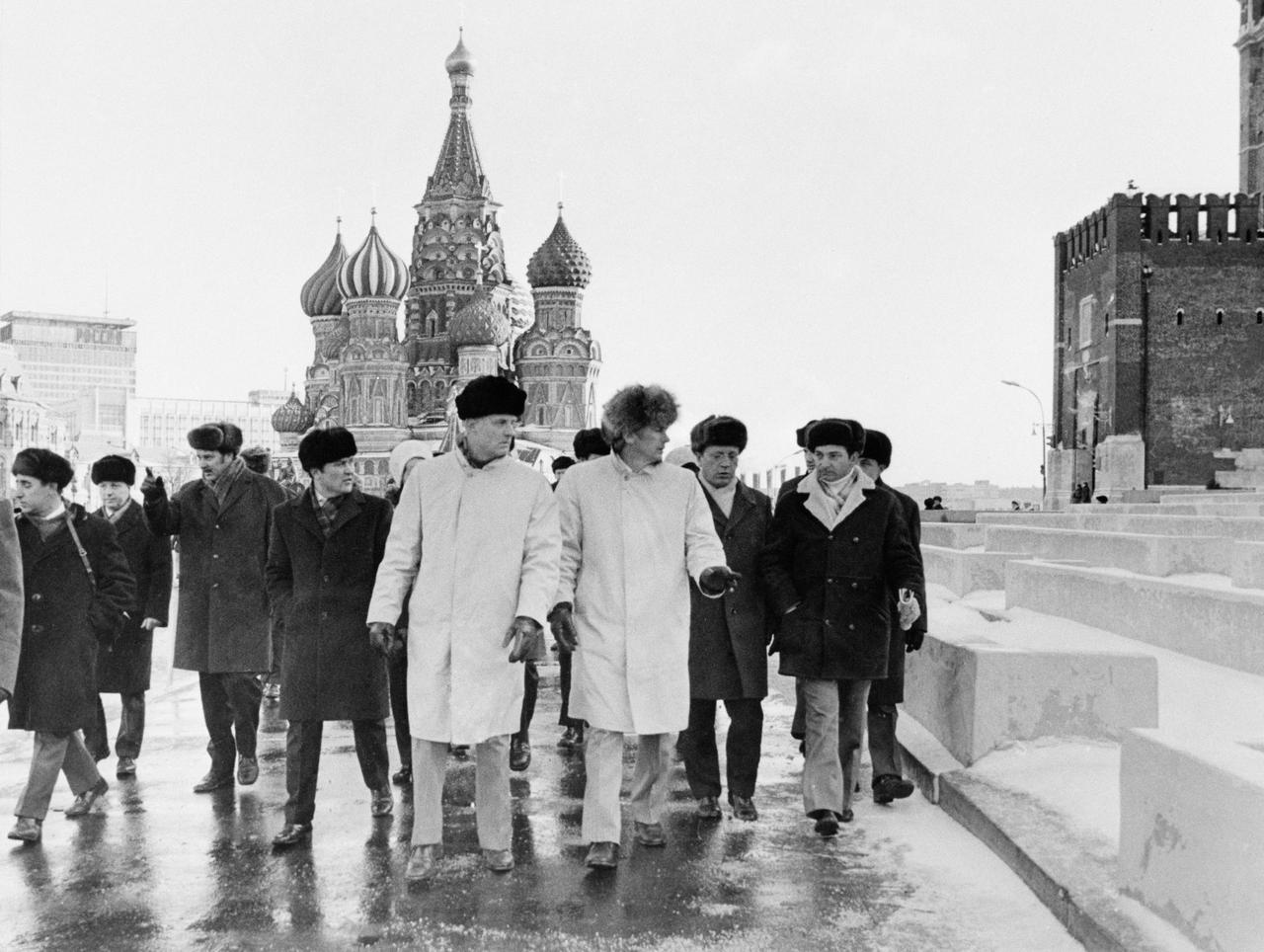
S74-20831 (November 1973) --- A group of astronauts and their cosmonaut hosts are photographed sightseeing on Red Square in the heart of Moscow during a tour of the Soviet capital. The Americans were in the USSR to participate in Apollo-Soyuz Test Project familiarization training on the Soyuz systems at the Cosmonaut Training Center (Star City) near Moscow. Astronaut Thomas P. Stafford (light coat, black cap), commander of the American ASTP crew, was head of the U.S. delegation to Star City. Astronaut Eugene A. Cernan (on Stafford?s left, light coat) is the Special Assistant to the American Technical Director of ASTP. The sightseeing group is walking in the direction of Lenin?s Mausoleum. The structure in the background is the Cathedral of the Intercession (St. Basil?s) Museum. The historic Kremlin complex is to the right. PHOTO COURTESY: USSR ACADEMY OF SCIENCES
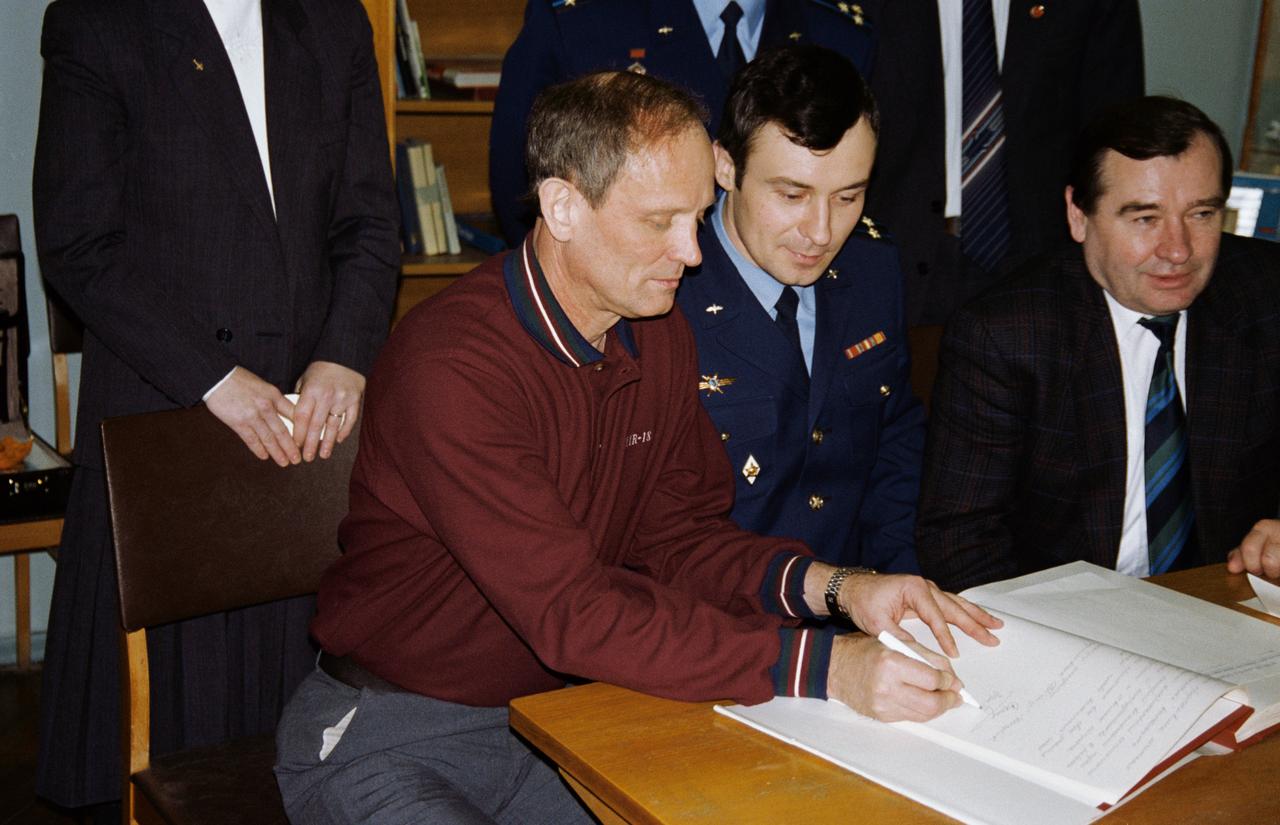
S95-04324 (22 March 1995) --- In keeping with Russian tradition, astronaut Norman E. Thagard (left), guest researcher, signs the diary of the late Yuriy A. Gagarin, the first Russian cosmonaut, as his Mir 18 crew mates look on. Cosmonauts Vladimir N. Dezhurov (center), mission commander, and Gennadiy M. Strkalov, flight engineer, have been training with Thagard in both the United States and Russia for the past several months. It is customary for each crew member about to aboard a Russian spacecraft to sign the diary.

S88-31388 (8 May 1961) --- Astronaut Alan B. Shepard Jr. (center), along with wife Louise, waves to a crowd outside the U.S. Capitol building. Shepard, Mercury-Redstone 3 astronaut, had earlier briefed Congress on the first U.S. manned spaceflight -- a 15-minute suborbital mission on May 5, 1961, aboard the Freedom 7 capsule. (NASA Hq. Photo No., MR3-49) Photo credit: NASA or National Aeronautics and Space Administration
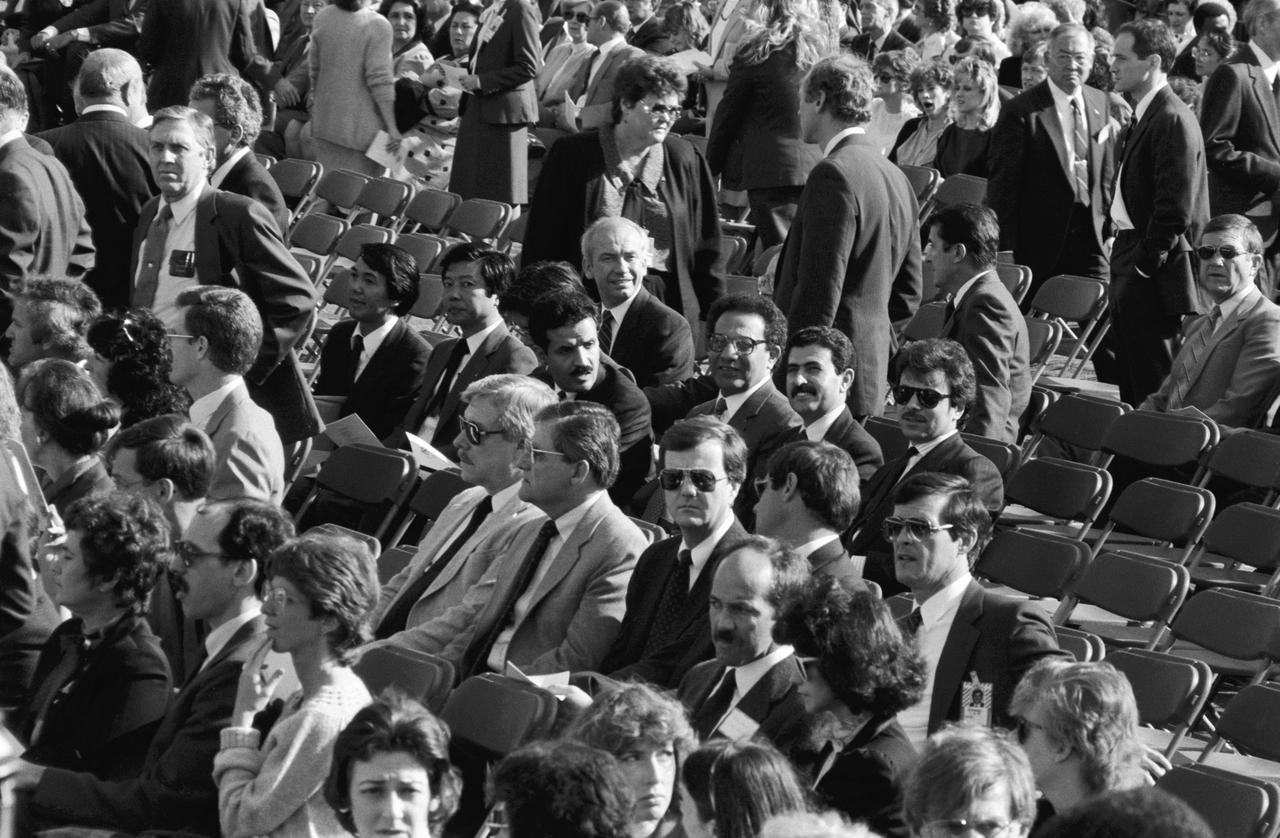
View of the audience at the memorial service at JSC for the Crew of STS 51-L. Sultan Salman Abdelazize Al-Saud of Saudi Arabia is seen in the center of the view.
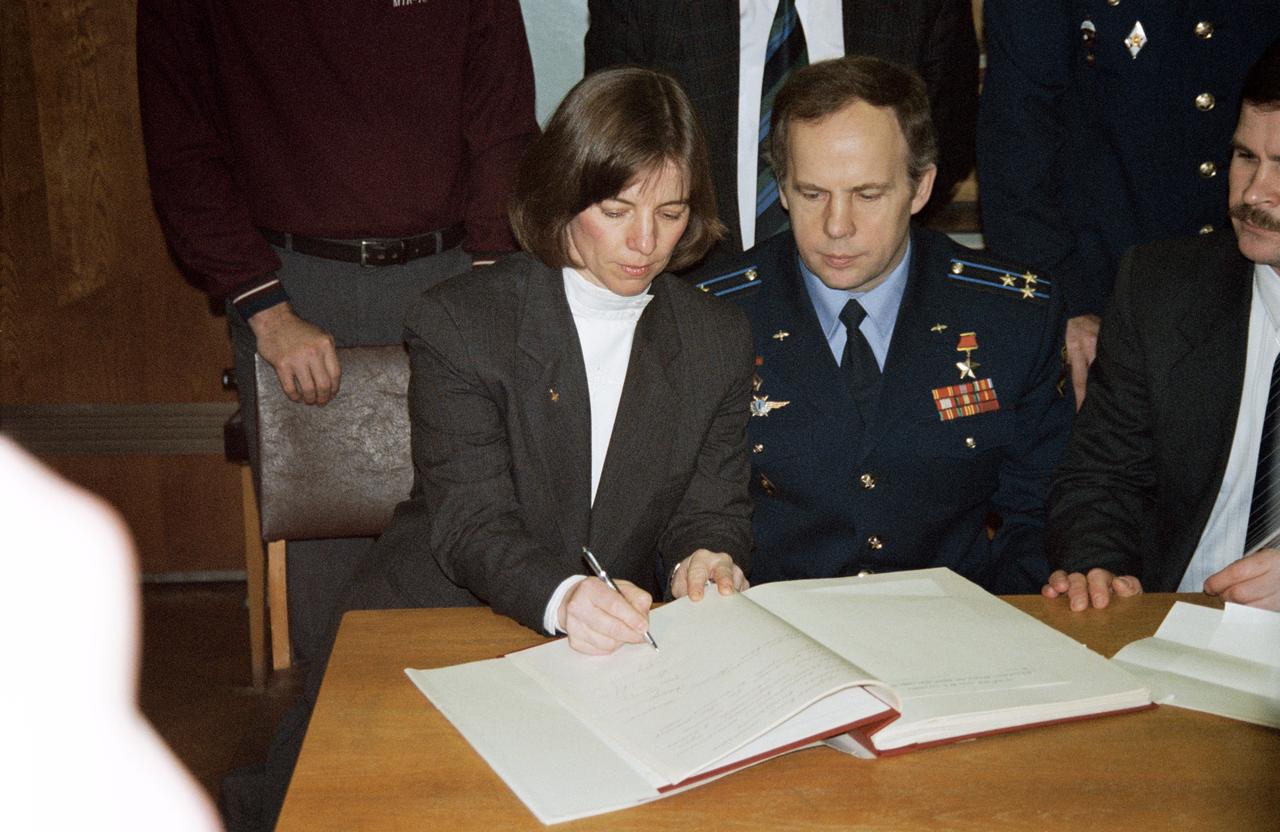
S95-04325 (22 March 1995) --- In keeping with Russian tradition, astronaut Bonnie J. Dunbar (left), STS-71 mission specialist, signs the diary of the late Yuriy A. Gagarin, the first Russian cosmonaut, as her STS-71 crew mates look on. Cosmonauts Anatoliy Y. Solovyov (center), Mir 19 mission commander, and Nikiolai M. Budarin, flight engineer, have been training with Dunbar in both the United States and Russia for the past several months. It is customary for each crew member about to aboard a Russian spacecraft to sign the diary. Dunbar has been in Russia training as alternate researcher for the Mir 18 mission.
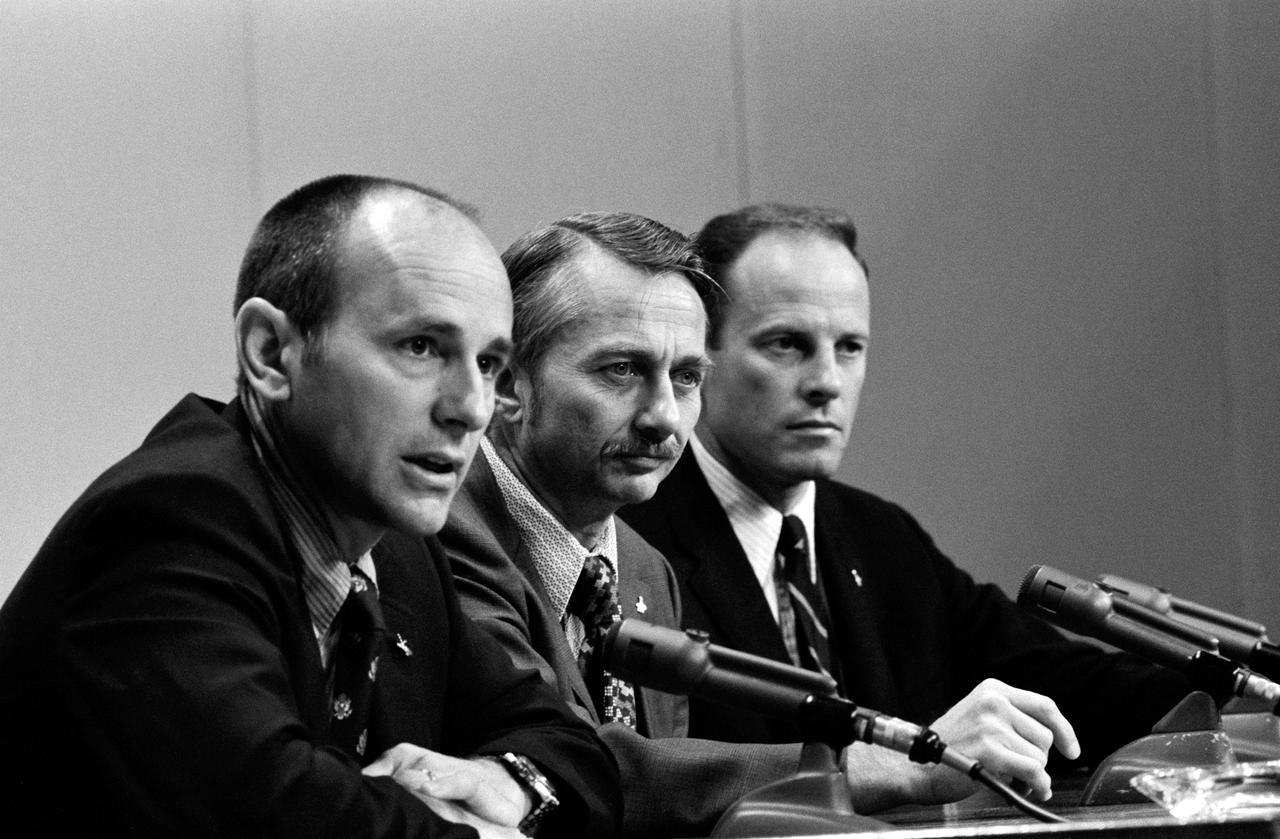
S73-30110 (30 June 1973) --- The three members of the prime crew of the second manned Skylab mission (Skylab 3) discuss their scheduled 56-day flight before a gathering of news media representatives in the large auditorium of Building 1 at the Johnson Space Center (JSC), Houston, Texas, on June 30, 1973. They are, left to right, astronaut Alan L. Bean, commander; scientist-astronaut Owen K. Garriott, science pilot; and astronaut Jack R. Lousma, pilot. Photo credit: NASA
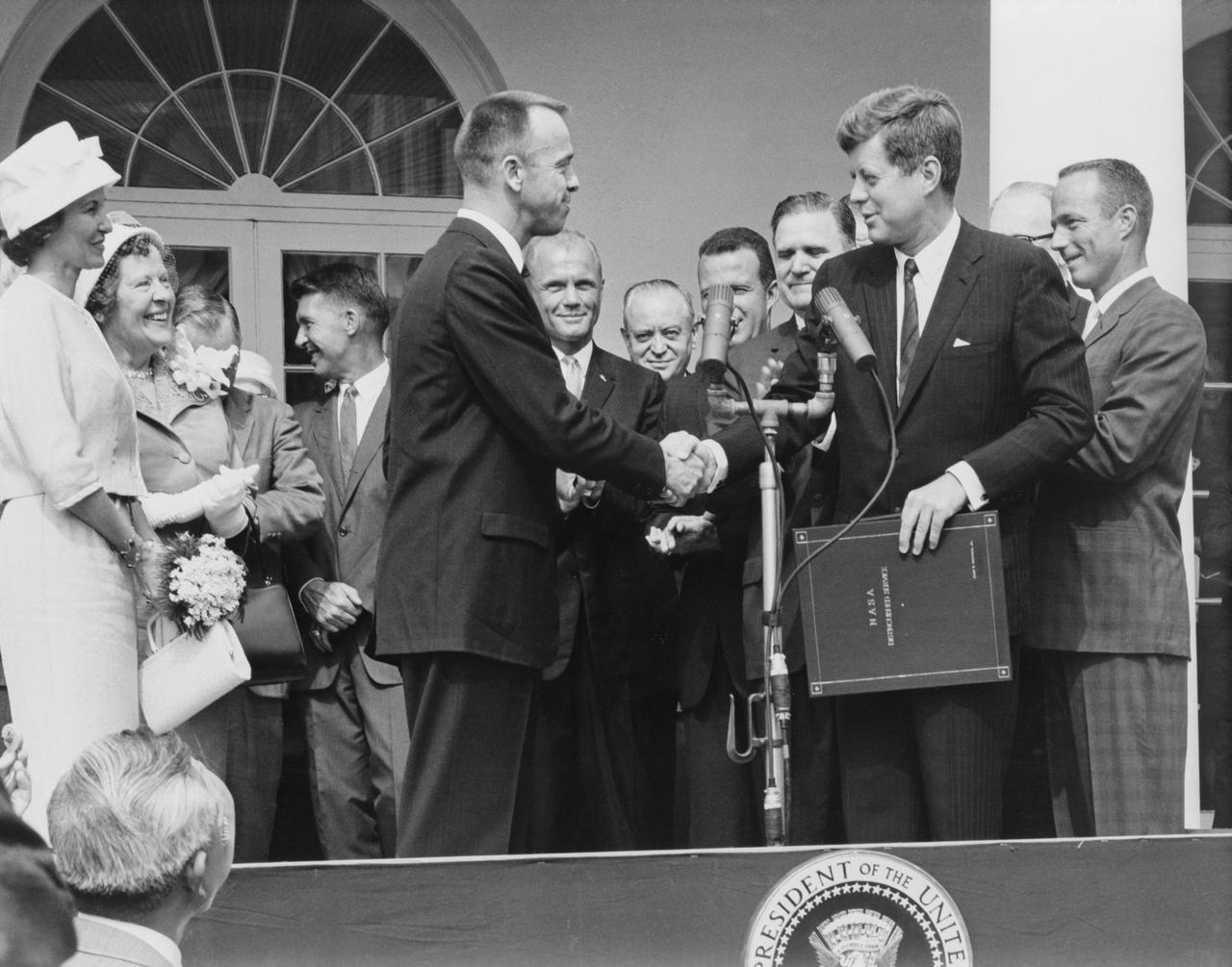
S67-19572 (8 May 1961) --- Astronaut Alan B. Shepard Jr. receives the NASA Distinguished Service Award from United States President John F. Kennedy May 8, 1961, days after his history making MR-3 flight. Shepard's wife and mother on left and the other six Mercury astronauts are in background. Photo credit: NASA or National Aeronautics and Space Administration
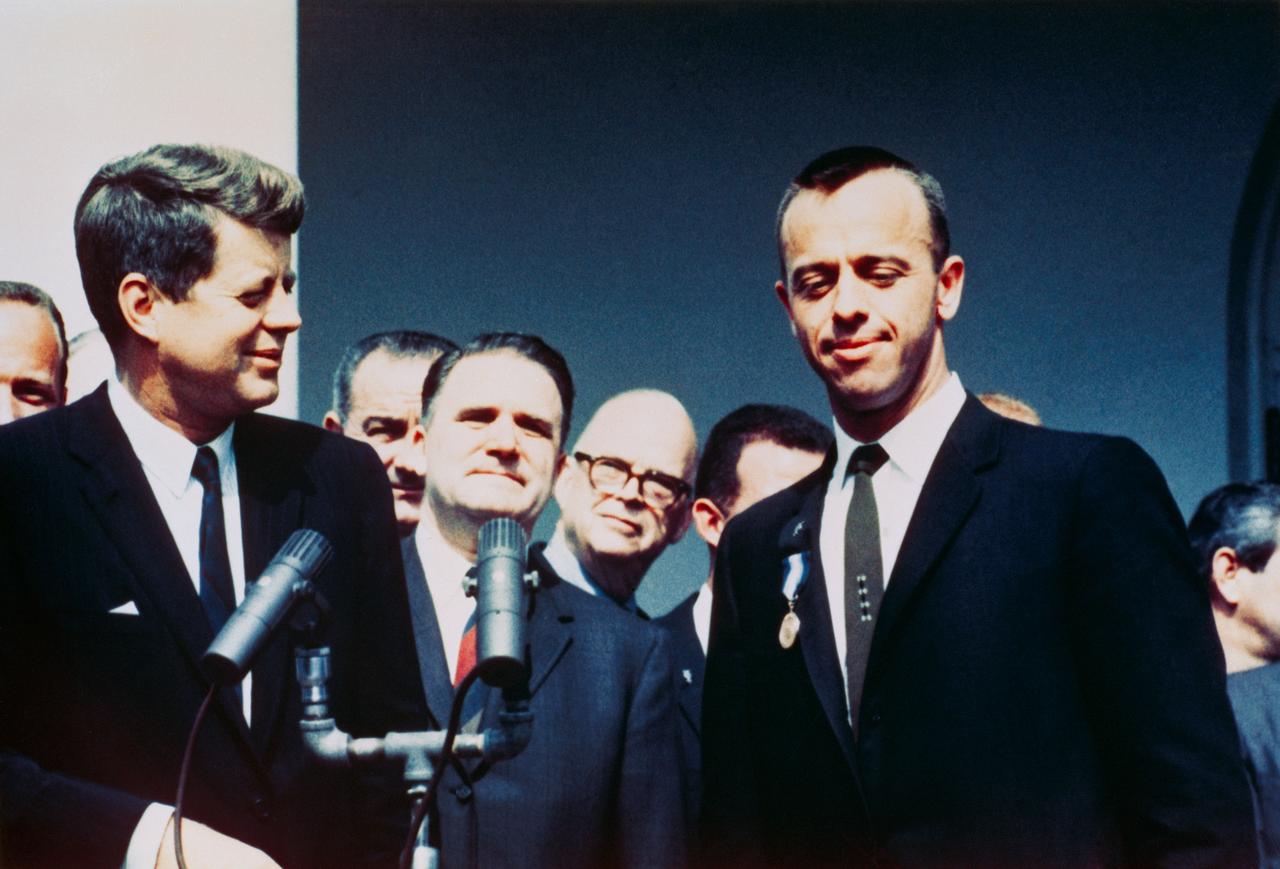
S88-31387 (8 May 1961) --- President John F. Kennedy (left) congratulates NASA's Distinguished Service Medal Award recipient astronaut Alan B. Shepard Jr. in a Rose Garden ceremony on May 8, 1961, at the White House. Vice-President Lyndon B. Johnson, NASA Administrator James E. Webb and several NASA astronauts are in the background. Three days earlier, Shepard made history with a 15-minute suborbital space mission in the Freedom 7, Mercury-Redstone 3 spacecraft. Photo credit: NASA
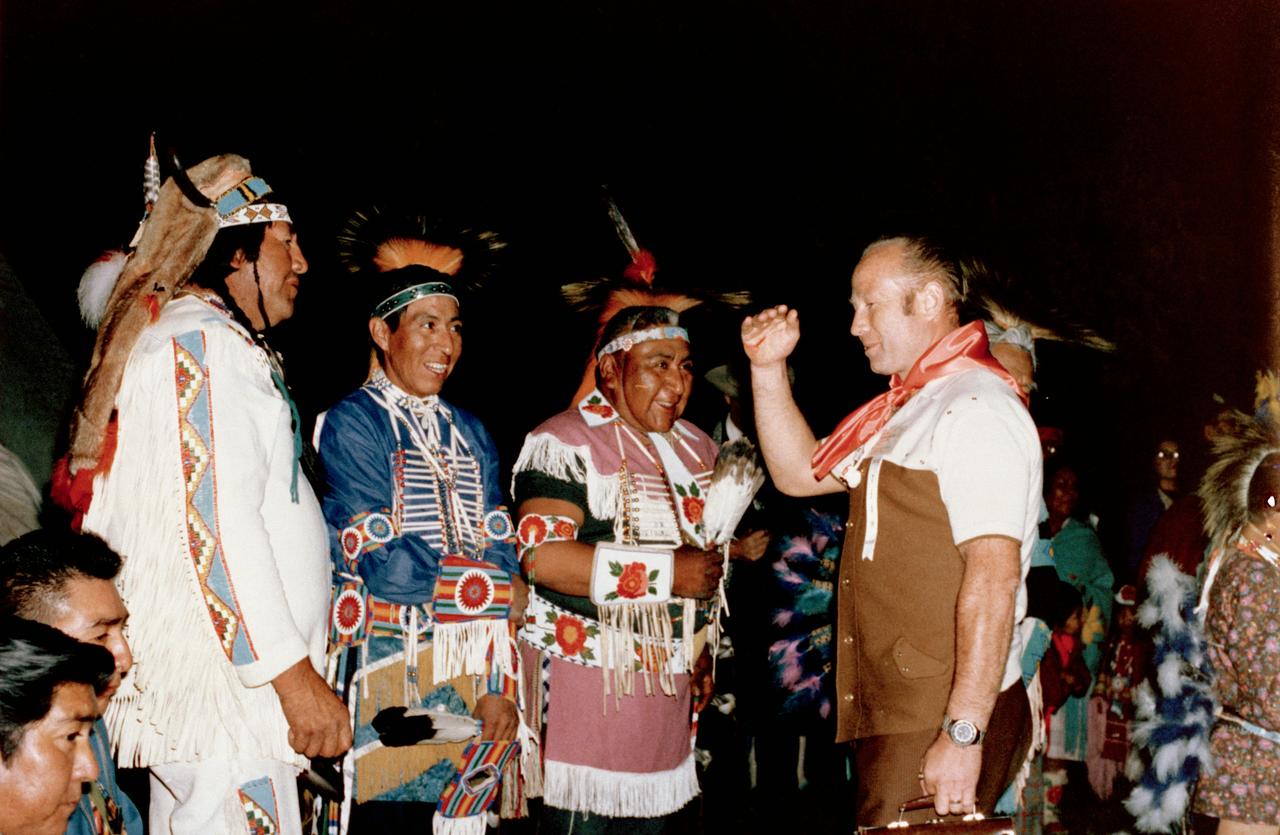
S75-20108 (September 1974) --- Cosmonaut Aleksey A. Leonov (right), commander of the first (prime) crew of Soviet cosmonauts on the planned Apollo-Soyuz Test Project (ASTP), enjoys a tribal welcome from Shoshone Indians during a hunting trip in the Lander, Wyoming area. Leonov was in the United States to take part in joint crew training at the Johnson Space Center.
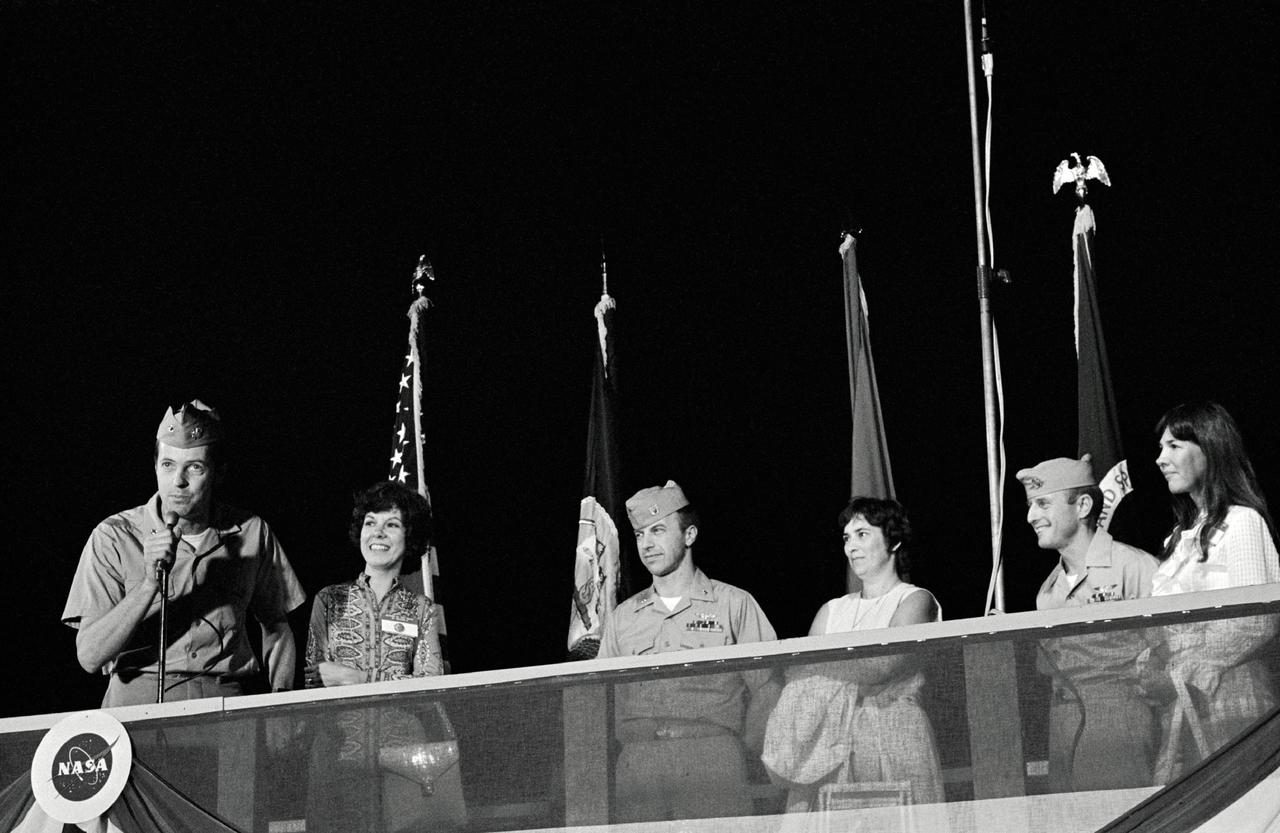
S73-28818 (24 June 1973) --- Scientist-astronaut Joseph P. Kerwin, science pilot for the Skylab 2 mission, speaks to a crowd at Ellington Air Force Base during welcome home ceremonies for the crew. Astronaut Paul J. Weitz, pilot, is at center; and astronaut Charles Conrad Jr., crew commander, is at right. The wives, standing by their husbands, are (left to right) Shirley Kerwin, Suzanne Weitz and Jane Conrad. Photo credit: NASA
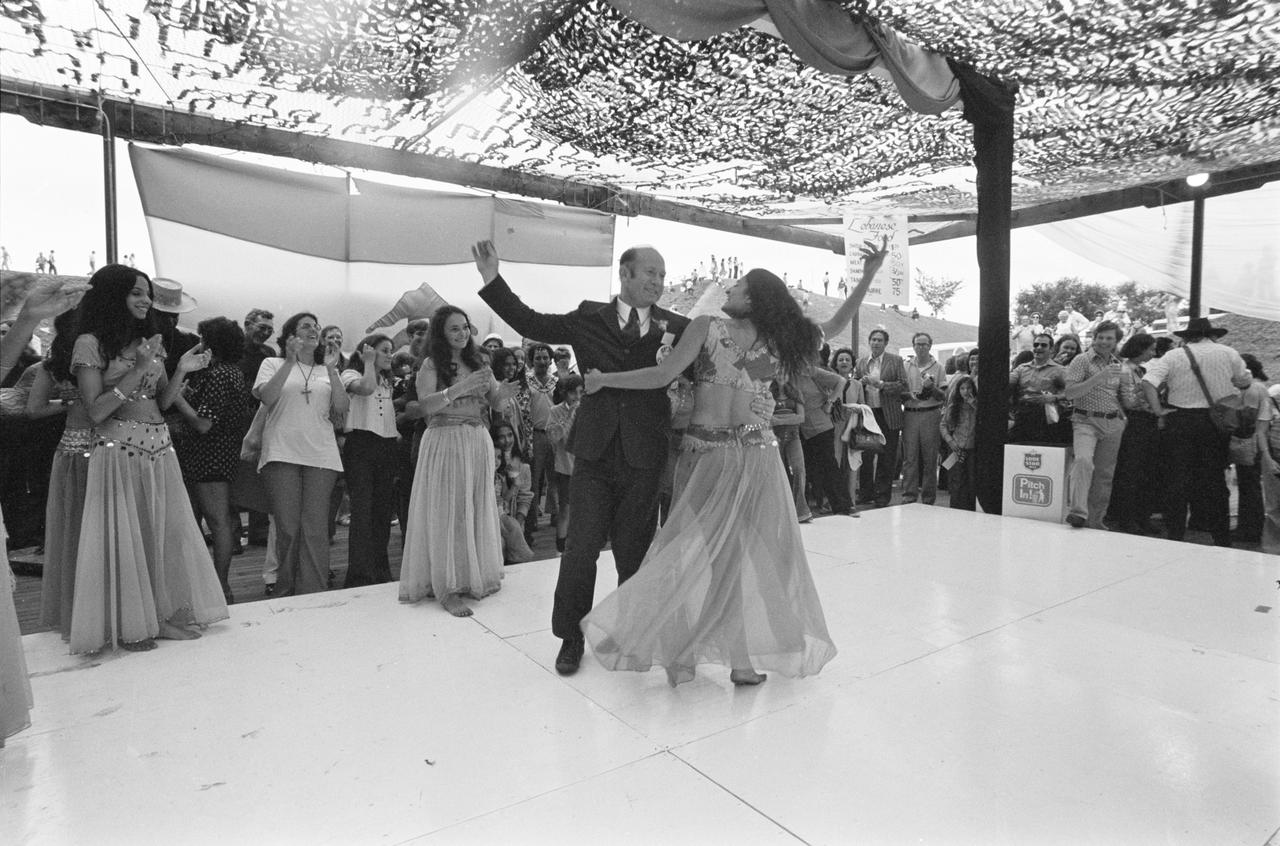
S74-28666 (14 Sept. 1974) --- Cosmonaut Aleksey A. Leonov, in one of the lighter moments of activity involving Soviet cosmonauts and American astronauts, joins a belly dancer on stage as several visitors to weekend activity at the site of San Antonio?s HemisFair look on. Leonov is commander of the Soviet Apollo-Soyuz Test Project (ASTP) crew. A group of cosmonauts is in this country training with American astronauts for the joint U.S.-USSR ASTP rendezvous and docking mission scheduled for the summer of 1975. The Lebanese dancing was just one feature among many during the Texas Folklife Festival, in which members of 26 ethnic groups participated.
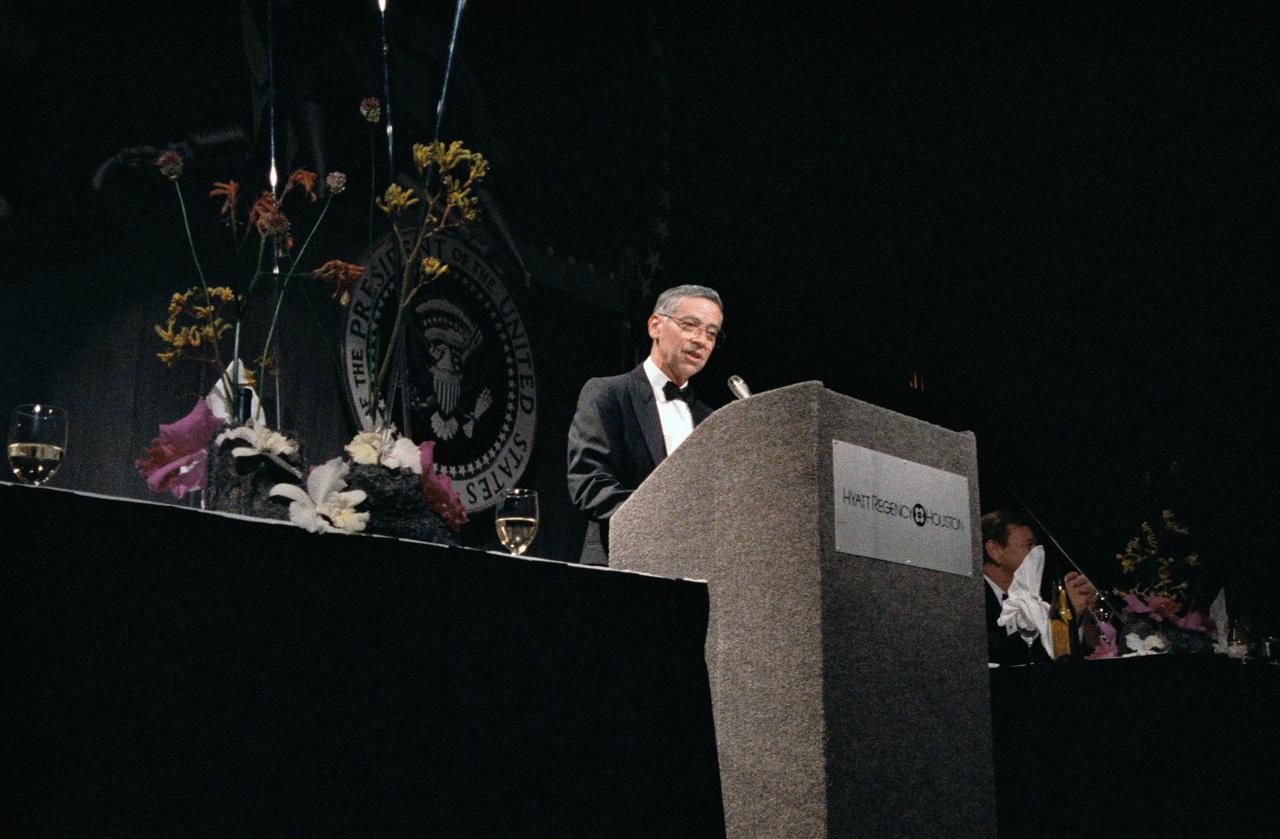
Aaron Cohen speaks at the Apollo 11 Twentieth Anniversary Gala Event at the downtown Houston Hyatt Regency Hotel.
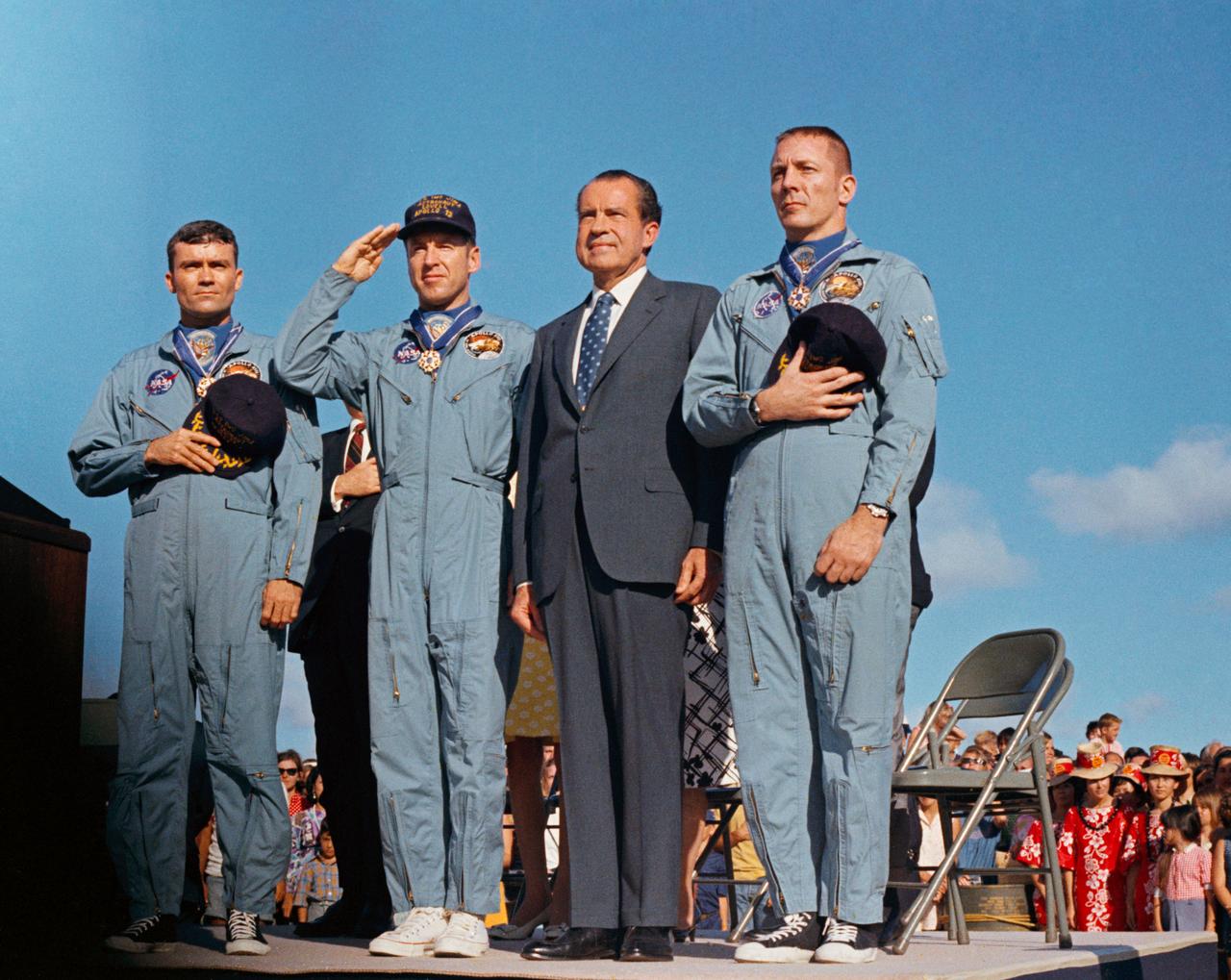
S70-15526 (18 April 1970) --- President Richard M. Nixon and the Apollo 13 crew members pay honor to the United States flag during the post-mission ceremonies at Hickam Air Force Base, Hawaii. Astronauts James A. Lovell Jr., (United States Navy Captain, salutes the flag) commander; John L. Swigert Jr., command module pilot (right); and Fred W. Haise Jr., lunar module pilot (left), were presented the Presidential Medal of Freedom by the Chief Executive. The Apollo 13 splashdown occurred at 12:07:44 p.m. (CST), April 17, 1970, about a day and a half prior to the award presentation.
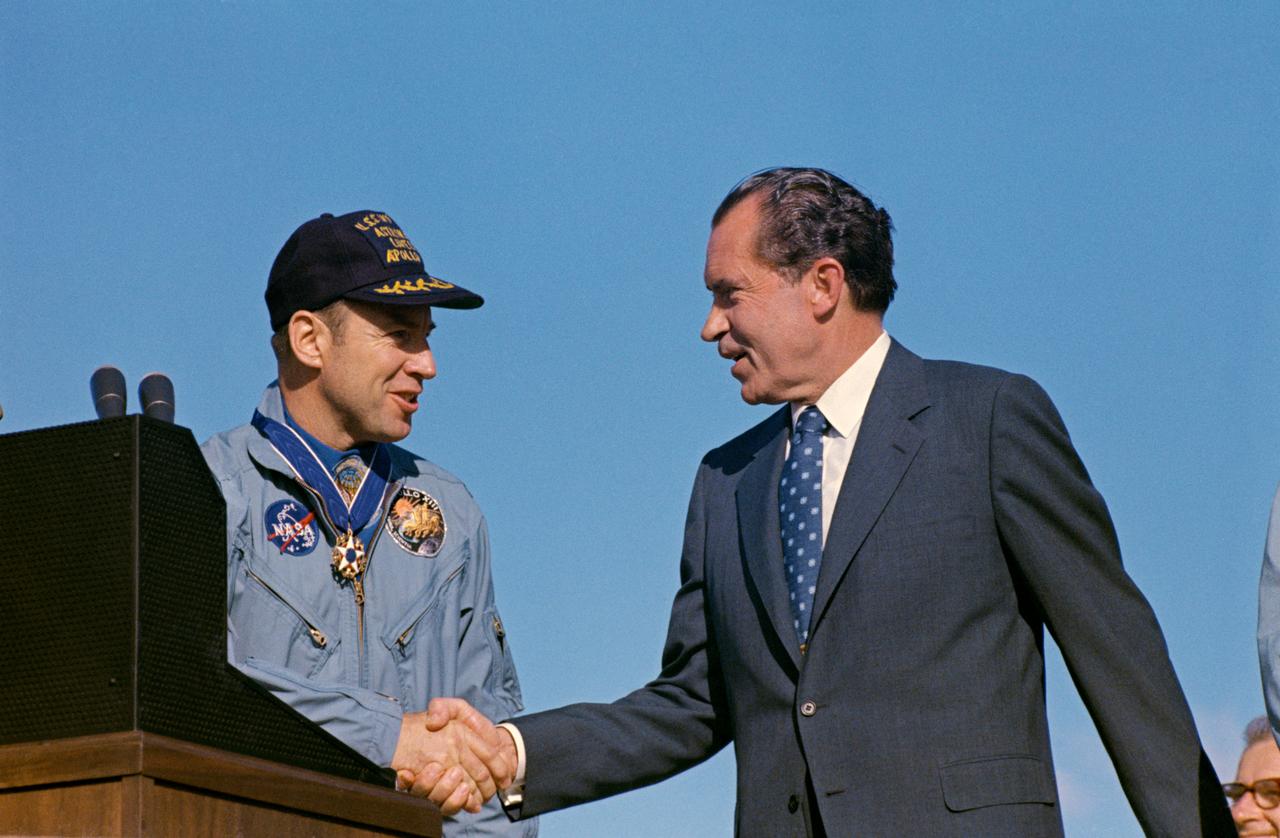
S70-15506 (18 April 1970) --- President Richard M. Nixon and astronaut James A. Lovell Jr., Apollo 13 commander, shake hands at special ceremonies at Hickam Air Force Base, Hawaii. President Nixon was in Hawaii to present the Apollo 13 crew with the Presidential Medal of Freedom, the nation's highest civilian honor. The wives of astronauts Lovell and Fred W. Haise Jr., lunar module pilot; and the parents of astronaut John L. Swigert Jr., command module pilot, flew with the Chief Executive to Hickam Air Force Base. The Apollo 13 splashdown occurred at 12:07:44 p.m. (CST), April 17, 1970, a day and a half prior to the awards ceremony.
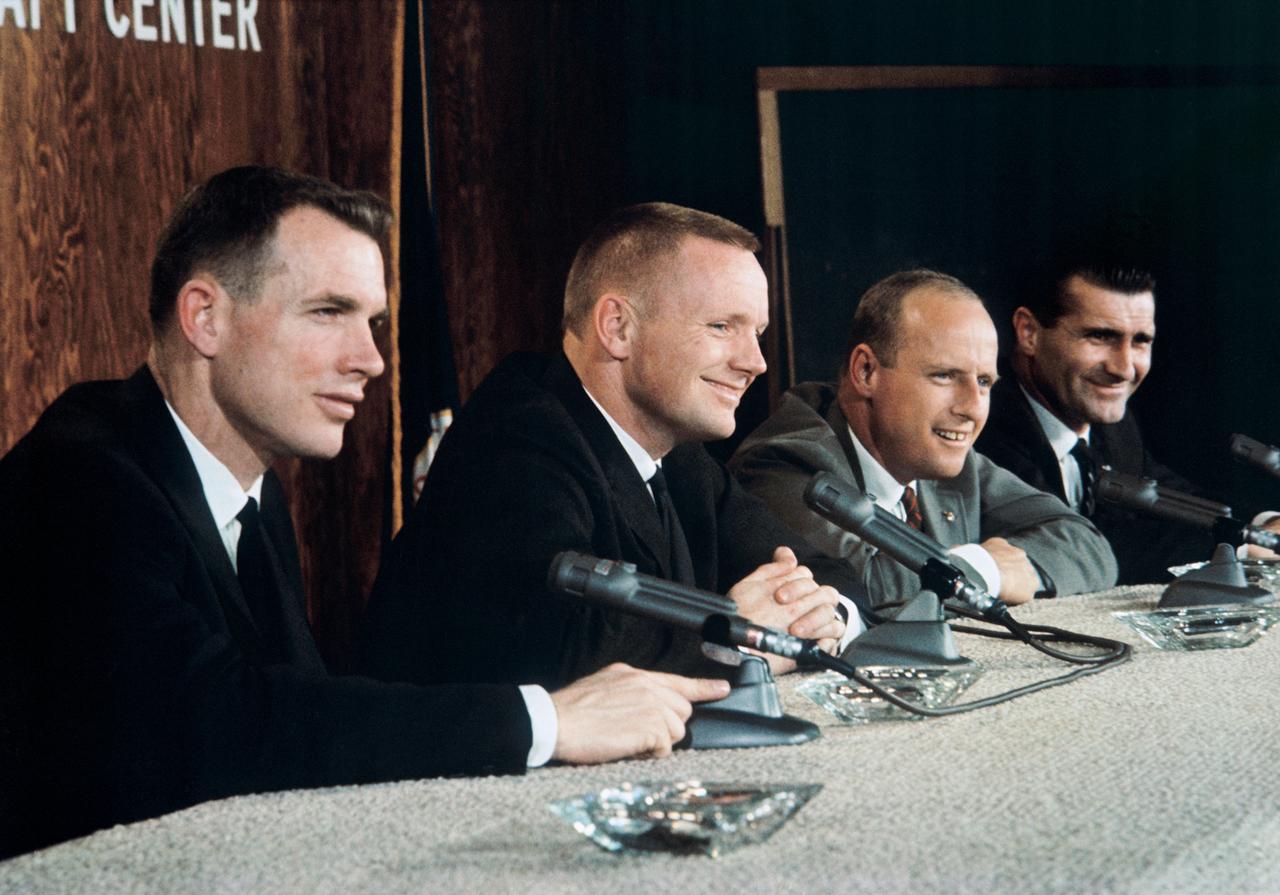
S66-24380 (26 Feb. 1966) --- Gemini-8 prime and backup crews during press conference. Left to right are astronauts David R. Scott, prime crew pilot; Neil A. Armstrong, prime crew command pilot; Charles Conrad Jr., backup crew command pilot; and Richard F. Gordon Jr., backup crew pilot. Photo credit: NASA
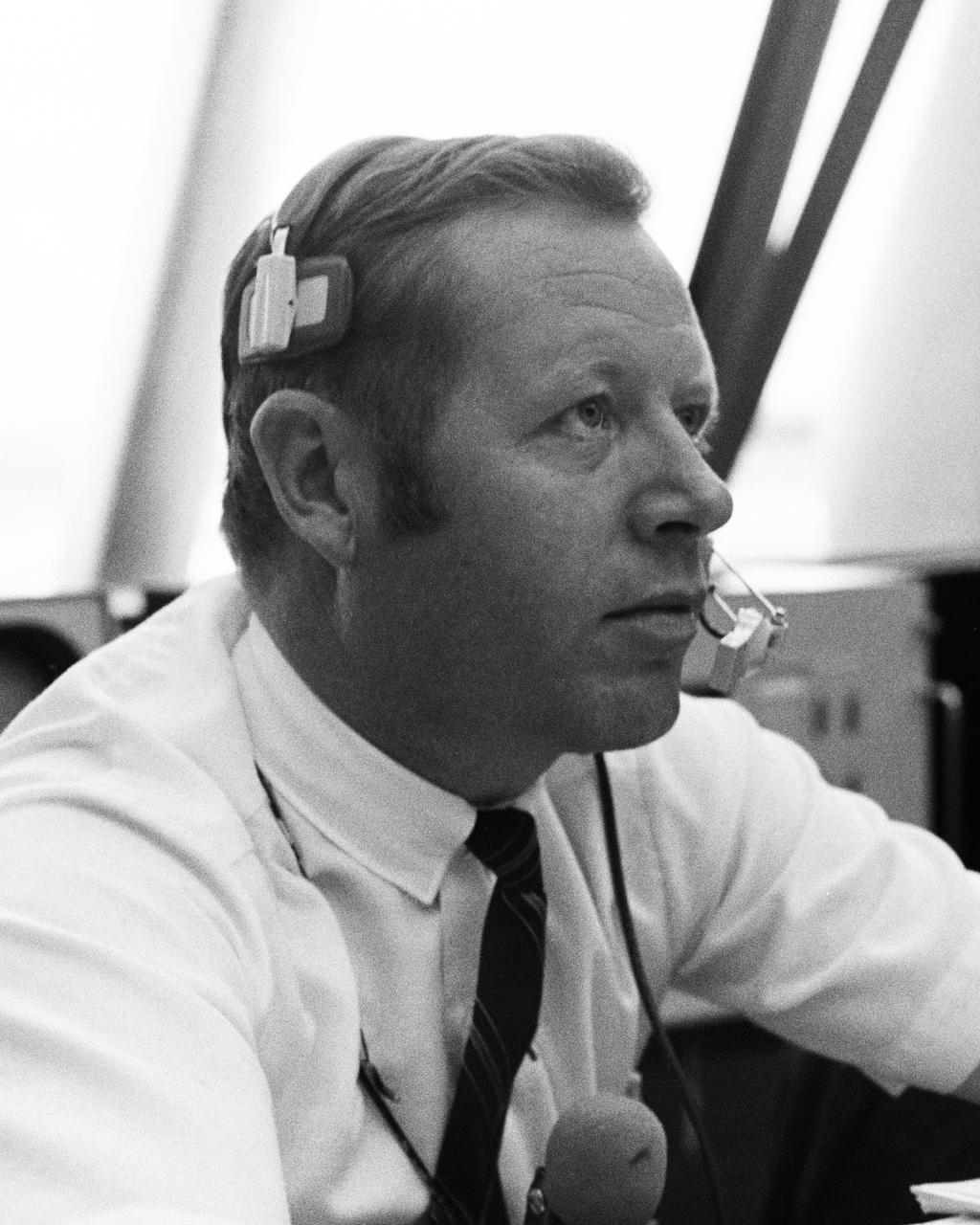
CAPE CANAVERAL, Fla. - Jack King, retired from Communications and Public Relations with United Space Alliance who earlier served as NASA Kennedy Space Center's first chief of Public Information. Photo credit: NASA
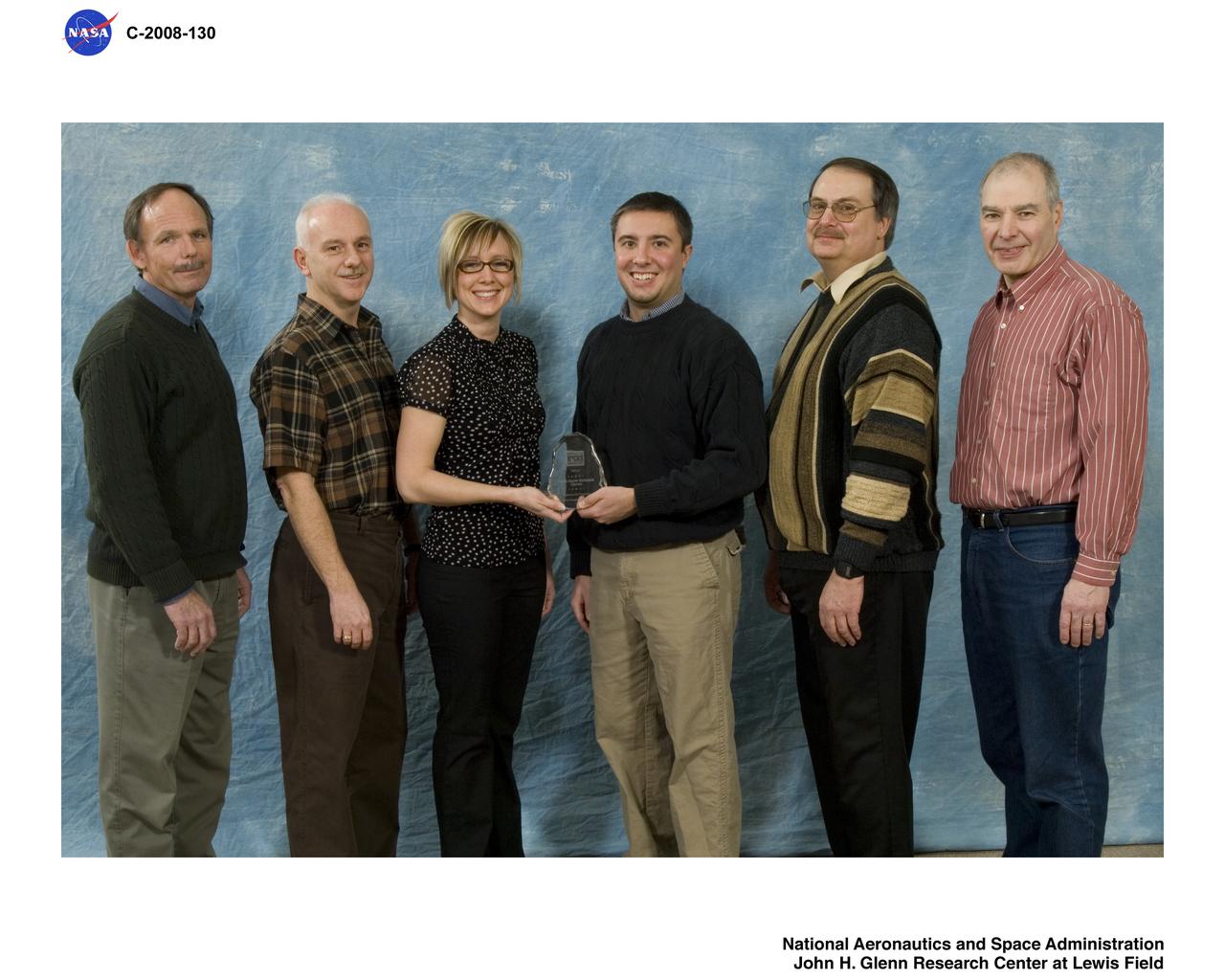
Greater Cleveland Chapter, Public Relations Society of America, (PRSA) Cleveland Rocks Award Recipients
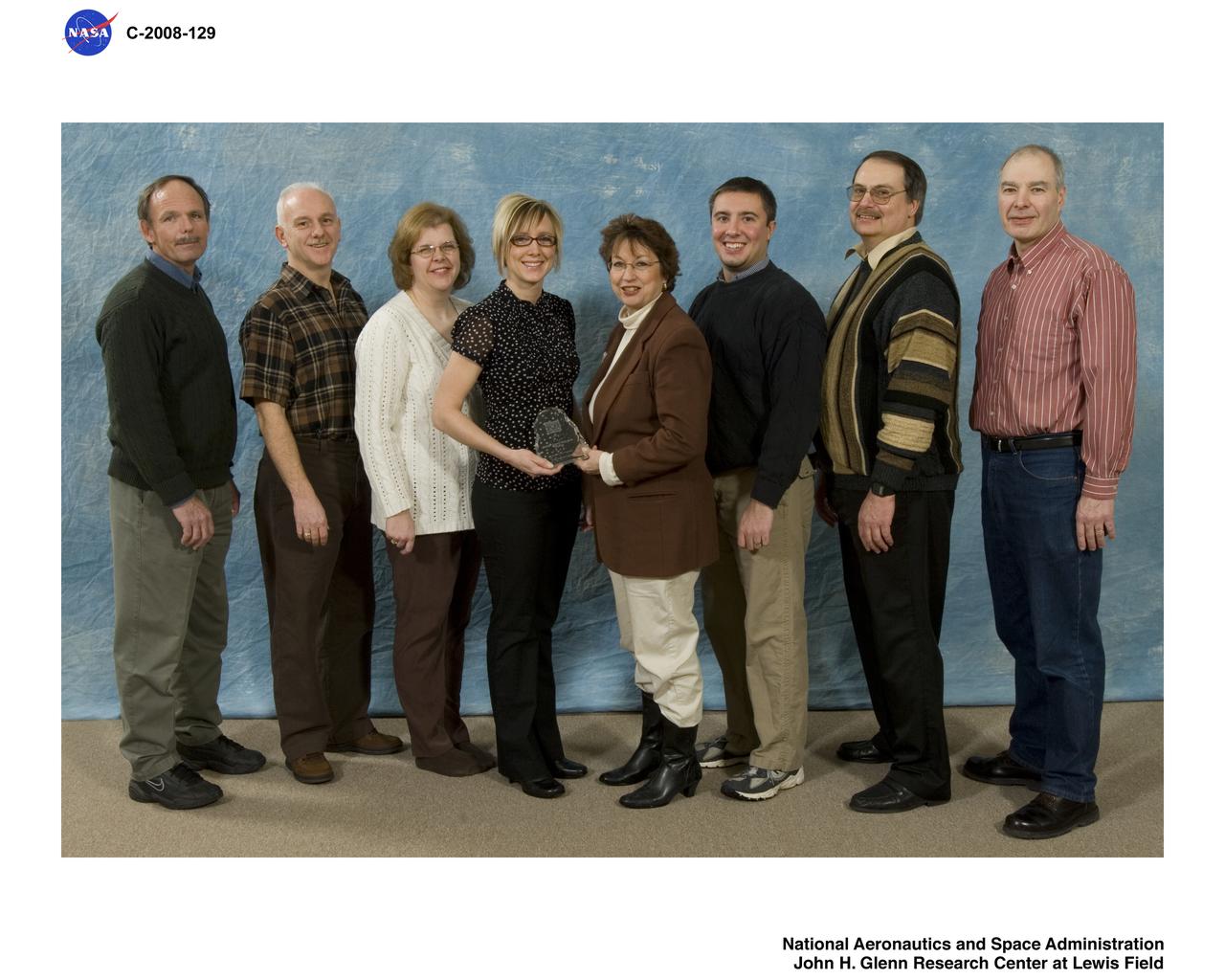
Greater Cleveland Chapter, Public Relations Society of America, (PRSA) Cleveland Rocks Award Recipients
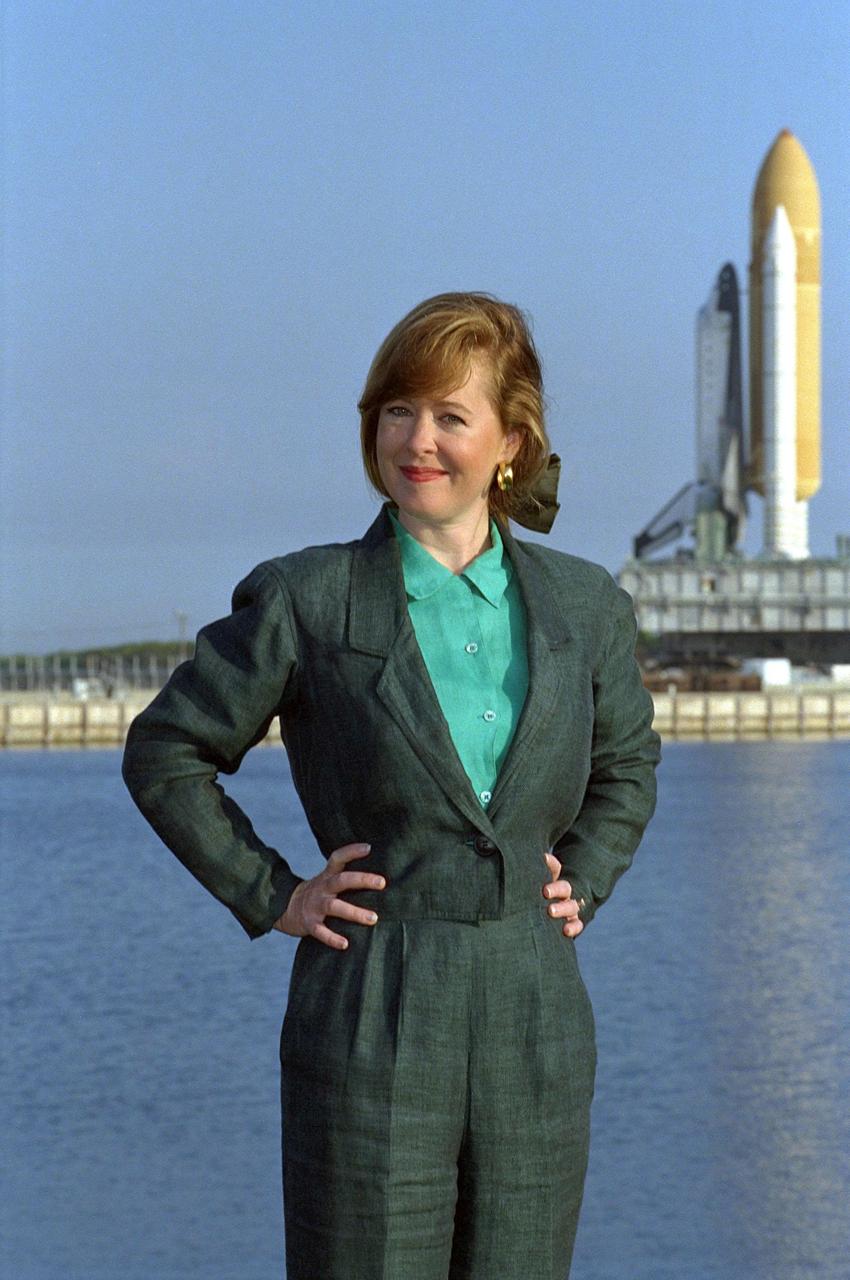
KENNEDY SPACE CENTER, FLA. -- Official portrait of Lisa Malone, associate director, Public Communications Division, External Relations and Business Development.
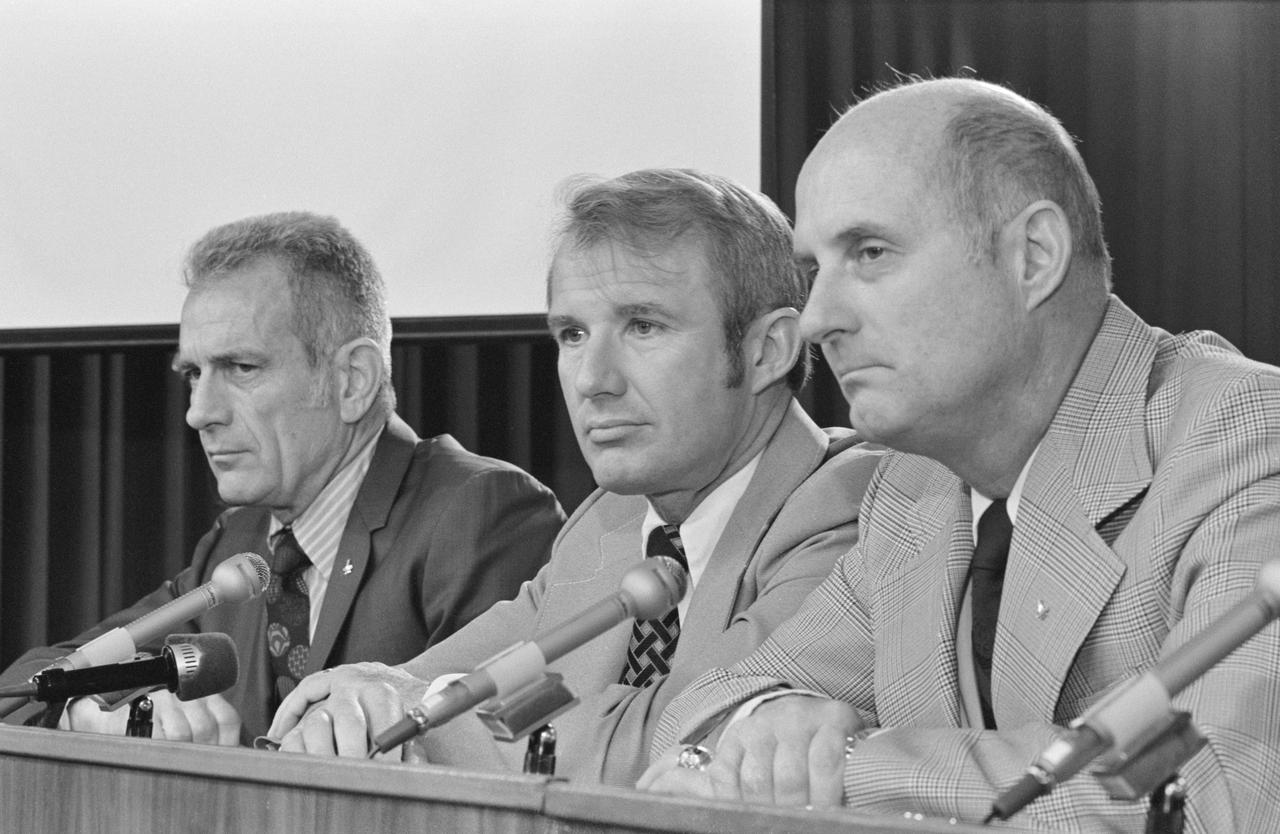
S75-26573 (14 May 1975) --- The three members of the American ASTP prime crew participate in an Apollo-Soyuz Test Project press conference conducted on May 14, 1975 in the Building 2 briefing room at NASA's Johnson Space Center. They are, left to right, Donald K. Slayton, docking module pilot; Vance D. Brand, command module pilot; and Thomas P. Stafford, commander. The astronauts discussed with the news media their recent ASTP joint training session in the Soviet Union, and the crew?s tour of the USSR?s Baikonur launch complex in Kazakhstan.
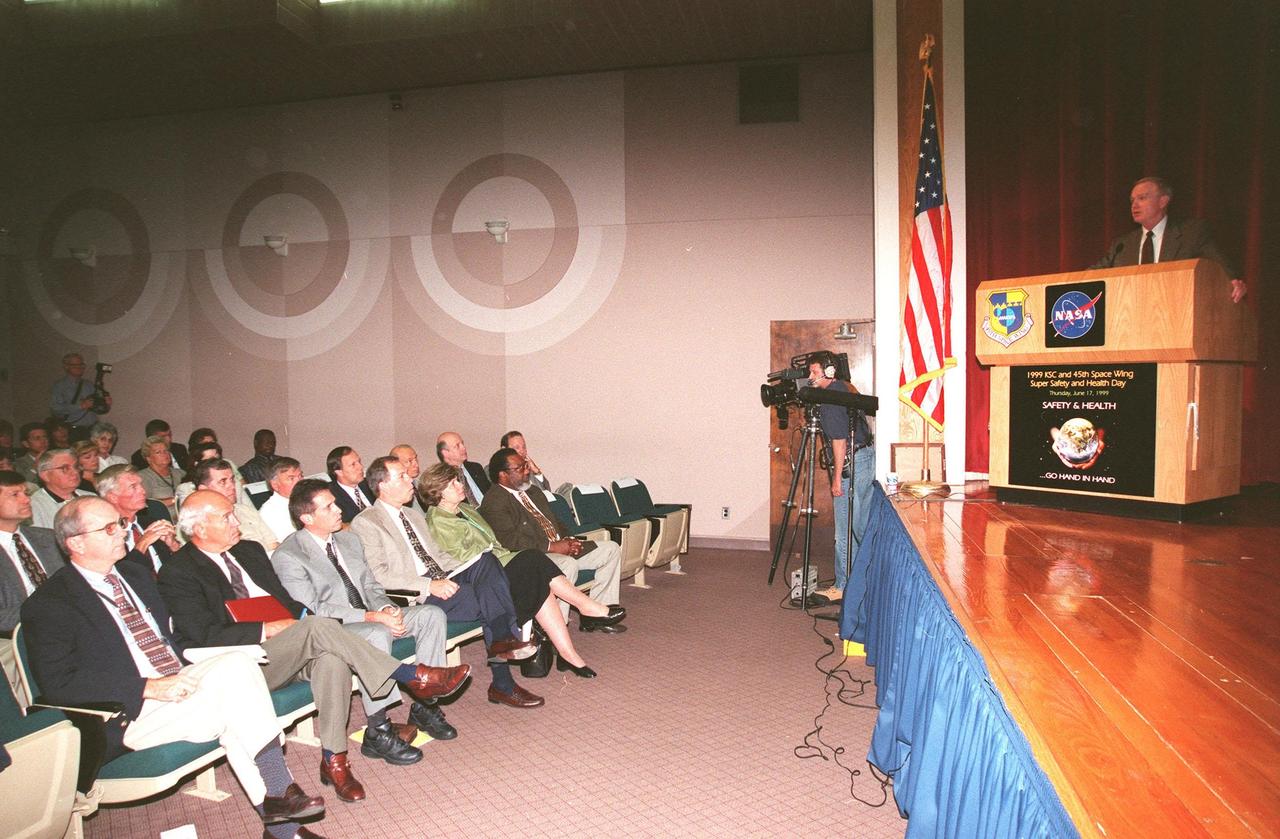
Center Director Roy Bridges opens the second Super Safety and Health Day at Kennedy Space Center, an entire day when most normal work activities are suspended to allow personnel to attend safetyand health-related activities. The theme, "Safety and Health Go Hand in Hand," emphasized KSC's commitment to place the safety and health of the public, astronauts, employees and space-related resources first and foremost. Events included a keynote address, a panel session about related issues, vendor exhibits, and safety training in work groups. The keynote address and panel session were also broadcast internally over NASA television
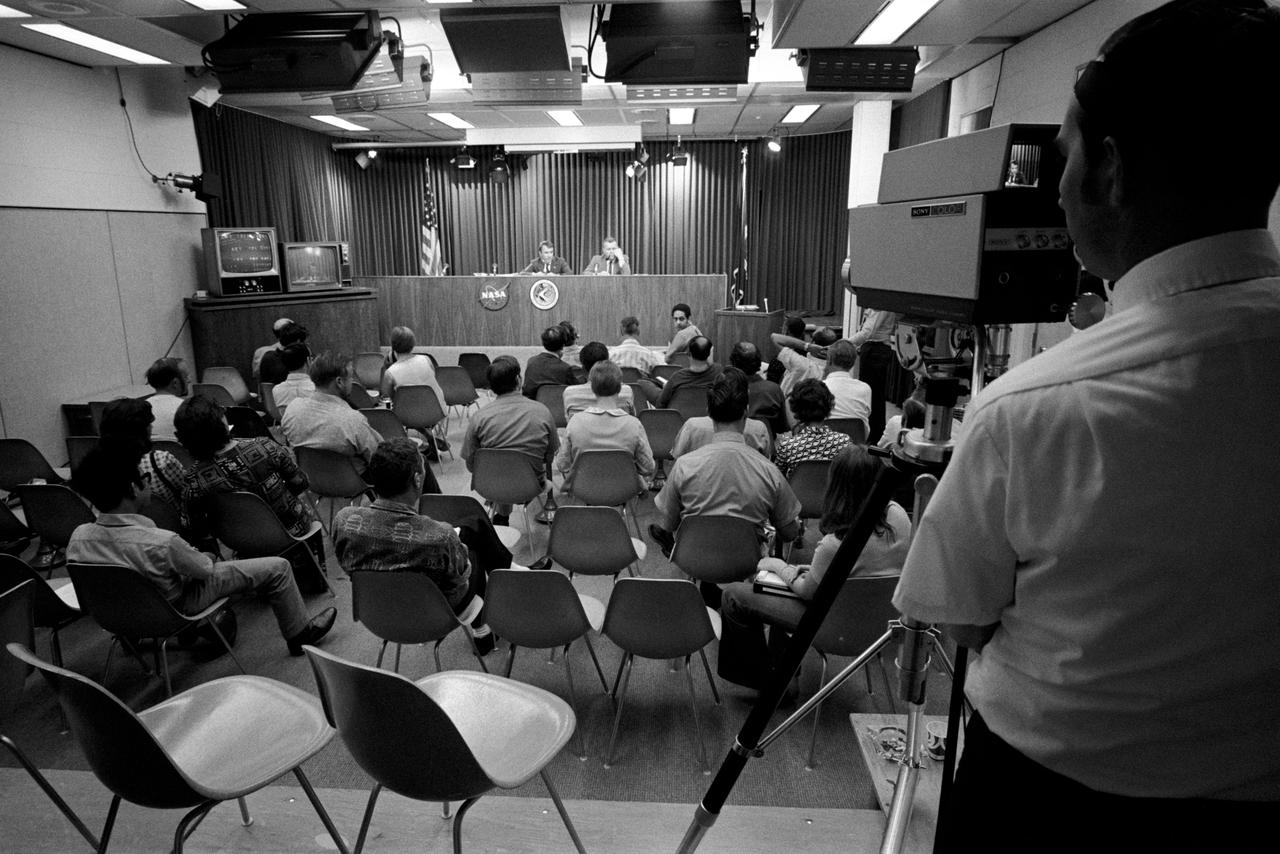
S71-41842 (July 1971) --- Newsmen put questions to Gerald D. Griffin, left at lectern, a flight director for the Apollo 15 lunar landing mission, during a change of shift briefing in the small briefing room in Building One at the Manned Spacecraft Center (MSC). Representing Public Affairs Office at the briefing is Terry White, right at lectern.
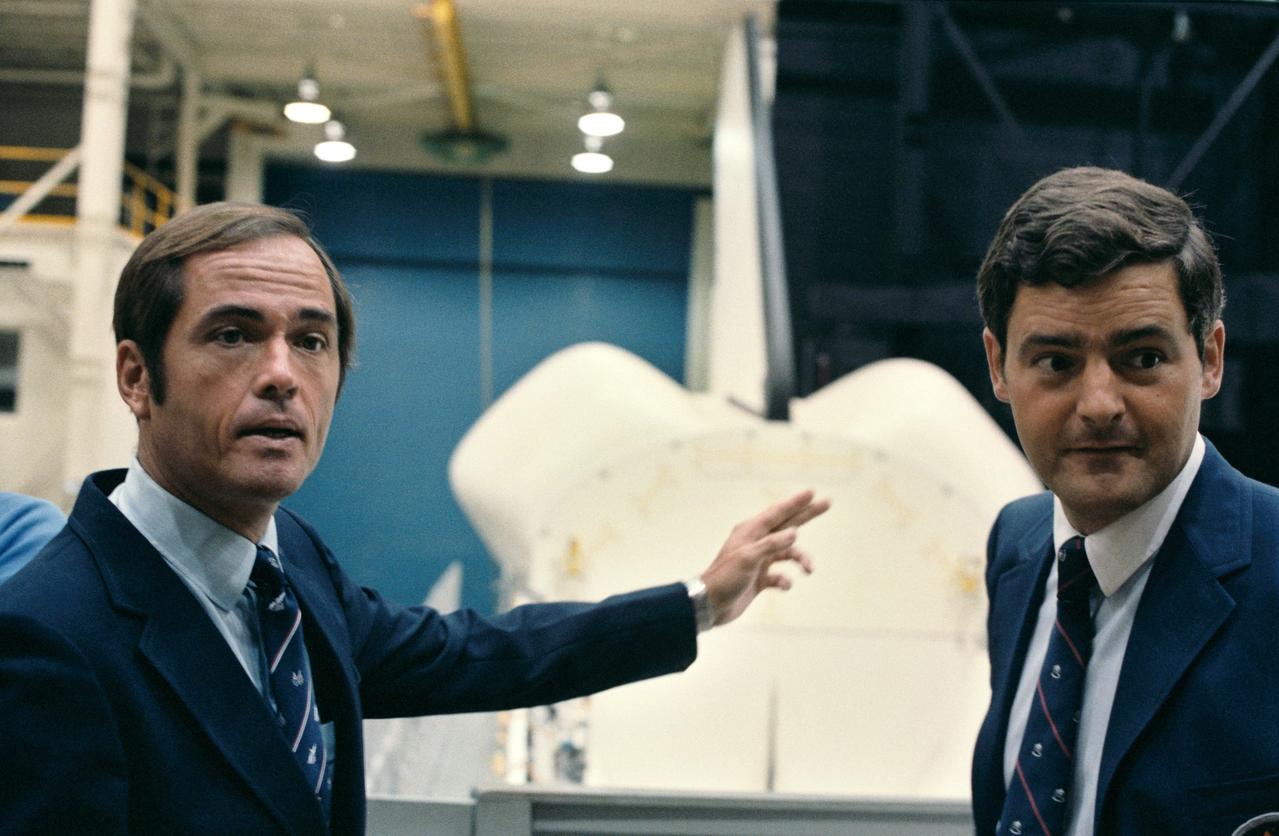
41D-3142 (3 Sept 1984) --- Astronaut Robert L. Crippen, left, crew commander for NASA's 41-G flight, and Marc Garneau, payload specialist representing the Canadian National Research Council (NRC), participate in a briefing in the Shuttle mockup and integration laboratory at the Johnson Space Center.
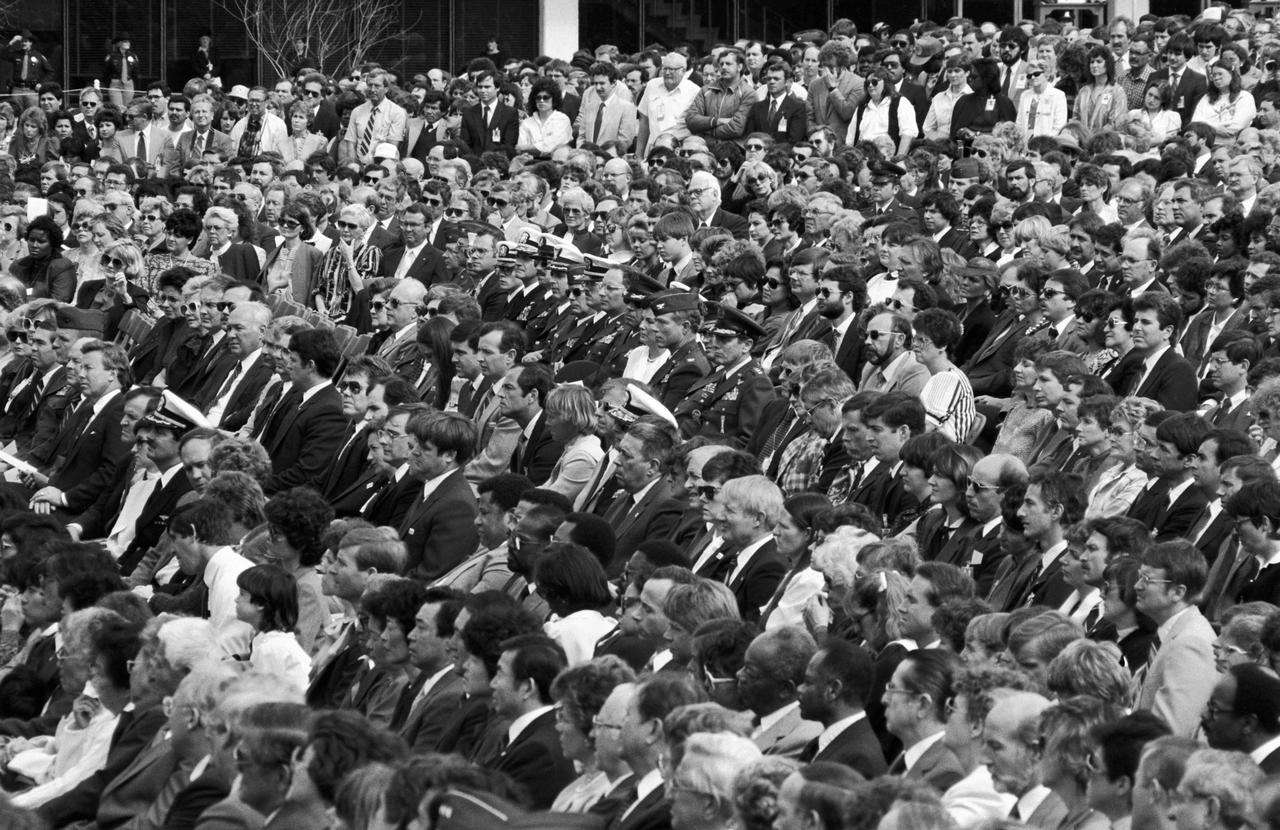
Overall view of the audience at the memorial service at JSC for the Crew of STS 51-L.
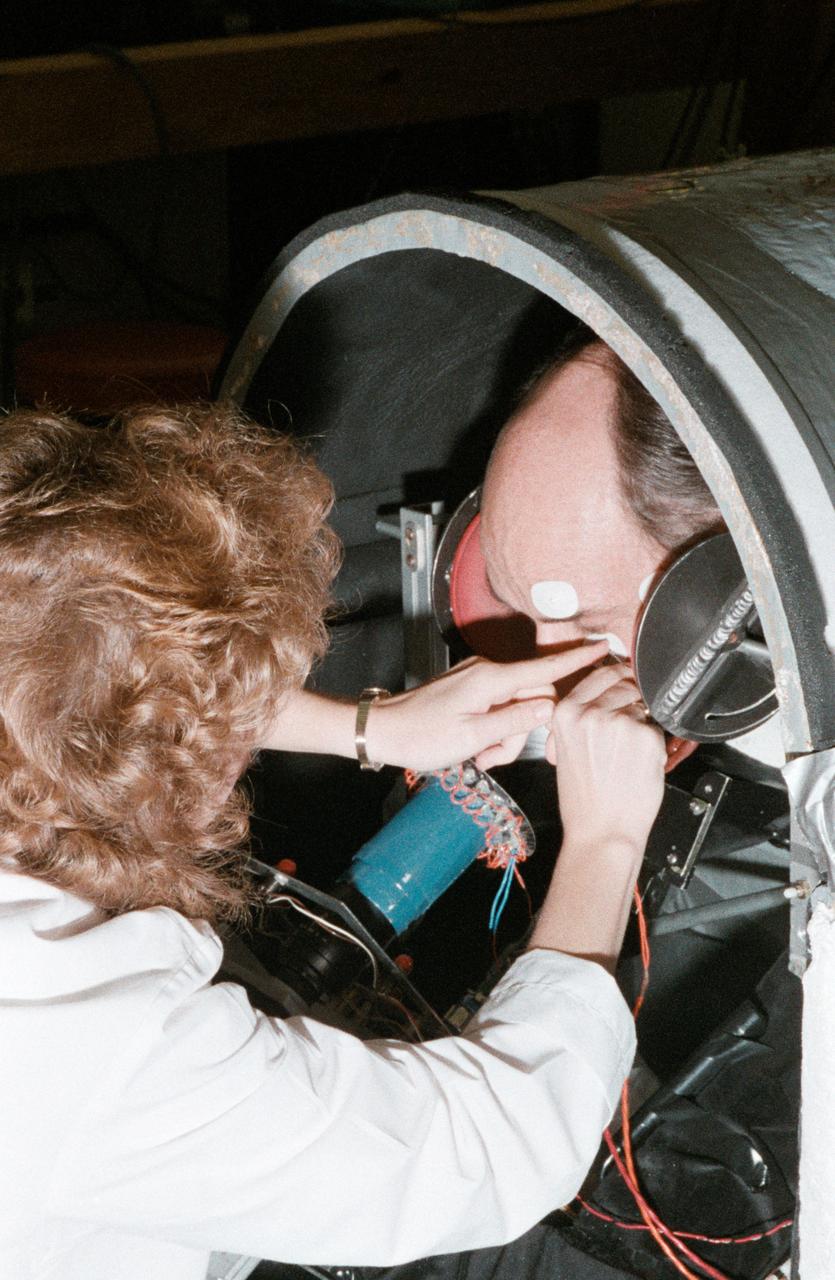
Sen. Jake Garn trains in use of equipment for medical experiments.
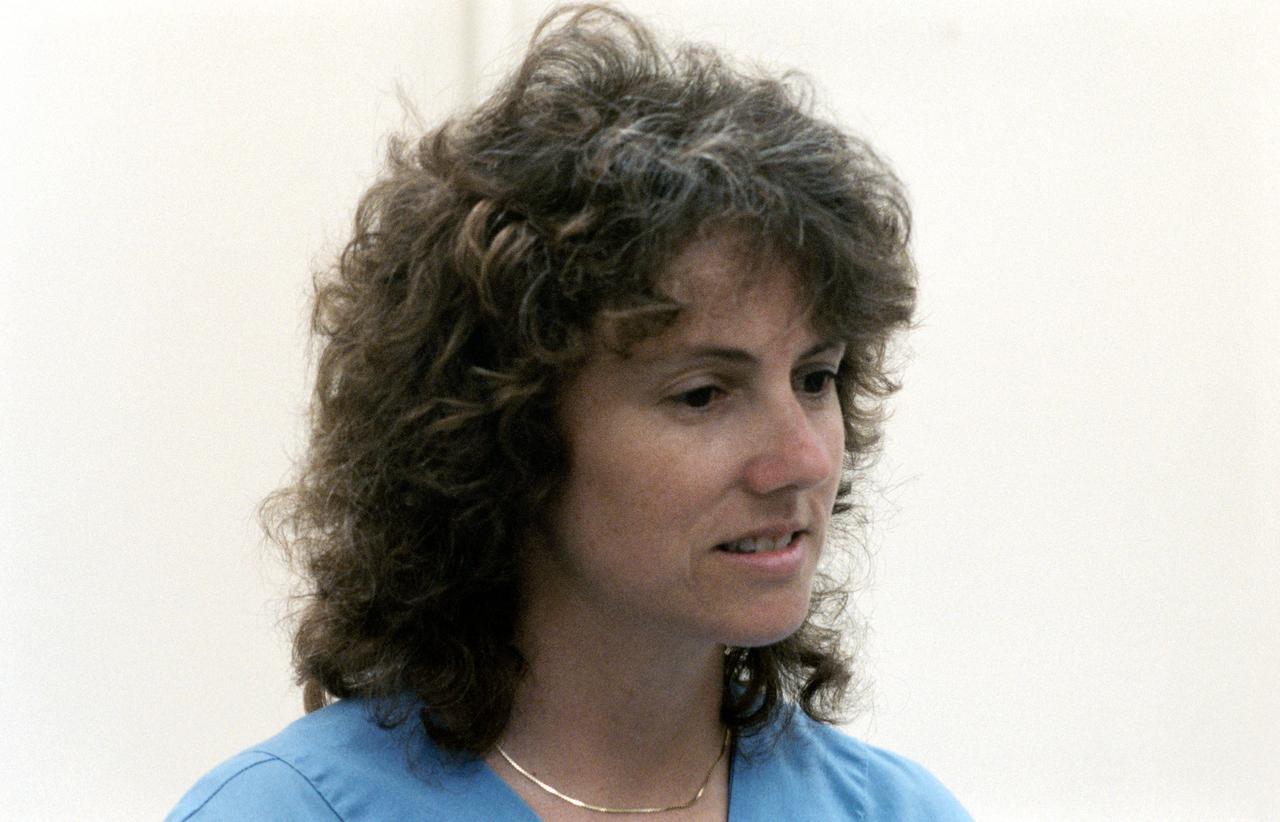
S85-37164 (8-12 July 1985) --- Sharon C. (Christa) McAuliffe of Concord High, Concord, New Hampshire, talks to the media at Johnson Space Center. Christa McAuliffe was eventually chosen as the first Teacher in Space and was a member of the seven-member Challenger shuttle crew which died tragically in the explosion of the spacecraft during the launch of STS-51L from the Kennedy Space Center about 11:40 a.m., EST, on Jan. 28, 1986. The explosion occurred 73 seconds into the flight as a result of a leak in one of two Solid Rocket Boosters that ignited the main liquid fuel tank. The crew members of the Challenger represented a cross-section of the American population in terms of race, gender, geography, background, and religion. The explosion became one of the most significant events of the 1980s, as billions around the world saw the accident on television and empathized with any one of the several crew members killed. Photo credit: NASA
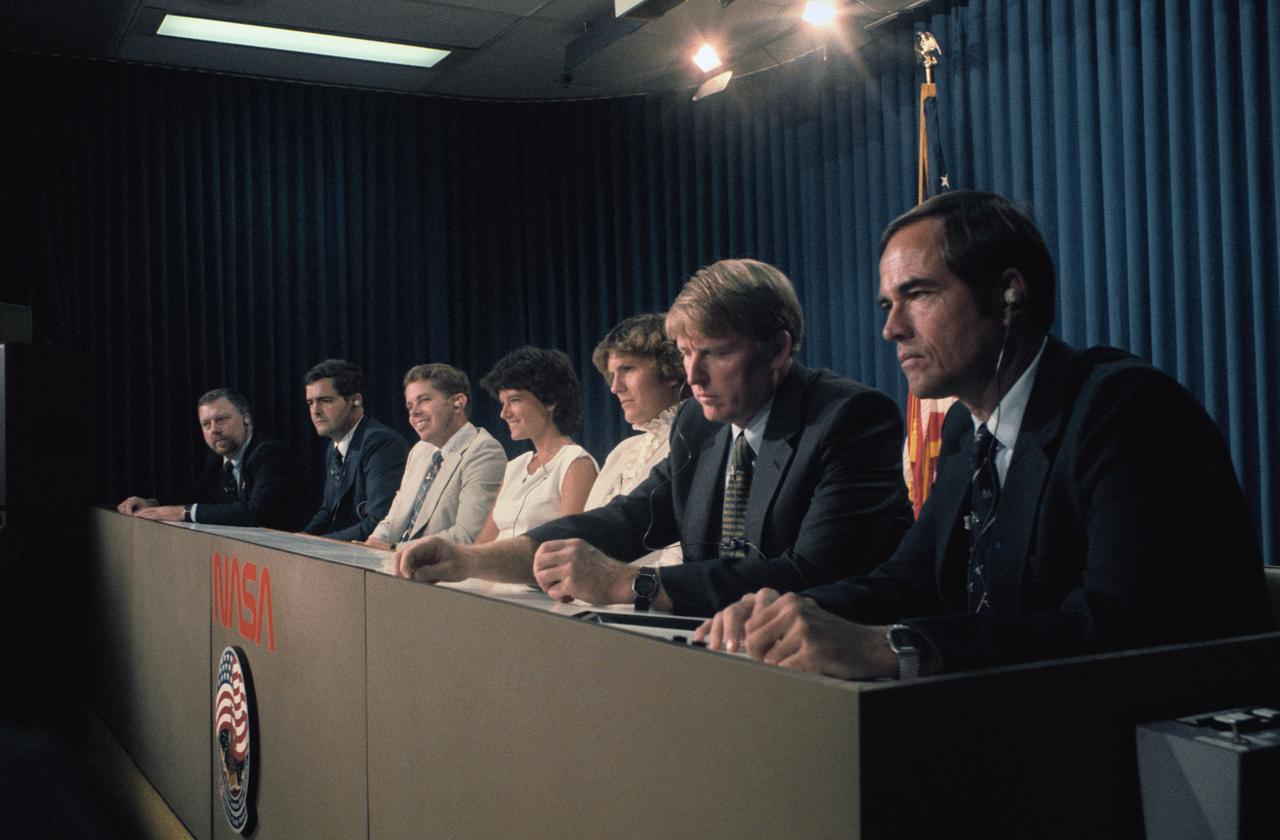
S84-41580 (3 Sept 1984) --- Assembled together publicly for the first time, the seven crewmembers for NASA's 41-G Space Shuttle mission field questions from the press corps at the Johnson Space Center. Pictured (foreground right to left) are Robert L. Crippen, crew commander ;Jon A. McBride, pilot; Kathryn D. Sullivan, Sally K. Ride and David C. Leestma--all mission specialists; Marc Garneau, representing the Canadian National Research Council, and Paul D. Scully-Power, U.S. Navy oceanographer, both payload specialists. Their flight is scheduled for early October.
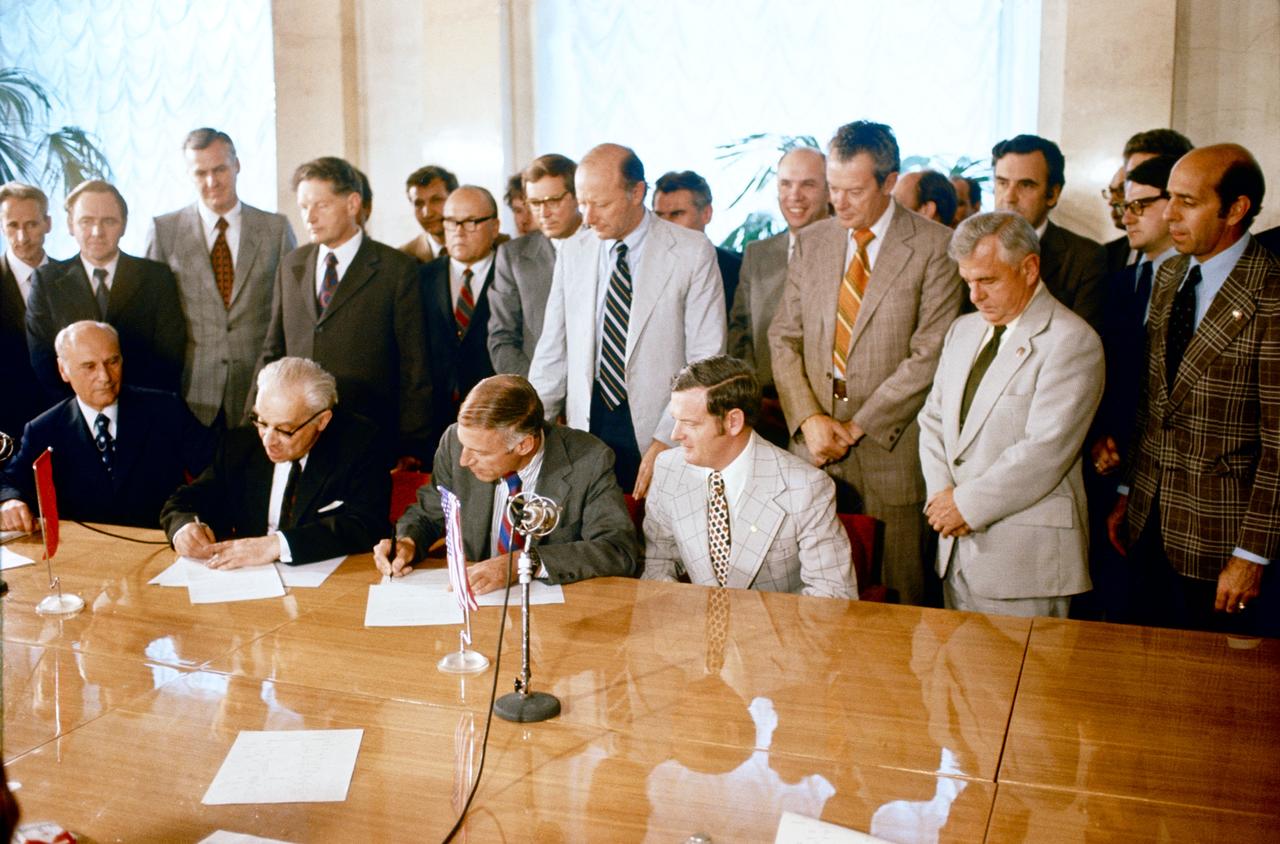
S75-27346 (22 May 1975) --- An overall view of the signing of the Apollo-Soyuz Test Project joint flight readiness review in ceremonies on May 22, 1975 in Moscow. Academician Vladimir A. Kotelnikov (on left) and NASA Deputy Administrator George M. Low (in center) are seen affixing their signatures to the ASTP document. Kotelnikov is the Acting President of the USSR Academy of Sciences. Seated at far left is Professor Konstantin D. Bushuyev, the Soviet Technical Director of ASTP. Dr. Glynn S. Lunney, the U.S. Technical Director of ASTP, is seated on Dr. Low?s left. Arnold W. Frutkin (in light jacket), NASA Assistant Administrator for International Affairs, is standing behind Dr. Low. Academician Boris N. Petrov (in dark suit), Chairman of the USSR Council for International Cooperation in the Exploration and Use of Outer Space, is standing behind Kotelnikov. The signing of the agreement took place at the Presidium of the Academy of Sciences in Moscow.
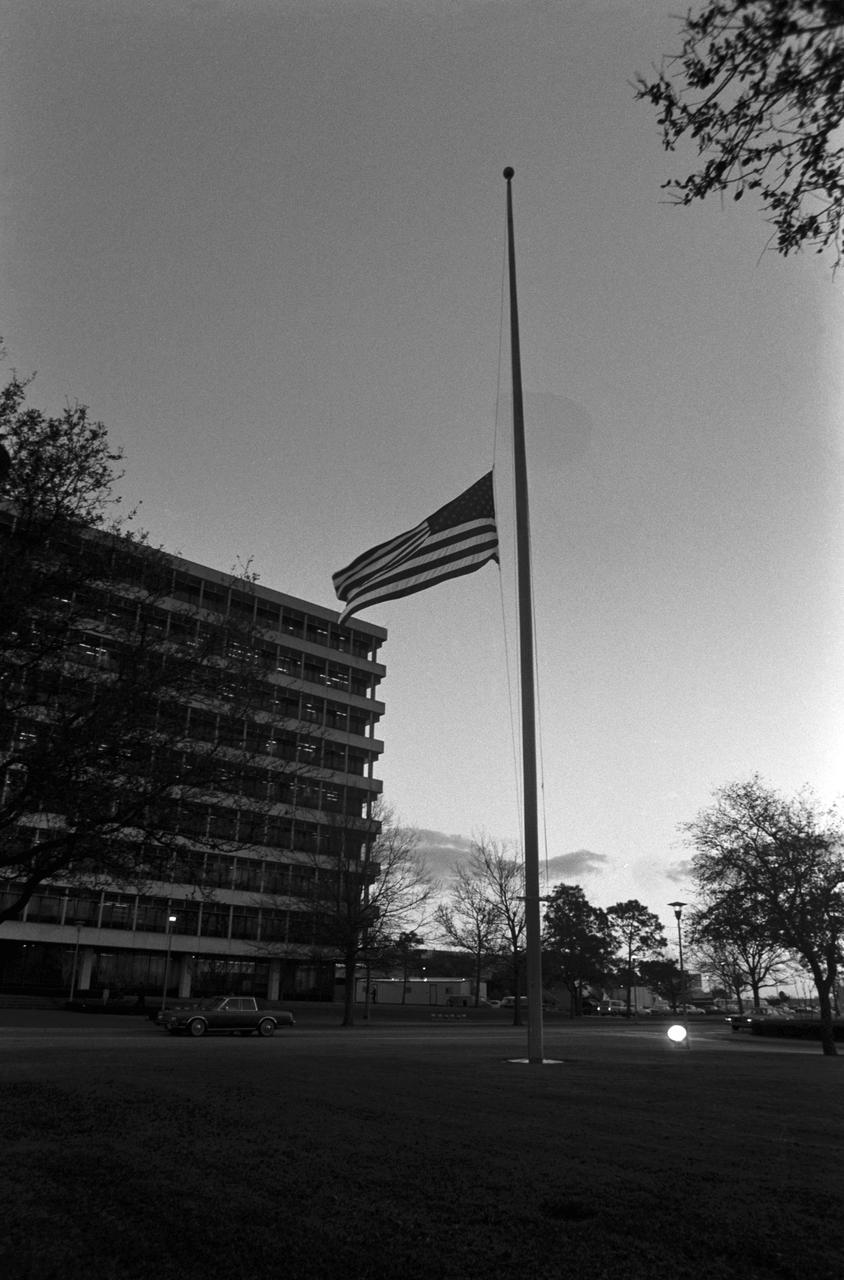
S86-26436 (31 Jan. 1986) --- The United States flag, in front of the Johnson Space Center’s (JSC) project management building, flies at half-mast in memory of the seven space shuttle Challenger crew members who lost their lives on Jan. 28, 1986. Earlier today, memorial services about 100 yards from the flag drew thousands of JSC employees, friends and family of the STS-51L astronauts and payload specialists. Photo credit: NASA
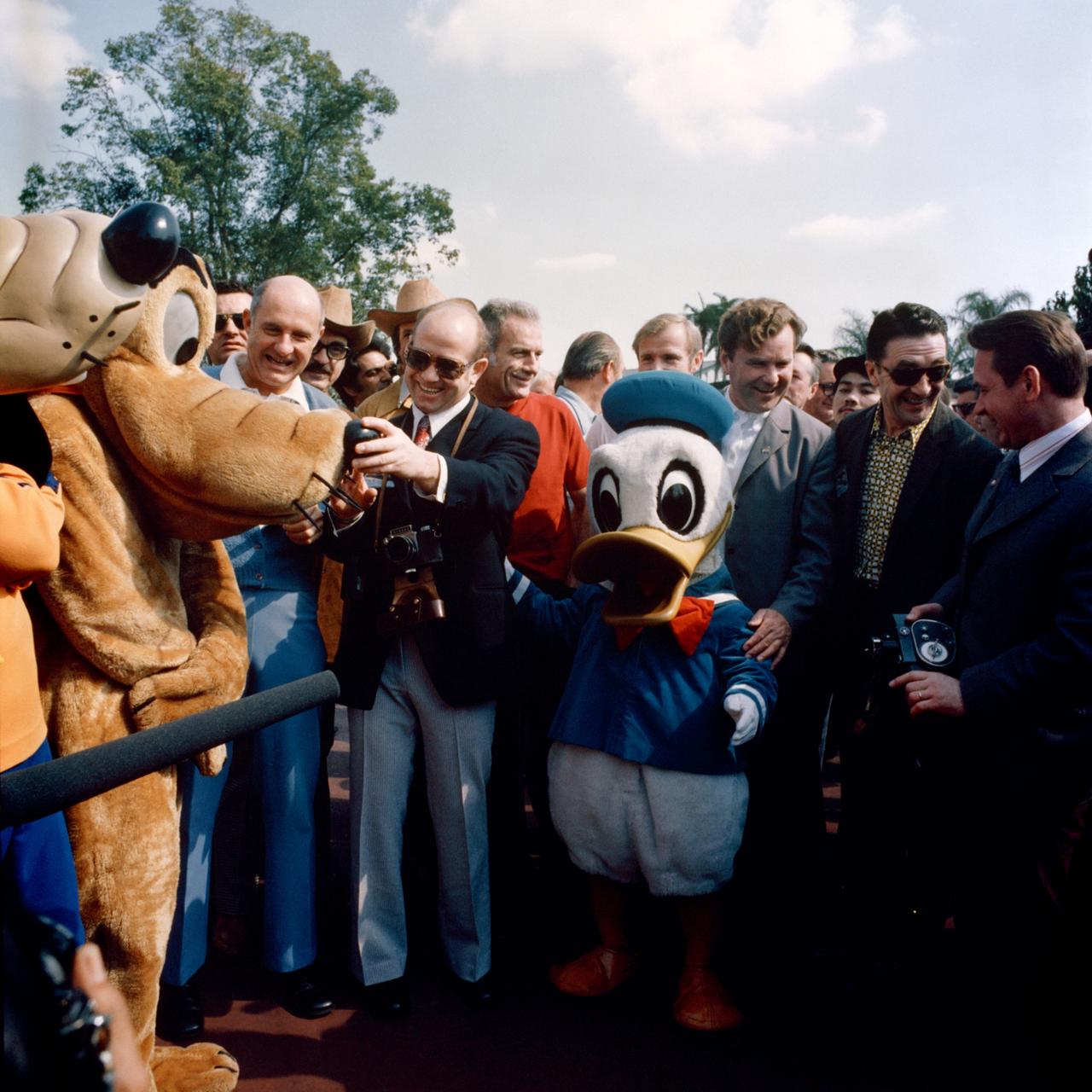
S75-24114 (8-10 Feb. 1975) --- Two Walt Disney comic cartoon characters, Donald Duck and Pluto, were on hand to greet a group of Apollo-Soyuz Test Project (ASTP) crewmen on their arrival at Disney World near Orlando. From left, are interpreter K. S. Samofal, interpreter Nicholas Timacheff, cosmonaut Vladimir A. Shatalov, astronaut Vance D. Brand, astronaut Donald K. Slayton, cosmonaut Aleksey A. Leonov (squeezing Pluto's nose) and astronaut Thomas P. Stafford. The astronauts and cosmonauts were in Florida for a three-day inspection tour of NASA's Kennedy Space Center where they looked over ASTP launch facilities and flight hardware.
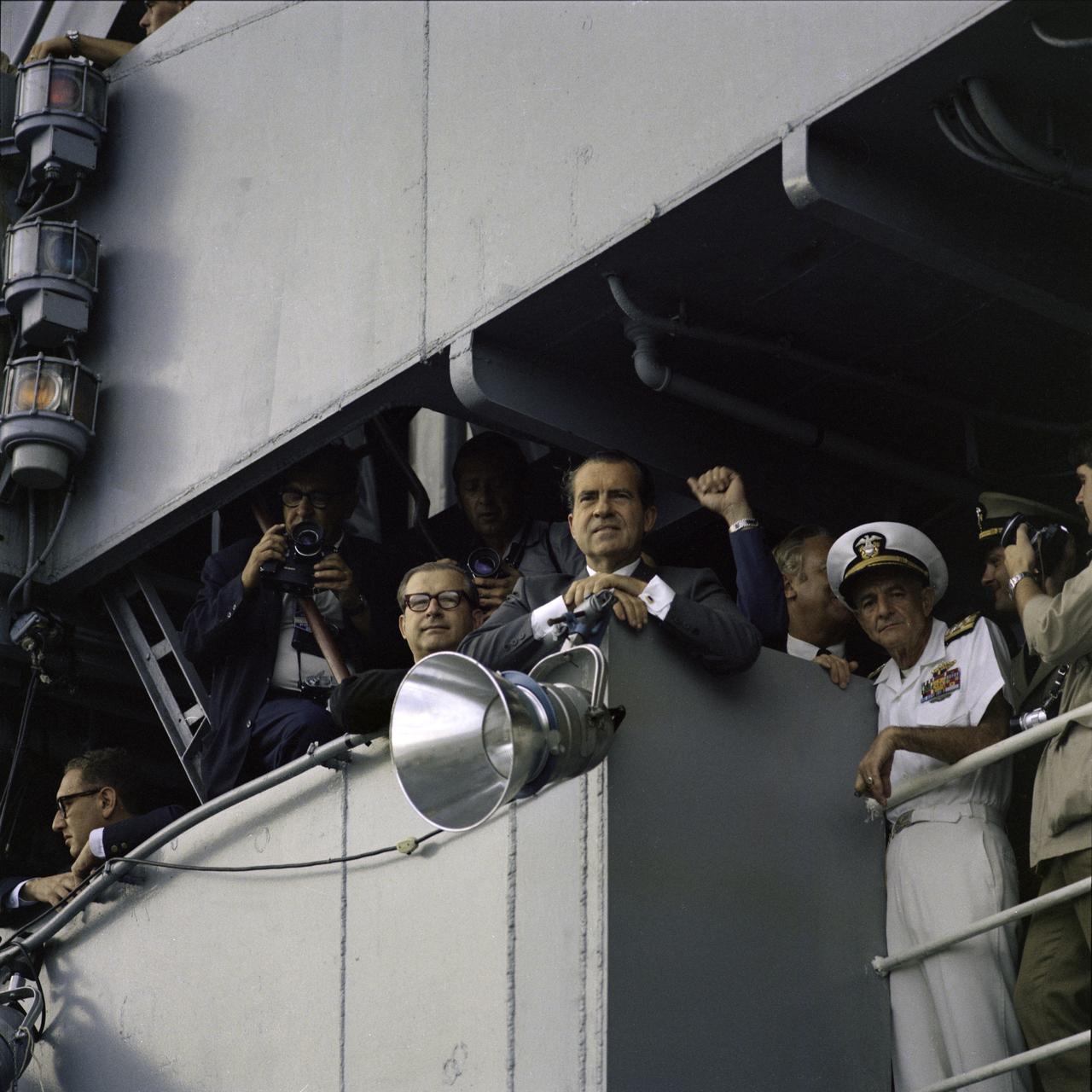
S69-21736 (24 July 1969) --- President Richard M. Nixon photographed on the deck of the USS Hornet, prime recovery ship for the Apollo 11 lunar landing mission, awaiting the Apollo 11 crew arrival. Apollo 11 splashed down at 11:40 a.m. (EDT), July 24, 1969, about 812 nautical miles southwest of Hawaii.
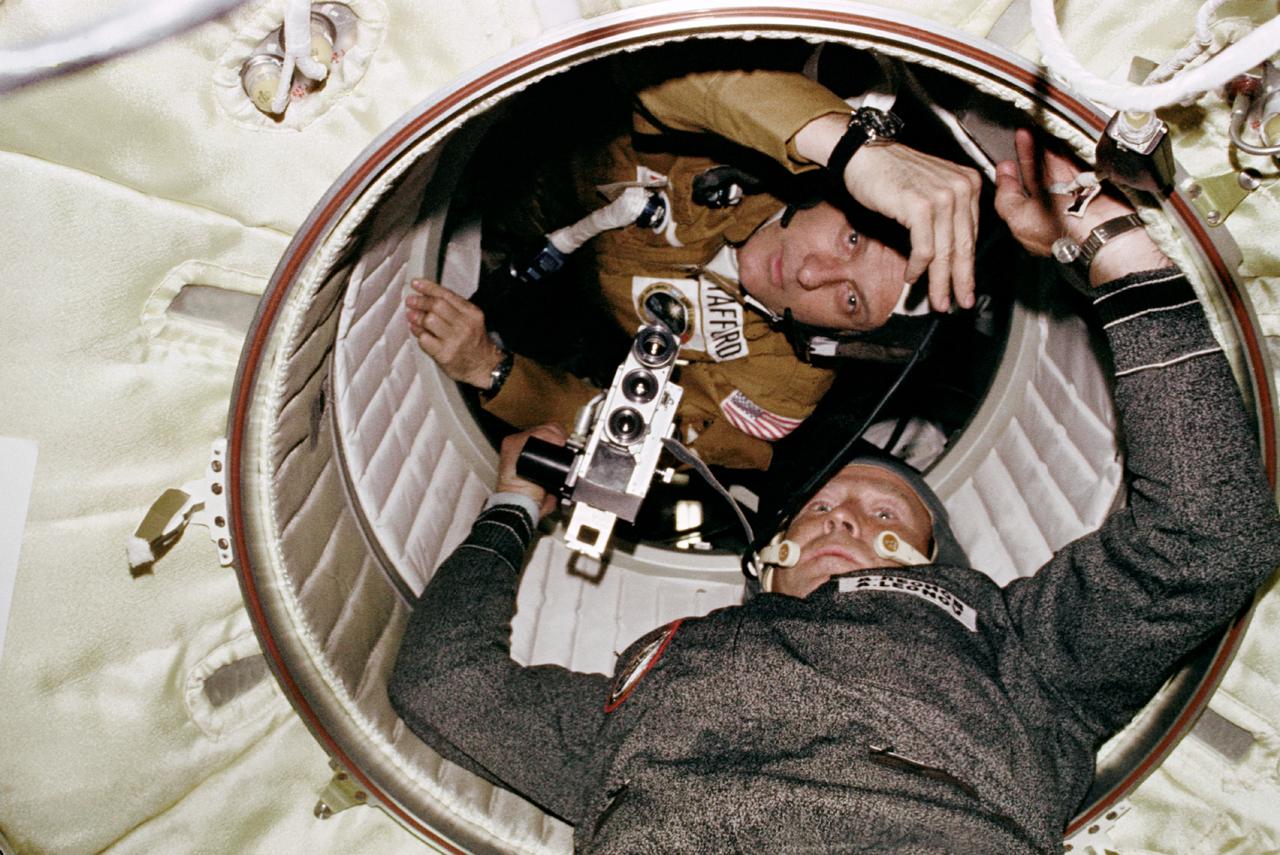
AST-03-191 (17-19 July 1975) --- Astronaut Thomas P. Stafford and cosmonaut Aleksei A. Leonov are seen at the hatchway leading from the Apollo Docking Module (DM) to the Soyuz Orbital Module (OM) during the joint U.S.-USSR Apollo Soyuz Test Project (ASTP) docking mission in Earth orbit. Cosmonaut Leonov is in the OM and astronaut Stafford is in the DM. Leonov holds a camera. The Apollo crew consisted of astronauts Stafford, commander; Donald K. "Deke" Slayton, docking module pilot; Vance D. Brand, command module pilot. The Soyuz 19 crew consisted of cosmonauts Leonov, command pilot; and Valeri N. Kubasov, flight engineer.
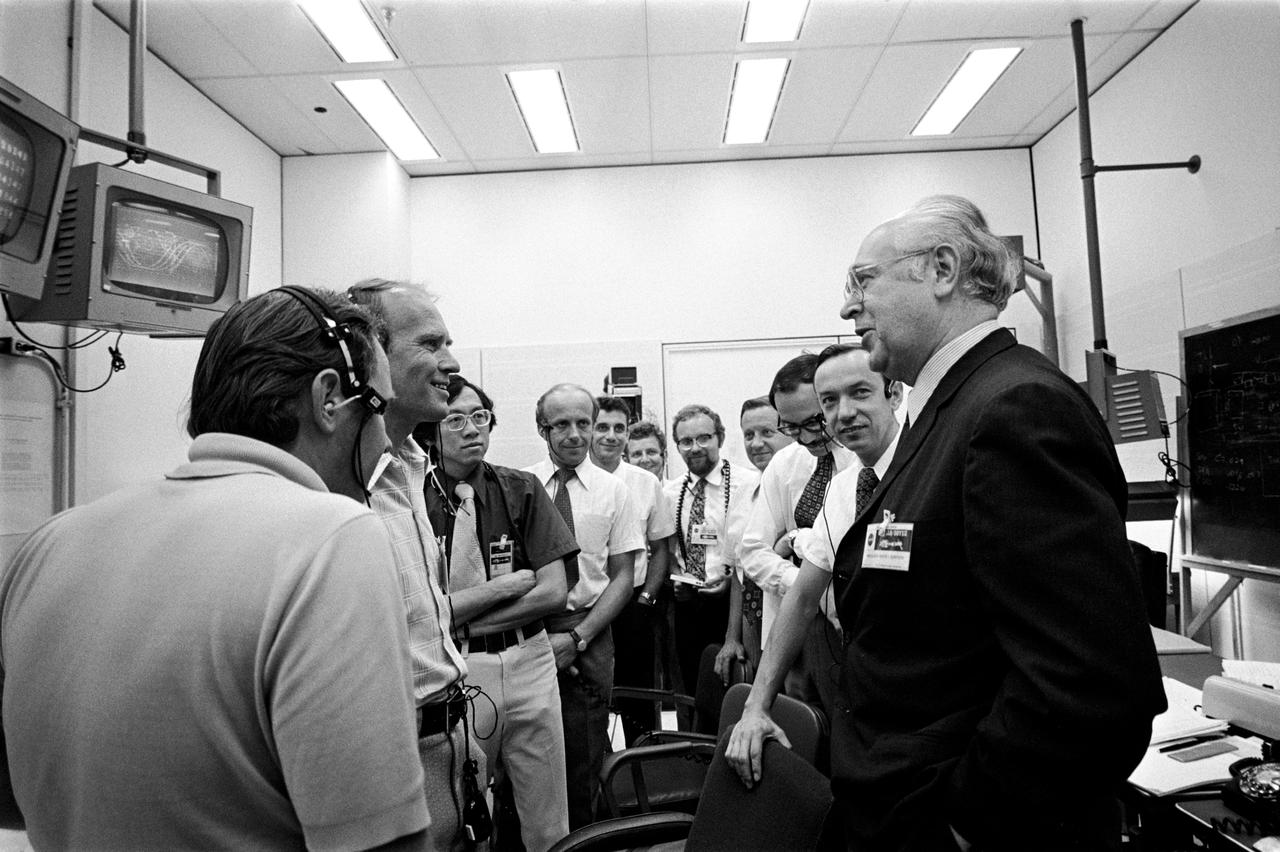
S75-28534 (17 July 1975) --- Anatoliy Dobrynin (right), Soviet Union ambassador to the United States, visits with a group of USSR ASTP flight controllers in the Mission Control Center during a tour of NASA's Johnson Space Center (JSC). Dobrynin was at JSC on the day the Soviet Soyuz and the American Apollo spacecraft docked in Earth orbit. The group also includes a couple of American ASTP flight controllers.
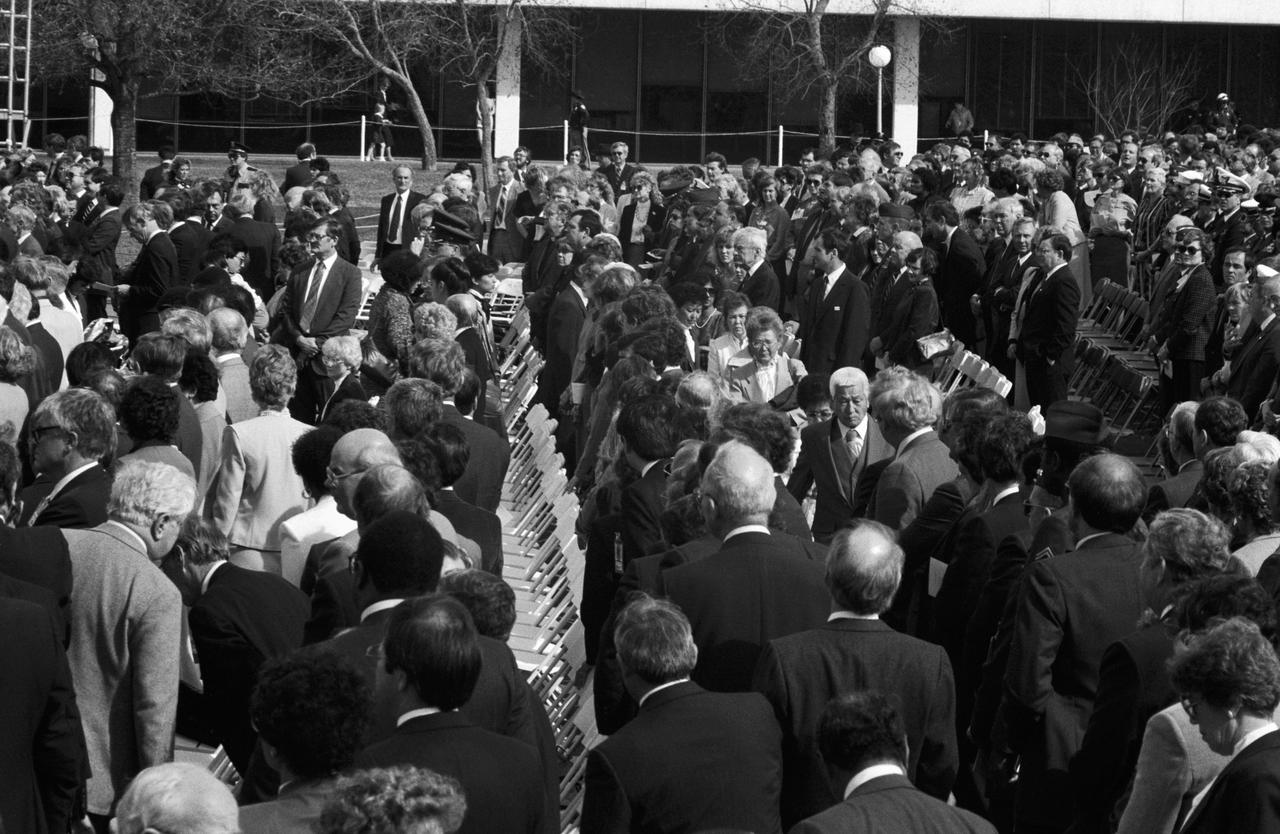
Family and friends of the STS 51-L crew prepare to be seated at the Memorial service at JSC. In the center of the view appears to be the family of Astronaut Ellison Onizuka.
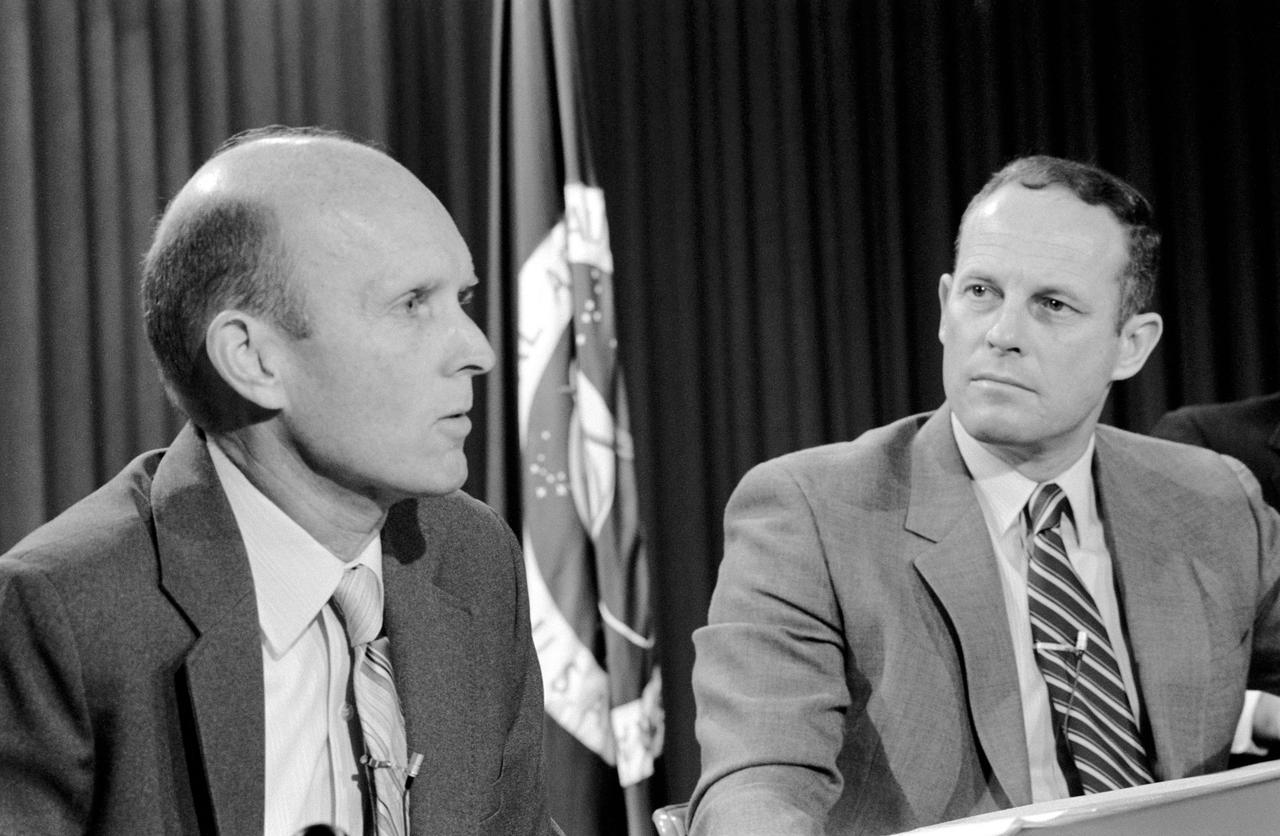
S82-25900 (21 Jan. 1982) --- Astronaut Jack R. Lousma, right, and C. Gordon Fullerton greet the press during a pre-STS-3 press conference in JSC?s Public Affairs Building. Lousma, commander and Fullerton, pilot, are scheduled to man the Columbia when it is launched in early spring from Kennedy Space Center launch pad 39A. Photo credit: NASA
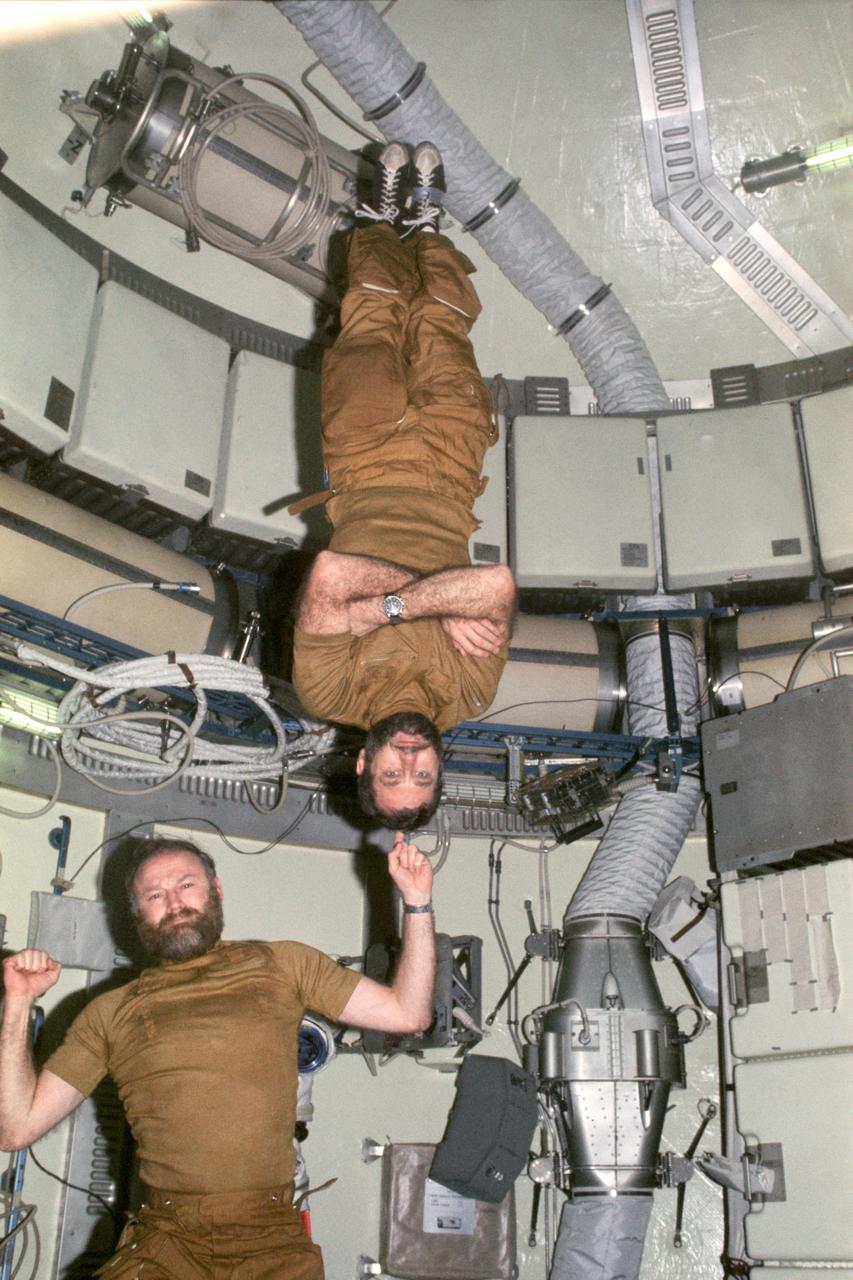
SL4-150-5080 (16 Nov. 1973-8 Feb. 1974) --- Two of the three Skylab 4 (third manning) astronauts exhibit the "magic" that can be accomplished in the weightlessness of space. Astronaut Gerald D. Carr, mission commander, uses his index finger to suspend astronaut William R. Pogue, pilot, in the Orbital Workshop (OWS). The two "wizards" completed almost three months aboard the Earth-orbiting Skylab space station, plenty of time to grow these full beards. The photograph was taken with a 35mm camera by astronaut Edward G. Gibson, science pilot. Photo credit: NASA
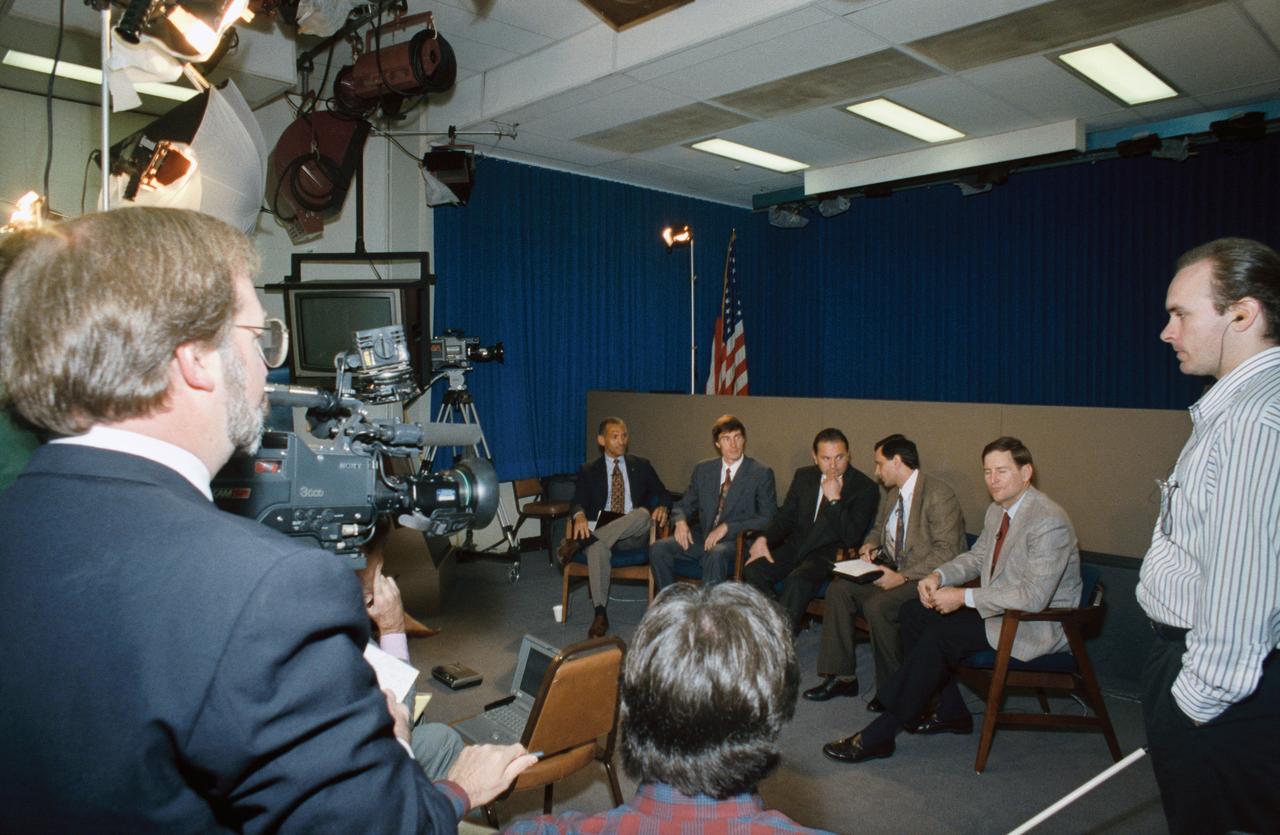
Three members of the STS-60 crew and an alternate crew member discuss their upcoming mission with the news media in JSC's public affairs facility. Seated from the left are Charles F. Bolden Jr., mission commander; Russian Cosmonaut Sergei Krikalev, mission specialist; Russian Cosmonaut Vladimir Titov, alternate mission specialist; interpreter Vladimir Fischel and Astronaut Kenneth S. Reightler, pilot.
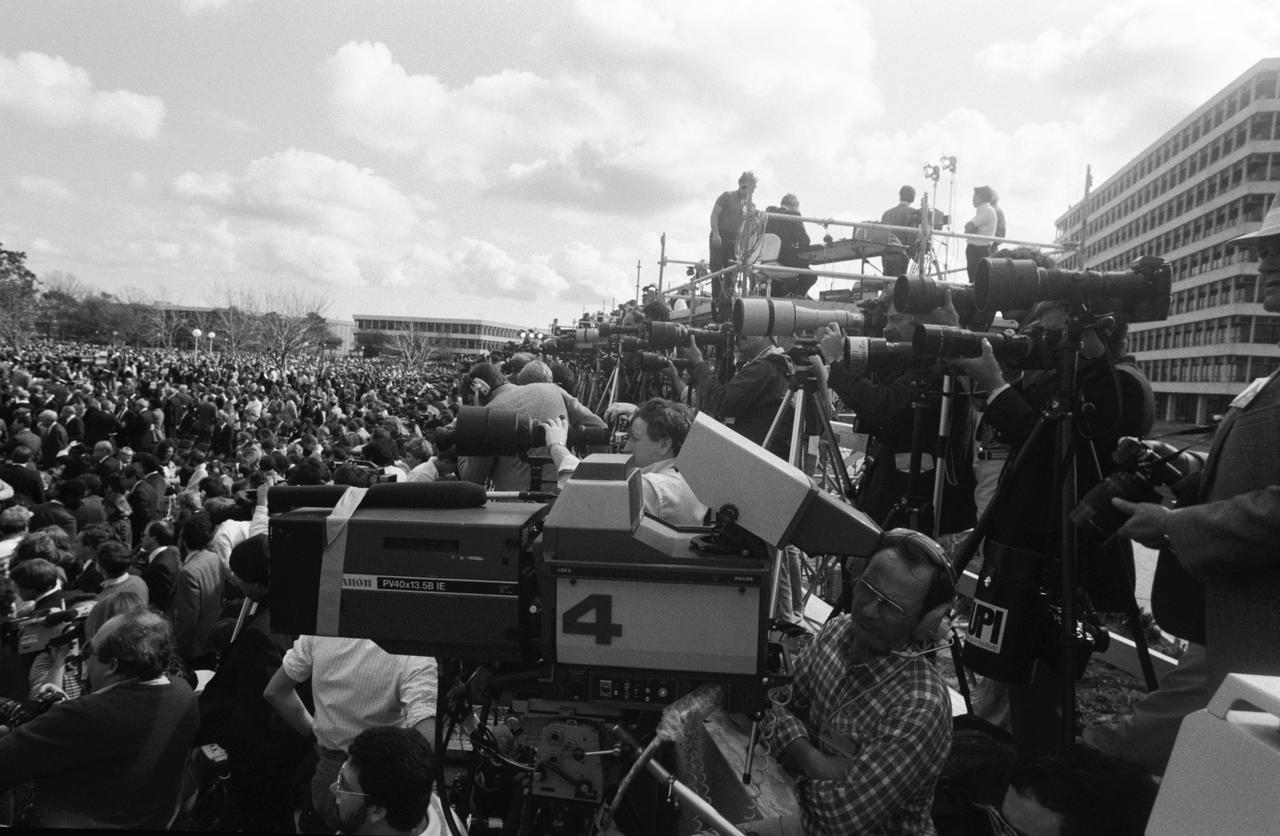
S86-26428 (31 Jan. 1986) --- Dozens of cameras and thousands of eyes focus on President Ronald Reagan (out of frame at left) during the 51-L memorial services Jan. 31 on the mall at the Johnson Space Center (JSC). The photograph was taken from special bleachers quickly erected to accommodate hundreds of members of the news media. The audience of thousands was largely made up of JSC employees and family and friends of the Challenger crew members who perished four days earlier in the attempted launch of NASA’s 25th STS mission. Photo credit: NASA
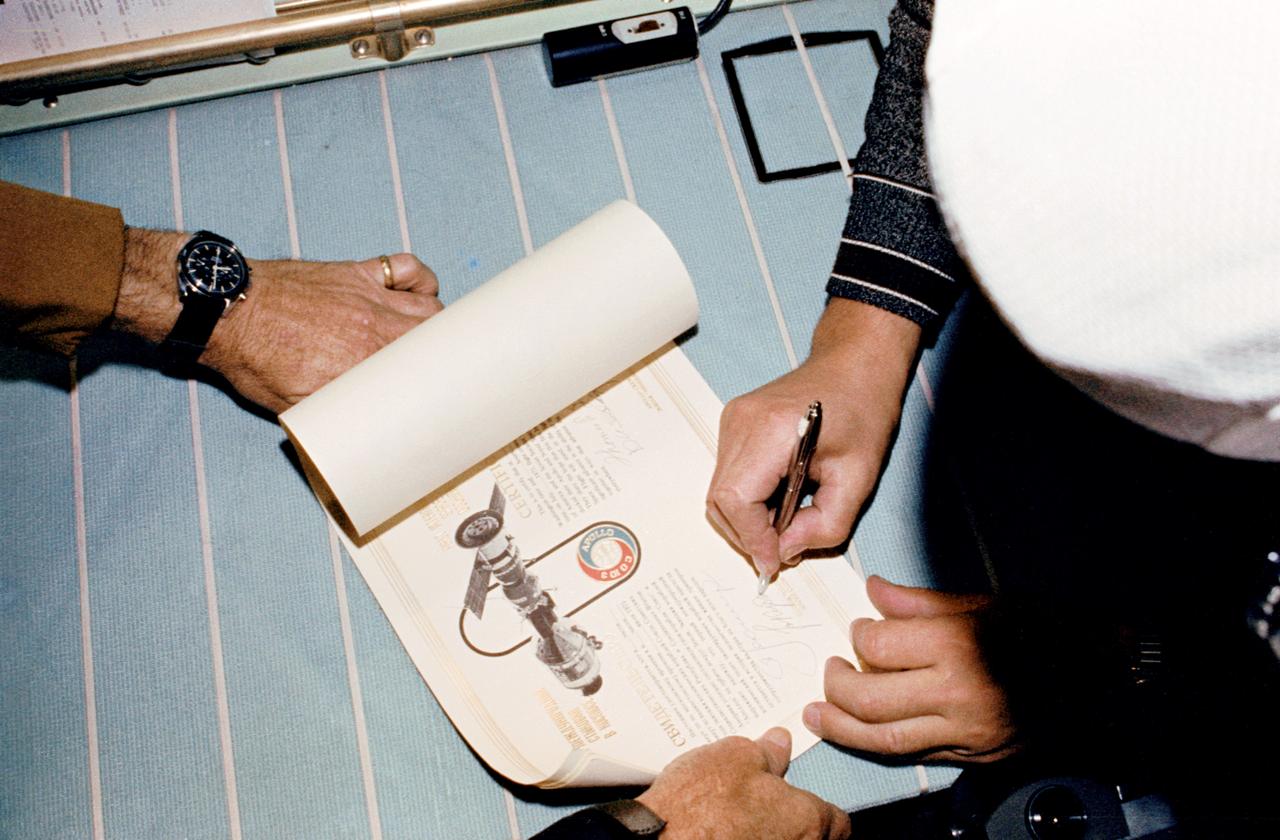
AST-03-171 (17 July 1975) --- The hands of cosmonaut Valerly N. Kubasov are seen as the ASTP engineer adds his name to the signature on the Soviet side of the official joint certificate marking an historical moment during the rendezvous day of the Apollo-Soyuz Test Project. The left hand of astronaut Donald K. Slayton, NASA's docking module pilot, is seen at left. The certificate had earlier been signed by astronauts Thomas P. Stafford, American crew commander; Slayton and cosmonaut Aleksey A. Leonov, Soviet crew commander, and it awaits the signature of astronaut Vance D. Brand, NASA's command module pilot who remained in the CM while the others signed in the Soviet Orbital Module of the Soyuz.

S75-32053 (July 1975) --- An overall view of activity in the press working area of the ASTP News Center during the joint U.S.-USSR Apollo-Soyuz Test Project docking mission in Earth orbit. The JSC Public Affairs Office maintains a news center for each mission. The NASA spaceflights are covered by U.S. and foreign reporters representing TV networks, wire services, television and radio stations, newspapers, magazines, scientific and educational publications, etc. (Photo courtesy Communications Satellite Corporation)
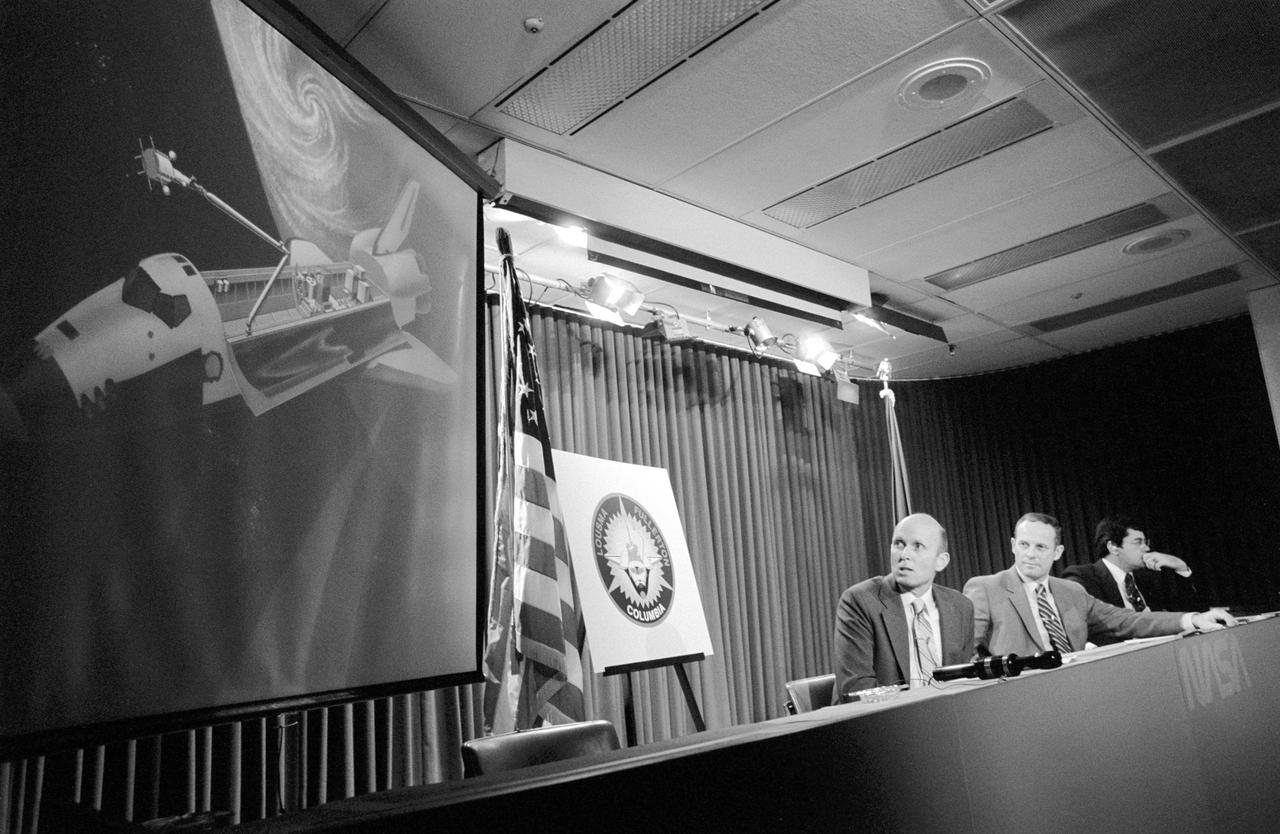
S82-25903 (21 Jan. 1982) --- Astronaut Jack R. Lousma, center, and C. Gordon Fullerton, left, respond to a visual depicting the Columbia and its remote manipulator system in space during a pre-STS-3 press conference in JSC?s pubic affairs building. Dr. John Lawrence, public information specialist who introduced the crew to news media representatives, is at far right. Photo credit: NASA
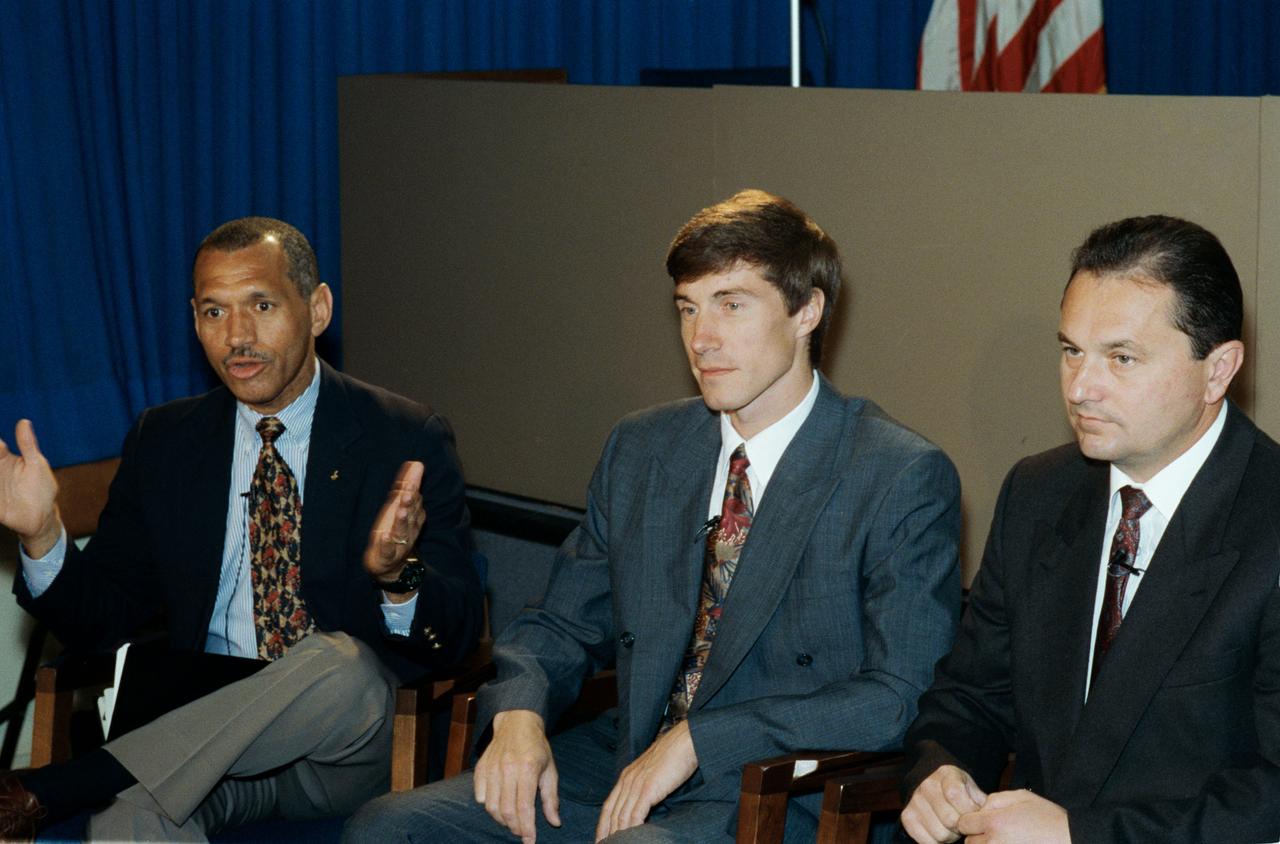
Two prime crew members and an alternate are pictured during a mission planning session in JSC's public affairs facility. Left to right are astronaut Charles F. Bolden Jr., mission commander; and Cosmonauts sergei Krikalev and Vladimir Titov, prime and alternate mission specialists, respectively.
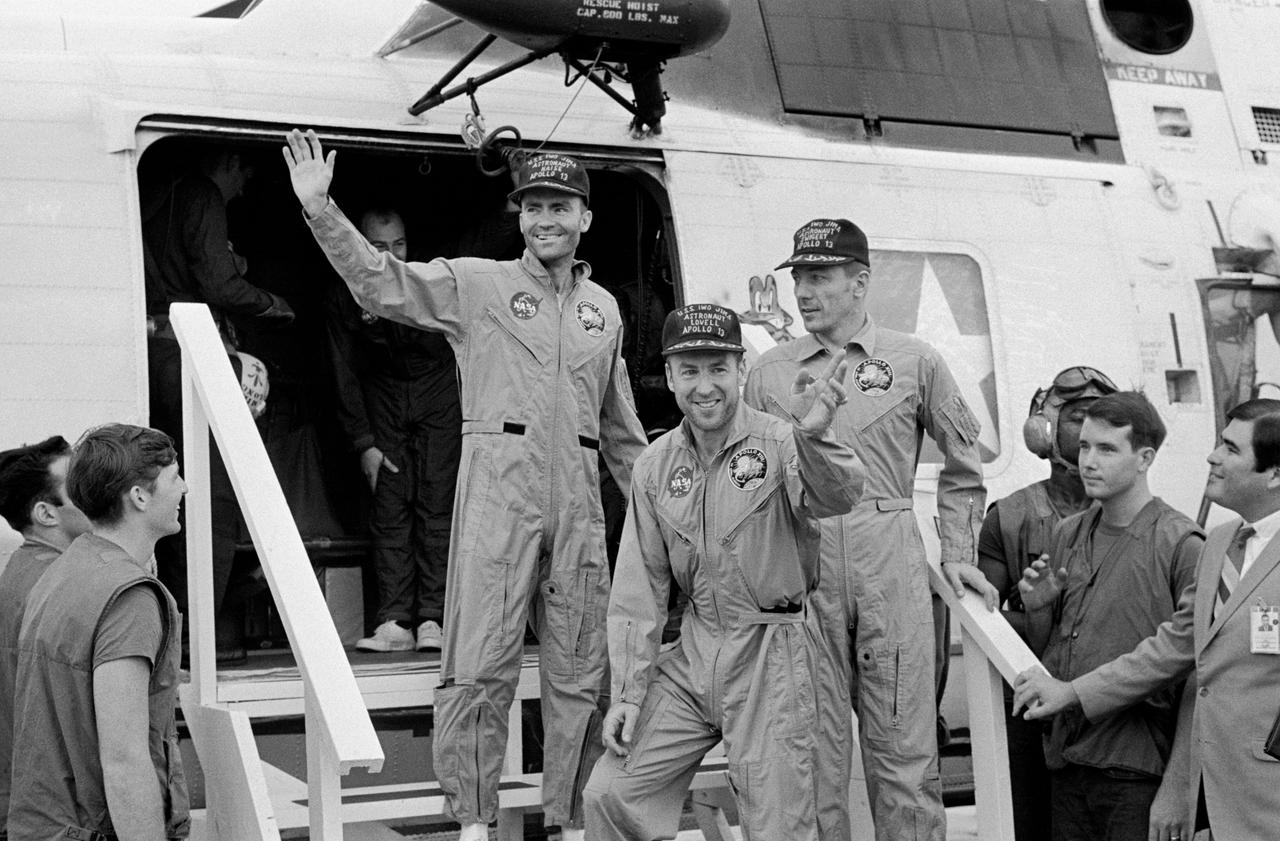
S70-35614 (17 April 1970) --- The crewmembers of the Apollo 13 mission, step aboard the USS Iwo Jima, prime recovery ship for the mission, following splashdown and recovery operations in the South Pacific Ocean. Exiting the helicopter which made the pick-up some four miles from the Iwo Jima are (from left) astronauts Fred W. Haise Jr., lunar module pilot; James A. Lovell Jr., commander; and John L. Swigert Jr., command module pilot. The crippled Apollo 13 spacecraft splashed down at 12:07:44 p.m. (CST), April 17, 1970.
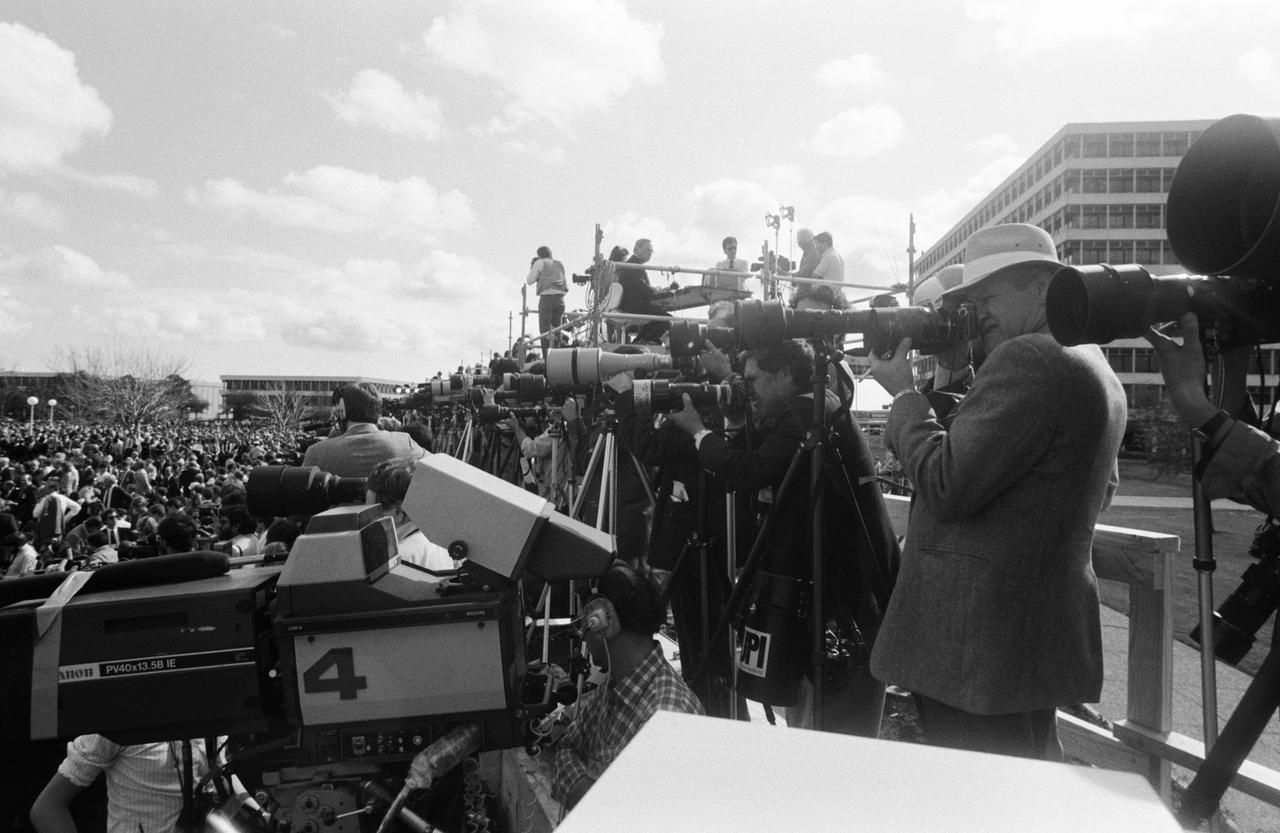
Overall view of the news media at the memorial service at JSC for the Crew of STS 51-L.
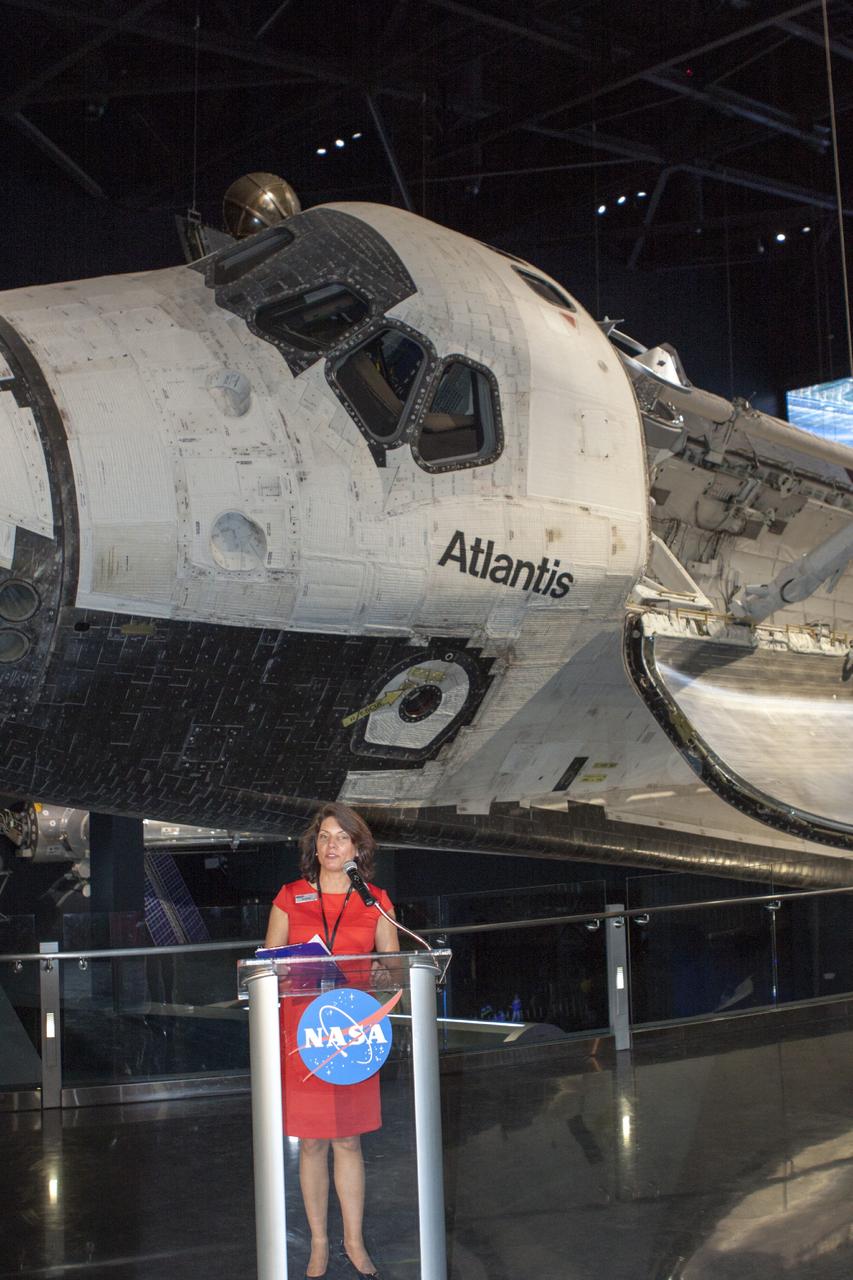
CAPE CANAVERAL, Fla. -- At the Kennedy Space Center Visitor Complex in Florida, Andrea Farmer, Delaware North Parks and Resorts manager of Public Relations speaks to news media representatives during the opening of the 90,000-square-foot "Space Shuttle Atlantis" facility. The new $100 million facility includes interactive exhibits that tell the story of the 30-year Space Shuttle Program and highlight the future of space exploration. The "Space Shuttle Atlantis" exhibit formally opened to the public on June 29, 2013.Photo credit: NASA/Jim Grossmann
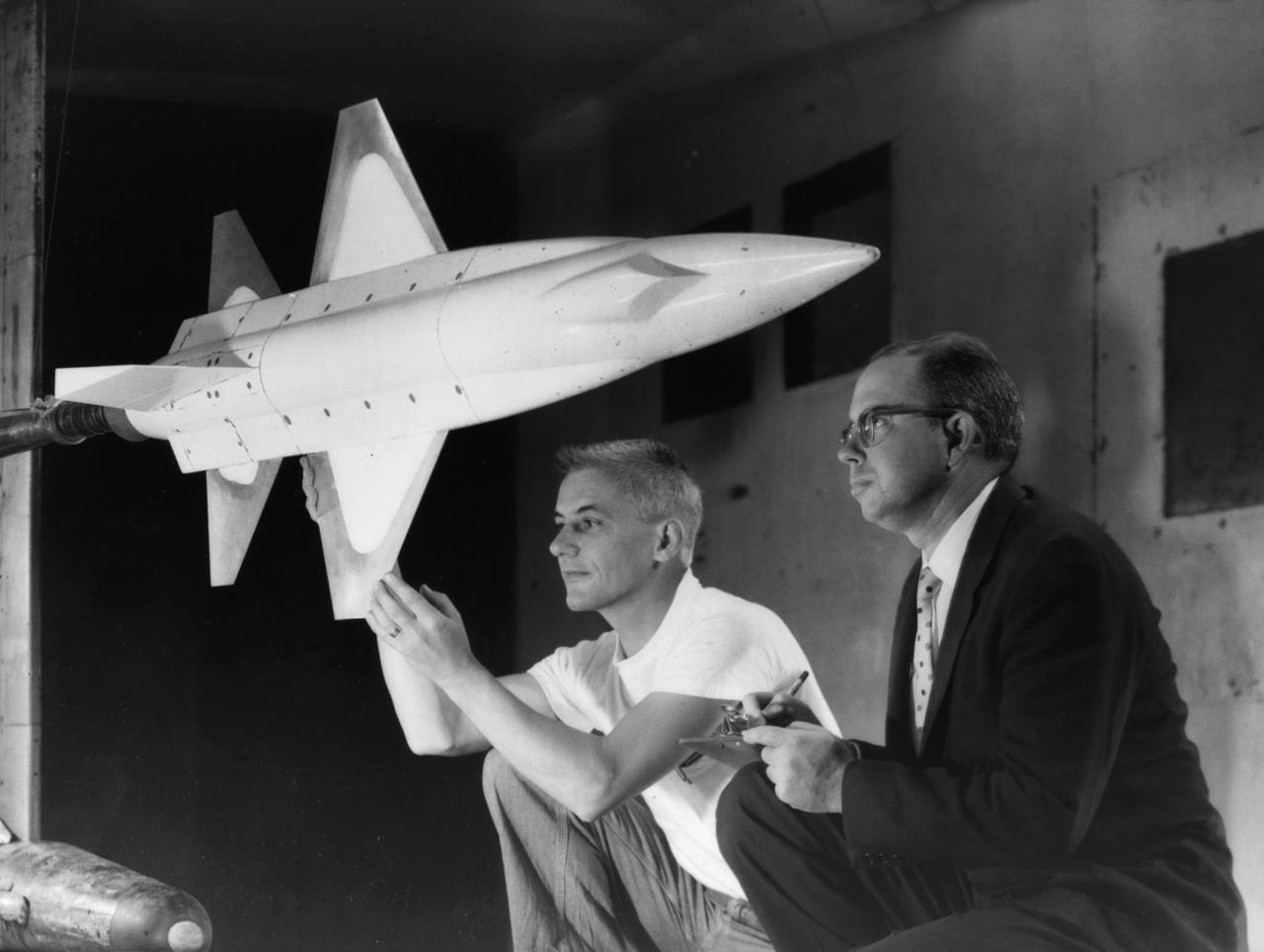
A 1/10th Scale Model of the X-15 research plane is prepared in Langley's 7 x 10 Foot Wind Tunnel for studies relating to spin characteristics. -- Photograph published in Winds of Change, 75th Anniversary NASA publication (page 66), by James Schultz.
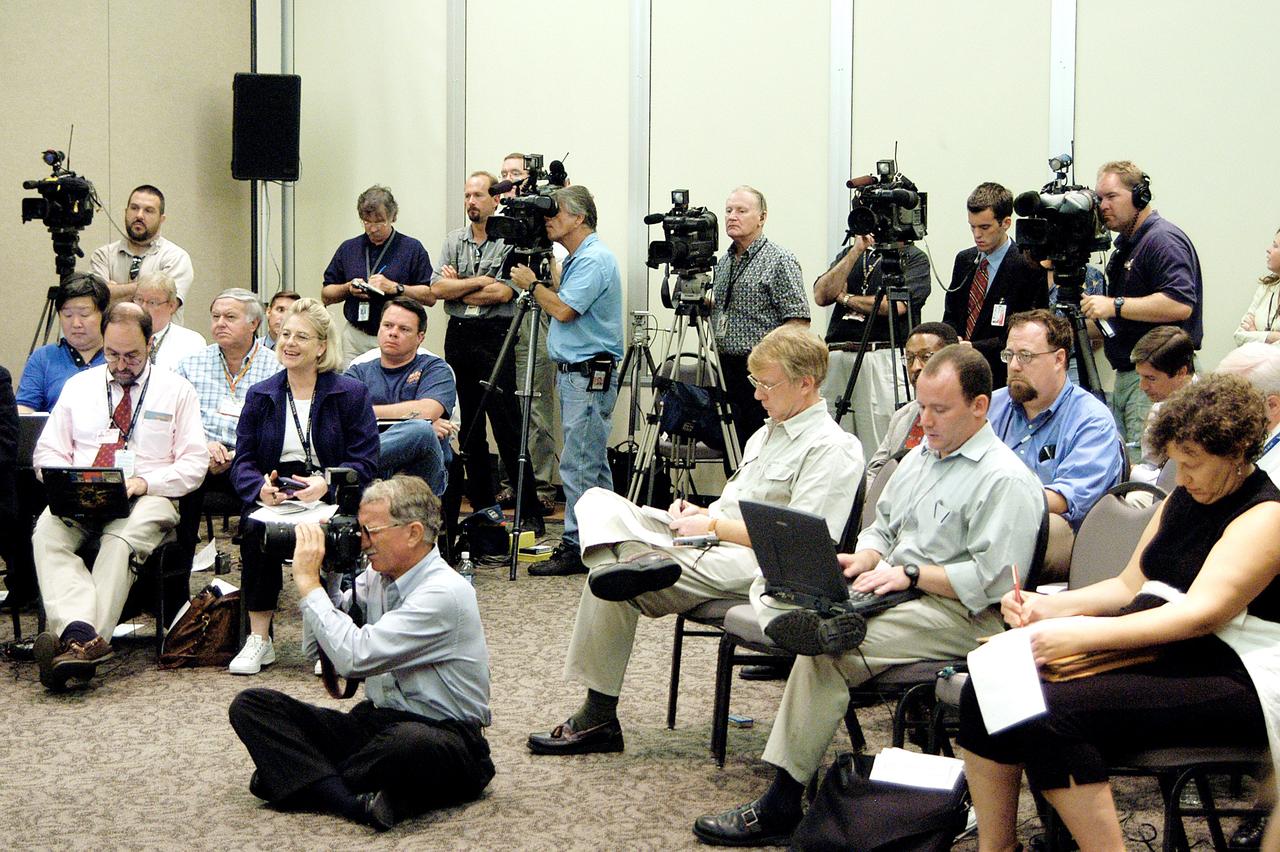
KENNEDY SPACE CENTER, FLA. - The news media capture the words and images of the Return To Flight Task Group (RTFTG) which held its first public meeting at the Debus Center, KSC Visitor Complex. The group is co-chaired by former Shuttle commander Richard O. Covey and retired Air Force Lt. Gen. Thomas P. Stafford, who was an Apollo commander. The RTFTG was at KSC to conduct organizational activities, tour Space Shuttle facilities and receive briefings on Shuttle-related topics. The task group was chartered by NASA Administrator Sean O’Keefe to perform an independent assessment of NASA’s implementation of the final recommendations of the Columbia Accident Investigation Board.
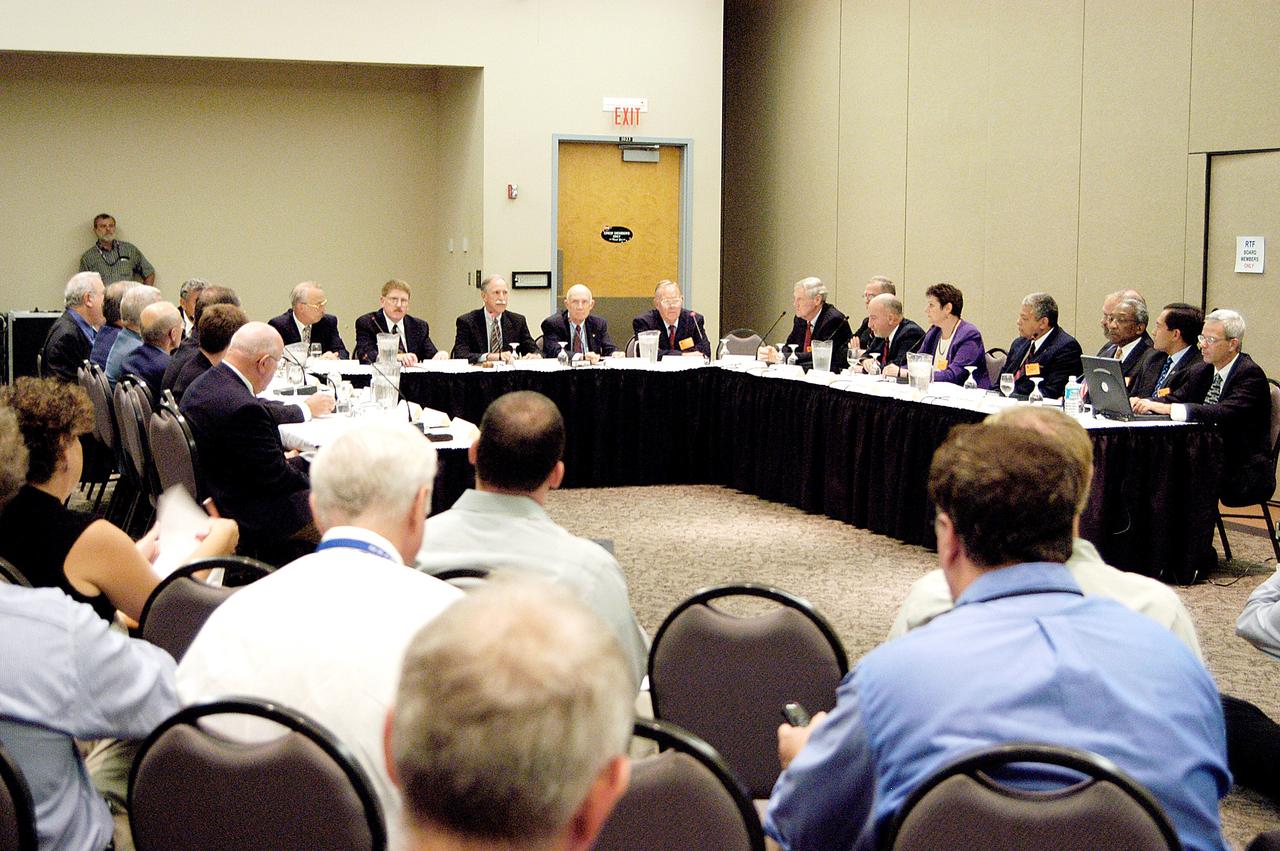
KENNEDY SPACE CENTER, FLA. - The Return To Flight Task Group (RTFTG) holds its first public meeting at the Debus Center, KSC Visitor Complex. The group is co-chaired by former Shuttle commander Richard O. Covey and retired Air Force Lt. Gen. Thomas P. Stafford, who was an Apollo commander. The RTFTG was at KSC to conduct organizational activities, tour Space Shuttle facilities and receive briefings on Shuttle-related topics. The task group was chartered by NASA Administrator Sean O’Keefe to perform an independent assessment of NASA’s implementation of the final recommendations of the Columbia Accident Investigation Board.
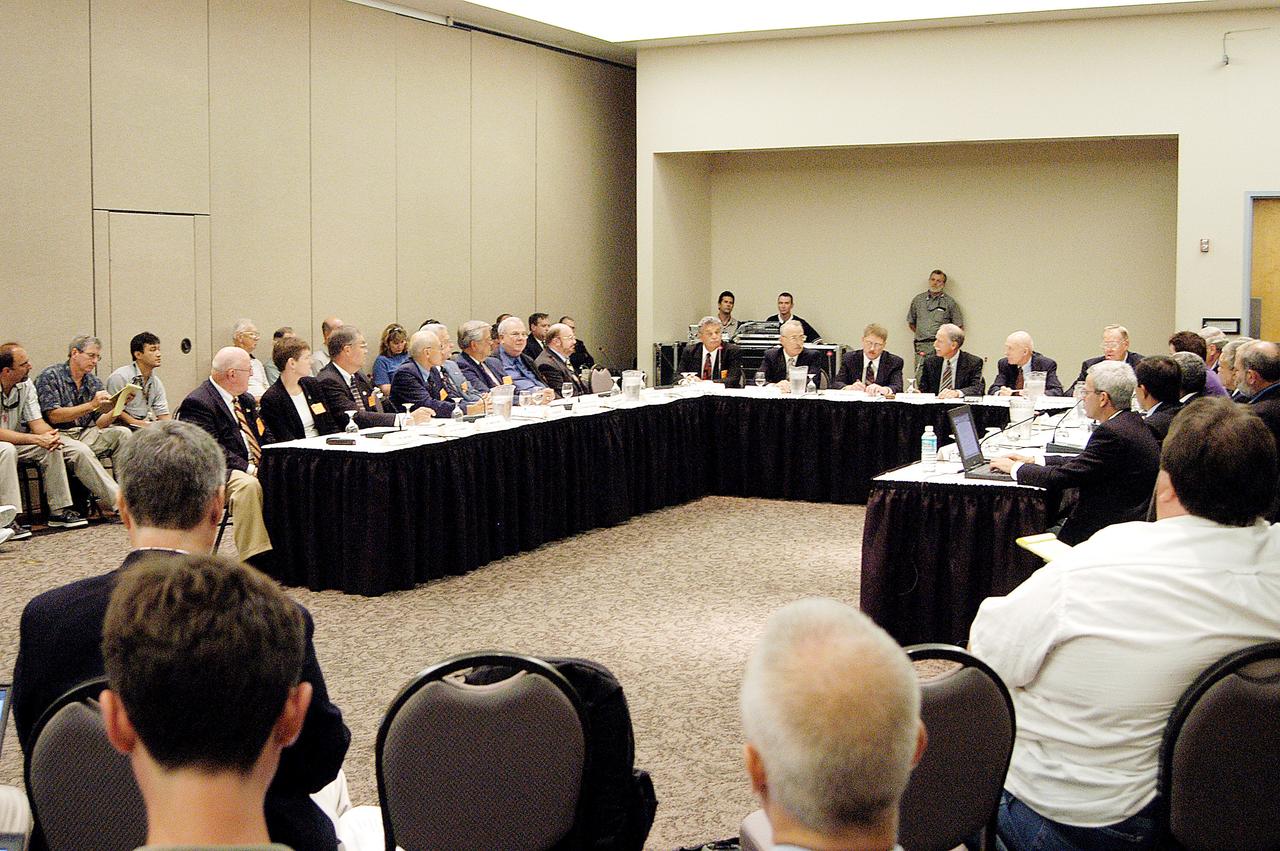
KENNEDY SPACE CENTER, FLA. - The Return To Flight Task Group (RTFTG) holds its first public meeting at the Debus Center, KSC Visitor Complex. The group is co-chaired by former Shuttle commander Richard O. Covey and retired Air Force Lt. Gen. Thomas P. Stafford, who was an Apollo commander. The RTFTG was at KSC to conduct organizational activities, tour Space Shuttle facilities and receive briefings on Shuttle-related topics. The task group was chartered by NASA Administrator Sean O’Keefe to perform an independent assessment of NASA’s implementation of the final recommendations of the Columbia Accident Investigation Board.
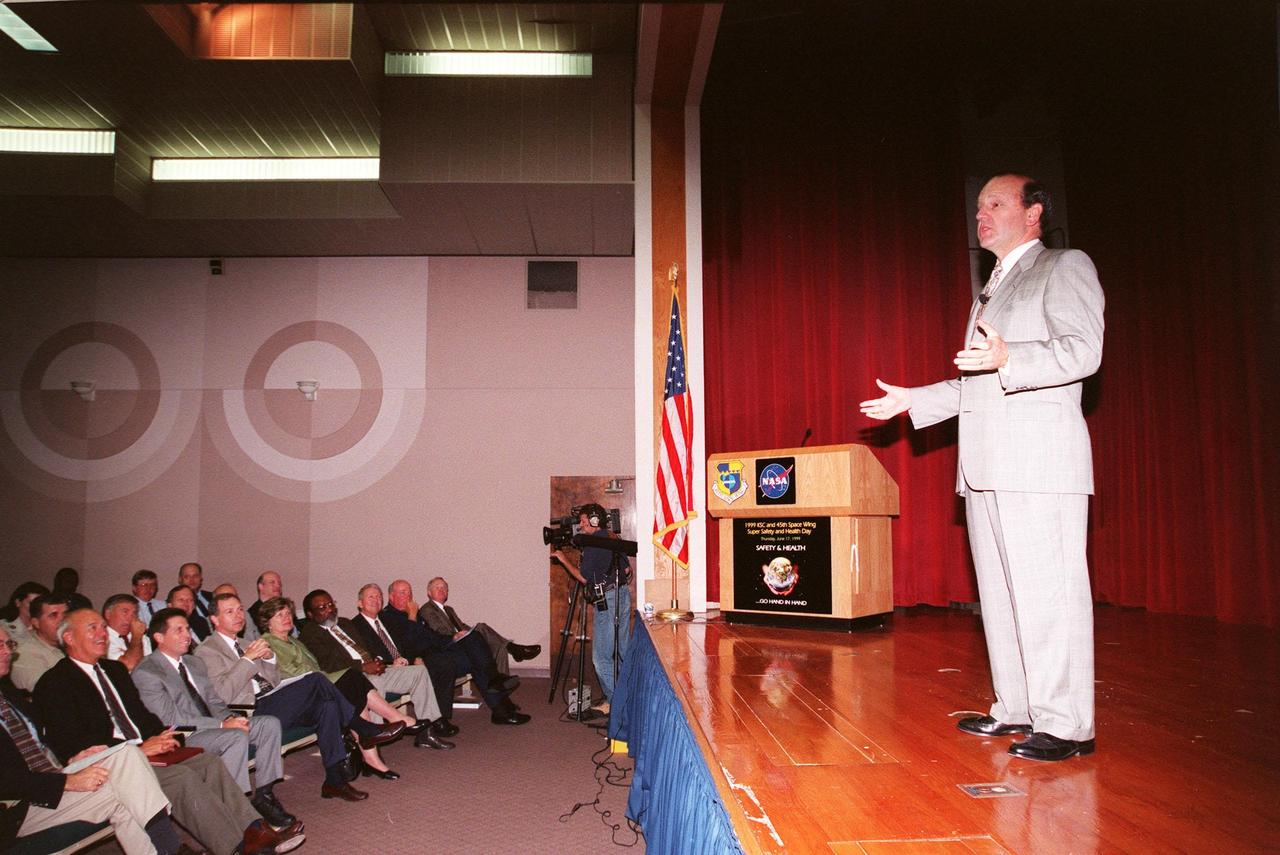
Capt. Dennis E. Fitch, a consultant and former pilot instructor with United Airlines, addresses an audience of KSC employees to kick off Super Safety and Health Day at KSC. Fitch related his tale of the catastrophic engine failure in UAL flight 232, which crash landed in Iowa in 1989, and the teamwork that contributed to his survival and the lives of 183 other passengers. For the second time Kennedy Space Center dedicated an entire day to safety and health. Most normal work activities were suspended to allow personnel to attend Super Safety and Health Day activities. The theme, "Safety and Health Go Hand in Hand," emphasized KSC's commitment to place the safety and health of the public, astronauts, employees and space-related resources first and foremost. Events also included a panel session about related issues, vendor exhibits, and safety training in work groups. The keynote address and panel session were also broadcast internally over NASA television
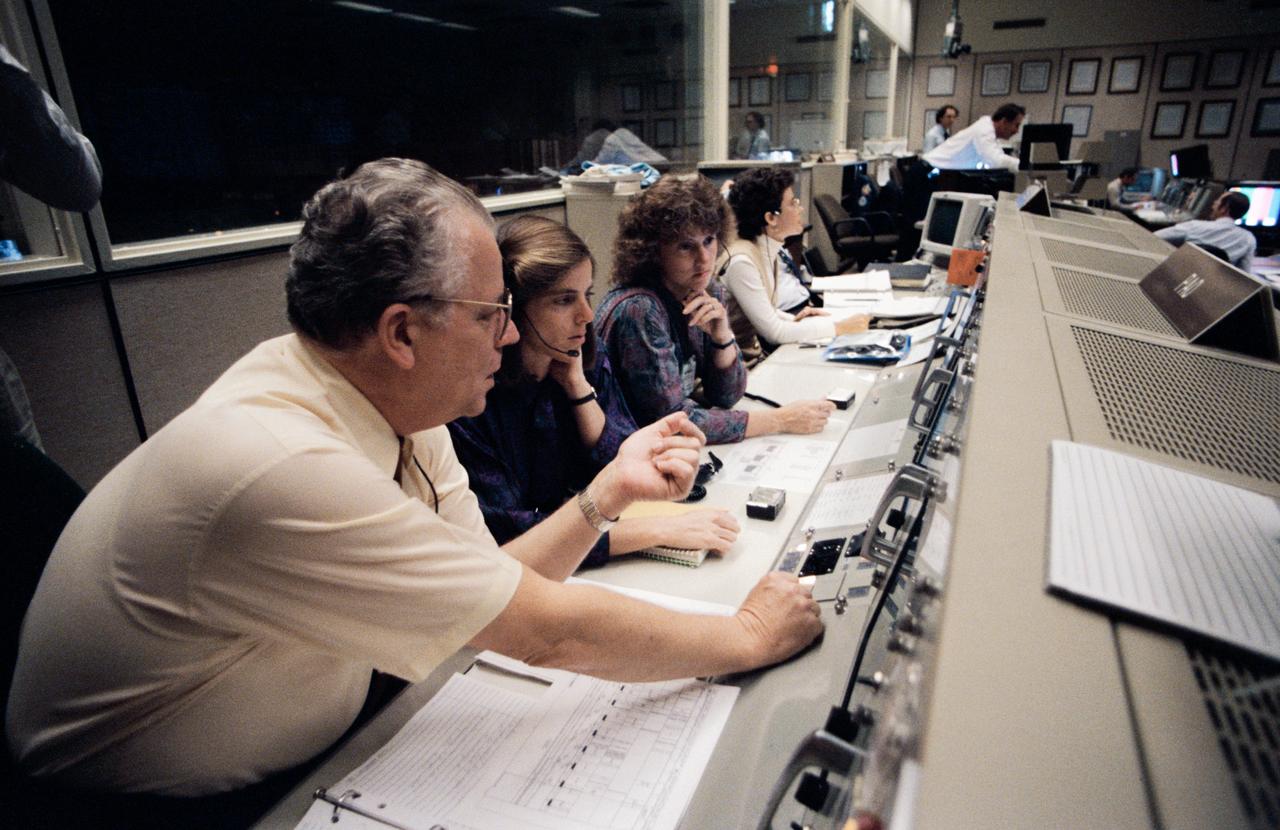
61A-S-135 (5 Nov 1985) --- Two school teachers in training at the Johnson Space Center got their first ?real time? exposure to a Space Shuttle mission as they monitor activity aboard the Spacelab D-1 science module from the mission control center. Sharon Christa McAuliffe (frame center) and Barbara R. Morgan are briefed by Terry White at the Public Affairs console during a television downlink from the Earth-orbiting Space Shuttle Challenger. McAuliffe is scheduled to fly as teacher/citizen observer on the STS 51-L mission early next year; and Morgan is in training as her backup.
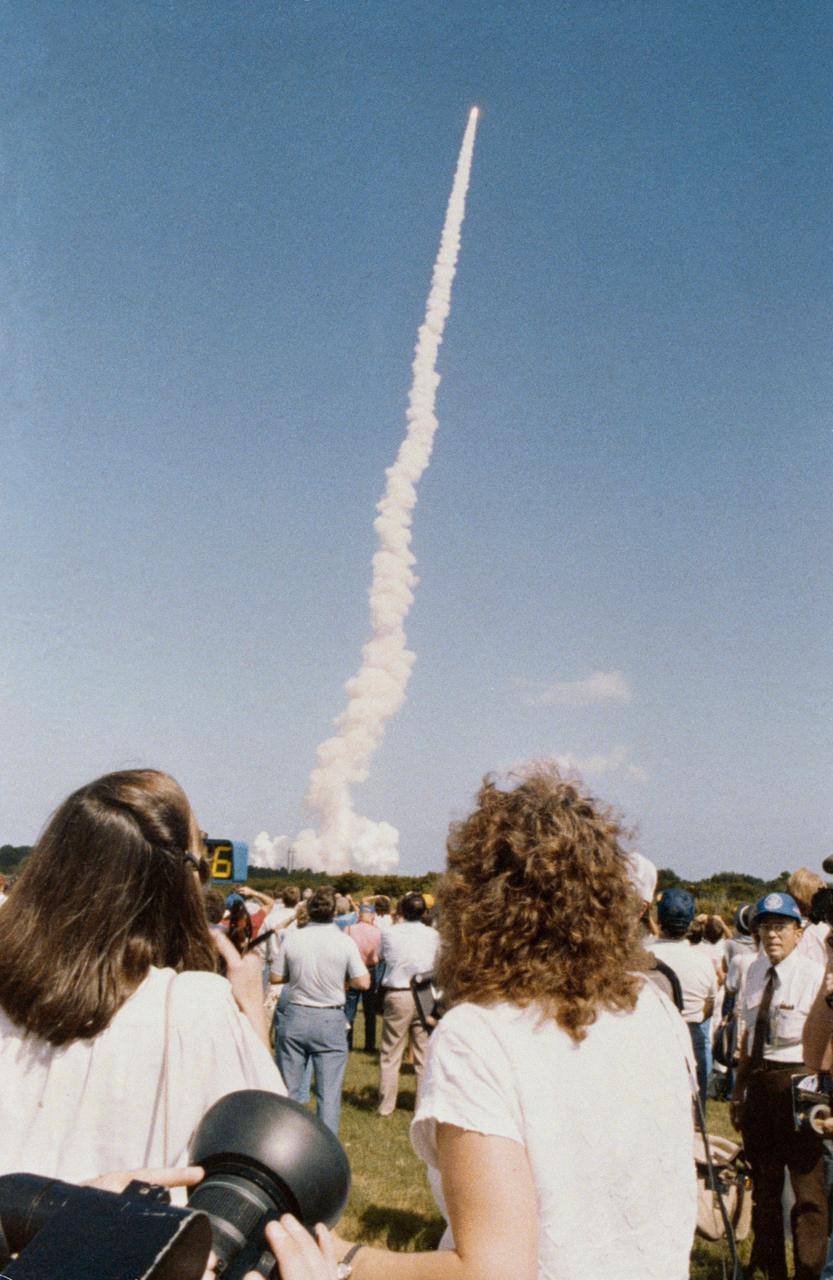
S86-25293 (30 Oct. 1985) --- Barbara R. Morgan and Sharon Christa McAuliffe (right) are pictured during a visit to NASA's Kennedy Space Center (KSC) Launch Complex 39 to witness the launch of the space shuttle Challenger. McAuliffe is scheduled to launch aboard the space shuttle Challenger, STS-51L mission, herself early next year as the United States? first in-space citizen observer. Morgan is the backup for the Teacher-in-Space Project?s payload specialist position. The photo was taken by Keith Meyers of the New York Times. EDITOR'S NOTE: The STS-51L crew members lost their lives in the space shuttle Challenger accident moments after launch on Jan. 28, 1986 from the Kennedy Space Center (KSC). Photo credit: NASA
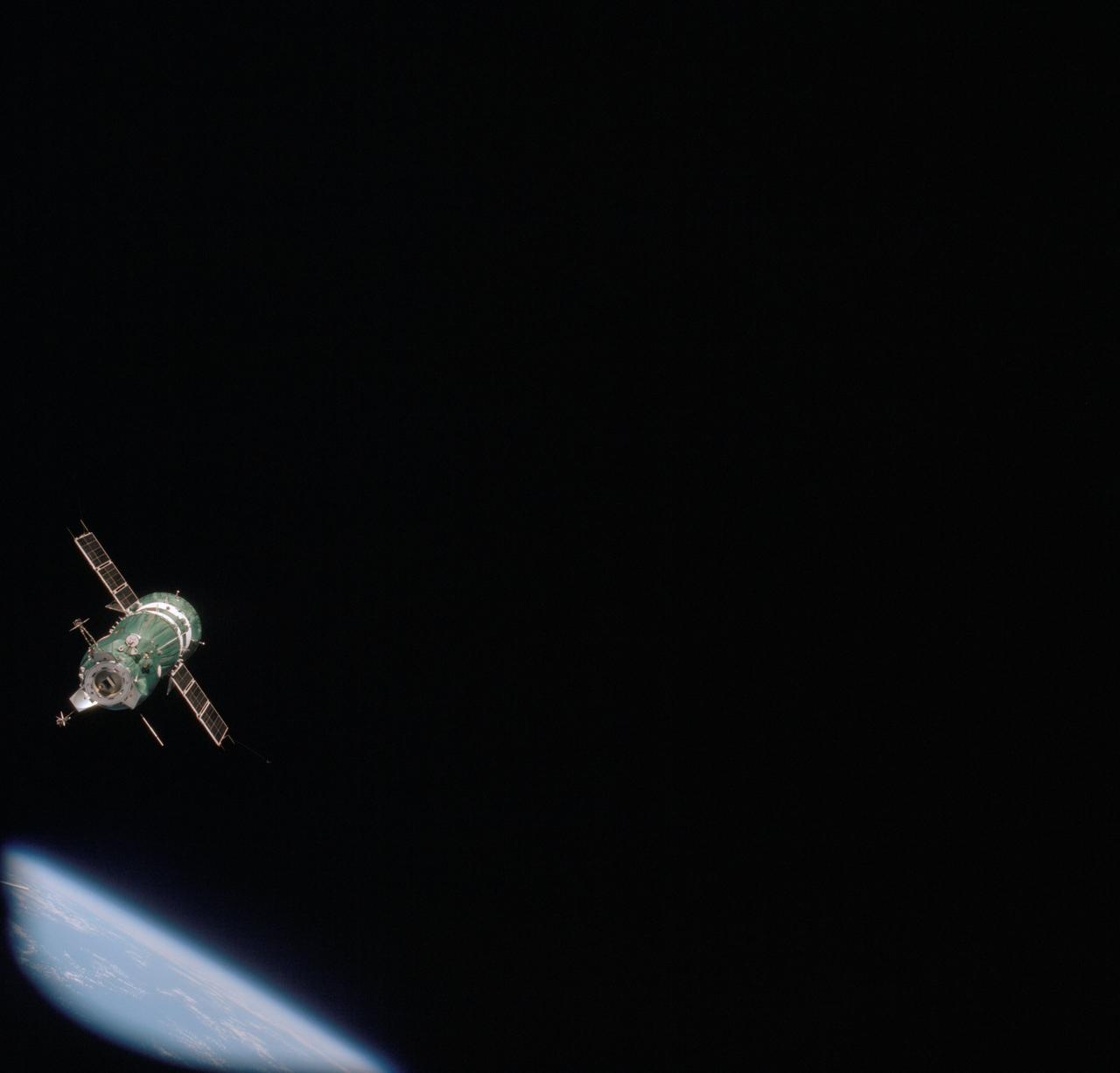
AST-09-572 (17-18 July 1975) --- The Soviet Soyuz 19 spacecraft is photographed from the American Apollo spacecraft during the joint U.S.-USSR Apollo-Soyuz Test Project (ASTP) docking mission in Earth orbit. Earth is visible in the lower left corner. This picture was taken with a 70mm camera. The Apollo crew consisted of astronauts Thomas P. Stafford, commander; Donald K. "Deke" Slayton, docking module pilot; and Vance D. Brand, command module pilot. The Soyuz 19 crew consisted of cosmonauts Aleksei A. Leonov, command pilot; and Valeri N. Kubasov, flight engineer.

AST-05-263 (17-18 July 1975) --- The Apollo-Soyuz Test Project (ASTP) Commemorative Plaque is assembled in the Soviet Soyuz Orbital Module during the joint U.S.-USSR Apollo-Soyuz Test Project docking mission in Earth orbit. The plaque is written both in English and Russian.
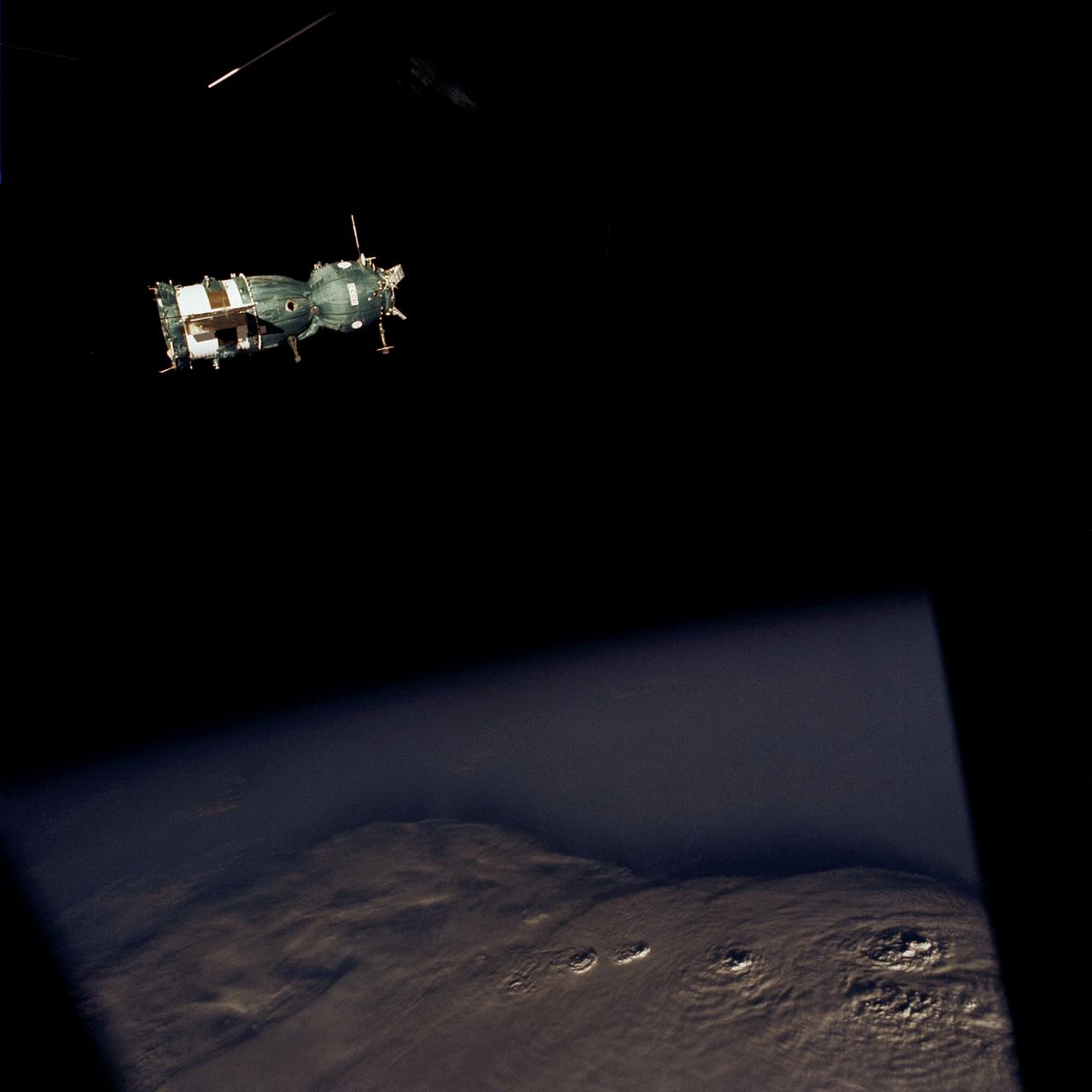
AST-02-096 (18 July 1975) --- This scene photograph from a rendezvous window of the American Apollo spacecraft in Earth orbit shows the Soviet Soyuz spacecraft contrasted against a black-sky background with a heavily cloud-covered Earth below. The three major components of the Soyuz are the spherical-shaped Orbital Module, the bell-shaped Descent Vehicle, the cylindrical-shaped Instrument Assembly Module. The docking system on the Orbital Module was specially designed to interface with the docking system on the Apollo's Docking Module. The ASTP astronauts and cosmonauts visited each other's spacecraft while the Soyuz and Apollo were docked in Earth orbit for two days.
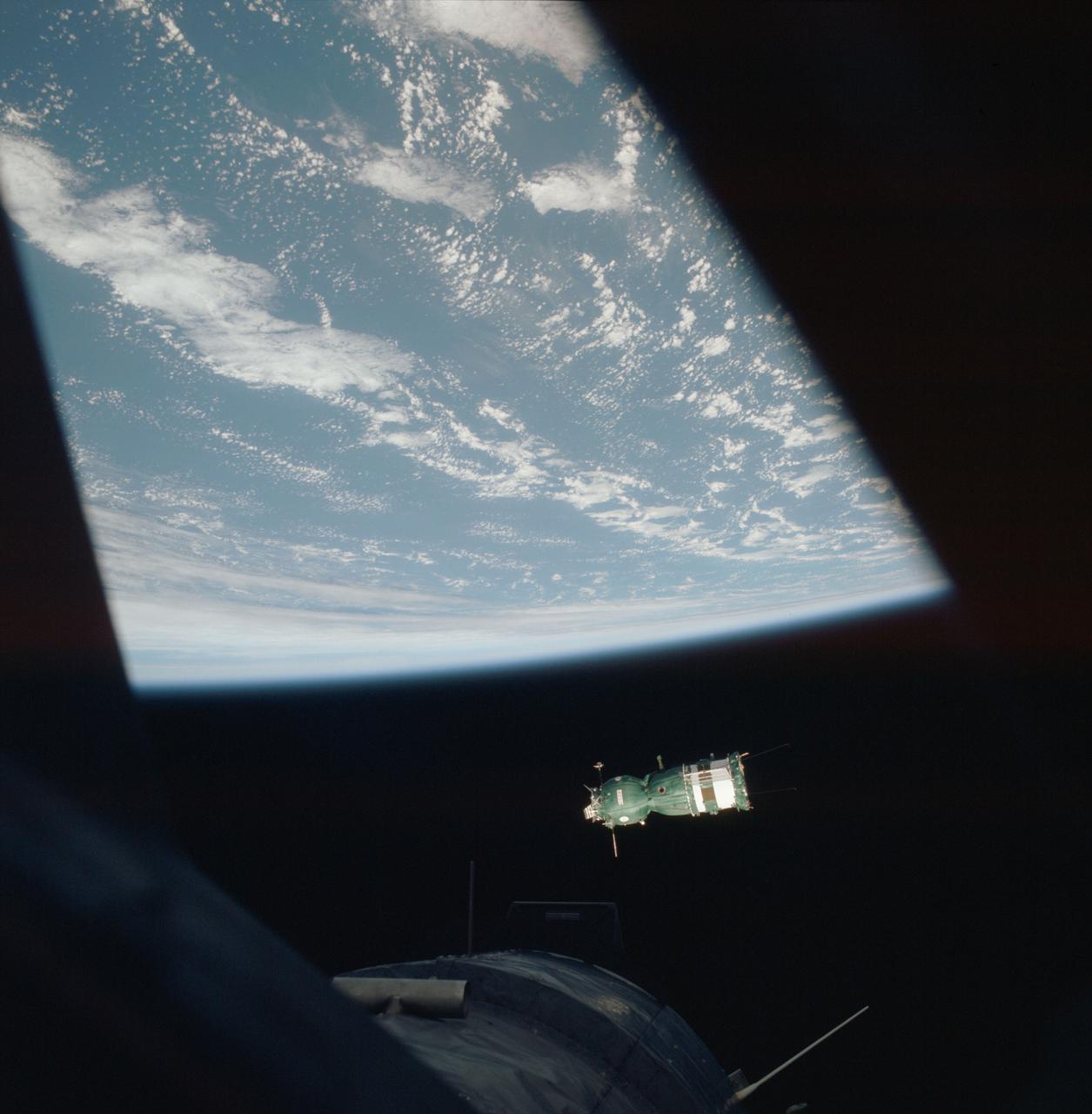
AST-02-093 (18 July 1975) --- This scene photographed with a hand-held 70mm camera from a rendezvous window of the American Apollo spacecraft in Earth orbit shows the Soviet Soyuz spacecraft contrasted against a black-sky background with Earth's horizon below. The three major components of the Soyuz are the spherical-shaped Orbital Module (OM), the bell-shaped Descent Vehicle (DV) and the cylindrical-shaped instrument Assembly Module (AM). The docking system on the Orbital Module was specially designed to interface with the docking system on the Apollo's Docking Module (DM). The DM is visible very faintly at the bottom of the picture. The ASTP astronauts and cosmonauts visited each other's spacecraft while the Soyuz and Apollo were docked in Earth orbit for two days.
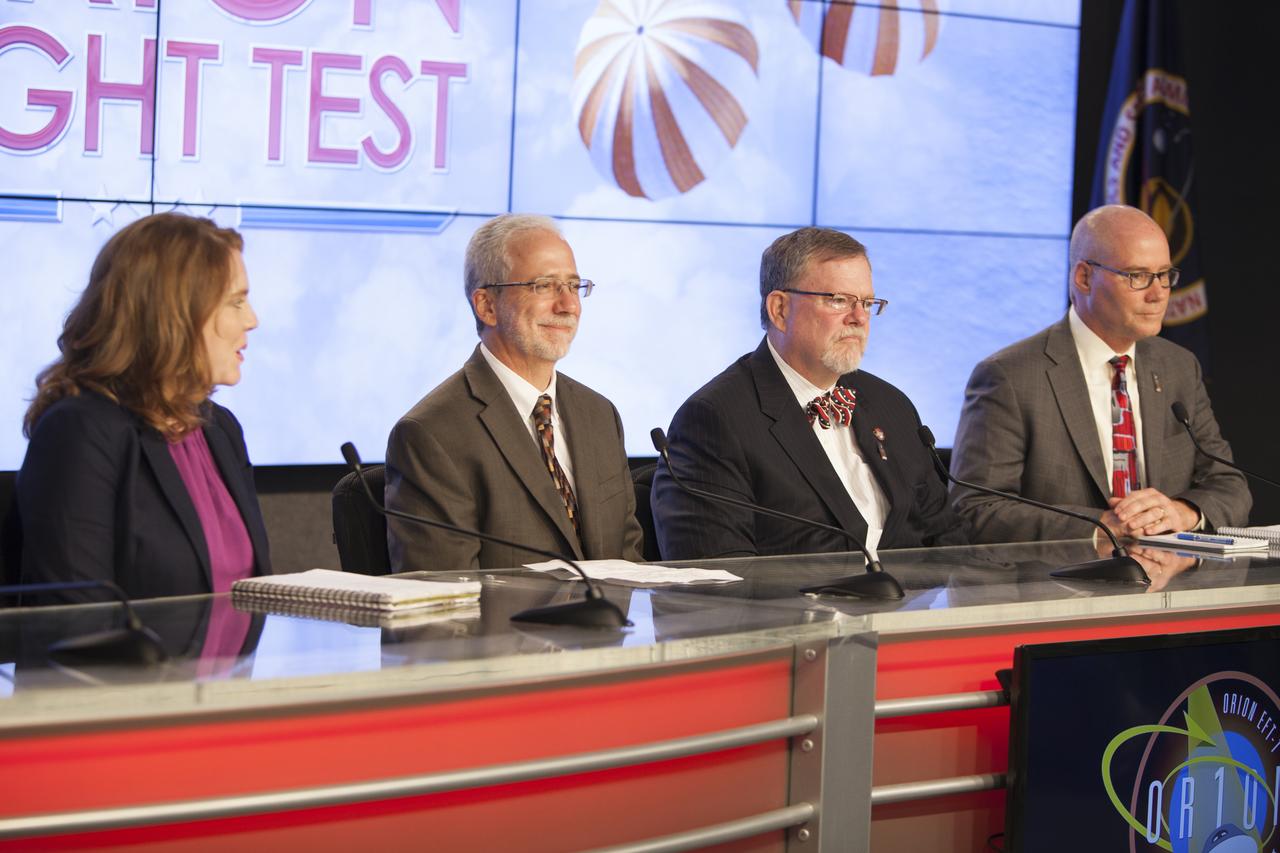
In the Kennedy Space Center’s Press Site auditorium, agency and industry leaders spoke to members of the news media about the postponement of the Orion Flight Test launch due to an issue related to fill and drain valves on the Delta IV Heavy rocket. From left are: Brandi Dean of NASA Public Affairs, Mark Geyer, NASA's Orion program manager, Mike Hawes, Lockheed Martin Orion Program manager, and Dan Collins, United Launch Alliance chief operating officer.
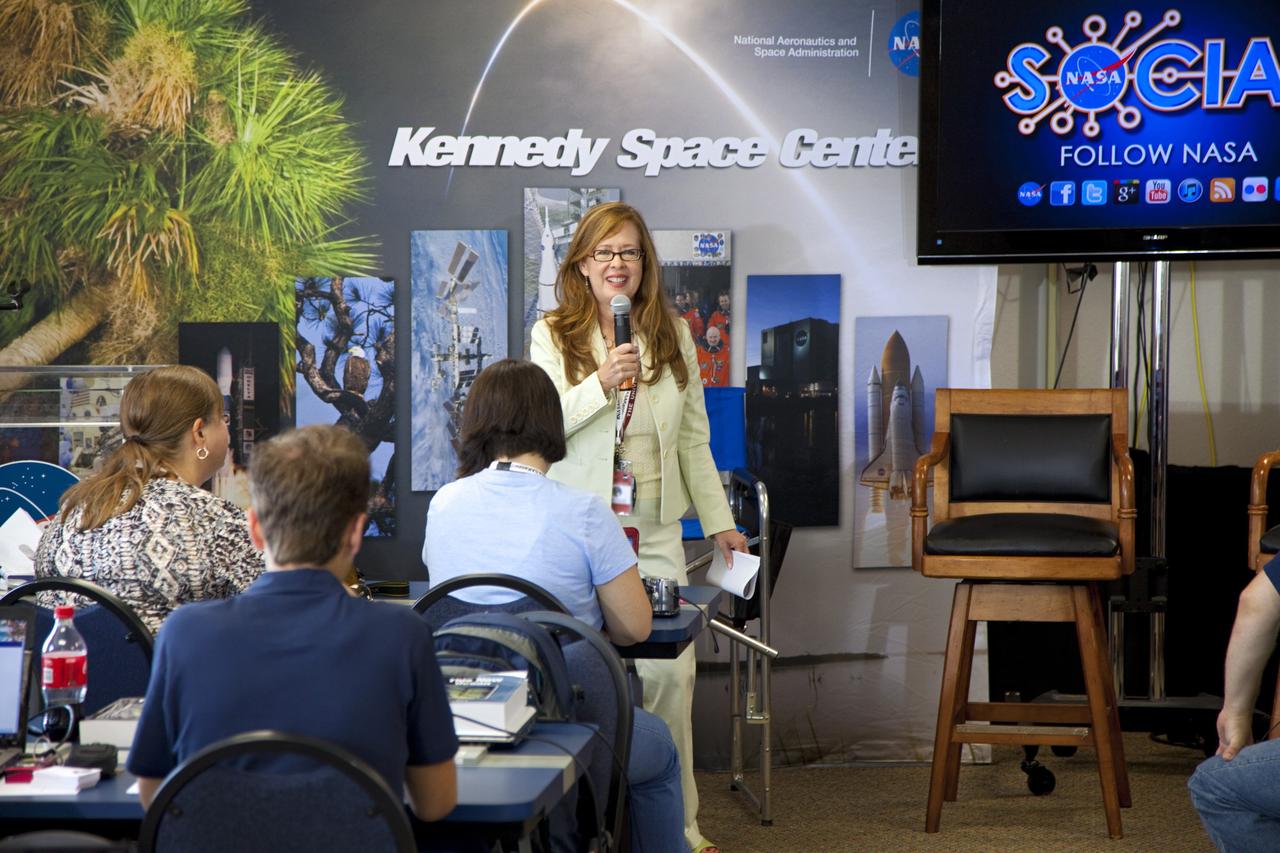
CAPE CANAVERAL, Fla. -- NASA Director of Public Affairs Lisa Malone welcomes about 45 of NASA’s social media followers for two days of presentations on the Kennedy Space Center's past, present and future. The social media participants gathered at the Florida spaceport on Aug. 2 and 3, 2012 to hear from key former and current leaders who related stories of the space agency's efforts to explore the unknown. It was the first social media event totally run by Kennedy. Photo credit: NASA/ Gianni Woods
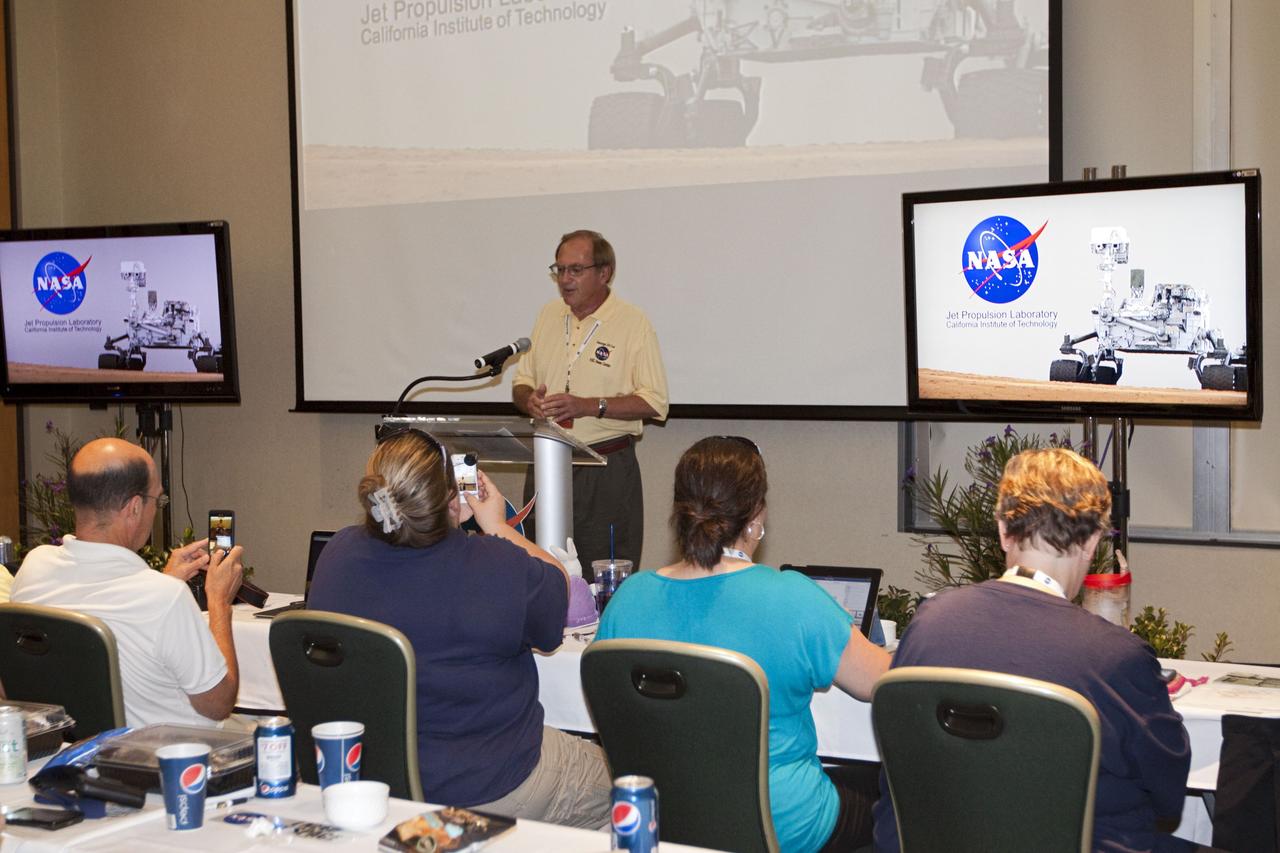
CAPE CANAVERAL, Fla. -- NASA Public Affairs Officer George Diller speaks to about 45 of NASA’s social media followers during two days of presentations on the Kennedy's past, present and future. The social media participants gathered at the Florida spaceport on Aug. 2 and 3, 2012 to hear from key former and current leaders who related stories of the space agency's efforts to explore the unknown. It was the first social media event totally run by Kennedy. Photo credit: NASA/ Kim Shiflett
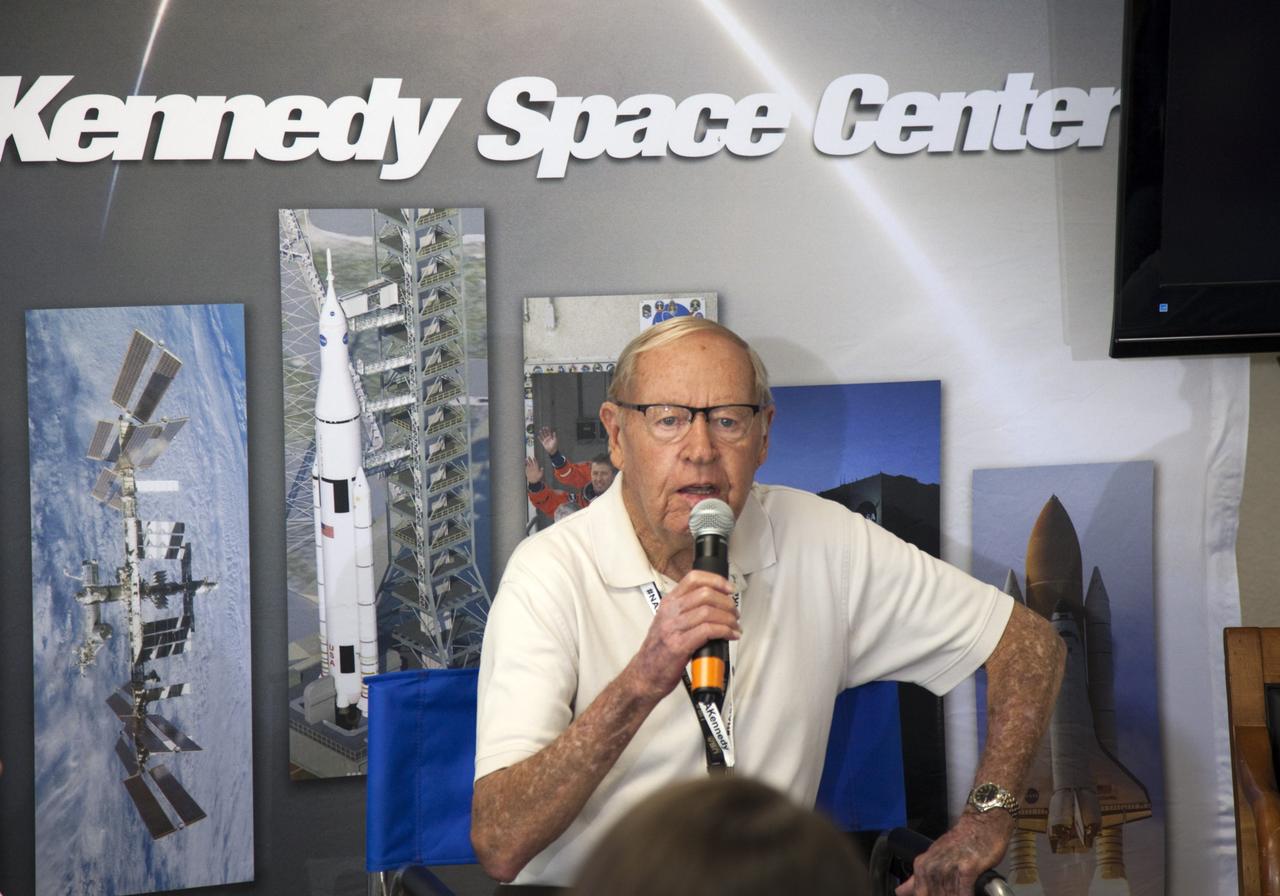
CAPE CANAVERAL, Fla. -- Jack King, former NASA chief of Public Information, speaks to about 45 of NASA’s social media followers for two days of presentations on the Kennedy Space Center's past, present and future. The social media participants gathered at the Florida spaceport on Aug. 2 and 3, 2012 to hear from key former and current leaders who related stories of the space agency's efforts to explore the unknown. It was the first social media event totally run by Kennedy. Photo credit: NASA/ Gianni Woods
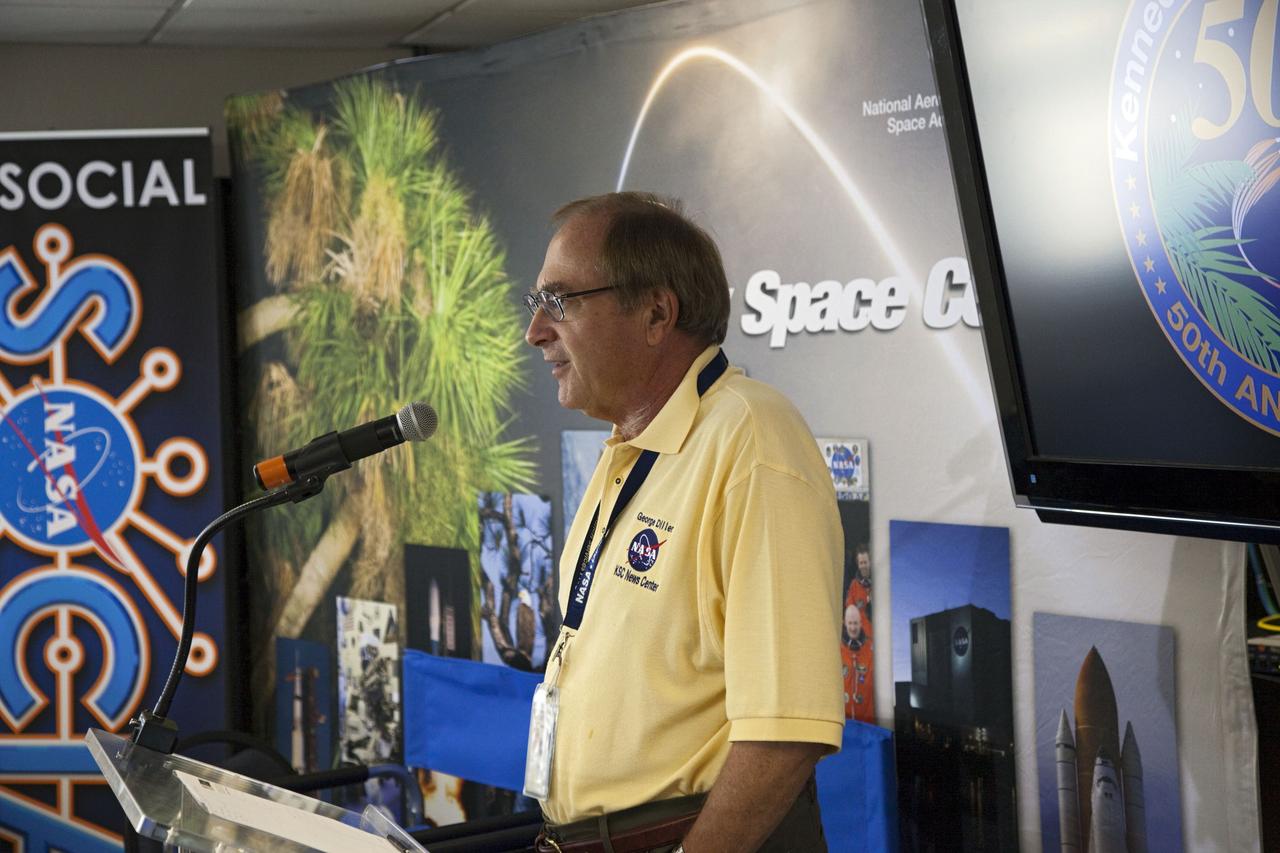
CAPE CANAVERAL, Fla. -- NASA Public Affairs Officer George Diller speaks to about 45 of NASA’s social media followers during two days of presentations on the Kennedy's past, present and future. The social media participants gathered at the Florida spaceport on Aug. 2 and 3, 2012 to hear from key former and current leaders who related stories of the space agency's efforts to explore the unknown. It was the first social media event totally run by Kennedy. Photo credit: NASA/ Gianni Woods
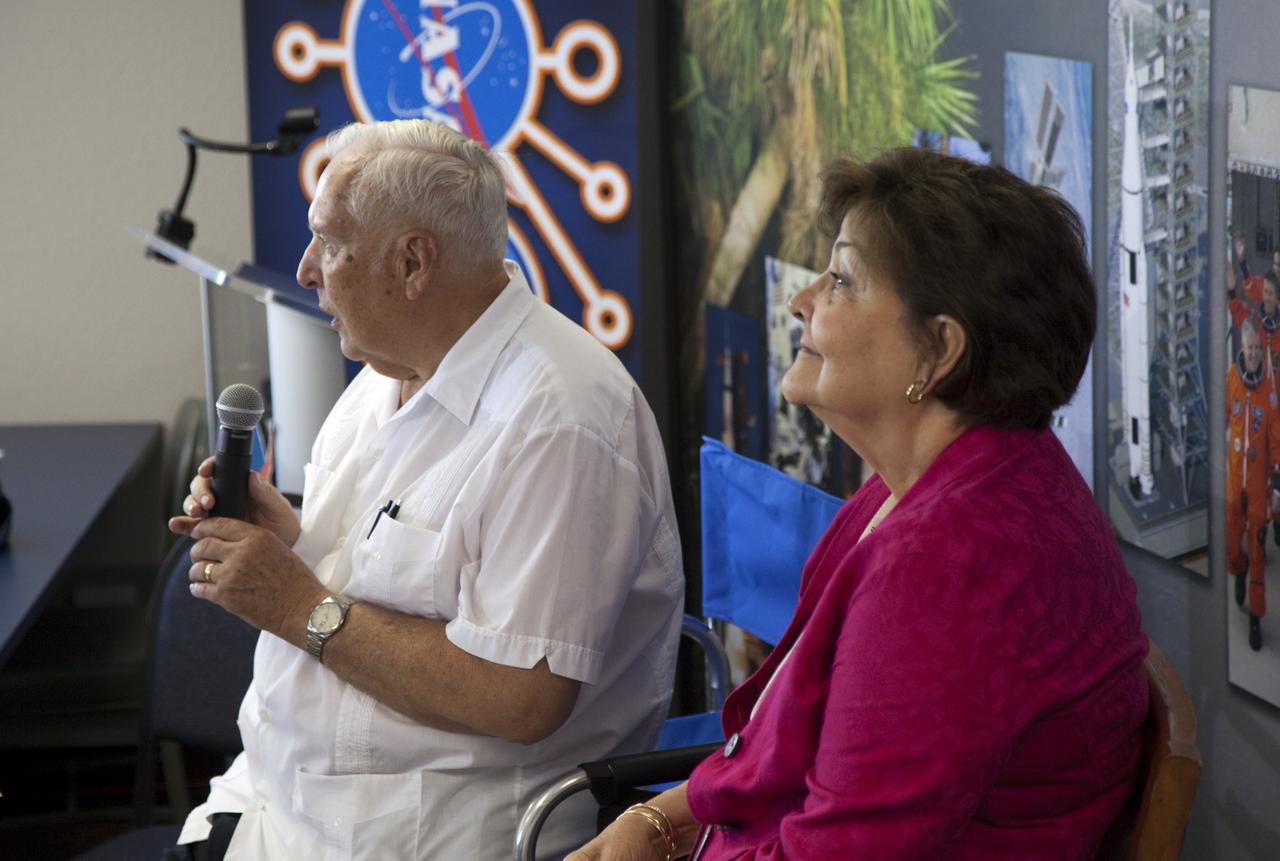
CAPE CANAVERAL, Fla. -- Former NASA Director of Public Affairs Hugh Harris, left, is joined by Jill Rock, of Kennedy's External Relations Office, in speaking to about 45 of NASA’s social media followers about the space agency's extensive efforts to host guests and VIPs over the years. They were among several speakers to address the participants during two days of presentations on the Kennedy Space Center's past, present and future. The social media participants gathered at the Florida spaceport on Aug. 2 and 3, 2012 to hear from key former and current leaders who related stories of the space agency's efforts to explore the unknown. It was the first social media event totally run by Kennedy. Photo credit: NASA/ Gianni Woods
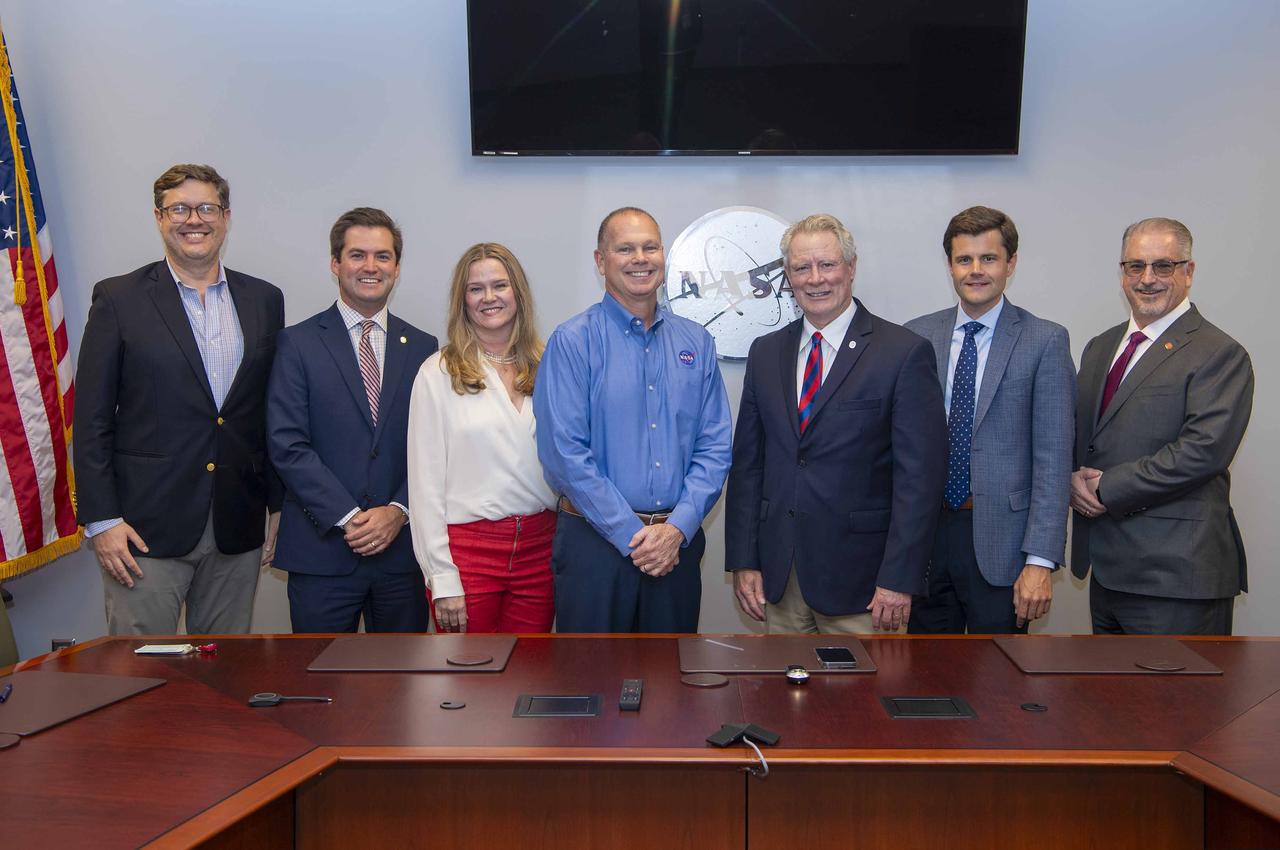
Mississippi Enterprise for Technology (MSET), a public-private partnership between Mississippi Development Authority, NASA, and Mississippi’s research institutions, hosted a visit for University of Mississippi leadership on Sept. 4 to NASA’s Stennis Space Center near Bay St. Louis, Mississippi. The visit showcased the center’s federal assets and the role Mississippi Enterprise for Technology plays in supporting industry and driving sustained economic development of the region and state. Pictured, from left to right, are: Davis Pace, president and CEO of MSET; William Kneip, director of External Relations and assistant to the Chancellor for Executive Affairs, University of Mississippi; Amy Lewis, executive director of Federal Relations, University of Mississippi; John Bailey, director of NASA Stennis; Dr. Glenn Boyce, chancellor of the University of Mississippi; Hughes Miller, senior director of Industry Engagement, University of Mississippi; and Dr. John Higginbotham, vice chancellor of Research and Economic Development, University of Mississippi.
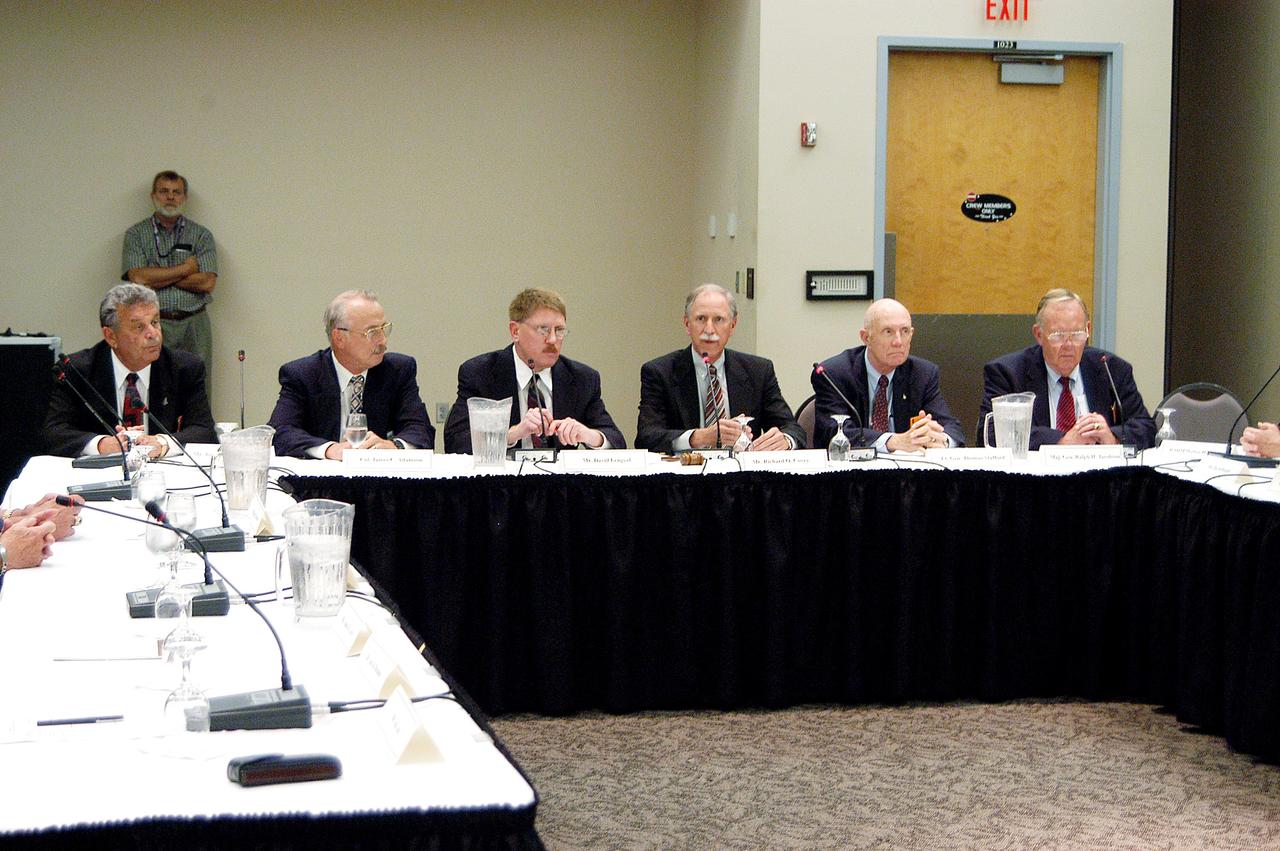
KENNEDY SPACE CENTER, FLA. - The Return To Flight Task Group (RTFTG) holds the first public meeting at the Debus Center, KSC Visitor Complex. Members and staff at this table, from left, are Joseph W. Cuzzupolui, retired Army Col. James C. Adamson, David Lenyel, co-chairs Richard O. Covey and retired Air Force Lt. Gen. Thomas Stafford, and retired Air Force Maj. Gen. Ralph H. Jacobson. Covey is a former astronaut and Shuttle commander. Stafford is a former astronaut and Apollo commander. The RTFTG was at KSC to conduct organizational activities, tour Space Shuttle facilities and receive briefings on Shuttle-related topics. The task group was chartered by NASA Administrator Sean O’Keefe to perform an independent assessment of NASA’s implementation of the final recommendations of the Columbia Accident Investigation Board.
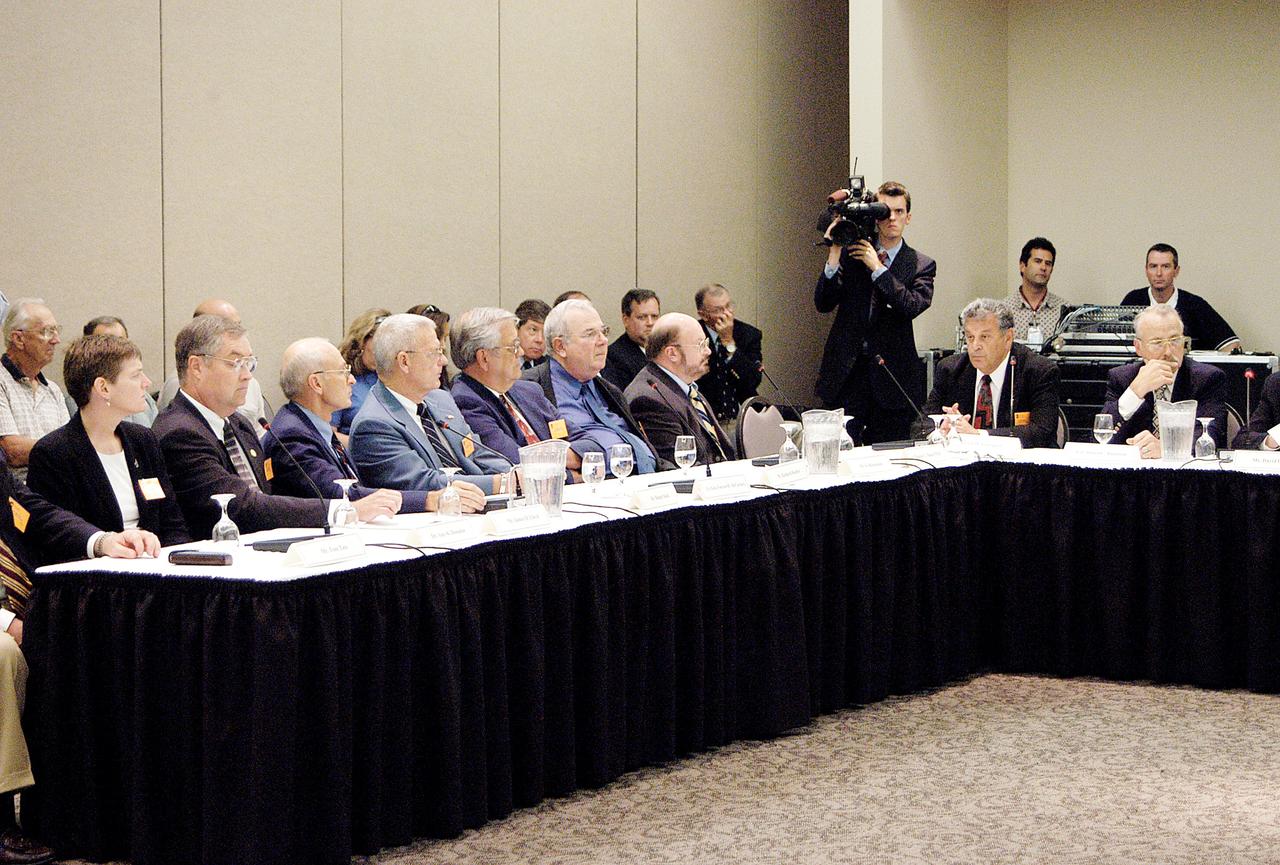
KENNEDY SPACE CENTER, FLA. - The Return To Flight Task Group (RTFTG) holds the first public meeting at the Debus Center, KSC Visitor Complex. Shown at the table on the left are Dr. Amy K. Donahue, James D. Lloyd, Robert Sieck, retired Air Force Lt. Gen. Forrest C. McCartney, Richard Kohrs, Sy Rubenstein and Dr. Charles C. Daniel. The group is co-chaired by former Shuttle commander Richard O. Covey and retired Air Force Lt. Gen. Thomas P. Stafford, who was an Apollo commander. The RTFTG was at KSC to conduct organizational activities, tour Space Shuttle facilities and receive briefings on Shuttle-related topics. The task group was chartered by NASA Administrator Sean O’Keefe to perform an independent assessment of NASA’s implementation of the final recommendations of the Columbia Accident Investigation Board.
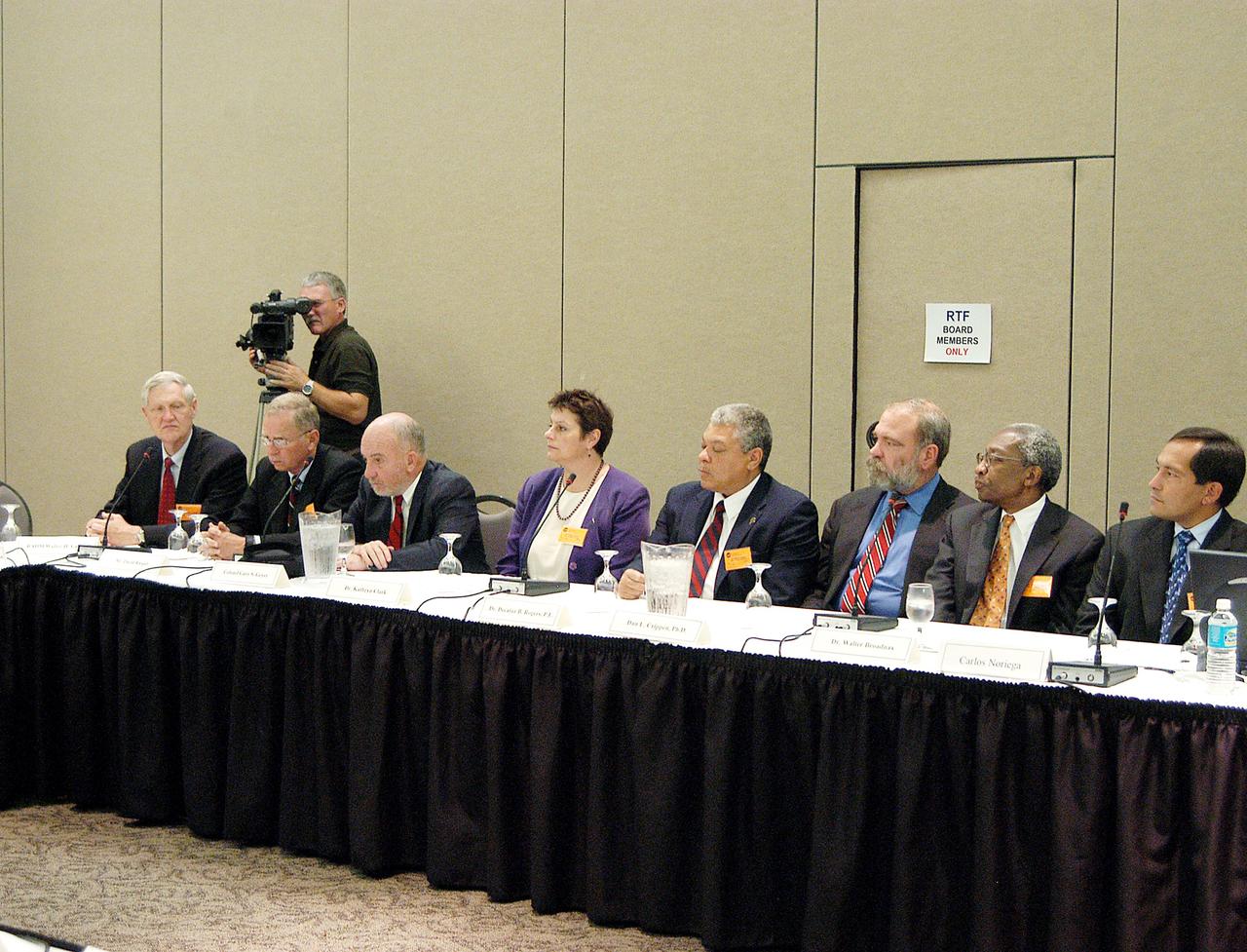
KENNEDY SPACE CENTER, FLA. - The Return To Flight Task Group (RTFTG) holds the first public meeting at the Debus Center, KSC Visitor Complex. Members and staff at the table, from left, are retired Navy Rear Adm. Walter H. Cantrell, David Raspet, retired Air Force Col. Gary S. Geyer, Dr. Kathryn Clark, Dr. Decatur B. Rogers, Dr. Dan L. Crippen, Dr. Walter Broadnax and astronaut Carlos Noriega. The RTFTG was at KSC to conduct organizational activities, tour Space Shuttle facilities and receive briefings on Shuttle-related topics. The task group was chartered by NASA Administrator Sean O’Keefe to perform an independent assessment of NASA’s implementation of the final recommendations of the Columbia Accident Investigation Board. The group is co-chaired by former Shuttle commander Richard O. Covey and retired Air Force Lt. Gen. Thomas P. Stafford, who was an Apollo commander.
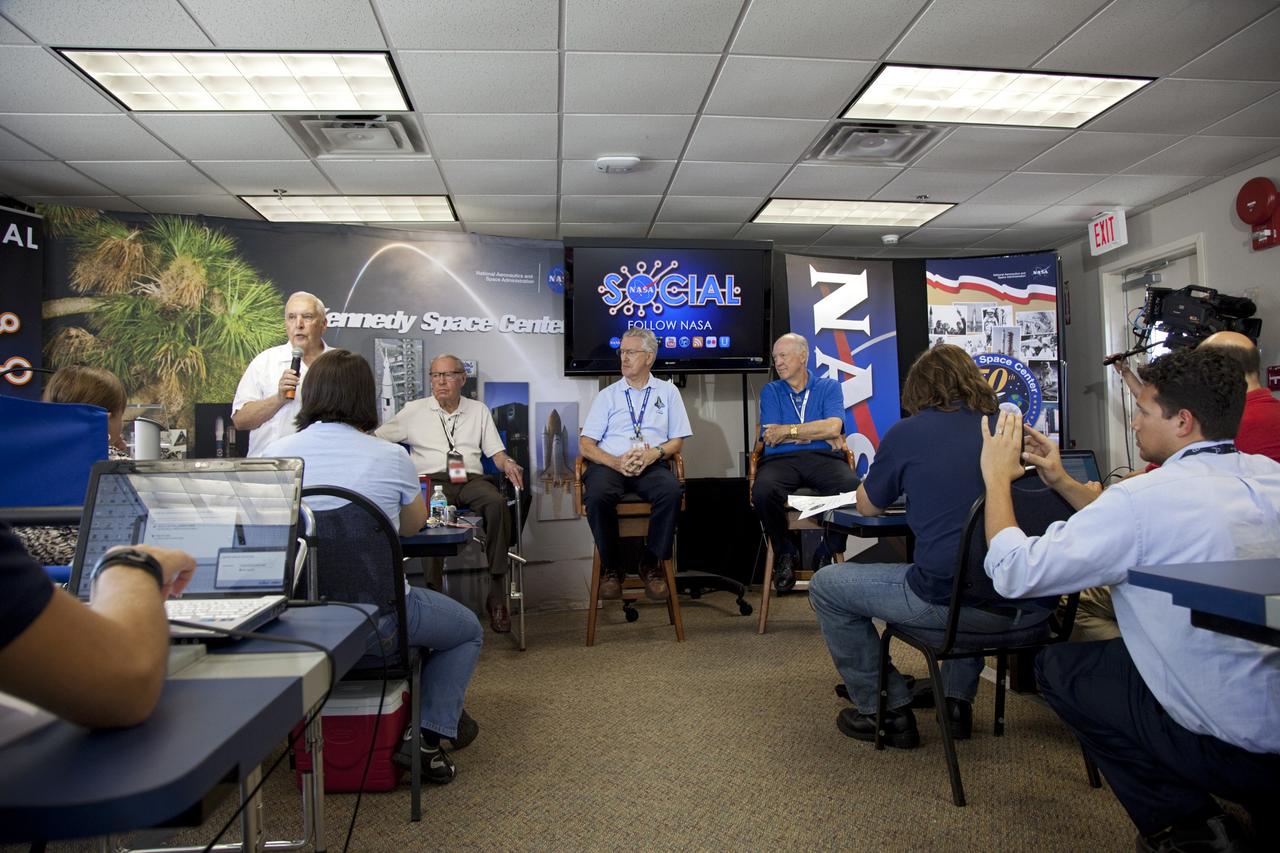
CAPE CANAVERAL, Fla. -- From the left, former NASA Director of Public Affairs Hugh Harris is joined by Jack King, former NASA chief of Public Information, John Tribe, retired chief engineer for Boeing/Rockwell Launch Support Services, and Roy Tharpe, president of Space Gateway Support, speak to about 45 of NASA’s social media followers for two days of presentations on the Kennedy Space Center's past, present and future. The social media participants gathered at the Florida spaceport on Aug. 2 and 3, 2012 to hear from key former and current leaders who related stories of the space agency's efforts to explore the unknown. It was the first social media event totally run by Kennedy. Photo credit: NASA/ Gianni Woods
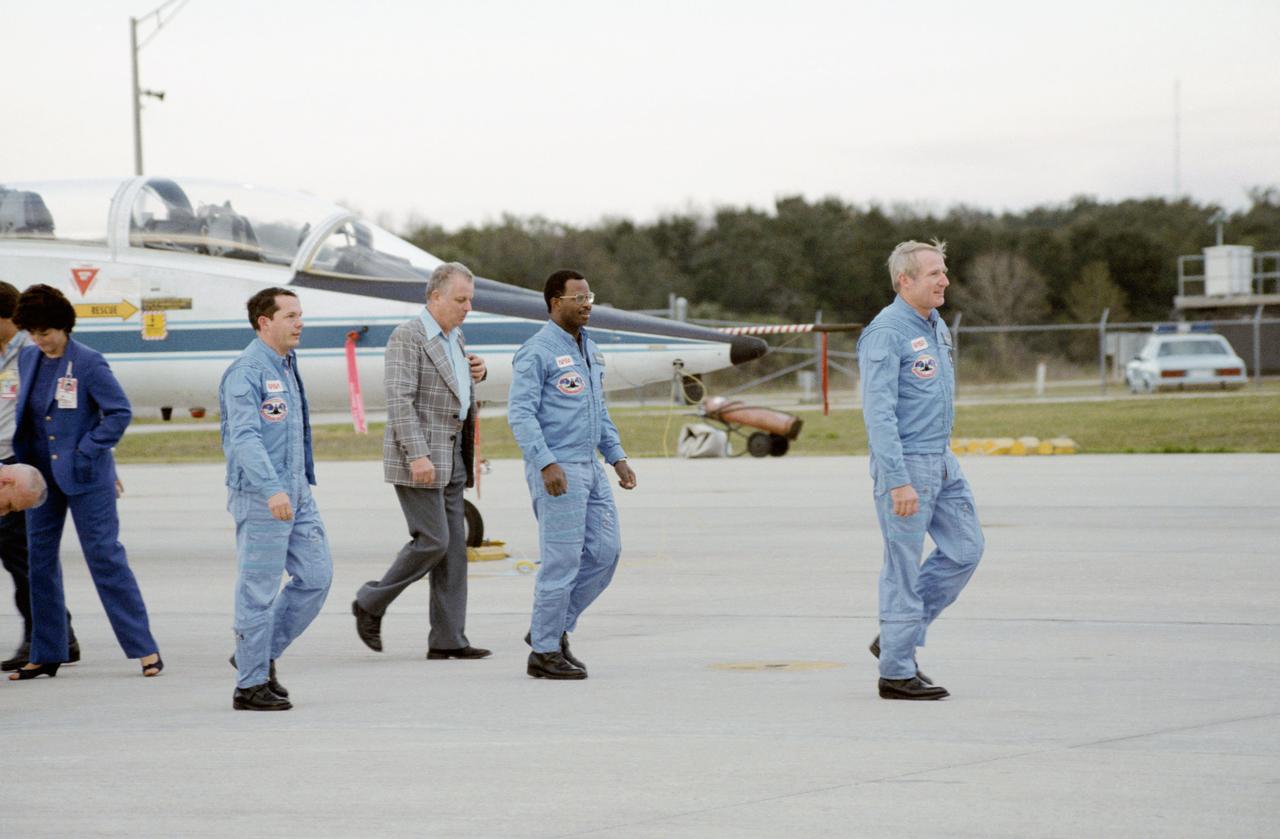
S84-26935 (31 Jan 1984) --- Three members of the STS 41-B astronaut crew arrive in Florida following a brief T-38 flight from Houston. Leading the crew from the flight line is Astronaut Vance D. Brand (right), crew commander. Following behind (in blue flight suits) are Astronauts Ronald E. McNair (center) and Robert L. Stewart (both mission specialists. They were met by Terry White (pictured), JSC public information industrial relations manager. Not pictured are Astronauts Robert L. Gibson, pilot; and Bruce McCandless II, mission specialist. Launch is scheduled for February 3, 1983.
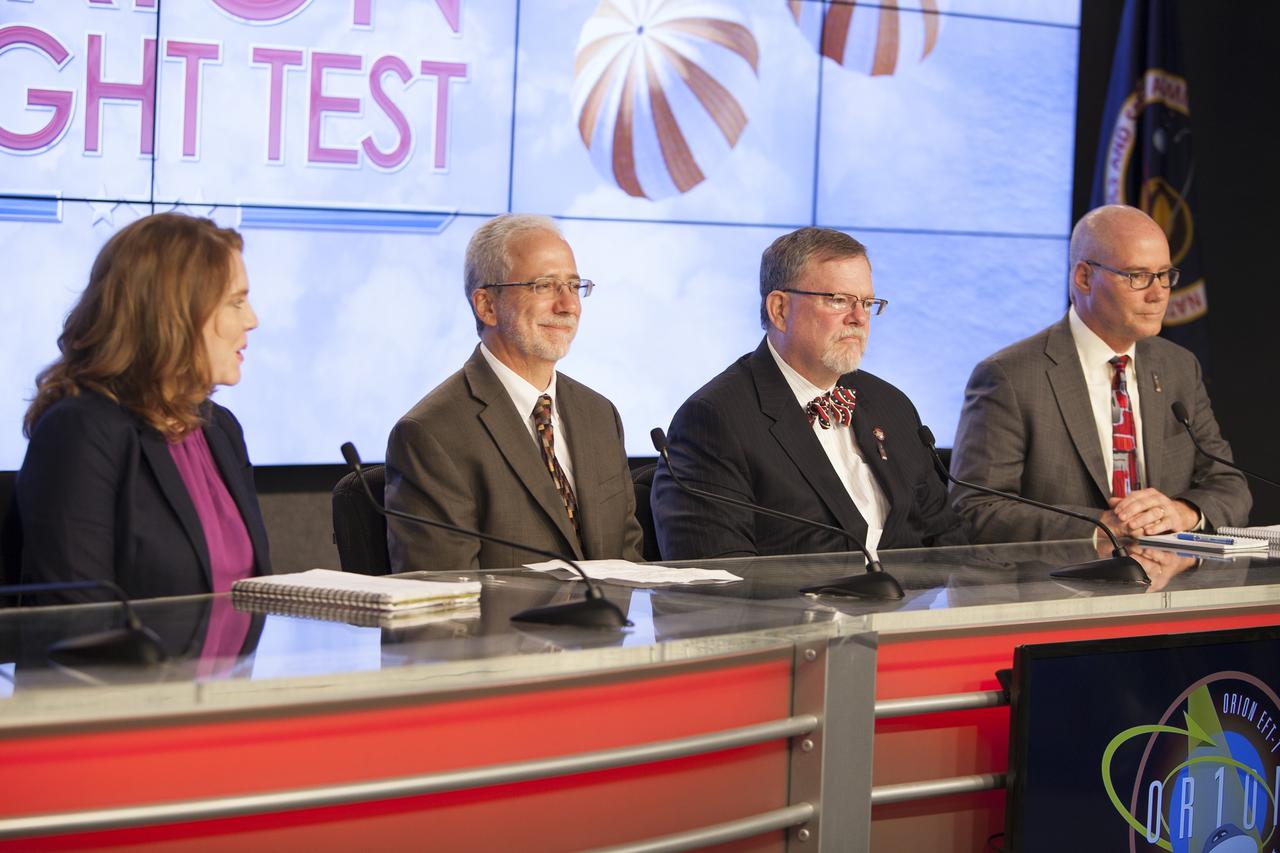
CAPE CANAVERAL, Fla. -- In the Kennedy Space Center’s Press Site auditorium, agency and industry leaders spoke to members of the news media about the postponement of the Orion Flight Test launch due to an issue related to fill and drain valves on the Delta IV Heavy rocket. From left are: Brandi Dean of NASA Public Affairs, Mark Geyer, NASA's Orion program manager, Mike Hawes, Lockheed Martin Orion Program manager, and Dan Collins, United Launch Alliance chief operating officer. For more information, visit www.nasa.gov/orion Photo credit: NASA/Frankie Martin
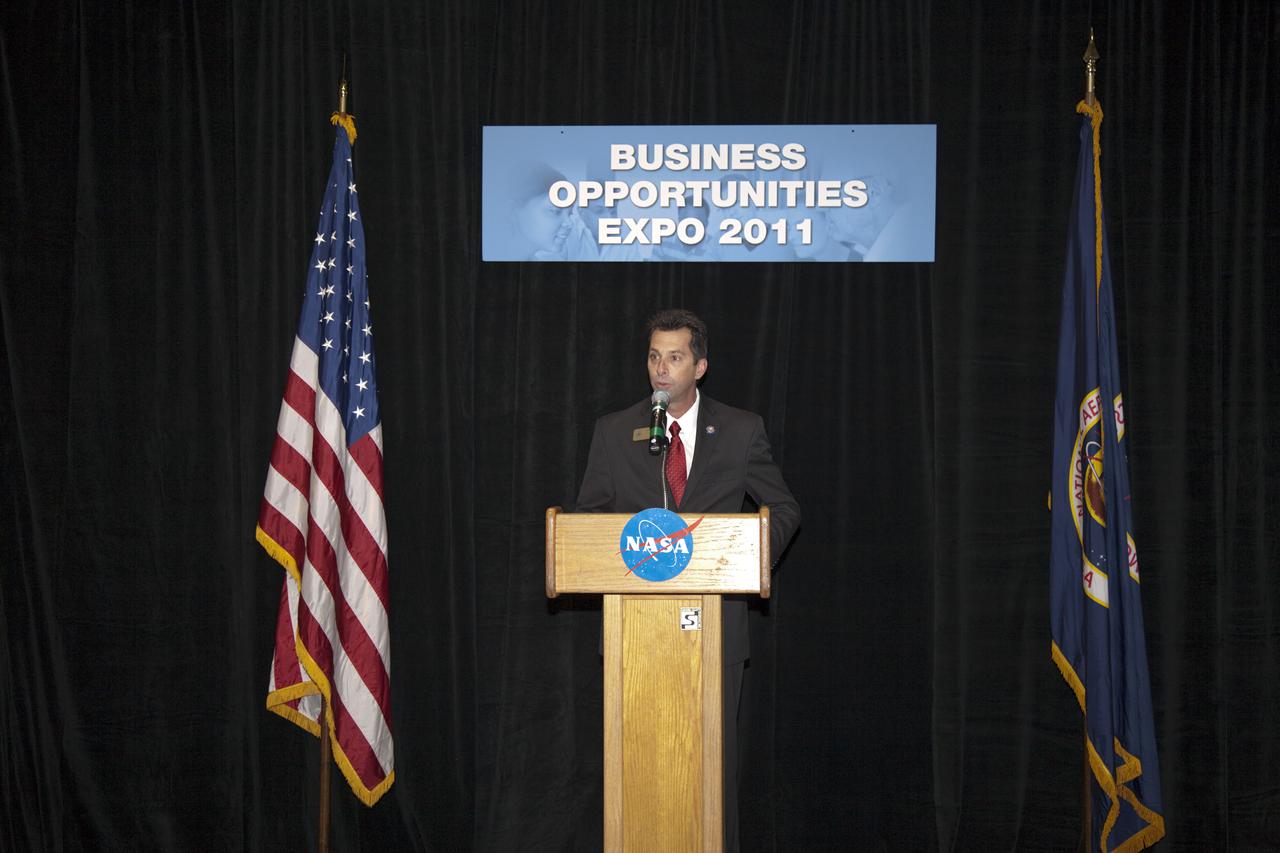
CAPE CANAVERAL, Fla. – Patrick D. Gavin, the director of community relations for Rep. Bill Posey, welcomes business leaders and other attendees to the annual Business Opportunities Expo 2011, in Cruise Terminal 4 at Port Canaveral in Florida. The trade show is sponsored by NASA Kennedy Space Center’s Prime Contractor Board, the 45th Space Wing and Canaveral Port Authority. The event is free and open to the public. It features about 175 business and government exhibitors from across the nation and Brevard County and is geared toward business leaders who are interested in learning more about government contracting and what local and national vendors have to offer. Photo credit: NASA_Gianni Woods
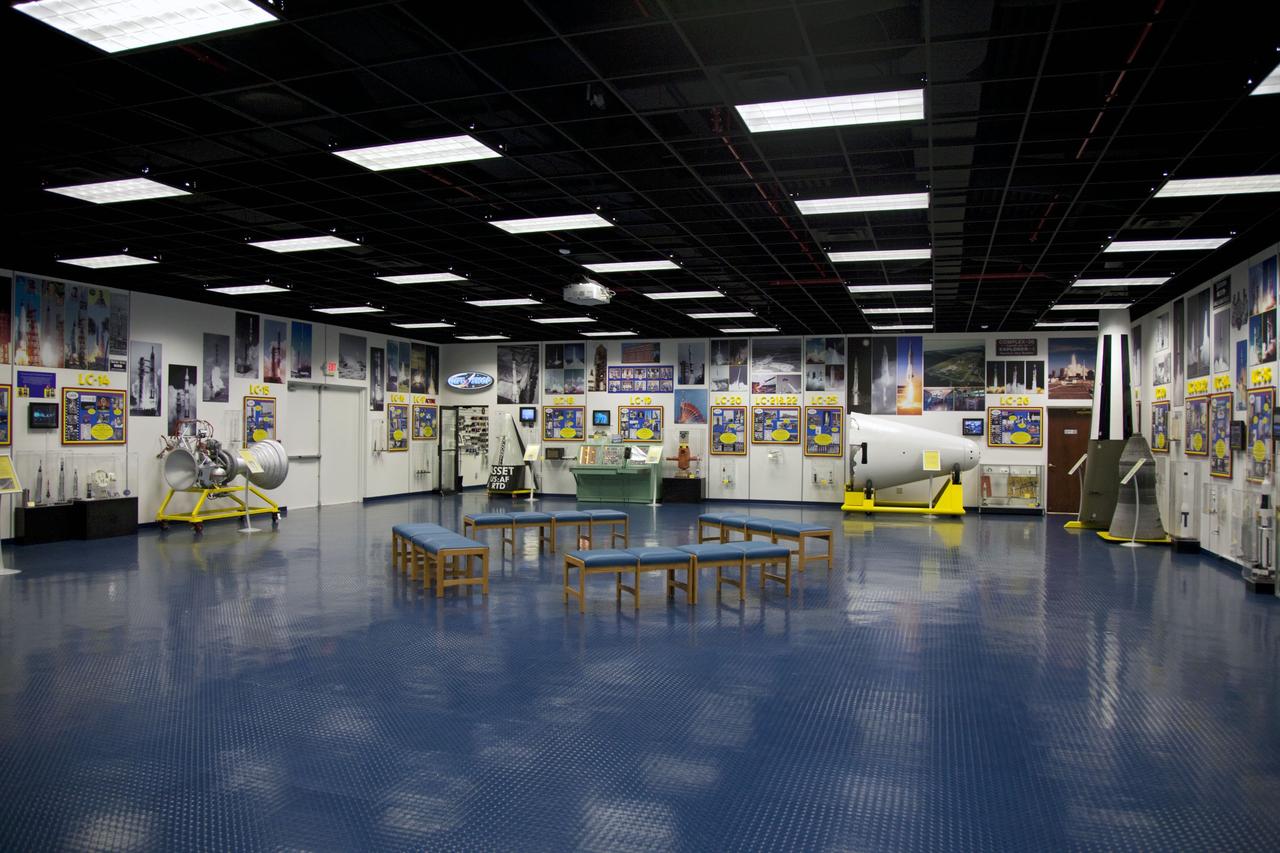
CAPE CANAVERAL, Fla. -- This is an inside view of the Air Force Space and Missile Museum's History Center, which is located outside the south gate of Cape Canaveral Air Force Station (CCAFS) in Florida. It contains historic information and displays for each launch complex at CCAFS. Since opening to the public in 1966, the museum has introduced millions of visitors to the history of rocketry and spaceflight. Its primary mission is to collect, restore and exhibit items of historical significance that relate to the development and heritage of U.S. Air Force space launch activities. Photo credit: NASA/Frankie Martin
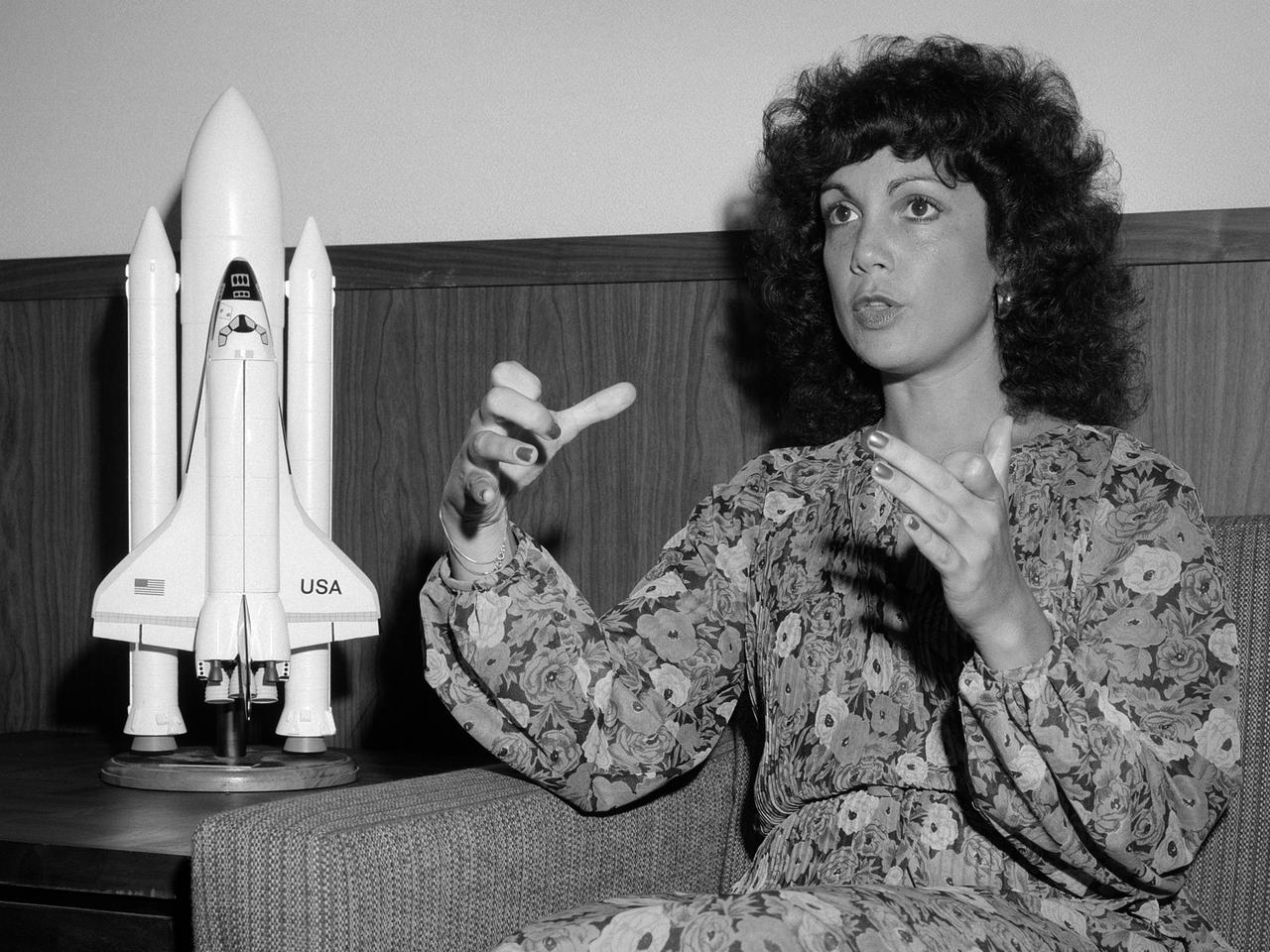
Astronaut Judy Resnik visits the National Aeronautics and Space Administration (NASA) Lewis Research Center on July 18, 1979, the tenth anniversary of the Apollo 11 mission. The event, sponsored by the center’s Public Information Office, was attended by Lewis staff, Cleveland-area media and personalities, and the public. During her time in Cleveland, Resnik appeared on a local television program, gave a press conference, lunched with NASA officials, addressed employees at Lewis, and then met the public at the center’s Visitors Information Center. Resnik related her recent experiences as one of the first US female astronauts and her duties as a mission specialist. The Akron, Ohio native earned a Bachelor’s degree in electrical engineering from Carnegie-Mellon University in 1970 and a doctorate in electrical engineering from the University of Maryland in 1977. Resnik served as a biomedic engineer and staff fellow in the Laboratory of Neurophysiology at the National Institutes of Health from 1974 to 1977, where she performed biological research experiments on visual systems. She served as a senior systems engineer in private industry prior to her selection as an astronaut. Resnik first flew as a mission specialist on STS 41-D, Discovery’s maiden flight, in 1984. Resnik was killed in the January 28, 1986 Challenger accident.
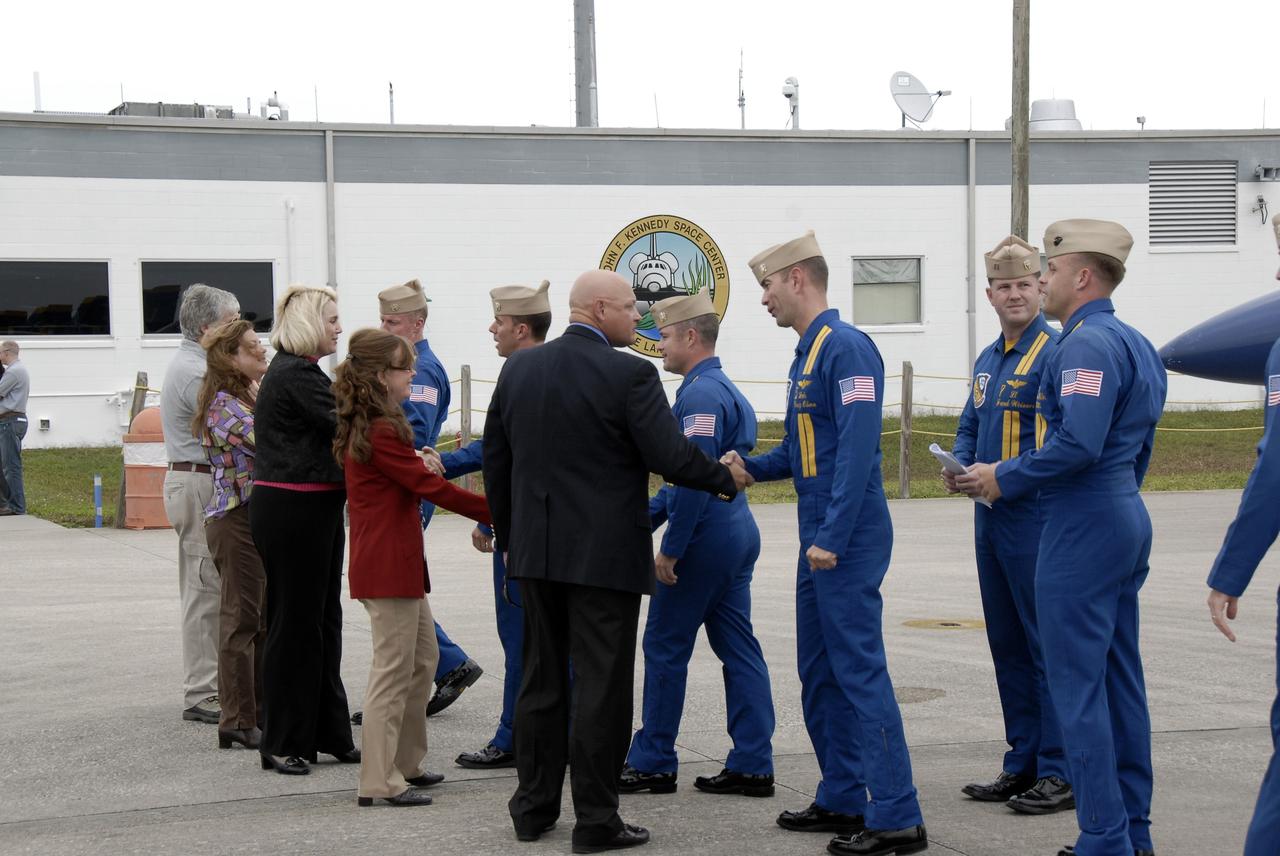
CAPE CANAVERAL, Fla. – At the Shuttle Landing Facility at NASA's Kennedy Space Center in Florida, the U.S. Navy's Blue Angel pilots and support team are greeted by (from right) Special Operations Director Joe Dowdy, External Relations Director Lisa Malone, External Relations Acting Deputy Director Cheryl Hurst and Pam Steele, chief of the Public Services Division at Kennedy. The Blue Angels will perform at the Kennedy Space Center Visitor Complex Space and Air Show Nov. 8-9. The Navy's elite flight demonstration squadron will take to the skies in military aircraft demonstrations by the F-16 Fighting Falcon and F/A-18 Super Hornet jets for the second annual Space & Air Show at Kennedy. This year’s show brings together the best in military aircraft, coupled with precision pilots and veteran astronauts to celebrate spaceflight and aviation. The event includes military aircraft demonstrations by the F-16 Fighting Falcon and a water rescue demonstration by the 920th Rescue Wing. Photo credit: NASA/Kim Shiflett
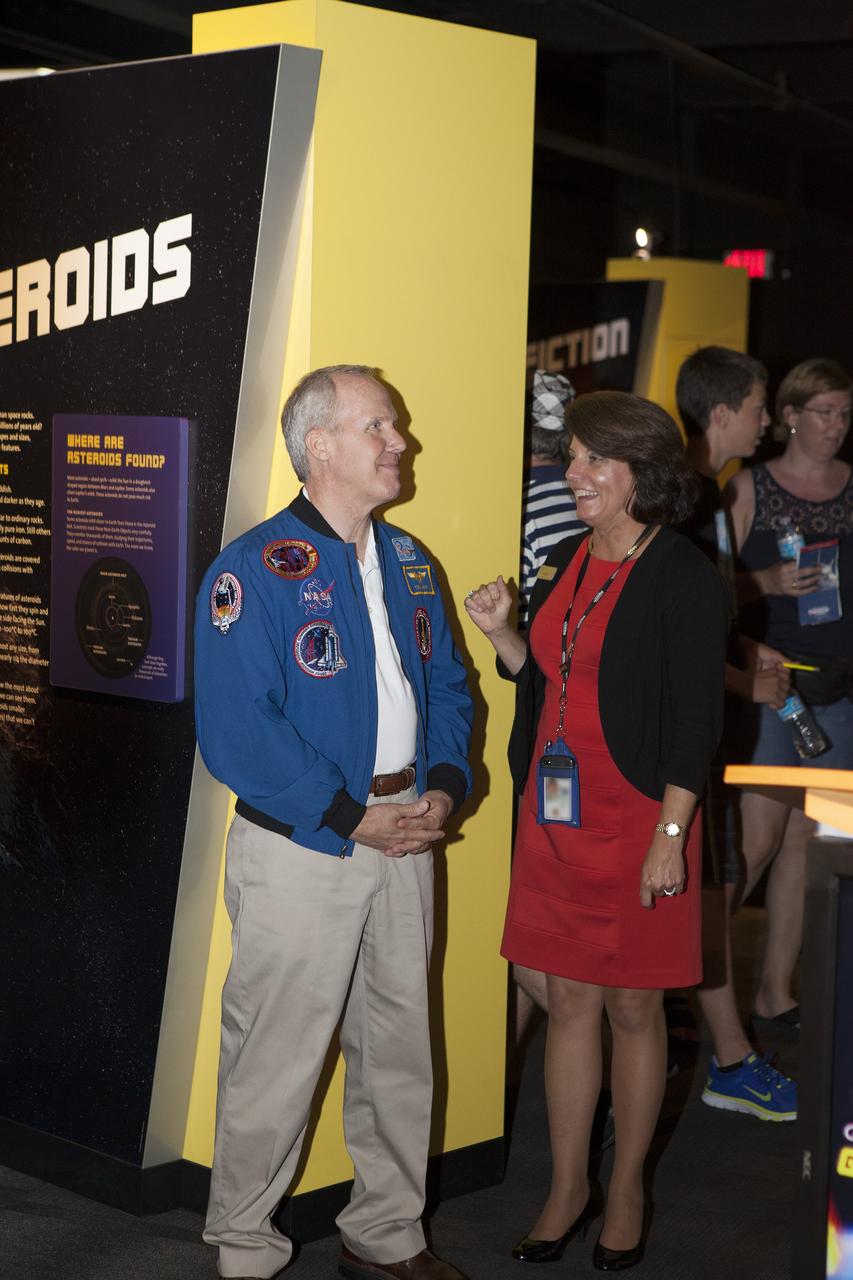
CAPE CANAVERAL, Fla. – Former NASA astronaut Tom Jones, left, joins Andrea Farmer, senior public relations manager with Delaware North Parks and Resorts at NASA Kennedy Space Center Visitor Complex in Florida, for the grand opening of the Great Balls of Fire exhibit. Great Balls of Fire shares the story of the origins of our solar system, asteroids and comets and their possible impacts and risks. The 1,500-square-foot exhibit, located in the East Gallery of the IMAX theatre at the visitor complex, features several interactive displays, real meteorites and replica asteroid models. The exhibit is a production of The Space Science Institute's National Center for Interactive Learning. It is a traveling exhibition that also receives funding from NASA and the National Science Foundation. Photo credit: NASA/Daniel Casper
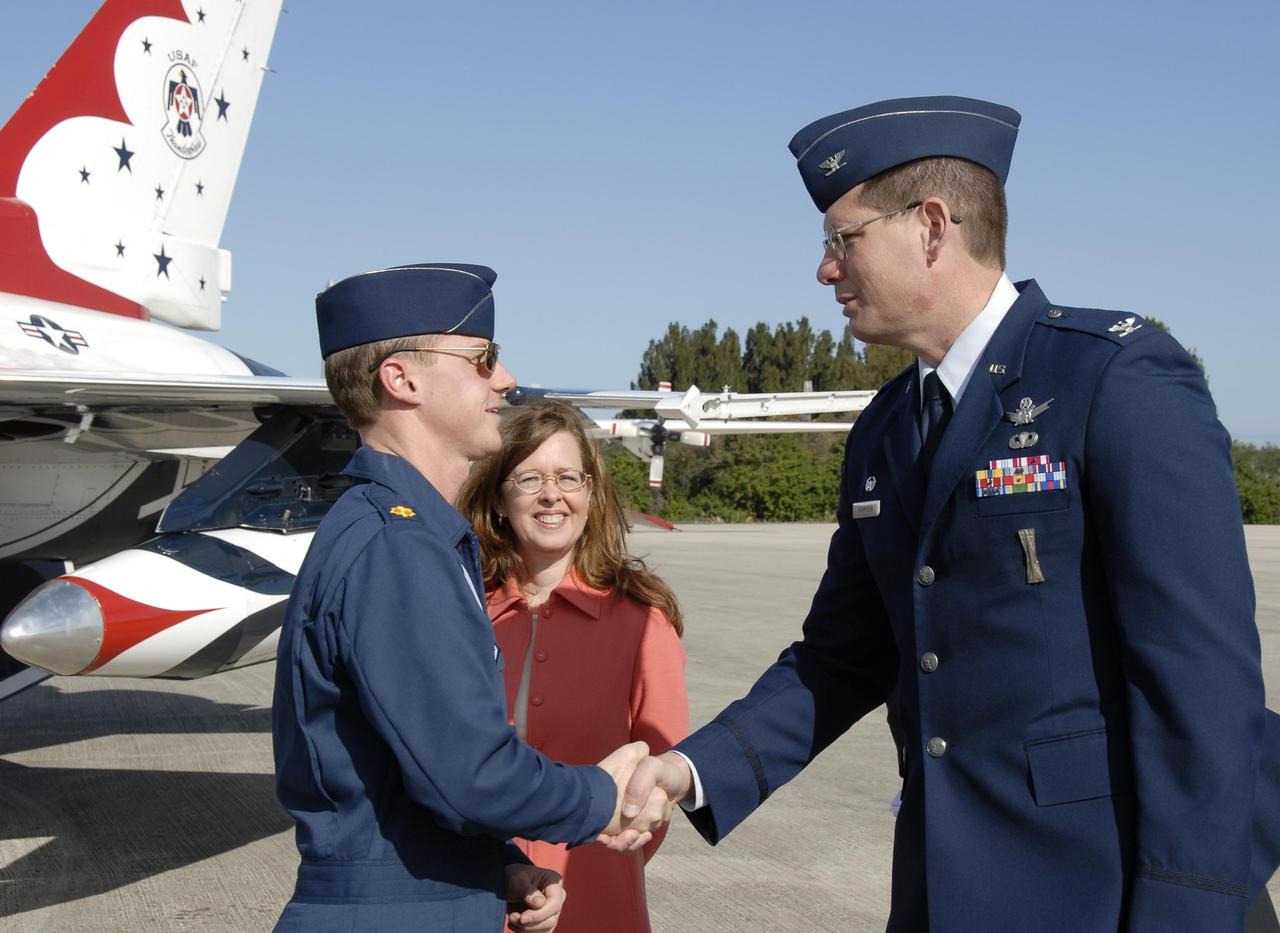
KENNEDY SPACE CENTER, FLA. -- The U.S. Air Force Thunderbird F-16D pilot Maj. Tad Clark is greeted by Col. Dave Thompson with the U.S. Air Force 45th Space Wing. Between them is Lisa Malone, director of External Relations at KSC. Clark flew in to KSC to announce to waiting media that the Visitor Complex will host the inaugural World Space Expo from Nov. 3 to 11. The Expo, which will feature an aerial salute by the Thunderbirds on its opening weekend, will create one of the largest displays of space artifacts, hardware and personalities ever assembled in one location with the objective to inspire, educate and engage the public by highlighting the achievements and benefits of space exploration. Photo credit: NASA/Kim Shiflett
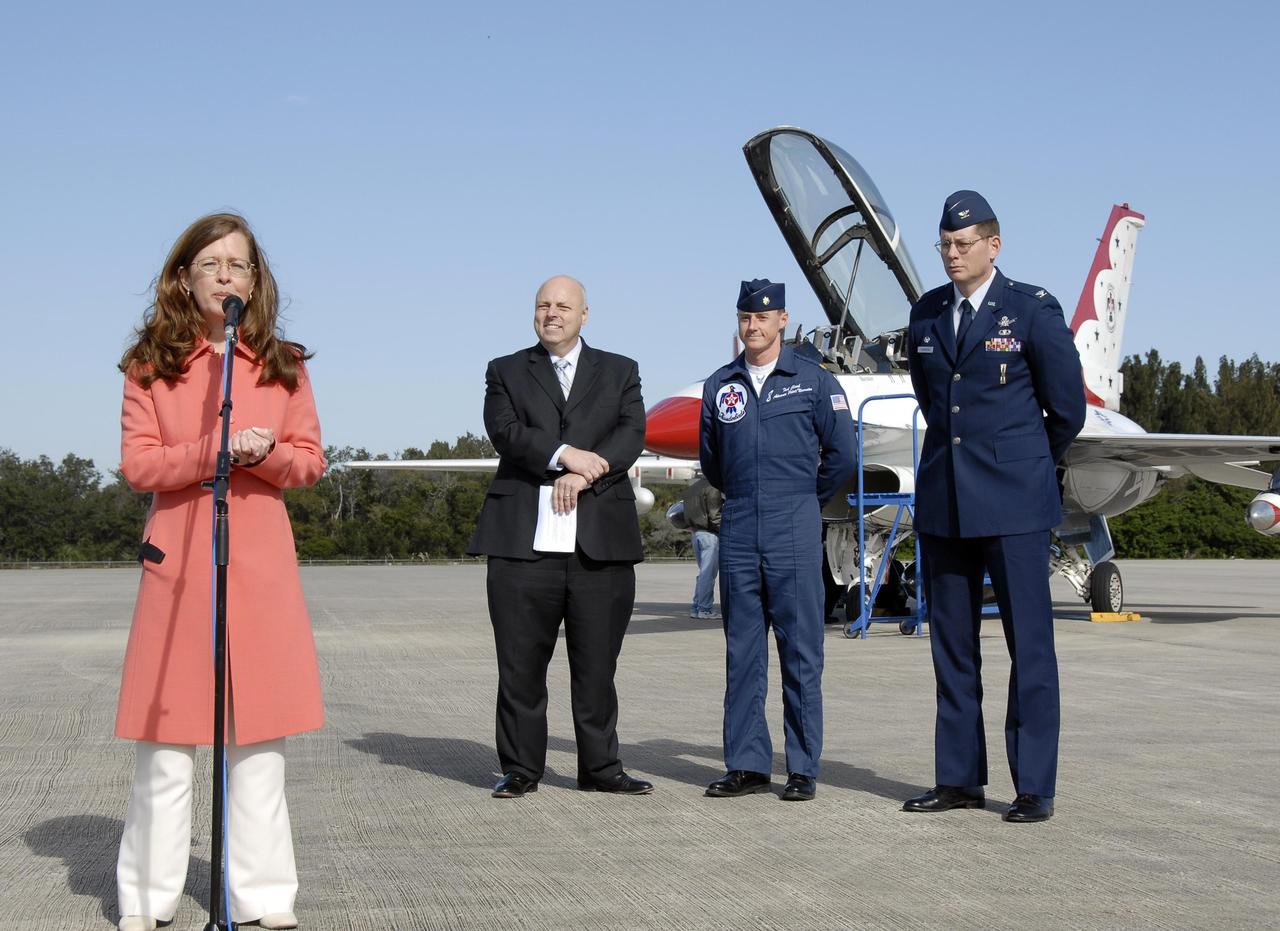
KENNEDY SPACE CENTER, FLA. -- Lisa Malone, director of External Relations at KSC, talks to the media at the KSC Shuttle Landing Facility about the arrival of Maj. Tad Clark, pilot of the U.S. Air Force Thunderbird F-16D (background). Clark flew in to KSC to announce to waiting media that the Visitor Complex will host the inaugural World Space Expo from Nov. 3 to 11. Behind Malone are (from left) Dan LeBlanc, chief operating officer of the KSC Visitor Complex, Clark, and Col. Dave Thompson with the U.S. Air Force 45th Space Wing. The Expo, which will feature an aerial salute by the Thunderbirds on its opening weekend, will create one of the largest displays of space artifacts, hardware and personalities ever assembled in one location with the objective to inspire, educate and engage the public by highlighting the achievements and benefits of space exploration. Photo credit: NASA/Kim Shiflett
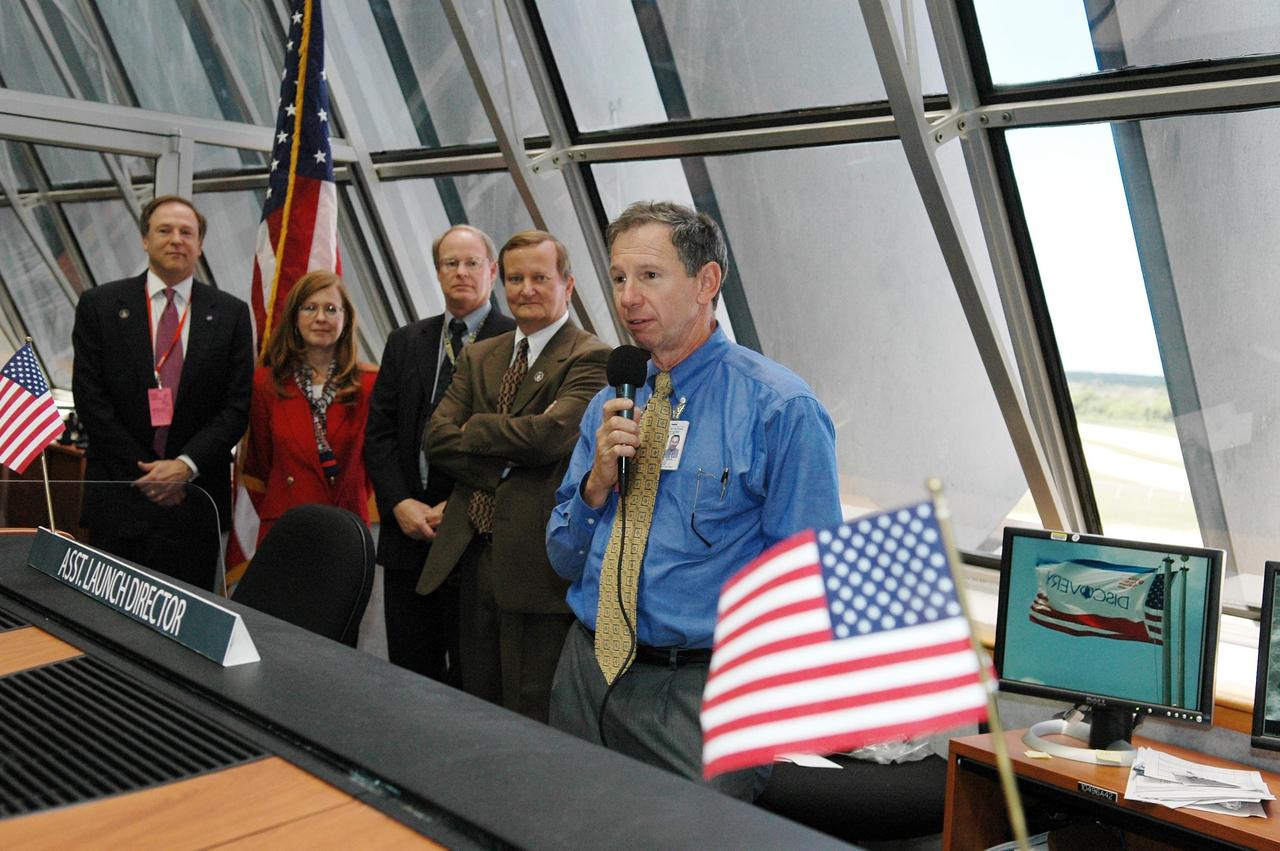
KENNEDY SPACE CENTER, FLA. - In Firing Room 4 of the Launch Control Center, NASA Administrator Mike Griffin congratulates the launch team on the successful launch of Space Shuttle Discovery on mission STS-121. The launch was the first ever to take place on Independence Day. Liftoff was on-time at 2:38 p.m. EDT. Others next to Griffin are (left to right) David R. Mould, assistant administrator for NASA Public Affairs ; Lisa Malone, director of External Relations at Kennedy; Bruce Buckingham, news chief at the NASA News Center at Kennedy; and Mike Leinbach, Shuttle Program director. During the 12-day mission, the STS-121 crew of seven will test new equipment and procedures to improve shuttle safety, as well as deliver supplies and make repairs to the International Space Station. Landing is scheduled for July 16 or 17 at Kennedy's Shuttle Landing Facility. Photo credit: NASA/Kim Shiflett
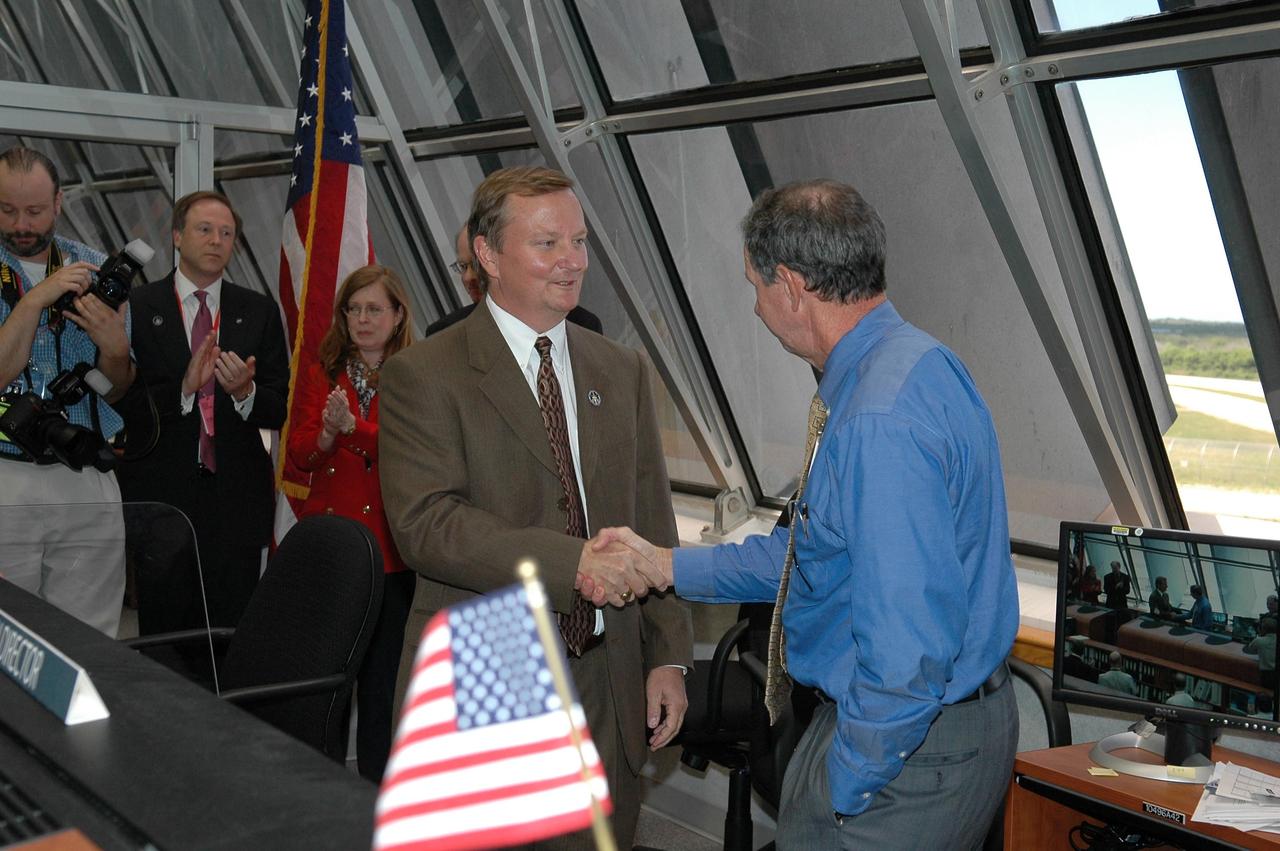
KENNEDY SPACE CENTER, FLA. - In Firing Room 4 of the Launch Control Center, Shuttle Launch Director Mike Leinbach (center) is congratulated by NASA Administrator Mike Griffin (right) for the successful launch of Space Shuttle Discovery on mission STS-121. The launch was the first ever to take place on Independence Day. Behind Leinbach are David R. Mould, assistant administrator for Public Affairs NASA, and Lisa Malone, director of External Relations at Kennedy. Liftoff was on-time at 2:38 p.m. EDT. During the 12-day mission, the STS-121 crew of seven will test new equipment and procedures to improve shuttle safety, as well as deliver supplies and make repairs to the International Space Station. Landing is scheduled for July 16 or 17 at Kennedy's Shuttle Landing Facility. Photo credit: NASA/Kim Shiflett
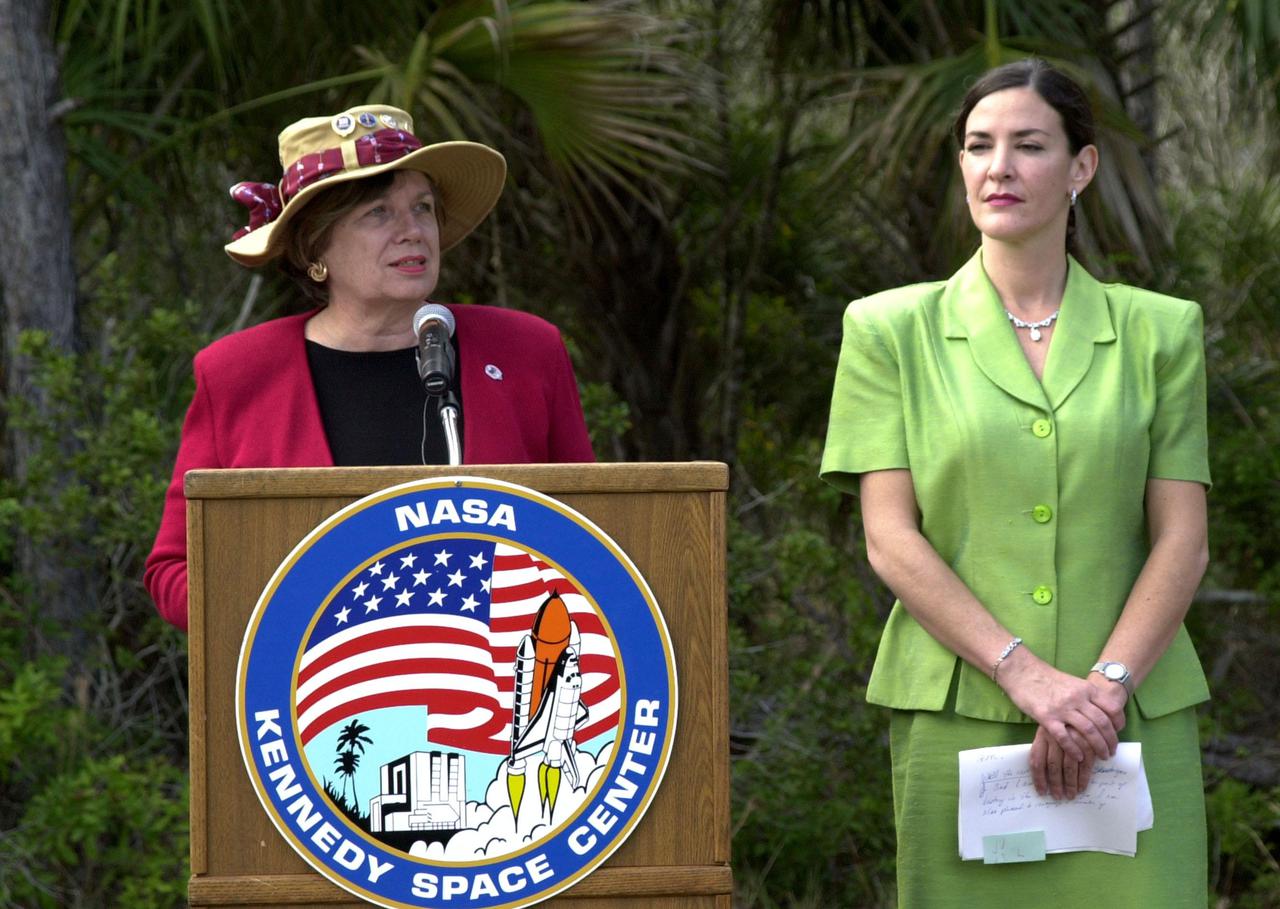
Masters of Ceremony JoAnn H. Morgan, director of External Relations and Business Development at KSC, and Dr. Pamella J. Dana, director of the Office of Tourism, Trade and Economic Development in Florida, introduce guests at a groundbreaking held outdoors on S.R. 3. The groundbreaking is for a roadway, to be known as Space Commerce Way, that will serve the public by providing a 24-hour access route through KSC from S.R. 3 to the NASA Causeway and KSC Visitor Complex. It is the start of a construction project that includes the Space Experiment Research and Processing Laboratory (SERPL). The project is enabled by a partnership and collaboration between NASA and the State of Florida to create a vital resource for international and commercial space customers. SERPL is considered a magnet facility, and will support the development and processing of life sciences experiments destined for the International Space Station and accommodate NASA, industry and academic researchers performing associated biological research
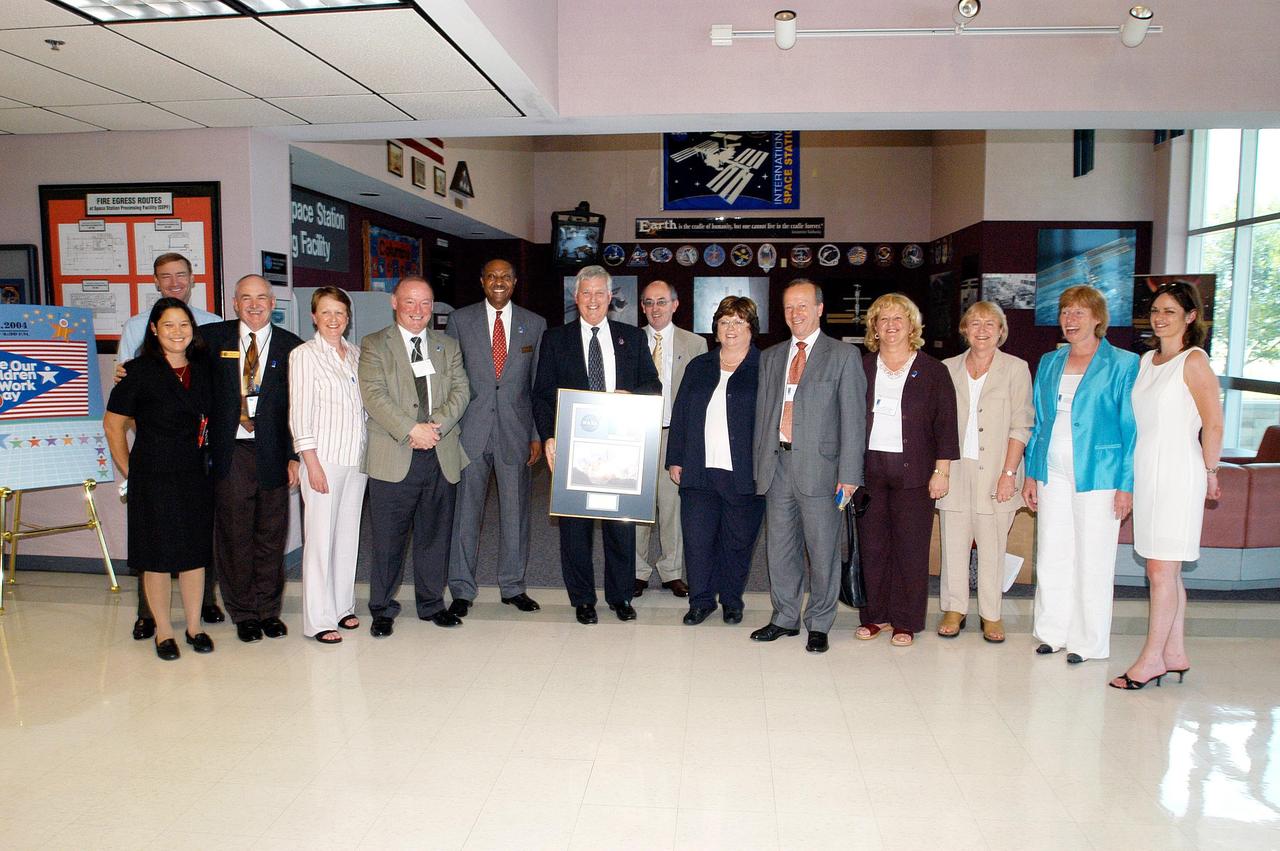
KENNEDY SPACE CENTER, FLA. - In the Space Station Processing Facility, Center Director Jim Kennedy holds a framed photo to be presented to Mary Harney , Tanaiste (Deputy Prime Minister) and Minister for Enterprise, Trade and Employment of Ireland (at his left). Harney is visiting KSC to support a Memorandum of Understanding between Florida Spaceport Authority and the Irish government’s training and employment authority (FAS). The joint initiative enables Irish students to work with science and engineering experts during a six-week program in Florida. On Kennedy’s right is FSA Director Capt. Winston Scott. Next to Harney is Paul Haran, secretary to the deputy prime minister. Gathered here with Harney, Haran, Kennedy and Scott are Bridget Flynn, assistant to Harney; Brian Joseph Geoghegan, director of FAS; Roderick Peter Molloy, director general of FAS, and Noreen Molloy, his wife; Caitriona White, FAS public relations manager; Anne Haran; and Roisin McCann, Dept. of Enterprise, Trade and Employment.
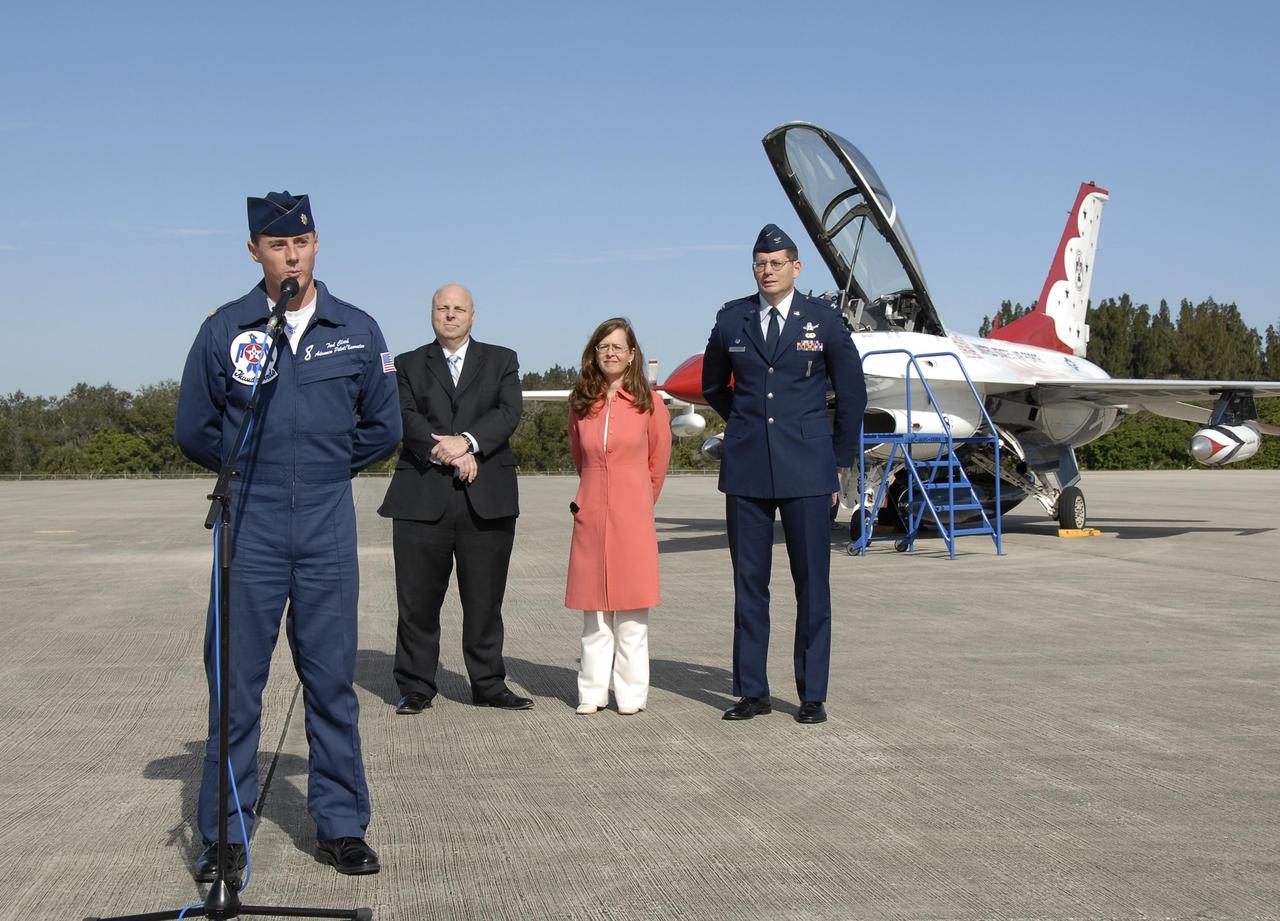
KENNEDY SPACE CENTER, FLA. -- Maj. Tad Clark, pilot of the U.S. Air Force Thunderbird F-16D (background), announces to waiting media that the KSC Visitor Complex will host the inaugural World Space Expo from Nov. 3 to 11. Behind Clark are (from left) Dan LeBlanc, chief operating officer of the KSC Visitor Complex, Lisa Malone, director of External Relations at KSC, and Col. Dave Thompson with the U.S. Air Force 45th Space Wing. The Expo, which will feature an aerial salute by the Thunderbirds on its opening weekend, will create one of the largest displays of space artifacts, hardware and personalities ever assembled in one location with the objective to inspire, educate and engage the public by highlighting the achievements and benefits of space exploration. Photo credit: NASA/Kim Shiflett
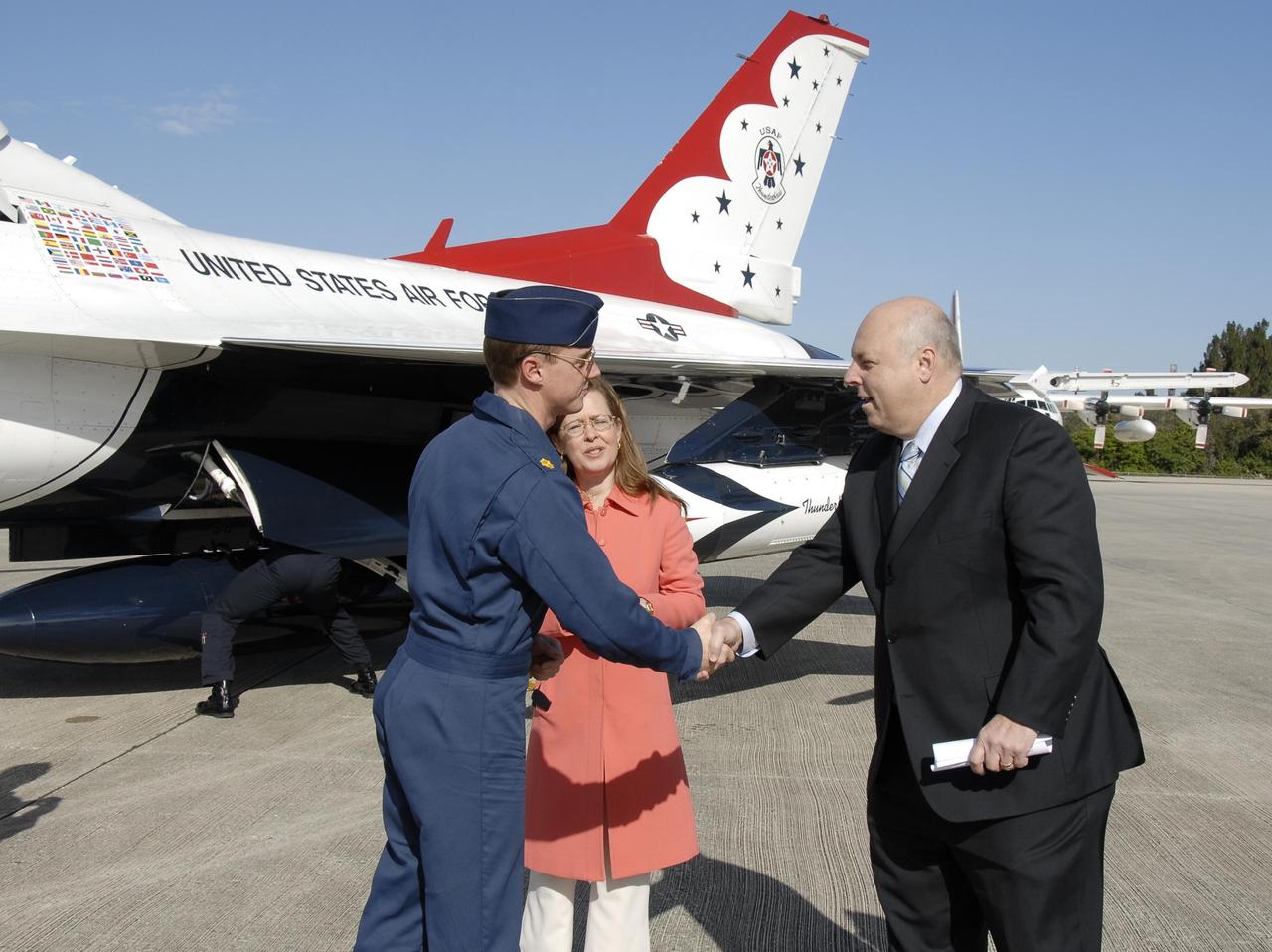
KENNEDY SPACE CENTER, FLA. -- The U.S. Air Force Thunderbird F-16D pilot Maj. Tad Clark is greeted by Dan LeBlanc, chief operating officer of the KSC Visitor Complex. Between them is Lisa Malone, director of External Relations at KSC. Clark flew in to KSC to announce to waiting media that the Visitor Complex will host the inaugural World Space Expo from Nov. 3 to 11. The Expo, which will feature an aerial salute by the Thunderbirds on its opening weekend, will create one of the largest displays of space artifacts, hardware and personalities ever assembled in one location with the objective to inspire, educate and engage the public by highlighting the achievements and benefits of space exploration. Photo credit: NASA/Kim Shiflett
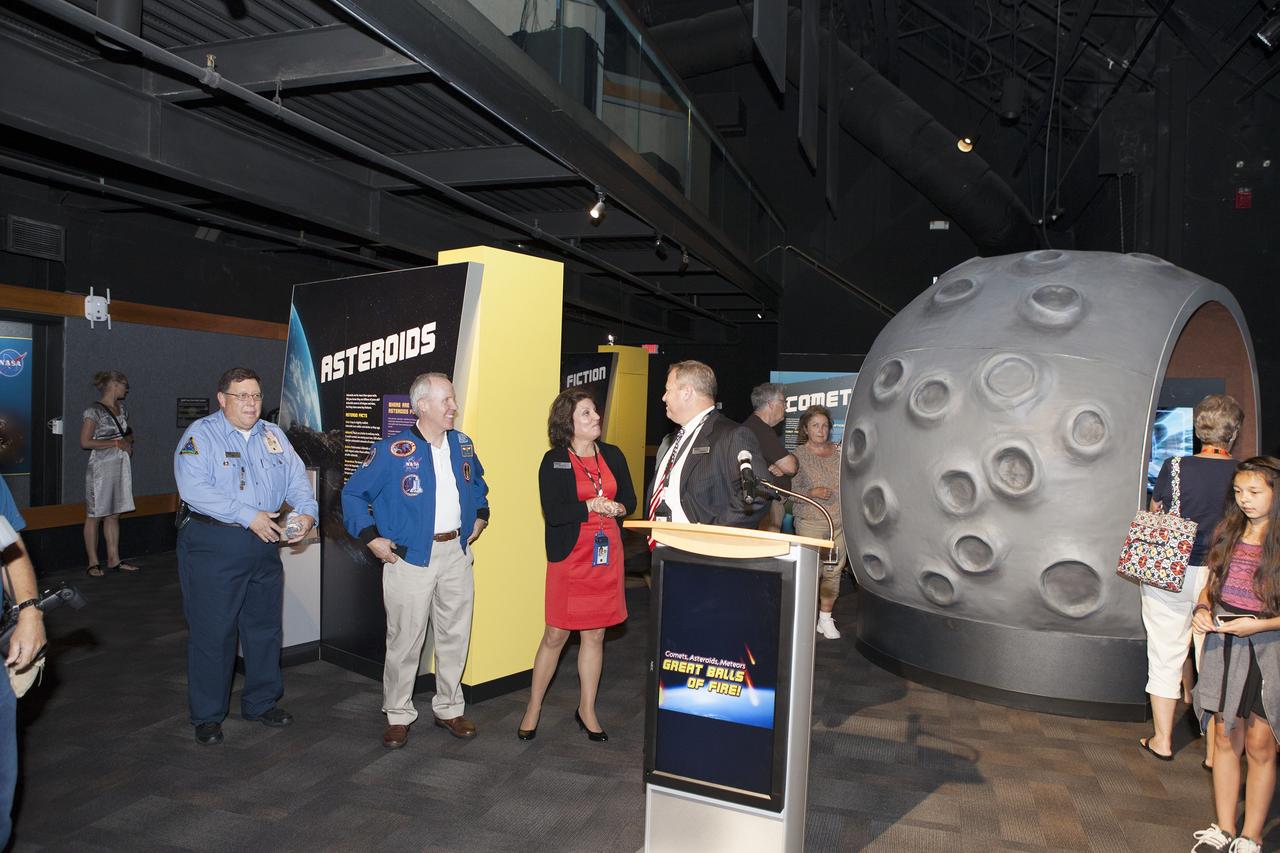
CAPE CANAVERAL, Fla. – Former NASA astronaut Tom Jones, left, joins Andrea Farmer, senior public relations manager, and Therrin Protze, chief operating officer, both with Delaware North Parks and Resorts at NASA's Kennedy Space Center Visitor Complex in Florida, for the grand opening of the Great Balls of Fire exhibit. Great Balls of Fire shares the story of the origins of our solar system, asteroids and comets and their possible impacts and risks. The 1,500-square-foot exhibit, located in the East Gallery of the IMAX theatre at the visitor complex, features several interactive displays, real meteorites and replica asteroid models. The exhibit is a production of The Space Science Institute's National Center for Interactive Learning. It is a traveling exhibition that also receives funding from NASA and the National Science Foundation. Photo credit: NASA/Daniel Casper
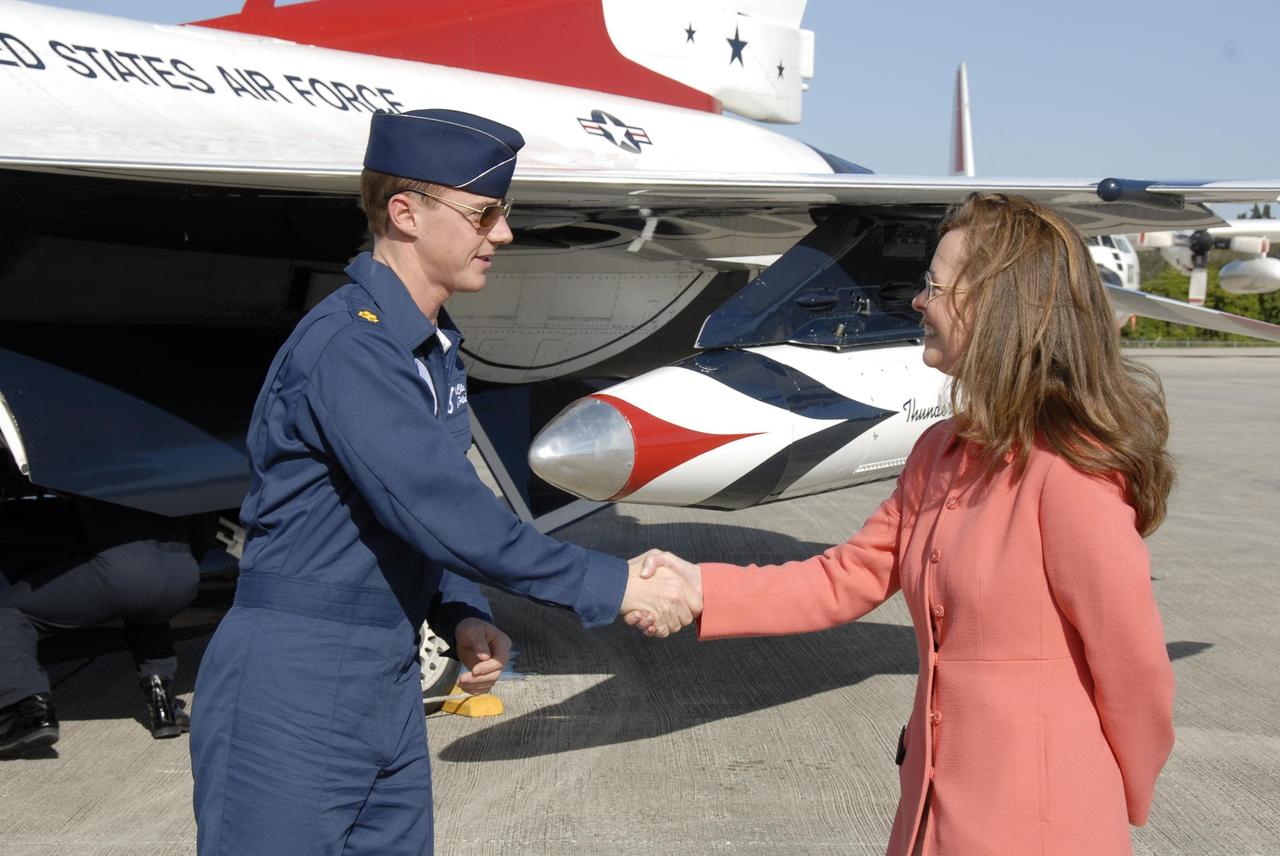
KENNEDY SPACE CENTER, FLA. -- The U.S. Air Force Thunderbird F-16D pilot Maj. Tad Clark is greeted by External Relations Director Lisa Malone after his arrival at the Kennedy Space Center Shuttle Landing Facility. Clark flew in to KSC to announce to waiting media that Kennedy Space Center Visitor Complex will host the inaugural World Space Expo from Nov. 3 to 11. The Expo, which will feature an aerial salute by the Thunderbirds on its opening weekend, will create one of the largest displays of space artifacts, hardware and personalities ever assembled in one location with the objective to inspire, educate and engage the public by highlighting the achievements and benefits of space exploration. Photo credit: NASA/Kim Shiflett
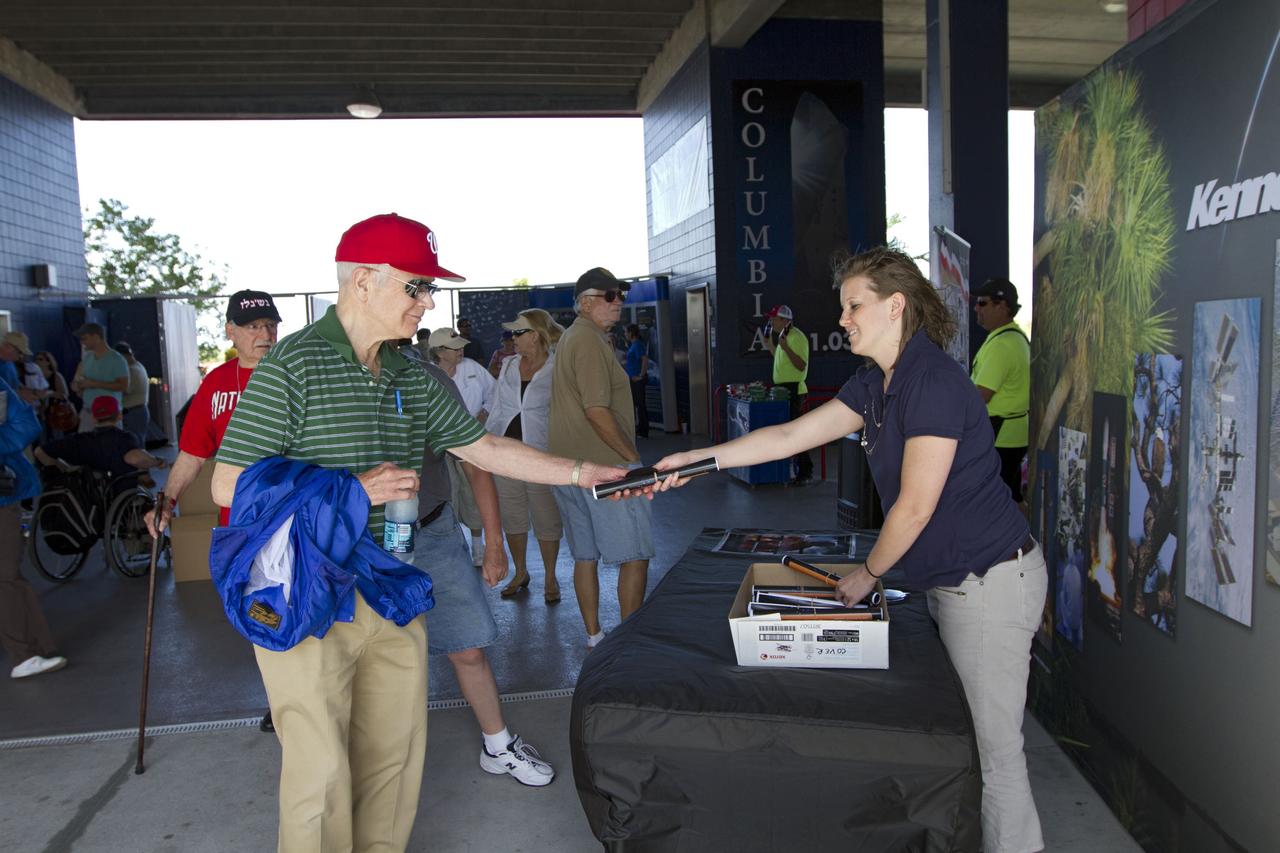
VIERA, Fla. – Tiffany Lindsley, with Education and External Relations at NASA’s Kennedy Space Center in Florida, hands out information on some of the contributions the space agency has made to sports, transportation and everyday life to a baseball fan attending Space Day at the Space Coast Stadium. Bob Cabana, director of Kennedy, was on hand to throw the first pitch of a spring training game between Major League Baseball's Washington Nationals and the Houston Astros. A full-scale test version of NASA's new Orion Multi-Purpose Crew Vehicle was on display outside the stadium for the occasion to show the public the spacecraft under development that will take astronauts farther into space than ever before. For more information, visit http://www.nasa.gov/kennedy. Photo credit: NASA/Kim Shiflett
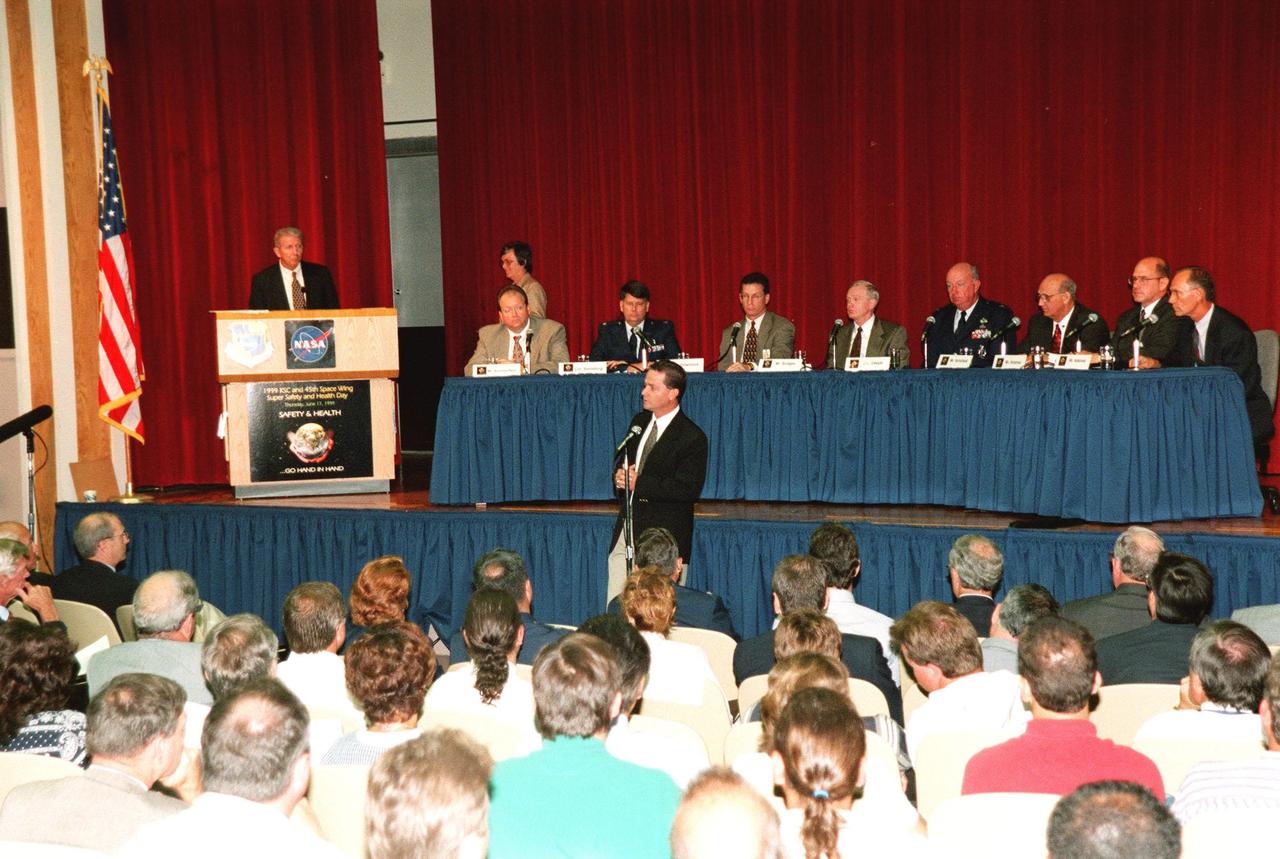
A panel of NASA and contractor senior staff, plus officers from the 45th Space Wing, discuss safetyand health-related concerns in front of an audience of KSC employees as part of Super Safety and Health Day. Moderating at the podium is Loren Shriver, deputy director for Launch & Payload Processing. Seated left to right are Burt Summerfield, associate director of the Biomedical Office; Colonel William S. Swindling, commander, 45th Medical Group, Patrick Air Force Base, Fla.; Ron Dittemore, manager, Space Shuttle Programs, Johnson Space Center; Roy Bridges, Center Director; Col. Tom Deppe, vice commander, 45th Space Wing, Patrick Air Force Base; Jim Schoefield, program manager, Payload Ground Operations, Boeing; Bill Hickman, program manager, Space Gateway Support; and Ed Adamek, vice president and associate program manager for Ground Operations, United Space Alliance. Answering a question at the microphone on the floor is Dave King, director, Shuttle Processing. The panel was one of the presentations during KSC's second annual day-long dedication to safety. Most normal work activities were suspended to allow personnel to attend related activities. The theme, "Safety and Health Go Hand in Hand," emphasized KSC's commitment to place the safety and health of the public, astronauts, employees and space-related resources first and foremost. Events also included a keynote address, vendor exhibits, and safety training in work groups. The keynote address and panel session were also broadcast internally over NASA television
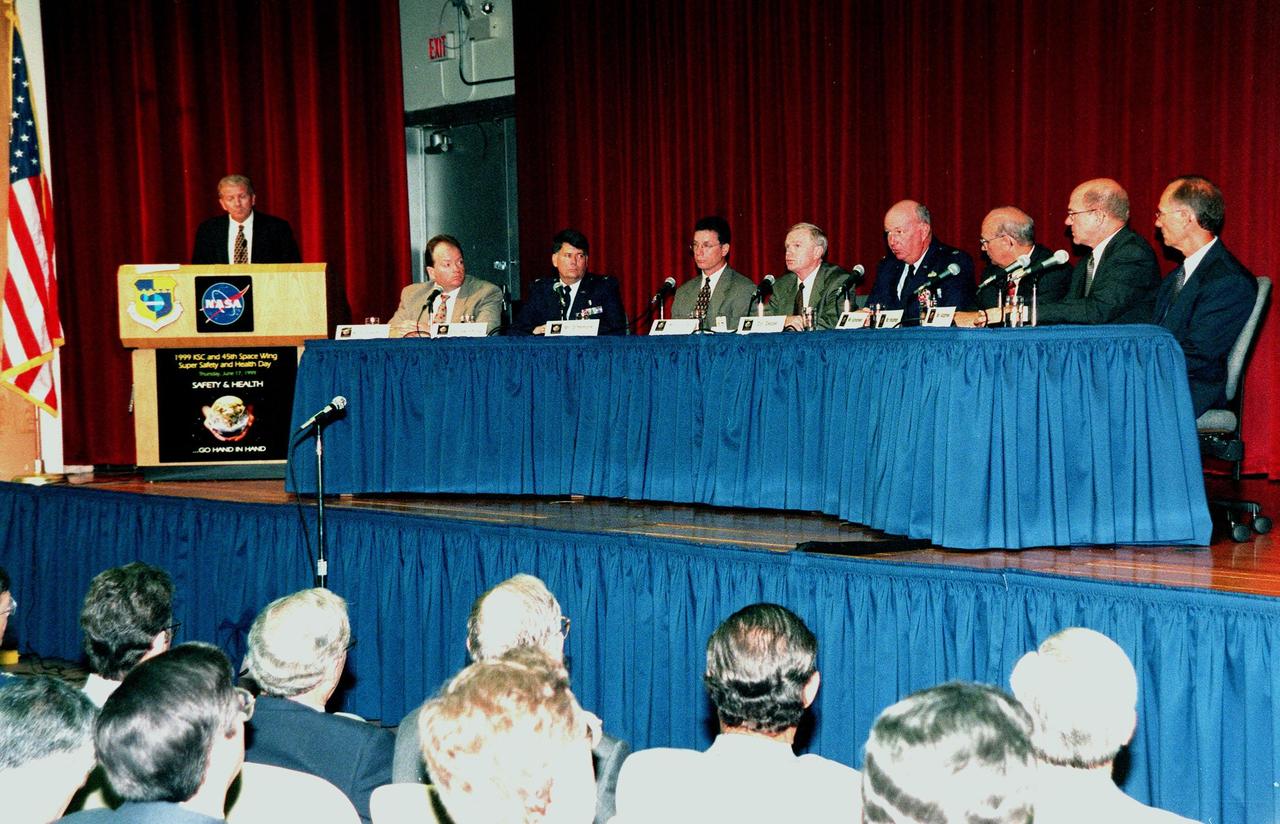
A panel of NASA and contractor senior staff, plus officers from the 45th Space Wing, discuss safetyand health-related concerns in front of an audience of KSC employees, as part of Super Safety and Health Day. Moderating at the podium is Loren Shriver, deputy director for Launch & Payload Processing. Seated left to right are Burt Summerfield, associate director of the Biomedical Office; Colonel William S. Swindling, commander, 45th Medical Group, Patrick Air Force Base, Fla.; Ron Dittemore, manager, Space Shuttle Programs, Johnson Space Center; Roy Bridges, Center Director; Col. Tom Deppe, vice commander, 45th Space Wing, Patrick Air Force Base; Jim Schoefield, program manager, Payload Ground Operations, Boeing; Bill Hickman, program manager, Space Gateway Support; and Ed Adamek, vice president and associate program manager for Ground Operations, United Space Alliance. The panel was one of the presentations during KSC's second annual day-long dedication to safety. Most normal work activities were suspended to allow personnel to attend related activities. The theme, "Safety and Health Go Hand in Hand," emphasized KSC's commitment to place the safety and health of the public, astronauts, employees and space-related resources first and foremost. Events also included a keynote address, vendor exhibits, and safety training in work groups. The keynote address and panel session were also broadcast internally over NASA television
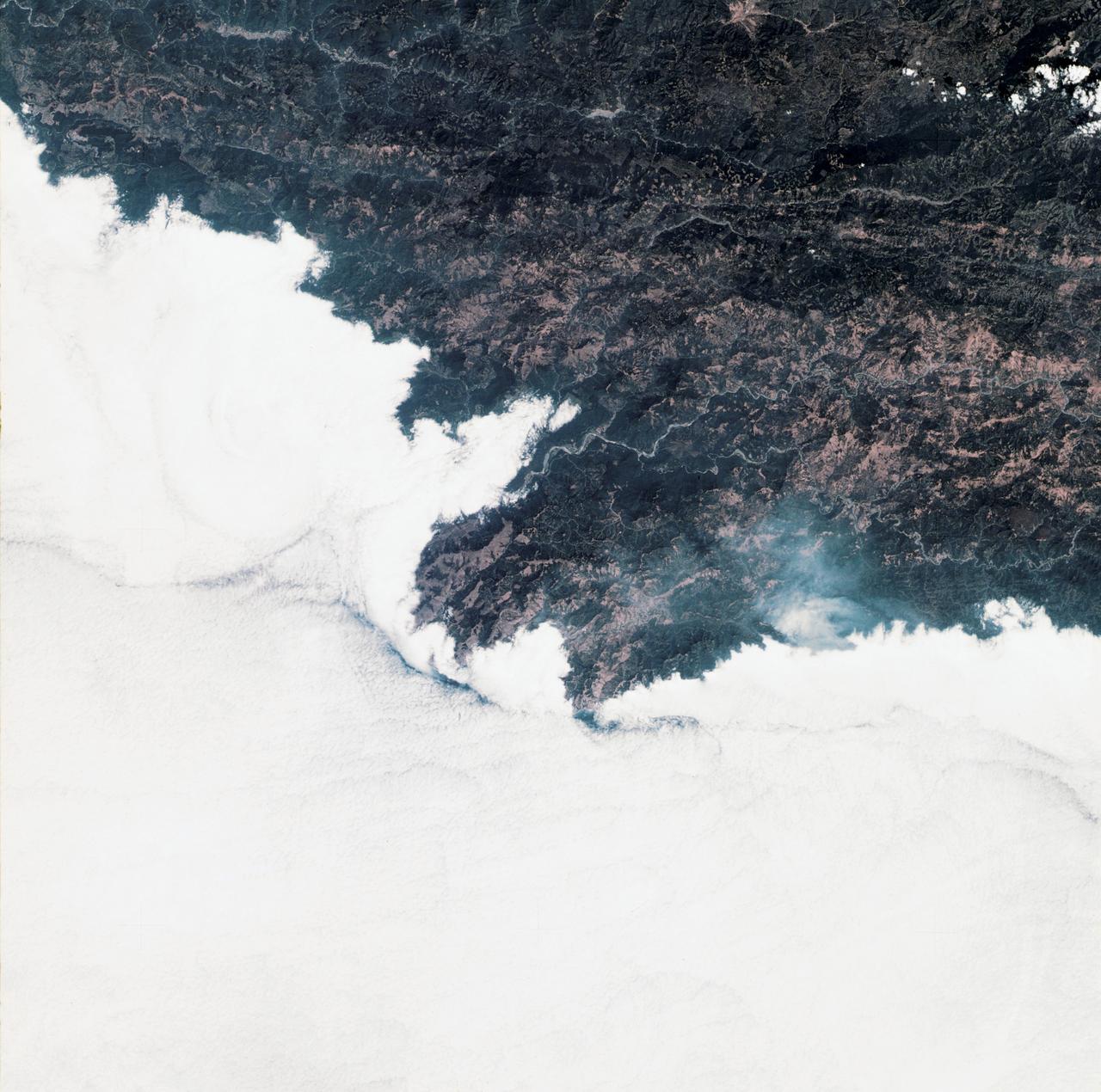
SL3-34-336 (July-September 1973) --- A vertical view of a portion of northern California near the Pacific coast as photographed from Earth orbit by one of the six lenses of the Itek-furnished S190-A Multispectral Photographic Facility Experiment in the Multiple Docking Adapter of the Skylab space station. A cloud deck covers the Pacific Ocean. Most of Cape Mendocino is clear of clouds and extends into the Pacific as the westernmost part of California. The sinuous pattern of the Bel River (in center) flows northward into the ocean and is characteristic of the rivers that drain the coastal ranges. This area is immediately southeast of Eureka. During Skylab 3 extensive forest fires occurred near Briceland and the smoke rising from the fires is clearly visible next to the cloud bank. Redwood and fir forests are sources of lumber in this region; and a variety of clear cut (timbering) patterns appear as light against the dark forest. The patterns appear to be related to the topography. Analysis of this photograph will aid Dr. P.G. Langley, Earth Satellite Corporation, in developing methods for forest inventory using space photography. Federal agencies participating with NASA on the EREP project are the Departments of Agriculture, Commerce, Interior, the Environmental Protection Agency and the Corps of Engineers. All EREP photography is available to the public through the Department of Interior?s Earth Resources Observations Systems Data Center, Sioux Falls, South Dakota, 57198. Photo credit: NASA
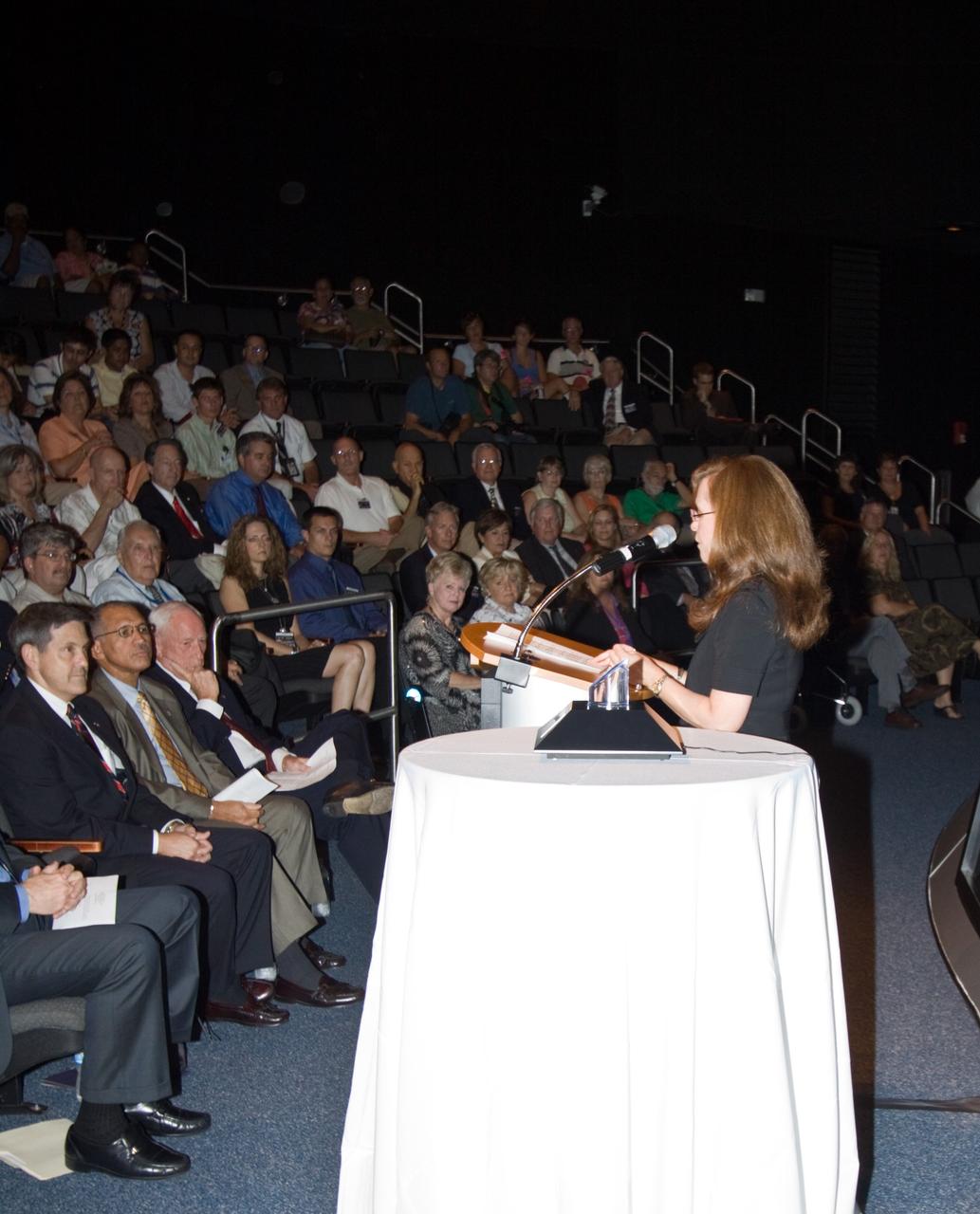
CAPE CANAVERAL, Fla. – At NASA's Kennedy Space Center in Florida, External Relations Director Lisa Malone speaks to an audience in Kennedy's Visitor Complex about the Ambassador of Exploration Award being given to Al Worden, an Apollo astronaut. Worden is being honored for his contributions to the U.S. space program. The award, to be displayed at Kennedy, is a moon rock encased in Lucite, mounted for public display. Worden served as command module pilot for the Apollo 15 mission, which set several moon records for NASA, including the longest lunar surface stay time, the longest lunar extravehicular activity and the first use of a lunar roving vehicle. Worden spent 38 minutes in a spacewalk outside the command module and logged a total of 295 hours, 11 minutes in space during the mission. NASA is giving the Ambassador of Exploration Award to the first generation of explorers in the Mercury, Gemini and Apollo space programs for realizing America's goal of going to the moon. The rock is part of the 842 pounds of lunar samples collected during six Apollo expeditions from 1969 to 1972. Those astronauts who receive the award will then present the award to a museum of their choice. Photo credit: NASA/Jack Pfaller

CAPE CANAVERAL, Fla. – A T-38 jet parks beside space shuttle Discovery secured atop a Shuttle Carrier Aircraft on the tarmac of the Shuttle Landing Facility at NASA’s Kennedy Space Center in Florida. Astronauts are arriving to participate in the festivities related to the final departure of Discovery from Kennedy. The carrier aircraft, also known as an SCA, is a Boeing 747 jet, originally manufactured for commercial use which was modified by NASA to transport the shuttles between destinations on Earth. NASA 905 is scheduled to ferry Discovery to the Washington Dulles International Airport in Virginia on April 17, and is assigned to all remaining ferry missions, delivering the shuttles to their permanent public display sites. After its arrival at Dulles, Discovery will be placed on display in the Smithsonian's National Air and Space Museum Steven F. Udvar-Hazy Center on April 19. For more information on the SCA, visit http://www.nasa.gov/centers/dryden/news/FactSheets/FS-013-DFRC.html. For more information on shuttle transition and retirement activities, visit http://www.nasa.gov/transition. Photo credit: NASA/Amanda Diller
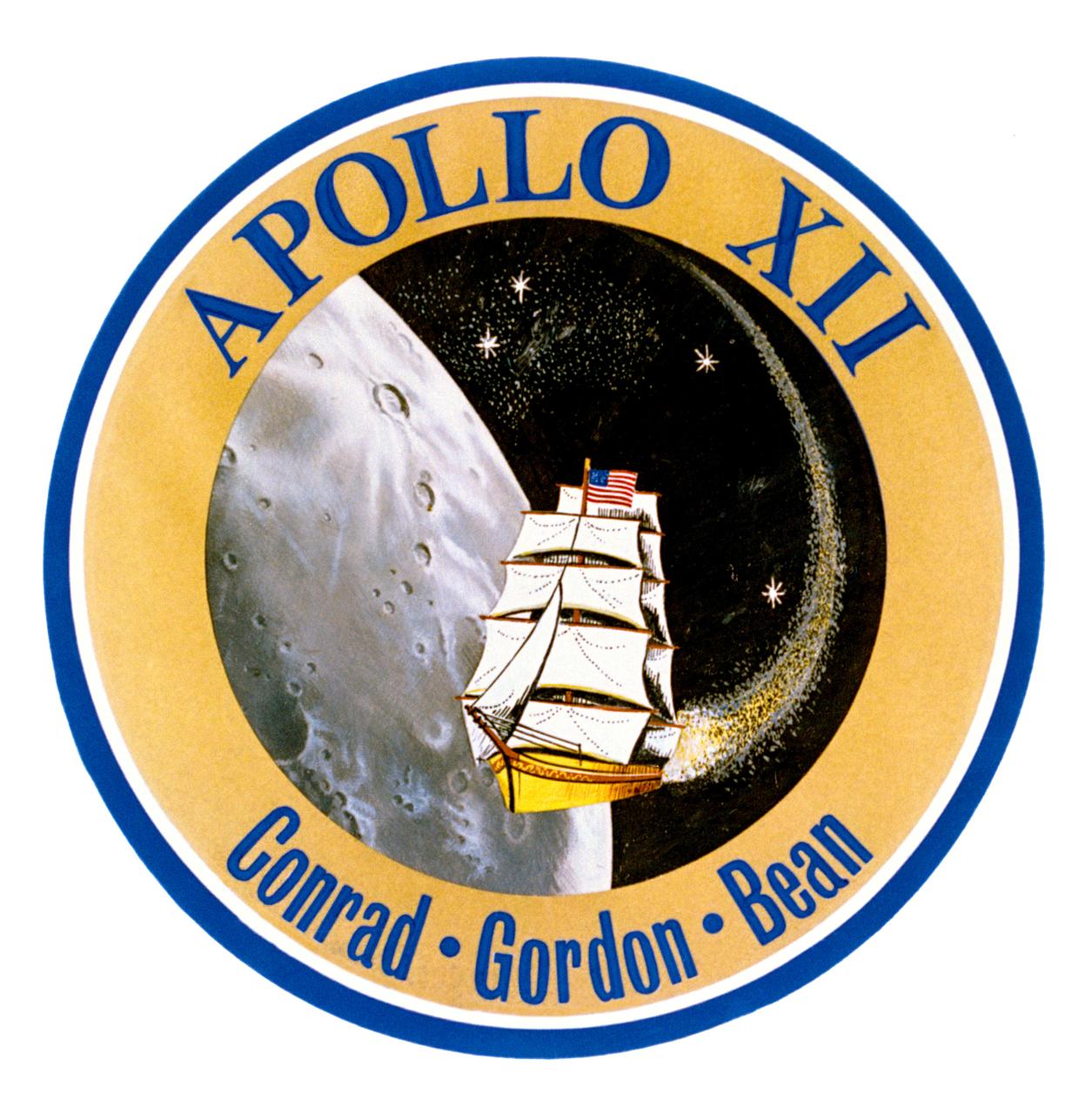
S69-52336 (September 1969) --- This is the official crew insignia for Apollo 12, the United States? second lunar landing mission. Crew members are astronauts Charles Conrad Jr., commander; Richard F. Gordon Jr., command module pilot; and Alan L. Bean, lunar module pilot. The clipper ship signifies that the crew is all Navy and symbolically relates the era of the clipper ship to the era of space flight. As the clipper ship brought foreign shores closer to the United States and marked the increased utilization of the seas by this nation, spacecraft have opened the way to the other planets and Apollo 12 marks the increased utilization of space-based on knowledge gained in earlier missions. The portion of the moon shown is representative of the Ocean of Storms area in which Apollo 12 will land. The NASA insignia design for Apollo flights is reserved for use by the astronauts and for other official use as the NASA Administrator may authorize. Public availability has been approved only in the form of illustrations by the various news media. When and if there is any change in this policy, which we do not anticipate, it will be publicly announced.
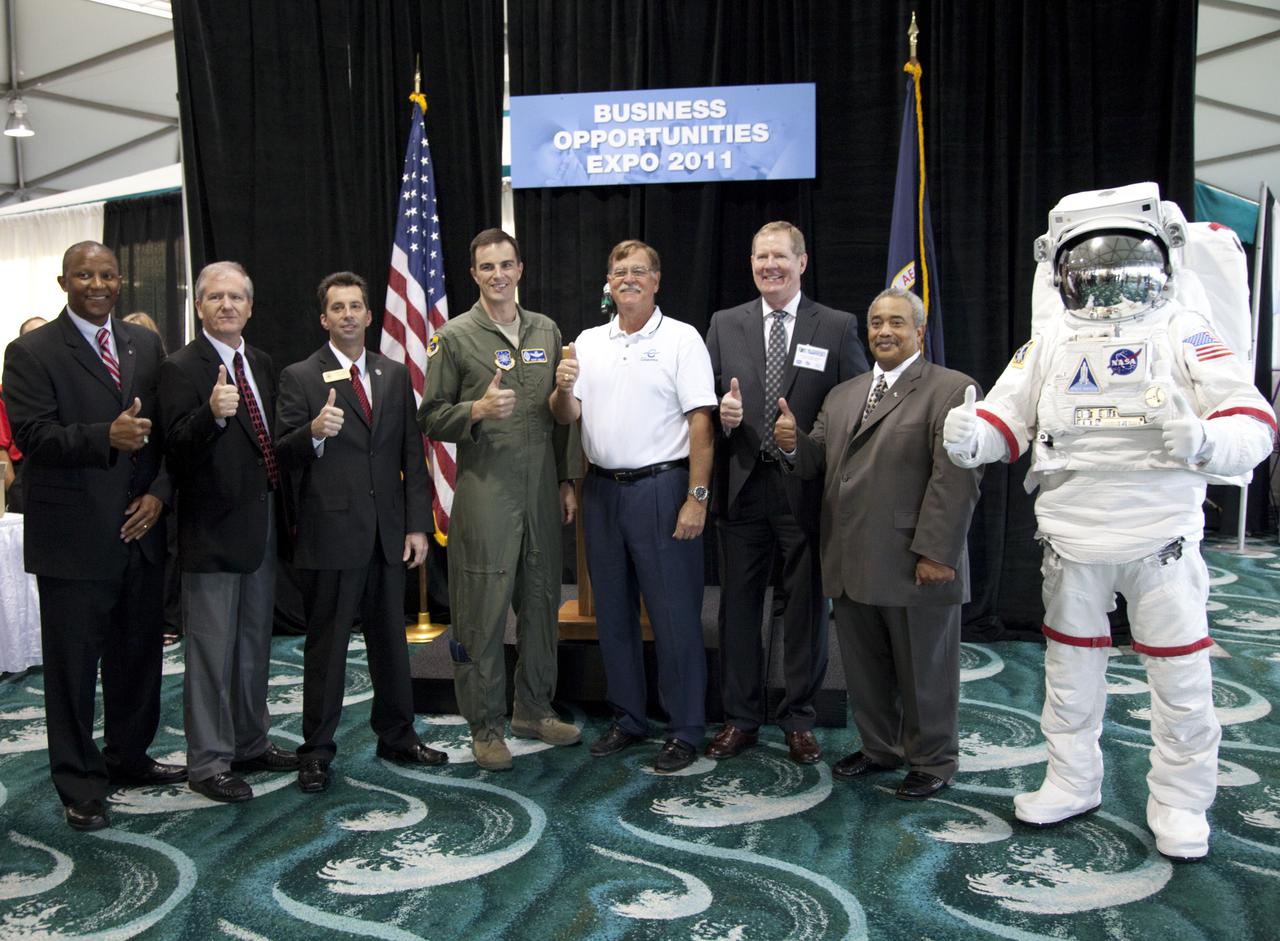
CAPE CANAVERAL, Fla. – Giving a thumbs up during the opening ceremony of the annual Business Opportunities Expo 2011, in Cruise Terminal 4 at Port Canaveral in Florida are, from left, Kelvin Manning, NASA Kennedy Space Center’s associate director for Business Operations; Larry Third, small business specialist at Kennedy Space Center; Patrick D. Gavin, director of community relations for Congressman Bill Posey; Col. Rory D. Welch, vice commander for the U.S. Air Force 45th Space Wing at Patrick Air Force Base; Tom Weinberg, Canaveral Port Authority commissioner; Stephen 'Smokey' Stover, IMCS deputy program manager; Glenn A. Delgado, NASA associate administrator of the Office of Small Business Programs; and the Kennedy Space Center Visitor Complex “Space Man.” The event is free and open to the public. It features about 175 business and government exhibitors from across the nation and Brevard County and is geared toward business leaders who are interested in learning more about government contracting and what local and national vendors have to offer. Photo credit: NASA_Gianni Woods