
This artist's concept shows a pulsar, which is like a lighthouse, as its light appears in regular pulses as it rotates. Pulsars are dense remnants of exploded stars, and are part of a class of objects called neutron stars. Magnetars are different kinds of neutron stars -- they have violent, high-energy outbursts of X-ray and gamma ray light. A mysterious object called PSR J1119-6127 has been seen behaving as both a pulsar and a magnetar, suggesting that it could be a "missing link" between these objects. http://photojournal.jpl.nasa.gov/catalog/PIA21085
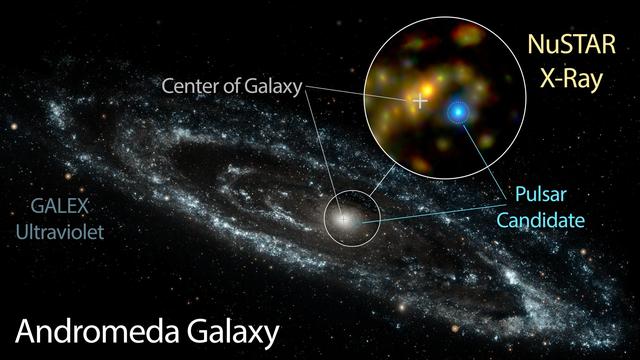
NASA's Nuclear Spectroscope Telescope Array, or NuSTAR, has identified a candidate pulsar in Andromeda -- the nearest large galaxy to the Milky Way. This likely pulsar is brighter at high energies than the Andromeda galaxy's entire black hole population. The inset image shows the pulsar candidate in blue, as seen in X-ray light by NuSTAR. The background image of Andromeda was taken by NASA's Galaxy Evolution Explorer in ultraviolet light. Andromeda is a spiral galaxy like our Milky Way but larger in size. It lies 2.5 million light-years away in the Andromeda constellation. http://photojournal.jpl.nasa.gov/catalog/PIA20970
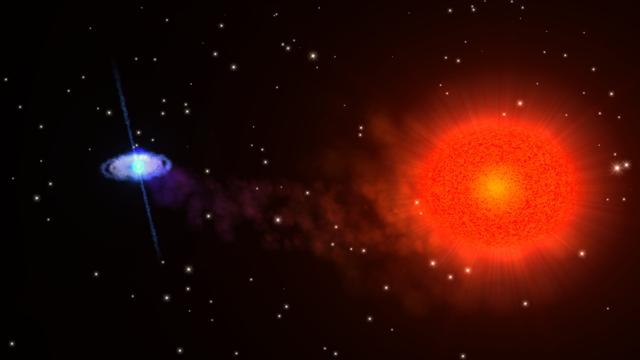
NASA image release August 17, 2010 Astronomers using NASA's Rossi X-ray Timing Explorer (RXTE) have found the first fast X-ray pulsar to be eclipsed by its companion star. Further studies of this unique stellar system will shed light on some of the most compressed matter in the universe and test a key prediction of Einstein's relativity theory. Known as Swift J1749.4-2807 -- J1749 for short -- the system erupted with an X-ray outburst on April 10. During the event, RXTE observed three eclipses, detected X-ray pulses that identified the neutron star as a pulsar, and even recorded pulse variations that indicated the neutron star's orbital motion. To view a video of this pulsar go here: <a href="http://www.flickr.com/photos/gsfc/4901238111">www.flickr.com/photos/gsfc/4901238111</a> To read more <b><a href="http://www.nasa.gov/topics/universe/features/eclipsing-pulsar.html" rel="nofollow">click here</a></b> Credit: NASA/GSFC <b><a href="http://www.nasa.gov/centers/goddard/home/index.html" rel="nofollow">NASA Goddard Space Flight Center</a></b> is home to the nation's largest organization of combined scientists, engineers and technologists that build spacecraft, instruments and new technology to study the Earth, the sun, our solar system, and the universe. <b>Follow us on <a href="http://twitter.com/NASA_GoddardPix" rel="nofollow">Twitter</a></b> <b>Join us on <a href="http://www.facebook.com/pages/Greenbelt-MD/NASA-Goddard/395013845897?ref=tsd" rel="nofollow">Facebook</a><b></b></b>

KOSTA VARNAVAS/ES33, AND Dr. HERB SIMS/ES63, TESTING THE PULSAR , (PROGRAMMABLE ULTRA LOWPOWER SYSTEM ADAPTABLE RADIO), IN THE SOFTWARE DEFINED RADIO LAB, NSSTC

This chart describes the Skylab student experiment Ultraviolet (UV) From Pulsars, proposed by Neal W. Sharnon of Atlanta, Georgia. This experiment was to observe several pulsars with Skylab's UV spectrometer to determine their intensities in that portion of their spectra. A more detailed description of a pulsar's electromagnetic emission profile would be expected to further define means by which its energy is released. Unfortunately, upon examination of the photographic plates containing the data from the experiment, it was found that an alignment error of the spectrometer prevented detection of any of the pulsars. In March 1972, NASA and the National Science Teachers Association selected 25 experiment proposals for flight on Skylab. Science advisors from the Marshall Space Flight Center aided and assisted the students in developing the proposals for flight on Skylab.
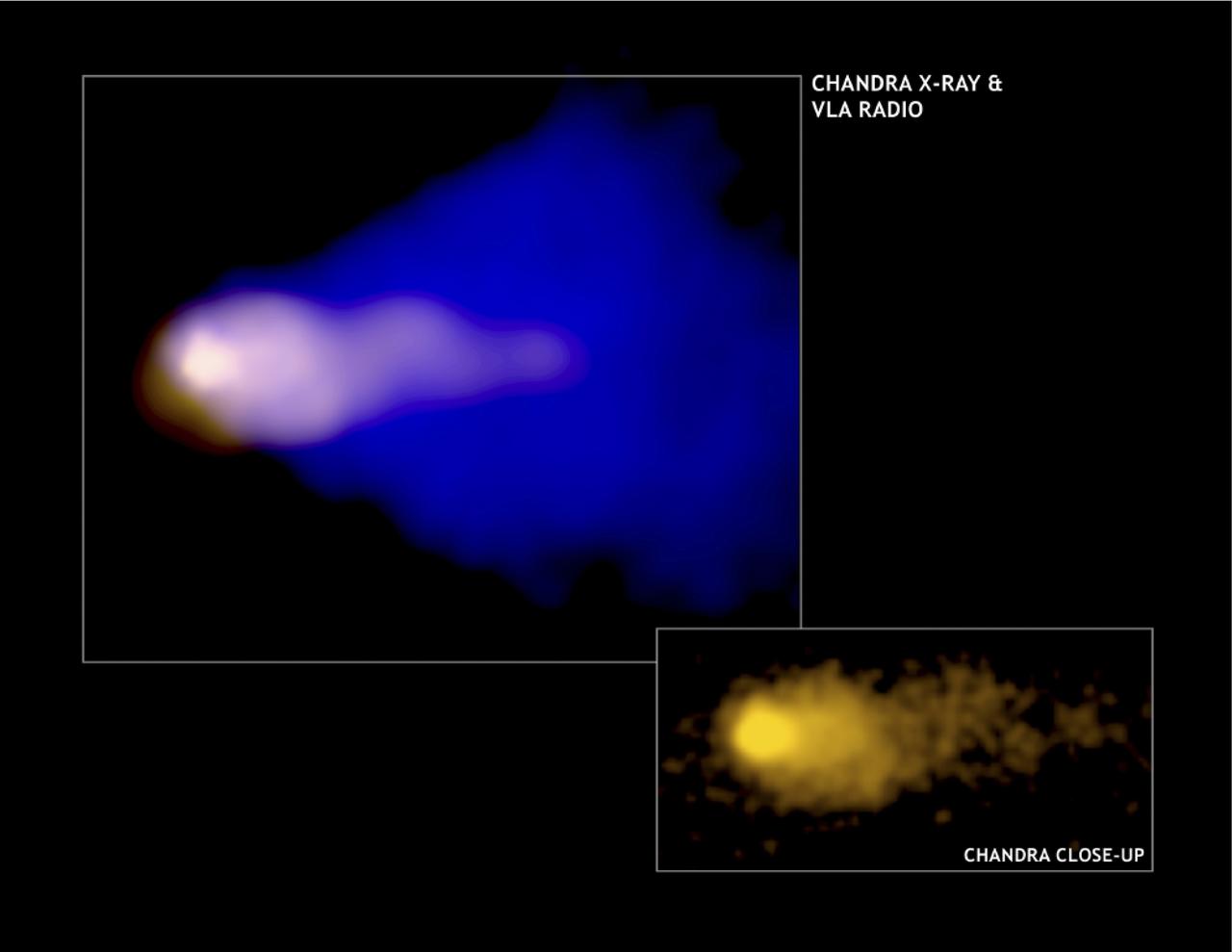
Astronomers have used an x-ray image to make the first detailed study of the behavior of high-energy particles around a fast moving pulsar. This image, from NASA's Chandra X-Ray Observatory (CXO), shows the shock wave created as a pulsar plows supersonically through interstellar space. These results will provide insight into theories for the production of powerful winds of matter and antimatter by pulsars. Chandra's image of the glowing cloud, known as the Mouse, shows a stubby bright column of high-energy particles, about four light years in length, swept back by the pulsar's interaction with interstellar gas. The intense source at the head of the X-ray column is the pulsar, estimated to be moving through space at about 1.3 million miles per hour. A cone-shaped cloud of radio-wave-emitting particles envelopes the x-ray column. The Mouse, a.k.a. G359.23-0.82, was discovered in 1987 by radio astronomers using the National Science Foundation's Very Large Array in New Mexico. G359.23-0.82 gets its name from its appearance in radio images that show a compact snout, a bulbous body, and a remarkable long, narrow, tail that extends for about 55 light years. NASA’s Marshall Space Flight Center in Huntsville, Alabama manages the Chandler program.

KOSTA VARNAVAS/ES33, AND Dr. HERB SIMS/ES63, TESTING THE PULSAR , (PROGRAMMABLE ULTRA LOWPOWER SYSTEM ADAPTABLE RADIO), IN THE SOFTWARE DEFINED RADIO LAB, NSSTC

KOSTA VARNAVAS/ES33, AND Dr. HERB SIMS/ES63, TESTING THE PULSAR , (PROGRAMMABLE ULTRA LOWPOWER SYSTEM ADAPTABLE RADIO), IN THE SOFTWARE DEFINED RADIO LAB, NSSTC

This artist concept depicts the pulsar planet system discovered by Aleksander Wolszczan in 1992. Wolszczan used the Arecibo radio telescope in Puerto Rico to find three planets circling a pulsar called PSR B1257+12.
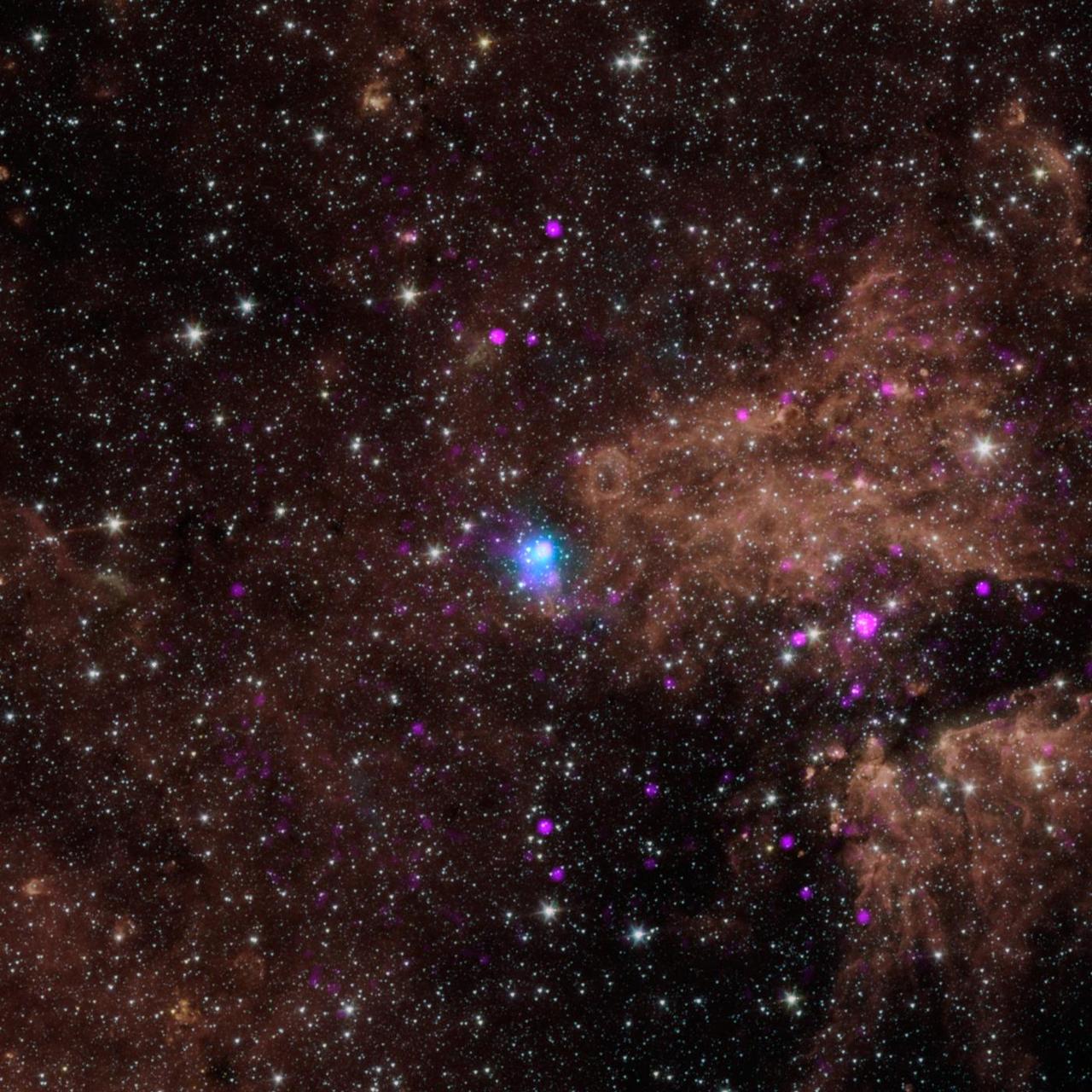
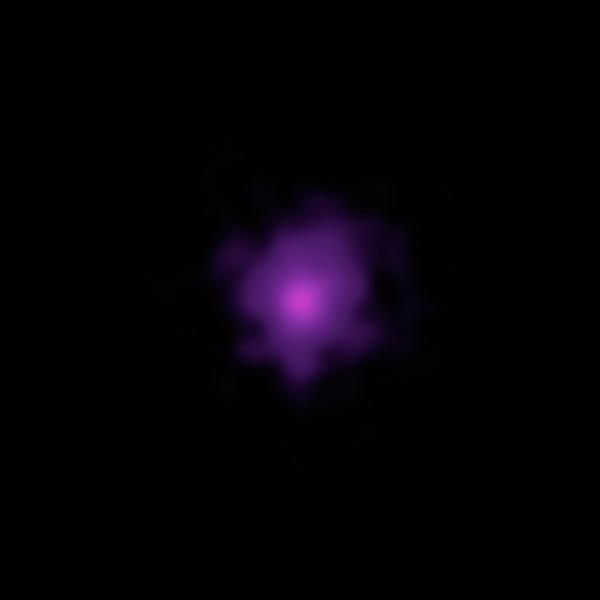
The blue dot in this image marks the spot of an energetic pulsar -- the magnetic, spinning core of star that blew up in a supernova explosion. NASA NuSTAR discovered the pulsar by identifying its telltale pulse.
The brightest pulsar detected to date is shown in this frame from an animation that flips back and forth between images captured by NASA NuSTAR. A pulsar is a type of neutron star, the leftover core of a star that exploded in a supernova.

This plot shows that a pulsar, the remnant of a stellar explosion, is surrounded by a disk of its own ashes. The disk, revealed by the two data points at the far right from NASA Spitzer Space Telescope, is the first ever found around a pulsar.

This artist concept depicts a type of dead star called a pulsar and the surrounding disk of rubble discovered by NASA Spitzer Space Telescope. The pulsar, called 4U 0142+61, was once a massive star until about 100,000 years ago.

This image of the Crab Pulsar was taken with CHIMERA, an instrument at the Palomar Observatory, which is operated by the California Institute of Technology.

Nicknamed the Hand of God, this object is called a pulsar wind nebula, imaged by NASA NuSTAR. It powered by the leftover, dense core of a star that blew up in a supernova explosion.
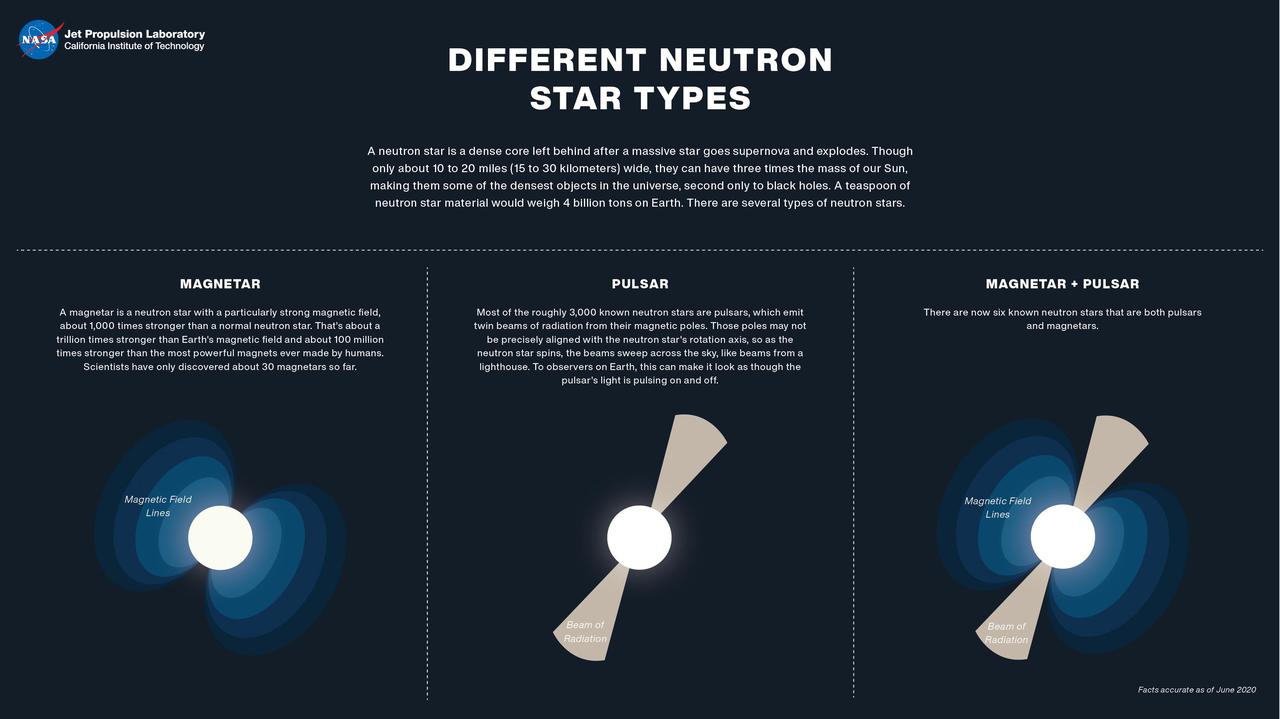
Neutron stars, or cores leftover from exploded stars, are some of the densest objects in the universe. There are several types of neutron stars, including magnetars and pulsars. https://photojournal.jpl.nasa.gov/catalog/PIA23863

The CTB 1 supernova remnant resembles a ghostly bubble in this image, which combines new 1.5 gigahertz observations from the Very Large Array (VLA) radio telescope (orange, near center) with older observations from the Dominion Radio Astrophysical Observatory’s Canadian Galactic Plane Survey (1.42 gigahertz, magenta and yellow; 408 megahertz, green) and infrared data (blue). The VLA data clearly reveal the straight, glowing trail from pulsar J0002+6216 and the curved rim of the remnant’s shell. CTB 1 is about half a degree across, the apparent size of a full Moon. Credits: Composite by Jayanne English, University of Manitoba, using data from NRAO/F. Schinzel et al., DRAO/Canadian Galactic Plane Survey and NASA/IRAS More info: https://go.nasa.gov/2TKpyWF
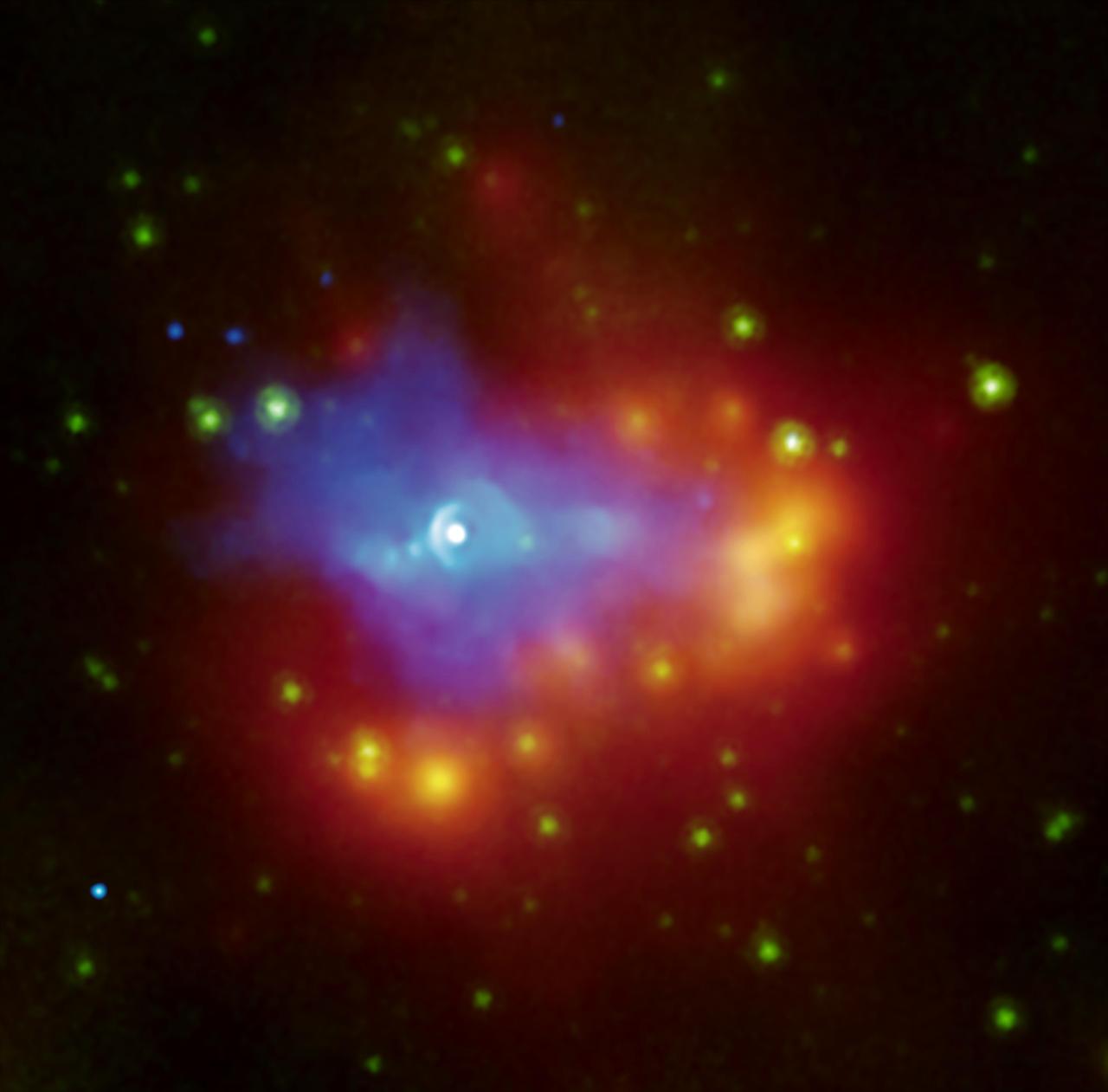
A composite image from NASA Chandra and Spitzer space telescopes shows the dusty remains of a collapsed star, a supernova remnant called G54.1+0.3. The white source at the center is a dead star called a pulsar.
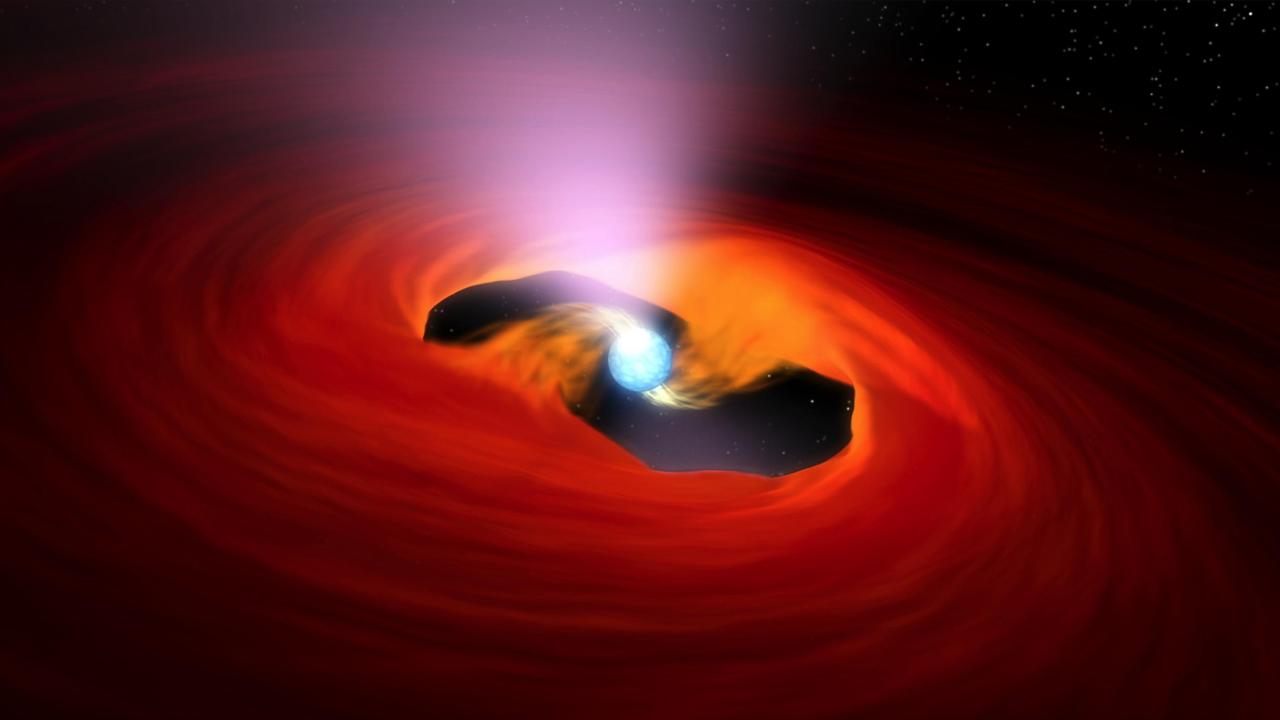
This image shows a neutron star -- the core of a star that exploded in a massive supernova. This particular neutron star is known as a pulsar because it sends out rotating beams of X-rays that sweep past Earth like lighthouse beacons.

This image is of the Crab Nebula in visible light photographed by the Hale Observatory optical telescope in 1959. The faint object at the center had been identified as a pulsar and is thought to be the remains of the original star. It had been observed as a pulsar in visible light, radio wave, x-rays, and gamma-rays.

After barely 2 months in space, the Chandra X-Ray Observatory (CXO) took this sturning image of the Crab Nebula, the spectacular remains of a stellar explosion, revealing something never seen before, a brilliant ring around the nebula's heart. The image shows the central pulsar surrounded by tilted rings of high-energy particles that appear to have been flung outward over a distance of more than a light-year from the pulsar. Perpendicular to the rings, jet-like structures produced by high-energy particles blast away from the pulsar. Hubble Space Telescope images have shown moving knots and wisps around the neutron star, and previous x-ray images have shown the outer parts of the jet and hinted at the ring structure. With CXO's exceptional resolution, the jet can be traced all the way in to the neutron star, and the ring pattern clearly appears. The image was made with CXO's Advanced Charge-Coupled Device (CCD) Imaging Spectrometer (ACIS) and High Energy Transmission Grating. The Crab Nebula, easily the most intensively studied object beyond our solar system, has been observed using virtually every astronomical instrument that could see that part of the sky
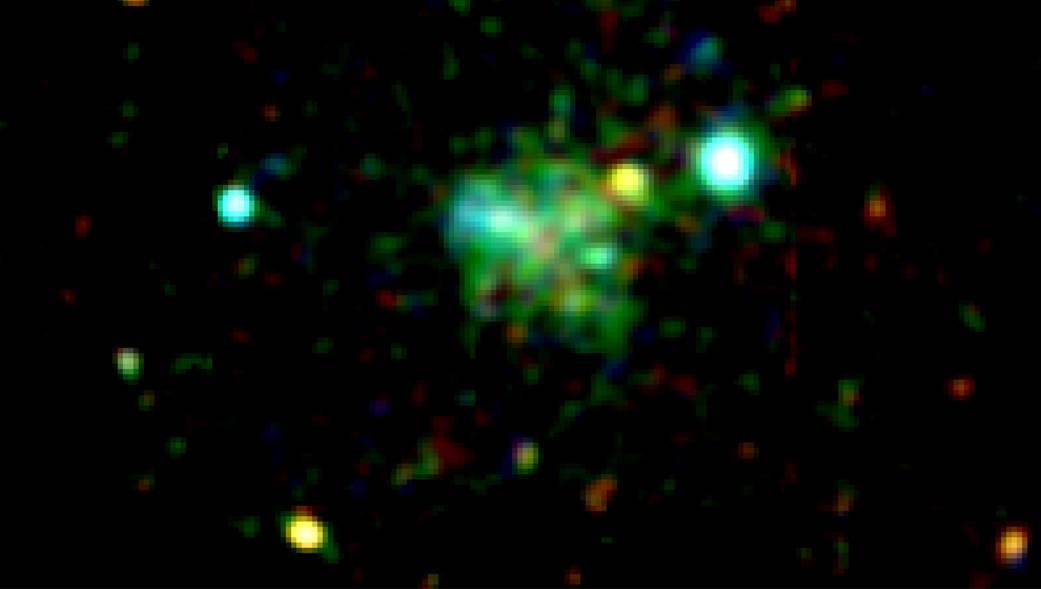
Astronomers have discovered a vast cloud of high-energy particles called a wind nebula around a rare ultra-magnetic neutron star, or magnetar, for the first time. The find offers a unique window into the properties, environment and outburst history of magnetars, which are the strongest magnets in the universe. A neutron star is the crushed core of a massive star that ran out of fuel, collapsed under its own weight, and exploded as a supernova. Each one compresses the equivalent mass of half a million Earths into a ball just 12 miles (20 kilometers) across, or about the length of New York's Manhattan Island. Neutron stars are most commonly found as pulsars, which produce radio, visible light, X-rays and gamma rays at various locations in their surrounding magnetic fields. When a pulsar spins these regions in our direction, astronomers detect pulses of emission, hence the name. Credit: ESA/XMM-Newton/Younes et al. 2016

This is an x-ray image of the Crab Nebula taken with the High Energy Astronomy Observatory (HEAO)-2/Einstein Observatory. The image is demonstrated by a pulsar, which appears as a bright point due to its pulsed x-ray emissions. The strongest region of diffused emissions comes from just northwest of the pulsar, and corresponds closely to the region of brightest visible-light emission. The HEAO-2, the first imaging and largest x-ray telescope built to date, was capable of producing actual photographs of x-ray objects. Shortly after launch, the HEAO-2 was nicknamed the Einstein Observatory by its scientific experimenters in honor of the centernial of the birth of Albert Einstein, whose concepts of relativity and gravitation have influenced much of modern astrophysics, particularly x-ray astronomy. The HEAO-2, designed and developed by TRW, Inc. under the project management of the Marshall Space Flight Center, was launched aboard an Atlas/Centaur launch vehicle on November 13, 1978.
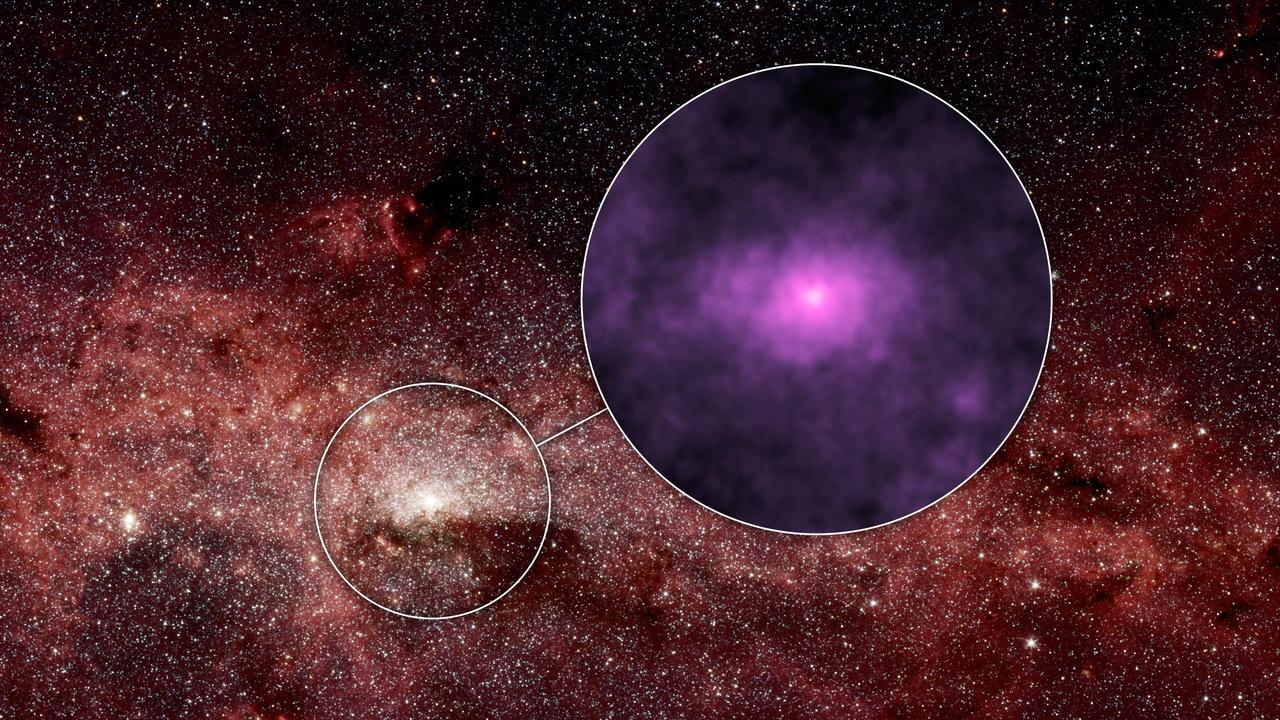
NASA's Nuclear Spectroscopic Telescope Array, or NuSTAR, has captured a new high-energy X-ray view (magenta, Figure 1) of the bustling center of our Milky Way galaxy. The smaller circle shows the area where the NuSTAR image was taken -- the very center of our galaxy, where a giant black hole resides. That region is enlarged to the right, in the larger circle, to show the NuSTAR data. The NuSTAR picture is one of the most detailed ever taken of the center of our galaxy in high-energy X-rays. The X-ray light, normally invisible to our eyes, has been assigned the color magenta. The brightest point of light near the center of the X-ray picture is coming from a spinning dead star, known as a pulsar, which is near the giant black hole. While the pulsar's X-ray emissions were known before, scientists were surprised to find more high-energy X-rays than predicted in the surrounding regions, seen here as the elliptical haze. Astronomers aren't sure what the sources of the extra X-rays are, but one possibility is a population of dead stars. The background picture was captured in infrared light by NASA's Spitzer Space Telescope. The NuSTAR image has an X-ray energy range of 20 to 40 kiloelectron volts. http://photojournal.jpl.nasa.gov/catalog/PIA19334

Like the Crab Nebula, the Vela Supernova Remnant has a radio pulsar at its center. In this image taken by the High Energy Astronomy Observatory (HEAO)-2/Einstein Observatory, the pulsar appears as a point source surrounded by weak and diffused emissions of x-rays. HEAO-2's computer processing system was able to record and display the total number of x-ray photons (a tiny bundle of radiant energy used as the fundamental unit of electromagnetic radiation) on a scale along the margin of the picture. The HEAO-2, the first imaging and largest x-ray telescope built to date, was capable of producing actual photographs of x-ray objects. Shortly after launch, the HEAO-2 was nicknamed the Einstein Observatory by its scientific experimenters in honor of the centernial of the birth of Albert Einstein, whose concepts of relativity and gravitation have influenced much of modern astrophysics, particularly x-ray astronomy. The HEAO-2, designed and developed by TRW, Inc. under the project management of the Marshall Space Flight Center, was launched aboard an Atlas/Centaur launch vehicle on November 13, 1978.

NASA’s Imaging X-Ray Polarimetry Explorer (IXPE) spacecraft – the agency’s first mission dedicated to measuring X-ray polarization – arrives at the Cape Canaveral Space Force Station in Florida on Nov. 5, 2021. IXPE is scheduled to launch aboard a SpaceX Falcon 9 vehicle from Kennedy’s Launch Complex 39A on Dec. 9, 2021. The launch is managed by NASA’s Launch Services Program, based at Kennedy. IXPE will study the polarization of X-rays coming to us from some of the universe’s most extreme sources, including black holes and dead stars known as pulsars.

NASA’s Imaging X-Ray Polarimetry Explorer (IXPE) spacecraft – the agency’s first mission dedicated to measuring X-ray polarization – arrives at the Cape Canaveral Space Force Station in Florida on Nov. 5, 2021. IXPE is scheduled to launch aboard a SpaceX Falcon 9 vehicle from Kennedy’s Launch Complex 39A on Dec. 9, 2021. The launch is managed by NASA’s Launch Services Program, based at Kennedy. IXPE will study the polarization of X-rays coming to us from some of the universe’s most extreme sources, including black holes and dead stars known as pulsars.
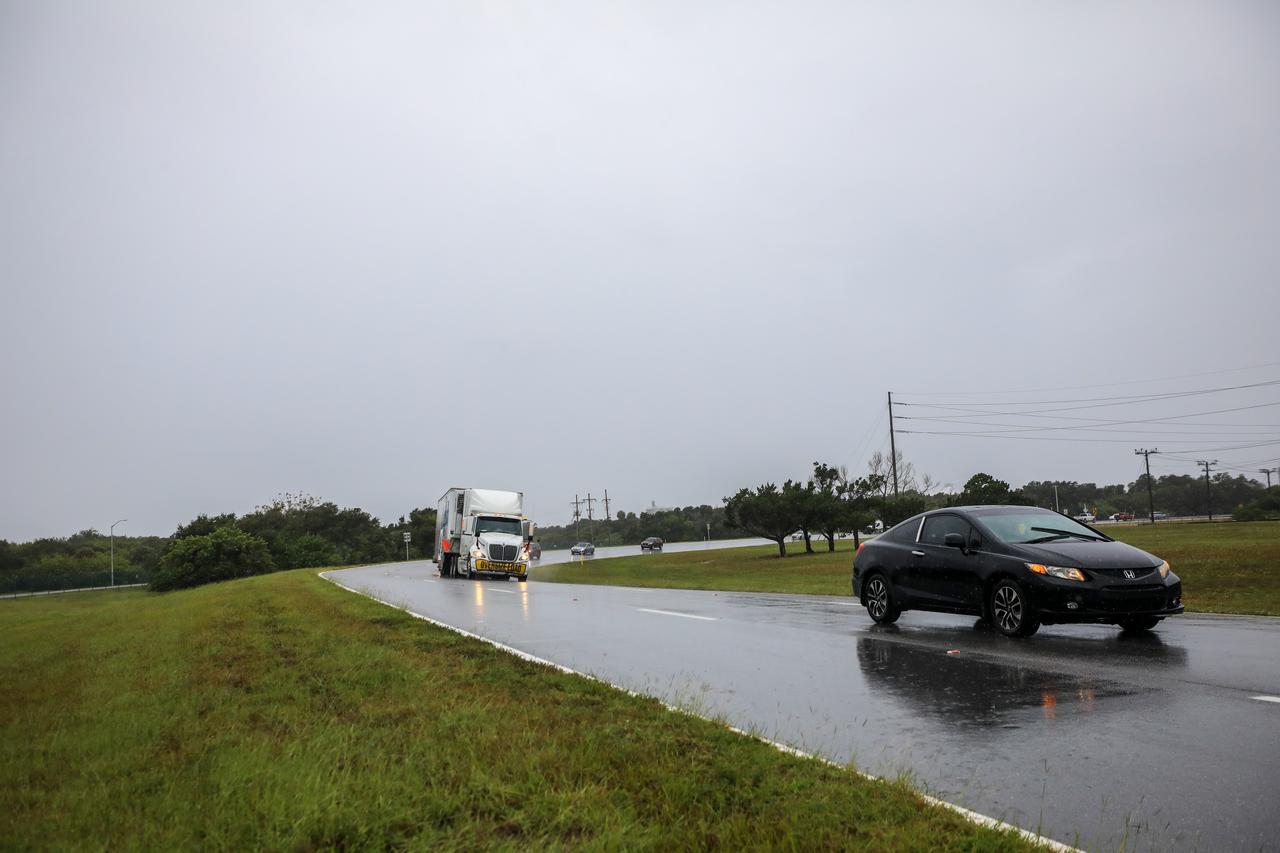
NASA’s Imaging X-Ray Polarimetry Explorer (IXPE) spacecraft – the agency’s first mission dedicated to measuring X-ray polarization – arrives at the Cape Canaveral Space Force Station in Florida on Nov. 5, 2021. IXPE is scheduled to launch aboard a SpaceX Falcon 9 vehicle from Kennedy’s Launch Complex 39A on Dec. 9, 2021. The launch is managed by NASA’s Launch Services Program, based at Kennedy. IXPE will study the polarization of X-rays coming to us from some of the universe’s most extreme sources, including black holes and dead stars known as pulsars.
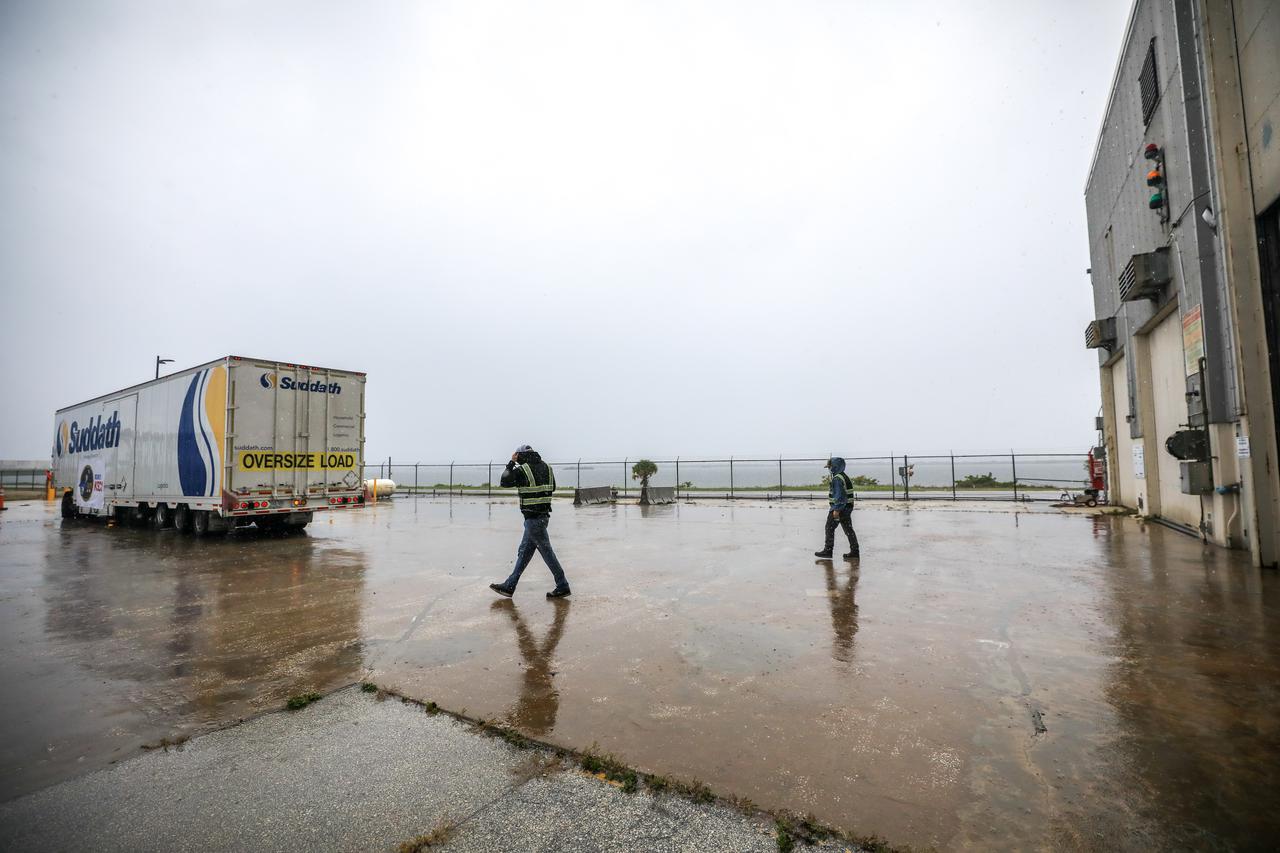
NASA’s Imaging X-Ray Polarimetry Explorer (IXPE) spacecraft – the agency’s first mission dedicated to measuring X-ray polarization – arrives at the Cape Canaveral Space Force Station in Florida on Nov. 5, 2021. IXPE is scheduled to launch aboard a SpaceX Falcon 9 vehicle from Kennedy’s Launch Complex 39A on Dec. 9, 2021. The launch is managed by NASA’s Launch Services Program, based at Kennedy. IXPE will study the polarization of X-rays coming to us from some of the universe’s most extreme sources, including black holes and dead stars known as pulsars.
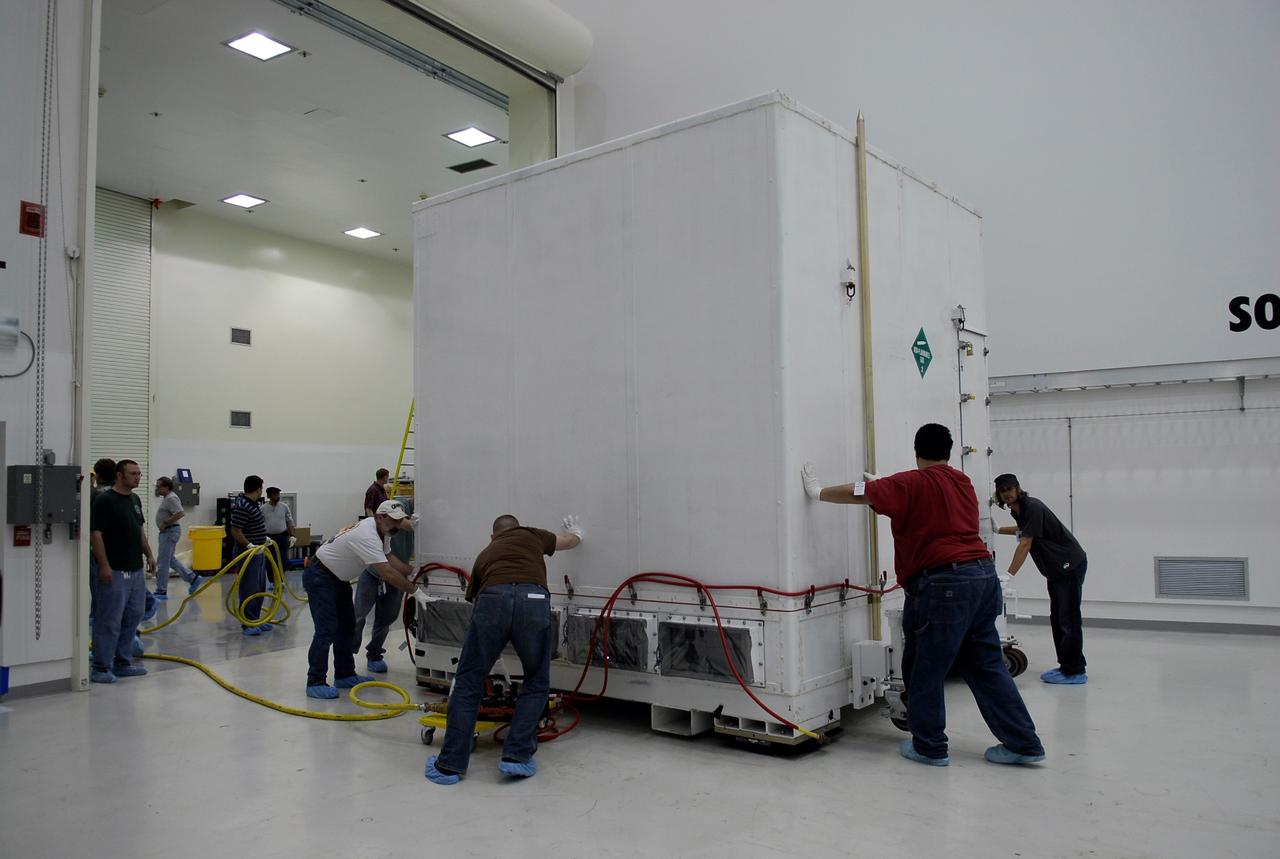
KENNEDY SPACE CENTER, FLA. -- In the Astrotech payload processing facility near the Kennedy Space Center, workers maneuver the shipping container holding NASA's Gamma-Ray Large Area Space Telescope, or GLAST, into place. The GLAST will launch aboard a Delta II rocket May 16 from Launch Pad 17-B on Cape Canaveral Air Force Station. A powerful space observatory, the GLAST will explore the most extreme environments in the universe, and answer questions about supermassive black hole systems, pulsars and the origin of cosmic rays. It also will study the mystery of powerful explosions known as gamma-ray bursts. Photo credit: NASA/Kim Shiflett
NASA’s Imaging X-Ray Polarimetry Explorer (IXPE) spacecraft – the agency’s first mission dedicated to measuring X-ray polarization – arrives at the Cape Canaveral Space Force Station in Florida on Nov. 5, 2021. IXPE is scheduled to launch aboard a SpaceX Falcon 9 vehicle from Kennedy’s Launch Complex 39A on Dec. 9, 2021. The launch is managed by NASA’s Launch Services Program, based at Kennedy. IXPE will study the polarization of X-rays coming to us from some of the universe’s most extreme sources, including black holes and dead stars known as pulsars.

NASA’s Imaging X-Ray Polarimetry Explorer (IXPE) spacecraft – the agency’s first mission dedicated to measuring X-ray polarization – arrives at the Cape Canaveral Space Force Station in Florida on Nov. 5, 2021. IXPE is scheduled to launch aboard a SpaceX Falcon 9 vehicle from Kennedy’s Launch Complex 39A on Dec. 9, 2021. The launch is managed by NASA’s Launch Services Program, based at Kennedy. IXPE will study the polarization of X-rays coming to us from some of the universe’s most extreme sources, including black holes and dead stars known as pulsars.
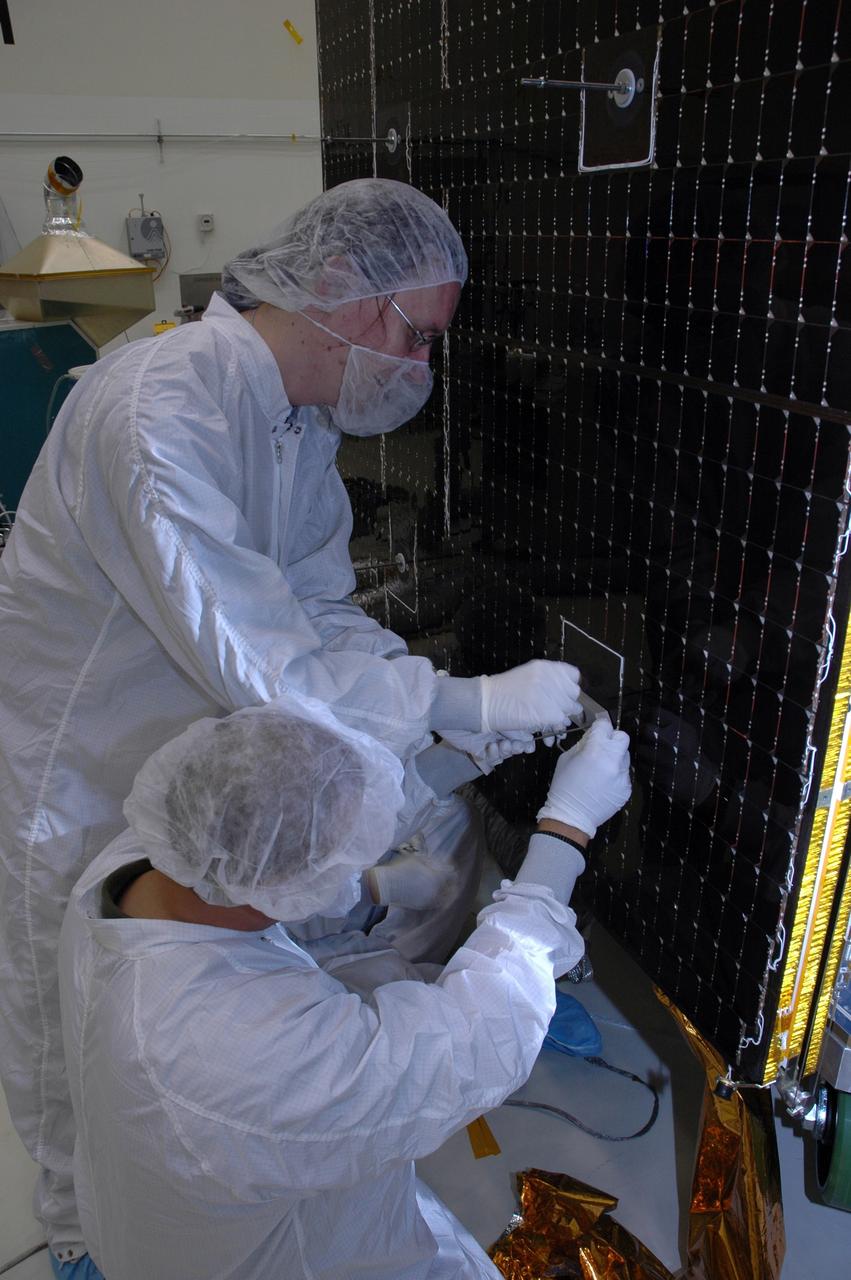
KENNEDY SPACE CENTER, FLA. - In the Astrotech payload processing facility, General Dynamics technicians install one of twin solar arrays on NASA's Gamma-Ray Large Area Space Telescope, or GLAST. The telescope will launch aboard a Delta II rocket May 16 from Launch Pad 17-B on Cape Canaveral Air Force Station. A powerful space observatory, the GLAST will explore the most extreme environments in the universe, and answer questions about supermassive black hole systems, pulsars and the origin of cosmic rays. It also will study the mystery of powerful explosions known as gamma-ray bursts. Photo credit: NASA/Chris Rhodes

NASA’s Imaging X-Ray Polarimetry Explorer (IXPE) spacecraft – the agency’s first mission dedicated to measuring X-ray polarization – arrives at the Cape Canaveral Space Force Station in Florida on Nov. 5, 2021. IXPE is scheduled to launch aboard a SpaceX Falcon 9 vehicle from Kennedy’s Launch Complex 39A on Dec. 9, 2021. The launch is managed by NASA’s Launch Services Program, based at Kennedy. IXPE will study the polarization of X-rays coming to us from some of the universe’s most extreme sources, including black holes and dead stars known as pulsars.

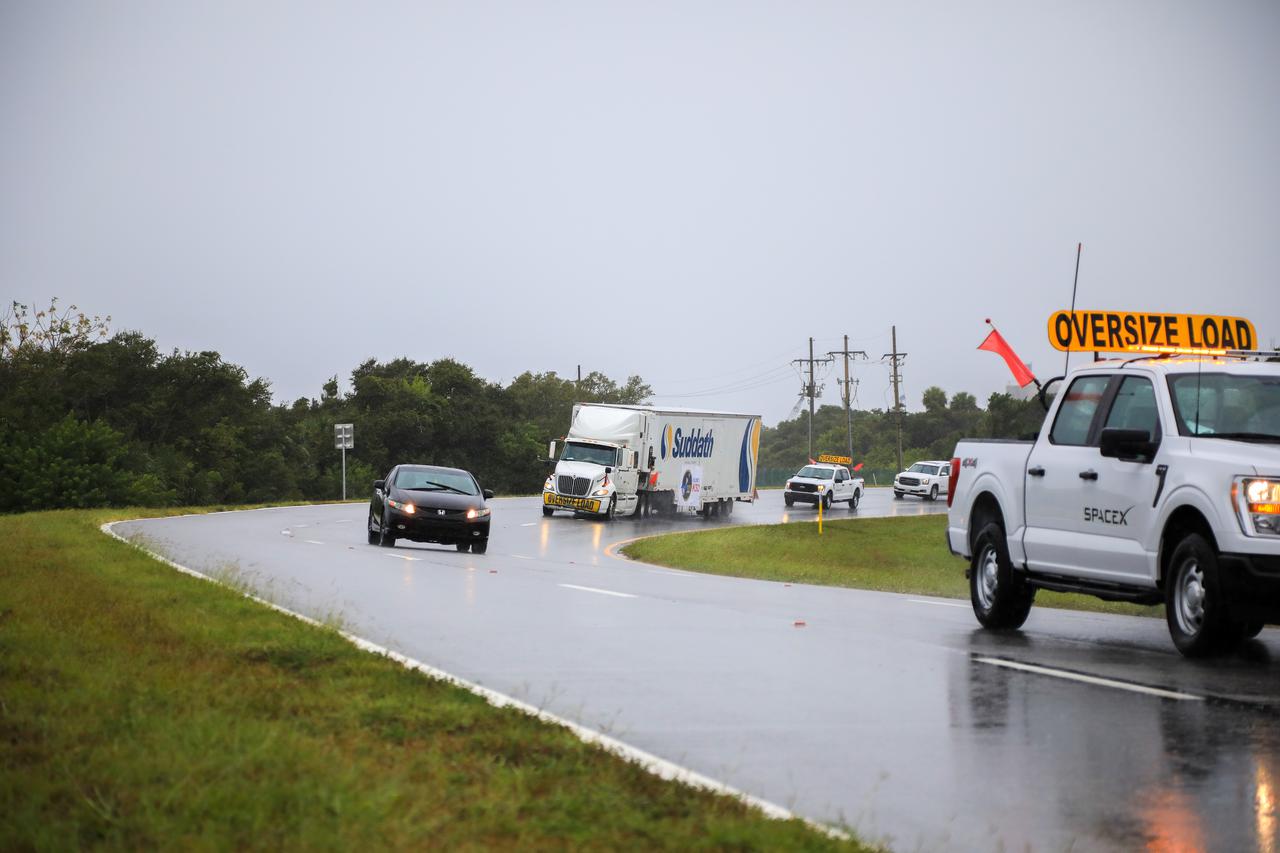
KENNEDY SPACE CENTER, FLA. -- NASA's Gamma-Ray Large Area Space Telescope, or GLAST, arrives at Kennedy Space Center in a shipping container aboard a truck to begin final preparations for launch. The GLAST will launch aboard a Delta II rocket May 16 from Launch Pad 17-B on Cape Canaveral Air Force Station. A powerful space observatory, the GLAST will explore the most extreme environments in the universe, and answer questions about supermassive black hole systems, pulsars and the origin of cosmic rays. It also will study the mystery of powerful explosions known as gamma-ray bursts. Photo credit: NASA/Kim Shiflett
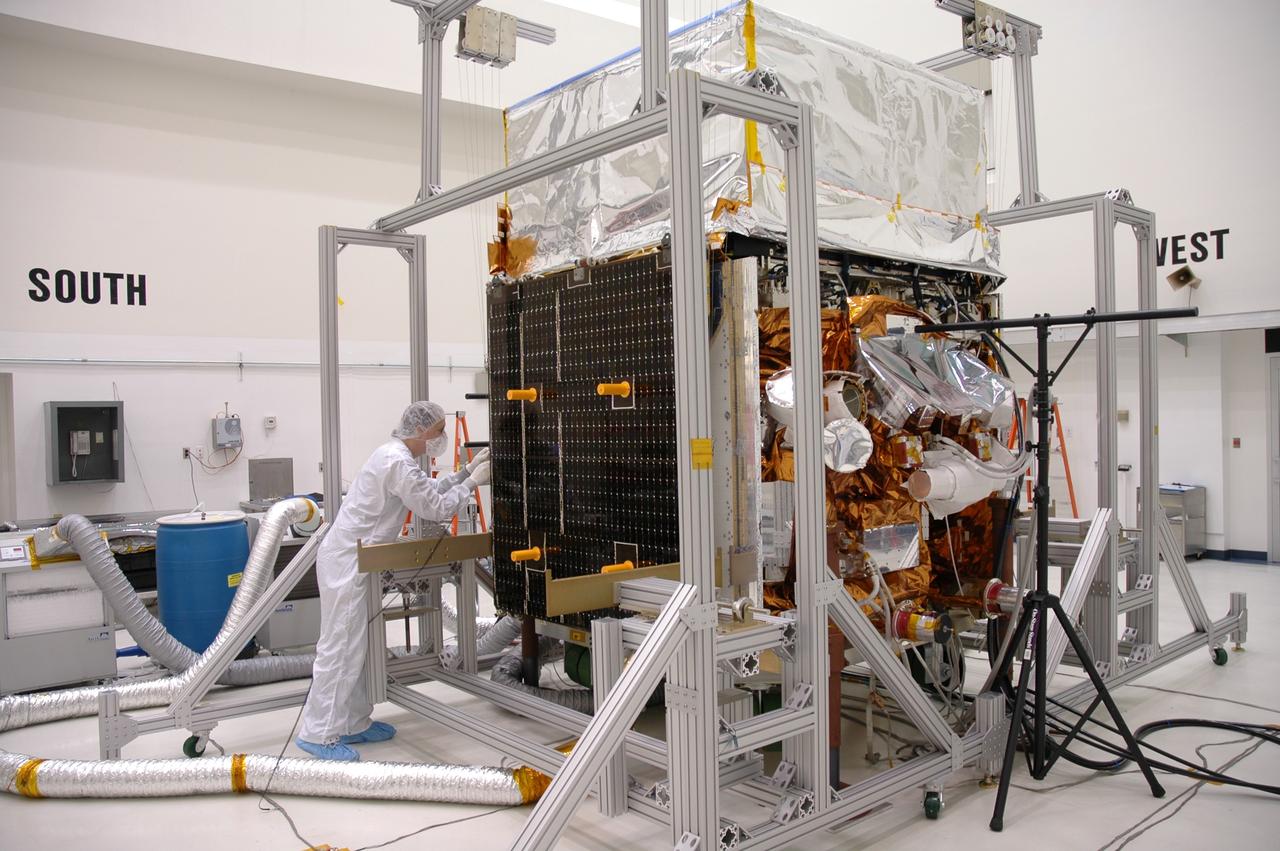
CAPE CANAVERAL, Fla. --- In the Astrotech payload processing facility, a General Dynamics technician prepares to test the deployment mechanism on the solar arrays on NASA's Gamma-Ray Large Area Space Telescope, or GLAST. The telescope will launch aboard a Delta II rocket May 16 from Launch Pad 17-B on Cape Canaveral Air Force Station. A powerful space observatory, the GLAST will explore the most extreme environments in the universe, and answer questions about supermassive black hole systems, pulsars and the origin of cosmic rays. It also will study the mystery of powerful explosions known as gamma-ray bursts. Photo credit: NASA/Jim Grossmann
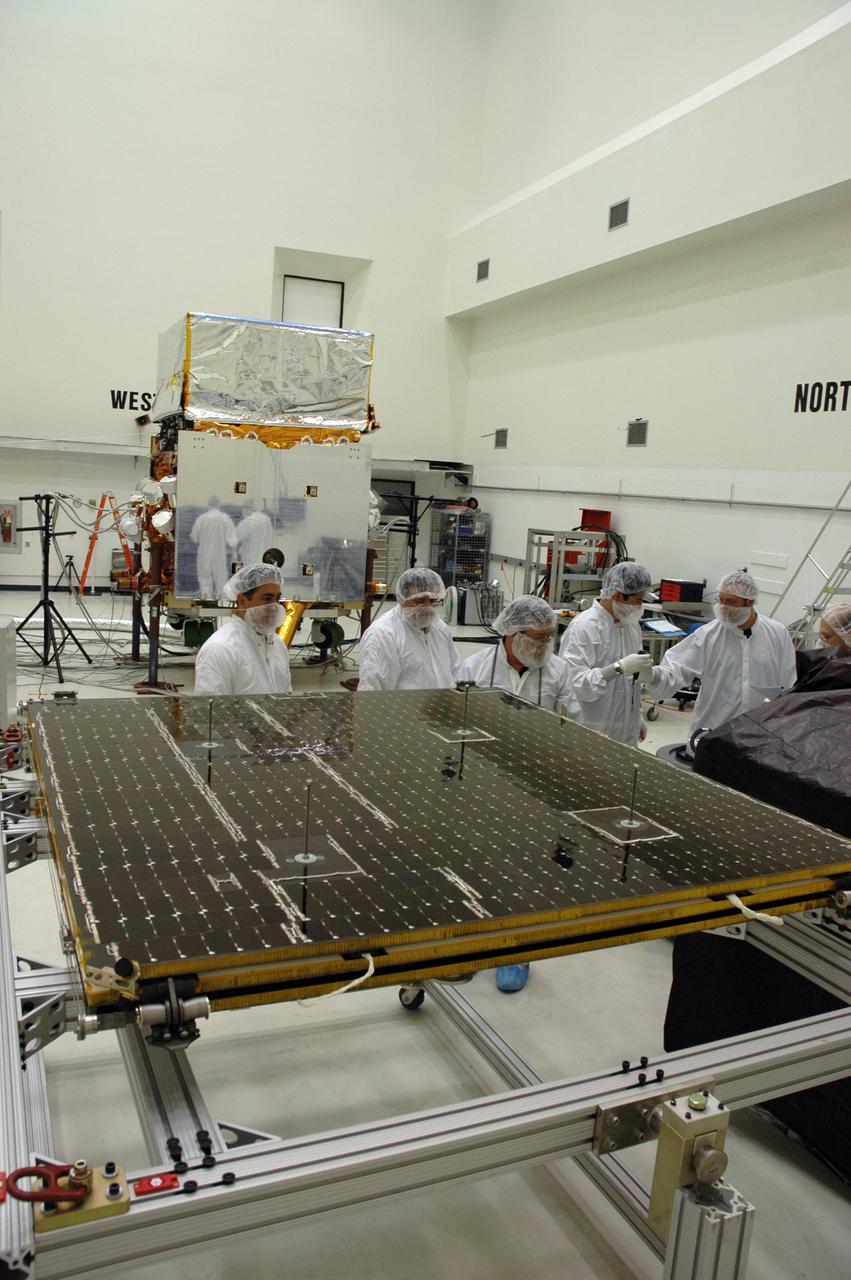
KENNEDY SPACE CENTER, FLA. - In the Astrotech payload processing facility, General Dynamics technicians prepare to install the twin solar arrays on NASA's Gamma-Ray Large Area Space Telescope, or GLAST. The telescope will launch aboard a Delta II rocket May 16 from Launch Pad 17-B on Cape Canaveral Air Force Station. A powerful space observatory, the GLAST will explore the most extreme environments in the universe, and answer questions about supermassive black hole systems, pulsars and the origin of cosmic rays. It also will study the mystery of powerful explosions known as gamma-ray bursts. Photo credit: NASA/Chris Rhodes
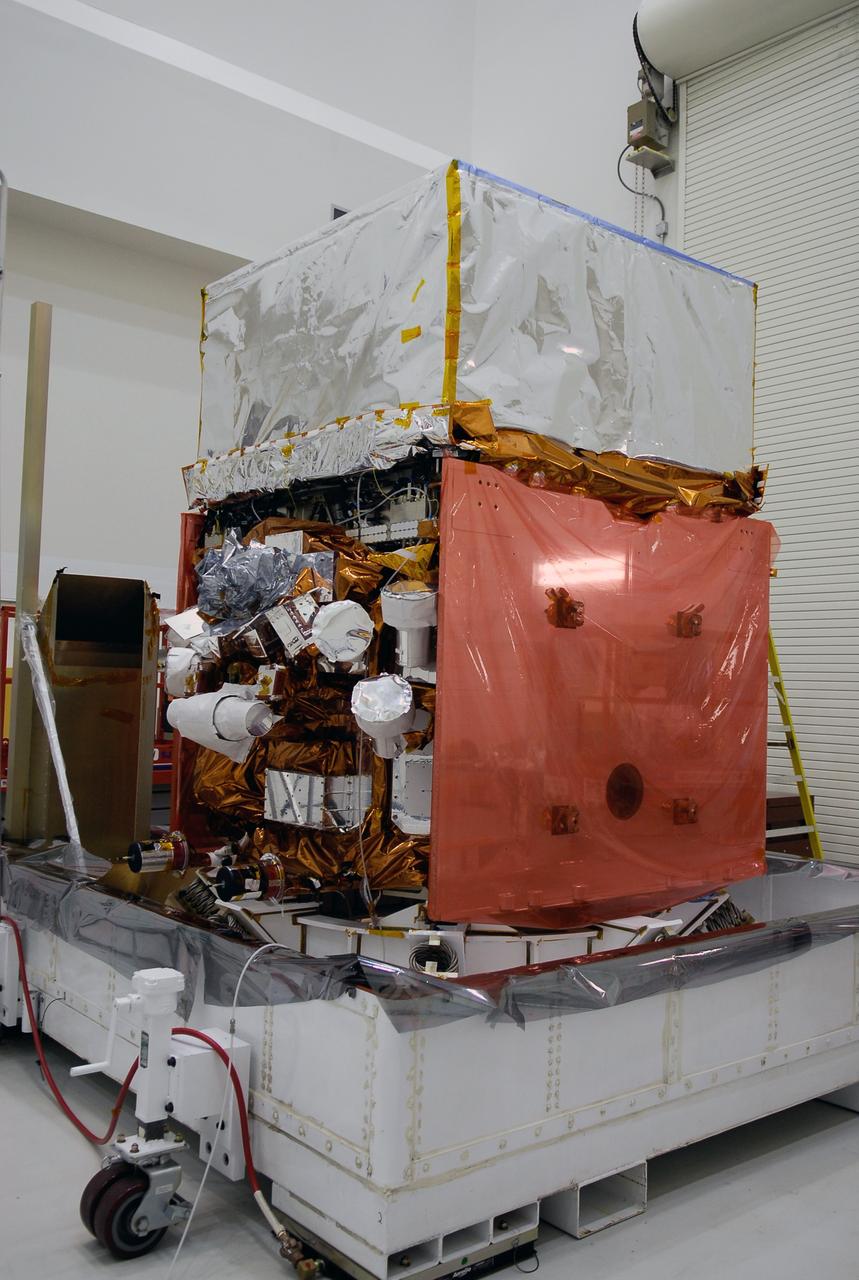
KENNEDY SPACE CENTER, FLA. -- In the Astrotech payload processing facility, NASA's Gamma-Ray Large Area Space Telescope, or GLAST, sits uncovered before its move to a work stand in the facility for a complete checkout of the scientific instruments aboard. The telescope will launch aboard a Delta II rocket May 16 from Launch Pad 17-B on Cape Canaveral Air Force Station. A powerful space observatory, the GLAST will explore the most extreme environments in the universe, and answer questions about supermassive black hole systems, pulsars and the origin of cosmic rays. It also will study the mystery of powerful explosions known as gamma-ray bursts. Photo credit: NASA/Kim Shiflett
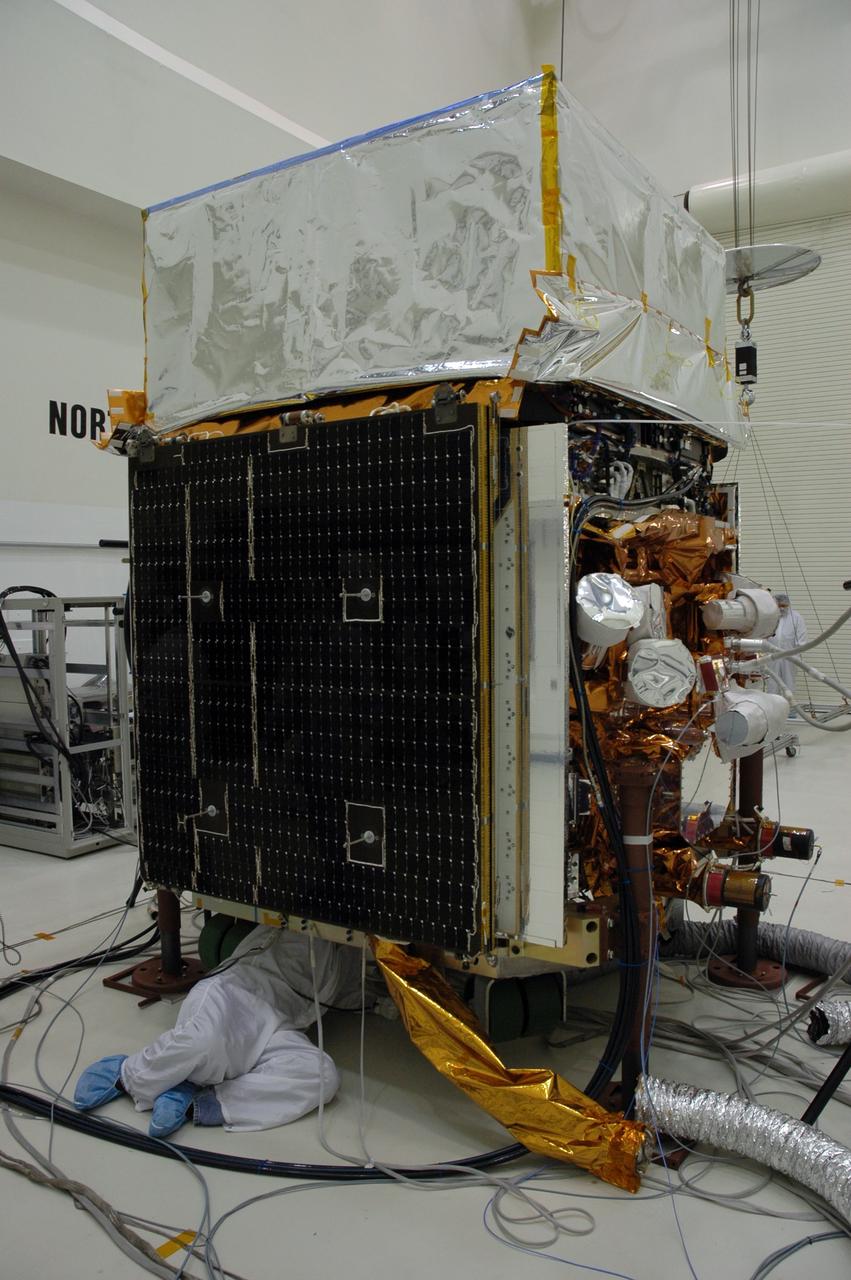
CAPE CANAVERAL, Fla. --- In the Astrotech payload processing facility, a General Dynamics technician finishes the installation of the second of twin solar arrays on NASA's Gamma-Ray Large Area Space Telescope, or GLAST. The telescope will launch aboard a Delta II rocket May 16 from Launch Pad 17-B on Cape Canaveral Air Force Station. A powerful space observatory, the GLAST will explore the most extreme environments in the universe, and answer questions about supermassive black hole systems, pulsars and the origin of cosmic rays. It also will study the mystery of powerful explosions known as gamma-ray bursts. Photo credit: NASA/Chris Rhodes

NASA’s Imaging X-Ray Polarimetry Explorer (IXPE) spacecraft – the agency’s first mission dedicated to measuring X-ray polarization – arrives at the Cape Canaveral Space Force Station in Florida on Nov. 5, 2021. IXPE is scheduled to launch aboard a SpaceX Falcon 9 vehicle from Kennedy’s Launch Complex 39A on Dec. 9, 2021. The launch is managed by NASA’s Launch Services Program, based at Kennedy. IXPE will study the polarization of X-rays coming to us from some of the universe’s most extreme sources, including black holes and dead stars known as pulsars.
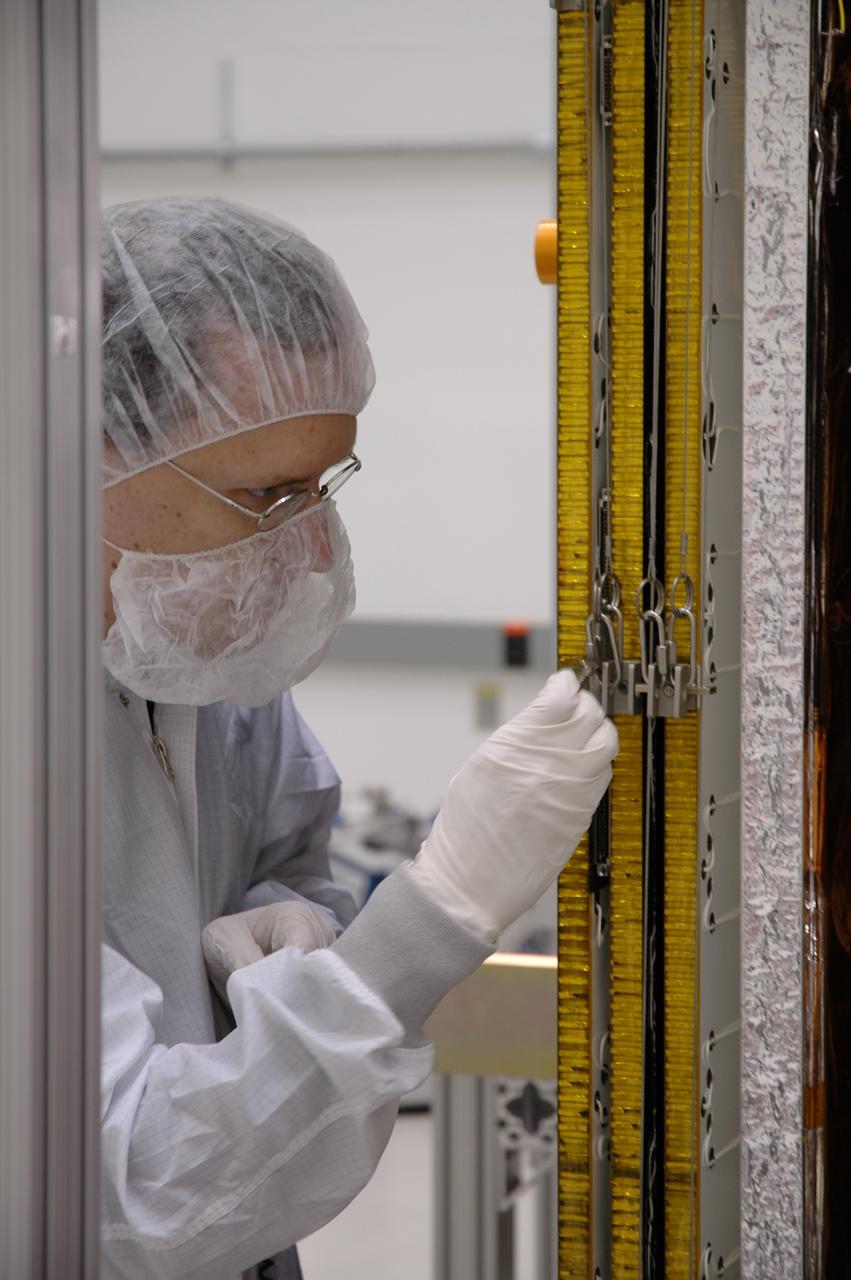
CAPE CANAVERAL, Fla. --- In the Astrotech payload processing facility, a General Dynamics technician prepares to test the deployment mechanism of the solar arrays on NASA's Gamma-Ray Large Area Space Telescope, or GLAST. The telescope will launch aboard a Delta II rocket May 16 from Launch Pad 17-B on Cape Canaveral Air Force Station. A powerful space observatory, the GLAST will explore the most extreme environments in the universe, and answer questions about supermassive black hole systems, pulsars and the origin of cosmic rays. It also will study the mystery of powerful explosions known as gamma-ray bursts. Photo credit: NASA/Jim Grossmann
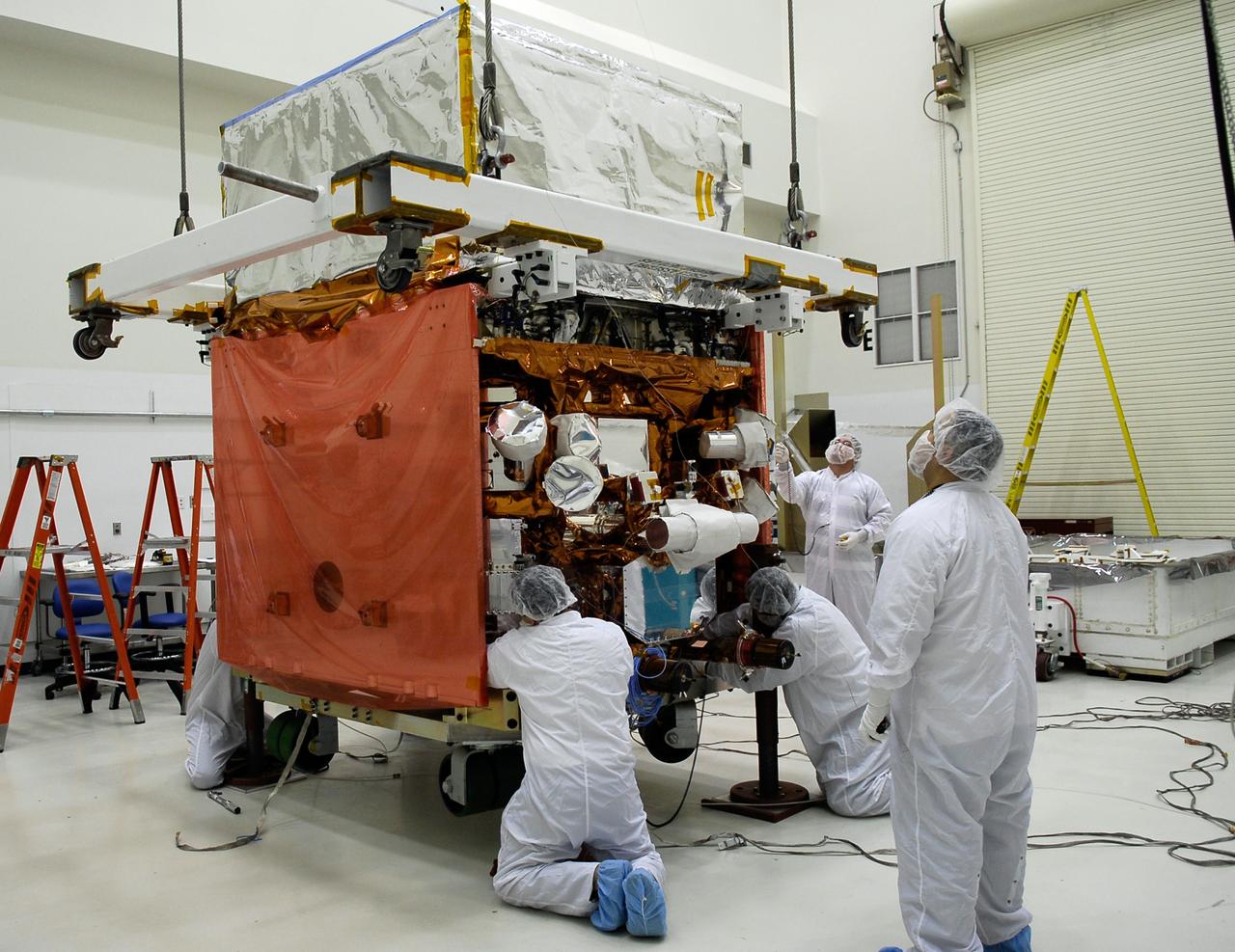
KENNEDY SPACE CENTER, FLA. -- In the Astrotech payload processing facility, General Dynamics technicians secure NASA's Gamma-Ray Large Area Space Telescope, or GLAST, onto a work stand. There GLAST will undergo a complete checkout of the scientific instruments aboard. The telescope will launch aboard a Delta II rocket May 16 from Launch Pad 17-B on Cape Canaveral Air Force Station. A powerful space observatory, the GLAST will explore the most extreme environments in the universe, and answer questions about supermassive black hole systems, pulsars and the origin of cosmic rays. It also will study the mystery of powerful explosions known as gamma-ray bursts. Photo credit: NASA/Kim Shiflett

NASA’s Imaging X-Ray Polarimetry Explorer (IXPE) spacecraft – the agency’s first mission dedicated to measuring X-ray polarization – arrives at the Cape Canaveral Space Force Station in Florida on Nov. 5, 2021. IXPE is scheduled to launch aboard a SpaceX Falcon 9 vehicle from Kennedy’s Launch Complex 39A on Dec. 9, 2021. The launch is managed by NASA’s Launch Services Program, based at Kennedy. IXPE will study the polarization of X-rays coming to us from some of the universe’s most extreme sources, including black holes and dead stars known as pulsars.
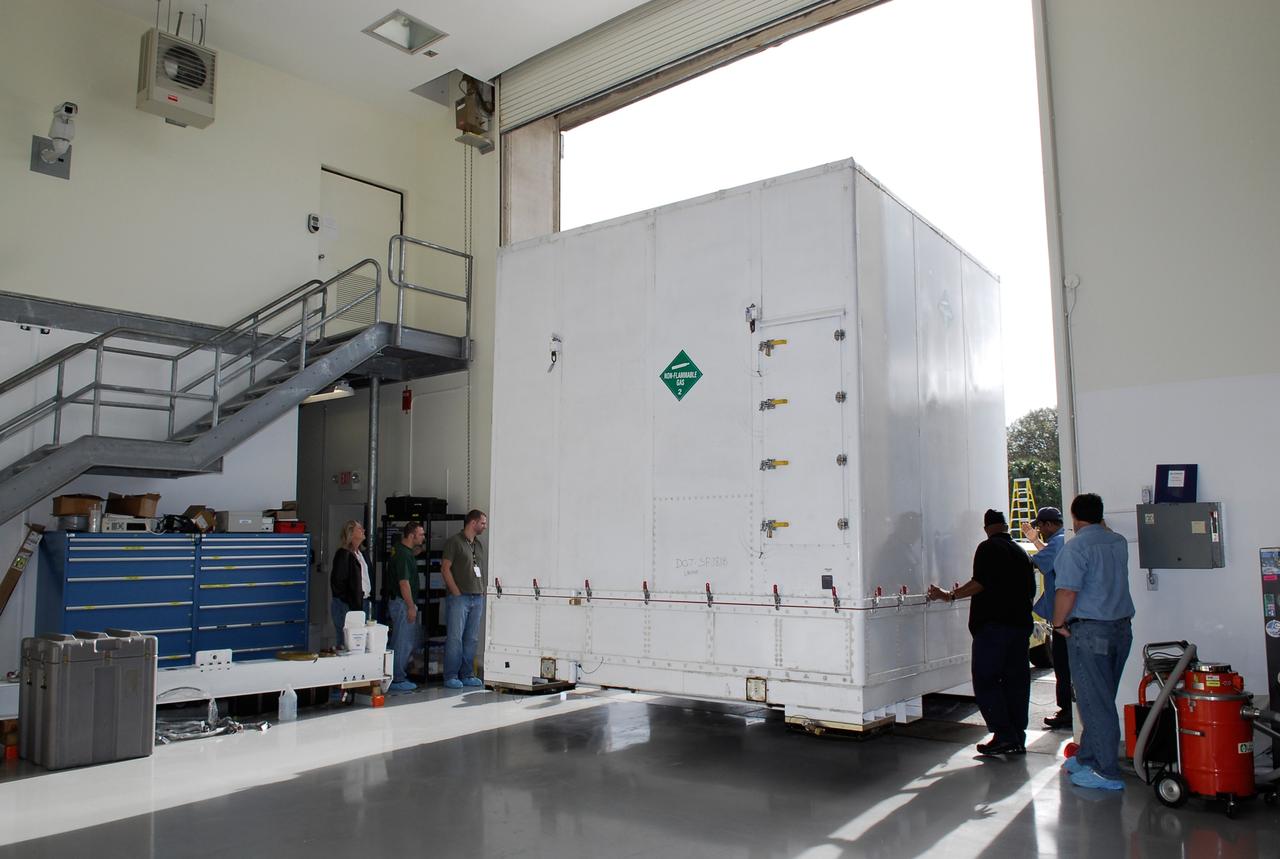
KENNEDY SPACE CENTER, FLA. -- The shipping container holding NASA's Gamma-Ray Large Area Space Telescope, or GLAST, is moved into the Astrotech payload processing facility near the Kennedy Space Center to begin prelaunch activities. The GLAST will launch aboard a Delta II rocket May 16 from Launch Pad 17-B on Cape Canaveral Air Force Station. A powerful space observatory, the GLAST will explore the most extreme environments in the universe, and answer questions about supermassive black hole systems, pulsars and the origin of cosmic rays. It also will study the mystery of powerful explosions known as gamma-ray bursts. Photo credit: NASA/Kim Shiflett
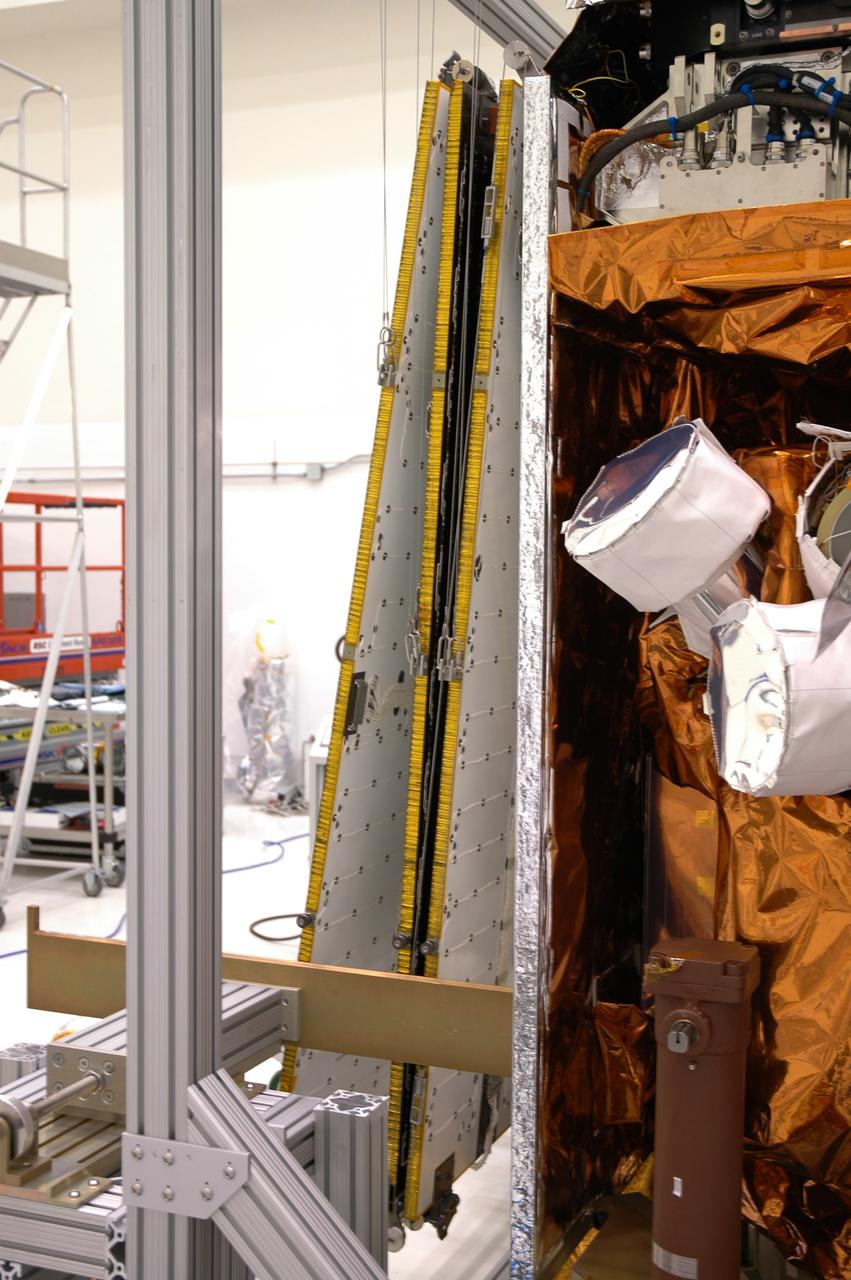
CAPE CANAVERAL, Fla. --- In the Astrotech payload processing facility, the mechanism on NASA's Gamma-Ray Large Area Space Telescope, or GLAST, solar arrays has been released. The telescope will launch aboard a Delta II rocket May 16 from Launch Pad 17-B on Cape Canaveral Air Force Station. A powerful space observatory, the GLAST will explore the most extreme environments in the universe, and answer questions about supermassive black hole systems, pulsars and the origin of cosmic rays. It also will study the mystery of powerful explosions known as gamma-ray bursts. Photo credit: NASA/Jim Grossmann
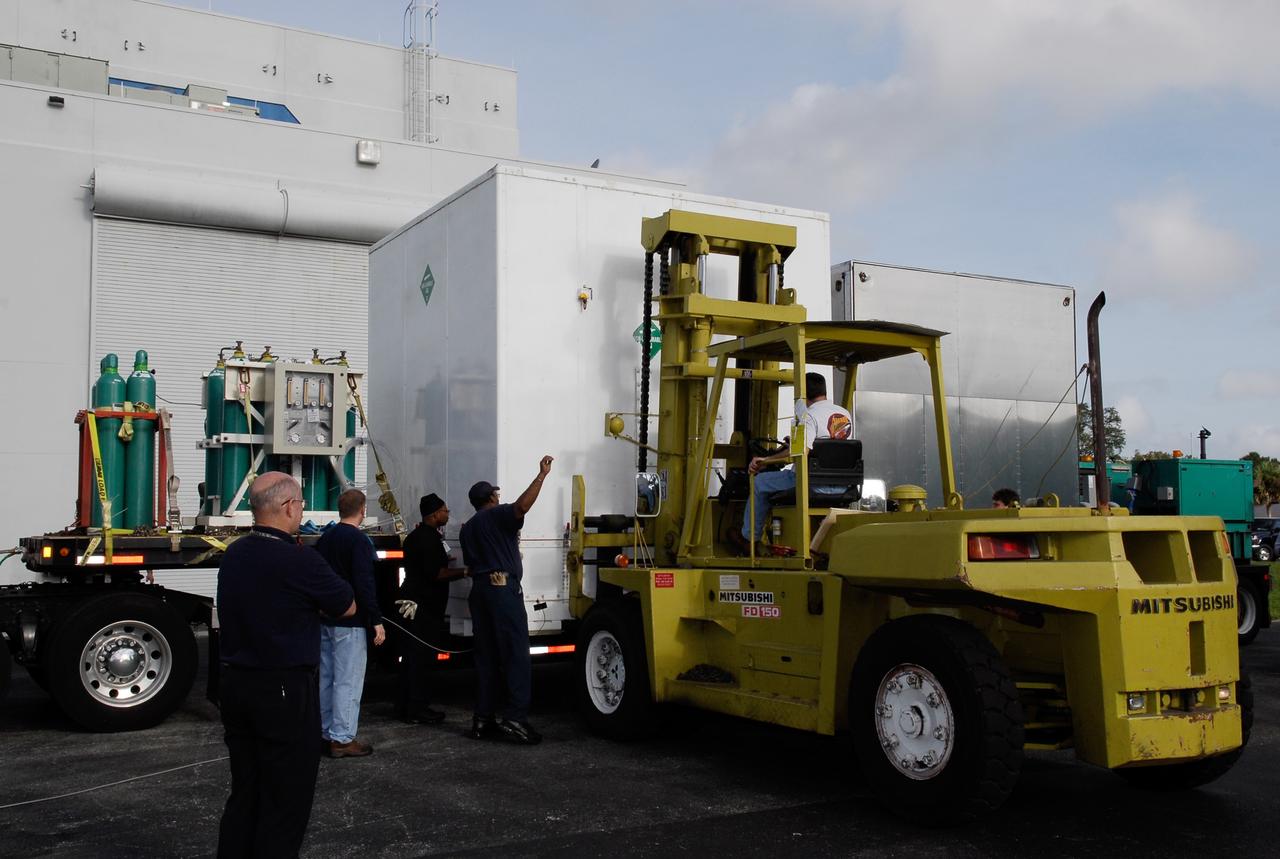
KENNEDY SPACE CENTER, FLA. -- The shipping container holding NASA's Gamma-Ray Large Area Space Telescope, or GLAST, is removed from the truck at the Astrotech payload processing facility near the Kennedy Space Center to begin prelaunch activities. The GLAST will launch aboard a Delta II rocket May 16 from Launch Pad 17-B on Cape Canaveral Air Force Station. A powerful space observatory, the GLAST will explore the most extreme environments in the universe, and answer questions about supermassive black hole systems, pulsars and the origin of cosmic rays. It also will study the mystery of powerful explosions known as gamma-ray bursts. Photo credit: NASA/Kim Shiflett

NASA’s Imaging X-Ray Polarimetry Explorer (IXPE) spacecraft – the agency’s first mission dedicated to measuring X-ray polarization – arrives at the Cape Canaveral Space Force Station in Florida on Nov. 5, 2021. IXPE is scheduled to launch aboard a SpaceX Falcon 9 vehicle from Kennedy’s Launch Complex 39A on Dec. 9, 2021. The launch is managed by NASA’s Launch Services Program, based at Kennedy. IXPE will study the polarization of X-rays coming to us from some of the universe’s most extreme sources, including black holes and dead stars known as pulsars.
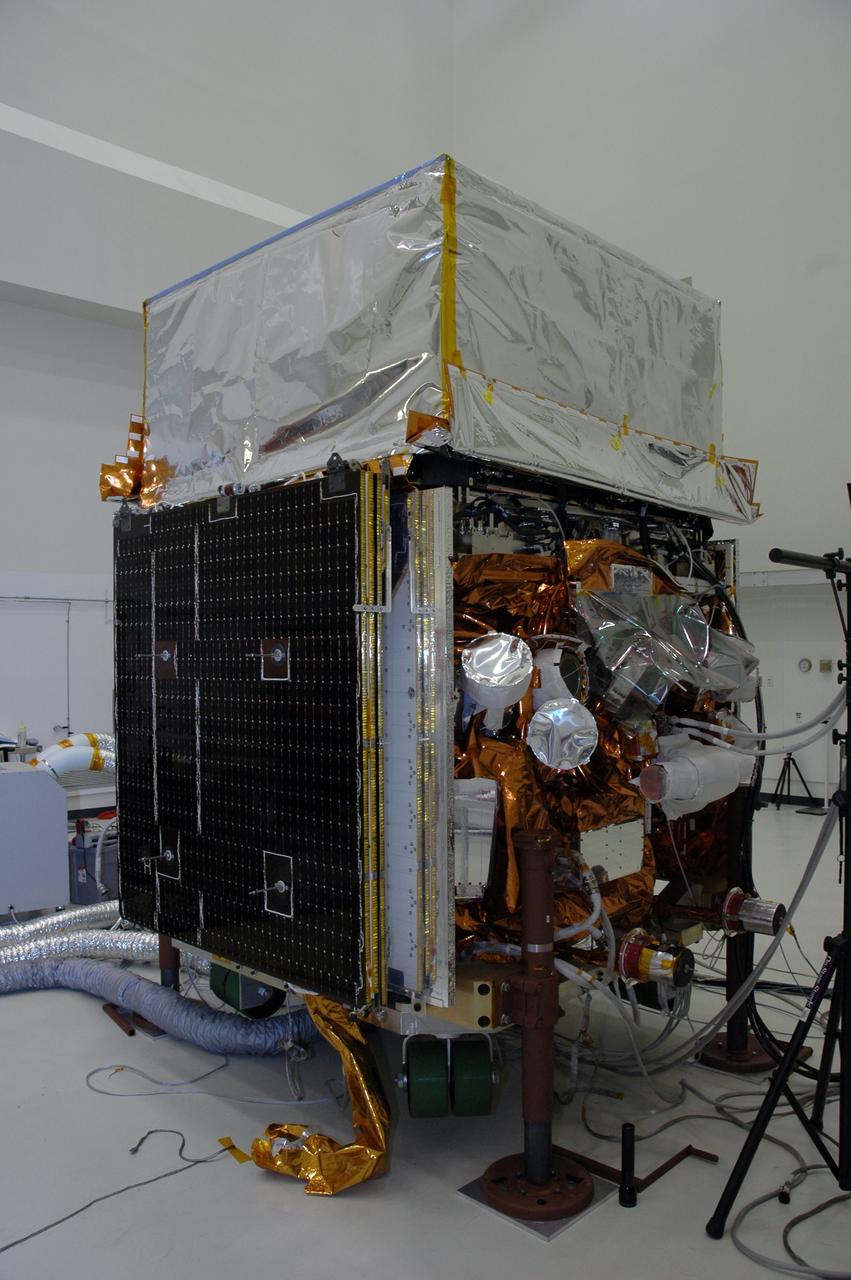
KENNEDY SPACE CENTER, FLA. - In the Astrotech payload processing facility, one of twin solar arrays is positioned on NASA's Gamma-Ray Large Area Space Telescope, or GLAST. The telescope will launch aboard a Delta II rocket May 16 from Launch Pad 17-B on Cape Canaveral Air Force Station. A powerful space observatory, the GLAST will explore the most extreme environments in the universe, and answer questions about supermassive black hole systems, pulsars and the origin of cosmic rays. It also will study the mystery of powerful explosions known as gamma-ray bursts. Photo credit: NASA/Chris Rhodes
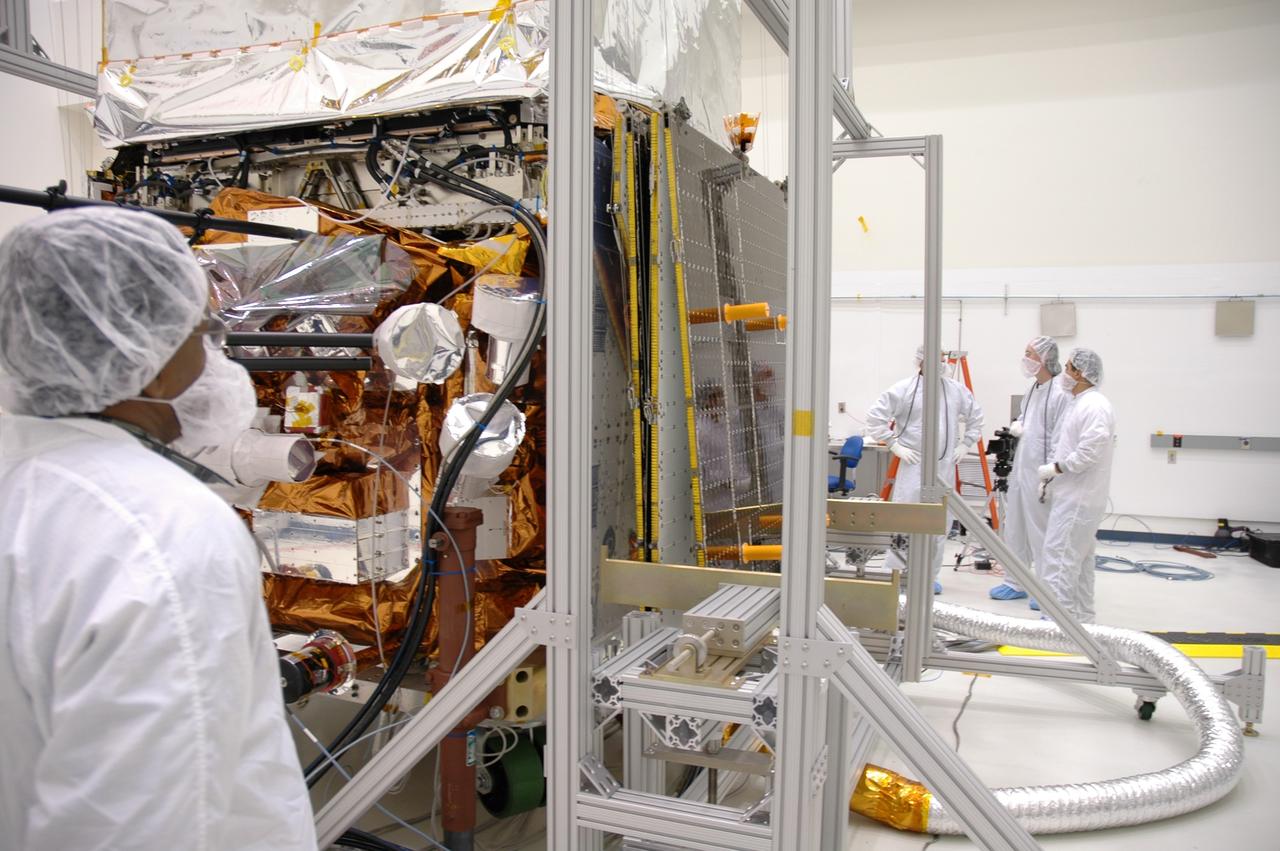
CAPE CANAVERAL, Fla. --- In the Astrotech payload processing facility, NASA's Gamma-Ray Large Area Space Telescope, or GLAST, completes the test of the deployment mechanism on its solar arrays. The telescope will launch aboard a Delta II rocket May 16 from Launch Pad 17-B on Cape Canaveral Air Force Station. A powerful space observatory, the GLAST will explore the most extreme environments in the universe, and answer questions about supermassive black hole systems, pulsars and the origin of cosmic rays. It also will study the mystery of powerful explosions known as gamma-ray bursts. Photo credit: NASA/Jim Grossmann
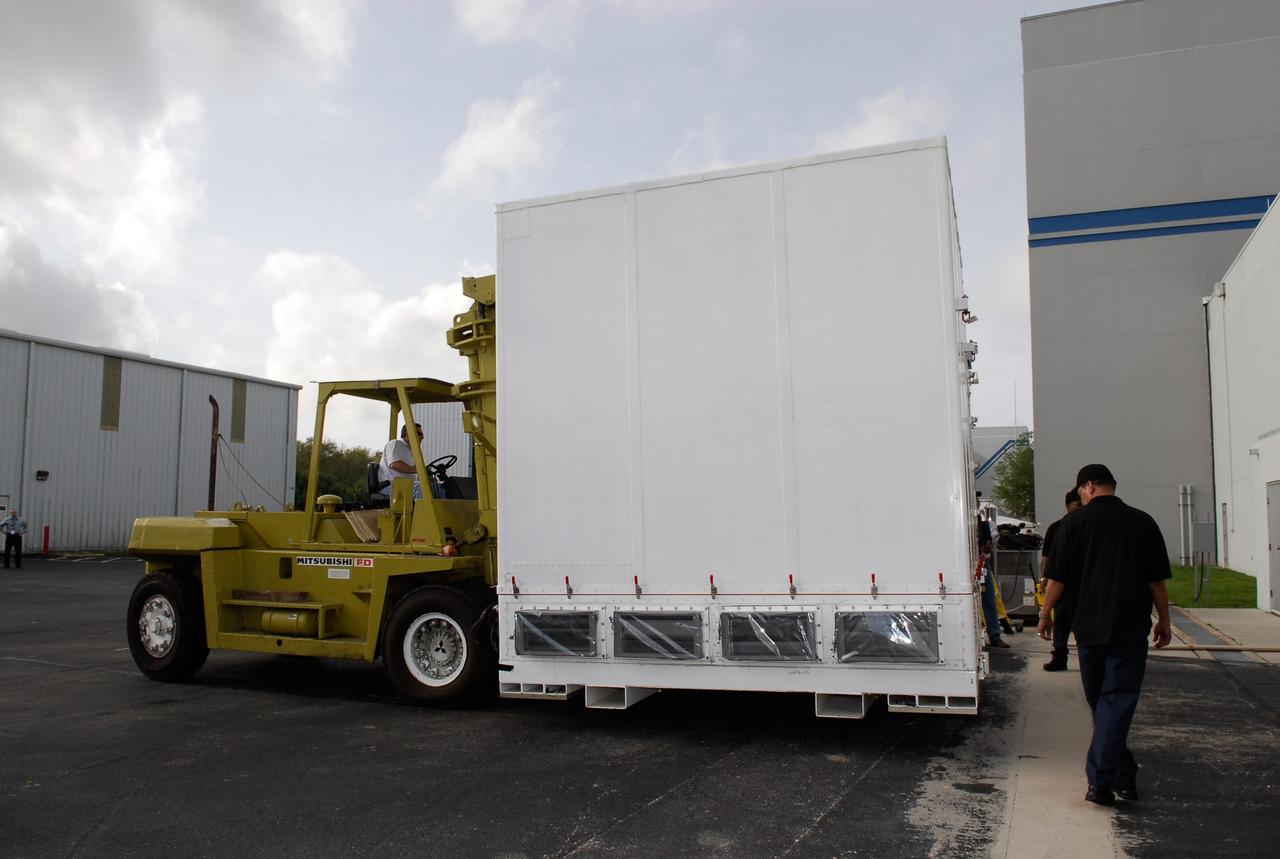
KENNEDY SPACE CENTER, FLA. -- The shipping container holding NASA's Gamma-Ray Large Area Space Telescope, or GLAST, is removed from the truck at the Astrotech payload processing facility near the Kennedy Space Center to begin prelaunch activities. The GLAST will launch aboard a Delta II rocket May 16 from Launch Pad 17-B on Cape Canaveral Air Force Station. A powerful space observatory, the GLAST will explore the most extreme environments in the universe, and answer questions about supermassive black hole systems, pulsars and the origin of cosmic rays. It also will study the mystery of powerful explosions known as gamma-ray bursts. Photo credit: NASA/Kim Shiflett
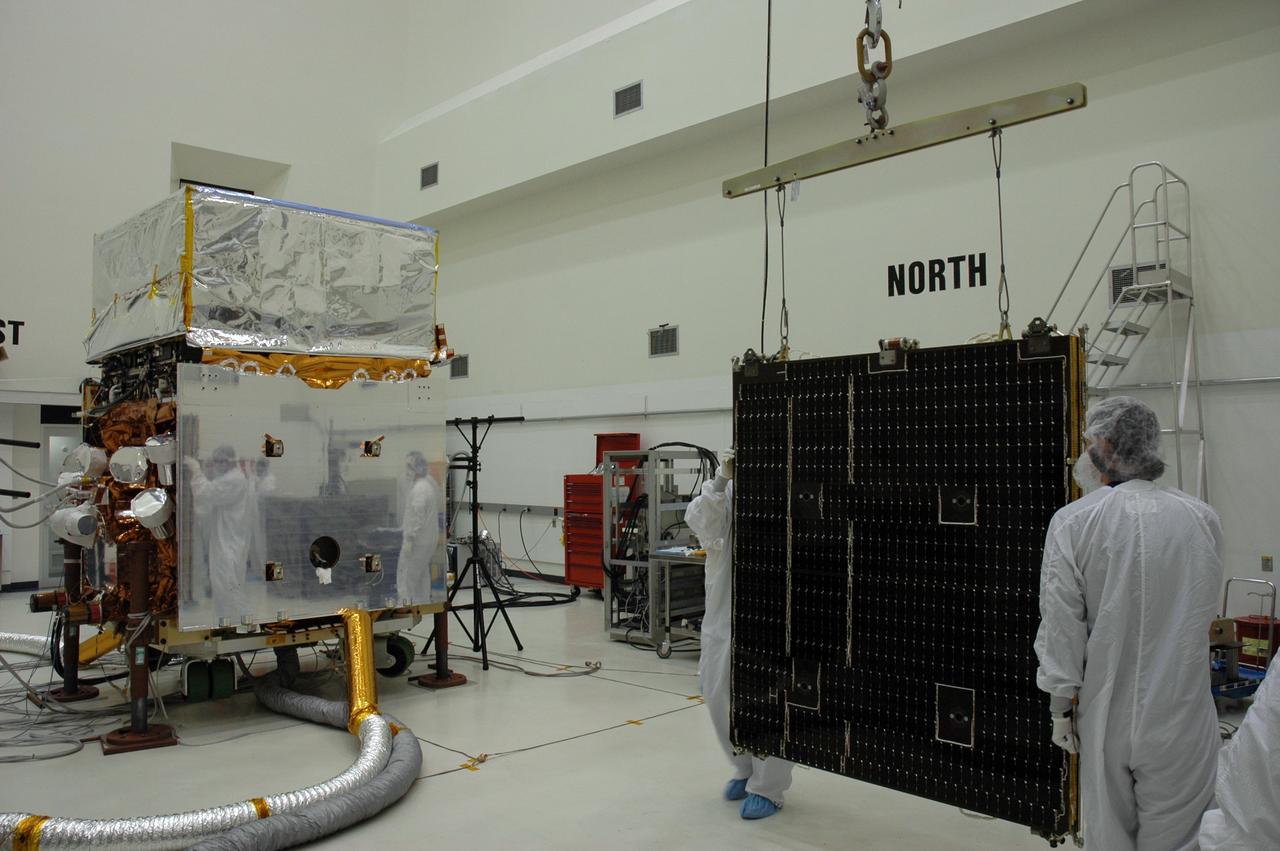
KENNEDY SPACE CENTER, FLA. - In the Astrotech payload processing facility, General Dynamics technicians guide one of twin solar arrays toward NASA's Gamma-Ray Large Area Space Telescope, or GLAST. The telescope will launch aboard a Delta II rocket May 16 from Launch Pad 17-B on Cape Canaveral Air Force Station. A powerful space observatory, the GLAST will explore the most extreme environments in the universe, and answer questions about supermassive black hole systems, pulsars and the origin of cosmic rays. It also will study the mystery of powerful explosions known as gamma-ray bursts. Photo credit: NASA/Chris Rhodes
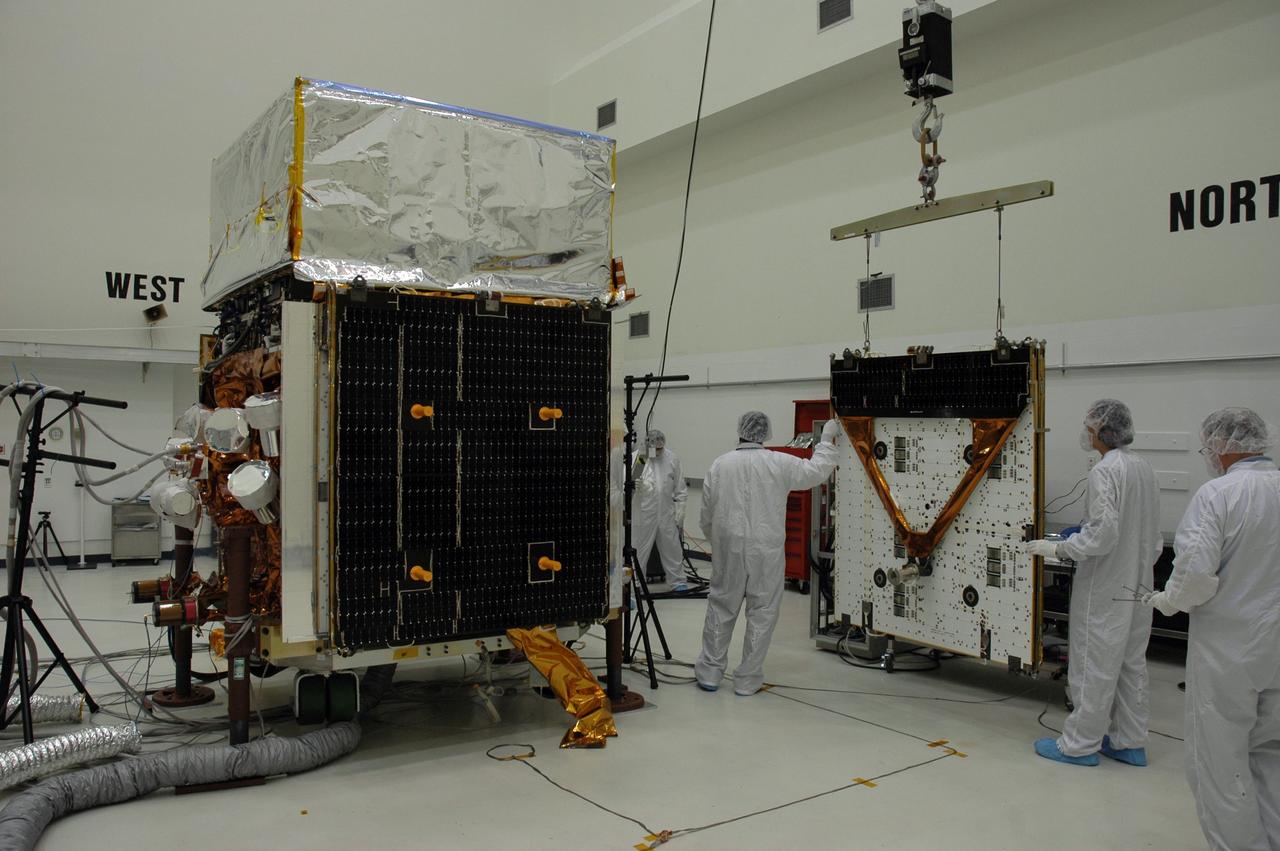
KENNEDY SPACE CENTER, FLA. - In the Astrotech payload processing facility, General Dynamics technicians move the second of twin solar arrays toward NASA's Gamma-Ray Large Area Space Telescope, or GLAST. The telescope will launch aboard a Delta II rocket May 16 from Launch Pad 17-B on Cape Canaveral Air Force Station. A powerful space observatory, the GLAST will explore the most extreme environments in the universe, and answer questions about supermassive black hole systems, pulsars and the origin of cosmic rays. It also will study the mystery of powerful explosions known as gamma-ray bursts. Photo credit: NASA/Chris Rhodes

NASA’s Imaging X-Ray Polarimetry Explorer (IXPE) spacecraft – the agency’s first mission dedicated to measuring X-ray polarization – arrives at the Cape Canaveral Space Force Station in Florida on Nov. 5, 2021. IXPE is scheduled to launch aboard a SpaceX Falcon 9 vehicle from Kennedy’s Launch Complex 39A on Dec. 9, 2021. The launch is managed by NASA’s Launch Services Program, based at Kennedy. IXPE will study the polarization of X-rays coming to us from some of the universe’s most extreme sources, including black holes and dead stars known as pulsars.
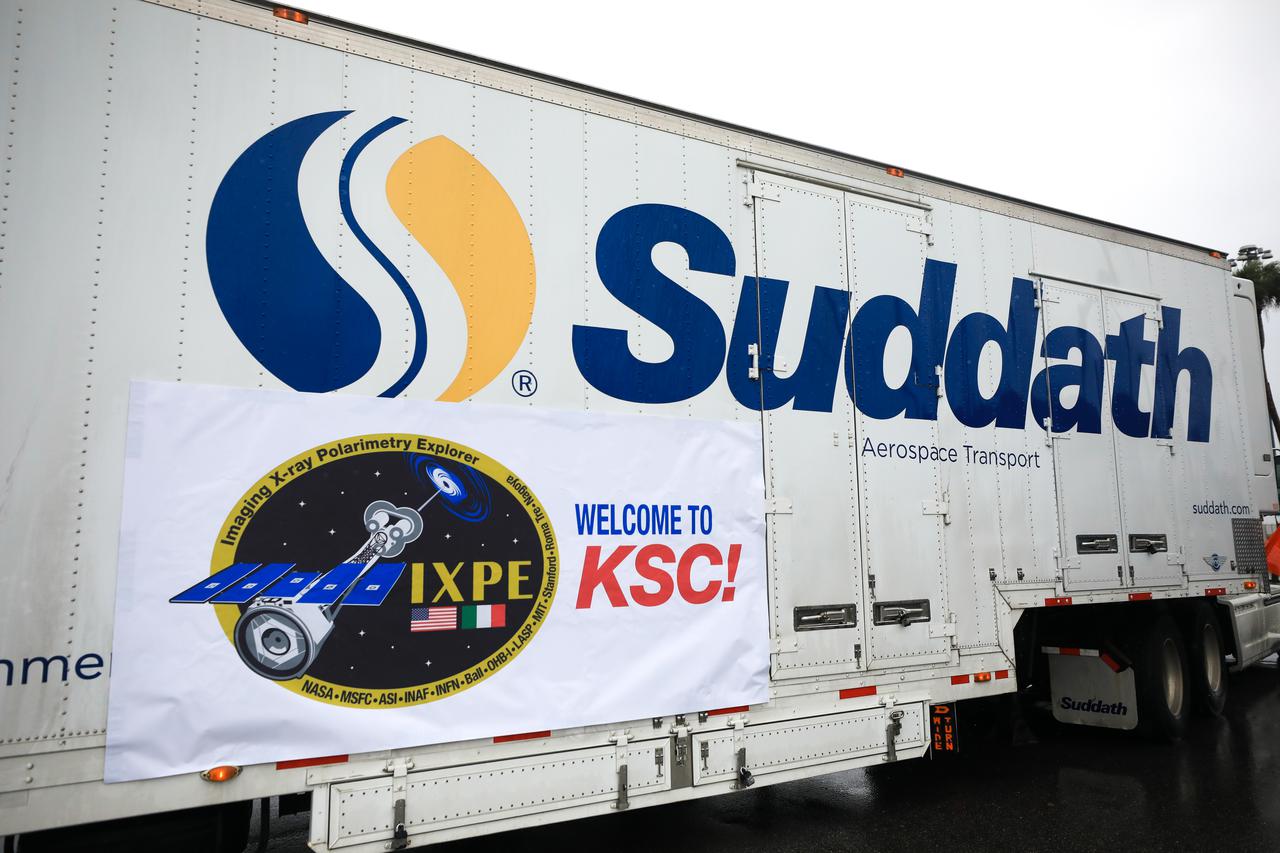
NASA’s Imaging X-Ray Polarimetry Explorer (IXPE) spacecraft – the agency’s first mission dedicated to measuring X-ray polarization – arrives at the Cape Canaveral Space Force Station in Florida on Nov. 5, 2021. IXPE is scheduled to launch aboard a SpaceX Falcon 9 vehicle from Kennedy’s Launch Complex 39A on Dec. 9, 2021. The launch is managed by NASA’s Launch Services Program, based at Kennedy. IXPE will study the polarization of X-rays coming to us from some of the universe’s most extreme sources, including black holes and dead stars known as pulsars.
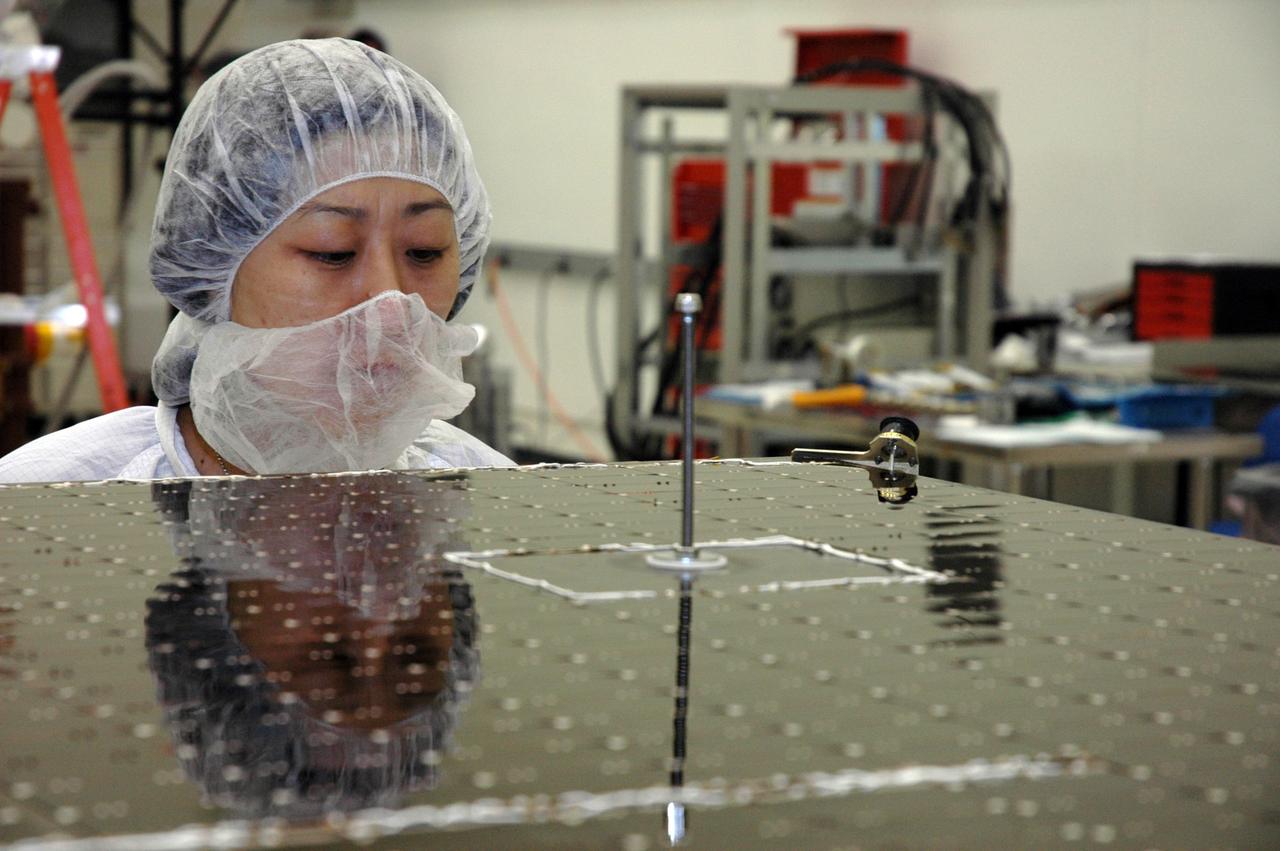
KENNEDY SPACE CENTER, FLA. - In the Astrotech payload processing facility, a General Dynamics technician studies one of twin solar arrays that will be installed on NASA's Gamma-Ray Large Area Space Telescope, or GLAST. The telescope will launch aboard a Delta II rocket May 16 from Launch Pad 17-B on Cape Canaveral Air Force Station. A powerful space observatory, the GLAST will explore the most extreme environments in the universe, and answer questions about supermassive black hole systems, pulsars and the origin of cosmic rays. It also will study the mystery of powerful explosions known as gamma-ray bursts. Photo credit: NASA/Chris Rhodes
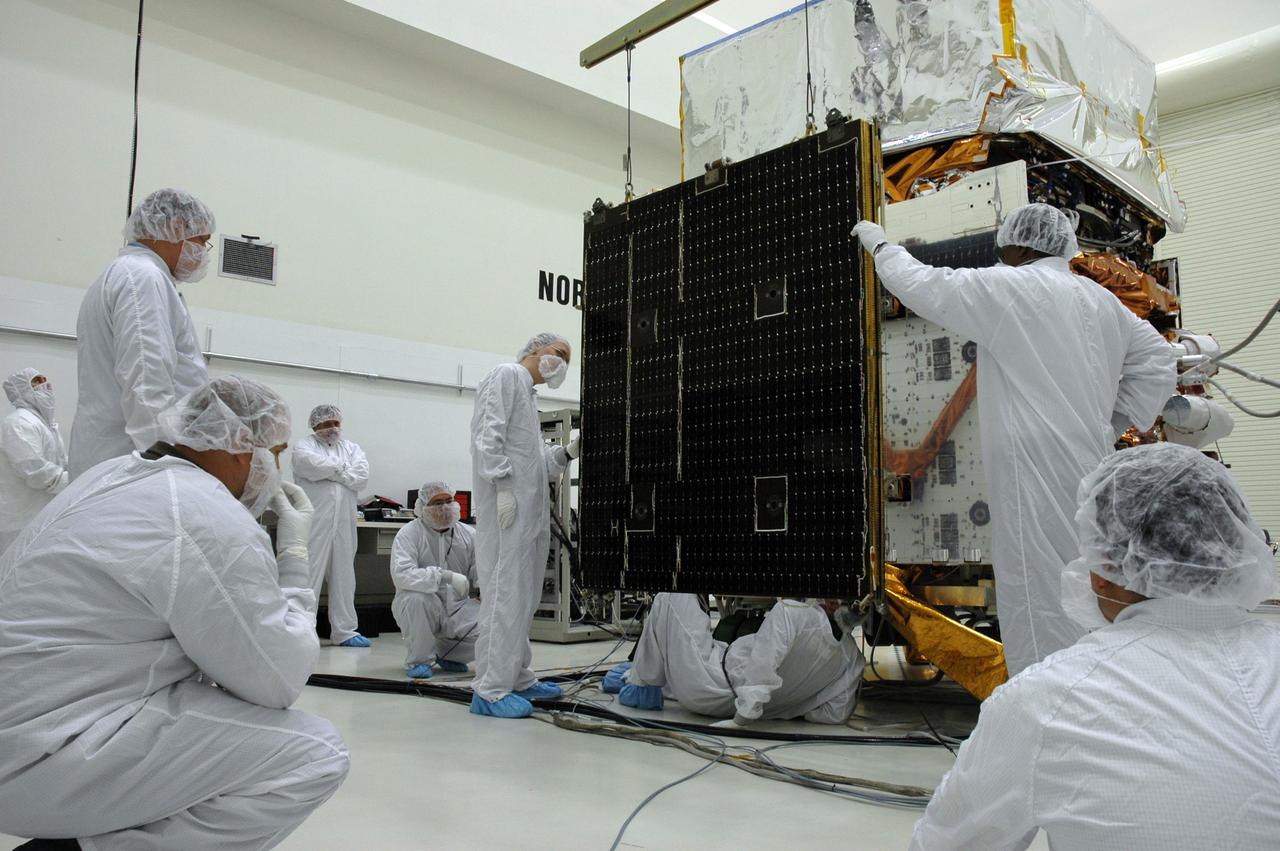
KENNEDY SPACE CENTER, FLA. - In the Astrotech payload processing facility, General Dynamics technicians install the second of twin solar arrays on NASA's Gamma-Ray Large Area Space Telescope, or GLAST. The telescope will launch aboard a Delta II rocket May 16 from Launch Pad 17-B on Cape Canaveral Air Force Station. A powerful space observatory, the GLAST will explore the most extreme environments in the universe, and answer questions about supermassive black hole systems, pulsars and the origin of cosmic rays. It also will study the mystery of powerful explosions known as gamma-ray bursts. Photo credit: NASA/Chris Rhodes
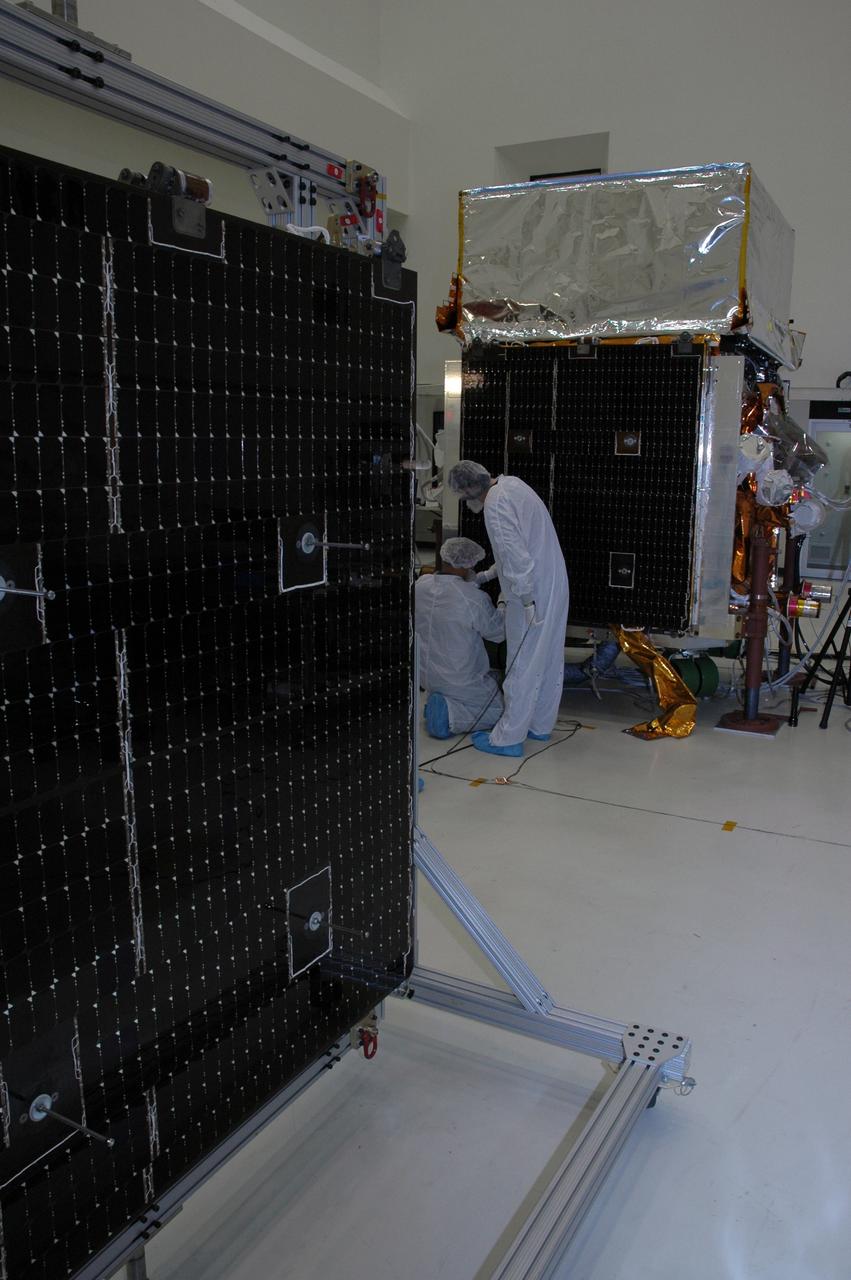
KENNEDY SPACE CENTER, FLA. - In the Astrotech payload processing facility, one of twin solar arrays awaits processing as General Dynamics technicians install the other of the pair on NASA's Gamma-Ray Large Area Space Telescope, or GLAST. The telescope will launch aboard a Delta II rocket May 16 from Launch Pad 17-B on Cape Canaveral Air Force Station. A powerful space observatory, the GLAST will explore the most extreme environments in the universe, and answer questions about supermassive black hole systems, pulsars and the origin of cosmic rays. It also will study the mystery of powerful explosions known as gamma-ray bursts. Photo credit: NASA/Chris Rhodes
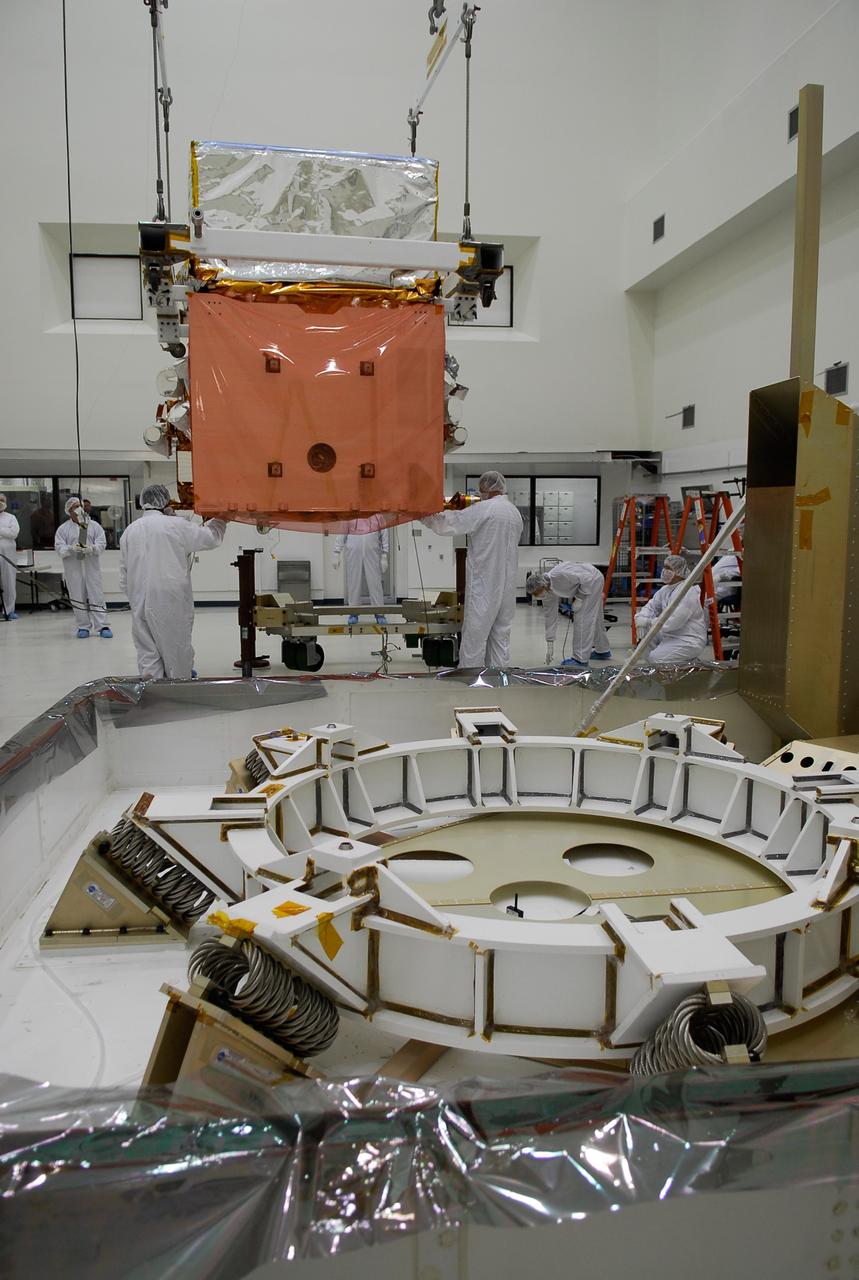
KENNEDY SPACE CENTER, FLA. -- In the Astrotech payload processing facility, General Dynamics technicians keep watch as NASA's Gamma-Ray Large Area Space Telescope, or GLAST, is moved toward a work stand (at left) in the facility. There GLAST will undergo a complete checkout of the scientific instruments aboard. The telescope will launch aboard a Delta II rocket May 16 from Launch Pad 17-B on Cape Canaveral Air Force Station. A powerful space observatory, the GLAST will explore the most extreme environments in the universe, and answer questions about supermassive black hole systems, pulsars and the origin of cosmic rays. It also will study the mystery of powerful explosions known as gamma-ray bursts. Photo credit: NASA/Kim Shiflett
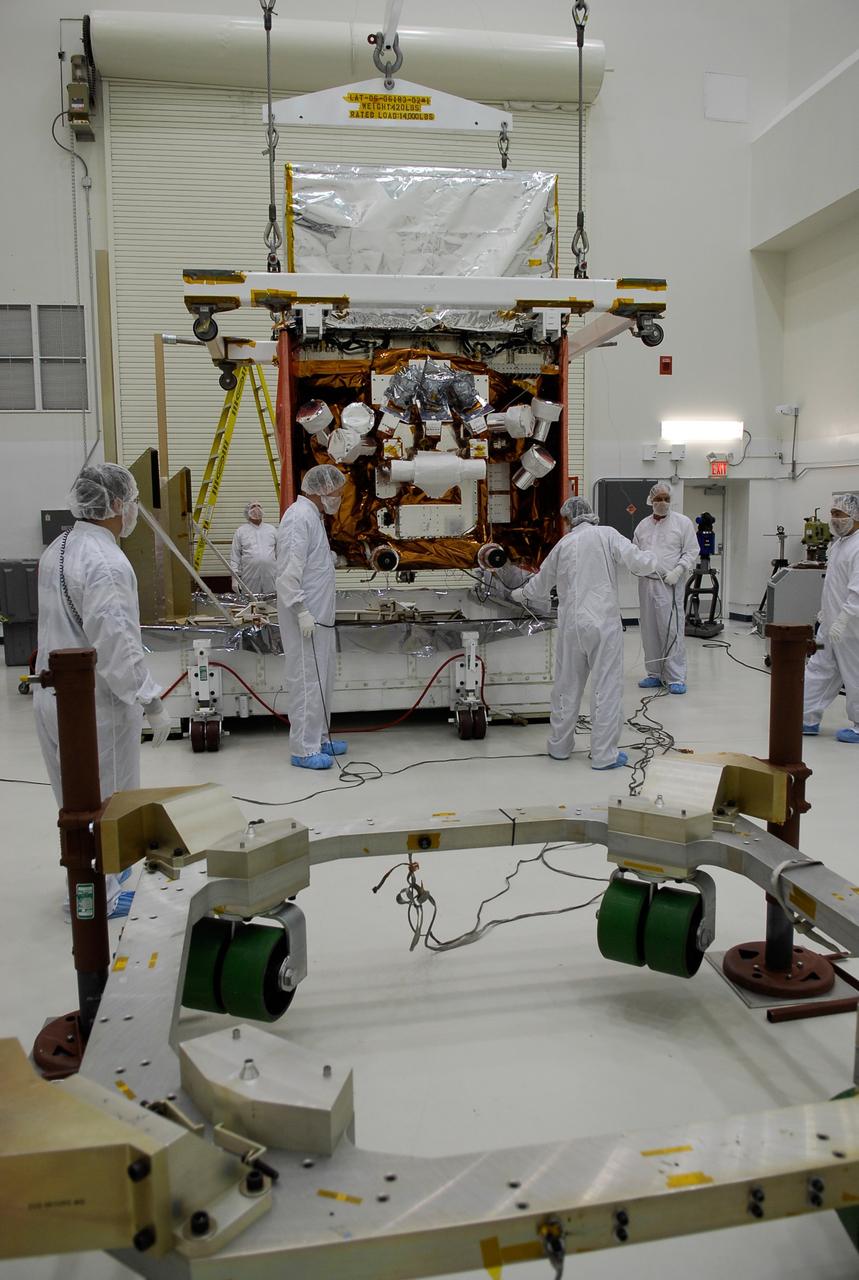
KENNEDY SPACE CENTER, FLA. -- In the Astrotech payload processing facility, General Dynamics technicians keep watch as NASA's Gamma-Ray Large Area Space Telescope, or GLAST, is lifted and begins moving toward the work stand in the foreground. There GLAST will undergo a complete checkout of the scientific instruments aboard. The telescope will launch aboard a Delta II rocket May 16 from Launch Pad 17-B on Cape Canaveral Air Force Station. A powerful space observatory, the GLAST will explore the most extreme environments in the universe, and answer questions about supermassive black hole systems, pulsars and the origin of cosmic rays. It also will study the mystery of powerful explosions known as gamma-ray bursts. Photo credit: NASA/Kim Shiflett
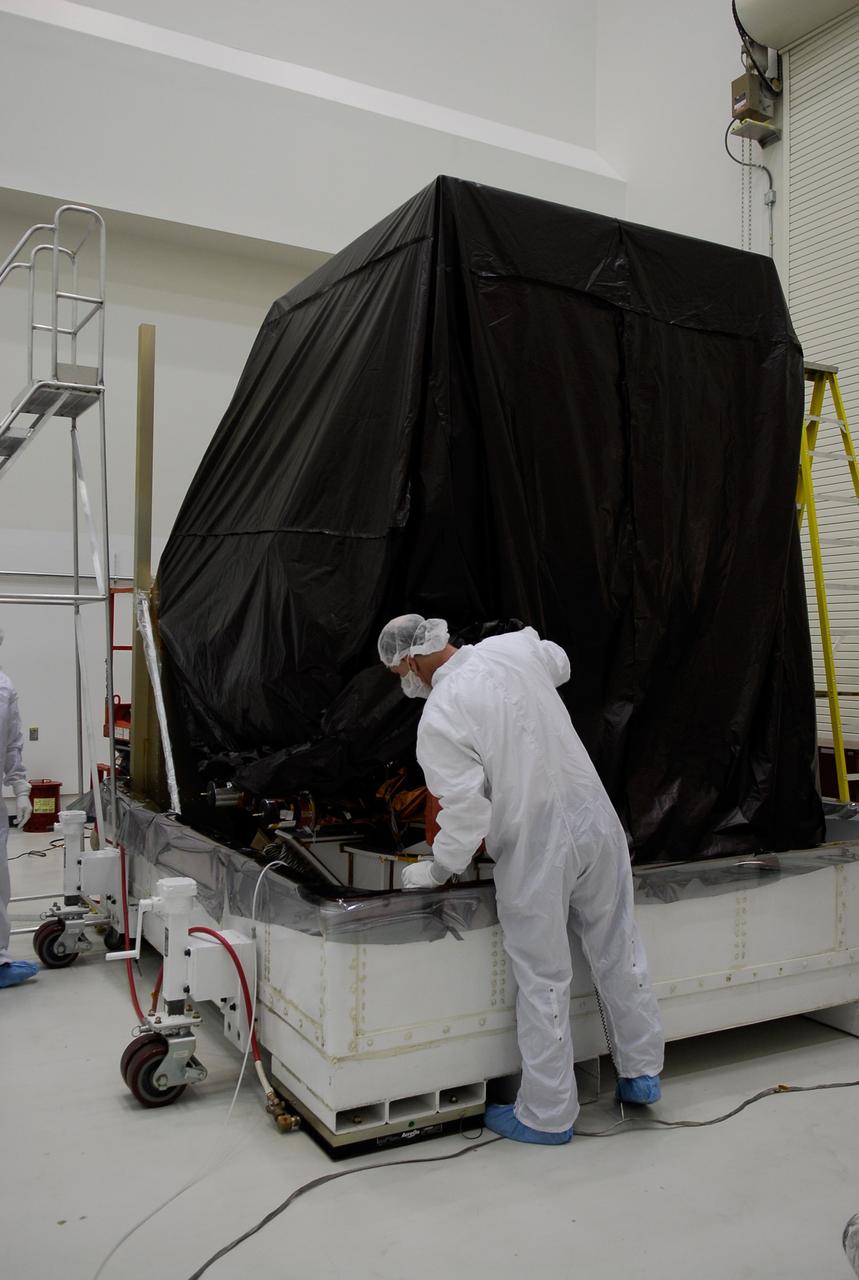
KENNEDY SPACE CENTER, FLA. -- A General Dynamics technician in the Astrotech payload processing facility releases a corner of the protective cover over NASA's Gamma-Ray Large Area Space Telescope, or GLAST, after its arrival. GLAST will be moved to a work stand in the facility for a complete checkout of the telescope's scientific instruments. The telescope will launch aboard a Delta II rocket May 16 from Launch Pad 17-B on Cape Canaveral Air Force Station. A powerful space observatory, the GLAST will explore the most extreme environments in the universe, and answer questions about supermassive black hole systems, pulsars and the origin of cosmic rays. It also will study the mystery of powerful explosions known as gamma-ray bursts. Photo credit: NASA/Kim Shiflett
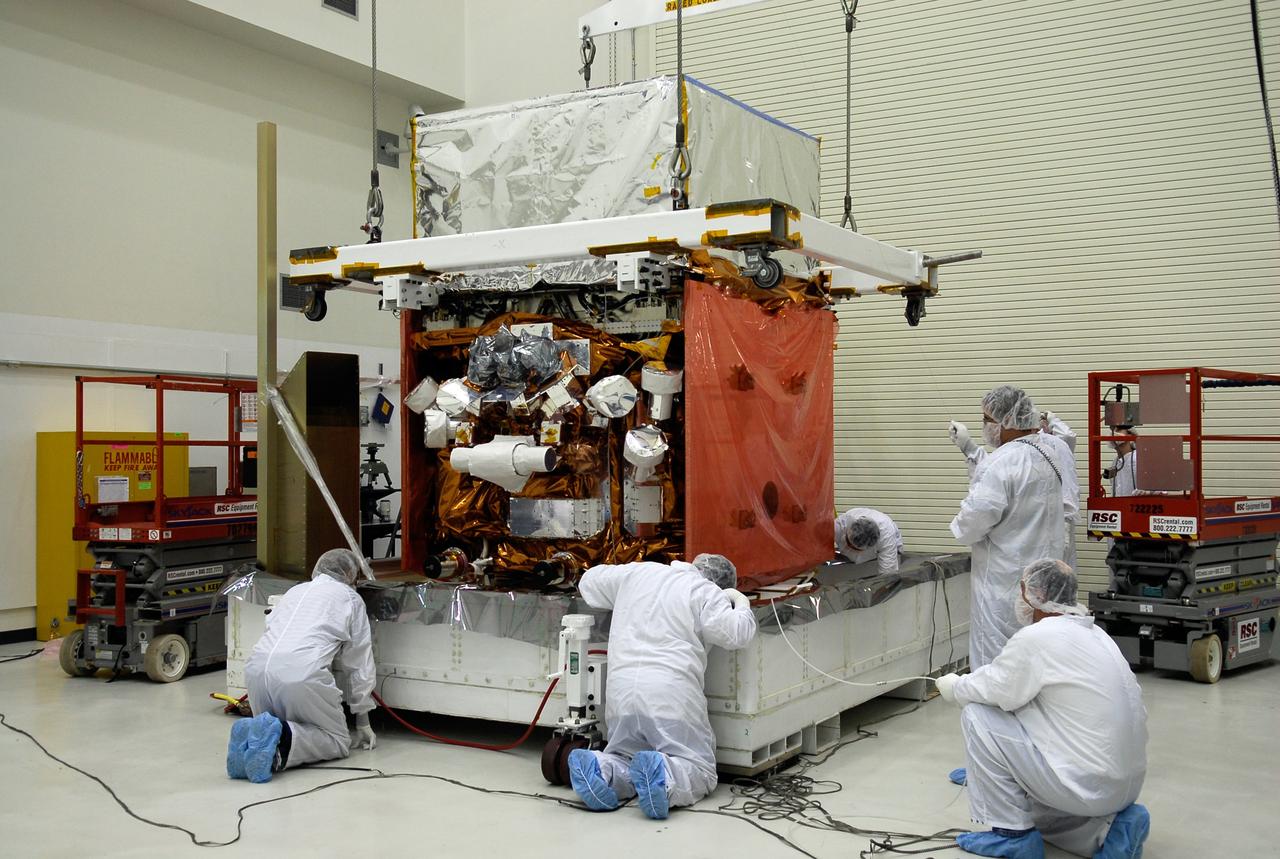
KENNEDY SPACE CENTER, FLA. -- In the Astrotech payload processing facility, General Dynamics technicians check NASA's Gamma-Ray Large Area Space Telescope, or GLAST, as an overhead crane is lowered over it. After the crane is securely attached, the GLAST will be lifted and moved to a work stand in the facility for a complete checkout of the scientific instruments aboard. The telescope will launch aboard a Delta II rocket May 16 from Launch Pad 17-B on Cape Canaveral Air Force Station. A powerful space observatory, the GLAST will explore the most extreme environments in the universe, and answer questions about supermassive black hole systems, pulsars and the origin of cosmic rays. It also will study the mystery of powerful explosions known as gamma-ray bursts. Photo credit: NASA/Kim Shiflett
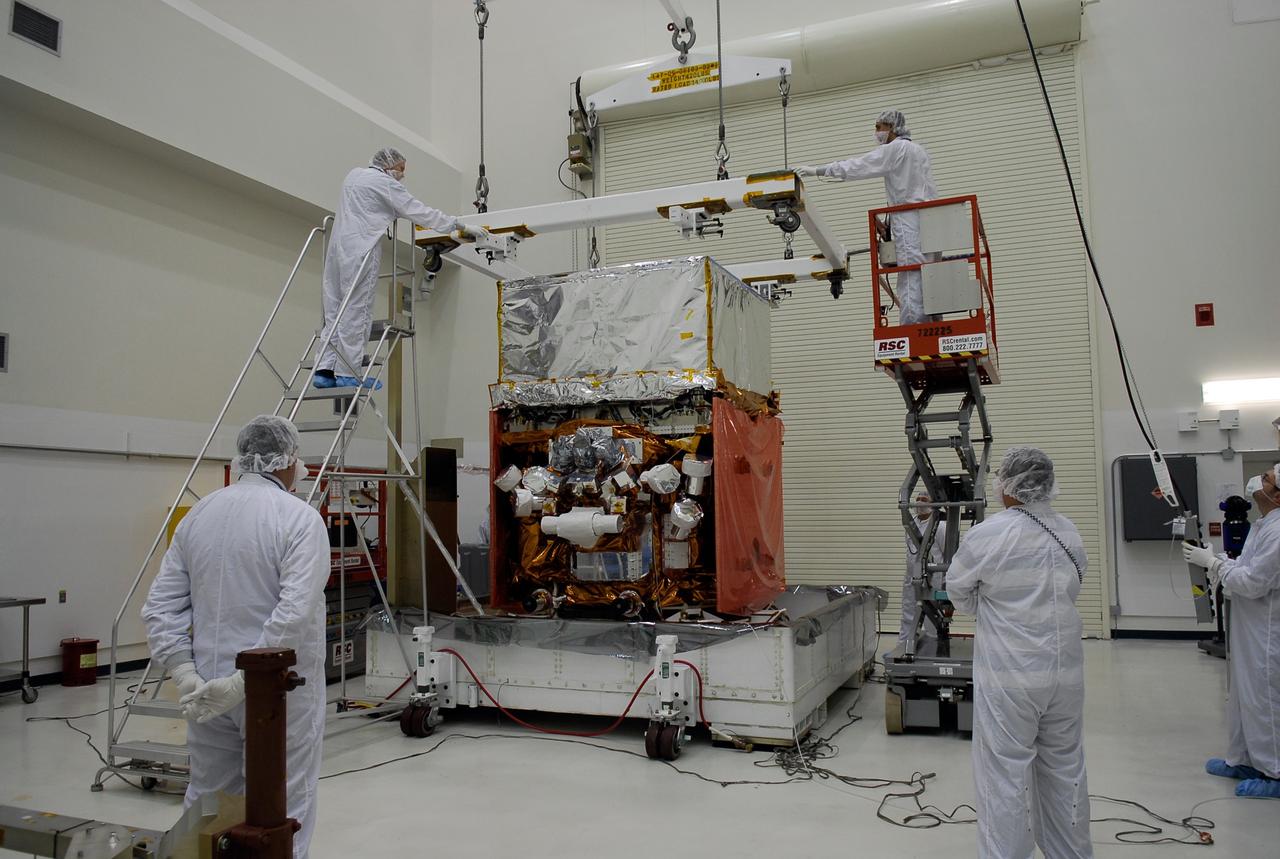
KENNEDY SPACE CENTER, FLA. -- In the Astrotech payload processing facility, General Dynamics technicians lower a crane over NASA's Gamma-Ray Large Area Space Telescope, or GLAST. After the crane is securely attached, the GLAST will be lifted and moved to a work stand in the facility for a complete checkout of the scientific instruments aboard. The telescope will launch aboard a Delta II rocket May 16 from Launch Pad 17-B on Cape Canaveral Air Force Station. A powerful space observatory, the GLAST will explore the most extreme environments in the universe, and answer questions about supermassive black hole systems, pulsars and the origin of cosmic rays. It also will study the mystery of powerful explosions known as gamma-ray bursts. Photo credit: NASA/Kim Shiflett
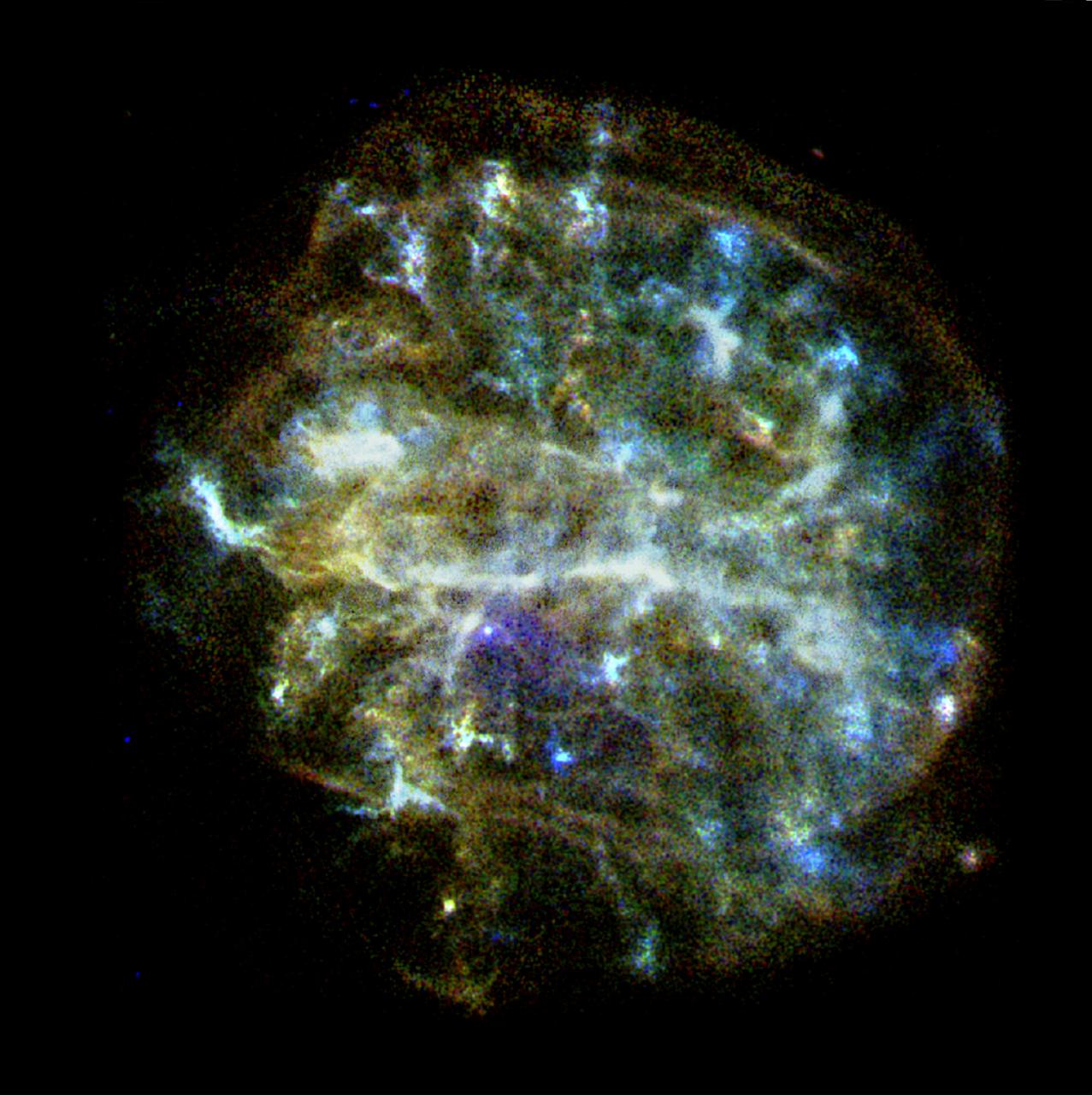
The Chandra X-Ray Observatory has captured this spectacular image of G292.0+1.8, a young, oxygen-rich supernova remnant with a pulsar at its center surrounded by outflowing material. This image shows a rapidly expanding shell of gas that is 36 light-years across and contains large amounts of elements such as oxygen, neon, magnesium, silicon and sulfur. Embedded in this cloud of multimillion-degree gas is a key piece of evidence linking neutron stars and supernovae produced by the collapse of massive stars. With an age estimated at 1,600 years, G292.0+1.8 is one of three known oxygen-rich supernovae in our galaxy. These supernovae are of great interest to astronomers because they are one of the primary sources of the heavy elements necessary to form planets and people. Scattered through the image are bluish knots of emissions containing material that is highly enriched in newly created oxygen, neon, and magnesium produced deep within the original star and ejected by the supernova explosion.
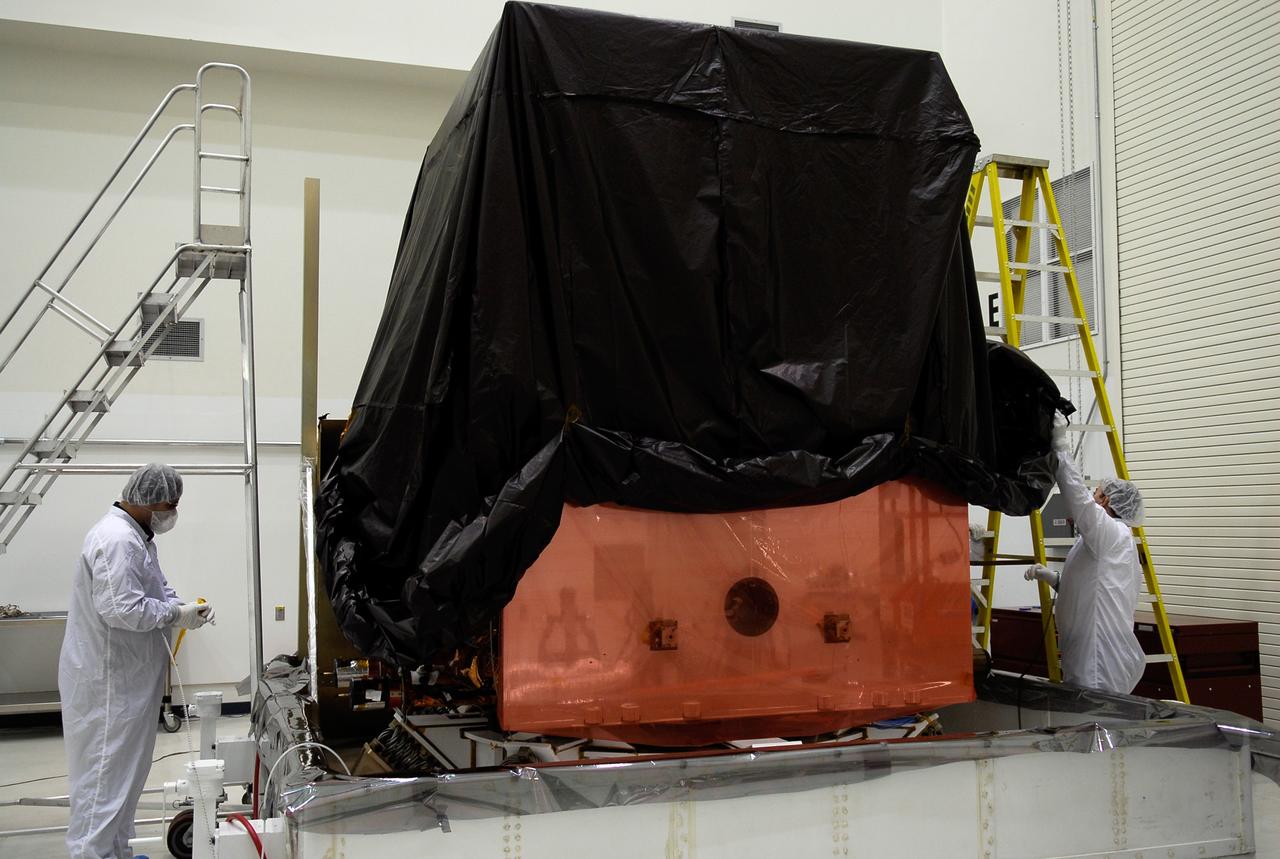
KENNEDY SPACE CENTER, FLA. -- General Dynamics technicians in the Astrotech payload processing facility begin removing the protective cover over NASA's Gamma-Ray Large Area Space Telescope, or GLAST. The space telescope will be moved to a work stand in the facility for a complete checkout of the scientific instruments aboard. The telescope will launch aboard a Delta II rocket May 16 from Launch Pad 17-B on Cape Canaveral Air Force Station. A powerful space observatory, the GLAST will explore the most extreme environments in the universe, and answer questions about supermassive black hole systems, pulsars and the origin of cosmic rays. It also will study the mystery of powerful explosions known as gamma-ray bursts. Photo credit: NASA/Kim Shiflett
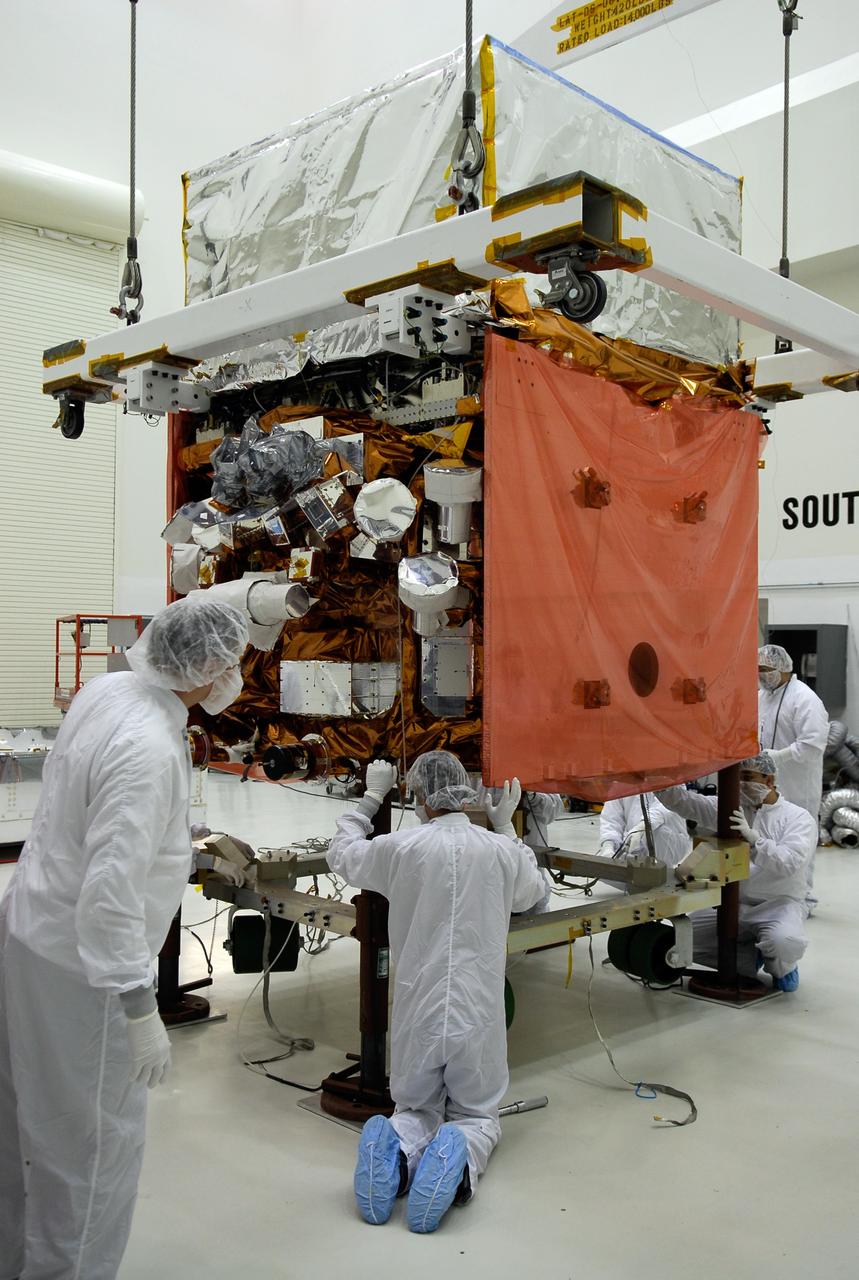
KENNEDY SPACE CENTER, FLA. -- In the Astrotech payload processing facility, General Dynamics technicians keep watch as NASA's Gamma-Ray Large Area Space Telescope, or GLAST, is lowered onto a work stand. There GLAST will undergo a complete checkout of the scientific instruments aboard. . The telescope will launch aboard a Delta II rocket May 16 from Launch Pad 17-B on Cape Canaveral Air Force Station. A powerful space observatory, the GLAST will explore the most extreme environments in the universe, and answer questions about supermassive black hole systems, pulsars and the origin of cosmic rays. It also will study the mystery of powerful explosions known as gamma-ray bursts. Photo credit: NASA/Kim Shiflett

This supernova in the constellation Cassiopeia was observed by Tycho Brahe in 1572. In this x-ray image from the High Energy Astronomy Observatory (HEAO-2/Einstein Observatory produced by nearly a day of exposure time, the center region appears filled with emissions that can be resolved into patches or knots of material. However, no central pulsar or other collapsed object can be seen. The HEAO-2, the first imaging and largest x-ray telescope built to date, was capable of producing actual photographs of x-ray objects. Shortly after launch, the HEAO-2 was nicknamed the Einstein Observatory by its scientific experimenters in honor of the centernial of the birth of Albert Einstein, whose concepts of relativity and gravitation have influenced much of modern astrophysics, particularly x-ray astronomy. The HEAO-2, designed and developed by TRW, Inc. under the project management of the Marshall Space Flight Center, was launched aboard an Atlas/Centaur launch vehicle on November 13, 1978.
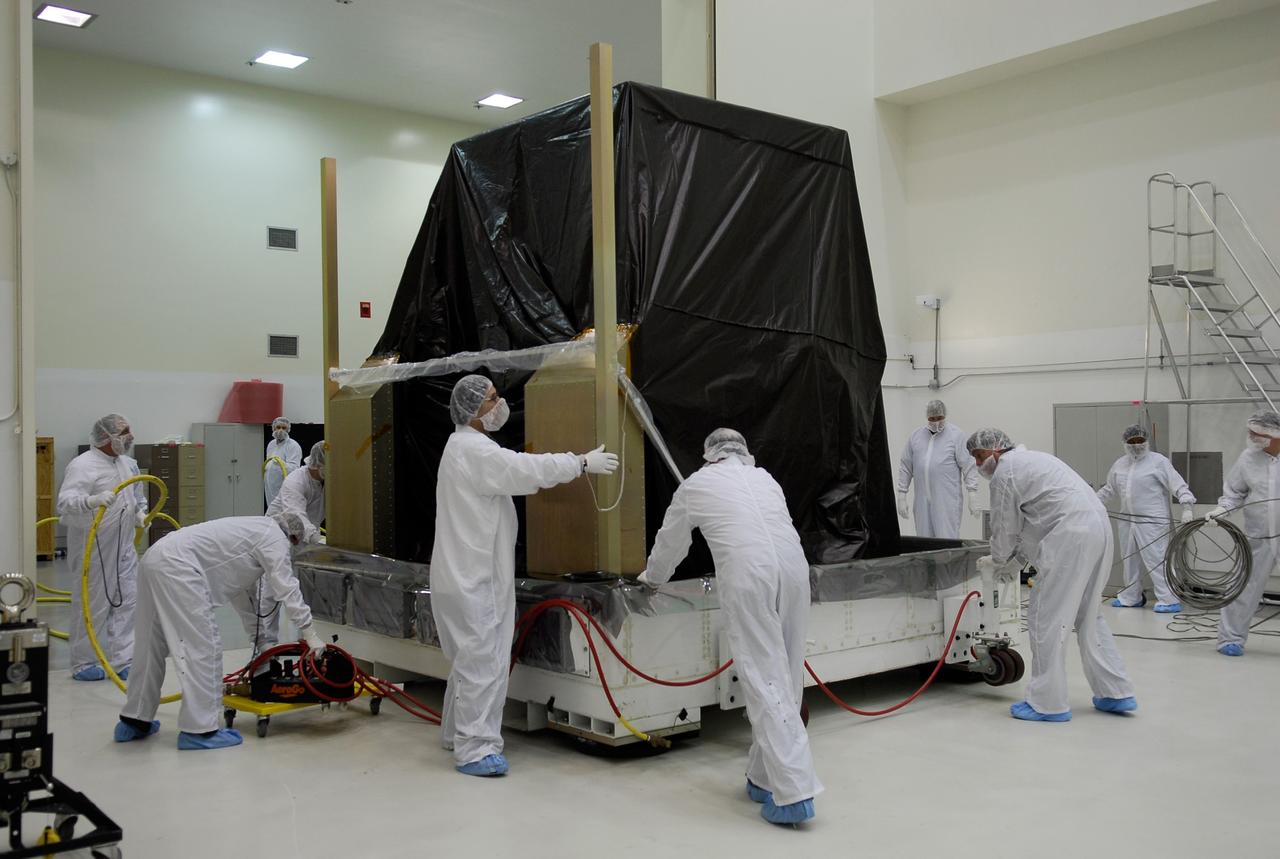
KENNEDY SPACE CENTER, FLA. -- In the Astrotech payload processing facility near the Kennedy Space Center, workers check NASA's Gamma-Ray Large Area Space Telescope, or GLAST, after removal of the shipping container. The workers will prepare for a complete checkout of the telescope's scientific instruments. The GLAST will launch aboard a Delta II rocket May 16 from Launch Pad 17-B on Cape Canaveral Air Force Station. A powerful space observatory, the GLAST will explore the most extreme environments in the universe, and answer questions about supermassive black hole systems, pulsars and the origin of cosmic rays. It also will study the mystery of powerful explosions known as gamma-ray bursts. Photo credit: NASA/Kim Shiflett
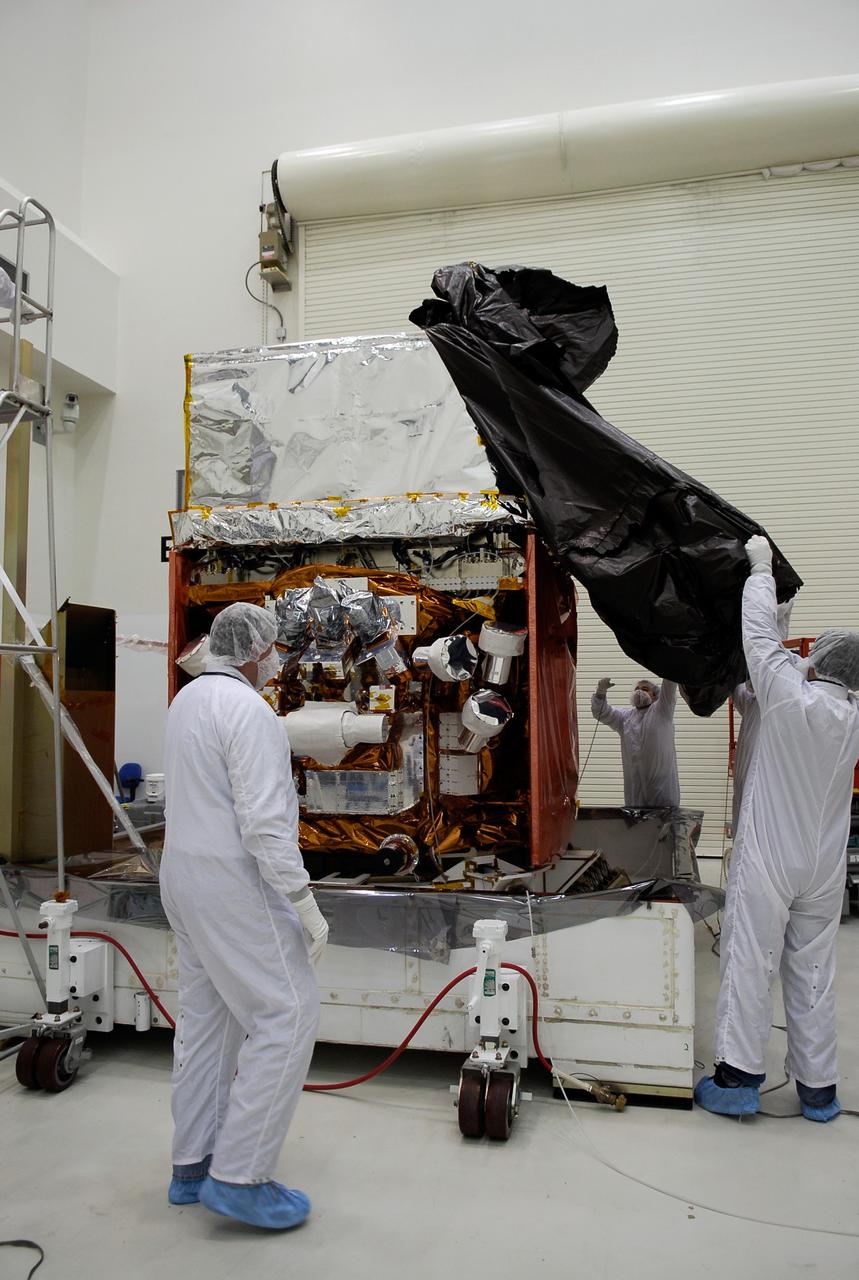
KENNEDY SPACE CENTER, FLA. -- General Dynamics technicians in the Astrotech payload processing facility remove the protective cover over NASA's Gamma-Ray Large Area Space Telescope, or GLAST. The space telescope will be moved to a work stand in the facility for a complete checkout of the scientific instruments aboard. The telescope will launch aboard a Delta II rocket May 16 from Launch Pad 17-B on Cape Canaveral Air Force Station. A powerful space observatory, the GLAST will explore the most extreme environments in the universe, and answer questions about supermassive black hole systems, pulsars and the origin of cosmic rays. It also will study the mystery of powerful explosions known as gamma-ray bursts. Photo credit: NASA/Kim Shiflett
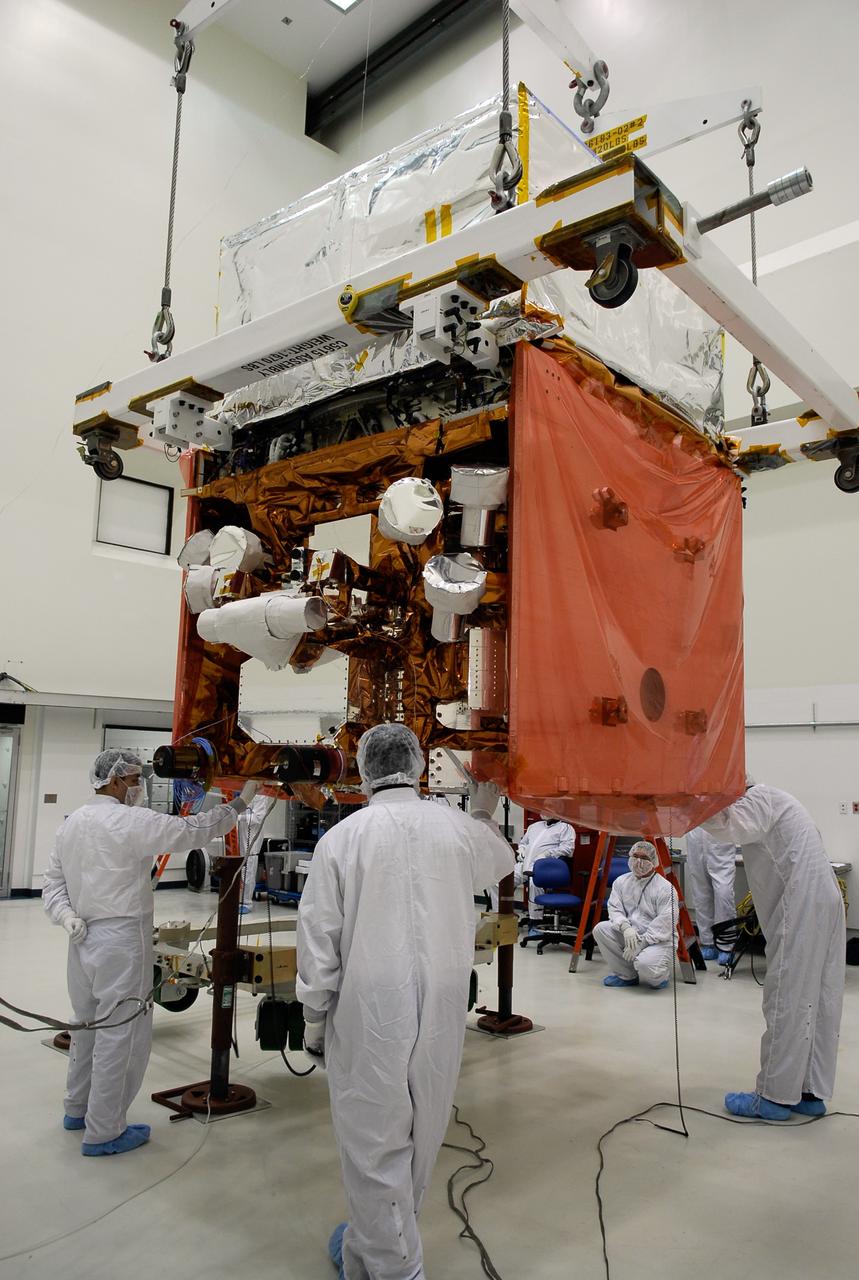
KENNEDY SPACE CENTER, FLA. -- In the Astrotech payload processing facility, General Dynamics technicians keep watch as NASA's Gamma-Ray Large Area Space Telescope, or GLAST, is moved toward a work stand (at left) in the facility. There GLAST will undergo a complete checkout of the scientific instruments aboard. The telescope will launch aboard a Delta II rocket May 16 from Launch Pad 17-B on Cape Canaveral Air Force Station. A powerful space observatory, the GLAST will explore the most extreme environments in the universe, and answer questions about supermassive black hole systems, pulsars and the origin of cosmic rays. It also will study the mystery of powerful explosions known as gamma-ray bursts. Photo credit: NASA/Kim Shiflett
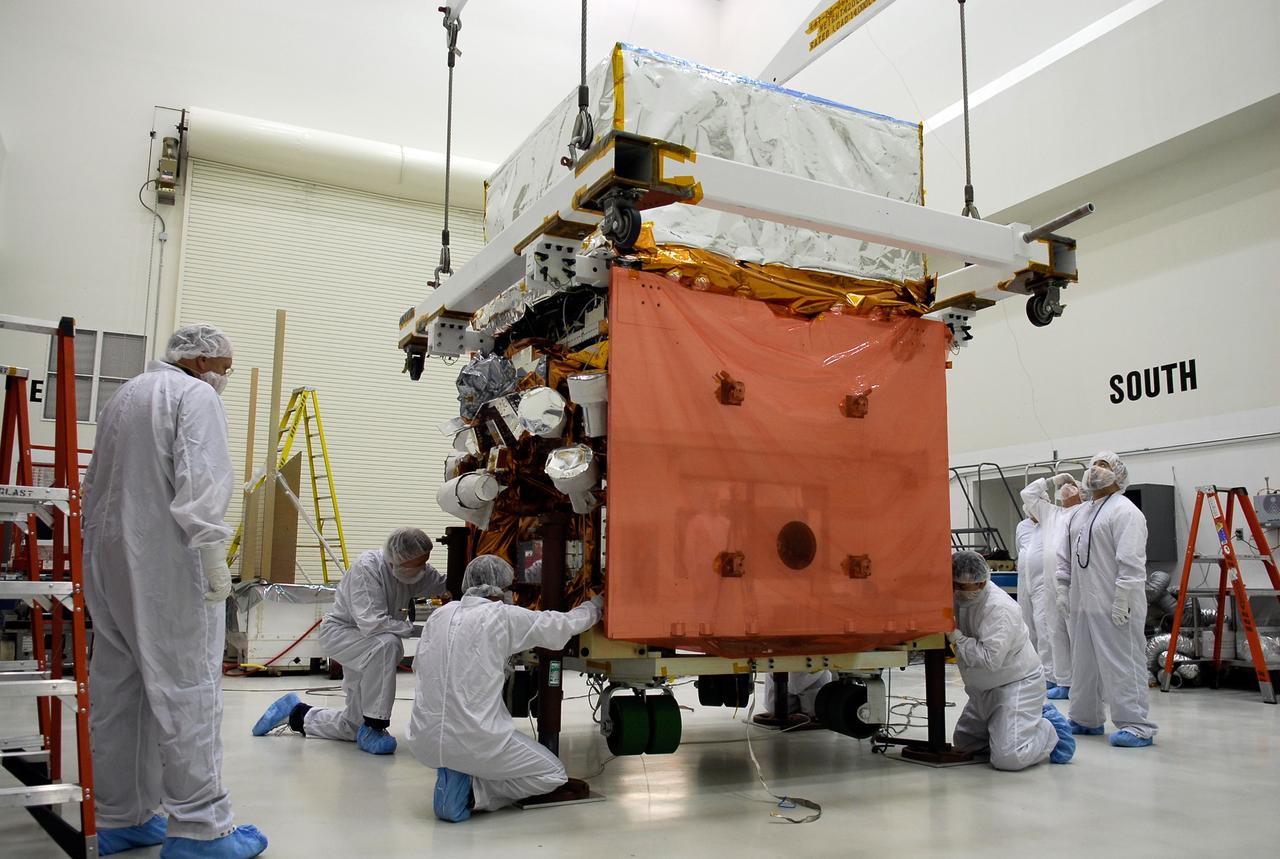
KENNEDY SPACE CENTER, FLA. -- In the Astrotech payload processing facility, General Dynamics technicians secure NASA's Gamma-Ray Large Area Space Telescope, or GLAST, on a work stand as the overhead crane is lifted away. GLAST will undergo a complete checkout of the scientific instruments aboard. The telescope will launch aboard a Delta II rocket May 16 from Launch Pad 17-B on Cape Canaveral Air Force Station. A powerful space observatory, the GLAST will explore the most extreme environments in the universe, and answer questions about supermassive black hole systems, pulsars and the origin of cosmic rays. It also will study the mystery of powerful explosions known as gamma-ray bursts. Photo credit: NASA/Kim Shiflett
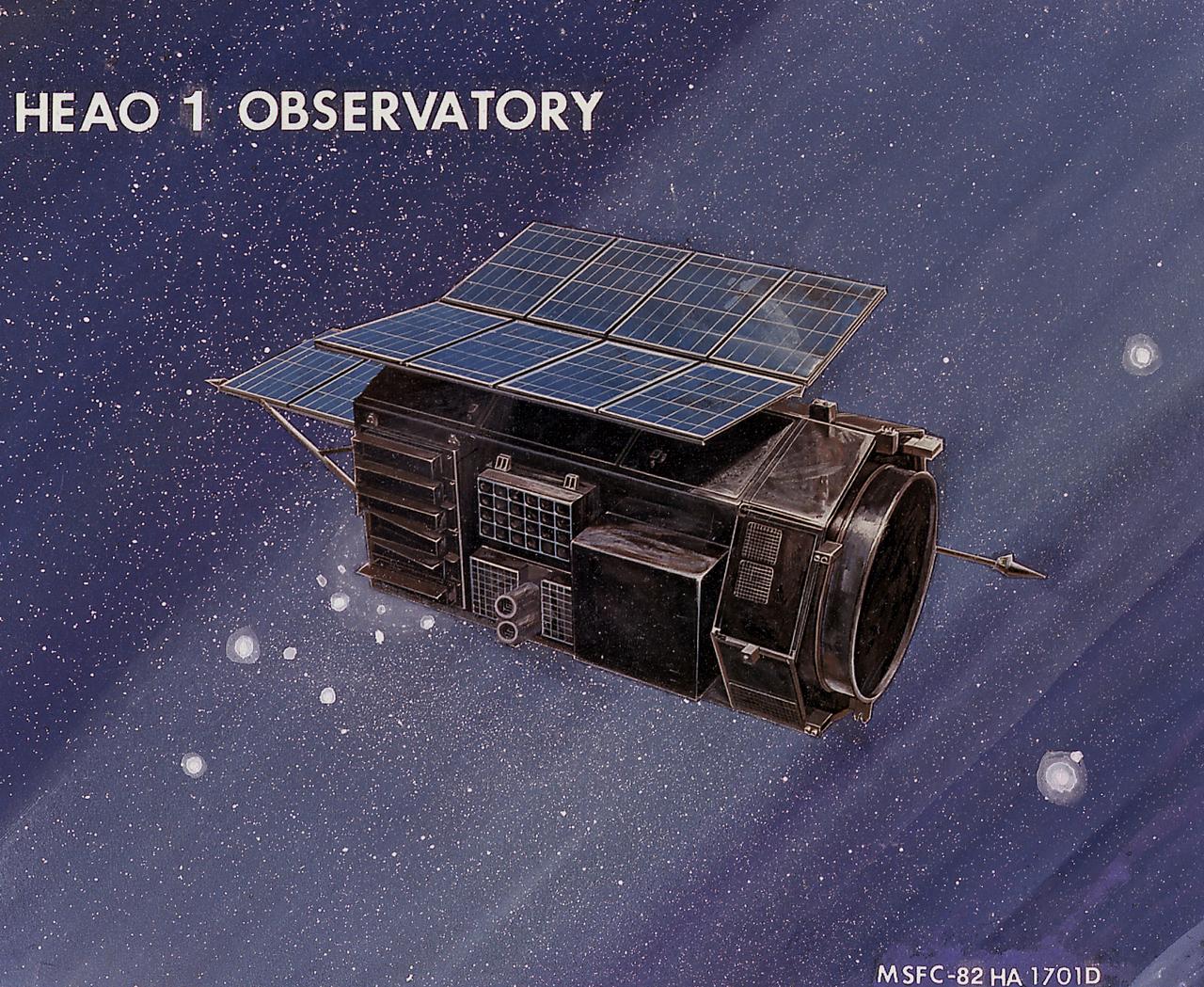
This artist's conception depicts the High Energy Astronomy Observatory (HEAO)-1 in orbit. The first observatory, designated HEAO-1, was launched on August 12, 1977 aboard an Atlas/Centaur launch vehicle and was designed to survey the sky for additional x-ray and gamma-ray sources as well as pinpointing their positions. The HEAO-1 was originally identified as HEAO-A but the designation was changed once the spacecraft achieved orbit. The HEAO project involved the launching of three unmarned scientific observatories into low Earth orbit between 1977 and 1979 to study some of the most intriguing mysteries of the universe; pulsars, black holes, neutron stars, and super nova. Hardware support for the imaging instruments was provided by American Science and Engineeing. The HEAO spacecraft were built by TRW, Inc. under project management of the Marshall Space Flight Center.
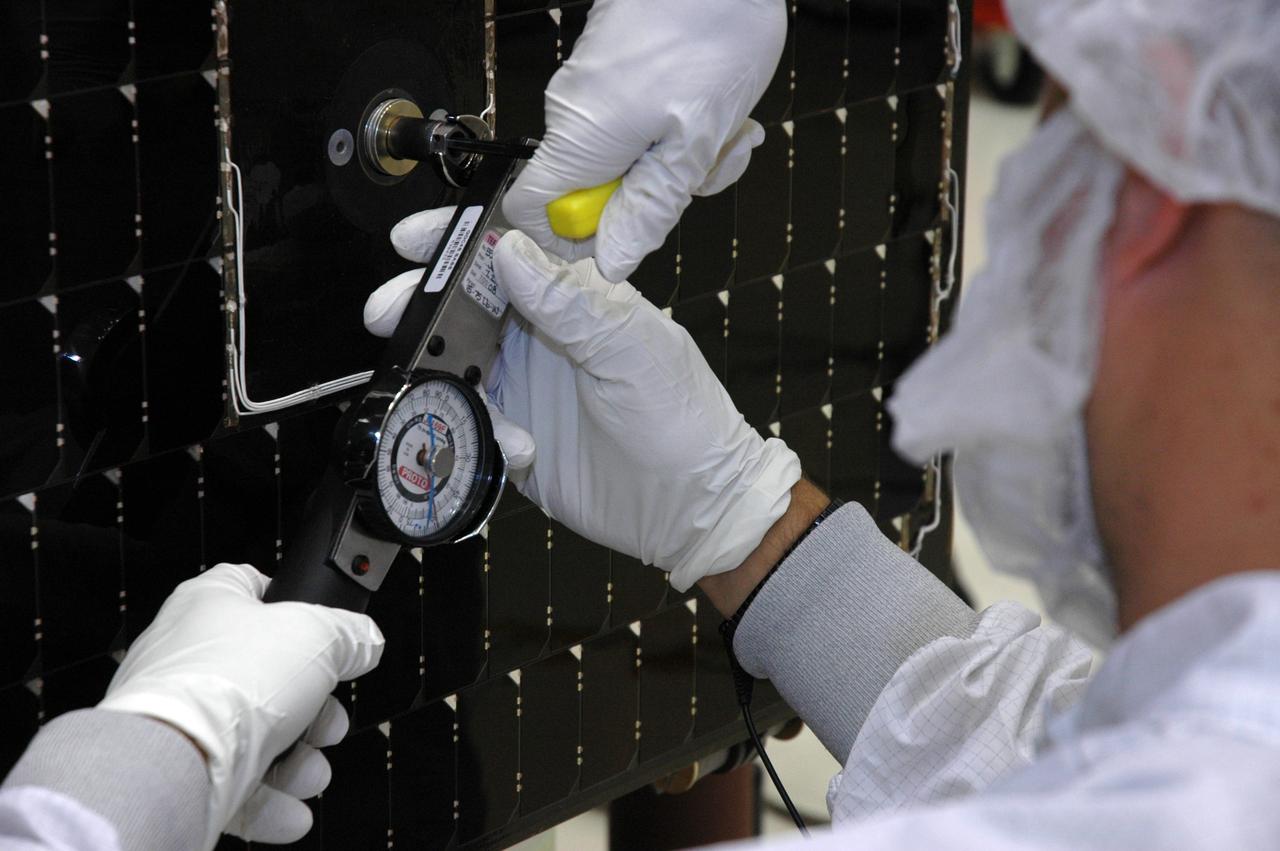
KENNEDY SPACE CENTER, FLA. - In the Astrotech payload processing facility, General Dynamics technicians use a socket wrench equipped with a torque meter to tighten the bolts holding one of twin solar arrays to NASA's Gamma-Ray Large Area Space Telescope, or GLAST. The telescope will launch aboard a Delta II rocket May 16 from Launch Pad 17-B on Cape Canaveral Air Force Station. A powerful space observatory, the GLAST will explore the most extreme environments in the universe, and answer questions about supermassive black hole systems, pulsars and the origin of cosmic rays. It also will study the mystery of powerful explosions known as gamma-ray bursts. Photo credit: NASA/Chris Rhodes
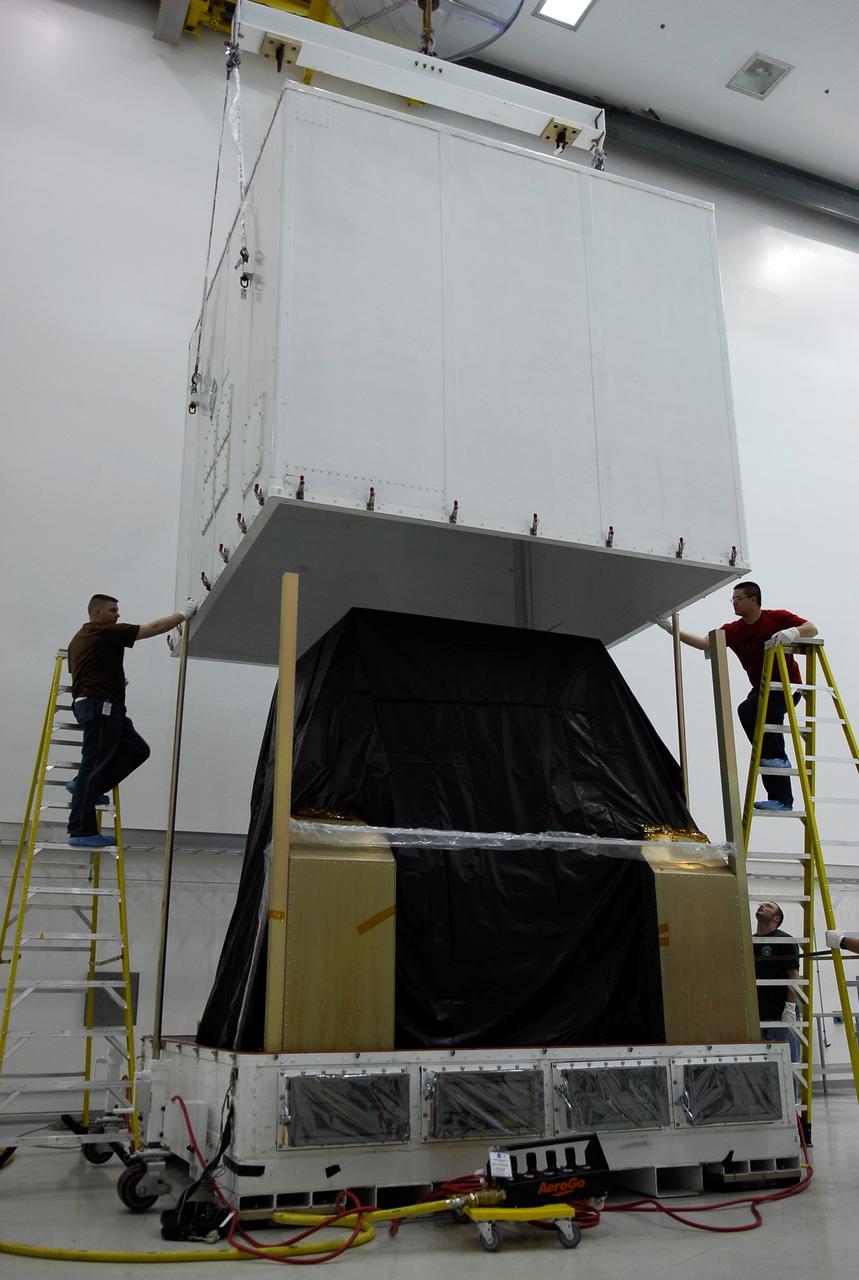
KENNEDY SPACE CENTER, FLA. -- In the Astrotech payload processing facility near the Kennedy Space Center, the shipping container covering NASA's Gamma-Ray Large Area Space Telescope, or GLAST, is lifted to reveal the protected equipment inside. Workers will prepare for a complete checkout of the telescope's scientific instruments. The GLAST will launch aboard a Delta II rocket May 16 from Launch Pad 17-B on Cape Canaveral Air Force Station. A powerful space observatory, the GLAST will explore the most extreme environments in the universe, and answer questions about supermassive black hole systems, pulsars and the origin of cosmic rays. It also will study the mystery of powerful explosions known as gamma-ray bursts. Photo credit: NASA/Kim Shiflett

Optics Lead Takashi Okajima prepares to align NICER’s X-ray optics. The payload’s 56 mirror assemblies concentrate X-rays onto silicon detectors to gather data that will probe the interior makeup of neutron stars, including those that appear to flash regularly, called pulsars. The Neutron star Interior Composition Explorer (NICER) is a NASA Explorer Mission of Opportunity dedicated to studying the extraordinary environments — strong gravity, ultra-dense matter, and the most powerful magnetic fields in the universe — embodied by neutron stars. An attached payload aboard the International Space Station, NICER will deploy an instrument with unique capabilities for timing and spectroscopy of fast X-ray brightness fluctuations. The embedded Station Explorer for X-ray Timing and Navigation Technology demonstration (SEXTANT) will use NICER data to validate, for the first time in space, technology that exploits pulsars as natural navigation beacons. Credit: NASA/Goddard/ Keith Gendreau <b><a href="http://www.nasa.gov/audience/formedia/features/MP_Photo_Guidelines.html" rel="nofollow">NASA image use policy.</a></b> <b><a href="http://www.nasa.gov/centers/goddard/home/index.html" rel="nofollow">NASA Goddard Space Flight Center</a></b> enables NASA’s mission through four scientific endeavors: Earth Science, Heliophysics, Solar System Exploration, and Astrophysics. Goddard plays a leading role in NASA’s accomplishments by contributing compelling scientific knowledge to advance the Agency’s mission. <b>Follow us on <a href="http://twitter.com/NASAGoddardPix" rel="nofollow">Twitter</a></b> <b>Like us on <a href="http://www.facebook.com/pages/Greenbelt-MD/NASA-Goddard/395013845897?ref=tsd" rel="nofollow">Facebook</a></b> <b>Find us on <a href="http://instagrid.me/nasagoddard/?vm=grid" rel="nofollow">Instagram</a></b>

NICER Optics Lead Takashi Okajima installs one of NICER’s 56 X-ray “concentrators,” each consisting of 24 concentric foils. To minimize the effects of Earth’s gravity on their alignment, the concentrator assemblies were installed from the outside edges toward the center of the plate that houses them. The payload’s 56 mirror assemblies concentrate X-rays onto silicon detectors to gather data that will probe the interior makeup of neutron stars, including those that appear to flash regularly, called pulsars. The Neutron star Interior Composition Explorer (NICER) is a NASA Explorer Mission of Opportunity dedicated to studying the extraordinary environments — strong gravity, ultra-dense matter, and the most powerful magnetic fields in the universe — embodied by neutron stars. An attached payload aboard the International Space Station, NICER will deploy an instrument with unique capabilities for timing and spectroscopy of fast X-ray brightness fluctuations. The embedded Station Explorer for X-ray Timing and Navigation Technology demonstration (SEXTANT) will use NICER data to validate, for the first time in space, technology that exploits pulsars as natural navigation beacons. Credit: NASA/Goddard/ Keith Gendreau <b><a href="http://www.nasa.gov/audience/formedia/features/MP_Photo_Guidelines.html" rel="nofollow">NASA image use policy.</a></b> <b><a href="http://www.nasa.gov/centers/goddard/home/index.html" rel="nofollow">NASA Goddard Space Flight Center</a></b> enables NASA’s mission through four scientific endeavors: Earth Science, Heliophysics, Solar System Exploration, and Astrophysics. Goddard plays a leading role in NASA’s accomplishments by contributing compelling scientific knowledge to advance the Agency’s mission. <b>Follow us on <a href="http://twitter.com/NASAGoddardPix" rel="nofollow">Twitter</a></b> <b>Like us on <a href="http://www.facebook.com/pages/Greenbelt-MD/NASA-Goddard/395013845897?ref=tsd" rel="nofollow">Facebook</a></b> <b>Find us on <a href="http://instagrid.me/nasagoddard/?vm=grid" rel="nofollow">Instagram</a></b>
![Final still from Fermi video [<a href="http://bit.ly/Y2K4LN" rel="nofollow">bit.ly/Y2K4LN</a>]. Credit: NASA/DOE/Fermi LAT Collaboration ----- NASA's Fermi Gamma-ray Space Telescope orbits our planet every 95 minutes, building up increasingly deeper views of the universe with every circuit. Its wide-eyed Large Area Telescope (LAT) sweeps across the entire sky every three hours, capturing the highest-energy form of light -- gamma rays -- from sources across the universe. These range from supermassive black holes billions of light-years away to intriguing objects in our own galaxy, such as X-ray binaries, supernova remnants and pulsars. Now a Fermi scientist has transformed LAT data of a famous pulsar into a mesmerizing movie that visually encapsulates the spacecraft's complex motion. Click here to continue reading: <a href="http://1.usa.gov/WhYwCU" rel="nofollow">1.usa.gov/WhYwCU</a> <b><a href="http://www.nasa.gov/audience/formedia/features/MP_Photo_Guidelines.html" rel="nofollow">NASA image use policy.</a></b> <b><a href="http://www.nasa.gov/centers/goddard/home/index.html" rel="nofollow">NASA Goddard Space Flight Center</a></b> enables NASA’s mission through four scientific endeavors: Earth Science, Heliophysics, Solar System Exploration, and Astrophysics. Goddard plays a leading role in NASA’s accomplishments by contributing compelling scientific knowledge to advance the Agency’s mission. <b>Follow us on <a href="http://twitter.com/NASA_GoddardPix" rel="nofollow">Twitter</a></b> <b>Like us on <a href="http://www.facebook.com/pages/Greenbelt-MD/NASA-Goddard/395013845897?ref=tsd" rel="nofollow">Facebook</a></b> <b>Find us on <a href="http://instagram.com/nasagoddard?vm=grid" rel="nofollow">Instagram</a></b>](https://images-assets.nasa.gov/image/GSFC_20171208_Archive_e001547/GSFC_20171208_Archive_e001547~small.jpg)
Final still from Fermi video [<a href="http://bit.ly/Y2K4LN" rel="nofollow">bit.ly/Y2K4LN</a>]. Credit: NASA/DOE/Fermi LAT Collaboration ----- NASA's Fermi Gamma-ray Space Telescope orbits our planet every 95 minutes, building up increasingly deeper views of the universe with every circuit. Its wide-eyed Large Area Telescope (LAT) sweeps across the entire sky every three hours, capturing the highest-energy form of light -- gamma rays -- from sources across the universe. These range from supermassive black holes billions of light-years away to intriguing objects in our own galaxy, such as X-ray binaries, supernova remnants and pulsars. Now a Fermi scientist has transformed LAT data of a famous pulsar into a mesmerizing movie that visually encapsulates the spacecraft's complex motion. Click here to continue reading: <a href="http://1.usa.gov/WhYwCU" rel="nofollow">1.usa.gov/WhYwCU</a> <b><a href="http://www.nasa.gov/audience/formedia/features/MP_Photo_Guidelines.html" rel="nofollow">NASA image use policy.</a></b> <b><a href="http://www.nasa.gov/centers/goddard/home/index.html" rel="nofollow">NASA Goddard Space Flight Center</a></b> enables NASA’s mission through four scientific endeavors: Earth Science, Heliophysics, Solar System Exploration, and Astrophysics. Goddard plays a leading role in NASA’s accomplishments by contributing compelling scientific knowledge to advance the Agency’s mission. <b>Follow us on <a href="http://twitter.com/NASA_GoddardPix" rel="nofollow">Twitter</a></b> <b>Like us on <a href="http://www.facebook.com/pages/Greenbelt-MD/NASA-Goddard/395013845897?ref=tsd" rel="nofollow">Facebook</a></b> <b>Find us on <a href="http://instagram.com/nasagoddard?vm=grid" rel="nofollow">Instagram</a></b>

NICER’s X-ray concentrator optics are inspected under a black light for dust and foreign object debris that could impair functionality once in space. The payload’s 56 mirror assemblies concentrate X-rays onto silicon detectors to gather data that will probe the interior makeup of neutron stars, including those that appear to flash regularly, called pulsars. The Neutron star Interior Composition Explorer (NICER) is a NASA Explorer Mission of Opportunity dedicated to studying the extraordinary environments — strong gravity, ultra-dense matter, and the most powerful magnetic fields in the universe — embodied by neutron stars. An attached payload aboard the International Space Station, NICER will deploy an instrument with unique capabilities for timing and spectroscopy of fast X-ray brightness fluctuations. The embedded Station Explorer for X-ray Timing and Navigation Technology demonstration (SEXTANT) will use NICER data to validate, for the first time in space, technology that exploits pulsars as natural navigation beacons. Credit: NASA/Goddard/ Keith Gendreau <b><a href="http://www.nasa.gov/audience/formedia/features/MP_Photo_Guidelines.html" rel="nofollow">NASA image use policy.</a></b> <b><a href="http://www.nasa.gov/centers/goddard/home/index.html" rel="nofollow">NASA Goddard Space Flight Center</a></b> enables NASA’s mission through four scientific endeavors: Earth Science, Heliophysics, Solar System Exploration, and Astrophysics. Goddard plays a leading role in NASA’s accomplishments by contributing compelling scientific knowledge to advance the Agency’s mission. <b>Follow us on <a href="http://twitter.com/NASAGoddardPix" rel="nofollow">Twitter</a></b> <b>Like us on <a href="http://www.facebook.com/pages/Greenbelt-MD/NASA-Goddard/395013845897?ref=tsd" rel="nofollow">Facebook</a></b> <b>Find us on <a href="http://instagrid.me/nasagoddard/?vm=grid" rel="nofollow">Instagram</a></b>

NICER engineer Steven Kenyon prepares seven of the 56 X-ray concentrators for installation in the NICER instrument. The payload’s 56 mirror assemblies concentrate X-rays onto silicon detectors to gather data that will probe the interior makeup of neutron stars, including those that appear to flash regularly, called pulsars. The Neutron star Interior Composition Explorer (NICER) is a NASA Explorer Mission of Opportunity dedicated to studying the extraordinary environments — strong gravity, ultra-dense matter, and the most powerful magnetic fields in the universe — embodied by neutron stars. An attached payload aboard the International Space Station, NICER will deploy an instrument with unique capabilities for timing and spectroscopy of fast X-ray brightness fluctuations. The embedded Station Explorer for X-ray Timing and Navigation Technology demonstration (SEXTANT) will use NICER data to validate, for the first time in space, technology that exploits pulsars as natural navigation beacons. Credit: NASA/Goddard/ Keith Gendreau <b><a href="http://www.nasa.gov/audience/formedia/features/MP_Photo_Guidelines.html" rel="nofollow">NASA image use policy.</a></b> <b><a href="http://www.nasa.gov/centers/goddard/home/index.html" rel="nofollow">NASA Goddard Space Flight Center</a></b> enables NASA’s mission through four scientific endeavors: Earth Science, Heliophysics, Solar System Exploration, and Astrophysics. Goddard plays a leading role in NASA’s accomplishments by contributing compelling scientific knowledge to advance the Agency’s mission. <b>Follow us on <a href="http://twitter.com/NASAGoddardPix" rel="nofollow">Twitter</a></b> <b>Like us on <a href="http://www.facebook.com/pages/Greenbelt-MD/NASA-Goddard/395013845897?ref=tsd" rel="nofollow">Facebook</a></b> <b>Find us on <a href="http://instagrid.me/nasagoddard/?vm=grid" rel="nofollow">Instagram</a></b>
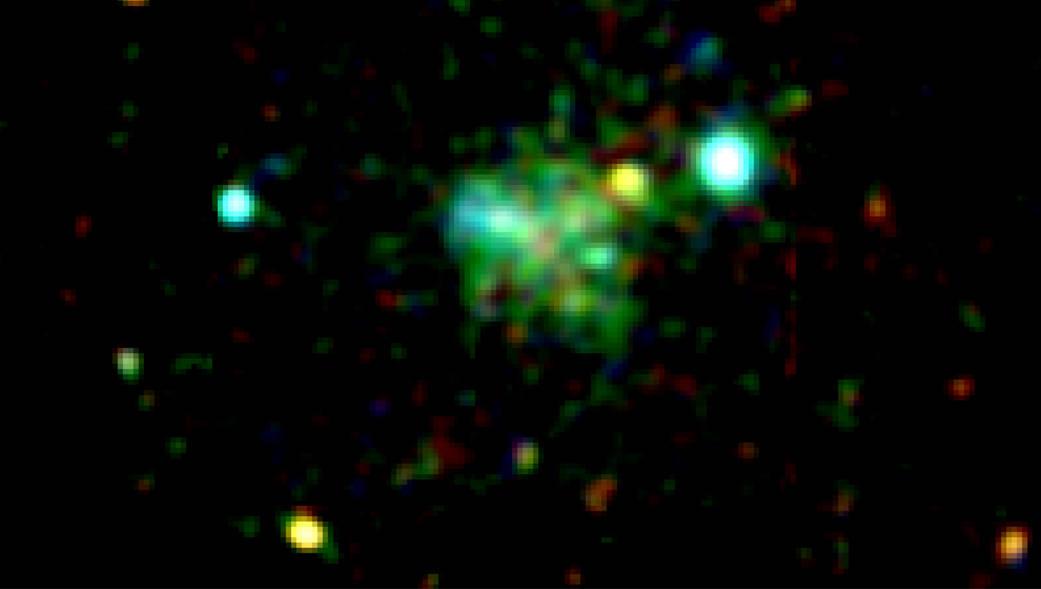
Astronomers have discovered a vast cloud of high-energy particles called a wind nebula around a rare ultra-magnetic neutron star, or magnetar, for the first time. The find offers a unique window into the properties, environment and outburst history of magnetars, which are the strongest magnets in the universe. A neutron star is the crushed core of a massive star that ran out of fuel, collapsed under its own weight, and exploded as a supernova. Each one compresses the equivalent mass of half a million Earths into a ball just 12 miles (20 kilometers) across, or about the length of New York's Manhattan Island. Neutron stars are most commonly found as pulsars, which produce radio, visible light, X-rays and gamma rays at various locations in their surrounding magnetic fields. When a pulsar spins these regions in our direction, astronomers detect pulses of emission, hence the name. Read more: <a href="http://go.nasa.gov/28PVUop" rel="nofollow">go.nasa.gov/28PVUop</a> Credit: ESA/XMM-Newton/Younes et al. 2016 <b><a href="http://go.nasa.gov/28KYHxv" rel="nofollow">NASA image use policy.</a></b> <b><a href="http://go.nasa.gov/28KYKsS" rel="nofollow">NASA Goddard Space Flight Center</a></b> enables NASA’s mission through four scientific endeavors: Earth Science, Heliophysics, Solar System Exploration, and Astrophysics. Goddard plays a leading role in NASA’s accomplishments by contributing compelling scientific knowledge to advance the Agency’s mission. <b>Follow us on <a href="http://go.nasa.gov/28KYVo7" rel="nofollow">Twitter</a></b> <b>Like us on <a href="http://go.nasa.gov/28KYGcx" rel="nofollow">Facebook</a></b> <b>Find us on <a href="http://go.nasa.gov/28KYGtf" rel="nofollow">Instagram</a></b>

NICER team members Takashi Okajima, Yang Soong, and Steven Kenyon apply epoxy to the X-ray concentrator mounts after alignment. The epoxy holds the optics assemblies fixed in position through the vibrations experienced during launch to the International Space Station. The payload’s 56 mirror assemblies concentrate X-rays onto silicon detectors to gather data that will probe the interior makeup of neutron stars, including those that appear to flash regularly, called pulsars. The Neutron star Interior Composition Explorer (NICER) is a NASA Explorer Mission of Opportunity dedicated to studying the extraordinary environments — strong gravity, ultra-dense matter, and the most powerful magnetic fields in the universe — embodied by neutron stars. An attached payload aboard the International Space Station, NICER will deploy an instrument with unique capabilities for timing and spectroscopy of fast X-ray brightness fluctuations. The embedded Station Explorer for X-ray Timing and Navigation Technology demonstration (SEXTANT) will use NICER data to validate, for the first time in space, technology that exploits pulsars as natural navigation beacons. Credit: NASA/Goddard/ Keith Gendreau <b><a href="http://www.nasa.gov/audience/formedia/features/MP_Photo_Guidelines.html" rel="nofollow">NASA image use policy.</a></b> <b><a href="http://www.nasa.gov/centers/goddard/home/index.html" rel="nofollow">NASA Goddard Space Flight Center</a></b> enables NASA’s mission through four scientific endeavors: Earth Science, Heliophysics, Solar System Exploration, and Astrophysics. Goddard plays a leading role in NASA’s accomplishments by contributing compelling scientific knowledge to advance the Agency’s mission. <b>Follow us on <a href="http://twitter.com/NASAGoddardPix" rel="nofollow">Twitter</a></b> <b>Like us on <a href="http://www.facebook.com/pages/Greenbelt-MD/NASA-Goddard/395013845897?ref=tsd" rel="nofollow">Facebook</a></b> <b>Find us on <a href="http://instagrid.me/nasagoddard/?vm=grid" rel="nofollow">Instagram</a></b>

NICER Optics Lead Takashi Okajima makes a fine adjustment to the orientation of one X-ray “concentrator” optic. The 56 optics must point in the same direction in order for NICER to achieve its science goals. The payload’s 56 mirror assemblies concentrate X-rays onto silicon detectors to gather data that will probe the interior makeup of neutron stars, including those that appear to flash regularly, called pulsars. The Neutron star Interior Composition Explorer (NICER) is a NASA Explorer Mission of Opportunity dedicated to studying the extraordinary environments — strong gravity, ultra-dense matter, and the most powerful magnetic fields in the universe — embodied by neutron stars. An attached payload aboard the International Space Station, NICER will deploy an instrument with unique capabilities for timing and spectroscopy of fast X-ray brightness fluctuations. The embedded Station Explorer for X-ray Timing and Navigation Technology demonstration (SEXTANT) will use NICER data to validate, for the first time in space, technology that exploits pulsars as natural navigation beacons. Credit: NASA/Goddard/ Keith Gendreau <b><a href="http://www.nasa.gov/audience/formedia/features/MP_Photo_Guidelines.html" rel="nofollow">NASA image use policy.</a></b> <b><a href="http://www.nasa.gov/centers/goddard/home/index.html" rel="nofollow">NASA Goddard Space Flight Center</a></b> enables NASA’s mission through four scientific endeavors: Earth Science, Heliophysics, Solar System Exploration, and Astrophysics. Goddard plays a leading role in NASA’s accomplishments by contributing compelling scientific knowledge to advance the Agency’s mission. <b>Follow us on <a href="http://twitter.com/NASAGoddardPix" rel="nofollow">Twitter</a></b> <b>Like us on <a href="http://www.facebook.com/pages/Greenbelt-MD/NASA-Goddard/395013845897?ref=tsd" rel="nofollow">Facebook</a></b> <b>Find us on <a href="http://instagrid.me/nasagoddard/?vm=grid" rel="nofollow">Instagram</a></b>
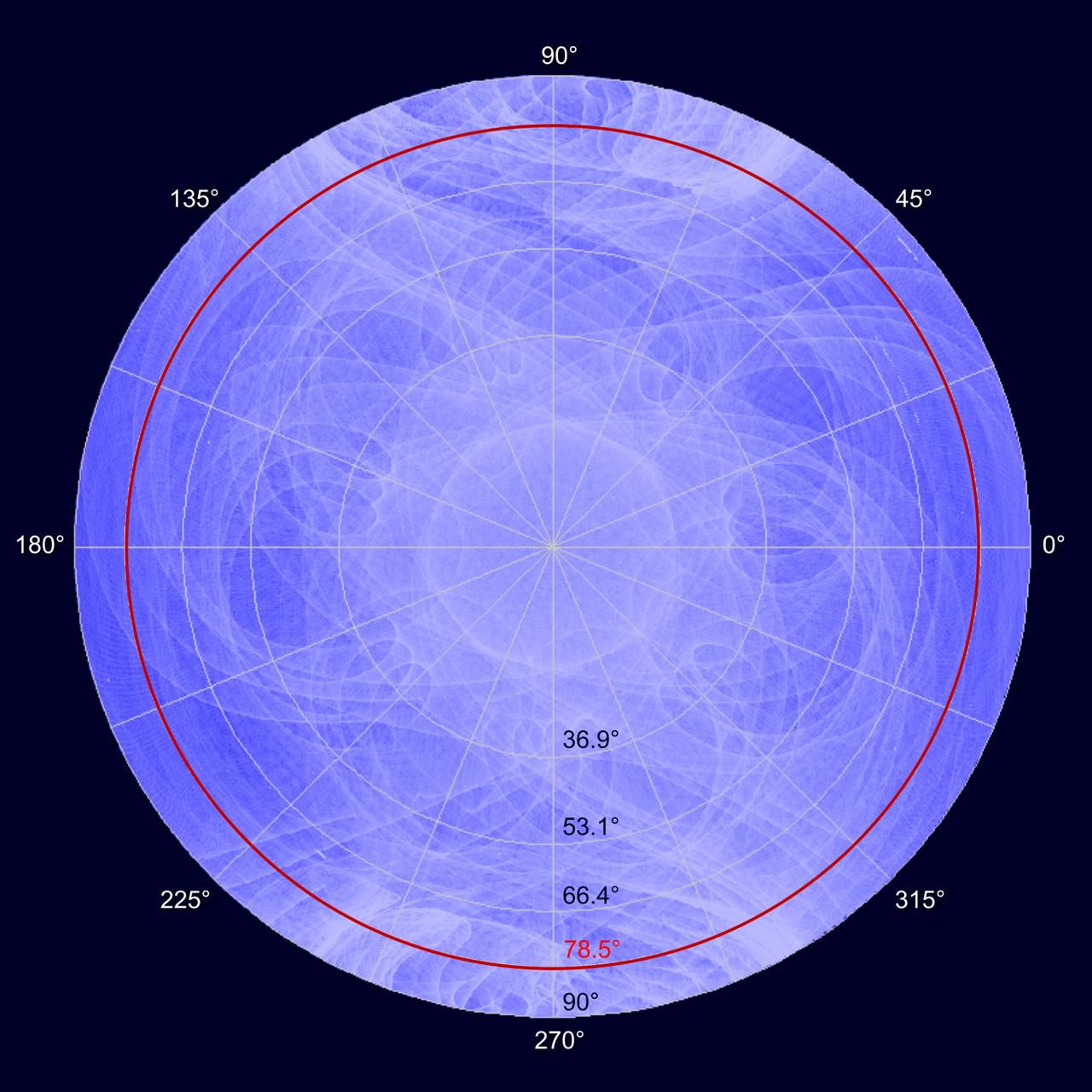
The LAT's sensitivity to gamma rays is greatest in the center of its wide field of view and decreases toward the edge. LAT scientists regard the effective limit of the instrument's field of view to be 78.5 degrees (red circle) from its center. View a video of this here: <a href="http://bit.ly/Y2K4LN" rel="nofollow">bit.ly/Y2K4LN</a>. Credit: NASA/DOE/Fermi LAT Collaboration ----- NASA's Fermi Gamma-ray Space Telescope orbits our planet every 95 minutes, building up increasingly deeper views of the universe with every circuit. Its wide-eyed Large Area Telescope (LAT) sweeps across the entire sky every three hours, capturing the highest-energy form of light -- gamma rays -- from sources across the universe. These range from supermassive black holes billions of light-years away to intriguing objects in our own galaxy, such as X-ray binaries, supernova remnants and pulsars. Now a Fermi scientist has transformed LAT data of a famous pulsar into a mesmerizing movie that visually encapsulates the spacecraft's complex motion. Click here to continue reading: <a href="http://1.usa.gov/WhYwCU" rel="nofollow">1.usa.gov/WhYwCU</a> <b><a href="http://www.nasa.gov/audience/formedia/features/MP_Photo_Guidelines.html" rel="nofollow">NASA image use policy.</a></b> <b><a href="http://www.nasa.gov/centers/goddard/home/index.html" rel="nofollow">NASA Goddard Space Flight Center</a></b> enables NASA’s mission through four scientific endeavors: Earth Science, Heliophysics, Solar System Exploration, and Astrophysics. Goddard plays a leading role in NASA’s accomplishments by contributing compelling scientific knowledge to advance the Agency’s mission. <b>Follow us on <a href="http://twitter.com/NASA_GoddardPix" rel="nofollow">Twitter</a></b> <b>Like us on <a href="http://www.facebook.com/pages/Greenbelt-MD/NASA-Goddard/395013845897?ref=tsd" rel="nofollow">Facebook</a></b> <b>Find us on <a href="http://instagram.com/nasagoddard?vm=grid" rel="nofollow">Instagram</a></b>

Many of NICER’s 56 X-ray “concentrators” seen from within the instrument optical bench. Light reflected from the gold surfaces of the 24 concentric foils in each concentrator is focused onto detectors slightly more than 1 meter (3.5 feet) away. The payload’s 56 mirror assemblies concentrate X-rays onto silicon detectors to gather data that will probe the interior makeup of neutron stars, including those that appear to flash regularly, called pulsars. The Neutron star Interior Composition Explorer (NICER) is a NASA Explorer Mission of Opportunity dedicated to studying the extraordinary environments — strong gravity, ultra-dense matter, and the most powerful magnetic fields in the universe — embodied by neutron stars. An attached payload aboard the International Space Station, NICER will deploy an instrument with unique capabilities for timing and spectroscopy of fast X-ray brightness fluctuations. The embedded Station Explorer for X-ray Timing and Navigation Technology demonstration (SEXTANT) will use NICER data to validate, for the first time in space, technology that exploits pulsars as natural navigation beacons. Credit: NASA/Goddard/ Keith Gendreau <b><a href="http://www.nasa.gov/audience/formedia/features/MP_Photo_Guidelines.html" rel="nofollow">NASA image use policy.</a></b> <b><a href="http://www.nasa.gov/centers/goddard/home/index.html" rel="nofollow">NASA Goddard Space Flight Center</a></b> enables NASA’s mission through four scientific endeavors: Earth Science, Heliophysics, Solar System Exploration, and Astrophysics. Goddard plays a leading role in NASA’s accomplishments by contributing compelling scientific knowledge to advance the Agency’s mission. <b>Follow us on <a href="http://twitter.com/NASAGoddardPix" rel="nofollow">Twitter</a></b> <b>Like us on <a href="http://www.facebook.com/pages/Greenbelt-MD/NASA-Goddard/395013845897?ref=tsd" rel="nofollow">Facebook</a></b> <b>Find us on <a href="http://instagrid.me/nasagoddard/?vm=grid" rel="nofollow">Instagram</a></b>

Release Date: July 10, 2003 A rich starry sky fills the view from an ancient gas-giant planet in the core of the globular star cluster M4, as imagined in this artist's concept. The 13-billion-year-old planet orbits a helium white-dwarf star and the millisecond pulsar B1620-26, seen at lower left. The globular cluster is deficient in heavier elements for making planets, so the existence of such a world implies that planet formation may have been quite efficient and common in the early universe. Object Names: B1620-26, M4 Image Type: Artwork Illustration Credit: NASA and G. Bacon (STScI) To learn more about this image go to: <a href="http://www.nasa.gov/centers/goddard/news/topstory/2003/0709hstssu.html" rel="nofollow">www.nasa.gov/centers/goddard/news/topstory/2003/0709hstss...</a> <b><a href="http://www.nasa.gov/centers/goddard/home/index.html" rel="nofollow">NASA Goddard Space Flight Center</a></b> is home to the nation's largest organization of combined scientists, engineers and technologists that build spacecraft, instruments and new technology to study the Earth, the sun, our solar system, and the universe.
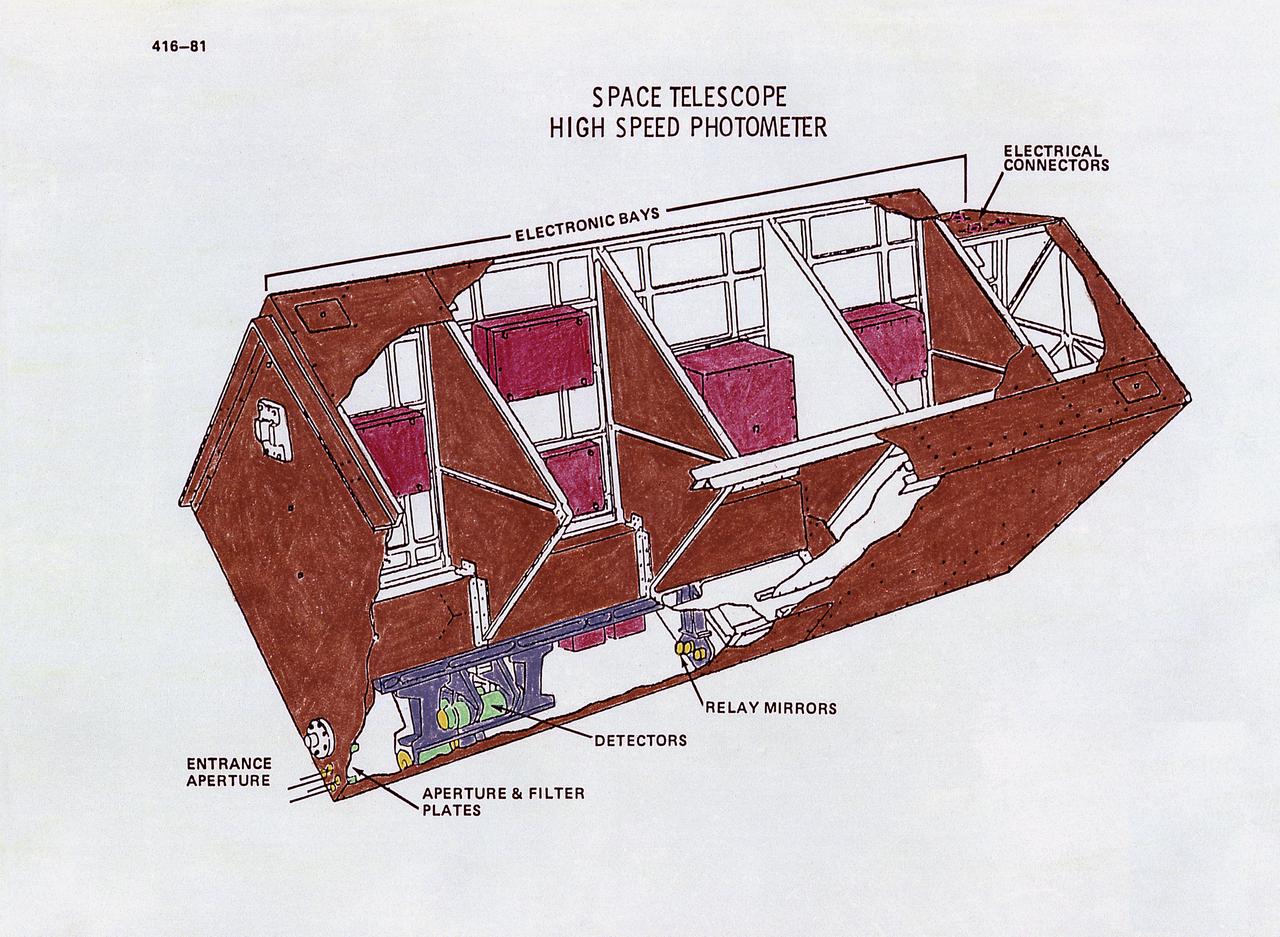
This drawing illustrates the Hubble Space Telescope's (HST's) High Speed Photometer (HSP). The HSP measures the intensity of starlight (brightness), which will help determine astronomical distances. Its principal use will be to measure extremely-rapid variations or pulses in light from celestial objects, such as pulsating stars. The HSP produces brightness readings. Light passes into one of four special signal-multiplying tubes that record the data. The HSP can measure energy fluctuations from objects that pulsate as rapidly as once every 10 microseconds. From HSP data, astronomers expect to learn much about such mysterious objects as pulsars, black holes, and quasars. The purpose of the HST, the most complex and sensitive optical telescope ever made, is to study the cosmos from a low-Earth orbit. By placing the telescope in space, astronomers are able to collect data that is free of the Earth's atmosphere. The HST views galaxies, stars, planets, comets, possibly other solar systems, and even unusual phenomena such as quasars, with 10 times the clarity of ground-based telescopes. The HST was deployed from the Space Shuttle Discovery (STS-31 mission) into Earth orbit in April 1990. The Marshall Space Flight Center had responsibility for design, development, and construction of the HST. The Perkin-Elmer Corporation, in Danbury, Cornecticut, developed the optical system and guidance sensors.

This image depicts the formation of multiple whirlpools in a sodium gas cloud. Scientists who cooled the cloud and made it spin created the whirlpools in a Massachusetts Institute of Technology laboratory, as part of NASA-funded research. This process is similar to a phenomenon called starquakes that appear as glitches in the rotation of pulsars in space. MIT's Wolgang Ketterle and his colleagues, who conducted the research under a grant from the Biological and Physical Research Program through NASA's Jet Propulsion Laboratory, Pasadena, Calif., cooled the sodium gas to less than one millionth of a degree above absolute zero (-273 Celsius or -460 Fahrenheit). At such extreme cold, the gas cloud converts to a peculiar form of matter called Bose-Einstein condensate, as predicted by Albert Einstein and Satyendra Bose of India in 1927. No physical container can hold such ultra-cold matter, so Ketterle's team used magnets to keep the cloud in place. They then used a laser beam to make the gas cloud spin, a process Ketterle compares to stroking a ping-pong ball with a feather until it starts spirning. The spinning sodium gas cloud, whose volume was one- millionth of a cubic centimeter, much smaller than a raindrop, developed a regular pattern of more than 100 whirlpools.
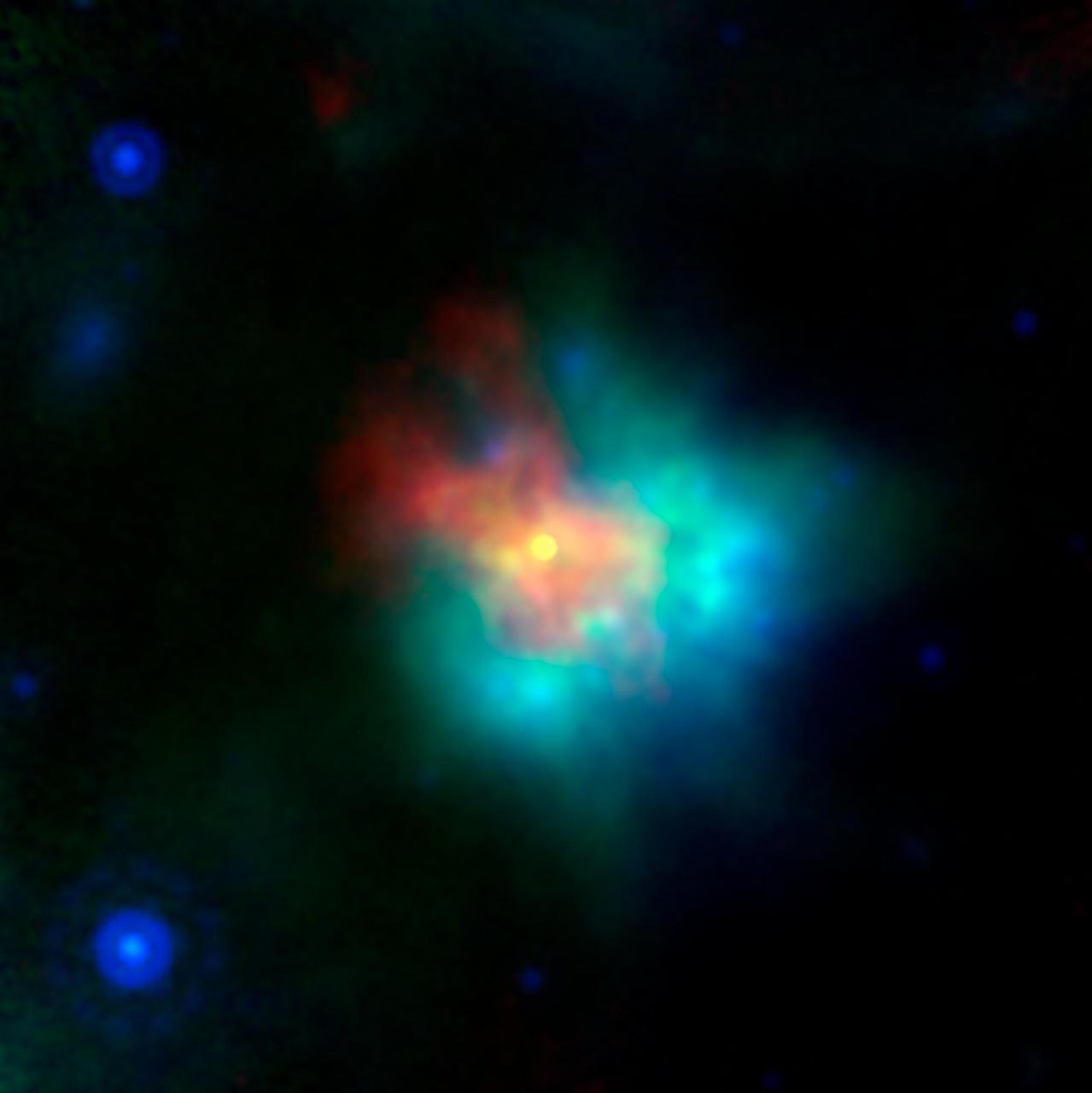
This image of supernova remnant G54.1+0.3 includes radio, infrared and X-ray light. The saturated yellow point at the center of the image indicates strong X-ray source at the center of the supernova remnant. This is an incredibly dense object called a neutron star, which can form as a star runs out of fuel to keep it inflated, and the unsupported material collapses down on to the star's core. G54.1+0.3 contains a special type of neutron star called a pulsar, which emits particularly bright radio and X-ray emissions. The blue and green emissions show the presence of dust, including silica. The red hues correspond to radio data from the Karl G. Jansky Very Large Array; green corresponds to 70 µm wavelength infrared light from the European Space Agency's Herschel Space Observatory; blue corresponds to 24 µm wavelength infrared light from the Multiband Imaging Photometer (MIPS) instrument on NASA's Spitzer Space Telescope; yellow corresponds to X-ray data from the Chandra X-ray Observatory. https://photojournal.jpl.nasa.gov/catalog/PIA22569
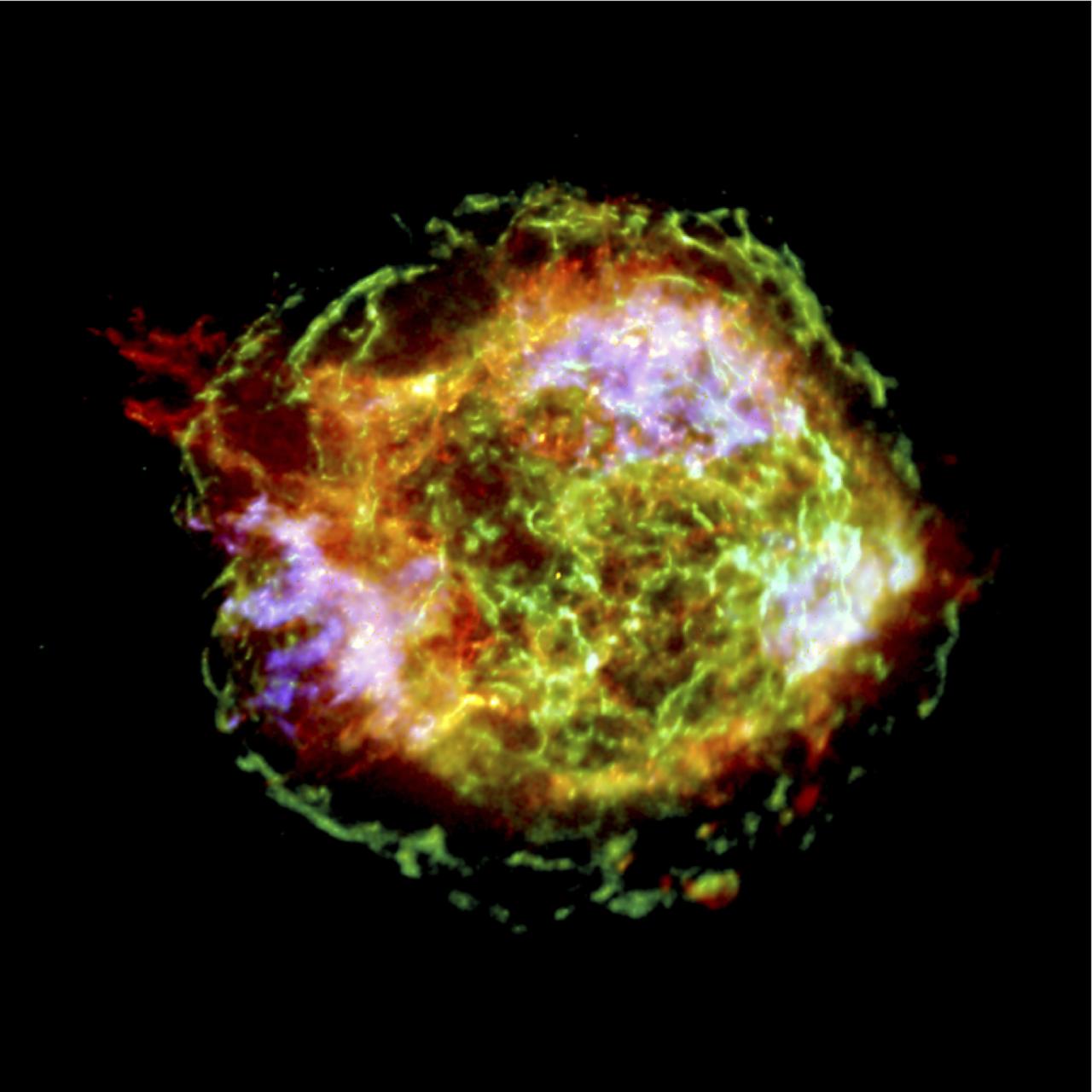
This spectacular Chandra X-Ray Observatory (CXO) image of the supernova remnant Cassiopeia A is the most detailed image ever made of the remains of an exploded star. The one-million-second image shows a bright outer ring (green) 10 light years in diameter that marks the location of a shock wave generated by the supernova explosion. In the upper left corner is a large jet-like structure that protrudes beyond the shock wave, and a counter-jet can be seen on the lower right. The x-ray spectra show that the jets are rich in silicon atoms, and relatively poor in iron atoms. This indicates that the jets formed soon after the initial explosion of the star, otherwise, the jets should have contained large quantities of iron from the star’s central regions. The bright blue areas are composed almost purely of iron gas, which was produced in the central, hottest regions of the star and somehow ejected in a direction almost perpendicular to the jets. The bright source at the center of the image is presumed to be a neutron star created during the supernova. Unlike most others, this neutron star is quiet, faint, and so far shows no evidence of pulsed radiation. A working hypothesis is that the explosion that created Cassiopeia A produced high speed jets similar to, but less energetic than, the hyper nova jets thought to produce gamma-ray bursts. During the explosion, the star may have developed an extremely strong magnetic filed that helped to accelerate the jets and later stifled any pulsar wind activity. CXO project management is the responsibility of NASA’s Marshall Space Flight Center in Huntsville, Alabama.
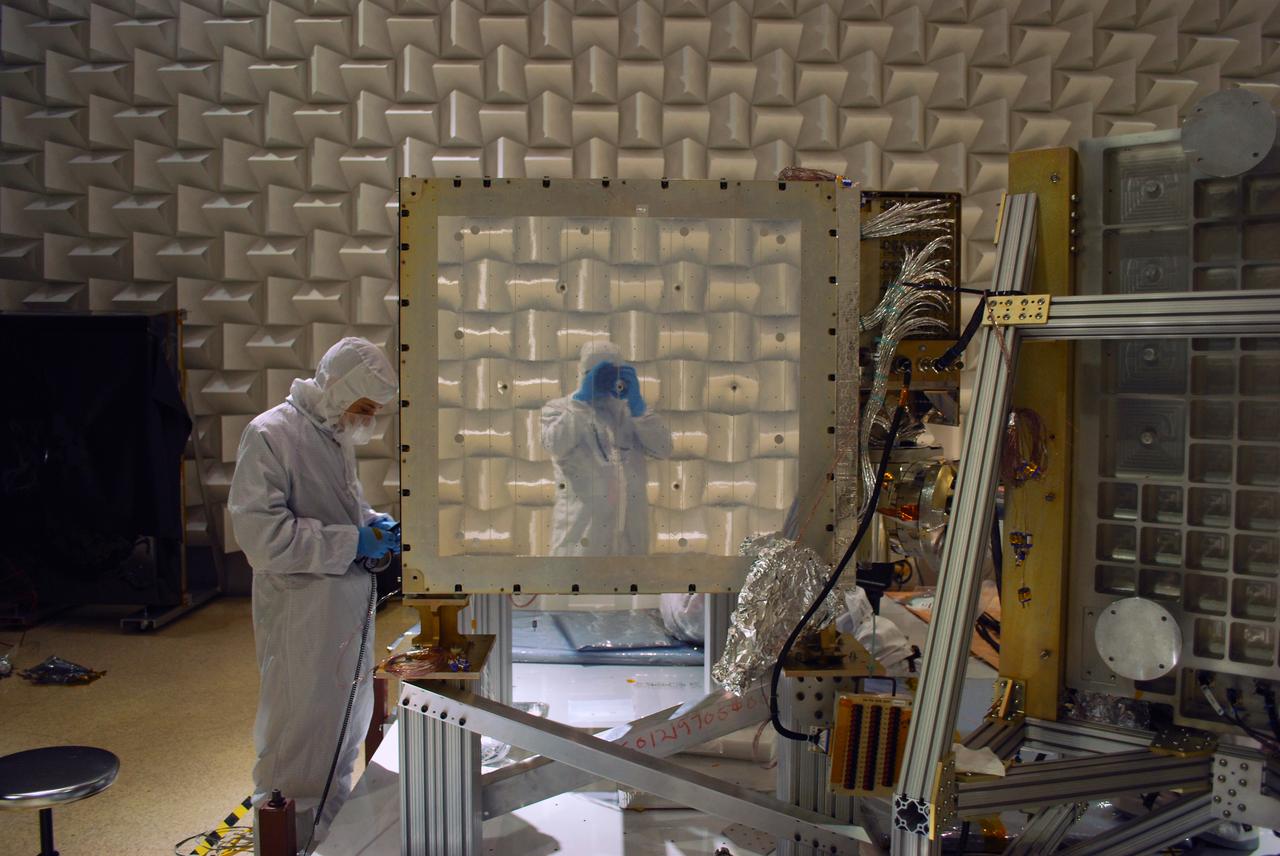
A photo taken during the NICER range-of-motion test at NASA’s Goddard Space Flight Center shows the photographer’s reflection in the mirror-like radiator surface of the detector plate. Teflon-coated silver tape is used to keep NICER’s detectors cool. The Neutron star Interior Composition Explorer (NICER) is a NASA Explorer Mission of Opportunity dedicated to studying the extraordinary environments — strong gravity, ultra-dense matter, and the most powerful magnetic fields in the universe — embodied by neutron stars. An attached payload aboard the International Space Station, NICER will deploy an instrument with unique capabilities for timing and spectroscopy of fast X-ray brightness fluctuations. The embedded Station Explorer for X-ray Timing and Navigation Technology demonstration (SEXTANT) will use NICER data to validate, for the first time in space, technology that exploits pulsars as natural navigation beacons. Credit: NASA/Goddard/ Keith Gendreau <b><a href="http://www.nasa.gov/audience/formedia/features/MP_Photo_Guidelines.html" rel="nofollow">NASA image use policy.</a></b> <b><a href="http://www.nasa.gov/centers/goddard/home/index.html" rel="nofollow">NASA Goddard Space Flight Center</a></b> enables NASA’s mission through four scientific endeavors: Earth Science, Heliophysics, Solar System Exploration, and Astrophysics. Goddard plays a leading role in NASA’s accomplishments by contributing compelling scientific knowledge to advance the Agency’s mission. <b>Follow us on <a href="http://twitter.com/NASAGoddardPix" rel="nofollow">Twitter</a></b> <b>Like us on <a href="http://www.facebook.com/pages/Greenbelt-MD/NASA-Goddard/395013845897?ref=tsd" rel="nofollow">Facebook</a></b> <b>Find us on <a href="http://instagrid.me/nasagoddard/?vm=grid" rel="nofollow">Instagram</a></b>
This video previews the Neutron star Interior Composition Explorer (NICER). NICER is an Astrophysics Mission of Opportunity within NASA’s Explorer program, which provides frequent flight opportunities for world-class scientific investigations from space utilizing innovative, streamlined and efficient management approaches within the heliophysics and astrophysics science areas. NASA’s Space Technology Mission Directorate supports the SEXTANT component of the mission, demonstrating pulsar-based spacecraft navigation. NICER is an upcoming International Space Station payload scheduled to launch in June 2017. Learn more about the mission at nasa.gov/nicer <b><a href="http://www.nasa.gov/audience/formedia/features/MP_Photo_Guidelines.html" rel="nofollow">NASA image use policy.</a></b> <b><a href="http://www.nasa.gov/centers/goddard/home/index.html" rel="nofollow">NASA Goddard Space Flight Center</a></b> enables NASA’s mission through four scientific endeavors: Earth Science, Heliophysics, Solar System Exploration, and Astrophysics. Goddard plays a leading role in NASA’s accomplishments by contributing compelling scientific knowledge to advance the Agency’s mission. <b>Follow us on <a href="http://twitter.com/NASAGoddardPix" rel="nofollow">Twitter</a></b> <b>Like us on <a href="http://www.facebook.com/pages/Greenbelt-MD/NASA-Goddard/395013845897?ref=tsd" rel="nofollow">Facebook</a></b> <b>Find us on <a href="http://instagrid.me/nasagoddard/?vm=grid" rel="nofollow">Instagram</a></b>

This photograph shows the Compton Gamma-Ray Observatory (GRO) being deployed by the Remote Manipulator System (RMS) arm aboard the Space Shuttle Atlantis during the STS-37 mission in April 1991. The GRO reentered Earth atmosphere and ended its successful mission in June 2000. For nearly 9 years, the GRO Burst and Transient Source Experiment (BATSE), designed and built by the Marshall Space Flight Center (MSFC), kept an unblinking watch on the universe to alert scientists to the invisible, mysterious gamma-ray bursts that had puzzled them for decades. By studying gamma-rays from objects like black holes, pulsars, quasars, neutron stars, and other exotic objects, scientists could discover clues to the birth, evolution, and death of stars, galaxies, and the universe. The gamma-ray instrument was one of four major science instruments aboard the Compton. It consisted of eight detectors, or modules, located at each corner of the rectangular satellite to simultaneously scan the entire universe for bursts of gamma-rays ranging in duration from fractions of a second to minutes. In January 1999, the instrument, via the Internet, cued a computer-controlled telescope at Las Alamos National Laboratory in Los Alamos, New Mexico, within 20 seconds of registering a burst. With this capability, the gamma-ray experiment came to serve as a gamma-ray burst alert for the Hubble Space Telescope, the Chandra X-Ray Observatory, and major gound-based observatories around the world. Thirty-seven universities, observatories, and NASA centers in 19 states, and 11 more institutions in Europe and Russia, participated in the BATSE science program.
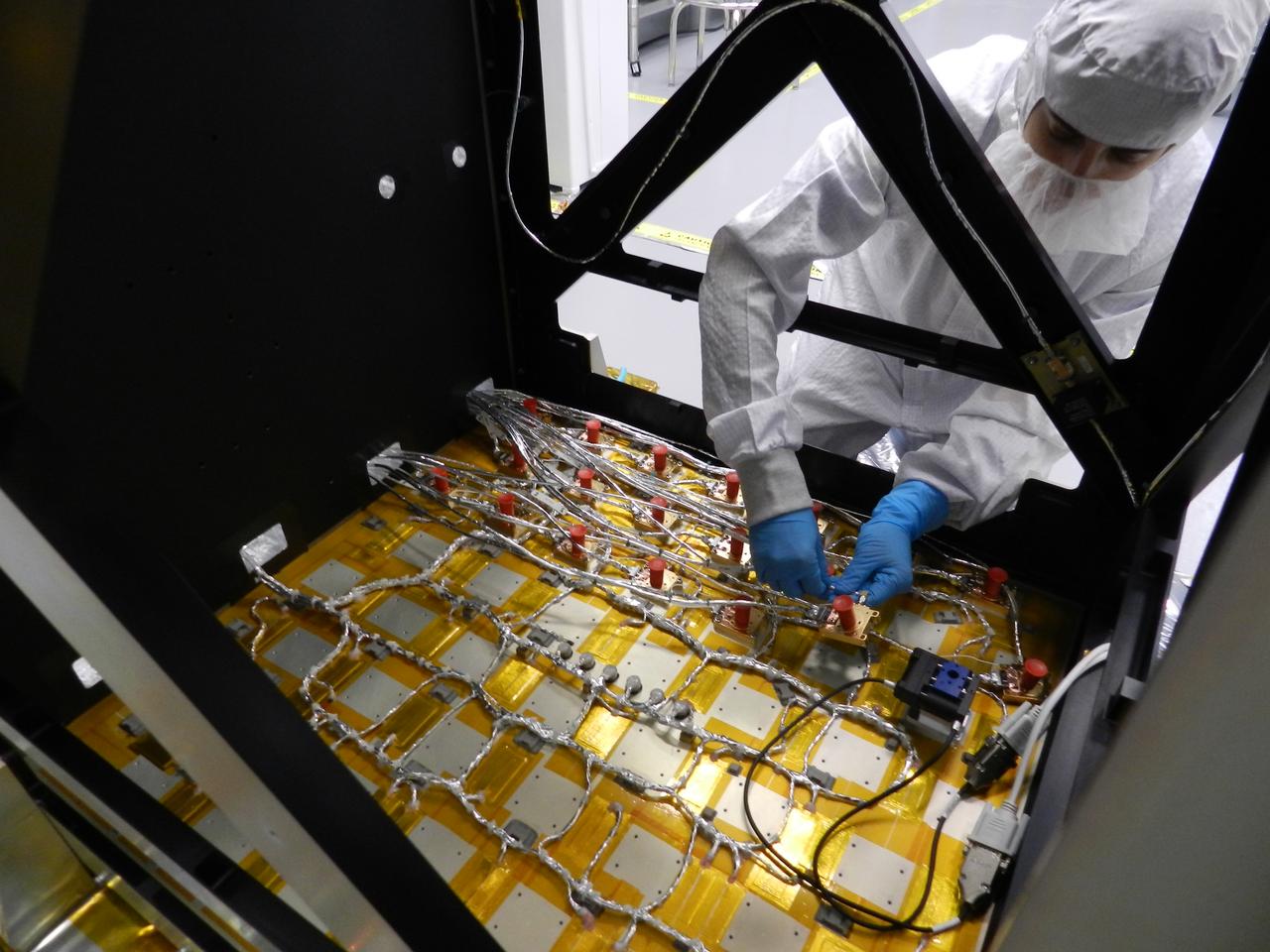
NICER engineer Steven Kenyon installs an X-ray detector onto the payload’s detector plate. The detectors are protected by red caps during installation because they are very sensitive to dust and other foreign object debris. The Neutron star Interior Composition Explorer (NICER) is a NASA Explorer Mission of Opportunity dedicated to studying the extraordinary environments — strong gravity, ultra-dense matter, and the most powerful magnetic fields in the universe — embodied by neutron stars. An attached payload aboard the International Space Station, NICER will deploy an instrument with unique capabilities for timing and spectroscopy of fast X-ray brightness fluctuations. The embedded Station Explorer for X-ray Timing and Navigation Technology demonstration (SEXTANT) will use NICER data to validate, for the first time in space, technology that exploits pulsars as natural navigation beacons. Credit: NASA/Goddard/ Keith Gendreau <b><a href="http://www.nasa.gov/audience/formedia/features/MP_Photo_Guidelines.html" rel="nofollow">NASA image use policy.</a></b> <b><a href="http://www.nasa.gov/centers/goddard/home/index.html" rel="nofollow">NASA Goddard Space Flight Center</a></b> enables NASA’s mission through four scientific endeavors: Earth Science, Heliophysics, Solar System Exploration, and Astrophysics. Goddard plays a leading role in NASA’s accomplishments by contributing compelling scientific knowledge to advance the Agency’s mission. <b>Follow us on <a href="http://twitter.com/NASAGoddardPix" rel="nofollow">Twitter</a></b> <b>Like us on <a href="http://www.facebook.com/pages/Greenbelt-MD/NASA-Goddard/395013845897?ref=tsd" rel="nofollow">Facebook</a></b> <b>Find us on <a href="http://instagrid.me/nasagoddard/?vm=grid" rel="nofollow">Instagram</a></b>
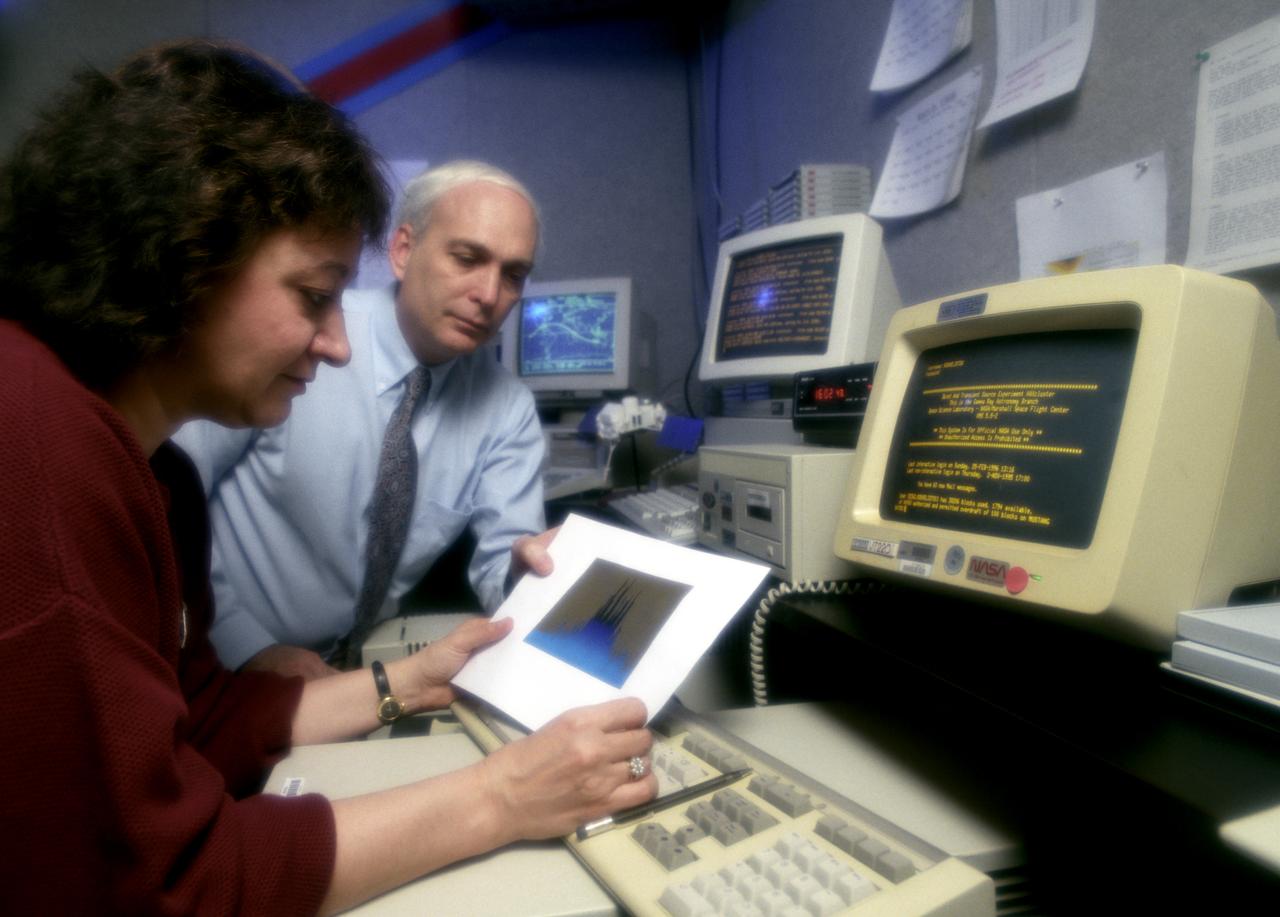
In this photograph, Dr. Gerald Fishman of the Marshall Space Flight Center (MSFC), a principal investigator of the Compton Gamma-Ray Observatory's (GRO's) instrument, the Burst and Transient Source Experiment (BATSE), and Dr. Chryssa Kouveliotou of Universities Space Research Associates review data from the BATSE. For nearly 9 years, GRO's Burst and Transient Source Experiment (BATSE), designed and built by the Marshall Space Flight Center, kept a blinking watch on the universe to alert scientist to the invisible, mysterious gamma-ray bursts. By studying gamma-rays from objects like black holes, pulsars, quasars, neutron stars, and other exotic objects, scientists could discover clues to the birth, evolution, and death of stars, galaxies, and the universe. The gamma-ray instrument was one of four major science instruments aboard the Compton. It consisted of eight detectors, or modules, located at each corner of the rectangular satellite to simultaneously scan the entire universe for bursts of gamma-rays ranging in duration from fractions of a second to minutes. Because gamma-rays are so powerful, they pass through conventional telescope mirrors. Instead of a mirror, the heart of each BATSE module was a large, flat, transparent crystal that generated a tiny flash of light when struck by a gamma-ray. With an impressive list of discoveries and diverse accomplishments, BATSE could claim to have rewritten astronomy textbooks. Launched aboard the Space Shuttle Orbiter Atlantis during the STS-35 mission in April 1991, the GRO reentered the Earth's atmosphere and ended its successful 9-year mission in June 2000.
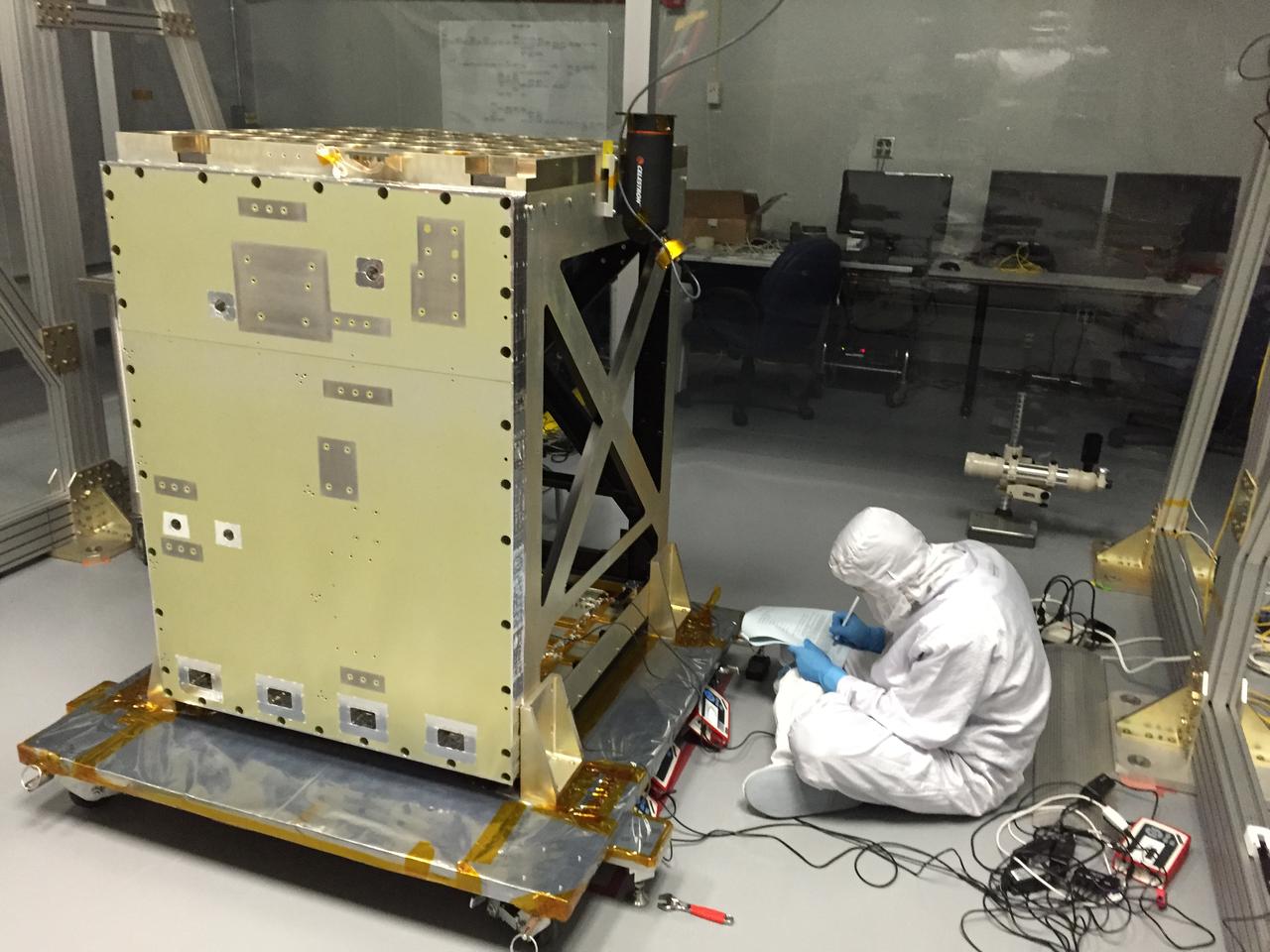
A NICER team member measures the focused optical power of each X-ray concentrator in a clean tent at NASA’s Goddard Space Flight Center. The Neutron star Interior Composition Explorer (NICER) is a NASA Explorer Mission of Opportunity dedicated to studying the extraordinary environments — strong gravity, ultra-dense matter, and the most powerful magnetic fields in the universe — embodied by neutron stars. An attached payload aboard the International Space Station, NICER will deploy an instrument with unique capabilities for timing and spectroscopy of fast X-ray brightness fluctuations. The embedded Station Explorer for X-ray Timing and Navigation Technology demonstration (SEXTANT) will use NICER data to validate, for the first time in space, technology that exploits pulsars as natural navigation beacons. Credit: NASA/Goddard/ Keith Gendreau <b><a href="http://www.nasa.gov/audience/formedia/features/MP_Photo_Guidelines.html" rel="nofollow">NASA image use policy.</a></b> <b><a href="http://www.nasa.gov/centers/goddard/home/index.html" rel="nofollow">NASA Goddard Space Flight Center</a></b> enables NASA’s mission through four scientific endeavors: Earth Science, Heliophysics, Solar System Exploration, and Astrophysics. Goddard plays a leading role in NASA’s accomplishments by contributing compelling scientific knowledge to advance the Agency’s mission. <b>Follow us on <a href="http://twitter.com/NASAGoddardPix" rel="nofollow">Twitter</a></b> <b>Like us on <a href="http://www.facebook.com/pages/Greenbelt-MD/NASA-Goddard/395013845897?ref=tsd" rel="nofollow">Facebook</a></b> <b>Find us on <a href="http://instagrid.me/nasagoddard/?vm=grid" rel="nofollow">Instagram</a></b>
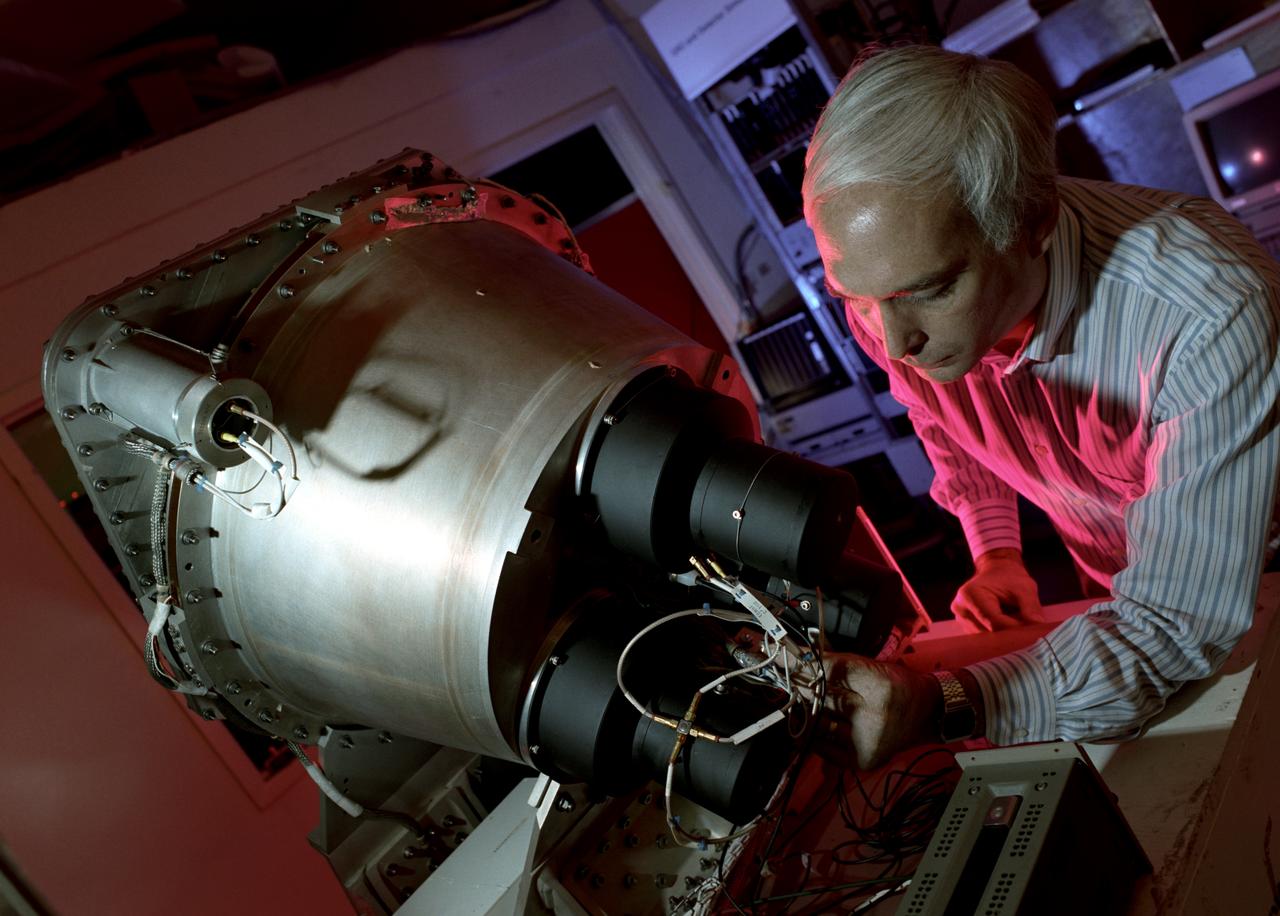
In this photograph, Dr. Gerald Fishman of the Marshall Space Flight Center (MSFC), a principal investigator of the Compton Gamma-Ray Observatory's (GRO's) instrument, the Burst and Transient Source Experiment (BATSE), works on the BATSE detector module. For nearly 9 years, GRO's BATSE, designed and built by MSFC, kept an unblinking watch on the universe to alert scientist to the invisible, mysterious gamma-ray bursts. By studying gamma-rays from objects like black holes, pulsars, quasars, neutron stars, and other exotic objects, scientists could discover clues to the birth, evolution, and death of star, galaxies, and the universe. The gamma-ray instrument was one of four major science instruments aboard the Compton. It consisted of eight detectors, or modules, located at each corner of the rectangular satellite to simultaneously scan the entire universe for bursts of gamma-rays ranging in duration from fractions of a second to minutes. Because gamma-rays are so powerful, they pass through conventional telescope mirrors. Instead of a mirror, the heart of each BATSE module was a large, flat, transparent crystal that generated a tiny flash of light when struck by a gamma-ray. With an impressive list of discoveries and diverse accomplishments, BATSE could claim to have rewritten astronomy textbooks. Launched aboard the Space Shuttle Orbiter Atlantis during the STS-35 mission in April 1991, the GRO reentered the Earth's atmosphere and ended its successful 9-year mission in June 2000.
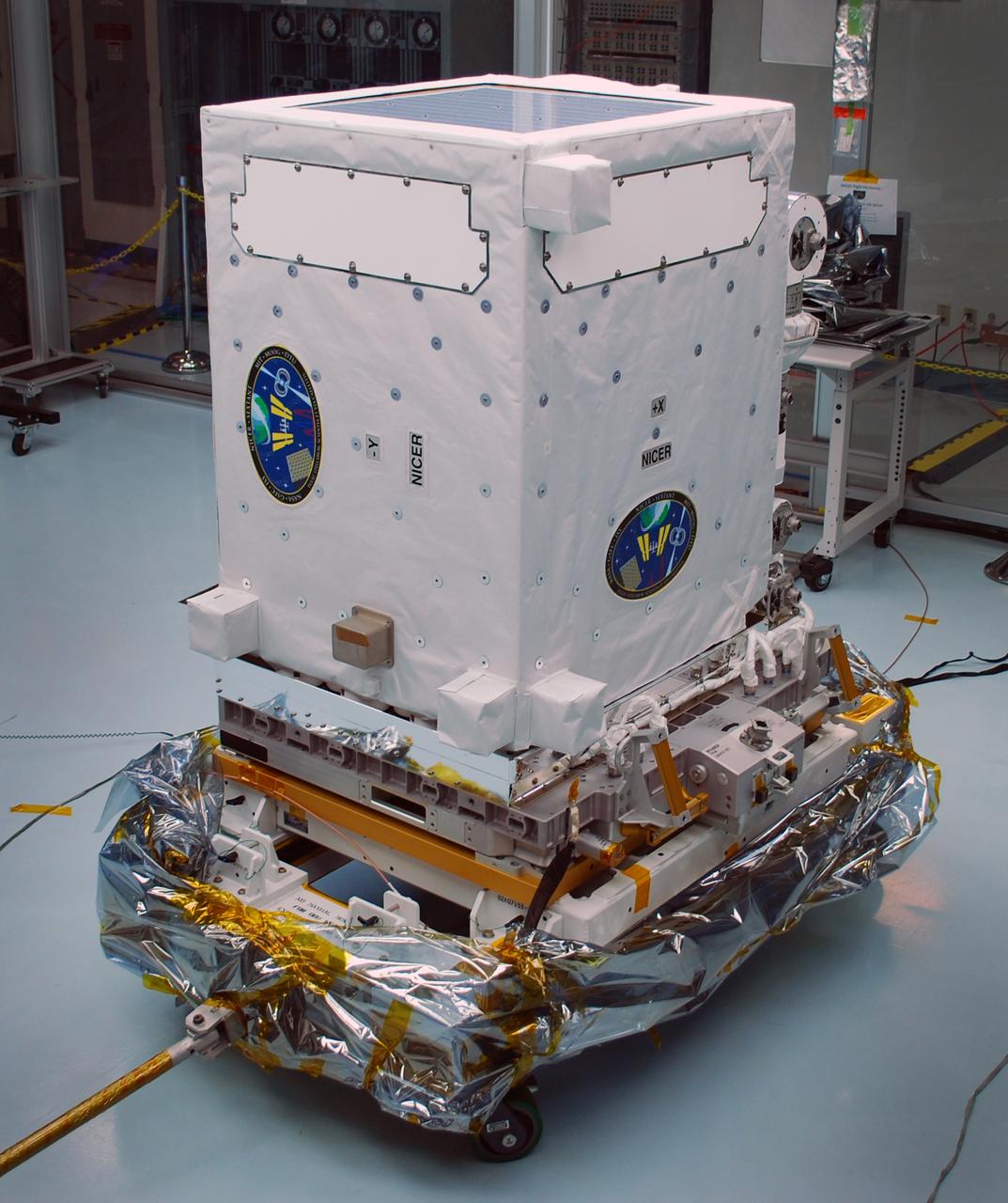
The NICER payload, blanketed and waiting for launch in the Space Station Processing Facility at NASA’s Kennedy Space Center in Cape Canaveral, Florida. The instrument is in its stowed configuration for launch. The Neutron star Interior Composition Explorer (NICER) is a NASA Explorer Mission of Opportunity dedicated to studying the extraordinary environments — strong gravity, ultra-dense matter, and the most powerful magnetic fields in the universe — embodied by neutron stars. An attached payload aboard the International Space Station, NICER will deploy an instrument with unique capabilities for timing and spectroscopy of fast X-ray brightness fluctuations. The embedded Station Explorer for X-ray Timing and Navigation Technology demonstration (SEXTANT) will use NICER data to validate, for the first time in space, technology that exploits pulsars as natural navigation beacons. Credit: NASA/Goddard/ Keith Gendreau <b><a href="http://www.nasa.gov/audience/formedia/features/MP_Photo_Guidelines.html" rel="nofollow">NASA image use policy.</a></b> <b><a href="http://www.nasa.gov/centers/goddard/home/index.html" rel="nofollow">NASA Goddard Space Flight Center</a></b> enables NASA’s mission through four scientific endeavors: Earth Science, Heliophysics, Solar System Exploration, and Astrophysics. Goddard plays a leading role in NASA’s accomplishments by contributing compelling scientific knowledge to advance the Agency’s mission. <b>Follow us on <a href="http://twitter.com/NASAGoddardPix" rel="nofollow">Twitter</a></b> <b>Like us on <a href="http://www.facebook.com/pages/Greenbelt-MD/NASA-Goddard/395013845897?ref=tsd" rel="nofollow">Facebook</a></b> <b>Find us on <a href="http://instagrid.me/nasagoddard/?vm=grid" rel="nofollow">Instagram</a></b>

This photograph shows the Compton Gamma-Ray Observatory being released from the Remote Manipulator System (RMS) arm aboard the Space Shuttle Atlantis during the STS-35 mission in April 1991. The GRO reentered the Earth's atmosphere and ended its successful mission in June 2000. For nearly 9 years, GRO's Burst and Transient Source Experiment (BATSE), designed and built by the Marshall Space Flight Center, kept an unblinking watch on the universe to alert scientist to the invisible, mysterious gamma-ray bursts that had puzzled them for decades. By studying gamma-rays from objects like black holes, pulsars, quasars, neutron stars, and other exotic objects, scientists could discover clues to the birth, evolution, and death of star, galaxies, and the universe. The gamma-ray instrument was one of four major science instruments aboard the Compton. It consisted of eight detectors, or modules, located at each corner of the rectangular satellite to simultaneously scan the entire universe for bursts of gamma-rays ranging in duration from fractions of a second to minutes. In January 1999, the instrument, via the Internet, cued a computer-controlled telescope at Las Alamos National Laboratory in Los Alamos, New Mexico, within 20 seconds of registering a burst. With this capability, the gamma-ray experiment came to serve as a gamma-ray burst alert for the Hubble Space Telescope, the Chandra X-Ray Observatory, and major gound-based observatories around the world. Thirty-seven universities, observatories, and NASA centers in 19 states, and 11 more institutions in Europe and Russia, participated in BATSE's science program.

Peering deep into the core of the Crab Nebula, this close-up image reveals the beating heart of one of the most historic and intensively studied remnants of a supernova, an exploding star. The inner region sends out clock-like pulses of radiation and tsunamis of charged particles embedded in magnetic fields. The neutron star at the very center of the Crab Nebula has about the same mass as the sun but compressed into an incredibly dense sphere that is only a few miles across. Spinning 30 times a second, the neutron star shoots out detectable beams of energy that make it look like it's pulsating. The NASA Hubble Space Telescope snapshot is centered on the region around the neutron star (the rightmost of the two bright stars near the center of this image) and the expanding, tattered, filamentary debris surrounding it. Hubble's sharp view captures the intricate details of glowing gas, shown in red, that forms a swirling medley of cavities and filaments. Inside this shell is a ghostly blue glow that is radiation given off by electrons spiraling at nearly the speed of light in the powerful magnetic field around the crushed stellar core. The neutron star is a showcase for extreme physical processes and unimaginable cosmic violence. Bright wisps are moving outward from the neutron star at half the speed of light to form an expanding ring. It is thought that these wisps originate from a shock wave that turns the high-speed wind from the neutron star into extremely energetic particles. When this "heartbeat" radiation signature was first discovered in 1968, astronomers realized they had discovered a new type of astronomical object. Now astronomers know it's the archetype of a class of supernova remnants called pulsars - or rapidly spinning neutron stars. These interstellar "lighthouse beacons" are invaluable for doing observational experiments on a variety of astronomical phenomena, including measuring gravity waves. Observations of the Crab supernova were recorded by Chinese astronomers in 1054 A.D. The nebula, bright enough to be visible in amateur telescopes, is located 6,500 light-years away in the constellation Taurus. Credits: NASA and ESA, Acknowledgment: J. Hester (ASU) and M. Weisskopf (NASA/MSFC) <b><a href="http://www.nasa.gov/audience/formedia/features/MP_Photo_Guidelines.html" rel="nofollow">NASA image use policy.</a></b> <b><a href="http://www.nasa.gov/centers/goddard/home/index.html" rel="nofollow">NASA Goddard Space Flight Center</a></b> enables NASA’s mission through four scientific endeavors: Earth Science, Heliophysics, Solar System Exploration, and Astrophysics. Goddard plays a leading role in NASA’s accomplishments by contributing compelling scientific knowledge to advance the Agency’s mission. <b>Follow us on <a href="http://twitter.com/NASAGoddardPix" rel="nofollow">Twitter</a></b> <b>Like us on <a href="http://www.facebook.com/pages/Greenbelt-MD/NASA-Goddard/395013845897?ref=tsd" rel="nofollow">Facebook</a></b> <b>Find us on <a href="http://instagrid.me/nasagoddard/?vm=grid" rel="nofollow">Instagram</a></b>