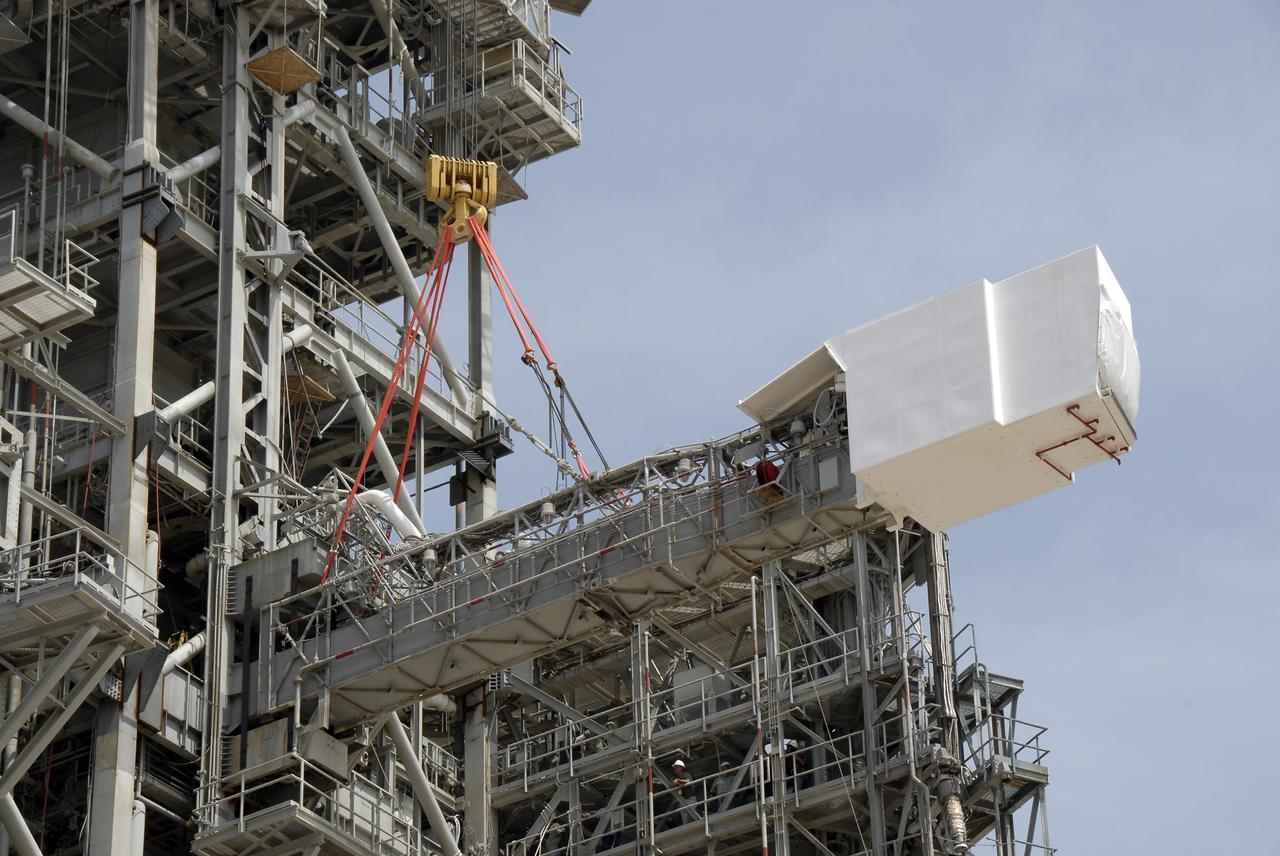
CAPE CANAVERAL, Fla. – The slings from a large crane are in place on the orbiter access arm, which ends in the White Room, that is part of the fixed service structure, or FSS, on Launch Pad 39B at NASA's Kennedy Space Center in Florida. The White Room provided entry into space shuttles that were on the pad. The arm is being removed from the FSS for the pad's conversion as launch site for the Constellation Program's Ares I-X. The launch of the Ares I-X flight test is targeted for August 2009. Photo credit: NASA/Kim Shiflett
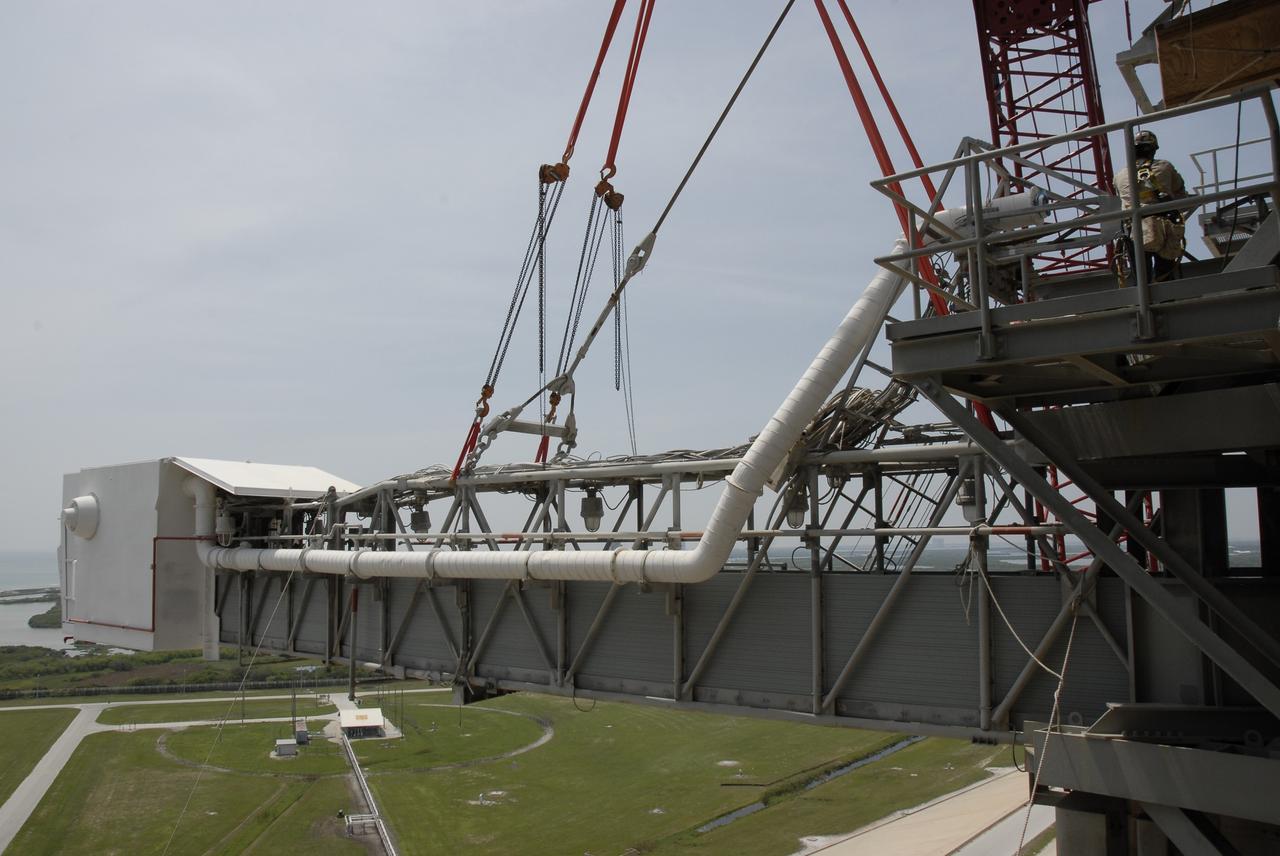
CAPE CANAVERAL, Fla. – The slings from a large crane are in place on the orbiter access arm, which ends in the White Room, that is part of the fixed service structure, or FSS, on Launch Pad 39B at NASA's Kennedy Space Center in Florida. The White Room provided entry into space shuttles that were on the pad. The arm is being removed from the FSS for the pad's conversion as launch site for the Constellation Program's Ares I-X. The launch of the Ares I-X flight test is targeted for August 2009. Photo credit: NASA/Kim Shiflett
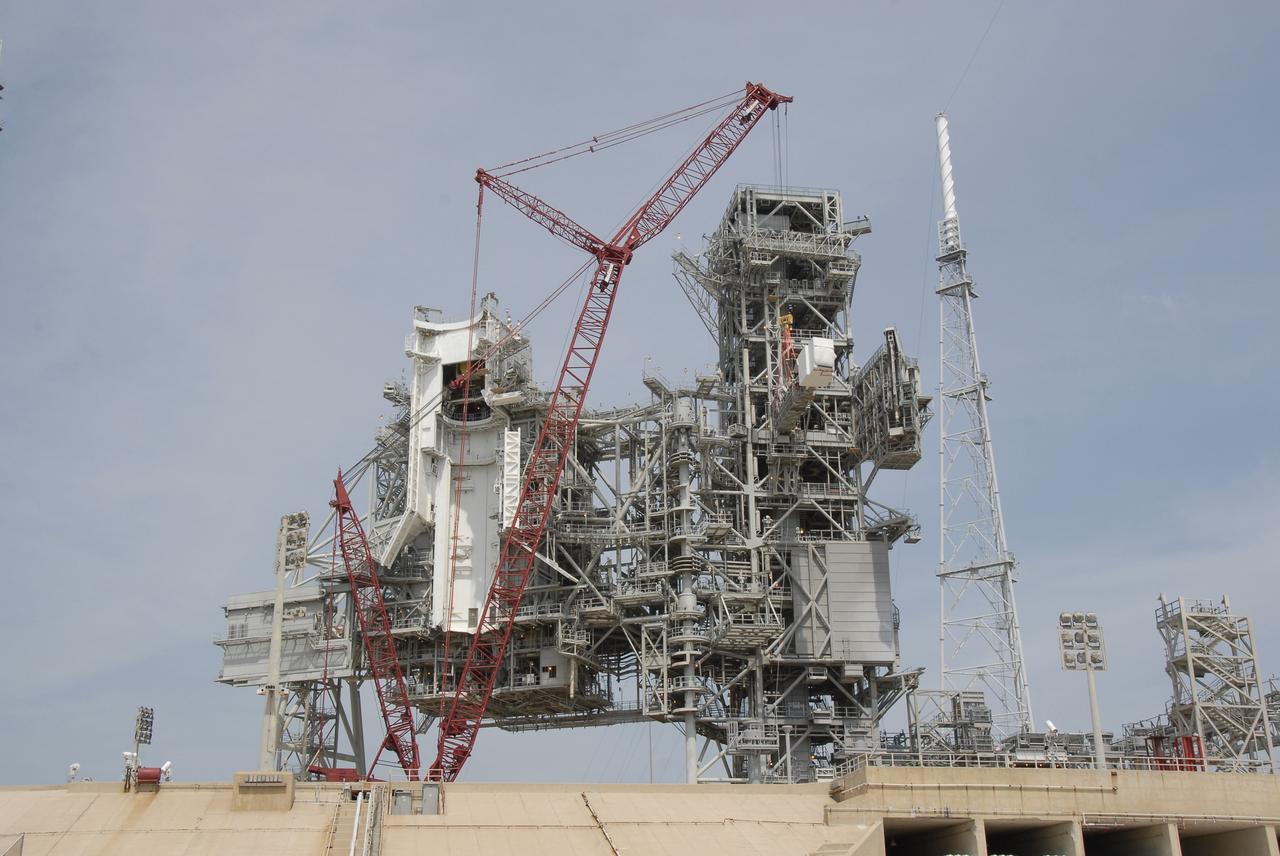
CAPE CANAVERAL, Fla. – The slings from a large crane are being attached to the orbiter access arm, which ends in the White Room, that is part of the fixed service structure, or FSS, on Launch Pad 39B at NASA's Kennedy Space Center in Florida. The White Room provided entry into space shuttles that were on the pad. The arm is being removed from the FSS for the pad's conversion as launch site for the Constellation Program's Ares I-X. The launch of the Ares I-X flight test is targeted for August 2009. Photo credit: NASA/Kim Shiflett
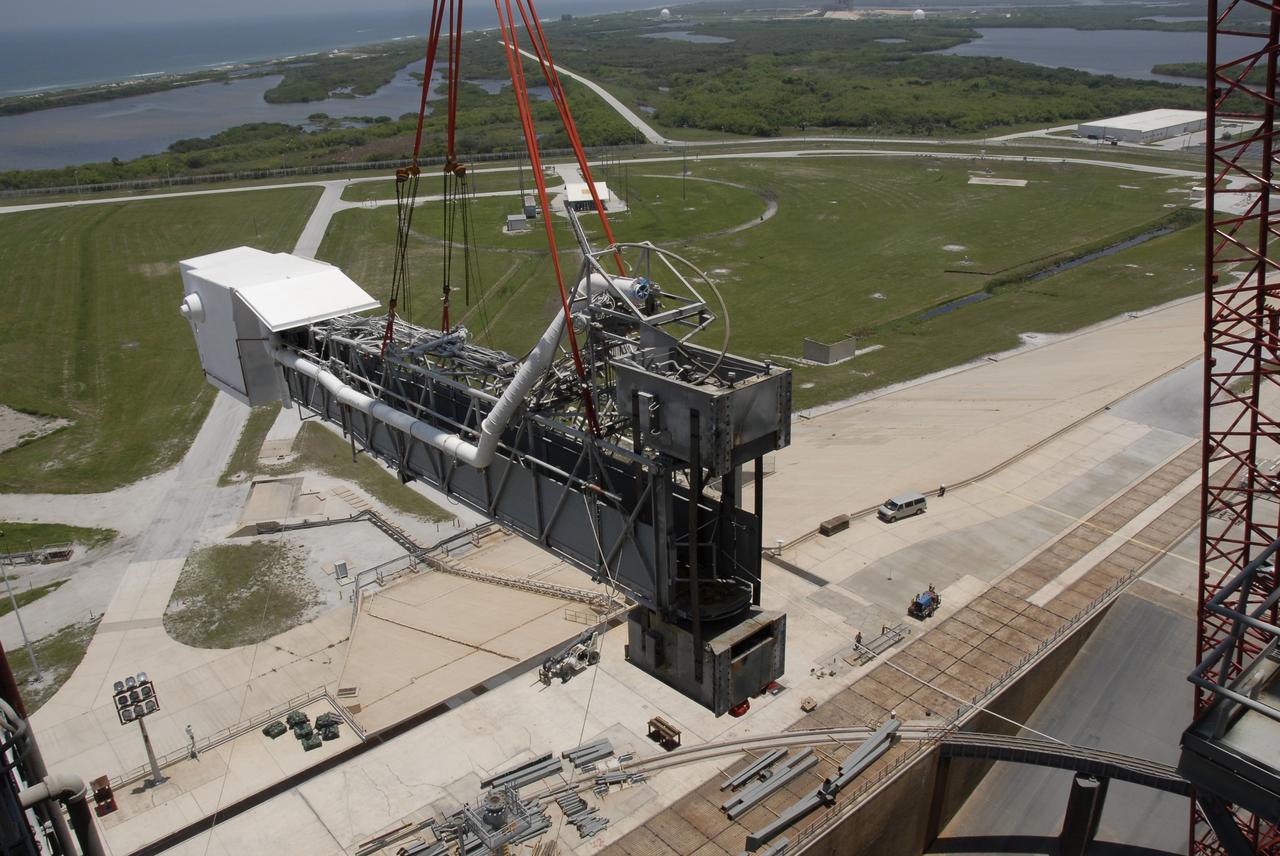
CAPE CANAVERAL, Fla. – The slings from a large crane swing the detached orbiter access arm, which ends in the White Room, away from the fixed service structure, or FSS, on Launch Pad 39B at NASA's Kennedy Space Center in Florida. The White Room provided entry into space shuttles that were on the pad. The arm is being removed from the FSS for the pad's conversion as launch site for the Constellation Program's Ares I-X. The launch of the Ares I-X flight test is targeted for August 2009. Photo credit: NASA/Kim Shiflett
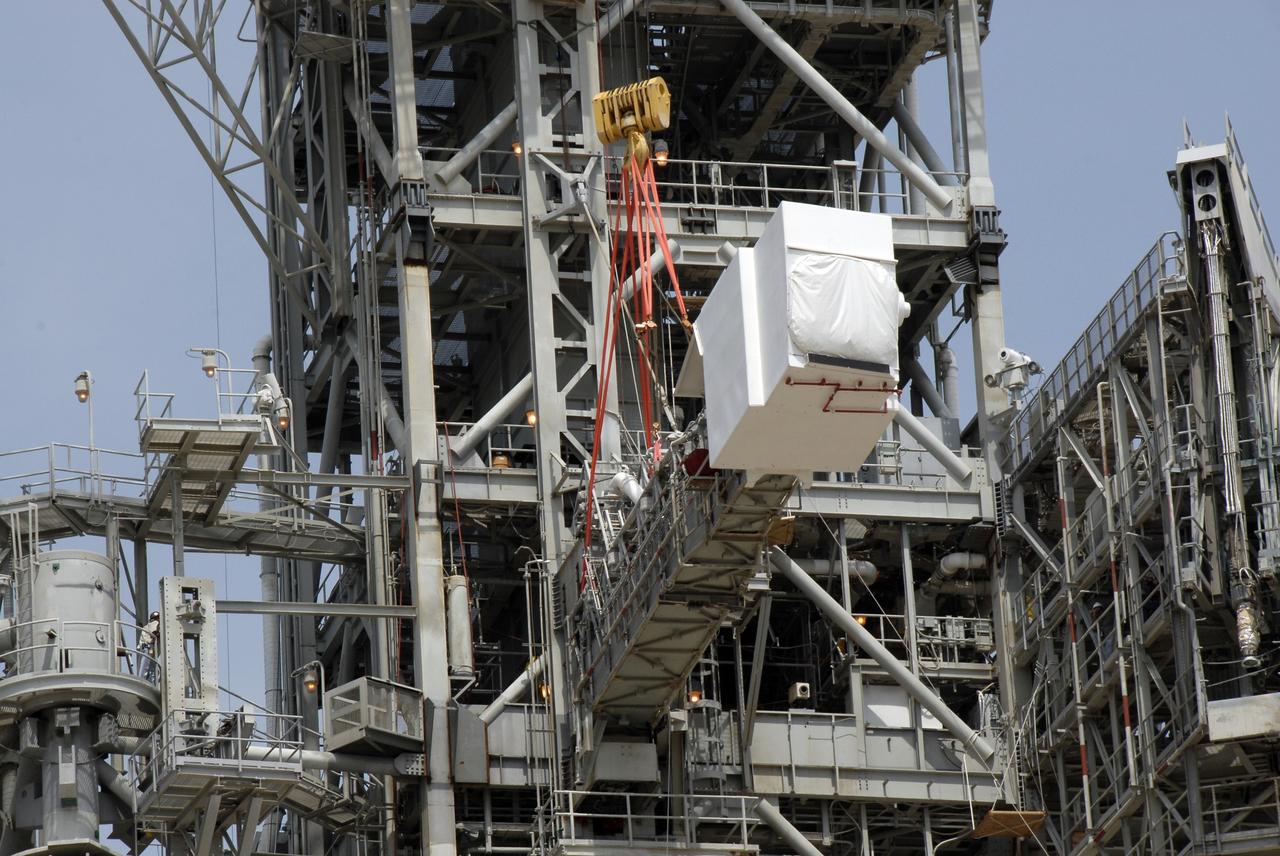
CAPE CANAVERAL, Fla. – The slings from a large crane are being attached to the orbiter access arm, which ends in the White Room, that is part of the fixed service structure, or FSS, on Launch Pad 39B at NASA's Kennedy Space Center in Florida. The White Room provided entry into space shuttles that were on the pad. The arm is being removed from the FSS for the pad's conversion as launch site for the Constellation Program's Ares I-X. The launch of the Ares I-X flight test is targeted for August 2009. Photo credit: NASA/Kim Shiflett
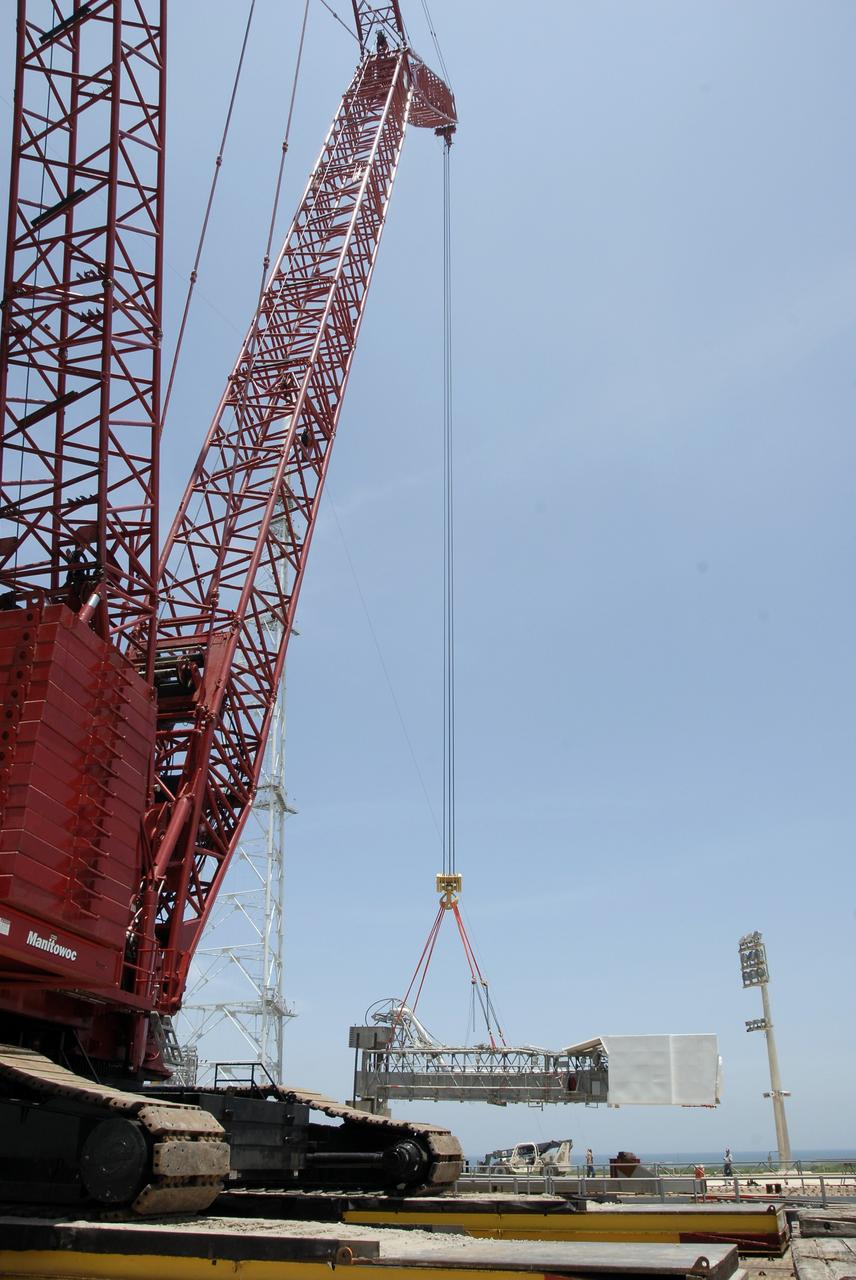
CAPE CANAVERAL, Fla. – On Launch Pad 39B at NASA's Kennedy Space Center in Florida, the crane lowers the orbiter access arm, which ends in the White Room, toward the ground. The arm is being removed from the FSS for the pad's conversion as launch site for the Constellation Program's Ares I-X. The launch of the Ares I-X flight test is targeted for August 2009. Photo credit: NASA/Kim Shiflett
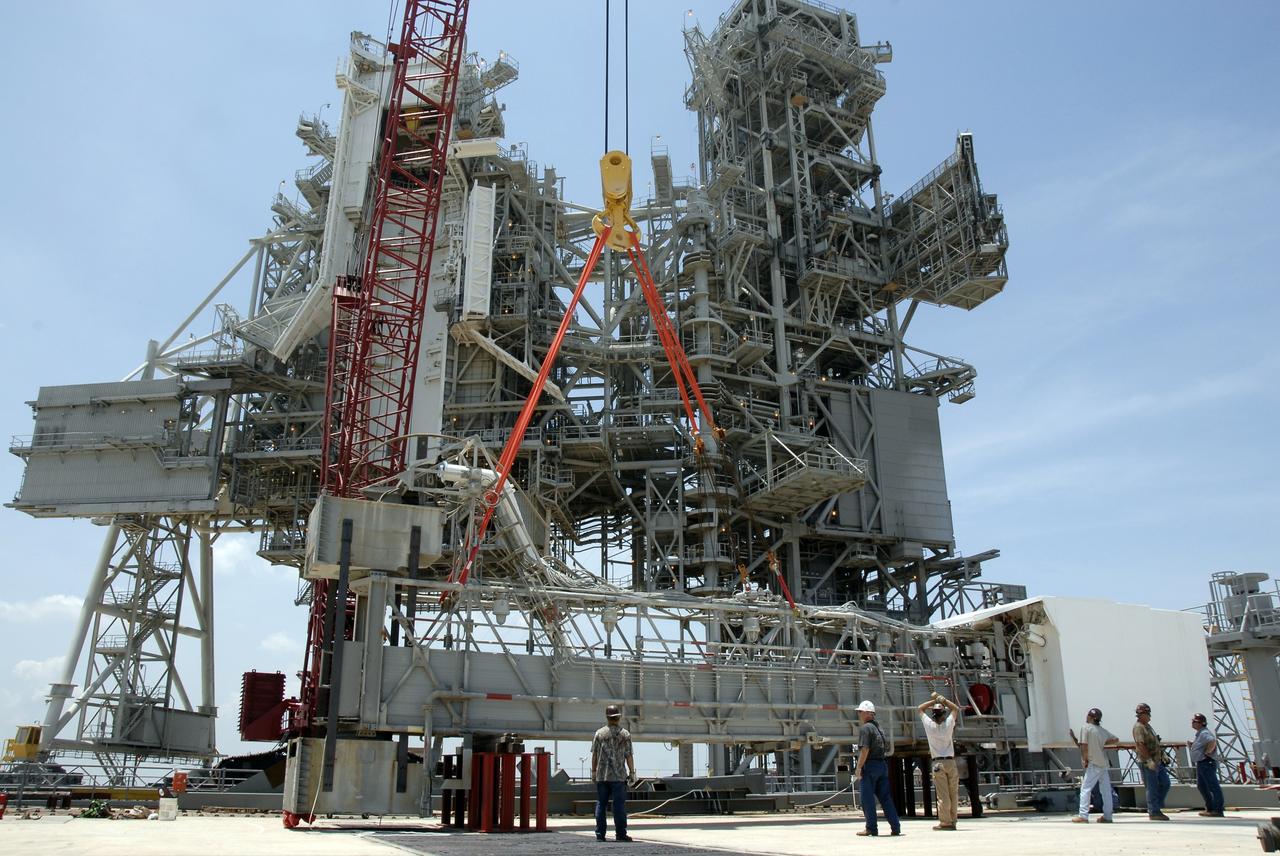
CAPE CANAVERAL, Fla. – On Launch Pad 39B at NASA's Kennedy Space Center in Florida, the crane lowers the orbiter access arm, which ends in the White Room, toward the ground. The arm is being removed from the FSS for the pad's conversion as launch site for the Constellation Program's Ares I-X. The launch of the Ares I-X flight test is targeted for August 2009. Photo credit: NASA/Kim Shiflett
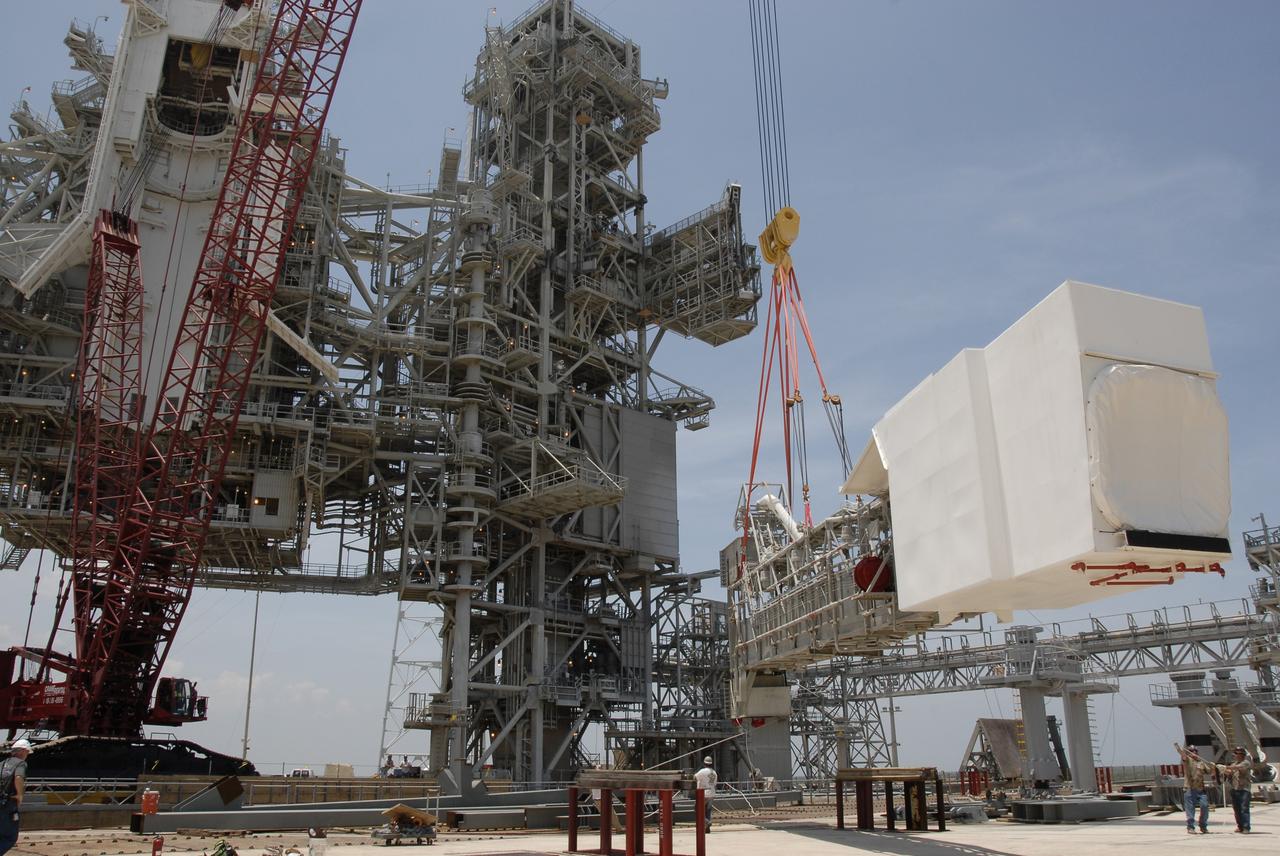
CAPE CANAVERAL, Fla. – On Launch Pad 39B at NASA's Kennedy Space Center in Florida, the crane lowers the orbiter access arm, which ends in the White Room, toward the ground. The arm is being removed from the FSS for the pad's conversion as launch site for the Constellation Program's Ares I-X. The launch of the Ares I-X flight test is targeted for August 2009. Photo credit: NASA/Kim Shiflett
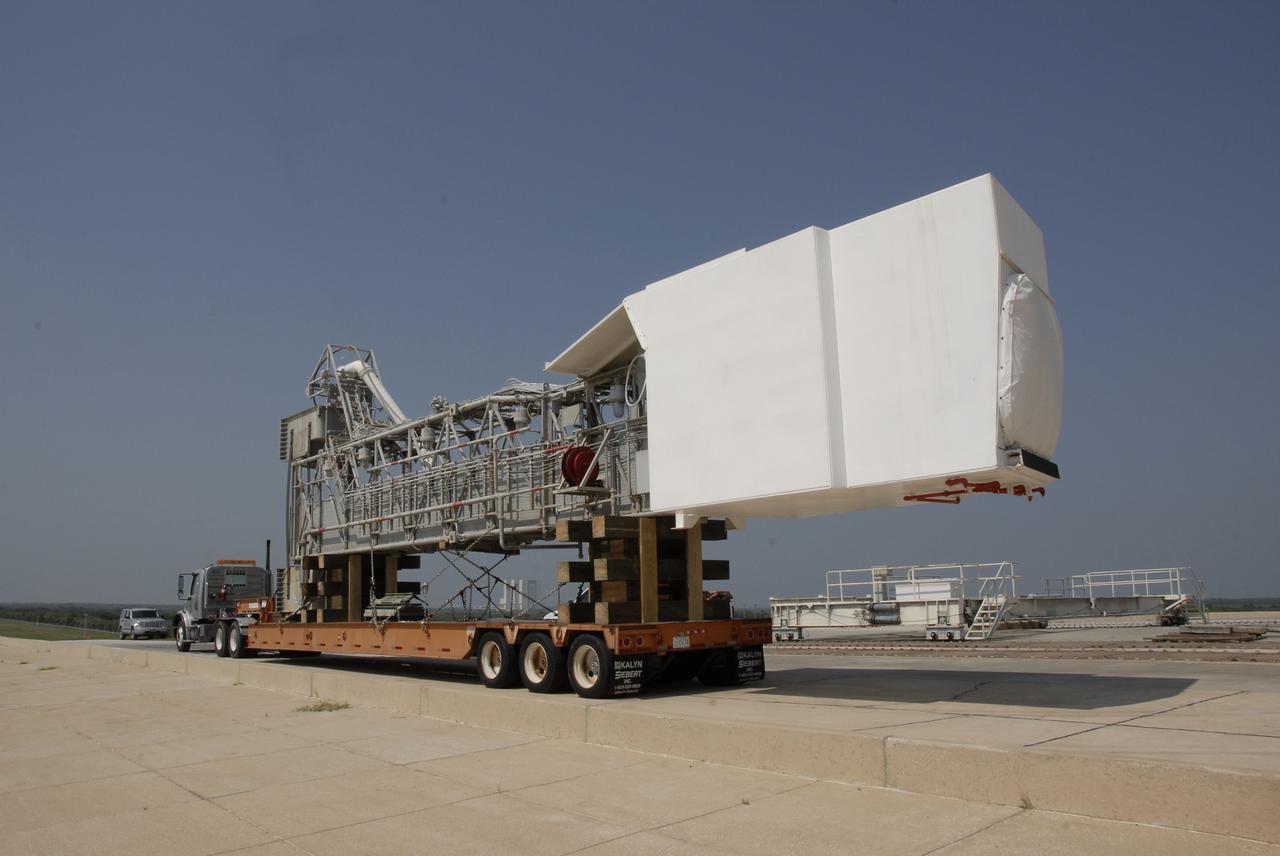
CAPE CANAVERAL, Fla. – The orbiter access arm, with the White Room on the end, leaves Launch Pad 39B on a trailer at NASA's Kennedy Space Center in Florida. The arm was removed from the fixed service structure for the pad's conversion as launch site for the Constellation Program's Ares I-X. The launch of the Ares I-X flight test is targeted for August 2009. Photo credit: NASA/Kim Shiflett

CAPE CANAVERAL, Fla. – Kennedy Space Center in Florida, the orbiter access arm, with the White Room on the end, is placed on a trailer. The arm was removed from the fixed service structure for the pad's conversion as launch site for the Constellation Program's Ares I-X. The launch of the Ares I-X flight test is targeted for August 2009. Photo credit: NASA/Kim Shiflett
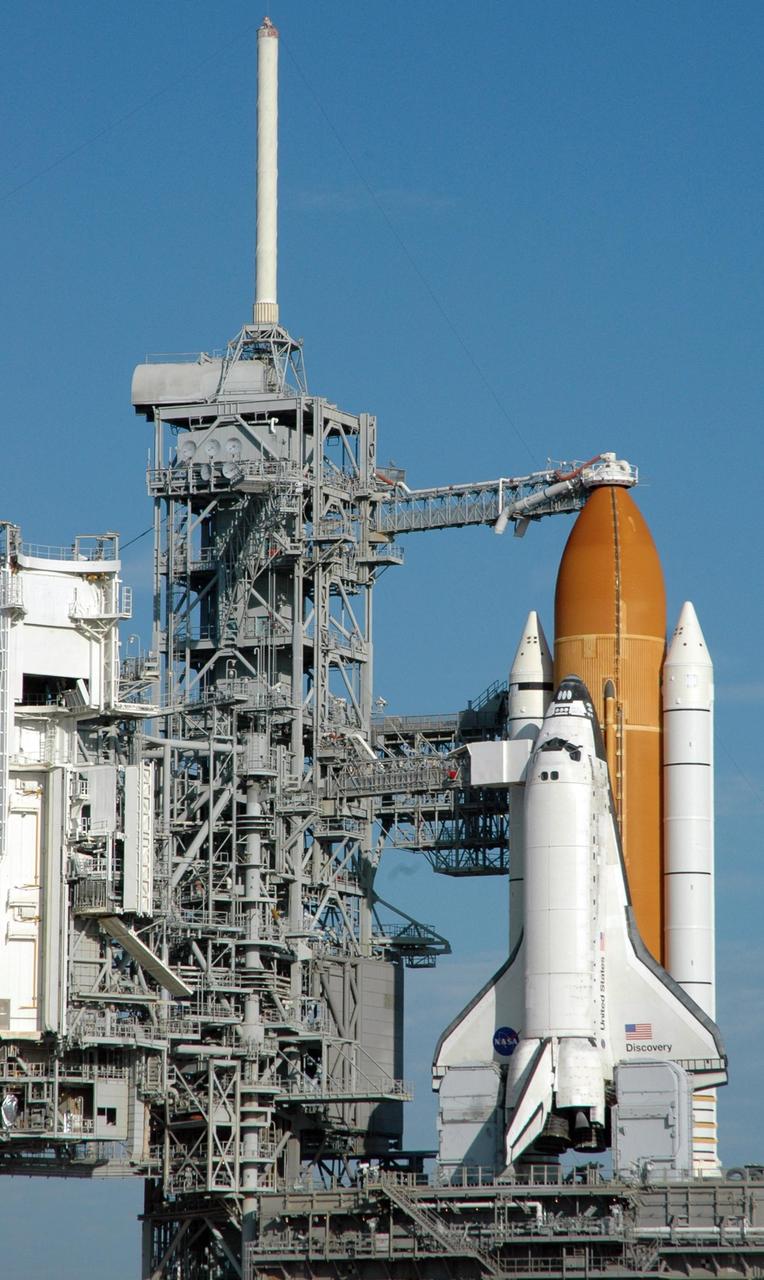
KENNEDY SPACE CENTER, FLA. -- Under a clear blue sky, Space Shuttle Discovery is ready for launch of mission STS-116 from Launch Pad 39B. Atop the fixed service structure at left looms the 80-foot-high lightning mast, part of the lightning protection system on the pad. Beneath Discovery's wings are the tail masts, which provide several umbilical connections to the orbiter, including a liquid-oxygen line through one and a liquid-hydrogen line through another. Seen above the golden external tank is the vent hood (known as the "beanie cap") at the end of the gaseous oxygen vent arm, extending from the FSS. Vapors are created as the liquid oxygen in the external tank boil off. The hood vents the gaseous oxygen vapors away from the space shuttle vehicle. Below it, also extending toward Discovery from the FSS, is the orbiter access arm with the White Room at the end. The crew gains access into the orbiter through the White Room. Discovery is scheduled to launch on mission STS-116 at 9:35 p.m. today. On the mission, the crew will deliver truss segment, P5, to the International Space Station and begin the intricate process of reconfiguring and redistributing the power generated by two pairs of U.S. solar arrays. The P5 will be mated to the P4 truss that was delivered and attached during the STS-115 mission in September. Photo credit: NASA/Ken Thornsley
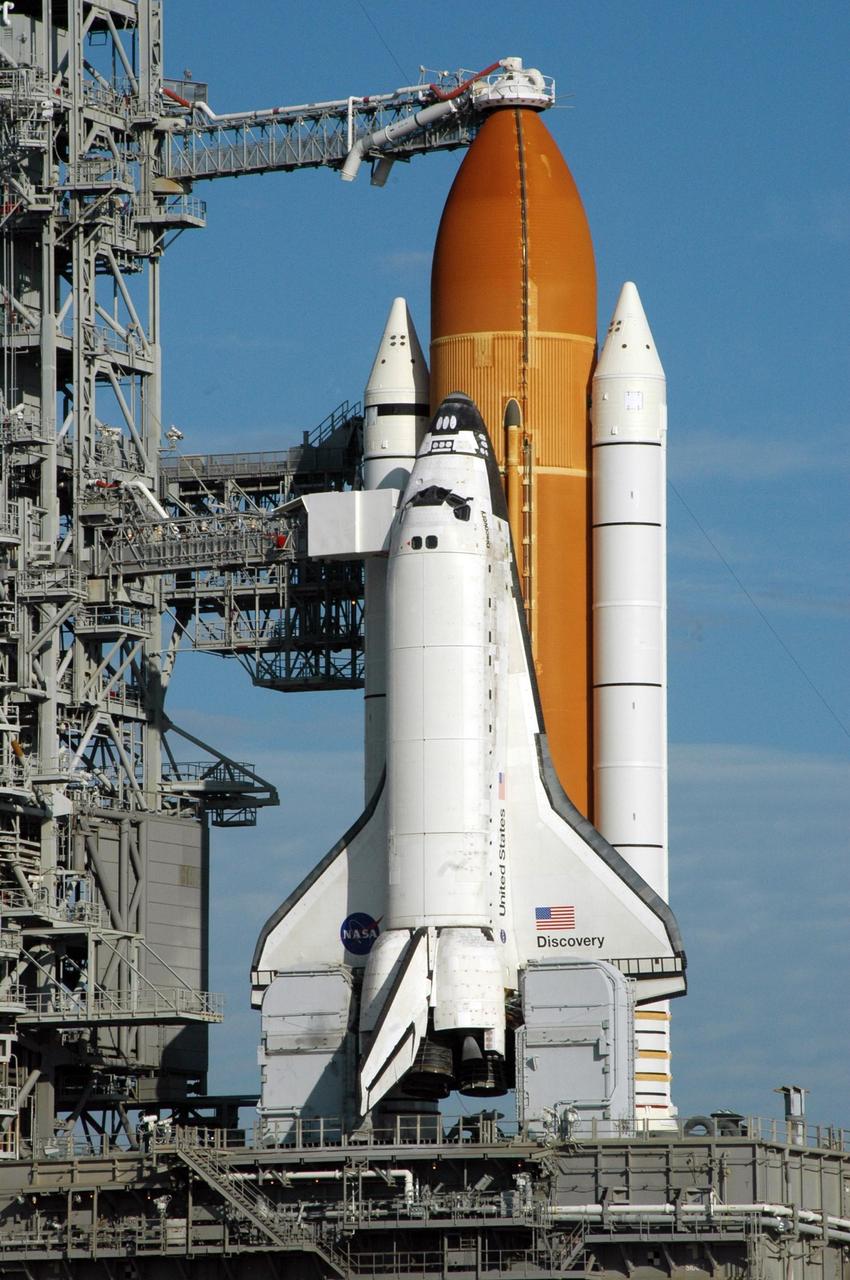
KENNEDY SPACE CENTER, FLA. -- Under a blue sky, Space Shuttle Discovery is ready for launch of mission STS-116 from Launch Pad 39B. Beneath Discovery's wings are the tail masts, which provide several umbilical connections to the orbiter, including a liquid-oxygen line through one and a liquid-hydrogen line through another. Seen above the golden external tank is the vent hood (known as the "beanie cap") at the end of the gaseous oxygen vent arm, extending from the FSS. Vapors are created as the liquid oxygen in the external tank boil off. The hood vents the gaseous oxygen vapors away from the space shuttle vehicle. Below it, also extending toward Discovery from the FSS, is the orbiter access arm with the White Room at the end. The crew gains access into the orbiter through the White Room. Discovery is scheduled to launch on mission STS-116 at 9:35 p.m. today. On the mission, the crew will deliver truss segment, P5, to the International Space Station and begin the intricate process of reconfiguring and redistributing the power generated by two pairs of U.S. solar arrays. The P5 will be mated to the P4 truss that was delivered and attached during the STS-115 mission in September. Photo credit: NASA/Ken Thornsley
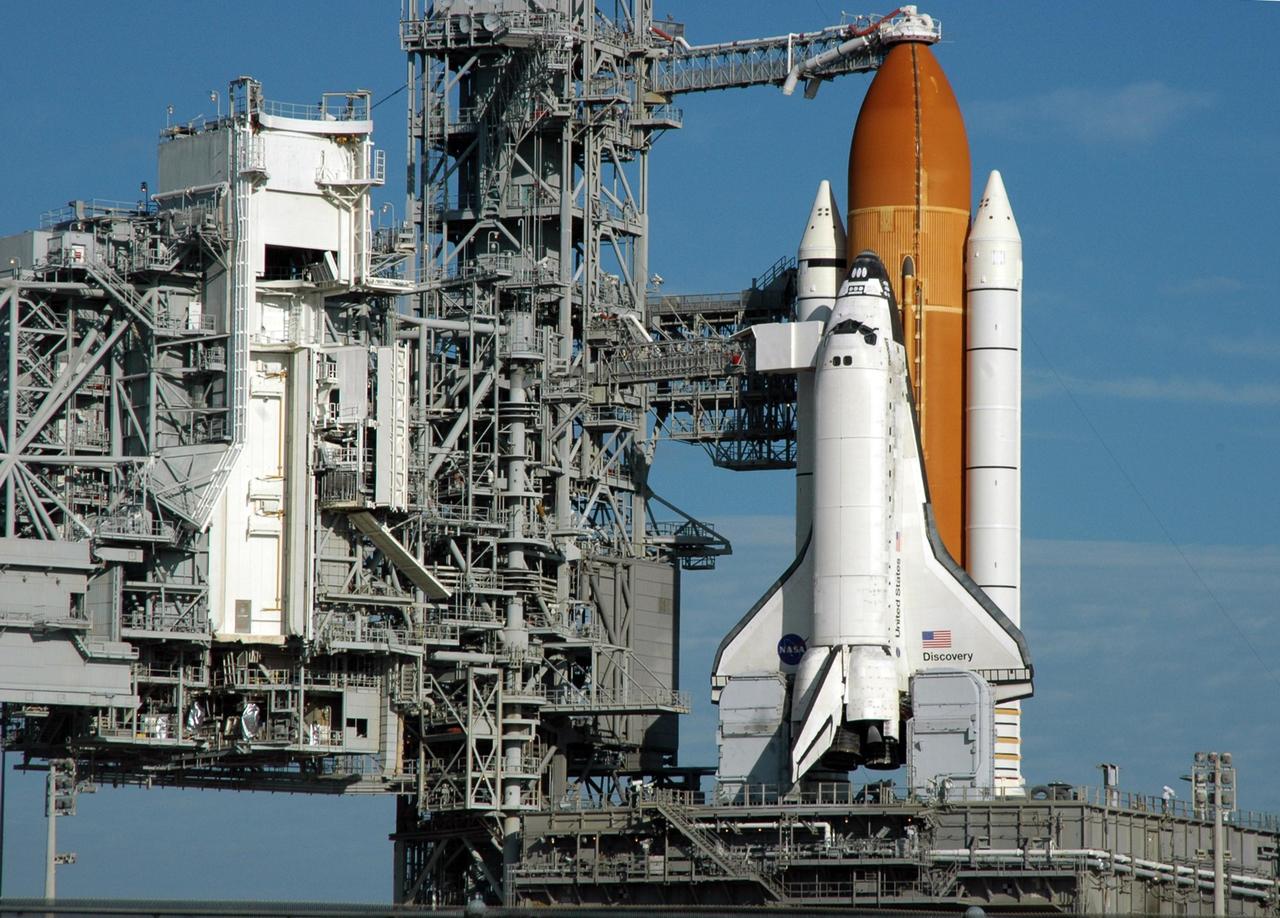
KENNEDY SPACE CENTER, FLA. -- Under a clear blue sky, Space Shuttle Discovery is ready for launch of mission STS-116 from Launch Pad 39B. At far left is the rotating service structure, rolled back to enable launch. Beneath Discovery's wings are the tail masts, which provide several umbilical connections to the orbiter, including a liquid-oxygen line through one and a liquid-hydrogen line through another. Seen above the golden external tank is the vent hood (known as the "beanie cap") at the end of the gaseous oxygen vent arm, extending from the FSS. Vapors are created as the liquid oxygen in the external tank boil off. The hood vents the gaseous oxygen vapors away from the space shuttle vehicle. Below it, also extending toward Discovery from the FSS, is the orbiter access arm with the White Room at the end. The crew gains access into the orbiter through the White Room. Discovery is scheduled to launch on mission STS-116 at 9:35 p.m. today. On the mission, the crew will deliver truss segment, P5, to the International Space Station and begin the intricate process of reconfiguring and redistributing the power generated by two pairs of U.S. solar arrays. The P5 will be mated to the P4 truss that was delivered and attached during the STS-115 mission in September. Photo credit: NASA/Ken Thornsley
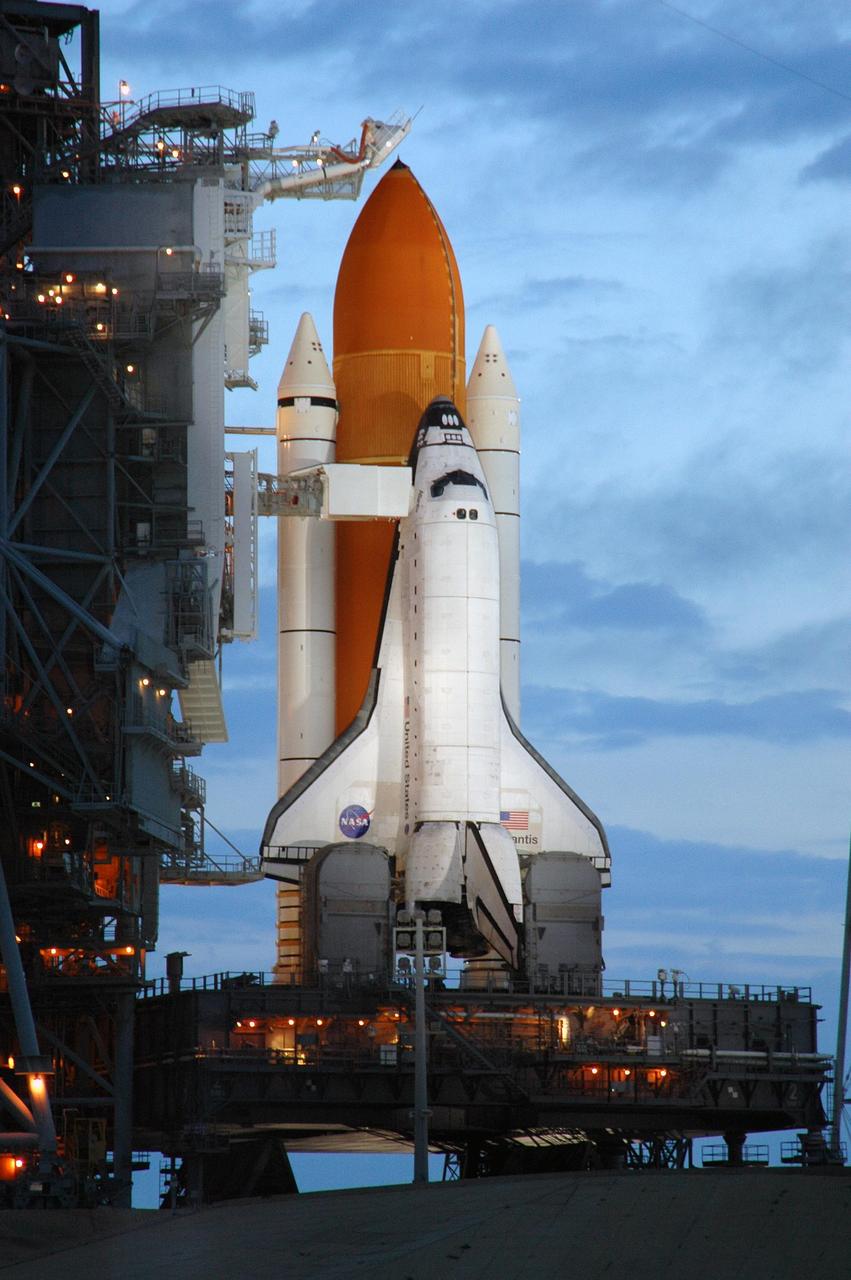
KENNEDY SPACE CENTER, FLA. - The morning sky lightens behind Space Shuttle Atlantis while lights on the fixed service structure (FSS) still illuminate the orbiter on Launch Pad 39B. Atlantis was originally scheduled to launch at 12:29 p.m. EDT on this date, but a 24-hour scrub was called by mission managers due to a concern with Fuel Cell 1. Seen poised above the orange external tank is the vent hood (known as the "beanie cap") at the end of the gaseous oxygen vent arm. Vapors are created as the liquid oxygen in the external tank boil off. The hood vents the gaseous oxygen vapors away from the space shuttle vehicle. Extending from the FSS to Atlantis is the orbiter access arm with the White Room at the end. The White Room provides entry into the orbiter through the hatch. During the STS-115 mission, Atlantis' astronauts will deliver and install the 17.5-ton, bus-sized P3/P4 integrated truss segment on the station. The girder-like truss includes a set of giant solar arrays, batteries and associated electronics and will provide one-fourth of the total power-generation capability for the completed station. This mission is the 116th space shuttle flight, the 27th flight for orbiter Atlantis, and the 19th U.S. flight to the International Space Station. STS-115 is scheduled to last 11 days with a planned landing at KSC. Photo credit: NASA/Troy Cryder
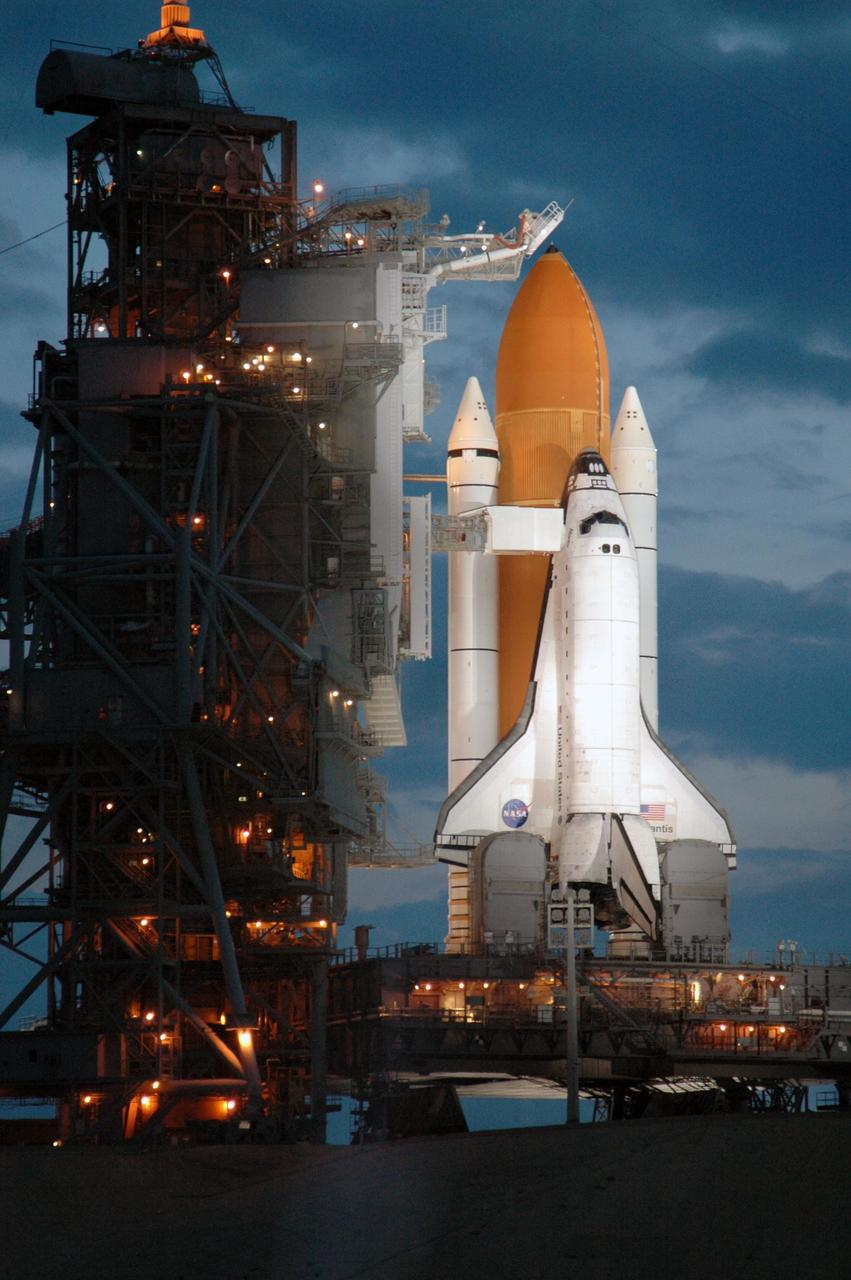
KENNEDY SPACE CENTER, FLA. - The morning sky lightens behind Space Shuttle Atlantis while lights on the fixed service structure (FSS) still illuminate the orbiter on Launch Pad 39B. Atlantis was originally scheduled to launch at 12:29 p.m. EDT on this date, but a 24-hour scrub was called by mission managers due to a concern with Fuel Cell 1. Seen poised above the orange external tank is the vent hood (known as the "beanie cap") at the end of the gaseous oxygen vent arm. Vapors are created as the liquid oxygen in the external tank boil off. The hood vents the gaseous oxygen vapors away from the space shuttle vehicle. Extending from the FSS to Atlantis is the orbiter access arm with the White Room at the end. The White Room provides entry into the orbiter through the hatch. During the STS-115 mission, Atlantis' astronauts will deliver and install the 17.5-ton, bus-sized P3/P4 integrated truss segment on the station. The girder-like truss includes a set of giant solar arrays, batteries and associated electronics and will provide one-fourth of the total power-generation capability for the completed station. This mission is the 116th space shuttle flight, the 27th flight for orbiter Atlantis, and the 19th U.S. flight to the International Space Station. STS-115 is scheduled to last 11 days with a planned landing at KSC. Photo credit: NASA/Troy Cryder
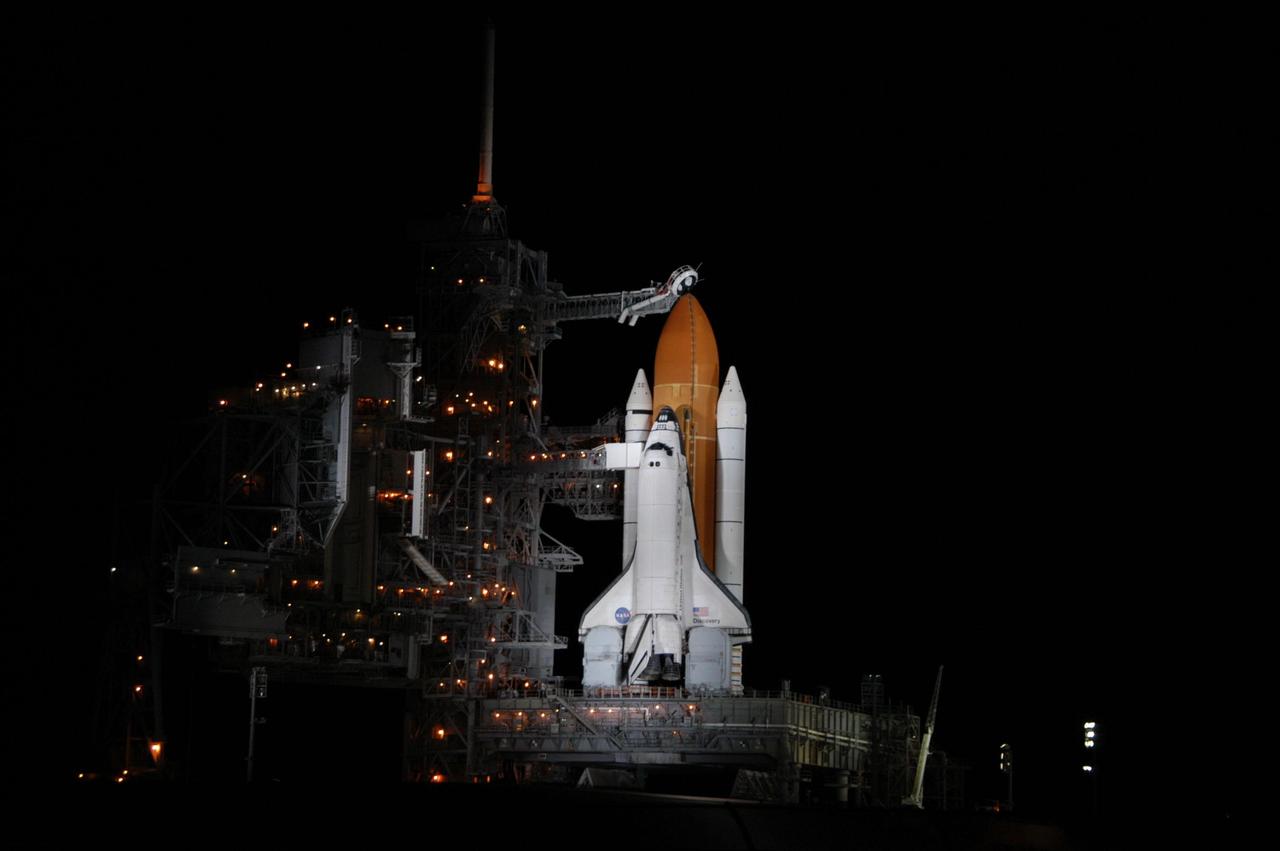
KENNEDY SPACE CENTER, FLA. -- Space Shuttle Discovery is bathed in light on Launch Pad 39B after rollback of the rotating service structure after midnight. Seen above the golden external tank is the vent hood (known as the "beanie cap") at the end of the gaseous oxygen vent arm, extending from the FSS. Vapors are created as the liquid oxygen in the external tank boil off. The hood vents the gaseous oxygen vapors away from the space shuttle vehicle. Below it, also extending toward Discovery from the FSS, is the orbiter access arm with the White Room at the end. The crew gains access into the orbiter through the White Room. Discovery is scheduled to launch on mission STS-116 at 9:35 p.m. today. On the mission, the crew will deliver truss segment, P5, to the International Space Station and begin the intricate process of reconfiguring and redistributing the power generated by two pairs of U.S. solar arrays. The P5 will be mated to the P4 truss that was delivered and attached during the STS-115 mission in September. Photo credit: NASA/George Shelton
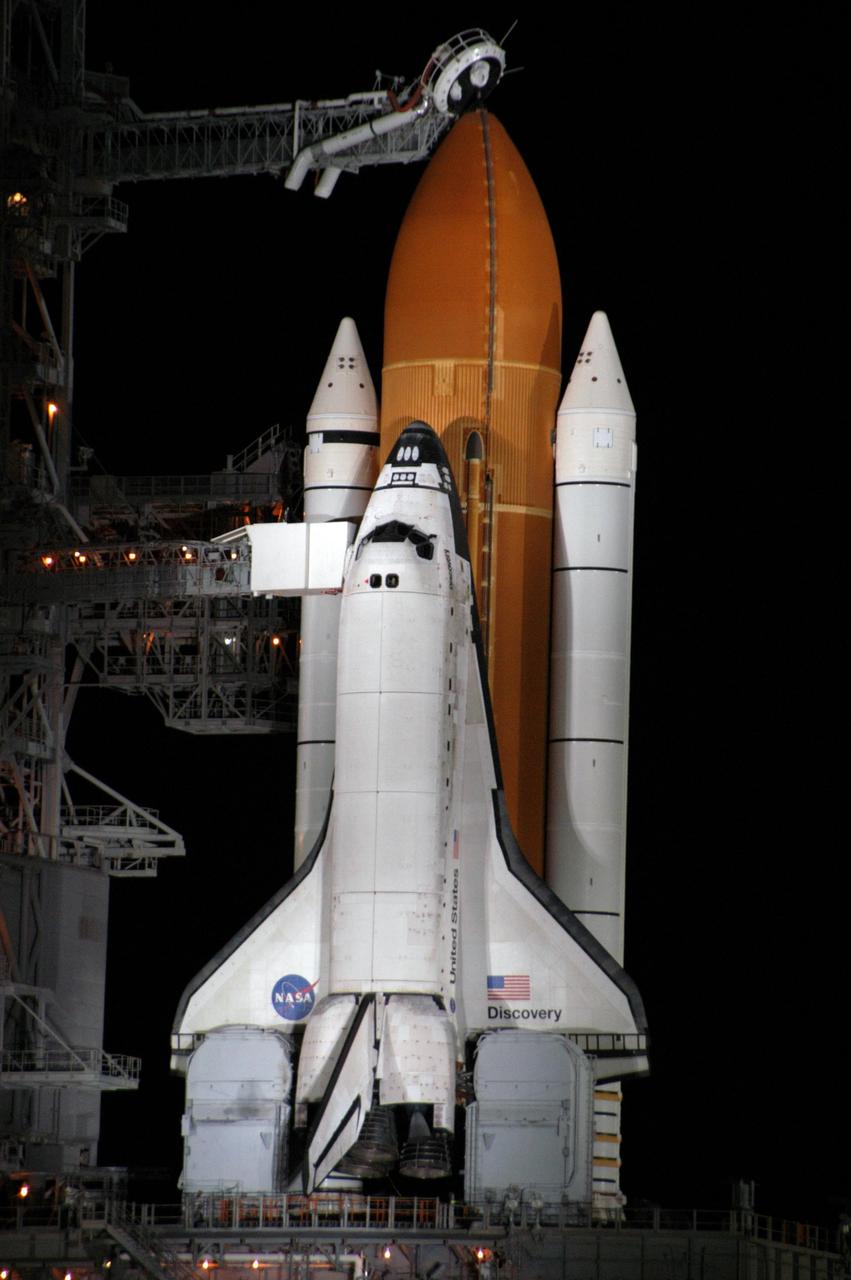
KENNEDY SPACE CENTER, FLA. -- Space Shuttle Discovery is bathed in light on Launch Pad 39B after rollback of the rotating service structure after midnight. Beneath Discovery's wings are the tail masts, which provide several umbilical connections to the orbiter, including a liquid-oxygen line through one and a liquid-hydrogen line through another. Seen above the golden external tank is the vent hood (known as the "beanie cap") at the end of the gaseous oxygen vent arm, extending from the FSS. Vapors are created as the liquid oxygen in the external tank boil off. The hood vents the gaseous oxygen vapors away from the space shuttle vehicle. Below it, also extending toward Discovery from the FSS, is the orbiter access arm with the White Room at the end. The crew gains access into the orbiter through the White Room. Discovery is scheduled to launch on mission STS-116 at 9:35 p.m. today. On the mission, the crew will deliver truss segment, P5, to the International Space Station and begin the intricate process of reconfiguring and redistributing the power generated by two pairs of U.S. solar arrays. The P5 will be mated to the P4 truss that was delivered and attached during the STS-115 mission in September. Photo credit: NASA/George Shelton
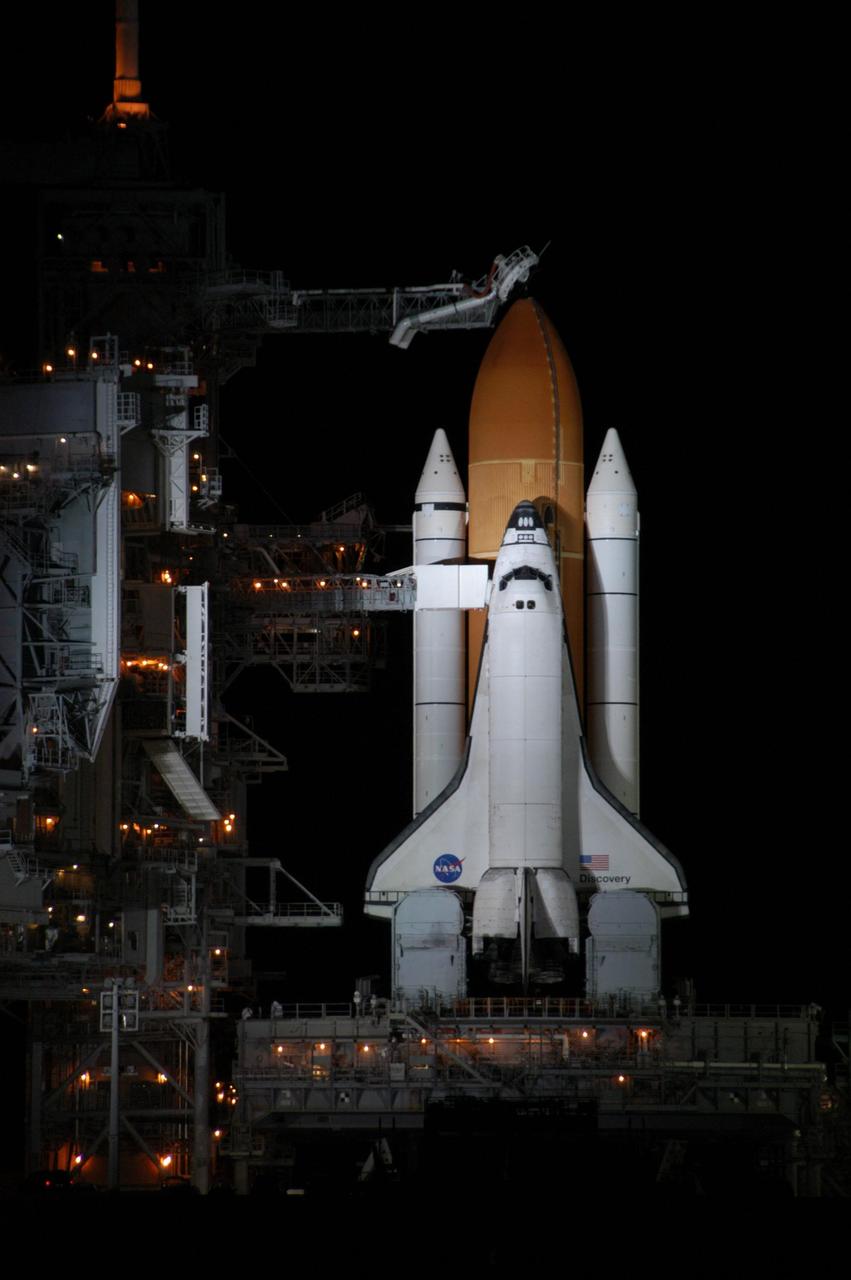
KENNEDY SPACE CENTER, FLA. -- Space Shuttle Discovery is bathed in light on Launch Pad 39B after rollback of the rotating service structure after midnight. Seen above the golden external tank is the vent hood (known as the "beanie cap") at the end of the gaseous oxygen vent arm, extending from the FSS. Vapors are created as the liquid oxygen in the external tank boil off. The hood vents the gaseous oxygen vapors away from the space shuttle vehicle. Below it, also extending toward Discovery from the FSS, is the orbiter access arm with the White Room at the end. The crew gains access into the orbiter through the White Room. Discovery is scheduled to launch on mission STS-116 at 9:35 p.m. today. On the mission, the crew will deliver truss segment, P5, to the International Space Station and begin the intricate process of reconfiguring and redistributing the power generated by two pairs of U.S. solar arrays. The P5 will be mated to the P4 truss that was delivered and attached during the STS-115 mission in September. Photo credit: NASA/George Shelton
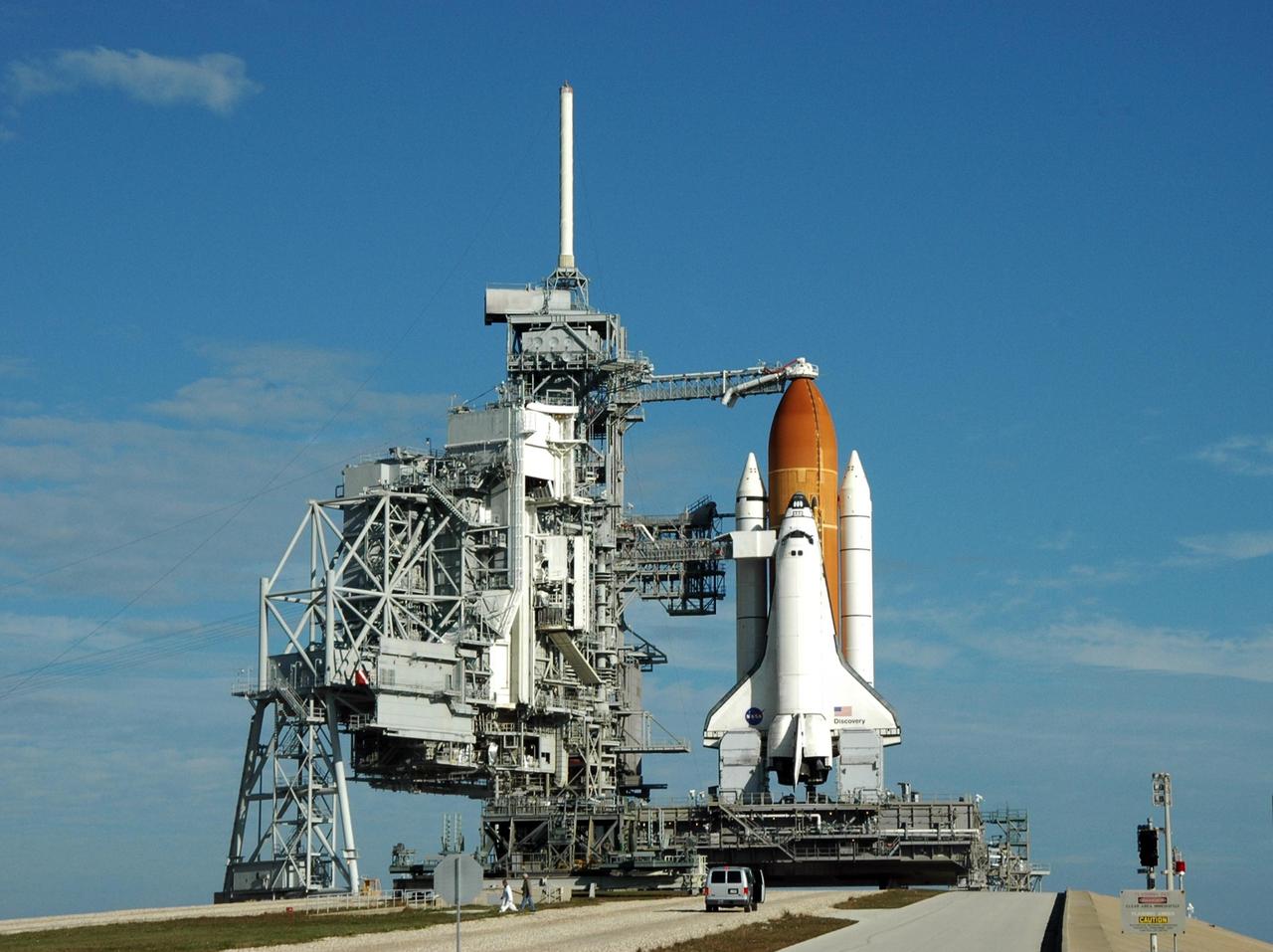
KENNEDY SPACE CENTER, FLA. -- Under a blue sky streaked with clouds, Launch Pad 39B holds Space Shuttle Discovery, ready for launch of mission STS-116. At the far left is the rotating service structure, rolled back after midnight in preparation for launch. Next to Discovery is the fixed service structure, with the 80-foot-high lightning mast on top, part of the lightning protection system on the pad. Beneath Discovery's wings are the tail masts, which provide several umbilical connections to the orbiter, including a liquid-oxygen line through one and a liquid-hydrogen line through another. Seen above the golden external tank is the vent hood (known as the "beanie cap") at the end of the gaseous oxygen vent arm, extending from the FSS. Vapors are created as the liquid oxygen in the external tank boil off. The hood vents the gaseous oxygen vapors away from the space shuttle vehicle. Below it, also extending toward Discovery from the FSS, is the orbiter access arm with the White Room at the end. The crew gains access into the orbiter through the White Room. Discovery is scheduled to launch on mission STS-116 at 9:35 p.m. today. On the mission, the crew will deliver truss segment, P5, to the International Space Station and begin the intricate process of reconfiguring and redistributing the power generated by two pairs of U.S. solar arrays. The P5 will be mated to the P4 truss that was delivered and attached during the STS-115 mission in September. Photo credit: NASA/Ken Thornsley
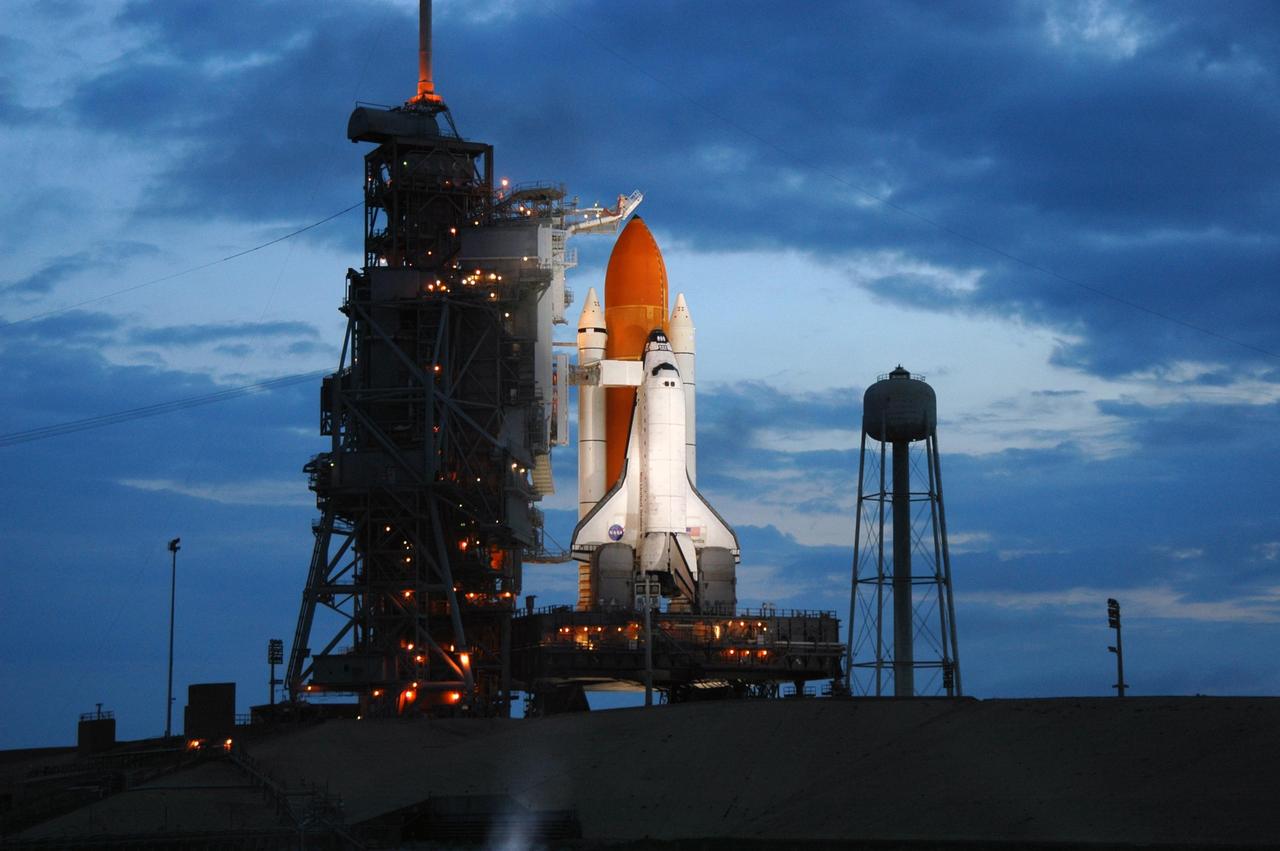
KENNEDY SPACE CENTER, FLA. - The morning sky lightens behind Space Shuttle Atlantis while lights on the fixed service structure (FSS) still illuminate the orbiter on Launch Pad 39B. Atlantis was originally scheduled to launch at 12:29 p.m. EDT on this date, but a 24-hour scrub was called by mission managers due to a concern with Fuel Cell 1. Seen poised above the orange external tank is the vent hood (known as the "beanie cap") at the end of the gaseous oxygen vent arm. Vapors are created as the liquid oxygen in the external tank boil off. The hood vents the gaseous oxygen vapors away from the space shuttle vehicle. Extending from the FSS to Atlantis is the orbiter access arm with the White Room at the end. The White Room provides entry into the orbiter through the hatch. At right is the 300,000-gallon water tank that releases its contents onto the mobile launcher platform during liftoff to aid sound suppression. During the STS-115 mission, Atlantis' astronauts will deliver and install the 17.5-ton, bus-sized P3/P4 integrated truss segment on the station. The girder-like truss includes a set of giant solar arrays, batteries and associated electronics and will provide one-fourth of the total power-generation capability for the completed station. This mission is the 116th space shuttle flight, the 27th flight for orbiter Atlantis, and the 19th U.S. flight to the International Space Station. STS-115 is scheduled to last 11 days with a planned landing at KSC. Photo credit: NASA/Troy Cryder
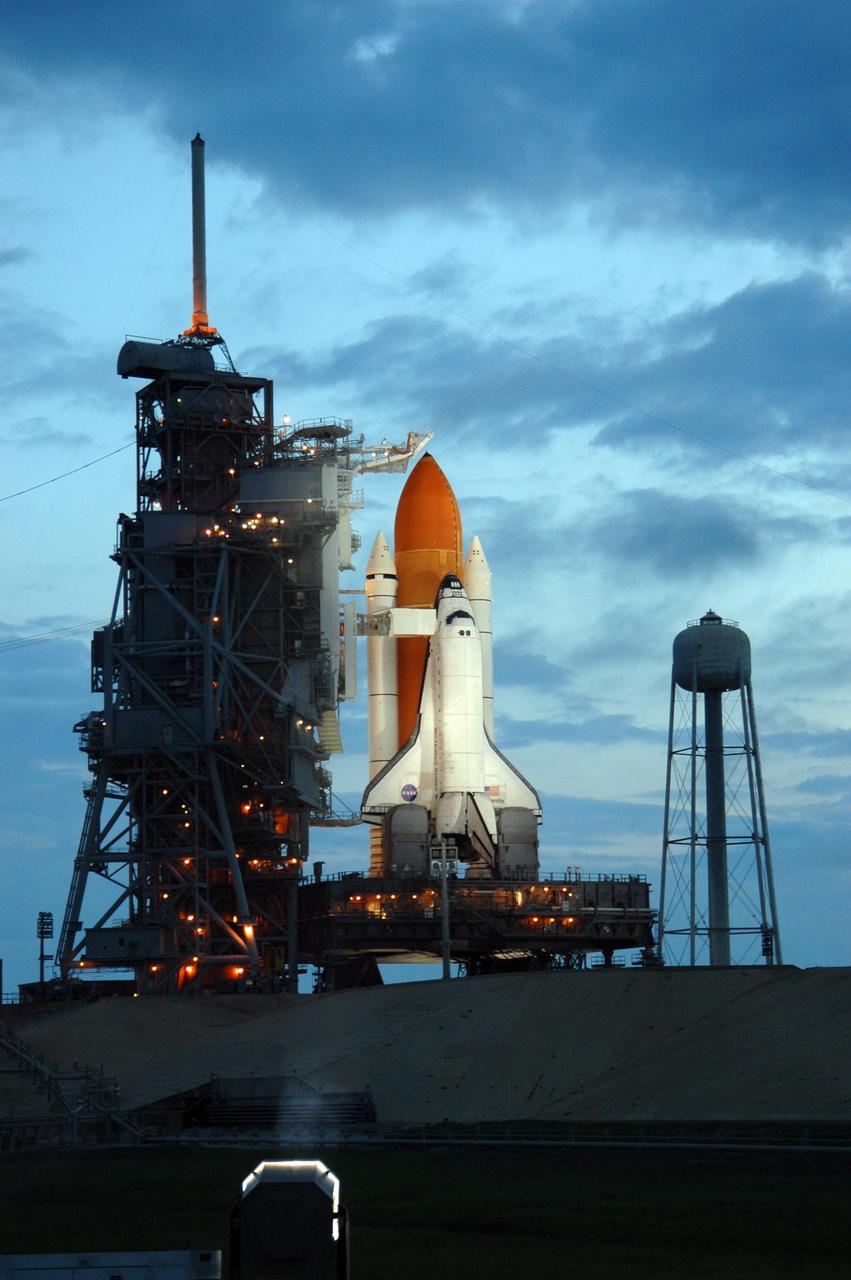
KENNEDY SPACE CENTER, FLA. - The morning sky lightens behind Space Shuttle Atlantis while lights on the fixed service structure (FSS) still illuminate the orbiter on Launch Pad 39B. Atlantis was originally scheduled to launch at 12:29 p.m. EDT on this date, but a 24-hour scrub was called by mission managers due to a concern with Fuel Cell 1. Seen poised above the orange external tank is the vent hood (known as the "beanie cap") at the end of the gaseous oxygen vent arm. Vapors are created as the liquid oxygen in the external tank boil off. The hood vents the gaseous oxygen vapors away from the space shuttle vehicle. Extending from the FSS to Atlantis is the orbiter access arm with the White Room at the end. The White Room provides entry into the orbiter through the hatch. At right is the 300,000-gallon water tank that releases its contents onto the mobile launcher platform during liftoff to aid sound suppression. During the STS-115 mission, Atlantis' astronauts will deliver and install the 17.5-ton, bus-sized P3/P4 integrated truss segment on the station. The girder-like truss includes a set of giant solar arrays, batteries and associated electronics and will provide one-fourth of the total power-generation capability for the completed station. This mission is the 116th space shuttle flight, the 27th flight for orbiter Atlantis, and the 19th U.S. flight to the International Space Station. STS-115 is scheduled to last 11 days with a planned landing at KSC. Photo credit: NASA/Troy Cryder
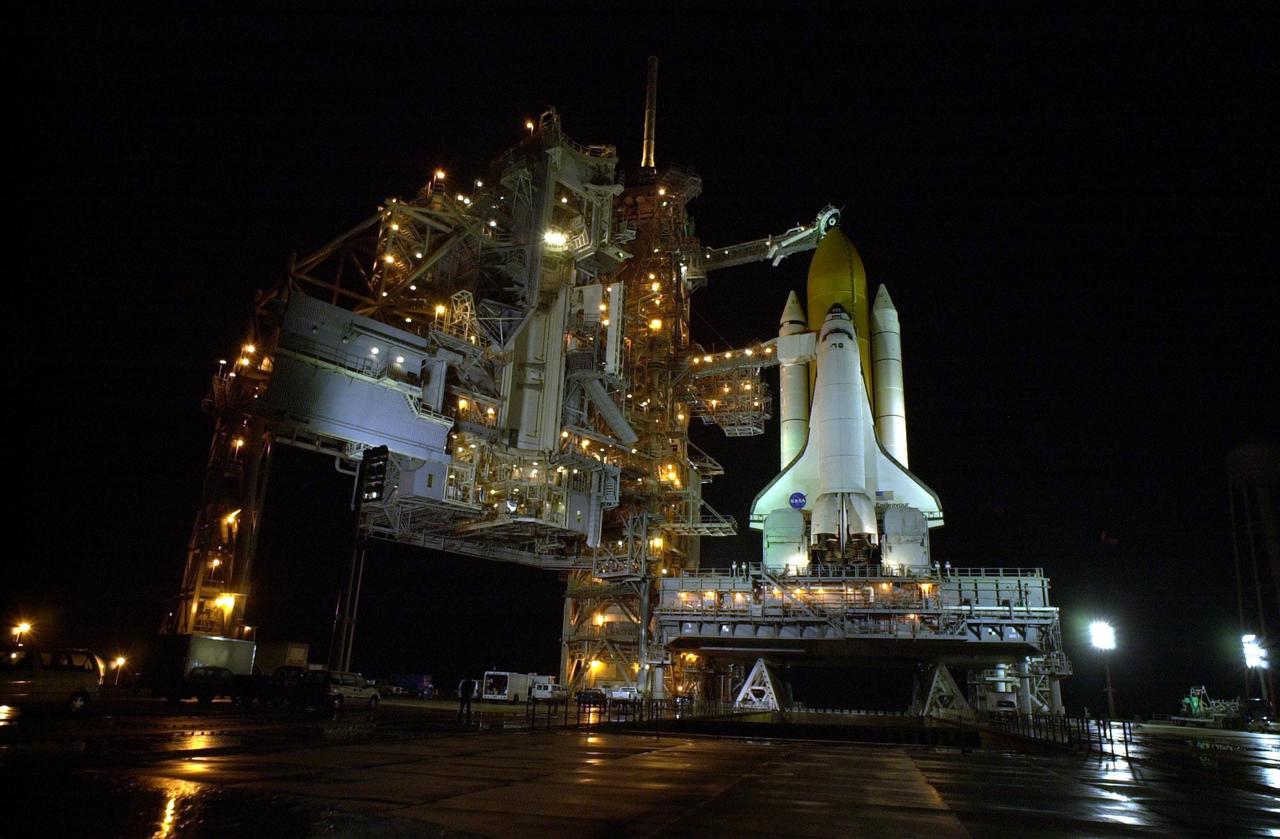
KENNEDY SPACE CENTER, Fla. -- Rain on the ground around Space Shuttle Endeavour on Launch Pad 39B reflects the many lights illluminating the Rotating Service Structure (at left), Fixed Service Structure and Shuttle. Twin solid rocket boosters flank the orange external tank behind Endeavour. Above the external tank is the Gaseous Oxygen Vent Arm that vents gaseous oxygen vapors away from the Shuttle. The vent hood assembly at the end is often referred to as the "beanie cap." Stretching from the FSS to the crew hatch on the side of Endeavour is the Orbiter Access Arm with its environmentally controlled White Room at the end, through which the crew enters the vehicle. The Shuttle sits on the Mobile Launcher Platform with the two service tail masts on either side of the main engines. The tail masts support the fluid, gas and electrical requirements of the orbiter's liquid oxygen and liquid hydrogen aft T-0 umbilicals. Each tail mast is 31 feet (9.4 meters) high, 15 feet (4.6 meters) long and 9 feet (3.1 meters) wide. Endeavour is scheduled to launch on mission STS-108 Dec. 4 at 5:45 p.m. EST. On this 12th flight to the International Space Station, known as a Utilization Flight, Endeavour will carry a crew of four plus the Expedition 4 crew, who will replace Expedition 3 aboard the ISS. The payload includes the Multi-Purpose Logistics Module Raffaello, filled with supplies, equipment and experiments
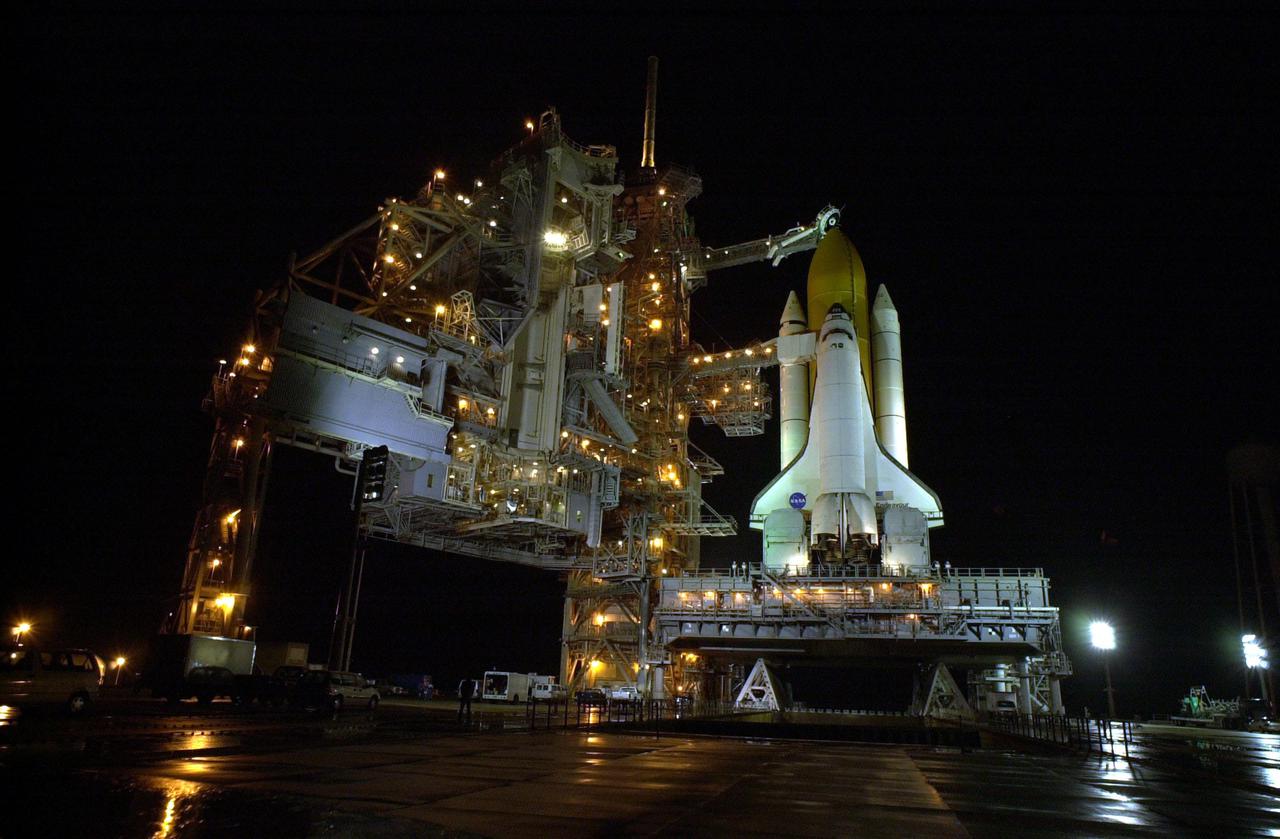
KENNEDY SPACE CENTER, Fla. -- Rain on the ground around Space Shuttle Endeavour on Launch Pad 39B reflects the many lights illluminating the Rotating Service Structure (at left), Fixed Service Structure and Shuttle. Twin solid rocket boosters flank the orange external tank behind Endeavour. Above the external tank is the Gaseous Oxygen Vent Arm that vents gaseous oxygen vapors away from the Shuttle. The vent hood assembly at the end is often referred to as the 'beanie cap.' Stretching from the FSS to the crew hatch on the side of Endeavour is the Orbiter Access Arm with its environmentally controlled White Room at the end, through which the crew enters the vehicle. The Shuttle sits on the Mobile Launcher Platform with the two service tail masts on either side of the main engines. The tail masts support the fluid, gas and electrical requirements of the orbiter's liquid oxygen and liquid hydrogen aft T-0 umbilicals. Each tail mast is 31 feet (9.4 meters) high, 15 feet (4.6 meters) long and 9 feet (3.1 meters) wide. Endeavour is scheduled to launch on mission STS-108 Dec. 4 at 5:45 p.m. EST. On this 12th flight to the International Space Station, known as a Utilization Flight, Endeavour will carry a crew of four plus the Expedition 4 crew, who will replace Expedition 3 aboard the ISS. The payload includes the Multi-Purpose Logistics Module Raffaello, filled with supplies, equipment and experiments