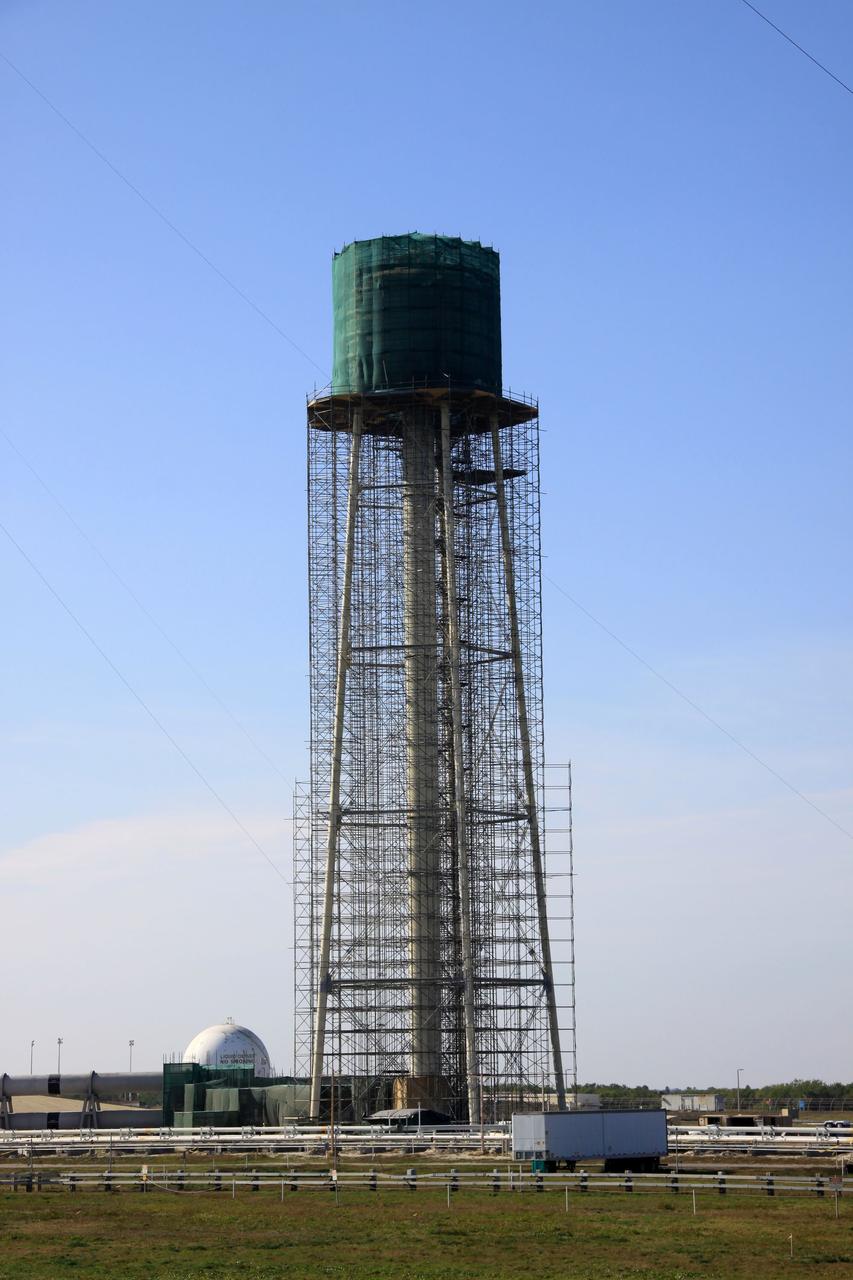
CAPE CANAVERAL, Fla. - At NASA’s Kennedy Space Center in Florida, preparations are underway to sandblast and paint the 290-foot-high water tower at Launch Pad 39B. Scaffolding surrounds the tower and a special covering has been placed around the tank. The water towers at Launch Complex 39, which includes pad A and B, were part of the sound suppression system used during space shuttle launches. Water stored in the 300,000-gallon tank would be released just prior to main engine ignition and flow by gravity to special mobile launcher platform (MLP) outlets. Nine seconds after shuttle liftoff, the peak flow rate was 900,000 gallons per minute and helped to protect the orbiter and payloads from being damaged by acoustical energy reflected from the MLP during liftoff. Photo Credit: NASA/Jim Grossmann
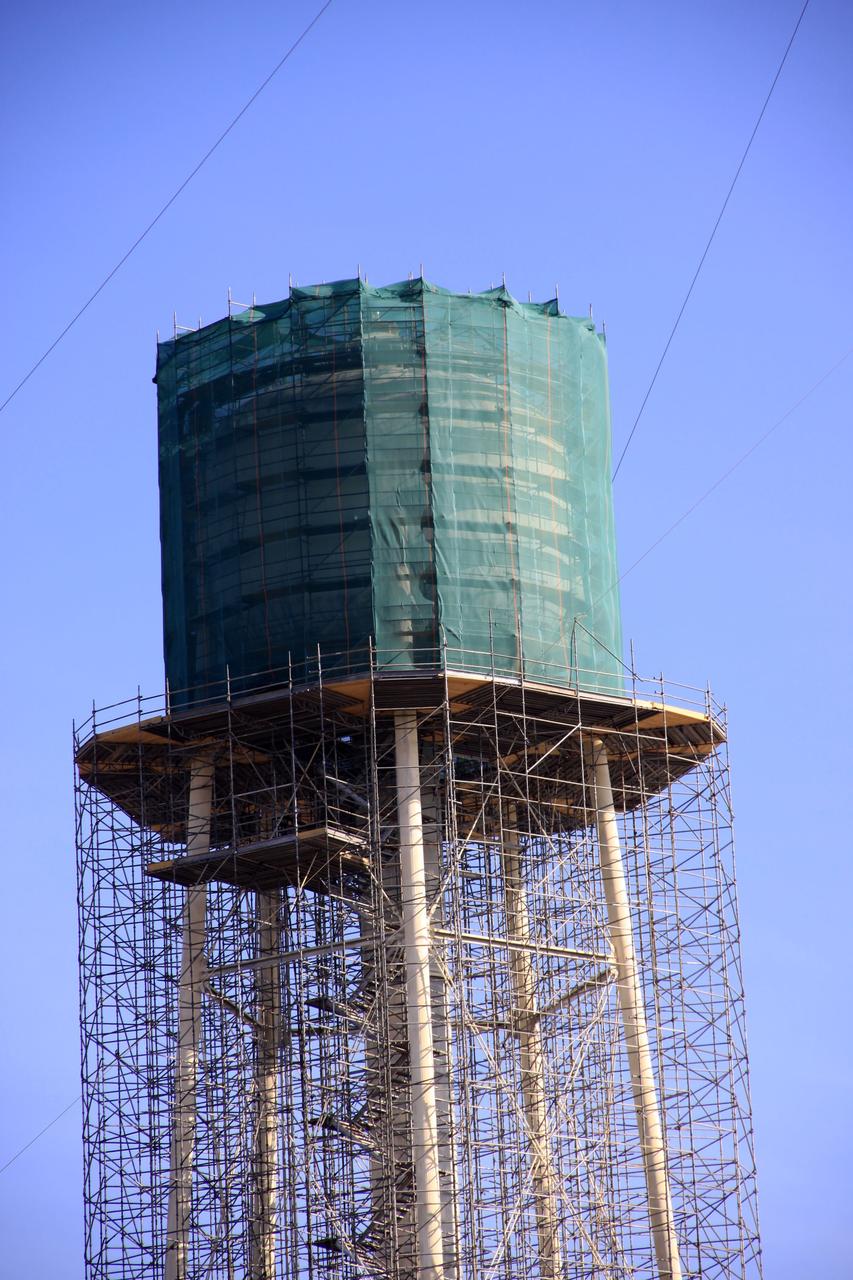
CAPE CANAVERAL, Fla. - At NASA’s Kennedy Space Center in Florida, preparations are underway to sandblast and paint the 290-foot-high water tower at Launch Pad 39B. Scaffolding surrounds the tower and a special covering has been placed around the tank. The water towers at Launch Complex 39, which includes pad A and B, were part of the sound suppression system used during space shuttle launches. Water stored in the 300,000-gallon tank would be released just prior to main engine ignition and flow by gravity to special mobile launcher platform (MLP) outlets. Nine seconds after shuttle liftoff, the peak flow rate was 900,000 gallons per minute and helped to protect the orbiter and payloads from being damaged by acoustical energy reflected from the MLP during liftoff. Photo Credit: NASA/Jim Grossmann
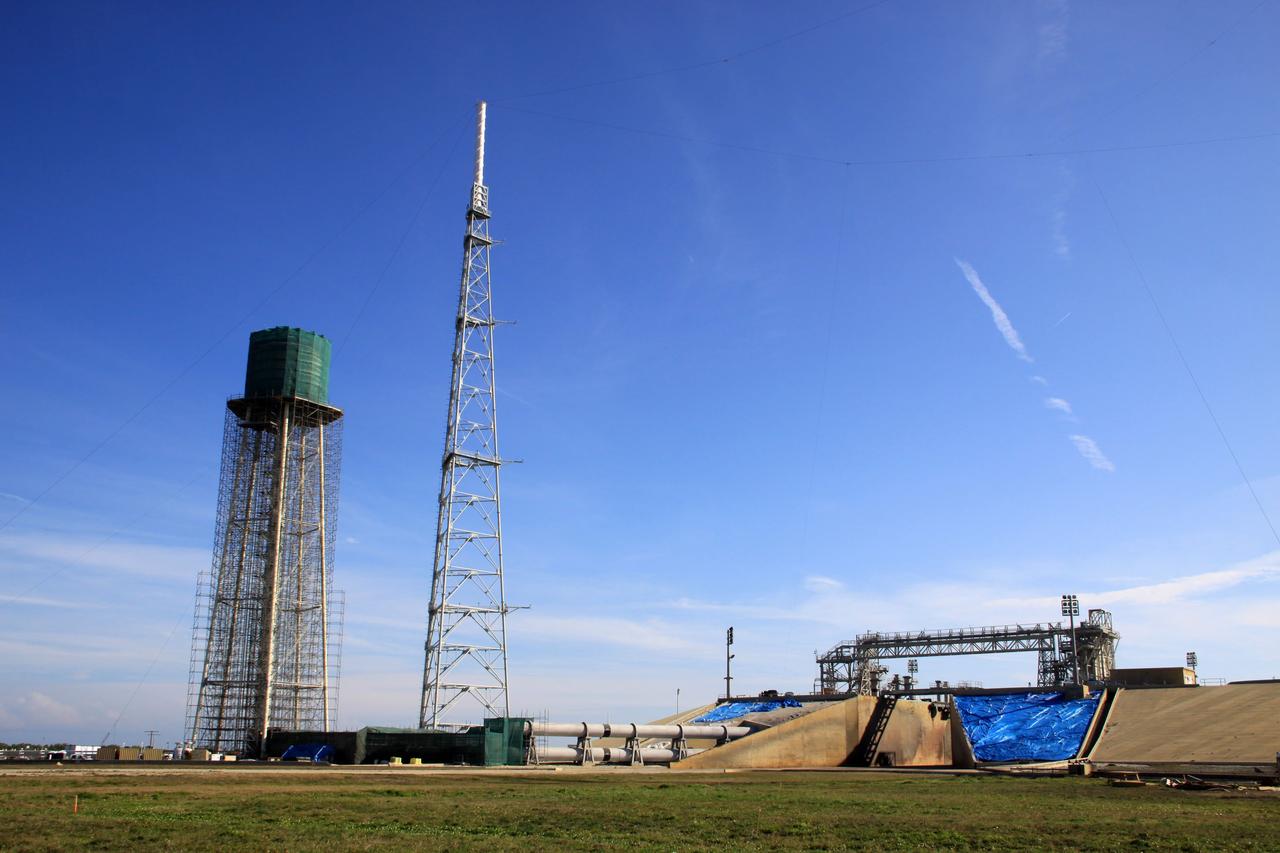
CAPE CANAVERAL, Fla. - At NASA’s Kennedy Space Center in Florida, preparations are underway to sandblast and paint the 290-foot-high water tower at Launch Pad 39B. Scaffolding surrounds the tower and a special covering has been placed around the tank. The water towers at Launch Complex 39, which includes pad A and B, were part of the sound suppression system used during space shuttle launches. Water stored in the 300,000-gallon tank would be released just prior to main engine ignition and flow by gravity to special mobile launcher platform (MLP) outlets. Nine seconds after shuttle liftoff, the peak flow rate was 900,000 gallons per minute and helped to protect the orbiter and payloads from being damaged by acoustical energy reflected from the MLP during liftoff. Photo Credit: NASA/Jim Grossmann
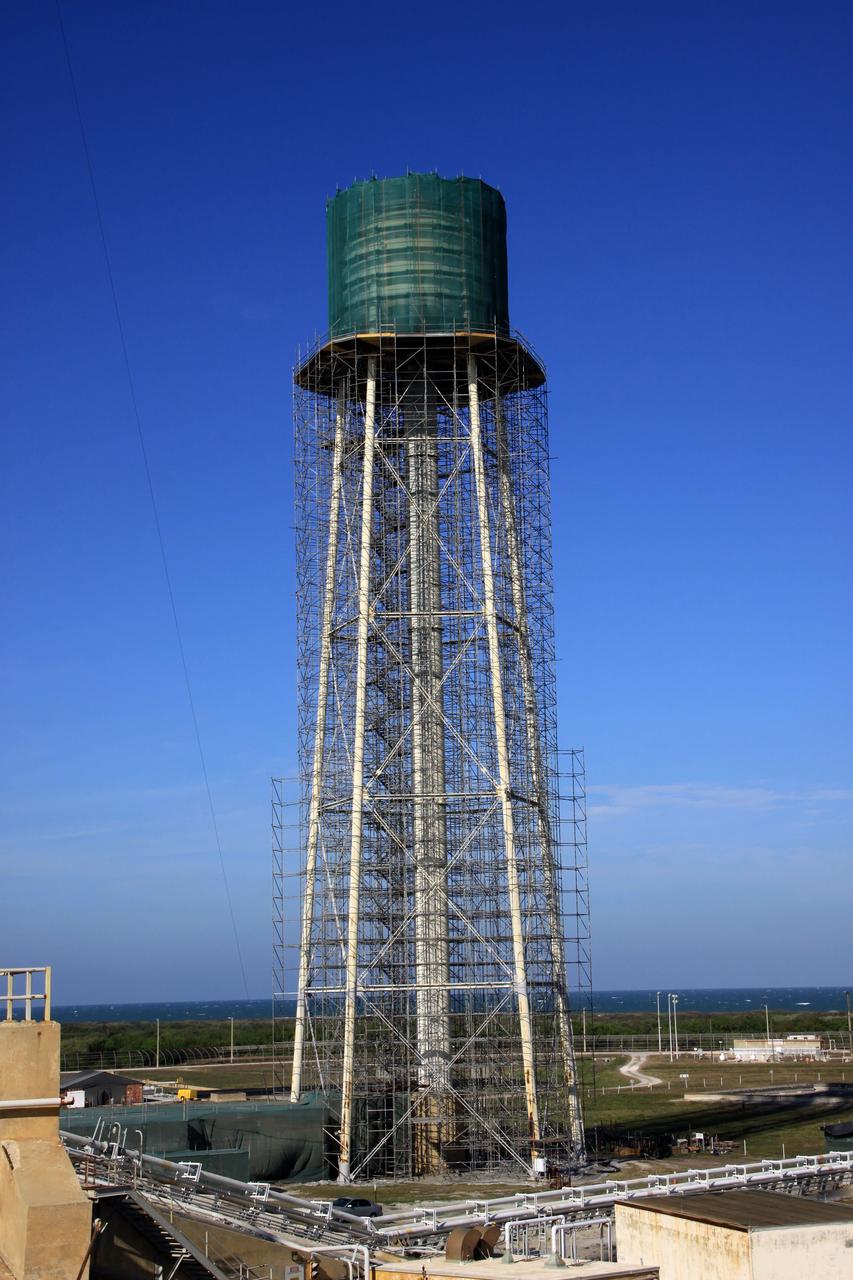
CAPE CANAVERAL, Fla. - At NASA’s Kennedy Space Center in Florida, preparations are underway to sandblast and paint the 290-foot-high water tower at Launch Pad 39B. Scaffolding surrounds the tower and a special covering has been placed around the tank. The water towers at Launch Complex 39, which includes pad A and B, were part of the sound suppression system used during space shuttle launches. Water stored in the 300,000-gallon tank would be released just prior to main engine ignition and flow by gravity to special mobile launcher platform (MLP) outlets. Nine seconds after shuttle liftoff, the peak flow rate was 900,000 gallons per minute and helped to protect the orbiter and payloads from being damaged by acoustical energy reflected from the MLP during liftoff. Photo Credit: NASA/Jim Grossmann
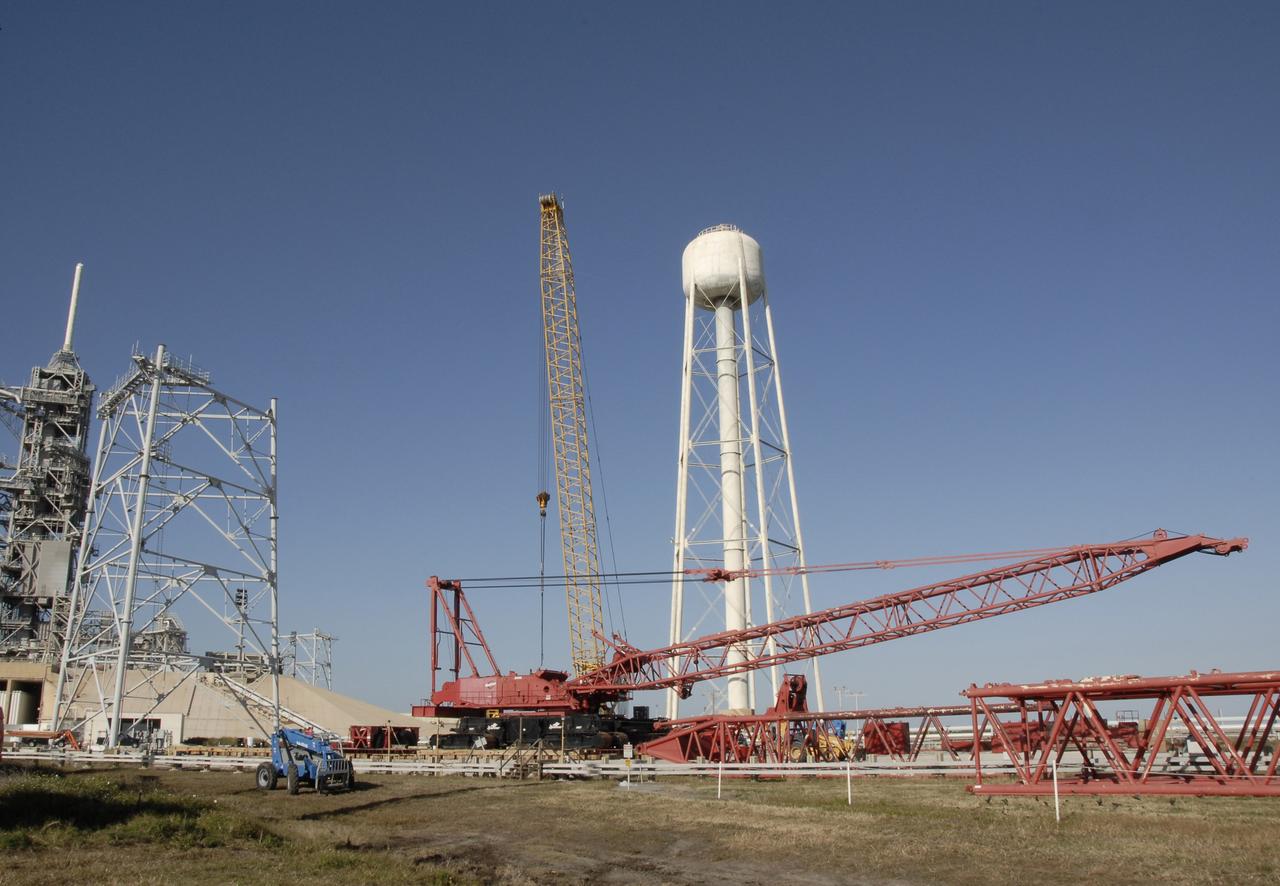
CAPE CANAVERAL, Fla. -- On Launch Pad 39B at NASA's Kennedy Space Center in Florida, segments are being added to the crane (foreground) that will be used to finish erecting the lightning towers (one is at left) on the pad. In the background is the 290-foot-high tower that holds 300,000 gallons of water used for sound suppression during shuttle launches. Lightning towers are being constructed to hold centenary wires as part of the new lightning protection system for the Constellation Program and Ares/Orion launches. Photo credit: NASA/Kim Shiflett
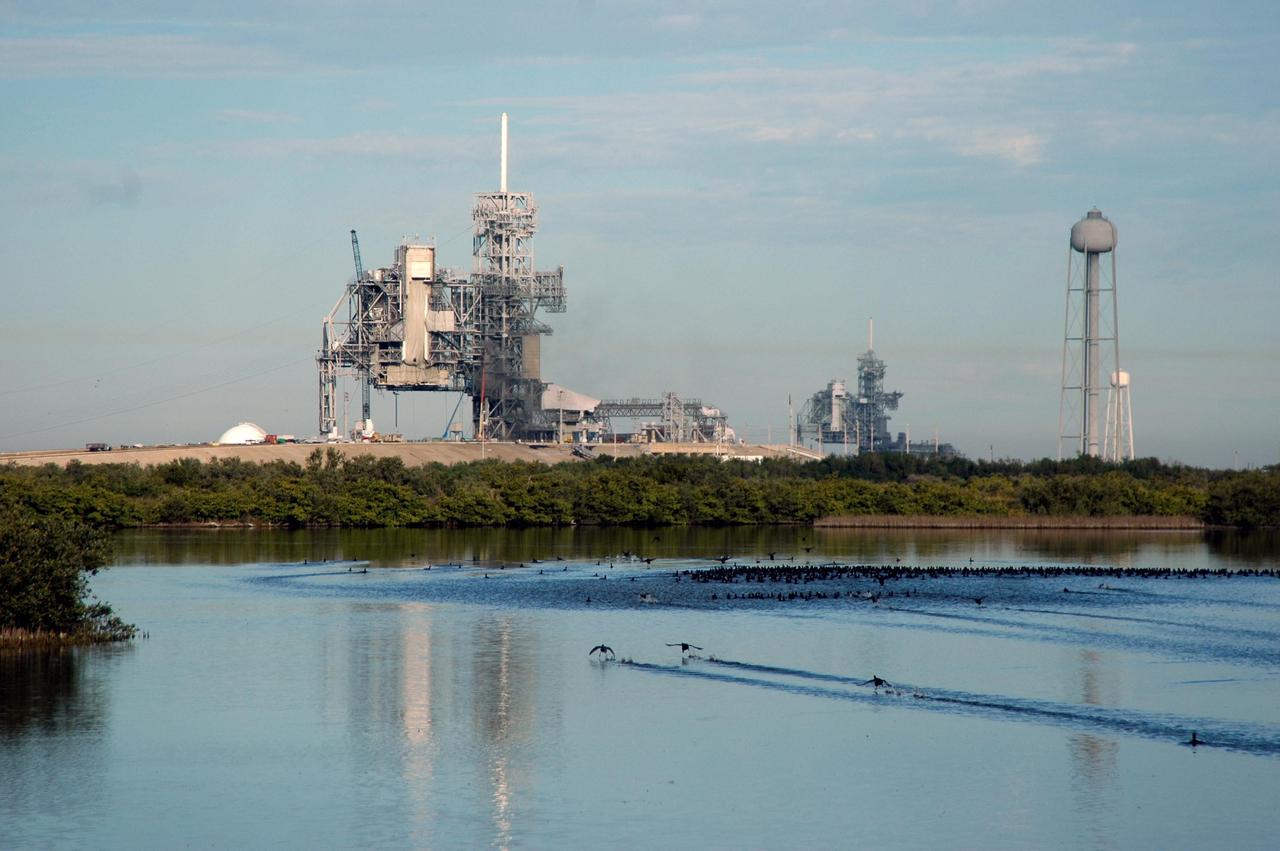
KENNEDY SPACE CENTER, FLA. - Viewed from the east side, Launch Pads 39A and 39B tower over the bird-filled waters of the Banana River at NASA Kennedy Space Center. On the far right is seen the 300-gallon water tower. Rising above the fixed service structures are the 80-foot lightning masts that help protect the structures from lightning strikes.
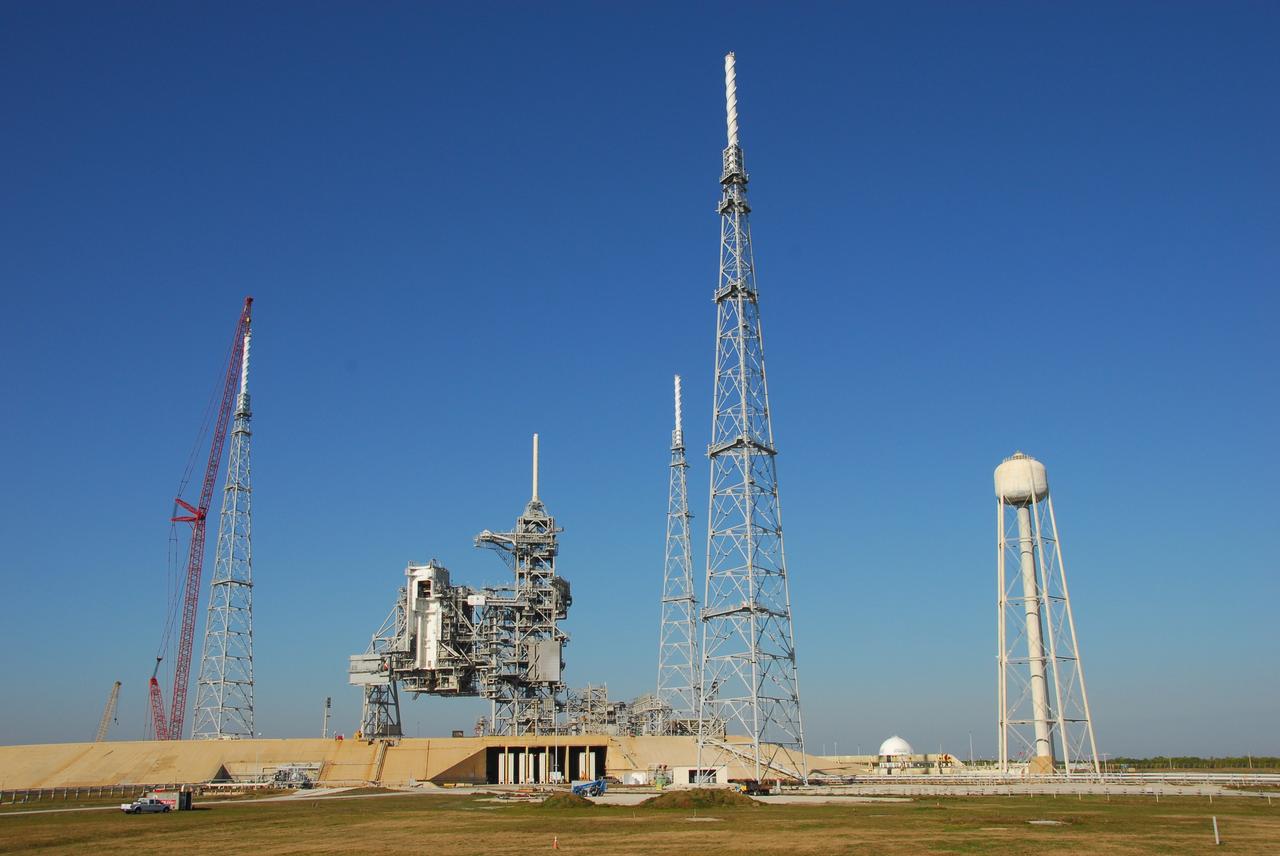
CAPE CANAVERAL, Fla. – On Launch Pad 39B at NASA's Kennedy Space Center in Florida, a giant crane (far left) places the 100-foot lightning mast on top of the newly erected lightning tower. Three new towers surround the pad. In the middle are the fixed and rotating service structures that serve the Space Shuttle Program. At far right is the tower that holds 300,000 gallons of water used for sound suppression during a shuttle launch. The new lightning protection system is being built for the Constellation Program and Ares/Orion launches. Each of the towers is 500 feet tall with an additional 100-foot fiberglass mast atop supporting a wire catenary system. This improved lightning protection system allows for the taller height of the Ares I rocket compared to the space shuttle. Pad 39B will be the site of the first Ares vehicle launch, including the Ares I-X test flight that is targeted for July 2009. Photo credit: NASA/Tim Jacobs
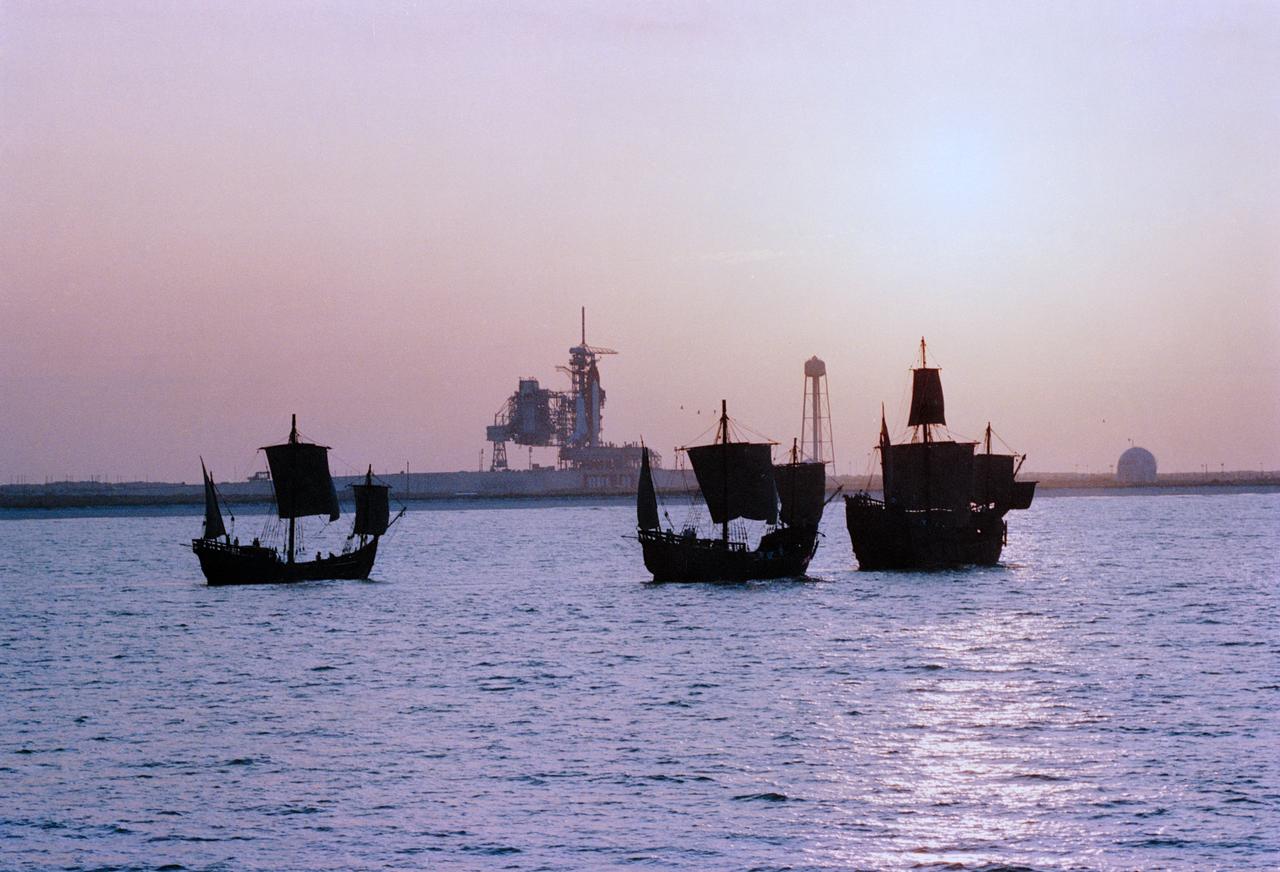
Replicas of Christopher Columbus' sailing ships Santa Maria, Nina, and Pinta sail by Endeavour, Orbiter Vehicle (OV) 105, on Kennedy Space Center (KSC) Launch Complex (LC) Pad 39B awaiting liftoff on its maiden voyage, STS-49. This view was taken from the water showing the three ships silhouetted in the foreground with OV-105 on mobile launcher platform profiled against fixed service structure (FSS) tower and rectracted rotating service structure (RSS) in the background. Next to the launch pad (at right) are the sound suppression water system tower and the liquid hydrogen (LH2) storage tank. View provided by KSC with alternate number KSC-92PC-970.
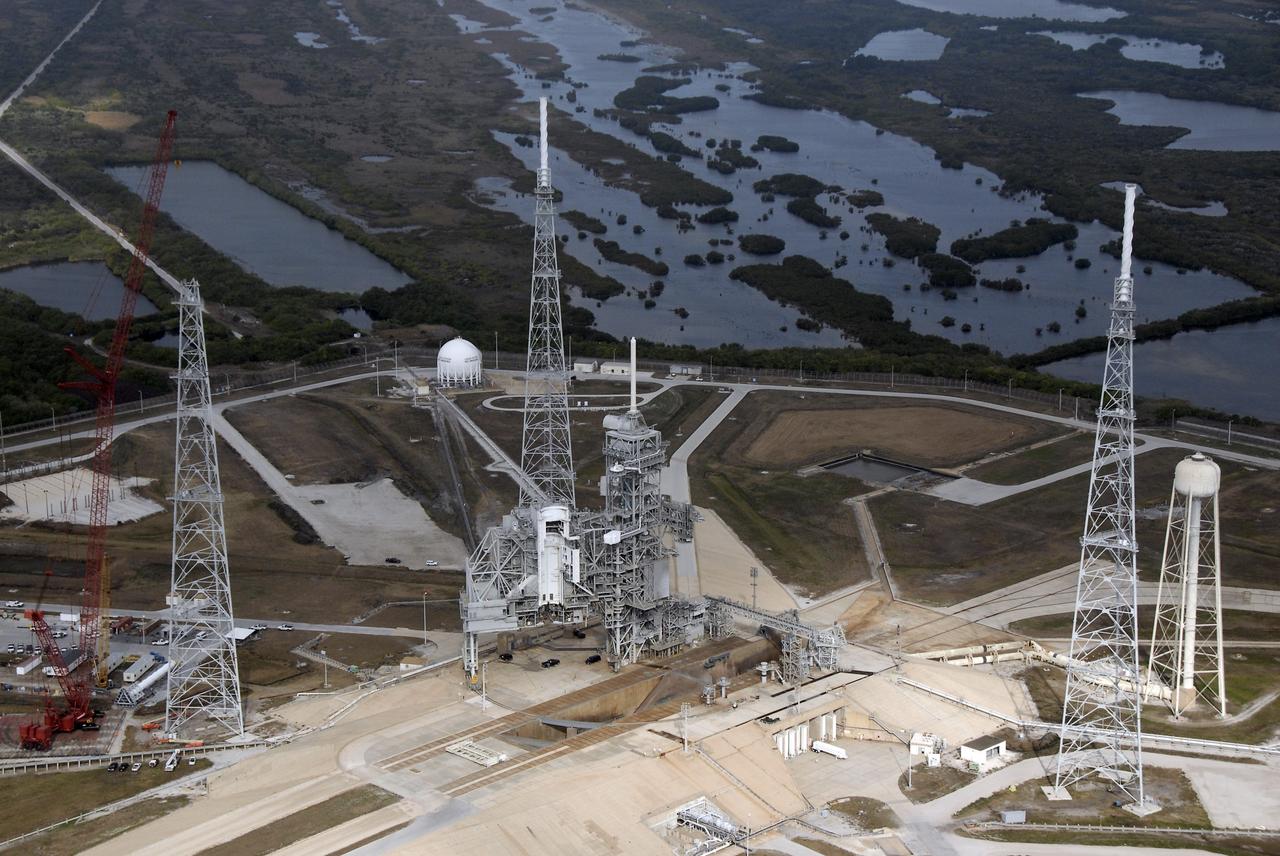
CAPE CANAVERAL, Fla. – An aerial view of the newly erected lightning towers on Launch Pad 39B at NASA's Kennedy Space Center. The two towers at center and right contain the lightning mast on top; the one at left does not. At center are the fixed and rotating service structures that have served the Space Shuttle Program. In the foreground is the tower that holds 300,000 gallons of water used for sound suppression during a shuttle liftoff. The new lightning protection system is being built for the Constellation Program and Ares/Orion launches. Each of the towers is 500 feet tall with an additional 100-foot fiberglass mast atop supporting a wire catenary system. This improved lightning protection system allows for the taller height of the Ares I rocket compared to the space shuttle. Pad 39B will be the site of the first Ares rocket launch, including the Ares I-X test flight that is targeted for July 2009. Photo credit: NASA/Kim Shiflett
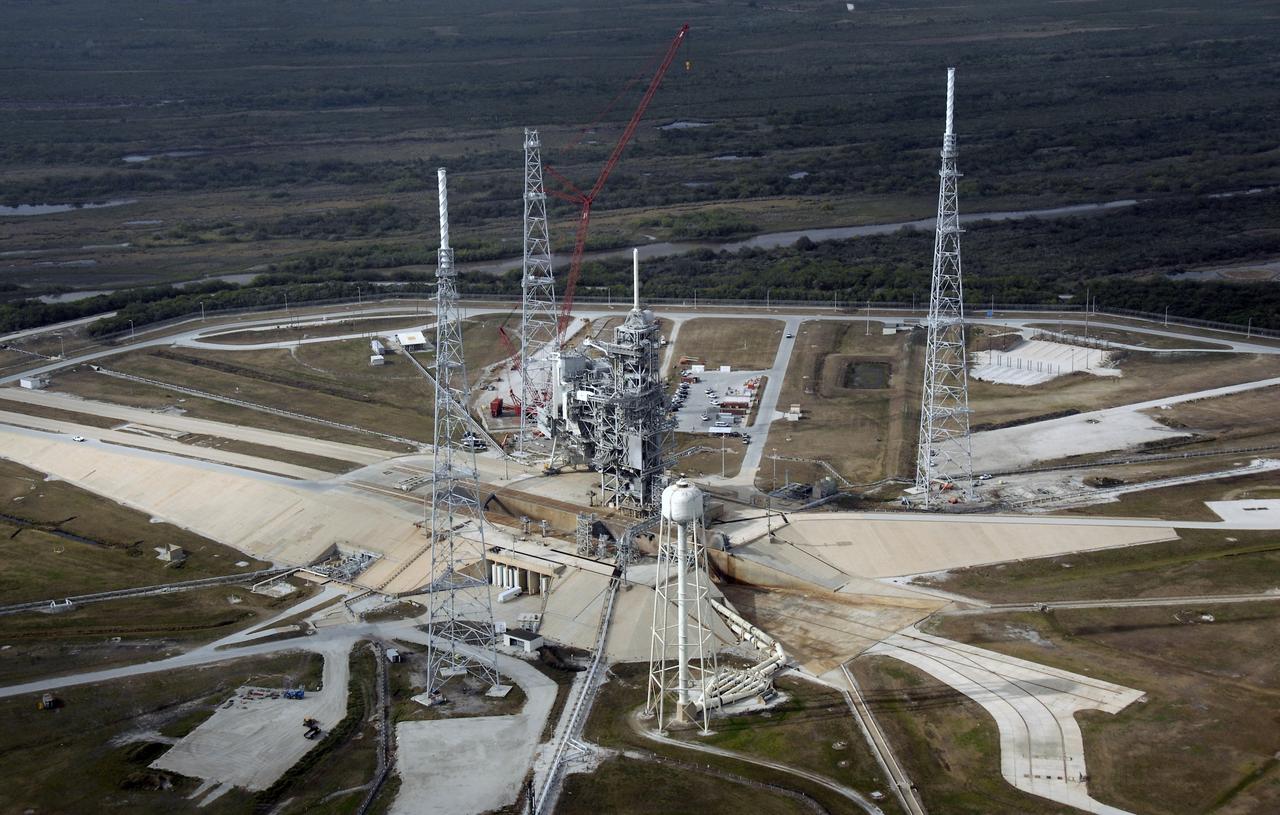
CAPE CANAVERAL, Fla. – An aerial view of the newly erected lightning towers on Launch Pad 39B at NASA's Kennedy Space Center in Florida. The two towers at left and right contain the lightning mast on top; the one at center does not. At center are the fixed and rotating service structures that have served the Space Shuttle Program. In the foreground is the tower that holds 300,000 gallons of water used for sound suppression during a shuttle liftoff. The new lightning protection system is being built for the Constellation Program and Ares/Orion launches. Each of the towers is 500 feet tall with an additional 100-foot fiberglass mast atop supporting a wire catenary system. This improved lightning protection system allows for the taller height of the Ares I rocket compared to the space shuttle. Pad 39B will be the site of the first Ares rocket launch, including the Ares I-X test flight that is targeted for July 2009. Photo credit: NASA/Kim Shiflett
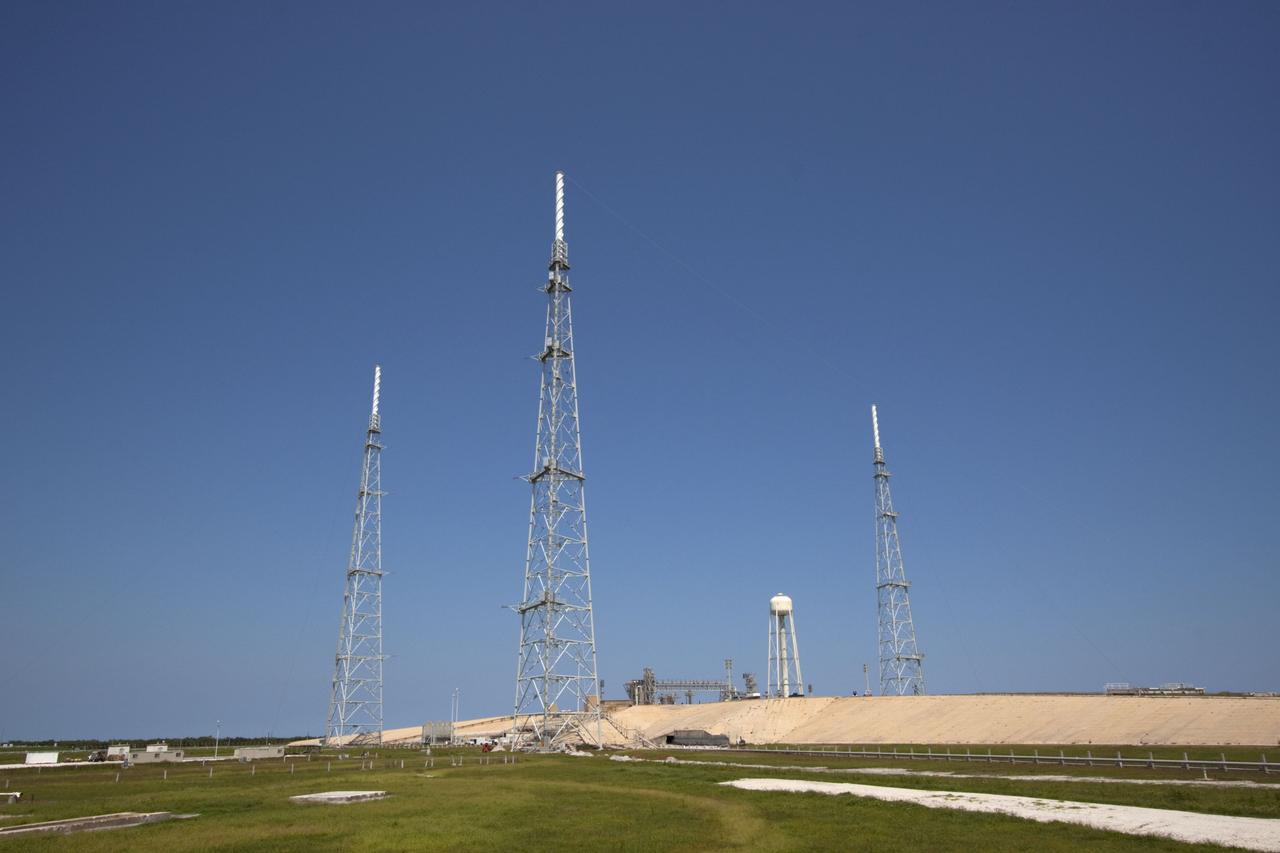
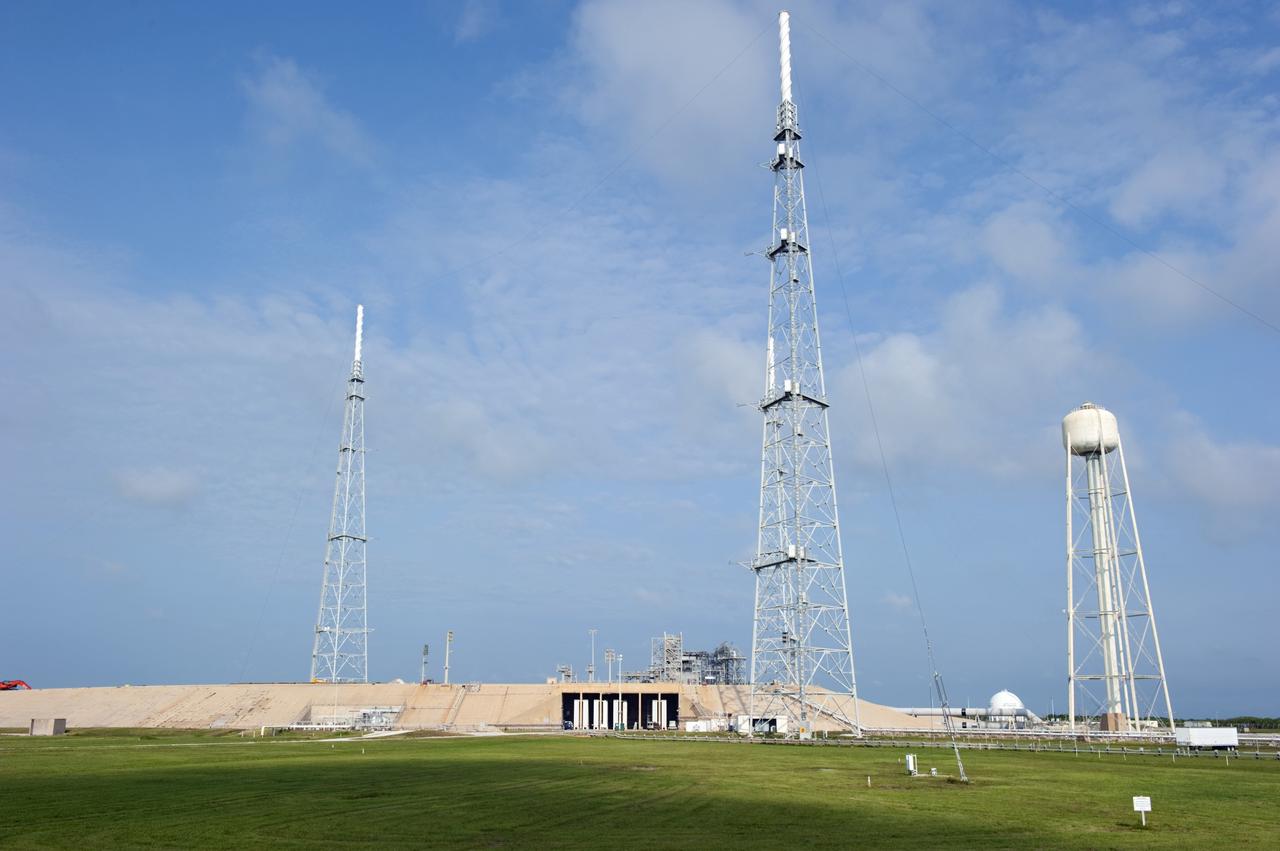
CAPE CANAVERAL, Fla. – The deconstruction of Launch Pad 39B at NASA’s Kennedy Space Center in Florida is complete. Still remaining and standing over the remnants of the fixed service structure are the three 600-foot-tall lightning protection towers and the water tower used for sound suppression. In 2009, the structure at the pad was no longer needed for NASA's Space Shuttle Program, so it is being restructured for future use. The new design will feature a "clean pad" for rockets to come with their own launcher, making it more versatile for a number of vehicles. For information on NASA's future plans, visit http://www.nasa.gov/exploration. Photo credit: NASA/Jim Grossmann
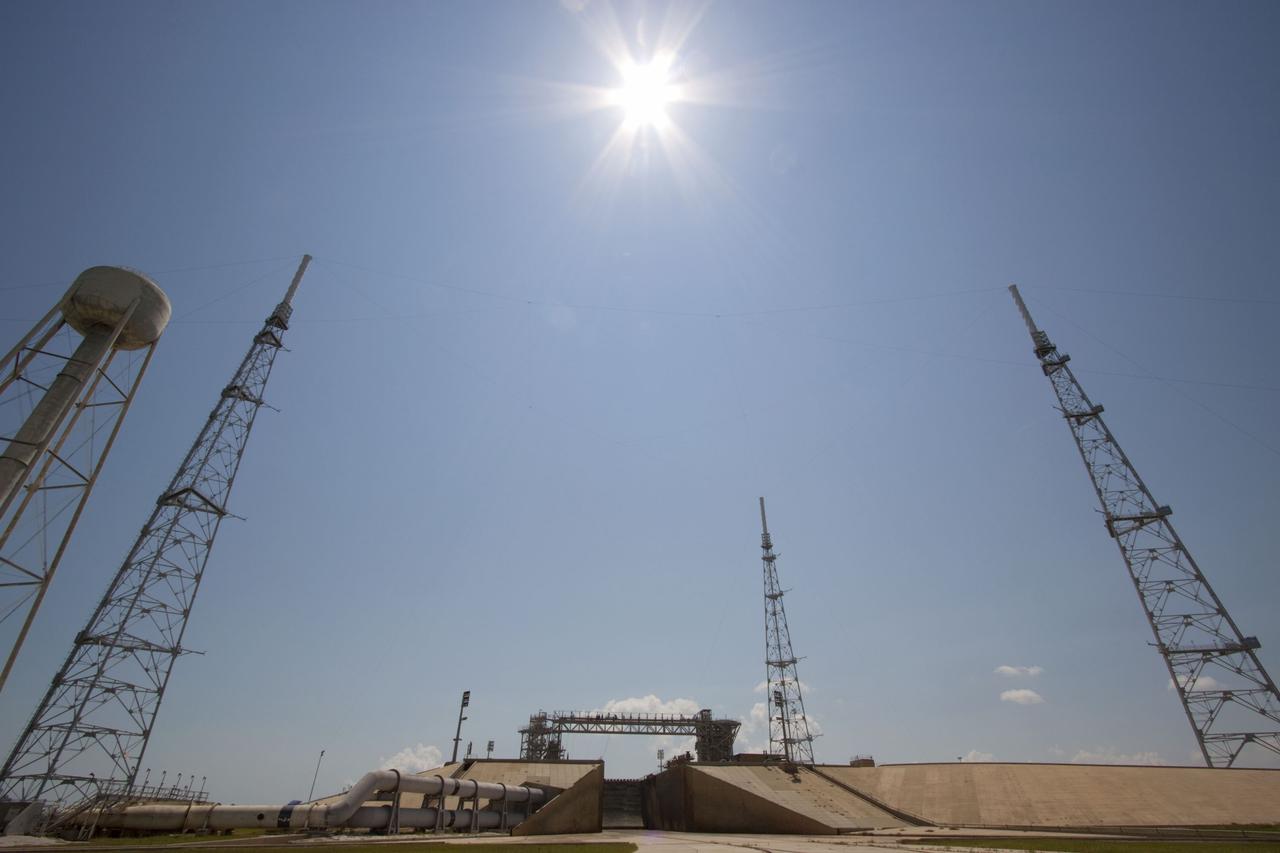
CAPE CANAVERAL, Fla. – The deconstruction of Launch Pad 39B at NASA’s Kennedy Space Center in Florida is complete. Still remaining and standing over the remnants of the fixed service structure are the 600-foot-tall lightning protection towers and the water tower used for sound suppression. In 2009, the structure at the pad was no longer needed for NASA's Space Shuttle Program, so it is being restructured for future use. The new design will feature a "clean pad" for rockets to come with their own launcher, making it more versatile for a number of vehicles. For information on NASA's future plans, visit http://www.nasa.gov/exploration. Photo credit: NASA/Jim Grossmann
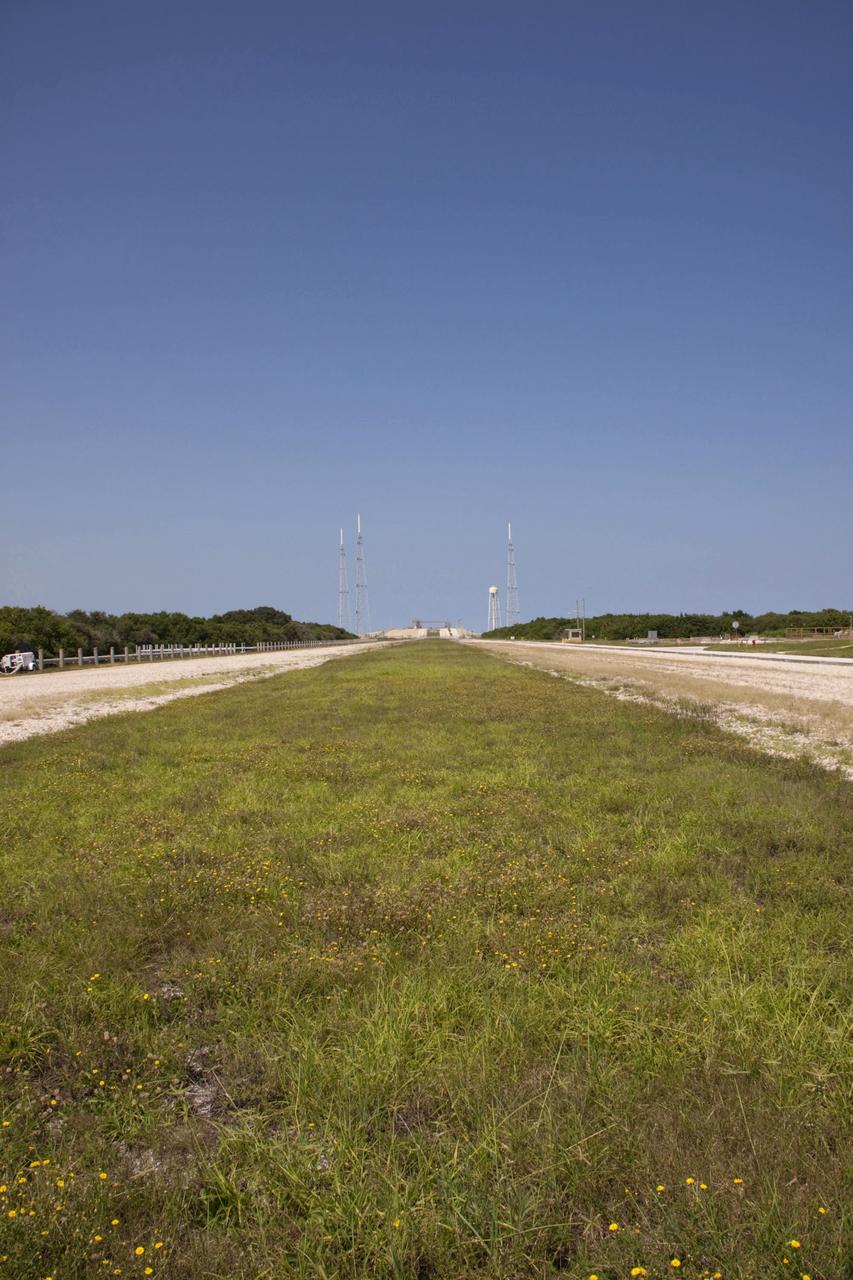
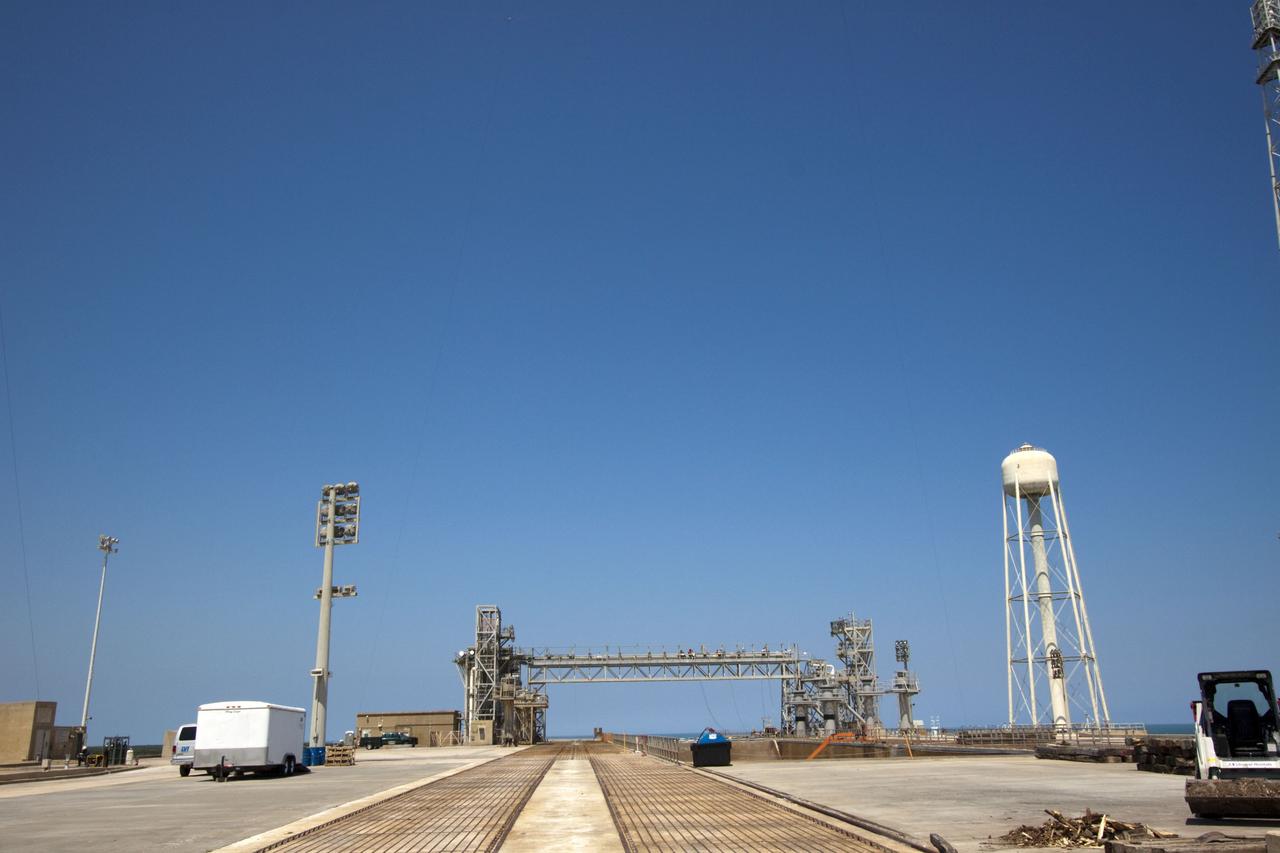
CAPE CANAVERAL, Fla. – The deconstruction of Launch Pad 39B at NASA’s Kennedy Space Center in Florida is complete. With a view from the two-track crawlerway, the three 600-foot-tall lightning protection towers and the water tower used for sound suppression stand over the remnants of the fixed service structure. In 2009, the structure at the pad was no longer needed for NASA's Space Shuttle Program, so it is being restructured for future use. The new design will feature a "clean pad" for rockets to come with their own launcher, making it more versatile for a number of vehicles. For information on NASA's future plans, visit http://www.nasa.gov/exploration. Photo credit: NASA/Jim Grossmann
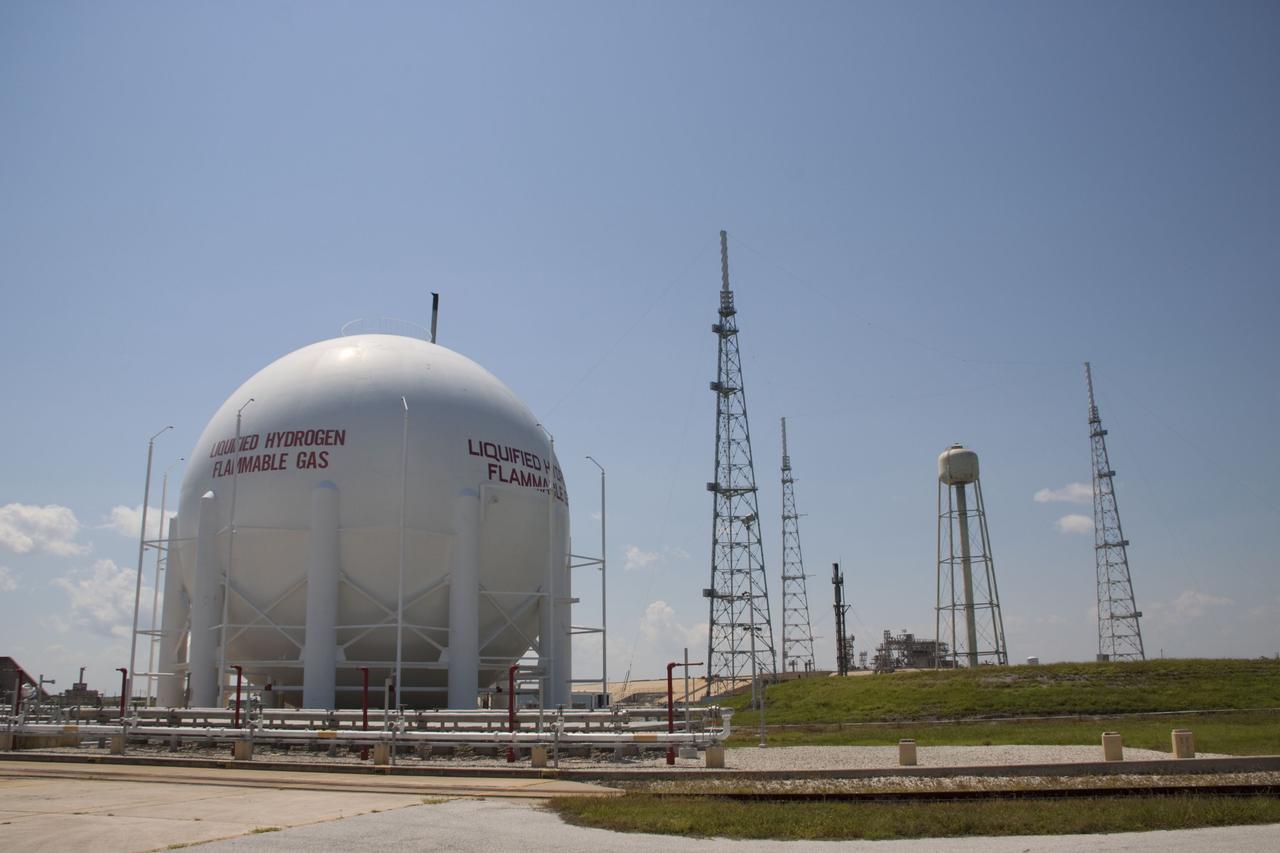
CAPE CANAVERAL, Fla. – The deconstruction of Launch Pad 39B at NASA’s Kennedy Space Center in Florida is complete. Still remaining and standing over the remnants of the fixed service structure are the 600-foot-tall lightning protection towers and the water tower used for sound suppression. In 2009, the structure at the pad was no longer needed for NASA's Space Shuttle Program, so it is being restructured for future use. The new design will feature a "clean pad" for rockets to come with their own launcher, making it more versatile for a number of vehicles. For information on NASA's future plans, visit http://www.nasa.gov/exploration. Photo credit: NASA/Jim Grossmann
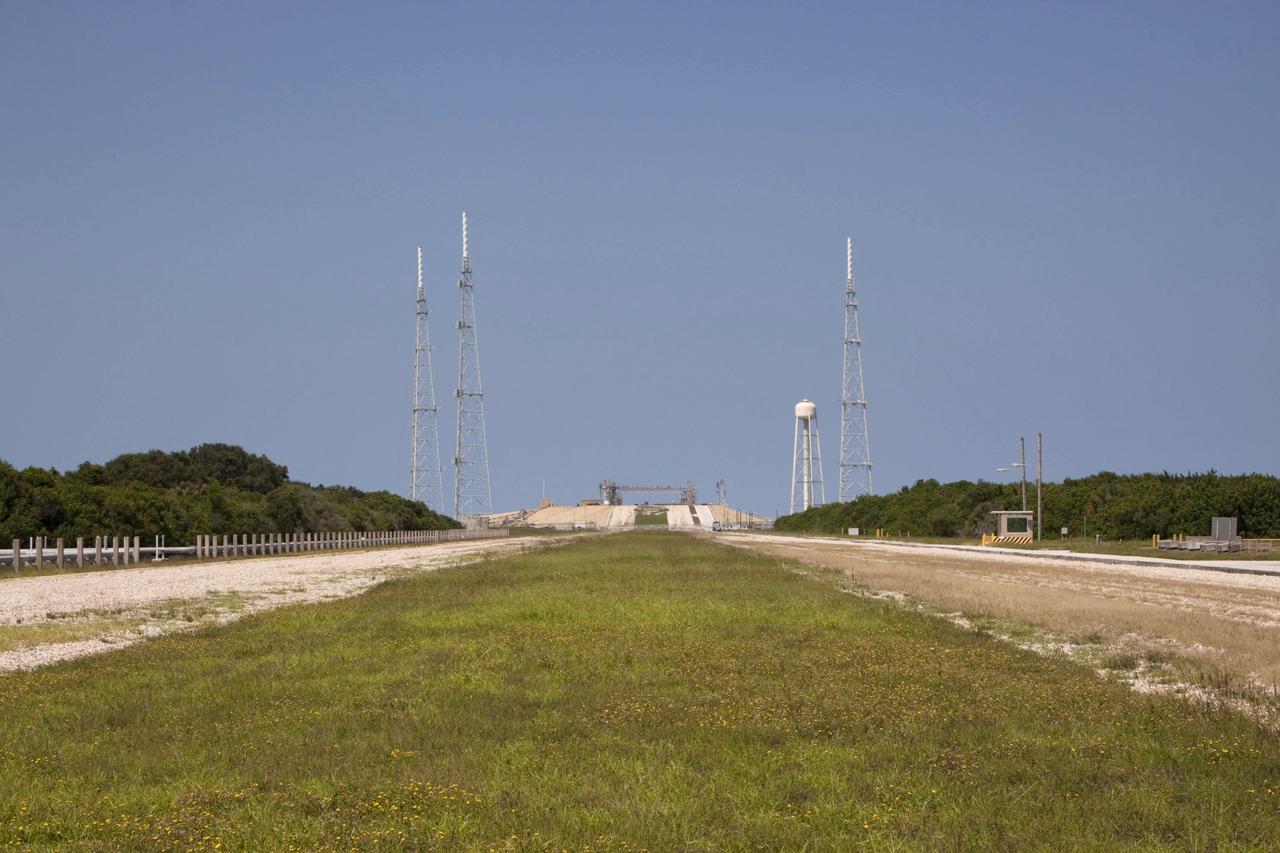
CAPE CANAVERAL, Fla. – The deconstruction of Launch Pad 39B at NASA’s Kennedy Space Center in Florida is complete. With a view from the two-track crawlerway, the three 600-foot-tall lightning protection towers and the water tower used for sound suppression stand over the remnants of the fixed service structure. In 2009, the structure at the pad was no longer needed for NASA's Space Shuttle Program, so it is being restructured for future use. The new design will feature a "clean pad" for rockets to come with their own launcher, making it more versatile for a number of vehicles. For information on NASA's future plans, visit http://www.nasa.gov/exploration. Photo credit: NASA/Jim Grossmann
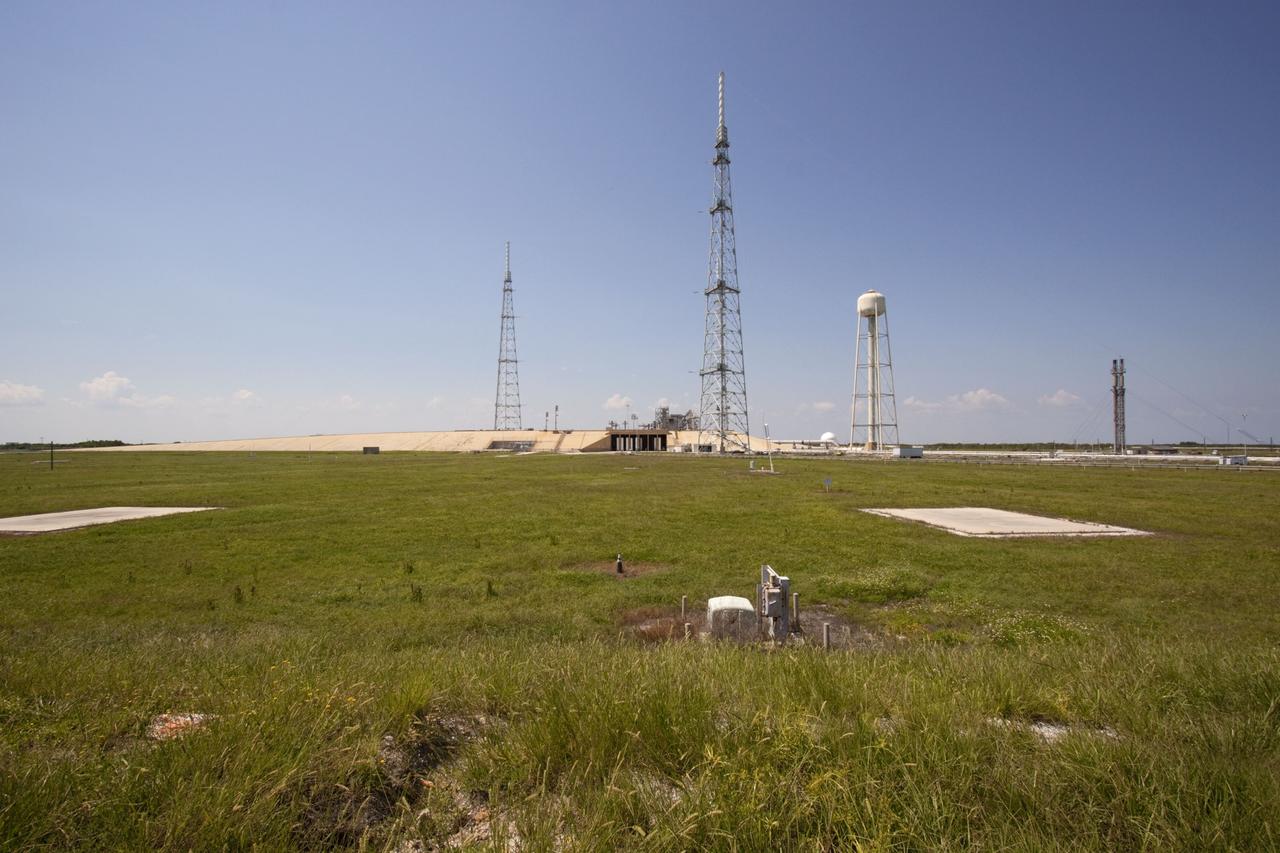
CAPE CANAVERAL, Fla. – The deconstruction of Launch Pad 39B at NASA’s Kennedy Space Center in Florida is complete. Still remaining and standing over the remnants of the fixed service structure are the 600-foot-tall lightning protection towers and the water tower used for sound suppression. In 2009, the structure at the pad was no longer needed for NASA's Space Shuttle Program, so it is being restructured for future use. The new design will feature a "clean pad" for rockets to come with their own launcher, making it more versatile for a number of vehicles. For information on NASA's future plans, visit http://www.nasa.gov/exploration. Photo credit: NASA/Jim Grossmann
CAPE CANAVERAL, Fla. -- At NASA's Kennedy Space Center in Florida, the water tower (right) which supported the space shuttle's water deluge system still stands on Launch Pad 39B after the pad's deconstruction. In 2009, the structure at the pad was no longer needed for NASA's Space Shuttle Program, so it is being restructured for future use. The new design will feature a "clean pad" for rockets to come with their own launcher, making it more versatile for a number of vehicles. For information on NASA's future plans, visit http://www.nasa.gov/exploration. Photo credit: NASA/Kim Shiflett
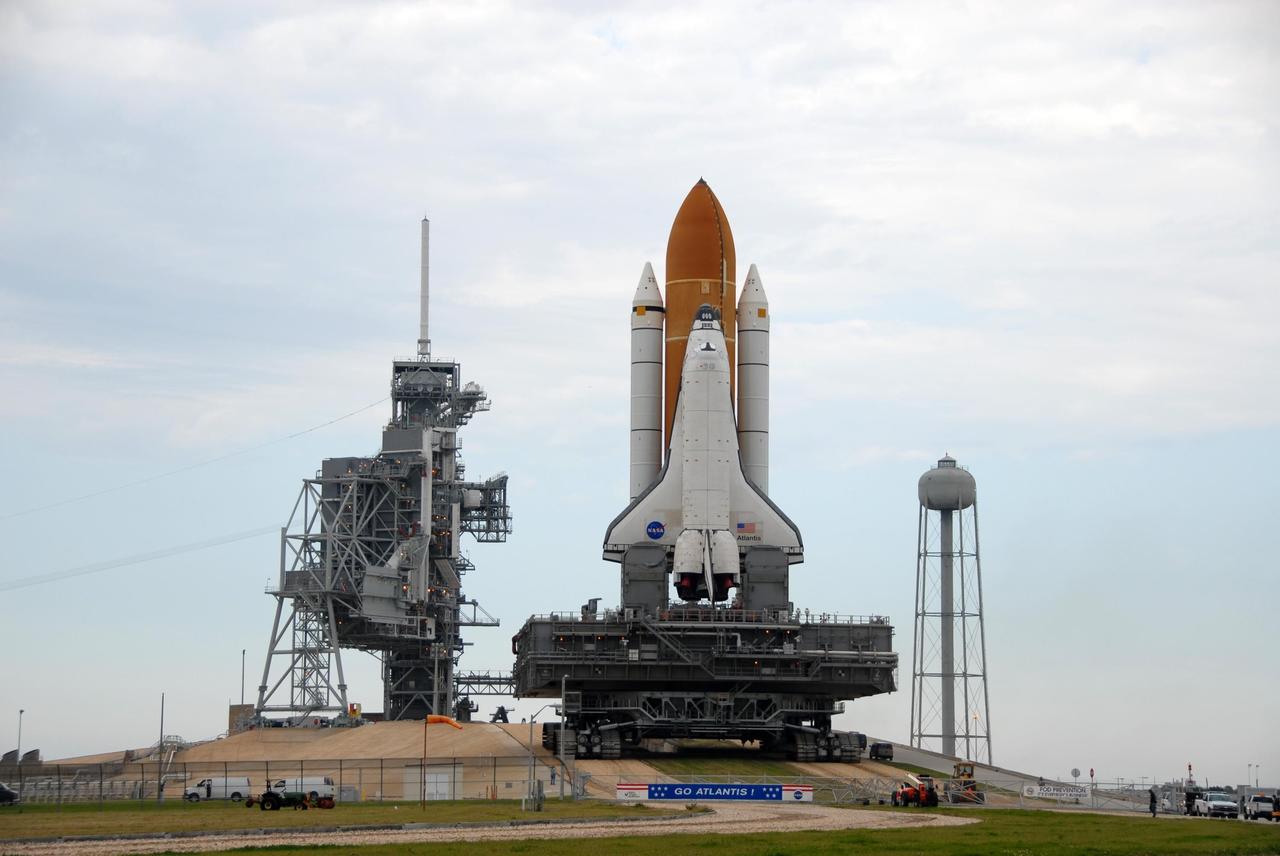
KENNEDY SPACE CENTER, FLA. -- Lined up on the horizon are Space Shuttle Atlantis, the rotating and fixed service structures of Launch Pad 39A, Launch Pad 39B, and the 300-gallon water tower of Pad 39A. The shuttle has spent six hours rolling out to Pad 39A, leaving the Vehicle Assembly Building at 8:19 a.m. The body of water in the foreground is the Banana River. The mission payload aboard Space Shuttle Atlantis is the S3/S4 integrated truss structure, along with a third set of solar arrays and batteries. The crew of six astronauts will install the truss to continue assembly of the International Space Station. Launch is targeted for March 15. Photo credit: NASA/Ken Thornsley
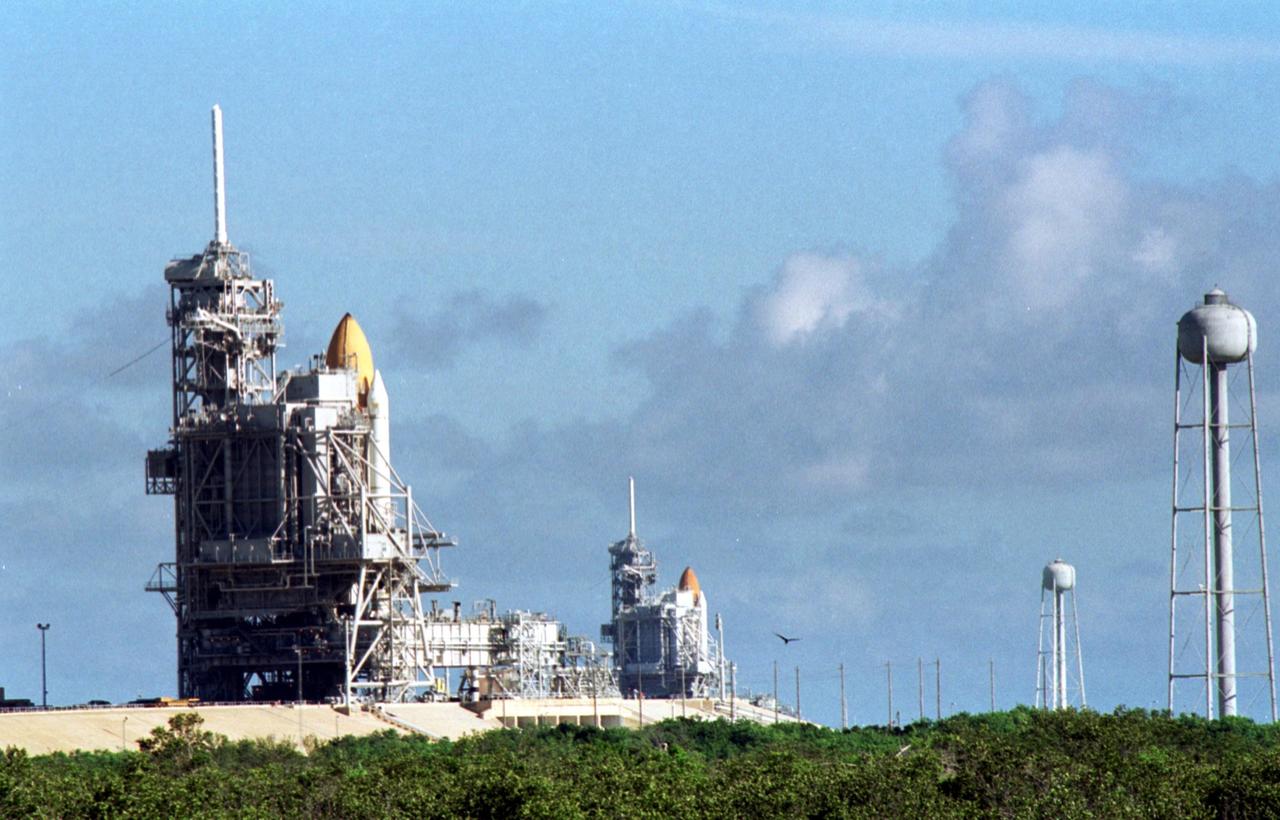
KENNEDY SPACE CENTER, Fla. -- Space Shuttle Discovery (foreground) and Space Shuttle Atlantis (background) both stand ready on their Launch Pads ( 39A and 39B respectively). Space Shuttle Discovery rolled out July 2 to be prepared for launch on mission STS-105 in August. Space Shuttle Atlantis is scheduled to launch Thursday, July 12, on mission STS-104. Towering above each Shuttle on the left is the 80-foot lightning rod that helps protect each Shuttle from lightning strikes. At right are the 290-foot water tanks that provide 300,000 gallons of water during liftoff. They are part of the sound suppression water system at each pad
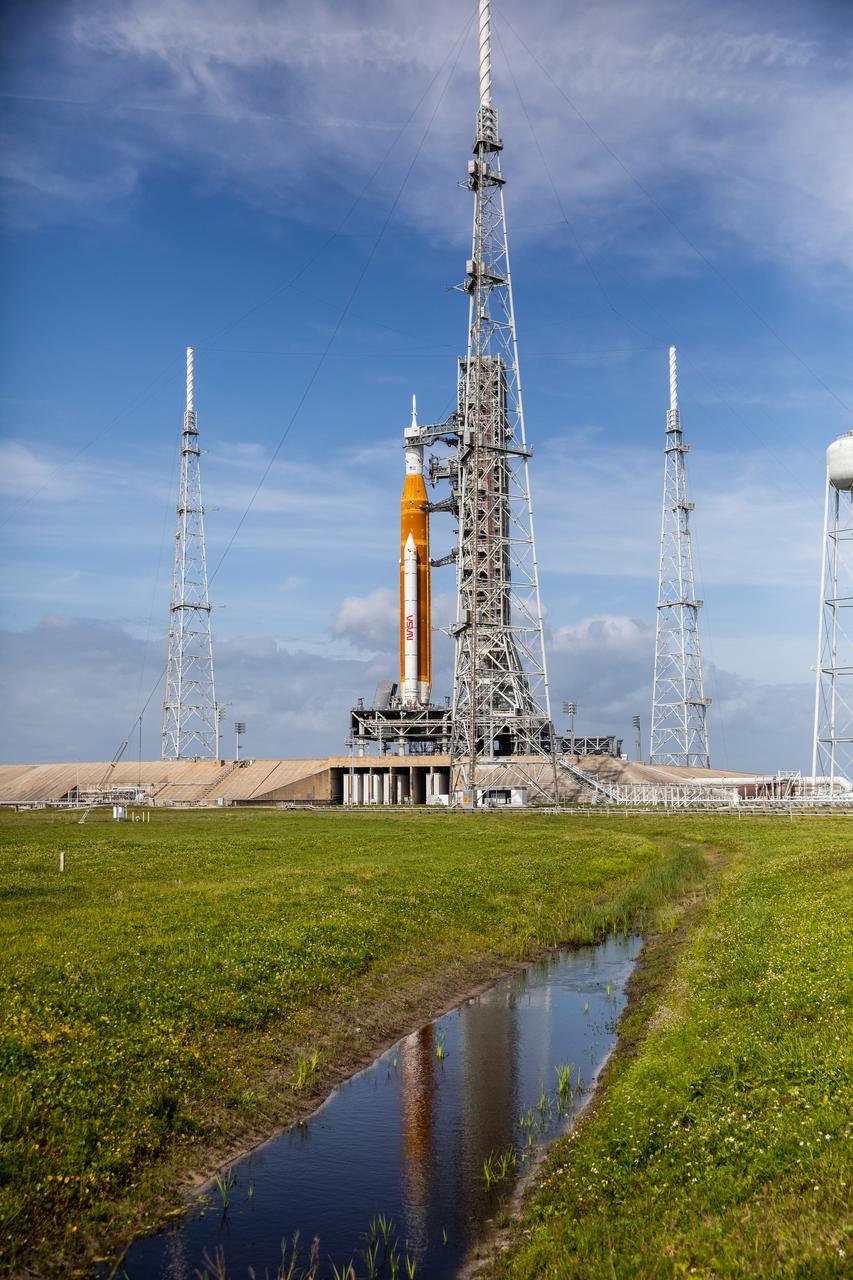
A view of the Artemis I Space Launch System (SLS) and Orion spacecraft atop the mobile launcher on Launch Pad 39B at NASA’s Kennedy Space Center in Florida on April 21, 2022. Also in view are the three lightning protection towers and water tower. The SLS and Orion atop the mobile launcher were transported to the pad on crawler-transporter 2 for a prelaunch test called a wet dress rehearsal. Artemis I will be the first integrated test of the SLS and Orion spacecraft. In future Artemis missions, NASA will land the first woman and the first person of color on the surface of the Moon, paving the way for a long-term lunar presence and serving as a steppingstone on the way to Mars.
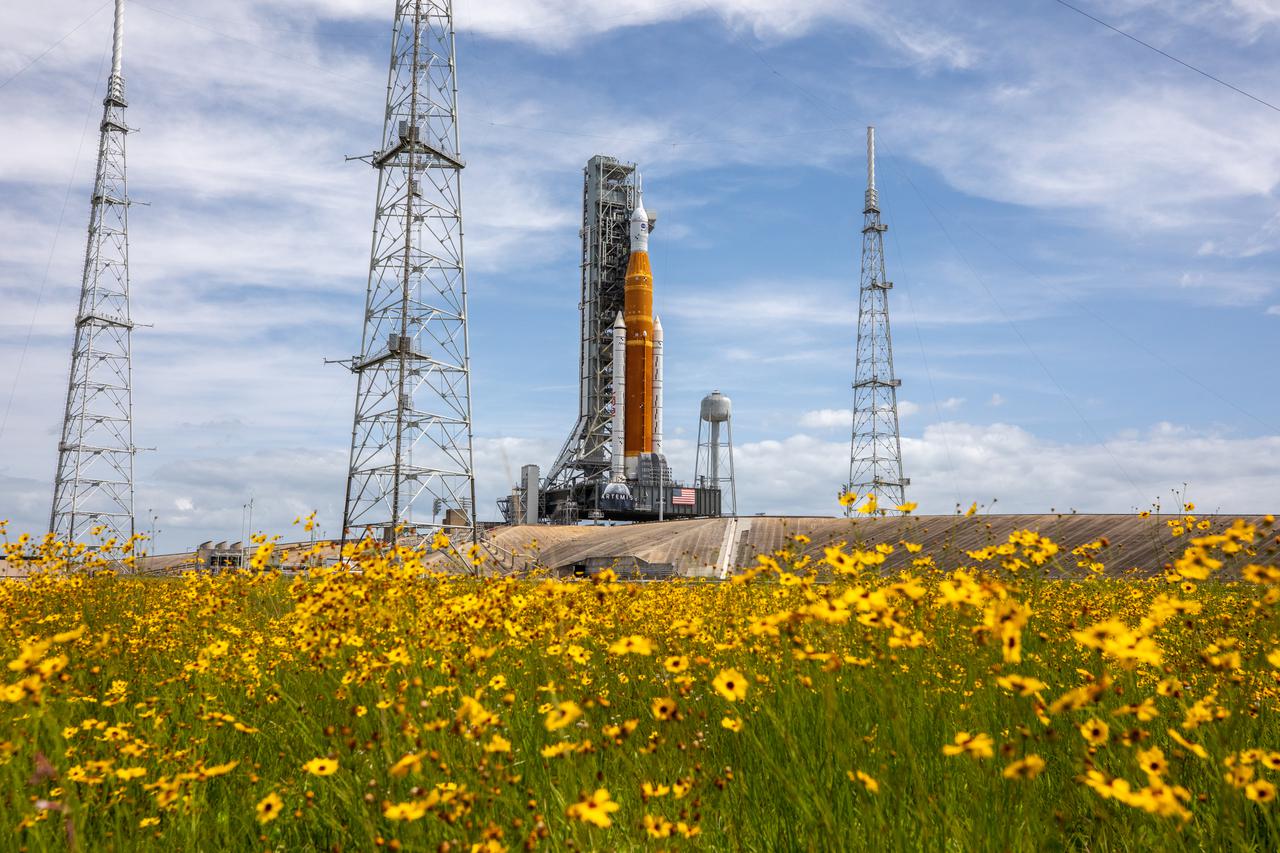
Wildflowers frame a view of the Artemis I Space Launch System (SLS) and Orion spacecraft on Launch Pad 39B at NASA’s Kennedy Space Center in Florida on April 21, 2022. Also in view are the three lightning protection towers and the water tower. The SLS and Orion atop the mobile launcher were transported to the pad on crawler-transporter 2 for a prelaunch test called a wet dress rehearsal. Artemis I will be the first integrated test of the SLS and Orion spacecraft. In future Artemis missions, NASA will land the first woman and the first person of color on the surface of the Moon, paving the way for a long-term lunar presence and serving as a steppingstone on the way to Mars.
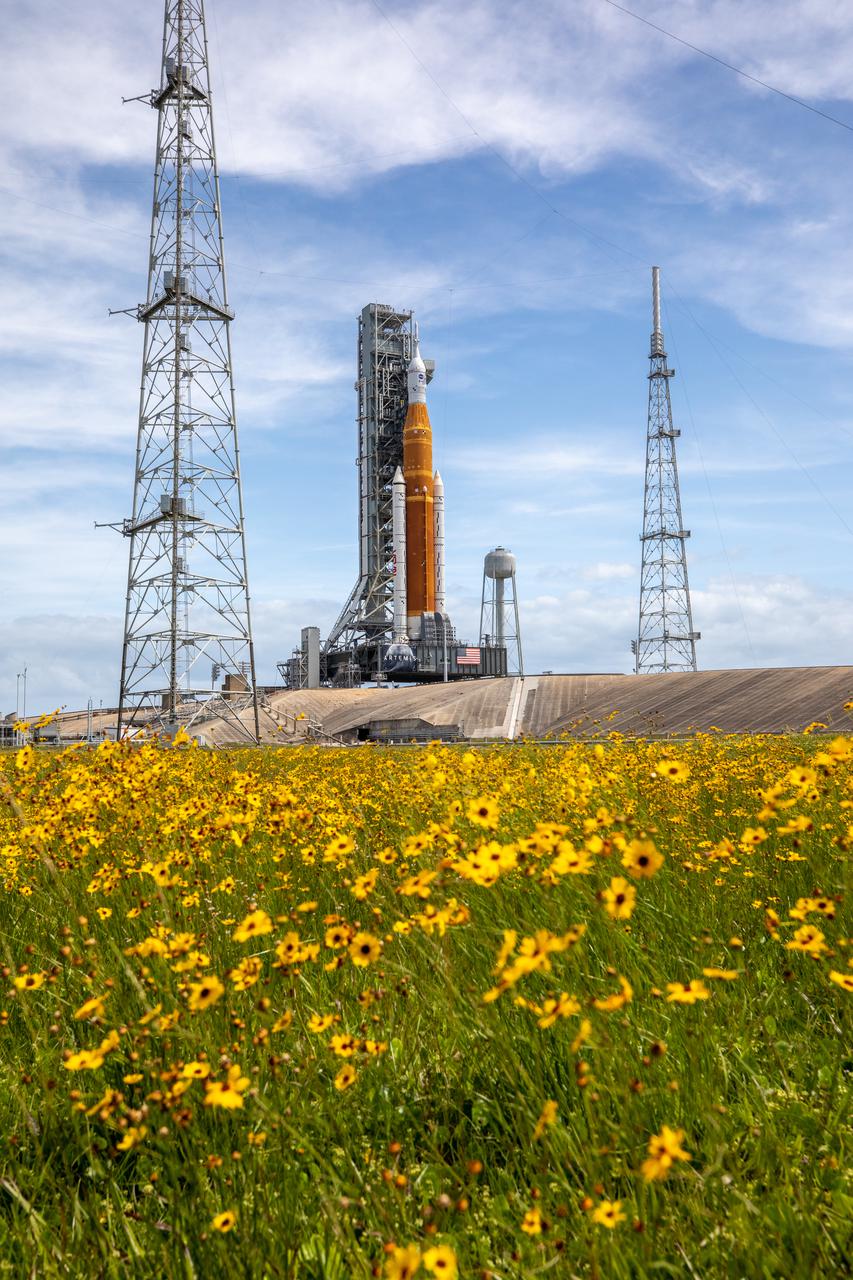
Wildflowers frame a view of the Artemis I Space Launch System (SLS) and Orion spacecraft on Launch Pad 39B at NASA’s Kennedy Space Center in Florida on April 21, 2022. Also in view are two of the three lightning protection towers and the water tower. The SLS and Orion atop the mobile launcher were transported to the pad on crawler-transporter 2 for a prelaunch test called a wet dress rehearsal. Artemis I will be the first integrated test of the SLS and Orion spacecraft. In future Artemis missions, NASA will land the first woman and the first person of color on the surface of the Moon, paving the way for a long-term lunar presence and serving as a steppingstone on the way to Mars.
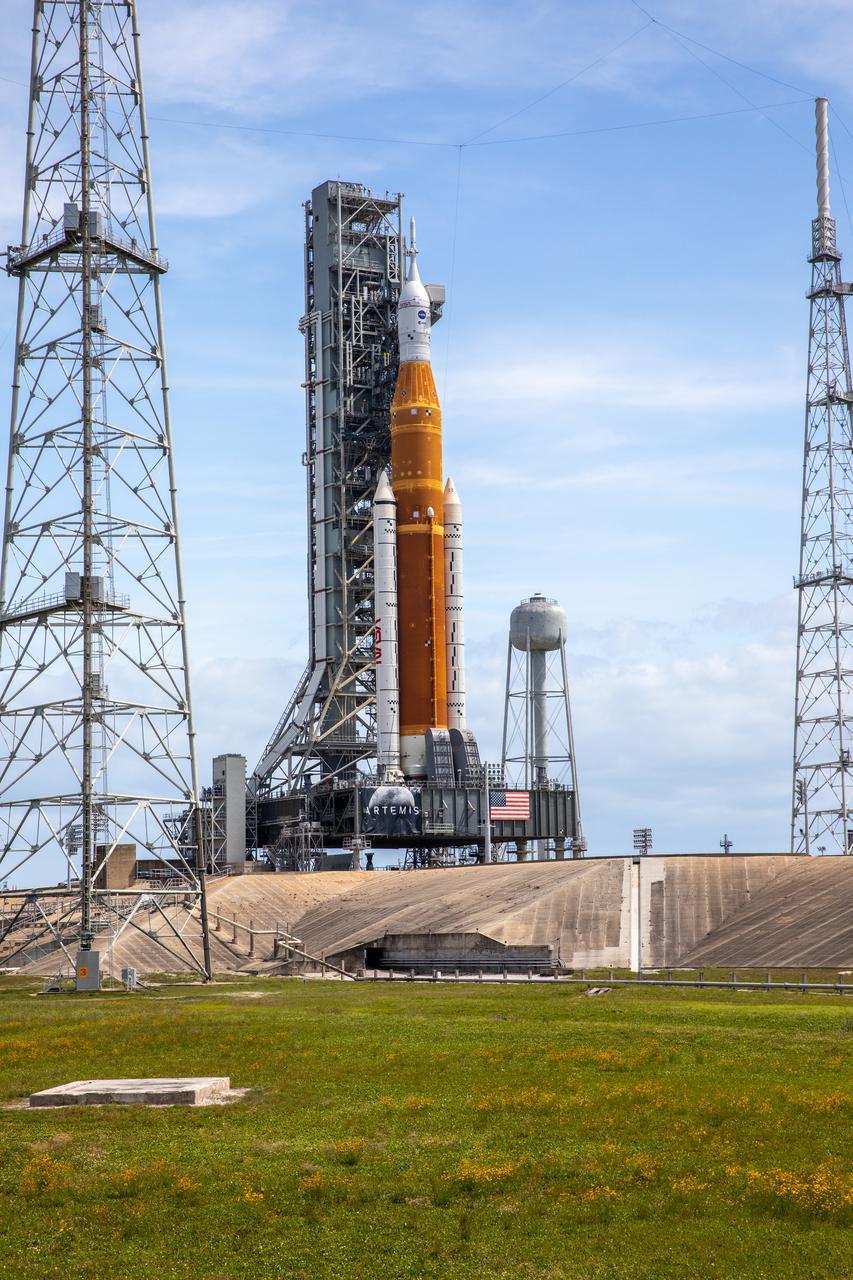
A view of the Artemis I Space Launch System (SLS) and Orion spacecraft on Launch Pad 39B at NASA’s Kennedy Space Center in Florida on April 21, 2022. Also in view are two of the three lightning protection towers and the water tower. The SLS and Orion atop the mobile launcher were transported to the pad on crawler-transporter 2 for a prelaunch test called a wet dress rehearsal. Artemis I will be the first integrated test of the SLS and Orion spacecraft. In future Artemis missions, NASA will land the first woman and the first person of color on the surface of the Moon, paving the way for a long-term lunar presence and serving as a steppingstone on the way to Mars.
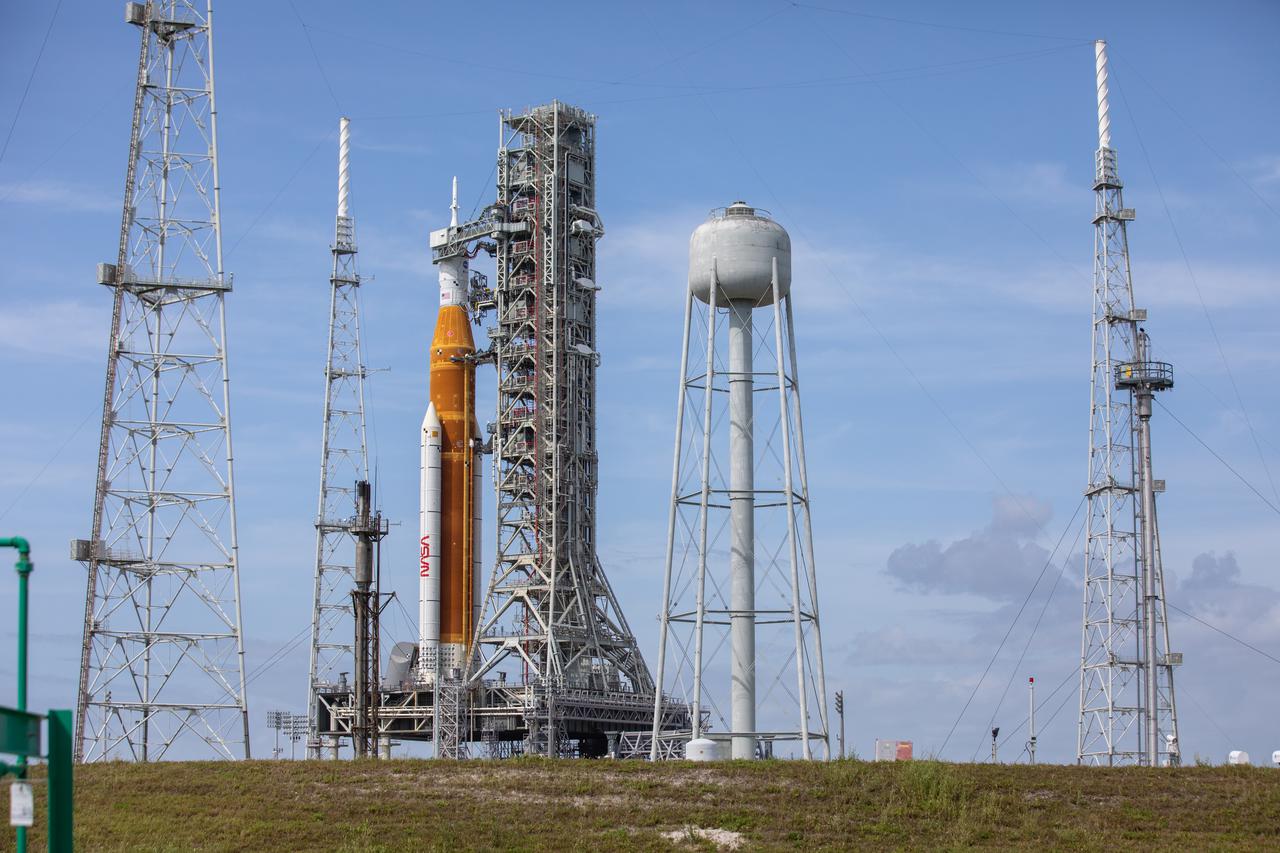
A view of the Artemis I Space Launch System (SLS) and Orion spacecraft on Launch Pad 39B at NASA’s Kennedy Space Center in Florida on April 21, 2022. Also in view are the three lightning protection towers and water tower. The SLS and Orion atop the mobile launcher were transported to the pad on crawler-transporter 2 for a prelaunch test called a wet dress rehearsal. Artemis I will be the first integrated test of the SLS and Orion spacecraft. In future Artemis missions, NASA will land the first woman and the first person of color on the surface of the Moon, paving the way for a long-term lunar presence and serving as a steppingstone on the way to Mars.
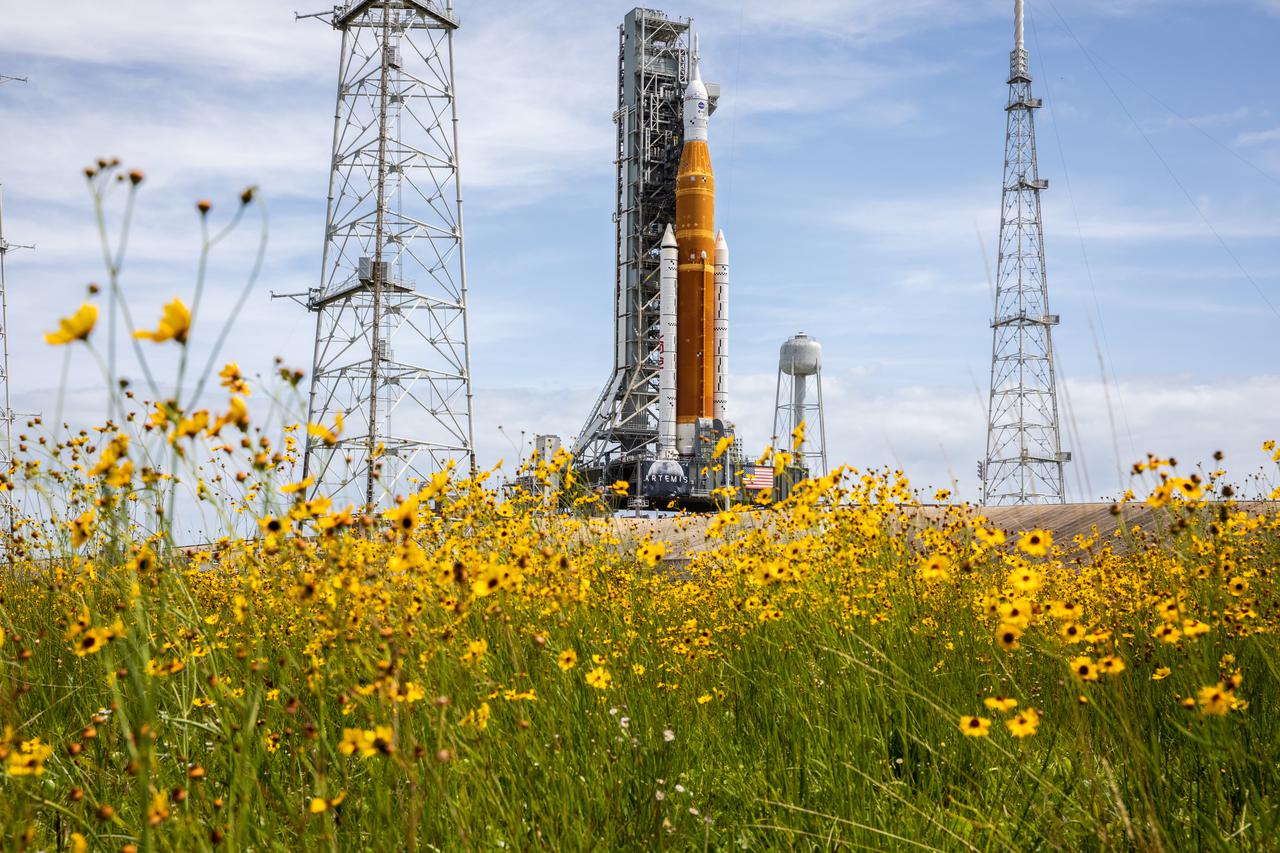
Wildflowers frame a view of the Artemis I Space Launch System (SLS) and Orion spacecraft on Launch Pad 39B at NASA’s Kennedy Space Center in Florida on April 21, 2022. Also in view are two of the three lightning protection towers and the water tower. The SLS and Orion atop the mobile launcher were transported to the pad on crawler-transporter 2 for a prelaunch test called a wet dress rehearsal. Artemis I will be the first integrated test of the SLS and Orion spacecraft. In future Artemis missions, NASA will land the first woman and the first person of color on the surface of the Moon, paving the way for a long-term lunar presence and serving as a steppingstone on the way to Mars.
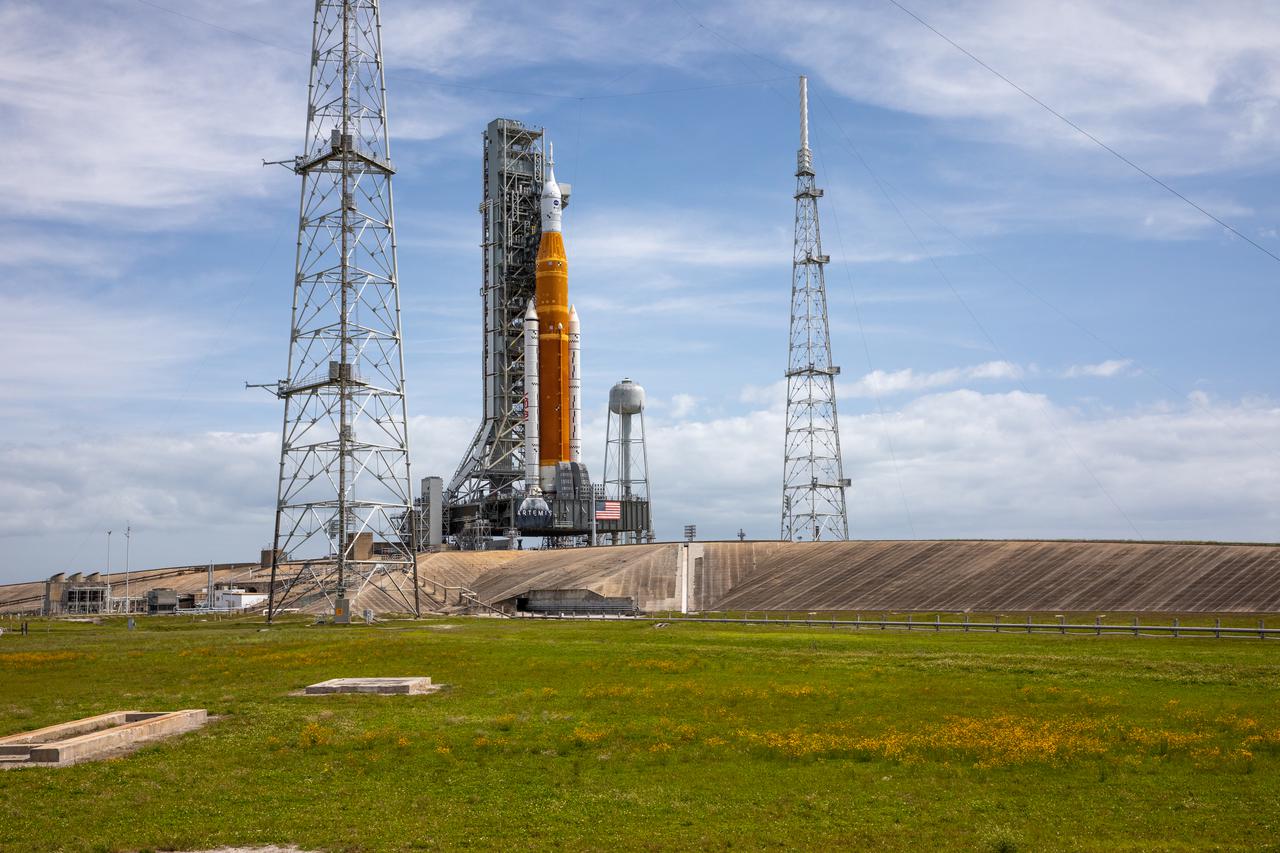
A view of the Artemis I Space Launch System (SLS) and Orion spacecraft on Launch Pad 39B at NASA’s Kennedy Space Center in Florida on April 21, 2022. Also in view are two of the three lightning protection towers and the water tower. The SLS and Orion atop the mobile launcher were transported to the pad on crawler-transporter 2 for a prelaunch test called a wet dress rehearsal. Artemis I will be the first integrated test of the SLS and Orion spacecraft. In future Artemis missions, NASA will land the first woman and the first person of color on the surface of the Moon, paving the way for a long-term lunar presence and serving as a steppingstone on the way to Mars.
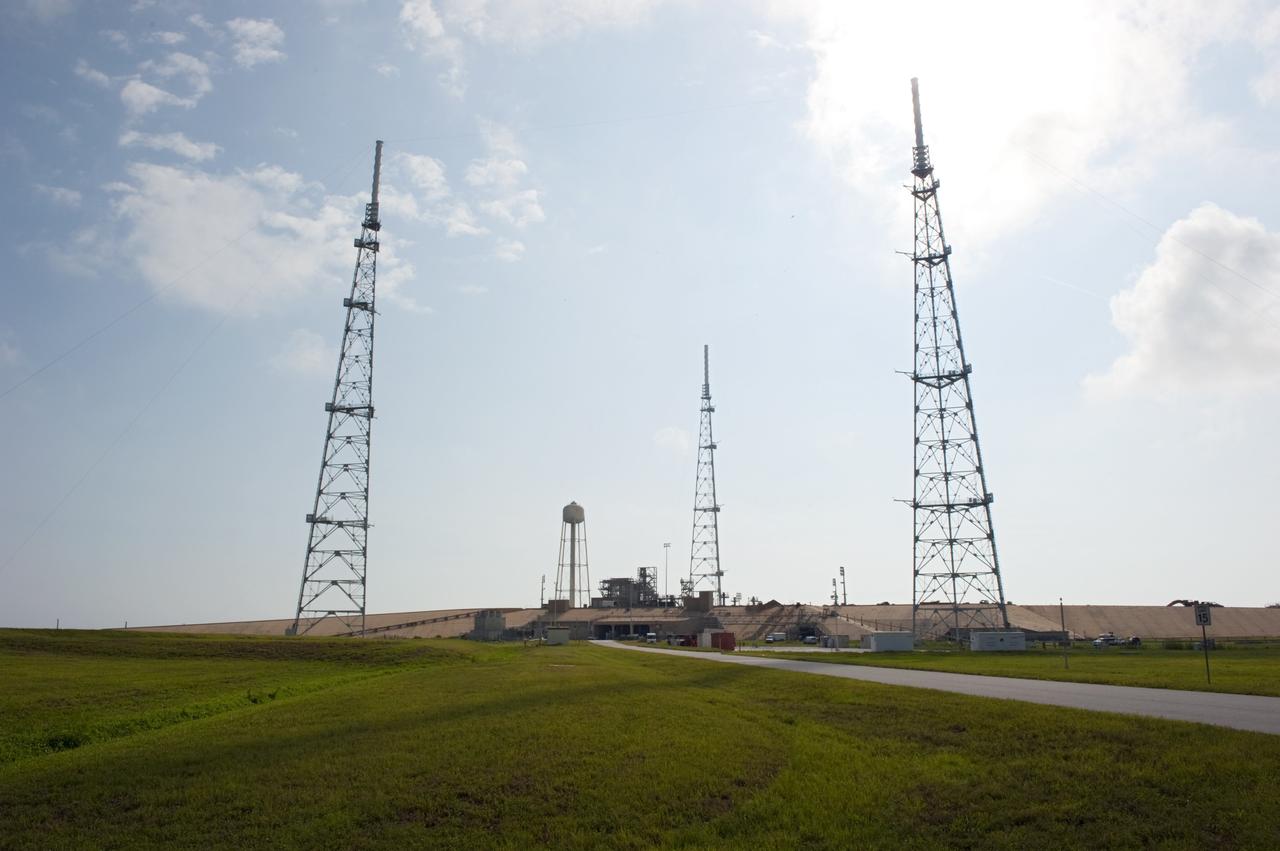
CAPE CANAVERAL, Fla. -- At NASA's Kennedy Space Center in Florida, the water tower and lightning protection system, consisting of three 600-foot-tall lightning towers, remain at Launch Pad 39B after the pad's deconstruction. Each lightning tower is 500 feet tall and topped off with an additional 100-foot fiberglass mast which supports a wire catenary system. In 2009, the structure at the pad was no longer needed for NASA's Space Shuttle Program, so it is being restructured for future use. The new design will feature a "clean pad" for rockets to come with their own launcher, making it more versatile for a number of vehicles. For information on NASA's future plans, visit http://www.nasa.gov/exploration. Photo credit: NASA/Kim Shiflett
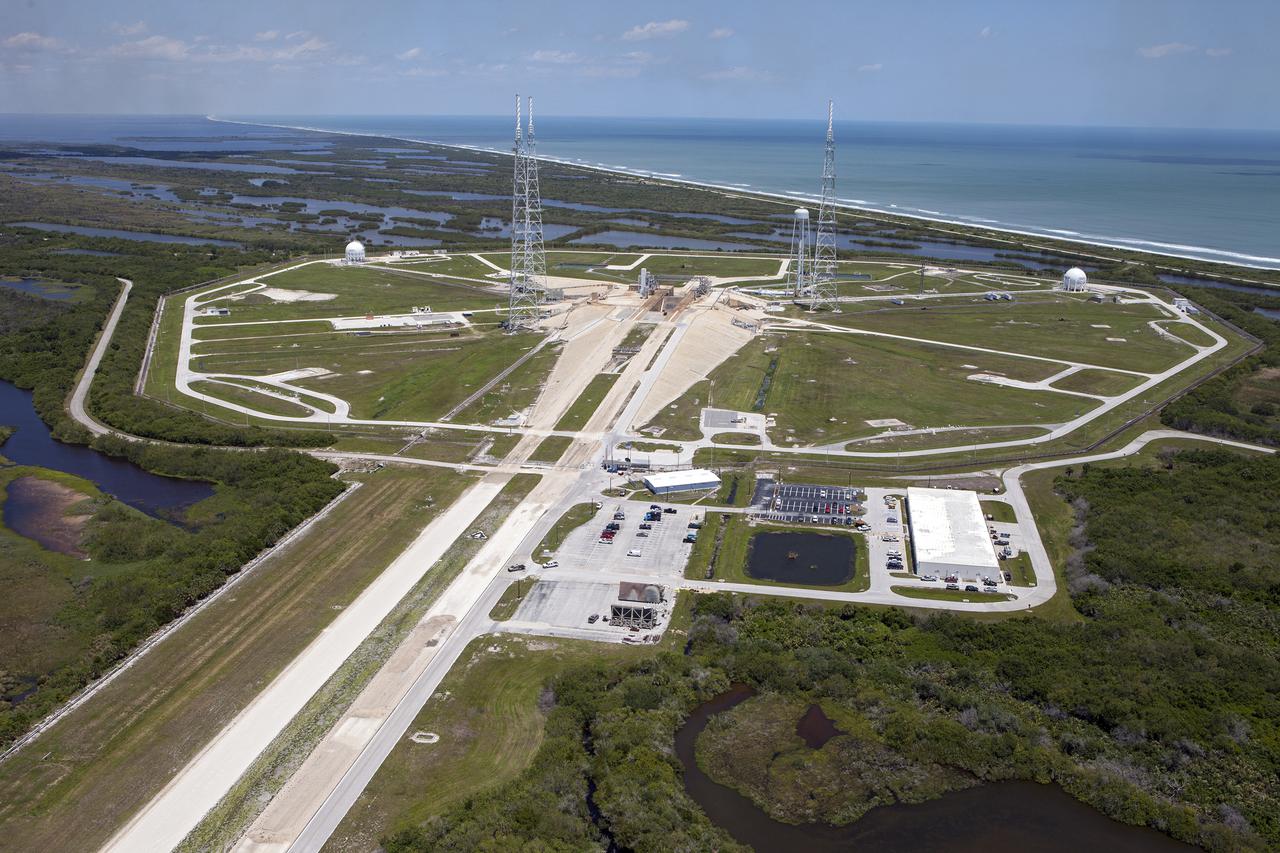
CAPE CANAVERAL, Fla. – An aerial view, from the southwest looking toward the northeast, shows the entire Launch Pad 39B area at NASA’s Kennedy Space Center in Florida with the Atlantic Ocean in the background. A new elevator has been constructed on the surface of the pad and the crawlerway leading up to the surface is being repaired. Repairs also are being made to the crawler track panels and catacomb roof below on either side of the flame trench. Also in view are the water tower and the three tall lightning towers that surround the pad. Upgrades are underway at Pad B and other facilities in the Launch Complex 39 area. The Ground Systems Development and Operations, or GSDO, Program office at Kennedy is leading the center’s transformation from a historically government-only launch complex to a spaceport that can safely handle a variety of rockets and spacecraft, including NASA’s Space Launch System. For more information about GSDO, visit: http:__go.nasa.gov_groundsystems. Photo credit: NASA_Kim Shiflett
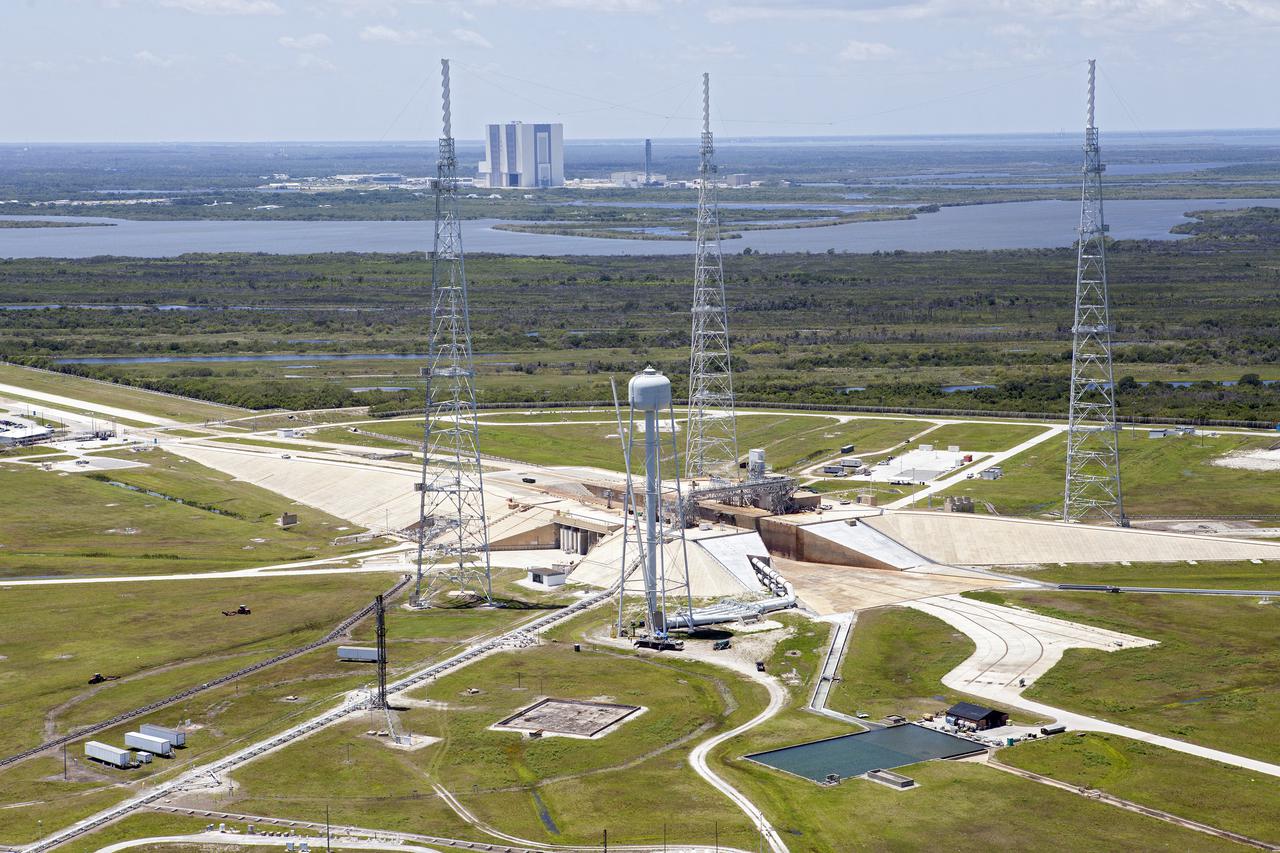
CAPE CANAVERAL, Fla. – An aerial view shows construction progress at Launch Pad 39B at NASA’s Kennedy Space Center in Florida. A new elevator has been constructed on the surface of the pad and the crawlerway leading up to the surface is being repaired. Repairs also are being made to the crawler track panels and catacomb roof below on either side of the flame trench. Also in view are the water tower and the three tall lightning towers that surround the pad. In the background is the Vehicle Assembly Building. Upgrades are underway at Pad B and other facilities in the Launch Complex 39 area. The Ground Systems Development and Operations, or GSDO, Program office at Kennedy is leading the center’s transformation from a historically government-only launch complex to a spaceport that can safely handle a variety of rockets and spacecraft, including NASA’s Space Launch System. For more information about GSDO, visit: http:__go.nasa.gov_groundsystems. Photo credit: NASA_Kim Shiflett
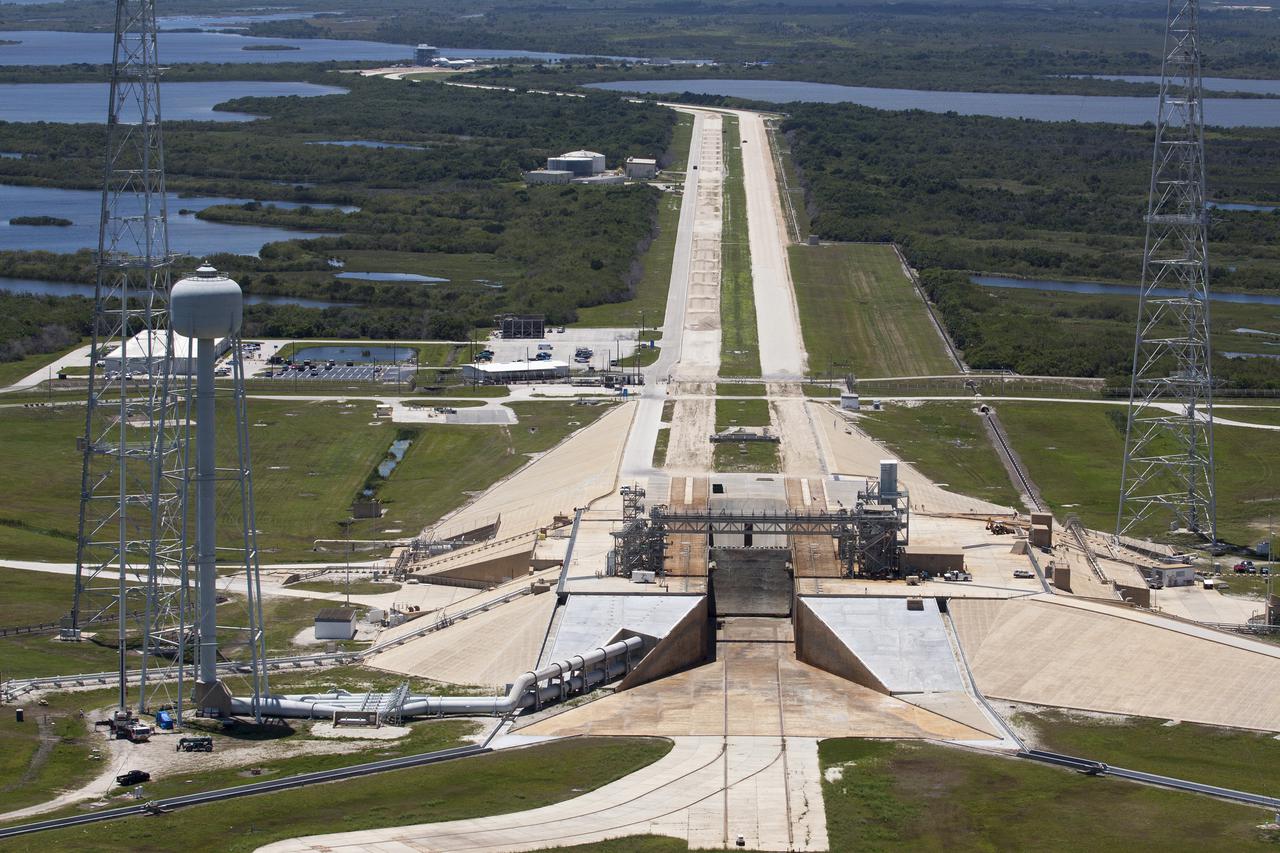
CAPE CANAVERAL, Fla. – An aerial view shows construction progress at Launch Pad 39B at NASA’s Kennedy Space Center in Florida. A new elevator has been constructed on the surface of the pad and the crawlerway leading up to the surface is being repaired. Repairs also are being made to the crawler track panels and catacomb roof below on either side of the flame trench. Also in view are the water tower and two of the three tall lightning towers that surround the pad. Upgrades are underway at Pad B and other facilities in the Launch Complex 39 area. The Ground Systems Development and Operations, or GSDO, Program office at Kennedy is leading the center’s transformation from a historically government-only launch complex to a spaceport that can safely handle a variety of rockets and spacecraft, including NASA’s Space Launch System. For more information about GSDO, visit: http:__go.nasa.gov_groundsystems. Photo credit: NASA_Kim Shiflett
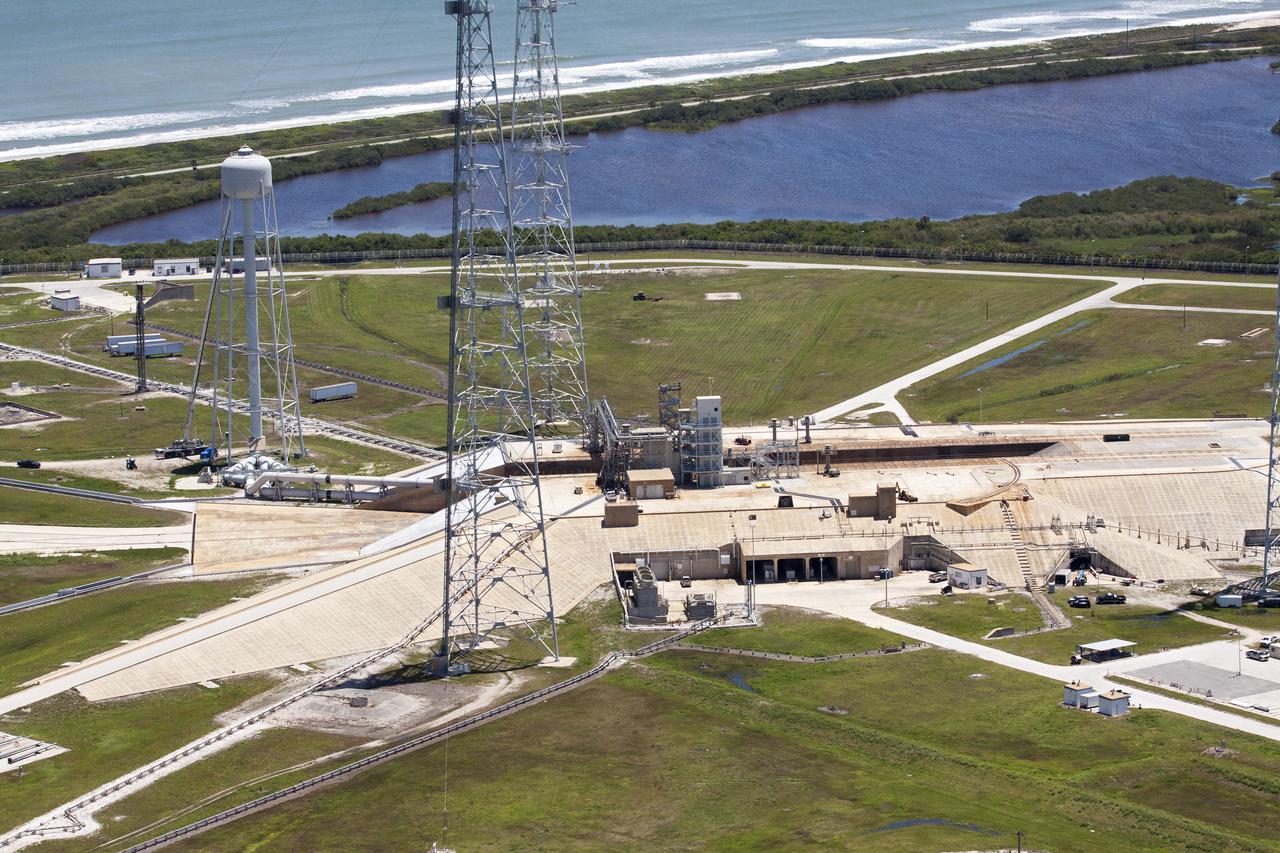
CAPE CANAVERAL, Fla. – An aerial view shows construction progress at Launch Pad 39B at NASA’s Kennedy Space Center in Florida. A new elevator has been constructed on the surface of the pad and the crawlerway leading up to the surface is being repaired. Repairs also are being made to the crawler track panels and catacomb roof below on either side of the flame trench. Also in view are the water tower and two of the three tall lightning towers that surround the pad. Upgrades are underway at Pad B and other facilities in the Launch Complex 39 area. The Ground Systems Development and Operations, or GSDO, Program office at Kennedy is leading the center’s transformation from a historically government-only launch complex to a spaceport that can safely handle a variety of rockets and spacecraft, including NASA’s Space Launch System. For more information about GSDO, visit: http:__go.nasa.gov_groundsystems. Photo credit: NASA_Kim Shiflett
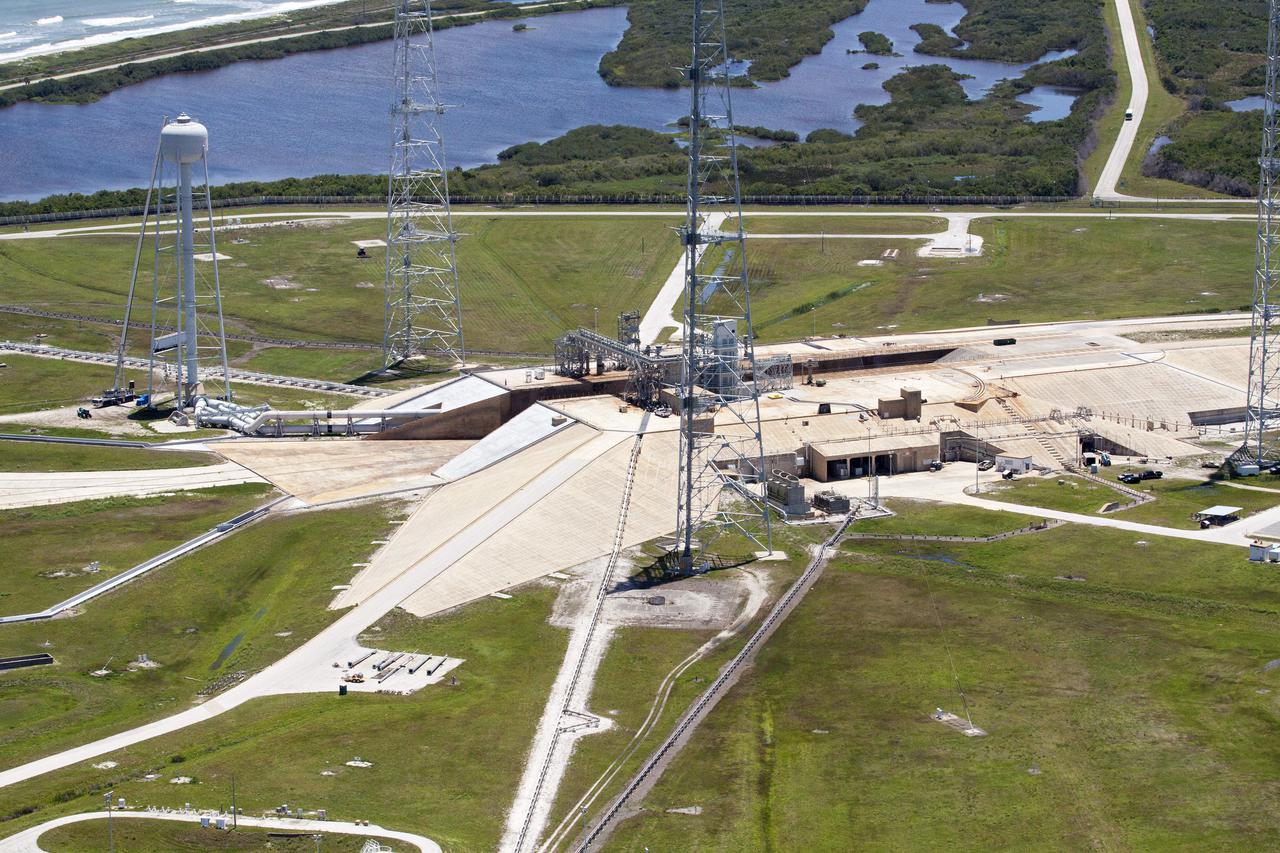
CAPE CANAVERAL, Fla. – An aerial view shows construction progress at Launch Pad 39B at NASA’s Kennedy Space Center in Florida. A new elevator has been constructed on the surface of the pad and the crawlerway leading up to the surface is being repaired. Repairs also are being made to the crawler track panels and catacomb roof below on either side of the flame trench. Also in view are the water tower and two of the three tall lightning towers that surround the pad. Upgrades are underway at Pad B and other facilities in the Launch Complex 39 area. The Ground Systems Development and Operations, or GSDO, Program office at Kennedy is leading the center’s transformation from a historically government-only launch complex to a spaceport that can safely handle a variety of rockets and spacecraft, including NASA’s Space Launch System. For more information about GSDO, visit: http:__go.nasa.gov_groundsystems. Photo credit: NASA_Kim Shiflett
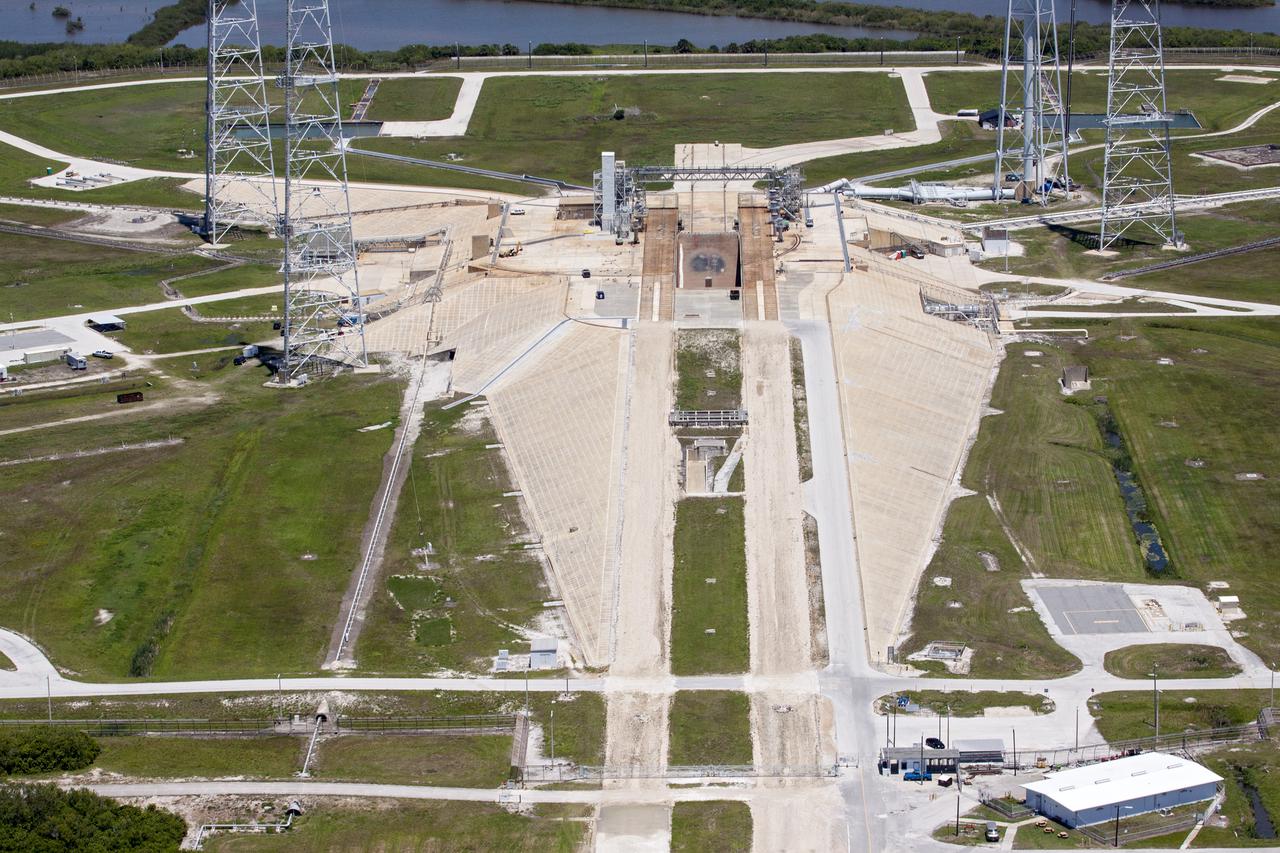
CAPE CANAVERAL, Fla. – An aerial view shows construction progress at Launch Pad 39B at NASA’s Kennedy Space Center in Florida. A new elevator has been constructed on the surface of the pad and the crawlerway leading up to the surface is being repaired. Repairs also are being made to the crawler track panels and catacomb roof below on either side of the flame trench. Also in view are the water tower and the three tall lightning towers that surround the pad. Upgrades are underway at Pad B and other facilities in the Launch Complex 39 area. The Ground Systems Development and Operations, or GSDO, Program office at Kennedy is leading the center’s transformation from a historically government-only launch complex to a spaceport that can safely handle a variety of rockets and spacecraft, including NASA’s Space Launch System. For more information about GSDO, visit: http:__go.nasa.gov_groundsystems. Photo credit: NASA_Kim Shiflett
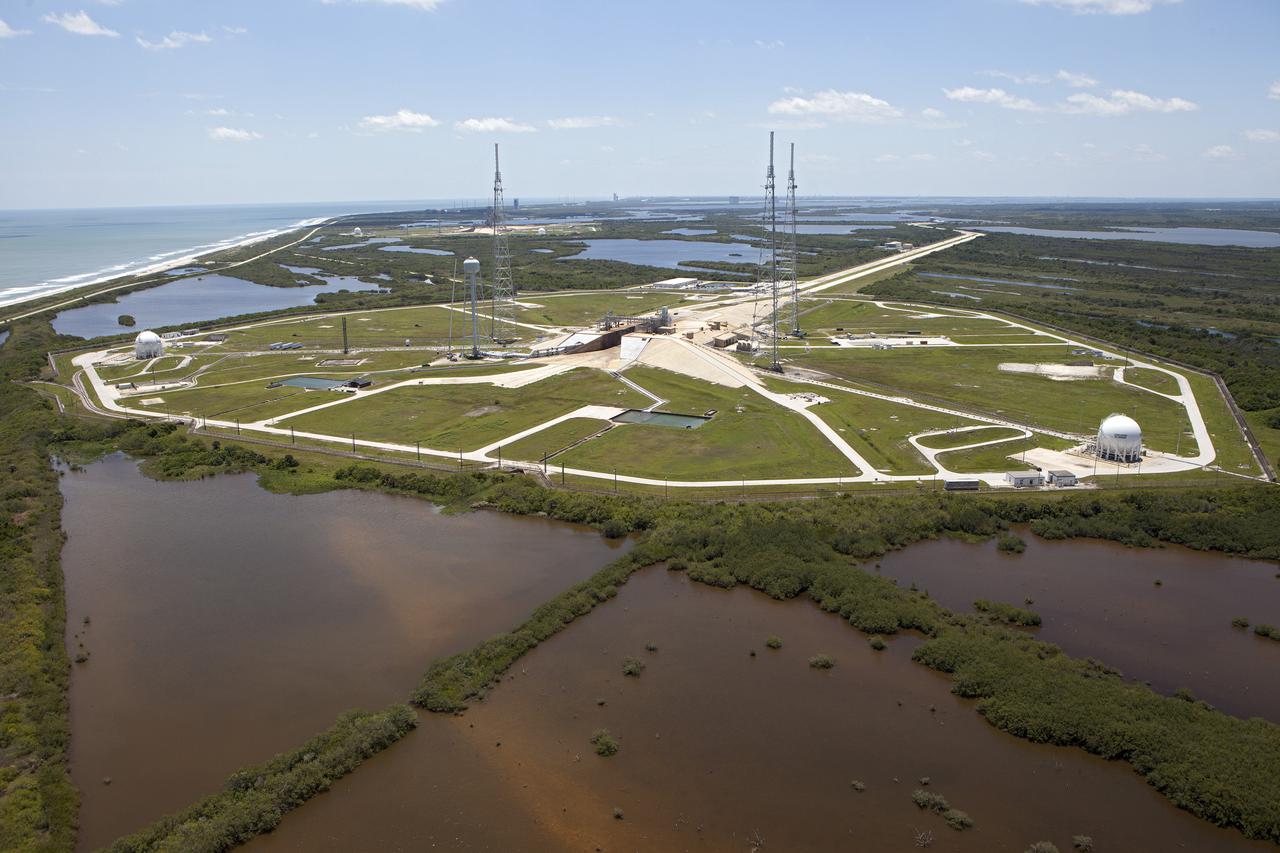
CAPE CANAVERAL, Fla. – An aerial view, from the west looking toward the east, shows the entire Launch Pad 39B area at NASA’s Kennedy Space Center in Florida. A new elevator has been constructed on the surface of the pad and the crawlerway leading up to the surface is being repaired. Repairs also are being made to the crawler track panels and catacomb roof below on either side of the flame trench. Also in view are the water tower and the three tall lightning towers that surround the pad. To the east is the Atlantic Ocean. Upgrades are underway at Pad B and other facilities in the Launch Complex 39 area. The Ground Systems Development and Operations, or GSDO, Program office at Kennedy is leading the center’s transformation from a historically government-only launch complex to a spaceport that can safely handle a variety of rockets and spacecraft, including NASA’s Space Launch System. For more information about GSDO, visit: http:__go.nasa.gov_groundsystems. Photo credit: NASA_Kim Shiflett
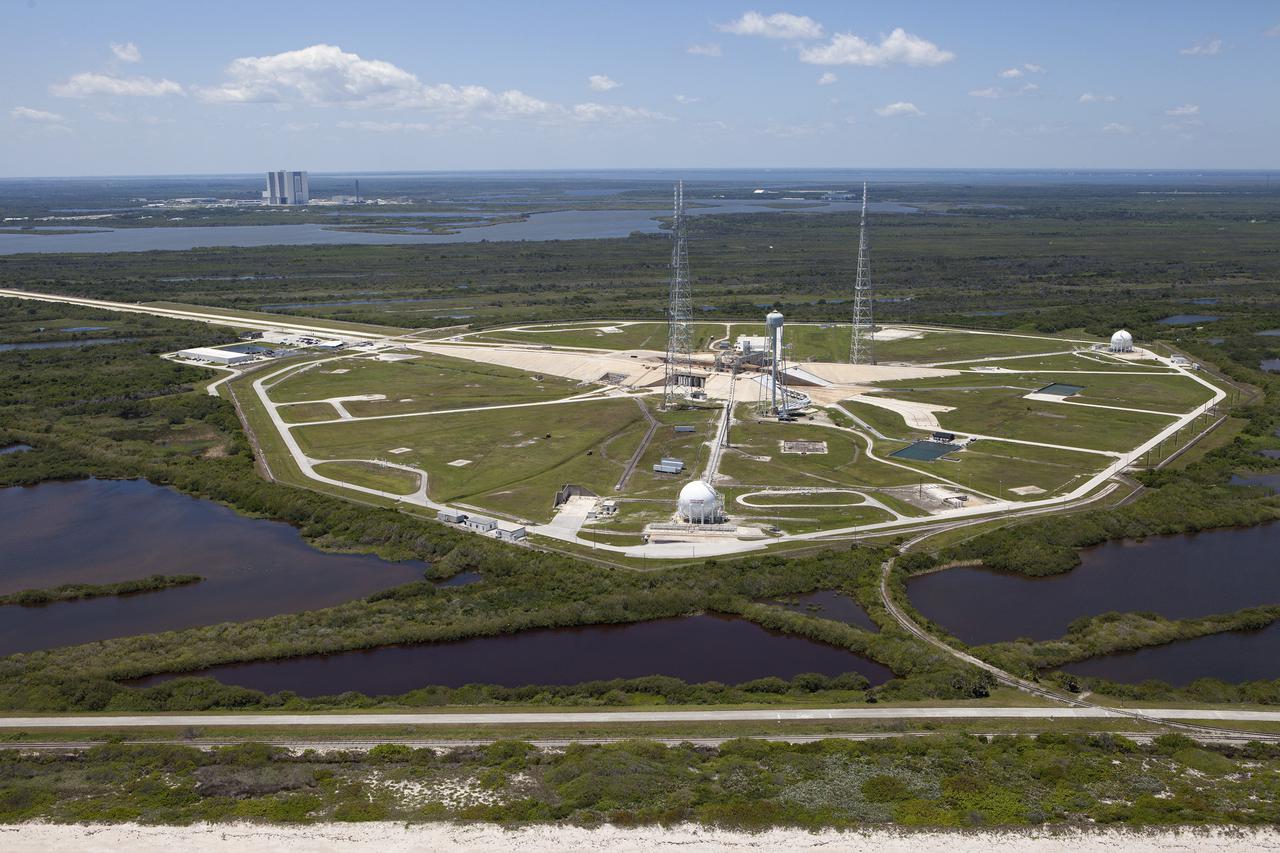
CAPE CANAVERAL, Fla. – An aerial view, from the east looking toward the west, shows the entire Launch Pad 39B area at NASA’s Kennedy Space Center in Florida. A new elevator has been constructed on the surface of the pad and the crawlerway leading up to the surface is being repaired. Repairs also are being made to the crawler track panels and catacomb roof below on either side of the flame trench. Also in view are the water tower and the three tall lightning towers that surround the pad. To the left, in the background is the Vehicle Assembly Building. Upgrades are underway at Pad B and other facilities in the Launch Complex 39 area. The Ground Systems Development and Operations, or GSDO, Program office at Kennedy is leading the center’s transformation from a historically government-only launch complex to a spaceport that can safely handle a variety of rockets and spacecraft, including NASA’s Space Launch System. For more information about GSDO, visit: http:__go.nasa.gov_groundsystems. Photo credit: NASA_Kim Shiflett
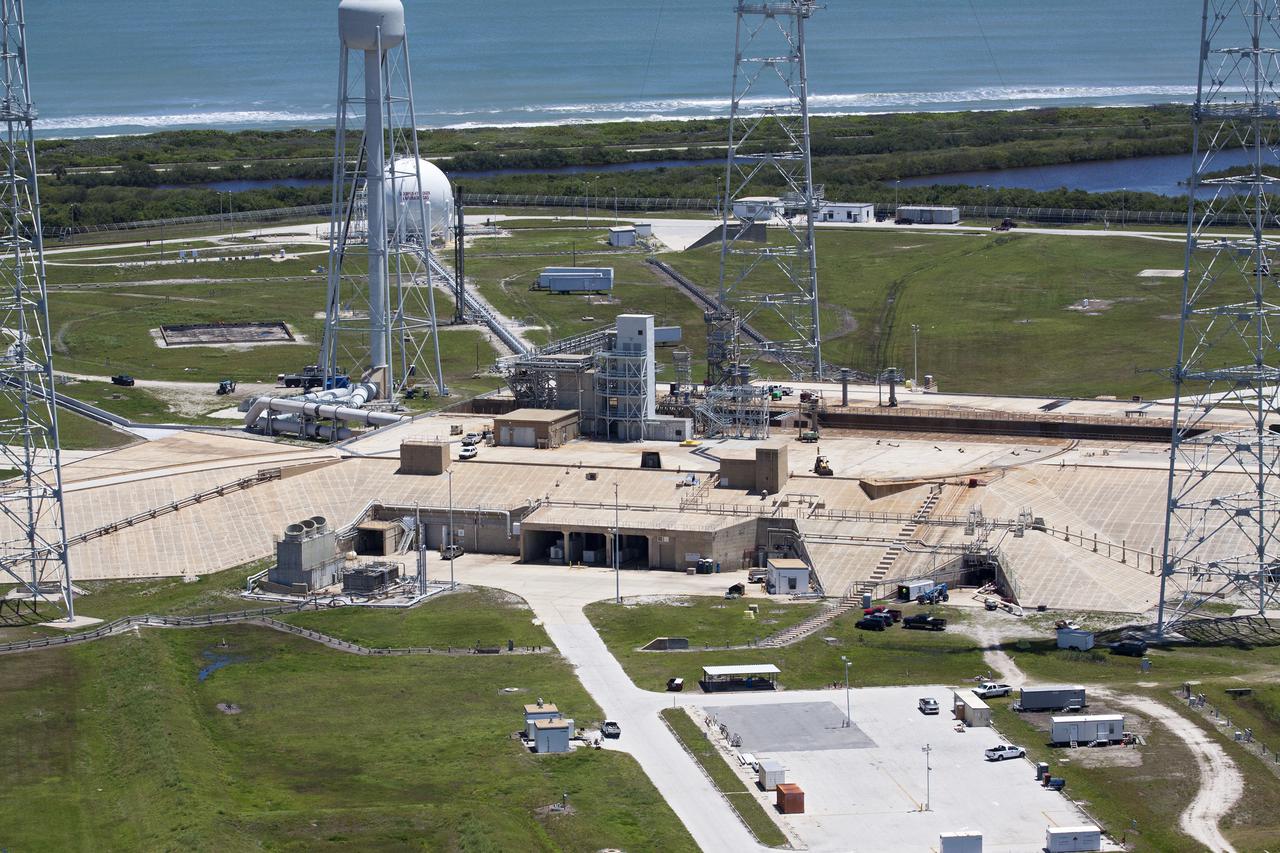
CAPE CANAVERAL, Fla. – An aerial view shows construction progress at Launch Pad 39B at NASA’s Kennedy Space Center in Florida. A new elevator has been constructed on the surface of the pad and the crawlerway leading up to the surface is being repaired. Repairs also are being made to the crawler track panels and catacomb roof below on either side of the flame trench. Also in view are portions of the water tower and the three tall lightning towers that surround the pad. Upgrades are underway at Pad B and other facilities in the Launch Complex 39 area. The Ground Systems Development and Operations, or GSDO, Program office at Kennedy is leading the center’s transformation from a historically government-only launch complex to a spaceport that can safely handle a variety of rockets and spacecraft, including NASA’s Space Launch System. For more information about GSDO, visit: http:__go.nasa.gov_groundsystems. Photo credit: NASA_Kim Shiflett
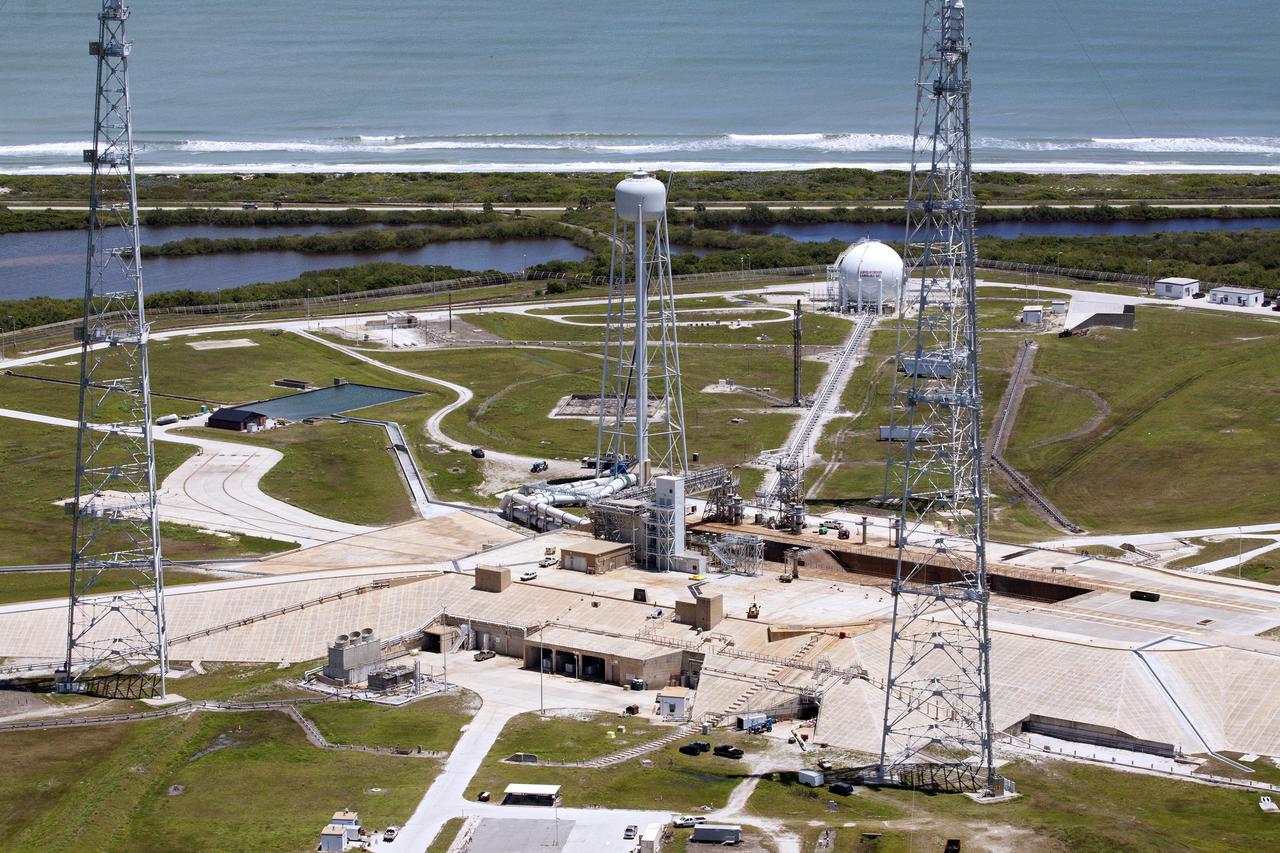
CAPE CANAVERAL, Fla. – An aerial view shows construction progress at Launch Pad 39B at NASA’s Kennedy Space Center in Florida. A new elevator has been constructed on the surface of the pad and the crawlerway leading up to the surface is being repaired. Repairs also are being made to the crawler track panels and catacomb roof below on either side of the flame trench. Also in view are the water tower and two of the three tall lightning towers that surround the pad. Upgrades are underway at Pad B and other facilities in the Launch Complex 39 area. The Ground Systems Development and Operations, or GSDO, Program office at Kennedy is leading the center’s transformation from a historically government-only launch complex to a spaceport that can safely handle a variety of rockets and spacecraft, including NASA’s Space Launch System. For more information about GSDO, visit: http:__go.nasa.gov_groundsystems. Photo credit: NASA_Kim Shiflett
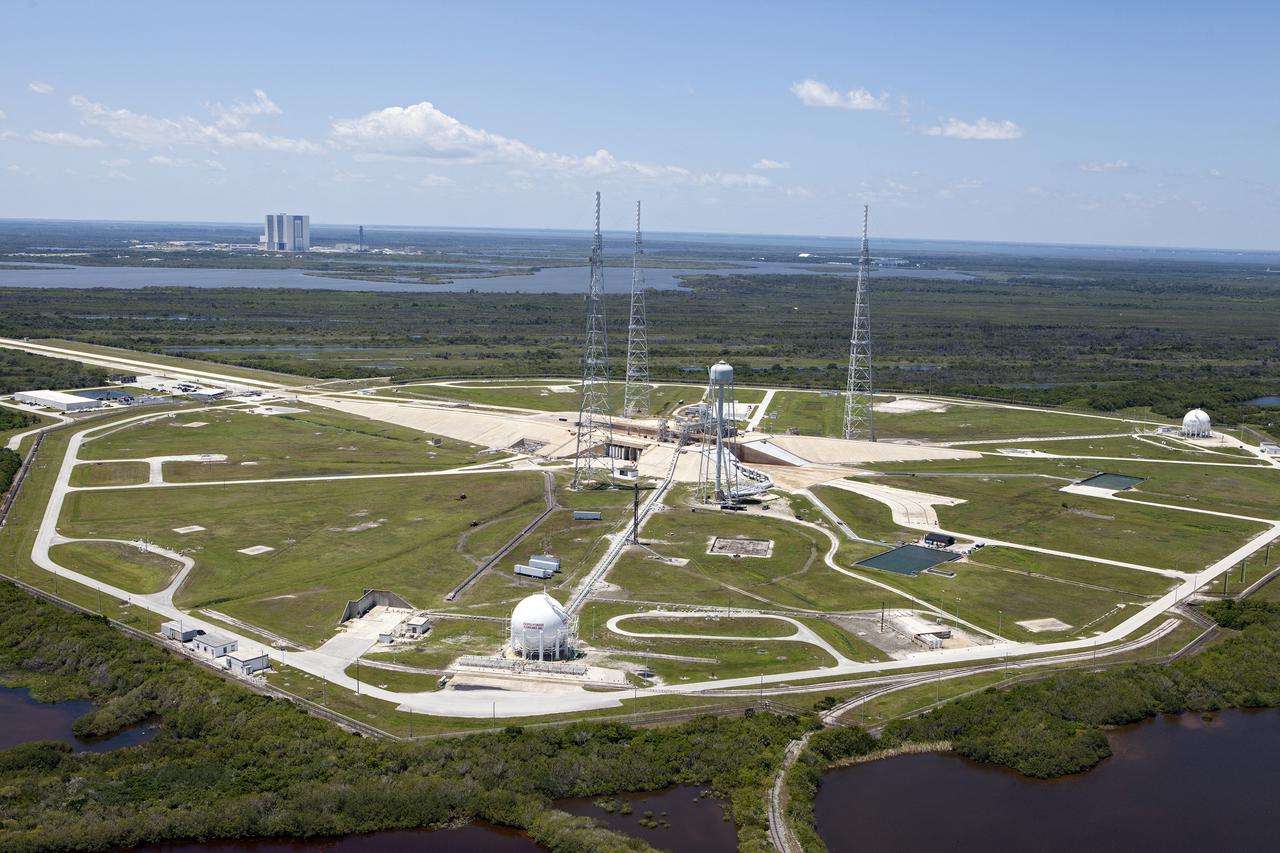
CAPE CANAVERAL, Fla. – An aerial view shows Launch Pad 39B at NASA’s Kennedy Space Center in Florida. A new elevator has been constructed on the surface of the pad and the crawlerway leading up to the surface is being repaired. Repairs also are being made to the crawler track panels and catacomb roof below on either side of the flame trench. Also in view are the water tower and the three tall lightning towers that surround the pad. To the left, in the background is the Vehicle Assembly Building. Upgrades are underway at Pad B and other facilities in the Launch Complex 39 area. The Ground Systems Development and Operations, or GSDO, Program office at Kennedy is leading the center’s transformation from a historically government-only launch complex to a spaceport that can safely handle a variety of rockets and spacecraft, including NASA’s Space Launch System. For more information about GSDO, visit: http:__go.nasa.gov_groundsystems. Photo credit: NASA_Kim Shiflett
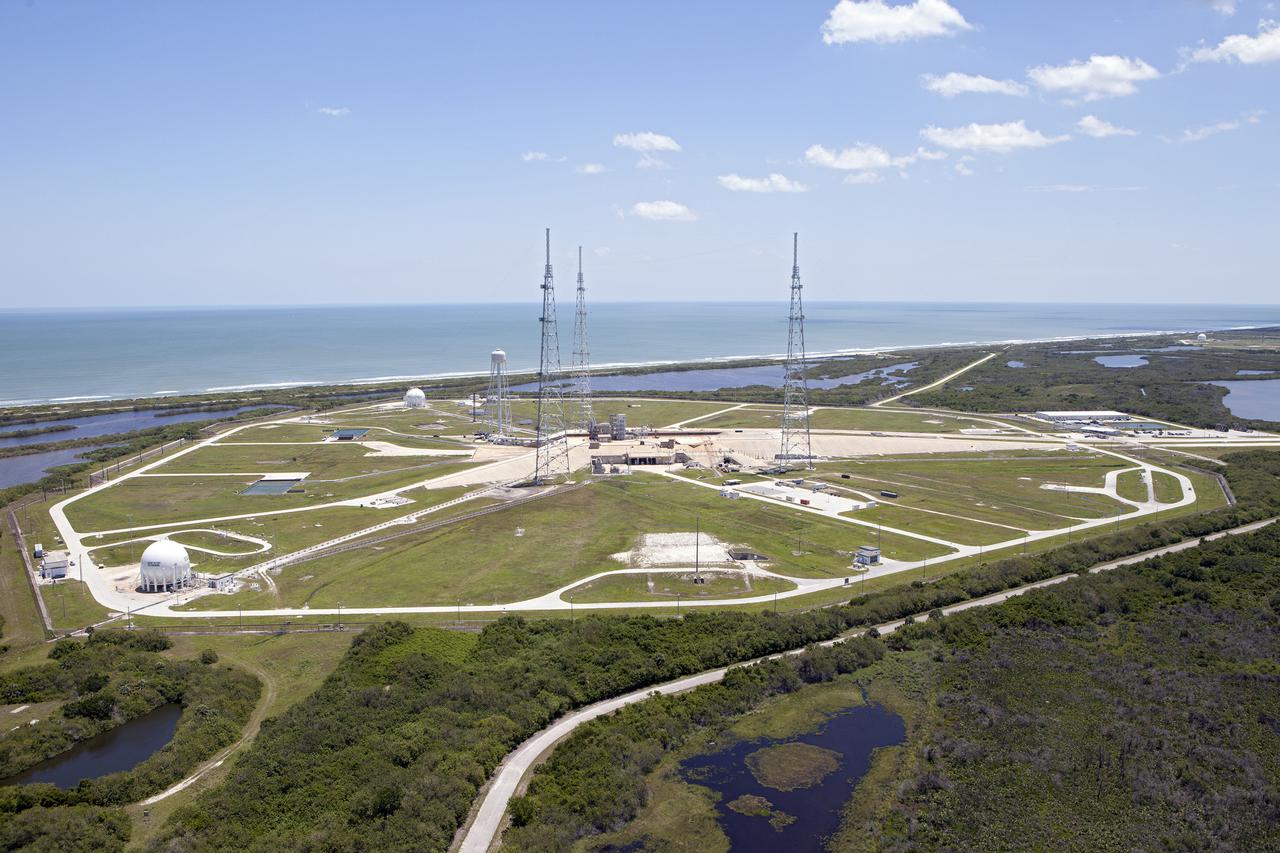
CAPE CANAVERAL, Fla. – An aerial view, from the west looking toward the east, shows the entire Launch Pad 39B area at NASA’s Kennedy Space Center in Florida. A new elevator has been constructed on the surface of the pad and the crawlerway leading up to the surface is being repaired. Repairs also are being made to the crawler track panels and catacomb roof below on either side of the flame trench. Also in view are the water tower and the three tall lightning towers that surround the pad. To the east is the Atlantic Ocean. Upgrades are underway at Pad B and other facilities in the Launch Complex 39 area. The Ground Systems Development and Operations, or GSDO, Program office at Kennedy is leading the center’s transformation from a historically government-only launch complex to a spaceport that can safely handle a variety of rockets and spacecraft, including NASA’s Space Launch System. For more information about GSDO, visit: http:__go.nasa.gov_groundsystems. Photo credit: NASA_Kim Shiflett
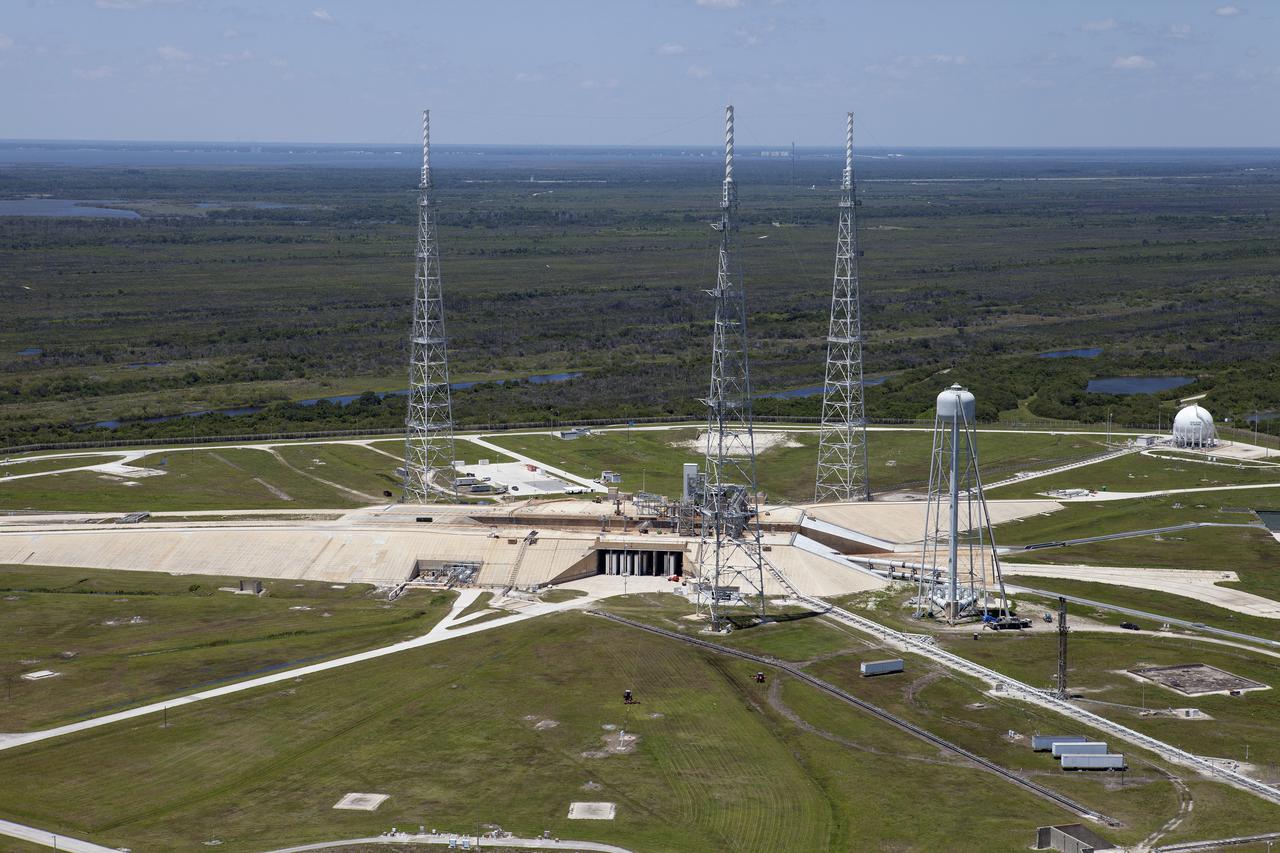
CAPE CANAVERAL, Fla. – An aerial view shows construction progress at Launch Pad 39B at NASA’s Kennedy Space Center in Florida. A new elevator has been constructed on the surface of the pad and the crawlerway leading up to the surface is being repaired. Repairs also are being made to the crawler track panels and catacomb roof below on either side of the flame trench. Also in view are the water tower and the three tall lightning towers that surround the pad. Upgrades are underway at Pad B and other facilities in the Launch Complex 39 area. The Ground Systems Development and Operations, or GSDO, Program office at Kennedy is leading the center’s transformation from a historically government-only launch complex to a spaceport that can safely handle a variety of rockets and spacecraft, including NASA’s Space Launch System. For more information about GSDO, visit: http:__go.nasa.gov_groundsystems. Photo credit: NASA_Kim Shiflett
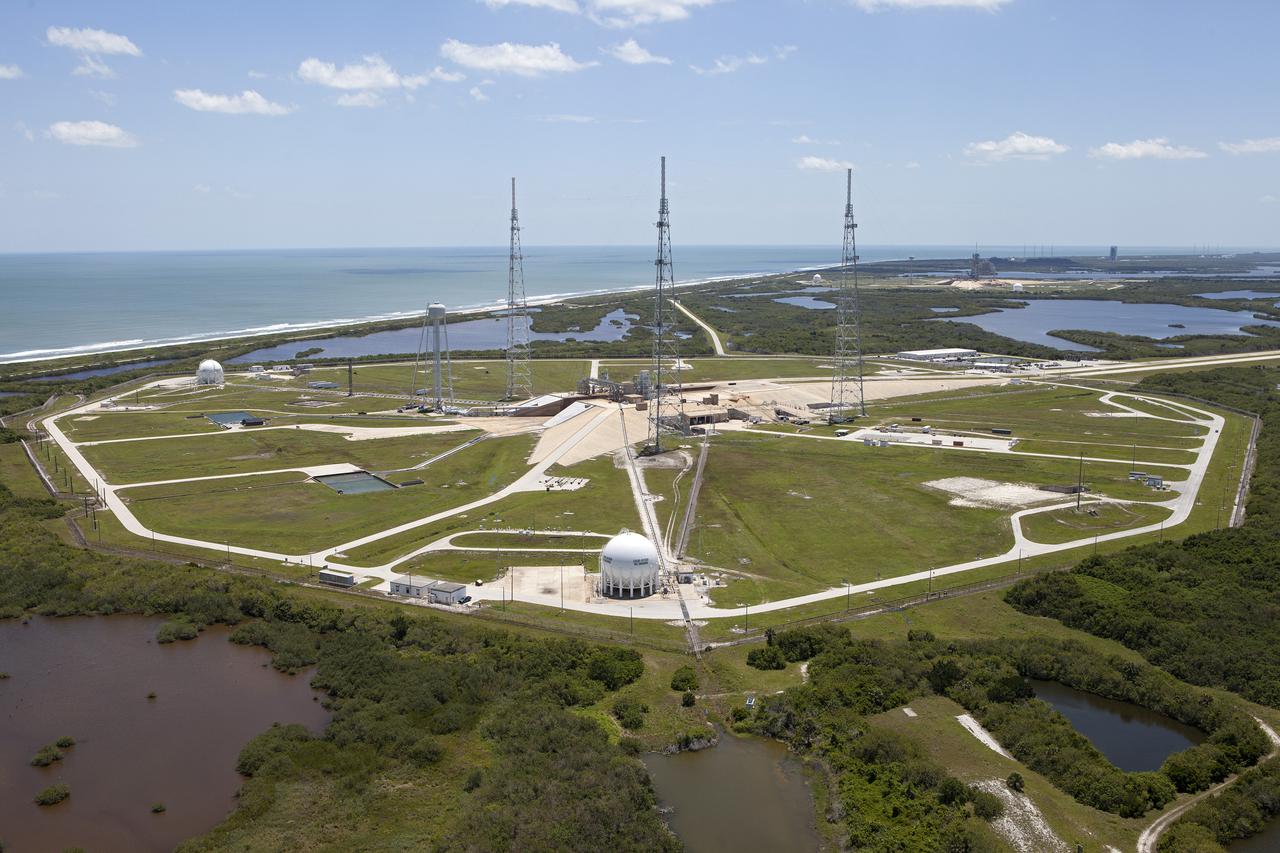
CAPE CANAVERAL, Fla. – An aerial view, from the west looking toward the east, shows the entire Launch Pad 39B area at NASA’s Kennedy Space Center in Florida. A new elevator has been constructed on the surface of the pad and the crawlerway leading up to the surface is being repaired. Repairs also are being made to the crawler track panels and catacomb roof below on either side of the flame trench. Also in view are the water tower and the three tall lightning towers that surround the pad. To the east is the Atlantic Ocean. Upgrades are underway at Pad B and other facilities in the Launch Complex 39 area. The Ground Systems Development and Operations, or GSDO, Program office at Kennedy is leading the center’s transformation from a historically government-only launch complex to a spaceport that can safely handle a variety of rockets and spacecraft, including NASA’s Space Launch System. For more information about GSDO, visit: http:__go.nasa.gov_groundsystems. Photo credit: NASA_Kim Shiflett
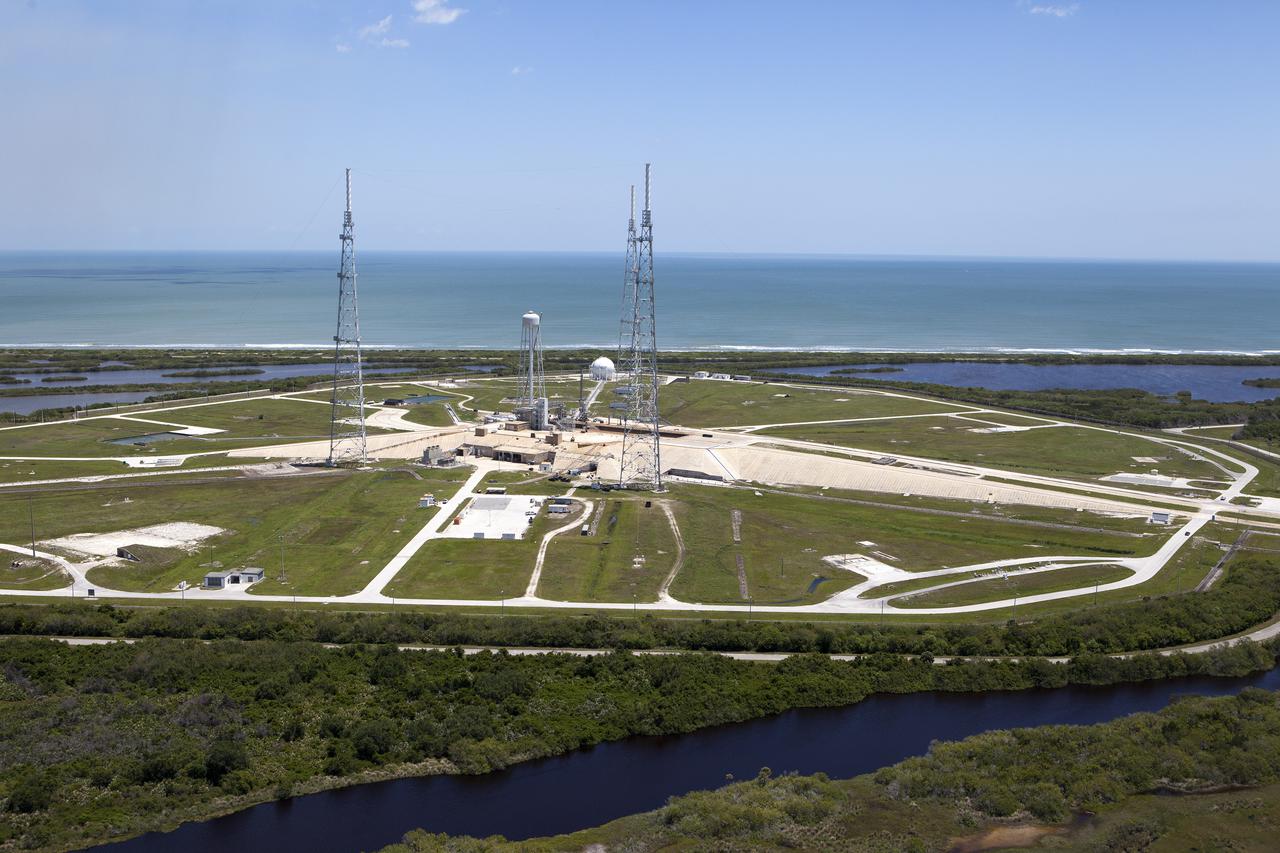
CAPE CANAVERAL, Fla. – An aerial view, from the west looking toward the east, shows the Launch Pad 39B area at NASA’s Kennedy Space Center in Florida. A new elevator has been constructed on the surface of the pad and the crawlerway leading up to the surface is being repaired. Repairs also are being made to the crawler track panels and catacomb roof below on either side of the flame trench. Also in view are the water tower and the three tall lightning towers that surround the pad. To the east is the Atlantic Ocean. Upgrades are underway at Pad B and other facilities in the Launch Complex 39 area. The Ground Systems Development and Operations, or GSDO, Program office at Kennedy is leading the center’s transformation from a historically government-only launch complex to a spaceport that can safely handle a variety of rockets and spacecraft, including NASA’s Space Launch System. For more information about GSDO, visit: http:__go.nasa.gov_groundsystems. Photo credit: NASA_Kim Shiflett
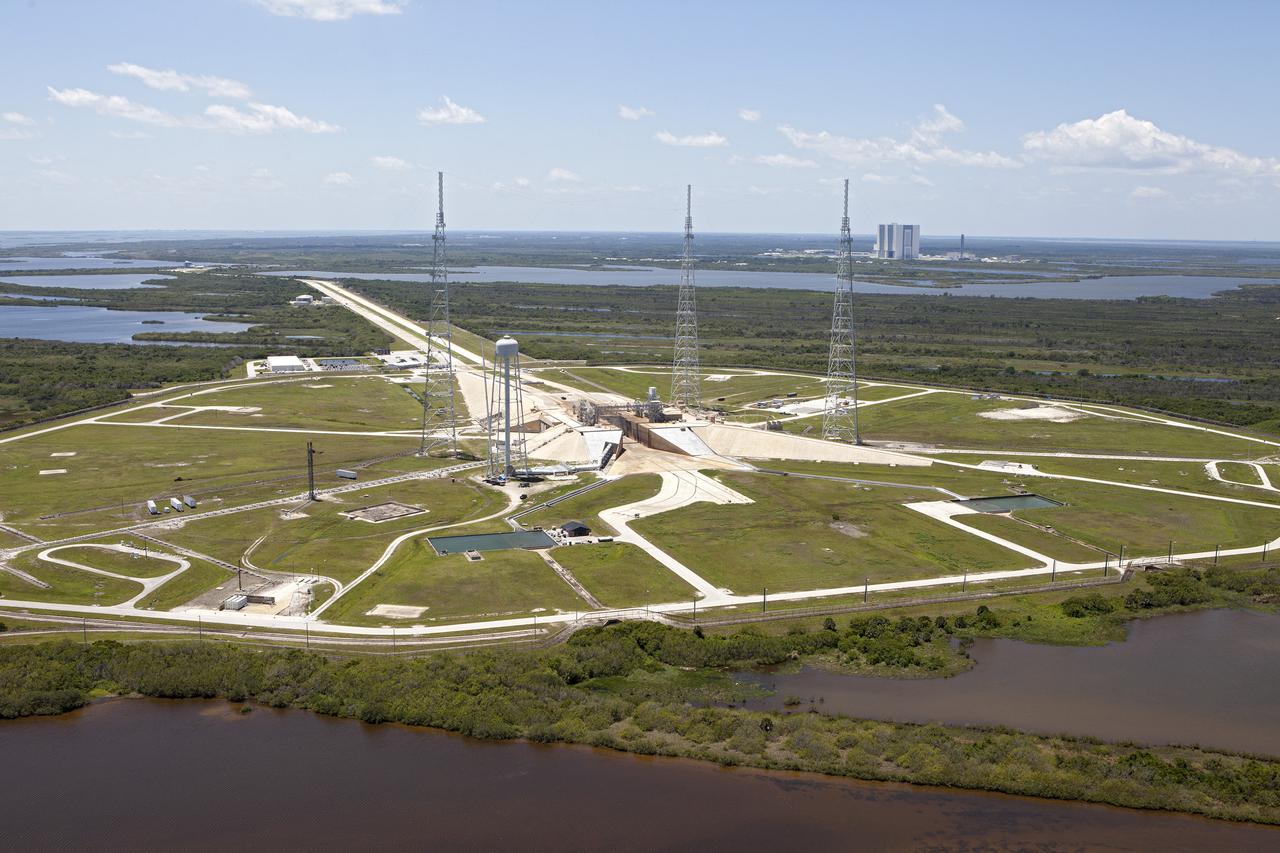
CAPE CANAVERAL, Fla. – An aerial view shows construction progress at Launch Pad 39B at NASA’s Kennedy Space Center in Florida. A new elevator has been constructed on the surface of the pad and the crawlerway leading up to the surface is being repaired. Repairs also are being made to the crawler track panels and catacomb roof below on either side of the flame trench. Also in view are the water tower and the three tall lightning towers that surround the pad. To the right, in the background is the Vehicle Assembly Building. Upgrades are underway at Pad B and other facilities in the Launch Complex 39 area. The Ground Systems Development and Operations, or GSDO, Program office at Kennedy is leading the center’s transformation from a historically government-only launch complex to a spaceport that can safely handle a variety of rockets and spacecraft, including NASA’s Space Launch System. For more information about GSDO, visit: http:__go.nasa.gov_groundsystems. Photo credit: NASA_Kim Shiflett
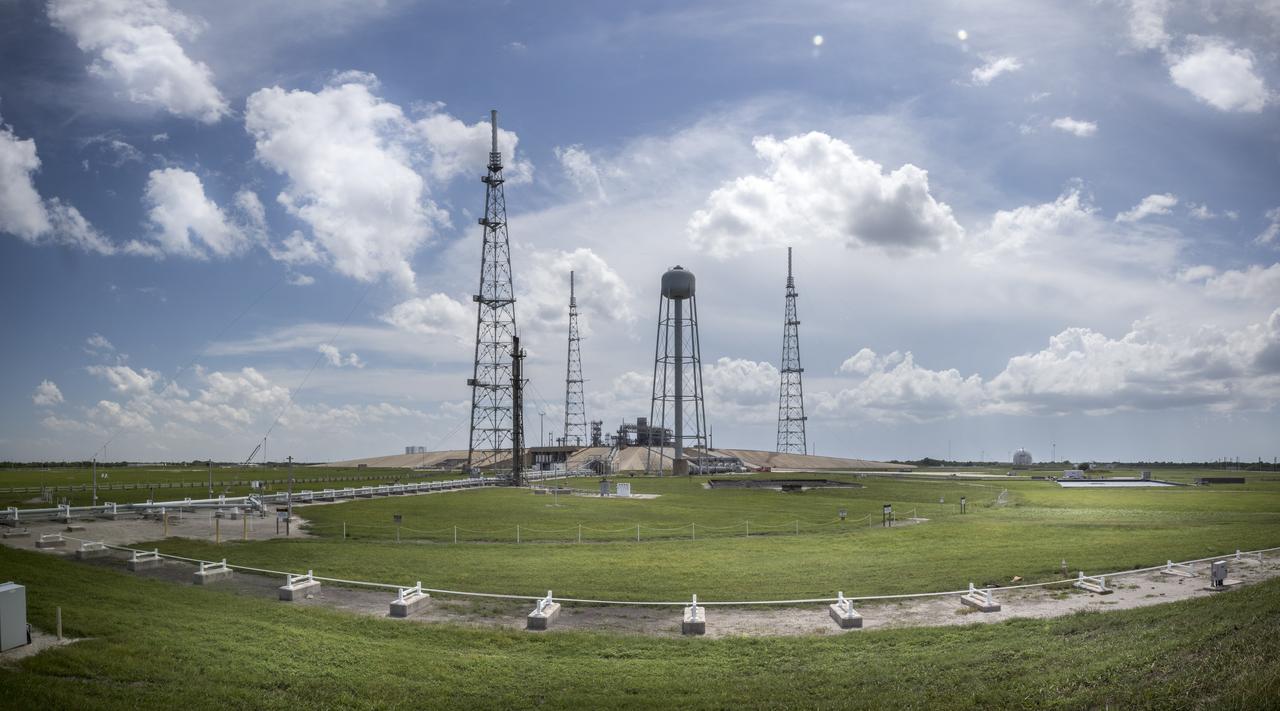
A full view of Launch Pad 39B at NASA's Kennedy Space Center in Florida on July 26, 2018. The launch pad has undergone upgrades and modifications to accommodate NASA's Space Launch System and Orion spacecraft for Exploration Mission-1 and other deep space missions. New heat-resistant bricks have been installed on the walls and a new flame deflector is in place. In view are the three lightning protection system towers and water tank. The clean pad concept is designed to support NASA and commercial launch providers at the multi-user spaceport.
CAPE CANAVERAL, Fla. – The deconstruction of Launch Pad 39B at NASA’s Kennedy Space Center in Florida is complete. Still remaining are remnants of the fixed service structure and the water tower used for sound suppression. In 2009, the structure at the pad was no longer needed for NASA's Space Shuttle Program, so it is being restructured for future use. The new design will feature a "clean pad" for rockets to come with their own launcher, making it more versatile for a number of vehicles. For information on NASA's future plans, visit http://www.nasa.gov/exploration. Photo credit: NASA/Jim Grossmann
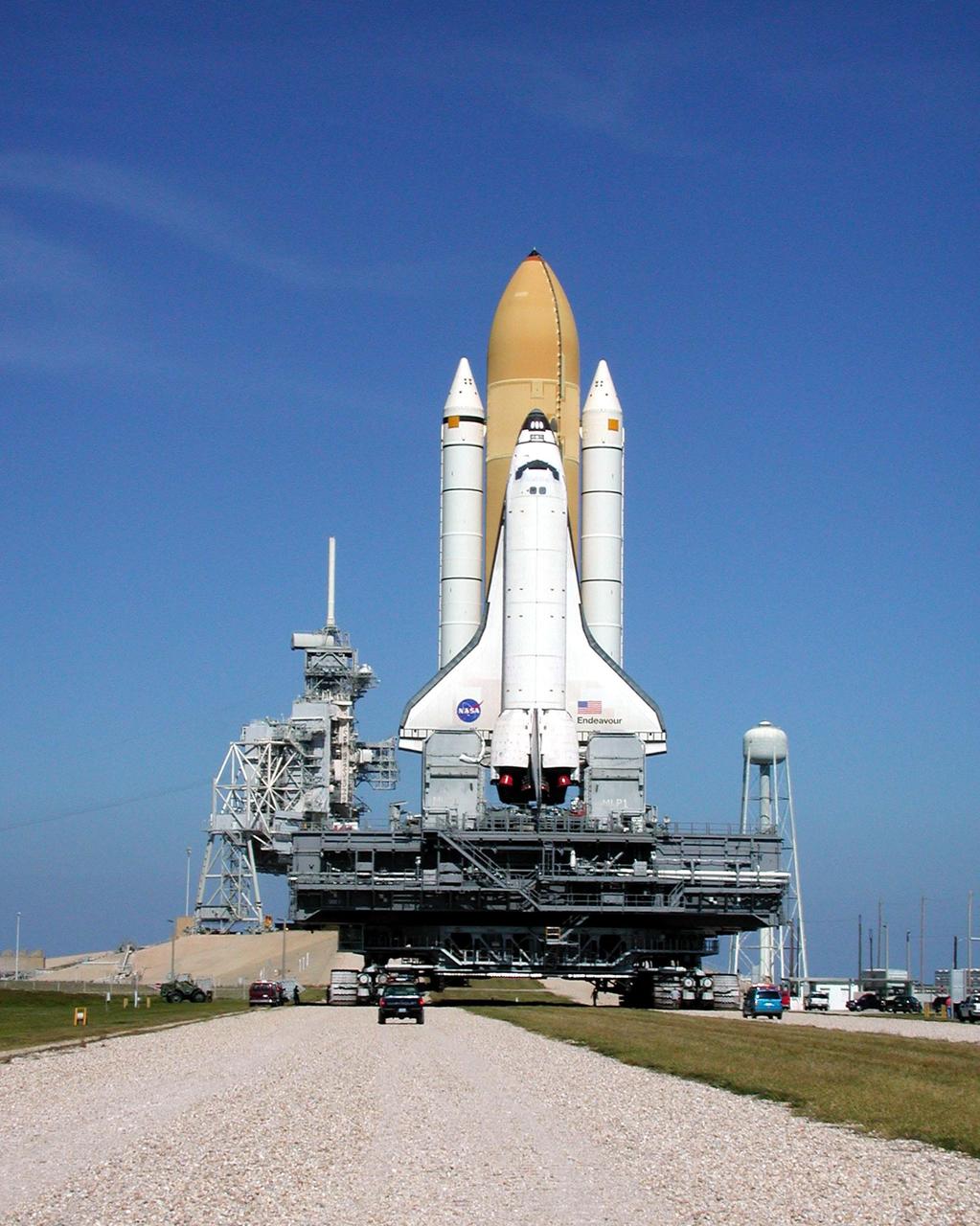
KENNEDY SPACE CENTER, Fla. -- Perched atop the Mobile Launcher Platform, Space Shuttle Endeavour is nearly through the gate to Launch Pad 39B. To the right of the pad is a 290-foot tall water tower. To the left is the Fixed Service Structure and Rotating Service Structure. Endeavour is scheduled to be launched Nov. 30 at 10:01 p.m. EST on mission STS-97, the sixth construction flight to the International Space Station. Its payload includes the P6 Integrated Truss Structure and a photovoltaic (PV) module, with giant solar arrays that will provide power to the Station. The mission includes two spacewalks to complete the solar array connections
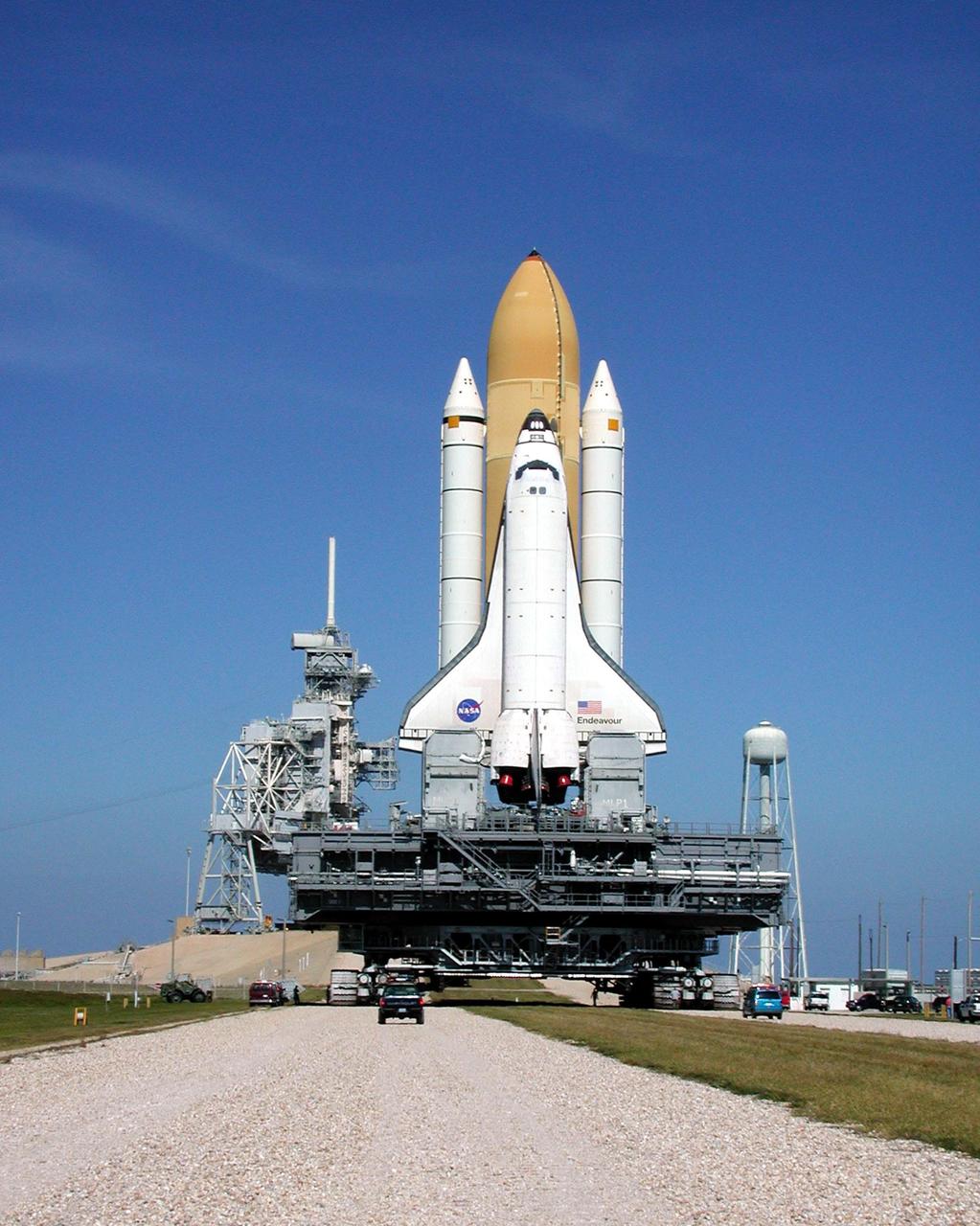
KENNEDY SPACE CENTER, Fla. -- Perched atop the Mobile Launcher Platform, Space Shuttle Endeavour is nearly through the gate to Launch Pad 39B. To the right of the pad is a 290-foot tall water tower. To the left is the Fixed Service Structure and Rotating Service Structure. Endeavour is scheduled to be launched Nov. 30 at 10:01 p.m. EST on mission STS-97, the sixth construction flight to the International Space Station. Its payload includes the P6 Integrated Truss Structure and a photovoltaic (PV) module, with giant solar arrays that will provide power to the Station. The mission includes two spacewalks to complete the solar array connections
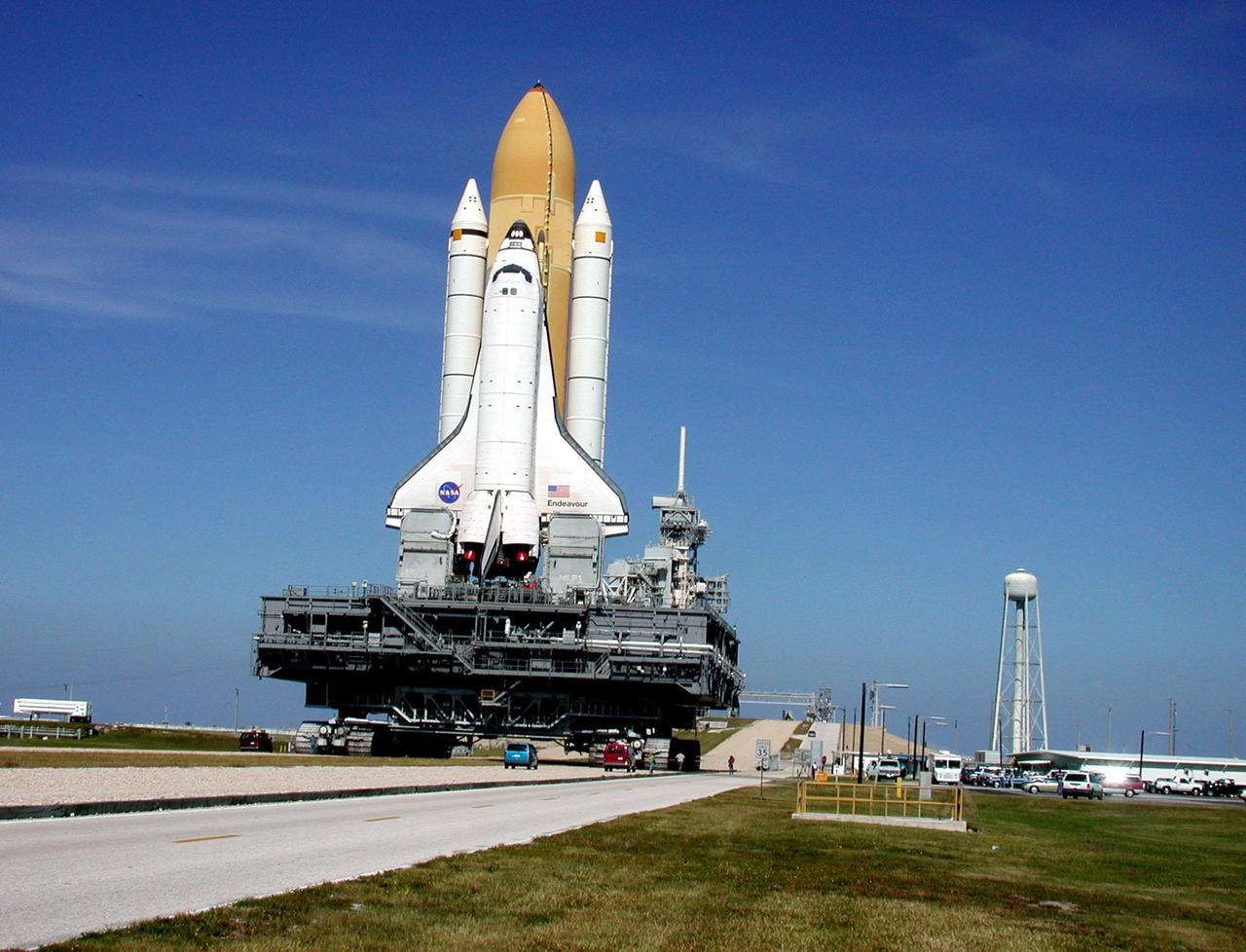
KENNEDY SPACE CENTER, Fla. -- Perched atop the Mobile Launcher Platform, Space Shuttle Endeavour approaches the gate to Launch Pad 39B. To the right of the pad is a 290-foot tall water tower. Endeavour is scheduled to be launched Nov. 30 at 10:01 p.m. EST on mission STS-97, the sixth construction flight to the International Space Station. Its payload includes the P6 Integrated Truss Structure and a photovoltaic (PV) module, with giant solar arrays that will provide power to the Station. The mission includes two spacewalks to complete the solar array connections
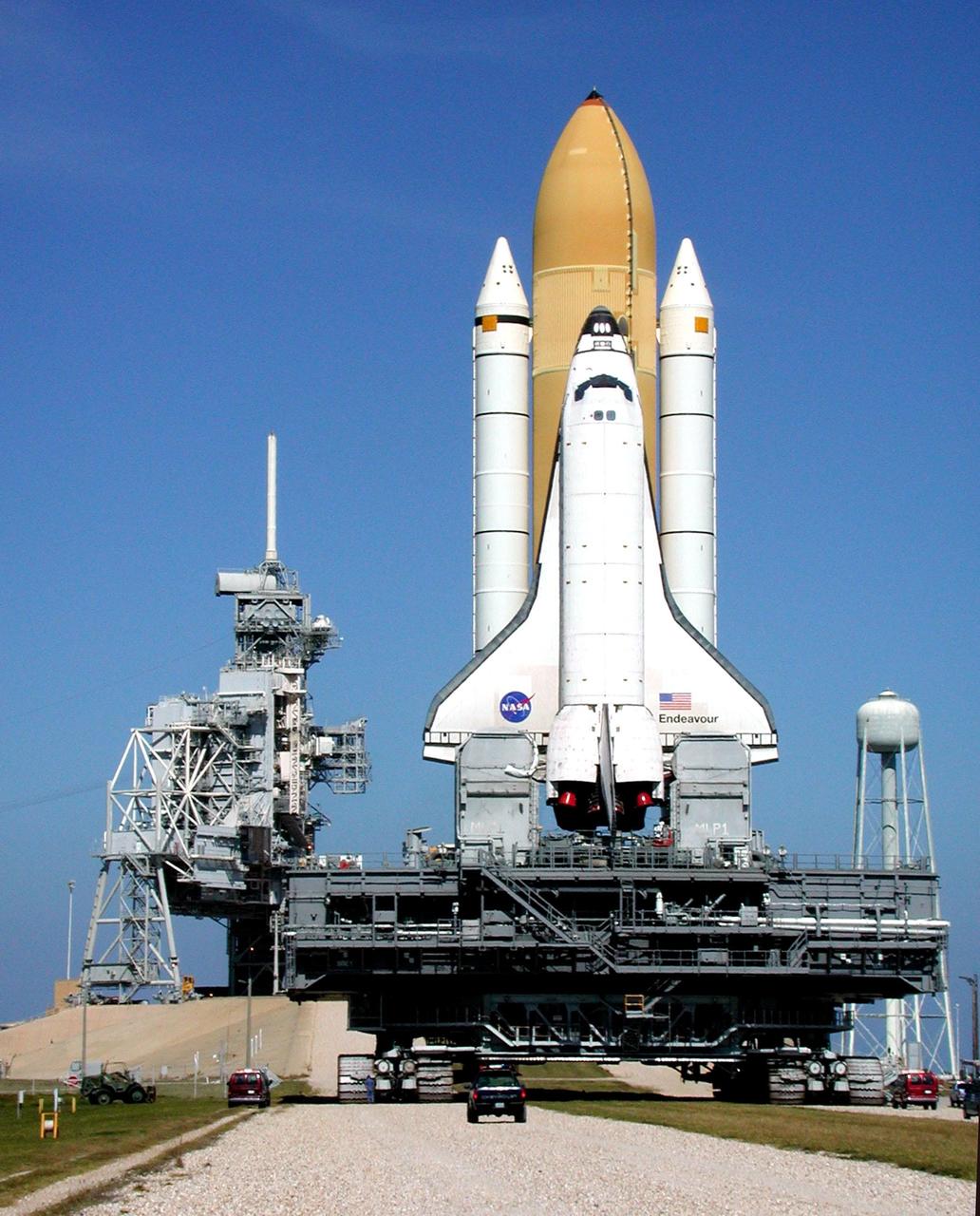
KENNEDY SPACE CENTER, Fla. -- Perched atop the Mobile Launcher Platform, Space Shuttle Endeavour passes through the gate to Launch Pad 39B. To the right of the pad is a 290-foot tall water tower. To the left is the Fixed Service Structure and Rotating Service Structure. Endeavour is scheduled to be launched Nov. 30 at 10:01 p.m. EST on mission STS-97, the sixth construction flight to the International Space Station. Its payload includes the P6 Integrated Truss Structure and a photovoltaic (PV) module, with giant solar arrays that will provide power to the Station. The mission includes two spacewalks to complete the solar array connections
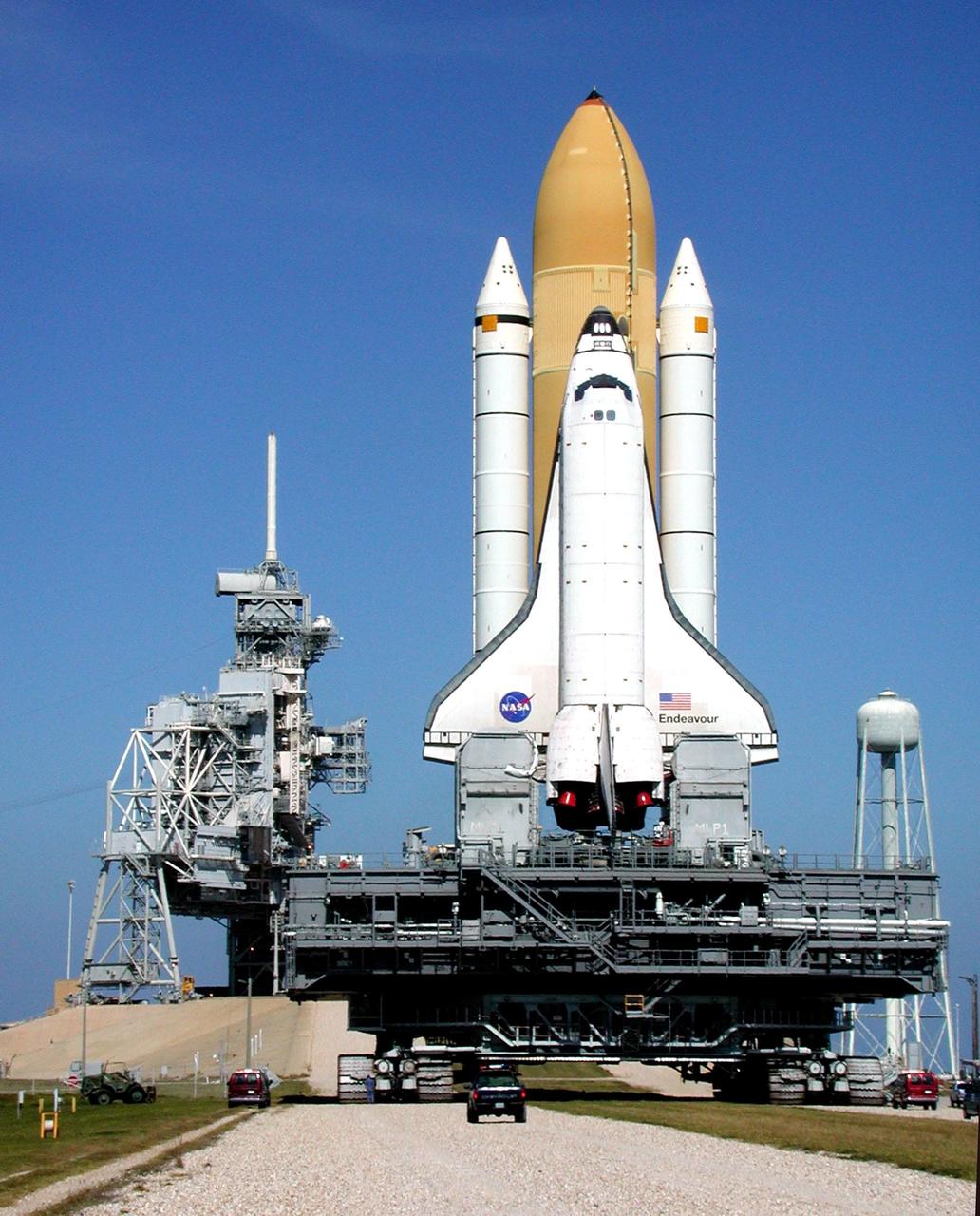
KENNEDY SPACE CENTER, Fla. -- Perched atop the Mobile Launcher Platform, Space Shuttle Endeavour passes through the gate to Launch Pad 39B. To the right of the pad is a 290-foot tall water tower. To the left is the Fixed Service Structure and Rotating Service Structure. Endeavour is scheduled to be launched Nov. 30 at 10:01 p.m. EST on mission STS-97, the sixth construction flight to the International Space Station. Its payload includes the P6 Integrated Truss Structure and a photovoltaic (PV) module, with giant solar arrays that will provide power to the Station. The mission includes two spacewalks to complete the solar array connections
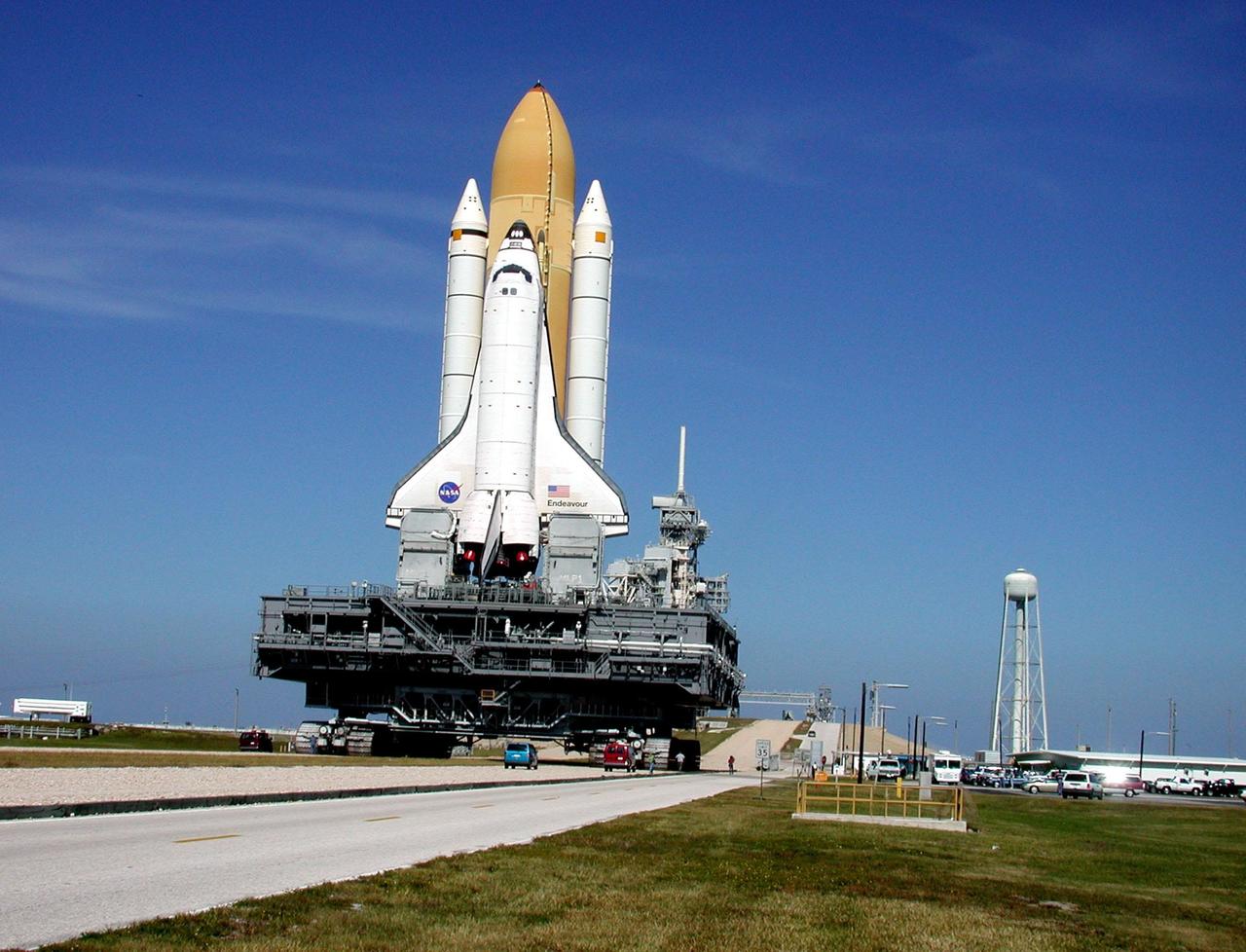
KENNEDY SPACE CENTER, Fla. -- Perched atop the Mobile Launcher Platform, Space Shuttle Endeavour approaches the gate to Launch Pad 39B. To the right of the pad is a 290-foot tall water tower. Endeavour is scheduled to be launched Nov. 30 at 10:01 p.m. EST on mission STS-97, the sixth construction flight to the International Space Station. Its payload includes the P6 Integrated Truss Structure and a photovoltaic (PV) module, with giant solar arrays that will provide power to the Station. The mission includes two spacewalks to complete the solar array connections
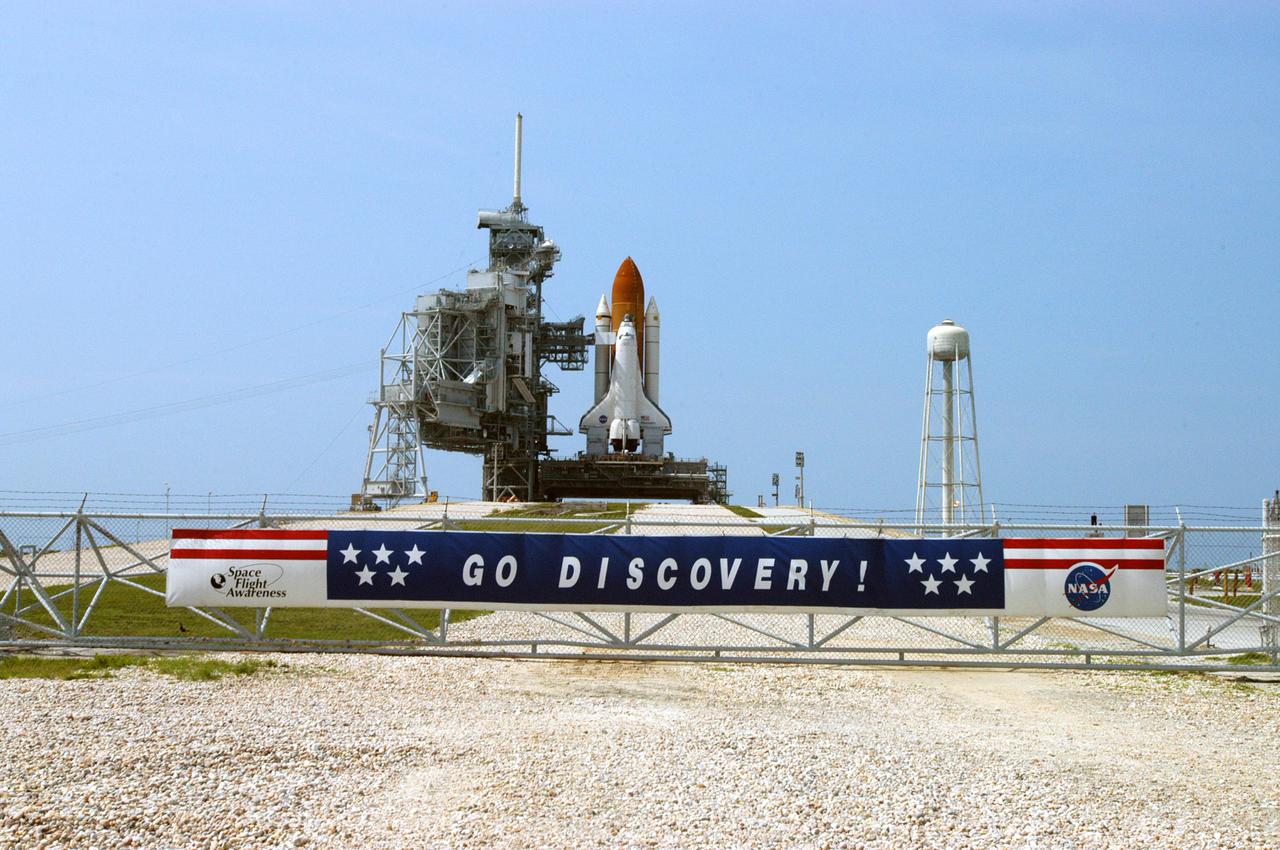
KENNEDY SPACE CENTER, FLA. - On Launch Pad 39B, Space Shuttle Discovery is revealed after rollback of the Rotating Service Structure. At right of the pad is the 290-foot-tall water tower that holds 300,000 gallons of water, part of the sound suppression system during a launch. Discovery will be rolled back to the Vehicle Assembly Building. Once inside the VAB, Discovery will be demated from its External Tank and lifted into the transfer aisle. On or about June 7, Discovery will be lifted and attached to its new tank and Solid Rocket Boosters, which are already in the VAB. Only the 15th rollback in Space Shuttle Program history, the 4.2-mile journey allows additional modifications to be made to the External Tank prior to a safe Return to Flight. Discovery is expected to be rolled back to the launch pad in mid-June for Return to Flight mission STS-114. The launch window extends from July 13 to July 31.
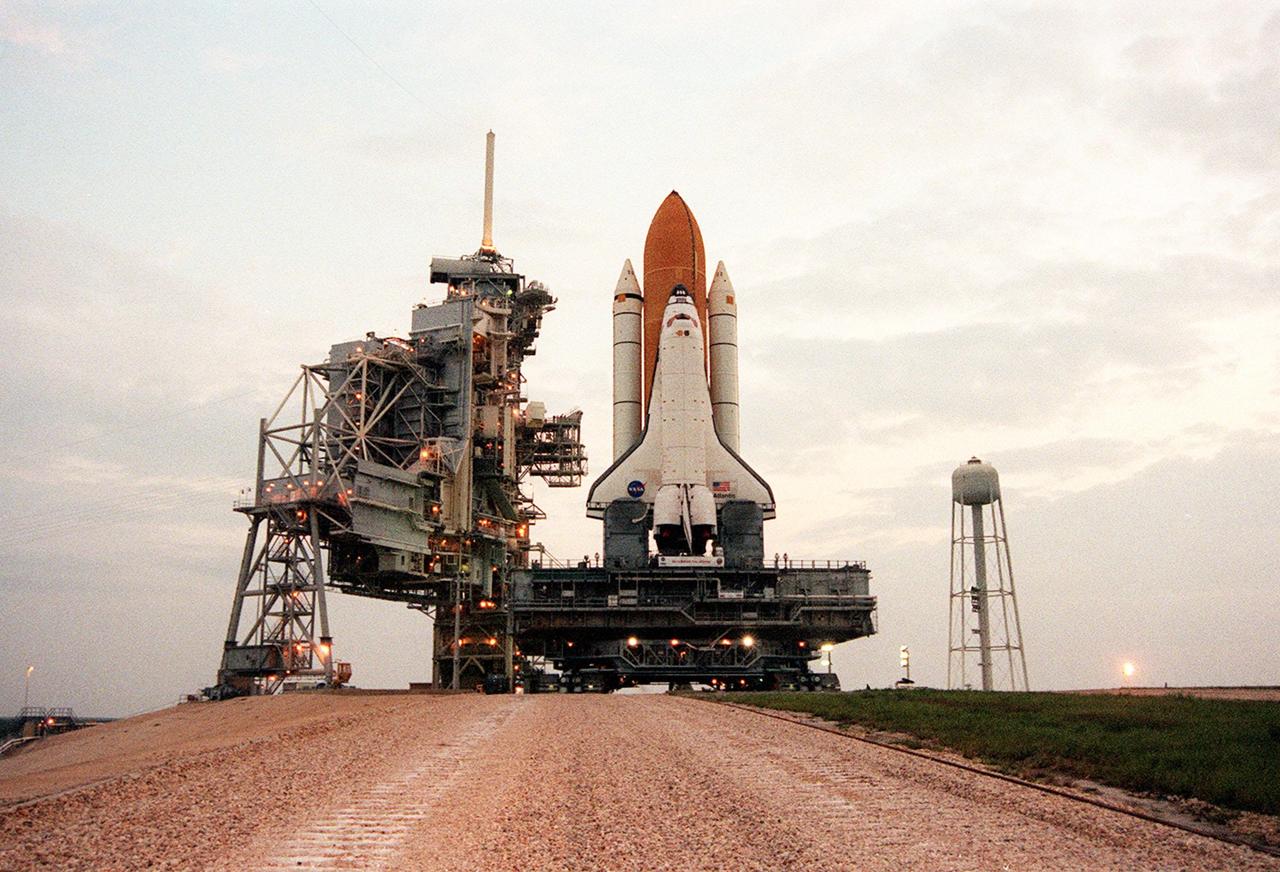
KENNEDY SPACE CENTER, Fla. -- The sun creeps over the horizon (right) as Space Shuttle Atlantis, atop the Mobile Launcher Platform and Crawler-Transporter, arrives at Launch Pad 39B for preparations before launch. It started its 8-hour rollout from the Vehicle Assembly Building high bay 2 (Safe Haven) at 11:20 p.m., Aug. 13. At left is the Rotating Service Structure in its open position. Towering above the RSS (and attached to the Fixed Service Structure) is the 80-foot tall lightning mast. At right is the 290-foot high water tank that holds 300,000 gallons of water. It is part of the sound suppression system at the pad. Atlantis is scheduled for launch Sept. 8 at 8:31 a.m. EDT on mission STS-106.
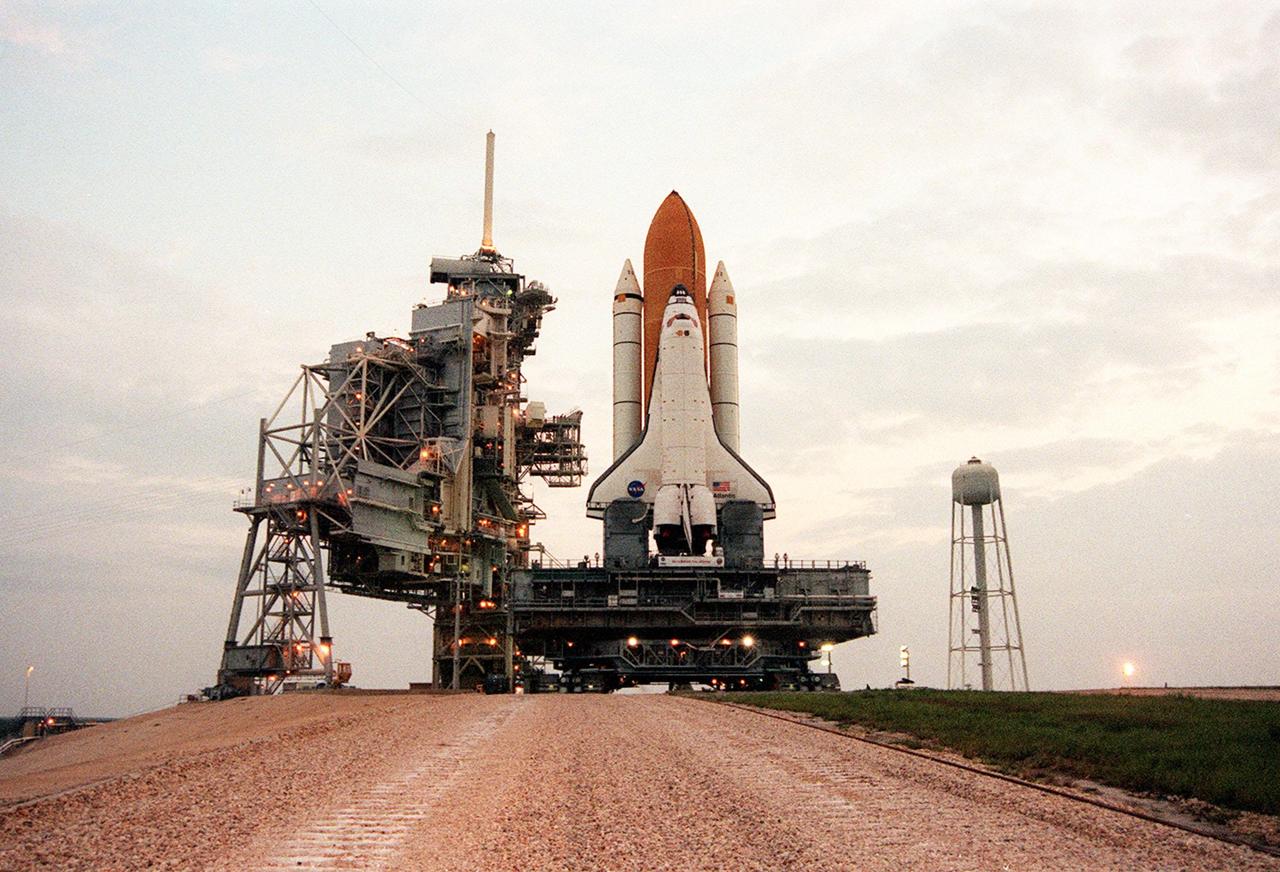
KENNEDY SPACE CENTER, Fla. -- The sun creeps over the horizon (right) as Space Shuttle Atlantis, atop the Mobile Launcher Platform and Crawler-Transporter, arrives at Launch Pad 39B for preparations before launch. It started its 8-hour rollout from the Vehicle Assembly Building high bay 2 (Safe Haven) at 11:20 p.m., Aug. 13. At left is the Rotating Service Structure in its open position. Towering above the RSS (and attached to the Fixed Service Structure) is the 80-foot tall lightning mast. At right is the 290-foot high water tank that holds 300,000 gallons of water. It is part of the sound suppression system at the pad. Atlantis is scheduled for launch Sept. 8 at 8:31 a.m. EDT on mission STS-106.
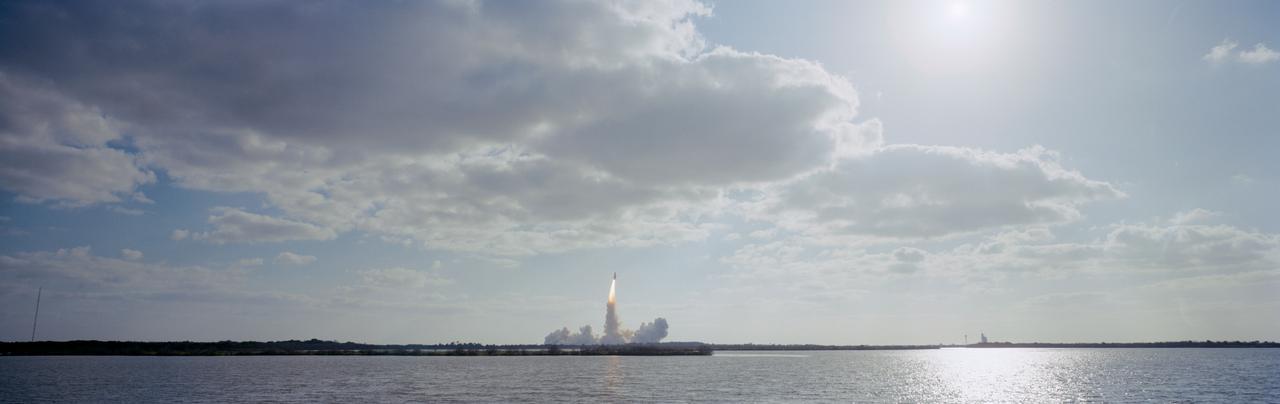
In this distant view, STS-31 Discovery, Orbiter Vehicle (OV) 103, is seen as it heads skyward after liftoff from Kennedy Space Center (KSC) Launch Complex (LC) Pad 39B at 8:33:51.0492 am (Eastern Daylight Time (EDT)). OV-103's silhouette atop the external tank (ET) appears above the glow of the solid rocket booster (SRB) and space shuttle main engine (SSME) firings. An exhaust plume trails behind and covers the launch pad area below the orbiter. A nearby waterway reflects the SRB/SSME glow in the foreground. At the far right and barely discernible is KSC LC Pad 39A and the Sound Supression Water System tower. Columbia, OV-102, is on LC Pad 39A which is separated by a distance of 1.6 miles. This was the first time since January 1986 that there was a shuttle on each pad.
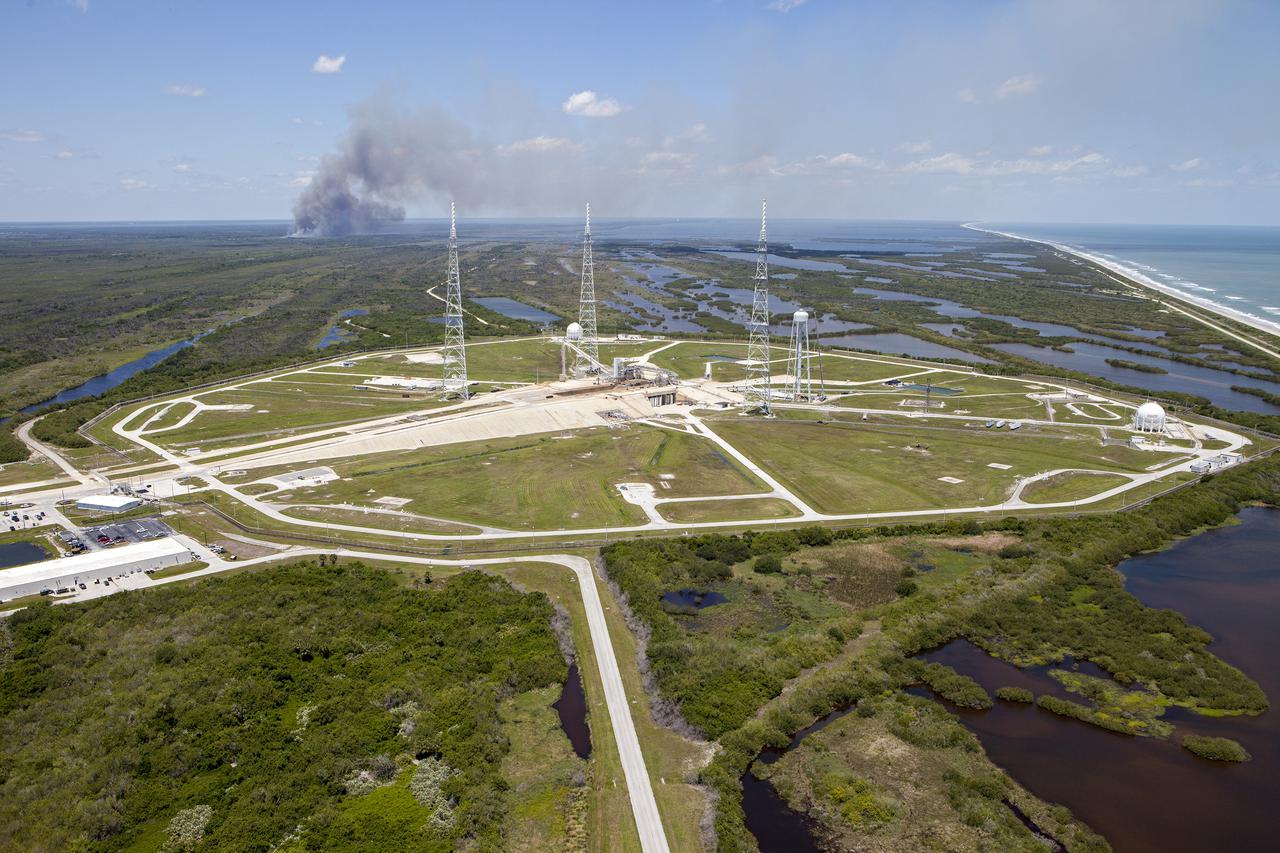
CAPE CANAVERAL, Fla. – An aerial view shows the Launch Pad 39B area at NASA’s Kennedy Space Center in Florida with the Atlantic Ocean to the right in the background. A new elevator has been constructed on the surface of the pad and the crawlerway leading up to the surface is being repaired. Repairs also are being made to the crawler track panels and catacomb roof below on either side of the flame trench. Also in view are the water tower and the three tall lightning towers that surround the pad. To the north of the pad, smoke can be seen from a small fire burning in the Merritt Island National Wildlife Refuge. Upgrades are underway at Pad B and other facilities in the Launch Complex 39 area. The Ground Systems Development and Operations, or GSDO, Program office at Kennedy is leading the center’s transformation from a historically government-only launch complex to a spaceport that can safely handle a variety of rockets and spacecraft, including NASA’s Space Launch System. For more information about GSDO, visit: http:__go.nasa.gov_groundsystems. Photo credit: NASA_Kim Shiflett
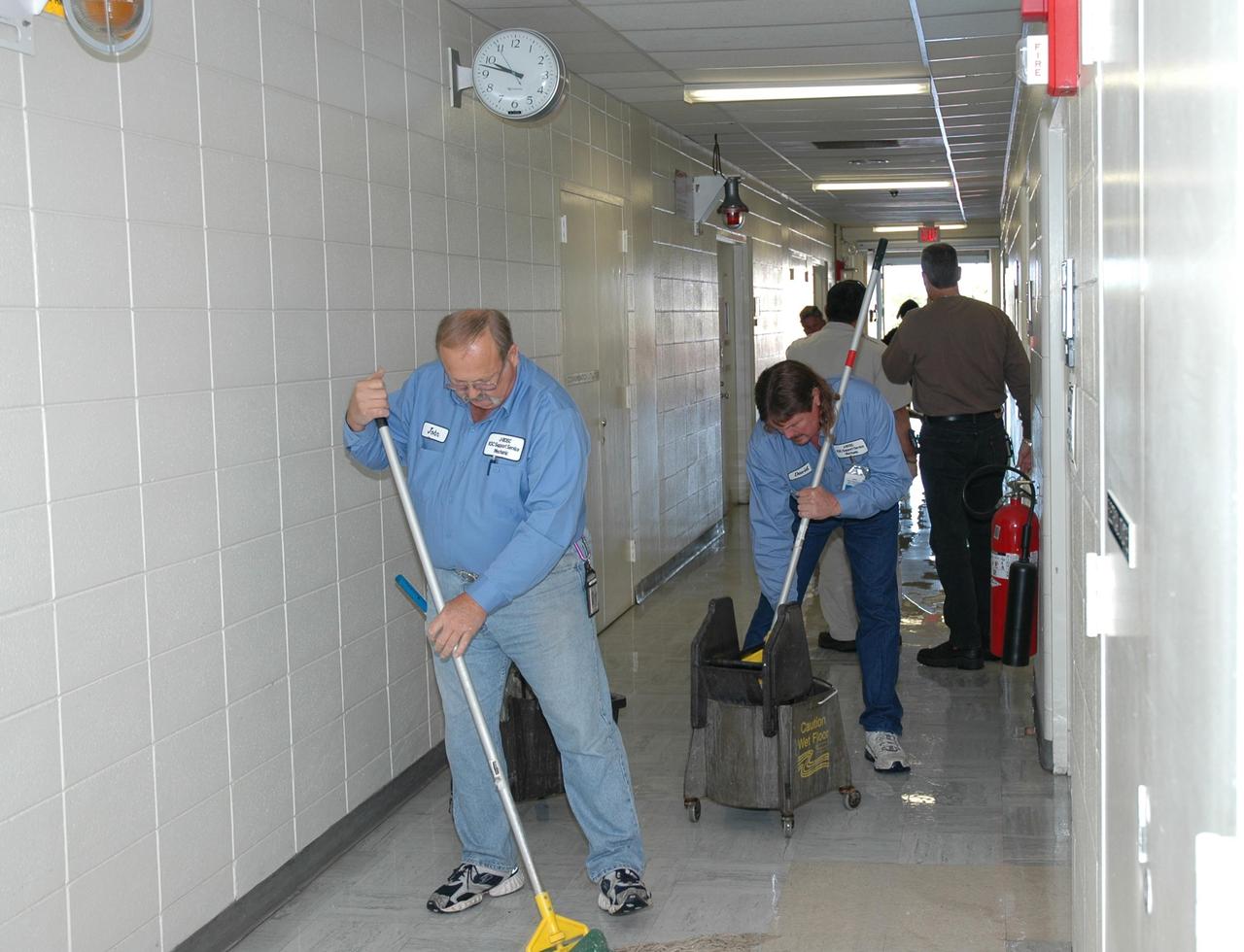
KENNEDY SPACE CENTER, FLA. - Workers at the NASA Kennedy Space Center mop up water inside a building following the wrath of hurricane Wilma as it crossed the state Oct. 24. Kennedy’s facilities sustained minor structural damage, primarily to roofs or from water intrusion. The Vehicle Assembly Building lost some panels on the east and west sides. Some facilities lost power. A total of 13.6 inches of rain was recorded at the Shuttle Landing Facility. The highest wind gust recorded was 94 mph from the north-northwest at Launch Pad 39B, while the maximum sustained wind was 76 mph from the north-northwest at the top of the 492-foot weather tower located north of the Vehicle Assembly Building.
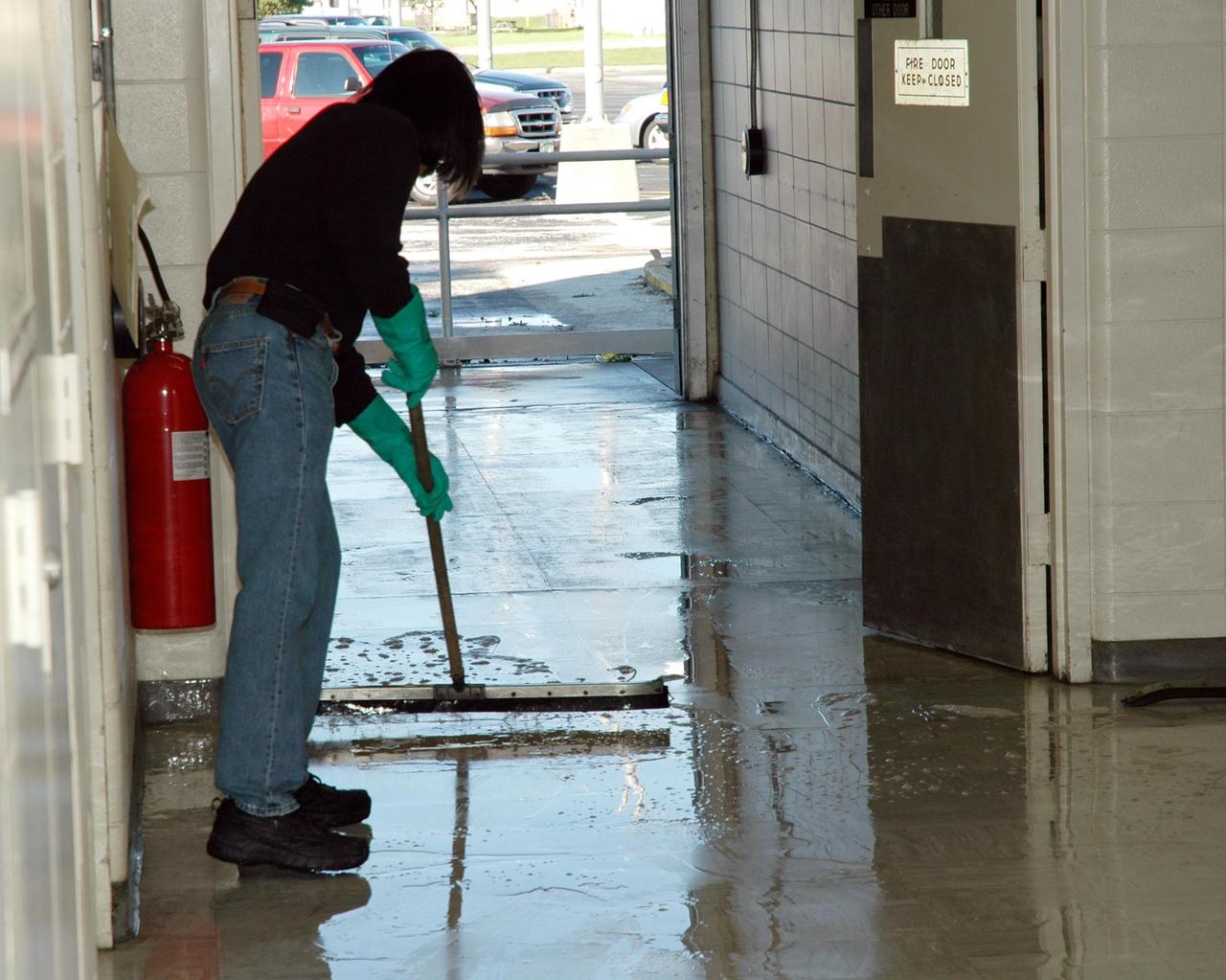
KENNEDY SPACE CENTER, FLA. - A worker at the NASA Kennedy Space Center sweeps water out the door of a building following the wrath of hurricane Wilma as it crossed the state Oct. 24. Kennedy’s facilities sustained minor structural damage, primarily to roofs or from water intrusion. The Vehicle Assembly Building lost some panels on the east and west sides. Some facilities lost power. A total of 13.6 inches of rain was recorded at the Shuttle Landing Facility. The highest wind gust recorded was 94 mph from the north-northwest at Launch Pad 39B, while the maximum sustained wind was 76 mph from the north-northwest at the top of the 492-foot weather tower located north of the Vehicle Assembly Building.
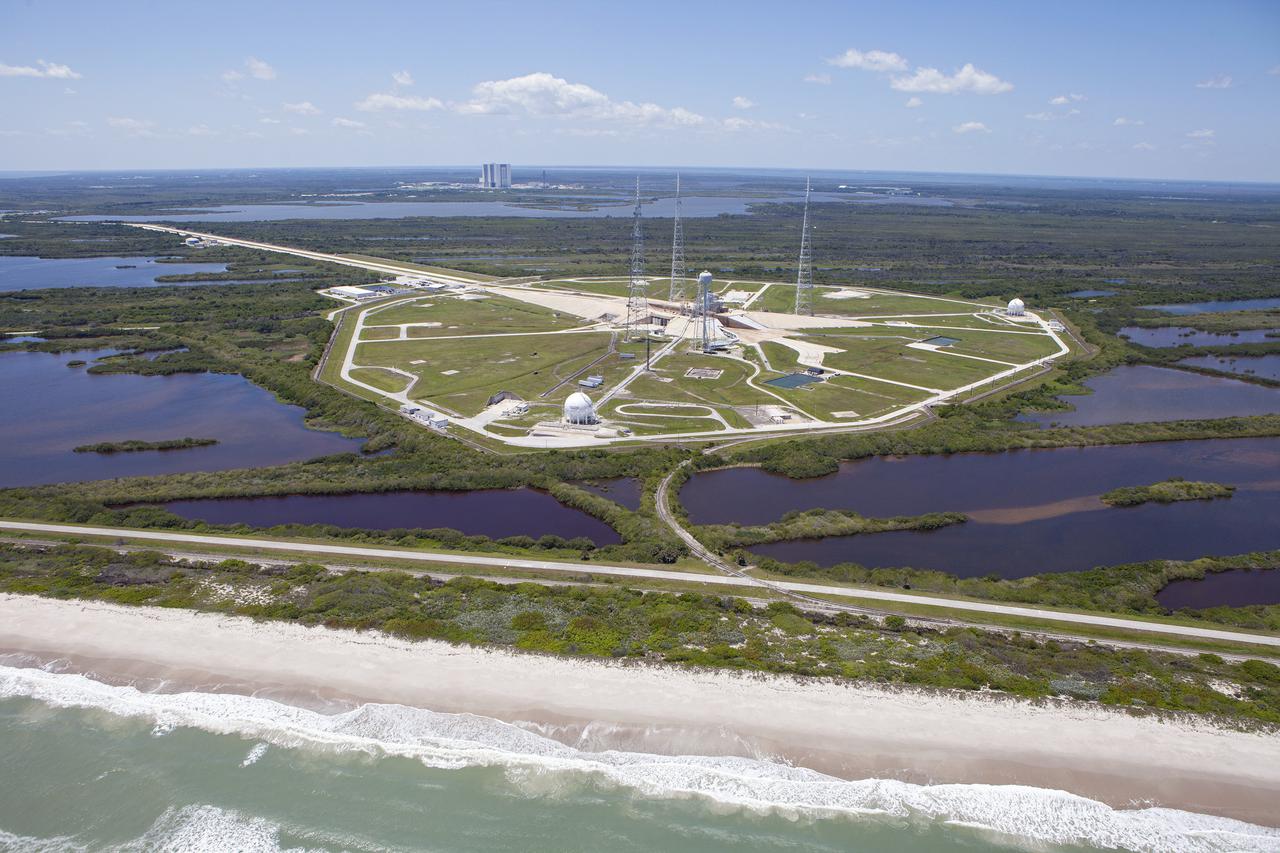
CAPE CANAVERAL, Fla. – An aerial view, from the east looking toward the west, shows the entire Launch Pad 39B area at NASA’s Kennedy Space Center in Florida. A new elevator has been constructed on the surface of the pad and the crawlerway leading up to the surface is being repaired. Repairs also are being made to the crawler track panels and catacomb roof below on either side of the flame trench. Also in view are the water tower and the three tall lightning towers that surround the pad. To the left, in the background is the Vehicle Assembly Building. In the foreground is the shoreline of the Atlantic Ocean. Upgrades are underway at Pad B and other facilities in the Launch Complex 39 area. The Ground Systems Development and Operations, or GSDO, Program office at Kennedy is leading the center’s transformation from a historically government-only launch complex to a spaceport that can safely handle a variety of rockets and spacecraft, including NASA’s Space Launch System. For more information about GSDO, visit: http:__go.nasa.gov_groundsystems. Photo credit: NASA_Kim Shiflett
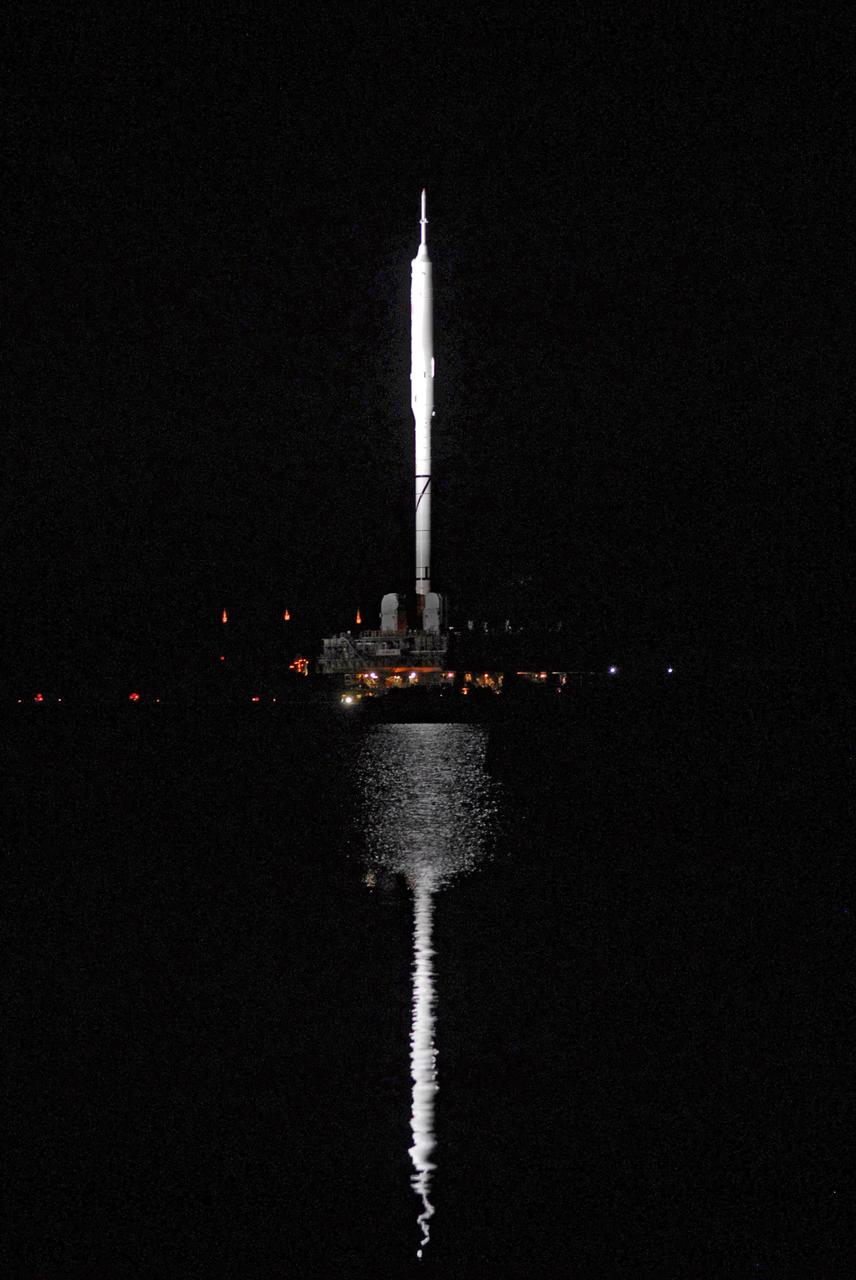
CAPE CANAVERAL, Fla. - The towering 327-foot-tall Ares I-X rocket is strikingly reflected in the waters of the turn basin at NASA's Kennedy Space Center in Florida. The rocket, riding atop a crawler-transporter, is headed for Launch Pad 39B. The move to the launch pad, known as "rollout," began at 1:39 a.m. EDT. The transfer of the pad from the Space Shuttle Program to the Constellation Program took place May 31. Modifications made to the pad include the removal of shuttle unique subsystems, such as the orbiter access arm and a section of the gaseous oxygen vent arm, along with the installation of three 600-foot lightning towers, access platforms, environmental control systems and a vehicle stabilization system. Part of the Constellation Program, the Ares I-X is the test vehicle for the Ares I. The Ares I-X flight test is targeted for Oct. 27. For information on the Ares I-X vehicle and flight test, visit http://www.nasa.gov/aresIX. Photo credit: NASA/Jim Grossman
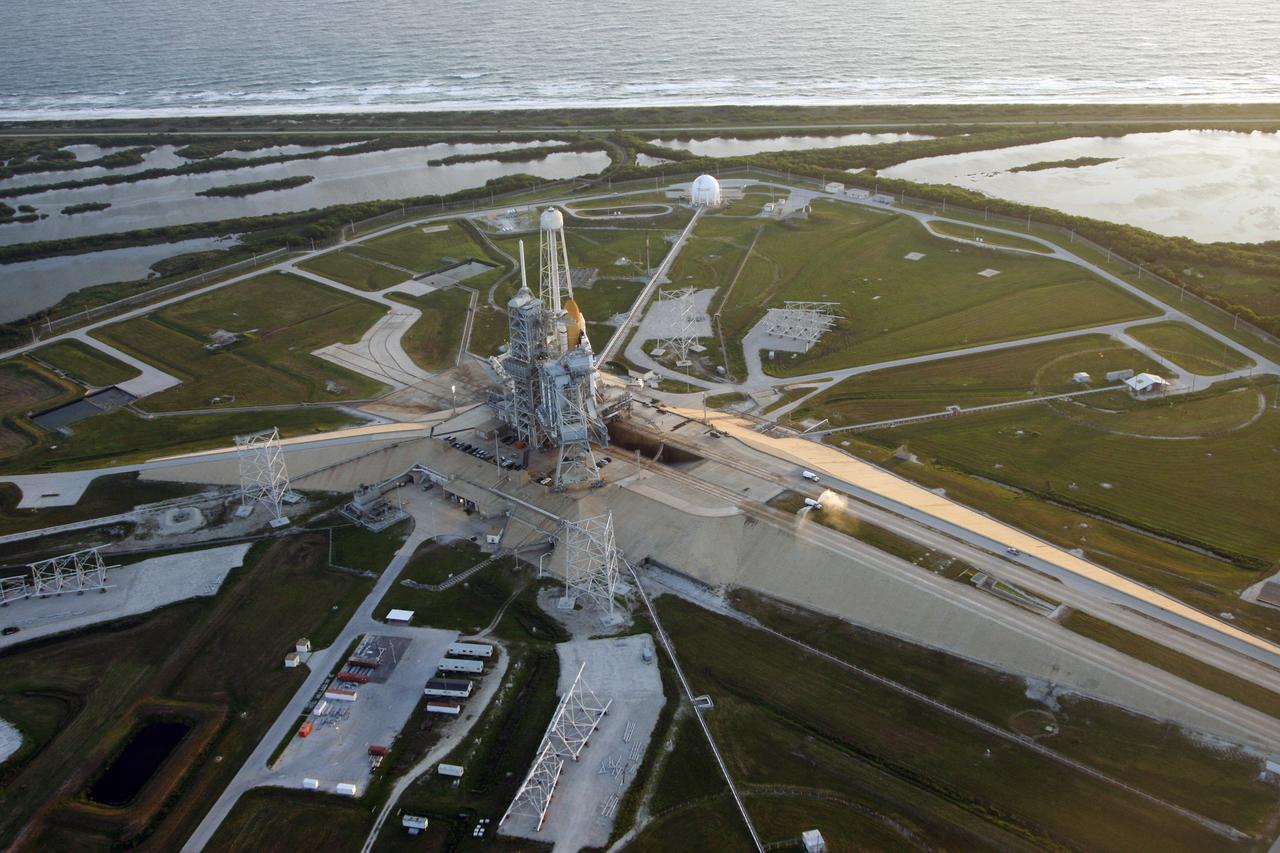
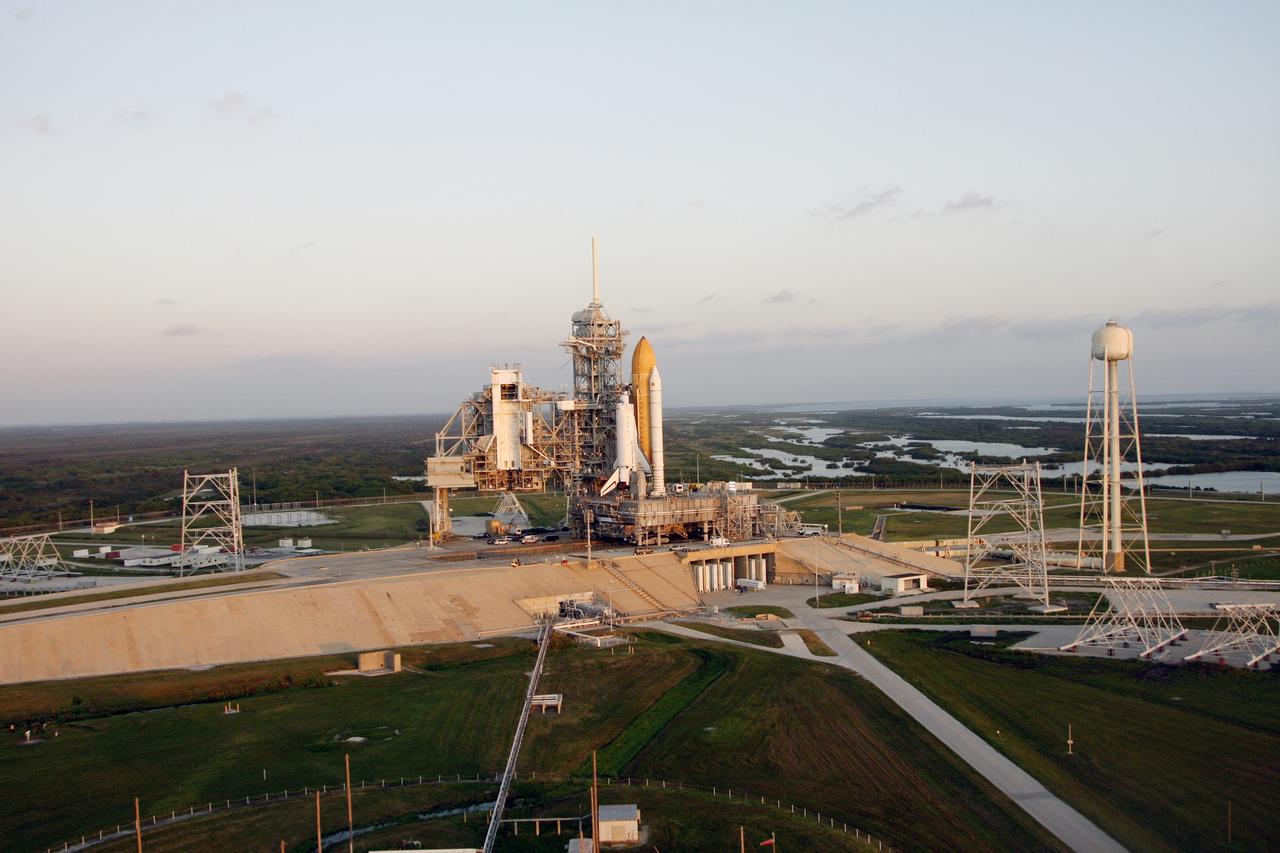
CAPE CANAVERAL, Fla. - The aerial view of Launch Pad 39B at NASA's Kennedy Space Center shows the Atlantic Ocean at top, the Banana River closer to the pad, and space shuttle Endeavour after its rollout from the Vehicle Assembly Building. At left of the shuttle is the open rotating service structure and the fixed service structure with the 80-foot lightning mast on top. Behind them are the tower that holds 300,000 gallons of water used for sound suppression on the pad during liftoff. First motion of Endeavour out of the VAB was at 11:15 p.m. Sept. 18. Endeavour completed the 4.2-mile journey at 6:59 a.m. EDT. For the first time since July 2001, two shuttles are on the launch pads at the same time at the center. Endeavour will stand by at pad B in the unlikely event that a rescue mission is necessary during space shuttle Atlantis' upcoming mission to repair NASA's Hubble Space Telescope, targeted to launch Oct. 10. After Endeavour is cleared from its duty as a rescue spacecraft, it will be moved to Launch Pad 39A for the STS-126 mission to the International Space Station. That flight is targeted for launch Nov. 12. Photo credit: NASA/Troy Cryder
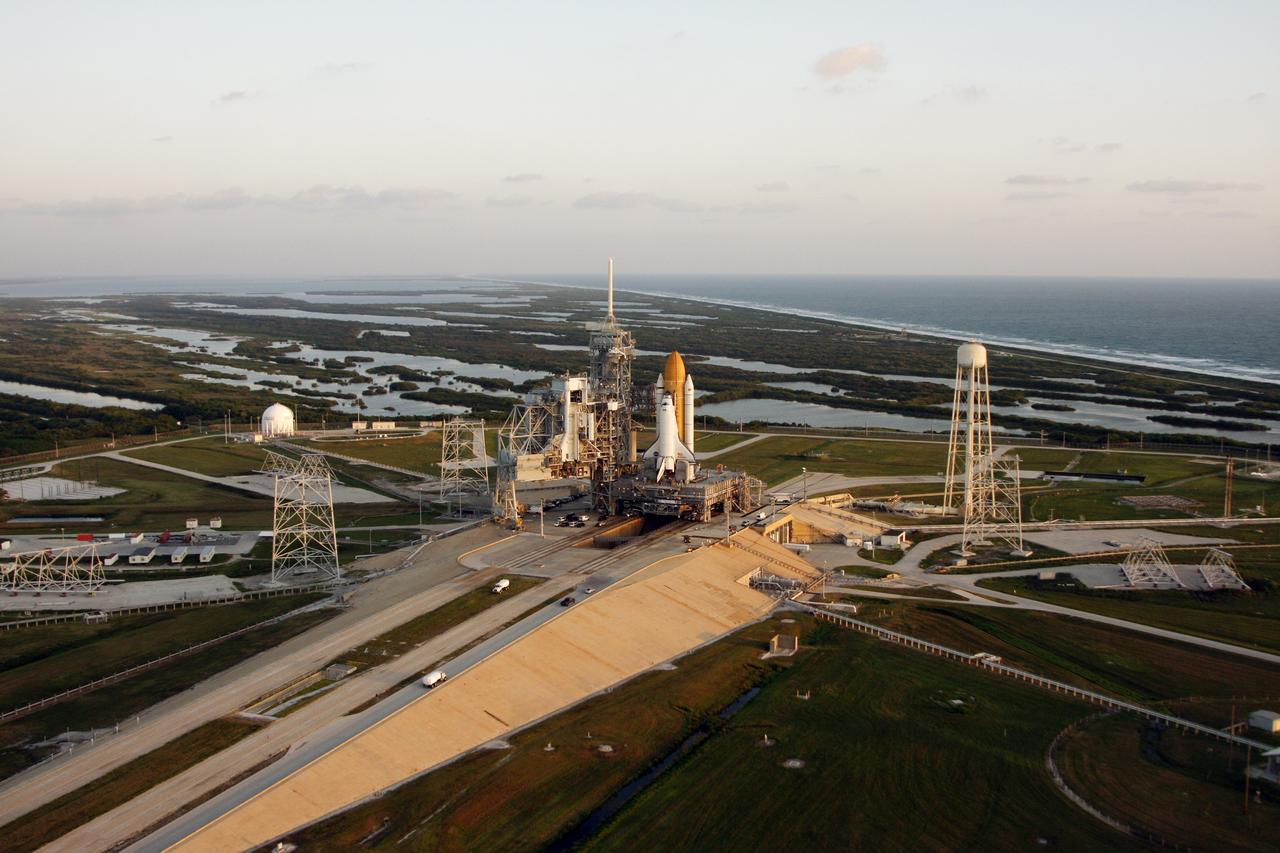
CAPE CANAVERAL, Fla. - The aerial view of Launch Pad 39B at NASA's Kennedy Space Center shows the Atlantic Ocean at right, the Banana River near the pad, and space shuttle Endeavour after its rollout from the Vehicle Assembly Building. At left of the shuttle is the open rotating service structure and the fixed service structure with the 80-foot lightning mast on top. At right is the tower that holds 300,000 gallons of water used for sound suppression on the pad during liftoff. First motion of Endeavour out of the VAB was at 11:15 p.m. Sept. 18. Endeavour completed the 4.2-mile journey at 6:59 a.m. EDT. For the first time since July 2001, two shuttles are on the launch pads at the same time at the center. Endeavour will stand by at pad B in the unlikely event that a rescue mission is necessary during space shuttle Atlantis' upcoming mission to repair NASA's Hubble Space Telescope, targeted to launch Oct. 10. After Endeavour is cleared from its duty as a rescue spacecraft, it will be moved to Launch Pad 39A for the STS-126 mission to the International Space Station. That flight is targeted for launch Nov. 12. Photo credit: NASA/Troy Cryder
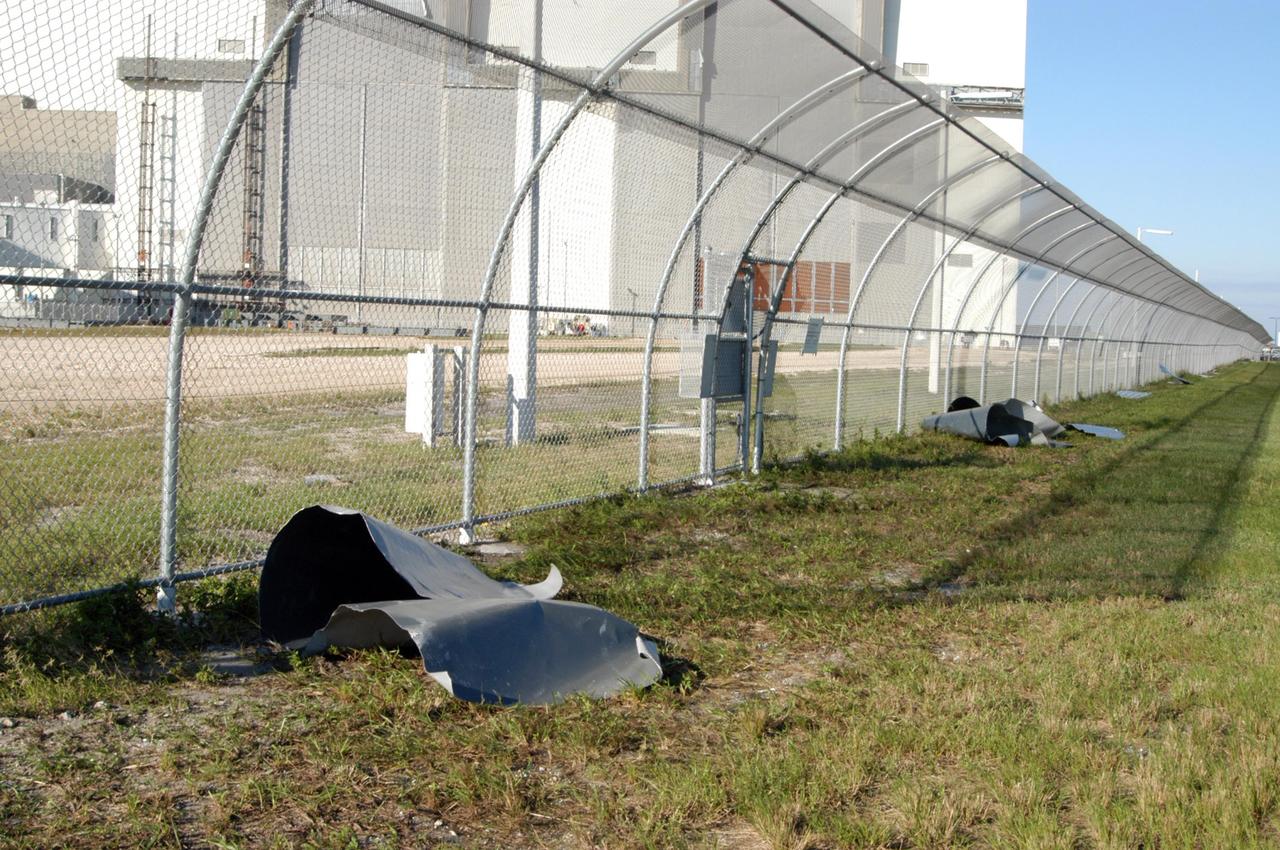
KENNEDY SPACE CENTER, FLA. - Pieces of metal lie alongside a fence near NASA Kennedy Space Center’s Vehicle Assembly Building following the wrath of hurricane Wilma as it crossed the state Oct. 24. Kennedy’s facilities sustained minor structural damage, primarily to roofs or from water intrusion. The Vehicle Assembly Building lost some panels on the east and west sides. Some facilities lost power. A total of 13.6 inches of rain was recorded at the Shuttle Landing Facility. The highest wind gust recorded was 94 mph from the north-northwest at Launch Pad 39B, while the maximum sustained wind was 76 mph from the north-northwest at the top of the 492-foot weather tower located north of the Vehicle Assembly Building.
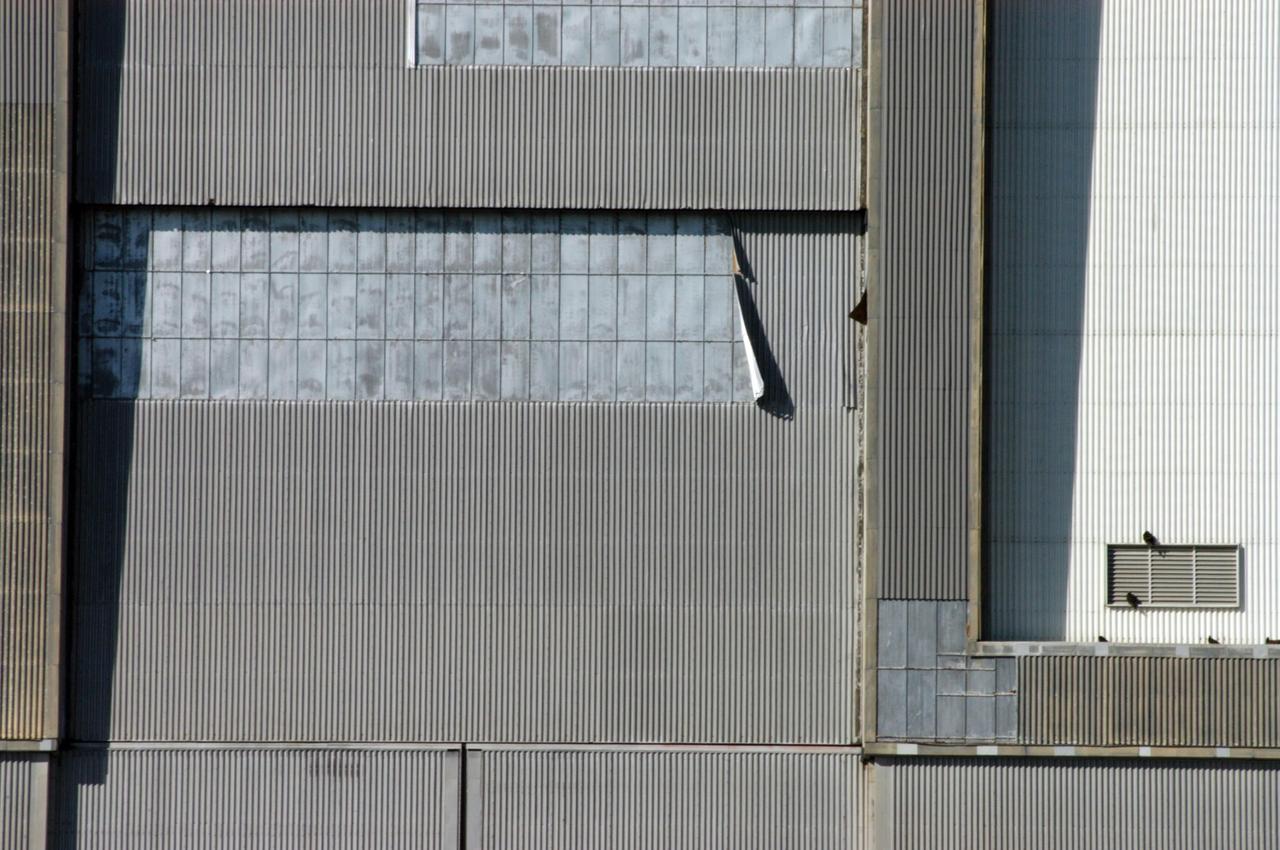
KENNEDY SPACE CENTER, FLA. - On the side of NASA Kennedy Space Center’s Vehicle Assembly Building, some panels are missing following the wrath of hurricane Wilma as it crossed the state Oct. 24. Kennedy’s facilities sustained minor structural damage, primarily to roofs or from water intrusion. The Vehicle Assembly Building lost some panels on the east and west sides. Some facilities lost power. A total of 13.6 inches of rain was recorded at the Shuttle Landing Facility. The highest wind gust recorded was 94 mph from the north-northwest at Launch Pad 39B, while the maximum sustained wind was 76 mph from the north-northwest at the top of the 492-foot weather tower located north of the Vehicle Assembly Building.
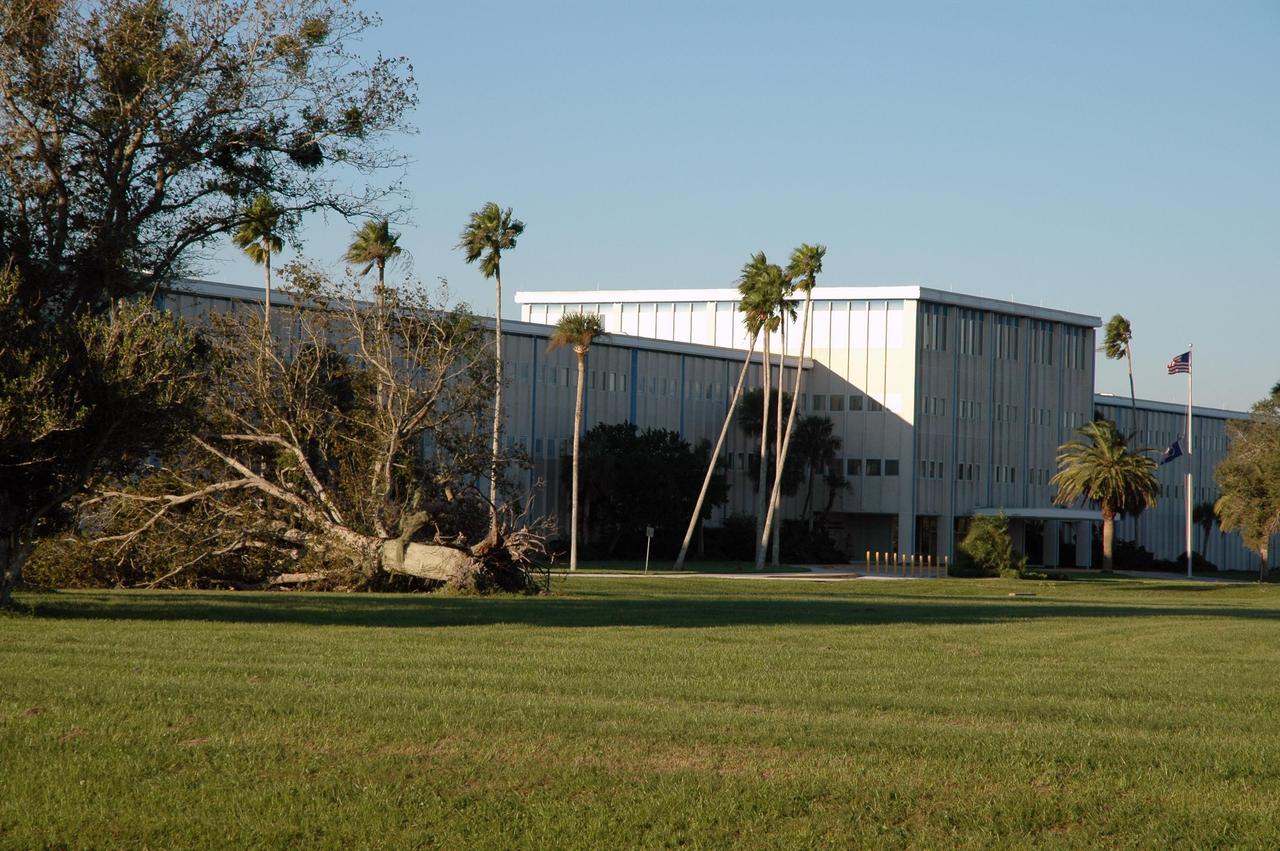
KENNEDY SPACE CENTER, FLA. - A large tree lies on its side after being ripped from the ground near NASA Headquarters at Kennedy Space Center following the wrath of hurricane Wilma as it crossed the state Oct. 24. Kennedy’s facilities sustained minor structural damage, primarily to roofs or from water intrusion. The Vehicle Assembly Building lost some panels on the east and west sides. Some facilities lost power. A total of 13.6 inches of rain was recorded at the Shuttle Landing Facility. The highest wind gust recorded was 94 mph from the north-northwest at Launch Pad 39B, while the maximum sustained wind was 76 mph from the north-northwest at the top of the 492-foot weather tower located north of the Vehicle Assembly Building.
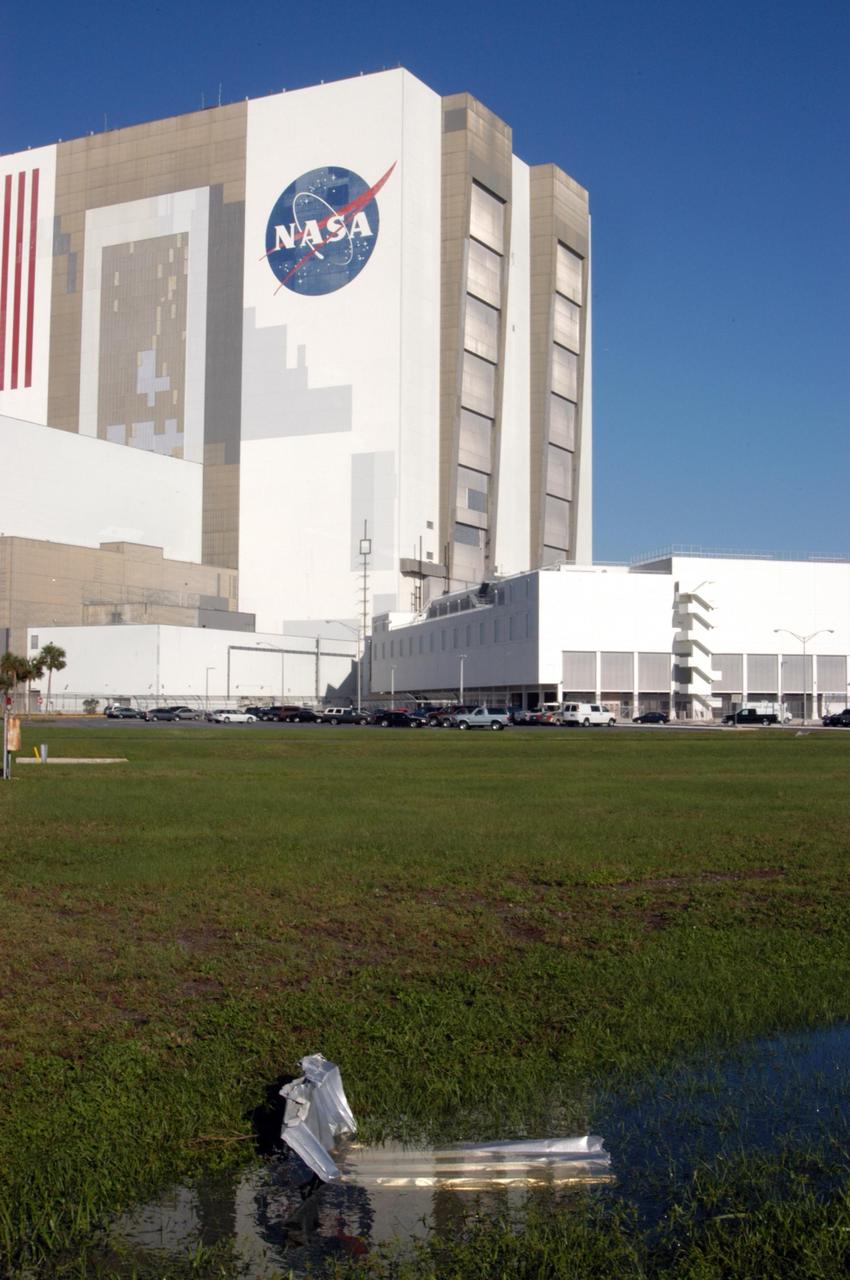
KENNEDY SPACE CENTER, FLA. - A piece of metal lies on the ground near the NASA Kennedy Space Center’s Vehicle Assembly Building following the wrath of hurricane Wilma as it crossed the state Oct. 24. Kennedy’s facilities sustained minor structural damage, primarily to roofs or from water intrusion. The Vehicle Assembly Building lost some panels on the east and west sides. Some facilities lost power. A total of 13.6 inches of rain was recorded at the Shuttle Landing Facility. The highest wind gust recorded was 94 mph from the north-northwest at Launch Pad 39B, while the maximum sustained wind was 76 mph from the north-northwest at the top of the 492-foot weather tower located north of the Vehicle Assembly Building.
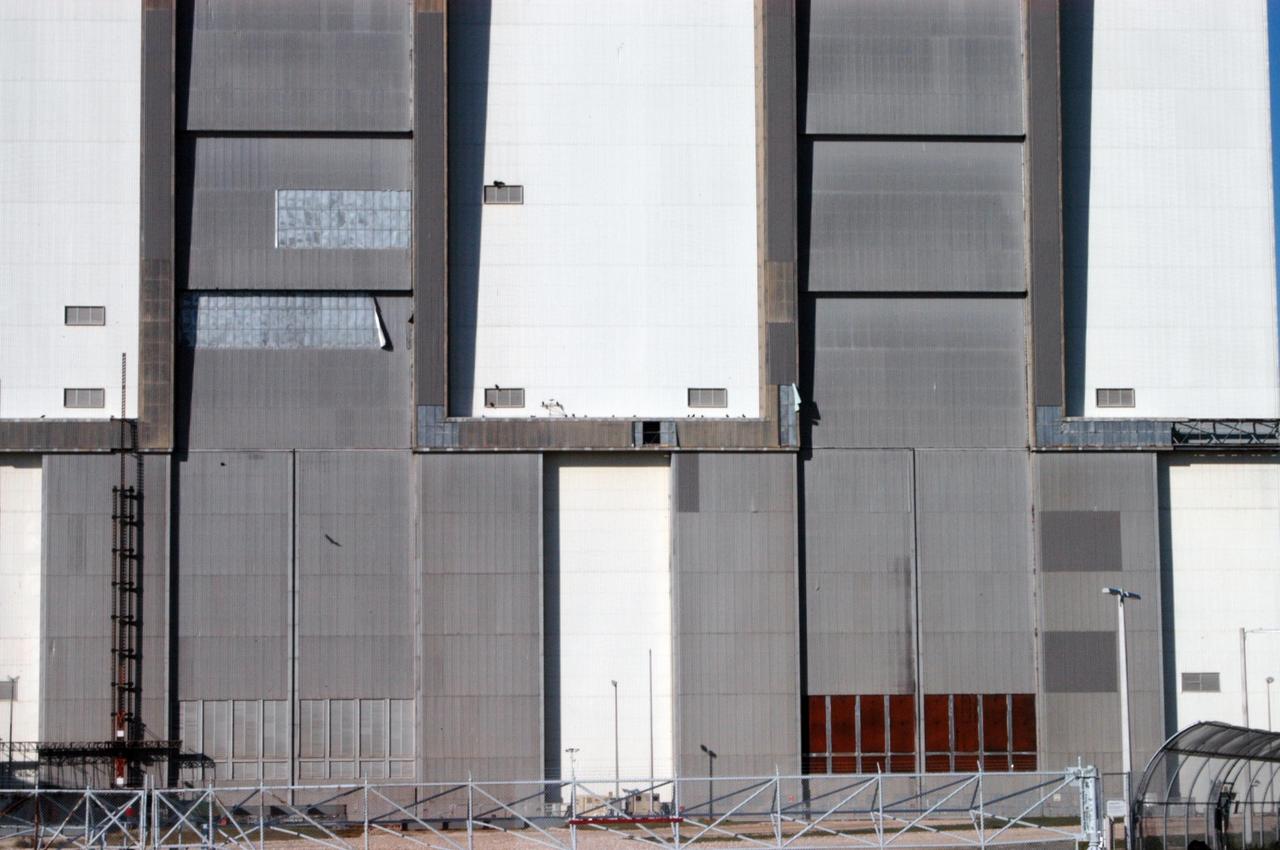
KENNEDY SPACE CENTER, FLA. - On the side of NASA Kennedy Space Center’s Vehicle Assembly Building, some panels are missing following the wrath of hurricane Wilma as it crossed the state Oct. 24. Kennedy’s facilities sustained minor structural damage, primarily to roofs or from water intrusion. The Vehicle Assembly Building lost some panels on the east and west sides. Some facilities lost power. A total of 13.6 inches of rain was recorded at the Shuttle Landing Facility. The highest wind gust recorded was 94 mph from the north-northwest at Launch Pad 39B, while the maximum sustained wind was 76 mph from the north-northwest at the top of the 492-foot weather tower located north of the Vehicle Assembly Building.
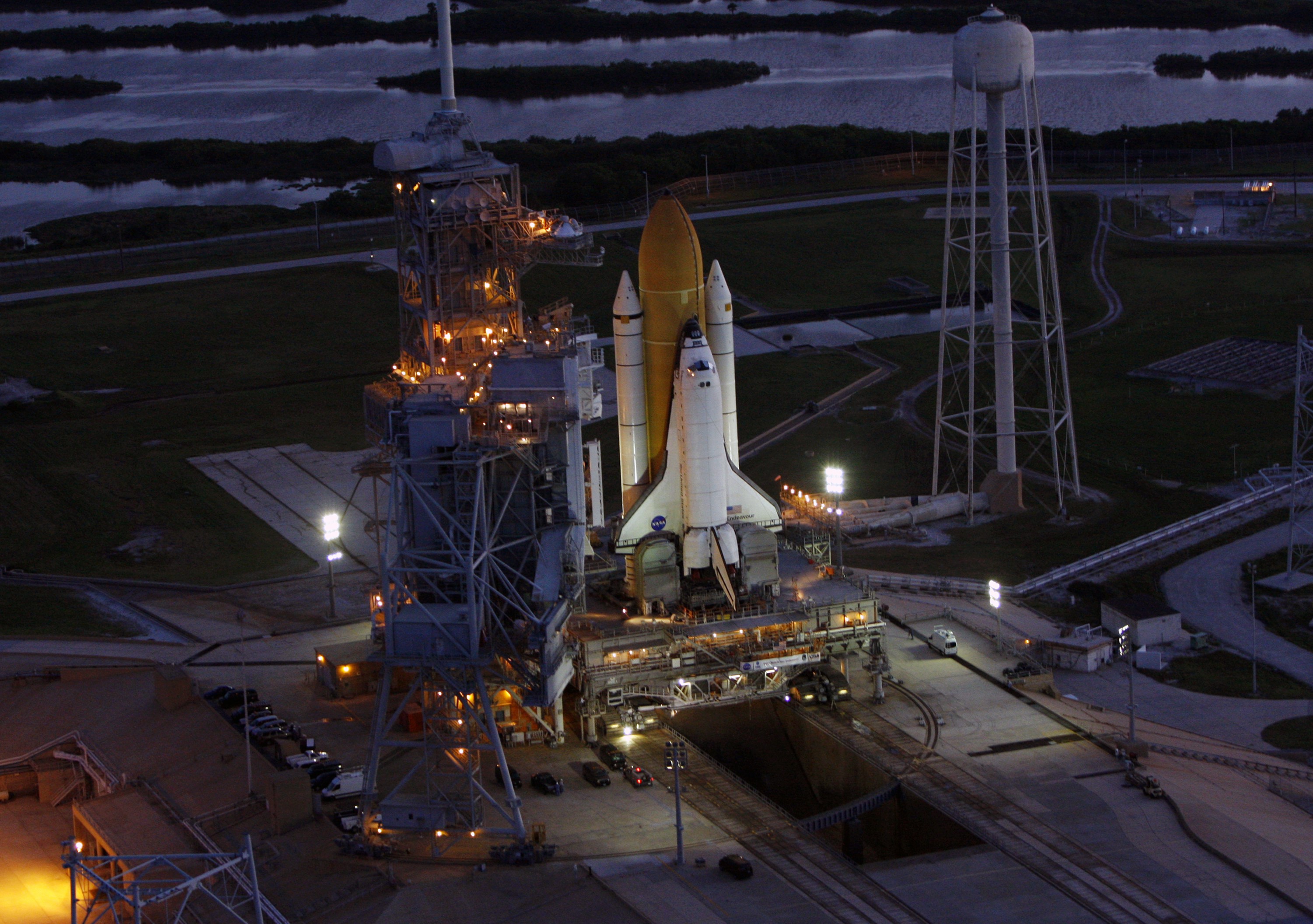
CAPE CANAVERAL, Fla. - Space shuttle Endeavour on Launch Pad 39B is viewed from the air after the rollout from the Vehicle Assembly Building at NASA's Kennedy Space Center. The shuttle and mobile launcher platform it sits on are atop the crawler-transporter. At right is the tower that holds 300,000 gallons of water used for sound suppression on the pad during liftoff. First motion out of the Vehicle Assembly Building was at 11:15 p.m. Sept. 18. Endeavour completed the 4.2-mile journey at 6:59 a.m. EDT. For the first time since July 2001, two shuttles are on the launch pads at the same time at the center. Endeavour will stand by at pad B in the unlikely event that a rescue mission is necessary during space shuttle Atlantis' upcoming mission to repair NASA's Hubble Space Telescope, targeted to launch Oct. 10. After Endeavour is cleared from its duty as a rescue spacecraft, it will be moved to Launch Pad 39A for the STS-126 mission to the International Space Station. That flight is targeted for launch Nov. 12. Photo credit: NASA/Troy Cryder
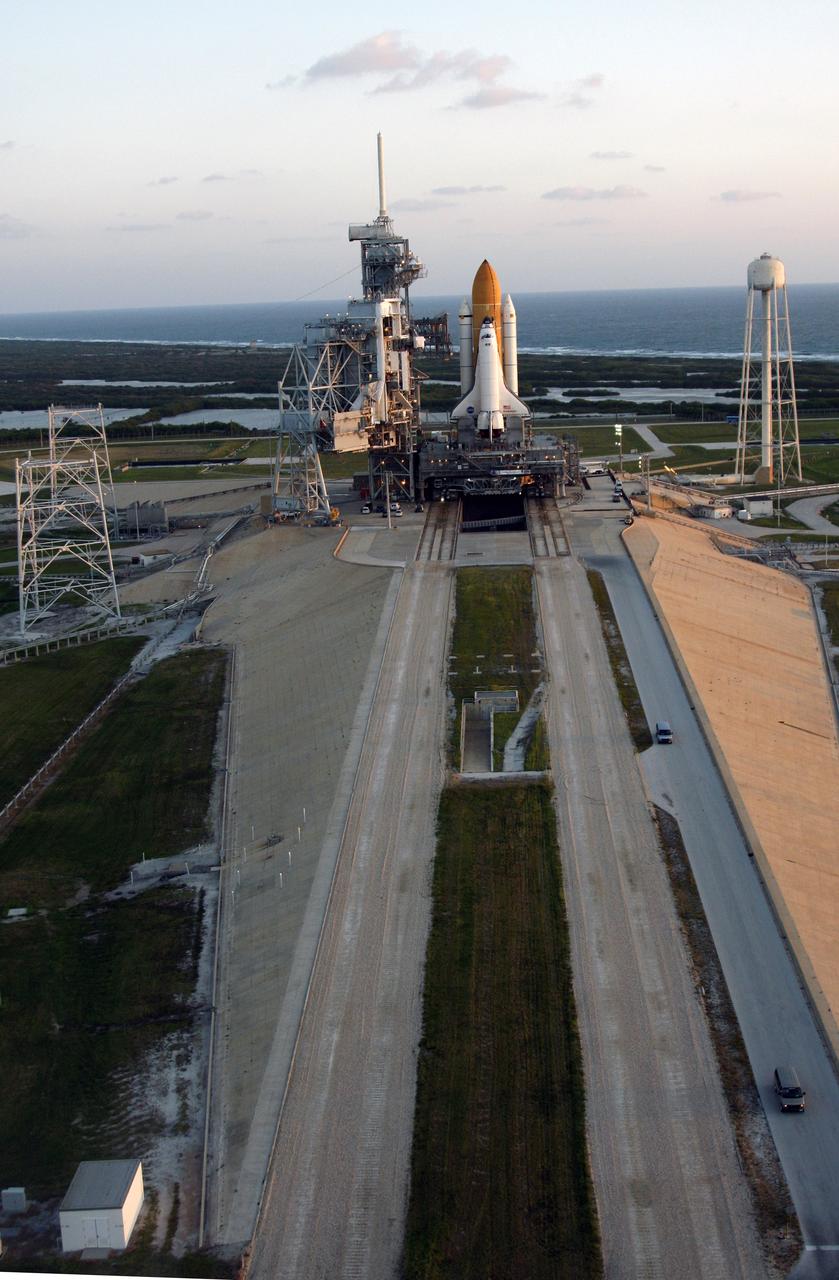
CAPE CANAVERAL, Fla. - Space shuttle Endeavour is viewed from the air on Launch Pad 39B after the rollout from the Vehicle Assembly Building at NASA's Kennedy Space Center. At left of the shuttle is the open rotating service structure and the fixed service structure with the 80-foot lightning mast on top. Far on the horizon is the Atlantic Ocean. At right is the tower that holds 300,000 gallons of water used for sound suppression on the pad during liftoff. First motion out of the Vehicle Assembly Building was at 11:15 p.m. Sept. 18. Endeavour completed the 4.2-mile journey at 6:59 a.m. EDT. For the first time since July 2001, two shuttles are on the launch pads at the same time at the center. Endeavour will stand by at pad B in the unlikely event that a rescue mission is necessary during space shuttle Atlantis' upcoming mission to repair NASA's Hubble Space Telescope, targeted to launch Oct. 10. After Endeavour is cleared from its duty as a rescue spacecraft, it will be moved to Launch Pad 39A for the STS-126 mission to the International Space Station. That flight is targeted for launch Nov. 12. Photo credit: NASA/Troy Cryder
CAPE CANAVERAL, Fla. - Space shuttle Endeavour is viewed from the air on Launch Pad 39B after the rollout from the Vehicle Assembly Building at NASA's Kennedy Space Center. At left of the shuttle is the open rotating service structure and the fixed service structure with the 80-foot lightning mast on top. First motion out of the Vehicle Assembly Building was at 11:15 p.m. Sept. 18. In the background is the Atlantic Ocean. At right is the tower that holds 300,000 gallons of water used for sound suppression on the pad during liftoff. Endeavour completed the 4.2-mile journey at 6:59 a.m. EDT. For the first time since July 2001, two shuttles are on the launch pads at the same time at the center. Endeavour will stand by at pad B in the unlikely event that a rescue mission is necessary during space shuttle Atlantis' upcoming mission to repair NASA's Hubble Space Telescope, targeted to launch Oct. 10. After Endeavour is cleared from its duty as a rescue spacecraft, it will be moved to Launch Pad 39A for the STS-126 mission to the International Space Station. That flight is targeted for launch Nov. 12. Photo credit: NASA/Troy Cryder
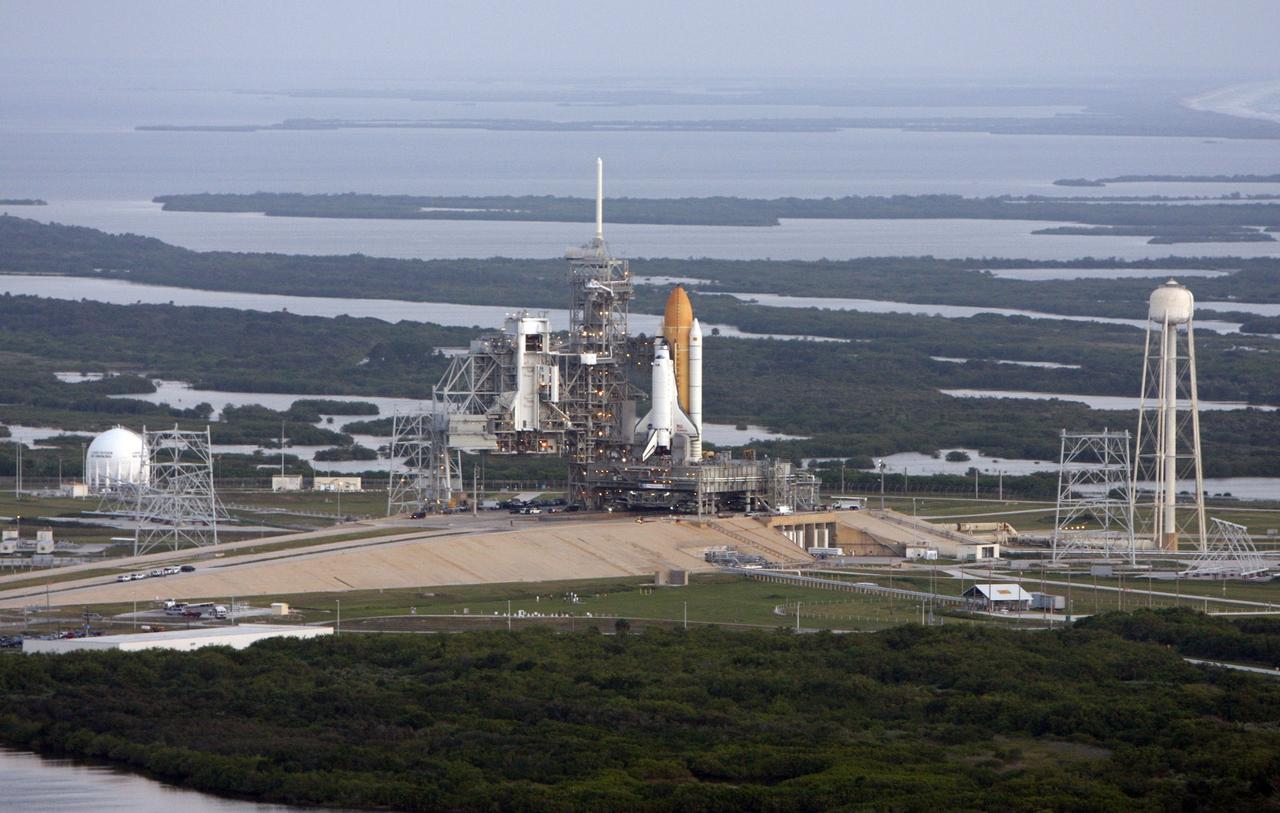
CAPE CANAVERAL, Fla. - Space shuttle Endeavour on Launch Pad 39B is viewed from the air after the rollout from the Vehicle Assembly Building at NASA's Kennedy Space Center. At left of the shuttle is the open rotating service structure and the fixed service structure with the 80-foot lightning mast on top. At right is the tower that holds 300,000 gallons of water used for sound suppression on the pad during liftoff. First motion out of the Vehicle Assembly Building was at 11:15 p.m. Sept. 18. In the background is the Banana River. Endeavour completed the 4.2-mile journey at 6:59 a.m. EDT. For the first time since July 2001, two shuttles are on the launch pads at the same time at the center. Endeavour will stand by at pad B in the unlikely event that a rescue mission is necessary during space shuttle Atlantis' upcoming mission to repair NASA's Hubble Space Telescope, targeted to launch Oct. 10. After Endeavour is cleared from its duty as a rescue spacecraft, it will be moved to Launch Pad 39A for the STS-126 mission to the International Space Station. That flight is targeted for launch Nov. 12. Photo credit: NASA/Troy Cryder
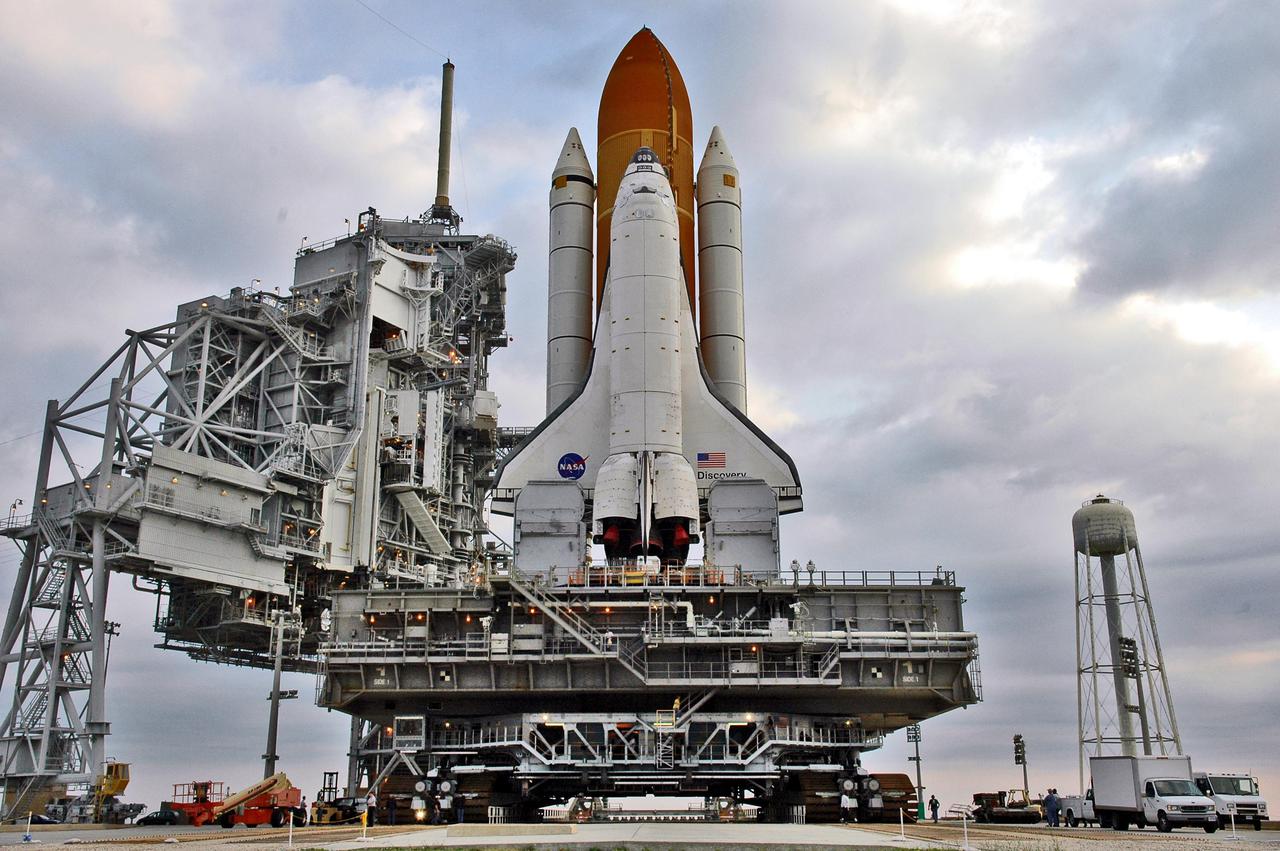
KENNEDY SPACE CENTER, FLA. - Under post-dawn cloudy skies, Space Shuttle Discovery, resting on the Mobile Launcher Platform, begins rolling off Launch Pad 39B via the Crawler_Transporter underneath. At left are the Rotating and Fixed Service Structures (RSS and FSS). The 80-foot lightning mast is atop the FSS. At right is the 290-foot-tall water tower that holds 300,000 gallons of water, part of the sound suppression system during a launch. Discovery is returning to the Vehicle Assembly Buildling where it will be demated from its External Tank and lifted into the transfer aisle. On or about June 7, Discovery will be lifted and attached to its new tank and Solid Rocket Boosters, which are already in the VAB. Only the 15th rollback in Space Shuttle Program history, the 4.2-mile journey allows additional modifications to be made to the External Tank prior to a safe Return to Flight. Discovery is expected to be rolled back to the launch pad in mid-June for Return to Flight mission STS-114. The launch window extends from July 13 to July 31.
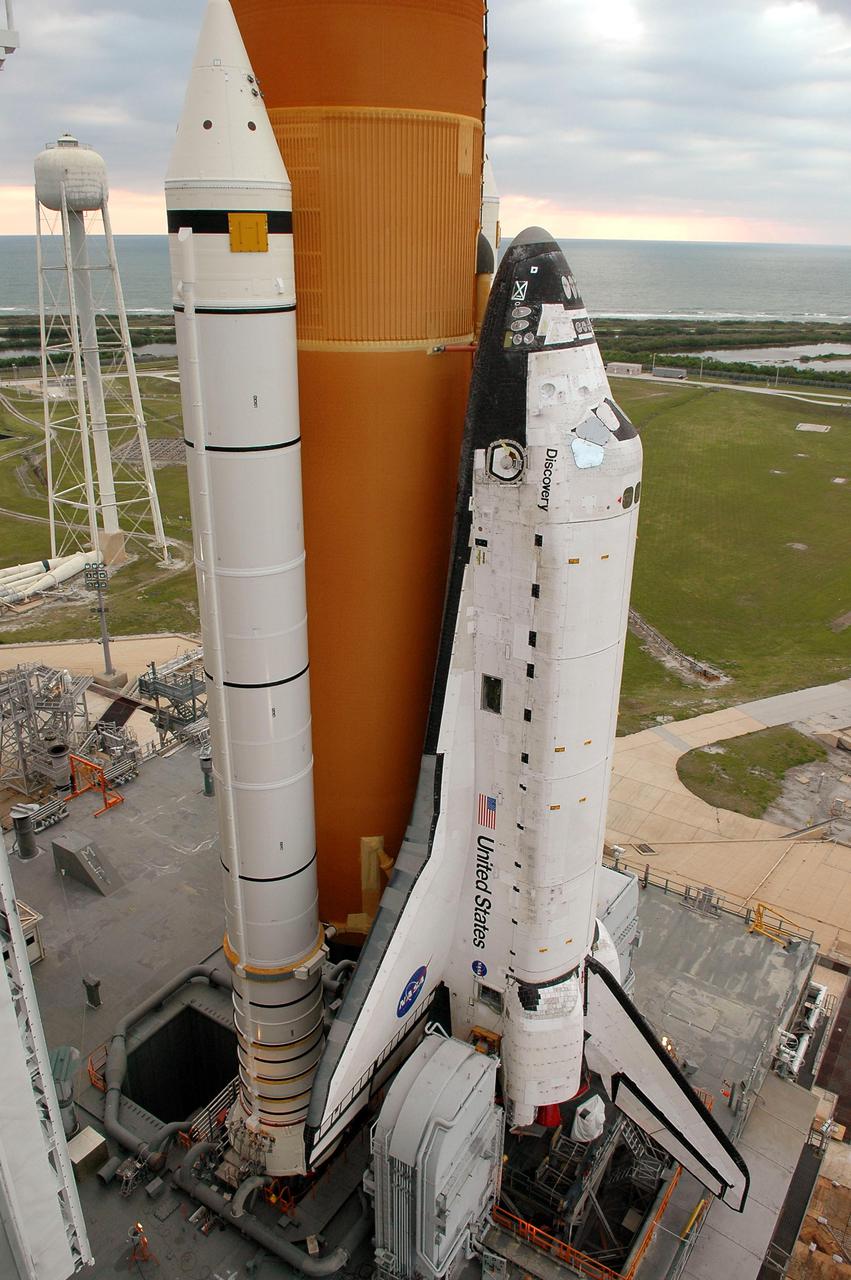
KENNEDY SPACE CENTER, FLA. - Under post-dawn cloudy skies that shade the normally bright blue Atlantic Ocean, Space Shuttle Discovery, resting on the Mobile Launcher Platform on Launch Pad 39B, awaits rollback to the Vehicle Assembly Building. To the left of the Solid Rocket Booster is the 290-foot-tall water tower that holds 300,000 gallons of water, part of the sound suppression system during a launch. Once inside the VAB, Discovery will be demated from its External Tank and lifted into the transfer aisle. On or about June 7, Discovery will be lifted and attached to its new tank and Solid Rocket Boosters, which are already in the VAB. Only the 15th rollback in Space Shuttle Program history, the 4.2-mile journey allows additional modifications to be made to the External Tank prior to a safe Return to Flight. Discovery is expected to be rolled back to the launch pad in mid-June for Return to Flight mission STS-114. The launch window extends from July 13 to July 31.
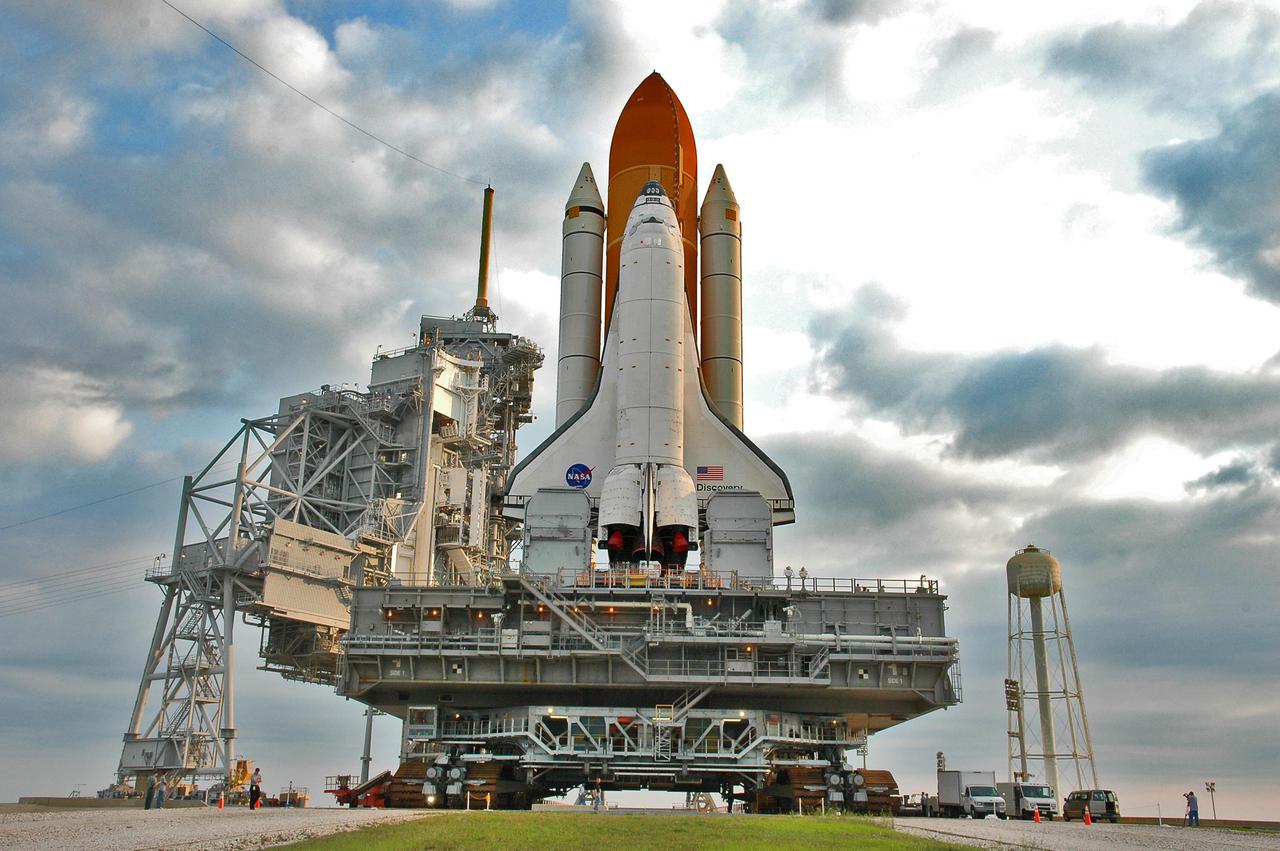
KENNEDY SPACE CENTER, FLA. - Under post-dawn cloudy skies, Space Shuttle Discovery, resting on the Mobile Launcher Platform, rolls away from Launch Pad 39B via the Crawler_Transporter underneath. At left are the Rotating and Fixed Service Structures (RSS and FSS). Atop the FSS is the 80-foot lightning mast. At right is the 290-foot-tall water tower that holds 300,000 gallons of water, part of the sound suppression system during a launch. Discovery is returning to the Vehicle Assembly Buildling where it will be demated from its External Tank and lifted into the transfer aisle. On or about June 7, Discovery will be lifted and attached to its new tank and Solid Rocket Boosters, which are already in the VAB. Only the 15th rollback in Space Shuttle Program history, the 4.2-mile journey allows additional modifications to be made to the External Tank prior to a safe Return to Flight. Discovery is expected to be rolled back to the launch pad in mid-June for Return to Flight mission STS-114. The launch window extends from July 13 to July 31.
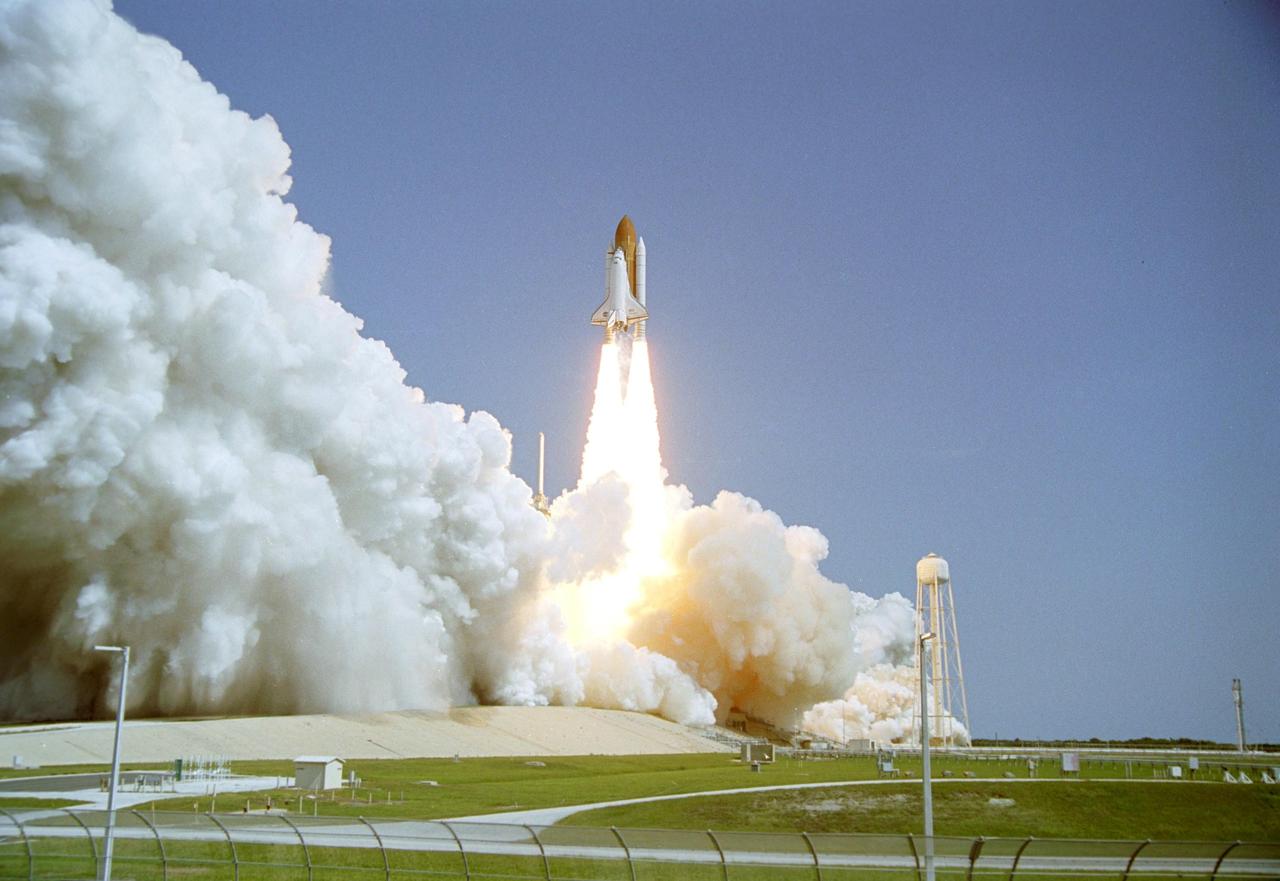
KENNEDY SPACE CENTER, FLA. - As billows of smoke and steam roll away, Space Shuttle Discovery leaps from Launch Pad 39B on the historic Return to Flight mission STS-114. Liftoff occurred at 10:39 a.m. EDT. At right is the 290-foot water tower that holds the 300,000 gallons of water that flood the pad for sound suppression. This is the 114th Space Shuttle flight and the 31st for Discovery. The 12-day mission is expected to end with touchdown at the Shuttle Landing Facility on Aug. 7. On this mission to the International Space Station the crew will perform inspections on-orbit for the first time of all of the Reinforced Carbon-Carbon (RCC) panels on the leading edge of the wings and the Thermal Protection System tiles using the new Canadian-built Orbiter Boom Sensor System and the data from 176 impact and temperature sensors. Mission Specialists will also practice repair techniques on RCC and tile samples during a spacewalk in the payload bay. During two additional spacewalks, the crew will install the External Stowage Platform-2, equipped with spare part assemblies, and a replacement Control Moment Gyroscope contained in the Lightweight Multi-Purpose Experiment Support Structure.
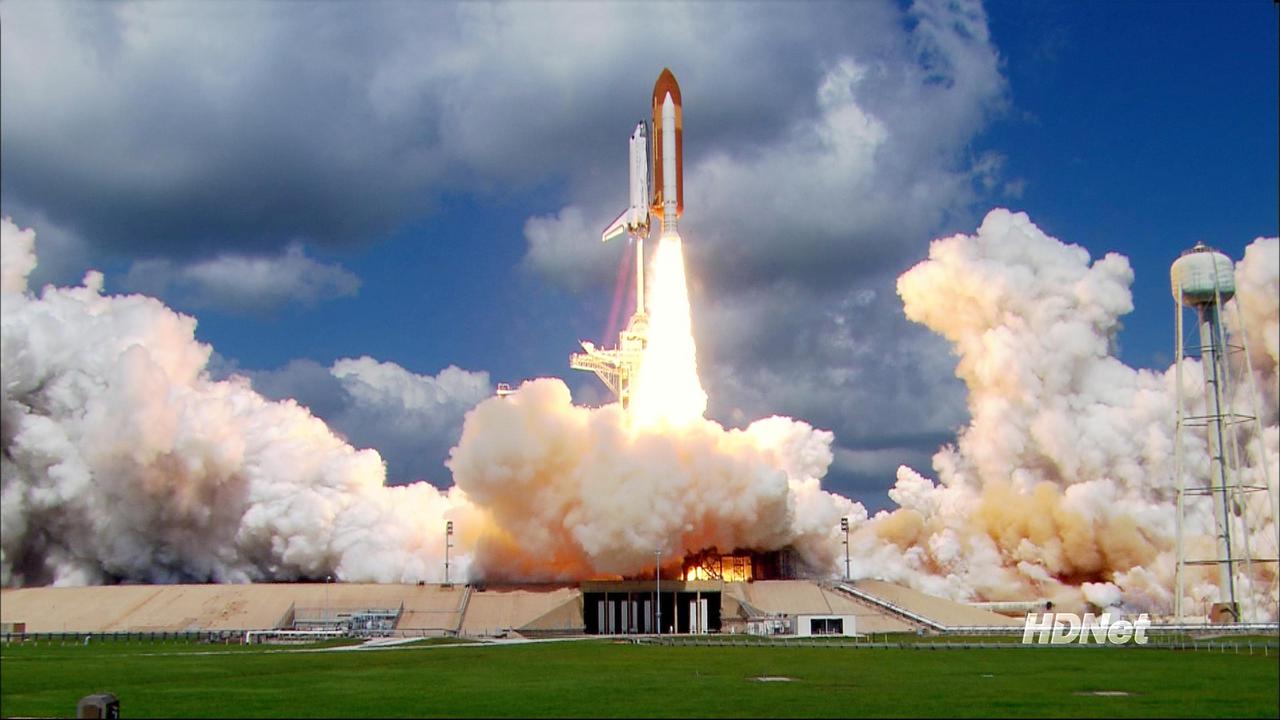
KENNEDY SPACE CENTER, FLA. - As billows of smoke and steam roll away, Space Shuttle Discovery leaps from Launch Pad 39B on the historic Return to Flight mission STS-114. Liftoff occurred at 10:39 a.m. EDT. At right is the 290-foot water tower that holds the 300,000 gallons of water that flood the pad for sound suppression. This is the 114th Space Shuttle flight and the 31st for Discovery. The 12-day mission is expected to end with touchdown at the Shuttle Landing Facility on Aug. 7. On this mission to the International Space Station the crew will perform inspections on-orbit for the first time of all of the Reinforced Carbon-Carbon (RCC) panels on the leading edge of the wings and the Thermal Protection System tiles using the new Canadian-built Orbiter Boom Sensor System and the data from 176 impact and temperature sensors. Mission Specialists will also practice repair techniques on RCC and tile samples during a spacewalk in the payload bay. During two additional spacewalks, the crew will install the External Stowage Platform-2, equipped with spare part assemblies, and a replacement Control Moment Gyroscope contained in the Lightweight Multi-Purpose Experiment Support Structure. This photo is a freeze frame provided by HDNet, a national television network broadcasting high-definition television, located in Denver, Colo.
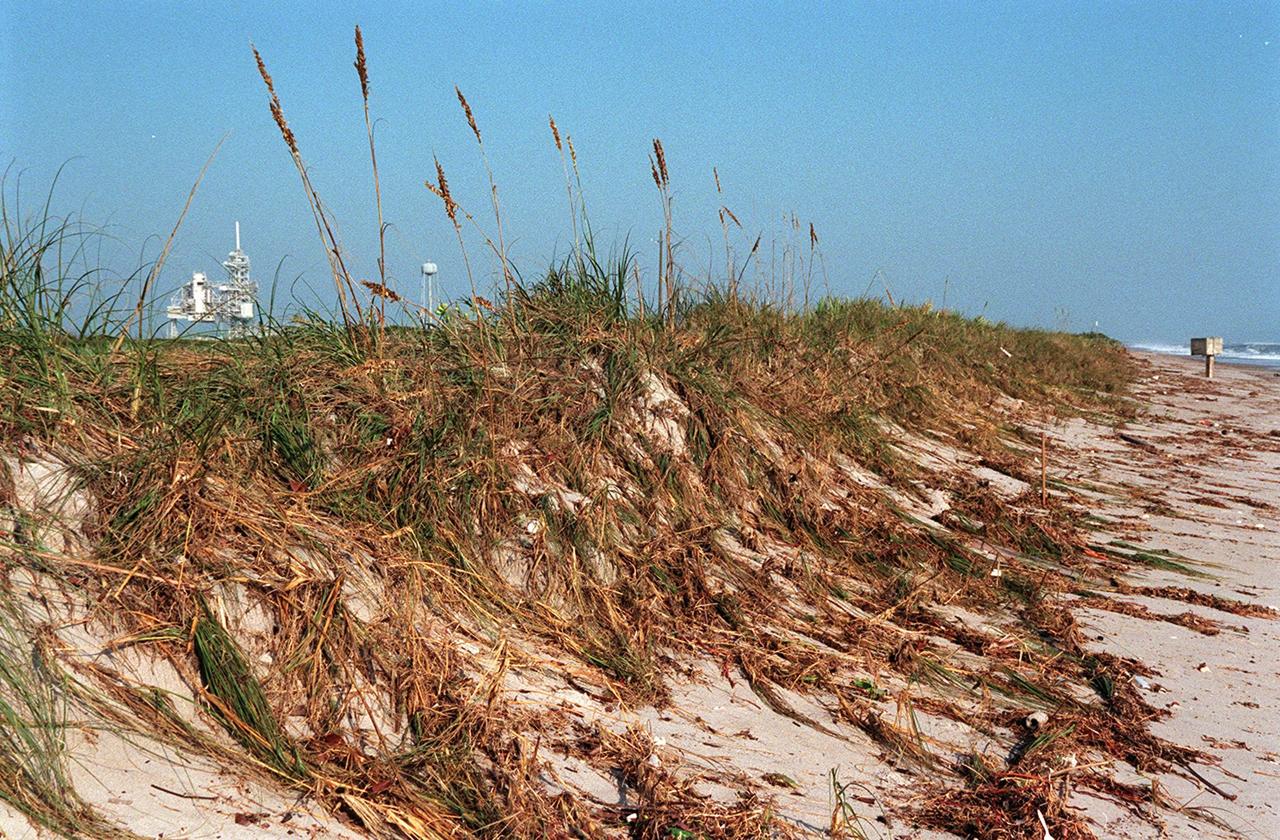
Just east of Kennedy Space Center's Launch Complex 39, Pads A & B (Pad 39B is seen upper left), sea-oat-covered sand dunes along the Atlantic Ocean show the ravaging effects of wind and high water from Hurricane Floyd as it passed along the East Coast of Florida, Sept. 14-15. At a weather tower located between Shuttle Launch Pad 39A and Launch Complex 41, the highest winds recorded during the superstorm were 91 mph from the NNW at 4:50 a.m. on Wednesday, Sept. 15. The maximum sustained winds were recorded at 66 mph. The highest amount of rain recorded at KSC was 2.82 inches as the eye of Hurricane Floyd passed 121 miles east of Cape Canaveral at 4 a.m. Wednesday. A preliminary review of conditions at the Kennedy Space Center was positive after the worst of Hurricane Floyd passed. There appeared to be no major damage to NASA assets, including the launch pads, the four Space Shuttle Orbiters, and flight hardware
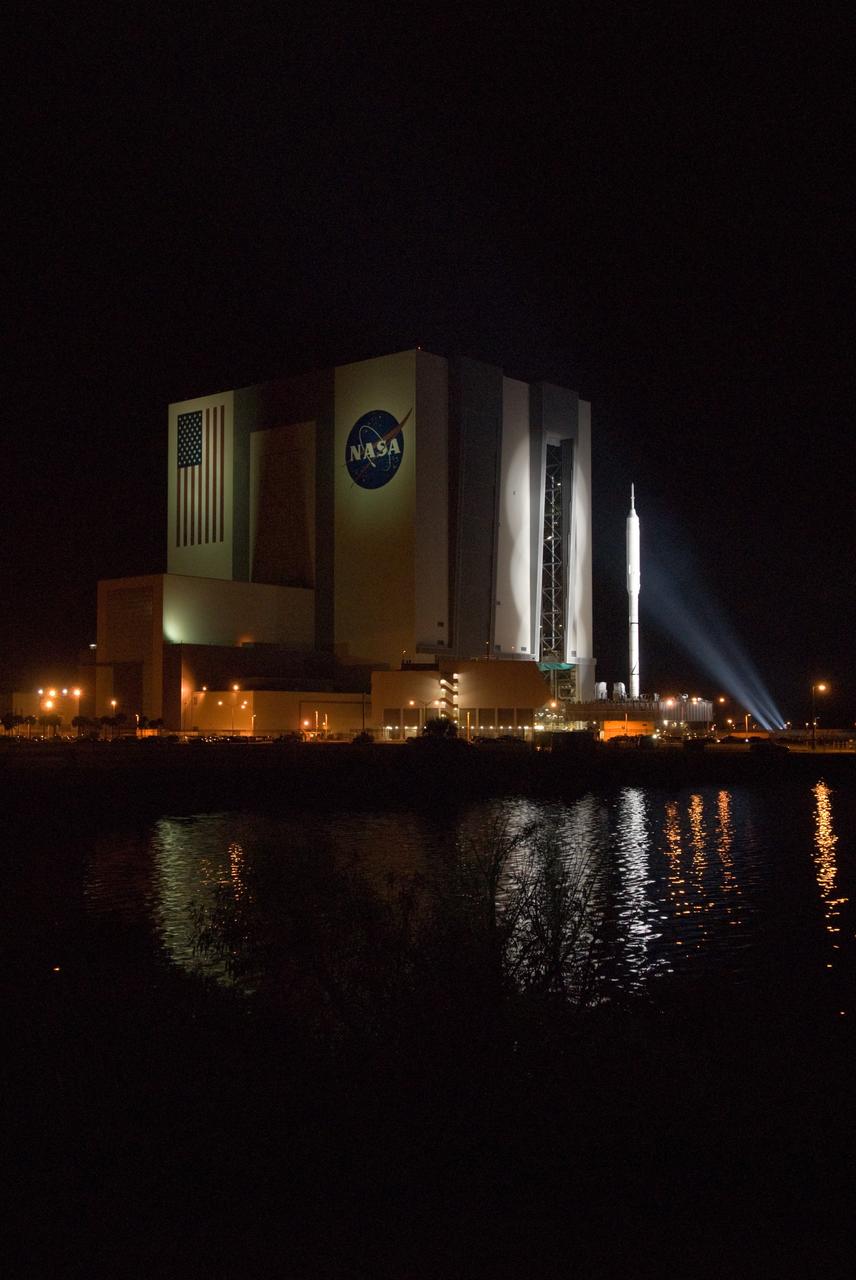
CAPE CANAVERAL, Fla. – Reflected in the water of the turn basin near the Vehicle Assembly Building at NASA's Kennedy Space Center in Florida, the 327-foot-tall Ares I-X rocket begins its slow trek to Launch Pad 39B. The move, known as "rollout," began at 1:39 a.m. EDT. The transfer of the pad from the Space Shuttle Program to the Constellation Program took place May 31. Modifications made to the pad include the removal of shuttle unique subsystems, such as the orbiter access arm and a section of the gaseous oxygen vent arm, along with the installation of three 600-foot lightning towers, access platforms, environmental control systems and a vehicle stabilization system. Part of the Constellation Program, the Ares I-X is the test vehicle for the Ares I. The Ares I-X flight test is targeted for Oct. 27. For information on the Ares I-X vehicle and flight test, visit http://www.nasa.gov/aresIX. Photo credit: NASA/Jim Grossmann
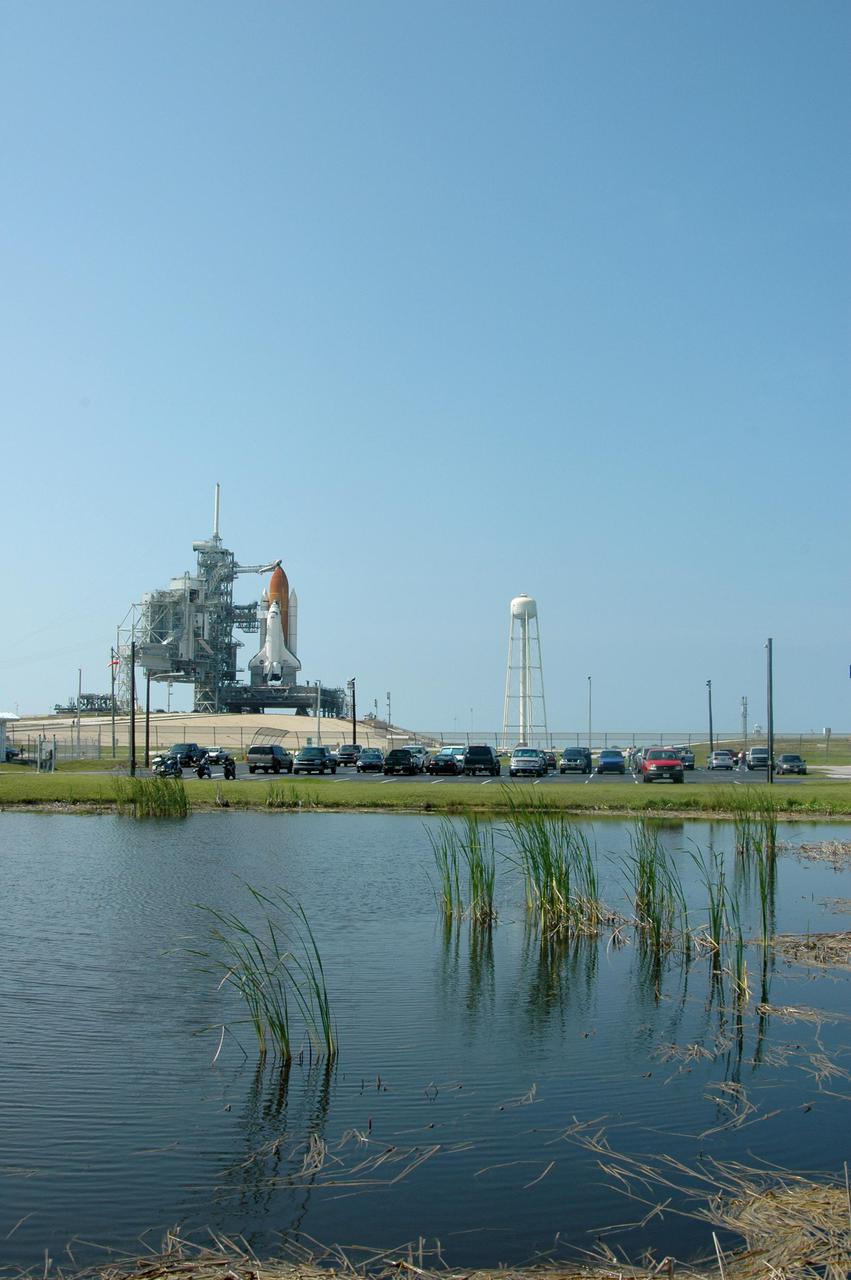
KENNEDY SPACE CENTER, FLA. - Cameras at the edge of a pond have a pristine view to Launch Pad 39B at NASA Kennedy Space Center where the Space Shuttle Discovery waits for launch. On the right of the Shuttle is the 290-foot-tall water tower that holds 300,000 gallons of water, part of the sound suppression system during a launch. Discovery is scheduled to lift off on the historic Return to Flight mission STS-114 at 10:39 a.m. EDT July 26 with a crew of seven. On the mission to the International Space Station the crew will perform inspections on orbit for the first time of all of the Reinforced Carbon-Carbon (RCC) panels on the leading edge of the wings and the Thermal Protection System tiles using the new Canadian-built Orbiter Boom Sensor System and the data from 176 impact and temperature sensors. Mission Specialists will also practice repair techniques on RCC and tile samples during a spacewalk in the payload bay. During two additional spacewalks, the crew will install the External Stowage Platform-2, equipped with spare part assemblies, and a replacement Control Moment Gyroscope contained in the Lightweight Multi-Purpose Experiment Support Structure.
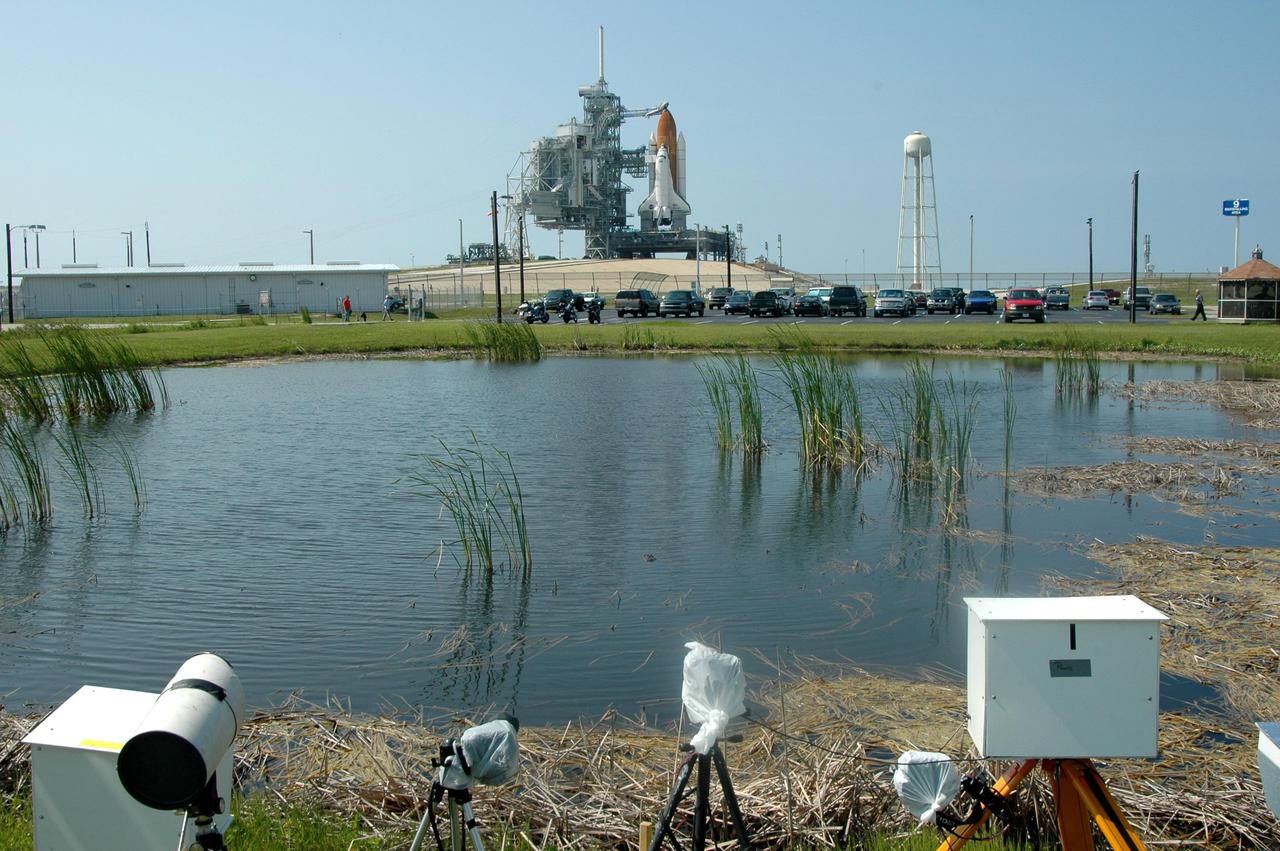
KENNEDY SPACE CENTER, FLA. - Cameras at the edge of a pond have a pristine view to Launch Pad 39B at NASA Kennedy Space Center where the Space Shuttle Discovery waits for launch. On the right of the Shuttle is the 290-foot-tall water tower that holds 300,000 gallons of water, part of the sound suppression system during a launch. Discovery is scheduled to lift off on the historic Return to Flight mission STS-114 at 10:39 a.m. EDT July 26 with a crew of seven. On the mission to the International Space Station the crew will perform inspections on orbit for the first time of all of the Reinforced Carbon-Carbon (RCC) panels on the leading edge of the wings and the Thermal Protection System tiles using the new Canadian-built Orbiter Boom Sensor System and the data from 176 impact and temperature sensors. Mission Specialists will also practice repair techniques on RCC and tile samples during a spacewalk in the payload bay. During two additional spacewalks, the crew will install the External Stowage Platform-2, equipped with spare part assemblies, and a replacement Control Moment Gyroscope contained in the Lightweight Multi-Purpose Experiment Support Structure.

KENNEDY SPACE CENTER, Fla. -- After a journey of more than 8 hours from the Vehicle Assembly Building, Space Shuttle Atlantis sits on Launch Pad 39B. At left is the Rotating Service Structure, which will roll on its axis to enclose the Shuttle until launch. Towering above the Fixed Service Structure next to it is the 80-foot tall lightning mast that provides protection from lightning strikes. On the right is the elevated water tank with a capacity of 300,000 gallons. Part of the Sound Suppression Water System, the water in the tank is released just before ignition of the orbiter’s three main engines and twin solid rocket boosters and flow through parallel 7-foot-diameter pipes to the pad area. The Shuttle is targeted for launch no earlier than July 12 on mission STS-104, the 10th flight to the International Space Station. The payload on the 11-day mission is the Joint Airlock Module, which will allow astronauts and cosmonauts in residence on the Station to perform future spacewalks without the presence of a Space Shuttle. The module, which comprises a crew lock and an equipment lock, will be connected to the starboard (right) side of Node 1 Unity. Atlantis will also carry oxygen and nitrogen storage tanks, vital to operation of the Joint Airlock, on a Spacelab Logistics Double Pallet in the payload bay. The tanks, to be installed on the perimeter of the Joint Module during the mission’s spacewalks, will support future spacewalk operations and experiments plus augment the resupply system for the Station’s Service Module
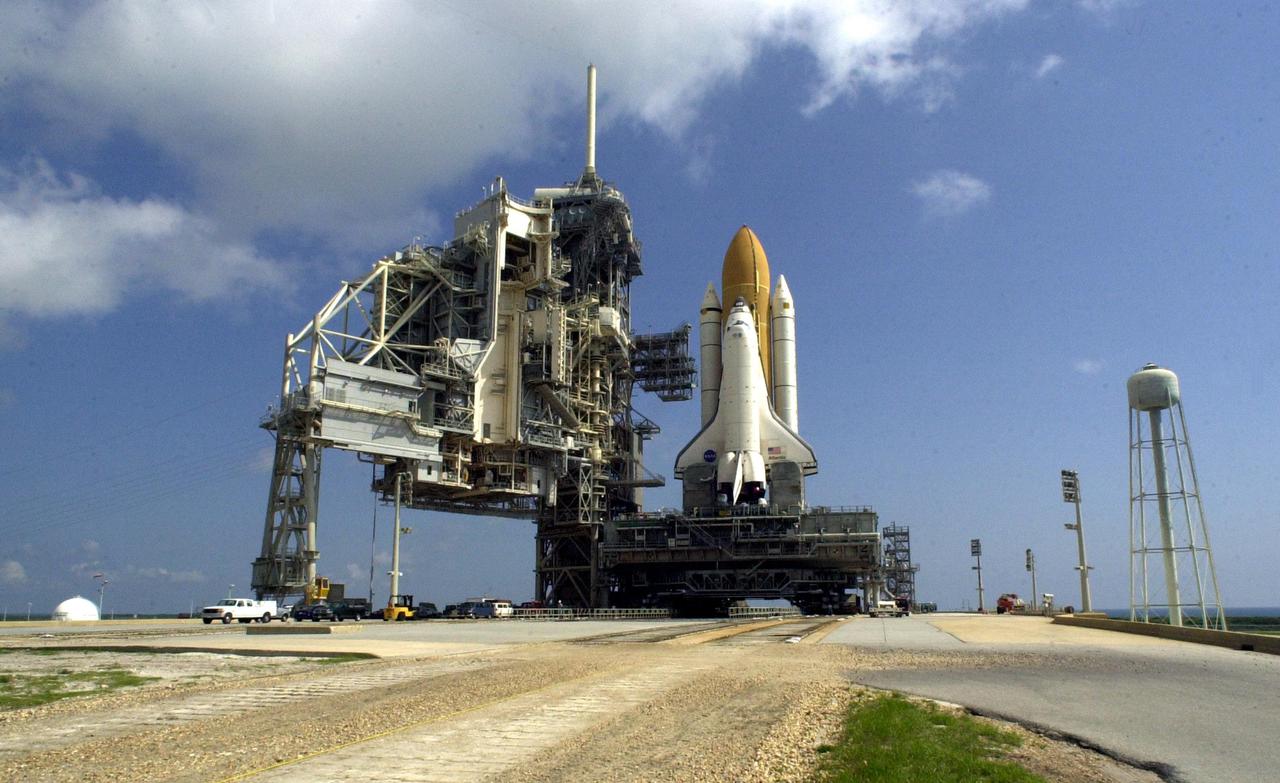
KENNEDY SPACE CENTER, Fla. -- After a journey of more than 8 hours from the Vehicle Assembly Building, Space Shuttle Atlantis sits on Launch Pad 39B. At left is the Rotating Service Structure, which will roll on its axis to enclose the Shuttle until launch. Towering above the Fixed Service Structure next to it is the 80-foot tall lightning mast that provides protection from lightning strikes. On the right is the elevated water tank with a capacity of 300,000 gallons. Part of the Sound Suppression Water System, the water in the tank is released just before ignition of the orbiter’s three main engines and twin solid rocket boosters and flow through parallel 7-foot-diameter pipes to the pad area. The Shuttle is targeted for launch no earlier than July 12 on mission STS-104, the 10th flight to the International Space Station. The payload on the 11-day mission is the Joint Airlock Module, which will allow astronauts and cosmonauts in residence on the Station to perform future spacewalks without the presence of a Space Shuttle. The module, which comprises a crew lock and an equipment lock, will be connected to the starboard (right) side of Node 1 Unity. Atlantis will also carry oxygen and nitrogen storage tanks, vital to operation of the Joint Airlock, on a Spacelab Logistics Double Pallet in the payload bay. The tanks, to be installed on the perimeter of the Joint Module during the mission’s spacewalks, will support future spacewalk operations and experiments plus augment the resupply system for the Station’s Service Module
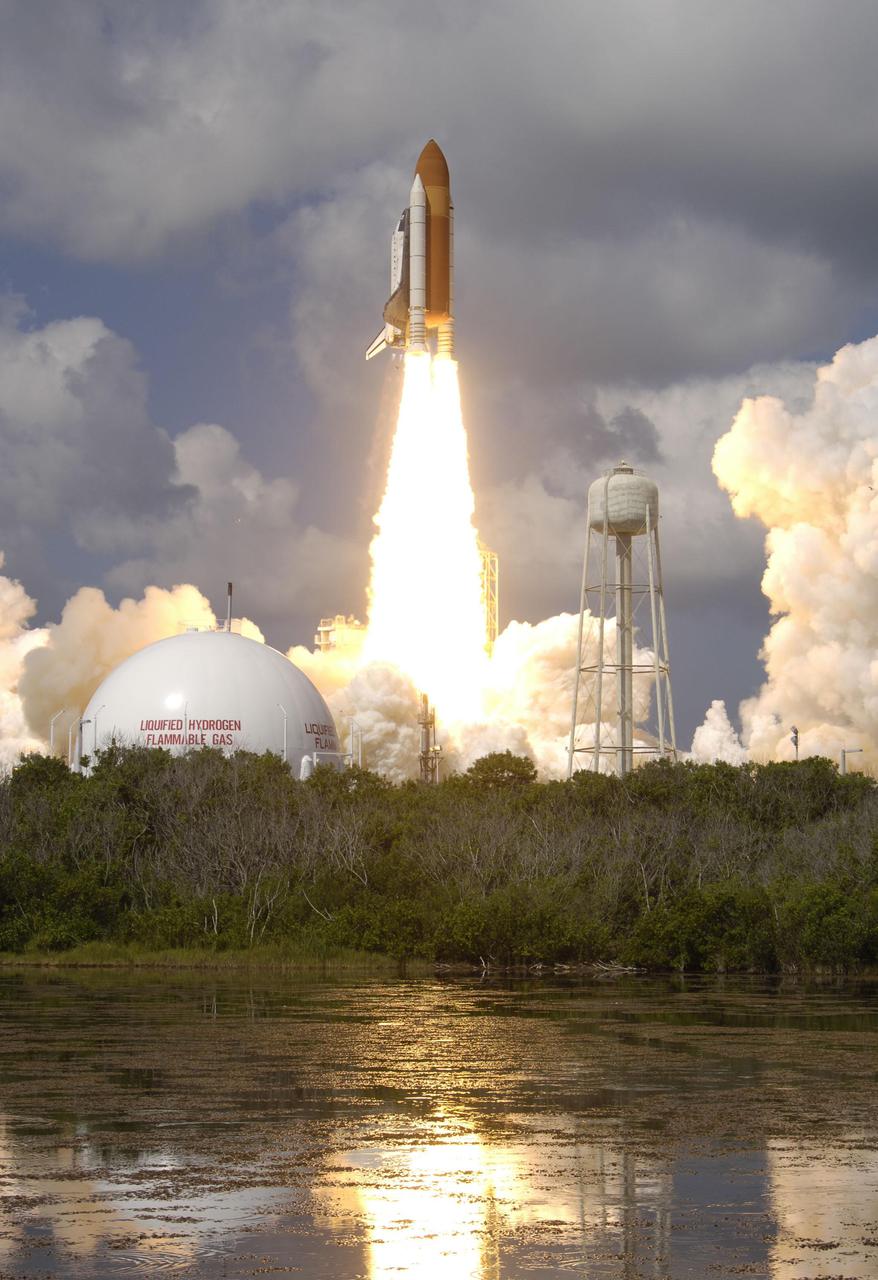
KENNEDY SPACE CENTER, FLA. - Seeming to erupt from between the liquefied hydrogen gas tank on the left and 290-foot water tower on the right, Space Shuttle Discovery roars into the cloud-filled sky from Launch Pad 39B. Discovery is launching on the historic Return to Flight mission STS-114. It is the 114th flight in the Space Shuttle Program and the 31st for Discovery. The 12-day mission is expected to end with touchdown at the Shuttle Landing Facility on Aug. 7. On this mission to the International Space Station the crew will perform inspections on-orbit for the first time of all of the Reinforced Carbon-Carbon (RCC) panels on the leading edge of the wings and the Thermal Protection System tiles using the new Canadian-built Orbiter Boom Sensor System and the data from 176 impact and temperature sensors. Mission Specialists will also practice repair techniques on RCC and tile samples during a spacewalk in the payload bay. During two additional spacewalks, the crew will install the External Stowage Platform-2, equipped with spare part assemblies, and a replacement Control Moment Gyroscope contained in the Lightweight Multi-Purpose Experiment Support Structure. (Photo Credit: Scott Andrews)
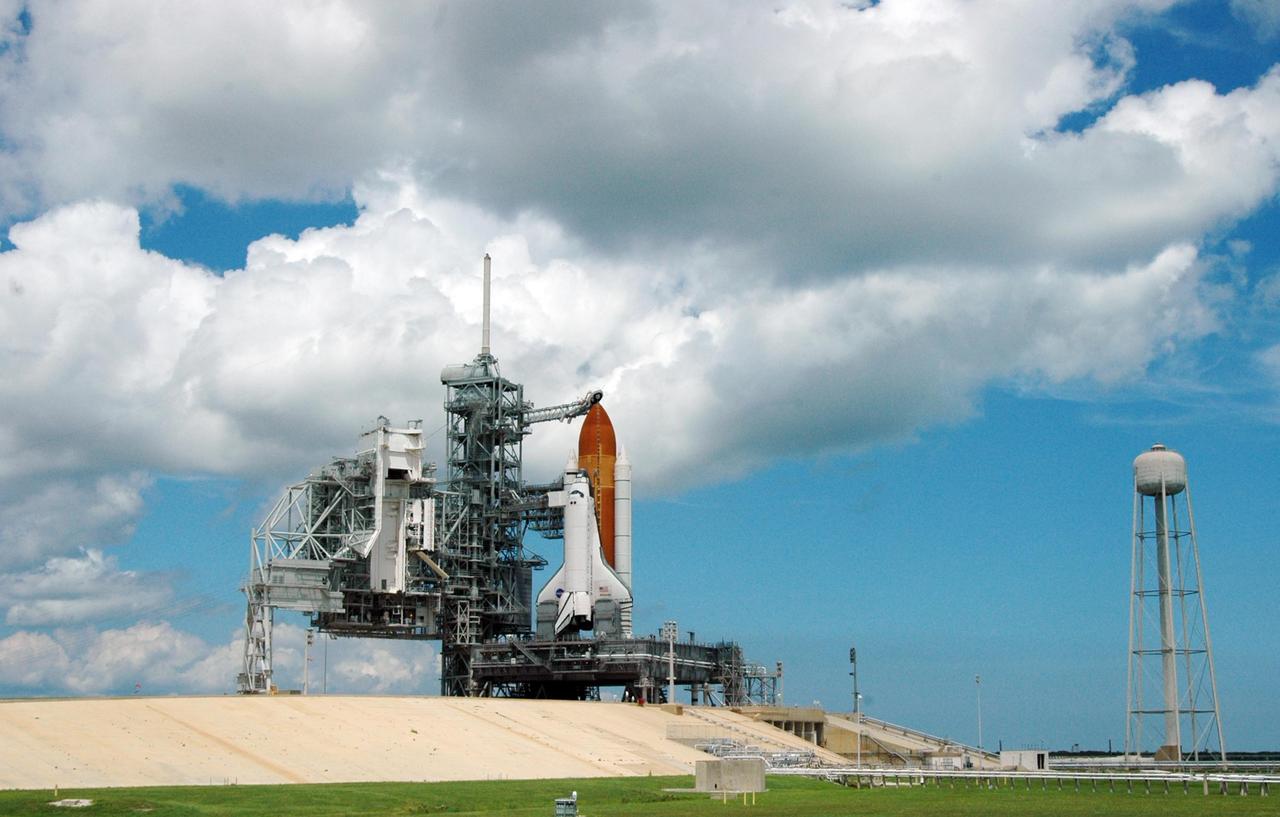
KENNEDY SPACE CENTER, FLA. - Huge clouds roll over Launch Pad 39B where Space Shuttle Atlantis still sits after the scrub of its launch on mission STS-115. Atlantis was originally scheduled to launch at 12:29 p.m. EDT on this date, but a 24-hour scrub was called by mission managers due to a concern with fuel cell 1. Towering above the shuttle is the 80-foot lightning mast. At right is the 300,000-gallon water tank that releases its contents onto the mobile launcher platform during liftoff to aid sound suppression. During the STS-115 mission, Atlantis' astronauts will deliver and install the 17.5-ton, bus-sized P3/P4 integrated truss segment on the station. The girder-like truss includes a set of giant solar arrays, batteries and associated electronics and will provide one-fourth of the total power-generation capability for the completed station. This mission is the 116th space shuttle flight, the 27th flight for orbiter Atlantis, and the 19th U.S. flight to the International Space Station. STS-115 is scheduled to last 11 days with a planned landing at KSC. Photo credit: NASA/Ken Thornsley
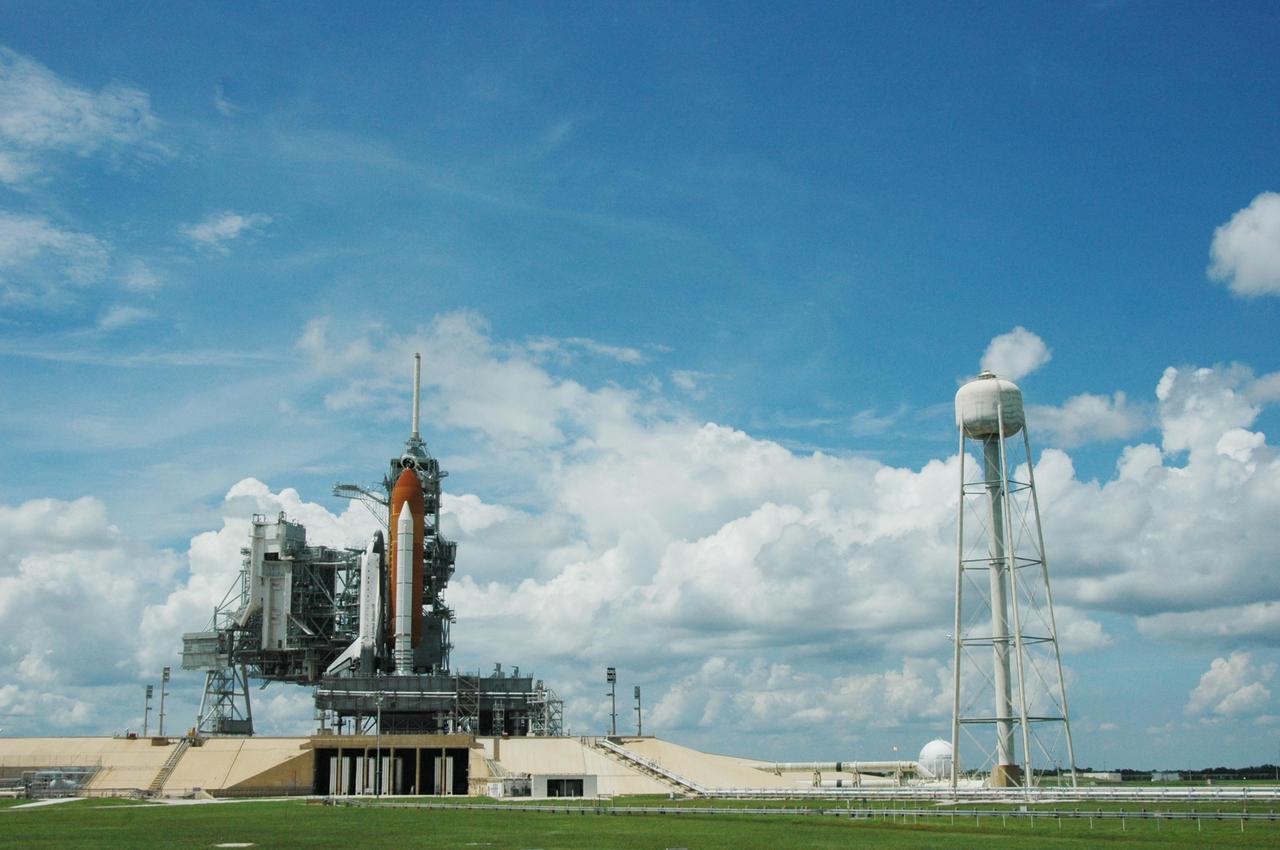
KENNEDY SPACE CENTER, FLA. - Clouds spread throughout the sky behind Launch Pad 39B where Space Shuttle Atlantis still sits after the scrub of its launch on mission STS-115. Atlantis was originally scheduled to launch at 12:29 p.m. EDT on this date, but a 24-hour scrub was called by mission managers due to a concern with fuel cell 1. Towering above the shuttle is the 80-foot lightning mast. At right is the 300,000-gallon water tank that releases its contents onto the mobile launcher platform during liftoff to aid sound suppression. During the STS-115 mission, Atlantis' astronauts will deliver and install the 17.5-ton, bus-sized P3/P4 integrated truss segment on the station. The girder-like truss includes a set of giant solar arrays, batteries and associated electronics and will provide one-fourth of the total power-generation capability for the completed station. This mission is the 116th space shuttle flight, the 27th flight for orbiter Atlantis, and the 19th U.S. flight to the International Space Station. STS-115 is scheduled to last 11 days with a planned landing at KSC. Photo credit: NASA/Ken Thornsley