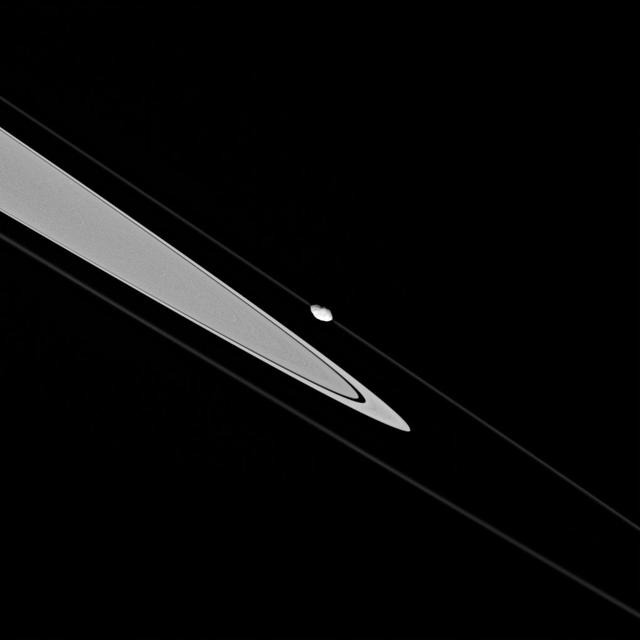
Pandora on a String
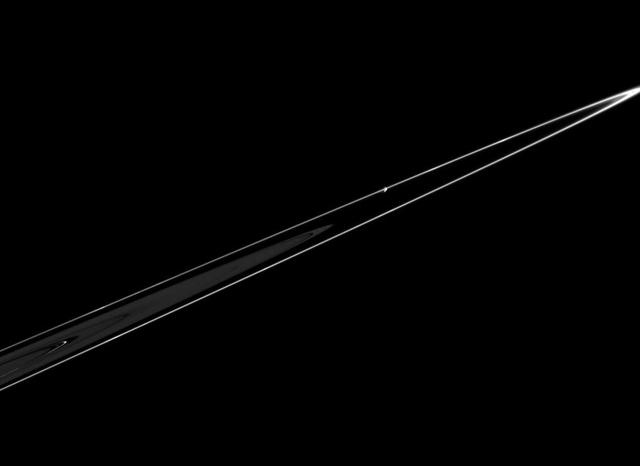
Pandora at the Edge
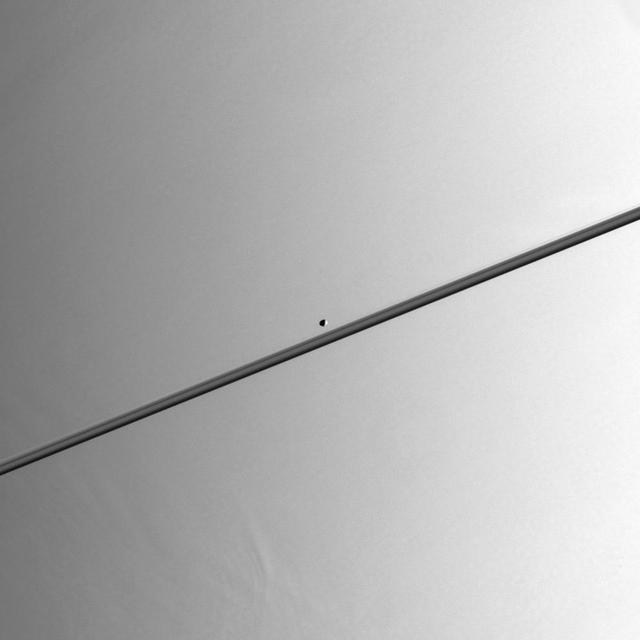
Pandora Glides Along
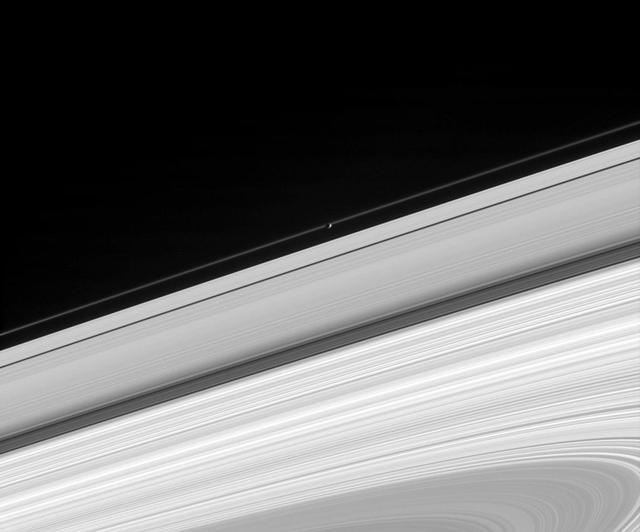
Pandora Occults the F Ring
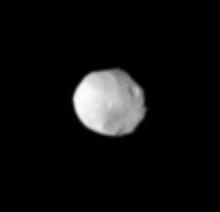
Off Pandora Shoulder

Craters on Saturn moon Pandora exhibit clarity and depth in this anaglyph from NASA Cassini spacecraft. 3D glasses are necessary to view this image.
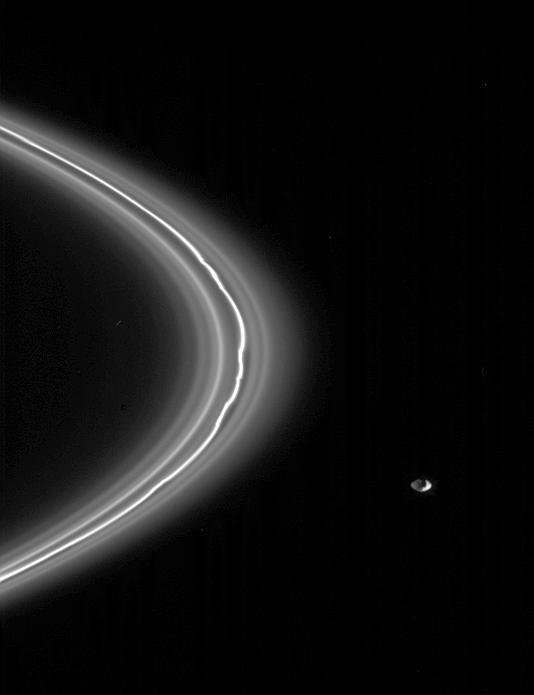
Pandora Flocks
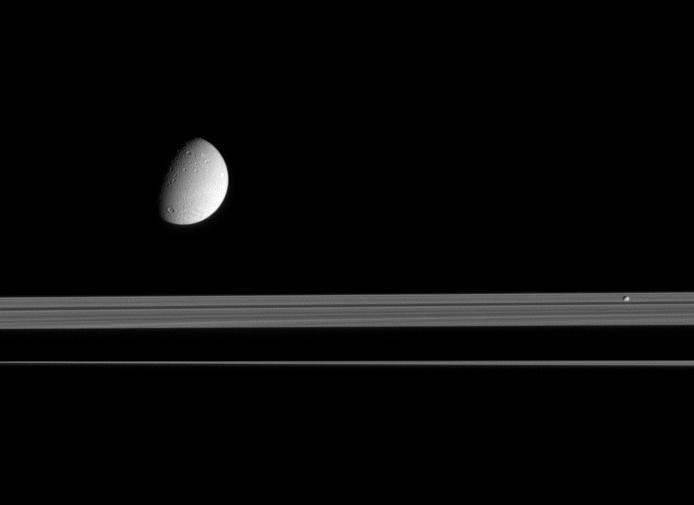
Dione and Pandora
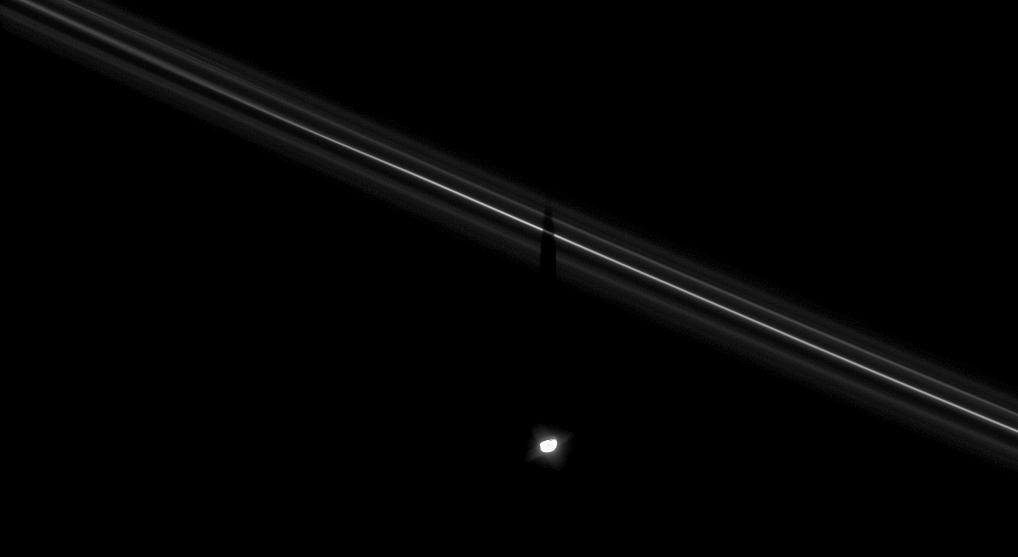
Pandora Shadow
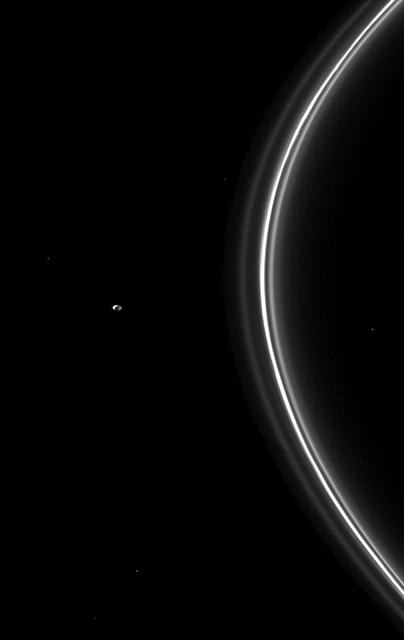
NASA Cassini spacecraft watches Pandora, one of the F ring two shepherding moons, orbiting beyond the thin ring; the small moon can be seen on the left of this image.
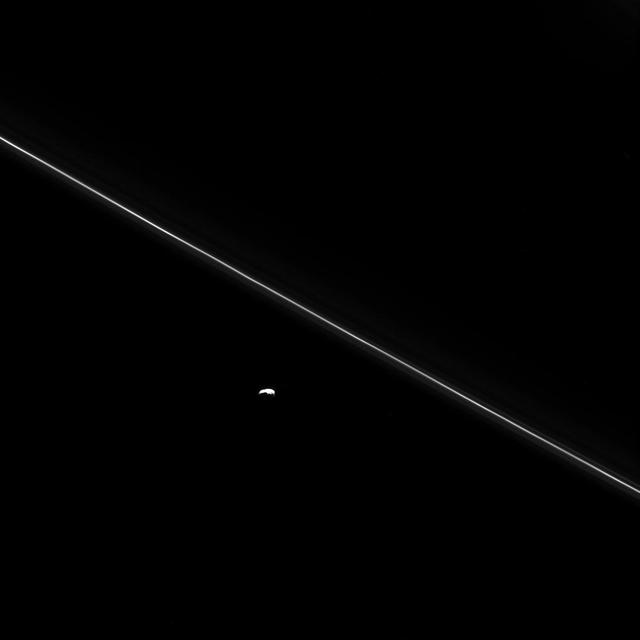
As Cassini hurtled toward its fatal encounter with Saturn, the spacecraft turned to catch this final look at Saturn's moon Pandora next to the thin line of the F ring. Over the course of its mission, Cassini helped scientists understand that Pandora plays a smaller role than they originally thought in shaping the narrow ring. When Cassini arrived at Saturn, many thought that Pandora and Prometheus worked together to shepherd the F ring between them, confining it and sculpting its unusual braided and kinked structures. However, data from Cassini show that the gravity of the two moons together actually stirs the F ring into a chaotic state, generating the "gap and streamer" structure. Recent models, supported by Cassini images, suggest that it is Prometheus alone, not Pandora, that confines the bulk of the F ring, aided by the particular characteristics of its orbit. Prometheus establishes stable locations for F ring material where the moon's own gravitational resonances are least cluttered by the perturbing influence of its sibling satellite, Pandora. This view looks toward the sunlit side of the rings from about 28 degrees above the ringplane. The image was taken in visible light with the Cassini spacecraft narrow-angle camera on Sept. 14, 2017. The view was obtained at a distance of approximately 360,000 miles (577,000 kilometers) from Pandora and at a Sun-Pandora-spacecraft, or phase, angle of 119 degrees. Image scale is about 2.2 miles (3.5 kilometers) per pixel. The Cassini spacecraft ended its mission on Sept. 15, 2017. https://photojournal.jpl.nasa.gov/catalog/PIA21355
Atlas, Pandora and Janus
Pandora Gets Kinky
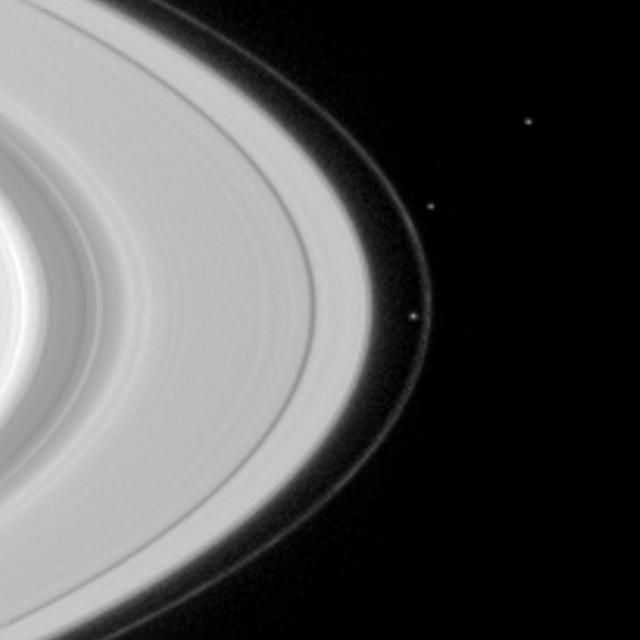
Pandora and Prometheus Near F Ring
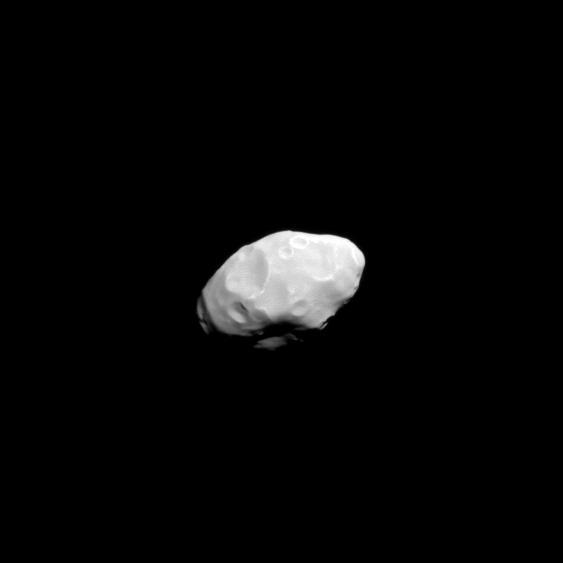
NASA Cassini spacecraft captured this close view of Saturn moon Pandora during the spacecraft flyby on June 3, 2010. Pandora orbits beyond Saturn thin F ring.
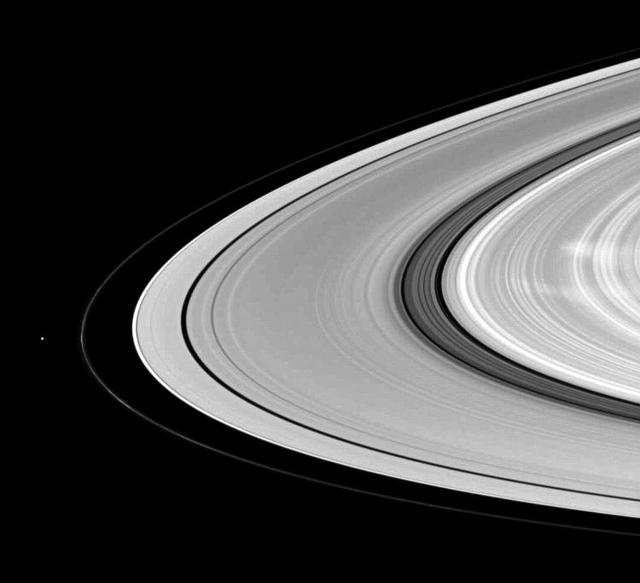
Saturn moon Pandora shares the stage with ghostly B ring spokes in this NASA Cassini spacecraft scene. Pandora is on the left. The spokes are the radial markings visible on the right of the image.
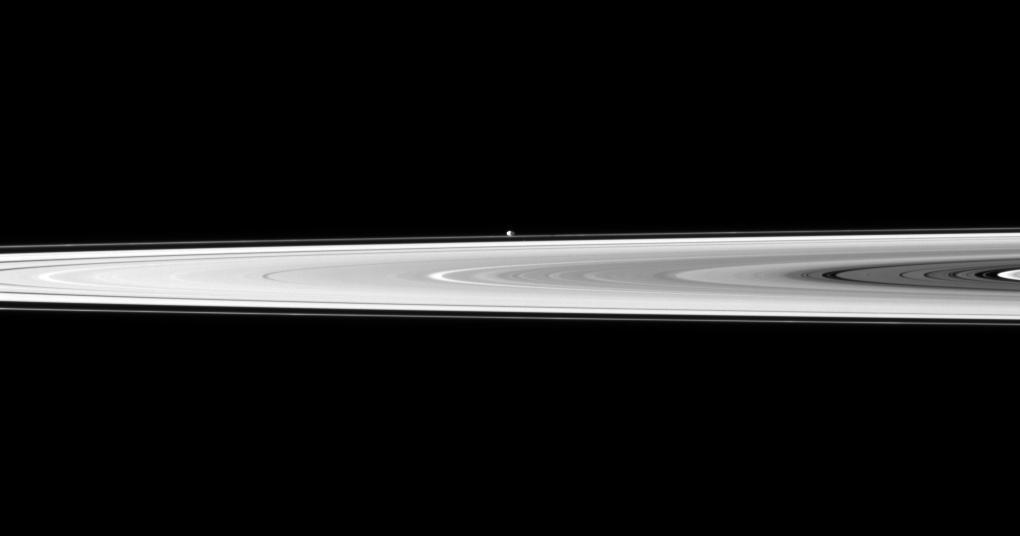
The tiny moon Pandora appears beyond the bright disk of Saturn rings in this image taken by NASA Cassini spacecraft. Pandora orbits outside the F ring and, in this image, is farther from Cassini than the rings are.
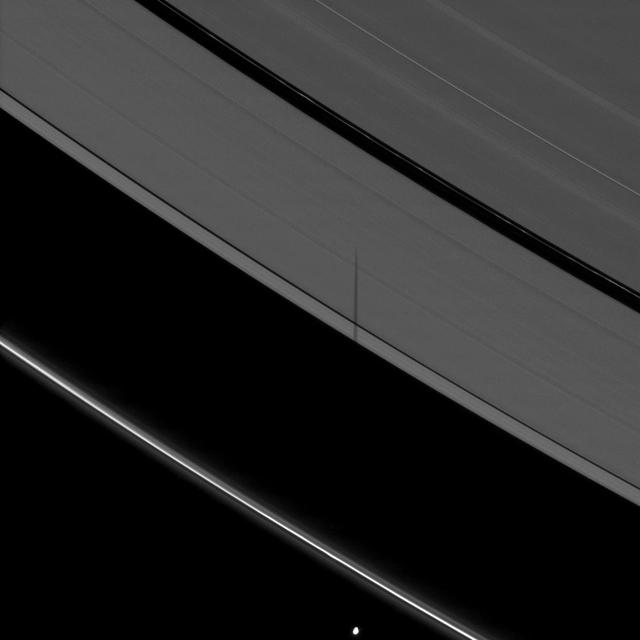
The moon Pandora casts a shadow onto Saturn A ring but not the F ring.
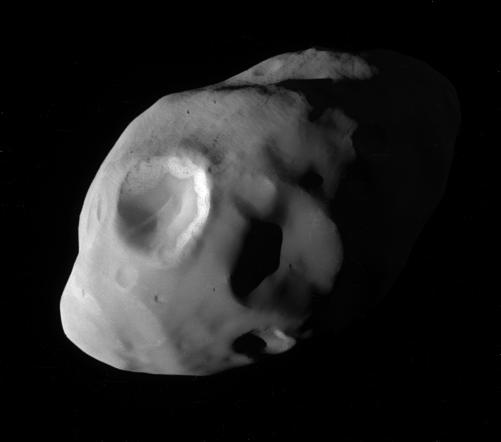
This image from NASA's Cassini spacecraft is one of the highest-resolution views ever taken of Saturn's moon Pandora. Pandora (52 miles, 84 kilometers) across orbits Saturn just outside the narrow F ring. The spacecraft captured the image during its closest-ever flyby of Pandora on Dec. 18, 2016, during the third of its grazing passes by the outer edges of Saturn's main rings. (For Cassini's closest view prior to this flyby, see PIA07632, which is also in color.) The image was taken in green light with the Cassini spacecraft narrow-angle camera at a distance of approximately 25,200 miles (40,500 kilometers) from Pandora. Image scale is 787 feet (240 meters) per pixel. http://photojournal.jpl.nasa.gov/catalog/PIA21055
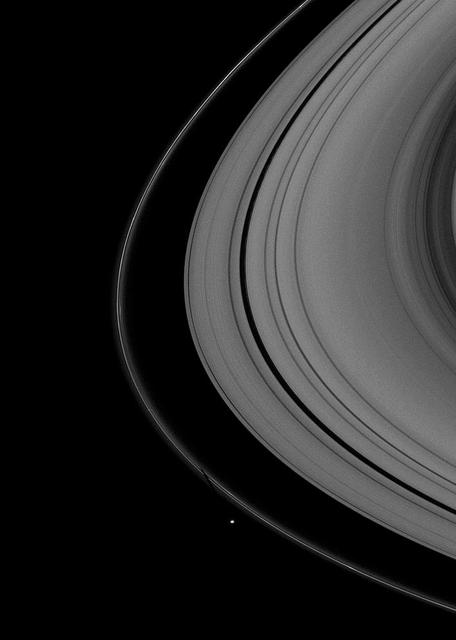
The shepherding moon Pandora, near the bottom of the image, casts a shadow on Saturn thin F ring as the planet nears its August 2009 equinox.
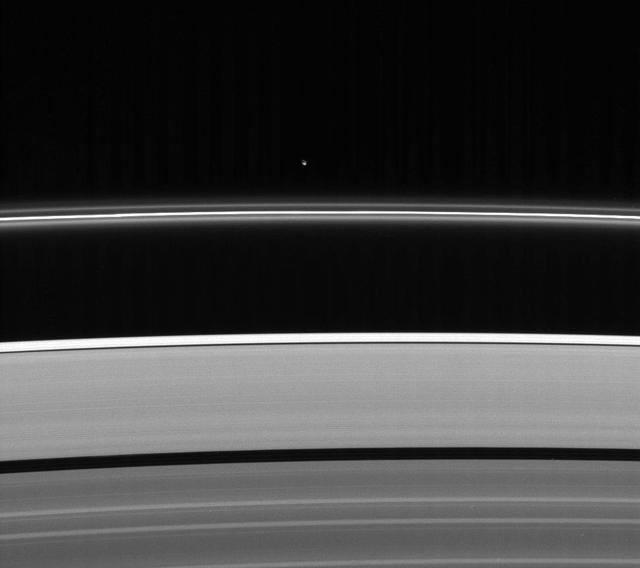
Less intrusive than her sibling shepherd moon, Pandora nonetheless provides a gravitational influence that helps confine and perturb the F ring shape
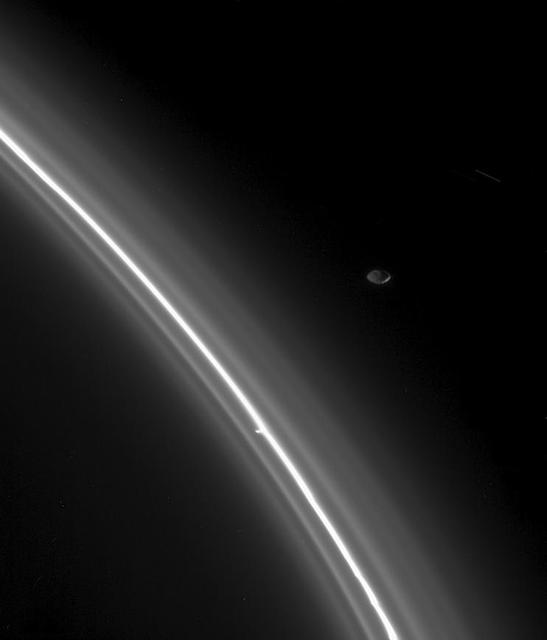
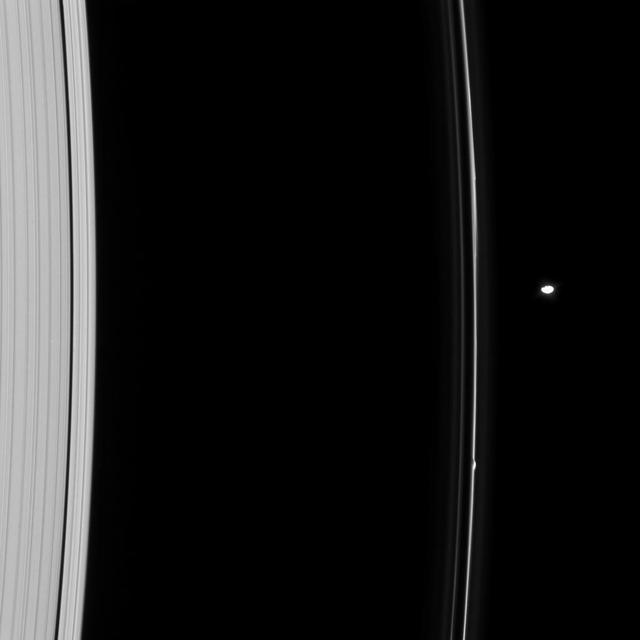
From just outside the faint edge of Saturn's F ring, the moon Pandora keeps watch over her fine-grained flock. The outer flanks of the F ring region are populated by ice particles approaching the size of the particles comprising smoke. As a shepherd moon, Pandora helps her cohort Prometheus confine and shape the main F ring. Pandora is 84 kilometers (52 miles) across. Prometheus is 102 kilometers (63 miles) wide and orbits interior to the F ring. The small knot seen attached to the core is one of several that Cassini scientists are eyeing as they attempt to distinguish embedded moons from transient clumps of material (see PIA07716). The image was taken with the Cassini spacecraft narrow-angle camera on Aug. 2, 2005, using a filter sensitive to wavelengths of infrared light centered at 930 nanometers at a distance of approximately 610,000 kilometers (379,000 miles) from Pandora and at a Sun-Pandora-spacecraft, or phase, angle of 146 degrees. Image scale is 4 kilometers (2 miles) per pixel. http://photojournal.jpl.nasa.gov/catalog/PIA07579
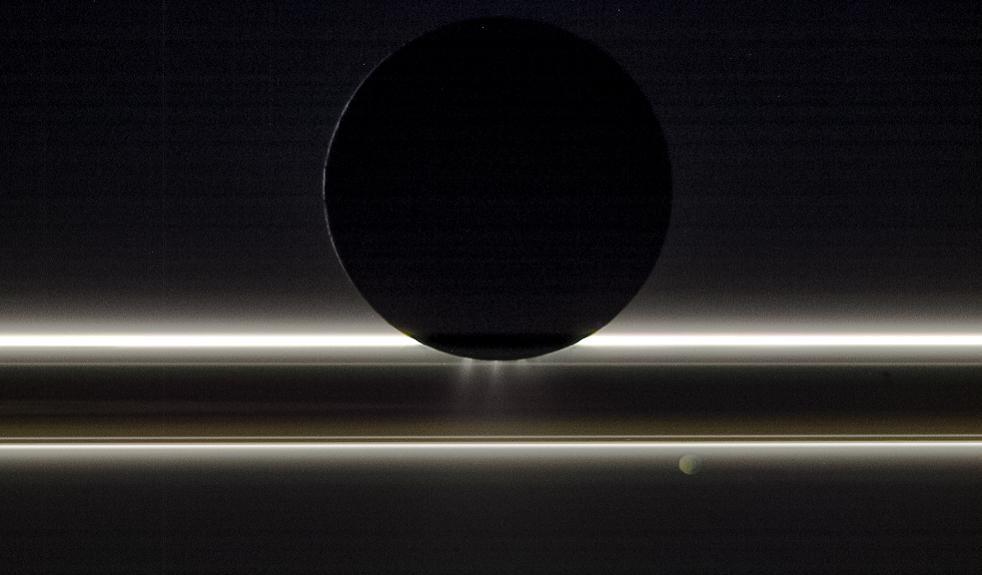
Saturn's moon Enceladus drifts before the rings and the tiny moon Pandora in this view captured by NASA's Cassini spacecraft on Nov. 1, 2009. The entire scene is backlit by the Sun, providing striking illumination for the icy particles that make up both the rings and the jets emanating from the south pole of Enceladus, which is about 314 miles (505 km) across. Pandora, which is about (52 miles, 84 kilometers) wide, was on the opposite side of the rings from Cassini and Enceladus when the image was taken. This view looks toward the night side on Pandora as well, which is lit by dim golden light reflected from Saturn. This natural-color image was taken in visible light with the Cassini spacecraft's narrow-angle camera at a distance of approximately 149,600 miles (240,800 kilometers) from Enceladus and 352,200 miles (566,800 kilometers) from Pandora. The Cassini spacecraft ended its mission on Sept. 15, 2017. https://photojournal.jpl.nasa.gov/catalog/PIA17144
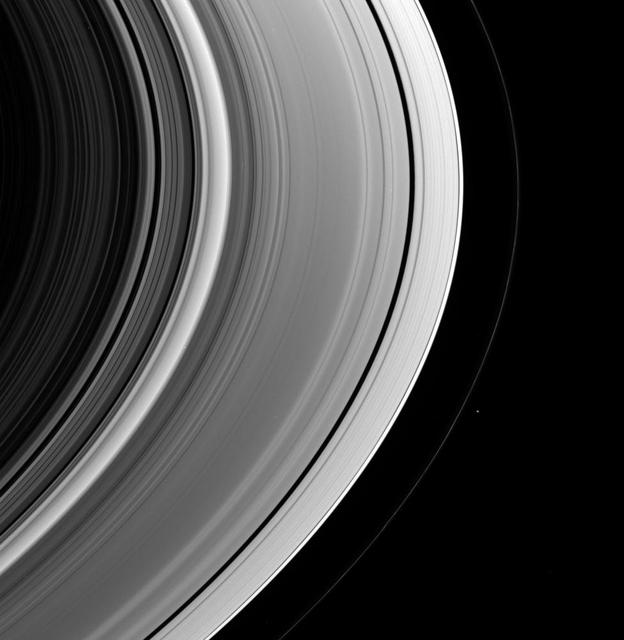
This view of the unlit side of Saturn rings captures the small shepherd moon Pandora as it swings around the outside of the F ring. The F ring displays a few discrete bright clumps here
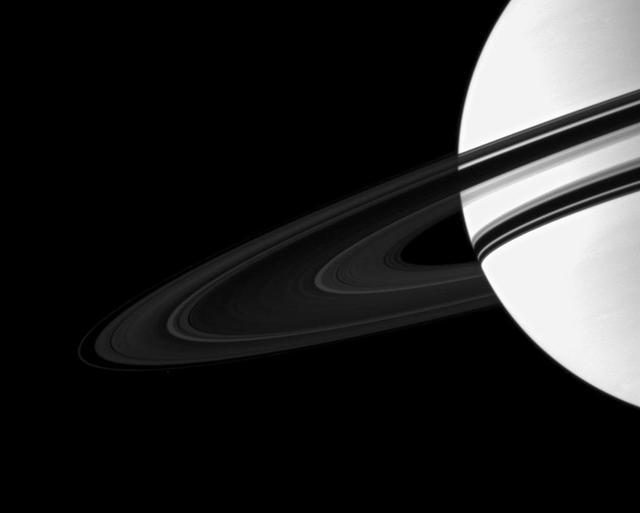
Saturn is overexposed in this image taken by NASA Cassini spacecraft in order to show the dim rings. Pandora below rings to the left has been brightened by a factor of 1.3 relative to the planet and the rings to enhance its visibility.
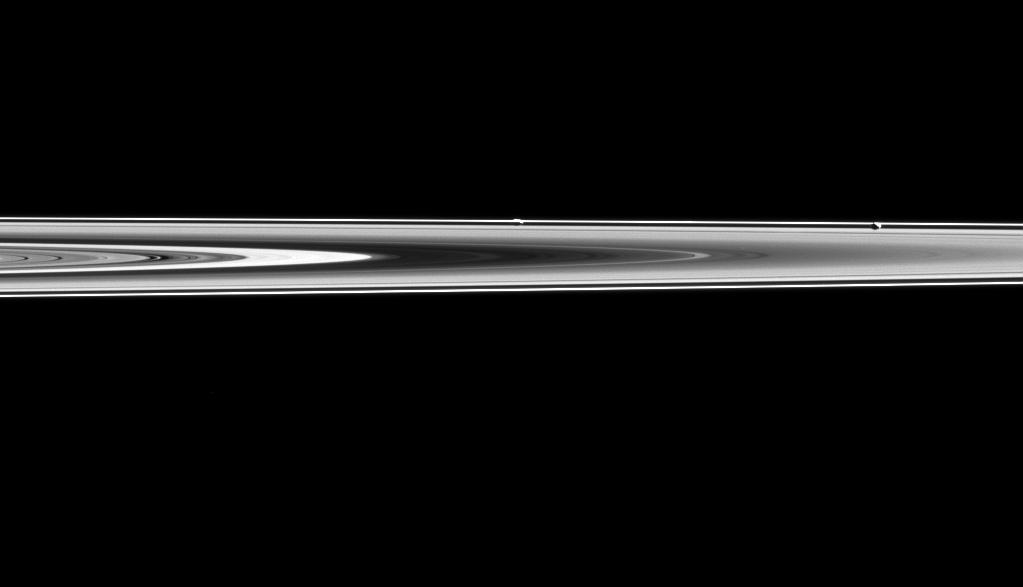
Prometheus and Pandora are almost hidden in Saturn's rings in this image. Prometheus (53 miles or 86 kilometers across) and Pandora (50 miles or 81 kilometers across) orbit along side Saturn's narrow F ring, which is shaped, in part, by their gravitational influences help to shape that ring. Their proximity to the rings also means that they often lie on the same line of sight as the rings, sometimes making them difficult to spot. In this image, Prometheus is the left most moon in the ring plane, roughly in the center of the image. Pandora is towards the right. This view looks toward the unilluminated side of the rings from about 0.3 degrees below the ring plane. The image was taken in visible light with the Cassini spacecraft narrow-angle camera on May 6, 2015. The view was obtained at a distance of approximately 994,000 miles (1.6 million kilometers) from Prometheus and at a Sun-Prometheus-spacecraft, or phase, angle of 106 degrees. Image scale is 6 miles (10 kilometers) per pixel. http://photojournal.jpl.nasa.gov/catalog/PIA18334
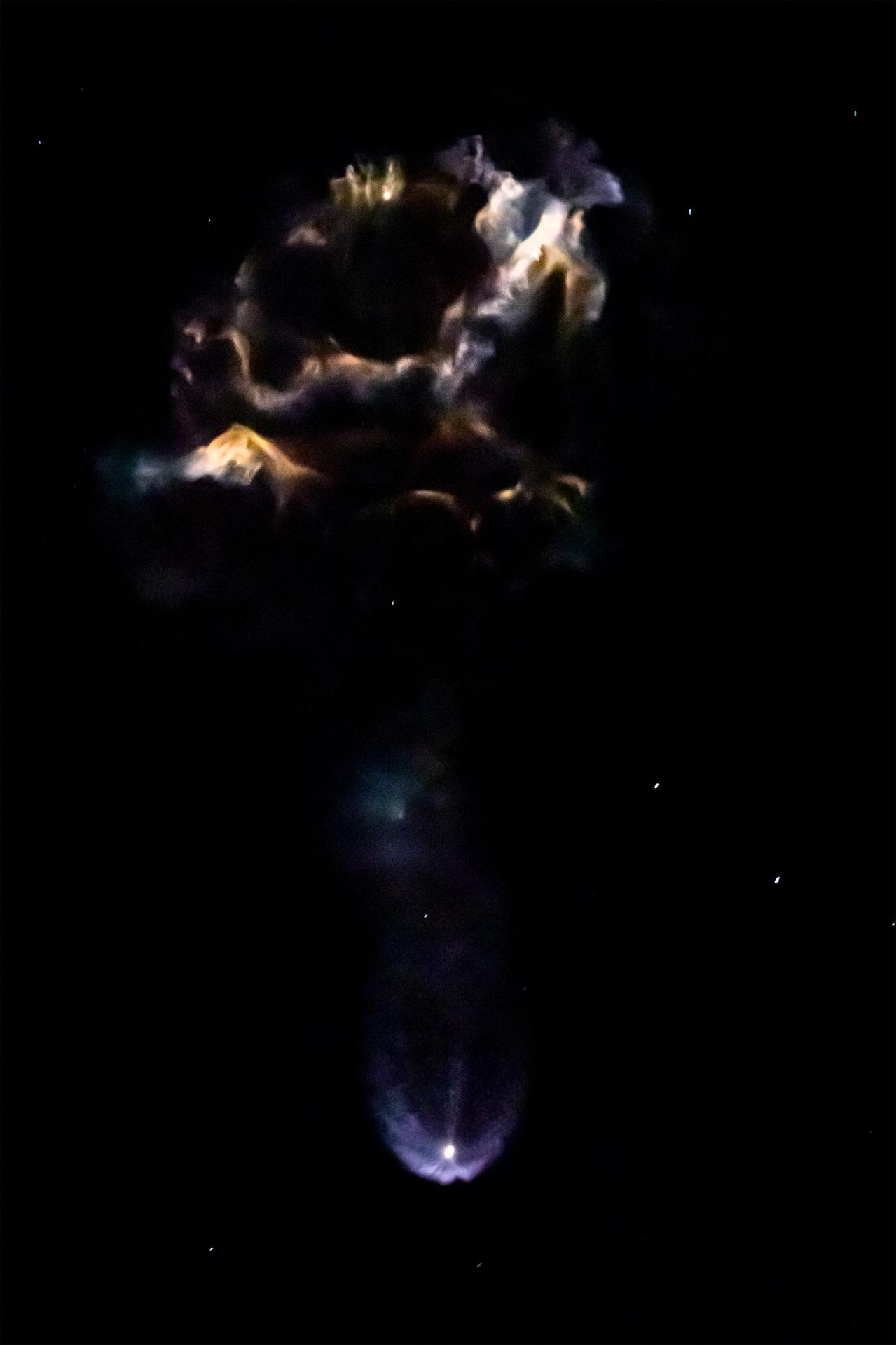
A SpaceX booster returns for landing following the launch of NASA’s Pandora small satellite, the Star-Planet Activity Research CubeSat (SPARCS), and Black Hole Coded Aperture Telescope (BlackCAT) CubeSat from Space Launch Complex 4 East at Vandenberg Space Force Base in California on Sunday, Jan. 11, 2026, as part of the company’s Twilight mission. Pandora will provide an in-depth study of at least 20 known planets orbiting distant stars to determine the composition of their atmospheres — especially the presence of hazes, clouds, and water.
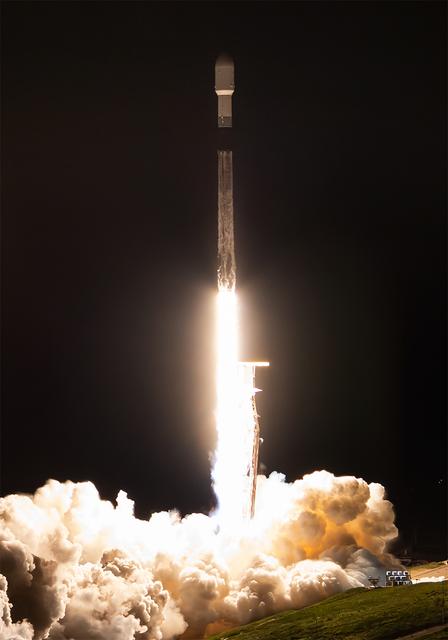
A SpaceX Falcon 9 rocket carrying NASA’s Pandora small satellite, the Star-Planet Activity Research CubeSat (SPARCS), and Black Hole Coded Aperture Telescope (BlackCAT) CubeSat lifts off from Space Launch Complex 4 East at Vandenberg Space Force Base in California on Sunday, Jan. 11, 2026. Pandora will provide an in-depth study of at least 20 known planets orbiting distant stars to determine the composition of their atmospheres — especially the presence of hazes, clouds, and water.

A SpaceX Falcon 9 rocket carrying NASA’s Pandora small satellite, the Star-Planet Activity Research CubeSat (SPARCS), and Black Hole Coded Aperture Telescope (BlackCAT) CubeSat lifts off from Space Launch Complex 4 East at Vandenberg Space Force Base in California on Sunday, Jan. 11, 2026. Pandora will provide an in-depth study of at least 20 known planets orbiting distant stars to determine the composition of their atmospheres — especially the presence of hazes, clouds, and water.
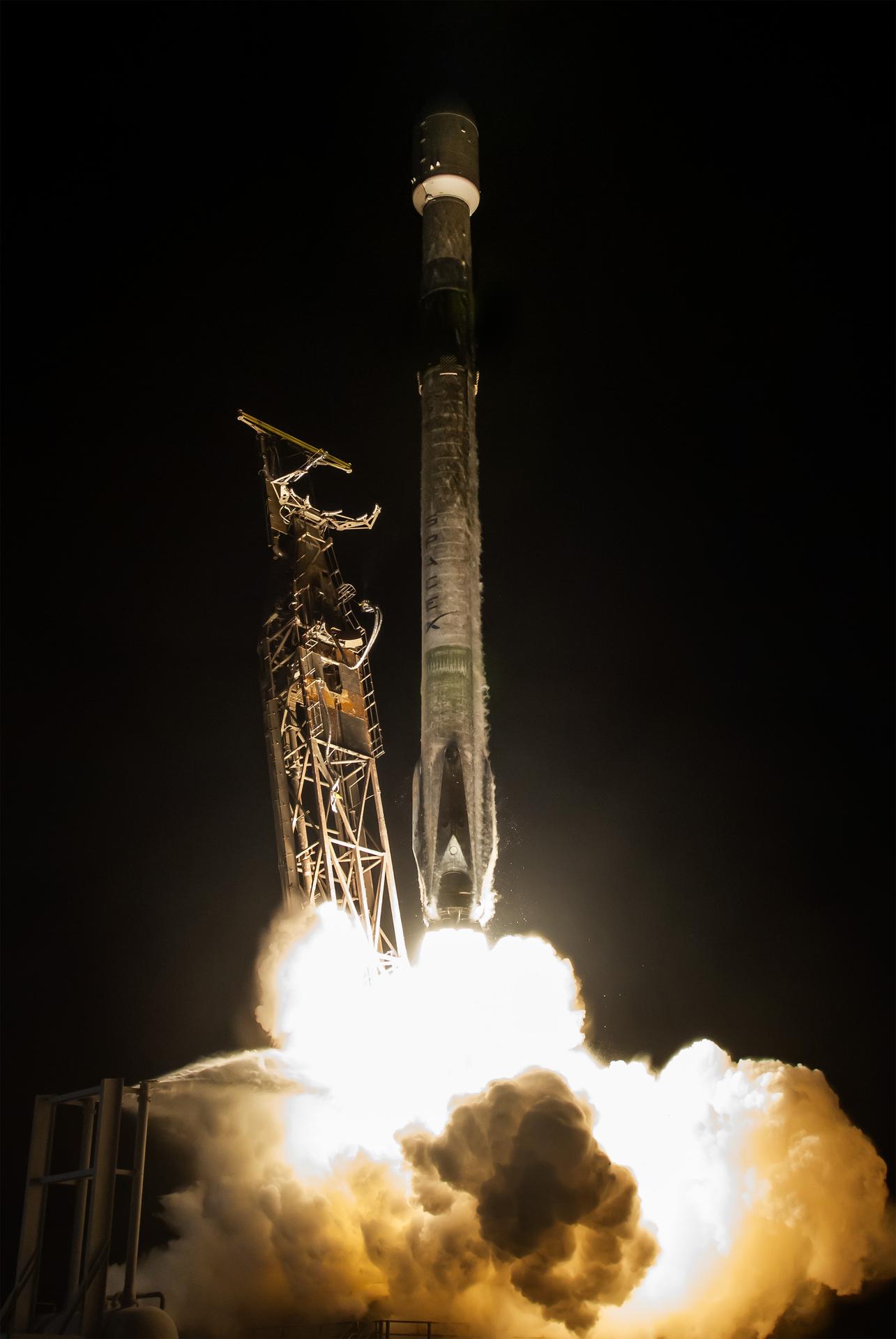
A SpaceX Falcon 9 rocket carrying NASA’s Pandora small satellite, the Star-Planet Activity Research CubeSat (SPARCS), and Black Hole Coded Aperture Telescope (BlackCAT) CubeSat lifts off from Space Launch Complex 4 East at Vandenberg Space Force Base in California on Sunday, Jan. 11, 2026. Pandora will provide an in-depth study of at least 20 known planets orbiting distant stars to determine the composition of their atmospheres — especially the presence of hazes, clouds, and water.
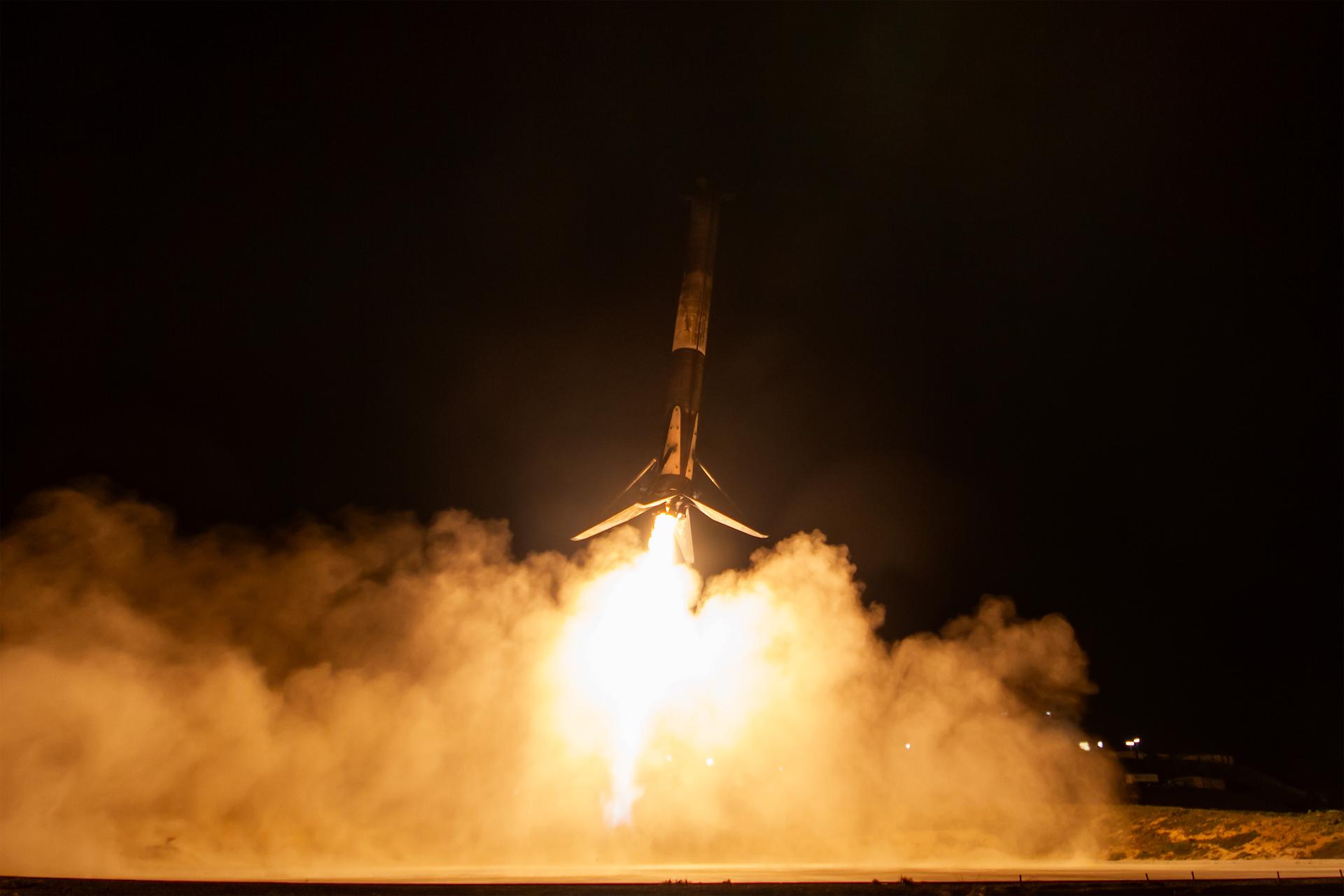
A SpaceX booster prepares for landing following the launch of NASA’s Pandora small satellite, the Star-Planet Activity Research CubeSat (SPARCS), and Black Hole Coded Aperture Telescope (BlackCAT) CubeSat from Space Launch Complex 4 East at Vandenberg Space Force Base in California on Sunday, Jan. 11, 2026, as part of the company’s Twilight mission. Pandora will provide an in-depth study of at least 20 known planets orbiting distant stars to determine the composition of their atmospheres — especially the presence of hazes, clouds, and water.
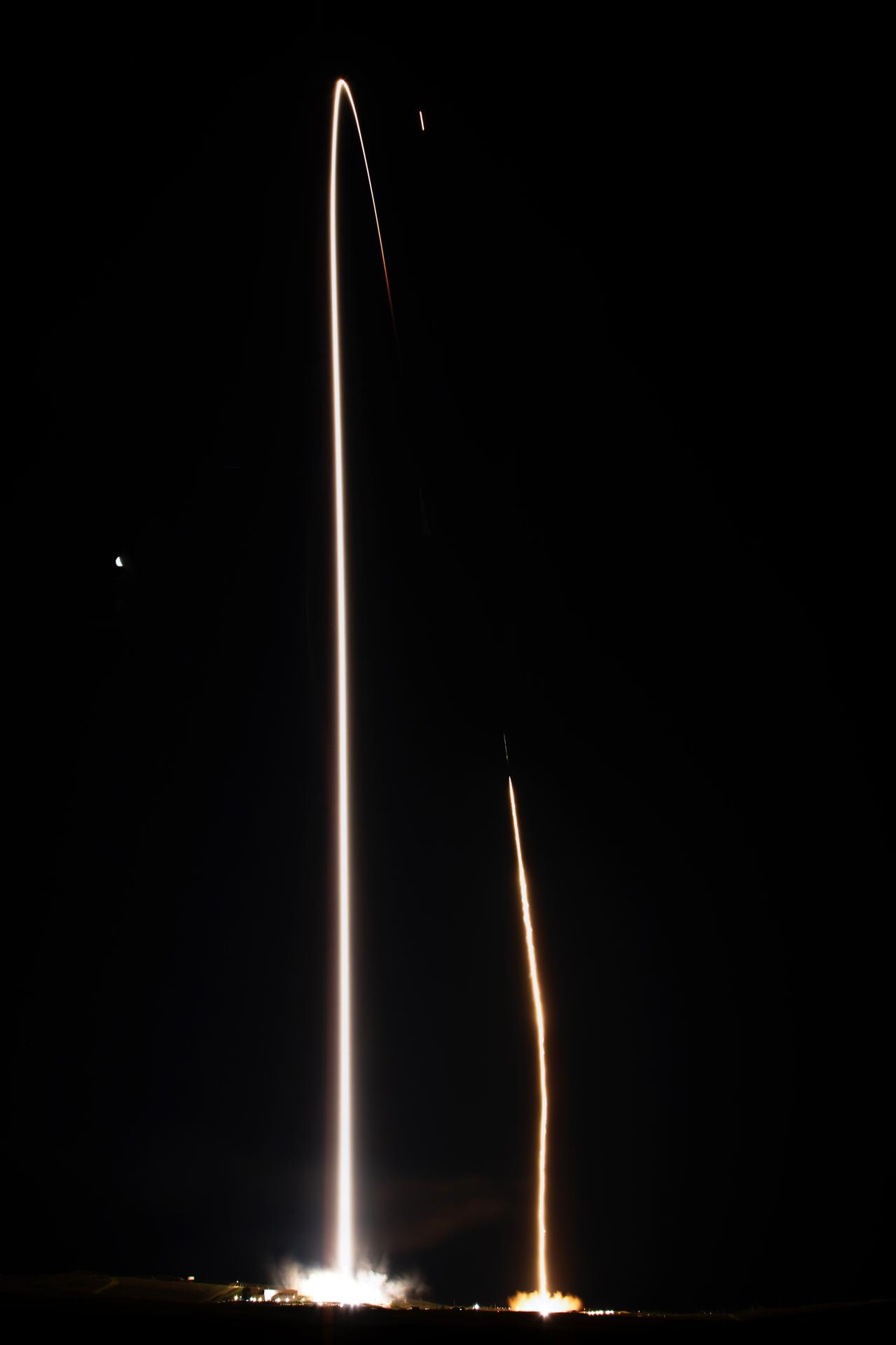
A photo captures the liftoff and landing of a SpaceX Falcon 9 rocket carrying NASA’s Pandora small satellite, the Star-Planet Activity Research CubeSat (SPARCS), and Black Hole Coded Aperture Telescope (BlackCAT) CubeSat from Space Launch Complex 4 East at Vandenberg Space Force Base in California on Sunday, Jan. 11, 2026, as part of the company’s Twilight mission. Pandora will provide an in-depth study of at least 20 known planets orbiting distant stars to determine the composition of their atmospheres — especially the presence of hazes, clouds, and water.
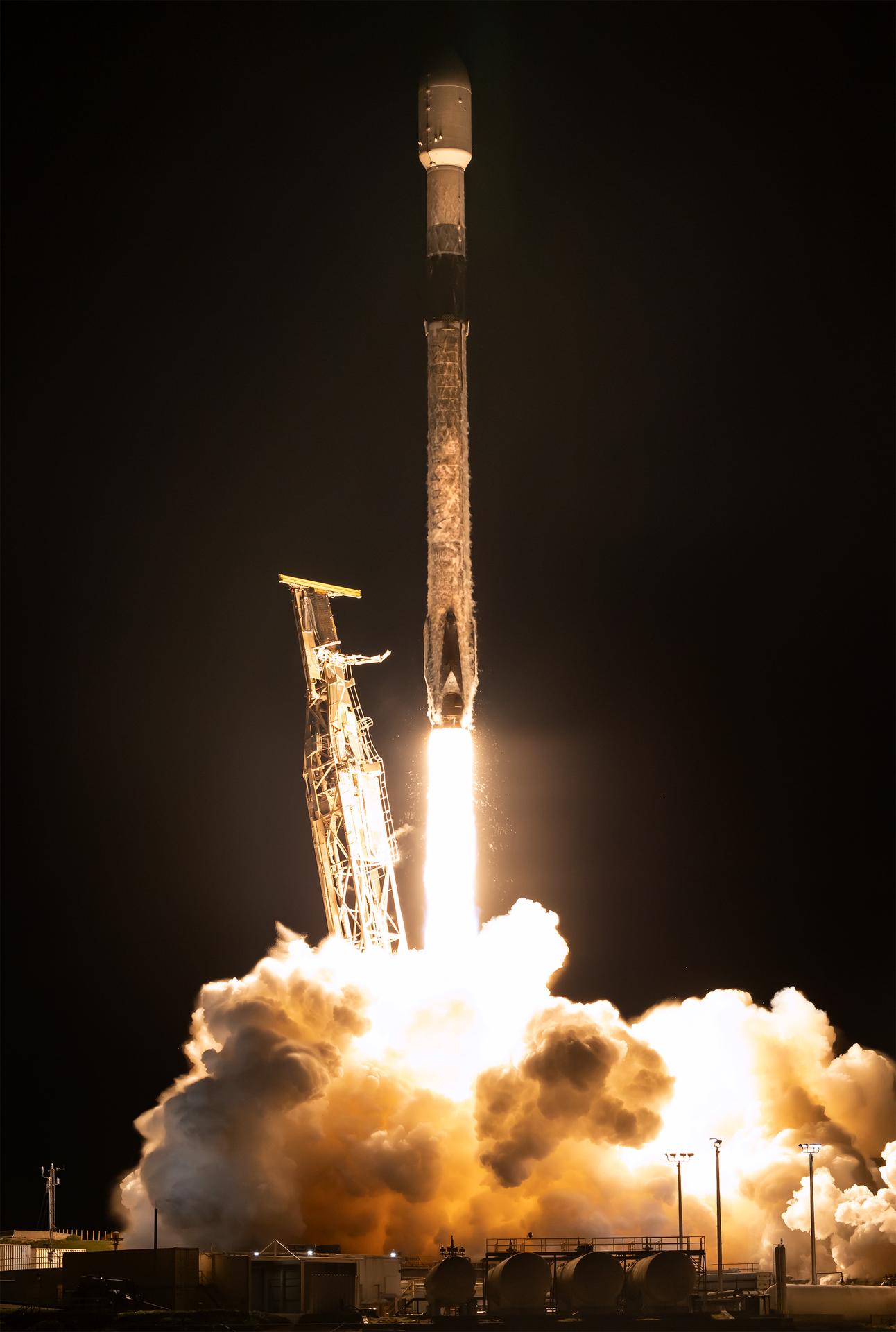
A SpaceX Falcon 9 rocket carrying NASA’s Pandora small satellite, the Star-Planet Activity Research CubeSat (SPARCS), and Black Hole Coded Aperture Telescope (BlackCAT) CubeSat lifts off from Space Launch Complex 4 East at Vandenberg Space Force Base in California on Sunday, Jan. 11, 2026. Pandora will provide an in-depth study of at least 20 known planets orbiting distant stars to determine the composition of their atmospheres — especially the presence of hazes, clouds, and water.
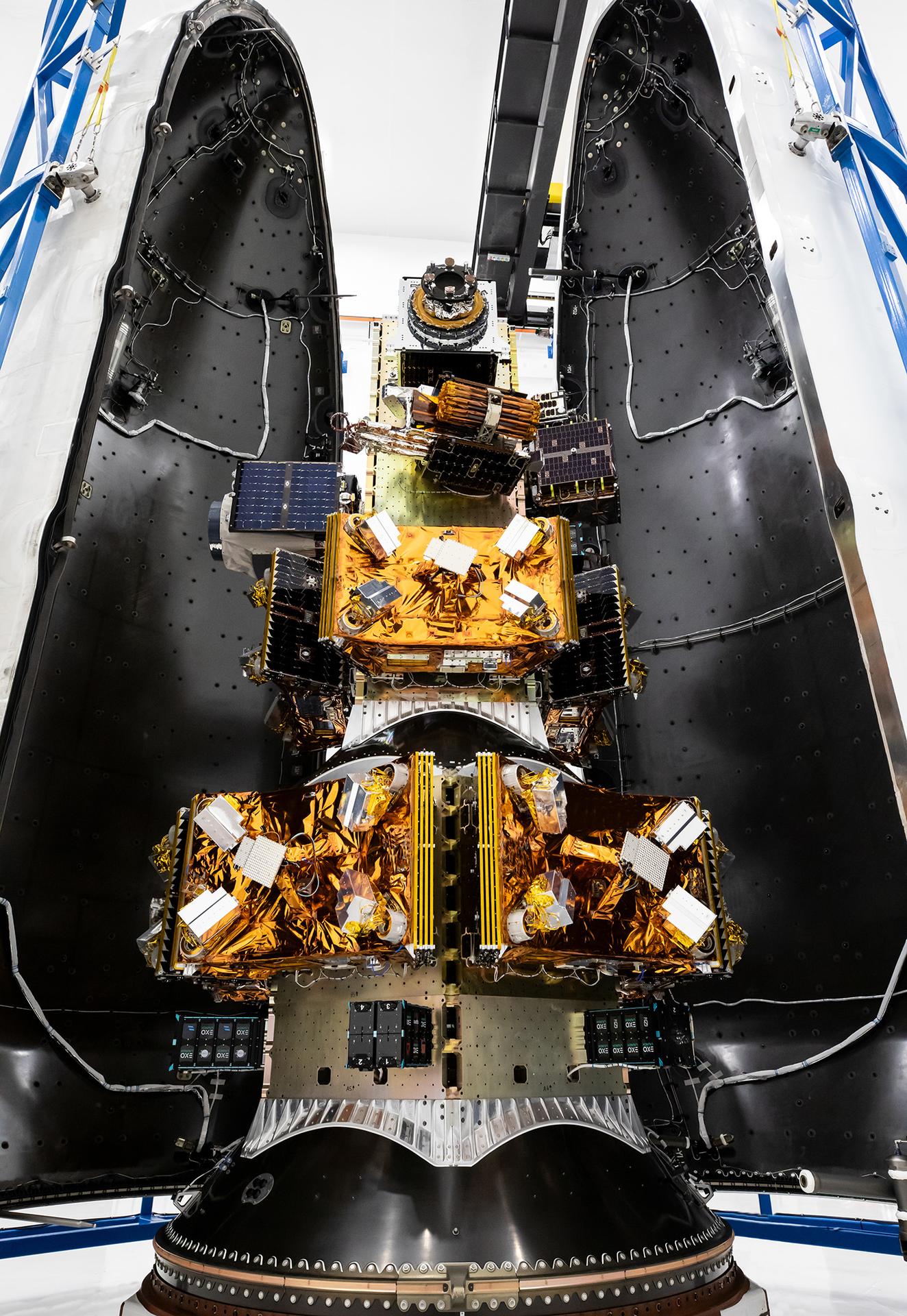
Teams prepare to encapsulate in early January 2026 NASA’s Pandora small satellite, and NASA-sponsored Star-Planet Activity Research CubeSat (SPARCS), and Black Hole Coded Aperture Telescope (BlackCAT) CubeSat, inside a SpaceX Falcon 9 payload fairing along with several other satellites at Vandenberg Space Force Base in California, as part of the company’s Twilight mission. Pandora will provide an in-depth study of at least 20 known planets orbiting distant stars to determine the composition of their atmospheres — especially the presence of hazes, clouds, and water.
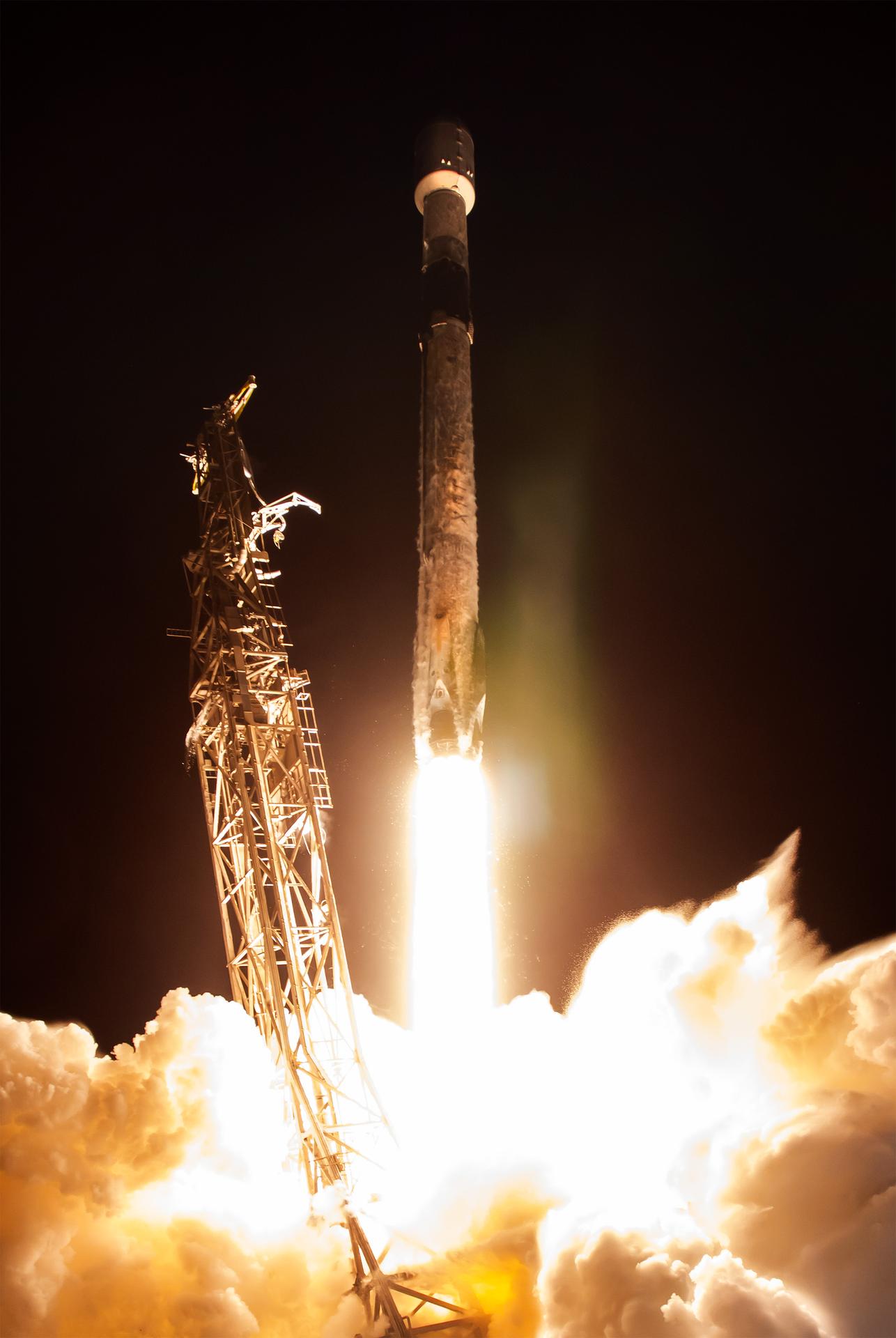
A SpaceX Falcon 9 rocket carrying NASA’s Pandora small satellite, the Star-Planet Activity Research CubeSat (SPARCS), and Black Hole Coded Aperture Telescope (BlackCAT) CubeSat lifts off from Space Launch Complex 4 East at Vandenberg Space Force Base in California on Sunday, Jan. 11, 2026. Pandora will provide an in-depth study of at least 20 known planets orbiting distant stars to determine the composition of their atmospheres — especially the presence of hazes, clouds, and water.
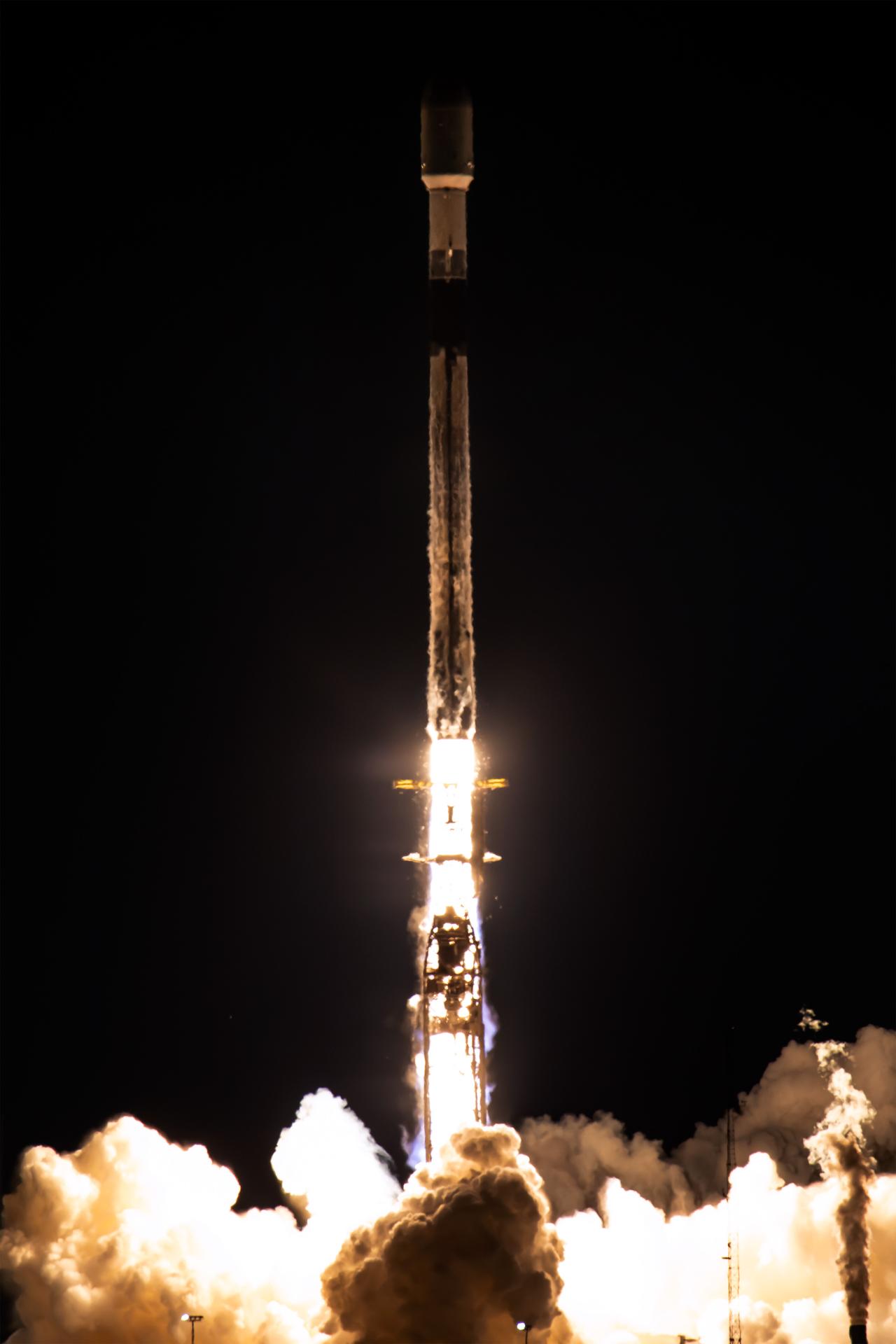
A SpaceX Falcon 9 rocket carrying NASA’s Pandora small satellite, the Star-Planet Activity Research CubeSat (SPARCS), and Black Hole Coded Aperture Telescope (BlackCAT) CubeSat lifts off from Space Launch Complex 4 East at Vandenberg Space Force Base in California on Sunday, Jan. 11, 2026. Pandora will provide an in-depth study of at least 20 known planets orbiting distant stars to determine the composition of their atmospheres — especially the presence of hazes, clouds, and water.

A SpaceX Falcon 9 rocket carrying NASA’s Pandora small satellite, the Star-Planet Activity Research CubeSat (SPARCS), and Black Hole Coded Aperture Telescope (BlackCAT) CubeSat lifts off from Space Launch Complex 4 East at Vandenberg Space Force Base in California on Sunday, Jan. 11, 2026. Pandora will provide an in-depth study of at least 20 known planets orbiting distant stars to determine the composition of their atmospheres — especially the presence of hazes, clouds, and water.
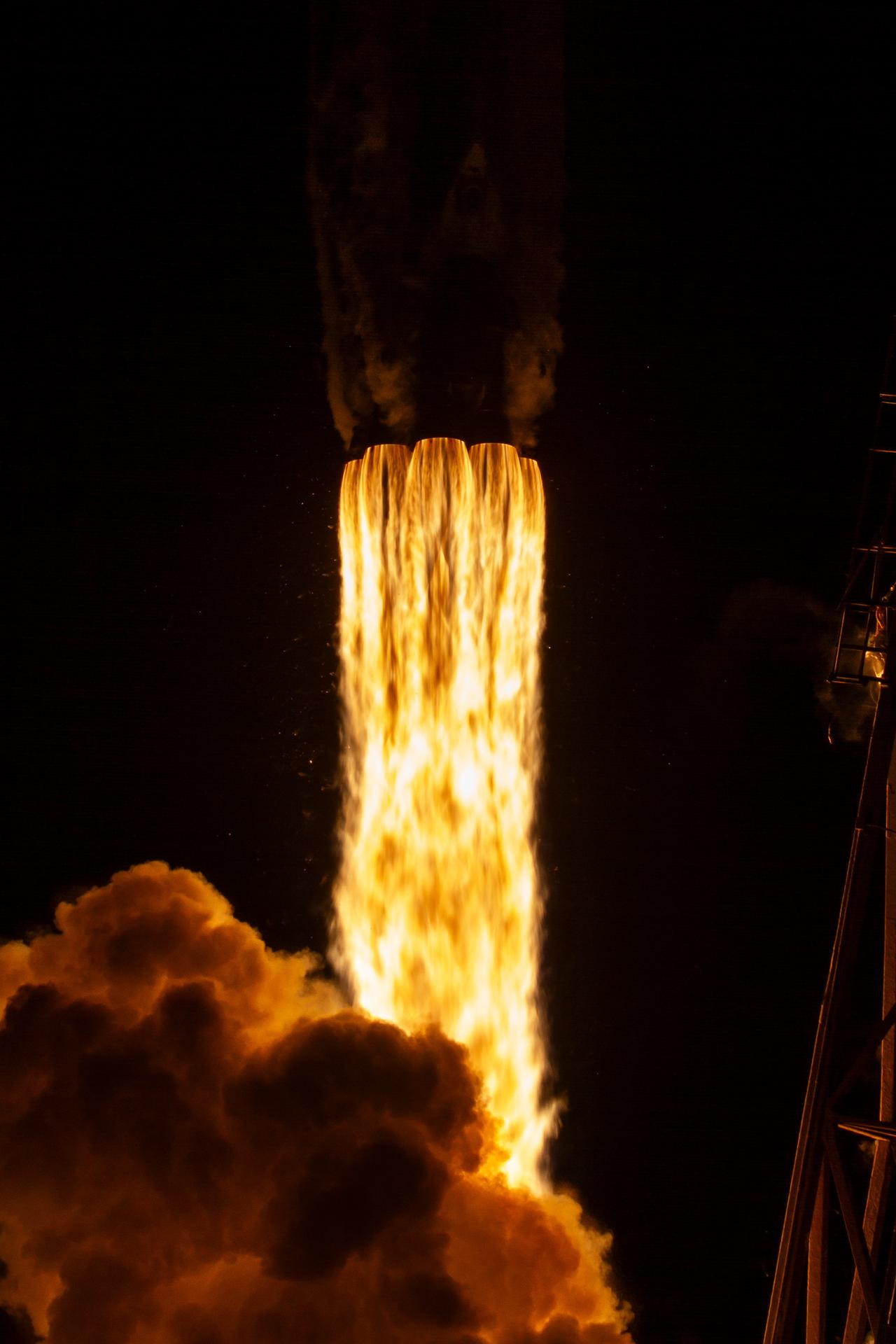
A SpaceX Falcon 9 rocket carrying NASA’s Pandora small satellite, the Star-Planet Activity Research CubeSat (SPARCS), and Black Hole Coded Aperture Telescope (BlackCAT) CubeSat lifts off from Space Launch Complex 4 East at Vandenberg Space Force Base in California on Sunday, Jan. 11, 2026. Pandora will provide an in-depth study of at least 20 known planets orbiting distant stars to determine the composition of their atmospheres — especially the presence of hazes, clouds, and water.
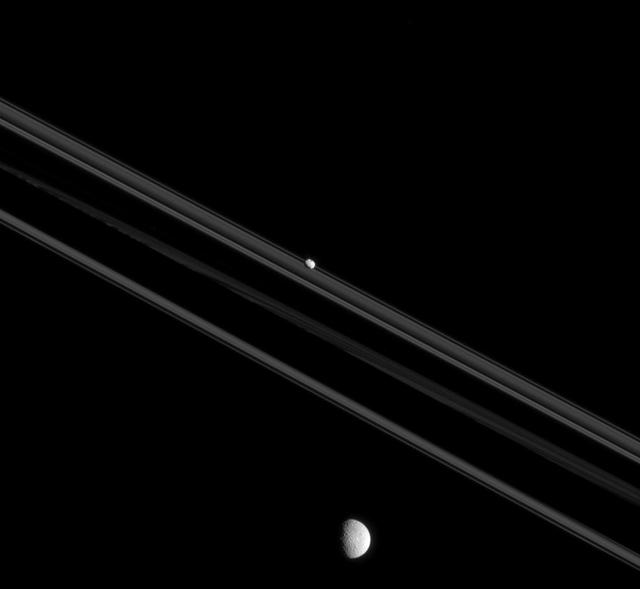
Although Mimas and Pandora, shown here, both orbit Saturn, they are very different moons. Pandora, "small" by moon standards (50 miles or 81 kilometers across) is elongated and irregular in shape. Mimas (246 miles or 396 kilometers across), a "medium-sized" moon, formed into a sphere due to self-gravity imposed by its higher mass. The shapes of moons can teach us much about their history. For example, one explanation for Pandora's elongated shape and low density is that it may have formed by gathering ring particles onto a dense core. This view looks toward the unilluminated side of the rings from 0.26 degrees below the ring plane. The image was taken in visible light with the Cassini spacecraft narrow-angle camera on July 26, 2015. The view was obtained at a distance of approximately 485,000 miles (781,000 kilometers) from Pandora. Image scale is 3 miles (5 kilometers) per pixel. Mimas is 904,000 miles (1.4 million kilometers) from the spacecraft in this image. The scale on Mimas is 5.4 miles (8.4 kilometers) per pixel. http://photojournal.jpl.nasa.gov/catalog/PIA18339
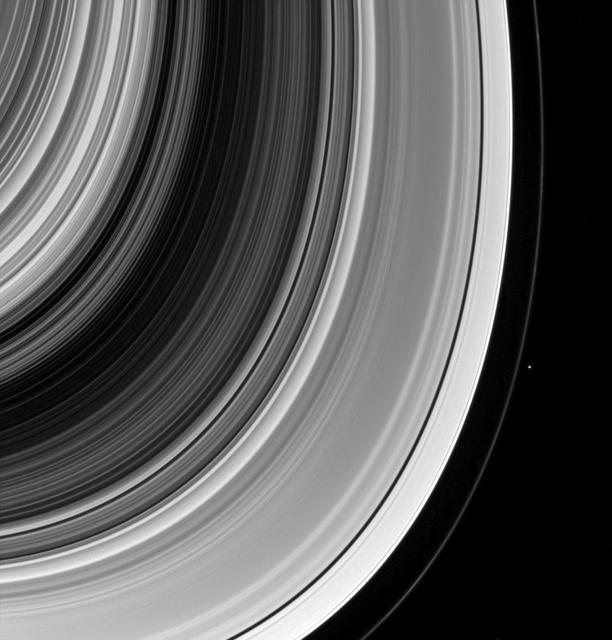
The F ring shepherd Pandora is captured here by NASA Cassini spacecraft along with other well-known examples of Saturn moons shaping the rings. From the narrow F ring, to the gaps in the A ring, to the Cassini Division, Saturn's rings are a masterpiece of gravitational sculpting by the moons. Pandora (50 miles, or 81 kilometers across), along with its fellow shepherd Prometheus (53 miles, or 86 kilometers across), helps confine the F ring and keep it from spreading. This view looks toward the unilluminated side of the rings from about 31 degrees below the ringplane. The image was taken in visible light with the Cassini spacecraft wide-angle camera on March 8, 2014. The view was obtained at a distance of approximately 533,000 miles (858,000 kilometers) from Saturn and at a Sun-Saturn-spacecraft, or phase, angle of 63 degrees. Image scale is 32 miles (51 kilometers) per pixel. http://photojournal.jpl.nasa.gov/catalog/PIA18271
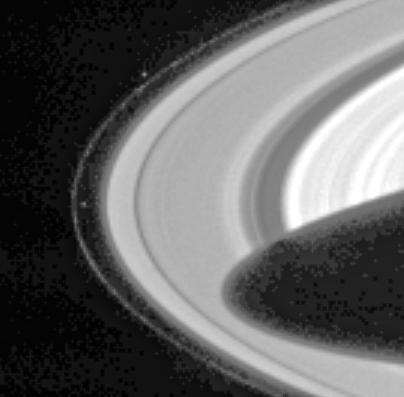
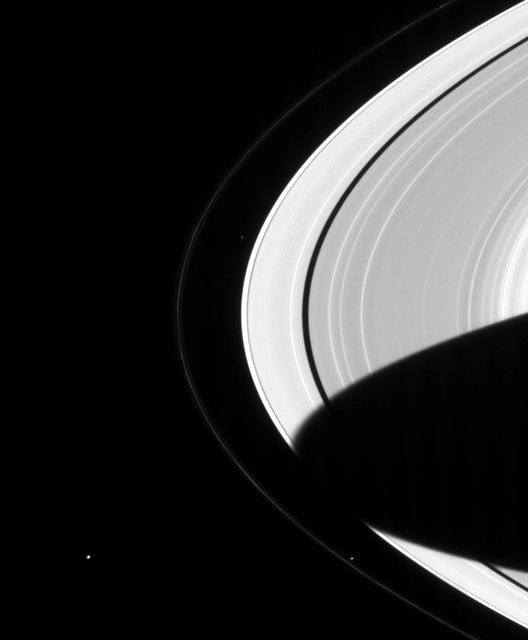
Cassini has sighted Prometheus and Pandora, the two F-ring-shepherding moons whose unpredictable orbits both fascinate scientists and wreak havoc on the F ring. Prometheus (102 kilometers, or 63 miles across) is visible left of center in the image, inside the F ring. Pandora (84 kilometers, or 52 miles across) appears above center, outside the ring. The dark shadow cast by the planet stretches more than halfway across the A ring, the outermost main ring. The mottled pattern appearing in the dark regions of the image is 'noise' in the signal recorded by the camera system, which has subsequently been magnified by the image processing. The F ring is a narrow, ribbon-like structure, with a width seen in this geometry equivalent to a few kilometers. The two small, irregularly shaped moons exert a gravitational influence on particles that make up the F ring, confining it and possibly leading to the formation of clumps, strands and other structures observed there. Pandora prevents the F ring from spreading outward and Prometheus prevents it from spreading inward. However, their interaction with the ring is complex and not fully understood. The shepherds are also known to be responsible for many of the observed structures in Saturn's A ring. The moons, which were discovered in images returned by the Voyager 1 spacecraft in 1980, are in chaotic orbits--their orbits can change unpredictably when the moons get very close to each other. This strange behavior was first noticed in ground-based and Hubble Space Telescope observations in 1995, when the rings were seen nearly edge-on from Earth and the usual glare of the rings was reduced, making the satellites more readily visible than usual. The positions of both satellites at that time were different than expected based on Voyager data. One of the goals for the Cassini-Huygens mission is to derive more precise orbits for Prometheus and Pandora. Seeing how their orbits change over the duration of the mission will help to determine their masses, which in turn will help constrain models of their interiors and provide a more complete understanding of their effect on the rings. This narrow angle camera image was snapped through the broadband green spectral filter, centered at 568 nanometers, on March 10, 2004, when the spacecraft was 55.5 million kilometers (34.5 million miles) from the planet. Image scale is approximately 333 kilometers (207 miles) per pixel. Contrast has been greatly enhanced, and the image has been magnified to aid visibility of the moons as well as structure in the rings. http://photojournal.jpl.nasa.gov/catalog/PIA05387
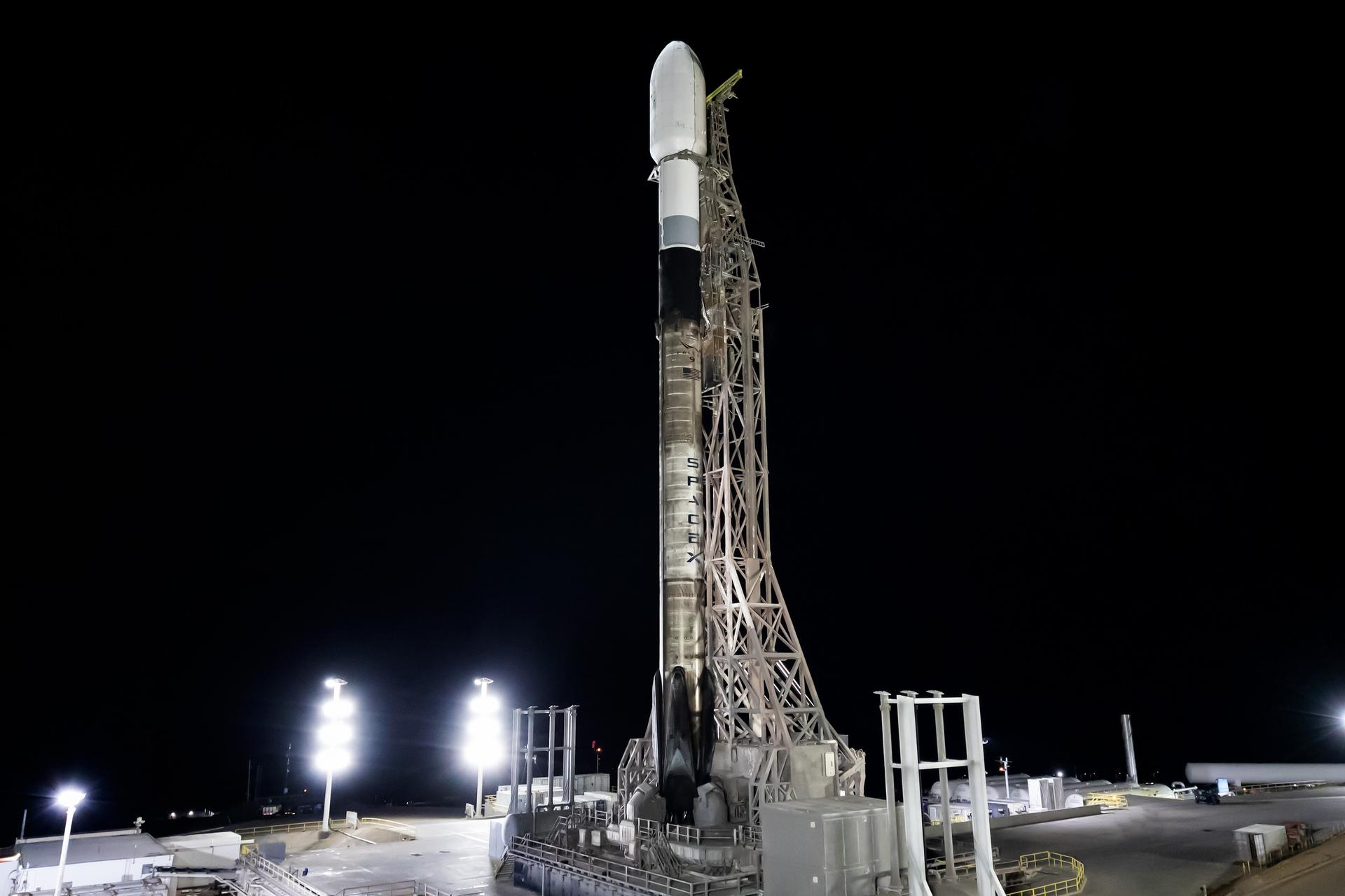
A SpaceX Falcon 9 rocket carrying NASA’s Pandora small satellite, the Star-Planet Activity Research CubeSat (SPARCS), Black Hole Coded Aperture Telescope (BlackCAT) CubeSat, and several other payloads stands vertical on the pad at Space Launch Complex 4 East at Vandenberg Space Force Base in California on Sunday, Jan. 11, 2026, as part of the company’s Twilight mission. Pandora will provide an in-depth study of at least 20 known planets orbiting distant stars to determine the composition of their atmospheres — especially the presence of hazes, clouds, and water. Launch of SpaceX’s Twilight mission is scheduled for 5:44 a.m. PST Jan. 11, from Vandenberg’s Space Launch Complex 4 East.
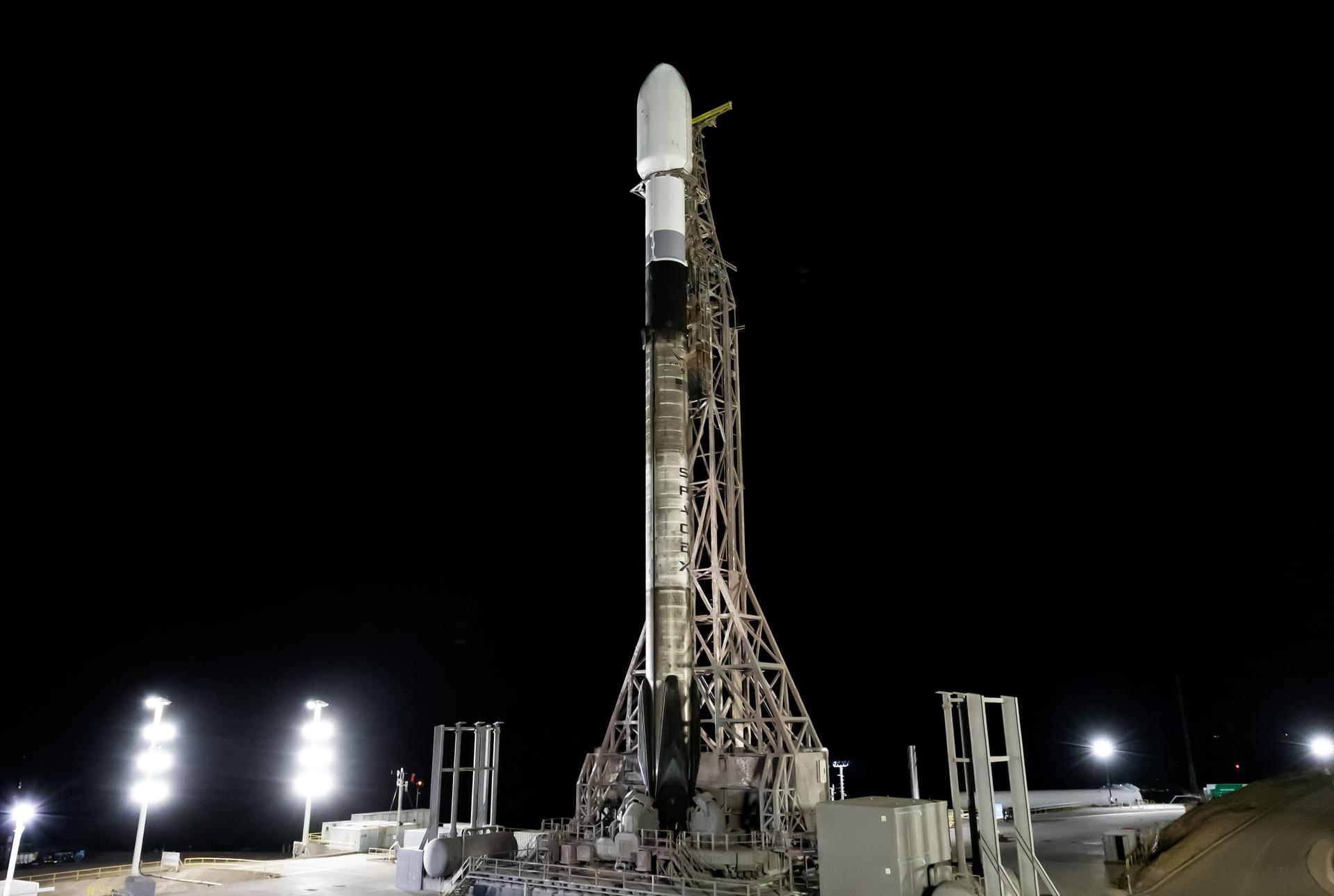
A SpaceX Falcon 9 rocket carrying NASA’s Pandora small satellite, the Star-Planet Activity Research CubeSat (SPARCS), Black Hole Coded Aperture Telescope (BlackCAT) CubeSat, and several other payloads stands vertical on the pad at Space Launch Complex 4 East at Vandenberg Space Force Base in California on Sunday, Jan. 11, 2026, as part of the company’s Twilight mission. Pandora will provide an in-depth study of at least 20 known planets orbiting distant stars to determine the composition of their atmospheres — especially the presence of hazes, clouds, and water. Launch of SpaceX’s Twilight mission is scheduled for 5:44 a.m. PST Jan. 11, from Vandenberg’s Space Launch Complex 4 East.
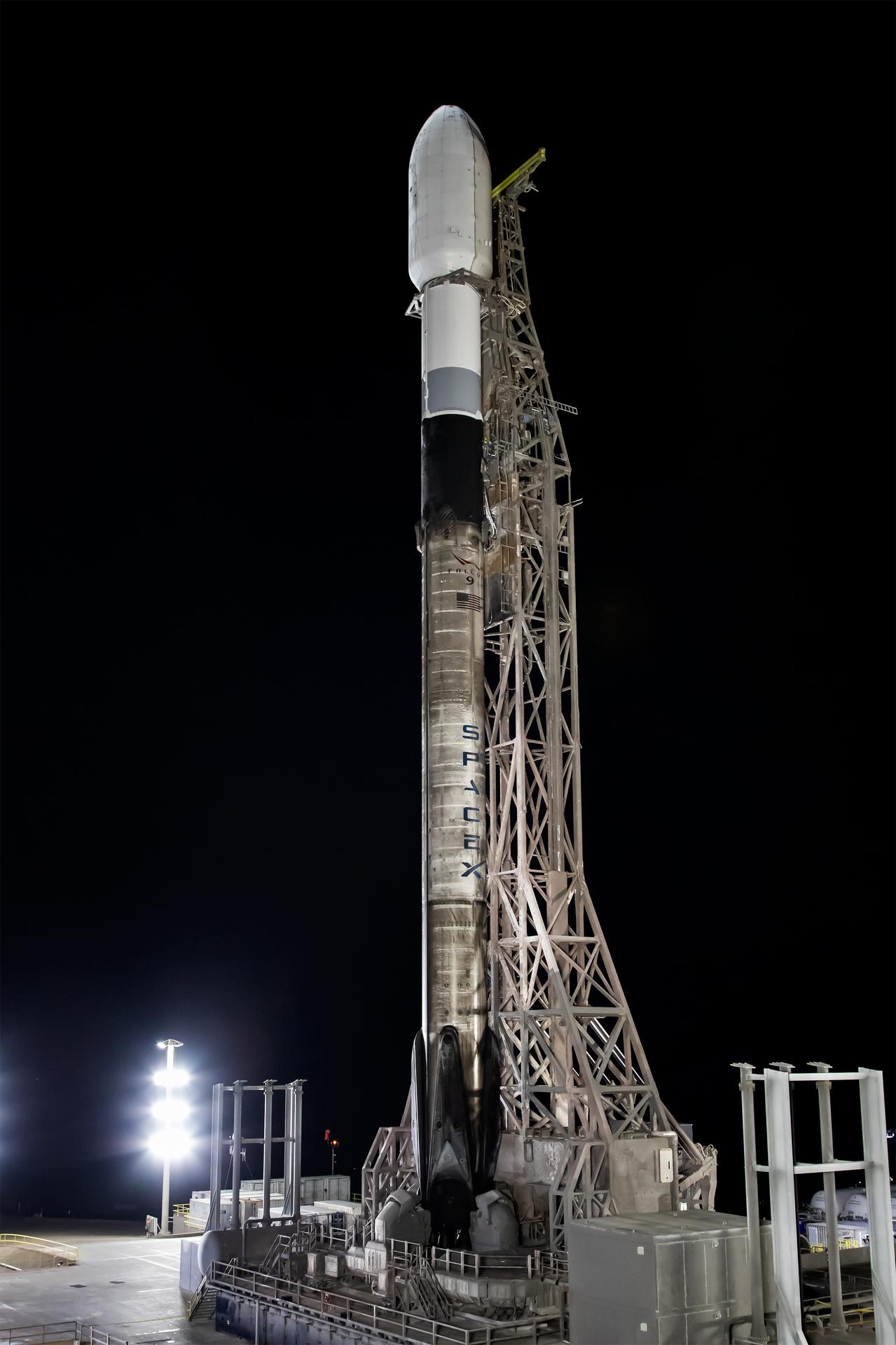
A SpaceX Falcon 9 rocket carrying NASA’s Pandora small satellite, the Star-Planet Activity Research CubeSat (SPARCS), Black Hole Coded Aperture Telescope (BlackCAT) CubeSat, and several other payloads stands vertical on the pad at Space Launch Complex 4 East at Vandenberg Space Force Base in California on Sunday, Jan. 11, 2026, as part of the company’s Twilight mission. Pandora will provide an in-depth study of at least 20 known planets orbiting distant stars to determine the composition of their atmospheres — especially the presence of hazes, clouds, and water. Launch of SpaceX’s Twilight mission is scheduled for 5:44 a.m. PST Jan. 11, from Vandenberg’s Space Launch Complex 4 East.
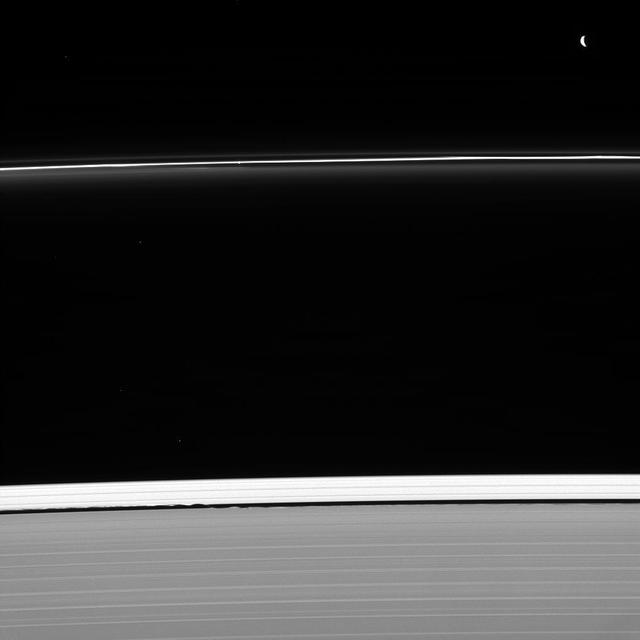
Two masters of their craft are caught at work shaping Saturn's rings. Pandora (upper right) sculpts the F ring, as does nearby Prometheus (not seen in this image). Meanwhile, Daphnis is busy holding open the Keeler gap (bottom center), its presence revealed here by the waves it raises on the gap's edge. The faint moon is located where the inner and outer waves appear to meet. Also captured in this image, shining through the F ring above the image center, is a single star. Although gravity is by its very nature an attractive force, moons can interact with ring particles in such a way that they effectively push ring particles away from themselves. Ring particles experience tiny gravitational "kicks" from these moons and subsequently collide with other ring particles, losing orbital momentum. The net effect is for moons like Pandora (50 miles or 81 kilometers across) and Daphnis (5 miles or 8 kilometers across) to push ring edges away from themselves. The Keeler gap is the result of just such an interaction. This view looks toward the unilluminated side of the rings from about 50 degrees below the ringplane. The image was taken in visible light with the Cassini spacecraft narrow-angle camera on Jan. 30, 2013. http://photojournal.jpl.nasa.gov/catalog/PIA18298
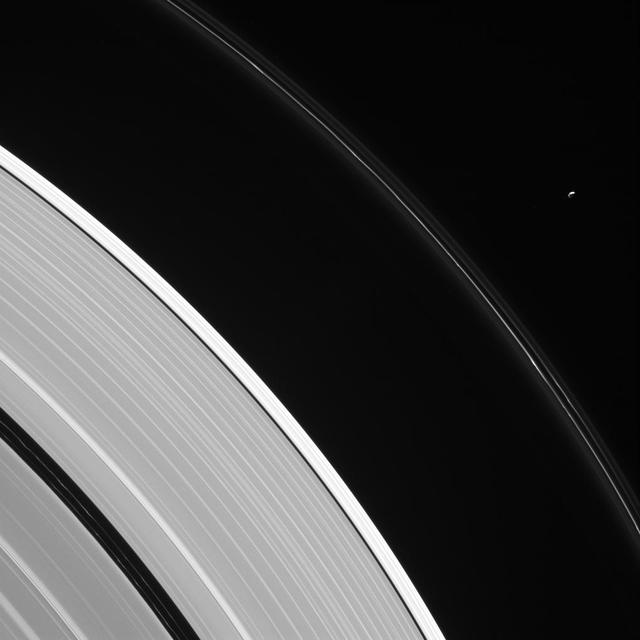
Pandora is seen here, in isolation beside Saturn's kinked and constantly changing F ring. Pandora (near upper right) is 50 miles (81 kilometers) wide. The moon has an elongated, potato-like shape (see PIA07632). Two faint ringlets are visible within the Encke Gap, near lower left. The gap is about 202 miles (325 kilometers) wide. The much narrower Keeler Gap, which lies outside the Encke Gap, is maintained by the diminutive moon Daphnis (not seen here). This view looks toward the sunlit side of the rings from about 23 degrees above the ring plane. The image was taken in visible light with the Cassini spacecraft narrow-angle camera on Aug. 12, 2016. The view was acquired at a distance of approximately 907,000 miles (1.46 million kilometers) from Saturn and at a Sun-Saturn-spacecraft, or phase, angle of 113 degrees. Image scale is 6 miles (9 kilometers) per pixel. http://photojournal.jpl.nasa.gov/catalog/PIA20504
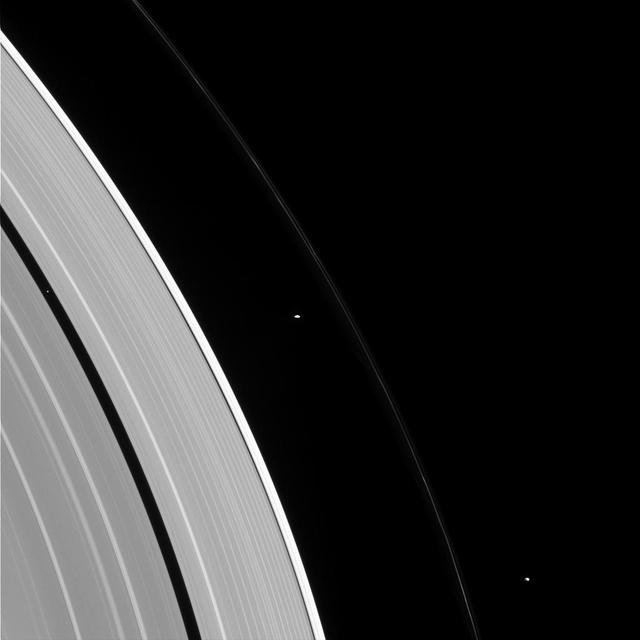
People with similar jobs or interests hold conventions and meetings, so why shouldn't moons? Pandora, Prometheus, and Pan -- seen here, from right to left -- also appear to be holding some sort of convention in this image. Some moons control the structure of nearby rings via gravitational "tugs." The cumulative effect of the moon's tugs on the ring particles can keep the rings' edges from spreading out as they are naturally inclined to do, much like shepherds control their flock. Pan is a prototypical shepherding moon, shaping and controlling the locations of the inner and outer edges of the Encke gap through a mechanism suggested in 1978 to explain the narrow Uranian rings. However, though Prometheus and Pandora have historically been called "the F ring shepherd moons" due to their close proximity to the ring, it has long been known that the standard shepherding mechanism that works so well for Pan does not apply to these two moons. The mechanism for keeping the F ring narrow, and the roles played -- if at all -- by Prometheus and Pandora in the F ring's configuration are not well understood. This is an ongoing topic for study by Cassini scientists. This view looks toward the sunlit side of the rings from about 29 degrees above the ringplane. The image was taken in visible light with the Cassini spacecraft narrow-angle camera on Jan. 2, 2015. The view was obtained at a distance of approximately 1.6 million miles (2.6 million kilometers) from the rings and at a Sun-ring-spacecraft, or phase, angle of 86 degrees. Image scale is 10 miles (15 kilometers) per pixel. http://photojournal.jpl.nasa.gov/catalog/pia18306
Saturn and its rings are prominently shown in this color image, along with three of Saturn's smaller moons. From left to right, they are Prometheus, Pandora and Janus. Prometheus and Pandora are often called the "F ring shepherds" as they control and interact with Saturn's interesting F ring, seen between them. This image was taken on June 18, 2004, with the Cassini spacecraft narrow angle camera 8.2 million kilometers (5.1 million miles) from Saturn. It was created using the red, green, and blue filters. Contrast has been enhanced to aid visibility. http://photojournal.jpl.nasa.gov/catalog/PIA06422
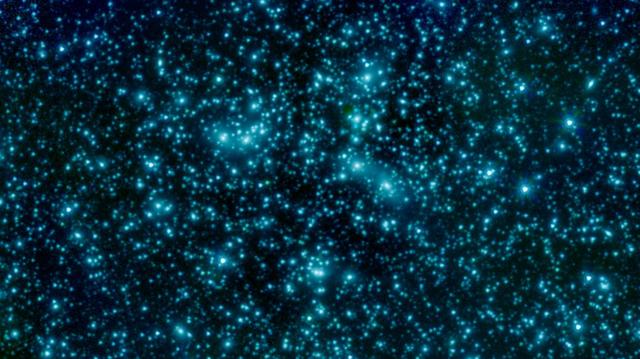
This image of galaxy cluster Abell 2744, also called Pandora's Cluster, was taken by the Spitzer Space Telescope. The gravity of this galaxy cluster is strong enough that it acts as a lens to magnify images of more distant background galaxies. This technique is called gravitational lensing. The fuzzy blobs in this Spitzer image are the massive galaxies at the core of this cluster, but astronomers will be poring over the images in search of the faint streaks of light created where the cluster magnifies a distant background galaxy. The cluster is also being studied by NASA's Hubble Space Telescope and Chandra X-Ray Observatory in a collaboration called the Frontier Fields project. In this image, light from Spitzer's infrared channels is colored blue at 3.6 microns and green at 4.5 microns. http://photojournal.jpl.nasa.gov/catalog/PIA20920
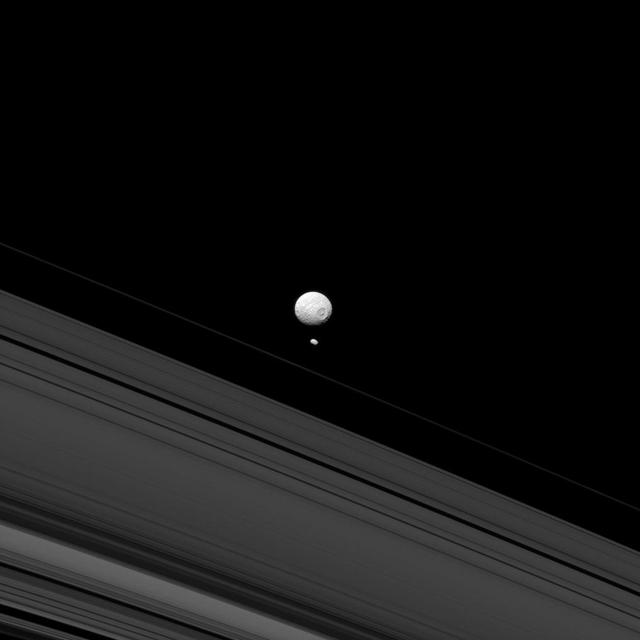
This image from NASA Cassini spacecraft reminds us of how different Mimas and Pandora are when they appear together; although both are moons of Saturn, Pandora small size means that it lacks sufficient gravity to pull itself into a round shape.
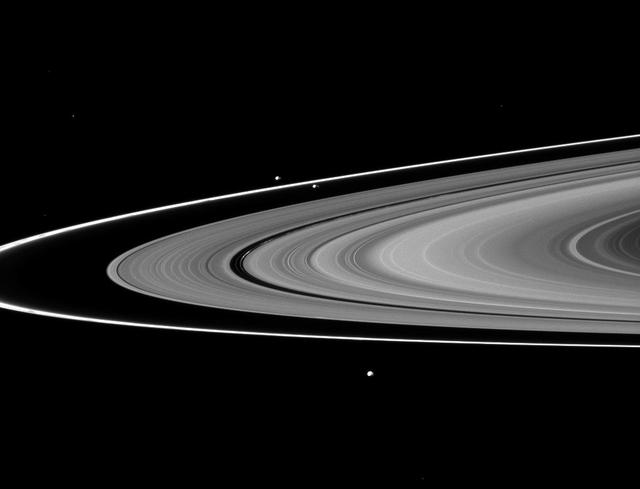
The F ring shepherds, Prometheus and Pandora, join Epimetheus in this image taken by NASA Cassini spacecraft of three of Saturn moons and the rings.

Gazing across the plains of Saturn icy rings, Cassini catches the F ring shepherd moon Pandora hovering in the distance
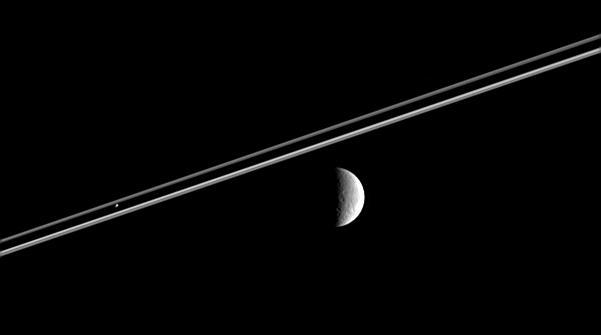
Distant Rhea right poses here for the Cassini spacecraft, as Pandora hovers against Saturn dark shadow on the rings
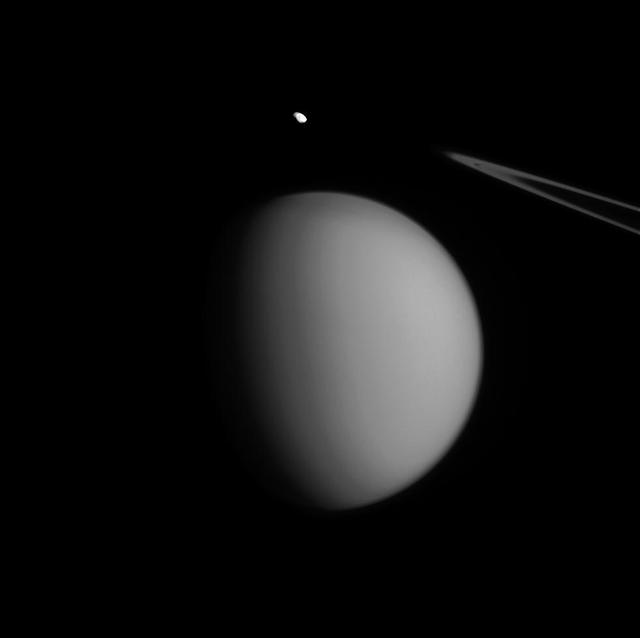
A coincidence of viewing angle makes Pandora appear to be hovering over Titan, almost like an accent mark. Little Pandora is much closer to Cassini than hazy Titan in this view. (Titan is nearly three times farther away.) Even so, Titan (3,200 miles or 5,150 kilometers across) dwarfs Pandora (50 miles or 81 kilometers across). This gives us some sense of the diversity in sizes, and shapes, of Saturn's many moons. North on Titan is up and rotated 19 degrees to the right. The image was taken in visible green light with the Cassini spacecraft narrow-angle camera on July 4, 2015. The view was acquired at a distance of approximately 1.2 million miles (1.9 million kilometers) from Titan. Image scale is 7 miles (12 kilometers) per pixel on Titan. Pandora is at a distance of 436,000 miles (698,000 kilometers) away from the spacecraft. The scale on Pandora is about 3 miles (4 kilometers) per pixel. http://photojournal.jpl.nasa.gov/catalog/PIA18338
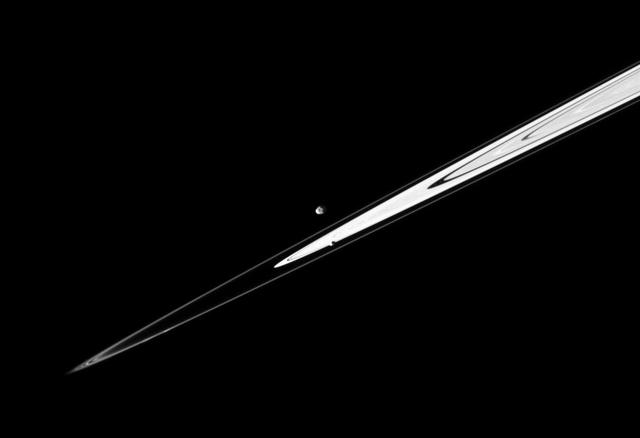
A pair of Saturn small satellites, Janus and Pandora, accompany the planet rings in this image from NASA Cassini spacecraft presenting the view in dramatic diagonal fashion.
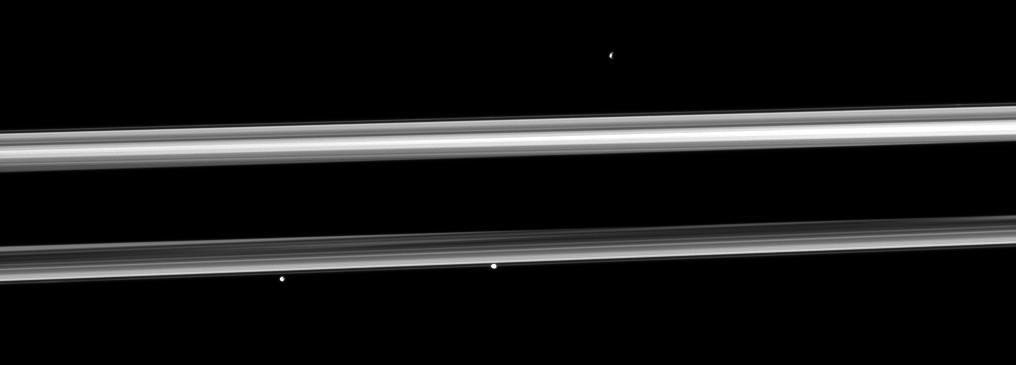
Three of Saturn small moons straddle the rings in this image captured by NASA Cassini spacecraft. From left to right are Pandora, Prometheus and, near the top right, Epimetheus.

The moon Tethys is upstaged by two smaller moons, Pandora and Prometheus, in this image from NASA Cassini spacecraft. Go to the Photojournal to view the animation.
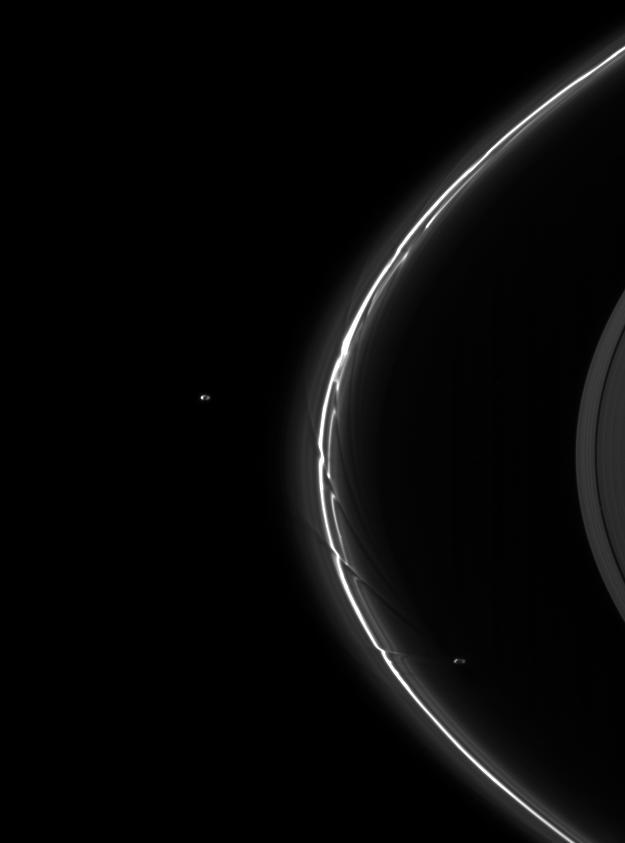
This image shows a pair of moons, Pandora and Prometheus, continuing their shepherding duties near Saturn thin F ring as seen by NASA Cassini spacecraft.
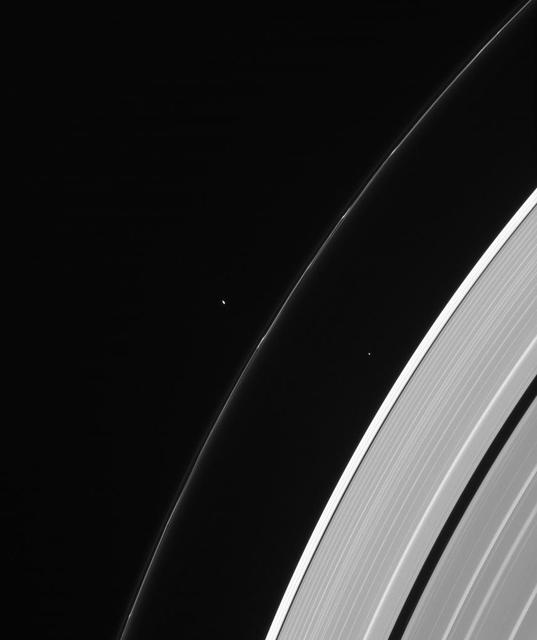
Are the moons tiny or are the rings vast? Both, in a way! The moons visible in this image from NASA Cassini spacecraft, Pandora and Atlas, are quite small by astronomical standards, but the rings are also enormous. From one side of the planet to the other, the A ring stretches over 170,000 miles 270,000 km. Pandora (50 miles, or 81 kilometers, across) orbits in the vicinity of the F ring, along with neighboring Prometheus, which is not visible in this image. These moons interact frequently with the narrow F ring, producing channels and streamers and other interesting features. Atlas (19 miles, or 30 kilometers across) orbits between the A ring and F ring in the Roche division. This view looks toward the sunlit side of the rings from about 34 degrees above the ringplane. The image was taken in visible light with the Cassini spacecraft narrow-angle camera on Feb. 17, 2014. The view was obtained at a distance of approximately 1.7 million miles (2.8 million kilometers) from Pandora and at a Sun-Pandora-spacecraft, or phase, angle of 110 degrees. Image scale is 11 miles (17 kilometers) per pixel. http://photojournal.jpl.nasa.gov/catalog/PIA18279
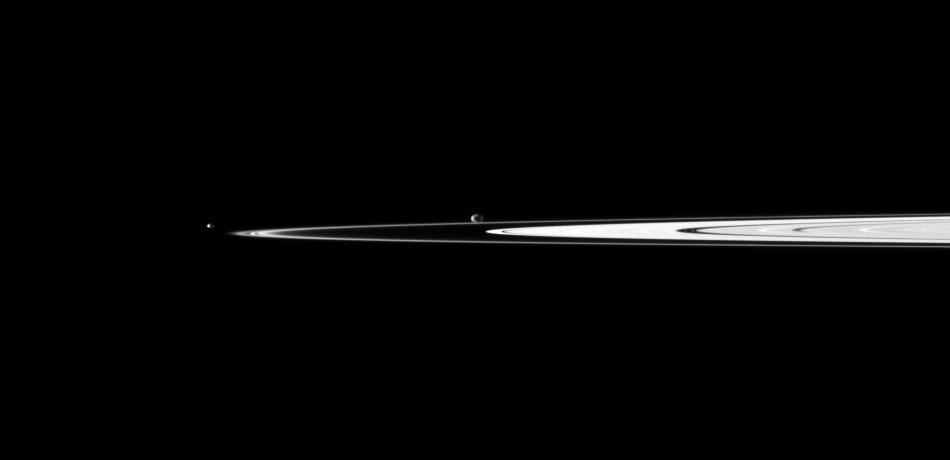
A pair of Saturn small moons orbit near the planet rings, which appear well illuminated in this view captured by NASA Cassini spacecraft. Janus is near the center of the image and Pandora is on the left.
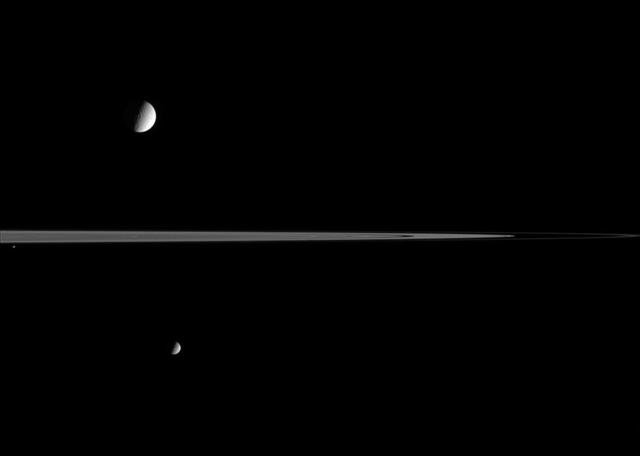
Cassini has Mimas and Pandora on its side as it gazes across the ringplane at distant Tethys. The two smaller moons were on the side of the rings closer to Cassini when this image was taken.
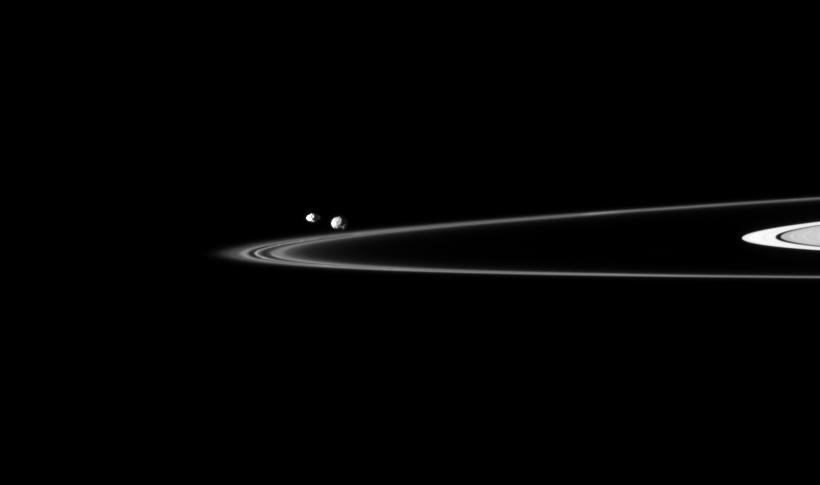
Two of Saturn small moons can be seen orbiting beyond the planet thin F ring in this image captured by NASA Cassini spacecraft. Pandora is on the left, and Epimetheus is on the right.
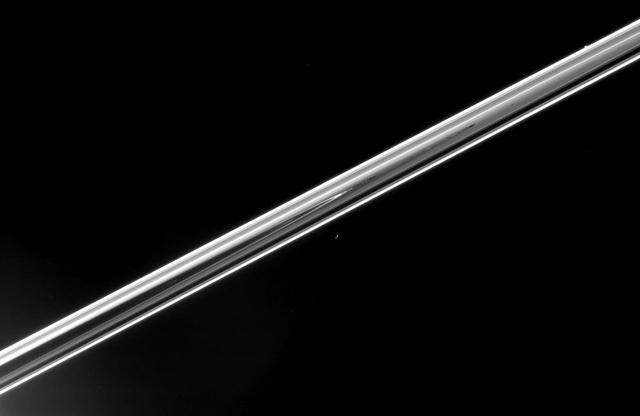
Epimetheus floats in the distance below center, showing only the barest hint of its irregular shape. Pandora hides herself in the ringplane, near upper right, appearing as little more than a bump

Saturn moon Prometheus orbits near some of its handiwork in the F ring in this image from NASA Cassini spacecraft. Prometheus and its partner Pandora gravitationally sculpt and maintain the narrow F ring.
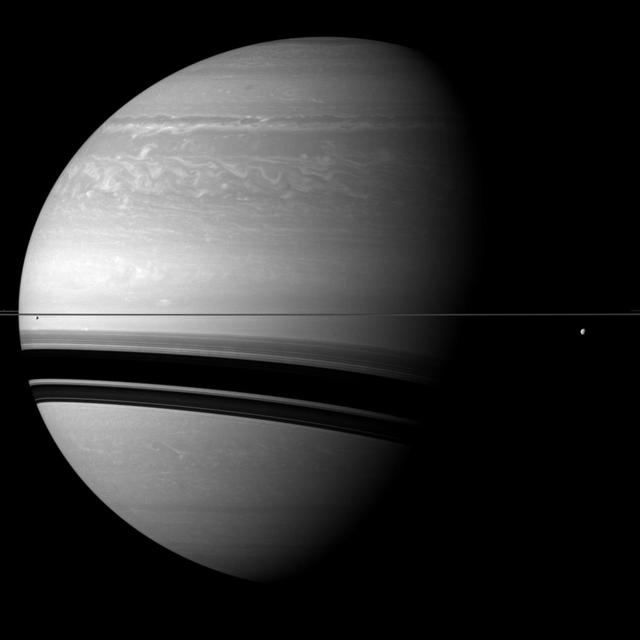
Compared to the gas giant, the two moons shown on either side of Saturn seem particularly small in this view from NASA Cassini spacecraft. Tethys and Pandora are also present but barely visible.
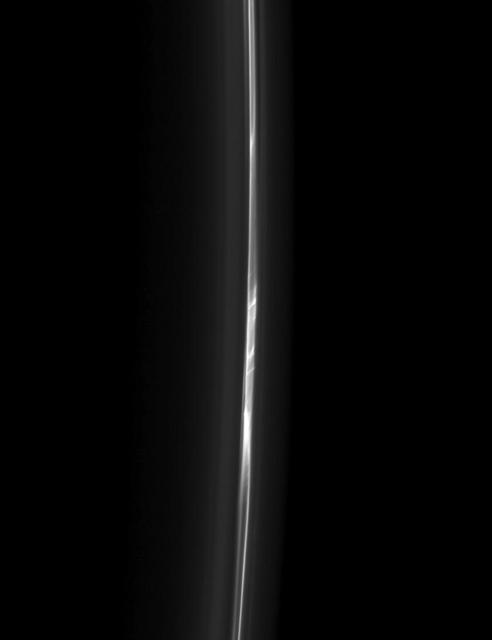
Forever changing, the F ring takes on a ladder-like appearance in this recent image from NASA Cassini spacecraft. Scientists believe that interactions between the F ring and the moons Prometheus and Pandora cause the dynamic structure of the ring.
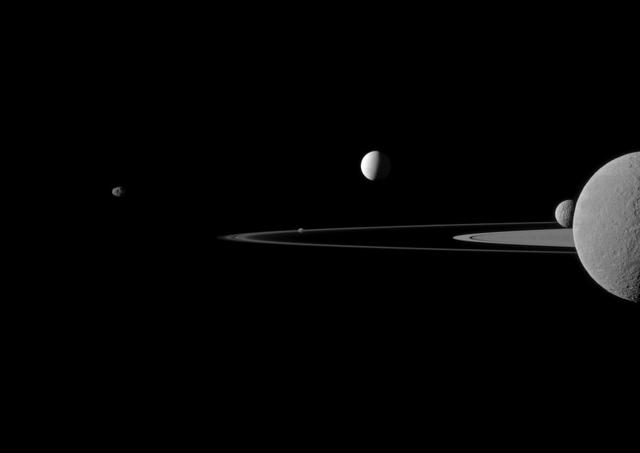
A quintet of Saturn moons come together in this portrait from NASA Cassini spacecraft. Janus is seen on the far left, Pandora orbits near the middle, Enceladus appears above the center, and Rhea and Mimas are seen on the right side.
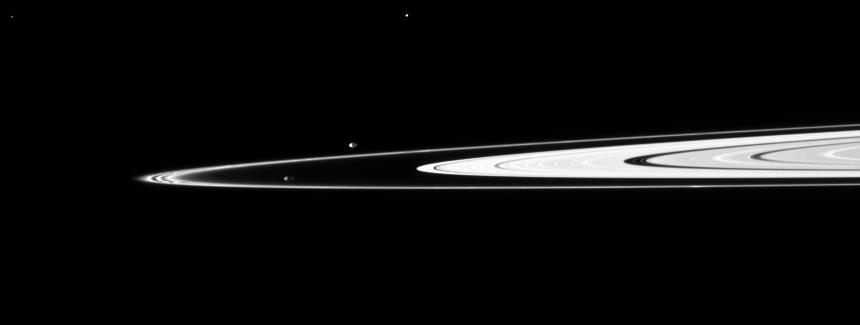
Pandora and Prometheus, the shepherding moons of the F ring, orbit inside and outside the thin ring. The elongated, potato-like shapes of the two moons are both visible in this image taken by NASA Cassini spacecraft.
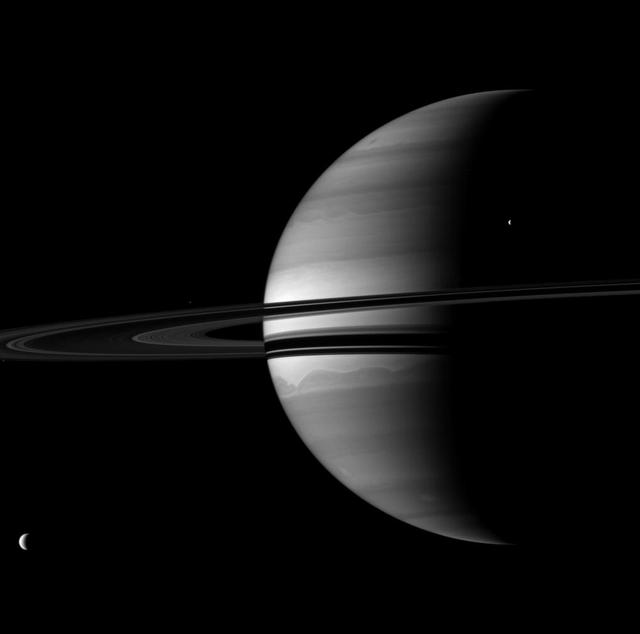
Four of Saturn moons join the planet for a well balanced portrait. Titan, Saturn largest moon, is in the lower left. Tethys appears in upper right. The smaller moons Pandora and Epimetheus are barely visible here.
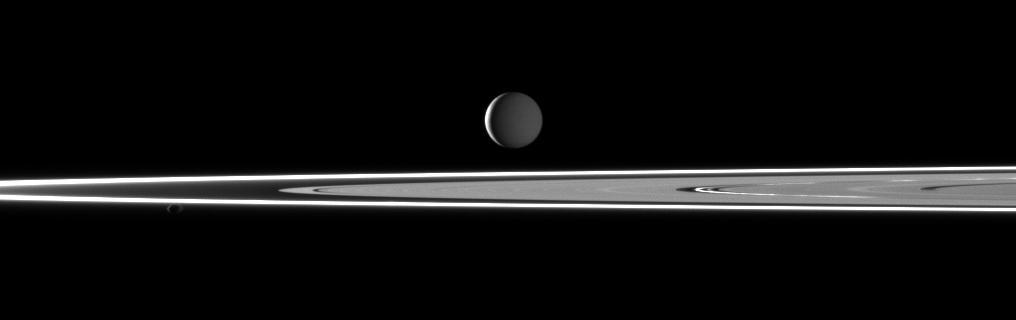
In this image taken by NASA Cassini spacecraft two light sources illuminate Saturn highly reflective moon Enceladus featuring bright rings and the small moon Pandora in the foreground.
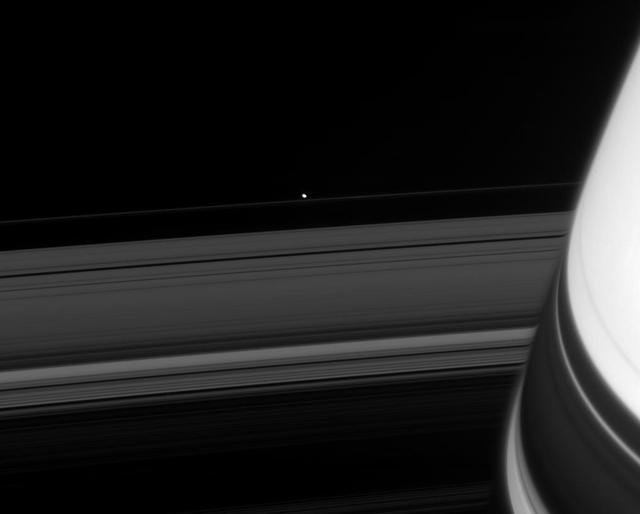
Spotting the Shepherd
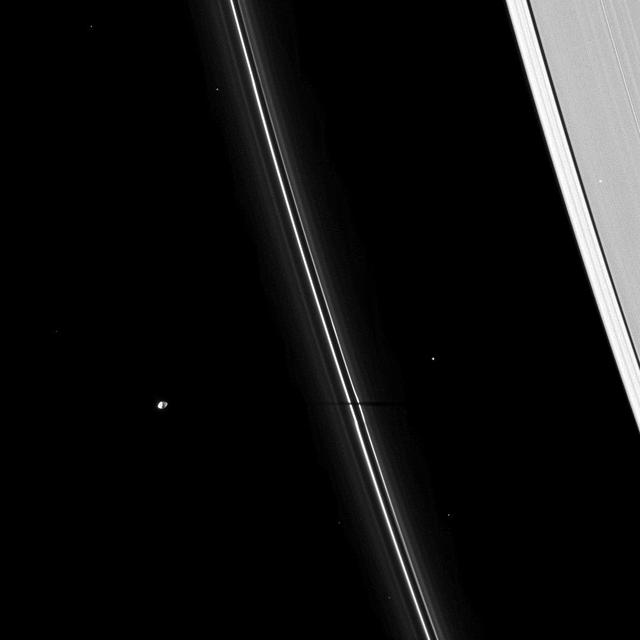
Slender Slice of Shadow
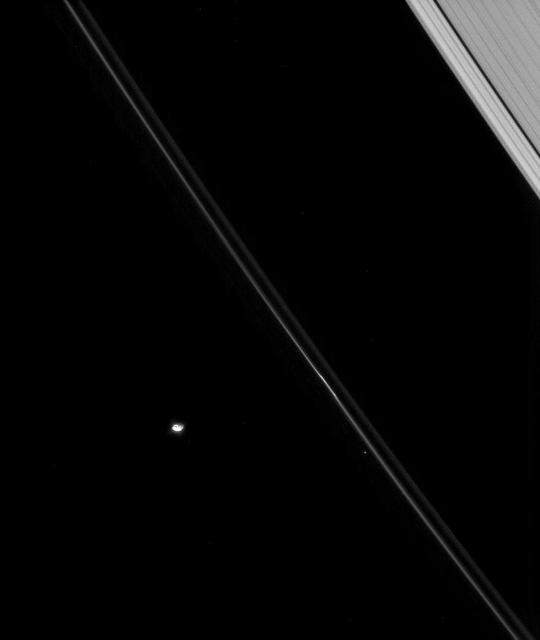
Ring Escort

Narrow Ice Lanes
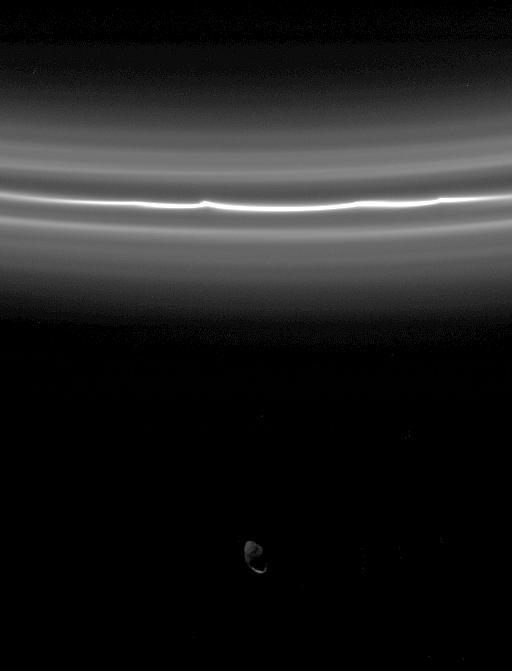
Brilliant F Ring
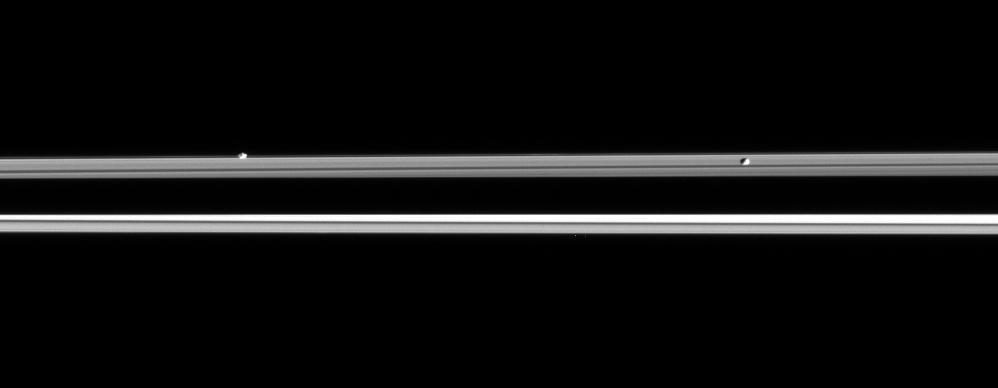
Racing Rocks
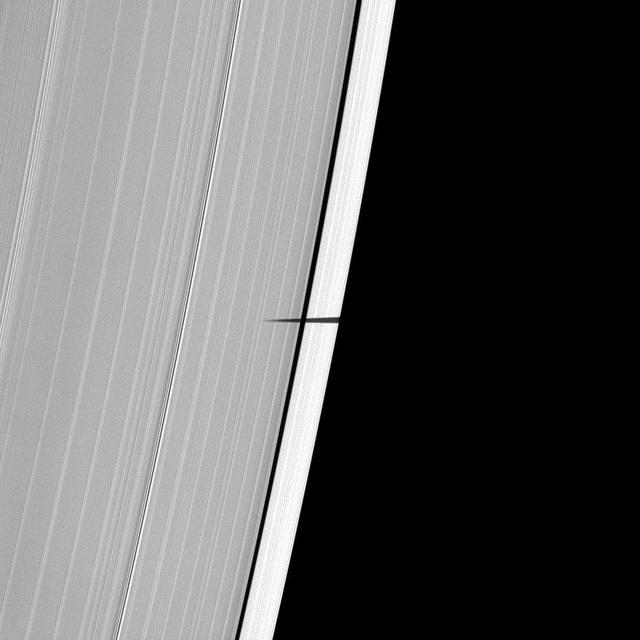
Diminutive Debut
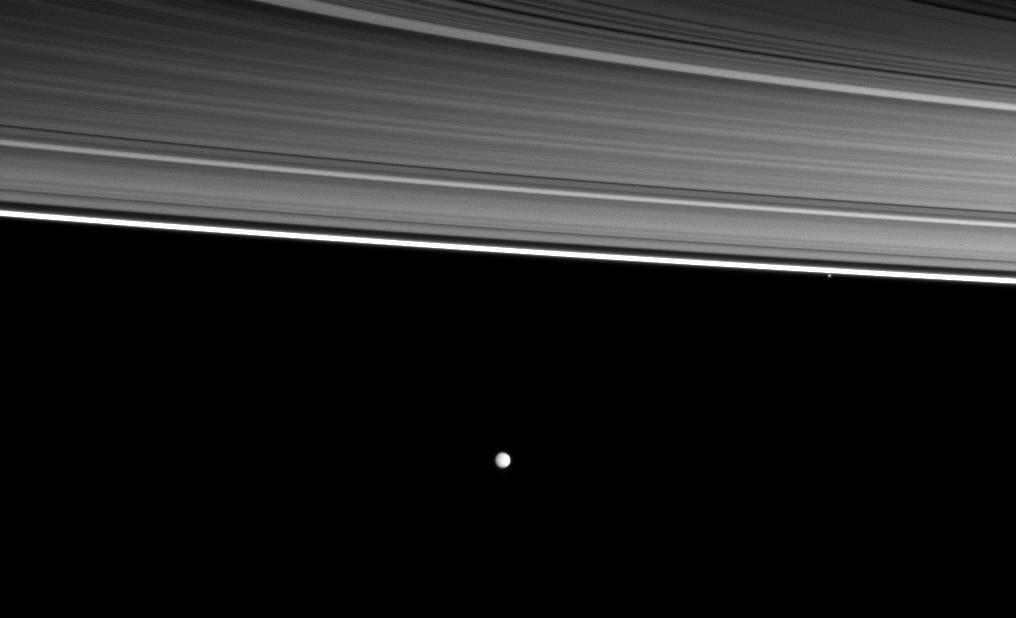
Two of Saturn moons orbit beyond four of the planet rings in this image from NASA Cassini spacecraft. From the top right of the picture are the C, B , A, and thin F rings, the small moon Pandora and, near the middle of the image, the moon Enceladus.
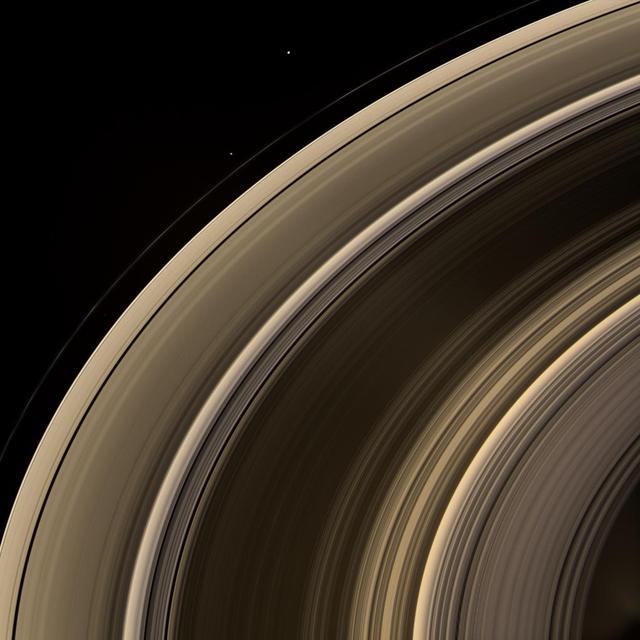
From on high, the Cassini spacecraft spies a group of three ring moons in their travels around Saturn. Janus is seen at top, while Pandora hugs the outer edge of the narrow F ring. More difficult to spot is Pan, which is a mere speck in this view.
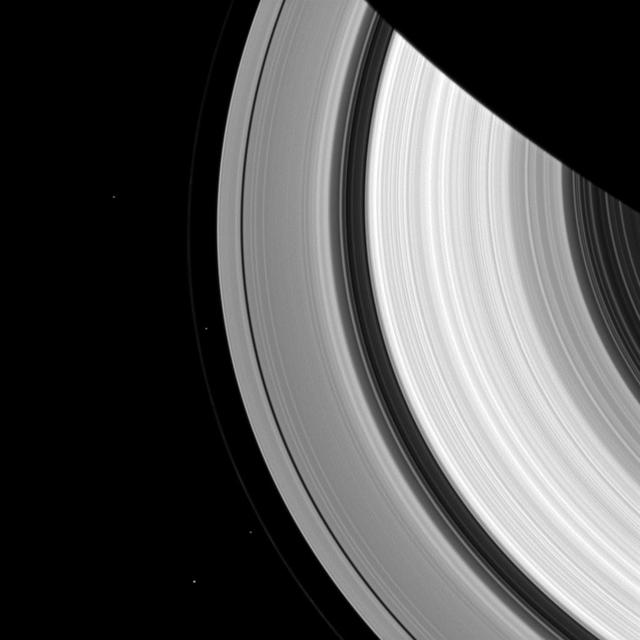
Two pairs of moons make a rare joint appearance. The F ring shepherd moons, Prometheus and Pandora, appear just inside and outside of the F ring the thin faint ring furthest from Saturn as seen by NASA Cassini spacecraft.
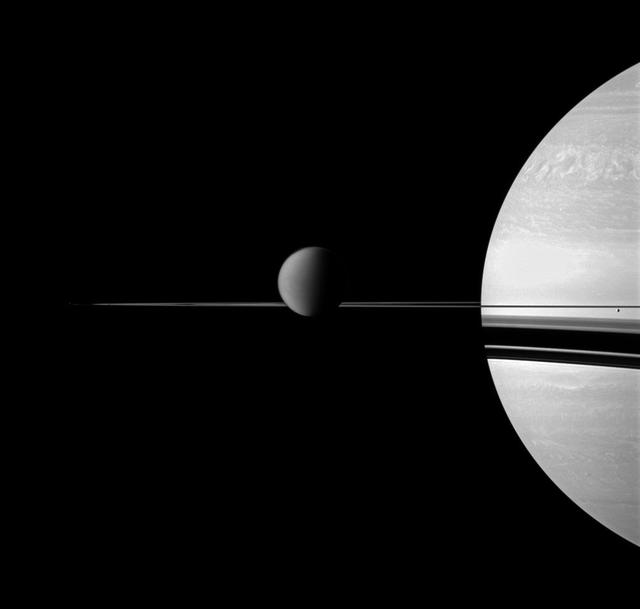
NASA Cassini spacecraft views Saturn with a selection of its moons in varying sizes. Also seen here are Titan center, Enceladus far right, Pandora, barely detectable as a speck on the far left, has been brightened by a factor of two.
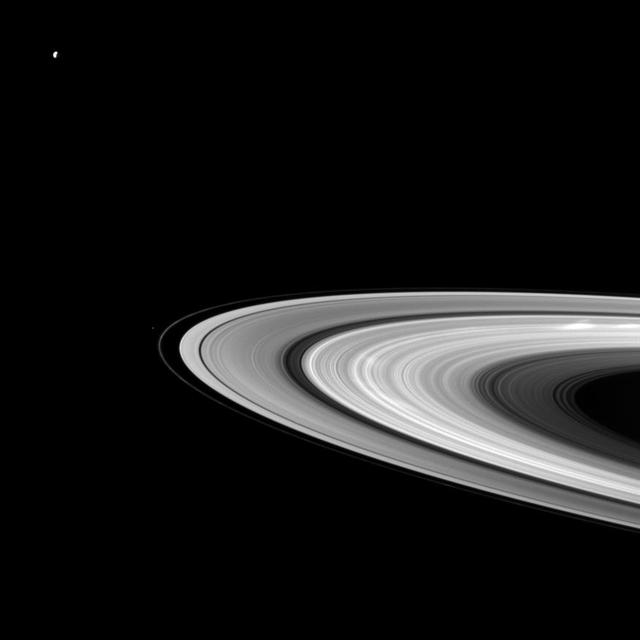
Bright spokes grace Saturn B ring in this Cassini spacecraft snapshot that also features a couple of the planet moons large and small. Dione can be seen in the upper left of the image while Pandora appears as a small speck beyond the thin F ring.
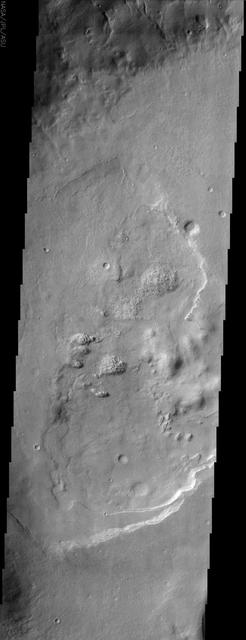
Lineations fissures, or cracks in the ground can be seen in this image of Acidalia Planitia from NASA Mars Odyssey spacecraft and create what is referred to as patterned ground or polygonal terrain.

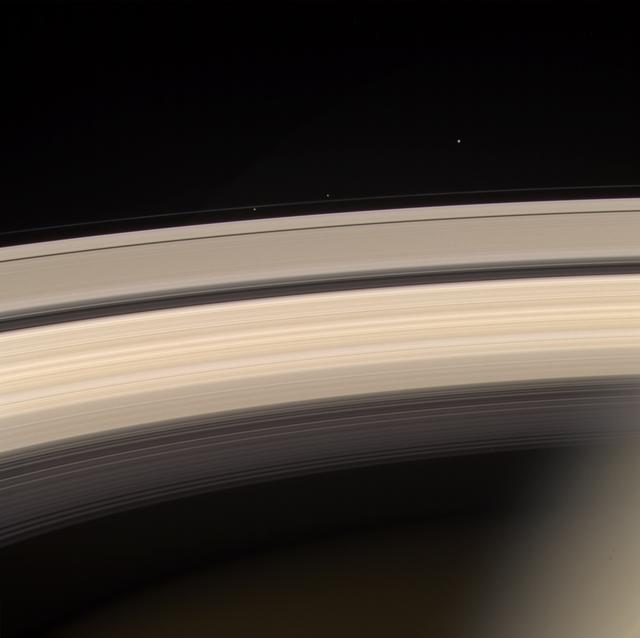
Saturn's graceful lanes of orbiting ice -- its iconic rings -- wind their way around the planet to pass beyond the horizon in this view from NASA's Cassini spacecraft. And diminutive Pandora, scarcely larger than a pixel here, can be seen orbiting just beyond the F ring in this image. Also in this image is the gap between Saturn's cloud tops and its innermost D ring through which Cassini would pass 22 times before ending its mission in spectacular fashion in Sept. 15, 2017. Scientists scoured images of this region, particularly those taken at the high phase (spacecraft-ring-Sun) angles, looking for material that might pose a hazard to the spacecraft. This view looks toward the sunlit side of the rings from about 19 degrees above the ringplane. The image was taken in green light with the Cassini spacecraft wide-angle camera on Aug. 12, 2017. Pandora was brightened by a factor of 2 to increase its visibility. The view was obtained at a distance to Saturn of approximately 581,000 miles (935,000 kilometers) from Saturn. Image scale is 35 miles (56 kilometers) per pixel. The distance to Pandora was 691,000 miles (1.1 million kilometers) for a scale of 41 miles (66 kilometers) per pixel. The Cassini spacecraft ended its mission on Sept. 15, 2017. https://photojournal.jpl.nasa.gov/catalog/PIA21352
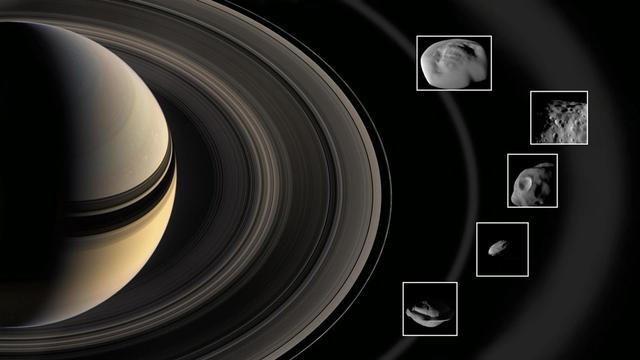
During super-close flybys of Saturn's rings, NASA's Cassini spacecraft inspected the mini-moons Pan and Daphnis in the A ring; Atlas at the edge of the A ring; Pandora at the edge of the F ring; and Epimetheus, which is bathed in material that fans out from the moon Enceladus. The mini-moons' diameter ranges from 5 miles (8 kilometers) for Daphnis to 72 miles (116 kilometers) for Epimetheus. The rings and the moons depicted in this illustration are not to scale. https://photojournal.jpl.nasa.gov/catalog/PIA22772
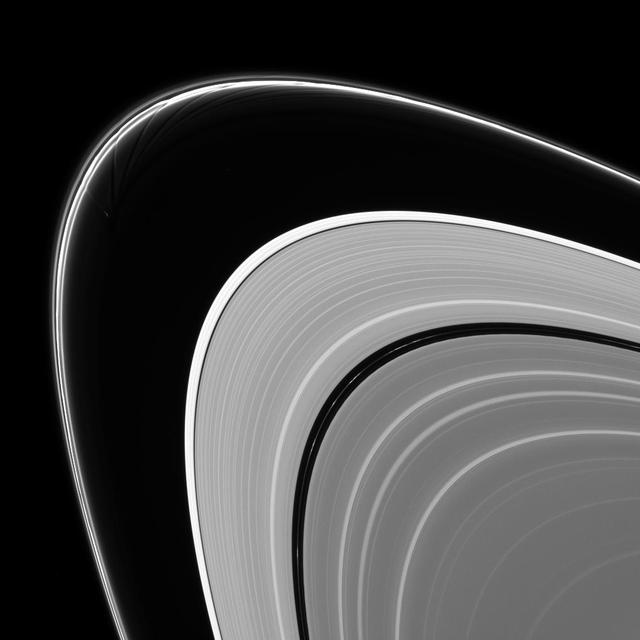
Prometheus is caught in the act of creating gores and streamers in the F ring. Scientists believe that Prometheus and its partner-moon Pandora are responsible for much of the structure in the F ring as shown by NASA Cassini spacecraft. The orbit of Prometheus (53 miles, or 86 kilometers across) regularly brings it into the F ring. When this happens, it creates gores, or channels, in the ring where it entered. Prometheus then draws ring material with it as it exits the ring, leaving streamers in its wake. This process creates the pattern of structures seen in this image. This process is described in detail, along with a movie of Prometheus creating one of the streamer/channel features, in PIA08397. This view looks toward the sunlit side of the rings from about 8.6 degrees above the ringplane. The image was taken in visible light with the Cassini spacecraft narrow-angle camera on Feb. 11, 2014. The view was acquired at a distance of approximately 1.3 million miles (2.1 million kilometers) from Saturn and at a Sun-Saturn-spacecraft, or phase, angle of 147 degrees. Image scale is 8 miles (13 kilometers) per pixel. http://photojournal.jpl.nasa.gov/catalog/PIA18270
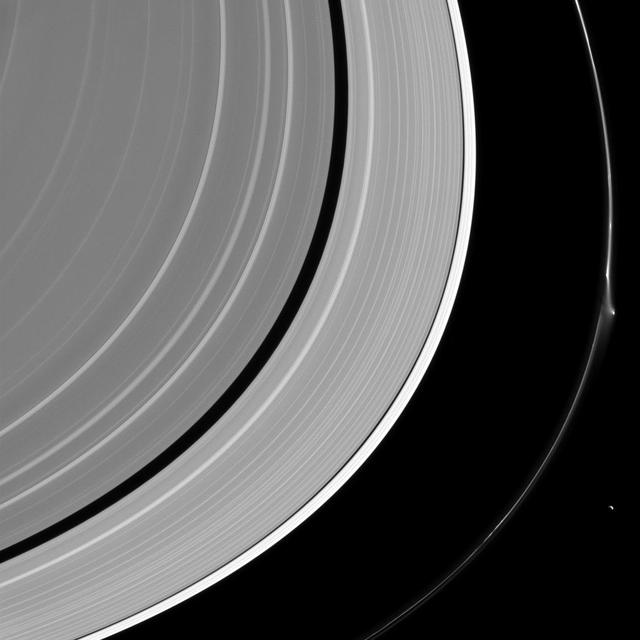
A bright disruption in Saturn's narrow F ring suggests it may have been disturbed recently. This feature was mostly likely not caused by Pandora (50 miles or 81 kilometers across) which lurks nearby, at lower right. More likely, it was created by the interaction of a small object embedded in the ring itself and material in the core of the ring. Scientists sometimes refer to these features as "jets." Because these bodies are small and embedded in the F ring itself, they are difficult to spot at the resolution available to NASA's Cassini spacecraft. Instead, their handiwork reveals their presence, and scientists use the Cassini spacecraft to study these stealthy sculptors of the F ring. This view looks toward the sunlit side of the rings from about 15 degrees above the ring plane. The image was taken in visible light with the Cassini spacecraft narrow-angle camera on April 8, 2016. The view was acquired at a distance of approximately 1.4 million miles (2.2 million kilometers) from Saturn and at a Sun-Saturn-spacecraft, or phase, angle of 105 degrees. Image scale is 8 miles (13 kilometers) per pixel. http://photojournal.jpl.nasa.gov/catalog/PIA20485
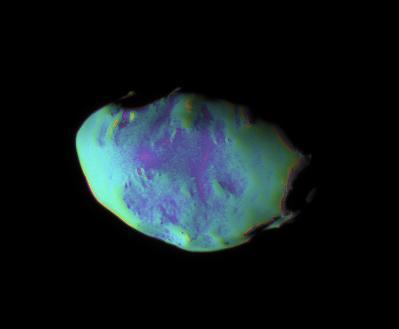
These views show surface features and color variation on the Trojan moon Telesto. The smooth surface of this moon suggests that, like Pandora, it is covered with a mantle of fine, dust-sized icy material. The monochrome image was taken in visible light (see PIA07696). To create the false-color view, ultraviolet, green and infrared images were combined into a single black and white picture that isolates and maps regional color differences. This "color map" was then superposed over a clear-filter image. The origin of the color differences is not yet understood, but may be caused by subtle differences in the surface composition or the sizes of grains making up the icy soil. Tiny Telesto is a mere 24 kilometers (15 miles) wide. The image was acquired with the Cassini spacecraft narrow-angle camera on Dec. 25, 2005 at a distance of approximately 20,000 kilometers (12,000 miles) from Telesto and at a Sun-Telesto-spacecraft, or phase, angle of 58 degrees. Image scale is 118 meters (387 feet) per pixel. http://photojournal.jpl.nasa.gov/catalog/PIA07697
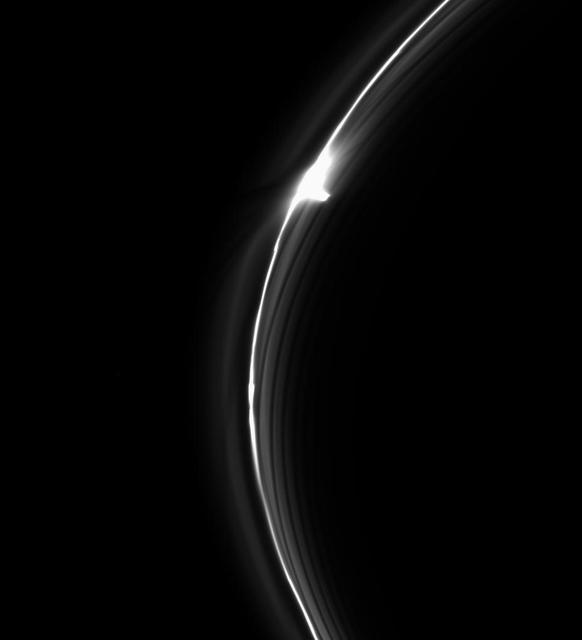
Saturn's dynamic F ring contains many different types of features to keep scientists perplexed. In this image we see features ring scientists call "gores," to the right of the bright clump, and a "jet," to the left of the bright spot. Thanks to the ring's interaction with the moons Prometheus and Pandora, and perhaps a host of smaller moonlets hidden in its core, the F ring is a constantly changing structure, with features that form, fade and re-appear on timescales of hours to days. This view looks toward the unilluminated side of the rings from about 7 degrees below the ring plane. The image was taken in visible light with the Cassini spacecraft narrow-angle camera on March 15, 2015. The view was acquired at a distance of approximately 295,000 miles (475,000 kilometers) from Saturn and at a Sun-ring-spacecraft, or phase, angle of 117 degrees. Image scale is 1.8 miles (2.9 kilometers) per pixel. http://photojournal.jpl.nasa.gov/catalog/PIA18337
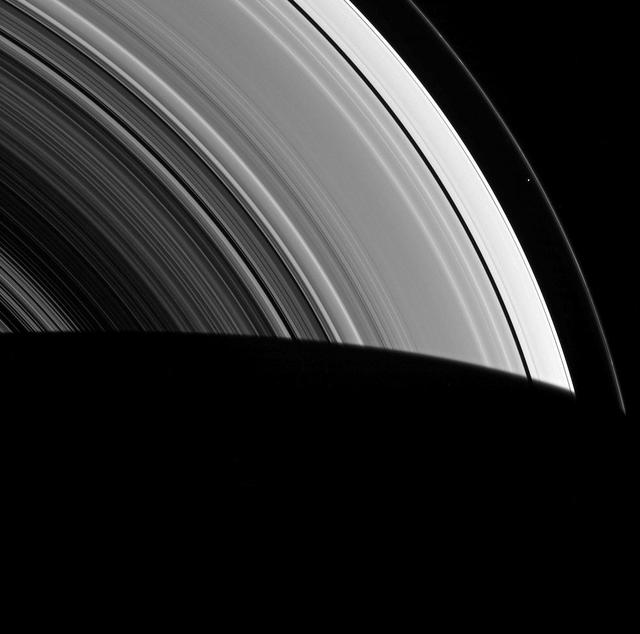
Seen by NASA Cassini spacecraft within the vast expanse of Saturn rings, Prometheus appears as little more than a dot. But that little moon still manages to shape the F ring, confining it to its narrow domain. Prometheus (53 miles, or 86 kilometers across) and its fellow moon Pandora (50 miles, or 81 kilometers across) orbit beside the F ring and keep the ring from spreading outward through a process dubbed "shepherding." This view looks toward the unilluminated side of the rings from about 45 degrees below the ringplane. The image was taken in green light with the Cassini spacecraft wide-angle camera on March 8, 2014. The view was obtained at a distance of approximately 533,000 miles (858,000 kilometers) from Prometheus and at a Sun-Prometheus-spacecraft, or phase, angle of 90 degrees. Image scale is 32 miles (51 kilometers) per pixel. http://photojournal.jpl.nasa.gov/catalog/PIA18272
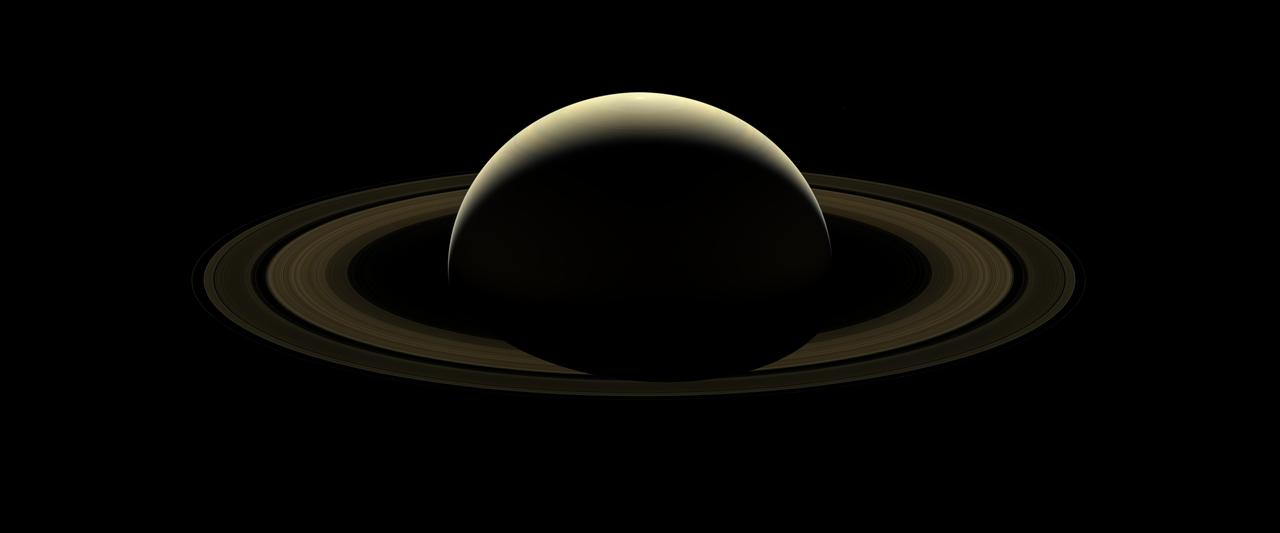
After more than 13 years at Saturn, and with its fate sealed, NASA's Cassini spacecraft bid farewell to the Saturnian system by firing the shutters of its wide-angle camera and capturing this last, full mosaic of Saturn and its rings two days before the spacecraft's dramatic plunge into the planet's atmosphere. During the observation, a total of 80 wide-angle images were acquired in just over two hours. This view is constructed from 42 of those wide-angle shots, taken using the red, green and blue spectral filters, combined and mosaicked together to create a natural-color view. Six of Saturn's moons -- Enceladus, Epimetheus, Janus, Mimas, Pandora and Prometheus -- make a faint appearance in this image. (Numerous stars are also visible in the background.) A second version of the mosaic is provided in which the planet and its rings have been brightened, with the fainter regions brightened by a greater amount. (The moons and stars have also been brightened by a factor of 15 in this version.) The ice-covered moon Enceladus -- home to a global subsurface ocean that erupts into space -- can be seen at the 1 o'clock position. Directly below Enceladus, just outside the F ring (the thin, farthest ring from the planet seen in this image) lies the small moon Epimetheus. Following the F ring clock-wise from Epimetheus, the next moon seen is Janus. At about the 4:30 position and outward from the F ring is Mimas. Inward of Mimas and still at about the 4:30 position is the F-ring-disrupting moon, Pandora. Moving around to the 10 o'clock position, just inside of the F ring, is the moon Prometheus. This view looks toward the sunlit side of the rings from about 15 degrees above the ring plane. Cassini was approximately 698,000 miles (1.1 million kilometers) from Saturn, on its final approach to the planet, when the images in this mosaic were taken. Image scale on Saturn is about 42 miles (67 kilometers) per pixel. The image scale on the moons varies from 37 to 50 miles (59 to 80 kilometers) pixel. The phase angle (the Sun-planet-spacecraft angle) is 138 degrees. The Cassini spacecraft ended its mission on Sept. 15, 2017. https://photojournal.jpl.nasa.gov/catalog/PIA17218
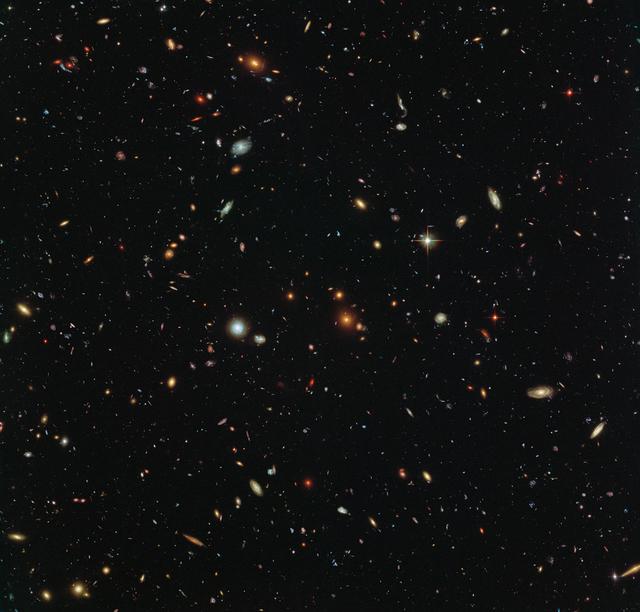
Peering deep into the early Universe, this picturesque parallel field observation from the NASA/ESA Hubble Space Telescope reveals thousands of colourful galaxies swimming in the inky blackness of space. A few foreground stars from our own galaxy, the Milky Way, are also visible. In October 2013 Hubble’s Wide Field Camera 3 (WFC3) and Advanced Camera for Surveys (ACS) began observing this portion of sky as part of the Frontier Fields programme. This spectacular skyscape was captured during the study of the giant galaxy cluster Abell 2744, otherwise known as Pandora’s Box. While one of Hubble’s cameras concentrated on Abell 2744, the other camera viewed this adjacent patch of sky near to the cluster. Containing countless galaxies of various ages, shapes and sizes, this parallel field observation is nearly as deep as the Hubble Ultra-Deep Field. In addition to showcasing the stunning beauty of the deep Universe in incredible detail, this parallel field — when compared to other deep fields — will help astronomers understand how similar the Universe looks in different directions
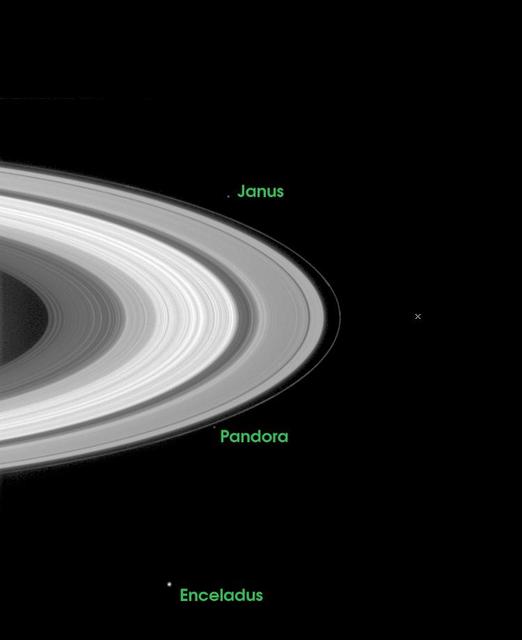
The path that lies ahead for the Cassini-Huygens mission is indicated in this image which illustrates where the spacecraft will be just 27 days from now, when it arrives at Saturn and crosses the ring plane 33 minutes before performing its critical orbital insertion maneuver. The X indicates the point where Cassini will pierce the ring plane on June 30, 2004, going from south to north of the ring plane, 33 minutes before the main engine fires to begin orbital insertion. The indicated point is between the narrow F-ring on the left and Saturn's tenuous G-ring which is too faint to be seen in this exposure. The image was taken on May 11, 2004 when the spacecraft was 26.3 million kilometers (16.3 million miles) from Saturn. Image scale is 158 kilometers (98 miles) per pixel. Moons visible in this image: Janus (181 kilometers or 113 miles across), one of the co-orbital moons; Pandora (84 kilometers or 52 miles across), one of the F ring shepherding moons; and Enceladus (499 kilometers or 310 miles across), a moon which may be heated from within and thus have a liquid sub-surface ocean. http://photojournal.jpl.nasa.gov/catalog/PIA06061
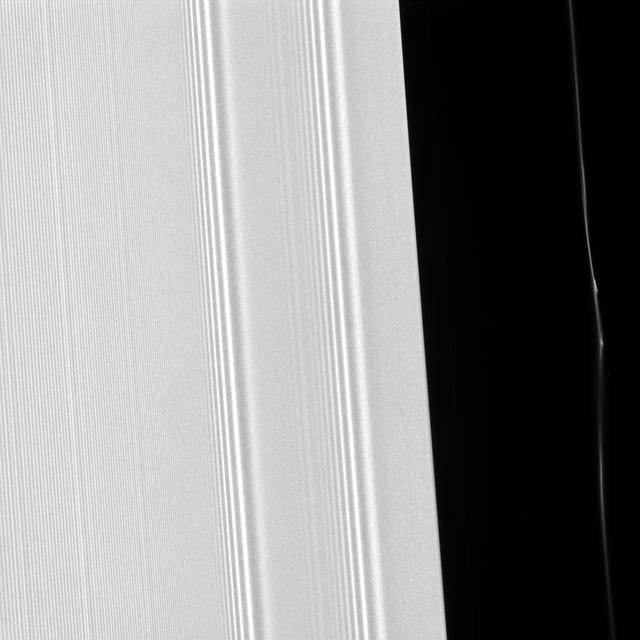
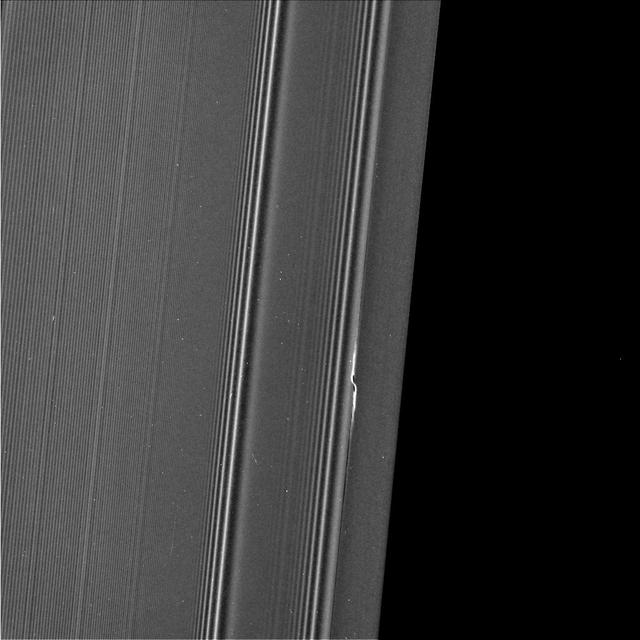
Many of the features seen in Saturn's rings are shaped by the planet's moons. This view from NASA's Cassini spacecraft shows two different effects of moons that cause waves in the A ring and kinks in a faint ringlet. The view captures the outer edge of the 200-mile-wide (320-kilometer-wide) Encke Gap, in the outer portion of Saturn's A ring. This is the same region features the large propeller called Earhart. Also visible here is one of several kinked and clumpy ringlets found within the gap. Kinks and clumps in the Encke ringlet move about, and even appear and disappear, in part due to the gravitational effects of Pan -- which orbits in the gap and whose gravitational influence holds it open. The A ring, which takes up most of the image on the left side, displays wave features caused by Pan, as well as the moons Pandora and Prometheus, which orbit a bit farther from Saturn on both sides of the planet's F ring. This view was taken in visible light with the Cassini spacecraft narrow-angle camera on March 22, 2017, and looks toward the sunlit side of the rings from about 22 degrees above the ring plane. The view was acquired at a distance of approximately 63,000 miles (101,000 kilometers) from Saturn and at a phase angle (the angle between the sun, the rings and the spacecraft) of 59 degrees. Image scale is 1,979 feet (603 meters) per pixel. https://photojournal.jpl.nasa.gov/catalog/PIA21333
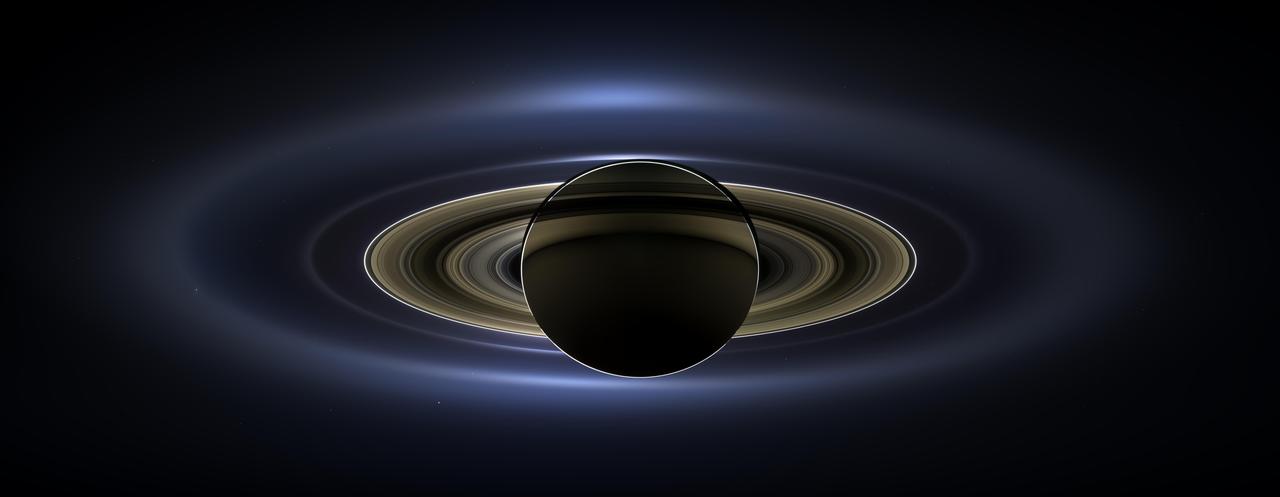
On July 19, 2013, in an event celebrated the world over, NASA's Cassini spacecraft slipped into Saturn's shadow and turned to image the planet, seven of its moons, its inner rings -- and, in the background, our home planet, Earth. With the sun's powerful and potentially damaging rays eclipsed by Saturn itself, Cassini's onboard cameras were able to take advantage of this unique viewing geometry. They acquired a panoramic mosaic of the Saturn system that allows scientists to see details in the rings and throughout the system as they are backlit by the sun. This mosaic is special as it marks the third time our home planet was imaged from the outer solar system; the second time it was imaged by Cassini from Saturn's orbit; and the first time ever that inhabitants of Earth were made aware in advance that their photo would be taken from such a great distance. With both Cassini's wide-angle and narrow-angle cameras aimed at Saturn, Cassini was able to capture 323 images in just over four hours. This final mosaic uses 141 of those wide-angle images. Images taken using the red, green and blue spectral filters of the wide-angle camera were combined and mosaicked together to create this natural-color view. A brightened version with contrast and color enhanced (Figure 1), a version with just the planets annotated (Figure 2), and an annotated version (Figure 3) are shown above. This image spans about 404,880 miles (651,591 kilometers) across. The outermost ring shown here is Saturn's E ring, the core of which is situated about 149,000 miles (240,000 kilometers) from Saturn. The geysers erupting from the south polar terrain of the moon Enceladus supply the fine icy particles that comprise the E ring; diffraction by sunlight gives the ring its blue color. Enceladus (313 miles, or 504 kilometers, across) and the extended plume formed by its jets are visible, embedded in the E ring on the left side of the mosaic. At the 12 o'clock position and a bit inward from the E ring lies the barely discernible ring created by the tiny, Cassini-discovered moon, Pallene (3 miles, or 4 kilometers, across). (For more on structures like Pallene's ring, see PIA08328). The next narrow and easily seen ring inward is the G ring. Interior to the G ring, near the 11 o'clock position, one can barely see the more diffuse ring created by the co-orbital moons, Janus (111 miles, or 179 kilometers, across) and Epimetheus (70 miles, or 113 kilometers, across). Farther inward, we see the very bright F ring closely encircling the main rings of Saturn. Following the outermost E ring counter-clockwise from Enceladus, the moon Tethys (662 miles, or 1,066 kilometers, across) appears as a large yellow orb just outside of the E ring. Tethys is positioned on the illuminated side of Saturn; its icy surface is shining brightly from yellow sunlight reflected by Saturn. Continuing to about the 2 o'clock position is a dark pixel just outside of the G ring; this dark pixel is Saturn's Death Star moon, Mimas (246 miles, or 396 kilometers, across). Mimas appears, upon close inspection, as a very thin crescent because Cassini is looking mostly at its non-illuminated face. The moons Prometheus, Pandora, Janus and Epimetheus are also visible in the mosaic near Saturn's bright narrow F ring. Prometheus (53 miles, or 86 kilometers, across) is visible as a faint black dot just inside the F ring and at the 9 o'clock position. On the opposite side of the rings, just outside the F ring, Pandora (50 miles, or 81 kilometers, across) can be seen as a bright white dot. Pandora and Prometheus are shepherd moons and gravitational interactions between the ring and the moons keep the F ring narrowly confined. At the 11 o'clock position in between the F ring and the G ring, Janus (111 miles, or 179 kilometers, across) appears as a faint black dot. Janus and Prometheus are dark for the same reason Mimas is mostly dark: we are looking at their non-illuminated sides in this mosaic. Midway between the F ring and the G ring, at about the 8 o'clock position, is a single bright pixel, Epimetheus. Looking more closely at Enceladus, Mimas and Tethys, especially in the brightened version of the mosaic, one can see these moons casting shadows through the E ring like a telephone pole might cast a shadow through a fog. In the non-brightened version of the mosaic, one can see bright clumps of ring material orbiting within the Encke gap near the outer edge of the main rings and immediately to the lower left of the globe of Saturn. Also, in the dark B ring within the main rings, at the 9 o'clock position, one can see the faint outlines of two spoke features, first sighted by NASA's Voyager spacecraft in the early 1980s and extensively studied by Cassini. Finally, in the lower right of the mosaic, in between the bright blue E ring and the faint but defined G ring, is the pale blue dot of our planet, Earth. Look closely and you can see the moon protruding from the Earth's lower right. (For a higher resolution view of the Earth and moon taken during this campaign, see PIA14949.) Earth's twin, Venus, appears as a bright white dot in the upper left quadrant of the mosaic, also between the G and E rings. Mars also appears as a faint red dot embedded in the outer edge of the E ring, above and to the left of Venus. For ease of visibility, Earth, Venus, Mars, Enceladus, Epimetheus and Pandora were all brightened by a factor of eight and a half relative to Saturn. Tethys was brightened by a factor of four. In total, 809 background stars are visible and were brightened by a factor ranging from six, for the brightest stars, to 16, for the faintest. The faint outer rings (from the G ring to the E ring) were also brightened relative to the already bright main rings by factors ranging from two to eight, with the lower-phase-angle (and therefore fainter) regions of these rings brightened the most. The brightened version of the mosaic was further brightened and contrast-enhanced all over to accommodate print applications and a wide range of computer-screen viewing conditions. Some ring features -- such as full rings traced out by tiny moons -- do not appear in this version of the mosaic because they require extreme computer enhancement, which would adversely affect the rest of the mosaic. This version was processed for balance and beauty. This view looks toward the unlit side of the rings from about 17 degrees below the ring plane. Cassini was approximately 746,000 miles (1.2 million kilometers) from Saturn when the images in this mosaic were taken. Image scale on Saturn is about 45 miles (72 kilometers) per pixel. This mosaic was made from pictures taken over a span of more than four hours while the planets, moons and stars were all moving relative to Cassini. Thus, due to spacecraft motion, these objects in the locations shown here were not in these specific places over the entire duration of the imaging campaign. Note also that Venus appears far from Earth, as does Mars, because they were on the opposite side of the sun from Earth. http://photojournal.jpl.nasa.gov/catalog/PIA17172
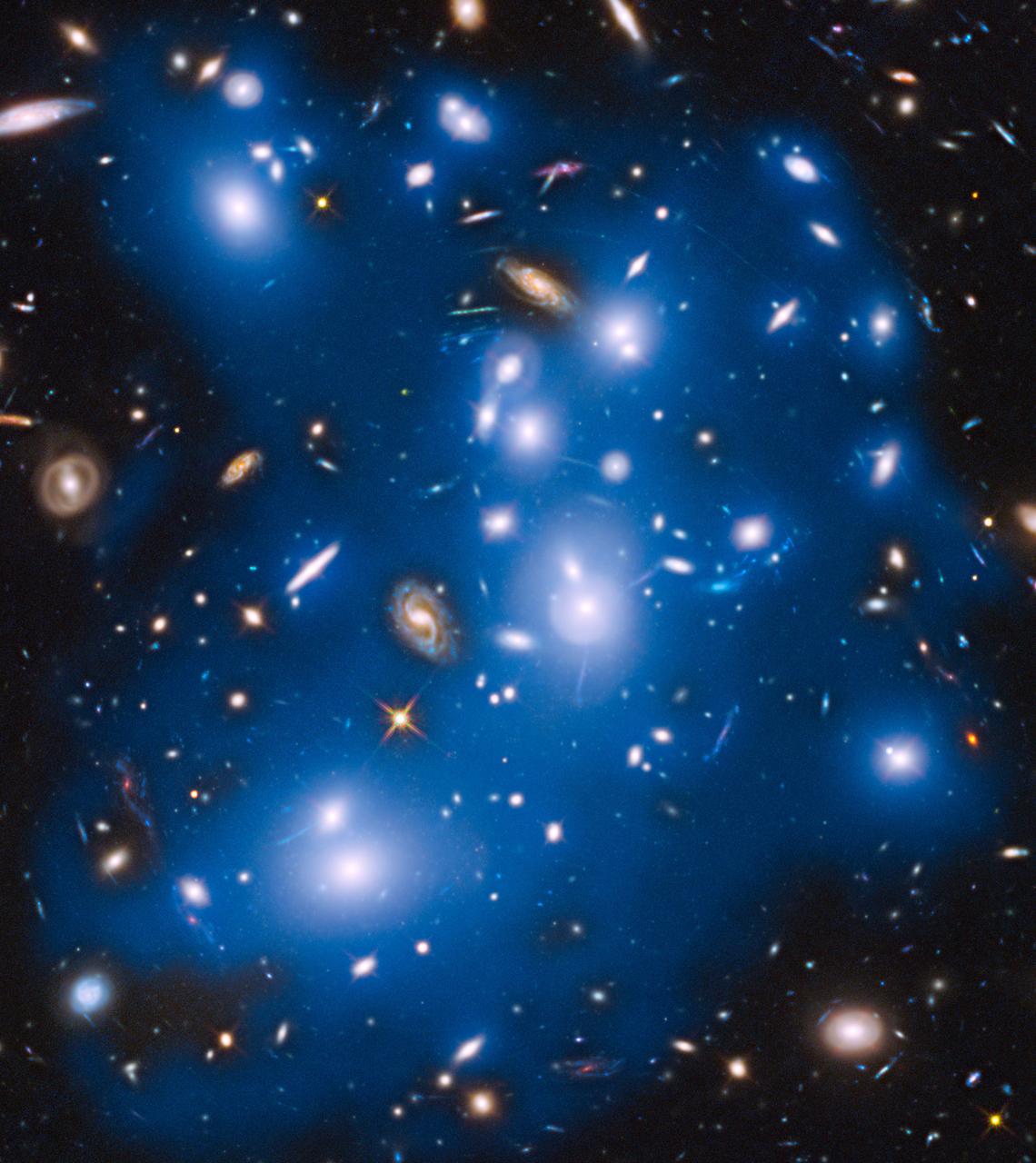
NASA’s Hubble Space Telescope has picked up the faint, ghostly glow of stars ejected from ancient galaxies that were gravitationally ripped apart several billion years ago. The mayhem happened 4 billion light-years away, inside an immense collection of nearly 500 galaxies nicknamed “Pandora’s Cluster,” also known as Abell 2744. The scattered stars are no longer bound to any one galaxy, and drift freely between galaxies in the cluster. By observing the light from the orphaned stars, Hubble astronomers have assembled forensic evidence that suggests as many as six galaxies were torn to pieces inside the cluster over a stretch of 6 billion years. Read more: <a href="http://1.usa.gov/1yK2Ucp" rel="nofollow">1.usa.gov/1yK2Ucp</a> Credit: NASA/ESA/IAC/HFF Team, STScI <b><a href="http://www.nasa.gov/audience/formedia/features/MP_Photo_Guidelines.html" rel="nofollow">NASA image use policy.</a></b> <b><a href="http://www.nasa.gov/centers/goddard/home/index.html" rel="nofollow">NASA Goddard Space Flight Center</a></b> enables NASA’s mission through four scientific endeavors: Earth Science, Heliophysics, Solar System Exploration, and Astrophysics. Goddard plays a leading role in NASA’s accomplishments by contributing compelling scientific knowledge to advance the Agency’s mission. <b>Follow us on <a href="http://twitter.com/NASAGoddardPix" rel="nofollow">Twitter</a></b> <b>Like us on <a href="http://www.facebook.com/pages/Greenbelt-MD/NASA-Goddard/395013845897?ref=tsd" rel="nofollow">Facebook</a></b> <b>Find us on <a href="http://instagram.com/nasagoddard?vm=grid" rel="nofollow">Instagram</a></b>

Peering deep into the early universe, this picturesque parallel field observation from the NASA/ESA Hubble Space Telescope reveals thousands of colorful galaxies swimming in the inky blackness of space. A few foreground stars from our own galaxy, the Milky Way, are also visible. In October 2013 Hubble’s Wide Field Camera 3 (WFC3) and Advanced Camera for Surveys (ACS) began observing this portion of sky as part of the Frontier Fields program. This spectacular skyscape was captured during the study of the giant galaxy cluster Abell 2744, otherwise known as Pandora’s Box. While one of Hubble’s cameras concentrated on Abell 2744, the other camera viewed this adjacent patch of sky near to the cluster. Containing countless galaxies of various ages, shapes and sizes, this parallel field observation is nearly as deep as the Hubble Ultra-Deep Field. In addition to showcasing the stunning beauty of the deep universe in incredible detail, this parallel field — when compared to other deep fields — will help astronomers understand how similar the universe looks in different directions. Image credit: NASA, ESA and the HST Frontier Fields team (STScI), <b><a href="http://www.nasa.gov/audience/formedia/features/MP_Photo_Guidelines.html" rel="nofollow">NASA image use policy.</a></b> <b><a href="http://www.nasa.gov/centers/goddard/home/index.html" rel="nofollow">NASA Goddard Space Flight Center</a></b> enables NASA’s mission through four scientific endeavors: Earth Science, Heliophysics, Solar System Exploration, and Astrophysics. Goddard plays a leading role in NASA’s accomplishments by contributing compelling scientific knowledge to advance the Agency’s mission. <b>Follow us on <a href="http://twitter.com/NASAGoddardPix" rel="nofollow">Twitter</a></b> <b>Like us on <a href="http://www.facebook.com/pages/Greenbelt-MD/NASA-Goddard/395013845897?ref=tsd" rel="nofollow">Facebook</a></b> <b>Find us on <a href="http://instagrid.me/nasagoddard/?vm=grid" rel="nofollow">Instagram</a></b>
The propeller informally named "Earhart" is seen in this view from NASA's Cassini spacecraft at much higher resolution than ever before. This view, obtained on March 22, 2017, is the second time Cassini has deliberately targeted an individual propeller for close-up viewing during its ring-grazing orbits, after its images of Santos-Dumont (PIA21433) a month earlier. The biggest known propeller, informally named "Bleriot," is slated for the third and final propeller close-up in April 2017. Propellers are disturbances in the ring caused by a central moonlet. The moonlet itself would be a few pixels wide in this view, but it is difficult to distinguish from (and may be obscured by) the disturbed ring material that surrounds it. (See PIA20525 for more info on propellers.) The detailed structure of the Earhart propeller, as seen here, differs from that of Santos-Dumont. It is not clear whether these differences have to do with intrinsic differences between Earhart and Santos-Dumont, or whether they have to do with different viewing angles or differences in where the propellers were imaged in their orbits around Saturn. Earhart is situated very close to the 200-mile-wide (320-kilometer-wide) Encke Gap, which is held open by the much larger moon Pan. In this view, half of the Encke Gap is visible as the dark region at right. The gap and the propeller are a study in contrasts. The propeller is nothing more than Earhart's attempt to open a gap like Encke using its gravity. However, Earhart's attempt is thwarted by the mass of the ring, which fills in the nascent gap before it can extend very far. Pan is a few thousand times more massive than Earhart, which enables it to maintain a gap that extends all the way around the ring. To the left of the propeller are wave features in the rings caused by the moons Pandora, Prometheus and Pan. The visible-light image was acquired by the Cassini narrow-angle camera at a distance of 69,183 miles (111,340 kilometers) from the propeller feature. Image scale is 0.4 mile (670 meters) per pixel in the radial, or outward-from-Saturn, direction. The view looks toward the sunlit side of the rings. https://photojournal.jpl.nasa.gov/catalog/PIA21437