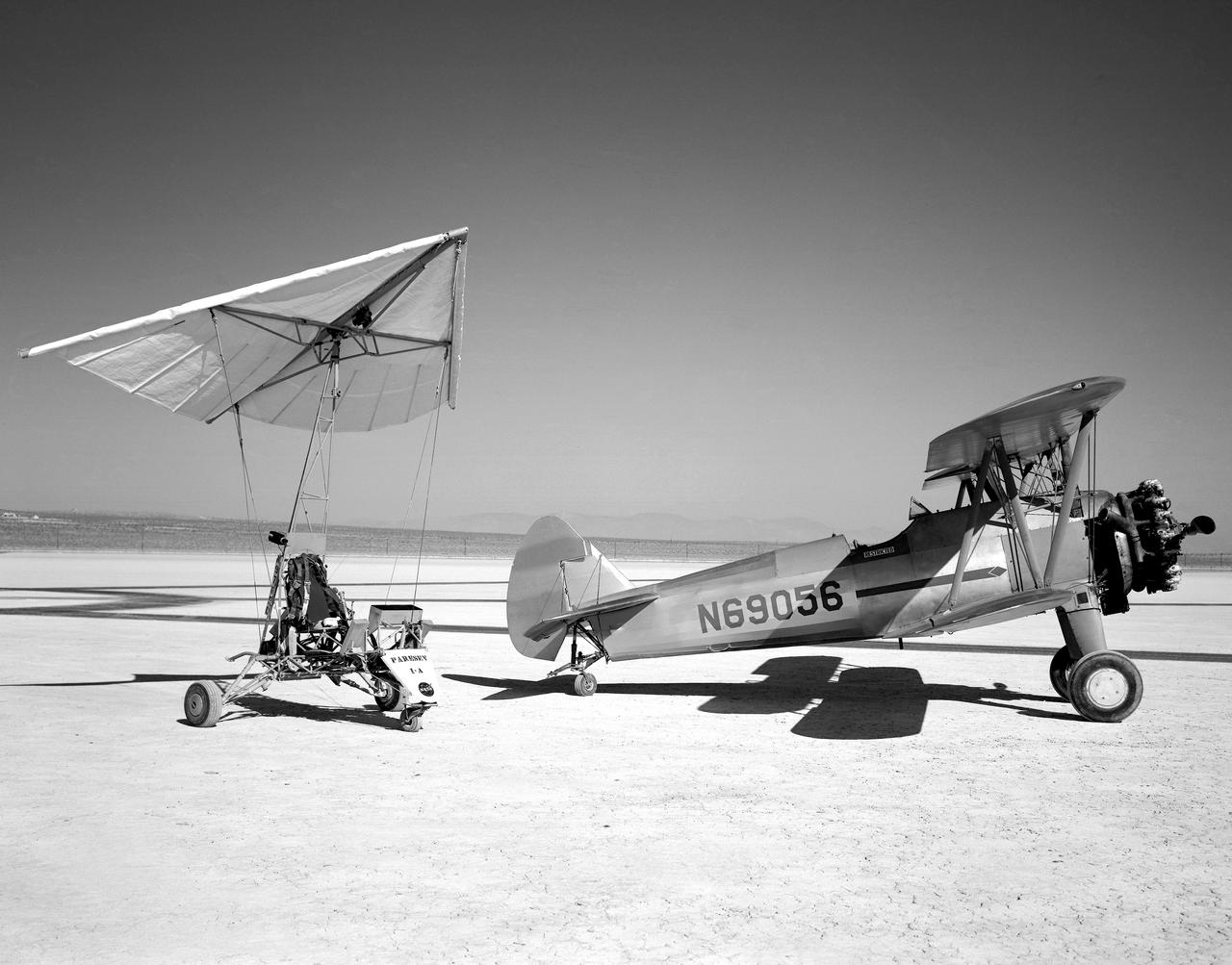
The Paresev 1-A (Paraglider Research Vehicle) and the tow airplane, 450-hp Stearman sport Biplane, sitting on Rogers dry lakebed, Edwards, California. The control system in the Paresev 1-A had a more conventional control stick position and was cable-operated; the main landing gear used shocks and bungees with the 100-square-foot wing membrane being made of 6-ounce unsealed Dacron.
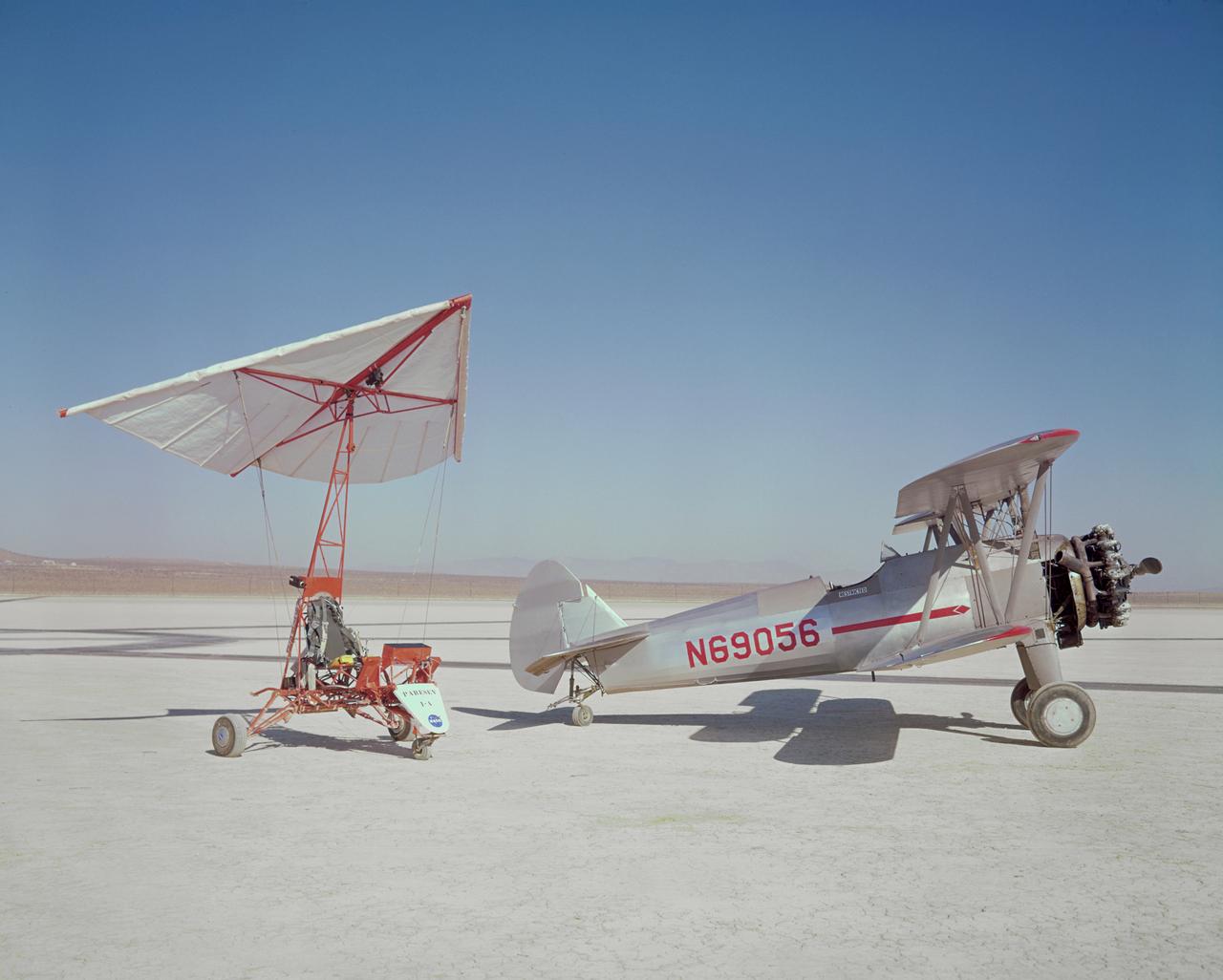
Paresev 1A and Stearman tow plane on lakebed.
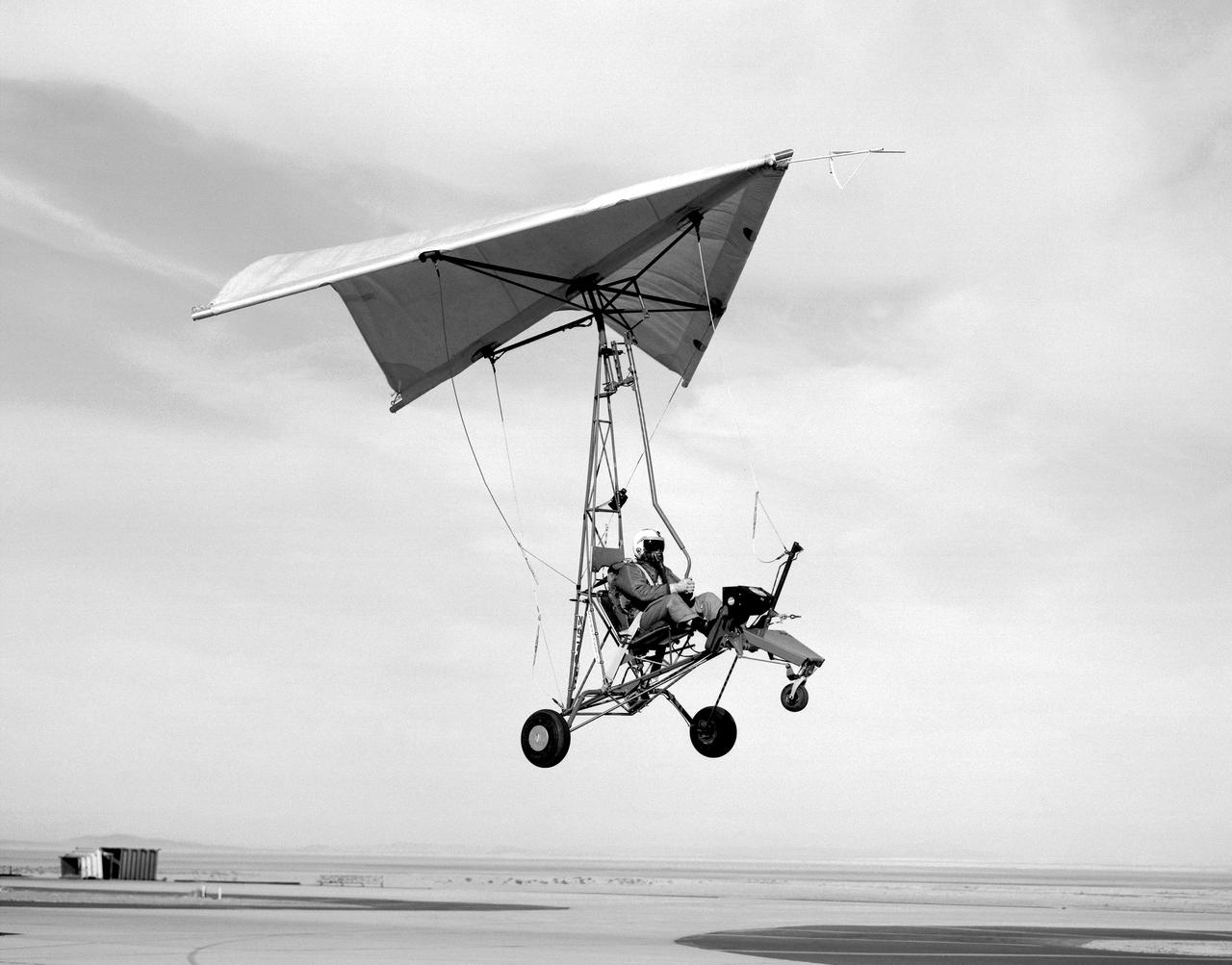
Pilot and Paresev 1 preparing for a landing on the Rogers dry lakebed in 1962 at Edwards Air Force Base, California. The flight program began with ground tow tests. Several tows were made before liftoff was attempted to check the control rigging and to familiarize the pilot with the vehicle’s ground stability. As the pilot’s confidence and experience increased, tow speeds were also increased until liftoff was attained. Liftoff was at about 40 knots indicated airspeed (kias).
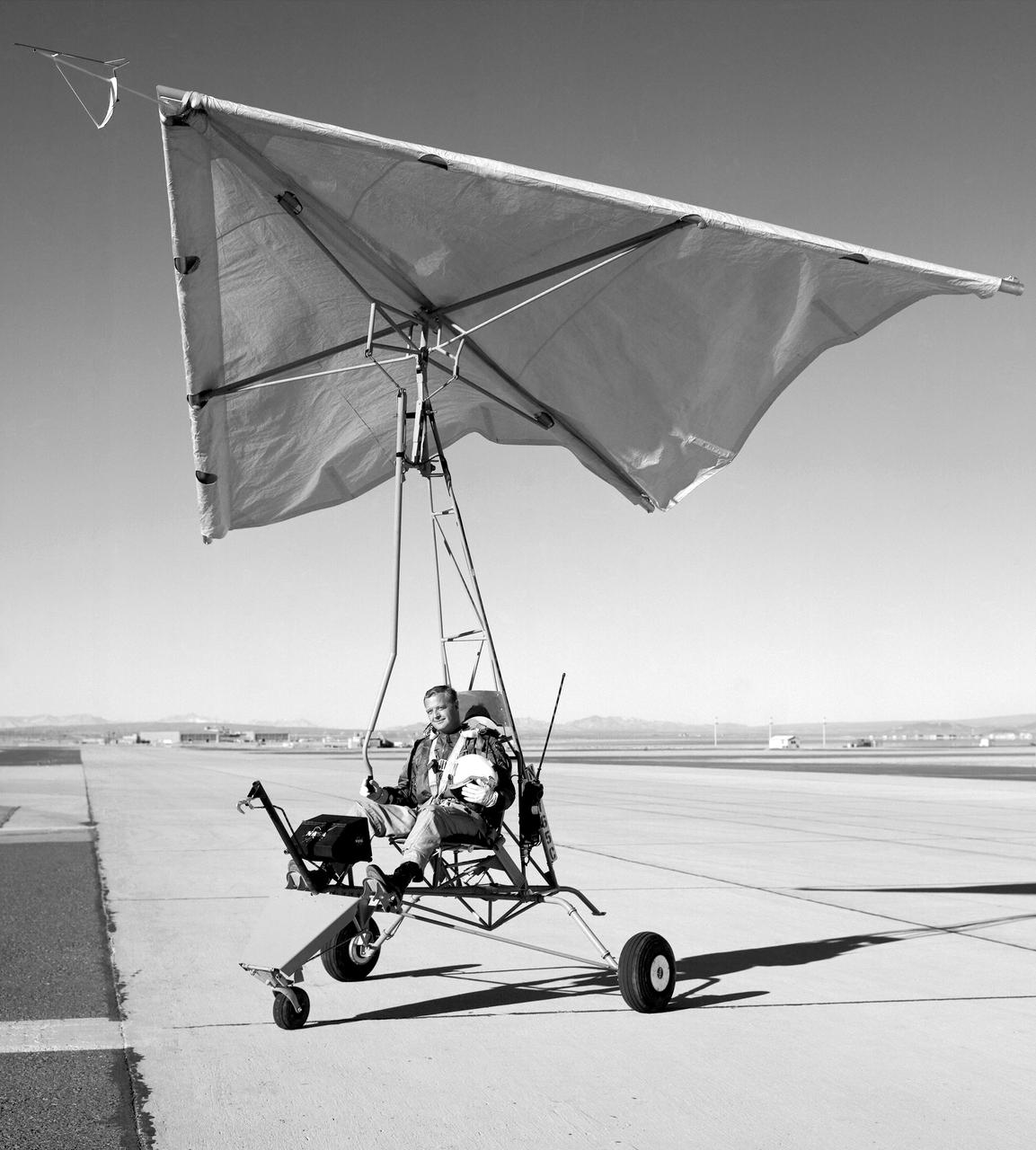
Test pilot Milton Thompson sitting in NASA Flight Research Center-built Paresev 1 (Paraglider Research Vehicle) on the taxi strip in front of the NASA Flight Research Center in 1962. In this photo the control stick can be seen coming from overhead and hanging in front of the pilot. The control system was a direct link with the wing membrane made of doped Irish linen. By maintaining simplicity during construction, it was possible to make control and configuration changes overnight and, in many instances, in minutes.
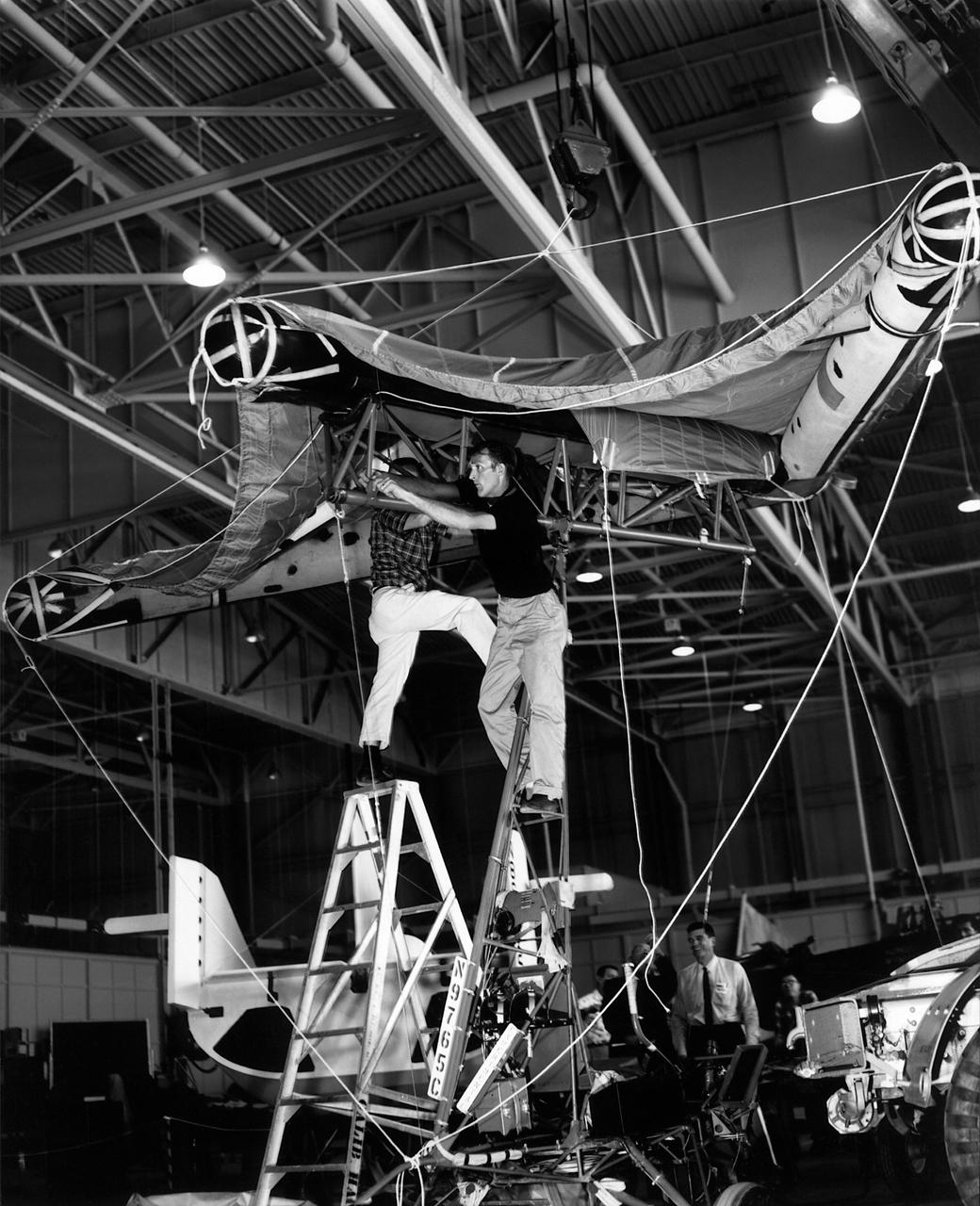
This photo shows the Paresev (Paraglider Research Vehicle) space frame receiving a new wing. Frank Fedor and a technician helper are attaching a half-scale version of an inflatable wing in a hangar at NASA Flight Research Center at Edwards, California. The Paresev in this configuration was called the 1-C and was expected to closely approximate the aerodynamic characteristics that would be encountered with the Gemini space capsule with a parawing extended. The whole wing was not inflatable; the three chambers that acted as spars and supported the wing inflated.
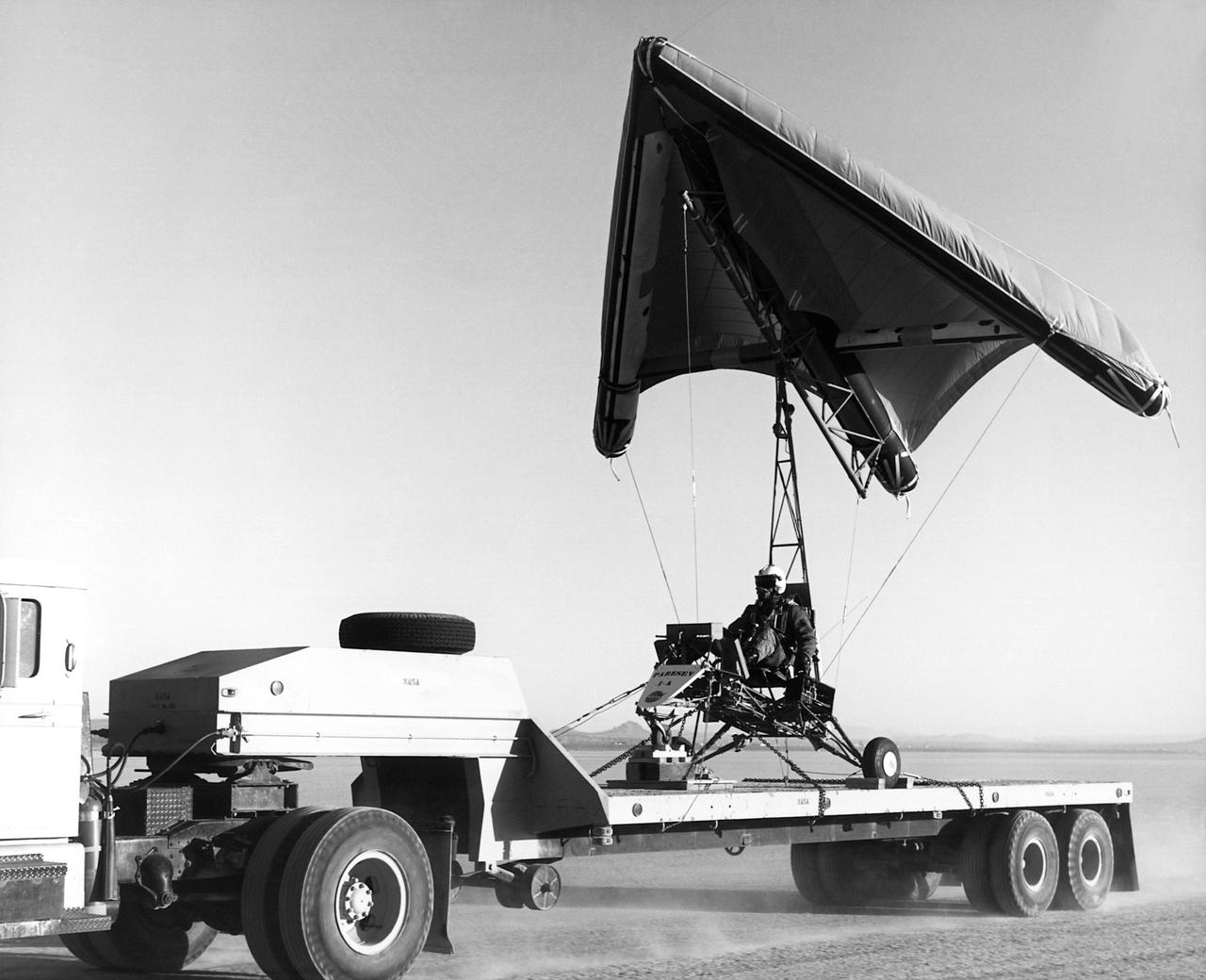
Aboard a truck and ready for a test flight is the Paresev 1-C on the ramp at the NASA Flight Research Center, Edwards, California. The half-scale version of the inflatable Gemini parawing was pre-flighted by being carried across the Rosamond dry lakebed on the back of a truck before a tow behind a International Harvester Carry-All. The inflatable center spar ran fore and aft and measured 191 inches, two other inflatable spars formed the leading edges. The three compartments were filled with nitrogen under pressure to make them rigid. The Paresev 1-C was very unstable in flight with this configuration.
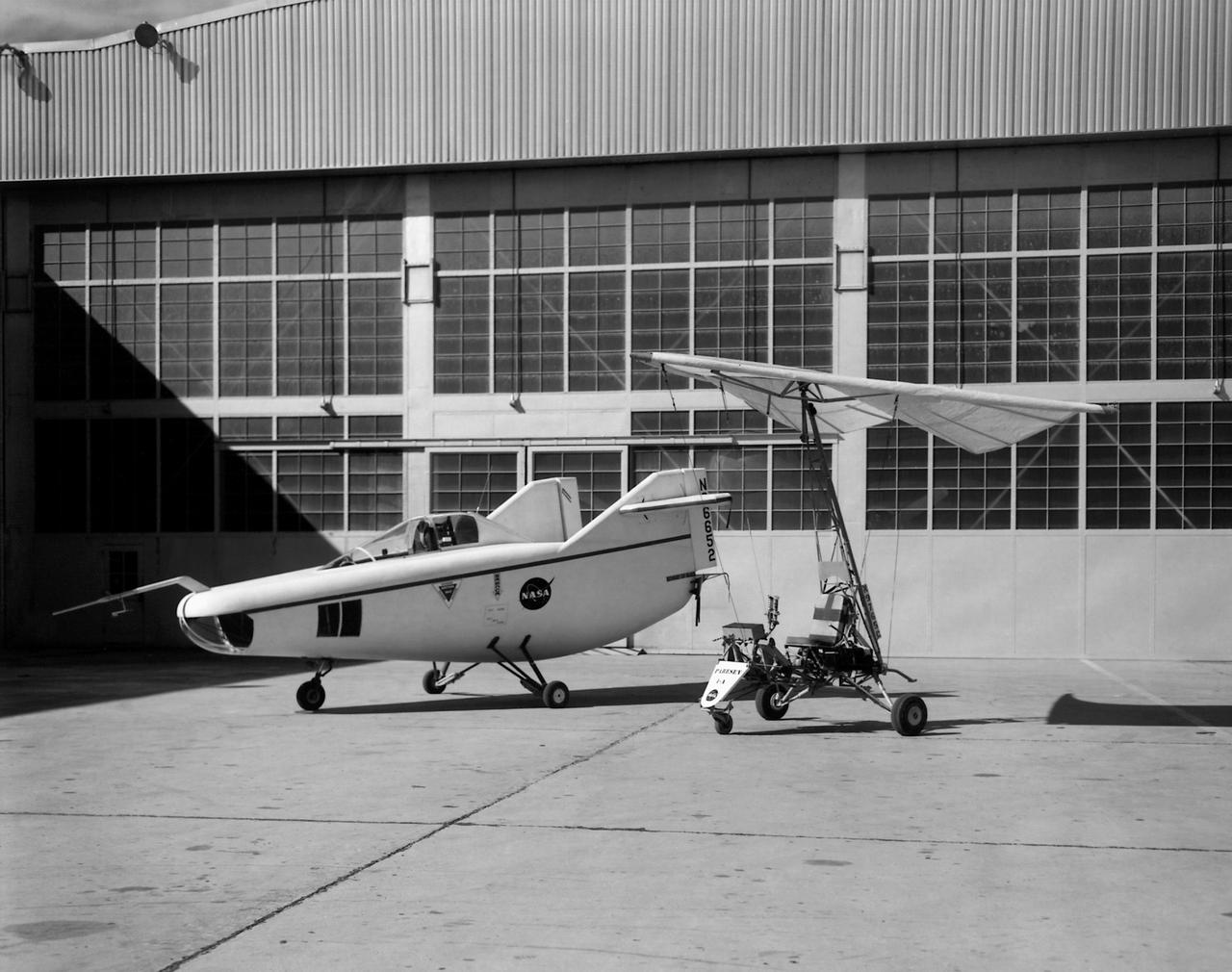
In this photo of the M2-F1 lifting body and the Paresev 1B on the ramp, the viewer sees two vehicles representing different approaches to building a research craft to simulate a spacecraft able to land on the ground instead of splashing down in the ocean as the Mercury capsules did. The M2-F1 was a lifting body, a shape able to re-enter from orbit and land. The Paresev (Paraglider Research Vehicle) used a Rogallo wing that could be (but never was) used to replace a conventional parachute for landing a capsule-type spacecraft, allowing it to make a controlled landing on the ground.
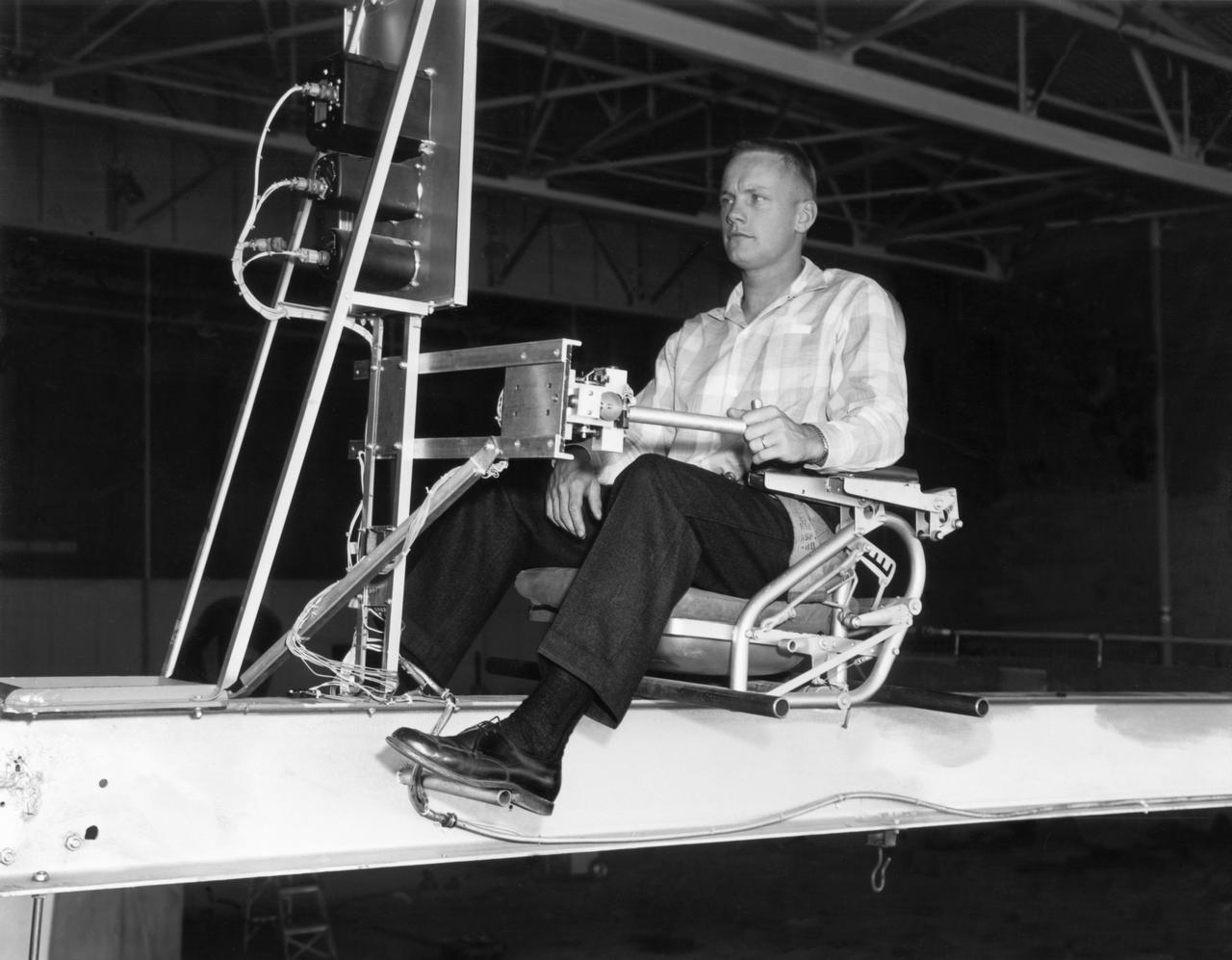
Famed astronaut Neil A. Armstrong, the first man to set foot on the moon during the historic Apollo 11 space mission in July 1969, served for seven years as a research pilot at the NACA-NASA High-Speed Flight Station, now the Dryden Flight Research Center, at Edwards, California, before he entered the space program. Armstrong joined the National Advisory Committee for Aeronautics (NACA) at the Lewis Flight Propulsion Laboratory (later NASA's Lewis Research Center, Cleveland, Ohio, and today the Glenn Research Center) in 1955. Later that year, he transferred to the High-Speed Flight Station at Edwards as an aeronautical research scientist and then as a pilot, a position he held until becoming an astronaut in 1962. He was one of nine NASA astronauts in the second class to be chosen. As a research pilot Armstrong served as project pilot on the F-100A and F-100C aircraft, F-101, and the F-104A. He also flew the X-1B, X-5, F-105, F-106, B-47, KC-135, and Paresev. He left Dryden with a total of over 2450 flying hours. He was a member of the USAF-NASA Dyna-Soar Pilot Consultant Group before the Dyna-Soar project was cancelled, and studied X-20 Dyna-Soar approaches and abort maneuvers through use of the F-102A and F5D jet aircraft. Armstrong was actively engaged in both piloting and engineering aspects of the X-15 program from its inception. He completed the first flight in the aircraft equipped with a new flow-direction sensor (ball nose) and the initial flight in an X-15 equipped with a self-adaptive flight control system. He worked closely with designers and engineers in development of the adaptive system, and made seven flights in the rocket plane from December 1960 until July 1962. During those fights he reached a peak altitude of 207,500 feet in the X-15-3, and a speed of 3,989 mph (Mach 5.74) in the X-15-1. Armstrong has a total of 8 days and 14 hours in space, including 2 hours and 48 minutes walking on the Moon. In March 1966 he was commander of the Gemini 8 or