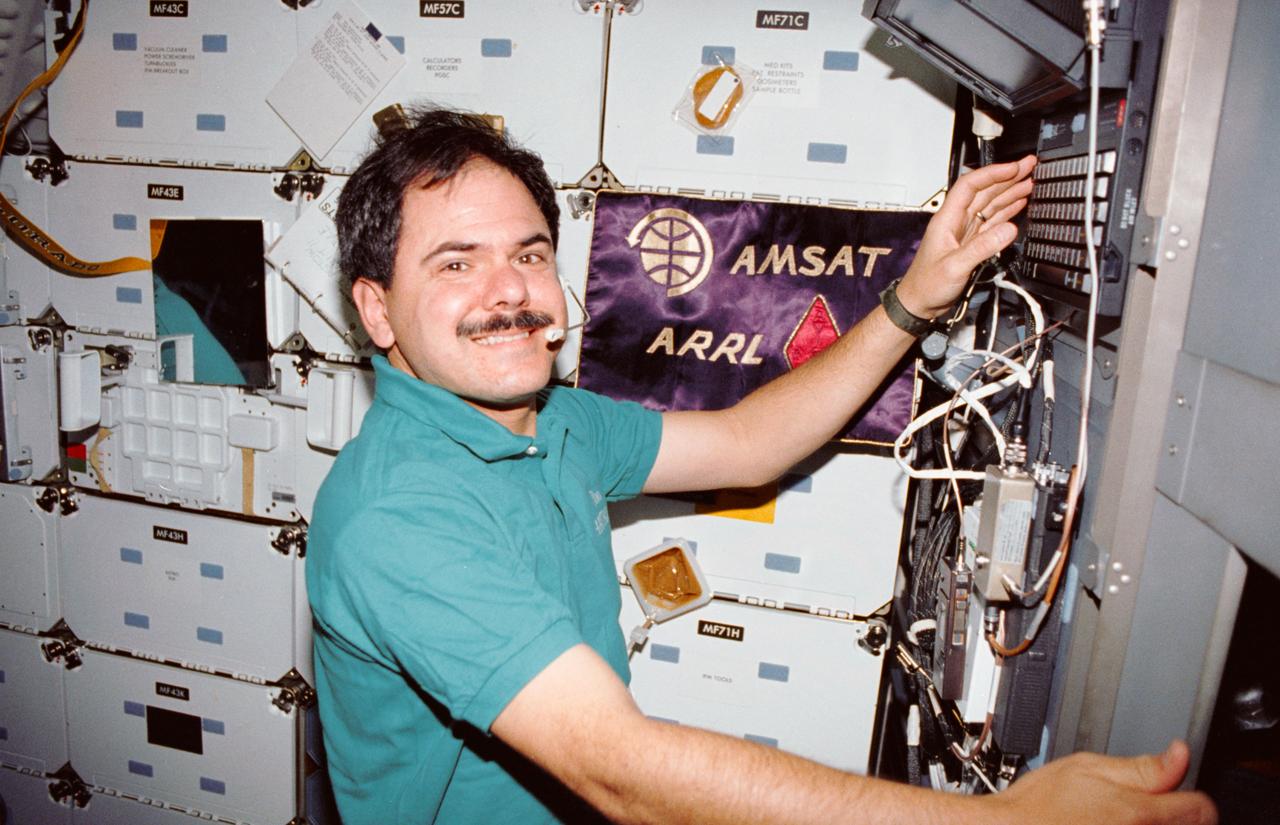
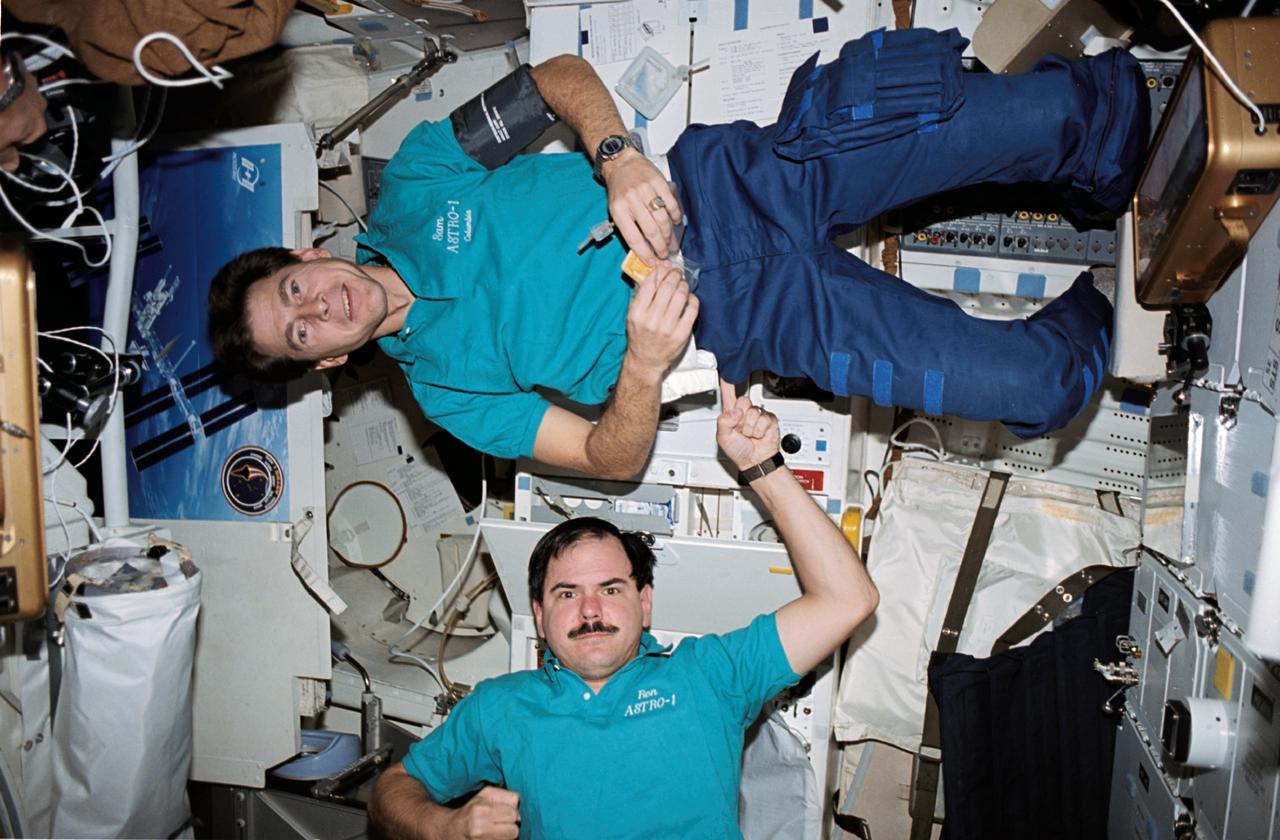
STS-35 Payload Specialist Ronald A. Parise enters data into the payload and general support computer (PGSC) in preparation for Earth communication via the Shuttle Amateur Radio Experiment (SAREX) aboard Columbia, Orbiter Vehicle (OV) 102. The SAREX equipment is secured to the middeck starboard sleep station. SAREX provided radio transmissions between ground based amateur radio operators around the world and Parise, a licensed amateur radio operator. The experiment enabled students to communicate with an astronaut in space, as Parise (call-sign WA4SIR) devoted some of his off-duty time to that purpose. Displayed on the forward lockers beside Parise is a AMSAT (Amateur Radio Satellite Corporation) / ARRL (American Radio Relay League) banner. Food items and checklists are attached to the lockers. In locker position MF43G, the Development Test Objective (DTO) Trash Compaction and Retention System Demonstration extended duration orbiter (EDO) compactor is visible.
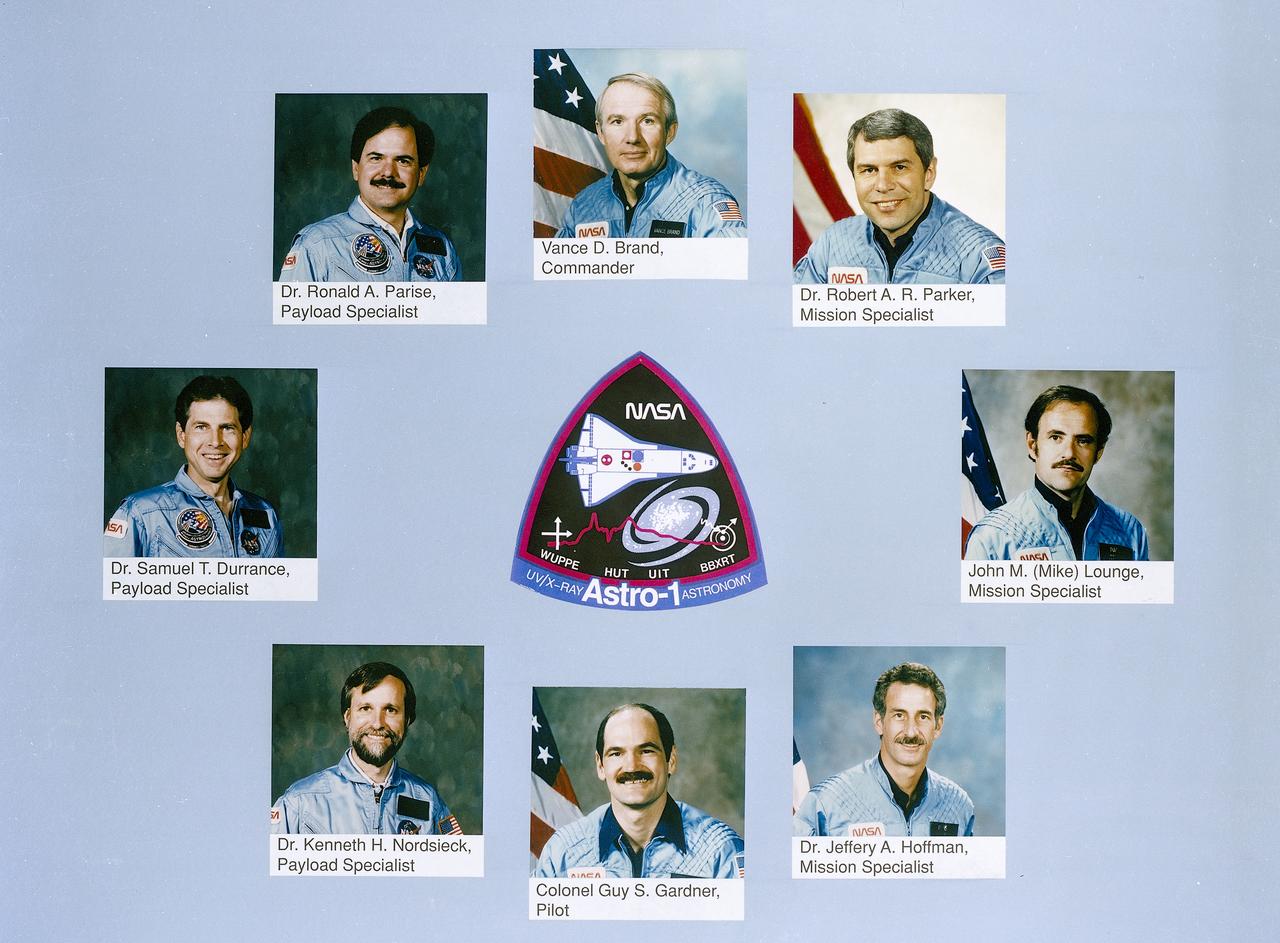
This montage consists of 8 individual STS-35 crew member portraits surrounding the mission’s insignia. Starting from top center, clockwise, are Vance D. Brand, commander; mission specialists Dr. Robert A. R. Parker, John M. (Mike) Lounge, and Dr. Jeffery A. Hoffman; Colonel Guy S. Gardner, pilot; and payload specialists Dr. Kenneth H. Nordsieck, Dr. Samual T. Durrance, and Dr. Ronald A. Parise. The crew of 8 launched aboard the Space Shuttle Orbiter Columbia on December 2, 1990 at 1:19:01am (EST). The primary objective of the mission was round the clock observation of the celestial sphere in ultrviolet and X-Ray astronomy with the Astro-1 observatory which consisted of four telescopes: the Hopkins Ultraviolet Telescope (HUT); the Wisconsin Ultraviolet Photo-Polarimeter Experiment (WUPPE); the Ultraviolet Imaging Telescope (UIT); and the Broad Band X-Ray Telescope (BBXRT). Due to loss of data used for pointing and operating the ultraviolet telescopes, Marshall Space Flight Center ground teams were forced to aim the telescopes with fine tuning by the flight crew.
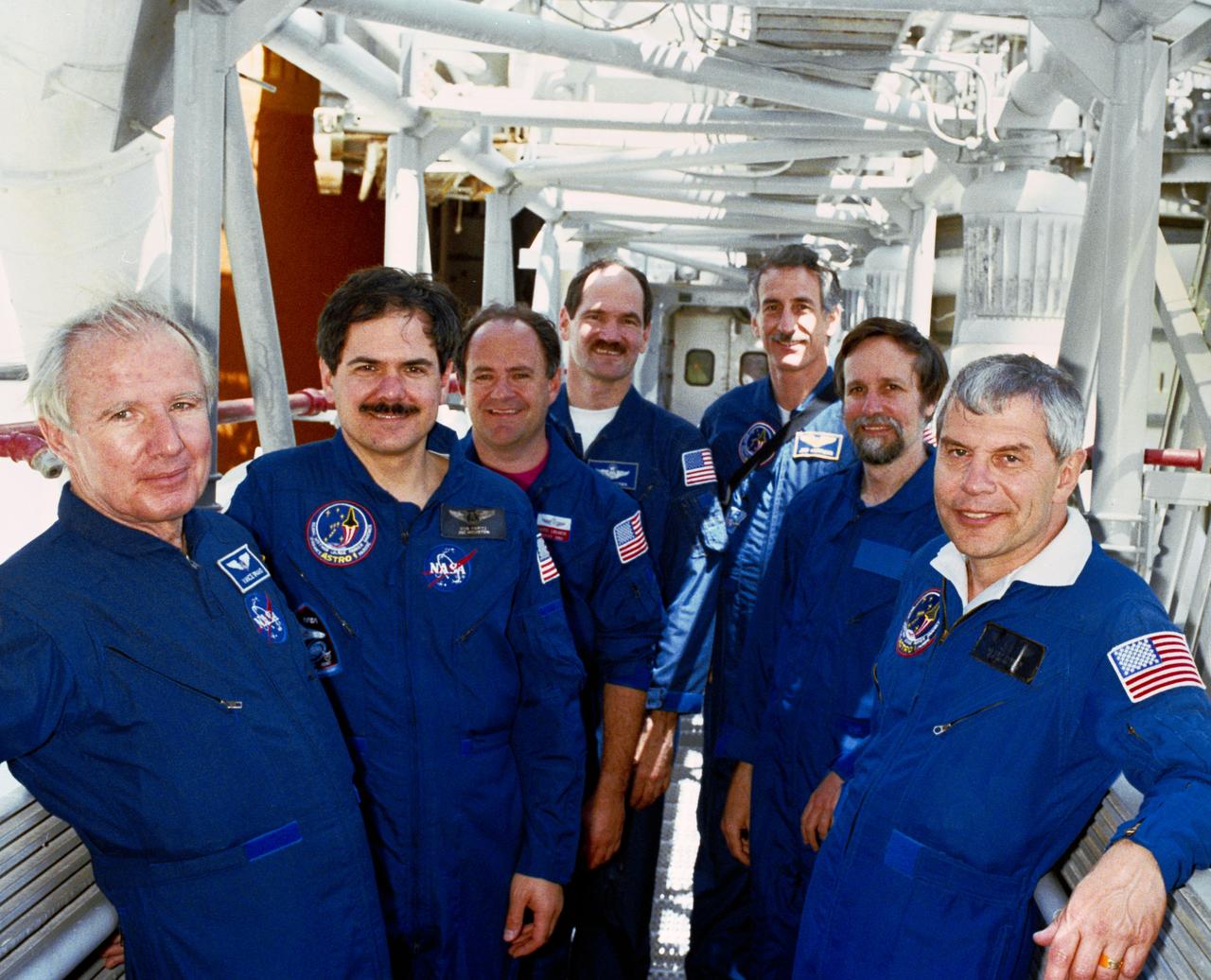
S90-38029 (21 May 1990) --- STS-35 Columbia, Orbiter Vehicle (OV) 102, crewmembers commander Vance D. Brand, pilot Guy S. Gardner, mission specialists Jeffrey A. Hoffman, John M. Lounge, Robert A. R. Parker, payload specialists Samuel T. Durrance and Ronald A. Parise and backup payload specialist Kenneth Nordsieck take a break from training activities and pose on the 195-Floor Level on Launch Pad 39A at the Kennedy Space Center (KSC). On left from front to back are Brand, Parise, Lounge and Gardner and on right from front to back are Parker, Nordsieck, and Hoffman. View provided by KSC with alternate number KSC-90PC-670.
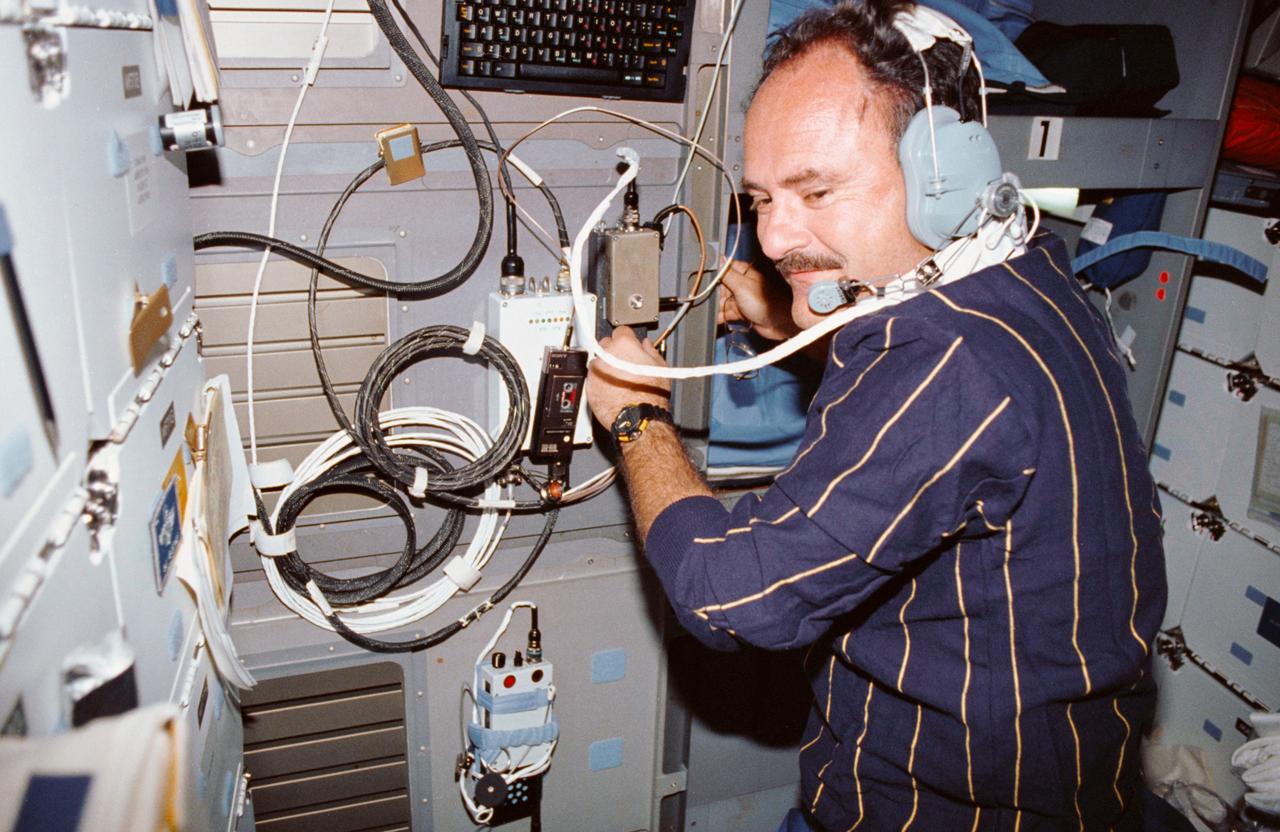
STS035-15-010 (2-11 Dec 1990) --- Astronaut John M. (Mike) Lounge, STS-35 mission specialist, communicates with family members from the middeck of Space Shuttle Columbia in Earth orbit. The STS-35 Shuttle amateur radio experiment (SAREX), allowed the Astro 1 crewmembers to "visit" and briefly share some of their in space experiences with family members. The picture was made with a 35mm camera. Note: Used by Astronomer Ronald A. Parise on his off-duty hours, SAREX provided radio transmissions between ground based amateur radio operators around the world and the Shuttle. Parise is a payload specialist who is also a licensed amateur radio operator (call-sign WA4SIR). The experiment enabled students from all over the United States to have a chance to communicate with an astronaut in space.
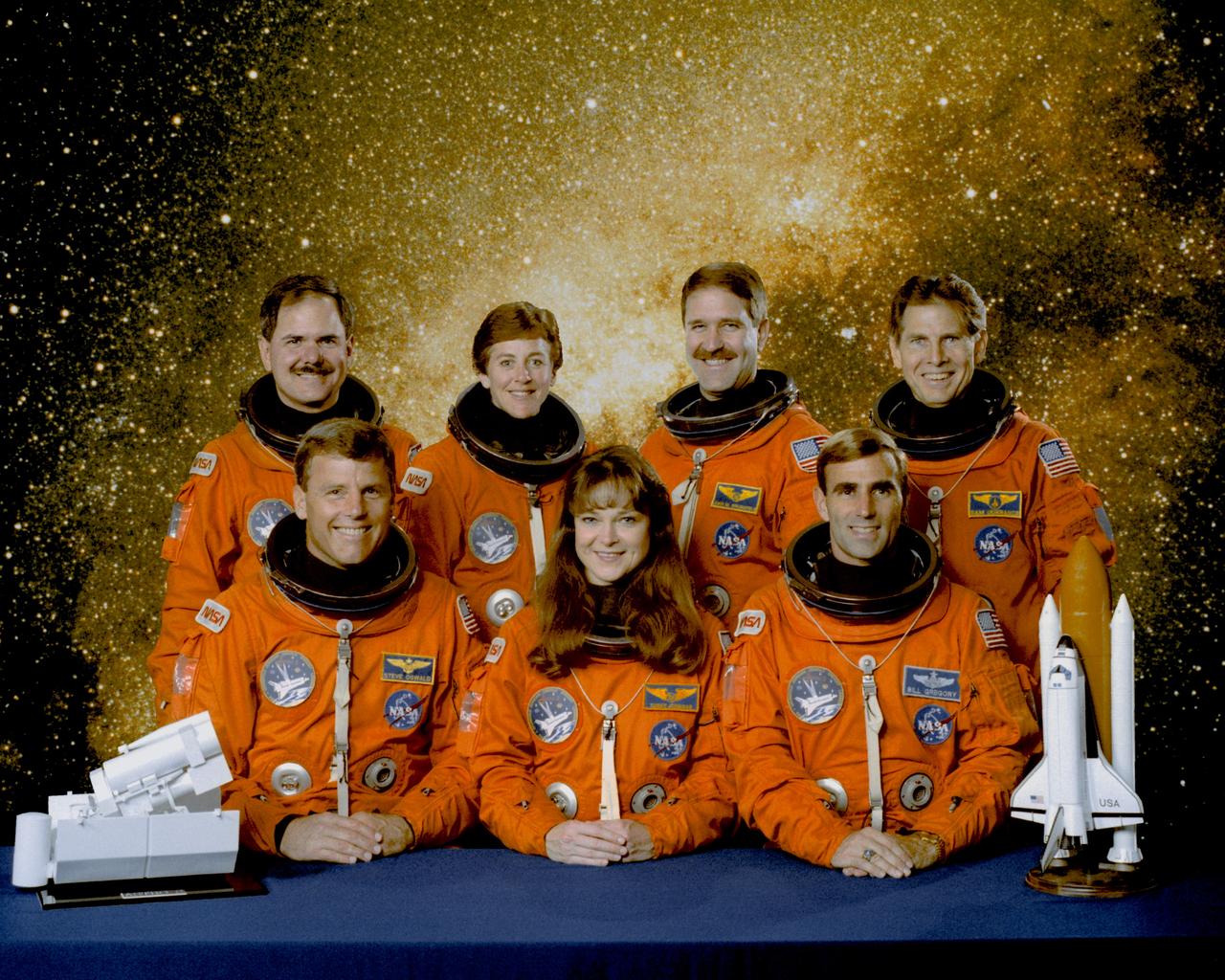
STS067-S-002 (December 1994) --- Five NASA astronauts and two payload specialists from the private sector have been named to fly aboard the Space Shuttle Endeavour for the STS-67/ASTRO-2 mission, scheduled for March 1995. In front are astronauts (left to right) Stephen S. Oswald, mission commander; Tamara E. Jernigan, payload commander; and William G. Gregory, pilot. In the back are (left to right) Ronald A. Parise, payload specialist; astronauts Wendy B. Lawrence, and John M. Grunsfeld, both mission specialists; and Samuel T. Durrance, payload specialist. Dr. Durrance is a research scientist in the Department of Physics and Astronomy at Johns Hopkins University, Baltimore, Maryland. Dr. Parise is a senior scientist in the Space Observatories Department, Computer Sciences Corporation, Silver Spring, Maryland. Both payload specialist's flew aboard the Space Shuttle Columbia for the STS-35/ASTRO-1 mission in December 1990.
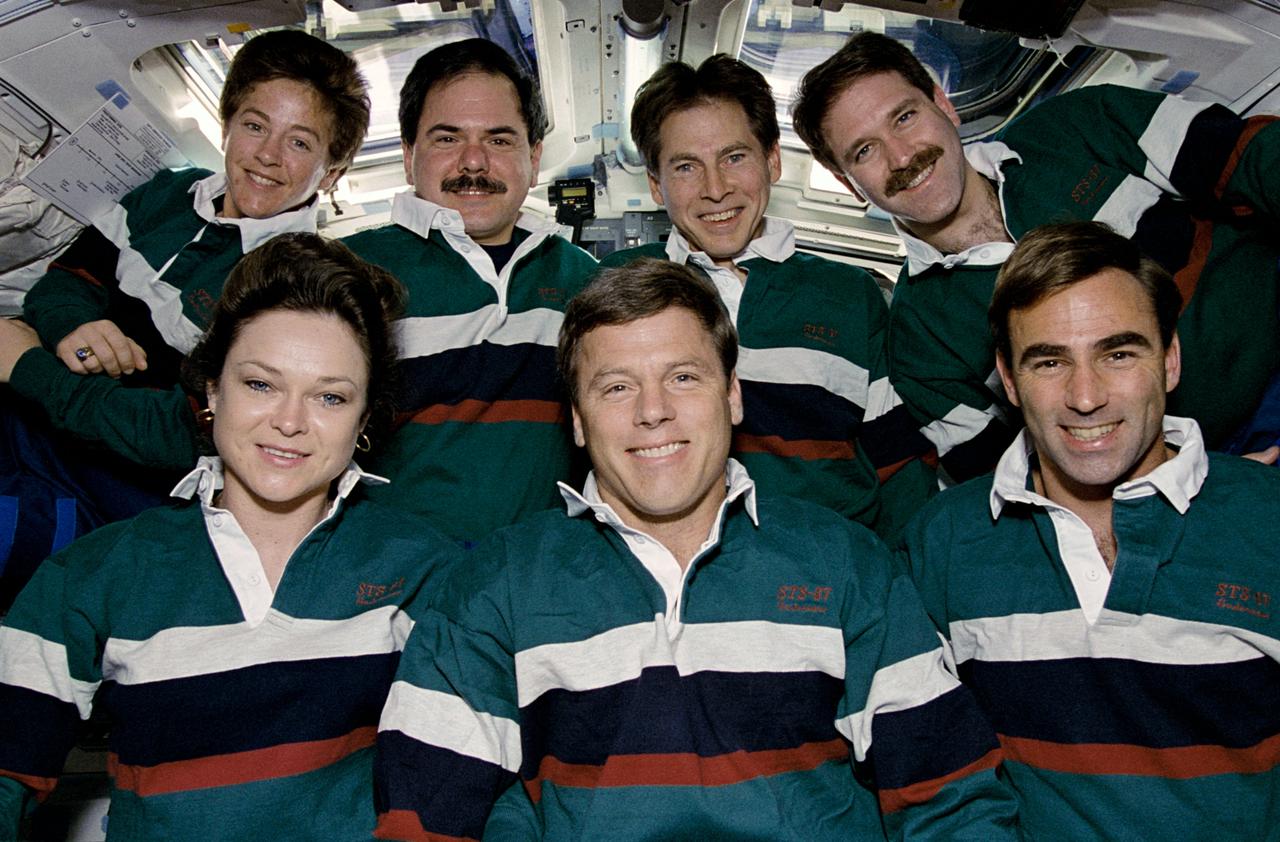
The STS-67/ASTRO-2 crew members pose for their traditional inflight portrait on the aft flight deck of the Earth orbiting Space Shuttle Endeavour. Left to right in the front are astronauts Tamara E. Jernigan, payload commander; Steven S. Oswald, mission commander; and William G. Gregory, pilot. Left to right on the back row are astronaut Wendy B. Lawrence, flight engineer; payload specialists Ronald A. Parise and Samuel T. Durrance; and John M. Grunsfeld, mission specialist.
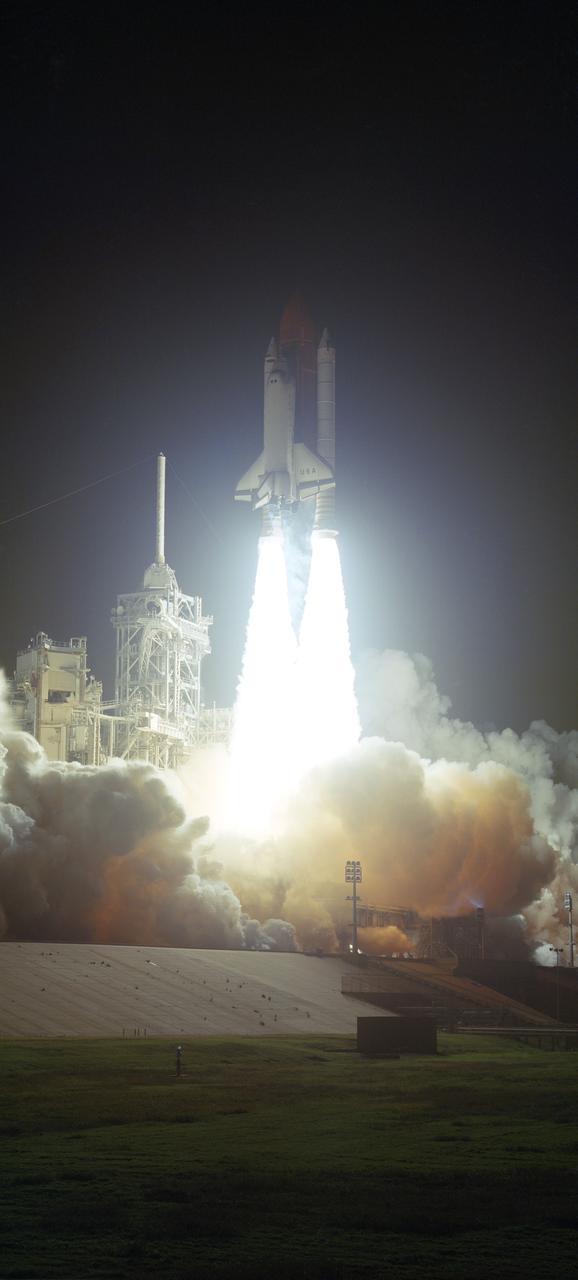
STS035-S-021 (2 Dec 1990) --- The Space Shuttle Columbia lifts off Launch Pad 39B at 1:49 a.m. (EST), Dec. 2, 1990. Primary payload onboard is the Astro-1 astronomical laboratory, headed for a ten-day fight dedicated to the single discipline of astrophysics. Crewmembers are five astronauts--Vance D. Brand, Guy S. Gardner, John M. (Mike) Lounge, Jeffrey A. Hoffman and Robert A.R. Parker--and two payload specialists--Samuel T. Durrance and Ronald A. Parise.
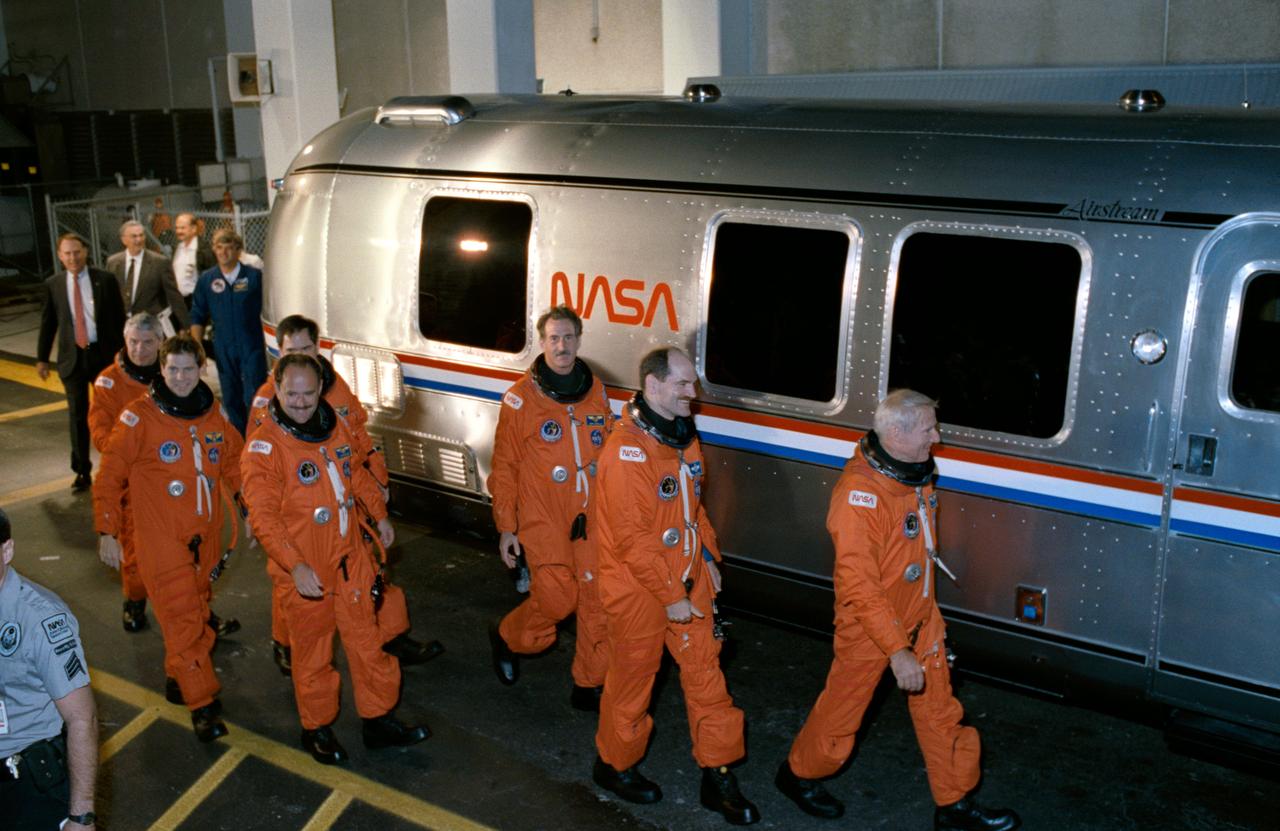
STS035-S-016 (2 Dec 1990) --- Astronaut Vance D. Brand, right, leads the STS 35 crew toward a transfer van that will take them from the nearby operations and checkout (O&C) building to Launch Complex 39. Trailing the mission commander, left to right, are Robert A. R. Parker, Samuel T. Durrance, Ronald A. Parise, John M. (Mike) Lounge, Jeffrey A. Hoffman and Guy S. Gardner.
STS035-49-028 (2-10 Dec. 1990) --- This is one of 25 visuals used by the STS-35 crew at its Dec. 20, 1990 post-flight press conference. Columbia's flight of almost nine days duration (launched Dec. 2 from Kennedy Space Center and landed Dec. 10 at Edwards Air Force Base) carried the Astro-1 payload and was dedicated to astrophysics. The mission involved a seven-man crew. Crewmembers were astronauts Vance D. Brand, Guy S. Gardner, Jeffrey A. Hoffman, Robert A.R. Parker and John M. (Mike) Lounge; and Payload Specialists Samuel T. Durrance and Ronald A. Parise.
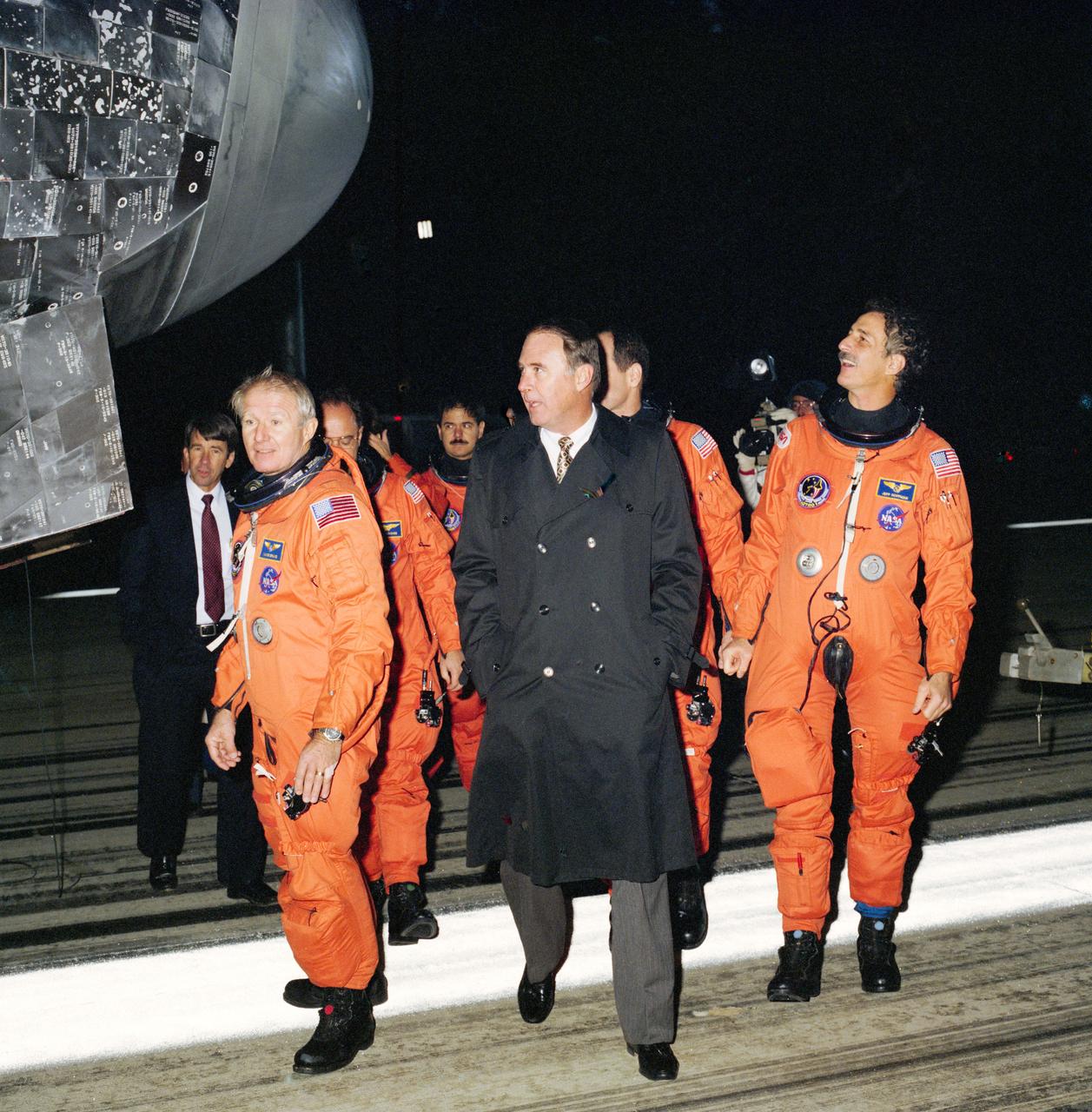
STS035-S-091 (10 Dec 1990) --- Donald R. Puddy (center), Director of Flight Crew Operations at the Johnson Space Center (JSC), joins the STS-35 crewmembers in a post-landing walk-around inspection of the Columbia at Edwards Air Force Base. Crewmembers pictured are, left to right, Vance D. Brand, John M. (Mike) Lounge, Ronald A. Parise, Guy S. Gardner and Jeffrey A. Hoffman. Obscured or out of frame are Samuel T. Durrance and Robert A. R. Parker. Dr. William B. Lenoir, NASA Associate Administrator for Space Flight, is at far left background.
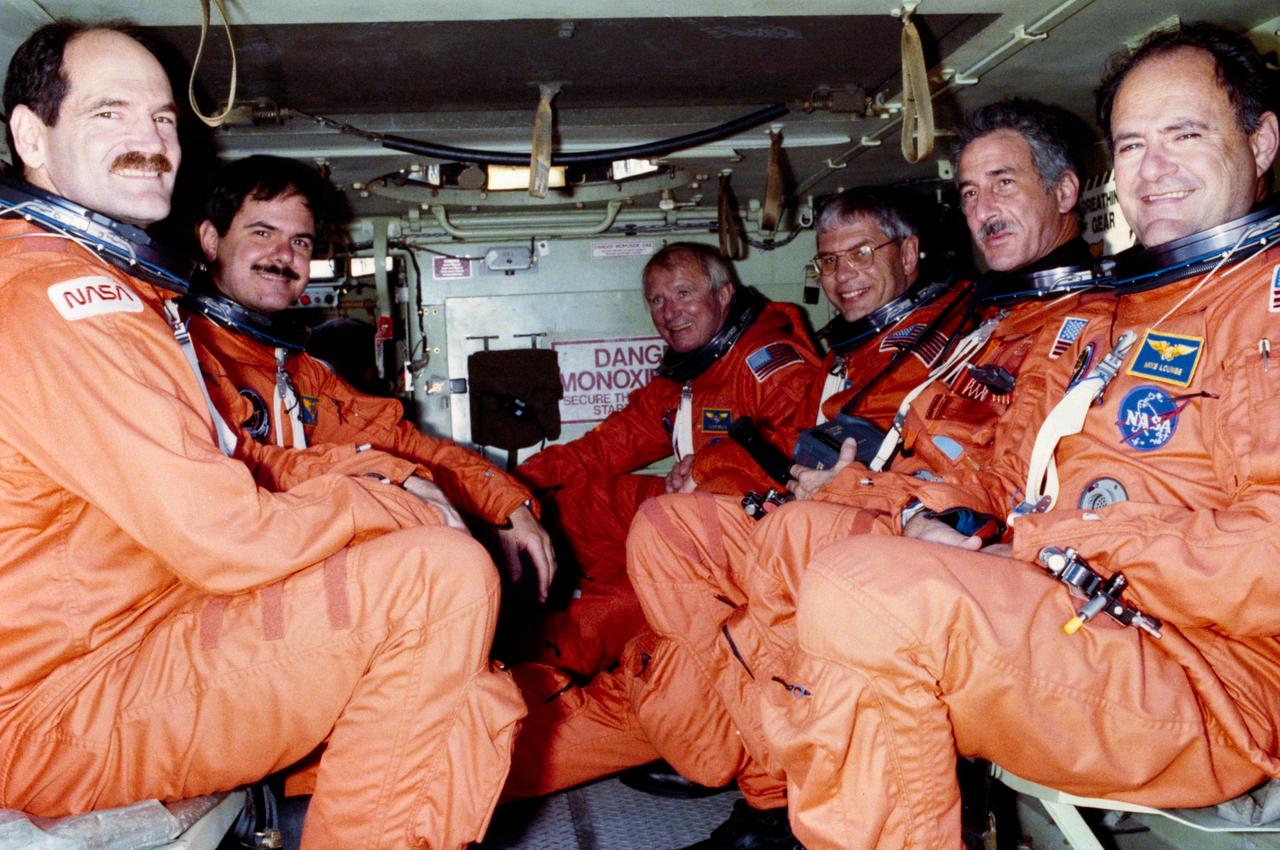
S90-40670 (13 June 1990) --- STS-35 crewmembers take a ride in the M113 tracked vehicle during emergency training conducted during the Terminal Countdown Demonstration Test (TCDT) at the Kennedy Space Center (KSC). From left, wearing launch and entry suits (LES), are pilot Guy S. Gardner, payload specialist Ronald A. Parise, commander Vance D. Brand, mission specialists Robert A. R. Parker, Jeffrey A. Hoffman and John M. Lounge. The two-day TCDT, which began 04-27-90, is a dress rehearsal for launch. STS-35 is set to lift off in May. View provided by KSC with alternate number KSC-90PC-838.
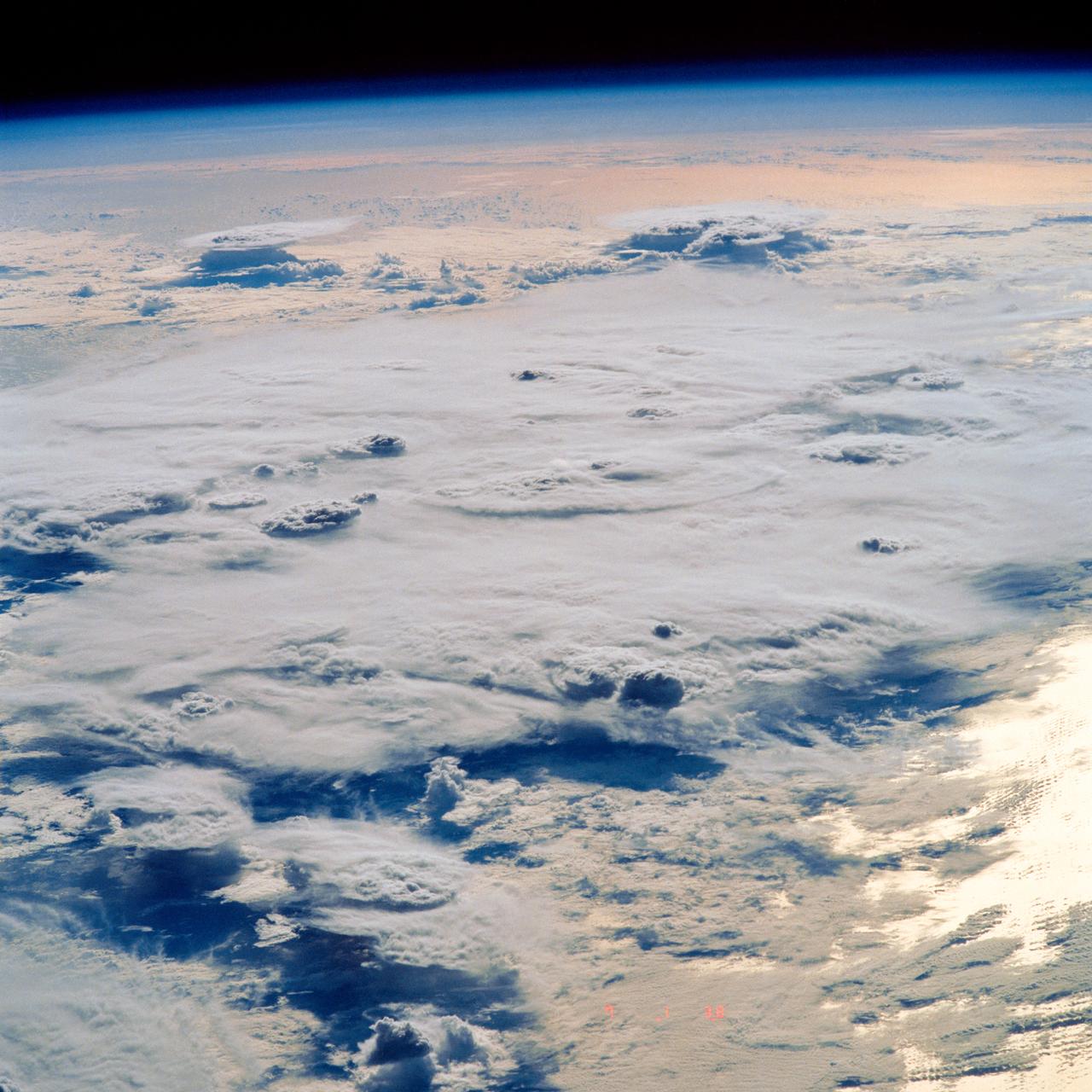
STS035-607-024 (2-10 Dec. 1990) --- This is one of 25 visuals used by the STS-35 crew at its Dec. 20, 1990 post-flight press conference. Space Shuttle Columbia's flight of almost nine days duration (launched December 2 from Kennedy Space Center (KSC) and landed December 10 at Edwards Air Force Base) carried the Astro-1 payload and was dedicated to astrophysics. The mission involved a seven-man crew. Crew members were astronauts Vance D. Brand, Guy S. Gardner, Jeffrey A. Hoffman, Robert A.R. Parker and John M. (Mike) Lounge; and payload specialists Samuel T. Durrance and Ronald A. Parise. Thunderstorm systems over the Pacific Ocean, with heavy sunglint, as photographed with a handheld Rolleiflex camera aimed through Columbia's aft flight deck windows.
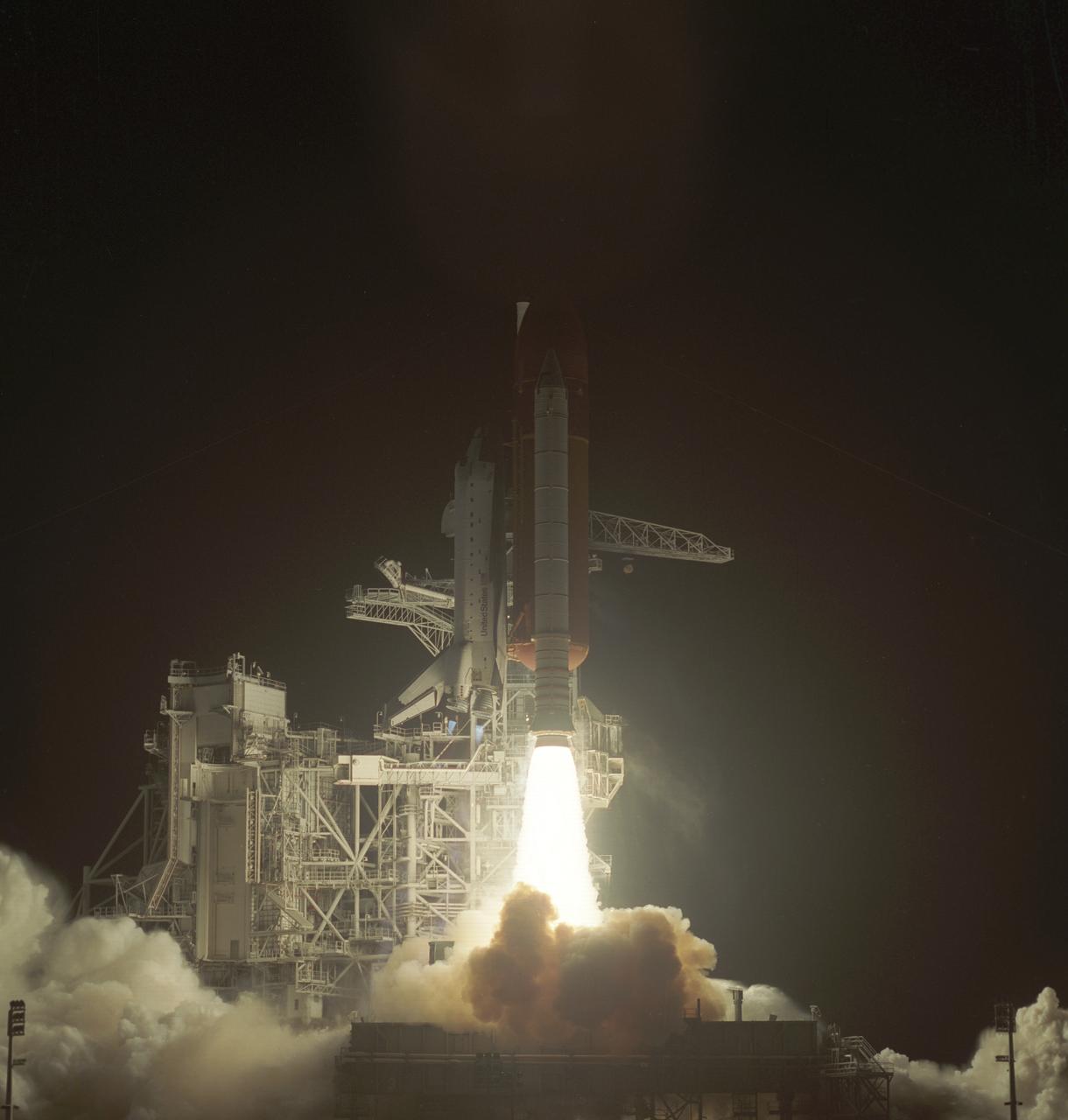
STS-35 lifted off December 2, 1990, at 1:19 am EST, aboard the Space Shuttle Orbiter Columbia. Her crew of eight included: Vance D. Brand, commander; Colonel Guy S. Gardner, pilot; mission specialists Dr. Robert A. R. Parker, John M. (Mike) Lounge, and Dr. Jeffery A. Hoffman; and payload specialists Dr. Kenneth H. Nordsieck, Dr. Samual T. Durrance, and Dr. Ronald A. Parise. The primary objective of the mission was round the clock observation of the celestial sphere in ultraviolet and X-Ray astronomy with the Astro-1 Observatory which consisted of four telescopes: the Hopkins Ultraviolet Telescope (HUT); the Wisconsin Ultraviolet Photo-Polarimeter Experiment (WUPPE); the Ultraviolet Imaging Telescope (UIT); and the Broad Band X-Ray Telescope (BBXRT). Due to loss of data used for pointing and operating the ultraviolet telescopes, Marshall Space Flight Center ground teams were forced to aim the telescopes with fine tuning by the flight crew.
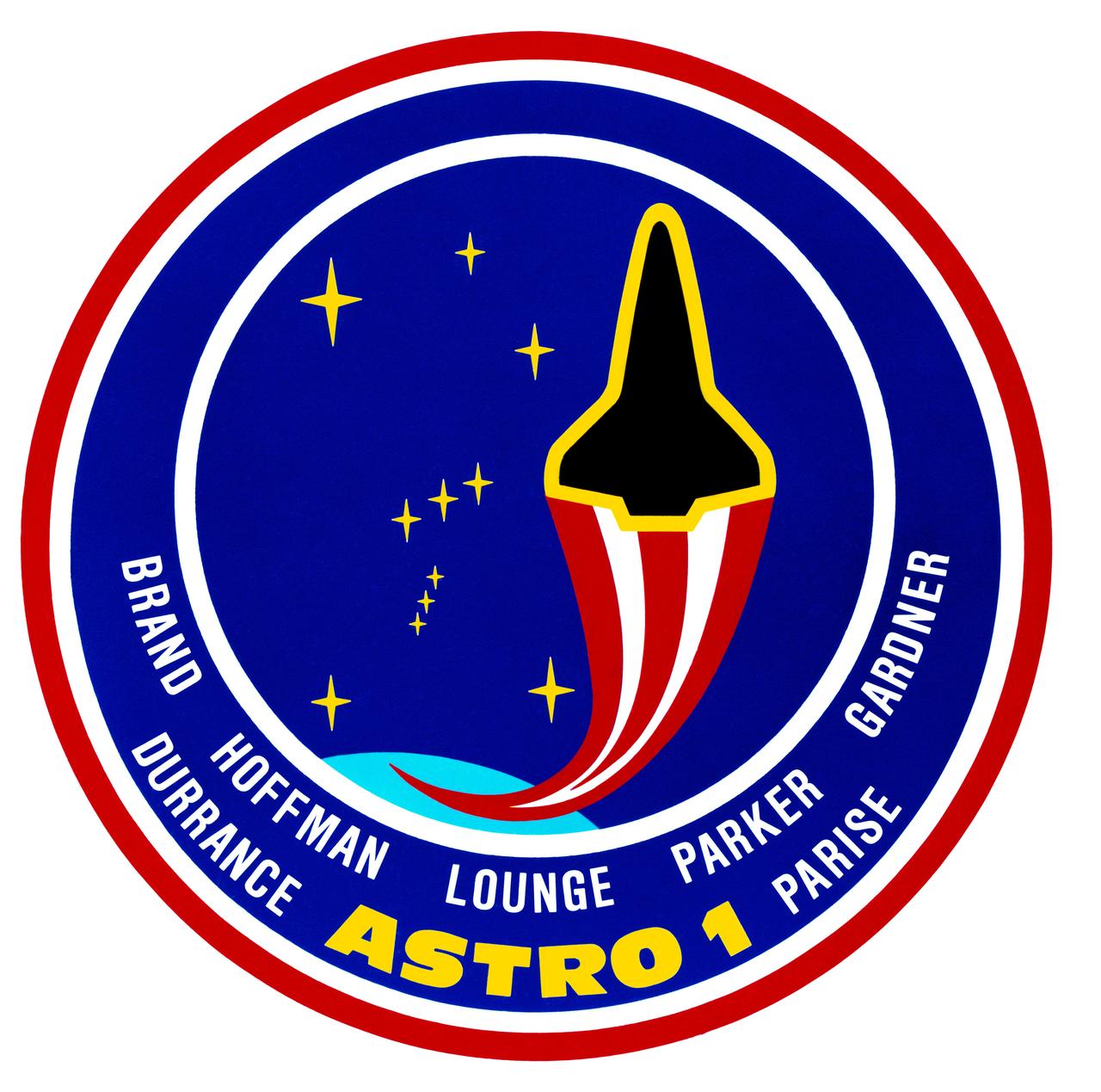
STS035-S-001 (29 Jan. 1990) --- Designed by the crew members assigned to the mission, the STS-35 crew patch symbolizes the space shuttle flying above Earth's atmosphere to better study the many celestial objects of the Universe, represented by the constellation Orion. The primary payload of STS-35 is ASTRO-l, a group of ultraviolet telescopes and the Broad-Band X-Ray Telescope. Crew members on the flight are astronauts Vance D. Brand, commander; Guy S. Gardner, pilot; and Jeffrey A. Hoffman, John M. (Mike) Lounge, Robert A. R. Parker, all mission specialists; along with the two payload specialists - Samuel T. Durrance and Ronald Parise. The NASA insignia design for space shuttle flights is reserved for use by the astronauts and for other official use as the NASA Administrator may authorize. Public availability has been approved only in the forms of illustrations by the various news media. When and if there is any change in this policy, which is not anticipated, the change will be publicly announced. Photo credit: NASA
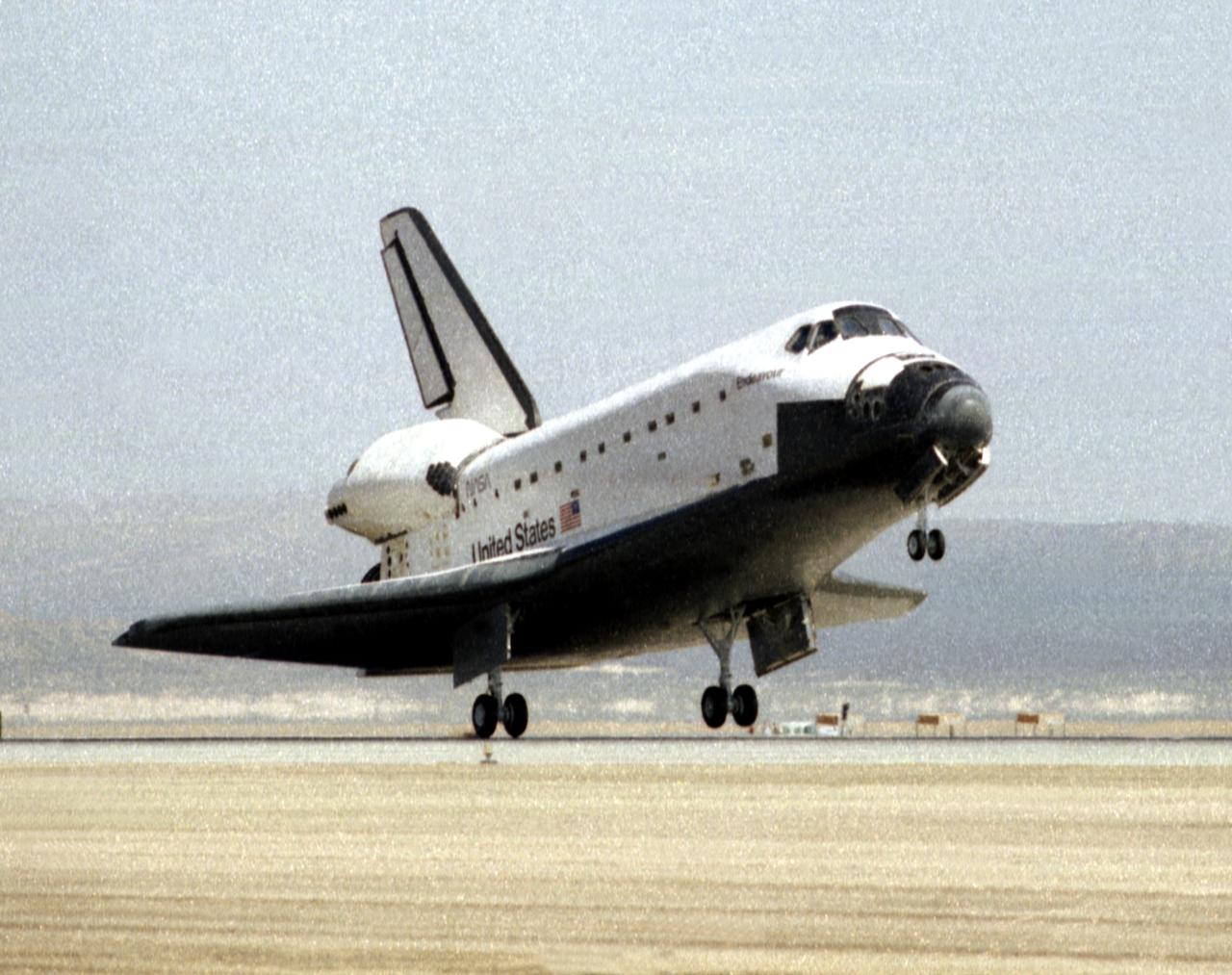
The space shuttle Endeavour slips to a smooth landing on runway 22 at Edwards, California, to complete the highly successful record-setting STS-67 mission. The landing was at 1:46 p.m. (PST) 18 March 1995, after waiving off from the Kennedy Space Center, Florida, earlier that morning due to adverse weather. Launched into space at 10:38 a.m. (PST) 1 March 1995, the Endeavour crew conducted NASA's longest shuttle flight to date and carried unique ultraviolet telescopes (ASTRO-2) which captured views of the universe impossible to obtain from the ground. Mission Commander was Steve Oswald making his third flight and the Pilot was Bill Gregory on his first mission. Mission Specialist 1 was John Grunsfeld making his first flight and Specialist 2 was Wendy Lawrence on her first flight. Tamara Jernigan served as Specialist 3 on her third flight and the two payload specialists were Samuel Durrance and Ronald Parise, both on their second flight.