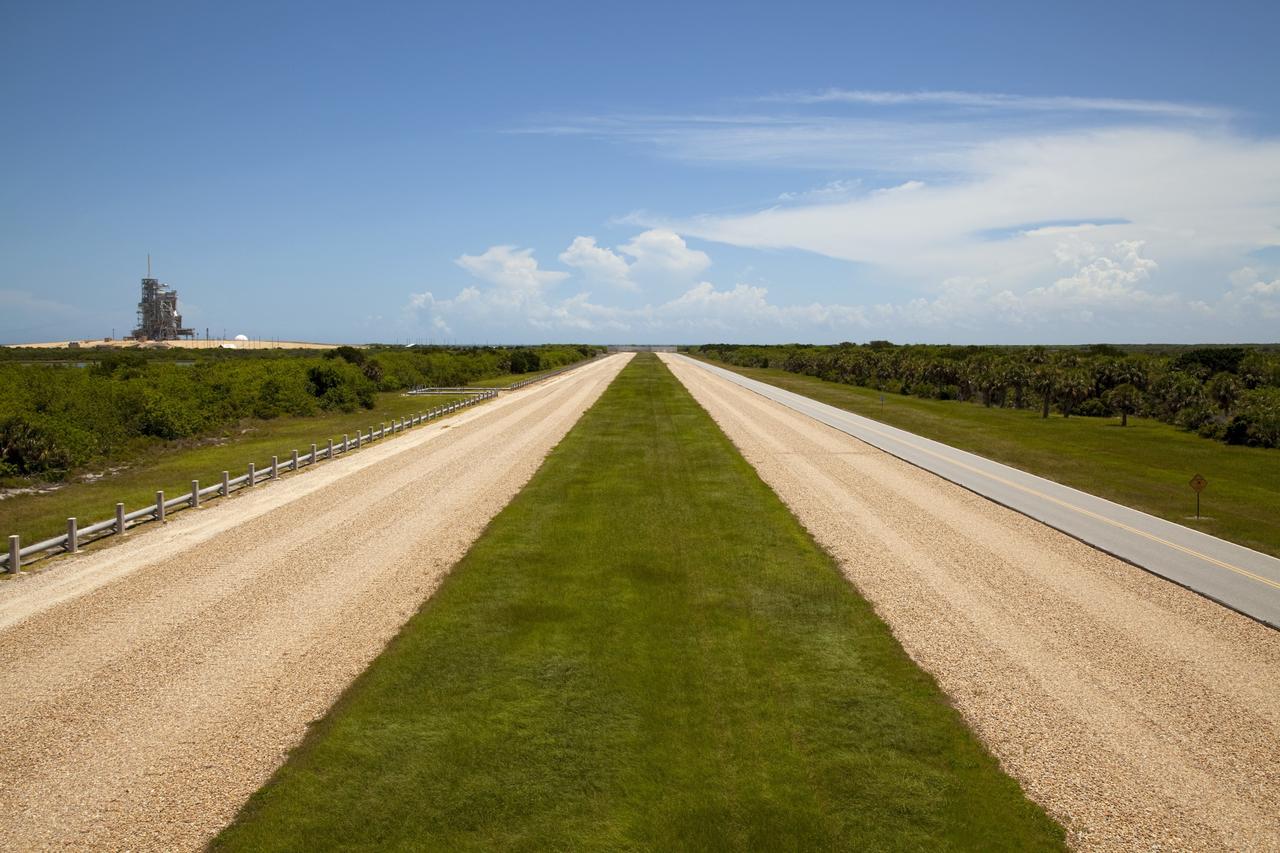
CAPE CANAVERAL, Fla. – The gravel crawlerway is seen as if from a crawler transporter approaching Launch Complex 39 pad A at the Kennedy Space Center in Florida. The crawlerways are 130 feet wide, about the size of an 8-lane freeway. The river rock paths have been used since 1966 to move launch vehicles from the Vehicle Assembly Building, or VAB, along the 3.4-mile path to pad A and 6.8 miles to pad B. The crawlerways were originally built to support transporting Apollo Saturn V rockets to the launch pads. The crawlerways were again used during the Space Shuttle Program moving the 4.5 million-pound shuttles mounted on an 8-million-pound mobile launcher platform atop a six-million-pound crawler transporter -- totaling an 18.5-million-pound vehicle lumbering along to the pad. The paths are specially constructed with four layers. The top is eight inches thick on curves and four inches on straightaway sections. Then there is a four-foot layer of graded, crushed stone. Beneath that is 2.5 feet of fill, followed by one foot of compact fill. Plans call for the crawlerways to be used in the future for transporting launch vehicles from the VAB to pads A and B. For more information, visit http://www.nasa.gov/transition Photo credit: NASA/Kim Shiflett
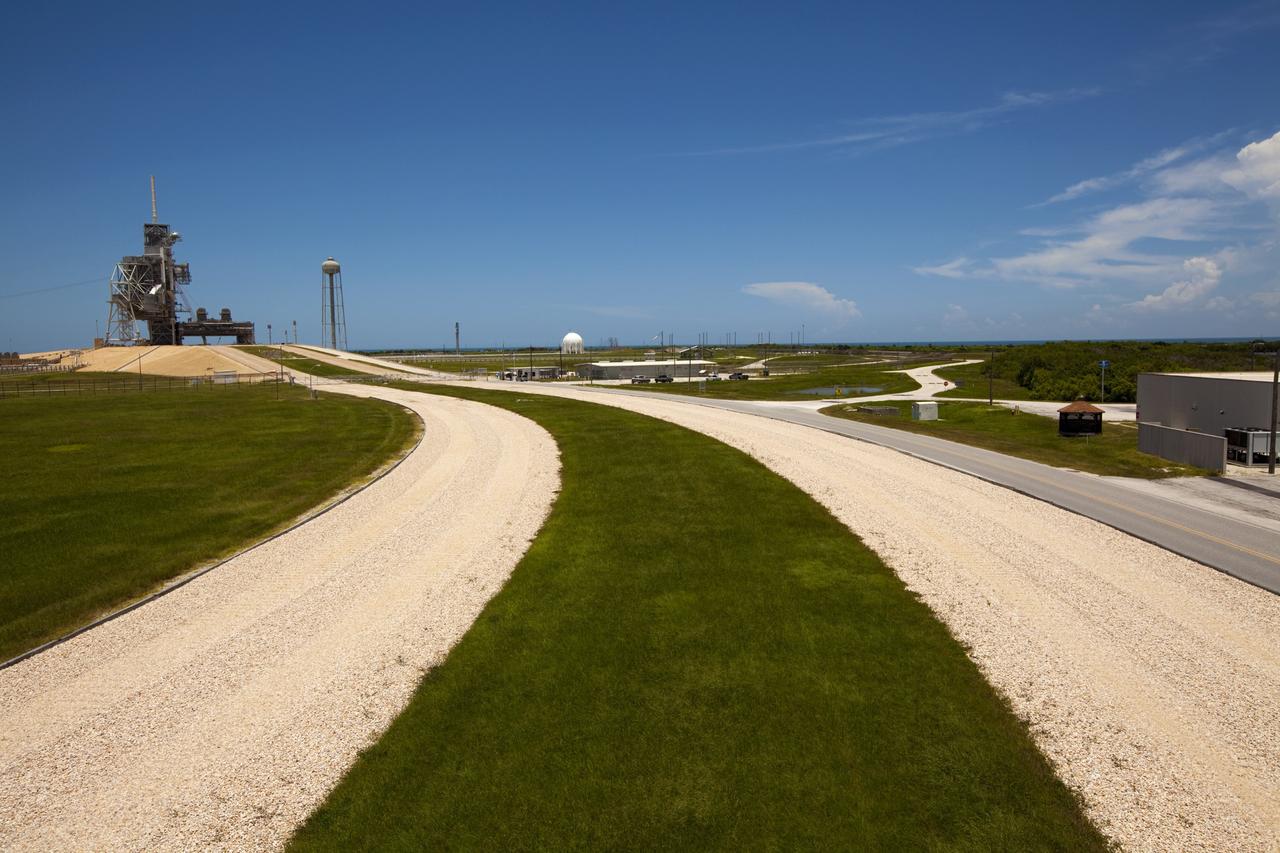
CAPE CANAVERAL, Fla. – The gravel crawlerway is seen as if from a crawler transporter making a turn to approach Launch Complex 39 pad A at the Kennedy Space Center in Florida. The crawlerways are 130 feet wide, about the size of an 8-lane freeway. The river rock paths have been used since 1966 to move launch vehicles from the Vehicle Assembly Building, or VAB, along the 3.4-mile path to pad A and 6.8 miles to pad B. The crawlerways were originally built to support transporting Apollo Saturn V rockets to the launch pads. The crawlerways were again used during the Space Shuttle Program moving the 4.5 million-pound shuttles mounted on an 8-million-pound mobile launcher platform atop a six-million-pound crawler transporter -- totaling an 18.5-million-pound vehicle lumbering along to the pad. The paths are specially constructed with four layers. The top is eight inches thick on curves and four inches on straightaway sections. Then there is a four-foot layer of graded, crushed stone. Beneath that is 2.5 feet of fill, followed by one foot of compact fill. Plans call for the crawlerways to be used in the future for transporting launch vehicles from the VAB to pads A and B. For more information, visit http://www.nasa.gov/transition Photo credit: NASA/Kim Shiflett
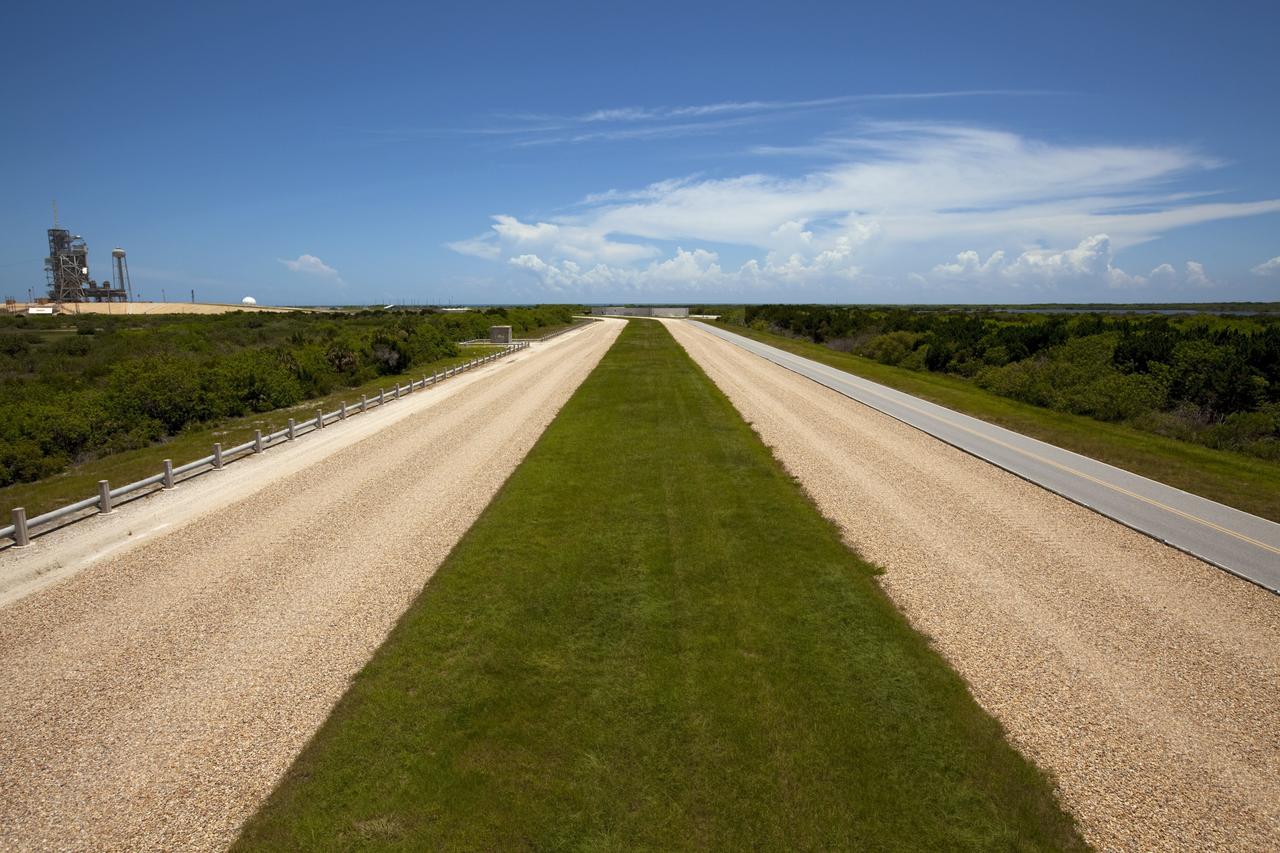
CAPE CANAVERAL, Fla. – The gravel crawlerway is seen as if from a crawler transporter approaching Launch Complex 39 pad A at the Kennedy Space Center in Florida. The crawlerways are 130 feet wide, about the size of an 8-lane freeway. The river rock paths have been used since 1966 to move launch vehicles from the Vehicle Assembly Building, or VAB, along the 3.4-mile path to pad A and 6.8 miles to pad B. The crawlerways were originally built to support transporting Apollo Saturn V rockets to the launch pads. The crawlerways were again used during the Space Shuttle Program moving the 4.5 million-pound shuttles mounted on an 8-million-pound mobile launcher platform atop a six-million-pound crawler transporter -- totaling an 18.5-million-pound vehicle lumbering along to the pad. The paths are specially constructed with four layers. The top is eight inches thick on curves and four inches on straightaway sections. Then there is a four-foot layer of graded, crushed stone. Beneath that is 2.5 feet of fill, followed by one foot of compact fill. Plans call for the crawlerways to be used in the future for transporting launch vehicles from the VAB to pads A and B. For more information, visit http://www.nasa.gov/transition Photo credit: NASA/Kim Shiflett
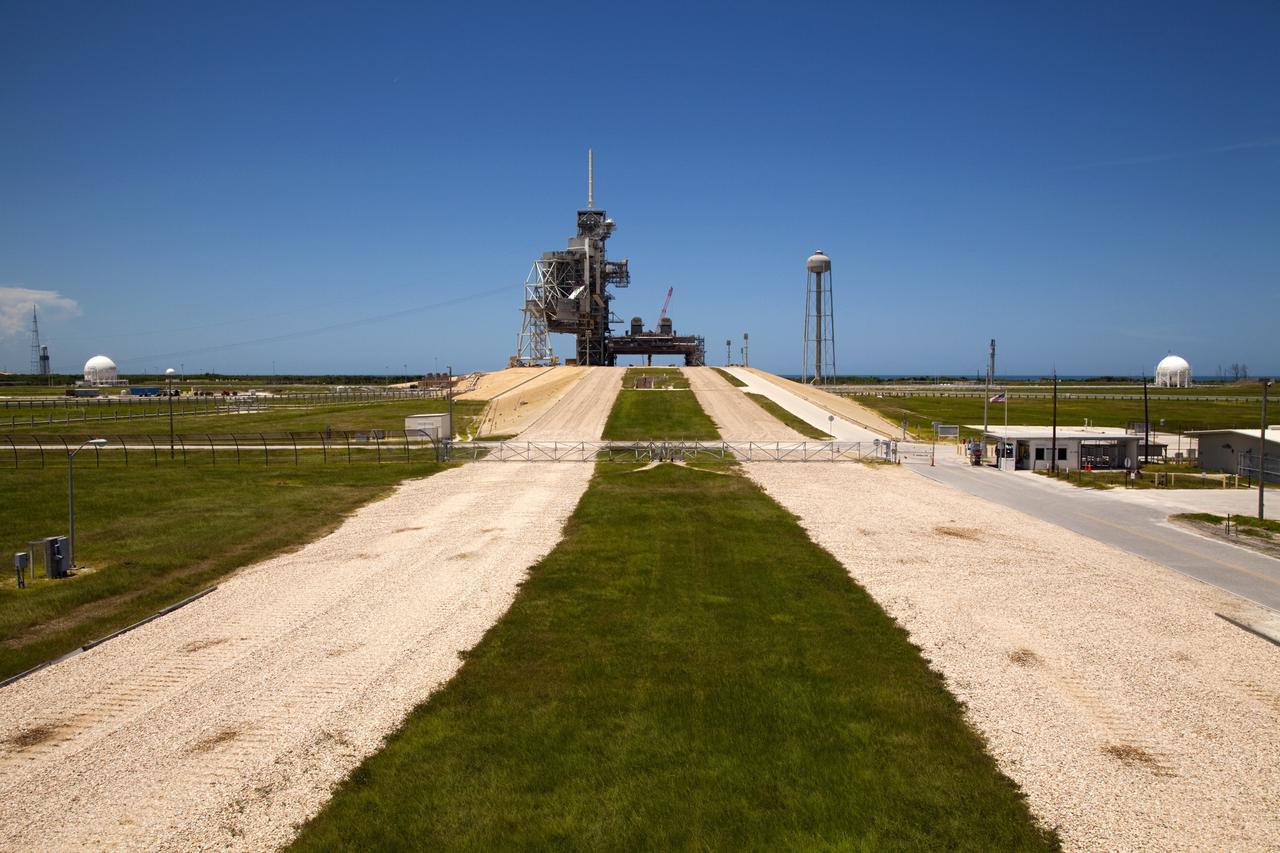
CAPE CANAVERAL, Fla. – The gravel crawlerway is seen as if from a crawler transporter making the approach to Launch Complex 39 pad A at the Kennedy Space Center in Florida. The crawlerways are 130 feet wide, about the size of an 8-lane freeway. The river rock paths have been used since 1966 to move launch vehicles from the Vehicle Assembly Building, or VAB, along the 3.4-mile path to pad A and 6.8 miles to pad B. The crawlerways were originally built to support transporting Apollo Saturn V rockets to the launch pads. The crawlerways were again used during the Space Shuttle Program moving the 4.5 million-pound shuttles mounted on an 8-million-pound mobile launcher platform atop a six-million-pound crawler transporter -- totaling an 18.5-million-pound vehicle lumbering along to the pad. The paths are specially constructed with four layers. The top is eight inches thick on curves and four inches on straightaway sections. Then there is a four-foot layer of graded, crushed stone. Beneath that is 2.5 feet of fill, followed by one foot of compact fill. Plans call for the crawlerways to be used in the future for transporting launch vehicles from the VAB to pads A and B. For more information, visit http://www.nasa.gov/transition Photo credit: NASA/Kim Shiflett
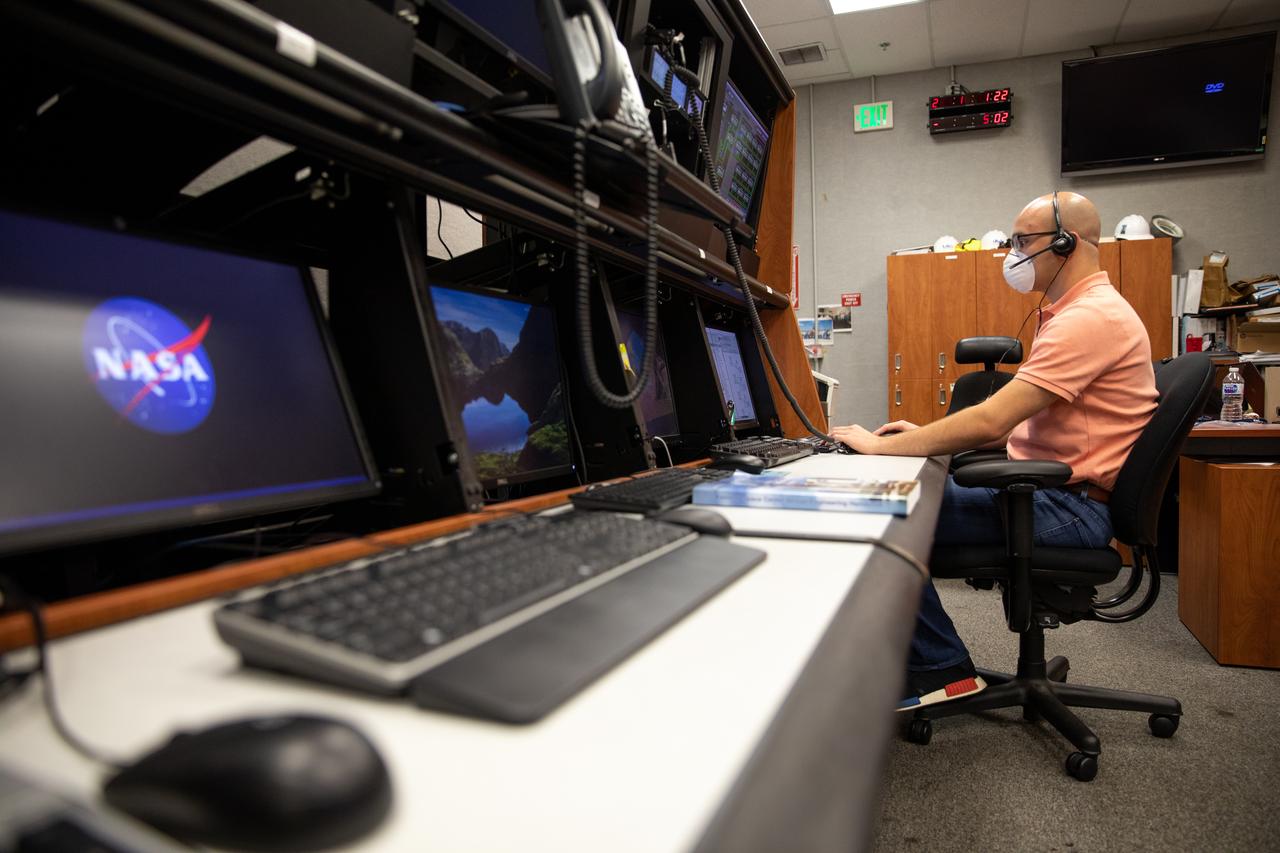
Inside the Launch Control Center at Kennedy Space Center on Sept. 29, 2020, engineer Danny Zaatari, with Exploration Ground Systems, works on software for the launch of Artemis I. Engineers at the Florida spaceport are staying focused on the “Path to the Pad.” Artemis I is the first in a series of increasingly complex missions that will enable human exploration to the Moon and Mars.
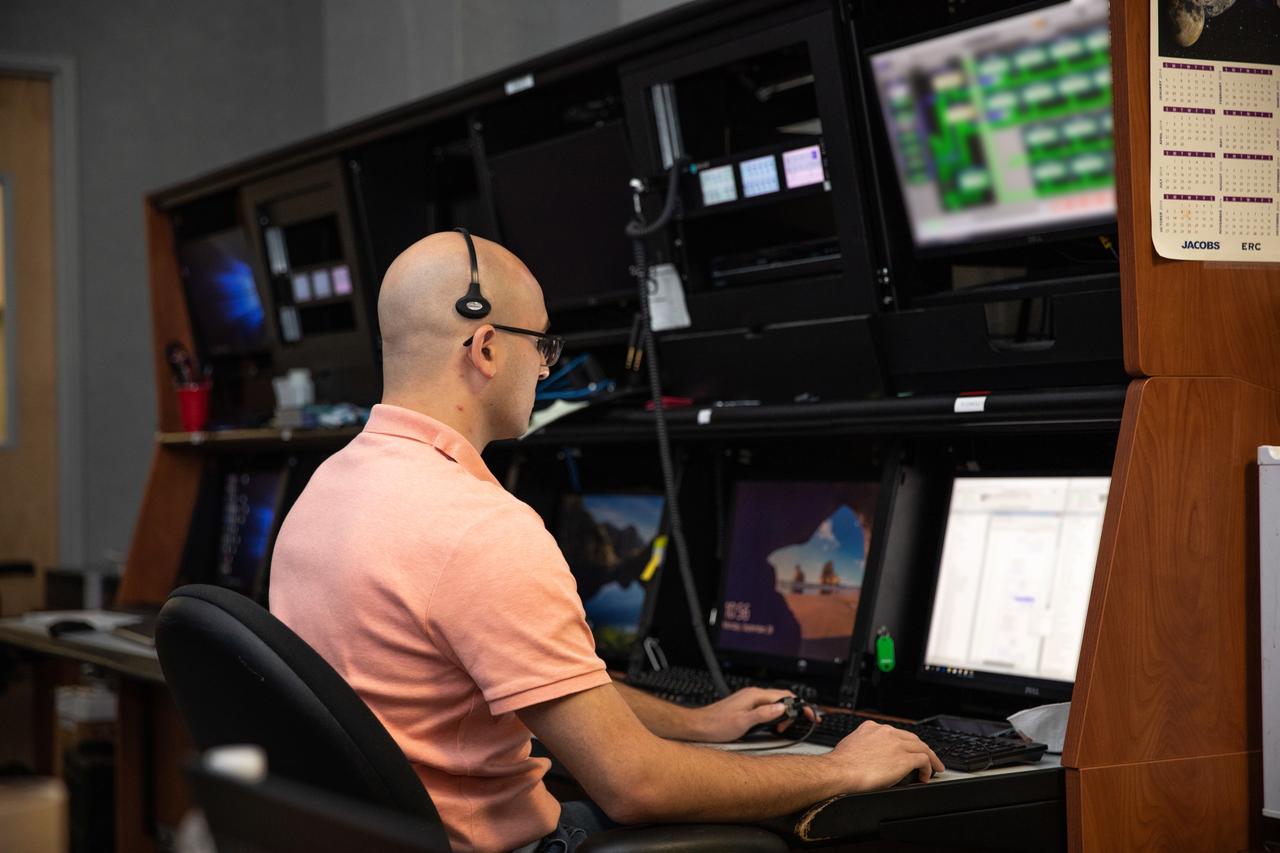
Inside the Launch Control Center at Kennedy Space Center on Sept. 29, 2020, engineer Danny Zaatari, with Exploration Ground Systems, works on software for the launch of Artemis I. Engineers at the Florida spaceport are staying focused on the “Path to the Pad.” Artemis I is the first in a series of increasingly complex missions that will enable human exploration to the Moon and Mars.
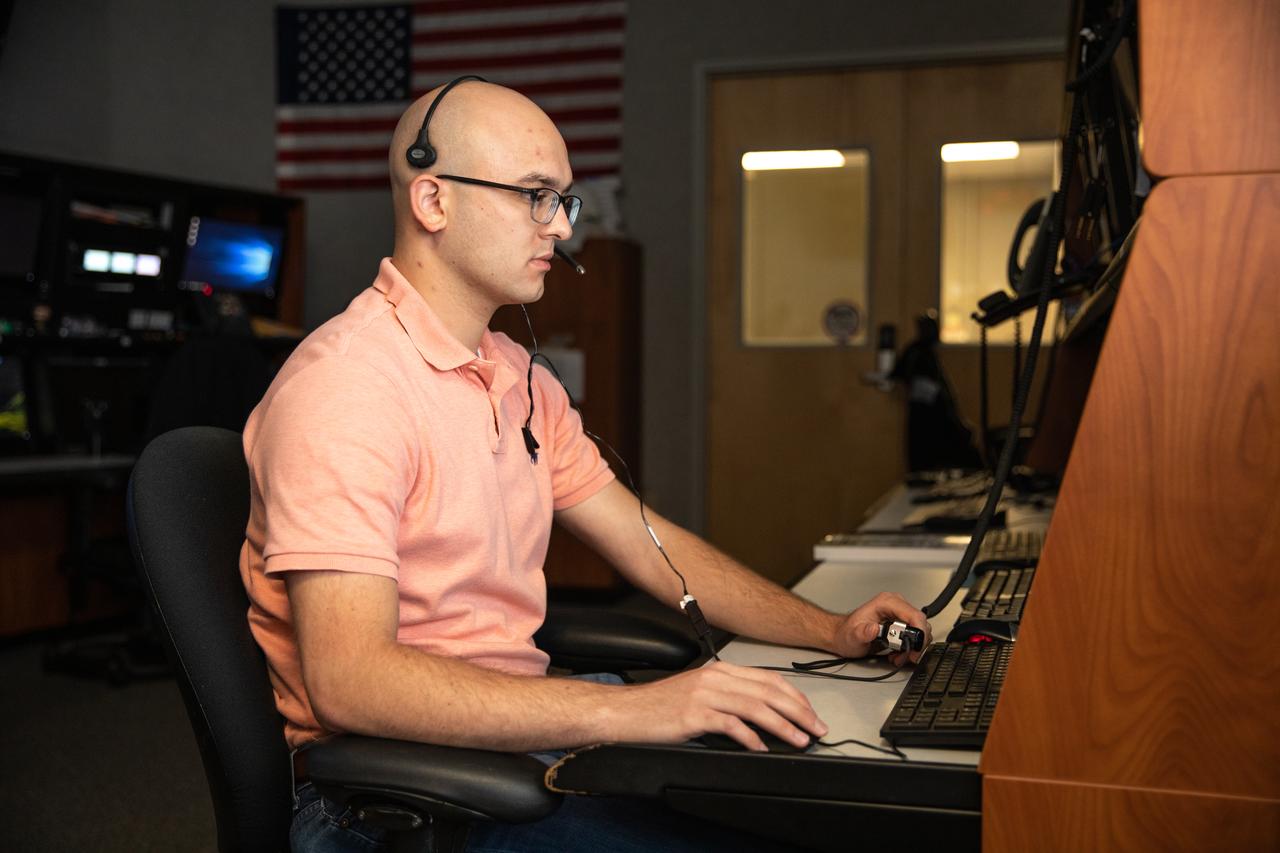
Inside the Launch Control Center at Kennedy Space Center on Sept. 29, 2020, engineer Danny Zaatari, with Exploration Ground Systems, works on software for the launch of Artemis I. Engineers at the Florida spaceport are staying focused on the “Path to the Pad.” Artemis I is the first in a series of increasingly complex missions that will enable human exploration to the Moon and Mars.
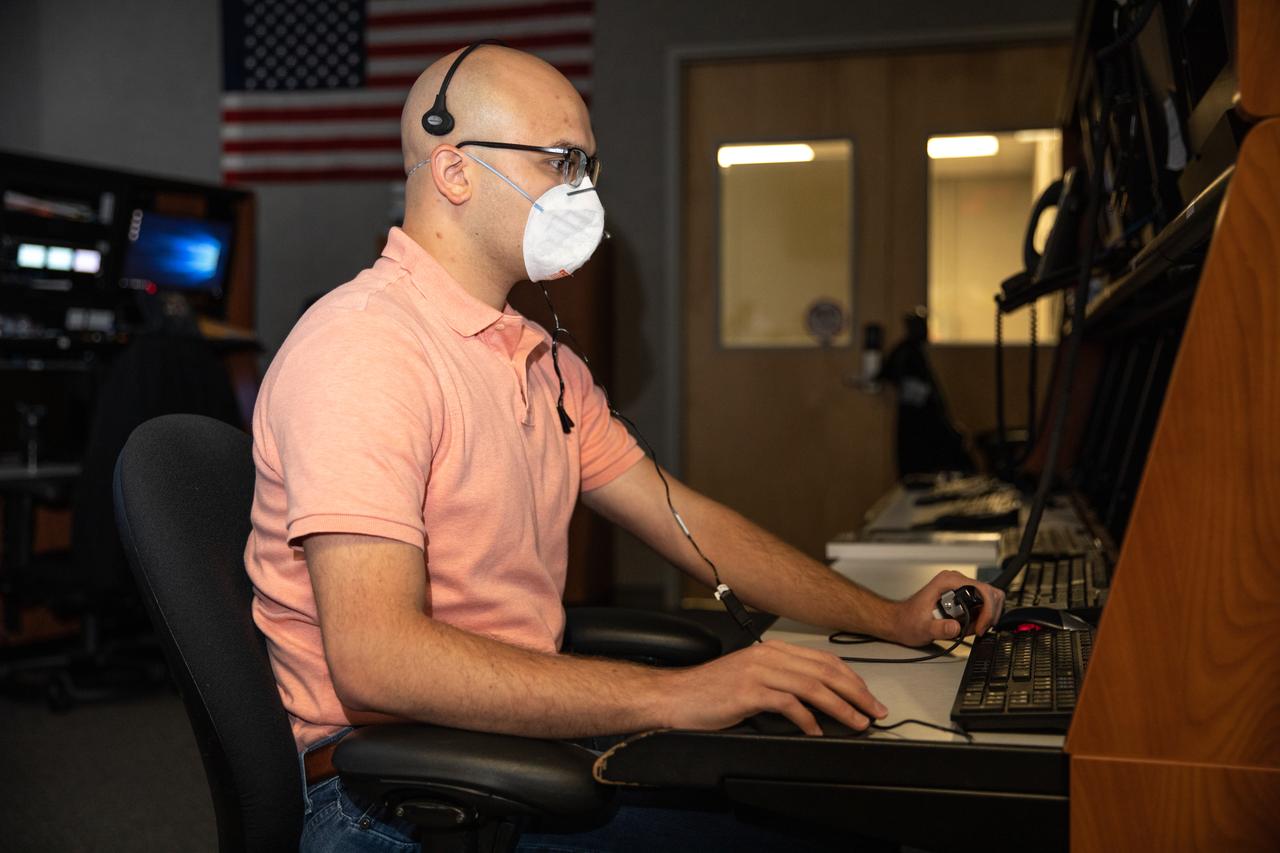
Inside the Launch Control Center at Kennedy Space Center on Sept. 29, 2020, engineer Danny Zaatari, with Exploration Ground Systems, works on software for the launch of Artemis I. Engineers at the Florida spaceport are staying focused on the “Path to the Pad.” Artemis I is the first in a series of increasingly complex missions that will enable human exploration to the Moon and Mars.
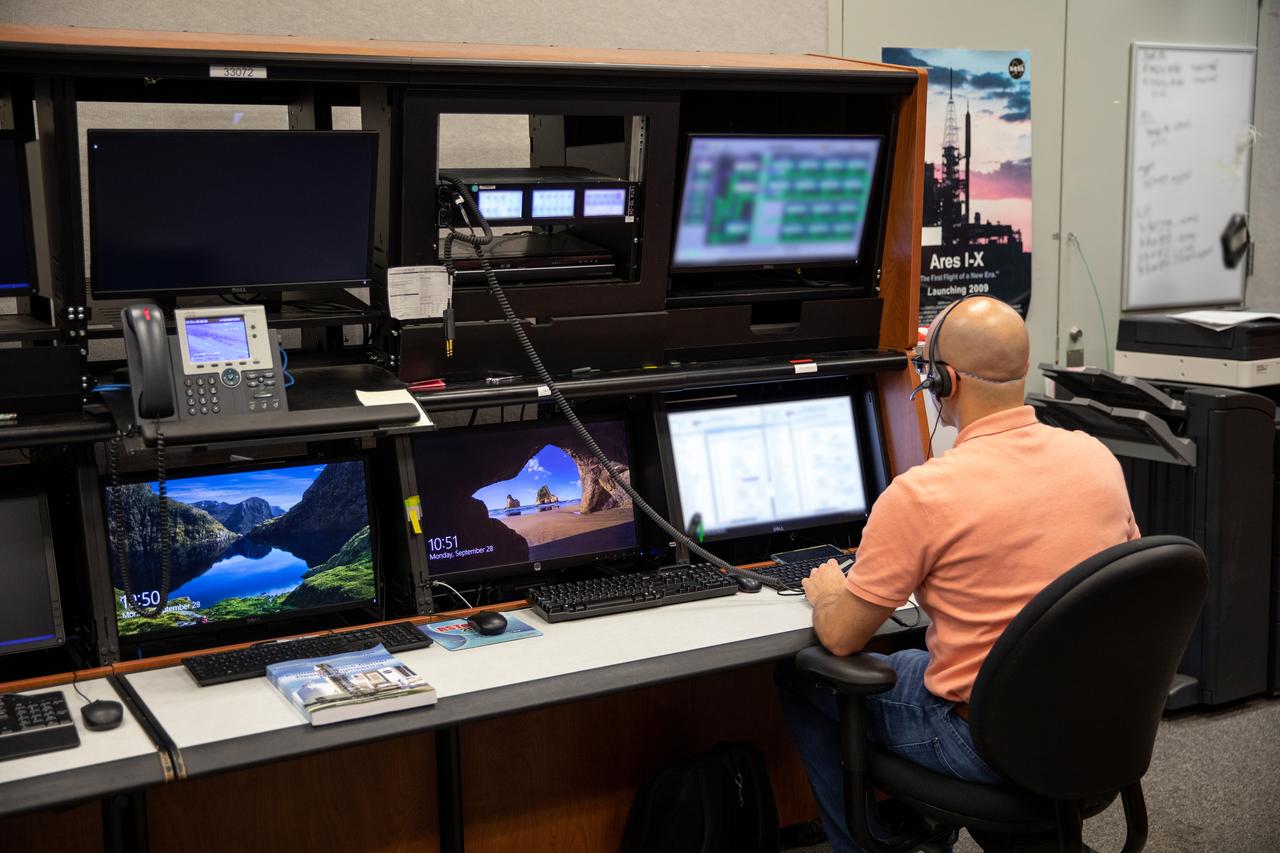
Inside the Launch Control Center at Kennedy Space Center on Sept. 29, 2020, engineer Danny Zaatari, with Exploration Ground Systems, works on software for the launch of Artemis I. Engineers at the Florida spaceport are staying focused on the “Path to the Pad.” Artemis I is the first in a series of increasingly complex missions that will enable human exploration to the Moon and Mars.
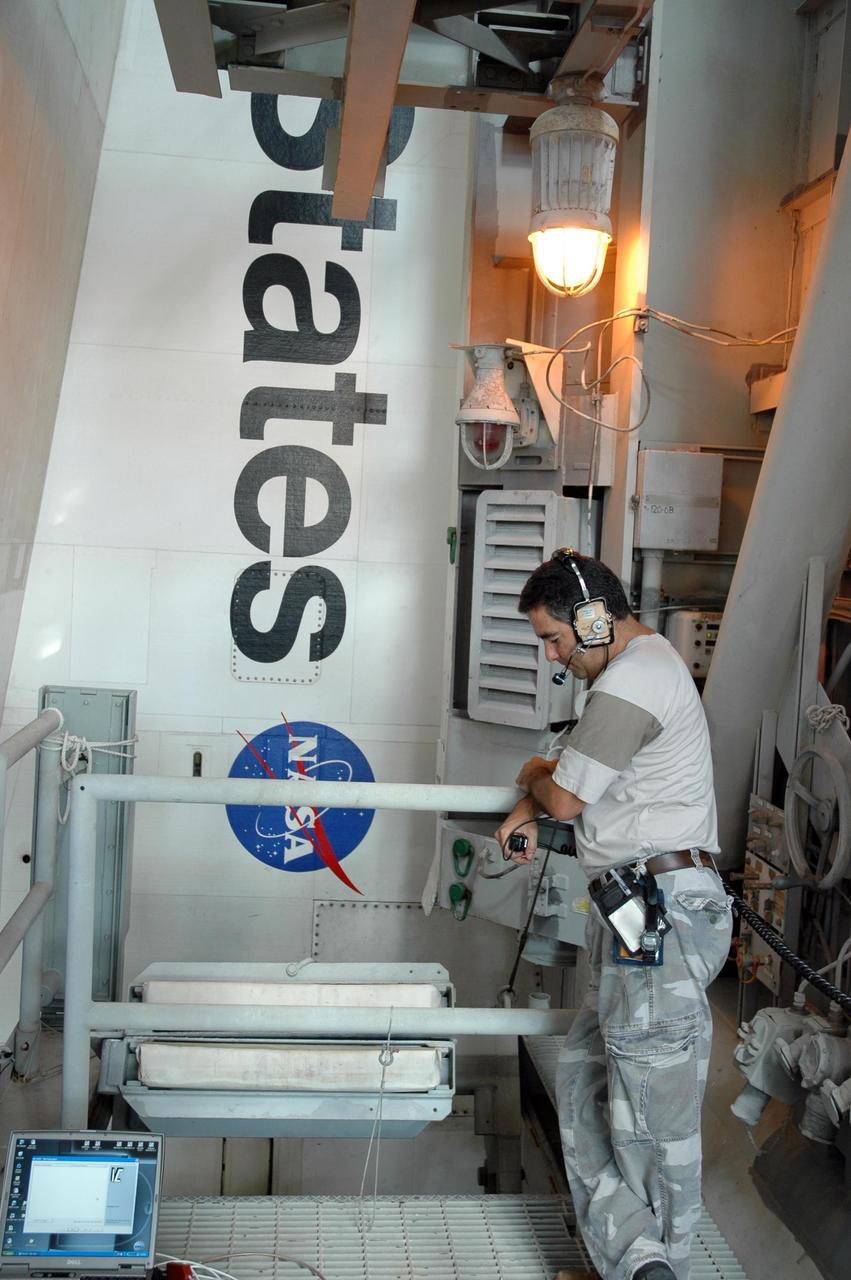
KENNEDY SPACE CENTER, FLA. - On Launch Pad 39B, a worker monitors data during evaluation of systems at the pad after a lightning strike Aug. 25. Preparations continue on the pad for launch of Atlantis on mission STS-115 as early as Aug. 29. However, preparations are also underway for a rollback of Atlantis to the Vehicle Assembly Building due to Hurricane Ernesto. The rollback will be determined by the mission management team based on information about Hurricane Ernesto and its path through Florida. Atlantis has been poised on Launch Pad 39B for liftoff on mission STS-115 to the International Space Station to deliver the P3/P4 truss segment. Photo credit: NASA/Jack Pfaller
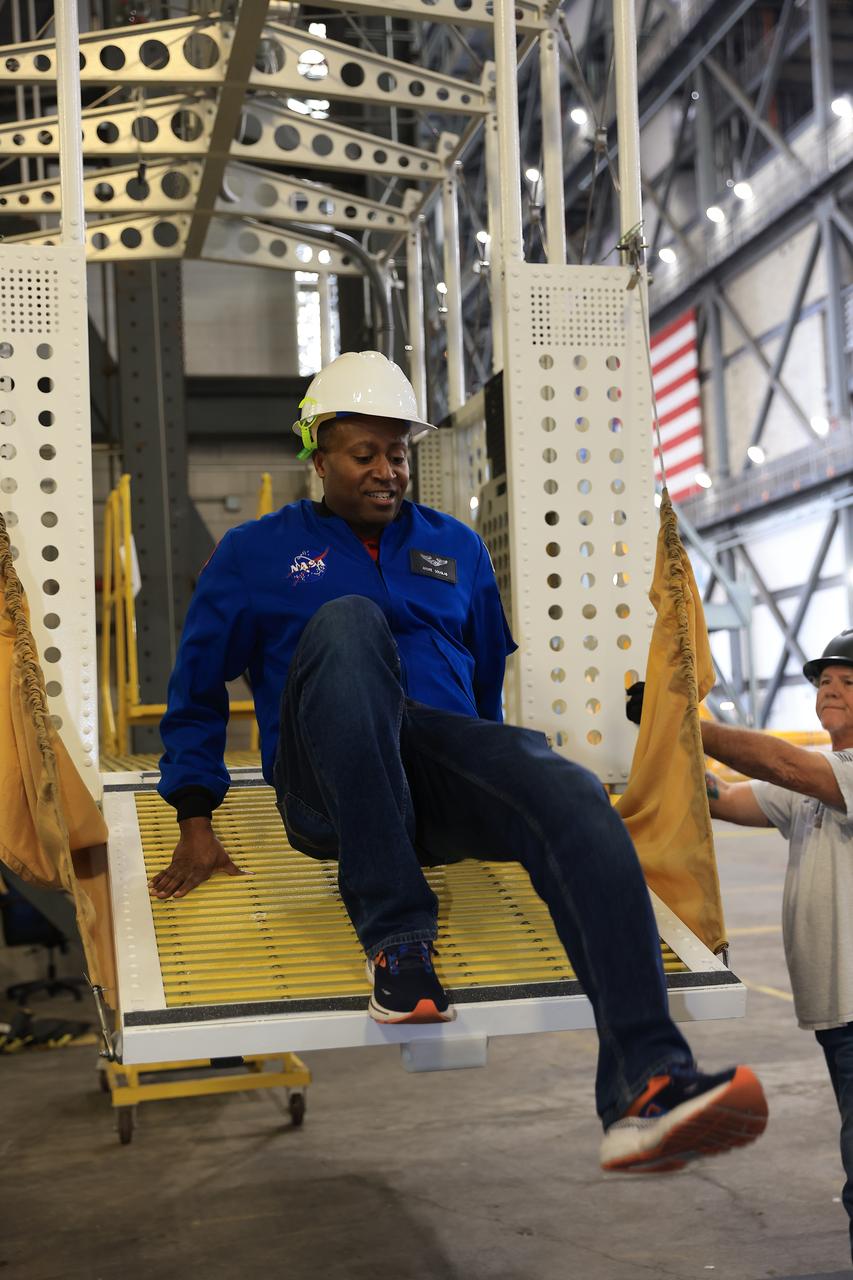
NASA astronaut Andre Douglas, Artemis II backup crew member practices climbing out of an emergency egress basket inside the Vehicle Assembly Building at NASA’s Kennedy Space Center in Florida on Thursday, Feb. 27, 2025. The baskets, similar to gondolas on ski lifts, are used in the case of a pad abort emergency to enable astronauts and other pad personnel a way to quickly escape away from the mobile launcher to the base of the pad and where waiting emergency transport vehicles will then drive them away. For Artemis II, four astronauts will venture around the Moon, the first crewed mission on NASA’s path to establishing a long-term presence for science and exploration through Artemis.
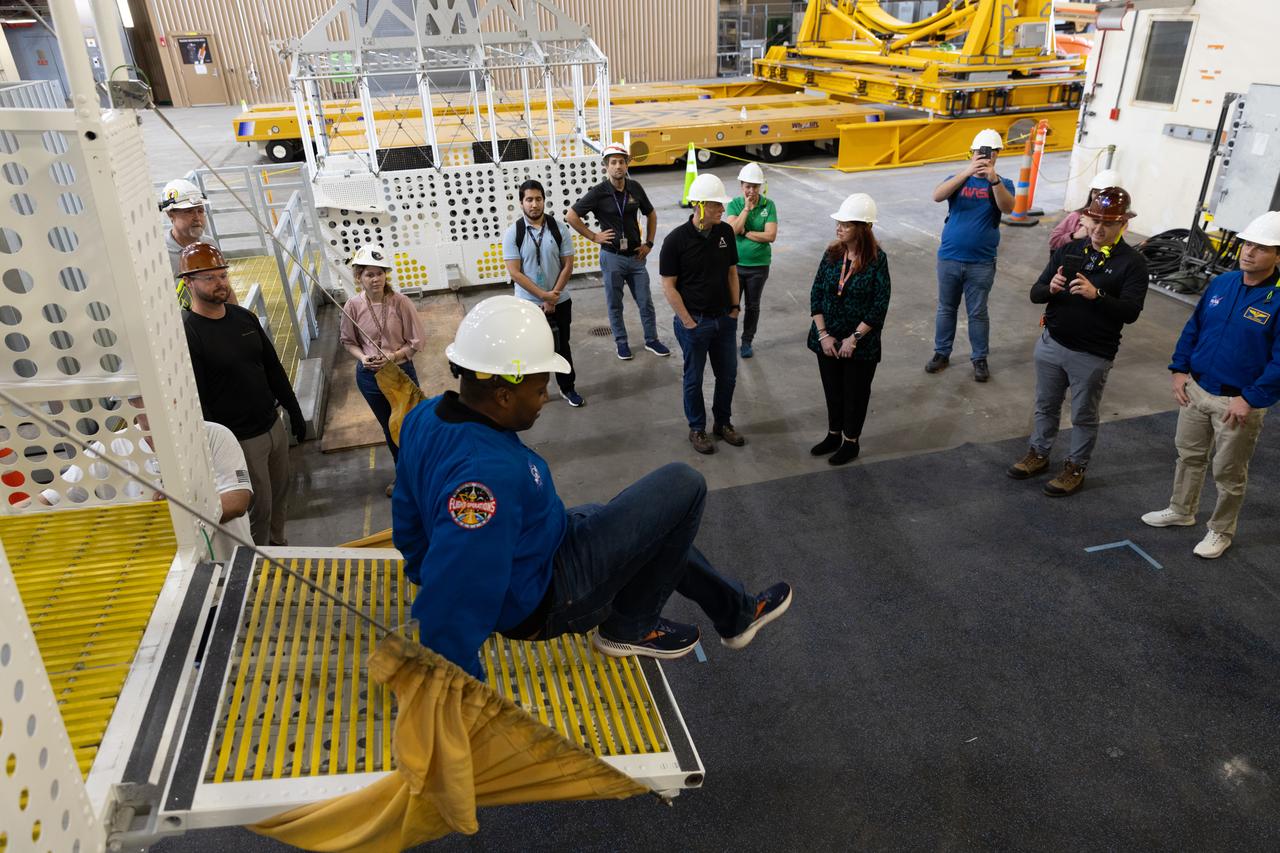
NASA astronaut Andre Douglas, Artemis II backup crew member practices climbing out of an emergency egress basket inside the Vehicle Assembly Building at NASA’s Kennedy Space Center in Florida on Thursday, Feb. 27, 2025. The baskets, similar to gondolas on ski lifts, are used in the case of a pad abort emergency to enable astronauts and other pad personnel a way to quickly escape away from the mobile launcher to the base of the pad and where waiting emergency transport vehicles will then drive them away. For Artemis II, four astronauts will venture around the Moon, the first crewed mission on NASA’s path to establishing a long-term presence for science and exploration through Artemis.

iss074e0150190 (Jan. 20, 2026) --- NASA's Kennedy Space Center in Florida is pictured from the International Space Station as it orbited 258 miles above the Sunshine State. NASA’s Space Launch System (SLS) rocket and Orion spacecraft can be seen on Launch Pad 39B (right center) with Launch Pad 39A just beneath it along the Atlantic coast. Artemis II will be the first crewed mission on NASA’s path to establishing a long-term presence at the Moon for science and exploration. The 10-day flight will help confirm systems and hardware needed for early human lunar exploration missions.
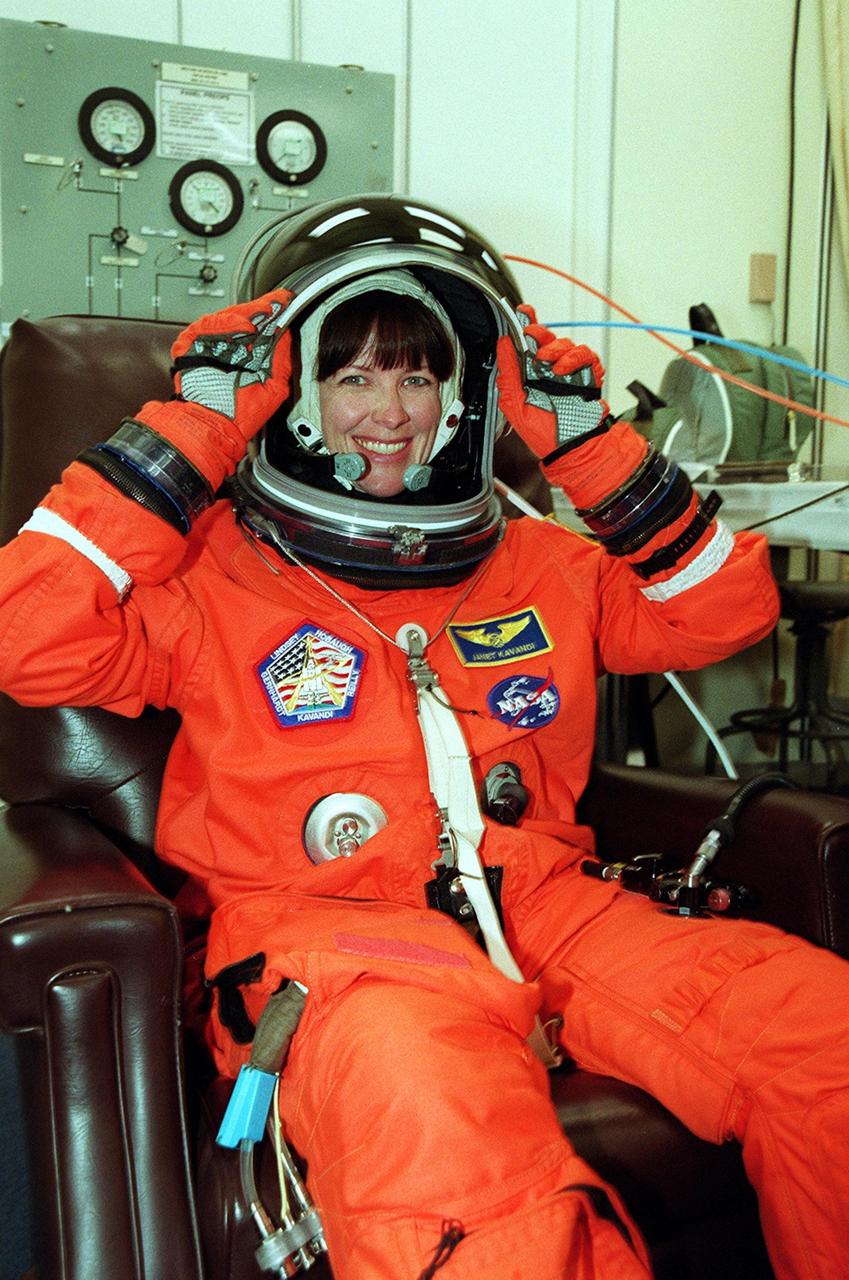
KENNEDY SPACE CENTER, Fla. -- STS-104 Mission Specialist Janet Lynn Kavandi adjusts her helmet as she dons her launch and entry suit before heading to the launch pad. This launch will be her third space flight. Liftoff of Space Shuttle Atlantis on mission STS-104 is targeted for 5:04 a.m., July 12, from Launch Pad 39B. The primary payload on the mission is the joint airlock module, which will be added to the International Space Station. The airlock will be the primary path for Space Station spacewalk entry and departure for U.S. spacesuits, and will also support the Russian Orlan spacesuit for EVA activity
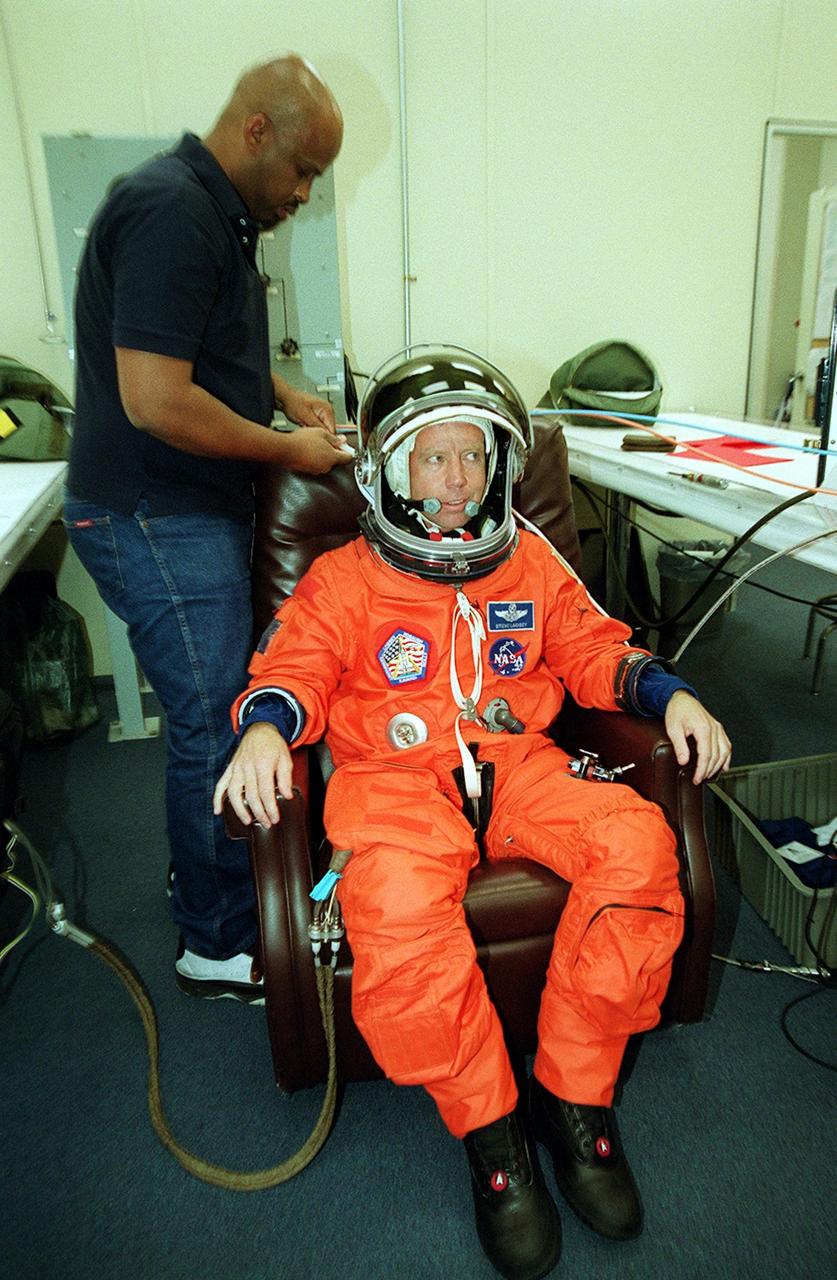
KENNEDY SPACE CENTER, Fla. -- STS-104 Commander Steven W. Lindsey gets help donning his launch and entry suit before heading to the launch pad. This launch will be his third space flight. Liftoff of Space Shuttle Atlantis on mission STS-104 is targeted for 5:04 a.m., July 12, from Launch Pad 39B. The primary payload on the mission is the joint airlock module, which will be added to the International Space Station. The airlock will be the primary path for Space Station spacewalk entry and departure for U.S. spacesuits, and will also support the Russian Orlan spacesuit for EVA activity
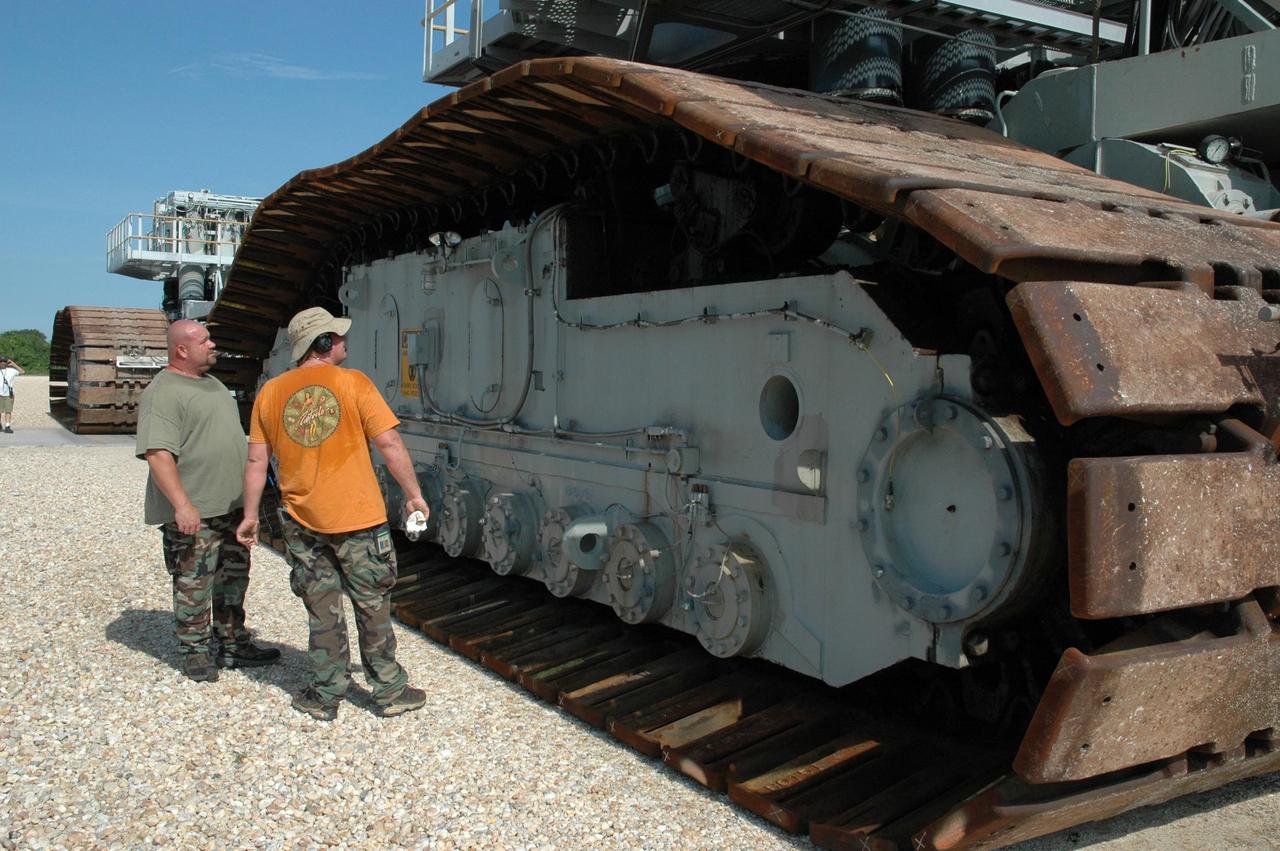
KENNEDY SPACE CENTER, FLA. - Workers check on the crawler-transporters in the event they are needed for rolling back Space Shuttle Atlantis from Launch Pad 39B. Crawler No. 2 will be used to move the STS-116 stack from VAB high bay 3 to high bay 2 and crawler No. 1 will be used to transport Atlantis to high bay 3. The rollback will be determined by the mission management team based on information about Hurricane Ernesto and its path through Florida. Atlantis has been poised on Launch Pad 39B for liftoff on mission STS-115 to the International Space Station to deliver the P3/P4 truss segment. Photo credit: NASA/Jack Pfaller
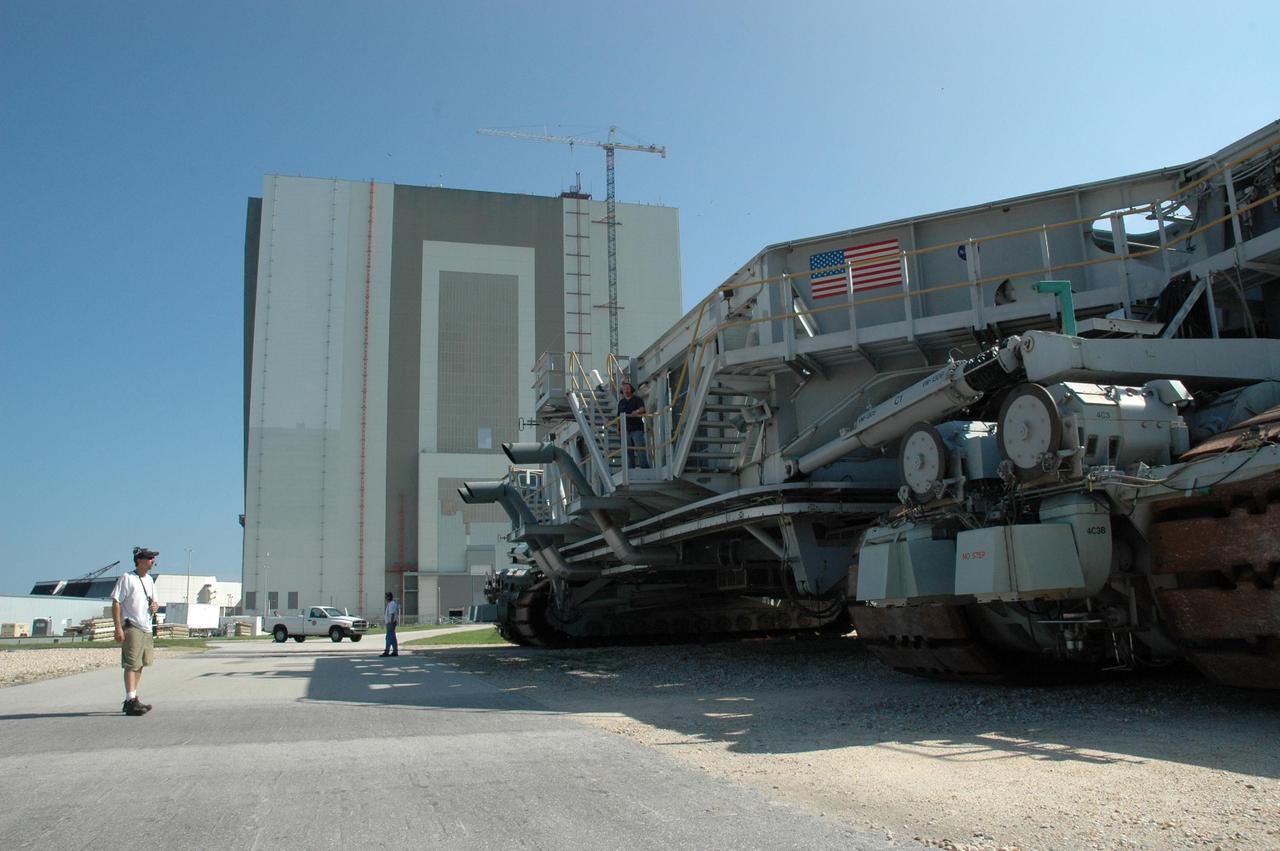
KENNEDY SPACE CENTER, FLA. - Crawler-transporter No. 1 sits outside the Vehicle Assembly Building. Workers will be driving the crawler to test it before it is needed to roll back Space Shuttle Atlantis from Launch Pad 39B. The rollback will be determined by the mission management team based on information about Hurricane Ernesto and its path through Florida. Atlantis has been poised on Launch Pad 39B for liftoff on mission STS-115 to the International Space Station to deliver the P3/P4 truss segment. Photo credit: NASA/Jack Pfaller
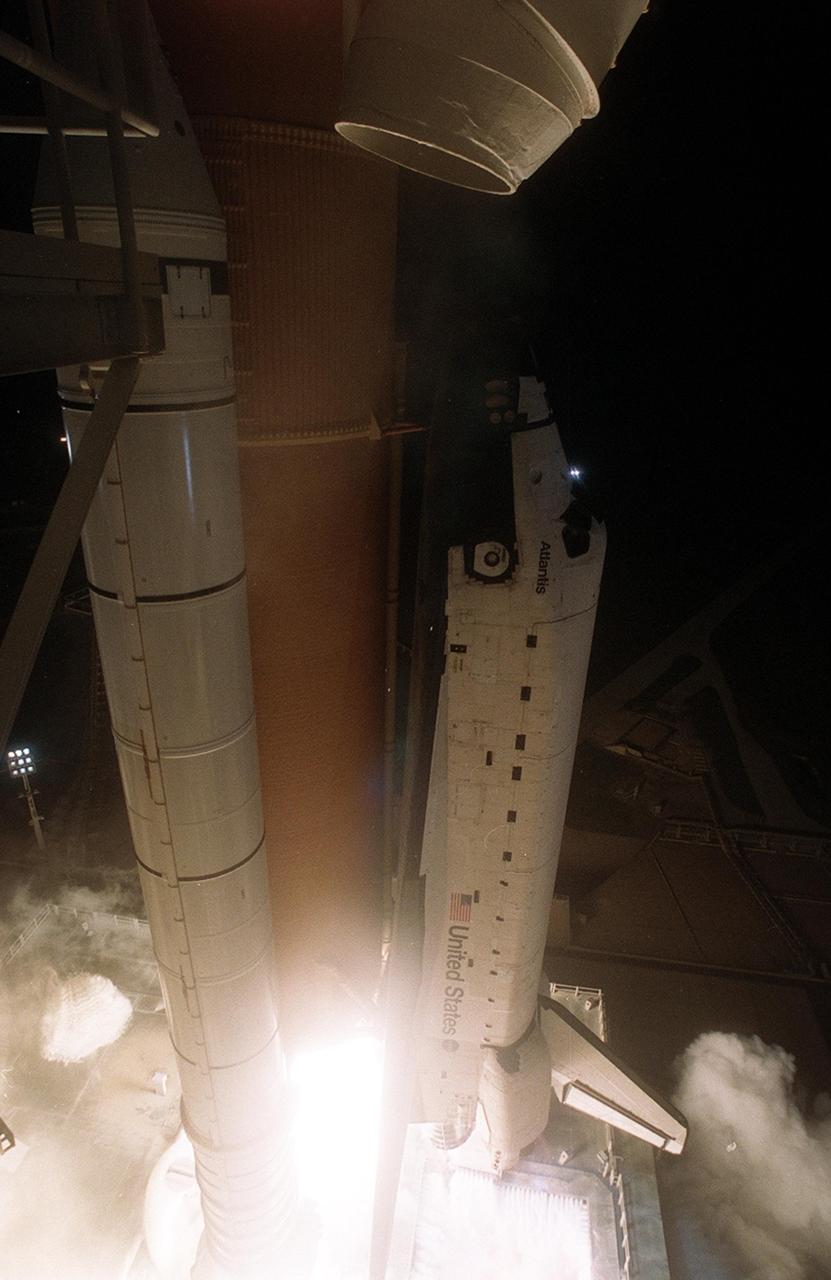
KENNEDY SPACE CENTER, Fla. -- Space Shuttle Atlantis begins its trek to the International Space Station as it lifts off the pad with a crew of five on mission STS-104. Atlantis lifted off from Launch Pad 39B on time at 5:03:59 a.m. EDT. The 10th assembly flight to the International Space Station, the primary payload on the mission is the joint airlock module, which will require two spacewalks to attach it to the Space Station. The airlock will be the primary path for Space Station spacewalk entry and departure for U.S. spacesuits, and will also support the Russian Orlan spacesuit for EVA activity

KENNEDY SPACE CENTER, Fla. -- In the Operations and Checkout Building, STS-104 Pilot Charles O. Hobaugh gets help donning his launch and entry suit before heading to the launch pad. This launch will be his first space flight. Liftoff of Space Shuttle Atlantis on mission STS-104 is targeted for 5:04 a.m., July 12, from Launch Pad 39B. The primary payload on the mission is the joint airlock module, which will be added to the International Space Station. The airlock will be the primary path for Space Station spacewalk entry and departure for U.S. spacesuits, and will also support the Russian Orlan spacesuit for EVA activity
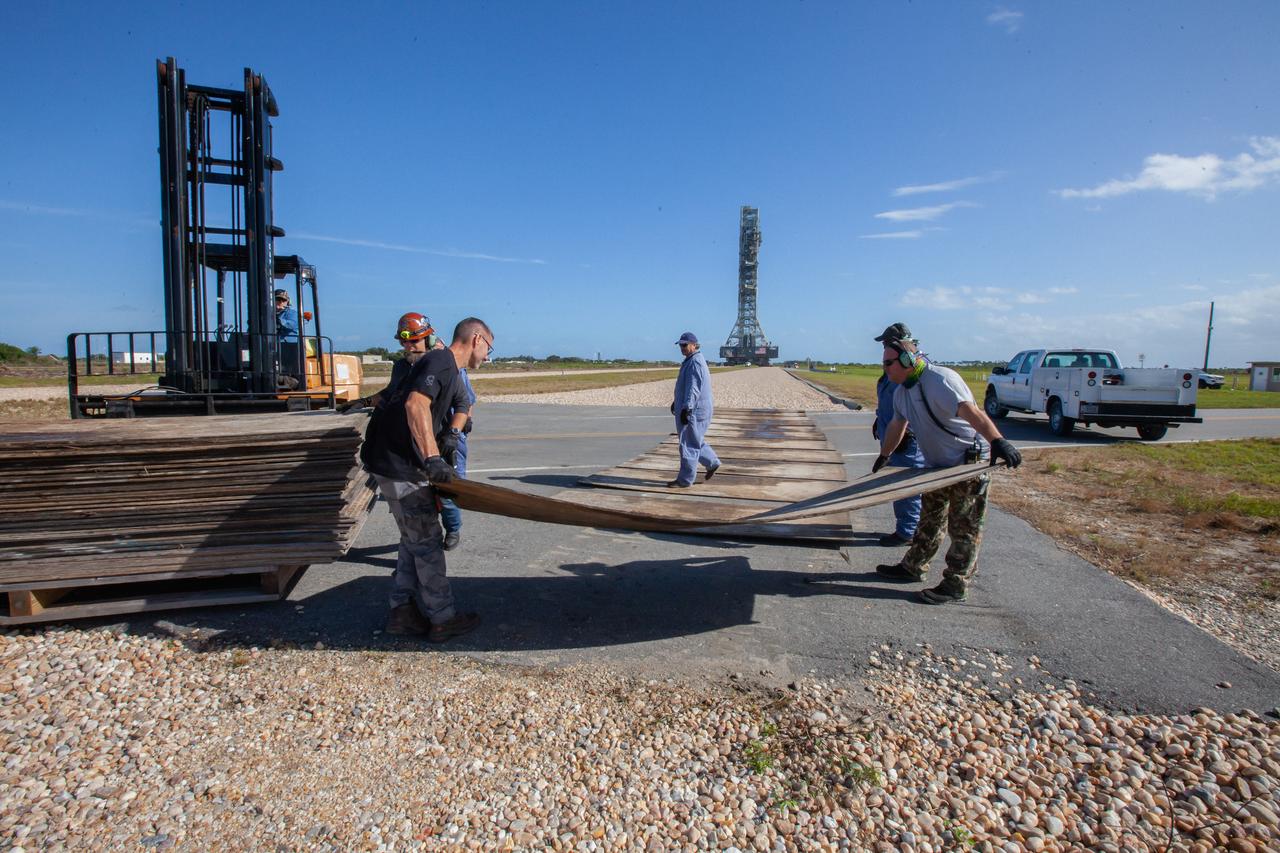
Kennedy Space Center employees lay out a path for NASA’s mobile launcher, carried atop the crawler-transporter 2, to continue its journey to the Vehicle Assembly Building (VAB) on Dec. 20, 2019. The mobile launcher returned to the VAB after spending months at the Florida spaceport’s Launch Pad 39B undergoing final validation and verification testing. Standing 380 feet tall, the mobile launcher – which will be used to assemble, process and launch the Space Launch System and Orion spacecraft – will remain inside the VAB until it is ready to return to the pad with the rocket and spacecraft on top for the “wet dress rehearsal” ahead of the Artemis I launch.
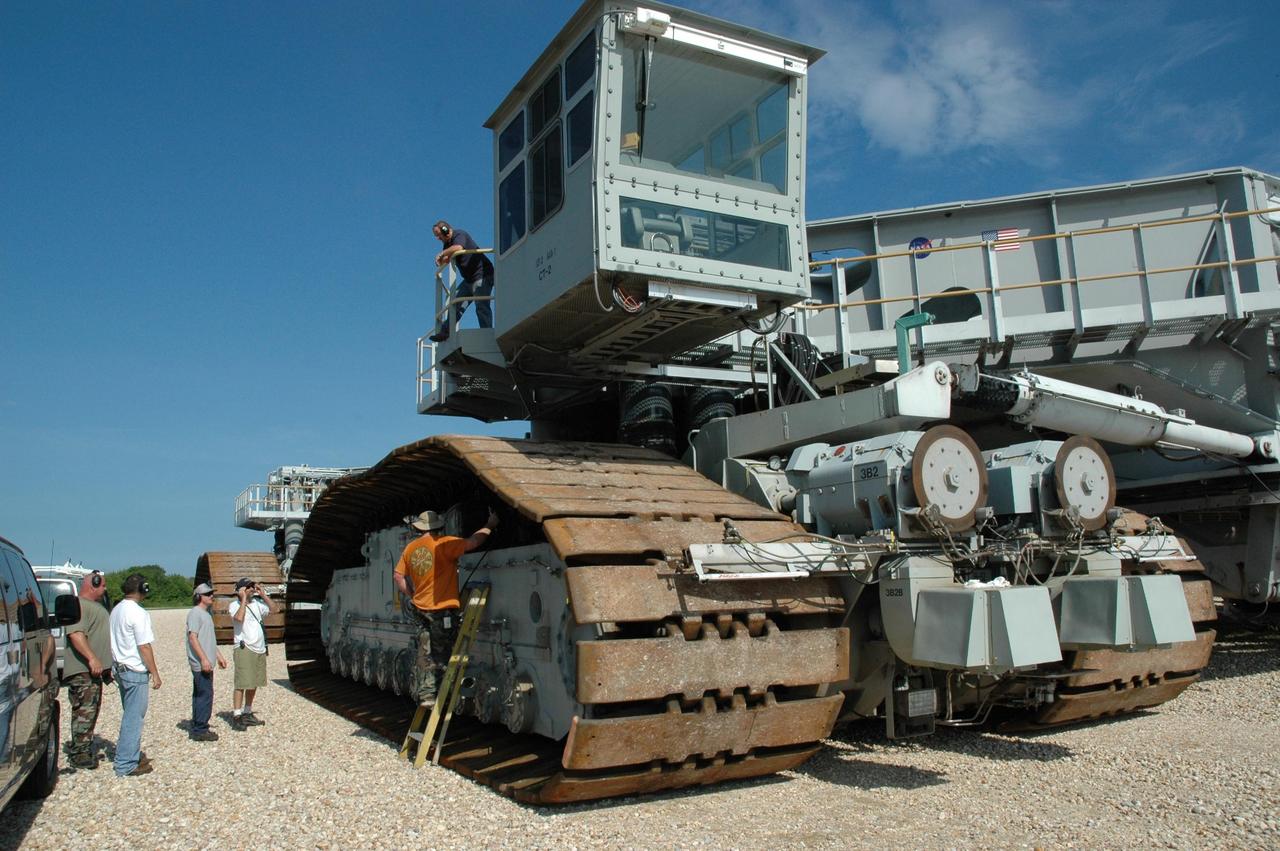
KENNEDY SPACE CENTER, FLA. - Crawler-transporter No. 2 is being checked before it is needed to move the STS-116 stack from VAB high bay 3 to high bay 2 and allow the rollback of Space Shuttle Atlantis into high bay 3. Crawler No. 1 will transport the shuttle from the pad. The rollback will be determined by the mission management team based on information about Hurricane Ernesto and its path through Florida. Atlantis has been poised on Launch Pad 39B for liftoff on mission STS-115 to the International Space Station to deliver the P3/P4 truss segment. Photo credit: NASA/Jack Pfaller
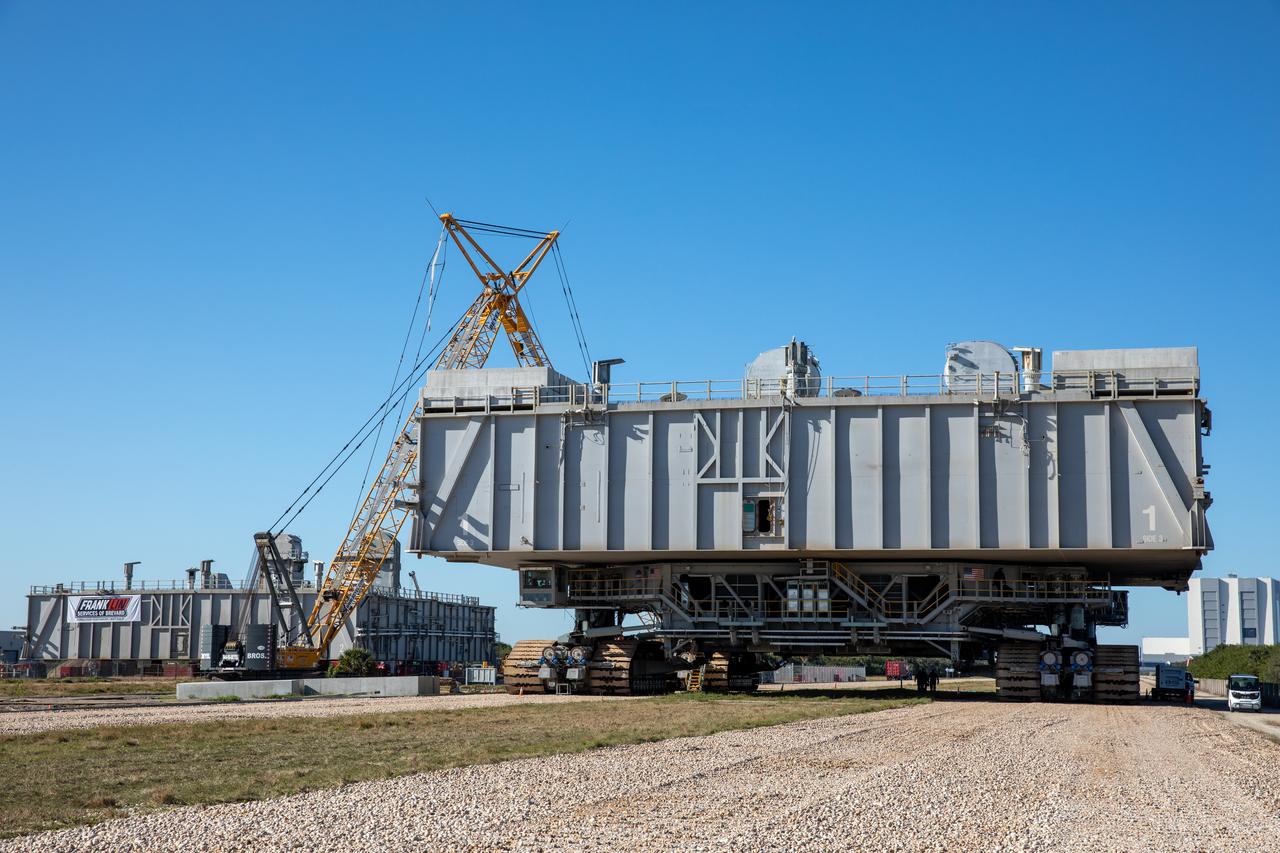
The two mobile launcher platforms (MLPs) are seen at the MSS park site at NASA’s Kennedy Space Center in Florida on Jan. 4, 2021. One MLP is undergoing crawlerway conditioning – a several month-long project to ensure the path the rocket takes from the VAB to the launch pad is strong enough to support the weight for the upcoming Artemis I launch. The other MLP used during the shuttle program is in the process of being demolished.
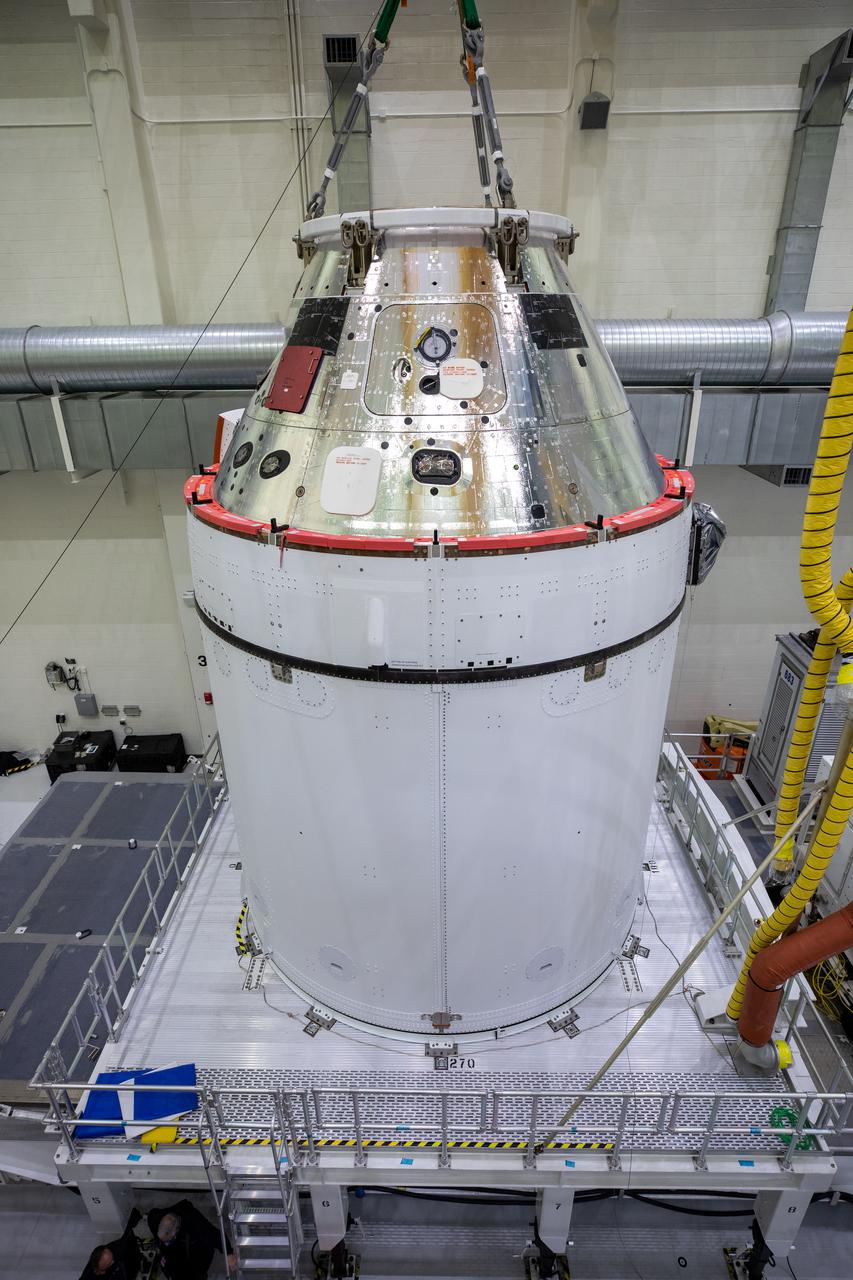
Orion is revealed for one of the final times on Jan. 14, as it is readied atop its transport pallet from the Neil Armstrong Operations and Checkout Building at NASA’s Kennedy Space Center in Florida, along its path to the pad ahead of the Artemis I launch. Teams across the globe have worked tirelessly to assemble the spacecraft, which will receive a protective covering prior to departing for the Multi-Payload Processing Facility to begin ground processing by the Exploration Ground Systems and Jacobs teams.
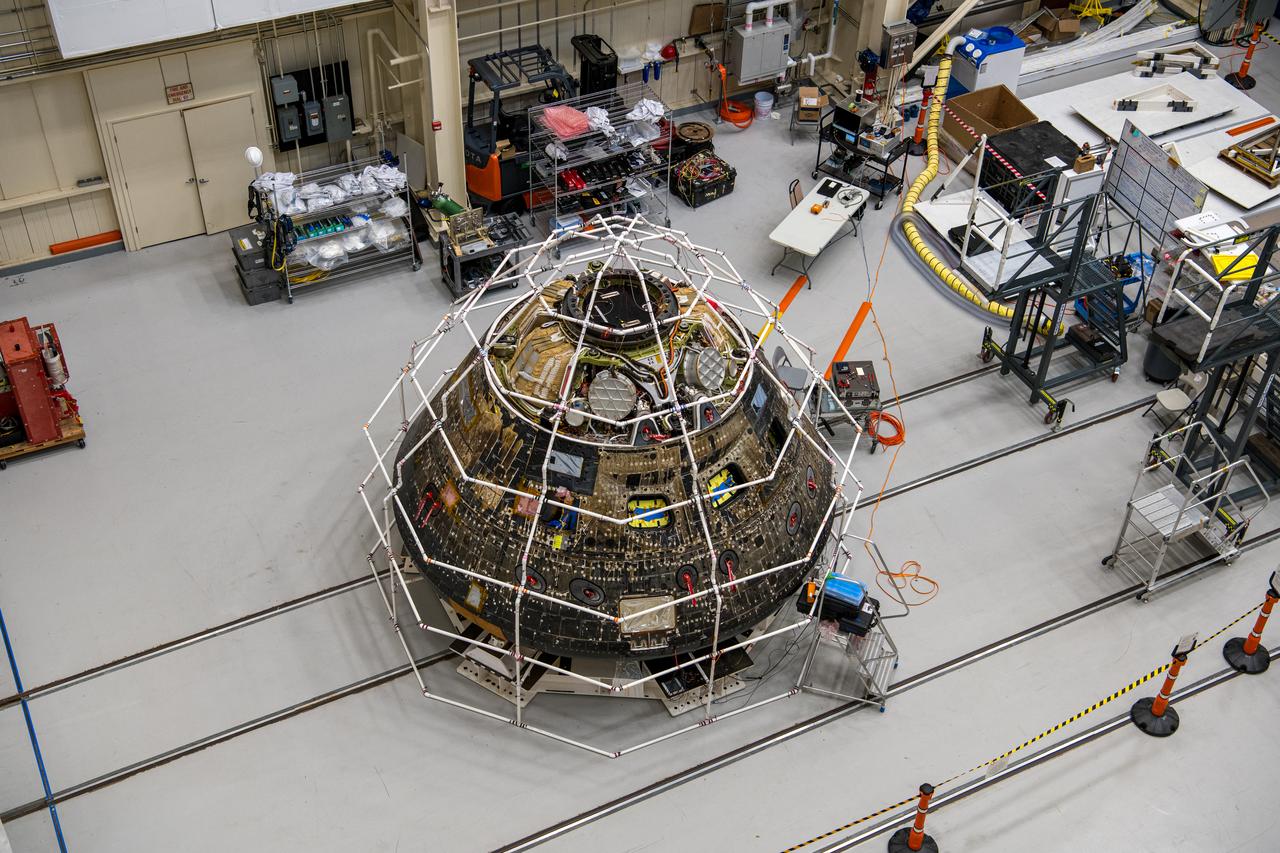
Experts at NASA’s Neil Armstrong Test Facility in Sandusky, Ohio, conducted a lightning test, which simulates the electromagnetic effects of a lightning strike to the vehicle on the launch pad awaiting liftoff. The February 20, 2024, test proved the grounding path of the vehicle is operating as designed and protecting the vehicle from damage to any of its equipment or systems. Photo Credit: (NASA/Quentin Schwinn)
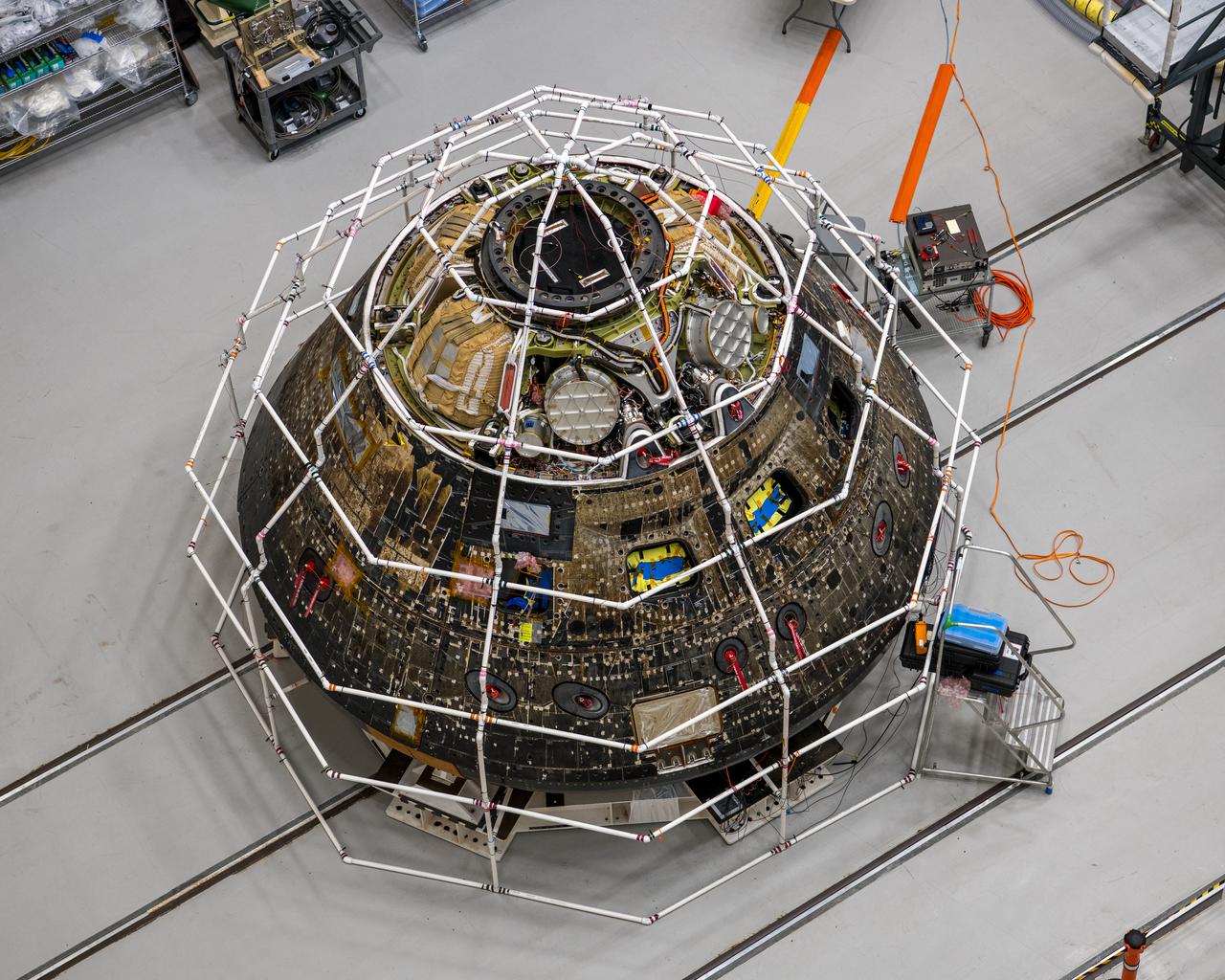
Experts at NASA’s Neil Armstrong Test Facility in Sandusky, Ohio, conducted a lightning test, which simulates the electromagnetic effects of a lightning strike to the vehicle on the launch pad awaiting liftoff. The February 20, 2024, test proved the grounding path of the vehicle is operating as designed and protecting the vehicle from damage to any of its equipment or systems. Photo Credit: (NASA/Quentin Schwinn)

Engineers with Exploration Ground Systems at NASA’s Kennedy Space Center in Florida work on software for the launch of Artemis I. Reggie Martin (standing) and Danny Zaatari stay focused on the “Path to the Pad” inside the Launch Control Center on Sept 29, 2020. Artemis I is the first in a series of increasingly complex missions that will enable human exploration to the Moon and Mars.

Orion is revealed for one of the final times on Jan. 14, as it is readied atop its transport pallet from the Neil Armstrong Operations and Checkout Building at NASA’s Kennedy Space Center in Florida, along its path to the pad ahead of the Artemis I launch. Teams across the globe have worked tirelessly to assemble the spacecraft which will receive a protective covering prior to departing for the Multi-Payload Processing Facility to begin ground processing by the Exploration Ground Systems and Jacobs teams.
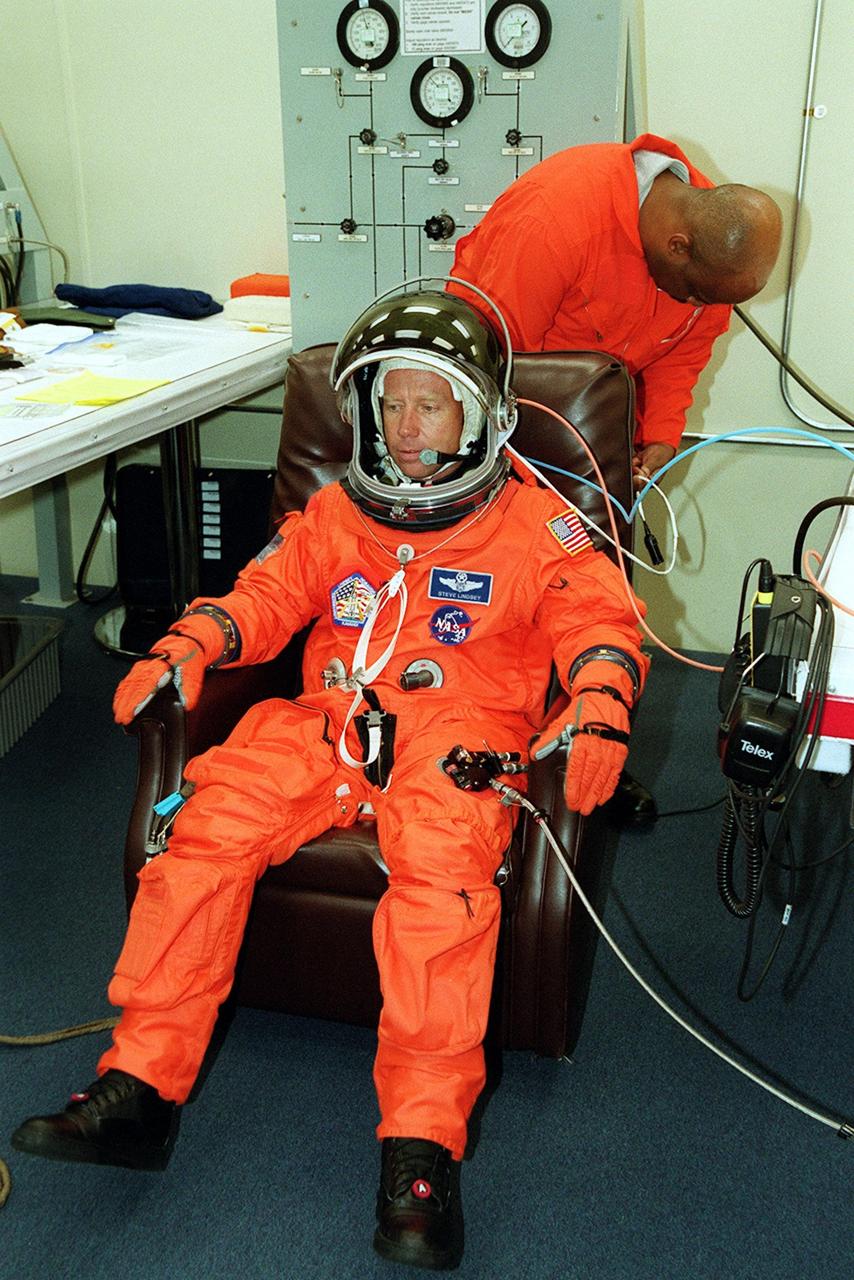
KENNEDY SPACE CENTER, Fla. -- STS-104 Commander Steven W. Lindsey is helped with suit check. He and other crew members are making final preparations for launch July 12 from Launch Pad 39B. Mission STS-104 is the 10th assembly flight to the International Space Station and carries the Joint Airlock Module, which will become the primary path for spacewalk entry and departure using both U.S. spacesuits and the Russian Orlan spacesuit for EVA activity
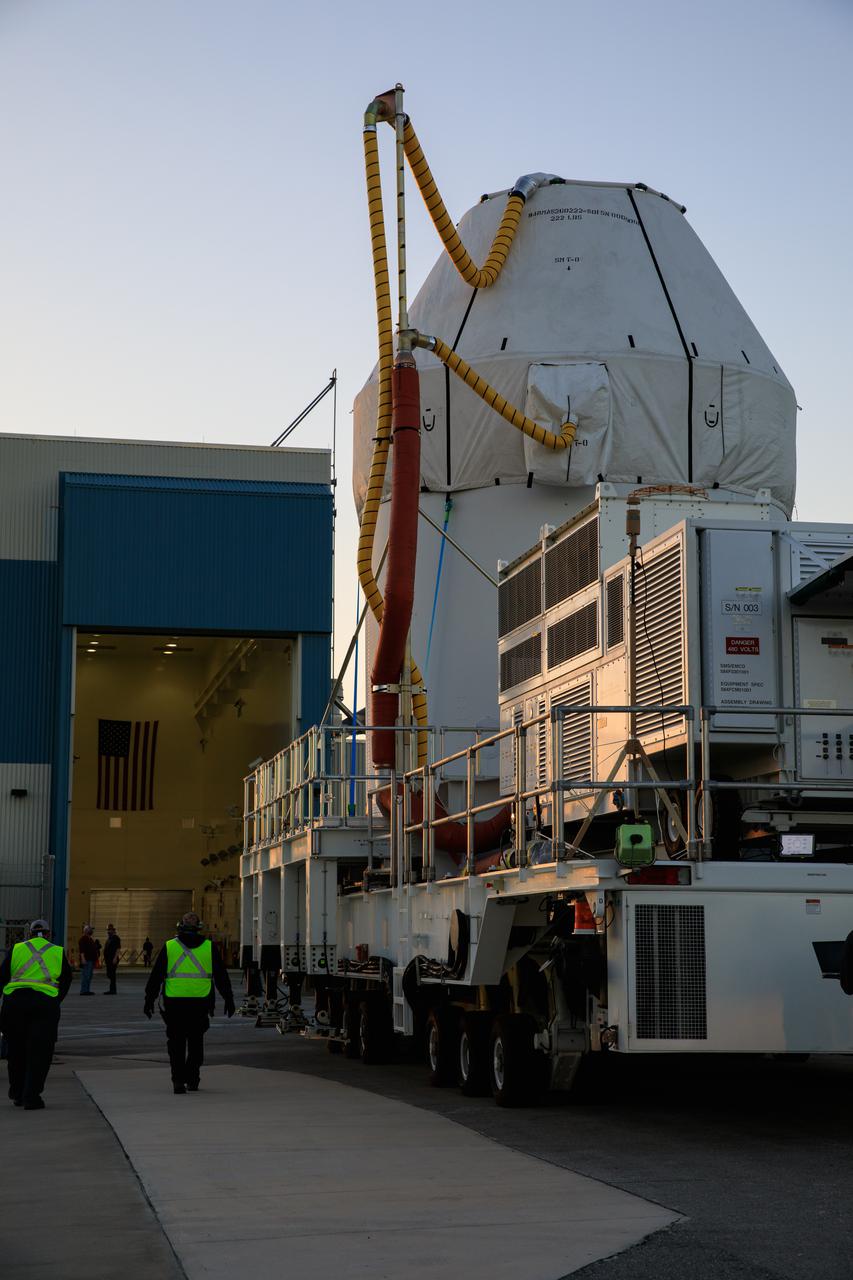
Orion arrives at its next stop along its path to the pad ahead of the Artemis I launch on Jan. 16, 2021, at Kennedy Space Center’s Multi-Payload Processing Facility, where the Exploration Ground Systems and Jacobs teams will take over ground processing. Here, the spacecraft will be “”gassed up” and fueled with commodities as part of preparations ahead of the mission.
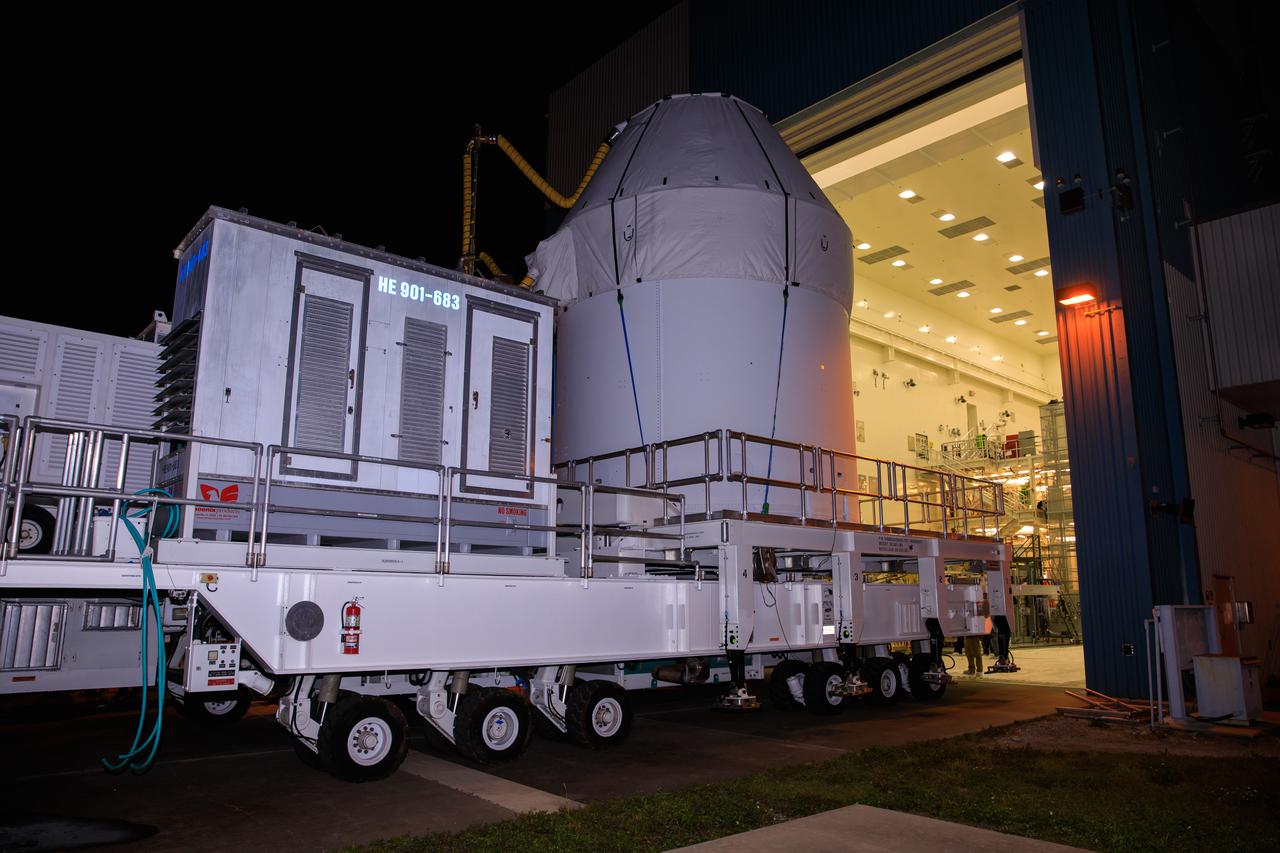
Orion arrives at its next stop along its path to the pad ahead of the Artemis I launch on Jan. 16, 2021, at Kennedy Space Center’s Multi-Payload Processing Facility, where the Exploration Ground Systems and Jacobs teams will take over ground processing. Here, the spacecraft will be “”gassed up” and fueled with commodities as part of preparations ahead of the mission.
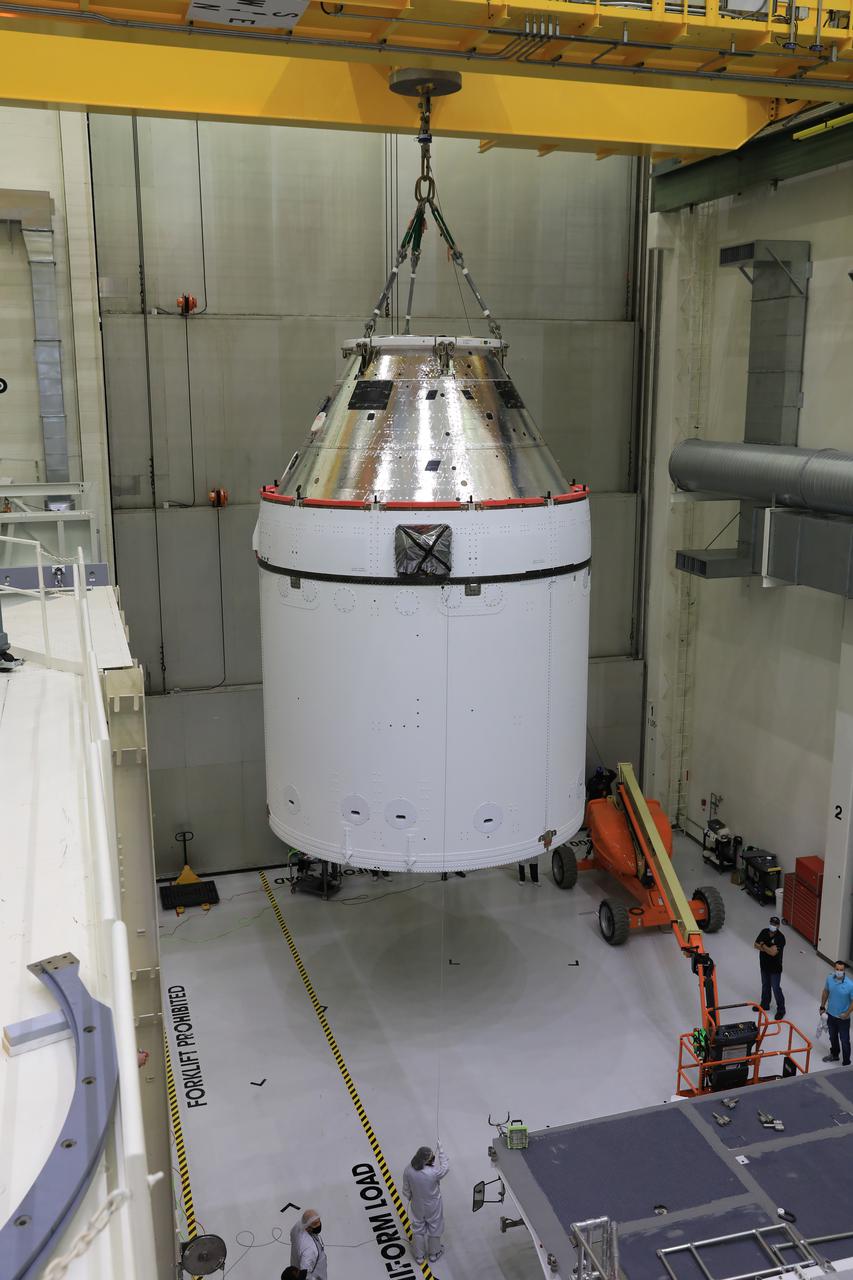
Orion is revealed for one of the final times on Jan. 14, as it is lowered by crane onto its transport pallet inside the Neil Armstrong Operations and Checkout Building at NASA’s Kennedy Space Center in Florida, along its path to the pad ahead of the Artemis I launch. Teams across the globe have worked tirelessly to assemble the spacecraft which will receive a protective covering prior to departing for the Multi-Payload Processing Facility to begin ground processing by the Exploration Ground Systems and Jacobs teams.
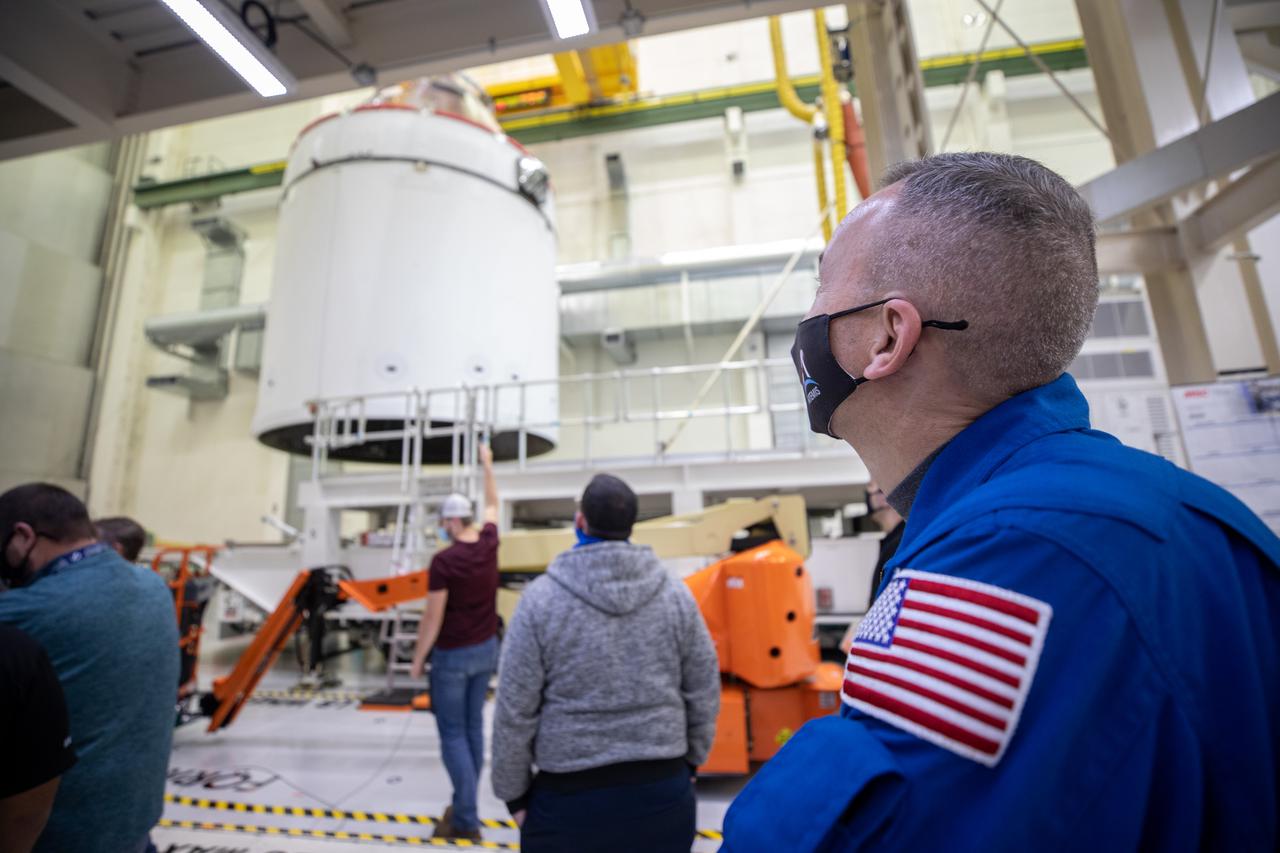
Orion is revealed for one of the final times on Jan. 14, as it is moved by crane to its transport pallet inside the Neil Armstrong Operations and Checkout Building at NASA’s Kennedy Space Center in Florida, along its path to the pad ahead of the Artemis I launch. Teams across the globe have worked tirelessly to assemble the spacecraft which will receive a protective covering prior to departing for the Multi-Payload Processing Facility to begin ground processing by the Exploration Ground Systems and Jacobs teams.

Orion is revealed for one of the final times on Jan. 14, as it is moved by crane to its transport pallet inside the Neil Armstrong Operations and Checkout Building at NASA’s Kennedy Space Center in Florida, along its path to the pad ahead of the Artemis I launch. Teams across the globe have worked tirelessly to assemble the spacecraft, which will receive a protective covering prior to departing for the Multi-Payload Processing Facility to begin ground processing by the Exploration Ground Systems and Jacobs teams.

KENNEDY SPACE CENTER, Fla. -- STS-104 Pilot Charles O. Hobaugh (seated) is helped with suit check. He and other crew members are making final preparations for launch July 12 from Launch Pad 39B. Mission STS-104 is the 10th assembly flight to the International Space Station and carries the Joint Airlock Module, which will become the primary path for spacewalk entry and departure using both U.S. spacesuits and the Russian Orlan spacesuit for EVA activity
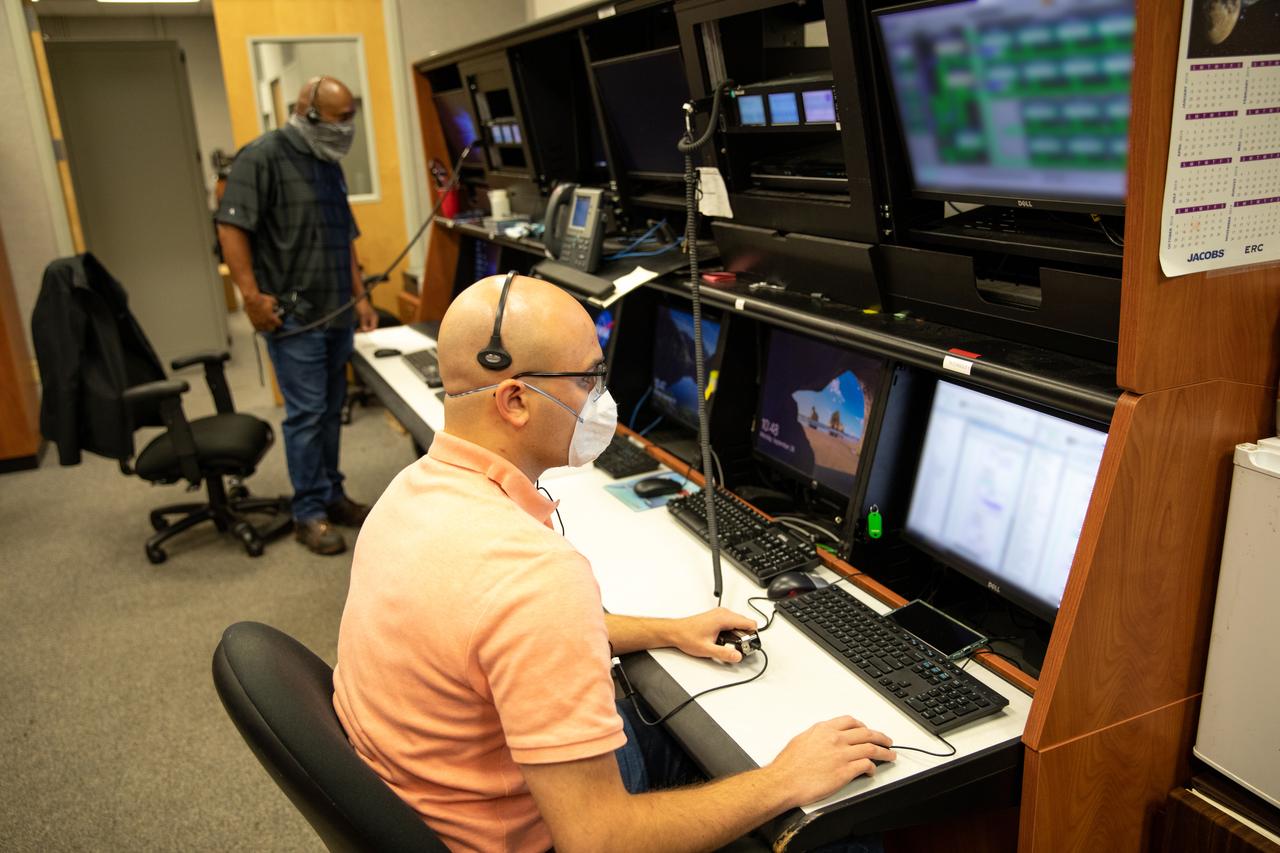
Engineers with Exploration Ground Systems at NASA’s Kennedy Space Center in Florida work on software for the launch of Artemis I. Reggie Martin (standing) and Danny Zaatari stay focused on the “Path to the Pad” inside the Launch Control Center on Sept 29, 2020. Artemis I is the first in a series of increasingly complex missions that will enable human exploration to the Moon and Mars.
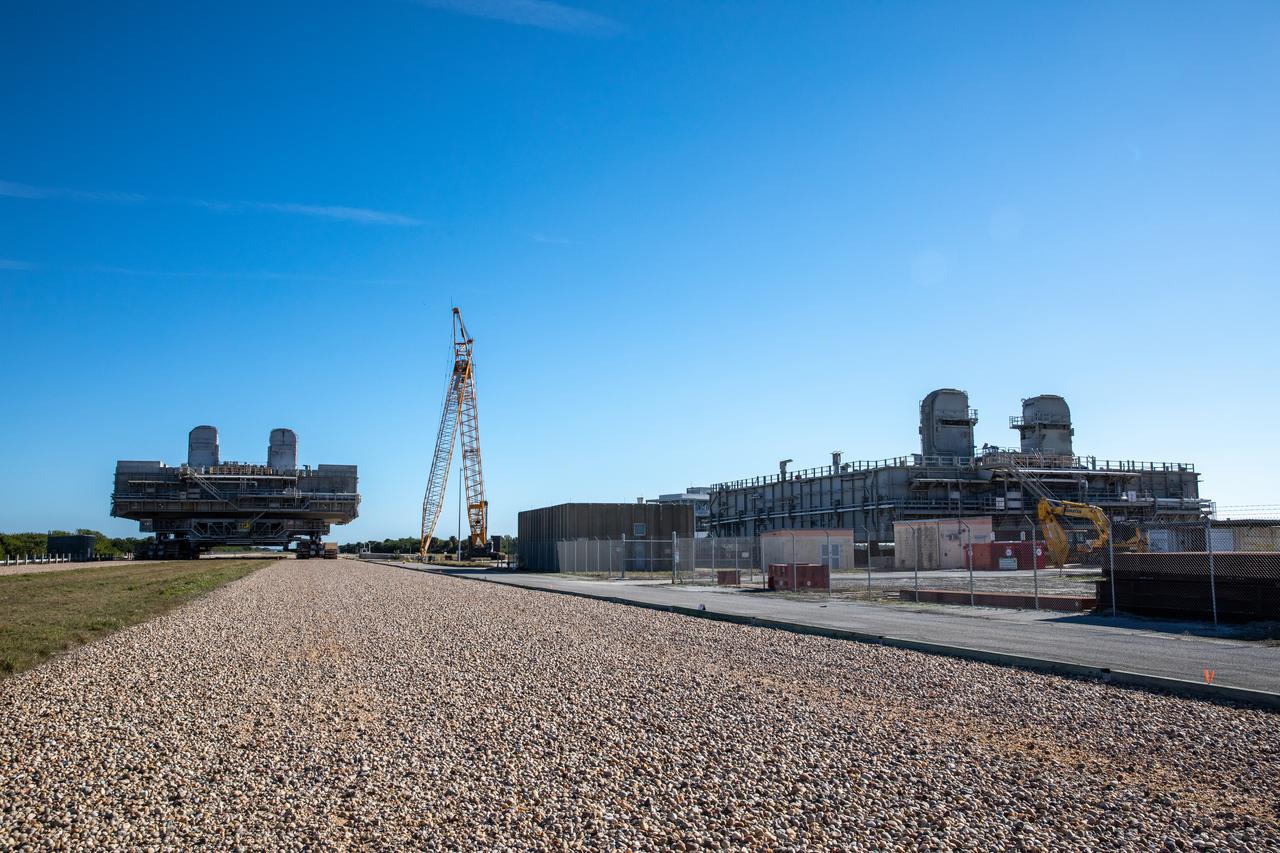
The two mobile launcher platforms (MLPs) are seen at the MSS park site at NASA’s Kennedy Space Center in Florida on Jan. 4, 2021. One MLP is undergoing crawlerway conditioning – a several month-long project to ensure the path the rocket takes from the VAB to the launch pad is strong enough to support the weight for the upcoming Artemis I launch. The other MLP used during the shuttle program is in the process of being demolished.

Orion arrives at its next stop along its path to the pad ahead of the Artemis I launch on Jan. 16, 2021, at Kennedy Space Center’s Multi-Payload Processing Facility, where the Exploration Ground Systems and Jacobs teams will take over ground processing. Here, the spacecraft will be “”gassed up” and fueled with commodities as part of preparations ahead of the mission.

Orion is revealed for one of the final times on Jan. 14, as it is moved by crane to its transport pallet inside the Neil Armstrong Operations and Checkout Building at NASA’s Kennedy Space Center in Florida, along its path to the pad ahead of the Artemis I launch. Teams across the globe have worked tirelessly to assemble the spacecraft which will receive a protective covering prior to departing for the Multi-Payload Processing Facility to begin ground processing by the Exploration Ground Systems and Jacobs teams.
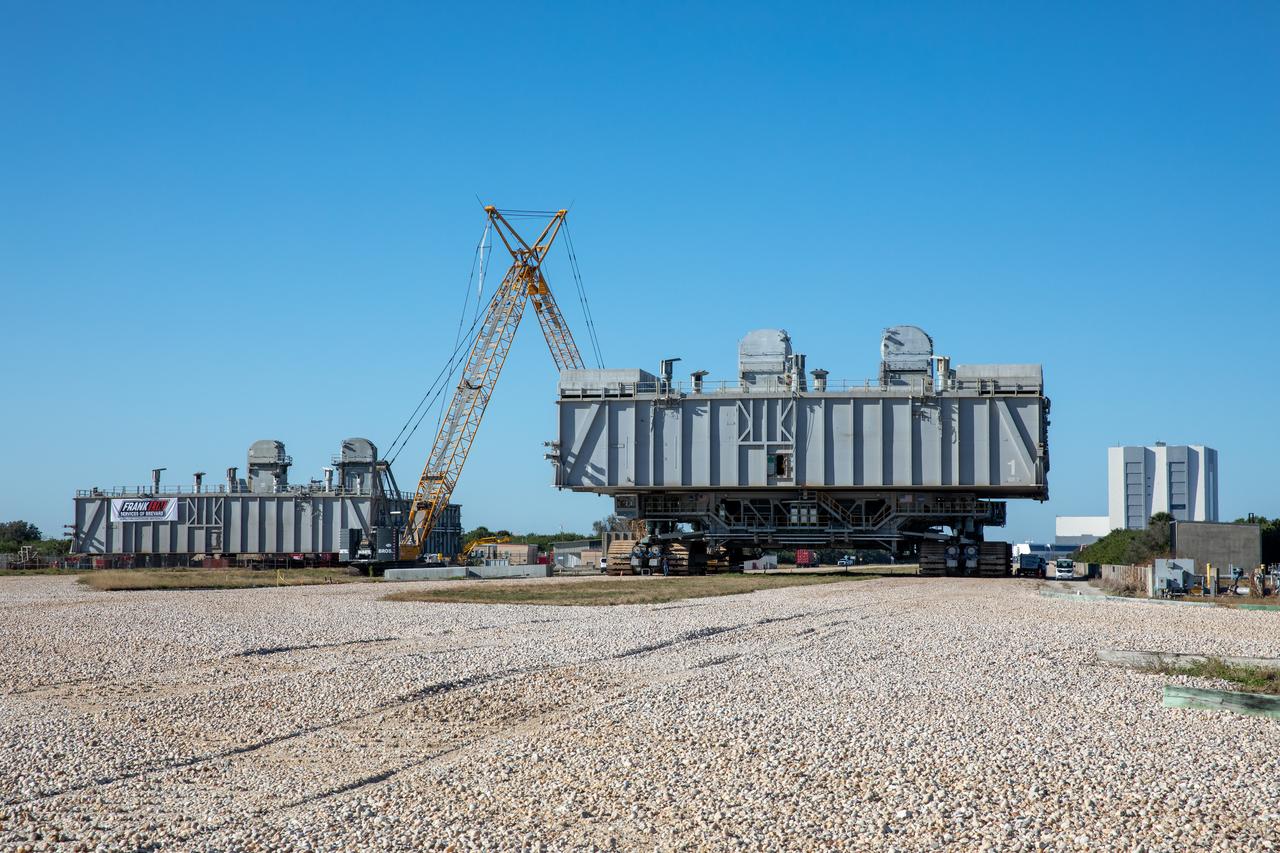
The two mobile launcher platforms (MLPs) are seen at the MSS park site at NASA’s Kennedy Space Center in Florida on Jan. 4, 2021. One MLP is undergoing crawlerway conditioning – a several month-long project to ensure the path the rocket takes from the VAB to the launch pad is strong enough to support the weight for the upcoming Artemis I launch. The other MLP used during the shuttle program is in the process of being demolished.
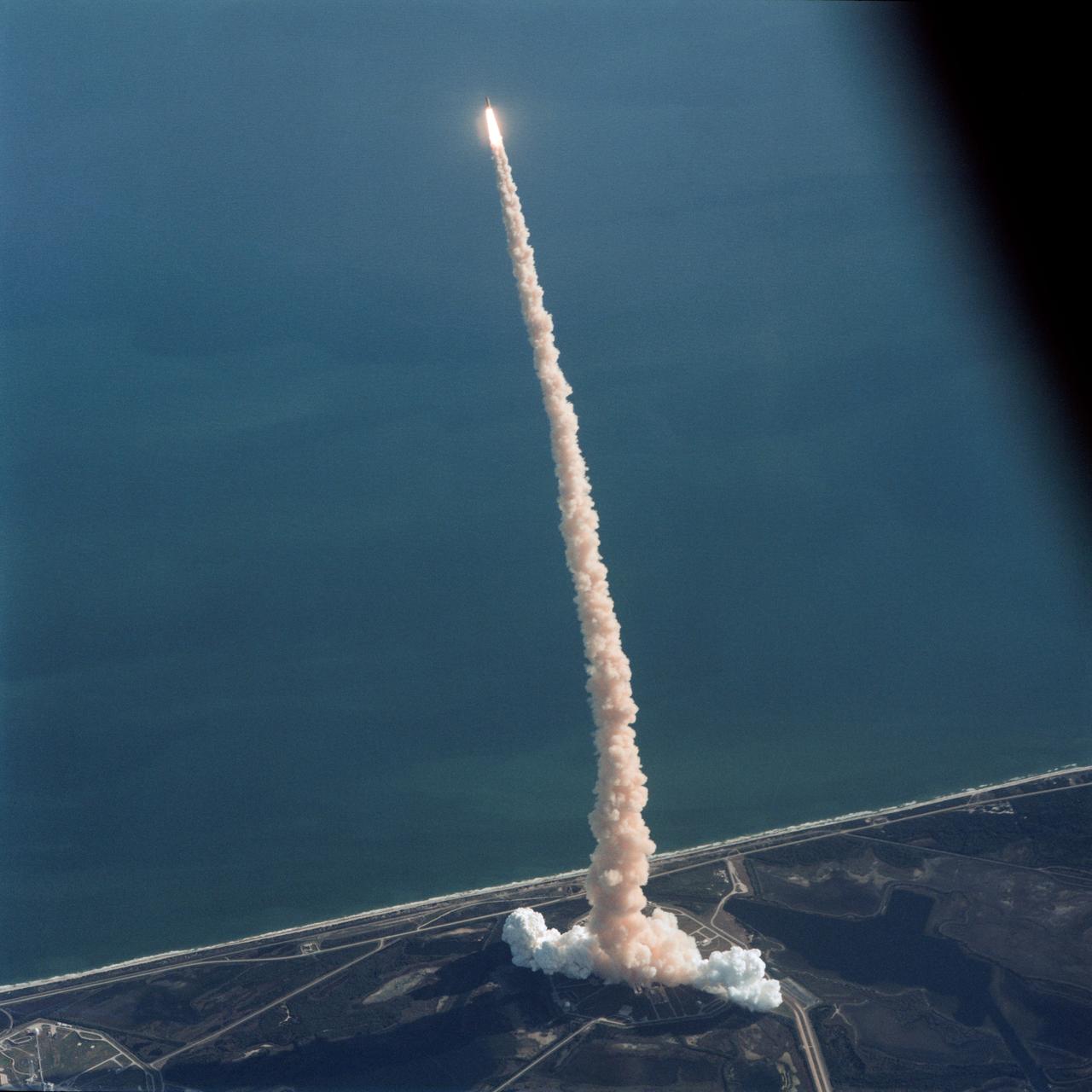
Air-to-air view, taken from the weather-monitoring Shuttle Training Aircraft (STA), shows STS-42 Discovery, Orbiter Vehicle (OV) 103, as it soars above the Atlantic Ocean after liftoff from a Kennedy Space Center (KSC) Launch Complex (LC) Pad at 9:52:33 am (Eastern Standard Time (EST)). The exhaust plume traces OV-103's flight path.
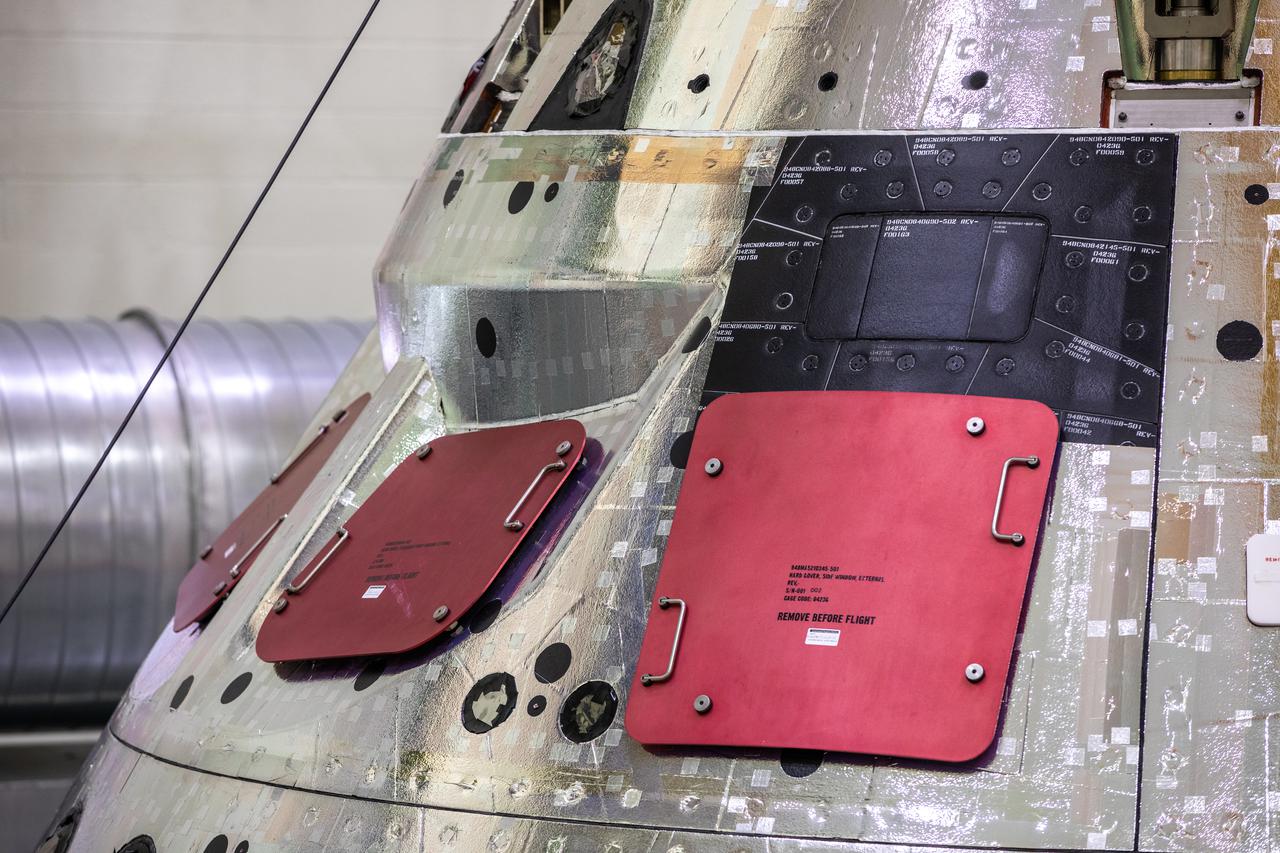
Orion is revealed for one of the final times on Jan. 14, as it is readied atop its transport pallet from the Neil Armstrong Operations and Checkout Building at NASA’s Kennedy Space Center in Florida, along its path to the pad ahead of the Artemis I launch. Teams across the globe have worked tirelessly to assemble the spacecraft which will receive a protective covering prior to departing for the Multi-Payload Processing Facility to begin ground processing by the Exploration Ground Systems and Jacobs teams.
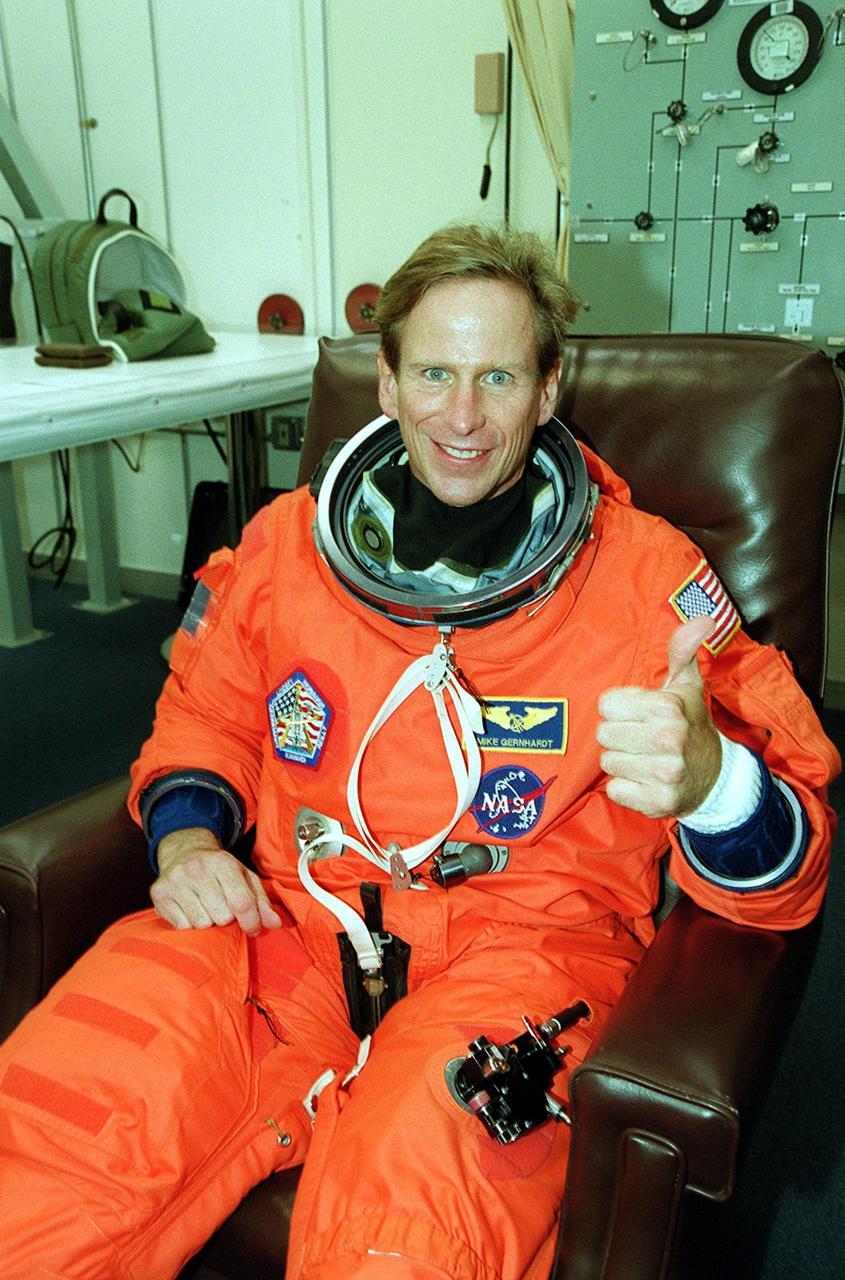
KENNEDY SPACE CENTER, Fla. -- STS-104 Mission Specialist Michael L. Gernhardt signals he is ready for launch. This will be his fourth space flight. Liftoff of Space Shuttle Atlantis on mission STS-104 is targeted for 5:04 a.m., July 12, from Launch Pad 39B. The primary payload on the mission is the joint airlock module, which will be added to the International Space Station. The airlock will be the primary path for Space Station spacewalk entry and departure for U.S. spacesuits, and will also support the Russian Orlan spacesuit for EVA activity

Engineers with Exploration Ground Systems at NASA’s Kennedy Space Center in Florida work on software for the launch of Artemis I. Danny Zaatari (foreground) and Reggie Martin stay focused on the “Path to the Pad” inside the Launch Control Center on Sept 29, 2020. Artemis I is the first in a series of increasingly complex missions that will enable human exploration to the Moon and Mars.
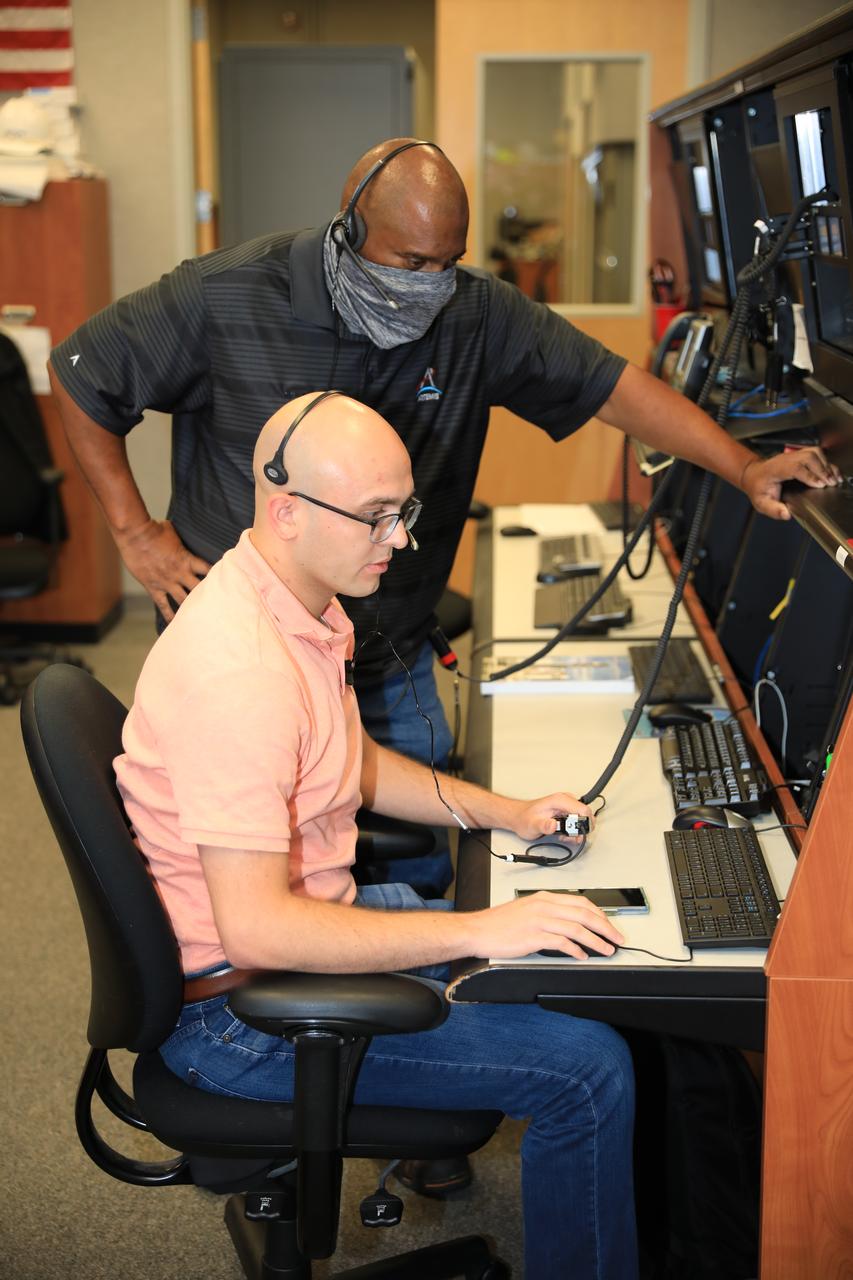
Engineers with Exploration Ground Systems at NASA’s Kennedy Space Center in Florida work on software for the launch of Artemis I. Reggie Martin (standing) and Danny Zaatari stay focused on the “Path to the Pad” inside the Launch Control Center on Sept 29, 2020. Artemis I is the first in a series of increasingly complex missions that will enable human exploration to the Moon and Mars.

The women who comprise the Artemis launch team are photographed inside Firing Room 1 of the Launch Control Center at NASA’s Kennedy Space Center in Florida on Friday, March 15, 2024. In the center behind the Artemis sign is NASA’s first female Launch Director Charlie Blackwell-Thompson. The team, which is about 30% women, will launch the agency’s Artemis II mission from Kennedy’s Launch Pad 39B, the first crewed mission on NASA's path to establishing a long-term presence at the Moon for science and exploration through Artemis.
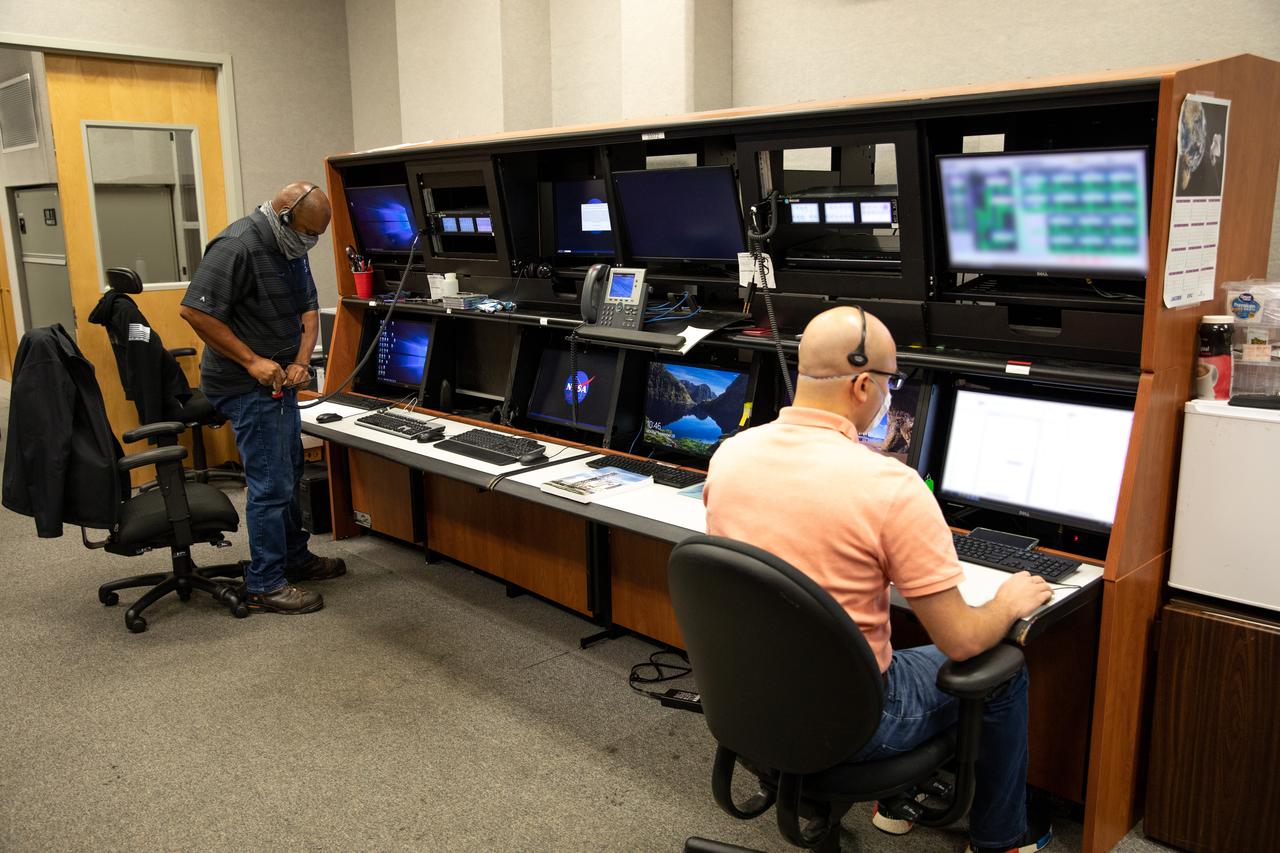
Engineers with Exploration Ground Systems at NASA’s Kennedy Space Center in Florida work on software for the launch of Artemis I. Reggie Martin, left, and Danny Zaatari stay focused on the “Path to the Pad” inside the Launch Control Center on Sept 29, 2020. Artemis I is the first in a series of increasingly complex missions that will enable human exploration to the Moon and Mars.
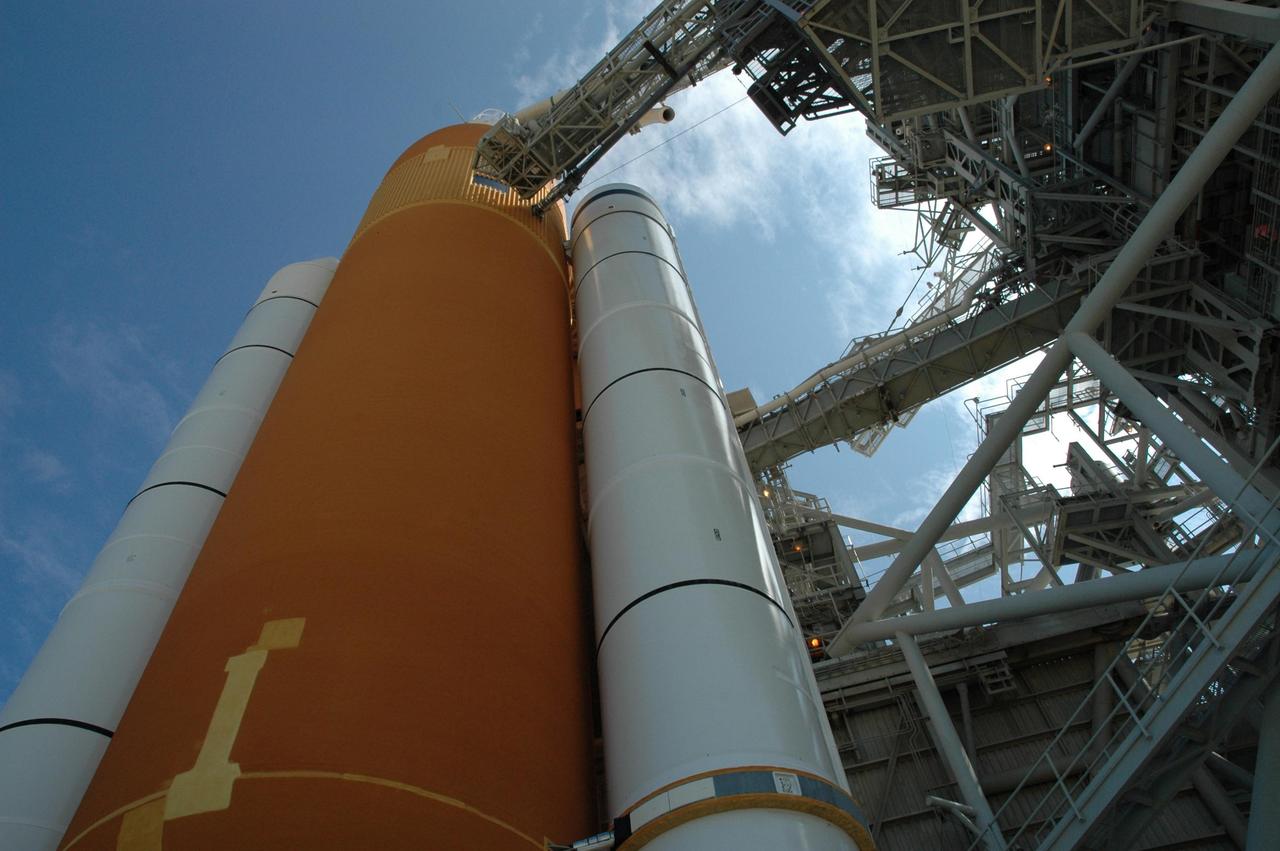
KENNEDY SPACE CENTER, FLA. - Seen on Launch Pad 39B, the looming external tank (center) flanked by the solid rocket boosters hide Space Shuttle Atlantis, behind them. Near the top of the external tank is the liquid hydrogen vent arm. Preparations continue on the pad for launch of Atlantis on mission STS-115 as early as Aug. 29. However, preparations are also underway for a rollback of Atlantis to the Vehicle Assembly Building due to Hurricane Ernesto. The rollback will be determined by the mission management team based on information about Hurricane Ernesto and its path through Florida. Atlantis has been poised on Launch Pad 39B for liftoff on mission STS-115 to the International Space Station to deliver the P3/P4 truss segment. Photo credit: NASA/Jack Pfaller
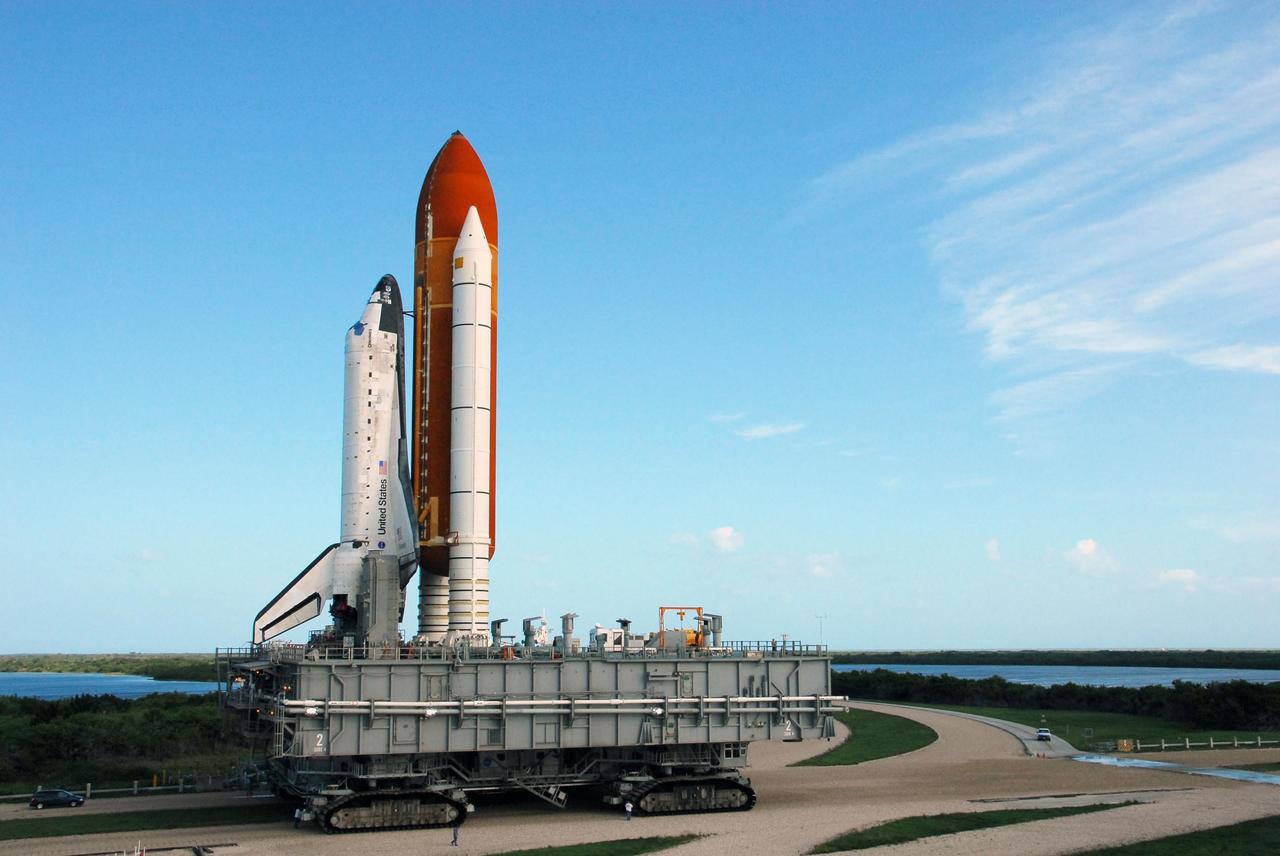
KENNEDY SPACE CENTER, FLA. -- The crawler transporter, moving Space Shuttle Discovery atop its mobile launch platform from the Vehicle Assembly Building, heads in the direction of Launch Pad 39A. The journey has reached the intersection in the crawlerway of the paths to Pad 39A and Pad 39B. First motion out of the VAB was at 6:47 a.m. EDT. The crawler transporter, mobile launch platform and unfueled space shuttle weigh a total of approximately 17.5 million pounds. Rollout is a milestone for Discovery's launch to the International Space Station on mission STS-120, targeted for Oct. 23. The crew will be delivering and installing the Italian-built U.S. Node 2, named Harmony. The pressurized module will act as an internal connecting port and passageway to additional international science labs and cargo spacecraft. In addition to increasing the living and working space inside the station, it also will serve as a work platform outside for the station's robotic arm. Photo credit: NASA/George Shelton
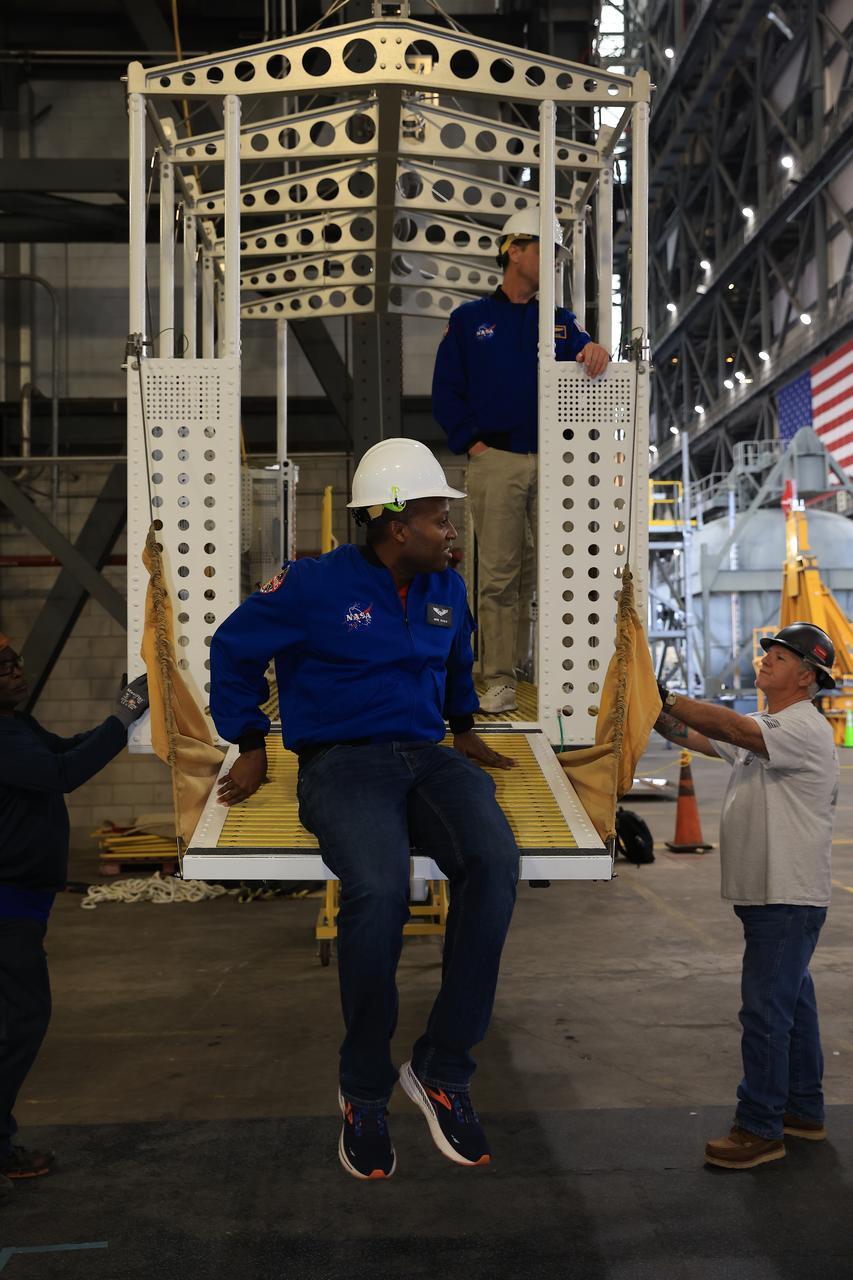
From left, NASA astronauts Andre Douglas, Artemis II backup crew member and Artemis II astronaut Reid Wiseman, commander, practice climbing into an emergency egress basket inside the Vehicle Assembly Building at NASA’s Kennedy Space Center in Florida on Thursday, Feb. 27, 2025. The baskets, similar to gondolas on ski lifts, are used in the case of a pad abort emergency to enable astronauts and other pad personnel a way to quickly escape away from the mobile launcher to the base of the pad and where waiting emergency transport vehicles will then drive them away. For Artemis II, four astronauts will venture around the Moon, the first crewed mission on NASA’s path to establishing a long-term presence for science and exploration through Artemis.
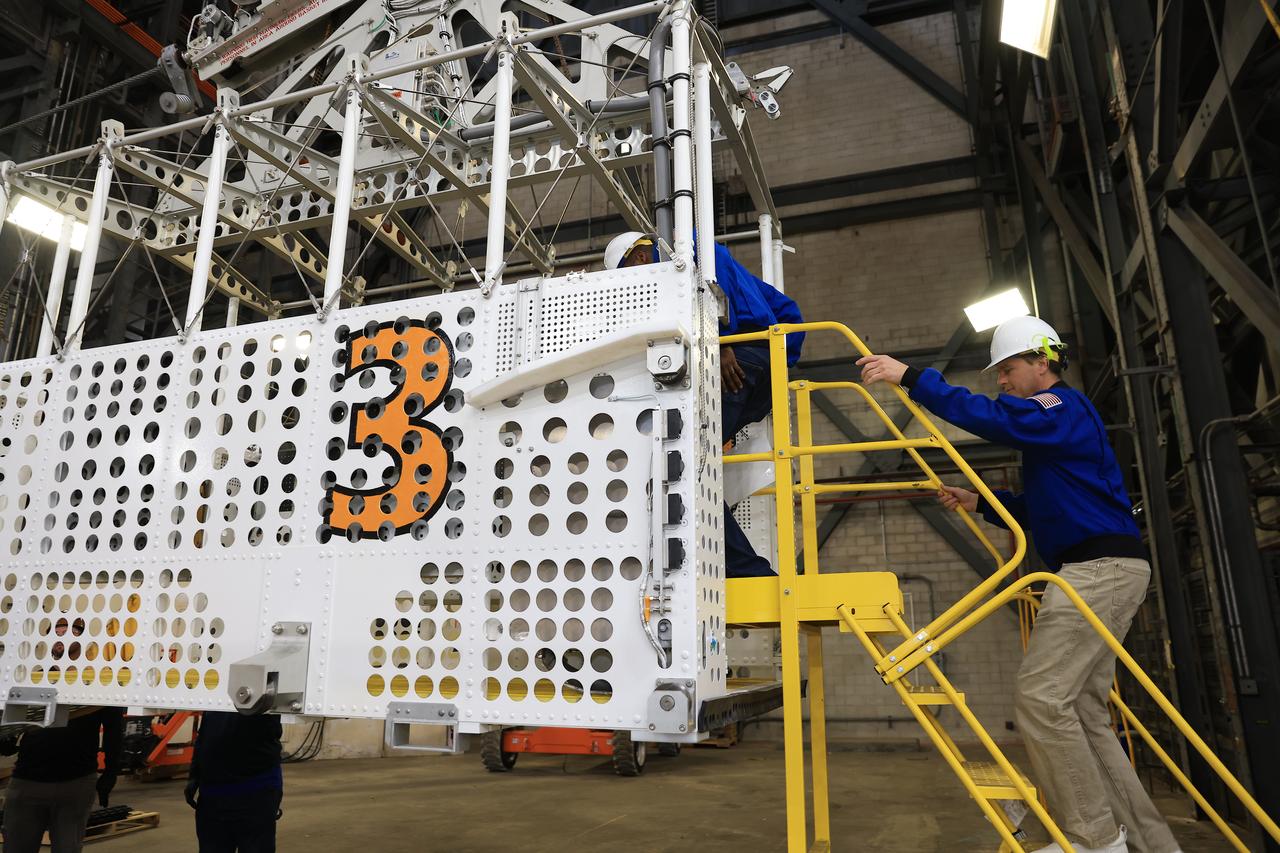
From left, NASA astronauts Andre Douglas, Artemis II backup crew member and Artemis II astronaut Reid Wiseman, commander, practice climbing into an emergency egress basket inside the Vehicle Assembly Building at NASA’s Kennedy Space Center in Florida on Thursday, Feb. 27, 2025. The baskets, similar to gondolas on ski lifts, are used in the case of a pad abort emergency to enable astronauts and other pad personnel a way to quickly escape away from the mobile launcher to the base of the pad and where waiting emergency transport vehicles will then drive them away. For Artemis II, four astronauts will venture around the Moon, the first crewed mission on NASA’s path to establishing a long-term presence for science and exploration through Artemis.
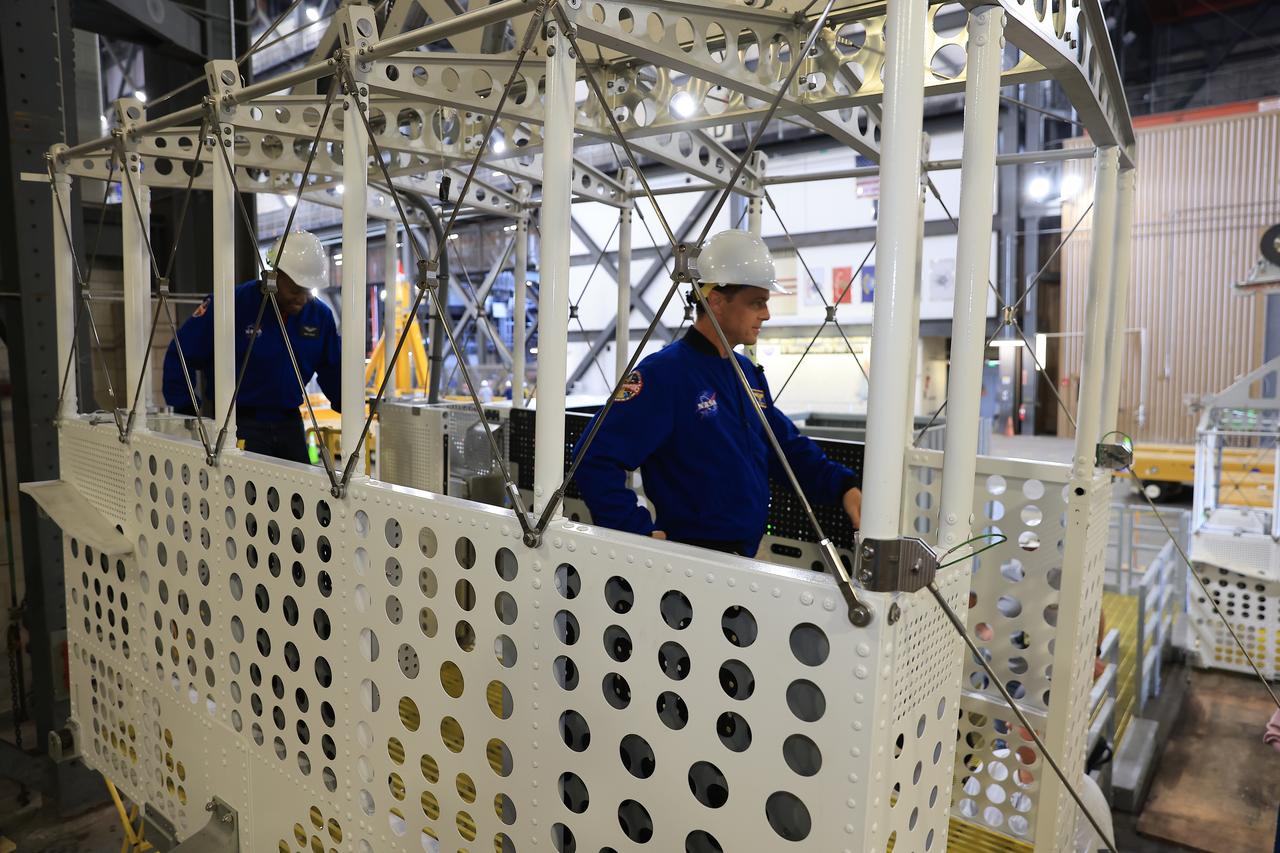
From left, NASA astronauts Andre Douglas, Artemis II backup crew member and Artemis II astronaut Reid Wiseman, commander, practice climbing into an emergency egress basket inside the Vehicle Assembly Building at NASA’s Kennedy Space Center in Florida on Thursday, Feb. 27, 2025. The baskets, similar to gondolas on ski lifts, are used in the case of a pad abort emergency to enable astronauts and other pad personnel a way to quickly escape away from the mobile launcher to the base of the pad and where waiting emergency transport vehicles will then drive them away. For Artemis II, four astronauts will venture around the Moon, the first crewed mission on NASA’s path to establishing a long-term presence for science and exploration through Artemis.
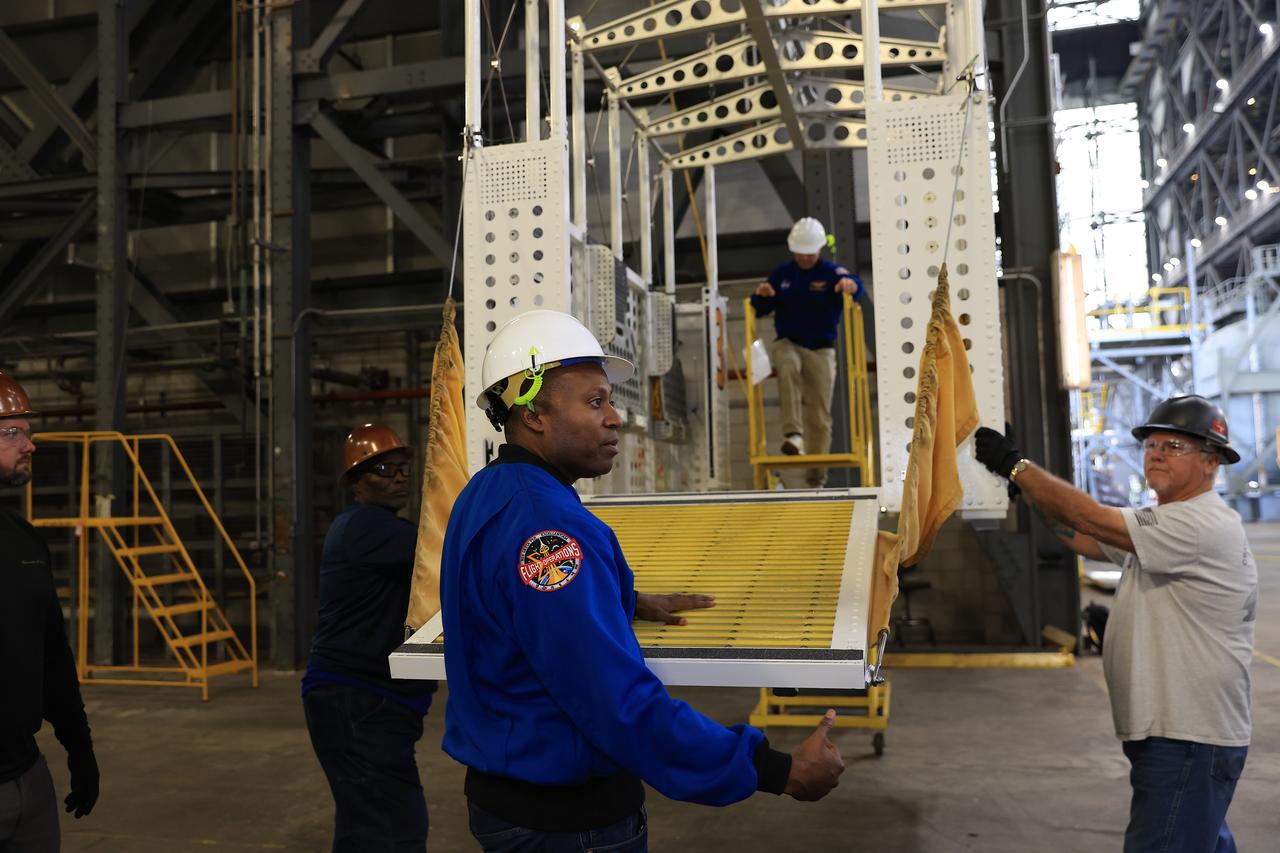
From left, NASA astronauts Andre Douglas, Artemis II backup crew member and Artemis II astronaut Reid Wiseman, commander, practice climbing into an emergency egress basket inside the Vehicle Assembly Building at NASA’s Kennedy Space Center in Florida on Thursday, Feb. 27, 2025. The baskets, similar to gondolas on ski lifts, are used in the case of a pad abort emergency to enable astronauts and other pad personnel a way to quickly escape away from the mobile launcher to the base of the pad and where waiting emergency transport vehicles will then drive them away. For Artemis II, four astronauts will venture around the Moon, the first crewed mission on NASA’s path to establishing a long-term presence for science and exploration through Artemis.
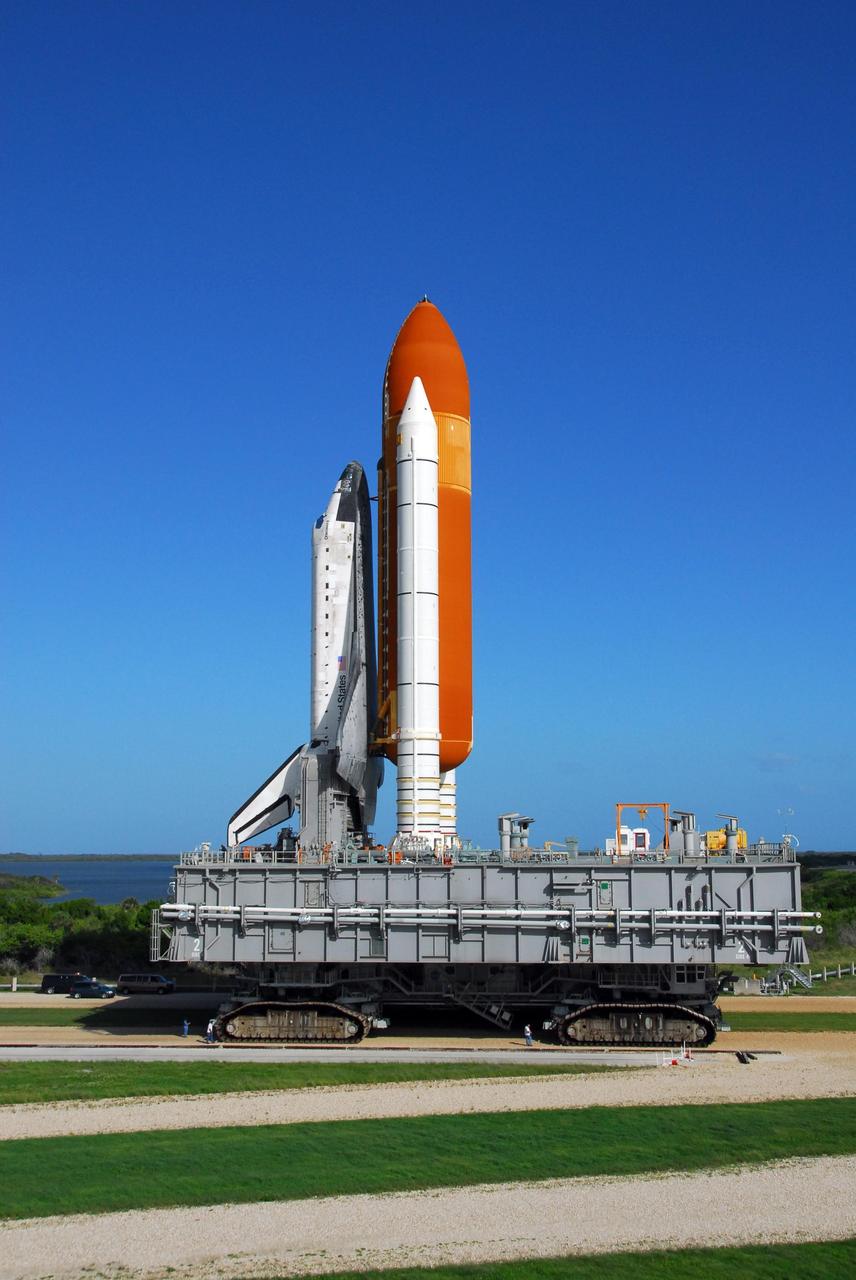
KENNEDY SPACE CENTER, FLA. -- The crawler transporter, moving Space Shuttle Discovery atop its mobile launch platform from the Vehicle Assembly Building, follows the path to Launch Pad 39A. The journey has reached the intersection in the crawlerway of the roads to Pad 39A and Pad 39B. First motion out of the VAB was at 6:47 a.m. EDT. The crawler transporter, mobile launch platform and unfueled space shuttle weigh a total of approximately 17.5 million pounds. Rollout is a milestone for Discovery's launch to the International Space Station on mission STS-120, targeted for Oct. 23. The crew will be delivering and installing the Italian-built U.S. Node 2, named Harmony. The pressurized module will act as an internal connecting port and passageway to additional international science labs and cargo spacecraft. In addition to increasing the living and working space inside the station, it also will serve as a work platform outside for the station's robotic arm. Photo credit: NASA/George Shelton
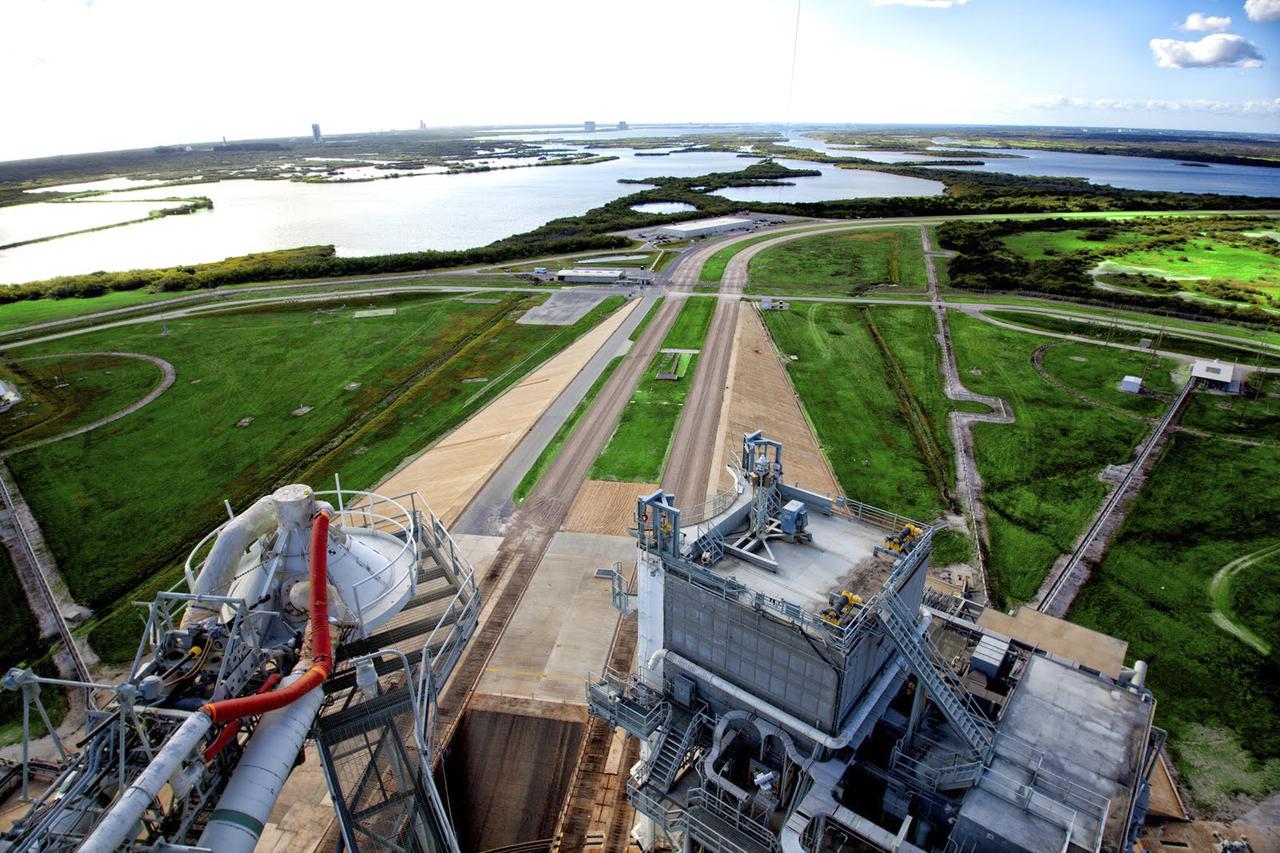
CAPE CANAVERAL, Fla. – As seen on Google Maps, the view from the top of the Fixed Service Structure at Launch Complex 39A at NASA's Kennedy Space Center. The FSS, as the structure is known, is 285 feet high and overlooks the Rotating Service Structure that was rolled into place when a space shuttle was at the pad. The path taken by NASA's massive crawler-transporters that carried the shuttle stack 3 miles from Vehicle Assembly Building are also visible leading up to the launch pad. In the distance are seen the launch pads and support structures at Cape Canaveral Air Force Station for the Atlas V, Delta IV and Falcon 9 rockets. Google precisely mapped the space center and some of its historical facilities for the company's map page. The work allows Internet users to see inside buildings at Kennedy as they were used during the space shuttle era. Photo credit: Google/Wendy Wang
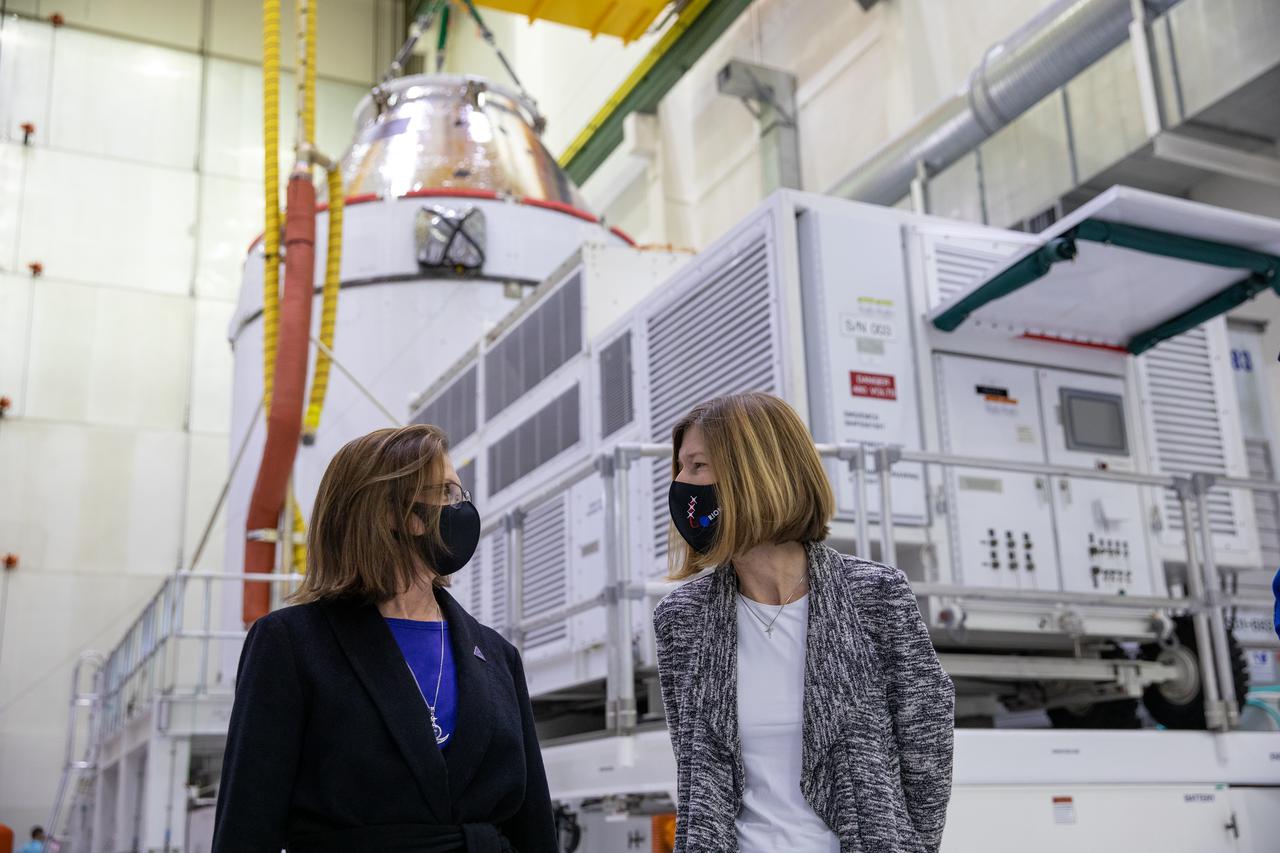
Orion is revealed for one of the final times on Jan. 14, as it is readied atop its transport pallet from the Neil Armstrong Operations and Checkout Building at NASA’s Kennedy Space Center in Florida, along its path to the pad ahead of the Artemis I launch. Viewing Orion in the high bay, from left, are Cathy Koerner, Orion Program Manager, and Kathy Lueders, associated administrator of the Human Exploration and Operations Mission Directorate. Teams across the globe have worked tirelessly to assemble the spacecraft, which will receive a protective covering prior to departing for the Multi-Payload Processing Facility to begin ground processing by the Exploration Ground Systems and Jacobs teams.
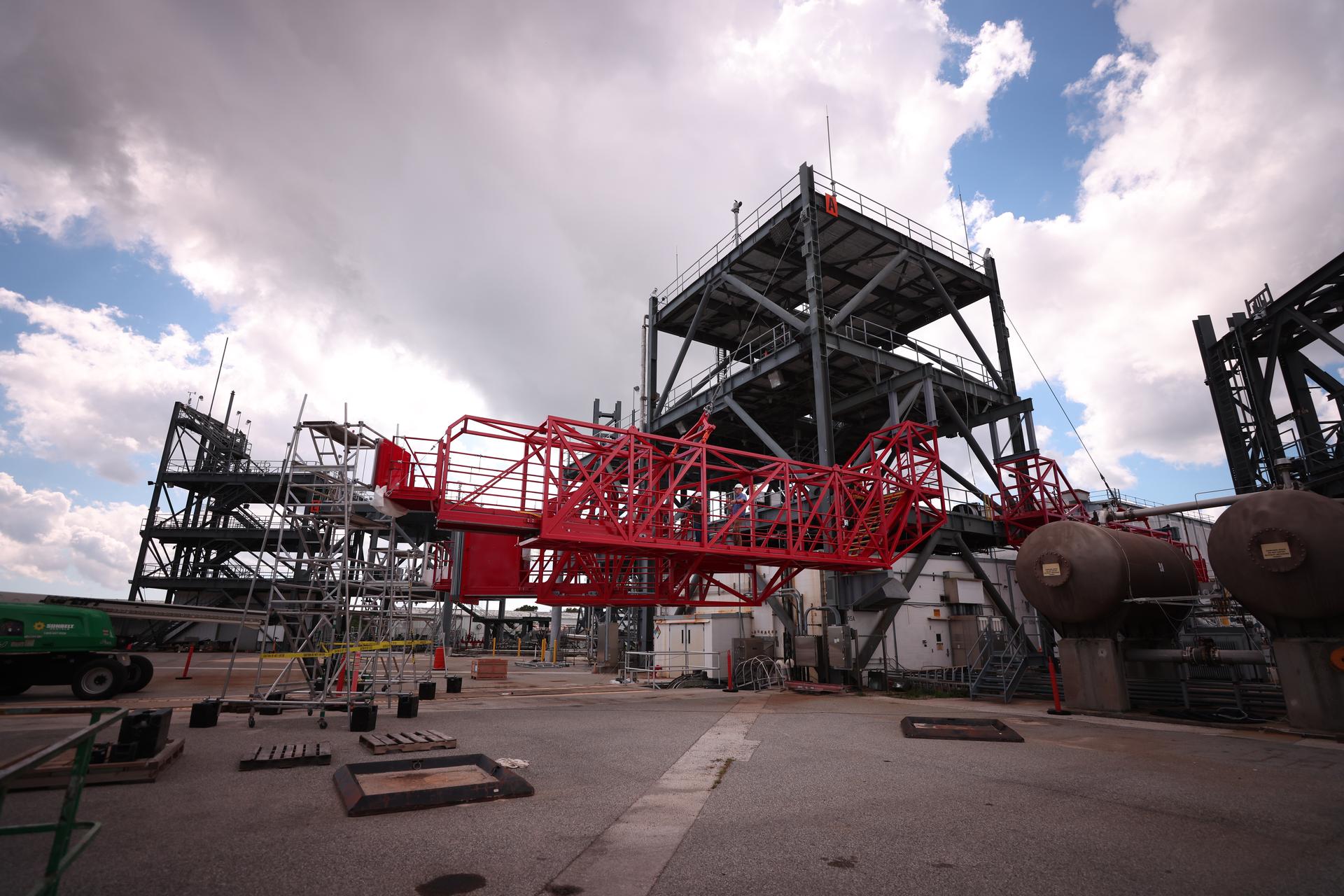
Crews test temporary contingency access platforms on the mobile launcher simulator tower on Wednesday, Oct. 29, 2025, at the Launch Equipment Test Facility at NASA’s Kennedy Space Center in Florida. The platforms will allow engineers to access the vehicle’s flight termination system on the rocket and the mobile launcher while at the pad rather than rolling back to the Vehicle Assembly Building to retest them. For Artemis II, four astronauts will venture around the Moon in early 2026, the first crewed mission on NASA’s path to establishing a long-term presence for science and exploration through Artemis.
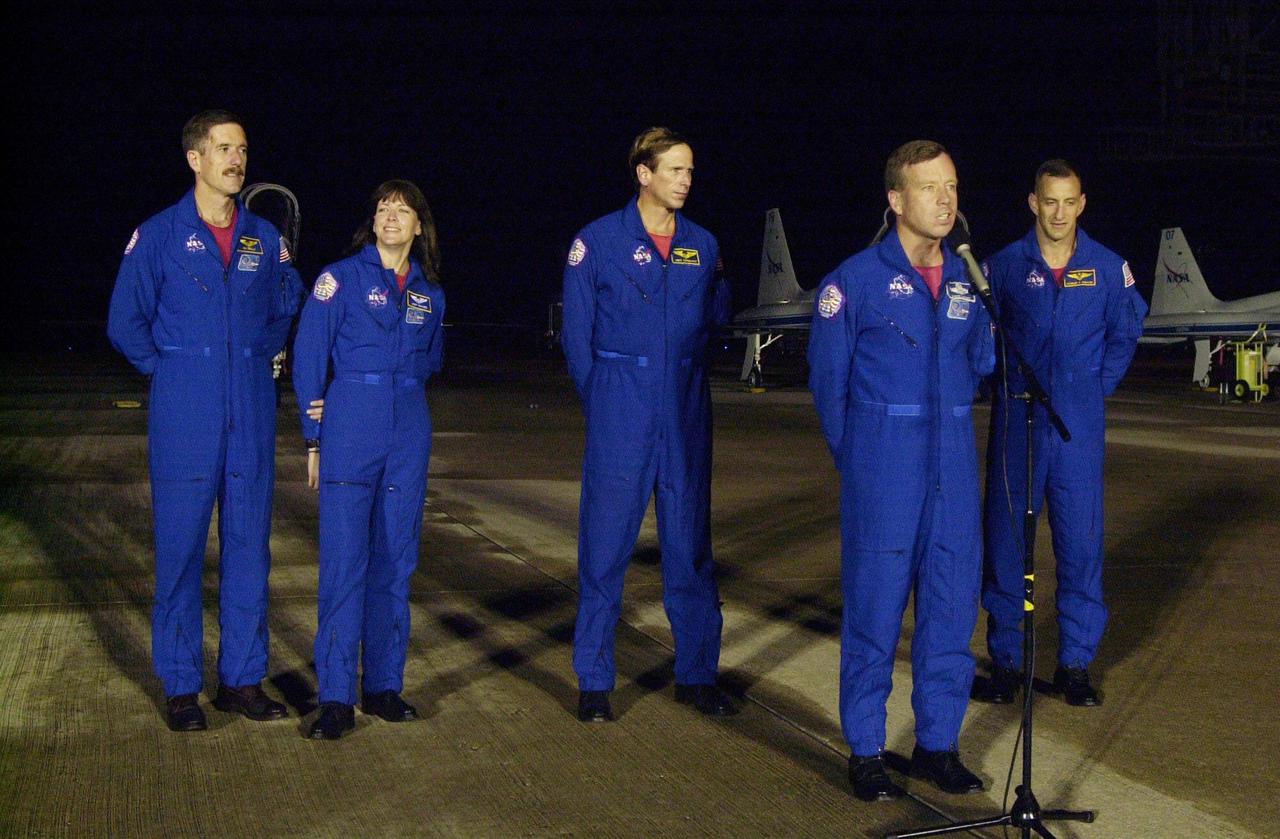
KENNEDY SPACE CENTER, Fla. -- The STS-104 crew talks to the media at the Shuttle Landing Facility after arriving at Kennedy Space Center to make final preparations for their launch. From left to right are Mission Specialists James F. Reilly, Janet Lynn Kavandi and Michael L. Gernhardt; Commander Steven W. Lindsey (at microphone); and Pilot Charles O. Hobaugh. The launch of Atlantis on mission STS-104 is scheduled for July 12 from Launch Pad 39B. The mission is the 10th assembly flight to the International Space Station and carries the Joint Airlock Module, which will become the primary path for spacewalk entry and departure using both U.S. spacesuits and the Russian Orlan spacesuit for EVA activity
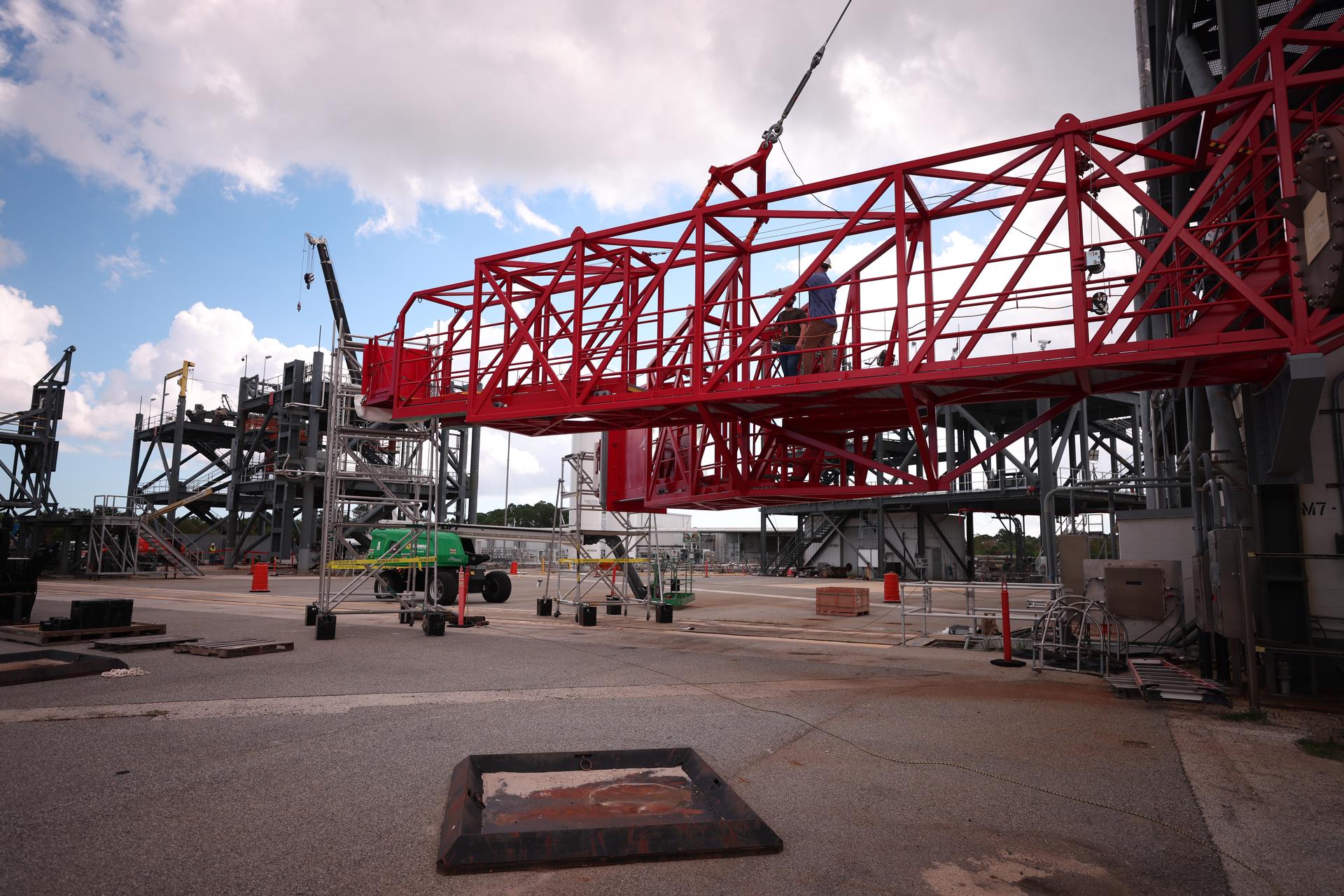
Crews test temporary contingency access platforms on the mobile launcher simulator tower on Wednesday, Oct. 29, 2025, at the Launch Equipment Test Facility at NASA’s Kennedy Space Center in Florida. The platforms will allow engineers to access the vehicle’s flight termination system on the rocket and the mobile launcher while at the pad rather than rolling back to the Vehicle Assembly Building to retest them. For Artemis II, four astronauts will venture around the Moon in early 2026, the first crewed mission on NASA’s path to establishing a long-term presence for science and exploration through Artemis.
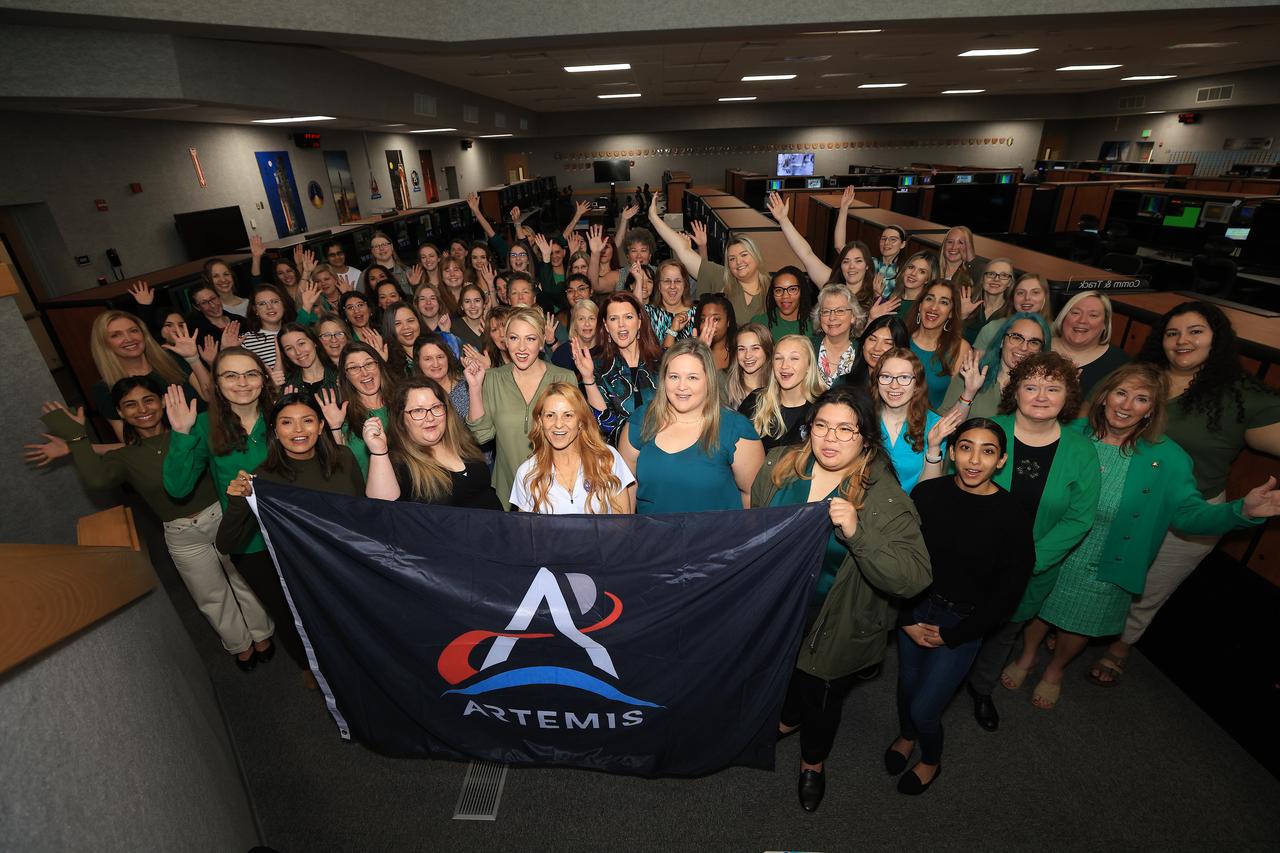
The women who comprise the Artemis launch team are photographed inside Firing Room 1 of the Launch Control Center at NASA’s Kennedy Space Center in Florida on Friday, March 15, 2024. In the second row center behind the Artemis banner is NASA’s first female Launch Director Charlie Blackwell-Thompson. The team, which is about 30% women, will launch the agency’s Artemis II mission from Kennedy’s Launch Pad 39B, the first crewed mission on NASA's path to establishing a long-term presence at the Moon for science and exploration through Artemis.

Orion is revealed for one of the final times on Jan. 14, as it is readied atop its transport pallet from the Neil Armstrong Operations and Checkout Building at NASA’s Kennedy Space Center in Florida, along its path to the pad ahead of the Artemis I launch. Orion was officially transferred from the Orion Program to Exploration Ground Systems (EGS). Mike Bolger, EGS manager, stands inside the high bay with Orion in the background. Teams across the globe have worked tirelessly to assemble the spacecraft which, will receive a protective covering prior to departing for the Multi-Payload Processing Facility to begin ground processing by the EGS and Jacobs teams.
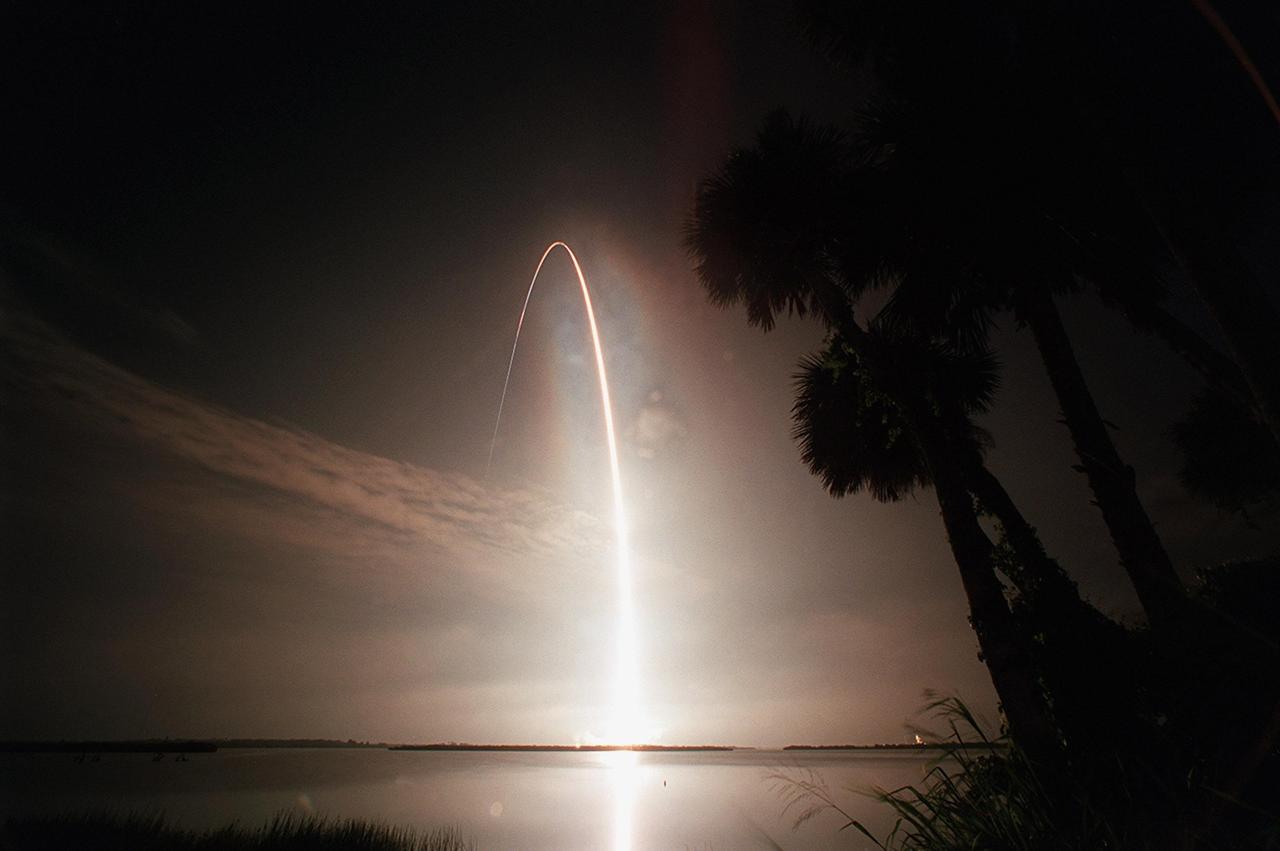
KENNEDY SPACE CENTER, Fla. -- Like a sun on a fast rise, Space Shuttle Atlantis arcs into the still-black sky over the Atlantic Ocean, casting a fiery glow on its way. Atlantis lifted off from Launch Pad 39B on time at 5:03:59 a.m. EDT. With a crew of five it is heading on the 10th assembly flight to the International Space Station. The primary payload on the mission is the joint airlock module, which will require two spacewalks to attach it to the Space Station. The airlock will be the primary path for Space Station spacewalk entry and departure for U.S. spacesuits, and will also support the Russian Orlan spacesuit for EVA activity
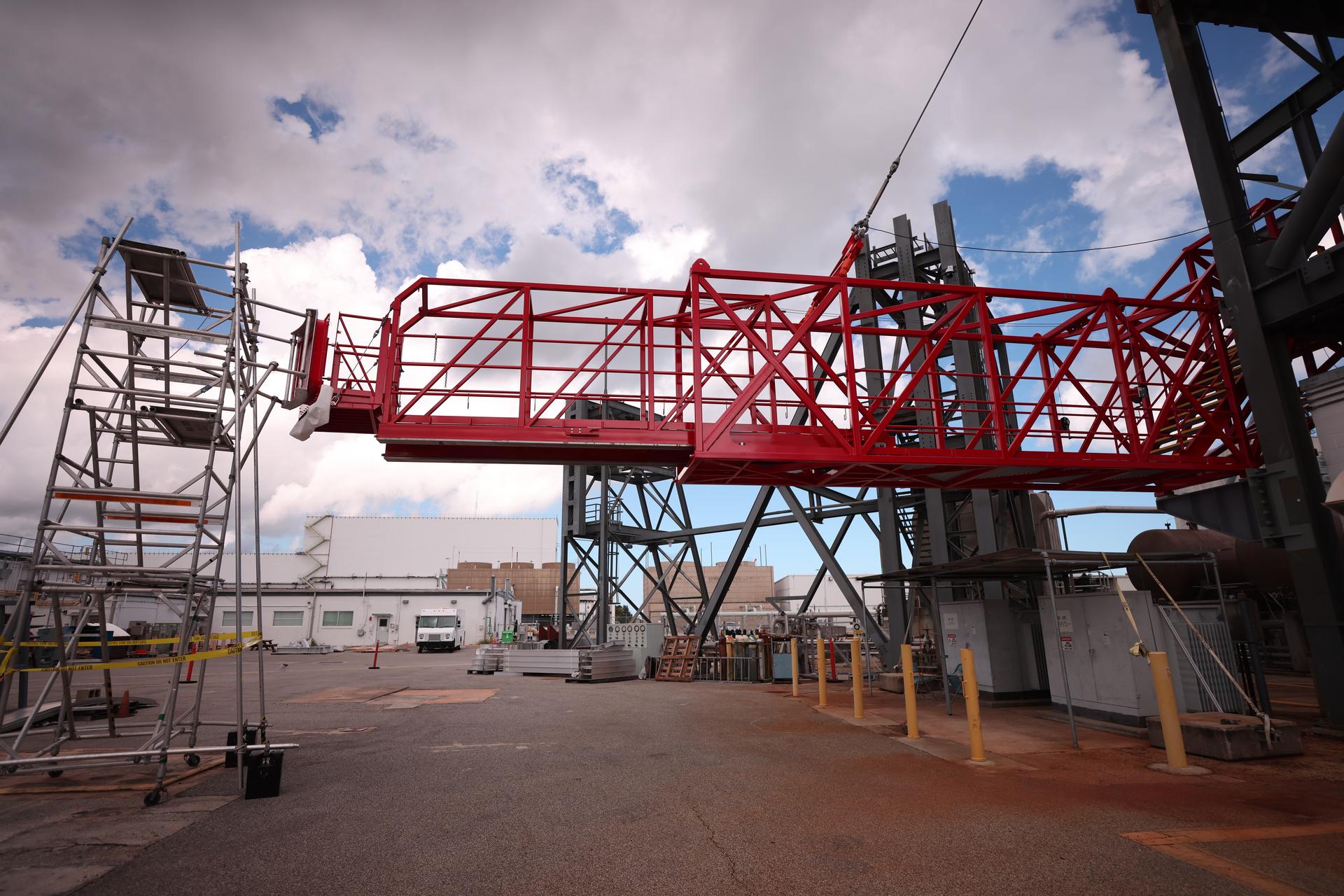
Crews test temporary contingency access platforms on the mobile launcher simulator tower on Wednesday, Oct. 29, 2025, at the Launch Equipment Test Facility at NASA’s Kennedy Space Center in Florida. The platforms will allow engineers to access the vehicle’s flight termination system on the rocket and the mobile launcher while at the pad rather than rolling back to the Vehicle Assembly Building to retest them. For Artemis II, four astronauts will venture around the Moon in early 2026, the first crewed mission on NASA’s path to establishing a long-term presence for science and exploration through Artemis.
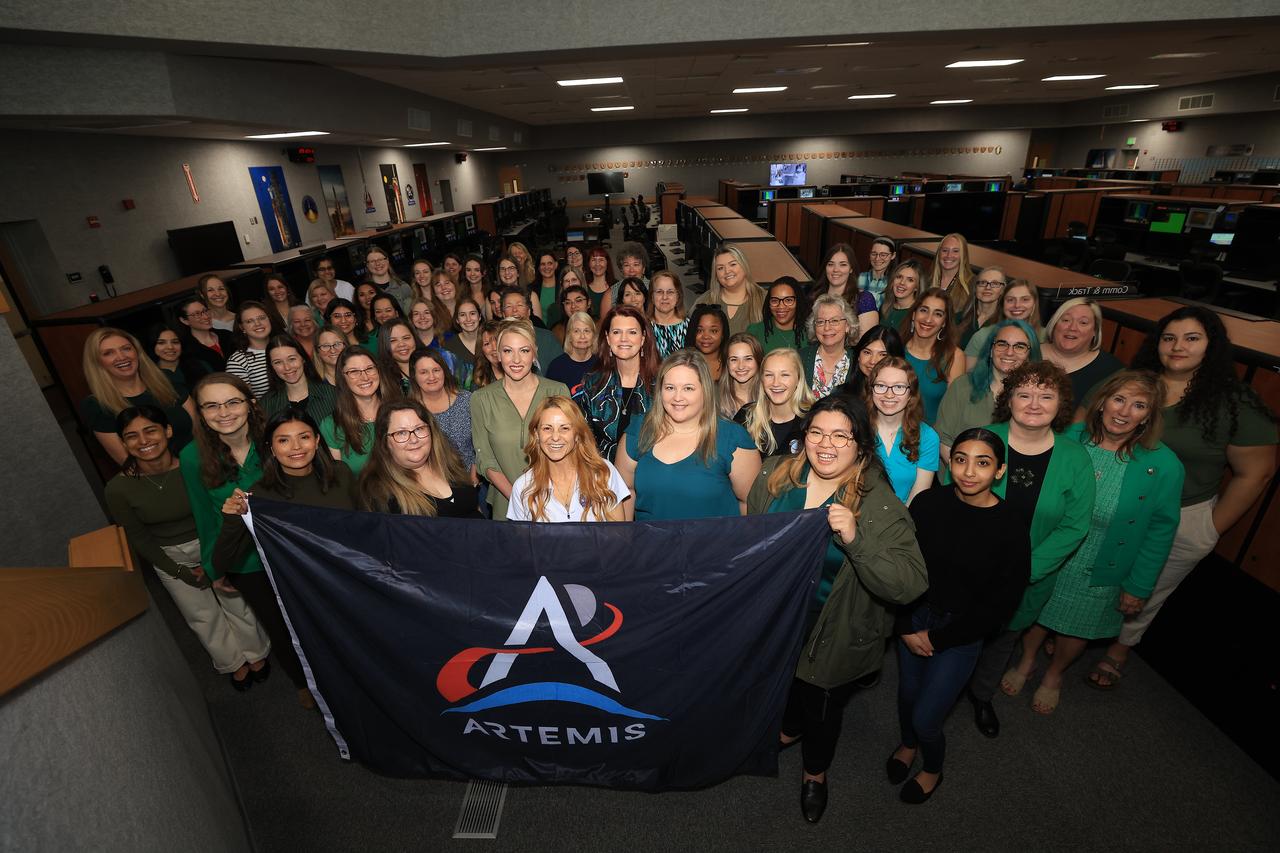
The women who comprise the Artemis launch team are photographed inside Firing Room 1 of the Launch Control Center at NASA’s Kennedy Space Center in Florida on Friday, March 15, 2024. In the second row center behind the Artemis banner is NASA’s first female Launch Director Charlie Blackwell-Thompson. The team, which is about 30% women, will launch the agency’s Artemis II mission from Kennedy’s Launch Pad 39B, the first crewed mission on NASA's path to establishing a long-term presence at the Moon for science and exploration through Artemis.
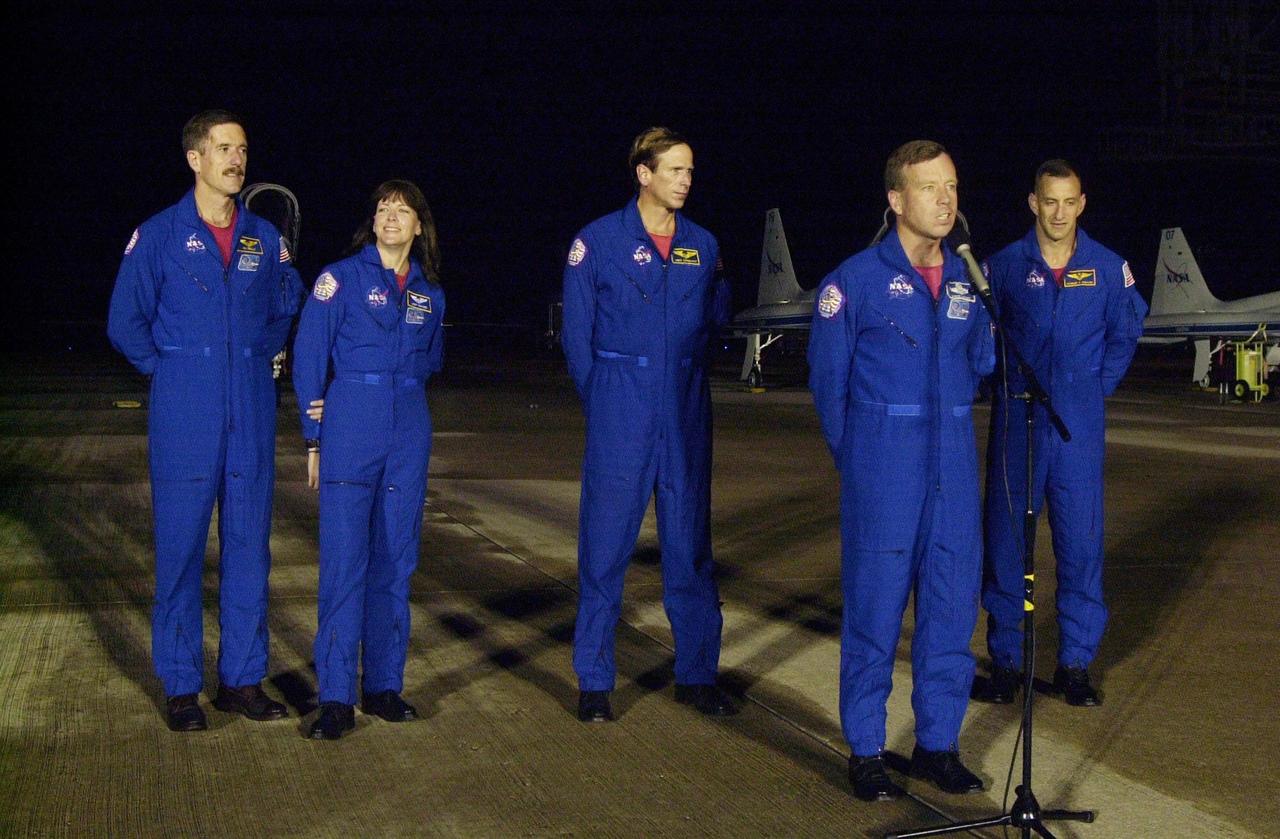
KENNEDY SPACE CENTER, Fla. -- The STS-104 crew talks to the media at the Shuttle Landing Facility after arriving at Kennedy Space Center to make final preparations for their launch. From left to right are Mission Specialists James F. Reilly, Janet Lynn Kavandi and Michael L. Gernhardt; Commander Steven W. Lindsey (at microphone); and Pilot Charles O. Hobaugh. The launch of Atlantis on mission STS-104 is scheduled for July 12 from Launch Pad 39B. The mission is the 10th assembly flight to the International Space Station and carries the Joint Airlock Module, which will become the primary path for spacewalk entry and departure using both U.S. spacesuits and the Russian Orlan spacesuit for EVA activity
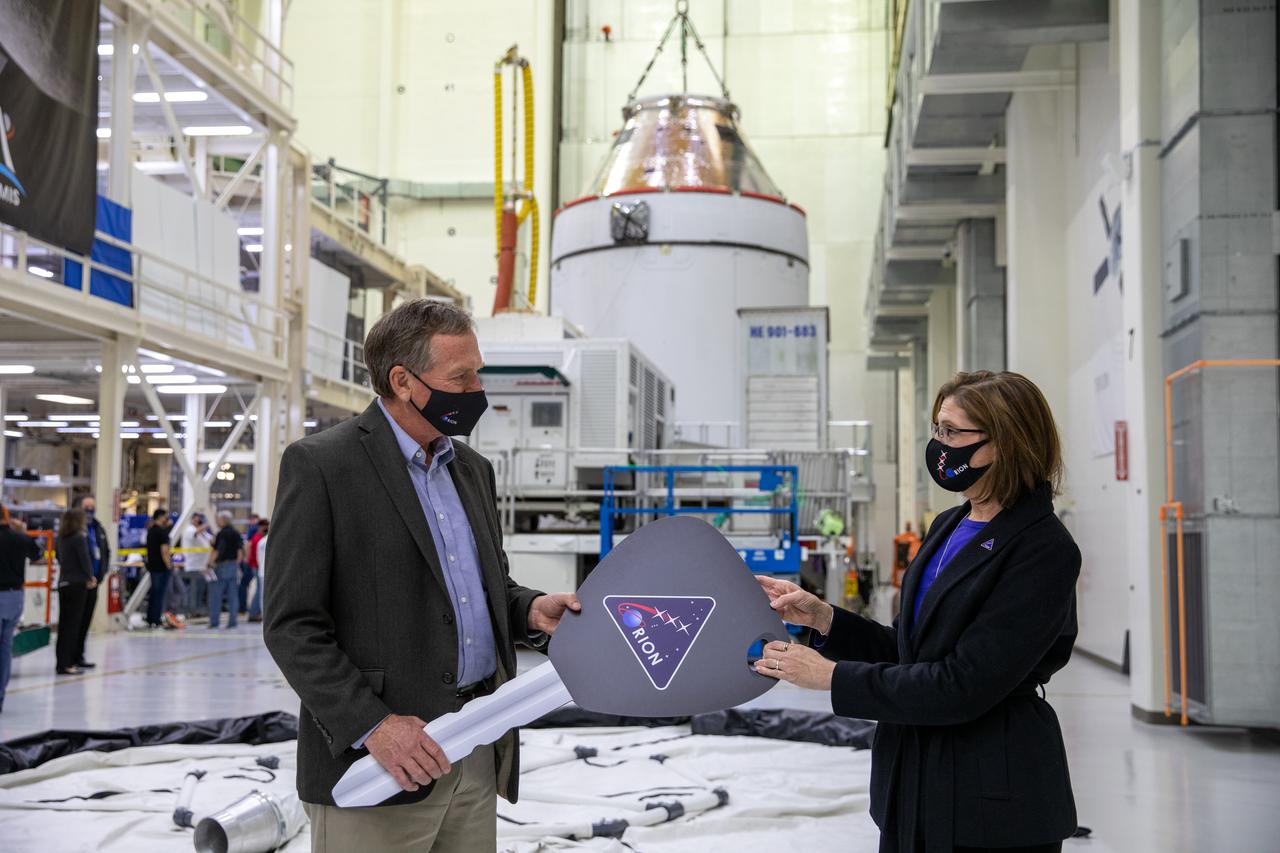
Orion is revealed for one of the final times on Jan. 14, as it is readied atop its transport pallet from the Neil Armstrong Operations and Checkout Building at NASA’s Kennedy Space Center in Florida, along its path to the pad ahead of the Artemis I launch. Mike Bolger, at left, manager of Exploration Ground Systems (EGS), receives the “key” to Orion from Cathy Koerner, Orion Program manager signifying the transfer of the spacecraft from the assembly to the ground system processing team. Teams across the globe have worked tirelessly to assemble the spacecraft, which will receive a protective covering prior to departing for the Multi-Payload Processing Facility to begin ground processing by the EGS and Jacobs teams.
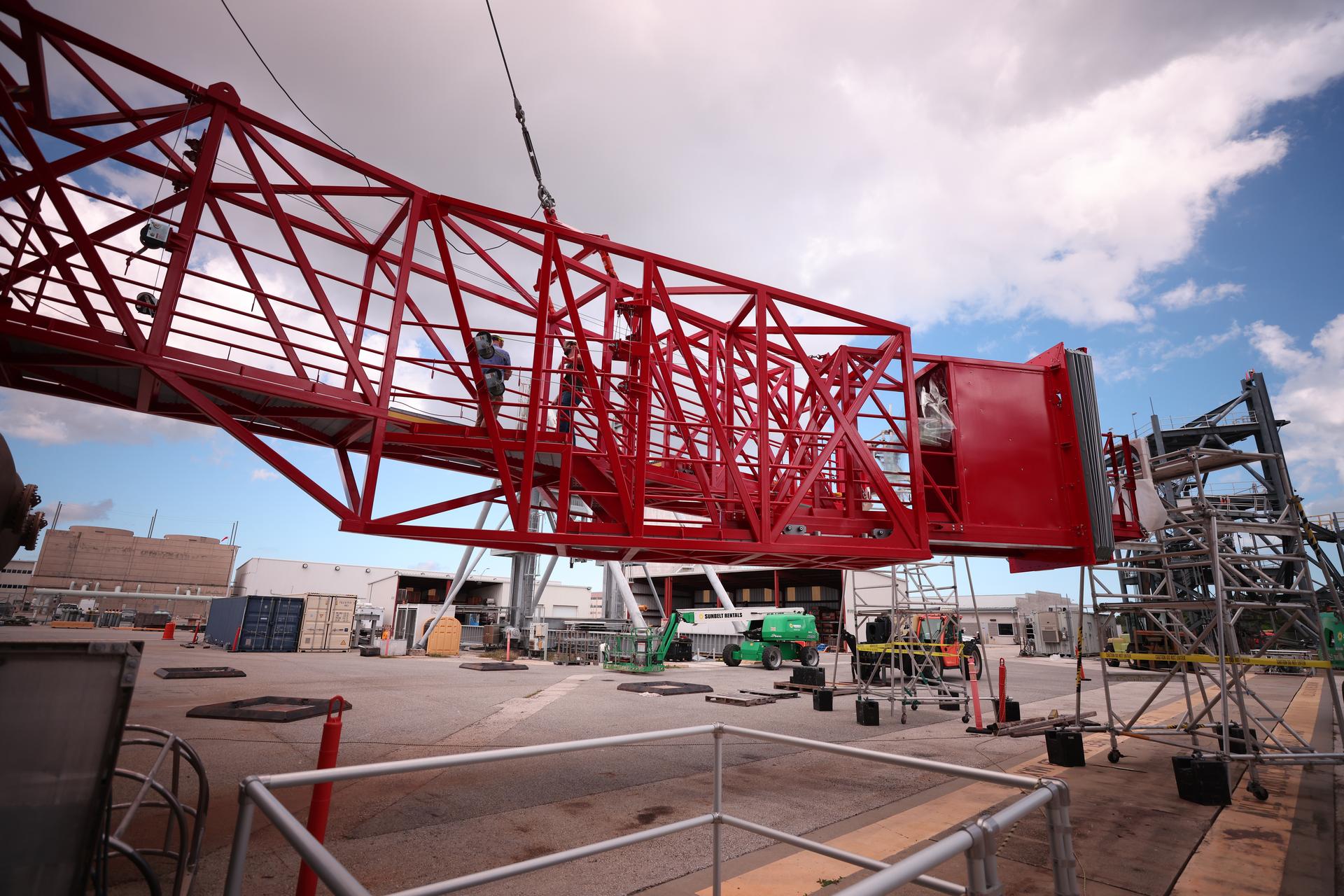
Crews test temporary contingency access platforms on the mobile launcher simulator tower on Wednesday, Oct. 29, 2025, at the Launch Equipment Test Facility at NASA’s Kennedy Space Center in Florida. The platforms will allow engineers to access the vehicle’s flight termination system on the rocket and the mobile launcher while at the pad rather than rolling back to the Vehicle Assembly Building to retest them. For Artemis II, four astronauts will venture around the Moon in early 2026, the first crewed mission on NASA’s path to establishing a long-term presence for science and exploration through Artemis.
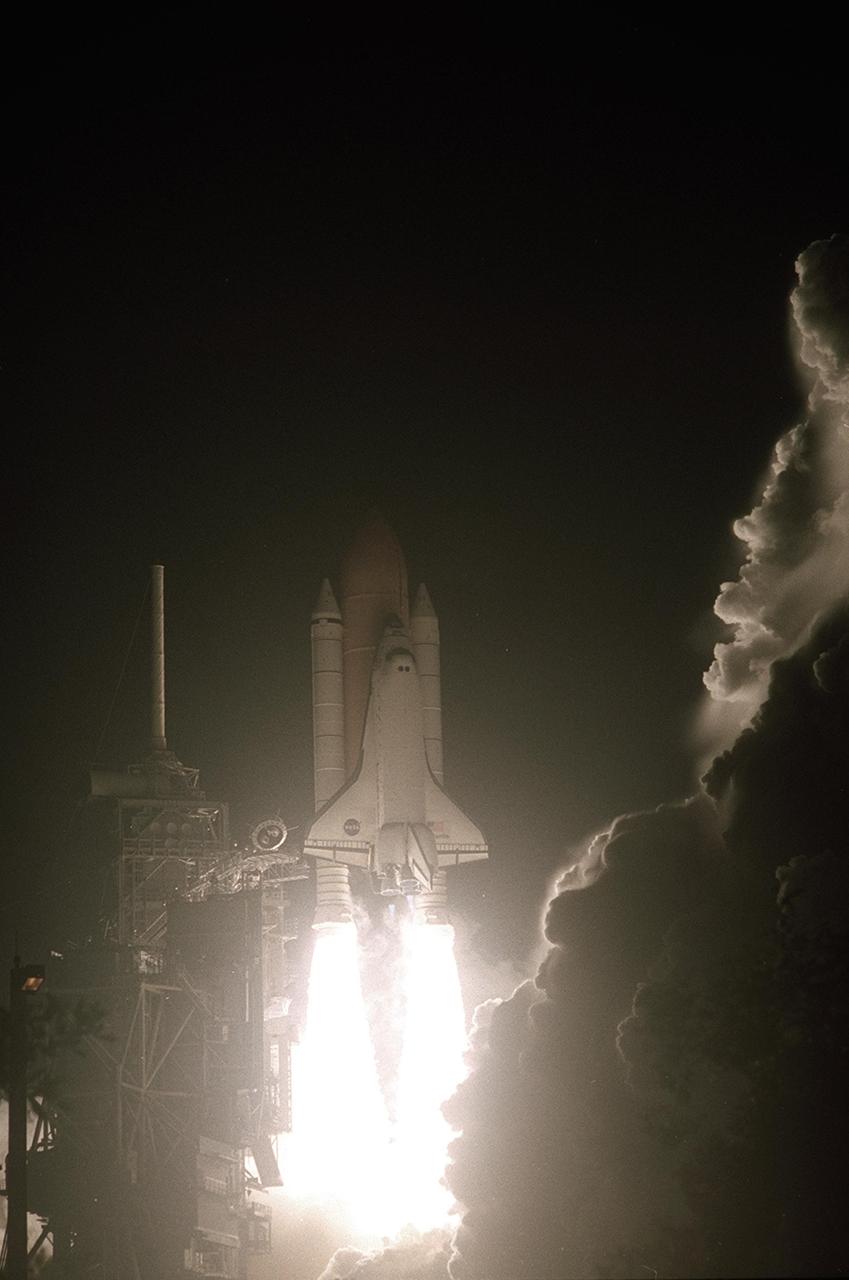
KENNEDY SPACE CENTER, Fla. -- Space Shuttle Atlantis appears to leap from a fiery ball as it hurtles into the pre-dawn sky on mission STS-104. Atlantis lifted off from Launch Pad 39B on time at 5:03:59 a.m. EDT. With a crew of five, it is heading on the 10th assembly flight to the International Space Station. The primary payload on the mission is the joint airlock module, which will require two spacewalks to attach it to the Space Station. The airlock will be the primary path for Space Station spacewalk entry and departure for U.S. spacesuits, and will also support the Russian Orlan spacesuit for EVA activity
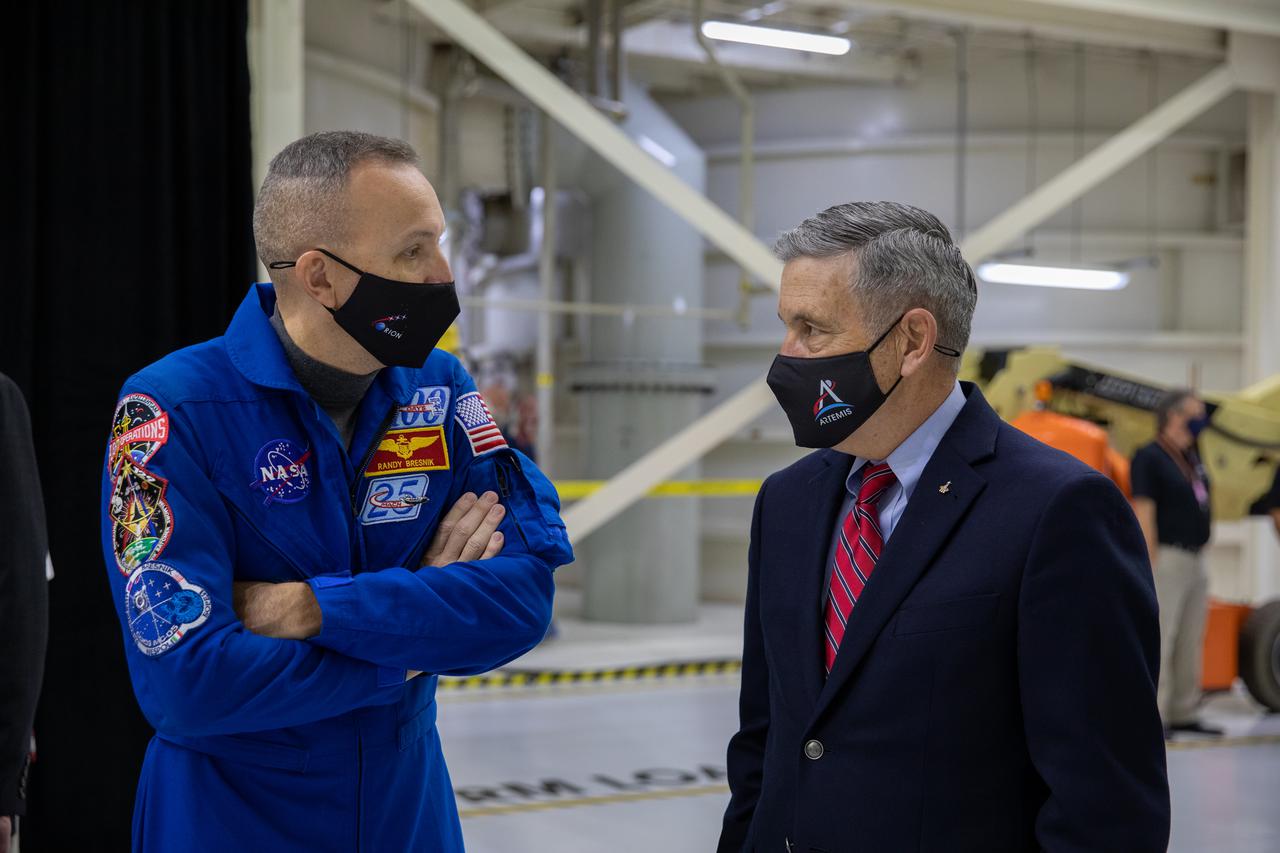
Orion is revealed for one of the final times on Jan. 14, as it is readied atop its transport pallet from the Neil Armstrong Operations and Checkout Building at NASA’s Kennedy Space Center in Florida, along its path to the pad ahead of the Artemis I launch. Orion was officially transferred from the Orion Program to Exploration Ground Systems (EGS) during a handover ceremony. NASA astronaut Randy Bresnik speaks with Kennedy Center Director Bob Cabana inside the high bay. Teams across the globe have worked tirelessly to assemble the spacecraft, which will receive a protective covering prior to departing for the Multi-Payload Processing Facility to begin ground processing by the EGS and Jacobs teams.
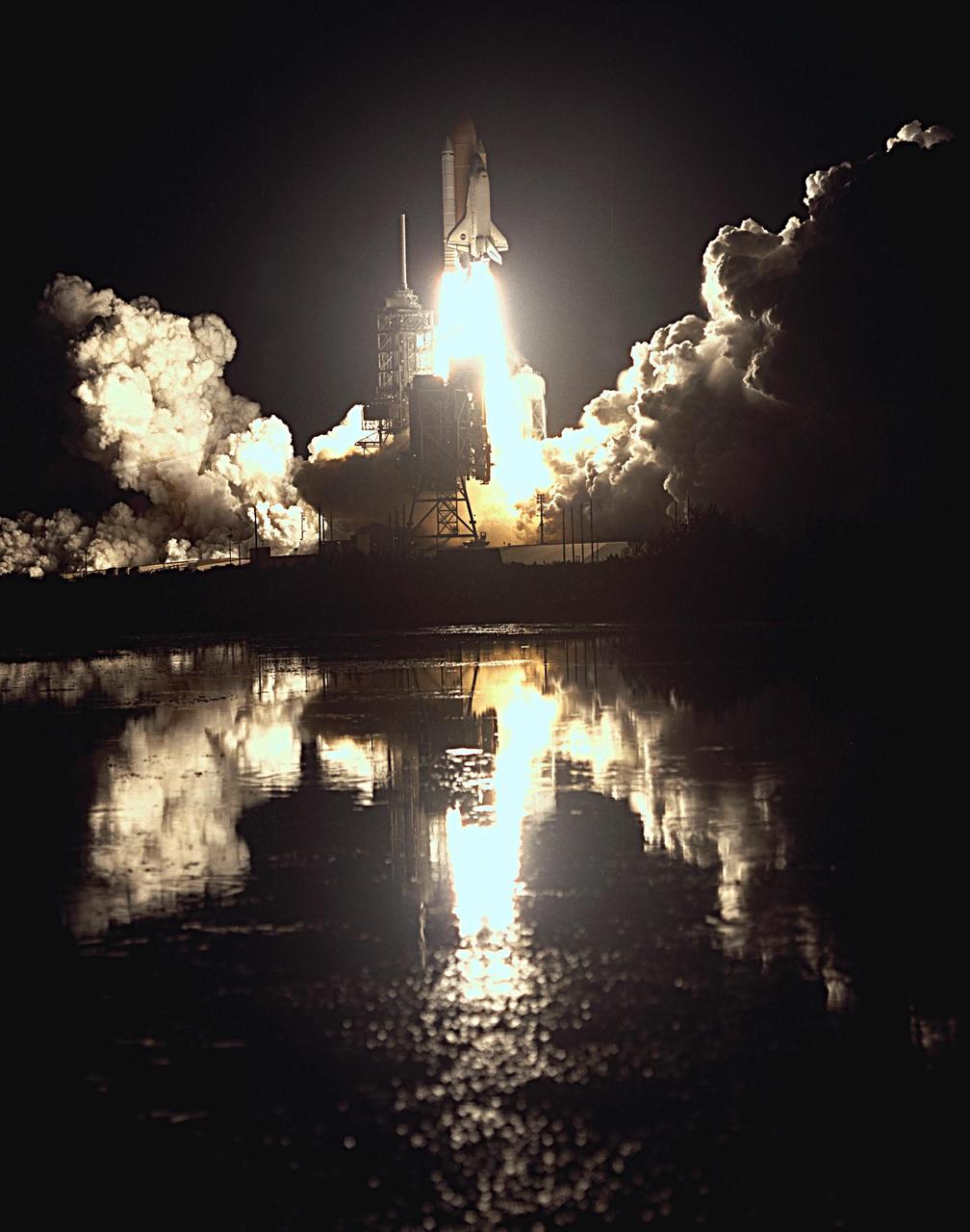
KENNEDY SPACE CENTER, FLA. - Water near Launch Pad 39A provides a mirror image of Space Shuttle Endeavour blazing a path into the night sky after launch on mission STS-113. Liftoff occurred ontime at 7:49:47 p.m. EST. The launch is the 19th for Endeavour, and the 112th flight in the Shuttle program. Mission STS-113 is the 16th assembly flight to the International Space Station, carrying another structure for the Station, the P1 integrated truss. Also onboard are the Expedition 6 crew, who will replace Expedition 5. Endeavour is scheduled to land at KSC after an 11-day journey.
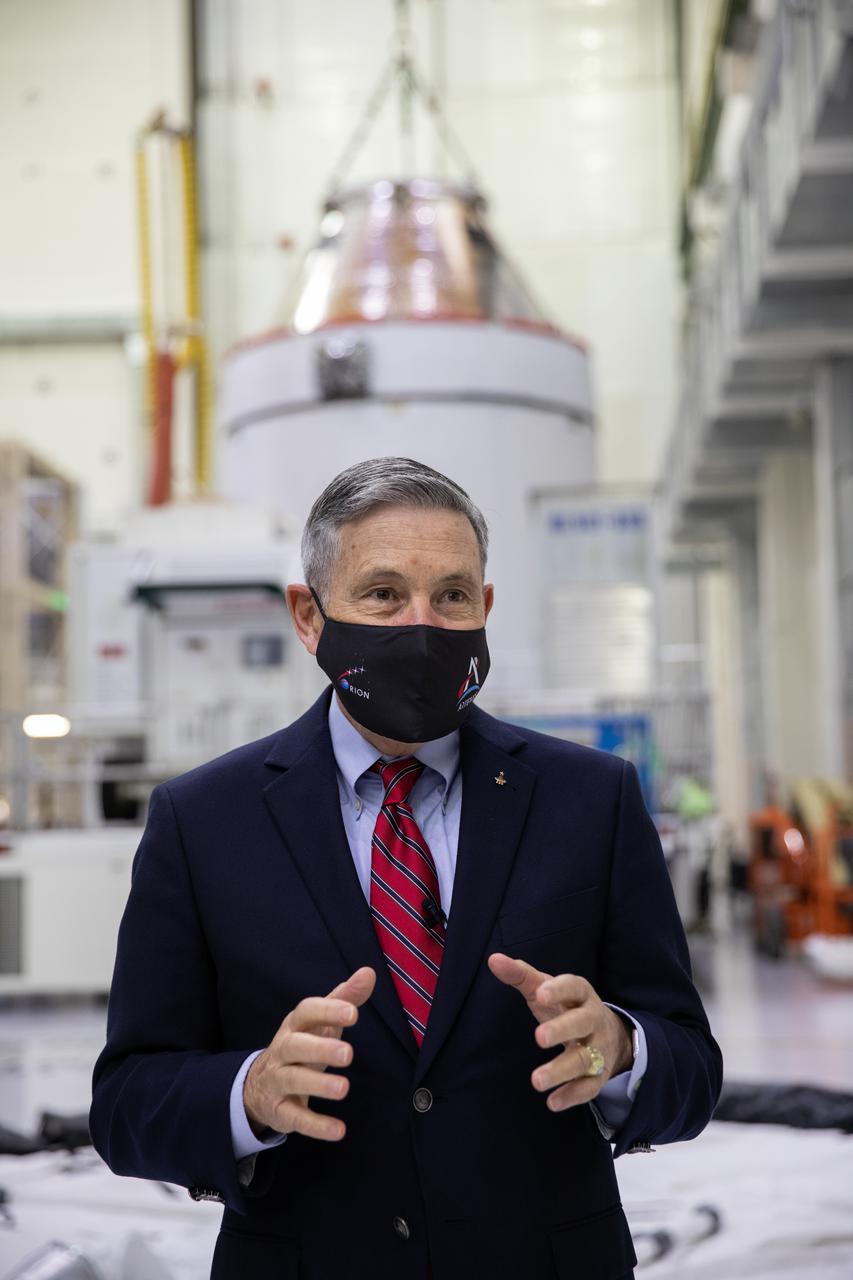
Orion is revealed for one of the final times on Jan. 14, as it is readied atop its transport pallet from the Neil Armstrong Operations and Checkout Building at NASA’s Kennedy Space Center in Florida, along its path to the pad ahead of the Artemis I launch. Kennedy Center Director Bob Cabana speaks to workers in front of Orion in the high bay. Teams across the globe have worked tirelessly to assemble the spacecraft, which will receive a protective covering prior to departing for the Multi-Payload Processing Facility to begin ground processing by the Exploration Ground Systems and Jacobs teams.
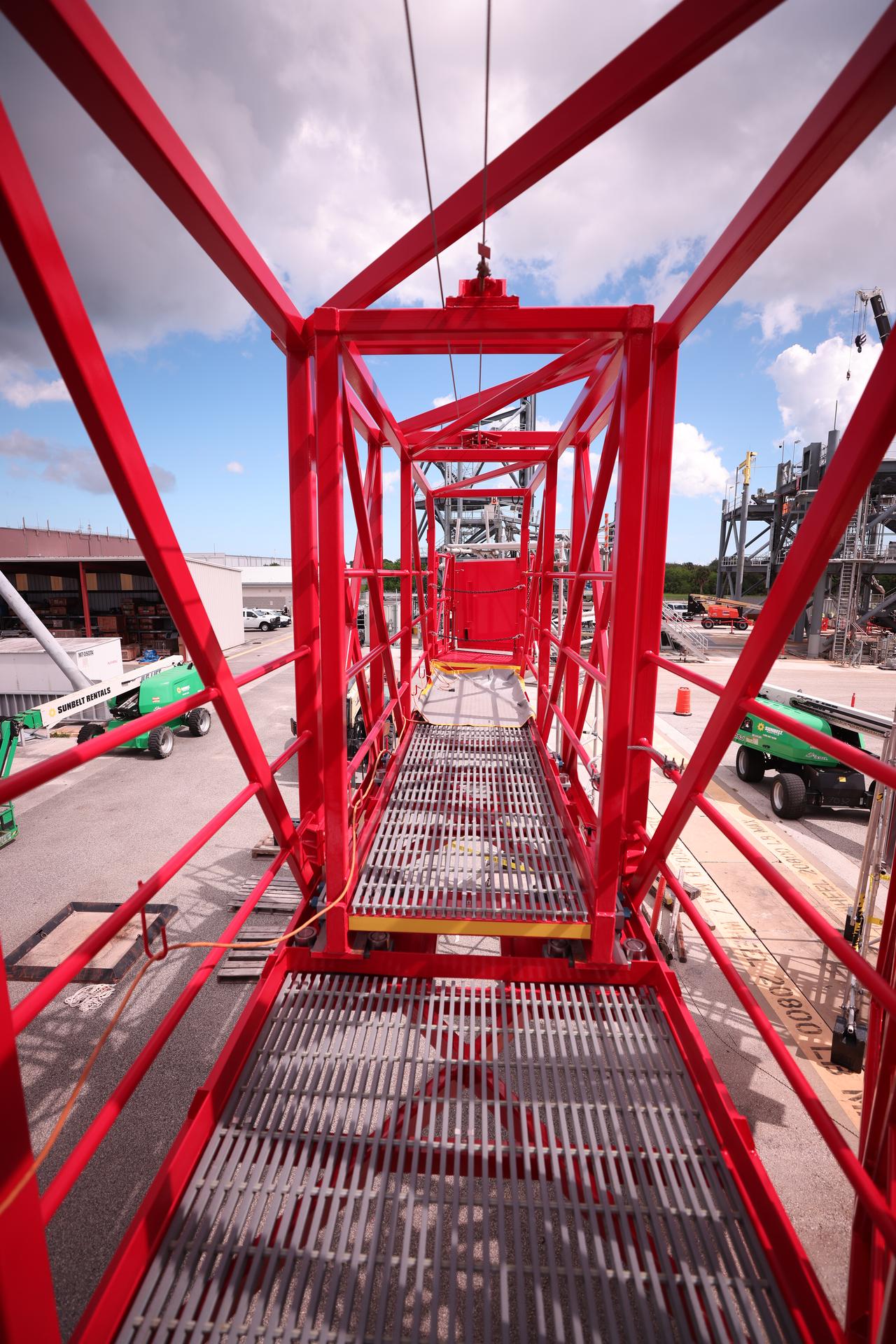
Crews test temporary contingency access platforms on the mobile launcher simulator tower on Wednesday, Oct. 29, 2025, at the Launch Equipment Test Facility at NASA’s Kennedy Space Center in Florida. The platforms will allow engineers to access the vehicle’s flight termination system on the rocket and the mobile launcher while at the pad rather than rolling back to the Vehicle Assembly Building to retest them. For Artemis II, four astronauts will venture around the Moon in early 2026, the first crewed mission on NASA’s path to establishing a long-term presence for science and exploration through Artemis.
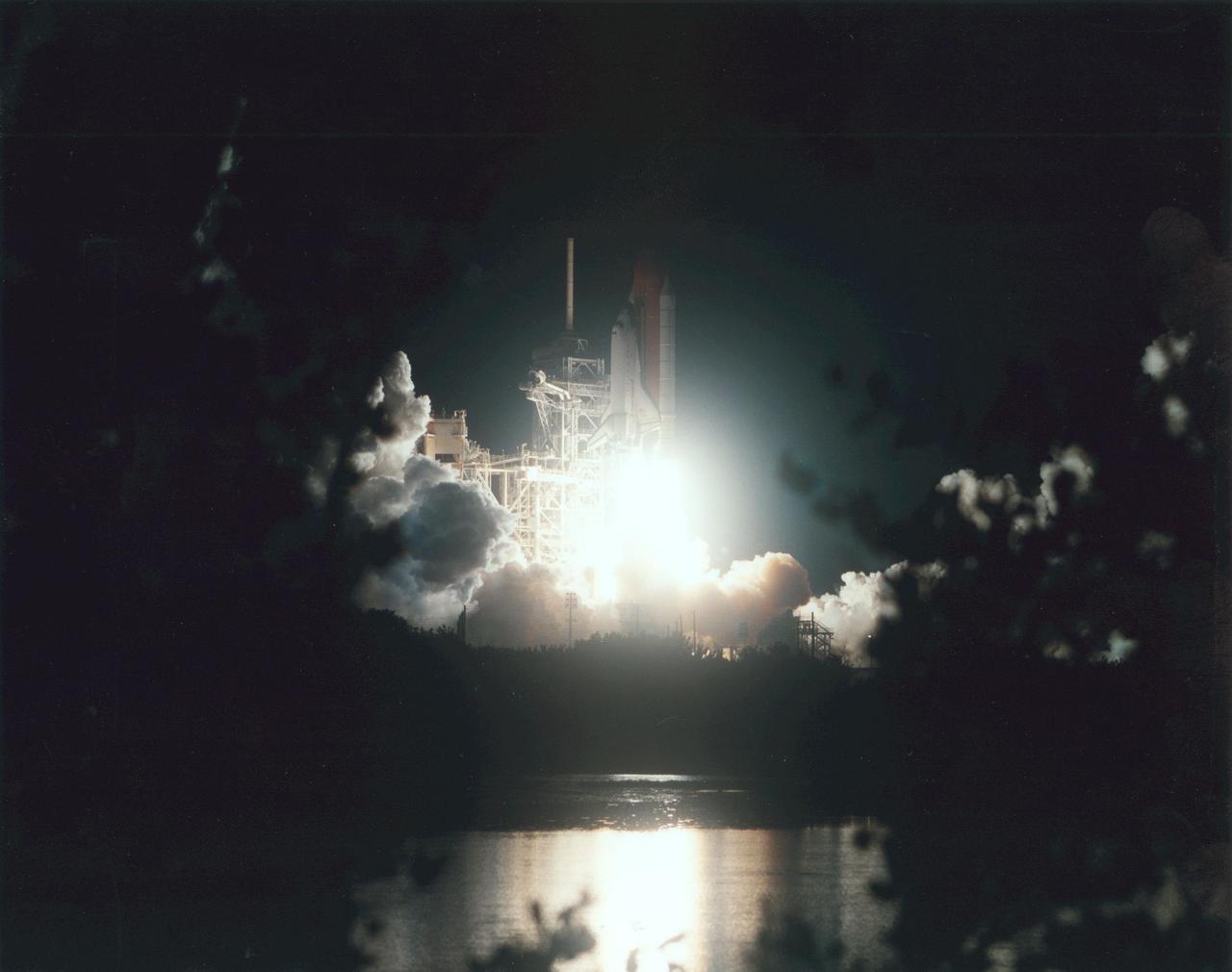
KENNEDY SPACE CENTER, Fla. -- Space Shuttle Atlantis lifts off in a blaze of light that spotlights it against the still-black sky and reflects in the nearby waters. Launch of Atlantis on mission STS-104 from Pad 39B was on time at 5:03:59 a.m. EDT. The 10th assembly flight to the International Space Station, the mission is delivering the joint airlock module, which will require two spacewalks to attach it to the Space Station. The airlock will be the primary path for Space Station spacewalk entry and departure for U.S. spacesuits, and will also support the Russian Orlan spacesuit for EVA activity
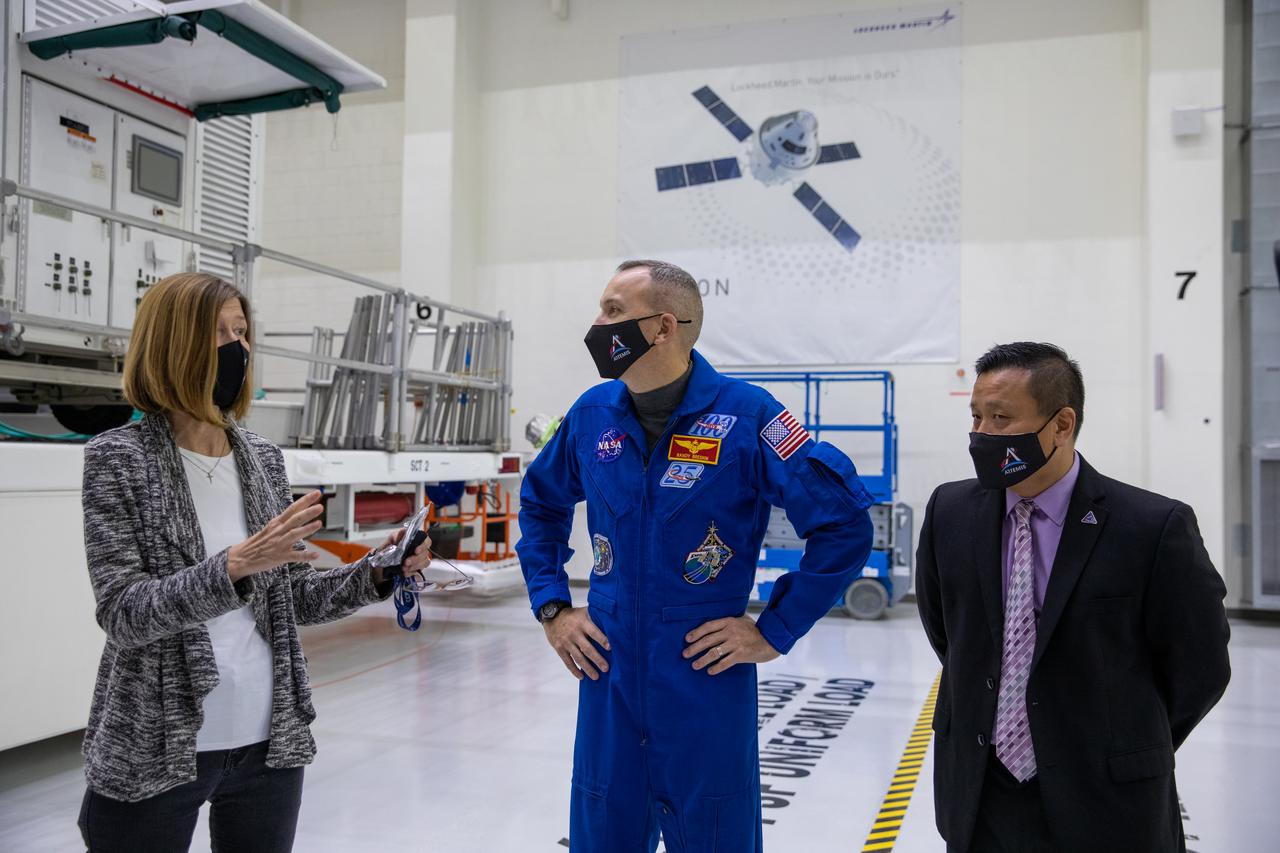
Orion is revealed for one of the final times on Jan. 14, as it is readied atop its transport pallet from the Neil Armstrong Operations and Checkout Building at NASA’s Kennedy Space Center in Florida, along its path to the pad ahead of the Artemis I launch. Touring the high bay, from left, are Kathy Lueders, associate administrator of the Human Exploration and Operations Mission Directorate, NASA astronaut Randy Bresnik, and Howard Hu, Orion Deputy Program manager. Teams across the globe have worked tirelessly to assemble the spacecraft, which will receive a protective covering prior to departing for the Multi-Payload Processing Facility to begin ground processing by the Exploration Ground Systems and Jacobs teams.
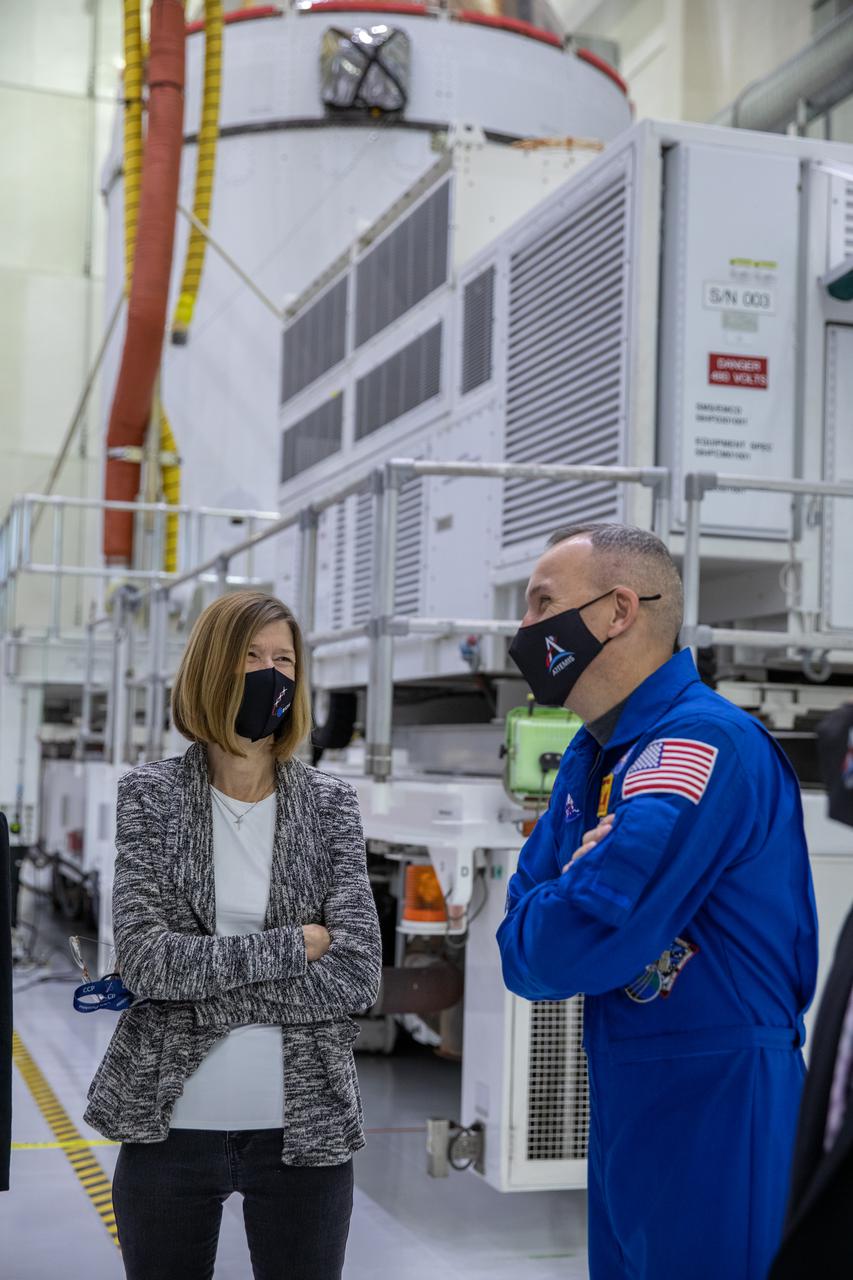
Orion is revealed for one of the final times on Jan. 14, as it is readied atop its transport pallet from the Neil Armstrong Operations and Checkout Building at NASA’s Kennedy Space Center in Florida, along its path to the pad ahead of the Artemis I launch. Touring the high bay, from left, are Kathy Lueders, associate administrator of the Human Exploration and Operations Mission Directorate, and NASA astronaut Randy Bresnik. Teams across the globe have worked tirelessly to assemble the spacecraft, which will receive a protective covering prior to departing for the Multi-Payload Processing Facility to begin ground processing by the Exploration Ground Systems and Jacobs teams.
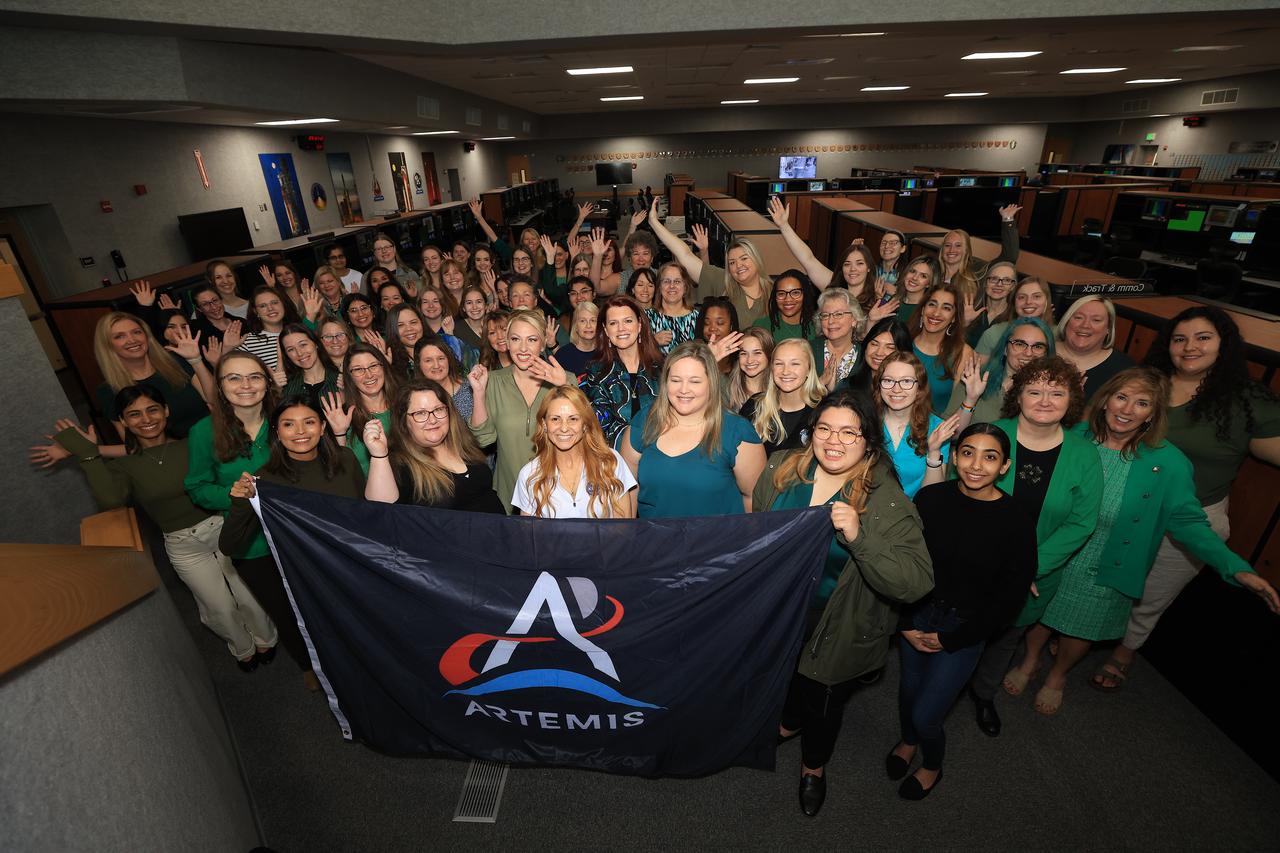
The women who comprise the Artemis launch team are photographed inside Firing Room 1 of the Launch Control Center at NASA’s Kennedy Space Center in Florida on Friday, March 15, 2024. In the second row center behind the Artemis banner is NASA’s first female Launch Director Charlie Blackwell-Thompson. The team, which is about 30% women, will launch the agency’s Artemis II mission from Kennedy’s Launch Pad 39B, the first crewed mission on NASA's path to establishing a long-term presence at the Moon for science and exploration through Artemis.
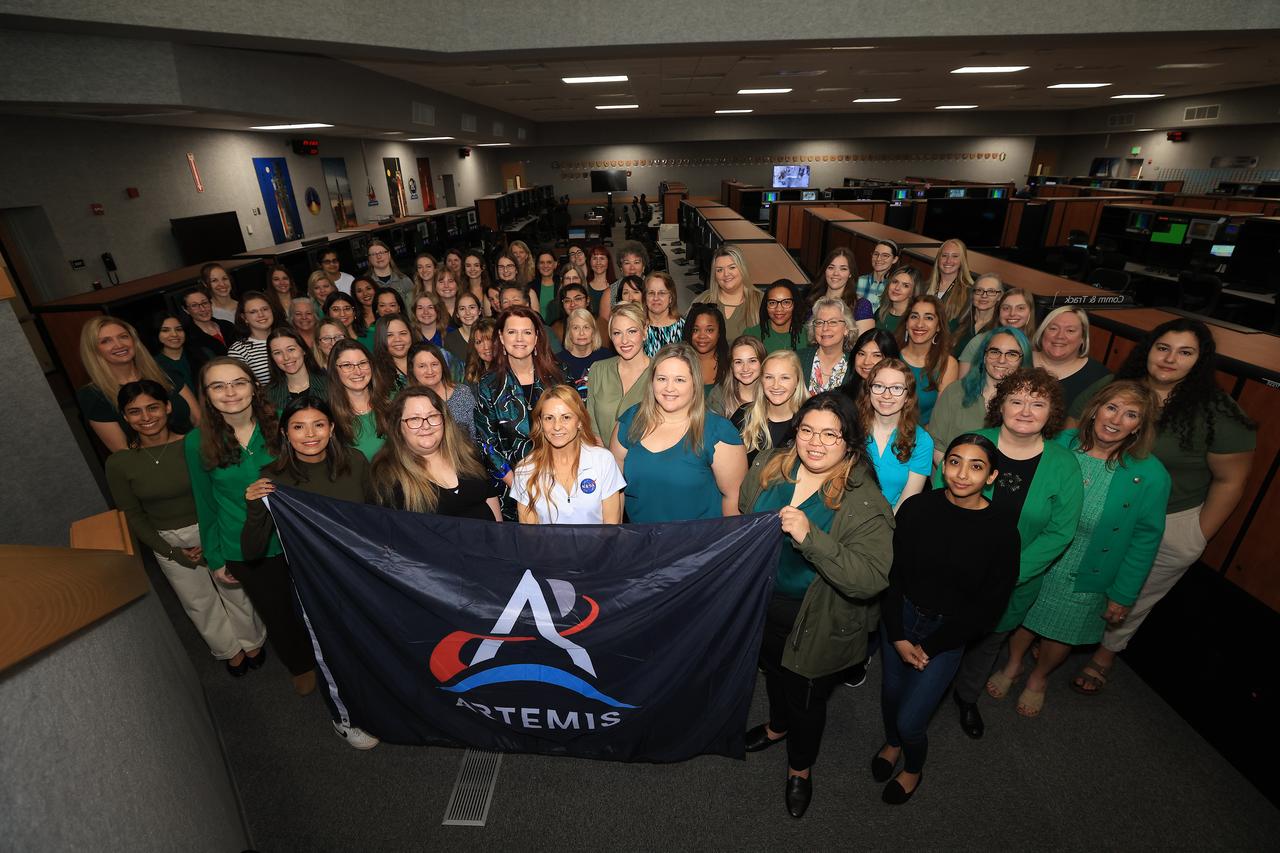
The women who comprise the Artemis launch team are photographed inside Firing Room 1 of the Launch Control Center at NASA’s Kennedy Space Center in Florida on Friday, March 15, 2024. In the second row center behind the Artemis banner is NASA’s first female Launch Director Charlie Blackwell-Thompson. The team, which is about 30% women, will launch the agency’s Artemis II mission from Kennedy’s Launch Pad 39B, the first crewed mission on NASA's path to establishing a long-term presence at the Moon for science and exploration through Artemis.
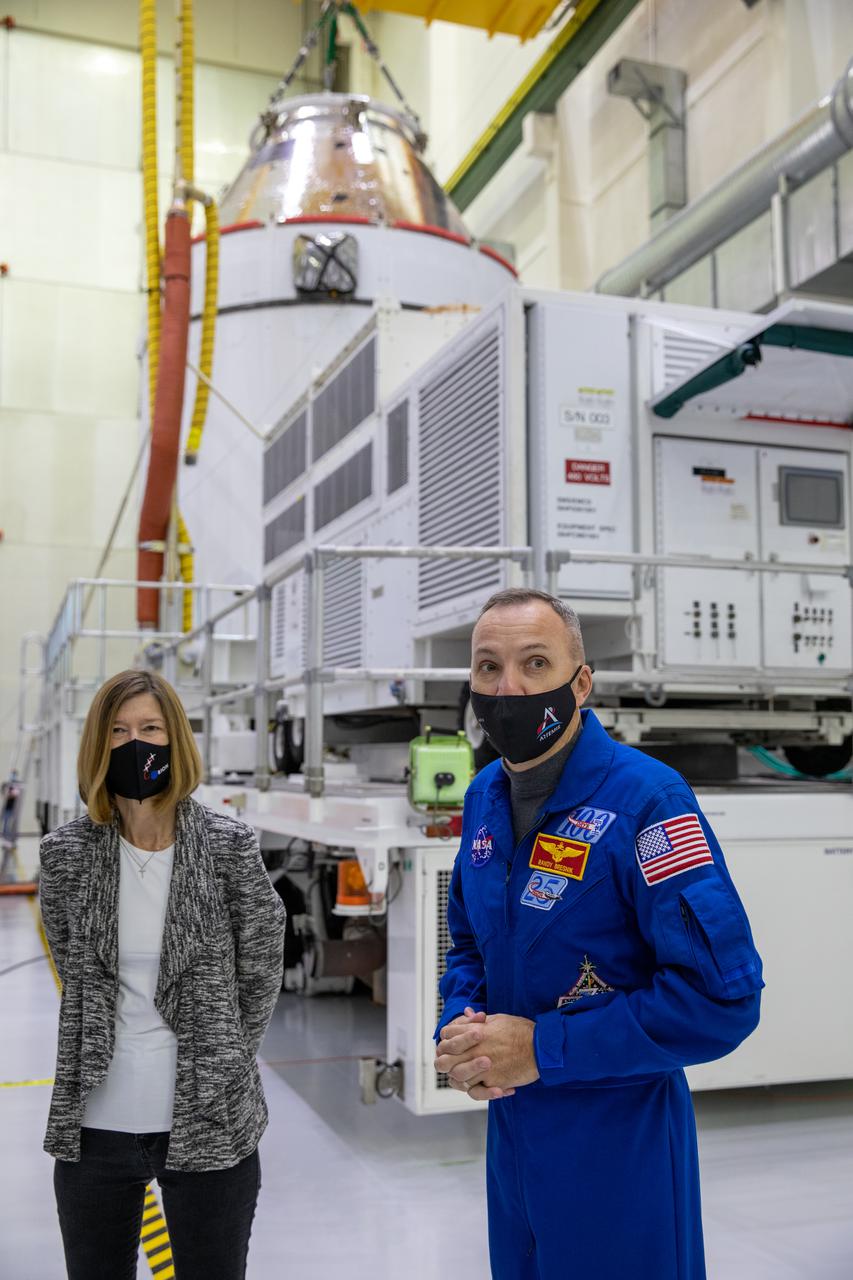
Orion is revealed for one of the final times on Jan. 14, as it is readied atop its transport pallet from the Neil Armstrong Operations and Checkout Building at NASA’s Kennedy Space Center in Florida, along its path to the pad ahead of the Artemis I launch. Viewing Orion in the high bay, from left, are Kathy Lueders, associate administrator of the Human Exploration and Operations Mission Directorate, and NASA astronaut Randy Bresnik. Teams across the globe have worked tirelessly to assemble the spacecraft, which will receive a protective covering prior to departing for the Multi-Payload Processing Facility to begin ground processing by the Exploration Ground Systems and Jacobs teams.

KENNEDY SPACE CENTER, FLA. - Crawler-transporter No. 2 sits outside the Vehicle Assembly Building. Workers will be driving the crawler to test it before it is needed to move the STS-116 stack from VAB high bay 3 to high bay 2 and allow the rollback of Space Shuttle Atlantis into high bay 3. The rollback will be determined by the mission management team based on information about Hurricane Ernesto and its path through Florida. Atlantis has been poised on Launch Pad 39B for liftoff on mission STS-115 to the International Space Station to deliver the P3/P4 truss segment. Photo credit: NASA/Jack Pfaller

KENNEDY SPACE CENTER, Fla. -- Billows of smoke and steam half frame Space Shuttle Atlantis as it roars into the still-black sky before dawn. At left can be seen the top of the lightning mast on Launch Pad 39B. Launch on mission STS-104 was on time at 5:03:59 a.m. EDT. The 10th assembly flight to the International Space Station, the mission is delivering the joint airlock module, which will require two spacewalks to attach it to the Space Station. The airlock will be the primary path for Space Station spacewalk entry and departure for U.S. spacesuits, and will also support the Russian Orlan spacesuit for EVA activity
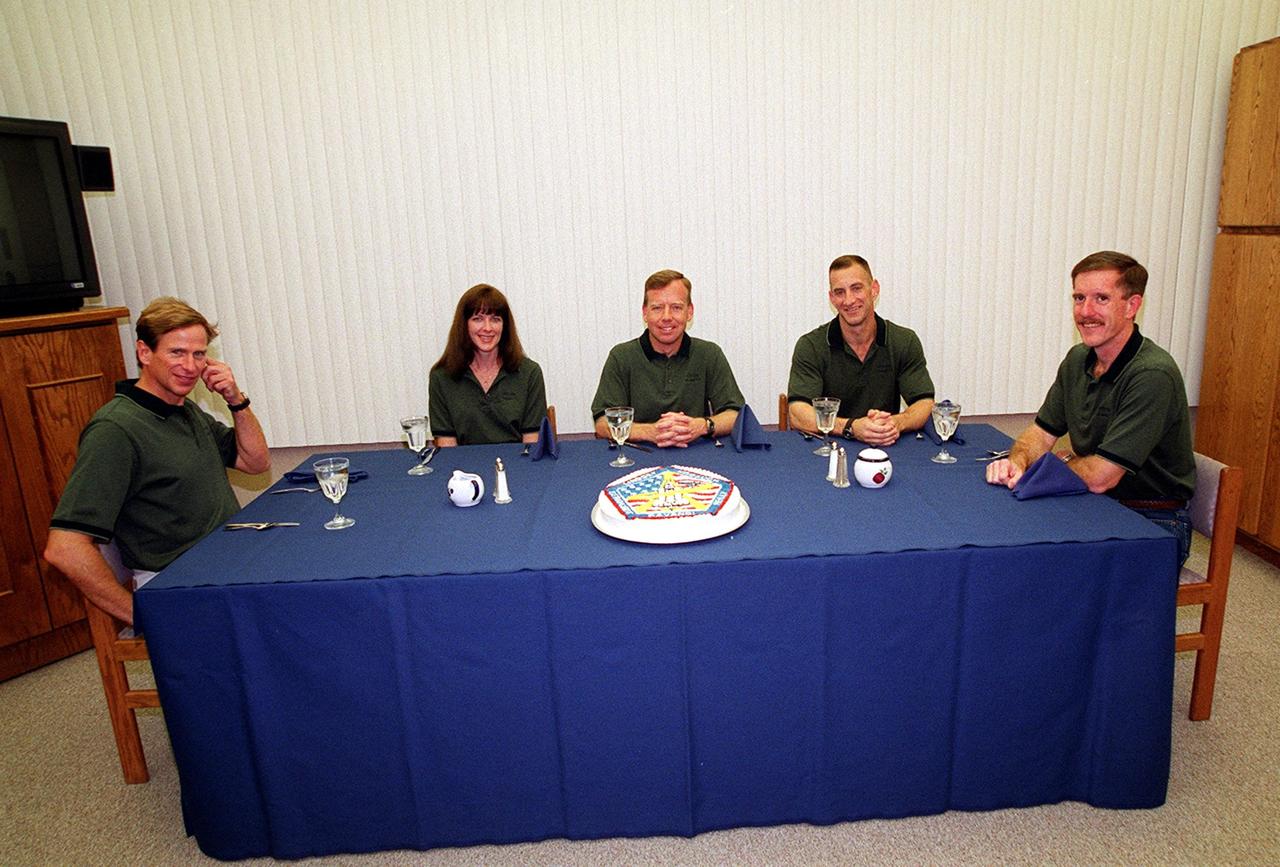
KENNEDY SPACE CENTER, Fla. -- The STS-104 crew finish their final meal of the day before launch. Seated from left are Mission Specialists Michael L. Gernhardt and Janet Lynn Kavandi, Commander Steven W. Lindsey, Pilot Charles O. Hobaugh and Mission Specialist James F. Reilly. The launch of Space Shuttle Atlantis on mission STS-104 is targeted for 5:04 a.m., July 12, from Launch Pad 39B. The primary payload on the mission is the joint airlock module, which will be added to the International Space Station. The airlock will be the primary path for Space Station spacewalk entry and departure for U.S. spacesuits, and will also support the Russian Orlan spacesuit for EVA activity
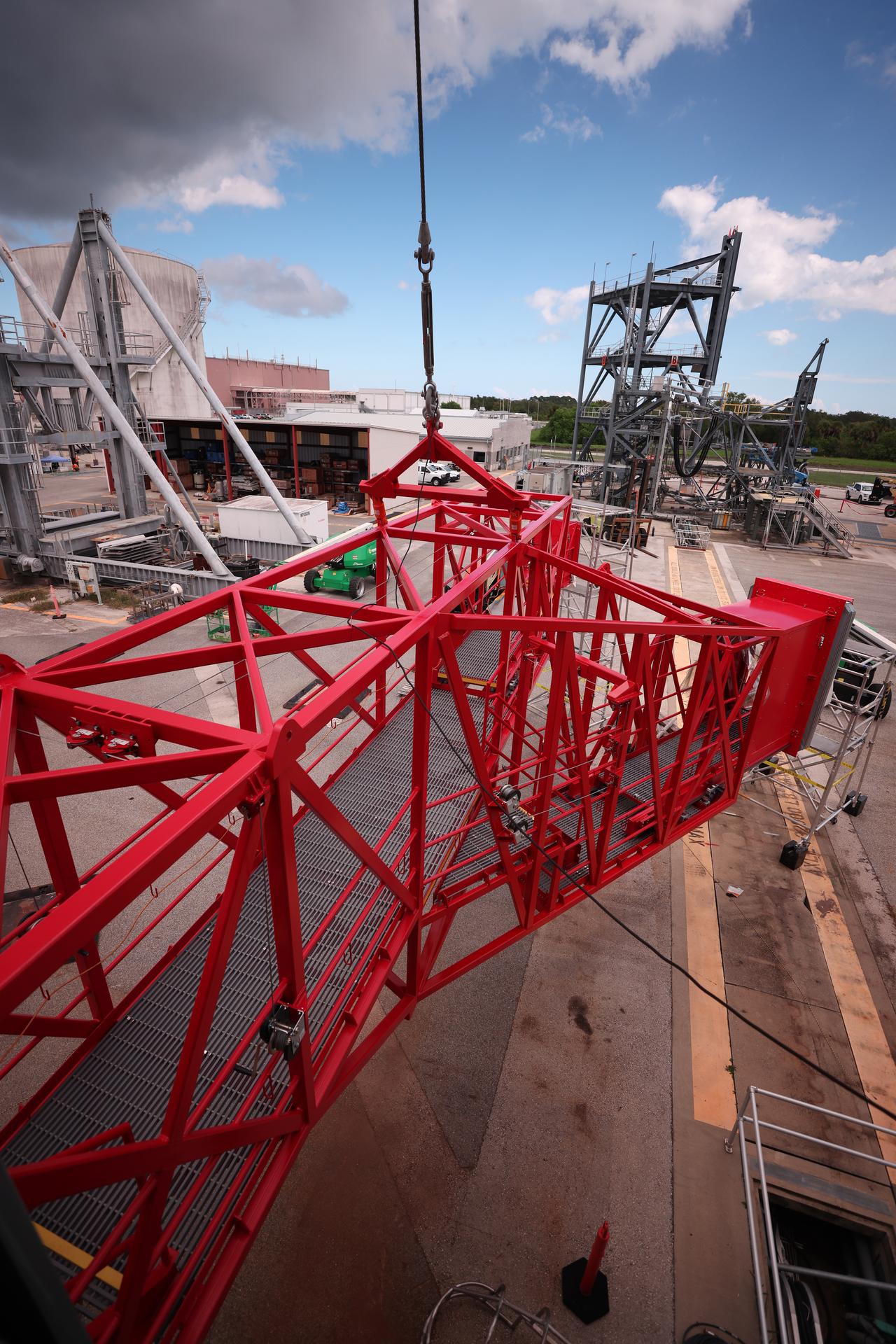
Crews test temporary contingency access platforms on the mobile launcher simulator tower on Wednesday, Oct. 29, 2025, at the Launch Equipment Test Facility at NASA’s Kennedy Space Center in Florida. The platforms will allow engineers to access the vehicle’s flight termination system on the rocket and the mobile launcher while at the pad rather than rolling back to the Vehicle Assembly Building to retest them. For Artemis II, four astronauts will venture around the Moon in early 2026, the first crewed mission on NASA’s path to establishing a long-term presence for science and exploration through Artemis.
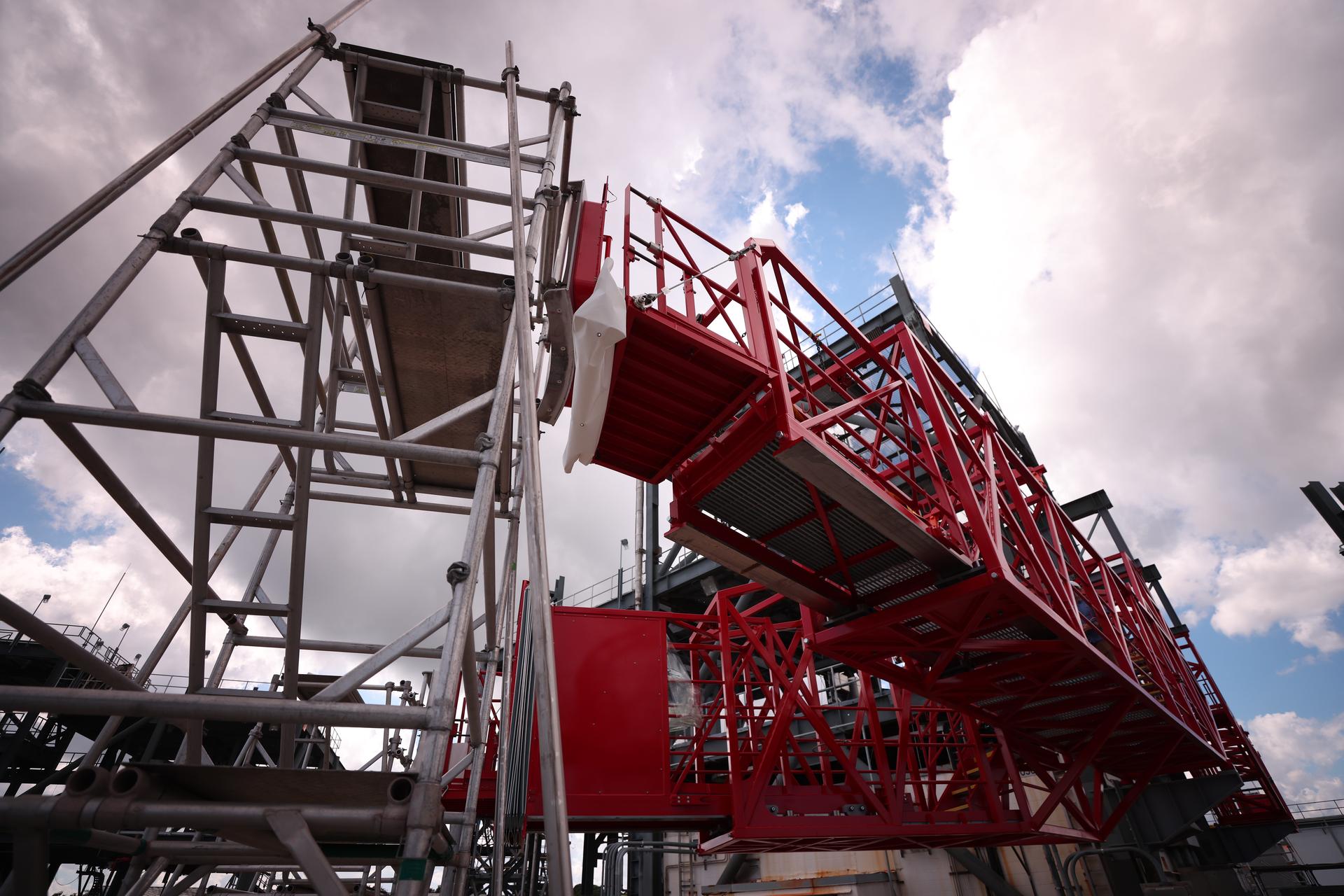
Crews test temporary contingency access platforms on the mobile launcher simulator tower on Wednesday, Oct. 29, 2025, at the Launch Equipment Test Facility at NASA’s Kennedy Space Center in Florida. The platforms will allow engineers to access the vehicle’s flight termination system on the rocket and the mobile launcher while at the pad rather than rolling back to the Vehicle Assembly Building to retest them. For Artemis II, four astronauts will venture around the Moon in early 2026, the first crewed mission on NASA’s path to establishing a long-term presence for science and exploration through Artemis.
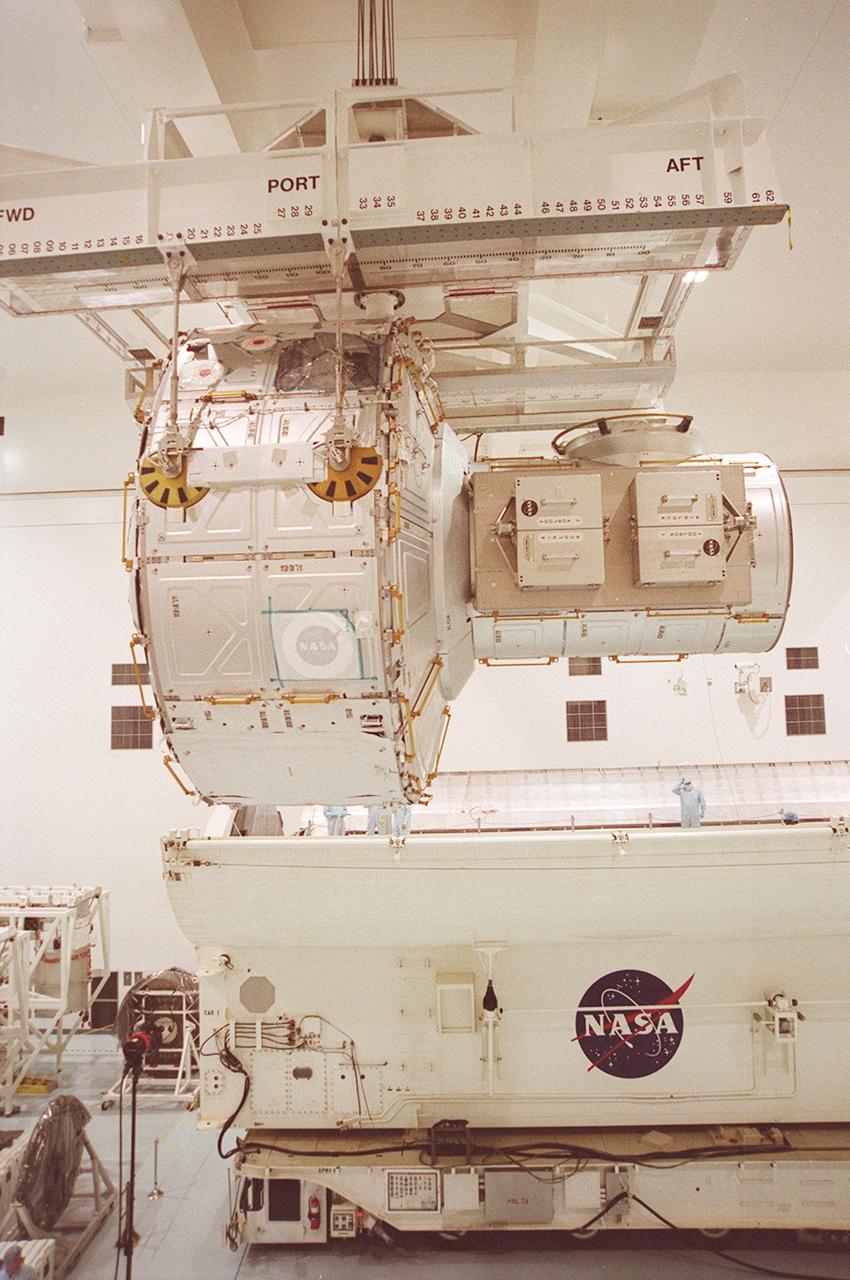
KENNEDY SPACE CENTER, FLA. -- In the Space Station Processing Facility, the Joint Airlock Module is moved closer to the payload canister. The airlock will be installed in the payload bay of Atlantis for mission STS-104 to the International Space Station. The airlock is a pressurized flight element consisting of two cylindrical chambers attached end-to-end by a connecting bulkhead and hatch. Once installed and activated, the Airlock becomes the primary path for spacewalk entry to and departure from the Space Station for U.S. spacesuits, which are known as Extravehicular Mobility Units, or EMUs. In addition, the Joint Airlock is designed to support the Russian Orlan spacesuit for EVA activity. STS-104 is scheduled for launch June 14 from Launch Pad 39B
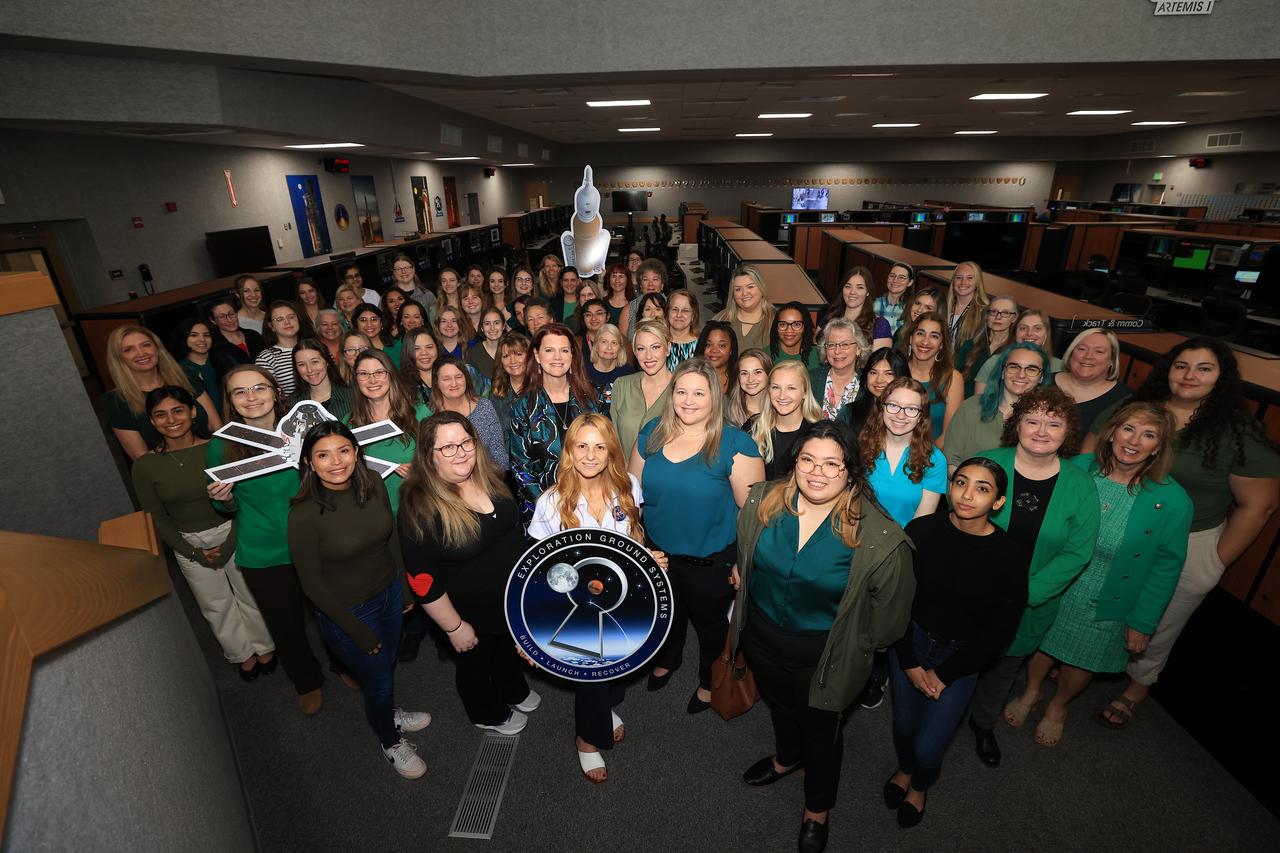
The women who comprise the Artemis launch team are photographed inside Firing Room 1 of the Launch Control Center at NASA’s Kennedy Space Center in Florida on Friday, March 15, 2024. In the second row center behind the Exploration Ground Systems sign is NASA’s first female Launch Director Charlie Blackwell-Thompson. The team, which is about 30% women, will launch the agency’s Artemis II mission from Kennedy’s Launch Pad 39B, the first crewed mission on NASA's path to establishing a long-term presence at the Moon for science and exploration through Artemis.
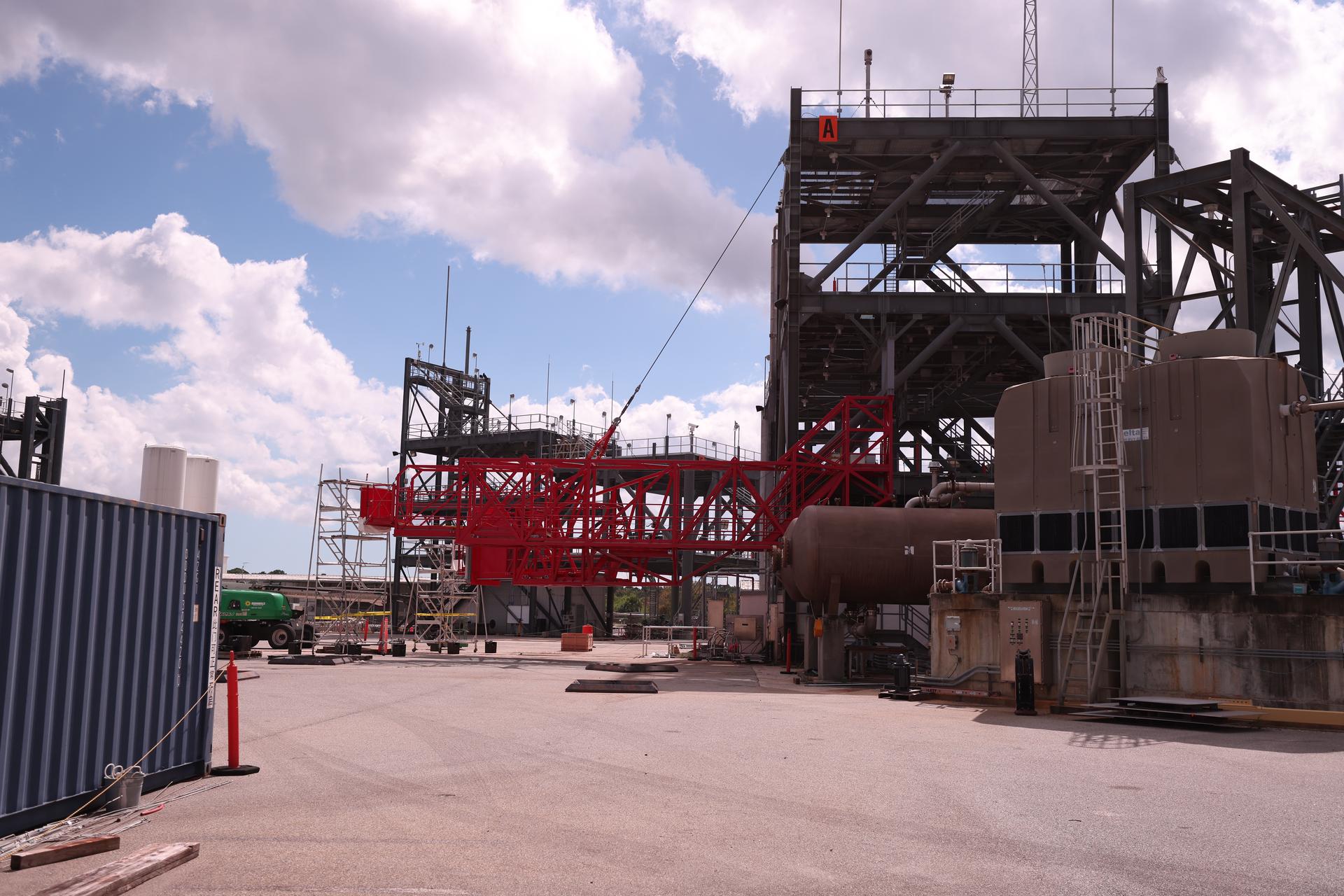
Crews test temporary contingency access platforms on the mobile launcher simulator tower on Wednesday, Oct. 29, 2025, at the Launch Equipment Test Facility at NASA’s Kennedy Space Center in Florida. The platforms will allow engineers to access the vehicle’s flight termination system on the rocket and the mobile launcher while at the pad rather than rolling back to the Vehicle Assembly Building to retest them. For Artemis II, four astronauts will venture around the Moon in early 2026, the first crewed mission on NASA’s path to establishing a long-term presence for science and exploration through Artemis.
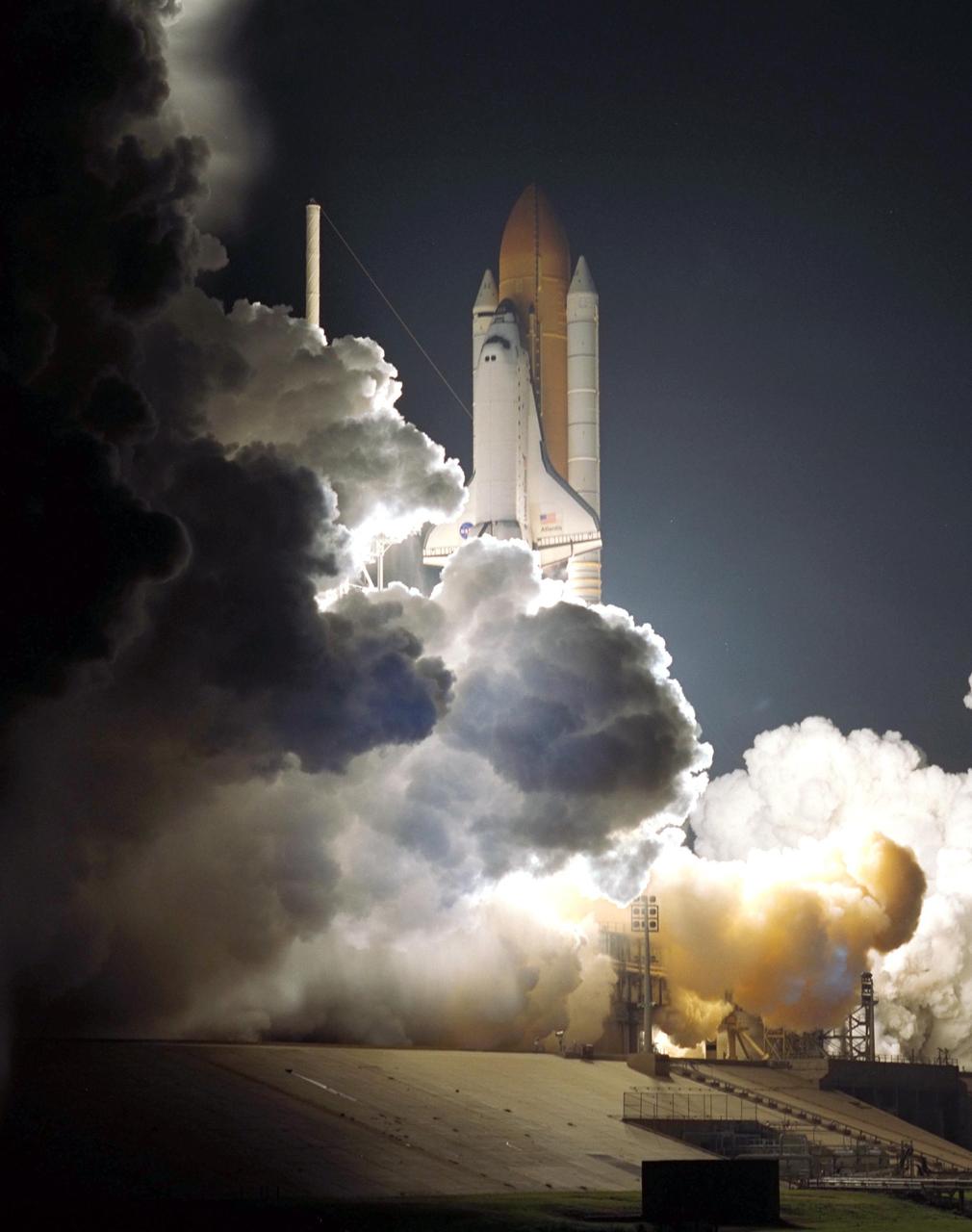
KENNEDY SPACE CENTER, Fla. -- Billows of smoke and steam surround Space Shuttle Atlantis as it blasts into the pre-dawn sky on mission STS-104. Atlantis lifted off from Launch Pad 39B on time at 5:03:59 a.m. EDT. The 10th assembly flight to the International Space Station, the mission is delivering the joint airlock module, which will require two spacewalks to attach it to the Space Station. The airlock will be the primary path for Space Station spacewalk entry and departure for U.S. spacesuits, and will also support the Russian Orlan spacesuit for EVA activity
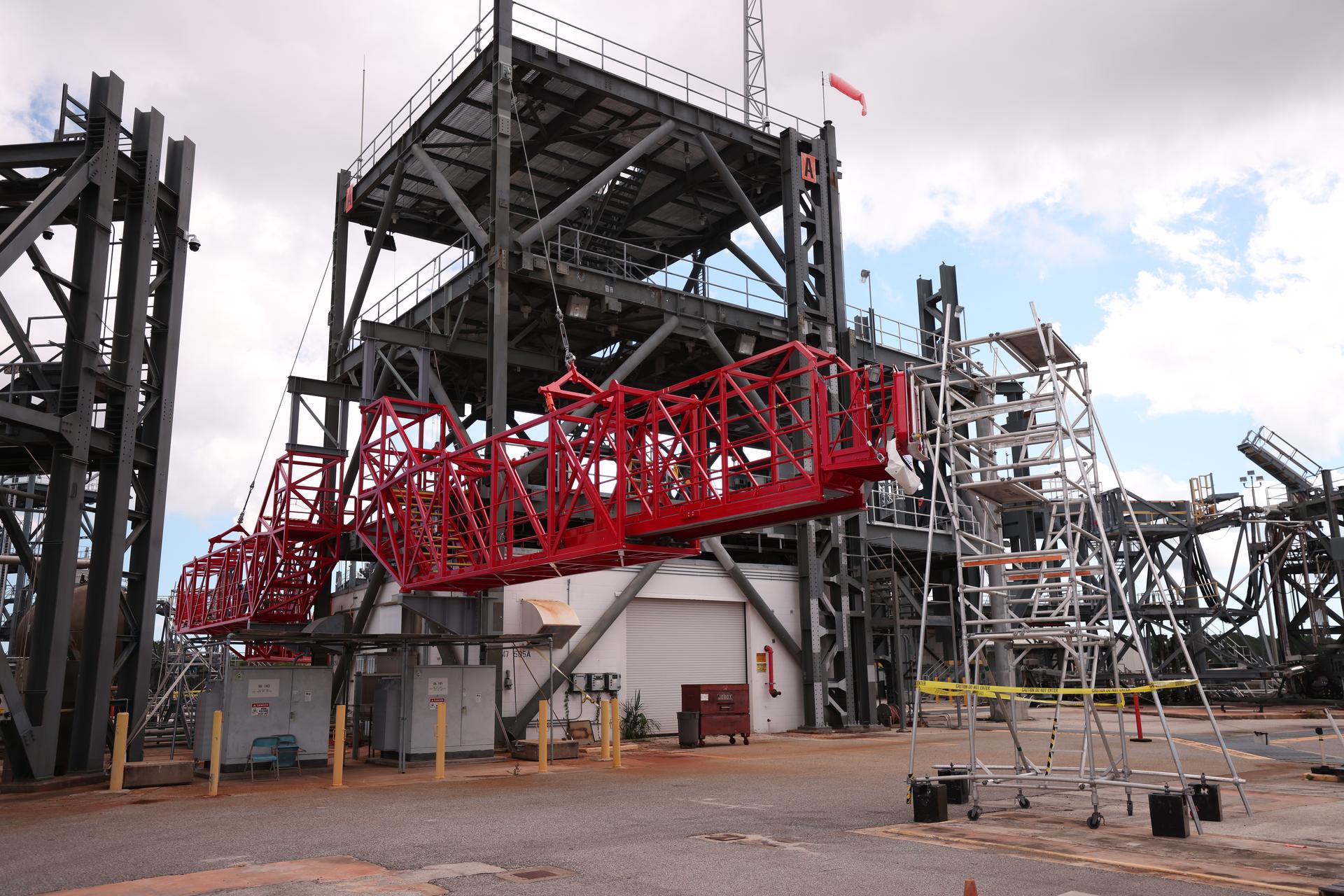
Crews test temporary contingency access platforms on the mobile launcher simulator tower on Wednesday, Oct. 29, 2025, at the Launch Equipment Test Facility at NASA’s Kennedy Space Center in Florida. The platforms will allow engineers to access the vehicle’s flight termination system on the rocket and the mobile launcher while at the pad rather than rolling back to the Vehicle Assembly Building to retest them. For Artemis II, four astronauts will venture around the Moon in early 2026, the first crewed mission on NASA’s path to establishing a long-term presence for science and exploration through Artemis.

Launch pads and towers rose one by one above the scrub land, dotting the shoreline of Florida's East coast. By 1960, the "Missile Firing Laboratory" had become an extension of NASA's Marshall Space Flight Center. On July 1, 1962, NASA officially activated the Launch Operations Center at the seaside spaceport, granting the center equal status to Marshall and offering the center's new director, Dr. Kurt H. Debus, a direct report to the agency's headquarters in Washington, D.C. The following year the center was renamed to honor the president who put America on the path to the moon.
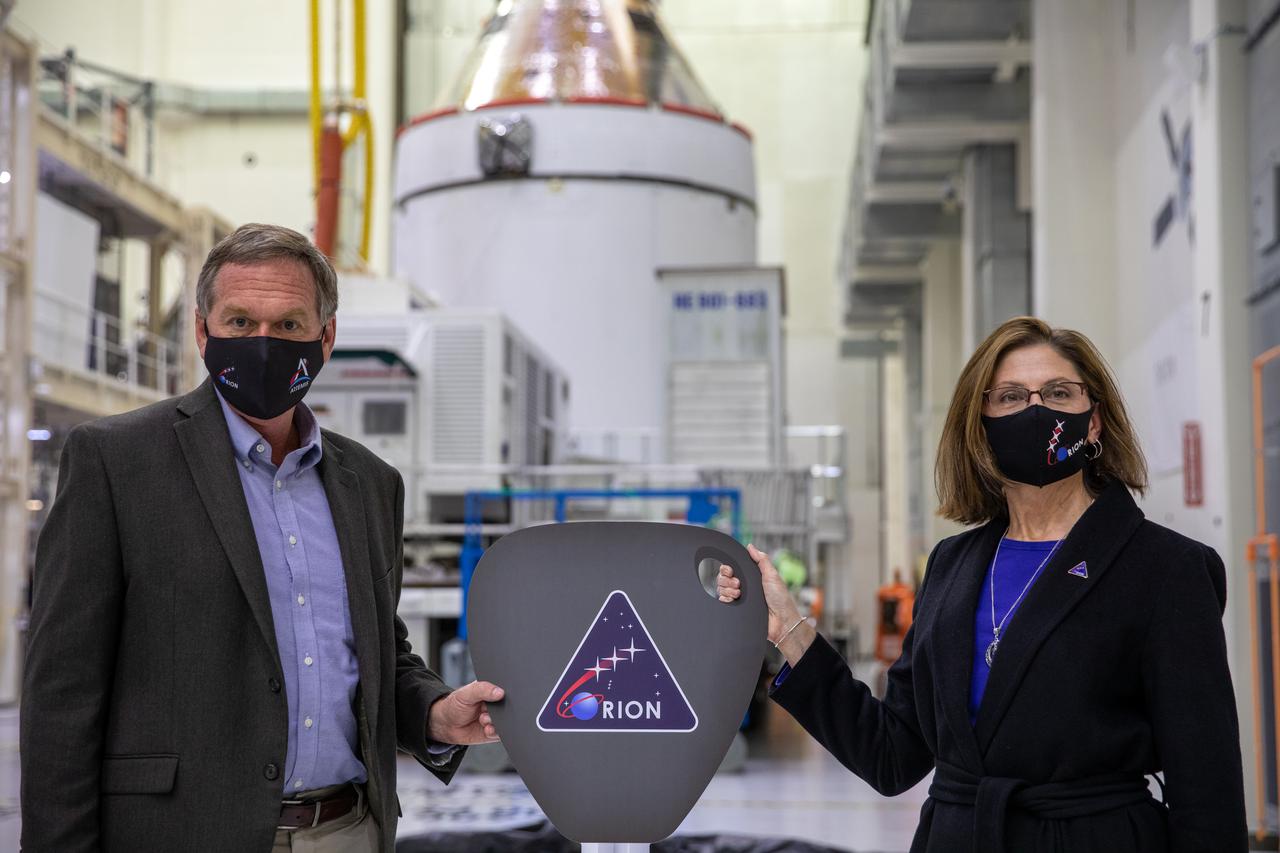
Orion is revealed for one of the final times on Jan. 14, as it is readied atop its transport pallet from the Neil Armstrong Operations and Checkout Building at NASA’s Kennedy Space Center in Florida, along its path to the pad ahead of the Artemis I launch. Mike Bolger, at left, manager of Exploration Ground Systems (EGS), receives the “key” to Orion from Cathy Koerner, Orion Program manager, signifying the transfer of the spacecraft from the assembly to the ground system processing team. Teams across the globe have worked tirelessly to assemble the spacecraft, which will receive a protective covering prior to departing for the Multi-Payload Processing Facility to begin ground processing by the EGS and Jacobs teams.
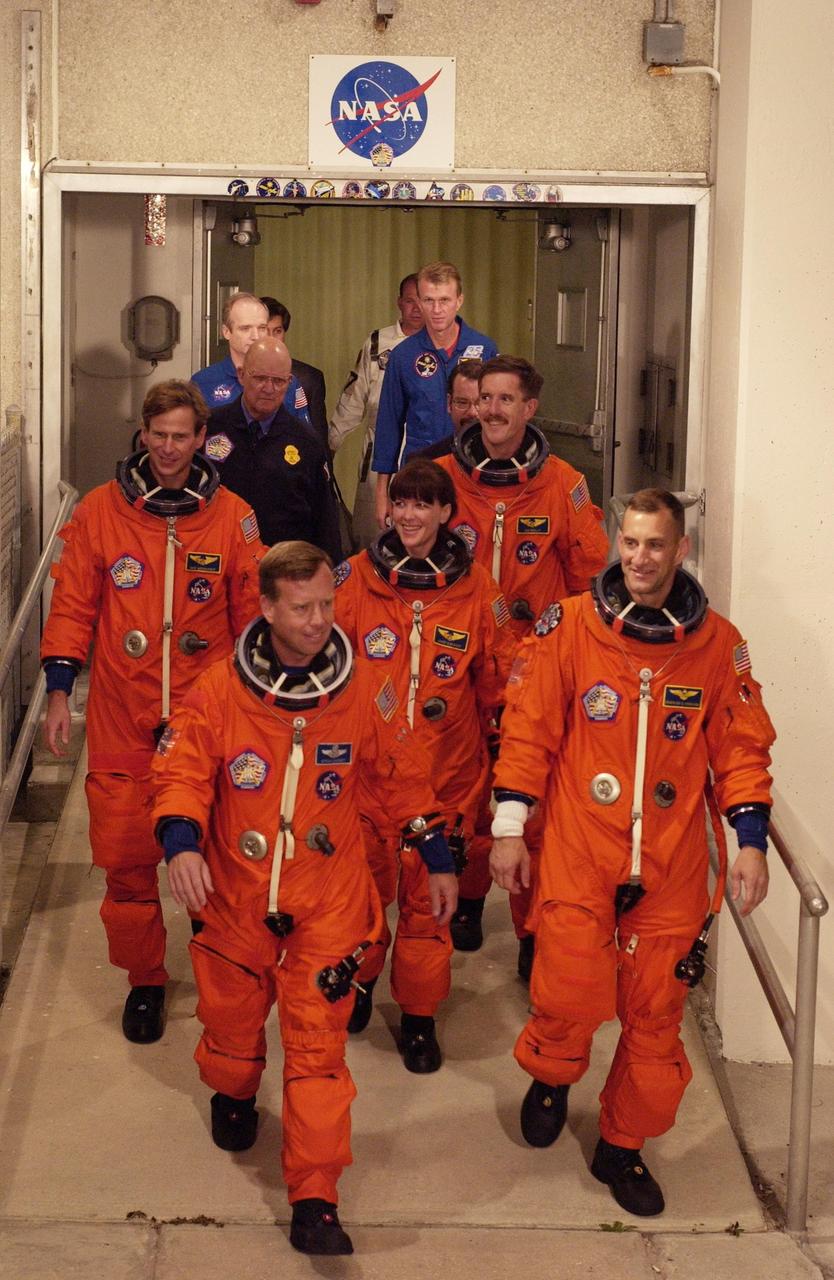
KENNEDY SPACE CENTER, Fla. -- The STS-104 crew exits out of the Operations and Checkout Building on their way to Launch Pad 39B. Leading are Commander Steven W. Lindsey (left) and Pilot Charles O. Hobaugh. In the center is Mission Specialist Janet Lynn Kavandi. Following her are Mission Specialists Michael L. Gernhardt (left) and James F. Reilly. . The launch of Space Shuttle Atlantis on mission STS-104 is targeted for 5:04 a.m., July 12, from Launch Pad 39B. The primary payload on the mission is the joint airlock module, which will be added to the International Space Station. The airlock will be the primary path for Space Station spacewalk entry and departure for U.S. spacesuits, and will also support the Russian Orlan spacesuit for EVA activity. D1X NIKON Photo by S. Andrews
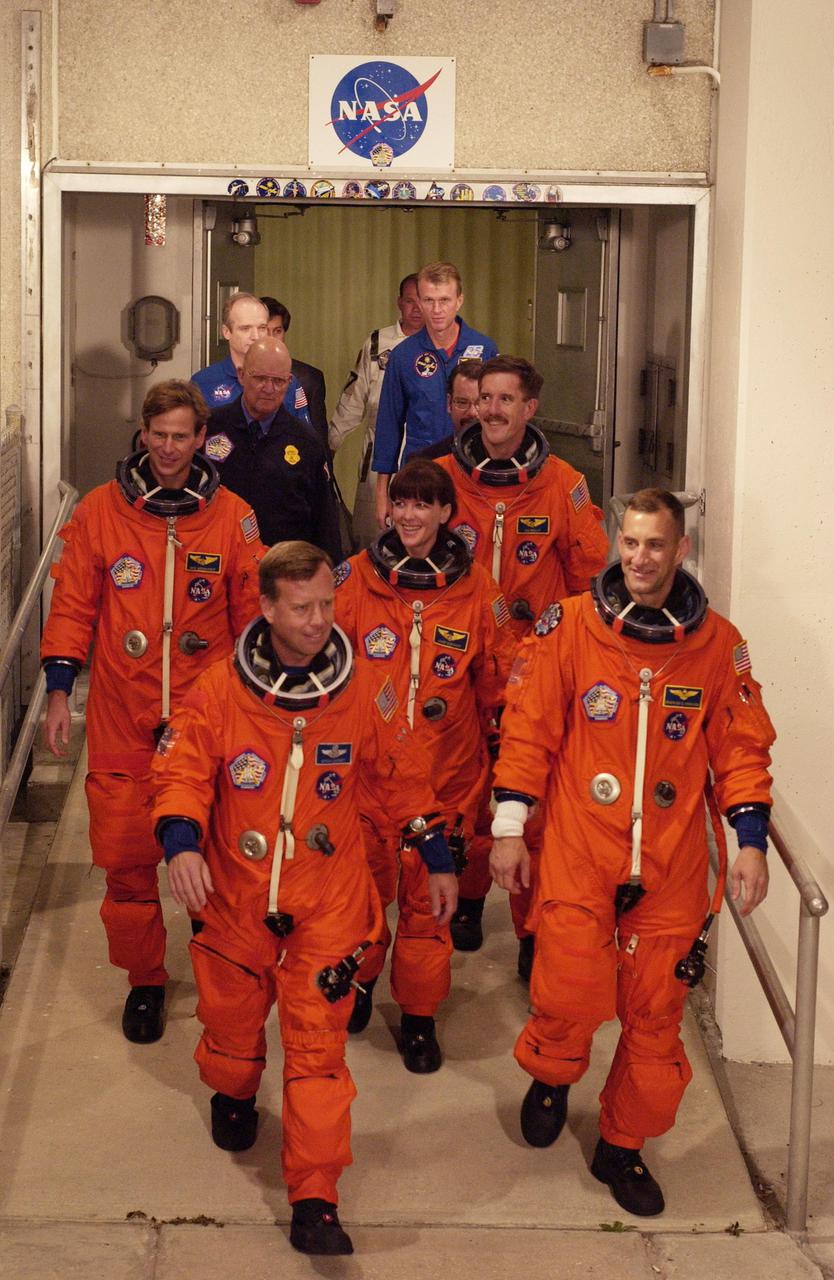
KENNEDY SPACE CENTER, Fla. -- The STS-104 crew exits out of the Operations and Checkout Building on their way to Launch Pad 39B. Leading are Commander Steven W. Lindsey (left) and Pilot Charles O. Hobaugh. In the center is Mission Specialist Janet Lynn Kavandi. Following her are Mission Specialists Michael L. Gernhardt (left) and James F. Reilly. . The launch of Space Shuttle Atlantis on mission STS-104 is targeted for 5:04 a.m., July 12, from Launch Pad 39B. The primary payload on the mission is the joint airlock module, which will be added to the International Space Station. The airlock will be the primary path for Space Station spacewalk entry and departure for U.S. spacesuits, and will also support the Russian Orlan spacesuit for EVA activity. D1X NIKON Photo by S. Andrews
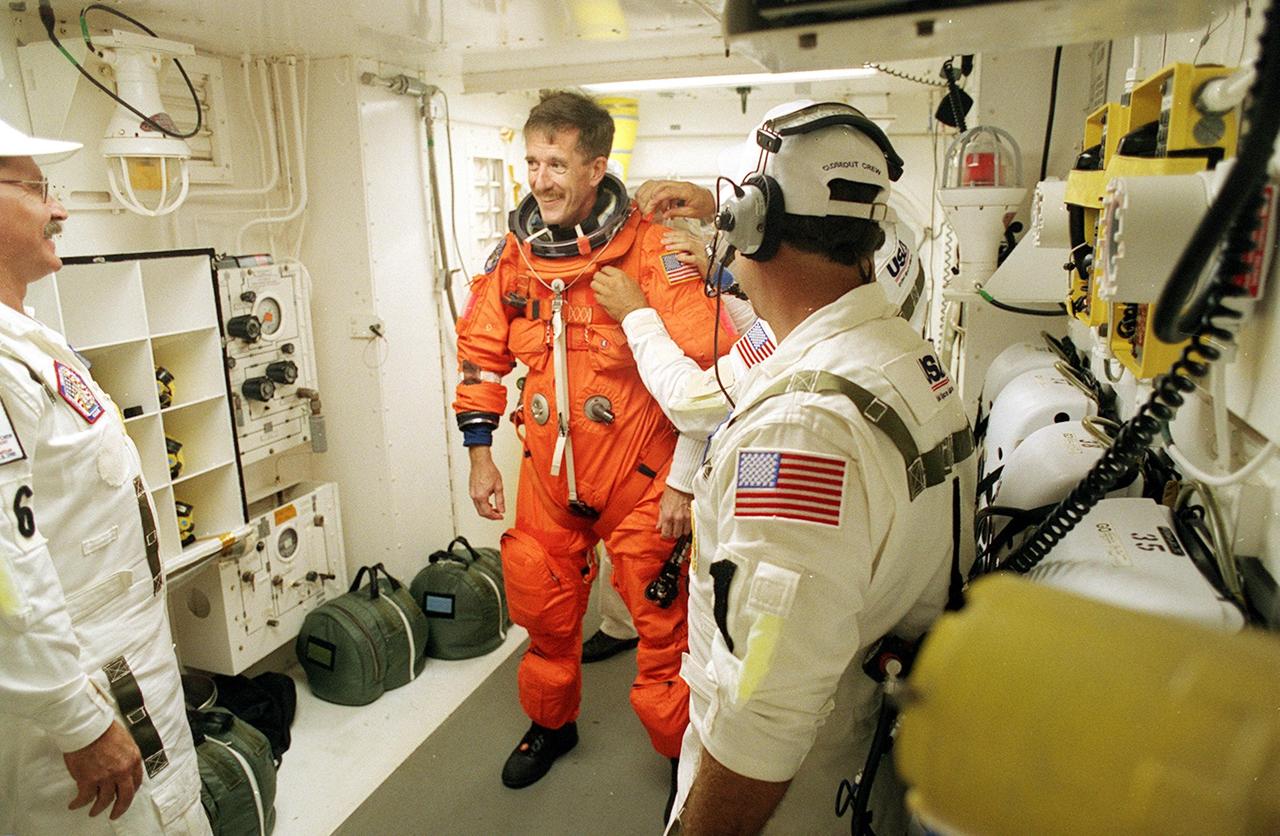
KENNEDY SPACE CENTER, Fla. -- In the White Room, STS-104 Mission Specialist James F. Reilly (center) is helped by closeout crew members before entering Space Shuttle Atlantis. The White Room is an environmental chamber at the end of the Orbiter Access Arm that provides entry into the orbiter on the launch pad. Atlantis lifted off from Launch Pad 39B on time at 5:03:59 a.m. EDT. The 10th assembly flight to the International Space Station, the primary payload on the mission is the joint airlock module, which will require two spacewalks to attach it to the Space Station. The airlock will be the primary path for Space Station spacewalk entry and departure for U.S. spacesuits, and will also support the Russian Orlan spacesuit for EVA activity
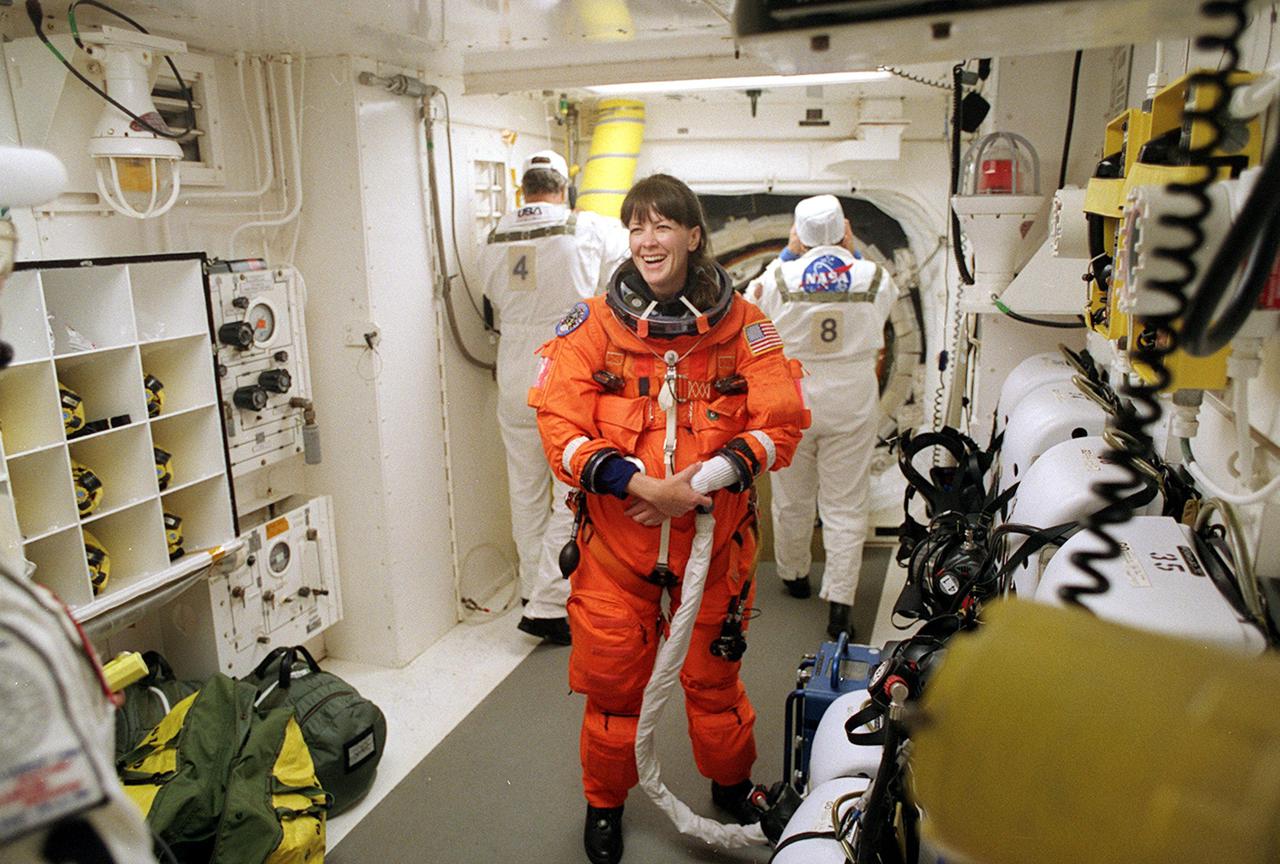
KENNEDY SPACE CENTER, Fla. -- In the White Room, STS-104 Mission Specialist Janet Lynn Kavandi (center) shares a laugh with closeout crew members before entering Space Shuttle Atlantis. The White Room is an environmental chamber at the end of the Orbiter Access Arm that provides entry into the orbiter on the launch pad. Atlantis lifted off from Launch Pad 39B on time at 5:03:59 a.m. EDT. The 10th assembly flight to the International Space Station, the primary payload on the mission is the joint airlock module, which will require two spacewalks to attach it to the Space Station. The airlock will be the primary path for Space Station spacewalk entry and departure for U.S. spacesuits, and will also support the Russian Orlan spacesuit for EVA activity
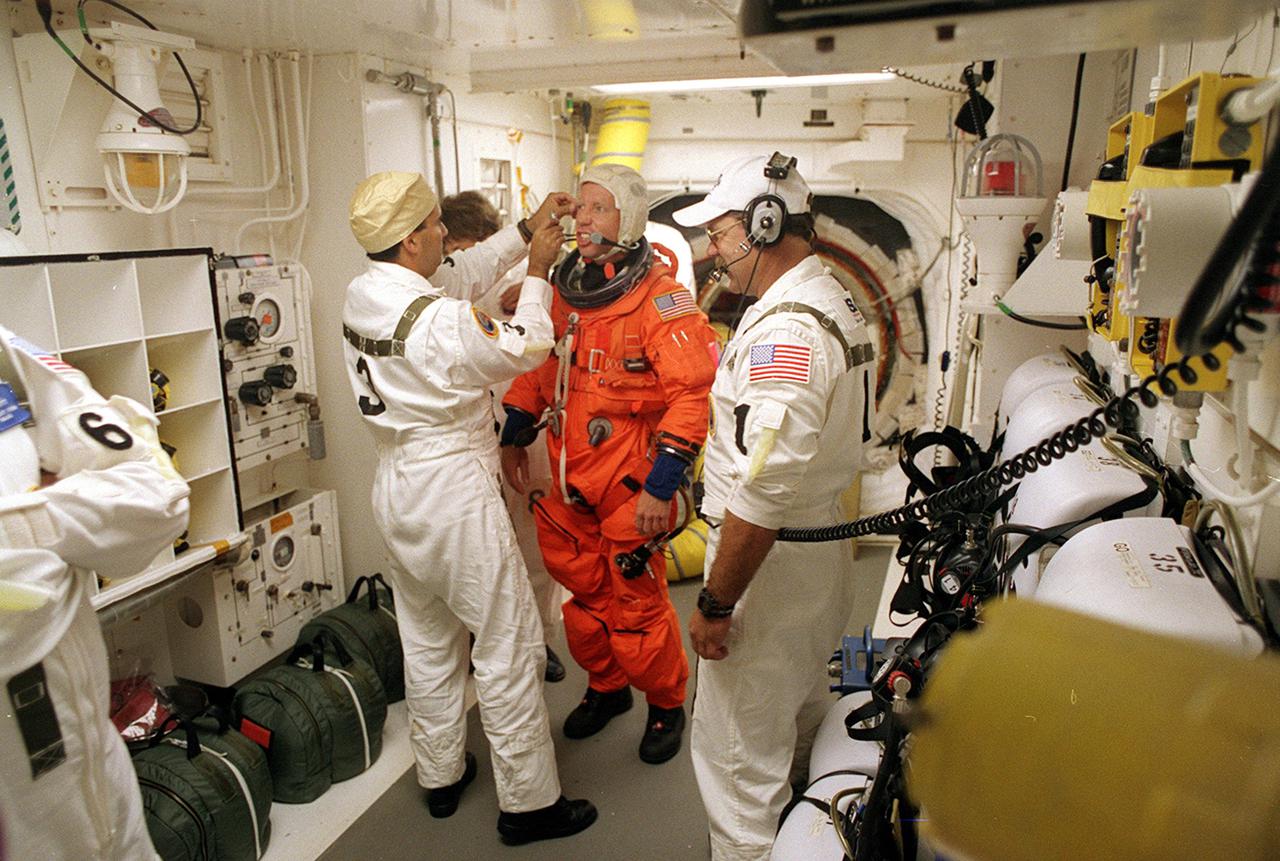
KENNEDY SPACE CENTER, Fla. -- In the White Room, STS-104 Commander Steven W. Lindsey (center) is helped by closeout crew members before entering Space Shuttle Atlantis. The White Room is an environmental chamber at the end of the Orbiter Access Arm that provides entry into the orbiter on the launch pad. Atlantis lifted off from Launch Pad 39B on time at 5:03:59 a.m. EDT. The 10th assembly flight to the International Space Station, the primary payload on the mission is the joint airlock module, which will require two spacewalks to attach it to the Space Station. The airlock will be the primary path for Space Station spacewalk entry and departure for U.S. spacesuits, and will also support the Russian Orlan spacesuit for EVA activity
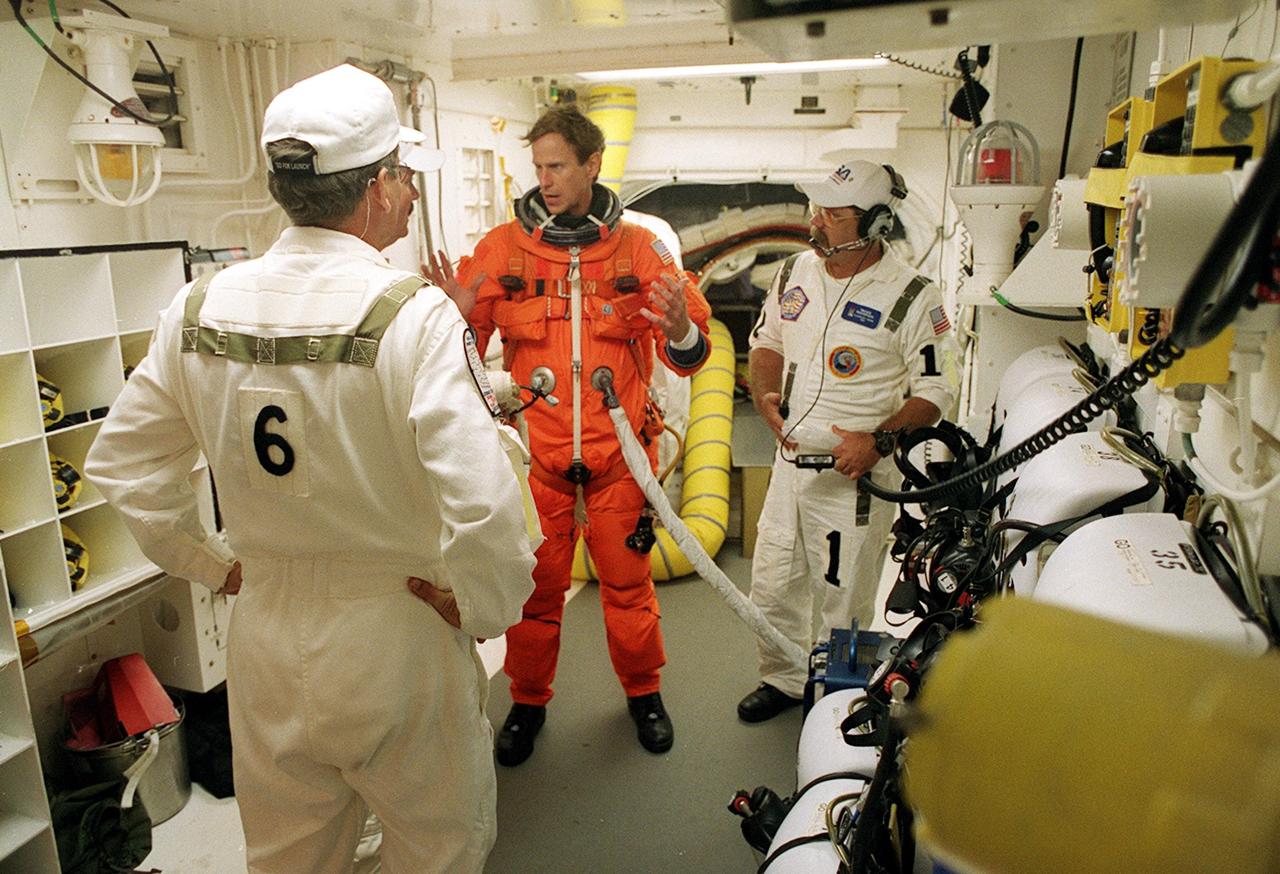
KENNEDY SPACE CENTER, Fla. -- In the White Room, STS-104 Mission Specialist Michael L. Gernhardt (center) talks to closeout crew members before entering Space Shuttle Atlantis. The White Room is an environmental chamber at the end of the Orbiter Access Arm that provides entry into the orbiter on the launch pad. Atlantis lifted off from Launch Pad 39B on time at 5:03:59 a.m. EDT. The 10th assembly flight to the International Space Station, the primary payload on the mission is the joint airlock module, which will require two spacewalks to attach it to the Space Station. The airlock will be the primary path for Space Station spacewalk entry and departure for U.S. spacesuits, and will also support the Russian Orlan spacesuit for EVA activity

KENNEDY SPACE CENTER, FLA. - Both of NASA's crawler-transporters are seen parked in their area near the Vehicle Assembly Building. Crawler-transporter No. 2 is being checked before it is needed to move the STS-116 stack from VAB high bay 3 to high bay 2 and allow the rollback of Space Shuttle Atlantis into high bay 3. Crawler No. 1 will transport the shuttle from the pad. The rollback will be determined by the mission management team based on information about Hurricane Ernesto and its path through Florida. Atlantis has been poised on Launch Pad 39B for liftoff on mission STS-115 to the International Space Station to deliver the P3/P4 truss segment. Photo credit: NASA/Jack Pfaller
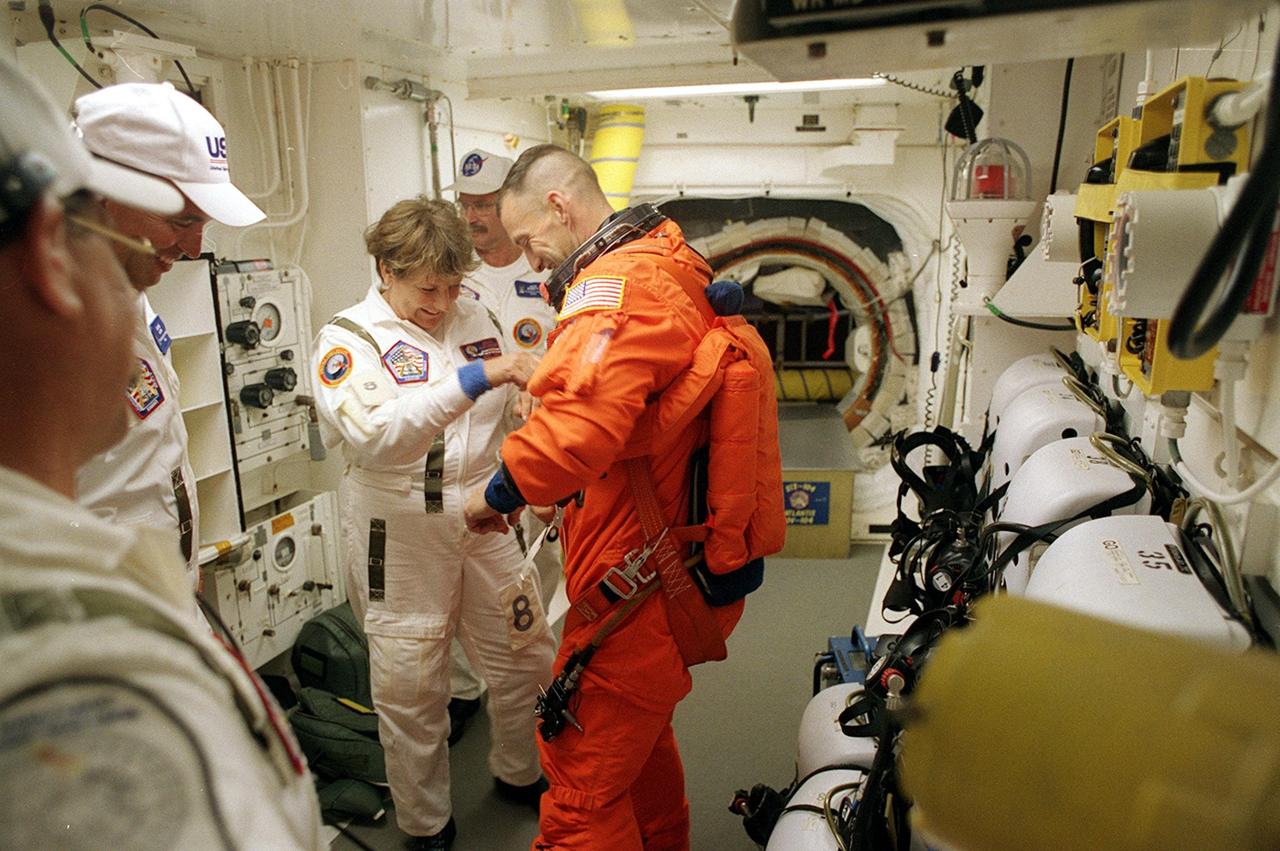
KENNEDY SPACE CENTER, Fla. -- In the White Room, STS-104 Pilot Charles O. Hobaugh (center) is helped by closeout crew members before entering Space Shuttle Atlantis. The White Room is an environmental chamber at the end of the Orbiter Access Arm that provides entry into the orbiter on the launch pad. Atlantis lifted off from Launch Pad 39B on time at 5:03:59 a.m. EDT. The 10th assembly flight to the International Space Station, the primary payload on the mission is the joint airlock module, which will require two spacewalks to attach it to the Space Station. The airlock will be the primary path for Space Station spacewalk entry and departure for U.S. spacesuits, and will also support the Russian Orlan spacesuit for EVA activity

KENNEDY SPACE CENTER, FLA. - Both of NASA's crawler-transporters are seen parked in their area near the Vehicle Assembly Building. Crawler-transporter No. 2 is being checked before it is needed to move the STS-116 stack from VAB high bay 3 to high bay 2 and allow the rollback of Space Shuttle Atlantis into high bay 3. Crawler No. 1 will transport the shuttle from the pad. The rollback will be determined by the mission management team based on information about Hurricane Ernesto and its path through Florida. Atlantis has been poised on Launch Pad 39B for liftoff on mission STS-115 to the International Space Station to deliver the P3/P4 truss segment. Photo credit: NASA/Jack Pfaller
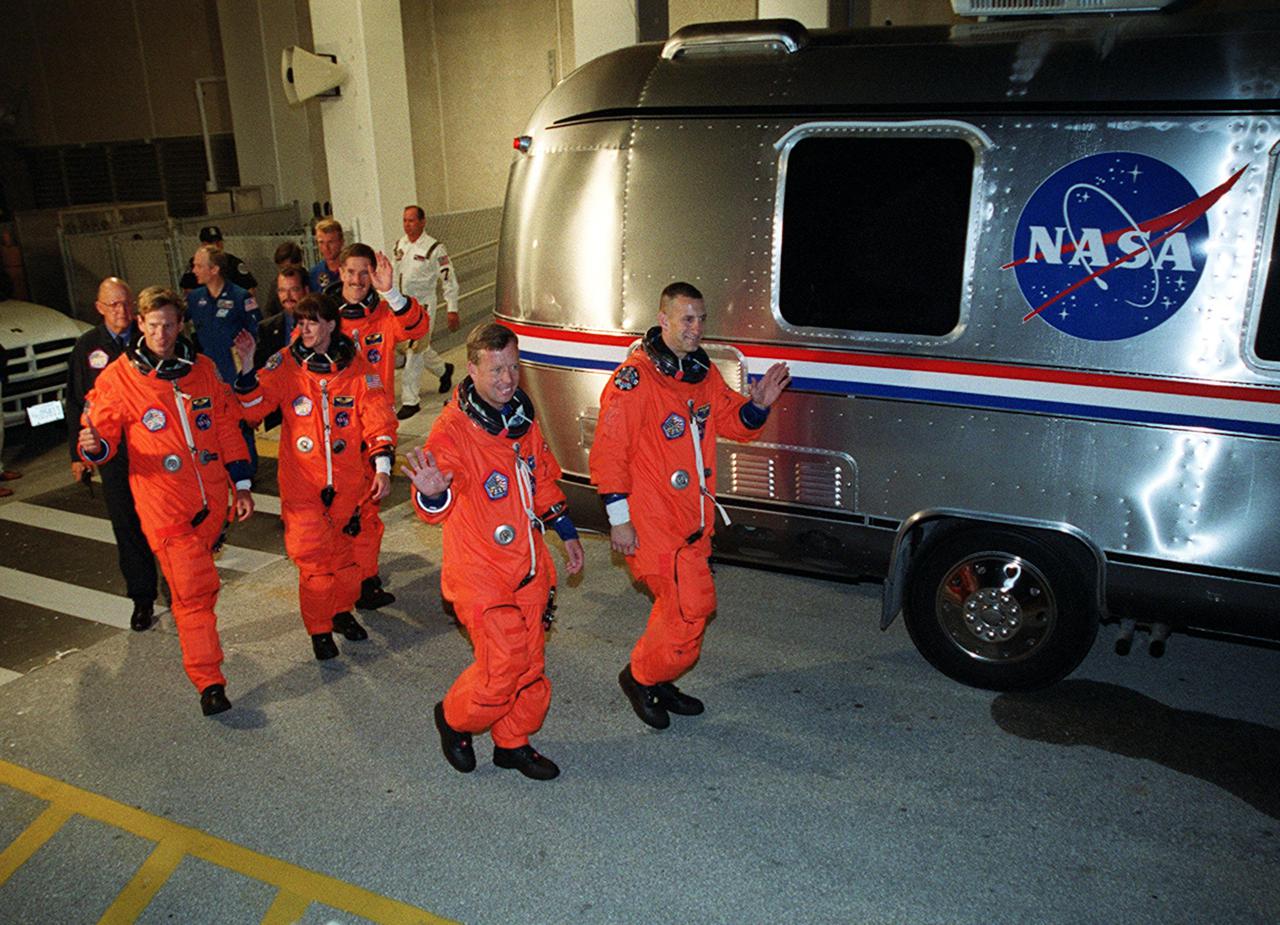
KENNEDY SPACE CENTER, Fla. -- The STS-104 crew heads for the Astrovan that will take them to Launch Pad 39B. Leading are Commander Steven W. Lindsey (left) and Pilot Charles O. Hobaugh. In the center is Mission Specialist Janet Lynn Kavandi. Following her are Mission Specialists Michael L. Gernhardt (left) and James F. Reilly. The launch of Space Shuttle Atlantis on mission STS-104 is targeted for 5:04 a.m., July 12, from Launch Pad 39B. The primary payload on the mission is the joint airlock module, which will be added to the International Space Station. The airlock will be the primary path for Space Station spacewalk entry and departure for U.S. spacesuits, and will also support the Russian Orlan spacesuit for EVA activity
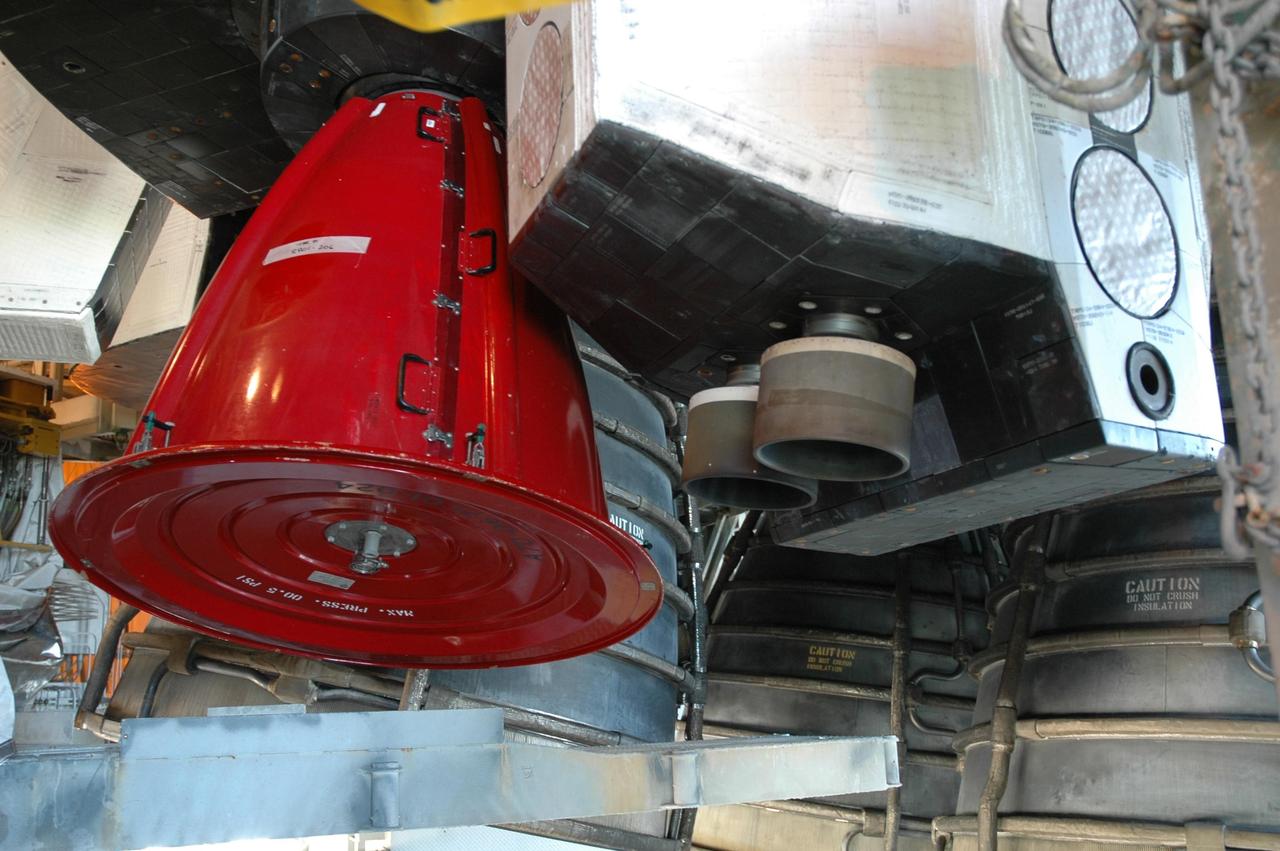
KENNEDY SPACE CENTER, FLA. - Preparations continue on the pad for launch of Atlantis on mission STS-115 as early as Aug. 29. However, preparations are also underway for a rollback of Atlantis to the Vehicle Assembly Building due to Hurricane Ernesto. The red cover seen here on Space Shuttle Atlantis' orbital maneuvering system pod nozzle will be removed before launch. However, in the event of a rollback, the cover will be left attached. The rollback will be determined by the mission management team based on information about Hurricane Ernesto and its path through Florida. Atlantis has been poised on Launch Pad 39B for liftoff on mission STS-115 to the International Space Station to deliver the P3/P4 truss segment. Photo credit: NASA/Jack Pfaller